EP2860182B1 - Organoaminosilane precursors and methods for depositing films comprising same - Google Patents
Organoaminosilane precursors and methods for depositing films comprising same Download PDFInfo
- Publication number
- EP2860182B1 EP2860182B1 EP14185776.3A EP14185776A EP2860182B1 EP 2860182 B1 EP2860182 B1 EP 2860182B1 EP 14185776 A EP14185776 A EP 14185776A EP 2860182 B1 EP2860182 B1 EP 2860182B1
- Authority
- EP
- European Patent Office
- Prior art keywords
- disilabutane
- group
- silicon
- organoaminosilane
- bis
- Prior art date
- Legal status (The legal status is an assumption and is not a legal conclusion. Google has not performed a legal analysis and makes no representation as to the accuracy of the status listed.)
- Active
Links
- 0 CCCCN(CCCC)*CC[*+] Chemical compound CCCCN(CCCC)*CC[*+] 0.000 description 4
- AIALIFOKPDAMKA-UHFFFAOYSA-O CC(C)N(C1CCCCC1)[SH+]C Chemical compound CC(C)N(C1CCCCC1)[SH+]C AIALIFOKPDAMKA-UHFFFAOYSA-O 0.000 description 1
- MWUISCCBFHLWLY-UHFFFAOYSA-N CC1N(C)CCCC1 Chemical compound CC1N(C)CCCC1 MWUISCCBFHLWLY-UHFFFAOYSA-N 0.000 description 1
- ZDOWGOCJXFRDOM-UHFFFAOYSA-N CC1N(C)c2ccccc2C1 Chemical compound CC1N(C)c2ccccc2C1 ZDOWGOCJXFRDOM-UHFFFAOYSA-N 0.000 description 1
- QHENIXRMHXYJHV-UHFFFAOYSA-N CCN(C1CCCCC1)[SiH+]C Chemical compound CCN(C1CCCCC1)[SiH+]C QHENIXRMHXYJHV-UHFFFAOYSA-N 0.000 description 1
- BWGUKPKSRHUFBS-UHFFFAOYSA-N CN(C1CCCCC1)[SiH+]C Chemical compound CN(C1CCCCC1)[SiH+]C BWGUKPKSRHUFBS-UHFFFAOYSA-N 0.000 description 1
- OXHNLMTVIGZXSG-UHFFFAOYSA-N C[n]1cccc1 Chemical compound C[n]1cccc1 OXHNLMTVIGZXSG-UHFFFAOYSA-N 0.000 description 1
Images

Classifications
-
- H10P14/6687—
-
- C—CHEMISTRY; METALLURGY
- C07—ORGANIC CHEMISTRY
- C07F—ACYCLIC, CARBOCYCLIC OR HETEROCYCLIC COMPOUNDS CONTAINING ELEMENTS OTHER THAN CARBON, HYDROGEN, HALOGEN, OXYGEN, NITROGEN, SULFUR, SELENIUM OR TELLURIUM
- C07F7/00—Compounds containing elements of Groups 4 or 14 of the Periodic Table
- C07F7/02—Silicon compounds
- C07F7/08—Compounds having one or more C—Si linkages
- C07F7/10—Compounds having one or more C—Si linkages containing nitrogen having a Si-N linkage
-
- C—CHEMISTRY; METALLURGY
- C07—ORGANIC CHEMISTRY
- C07F—ACYCLIC, CARBOCYCLIC OR HETEROCYCLIC COMPOUNDS CONTAINING ELEMENTS OTHER THAN CARBON, HYDROGEN, HALOGEN, OXYGEN, NITROGEN, SULFUR, SELENIUM OR TELLURIUM
- C07F9/00—Compounds containing elements of Groups 5 or 15 of the Periodic Table
- C07F9/66—Arsenic compounds
- C07F9/70—Organo-arsenic compounds
- C07F9/74—Aromatic compounds
- C07F9/78—Aromatic compounds containing amino groups
-
- C—CHEMISTRY; METALLURGY
- C09—DYES; PAINTS; POLISHES; NATURAL RESINS; ADHESIVES; COMPOSITIONS NOT OTHERWISE PROVIDED FOR; APPLICATIONS OF MATERIALS NOT OTHERWISE PROVIDED FOR
- C09D—COATING COMPOSITIONS, e.g. PAINTS, VARNISHES OR LACQUERS; FILLING PASTES; CHEMICAL PAINT OR INK REMOVERS; INKS; CORRECTING FLUIDS; WOODSTAINS; PASTES OR SOLIDS FOR COLOURING OR PRINTING; USE OF MATERIALS THEREFOR
- C09D5/00—Coating compositions, e.g. paints, varnishes or lacquers, characterised by their physical nature or the effects produced; Filling pastes
- C09D5/24—Electrically-conducting paints
-
- C—CHEMISTRY; METALLURGY
- C23—COATING METALLIC MATERIAL; COATING MATERIAL WITH METALLIC MATERIAL; CHEMICAL SURFACE TREATMENT; DIFFUSION TREATMENT OF METALLIC MATERIAL; COATING BY VACUUM EVAPORATION, BY SPUTTERING, BY ION IMPLANTATION OR BY CHEMICAL VAPOUR DEPOSITION, IN GENERAL; INHIBITING CORROSION OF METALLIC MATERIAL OR INCRUSTATION IN GENERAL
- C23C—COATING METALLIC MATERIAL; COATING MATERIAL WITH METALLIC MATERIAL; SURFACE TREATMENT OF METALLIC MATERIAL BY DIFFUSION INTO THE SURFACE, BY CHEMICAL CONVERSION OR SUBSTITUTION; COATING BY VACUUM EVAPORATION, BY SPUTTERING, BY ION IMPLANTATION OR BY CHEMICAL VAPOUR DEPOSITION, IN GENERAL
- C23C16/00—Chemical coating by decomposition of gaseous compounds, without leaving reaction products of surface material in the coating, i.e. chemical vapour deposition [CVD] processes
- C23C16/06—Chemical coating by decomposition of gaseous compounds, without leaving reaction products of surface material in the coating, i.e. chemical vapour deposition [CVD] processes characterised by the deposition of metallic material
- C23C16/18—Chemical coating by decomposition of gaseous compounds, without leaving reaction products of surface material in the coating, i.e. chemical vapour deposition [CVD] processes characterised by the deposition of metallic material from metallo-organic compounds
-
- C—CHEMISTRY; METALLURGY
- C23—COATING METALLIC MATERIAL; COATING MATERIAL WITH METALLIC MATERIAL; CHEMICAL SURFACE TREATMENT; DIFFUSION TREATMENT OF METALLIC MATERIAL; COATING BY VACUUM EVAPORATION, BY SPUTTERING, BY ION IMPLANTATION OR BY CHEMICAL VAPOUR DEPOSITION, IN GENERAL; INHIBITING CORROSION OF METALLIC MATERIAL OR INCRUSTATION IN GENERAL
- C23C—COATING METALLIC MATERIAL; COATING MATERIAL WITH METALLIC MATERIAL; SURFACE TREATMENT OF METALLIC MATERIAL BY DIFFUSION INTO THE SURFACE, BY CHEMICAL CONVERSION OR SUBSTITUTION; COATING BY VACUUM EVAPORATION, BY SPUTTERING, BY ION IMPLANTATION OR BY CHEMICAL VAPOUR DEPOSITION, IN GENERAL
- C23C16/00—Chemical coating by decomposition of gaseous compounds, without leaving reaction products of surface material in the coating, i.e. chemical vapour deposition [CVD] processes
- C23C16/22—Chemical coating by decomposition of gaseous compounds, without leaving reaction products of surface material in the coating, i.e. chemical vapour deposition [CVD] processes characterised by the deposition of inorganic material, other than metallic material
- C23C16/24—Deposition of silicon only
-
- C—CHEMISTRY; METALLURGY
- C23—COATING METALLIC MATERIAL; COATING MATERIAL WITH METALLIC MATERIAL; CHEMICAL SURFACE TREATMENT; DIFFUSION TREATMENT OF METALLIC MATERIAL; COATING BY VACUUM EVAPORATION, BY SPUTTERING, BY ION IMPLANTATION OR BY CHEMICAL VAPOUR DEPOSITION, IN GENERAL; INHIBITING CORROSION OF METALLIC MATERIAL OR INCRUSTATION IN GENERAL
- C23C—COATING METALLIC MATERIAL; COATING MATERIAL WITH METALLIC MATERIAL; SURFACE TREATMENT OF METALLIC MATERIAL BY DIFFUSION INTO THE SURFACE, BY CHEMICAL CONVERSION OR SUBSTITUTION; COATING BY VACUUM EVAPORATION, BY SPUTTERING, BY ION IMPLANTATION OR BY CHEMICAL VAPOUR DEPOSITION, IN GENERAL
- C23C16/00—Chemical coating by decomposition of gaseous compounds, without leaving reaction products of surface material in the coating, i.e. chemical vapour deposition [CVD] processes
- C23C16/44—Chemical coating by decomposition of gaseous compounds, without leaving reaction products of surface material in the coating, i.e. chemical vapour deposition [CVD] processes characterised by the method of coating
- C23C16/455—Chemical coating by decomposition of gaseous compounds, without leaving reaction products of surface material in the coating, i.e. chemical vapour deposition [CVD] processes characterised by the method of coating characterised by the method used for introducing gases into reaction chamber or for modifying gas flows in reaction chamber
-
- C—CHEMISTRY; METALLURGY
- C23—COATING METALLIC MATERIAL; COATING MATERIAL WITH METALLIC MATERIAL; CHEMICAL SURFACE TREATMENT; DIFFUSION TREATMENT OF METALLIC MATERIAL; COATING BY VACUUM EVAPORATION, BY SPUTTERING, BY ION IMPLANTATION OR BY CHEMICAL VAPOUR DEPOSITION, IN GENERAL; INHIBITING CORROSION OF METALLIC MATERIAL OR INCRUSTATION IN GENERAL
- C23C—COATING METALLIC MATERIAL; COATING MATERIAL WITH METALLIC MATERIAL; SURFACE TREATMENT OF METALLIC MATERIAL BY DIFFUSION INTO THE SURFACE, BY CHEMICAL CONVERSION OR SUBSTITUTION; COATING BY VACUUM EVAPORATION, BY SPUTTERING, BY ION IMPLANTATION OR BY CHEMICAL VAPOUR DEPOSITION, IN GENERAL
- C23C16/00—Chemical coating by decomposition of gaseous compounds, without leaving reaction products of surface material in the coating, i.e. chemical vapour deposition [CVD] processes
- C23C16/44—Chemical coating by decomposition of gaseous compounds, without leaving reaction products of surface material in the coating, i.e. chemical vapour deposition [CVD] processes characterised by the method of coating
- C23C16/455—Chemical coating by decomposition of gaseous compounds, without leaving reaction products of surface material in the coating, i.e. chemical vapour deposition [CVD] processes characterised by the method of coating characterised by the method used for introducing gases into reaction chamber or for modifying gas flows in reaction chamber
- C23C16/45523—Pulsed gas flow or change of composition over time
- C23C16/45525—Atomic layer deposition [ALD]
- C23C16/45553—Atomic layer deposition [ALD] characterized by the use of precursors specially adapted for ALD
-
- C—CHEMISTRY; METALLURGY
- C23—COATING METALLIC MATERIAL; COATING MATERIAL WITH METALLIC MATERIAL; CHEMICAL SURFACE TREATMENT; DIFFUSION TREATMENT OF METALLIC MATERIAL; COATING BY VACUUM EVAPORATION, BY SPUTTERING, BY ION IMPLANTATION OR BY CHEMICAL VAPOUR DEPOSITION, IN GENERAL; INHIBITING CORROSION OF METALLIC MATERIAL OR INCRUSTATION IN GENERAL
- C23C—COATING METALLIC MATERIAL; COATING MATERIAL WITH METALLIC MATERIAL; SURFACE TREATMENT OF METALLIC MATERIAL BY DIFFUSION INTO THE SURFACE, BY CHEMICAL CONVERSION OR SUBSTITUTION; COATING BY VACUUM EVAPORATION, BY SPUTTERING, BY ION IMPLANTATION OR BY CHEMICAL VAPOUR DEPOSITION, IN GENERAL
- C23C16/00—Chemical coating by decomposition of gaseous compounds, without leaving reaction products of surface material in the coating, i.e. chemical vapour deposition [CVD] processes
- C23C16/44—Chemical coating by decomposition of gaseous compounds, without leaving reaction products of surface material in the coating, i.e. chemical vapour deposition [CVD] processes characterised by the method of coating
- C23C16/50—Chemical coating by decomposition of gaseous compounds, without leaving reaction products of surface material in the coating, i.e. chemical vapour deposition [CVD] processes characterised by the method of coating using electric discharges
- C23C16/513—Chemical coating by decomposition of gaseous compounds, without leaving reaction products of surface material in the coating, i.e. chemical vapour deposition [CVD] processes characterised by the method of coating using electric discharges using plasma jets
-
- H10P14/24—
-
- H10P14/3411—
-
- H10P14/3454—
-
- H10P14/3458—
-
- H10P14/6334—
-
- H10P14/6336—
-
- H10P14/6339—
-
- H10P14/6682—
-
- H10P14/6905—
-
- H10P14/69215—
-
- H10P14/6922—
-
- H10P14/6927—
-
- H10P14/69433—
Definitions
- Precursors, particularly organoaminosilane, and compositions thereof that can be used for the deposition of silicon-containing films including but not limited to, amorphous silicon, crystalline silicon, silicon nitride, silicon oxide, carbon doped silicon oxide, silicon carbo-nitride, and silicon oxynitride films are described herein.
- amorphous silicon, crystalline silicon, silicon nitride, silicon oxide, carbon doped silicon oxide, silicon carbo-nitride, and silicon oxynitride films are described herein.
- described herein is the use of the precursors for depositing silicon-containing films in the fabrication of integrated circuit devices.
- the organoaminosilane precursors may be used for a variety of deposition processes, including but not limited to, atomic layer deposition ("ALD”), chemical vapor deposition (“CVD”), plasma enhanced chemical vapor deposition (“PECVD”), low pressure chemical vapor deposition (“LPCVD”), and atmospheric pressure chemical vapor deposition.
- ALD atomic layer deposition
- CVD chemical vapor deposition
- PECVD plasma enhanced chemical vapor deposition
- LPCVD low pressure chemical vapor deposition
- atmospheric pressure chemical vapor deposition atmospheric pressure chemical vapor deposition
- silicon-containing films such as, but not limited to, silicon oxide, carbon doped silicon oxide or silicon nitride films.
- these compounds suitable for use as precursors include silanes, chlorosilanes, polysilazanes, aminosilanes, and azidosilanes.
- Inert carrier gas or diluents such as, but not limited to, helium, hydrogen, nitrogen, etc., are also used to deliver the precursors to the reaction chamber.
- Low pressure chemical vapor deposition (LPCVD) processes are one of the more widely accepted methods used by semiconductor industry for the deposition of silicon-containing films.
- Low pressure chemical vapor deposition (LPCVD) using ammonia may require deposition temperatures of greater than 750°C to obtain reasonable growth rates and uniformities. Higher deposition temperatures are typically employed to provide improved film properties.
- One of the more common industry methods to grow silicon nitride or other silicon-containing films is through low pressure chemical vapor deposition in a hot wall reactor at temperatures >750°C using the precursors silane, dichlorosilane, and/or ammonia.
- silane pyrophoric. This may present problems in handling and usage.
- films deposited from silane and dichlorosilane may contain certain impurities.
- films deposited using dichlorosilane may contain certain impurities, such as chlorine and ammonium chloride, which are formed as byproducts during the deposition process.
- films deposited using silane may contain hydrogen.
- Precursors that are used in depositing silicon nitride films such as BTBAS and chlorosilanes generally deposit the films at temperatures greater than 550°C.
- the trend of miniaturization of semiconductor devices and low thermal budget requires a lower process temperature and a higher deposition rate.
- the temperature at which the silicon films are deposited should decrease in order to prevent ion diffusion in the lattice, particularly for those substrates comprising metallization layers and on many Group III-V and II-VI devices.
- silicon-containing films such as silicon oxide, carbon doped silicon oxide, silicon oxynitride, or silicon nitride films that are sufficiently chemically reactive to allow deposition via CVD, ALD or other processes at temperatures of 550°C or below or even at room temperature.
- US Publ. No. 2013/224964 describes a method of forming a dielectric film having Si-C bonds on a semiconductor substrate by atomic layer deposition (ALD), including: (i) adsorbing a precursor on a surface of a substrate; (ii) reacting the adsorbed precursor and a reactant gas on the surface; and (iii) repeating steps (i) and (ii) to form a dielectric film having at least Si-C bonds on the substrate.
- the precursor has a Si-C-Si bond in its molecule, and the reactant gas is oxygen-free and halogen-free and is constituted by at least a rare gas.
- the insulator films may be formed on substrates by CVD.
- U. S. Pat. No. 7,125,582 describes a method and system that involves combining a Si source precursor and a nitrogen (N) source precursor at a temperature up to 550°C and forming a Si nitride film.
- 1,2-Bis(bromosilyl)ethane reacts with ammonia to give 1,4-bis(1-aza-2,5-disilacyclopentane-1-yl)-1,4-disilabutane, traces of 1,6-diaza-2,5,7,10,11,14-hexasilabicyclo[4.4.4]tetradecane and nonvolatile products.
- JP2002-158223 discloses [Me 2 N] 3 Si-CH 2 -Si[NMe 2]3 ; [Me 2 N] 3 Si-CH 2 -CH 2 -Si[NMe 2]3 ; [Et 2 N] 3 Si-CH 2 -Si[NEt 2]3 ; and [Et 2 N] 3 Si-CH 2 -CH 2 -Si[NEt 2]3 .
- JP2003-151972 discloses [Me 2 N] 3 Si-CH 2 -CH 2 -Si[NMe 2 ] 3 and [MeHN] 3 Si-CH 2 -CH 2 -Si[NHMe] 3 .
- WO2009/058732 discloses [Me 2 N] 3 Si-C 2 H 4 -Si[NMe 2]3 and [MeHN] 3 Si-C 4 H 8 -Si[NHMe] 3 .
- CN102247821 and WO 2014/201033 each disclose [Me 2 N] 3 Si-C 2 H 4 -Si[NMe 2 ] 3 .
- organoaminosilane precursors such as, but not limited to, amorphous silicon, crystalline silicon, silicon oxide, carbon doped silicon oxide, silicon nitride, silicon oxynitride, silicon carbide, silicon carbonitride, and combinations thereof onto at least a portion of a substrate.
- the organoaminosilane precursors are effective for a low temperature (e.g., 350°C or less), atomic layer deposition (ALD) or plasma enhanced atomic layer deposition (PEALD) of silicon oxide or carbon doped silicon oxide films.
- compositions comprising an organoaminosilane described herein wherein the organoaminosilane is substantially free of at least one selected from the amines, halides (e.g., Cl, F, I, Br), higher molecular weight species, and trace metals.
- the composition may further comprise a solvent.
- methods to form films comprising silicon or coatings on an object to be processed such as, for example, a semiconductor wafer.
- a film comprising silicon and oxygen is deposited onto a substrate using an organoaminosilane precursor and an oxygen-containing source in a deposition chamber under conditions for generating a silicon oxide, carbon doped silicon oxide film on the substrate.
- a film comprising silicon and nitrogen is deposited onto a substrate using an organoaminosilane precursor and a nitrogen containing precursor in a deposition chamber under conditions for generating a silicon nitride film on the substrate.
- the organoaminosilane precursors described herein can also be used a dopant for metal containing films, such as but not limited to, metal oxide films or metal nitride films.
- an organoaminosilane having the formula described herein is employed as at least one of the silicon containing precursors.
- the invention relates to an organoaminosilane comprising a compound represented by Formula A below: wherein R 1 is selected from a linear or branched C 1 to C 10 alkyl group, a linear or branched C 3 to C 10 alkenyl group, a linear or branched C 3 to C 10 alkynyl group, a C 3 to C 10 cyclic alkyl group, and a C 5 to C 10 aryl group; wherein R 2 is selected from hydrogen, a linear or branched C 1 to C 10 alkyl group, a linear or branched C 3 to C 10 alkenyl group, a linear or branched C 3 to C 10 alkynyl group, a C 3 to C 10 cyclic alkyl group, and a C 5 to C 10 aryl group; or wherein R 1 and R 2 , or two R 1 s, or two R 2 s are linked together to form a ring; R 3 is selected from a linear or branched C 1 to
- R 1 is selected from a linear or branched C 1 to C 10 alkyl group
- R 2 is selected from hydrogen and a linear or branched C 1 to C 10 alkyl group
- R 3 is selected from a linear or branched C 1 to C 10 alkylene group.
- the compound is at least one selected from the group consisting of: 1-dimethylamino-1,3-disilapropane, 1-di-isopropylamino-1,3-disilapropane, 1-di-secbutylamino-1,3-disilapropane, 1-di-isobutylamino-1,3-disilapropane, 1-di-tertpentylamino-1,3-disilapropane, 1-diethylamino-1,3-disilapropane, 1-dimethylamino-1,4-disilabutane, 1-diethylamino-1,4-disilabutane, 1-di-isopropylamino-1,4-disilabutane, 1,3-bis(dimethylamino)-1,3-disilapropane, 1,3-bis(di-isopropylamino)-1,3-disilaprop
- compositions comprising: (a) at least one organoaminosilane precursor represented by Formula A as defined above; and (b) a solvent.
- exemplary solvents can include, without limitation, ether, tertiary amine, alkyl hydrocarbon, aromatic hydrocarbon, tertiary aminoether, and combinations thereofThe difference between the boiling point of the organoaminosilane and the boiling point of the solvent is 40°C or less.
- a method for forming a silicon-containing film on at least one surface of a substrate by a deposition process comprising:
- R 1 and R 2 are the same. In other embodiments, R 1 and R 2 are different.
- R 1 and R 2 can be linked together to form a ring including the nitrogen atom.
- R 1 and R 2 may be as in the non-ring-forming R 1 and R 2 groups listed herein (with a bond in place of a hydrogen atom) e.g. to form an optionally substituted piperidine ring.
- R 1 and R 2 groups listed herein with a bond in place of a hydrogen atom
- R 1 and R 2 groups listed herein with a bond in place of a hydrogen atom
- R 1 and R 2 groups listed herein with a bond in place of a hydrogen atom
- other N-R 1 -R 2 rings are possible e.g. rings containing a further heteroatom e.g. nitrogen and/or oxygen (e.g. optionally substituted morpholine ring); aromatic rings (e.g. optionally substituted pyrrole or indole ring).
- R 1 s, or two R 2 s can be linked together to form a ring which includes two nitrogen atoms.
- R 1 and R 2 may be as in the non-ring-forming R 1 and R 2 groups listed herein (with a bond in place of a hydrogen atom) or may be other groups.
- R 1 and R 2 may for example form an alkylene unit together e.g. ethylene.
- R 1 and R 2 are not linked together to form a ring.
- the vapor deposition is at least one selected from the group consisting of chemical vapor deposition, low pressure vapor deposition, plasma enhanced chemical vapor deposition, cyclic chemical vapor deposition, plasma enhanced cyclic chemical vapor deposition, atomic layer deposition, and plasma enhanced atomic layer deposition.
- the method comprising: introducing a nitrogen-containing source into the reactor wherein the at least one organoaminosilane precursor and the nitrogen-containing source react to form the film on the at least one surface, the film optionally being selected from the group consisting of silicon nitride and silicon carbonitride.
- the nitrogen-containing source is selected from the group consisting of ammonia, hydrazine, monoalkylhydrazine, dialkylhydrazine, nitrogen, nitrogen/hydrogen, ammonia plasma, nitrogen plasma, nitrogen/argon plasma, nitrogen/helium plasma, nitrogen/hydrogen plasma, organic amines, organic amine plasma, and mixtures thereof.
- the method is for forming a silicon oxide or a carbon doped silicon oxide film on a substrate and comprises: reacting an oxygen-containing source with the at least one organoaminosilane precursor in a vapor deposition to form the film on the substrate.
- the method is for forming a silicon containing film and comprises the steps of:
- the reducing agent is at least one selected from the group consisting of hydrogen, hydrogen plasma, or hydrogen chloride.
- the invention in another aspect, relates to a vessel for use in delivering a precursor for the deposition of a silicon-containing film, the vessel comprising: at least one organoaminosilane precursor as described above, wherein the purity of the precursor is 98% or greater.
- the vessel comprises at least one pressurizable vessel (preferably of stainless steel) fitted with the proper valves and fittings to allow the delivery of one or more precursors to the reactor for a CVD or an ALD process.
- pressurizable vessel preferably of stainless steel
- Figure 1 shows the relative deposition rates of the organoaminosilane described herein, 1-di-iso-propylamino-1,4-disilabutane, compared to deposition rates of other organoaminosilanes provided in reference articles such as bis(diethylamino)silane (BDEAS), bis(tert-butylamino)silane (BTBAS), bis(ethylmethylamino)silane (BEMAS), tris(dimethylamino)silane (TRDMAS), and di-sec-butylaminosilane (DSBAS).
- BDEAS bis(diethylamino)silane
- BBAS bis(tert-butylamino)silane
- BEMAS bis(ethylmethylamino)silane
- TRDMAS tris(dimethylamino)silane
- DSBAS di-sec-butylaminosilane
- the organoaminosilanes described herein are used as precursors to form stoichiometric and non-stoichiometric silicon containing films such as, but not limited to, amorphous silicon, silicon-rich carbonitride, crystalline silicon, silicon oxide, silicon oxycarbide, silicon nitride, silicon oxynitride, and silicon oxycarbonitride. These precursors can also be used, for example, as dopants for metal containing films.
- the organoaminosilane precursors used in semi-conductor processes are typically high purity volatile liquid precursor chemicals that are vaporized and delivered to a deposition chamber or reactor as a gas to deposit a silicon containing film via CVD or ALD processes for semiconductor devices.
- precursor materials for deposition depends upon the desired resultant silicon-containing material or film.
- a precursor material may be chosen for its content of chemical elements, its stoichiometric ratios of the chemical elements, and/or the resultant silicon containing film or coating that are formed under CVD.
- the precursor material may also be chosen for various other characteristics such as cost, relatively low toxicity, handling characteristics, ability to maintain liquid phase at room temperature, volatility, molecular weight, and/or other considerations.
- the precursors described herein can be delivered to the reactor system by any number of means, preferably using a pressurizable stainless steel vessel fitted with the proper valves and fittings, to allow the delivery of liquid phase precursor to the deposition chamber or reactor.
- the organoaminosilane precursors described herein exhibit a balance of reactivity and stability that makes them ideally suitable as CVD or ALD precursors in microelectronic device manufacturing processes.
- reactivity certain precursors may have boiling points that are too high to be vaporized and delivered to the reactor to be deposited as a film on a substrate.
- Precursors having higher relative boiling points require that the delivery container and lines need to be heated at or above the boiling point of the precursor under a given vacuum to prevent condensation or particles from forming in the container, lines, or both.
- other precursors may form silane (SiH 4 ) or disilane (Si 2 H 6 ) as they degrade.
- the organoaminosilane precursors having Formula A described herein comprise 2% or less by weight, or 1% or less by weight, or 0.5% or less by weight of byproduct after being stored for a time period of 6 months or greater, or one year or greater which is indicative of being shelf stable.
- the organoaminosilane precursor described herein may be able to deposit high density materials at relatively low deposition temperatures, e.g., 500°C or less, or 400°C or less, 300°C or less, 200°C or less, 100°C or less, or 50°C or less.
- the organoaminosilane precursor can be used to deposit a silicon-containing film via ALD or PEALD at a temperature as low as 50°C or less or at ambient or room temperature (e.g., 25°C).
- composition described herein is a composition for forming a silicon-containing film comprising: an organoaminosilane of Formula A described herein and a solvent(s).
- organoaminosilane of Formula A described herein and a solvent(s).
- the composition described herein may provide one or more advantages compared to pure organoaminosilane. These advantages include: better usage of the organoaminosilane in semiconductor processes, better stability over long term storage, cleaner evaporation by flash vaporization, and/or overall more stable direct liquid injection (DLI) chemical vapor deposition process.
- DLI direct liquid injection
- the weight percentage of the organoaminosilane in the composition can range from 1 to 99% with the balance being solvent(s) wherein the solvent(s) does not react with the organoaminosilane and has a boiling point similar to the organoaminosilane. With regard to the latter, the difference between the boiling points of the organoaminosilane and solvent(s) in the composition is 40°C or less, more preferably 20 °C or less, or 10°C or less.
- Exemplary solvents include, but are not limited to, hexanes, octane, toluene, ethylcyclohexane, decane, dodecane, bis(2-dimethylaminoethyl) ether.
- alkyl denotes a linear, or branched functional group having from 1 to 10 or 1 to 6 carbon atoms.
- exemplary alkyl groups include, but are not limited to, methyl (Me), ethyl (Et), propyl (Pr n ), isopropyl (Pr i ), butyl (Bu n ), isobutyl (Bu i ), sec-butyl (Bu s ), tert-butyl (Bu t ), pentyl, iso-pentyl, tert-pentyl (Am t ), hexyl, iso-hexyl, and neo-hexyl.
- the alkyl group may have one or more functional groups such as, but not limited to, an alkoxy group, a dialkylamino group or combinations thereof, attached thereto. In other embodiments, the alkyl group does not have one or more functional groups attached thereto.
- exemplary organoaminosilanes having Formula A and having alkyl groups as R 1 and R 2 (if present) and an alkylene group such as methylene -CH 2 - or ethylene -CH 2 CH 2 - as R 3 include, but are not limited to:
- cyclic alkyl denotes a cyclic functional group having from 3 to 10 or from 4 to 10 carbon atoms or from 5 to 10 carbon atoms.
- exemplary cyclic alkyl groups include, but are not limited to, cyclobutyl, cyclopentyl, cyclohexyl, and cyclooctyl groups.
- exemplary organoaminosilanes having Formula A and having cyclic alkyl groups include, but are not limited to:
- organoaminosilanes having Formula A wherein R 1 and R 2 form a ring and wherein R 3 is an alkylene group such as methylene -CH 2 - or ethylene -CH 2 CH 2 - include, but are not limited to:
- aryl denotes an aromatic cyclic functional group having from 5 to 12 carbon atoms or from 6 to 10 carbon atoms including aralkyl groups.
- exemplary aryl groups include, but are not limited to, phenyl (Ph), benzyl, chlorobenzyl, tolyl, and o-xylyl.
- Exemplary organoaminosilanes having Formula A and having aryl groups as R 1 and/or R 2 (if present) and an alkylene group methylene -CH 2 - or ethylene -CH 2 CH 2 - as R 3 include:
- one or more of the alkyl group, alkenyl group, alkynyl group, and/or aryl group in Formula A may be substituted or have one or more atoms or group of atoms substituted in place of, for example, a hydrogen atom.
- substituents include, but are not limited to, oxygen, sulfur, halogen atoms (e.g., F, Cl, I, or Br), nitrogen, and phosphorus.
- one or more of the alkyl group, alkenyl group, alkynyl group, and/or aryl group in Formula A may be unsubstituted.
- the cyclic alkyl is optionally substituted or is a hetero-cyclic alkyl group.
- hetero-cyclic alkyl denotes a cyclic functional group having from 3 to 10 or from 4 to 10 carbon atoms or from 5 to 10 carbon atoms as well as at least one oxygen atom or nitrogen atom or both.
- organoaminosilanes having Formula A wherein R 1 and R 2 form a ring containing an additional heteroatom and wherein R 3 is an alkylene group methylene-CH 2 - include, but are not limited to:
- the aryl is optionally substituted or is a hetero-aryl group.
- hetero aryl denotes aryl functional group having from 3 to 10 or from 4 to 10 carbon atoms or from 5 to 10 carbon atoms as well as at least one oxygen atom or nitrogen atom or both.
- alkenyl group denotes a group which has one or more carbon-carbon double bonds and has from 3 to 10 or from 3 to 6 or from 3 to 4 carbon atoms.
- alkynyl group denotes a group which has one or more carbon-carbon triple bonds and has from 3 to 10 or from 3 to 6 or from 3 to 4 carbon atoms.
- alkylene denotes a hydrocarbon group having from 1 to 10 or from 4 to 10 carbon atoms or from 5 to 10 carbon atoms connected to two atoms e.g. silicon atoms.
- exemplary alkylene groups include, but are not limited to, methylene (-CH 2 -), ethylene (-CH 2 CH 2 -), propylene (-CH 2 CH 2 CH 2 -), and iso-propylene (-CH(Me)CH 2 -).
- arylene denotes an aromatic cyclic functional group having from 5 to 12 carbon atoms or from 6 to 10 carbon atoms connected to two atoms e.g. silicon atoms.
- the two Si atoms are bonded to 1,2-positions or 1,4-positions of the arylene groups.
- hetero-arylene denotes an aromatic cyclic functional group having from 5 to 12 carbon atoms or from 6 to 10 carbon atoms connected to two atoms e.g. silicon atoms.
- the two Si atoms are bonded to 1,2-positions of the hetero-arylene groups.
- the methods used to form the silicon-containing films or coatings are deposition processes.
- suitable deposition processes for the method disclosed herein include, but are not limited to, cyclic CVD (CCVD), MOCVD (Metal Organic CVD), thermal chemical vapor deposition, plasma enhanced chemical vapor deposition ("PECVD”), high density PECVD, photon assisted CVD, plasma-photon assisted CVD (“PPACVD”), cryogenic chemical vapor deposition, chemical assisted vapor deposition, hot-filament chemical vapor deposition, CVD of a liquid polymer precursor, deposition from supercritical fluids, and low energy CVD (LECVD).
- CCVD cyclic CVD
- MOCVD Metal Organic CVD
- PECVD plasma enhanced chemical vapor deposition
- PPACVD plasma-photon assisted CVD
- cryogenic chemical vapor deposition chemical assisted vapor deposition
- hot-filament chemical vapor deposition hot-filament chemical vapor deposition
- CVD of a liquid polymer precursor deposition from super
- the metal containing films are deposited via atomic layer deposition (ALD), plasma enhanced ALD (PEALD) or plasma enhanced cyclic CVD (PECCVD) process.
- ALD atomic layer deposition
- PEALD plasma enhanced ALD
- PECCVD plasma enhanced cyclic CVD
- chemical vapor deposition processes refers to any process wherein a substrate is exposed to one or more volatile precursors, which react and/or decompose on the substrate surface to produce the desired deposition.
- atomic layer deposition process refers to a self-limiting (e.g., the amount of film material deposited in each reaction cycle is constant), sequential surface chemistry that deposits films of materials onto substrates of varying compositions.
- the precursors, reagents and sources used herein may be sometimes described as "gaseous", it is understood that the precursors can be either liquid or solid which are transported with or without an inert gas into the reactor via direct vaporization, bubbling or sublimation.
- the vaporized precursors can pass through a plasma generator.
- the silicon-containing film is deposited using an ALD process.
- the silicon-containing film is deposited using a CCVD process.
- the silicon-containing film is deposited using a thermal CVD process.
- reactor as used herein, includes without limitation, reaction chamber or deposition chamber.
- the method disclosed herein avoids pre-reaction of the precursors by using ALD or CCVD methods that separate the precursors prior to and/or during the introduction to the reactor.
- deposition techniques such as ALD or CCVD processes are used to deposit the silicon-containing film.
- the film is deposited via an ALD process by exposing the substrate surface alternately to the one or more the silicon-containing precursor, oxygen-containing source, nitrogen-containing source, or other precursor or reagent. Film growth proceeds by self-limiting control of surface reaction, the pulse length of each precursor or reagent, and the deposition temperature. However, once the surface of the substrate is saturated, the film growth ceases.
- the method described herein further comprises one or more additional silicon-containing precursors other than the organoaminosilane precursor having the above Formula A.
- additional silicon-containing precursors include, but are not limited to, monoaminosilane (e.g., di-iso-propylaminosilane, di-sec-butylaminosilane, phenylmethylaminosilane); organo-silicon compounds such as trisilylamine (N(SiH 3 ) 3 , TSA); siloxanes (e.g., hexamethyl disiloxane (HMDSO) and dimethyl siloxane (DMSO)); organosilanes (e.g., methylsilane, dimethylsilane, diethylsilane, vinyl trimethylsilane, trimethylsilane, tetramethylsilane, ethylsilane, disilylmethane, 2,4-disilapentane, 1,4-disilabutane
- the one or more silicon-containing precursors may be introduced into the reactor at a predetermined molar volume, or from about 0.1 to about 1000 micromoles.
- the silicon-containing and/or organoaminosilane precursor may be introduced into the reactor for a predetermined time period. In certain embodiments, the time period ranges from about 0.001 to about 500 seconds.
- the silicon-containing films deposited using the methods described herein are formed in the presence of oxygen using an oxygen-containing source, reagent or precursor comprising oxygen.
- An oxygen-containing source may be introduced into the reactor in the form of at least one oxygen-containing source and/or may be present incidentally in the other precursors used in the deposition process.
- Suitable oxygen-containing source gases may include, for example, water (H 2 O) (e.g., deionized water, purifier water, and/or distilled water), oxygen (O 2 ), oxygen plasma, ozone (O 3 ), NO, N 2 O, NO 2 , carbon monoxide (CO), carbon dioxide (CO 2 ), carbon dioxide plasma, and combinations thereof.
- the oxygen-containing source comprises an oxygen-containing source gas that is introduced into the reactor at a flow rate ranging from about 1 to about 2000 standard cubic centimeters per minute (sccm) or from about 1 to about 1000 sccm.
- the oxygen-containing source can be introduced for a time that ranges from about 0.1 to about 100 seconds.
- the oxygen-containing source comprises water having a temperature of 10°C or greater.
- the precursor pulse can have a pulse duration that is greater than 0.01 seconds, and the oxygen-containing source can have a pulse duration that is less than 0.01 seconds, while the water pulse duration can have a pulse duration that is less than 0.01 seconds.
- the purge duration between the pulses that can be as low as 0 seconds or pulsing can be continuous without a purge in-between.
- the oxygen-containing source or reagent is suitably provided in a molecular amount less than a 1:1 ratio to the silicon precursor, so that at least some carbon is retained in the as deposited silicon-containing film.
- the silicon-containing films comprise silicon and nitrogen.
- the silicon-containing films deposited using the methods described herein are formed in the presence of nitrogen-containing source.
- a nitrogen-containing source may be introduced into the reactor in the form of at least one nitrogen-containing source and/or may be present incidentally in the other precursors used in the deposition process.
- Suitable nitrogen-containing source gases may include, for example, ammonia, hydrazine, monoalkylhydrazine, dialkylhydrazine, nitrogen, nitrogen/hydrogen, ammonia plasma, nitrogen plasma, nitrogen/argon plasma, nitrogen/helium plasma, nitrogen/hydrogen plasma, and mixture thereof.
- the nitrogen-containing source comprises an ammonia plasma or hydrogen/nitrogen plasma or nitrogen/argon plasma or nitrogen/helium plasma source gas that is introduced into the reactor at a flow rate ranging from about 1 to about 2000 sccm or from about 1 to about 1000 sccm.
- the nitrogen-containing source can be introduced for a time that ranges from about 0.01 to about 100 seconds.
- the precursor pulse can have a pulse duration that is greater than 0.01 seconds
- the nitrogen-containing source can have a pulse duration that is less than 0.01 seconds
- the water pulse duration can have a pulse duration that is less than 0.01 seconds.
- the purge duration between the pulses that can be as low as 0 seconds or pulsing can be continuous without a purge in-between.
- the deposition methods disclosed herein may involve one or more purge gases.
- the purge gas which is used to purge away unconsumed reactants and/or reaction byproducts, is an inert gas that does not react with the precursors.
- Exemplary purge gases include, but are not limited to, argon (Ar), krypton (Kr), xenon (Xe), nitrogen (N 2 ), helium (He), neon, hydrogen (H 2 ), and mixtures thereof.
- a purge gas such as Ar is supplied into the reactor at a flow rate ranging from about 10 to about 2000 sccm for about 0.1 to 1000 seconds, thereby purging the unreacted material and any byproduct that may remain in the reactor.
- the respective step of supplying the precursors, oxygen-containing source, the nitrogen-containing source, and/or other precursors, source gases, and/or reagents may be performed by changing the time for supplying them to change the stoichiometric composition of the resulting silicon-containing film.
- Energy is suitably applied to the at least one of the precursor, nitrogen-containing source, reducing agent, other precursors or combination thereof to induce reaction and to form the silicon-containing film or coating on the substrate.
- energy can be provided by, but is not limited to, thermal, plasma, pulsed plasma, helicon plasma, high density plasma, inductively coupled plasma, X-ray, e-beam, photon, remote plasma methods, and combinations thereof.
- a secondary RF frequency source can be used to modify the plasma characteristics at the substrate surface.
- the plasma-generated process may comprise a direct plasma-generated process in which plasma is directly generated in the reactor, or alternatively a remote plasma-generated process in which plasma is generated outside of the reactor and supplied into the reactor.
- the organoaminosilane precursors and/or other silicon-containing precursors may be delivered to the reaction chamber such as a CVD or ALD reactor in a variety of ways.
- a liquid delivery system may be utilized.
- a combined liquid delivery and flash vaporization process unit may be employed, such as, for example, the turbo vaporizer manufactured by MSP Corporation of Shoreview, MN, to enable low volatility materials to be volumetrically delivered, which leads to reproducible transport and deposition without thermal decomposition of the precursor.
- the precursors described herein may be delivered in neat liquid form, or alternatively, may be employed in solvent formulations or compositions comprising same.
- the precursor formulations may include solvent component(s) of suitable character as may be desirable and advantageous in a given end use application to form a film on a substrate.
- the solvent or mixture thereof selected does not react with the organoaminosilane.
- the amount of solvent by weight percentage in the composition ranges from 0.5% by weight to 99.5% or from 10% by weight to 75%.
- the solvent has a boiling point (b.p.) similar to the b.p. of the organoaminosilane of Formula A or the difference between the b.p. of the solvent.
- the b.p. of the organoaminosilane of Formula A 40°C or less, preferably 30°C or less, or 20°C or less, or 10°C.
- the difference between the boiling points ranges from any one or more of the following end-points: 0, 10, 20, 30, or 40°C.
- suitable ranges of b.p. difference include without limitation, 0 to 40°C, 20° to 30°C, or 10° to 30°C.
- suitable solvents in the compositions include, but are not limited to, an ether (such as 1,4-dioxane, dibutyl ether), a tertiary amine (such as pyridine, 1-methylpiperidine, 1-ethylpiperidine, N,N'-Dimethylpiperazine, N,N,N',N'-Tetramethylethylenediamine), a nitrile (such as benzonitrile), an alkyl hydrocarbon (such as octane, nonane, dodecane, ethylcyclohexane), an aromatic hydrocarbon (such as toluene, mesitylene), a tertiary aminoether (such as bis(2-dimethylaminoethyl) ether), or mixtures thereof.
- an ether such as 1,4-dioxane, dibutyl ether
- a tertiary amine such as pyridine, 1-methylpiperidine, 1-ethy
- a vessel for depositing a silicon-containing film comprising one or more organoaminosilane precursor having Formula A comprises at least one pressurizable vessel (preferably of stainless steel) fitted with the proper valves and fittings to allow the delivery of one or more precursors to the reactor for a CVD or an ALD process.
- the organoaminosilane precursor having Formula A is preferably provided in a pressurizable vessel comprised of stainless steel and the purity of the precursor is 98% by weight or greater, preferably 99.5% or greater, which is suitable for the majority of semiconductor applications.
- such vessels can also have means for mixing the precursors with one or more additional precursor if desired.
- the contents of the vessel(s) can be premixed with an additional precursor.
- the organoaminosilane precursor and/or other precursor can be maintained in separate vessels or in a single vessel having separation means for maintaining the organoaminosilane precursor and other precursor separate during storage.
- a cyclic deposition process such as CCVD, ALD, or PEALD may be employed, wherein at least one silicon-containing precursor selected from an organoaminosilane precursor having the formula described herein and optionally a nitrogen-containing source such as, for example, ammonia, hydrazine, monoalkylhydrazine, dialkylhydrazine, nitrogen, nitrogen/hydrogen, ammonia plasma, nitrogen plasma, nitrogen/argon plasma, nitrogen/helium plasma, nitrogen/hydrogen plasma, organic amines (e.g. methylamine, ethylamine, isopropylamine, tert-butylamine), and/or a plasma derived from an organic amine are employed.
- a nitrogen-containing source such as, for example, ammonia, hydrazine, monoalkylhydrazine, dialkylhydrazine, nitrogen, nitrogen/hydrogen, ammonia plasma, nitrogen plasma, nitrogen/argon plasma, nitrogen/helium plasma, nitrogen/hydrogen plasma, organic amine
- the gas lines connecting from the precursor canisters to the reaction chamber are heated to one or more temperatures depending upon the process requirements and the container of the organoaminosilane precursor having Formula A described herein is kept at one or more temperatures for bubbling.
- a solution comprising the at least one silicon-containing precursor having the formula described herein is injected into a vaporizer kept at one or more temperatures for direct liquid injection.
- a flow of argon and/or other gas may be employed as a carrier gas to help deliver the vapor of the at least one organoaminosilane precursor to the reaction chamber during the precursor pulsing.
- the reaction chamber process pressure is about 10 torr (1.3 kPa) or less, preferably about 1 torr (130 Pa).
- a substrate such as, without limitation, a silicon oxide, carbon doped silicon oxide, flexible substrate, or metal nitride substrate is heated on a heater stage in a reaction chamber that is exposed to the silicon-containing precursor initially to allow the organoaminosilane to chemically adsorb onto the surface of the substrate.
- a purge gas such as nitrogen, argon, or other inert gas purges away unabsorbed excess organoaminosilane from the process chamber.
- an oxygen-containing source may be introduced into reaction chamber to react with the absorbed surface followed by another gas purge to remove reaction by-products from the chamber. The process cycle can be repeated to achieve the desired film thickness.
- pumping under vacuum can be used to remove unabsorbed excess organoaminosilane from the process chamber, after sufficient evacuation under pumping, an oxygen-containing source may be introduced into reaction chamber to react with the absorbed surface followed by another pumping down purge to remove reaction by-products from the chamber.
- an oxygen-containing source may be introduced into reaction chamber to react with the absorbed surface followed by another pumping down purge to remove reaction by-products from the chamber.
- the organoaminosilane and the oxygen-containing source can be co-flowed into reaction chamber to react on the substrate surface to deposit silicon oxide, carbon doped silicon oxide.
- the purge step is not used.
- the steps of the methods described herein may be performed in a variety of orders, may be performed sequentially or concurrently (e.g., during at least a portion of another step), and any combination thereof.
- the respective step of supplying the precursors and the nitrogen-containing source gases may be performed by varying the duration of the time for supplying them to change the stoichiometric composition of the resulting silicon-containing film.
- the films containing both silicon and nitrogen are formed using an ALD, PEALD, CCVD or PECCVD deposition method that comprises the steps of:
- a method of forming a film selected from a silicon oxide and a carbon doped silicon oxide film via a PEALD or a PECCVD deposition process comprising the steps of:
- the silicon-containing film is formed using an ALD deposition method that comprises the steps of:
- a method of forming a silicon nitride or silicon carbonitride film via PEALD or PECCVD process comprising the steps of:
- the above steps define one cycle for the method described herein; and the cycle can be repeated until the desired thickness of a silicon-containing film is obtained.
- the respective step of supplying the precursors and oxygen-containing source may be performed by varying the duration of the time for supplying them to change the stoichiometric composition of the resulting silicon-containing film, although always using oxygen in less than a stoichiometric amount relative to the available silicon.
- silicon-containing precursors such as silicon-containing precursors, nitrogen-containing precursors, reducing agents, or other reagents can be alternately introduced into the reactor chamber.
- the silicon-containing film is deposited using a thermal CVD process.
- the method comprises:
- an amorphous or crystalline silicon film is deposited using the Formula A precursor described herein.
- the method comprises:
- the silicon-containing film is deposited using a thermal CVD process.
- the method comprises:
- the organoaminosilane precursors are used for depositing a silicon containing film which is an amorphous film, a crystalline silicon film, or a mixture thereof.
- the silicon containing films is formed using a deposition method selected from ALD or cyclic CVD that comprises the steps of:
- a method of forming a silicon-containing film onto at least a surface of a substrate using a deposition process selected from a plasma enhanced atomic layer (PEALD) process and a plasma enhanced cyclic chemical vapor deposition (PECCVD) process the method comprising:
- a method of depositing amorphous or crystalline silicon film via an atomic layer deposition or cyclic chemical vapor deposition process or chemical vapor deposition at temperature lower than conventional silicon precursors comprising the steps of:
- Formula A precursors can generate H 2 Si: di-radicals or H 3 Si radical upon heating which can promote formation of oligomers containing Si-Si bonds or anchor on the surface of a substrate.
- Those oligomers or anchored SiH 2 or SiH 3 can further form amorphous silicon films.
- those oligomers function as a seed layer for subsequent deposition of silicon or silicon oxide films.
- the organoaminosilane precursors having Formula A described herein can also be used as a dopant for metal containing films, such as but not limited to, metal oxide films or metal nitride films.
- the metal containing film is deposited using an ALD or CVD process such as those processes described herein using metal alkoxide, metal amide, or volatile organometallic precursors.
- suitable metal alkoxide precursors that may be used with the method disclosed herein include, but are not limited to, group 3 to 6 metal alkoxide, group 3 to 6 metal complexes having both alkoxy and alkyl substituted cyclopentadienyl ligands, group 3 to 6 metal complexes having both alkoxy and alkyl substituted pyrrolyl ligands, group 3 to 6 metal complexes having both alkoxy and diketonate ligands; group 3 to 6 metal complexes having both alkoxy and ketoester ligands;
- suitable metal amide precursors that may be used with the method disclosed herein include, but are not limited to, tetrakis(dimethylamino)zirconium (TDMAZ), tetrakis(diethylamino)zirconium (TDEAZ), tetrakis(ethylmethylamino)zirconium (TEMAZ), tetrakis(dimethylamino)
- organometallic precursors that may be used with the method disclosed herein include, but are not limited to, group 3 metal cyclopentadienyls or alkyl cyclopentadienyls.
- exemplary Group 3 to 6 metal herein include, but not limited to, Y, La, Ce, Pr, Nd, Sm, Eu, Gd, Tb, Dy, Er, Yb, Lu, Ti, Hf, Zr, V, Nb, Ta, Cr, Mo, and W.
- the resultant silicon-containing films or coatings can be exposed to a post-deposition treatment such as, but not limited to, a plasma treatment, chemical treatment, ultraviolet light exposure, electron beam exposure, and/or other treatments to affect one or more properties of the film.
- a post-deposition treatment such as, but not limited to, a plasma treatment, chemical treatment, ultraviolet light exposure, electron beam exposure, and/or other treatments to affect one or more properties of the film.
- the silicon-containing films described herein have a dielectric constant of 6 or less.
- the films can have a dielectric constant of about 5 or below, or about 4 or below, or about 3.5 or below.
- films having other dielectric constants e.g., higher or lower can be formed depending upon the desired end-use of the film.
- the method described herein may be used to deposit a silicon-containing film on at least a portion of a substrate.
- suitable substrates include, but are not limited to, silicon, SiO 2 , Si 3 N 4 , OSG, FSG, silicon carbide, hydrogenated silicon carbide, silicon nitride, hydrogenated silicon nitride, silicon carbonitride, hydrogenated silicon carbonitride, boronitride, antireflective coatings, photoresists, a flexible substrate, organic polymers, porous organic and inorganic materials, metals such as copper and aluminum, and diffusion barrier layers such as but not limited to TiN, Ti(C)N, TaN, Ta(C)N, Ta, W, or WN.
- the films are compatible with a variety of subsequent processing steps such as, for example, chemical mechanical planarization (CMP) and anisotropic etching processes.
- CMP chemical mechanical planarization
- the deposited films have applications, which include, but are not limited to, computer chips, optical devices, magnetic information storages, coatings on a supporting material or substrate, microelectromechanical systems (MEMS), nanoelectromechanical systems, thin film transistor (TFT), light emitting diodes (LED), organic light emitting diodes (OLED), IGZO, and liquid crystal displays (LCD).
- MEMS microelectromechanical systems
- TFT thin film transistor
- LED light emitting diodes
- OLED organic light emitting diodes
- IGZO liquid crystal displays
- Example 2 is deleted.
- GC-MS showed the following peaks: (a) 1-diethylamino-1,4-disilabutane: 161 (M+), 146 (M-15), 130, 116, 102, 89, 72; (b) 1,4-bis(diethylamino)-1,4-disilabutane: 232 (M+), 217 (M-15), 203, 187, 173, 160, 146, 130, 116.
- Example 5 Atomic layer deposition of silicon-containing film using 1-di-iso-propylamino-1-4-disilabutane and ozone
- the following depositions were performed on a laboratory scale ALD processing tool at two temperature conditions: 55°C and 100°C.
- the silicon precursor was delivered to the chamber by vapor draw. All gases (e.g., purge and reactant gas or precursor and oxygen source) were preheated accordingly prior to entering the deposition zone. Gases and precursor flow rates were controlled with ALD diaphragm valves with high speed actuation.
- the substrates used in the deposition were 12-inch (30 cm) long silicon strips.
- a thermocouple attached on the sample holder to confirm substrate temperature during deposition.
- Depositions were performed using ozone (6 - 19%wt) as oxygen source gas.
- a typical ALD cycle comprises the following steps:
- Steps b through e are repeated until a desired thickness of the film is obtained. Thickness and refractive indices of the films were measured using a FilmTek 2000SE ellipsometer by fitting the reflection data from the film to a pre-set physical model (e.g., the Lorentz Oscillator model). Wet etch rate was performed using 1% solution of 49% hydrofluoric (HF) acid in deionized water. Thermal oxide wafers were used as reference for each batch to confirm solution concentration. Typical thermal oxide wafer wet etch rate for 1% HF in H 2 O solution is 0.5 ⁇ /s. Film thickness before and after etch was used to calculate wet etch rate.
- HF hydrofluoric
- Film elemental composition and density are characterized by X-Ray Photoelectron Spectroscopy (XPS).
- the growth rate (GPC) is determined by the thickness of the resultant film divided by total number of cycles. Table 2. Process parameters, growth per cycle (GPC) and refractive index for silicon-containing film using 1-di-iso-propylamino-1-4-disilabutane and ozone Sample ID Deposition Temperature (°C) Ozone concentration (%wt) Growth Per Cycle ( ⁇ /cycle) Refractive Index Ex. Film 1 100 14 2.7 1.480 Ex.
- Figure 1 provides growth rate per cycle vs. temperature for the 1-di-isopropylamino-1,4,-disilabutane films (average value from Ex. Film 1, 3, 5 at 100°C) and Ex. Film 4 as well as films deposited via a thermal ALD process using the following organoaminosilanes: bis(diethylamino)silane (BDEAS: I. Suzuki, K. Yanagita, and C. Dussarrat, ECS Trans.3 (15), 119 (2007 ) and M.W. O'Neill, H. R. Bowen, A. Derecskei-Kovacs, K.S. Cuthill, B. Han and M.
- the silicon-containing films deposited using the organoaminosilanes described herein exhibited higher growth rates relative to the other, referenced organoaminosilane precursors.
- the deposition temperature can be extended to one or more temperatures below 100°C, such as Ex. Film 4 which was deposited at a temperature of 55°C.
- Carbon concentration in the film range from 0.3 wt% to 9.6 wt% depending on the ozone concentration, suggesting it is possible to adjust the physical properties of the resultant silicon-containing films.
- Example 6 Plasma Enhanced atomic layer deposition of silicon-containing film using 1-di-iso-propylamino-1-4-disilabutane and nitrogen/argon plasma
- a deposition of silicon containing film was performed using 1-di-iso-propylamino-1,4-disilabutane and a nitrogen/argon plasma.
- the silicon wafer was heated to 100°C or 300°C, respectively.
- Deposition process was performed using 300 mm production tool, ASM Stellar 3000, repeated 1000 times, using the following process conditions:
- Deposition rate, refractive index, density as well as wet etch rate in dilute HF of the resultant films are listed below in Table 4. Referring to the data in Table 4, the oxygen is believed to come from post-deposition air exposure when samples were sending for XPS analysis. Table 4. Deposition rate, refractive index of deposited films and film properties using 1-di-iso-propylamino-1-4-disilabutane and nitrogen/argon plasma Wafer temp (°C) Deposition Rate ( ⁇ /cycle) Refractive index C (%) O content (%) Density (g/cc) WER in dHF ( ⁇ /s) 100 0.41 1.73 9.6 16.3 2.0 >33 300 0.15 2.02 4.9 2.4 2.9 0.8
- Example 7 Plasma Enhanced atomic layer deposition of silicon-containing film using 1-di-iso-propylamino-1-4-disilabutane and argon plasma.
- a deposition of silicon containing film was performed using 1-di-iso-propylamino-1,4-disilabutane and argon plasma.
- the silicon wafer was heated to 100°C or 300°C, respectively.
- Deposition process was performed using 300 mm production tool, ASM Stellar 3000, repeated 1000 times, using the following process conditions:
- Deposition rate, refractive index, film composition, density as well as wet etch rate of the resultant films in dilute HF are listed below in Table 5. Referring to the data in Table 5, the oxygen is believed to come from post-deposition air exposure when samples were sending for XPS analysis. Table 5.
- the wet etch rate in dilute HF of less than 0.05 ⁇ /s is much lower than that of typical thermal oxide film (0.5 ⁇ /s) under the same conditions, demonstrating the organoaminosilanes described herein affect the resultant properties of the silicon-containing films deposited therefrom.
Landscapes
- Chemical & Material Sciences (AREA)
- Organic Chemistry (AREA)
- Engineering & Computer Science (AREA)
- Materials Engineering (AREA)
- Chemical Kinetics & Catalysis (AREA)
- General Chemical & Material Sciences (AREA)
- Mechanical Engineering (AREA)
- Metallurgy (AREA)
- Physics & Mathematics (AREA)
- General Physics & Mathematics (AREA)
- Computer Hardware Design (AREA)
- Power Engineering (AREA)
- Microelectronics & Electronic Packaging (AREA)
- Condensed Matter Physics & Semiconductors (AREA)
- Manufacturing & Machinery (AREA)
- Plasma & Fusion (AREA)
- Inorganic Chemistry (AREA)
- Wood Science & Technology (AREA)
- Life Sciences & Earth Sciences (AREA)
- Chemical Vapour Deposition (AREA)
- Formation Of Insulating Films (AREA)
- Crystallography & Structural Chemistry (AREA)
- Electrodes Of Semiconductors (AREA)
- Low-Molecular Organic Synthesis Reactions Using Catalysts (AREA)
Description
- Precursors, particularly organoaminosilane, and compositions thereof that can be used for the deposition of silicon-containing films, including but not limited to, amorphous silicon, crystalline silicon, silicon nitride, silicon oxide, carbon doped silicon oxide, silicon carbo-nitride, and silicon oxynitride films are described herein. In yet another aspect, described herein is the use of the precursors for depositing silicon-containing films in the fabrication of integrated circuit devices. In these or other aspects, the organoaminosilane precursors may be used for a variety of deposition processes, including but not limited to, atomic layer deposition ("ALD"), chemical vapor deposition ("CVD"), plasma enhanced chemical vapor deposition ("PECVD"), low pressure chemical vapor deposition ("LPCVD"), and atmospheric pressure chemical vapor deposition.
- Several classes of compounds can be used as precursors for silicon-containing films such as, but not limited to, silicon oxide, carbon doped silicon oxide or silicon nitride films. Examples of these compounds suitable for use as precursors include silanes, chlorosilanes, polysilazanes, aminosilanes, and azidosilanes. Inert carrier gas or diluents such as, but not limited to, helium, hydrogen, nitrogen, etc., are also used to deliver the precursors to the reaction chamber.
- Low pressure chemical vapor deposition (LPCVD) processes are one of the more widely accepted methods used by semiconductor industry for the deposition of silicon-containing films. Low pressure chemical vapor deposition (LPCVD) using ammonia may require deposition temperatures of greater than 750°C to obtain reasonable growth rates and uniformities. Higher deposition temperatures are typically employed to provide improved film properties. One of the more common industry methods to grow silicon nitride or other silicon-containing films is through low pressure chemical vapor deposition in a hot wall reactor at temperatures >750°C using the precursors silane, dichlorosilane, and/or ammonia. However, there are several drawbacks using this method. For example, certain precursors, such as silane are pyrophoric. This may present problems in handling and usage. Also, films deposited from silane and dichlorosilane may contain certain impurities. For example, films deposited using dichlorosilane may contain certain impurities, such as chlorine and ammonium chloride, which are formed as byproducts during the deposition process. Films deposited using silane may contain hydrogen.
- Precursors that are used in depositing silicon nitride films such as BTBAS and chlorosilanes generally deposit the films at temperatures greater than 550°C. The trend of miniaturization of semiconductor devices and low thermal budget requires a lower process temperature and a higher deposition rate. The temperature at which the silicon films are deposited should decrease in order to prevent ion diffusion in the lattice, particularly for those substrates comprising metallization layers and on many Group III-V and II-VI devices. Accordingly, there is a need in the art to provide precursors for the deposition of silicon-containing films, such as silicon oxide, carbon doped silicon oxide, silicon oxynitride, or silicon nitride films that are sufficiently chemically reactive to allow deposition via CVD, ALD or other processes at temperatures of 550°C or below or even at room temperature.
- US Publ. No.
2013/224964 describes a method of forming a dielectric film having Si-C bonds on a semiconductor substrate by atomic layer deposition (ALD), including: (i) adsorbing a precursor on a surface of a substrate; (ii) reacting the adsorbed precursor and a reactant gas on the surface; and (iii) repeating steps (i) and (ii) to form a dielectric film having at least Si-C bonds on the substrate. The precursor has a Si-C-Si bond in its molecule, and the reactant gas is oxygen-free and halogen-free and is constituted by at least a rare gas. - JP Pat. No.
JP2002158223 -
U. S. Pat. No. 7,125,582 describes a method and system that involves combining a Si source precursor and a nitrogen (N) source precursor at a temperature up to 550°C and forming a Si nitride film. - The reference entitled "Synthesis of Volatile Cyclic Silylamines and the Molecular Structures of Two 1-Aza-2,5-disilacyclopentane Derivatives", Mitzel, N. W. et al., Inorg. Chem., Vol 36(20) pp. 4360-4368 (1997) describes a synthesis for making α,ω-bis(bromosilyl)alkanes, BrH2Si(CH2)nSiH2Br (with n = 2 and 3). In the reference, 1,2-Bis(bromosilyl)ethane reacts with ammonia to give 1,4-bis(1-aza-2,5-disilacyclopentane-1-yl)-1,4-disilabutane, traces of 1,6-diaza-2,5,7,10,11,14-hexasilabicyclo[4.4.4]tetradecane and nonvolatile products.
- The reference entitled "Differences in reactivity of 1,4-disilabutane and n-tetrasilane towards secondary amines", Schmidbaur, Hubert and Schuh, Heinz, Zeitschrift fuer Naturforschung, B: Chem. Sci. Vol. 45(12), 1679-83 (1990) described a synthesis for making aminosilanes using 1,4-Disilabutane H3SiCH2CH2SiH3 (I) and n-tetrasilane H3SiSiH2SiH2SiH3.
-
JP2002-158223 -
JP2003-151972 -
WO2009/058732 discloses [Me2N]3Si-C2H4-Si[NMe2]3 and [MeHN]3Si-C4H8-Si[NHMe]3. -
CN102247821 andWO 2014/201033 each disclose [Me2N]3Si-C2H4-Si[NMe2]3. - Schmidbaur H et al., Zeitschrift fur Naturforschung, Teil B:Anorganische Chemie, Organische Chemie, Verlag der Zeitschrift fur Naturforschung. vol. 45, no. 12, 1990, pages 1679 - 1683 discloses [Et2N]2HSi-CH2-CH2-SiH3;
[Et2N]2HSi-CH2-CH2-SiH2[NEt2]; and [Et2N]2HSi-CH2-CH2-SiH[NEt2]2. - Described herein are organoaminosilane precursors, compositions comprising same, and methods using same for forming films comprising silicon, such as, but not limited to, amorphous silicon, crystalline silicon, silicon oxide, carbon doped silicon oxide, silicon nitride, silicon oxynitride, silicon carbide, silicon carbonitride, and combinations thereof onto at least a portion of a substrate. In one particular embodiment, the organoaminosilane precursors are effective for a low temperature (e.g., 350°C or less), atomic layer deposition (ALD) or plasma enhanced atomic layer deposition (PEALD) of silicon oxide or carbon doped silicon oxide films. In addition, described herein is a composition comprising an organoaminosilane described herein wherein the organoaminosilane is substantially free of at least one selected from the amines, halides (e.g., Cl, F, I, Br), higher molecular weight species, and trace metals. In these or other embodiments, the composition may further comprise a solvent. Also disclosed herein are methods to form films comprising silicon or coatings on an object to be processed, such as, for example, a semiconductor wafer. In one embodiment of the method described herein, a film comprising silicon and oxygen is deposited onto a substrate using an organoaminosilane precursor and an oxygen-containing source in a deposition chamber under conditions for generating a silicon oxide, carbon doped silicon oxide film on the substrate. In another embodiment of the method described herein, a film comprising silicon and nitrogen is deposited onto a substrate using an organoaminosilane precursor and a nitrogen containing precursor in a deposition chamber under conditions for generating a silicon nitride film on the substrate. In a further embodiment, the organoaminosilane precursors described herein can also be used a dopant for metal containing films, such as but not limited to, metal oxide films or metal nitride films. In the compositions and methods described herein, an organoaminosilane having the formula described herein is employed as at least one of the silicon containing precursors.
- In one aspect, the invention relates to an organoaminosilane comprising a compound represented by Formula A below:

- Preferably, R1 is selected from a linear or branched C1 to C10 alkyl group; R2 is selected from hydrogen and a linear or branched C1 to C10 alkyl group; and R3 is selected from a linear or branched C1 to C10 alkylene group.
- Preferably, R1 and R2 are the same and selected from the group consisting of methyl, ethyl, iso-propyl, n-propyl, and sec-butyl and wherein R3 is selected from the group consisting of methylene and ethylene; n=1; and m=0.
- Preferably, the compound is at least one selected from the group consisting of: 1-dimethylamino-1,3-disilapropane, 1-di-isopropylamino-1,3-disilapropane, 1-di-secbutylamino-1,3-disilapropane, 1-di-isobutylamino-1,3-disilapropane, 1-di-tertpentylamino-1,3-disilapropane, 1-diethylamino-1,3-disilapropane, 1-dimethylamino-1,4-disilabutane, 1-diethylamino-1,4-disilabutane, 1-di-isopropylamino-1,4-disilabutane, 1,3-bis(dimethylamino)-1,3-disilapropane, 1,3-bis(di-isopropylamino)-1,3-disilapropane, 1,3-bis(di-sec-butylamino)-1,3-disilapropane, 1,3-bis(di-isobutylamino)-1,3-disilapropane, 1,3-bis(di-tert-pentylamino)-1,3-disilapropane, 1,3-bis(diethylamino)-1,3-disilapropane, 1,4-bis(dimethylamino)-1,4-disilabutane, 1,4-bis(diethylamino)-1,4-disilabutane, 1,4-bis(di-isopropylamino)-1,4-disilabutane, 1,4-bis(di-sec-butylamino)-1,4-disilabutane, 1,4-bis(di-isobutylamino)-1,4-disilabutane, 1,4-bis(iso-propyl-n-propyl-amino)-1,4-disilabutane, 1,3-bis(ethylmethylamino)-1,3-disilapropane, 1,4-bis(ethylmethylamino)-1,4-disilabutane, 1-ethylmethylamino-1,4-disilabutane, 1-di-sec-butylamino-1,4-disilabutane, 1-phenylmethylamino-1,4-disilabutane, 2,6-dimethylpiperidino-1,4-disilabutane, 1-phenylethylamino-1,4-disilabutane, 1-ethylmethylamino-1,3-disilapropane, 1-phenylmethylamino-1,3-disilapropane, 2,6-dimethylpiperidino-1,3-disilapropane, and phenylethylamino-1,3-disilapropane.
- In another aspect, there is provided a composition comprising: (a) at least one organoaminosilane precursor represented by Formula A as defined above; and (b) a solvent. In certain embodiments of the composition described herein, exemplary solvents can include, without limitation, ether, tertiary amine, alkyl hydrocarbon, aromatic hydrocarbon, tertiary aminoether, and combinations thereofThe difference between the boiling point of the organoaminosilane and the boiling point of the solvent is 40°C or less.
- In another aspect, there is provided a method for forming a silicon-containing film on at least one surface of a substrate by a deposition process, the method comprising:
- providing the at least one surface of the substrate in a reaction chamber;
- introducing at least one organoaminosilane precursor as described above.
- In certain embodiments, R1 and R2 are the same. In other embodiments, R1 and R2 are different.
- In the foregoing or other embodiments, R1 and R2 can be linked together to form a ring including the nitrogen atom. In the ring, R1 and R2may be as in the non-ring-forming R1 and R2 groups listed herein (with a bond in place of a hydrogen atom) e.g. to form an optionally substituted piperidine ring. However other N-R1-R2 rings are possible e.g. rings containing a further heteroatom e.g. nitrogen and/or oxygen (e.g. optionally substituted morpholine ring); aromatic rings (e.g. optionally substituted pyrrole or indole ring).
- In alternative embodiments two R1s, or two R2s can be linked together to form a ring which includes two nitrogen atoms. In such a ring R1 and R2may be as in the non-ring-forming R1 and R2 groups listed herein (with a bond in place of a hydrogen atom) or may be other groups. R1 and R2 may for example form an alkylene unit together e.g. ethylene.
- In further embodiments, R1 and R2 are not linked together to form a ring.
- Preferably, the vapor deposition is at least one selected from the group consisting of chemical vapor deposition, low pressure vapor deposition, plasma enhanced chemical vapor deposition, cyclic chemical vapor deposition, plasma enhanced cyclic chemical vapor deposition, atomic layer deposition, and plasma enhanced atomic layer deposition. In a preferred embodiment, the method comprising:
introducing a nitrogen-containing source into the reactor wherein the at least one organoaminosilane precursor and the nitrogen-containing source react to form the film on the at least one surface, the film optionally being selected from the group consisting of silicon nitride and silicon carbonitride. - Preferably, the nitrogen-containing source is selected from the group consisting of ammonia, hydrazine, monoalkylhydrazine, dialkylhydrazine, nitrogen, nitrogen/hydrogen, ammonia plasma, nitrogen plasma, nitrogen/argon plasma, nitrogen/helium plasma, nitrogen/hydrogen plasma, organic amines, organic amine plasma, and mixtures thereof. In another preferred embodiment, the method is for forming a silicon oxide or a carbon doped silicon oxide film on a substrate and comprises:
reacting an oxygen-containing source with the at least one organoaminosilane precursor in a vapor deposition to form the film on the substrate. - In another preferred embodiment, the method is for forming a silicon containing film and comprises the steps of:
- a. placing a substrate into a reactor;
- b. introducing the at least one organoaminosilane precursor;
- c. optionally purging away the unreacted at least one organoaminosilane precursor using a purge gas;
- d. providing a reducing agent into the reactor to at least partially react with the absorbed organoaminosilane;
- e. optionally purging away any unreacted reducing agent
- Preferably the reducing agent is at least one selected from the group consisting of hydrogen, hydrogen plasma, or hydrogen chloride.
- In another aspect, the invention relates to a vessel for use in delivering a precursor for the deposition of a silicon-containing film, the vessel comprising:
at least one organoaminosilane precursor as described above,
wherein the purity of the precursor is 98% or greater. - In one particular embodiment, the vessel comprises at least one pressurizable vessel (preferably of stainless steel) fitted with the proper valves and fittings to allow the delivery of one or more precursors to the reactor for a CVD or an ALD process.
- In yet another aspect, there is provided a method for preparing an organoaminosilane as described above, the method comprising the steps of:
- reacting an amine having the formula R1R2NH wherein R1 and R2 are as defined above with a silicon source comprising the compound:

- Features described in connection with one aspect of the invention may be used in connection with other aspects of the invention.
-
Figure 1 shows the relative deposition rates of the organoaminosilane described herein, 1-di-iso-propylamino-1,4-disilabutane, compared to deposition rates of other organoaminosilanes provided in reference articles such as bis(diethylamino)silane (BDEAS), bis(tert-butylamino)silane (BTBAS), bis(ethylmethylamino)silane (BEMAS), tris(dimethylamino)silane (TRDMAS), and di-sec-butylaminosilane (DSBAS). - The organoaminosilanes described herein are used as precursors to form stoichiometric and non-stoichiometric silicon containing films such as, but not limited to, amorphous silicon, silicon-rich carbonitride, crystalline silicon, silicon oxide, silicon oxycarbide, silicon nitride, silicon oxynitride, and silicon oxycarbonitride. These precursors can also be used, for example, as dopants for metal containing films. The organoaminosilane precursors used in semi-conductor processes are typically high purity volatile liquid precursor chemicals that are vaporized and delivered to a deposition chamber or reactor as a gas to deposit a silicon containing film via CVD or ALD processes for semiconductor devices. The selection of precursor materials for deposition depends upon the desired resultant silicon-containing material or film. For example, a precursor material may be chosen for its content of chemical elements, its stoichiometric ratios of the chemical elements, and/or the resultant silicon containing film or coating that are formed under CVD. The precursor material may also be chosen for various other characteristics such as cost, relatively low toxicity, handling characteristics, ability to maintain liquid phase at room temperature, volatility, molecular weight, and/or other considerations. In certain embodiments, the precursors described herein can be delivered to the reactor system by any number of means, preferably using a pressurizable stainless steel vessel fitted with the proper valves and fittings, to allow the delivery of liquid phase precursor to the deposition chamber or reactor.
- The organoaminosilane precursors described herein exhibit a balance of reactivity and stability that makes them ideally suitable as CVD or ALD precursors in microelectronic device manufacturing processes. With regard to reactivity, certain precursors may have boiling points that are too high to be vaporized and delivered to the reactor to be deposited as a film on a substrate. Precursors having higher relative boiling points require that the delivery container and lines need to be heated at or above the boiling point of the precursor under a given vacuum to prevent condensation or particles from forming in the container, lines, or both. With regard to stability, other precursors may form silane (SiH4) or disilane (Si2H6) as they degrade. Silane is pyrophoric at room temperature or it can spontaneously combust which presents safety and handling issues. Moreover, the formation of silane or disilane and other by-products decreases the purity level of the precursor and changes as small as 1-2% in chemical purity may be considered unacceptable for reliable semiconductor manufacture. In certain embodiments, the organoaminosilane precursors having Formula A described herein comprise 2% or less by weight, or 1% or less by weight, or 0.5% or less by weight of byproduct after being stored for a time period of 6 months or greater, or one year or greater which is indicative of being shelf stable. In addition to the foregoing advantages, in certain embodiments, such as for depositing a silicon oxide or silicon nitride or silicon film using an ALD, ALD-like, PEALD, or CCVD deposition method, the organoaminosilane precursor described herein may be able to deposit high density materials at relatively low deposition temperatures, e.g., 500°C or less, or 400°C or less, 300°C or less, 200°C or less, 100°C or less, or 50°C or less. In one particular embodiment, the organoaminosilane precursor can be used to deposit a silicon-containing film via ALD or PEALD at a temperature as low as 50°C or less or at ambient or room temperature (e.g., 25°C).
- In one embodiment, described herein is a composition for forming a silicon-containing film comprising: an organoaminosilane of Formula A described herein and a solvent(s). Without being bound by any theory, it is believed that the composition described herein may provide one or more advantages compared to pure organoaminosilane. These advantages include: better usage of the organoaminosilane in semiconductor processes, better stability over long term storage, cleaner evaporation by flash vaporization, and/or overall more stable direct liquid injection (DLI) chemical vapor deposition process. The weight percentage of the organoaminosilane in the composition can range from 1 to 99% with the balance being solvent(s) wherein the solvent(s) does not react with the organoaminosilane and has a boiling point similar to the organoaminosilane. With regard to the latter, the difference between the boiling points of the organoaminosilane and solvent(s) in the composition is 40°C or less, more preferably 20 °C or less, or 10°C or less. Exemplary solvents include, but are not limited to, hexanes, octane, toluene, ethylcyclohexane, decane, dodecane, bis(2-dimethylaminoethyl) ether.
- In the formulae and throughout the description, the term "alkyl" denotes a linear, or branched functional group having from 1 to 10 or 1 to 6 carbon atoms. Exemplary alkyl groups include, but are not limited to, methyl (Me), ethyl (Et), propyl (Prn), isopropyl (Pri), butyl (Bun), isobutyl (Bui), sec-butyl (Bus), tert-butyl (But), pentyl, iso-pentyl, tert-pentyl (Amt), hexyl, iso-hexyl, and neo-hexyl. In certain embodiments, the alkyl group may have one or more functional groups such as, but not limited to, an alkoxy group, a dialkylamino group or combinations thereof, attached thereto. In other embodiments, the alkyl group does not have one or more functional groups attached thereto. Exemplary organoaminosilanes having Formula A and having alkyl groups as R1 and R2 (if present) and an alkylene group such as methylene -CH2- or ethylene -CH2CH2- as R3 include, but are not limited to:


- In the formulae and throughout the description, the term "cyclic alkyl" denotes a cyclic functional group having from 3 to 10 or from 4 to 10 carbon atoms or from 5 to 10 carbon atoms. Exemplary cyclic alkyl groups include, but are not limited to, cyclobutyl, cyclopentyl, cyclohexyl, and cyclooctyl groups. Exemplary organoaminosilanes having Formula A and having cyclic alkyl groups include, but are not limited to:


- Exemplary organoaminosilanes having Formula A wherein R1 and R2 form a ring and wherein R3 is an alkylene group such as methylene -CH2- or ethylene -CH2CH2- include, but are not limited to:


- In the formulae and throughout the description, the term "aryl" denotes an aromatic cyclic functional group having from 5 to 12 carbon atoms or from 6 to 10 carbon atoms including aralkyl groups. Exemplary aryl groups include, but are not limited to, phenyl (Ph), benzyl, chlorobenzyl, tolyl, and o-xylyl. Exemplary organoaminosilanes having Formula A and having aryl groups as R1 and/or R2 (if present) and an alkylene group methylene -CH2- or ethylene -CH2CH2- as R3 include:


- In certain embodiments, one or more of the alkyl group, alkenyl group, alkynyl group, and/or aryl group in Formula A may be substituted or have one or more atoms or group of atoms substituted in place of, for example, a hydrogen atom. Exemplary substituents include, but are not limited to, oxygen, sulfur, halogen atoms (e.g., F, Cl, I, or Br), nitrogen, and phosphorus. In other embodiments, one or more of the alkyl group, alkenyl group, alkynyl group, and/or aryl group in Formula A may be unsubstituted.
- In the formulae and throughout the description, the cyclic alkyl is optionally substituted or is a hetero-cyclic alkyl group. The term "hetero-cyclic alkyl" denotes a cyclic functional group having from 3 to 10 or from 4 to 10 carbon atoms or from 5 to 10 carbon atoms as well as at least one oxygen atom or nitrogen atom or both.
- Exemplary organoaminosilanes having Formula A wherein R1 and R2 form a ring containing an additional heteroatom and wherein R3 is an alkylene group methylene-CH2- include, but are not limited to:

- In the formulae and throughout the description, the aryl is optionally substituted or is a hetero-aryl group. The term "hetero aryl" denotes aryl functional group having from 3 to 10 or from 4 to 10 carbon atoms or from 5 to 10 carbon atoms as well as at least one oxygen atom or nitrogen atom or both. In the formulae and throughout the description, the term "alkenyl group" denotes a group which has one or more carbon-carbon double bonds and has from 3 to 10 or from 3 to 6 or from 3 to 4 carbon atoms.
- In the formulae and throughout the description, the term "alkynyl group" denotes a group which has one or more carbon-carbon triple bonds and has from 3 to 10 or from 3 to 6 or from 3 to 4 carbon atoms.
- In the formulae and throughout the description, the term "alkylene" denotes a hydrocarbon group having from 1 to 10 or from 4 to 10 carbon atoms or from 5 to 10 carbon atoms connected to two atoms e.g. silicon atoms. Exemplary alkylene groups include, but are not limited to, methylene (-CH2-), ethylene (-CH2CH2-), propylene (-CH2CH2CH2-), and iso-propylene (-CH(Me)CH2-).
- In the formulae and throughout the description, the term "arylene" denotes an aromatic cyclic functional group having from 5 to 12 carbon atoms or from 6 to 10 carbon atoms connected to two atoms e.g. silicon atoms. Preferably the two Si atoms are bonded to 1,2-positions or 1,4-positions of the arylene groups.
- In the formulae and throughout the description, the term "hetero-arylene" denotes an aromatic cyclic functional group having from 5 to 12 carbon atoms or from 6 to 10 carbon atoms connected to two atoms e.g. silicon atoms. Preferably the two Si atoms are bonded to 1,2-positions of the hetero-arylene groups.
- The methods used to form the silicon-containing films or coatings are deposition processes. Examples of suitable deposition processes for the method disclosed herein include, but are not limited to, cyclic CVD (CCVD), MOCVD (Metal Organic CVD), thermal chemical vapor deposition, plasma enhanced chemical vapor deposition ("PECVD"), high density PECVD, photon assisted CVD, plasma-photon assisted CVD ("PPACVD"), cryogenic chemical vapor deposition, chemical assisted vapor deposition, hot-filament chemical vapor deposition, CVD of a liquid polymer precursor, deposition from supercritical fluids, and low energy CVD (LECVD). In certain embodiments, the metal containing films are deposited via atomic layer deposition (ALD), plasma enhanced ALD (PEALD) or plasma enhanced cyclic CVD (PECCVD) process. As used herein, the term "chemical vapor deposition processes" refers to any process wherein a substrate is exposed to one or more volatile precursors, which react and/or decompose on the substrate surface to produce the desired deposition. As used herein, the term "atomic layer deposition process" refers to a self-limiting (e.g., the amount of film material deposited in each reaction cycle is constant), sequential surface chemistry that deposits films of materials onto substrates of varying compositions. Although the precursors, reagents and sources used herein may be sometimes described as "gaseous", it is understood that the precursors can be either liquid or solid which are transported with or without an inert gas into the reactor via direct vaporization, bubbling or sublimation. In some case, the vaporized precursors can pass through a plasma generator. In one embodiment, the silicon-containing film is deposited using an ALD process. In another embodiment, the silicon-containing film is deposited using a CCVD process. In a further embodiment, the silicon-containing film is deposited using a thermal CVD process. The term "reactor" as used herein, includes without limitation, reaction chamber or deposition chamber.
- In certain embodiments, the method disclosed herein avoids pre-reaction of the precursors by using ALD or CCVD methods that separate the precursors prior to and/or during the introduction to the reactor. In this connection, deposition techniques such as ALD or CCVD processes are used to deposit the silicon-containing film. In one embodiment, the film is deposited via an ALD process by exposing the substrate surface alternately to the one or more the silicon-containing precursor, oxygen-containing source, nitrogen-containing source, or other precursor or reagent. Film growth proceeds by self-limiting control of surface reaction, the pulse length of each precursor or reagent, and the deposition temperature. However, once the surface of the substrate is saturated, the film growth ceases.
- In certain embodiments, the method described herein further comprises one or more additional silicon-containing precursors other than the organoaminosilane precursor having the above Formula A. Examples of additional silicon-containing precursors include, but are not limited to, monoaminosilane (e.g., di-iso-propylaminosilane, di-sec-butylaminosilane, phenylmethylaminosilane); organo-silicon compounds such as trisilylamine (N(SiH3)3, TSA); siloxanes (e.g., hexamethyl disiloxane (HMDSO) and dimethyl siloxane (DMSO)); organosilanes (e.g., methylsilane, dimethylsilane, diethylsilane, vinyl trimethylsilane, trimethylsilane, tetramethylsilane, ethylsilane, disilylmethane, 2,4-disilapentane, 1,4-disilabutane, 2,5-disilahexane, 2,2-disilylpropane, 1,3,5-trisilacyclohexane and fluorinated derivatives of these compounds); phenyl-containing organo-silicon compounds (e.g., dimethylphenylsilane and diphenylmethylsilane); oxygen-containing organo-silicon compounds ,e.g., dimethyldimethoxysilane; 1,3,5,7-tetramethylcyclotetrasiloxane; 1,1,3,3-tetramethyldisiloxane; 1,3,5,7-tetrasila-4-oxo-heptane; 2,4,6,8-tetrasila-3,7-dioxo-nonane; 2,2-dimethyl-2,4,6,8-tetrasila-3,7-dioxo-nonane; octamethylcyclotetrasiloxane; [1,3,5,7,9]-pentamethylcyclopentasiloxane; 1,3,5,7-tetrasila-2,6-dioxo-cyclooctane; hexamethylcyclotrisiloxane; 1,3-dimethyldisiloxane; 1,3,5,7,9-pentamethylcyclopentasiloxane; hexamethoxydisiloxane, and fluorinated derivatives of these compounds.
- Depending upon the deposition method, in certain embodiments, the one or more silicon-containing precursors may be introduced into the reactor at a predetermined molar volume, or from about 0.1 to about 1000 micromoles. In this or other embodiments, the silicon-containing and/or organoaminosilane precursor may be introduced into the reactor for a predetermined time period. In certain embodiments, the time period ranges from about 0.001 to about 500 seconds.
- In certain embodiments, the silicon-containing films deposited using the methods described herein are formed in the presence of oxygen using an oxygen-containing source, reagent or precursor comprising oxygen. An oxygen-containing source may be introduced into the reactor in the form of at least one oxygen-containing source and/or may be present incidentally in the other precursors used in the deposition process. Suitable oxygen-containing source gases may include, for example, water (H2O) (e.g., deionized water, purifier water, and/or distilled water), oxygen (O2), oxygen plasma, ozone (O3), NO, N2O, NO2, carbon monoxide (CO), carbon dioxide (CO2), carbon dioxide plasma, and combinations thereof. In certain embodiments, the oxygen-containing source comprises an oxygen-containing source gas that is introduced into the reactor at a flow rate ranging from about 1 to about 2000 standard cubic centimeters per minute (sccm) or from about 1 to about 1000 sccm. The oxygen-containing source can be introduced for a time that ranges from about 0.1 to about 100 seconds. In one particular embodiment, the oxygen-containing source comprises water having a temperature of 10°C or greater. In embodiments wherein the film is deposited by an ALD or a cyclic CVD process, the precursor pulse can have a pulse duration that is greater than 0.01 seconds, and the oxygen-containing source can have a pulse duration that is less than 0.01 seconds, while the water pulse duration can have a pulse duration that is less than 0.01 seconds. In yet another embodiment, the purge duration between the pulses that can be as low as 0 seconds or pulsing can be continuous without a purge in-between. The oxygen-containing source or reagent is suitably provided in a molecular amount less than a 1:1 ratio to the silicon precursor, so that at least some carbon is retained in the as deposited silicon-containing film.
- In certain embodiments, the silicon-containing films comprise silicon and nitrogen. In these embodiments, the silicon-containing films deposited using the methods described herein are formed in the presence of nitrogen-containing source. A nitrogen-containing source may be introduced into the reactor in the form of at least one nitrogen-containing source and/or may be present incidentally in the other precursors used in the deposition process. Suitable nitrogen-containing source gases may include, for example, ammonia, hydrazine, monoalkylhydrazine, dialkylhydrazine, nitrogen, nitrogen/hydrogen, ammonia plasma, nitrogen plasma, nitrogen/argon plasma, nitrogen/helium plasma, nitrogen/hydrogen plasma, and mixture thereof. In certain embodiments, the nitrogen-containing source comprises an ammonia plasma or hydrogen/nitrogen plasma or nitrogen/argon plasma or nitrogen/helium plasma source gas that is introduced into the reactor at a flow rate ranging from about 1 to about 2000 sccm or from about 1 to about 1000 sccm. The nitrogen-containing source can be introduced for a time that ranges from about 0.01 to about 100 seconds. In embodiments wherein the film is deposited by an ALD or a cyclic CVD process, the precursor pulse can have a pulse duration that is greater than 0.01 seconds, and the nitrogen-containing source can have a pulse duration that is less than 0.01 seconds, while the water pulse duration can have a pulse duration that is less than 0.01 seconds. In yet another embodiment, the purge duration between the pulses that can be as low as 0 seconds or pulsing can be continuous without a purge in-between.
- The deposition methods disclosed herein may involve one or more purge gases. The purge gas, which is used to purge away unconsumed reactants and/or reaction byproducts, is an inert gas that does not react with the precursors. Exemplary purge gases include, but are not limited to, argon (Ar), krypton (Kr), xenon (Xe), nitrogen (N2), helium (He), neon, hydrogen (H2), and mixtures thereof. In certain embodiments, a purge gas such as Ar is supplied into the reactor at a flow rate ranging from about 10 to about 2000 sccm for about 0.1 to 1000 seconds, thereby purging the unreacted material and any byproduct that may remain in the reactor.
- The respective step of supplying the precursors, oxygen-containing source, the nitrogen-containing source, and/or other precursors, source gases, and/or reagents may be performed by changing the time for supplying them to change the stoichiometric composition of the resulting silicon-containing film.
- Energy is suitably applied to the at least one of the precursor, nitrogen-containing source, reducing agent, other precursors or combination thereof to induce reaction and to form the silicon-containing film or coating on the substrate. Such energy can be provided by, but is not limited to, thermal, plasma, pulsed plasma, helicon plasma, high density plasma, inductively coupled plasma, X-ray, e-beam, photon, remote plasma methods, and combinations thereof. In certain embodiments, a secondary RF frequency source can be used to modify the plasma characteristics at the substrate surface. In embodiments wherein the deposition involves plasma, the plasma-generated process may comprise a direct plasma-generated process in which plasma is directly generated in the reactor, or alternatively a remote plasma-generated process in which plasma is generated outside of the reactor and supplied into the reactor.
- The organoaminosilane precursors and/or other silicon-containing precursors may be delivered to the reaction chamber such as a CVD or ALD reactor in a variety of ways. In one embodiment, a liquid delivery system may be utilized. In an alternative embodiment, a combined liquid delivery and flash vaporization process unit may be employed, such as, for example, the turbo vaporizer manufactured by MSP Corporation of Shoreview, MN, to enable low volatility materials to be volumetrically delivered, which leads to reproducible transport and deposition without thermal decomposition of the precursor. In liquid delivery formulations, the precursors described herein may be delivered in neat liquid form, or alternatively, may be employed in solvent formulations or compositions comprising same. Thus, in certain embodiments the precursor formulations may include solvent component(s) of suitable character as may be desirable and advantageous in a given end use application to form a film on a substrate.
- For those embodiments wherein the precursor(s) having Formula A is used in a composition comprising a solvent and an organoaminosilane precursor having Formula A described herein, the solvent or mixture thereof selected does not react with the organoaminosilane. The amount of solvent by weight percentage in the composition ranges from 0.5% by weight to 99.5% or from 10% by weight to 75%. In this or other embodiments, preferably the solvent has a boiling point (b.p.) similar to the b.p. of the organoaminosilane of Formula A or the difference between the b.p. of the solvent. The b.p. of the organoaminosilane of Formula A 40°C or less, preferably 30°C or less, or 20°C or less, or 10°C. Alternatively, the difference between the boiling points ranges from any one or more of the following end-points: 0, 10, 20, 30, or 40°C. Examples of suitable ranges of b.p. difference include without limitation, 0 to 40°C, 20° to 30°C, or 10° to 30°C. Examples of suitable solvents in the compositions include, but are not limited to, an ether (such as 1,4-dioxane, dibutyl ether), a tertiary amine (such as pyridine, 1-methylpiperidine, 1-ethylpiperidine, N,N'-Dimethylpiperazine, N,N,N',N'-Tetramethylethylenediamine), a nitrile (such as benzonitrile), an alkyl hydrocarbon (such as octane, nonane, dodecane, ethylcyclohexane), an aromatic hydrocarbon (such as toluene, mesitylene), a tertiary aminoether (such as bis(2-dimethylaminoethyl) ether), or mixtures thereof.
- In another embodiment, a vessel for depositing a silicon-containing film comprising one or more organoaminosilane precursor having Formula A is described herein. In one particular embodiment, the vessel comprises at least one pressurizable vessel (preferably of stainless steel) fitted with the proper valves and fittings to allow the delivery of one or more precursors to the reactor for a CVD or an ALD process. In this or other embodiments, the organoaminosilane precursor having Formula A is preferably provided in a pressurizable vessel comprised of stainless steel and the purity of the precursor is 98% by weight or greater, preferably 99.5% or greater, which is suitable for the majority of semiconductor applications. In certain embodiments, such vessels can also have means for mixing the precursors with one or more additional precursor if desired. In these or other embodiments, the contents of the vessel(s) can be premixed with an additional precursor. Alternatively, the organoaminosilane precursor and/or other precursor can be maintained in separate vessels or in a single vessel having separation means for maintaining the organoaminosilane precursor and other precursor separate during storage.
- In yet another embodiment, there is provided a method for preparing an organoaminosilane having Formula A described herein, wherein the method is as described above. The catalyst is triruthenium dodecacarbonyl.
- In one embodiment of the method described herein, a cyclic deposition process such as CCVD, ALD, or PEALD may be employed, wherein at least one silicon-containing precursor selected from an organoaminosilane precursor having the formula described herein and optionally a nitrogen-containing source such as, for example, ammonia, hydrazine, monoalkylhydrazine, dialkylhydrazine, nitrogen, nitrogen/hydrogen, ammonia plasma, nitrogen plasma, nitrogen/argon plasma, nitrogen/helium plasma, nitrogen/hydrogen plasma, organic amines (e.g. methylamine, ethylamine, isopropylamine, tert-butylamine), and/or a plasma derived from an organic amine are employed.
- In certain embodiments, the gas lines connecting from the precursor canisters to the reaction chamber are heated to one or more temperatures depending upon the process requirements and the container of the organoaminosilane precursor having Formula A described herein is kept at one or more temperatures for bubbling. In other embodiments, a solution comprising the at least one silicon-containing precursor having the formula described herein is injected into a vaporizer kept at one or more temperatures for direct liquid injection.
- A flow of argon and/or other gas may be employed as a carrier gas to help deliver the vapor of the at least one organoaminosilane precursor to the reaction chamber during the precursor pulsing. In certain embodiments, the reaction chamber process pressure is about 10 torr (1.3 kPa) or less, preferably about 1 torr (130 Pa).
- In a typical ALD or CCVD process, a substrate such as, without limitation, a silicon oxide, carbon doped silicon oxide, flexible substrate, or metal nitride substrate is heated on a heater stage in a reaction chamber that is exposed to the silicon-containing precursor initially to allow the organoaminosilane to chemically adsorb onto the surface of the substrate. A purge gas such as nitrogen, argon, or other inert gas purges away unabsorbed excess organoaminosilane from the process chamber. After sufficient purging, an oxygen-containing source may be introduced into reaction chamber to react with the absorbed surface followed by another gas purge to remove reaction by-products from the chamber. The process cycle can be repeated to achieve the desired film thickness. In other embodiments, pumping under vacuum can be used to remove unabsorbed excess organoaminosilane from the process chamber, after sufficient evacuation under pumping, an oxygen-containing source may be introduced into reaction chamber to react with the absorbed surface followed by another pumping down purge to remove reaction by-products from the chamber. In yet another embodiment, the organoaminosilane and the oxygen-containing source can be co-flowed into reaction chamber to react on the substrate surface to deposit silicon oxide, carbon doped silicon oxide. In a certain embodiment of cyclic CVD, the purge step is not used.
- In this or other embodiments, it is understood that the steps of the methods described herein may be performed in a variety of orders, may be performed sequentially or concurrently (e.g., during at least a portion of another step), and any combination thereof. The respective step of supplying the precursors and the nitrogen-containing source gases may be performed by varying the duration of the time for supplying them to change the stoichiometric composition of the resulting silicon-containing film.
- In another embodiment of the method disclosed herein, the films containing both silicon and nitrogen are formed using an ALD, PEALD, CCVD or PECCVD deposition method that comprises the steps of:
- a. providing a substrate in an ALD reactor;
- b. introducing into the ALD reactor at least one organoaminosilane precursor represented by Formula A;
- c. chemisorbing the at least one organoaminosilane precursor onto a substrate;
- d. purging away the unreacted at least one organoaminosilane precursor using a purge gas;
- e. providing a nitrogen-containing source to the organoaminosilane precursor onto the heated substrate to react with the sorbed at least one organoaminosilane precursor; and
- f. optionally purging or pumping away any unreacted nitrogen-containing source.
- In another aspect, there is provided a method of forming a film selected from a silicon oxide and a carbon doped silicon oxide film via a PEALD or a PECCVD deposition process, the method comprising the steps of:
- a. providing a substrate in a reactor;
introducing into the reactor oxygen along with at least one organoaminosilane precursor represented by Formula A; - b. purging the reactor with a purge gas along with oxygen;
- c. applying RF plasma;
- d. purging the reactor with a purge gas or pumping the reactor to remove unreacted organoaminosilane and any by-products; and wherein steps b through e are repeated until a desired thickness of the film is obtained.
- In another embodiment of the method disclosed herein, the silicon-containing film is formed using an ALD deposition method that comprises the steps of:
- a. providing a substrate in a reactor;
- b. introducing into the reactor at least one organoaminosilane precursor represented by Formula A;
- c. chemisorbing the at least one organoaminosilane precursor onto a substrate;
- d. purging away the unreacted at least one organoaminosilane precursor using a purge gas;
- e. providing an oxygen-containing source to the organoaminosilane precursor onto the heated substrate to react with the sorbed at least one organoaminosilane precursor; and
- f. optionally purging or pumping away any unreacted oxygen-containing source.
- In another aspect, there is provided a method of forming a silicon nitride or silicon carbonitride film via PEALD or PECCVD process, the method comprising the steps of:
- a. providing a substrate in a reactor;
- b. introducing into the reactor a nitrogen-containing source and at least one organoaminosilane precursor represented by Formula A;
- c. purging the reactor with a purge gas along with the nitrogen-containing source;
- d. applying RF plasma; and
- e. purging the reactor with a purge gas or pumping the reactor to remove unreacted organoaminosilane and any by-products; and wherein steps b through e are repeated until a desired thickness of the film is obtained.
- The above steps define one cycle for the method described herein; and the cycle can be repeated until the desired thickness of a silicon-containing film is obtained. The respective step of supplying the precursors and oxygen-containing source may be performed by varying the duration of the time for supplying them to change the stoichiometric composition of the resulting silicon-containing film, although always using oxygen in less than a stoichiometric amount relative to the available silicon.
- For multi-component silicon-containing films, other precursors such as silicon-containing precursors, nitrogen-containing precursors, reducing agents, or other reagents can be alternately introduced into the reactor chamber.
- In a further embodiment of the method described herein, the silicon-containing film is deposited using a thermal CVD process. In this embodiment, the method comprises:
- a. placing one or more substrates into a reactor which is heated to one or more temperatures ranging from ambient temperature to about 700°C;
- b. introducing at least one organoaminosilane precursor represented by Formula A; and
- c. providing an oxygen-containing source into the reactor to at least partially react with the at least one organoaminosilane precursor and deposit a silicon-containing film onto the one or more substrates. In certain embodiments of the CVD method, the reactor is maintained at a pressure ranging from 10 mTorr (1.3 Pa) to 760 Torr (100 kPa) during the introducing step. The above steps define one cycle for the method described herein; and the cycle can be repeated until the desired thickness of a silicon-containing film is obtained.
- In a further embodiment of the method described herein, an amorphous or crystalline silicon film is deposited using the Formula A precursor described herein. In this embodiment, the method comprises:
- a. placing one or more substrates into a reactor which is heated to a one or more temperatures ranging from ambient temperature to about 700°C;
- b. introducing at least one organoaminosilane precursor represented by Formula A; and
- c. providing a reducing agent source into the reactor to at least partially react with the at least one organoaminosilane precursor and deposit a silicon-containing film onto the one or more substrates. The reducing agent is preferably selected from the group consisting of hydrogen, hydrogen plasma, hydrogen chloride. In certain embodiments of the CVD method, the reactor is maintained at a pressure ranging from 10 mTorr (1.3 Pa) to 760 Torr (100 kPa) during the introducing step. The above steps define one cycle for the method described herein; and the cycle can be repeated until the desired thickness of a film is obtained.
- In a further embodiment of the method described herein, the silicon-containing film is deposited using a thermal CVD process. In this embodiment, the method comprises:
- a. placing one or more substrates into a reactor which is heated to one or more temperatures ranging from ambient temperature to about 700°C;
- b. introducing at least one organoaminosilane precursor represented by Formula A; and
- c. providing a nitrogen-containing source into the reactor to at least partially react with the at least one organoaminosilane precursor and deposit a silicon-containing film onto the one or more substrates. In certain embodiments of the CVD method, the reactor is maintained at a pressure ranging from 10 mTorr (1.3 Pa) to 760 Torr (100 kPa) during the introducing step.
- In a further embodiment of the method described herein, the organoaminosilane precursors are used for depositing a silicon containing film which is an amorphous film, a crystalline silicon film, or a mixture thereof. In these embodiments, the silicon containing films is formed using a deposition method selected from ALD or cyclic CVD that comprises the steps of:
- placing a substrate into a reactor which is heated to a temperature ranging from ambient temperature to about 700°C and maintained at a pressure of 1 Torr (133 Pa) or less;
- introducing at least one organoaminosilane precursor represented by Formula A;
- providing a reducing agent into the reactor to at least partially react with the at least one organoaminosilane precursor and deposit a silicon containing film onto the one or more substrates wherein the reducing agent is preferably at least one selected from the group consisting of hydrogen, hydrogen plasma, or hydrogen chloride. The above steps define one cycle for the method described herein; and the cycle can be repeated until the desired thickness of a silicon containing film is obtained. The desired thickness of the film can range from 1Å to 10,000Å.
- In another aspect, there is provided a method of forming a silicon-containing film onto at least a surface of a substrate using a deposition process selected from a plasma enhanced atomic layer (PEALD) process and a plasma enhanced cyclic chemical vapor deposition (PECCVD) process, the method comprising:
- a. providing a substrate in an ALD reactor;
- b. providing in the ALD reactor at least one organoaminosilane precursor comprising a compound represented by Formula A;
- c. purging the ALD reactor with an inert gas;
- d. providing a plasma source in the ALD reactor;
- e. purging the ALD reactor with an inert gas; and wherein the steps b through e are repeated until a desired thickness of the silicon-containing film is obtained. The plasma source is preferably selected from the group consisting of hydrogen plasma, argon plasma, helium plasma, neon plasma, xenon plasma, and mixtures thereof. The silicon-containing film is preferably selected from the group consisting of silicon carbonitride, silicon carbide, silicon nitride, silicon carbonitride, and silicon carboxynitride.
- In yet another aspect, there is provided a method of depositing amorphous or crystalline silicon film via an atomic layer deposition or cyclic chemical vapor deposition process or chemical vapor deposition at temperature lower than conventional silicon precursors, the method comprising the steps of:
- a. providing a substrate in a reactor;
- b. introducing into the reactor at least one organoaminosilane precursor represented by Formula A;
- c. purging the reactor with a purge gas wherein steps b through c are repeated until a desired thickness of the silicon film is obtained.
- It is believed that Formula A precursors can generate H2Si: di-radicals or H3Si radical upon heating which can promote formation of oligomers containing Si-Si bonds or anchor on the surface of a substrate. Those oligomers or anchored SiH2 or SiH3 can further form amorphous silicon films. In this or other embodiments, those oligomers function as a seed layer for subsequent deposition of silicon or silicon oxide films.
- In certain embodiments, the organoaminosilane precursors having Formula A described herein can also be used as a dopant for metal containing films, such as but not limited to, metal oxide films or metal nitride films. In these embodiments, the metal containing film is deposited using an ALD or CVD process such as those processes described herein using metal alkoxide, metal amide, or volatile organometallic precursors. Examples of suitable metal alkoxide precursors that may be used with the method disclosed herein include, but are not limited to, group 3 to 6 metal alkoxide, group 3 to 6 metal complexes having both alkoxy and alkyl substituted cyclopentadienyl ligands, group 3 to 6 metal complexes having both alkoxy and alkyl substituted pyrrolyl ligands, group 3 to 6 metal complexes having both alkoxy and diketonate ligands; group 3 to 6 metal complexes having both alkoxy and ketoester ligands; Examples of suitable metal amide precursors that may be used with the method disclosed herein include, but are not limited to, tetrakis(dimethylamino)zirconium (TDMAZ), tetrakis(diethylamino)zirconium (TDEAZ), tetrakis(ethylmethylamino)zirconium (TEMAZ), tetrakis(dimethylamino)hafnium (TDMAH), tetrakis(diethylamino)hafnium (TDEAH), and tetrakis(ethylmethylamino)hafnium (TEMAH), tetrakis(dimethylamino)titanium (TDMAT), tetrakis(diethylamino)titanium (TDEAT), tetrakis(ethylmethylamino)titanium (TEMAT), tert-butylimino tri(diethylamino)tantalum (TBTDET), tert-butylimino tri(dimethylamino)tantalum (TBTDMT), tert-butylimino tri(ethylmethylamino)tantalum (TBTEMT), ethylimino tri(diethylamino)tantalum (EITDET), ethylimino tri(dimethylamino)tantalum (EITDMT), ethylimino tri(ethylmethylamino)tantalum (EITEMT), tert-amylimino tri(dimethylamino)tantalum (TAIMAT), tert-amylimino tri(diethylamino)tantalum, pentakis(dimethylamino)tantalum, tert-amylimino tri(ethylmethylamino)tantalum, bis(tert-butylimino)bis(dimethylamino)tungsten (BTBMW), bis(tert-butylimino)bis(diethylamino)tungsten, bis(tert-butylimino)bis(ethylmethylamino)tungsten, and combinations thereof. Examples of suitable organometallic precursors that may be used with the method disclosed herein include, but are not limited to, group 3 metal cyclopentadienyls or alkyl cyclopentadienyls. Exemplary Group 3 to 6 metal herein include, but not limited to, Y, La, Ce, Pr, Nd, Sm, Eu, Gd, Tb, Dy, Er, Yb, Lu, Ti, Hf, Zr, V, Nb, Ta, Cr, Mo, and W.
- In certain embodiments, the resultant silicon-containing films or coatings can be exposed to a post-deposition treatment such as, but not limited to, a plasma treatment, chemical treatment, ultraviolet light exposure, electron beam exposure, and/or other treatments to affect one or more properties of the film.
- In certain embodiments, the silicon-containing films described herein have a dielectric constant of 6 or less. In these or other embodiments, the films can have a dielectric constant of about 5 or below, or about 4 or below, or about 3.5 or below. However, it is envisioned that films having other dielectric constants (e.g., higher or lower) can be formed depending upon the desired end-use of the film. An example of the silicon containing or silicon-containing film that is formed using the organoaminosilane precursors and processes described herein has the formulation SixOyCzNvHw wherein Si ranges from about 10% to about 40%; O ranges from about 0% to about 65%; C ranges from about 0% to about 75% or from about 0% to about 50%; N ranges from about 0% to about 75% or from about 0% to 50%; and H ranges from about 0% to about 50% atomic percent weight % wherein x+y+z+v+w = 100 atomic weight percent, as determined for example, by XPS or other means.
- As mentioned previously, the method described herein may be used to deposit a silicon-containing film on at least a portion of a substrate. Examples of suitable substrates include, but are not limited to, silicon, SiO2, Si3N4, OSG, FSG, silicon carbide, hydrogenated silicon carbide, silicon nitride, hydrogenated silicon nitride, silicon carbonitride, hydrogenated silicon carbonitride, boronitride, antireflective coatings, photoresists, a flexible substrate, organic polymers, porous organic and inorganic materials, metals such as copper and aluminum, and diffusion barrier layers such as but not limited to TiN, Ti(C)N, TaN, Ta(C)N, Ta, W, or WN. The films are compatible with a variety of subsequent processing steps such as, for example, chemical mechanical planarization (CMP) and anisotropic etching processes.
- The deposited films have applications, which include, but are not limited to, computer chips, optical devices, magnetic information storages, coatings on a supporting material or substrate, microelectromechanical systems (MEMS), nanoelectromechanical systems, thin film transistor (TFT), light emitting diodes (LED), organic light emitting diodes (OLED), IGZO, and liquid crystal displays (LCD).
- The following examples illustrate the method for preparing organoaminosilane precursors as well as depositing silicon-containing films described herein and are not intended to limit it in any way.
- In the following examples, unless stated otherwise, properties were obtained from sample films that were deposited onto medium resistivity (8-12 Ωcm) single crystal silicon wafer substrates.
- In a 3-necked round bottom flask equipped with a mechanic stirrer, a condenser, and an addition funnel, a solution of 1 equivalent 1,4-disilabutane in hexane was cooled to -20°C with a cold bath. With stirring, a solution of 0.5 equivalent of lithium diisopropylamide in tetrahydrofuran (THF) was added dropwise through the addition funnel. After the addition was completed, the reaction mixture was allowed to warm up to room temperature. The reaction mixture was stirred at room temperature overnight, followed by filtration. A white precipitate, lithium hydride, formed from the reaction as a byproduct was filtered out. The solvent in the filtrate and excess 1,4-disilabutane was removed by distillation. The product, 1-di-iso-propylamino-1,4-disilabutane, was obtained by vacuum distillation. Gas chromatography (GC) showed that it was >98 % pure 1-di-iso-propylamino-1,4-disilabutane. GC-MS showed the following peaks: 189 (M+), 188 (M-1), 174 (M-15), 159, 144, 130, 102.
- In a 3-necked round bottom flask equipped with a mechanic stirrer, a condenser, and an addition funnel, a solution of 0.5 equivalent 1,4-disilabutane in hexane was cooled to - 20°C with a cold bath. With stirring, a solution of 1 equivalent of lithium di-isopropylamide in THF was added dropwise through the addition funnel. After the addition was completed, the reaction mixture was allowed to warm up to room temperature. The reaction mixture was stirred at room temperature overnight, followed by filtration. A white precipitate, lithium hydride, formed from the reaction as a byproduct was filtered out. The solvent in the filtrate was removed by distillation. The product, 1,4-bis(di-iso-propylamino)-1,4-disilabutane, was obtained by vacuum distillation. B.P. 124°C/ 1 torr (130 Pa). GC-MS showed the following peaks: 288 (M+), 287 (M-1), 243, 229, 207, 188, 144, 130. 1H NMR: 4.59 (s, 4H), 3.03 (m, 4H), 1.08 (d, 24H), 0.73 (t, 4H). 13C NMR: 47.76,24.42,7.76.
- In a scintillation vial, 2 equivalents 1,4-disilabutane and 1 equivalent diethylamine were combined. To this, 1 mol% of triruthenium dodecacarbonyl catalyst was added as a solution in THF, and the mixture was stirred overnight. The two major products observed in solution were 1-diethylamino-1,4-disilabutane and 1,4-bis(diethylamino)-1,4-disilabutane. GC-MS showed the following peaks: (a) 1-diethylamino-1,4-disilabutane: 161 (M+), 146 (M-15), 130, 116, 102, 89, 72; (b) 1,4-bis(diethylamino)-1,4-disilabutane: 232 (M+), 217 (M-15), 203, 187, 173, 160, 146, 130, 116.
- Additional organoaminosilane precursors of Formula A were made via similar fashion as Examples 1, 3 and4 and were characterized by mass spectroscopy (MS). The molecular weight (MW), the structure, and corresponding major MS fragmentation peaks of each organoaminosilane precursor are provided in Table 1 to confirm their identification.
Table 1. Organoaminosilanes Having Formula A. No. Precursor Name MW Structure MS Peaks 1 1-dimethylamino-1,4-disilabutane 133.34 
133, 116, 105, 86, 74, 58, 44 2 1,4-bis(dimethylamino)-1,4-disilabutane 176.41 
176,161, 145, 132, 116, 100, 89, 74 3 1-diethylamino-1,4-disilabutane 161.41 
161, 146, 130, 116, 102, 89, 72 4 1,4-bis(diethylamino)-1,4-disilabutane 232.52 
232, 217, 203, 187, 173, 160, 146, 130, 116 5 1-dipropylamino-1,4-disilabutane 189.45 
189, 174, 161, 144, 131, 116, 100, 89 6 1,4-bis(dipropylamino)-1,4-disilabutane 288.63 
288, 273, 260, 230, 189, 174, 161, 145, 128 7 1-di-iso-propylamino-1,4-disilabutane 189.45 
189, 188, 174, 159, 144, 130, 102 8 1,4-bis(di-iso-propylamino)-1,4-disilabutane 288.63 
288, 287, 243, 229, 207, 188, 144, 130 9 1-(propyl-iso-propylamino)-1,4-disilabutane 189.45 
189, 174, 160, 144, 130, 116, 102, 86 10 1,4-bis(propyl-iso-propylamino)-1,4-disilabutane 288.63 
288, 274, 260, 244, 230, 216, 201, 188, 173, 160, 144, 128 11 1-dibutylamino-1,4-disilabutane 217.50 
217, 202, 189, 175, 159, 145, 132, 116, 102, 89 12 1,4-bis(dibutylamino)-1,4-disilabutane 344.73 
345, 330, 314, 302, 286, 217, 202, 175, 159, 116, 102 13 1-di-iso-butylamino-1,4-disilabutane 217.50 
217,202, 175, 159, 143, 116 14 1,4-bis(di-iso-butylamino)-1,4-disilabutane 344.73 
344, 329, 302, 286, 217, 202, 187, 175 15 1-di-sec-butylamino-1,4-disilabutane 217.50 
217, 202, 189, 172, 158, 144, 132, 114, 102 16 1-(sec-butyl-iso-propylamino)-1,4-disilabutane 203.48 
203, 188, 174, 158, 144, 130, 119, 102 17 1,4-bis(sec-butyl-iso-propylamino)-1,4-disilabutane 316.68 
316, 301, 281, 257, 243, 229, 215, 202, 186, 172, 158 18 1-(dicyclohexylamino)-1,4-disilabutane 269.58 
269, 254, 239, 227, 211, 199, 187, 129, 116 19 1-(cyclohexyl-iso-propylamino)-1,4-disilabutane 229.51 
229, 214, 199, 187, 171, 159, 145, 131, 116, 102 20 1,4-bis(cyclohexyl-iso-propylamino)-1,4-disilabutane 368.76 
368, 353, 340, 327, 229, 185, 171, 159, 145, 130, 116 21 1-(2-pyridyl-methylamino)-1,4-disilabutane 196.40 
196, 181, 165, 151, 137, 121, 108 22 1,4-bis(2-pyridyl-methylamino)-1,4-disilabutane 302.53 
302, 287, 274, 258, 244, 223, 210, 196, 180, 166 23 1-pyrrolyl-1,4-disilabutane 155.35 
155, 140, 124, 112, 96, 86 24 1-(2,5-dimethylpyrrolyl)-1,4-disilabutane 183.40 
183, 168, 154, 136, 124, 110 25 1-(phenylmethylamino)-1,4-disilabutane 195.41 
195, 180, 165, 149, 137, 119, 107, 193 26 1,4-bis(phenylmethylamino)-1,4-disilabutane 300.55 
300, 285, 271, 255, 242, 226, 208, 193, 180, 165 27 1-(2-methylpiperidino)-1,4-disilabutane 187.43 
187, 172, 156, 141, 128, 113, 100, 84 28 1,4-bis(2-methylpiperidino)-1,4-disilabutane 284.59 
284, 269, 254, 240, 226, 208, 185, 173, 157, 143 29 1-(2,6-dimethylpiperidino)-1,4-disilabutane 201.46 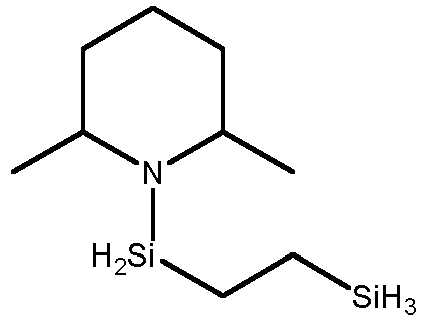
201, 186, 171, 155, 143, 130, 116, 102 30 1,4-dimethyl-1,4-diaza-5,8-disilacyclooctane 174.39 
174, 160, 143, 130, 115, 100, 86, 72 31 1-(2,6-dimethylmorpholino)-1,4-disilabutane 203.43 
203, 188, 173, 161, 145, 130, 116, 102 32 1,4-bis(2,6-dimethylmorpholino)-1,4-disilabutane 316.59 
316, 301, 286, 274, 258, 244, 232, 216, 203, 188 33 1-(2-methylindolino)-1,4-disilabutane 221.45 
221, 206, 191, 176, 161, 146, 132, 117, 105 34 1,4-bis(2-methylindolino)-1,4-disilabutane 352.63 
352, 337, 324, 308, 394, 280, 264, 250, 235, 221, 207, 191 35 1 -iso-propylamino-1,4-disilabutane 147.37 
147, 132, 116, 100, 88, 72 36 1,4-bis(iso-propylamino)-1,4-disilabutane 204.46 
204, 189, 172, 160, 144, 130, 117, 102 - The following depositions were performed on a laboratory scale ALD processing tool at two temperature conditions: 55°C and 100°C. The silicon precursor was delivered to the chamber by vapor draw. All gases (e.g., purge and reactant gas or precursor and oxygen source) were preheated accordingly prior to entering the deposition zone. Gases and precursor flow rates were controlled with ALD diaphragm valves with high speed actuation. The substrates used in the deposition were 12-inch (30 cm) long silicon strips. A thermocouple attached on the sample holder to confirm substrate temperature during deposition. Depositions were performed using ozone (6 - 19%wt) as oxygen source gas.
- A typical ALD cycle comprises the following steps:
- a. providing a substrate in an ALD reactor;
- b. providing in the ALD reactor at least one organoaminosilane precursor for 6 seconds
- c. purging the ALD reactor with an inert gas for 6 seconds;
- d. providing ozone in the ALD reactor for 4 seconds;
- e. purging the ALD reactor with an inert gas for 6 seconds;
- Steps b through e are repeated until a desired thickness of the film is obtained. Thickness and refractive indices of the films were measured using a FilmTek 2000SE ellipsometer by fitting the reflection data from the film to a pre-set physical model (e.g., the Lorentz Oscillator model). Wet etch rate was performed using 1% solution of 49% hydrofluoric (HF) acid in deionized water. Thermal oxide wafers were used as reference for each batch to confirm solution concentration. Typical thermal oxide wafer wet etch rate for 1% HF in H2O solution is 0.5 Å/s. Film thickness before and after etch was used to calculate wet etch rate. The thickness non-uniformity was calculated from 6-point measurements using the following equation: % non-uniformity = ((max - min)/( 2∗ mean)). Film elemental composition and density are characterized by X-Ray Photoelectron Spectroscopy (XPS). The growth rate (GPC) is determined by the thickness of the resultant film divided by total number of cycles.
Table 2. Process parameters, growth per cycle (GPC) and refractive index for silicon-containing film using 1-di-iso-propylamino-1-4-disilabutane and ozone Sample ID Deposition Temperature (°C) Ozone concentration (%wt) Growth Per Cycle (Å/cycle) Refractive Index Ex. Film 1 100 14 2.7 1.480 Ex. Film 2 100 6 2.4 1.467 Ex. Film 3 100 19 2.8 1.466 Ex. Film 4 55 14 2.6 1.486 Ex. Film 5a 100 14 2.7 1.465 a Ex. Film 5 used a 60 second (s) evacuation time after the organoaminosilane precursor dose. Table 3. Film composition measured by XPS for silicon-containing film using 1-di-iso-propylamino-1-4-disilabutane and ozone Sample ID %O %C %Si dHF WER (Å/s) Ex. Film 1 67.6 0.8 32.1 3.3 Ex. Film 2 62.2 5.0 32.7 1.9 Ex. Film 3 66.8 1.0 32.2 4.1 Ex. Film 4 55.0 9.6 33.3 1.6 Ex. Film 5 66.5 0.9 32.6 N/A -
Figure 1 provides growth rate per cycle vs. temperature for the 1-di-isopropylamino-1,4,-disilabutane films (average value from Ex. Film 1, 3, 5 at 100°C) and Ex. Film 4 as well as films deposited via a thermal ALD process using the following organoaminosilanes: bis(diethylamino)silane (BDEAS: I. Suzuki, K. Yanagita, and C. Dussarrat, ECS Trans.3 (15), 119 (2007) and M.W. O'Neill, H. R. Bowen, A. Derecskei-Kovacs, K.S. Cuthill, B. Han and M. Xiao, Electrochemistry Society Interface Winter 2011, 33 (2011)), bis(tert-butylamino)silane (BTBAS: M.W. O'Neill, H. R. Bowen, A. Derecskei-Kovacs, K.S. Cuthill, B. Han and M. Xiao, Electrochemistry Society Interface Winter 2011, 33 (2011)), bis(ethylmethylamino)silane (BEMAS: S.J.Won, H-S. Jung, S. Suh, Y. J. Choi, N.-I. Lee, C. S. Hwang, H. J. Kim, J. Vac. Sci. Technol. A 30(1), 01A126 (2012)), tris(dimethylamino)silane(TRDMAS: L. Han, and Z. Chen, Z. ECS Journal of Solid State Science and Technology 2(11): N228-N236 (2013)), di-sec-butylaminosilane (DSBAS: A. Mallikarjunan, A. Derecskei-kovacs, H. Chandra, B. Han, M. Xiao, X. Lei, M.L.O. Neill, H. Liang, H. Bo, Z. Qingfan, H. Cheng, 13th International Conference on Atomic Layer Deposition (2013)). As shown inFigure 1 , the silicon-containing films deposited using the organoaminosilanes described herein exhibited higher growth rates relative to the other, referenced organoaminosilane precursors. Further, the deposition temperature can be extended to one or more temperatures below 100°C, such as Ex. Film 4 which was deposited at a temperature of 55°C. Carbon concentration in the film range from 0.3 wt% to 9.6 wt% depending on the ozone concentration, suggesting it is possible to adjust the physical properties of the resultant silicon-containing films. - A deposition of silicon containing film was performed using 1-di-iso-propylamino-1,4-disilabutane and a nitrogen/argon plasma. The silicon wafer was heated to 100°C or 300°C, respectively. Deposition process was performed using 300 mm production tool, ASM Stellar 3000, repeated 1000 times, using the following process conditions:
- a. providing a substrate in an ALD reactor
- b. introducing organoaminosilane precursor: 1-di-iso-propylamino-1,4-disilabutane
- delivery conditions:
Ar carrier gas 200 sccm, precursor container was kept at room temperature - chamber pressure: 2 Torr (270 Pa)
- precursor pulse: 1 second
- delivery conditions:
- c. inert gas purge
- argon flow: 300 sccm
- chamber pressure: 2 Torr (270 Pa)
- purge time: 5 seconds
- d. nitrogen/argon plasma
- argon flow: 500 sccm
- nitrogen flow: 200sccm
- chamber pressure: 2 Torr (270 Pa)plasma power: 500W
- plasma time: 5 seconds
- e. purge plasma
- argon flow: 300 sccm
- chamber pressure: 2 Torr (270 Pa)
- purge time: 0.5 seconds
- Deposition rate, refractive index, density as well as wet etch rate in dilute HF of the resultant films are listed below in Table 4. Referring to the data in Table 4, the oxygen is believed to come from post-deposition air exposure when samples were sending for XPS analysis.
Table 4. Deposition rate, refractive index of deposited films and film properties using 1-di-iso-propylamino-1-4-disilabutane and nitrogen/argon plasma Wafer temp (°C) Deposition Rate (Å/cycle) Refractive index C (%) O content (%) Density (g/cc) WER in dHF (Å/s) 100 0.41 1.73 9.6 16.3 2.0 >33 300 0.15 2.02 4.9 2.4 2.9 0.8 - A deposition of silicon containing film was performed using 1-di-iso-propylamino-1,4-disilabutane and argon plasma. The silicon wafer was heated to 100°C or 300°C, respectively. Deposition process was performed using 300 mm production tool, ASM Stellar 3000, repeated 1000 times, using the following process conditions:
- a. providing a substrate in an ALD reactor
- b. introducing organoaminosilane precursor: 1-di-iso-propylamino-1,4-disilabutane
- delivery conditions:
Ar carrier gas 200 sccm, precursor container was kept at room temperature - chamber pressure: 2 Torr (270 Pa)
- precursor pulse: 1 second
- delivery conditions:
- c. inert gas purge
- argon flow: 300 sccm
- chamber pressure: 2 Torr (270 Pa)purge time: 2 seconds
- d. argon plasma
- argon flow: 500 sccm
- chamber pressure: 2 Torr (270 Pa)
- plasma power: 500W
- plasma time: 5 seconds
- e. purge plasma
- argon flow: 300 sccm
- chamber pressure: 2 Torr (270 Pa)
- purge time: 2 seconds
- Deposition rate, refractive index, film composition, density as well as wet etch rate of the resultant films in dilute HF are listed below in Table 5. Referring to the data in Table 5, the oxygen is believed to come from post-deposition air exposure when samples were sending for XPS analysis.
Table 5. Deposition rate, refractive index of deposited films and film properties of 1-di-iso-propylamino-1-4-disilabutane and argon plasma Wafer temp (°C) Deposition Rate (Å/cycle) Refractive index C (%) O (%) N (%) Si (%) Density (g/cc) WER in dHF (Å/s) 100 0.18 1.96 50.4 9.4 19.8 20.5 1.88 <0.05 300 0.21 2.01 61.9 8.0 12.7 17.4 1.92 <0.05 - The wet etch rate in dilute HF of less than 0.05 Å/s is much lower than that of typical thermal oxide film (0.5 Å/s) under the same conditions, demonstrating the organoaminosilanes described herein affect the resultant properties of the silicon-containing films deposited therefrom.
Claims (14)
- An organoaminosilane comprising a compound represented by Formula A below:

- The organoaminosilane of claim 1, wherein R1 is selected from a linear or branched C1 to C10 alkyl group; R2 is selected from hydrogen and a linear or branched C1 to C10 alkyl group; and R3 is selected from a linear or branched C1 to C10 alkylene group.
- The organoaminosilane of claim 1 wherein R1 and R2 are the same and selected from the group consisting of methyl, ethyl, iso-propyl, n-propyl, and sec-butyl and wherein R3 is selected from the group consisting of methylene and ethylene; n=1; and m=0.
- The organoaminosilane of claim 1 comprising the compound having Formula A wherein the compound is at least one selected from the group consisting of: 1-dimethylamino-1,3-disilapropane, 1-di-isopropylamino-1,3-disilapropane, 1-di-secbutylamino-1,3-disilapropane, 1-di-isobutylamino-1,3-disilapropane, 1-di-tertpentylamino-1,3-disilapropane, 1-diethylamino-1,3-disilapropane, 1-dimethylamino-1,4-disilabutane, 1-diethylamino-1,4-disilabutane, 1-di-isopropylamino-1,4-disilabutane, 1,3-bis(dimethylamino)-1,3-disilapropane, 1,3-bis(di-isopropylamino)-1,3-disilapropane, 1,3-bis(di-sec-butylamino)-1,3-disilapropane, 1,3-bis(di-isobutylamino)-1,3-disilapropane, 1,3-bis(di-tert-pentylamino)-1,3-disilapropane, 1,3-bis(diethylamino)-1,3-disilapropane, 1,4-bis(dimethylamino)-1,4-disilabutane, 1,4-bis(diethylamino)-1,4-disilabutane, 1,4-bis(di-isopropylamino)-1,4-disilabutane, 1,4-bis(di-sec-butylamino)-1,4-disilabutane, 1,4-bis(di-isobutylamino)-1,4-disilabutane, 1,4-bis(iso-propyl-n-propyl-amino)-1,4-disilabutane, 1,3-bis(ethylmethylamino)-1,3-disilapropane, 1,4-bis(ethylmethylamino)-1,4-disilabutane, 1-ethylmethylamino-1,4-disilabutane, 1-di-sec-butylamino-1,4-disilabutane, 1-phenylmethylamino-1,4-disilabutane, 2,6-dimethylpiperidino-1,4-disilabutane, 1-phenylethylamino-1,4-disilabutane, 1-ethylmethylamino-1,3-disilapropane, 1-phenylmethylamino-1,3-disilapropane, 2,6-dimethylpiperidino-1,3-disilapropane, and phenylethylamino-1,3-disilapropane.
- A composition comprising:(a) at least one organoaminosilane as defined in any one of the preceding claims; and(b) a solvent wherein the solvent has a boiling point and wherein the difference between the boiling point of the solvent and that of the at least one organoaminosilane is 40°C or less, wherein the solvent optionally comprises at least one selected from the group consisting of ether, tertiary amine, alkyl hydrocarbon, aromatic hydrocarbon, and tertiary aminoether.
- A method for forming a silicon-containing film on at least one surface of a substrate by a deposition process, the method comprising:providing the at least one surface of the substrate in a reaction chamber;introducing at least one organoaminosilane precursor as claimed in any one of Claims 1 to 4.
- The method of claim 6 wherein the vapor deposition is at least one selected from the group consisting of chemical vapor deposition, low pressure vapor deposition, plasma enhanced chemical vapor deposition, cyclic chemical vapor deposition, plasma enhanced cyclic chemical vapor deposition, atomic layer deposition, and plasma enhanced atomic layer deposition.
- A method as claimed in Claim 6 or Claim 7, the method comprising:
introducing a nitrogen-containing source into the reactor wherein the at least one organoaminosilane precursor and the nitrogen-containing source react to form the film on the at least one surface, the film optionally being selected from the group consisting of silicon nitride and silicon carbonitride. - The method of claim 8 wherein the nitrogen-containing source is selected from the group consisting of ammonia, hydrazine, monoalkylhydrazine, dialkylhydrazine, nitrogen, nitrogen/hydrogen, ammonia plasma, nitrogen plasma, nitrogen/argon plasma, nitrogen/helium plasma, nitrogen/hydrogen plasma, organic amines, organic amine plasma, and mixtures thereof.
- A method as claimed in Claim 6 or Claim 7 for forming a silicon oxide or a carbon doped silicon oxide film on a substrate comprising:
reacting an oxygen-containing source with the at least one organoaminosilane precursor in a vapor deposition to form the film on the substrate. - A method as claimed in Claim 6 or Claim 7 for forming a silicon containing film that comprises the steps of:a. placing a substrate into a reactor;b. introducing the at least one organoaminosilane precursor;c. optionally purging away the unreacted at least one organoaminosilane precursor using a purge gas;d. providing a reducing agent into the reactor to at least partially react with the absorbed organoaminosilane;e. optionally purging away any unreacted reducing agentwherein the steps b to e are repeated until a desired thickness is obtained.
- The method of claim 11 wherein the reducing agent is at least one selected from the group consisting of hydrogen, hydrogen plasma, or hydrogen chloride.
- A vessel for use in delivering a precursor for the deposition of a silicon-containing film, the vessel comprising:
at least one organoaminosilane precursor as claimed in any one of Claims 1 to 4,
wherein the purity of the precursor is 98% or greater. - A method for preparing an organoaminosilane as claimed in any one of Claims 1 to 4, the method comprising the steps of:
reacting an amine having the formula R1R2NH wherein R1 and R2 are as defined in any one of Claims 1 to 4 with a silicon source comprising the compound:
Priority Applications (3)
| Application Number | Priority Date | Filing Date | Title |
|---|---|---|---|
| EP18155154.0A EP3339312B1 (en) | 2013-09-20 | 2014-09-22 | Organoaminosilane precursors and methods for depositing films comprising same |
| EP19194650.8A EP3594219B1 (en) | 2013-09-20 | 2014-09-22 | Organoaminosilane precursors and methods for depositing films comprising same |
| EP16174045.1A EP3095788B1 (en) | 2013-09-20 | 2014-09-22 | Organoaminosilane precursors and methods for depositing films comprising same |
Applications Claiming Priority (2)
| Application Number | Priority Date | Filing Date | Title |
|---|---|---|---|
| US201361880261P | 2013-09-20 | 2013-09-20 | |
| US14/483,751 US10453675B2 (en) | 2013-09-20 | 2014-09-11 | Organoaminosilane precursors and methods for depositing films comprising same |
Related Child Applications (6)
| Application Number | Title | Priority Date | Filing Date |
|---|---|---|---|
| EP18155154.0A Division-Into EP3339312B1 (en) | 2013-09-20 | 2014-09-22 | Organoaminosilane precursors and methods for depositing films comprising same |
| EP18155154.0A Division EP3339312B1 (en) | 2013-09-20 | 2014-09-22 | Organoaminosilane precursors and methods for depositing films comprising same |
| EP16174045.1A Division-Into EP3095788B1 (en) | 2013-09-20 | 2014-09-22 | Organoaminosilane precursors and methods for depositing films comprising same |
| EP16174045.1A Division EP3095788B1 (en) | 2013-09-20 | 2014-09-22 | Organoaminosilane precursors and methods for depositing films comprising same |
| EP19194650.8A Division EP3594219B1 (en) | 2013-09-20 | 2014-09-22 | Organoaminosilane precursors and methods for depositing films comprising same |
| EP19194650.8A Division-Into EP3594219B1 (en) | 2013-09-20 | 2014-09-22 | Organoaminosilane precursors and methods for depositing films comprising same |
Publications (3)
| Publication Number | Publication Date |
|---|---|
| EP2860182A2 EP2860182A2 (en) | 2015-04-15 |
| EP2860182A3 EP2860182A3 (en) | 2015-08-05 |
| EP2860182B1 true EP2860182B1 (en) | 2020-01-22 |
Family
ID=51660307
Family Applications (4)
| Application Number | Title | Priority Date | Filing Date |
|---|---|---|---|
| EP19194650.8A Active EP3594219B1 (en) | 2013-09-20 | 2014-09-22 | Organoaminosilane precursors and methods for depositing films comprising same |
| EP18155154.0A Active EP3339312B1 (en) | 2013-09-20 | 2014-09-22 | Organoaminosilane precursors and methods for depositing films comprising same |
| EP14185776.3A Active EP2860182B1 (en) | 2013-09-20 | 2014-09-22 | Organoaminosilane precursors and methods for depositing films comprising same |
| EP16174045.1A Active EP3095788B1 (en) | 2013-09-20 | 2014-09-22 | Organoaminosilane precursors and methods for depositing films comprising same |
Family Applications Before (2)
| Application Number | Title | Priority Date | Filing Date |
|---|---|---|---|
| EP19194650.8A Active EP3594219B1 (en) | 2013-09-20 | 2014-09-22 | Organoaminosilane precursors and methods for depositing films comprising same |
| EP18155154.0A Active EP3339312B1 (en) | 2013-09-20 | 2014-09-22 | Organoaminosilane precursors and methods for depositing films comprising same |
Family Applications After (1)
| Application Number | Title | Priority Date | Filing Date |
|---|---|---|---|
| EP16174045.1A Active EP3095788B1 (en) | 2013-09-20 | 2014-09-22 | Organoaminosilane precursors and methods for depositing films comprising same |
Country Status (6)
| Country | Link |
|---|---|
| US (5) | US10453675B2 (en) |
| EP (4) | EP3594219B1 (en) |
| JP (6) | JP2015096489A (en) |
| KR (3) | KR101749705B1 (en) |
| CN (1) | CN104672265B (en) |
| TW (4) | TWI652278B (en) |
Cited By (1)
| Publication number | Priority date | Publication date | Assignee | Title |
|---|---|---|---|---|
| EP3663301B1 (en) * | 2015-03-31 | 2023-08-30 | Versum Materials US, LLC | Boron-containing compounds, compositions, and methods for the deposition of boron containing films |
Families Citing this family (326)
| Publication number | Priority date | Publication date | Assignee | Title |
|---|---|---|---|---|
| US20130023129A1 (en) | 2011-07-20 | 2013-01-24 | Asm America, Inc. | Pressure transmitter for a semiconductor processing environment |
| EP2875166B1 (en) | 2012-07-20 | 2018-04-11 | L'Air Liquide Société Anonyme pour l'Etude et l'Exploitation des Procédés Georges Claude | Organosilane precursors for ald/cvd silicon-containing film applications |
| US10714315B2 (en) | 2012-10-12 | 2020-07-14 | Asm Ip Holdings B.V. | Semiconductor reaction chamber showerhead |
| US20160376700A1 (en) | 2013-02-01 | 2016-12-29 | Asm Ip Holding B.V. | System for treatment of deposition reactor |
| US9382268B1 (en) | 2013-07-19 | 2016-07-05 | American Air Liquide, Inc. | Sulfur containing organosilane precursors for ALD/CVD silicon-containing film applications |
| TW201509799A (en) | 2013-07-19 | 2015-03-16 | Air Liquide | Hexacoordinate silicon-containing precursors for ALD/CVD silicon-containing film applications |
| US10453675B2 (en) | 2013-09-20 | 2019-10-22 | Versum Materials Us, Llc | Organoaminosilane precursors and methods for depositing films comprising same |
| US9233990B2 (en) | 2014-02-28 | 2016-01-12 | Air Products And Chemicals, Inc. | Organoaminosilanes and methods for making same |
| TWI659035B (en) * | 2014-07-10 | 2019-05-11 | L'air Liquide, Societe Anonyme Pour L'etude Et L'exploitation Des Procedes Georges Claude | Alkylamine-substituted carbon decane precursor |
| US10858737B2 (en) | 2014-07-28 | 2020-12-08 | Asm Ip Holding B.V. | Showerhead assembly and components thereof |
| US9969756B2 (en) * | 2014-09-23 | 2018-05-15 | L'Air Liquide, Société Anonyme pour l'Etude et l'Exploitation des Procédés George Claude | Carbosilane substituted amine precursors for deposition of Si-containing films and methods thereof |
| US10941490B2 (en) | 2014-10-07 | 2021-03-09 | Asm Ip Holding B.V. | Multiple temperature range susceptor, assembly, reactor and system including the susceptor, and methods of using the same |
| WO2016094711A2 (en) | 2014-12-13 | 2016-06-16 | L'air Liquide, Societe Anonyme Pour L'etude Et L'exploitation Des Procedes Georges Claude | Organosilane precursors for ald/cvd silicon-containing film applications and methods of using the same |
| US10276355B2 (en) | 2015-03-12 | 2019-04-30 | Asm Ip Holding B.V. | Multi-zone reactor, system including the reactor, and method of using the same |
| US10566187B2 (en) * | 2015-03-20 | 2020-02-18 | Lam Research Corporation | Ultrathin atomic layer deposition film accuracy thickness control |
| JP6484478B2 (en) * | 2015-03-25 | 2019-03-13 | 株式会社Kokusai Electric | Semiconductor device manufacturing method, substrate processing apparatus, and program |
| TWI716333B (en) * | 2015-03-30 | 2021-01-11 | 法商液態空氣喬治斯克勞帝方法研究開發股份有限公司 | Catalyst dehydrogenative coupling of carbosilanes with ammonia, amnines and amidines |
| US9815858B2 (en) | 2015-06-16 | 2017-11-14 | Gelest Technologies, Inc. | Hydridosilapyrroles, hydridosilaazapyrroles, thiasilacyclopentanes, method for preparation thereof, and reaction products therefrom |
| TWI663281B (en) * | 2015-06-16 | 2019-06-21 | Versum Materials Us, Llc | Preparation and composition of halidosilane compounds, and container containing same |
| US10458018B2 (en) | 2015-06-26 | 2019-10-29 | Asm Ip Holding B.V. | Structures including metal carbide material, devices including the structures, and methods of forming same |
| US20180202042A1 (en) * | 2015-07-09 | 2018-07-19 | L'air Liquide, Societe Anonyme Pour L'etude Et L'exploitation Des Procedes Georges Claude | Alkylamino-substituted halocarbosilane precursors |
| US10211308B2 (en) | 2015-10-21 | 2019-02-19 | Asm Ip Holding B.V. | NbMC layers |
| US9786492B2 (en) * | 2015-11-12 | 2017-10-10 | Asm Ip Holding B.V. | Formation of SiOCN thin films |
| US9786491B2 (en) | 2015-11-12 | 2017-10-10 | Asm Ip Holding B.V. | Formation of SiOCN thin films |
| KR101786230B1 (en) * | 2015-12-01 | 2017-10-18 | 주식회사 포스코 | Metal thin plate with excellent corrosion resistance and etching ability and method for manufacturing the same |
| US11139308B2 (en) | 2015-12-29 | 2021-10-05 | Asm Ip Holding B.V. | Atomic layer deposition of III-V compounds to form V-NAND devices |
| US10529554B2 (en) | 2016-02-19 | 2020-01-07 | Asm Ip Holding B.V. | Method for forming silicon nitride film selectively on sidewalls or flat surfaces of trenches |
| US10343920B2 (en) | 2016-03-18 | 2019-07-09 | Asm Ip Holding B.V. | Aligned carbon nanotubes |
| TWI724141B (en) * | 2016-03-23 | 2021-04-11 | 法商液態空氣喬治斯克勞帝方法硏究開發股份有限公司 | Si-containing film forming compositions and methods of making and using the same |
| US10367080B2 (en) | 2016-05-02 | 2019-07-30 | Asm Ip Holding B.V. | Method of forming a germanium oxynitride film |
| KR102378021B1 (en) | 2016-05-06 | 2022-03-23 | 에이에스엠 아이피 홀딩 비.브이. | Formation of SiOC thin films |
| US9859151B1 (en) | 2016-07-08 | 2018-01-02 | Asm Ip Holding B.V. | Selective film deposition method to form air gaps |
| US10612137B2 (en) | 2016-07-08 | 2020-04-07 | Asm Ip Holdings B.V. | Organic reactants for atomic layer deposition |
| US20180033614A1 (en) * | 2016-07-27 | 2018-02-01 | Versum Materials Us, Llc | Compositions and Methods Using Same for Carbon Doped Silicon Containing Films |
| US9887082B1 (en) | 2016-07-28 | 2018-02-06 | Asm Ip Holding B.V. | Method and apparatus for filling a gap |
| KR102532607B1 (en) | 2016-07-28 | 2023-05-15 | 에이에스엠 아이피 홀딩 비.브이. | Substrate processing apparatus and method of operating the same |
| US9812320B1 (en) | 2016-07-28 | 2017-11-07 | Asm Ip Holding B.V. | Method and apparatus for filling a gap |
| TWI746624B (en) * | 2016-09-01 | 2021-11-21 | 美商Asm Ip控股公司 | Method for protecting layer by forming hydrocarbon-based extremely thin film |
| US10703915B2 (en) | 2016-09-19 | 2020-07-07 | Versum Materials Us, Llc | Compositions and methods for the deposition of silicon oxide films |
| EP3663260A1 (en) * | 2016-09-28 | 2020-06-10 | Dow Silicones Corporation | Preparing a silicon-heteroatom compound using chlorodisilazanes |
| US10464953B2 (en) * | 2016-10-14 | 2019-11-05 | Versum Materials Us, Llc | Carbon bridged aminosilane compounds for high growth rate silicon-containing films |
| KR20190070968A (en) | 2016-10-25 | 2019-06-21 | 바스프 에스이 | Method for producing silicon-containing thin film |
| US11532757B2 (en) | 2016-10-27 | 2022-12-20 | Asm Ip Holding B.V. | Deposition of charge trapping layers |
| US11735413B2 (en) * | 2016-11-01 | 2023-08-22 | Versum Materials Us, Llc | Precursors and flowable CVD methods for making low-k films to fill surface features |
| US10714350B2 (en) | 2016-11-01 | 2020-07-14 | ASM IP Holdings, B.V. | Methods for forming a transition metal niobium nitride film on a substrate by atomic layer deposition and related semiconductor device structures |
| US10249489B2 (en) * | 2016-11-02 | 2019-04-02 | Versum Materials Us, Llc | Use of silyl bridged alkyl compounds for dense OSG films |
| KR102546317B1 (en) | 2016-11-15 | 2023-06-21 | 에이에스엠 아이피 홀딩 비.브이. | Gas supply unit and substrate processing apparatus including the same |
| KR102762543B1 (en) | 2016-12-14 | 2025-02-05 | 에이에스엠 아이피 홀딩 비.브이. | Substrate processing apparatus |
| US11581186B2 (en) | 2016-12-15 | 2023-02-14 | Asm Ip Holding B.V. | Sequential infiltration synthesis apparatus |
| US11447861B2 (en) | 2016-12-15 | 2022-09-20 | Asm Ip Holding B.V. | Sequential infiltration synthesis apparatus and a method of forming a patterned structure |
| US10269558B2 (en) | 2016-12-22 | 2019-04-23 | Asm Ip Holding B.V. | Method of forming a structure on a substrate |
| US11390950B2 (en) | 2017-01-10 | 2022-07-19 | Asm Ip Holding B.V. | Reactor system and method to reduce residue buildup during a film deposition process |
| US11591692B2 (en) | 2017-02-08 | 2023-02-28 | Versum Materials Us, Llc | Organoamino-polysiloxanes for deposition of silicon-containing films |
| US10822458B2 (en) | 2017-02-08 | 2020-11-03 | Versum Materials Us, Llc | Organoamino-functionalized linear and cyclic oligosiloxanes for deposition of silicon-containing films |
| US10176984B2 (en) | 2017-02-14 | 2019-01-08 | Lam Research Corporation | Selective deposition of silicon oxide |
| US10468261B2 (en) | 2017-02-15 | 2019-11-05 | Asm Ip Holding B.V. | Methods for forming a metallic film on a substrate by cyclical deposition and related semiconductor device structures |
| US10242866B2 (en) | 2017-03-08 | 2019-03-26 | Lam Research Corporation | Selective deposition of silicon nitride on silicon oxide using catalytic control |
| WO2018170382A1 (en) * | 2017-03-17 | 2018-09-20 | Versum Materials Us, Llc | Selective deposition on silicon containing surfaces |
| US10847529B2 (en) | 2017-04-13 | 2020-11-24 | Asm Ip Holding B.V. | Substrate processing method and device manufactured by the same |
| US10559461B2 (en) | 2017-04-19 | 2020-02-11 | Lam Research Corporation | Selective deposition with atomic layer etch reset |
| CN110546302B (en) | 2017-05-05 | 2022-05-27 | Asm Ip 控股有限公司 | Plasma enhanced deposition method for controlled formation of oxygen-containing films |
| US10770286B2 (en) | 2017-05-08 | 2020-09-08 | Asm Ip Holdings B.V. | Methods for selectively forming a silicon nitride film on a substrate and related semiconductor device structures |
| US12040200B2 (en) | 2017-06-20 | 2024-07-16 | Asm Ip Holding B.V. | Semiconductor processing apparatus and methods for calibrating a semiconductor processing apparatus |
| US11306395B2 (en) | 2017-06-28 | 2022-04-19 | Asm Ip Holding B.V. | Methods for depositing a transition metal nitride film on a substrate by atomic layer deposition and related deposition apparatus |
| KR20190009245A (en) | 2017-07-18 | 2019-01-28 | 에이에스엠 아이피 홀딩 비.브이. | Methods for forming a semiconductor device structure and related semiconductor device structures |
| US11374112B2 (en) | 2017-07-19 | 2022-06-28 | Asm Ip Holding B.V. | Method for depositing a group IV semiconductor and related semiconductor device structures |
| US10590535B2 (en) | 2017-07-26 | 2020-03-17 | Asm Ip Holdings B.V. | Chemical treatment, deposition and/or infiltration apparatus and method for using the same |
| TWI784022B (en) * | 2017-07-31 | 2022-11-21 | 中國大陸商南大光電半導體材料有限公司 | 1,1,1-tris(dimethylamino)disilane and method of preparing same |
| TWI815813B (en) | 2017-08-04 | 2023-09-21 | 荷蘭商Asm智慧財產控股公司 | Showerhead assembly for distributing a gas within a reaction chamber |
| US10692741B2 (en) | 2017-08-08 | 2020-06-23 | Asm Ip Holdings B.V. | Radiation shield |
| US10770336B2 (en) | 2017-08-08 | 2020-09-08 | Asm Ip Holding B.V. | Substrate lift mechanism and reactor including same |
| US11769682B2 (en) | 2017-08-09 | 2023-09-26 | Asm Ip Holding B.V. | Storage apparatus for storing cassettes for substrates and processing apparatus equipped therewith |
| US11830730B2 (en) | 2017-08-29 | 2023-11-28 | Asm Ip Holding B.V. | Layer forming method and apparatus |
| KR102491945B1 (en) | 2017-08-30 | 2023-01-26 | 에이에스엠 아이피 홀딩 비.브이. | Substrate processing apparatus |
| US11295980B2 (en) | 2017-08-30 | 2022-04-05 | Asm Ip Holding B.V. | Methods for depositing a molybdenum metal film over a dielectric surface of a substrate by a cyclical deposition process and related semiconductor device structures |
| US11056344B2 (en) | 2017-08-30 | 2021-07-06 | Asm Ip Holding B.V. | Layer forming method |
| US11049714B2 (en) * | 2017-09-19 | 2021-06-29 | Versum Materials Us, Llc | Silyl substituted organoamines as precursors for high growth rate silicon-containing films |
| US10658205B2 (en) | 2017-09-28 | 2020-05-19 | Asm Ip Holdings B.V. | Chemical dispensing apparatus and methods for dispensing a chemical to a reaction chamber |
| US10403504B2 (en) | 2017-10-05 | 2019-09-03 | Asm Ip Holding B.V. | Method for selectively depositing a metallic film on a substrate |
| US10923344B2 (en) | 2017-10-30 | 2021-02-16 | Asm Ip Holding B.V. | Methods for forming a semiconductor structure and related semiconductor structures |
| US10460930B2 (en) | 2017-11-22 | 2019-10-29 | Lam Research Corporation | Selective growth of SiO2 on dielectric surfaces in the presence of copper |
| KR102597978B1 (en) | 2017-11-27 | 2023-11-06 | 에이에스엠 아이피 홀딩 비.브이. | Storage device for storing wafer cassettes for use with batch furnaces |
| CN111344522B (en) | 2017-11-27 | 2022-04-12 | 阿斯莫Ip控股公司 | Units including clean mini environments |
| KR20190065962A (en) | 2017-12-04 | 2019-06-12 | 에이에스엠 아이피 홀딩 비.브이. | UNIFORM DEPOSITION OF SiOC ON DIELECTRIC AND METAL SURFACES |
| US10872771B2 (en) | 2018-01-16 | 2020-12-22 | Asm Ip Holding B. V. | Method for depositing a material film on a substrate within a reaction chamber by a cyclical deposition process and related device structures |
| TWI799494B (en) | 2018-01-19 | 2023-04-21 | 荷蘭商Asm 智慧財產控股公司 | Deposition method |
| WO2019142055A2 (en) | 2018-01-19 | 2019-07-25 | Asm Ip Holding B.V. | Method for depositing a gap-fill layer by plasma-assisted deposition |
| US11098069B2 (en) | 2018-01-30 | 2021-08-24 | Versum Materials Us, Llc | Organoamino-functionalized cyclic oligosiloxanes for deposition of silicon-containing films |
| US12018040B2 (en) | 2018-01-30 | 2024-06-25 | Versum Materials Us, Llc | Organoamino-functionalized cyclic oligosiloxanes for deposition of silicon-containing films |
| US11081345B2 (en) | 2018-02-06 | 2021-08-03 | Asm Ip Holding B.V. | Method of post-deposition treatment for silicon oxide film |
| US11685991B2 (en) | 2018-02-14 | 2023-06-27 | Asm Ip Holding B.V. | Method for depositing a ruthenium-containing film on a substrate by a cyclical deposition process |
| US10896820B2 (en) | 2018-02-14 | 2021-01-19 | Asm Ip Holding B.V. | Method for depositing a ruthenium-containing film on a substrate by a cyclical deposition process |
| US10731249B2 (en) | 2018-02-15 | 2020-08-04 | Asm Ip Holding B.V. | Method of forming a transition metal containing film on a substrate by a cyclical deposition process, a method for supplying a transition metal halide compound to a reaction chamber, and related vapor deposition apparatus |
| KR102636427B1 (en) | 2018-02-20 | 2024-02-13 | 에이에스엠 아이피 홀딩 비.브이. | Substrate processing method and apparatus |
| US10975470B2 (en) | 2018-02-23 | 2021-04-13 | Asm Ip Holding B.V. | Apparatus for detecting or monitoring for a chemical precursor in a high temperature environment |
| US11473195B2 (en) | 2018-03-01 | 2022-10-18 | Asm Ip Holding B.V. | Semiconductor processing apparatus and a method for processing a substrate |
| US11404275B2 (en) | 2018-03-02 | 2022-08-02 | Lam Research Corporation | Selective deposition using hydrolysis |
| US11629406B2 (en) | 2018-03-09 | 2023-04-18 | Asm Ip Holding B.V. | Semiconductor processing apparatus comprising one or more pyrometers for measuring a temperature of a substrate during transfer of the substrate |
| US11114283B2 (en) | 2018-03-16 | 2021-09-07 | Asm Ip Holding B.V. | Reactor, system including the reactor, and methods of manufacturing and using same |
| KR102646467B1 (en) | 2018-03-27 | 2024-03-11 | 에이에스엠 아이피 홀딩 비.브이. | Method of forming an electrode on a substrate and a semiconductor device structure including an electrode |
| US11230766B2 (en) | 2018-03-29 | 2022-01-25 | Asm Ip Holding B.V. | Substrate processing apparatus and method |
| KR102600229B1 (en) | 2018-04-09 | 2023-11-10 | 에이에스엠 아이피 홀딩 비.브이. | Substrate supporting device, substrate processing apparatus including the same and substrate processing method |
| SG10201903201XA (en) * | 2018-04-11 | 2019-11-28 | Versum Materials Us Llc | Organoamino-functionalized cyclic oligosiloxanes for deposition of silicon-containing films |
| US12025484B2 (en) | 2018-05-08 | 2024-07-02 | Asm Ip Holding B.V. | Thin film forming method |
| TWI811348B (en) | 2018-05-08 | 2023-08-11 | 荷蘭商Asm 智慧財產控股公司 | Methods for depositing an oxide film on a substrate by a cyclical deposition process and related device structures |
| US12272527B2 (en) | 2018-05-09 | 2025-04-08 | Asm Ip Holding B.V. | Apparatus for use with hydrogen radicals and method of using same |
| KR102596988B1 (en) | 2018-05-28 | 2023-10-31 | 에이에스엠 아이피 홀딩 비.브이. | Method of processing a substrate and a device manufactured by the same |
| TWI840362B (en) | 2018-06-04 | 2024-05-01 | 荷蘭商Asm Ip私人控股有限公司 | Wafer handling chamber with moisture reduction |
| US11718913B2 (en) | 2018-06-04 | 2023-08-08 | Asm Ip Holding B.V. | Gas distribution system and reactor system including same |
| US11286562B2 (en) | 2018-06-08 | 2022-03-29 | Asm Ip Holding B.V. | Gas-phase chemical reactor and method of using same |
| US10797133B2 (en) | 2018-06-21 | 2020-10-06 | Asm Ip Holding B.V. | Method for depositing a phosphorus doped silicon arsenide film and related semiconductor device structures |
| KR102568797B1 (en) | 2018-06-21 | 2023-08-21 | 에이에스엠 아이피 홀딩 비.브이. | Substrate processing system |
| KR102854019B1 (en) | 2018-06-27 | 2025-09-02 | 에이에스엠 아이피 홀딩 비.브이. | Periodic deposition method for forming a metal-containing material and films and structures comprising the metal-containing material |
| TWI815915B (en) | 2018-06-27 | 2023-09-21 | 荷蘭商Asm Ip私人控股有限公司 | Cyclic deposition methods for forming metal-containing material and films and structures including the metal-containing material |
| US10612136B2 (en) | 2018-06-29 | 2020-04-07 | ASM IP Holding, B.V. | Temperature-controlled flange and reactor system including same |
| US10755922B2 (en) | 2018-07-03 | 2020-08-25 | Asm Ip Holding B.V. | Method for depositing silicon-free carbon-containing film as gap-fill layer by pulse plasma-assisted deposition |
| US10388513B1 (en) | 2018-07-03 | 2019-08-20 | Asm Ip Holding B.V. | Method for depositing silicon-free carbon-containing film as gap-fill layer by pulse plasma-assisted deposition |
| US11430674B2 (en) | 2018-08-22 | 2022-08-30 | Asm Ip Holding B.V. | Sensor array, apparatus for dispensing a vapor phase reactant to a reaction chamber and related methods |
| US10985010B2 (en) * | 2018-08-29 | 2021-04-20 | Versum Materials Us, Llc | Methods for making silicon and nitrogen containing films |
| US11024523B2 (en) | 2018-09-11 | 2021-06-01 | Asm Ip Holding B.V. | Substrate processing apparatus and method |
| KR102707956B1 (en) | 2018-09-11 | 2024-09-19 | 에이에스엠 아이피 홀딩 비.브이. | Method for deposition of a thin film |
| CN110970344B (en) | 2018-10-01 | 2024-10-25 | Asmip控股有限公司 | Substrate holding device, system including the same and method of using the same |
| US11232963B2 (en) | 2018-10-03 | 2022-01-25 | Asm Ip Holding B.V. | Substrate processing apparatus and method |
| KR20240134048A (en) * | 2018-10-03 | 2024-09-05 | 버슘머트리얼즈 유에스, 엘엘씨 | Methods for making silicon and nitrogen containing films |
| KR102592699B1 (en) | 2018-10-08 | 2023-10-23 | 에이에스엠 아이피 홀딩 비.브이. | Substrate support unit and apparatuses for depositing thin film and processing the substrate including the same |
| KR102546322B1 (en) | 2018-10-19 | 2023-06-21 | 에이에스엠 아이피 홀딩 비.브이. | Substrate processing apparatus and substrate processing method |
| KR102605121B1 (en) | 2018-10-19 | 2023-11-23 | 에이에스엠 아이피 홀딩 비.브이. | Substrate processing apparatus and substrate processing method |
| US12378665B2 (en) | 2018-10-26 | 2025-08-05 | Asm Ip Holding B.V. | High temperature coatings for a preclean and etch apparatus and related methods |
| US10943791B2 (en) * | 2018-10-31 | 2021-03-09 | Taiwan Semiconductor Manufacturing Co., Ltd. | Pattern formation method and method for manufacturing a semiconductor device |
| US11087997B2 (en) | 2018-10-31 | 2021-08-10 | Asm Ip Holding B.V. | Substrate processing apparatus for processing substrates |
| KR102748291B1 (en) | 2018-11-02 | 2024-12-31 | 에이에스엠 아이피 홀딩 비.브이. | Substrate support unit and substrate processing apparatus including the same |
| US11572620B2 (en) | 2018-11-06 | 2023-02-07 | Asm Ip Holding B.V. | Methods for selectively depositing an amorphous silicon film on a substrate |
| US10847366B2 (en) | 2018-11-16 | 2020-11-24 | Asm Ip Holding B.V. | Methods for depositing a transition metal chalcogenide film on a substrate by a cyclical deposition process |
| US10818758B2 (en) | 2018-11-16 | 2020-10-27 | Asm Ip Holding B.V. | Methods for forming a metal silicate film on a substrate in a reaction chamber and related semiconductor device structures |
| US12040199B2 (en) | 2018-11-28 | 2024-07-16 | Asm Ip Holding B.V. | Substrate processing apparatus for processing substrates |
| US11217444B2 (en) | 2018-11-30 | 2022-01-04 | Asm Ip Holding B.V. | Method for forming an ultraviolet radiation responsive metal oxide-containing film |
| KR102636428B1 (en) | 2018-12-04 | 2024-02-13 | 에이에스엠 아이피 홀딩 비.브이. | A method for cleaning a substrate processing apparatus |
| US11158513B2 (en) | 2018-12-13 | 2021-10-26 | Asm Ip Holding B.V. | Methods for forming a rhenium-containing film on a substrate by a cyclical deposition process and related semiconductor device structures |
| JP7504584B2 (en) | 2018-12-14 | 2024-06-24 | エーエスエム・アイピー・ホールディング・ベー・フェー | Method and system for forming device structures using selective deposition of gallium nitride - Patents.com |
| TWI819180B (en) | 2019-01-17 | 2023-10-21 | 荷蘭商Asm 智慧財產控股公司 | Methods of forming a transition metal containing film on a substrate by a cyclical deposition process |
| KR102727227B1 (en) | 2019-01-22 | 2024-11-07 | 에이에스엠 아이피 홀딩 비.브이. | Semiconductor processing device |
| CN111524788B (en) | 2019-02-01 | 2023-11-24 | Asm Ip私人控股有限公司 | Method for forming topologically selective films of silicon oxide |
| WO2020163359A1 (en) | 2019-02-05 | 2020-08-13 | Versum Materials Us, Llc | Deposition of carbon doped silicon oxide |
| US11482533B2 (en) | 2019-02-20 | 2022-10-25 | Asm Ip Holding B.V. | Apparatus and methods for plug fill deposition in 3-D NAND applications |
| KR102626263B1 (en) | 2019-02-20 | 2024-01-16 | 에이에스엠 아이피 홀딩 비.브이. | Cyclical deposition method including treatment step and apparatus for same |
| TWI845607B (en) | 2019-02-20 | 2024-06-21 | 荷蘭商Asm Ip私人控股有限公司 | Cyclical deposition method and apparatus for filling a recess formed within a substrate surface |
| JP7603377B2 (en) | 2019-02-20 | 2024-12-20 | エーエスエム・アイピー・ホールディング・ベー・フェー | Method and apparatus for filling recesses formed in a substrate surface - Patents.com |
| TWI842826B (en) | 2019-02-22 | 2024-05-21 | 荷蘭商Asm Ip私人控股有限公司 | Substrate processing apparatus and method for processing substrate |
| KR102762833B1 (en) | 2019-03-08 | 2025-02-04 | 에이에스엠 아이피 홀딩 비.브이. | STRUCTURE INCLUDING SiOCN LAYER AND METHOD OF FORMING SAME |
| KR102858005B1 (en) | 2019-03-08 | 2025-09-09 | 에이에스엠 아이피 홀딩 비.브이. | Method for Selective Deposition of Silicon Nitride Layer and Structure Including Selectively-Deposited Silicon Nitride Layer |
| KR102782593B1 (en) | 2019-03-08 | 2025-03-14 | 에이에스엠 아이피 홀딩 비.브이. | Structure Including SiOC Layer and Method of Forming Same |
| JP2020167398A (en) | 2019-03-28 | 2020-10-08 | エーエスエム・アイピー・ホールディング・ベー・フェー | Door openers and substrate processing equipment provided with door openers |
| KR102809999B1 (en) | 2019-04-01 | 2025-05-19 | 에이에스엠 아이피 홀딩 비.브이. | Method of manufacturing semiconductor device |
| US20210017198A1 (en) | 2019-04-05 | 2021-01-21 | Versum Materials Us, Llc | Organoamino-Functionalized Cyclic Oligosiloxanes For Deposition Of Silicon-Containing Films |
| KR102897355B1 (en) | 2019-04-19 | 2025-12-08 | 에이에스엠 아이피 홀딩 비.브이. | Layer forming method and apparatus |
| KR20200125453A (en) | 2019-04-24 | 2020-11-04 | 에이에스엠 아이피 홀딩 비.브이. | Gas-phase reactor system and method of using same |
| JP7586837B2 (en) * | 2019-04-25 | 2024-11-19 | バーサム マテリアルズ ユーエス,リミティド ライアビリティ カンパニー | Organoaminodisilazanes for high-temperature atomic layer deposition of silicon oxide thin films |
| KR20200130121A (en) | 2019-05-07 | 2020-11-18 | 에이에스엠 아이피 홀딩 비.브이. | Chemical source vessel with dip tube |
| KR102869364B1 (en) | 2019-05-07 | 2025-10-10 | 에이에스엠 아이피 홀딩 비.브이. | Method for Reforming Amorphous Carbon Polymer Film |
| KR20200130652A (en) | 2019-05-10 | 2020-11-19 | 에이에스엠 아이피 홀딩 비.브이. | Method of depositing material onto a surface and structure formed according to the method |
| JP7598201B2 (en) | 2019-05-16 | 2024-12-11 | エーエスエム・アイピー・ホールディング・ベー・フェー | Wafer boat handling apparatus, vertical batch furnace and method |
| JP7612342B2 (en) | 2019-05-16 | 2025-01-14 | エーエスエム・アイピー・ホールディング・ベー・フェー | Wafer boat handling apparatus, vertical batch furnace and method |
| USD947913S1 (en) | 2019-05-17 | 2022-04-05 | Asm Ip Holding B.V. | Susceptor shaft |
| USD975665S1 (en) | 2019-05-17 | 2023-01-17 | Asm Ip Holding B.V. | Susceptor shaft |
| USD935572S1 (en) | 2019-05-24 | 2021-11-09 | Asm Ip Holding B.V. | Gas channel plate |
| KR20200141002A (en) | 2019-06-06 | 2020-12-17 | 에이에스엠 아이피 홀딩 비.브이. | Method of using a gas-phase reactor system including analyzing exhausted gas |
| US12252785B2 (en) | 2019-06-10 | 2025-03-18 | Asm Ip Holding B.V. | Method for cleaning quartz epitaxial chambers |
| KR20200143254A (en) | 2019-06-11 | 2020-12-23 | 에이에스엠 아이피 홀딩 비.브이. | Method of forming an electronic structure using an reforming gas, system for performing the method, and structure formed using the method |
| USD944946S1 (en) | 2019-06-14 | 2022-03-01 | Asm Ip Holding B.V. | Shower plate |
| USD931978S1 (en) | 2019-06-27 | 2021-09-28 | Asm Ip Holding B.V. | Showerhead vacuum transport |
| KR102911421B1 (en) | 2019-07-03 | 2026-01-12 | 에이에스엠 아이피 홀딩 비.브이. | Temperature control assembly for substrate processing apparatus and method of using same |
| JP7499079B2 (en) | 2019-07-09 | 2024-06-13 | エーエスエム・アイピー・ホールディング・ベー・フェー | Plasma device using coaxial waveguide and substrate processing method |
| KR20210008310A (en) | 2019-07-10 | 2021-01-21 | 에이에스엠 아이피 홀딩 비.브이. | Substrate supporting assembly and substrate processing apparatus comprising the same |
| KR102895115B1 (en) | 2019-07-16 | 2025-12-03 | 에이에스엠 아이피 홀딩 비.브이. | Substrate processing apparatus |
| KR102860110B1 (en) | 2019-07-17 | 2025-09-16 | 에이에스엠 아이피 홀딩 비.브이. | Methods of forming silicon germanium structures |
| KR20210010816A (en) | 2019-07-17 | 2021-01-28 | 에이에스엠 아이피 홀딩 비.브이. | Radical assist ignition plasma system and method |
| US11643724B2 (en) | 2019-07-18 | 2023-05-09 | Asm Ip Holding B.V. | Method of forming structures using a neutral beam |
| KR102903090B1 (en) | 2019-07-19 | 2025-12-19 | 에이에스엠 아이피 홀딩 비.브이. | Method of Forming Topology-Controlled Amorphous Carbon Polymer Film |
| TWI839544B (en) | 2019-07-19 | 2024-04-21 | 荷蘭商Asm Ip私人控股有限公司 | Method of forming topology-controlled amorphous carbon polymer film |
| TWI851767B (en) | 2019-07-29 | 2024-08-11 | 荷蘭商Asm Ip私人控股有限公司 | Methods for selective deposition utilizing n-type dopants and/or alternative dopants to achieve high dopant incorporation |
| CN112309900B (en) | 2019-07-30 | 2025-11-04 | Asmip私人控股有限公司 | Substrate processing equipment |
| KR20210015655A (en) | 2019-07-30 | 2021-02-10 | 에이에스엠 아이피 홀딩 비.브이. | Substrate processing apparatus and method |
| CN112309899B (en) | 2019-07-30 | 2025-11-14 | Asmip私人控股有限公司 | Substrate processing equipment |
| US11587815B2 (en) | 2019-07-31 | 2023-02-21 | Asm Ip Holding B.V. | Vertical batch furnace assembly |
| US11227782B2 (en) | 2019-07-31 | 2022-01-18 | Asm Ip Holding B.V. | Vertical batch furnace assembly |
| US11587814B2 (en) | 2019-07-31 | 2023-02-21 | Asm Ip Holding B.V. | Vertical batch furnace assembly |
| KR20210018759A (en) | 2019-08-05 | 2021-02-18 | 에이에스엠 아이피 홀딩 비.브이. | Liquid level sensor for a chemical source vessel |
| CN112342526A (en) | 2019-08-09 | 2021-02-09 | Asm Ip私人控股有限公司 | Heater assembly including cooling device and method of using same |
| USD965524S1 (en) | 2019-08-19 | 2022-10-04 | Asm Ip Holding B.V. | Susceptor support |
| USD965044S1 (en) | 2019-08-19 | 2022-09-27 | Asm Ip Holding B.V. | Susceptor shaft |
| US11639548B2 (en) | 2019-08-21 | 2023-05-02 | Asm Ip Holding B.V. | Film-forming material mixed-gas forming device and film forming device |
| USD930782S1 (en) | 2019-08-22 | 2021-09-14 | Asm Ip Holding B.V. | Gas distributor |
| USD979506S1 (en) | 2019-08-22 | 2023-02-28 | Asm Ip Holding B.V. | Insulator |
| USD949319S1 (en) | 2019-08-22 | 2022-04-19 | Asm Ip Holding B.V. | Exhaust duct |
| USD940837S1 (en) | 2019-08-22 | 2022-01-11 | Asm Ip Holding B.V. | Electrode |
| KR20210024423A (en) | 2019-08-22 | 2021-03-05 | 에이에스엠 아이피 홀딩 비.브이. | Method for forming a structure with a hole |
| US11286558B2 (en) | 2019-08-23 | 2022-03-29 | Asm Ip Holding B.V. | Methods for depositing a molybdenum nitride film on a surface of a substrate by a cyclical deposition process and related semiconductor device structures including a molybdenum nitride film |
| TWI838570B (en) | 2019-08-23 | 2024-04-11 | 荷蘭商Asm Ip私人控股有限公司 | Method for depositing silicon oxide film having improved quality by peald using bis(diethylamino)silane |
| KR102868968B1 (en) | 2019-09-03 | 2025-10-10 | 에이에스엠 아이피 홀딩 비.브이. | Methods and apparatus for depositing a chalcogenide film and structures including the film |
| KR102806450B1 (en) | 2019-09-04 | 2025-05-12 | 에이에스엠 아이피 홀딩 비.브이. | Methods for selective deposition using a sacrificial capping layer |
| KR102733104B1 (en) | 2019-09-05 | 2024-11-22 | 에이에스엠 아이피 홀딩 비.브이. | Substrate processing apparatus |
| US12469693B2 (en) | 2019-09-17 | 2025-11-11 | Asm Ip Holding B.V. | Method of forming a carbon-containing layer and structure including the layer |
| US11562901B2 (en) | 2019-09-25 | 2023-01-24 | Asm Ip Holding B.V. | Substrate processing method |
| CN112593212B (en) | 2019-10-02 | 2023-12-22 | Asm Ip私人控股有限公司 | Method for forming topologically selective silicon oxide film through cyclic plasma enhanced deposition process |
| TWI846953B (en) | 2019-10-08 | 2024-07-01 | 荷蘭商Asm Ip私人控股有限公司 | Substrate processing device |
| KR20210042810A (en) | 2019-10-08 | 2021-04-20 | 에이에스엠 아이피 홀딩 비.브이. | Reactor system including a gas distribution assembly for use with activated species and method of using same |
| TW202128273A (en) | 2019-10-08 | 2021-08-01 | 荷蘭商Asm Ip私人控股有限公司 | Gas injection system, reactor system, and method of depositing material on surface of substratewithin reaction chamber |
| TWI846966B (en) | 2019-10-10 | 2024-07-01 | 荷蘭商Asm Ip私人控股有限公司 | Method of forming a photoresist underlayer and structure including same |
| US12009241B2 (en) | 2019-10-14 | 2024-06-11 | Asm Ip Holding B.V. | Vertical batch furnace assembly with detector to detect cassette |
| TWI834919B (en) | 2019-10-16 | 2024-03-11 | 荷蘭商Asm Ip私人控股有限公司 | Method of topology-selective film formation of silicon oxide |
| US11637014B2 (en) | 2019-10-17 | 2023-04-25 | Asm Ip Holding B.V. | Methods for selective deposition of doped semiconductor material |
| KR102845724B1 (en) | 2019-10-21 | 2025-08-13 | 에이에스엠 아이피 홀딩 비.브이. | Apparatus and methods for selectively etching films |
| KR20210050453A (en) | 2019-10-25 | 2021-05-07 | 에이에스엠 아이피 홀딩 비.브이. | Methods for filling a gap feature on a substrate surface and related semiconductor structures |
| US11646205B2 (en) | 2019-10-29 | 2023-05-09 | Asm Ip Holding B.V. | Methods of selectively forming n-type doped material on a surface, systems for selectively forming n-type doped material, and structures formed using same |
| KR102890638B1 (en) | 2019-11-05 | 2025-11-25 | 에이에스엠 아이피 홀딩 비.브이. | Structures with doped semiconductor layers and methods and systems for forming same |
| US11501968B2 (en) | 2019-11-15 | 2022-11-15 | Asm Ip Holding B.V. | Method for providing a semiconductor device with silicon filled gaps |
| JP7300970B2 (en) * | 2019-11-19 | 2023-06-30 | 東京エレクトロン株式会社 | Substrate processing method and substrate processing apparatus |
| KR102861314B1 (en) | 2019-11-20 | 2025-09-17 | 에이에스엠 아이피 홀딩 비.브이. | Method of depositing carbon-containing material on a surface of a substrate, structure formed using the method, and system for forming the structure |
| KR20210065848A (en) | 2019-11-26 | 2021-06-04 | 에이에스엠 아이피 홀딩 비.브이. | Methods for selectivley forming a target film on a substrate comprising a first dielectric surface and a second metallic surface |
| CN112951697B (en) | 2019-11-26 | 2025-07-29 | Asmip私人控股有限公司 | Substrate processing apparatus |
| CN112885692B (en) | 2019-11-29 | 2025-08-15 | Asmip私人控股有限公司 | Substrate processing apparatus |
| CN120432376A (en) | 2019-11-29 | 2025-08-05 | Asm Ip私人控股有限公司 | Substrate processing equipment |
| JP7527928B2 (en) | 2019-12-02 | 2024-08-05 | エーエスエム・アイピー・ホールディング・ベー・フェー | Substrate processing apparatus and substrate processing method |
| KR20210070898A (en) | 2019-12-04 | 2021-06-15 | 에이에스엠 아이피 홀딩 비.브이. | Substrate processing apparatus |
| US11885013B2 (en) | 2019-12-17 | 2024-01-30 | Asm Ip Holding B.V. | Method of forming vanadium nitride layer and structure including the vanadium nitride layer |
| US11527403B2 (en) | 2019-12-19 | 2022-12-13 | Asm Ip Holding B.V. | Methods for filling a gap feature on a substrate surface and related semiconductor structures |
| US11499014B2 (en) | 2019-12-31 | 2022-11-15 | L'Air Liquide, Société Anonyme pour l'Etude et l'Exploitation des Procédés Georges Claude | Cureable formulations for forming low-k dielectric silicon-containing films using polycarbosilazane |
| KR20210089079A (en) | 2020-01-06 | 2021-07-15 | 에이에스엠 아이피 홀딩 비.브이. | Channeled lift pin |
| JP7730637B2 (en) | 2020-01-06 | 2025-08-28 | エーエスエム・アイピー・ホールディング・ベー・フェー | Gas delivery assembly, components thereof, and reactor system including same |
| US11993847B2 (en) | 2020-01-08 | 2024-05-28 | Asm Ip Holding B.V. | Injector |
| KR102882467B1 (en) | 2020-01-16 | 2025-11-05 | 에이에스엠 아이피 홀딩 비.브이. | Method of forming high aspect ratio features |
| US12142479B2 (en) | 2020-01-17 | 2024-11-12 | Asm Ip Holding B.V. | Formation of SiOCN thin films |
| US12341005B2 (en) | 2020-01-17 | 2025-06-24 | Asm Ip Holding B.V. | Formation of SiCN thin films |
| KR102675856B1 (en) | 2020-01-20 | 2024-06-17 | 에이에스엠 아이피 홀딩 비.브이. | Method of forming thin film and method of modifying surface of thin film |
| TWI889744B (en) | 2020-01-29 | 2025-07-11 | 荷蘭商Asm Ip私人控股有限公司 | Contaminant trap system, and baffle plate stack |
| TW202513845A (en) | 2020-02-03 | 2025-04-01 | 荷蘭商Asm Ip私人控股有限公司 | Semiconductor structures and methods for forming the same |
| KR20210100010A (en) | 2020-02-04 | 2021-08-13 | 에이에스엠 아이피 홀딩 비.브이. | Method and apparatus for transmittance measurements of large articles |
| US11776846B2 (en) | 2020-02-07 | 2023-10-03 | Asm Ip Holding B.V. | Methods for depositing gap filling fluids and related systems and devices |
| CN113257655A (en) | 2020-02-13 | 2021-08-13 | Asm Ip私人控股有限公司 | Substrate processing apparatus including light receiving device and calibration method of light receiving device |
| TW202146691A (en) | 2020-02-13 | 2021-12-16 | 荷蘭商Asm Ip私人控股有限公司 | Gas distribution assembly, shower plate assembly, and method of adjusting conductance of gas to reaction chamber |
| US11781243B2 (en) | 2020-02-17 | 2023-10-10 | Asm Ip Holding B.V. | Method for depositing low temperature phosphorous-doped silicon |
| US20210265158A1 (en) * | 2020-02-25 | 2021-08-26 | Asm Ip Holding B.V. | Method of forming low-k material layer, structure including the layer, and system for forming same |
| TWI895326B (en) | 2020-02-28 | 2025-09-01 | 荷蘭商Asm Ip私人控股有限公司 | System dedicated for parts cleaning |
| KR20210113043A (en) | 2020-03-04 | 2021-09-15 | 에이에스엠 아이피 홀딩 비.브이. | Alignment fixture for a reactor system |
| KR20210116249A (en) | 2020-03-11 | 2021-09-27 | 에이에스엠 아이피 홀딩 비.브이. | lockout tagout assembly and system and method of using same |
| KR20210116240A (en) | 2020-03-11 | 2021-09-27 | 에이에스엠 아이피 홀딩 비.브이. | Substrate handling device with adjustable joints |
| CN113394086A (en) | 2020-03-12 | 2021-09-14 | Asm Ip私人控股有限公司 | Method for producing a layer structure having a target topological profile |
| US12173404B2 (en) | 2020-03-17 | 2024-12-24 | Asm Ip Holding B.V. | Method of depositing epitaxial material, structure formed using the method, and system for performing the method |
| KR102755229B1 (en) | 2020-04-02 | 2025-01-14 | 에이에스엠 아이피 홀딩 비.브이. | Thin film forming method |
| EP4110968A4 (en) | 2020-04-02 | 2023-09-13 | Versum Materials US, LLC | ORGANOAMINO-FUNCTIONALIZED CYCLIC OLIGOSILOXANES FOR THE DEPOSITION OF SILICON-CONTAINING FILM |
| TWI887376B (en) | 2020-04-03 | 2025-06-21 | 荷蘭商Asm Ip私人控股有限公司 | Method for manufacturing semiconductor device |
| TWI888525B (en) | 2020-04-08 | 2025-07-01 | 荷蘭商Asm Ip私人控股有限公司 | Apparatus and methods for selectively etching silcon oxide films |
| KR20210128343A (en) | 2020-04-15 | 2021-10-26 | 에이에스엠 아이피 홀딩 비.브이. | Method of forming chromium nitride layer and structure including the chromium nitride layer |
| US11821078B2 (en) | 2020-04-15 | 2023-11-21 | Asm Ip Holding B.V. | Method for forming precoat film and method for forming silicon-containing film |
| US11996289B2 (en) | 2020-04-16 | 2024-05-28 | Asm Ip Holding B.V. | Methods of forming structures including silicon germanium and silicon layers, devices formed using the methods, and systems for performing the methods |
| TW202143328A (en) | 2020-04-21 | 2021-11-16 | 荷蘭商Asm Ip私人控股有限公司 | Method for adjusting a film stress |
| KR20210132600A (en) | 2020-04-24 | 2021-11-04 | 에이에스엠 아이피 홀딩 비.브이. | Methods and systems for depositing a layer comprising vanadium, nitrogen, and a further element |
| US11898243B2 (en) | 2020-04-24 | 2024-02-13 | Asm Ip Holding B.V. | Method of forming vanadium nitride-containing layer |
| TWI887400B (en) | 2020-04-24 | 2025-06-21 | 荷蘭商Asm Ip私人控股有限公司 | Methods and apparatus for stabilizing vanadium compounds |
| KR102866804B1 (en) | 2020-04-24 | 2025-09-30 | 에이에스엠 아이피 홀딩 비.브이. | Vertical batch furnace assembly comprising a cooling gas supply |
| TW202208671A (en) | 2020-04-24 | 2022-03-01 | 荷蘭商Asm Ip私人控股有限公司 | Methods of forming structures including vanadium boride and vanadium phosphide layers |
| KR102783898B1 (en) | 2020-04-29 | 2025-03-18 | 에이에스엠 아이피 홀딩 비.브이. | Solid source precursor vessel |
| KR20210134869A (en) | 2020-05-01 | 2021-11-11 | 에이에스엠 아이피 홀딩 비.브이. | Fast FOUP swapping with a FOUP handler |
| JP7726664B2 (en) | 2020-05-04 | 2025-08-20 | エーエスエム・アイピー・ホールディング・ベー・フェー | Substrate processing system for processing a substrate |
| JP7736446B2 (en) | 2020-05-07 | 2025-09-09 | エーエスエム・アイピー・ホールディング・ベー・フェー | Reactor system with tuned circuit |
| KR102788543B1 (en) | 2020-05-13 | 2025-03-27 | 에이에스엠 아이피 홀딩 비.브이. | Laser alignment fixture for a reactor system |
| TW202146699A (en) | 2020-05-15 | 2021-12-16 | 荷蘭商Asm Ip私人控股有限公司 | Method of forming a silicon germanium layer, semiconductor structure, semiconductor device, method of forming a deposition layer, and deposition system |
| KR102905441B1 (en) | 2020-05-19 | 2025-12-30 | 에이에스엠 아이피 홀딩 비.브이. | Substrate processing apparatus |
| KR102795476B1 (en) | 2020-05-21 | 2025-04-11 | 에이에스엠 아이피 홀딩 비.브이. | Structures including multiple carbon layers and methods of forming and using same |
| KR20210145079A (en) | 2020-05-21 | 2021-12-01 | 에이에스엠 아이피 홀딩 비.브이. | Flange and apparatus for processing substrates |
| KR102702526B1 (en) | 2020-05-22 | 2024-09-03 | 에이에스엠 아이피 홀딩 비.브이. | Apparatus for depositing thin films using hydrogen peroxide |
| TW202212650A (en) | 2020-05-26 | 2022-04-01 | 荷蘭商Asm Ip私人控股有限公司 | Method for depositing boron and gallium containing silicon germanium layers |
| TWI876048B (en) | 2020-05-29 | 2025-03-11 | 荷蘭商Asm Ip私人控股有限公司 | Substrate processing device |
| TW202212620A (en) | 2020-06-02 | 2022-04-01 | 荷蘭商Asm Ip私人控股有限公司 | Apparatus for processing substrate, method of forming film, and method of controlling apparatus for processing substrate |
| KR20210156219A (en) | 2020-06-16 | 2021-12-24 | 에이에스엠 아이피 홀딩 비.브이. | Method for depositing boron containing silicon germanium layers |
| JP7703376B2 (en) | 2020-06-24 | 2025-07-07 | エーエスエム・アイピー・ホールディング・ベー・フェー | Method for forming a layer comprising silicon - Patent application |
| TWI873359B (en) | 2020-06-30 | 2025-02-21 | 荷蘭商Asm Ip私人控股有限公司 | Substrate processing method |
| US12431354B2 (en) | 2020-07-01 | 2025-09-30 | Asm Ip Holding B.V. | Silicon nitride and silicon oxide deposition methods using fluorine inhibitor |
| KR102707957B1 (en) | 2020-07-08 | 2024-09-19 | 에이에스엠 아이피 홀딩 비.브이. | Method for processing a substrate |
| TWI864307B (en) | 2020-07-17 | 2024-12-01 | 荷蘭商Asm Ip私人控股有限公司 | Structures, methods and systems for use in photolithography |
| TWI878570B (en) | 2020-07-20 | 2025-04-01 | 荷蘭商Asm Ip私人控股有限公司 | Method and system for depositing molybdenum layers |
| KR20220011092A (en) | 2020-07-20 | 2022-01-27 | 에이에스엠 아이피 홀딩 비.브이. | Method and system for forming structures including transition metal layers |
| TW202219303A (en) | 2020-07-27 | 2022-05-16 | 荷蘭商Asm Ip私人控股有限公司 | Thin film deposition process |
| TWI900627B (en) | 2020-08-11 | 2025-10-11 | 荷蘭商Asm Ip私人控股有限公司 | Methods for depositing a titanium aluminum carbide film structure on a substrate, gate electrode, and semiconductor deposition apparatus |
| TWI893183B (en) | 2020-08-14 | 2025-08-11 | 荷蘭商Asm Ip私人控股有限公司 | Substrate processing method |
| US12040177B2 (en) | 2020-08-18 | 2024-07-16 | Asm Ip Holding B.V. | Methods for forming a laminate film by cyclical plasma-enhanced deposition processes |
| KR20220026500A (en) | 2020-08-25 | 2022-03-04 | 에이에스엠 아이피 홀딩 비.브이. | Method of cleaning a surface |
| KR102855073B1 (en) | 2020-08-26 | 2025-09-03 | 에이에스엠 아이피 홀딩 비.브이. | Method and system for forming metal silicon oxide and metal silicon oxynitride |
| KR20220027772A (en) | 2020-08-27 | 2022-03-08 | 에이에스엠 아이피 홀딩 비.브이. | Method and system for forming patterned structures using multiple patterning process |
| TWI904232B (en) | 2020-09-10 | 2025-11-11 | 荷蘭商Asm Ip私人控股有限公司 | Methods for depositing gap filing fluids and related systems and devices |
| USD990534S1 (en) | 2020-09-11 | 2023-06-27 | Asm Ip Holding B.V. | Weighted lift pin |
| KR20220036866A (en) | 2020-09-16 | 2022-03-23 | 에이에스엠 아이피 홀딩 비.브이. | Silicon oxide deposition method |
| USD1012873S1 (en) | 2020-09-24 | 2024-01-30 | Asm Ip Holding B.V. | Electrode for semiconductor processing apparatus |
| TWI889903B (en) | 2020-09-25 | 2025-07-11 | 荷蘭商Asm Ip私人控股有限公司 | Semiconductor processing method |
| US12009224B2 (en) | 2020-09-29 | 2024-06-11 | Asm Ip Holding B.V. | Apparatus and method for etching metal nitrides |
| KR20220045900A (en) | 2020-10-06 | 2022-04-13 | 에이에스엠 아이피 홀딩 비.브이. | Deposition method and an apparatus for depositing a silicon-containing material |
| CN114293174A (en) | 2020-10-07 | 2022-04-08 | Asm Ip私人控股有限公司 | Gas supply unit and substrate processing apparatus including the same |
| TW202229613A (en) | 2020-10-14 | 2022-08-01 | 荷蘭商Asm Ip私人控股有限公司 | Method of depositing material on stepped structure |
| KR102873665B1 (en) | 2020-10-15 | 2025-10-17 | 에이에스엠 아이피 홀딩 비.브이. | Method of manufacturing semiconductor device, and substrate treatment apparatus using ether-cat |
| TW202217037A (en) | 2020-10-22 | 2022-05-01 | 荷蘭商Asm Ip私人控股有限公司 | Method of depositing vanadium metal, structure, device and a deposition assembly |
| TW202223136A (en) | 2020-10-28 | 2022-06-16 | 荷蘭商Asm Ip私人控股有限公司 | Method for forming layer on substrate, and semiconductor processing system |
| TW202229620A (en) | 2020-11-12 | 2022-08-01 | 特文特大學 | Deposition system, method for controlling reaction condition, method for depositing |
| TW202229795A (en) | 2020-11-23 | 2022-08-01 | 荷蘭商Asm Ip私人控股有限公司 | A substrate processing apparatus with an injector |
| TW202235649A (en) | 2020-11-24 | 2022-09-16 | 荷蘭商Asm Ip私人控股有限公司 | Methods for filling a gap and related systems and devices |
| TW202235675A (en) | 2020-11-30 | 2022-09-16 | 荷蘭商Asm Ip私人控股有限公司 | Injector, and substrate processing apparatus |
| US12255053B2 (en) | 2020-12-10 | 2025-03-18 | Asm Ip Holding B.V. | Methods and systems for depositing a layer |
| TW202233884A (en) | 2020-12-14 | 2022-09-01 | 荷蘭商Asm Ip私人控股有限公司 | Method of forming structures for threshold voltage control |
| US11946137B2 (en) | 2020-12-16 | 2024-04-02 | Asm Ip Holding B.V. | Runout and wobble measurement fixtures |
| TW202232639A (en) | 2020-12-18 | 2022-08-16 | 荷蘭商Asm Ip私人控股有限公司 | Wafer processing apparatus with a rotatable table |
| TW202226899A (en) | 2020-12-22 | 2022-07-01 | 荷蘭商Asm Ip私人控股有限公司 | Plasma treatment device having matching box |
| TW202242184A (en) | 2020-12-22 | 2022-11-01 | 荷蘭商Asm Ip私人控股有限公司 | Precursor capsule, precursor vessel, vapor deposition assembly, and method of loading solid precursor into precursor vessel |
| TW202231903A (en) | 2020-12-22 | 2022-08-16 | 荷蘭商Asm Ip私人控股有限公司 | Transition metal deposition method, transition metal layer, and deposition assembly for depositing transition metal on substrate |
| JP2024505193A (en) * | 2021-01-26 | 2024-02-05 | インテグリス・インコーポレーテッド | High-throughput deposition method |
| USD981973S1 (en) | 2021-05-11 | 2023-03-28 | Asm Ip Holding B.V. | Reactor wall for substrate processing apparatus |
| USD980813S1 (en) | 2021-05-11 | 2023-03-14 | Asm Ip Holding B.V. | Gas flow control plate for substrate processing apparatus |
| USD980814S1 (en) | 2021-05-11 | 2023-03-14 | Asm Ip Holding B.V. | Gas distributor for substrate processing apparatus |
| USD1023959S1 (en) | 2021-05-11 | 2024-04-23 | Asm Ip Holding B.V. | Electrode for substrate processing apparatus |
| KR20240050393A (en) | 2021-08-25 | 2024-04-18 | 엔테그리스, 아이엔씨. | silicon precursor |
| EP4396393A4 (en) * | 2021-08-30 | 2025-11-12 | Entegris Inc | SILICON PRECURSOR MATERIALS, SILICON-CONTAINING FILMS AND ASSOCIATED PROCESSES |
| USD990441S1 (en) | 2021-09-07 | 2023-06-27 | Asm Ip Holding B.V. | Gas flow control plate |
| KR102871718B1 (en) * | 2021-10-27 | 2025-10-17 | 한양대학교 산학협력단 | Manufacturing method of titanium dioxide thin film having rutile crystal structure |
| USD1099184S1 (en) | 2021-11-29 | 2025-10-21 | Asm Ip Holding B.V. | Weighted lift pin |
| USD1060598S1 (en) | 2021-12-03 | 2025-02-04 | Asm Ip Holding B.V. | Split showerhead cover |
| US20250146131A1 (en) * | 2022-05-13 | 2025-05-08 | Versum Materials Us, Llc | Compositions and methods using same for carbon doped silicon containing films |
| US20240222114A1 (en) * | 2022-12-27 | 2024-07-04 | L'air Liquide, Societe Anonyme Pour L'etude Et L'exploitation Des Procedes Georges Claude | Method of forming a conformal and continuous crystalline silicon nanosheet with improved electrical properties at low doping levels |
| WO2025229081A1 (en) * | 2024-04-30 | 2025-11-06 | Merck Patent Gmbh | Organoamino-carbosilanes and methods for depositing siliconcontaining films using same |
Citations (2)
| Publication number | Priority date | Publication date | Assignee | Title |
|---|---|---|---|---|
| EP2913334A1 (en) * | 2014-02-28 | 2015-09-02 | Air Products And Chemicals, Inc. | Organoaminosilanes and methods for making same |
| WO2016007708A1 (en) * | 2014-07-10 | 2016-01-14 | L'air Liquide, Societe Anonyme Pour L'etude Et L'exploitation Des Procedes Georges Claude | Alkylamino-substituted carbosilane precursors |
Family Cites Families (23)
| Publication number | Priority date | Publication date | Assignee | Title |
|---|---|---|---|---|
| FR2598520B1 (en) | 1986-01-21 | 1994-01-28 | Seiko Epson Corp | MINERAL PROTECTIVE FILM |
| JP3538843B2 (en) * | 1997-03-31 | 2004-06-14 | ダイキン工業株式会社 | Process for producing perfluorovinyl ether sulfonic acid derivative and copolymer comprising the same |
| IT1301973B1 (en) * | 1998-07-31 | 2000-07-20 | Ausimont Spa | HYDRO-FLUOROALKYLVINYLETERS AND PROCEDURE FOR THEIR OBTAINING |
| JP4196246B2 (en) | 2000-11-17 | 2008-12-17 | 株式会社トリケミカル研究所 | Film forming material, film forming method, and element |
| JP2003151972A (en) | 2001-11-15 | 2003-05-23 | Tri Chemical Laboratory Inc | Oxide film, forming method of the oxide film, semiconductor element |
| JP2004018454A (en) * | 2002-06-14 | 2004-01-22 | Daikin Ind Ltd | Method for producing fluorine-containing fluorosulfonylalkyl vinyl ether |
| US7125582B2 (en) | 2003-07-30 | 2006-10-24 | Intel Corporation | Low-temperature silicon nitride deposition |
| US7875556B2 (en) | 2005-05-16 | 2011-01-25 | Air Products And Chemicals, Inc. | Precursors for CVD silicon carbo-nitride and silicon nitride films |
| US7875312B2 (en) | 2006-05-23 | 2011-01-25 | Air Products And Chemicals, Inc. | Process for producing silicon oxide films for organoaminosilane precursors |
| US7989033B2 (en) | 2007-07-12 | 2011-08-02 | Applied Materials, Inc. | Silicon precursors to make ultra low-K films with high mechanical properties by plasma enhanced chemical vapor deposition |
| US20090110884A1 (en) | 2007-10-29 | 2009-04-30 | Integrated Surface Technologies | Surface Coating |
| US20120003500A1 (en) | 2009-02-16 | 2012-01-05 | Mitsubishi Plastics, Inc. | Process for producing multilayered gas-barrier film |
| CN102247821B (en) | 2010-05-21 | 2013-06-26 | 月旭材料科技(上海)有限公司 | High pH tolerance chromatographic filler and preparation method thereof |
| US8912353B2 (en) * | 2010-06-02 | 2014-12-16 | Air Products And Chemicals, Inc. | Organoaminosilane precursors and methods for depositing films comprising same |
| US8771807B2 (en) * | 2011-05-24 | 2014-07-08 | Air Products And Chemicals, Inc. | Organoaminosilane precursors and methods for making and using same |
| US8993072B2 (en) | 2011-09-27 | 2015-03-31 | Air Products And Chemicals, Inc. | Halogenated organoaminosilane precursors and methods for depositing films comprising same |
| JP5596654B2 (en) | 2011-10-14 | 2014-09-24 | 丸善製薬株式会社 | Lipase inhibitor |
| JP5969253B2 (en) * | 2012-02-10 | 2016-08-17 | 東京応化工業株式会社 | Surface treatment agent and surface treatment method |
| US20130224964A1 (en) | 2012-02-28 | 2013-08-29 | Asm Ip Holding B.V. | Method for Forming Dielectric Film Containing Si-C bonds by Atomic Layer Deposition Using Precursor Containing Si-C-Si bond |
| EP3007792A4 (en) | 2013-06-11 | 2017-05-03 | Waters Technologies Corporation | Chromatographic columns and separation devices comprising a superficially porous material; and use thereof for supercritical fluid chromatography and other chromatography |
| US9796739B2 (en) * | 2013-06-26 | 2017-10-24 | Versum Materials Us, Llc | AZA-polysilane precursors and methods for depositing films comprising same |
| US10453675B2 (en) | 2013-09-20 | 2019-10-22 | Versum Materials Us, Llc | Organoaminosilane precursors and methods for depositing films comprising same |
| US9969756B2 (en) * | 2014-09-23 | 2018-05-15 | L'Air Liquide, Société Anonyme pour l'Etude et l'Exploitation des Procédés George Claude | Carbosilane substituted amine precursors for deposition of Si-containing films and methods thereof |
-
2014
- 2014-09-11 US US14/483,751 patent/US10453675B2/en active Active
- 2014-09-18 JP JP2014190075A patent/JP2015096489A/en not_active Withdrawn
- 2014-09-19 TW TW106108209A patent/TWI652278B/en active
- 2014-09-19 TW TW105112666A patent/TWI582100B/en active
- 2014-09-19 TW TW104142370A patent/TWI636988B/en active
- 2014-09-19 TW TW103132507A patent/TWI535729B/en active
- 2014-09-19 KR KR1020140125031A patent/KR101749705B1/en active Active
- 2014-09-22 EP EP19194650.8A patent/EP3594219B1/en active Active
- 2014-09-22 EP EP18155154.0A patent/EP3339312B1/en active Active
- 2014-09-22 EP EP14185776.3A patent/EP2860182B1/en active Active
- 2014-09-22 CN CN201410486674.7A patent/CN104672265B/en active Active
- 2014-09-22 EP EP16174045.1A patent/EP3095788B1/en active Active
-
2016
- 2016-06-24 KR KR1020160079301A patent/KR20160080099A/en not_active Ceased
-
2017
- 2017-01-27 JP JP2017013290A patent/JP6588480B2/en active Active
- 2017-04-05 US US15/479,893 patent/US10460929B2/en active Active
- 2017-06-15 KR KR1020170075954A patent/KR20170073562A/en not_active Ceased
-
2018
- 2018-04-20 JP JP2018081224A patent/JP6777680B2/en active Active
-
2019
- 2019-06-28 JP JP2019120928A patent/JP6928035B2/en active Active
- 2019-09-24 US US16/580,782 patent/US11139162B2/en active Active
-
2021
- 2021-08-05 JP JP2021129199A patent/JP2021185150A/en active Pending
- 2021-09-08 US US17/469,211 patent/US12230496B2/en active Active
-
2023
- 2023-07-14 JP JP2023115894A patent/JP7609935B2/en active Active
-
2025
- 2025-02-07 US US19/048,454 patent/US20250183029A1/en active Pending
Patent Citations (2)
| Publication number | Priority date | Publication date | Assignee | Title |
|---|---|---|---|---|
| EP2913334A1 (en) * | 2014-02-28 | 2015-09-02 | Air Products And Chemicals, Inc. | Organoaminosilanes and methods for making same |
| WO2016007708A1 (en) * | 2014-07-10 | 2016-01-14 | L'air Liquide, Societe Anonyme Pour L'etude Et L'exploitation Des Procedes Georges Claude | Alkylamino-substituted carbosilane precursors |
Cited By (1)
| Publication number | Priority date | Publication date | Assignee | Title |
|---|---|---|---|---|
| EP3663301B1 (en) * | 2015-03-31 | 2023-08-30 | Versum Materials US, LLC | Boron-containing compounds, compositions, and methods for the deposition of boron containing films |
Also Published As
Similar Documents
| Publication | Publication Date | Title |
|---|---|---|
| JP7609935B2 (en) | Organoaminosilane precursors and methods for depositing films containing same - Patents.com | |
| EP2818474B1 (en) | Aza-polysilane precursors and methods for depositing films comprising same | |
| US9997350B2 (en) | Methods for depositing films with organoaminodisilane precursors | |
| EP2669249A1 (en) | Organoaminodisilane precursors and methods for depositing films comprising same |
Legal Events
| Date | Code | Title | Description |
|---|---|---|---|
| PUAI | Public reference made under article 153(3) epc to a published international application that has entered the european phase |
Free format text: ORIGINAL CODE: 0009012 |
|
| 17P | Request for examination filed |
Effective date: 20140922 |
|
| AK | Designated contracting states |
Kind code of ref document: A2 Designated state(s): AL AT BE BG CH CY CZ DE DK EE ES FI FR GB GR HR HU IE IS IT LI LT LU LV MC MK MT NL NO PL PT RO RS SE SI SK SM TR |
|
| AX | Request for extension of the european patent |
Extension state: BA ME |
|
| PUAL | Search report despatched |
Free format text: ORIGINAL CODE: 0009013 |
|
| AK | Designated contracting states |
Kind code of ref document: A3 Designated state(s): AL AT BE BG CH CY CZ DE DK EE ES FI FR GB GR HR HU IE IS IT LI LT LU LV MC MK MT NL NO PL PT RO RS SE SI SK SM TR |
|
| AX | Request for extension of the european patent |
Extension state: BA ME |
|
| RIC1 | Information provided on ipc code assigned before grant |
Ipc: C23C 16/24 20060101ALI20150626BHEP Ipc: C07F 7/10 20060101AFI20150626BHEP Ipc: H01L 21/02 20060101ALI20150626BHEP |
|
| R17P | Request for examination filed (corrected) |
Effective date: 20160205 |
|
| RBV | Designated contracting states (corrected) |
Designated state(s): AL AT BE BG CH CY CZ DE DK EE ES FI FR GB GR HR HU IE IS IT LI LT LU LV MC MK MT NL NO PL PT RO RS SE SI SK SM TR |
|
| 17Q | First examination report despatched |
Effective date: 20161017 |
|
| STAA | Information on the status of an ep patent application or granted ep patent |
Free format text: STATUS: EXAMINATION IS IN PROGRESS |
|
| RAP1 | Party data changed (applicant data changed or rights of an application transferred) |
Owner name: VERSUM MATERIALS US, LLC |
|
| REG | Reference to a national code |
Ref country code: DE Ref legal event code: R079 Ref document number: 602014060271 Country of ref document: DE Free format text: PREVIOUS MAIN CLASS: C07F0007100000 Ipc: C23C0016455000 |
|
| GRAP | Despatch of communication of intention to grant a patent |
Free format text: ORIGINAL CODE: EPIDOSNIGR1 |
|
| STAA | Information on the status of an ep patent application or granted ep patent |
Free format text: STATUS: GRANT OF PATENT IS INTENDED |
|
| RIC1 | Information provided on ipc code assigned before grant |
Ipc: C07F 7/10 20060101ALI20190925BHEP Ipc: C23C 16/455 20060101AFI20190925BHEP Ipc: C23C 16/24 20060101ALI20190925BHEP Ipc: H01L 21/02 20060101ALI20190925BHEP |
|
| GRAS | Grant fee paid |
Free format text: ORIGINAL CODE: EPIDOSNIGR3 |
|
| INTG | Intention to grant announced |
Effective date: 20191022 |
|
| GRAJ | Information related to disapproval of communication of intention to grant by the applicant or resumption of examination proceedings by the epo deleted |
Free format text: ORIGINAL CODE: EPIDOSDIGR1 |
|
| GRAL | Information related to payment of fee for publishing/printing deleted |
Free format text: ORIGINAL CODE: EPIDOSDIGR3 |
|
| STAA | Information on the status of an ep patent application or granted ep patent |
Free format text: STATUS: EXAMINATION IS IN PROGRESS |
|
| GRAR | Information related to intention to grant a patent recorded |
Free format text: ORIGINAL CODE: EPIDOSNIGR71 |
|
| STAA | Information on the status of an ep patent application or granted ep patent |
Free format text: STATUS: GRANT OF PATENT IS INTENDED |
|
| GRAA | (expected) grant |
Free format text: ORIGINAL CODE: 0009210 |
|
| STAA | Information on the status of an ep patent application or granted ep patent |
Free format text: STATUS: THE PATENT HAS BEEN GRANTED |
|
| INTC | Intention to grant announced (deleted) | ||
| INTG | Intention to grant announced |
Effective date: 20191212 |
|
| AK | Designated contracting states |
Kind code of ref document: B1 Designated state(s): AL AT BE BG CH CY CZ DE DK EE ES FI FR GB GR HR HU IE IS IT LI LT LU LV MC MK MT NL NO PL PT RO RS SE SI SK SM TR |
|
| REG | Reference to a national code |
Ref country code: GB Ref legal event code: FG4D |
|
| REG | Reference to a national code |
Ref country code: CH Ref legal event code: EP |
|
| REG | Reference to a national code |
Ref country code: AT Ref legal event code: REF Ref document number: 1226952 Country of ref document: AT Kind code of ref document: T Effective date: 20200215 |
|
| REG | Reference to a national code |
Ref country code: IE Ref legal event code: FG4D |
|
| REG | Reference to a national code |
Ref country code: DE Ref legal event code: R096 Ref document number: 602014060271 Country of ref document: DE |
|
| REG | Reference to a national code |
Ref country code: NL Ref legal event code: MP Effective date: 20200122 |
|
| REG | Reference to a national code |
Ref country code: LT Ref legal event code: MG4D |
|
| PG25 | Lapsed in a contracting state [announced via postgrant information from national office to epo] |
Ref country code: PT Free format text: LAPSE BECAUSE OF FAILURE TO SUBMIT A TRANSLATION OF THE DESCRIPTION OR TO PAY THE FEE WITHIN THE PRESCRIBED TIME-LIMIT Effective date: 20200614 Ref country code: NO Free format text: LAPSE BECAUSE OF FAILURE TO SUBMIT A TRANSLATION OF THE DESCRIPTION OR TO PAY THE FEE WITHIN THE PRESCRIBED TIME-LIMIT Effective date: 20200422 Ref country code: NL Free format text: LAPSE BECAUSE OF FAILURE TO SUBMIT A TRANSLATION OF THE DESCRIPTION OR TO PAY THE FEE WITHIN THE PRESCRIBED TIME-LIMIT Effective date: 20200122 Ref country code: FI Free format text: LAPSE BECAUSE OF FAILURE TO SUBMIT A TRANSLATION OF THE DESCRIPTION OR TO PAY THE FEE WITHIN THE PRESCRIBED TIME-LIMIT Effective date: 20200122 Ref country code: RS Free format text: LAPSE BECAUSE OF FAILURE TO SUBMIT A TRANSLATION OF THE DESCRIPTION OR TO PAY THE FEE WITHIN THE PRESCRIBED TIME-LIMIT Effective date: 20200122 |
|
| PG25 | Lapsed in a contracting state [announced via postgrant information from national office to epo] |
Ref country code: HR Free format text: LAPSE BECAUSE OF FAILURE TO SUBMIT A TRANSLATION OF THE DESCRIPTION OR TO PAY THE FEE WITHIN THE PRESCRIBED TIME-LIMIT Effective date: 20200122 Ref country code: LV Free format text: LAPSE BECAUSE OF FAILURE TO SUBMIT A TRANSLATION OF THE DESCRIPTION OR TO PAY THE FEE WITHIN THE PRESCRIBED TIME-LIMIT Effective date: 20200122 Ref country code: SE Free format text: LAPSE BECAUSE OF FAILURE TO SUBMIT A TRANSLATION OF THE DESCRIPTION OR TO PAY THE FEE WITHIN THE PRESCRIBED TIME-LIMIT Effective date: 20200122 Ref country code: GR Free format text: LAPSE BECAUSE OF FAILURE TO SUBMIT A TRANSLATION OF THE DESCRIPTION OR TO PAY THE FEE WITHIN THE PRESCRIBED TIME-LIMIT Effective date: 20200423 Ref country code: IS Free format text: LAPSE BECAUSE OF FAILURE TO SUBMIT A TRANSLATION OF THE DESCRIPTION OR TO PAY THE FEE WITHIN THE PRESCRIBED TIME-LIMIT Effective date: 20200522 Ref country code: BG Free format text: LAPSE BECAUSE OF FAILURE TO SUBMIT A TRANSLATION OF THE DESCRIPTION OR TO PAY THE FEE WITHIN THE PRESCRIBED TIME-LIMIT Effective date: 20200422 |
|
| REG | Reference to a national code |
Ref country code: DE Ref legal event code: R097 Ref document number: 602014060271 Country of ref document: DE |
|
| PG25 | Lapsed in a contracting state [announced via postgrant information from national office to epo] |
Ref country code: CZ Free format text: LAPSE BECAUSE OF FAILURE TO SUBMIT A TRANSLATION OF THE DESCRIPTION OR TO PAY THE FEE WITHIN THE PRESCRIBED TIME-LIMIT Effective date: 20200122 Ref country code: ES Free format text: LAPSE BECAUSE OF FAILURE TO SUBMIT A TRANSLATION OF THE DESCRIPTION OR TO PAY THE FEE WITHIN THE PRESCRIBED TIME-LIMIT Effective date: 20200122 Ref country code: RO Free format text: LAPSE BECAUSE OF FAILURE TO SUBMIT A TRANSLATION OF THE DESCRIPTION OR TO PAY THE FEE WITHIN THE PRESCRIBED TIME-LIMIT Effective date: 20200122 Ref country code: LT Free format text: LAPSE BECAUSE OF FAILURE TO SUBMIT A TRANSLATION OF THE DESCRIPTION OR TO PAY THE FEE WITHIN THE PRESCRIBED TIME-LIMIT Effective date: 20200122 Ref country code: EE Free format text: LAPSE BECAUSE OF FAILURE TO SUBMIT A TRANSLATION OF THE DESCRIPTION OR TO PAY THE FEE WITHIN THE PRESCRIBED TIME-LIMIT Effective date: 20200122 Ref country code: SM Free format text: LAPSE BECAUSE OF FAILURE TO SUBMIT A TRANSLATION OF THE DESCRIPTION OR TO PAY THE FEE WITHIN THE PRESCRIBED TIME-LIMIT Effective date: 20200122 Ref country code: DK Free format text: LAPSE BECAUSE OF FAILURE TO SUBMIT A TRANSLATION OF THE DESCRIPTION OR TO PAY THE FEE WITHIN THE PRESCRIBED TIME-LIMIT Effective date: 20200122 Ref country code: SK Free format text: LAPSE BECAUSE OF FAILURE TO SUBMIT A TRANSLATION OF THE DESCRIPTION OR TO PAY THE FEE WITHIN THE PRESCRIBED TIME-LIMIT Effective date: 20200122 |
|
| REG | Reference to a national code |
Ref country code: AT Ref legal event code: MK05 Ref document number: 1226952 Country of ref document: AT Kind code of ref document: T Effective date: 20200122 |
|
| PLBE | No opposition filed within time limit |
Free format text: ORIGINAL CODE: 0009261 |
|
| STAA | Information on the status of an ep patent application or granted ep patent |
Free format text: STATUS: NO OPPOSITION FILED WITHIN TIME LIMIT |
|
| 26N | No opposition filed |
Effective date: 20201023 |
|
| PG25 | Lapsed in a contracting state [announced via postgrant information from national office to epo] |
Ref country code: AT Free format text: LAPSE BECAUSE OF FAILURE TO SUBMIT A TRANSLATION OF THE DESCRIPTION OR TO PAY THE FEE WITHIN THE PRESCRIBED TIME-LIMIT Effective date: 20200122 Ref country code: IT Free format text: LAPSE BECAUSE OF FAILURE TO SUBMIT A TRANSLATION OF THE DESCRIPTION OR TO PAY THE FEE WITHIN THE PRESCRIBED TIME-LIMIT Effective date: 20200122 |
|
| PG25 | Lapsed in a contracting state [announced via postgrant information from national office to epo] |
Ref country code: PL Free format text: LAPSE BECAUSE OF FAILURE TO SUBMIT A TRANSLATION OF THE DESCRIPTION OR TO PAY THE FEE WITHIN THE PRESCRIBED TIME-LIMIT Effective date: 20200122 Ref country code: SI Free format text: LAPSE BECAUSE OF FAILURE TO SUBMIT A TRANSLATION OF THE DESCRIPTION OR TO PAY THE FEE WITHIN THE PRESCRIBED TIME-LIMIT Effective date: 20200122 |
|
| PG25 | Lapsed in a contracting state [announced via postgrant information from national office to epo] |
Ref country code: MC Free format text: LAPSE BECAUSE OF FAILURE TO SUBMIT A TRANSLATION OF THE DESCRIPTION OR TO PAY THE FEE WITHIN THE PRESCRIBED TIME-LIMIT Effective date: 20200122 |
|
| REG | Reference to a national code |
Ref country code: CH Ref legal event code: PL |
|
| GBPC | Gb: european patent ceased through non-payment of renewal fee |
Effective date: 20200922 |
|
| REG | Reference to a national code |
Ref country code: BE Ref legal event code: MM Effective date: 20200930 |
|
| PG25 | Lapsed in a contracting state [announced via postgrant information from national office to epo] |
Ref country code: LU Free format text: LAPSE BECAUSE OF NON-PAYMENT OF DUE FEES Effective date: 20200922 |
|
| PG25 | Lapsed in a contracting state [announced via postgrant information from national office to epo] |
Ref country code: CH Free format text: LAPSE BECAUSE OF NON-PAYMENT OF DUE FEES Effective date: 20200930 Ref country code: BE Free format text: LAPSE BECAUSE OF NON-PAYMENT OF DUE FEES Effective date: 20200930 Ref country code: LI Free format text: LAPSE BECAUSE OF NON-PAYMENT OF DUE FEES Effective date: 20200930 Ref country code: GB Free format text: LAPSE BECAUSE OF NON-PAYMENT OF DUE FEES Effective date: 20200922 |
|
| PG25 | Lapsed in a contracting state [announced via postgrant information from national office to epo] |
Ref country code: TR Free format text: LAPSE BECAUSE OF FAILURE TO SUBMIT A TRANSLATION OF THE DESCRIPTION OR TO PAY THE FEE WITHIN THE PRESCRIBED TIME-LIMIT Effective date: 20200122 Ref country code: MT Free format text: LAPSE BECAUSE OF FAILURE TO SUBMIT A TRANSLATION OF THE DESCRIPTION OR TO PAY THE FEE WITHIN THE PRESCRIBED TIME-LIMIT Effective date: 20200122 Ref country code: CY Free format text: LAPSE BECAUSE OF FAILURE TO SUBMIT A TRANSLATION OF THE DESCRIPTION OR TO PAY THE FEE WITHIN THE PRESCRIBED TIME-LIMIT Effective date: 20200122 |
|
| PG25 | Lapsed in a contracting state [announced via postgrant information from national office to epo] |
Ref country code: MK Free format text: LAPSE BECAUSE OF FAILURE TO SUBMIT A TRANSLATION OF THE DESCRIPTION OR TO PAY THE FEE WITHIN THE PRESCRIBED TIME-LIMIT Effective date: 20200122 Ref country code: AL Free format text: LAPSE BECAUSE OF FAILURE TO SUBMIT A TRANSLATION OF THE DESCRIPTION OR TO PAY THE FEE WITHIN THE PRESCRIBED TIME-LIMIT Effective date: 20200122 |
|
| P01 | Opt-out of the competence of the unified patent court (upc) registered |
Effective date: 20230602 |
|
| PGFP | Annual fee paid to national office [announced via postgrant information from national office to epo] |
Ref country code: DE Payment date: 20250820 Year of fee payment: 12 |
|
| PGFP | Annual fee paid to national office [announced via postgrant information from national office to epo] |
Ref country code: FR Payment date: 20250820 Year of fee payment: 12 |
|
| PGFP | Annual fee paid to national office [announced via postgrant information from national office to epo] |
Ref country code: IE Payment date: 20250822 Year of fee payment: 12 |