EP2859352B1 - Enhanced affinity ligands - Google Patents
Enhanced affinity ligands Download PDFInfo
- Publication number
- EP2859352B1 EP2859352B1 EP13727617.6A EP13727617A EP2859352B1 EP 2859352 B1 EP2859352 B1 EP 2859352B1 EP 13727617 A EP13727617 A EP 13727617A EP 2859352 B1 EP2859352 B1 EP 2859352B1
- Authority
- EP
- European Patent Office
- Prior art keywords
- moiety
- group
- nanocrystal
- ligand
- qds
- Prior art date
- Legal status (The legal status is an assumption and is not a legal conclusion. Google has not performed a legal analysis and makes no representation as to the accuracy of the status listed.)
- Active
Links
Images


Classifications
-
- A—HUMAN NECESSITIES
- A61—MEDICAL OR VETERINARY SCIENCE; HYGIENE
- A61K—PREPARATIONS FOR MEDICAL, DENTAL OR TOILETRY PURPOSES
- A61K49/00—Preparations for testing in vivo
- A61K49/001—Preparation for luminescence or biological staining
- A61K49/0063—Preparation for luminescence or biological staining characterised by a special physical or galenical form, e.g. emulsions, microspheres
- A61K49/0065—Preparation for luminescence or biological staining characterised by a special physical or galenical form, e.g. emulsions, microspheres the luminescent/fluorescent agent having itself a special physical form, e.g. gold nanoparticle
- A61K49/0067—Preparation for luminescence or biological staining characterised by a special physical or galenical form, e.g. emulsions, microspheres the luminescent/fluorescent agent having itself a special physical form, e.g. gold nanoparticle quantum dots, fluorescent nanocrystals
-
- A—HUMAN NECESSITIES
- A61—MEDICAL OR VETERINARY SCIENCE; HYGIENE
- A61K—PREPARATIONS FOR MEDICAL, DENTAL OR TOILETRY PURPOSES
- A61K49/00—Preparations for testing in vivo
- A61K49/001—Preparation for luminescence or biological staining
- A61K49/0013—Luminescence
- A61K49/0017—Fluorescence in vivo
- A61K49/005—Fluorescence in vivo characterised by the carrier molecule carrying the fluorescent agent
- A61K49/0054—Macromolecular compounds, i.e. oligomers, polymers, dendrimers
-
- B—PERFORMING OPERATIONS; TRANSPORTING
- B82—NANOTECHNOLOGY
- B82Y—SPECIFIC USES OR APPLICATIONS OF NANOSTRUCTURES; MEASUREMENT OR ANALYSIS OF NANOSTRUCTURES; MANUFACTURE OR TREATMENT OF NANOSTRUCTURES
- B82Y15/00—Nanotechnology for interacting, sensing or actuating, e.g. quantum dots as markers in protein assays or molecular motors
-
- C—CHEMISTRY; METALLURGY
- C08—ORGANIC MACROMOLECULAR COMPOUNDS; THEIR PREPARATION OR CHEMICAL WORKING-UP; COMPOSITIONS BASED THEREON
- C08F—MACROMOLECULAR COMPOUNDS OBTAINED BY REACTIONS ONLY INVOLVING CARBON-TO-CARBON UNSATURATED BONDS
- C08F8/00—Chemical modification by after-treatment
-
- C—CHEMISTRY; METALLURGY
- C08—ORGANIC MACROMOLECULAR COMPOUNDS; THEIR PREPARATION OR CHEMICAL WORKING-UP; COMPOSITIONS BASED THEREON
- C08F—MACROMOLECULAR COMPOUNDS OBTAINED BY REACTIONS ONLY INVOLVING CARBON-TO-CARBON UNSATURATED BONDS
- C08F8/00—Chemical modification by after-treatment
- C08F8/04—Reduction, e.g. hydrogenation
-
- C—CHEMISTRY; METALLURGY
- C08—ORGANIC MACROMOLECULAR COMPOUNDS; THEIR PREPARATION OR CHEMICAL WORKING-UP; COMPOSITIONS BASED THEREON
- C08F—MACROMOLECULAR COMPOUNDS OBTAINED BY REACTIONS ONLY INVOLVING CARBON-TO-CARBON UNSATURATED BONDS
- C08F8/00—Chemical modification by after-treatment
- C08F8/42—Introducing metal atoms or metal-containing groups
-
- C—CHEMISTRY; METALLURGY
- C08—ORGANIC MACROMOLECULAR COMPOUNDS; THEIR PREPARATION OR CHEMICAL WORKING-UP; COMPOSITIONS BASED THEREON
- C08G—MACROMOLECULAR COMPOUNDS OBTAINED OTHERWISE THAN BY REACTIONS ONLY INVOLVING UNSATURATED CARBON-TO-CARBON BONDS
- C08G81/00—Macromolecular compounds obtained by interreacting polymers in the absence of monomers, e.g. block polymers
- C08G81/02—Macromolecular compounds obtained by interreacting polymers in the absence of monomers, e.g. block polymers at least one of the polymers being obtained by reactions involving only carbon-to-carbon unsaturated bonds
- C08G81/024—Block or graft polymers containing sequences of polymers of C08C or C08F and of polymers of C08G
- C08G81/025—Block or graft polymers containing sequences of polymers of C08C or C08F and of polymers of C08G containing polyether sequences
-
- C—CHEMISTRY; METALLURGY
- C09—DYES; PAINTS; POLISHES; NATURAL RESINS; ADHESIVES; COMPOSITIONS NOT OTHERWISE PROVIDED FOR; APPLICATIONS OF MATERIALS NOT OTHERWISE PROVIDED FOR
- C09K—MATERIALS FOR MISCELLANEOUS APPLICATIONS, NOT PROVIDED FOR ELSEWHERE
- C09K11/00—Luminescent, e.g. electroluminescent, chemiluminescent materials
- C09K11/08—Luminescent, e.g. electroluminescent, chemiluminescent materials containing inorganic luminescent materials
- C09K11/56—Luminescent, e.g. electroluminescent, chemiluminescent materials containing inorganic luminescent materials containing sulfur
- C09K11/562—Chalcogenides
- C09K11/565—Chalcogenides with zinc cadmium
-
- C—CHEMISTRY; METALLURGY
- C09—DYES; PAINTS; POLISHES; NATURAL RESINS; ADHESIVES; COMPOSITIONS NOT OTHERWISE PROVIDED FOR; APPLICATIONS OF MATERIALS NOT OTHERWISE PROVIDED FOR
- C09K—MATERIALS FOR MISCELLANEOUS APPLICATIONS, NOT PROVIDED FOR ELSEWHERE
- C09K11/00—Luminescent, e.g. electroluminescent, chemiluminescent materials
- C09K11/08—Luminescent, e.g. electroluminescent, chemiluminescent materials containing inorganic luminescent materials
- C09K11/88—Luminescent, e.g. electroluminescent, chemiluminescent materials containing inorganic luminescent materials containing selenium, tellurium or unspecified chalcogen elements
- C09K11/881—Chalcogenides
- C09K11/883—Chalcogenides with zinc or cadmium
-
- G—PHYSICS
- G01—MEASURING; TESTING
- G01N—INVESTIGATING OR ANALYSING MATERIALS BY DETERMINING THEIR CHEMICAL OR PHYSICAL PROPERTIES
- G01N33/00—Investigating or analysing materials by specific methods not covered by groups G01N1/00 - G01N31/00
- G01N33/48—Biological material, e.g. blood, urine; Haemocytometers
- G01N33/50—Chemical analysis of biological material, e.g. blood, urine; Testing involving biospecific ligand binding methods; Immunological testing
- G01N33/58—Chemical analysis of biological material, e.g. blood, urine; Testing involving biospecific ligand binding methods; Immunological testing involving labelled substances
- G01N33/588—Chemical analysis of biological material, e.g. blood, urine; Testing involving biospecific ligand binding methods; Immunological testing involving labelled substances with semiconductor nanocrystal label, e.g. quantum dots
-
- H—ELECTRICITY
- H01—ELECTRIC ELEMENTS
- H01B—CABLES; CONDUCTORS; INSULATORS; SELECTION OF MATERIALS FOR THEIR CONDUCTIVE, INSULATING OR DIELECTRIC PROPERTIES
- H01B1/00—Conductors or conductive bodies characterised by the conductive materials; Selection of materials as conductors
- H01B1/06—Conductors or conductive bodies characterised by the conductive materials; Selection of materials as conductors mainly consisting of other non-metallic substances
- H01B1/12—Conductors or conductive bodies characterised by the conductive materials; Selection of materials as conductors mainly consisting of other non-metallic substances organic substances
-
- A—HUMAN NECESSITIES
- A61—MEDICAL OR VETERINARY SCIENCE; HYGIENE
- A61K—PREPARATIONS FOR MEDICAL, DENTAL OR TOILETRY PURPOSES
- A61K47/00—Medicinal preparations characterised by the non-active ingredients used, e.g. carriers or inert additives; Targeting or modifying agents chemically bound to the active ingredient
- A61K47/50—Medicinal preparations characterised by the non-active ingredients used, e.g. carriers or inert additives; Targeting or modifying agents chemically bound to the active ingredient the non-active ingredient being chemically bound to the active ingredient, e.g. polymer-drug conjugates
- A61K47/51—Medicinal preparations characterised by the non-active ingredients used, e.g. carriers or inert additives; Targeting or modifying agents chemically bound to the active ingredient the non-active ingredient being chemically bound to the active ingredient, e.g. polymer-drug conjugates the non-active ingredient being a modifying agent
- A61K47/54—Medicinal preparations characterised by the non-active ingredients used, e.g. carriers or inert additives; Targeting or modifying agents chemically bound to the active ingredient the non-active ingredient being chemically bound to the active ingredient, e.g. polymer-drug conjugates the non-active ingredient being a modifying agent the modifying agent being an organic compound
- A61K47/547—Chelates, e.g. Gd-DOTA or Zinc-amino acid chelates; Chelate-forming compounds, e.g. DOTA or ethylenediamine being covalently linked or complexed to the pharmacologically- or therapeutically-active agent
-
- A—HUMAN NECESSITIES
- A61—MEDICAL OR VETERINARY SCIENCE; HYGIENE
- A61K—PREPARATIONS FOR MEDICAL, DENTAL OR TOILETRY PURPOSES
- A61K47/00—Medicinal preparations characterised by the non-active ingredients used, e.g. carriers or inert additives; Targeting or modifying agents chemically bound to the active ingredient
- A61K47/50—Medicinal preparations characterised by the non-active ingredients used, e.g. carriers or inert additives; Targeting or modifying agents chemically bound to the active ingredient the non-active ingredient being chemically bound to the active ingredient, e.g. polymer-drug conjugates
- A61K47/51—Medicinal preparations characterised by the non-active ingredients used, e.g. carriers or inert additives; Targeting or modifying agents chemically bound to the active ingredient the non-active ingredient being chemically bound to the active ingredient, e.g. polymer-drug conjugates the non-active ingredient being a modifying agent
- A61K47/56—Medicinal preparations characterised by the non-active ingredients used, e.g. carriers or inert additives; Targeting or modifying agents chemically bound to the active ingredient the non-active ingredient being chemically bound to the active ingredient, e.g. polymer-drug conjugates the non-active ingredient being a modifying agent the modifying agent being an organic macromolecular compound, e.g. an oligomeric, polymeric or dendrimeric molecule
-
- A—HUMAN NECESSITIES
- A61—MEDICAL OR VETERINARY SCIENCE; HYGIENE
- A61K—PREPARATIONS FOR MEDICAL, DENTAL OR TOILETRY PURPOSES
- A61K47/00—Medicinal preparations characterised by the non-active ingredients used, e.g. carriers or inert additives; Targeting or modifying agents chemically bound to the active ingredient
- A61K47/50—Medicinal preparations characterised by the non-active ingredients used, e.g. carriers or inert additives; Targeting or modifying agents chemically bound to the active ingredient the non-active ingredient being chemically bound to the active ingredient, e.g. polymer-drug conjugates
- A61K47/51—Medicinal preparations characterised by the non-active ingredients used, e.g. carriers or inert additives; Targeting or modifying agents chemically bound to the active ingredient the non-active ingredient being chemically bound to the active ingredient, e.g. polymer-drug conjugates the non-active ingredient being a modifying agent
- A61K47/56—Medicinal preparations characterised by the non-active ingredients used, e.g. carriers or inert additives; Targeting or modifying agents chemically bound to the active ingredient the non-active ingredient being chemically bound to the active ingredient, e.g. polymer-drug conjugates the non-active ingredient being a modifying agent the modifying agent being an organic macromolecular compound, e.g. an oligomeric, polymeric or dendrimeric molecule
- A61K47/58—Medicinal preparations characterised by the non-active ingredients used, e.g. carriers or inert additives; Targeting or modifying agents chemically bound to the active ingredient the non-active ingredient being chemically bound to the active ingredient, e.g. polymer-drug conjugates the non-active ingredient being a modifying agent the modifying agent being an organic macromolecular compound, e.g. an oligomeric, polymeric or dendrimeric molecule obtained by reactions only involving carbon-to-carbon unsaturated bonds, e.g. poly[meth]acrylate, polyacrylamide, polystyrene, polyvinylpyrrolidone, polyvinylalcohol or polystyrene sulfonic acid resin
-
- C—CHEMISTRY; METALLURGY
- C08—ORGANIC MACROMOLECULAR COMPOUNDS; THEIR PREPARATION OR CHEMICAL WORKING-UP; COMPOSITIONS BASED THEREON
- C08F—MACROMOLECULAR COMPOUNDS OBTAINED BY REACTIONS ONLY INVOLVING CARBON-TO-CARBON UNSATURATED BONDS
- C08F220/00—Copolymers of compounds having one or more unsaturated aliphatic radicals, each having only one carbon-to-carbon double bond, and only one being terminated by only one carboxyl radical or a salt, anhydride ester, amide, imide or nitrile thereof
- C08F220/02—Monocarboxylic acids having less than ten carbon atoms; Derivatives thereof
- C08F220/10—Esters
- C08F220/38—Esters containing sulfur
- C08F220/387—Esters containing sulfur and containing nitrogen and oxygen
-
- C—CHEMISTRY; METALLURGY
- C08—ORGANIC MACROMOLECULAR COMPOUNDS; THEIR PREPARATION OR CHEMICAL WORKING-UP; COMPOSITIONS BASED THEREON
- C08F—MACROMOLECULAR COMPOUNDS OBTAINED BY REACTIONS ONLY INVOLVING CARBON-TO-CARBON UNSATURATED BONDS
- C08F220/00—Copolymers of compounds having one or more unsaturated aliphatic radicals, each having only one carbon-to-carbon double bond, and only one being terminated by only one carboxyl radical or a salt, anhydride ester, amide, imide or nitrile thereof
- C08F220/02—Monocarboxylic acids having less than ten carbon atoms; Derivatives thereof
- C08F220/52—Amides or imides
- C08F220/54—Amides, e.g. N,N-dimethylacrylamide or N-isopropylacrylamide
- C08F220/60—Amides, e.g. N,N-dimethylacrylamide or N-isopropylacrylamide containing nitrogen in addition to the carbonamido nitrogen
- C08F220/603—Amides, e.g. N,N-dimethylacrylamide or N-isopropylacrylamide containing nitrogen in addition to the carbonamido nitrogen and containing oxygen in addition to the carbonamido oxygen and nitrogen
-
- C—CHEMISTRY; METALLURGY
- C08—ORGANIC MACROMOLECULAR COMPOUNDS; THEIR PREPARATION OR CHEMICAL WORKING-UP; COMPOSITIONS BASED THEREON
- C08F—MACROMOLECULAR COMPOUNDS OBTAINED BY REACTIONS ONLY INVOLVING CARBON-TO-CARBON UNSATURATED BONDS
- C08F220/00—Copolymers of compounds having one or more unsaturated aliphatic radicals, each having only one carbon-to-carbon double bond, and only one being terminated by only one carboxyl radical or a salt, anhydride ester, amide, imide or nitrile thereof
- C08F220/02—Monocarboxylic acids having less than ten carbon atoms; Derivatives thereof
- C08F220/52—Amides or imides
- C08F220/54—Amides, e.g. N,N-dimethylacrylamide or N-isopropylacrylamide
- C08F220/60—Amides, e.g. N,N-dimethylacrylamide or N-isopropylacrylamide containing nitrogen in addition to the carbonamido nitrogen
- C08F220/606—Amides, e.g. N,N-dimethylacrylamide or N-isopropylacrylamide containing nitrogen in addition to the carbonamido nitrogen and containing other heteroatoms
Definitions
- the present invention relates to ligands, nanocrystals complexed with said ligands and their use for bio-imaging.
- QDs Quantum dots
- Their absorption cross section is very large, they are bright and their emission spectra have a small full width half maximum, and a peak wavelength that is tunable as a function of their composition, their size and their shape (in the range of a few nanometers to few tens of nanometers). They are also far more resistant to photobleaching than traditional organic dyes.
- Encapsulation is a very mild method, leading to the brighter nanoparticles, whereas cap exchange results in much smaller and more stable QDs.
- the non-specific interactions of the QD with cell membranes or with biomolecules in general depend mainly on the moieties that are adsorbed on the QD surface.
- ligand exchange provides a versatile method to control the size, the nature of the ligand as well as its affinity for the QD surface (ligands that are too strong can indeed dissolve the QD, while ligands that are not strong enough can detach from the QD surface). This versatility explains why cap exchange is by far the most common technique to make the QDs water-soluble.
- Ligand desorption is a strong limitation for the use of QDs in bio-imaging. This desorption, favored in high diluted conditions, causes indeed a loss of colloidal stability and functionality, as well as an increase in aggregation and non-specific adsorption. As a consequence, continued efforts have been made to improve the affinity of passivating ligands for the QD surface. The design of these replacing ligands is also guided by further needs for biological applications of quantum dots, namely: small size; stability over a large pH range, at elevated salt concentrations and in a cellular medium; low non-specific adsorption; and possible functionalization afterwards.
- US patent application US 2011/236315 discloses a method of making a water-soluble semiconductor nanocrystal with imidazole polymers including a zwitterionic moiety.
- US patent application US2011/037029 discloses a nanomaterial including a nanocrystal and an outer layer including a ligand.
- the ligand includes a first monomer unit including a first moiety having affinity for a surface of the nanocrystal, a second monomer unit including a second moiety having a high water solubility, and a third monomer unit including a third moiety having a selectively reactive functional group or a selectively binding functional group.
- One object of the invention is a ligand according to any one of claim 1 to 11.
- Another object of the invention is a ligand as defined here above, being functionalized with at least one molecular probe and/or targeting group.
- Another object of the invention is a nanocrystal being complexed with at least one ligand as defined here above.
- said nanocrystal is a quantum dot, a nanoplatelet or a quantum dot having its lateral dimensions larger than its thickness.
- said nanocrystal is a 0D, 1D, or 2D nanocrystal, preferably a nanosheet, a nanorod, a nanoplatelet, a nanoplate, a nanoprism, a nanowall, a nanodisk, a nanoparticle, a nanowire, a nanopowder, a nanotube, a nanotetrapod, a nanoribbon, a nanobelt, a nanoneedle, a nanocube, a nanoball, a nanocoil, a nanocone , a nanopiller, a nanoflower, or a quantum dot.
- Another object of the invention is a water-soluble composition
- a water-soluble composition comprising at least one nanocrystal being complexed with at least one ligand as defined here above.
- Another object of the invention is the use of said nanocrystal being complexed with at least one ligand as defined here above or said water-soluble composition as defined here above for bioimaging, biotargeting, medical imaging or biosensing.
- One object of the invention is a ligand which is a copolymer comprising at least 2 monomers, said monomers being:
- the first moiety M A having affinity for the surface of a nanocrystal has preferably affinity for a metal present at the surface of a nanocrystal or for a material E present at the surface of a nanocrystal and selected in the group of O, S, Se, Te, N, P, As, and mixture thereof.
- metal present at the surface of a nanocrystal include, but are not limited to, gold, iron oxide, titanium dioxide, cerium oxide, metal chalcogenide, metal pnictide, cadmium, zinc, magnesium, mercury, aluminium, gallium, indium, thallium, copper, cobalt, platinum, silver, tin, lead and mixtures thereof.
- said ligand is a copolymer having a plurality of monomers including the monomer A and the monomer B. In one embodiment, said ligand is a random or block copolymer. In another embodiment, said ligand is a random or block copolymer consisting essentially of monomer A and monomer B. In one embodiment of the invention, said ligand is a multi-dentate ligand.
- said ligand has the following formula I: (A) x (B) y , wherein
- each of x and y is independently a positive integer, preferably an integer selected in the group of 1, 2, 3, 4, 5, 6, 7, 8, 9, 10, 11, 12, 13, 14, 15, 16, 17, 18, 19, 20, 21, 22, 23, 24, 25, 26, 27, 28, 29, 30.
- x+y is ranging from 5 to 500, from 5 to 250, from 5 to 100, from 5 to 75, from 5 to 50, from 10 to 50, from 10 to 30, from 5 to 35, from 5 to 25, from 15 to 25.
- B when B comprises a monomer comprising a second moiety M B which is a PEG moiety, then B further comprises at least one monomer comprising a second moiety M B which is not a PEG moiety.
- said ligand has the following formula II: wherein
- each of x and y is independently a positive integer, preferably an integer selected in the group of 1, 2, 3, 4, 5, 6, 7, 8, 9, 10, 11, 12, 13, 14, 15, 16, 17, 18, 19, 20, 21, 22, 23, 24, 25, 26, 27, 28, 29, 30.
- x+y is ranging from 5 to 500, from 5 to 250, from 5 to 100, from 5 to 75, from 5 to 50, from 10 to 50, from 10 to 30, from 5 to 35, from 5 to 25, from 15 to 25.
- R 2 , R 3 , R 5 and R 6 are H.
- R 1 and R 4 are alkyl groups, preferably methyl.
- said first moiety M A having affinity for the surface of a nanocrystal and in particular affinity for a metal present at the surface of a nanocrystal includes, but is not limited to, a thiol moiety, a dithiol moiety, an imidazole moiety, a catechol moiety, a pyridine moiety, a pyrrole moiety, a thiophene moiety, a thiazole moiety, a pyrazine moiety, a carboxylic acid or carboxylate moiety, a naphthyridine moiety, a phosphine moiety, a phosphine oxide moiety, a phenol moiety, a primary amine moiety, a secondary amine moiety, a tertiary amine moiety, a quaternary amine moiety, an aromatic amine moiety, or a combination thereof.
- said first moiety M A having affinity for the surface of a nanocrystal and in particular affinity for a material E selected in the group of O, S, Se, Te, N, P, As, and mixture thereof includes, but is not limited to, an imidazole moiety, a pyridine moiety, a pyrrole moiety, a thiazole moiety, a pyrazine moiety, a naphthyridine moiety, a phosphine moiety, a phosphine oxide moiety, a primary amine moiety, a secondary amine moiety, a tertiary amine moiety, a quaternary amine moiety, an aromatic amine moiety, or a combination thereof.
- said first moiety M A is not a dihydrolipoic acid (DHLA) moiety.
- said first moiety M A is not an imidazole moiety.
- said first moiety M A having affinity for the surface of a nanocrystal is a dithiol moiety, preferably a propane-1,3-dithiol, more preferably a propan-1-yl-1,3-dithiol moiety.
- Thiol-based ligands complexed to QD were considered in the art as inherently unstable as the thiol group can undergo oxidation and dimerization, causing the ligand to detach from the QD surface over time.
- the inventors show herein that a thiol-based ligand complexed to QD is unexpectedly stable over time (see Examples). Without willing to be bound to a theory, the inventors think that even if the thiol groups can undergo oxidation and dimerization, the multiple number of thiol groups present in the ligand of the invention may maintain the copolymer near the QD surface and favors their re-attachment to the QD surface.
- said second moiety M B having a high water solubility includes a zwitterionic moiety (i.e. any compound having both a negative charge and a positive charge, preferably a group with both an ammonium group and a sulfonate group or a group with both an ammonium group and a carboxylate group) selected from the group of: an aminocarboxylate, an aminosulfonate, a carboxybetaine moiety wherein the ammonium group may be included in an aliphatic chain, a five-membered cycle, a five-membered heterocycle comprising 1, 2 or 3 further nitrogen atoms, a six-membered cycle, a six-membered heterocycle comprising 1, 2, 3 or 4 further nitrogen atoms, a sulfobetaine moiety wherein the ammonium group may be included in an aliphatic chain, a five-membered cycle, a five-membered heterocycle comprising 1, 2 or 3 further nitrogen atoms, a six
- said second moiety M B having a high water solubility is not a PEG moiety.
- PEG moiety is -[O-CH 2 -CHR'] n -R", wherein R' can be H or C 1 -C 3 alkyl, R" can be H, -OH, C 1 -C 6 alkyl, C 1 -C 6 alkoxy, aryl, aryloxy, arylalkyl, or arylalkoxy and n can be an integer in the range of 1 to 120, preferably of 1 to 60, more preferably of 1 to 30.
- said second moiety M B having a high water solubility is a sulfobetaine group.
- the second moiety M B is not a PEG moiety.
- the second moiety M B when the first moiety M A is an imidazole moiety, the second moiety M B is not a sulfobetaine moiety. In a specific embodiment of the invention, when the first moiety M A is an imidazole moiety, the second moiety M B is not -N + (Me) 2 -(CH 2 ) 2 -SO 3 - or -N + (Me) 2 -(CH 2 ) 3 -SO 3 - .
- the second moiety M B when the first moiety M A is an imidazole moiety, the second moiety M B is not a carboxybetaine moiety. In a specific embodiment of the invention, when the first moiety M A is an imidazole moiety, the second moiety M B is not -N + (Me) 2 -(CH 2 ) 2 -COO - .
- the second moiety M B when the first moiety M A is an imidazole moiety, the second moiety M B is not a phosphobetaine moiety. In a specific embodiment of the invention, when the first moiety M A is an imidazole moiety, the second moiety M B is not -O-P(O 2 )-P-(CH 2 ) 2 -N + (Me) 3 .
- the first moiety M A is a dithiol group
- B comprises a monomer comprising a second moiety M B ' which is a PEG moiety
- B further comprises at least one monomer comprising a second moiety M B " which is not a PEG moiety.
- said ligand has the following formula II': wherein
- each of x' and x" is independently a positive integer, preferably an integer selected in the group of 0, 1, 2, 3, 4, 5, 6, 7, 8, 9, 10, 11, 12, 13, 14, 15, 16, 17, 18, 19, 20, 21, 22, 23, 24, 25, 26, 27, 28, 29, 30, with the condition that at least one of x' and x" is not 0.
- each of y' and y" is independently a positive integer, preferably an integer selected in the group of 0, 1, 2, 3, 4, 5, 6, 7, 8, 9, 10, 11, 12, 13, 14, 15, 16, 17, 18, 19, 20, 21, 22, 23, 24, 25, 26, 27, 28, 29, 30, with the condition that at least one of y' and y" is not 0.
- x'+x"+y'+y" is ranging from 5 to 500, from 5 to 250, from 5 to 100, from 5 to 75, from 5 to 50, from 10 to 50, from 10 to 30, from 5 to 35, from 5 to 25, from 15 to 25.
- R 2 ', R 3 ', R 2 ", R 3 ", R 5 ', R 6 ', R 5 " and R 6 " are H.
- R 1 ', R 1 ", R 4 ' and R 4 " are alkyl groups, preferably methyl.
- said moiety M A comprises said moieties M A ' and M A ".
- said moiety M B comprises said moieties M B ' and M B ".
- said x is equal to x'+x".
- said y is equal to y'+y".
- said first moieties M A ' and M A " having affinity for the surface of a nanocrystal and in particular affinity for a metal present at the surface of a nanocrystal include, but is not limited to, a thiol moiety, a dithiol moiety, an imidazole moiety, a catechol moiety, a pyridine moiety, a pyrrole moiety, a thiophene moiety, a thiazole moiety, a pyrazine moiety, a carboxylic acid or carboxylate moiety, a naphthyridine moiety, a phosphine moiety, a phosphine oxide moiety, a phenol moiety, a primary amine moiety, a secondary amine moiety, a tertiary amine moiety, a quaternary amine moiety, an aromatic amine moiety, or a combination thereof.
- said first moieties M A ' and M A " having affinity for the surface of a nanocrystal and in particular affinity for a material E selected in the group of O, S, Se, Te, N, P, As, and mixture thereof include, but is not limited to, an imidazole moiety, a pyridine moiety, a pyrrole moiety, a thiazole moiety, a pyrazine moiety, a naphthyridine moiety, a phosphine moiety, a phosphine oxide moiety, a primary amine moiety, a secondary amine moiety, a tertiary amine moiety, a quaternary amine moiety, an aromatic amine moiety, or a combination thereof.
- said first moiety M A ' having affinity for the surface of a nanocrystal is a dithiol moiety and said first moiety M A " having affinity for the surface of a nanocrystal is an imidazole moiety.
- said second moieties M B ' and M B " having a high water solubility include a zwitterionic moiety (i.e. any compound having both a negative charge and a positive charge, preferably a group with both an ammonium group and a sulfonate group or a group with both an ammonium group and a carboxylate group) selected from the group of: an aminocarboxylate, an aminosulfonate, a carboxybetaine moiety wherein the ammonium group may be included in an aliphatic chain, a five-membered cycle, a five-membered heterocycle comprising 1, 2 or 3 further nitrogen atoms, a six-membered cycle, a six-membered heterocycle comprising 1, 2, 3 or 4 further nitrogen atoms, a sulfobetaine moiety wherein the ammonium group may be included in an aliphatic chain, a five-membered cycle, a five-membered heterocycle comprising 1, 2, 3 or 4 further
- said second moiety M B ' having a high water solubility is a sulfobetaine group and said second moiety M B " having a high water solubility is a PEG moiety.
- said ligand is a copolymer synthesized from at least 2 monomers, said monomers being:
- R A comprising the first moiety M A can have the formula -L A -M A , wherein L A can be a bond or an alkylene, alkenylene, or arylene linking group having 1 to 8 chain atoms and can be optionally interrupted or terminated by -O-, -S-, -NR 7 -, wherein R 7 is H or alkyl, -CO-, -NHCO-, -CONH- or a combination thereof and M A corresponds to the first moiety as described here above.
- -L A -M A is wherein m, p and M A are as defined above, preferably m is equal to 3 and p is equal to 4.
- M A is a dithiol moiety and -L A -M A may be represented by wherein m, p and M A are as defined above, preferably m is equal to 3 and p is equal to 4.
- -L A -M A is wherein m, p and M A are as defined above preferably m is equal to 3 and p is equal to 4.
- R B comprising the second moiety M B can have the formula - L B -M B , wherein L B can be a bond or an alkylene, alkenylene, or arylene linking group having 1 to 8 chain atoms and can be optionally interrupted or terminated by -O-, -S-, -NR 7 -, wherein R 7 is H or alkyl, -CO-, -NHCO-, -CONH- or a combination thereof and M B corresponds to the second moiety as described here above.
- -L B -M B is wherein q and M B are as defined above, preferably q is equal to 3.
- -L B -M B may be represented by wherein q is as defined above and M B is a zwitterionic moiety, preferably q is equal to 3.
- -L B -M B may be represented by wherein
- the ligand has a molecular weight from about 1,000 g/mol to about 200,000 g/mol, preferably from about 1,000 g/mol to about 100,000 g/mol, preferably from about 1,000 g/mol to about 50,000 g/mol, from about 5,000 g/mol to 50,000 g/mol, more preferably from about 1,000 g/mol to about 10,000 g/mol, from about 5,000 g/mol to 10,000 g/mol.
- the ligand has a polydispersity index inferior to 5, preferably inferior to 3.
- the ligand has a ratio of monomers A/B in number from about 1/99 to about 99/1. In a particular embodiment, the ligand has a ratio of monomers A/B in number from about 1/99 to about 50/50, preferably from about 3/97 to about 40/60, more preferably about 7/93. In another particular embodiment, the ligand has a ratio of monomers A/B in number from about 50/50 to about 99/1, preferably from about 40/60 to about 90/10. In another embodiment, the ligand has a ratio of monomers A/B in number from about 1/99 to about 75/25, preferably from about 5/95 to about 50/50, more preferably from about 5/95 to about 25/75.
- the synthesis of the ligand may be performed in presence of monomer A and monomer B with a ratio of molar amounts of A to B ranging from 1/99 to 99/1, preferably from 5/95 to 50/50, preferably from 10/90 to 30/70, more preferably 20/80.
- the synthesis of the ligand may be performed by controlled radical polymerization such as RAFT polymerization (Radical Addition-Fragmentation chain Transfer) or non-controlled radical polymerization.
- controlled radical polymerization such as RAFT polymerization (Radical Addition-Fragmentation chain Transfer) or non-controlled radical polymerization.
- the synthesis of the ligand may be performed in presence of a monomer A and monomer B and a solvent such as for example THF, water or a mixture thereof.
- a solvent such as for example THF, water or a mixture thereof.
- the solvent is a mixture of THF and water, preferably a 1: 1 mixture.
- the polymerization of monomers A and B is initiated by an initiator such as for example 2,2'-azobis(2-methylpropionamidine).
- the polymerization of monomers A and B is terminated by a terminator such as for example 3-mercaptopropionic acid.
- the molar quantity of the initiator is ranging from 5 to 15%, preferably 10%, in moles relative to the molar amount of monomers.
- the molar quantity of the terminator is ranging from 0.1 to 15%, from 1% to 15%, from 2% to 15%, from 5% to 15% in moles relative to the molar amount of monomers. In another embodiment, the molar quantity of the terminator is 10% in moles relative to the molar amount of monomers.
- said ligand is a copolymer synthesized from at least 3 monomers, said monomers being:
- said ligand has the following formula III: (A) x (B) y (C) z , wherein
- each of x, y and z is independently a positive integer, preferably an integer selected in the group of 1, 2, 3, 4, 5, 6, 7, 8, 9, 10, 11, 12, 13, 14, 15, 16, 17, 18, 19, 20, 21, 22, 23, 24, 25, 26, 27, 28, 29, 30.
- said ligand has the following formula IV: wherein
- each of x, y and z is independently a positive integer, preferably an integer selected in the group of 1, 2, 3, 4, 5, 6, 7, 8, 9, 10, 11, 12, 13, 14, 15, 16, 17, 18, 19, 20, 21, 22, 23, 24, 25, 26, 27, 28, 29, 30.
- x+y+z is ranging from 5 to 750, 5 to 500, 5 to 150, 5 to 100, 10 to 75, 10 to 50, 5 to 50, 15 to 25, 5 to 25.
- R 2 , R 3 , R 5 R 6 , R 9 and R 10 are H.
- R 1 , R 4 and R 8 are alkyl groups, preferably methyl.
- said third moiety Mc having a reactive function can form a covalent bond with a selected agent under selected conditions and includes, but is not limited to, any moiety having an amine group such as a primary amine group, any moiety having an azido group, any moiety having an halogen group, any moiety having an alkenyl group, any moiety having an alkynyl group, any moiety having an acidic function, any moiety having an activated acidic function, any moiety having an alcoholic group, any moiety having an activated alcoholic group, any moiety having a thiol group. It can also be a small molecule, such as biotin, that can bind with high affinity to a macromolecule, such as a protein or an antibody.
- the reactive function of M c may be protected by any suitable protective group commonly used in the chemical practice. Protection and deprotection may be performed by any suitable method known in the art and adapted to the structure of the molecule to be protected.
- the reactive function of M c may be protected during the synthesis of the ligand and removed after the polymerization step.
- the reactive group of Mc may alternatively be introduced in the ligand after the polymerization step.
- said third moiety Mc having a reactive function can form a non covalent bond with a selective binding counterpart and said third moiety Mc having a reactive function includes, but is not limited to, biotin that binds its counterpart streptavidin, a nucleic acid that binds its counterpart a sequence-complementary nucleic acid, FK506 that binds its counterpart FKBP, an antibody that binds its counterpart the corresponding antigen.
- R C comprising the third moiety Mc can have the formula -Lc-Mc, wherein Lc can be a bond or an alkylene, alkenylene, a PEG moiety, or arylene linking group having 1 to 8 chain atoms and can be optionally interrupted or terminated by -O-, -S-, -NR 7 -, wherein R 7 is H or alkyl, -CO-, -NHCO-, -CONH- or a combination thereof and Mc corresponds to the third moiety as described here above.
- An example of a suitable PEG moiety is -[O-CH 2 -CHR'] n -, wherein R' can be H or C 1 -C 3 alkyl, and n can be an integer in the range of 0 to 30.
- -Lc-Mc is wherein r and M c are as defined above, preferably r is equal to 3.
- -Lc-Mc may be represented by wherein r is as defined above and R 11 is a group selected from amine, -NH 2 , -N 3 , alkenyl group or -COOH.
- r is equal to 3 and R 11 is -NH 2 .
- the ligand has a ratio of monomers A/B/C from about 1/94/5 to about 30/55/15, preferably from about 10/80/10 to about 25/60/15, more preferably about 20/70/10.
- the synthesis of the ligand may be performed in presence of monomer A, monomer B and monomer C with a ratio of molar amounts of A/B/C ranging from about 10/85/5 to 25/60/15, preferably 20/70/10.
- said ligand has the following formula IV': wherein
- each of x' and x" is independently a positive integer, preferably an integer selected in the group of 0, 1, 2, 3, 4, 5, 6, 7, 8, 9, 10, 11, 12, 13, 14, 15, 16, 17, 18, 19, 20, 21, 22, 23, 24, 25, 26, 27, 28, 29, 30, with the condition that at least one of x' and x" is not 0.
- each of y' and y" is independently a positive integer, preferably an integer selected in the group of 0, 1, 2, 3, 4, 5, 6, 7, 8, 9, 10, 11, 12, 13, 14, 15, 16, 17, 18, 19, 20, 21, 22, 23, 24, 25, 26, 27, 28, 29, 30, with the condition that at least one of y' and y" is not 0.
- each of z' and z" is independently a positive integer, preferably an integer selected in the group of 0, 1, 2, 3, 4, 5, 6, 7, 8, 9, 10, 11, 12, 13, 14, 15, 16, 17, 18, 19, 20, 21, 22, 23, 24, 25, 26, 27, 28, 29, 30, with the condition that at least one of z' and z" is not 0.
- x'+x"+y'+y"+z'+z" is ranging from 5 to 750, 5 to 500, 5 to 150, 5 to 100, 10 to 75, 10 to 50, 5 to 50, 15 to 25, 5 to 25.
- R 2 ', R 3 ', R 2 ", R 3 ", R 5 ', R 6 ', R 5 “, R 6 ", R 9 ', R 10 ', R 9 " and R 10 " are H.
- R 1 ', R 1 ", R 4 ', R 4 ", R 8 ' and R 8 " are alkyl groups, preferably methyl.
- said moiety Mc comprises said moieties Mc' and M C ".
- said z is equal to z'+z".
- Another object of the invention is a ligand which is a copolymer functionalized with a molecular probe and/or a targeting group.
- the copolymer is functionalized with a molecular probe and/or a targeting group on Mc.
- said targeting group include, but are not limited to, avidin, streptavidin, fluorescein, an antibody, a single chain antibody, a polyhistidine tag, a protein or peptide sequence having a specific binding affinity for an affinity target, such as for example an avimer or an affibody (the affinity target may be for example a protein, a nucleic acid, a peptide, a metabolite or a small molecule), antigens, steroids, vitamins, drugs, haptens, metabolites, toxins, environmental pollutants, amino acids, peptides, proteins, aptamers, nucleic acids, nucleic acid polymers, folates, carbohydrates, lipids, phospholipid, lipoprotein, lipopolysaccharide, liposome hormone, polysaccharide, and polymers.
- an affinity target such as for example an avimer or an affibody
- the affinity target may be for example a protein, a nucleic acid, a peptide, a
- said ligand may be a copolymer functionalized with a plurality of molecular probes and/or targeting groups, which may be the same or different.
- Another object of the invention is a nanocrystal complexed with at least one ligand of the invention.
- said nanocrystal is a 0D, 1D, or 2D nanocrystal.
- said nanocrystal may be for instance a nanosheet, a nanorod, a nanoplatelet, a nanoplate, a nanoprism, a nanowall, a nanodisk, a nanoparticle, a nanowire, a nanopowder, a nanotube, a nanotetrapod, a nanoribbon, a nanobelt, a nanoneedle, a nanocube, a nanoball, a nanocoil, a nanocone , a nanopiller, a nanoflower, or a quantum dot.
- said nanocrystal can be a sphere, a cube, a tetrahedron, a rod, a wire, a platelet, a tube, a cube, a ribbon or other shape.
- said nanocrystal is inorganic.
- said nanocrystal is organic.
- said nanocrystal is a semiconductor material, a ceramic material, a magnetic material or a metallic material.
- said nanocrystal is a semi-conductor selected from group IV, group IIIA-VA, group IIA-VIA, group IIIA-VIA, group IA-IIIA-VIA, group IIA-VA, group IVA-VIA, group VIB-VIA, group VB-VIA, or group IVB-VIA.
- said nanocrystal is a material MxEy, wherein
- said material MxEy comprises cationic elements M and anionic elements E in stoichiometric ratio, said stoichiometric ratio being characterized by values of x and y corresponding to absolute values of mean oxidation number of elements E and M respectively.
- said nanocrystal is a material selected from Si, Ge, CdS, CdSe, CdTe, ZnS, ZnSe, ZnTe, HgS, HgSe, HgTe, PbS, PbSe, PbTe, CuInS 2 , CuInSe 2 , AgInS 2 , AgInSe 2 , CuS, Cu 2 S, Ag 2 S, Ag 2 Se, Ag 2 Te, InN, InP, InAs, InSb, In 2 S 3 , Cd 3 P 2 , Zn 3 P 2 , Cd 3 As 2 , Zn 3 As 2 , ZnO, AlN, AlP, AlAs, AlSb, GaN, GaP, GaAs, GaSb, FeS 2 , TiO 2 , Bi 2 S 3 , Bi 2 Se 3 , Bi 2 Te 3 , MoS 2 , WS 2 , VO 2 , and alloys and mixtures thereof.
- said nanocrystal is a metallic material such as gold, silver, copper, aluminum, iron, platinum, lead, palladium, iron oxide, titanium dioxide, cerium oxide, metal chalcogenide, metal pnictide, cadmium, zinc, magnesium, mercury, gallium, indium, thallium, cobalt, tin or mixtures thereof.
- said nanocrystal presents a heterostructure, which means that the nanocrystal of the invention is partially coated by at least one layer of inorganic material.
- a semiconductor nanocrystal is capable of emitting electromagnetic radiation upon excitation (i.e., the semiconductor nanocrystal is luminescent) and includes a "core" of one or more first semiconductor materials, and may be surrounded by a “shell” of a second semiconductor material.
- a semiconductor nanocrystal core surrounded by a semiconductor shell is referred to as a "core/shell” semiconductor nanocrystal.
- the surrounding "shell” material will preferably have a bandgap energy that is larger than the bandgap energy of the core material and may be chosen to have an atomic spacing close to that of the "core” substrate.
- the nanocrystal of the invention presents a core/shell structure, i.e. the nanocrystal comprises a core and a shell of semiconducting material.
- the nanocrystal of the invention has a core/shell structure, i.e. the core is totally coated by at least one layer of inorganic material.
- said quantum dots are core/shell type I quantum dots.
- Said type I quantum dot can have a band alignment between the core and the shell such that the exciton created in the shell is transferred in the core where it recombines radiatively.
- the nanocrystal of the invention comprises a core totally coated by a first layer of inorganic material, said first layer being partially or totally surrounded by at least one further layer of inorganic material.
- said core and said at least one layer of inorganic material have the same composition or do not have the same composition.
- said core and said at least one layer of inorganic material may be a semi-conductor from group IV, group IIIA-VA, group IIA-VIA, group IIIA-VIA, group IA-IIIA-VIA, group IIA-VA, group IVA-VIA, group VIB-VIA, group VB-VIA, or group IVB-VIA.
- said core and said at least one layer of inorganic material may comprise a material MxEy, wherein
- said core and said at least one layer of inorganic material may be composed of a material from Si, Ge, CdS, CdSe, CdTe, ZnS, ZnSe, ZnTe, HgS, HgSe, HgTe, PbS, PbSe, PbTe, CuInS 2 , CuInSe 2 , AgInS 2 , AgInSe 2 , CuS, Cu 2 S, Ag 2 S, Ag 2 Se, Ag 2 Te, InN, InP, InAs, InSb, In 2 S 3 , Cd 3 P 2 , Zn 3 P 2 , Cd 3 As 2 , Zn 3 As 2 , ZnO, AlN, A1P, AlAs, AlSb, GaN, GaP, GaAs, GaSb, FeS 2 , TiO 2 , Bi 2 S 3 , Bi 2 Se 3 , Bi 2 Te 3 , MoS 2 , WS 2 , VO 2 ,and
- the core and/or the shell can be a semiconductor material including, but not limited to, those of the group II-VI (ZnS, ZnSe, ZnTe, CdS, CdSe, CdTe, HgS, HgSe, HgTe, MgS, MgSe, MgTe, CaS, CaSe, CaTe, SrS, SrSe, SrTe, BaS, BaSe, BaTe, and the like) and III-V (GaN, GaP, GaAs, GaSb, InN, InP, InAs, InSb, and the like) and IV (Ge, Si, and the like) and IV-VI (PbS, PbSe) and I-III-VI-2 (CuInS2, CuInSe2, AgInS2, AgInSe2, CuGaS2, CuGaSe2, AgGaS2, AgGaSe2,) and L2-VI (Ag2S, Ag2Se
- the nanocrystal of the invention presents a heterostructure comprising a metallic material and semiconductor material.
- said nanocrystal may be further surrounded by a "coat" of an organic capping agent.
- the organic capping agent may be any material, but has preferably an affinity for the nanocrystal surface.
- the capping agent can be an isolated organic molecule, a polymer (or a monomer for a polymerization reaction), and an extended crystalline structure.
- said organic capping agents are selected from trioctylphosphine oxide, organic thiols, amines, phosphines, carboxylic acids, phosphonic acids, sulfonic acids, trialkoxysilanes, alkyl and aryl halides; and mixtures thereof.
- said nanocrystal may be further surrounded by a "coat" of an inorganic capping agent.
- the inorganic capping agent comprises an inorganic complex, an extended crystalline structure, metals selected from transition metals, lanthanides, actinides, main group metals, metalloids, and mixture thereof.
- the inorganic capping agent comprises ionic salts.
- the nanocrystal of the invention may be surrounded by a mixture of inorganic and organic capping agent.
- the nanocrystal of the present invention has at least one dimension having a size of about 0.3 nm to less than 10 mm, about 0.3 nm to about 1 ⁇ m, about 0.5 nm to about 700 nm, about 1 nm to about 500 nm, about 1.5 nm to about 200 nm, about 2 nm to about 100 nm.
- the nanocrystal of the present invention has a thickness of about 0.3 nm to about 10 mm, about 0.3 nm to about 1 mm, about 0.3 nm to about 100 ⁇ m, about 0.3 nm to about 10 ⁇ m, about 0.3 nm to about 1 ⁇ m, about 0.3 nm to about 500 nm, about 0.3 nm to about 250 nm, about 0.3 nm to about 150 nm, about 0.3 nm to about 100 nm, about 0.3 nm to about 50 nm, about 0.3 nm to about 40 nm, about 0.3 to about 30, about 0.3 nm to about 25 nm, about 0.3 nm to about 20 nm, , about 0.3 nm to about 10 nm, about 0.3 nm to about 5 nm, about 0.3 nm to about 2 nm.
- the nanocrystal of the present invention has its lateral dimensions larger than its thickness.
- the nanocrystal of the present invention has a lateral dimension (length and/or width) of at least 1.5 times its thickness.
- the lateral dimensions of the nanocrystal are at least 2, 2.5, 3, 3.5, 4, 4.5, 5 times larger than its thickness.
- the lateral dimensions of the nanocrystal are at least 2, 2.5, 3, 3.5, 4.5, 5, 6, 7, 8, 9, 10 times larger than the thickness.
- the lateral dimensions of the nanocrystal of the invention are at least 20, 30, 40, 50, 60, 70, 80, 90, 100, 150, 200, 250, 300, 350, 400, 450, 500 times larger than the thickness.
- the lateral dimensions of the nanocrystal are from at least 0.45 nm to at least 50 mm.
- the lateral dimensions of the nanocrystal are from at least 2 nm to less than 1 m, from 2 nm to 100 mm, from 2 nm to 10 mm, from 2 nm to 1 mm, from 2 nm to 100 ⁇ m, from 2 nm to 10 ⁇ m, from 2 nm to 1 ⁇ m, from 2 nm to 100 nm, from 2 nm to 50nm, from 2 nm to 25 nm, from 2 nm to 20 nm, from 2 nm to 15 nm, from 2 nm to 10 nm, from 2 nm to 8 nm, from 2 nm to 6 nm.
- examples of the nanocrystal of the invention include, but are not limited to, nanosheet of CdSe with a shell of CdS or ZnS (having a quantum yield superior to 60% and a narrow FHWM (less than 20 nm)), nanosheet of CdS coated with ZnS (CdS/Zns), nanosheet of CdSexS1-x (x being a decimal number from 0 to 1) coated with CdyZn1-yS (y being a decimal number from 0 to 1) (CdSeS/CdZnS), nanosheet of CdSexSe1-x (x being a decimal number from 0 to 1) coated with ZnS (CdSeS/ZnS), nanosheet of CdTe coated with CdyZn1-ySexS1-x ((x and y being independently a decimal number from 0 to 1) CdTE/CdZnSeS), nanosheet of CdS coated with Zn
- the nanocrystal of the invention is selected in the group comprising CdSe, CdTe, CdS, and the core/shell structures such as CdSe/CdS, CdSe/CdZnS, CdTe/CdS/CdZnS, CdS/ZnS.
- nanoplatelets refers to an inorganic crystallite having its lateral dimensions larger than its thickness.
- NPL present a good resistance to photobleaching, very fast fluorescence lifetimes (few hundreds of picoseconds to few nanoseconds), high quantum yield (up to 50%) and surprisingly, its absorption cross section can be tuned to arbitrarily large values while its emission wavelength remains unchanged.
- the increase of the absorption cross section is related to the lateral dimension of the NPL.
- Its emission wavelength is related to its thickness and its composition. Emission wavelength and absorption cross section can thus be tuned completely independently.
- Another object of the invention is a method for complexing at least one ligand of the invention to at least one nanocrystal, comprising:
- said weakly binding ligand or molecule may be MPA, or trimethylsilylating agents, or trialkyl oxonium salts (Meerwein's salt), or any monothiol, or amine ligands.
- said first step is performed in basic chloroform and leads to the precipitation of the nanocrystal complexed to the intermediate ligand and to the solubilization of the nanocrystal into water at room temperature.
- said second step is performed in an aqueous medium such as 20 mM aqueous NaCl at about 50°C to 75°C, preferably 65°C, overnight, to remove the weak intermediate ligand and replace it by the ligand of the invention.
- an aqueous medium such as 20 mM aqueous NaCl at about 50°C to 75°C, preferably 65°C, overnight, to remove the weak intermediate ligand and replace it by the ligand of the invention.
- said method may further comprise an ultrafiltration step and then an ultracentrifugation step in an aqueous sucrose gradient.
- Another object of the invention is a water-soluble composition
- a water-soluble composition comprising at least one quantum dot, nanoplatelet or quantum dot having its lateral dimensions larger than its thickness, complexed with at least one ligand of the invention.
- Another object of the invention is the use of said quantum dot, nanoplatelet or quantum dot having its lateral dimensions larger than its thickness, complexed with at least one ligand of the invention for bioimaging, biotargeting, medical imaging, biosensing.
- the solvent had to be adjusted to THF/water 1/1 (v/v) and the A/B ratio was optimized to a maximum of 20/80 to provide a water-soluble polymer.
- the amounts of initiating (2,2'-azobis(2-methylpropionamidine) dihydrochloride, V50) and terminating (3-mercaptopropionic acid, MPA) agents were both chosen equal to 10% molar equivalents relative to the total amount of monomers, in order to prevent the formation of too long chains, thus keeping a small ligand size.
- Another polymer, L3 was synthesized this way, using an initial A/B molar ratio equal to 10/90.
- the bipolymers were stored under their oxidized bridged form ( b -L2, b -L3 ) and their reduction was carried out just before any ligand exchange procedure.
- the physical properties of the nanoparticles were characterized by fluorescence spectroscopy and DLS.
- the nanocrystals showed a slightly reduced quantum yield (in the range of 30-40%, compared to 50-60% before cap exchange) and a suitable small size (15-18 nm as hydrodynamic diameter, for a core/shell diameter of 6-7 nm).
- L2 -QDs were then subjected to a series of stability experiments to confirm the multiplication of anchoring and hydrophilic functions has a significant influence on the QD colloidal stability as well as on the ligand stability onto the nanoparticles itself.
- Intracellular stability was checked, in turn, using electroporation as internalization process: via an electric shock, 1 ⁇ M solutions of L1- or L2 -QDs were incorporated in HeLa cells.
- the monitoring of QD fluorescence showed that, 54 h after incorporation, L1 -QDs begin to aggregate (bright spots, Figure 8A ), while L2 -QDs remain individualized, mobile and well distributed throughout cell cytoplasm ( Figure 8B ).
- Quantification of QD aggregation was realized using a method developed in our lab. This method consists in estimating the S tandard d eviation of pixel fluorescence intensities normalized by their M ean (average) value over the whole cytoplasm (Sd/M index).
- Streptavidin was purchased from Biospa; APMA•HCl (N-(3-aminopropyl)methacrylamide hydrochloride) was purchased from Tebu-bio; SPP (3-sulfopropyldimethyl-3-methacrylamidopropylammonium inner salt; 3-[3-methacrylamidopropyl-(dimethyl)ammonio]propane-1-sulfonate), from Raschig GmbH (Ralu ® Mer SPP); sulfo-lc-SPDP (sulfosuccinimidyl 6-(3'-[2-pyridyldithio]-propionamido)hexanoate), sulfo-SMCC (sulfosuccinimidyl-4-(N-maleimidomethyl)cyclohexane-1-carboxylate) and DTT (dithiothreitol), from Pierce; all other chemicals used in this study (including functionalized agarose
- Fluorescence measurements were acquired using a Fluoromax-3 ® fluorimeter (Jobin Yvon, Horiba). Dynamic light scattering measurements (DLS) were performed on a CGS-3 goniometer system equipped with a HeNe laser illumination at 633 nm (Malvern) and an ALV 5000/EPP correlator (ALV).
- DLS Dynamic light scattering measurements
- the medium was warmed up to room temperature and further stirred overnight. A pale yellow solution containing a white precipitate was obtained.
- the solution was washed by a 0.1 M aqueous HCl solution (2 ⁇ 50 mL), deionized water (1 ⁇ 50 mL) and a 0.2 M aqueous NaOH solution (2 ⁇ 50 mL).
- the organic phase was separated, dried over MgSO 4 , filtrated and concentrated under reduced pressure.
- the crude residue was purified by chromatography on silica (eluent: hexane/ethyl acetate 1/4, then hexane/acetone 1/1) to give A (2.88 g, 8.71 mmol, 78%) as a pale yellow solid.
- Dithiol groups of the different polymers were quantified using DHLA (dihydrolipoic acid) as a standard.
- Lipoic acid (31 mg, 0.15 mmol) was dissolved in the sodium phosphate solution (5 mL) and the solution was cooled down to 0°C (ice bath).
- NaBH 4 60 mg, 1.6 mmol, 10 equiv.
- Sulfuric acid 1.5 M, 3 mL was added and the final volume was adjusted to 50 mL, using the sodium phosphate buffer solution (42 mL), to give a 3-mM solution of DHLA called thereafter "Standard DHLA solution".
- a set of DHLA standards from 0 to 0.5 mM was prepared from this solution and from the sodium phosphate buffer (see Table 1).
- Unknown samples were prepared by dissolving L2 (100 mg) or L3 (200 mg) in sodium phosphate buffer (5 mL). The solutions were cooled down to 0°C, NaBH 4 was added (30 mg) and the mixtures were stirred at 0°C for 30 min. Sulfuric acid was added to each solution (1.5 M, 1.5 mL), then sodium phosphate buffer (3.5 mL). 2 mL of these solutions were diluted to a final volume of 10 mL to obtain the unknown sample solutions.
- Ellman's reagent solution was prepared by dissolving DTNB (5,5'-dithio- bis -(2-nitrobenzoic acid)) (4 mg) in sodium phosphate buffer (1 mL). A set of test tubes was prepared, each containing Ellman's reagent solution (50 ⁇ L) and sodium phosphate buffer (2.5 mL).
- Each DHLA standard or unknown sample 250 ⁇ L was added to separate test tubes.
- CdSe/CdS/ZnS QDs 600-nm-emitting CdSe/CdS/ZnS QDs were synthesized using slight modifications of previously published procedures.
- CdSe cores were synthesized by reaction of trioctylphosphine selenide and cadmium oleate in octadecene, oleylamine and trioctylphosphine oxide.
- Three monolayers of CdS shell, followed by two monolayers of ZnS, were grown using cadmium oleate, zinc oleate and sulfur diluted in octadecene following the SILAR (Successive Ionic Layer Adsorption and Reaction) procedure.
- SILAR Successessive Ionic Layer Adsorption and Reaction
- Ligand exchange L2/QDs standard procedure (Scheme 8 and Figure 11)
- the L2 -QD aqueous solution was cooled down to room temperature and excess free solubilized ligands and reagents were removed by two rounds of membrane ultrafiltration at 16,000 g using a Sartorius Vivaspin ® 500 ⁇ L disposable filter (cutoff 30 kDa) in 20 mM aqueous NaCl.
- L2 -QDs were purified by ultracentrifugation at 268,000 g for 25 min in a 10%-40% sucrose gradient in 20 mM aqueous NaCl.
- the QD band was collected, residual sucrose was removed by four rounds of ultrafiltration (Vivaspin ® 500 ⁇ L, cutoff 30 kDa, 16,000 g, 10 min) and L2 -QDs were further washed by five rounds of ultrafiltration with a 20 mM NaCl aqueous solution (Vivaspin ® 500 ⁇ L, cutoff 30 kDa, 16,000 g, 10 min).
- L2- QDs were finally taken up in 20 mM aqueous NaCl.
- L2 -QDs (12 ⁇ L, 16 ⁇ M in 20 mM aqueous NaCl) were added to solutions of different pH prepared from HCl or NaOH solutions (300 ⁇ L, pH from 1 to 13) containing NaCl (50 mg), or to a saturated aqueous solution of NaCl.
- L2 -QDs colloidal solutions were kept at 4°C over months and stability ( i . e. possible aggregation) was controlled by centrifugation (16,000 g, 5 min).
- the concentrations of the different QD solutions in 20 mM aqueous NaCl were determined by the measurement of their absorbance at 350 nm and the corresponding samples were diluted to 0.3 ⁇ M by addition of a 20 mM aqueous NaCl solution. The volume of each sample was in the range of 1 mL. Before each measurement, diluted QD samples were centrifuged at 16,000 g for 5 min. Aggregated QDs fell down at the bottom of the centrifuge tube and the absorbance at 350 nm of the supernatant was then measured. This solution was eventually recovered and left at room temperature until next measurement.
- 5(6)-carboxyfluorescein 200 mg, 0.53 mmol, 1 equiv. was dissolved in DMF (2 mL). NHS (61 mg, 0.53 mmol, 1 equiv.) was added in one portion, then a solution of DCC (110 mg, 0.53 mmol, 1 equiv.) in DMF (0.4 mL), in one portion. The reaction mixture was protected from light and stirred overnight at room temperature. A white precipitate formed, which was filtered and the filtrate was diluted with DMF to obtain a final volume of 5 mL. The reaction was supposed to be quantitative and the solution was stored in the dark at 4°C until use.
- CdSe/CdS/ZnS core/shell QDs (4 nmol) were exchanged with 20 mg of b -L2-fluorescein, treated beforehand by NaBH 4 (10 mg) for 30 min to afford L2-fluorescein, according to the standard two-step process described above for ligand exchange with L2.
- the absorbance of L2-fluorescein -QDs was measured in the same conditions from 350 to 700 nm. The spectrum was then deconvoluted to separate QD and fluorescein absorbances, as exemplified in Figure 12 .
- QD absorbance at 350 nm led us to QD concentration; fluorescein absorbance at 500 nm and the corresponding ⁇ , to dye concentration.
- the concentration ratio gave a number of 10 dyes per QD, that is, 10 functionalizable amines per QD.
- This solution, containing L2-fluorescein-QDs and the competing ligand L1 was transferred to a Vivaspin ® 500 ⁇ L disposable filter (cutoff 30 kDa) and left at room temperature.
- L2-fluorescein -QDs were separated via ultrafiltration (16,000 g, 10 min) and the surrounding solution was recovered. The absorbance of this surrounding solution was measured and cumulated with previous measurement(s). A freshly prepared 700- ⁇ L solution of L1 was added to the QDs and the absorbance of this QD solution was, in turn, measured. Each spectrum of L2-fluorescein-QDs was the deconvoluted to obtain the remaining fluorescein absorbance on QDs.
- CdSe/CdS/ZnS core/shell QDs in hexane (4 nmol) were precipitated with ethanol and centrifuged (16,000 g, 10 min). The supernatant was removed, the QDs were redispersed in hexane (0.2 mL) and the procedure was repeated once. The QDs were then taken up in chloroform (1 mL).
- b -L1 100 mg, 1.6 ⁇ mol
- deionized water (1 mL) was treated by NaBH 4 (20 mg) for 30 min, L1 solution was added to the QDs in chloroform and the biphasic mixture was heated at 65°C overnight.
- aqueous phase was separated and concentrated by ultrafiltration (Vivaspin ® 500 ⁇ L, cutoff 30 kDa, 16,000 g).
- L1 -QDs were washed with 20 mM aqueous NaCl via three rounds of ultrafiltration (Vivaspin ® 500 ⁇ L, cutoff 30 kDa, 16,000 g) and taken up in 20 mM aqueous NaCl (200 ⁇ L).
- L1-fluorescein 200 ⁇ L, 25 mM in 20 mM aqueous NaCl, ⁇ 10% mol relative to QD-coating- L1 ), was added to L1 -QDs and the mixture was heated at 65°C overnight.
- Typical treatment concentration of the sample, washings with aqueous 20 mM NaCl using ultrafiltration
- purification ultracentrifugation in a 10%-40% sucrose gradient in 20 mM aqueous NaCl, concentration and washings with 0.2 M aqueous NaHCO 3 using ultrafiltration
- L1-fluorescein -QDs afforded L1-fluorescein -QDs in 0.2 M aqueous NaHCO 3 .
- a solution of competing ligand L1 was prepared as reported above for the measure of L2-fluorescein desorption rate constant.
- This solution, containing L1-fluorescein -QDs and the competing ligand L1 was transferred to a Vivaspin ® 500 ⁇ L disposable filter (cutoff 30 kDa) and left at room temperature.
- L1-fluorescein -QDs were separated via ultrafiltration (16,000 g, 10 min) and the surrounding solution was recovered. The absorbance of this surrounding solution was measured and cumulated with previous measurement(s).
- HeLa cells were grown in DMEM medium supplemented with 10% FBS and 1% antibiotics.
- L1 - or L2-QDs were diluted in DMEM to 1 ⁇ M in a final volume of 100 ⁇ L and mixed to 50 ⁇ 10 4 cells in suspension in a 2 mm electroporation cuvette.
- the cuvette was subjected to 0.15 kV for a 28 ms pulse using a Gene Pulser (Biorad) electroporator.
- Cells were rinsed 3 times, and deposed on LabTek in DMEM/F12 medium supplemented with 10% FBS, 1% antibiotics and 1% HEPES. Cells were imaged after 54 h at 37°C, 5% CO 2 .
- Monomer D synthesis.
- Monomer D was synthesized from tetra(ethylene glycol), according to a four-step process (Scheme 15), adapted from a protocol initially developed with a PEG600 as starting material.
- Ligand exchange L2-PEG-NH 2 /QDs Ligand exchange was performed according to the standard procedure indicated for L2 , with 20 mg of b -L2-PEG-NH 2 treated by 10 mg of NaBH 4 , for 4 nmol of CdSe/CdS/ZnS QDs ( Figure 14 ).
- the QDs were then purified with one round of ultrafiltration on Vivaspin 30 kDa (16,000 g, 10 min), one filtration on a NAP-5 column (GE Healthcare) and one final round of ultrafiltration (Vivaspin 30 kDa, 16,000 g, 10 min).
- L2-PEG-NH 2 -QD/streptavidin coupling ( Figure 14 ).
- the solution was then concentrated using ultrafiltration (30 kDa MW cutoff, Vivaspin ® , Vivascience, 16,000 g, 10 min) and diluted in a NaHCO 3 buffer (400 ⁇ L, 0.2 M).
- a DTT solution (20 ⁇ L, 23 mg/mL in DMSO) was added, and the solution was stirred for 15 min.
- the DTT was eliminated using one round of ultrafiltration (16,000 g, 10 min), followed by purification on a NAP-5 column and another round of ultrafiltration (16,000 g, 10 min).
- streptavidin (1 mg) diluted in a NaHCO 3 buffer (200 ⁇ L, 0.2 M) was mixed with a sulfo-SMCC solution (2.6 ⁇ L, 10 mg/mL in DMSO) for 20 min, concentrated with one round of ultrafiltration (30 kDa MW cutoff Vivaspin ® , 16,000 g, 10 min) and rediluted with a HEPES buffer (300 ⁇ L, 0.1 M).
- the resulting freshly prepared QD and streptavidin solutions were mixed together and stirred for 20 min at room temperature.
- the resulting streptavidin-QD solution was then concentrated using ultrafiltration (16,000 g, 10 min). Excess streptavidin was eliminated using ultracentrifugation on a 10%-40% sucrose gradient (268,000 g, 25 min), and the functionalized streptavidin-QDs were finally reconcentrated using ultrafiltration (16,000 g, 10 min) and redispersed in HEPES buffer.
Landscapes
- Chemical & Material Sciences (AREA)
- Health & Medical Sciences (AREA)
- Engineering & Computer Science (AREA)
- Life Sciences & Earth Sciences (AREA)
- Organic Chemistry (AREA)
- Medicinal Chemistry (AREA)
- Biomedical Technology (AREA)
- Materials Engineering (AREA)
- General Health & Medical Sciences (AREA)
- Nanotechnology (AREA)
- Polymers & Plastics (AREA)
- Chemical Kinetics & Catalysis (AREA)
- Molecular Biology (AREA)
- Inorganic Chemistry (AREA)
- General Chemical & Material Sciences (AREA)
- Hematology (AREA)
- Immunology (AREA)
- Urology & Nephrology (AREA)
- Crystallography & Structural Chemistry (AREA)
- Physics & Mathematics (AREA)
- Epidemiology (AREA)
- Animal Behavior & Ethology (AREA)
- Public Health (AREA)
- Veterinary Medicine (AREA)
- Cell Biology (AREA)
- Biotechnology (AREA)
- Microbiology (AREA)
- Food Science & Technology (AREA)
- Analytical Chemistry (AREA)
- Biochemistry (AREA)
- General Physics & Mathematics (AREA)
- Pathology (AREA)
- Spectroscopy & Molecular Physics (AREA)
- Medicinal Preparation (AREA)
- Plural Heterocyclic Compounds (AREA)
Description
- The present invention relates to ligands, nanocrystals complexed with said ligands and their use for bio-imaging.
- Colloidal semiconductor nanoparticles, named "quantum dots" (QDs), are crystalline objects that exhibit specific fluorescence properties. Their absorption cross section is very large, they are bright and their emission spectra have a small full width half maximum, and a peak wavelength that is tunable as a function of their composition, their size and their shape (in the range of a few nanometers to few tens of nanometers). They are also far more resistant to photobleaching than traditional organic dyes. These unique features make them very attractive for diverse applications in the field of medical and biological imaging, such as individual proteins monitoring, multi-color immunostaining, stem cells tracking, fluorescence acquisition cell sorting, or optically assisted surgery.
- However, typical QD syntheses provide colloidal solutions of fluorescent nanocrystals capped with hydrophobic ligands, while the use of QDs in live-cell imaging requires their complete solubility in water as well as an excellent compatibility with biological media. To make the QDs water-soluble, two major methods exist: either the encapsulation of as-synthesized QDs with amphiphilic molecules into micelle-like structures (Dubertret et al. Science 2002, 298:1759), or a cap exchange, consisting in the replacement of original ligands by hydrophilic ones, bearing a chemical function able to bind to the nanocrystal surface (Chan et al. Science 1998, 281:2016 and Mattoussi et al. J. Am. Chem. Soc. 2000, 122:12142). Encapsulation is a very mild method, leading to the brighter nanoparticles, whereas cap exchange results in much smaller and more stable QDs. For both techniques, the non-specific interactions of the QD with cell membranes or with biomolecules in general depend mainly on the moieties that are adsorbed on the QD surface. In comparison to encapsulation, ligand exchange provides a versatile method to control the size, the nature of the ligand as well as its affinity for the QD surface (ligands that are too strong can indeed dissolve the QD, while ligands that are not strong enough can detach from the QD surface). This versatility explains why cap exchange is by far the most common technique to make the QDs water-soluble.
- Ligand desorption is a strong limitation for the use of QDs in bio-imaging. This desorption, favored in high diluted conditions, causes indeed a loss of colloidal stability and functionality, as well as an increase in aggregation and non-specific adsorption. As a consequence, continued efforts have been made to improve the affinity of passivating ligands for the QD surface. The design of these replacing ligands is also guided by further needs for biological applications of quantum dots, namely: small size; stability over a large pH range, at elevated salt concentrations and in a cellular medium; low non-specific adsorption; and possible functionalization afterwards.
- US patent application
US 2011/236315 (Massachusetts Institute of Technology ) discloses a method of making a water-soluble semiconductor nanocrystal with imidazole polymers including a zwitterionic moiety. - US patent application
US2011/037029 (Massachusetts Institute of Technology ) discloses a nanomaterial including a nanocrystal and an outer layer including a ligand. The ligand includes a first monomer unit including a first moiety having affinity for a surface of the nanocrystal, a second monomer unit including a second moiety having a high water solubility, and a third monomer unit including a third moiety having a selectively reactive functional group or a selectively binding functional group. - International patent application
WO2011/058195 (CNRS and UNIVERSITE D'AVIGNON & DES PAYS DE VAUCLUSE ) discloses amphiphilic monomers or copolymers comprising very predominantly amphiphilic monomers that have sufficient solubility in water to allow the handling of membrane proteins. - Last, the article "In vitro characterization of vascular endothelial growth factor and dexamethasone releasing hydrogels for implantable probe coatings", by Norton et al. (Biomaterials 2004, vol. 26, no. 16, pages 3285-3297) discloses anti-fouling hydrogel coating based on copolymers of 2-hydroxyethyle methacrylate, 1-vinyl-2-pyrrolidone and polyethylene glycol.
- To match the above-mentioned criteria, the inventors first developed a zwitterionic ligand L1 connecting a dithiol, as bidentate linking function, to a sulfobetaine part, as aqueous solubility promoter (Scheme 1) (Muro et al. J. Am. Chem. Soc. 2010, 132:4556).

- However QDs coated with this ligand L1 suffered from a lack of colloidal stability, mainly at high nanoparticle dilutions, due to ligand desorption.
- There is thus a need for new ligands that exhibit high affinity for the QD surface (implying QD high colloidal stability), as well as a small size; a low non-specific adsorption; and possible functionalization afterwards.
- One object of the invention is a ligand according to any one of
claim 1 to 11. - Another object of the invention is a ligand as defined here above, being functionalized with at least one molecular probe and/or targeting group.
- Another object of the invention is a nanocrystal being complexed with at least one ligand as defined here above.
- In one embodiment, said nanocrystal is a quantum dot, a nanoplatelet or a quantum dot having its lateral dimensions larger than its thickness.
- In one embodiment, said nanocrystal is a 0D, 1D, or 2D nanocrystal, preferably a nanosheet, a nanorod, a nanoplatelet, a nanoplate, a nanoprism, a nanowall, a nanodisk, a nanoparticle, a nanowire, a nanopowder, a nanotube, a nanotetrapod, a nanoribbon, a nanobelt, a nanoneedle, a nanocube, a nanoball, a nanocoil, a nanocone , a nanopiller, a nanoflower, or a quantum dot.
- Another object of the invention is a water-soluble composition comprising at least one nanocrystal being complexed with at least one ligand as defined here above.
- Another object of the invention is the use of said nanocrystal being complexed with at least one ligand as defined here above or said water-soluble composition as defined here above for bioimaging, biotargeting, medical imaging or biosensing.
- In the present invention, the following terms have the following meanings:
- "alkyl" refers to any saturated linear or branched hydrocarbon chain, with 1 to 12 carbon atoms, preferably 1 to 6 carbon atoms, and more preferably methyl, ethyl, propyl, isopropyl, n-butyl, sec-butyl, isobutyl and tert-butyl. The alkyl group may be substituted by a saturated or unsaturated aryl group.
- When the suffix "ene" ("alkylene") is used in conjunction with an alkyl group, this is intended to mean the alkyl group as defined herein having two single bonds as points of attachment to other groups. The term "alkylene" includes methylene, ethylene, methylmethylene, propylene, ethylethylene, and 1,2- dimethylethylene.
- "alkenyl" refers to any linear or branched hydrocarbon chain having at least one double bond, of 2 to 12 carbon atoms, and preferably 2 to 6 carbon atoms. The alkenyl group may be substituted. Examples of alkenyl groups are ethenyl, 2-propenyl, 2-butenyl, 3-butenyl, 2-pentenyl and its isomers, 2-hexenyl and its isomers, 2,4-pentadienyl and the like. The alkenyl group may be substituted by a saturated or unsaturated aryl group.
- "alkynyl", refers to any linear or branched hydrocarbon chain having at least one triple bond, of 2 to 12 carbon atoms, and preferably 2 to 6 carbon atoms.
- The terms "alkenylene" means an alkenyl group as defined above having two single bonds as points of attachment to other groups.
- "aryl" refers to a mono- or polycyclic system of 5 to 20, and preferably 6 to 12, carbon atoms having one or more aromatic rings (when there are two rings, it is called a biaryl) among which it is possible to cite the phenyl group, the biphenyl group, the 1-naphthyl group, the 2-naphthyl group, the tetrahydronaphthyl group, the indanyl group and the binaphthyl group. The term aryl also means any aromatic ring including at least one heteroatom chosen from an oxygen, nitrogen or sulfur atom. The aryl group can be substituted by 1 to 3 substituents chosen independently of one another, among a hydroxyl group, a linear or branched alkyl group comprising 1, 2, 3, 4, 5 or 6 carbon atoms, in particular methyl, ethyl, propyl, butyl, an alkoxy group or a halogen atom, in particular bromine, chlorine and iodine, a nitro group, a cyano group, an azido group, an adhehyde group, a boronato group, a phenyl, CF3, methylenedioxy, ethylenedioxy, SO2NRR', NRR', COOR (where R and R' are each independently selected from the group consisting of H and alkyl), an second aryl group which may be substituted as above. Nonlimiting examples of aryl comprise phenyl, biphenylyl, biphenylenyl, 5- or 6-tetralinyl, naphthalen-1- or -2-yl, 4-, 5-, 6 or 7-indenyl, 1- 2-, 3-, 4- or 5-acenaphtylenyl, 3-, 4- or 5-acenaphtenyl, 1- or 2-pentalenyl, 4- or 5-indanyl, 5-, 6-, 7- or 8-tetrahydronaphthyl, 1,2,3,4-tetrahydronaphthyl, 1,4-dihydronaphthyl, 1-, 2-, 3-, 4- or 5-pyrenyl.
- The term "arylene" as used herein is intended to include divalent carbocyclic aromatic ring systems such as phenylene, biphenylylene, naphthylene, indenylene, pentalenylene, azulenylene and the like.
- "cycle" refers to a saturated, partially unsaturated or unsaturated cyclic group.
- "heterocycle" refers to a saturated, partially unsaturated or unsaturated cyclic group comprising at least on heteroatom.
- "halogen" means fluoro, chloro, bromo, or iodo. Preferred halo groups are fluoro and chloro.
- "alkoxy" refers to any O-alkyl group, preferably an O-alkyl group wherein the alkyl group has 1 to 6 carbon atoms.
- "aryloxy" refers to any O-aryl group.
- "arylalkyl" refers to an alkyl group substituted by an aryl group, such as for example the phenyl-methyl group.
- "arylalkoxy" refers to an alkoxy group substituted by an aryl group.
- "amine" refers to any group derived from ammoniac NH3 by substitution of one or more hydrogen atoms with an organic radical.
- "azido" refers to -N3 group.
- "acidic function" refers to -COOH group.
- "activated acidic function" refers to an acidic function wherein the -OH is replaced by a better leaving group.
- "activated alcoholic function" refers to an alcoholic function modified to be a better leaving group.
- One object of the invention is a ligand which is a copolymer comprising at least 2 monomers, said monomers being:
- one anchoring monomer comprising a first moiety MA having affinity for the surface of a nanocrystal, and
- one hydrophilic monomer comprising a second moiety MB having a high water solubility.
- In one embodiment, the first moiety MA having affinity for the surface of a nanocrystal has preferably affinity for a metal present at the surface of a nanocrystal or for a material E present at the surface of a nanocrystal and selected in the group of O, S, Se, Te, N, P, As, and mixture thereof.
- Examples of metal present at the surface of a nanocrystal include, but are not limited to, gold, iron oxide, titanium dioxide, cerium oxide, metal chalcogenide, metal pnictide, cadmium, zinc, magnesium, mercury, aluminium, gallium, indium, thallium, copper, cobalt, platinum, silver, tin, lead and mixtures thereof.
- In one embodiment of the invention, said ligand is a copolymer having a plurality of monomers including the monomer A and the monomer B. In one embodiment, said ligand is a random or block copolymer. In another embodiment, said ligand is a random or block copolymer consisting essentially of monomer A and monomer B. In one embodiment of the invention, said ligand is a multi-dentate ligand.
- In the invention, said ligand has the following formula I:
(A)x(B)y,
wherein - A comprising at least one anchoring monomer comprising a first moiety MA having affinity for the surface of a nanocrystal as described here above,
- B comprising at least one hydrophilic monomer comprising a second moiety MB having a high water solubility, and
- each of x and y is independently a positive integer, preferably an integer ranging from 1 to 499, from 1 to 249, from 1 to 99, or from 1 to 24.
- In one embodiment, each of x and y is independently a positive integer, preferably an integer selected in the group of 1, 2, 3, 4, 5, 6, 7, 8, 9, 10, 11, 12, 13, 14, 15, 16, 17, 18, 19, 20, 21, 22, 23, 24, 25, 26, 27, 28, 29, 30.
- In one embodiment of the invention, x+y is ranging from 5 to 500, from 5 to 250, from 5 to 100, from 5 to 75, from 5 to 50, from 10 to 50, from 10 to 30, from 5 to 35, from 5 to 25, from 15 to 25.
- In addition, when B comprises a monomer comprising a second moiety MB which is a PEG moiety, then B further comprises at least one monomer comprising a second moiety MB which is not a PEG moiety.
- In another embodiment of the invention, said ligand has the following formula II:

- RA represents a group comprising the first moiety MA having affinity for the surface of a nanocrystal as described here above,
- RB represents a group comprising the second moiety MB having a high water solubility, R1, R2, R3, R4, R5, R6 can be independently H, or a group selected from an alkyl, alkenyl, aryl, hydroxyle, halogen, alkoxy, carboxylate,
- each of x and y is independently a positive integer, preferably an integer ranging from 1 to 499.
- In one embodiment, each of x and y is independently a positive integer, preferably an integer selected in the group of 1, 2, 3, 4, 5, 6, 7, 8, 9, 10, 11, 12, 13, 14, 15, 16, 17, 18, 19, 20, 21, 22, 23, 24, 25, 26, 27, 28, 29, 30.
- In one embodiment of the invention, x+y is ranging from 5 to 500, from 5 to 250, from 5 to 100, from 5 to 75, from 5 to 50, from 10 to 50, from 10 to 30, from 5 to 35, from 5 to 25, from 15 to 25.
- In one embodiment of the invention, R2, R3, R5 and R6 are H.
- In one embodiment of the invention, R1 and R4 are alkyl groups, preferably methyl.
- In one embodiment of the invention, said first moiety MA having affinity for the surface of a nanocrystal and in particular affinity for a metal present at the surface of a nanocrystal includes, but is not limited to, a thiol moiety, a dithiol moiety, an imidazole moiety, a catechol moiety, a pyridine moiety, a pyrrole moiety, a thiophene moiety, a thiazole moiety, a pyrazine moiety, a carboxylic acid or carboxylate moiety, a naphthyridine moiety, a phosphine moiety, a phosphine oxide moiety, a phenol moiety, a primary amine moiety, a secondary amine moiety, a tertiary amine moiety, a quaternary amine moiety, an aromatic amine moiety, or a combination thereof.
- In one embodiment of the invention, said first moiety MA having affinity for the surface of a nanocrystal and in particular affinity for a material E selected in the group of O, S, Se, Te, N, P, As, and mixture thereof, includes, but is not limited to, an imidazole moiety, a pyridine moiety, a pyrrole moiety, a thiazole moiety, a pyrazine moiety, a naphthyridine moiety, a phosphine moiety, a phosphine oxide moiety, a primary amine moiety, a secondary amine moiety, a tertiary amine moiety, a quaternary amine moiety, an aromatic amine moiety, or a combination thereof.
- In one embodiment of the invention, said first moiety MA is not a dihydrolipoic acid (DHLA) moiety.
- In another embodiment of the invention, said first moiety MA is not an imidazole moiety.
- In one embodiment of the invention, said first moiety MA having affinity for the surface of a nanocrystal is a dithiol moiety, preferably a propane-1,3-dithiol, more preferably a propan-1-yl-1,3-dithiol moiety.
- Thiol-based ligands complexed to QD were considered in the art as inherently unstable as the thiol group can undergo oxidation and dimerization, causing the ligand to detach from the QD surface over time. Surprisingly, the inventors show herein that a thiol-based ligand complexed to QD is unexpectedly stable over time (see Examples). Without willing to be bound to a theory, the inventors think that even if the thiol groups can undergo oxidation and dimerization, the multiple number of thiol groups present in the ligand of the invention may maintain the copolymer near the QD surface and favors their re-attachment to the QD surface.
- Further, according to the invention, said second moiety MB having a high water solubility includes a zwitterionic moiety (i.e. any compound having both a negative charge and a positive charge, preferably a group with both an ammonium group and a sulfonate group or a group with both an ammonium group and a carboxylate group) selected from the group of: an aminocarboxylate, an aminosulfonate, a carboxybetaine moiety wherein the ammonium group may be included in an aliphatic chain, a five-membered cycle, a five-membered heterocycle comprising 1, 2 or 3 further nitrogen atoms, a six-membered cycle, a six-membered heterocycle comprising 1, 2, 3 or 4 further nitrogen atoms, a sulfobetaine moiety wherein the ammonium group may be included in an aliphatic chain, a five-membered cycle, a five-membered heterocycle comprising 1, 2 or 3 further nitrogen atoms, a six-membered cycle, a six-membered heterocycle comprising 1, 2, 3 or 4 further nitrogen atoms, a phosphobetaine wherein the ammonium group may be included in an aliphatic chain, a five-membered cycle, a five-membered heterocycle comprising 1, 2 or 3 further nitrogen atoms, a six-membered cycle, a six-membered heterocycle comprising 1, 2, 3 or 4 further nitrogen atoms, a phosphorylcholine, a phosphocholine moiety, and combinations thereof or a PEG moiety.
- In another embodiment of the invention, said second moiety MB having a high water solubility is not a PEG moiety.
- An example of a suitable PEG moiety is -[O-CH2-CHR']n-R", wherein R' can be H or C1-C3 alkyl, R" can be H, -OH, C1-C6 alkyl, C1-C6 alkoxy, aryl, aryloxy, arylalkyl, or arylalkoxy and n can be an integer in the range of 1 to 120, preferably of 1 to 60, more preferably of 1 to 30.
- In one embodiment of the invention, said second moiety MB having a high water solubility is a sulfobetaine group.
- In one embodiment of the invention, when the first moiety MA is an imidazole moiety, the second moiety MB is not a PEG moiety.
- Further, according to the invention, when the first moiety MA is an imidazole moiety, the second moiety MB is not a sulfobetaine moiety. In a specific embodiment of the invention, when the first moiety MA is an imidazole moiety, the second moiety MB is not -N+(Me)2-(CH2)2-SO3 - or -N+(Me)2-(CH2)3-SO3 -.
- Further, according to the invention, when the first moiety MA is an imidazole moiety, the second moiety MB is not a carboxybetaine moiety. In a specific embodiment of the invention, when the first moiety MA is an imidazole moiety, the second moiety MB is not -N+(Me)2-(CH2)2-COO-.
- Further, according to the invention, when the first moiety MA is an imidazole moiety, the second moiety MB is not a phosphobetaine moiety. In a specific embodiment of the invention, when the first moiety MA is an imidazole moiety, the second moiety MB is not -O-P(O2)-P-(CH2)2-N+(Me)3.
- In one embodiment of the invention, when the first moiety MA is a dithiol group, and B comprises a monomer comprising a second moiety MB' which is a PEG moiety, then B further comprises at least one monomer comprising a second moiety MB" which is not a PEG moiety.
- In another embodiment of the invention, said ligand has the following formula II':

- RA' and RA" represent respectively a group comprising the first moiety MA' and MA" having affinity for the surface of a nanocrystal,
- RB' and RB" represent respectively a group comprising the second moiety MB' and MB" having a high water solubility,
- R1', R2', R3', R1", R2", R3", R4', R5', R6', R4", R5", R6" can be independently H, or a group selected from an alkyl, alkenyl, aryl, hydroxyle, halogen, alkoxy, carboxylate, each of x' and x" is independently a positive integer, preferably an integer ranging from 0 to 499, with the condition that at least one of x' and x" is not 0,
- each of y' and y" is independently a positive integer, preferably an integer ranging from 0 to 499, with the condition that at least one of y' and y" is not 0.
- In one embodiment, each of x' and x" is independently a positive integer, preferably an integer selected in the group of 0, 1, 2, 3, 4, 5, 6, 7, 8, 9, 10, 11, 12, 13, 14, 15, 16, 17, 18, 19, 20, 21, 22, 23, 24, 25, 26, 27, 28, 29, 30, with the condition that at least one of x' and x" is not 0.
- In one embodiment, each of y' and y" is independently a positive integer, preferably an integer selected in the group of 0, 1, 2, 3, 4, 5, 6, 7, 8, 9, 10, 11, 12, 13, 14, 15, 16, 17, 18, 19, 20, 21, 22, 23, 24, 25, 26, 27, 28, 29, 30, with the condition that at least one of y' and y" is not 0.
- In one embodiment of the invention, x'+x"+y'+y" is ranging from 5 to 500, from 5 to 250, from 5 to 100, from 5 to 75, from 5 to 50, from 10 to 50, from 10 to 30, from 5 to 35, from 5 to 25, from 15 to 25.
- In one embodiment of the invention, R2', R3', R2", R3", R5', R6', R5" and R6" are H.
- In one embodiment of the invention, R1', R1", R4' and R4" are alkyl groups, preferably methyl.
- In one embodiment of the invention, said moiety MA comprises said moieties MA' and MA".
- In one embodiment of the invention, said moiety MB comprises said moieties MB' and MB".
- In one embodiment of the invention, said x is equal to x'+x".
- In one embodiment of the invention, said y is equal to y'+y".
- In one embodiment of the invention, said first moieties MA' and MA" having affinity for the surface of a nanocrystal and in particular affinity for a metal present at the surface of a nanocrystal include, but is not limited to, a thiol moiety, a dithiol moiety, an imidazole moiety, a catechol moiety, a pyridine moiety, a pyrrole moiety, a thiophene moiety, a thiazole moiety, a pyrazine moiety, a carboxylic acid or carboxylate moiety, a naphthyridine moiety, a phosphine moiety, a phosphine oxide moiety, a phenol moiety, a primary amine moiety, a secondary amine moiety, a tertiary amine moiety, a quaternary amine moiety, an aromatic amine moiety, or a combination thereof.
- In one embodiment of the invention, said first moieties MA' and MA" having affinity for the surface of a nanocrystal and in particular affinity for a material E selected in the group of O, S, Se, Te, N, P, As, and mixture thereof, include, but is not limited to, an imidazole moiety, a pyridine moiety, a pyrrole moiety, a thiazole moiety, a pyrazine moiety, a naphthyridine moiety, a phosphine moiety, a phosphine oxide moiety, a primary amine moiety, a secondary amine moiety, a tertiary amine moiety, a quaternary amine moiety, an aromatic amine moiety, or a combination thereof.
- In one embodiment of the invention, said first moiety MA' having affinity for the surface of a nanocrystal is a dithiol moiety and said first moiety MA" having affinity for the surface of a nanocrystal is an imidazole moiety.
- In one embodiment of the invention, said second moieties MB' and MB" having a high water solubility include a zwitterionic moiety (i.e. any compound having both a negative charge and a positive charge, preferably a group with both an ammonium group and a sulfonate group or a group with both an ammonium group and a carboxylate group) selected from the group of: an aminocarboxylate, an aminosulfonate, a carboxybetaine moiety wherein the ammonium group may be included in an aliphatic chain, a five-membered cycle, a five-membered heterocycle comprising 1, 2 or 3 further nitrogen atoms, a six-membered cycle, a six-membered heterocycle comprising 1, 2, 3 or 4 further nitrogen atoms, a sulfobetaine moiety wherein the ammonium group may be included in an aliphatic chain, a five-membered cycle, a five-membered heterocycle comprising 1, 2 or 3 further nitrogen atoms, a six-membered cycle, a six-membered heterocycle comprising 1, 2, 3 or 4 further nitrogen atoms, a phosphobetaine wherein the ammonium group may be included in an aliphatic chain, a five-membered cycle, a five-membered heterocycle comprising 1, 2 or 3 further nitrogen atoms, a six-membered cycle, a six-membered heterocycle comprising 1, 2, 3 or 4 further nitrogen atoms, a phosphorylcholine, a phosphocholine moiety, and combinations thereof or a PEG moiety, wherein if MB' is a PEG moiety, then MB" is not a PEG moiety and inversely.
- In one embodiment of the invention, said second moiety MB' having a high water solubility is a sulfobetaine group and said second moiety MB" having a high water solubility is a PEG moiety.
- In one embodiment of the invention, said ligand is a copolymer synthesized from at least 2 monomers, said monomers being:
- one anchoring monomer wherein MA is a dithiol group,
- one hydropohilic monomer wherein MB is a sulfobetaine group.
- In one embodiment of the invention, RA comprising the first moiety MA can have the formula -LA-MA, wherein LA can be a bond or an alkylene, alkenylene, or arylene linking group having 1 to 8 chain atoms and can be optionally interrupted or terminated by -O-, -S-, -NR7-, wherein R7 is H or alkyl, -CO-, -NHCO-, -CONH- or a combination thereof and MA corresponds to the first moiety as described here above.
- Preferably, LA is -C(=O)-NH-(CH2)m-NH-C(=O)-(CH2)p-, wherein m is an integer ranging from 1 to 5, preferably 2, 3, 4 and p is an integer ranging from 1 to 6, preferably 3, 4, 5.
- In a preferred embodiment, -LA-MA is

- In a preferred embodiment, MA is a dithiol moiety and -LA-MA may be represented by

- In a preferred embodiment,-LA-MA is

- In a preferred embodiment,-LA-MA is

- In one embodiment of the invention, RB comprising the second moiety MB can have the formula - LB-MB, wherein LB can be a bond or an alkylene, alkenylene, or arylene linking group having 1 to 8 chain atoms and can be optionally interrupted or terminated by -O-, -S-, -NR7-, wherein R7 is H or alkyl, -CO-, -NHCO-, -CONH- or a combination thereof and MB corresponds to the second moiety as described here above.
- Preferably, LB is -C(=O)-NH-(CH2)q-, wherein q is an integer ranging from 1 to 5, preferably 2, 3, 4.
- In a preferred embodiment, -LB-MB is

- In a preferred embodiment,-LB-MB may be represented by

- In one preferred embodiment,-LB-MB may be represented by

- q is as defined above, preferably q is equal to 3
- s is an integer ranging from 1 to 5, preferably s is equal 2, 3 or 4,
- R12, R13, R14 and R15 are each independently H, or a group selected from an alkyl, alkenyl, aryl, hydroxyle, halogen, alkoxy, carboxylate.
- In another preferred embodiment,-LB-MB may be represented by

- q is as defined above, preferably q is equal to 3
- s is an integer ranging from 1 to 5, preferably s is equal 2, 3 or 4,
- t is 1 or 2,
- R14 and R15 are each independently H, or a group selected from an alkyl, alkenyl, aryl, hydroxyle, halogen, alkoxy, carboxylate,
- X1, X2 and X3 are each independently N or C,
- the bounds represented by a dotted line being each independently either absent or present,
- R12, R16, R17, R18, R19, R20 and R21 are each independently H, or a group selected from an alkyl, alkenyl, aryl, hydroxyle, halogen, alkoxy, carboxylate, or may be absent when the bound represented by a dotted line is present.
- In a preferred embodiment-LB-MB is

- In a preferred embodiment-LB-MB is

- In one embodiment of the invention, the ligand has a molecular weight from about 1,000 g/mol to about 200,000 g/mol, preferably from about 1,000 g/mol to about 100,000 g/mol, preferably from about 1,000 g/mol to about 50,000 g/mol, from about 5,000 g/mol to 50,000 g/mol, more preferably from about 1,000 g/mol to about 10,000 g/mol, from about 5,000 g/mol to 10,000 g/mol.
- In one embodiment of the invention, the ligand has a polydispersity index inferior to 5, preferably inferior to 3.
- In one embodiment of the invention, the ligand has a ratio of monomers A/B in number from about 1/99 to about 99/1. In a particular embodiment, the ligand has a ratio of monomers A/B in number from about 1/99 to about 50/50, preferably from about 3/97 to about 40/60, more preferably about 7/93. In another particular embodiment, the ligand has a ratio of monomers A/B in number from about 50/50 to about 99/1, preferably from about 40/60 to about 90/10. In another embodiment, the ligand has a ratio of monomers A/B in number from about 1/99 to about 75/25, preferably from about 5/95 to about 50/50, more preferably from about 5/95 to about 25/75.
- According to one embodiment, the synthesis of the ligand may be performed in presence of monomer A and monomer B with a ratio of molar amounts of A to B ranging from 1/99 to 99/1, preferably from 5/95 to 50/50, preferably from 10/90 to 30/70, more preferably 20/80.
- According to one embodiment, the synthesis of the ligand may be performed by controlled radical polymerization such as RAFT polymerization (Radical Addition-Fragmentation chain Transfer) or non-controlled radical polymerization.
- According to one embodiment, the synthesis of the ligand may be performed in presence of a monomer A and monomer B and a solvent such as for example THF, water or a mixture thereof.
- In a preferred embodiment, the solvent is a mixture of THF and water, preferably a 1: 1 mixture.
- In one embodiment, the polymerization of monomers A and B is initiated by an initiator such as for example 2,2'-azobis(2-methylpropionamidine).
- In one embodiment, the polymerization of monomers A and B is terminated by a terminator such as for example 3-mercaptopropionic acid.
- In one embodiment, the molar quantity of the initiator is ranging from 5 to 15%, preferably 10%, in moles relative to the molar amount of monomers.
- In one embodiment, the molar quantity of the terminator is ranging from 0.1 to 15%, from 1% to 15%, from 2% to 15%, from 5% to 15% in moles relative to the molar amount of monomers. In another embodiment, the molar quantity of the terminator is 10% in moles relative to the molar amount of monomers.
- In another embodiment of the invention, said ligand is a copolymer synthesized from at least 3 monomers, said monomers being:
- one anchoring monomer as defined here above,
- one hydrophilic monomer as defined here above, and
- one functionalizable monomer comprising a reactive function Mc.
- In one embodiment of the invention, said ligand has the following formula III:
(A)x(B)y(C)z,
wherein - A comprises at least one anchoring monomer comprising a first moiety MA having affinity for the surface of a nanocrystal as described here above,
- B comprises at least one hydropohilic monomer comprising a second moiety MB having a high water solubility as described here above,
- C comprises at least one functionalizable monomer comprising a third moiety Mc having a reactive function, and
- each of x, y and z is independently a positive integer, preferably an integer ranging from 1 to 498.
- In one embodiment, each of x, y and z is independently a positive integer, preferably an integer selected in the group of 1, 2, 3, 4, 5, 6, 7, 8, 9, 10, 11, 12, 13, 14, 15, 16, 17, 18, 19, 20, 21, 22, 23, 24, 25, 26, 27, 28, 29, 30.
- In said embodiment, said ligand has the following formula IV:

- RA, RB, R1, R2, R3, R4, R5 and R6 are defined here above,
- Rc represents a group comprising the third moiety Me, and
- R8, R9 and R10 can be independently H, or a group selected from an alkyl, alkenyl, aryl, hydroxyl, halogen, alcoxy, carboxylate,
- each of x, y and z is independently a positive integer, preferably an integer ranging from 1 to 498.
- In one embodiment, each of x, y and z is independently a positive integer, preferably an integer selected in the group of 1, 2, 3, 4, 5, 6, 7, 8, 9, 10, 11, 12, 13, 14, 15, 16, 17, 18, 19, 20, 21, 22, 23, 24, 25, 26, 27, 28, 29, 30.
- In one embodiment of the invention, x+y+z is ranging from 5 to 750, 5 to 500, 5 to 150, 5 to 100, 10 to 75, 10 to 50, 5 to 50, 15 to 25, 5 to 25.
- In one embodiment of the invention, R2, R3, R5 R6, R9 and R10 are H.
- In one embodiment of the invention, R1, R4 and R8 are alkyl groups, preferably methyl.
- In one embodiment of the invention, said third moiety Mc having a reactive function can form a covalent bond with a selected agent under selected conditions and includes, but is not limited to, any moiety having an amine group such as a primary amine group, any moiety having an azido group, any moiety having an halogen group, any moiety having an alkenyl group, any moiety having an alkynyl group, any moiety having an acidic function, any moiety having an activated acidic function, any moiety having an alcoholic group, any moiety having an activated alcoholic group, any moiety having a thiol group. It can also be a small molecule, such as biotin, that can bind with high affinity to a macromolecule, such as a protein or an antibody.
- According to one embodiment, the reactive function of Mc may be protected by any suitable protective group commonly used in the chemical practice. Protection and deprotection may be performed by any suitable method known in the art and adapted to the structure of the molecule to be protected. The reactive function of Mc may be protected during the synthesis of the ligand and removed after the polymerization step. The reactive group of Mc may alternatively be introduced in the ligand after the polymerization step.
- In another embodiment of the invention, said third moiety Mc having a reactive function can form a non covalent bond with a selective binding counterpart and said third moiety Mc having a reactive function includes, but is not limited to, biotin that binds its counterpart streptavidin, a nucleic acid that binds its counterpart a sequence-complementary nucleic acid, FK506 that binds its counterpart FKBP, an antibody that binds its counterpart the corresponding antigen.
- In one embodiment of the invention, RC comprising the third moiety Mc can have the formula -Lc-Mc, wherein Lc can be a bond or an alkylene, alkenylene, a PEG moiety, or arylene linking group having 1 to 8 chain atoms and can be optionally interrupted or terminated by -O-, -S-, -NR7-, wherein R7 is H or alkyl, -CO-, -NHCO-, -CONH- or a combination thereof and Mc corresponds to the third moiety as described here above. An example of a suitable PEG moiety is -[O-CH2-CHR']n-, wherein R' can be H or C1-C3 alkyl, and n can be an integer in the range of 0 to 30.
- Preferably, Lc is -C(=O)-NH-(CH2)r-, wherein r is an integer ranging from 1 to 5, preferably 2, 3, 4.
- In a preferred embodiment, -Lc-Mc is

- In a preferred embodiment, -Lc-Mc may be represented by

- In a preferred embodiment, r is equal to 3 and R11 is -NH2.
- In a preferred embodiment-Lc-Mc is

- In one embodiment of the invention, the ligand has a ratio of monomers A/B/C from about 1/94/5 to about 30/55/15, preferably from about 10/80/10 to about 25/60/15, more preferably about 20/70/10.
- According to one embodiment, the synthesis of the ligand may be performed in presence of monomer A, monomer B and monomer C with a ratio of molar amounts of A/B/C ranging from about 10/85/5 to 25/60/15, preferably 20/70/10.
- In another embodiment of the invention, said ligand has the following formula IV':

- RA', RA", RB', RB", R1', R2', R3', R1", R2", R3", R4', R5', R6', R4", R5", and R6" are defined here above,
- Rc' and Rc" represent respectively a group comprising the third moiety Mc' and Mc", and
- R8', R9', R10', R8", R9", and R10" can be independently H, or a group selected from an alkyl, alkenyl, aryl, hydroxyl, halogen, alcoxy, carboxylate,
- each of x' and x" is independently a positive integer, preferably an integer ranging from 0 to 499, with the condition that at least one of x' and x" is not 0,
- each of y' and y" is independently a positive integer, preferably an integer ranging from 0 to 499, with the condition that at least one of y' and y" is not 0,
- each of z' and z" is independently a positive integer, preferably an integer ranging from 0 to 499, with the condition that at least one of z' and z" is not 0.
- In one embodiment, each of x' and x" is independently a positive integer, preferably an integer selected in the group of 0, 1, 2, 3, 4, 5, 6, 7, 8, 9, 10, 11, 12, 13, 14, 15, 16, 17, 18, 19, 20, 21, 22, 23, 24, 25, 26, 27, 28, 29, 30, with the condition that at least one of x' and x" is not 0.
- In one embodiment, each of y' and y" is independently a positive integer, preferably an integer selected in the group of 0, 1, 2, 3, 4, 5, 6, 7, 8, 9, 10, 11, 12, 13, 14, 15, 16, 17, 18, 19, 20, 21, 22, 23, 24, 25, 26, 27, 28, 29, 30, with the condition that at least one of y' and y" is not 0.
- In one embodiment, each of z' and z" is independently a positive integer, preferably an integer selected in the group of 0, 1, 2, 3, 4, 5, 6, 7, 8, 9, 10, 11, 12, 13, 14, 15, 16, 17, 18, 19, 20, 21, 22, 23, 24, 25, 26, 27, 28, 29, 30, with the condition that at least one of z' and z" is not 0.
- In one embodiment of the invention, x'+x"+y'+y"+z'+z" is ranging from 5 to 750, 5 to 500, 5 to 150, 5 to 100, 10 to 75, 10 to 50, 5 to 50, 15 to 25, 5 to 25.
- In one embodiment of the invention, R2', R3', R2", R3", R5', R6', R5", R6", R9', R10', R9" and R10" are H.
- In one embodiment of the invention, R1', R1", R4', R4", R8' and R8" are alkyl groups, preferably methyl.
- In one embodiment of the invention, said moiety Mc comprises said moieties Mc' and MC".
- In one embodiment of the invention, said z is equal to z'+z".
- Another object of the invention is a ligand which is a copolymer functionalized with a molecular probe and/or a targeting group.
- Preferably, the copolymer is functionalized with a molecular probe and/or a targeting group on Mc.
- Examples of said targeting group include, but are not limited to, avidin, streptavidin, fluorescein, an antibody, a single chain antibody, a polyhistidine tag, a protein or peptide sequence having a specific binding affinity for an affinity target, such as for example an avimer or an affibody (the affinity target may be for example a protein, a nucleic acid, a peptide, a metabolite or a small molecule), antigens, steroids, vitamins, drugs, haptens, metabolites, toxins, environmental pollutants, amino acids, peptides, proteins, aptamers, nucleic acids, nucleic acid polymers, folates, carbohydrates, lipids, phospholipid, lipoprotein, lipopolysaccharide, liposome hormone, polysaccharide, and polymers.
- In one embodiment of the invention, said ligand may be a copolymer functionalized with a plurality of molecular probes and/or targeting groups, which may be the same or different.
- Another object of the invention is a nanocrystal complexed with at least one ligand of the invention.
- In one embodiment, said nanocrystal is a 0D, 1D, or 2D nanocrystal.
- In one embodiment, said nanocrystal may be for instance a nanosheet, a nanorod, a nanoplatelet, a nanoplate, a nanoprism, a nanowall, a nanodisk, a nanoparticle, a nanowire, a nanopowder, a nanotube, a nanotetrapod, a nanoribbon, a nanobelt, a nanoneedle, a nanocube, a nanoball, a nanocoil, a nanocone , a nanopiller, a nanoflower, or a quantum dot.
- In one embodiment, said nanocrystal can be a sphere, a cube, a tetrahedron, a rod, a wire, a platelet, a tube, a cube, a ribbon or other shape.
- In one embodiment, said nanocrystal is inorganic.
- In one embodiment, said nanocrystal is organic.
- In one embodiment, said nanocrystal is a semiconductor material, a ceramic material, a magnetic material or a metallic material.
- In one embodiment, said nanocrystal is a semi-conductor selected from group IV, group IIIA-VA, group IIA-VIA, group IIIA-VIA, group IA-IIIA-VIA, group IIA-VA, group IVA-VIA, group VIB-VIA, group VB-VIA, or group IVB-VIA.
- In one embodiment, said nanocrystal is a material MxEy, wherein
- M is Zn, Cd, Hg, Cu, Ag, Al, Ga, In, Si, Ge, Pb, Sb, Pd, Fe, Au, Ti, Bi, W, Mo, V or a mixture thereof,
- E is O, S, Se, Te, N, P, As, or a mixture thereof, and
- x and y are independently a decimal number from 0 to 5, at the condition that when x is 0, y is not 0 and inversely.
- In one embodiment, said material MxEy comprises cationic elements M and anionic elements E in stoichiometric ratio, said stoichiometric ratio being characterized by values of x and y corresponding to absolute values of mean oxidation number of elements E and M respectively.
- In one embodiment, said nanocrystal is a material selected from Si, Ge, CdS, CdSe, CdTe, ZnS, ZnSe, ZnTe, HgS, HgSe, HgTe, PbS, PbSe, PbTe, CuInS2, CuInSe2, AgInS2, AgInSe2, CuS, Cu2S, Ag2S, Ag2Se, Ag2Te, InN, InP, InAs, InSb, In2S3, Cd3P2, Zn3P2, Cd3As2, Zn3As2, ZnO, AlN, AlP, AlAs, AlSb, GaN, GaP, GaAs, GaSb, FeS2, TiO2, Bi2S3, Bi2Se3, Bi2Te3, MoS2, WS2, VO2, and alloys and mixtures thereof.
- In one embodiment, said nanocrystal is a metallic material such as gold, silver, copper, aluminum, iron, platinum, lead, palladium, iron oxide, titanium dioxide, cerium oxide, metal chalcogenide, metal pnictide, cadmium, zinc, magnesium, mercury, gallium, indium, thallium, cobalt, tin or mixtures thereof.
- In one embodiment, said nanocrystal presents a heterostructure, which means that the nanocrystal of the invention is partially coated by at least one layer of inorganic material.
- A semiconductor nanocrystal is capable of emitting electromagnetic radiation upon excitation (i.e., the semiconductor nanocrystal is luminescent) and includes a "core" of one or more first semiconductor materials, and may be surrounded by a "shell" of a second semiconductor material. A semiconductor nanocrystal core surrounded by a semiconductor shell is referred to as a "core/shell" semiconductor nanocrystal. The surrounding "shell" material will preferably have a bandgap energy that is larger than the bandgap energy of the core material and may be chosen to have an atomic spacing close to that of the "core" substrate.
- In one embodiment, the nanocrystal of the invention presents a core/shell structure, i.e. the nanocrystal comprises a core and a shell of semiconducting material.
- In one embodiment, the nanocrystal of the invention has a core/shell structure, i.e. the core is totally coated by at least one layer of inorganic material.
- Preferably, said quantum dots are core/shell type I quantum dots. Said type I quantum dot can have a band alignment between the core and the shell such that the exciton created in the shell is transferred in the core where it recombines radiatively.
- In another embodiment, the nanocrystal of the invention comprises a core totally coated by a first layer of inorganic material, said first layer being partially or totally surrounded by at least one further layer of inorganic material.
- In one embodiment, said core and said at least one layer of inorganic material have the same composition or do not have the same composition.
- In one embodiment, said core and said at least one layer of inorganic material may be a semi-conductor from group IV, group IIIA-VA, group IIA-VIA, group IIIA-VIA, group IA-IIIA-VIA, group IIA-VA, group IVA-VIA, group VIB-VIA, group VB-VIA, or group IVB-VIA.
- In another embodiment, said core and said at least one layer of inorganic material may comprise a material MxEy, wherein
- M is Zn, Cd, Hg, Cu, Ag, Al, Ga, In, Si, Ge, Pb, Sb, Pd, Fe, Au, Ti, Bi, W, Mo, V or a mixture thereof,
- E is O, S, Se, Te, N, P, As, or a mixture thereof, and
- x and y are independently a decimal number from 0 to 5, at the condition that when x is 0, y is not 0 and inversely.
- In another embodiment, said core and said at least one layer of inorganic material may be composed of a material from Si, Ge, CdS, CdSe, CdTe, ZnS, ZnSe, ZnTe, HgS, HgSe, HgTe, PbS, PbSe, PbTe, CuInS2, CuInSe2, AgInS2, AgInSe2, CuS, Cu2S, Ag2S, Ag2Se, Ag2Te, InN, InP, InAs, InSb, In2S3, Cd3P2, Zn3P2, Cd3As2, Zn3As2, ZnO, AlN, A1P, AlAs, AlSb, GaN, GaP, GaAs, GaSb, FeS2, TiO2, Bi2S3, Bi2Se3, Bi2Te3, MoS2, WS2, VO2,and alloys and mixtures thereof.
- In one embodiment, the core and/or the shell can be a semiconductor material including, but not limited to, those of the group II-VI (ZnS, ZnSe, ZnTe, CdS, CdSe, CdTe, HgS, HgSe, HgTe, MgS, MgSe, MgTe, CaS, CaSe, CaTe, SrS, SrSe, SrTe, BaS, BaSe, BaTe, and the like) and III-V (GaN, GaP, GaAs, GaSb, InN, InP, InAs, InSb, and the like) and IV (Ge, Si, and the like) and IV-VI (PbS, PbSe) and I-III-VI-2 (CuInS2, CuInSe2, AgInS2, AgInSe2, CuGaS2, CuGaSe2, AgGaS2, AgGaSe2,) and L2-VI (Ag2S, Ag2Se) and IV-VI-2 (SnS2, SnSe2) and II-V (Cd3P2) and oxydes (ZnO) materials, and an alloy or a mixture thereof.
- In another embodiment, the nanocrystal of the invention presents a heterostructure comprising a metallic material and semiconductor material.
- In an embodiment of the invention, said nanocrystal may be further surrounded by a "coat" of an organic capping agent. The organic capping agent may be any material, but has preferably an affinity for the nanocrystal surface. In general, the capping agent can be an isolated organic molecule, a polymer (or a monomer for a polymerization reaction), and an extended crystalline structure.
- In one embodiment, said organic capping agents are selected from trioctylphosphine oxide, organic thiols, amines, phosphines, carboxylic acids, phosphonic acids, sulfonic acids, trialkoxysilanes, alkyl and aryl halides; and mixtures thereof.
- In another embodiment of the invention, said nanocrystal may be further surrounded by a "coat" of an inorganic capping agent. In one embodiment, the inorganic capping agent comprises an inorganic complex, an extended crystalline structure, metals selected from transition metals, lanthanides, actinides, main group metals, metalloids, and mixture thereof.
- In one embodiment, the inorganic capping agent comprises ionic salts.
- In another embodiment, the nanocrystal of the invention may be surrounded by a mixture of inorganic and organic capping agent.
- In one embodiment, the nanocrystal of the present invention has at least one dimension having a size of about 0.3 nm to less than 10 mm, about 0.3 nm to about 1 µm, about 0.5 nm to about 700 nm, about 1 nm to about 500 nm, about 1.5 nm to about 200 nm, about 2 nm to about 100 nm.
- In one embodiment, the nanocrystal of the present invention has a thickness of about 0.3 nm to about 10 mm, about 0.3 nm to about 1 mm, about 0.3 nm to about 100 µm, about 0.3 nm to about 10 µm, about 0.3 nm to about 1 µm, about 0.3 nm to about 500 nm, about 0.3 nm to about 250 nm, about 0.3 nm to about 150 nm, about 0.3 nm to about 100 nm, about 0.3 nm to about 50 nm, about 0.3 nm to about 40 nm, about 0.3 to about 30, about 0.3 nm to about 25 nm, about 0.3 nm to about 20 nm, , about 0.3 nm to about 10 nm, about 0.3 nm to about 5 nm, about 0.3 nm to about 2 nm.
- In one embodiment, the nanocrystal of the present invention has its lateral dimensions larger than its thickness.
- In one embodiment, the nanocrystal of the present invention has a lateral dimension (length and/or width) of at least 1.5 times its thickness.
- In another embodiment, the lateral dimensions of the nanocrystal are at least 2, 2.5, 3, 3.5, 4, 4.5, 5 times larger than its thickness.
- In another embodiment of the invention, the lateral dimensions of the nanocrystal are at least 2, 2.5, 3, 3.5, 4.5, 5, 6, 7, 8, 9, 10 times larger than the thickness.
- In another embodiment of the invention, the lateral dimensions of the nanocrystal of the invention are at least 20, 30, 40, 50, 60, 70, 80, 90, 100, 150, 200, 250, 300, 350, 400, 450, 500 times larger than the thickness.
- In one embodiment, the lateral dimensions of the nanocrystal are from at least 0.45 nm to at least 50 mm.
- In one embodiment, the lateral dimensions of the nanocrystal are from at least 2 nm to less than 1 m, from 2 nm to 100 mm, from 2 nm to 10 mm, from 2 nm to 1 mm, from 2 nm to 100 µm, from 2 nm to 10 µm, from 2 nm to 1 µm, from 2 nm to 100 nm, from 2 nm to 50nm, from 2 nm to 25 nm, from 2 nm to 20 nm, from 2 nm to 15 nm, from 2 nm to 10 nm, from 2 nm to 8 nm, from 2 nm to 6 nm.
- In one embodiment of the invention, examples of the nanocrystal of the invention include, but are not limited to, nanosheet of CdSe with a shell of CdS or ZnS (having a quantum yield superior to 60% and a narrow FHWM (less than 20 nm)), nanosheet of CdS coated with ZnS (CdS/Zns), nanosheet of CdSexS1-x (x being a decimal number from 0 to 1) coated with CdyZn1-yS (y being a decimal number from 0 to 1) (CdSeS/CdZnS), nanosheet of CdSexSe1-x (x being a decimal number from 0 to 1) coated with ZnS (CdSeS/ZnS), nanosheet of CdTe coated with CdyZn1-ySexS1-x ((x and y being independently a decimal number from 0 to 1) CdTE/CdZnSeS), nanosheet of CdS coated with ZnS doped with Manganese II or Copper II CdS/ZnS:Mn or CdS/ZnS:Cu.
- Preferably, the nanocrystal of the invention is selected in the group comprising CdSe, CdTe, CdS, and the core/shell structures such as CdSe/CdS, CdSe/CdZnS, CdTe/CdS/CdZnS, CdS/ZnS.
- As used here above, the term nanoplatelets (NPLs) (or nanosheets) refers to an inorganic crystallite having its lateral dimensions larger than its thickness.
- These NPL present a good resistance to photobleaching, very fast fluorescence lifetimes (few hundreds of picoseconds to few nanoseconds), high quantum yield (up to 50%) and surprisingly, its absorption cross section can be tuned to arbitrarily large values while its emission wavelength remains unchanged. The increase of the absorption cross section is related to the lateral dimension of the NPL. Its emission wavelength is related to its thickness and its composition. Emission wavelength and absorption cross section can thus be tuned completely independently.
- Another object of the invention is a method for complexing at least one ligand of the invention to at least one nanocrystal, comprising:
- optionally a first step of complexation of nanocrystals with an intermediate ligand being a weakly binding ligand or a small molecule (Meerwein's salt) ensuring the solubilization of the nanocrystal into a solvent miscible in part with water,
- a step of monophasic exchange at about 40°C to about 100°C in an aqueous medium overnight to remove the weak intermediate ligand and replace it by the ligand of the invention.
- In one embodiment, said weakly binding ligand or molecule may be MPA, or trimethylsilylating agents, or trialkyl oxonium salts (Meerwein's salt), or any monothiol, or amine ligands.
- In one embodiment, said first step is performed in basic chloroform and leads to the precipitation of the nanocrystal complexed to the intermediate ligand and to the solubilization of the nanocrystal into water at room temperature.
- In one embodiment, said second step is performed in an aqueous medium such as 20 mM aqueous NaCl at about 50°C to 75°C, preferably 65°C, overnight, to remove the weak intermediate ligand and replace it by the ligand of the invention.
- In another embodiment, said method may further comprise an ultrafiltration step and then an ultracentrifugation step in an aqueous sucrose gradient.
- Another object of the invention is a water-soluble composition comprising at least one quantum dot, nanoplatelet or quantum dot having its lateral dimensions larger than its thickness, complexed with at least one ligand of the invention.
- Another object of the invention is the use of said quantum dot, nanoplatelet or quantum dot having its lateral dimensions larger than its thickness, complexed with at least one ligand of the invention for bioimaging, biotargeting, medical imaging, biosensing.
- Thus, it is readily apparent that said complexes find use in a variety of assays where other, less reliable, labeling methods have typically been used, including, without limitation, fluorescence microscopy, fluorescence histology, fluorescence cytology, fluorescence pathology, cell labeling, flow cytometry, western blotting, Fluorescence Resonance Energy Transfer (FRET), immunocytochemistry, Fluorescence In Situ Hybridization (FISH) and other nucleic acid hybridization assays, signal amplification assays, DNA and protein sequencing, immunoassays such as competitive binding assays and ELISAs, immunohistochemical analysis, protein and nucleic acid separation, homogeneous assays, multiplexing, high throughput screening, chromosome karyotyping, and the like.
-
-
Figure 1 : L2-QDs inpH -
Figure 2 : Principle of the dilution experiment to test L2-QD colloidal stability. -
Figure 3 : Influence of the capping ligand on QD colloidal stability (exchange conditions: 65°C/overnight; dilution experiment conditions: 0.3 µM in 20 mM aqueous NaCl). -
Figure 4 : Influence of the exchange (L2/QD) temperature on colloidal stability of L2-QDs (dilution experiment conditions: 0.3 µM in 20 mM aqueous NaCl). -
Figure 5 : Principle of the L2 vs L1 competition experiment. -
Figure 6 : Monitoring of fluorescein absorbance remaining on L2-fluorescein-QDs (squares) and accumulated in the surrounding solution (circles), during the exchange experiment between competing ligand L1 and adsorbed (capping) ligands L2-fluorescein (A) or L1-fluorescein (B). -
Figure 7 : Fluorescence microscopy images of HeLa cells, after incubating with L2-QDs (A) or L1-QDs (B) and washing, compared to cellular autofluorescence (C).Scale bars 5 µm. -
Figure 8 : Fluorescence microscopy images of HeLa cells, 54 h after electroporation (Scale bars 5 µm) and corresponding aggregation quantification. (A) L1-QDs tend to form aggregates (bright spots and heaps); (B) L2-QDs are still individual and move around freely within the cell; (C) Quantification of QDs' aggregation using Sd/M index for different surface chemistries. -
Figure 9 : Specificity of bioconjugated QDs. L2-biotin-QDs specifically bind to streptavidin-beads, while L2-streptavidin-QDs specifically bind to biotin-beads. -
Figure 10 : Ellman's dosage standard curve. -
Figure 11 : Ligand exchange L2/QDs. -
Figure 12 : Determination of the number of functionalizable amines per L2-fluorescein-QDs. -
Figure 13 : Determination of L2-fluorescein desorption rate constant. -
Figure 14 : Ligand exchange L2-PEG-NH2 /QDs and bioconjugation with biotin or streptavidin. -
Figure 15 : Control of L2-PEG-NH2 -QD bioconjugation with streptavidin (not to scale). - The present invention is further illustrated by the following examples.
- Ligand design and synthesis. To answer the need of increasing ligand affinity for the nanocrystal surface, we directed our efforts towards ligands exhibiting several attachments points and turned logically to polymerization. We thus synthesized a hydrophilic polymer, L2, derived from the small molecule L1 presented above and resulting from a two-step process (Scheme 2). The first step consisted in the radical random copolymerization of two methacrylamides: one containing the precursor of the dithiol anchoring function (monomer A, obtained from the peptidic coupling between thioctic acid and N-(3-aminopropyl)methacrylamide), the other including the sulfobetaine group (monomer B, commercially available). Due to mismatching monomer solubilities, the solvent had to be adjusted to THF/
water 1/1 (v/v) and the A/B ratio was optimized to a maximum of 20/80 to provide a water-soluble polymer. Note that the amounts of initiating (2,2'-azobis(2-methylpropionamidine) dihydrochloride, V50) and terminating (3-mercaptopropionic acid, MPA) agents were both chosen equal to 10% molar equivalents relative to the total amount of monomers, in order to prevent the formation of too long chains, thus keeping a small ligand size. The reaction led thereby to bipolymer b-L2 (for " bridged-L2 ") in 70% yield.
- Then, in a second step, b-L2 was treated by sodium borohydride in water to reduce its disulfide bridge and free the anchoring thiol groups, giving the corresponding polymer L2 (initial A/B ratio = 20/80).
- Another polymer, L3, was synthesized this way, using an initial A/B molar ratio equal to 10/90.
- Characterization of the products by gel permeation chromatography in water (Viscotek GPCmax, triple detection) confirmed the expected low number average molecular weights (5,000 <
M n < 8,000 g.mol-1, i.e. ≈ 15-25 monomers per chain, for all synthesized polymers) and showed polydispersity indexes (PDI = M w/M n) below 3. The dosage of the dithiol functions using Ellman's method allowed, in turn, an estimation of the effective A/B ratio in the polymeric samples: 7/93 for L2 and 2/98 for L3. These A/B ratios are quite different from the initial ratios, probably due to differences in reactivity between the two monomers. - The bipolymers were stored under their oxidized bridged form ( b-L2, b-L3) and their reduction was carried out just before any ligand exchange procedure.
- Ligand exchange. The synthesized polymers were then dissolved in water and tested in a "classical" biphasic cap exchange with CdSe/CdS/ZnS core/shell QDs solubilized in chloroform. Surprisingly, the nanoparticles were extracted from the organic phase, but did not get into water, remaining at the interface. We attributed this observation to the poor solubility of the polymer in chloroform: it implies a low partition coefficient between the two solvents and a difficult phase transfer of the QDs. To overcome this problem, we moved to a two-step process. A first monophasic exchange using a small monodentate hydrophilic ligand, namely MPA, on as-synthesized QDs in basic chloroform, led to the precipitation of MPA-QDs and allowed the solubilization of the QDs into water at room temperature. Then, a second step, still monophasic, consisted in the removal of the weak intermediate ligand MPA from the QDs and its replacement by our polymer in an aqueous medium at 65°C overnight.
- After purification of polymer L2-capped QDs by ultrafiltration then ultracentrifugation in an aqueous sucrose gradient, the physical properties of the nanoparticles were characterized by fluorescence spectroscopy and DLS. The nanocrystals showed a slightly reduced quantum yield (in the range of 30-40%, compared to 50-60% before cap exchange) and a suitable small size (15-18 nm as hydrodynamic diameter, for a core/shell diameter of 6-7 nm).
- L2-QDs were then subjected to a series of stability experiments to confirm the multiplication of anchoring and hydrophilic functions has a significant influence on the QD colloidal stability as well as on the ligand stability onto the nanoparticles itself.
- Stability versus pH and salinity. First, saline L2-QDs aqueous solutions (≈ 0.6 µM in 3 M aqueous NaCl) proved to be very stable over a large pH range, more precisely from
pH 3 to 13, during several months and at 4°C (> 10 months,Figure 1 ). The charges of the pending sulfobetaine groups of polymer L2, responsible for its hydrophilicity and for the colloidal stability of the corresponding QDs in water, are indeed insensitive to pH. Moreover, they could stand high salinity conditions, up to a saturated aqueous NaCl solution (≈ 6 M), indefinitely. These properties are explained by the zwitterionic nature of the sulfobetaine groups whose charges are screened by ionic species, so that the attractive interaction between zwitterions is masked and the solvation of the corresponding polymer increases with the ionic strength. This specific feature constitutes a great advantage, compared to poly(ethylene glycol)-coated QDs, which can hardly stand highly saline media. In addition, this proves solubilizing zwitterionic QDs in highly saline or even saturated solutions can be a very convenient long-time storage method, even if the samples are diluted. - Such a test is very common in the literature discussing QD surface chemistry, since stable samples are evidences of a good surface passivation. But it is only a pre-requisite and it is far from being enough to demonstrate QD stability in the conditions of a bio-imaging experiment, which are not only highly diluted, but also less saline and much warmer (37°C), i. e. much less favorable than those used in this experiment.
- Stability versus dilution. Hence the affinity of the ligands for the QDs was tested through dilution experiments: QD samples were diluted to concentrations being in the range of 0.3 µM in 20 mM aqueous NaCl and left at room temperature. In such conditions, the adsorption/desorption equilibrium existing between the capping ligand and the surface of QDs is shifted towards ligand desorption, so that ligand concentration in solution is homogenized (moderation principle). QDs lose their colloidal stability consequently and begin to aggregate (
Figure 2 ). - Aggregation kinetics can therefore be monitored by the measurement of QDs' remaining absorbance in solution. Practically, the samples were centrifuged (16,000 g, 5 min) to remove aggregates and the absorbance at 350 nm of the corresponding supernatant was measured, this procedure being repeated over time. The influence of two parameters was underlined by our results: the type of capping ligand (L1, L2, L3) and the temperature of the second exchange step (polymer/QD) in water.
- To counter the desorption process, QD-ligand affinity must be as strong as possible.
Figure 3 clearly shows that an increasing number of anchoring functions per ligand prevents the aggregation of the nanoparticles (absorbance decrease with time slows down in the series L1, L3, L2), thus improving QD colloidal stability. More accurately, in the case of our polymers, we believe that the amount of dithiol functions per ligand bound to the QDs must be much greater than suggested by Ellman's assay. As the PDI are higher than 1 and the monomer distributions can vary throughout the polymeric chains, a sorting of the ligands can occur during the exchange step, to the benefit of the chains including the largest number of dithiols, which are therefore more stable. Note that the absorbance of the QDs coated with polymer L2 remained above 75% of the initial absorbance, even after a 20-day experiment under diluted conditions. This demonstrates a remarkable improvement of the colloidal stability over time, compared to L3-QDs, which lost their stability after 15 days and especially, compared to bidentate-ligand-L1-coated QDs, which precipitated in less than 2 days. - Another relevant point is the role of the temperature of the aqueous final ligand exchange step. As shown by
Figure 4 in the case of the exchange reaction with L2, heating is required to produce nanoparticles stable against dilution. This finds its explanation in the competition which takes place during the exchange reaction, between the original and the polymeric ligands on one hand, and among the polymer molecules themselves on the other hand. An elevated temperature is needed to displace native ligands and replace them by the new ones, so that the QDs acquire a good colloidal stability; it can also be necessary to allow the longest chains, which are less mobile but enriched in linking functions, to bind to QDs in a thermodynamically controlled process. - These experiments were repeated on several QD and polymer syntheses batches and proved to be highly reproducible. Nevertheless, some slight variations in stability can occur, but only after very long times of experiment (> 1 month).
- After these characterizations of L2-QD colloidal stability, we wanted to understand it better and verify to which extent it could be attributed to the affinity of ligand L2 for the surface of the QDs.
- Stability versus a competing ligand. To further test the stability of L2 onto QDs and demonstrate the adaptability of the polymeric synthesis to diverse applications, we introduced a monomer including a functional group during the polymerization process. Monomer C, bearing a reactive amine end function, was added to and copolymerized with methacrylamides A and B, in an A/B/C ratio equal to 20/70/10, to give, after disulfide reduction, terpolymer L2-NH2. As an illustration, this functionalizable polymer could be coupled to a fluorescein carboxylic derivative and then, exchanged with QDs (Scheme 3). Absorbance measurements on these L2-fluorescein-QDs let us estimate a number of ten functionalizable amines per nanoparticle, after subtraction of QD characteristic absorbance.

- These functionalized QDs proved to be particularly useful in the determination of L2-fluorescein - which is a modified L2-type ligand - stability at the surface of QDs. To L2-fluorescein-QDs was opposed a 10,000-fold molar excess of competing ligand L1 (
Figure 5 ). In these conditions, and due to ligand adsorption/desorption dynamic equilibrium, re-adsorption of desorbed L2 was highly disfavored. Desorption of L2-fluorescein could be followed by the measurement of remaining fluorescein absorbance on QDs over time. As this measurement required the separation of the QDs from the surrounding solution (performed by ultrafiltration), cumulative fluorescein absorbance in solution could be monitored in parallel (Figure 6, A ). - The same type of experiment was carried out with L1-fluorescein-QDs versus L1 (
Figure 6, B ). In that case, the so-called L1-fluorescein-QDs were QDs covered with a mixture of L1 and a fluorescein-PEG-dithiol bidentate ligand, which were also subjected to a 10,000-fold molar excess of L1. From the modeling of absorption data by an exponential decay, we were able to estimate the corresponding apparent desorption rate constants in the presence of competing L1, namely koff L2-fluorescein ≈ 0.0045 h-1 and koff L1-fluorescein ≈ 1.5 h-1. These results demonstrate undoubtedly the overwhelming stability of L2-type ligands, compared to that of L1-type bidentate ligands. - Stability in an intracellular medium. To conclude the study of L2-QD stability, their behavior in an intracellular environment was examined and compared to L1-QDs. First, HeLa cells were incubated with 1 µM L1- or L2-QD solutions for 6 h. After washing, the fluorescence microscopy image of L2-QD-incubated cells (
Figure 7A ) showed no significant difference regarding cellular autofluorescence (Figure 7C ), whereas cells treated with L1-QDs had a slightly higher fluorescence level (Figure 7B ). Even though this level can be considered as low on an absolute scale, this is indicative of a small amount of non-specific adsorption in the case of L1-QDs. As for L2-QDs, they do not present any detectable non-specific adsorption on cell membranes, which represents again a worthwhile improvement. - Intracellular stability was checked, in turn, using electroporation as internalization process: via an electric shock, 1 µM solutions of L1- or L2-QDs were incorporated in HeLa cells. The monitoring of QD fluorescence showed that, 54 h after incorporation, L1-QDs begin to aggregate (bright spots,
Figure 8A ), while L2-QDs remain individualized, mobile and well distributed throughout cell cytoplasm (Figure 8B ). Quantification of QD aggregation was realized using a method developed in our lab. This method consists in estimating the Standard deviation of pixel fluorescence intensities normalized by their Mean (average) value over the whole cytoplasm (Sd/M index). Briefly, highly dispersed QDs yield uniform cytoplasm labeling and low Sd/M, while bright aggregates spots yield high Sd/M. This index makes a clear difference in favor of L2-QDs, not only compared to L1-QDs, but also to other QDs with various surface chemistries, including QDs encapsulated into poly(ethylene glycol)-phospholipid micelles (Micelle-QDs) and Qtracker®, commercial QDs encapsulated into an amphiphilic copolymer (Figure 8C). L2-QD stability properties over time are thus definitely confirmed and meet all the relevant conditions for an application in long-term bioimaging. - Towards biotargeting. The possibility of L2-QD functionalization has already been demonstrated by the incorporation of a fluorescent dye in a L2-type polymer before the ligand exchange. To further develop the opportunities for functionalization and tend to biotargeting, we designed and synthesized terpolymer L2-PEG-NH2 bearing a more reachable amine reactive group (longer spacer arm) than in terpolymer L2-NH2 (Scheme 4). The synthesis of the amine-containing monomer D was achieved using a previously described protocol.

- The experiment of specific binding relied on the strong non-covalent affinity (Ka ≈ 1014 L.mol-1) between biotin (a small biomolecule) and streptavidin (a 60 kDa protein). After ligand exchange, L2-PEG-NH2 -capped QDs were bioconjugated, via their amine function, with either biotin or streptavidin, using respectively a classical peptidic coupling based on the reagents DCC (dicyclohexylcarbodiimide) and NHS (N-hydroxysuccinimide), or a thiol/maleimide reaction. Bioconjugated QDs, when reacted with either biotin- or streptavidin-functionalized agarose beads, bound specifically to the beads bearing the complementary biomolecule. No non-specific binding could be pointed out (
Figure 9 ). - Whatever the extreme conditions opposed to our new polymeric ligand (pH, salinity, dilution or adsorption competition), the different experiments reported herein confirmed the outclassing stability of multidentate polyzwitterion L2 at the surface of CdSe/CdS/ZnS QDs, compared to bidentate monozwitterion L1. Moreover, this work led us - for the first time to our knowledge - to display some quantitative information about ligand desorption rates, and to better argue about the improved ligand anchoring the poly(dithiol)s are responsible for, with respect to single dithiol. Finally, L2 excellent properties resulted also in an increased colloidal and intracellular stability of the corresponding L2-coated quantum dots, making this polymer a remarkable ligand for long-term live-cell imaging experiments based on fluorescent nanocrystals.
- Streptavidin was purchased from Biospa; APMA•HCl (N-(3-aminopropyl)methacrylamide hydrochloride) was purchased from Tebu-bio; SPP (3-sulfopropyldimethyl-3-methacrylamidopropylammonium inner salt; 3-[3-methacrylamidopropyl-(dimethyl)ammonio]propane-1-sulfonate), from Raschig GmbH (Ralu®Mer SPP); sulfo-lc-SPDP (sulfosuccinimidyl 6-(3'-[2-pyridyldithio]-propionamido)hexanoate), sulfo-SMCC (sulfosuccinimidyl-4-(N-maleimidomethyl)cyclohexane-1-carboxylate) and DTT (dithiothreitol), from Pierce; all other chemicals used in this study (including functionalized agarose beads) were purchased from Sigma-Aldrich. All of these purchased chemicals were used without further purification unless otherwise specified. Dry THF was obtained from distillation on sodium/benzophenone ketyl. Chromatography on silica was carried out on Kieselgel 60 (230-240 mesh, Merck) and analytical TLC was performed on Merck precoated silica gel (60 F254); chemicals were visualized by heating with a solution of 5-7% phosphomolybdic acid in ethanol. 1H NMR spectrum was recorded on a
Bruker Avance DPX 400 spectrometer at 400.13 MHz. Chemical shifts (δ) are expressed in ppm and coupling constant (J) in hertz. Absorption measurements were carried out with a Cary 5E UV-vis-NIR spectrophotometer (Varian). Fluorescence measurements were acquired using a Fluoromax-3® fluorimeter (Jobin Yvon, Horiba). Dynamic light scattering measurements (DLS) were performed on a CGS-3 goniometer system equipped with a HeNe laser illumination at 633 nm (Malvern) and an ALV 5000/EPP correlator (ALV). -

- To a suspension of APMA•HCl (2 g, 11.2 mmol) in dichloromethane (20 mL) was added triethylamine (2.5 mL, 17.9 mmol). Methanol (2 mL) was introduced to obtain complete solubilization. A solution of LA (2.76 g, 13.4 mmol) in dichloromethane (5 mL) was then added, followed by NHS (1.58 g, 13.8 mmol) in one portion. The reaction mixture was cooled down to 0°C with an ice bath and a solution of DCC (dicyclohexyl carbodiimide) (3.00 g, 14.4 mmol) in dichloromethane (10 mL) was injected dropwise. The medium was warmed up to room temperature and further stirred overnight. A pale yellow solution containing a white precipitate was obtained. The solution was washed by a 0.1 M aqueous HCl solution (2 × 50 mL), deionized water (1 × 50 mL) and a 0.2 M aqueous NaOH solution (2 × 50 mL). The organic phase was separated, dried over MgSO4, filtrated and concentrated under reduced pressure. The crude residue was purified by chromatography on silica (eluent: hexane/
ethyl acetate 1/4, then hexane/acetone 1/1) to give A (2.88 g, 8.71 mmol, 78%) as a pale yellow solid. R f = 0.37 (hexane/acetone 1/1); 1H NMR (CDCl3, 400 MHz): δ 7.03 (sl, 1H); 6.87 (sl, 1H); 5.72 (s, 1H); 5.29 (s, 1H); 3.53-3.39 (m, 1H); 3.29-3.20 (m, 4H); 3.14-3.01 (m, 2H); 2.43-2.35 (m, 1H); 2.18 (t, J = 8.0 Hz, 2H); 1.92 (s, 3H); 1.88-1.80 (m, 1H); 1.68-1.55 (m, 6H); 1.48-1.33 (m, 2H). -
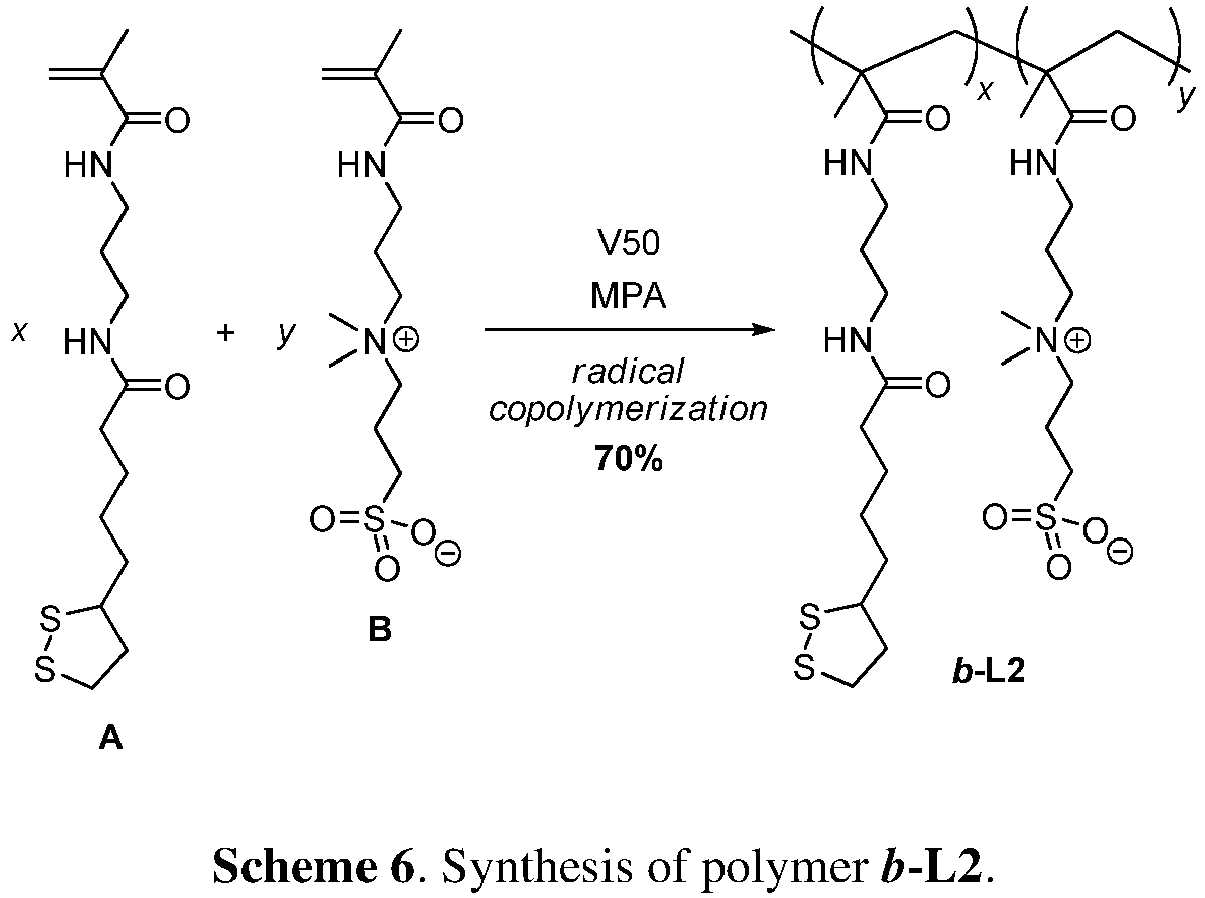
- To a solution of B (SPP, 1.17 g, 4 mmol, 4 equiv.) in deionized water (20 mL) was added a solution of A (331 mg, 1 mmol, 1 equiv.) in THF (20 mL). A solution of V50 (2,2'-azobis(2-amidinopropane) hydrochloride) (130 mg, 0.5 mmol, 0.5 equiv.) in deionized water (2 mL) was further added in one portion. The pale yellow mixture was stirred and degassed by argon bubbling for 40 min. MPA (42 µL, 0.5 mmol, 0.5 equiv.) was injected into the reaction medium, which was stirred overnight at 60°C under argon atmosphere. THF was evaporated under reduced pressure; the residual solution was extracted with 20 mL of dichloromethane and the aqueous phase was separated. A 9-fold excess of ethanol was poured into the latter phase to precipitate the polymer, which was separated by centrifugation (50-mL centrifuge tubes, 2,800 g, 10 min) and further dried overnight under vacuum in the presence of P2O5 as a desiccant. The polymer was obtained as an off-white solid (1.05 g, 70%).
- Synthesis of polymer b-L3. b-L3 was synthesized in the same manner as b-L2, with an A/B molar ratio equal to 10/90 (A: 166 mg, 0.5 mmol; B: 1.28 g, 4.4 mmol; V50: 130 mg, 0.5 mmol; MPA: 42 µL, 0.5 mmol).
-

- Dithiol groups of the different polymers were quantified using DHLA (dihydrolipoic acid) as a standard.
- A sodium phosphate buffer solution (0.1 M, pH = 8) was prepared by dissolving sodium hydrogen phosphate (3.3 g, 23.3 mmol), sodium dihydrogen phosphate (0.2 g, 1.7 mmol) and EDTA (93 mg, 0.3 mmol) in water (250 mL).
- Lipoic acid (31 mg, 0.15 mmol) was dissolved in the sodium phosphate solution (5 mL) and the solution was cooled down to 0°C (ice bath). NaBH4 (60 mg, 1.6 mmol, 10 equiv.) was added and the mixture was stirred at 0°C for 30 min. Sulfuric acid (1.5 M, 3 mL) was added and the final volume was adjusted to 50 mL, using the sodium phosphate buffer solution (42 mL), to give a 3-mM solution of DHLA called thereafter "Standard DHLA solution". A set of DHLA standards from 0 to 0.5 mM was prepared from this solution and from the sodium phosphate buffer (see Table 1).
- Unknown samples were prepared by dissolving L2 (100 mg) or L3 (200 mg) in sodium phosphate buffer (5 mL). The solutions were cooled down to 0°C, NaBH4 was added (30 mg) and the mixtures were stirred at 0°C for 30 min. Sulfuric acid was added to each solution (1.5 M, 1.5 mL), then sodium phosphate buffer (3.5 mL). 2 mL of these solutions were diluted to a final volume of 10 mL to obtain the unknown sample solutions.
- Ellman's reagent solution was prepared by dissolving DTNB (5,5'-dithio-bis-(2-nitrobenzoic acid)) (4 mg) in sodium phosphate buffer (1 mL). A set of test tubes was prepared, each containing Ellman's reagent solution (50 µL) and sodium phosphate buffer (2.5 mL).
- Each DHLA standard or unknown sample (250 µL) was added to separate test tubes.
- Solutions were mixed, incubated at room temperature for 15 min, and their absorbance at 412 nm was measured. DHLA standards were used to generate a standard curve (
Figure 10 ) that allowed the determination of unknown concentrations. Results are summarized in Table 1.Table 1. Ellman's dosage: standard curve generation and determination of unknown sample concentrations. Sample V sodium phosphate buffer VStandard DHLA sol. [dithiol] (mM) Absorbance at 412 nm [dithiol]exp (mM) Standard 14 0 0 0.000 Standard 23.917 0.083 0.0625 0.142 Standard 33.833 0.167 0.125 0.285 Standard 43.667 0.333 0.25 0.572 Standard 53.333 0.667 0.5 1.158 L2 1.045 0.453 L3 0.693 0.300 - Estimation of the real A/B ratio in polymers L2 and L3:
- Average number of monomer A / polymeric chain:

- Average number of monomers / polymeric chain:


- 600-nm-emitting CdSe/CdS/ZnS QDs were synthesized using slight modifications of previously published procedures. CdSe cores were synthesized by reaction of trioctylphosphine selenide and cadmium oleate in octadecene, oleylamine and trioctylphosphine oxide. Three monolayers of CdS shell, followed by two monolayers of ZnS, were grown using cadmium oleate, zinc oleate and sulfur diluted in octadecene following the SILAR (Successive Ionic Layer Adsorption and Reaction) procedure.
-

- CdSe/CdS/ZnS core/shell QDs in hexane (4 nmol) were precipitated with ethanol and centrifuged (16,000 g, 10 min). The supernatant was removed, the QDs were redispersed in hexane (0.2 mL) and the procedure was repeated once. The QDs were then taken up in chloroform (1 mL). MPA (100 µL, 1.1 mmol) was dissolved in a freshly prepared solution of TMAOH•5H2O (400 mg, 2.2 mmol) in chloroform (2 mL), using a sonicating bath. 1 mL of the basic organic phase was added to the QD colloidal dispersion. The mixture was stirred, then left at room temperature. After 15-30 min typically, MPA-QDs aggregated. The suspension was centrifuged to remove the basic organic supernatant (16,000 g, 5 min) and the nanoparticles were washed twice with chloroform (brief stirring and centrifugation at 16,000 g, 5 min). MPA-QDs were taken up in a 10-mM sodium tetraborate buffer (2 mL, pH = 9).
- A solution of b-L2 (40 mg) in deionized water (2 mL) was cooled down to 0°C with an ice bath and NaBH4 (10 mg) was added in one portion. The solution was warmed up slowly to room temperature and stirred for 30 min. The aqueous solution of MPA-QDs was added (2 mL) and the mixture was stirred vigorously at room temperature. After 30 min, the vial containing the aqueous mixture was sealed and stored without stirring at 65°C overnight to complete cap exchange. The L2-QD aqueous solution was cooled down to room temperature and excess free solubilized ligands and reagents were removed by two rounds of membrane ultrafiltration at 16,000 g using a
Sartorius Vivaspin ® 500 µL disposable filter (cutoff 30 kDa) in 20 mM aqueous NaCl. - L2-QDs were purified by ultracentrifugation at 268,000 g for 25 min in a 10%-40% sucrose gradient in 20 mM aqueous NaCl. The QD band was collected, residual sucrose was removed by four rounds of ultrafiltration (
Vivaspin ® 500 µL,cutoff 30 kDa, 16,000 g, 10 min) and L2-QDs were further washed by five rounds of ultrafiltration with a 20 mM NaCl aqueous solution (Vivaspin ® 500 µL,cutoff 30 kDa, 16,000 g, 10 min). L2-QDs were finally taken up in 20 mM aqueous NaCl. - L2-QDs (12 µL, 16 µM in 20 mM aqueous NaCl) were added to solutions of different pH prepared from HCl or NaOH solutions (300 µL, pH from 1 to 13) containing NaCl (50 mg), or to a saturated aqueous solution of NaCl. L2-QDs colloidal solutions were kept at 4°C over months and stability (i. e. possible aggregation) was controlled by centrifugation (16,000 g, 5 min).
- The concentrations of the different QD solutions in 20 mM aqueous NaCl were determined by the measurement of their absorbance at 350 nm and the corresponding samples were diluted to 0.3 µM by addition of a 20 mM aqueous NaCl solution. The volume of each sample was in the range of 1 mL. Before each measurement, diluted QD samples were centrifuged at 16,000 g for 5 min. Aggregated QDs fell down at the bottom of the centrifuge tube and the absorbance at 350 nm of the supernatant was then measured. This solution was eventually recovered and left at room temperature until next measurement.
- QD samples diluted in a 1 M aqueous NaCl solution were washed beforehand by three rounds of ultrafiltration with a 1 M NaCl aqueous solution (
Vivaspin ® 500 µL,cutoff 30 kDa, 16,000 g, 10 min). -

- 5(6)-carboxyfluorescein (200 mg, 0.53 mmol, 1 equiv.) was dissolved in DMF (2 mL). NHS (61 mg, 0.53 mmol, 1 equiv.) was added in one portion, then a solution of DCC (110 mg, 0.53 mmol, 1 equiv.) in DMF (0.4 mL), in one portion. The reaction mixture was protected from light and stirred overnight at room temperature. A white precipitate formed, which was filtered and the filtrate was diluted with DMF to obtain a final volume of 5 mL. The reaction was supposed to be quantitative and the solution was stored in the dark at 4°C until use.

- APMA•HCl (89 mg, 0.5 mmol, 1 equiv.), then triethylamine (140 µL, 1 mmol, 2 equiv.) and B (1.03 g, 3.5 mmol, 7 equiv.) were dissolved in deionized water (20 mL). To this solution was added a solution of A (331 mg, 1 mmol, 2 equiv.) in THF (20 mL). A solution of V50 (130 mg, 0.5 mmol, 1 equiv.) in deionized water (2 mL) was further added in one portion. The pale yellow mixture was stirred and degassed by argon bubbling for 40 min. MPA (42 µL, 0.5 mmol, 1 equiv.) was injected into the reaction medium, which was stirred overnight at 60°C under argon atmosphere. THF was evaporated under reduced pressure; the residual solution was extracted with 20 mL of dichloromethane and the aqueous phase was separated. A 9-fold excess of ethanol was poured into the latter phase to precipitate the polymer, which was separated by centrifugation (2,800 g, 10 min) and further dried overnight under vacuum in the presence of P2O5 as a desiccant. The polymer was obtained as an off-white solid (0.69 g, 48%).

- To a solution of b-L2-NH2 (40 mg) in aqueous NaHCO3 (1.25 mL, 0.2 M, pH = 9) was added a solution of fluorescein-NHS in DMF (750 µL, 0.106 M, ≈ 10 equiv.). The reaction mixture was stirred 2 h at room temperature. The labeled polymer b-L2-fluorescein was purified by several rounds of ultrafiltration (
Vivaspin ® 500 µL,cutoff 3 kDa, 16,000 g) until the filtrate was not fluorescent anymore. The resulting residue was employed for the ligand exchange without further purification. - CdSe/CdS/ZnS core/shell QDs (4 nmol) were exchanged with 20 mg of b-L2-fluorescein, treated beforehand by NaBH4 (10 mg) for 30 min to afford L2-fluorescein, according to the standard two-step process described above for ligand exchange with L2.

- The absorbance at 500 nm of fluorescein-NHS was measured in 0.2 M aqueous NaHCO3 and let us determine the corresponding molar extinction coefficient: ε = 53,990 L.mol 1.cm-1. The absorbance of L2-fluorescein-QDs was measured in the same conditions from 350 to 700 nm. The spectrum was then deconvoluted to separate QD and fluorescein absorbances, as exemplified in
Figure 12 . QD absorbance at 350 nm led us to QD concentration; fluorescein absorbance at 500 nm and the corresponding ε, to dye concentration. The concentration ratio gave a number of 10 dyes per QD, that is, 10 functionalizable amines per QD. - A solution of b-L1 (100 mg) in 20 mM aqueous NaCl (1 mL) was cooled down to 0°C with an ice bath and NaBH4 (20 mg) was added in one portion. The solution was warmed up slowly to room temperature and stirred for 30 min. To 120 µL of this L1 solution were added 100 µL of 1 M aqueous HCl, then 480 µL of 1 M aqueous NaHCO3.
- L2-fluorescein-QDs (19 µL, 32.3 µM, 0.6 nmol in 0.2 M aqueous NaHCO3, pH = 9) were added to the resulting mixture and the absorbance of the solution was measured from 400 nm to 700 nm. This solution, containing L2-fluorescein-QDs and the competing ligand L1, was transferred to a
Vivaspin ® 500 µL disposable filter (cutoff 30 kDa) and left at room temperature. - Before each next measurement, L2-fluorescein-QDs were separated via ultrafiltration (16,000 g, 10 min) and the surrounding solution was recovered. The absorbance of this surrounding solution was measured and cumulated with previous measurement(s). A freshly prepared 700-µL solution of L1 was added to the QDs and the absorbance of this QD solution was, in turn, measured. Each spectrum of L2-fluorescein-QDs was the deconvoluted to obtain the remaining fluorescein absorbance on QDs.
- Measurements were normalized at t = ∞ and t = 0 respectively, to give the evolution of remaining fluorescein on L2-fluorescein-QDs and the evolution of cumulative fluorescein in solution surrounding L2-fluorescein-QDs, as a function of time. Exponential fittings of experimental data led to the determination L2-fluorescein desorption rate constant, as illustrated in
Figure 13 . -
- Synthesis of b-L1. See
Scheme 9 and the supporting information in a previous publication from our lab. - Synthesis of b-L1-fluorescein. b-L1-fluorescein is a LA-PEG-NH2 molecule labeled with fluorescein via fluorescein-NHS (see above for the synthesis of fluorescein-NHS, Scheme 10). LA-PEG-NH2 was synthesized in a five-step process already described and starting from a PEG600 polymer (Scheme 13).
- CdSe/CdS/ZnS core/shell QDs in hexane (4 nmol) were precipitated with ethanol and centrifuged (16,000 g, 10 min). The supernatant was removed, the QDs were redispersed in hexane (0.2 mL) and the procedure was repeated once. The QDs were then taken up in chloroform (1 mL). b-L1 (100 mg, 1.6 µmol) in deionized water (1 mL) was treated by NaBH4 (20 mg) for 30 min, L1 solution was added to the QDs in chloroform and the biphasic mixture was heated at 65°C overnight. The aqueous phase was separated and concentrated by ultrafiltration (
Vivaspin ® 500 µL,cutoff 30 kDa, 16,000 g). L1-QDs were washed with 20 mM aqueous NaCl via three rounds of ultrafiltration (Vivaspin ® 500 µL,cutoff 30 kDa, 16,000 g) and taken up in 20 mM aqueous NaCl (200 µL). A solution of b-L1-fluorescein, treated beforehand with NaBH4 to give L1-fluorescein (200 µL, 25 mM in 20 mM aqueous NaCl, ≈ 10% mol relative to QD-coating-L1), was added to L1-QDs and the mixture was heated at 65°C overnight. Typical treatment (concentration of the sample, washings with aqueous 20 mM NaCl using ultrafiltration) and purification (ultracentrifugation in a 10%-40% sucrose gradient in 20 mM aqueous NaCl, concentration and washings with 0.2 M aqueous NaHCO3 using ultrafiltration) afforded L1-fluorescein-QDs in 0.2 M aqueous NaHCO3. - A solution of competing ligand L1 was prepared as reported above for the measure of L2-fluorescein desorption rate constant. L1-fluorescein-QDs (52 µL, 11.4 µM, 0.6 nmol in 0.2 M aqueous NaHCO3, pH = 9) were added to the L1-containing mixture (10 mM) and the absorbance of the solution was measured from 400 nm to 700 nm. This solution, containing L1-fluorescein-QDs and the competing ligand L1, was transferred to a
Vivaspin ® 500 µL disposable filter (cutoff 30 kDa) and left at room temperature. Before each next measurement, L1-fluorescein-QDs were separated via ultrafiltration (16,000 g, 10 min) and the surrounding solution was recovered. The absorbance of this surrounding solution was measured and cumulated with previous measurement(s). - The time scale of this experiment being far shorter than the determination of L2-fluorescein desorption rate constant, it was not necessary to add systematically a freshly prepared solution of L1 to the QDs before QD absorbance measurement. The initial solution of L1 could be re-used as prepared, except for the last measurement.
- Data treatment was performed according to the procedure detailed for L2-fluorescein desorption rate constant in
Figure 13 . - HeLa cells were grown in DMEM medium supplemented with 10% FBS and 1% antibiotics.
- Cells were incubated at 37°C with L1- or L2-QDs diluted to 1 µM in Opti-MEM® for 10 min (
Figure 7 ). Cells were then rinsed five times (centrifugation) and imaged. The non-specific adsorption on cell membranes of L2-QDs was comparable with L1-QDs and is almost not detectable. - All images were acquired with the same parameters, using a widefield epifluorescence microscope (IX71 Olympus), a 60× 1.2 NA water objective and an EM CCD camera (cascade 512B Roper). Excitation and collection of fluorescence of QDs were performed with 425/60 nm and 605/40 band pass filters.
- L1- or L2-QDs were diluted in DMEM to 1 µM in a final volume of 100 µL and mixed to 50×104 cells in suspension in a 2 mm electroporation cuvette. The cuvette was subjected to 0.15 kV for a 28 ms pulse using a Gene Pulser (Biorad) electroporator. Cells were rinsed 3 times, and deposed on LabTek in DMEM/F12 medium supplemented with 10% FBS, 1% antibiotics and 1% HEPES. Cells were imaged after 54 h at 37°C, 5% CO2.
- All images were acquired with a widefield epifluorescence microscope (IX71 Olympus) using a 60× 1.2 NA water objective, Chroma filters and an EM CCD camera (cascade 512B Roper).
- Aggregation quantifications with micelle-QDs and Qtracker®, showed for comparison in Figure 8C, were performed in the same conditions as those described above. Micelle-QDs were prepared from the encapsulation of CdSe/CdS/ZnS QDs in 100% 1,2-dipalmitoyl-sn-glycero-3-phosphoethanolamine-N-[methoxypoly(ethylene glycol)-2000]carboxamide (Nova) micelles (Scheme 14). Qtracker® 655 non-targeted QDs were purchased from Invitrogen.

- Monomer D synthesis. Monomer D was synthesized from tetra(ethylene glycol), according to a four-step process (Scheme 15), adapted from a protocol initially developed with a PEG600 as starting material.

- b-L2-PEG-NH2 synthesis. The synthesis of this terpolymer (Scheme 16) was carried out according to the procedure described for the synthesis of L2-NH2 (see the Competition experiment section).

- Ligand exchange L2-PEG-NH2/QDs. Ligand exchange was performed according to the standard procedure indicated for L2, with 20 mg of b-L2-PEG-NH2 treated by 10 mg of NaBH4, for 4 nmol of CdSe/CdS/ZnS QDs (
Figure 14 ). - L2-PEG-NH2-QD/biotin coupling (
Figure 14 ). 0.1 mmol of biotin were mixed with equimolar amounts of DCC and NHS in 10 mL DMF and stirred at room temperature overnight to yield a solution of 10 mM NHS-activated biotin. Then 0.5 nmol of L2-PEG-NH2-QDs were diluted in 400 µL sodium bicarbonate buffer (0.2 M, pH = 9), and mixed with 50 nmol of NHS-biotin for 30 min. The QDs were then purified with one round of ultrafiltration onVivaspin 30 kDa (16,000 g, 10 min), one filtration on a NAP-5 column (GE Healthcare) and one final round of ultrafiltration (Vivaspin 30 kDa, 16,000 g, 10 min). - L2-PEG-NH2-QD/streptavidin coupling (
Figure 14 ). Typically, QDs capped with L2-PEG-NH2 (1 nmol) were dispersed in a NaHCO3 buffer (400 µL, 0.2 M, pH = 9) and mixed with a sulfo-lc-SPDP solution (30 µL, 10 mg/mL in DMSO) for 15 min. The solution was then concentrated using ultrafiltration (30 kDa MW cutoff, Vivaspin®, Vivascience, 16,000 g, 10 min) and diluted in a NaHCO3 buffer (400 µL, 0.2 M). Then a DTT solution (20 µL, 23 mg/mL in DMSO) was added, and the solution was stirred for 15 min. The DTT was eliminated using one round of ultrafiltration (16,000 g, 10 min), followed by purification on a NAP-5 column and another round of ultrafiltration (16,000 g, 10 min). The resulting concentrated QD solution was diluted in a HEPES buffer (300 µL, 0.1 M, pH = 7). - In another vial, streptavidin (1 mg) diluted in a NaHCO3 buffer (200 µL, 0.2 M) was mixed with a sulfo-SMCC solution (2.6 µL, 10 mg/mL in DMSO) for 20 min, concentrated with one round of ultrafiltration (30 kDa MW cutoff Vivaspin®, 16,000 g, 10 min) and rediluted with a HEPES buffer (300 µL, 0.1 M).
- The resulting freshly prepared QD and streptavidin solutions were mixed together and stirred for 20 min at room temperature. The resulting streptavidin-QD solution was then concentrated using ultrafiltration (16,000 g, 10 min). Excess streptavidin was eliminated using ultracentrifugation on a 10%-40% sucrose gradient (268,000 g, 25 min), and the functionalized streptavidin-QDs were finally reconcentrated using ultrafiltration (16,000 g, 10 min) and redispersed in HEPES buffer.
- Control of the bioconjugation with functionalized agarose beads. The efficiency of the conjugation was checked by mixing, during 15 min, 6 pmol of L2-streptavidin-QDs with biotin-functionalized agarose beads. The beads were washed four times in HEPES by mild centrifugation. The control was performed by mixing L2-streptavidin-QDs with streptavidin-functionalized agarose beads. Only the biotin-functionalized beads appeared fluorescent (
Figure 15 ). - The bioconjugation of biotin to form L2-biotin-QDs was tested in the same way on streptavidin-functionalized agarose beads, with a control on biotin-functionalized agarose beads.
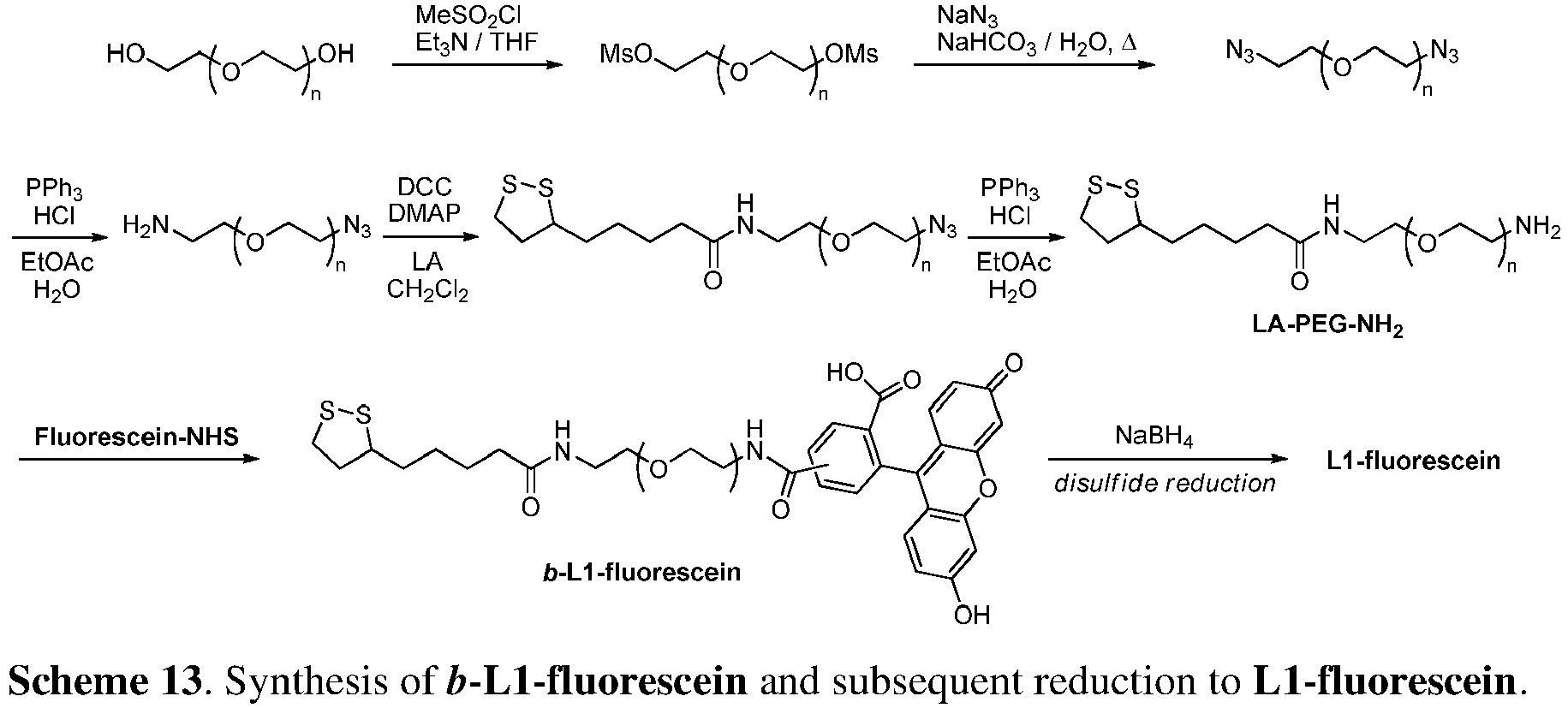
Claims (15)
- A ligand which is a copolymer comprising at least 2 monomers and having the following formula I:(A)x(B)y, whereinA comprises at least one anchoring monomer comprising a first moiety MA having affinity for the surface of a nanocrystal,B comprises at least one hydrophilic monomer comprising a second moiety MB having a high water solubility comprising at least one zwitterionic moiety selected from the group of an aminocarboxylate, an aminosulfonate, a carboxybetaine moiety wherein the ammonium group may be included in an aliphatic chain, a five-membered cycle, a five-membered heterocycle comprising 1, 2 or 3 further nitrogen atoms, a six-membered cycle, a six-membered heterocycle comprising 1, 2, 3 or 4 further nitrogen atoms, a sulfobetaine moiety wherein the ammonium group may be included in an aliphatic chain, a five-membered cycle, a five-membered heterocycle comprising 1, 2 or 3 further nitrogen atoms, a six-membered cycle, a six-membered heterocycle comprising 1, 2, 3 or 4 further nitrogen atoms, a phosphobetaine wherein the ammonium group may be included in an aliphatic chain, a five-membered cycle, a five-membered heterocycle comprising 1, 2 or 3 further nitrogen atoms, a six-membered cycle, a six-membered heterocycle comprising 1, 2, 3 or 4 further nitrogen atoms, a phosphorylcholine, a phosphocholine moiety, and combinations thereof or a PEG moiety; andeach of x and y is independently a positive integer,wherein when A comprises a moiety MA which is an imidazole moiety, then B comprises a second moiety MB which is not a sulfobetaine, a carboxybetaine or a phosphobetaine moiety;when B comprises a monomer comprising a second moiety MB which is a PEG moiety, then B further comprises at least one monomer comprising a second moiety MB which is not a PEG moiety.
- The ligand according to claim 1, wherein a second moiety MB comprises at least one zwitterionic moiety.
- The ligand according to anyone of claim 1 or claim 2, wherein x+y is ranging from 5 to 500.
- The ligand according to any one of claims 1 to 3, having the following formula II':
 RA' and RA" represent respectively a group comprising a first moiety MA having affinity for the surface of a nanocrystal, respectively MA' and MA",RB' and RB" represent respectively a group comprising a second moiety MB having a high water solubility, respectively MB' and MB",R1', R2', R3', R1", R2", R3", R4', R5', R6', R4", R5", R6" can be independently H, or a group selected from an alkyl, alkenyl, aryl, hydroxyle, halogen, alkoxy, carboxylate,each of x' and x" is independently a positive integer, preferably an integer ranging from 0 to 499, with the condition that at least one of x' and x" is not 0,each of y' and y" is independently a positive integer, preferably an integer ranging from 0 to 499, with the condition that at least one of y' and y" is not 0.
 - The ligand according to any one of claims 1 to 4, wherein said first moiety MA, MA' or MA" having affinity for the surface of a nanocrystal is a thiol moiety, a dithiol moiety, an imidazole moiety, a catechol moiety, a pyridine moiety, a pyrrole moiety, a thiophene moiety, a thiazole moiety, a pyrazine moiety, a carboxylic acid or carboxylate moiety, a naphthyridine moiety, a phosphine moiety, a phosphine oxide moiety, a phenol moiety, a primary amine moiety, a secondary amine moiety, a tertiary amine moiety, a quaternary amine moiety, an aromatic amine moiety, or a combination thereof.
- The ligand according to any one of claims 1 to 5, wherein said first moiety MA, MA' or MA" having affinity for the surface of a nanocrystal is dithiol moiety, preferably a propane-1,3-dithiol, more preferably a propan-1-yl-1,3-dithiol moiety.
- The ligand according to any one of claims 1 to 6, wherein said second moiety MB, MB' or MB" having a high water solubility is a sulfobetaine group.
- The ligand according to any one of claims 1 to 7, having the following formula III:
(A)x(B)y(C)z,
whereinA is as defined in claim 1,B is as defined in claim 1,C comprises at least one functionalizable monomer comprising a third moiety Mc having a reactive function, andeach of x, y and z is independently a positive integer, preferably x+y+z is ranging from 5 to 750. - The ligand according to any one of claims 1 to 8, having the following formula IV':
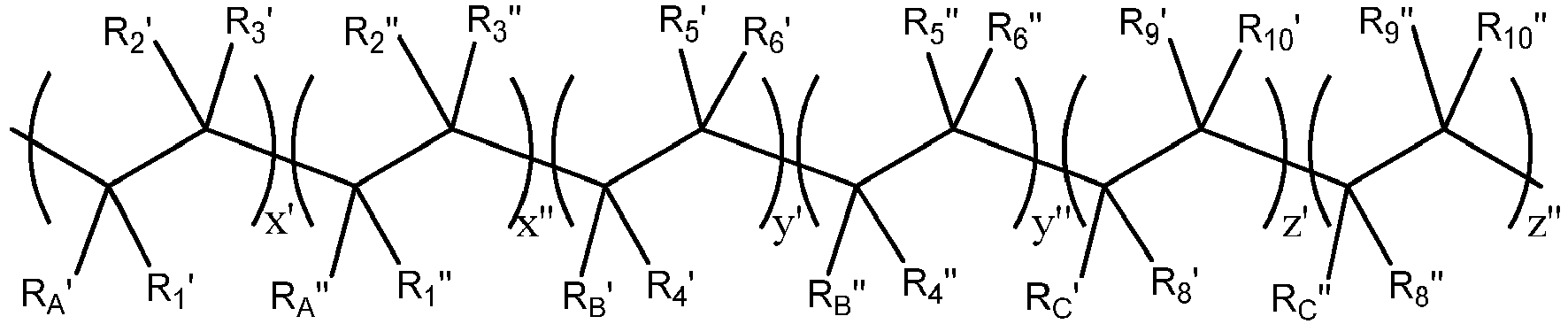 RA', RA", RB', RB", R1', R2', R3', R1", R2", R3", R4', R5', R6', R4", R5", and R6" are defined here above,Rc' and Rc" represent respectively a group comprising a third moiety Me, respectively MC' and MC", andR8', R9', R10', R8", R9", and R10" can be independently H, or a group selected from an alkyl, alkenyl, aryl, hydroxyl, halogen, alcoxy, carboxylate,each of x' and x"is independently a positive integer, preferably an integer ranging from 0 to 499, with the condition that at least one of x' and x" is not 0,each of y' and y" is independently a positive integer, preferably an integer ranging from 0 to 499, with the condition that at least one of y' and y" is not 0,each of z' and z" is independently a positive integer, preferably an integer ranging from 0 to 499, with the condition that at least one of z' and z" is not 0.
 - The ligand according to any one of claims 1 to 9, wherein said third moiety Me, Me' or Me" is any moiety having an amine group such as a primary amine group, any moiety having an azido group, any moiety having an alkenyl group, any moiety having an acidic function, any moiety having an alcoholic group, any moiety having a thiol group, any moiety that can form a non covalent bond with a selective binding counterpart, said moiety being for example biotin, a nucleic acid, or an antibody.
- The ligand according to any one of claims 1 to 10, being functionalized with at least one molecular probe and/or targeting group.
- A nanocrystal being complexed with at least one ligand according to any one of claims 1 to 11.
- The nanocrystal according to claim 12, wherein said nanocrystal is a 0D, 1D, or 2D nanocrystal , preferably a nanosheet, a nanorod, a nanoplatelet, a nanoplate, a nanoprism, a nanowall, a nanodisk, a nanoparticle, a nanowire, a nanopowder, a nanotube, a nanotetrapod, a nanoribbon, a nanobelt, a nanoneedle, a nanocube, a nanoball, a nanocoil, a nanocone , a nanopiller, a nanoflower , or a quantum dot.
- A water-soluble composition comprising at least one nanocrystal being complexed with at least one ligand according to any one of claims 1 to 11.
- Use of said nanocrystal being complexed with at least one ligand according to any one of claims 1 to 11 or said water-soluble composition according to claim 14 for bioimaging, biotargeting, medical imaging or biosensing.
Priority Applications (1)
| Application Number | Priority Date | Filing Date | Title |
|---|---|---|---|
| EP13727617.6A EP2859352B1 (en) | 2012-06-07 | 2013-06-07 | Enhanced affinity ligands |
Applications Claiming Priority (4)
| Application Number | Priority Date | Filing Date | Title |
|---|---|---|---|
| US201261656699P | 2012-06-07 | 2012-06-07 | |
| EP12184331.2A EP2672269A1 (en) | 2012-06-07 | 2012-09-13 | Enhanced affinity ligands |
| PCT/EP2013/061863 WO2013182707A1 (en) | 2012-06-07 | 2013-06-07 | Enhanced affinity ligands |
| EP13727617.6A EP2859352B1 (en) | 2012-06-07 | 2013-06-07 | Enhanced affinity ligands |
Publications (2)
| Publication Number | Publication Date |
|---|---|
| EP2859352A1 EP2859352A1 (en) | 2015-04-15 |
| EP2859352B1 true EP2859352B1 (en) | 2024-05-08 |
Family
ID=46875677
Family Applications (2)
| Application Number | Title | Priority Date | Filing Date |
|---|---|---|---|
| EP12184331.2A Withdrawn EP2672269A1 (en) | 2012-06-07 | 2012-09-13 | Enhanced affinity ligands |
| EP13727617.6A Active EP2859352B1 (en) | 2012-06-07 | 2013-06-07 | Enhanced affinity ligands |
Family Applications Before (1)
| Application Number | Title | Priority Date | Filing Date |
|---|---|---|---|
| EP12184331.2A Withdrawn EP2672269A1 (en) | 2012-06-07 | 2012-09-13 | Enhanced affinity ligands |
Country Status (3)
| Country | Link |
|---|---|
| US (1) | US10233291B2 (en) |
| EP (2) | EP2672269A1 (en) |
| WO (1) | WO2013182707A1 (en) |
Families Citing this family (21)
| Publication number | Priority date | Publication date | Assignee | Title |
|---|---|---|---|---|
| KR101550830B1 (en) | 2013-10-08 | 2015-09-10 | 인하대학교 산학협력단 | Method of preparing light emitting quantum dot using solution process and light emitting device using the same |
| JP6061112B2 (en) * | 2013-10-17 | 2017-01-18 | 株式会社村田製作所 | Light emitting device |
| CA2965578C (en) * | 2014-10-31 | 2024-03-19 | Illumina Cambridge Limited | Polymers and dna copolymer coatings |
| AU2016296508A1 (en) * | 2015-07-17 | 2018-02-22 | Board Of Regents Of The Nevada System Of Higher Education, On Behalf Of The University Of Nevada, Reno | Composites and compositions for therapeutic use and methods of making and using the same |
| US10994031B2 (en) | 2015-07-17 | 2021-05-04 | Board Of Regents Of The Nevada System Of Higher Education, On Behalf Of The University Of Nevada, Reno | Composites and compositions for therapeutic use and methods of making and using the same |
| US10209258B2 (en) * | 2015-08-24 | 2019-02-19 | The Board Of Trustees Of The University Of Illinois | Lipoprotein nanoplatelets: fluorescent, zwitterionic probes for molecular and cellular imaging |
| SG11201803340VA (en) | 2015-11-01 | 2018-05-30 | Massachusetts Inst Technology | Materials with improved properties |
| DK3368085T5 (en) | 2015-11-01 | 2024-09-30 | Massachusetts Inst Technology | MODIFIED ALGINATES FOR ANTI-FIBROTIC MATERIALS AND APPLICATIONS |
| KR101807156B1 (en) * | 2015-12-18 | 2017-12-11 | 울산과학기술원 | Manufacturing method of random copolymer for surface modification of quantum dots and method for modifying surface of quantum dots using the same |
| CN105732418B (en) * | 2016-02-02 | 2018-03-20 | 南开大学 | The preparation method and application of double poly- tetraethylene glycols of azide substitution |
| AU2017283463A1 (en) * | 2016-06-13 | 2019-01-17 | Massachusetts Institute Of Technology | Biocompatible zwitterionic polymer coatings and hydrogels for reducing foreign body response and fibrosis |
| CN106497546B (en) * | 2016-09-22 | 2018-12-28 | 纳晶科技股份有限公司 | White light quanta point composition and preparation method thereof |
| WO2018151930A1 (en) * | 2017-02-17 | 2018-08-23 | The Methodist Hospital | Compositions and methods of determining a level of infection in a subject |
| CN109298182A (en) * | 2017-07-24 | 2019-02-01 | 北京健平九星生物医药科技有限公司 | A kind of preparation method and fluorescence immune chromatography card of fluorescence immune chromatography card |
| KR102354900B1 (en) * | 2017-09-12 | 2022-01-21 | 엘지디스플레이 주식회사 | Quantum dot light emitting diode and quantum dot light emitting device having thereof |
| US11318231B2 (en) | 2017-11-06 | 2022-05-03 | Massachusetts Institute Of Technology | Anti-inflammatory coatings to improve biocompatibility of neurological implants |
| US10837142B2 (en) | 2018-12-14 | 2020-11-17 | Sappi North America, Inc. | Paper coating composition with highly modified starches |
| EP3831909A1 (en) * | 2019-12-03 | 2021-06-09 | Université de Strasbourg | Luminescent zwitterionic polymeric nanoparticles |
| CN111826155B (en) * | 2020-07-23 | 2022-06-07 | 安徽大学 | CdS quantum dot-fluorescein FRET fluorescent probe and preparation method and application thereof |
| KR102874179B1 (en) * | 2022-01-21 | 2025-10-21 | 동우 화인켐 주식회사 | A quantum dot, a quantum dot dispersion, a light converting curable composition, a cured film manufactured by the composition and a display device comprising the cured film |
| CN115974008B (en) * | 2023-02-15 | 2024-04-19 | 吉林大学 | A bismuth selenide-based heterostructure material, preparation method and application thereof |
Family Cites Families (7)
| Publication number | Priority date | Publication date | Assignee | Title |
|---|---|---|---|---|
| DE102004001412A1 (en) * | 2004-01-09 | 2005-08-25 | Tesa Ag | Pressure-sensitive adhesive based on an acrylate polymer blend |
| JP5557373B2 (en) * | 2006-11-21 | 2014-07-23 | アボット ラボラトリーズ | Use of terpolymers of tetrafluoroethylene, hexafluoropropylene, and vinylidene fluoride in drug-eluting coatings |
| WO2011022338A1 (en) * | 2009-08-16 | 2011-02-24 | Massachusetts Institute Of Technology | Copolymer-associated nanomaterial |
| WO2011050070A1 (en) * | 2009-10-20 | 2011-04-28 | Vanderbilt University | Liquid drop diagnostic assays |
| FR2952642B1 (en) * | 2009-11-16 | 2012-01-06 | Centre Nat Rech Scient | POLYMERS COMPRISING A MAJORITY OF AMPHIPHILIC MONOMERS FOR TRAPPING AND HANDLING MEMBRANE PROTEINS |
| WO2011119654A1 (en) * | 2010-03-23 | 2011-09-29 | Massachusetts Institute Of Technology | Ligands for semiconductor nanocrystals |
| KR101276693B1 (en) * | 2010-10-29 | 2013-06-19 | 포항공과대학교 산학협력단 | Synthesis of zwitterion functionalized surface molecules for nanoparticles and the applications thereof |
-
2012
- 2012-09-13 EP EP12184331.2A patent/EP2672269A1/en not_active Withdrawn
-
2013
- 2013-06-07 WO PCT/EP2013/061863 patent/WO2013182707A1/en not_active Ceased
- 2013-06-07 EP EP13727617.6A patent/EP2859352B1/en active Active
- 2013-06-07 US US14/406,306 patent/US10233291B2/en active Active
Also Published As
| Publication number | Publication date |
|---|---|
| US20150183939A1 (en) | 2015-07-02 |
| US10233291B2 (en) | 2019-03-19 |
| WO2013182707A1 (en) | 2013-12-12 |
| EP2859352A1 (en) | 2015-04-15 |
| EP2672269A1 (en) | 2013-12-11 |
Similar Documents
| Publication | Publication Date | Title |
|---|---|---|
| EP2859352B1 (en) | Enhanced affinity ligands | |
| EP3077476B1 (en) | Nanocrystals complexed with functionalizable enhanced affinity ligands and use thereof | |
| US8716420B2 (en) | Amphiphilic polymers and nanocrystals coated therewith | |
| Di Corato et al. | Water solubilization of hydrophobic nanocrystals by means of poly (maleic anhydride-alt-1-octadecene) | |
| Jiang et al. | Biotinylated glyco-functionalized quantum dots: synthesis, characterization, and cytotoxicity studies | |
| EP3483610B1 (en) | Functionalized chromophoric polymer dots and bioconjugates thereof | |
| US8894891B2 (en) | Copolymer-associated nanomaterial | |
| US11913946B2 (en) | Bimetal-conductive polymer Janus composite nanostructure having electrical stimulus response, colloid self-assembled structure thereof, preparing method, and bio-sensing, bio-imaging, drug delivery and industrial application | |
| US8822955B2 (en) | Polymer-conjugated quantum dots and methods of making the same | |
| JP6925126B2 (en) | Coded chromophore polymer particles | |
| US9759727B2 (en) | Ligands for semiconductor nanocrystals | |
| Oh | Surface modification of colloidal CdX-based quantum dots for biomedical applications | |
| EP1883820A1 (en) | Novel water-soluble nanocrystals comprising a low molecular weight coating reagent, and methods of preparing the same | |
| US20190153171A1 (en) | Enhanced affinity ligands | |
| EP3853321B1 (en) | Light-emitting marker particles | |
| US20150284493A1 (en) | Photoligation of an amphiphilic polymer with mixed coordination provides compact and reactive quantum dots | |
| Zhang et al. | A multifunctional polypeptide via ugi reaction for compact and biocompatible quantum dots with efficient bioconjugation | |
| US11226336B2 (en) | Compact and homogeneous quantum dots and methods of making the same | |
| Li et al. | Stable water-soluble quantum dots capped by poly (ethylene glycol) modified dithiocarbamate | |
| Generalova et al. | Optical sensing quantum dot-labeled polyacrolein particles prepared by layer-by-layer deposition technique | |
| JP2007178239A (en) | Hydrophilic quantum dots | |
| Liu et al. | Highly stable quantum dots with silica–poly (EGDMA-co-MAA) synergistic protection and the preliminary application in immunoassay | |
| Au et al. | High-conjugation-efficiency aqueous CdSe quantum dots | |
| US10202546B2 (en) | Ligands for semiconductor nanocrystals | |
| Dunlap | Investigations on the Surface Chemistry of Colloidal Quantum Dots Towards Fluorescent Biological Probes |
Legal Events
| Date | Code | Title | Description |
|---|---|---|---|
| PUAI | Public reference made under article 153(3) epc to a published international application that has entered the european phase |
Free format text: ORIGINAL CODE: 0009012 |
|
| 17P | Request for examination filed |
Effective date: 20150107 |
|
| AK | Designated contracting states |
Kind code of ref document: A1 Designated state(s): AL AT BE BG CH CY CZ DE DK EE ES FI FR GB GR HR HU IE IS IT LI LT LU LV MC MK MT NL NO PL PT RO RS SE SI SK SM TR |
|
| AX | Request for extension of the european patent |
Extension state: BA ME |
|
| DAX | Request for extension of the european patent (deleted) | ||
| RAP1 | Party data changed (applicant data changed or rights of an application transferred) |
Owner name: NEXDOT Owner name: FONDS DE L'ESPCI - GEORGES CHARPAK |
|
| STAA | Information on the status of an ep patent application or granted ep patent |
Free format text: STATUS: EXAMINATION IS IN PROGRESS |
|
| 17Q | First examination report despatched |
Effective date: 20200513 |
|
| GRAP | Despatch of communication of intention to grant a patent |
Free format text: ORIGINAL CODE: EPIDOSNIGR1 |
|
| STAA | Information on the status of an ep patent application or granted ep patent |
Free format text: STATUS: GRANT OF PATENT IS INTENDED |
|
| RIC1 | Information provided on ipc code assigned before grant |
Ipc: C09K 11/88 20060101ALI20231120BHEP Ipc: C09K 11/56 20060101ALI20231120BHEP Ipc: C08F 8/00 20060101ALI20231120BHEP Ipc: H01B 1/12 20060101ALI20231120BHEP Ipc: C08F 8/42 20060101ALI20231120BHEP Ipc: C08F 8/04 20060101ALI20231120BHEP Ipc: B82Y 15/00 20110101ALI20231120BHEP Ipc: A61K 49/00 20060101ALI20231120BHEP Ipc: G01N 33/58 20060101AFI20231120BHEP |
|
| INTG | Intention to grant announced |
Effective date: 20231206 |
|
| GRAS | Grant fee paid |
Free format text: ORIGINAL CODE: EPIDOSNIGR3 |
|
| GRAA | (expected) grant |
Free format text: ORIGINAL CODE: 0009210 |
|
| STAA | Information on the status of an ep patent application or granted ep patent |
Free format text: STATUS: THE PATENT HAS BEEN GRANTED |
|
| AK | Designated contracting states |
Kind code of ref document: B1 Designated state(s): AL AT BE BG CH CY CZ DE DK EE ES FI FR GB GR HR HU IE IS IT LI LT LU LV MC MK MT NL NO PL PT RO RS SE SI SK SM TR |
|
| REG | Reference to a national code |
Ref country code: GB Ref legal event code: FG4D |
|
| REG | Reference to a national code |
Ref country code: CH Ref legal event code: EP |
|
| REG | Reference to a national code |
Ref country code: DE Ref legal event code: R096 Ref document number: 602013085690 Country of ref document: DE |
|
| REG | Reference to a national code |
Ref country code: IE Ref legal event code: FG4D |
|
| P01 | Opt-out of the competence of the unified patent court (upc) registered |
Effective date: 20240520 |
|
| REG | Reference to a national code |
Ref country code: LT Ref legal event code: MG9D |
|
| REG | Reference to a national code |
Ref country code: NL Ref legal event code: MP Effective date: 20240508 |
|
| PG25 | Lapsed in a contracting state [announced via postgrant information from national office to epo] |
Ref country code: IS Free format text: LAPSE BECAUSE OF FAILURE TO SUBMIT A TRANSLATION OF THE DESCRIPTION OR TO PAY THE FEE WITHIN THE PRESCRIBED TIME-LIMIT Effective date: 20240908 |
|
| PG25 | Lapsed in a contracting state [announced via postgrant information from national office to epo] |
Ref country code: BG Free format text: LAPSE BECAUSE OF FAILURE TO SUBMIT A TRANSLATION OF THE DESCRIPTION OR TO PAY THE FEE WITHIN THE PRESCRIBED TIME-LIMIT Effective date: 20240508 |
|
| PG25 | Lapsed in a contracting state [announced via postgrant information from national office to epo] |
Ref country code: FI Free format text: LAPSE BECAUSE OF FAILURE TO SUBMIT A TRANSLATION OF THE DESCRIPTION OR TO PAY THE FEE WITHIN THE PRESCRIBED TIME-LIMIT Effective date: 20240508 Ref country code: HR Free format text: LAPSE BECAUSE OF FAILURE TO SUBMIT A TRANSLATION OF THE DESCRIPTION OR TO PAY THE FEE WITHIN THE PRESCRIBED TIME-LIMIT Effective date: 20240508 |
|
| PG25 | Lapsed in a contracting state [announced via postgrant information from national office to epo] |
Ref country code: GR Free format text: LAPSE BECAUSE OF FAILURE TO SUBMIT A TRANSLATION OF THE DESCRIPTION OR TO PAY THE FEE WITHIN THE PRESCRIBED TIME-LIMIT Effective date: 20240809 |
|
| PG25 | Lapsed in a contracting state [announced via postgrant information from national office to epo] |
Ref country code: PT Free format text: LAPSE BECAUSE OF FAILURE TO SUBMIT A TRANSLATION OF THE DESCRIPTION OR TO PAY THE FEE WITHIN THE PRESCRIBED TIME-LIMIT Effective date: 20240909 |
|
| REG | Reference to a national code |
Ref country code: AT Ref legal event code: MK05 Ref document number: 1685395 Country of ref document: AT Kind code of ref document: T Effective date: 20240508 |
|
| PG25 | Lapsed in a contracting state [announced via postgrant information from national office to epo] |
Ref country code: NL Free format text: LAPSE BECAUSE OF FAILURE TO SUBMIT A TRANSLATION OF THE DESCRIPTION OR TO PAY THE FEE WITHIN THE PRESCRIBED TIME-LIMIT Effective date: 20240508 |
|
| PG25 | Lapsed in a contracting state [announced via postgrant information from national office to epo] |
Ref country code: ES Free format text: LAPSE BECAUSE OF FAILURE TO SUBMIT A TRANSLATION OF THE DESCRIPTION OR TO PAY THE FEE WITHIN THE PRESCRIBED TIME-LIMIT Effective date: 20240508 |
|
| PG25 | Lapsed in a contracting state [announced via postgrant information from national office to epo] |
Ref country code: AT Free format text: LAPSE BECAUSE OF FAILURE TO SUBMIT A TRANSLATION OF THE DESCRIPTION OR TO PAY THE FEE WITHIN THE PRESCRIBED TIME-LIMIT Effective date: 20240508 |
|
| PG25 | Lapsed in a contracting state [announced via postgrant information from national office to epo] |
Ref country code: PL Free format text: LAPSE BECAUSE OF FAILURE TO SUBMIT A TRANSLATION OF THE DESCRIPTION OR TO PAY THE FEE WITHIN THE PRESCRIBED TIME-LIMIT Effective date: 20240508 |
|
| PG25 | Lapsed in a contracting state [announced via postgrant information from national office to epo] |
Ref country code: LV Free format text: LAPSE BECAUSE OF FAILURE TO SUBMIT A TRANSLATION OF THE DESCRIPTION OR TO PAY THE FEE WITHIN THE PRESCRIBED TIME-LIMIT Effective date: 20240508 |
|
| PG25 | Lapsed in a contracting state [announced via postgrant information from national office to epo] |
Ref country code: PT Free format text: LAPSE BECAUSE OF FAILURE TO SUBMIT A TRANSLATION OF THE DESCRIPTION OR TO PAY THE FEE WITHIN THE PRESCRIBED TIME-LIMIT Effective date: 20240909 Ref country code: PL Free format text: LAPSE BECAUSE OF FAILURE TO SUBMIT A TRANSLATION OF THE DESCRIPTION OR TO PAY THE FEE WITHIN THE PRESCRIBED TIME-LIMIT Effective date: 20240508 Ref country code: NO Free format text: LAPSE BECAUSE OF FAILURE TO SUBMIT A TRANSLATION OF THE DESCRIPTION OR TO PAY THE FEE WITHIN THE PRESCRIBED TIME-LIMIT Effective date: 20240808 Ref country code: NL Free format text: LAPSE BECAUSE OF FAILURE TO SUBMIT A TRANSLATION OF THE DESCRIPTION OR TO PAY THE FEE WITHIN THE PRESCRIBED TIME-LIMIT Effective date: 20240508 Ref country code: LV Free format text: LAPSE BECAUSE OF FAILURE TO SUBMIT A TRANSLATION OF THE DESCRIPTION OR TO PAY THE FEE WITHIN THE PRESCRIBED TIME-LIMIT Effective date: 20240508 Ref country code: IS Free format text: LAPSE BECAUSE OF FAILURE TO SUBMIT A TRANSLATION OF THE DESCRIPTION OR TO PAY THE FEE WITHIN THE PRESCRIBED TIME-LIMIT Effective date: 20240908 Ref country code: HR Free format text: LAPSE BECAUSE OF FAILURE TO SUBMIT A TRANSLATION OF THE DESCRIPTION OR TO PAY THE FEE WITHIN THE PRESCRIBED TIME-LIMIT Effective date: 20240508 Ref country code: GR Free format text: LAPSE BECAUSE OF FAILURE TO SUBMIT A TRANSLATION OF THE DESCRIPTION OR TO PAY THE FEE WITHIN THE PRESCRIBED TIME-LIMIT Effective date: 20240809 Ref country code: FI Free format text: LAPSE BECAUSE OF FAILURE TO SUBMIT A TRANSLATION OF THE DESCRIPTION OR TO PAY THE FEE WITHIN THE PRESCRIBED TIME-LIMIT Effective date: 20240508 Ref country code: ES Free format text: LAPSE BECAUSE OF FAILURE TO SUBMIT A TRANSLATION OF THE DESCRIPTION OR TO PAY THE FEE WITHIN THE PRESCRIBED TIME-LIMIT Effective date: 20240508 Ref country code: BG Free format text: LAPSE BECAUSE OF FAILURE TO SUBMIT A TRANSLATION OF THE DESCRIPTION OR TO PAY THE FEE WITHIN THE PRESCRIBED TIME-LIMIT Effective date: 20240508 Ref country code: AT Free format text: LAPSE BECAUSE OF FAILURE TO SUBMIT A TRANSLATION OF THE DESCRIPTION OR TO PAY THE FEE WITHIN THE PRESCRIBED TIME-LIMIT Effective date: 20240508 Ref country code: RS Free format text: LAPSE BECAUSE OF FAILURE TO SUBMIT A TRANSLATION OF THE DESCRIPTION OR TO PAY THE FEE WITHIN THE PRESCRIBED TIME-LIMIT Effective date: 20240808 |
|
| REG | Reference to a national code |
Ref country code: DE Ref legal event code: R119 Ref document number: 602013085690 Country of ref document: DE |
|
| PG25 | Lapsed in a contracting state [announced via postgrant information from national office to epo] |
Ref country code: DK Free format text: LAPSE BECAUSE OF FAILURE TO SUBMIT A TRANSLATION OF THE DESCRIPTION OR TO PAY THE FEE WITHIN THE PRESCRIBED TIME-LIMIT Effective date: 20240508 |
|
| PG25 | Lapsed in a contracting state [announced via postgrant information from national office to epo] |
Ref country code: EE Free format text: LAPSE BECAUSE OF FAILURE TO SUBMIT A TRANSLATION OF THE DESCRIPTION OR TO PAY THE FEE WITHIN THE PRESCRIBED TIME-LIMIT Effective date: 20240508 |
|
| PG25 | Lapsed in a contracting state [announced via postgrant information from national office to epo] |
Ref country code: CZ Free format text: LAPSE BECAUSE OF FAILURE TO SUBMIT A TRANSLATION OF THE DESCRIPTION OR TO PAY THE FEE WITHIN THE PRESCRIBED TIME-LIMIT Effective date: 20240508 |
|
| PG25 | Lapsed in a contracting state [announced via postgrant information from national office to epo] |
Ref country code: SK Free format text: LAPSE BECAUSE OF FAILURE TO SUBMIT A TRANSLATION OF THE DESCRIPTION OR TO PAY THE FEE WITHIN THE PRESCRIBED TIME-LIMIT Effective date: 20240508 Ref country code: RO Free format text: LAPSE BECAUSE OF FAILURE TO SUBMIT A TRANSLATION OF THE DESCRIPTION OR TO PAY THE FEE WITHIN THE PRESCRIBED TIME-LIMIT Effective date: 20240508 |
|
| PG25 | Lapsed in a contracting state [announced via postgrant information from national office to epo] |
Ref country code: SM Free format text: LAPSE BECAUSE OF FAILURE TO SUBMIT A TRANSLATION OF THE DESCRIPTION OR TO PAY THE FEE WITHIN THE PRESCRIBED TIME-LIMIT Effective date: 20240508 |
|
| PG25 | Lapsed in a contracting state [announced via postgrant information from national office to epo] |
Ref country code: SM Free format text: LAPSE BECAUSE OF FAILURE TO SUBMIT A TRANSLATION OF THE DESCRIPTION OR TO PAY THE FEE WITHIN THE PRESCRIBED TIME-LIMIT Effective date: 20240508 Ref country code: SK Free format text: LAPSE BECAUSE OF FAILURE TO SUBMIT A TRANSLATION OF THE DESCRIPTION OR TO PAY THE FEE WITHIN THE PRESCRIBED TIME-LIMIT Effective date: 20240508 Ref country code: RO Free format text: LAPSE BECAUSE OF FAILURE TO SUBMIT A TRANSLATION OF THE DESCRIPTION OR TO PAY THE FEE WITHIN THE PRESCRIBED TIME-LIMIT Effective date: 20240508 Ref country code: EE Free format text: LAPSE BECAUSE OF FAILURE TO SUBMIT A TRANSLATION OF THE DESCRIPTION OR TO PAY THE FEE WITHIN THE PRESCRIBED TIME-LIMIT Effective date: 20240508 Ref country code: DK Free format text: LAPSE BECAUSE OF FAILURE TO SUBMIT A TRANSLATION OF THE DESCRIPTION OR TO PAY THE FEE WITHIN THE PRESCRIBED TIME-LIMIT Effective date: 20240508 Ref country code: CZ Free format text: LAPSE BECAUSE OF FAILURE TO SUBMIT A TRANSLATION OF THE DESCRIPTION OR TO PAY THE FEE WITHIN THE PRESCRIBED TIME-LIMIT Effective date: 20240508 |
|
| REG | Reference to a national code |
Ref country code: CH Ref legal event code: PL |
|
| PG25 | Lapsed in a contracting state [announced via postgrant information from national office to epo] |
Ref country code: IT Free format text: LAPSE BECAUSE OF FAILURE TO SUBMIT A TRANSLATION OF THE DESCRIPTION OR TO PAY THE FEE WITHIN THE PRESCRIBED TIME-LIMIT Effective date: 20240508 Ref country code: MC Free format text: LAPSE BECAUSE OF FAILURE TO SUBMIT A TRANSLATION OF THE DESCRIPTION OR TO PAY THE FEE WITHIN THE PRESCRIBED TIME-LIMIT Effective date: 20240508 |
|
| PG25 | Lapsed in a contracting state [announced via postgrant information from national office to epo] |
Ref country code: LU Free format text: LAPSE BECAUSE OF NON-PAYMENT OF DUE FEES Effective date: 20240607 |
|
| PLBE | No opposition filed within time limit |
Free format text: ORIGINAL CODE: 0009261 |
|
| STAA | Information on the status of an ep patent application or granted ep patent |
Free format text: STATUS: NO OPPOSITION FILED WITHIN TIME LIMIT |
|
| PG25 | Lapsed in a contracting state [announced via postgrant information from national office to epo] |
Ref country code: DE Free format text: LAPSE BECAUSE OF NON-PAYMENT OF DUE FEES Effective date: 20250101 |
|
| 26N | No opposition filed |
Effective date: 20250211 |
|
| PG25 | Lapsed in a contracting state [announced via postgrant information from national office to epo] |
Ref country code: IE Free format text: LAPSE BECAUSE OF NON-PAYMENT OF DUE FEES Effective date: 20240607 |
|
| GBPC | Gb: european patent ceased through non-payment of renewal fee |
Effective date: 20240808 |
|
| PG25 | Lapsed in a contracting state [announced via postgrant information from national office to epo] |
Ref country code: SI Free format text: LAPSE BECAUSE OF FAILURE TO SUBMIT A TRANSLATION OF THE DESCRIPTION OR TO PAY THE FEE WITHIN THE PRESCRIBED TIME-LIMIT Effective date: 20240508 Ref country code: CH Free format text: LAPSE BECAUSE OF NON-PAYMENT OF DUE FEES Effective date: 20240630 Ref country code: BE Free format text: LAPSE BECAUSE OF NON-PAYMENT OF DUE FEES Effective date: 20240630 |
|
| REG | Reference to a national code |
Ref country code: BE Ref legal event code: MM Effective date: 20240630 |
|
| PG25 | Lapsed in a contracting state [announced via postgrant information from national office to epo] |
Ref country code: GB Free format text: LAPSE BECAUSE OF NON-PAYMENT OF DUE FEES Effective date: 20240808 |
|
| PGFP | Annual fee paid to national office [announced via postgrant information from national office to epo] |
Ref country code: FR Payment date: 20250624 Year of fee payment: 13 |
|
| PG25 | Lapsed in a contracting state [announced via postgrant information from national office to epo] |
Ref country code: SE Free format text: LAPSE BECAUSE OF FAILURE TO SUBMIT A TRANSLATION OF THE DESCRIPTION OR TO PAY THE FEE WITHIN THE PRESCRIBED TIME-LIMIT Effective date: 20240508 |
|
| PG25 | Lapsed in a contracting state [announced via postgrant information from national office to epo] |
Ref country code: CY Free format text: LAPSE BECAUSE OF FAILURE TO SUBMIT A TRANSLATION OF THE DESCRIPTION OR TO PAY THE FEE WITHIN THE PRESCRIBED TIME-LIMIT; INVALID AB INITIO Effective date: 20130607 |