EP2802674B1 - Compositions and methods for modulation of ikbkap splicing - Google Patents
Compositions and methods for modulation of ikbkap splicing Download PDFInfo
- Publication number
- EP2802674B1 EP2802674B1 EP13735797.6A EP13735797A EP2802674B1 EP 2802674 B1 EP2802674 B1 EP 2802674B1 EP 13735797 A EP13735797 A EP 13735797A EP 2802674 B1 EP2802674 B1 EP 2802674B1
- Authority
- EP
- European Patent Office
- Prior art keywords
- certain embodiments
- modified
- compound
- oligonucleotide
- nucleoside
- Prior art date
- Legal status (The legal status is an assumption and is not a legal conclusion. Google has not performed a legal analysis and makes no representation as to the accuracy of the status listed.)
- Active
Links
Images


Classifications
-
- C—CHEMISTRY; METALLURGY
- C12—BIOCHEMISTRY; BEER; SPIRITS; WINE; VINEGAR; MICROBIOLOGY; ENZYMOLOGY; MUTATION OR GENETIC ENGINEERING
- C12N—MICROORGANISMS OR ENZYMES; COMPOSITIONS THEREOF; PROPAGATING, PRESERVING, OR MAINTAINING MICROORGANISMS; MUTATION OR GENETIC ENGINEERING; CULTURE MEDIA
- C12N15/00—Mutation or genetic engineering; DNA or RNA concerning genetic engineering, vectors, e.g. plasmids, or their isolation, preparation or purification; Use of hosts therefor
- C12N15/09—Recombinant DNA-technology
- C12N15/11—DNA or RNA fragments; Modified forms thereof; Non-coding nucleic acids having a biological activity
- C12N15/113—Non-coding nucleic acids modulating the expression of genes, e.g. antisense oligonucleotides; Antisense DNA or RNA; Triplex- forming oligonucleotides; Catalytic nucleic acids, e.g. ribozymes; Nucleic acids used in co-suppression or gene silencing
-
- C—CHEMISTRY; METALLURGY
- C12—BIOCHEMISTRY; BEER; SPIRITS; WINE; VINEGAR; MICROBIOLOGY; ENZYMOLOGY; MUTATION OR GENETIC ENGINEERING
- C12N—MICROORGANISMS OR ENZYMES; COMPOSITIONS THEREOF; PROPAGATING, PRESERVING, OR MAINTAINING MICROORGANISMS; MUTATION OR GENETIC ENGINEERING; CULTURE MEDIA
- C12N15/00—Mutation or genetic engineering; DNA or RNA concerning genetic engineering, vectors, e.g. plasmids, or their isolation, preparation or purification; Use of hosts therefor
- C12N15/09—Recombinant DNA-technology
- C12N15/11—DNA or RNA fragments; Modified forms thereof; Non-coding nucleic acids having a biological activity
- C12N15/111—General methods applicable to biologically active non-coding nucleic acids
-
- C—CHEMISTRY; METALLURGY
- C12—BIOCHEMISTRY; BEER; SPIRITS; WINE; VINEGAR; MICROBIOLOGY; ENZYMOLOGY; MUTATION OR GENETIC ENGINEERING
- C12N—MICROORGANISMS OR ENZYMES; COMPOSITIONS THEREOF; PROPAGATING, PRESERVING, OR MAINTAINING MICROORGANISMS; MUTATION OR GENETIC ENGINEERING; CULTURE MEDIA
- C12N2310/00—Structure or type of the nucleic acid
- C12N2310/10—Type of nucleic acid
- C12N2310/11—Antisense
-
- C—CHEMISTRY; METALLURGY
- C12—BIOCHEMISTRY; BEER; SPIRITS; WINE; VINEGAR; MICROBIOLOGY; ENZYMOLOGY; MUTATION OR GENETIC ENGINEERING
- C12N—MICROORGANISMS OR ENZYMES; COMPOSITIONS THEREOF; PROPAGATING, PRESERVING, OR MAINTAINING MICROORGANISMS; MUTATION OR GENETIC ENGINEERING; CULTURE MEDIA
- C12N2310/00—Structure or type of the nucleic acid
- C12N2310/10—Type of nucleic acid
- C12N2310/11—Antisense
- C12N2310/113—Antisense targeting other non-coding nucleic acids, e.g. antagomirs
-
- C—CHEMISTRY; METALLURGY
- C12—BIOCHEMISTRY; BEER; SPIRITS; WINE; VINEGAR; MICROBIOLOGY; ENZYMOLOGY; MUTATION OR GENETIC ENGINEERING
- C12N—MICROORGANISMS OR ENZYMES; COMPOSITIONS THEREOF; PROPAGATING, PRESERVING, OR MAINTAINING MICROORGANISMS; MUTATION OR GENETIC ENGINEERING; CULTURE MEDIA
- C12N2310/00—Structure or type of the nucleic acid
- C12N2310/30—Chemical structure
- C12N2310/31—Chemical structure of the backbone
- C12N2310/315—Phosphorothioates
-
- C—CHEMISTRY; METALLURGY
- C12—BIOCHEMISTRY; BEER; SPIRITS; WINE; VINEGAR; MICROBIOLOGY; ENZYMOLOGY; MUTATION OR GENETIC ENGINEERING
- C12N—MICROORGANISMS OR ENZYMES; COMPOSITIONS THEREOF; PROPAGATING, PRESERVING, OR MAINTAINING MICROORGANISMS; MUTATION OR GENETIC ENGINEERING; CULTURE MEDIA
- C12N2310/00—Structure or type of the nucleic acid
- C12N2310/30—Chemical structure
- C12N2310/32—Chemical structure of the sugar
- C12N2310/321—2'-O-R Modification
-
- C—CHEMISTRY; METALLURGY
- C12—BIOCHEMISTRY; BEER; SPIRITS; WINE; VINEGAR; MICROBIOLOGY; ENZYMOLOGY; MUTATION OR GENETIC ENGINEERING
- C12N—MICROORGANISMS OR ENZYMES; COMPOSITIONS THEREOF; PROPAGATING, PRESERVING, OR MAINTAINING MICROORGANISMS; MUTATION OR GENETIC ENGINEERING; CULTURE MEDIA
- C12N2310/00—Structure or type of the nucleic acid
- C12N2310/30—Chemical structure
- C12N2310/32—Chemical structure of the sugar
- C12N2310/322—2'-R Modification
-
- C—CHEMISTRY; METALLURGY
- C12—BIOCHEMISTRY; BEER; SPIRITS; WINE; VINEGAR; MICROBIOLOGY; ENZYMOLOGY; MUTATION OR GENETIC ENGINEERING
- C12N—MICROORGANISMS OR ENZYMES; COMPOSITIONS THEREOF; PROPAGATING, PRESERVING, OR MAINTAINING MICROORGANISMS; MUTATION OR GENETIC ENGINEERING; CULTURE MEDIA
- C12N2310/00—Structure or type of the nucleic acid
- C12N2310/30—Chemical structure
- C12N2310/32—Chemical structure of the sugar
- C12N2310/323—Chemical structure of the sugar modified ring structure
- C12N2310/3233—Morpholino-type ring
-
- C—CHEMISTRY; METALLURGY
- C12—BIOCHEMISTRY; BEER; SPIRITS; WINE; VINEGAR; MICROBIOLOGY; ENZYMOLOGY; MUTATION OR GENETIC ENGINEERING
- C12N—MICROORGANISMS OR ENZYMES; COMPOSITIONS THEREOF; PROPAGATING, PRESERVING, OR MAINTAINING MICROORGANISMS; MUTATION OR GENETIC ENGINEERING; CULTURE MEDIA
- C12N2310/00—Structure or type of the nucleic acid
- C12N2310/30—Chemical structure
- C12N2310/35—Nature of the modification
- C12N2310/352—Nature of the modification linked to the nucleic acid via a carbon atom
- C12N2310/3521—Methyl
-
- C—CHEMISTRY; METALLURGY
- C12—BIOCHEMISTRY; BEER; SPIRITS; WINE; VINEGAR; MICROBIOLOGY; ENZYMOLOGY; MUTATION OR GENETIC ENGINEERING
- C12N—MICROORGANISMS OR ENZYMES; COMPOSITIONS THEREOF; PROPAGATING, PRESERVING, OR MAINTAINING MICROORGANISMS; MUTATION OR GENETIC ENGINEERING; CULTURE MEDIA
- C12N2310/00—Structure or type of the nucleic acid
- C12N2310/30—Chemical structure
- C12N2310/35—Nature of the modification
- C12N2310/352—Nature of the modification linked to the nucleic acid via a carbon atom
- C12N2310/3525—MOE, methoxyethoxy
-
- C—CHEMISTRY; METALLURGY
- C12—BIOCHEMISTRY; BEER; SPIRITS; WINE; VINEGAR; MICROBIOLOGY; ENZYMOLOGY; MUTATION OR GENETIC ENGINEERING
- C12N—MICROORGANISMS OR ENZYMES; COMPOSITIONS THEREOF; PROPAGATING, PRESERVING, OR MAINTAINING MICROORGANISMS; MUTATION OR GENETIC ENGINEERING; CULTURE MEDIA
- C12N2310/00—Structure or type of the nucleic acid
- C12N2310/30—Chemical structure
- C12N2310/35—Nature of the modification
- C12N2310/353—Nature of the modification linked to the nucleic acid via an atom other than carbon
- C12N2310/3533—Halogen
-
- C—CHEMISTRY; METALLURGY
- C12—BIOCHEMISTRY; BEER; SPIRITS; WINE; VINEGAR; MICROBIOLOGY; ENZYMOLOGY; MUTATION OR GENETIC ENGINEERING
- C12N—MICROORGANISMS OR ENZYMES; COMPOSITIONS THEREOF; PROPAGATING, PRESERVING, OR MAINTAINING MICROORGANISMS; MUTATION OR GENETIC ENGINEERING; CULTURE MEDIA
- C12N2320/00—Applications; Uses
- C12N2320/30—Special therapeutic applications
- C12N2320/33—Alteration of splicing
Definitions
- Newly synthesized eukaryotic mRNA molecules also known as primary transcripts or pre-mRNA, made in the nucleus, are processed before or during transport to the cytoplasm for translation. Processing of the pre-mRNAs includes addition of a 5' methylated cap and an approximately 200-250 base poly(A) tail to the 3' end of the transcript.
- Another step in mRNA processing is splicing of the pre-mRNA, which occurs in the maturation of 90-95% of mammalian mRNAs.
- Introns or intervening sequences
- Exons are regions of a primary transcript that remain in the mature mRNA when it reaches the cytoplasm. The exons are spliced together to form the mature mRNA sequence.
- Splice junctions are also referred to as splice sites with the junction at the 5' side of the intron often called the "5' splice site,” or “splice donor site” and the junction at the 3' side of the intron called the "3' splice site” or “splice acceptor site.”
- the 3' end of an upstream exon is joined to the 5' end of the downstream exon.
- the unspliced RNA (or pre-mRNA) has an exon/intron junction at the 5' end of an intron and an intron/exon junction at the 3' end of an intron.
- Cryptic splice sites are those that are not used in wild-type pre-mRNA, but may be used when the natural splice site is inactivated or weakened by mutation, or in conjunction with a mutation that creates a new splice site elsewhere on the pre-mRNA.
- Alternative splicing defined as the splicing together of different combinations of exons or exon segments, often results in multiple mature mRNA transcripts expressed from a single gene.
- Point mutations can either disrupt a current splice site or create a new splice site, resulting in mRNA transcripts comprised of a different combination of exons or with deletions in exons.
- Point mutations also can result in activation of a cryptic splice site(s), disrupt a branch site (which functions during an intermediate step in splicing catalysis) or disrupt regulatory cis elements (i.e., splicing enhancers or silencers, which can be created, destroyed, strengthened or weakened by mutation) ( Cartegni et al., Nat. Rev. Genet., 2002, 3, 285-298 ; Crawczak et al., Hum. Genet., 1992, 90, 41-54 ).
- Antisense oligonucleotides have been used to target mutations that lead to aberrant splicing in several genetic diseases in order to redirect splicing to give a desired splice product ( Kole, Acta Biochimica Polonica, 1997, 44, 231-238 ).
- diseases include ⁇ -thalassemia ( Dominski and Kole, Proc. Natl. Acad. Sci. USA, 1993, 90, 8673-8677 ; Sierakowska et al., Nucleosides & Nucleotides, 1997, 16, 1173-1182 ; Sierakowska et al., Proc. Natl. Acad. Sci. USA, 1996, 93, 12840-44 ; Lacerra et al., Proc.
- dystrophy Kobe Takeshima et al., J. Clin. Invest., 1995, 95, 515-520 ); Duchenne muscular dystrophy ( Dunckley et al. Nucleosides & Nucleotides, 1997, 16, 1665-1668 ; Dunckley et al. Human Mol. Genetics, 1998, 5, 1083-90 ); osteogenesis imperfecta ( Wang and Marini, J. Clin Invest., 1996, 97, 448-454 ); and cystic fibrosis ( Friedman et al., J. Biol. Chem., 1999, 274, 36193-36199 ).
- Antisense compounds have also been used to alter the ratio of the long and short forms of Bcl-x pre-mRNA ( U.S. Patent 6,172,216 ; U.S. Patent 6,214,986 ; Taylor et al., Nat. Biotechnol. 1999, 17, 1097-1100 ) or to force skipping of specific exons containing premature termination codons ( Wilton et al., Neuromuscul. Disord., 1999, 9, 330-338 ).
- U.S. Patent 5,627,274 and WO 94/26887 disclose compositions and methods for combating aberrant splicing in a pre-mRNA molecule containing a mutation using antisense oligonucleotides which do not activate RNAse H.
- Antisense compounds targeting splicing-inhibitory elements in exons or their flanking introns have also been used to increase the use of such exons during splicing, e.g., in the context of spinal muscular atrophy ( Cartegni Nat Struct Biol; Imaizumi; Hua PLoS Biol; Singh; other Hua et al papers, etc.).
- Familial dysautonomia a rare genetic disorder found almost exclusively in the Ashkenazi Jewish population, is an autosomal recessive condition that is caused by a single intronic point mutation in intron 20 (IVS20+6T ⁇ C) of the IKBKAP gene ( Maayan, C., Kaplan, E., Shachar, S., Peleg, O., and Godfrey, S. 1987, "Incidence of familial dysautonomia in Israel 1977-1981," Clin Genet 32:106-108 ; Slaugenhaupt, S.A., and Gusella, J.F.
- Notable symptoms include anhidrosis, decreased taste, depressed deep tendon reflexes, postural hypotension, loss of pain and temperature perception, alacrima, gastroesophageal reflux, and scoliosis ( Axelrod, F.B., and Simson, G.G.V. 2007 "Hereditary sensory and autonomic neuropathies: types II, III, and IV," Orphanet Journal of Rare Diseases 2 :).
- the extent and severity of the symptoms vary among patients, but even with advanced management, the disease leads to premature death, with only half of the patients surviving to 40 years of age.
- Antisense technology is an effective means for modulating the expression of one or more specific gene products, including alternative splice products, and is uniquely useful in a number of therapeutic, diagnostic, and research applications.
- the principle behind antisense technology is that an antisense compound, which hybridizes to a target nucleic acid, modulates gene expression activities, such as transcription, splicing or translation, through one of a number of antisense mechanisms.
- the sequence specificity of antisense compounds makes them extremely attractive as tools for target validation and gene functionalization, as well as therapeutics to selectively modulate the expression of genes involved in disease.
- WO2008051604 discloses methods for determining whether a subject carries a disease associated gene mutation common in Jewish populations
- EP1225232 discloses a method for detecting the presence in a subject of a polymorphism linked to a gene associated with familial dysautonomia
- US2006069045 discloses methods for modulating mRNA splicing in a normal or diseased cell or individual
- US2011201679 discloses methods for elevating IKBKAP gene expression and the level of functional IKAP protein in cells
- Keren et al (2010) disclose that phosphatidylserine increases IKBKAP levels in familial dysautonomia cells (PLoS ONE 5(12): e15884 ); and Dong et al (2002) discloses detection of the IKBKAP IVS20+6T ⁇ C and R696P mutations and frequencies among Ashkenazi Jews (American J. Medical Genetics, vol. 110, no. 3, pages 253 - 257 ).
- the claimed invention provides a compound comprising a modified oligonucleotide consisting of 10 to 30 linked nucleosides and having a nucleobase sequence comprising at least 10 contiguous nucleobases complementary to an equal length portion of nucleobases 34801 to 34828 of SEQ ID NO: 1, wherein the modified oligonucleotide comprises at least one modified nucleoside and wherein at least one modified nucleoside comprises a modified sugar moiety, wherein the compound is capable of increasing the inclusion of exon 20 in an IKBKAP transcript in a cell.
- a pharmaceutical composition comprising the claimed compound and a pharmaceutically acceptable carrier or diluent, an in vitro method of modulating splicing in an IKBKAP transcript in a cell comprising contacting the cell with a claimed compound or a claimed composition, a claimed compound or composition for use in a method of increasing inclusion of exon 20 in an IKBKAP transcript, and a claimed compound or composition for use in treating Familial Dysautonomia.
- nucleobase sequence comprises at least 11 (such as at least 12, 13, 14, 15, 16, 17 or 18) of said contiguous nucleobases
- modified oligonucleotide comprises at least two modified nucleosides comprising modified sugar moieties (that are either the same as one another or different from one another) or wherein each nucleoside of the modified oligonucleotide is a modified nucleoside and each modified nucleoside comprises the same modification (preferably wherein the modified nucleosides each comprise the same 2'-substituted sugar moiety, preferably selected from 2'-F, 2'-OMe, and (preferably) 2'-MOE), and/or wherein the contiguous nucleobases are complementary to an equal length portion of nucleobases 34801 to 34826 or 34802 to 34821 of SEQ ID NO: 1.
- oligonucleotides that are complementary to an IKBKAP transcript.
- the oligonucleotide is complementary to a target region of the IKBKAP transcript comprising exon 20, intron 19, and intron 20.
- the IKBKAP transcript comprises a mutation that results in an aberrant splice site.
- the IKBKAP transcript comprises a mutation that results in the exclusion of exon 20 from the mature IKBKAP mRNA.
- oligonucleotides inhibit aberrant splicing of a mutant IKBKAP transcript.
- normal splicing of the IKBKAP transcript is increased.
- functional IKAP protein having exon 20 is increased.
- functional IKAP protein having exons 20-37 is increased.
- IKBKAP Transcript means a transcript transcribed from an IKBKAP Gene.
- IKBKAP Gene means GENBANK Accession No NT_008470.16 truncated from nucleotides 13290828 to 13358424, designated herein as SEQ ID NO: 1.
- aberrant splice site means a splice site that results from a mutation in the native DNA and mRNA.
- aberrant splice sites result in mRNA transcripts comprised of a different combination of exons.
- aberrant splice sites result in mRNA transcripts with deletions of exons.
- aberrant splice sites result in mRNA transcripts with deletions of portions of exons, or with extensions of exons, or with new exons.
- aberrant splice sites result in mRNA transcripts comprising premature stop codons.
- nucleoside means a compound comprising a nucleobase moiety and a sugar moiety. Nucleosides include, but are not limited to, naturally occurring nucleosides (as found in DNA and RNA) and modified nucleosides. Nucleosides may be linked to a phosphate moiety.
- chemical modification means a chemical difference in a compound when compared to a naturally occurring counterpart.
- chemical modification does not include differences only in nucleobase sequence.
- Chemical modifications of oligonucleotides include nucleoside modifications (including sugar moiety modifications and nucleobase modifications) and internucleoside linkage modifications.
- furanosyl means a structure comprising a 5-membered ring comprising four carbon atoms and one oxygen atom.
- naturally occurring sugar moiety means a ribofuranosyl as found in naturally occurring RNA or a deoxyribofuranosyl as found in naturally occurring DNA.
- sugar moiety means a naturally occurring sugar moiety or a modified sugar moiety of a nucleoside.
- modified sugar moiety means a substituted sugar moiety, a bicyclic or tricyclic sugar moiety, or a sugar surrogate.
- substituted sugar moiety means a furanosyl comprising at least one substituent group that differs from that of a naturally occurring sugar moiety.
- Substituted sugar moieties include, but are not limited to furanosyls comprising substituents at the 2'-position, the 3'-position, the 5'-position and/or the 4'-position.
- 2'-substituted sugar moiety means a furanosyl comprising a substituent at the 2'-position other than H or OH. Unless otherwise indicated, a 2'-substituted sugar moiety is not a bicyclic sugar moiety (i.e., the 2'-substituent of a 2'-substituted sugar moiety does not form a bridge to another atom of the furanosyl ring.
- MOE means -OCH 2 CH 2 OCH 3 .
- bicyclic sugar moiety means a modified sugar moiety comprising a 4 to 7 membered ring (including but not limited to a furanosyl) comprising a bridge connecting two atoms of the 4 to 7 membered ring to form a second ring, resulting in a bicyclic structure.
- the 4 to 7 membered ring is a sugar ring.
- the 4 to 7 membered ring is a furanosyl.
- the bridge connects the 2'-carbon and the 4'-carbon of the furanosyl.
- sugar surrogate means a structure that does not comprise a furanosyl and that is capable of replacing the naturally occurring sugar moiety of a nucleoside, such that the resulting nucleoside is capable of (1) incorporation into an oligonucleotide and (2) hybridization to a complementary nucleoside.
- Such structures include rings comprising a different number of atoms than furanosyl (e.g., 4, 6, or 7-membered rings); replacement of the oxygen of a furanosyl with a non-oxygen atom (e.g., carbon, sulfur, or nitrogen); or both a change in the number of atoms and a replacement of the oxygen.
- Such structures may also comprise substitutions corresponding to those described for substituted sugar moieties (e.g., 6-membered carbocyclic bicyclic sugar surrogates optionally comprising additional substituents).
- Sugar surrogates also include more complex sugar replacements (e.g., the non-ring systems of peptide nucleic acid).
- Sugar surrogates include without limitation morpholino, modified morpholinos, cyclohexenyls and cyclohexitols.
- nucleotide means a nucleoside further comprising a phosphate linking group.
- linked nucleosides may or may not be linked by phosphate linkages and thus includes, but is not limited to “linked nucleotides.”
- linked nucleosides are nucleosides that are connected in a continuous sequence (i.e., no additional nucleosides are present between those that are linked).
- nucleobase means a group of atoms that can be linked to a sugar moiety to create a nucleoside that is capable of incorporation into an oligonucleotide, and wherein the group of atoms is capable of bonding with a complementary naturally occurring nucleobase of another oligonucleotide or nucleic acid. Nucleobases may be naturally occurring or may be modified.
- heterocyclic base or “heterocyclic nucleobase” means a nucleobase comprising a heterocyclic structure.
- unmodified nucleobase or “naturally occurring nucleobase” means the naturally occurring heterocyclic nucleobases of RNA or DNA: the purine bases adenine (A) and guanine (G), and the pyrimidine bases thymine (T), cytosine (C) (including 5-methyl C), and uracil (U).
- modified nucleobase means any nucleobase that is not a naturally occurring nucleobase.
- modified nucleoside means a nucleoside comprising at least one chemical modification compared to naturally occurring RNA or DNA nucleosides. Modified nucleosides comprise a modified sugar moiety and/or a modified nucleobase.
- bicyclic nucleoside or "BNA” means a nucleoside comprising a bicyclic sugar moiety.
- constrained ethyl nucleoside or “cEt” means a nucleoside comprising a bicyclic sugar moiety comprising a 4'-CH(CH 3 )-O-2'bridge.
- locked nucleic acid nucleoside or "LNA” means a nucleoside comprising a bicyclic sugar moiety comprising a 4'-CH 2 -O-2'bridge.
- 2'-substituted nucleoside means a nucleoside comprising a substituent at the 2'-position other than H or OH. Unless otherwise indicated, a 2'-substituted nucleoside is not a bicyclic nucleoside.
- 2'-deoxynucleoside means a nucleoside comprising 2'-H furanosyl sugar moiety, as found in naturally occurring deoxyribonucleosides (DNA).
- a 2'-deoxynucleoside may comprise a modified nucleobase or may comprise an RNA nucleobase (e.g., uracil).
- oligonucleotide means a compound comprising a plurality of linked nucleosides.
- an oligonucleotide comprises one or more unmodified ribonucleosides (RNA) and/or unmodified deoxyribonucleosides (DNA) and/or one or more modified nucleosides.
- oligonucleoside means an oligonucleotide in which none of the internucleoside linkages contains a phosphorus atom.
- oligonucleotides include oligonucleosides.
- modified oligonucleotide means an oligonucleotide comprising at least one modified nucleoside and/or at least one modified internucleoside linkage.
- nucleoside linkage means a covalent linkage between adjacent nucleosides in an oligonucleotide.
- naturally occurring internucleoside linkage means a 3' to 5' phosphodiester linkage.
- modified internucleoside linkage means any internucleoside linkage other than a naturally occurring internucleoside linkage.
- oligomeric compound means a polymeric structure comprising two or more sub-structures.
- an oligomeric compound comprises an oligonucleotide.
- an oligomeric compound comprises one or more conjugate groups and/or terminal groups.
- an oligomeric compound consists of an oligonucleotide.
- terminal group means one or more atoms attached to either, or both, the 3' end or the 5' end of an oligonucleotide. In certain embodiments a terminal group is a conjugate group. In certain embodiments, a terminal group comprises one or more terminal group nucleosides.
- conjugate means an atom or group of atoms bound to an oligonucleotide or oligomeric compound.
- conjugate groups modify one or more properties of the compound to which they are attached, including, but not limited to pharmacodynamic, pharmacokinetic, binding, absorption, cellular distribution, cellular uptake, charge and/or clearance properties.
- conjugate linking group means any atom or group of atoms used to attach a conjugate to an oligonucleotide or oligomeric compound.
- antisense compound means a compound comprising or consisting of an oligonucleotide at least a portion of which is complementary to a target nucleic acid to which it is capable of hybridizing, resulting in at least one antisense activity.
- antisense activity means any detectable and/or measurable change attributable to the hybridization of an antisense compound to its target nucleic acid.
- detecting or “measuring” means that a test or assay for detecting or measuring is performed. Such detection and/or measuring may result in a value of zero. Thus, if a test for detection or measuring results in a finding of no activity (activity of zero), the step of detecting or measuring the activity has nevertheless been performed.
- detecttable and/or measureable activity means a statistically significant activity that is not zero.
- essentially unchanged means little or no change in a particular parameter, particularly relative to another parameter which changes much more.
- a parameter is essentially unchanged when it changes less than 5%.
- a parameter is essentially unchanged if it changes less than two-fold while another parameter changes at least ten-fold.
- an antisense activity is a change in the amount of a target nucleic acid.
- the amount of a non-target nucleic acid is essentially unchanged if it changes much less than the target nucleic acid does, but the change need not be zero.
- expression means the process by which a gene ultimately results in a protein.
- Expression includes, but is not limited to, transcription, post-transcriptional modification (e.g., splicing, polyadenylation, addition of 5'-cap, mRNA turnover), and translation and post-translational modification.
- target nucleic acid means a nucleic acid molecule to which an antisense compound hybridizes.
- mRNA means an RNA molecule that encodes a protein.
- pre-mRNA means an RNA transcript that has not been fully processed into mRNA. Pre-RNA includes one or more introns.
- transcript means an RNA molecule transcribed from DNA.
- Transcripts include, but are not limited to mRNA, pre-mRNA, and partially processed RNA.
- targeting means the association of an antisense compound to a particular target nucleic acid molecule or a particular region of a target nucleic acid molecule.
- An antisense compound targets a target nucleic acid if it is sufficiently complementary to the target nucleic acid to allow hybridization under physiological conditions.
- nucleobase complementarity or “complementarity” when in reference to nucleobases means a nucleobase that is capable of base pairing with another nucleobase.
- adenine (A) is complementary to thymine (T).
- adenine (A) is complementary to uracil (U).
- complementary nucleobase means a nucleobase of an antisense compound that is capable of base pairing with a nucleobase of its target nucleic acid.
- nucleobases at a certain position of an antisense compound are capable of hydrogen bonding with a nucleobase at a certain position of a target nucleic acid
- the position of hydrogen bonding between the oligonucleotide and the target nucleic acid is considered to be complementary at that nucleobase pair.
- Nucleobases comprising certain modifications may maintain the ability to pair with a counterpart nucleobase and thus, are still capable of nucleobase complementarity.
- non-complementary in reference to nucleobases means a pair of nucleobases that do not form hydrogen bonds with one another.
- complementary in reference to oligomeric compounds (e.g., linked nucleosides, oligonucleotides, or nucleic acids) means the capacity of such oligomeric compounds or regions thereof to hybridize to another oligomeric compound or region thereof through nucleobase complementarity under stringent conditions.
- Complementary oligomeric compounds need not have nucleobase complementarity at each nucleoside. Rather, some mismatches are tolerated.
- complementary oligomeric compounds or regions are complementary at 70% of the nucleobases (70% complementary).
- complementary oligomeric compounds or regions are 80% complementary.
- complementary oligomeric compounds or regions are 90% complementary.
- complementary oligomeric compounds or regions are 95% complementary.
- complementary oligomeric compounds or regions are 100% complementary.
- hybridization means the pairing of complementary oligomeric compounds (e.g., an antisense compound and its target nucleic acid). While not limited to a particular mechanism, the most common mechanism of pairing involves hydrogen bonding, which may be Watson-Crick, Hoogsteen or reversed Hoogsteen hydrogen bonding, between complementary nucleobases.
- oligomeric compound specifically hybridizes to more than one target site.
- percent complementarity means the percentage of nucleobases of an oligomeric compound that are complementary to an equal-length portion of a target nucleic acid. Percent complementarity is calculated by dividing the number of nucleobases of the oligomeric compound that are complementary to nucleobases at corresponding positions in the target nucleic acid by the total length of the oligomeric compound.
- percent identity means the number of nucleobases in a first nucleic acid that are the same type (independent of chemical modification) as nucleobases at corresponding positions in a second nucleic acid, divided by the total number of nucleobases in the first nucleic acid.
- modulation means a change of amount or quality of a molecule, function, or activity when compared to the amount or quality of a molecule, function, or activity prior to modulation.
- modulation includes the change, either an increase (stimulation or induction) or a decrease (inhibition or reduction) in gene expression.
- modulation of expression can include a change in splice site selection of pre-mRNA processing, resulting in a change in the absolute or relative amount of a particular splice-variant compared to the amount in the absence of modulation.
- motif' means a pattern of chemical modifications in an oligomeric compound or a region thereof. Motifs may be defined by modifications at certain nucleosides and/or at certain linking groups of an oligomeric compound.
- nucleoside motif means a pattern of nucleoside modifications in an oligomeric compound or a region thereof.
- the linkages of such an oligomeric compound may be modified or unmodified.
- motifs herein describing only nucleosides are intended to be nucleoside motifs. Thus, in such instances, the linkages are not limited.
- sugar motif means a pattern of sugar modifications in an oligomeric compound or a region thereof.
- linkage motif means a pattern of linkage modifications in an oligomeric compound or region thereof.
- the nucleosides of such an oligomeric compound may be modified or unmodified.
- motifs herein describing only linkages are intended to be linkage motifs. Thus, in such instances, the nucleosides are not limited.
- nucleobase modification motif means a pattern of modifications to nucleobases along an oligonucleotide. Unless otherwise indicated, a nucleobase modification motif is independent of the nucleobase sequence.
- sequence motif means a pattern of nucleobases arranged along an oligonucleotide or portion thereof. Unless otherwise indicated, a sequence motif is independent of chemical modifications and thus may have any combination of chemical modifications, including no chemical modifications.
- nucleoside having a modification of a first type may be an unmodified nucleoside.
- telomeres As used herein, “differently modified” mean chemical modifications or chemical substituents that are different from one another, including absence of modifications. Thus, for example, a MOE nucleoside and an unmodified DNA nucleoside are “differently modified,” even though the DNA nucleoside is unmodified. Likewise, DNA and RNA are “differently modified,” even though both are naturally-occurring unmodified nucleosides. Nucleosides that are the same but for comprising different nucleobases are not differently modified.
- nucleoside comprising a 2'-OMe modified sugar and an unmodified adenine nucleobase and a nucleoside comprising a 2'-OMe modified sugar and an unmodified thymine nucleobase are not differently modified.
- the same type of modifications refers to modifications that are the same as one another, including absence of modifications.
- two unmodified DNA nucleosides have “the same type of modification,” even though the DNA nucleoside is unmodified.
- Such nucleosides having the same type modification may comprise different nucleobases.
- pharmaceutically acceptable carrier or diluent means any substance suitable for use in administering to an animal.
- a pharmaceutically acceptable carrier or diluent is sterile saline.
- such sterile saline is pharmaceutical grade saline.
- substituted nucleoside and “substituent group,” means an atom or group that replaces the atom or group of a named parent compound.
- a substituent of a modified nucleoside is any atom or group that differs from the atom or group found in a naturally occurring nucleoside (e.g., a modified 2'-substituent is any atom or group at the 2'-position of a nucleoside other than H or OH).
- Substituent groups can be protected or unprotected.
- the disclosed compounds have substituents at one or at more than one position of the parent compound.
- Substituents may also be further substituted with other substituent groups and may be attached directly or via a linking group, such as an alkyl or hydrocarbyl group, to a parent compound.
- substituted in reference to a chemical functional group means an atom or group of atoms differs from the atom or group of atoms normally present in the named functional group.
- a substituent replaces a hydrogen atom of the functional group (e.g., in certain embodiments, the substituent of a substituted methyl group is an atom or group other than hydrogen which replaces one of the hydrogen atoms of an unsubstituted methyl group).
- each R aa , R bb and R cc is, independently, H, an optionally linked chemical functional group or a further substituent group with a preferred list including without limitation, alkyl, alkenyl, alkynyl, aliphatic, alkoxy, acyl, aryl, aralkyl, heteroaryl, alicyclic, heterocyclic and heteroarylalkyl. Selected substituents within the compounds described herein are present to a recursive degree.
- alkyl means a saturated straight or branched hydrocarbon radical containing up to twenty four carbon atoms.
- alkyl groups include without limitation, methyl, ethyl, propyl, butyl, isopropyl, n-hexyl, octyl, decyl, dodecyl and the like.
- Alkyl groups typically include from 1 to about 24 carbon atoms, more typically from 1 to about 12 carbon atoms (C 1 -C 12 alkyl) with from 1 to about 6 carbon atoms being more preferred.
- alkenyl means a straight or branched hydrocarbon chain radical containing up to twenty four carbon atoms and having at least one carbon-carbon double bond.
- alkenyl groups include without limitation, ethenyl, propenyl, butenyl, 1-methyl-2-buten-1-yl, dienes such as 1,3-butadiene and the like.
- Alkenyl groups typically include from 2 to about 24 carbon atoms, more typically from 2 to about 12 carbon atoms with from 2 to about 6 carbon atoms being more preferred.
- Alkenyl groups as used herein may optionally include one or more further substituent groups.
- alkynyl means a straight or branched hydrocarbon radical containing up to twenty four carbon atoms and having at least one carbon-carbon triple bond.
- alkynyl groups include, without limitation, ethynyl, 1-propynyl, 1-butynyl, and the like.
- Alkynyl groups typically include from 2 to about 24 carbon atoms, more typically from 2 to about 12 carbon atoms with from 2 to about 6 carbon atoms being more preferred.
- Alkynyl groups as used herein may optionally include one or more further substituent groups.
- acyl means a radical formed by removal of a hydroxyl group from an organic acid and has the general Formula -C(O)-X where X is typically aliphatic, alicyclic or aromatic. Examples include aliphatic carbonyls, aromatic carbonyls, aliphatic sulfonyls, aromatic sulfinyls, aliphatic sulfinyls, aromatic phosphates, aliphatic phosphates and the like. Acyl groups as used herein may optionally include further substituent groups.
- alicyclic means a cyclic ring system wherein the ring is aliphatic.
- the ring system can comprise one or more rings wherein at least one ring is aliphatic.
- Preferred alicyclics include rings having from about 5 to about 9 carbon atoms in the ring.
- Alicyclic as used herein may optionally include further substituent groups.
- aliphatic means a straight or branched hydrocarbon radical containing up to twenty four carbon atoms wherein the saturation between any two carbon atoms is a single, double or triple bond.
- An aliphatic group preferably contains from 1 to about 24 carbon atoms, more typically from 1 to about 12 carbon atoms with from 1 to about 6 carbon atoms being more preferred.
- the straight or branched chain of an aliphatic group may be interrupted with one or more heteroatoms that include nitrogen, oxygen, sulfur and phosphorus.
- Such aliphatic groups interrupted by heteroatoms include without limitation, polyalkoxys, such as polyalkylene glycols, polyamines, and polyimines. Aliphatic groups as used herein may optionally include further substituent groups.
- alkoxy means a radical formed between an alkyl group and an oxygen atom wherein the oxygen atom is used to attach the alkoxy group to a parent molecule.
- alkoxy groups include without limitation, methoxy, ethoxy, propoxy, isopropoxy, n -butoxy, sec-butoxy, tert- butoxy, n-pentoxy, neopentoxy, n-hexoxy and the like.
- Alkoxy groups as used herein may optionally include further substituent groups.
- aminoalkyl means an amino substituted C 1 -C 12 alkyl radical.
- the alkyl portion of the radical forms a covalent bond with a parent molecule.
- the amino group can be located at any position and the aminoalkyl group can be substituted with a further substituent group at the alkyl and/or amino portions.
- aralkyl and arylalkyl mean an aromatic group that is covalently linked to a C 1 -C 12 alkyl radical.
- the alkyl radical portion of the resulting aralkyl (or arylalkyl) group forms a covalent bond with a parent molecule. Examples include without limitation, benzyl, phenethyl and the like.
- Aralkyl groups as used herein may optionally include further substituent groups attached to the alkyl, the aryl or both groups that form the radical group.
- aryl and aromatic mean a mono- or polycyclic carbocyclic ring system radicals having one or more aromatic rings.
- aryl groups include without limitation, phenyl, naphthyl, tetrahydronaphthyl, indanyl, idenyl and the like.
- Preferred aryl ring systems have from about 5 to about 20 carbon atoms in one or more rings.
- Aryl groups as used herein may optionally include further substituent groups.
- heteroaryl and “heteroaromatic,” mean a radical comprising a mono- or polycyclic aromatic ring, ring system or fused ring system wherein at least one of the rings is aromatic and includes one or more heteroatoms. Heteroaryl is also meant to include fused ring systems including systems where one or more of the fused rings contain no heteroatoms. Heteroaryl groups typically include one ring atom selected from sulfur, nitrogen or oxygen.
- heteroaryl groups include without limitation, pyridinyl, pyrazinyl, pyrimidinyl, pyrrolyl, pyrazolyl, imidazolyl, thiazolyl, oxazolyl, isooxazolyl, thiadiazolyl, oxadiazolyl, thiophenyl, furanyl, quinolinyl, isoquinolinyl, benzimidazolyl, benzooxazolyl, quinoxalinyl and the like.
- Heteroaryl radicals can be attached to a parent molecule directly or through a linking moiety such as an aliphatic group or hetero atom.
- Heteroaryl groups as used herein may optionally include further substituent groups.
- oligomeric compounds can comprise one or more conjugate and/or terminal groups and/or one or more chemical modifications.
- chemical modifications include modifications to one or more nucleoside (including modifications to the sugar moiety and/or the nucleobase) and/or modifications to one or more internucleoside linkage.
- oligomeric compounds comprise one or more modifed nucleosides comprising a modifed sugar moiety.
- Such oligomeric compounds comprising one or more sugar-modified nucleosides may have desirable properties, such as enhanced nuclease stability or increased binding affinity with a target nucleic acid relative to oligomeric compounds comprising only nucleosides comprising naturally occurring sugar moieties.
- modified sugar moieties are substitued sugar moieties.
- modified sugar moieties are bicyclic or tricyclic sugar moieties.
- modified sugar moieties are sugar surrogates. Such sugar surogates may comprise one or more substitutions corresponding to those of substituted sugar moieties.
- modified sugar moieties are substituted sugar moieties comprising one or more substituent, including but not limited to substituents at the 2' and/or 5' positions.
- sugar substituents suitable for the 2'-position include, but are not limited to: 2'-F, 2'-OCH 3 ("OMe” or "O-methyl"), and 2'-O(CH 2 ) 2 OCH 3 (“MOE").
- sugar substituents at the 5'-position include, but are not limited to:, 5'-methyl (R or S); 5'-vinyl, and 5'-methoxy.
- substituted sugars comprise more than one non-bridging sugar substituent, for example, 2'-F-5'-methyl sugar moieties ( see , e.g., PCT International Application WO 2008/101157 , for additional 5', 2'-bis substituted sugar moieties and nucleosides).
- Nucleosides comprising 2'-substituted sugar moieties are referred to as 2'-substituted nucleosides.
- a 2'- substituted nucleoside comprises a 2'-substituent group selected from halo, allyl, amino, azido, O- C 1 -C 10 alkoxy; O- C 1 -C 10 substituted alkoxy, SH, CN, OCN, CF 3 , OCF 3 , O-alkyl, S-alkyl, N(R m )-alkyl; O- alkenyl, S- alkenyl, or N(R m )-alkenyl; O- alkynyl, S-alkynyl, N(R m )-alkynyl; O-alkylenyl-O-alkyl, alkynyl, alkaryl, aralkyl, O-alkaryl, O-aralkyl, O(CH
- These 2'-substituent groups can be further substituted with one or more substituent groups independently selected from hydroxyl, amino, alkoxy, carboxy, benzyl, phenyl, nitro (NO 2 ), thiol, thioalkoxy (S-alkyl), halogen, alkyl, aryl, alkenyl and alkynyl.
- a 2'- substituted nucleoside comprises a sugar moiety comprising a 2'-substituent group selected from F, OCF 3 , O-CH 3 , OCH 2 CH 2 OCH 3 , O(CH 2 ) 2 SCH 3 , O-(CH 2 ) 2 -O-N(CH 3 ) 2 , -O(CH 2 ) 2 O(CH 2 ) 2 N(CH 3 ) 2 , and O-CH 2
- a 2'- substituted nucleoside comprises a sugar moiety comprising a 2'-substituent group selected from F, O-CH 3 , and OCH 2 CH 2 OCH 3 .
- Certain modifed sugar moieties comprise a bridging sugar substituent that forms a second ring resulting in a bicyclic sugar moiety.
- the bicyclic sugar moiety comprises a bridge between the 4' and the 2' furanose ring atoms.
- Examples of such 4' to 2' sugar substituents include, but are not limited to: -[C(R a )(R b )] n -, -[C(R a )(R b )] n -O-, -C(R a R b )-N(R)-O- or, -C(R a R b )-O-N(R)-; 4'-CH 2 -2', 4'-(CH 2 ) 2 -2', 4'-(CH 2 ) 3 -2',.
- Bicyclic nucleosides include, but are not limited to, (A) ⁇ -L-Methyleneoxy (4'-CH 2 -O-2') BNA, (B) ⁇ -D-Methyleneoxy (4'-CH 2 -O-2') BNA (also referred to as locked nucleic acid or LNA), (C) Ethyleneoxy (4'-(CH 2 ) 2 -O-2') BNA, (D) Aminooxy (4'-CH 2 -O-N(R)-2') BNA, (E) Oxyamino (4'-CH 2 -N(R)-O-2') BNA, (F) Methyl(methyleneoxy) (4'-CH(CH 3 )-O-2') BNA (also referred to as constrained ethyl or cEt), (G) methylene-thio (4'-CH 2 -S
- bicyclic sugar moieties and nucleosides incorporating such bicyclic sugar moieties are further defined by isomeric configuration.
- a nucleoside comprising a 4'-2' methylene-oxy bridge may be in the ⁇ -L configuration or in the ⁇ -D configuration.
- ⁇ -L-methyleneoxy (4'-CH 2 -O-2') bicyclic nucleosides have been incorporated into antisense oligonucleotides that showed antisense activity ( Frieden et al., Nucleic Acids Research, 2003, 21, 6365-6372 ).
- substituted sugar moieties comprise one or more non-bridging sugar substituent and one or more bridging sugar substituent (e.g., 5'-substituted and 4'-2' bridged sugars).
- bridging sugar substituent e.g., 5'-substituted and 4'-2' bridged sugars.
- modified sugar moieties are sugar surrogates.
- the oxygen atom of the naturally occuring sugar is substituted, e.g., with a sulfur, carbon or nitrogen atom.
- such modified sugar moiety also comprises bridging and/or non-bridging substituents as described above.
- certain sugar surogates comprise a 4'-sulfur atom and a substitution at the 2'-position ( see , e.g., published U.S. Patent Application US2005/0130923, published on June 16, 2005 ) and/or the 5' position.
- carbocyclic bicyclic nucleosides having a 4'-2' bridge have been described (see, e.g., Freier et al., Nucleic Acids Research, 1997, 25(22), 4429-4443 and Albaek et al., J. Org. Chem., 2006, 71, 7731-7740 ).
- sugar surrogates comprise rings having other than 5-atoms.
- a sugar surrogate comprises a six-membered tetrahydropyran.
- Such tetrahydropyrans may be further modified or substituted.
- Nucleosides comprising such modified tetrahydropyrans include, but are not limited to, hexitol nucleic acid (HNA), anitol nucleic acid (ANA), manitol nucleic acid (MNA) ( see Leumann, CJ. Bioorg. & Med. Chem. (2002) 10:841-854 ), fluoro HNA (F-HNA), and those compounds having Formula VII: wherein independently for each of said at least one tetrahydropyran nucleoside analog of Formula VII:
- modified THP nucleosides of Formula VII are described wherein q 1 , q 2 , q 3 , q 4 , q 5 , q 6 and q 7 are each H. In certain embodiments, at least one of q 1 , q 2 , q 3 , q 4 , q 5 , q 6 and q 7 is other than H. In certain embodiments, at least one of q 1 , q 2 , q 3 , q 4 , q 5 , q 6 and q 7 is methyl. In certain embodiments, THP nucleosides of Formula VII are described wherein one of R 1 and R 2 is F. In certain embodiments, R 1 is fluoro and R 2 is H, R 1 is methoxy and R 2 is H, and R 1 is methoxyethoxy and R 2 is H.
- sugar surrogates comprise rings having more than 5 atoms and more than one heteroatom.
- nucleosides comprising morpholino sugar moieties and their use in oligomeric compounds has been reported (see for example: Braasch et al., Biochemistry, 2002, 41, 4503-4510 ; and U.S. Patents 5,698,685 ; 5,166,315 ; 5,185,444 ; and 5,034,506 ).
- morpholino means a sugar surrogate having the following structure:
- morpholinos may be modified, for example by adding or altering various substituent groups from the above morpholino structure.
- Such sugar surrogates are refered to herein as "modifed morpholinos.”
- Patent Application US2005-0130923, published on June 16, 2005 ) or alternatively 5'-substitution of a bicyclic nucleic acid see PCT International Application WO 2007/134181 , published on 11/22/07 wherein a 4'-CH 2 -O-2' bicyclic nucleoside is further substituted at the 5' position with a 5'-methyl or a 5'-vinyl group).
- PCT International Application WO 2007/134181 published on 11/22/07 wherein a 4'-CH 2 -O-2' bicyclic nucleoside is further substituted at the 5' position with a 5'-methyl or a 5'-vinyl group.
- carbocyclic bicyclic nucleosides along with their oligomerization and biochemical studies have also been described ( see, e.g., Srivastava et al., J. Am. Chem. Soc. 2007, 129(26), 8362-8379 ).
- nucleosides comprise one or more unmodified nucleobases. In certain embodiments, nucleosides comprise one or more modified nucleobases.
- modified nucleobases are selected from: universal bases, hydrophobic bases, promiscuous bases, size-expanded bases, and fluorinated bases as defined herein.
- nucleobases include tricyclic pyrimidines such as phenoxazine cytidine([5,4-b][1,4]benzoxazin-2(3H)-one), phenothiazine cytidine (1H-pyrimido[5,4-b][1,4]benzothiazin-2(3H)-one), G-clamps such as a substituted phenoxazine cytidine (e.g., 9-(2-aminoethoxy)-H-pyrimido[5,4-b][1,4]benzoxazin-2(3H)-one), carbazole cytidine (2H-pyrimido[4,5-b]indol-2-one), pyridoindole cytidine (H-pyrido[3',2':4,5]pyrrolo[2,3-d]pyrimidin-2-one).
- tricyclic pyrimidines such as phenoxazin
- Modified nucleobases may also include those in which the purine or pyrimidine base is replaced with other heterocycles, for example 7-deaza-adenine, 7-deazaguanosine, 2-aminopyridine and 2-pyridone.
- Further nucleobases include those disclosed in United States Patent No. 3,687,808 , those disclosed in The Concise Encyclopedia Of Polymer Science And Engineering, Kroschwitz, J.I., Ed., John Wiley & Sons, 1990, 858-859 ; those disclosed by Englisch et al., Angewandte Chemie, International Edition, 1991, 30, 613 ; and those disclosed by Sanghvi, Y.S., Chapter 15, Antisense Research and Applications, Crooke, S.T. and Lebleu, B., Eds., CRC Press, 1993, 273-288 .
- Oligomeric compounds can comprise linked nucleosides.
- nucleosides may be linked together using any internucleoside linkage.
- the two main classes of internucleoside linking groups are defined by the presence or absence of a phosphorus atom.
- Non-phosphorus containing internucleoside linking groups include, but are not limited to, methylenemethylimino (-CH 2 -N(CH 3 )-O-CH 2 -), thiodiester (-O-C(O)-S-), thionocarbamate (-O-C(O)(NH)-S-); siloxane (-O-Si(H) 2 -O-); and N,N'-dimethylhydrazine (-CH 2 -N(CH 3 )-N(CH 3 )-).
- Modified linkages compared to natural phosphodiester linkages, can be used to alter, typically increase, nuclease resistance of the oligomeric compound.
- internucleoside linkages having a chiral atom can be prepared as a racemic mixture, or as separate enantiomers.
- Representative chiral linkages include, but are not limited to, alkylphosphonates and phosphorothioates. Methods of preparation of phosphorous-containing and non-phosphorous-containing internucleoside linkages are well known to those skilled in the art.
- oligonucleotides described herein contain one or more asymmetric centers and thus give rise to enantiomers, diastereomers, and other stereoisomeric configurations that may be defined, in terms of absolute stereochemistry, as (R) or (S), ⁇ or ⁇ such as for sugar anomers, or as (D) or (L) such as for amino acids etc. Included in the antisense compounds described herein are all such possible isomers, as well as their racemic and optically pure forms.
- Further neutral internucleoside linkages include nonionic linkages comprising siloxane (dialkylsiloxane), carboxylate ester, carboxamide, sulfide, sulfonate ester and amides (See for example: Carbohydrate Modifications in Antisense Research; Y.S. Sanghvi and P.D. Cook, Eds., ACS Symposium Series 580; Chapters 3 and 4, 40-65 ). Further neutral internucleoside linkages include nonionic linkages comprising mixed N, O, S and CH 2 component parts.
- the oligomeric compounds comprise oligonucleotides. In certain embodiments, such oligonucleotides comprise one or more chemical modification. In certain embodiments, chemically modified oligonucleotides comprise one or more modified nucleosides. In certain embodiments, chemically modified oligonucleotides comprise one or more modified nucleosides comprising modified sugars. In certain embodiments, chemically modified oligonucleotides comprise one or more modified nucleosides comprising one or more modified nucleobases. In certain embodiments, chemically modified oligonucleotides comprise one or more modified internucleoside linkages.
- the chemical modifications define a pattern or motif.
- the patterns of chemical modifications of sugar moieties, internucleoside linkages, and nucleobases are each independent of one another.
- an oligonucleotide may be described by its sugar modification motif, internucleoside linkage motif and/or nucleobase modification motif (as used herein, nucleobase modification motif describes the chemical modifications to the nucleobases independent of the sequence of nucleobases).
- oligonucleotides comprise one or more type of modified sugar moieties and/or naturally occurring sugar moieties arranged along an oligonucleotide or region thereof in a defined pattern or sugar modification motif.
- Such motifs may include any of the sugar modifications discussed herein and/or other known sugar modifications.
- the oligonucleotides comprise or consist of a region having a gapmer sugar modification motif, which comprises two external regions or "wings" and an internal region or "gap.”
- the three regions of a gapmer motif (the 5'-wing, the gap, and the 3'-wing) form a contiguous sequence of nucleosides wherein at least some of the sugar moieties of the nucleosides of each of the wings differ from at least some of the sugar moieties of the nucleosides of the gap.
- the sugar moieties of the nucleosides of each wing that are closest to the gap differ from the sugar moiety of the neighboring gap nucleosides, thus defining the boundary between the wings and the gap.
- the sugar moieties within the gap are the same as one another.
- the gap includes one or more nucleoside having a sugar moiety that differs from the sugar moiety of one or more other nucleosides of the gap.
- the sugar modification motifs of the two wings are the same as one another (symmetric gapmer).
- the sugar modification motifs of the 5'-wing differs from the sugar modification motif of the 3'-wing (asymmetric gapmer).
- oligonucleotides comprise 2'-MOE modified nucleosides in the wings and 2'-F modified nucleosides in the gap.
- oligonucleotides are fully modified. In certain such embodiments, oligonucleotides are uniformly modified. In certain embodiments, oligonucleotides are uniform 2'-MOE. In certain embodiments, oligonucleotides are uniform 2'-F. In certain embodiments, oligonucleotides are uniform morpholino. In certain embodiments, oligonucleotides are uniform BNA. In certain embodiments, oligonucleotides are uniform LNA. In certain embodiments, oligonucleotides are uniform cEt.
- oligonucleotides comprise a uniformly modified region and additional nucleosides that are unmodified or differently modified.
- the uniformly modified region is at least 5, 10, 15, or 20 nucleosides in length.
- the uniform region is a 2'-MOE region.
- the uniform region is a 2'-F region.
- the uniform region is a morpholino region.
- the uniform region is a BNA region.
- the uniform region is a LNA region.
- the uniform region is a cEt region.
- the oligonucleotide does not comprise more than 4 contiguous unmodified 2'-deoxynucleosides.
- antisense oligonucleotides comprising more than 4 contiguous 2'-deoxynucleosides activate RNase H, resulting in cleavage of the target RNA.
- such cleavage is avoided by not having more than 4 contiguous 2'-deoxynucleosides, for example, where alteration of splicing and not cleavage of a target RNA is desired.
- oligonucleotides comprise modified internucleoside linkages arranged along the oligonucleotide or region thereof in a defined pattern or modified internucleoside linkage motif.
- internucleoside linkages are arranged in a gapped motif, as described above for sugar modification motif.
- the internucleoside linkages in each of two wing regions are different from the internucleoside linkages in the gap region.
- the internucleoside linkages in the wings are phosphodiester and the internucleoside linkages in the gap are phosphorothioate.
- the sugar modification motif is independently selected, so such oligonucleotides having a gapped internucleoside linkage motif may or may not have a gapped sugar modification motif and if it does have a gapped sugar motif, the wing and gap lengths may or may not be the same.
- oligonucleotides comprise a region having an alternating internucleoside linkage motif. In certain embodiments, oligonucleotides comprise a region of uniformly modified internucleoside linkages. In certain such embodiments, the oligonucleotide comprises a region that is uniformly linked by phosphorothioate internucleoside linkages. In certain embodiments, the oligonucleotide is uniformly linked by phosphorothioate. In certain embodiments, each internucleoside linkage of the oligonucleotide is selected from phosphodiester and phosphorothioate. In certain embodiments, each internucleoside linkage of the oligonucleotide is selected from phosphodiester and phosphorothioate and at least one internucleoside linkage is phosphorothioate.
- the oligonucleotide comprises at least 6 phosphorothioate internucleoside linkages. In certain embodiments, the oligonucleotide comprises at least 8 phosphorothioate internucleoside linkages. In certain embodiments, the oligonucleotide comprises at least 10 phosphorothioate internucleoside linkages. In certain embodiments, the oligonucleotide comprises at least one block of at least 6 consecutive phosphorothioate internucleoside linkages. In certain embodiments, the oligonucleotide comprises at least one block of at least 8 consecutive phosphorothioate internucleoside linkages.
- the oligonucleotide comprises at least one block of at least 10 consecutive phosphorothioate internucleoside linkages. In certain embodiments, the oligonucleotide comprises at least block of at least one 12 consecutive phosphorothioate internucleoside linkages. In certain such embodiments, at least one such block is located at the 3' end of the oligonucleotide. In certain such embodiments, at least one such block is located within 3 nucleosides of the 3' end of the oligonucleotide.
- oligonucleotides comprise chemical modifications to nucleobases arranged along the oligonucleotide or region thereof in a defined pattern or nucleobases modification motif.
- nucleobase modifications are arranged in a gapped motif.
- nucleobase modifications are arranged in an alternating motif.
- each nucleobase is modified.
- none of the nucleobases is chemically modified.
- oligonucleotides comprise a block of modified nucleobases.
- the block is at the 3'-end of the oligonucleotide.
- the block is within 3 nucleotides of the 3'-end of the oligonucleotide.
- the block is at the 5'-end of the oligonucleotide. In certain embodiments the block is within 3 nucleotides of the 5'-end of the oligonucleotide.
- nucleobase modifications are a function of the natural base at a particular position of an oligonucleotide.
- each purine or each pyrimidine in an oligonucleotide is modified.
- each adenine is modified.
- each guanine is modified.
- each thymine is modified.
- each cytosine is modified.
- each uracil is modified.
- cytosine moieties in an oligonucleotide are 5-methyl cytosine moieties.
- 5-methyl cytosine is not a "modified nucleobase.” Accordingly, unless otherwise indicated, unmodified nucleobases include both cytosine residues having a 5-methyl and those lacking a 5 methyl. In certain embodiments, the methylation state of all or some cytosine nucleobases is specified.
- oligomeric compounds include oligonucleotides of any of a variety of ranges of lengths.
- oligomeric compounds or oligonucleotides consist of X to Y linked nucleosides, where X represents the fewest number of nucleosides in the range and Y represents the largest number of nucleosides in the range.
- X and Y are each independently selected from 8, 9, 10, 11, 12, 13, 14, 15, 16, 17, 18, 19, 20, 21, 22, 23, 24, 25, 26, 27, 28, 29, 30, 31, 32, 33, 34, 35, 36, 37, 38, 39, 40, 41, 42, 43, 44, 45, 46, 47, 48, 49, and 50; provided that X ⁇ Y.
- oligomeric compounds comprise oligonucleotides consisting of 8 to 9, 8 to 10, 8 to 11, 8 to 12, 8 to 13, 8 to 14, 8 to 15, 8 to 16, 8 to 17, 8 to 18, 8 to 19, 8 to 20, 8 to 21, 8 to 22, 8 to 23, 8 to 24, 8 to 25, 8 to 26, 8 to 27, 8 to 28, 8 to 29, 8 to 30, 9 to 10, 9 to 11, 9 to 12, 9 to 13, 9 to 14, 9 to 15, 9 to 16, 9 to 17, 9 to 18, 9 to 19, 9 to 20, 9 to 21, 9 to 22, 9 to 23, 9 to 24, 9 to 25, 9 to 26, 9 to 27, 9 to 28, 9 to 29, 9 to 30, 10 to 11, 10 to 12, 10 to 13, 10 to 14, 10 to 15, 10 to 16, 10 to 17, 10 to 18, 10 to 19, 10 to 20, 10 to 21, 10 to 22, 10 to 23, 10 to 24, 10 to 25, 10 to 26, 10 to 27, 10 to 28, 10 to 29, 10 to 30, 11 to 12, 11 to 13, 11 to 14, 11 to 15, 11 to 16, 11 to 17, 11 to 18, 11 to 19, 11 to 20, 11 to 21, 11 to 22, 11 to 23, 11 to 24, 11 to to 12, 11 to 13, 11 to
- the oligomeric compound or oligonucleotide may, nonetheless further comprise additional other substituents.
- an oligonucleotide comprising 8-30 nucleosides excludes oligonucleotides having 31 nucleosides, but, unless otherwise indicated, such an oligonucleotide may further comprise, for example one or more conjugates, terminal groups, or other substituents.
- a gapmer oligonucleotide has any of the above lengths.
- a gapmer having a 5'-wing region consisting of four nucleotides, a gap consisting of at least six nucleotides, and a 3'-wing region consisting of three nucleotides cannot have an overall length less than 13 nucleotides.
- the lower length limit is 13 and that the limit of 10 in "10-20" has no effect in that embodiment.
- an oligonucleotide is described by an overall length range and by regions having specified lengths, and where the sum of specified lengths of the regions is less than the upper limit of the overall length range, the oligonucleotide may have additional nucleosides, beyond those of the specified regions, provided that the total number of nucleosides does not exceed the upper limit of the overall length range.
- Such additional nucleosides may be 5' of the 5'-wing and/or 3' of the 3' wing.
- oligonucleotides are characterized by their sugar motif, internucleoside linkage motif, nucleobase modification motif and overall length. In certain embodiments, such parameters are each independent of one another. Thus, each internucleoside linkage of an oligonucleotide having a gapmer sugar motif may be modified or unmodified and may or may not follow the gapmer modification pattern of the sugar modifications. Thus, the internucleoside linkages within the wing regions of a sugar-gapmer may be the same or different from one another and may be the same or different from the internucleoside linkages of the gap region.
- sugar-gapmer oligonucleotides may comprise one or more modified nucleobase independent of the gapmer pattern of the sugar modifications.
- modified nucleobase independent of the gapmer pattern of the sugar modifications.
- a description of an oligonucleotide or oligomeric compound is silent with respect to one or more parameter, such parameter is not limited.
- an oligomeric compound described only as having a gapmer sugar motif without further description may have any length, internucleoside linkage motif, and nucleobase modification motif. Unless otherwise indicated, all chemical modifications are independent of nucleobase sequence.
- oligomeric compounds are modified by attachment of one or more conjugate groups.
- conjugate groups modify one or more properties of the attached oligomeric compound including but not limited to pharmacodynamics, pharmacokinetics, stability, binding, absorption, cellular distribution, cellular uptake, charge and clearance.
- Conjugate groups are routinely used in the chemical arts and are linked directly or via an optional conjugate linking moiety or conjugate linking group to a parent compound such as an oligomeric compound, such as an oligonucleotide.
- Conjugate groups includes without limitation, intercalators, reporter molecules, polyamines, polyamides, polyethylene glycols, thioethers, polyethers, cholesterols, thiocholesterols, cholic acid moieties, folate, lipids, phospholipids, biotin, phenazine, phenanthridine, anthraquinone, adamantane, acridine, fluoresceins, rhodamines, coumarins and dyes.
- Certain conjugate groups have been described previously, for example: cholesterol moiety ( Letsinger et al., Proc. Natl. Acad. Sci.
- cholic acid Manoharan et al., Bioorg. Med. Chem. Let., 1994, 4, 1053-1060
- a thioether e.g., hexyl-S-tritylthiol ( Manoharan et al., Ann. N.Y. Acad. Sci., 1992, 660, 306-309 ; Manoharan et al., Bioorg. Med. Chem.
- a conjugate group comprises an active drug substance, for example, aspirin, warfarin, phenylbutazone, ibuprofen, suprofen, fen-bufen, ketoprofen, ( S )-(+)-pranoprofen, carprofen, dansylsarcosine, 2,3,5-triiodobenzoic acid, flufenamic acid, folinic acid, a benzothiadiazide, chlorothiazide, a diazepine, indo-methicin, a barbiturate, a cephalosporin, a sulfa drug, an antidiabetic, an antibacterial or an antibiotic.
- active drug substance for example, aspirin, warfarin, phenylbutazone, ibuprofen, suprofen, fen-bufen, ketoprofen, ( S )-(+)-pranoprofen, carprofen, dansy
- conjugate groups are directly attached to oligonucleotides in oligomeric compounds.
- conjugate groups are attached to oligonucleotides by a conjugate linking group.
- conjugate linking groups including, but not limited to, bifunctional linking moieties such as those known in the art are amenable to the compounds described herein.
- Conjugate linking groups are useful for attachment of conjugate groups, such as chemical stabilizing groups, functional groups, reporter groups and other groups to selective sites in a parent compound such as for example an oligomeric compound.
- a bifunctional linking moiety comprises a hydrocarbyl moiety having two functional groups.
- One of the functional groups is selected to bind to a parent molecule or compound of interest and the other is selected to bind essentially any selected group such as a chemical functional group or a conjugate group.
- the conjugate linker comprises a chain structure or an oligomer of repeating units such as ethylene glycol or amino acid units.
- functional groups that are routinely used in a bifunctional linking moiety include, but are not limited to, electrophiles for reacting with nucleophilic groups and nucleophiles for reacting with electrophilic groups.
- bifunctional linking moieties include amino, hydroxyl, carboxylic acid, thiol, unsaturations (e.g., double or triple bonds), and the like.
- conjugate linking moieties include pyrrolidine, 8-amino-3,6-dioxaoctanoic acid (ADO), succinimidyl 4-(N-maleimidomethyl) cyclohexane-1-carboxylate (SMCC) and 6-aminohexanoic acid (AHEX or AHA).
- ADO 8-amino-3,6-dioxaoctanoic acid
- SMCC succinimidyl 4-(N-maleimidomethyl) cyclohexane-1-carboxylate
- AHEX or AHA 6-aminohexanoic acid
- linking groups include, but are not limited to, substituted C 1 -C 10 alkyl, substituted or unsubstituted C 2 -C 10 alkenyl or substituted or unsubstituted C 2 -C 10 alkynyl, wherein a nonlimiting list of preferred substituent groups includes hydroxyl, amino, alkoxy, carboxy, benzyl, phenyl, nitro, thiol, thioalkoxy, halogen, alkyl, aryl, alkenyl and alkynyl.
- Conjugate groups may be attached to either or both ends of an oligonucleotide (terminal conjugate groups) and/or at any internal position.
- conjugate groups are at the 3'-end of an oligonucleotide of an oligomeric compound. In certain embodiments, conjugate groups are near the 3'-end. In certain embodiments, conjugates are attached at the 3'end of an oligomeric compound, but before one or more terminal group nucleosides. In certain embodiments, conjugate groups are placed within a terminal group.
- oligomeric compounds comprise an oligonucleotide.
- an oligomeric compound comprises an oligonucleotide and one or more conjugate and/or terminal groups.
- conjugate and/or terminal groups may be added to oligonucleotides having any of the chemical motifs discussed above.
- an oligomeric compound comprising an oligonucleotide having region of alternating nucleosides may comprise a terminal group.
- oligomeric compounds are antisense compounds. Such antisense compounds are capable of hybridizing to a target nucleic acid, resulting in at least one antisense activity. In certain embodiments, antisense compounds specifically hybridize to one or more target nucleic acid.
- a specifically hybridizing antisense compound has a nucleobase sequence comprising a region having sufficient complementarity to a target nucleic acid to allow hybridization and result in antisense activity and insufficient complementarity to any non-target so as to avoid non-specific hybridization to any non-target nucleic acid sequences under conditions in which specific hybridization is desired (e.g., under physiological conditions for in vivo or therapeutic uses, and under conditions in which assays are performed in the case of in vitro assays).
- antisense compounds comprise oligonucleotides that are fully complementary to the target nucleic acid over the entire length of the oligonucleotide. In certain embodiments, oligonucleotides are 99% complementary to the target nucleic acid. In certain embodiments, oligonucleotides are 95% complementary to the target nucleic acid. In certain embodiments, such oligonucleotides are 90% complementary to the target nucleic acid.
- such oligonucleotides are 85% complementary to the target nucleic acid. In certain embodiments, such oligonucleotides are 80% complementary to the target nucleic acid. In certain embodiments, an antisense compound comprises a region that is fully complementary to a target nucleic acid and is at least 80% complementary to the target nucleic acid over the entire length of the oligonucleotide. In certain such embodiments, the region of full complementarity is from 6 to 14 nucleobases in length.
- antisense compounds comprise or consist of an oligonucleotide comprising a region that is complementary to a target nucleic acid.
- the target nucleic acid is an endogenous RNA molecule.
- the target nucleic acid is a pre-mRNA.
- the target nucleic acid is an IKBKAP transcript.
- the target RNA is an IKBKAP pre-mRNA.
- an antisense compound is complementary to a region of an IKBKAP pre-mRNA. In certain embodiments, an antisense compound is complementary within a region of an IKBKAP pre-mRNA comprising intron 19, intron 20, or exon 20. In certain embodiments, an antisense compound is complementary to a region of an IKBKAP pre-mRNA consisting of intron 19, intron 20, or exon 20. In certain embodiments, an antisense compound is complementary to a region of an IKBKAP pre-mRNA consisting of exon 20 or intron 20. In certain embodiments, an antisense compound is complementary to a region of an IKBKAP pre-mRNA within intron 19. In certain embodiments, an antisense compound is complementary to a region of an IKBKAP pre-mRNA within intron 20. In certain embodiments, an antisense compound is complementary to a region of an IKBKAP pre-mRNA within exon 20.
- an antisense oligonucleotide modulates splicing of a pre-mRNA. In certain embodiments, an antisense oligonucleotide modulates splicing an IKBKAP pre-mRNA. In certain such embodiments, the IKBKAP pre-mRNA is transcribed from a mutant variant of IKBKAP. In certain embodiments, the mutant variant comprises an aberrant splice site. In certain embodiments, the aberrant splice site of the mutant variant comprises a mutation that weakens the 5'-splice site of exon 20. In certain embodiments, an antisense oligonucleotide reduces aberrant splicing of an IKBKAP pre-mRNA.
- an antisense oligonucleotide increases the amount of exon 20 included in normally spliced IKBKAP mRNA. In certain embodiments, an antisense oligonucleotide increases the amount of exon 20 skipped IKBKAP mRNA.
- compositions comprise one or more antisense compound.
- such pharmaceutical composition comprises a suitable pharmaceutically acceptable diluent or carrier.
- a pharmaceutical composition comprises a sterile saline solution and one or more antisense compound.
- such pharmaceutical composition consists of a sterile saline solution and one or more antisense compound.
- the sterile saline is pharmaceutical grade saline.
- a pharmaceutical composition comprises one or more antisense compound and sterile water.
- a pharmaceutical composition consists of one or more antisense compound and sterile water.
- the sterile saline is pharmaceutical grade water.
- a pharmaceutical composition comprises one or more antisense compound and phosphate-buffered saline (PBS). In certain embodiments, a pharmaceutical composition consists of one or more antisense compound and sterile phosphate-buffered saline (PBS). In certain embodiments, the sterile saline is pharmaceutical grade PBS.
- antisense compounds may be admixed with pharmaceutically acceptable active and/or inert substances for the preparation of pharmaceutical compositions or formulations.
- Compositions and methods for the formulation of pharmaceutical compositions depend on a number of criteria, including, but not limited to, route of administration, extent of disease, or dose to be administered.
- compositions comprising antisense compounds encompass any pharmaceutically acceptable salts, esters, or salts of such esters.
- pharmaceutical compositions comprising antisense compounds comprise one or more oligonucleotide which, upon administration to an animal, including a human, is capable of providing (directly or indirectly) the biologically active metabolite or residue thereof.
- the disclosure is also drawn to pharmaceutically acceptable salts of antisense compounds, prodrugs, pharmaceutically acceptable salts of such prodrugs, and other bioequivalents.
- Suitable pharmaceutically acceptable salts include, but are not limited to, sodium and potassium salts.
- a prodrug can include the incorporation of additional nucleosides at one or both ends of an oligomeric compound which are cleaved by endogenous nucleases within the body, to form the active antisense oligomeric compound.
- Lipid moieties have been used in nucleic acid therapies in a variety of methods.
- the nucleic acid is introduced into preformed liposomes or lipoplexes made of mixtures of cationic lipids and neutral lipids.
- DNA complexes with mono- or poly-cationic lipids are formed without the presence of a neutral lipid.
- a lipid moiety is selected to increase distribution of a pharmaceutical agent to a particular cell or tissue.
- a lipid moiety is selected to increase distribution of a pharmaceutical agent to fat tissue.
- a lipid moiety is selected to increase distribution of a pharmaceutical agent to muscle tissue.
- compositions described herein comprise one or more modified oligonucleotides and one or more excipients.
- excipients are selected from water, salt solutions, alcohol, polyethylene glycols, gelatin, lactose, amylase, magnesium stearate, talc, silicic acid, viscous paraffin, hydroxymethylcellulose and polyvinylpyrrolidone.
- a pharmaceutical composition described herein comprises a delivery system.
- delivery systems include, but are not limited to, liposomes and emulsions.
- Certain delivery systems are useful for preparing certain pharmaceutical compositions including those comprising hydrophobic compounds.
- certain organic solvents such as dimethylsulfoxide are used.
- a pharmaceutical composition described herein comprises one or more tissue-specific delivery molecules designed to deliver the disclosed one or more pharmaceutical agents to specific tissues or cell types.
- pharmaceutical compositions include liposomes coated with a tissue-specific antibody.
- a pharmaceutical composition described herein comprises a co-solvent system.
- co-solvent systems comprise, for example, benzyl alcohol, a nonpolar surfactant, a water-miscible organic polymer, and an aqueous phase.
- co-solvent systems are used for hydrophobic compounds.
- a non-limiting example of such a co-solvent system is the VPD co-solvent system, which is a solution of absolute ethanol comprising 3% w/v benzyl alcohol, 8% w/v of the nonpolar surfactant Polysorbate 80TM and 65% w/v polyethylene glycol 300.
- the proportions of such co-solvent systems may be varied considerably without significantly altering their solubility and toxicity characteristics.
- co-solvent components may be varied: for example, other surfactants may be used instead of Polysorbate 80TM; the fraction size of polyethylene glycol may be varied; other biocompatible polymers may replace polyethylene glycol, e.g., polyvinyl pyrrolidone; and other sugars or polysaccharides may substitute for dextrose.
- a pharmaceutical composition described herein is prepared for oral administration. In certain embodiments, pharmaceutical compositions are prepared for buccal administration.
- a pharmaceutical composition is prepared for administration by injection (e.g., intravenous, subcutaneous, intramuscular, etc.).
- a pharmaceutical composition comprises a carrier and is formulated in aqueous solution, such as water or physiologically compatible buffers such as Hanks's solution, Ringer's solution, or physiological saline buffer.
- other ingredients are included (e.g., ingredients that aid in solubility or serve as preservatives).
- injectable suspensions are prepared using appropriate liquid carriers, suspending agents and the like.
- compositions for injection are suspensions, solutions or emulsions in oily or aqueous vehicles, and may contain formulatory agents such as suspending, stabilizing and/or dispersing agents.
- Certain solvents suitable for use in pharmaceutical compositions for injection include, but are not limited to, lipophilic solvents and fatty oils, such as sesame oil, synthetic fatty acid esters, such as ethyl oleate or triglycerides, and liposomes.
- Aqueous injection suspensions may contain substances that increase the viscosity of the suspension, such as sodium carboxymethyl cellulose, sorbitol, or dextran.
- such suspensions may also contain suitable stabilizers or agents that increase the solubility of the pharmaceutical agents to allow for the preparation of highly concentrated solutions.
- a pharmaceutical composition is prepared for transmucosal administration.
- penetrants appropriate to the barrier to be permeated are used in the formulation. Such penetrants are generally known in the art.
- a pharmaceutical composition described herein comprises an oligonucleotide in a therapeutically effective amount.
- the therapeutically effective amount is sufficient to prevent, alleviate or ameliorate symptoms of a disease or to prolong the survival of the subject being treated. Determination of a therapeutically effective amount is well within the capability of those skilled in the art.
- one or more modified oligonucleotide described herein is formulated as a prodrug.
- a prodrug upon in vivo administration, is chemically converted to the biologically, pharmaceutically or therapeutically more active form of an oligonucleotide.
- prodrugs are useful because they are easier to administer than the corresponding active form.
- a prodrug may be more bioavailable (e.g., through oral administration) than is the corresponding active form.
- a prodrug may have improved solubility compared to the corresponding active form.
- prodrugs are less water soluble than the corresponding active form.
- a prodrug is an ester.
- the ester is metabolically hydrolyzed to carboxylic acid upon administration.
- the carboxylic acid containing compound is the corresponding active form.
- a prodrug comprises a short peptide (polyaminoacid) bound to an acid group.
- the peptide is cleaved upon administration to form the corresponding active form.
- compositions and methods for reducing the amount or activity of a target nucleic acid in a cell are in an animal.
- the animal is a mammal.
- the animal is a rodent.
- the animal is a primate.
- the animal is a non-human primate.
- the animal is a human.
- Suitable administration routes include, but are not limited to, oral, rectal, transmucosal, intestinal, enteral, topical, suppository, through inhalation, intrathecal, intracerebroventricular, intraperitoneal, intranasal, intraocular, intratumoral, and parenteral (e.g., intravenous, intramuscular, intramedullary, and subcutaneous).
- parenteral e.g., intravenous, intramuscular, intramedullary, and subcutaneous.
- pharmaceutical intrathecals are administered to achieve local rather than systemic exposures.
- pharmaceutical compositions may be injected directly in the area of desired effect (e.g., into the eyes, ears).
- a pharmaceutical composition is administered to an animal having at least one symptom associated with Familial Dysautonomia.
- such administration results in amelioration of at least one symptom.
- administration of a pharmaceutical composition to an animal results in a decrease of aberrantly spliced IKBKAP mRNA in a cell of the animal.
- such administration results in an increase in normally spliced IKBKAP mRNA and/or an increase in mRNA containing exon 20.
- such administration results in an increase in normally spliced IKBKAP mRNA and/or an increase in mRNA containing exons 20-37.
- such administration results in an increase in normally spliced IKBKAP mRNA and/or a decrease in exon 20 skipped mRNA.
- such administration results in a decrease in truncated IKAP protein and an increase in normal IKAP protein.
- administration of a pharmacueutical composition results in amelioration of: anhidrosis, decreased taste, depressed deep tendon reflexes, postural hypertension, loss of pain and temperature perception, alacrima, gastroesophageal reflux, and scoliosis.
- amelioration is the reduction in severity of such defects.
- amelioration is the delayed onset of such defects.
- amelioration is the slowed progression of such defects.
- amelioration is the prevention of such defects.
- amelioration is the slowed progression of such defects.
- amelioration is the reversal of such defects.
- a pharmaceutical composition is administered to an animal identified as having a defect in the IKBKAP gene.
- the animal is tested following administration.
- one tests for defects in a human IKBKAP transgene e.g., one identifies an animal having one or more splicing defects in a human IKBKAP transgene.
- a pharmaceutical composition is administered to an animal identified as having a defect in a human IKBKAP transgene.
- the animal is tested following administration.
- a pharmaceutical composition is administered to an animal identified as having a defect in the IKBKAP gene.
- the animal is tested following administration.
- an antisense compound as described herein, for use in any of the methods as described herein.
- an antisense compound comprising an antisense oligonucleotide for use in treating a disease or condition associated FD by administering the antisense compound directly into the central nervous system (CNS) or cerebrospinal fluid (CSF).
- CNS central nervous system
- CSF cerebrospinal fluid
- the antisense compound is administered systemically.
- the systemic administration is by intravenous or intraperitoneal injection.
- systemic administration and the administration into the central nervous system are performed at the same time.
- systemic administration and the administration into the central nervous system are performed at different times.
- compositions are administered systemically.
- pharmaceutical compositions are administered subcutaneously.
- pharmaceutical compositions are administered intravenously.
- pharmaceutical compositions are administered by intramuscular injection.
- compositions are administered both directly to the CSF (e.g., IT and/or ICV injection and/or infusion) and systemically.
- RNA nucleoside comprising a 2'-OH sugar moiety and a thymine base
- RNA methylated uracil
- nucleic acid sequences recited herein are intended to encompass nucleic acids containing any combination of natural or modified RNA and/or DNA, including, but not limited to such nucleic acids having modified nucleobases.
- an oligomeric compound having the nucleobase sequence "ATCGATCG” encompasses any oligomeric compounds having such nucleobase sequence, whether modified or unmodified, including, but not limited to, such compounds comprising RNA bases, such as those having sequence "AUCGAUCG” and those having some DNA bases and some RNA bases such as “AUCGATCG” and oligomeric compounds having other modified or naturally occurring bases, such as "AT me CGAUCG,” wherein me C indicates a cytosine base comprising a methyl group at the 5-position.
- Example 1 Construction of minigenes containing genomic fragments of the inhibitor-kappa B kinase associated protein (IKBKAP) gene
- IKBKAP minigenes were constructed by cloning the genomic fragments comprising either exon 19 to exon 21 (designated herein as wt19-21) or exon 19 to exon 22 (designated herein as wt19-22).
- the IKBKAP genomic fragments spanning exons 19-21 and 19-22 were amplified using specific primers.
- the genomic fragment for wt19-21 was amplified using the forward primer sequnce IKAP19F6 (GGGGAAGGATCCGCCATGGAGTTAATGGTGTGTTTAGCATTACAGG, designated herein as SEQ ID NO: 2) and reverse primer sequence IKAP21R3 (GGGGAATCTAGACTTAGGGTTATG ATCATAAATCAGATTGAG, designated herein as SEQ ID NO: 3).
- the genomic fragment for wt19-22 was amplified using the forward primer sequence IKAP19F6 and reverse primer sequence IKAP22R (GGGGAATCTAGATTACTTCAATTCTGTAAAAAACAAGTTAATATG, designated herein as SEQ ID NO: 4).
- the IKBKAP gene in human genomic DNA was used as a template.
- the major mutation found in FD (IVS20+6T ⁇ C) ( Dong, J. et al., 2002. Am. J. Med. Genet. 110: 253-257 ) was introduced into both the wt19-21 and wt19-22 minigenes by site-directed mutagenesis to create the minigenes mt19-21 and mt19-22.
- Each minigene vector construct was transfected individually into HEK-293 cells cultured in Dulbecco's modified Eagle's medium (Invitrogen) supplemented with 10% (v/v) fetal bovine serum.
- the transfection was conducted by electroporation (Gene Pulsar II apparatus, Bio-Rad) to co-transfect 3 ⁇ g of the construct into 7 ⁇ 10 5 HEK-293 cells resuspended in 70 ⁇ L volume of Optimem (Invitrogen) and plated in 6-well plates, as described previously ( Hua, Y., et al., 2007. PLoS Biol 5:e73 ).
- cDNA synthesized from total RNA extracted from HEK-293 cells was amplified, as described previously ( Hua, Y., et al., 2007. PLoS Biol 5:e73 ).
- wt19-21 and mt19-21 were amplified with forward primer pCDNAF (TAATACGACTCACTATAGGG, designated herein as SEQ ID NO: 5) and reverse primer IKAP21R4 (CTTAGGGTTATGATCATAAATCAG, designated herein as SEQ ID NO: 6).
- wt19-22 and mt-19-22 were amplified with forward primer pCDNAF and reverse primer IKAP22R2 (TTCAATTCTGTAAAAAACAAG, designated herein as SEQ ID NO: 7). Consistent predominant skipping of exon 20 was observed in the mutant versions of the minigenes, thus recapitulating the aberrant splicing observed in FD patients.
- Antisense oligonucleotides were designed targeting a human IKBKAP nucleic acid and were tested for their effects on IKBKAP pre-mRNA in vitro. Together, the overlapping antisense oligonucleotides spanned the entire 74-nucleotide region of the IKBKAP exon 20 sequence, as well as the 100-nucleotide intronic regions immediately upstream and downstream of exon 20.
- the antisense oligonucleotides are presented in Table 1, and were designed as uniform 2'-O-methoxyethyl ribose (MOE) oligonucleotides with phosphate backbones. Each oligonucleotide is 15 nucleosides in length.
- cytosine residues throughout the oligonucleotide are 5-methylcytosines.
- 'Start Site' indicates the 5'-most nucleoside to which the oligonucleotide is targeted in the human gene sequence.
- “Stop site” indicates the 3'-most nucleoside to which the oligonucleotide is targeted in the human gene sequence.
- Each oligonucleotide listed in Table 1 is targeted to the human IKBKAP genomic sequence (the complement of GENBANK Accession No NT_008470.16 truncated from nucleotides 13290828 to 13358424, designated herein as SEQ ID NO: 1).
- ISIS 414161 has one mismatch with SEQ ID NO: 1.
- RNAs harboring the wt19-21 minigene and the mt19-21 minigene alone were also cultured and were used as controls for exon 20 inclusion levels.
- cDNA synthesized from total RNA extracted from HEK-293 cells was amplified using the forward primer pCDNAF and reverse primer sequence IKAP21R4 to assay the splicing pattern of expressed RNAs by RT-PCR.
- the PCR amplicons were labeled with ⁇ 32 P-dCTP.
- the PCR products were then separated by native PAGE, followed by phosphorimage analysis on a FUJIFILM FLA-5100 instrument (Fuji Medical Systems USA Inc.).
- the band intensities were quantified using Multi Gauge software Version 2.3 (FUJIFILM), and values were normalized for the G+C content according to the DNA sequence.
- results are presented in Table 1 and Figure 4 .
- the results indicate that 6 consecutive antisense oligonucleotides, ISIS 414161, ISIS 414162, ISIS 414163, ISIS 414164, ISIS 414165, and ISIS 414166, targeting a 40-nucleotide intronic region immediately downstream of the 5' splice site of exon 20 markedly increased inclusion of exon 20. This suggests the presence of multiple splicing silencer elements or inhibitory secondary structures within this region, designated herein as ISS-40.
- antisense oligonucleotides which target a 20-nucleotide region in the upstream intron 19 (designated herein as ISS-20) also had a positive effect on exon 20 inclusion (Table 1 and Figure 4 ).
- Antisense oligonucleotides targeting exon 20 resulted in near-complete exon skipping. Treatment with antisense oligonucleotides targeting the 3' and 5' splice sites caused increased skipping of exon 20.
- Certain other antisense oligonucleotides targeting intronic regions also caused increased skipping because they targeted important cis-acting splicing elements, the polypyrimidine tract, or the 5' splice site of intron 20.
- ISIS 414167 and ISIS 414168 which target an intronic splicing enhancer (designated herein as ISE-20), also significantly decreased the levels of the included RNA isoform compared to the untreated control.
- the results from the three sets of control oligonucleotide-treated cells were combined and the average is presented in Table 1, designated as 'control oligonucleotide'. 'n/a' indicates 'not applicable.
- Skipping of exon 20 causes a frameshift that introduces a premature termination codon (PTC) in exon 21, thereby making the mRNA potentially susceptible to degradation according to the characterized rules of the nonsense-mediated mRNA decay (NMD) pathway ( Nagy, E., and Maquat, L.E. 1998. Trends Biochem Sci 23:198-199 ).
- NMD nonsense-mediated mRNA decay
- a similar experiment to the one described above was conducted utilizing the wt19-22 and the mt19-22 minigenes to determine if the NMD pathway controls the stability of the skipped mRNA isoform.
- the same pattern of inclusion or skipping of exon 20 was observed with the wt19-22 and mt19-22 minigenes as observed with the corresponding 19-21 minigenes. Therefore, there is no evidence that the skipped mRNA isoform resulting from mt19-22 minigene was subject to NMD.
- oligonucleotides were designed targeting the first 30-nucleotide stretch of ISS-40. These oligonucleotides were designed by choosing sequences shifted in one nucleotide increments upstream and downstream (i.e., a "microwalk") of ISS-40, starting from the +6 position in exon 20.
- the antisense oligonucleotides are presented in Table 2 and Figure 4D , and were designed as uniform 2'-O-methoxyethyl ribose (MOE) oligonucleotides with phosphate backbones. Each oligonucleotide is 20 nucleosides in length.
- cytosine residues throughout the oligonucleotide are 5-methylcytosines.
- 'Start Site' indicates the 5'-most nucleoside to which the oligonucleotide is targeted in the human gene sequence.
- “Stop site” indicates the 3'-most nucleoside to which the oligonucleotide is targeted in the human gene sequence.
- Each oligonucleotide listed in Table 2 is targeted to intron 20 of the human IKBKAP genomic sequence (the complement of GENBANK Accession No NT_008470.16 truncated from nucleotides 13290828 to 13358424, designated herein as SEQ ID NO: 1). These oligonucleotides were tested in vitro. ISIS 414161, ISIS 414162, ISIS 414163, ISIS 414163, ISIS 414164, ISIS 414165, and ISIS 414166, which showed a high percentage of inclusion, were also included in the assay.
- HEK-293 cells harboring the mt19-21 minigene vector construct at a density of 7 ⁇ 10 5 cells per well were transfected using electroporation (Gene Pulsar II apparatus, Bio-Rad) with 0.007 nmol antisense oligonucleotide, as previously described ( Hua, Y., et al., 2007. PLoS Biol 5:e73 ). Control oligonucleotides that do not cause any exon skipping were similarly transfected and served as controls for non-specific effects of uniform MOE oligonucleotides with phosphate backbones.
- the patient skin fibroblast line GM04899 (Coriell Cell Repository) was utilized.
- the cell line was derived from an individual homozygous for the major FD mutation.
- GM04899 was cultured in minimal essential medium (Invitrogen) supplemented with non-essential amino acids (Invitrogen) and 20% (v/v) fetal bovine serum. The cells were grown to 40-50% confluence in 10-cm dishes. Cells were transfected with 2 nM, 5 nM, 25 nM, or 125 nM concentrations of ISIS 421992 using 12 ⁇ L Lipofectamine 2000 transfection reagent (Invitrogen). Two days later, cDNA synthesized from total RNA extracted from HEK-293 cells was amplified using the forward primer pCDNAF and reverse primer sequence IKAP21R4 to assay the splicing pattern of expressed RNAs by RT-PCR.
- Invitrogen minimal essential medium
- IKAP21R4 reverse primer sequence
- ISIS 421992 Treatment with ISIS 421992 almost completely suppressed the splicing defect, as demonstrated by the percent inclusion of exon 20 in Table 3 and the left panel of Figure 1A .
- Kinetin (6-furfurylaminopurine) has been shown to improve splicing and increase wild-type IKBKAP mRNA and IKAP protein expression in FD cell lines ( Hims, M.M. et al., 2007. J. Mol. Med. 85: 149-161 ).
- Treatment with ISIS 421992 was as effective as treatment with kinetin for 3 days in restoring full-length mRNA levels ( Fig. 1A , right panel).
- a batch of cells was treated with solvent (NaOH) only of the kinetin solution as a control.
- RNA from IMR90 a wild-type normal diploid lung fibroblast cell line was used as positive control. The results are expressed as percent inclusion of exon 20 compared to the exon 20 inclusion (100%) of IKBKAP mRNA in
- transgenic mice that carry the entire human IKBKAP gene with the major FD mutation, in addition to being homozygous wild type at the mouse Ikbkap locus, were obtained from an NIH core facility. Though the transgenic mice do not show any overt disease phenotype, due to the presence of the wild-type mouse Ikbkap gene, the mRNA expressed by the mutant human IKBKAP transgene does show a pattern of skipping similar to that of FD patients ( Hims, M.M. et al., 2007. Genomics. 90: 389-396 ).
- mice were treated with ISIS 421992 administered by intracerebroventricular infusion at the rate of 50 ⁇ g/day, 100 ⁇ g/day, or 200 ⁇ g/day.
- the protocol has been previously described by Hua et al. (Genes Dev. 2010. 24: 1634-1644 ).
- a small burr hole at the surgical site 1.8 mm lateral to the sagittal suture and 0.3 mm posterior to the bregma suture was drilled through the skull above the right lateral ventricle.
- a cannula with a 2.2 mm stylet was positioned in the hole.
- the cannula was connected to an Alzet micro-osmotic pump (model 1007D, Durect Corporation) with a vinyl catheter.
- the pump prefilled with the oligonucleotide solution or PBS only was implanted subcutaneously on the back and continuously infused the solution through the cannula into the lateral ventricle at a rate of 0.5 ⁇ L per hour.
- the mice were euthanized on day 8 and RNA from the thoracic spinal cord of the transgenic mice was extracted using Trizol and following the manufacturer's protocol. Human IKBKAP mRNA levels were measured and the results are presented in Table 5 and Figure 2A . Multiple lanes for each condition represent independent experiments.
- mice The data indicate that there was a dose-dependent increase in the inclusion of exon 20 in human IKBKAP mRNA levels in these mice.
- Table 5 Percent inclusion of exon 20 in human IKBKAP mRNA levels in transgenic mice Treatment Dose ( ⁇ g/day) % PBS - 6 ISIS 421992 50 40 100 46 200 60
- Neonatal transgenic mice were also treated with ISIS 421992 administered as a single ICV injection dose of 2.5 ⁇ g, 5 ⁇ g, 10 ⁇ g, 20 ⁇ g, or 30 ⁇ g.
- a group of neonatal mice were treated with ISIS 421992 administered subcutaneously using a 10 ⁇ L micro syringe (Hamilton) and a 33-gauge needle. In all cases, the injections were administered at P1 and the RNA was assayed at P8. The RNA splicing patterns in the various tissues after administering ISIS 421992 in neonate mice were then observed.
- the results of the ICV administration are presented in Figure 2B and Table 6. Multiple lanes for each condition represent independent experiments.
- ICV administration primarily resulted in increased full-length IKBKAP mRNA in the brain and spinal cord, with moderate effects in the peripheral tissues, whereas subcutaneous administration primarily affected expression in the liver, skeletal muscle, and heart with moderate effects in the CNS ( Figure 2C , 2F , and Table 7).
- the plot shows inclusion percentages of IKBKAP exon 20 in different tissues from five independent ICV or subcutaneous injections.
Landscapes
- Health & Medical Sciences (AREA)
- Engineering & Computer Science (AREA)
- Life Sciences & Earth Sciences (AREA)
- Genetics & Genomics (AREA)
- Biomedical Technology (AREA)
- Chemical & Material Sciences (AREA)
- Molecular Biology (AREA)
- Organic Chemistry (AREA)
- Biotechnology (AREA)
- General Engineering & Computer Science (AREA)
- Zoology (AREA)
- Bioinformatics & Cheminformatics (AREA)
- Wood Science & Technology (AREA)
- Microbiology (AREA)
- Plant Pathology (AREA)
- Physics & Mathematics (AREA)
- Biochemistry (AREA)
- General Health & Medical Sciences (AREA)
- Biophysics (AREA)
- Pharmaceuticals Containing Other Organic And Inorganic Compounds (AREA)
Description
- Newly synthesized eukaryotic mRNA molecules, also known as primary transcripts or pre-mRNA, made in the nucleus, are processed before or during transport to the cytoplasm for translation. Processing of the pre-mRNAs includes addition of a 5' methylated cap and an approximately 200-250 base poly(A) tail to the 3' end of the transcript.
- Another step in mRNA processing is splicing of the pre-mRNA, which occurs in the maturation of 90-95% of mammalian mRNAs. Introns (or intervening sequences) are regions of a primary transcript (or the DNA encoding it) that are not included in the coding sequence of the mature mRNA. Exons are regions of a primary transcript that remain in the mature mRNA when it reaches the cytoplasm. The exons are spliced together to form the mature mRNA sequence. Splice junctions are also referred to as splice sites with the junction at the 5' side of the intron often called the "5' splice site," or "splice donor site" and the junction at the 3' side of the intron called the "3' splice site" or "splice acceptor site." In splicing, the 3' end of an upstream exon is joined to the 5' end of the downstream exon. Thus the unspliced RNA (or pre-mRNA) has an exon/intron junction at the 5' end of an intron and an intron/exon junction at the 3' end of an intron. After the intron is removed, the exons are contiguous at what is sometimes referred to as the exon/exon junction or boundary in the mature mRNA. Cryptic splice sites are those that are not used in wild-type pre-mRNA, but may be used when the natural splice site is inactivated or weakened by mutation, or in conjunction with a mutation that creates a new splice site elsewhere on the pre-mRNA. Alternative splicing, defined as the splicing together of different combinations of exons or exon segments, often results in multiple mature mRNA transcripts expressed from a single gene.
- Up to 50% of human genetic diseases resulting from a point mutation are caused by aberrant splicing. Such point mutations can either disrupt a current splice site or create a new splice site, resulting in mRNA transcripts comprised of a different combination of exons or with deletions in exons. Point mutations also can result in activation of a cryptic splice site(s), disrupt a branch site (which functions during an intermediate step in splicing catalysis) or disrupt regulatory cis elements (i.e., splicing enhancers or silencers, which can be created, destroyed, strengthened or weakened by mutation) (Cartegni et al., Nat. Rev. Genet., 2002, 3, 285-298; Crawczak et al., Hum. Genet., 1992, 90, 41-54).
- Antisense oligonucleotides have been used to target mutations that lead to aberrant splicing in several genetic diseases in order to redirect splicing to give a desired splice product (Kole, Acta Biochimica Polonica, 1997, 44, 231-238). Such diseases include β-thalassemia (Dominski and Kole, Proc. Natl. Acad. Sci. USA, 1993, 90, 8673-8677; Sierakowska et al., Nucleosides & Nucleotides, 1997, 16, 1173-1182; Sierakowska et al., Proc. Natl. Acad. Sci. USA, 1996, 93, 12840-44; Lacerra et al., Proc. Natl. Acad. Sci. USA, 2000, 97, 9591-9596); dystrophy Kobe (Takeshima et al., J. Clin. Invest., 1995, 95, 515-520); Duchenne muscular dystrophy (Dunckley et al. Nucleosides & Nucleotides, 1997, 16, 1665-1668; Dunckley et al. Human Mol. Genetics, 1998, 5, 1083-90); osteogenesis imperfecta (Wang and Marini, J. Clin Invest., 1996, 97, 448-454); and cystic fibrosis (Friedman et al., J. Biol. Chem., 1999, 274, 36193-36199).
- Antisense compounds have also been used to alter the ratio of the long and short forms of Bcl-x pre-mRNA (
U.S. Patent 6,172,216 ;U.S. Patent 6,214,986 ; Taylor et al., Nat. Biotechnol. 1999, 17, 1097-1100) or to force skipping of specific exons containing premature termination codons (Wilton et al., Neuromuscul. Disord., 1999, 9, 330-338).U.S. Patent 5,627,274 andWO 94/26887 - Antisense compounds targeting splicing-inhibitory elements in exons or their flanking introns have also been used to increase the use of such exons during splicing, e.g., in the context of spinal muscular atrophy (Cartegni Nat Struct Biol; Imaizumi; Hua PLoS Biol; Singh; other Hua et al papers, etc.).
- Familial dysautonomia (FD), a rare genetic disorder found almost exclusively in the Ashkenazi Jewish population, is an autosomal recessive condition that is caused by a single intronic point mutation in intron 20 (IVS20+6T→C) of the IKBKAP gene (Maayan, C., Kaplan, E., Shachar, S., Peleg, O., and Godfrey, S. 1987, "Incidence of familial dysautonomia in Israel 1977-1981," Clin Genet 32:106-108; Slaugenhaupt, S.A., and Gusella, J.F. 2002, "Familial dysautonomia," Curr Opin Genet Dev 12:307-311; Anderson, S.L., Coli, R., Daly, I.W., Kichula, E.A., Rork, M.J., Volpi, S.A., Ekstein, J., and Rubin, B.Y. 2001, "Familial dysautonomia is caused by mutations of the IKAP gene," Am J Hum Genet 68:753-758). FD, also known as Riley-Day syndrome and hereditary sensory autonomic neuropathy type-III (HSAN-III), is characterized by poor development and progressive degeneration of sensory and autonomic neurons. Notable symptoms include anhidrosis, decreased taste, depressed deep tendon reflexes, postural hypotension, loss of pain and temperature perception, alacrima, gastroesophageal reflux, and scoliosis (Axelrod, F.B., and Simson, G.G.V. 2007 "Hereditary sensory and autonomic neuropathies: types II, III, and IV," Orphanet Journal of Rare Diseases 2:). The extent and severity of the symptoms vary among patients, but even with advanced management, the disease leads to premature death, with only half of the patients surviving to 40 years of age.
- Antisense technology is an effective means for modulating the expression of one or more specific gene products, including alternative splice products, and is uniquely useful in a number of therapeutic, diagnostic, and research applications. The principle behind antisense technology is that an antisense compound, which hybridizes to a target nucleic acid, modulates gene expression activities, such as transcription, splicing or translation, through one of a number of antisense mechanisms. The sequence specificity of antisense compounds makes them extremely attractive as tools for target validation and gene functionalization, as well as therapeutics to selectively modulate the expression of genes involved in disease.
- Note that:
WO2008051604 discloses methods for determining whether a subject carries a disease associated gene mutation common in Jewish populations;EP1225232 discloses a method for detecting the presence in a subject of a polymorphism linked to a gene associated with familial dysautonomia;US2006069045 discloses methods for modulating mRNA splicing in a normal or diseased cell or individual;US2011201679 discloses methods for elevating IKBKAP gene expression and the level of functional IKAP protein in cells; Keren et al (2010) disclose that phosphatidylserine increases IKBKAP levels in familial dysautonomia cells (PLoS ONE 5(12): e15884); and Dong et al (2002) discloses detection of the IKBKAP IVS20+6T→C and R696P mutations and frequencies among Ashkenazi Jews (American J. Medical Genetics, vol. 110, no. 3, pages 253 - 257). - The claimed invention provides a compound comprising a modified oligonucleotide consisting of 10 to 30 linked nucleosides and having a nucleobase sequence comprising at least 10 contiguous nucleobases complementary to an equal length portion of nucleobases 34801 to 34828 of SEQ ID NO: 1, wherein the modified oligonucleotide comprises at least one modified nucleoside and wherein at least one modified nucleoside comprises a modified sugar moiety, wherein the compound is capable of increasing the inclusion of
exon 20 in an IKBKAP transcript in a cell. Also provided is a pharmaceutical composition comprising the claimed compound and a pharmaceutically acceptable carrier or diluent, an in vitro method of modulating splicing in an IKBKAP transcript in a cell comprising contacting the cell with a claimed compound or a claimed composition, a claimed compound or composition for use in a method of increasing inclusion ofexon 20 in an IKBKAP transcript, and a claimed compound or composition for use in treating Familial Dysautonomia. - Preferred embodiments of the claimed invention are set out in the appended, dependent claims. Other, preferred embodiments include wherein the nucleobase sequence comprises at least 11 (such as at least 12, 13, 14, 15, 16, 17 or 18) of said contiguous nucleobases, and/or wherein the modified oligonucleotide comprises at least two modified nucleosides comprising modified sugar moieties (that are either the same as one another or different from one another) or wherein each nucleoside of the modified oligonucleotide is a modified nucleoside and each modified nucleoside comprises the same modification (preferably wherein the modified nucleosides each comprise the same 2'-substituted sugar moiety, preferably selected from 2'-F, 2'-OMe, and (preferably) 2'-MOE), and/or wherein the contiguous nucleobases are complementary to an equal length portion of nucleobases 34801 to 34826 or 34802 to 34821 of SEQ ID NO: 1.
- In addition, we describe the following technology, wherein the term 'embodiment' is not as such to be construed as meaning embodiment of the claimed invention (which is set out in the appended claims).
- Described are oligonucleotides that are complementary to an IKBKAP transcript. Optionally, the oligonucleotide is complementary to a target region of the IKBKAP
transcript comprising exon 20,intron 19, andintron 20. Optionally, the IKBKAP transcript comprises a mutation that results in an aberrant splice site. Optionally, the IKBKAP transcript comprises a mutation that results in the exclusion ofexon 20 from the mature IKBKAP mRNA. Optionally, oligonucleotides inhibit aberrant splicing of a mutant IKBKAP transcript. Optionally, normal splicing of the IKBKAP transcript is increased. Optionally, functional IKAP protein having exon 20 is increased. Optionally, functional IKAP protein having exons 20-37 is increased. -
-
FIGS. 1A-D . These figures illustrate inclusion levels ofexon 20. -
FIGS. 2A-F .Figures 2A, 2B ,2D, and 2F illustrate the inclusion percentages of IKBKAPexon 20 in response to different doses of antisense oligonucleotide compounds.Figures 2C and2F illustrate inclusion percentages of IKBKAP exon 20 in different tissues from ICV or subcutaneous injections. -
FIGS. 3A-B . These figures illustrate minigene constructs. -
FIGS. 4A-D . These figures illustrate microwalks of antisense oligonucleotide compounds on different regions of an IKBKAP gene. -
FIG. 5 . This figure illustrates the stability of skipped mRNAs with or without the premature termination codon using RT-PCR. - Hereon in, "embodiment" can relate to an embodiment of the claimed invention (as per the appended claims) or to an embodiment that does not form part of the claimed invention but can represent background art useful for understanding the claimed invention.
- Unless specific definitions are provided, the nomenclature used in connection with, and the procedures and techniques of, analytical chemistry, synthetic organic chemistry, and medicinal and pharmaceutical chemistry described herein are those well known and commonly used in the art. Standard techniques may be used for chemical synthesis, and chemical analysis. Certain such techniques and procedures may be found for example in "Carbohydrate Modifications in Antisense Research" Edited by Sangvi and Cook, American Chemical Society , Washington D.C., 1994; "Remington's Pharmaceutical Sciences," Mack Publishing Co., Easton, Pa., 21st edition, 2005; "Antisense Drug Technology, Principles, Strategies, and Applications" Edited by Stanley T. Crooke, CRC Press, Boca Raton, Florida; and Sambrook et al., "Molecular Cloning, A laboratory Manual," 2nd Edition, Cold Spring Harbor Laboratory Press, 1989.
- Unless otherwise indicated, the following terms have the following meanings:
As used herein, "IKBKAP Transcript" means a transcript transcribed from an IKBKAP Gene. - As used herein, "IKBKAP Gene" means GENBANK Accession No NT_008470.16 truncated from nucleotides 13290828 to 13358424, designated herein as SEQ ID NO: 1.
- As used herein, "aberrant splice site" means a splice site that results from a mutation in the native DNA and mRNA. In certain embodiments, aberrant splice sites result in mRNA transcripts comprised of a different combination of exons. In certain embodiments, aberrant splice sites result in mRNA transcripts with deletions of exons. In certain embodiments, aberrant splice sites result in mRNA transcripts with deletions of portions of exons, or with extensions of exons, or with new exons. In certain embodiments, aberrant splice sites result in mRNA transcripts comprising premature stop codons.
- As used herein, "nucleoside" means a compound comprising a nucleobase moiety and a sugar moiety. Nucleosides include, but are not limited to, naturally occurring nucleosides (as found in DNA and RNA) and modified nucleosides. Nucleosides may be linked to a phosphate moiety.
- As used herein, "chemical modification" means a chemical difference in a compound when compared to a naturally occurring counterpart. In reference to an oligonucleotide, chemical modification does not include differences only in nucleobase sequence. Chemical modifications of oligonucleotides include nucleoside modifications (including sugar moiety modifications and nucleobase modifications) and internucleoside linkage modifications.
- As used herein, "furanosyl" means a structure comprising a 5-membered ring comprising four carbon atoms and one oxygen atom.
- As used herein, "naturally occurring sugar moiety" means a ribofuranosyl as found in naturally occurring RNA or a deoxyribofuranosyl as found in naturally occurring DNA.
- As used herein, "sugar moiety" means a naturally occurring sugar moiety or a modified sugar moiety of a nucleoside.
- As used herein, "modified sugar moiety" means a substituted sugar moiety, a bicyclic or tricyclic sugar moiety, or a sugar surrogate.
- As used herein, "substituted sugar moiety" means a furanosyl comprising at least one substituent group that differs from that of a naturally occurring sugar moiety. Substituted sugar moieties include, but are not limited to furanosyls comprising substituents at the 2'-position, the 3'-position, the 5'-position and/or the 4'-position.
- As used herein, "2'-substituted sugar moiety" means a furanosyl comprising a substituent at the 2'-position other than H or OH. Unless otherwise indicated, a 2'-substituted sugar moiety is not a bicyclic sugar moiety (i.e., the 2'-substituent of a 2'-substituted sugar moiety does not form a bridge to another atom of the furanosyl ring.
- As used herein, "MOE" means -OCH2CH2OCH3.
- As used herein, "bicyclic sugar moiety" means a modified sugar moiety comprising a 4 to 7 membered ring (including but not limited to a furanosyl) comprising a bridge connecting two atoms of the 4 to 7 membered ring to form a second ring, resulting in a bicyclic structure. In certain embodiments, the 4 to 7 membered ring is a sugar ring. In certain embodiments the 4 to 7 membered ring is a furanosyl. In certain such embodiments, the bridge connects the 2'-carbon and the 4'-carbon of the furanosyl.
- As used herein the term "sugar surrogate" means a structure that does not comprise a furanosyl and that is capable of replacing the naturally occurring sugar moiety of a nucleoside, such that the resulting nucleoside is capable of (1) incorporation into an oligonucleotide and (2) hybridization to a complementary nucleoside. Such structures include rings comprising a different number of atoms than furanosyl (e.g., 4, 6, or 7-membered rings); replacement of the oxygen of a furanosyl with a non-oxygen atom (e.g., carbon, sulfur, or nitrogen); or both a change in the number of atoms and a replacement of the oxygen. Such structures may also comprise substitutions corresponding to those described for substituted sugar moieties (e.g., 6-membered carbocyclic bicyclic sugar surrogates optionally comprising additional substituents). Sugar surrogates also include more complex sugar replacements (e.g., the non-ring systems of peptide nucleic acid). Sugar surrogates include without limitation morpholino, modified morpholinos, cyclohexenyls and cyclohexitols.
- As used herein, "nucleotide" means a nucleoside further comprising a phosphate linking group. As used herein, "linked nucleosides" may or may not be linked by phosphate linkages and thus includes, but is not limited to "linked nucleotides." As used herein, "linked nucleosides" are nucleosides that are connected in a continuous sequence (i.e., no additional nucleosides are present between those that are linked).
- As used herein, "nucleobase" means a group of atoms that can be linked to a sugar moiety to create a nucleoside that is capable of incorporation into an oligonucleotide, and wherein the group of atoms is capable of bonding with a complementary naturally occurring nucleobase of another oligonucleotide or nucleic acid. Nucleobases may be naturally occurring or may be modified.
- As used herein, "heterocyclic base" or "heterocyclic nucleobase" means a nucleobase comprising a heterocyclic structure.
- As used herein the terms, "unmodified nucleobase" or "naturally occurring nucleobase" means the naturally occurring heterocyclic nucleobases of RNA or DNA: the purine bases adenine (A) and guanine (G), and the pyrimidine bases thymine (T), cytosine (C) (including 5-methyl C), and uracil (U).
- As used herein, "modified nucleobase" means any nucleobase that is not a naturally occurring nucleobase.
- As used herein, "modified nucleoside" means a nucleoside comprising at least one chemical modification compared to naturally occurring RNA or DNA nucleosides. Modified nucleosides comprise a modified sugar moiety and/or a modified nucleobase.
- As used herein, "bicyclic nucleoside" or "BNA" means a nucleoside comprising a bicyclic sugar moiety.
- As used herein, "constrained ethyl nucleoside" or "cEt" means a nucleoside comprising a bicyclic sugar moiety comprising a 4'-CH(CH3)-O-2'bridge.
- As used herein, "locked nucleic acid nucleoside" or "LNA" means a nucleoside comprising a bicyclic sugar moiety comprising a 4'-CH2-O-2'bridge.
- As used herein, "2'-substituted nucleoside" means a nucleoside comprising a substituent at the 2'-position other than H or OH. Unless otherwise indicated, a 2'-substituted nucleoside is not a bicyclic nucleoside.
- As used herein, "2'-deoxynucleoside" means a nucleoside comprising 2'-H furanosyl sugar moiety, as found in naturally occurring deoxyribonucleosides (DNA). In certain embodiments, a 2'-deoxynucleoside may comprise a modified nucleobase or may comprise an RNA nucleobase (e.g., uracil).
- As used herein, "oligonucleotide" means a compound comprising a plurality of linked nucleosides. In certain embodiments, an oligonucleotide comprises one or more unmodified ribonucleosides (RNA) and/or unmodified deoxyribonucleosides (DNA) and/or one or more modified nucleosides.
- As used herein "oligonucleoside" means an oligonucleotide in which none of the internucleoside linkages contains a phosphorus atom. As used herein, oligonucleotides include oligonucleosides.
- As used herein, "modified oligonucleotide" means an oligonucleotide comprising at least one modified nucleoside and/or at least one modified internucleoside linkage.
- As used herein "internucleoside linkage" means a covalent linkage between adjacent nucleosides in an oligonucleotide.
- As used herein "naturally occurring internucleoside linkage" means a 3' to 5' phosphodiester linkage.
- As used herein, "modified internucleoside linkage" means any internucleoside linkage other than a naturally occurring internucleoside linkage.
- As used herein, "oligomeric compound" means a polymeric structure comprising two or more sub-structures. In certain embodiments, an oligomeric compound comprises an oligonucleotide. In certain embodiments, an oligomeric compound comprises one or more conjugate groups and/or terminal groups. In certain embodiments, an oligomeric compound consists of an oligonucleotide.
- As used herein, "terminal group" means one or more atoms attached to either, or both, the 3' end or the 5' end of an oligonucleotide. In certain embodiments a terminal group is a conjugate group. In certain embodiments, a terminal group comprises one or more terminal group nucleosides.
- As used herein, "conjugate" means an atom or group of atoms bound to an oligonucleotide or oligomeric compound. In general, conjugate groups modify one or more properties of the compound to which they are attached, including, but not limited to pharmacodynamic, pharmacokinetic, binding, absorption, cellular distribution, cellular uptake, charge and/or clearance properties.
- As used herein, "conjugate linking group" means any atom or group of atoms used to attach a conjugate to an oligonucleotide or oligomeric compound.
- As used herein, "antisense compound" means a compound comprising or consisting of an oligonucleotide at least a portion of which is complementary to a target nucleic acid to which it is capable of hybridizing, resulting in at least one antisense activity.
- As used herein, "antisense activity" means any detectable and/or measurable change attributable to the hybridization of an antisense compound to its target nucleic acid.
- As used herein, "detecting" or "measuring" means that a test or assay for detecting or measuring is performed. Such detection and/or measuring may result in a value of zero. Thus, if a test for detection or measuring results in a finding of no activity (activity of zero), the step of detecting or measuring the activity has nevertheless been performed.
- As used herein, "detectable and/or measureable activity" means a statistically significant activity that is not zero.
- As used herein, "essentially unchanged" means little or no change in a particular parameter, particularly relative to another parameter which changes much more. In certain embodiments, a parameter is essentially unchanged when it changes less than 5%. In certain embodiments, a parameter is essentially unchanged if it changes less than two-fold while another parameter changes at least ten-fold. For example, in certain embodiments, an antisense activity is a change in the amount of a target nucleic acid. In certain such embodiments, the amount of a non-target nucleic acid is essentially unchanged if it changes much less than the target nucleic acid does, but the change need not be zero.
- As used herein, "expression" means the process by which a gene ultimately results in a protein. Expression includes, but is not limited to, transcription, post-transcriptional modification (e.g., splicing, polyadenylation, addition of 5'-cap, mRNA turnover), and translation and post-translational modification.
- As used herein, "target nucleic acid" means a nucleic acid molecule to which an antisense compound hybridizes.
- As used herein, "mRNA" means an RNA molecule that encodes a protein.
- As used herein, "pre-mRNA" means an RNA transcript that has not been fully processed into mRNA. Pre-RNA includes one or more introns.
- As used herein, "transcript" means an RNA molecule transcribed from DNA. Transcripts include, but are not limited to mRNA, pre-mRNA, and partially processed RNA.
- As used herein, "targeting" or "targeted to" means the association of an antisense compound to a particular target nucleic acid molecule or a particular region of a target nucleic acid molecule. An antisense compound targets a target nucleic acid if it is sufficiently complementary to the target nucleic acid to allow hybridization under physiological conditions.
- As used herein, "nucleobase complementarity" or "complementarity" when in reference to nucleobases means a nucleobase that is capable of base pairing with another nucleobase. For example, in DNA, adenine (A) is complementary to thymine (T). For example, in RNA, adenine (A) is complementary to uracil (U). In certain embodiments, complementary nucleobase means a nucleobase of an antisense compound that is capable of base pairing with a nucleobase of its target nucleic acid. For example, if a nucleobase at a certain position of an antisense compound is capable of hydrogen bonding with a nucleobase at a certain position of a target nucleic acid, then the position of hydrogen bonding between the oligonucleotide and the target nucleic acid is considered to be complementary at that nucleobase pair. Nucleobases comprising certain modifications may maintain the ability to pair with a counterpart nucleobase and thus, are still capable of nucleobase complementarity.
- As used herein, "non-complementary" in reference to nucleobases means a pair of nucleobases that do not form hydrogen bonds with one another.
- As used herein, "complementary" in reference to oligomeric compounds (e.g., linked nucleosides, oligonucleotides, or nucleic acids) means the capacity of such oligomeric compounds or regions thereof to hybridize to another oligomeric compound or region thereof through nucleobase complementarity under stringent conditions. Complementary oligomeric compounds need not have nucleobase complementarity at each nucleoside. Rather, some mismatches are tolerated. In certain embodiments, complementary oligomeric compounds or regions are complementary at 70% of the nucleobases (70% complementary). In certain embodiments, complementary oligomeric compounds or regions are 80% complementary. In certain embodiments, complementary oligomeric compounds or regions are 90% complementary. In certain embodiments, complementary oligomeric compounds or regions are 95% complementary. In certain embodiments, complementary oligomeric compounds or regions are 100% complementary.
- As used herein, "hybridization" means the pairing of complementary oligomeric compounds (e.g., an antisense compound and its target nucleic acid). While not limited to a particular mechanism, the most common mechanism of pairing involves hydrogen bonding, which may be Watson-Crick, Hoogsteen or reversed Hoogsteen hydrogen bonding, between complementary nucleobases.
- As used herein, "specifically hybridizes" means the ability of an oligomeric compound to hybridize to one nucleic acid site with greater affinity than it hybridizes to another nucleic acid site. In certain embodiments, an antisense oligonucleotide specifically hybridizes to more than one target site.
- As used herein, "percent complementarity" means the percentage of nucleobases of an oligomeric compound that are complementary to an equal-length portion of a target nucleic acid. Percent complementarity is calculated by dividing the number of nucleobases of the oligomeric compound that are complementary to nucleobases at corresponding positions in the target nucleic acid by the total length of the oligomeric compound.
- As used herein, "percent identity" means the number of nucleobases in a first nucleic acid that are the same type (independent of chemical modification) as nucleobases at corresponding positions in a second nucleic acid, divided by the total number of nucleobases in the first nucleic acid.
- As used herein, "modulation" means a change of amount or quality of a molecule, function, or activity when compared to the amount or quality of a molecule, function, or activity prior to modulation. For example, modulation includes the change, either an increase (stimulation or induction) or a decrease (inhibition or reduction) in gene expression. As a further example, modulation of expression can include a change in splice site selection of pre-mRNA processing, resulting in a change in the absolute or relative amount of a particular splice-variant compared to the amount in the absence of modulation.
- As used herein, "motif' means a pattern of chemical modifications in an oligomeric compound or a region thereof. Motifs may be defined by modifications at certain nucleosides and/or at certain linking groups of an oligomeric compound.
- As used herein, "nucleoside motif" means a pattern of nucleoside modifications in an oligomeric compound or a region thereof. The linkages of such an oligomeric compound may be modified or unmodified. Unless otherwise indicated, motifs herein describing only nucleosides are intended to be nucleoside motifs. Thus, in such instances, the linkages are not limited.
- As used herein, "sugar motif" means a pattern of sugar modifications in an oligomeric compound or a region thereof.
- As used herein, "linkage motif' means a pattern of linkage modifications in an oligomeric compound or region thereof. The nucleosides of such an oligomeric compound may be modified or unmodified. Unless otherwise indicated, motifs herein describing only linkages are intended to be linkage motifs. Thus, in such instances, the nucleosides are not limited.
- As used herein, "nucleobase modification motif" means a pattern of modifications to nucleobases along an oligonucleotide. Unless otherwise indicated, a nucleobase modification motif is independent of the nucleobase sequence.
- As used herein, "sequence motif' means a pattern of nucleobases arranged along an oligonucleotide or portion thereof. Unless otherwise indicated, a sequence motif is independent of chemical modifications and thus may have any combination of chemical modifications, including no chemical modifications.
- As used herein, "type of modification" in reference to a nucleoside or a nucleoside of a "type" means the chemical modification of a nucleoside and includes modified and unmodified nucleosides. Accordingly, unless otherwise indicated, a "nucleoside having a modification of a first type" may be an unmodified nucleoside.
- As used herein, "differently modified" mean chemical modifications or chemical substituents that are different from one another, including absence of modifications. Thus, for example, a MOE nucleoside and an unmodified DNA nucleoside are "differently modified," even though the DNA nucleoside is unmodified. Likewise, DNA and RNA are "differently modified," even though both are naturally-occurring unmodified nucleosides. Nucleosides that are the same but for comprising different nucleobases are not differently modified. For example, a nucleoside comprising a 2'-OMe modified sugar and an unmodified adenine nucleobase and a nucleoside comprising a 2'-OMe modified sugar and an unmodified thymine nucleobase are not differently modified.
- As used herein, "the same type of modifications" refers to modifications that are the same as one another, including absence of modifications. Thus, for example, two unmodified DNA nucleosides have "the same type of modification," even though the DNA nucleoside is unmodified. Such nucleosides having the same type modification may comprise different nucleobases.
- As used herein, "pharmaceutically acceptable carrier or diluent" means any substance suitable for use in administering to an animal. In certain embodiments, a pharmaceutically acceptable carrier or diluent is sterile saline. In certain embodiments, such sterile saline is pharmaceutical grade saline.
- As used herein, "substituent" and "substituent group," means an atom or group that replaces the atom or group of a named parent compound. For example a substituent of a modified nucleoside is any atom or group that differs from the atom or group found in a naturally occurring nucleoside (e.g., a modified 2'-substituent is any atom or group at the 2'-position of a nucleoside other than H or OH). Substituent groups can be protected or unprotected. In certain embodiments, the disclosed compounds have substituents at one or at more than one position of the parent compound. Substituents may also be further substituted with other substituent groups and may be attached directly or via a linking group, such as an alkyl or hydrocarbyl group, to a parent compound.
- Likewise, as used herein, "substituent" in reference to a chemical functional group means an atom or group of atoms differs from the atom or group of atoms normally present in the named functional group. In certain embodiments, a substituent replaces a hydrogen atom of the functional group (e.g., in certain embodiments, the substituent of a substituted methyl group is an atom or group other than hydrogen which replaces one of the hydrogen atoms of an unsubstituted methyl group). Unless otherwise indicated, groups amenable for use as substituents include without limitation, halogen, hydroxyl, alkyl, alkenyl, alkynyl, acyl (-C(O)Raa), carboxyl (-C(O)O-Raa), aliphatic groups, alicyclic groups, alkoxy, substituted oxy (-O-Raa), aryl, aralkyl, heterocyclic radical, heteroaryl, heteroarylalkyl, amino (-N(Rbb)-(Rcc)), imino(=NRbb), amido (-C(O)N(Rbb)(Rcc) or -N(Rbb)C(O)Raa), azido (-N3), nitro (-NO2), cyano (-CN), carbamido (-OC(O)N(Rbb)(Rcc) or -N(Rbb)C(O)ORaa), ureido (-N(Rbb)C(O)N(Rbb)(Rcc)), thioureido (-N(Rbb)C(S)N(Rbb)(Rcc)), guanidinyl (-N(Rbb)C(=NRbb)N(Rbb)(Rcc)), amidinyl (-C(=NRbb)N(Rbb)(Rcc) or -N(Rbb)C(=NRbb)(Raa)), thiol (-SRbb), sulfinyl (-S(O)Rbb), sulfonyl (-S(O)2Rbb) and sulfonamidyl (-S(O)2N(Rbb)(Rcc) or -N(Rbb)S(O)2Rbb). Wherein each Raa, Rbb and Rcc is, independently, H, an optionally linked chemical functional group or a further substituent group with a preferred list including without limitation, alkyl, alkenyl, alkynyl, aliphatic, alkoxy, acyl, aryl, aralkyl, heteroaryl, alicyclic, heterocyclic and heteroarylalkyl. Selected substituents within the compounds described herein are present to a recursive degree.
- As used herein, "alkyl," as used herein, means a saturated straight or branched hydrocarbon radical containing up to twenty four carbon atoms. Examples of alkyl groups include without limitation, methyl, ethyl, propyl, butyl, isopropyl, n-hexyl, octyl, decyl, dodecyl and the like. Alkyl groups typically include from 1 to about 24 carbon atoms, more typically from 1 to about 12 carbon atoms (C1-C12 alkyl) with from 1 to about 6 carbon atoms being more preferred.
- As used herein, "alkenyl," means a straight or branched hydrocarbon chain radical containing up to twenty four carbon atoms and having at least one carbon-carbon double bond. Examples of alkenyl groups include without limitation, ethenyl, propenyl, butenyl, 1-methyl-2-buten-1-yl, dienes such as 1,3-butadiene and the like. Alkenyl groups typically include from 2 to about 24 carbon atoms, more typically from 2 to about 12 carbon atoms with from 2 to about 6 carbon atoms being more preferred. Alkenyl groups as used herein may optionally include one or more further substituent groups.
- As used herein, "alkynyl," means a straight or branched hydrocarbon radical containing up to twenty four carbon atoms and having at least one carbon-carbon triple bond. Examples of alkynyl groups include, without limitation, ethynyl, 1-propynyl, 1-butynyl, and the like. Alkynyl groups typically include from 2 to about 24 carbon atoms, more typically from 2 to about 12 carbon atoms with from 2 to about 6 carbon atoms being more preferred. Alkynyl groups as used herein may optionally include one or more further substituent groups.
- As used herein, "acyl," means a radical formed by removal of a hydroxyl group from an organic acid and has the general Formula -C(O)-X where X is typically aliphatic, alicyclic or aromatic. Examples include aliphatic carbonyls, aromatic carbonyls, aliphatic sulfonyls, aromatic sulfinyls, aliphatic sulfinyls, aromatic phosphates, aliphatic phosphates and the like. Acyl groups as used herein may optionally include further substituent groups.
- As used herein, "alicyclic" means a cyclic ring system wherein the ring is aliphatic. The ring system can comprise one or more rings wherein at least one ring is aliphatic. Preferred alicyclics include rings having from about 5 to about 9 carbon atoms in the ring. Alicyclic as used herein may optionally include further substituent groups.
- As used herein, "aliphatic" means a straight or branched hydrocarbon radical containing up to twenty four carbon atoms wherein the saturation between any two carbon atoms is a single, double or triple bond. An aliphatic group preferably contains from 1 to about 24 carbon atoms, more typically from 1 to about 12 carbon atoms with from 1 to about 6 carbon atoms being more preferred. The straight or branched chain of an aliphatic group may be interrupted with one or more heteroatoms that include nitrogen, oxygen, sulfur and phosphorus. Such aliphatic groups interrupted by heteroatoms include without limitation, polyalkoxys, such as polyalkylene glycols, polyamines, and polyimines. Aliphatic groups as used herein may optionally include further substituent groups.
- As used herein, "alkoxy" means a radical formed between an alkyl group and an oxygen atom wherein the oxygen atom is used to attach the alkoxy group to a parent molecule. Examples of alkoxy groups include without limitation, methoxy, ethoxy, propoxy, isopropoxy, n-butoxy, sec-butoxy, tert-butoxy, n-pentoxy, neopentoxy, n-hexoxy and the like. Alkoxy groups as used herein may optionally include further substituent groups.
- As used herein, "aminoalkyl" means an amino substituted C1-C12 alkyl radical. The alkyl portion of the radical forms a covalent bond with a parent molecule. The amino group can be located at any position and the aminoalkyl group can be substituted with a further substituent group at the alkyl and/or amino portions.
- As used herein, "aralkyl" and "arylalkyl" mean an aromatic group that is covalently linked to a C1-C12 alkyl radical. The alkyl radical portion of the resulting aralkyl (or arylalkyl) group forms a covalent bond with a parent molecule. Examples include without limitation, benzyl, phenethyl and the like. Aralkyl groups as used herein may optionally include further substituent groups attached to the alkyl, the aryl or both groups that form the radical group.
- As used herein, "aryl" and "aromatic" mean a mono- or polycyclic carbocyclic ring system radicals having one or more aromatic rings. Examples of aryl groups include without limitation, phenyl, naphthyl, tetrahydronaphthyl, indanyl, idenyl and the like. Preferred aryl ring systems have from about 5 to about 20 carbon atoms in one or more rings. Aryl groups as used herein may optionally include further substituent groups.
- As used herein, "halo" and "halogen," mean an atom selected from fluorine, chlorine, bromine and iodine.
- As used herein, "heteroaryl," and "heteroaromatic," mean a radical comprising a mono- or polycyclic aromatic ring, ring system or fused ring system wherein at least one of the rings is aromatic and includes one or more heteroatoms. Heteroaryl is also meant to include fused ring systems including systems where one or more of the fused rings contain no heteroatoms. Heteroaryl groups typically include one ring atom selected from sulfur, nitrogen or oxygen. Examples of heteroaryl groups include without limitation, pyridinyl, pyrazinyl, pyrimidinyl, pyrrolyl, pyrazolyl, imidazolyl, thiazolyl, oxazolyl, isooxazolyl, thiadiazolyl, oxadiazolyl, thiophenyl, furanyl, quinolinyl, isoquinolinyl, benzimidazolyl, benzooxazolyl, quinoxalinyl and the like. Heteroaryl radicals can be attached to a parent molecule directly or through a linking moiety such as an aliphatic group or hetero atom. Heteroaryl groups as used herein may optionally include further substituent groups.
- The present disclosure relates to oligomeric compounds. Such oligomeric compounds can comprise one or more conjugate and/or terminal groups and/or one or more chemical modifications. Such chemical modifications include modifications to one or more nucleoside (including modifications to the sugar moiety and/or the nucleobase) and/or modifications to one or more internucleoside linkage.
- In certain embodiments, oligomeric compounds comprise one or more modifed nucleosides comprising a modifed sugar moiety. Such oligomeric compounds comprising one or more sugar-modified nucleosides may have desirable properties, such as enhanced nuclease stability or increased binding affinity with a target nucleic acid relative to oligomeric compounds comprising only nucleosides comprising naturally occurring sugar moieties. In certain embodiments, modified sugar moieties are substitued sugar moieties. In certain embodiments, modified sugar moieties are bicyclic or tricyclic sugar moieties. In certain embodiments, modified sugar moieties are sugar surrogates. Such sugar surogates may comprise one or more substitutions corresponding to those of substituted sugar moieties.
- In certain embodiments, modified sugar moieties are substituted sugar moieties comprising one or more substituent, including but not limited to substituents at the 2' and/or 5' positions. Examples of sugar substituents suitable for the 2'-position, include, but are not limited to: 2'-F, 2'-OCH3 ("OMe" or "O-methyl"), and 2'-O(CH2)2OCH3 ("MOE"). In certain embodiments, sugar substituents at the 2' position is selected from allyl, amino, azido, thio, O-allyl, O-C1-C10 alkyl, O-C1-C10 substituted alkyl; O-C1-C10 alkoxy; O- C1-C10 substituted alkoxy, OCF3, O(CH2)2SCH3, O(CH2)2-O-N(Rm)(Rn), and O-CH2-C(=O)-N(Rm)(Rn), where each Rm and Rn is, independently, H or substituted or unsubstituted C1-C10 alkyl. Examples of sugar substituents at the 5'-position, include, but are not limited to:, 5'-methyl (R or S); 5'-vinyl, and 5'-methoxy. In certain embodiments, substituted sugars comprise more than one non-bridging sugar substituent, for example, 2'-F-5'-methyl sugar moieties (see, e.g.,
PCT International Application WO 2008/101157 , for additional 5', 2'-bis substituted sugar moieties and nucleosides). - Nucleosides comprising 2'-substituted sugar moieties are referred to as 2'-substituted nucleosides. In certain embodiments, a 2'- substituted nucleoside comprises a 2'-substituent group selected from halo, allyl, amino, azido, O- C1-C10 alkoxy; O- C1-C10 substituted alkoxy, SH, CN, OCN, CF3, OCF3, O-alkyl, S-alkyl, N(Rm)-alkyl; O- alkenyl, S- alkenyl, or N(Rm)-alkenyl; O- alkynyl, S-alkynyl, N(Rm)-alkynyl; O-alkylenyl-O-alkyl, alkynyl, alkaryl, aralkyl, O-alkaryl, O-aralkyl, O(CH2)2SCH3, O-(CH2)2-O-N(Rm)(Rn) or O-CH2-C(=O)-N(Rm)(Rn), where each Rm and Rn is, independently, H, an amino protecting group or substituted or unsubstituted C1-C10 alkyl. These 2'-substituent groups can be further substituted with one or more substituent groups independently selected from hydroxyl, amino, alkoxy, carboxy, benzyl, phenyl, nitro (NO2), thiol, thioalkoxy (S-alkyl), halogen, alkyl, aryl, alkenyl and alkynyl.
- In certain embodiments, a 2'- substituted nucleoside comprises a 2'-substituent group selected from F, NH2, N3, OCF3, O-CH3, O(CH2)3NH2, CH2-CH=CH2, O-CH2-CH=CH2, OCH2CH2OCH3, O(CH2)2SCH3, O-(CH2)2-O-N(Rm)(Rn), O(CH2)2O(CH2)2N(CH3)2, and N-substituted acetamide (O-CH2-C(=O)-N(Rm)(Rn) where each Rm and Rn is, independently, H, an amino protecting group or substituted or unsubstituted C1-C10 alkyl.
- In certain embodiments, a 2'- substituted nucleoside comprises a sugar moiety comprising a 2'-substituent group selected from F, OCF3, O-CH3, OCH2CH2OCH3, O(CH2)2SCH3, O-(CH2)2-O-N(CH3)2, -O(CH2)2O(CH2)2N(CH3)2, and O-CH2-C(=O)-N(H)CH3.
- In certain embodiments, a 2'- substituted nucleoside comprises a sugar moiety comprising a 2'-substituent group selected from F, O-CH3, and OCH2CH2OCH3.
- Certain modifed sugar moieties comprise a bridging sugar substituent that forms a second ring resulting in a bicyclic sugar moiety. In certain such embodiments, the bicyclic sugar moiety comprises a bridge between the 4' and the 2' furanose ring atoms. Examples of such 4' to 2' sugar substituents, include, but are not limited to: -[C(Ra)(Rb)]n-, -[C(Ra)(Rb)]n-O-, -C(RaRb)-N(R)-O- or, -C(RaRb)-O-N(R)-; 4'-CH2-2', 4'-(CH2)2-2', 4'-(CH2)3-2',. 4'-(CH2)-O-2' (LNA); 4'-(CH2)-S-2'; 4'-(CH2)2-O-2' (ENA); 4'-CH(CH3)-O-2' (cEt) and 4'-CH(CH2OCH3)-O-2', and analogs thereof (see, e.g.,
U.S. Patent 7,399,845, issued on July 15, 2008 ); 4'-C(CH3)(CH3)-O-2'and analogs thereof, (see, e.g.,WO2009/006478, published January 8, 2009 ); 4'-CH2-N(OCH3)-2' and analogs thereof (see, e.g.,WO2008/150729, published December 11, 2008 ); 4'-CH2-O-N(CH3)-2' (see, e.g.,US2004/0171570, published September 2, 2004 ); 4'-CH2-O-N(R)-2', and 4'-CH2-N(R)-O-2'-, wherein each R is, independently, H, a protecting group, or C1-C12 alkyl; 4'-CH2-N(R)-O-2', wherein R is H, C1-C12 alkyl, or a protecting group (seeU.S. Patent 7,427,672, issued on September 23, 2008 ); 4'-CH2-C(H)(CH3)-2' (see, e.g., Chattopadhyaya, et al., J. Org. Chem., 2009, 74, 118-134); and 4'-CH2-C(=CH2)-2' and analogs thereof (seePCT International Application WO 2008/154401, published on December 8, 2008 ). - In certain embodiments, such 4' to 2' bridges independently comprise from 1 to 4 linked groups independently selected from -[C(Ra)(Rb)]n-, -C(Ra)=C(Rb)-, -C(Ra)=N-, -C(=NRa)-, -C(=O)-, -C(=S)-, -O-, -Si(Ra)2-, -S(=O)x-, and -N(Ra)-;
wherein: - x is 0, 1, or 2;
- n is 1, 2, 3, or 4;
- each Ra and Rb is, independently, H, a protecting group, hydroxyl, C1-C12 alkyl, substituted C1-C12 alkyl, C2-C12 alkenyl, substituted C2-C12 alkenyl, C2-C12 alkynyl, substituted C2-C12 alkynyl, C5-C20 aryl, substituted C5-C20 aryl, heterocycle radical, substituted heterocycle radical, heteroaryl, substituted heteroaryl, C5-C7 alicyclic radical, substituted C5-C7 alicyclic radical, halogen, OJ1, NJ1J2, SJ1, N3, COOJ1, acyl (C(=O)-H), substituted acyl, CN, sulfonyl (S(=O)2-J1), or sulfoxyl (S(=O)-J1); and
- each J1 and J2 is, independently, H, C1-C12 alkyl, substituted C1-C12 alkyl, C2-C12 alkenyl, substituted C2-C12 alkenyl, C2-C12 alkynyl, substituted C2-C12 alkynyl, C5-C20 aryl, substituted C5-C20 aryl, acyl (C(=O)-H), substituted acyl, a heterocycle radical, a substituted heterocycle radical, C1-C12 aminoalkyl, substituted C1-C12 aminoalkyl, or a protecting group.
- Nucleosides comprising bicyclic sugar moieties are referred to as bicyclic nucleosides or BNAs. Bicyclic nucleosides include, but are not limited to, (A) α-L-Methyleneoxy (4'-CH2-O-2') BNA, (B) β-D-Methyleneoxy (4'-CH2-O-2') BNA (also referred to as locked nucleic acid or LNA), (C) Ethyleneoxy (4'-(CH2)2-O-2') BNA, (D) Aminooxy (4'-CH2-O-N(R)-2') BNA, (E) Oxyamino (4'-CH2-N(R)-O-2') BNA, (F) Methyl(methyleneoxy) (4'-CH(CH3)-O-2') BNA (also referred to as constrained ethyl or cEt), (G) methylene-thio (4'-CH2-S-2') BNA, (H) methylene-amino (4'-CH2-N(R)-2') BNA, (I) methyl carbocyclic (4'-CH2-CH(CH3)-2') BNA, and (J) propylene carbocyclic (4'-(CH2)3-2') BNA as depicted below.
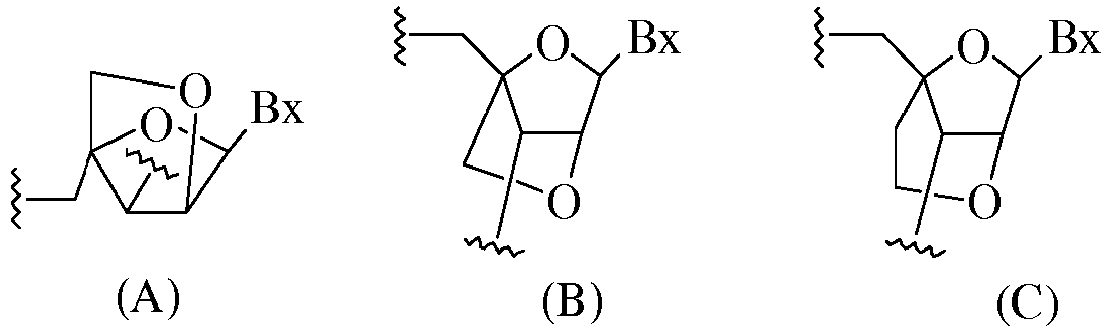
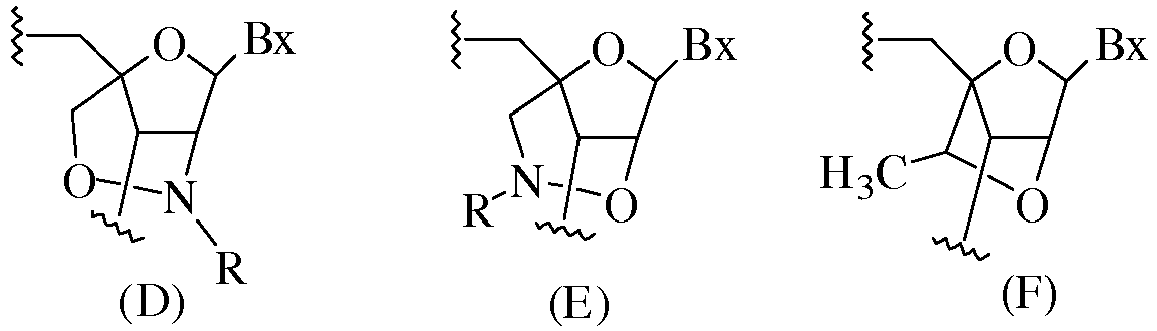

- Additional bicyclic sugar moieties are known in the art, for example: Singh et al., Chem. Commun., 1998, 4, 455-456; Koshkin et al., Tetrahedron, 1998, 54, 3607-3630; Wahlestedt et al., Proc. Natl. Acad. Sci. USA., 2000, 97, 5633-5638; Kumar et al., Bioorg. Med. Chem. Lett., 1998, 8, 2219-2222; Singh et al., J. Org. Chem., 1998, 63, 10035-10039; Srivastava et al., J. Am. Chem. Soc., 129(26) 8362-8379 (Jul. 4, 2007); Elayadi et al., Curr. Opinion Invens. Drugs, 2001, 2, 558-561; Braasch et al., Chem. Biol., 2001, 8, 1-7; Orum et al., Curr. Opinion Mol. Ther., 2001, 3, 239-243;
U.S. Patent Nos. 7,053,207 ,6,268,490 ,6,770,748 ,6,794,499 ,7,034,133 ,6,525,191 ,6,670,461 , and7,399,845 ;WO 2004/106356 ,WO 1994/14226 WO 2005/021570 , andWO 2007/134181 ; U.S. Patent Publication Nos.US2004/0171570 ,US2007/0287831 , andUS2008/0039618 ;U.S. Patent Serial Nos. 12/129,154 ,60/989,574 61/026,995 61/026,998 61/056,564 61/086,231 61/097,787 61/099,844 PCT/US2008/064591 ,PCT/US2008/066154 , andPCT/US2008/068922 . - In certain embodiments, bicyclic sugar moieties and nucleosides incorporating such bicyclic sugar moieties are further defined by isomeric configuration. For example, a nucleoside comprising a 4'-2' methylene-oxy bridge, may be in the α-L configuration or in the β-D configuration. Previously, α-L-methyleneoxy (4'-CH2-O-2') bicyclic nucleosides have been incorporated into antisense oligonucleotides that showed antisense activity (Frieden et al., Nucleic Acids Research, 2003, 21, 6365-6372).
- In certain embodiments, substituted sugar moieties comprise one or more non-bridging sugar substituent and one or more bridging sugar substituent (e.g., 5'-substituted and 4'-2' bridged sugars). (see,
PCT International Application WO 2007/134181 , published on 11/22/07, wherein LNA is substituted with, for example, a 5'-methyl or a 5'-vinyl group). - In certain embodiments, modified sugar moieties are sugar surrogates. In certain such embodiments, the oxygen atom of the naturally occuring sugar is substituted, e.g., with a sulfur, carbon or nitrogen atom. In certain such embodiments, such modified sugar moiety also comprises bridging and/or non-bridging substituents as described above. For example, certain sugar surogates comprise a 4'-sulfur atom and a substitution at the 2'-position (see, e.g., published U.S. Patent Application
US2005/0130923, published on June 16, 2005 ) and/or the 5' position. By way of additional example, carbocyclic bicyclic nucleosides having a 4'-2' bridge have been described (see, e.g., Freier et al., Nucleic Acids Research, 1997, 25(22), 4429-4443 and Albaek et al., J. Org. Chem., 2006, 71, 7731-7740). - In certain embodiments, sugar surrogates comprise rings having other than 5-atoms. For example, in certain embodiments, a sugar surrogate comprises a six-membered tetrahydropyran. Such tetrahydropyrans may be further modified or substituted. Nucleosides comprising such modified tetrahydropyrans include, but are not limited to, hexitol nucleic acid (HNA), anitol nucleic acid (ANA), manitol nucleic acid (MNA) (see Leumann, CJ. Bioorg. & Med. Chem. (2002) 10:841-854), fluoro HNA (F-HNA), and those compounds having Formula VII:
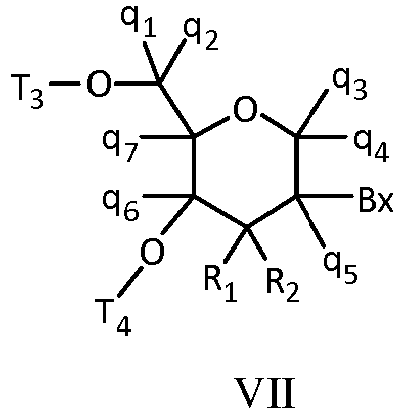
- Bx is a nucleobase moiety;
- T3 and T4 are each, independently, an internucleoside linking group linking the tetrahydropyran nucleoside analog to the antisense compound or one of T3 and T4 is an internucleoside linking group linking the tetrahydropyran nucleoside analog to the antisense compound and the other of T3 and T4 is H, a hydroxyl protecting group, a linked conjugate group, or a 5' or 3'-terminal group;
q1, q2, q3, q4, q5, q6 and q7 are each, independently, H, C1-C6 alkyl, substituted C1-C6 alkyl, C2-C6 alkenyl, substituted C2-C6 alkenyl, C2-C6 alkynyl, or substituted C2-C6 alkynyl; and - each of R1 and R2 is independently selected from among: hydrogen, halogen, substituted or unsubstituted alkoxy, NJ1J2, SJ1, N3, OC(=X)J1, OC(=X)NJ1J2, NJ3C(=X)NJ1J2, and CN, wherein X is O, S or NJ1, and each J1, J2, and J3 is, independently, H or C1-C6 alkyl.
- In certain embodiments, modified THP nucleosides of Formula VII are described wherein q1, q2, q3, q4, q5, q6 and q7 are each H. In certain embodiments, at least one of q1, q2, q3, q4, q5, q6 and q7 is other than H. In certain embodiments, at least one of q1, q2, q3, q4, q5, q6 and q7 is methyl. In certain embodiments, THP nucleosides of Formula VII are described wherein one of R1 and R2 is F. In certain embodiments, R1 is fluoro and R2 is H, R1 is methoxy and R2 is H, and R1 is methoxyethoxy and R2 is H.
- Many other bicyclic and tricyclic sugar and sugar surrogate ring systems are known in the art that can be used to modify nucleosides (see, e.g., review article: Leumann, J. C, Bioorganic & Medicinal Chemistry, 2002, 10, 841-854).
- In certain embodiments, sugar surrogates comprise rings having more than 5 atoms and more than one heteroatom. For example nucleosides comprising morpholino sugar moieties and their use in oligomeric compounds has been reported (see for example: Braasch et al., Biochemistry, 2002, 41, 4503-4510; and
U.S. Patents 5,698,685 ;5,166,315 ;5,185,444 ; and5,034,506 ). As used here, the term "morpholino" means a sugar surrogate having the following structure: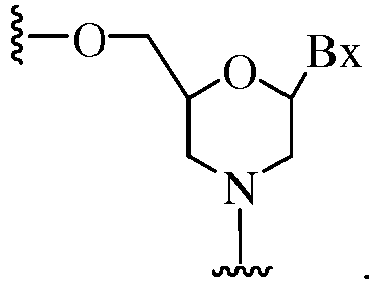
- Combinations of modifications are also described without limitation, such as 2'-F-5'-methyl substituted nucleosides (see
PCT International Application WO 2008/101157 Published on 8/21/08 for other disclosed 5', 2'-bis substituted nucleosides) and replacement of the ribosyl ring oxygen atom with S and further substitution at the 2'-position (see published U.S. Patent ApplicationUS2005-0130923, published on June 16, 2005 ) or alternatively 5'-substitution of a bicyclic nucleic acid (seePCT International Application WO 2007/134181 , published on 11/22/07 wherein a 4'-CH2-O-2' bicyclic nucleoside is further substituted at the 5' position with a 5'-methyl or a 5'-vinyl group). The synthesis and preparation of carbocyclic bicyclic nucleosides along with their oligomerization and biochemical studies have also been described (see, e.g., Srivastava et al., J. Am. Chem. Soc. 2007, 129(26), 8362-8379). - In certain embodiments, nucleosides comprise one or more unmodified nucleobases. In certain embodiments, nucleosides comprise one or more modified nucleobases.
- In certain embodiments, modified nucleobases are selected from: universal bases, hydrophobic bases, promiscuous bases, size-expanded bases, and fluorinated bases as defined herein. 5-substituted pyrimidines, 6-azapyrimidines and N-2, N-6 and 0-6 substituted purines, including 2-aminopropyl-adenine, 5-propynyluracil; 5-propynylcytosine; 5-hydroxymethyl cytosine, xanthine, hypoxanthine, 2-aminoadenine, 6-methyl and other alkyl derivatives of adenine and guanine, 2-propyl and other alkyl derivatives of adenine and guanine, 2-thiouracil, 2-thiothymine and 2-thiocytosine, 5-halouracil and cytosine, 5-propynyl (-C≡C-CH3) uracil and cytosine and other alkynyl derivatives of pyrimidine bases, 6-azo uracil, cytosine and thymine, 5-uracil (pseudouracil), 4-thiouracil, 8-halo, 8-amino, 8-thiol, 8-thioalkyl, 8-hydroxyl and other 8-substituted adenines and guanines, 5-halo particularly 5-bromo, 5-trifluoromethyl and other 5-substituted uracils and cytosines, 7-methylguanine and 7-methyladenine, 2-F-adenine, 2-amino-adenine, 8-azaguanine and 8-azaadenine, 7-deazaguanine and 7-deazaadenine, 3-deazaguanine and 3-deazaadenine, universal bases, hydrophobic bases, promiscuous bases, size-expanded bases, and fluorinated bases as defined herein. Further modified nucleobases include tricyclic pyrimidines such as phenoxazine cytidine([5,4-b][1,4]benzoxazin-2(3H)-one), phenothiazine cytidine (1H-pyrimido[5,4-b][1,4]benzothiazin-2(3H)-one), G-clamps such as a substituted phenoxazine cytidine (e.g., 9-(2-aminoethoxy)-H-pyrimido[5,4-b][1,4]benzoxazin-2(3H)-one), carbazole cytidine (2H-pyrimido[4,5-b]indol-2-one), pyridoindole cytidine (H-pyrido[3',2':4,5]pyrrolo[2,3-d]pyrimidin-2-one). Modified nucleobases may also include those in which the purine or pyrimidine base is replaced with other heterocycles, for example 7-deaza-adenine, 7-deazaguanosine, 2-aminopyridine and 2-pyridone. Further nucleobases include those disclosed in United States Patent No.
3,687,808 , those disclosed in The Concise Encyclopedia Of Polymer Science And Engineering, Kroschwitz, J.I., Ed., John Wiley & Sons, 1990, 858-859; those disclosed by Englisch et al., Angewandte Chemie, International Edition, 1991, 30, 613; and those disclosed by Sanghvi, Y.S., . - Representative United States patents that teach the preparation of certain of the above noted modified nucleobases as well as other modified nucleobases include without limitation,
U.S. 3,687,808 ;4,845,205 ;5,130,302 ;5,134,066 ;5,175,273 ;5,367,066 ;5,432,272 ;5,457,187 ;5,459,255 ;5,484,908 ;5,502,177 ;5,525,711 ;5,552,540 ;5,587,469 ;5,594,121 ;5,596,091 ;5,614,617 ;5,645,985 ;5,681,941 ;5,750,692 ;5,763,588 ;5,830,653 and6,005,096 , certain of which are commonly owned with the instant application. - Oligomeric compounds can comprise linked nucleosides. In such embodiments, nucleosides may be linked together using any internucleoside linkage. The two main classes of internucleoside linking groups are defined by the presence or absence of a phosphorus atom. Representative phosphorus containing internucleoside linkages include, but are not limited to, phosphodiesters (P=O), phosphotriesters, methylphosphonates, phosphoramidate, and phosphorothioates (P=S). Representative non-phosphorus containing internucleoside linking groups include, but are not limited to, methylenemethylimino (-CH2-N(CH3)-O-CH2-), thiodiester (-O-C(O)-S-), thionocarbamate (-O-C(O)(NH)-S-); siloxane (-O-Si(H)2-O-); and N,N'-dimethylhydrazine (-CH2-N(CH3)-N(CH3)-). Modified linkages, compared to natural phosphodiester linkages, can be used to alter, typically increase, nuclease resistance of the oligomeric compound. In certain embodiments, internucleoside linkages having a chiral atom can be prepared as a racemic mixture, or as separate enantiomers. Representative chiral linkages include, but are not limited to, alkylphosphonates and phosphorothioates. Methods of preparation of phosphorous-containing and non-phosphorous-containing internucleoside linkages are well known to those skilled in the art.
- The oligonucleotides described herein contain one or more asymmetric centers and thus give rise to enantiomers, diastereomers, and other stereoisomeric configurations that may be defined, in terms of absolute stereochemistry, as (R) or (S), α or β such as for sugar anomers, or as (D) or (L) such as for amino acids etc. Included in the antisense compounds described herein are all such possible isomers, as well as their racemic and optically pure forms.
- Neutral internucleoside linkages include without limitation, phosphotriesters, methylphosphonates, MMI (3'-CH2-N(CH3)-O-5'), amide-3 (3'-CH2-C(=O)-N(H)-5'), amide-4 (3'-CH2-N(H)-C(=O)-5'), formacetal (3'-O-CH2-O-5'), and thioformacetal (3'-S-CH2-O-5'). Further neutral internucleoside linkages include nonionic linkages comprising siloxane (dialkylsiloxane), carboxylate ester, carboxamide, sulfide, sulfonate ester and amides (See for example: Carbohydrate Modifications in Antisense Research; Y.S. Sanghvi and P.D. Cook, Eds., ACS Symposium Series 580; Chapters 3 and 4, 40-65). Further neutral internucleoside linkages include nonionic linkages comprising mixed N, O, S and CH2 component parts.
- In certain embodiments, the oligomeric compounds comprise oligonucleotides. In certain embodiments, such oligonucleotides comprise one or more chemical modification. In certain embodiments, chemically modified oligonucleotides comprise one or more modified nucleosides. In certain embodiments, chemically modified oligonucleotides comprise one or more modified nucleosides comprising modified sugars. In certain embodiments, chemically modified oligonucleotides comprise one or more modified nucleosides comprising one or more modified nucleobases. In certain embodiments, chemically modified oligonucleotides comprise one or more modified internucleoside linkages. In certain embodiments, the chemical modifications (sugar modifications, nucleobase modifications, and/or linkage modifications) define a pattern or motif. In certain embodiments, the patterns of chemical modifications of sugar moieties, internucleoside linkages, and nucleobases are each independent of one another. Thus, an oligonucleotide may be described by its sugar modification motif, internucleoside linkage motif and/or nucleobase modification motif (as used herein, nucleobase modification motif describes the chemical modifications to the nucleobases independent of the sequence of nucleobases).
- In certain embodiments, oligonucleotides comprise one or more type of modified sugar moieties and/or naturally occurring sugar moieties arranged along an oligonucleotide or region thereof in a defined pattern or sugar modification motif. Such motifs may include any of the sugar modifications discussed herein and/or other known sugar modifications.
- In certain embodiments, the oligonucleotides comprise or consist of a region having a gapmer sugar modification motif, which comprises two external regions or "wings" and an internal region or "gap." The three regions of a gapmer motif (the 5'-wing, the gap, and the 3'-wing) form a contiguous sequence of nucleosides wherein at least some of the sugar moieties of the nucleosides of each of the wings differ from at least some of the sugar moieties of the nucleosides of the gap. Specifically, at least the sugar moieties of the nucleosides of each wing that are closest to the gap (the 3'-most nucleoside of the 5'-wing and the 5'-most nucleoside of the 3'-wing) differ from the sugar moiety of the neighboring gap nucleosides, thus defining the boundary between the wings and the gap. In certain embodiments, the sugar moieties within the gap are the same as one another. In certain embodiments, the gap includes one or more nucleoside having a sugar moiety that differs from the sugar moiety of one or more other nucleosides of the gap. In certain embodiments, the sugar modification motifs of the two wings are the same as one another (symmetric gapmer). In certain embodiments, the sugar modification motifs of the 5'-wing differs from the sugar modification motif of the 3'-wing (asymmetric gapmer). In certain embodiments, oligonucleotides comprise 2'-MOE modified nucleosides in the wings and 2'-F modified nucleosides in the gap.
- In certain embodiments, oligonucleotides are fully modified. In certain such embodiments, oligonucleotides are uniformly modified. In certain embodiments, oligonucleotides are uniform 2'-MOE. In certain embodiments, oligonucleotides are uniform 2'-F. In certain embodiments, oligonucleotides are uniform morpholino. In certain embodiments, oligonucleotides are uniform BNA. In certain embodiments, oligonucleotides are uniform LNA. In certain embodiments, oligonucleotides are uniform cEt.
- In certain embodiments, oligonucleotides comprise a uniformly modified region and additional nucleosides that are unmodified or differently modified. In certain embodiments, the uniformly modified region is at least 5, 10, 15, or 20 nucleosides in length. In certain embodiments, the uniform region is a 2'-MOE region. In certain embodiments, the uniform region is a 2'-F region. In certain embodiments, the uniform region is a morpholino region. In certain embodiments, the uniform region is a BNA region. In certain embodiments, the uniform region is a LNA region. In certain embodiments, the uniform region is a cEt region.
- In certain embodiments, the oligonucleotide does not comprise more than 4 contiguous unmodified 2'-deoxynucleosides. In certain circumstances, antisense oligonucleotides comprising more than 4 contiguous 2'-deoxynucleosides activate RNase H, resulting in cleavage of the target RNA. In certain embodiments, such cleavage is avoided by not having more than 4 contiguous 2'-deoxynucleosides, for example, where alteration of splicing and not cleavage of a target RNA is desired.
- In certain embodiments, oligonucleotides comprise modified internucleoside linkages arranged along the oligonucleotide or region thereof in a defined pattern or modified internucleoside linkage motif. In certain embodiments, internucleoside linkages are arranged in a gapped motif, as described above for sugar modification motif. In such embodiments, the internucleoside linkages in each of two wing regions are different from the internucleoside linkages in the gap region. In certain embodiments, the internucleoside linkages in the wings are phosphodiester and the internucleoside linkages in the gap are phosphorothioate. The sugar modification motif is independently selected, so such oligonucleotides having a gapped internucleoside linkage motif may or may not have a gapped sugar modification motif and if it does have a gapped sugar motif, the wing and gap lengths may or may not be the same.
- In certain embodiments, oligonucleotides comprise a region having an alternating internucleoside linkage motif. In certain embodiments, oligonucleotides comprise a region of uniformly modified internucleoside linkages. In certain such embodiments, the oligonucleotide comprises a region that is uniformly linked by phosphorothioate internucleoside linkages. In certain embodiments, the oligonucleotide is uniformly linked by phosphorothioate. In certain embodiments, each internucleoside linkage of the oligonucleotide is selected from phosphodiester and phosphorothioate. In certain embodiments, each internucleoside linkage of the oligonucleotide is selected from phosphodiester and phosphorothioate and at least one internucleoside linkage is phosphorothioate.
- In certain embodiments, the oligonucleotide comprises at least 6 phosphorothioate internucleoside linkages. In certain embodiments, the oligonucleotide comprises at least 8 phosphorothioate internucleoside linkages. In certain embodiments, the oligonucleotide comprises at least 10 phosphorothioate internucleoside linkages. In certain embodiments, the oligonucleotide comprises at least one block of at least 6 consecutive phosphorothioate internucleoside linkages. In certain embodiments, the oligonucleotide comprises at least one block of at least 8 consecutive phosphorothioate internucleoside linkages. In certain embodiments, the oligonucleotide comprises at least one block of at least 10 consecutive phosphorothioate internucleoside linkages. In certain embodiments, the oligonucleotide comprises at least block of at least one 12 consecutive phosphorothioate internucleoside linkages. In certain such embodiments, at least one such block is located at the 3' end of the oligonucleotide. In certain such embodiments, at least one such block is located within 3 nucleosides of the 3' end of the oligonucleotide.
- In certain embodiments, oligonucleotides comprise chemical modifications to nucleobases arranged along the oligonucleotide or region thereof in a defined pattern or nucleobases modification motif. In certain such embodiments, nucleobase modifications are arranged in a gapped motif. In certain embodiments, nucleobase modifications are arranged in an alternating motif. In certain embodiments, each nucleobase is modified. In certain embodiments, none of the nucleobases is chemically modified.
- In certain embodiments, oligonucleotides comprise a block of modified nucleobases. In certain such embodiments, the block is at the 3'-end of the oligonucleotide. In certain embodiments the block is within 3 nucleotides of the 3'-end of the oligonucleotide. In certain such embodiments, the block is at the 5'-end of the oligonucleotide. In certain embodiments the block is within 3 nucleotides of the 5'-end of the oligonucleotide.
- In certain embodiments, nucleobase modifications are a function of the natural base at a particular position of an oligonucleotide. For example, in certain embodiments each purine or each pyrimidine in an oligonucleotide is modified. In certain embodiments, each adenine is modified. In certain embodiments, each guanine is modified. In certain embodiments, each thymine is modified. In certain embodiments, each cytosine is modified. In certain embodiments, each uracil is modified.
- In certain embodiments, some, all, or none of the cytosine moieties in an oligonucleotide are 5-methyl cytosine moieties. Herein, 5-methyl cytosine is not a "modified nucleobase." Accordingly, unless otherwise indicated, unmodified nucleobases include both cytosine residues having a 5-methyl and those lacking a 5 methyl. In certain embodiments, the methylation state of all or some cytosine nucleobases is specified.
- In certain embodiments, oligomeric compounds include oligonucleotides of any of a variety of ranges of lengths. In certain embodiments, oligomeric compounds or oligonucleotides consist of X to Y linked nucleosides, where X represents the fewest number of nucleosides in the range and Y represents the largest number of nucleosides in the range. In certain such embodiments, X and Y are each independently selected from 8, 9, 10, 11, 12, 13, 14, 15, 16, 17, 18, 19, 20, 21, 22, 23, 24, 25, 26, 27, 28, 29, 30, 31, 32, 33, 34, 35, 36, 37, 38, 39, 40, 41, 42, 43, 44, 45, 46, 47, 48, 49, and 50; provided that X≤Y. For example, in certain embodiments, oligomeric compounds comprise oligonucleotides consisting of 8 to 9, 8 to 10, 8 to 11, 8 to 12, 8 to 13, 8 to 14, 8 to 15, 8 to 16, 8 to 17, 8 to 18, 8 to 19, 8 to 20, 8 to 21, 8 to 22, 8 to 23, 8 to 24, 8 to 25, 8 to 26, 8 to 27, 8 to 28, 8 to 29, 8 to 30, 9 to 10, 9 to 11, 9 to 12, 9 to 13, 9 to 14, 9 to 15, 9 to 16, 9 to 17, 9 to 18, 9 to 19, 9 to 20, 9 to 21, 9 to 22, 9 to 23, 9 to 24, 9 to 25, 9 to 26, 9 to 27, 9 to 28, 9 to 29, 9 to 30, 10 to 11, 10 to 12, 10 to 13, 10 to 14, 10 to 15, 10 to 16, 10 to 17, 10 to 18, 10 to 19, 10 to 20, 10 to 21, 10 to 22, 10 to 23, 10 to 24, 10 to 25, 10 to 26, 10 to 27, 10 to 28, 10 to 29, 10 to 30, 11 to 12, 11 to 13, 11 to 14, 11 to 15, 11 to 16, 11 to 17, 11 to 18, 11 to 19, 11 to 20, 11 to 21, 11 to 22, 11 to 23, 11 to 24, 11 to 25, 11 to 26, 11 to 27, 11 to 28, 11 to 29, 11 to 30, 12 to 13, 12 to 14, 12 to 15, 12 to 16, 12 to 17, 12 to 18, 12 to 19, 12 to 20, 12 to 21, 12 to 22, 12 to 23, 12 to 24, 12 to 25, 12 to 26, 12 to 27, 12 to 28, 12 to 29, 12 to 30, 13 to 14, 13 to 15, 13 to 16, 13 to 17, 13 to 18, 13 to 19, 13 to 20, 13 to 21, 13 to 22, 13 to 23, 13 to 24, 13 to 25, 13 to 26, 13 to 27, 13 to 28, 13 to 29, 13 to 30, 14 to 15, 14 to 16, 14 to 17, 14 to 18, 14 to 19, 14 to 20, 14 to 21, 14 to 22, 14 to 23, 14 to 24, 14 to 25, 14 to 26, 14 to 27, 14 to 28, 14 to 29, 14 to 30, 15 to 16, 15 to 17, 15 to 18, 15 to 19, 15 to 20, 15 to 21, 15 to 22, 15 to 23, 15 to 24, 15 to 25, 15 to 26, 15 to 27, 15 to 28, 15 to 29, 15 to 30, 16 to 17, 16 to 18, 16 to 19, 16 to 20, 16 to 21, 16 to 22, 16 to 23, 16 to 24, 16 to 25, 16 to 26, 16 to 27, 16 to 28, 16 to 29, 16 to 30, 17 to 18, 17 to 19, 17 to 20, 17 to 21, 17 to 22, 17 to 23, 17 to 24, 17 to 25, 17 to 26, 17 to 27, 17 to 28, 17 to 29, 17 to 30, 18 to 19, 18 to 20, 18 to 21, 18 to 22, 18 to 23, 18 to 24, 18 to 25, 18 to 26, 18 to 27, 18 to 28, 18 to 29, 18 to 30, 19 to 20, 19 to 21, 19 to 22, 19 to 23, 19 to 24, 19 to 25, 19 to 26, 19 to 29, 19 to 28, 19 to 29, 19 to 30, 20 to 21, 20 to 22, 20 to 23, 20 to 24, 20 to 25, 20 to 26, 20 to 27, 20 to 28, 20 to 29, 20 to 30, 21 to 22, 21 to 23, 21 to 24, 21 to 25, 21 to 26, 21 to 27, 21 to 28, 21 to 29, 21 to 30, 22 to 23, 22 to 24, 22 to 25, 22 to 26, 22 to 27, 22 to 28, 22 to 29, 22 to 30, 23 to 24, 23 to 25, 23 to 26, 23 to 27, 23 to 28, 23 to 29, 23 to 30, 24 to 25, 24 to 26, 24 to 27, 24 to 28, 24 to 29, 24 to 30, 25 to 26, 25 to 27, 25 to 28, 25 to 29, 25 to 30, 26 to 27, 26 to 28, 26 to 29, 26 to 30, 27 to 28, 27 to 29, 27 to 30, 28 to 29, 28 to 30, or 29 to 30 linked nucleosides. In embodiments where the number of nucleosides of an oligomeric compound or oligonucleotide is limited, whether to a range or to a specific number, the oligomeric compound or oligonucleotide may, nonetheless further comprise additional other substituents. For example, an oligonucleotide comprising 8-30 nucleosides excludes oligonucleotides having 31 nucleosides, but, unless otherwise indicated, such an oligonucleotide may further comprise, for example one or more conjugates, terminal groups, or other substituents. In certain embodiments, a gapmer oligonucleotide has any of the above lengths.
- One of skill in the art will appreciate that certain lengths may not be possible for certain motifs. For example: a gapmer having a 5'-wing region consisting of four nucleotides, a gap consisting of at least six nucleotides, and a 3'-wing region consisting of three nucleotides cannot have an overall length less than 13 nucleotides. Thus, one would understand that the lower length limit is 13 and that the limit of 10 in "10-20" has no effect in that embodiment.
- Further, where an oligonucleotide is described by an overall length range and by regions having specified lengths, and where the sum of specified lengths of the regions is less than the upper limit of the overall length range, the oligonucleotide may have additional nucleosides, beyond those of the specified regions, provided that the total number of nucleosides does not exceed the upper limit of the overall length range. For example, an oligonucleotide consisting of 20-25 linked nucleosides comprising a 5'-wing consisting of 5 linked nucleosides; a 3'-wing consisting of 5 linked nucleosides and a central gap consisting of 10 linked nucleosides (5+5+10=20) may have up to 5 nucleosides that are not part of the 5'-wing, the 3'-wing, or the gap (before reaching the overall length limitation of 25). Such additional nucleosides may be 5' of the 5'-wing and/or 3' of the 3' wing.
- In certain embodiments, oligonucleotides are characterized by their sugar motif, internucleoside linkage motif, nucleobase modification motif and overall length. In certain embodiments, such parameters are each independent of one another. Thus, each internucleoside linkage of an oligonucleotide having a gapmer sugar motif may be modified or unmodified and may or may not follow the gapmer modification pattern of the sugar modifications. Thus, the internucleoside linkages within the wing regions of a sugar-gapmer may be the same or different from one another and may be the same or different from the internucleoside linkages of the gap region. Likewise, such sugar-gapmer oligonucleotides may comprise one or more modified nucleobase independent of the gapmer pattern of the sugar modifications. Herein if a description of an oligonucleotide or oligomeric compound is silent with respect to one or more parameter, such parameter is not limited. Thus, an oligomeric compound described only as having a gapmer sugar motif without further description may have any length, internucleoside linkage motif, and nucleobase modification motif. Unless otherwise indicated, all chemical modifications are independent of nucleobase sequence.
- In certain embodiments, oligomeric compounds are modified by attachment of one or more conjugate groups. In general, conjugate groups modify one or more properties of the attached oligomeric compound including but not limited to pharmacodynamics, pharmacokinetics, stability, binding, absorption, cellular distribution, cellular uptake, charge and clearance. Conjugate groups are routinely used in the chemical arts and are linked directly or via an optional conjugate linking moiety or conjugate linking group to a parent compound such as an oligomeric compound, such as an oligonucleotide. Conjugate groups includes without limitation, intercalators, reporter molecules, polyamines, polyamides, polyethylene glycols, thioethers, polyethers, cholesterols, thiocholesterols, cholic acid moieties, folate, lipids, phospholipids, biotin, phenazine, phenanthridine, anthraquinone, adamantane, acridine, fluoresceins, rhodamines, coumarins and dyes. Certain conjugate groups have been described previously, for example: cholesterol moiety (Letsinger et al., Proc. Natl. Acad. Sci. USA, 1989, 86, 6553-6556), cholic acid (Manoharan et al., Bioorg. Med. Chem. Let., 1994, 4, 1053-1060), a thioether, e.g., hexyl-S-tritylthiol (Manoharan et al., Ann. N.Y. Acad. Sci., 1992, 660, 306-309; Manoharan et al., Bioorg. Med. Chem. Let., 1993, 3, 2765-2770), a thiocholesterol (Oberhauser et al., Nucleic Acids Res., 1992, 20, 533-538), an aliphatic chain, e.g., do-decan-diol or undecyl residues (Saison-Behmoaras et al., EMBO J., 1991, 10, 1111-1118; Kabanov et al., FEBS Lett., 1990, 259, 327-330; Svinarchuk et al., Biochimie, 1993, 75, 49-54), a phospholipid, e.g., di-hexadecyl-rac-glycerol or triethyl-
ammonium 1,2-di-O-hexadecyl-rac-glycero-3-H-phosphonate (Manoharan et al., Tetrahedron Lett., 1995, 36, 3651-3654; Shea et al., Nucleic Acids Res., 1990, 18, 3777-3783), a polyamine or a polyethylene glycol chain (Manoharan et al., Nucleosides & Nucleotides, 1995, 14, 969-973), or adamantane acetic acid (Manoharan et al., Tetrahedron Lett., 1995, 36, 3651-3654), a palmityl moiety (Mishra et al., Biochim. Biophys. Acta, 1995, 1264, 229-237), or an octadecylamine or hexylamino-carbonyl-oxycholesterol moiety (Crooke et al., J. Pharmacol. Exp. Ther., 1996, 277, 923-937). - In certain embodiments, a conjugate group comprises an active drug substance, for example, aspirin, warfarin, phenylbutazone, ibuprofen, suprofen, fen-bufen, ketoprofen, (S)-(+)-pranoprofen, carprofen, dansylsarcosine, 2,3,5-triiodobenzoic acid, flufenamic acid, folinic acid, a benzothiadiazide, chlorothiazide, a diazepine, indo-methicin, a barbiturate, a cephalosporin, a sulfa drug, an antidiabetic, an antibacterial or an antibiotic.
- In certain embodiments, conjugate groups are directly attached to oligonucleotides in oligomeric compounds. In certain embodiments, conjugate groups are attached to oligonucleotides by a conjugate linking group. In certain such embodiments, conjugate linking groups, including, but not limited to, bifunctional linking moieties such as those known in the art are amenable to the compounds described herein. Conjugate linking groups are useful for attachment of conjugate groups, such as chemical stabilizing groups, functional groups, reporter groups and other groups to selective sites in a parent compound such as for example an oligomeric compound. In general a bifunctional linking moiety comprises a hydrocarbyl moiety having two functional groups. One of the functional groups is selected to bind to a parent molecule or compound of interest and the other is selected to bind essentially any selected group such as a chemical functional group or a conjugate group. In some embodiments, the conjugate linker comprises a chain structure or an oligomer of repeating units such as ethylene glycol or amino acid units. Examples of functional groups that are routinely used in a bifunctional linking moiety include, but are not limited to, electrophiles for reacting with nucleophilic groups and nucleophiles for reacting with electrophilic groups. In some embodiments, bifunctional linking moieties include amino, hydroxyl, carboxylic acid, thiol, unsaturations (e.g., double or triple bonds), and the like.
- Some nonlimiting examples of conjugate linking moieties include pyrrolidine, 8-amino-3,6-dioxaoctanoic acid (ADO), succinimidyl 4-(N-maleimidomethyl) cyclohexane-1-carboxylate (SMCC) and 6-aminohexanoic acid (AHEX or AHA). Other linking groups include, but are not limited to, substituted C1-C10 alkyl, substituted or unsubstituted C2-C10 alkenyl or substituted or unsubstituted C2-C10 alkynyl, wherein a nonlimiting list of preferred substituent groups includes hydroxyl, amino, alkoxy, carboxy, benzyl, phenyl, nitro, thiol, thioalkoxy, halogen, alkyl, aryl, alkenyl and alkynyl.
- Conjugate groups may be attached to either or both ends of an oligonucleotide (terminal conjugate groups) and/or at any internal position.
- In certain embodiments, conjugate groups are at the 3'-end of an oligonucleotide of an oligomeric compound. In certain embodiments, conjugate groups are near the 3'-end. In certain embodiments, conjugates are attached at the 3'end of an oligomeric compound, but before one or more terminal group nucleosides. In certain embodiments, conjugate groups are placed within a terminal group.
- Described are oligomeric compounds. In certain embodiments, oligomeric compounds comprise an oligonucleotide. In certain embodiments, an oligomeric compound comprises an oligonucleotide and one or more conjugate and/or terminal groups. Such conjugate and/or terminal groups may be added to oligonucleotides having any of the chemical motifs discussed above. Thus, for example, an oligomeric compound comprising an oligonucleotide having region of alternating nucleosides may comprise a terminal group.
- In certain embodiments, oligomeric compounds are antisense compounds. Such antisense compounds are capable of hybridizing to a target nucleic acid, resulting in at least one antisense activity. In certain embodiments, antisense compounds specifically hybridize to one or more target nucleic acid. In certain embodiments, a specifically hybridizing antisense compound has a nucleobase sequence comprising a region having sufficient complementarity to a target nucleic acid to allow hybridization and result in antisense activity and insufficient complementarity to any non-target so as to avoid non-specific hybridization to any non-target nucleic acid sequences under conditions in which specific hybridization is desired (e.g., under physiological conditions for in vivo or therapeutic uses, and under conditions in which assays are performed in the case of in vitro assays).
- In certain embodiments, antisense compounds comprise oligonucleotides that are fully complementary to the target nucleic acid over the entire length of the oligonucleotide. In certain embodiments, oligonucleotides are 99% complementary to the target nucleic acid. In certain embodiments, oligonucleotides are 95% complementary to the target nucleic acid. In certain embodiments, such oligonucleotides are 90% complementary to the target nucleic acid.
- In certain embodiments, such oligonucleotides are 85% complementary to the target nucleic acid. In certain embodiments, such oligonucleotides are 80% complementary to the target nucleic acid. In certain embodiments, an antisense compound comprises a region that is fully complementary to a target nucleic acid and is at least 80% complementary to the target nucleic acid over the entire length of the oligonucleotide. In certain such embodiments, the region of full complementarity is from 6 to 14 nucleobases in length.
- In certain embodiments, antisense compounds comprise or consist of an oligonucleotide comprising a region that is complementary to a target nucleic acid. In certain embodiments, the target nucleic acid is an endogenous RNA molecule. In certain embodiments, the target nucleic acid is a pre-mRNA. In certain embodiments, the target nucleic acid is an IKBKAP transcript. In certain embodiments, the target RNA is an IKBKAP pre-mRNA.
- In certain embodiments, an antisense compound is complementary to a region of an IKBKAP pre-mRNA. In certain embodiments, an antisense compound is complementary within a region of an IKBKAP
pre-mRNA comprising intron 19,intron 20, orexon 20. In certain embodiments, an antisense compound is complementary to a region of an IKBKAP pre-mRNA consisting ofintron 19,intron 20, orexon 20. In certain embodiments, an antisense compound is complementary to a region of an IKBKAP pre-mRNA consisting ofexon 20 orintron 20. In certain embodiments, an antisense compound is complementary to a region of an IKBKAP pre-mRNA withinintron 19. In certain embodiments, an antisense compound is complementary to a region of an IKBKAP pre-mRNA withinintron 20. In certain embodiments, an antisense compound is complementary to a region of an IKBKAP pre-mRNA withinexon 20. - In certain embodiments, an antisense oligonucleotide modulates splicing of a pre-mRNA. In certain embodiments, an antisense oligonucleotide modulates splicing an IKBKAP pre-mRNA. In certain such embodiments, the IKBKAP pre-mRNA is transcribed from a mutant variant of IKBKAP. In certain embodiments, the mutant variant comprises an aberrant splice site. In certain embodiments, the aberrant splice site of the mutant variant comprises a mutation that weakens the 5'-splice site of
exon 20. In certain embodiments, an antisense oligonucleotide reduces aberrant splicing of an IKBKAP pre-mRNA. In certain embodiments, an antisense oligonucleotide increases the amount ofexon 20 included in normally spliced IKBKAP mRNA. In certain embodiments, an antisense oligonucleotide increases the amount ofexon 20 skipped IKBKAP mRNA. - In certain embodiments, pharmaceutical compositions comprise one or more antisense compound. In certain embodiments, such pharmaceutical composition comprises a suitable pharmaceutically acceptable diluent or carrier. In certain embodiments, a pharmaceutical composition comprises a sterile saline solution and one or more antisense compound. In certain embodiments, such pharmaceutical composition consists of a sterile saline solution and one or more antisense compound. In certain embodiments, the sterile saline is pharmaceutical grade saline. In certain embodiments, a pharmaceutical composition comprises one or more antisense compound and sterile water. In certain embodiments, a pharmaceutical composition consists of one or more antisense compound and sterile water. In certain embodiments, the sterile saline is pharmaceutical grade water. In certain embodiments, a pharmaceutical composition comprises one or more antisense compound and phosphate-buffered saline (PBS). In certain embodiments, a pharmaceutical composition consists of one or more antisense compound and sterile phosphate-buffered saline (PBS). In certain embodiments, the sterile saline is pharmaceutical grade PBS.
- In certain embodiments, antisense compounds may be admixed with pharmaceutically acceptable active and/or inert substances for the preparation of pharmaceutical compositions or formulations. Compositions and methods for the formulation of pharmaceutical compositions depend on a number of criteria, including, but not limited to, route of administration, extent of disease, or dose to be administered.
- Pharmaceutical compositions comprising antisense compounds encompass any pharmaceutically acceptable salts, esters, or salts of such esters. In certain embodiments, pharmaceutical compositions comprising antisense compounds comprise one or more oligonucleotide which, upon administration to an animal, including a human, is capable of providing (directly or indirectly) the biologically active metabolite or residue thereof. Accordingly, for example, the disclosure is also drawn to pharmaceutically acceptable salts of antisense compounds, prodrugs, pharmaceutically acceptable salts of such prodrugs, and other bioequivalents. Suitable pharmaceutically acceptable salts include, but are not limited to, sodium and potassium salts.
- A prodrug can include the incorporation of additional nucleosides at one or both ends of an oligomeric compound which are cleaved by endogenous nucleases within the body, to form the active antisense oligomeric compound.
- Lipid moieties have been used in nucleic acid therapies in a variety of methods. In certain such methods, the nucleic acid is introduced into preformed liposomes or lipoplexes made of mixtures of cationic lipids and neutral lipids. In certain methods, DNA complexes with mono- or poly-cationic lipids are formed without the presence of a neutral lipid. In certain embodiments, a lipid moiety is selected to increase distribution of a pharmaceutical agent to a particular cell or tissue. In certain embodiments, a lipid moiety is selected to increase distribution of a pharmaceutical agent to fat tissue. In certain embodiments, a lipid moiety is selected to increase distribution of a pharmaceutical agent to muscle tissue.
- In certain embodiments, pharmaceutical compositions described herein comprise one or more modified oligonucleotides and one or more excipients. In certain such embodiments, excipients are selected from water, salt solutions, alcohol, polyethylene glycols, gelatin, lactose, amylase, magnesium stearate, talc, silicic acid, viscous paraffin, hydroxymethylcellulose and polyvinylpyrrolidone.
- In certain embodiments, a pharmaceutical composition described herein comprises a delivery system. Examples of delivery systems include, but are not limited to, liposomes and emulsions. Certain delivery systems are useful for preparing certain pharmaceutical compositions including those comprising hydrophobic compounds. In certain embodiments, certain organic solvents such as dimethylsulfoxide are used.
- In certain embodiments, a pharmaceutical composition described herein comprises one or more tissue-specific delivery molecules designed to deliver the disclosed one or more pharmaceutical agents to specific tissues or cell types. For example, in certain embodiments, pharmaceutical compositions include liposomes coated with a tissue-specific antibody.
- In certain embodiments, a pharmaceutical composition described herein comprises a co-solvent system. Certain of such co-solvent systems comprise, for example, benzyl alcohol, a nonpolar surfactant, a water-miscible organic polymer, and an aqueous phase. In certain embodiments, such co-solvent systems are used for hydrophobic compounds. A non-limiting example of such a co-solvent system is the VPD co-solvent system, which is a solution of absolute ethanol comprising 3% w/v benzyl alcohol, 8% w/v of the
nonpolar surfactant Polysorbate 80™ and 65% w/v polyethylene glycol 300. The proportions of such co-solvent systems may be varied considerably without significantly altering their solubility and toxicity characteristics. Furthermore, the identity of co-solvent components may be varied: for example, other surfactants may be used instead ofPolysorbate 80™; the fraction size of polyethylene glycol may be varied; other biocompatible polymers may replace polyethylene glycol, e.g., polyvinyl pyrrolidone; and other sugars or polysaccharides may substitute for dextrose. - In certain embodiments, a pharmaceutical composition described herein is prepared for oral administration. In certain embodiments, pharmaceutical compositions are prepared for buccal administration.
- In certain embodiments, a pharmaceutical composition is prepared for administration by injection (e.g., intravenous, subcutaneous, intramuscular, etc.). In certain of such embodiments, a pharmaceutical composition comprises a carrier and is formulated in aqueous solution, such as water or physiologically compatible buffers such as Hanks's solution, Ringer's solution, or physiological saline buffer. In certain embodiments, other ingredients are included (e.g., ingredients that aid in solubility or serve as preservatives). In certain embodiments, injectable suspensions are prepared using appropriate liquid carriers, suspending agents and the like. Certain pharmaceutical compositions for injection are presented in unit dosage form, e.g., in ampoules or in multi-dose containers. Certain pharmaceutical compositions for injection are suspensions, solutions or emulsions in oily or aqueous vehicles, and may contain formulatory agents such as suspending, stabilizing and/or dispersing agents. Certain solvents suitable for use in pharmaceutical compositions for injection include, but are not limited to, lipophilic solvents and fatty oils, such as sesame oil, synthetic fatty acid esters, such as ethyl oleate or triglycerides, and liposomes. Aqueous injection suspensions may contain substances that increase the viscosity of the suspension, such as sodium carboxymethyl cellulose, sorbitol, or dextran. Optionally, such suspensions may also contain suitable stabilizers or agents that increase the solubility of the pharmaceutical agents to allow for the preparation of highly concentrated solutions.
- In certain embodiments, a pharmaceutical composition is prepared for transmucosal administration. In certain of such embodiments penetrants appropriate to the barrier to be permeated are used in the formulation. Such penetrants are generally known in the art.
- In certain embodiments, a pharmaceutical composition described herein comprises an oligonucleotide in a therapeutically effective amount. In certain embodiments, the therapeutically effective amount is sufficient to prevent, alleviate or ameliorate symptoms of a disease or to prolong the survival of the subject being treated. Determination of a therapeutically effective amount is well within the capability of those skilled in the art.
- In certain embodiments, one or more modified oligonucleotide described herein is formulated as a prodrug. In certain embodiments, upon in vivo administration, a prodrug is chemically converted to the biologically, pharmaceutically or therapeutically more active form of an oligonucleotide. In certain embodiments, prodrugs are useful because they are easier to administer than the corresponding active form. For example, in certain instances, a prodrug may be more bioavailable (e.g., through oral administration) than is the corresponding active form. In certain instances, a prodrug may have improved solubility compared to the corresponding active form. In certain embodiments, prodrugs are less water soluble than the corresponding active form. In certain instances, such prodrugs possess superior transmittal across cell membranes, where water solubility is detrimental to mobility. In certain embodiments, a prodrug is an ester. In certain such embodiments, the ester is metabolically hydrolyzed to carboxylic acid upon administration. In certain instances the carboxylic acid containing compound is the corresponding active form. In certain embodiments, a prodrug comprises a short peptide (polyaminoacid) bound to an acid group. In certain of such embodiments, the peptide is cleaved upon administration to form the corresponding active form.
- Described are compositions and methods for reducing the amount or activity of a target nucleic acid in a cell. Optionally, the cell is in an animal. Optionally, the animal is a mammal. Optionally, the animal is a rodent. Optionally, the animal is a primate. Optionally, the animal is a non-human primate. Optionally, the animal is a human.
- Described are methods of administering a pharmaceutical composition comprising a described oligomeric compound to an animal. Suitable administration routes include, but are not limited to, oral, rectal, transmucosal, intestinal, enteral, topical, suppository, through inhalation, intrathecal, intracerebroventricular, intraperitoneal, intranasal, intraocular, intratumoral, and parenteral (e.g., intravenous, intramuscular, intramedullary, and subcutaneous). Optionally, pharmaceutical intrathecals are administered to achieve local rather than systemic exposures. For example, pharmaceutical compositions may be injected directly in the area of desired effect (e.g., into the eyes, ears).
- Optionally, a pharmaceutical composition is administered to an animal having at least one symptom associated with Familial Dysautonomia. Optionally, such administration results in amelioration of at least one symptom. Optionally, administration of a pharmaceutical composition to an animal results in a decrease of aberrantly spliced IKBKAP mRNA in a cell of the animal. Optionally, such administration results in an increase in normally spliced IKBKAP mRNA and/or an increase in
mRNA containing exon 20. Optionally, such administration results in an increase in normally spliced IKBKAP mRNA and/or an increase in mRNA containing exons 20-37. Optionally, such administration results in an increase in normally spliced IKBKAP mRNA and/or a decrease inexon 20 skipped mRNA. Optionally, such administration results in a decrease in truncated IKAP protein and an increase in normal IKAP protein. Optionally, administration of a pharmacueutical composition results in amelioration of: anhidrosis, decreased taste, depressed deep tendon reflexes, postural hypertension, loss of pain and temperature perception, alacrima, gastroesophageal reflux, and scoliosis. Optionally, such amelioration is the reduction in severity of such defects. Optionally, amelioration is the delayed onset of such defects. Optionally, amelioration is the slowed progression of such defects. Optionally, amelioration is the prevention of such defects. Optionally, amelioration is the slowed progression of such defects. Optionally, amelioration is the reversal of such defects. - Optionally, one tests an animal for defects in the IKBKAP gene. Optionally one identifies an animal having one or more splicing defects in the IKBKAP gene. Optionally, a pharmaceutical composition is administered to an animal identified as having a defect in the IKBKAP gene. Optionally, the animal is tested following administration.
- Optionally, one tests for defects in a human IKBKAP transgene. Optionally, one identifies an animal having one or more splicing defects in a human IKBKAP transgene. Optionally, a pharmaceutical composition is administered to an animal identified as having a defect in a human IKBKAP transgene. Optionally, the animal is tested following administration.
- Optionally, one tests an animal for defects in a mouse Ikbkap gene. Optionally, one identifies an animal having one or more splicing defects in a mouse Ikbkap gene. Optionally, a pharmaceutical composition is administered to an animal identified as having a defect in the IKBKAP gene. Optionally, the animal is tested following administration.
- The disclosure also describes an antisense compound as described herein, for use in any of the methods as described herein. For example, described is an antisense compound comprising an antisense oligonucleotide for use in treating a disease or condition associated FD by administering the antisense compound directly into the central nervous system (CNS) or cerebrospinal fluid (CSF).
- Optionally, the antisense compound is administered systemically. Optionally, the systemic administration is by intravenous or intraperitoneal injection. Optionally, systemic administration and the administration into the central nervous system are performed at the same time. Optionally, systemic administration and the administration into the central nervous system are performed at different times.
- Optionally administration of antisense compounds is systemic, either alone or in combination with delivery into the CSF. Optionally, pharmaceutical compositions are administered systemically. Optionally, pharmaceutical compositions are administered subcutaneously. Optionally, pharmaceutical compositions are administered intravenously. Optionally, pharmaceutical compositions are administered by intramuscular injection.
- Optionally, pharmaceutical compositions are administered both directly to the CSF (e.g., IT and/or ICV injection and/or infusion) and systemically.
- The following examples serve only to illustrate the claimed invention and are not intended to limit the same.
- Although the sequence listing accompanying this filing identifies each sequence as either "RNA" or "DNA" as required, in reality, those sequences may be modified with any combination of chemical modifications. One of skill in the art will readily appreciate that such designation as "RNA" or "DNA" to describe modified oligonucleotides is, in certain instances, arbitrary. For example, an oligonucleotide comprising a nucleoside comprising a 2'-OH sugar moiety and a thymine base could be described as a DNA having a modified sugar (2'-OH for the natural 2'-H of DNA) or as an RNA having a modified base (thymine (methylated uracil) for natural uracil of RNA).
- Accordingly, nucleic acid sequences recited herein, including, but not limited to those in the sequence listing, are intended to encompass nucleic acids containing any combination of natural or modified RNA and/or DNA, including, but not limited to such nucleic acids having modified nucleobases. By way of further example and without limitation, an oligomeric compound having the nucleobase sequence "ATCGATCG" encompasses any oligomeric compounds having such nucleobase sequence, whether modified or unmodified, including, but not limited to, such compounds comprising RNA bases, such as those having sequence "AUCGAUCG" and those having some DNA bases and some RNA bases such as "AUCGATCG" and oligomeric compounds having other modified or naturally occurring bases, such as "ATmeCGAUCG," wherein meC indicates a cytosine base comprising a methyl group at the 5-position.
- The following examples serve only to illustrate the claimed invention and are not intended to limit the same. This section may contain Examples of the claimed invention and reference Examples useful for understanding the claimed invention.
- Familial dysautonomia (FD) is caused by a point mutation at the 5' splice site of
intron 20, leading to aberrant splicing and the skipping ofexon 20 of the IKBKAP genomic sequence (Anderson, S.L. et al., 2001. Am J Hum Genet 68:753-758). Hence, IKBKAP minigenes were constructed by cloning the genomic fragments comprising eitherexon 19 to exon 21 (designated herein as wt19-21) orexon 19 to exon 22 (designated herein as wt19-22). - The IKBKAP genomic fragments spanning exons 19-21 and 19-22 were amplified using specific primers. The genomic fragment for wt19-21 was amplified using the forward primer sequnce IKAP19F6 (GGGGAAGGATCCGCCATGGAGTTAATGGTGTGTTTAGCATTACAGG, designated herein as SEQ ID NO: 2) and reverse primer sequence IKAP21R3 (GGGGAATCTAGACTTAGGGTTATG ATCATAAATCAGATTGAG, designated herein as SEQ ID NO: 3). The genomic fragment for wt19-22 was amplified using the forward primer sequence IKAP19F6 and reverse primer sequence IKAP22R (GGGGAATCTAGATTACTTCAATTCTGTAAAAAACAAGTTAATATG, designated herein as SEQ ID NO: 4). The IKBKAP gene in human genomic DNA (Promega) was used as a template. The major mutation found in FD (IVS20+6T→C) (Dong, J. et al., 2002. Am. J. Med. Genet. 110: 253-257) was introduced into both the wt19-21 and wt19-22 minigenes by site-directed mutagenesis to create the minigenes mt19-21 and mt19-22. All four minigene fragments were individually cloned into the mammalian expression vector, pCDNA3.1 (Invitrogen). An in-frame ATG as a first codon within a Kozak consensus sequence at the 5' end, downstream of the cytomegalovirus promoter, as well as a stop codon at the 3' end, upstream of a poly(A) signal from the pCDNA3.1 vector were also introduced (
Figure 4 ). - Each minigene vector construct was transfected individually into HEK-293 cells cultured in Dulbecco's modified Eagle's medium (Invitrogen) supplemented with 10% (v/v) fetal bovine serum. The transfection was conducted by electroporation (Gene Pulsar II apparatus, Bio-Rad) to co-transfect 3 µg of the construct into 7 × 10⁵ HEK-293 cells resuspended in 70 µL volume of Optimem (Invitrogen) and plated in 6-well plates, as described previously (Hua, Y., et al., 2007. PLoS Biol 5:e73). After 72 hrs, cDNA synthesized from total RNA extracted from HEK-293 cells was amplified, as described previously (Hua, Y., et al., 2007. PLoS Biol 5:e73). wt19-21 and mt19-21 were amplified with forward primer pCDNAF (TAATACGACTCACTATAGGG, designated herein as SEQ ID NO: 5) and reverse primer IKAP21R4 (CTTAGGGTTATGATCATAAATCAG, designated herein as SEQ ID NO: 6). wt19-22 and mt-19-22 were amplified with forward primer pCDNAF and reverse primer IKAP22R2 (TTCAATTCTGTAAAAAACAAG, designated herein as SEQ ID NO: 7). Consistent predominant skipping of
exon 20 was observed in the mutant versions of the minigenes, thus recapitulating the aberrant splicing observed in FD patients. - Antisense oligonucleotides were designed targeting a human IKBKAP nucleic acid and were tested for their effects on IKBKAP pre-mRNA in vitro. Together, the overlapping antisense oligonucleotides spanned the entire 74-nucleotide region of the
IKBKAP exon 20 sequence, as well as the 100-nucleotide intronic regions immediately upstream and downstream ofexon 20. The antisense oligonucleotides are presented in Table 1, and were designed as uniform 2'-O-methoxyethyl ribose (MOE) oligonucleotides with phosphate backbones. Each oligonucleotide is 15 nucleosides in length. All cytosine residues throughout the oligonucleotide are 5-methylcytosines. 'Start Site' indicates the 5'-most nucleoside to which the oligonucleotide is targeted in the human gene sequence. "Stop site" indicates the 3'-most nucleoside to which the oligonucleotide is targeted in the human gene sequence. Each oligonucleotide listed in Table 1 is targeted to the human IKBKAP genomic sequence (the complement of GENBANK Accession No NT_008470.16 truncated from nucleotides 13290828 to 13358424, designated herein as SEQ ID NO: 1). ISIS 414161 has one mismatch with SEQ ID NO: 1. - Cultured HEK-293 cells harboring the mt19-21 minigene vector construct at a density of 7 × 10⁵ cells per well were transfected using electroporation (Gene Pulsar II apparatus, Bio-Rad) with 0.007 nmol antisense oligonucleotide, as previously described (Hua, Y., et al., 2007. PLoS Biol 5:e73). ISIS 383548, ISIS 383553, and ISIS 383874, which were used as control oligonucleotides that do not cause any exon skipping, were similarly transfected. These oligonucleotides served as controls for non-specific effects of uniform MOE oligonucleotides with phosphate backbones. Cells harboring the wt19-21 minigene and the mt19-21 minigene alone were also cultured and were used as controls for
exon 20 inclusion levels. Two days later, cDNA synthesized from total RNA extracted from HEK-293 cells was amplified using the forward primer pCDNAF and reverse primer sequence IKAP21R4 to assay the splicing pattern of expressed RNAs by RT-PCR. To calculateexon 20 inclusion levels, the PCR amplicons were labeled with α32P-dCTP. The PCR products were then separated by native PAGE, followed by phosphorimage analysis on a FUJIFILM FLA-5100 instrument (Fuji Medical Systems USA Inc.). The band intensities were quantified using Multi Gauge software Version 2.3 (FUJIFILM), and values were normalized for the G+C content according to the DNA sequence. - The results are presented in Table 1 and
Figure 4 . The results indicate that 6 consecutive antisense oligonucleotides, ISIS 414161, ISIS 414162, ISIS 414163, ISIS 414164, ISIS 414165, and ISIS 414166, targeting a 40-nucleotide intronic region immediately downstream of the 5' splice site ofexon 20 markedly increased inclusion ofexon 20. This suggests the presence of multiple splicing silencer elements or inhibitory secondary structures within this region, designated herein as ISS-40. Three more antisense oligonucleotides, ISIS 414135, ISIS 414136, and ISIS 414137, which target a 20-nucleotide region in the upstream intron 19 (designated herein as ISS-20) also had a positive effect onexon 20 inclusion (Table 1 andFigure 4 ). Antisenseoligonucleotides targeting exon 20 resulted in near-complete exon skipping. Treatment with antisense oligonucleotides targeting the 3' and 5' splice sites caused increased skipping ofexon 20. Certain other antisense oligonucleotides targeting intronic regions also caused increased skipping because they targeted important cis-acting splicing elements, the polypyrimidine tract, or the 5' splice site ofintron 20. ISIS 414167 and ISIS 414168, which target an intronic splicing enhancer (designated herein as ISE-20), also significantly decreased the levels of the included RNA isoform compared to the untreated control. The results from the three sets of control oligonucleotide-treated cells were combined and the average is presented in Table 1, designated as 'control oligonucleotide'. 'n/a' indicates 'not applicable. 'n.d.' indicates that there is no data for that particular oligonucleotide.Table 1 Uniform MOE antisense oligonucleotides targeting introns 19 and 20 and exon 20 of SEQ ID NO: 1 Construct ISIS No Sequence Start Site Stop Site Target Region % inclusion SEQ ID NO 414129 AGAGAATTACCACAA 34622 34636 intron 19 23 8 414130 TTCACAGAGAATTAC 34627 34641 intron 19 25 9 414131 AACTCTTCACAGAGA 34632 34646 intron 19 30 10 414132 TACCTAACTCTTCAC 34637 34651 intron 19 19 11 414133 CATTTTACCTAACTC 34642 34656 intron 19 25 12 414134 TACACCATTTTACCT 34647 34661 intron 19 25 13 414135 CAGGATACACCATTT 34652 34666 intron 19 46 14 mt19-21 414136 ATAGCCAGGATACAC 34657 34671 intron 19 45 15 414137 TTTAAATAGCCAGGA 34662 34676 intron 19 52 16 414138 AAACATTTAAATAGC 34667 34681 intron 19 23 17 414139 GTAGAAAACATTTAA 34672 34686 intron 19 20 18 414140 ATTAAGTAGAAAACA 34677 34691 intron 19 13 19 414141 TTTTAATTAAGTAGA 34682 34696 intron 19 24 20 414142 AACATTTTTAATTAA 34687 34701 intron 19 23 21 414143 GCAGTAACATTTTTA 34692 34706 intron 19 8 22 414144 TTAAAGCAGTAACAT 34697 34711 intron 19 7 23 414145 ATAAATTAAAGCAGT 34702 34716 intron 19 3 24 414146 CTTAAATAAATTAAA 34707 34721 intron 19 26 25 414147 GTTTCCCCTTGGCAT 34722 34736 exon 20 3 26 414148 TCTAAGTTTCCCCTT 34727 34741 exon 20 7 27 414149 CAACTTCTAAGTTTC 34732 34746 exon 20 20 28 414150 ATGAACAACTTCTAA 34737 34751 exon 20 5 29 414151 CGATGATGAACAACT 34742 34756 exon 20 0 30 414152 GGGCTCGATGATGAA 34747 34761 exon 20 3 31 414153 AACCAGGGCTCGATG 34752 34766 exon 20 5 32 414154 GCTAAAACCAGGGCT 34757 34771 exon 20 n.d. 33 414155 TCTGAGCTAAAACCA 34762 34776 exon 20 6 34 414156 CCGAATCTGAGCTAA 34767 34781 exon 20 5 35 414157 CACTTCCGAATCTGA 34772 34786 exon 20 15 36 414158 CCAACCACTTCCGAA 34777 34791 exon 20 1 37 414159 TTGTCCAACCACTTC 34781 34795 exon 20 2 38 414160 TAC AATGGC GCTTAC 34796 34810 intron 20 14 39 414161 AACAGTACAATGGCG 34801 34815 intron 20 88 40 414162 TCGCAAACAGTACAA 34806 34820 intron 20 79 41 414163 ACTAGTCGCAAACAG 34811 34825 intron 20 74 42 414164 AGCTAACTAGTCGCA 34816 34830 intron 20 78 43 414165 TCACAAGCTAACTAG 34821 34835 intron 20 66 44 414166 ATAAATCACAAGCTA 34826 34840 intron 20 40 45 414167 CACACATAAATCACA 34831 34845 intron 20 13 46 414168 GTCTTCACACATAAA 34836 34850 intron 20 17 47 414169 TTATTGTCTTCACAC 34841 34855 intron 20 21 48 414170 AATACTTATTGTCTT 34846 34860 intron 20 32 49 414171 AATAAAATACTTATT 34851 34865 intron 20 32 50 414172 ATTGTAATAAAATAC 34856 34870 intron 20 31 51 414173 TCGAAATTGTAATAA 34861 34875 intron 20 31 52 414174 AGTTCTCGAAATTGT 34866 34880 intron 20 29 53 414175 TTTTAAGTTCTCGAA 34871 34885 intron 20 27 54 414176 CATAATTTTAAGTTC 34876 34890 intron 20 31 55 414177 CTTTTCATAATTTTA 34881 34895 intron 20 25 56 wt19-21 n/a n/a n/a n/a n/a 99 Untreated mt19-21 n/a n/a n/a n/a n/a 29 mt19-21 Control oligos 383548 TTTATATGGATGTTAAAAAG n/a n/a n/a 24 57 383553 AAAAGCATTTTGTTTCACAA 58 383874 ATTTTGTCTGAAACC 59 - Skipping of
exon 20 causes a frameshift that introduces a premature termination codon (PTC) inexon 21, thereby making the mRNA potentially susceptible to degradation according to the characterized rules of the nonsense-mediated mRNA decay (NMD) pathway (Nagy, E., and Maquat, L.E. 1998. Trends Biochem Sci 23:198-199). A similar experiment to the one described above was conducted utilizing the wt19-22 and the mt19-22 minigenes to determine if the NMD pathway controls the stability of the skipped mRNA isoform. The same pattern of inclusion or skipping ofexon 20 was observed with the wt19-22 and mt19-22 minigenes as observed with the corresponding 19-21 minigenes. Therefore, there is no evidence that the skipped mRNA isoform resulting from mt19-22 minigene was subject to NMD. - To confirm this finding, a single nucleotide in
exon 21 of the mt19-22 minigene was deleted to restore the reading frame and remove the premature termination codon (PTC). This minigene was designated as mt19-22FC minigene (Figure 3 ). The three minigenes, wt19-22, mt19-22 and mt19-22FC, were individually transfected into HEK-293 cells using the same protocol as described above. The expressed RNA was analyzed by RT-PCR. Consistent with the observation made in the study with antisense oligonucleotide transfection described above, the skipped mRNAs with or without the PTC were equally stable (Fig. 5 ). This confirms that at least in HEK-293 cells, the skipped mRNA isoform is not subject to NMD. - Additional oligonucleotides were designed targeting the first 30-nucleotide stretch of ISS-40. These oligonucleotides were designed by choosing sequences shifted in one nucleotide increments upstream and downstream (i.e., a "microwalk") of ISS-40, starting from the +6 position in
exon 20. The antisense oligonucleotides are presented in Table 2 andFigure 4D , and were designed as uniform 2'-O-methoxyethyl ribose (MOE) oligonucleotides with phosphate backbones. Each oligonucleotide is 20 nucleosides in length. All cytosine residues throughout the oligonucleotide are 5-methylcytosines. 'Start Site' indicates the 5'-most nucleoside to which the oligonucleotide is targeted in the human gene sequence. "Stop site" indicates the 3'-most nucleoside to which the oligonucleotide is targeted in the human gene sequence. Each oligonucleotide listed in Table 2 is targeted tointron 20 of the human IKBKAP genomic sequence (the complement of GENBANK Accession No NT_008470.16 truncated from nucleotides 13290828 to 13358424, designated herein as SEQ ID NO: 1). These oligonucleotides were tested in vitro. ISIS 414161, ISIS 414162, ISIS 414163, ISIS 414163, ISIS 414164, ISIS 414165, and ISIS 414166, which showed a high percentage of inclusion, were also included in the assay. - Cultured HEK-293 cells harboring the mt19-21 minigene vector construct at a density of 7 × 10⁵ cells per well were transfected using electroporation (Gene Pulsar II apparatus, Bio-Rad) with 0.007 nmol antisense oligonucleotide, as previously described (Hua, Y., et al., 2007. PLoS Biol 5:e73). Control oligonucleotides that do not cause any exon skipping were similarly transfected and served as controls for non-specific effects of uniform MOE oligonucleotides with phosphate backbones. Cells harboring the wt19-21 minigene and the mt19-21 minigene alone were also cultured and were used as controls for
exon 20 inclusion levels. Two days later, cDNA synthesized from total RNA extracted from HEK-293 cells was amplified using the forward primer pCDNAF and reverse primer sequence IKAP21R4 to assay the splicing pattern of expressed RNAs by RT-PCR. To calculateexon 20 inclusion levels, the PCR amplicons were labeled with α32P-dCTP. The PCR products were then separated by native PAGE, followed by phosphorimagc analysis. The band intensities were quantified and values were normalized for the G+C content according to the DNA sequence. The results are presented in Table 2. It was observed that treatment of the cells withISIS 421992 restoredexon 20 inclusion levels to 96% in the mutant minigene. It was also observed that the 20-mer antisense oligonucleotides have a stronger positive effect onexon 20 splicing than the 15-mer antisense oligonucleotides targeting the same region.Table 2 Uniform MOE antisense oligonucleotides targeting intron 20 of SEQ ID NO: 1Construct ISIS No Sequence Start Site Stop Site % inclusion SEQ ID NO mt19-21 414161 AACAGTACAATGGCG 34801 34815 79 40 414162 TCGCAAACAGTACAA 34806 34820 82 41 414163 ACTAGTCGCAAACAG 34811 34825 74 42 414164 AGCTAACTAGTCGCA 34816 34830 74 43 414165 TCACAAGCTAACTAG 34821 34835 64 44 414166 ATAAATCACAAGCTA 34826 34840 38 45 421991 TCGCAAACAGTACAATGGCG 34801 34820 91 60 421992 GTCGCAAACAGTACAATGGC 34802 34821 96 61 421993 AGTCGCAAACAGTACAATGG 34803 34822 87 62 421994 TAGTCGCAAACAGTACAATG 34804 34823 91 63 421995 CTAGTCGCAAACAGTACAAT 34805 34824 92 64 421996 ACTAGTCGCAAACAGTACAA 34806 34825 89 65 421997 AACTAGTCGCAAACAGTACA 34807 34826 81 66 421998 TAACTAGTCGCAAACAGTAC 34808 34827 81 67 421999 CTAACTAGTCGCAAACAGTA 34809 34828 82 68 422000 GCTAACTAGTCGCAAACAGT 34810 34829 63 69 wt19-21 n/a n/a n/a n/a 100 n/a Untreated mt19-21 n/a n/a n/a n/a 33 n/a mt19-21 Control oligos TTTATATGGATGTTAAAAAG n/a n/a 32 57 AAAAGCATTTTGTTTCACAA 58 ATTTTGTCTGAAACC 59 - To investigate the effect of
ISIS 421992 on patient-derived fibroblasts, the patient skin fibroblast line GM04899 (Coriell Cell Repository) was utilized. The cell line was derived from an individual homozygous for the major FD mutation. - GM04899 was cultured in minimal essential medium (Invitrogen) supplemented with non-essential amino acids (Invitrogen) and 20% (v/v) fetal bovine serum. The cells were grown to 40-50% confluence in 10-cm dishes. Cells were transfected with 2 nM, 5 nM, 25 nM, or 125 nM concentrations of
ISIS 421992 using 12 µL Lipofectamine 2000 transfection reagent (Invitrogen). Two days later, cDNA synthesized from total RNA extracted from HEK-293 cells was amplified using the forward primer pCDNAF and reverse primer sequence IKAP21R4 to assay the splicing pattern of expressed RNAs by RT-PCR. To calculateexon 20 inclusion levels, the PCR amplicons were labeled with α32P-dCTP. The PCR products were then separated by native PAGE, followed by phosphorimage analysis. The band intensities were quantified and values were normalized for the G+C content according to the DNA sequence. The results are presented in Table 3 andFigure 1 . Multiple lanes for each condition represent independent experiments. - Treatment with
ISIS 421992 almost completely suppressed the splicing defect, as demonstrated by the percent inclusion ofexon 20 in Table 3 and the left panel ofFigure 1A . Kinetin (6-furfurylaminopurine) has been shown to improve splicing and increase wild-type IKBKAP mRNA and IKAP protein expression in FD cell lines (Hims, M.M. et al., 2007. J. Mol. Med. 85: 149-161). Treatment withISIS 421992 was as effective as treatment with kinetin for 3 days in restoring full-length mRNA levels (Fig. 1A , right panel). A batch of cells was treated with solvent (NaOH) only of the kinetin solution as a control. RNA from IMR90, a wild-type normal diploid lung fibroblast cell line was used as positive control. The results are expressed as percent inclusion ofexon 20 compared to theexon 20 inclusion (100%) of IKBKAP mRNA in IMR90 cells. - Treatment with
ISIS 421992 at 5 nM also resulted in a significant increase in IKAP protein levels, when assayed 3 days after transfection. Protein samples were obtained by Trizol extraction and separated by SDS-PAGE. The bands were transferred onto a nitrocellulose membrane and probed with an anti-IKAP antibody (abcam # ab56362) (1: 1,000 dilution in 5% milk in TBST) for 12 hrs. The membrane was washed 5 times with TBST for 5 min each and then probed with secondary antibody 800 nm LiCor (1: 5,000 in 5% milk in TBST) for 1 hr in the dark. The membrane was subsequently washed 5 times with TBST for 5 min each. The bands were then exposed at 800 nm and band intensity was quantified using an Odyssey (LiCor) instrument. The results are presented in Table 4 as percent increase in band intensity compared to the control oligonucleotide-treated bands. The data indicate that treatment withISIS 421992 significantly increased IKAP protein levels compared to the control. Note that under these conditions, kinetin did not increase IKAP protein levels.Table 3 Exon 20 inclusion after treatment of GM04899 withISIS 421992% inclusion Untreated 69 Control oligo treated 67 ISIS 421992 2nM 79 ISIS 421992 5 nM95 ISIS 421992 25 nM96 ISIS 421992 125 nM97 solvent-treated 67 kinetin-treated 98 Table 4 Percent incease in protein band intensity after treatment of GM04899 with ISIS 421992% ISIS 421992 2 nM 76 solvent-treated 10 kinetin-treated 11 - To investigate the effect of
ISIS 421992 in an animal model, transgenic mice that carry the entire human IKBKAP gene with the major FD mutation, in addition to being homozygous wild type at the mouse Ikbkap locus, were obtained from an NIH core facility. Though the transgenic mice do not show any overt disease phenotype, due to the presence of the wild-type mouse Ikbkap gene, the mRNA expressed by the mutant human IKBKAP transgene does show a pattern of skipping similar to that of FD patients (Hims, M.M. et al., 2007. Genomics. 90: 389-396). - Adult mice were treated with
ISIS 421992 administered by intracerebroventricular infusion at the rate of 50 µg/day, 100 µg/day, or 200 µg/day. The protocol has been previously described by Hua et al. (Genes Dev. 2010. 24: 1634-1644). Adult mice 3-4 months old and weighing 20-30 g, were anesthetized and placed on a digital stereotaxic instrument (David Kopf Instruments). A small burr hole at the surgical site 1.8 mm lateral to the sagittal suture and 0.3 mm posterior to the bregma suture was drilled through the skull above the right lateral ventricle. A cannula with a 2.2 mm stylet was positioned in the hole. The cannula was connected to an Alzet micro-osmotic pump (model 1007D, Durect Corporation) with a vinyl catheter. The pump, prefilled with the oligonucleotide solution or PBS only was implanted subcutaneously on the back and continuously infused the solution through the cannula into the lateral ventricle at a rate of 0.5 µL per hour. After a week of ICV infusion, the mice were euthanized onday 8 and RNA from the thoracic spinal cord of the transgenic mice was extracted using Trizol and following the manufacturer's protocol. Human IKBKAP mRNA levels were measured and the results are presented in Table 5 andFigure 2A . Multiple lanes for each condition represent independent experiments. The data indicate that there was a dose-dependent increase in the inclusion ofexon 20 in human IKBKAP mRNA levels in these mice.Table 5 Percent inclusion of exon 20 in human IKBKAP mRNA levels in transgenic miceTreatment Dose (µg/day) % PBS - 6 ISIS 42199250 40 100 46 200 60 - Neonatal transgenic mice were also treated with
ISIS 421992 administered as a single ICV injection dose of 2.5 µg, 5 µg, 10 µg, 20 µg, or 30 µg. A group of neonatal mice were treated withISIS 421992 administered subcutaneously using a 10 µL micro syringe (Hamilton) and a 33-gauge needle. In all cases, the injections were administered at P1 and the RNA was assayed at P8. The RNA splicing patterns in the various tissues after administeringISIS 421992 in neonate mice were then observed. The results of the ICV administration are presented inFigure 2B and Table 6. Multiple lanes for each condition represent independent experiments. ICV administration primarily resulted in increased full-length IKBKAP mRNA in the brain and spinal cord, with moderate effects in the peripheral tissues, whereas subcutaneous administration primarily affected expression in the liver, skeletal muscle, and heart with moderate effects in the CNS (Figure 2C ,2F , and Table 7). The plot shows inclusion percentages ofIKBKAP exon 20 in different tissues from five independent ICV or subcutaneous injections.Table 6 Percent inclusion of exon 20 in human IKBKAP mRNA levels after ICV administration to neonatal Tg miceTreatment Dose (µg) % PBS - 7 ISIS 4219922.5 13 5 18 10 34 20 36 30 48 Table 7 Percent inclusion of exon 20 in human IKBKAP mRNA levels in different tissues of neonatal Tg miceControl s.c. injection ICV administration Brain 12 18 50 Spinal Cord 9 19 47 Liver 40 72 44 Heart 41 58 40 Muscle 29 60 33 Kidney 32 36 33 -
- <110> Isis Pharmaceuticals, Inc.
Cold Spring Harbor Laboratory
C. Frank Bennett
Frank Rigo
Adrian R. Krainer
Rahul Sinha - <120> COMPOSITIONS AND METHODS FOR MODULATION OF IKBKAP SPLICING
- <130> CORE0100WO
- <150>
61/585,579
<151> 2011-01-11 - <160> 69
- <170> FastSEQ for Windows Version 4.0
- <210> 1
<211> 67597
<212> DNA
<213> Artificial Sequence - <220>
<223> Synthetic oligonucleotide - <400> 1


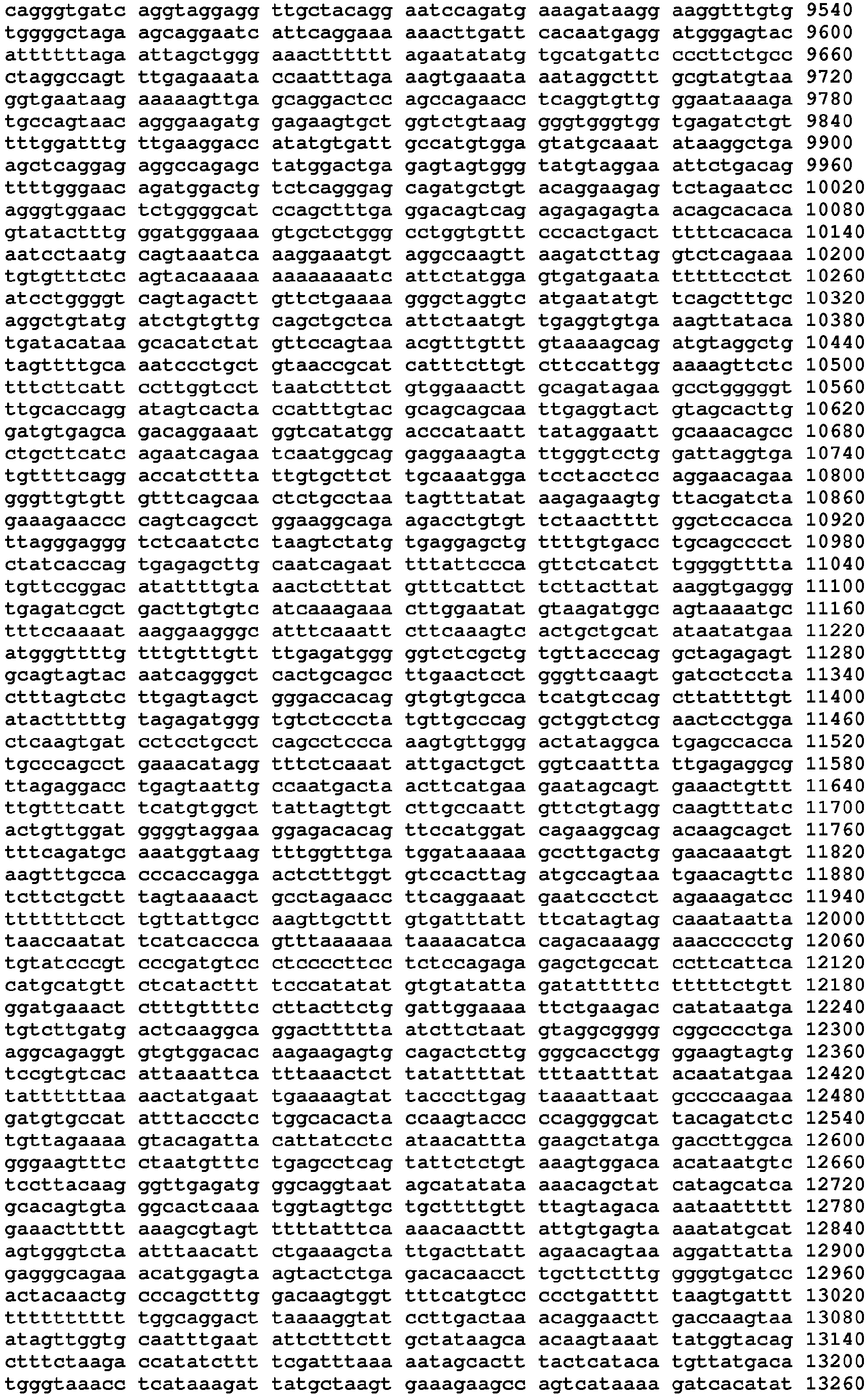

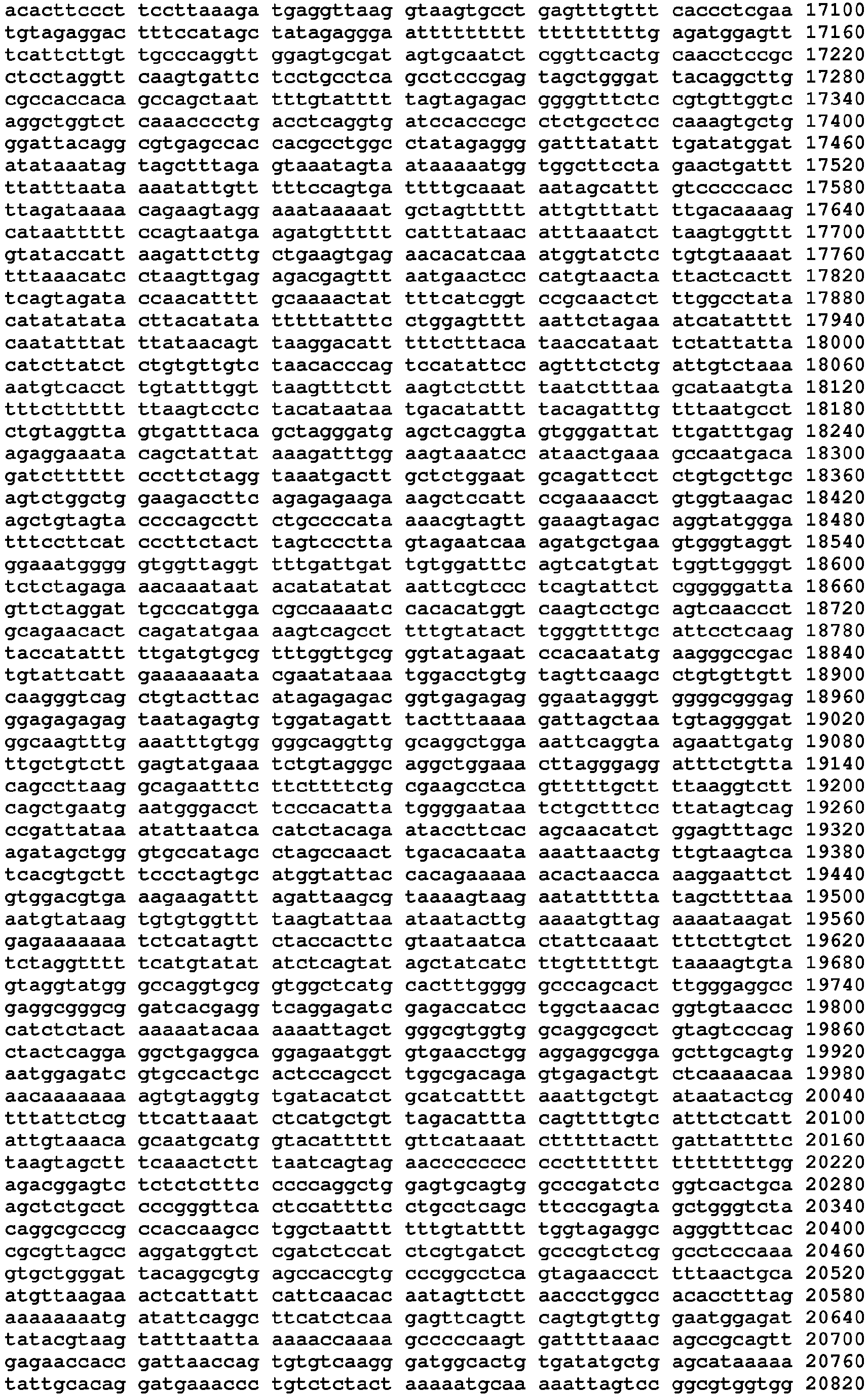
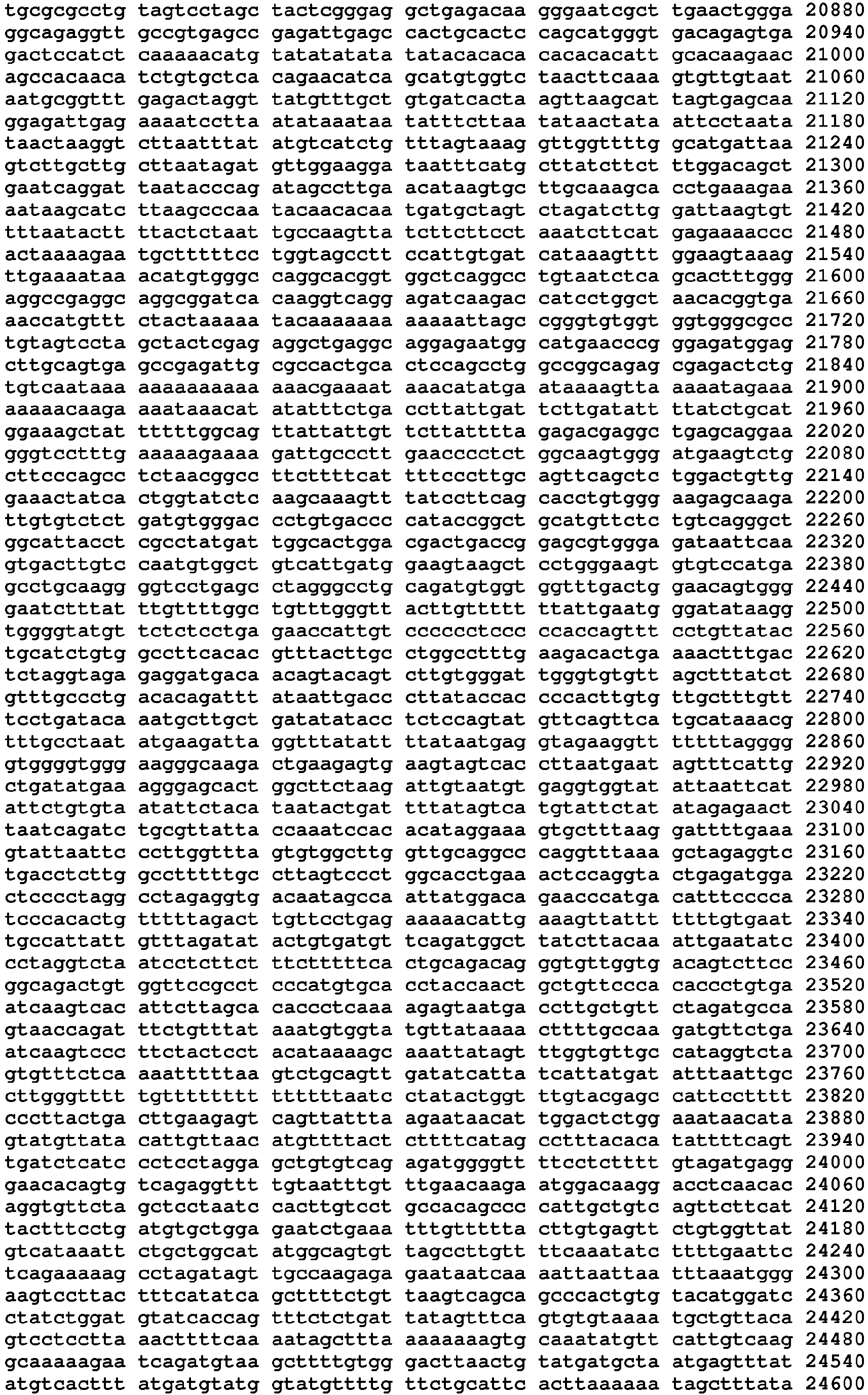
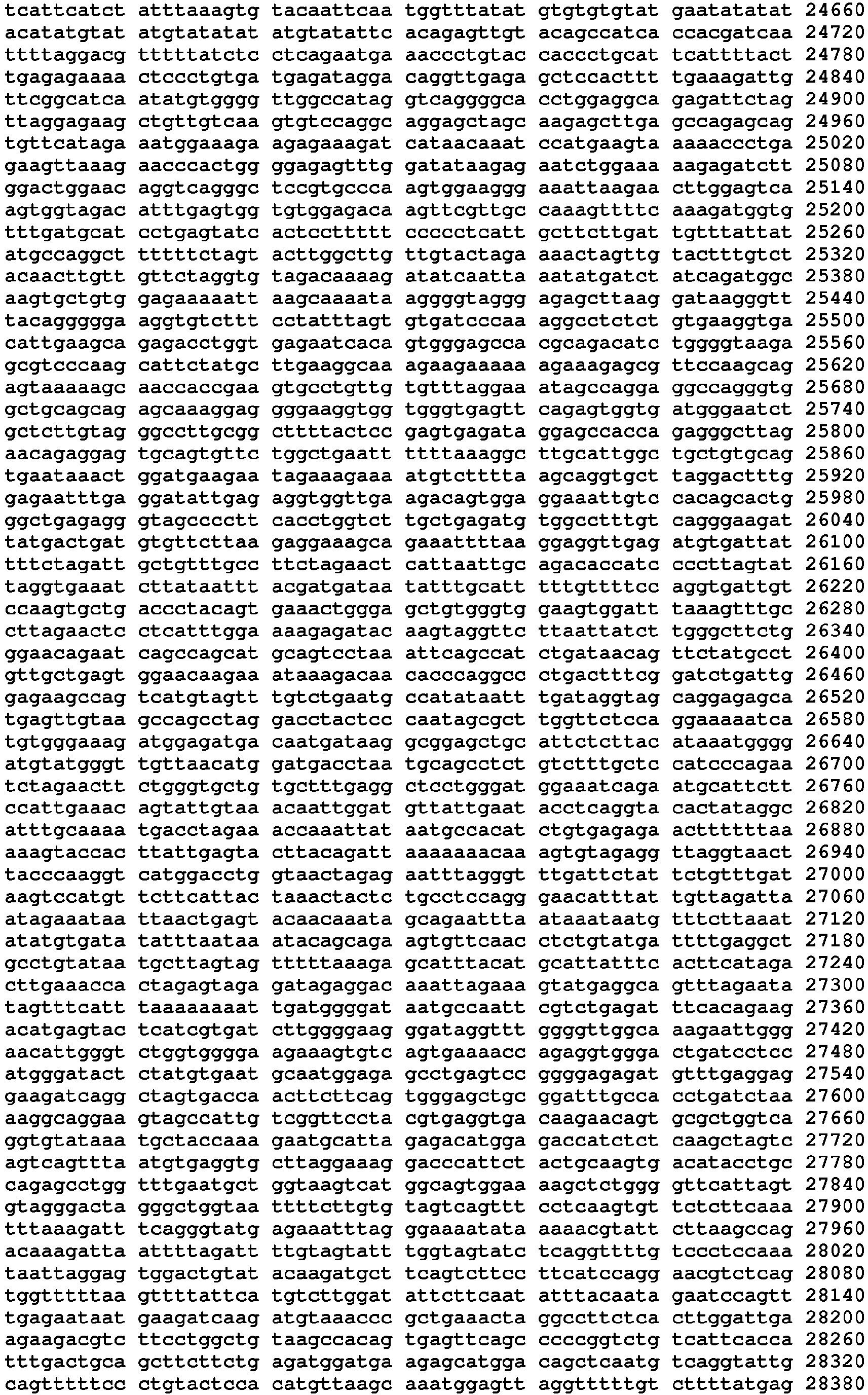


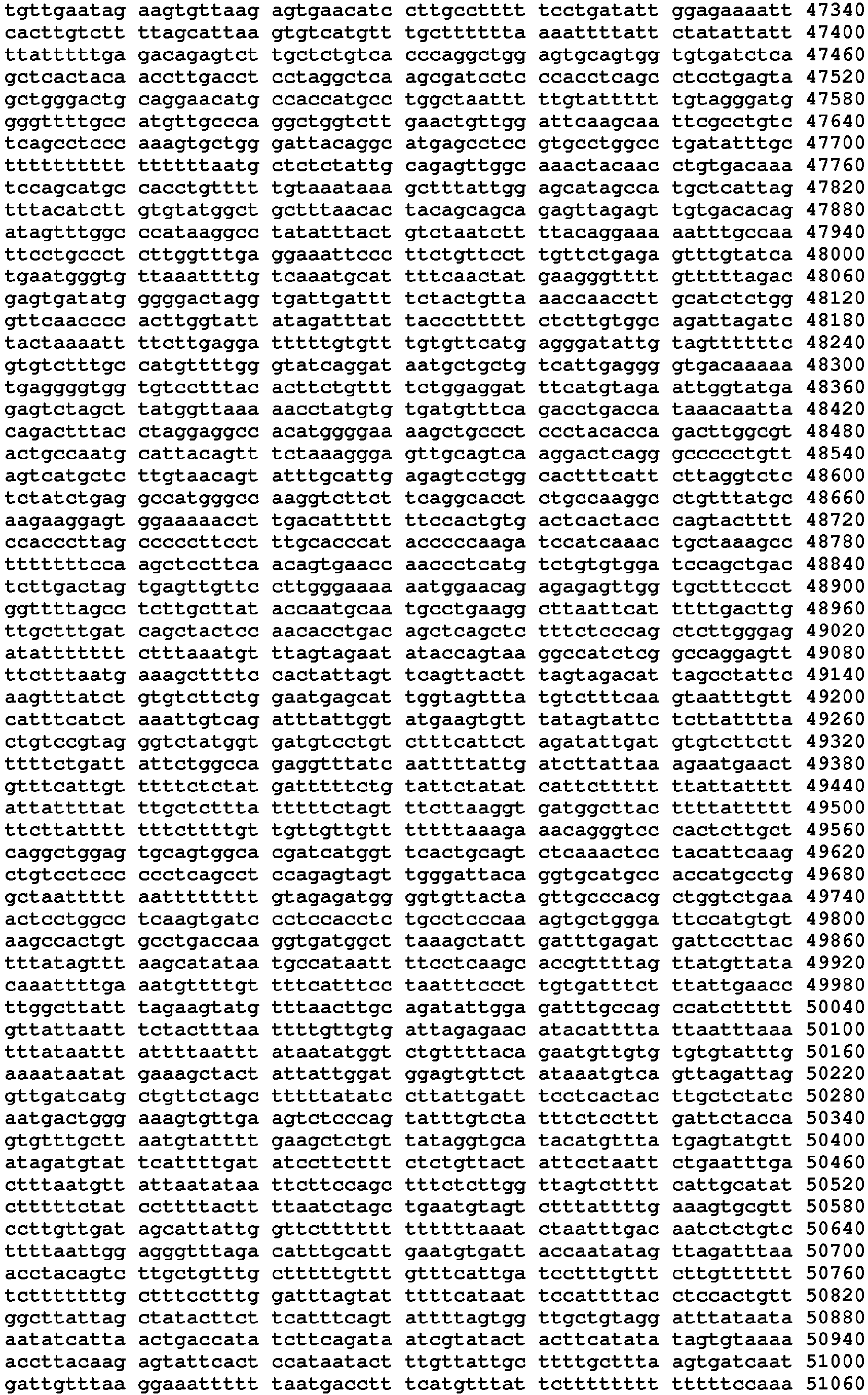

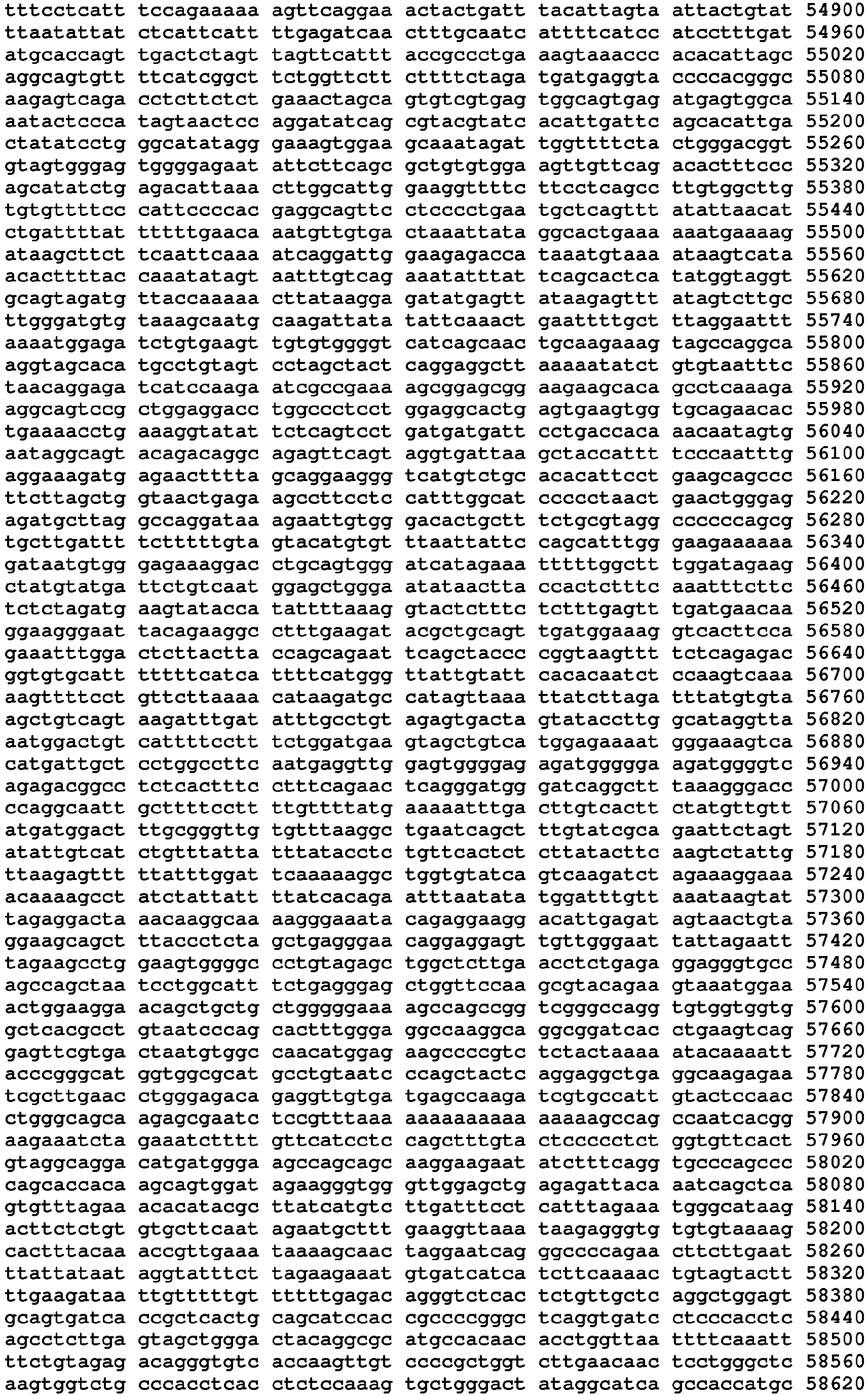
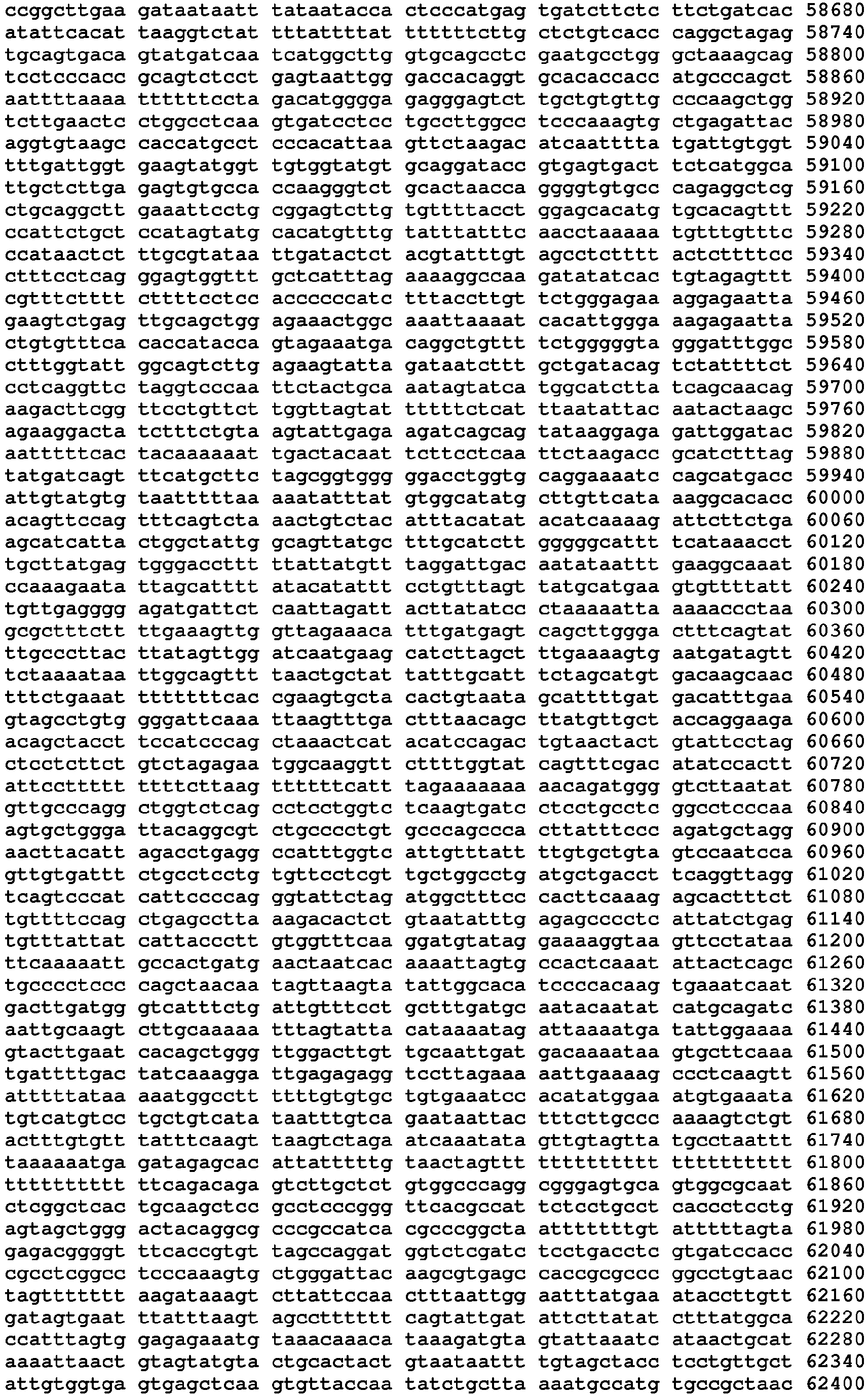

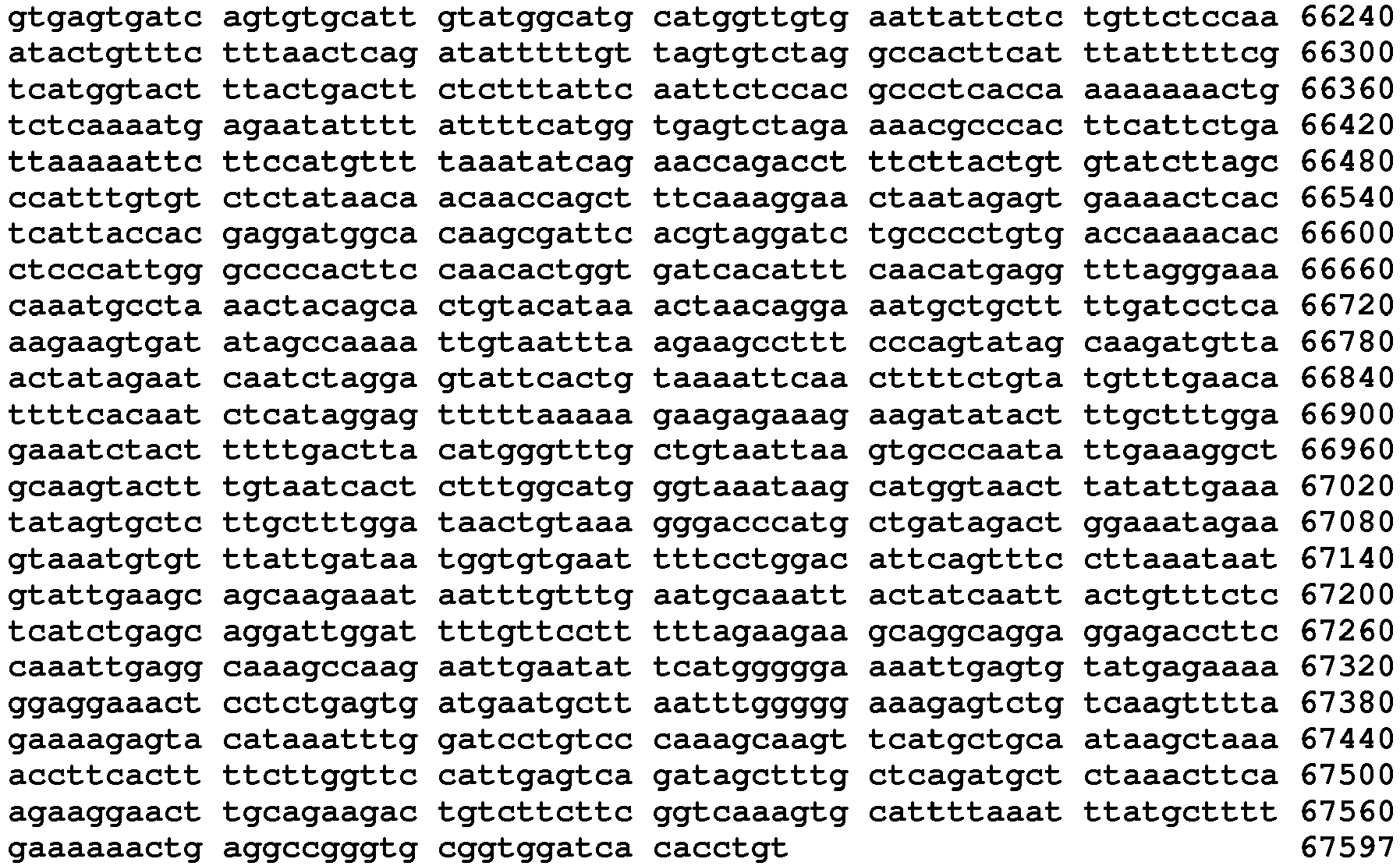
- <210> 2
<211> 46
<212> DNA
<213> Artificial Sequence - <220>
<223> Forward primer - <400> 2
ggggaaggat ccgccatgga gttaatggtg tgtttagcat tacagg 46 - <210> 3
<211> 42
<212> DNA
<213> Artificial Sequence - <220>
<223> Reverse primer - <400> 3
ggggaatcta gacttagggt tatgatcata aatcagattg ag 42 - <210> 4
<211> 45
<212> DNA
<213> Artificial Sequence - <220>
<223> Reverse primer - <400> 4
ggggaatcta gattacttca attctgtaaa aaacaagtta atatg 45 - <210> 5
<211> 20
<212> DNA
<213> Artificial Sequence - <220>
<223> Forward primer - <400> 5
taatacgact cactataggg 20 - <210> 6
<211> 24
<212> DNA
<213> Artificial Sequence - <220>
<223> Reverse primer - <400> 6
cttagggtta tgatcataaa tcag 24 - <210> 7
<211> 21
<212> DNA
<213> Artificial Sequence - <220>
<223> Reverse primer - <400> 7
ttcaattctg taaaaaacaag 21 - <210> 8
<211> 15
<212> DNA
<213> Artificial Sequence - <220>
<223> Synthetic oligonucleotide - <400> 8
agagaattac cacaa 15 - <210> 9
<211> 15
<212> DNA
<213> Artificial Sequence - <220>
<223> Synthetic oligonucleotide - <400> 9
ttcacagaga attac 15 - <210> 10
<211> 15
<212> DNA
<213> Artificial Sequence - <220>
<223> Synthetic oligonucleotide - <400> 10
aactcttcac agaga 15 - <210> 11
<211> 15
<212> DNA
<213> Artificial Sequence - <220>
<223> Synthetic oligonucleotide - <400> 11
tacctaactc ttcac 15 - <210> 12
<211> 15
<212> DNA
<213> Artificial Sequence - <220>
<223> Synthetic oligonucleotide - <400> 12
cattttacct aactc 15 - <210> 13
<211> 15
<212> DNA
<213> Artificial Sequence - <220>
<223> Synthetic oligonucleotide - <400> 13
tacaccattt tacct 15 - <210> 14
<211> 15
<212> DNA
<213> Artificial Sequence - <220>
<223> Synthetic oligonucleotide - <400> 14
caggatacac cattt 15 - <210> 15
<211> 15
<212> DNA
<213> Artificial Sequence - <220>
<223> Synthetic oligonucleotide - <400> 15
atagccagga tacac 15 - <210> 16
<211> 15
<212> DNA
<213> Artificial Sequence - <220>
<223> Synthetic oligonucleotide - <400> 16
tttaaatagc cagga 15 - <210> 17
<211> 15
<212> DNA
<213> Artificial Sequence - <220>
<223> Synthetic oligonucleotide - <400> 17
aaacatttaa atagc 15 - <210> 18
<211> 15
<212> DNA
<213> Artificial Sequence - <220>
<223> Synthetic oligonucleotide - <400> 18
gtagaaaaca tttaa 15 - <210> 19
<211> 15
<212> DNA
<213> Artificial Sequence - <220>
<223> Synthetic oligonucleotide - <400> 19
attaagtaga aaaca 15 - <210> 20
<211> 15
<212> DNA
<213> Artificial Sequence - <220>
<223> Synthetic oligonucleotide - <400> 20
ttttaattaa gtaga 15 - <210> 21
<211> 15
<212> DNA
<213> Artificial Sequence - <220>
<223> Synthetic oligonucleotide - <400> 21
aacattttta attaa 15 - <210> 22
<211> 15
<212> DNA
<213> Artificial Sequence - <220>
<223> Synthetic oligonucleotide - <400> 22
gcagtaacat tttta 15 - <210> 23
<211> 15
<212> DNA
<213> Artificial Sequence - <220>
<223> Synthetic oligonucleotide - <400> 23
ttaaagcagt aacat 15 - <210> 24
<211> 15
<212> DNA
<213> Artificial Sequence - <220>
<223> Synthetic oligonucleotide - <400> 24
ataaattaaa gcagt 15 - <210> 25
<211> 15
<212> DNA
<213> Artificial Sequence - <220>
<223> Synthetic oligonucleotide - <400> 25
cttaaataaa ttaaa 15 - <210> 26
<211> 15
<212> DNA
<213> Artificial Sequence - <220>
<223> Synthetic oligonucleotide - <400> 26
gtttcccctt ggcat 15 - <210> 27
<211> 15
<212> DNA
<213> Artificial Sequence - <220>
<223> Synthetic oligonucleotide - <400> 27
tctaagtttc ccctt 15 - <210> 28
<211> 15
<212> DNA
<213> Artificial Sequence - <220>
<223> Synthetic oligonucleotide - <400> 28
caacttctaa gtttc 15 - <210> 29
<211> 15
<212> DNA
<213> Artificial Sequence - <220>
<223> Synthetic oligonucleotide - <400> 29
atgaacaact tctaa 15 - <210> 30
<211> 15
<212> DNA
<213> Artificial Sequence - <220>
<223> Synthetic oligonucleotide - <400> 30
cgatgatgaa caact 15 - <210> 31
<211> 15
<212> DNA
<213> Artificial Sequence - <220>
<223> Synthetic oligonucleotide - <400> 31
gggctcgatg atgaa 15 - <210> 32
<211> 15
<212> DNA
<213> Artificial Sequence - <220>
<223> Synthetic oligonucleotide - <400> 32
aaccagggct cgatg 15 - <210> 33
<211> 15
<212> DNA
<213> Artificial Sequence - <220>
<223> Synthetic oligonucleotide - <400> 33
gctaaaacca gggct 15 - <210> 34
<211> 15
<212> DNA
<213> Artificial Sequence - <220>
<223> Synthetic oligonucleotide - <400> 34
tctgagctaa aacca 15 - <210> 35
<211> 15
<212> DNA
<213> Artificial Sequence - <220>
<223> Synthetic oligonucleotide - <400> 35
ccgaatctga gctaa 15 - <210> 36
<211> 15
<212> DNA
<213> Artificial Sequence - <220>
<223> Synthetic oligonucleotide - <400> 36
cacttccgaa tctga 15 - <210> 37
<211> 15
<212> DNA
<213> Artificial Sequence - <220>
<223> Synthetic oligonucleotide - <400> 37
ccaaccactt ccgaa 15 - <210> 38
<211> 15
<212> DNA
<213> Artificial Sequence - <220>
<223> Synthetic oligonucleotide - <400> 38
ttgtccaacc acttc 15 - <210> 39
<211> 15
<212> DNA
<213> Artificial Sequence - <220>
<223> Synthetic oligonucleotide - <400> 39
tacaatggcg cttac 15 - <210> 40
<211> 15
<212> DNA
<213> Artificial Sequence - <220>
<223> Synthetic oligonucleotide - <400> 40
aacagtacaa tggcg 15 - <210> 41
<211> 15
<212> DNA
<213> Artificial Sequence - <220>
<223> Synthetic oligonucleotide - <400> 41
tcgcaaacag tacaa 15 - <210> 42
<211> 15
<212> DNA
<213> Artificial Sequence - <220>
<223> Synthetic oligonucleotide - <400> 42
actagtcgca aacag 15 - <210> 43
<211> 15
<212> DNA
<213> Artificial Sequence - <220>
<223> Synthetic oligonucleotide - <400> 43
agctaactag tcgca 15 - <210> 44
<211> 15
<212> DNA
<213> Artificial Sequence - <220>
<223> Synthetic oligonucleotide - <400> 44
tcacaagcta actag 15 - <210> 45
<211> 15
<212> DNA
<213> Artificial Sequence - <220>
<223> Synthetic oligonucleotide - <400> 45
ataaatcaca agcta 15 - <210> 46
<211> 15
<212> DNA
<213> Artificial Sequence - <220>
<223> Synthetic oligonucleotide - <400> 46
cacacataaa tcaca 15 - <210> 47
<211> 15
<212> DNA
<213> Artificial Sequence - <220>
<223> Synthetic oligonucleotide - <400> 47
gtcttcacac ataaa 15 - <210> 48
<211> 15
<212> DNA
<213> Artificial Sequence - <220>
<223> Synthetic oligonucleotide - <400> 48
ttattgtctt cacac 15 - <210> 49
<211> 15
<212> DNA
<213> Artificial Sequence - <220>
<223> Synthetic oligonucleotide - <400> 49
aatacttatt gtctt 15 - <210> 50
<211> 15
<212> DNA
<213> Artificial Sequence - <220>
<223> Synthetic oligonucleotide - <400> 50
aataaaatac ttatt 15 - <210> 51
<211> 15
<212> DNA
<213> Artificial Sequence - <220>
<223> Synthetic oligonucleotide - <400> 51
attgtaataa aatac 15 - <210> 52
<211> 15
<212> DNA
<213> Artificial Sequence - <220>
<223> Synthetic oligonucleotide - <400> 52
tcgaaattgt aataa 15 - <210> 53
<211> 15
<212> DNA
<213> Artificial Sequence - <220>
<223> Synthetic oligonucleotide - <400> 53
agttctcgaa attgt 15 - <210> 54
<211> 15
<212> DNA
<213> Artificial Sequence - <220>
<223> Synthetic oligonucleotide - <400> 54
ttttaagttc tcgaa 15 - <210> 55
<211> 15
<212> DNA
<213> Artificial Sequence - <220>
<223> Synthetic oligonucleotide - <400> 55
cataatttta agttc 15 - <210> 56
<211> 15
<212> DNA
<213> Artificial Sequence - <220>
<223> Synthetic oligonucleotide - <400> 56
cttttcataa tttta 15 - <210> 57
<211> 20
<212> DNA
<213> Artificial Sequence - <220>
<223> Synthetic oligonucleotide - <400> 57
tttatatgga tgttaaaaag 20 - <210> 58
<211> 20
<212> DNA
<213> Artificial Sequence - <220>
<223> Synthetic oligonucleotide - <400> 58
aaaagcattt tgtttcacaa 20 - <210> 59
<211> 15
<212> DNA
<213> Artificial Sequence - <220>
<223> Synthetic oligonucleotide - <400> 59
attttgtctg aaacc 15 - <210> 60
<211> 20
<212> DNA
<213> Artificial Sequence - <220>
<223> Synthetic oligonucleotide - <400> 60
tcgcaaacag tacaatggcg 20 - <210> 61
<211> 20
<212> DNA
<213> Artificial Sequence - <220>
<223> Synthetic oligonucleotide - <400> 61
gtcgcaaaca gtacaatggc 20 - <210> 62
<211> 20
<212> DNA
<213> Artificial Sequence - <220>
<223> Synthetic oligonucleotide - <400> 62
agtcgcaaac agtacaatgg 20 - <210> 63
<211> 20
<212> DNA
<213> Artificial Sequence - <220>
<223> Synthetic oligonucleotide - <400> 63
tagtcgcaaa cagtacaatg 20 - <210> 64
<211> 20
<212> DNA
<213> Artificial Sequence - <220>
<223> Synthetic oligonucleotide - <400> 64
ctagtcgcaa acagtacaat 20 - <210> 65
<211> 20
<212> DNA
<213> Artificial Sequence - <220>
<223> Synthetic oligonucleotide - <400> 65
actagtcgca aacagtacaa 20 - <210> 66
<211> 20
<212> DNA
<213> Artificial Sequence - <220>
<223> Synthetic oligonucleotide - <400> 66
aactagtcgc aaacagtaca 20 - <210> 67
<211> 20
<212> DNA
<213> Artificial Sequence - <220>
<223> Synthetic oligonucleotide - <400> 67
taactagtcg caaacagtac 20 - <210> 68
<211> 20
<212> DNA
<213> Artificial Sequence - <220>
<223> Synthetic oligonucleotide - <400> 68
ctaactagtc gcaaacagta 20 - <210> 69
<211> 20
<212> DNA
<213> Artificial Sequence - <220>
<223> Synthetic oligonucleotide - <400> 69
gctaactagt cgcaaacagt 20
Claims (15)
- A compound comprising a modified oligonucleotide consisting of 10 to 30 linked nucleosides and having a nucleobase sequence comprising at least 10 contiguous nucleobases complementary to an equal length portion of nucleobases 34801 to 34828 of SEQ ID NO: 1, wherein the modified oligonucleotide comprises at least one modified nucleoside, wherein the at least one modified nucleoside comprises a modified sugar moiety, and wherein the compound is capable of increasing the inclusion of exon 20 in an IKBKAP transcript in a cell.
- The compound of claim 1, wherein the modified oligonucleotide is 12 to 20 nucleosides in length, and wherein the sequence comprises a portion of at least 12 contiguous nucleobases complementary to an equal length portion of nucleobases 34801 to 34828 of SEQ ID NO: 1.
- The compound of claim 1 or claim 2, wherein the oligonucleotide comprises a nucleobase sequence comprising an at least 10 nucleobase portion of SEQ ID NO: 40, 41, 42, 43, 60, 61, 62, 63, 64, 65, 66, 67, or 68.
- The compound of any of claims 1 to 3, wherein each nucleoside of the modified oligonucleotide is a modified nucleoside, each independently comprising a modified sugar moiety.
- The compound of any of claims 1 to 4, comprising at least one 2'-substituted sugar moiety and wherein the 2'-substituent of the at least one 2'-substituted sugar moiety is selected from the group consisting of 2'-OMe, 2'-F, and 2'-MOE.
- The compound of claim 4, wherein the modified sugar moiety is a 2'-substituted sugar moiety, and wherein the 2'-substituent of the 2'-substituted sugar moiety is 2'-MOE.
- The compound of any of claims 1 to 4, wherein at least one nucleoside is a bicyclic nucleoside.
- The compound of claim 7, wherein the bicyclic nucleoside is a constrained ethyl nucleoside or a locked nucleic acid nucleoside.
- The compound of any of claims 1 to 8, wherein:(i) at least one internucleoside linkage is a modified internucleoside linkage, or(ii) each internucleoside linkage is a modified internucleoside linkage,and wherein optionally the modified internucleoside linkage is a phosphorothioate internucleoside linkage.
- The compound of any of claims 1 to 9, wherein the modified oligonucleotide comprises at least one cytosine moiety, and wherein at least one cytosine moiety is a 5-methyl cytosine or wherein each cytosine moiety is a 5-methyl cytosine.
- The compound of any of claims 1 to 10, wherein the compound comprises one or more conjugate groups conjugated to the modified oligonucleotide.
- A pharmaceutical composition comprising the compound of any of claims 1 to 11, and a pharmaceutically acceptable carrier or diluent.
- An in vitro method of modulating splicing of an IKBKAP transcript in a cell, the method comprising contacting the cell with a compound according to any of claims 1 to 11 or a pharmaceutical composition of claim 12.
- A compound of any of claims 1 to 11 or a pharmaceutical composition of claim 12 for use in a method of increasing inclusion of exon 20 in an IKBKAP transcript.
- A compound of any of claims 1 to 11 or a pharmaceutical composition of claim 12 for use in treating Familial Dysautonomia.
Applications Claiming Priority (2)
| Application Number | Priority Date | Filing Date | Title |
|---|---|---|---|
| US201261585579P | 2012-01-11 | 2012-01-11 | |
| PCT/US2013/021311 WO2013106770A1 (en) | 2012-01-11 | 2013-01-11 | Compositions and methods for modulation of ikbkap splicing |
Publications (3)
| Publication Number | Publication Date |
|---|---|
| EP2802674A1 EP2802674A1 (en) | 2014-11-19 |
| EP2802674A4 EP2802674A4 (en) | 2015-10-07 |
| EP2802674B1 true EP2802674B1 (en) | 2020-12-16 |
Family
ID=48781965
Family Applications (1)
| Application Number | Title | Priority Date | Filing Date |
|---|---|---|---|
| EP13735797.6A Active EP2802674B1 (en) | 2012-01-11 | 2013-01-11 | Compositions and methods for modulation of ikbkap splicing |
Country Status (5)
| Country | Link |
|---|---|
| US (3) | US20150025231A1 (en) |
| EP (1) | EP2802674B1 (en) |
| ES (1) | ES2842938T3 (en) |
| IL (3) | IL321422A (en) |
| WO (1) | WO2013106770A1 (en) |
Families Citing this family (11)
| Publication number | Priority date | Publication date | Assignee | Title |
|---|---|---|---|---|
| EP2802674B1 (en) | 2012-01-11 | 2020-12-16 | Ionis Pharmaceuticals, Inc. | Compositions and methods for modulation of ikbkap splicing |
| GB201410693D0 (en) | 2014-06-16 | 2014-07-30 | Univ Southampton | Splicing modulation |
| SG11201702682PA (en) * | 2014-10-03 | 2017-04-27 | Cold Spring Harbor Lab | Targeted augmentation of nuclear gene output |
| US10196639B2 (en) | 2015-10-09 | 2019-02-05 | University Of Southampton | Modulation of gene expression and screening for deregulated protein expression |
| JP7049248B2 (en) | 2015-12-14 | 2022-04-06 | コールド スプリング ハーバー ラボラトリー | Autosomal dominant mental retardation-5 and antisense oligomers for the treatment of Dravet syndrome |
| US11096956B2 (en) | 2015-12-14 | 2021-08-24 | Stoke Therapeutics, Inc. | Antisense oligomers and uses thereof |
| US20180193270A1 (en) | 2016-11-29 | 2018-07-12 | PureTech Health LLC | Exosomes for delivery of therapeutic agents |
| KR102318434B1 (en) | 2017-08-25 | 2021-11-01 | 스톡 테라퓨틱스, 인크. | Antisense oligomers for the treatment of conditions and diseases |
| US12060558B2 (en) | 2018-05-04 | 2024-08-13 | Stoke Therapeutics, Inc. | Methods and compositions for treatment of cholesteryl ester storage disease |
| IL298063A (en) | 2020-05-11 | 2023-01-01 | Stoke Therapeutics Inc | Opa1 antisense oligomers for treatment of conditions and diseases |
| US20250170259A1 (en) | 2022-03-03 | 2025-05-29 | Yale University | Compositions and methods for delivering therapeutic polynucleotides for exon skipping |
Family Cites Families (72)
| Publication number | Priority date | Publication date | Assignee | Title |
|---|---|---|---|---|
| US2699808A (en) | 1944-10-06 | 1955-01-18 | Mark W Lowe | Apparatus for peeling tomatoes |
| US2699507A (en) | 1952-05-09 | 1955-01-11 | Bosch Gmbh Robert | Electrical control device for starting motor systems |
| US3687808A (en) | 1969-08-14 | 1972-08-29 | Univ Leland Stanford Junior | Synthetic polynucleotides |
| US5367066A (en) | 1984-10-16 | 1994-11-22 | Chiron Corporation | Oligonucleotides with selectably cleavable and/or abasic sites |
| FR2575751B1 (en) | 1985-01-08 | 1987-04-03 | Pasteur Institut | NOVEL ADENOSINE DERIVATIVE NUCLEOSIDES, THEIR PREPARATION AND THEIR BIOLOGICAL APPLICATIONS |
| US5166315A (en) | 1989-12-20 | 1992-11-24 | Anti-Gene Development Group | Sequence-specific binding polymers for duplex nucleic acids |
| US5506337A (en) | 1985-03-15 | 1996-04-09 | Antivirals Inc. | Morpholino-subunit combinatorial library and method |
| US5034506A (en) | 1985-03-15 | 1991-07-23 | Anti-Gene Development Group | Uncharged morpholino-based polymers having achiral intersubunit linkages |
| US5185444A (en) | 1985-03-15 | 1993-02-09 | Anti-Gene Deveopment Group | Uncharged morpolino-based polymers having phosphorous containing chiral intersubunit linkages |
| EP0366685B1 (en) | 1987-06-24 | 1994-10-19 | Howard Florey Institute Of Experimental Physiology And Medicine | Nucleoside derivatives |
| US5175273A (en) | 1988-07-01 | 1992-12-29 | Genentech, Inc. | Nucleic acid intercalating agents |
| US5134066A (en) | 1989-08-29 | 1992-07-28 | Monsanto Company | Improved probes using nucleosides containing 3-dezauracil analogs |
| US5130302A (en) | 1989-12-20 | 1992-07-14 | Boron Bilogicals, Inc. | Boronated nucleoside, nucleotide and oligonucleotide compounds, compositions and methods for using same |
| US5681941A (en) | 1990-01-11 | 1997-10-28 | Isis Pharmaceuticals, Inc. | Substituted purines and oligonucleotide cross-linking |
| US5587470A (en) | 1990-01-11 | 1996-12-24 | Isis Pharmaceuticals, Inc. | 3-deazapurines |
| US5459255A (en) | 1990-01-11 | 1995-10-17 | Isis Pharmaceuticals, Inc. | N-2 substituted purines |
| CA2088258C (en) | 1990-07-27 | 2004-09-14 | Phillip Dan Cook | Nuclease resistant, pyrimidine modified oligonucleotides that detect and modulate gene expression |
| US5432272A (en) | 1990-10-09 | 1995-07-11 | Benner; Steven A. | Method for incorporating into a DNA or RNA oligonucleotide using nucleotides bearing heterocyclic bases |
| US5594121A (en) | 1991-11-07 | 1997-01-14 | Gilead Sciences, Inc. | Enhanced triple-helix and double-helix formation with oligomers containing modified purines |
| AU3222793A (en) | 1991-11-26 | 1993-06-28 | Gilead Sciences, Inc. | Enhanced triple-helix and double-helix formation with oligomers containing modified pyrimidines |
| US5484908A (en) | 1991-11-26 | 1996-01-16 | Gilead Sciences, Inc. | Oligonucleotides containing 5-propynyl pyrimidines |
| TW393513B (en) | 1991-11-26 | 2000-06-11 | Isis Pharmaceuticals Inc | Enhanced triple-helix and double-helix formation with oligomers containing modified pyrimidines |
| EP0673559A1 (en) | 1992-12-14 | 1995-09-27 | Honeywell Inc. | Motor system with individually controlled redundant windings |
| DK0698092T3 (en) | 1993-05-11 | 2007-11-26 | Univ North Carolina | Anti-sense oligonucleotides which combat irregular splicing and methods for its use |
| US5502177A (en) | 1993-09-17 | 1996-03-26 | Gilead Sciences, Inc. | Pyrimidine derivatives for labeled binding partners |
| US5457187A (en) | 1993-12-08 | 1995-10-10 | Board Of Regents University Of Nebraska | Oligonucleotides containing 5-fluorouracil |
| US5596091A (en) | 1994-03-18 | 1997-01-21 | The Regents Of The University Of California | Antisense oligonucleotides comprising 5-aminoalkyl pyrimidine nucleotides |
| US5525711A (en) | 1994-05-18 | 1996-06-11 | The United States Of America As Represented By The Secretary Of The Department Of Health And Human Services | Pteridine nucleotide analogs as fluorescent DNA probes |
| US5656408A (en) | 1996-04-29 | 1997-08-12 | Xerox Corporation | Coated carrier particles |
| US20040023917A1 (en) * | 1996-12-31 | 2004-02-05 | Bennett C. Frank | Oligonucleotide compositions and methods for the modulation of the expression of B7 protein |
| JP3756313B2 (en) | 1997-03-07 | 2006-03-15 | 武 今西 | Novel bicyclonucleosides and oligonucleotide analogues |
| US6770748B2 (en) | 1997-03-07 | 2004-08-03 | Takeshi Imanishi | Bicyclonucleoside and oligonucleotide analogue |
| NZ503765A (en) | 1997-09-12 | 2002-04-26 | Exiqon As | Bi-cyclic and tri-cyclic nucleotide analogues |
| US6794499B2 (en) | 1997-09-12 | 2004-09-21 | Exiqon A/S | Oligonucleotide analogues |
| US6214986B1 (en) | 1998-10-07 | 2001-04-10 | Isis Pharmaceuticals, Inc. | Antisense modulation of bcl-x expression |
| US6172216B1 (en) | 1998-10-07 | 2001-01-09 | Isis Pharmaceuticals Inc. | Antisense modulation of BCL-X expression |
| DK1171634T3 (en) * | 1999-04-08 | 2006-03-20 | Gen Probe Inc | Amplification and sequencing primer pairs and their use |
| JP2002543214A (en) | 1999-05-04 | 2002-12-17 | エクシコン エ/エス | L-ribo-LNA analog |
| US6525191B1 (en) | 1999-05-11 | 2003-02-25 | Kanda S. Ramasamy | Conformationally constrained L-nucleosides |
| AU768904B2 (en) * | 1999-06-21 | 2004-01-08 | Murdoch Childrens Research Institute, The | A method for the prophylaxis and/or treatment of medical disorders |
| DE60237509D1 (en) * | 2001-01-06 | 2010-10-14 | Gen Hospital Corp | GENE FOR DETECTING PATIENTS WITH FAMILY DYSAUTONOMY |
| IL142015A0 (en) * | 2001-01-17 | 2002-03-10 | Detection of mutations in a gene encoding 1kb kinase-complex-associated protein to diagnose familial dysautonomia | |
| WO2003056030A2 (en) * | 2001-11-08 | 2003-07-10 | The Johns Hopkins University | Methods and systems of nucleic acid sequencing |
| GB0219143D0 (en) * | 2002-08-16 | 2002-09-25 | Univ Leicester | Modified tailed oligonucleotides |
| WO2004041889A2 (en) | 2002-11-05 | 2004-05-21 | Isis Pharmaceuticals, Inc. | Polycyclic sugar surrogate-containing oligomeric compounds and compositions for use in gene modulation |
| AU2003290598A1 (en) | 2002-11-05 | 2004-06-03 | Isis Pharmaceuticals, Inc. | Modified oligonucleotides for use in rna interference |
| WO2004106356A1 (en) | 2003-05-27 | 2004-12-09 | Syddansk Universitet | Functionalized nucleotide derivatives |
| EP1644475A4 (en) * | 2003-06-20 | 2009-06-03 | Isis Pharmaceuticals Inc | BICATENE COMPOSITIONS COMPRISING A MODIFIED 3'-ENDO CHAIN FOR USE IN GENE MODULATION |
| EP1661905B9 (en) | 2003-08-28 | 2012-12-19 | IMANISHI, Takeshi | Novel artificial nucleic acids of n-o bond crosslinkage type |
| EP1677822B1 (en) | 2003-09-18 | 2014-04-23 | Isis Pharmaceuticals, Inc. | 4'-thionucleosides and oligomeric compounds |
| US20110201679A1 (en) * | 2004-05-14 | 2011-08-18 | Rubin Berish Y | Use of Tocotrienols for Elevating IKBKAP Gene Expression and Treating Neurodegenerative Diseases or Disorders |
| US20060069045A1 (en) * | 2004-09-10 | 2006-03-30 | Rubin Berish Y | Methods for treating familial dysautonomia |
| US20070197460A1 (en) * | 2005-11-01 | 2007-08-23 | Alnylam Pharmaceuticals, Inc. | Rnai inhibition of influenza virus replication |
| CN102908630B (en) | 2006-01-27 | 2014-11-19 | Isis制药公司 | 6-modified bicyclic nucleic acid analogs |
| US7547684B2 (en) | 2006-05-11 | 2009-06-16 | Isis Pharmaceuticals, Inc. | 5′-modified bicyclic nucleic acid analogs |
| EP1884569A1 (en) * | 2006-07-31 | 2008-02-06 | Institut National De La Sante Et De La Recherche Medicale (Inserm) | Sensitization of cancer cells to therapy using siNA targeting genes from the 1p and 19q chromosomal regions |
| WO2008051604A2 (en) * | 2006-10-25 | 2008-05-02 | The Board Of Trustees Of The Leland Stanford Junior University | Methods and compositions for determining whether a subject carries a disease associated gene mutation common in jewish populations |
| WO2008101157A1 (en) | 2007-02-15 | 2008-08-21 | Isis Pharmaceuticals, Inc. | 5'-substituted-2'-f modified nucleosides and oligomeric compounds prepared therefrom |
| WO2008150729A2 (en) | 2007-05-30 | 2008-12-11 | Isis Pharmaceuticals, Inc. | N-substituted-aminomethylene bridged bicyclic nucleic acid analogs |
| ES2386492T3 (en) | 2007-06-08 | 2012-08-21 | Isis Pharmaceuticals, Inc. | Carbocyclic bicyclic nucleic acid analogs |
| WO2008151631A2 (en) * | 2007-06-15 | 2008-12-18 | Exiqon A/S | Use of short oligonucleotides for reagent redundancy experiments in rna functional analysis |
| ATE538127T1 (en) | 2007-07-05 | 2012-01-15 | Isis Pharmaceuticals Inc | 6-DISUBSTITUTED BICYCLIC NUCLEIC ACID ANALOGUES |
| WO2009024599A1 (en) * | 2007-08-23 | 2009-02-26 | Novartis Ag | Methods for detecting oligonucleotides |
| US8546556B2 (en) | 2007-11-21 | 2013-10-01 | Isis Pharmaceuticals, Inc | Carbocyclic alpha-L-bicyclic nucleic acid analogs |
| EP2265627A2 (en) | 2008-02-07 | 2010-12-29 | Isis Pharmaceuticals, Inc. | Bicyclic cyclohexitol nucleic acid analogs |
| WO2010036698A1 (en) | 2008-09-24 | 2010-04-01 | Isis Pharmaceuticals, Inc. | Substituted alpha-l-bicyclic nucleosides |
| AT507215B1 (en) | 2009-01-14 | 2010-03-15 | Boehler Edelstahl Gmbh & Co Kg | WEAR-RESISTANT MATERIAL |
| US8815826B2 (en) * | 2010-07-23 | 2014-08-26 | Regulus Therapeutics, Inc. | Targeting microRNAs for the treatment of fibrosis |
| US20120178081A1 (en) * | 2010-12-31 | 2012-07-12 | Affymetrix. Inc. | Methods of Labeling Cells, Labeled Cells, and uses Thereof |
| EP2802674B1 (en) | 2012-01-11 | 2020-12-16 | Ionis Pharmaceuticals, Inc. | Compositions and methods for modulation of ikbkap splicing |
| US9984408B1 (en) | 2012-05-30 | 2018-05-29 | Amazon Technologies, Inc. | Method, medium, and system for live video cooperative shopping |
| JP6394289B2 (en) | 2014-11-04 | 2018-09-26 | 富士通株式会社 | Evaporator, cooling device, and electronic equipment |
-
2013
- 2013-01-11 EP EP13735797.6A patent/EP2802674B1/en active Active
- 2013-01-11 WO PCT/US2013/021311 patent/WO2013106770A1/en not_active Ceased
- 2013-01-11 ES ES13735797T patent/ES2842938T3/en active Active
- 2013-01-11 US US14/371,941 patent/US20150025231A1/en not_active Abandoned
- 2013-01-11 IL IL321422A patent/IL321422A/en unknown
- 2013-01-11 IL IL266882A patent/IL266882B2/en unknown
-
2014
- 2014-07-07 IL IL233544A patent/IL233544B/en active IP Right Grant
-
2018
- 2018-05-30 US US15/993,090 patent/US10344282B2/en active Active
-
2019
- 2019-05-24 US US16/422,128 patent/US11066668B2/en active Active
Non-Patent Citations (1)
| Title |
|---|
| LATORRA D ET AL: "Design considerations and effects of LNA in PCR primers", MOLECULAR AND CELLULAR PRO, ACADEMIC PRESS, LONDON, GB, vol. 17, no. 5, 1 October 2003 (2003-10-01), pages 253 - 259, XP004466447, ISSN: 0890-8508, DOI: 10.1016/S0890-8508(03)00062-8 * |
Also Published As
| Publication number | Publication date |
|---|---|
| EP2802674A1 (en) | 2014-11-19 |
| IL233544B (en) | 2019-06-30 |
| US20200032260A1 (en) | 2020-01-30 |
| IL266882B2 (en) | 2025-11-01 |
| US20150025231A1 (en) | 2015-01-22 |
| ES2842938T3 (en) | 2021-07-15 |
| IL233544A0 (en) | 2014-08-31 |
| EP2802674A4 (en) | 2015-10-07 |
| US20180371457A1 (en) | 2018-12-27 |
| US10344282B2 (en) | 2019-07-09 |
| IL266882B1 (en) | 2025-07-01 |
| US11066668B2 (en) | 2021-07-20 |
| IL266882A (en) | 2019-07-31 |
| IL321422A (en) | 2025-08-01 |
| WO2013106770A1 (en) | 2013-07-18 |
Similar Documents
| Publication | Publication Date | Title |
|---|---|---|
| US11066668B2 (en) | Compositions and methods for modulation of IKBKAP splicing | |
| EP2839006B1 (en) | Oligomeric compounds comprising bicyclic nucleotides and uses thereof | |
| US9518259B2 (en) | Compounds and methods for modulating interaction between proteins and target nucleic acids | |
| EP2971142B1 (en) | Compositions and methods for modulating tau expression | |
| EP2751269B1 (en) | Methods and compounds useful in conditions related to repeat expansion | |
| US9353371B2 (en) | Antisense compounds targeting genes associated with usher syndrome | |
| US10851371B2 (en) | Modulation of SMN expression | |
| US20250354147A1 (en) | Antisense Compounds Targeted to CLN3 and Uses Thereof | |
| WO2016154096A1 (en) | Modulation of smggds expression | |
| US11198867B2 (en) | Combinations for the modulation of SMN expression | |
| US11732260B2 (en) | Compounds and methods for the modulation of amyloid-β precursor protein | |
| US20220372473A1 (en) | Antisense compounds and uses thereof | |
| US20180010126A1 (en) | Antisense compounds and uses thereof | |
| US20150291955A1 (en) | Antisense compounds targeting genes associated with fibronectin | |
| HK1218659B (en) | Compositions and methods for modulating tau expression |
Legal Events
| Date | Code | Title | Description |
|---|---|---|---|
| PUAI | Public reference made under article 153(3) epc to a published international application that has entered the european phase |
Free format text: ORIGINAL CODE: 0009012 |
|
| 17P | Request for examination filed |
Effective date: 20140811 |
|
| AK | Designated contracting states |
Kind code of ref document: A1 Designated state(s): AL AT BE BG CH CY CZ DE DK EE ES FI FR GB GR HR HU IE IS IT LI LT LU LV MC MK MT NL NO PL PT RO RS SE SI SK SM TR |
|
| DAX | Request for extension of the european patent (deleted) | ||
| RA4 | Supplementary search report drawn up and despatched (corrected) |
Effective date: 20150902 |
|
| RIC1 | Information provided on ipc code assigned before grant |
Ipc: C12N 15/113 20100101ALI20150828BHEP Ipc: C12Q 1/68 20060101AFI20150828BHEP Ipc: A61K 31/7088 20060101ALI20150828BHEP |
|
| RAP1 | Party data changed (applicant data changed or rights of an application transferred) |
Owner name: COLD SPRING HARBOR LABORATORY Owner name: IONIS PHARMACEUTICALS, INC. |
|
| STAA | Information on the status of an ep patent application or granted ep patent |
Free format text: STATUS: EXAMINATION IS IN PROGRESS |
|
| 17Q | First examination report despatched |
Effective date: 20180816 |
|
| REG | Reference to a national code |
Ref country code: DE Ref legal event code: R079 Ref document number: 602013074734 Country of ref document: DE Free format text: PREVIOUS MAIN CLASS: C12Q0001680000 Ipc: C12N0015113000 |
|
| RIC1 | Information provided on ipc code assigned before grant |
Ipc: A61K 31/7088 20060101ALI20191218BHEP Ipc: C12Q 1/68 20180101ALI20191218BHEP Ipc: C12N 15/113 20100101AFI20191218BHEP |
|
| GRAP | Despatch of communication of intention to grant a patent |
Free format text: ORIGINAL CODE: EPIDOSNIGR1 |
|
| STAA | Information on the status of an ep patent application or granted ep patent |
Free format text: STATUS: GRANT OF PATENT IS INTENDED |
|
| RAP1 | Party data changed (applicant data changed or rights of an application transferred) |
Owner name: IONIS PHARMACEUTICALS, INC. Owner name: COLD SPRING HARBOR LABORATORY |
|
| INTG | Intention to grant announced |
Effective date: 20200210 |
|
| GRAJ | Information related to disapproval of communication of intention to grant by the applicant or resumption of examination proceedings by the epo deleted |
Free format text: ORIGINAL CODE: EPIDOSDIGR1 |
|
| STAA | Information on the status of an ep patent application or granted ep patent |
Free format text: STATUS: EXAMINATION IS IN PROGRESS |
|
| GRAP | Despatch of communication of intention to grant a patent |
Free format text: ORIGINAL CODE: EPIDOSNIGR1 |
|
| STAA | Information on the status of an ep patent application or granted ep patent |
Free format text: STATUS: GRANT OF PATENT IS INTENDED |
|
| INTC | Intention to grant announced (deleted) | ||
| INTG | Intention to grant announced |
Effective date: 20200710 |
|
| GRAS | Grant fee paid |
Free format text: ORIGINAL CODE: EPIDOSNIGR3 |
|
| GRAA | (expected) grant |
Free format text: ORIGINAL CODE: 0009210 |
|
| STAA | Information on the status of an ep patent application or granted ep patent |
Free format text: STATUS: THE PATENT HAS BEEN GRANTED |
|
| AK | Designated contracting states |
Kind code of ref document: B1 Designated state(s): AL AT BE BG CH CY CZ DE DK EE ES FI FR GB GR HR HU IE IS IT LI LT LU LV MC MK MT NL NO PL PT RO RS SE SI SK SM TR |
|
| REG | Reference to a national code |
Ref country code: GB Ref legal event code: FG4D |
|
| REG | Reference to a national code |
Ref country code: DE Ref legal event code: R096 Ref document number: 602013074734 Country of ref document: DE |
|
| REG | Reference to a national code |
Ref country code: IE Ref legal event code: FG4D |
|
| REG | Reference to a national code |
Ref country code: AT Ref legal event code: REF Ref document number: 1345620 Country of ref document: AT Kind code of ref document: T Effective date: 20210115 |
|
| PG25 | Lapsed in a contracting state [announced via postgrant information from national office to epo] |
Ref country code: RS Free format text: LAPSE BECAUSE OF FAILURE TO SUBMIT A TRANSLATION OF THE DESCRIPTION OR TO PAY THE FEE WITHIN THE PRESCRIBED TIME-LIMIT Effective date: 20201216 Ref country code: FI Free format text: LAPSE BECAUSE OF FAILURE TO SUBMIT A TRANSLATION OF THE DESCRIPTION OR TO PAY THE FEE WITHIN THE PRESCRIBED TIME-LIMIT Effective date: 20201216 Ref country code: NO Free format text: LAPSE BECAUSE OF FAILURE TO SUBMIT A TRANSLATION OF THE DESCRIPTION OR TO PAY THE FEE WITHIN THE PRESCRIBED TIME-LIMIT Effective date: 20210316 Ref country code: GR Free format text: LAPSE BECAUSE OF FAILURE TO SUBMIT A TRANSLATION OF THE DESCRIPTION OR TO PAY THE FEE WITHIN THE PRESCRIBED TIME-LIMIT Effective date: 20210317 |
|
| REG | Reference to a national code |
Ref country code: AT Ref legal event code: MK05 Ref document number: 1345620 Country of ref document: AT Kind code of ref document: T Effective date: 20201216 |
|
| REG | Reference to a national code |
Ref country code: NL Ref legal event code: MP Effective date: 20201216 |
|
| PG25 | Lapsed in a contracting state [announced via postgrant information from national office to epo] |
Ref country code: BG Free format text: LAPSE BECAUSE OF FAILURE TO SUBMIT A TRANSLATION OF THE DESCRIPTION OR TO PAY THE FEE WITHIN THE PRESCRIBED TIME-LIMIT Effective date: 20210316 Ref country code: LV Free format text: LAPSE BECAUSE OF FAILURE TO SUBMIT A TRANSLATION OF THE DESCRIPTION OR TO PAY THE FEE WITHIN THE PRESCRIBED TIME-LIMIT Effective date: 20201216 Ref country code: SE Free format text: LAPSE BECAUSE OF FAILURE TO SUBMIT A TRANSLATION OF THE DESCRIPTION OR TO PAY THE FEE WITHIN THE PRESCRIBED TIME-LIMIT Effective date: 20201216 |
|
| PG25 | Lapsed in a contracting state [announced via postgrant information from national office to epo] |
Ref country code: NL Free format text: LAPSE BECAUSE OF FAILURE TO SUBMIT A TRANSLATION OF THE DESCRIPTION OR TO PAY THE FEE WITHIN THE PRESCRIBED TIME-LIMIT Effective date: 20201216 Ref country code: HR Free format text: LAPSE BECAUSE OF FAILURE TO SUBMIT A TRANSLATION OF THE DESCRIPTION OR TO PAY THE FEE WITHIN THE PRESCRIBED TIME-LIMIT Effective date: 20201216 |
|
| REG | Reference to a national code |
Ref country code: LT Ref legal event code: MG9D |
|
| REG | Reference to a national code |
Ref country code: ES Ref legal event code: FG2A Ref document number: 2842938 Country of ref document: ES Kind code of ref document: T3 Effective date: 20210715 |
|
| PG25 | Lapsed in a contracting state [announced via postgrant information from national office to epo] |
Ref country code: CZ Free format text: LAPSE BECAUSE OF FAILURE TO SUBMIT A TRANSLATION OF THE DESCRIPTION OR TO PAY THE FEE WITHIN THE PRESCRIBED TIME-LIMIT Effective date: 20201216 Ref country code: EE Free format text: LAPSE BECAUSE OF FAILURE TO SUBMIT A TRANSLATION OF THE DESCRIPTION OR TO PAY THE FEE WITHIN THE PRESCRIBED TIME-LIMIT Effective date: 20201216 Ref country code: SM Free format text: LAPSE BECAUSE OF FAILURE TO SUBMIT A TRANSLATION OF THE DESCRIPTION OR TO PAY THE FEE WITHIN THE PRESCRIBED TIME-LIMIT Effective date: 20201216 Ref country code: RO Free format text: LAPSE BECAUSE OF FAILURE TO SUBMIT A TRANSLATION OF THE DESCRIPTION OR TO PAY THE FEE WITHIN THE PRESCRIBED TIME-LIMIT Effective date: 20201216 Ref country code: SK Free format text: LAPSE BECAUSE OF FAILURE TO SUBMIT A TRANSLATION OF THE DESCRIPTION OR TO PAY THE FEE WITHIN THE PRESCRIBED TIME-LIMIT Effective date: 20201216 Ref country code: PT Free format text: LAPSE BECAUSE OF FAILURE TO SUBMIT A TRANSLATION OF THE DESCRIPTION OR TO PAY THE FEE WITHIN THE PRESCRIBED TIME-LIMIT Effective date: 20210416 Ref country code: LT Free format text: LAPSE BECAUSE OF FAILURE TO SUBMIT A TRANSLATION OF THE DESCRIPTION OR TO PAY THE FEE WITHIN THE PRESCRIBED TIME-LIMIT Effective date: 20201216 |
|
| PG25 | Lapsed in a contracting state [announced via postgrant information from national office to epo] |
Ref country code: AT Free format text: LAPSE BECAUSE OF FAILURE TO SUBMIT A TRANSLATION OF THE DESCRIPTION OR TO PAY THE FEE WITHIN THE PRESCRIBED TIME-LIMIT Effective date: 20201216 Ref country code: PL Free format text: LAPSE BECAUSE OF FAILURE TO SUBMIT A TRANSLATION OF THE DESCRIPTION OR TO PAY THE FEE WITHIN THE PRESCRIBED TIME-LIMIT Effective date: 20201216 |
|
| REG | Reference to a national code |
Ref country code: CH Ref legal event code: PL |
|
| REG | Reference to a national code |
Ref country code: DE Ref legal event code: R097 Ref document number: 602013074734 Country of ref document: DE |
|
| PG25 | Lapsed in a contracting state [announced via postgrant information from national office to epo] |
Ref country code: IS Free format text: LAPSE BECAUSE OF FAILURE TO SUBMIT A TRANSLATION OF THE DESCRIPTION OR TO PAY THE FEE WITHIN THE PRESCRIBED TIME-LIMIT Effective date: 20210416 Ref country code: MC Free format text: LAPSE BECAUSE OF FAILURE TO SUBMIT A TRANSLATION OF THE DESCRIPTION OR TO PAY THE FEE WITHIN THE PRESCRIBED TIME-LIMIT Effective date: 20201216 Ref country code: LU Free format text: LAPSE BECAUSE OF NON-PAYMENT OF DUE FEES Effective date: 20210111 |
|
| REG | Reference to a national code |
Ref country code: BE Ref legal event code: MM Effective date: 20210131 |
|
| PLBE | No opposition filed within time limit |
Free format text: ORIGINAL CODE: 0009261 |
|
| STAA | Information on the status of an ep patent application or granted ep patent |
Free format text: STATUS: NO OPPOSITION FILED WITHIN TIME LIMIT |
|
| PG25 | Lapsed in a contracting state [announced via postgrant information from national office to epo] |
Ref country code: AL Free format text: LAPSE BECAUSE OF FAILURE TO SUBMIT A TRANSLATION OF THE DESCRIPTION OR TO PAY THE FEE WITHIN THE PRESCRIBED TIME-LIMIT Effective date: 20201216 |
|
| 26N | No opposition filed |
Effective date: 20210917 |
|
| PG25 | Lapsed in a contracting state [announced via postgrant information from national office to epo] |
Ref country code: LI Free format text: LAPSE BECAUSE OF NON-PAYMENT OF DUE FEES Effective date: 20210131 Ref country code: CH Free format text: LAPSE BECAUSE OF NON-PAYMENT OF DUE FEES Effective date: 20210131 Ref country code: DK Free format text: LAPSE BECAUSE OF FAILURE TO SUBMIT A TRANSLATION OF THE DESCRIPTION OR TO PAY THE FEE WITHIN THE PRESCRIBED TIME-LIMIT Effective date: 20201216 |
|
| PG25 | Lapsed in a contracting state [announced via postgrant information from national office to epo] |
Ref country code: IE Free format text: LAPSE BECAUSE OF NON-PAYMENT OF DUE FEES Effective date: 20210111 |
|
| PG25 | Lapsed in a contracting state [announced via postgrant information from national office to epo] |
Ref country code: SI Free format text: LAPSE BECAUSE OF FAILURE TO SUBMIT A TRANSLATION OF THE DESCRIPTION OR TO PAY THE FEE WITHIN THE PRESCRIBED TIME-LIMIT Effective date: 20201216 |
|
| PG25 | Lapsed in a contracting state [announced via postgrant information from national office to epo] |
Ref country code: IS Free format text: LAPSE BECAUSE OF FAILURE TO SUBMIT A TRANSLATION OF THE DESCRIPTION OR TO PAY THE FEE WITHIN THE PRESCRIBED TIME-LIMIT Effective date: 20210416 |
|
| PG25 | Lapsed in a contracting state [announced via postgrant information from national office to epo] |
Ref country code: BE Free format text: LAPSE BECAUSE OF NON-PAYMENT OF DUE FEES Effective date: 20210131 |
|
| PG25 | Lapsed in a contracting state [announced via postgrant information from national office to epo] |
Ref country code: HU Free format text: LAPSE BECAUSE OF FAILURE TO SUBMIT A TRANSLATION OF THE DESCRIPTION OR TO PAY THE FEE WITHIN THE PRESCRIBED TIME-LIMIT; INVALID AB INITIO Effective date: 20130111 |
|
| P01 | Opt-out of the competence of the unified patent court (upc) registered |
Effective date: 20230516 |
|
| PG25 | Lapsed in a contracting state [announced via postgrant information from national office to epo] |
Ref country code: CY Free format text: LAPSE BECAUSE OF FAILURE TO SUBMIT A TRANSLATION OF THE DESCRIPTION OR TO PAY THE FEE WITHIN THE PRESCRIBED TIME-LIMIT Effective date: 20201216 |
|
| PG25 | Lapsed in a contracting state [announced via postgrant information from national office to epo] |
Ref country code: MK Free format text: LAPSE BECAUSE OF FAILURE TO SUBMIT A TRANSLATION OF THE DESCRIPTION OR TO PAY THE FEE WITHIN THE PRESCRIBED TIME-LIMIT Effective date: 20201216 |
|
| PG25 | Lapsed in a contracting state [announced via postgrant information from national office to epo] |
Ref country code: MT Free format text: LAPSE BECAUSE OF FAILURE TO SUBMIT A TRANSLATION OF THE DESCRIPTION OR TO PAY THE FEE WITHIN THE PRESCRIBED TIME-LIMIT Effective date: 20201216 |
|
| PGFP | Annual fee paid to national office [announced via postgrant information from national office to epo] |
Ref country code: DE Payment date: 20250129 Year of fee payment: 13 |
|
| PGFP | Annual fee paid to national office [announced via postgrant information from national office to epo] |
Ref country code: ES Payment date: 20250203 Year of fee payment: 13 |
|
| PGFP | Annual fee paid to national office [announced via postgrant information from national office to epo] |
Ref country code: FR Payment date: 20250127 Year of fee payment: 13 |
|
| PGFP | Annual fee paid to national office [announced via postgrant information from national office to epo] |
Ref country code: IT Payment date: 20250121 Year of fee payment: 13 Ref country code: GB Payment date: 20250127 Year of fee payment: 13 |
|
| PG25 | Lapsed in a contracting state [announced via postgrant information from national office to epo] |
Ref country code: TR Free format text: LAPSE BECAUSE OF FAILURE TO SUBMIT A TRANSLATION OF THE DESCRIPTION OR TO PAY THE FEE WITHIN THE PRESCRIBED TIME-LIMIT Effective date: 20201216 |