EP2788973B1 - Mapping for display emulation based on image characteristics - Google Patents
Mapping for display emulation based on image characteristics Download PDFInfo
- Publication number
- EP2788973B1 EP2788973B1 EP12808593.3A EP12808593A EP2788973B1 EP 2788973 B1 EP2788973 B1 EP 2788973B1 EP 12808593 A EP12808593 A EP 12808593A EP 2788973 B1 EP2788973 B1 EP 2788973B1
- Authority
- EP
- European Patent Office
- Prior art keywords
- target display
- image
- luminance
- statistics parameter
- value
- Prior art date
- Legal status (The legal status is an assumption and is not a legal conclusion. Google has not performed a legal analysis and makes no representation as to the accuracy of the status listed.)
- Active
Links
Images


Classifications
-
- G—PHYSICS
- G09—EDUCATION; CRYPTOGRAPHY; DISPLAY; ADVERTISING; SEALS
- G09G—ARRANGEMENTS OR CIRCUITS FOR CONTROL OF INDICATING DEVICES USING STATIC MEANS TO PRESENT VARIABLE INFORMATION
- G09G5/00—Control arrangements or circuits for visual indicators common to cathode-ray tube indicators and other visual indicators
-
- G—PHYSICS
- G06—COMPUTING OR CALCULATING; COUNTING
- G06T—IMAGE DATA PROCESSING OR GENERATION, IN GENERAL
- G06T1/00—General purpose image data processing
- G06T1/20—Processor architectures; Processor configuration, e.g. pipelining
-
- G06T11/10—
-
- G—PHYSICS
- G09—EDUCATION; CRYPTOGRAPHY; DISPLAY; ADVERTISING; SEALS
- G09G—ARRANGEMENTS OR CIRCUITS FOR CONTROL OF INDICATING DEVICES USING STATIC MEANS TO PRESENT VARIABLE INFORMATION
- G09G5/00—Control arrangements or circuits for visual indicators common to cathode-ray tube indicators and other visual indicators
- G09G5/02—Control arrangements or circuits for visual indicators common to cathode-ray tube indicators and other visual indicators characterised by the way in which colour is displayed
Definitions
- the invention relates to displaying and processing images.
- Embodiments provide methods and apparatus that emulate the display of images on displays. The emulation may be based on characteristics of displayed images.
- Displays such as televisions, computer monitors, displays in portable devices, digital cinema displays, special purpose displays such as virtual reality displays, vehicle simulators, advertising displays, medical imaging displays, stadium displays, and the like are widespread.
- a wide range of display technologies are now available. For example, there are plasma displays, LCD displays backlit by a variety of types of light sources such as LEDs of various types, fluorescent lamps or high-intensity incandescent lamps, local-dimming backlit displays; global-dimming backlit displays; reflective displays; CRT-based displays, digital cinema displays, OLED displays etc.
- a particular display combines display hardware with video signal processing components that receive video signals and drive display hardware to display video content of the video signals.
- image signals such as digital image data
- image signals can vary significantly depending on what display the image is displayed on. These differences arise as a result of the combination of: any image processing performed in the display and physical characteristics of the display itself.
- the appearance of images displayed on a display is also affected by ambient lighting conditions. Video or other images presented under theater conditions (low ambient lighting) may be perceived by viewers significantly differently than the same video or other images would be perceived when viewed under conditions with significant ambient light. Further, the characteristics (such as the color temperature, direction of incidence etc.) of ambient light can affect a viewer's perception of displayed image content.
- the creator of a video production or other image may set tones and colors of pixels in the image with the intention that, when viewed, the image has a desired appearance which agrees with the creator's creative intent. For example, a creator may wish some scenes to have a darker, more oppressive, feel than others. The creator may wish certain features depicted in a scene to stand out or to be less prominent. The creator may wish to have colors seem extra vivid in some scenes and more muted in others. Adjusting tones and colors of pixels in an image may include performing color grading (or 'color timing') on the source video data. Color grading may be performed using a hardware/software system that permits a user to change the video data in various ways to achieve a desired appearance.
- Image content that is pleasing to look at when viewed on one display may be less pleasing when viewed on another display having different capabilities.
- a creator of an image may desire that the image have an appearance, when displayed that matches the creator's creative intent.
- Image content that matches a creator's creative intent when displayed on some displays may depart from the creator's creative intent in one or more ways when viewed on other displays.
- WO 2011/106247 A2 discloses an apparatus for mapping video signal parameters such as tone and color that are applied at various points in a video generation and delivery pipeline.
- the apparatus is configured to control mappings based on a range of inputs which may include one or more of: ambient conditions, user inputs, control information, adaptation models.
- the apparatus is applied to display video or other images so as to preserve a creative intent embodied in video or other image data.
- WO 2011/025004 A1 discloses a liquid crystal display device and a television receiver which enable an improvement in visibility in a low-tone range in a configuration in which the brightness of a backlight is changed on the basis of brightness information relating to an image.
- the liquid crystal display device is provided with an APL curve setting unit and a histogram brightness modulation unit which adjust the brightness of the backlight and a tone signal on the basis of the average brightness of the image and the brightness histogram of the image, and a black stretch unit which gamma-corrects the tone signal adjusted by the histogram brightness modulation unit on the basis of a previously set gamma value, wherein a gamma characteristic used for the gamma correction in the black stretch unit is set by, on the basis of correspondence information indicating the correspondence relationship between a combination of the brightness of backlight adjusted by the histogram brightness modulation unit and the environmental illuminance of the installation site of a liquid crystal panel, and a plurality of gamma values, selecting a gam
- the invention is defined by the independent claims, taking due account of any element which is equivalent to an element specified in the claims.
- the dependent claims concern optional features of some embodiments of the invention.
- This invention has a number of aspects. These include, without limitation: methods for processing image data to indicate the appearance of images encoded by the image data on one or more target displays; apparatus for processing image data to indicate the appearance of images encoded by the image data on one or more target displays; and non-transitory media carrying computer software and/or logic configuration instructions that, when executed on a computer or other configurable logic apparatus cause the computer or other configurable logic apparatus to be configured to perform a method as described herein.
- One example aspect provides an image processing method comprising: obtaining one or more image statistics for image content to be processed; based on the one or more image statistics computing one or more parameters related to one or more of contrast, black level and white level of a target display; and transforming the image content into modified image content using the parameters.
- the parameters are derived from measurements made on the target display.
- the parameters may, for example, indicate relationships between one or more image statistics (for example, average luminance or color saturation) and one or more characteristics of the target display (for example, black level, white level and/or effective primary colors).
- the image statistics comprise an average luminance of an image specified by the image content.
- Computing the one or more parameters may comprise computing a white level for the target display based on the average luminance.
- image statistics such as average luminance are determined globally (e.g. for all or most of an image) and in other embodiments the image statistics are determined locally (e.g. for areas of image content in the vicinity of a pixel).
- the method comprises obtaining one or more color image statistics relating to relative proportions of primary colors in image content to be processed; based on the one or more color image statistics computing chromatic shifts for one or more primary colors of the target display; and applying the chromatic shifts to yield effective primary colors for the target display.
- Transforming the image content into the modified image content may comprise applying a transformation based at least in part on the effective primary colors.
- Another example aspect provides an image processing method.
- the method comprises obtaining one or more color image statistics relating to relative proportions of primary colors in image content to be processed; based on the one or more color image statistics computing chromatic shifts for one or more primary colors of a target display; applying the chromatic shifts to yield effective primary colors for the target display; and transforming the image content into modified image content based on the effective primary colors.
- computing the chromatic shifts for a first one of the primary colors of the target display comprises computing linear functions of image statistics relating to relative proportions of at least second and third primary colors in the image content.
- the chromatic shifts may be vector quantities in which case, applying the chromatic shifts to yield effective primary colors for the target display may comprise determining a vector sum of the chromatic shifts.
- the apparatus comprises one or more image adjusters connected to receive input image data and configured to: calculate one or more image statistics for image content to be processed; based on the one or more image statistics, and based on specification data relating to specifications of a target display, calculate one or more parameters related to one or more of contrast, black level and white level of a target display; and transform the image content into modified image content using the parameters.
- the apparatus comprises: a source of image data to be displayed on a target display; a light meter operable to measure light produced by the image data at a location on the target display; and a display parameter calculator which uses the data from the light meter to calculate one or more display parameters.
- the image data may comprise a plurality of test patterns which each include at least one white area or at least one black area and are characterized by different values for average luminance or some other image characteristic.
- the test patterns may be like those illustrated in Figures 3A, 3B, 3C, 3D, 3E, and 3F .
- the image data may comprise a plurality of test patterns which each include at least one area that is saturated in a primary color and are characterized by different values the amount of other colors present in the test pattern or some other image characteristic.
- the test patterns may be like those illustrated in Figures 8A, 8B, 8C and/or 8D.
- the apparatus is configured to determine display parameters indicative of one or more of: a color gamut that can be reproduced by the target display; a maximum brightness achievable; a contrast ratio; a resolution; a white level; a black level; and a white point.
- Figure 1 illustrates schematically a system 10 according to an example embodiment.
- Image data 12 is provided at an input 14 of apparatus 16.
- the output 18 of apparatus 16 provides modified image data 19 which indicates the appearance that image data 12 will have when viewed on a particular target display.
- a high-fidelity reference display 20 is provided.
- a user can view images based on image data 12 or modified image data 19 or both on reference display 20.
- image processing apparatus 16 optionally receives signals 17 which contain information indicative of properties of reference display 20.
- the properties may include one or more of color gamut, maximum brightness, black level etc., for example.
- Apparatus 10 may be applied in various ways.
- a user may create adjusted image data 12A using a color grading console 22 or other image editing apparatus capable of adjusting colors and/or tones in image data 12 to arrive at adjusted image data 12A that, when processed by image processing apparatus 16 yields modified image data 19 having a desired appearance when displayed. Since modified image data 19 emulates the appearance that the image data will have when viewed on a particular target display, adjusted image data 12A may be distributed by any suitable image data distribution technology for display on the target display.
- Another application of apparatus 10 is to distribute modified image data 19 for display on the target display.
- certain characteristics of the target display are provided to apparatus 10 by way of a data connection with the target display (e.g. a data connection over the internet or over a local wired or wireless network for example). In some embodiments certain characteristics of the target display are retrieved from a database which may be integrated with apparatus 10 or provided separately. In some embodiments apparatus 10 includes a data store containing information about the target display.
- a feature of some embodiments of the invention is that a mapping between input image data (e.g. data 12 or 12A) and modified image data 19 depends at least in part on characteristics of the image data. Therefore, in some embodiments, it can be the case that certain input pixel values for a pixel of a first image may be mapped to first corresponding modified pixel values but the identical input pixel values for a pixel of a second image may be mapped to second modified pixel values different from the first modified pixel values.
- image processing apparatus 16 includes a function that estimates one or more of contrast, black level and white level of the target display (or of an area of the target display) based on one or more characteristics of the image to be displayed on the target display (or of an area of the image to be displayed on the target display).
- modified image data 19 can produce much more accurate rendering of images as they will appear on the target display than models that merely apply fixed black level, white level and gamma values for the target display.
- the information about the target display may include information that specifies the function.
- the image characteristics may be image statistics.
- An example of an image statistic that may be applied to determine one or more of contrast, black level and white level of the target display is average luminance of a frame to be displayed.
- display characteristics such as the available contrast, black level and/or white level depend at least in part on characteristics of one or more previously-displayed images.
- the available contrast, black level and/or white level may depend at least in part on image statistics for one or more previous frames instead of, or in addition to, image statistics for a frame currently being displayed.
- Figure 2 illustrates a method 30 according to an example embodiment of the invention.
- Method 30 processes image data 32 representing a plurality of video frames 32A, 32B, 32C etc. to be displayed on a target display.
- Block 34 obtains image statistics for frames 32A, 32B, 32C etc.
- the image statistics are average luminance.
- the image statistics may have been previously determined or block 34 may compute the image statistics from image data 32. In some embodiments the image statistics may have been previously determined and available as metadata associated with image data 32.
- the image statistics may be determined at least in part with reference to information characterizing a source display for which the image data 32 was prepared.
- the information may, for example, comprise black level, white level, and/or color primaries for the source display.
- some image data formats do not specify luminance directly. The average luminance of a frame in such a format can depend on the display used to view the frame.
- Some displays may adjust luminance of video content with reference to a source display associated with the video content in metadata or otherwise.
- blocks 36A and 36B compute parameters related to the contrast, black level and/or white level of the target display.
- blocks 36A and 36B apply functions 35A and 35B respectively.
- Functions 35A and 35B may be implemented as lookup tables, as calculations performed by a data processor, by fixed or configurable logic circuits or the like.
- apparatus performing method 30 obtains these parameters by receiving the parameters from the target display; by receiving user input specifying the parameters; by retrieving the parameters from an external database, server, or other information store; and/or by virtue of the parameters being locally available to the apparatus.
- ⁇ is a gamma value for the target display (which may optionally be a fixed value); ⁇ is a parameter corresponding to an estimated white value; ⁇ is a parameter corresponding to an estimated black level; V is a pixel value (e.g. a value representing luminance) in input image data 32 and L is a corresponding pixel value in output image data.
- ⁇ and ⁇ are functions of a single variable.
- the single variable is average luminance for the image specified by by image data 32.
- two parameters are determined.
- one or more parameters is determined.
- Block 38 determines pixel values for modified image data 33 using a mapping 39 based on the parameter(s) determined in blocks 36A and 36B (for example using Equation (2)) and outputs the result in block 40 as modified image data 33.
- Blocks 36A and 36B may determine the parameter values once for an entire image (e.g. an entire video frame or group of video frames). In the alternative, blocks 36A and 36B may determine parameter values separately for different regions within an image. In some embodiments, some features of mappings between input pixel values and modified pixel values are based on global characteristics of an image and other characteristics of the mapping may be based on local characteristics of the image. For example, in some embodiments, a mapping is determined at least in part by parameter values corresponding to a black level and a white point.
- the black level may be determined based on local characteristics of an image (for example, average luminance of an area surrounding the pixel or average contrast within a region including the pixel) while the white point may be determined based on one or more global characteristics of the image (for example an average luminance of the image).
- test patterns 37A, 37B, 37C, 37D, 37E and 37F may be determined empirically by, for example, displaying test patterns on a target display and measuring the black level and white level from the screen of the target display.
- Figures 3A, 3B, 3C, 3D, 3E and 3F illustrate example test patterns 37A, 37B, 37C, 37D, 37E and 37F (collectively test patterns 37).
- Each test pattern 37 has white areas 38A and dark (black) areas 38B.
- Test patterns 37A, 37B and 37C differ from one another in the relative proportion of the image occupied respectively by dark areas 38B and white areas 38A.
- Test patterns 37 have different image statistics (e.g. different average luminances).
- Test patterns 37A, 37B and 37C have the same proportions of dark areas 38B and light areas 38A as test patterns 37D, 37E and 37F respectively.
- a location in test patterns 38A to 38C is dark whereas the same location in test patterns 38D to 38F is white.
- the location may be a central location, for example.
- each test pattern 37 comprises a dark central area and has white areas of different extent outside of the dark central area.
- the dark central area may comprise a black rectangle surrounded by a white band.
- the white band may take up the rest of the area of the test pattern.
- each test pattern 38 comprises a black rectangle in each corner with the remainder of the test pattern white.
- test patterns 37 or 38 are possible while providing a set of test patterns permitting measurement of white level and/or black level as a function of the average luminance of an image being displayed on the target display.
- the mapping between input pixel values and modified pixel values be defined by two parameter values (for example those determined in blocks 36A and 36B).
- the mapping may be specified by one, two, three or more parameter values.
- the mapping comprises setting output modified pixel values corresponding to minimum and maximum input pixel values and applying a response function to determine output modified pixel values corresponding to input pixel values between the minimum and maximum input pixel values.
- the output modified pixel values are values which relate linearly to luminance.
- one, two or all of: the output modified pixel value corresponding to the minimum input pixel value; the output modified pixel value corresponding to the maximum input pixel value and the response are adapted depending on statistics of an image being displayed.
- Figure 4 is a flowchart illustrating an example method 40 for determining parameters for a mapping based on global characteristics of image data.
- method 40 computes a value characterizing the image.
- the value is an arithmetic mean of the image.
- block 42 may sum luminance values for all pixels in the image and divide the result by the number of pixels in the image.
- other values are computed such as a geometric mean luminance, median luminance, weighted mean luminance, total luminance or the like.
- method 40 uses the arithmetic mean from block 42 as an input into a model for the black level Lmin of a target display.
- the model is a linear function of the arithmetic mean.
- method 40 uses the arithmetic mean from block 42 as an input into a model for the white level Lmax of the target display.
- the model is a linear function of the arithmetic mean.
- method 40 uses the arithmetic mean from block 42 as an input into a model for the gamma, G of the target display.
- the model is a linear function of the arithmetic mean.
- models applied in blocks 43, 44 and/or 45 are linear models.
- a non-linear model could be applied for any one or more of these models.
- Any one or more of blocks 43, 44 and/or 45 may be implemented by providing a lookup-table (LUT) that provides values for Lmin, Lmax, and/or G in response to the input of the arithmetic mean or other image characteristic.
- LUT lookup-table
- L L max ⁇ V G + L min
- L L max ⁇ L min ⁇ V G + L min
- Block 48 applies the GOG model of block 47 to process image data 32 to yield modified image data 49.
- a method like method 30 or 40 may be performed on image data 32 represented in a suitable color space. It can be convenient to apply method 30 to image data formats that specify luminance separately from chrominance. Some examples of such image data formats are YUV, Y'UV, YCbCr, LUV, HSL, HSV.
- a method like method 30 may also be performed on image data which specifies pixel values in other formats.
- method 30 may be applied to image data in which pixel values are represented in a RGB color space. This may be done by computing values for parameters based on a weighted sum of R, G and B values for image data 32.
- the weights applied in computing the weighted sum are derived from the relative energies required to drive the different primary colors in the target display.
- values for R, G and B can each be modified according to Equation (2). The same parameter values may be used in each case.
- the parameter values used may, for example, be averages of values determined for R, G and B channels separately.
- M is a matrix operator
- O is a vector of offsets
- r, g and b are input pixel values
- X, Y and Z are output pixel values.
- the values of the elements of M and O may change based on the average pixel level of an image being displayed.
- the maximum brightness of the target display for each of a plurality of primary colors is measured separately.
- test patterns like those shown in Figures 3A, 3B, 3C, 3D, 3E and 3F may be displayed on the target display for the case where the illuminated area 38A is each of red, green, blue and white. Black level and maximum luminance may be measured for each of these test patterns. From the known average luminance of each test pattern (which is different for different ones of the test patterns) one can derive relationships between black level and average image luminance and between white level and average image luminance. These relationships may be used to construct models of the type described above that may be applied to emulate the target display.
- modeling is performed that takes into account shifts in the saturation of primary colors as a function of the nature of the image data to be displayed.
- Light leakage can affect the color of a pixel. For example, a completely blue pixel may be desaturated by light leaking from neighboring red, green, or white pixels.
- Some embodiments emulate the effect of image content on color by adapting the colors of primaries used to emulate a target display based on image statistics. For images with only a single color, the full primary color is achievable. However, where an image has increasing amounts of other colors, the primaries may become desaturated. Statistics indicative of the color of an image may be measured globally (for an entire image), in which case the same response may be applied to each pixel. In the alternative or in addition, such statistics may be measured locally (for example in regions centered on each pixel), in which case different responses may be applied to different pixels or to pixels in different regions of an image.
- Methods and apparatus may be provided that map image luminance to emulate a target display based at least in part on image data characteristics or map image color to emulate a target display based at least in part on image data characteristics or both.
- Figure 5 is a flowchart illustrating an example method 50 for mapping input image data to emulate a target display in which both luminance and color are adjusted by the mapping in a manner that is based at least in part on image characteristics.
- Input image data 51 is normalized in block 52.
- the input image data may, for example, be RGB image data in which code values are provided for each pixel for each of red (R), green (G) and blue (B) channels.
- the code values may, for example, be values on the range of 0 to 255 or 0 to 1024 or 0 to 4096.
- the values are scaled into a standard range, for example the range of 0 to 1.
- Block 54 analyzes the image content of input image data 51 and derives a luminance mapping (or 'tone' mapping) 55 from that image data.
- Block 54 may, for example, derive a mapping from characteristics of input image data 51 as is done in method 30 of Figure 2 or method 40 of Figure 4 .
- Block 56 applies the mapping derived in block 54 to linearize the input image data.
- Block 58 analyzes the color content of input image data 51 (block 58 may operate on raw input image data 51 or on data that has been processed by block 52 or block 54). Block 58 generates parameters 59 for a color mapping. In some embodiments, block 58 determines effective primary colors for a target display (taking into account desaturation of the primary colors in the target display). Block 60 implements a color mapping into a display color space for the target display based on the chromaticities of the effective primary colors or other parameters derived in block 58. Block 60 may, for example, apply a 3 ⁇ 3 transformation matrix to a set of RGB values provided at the input of block 60.
- Block 62 performs gamut mapping into the available color gamut of the target display. For example, block 62 may map or clip pixel values that are outside of the gamut of the target display onto or into the boundary of the gamut of the target display.
- Optional block 64 performs a mapping to a desired output color space.
- Block 64 may, for example, apply a 3 ⁇ 3 matrix transformation and output the result as modified image data 65.
- Figure 6 shows an example method 70 for determining a chromatic transformation.
- Method 70 may, for example, be applied in block 58 of method 50.
- Method 70 may be applied to each image to be displayed on a target display.
- method 70 determines the relative amount of each primary color in the image.
- the relative amounts of red, green and blue primaries in a RGB display may be determined by computing the ratios: R R + G + B G R + G + B B R + G + B where R, G and B are respectively the sums of the red, green and blue pixel values over the image (or over an area within the image).
- Block 72 may comprise performing a transformation into a display-referenced color space (such as an sRGB color space) as this may facilitate the processing of block 72.
- a display-referenced color space such as an sRGB color space
- Blocks 74R, 74G and 74B respectively determine parameters indicating amounts of desaturation of each primary resulting from mixing of light from other primaries. For example, for each primary, the relative amounts of the two (or more in some cases) other primaries may be applied to determine vectors in color space indicating the effective chromaticity of the primaries in the target display.
- test patterns 75A through 75D may be displayed on the target display.
- Each of test patterns 75 has an area 76 of a first primary color.
- Surrounding area 76 is another area 77 in which different ones of test patterns 75 provide different proportions of the first primary color and a second primary color.
- one of the test patterns displays only the second primary color in area 77.
- each series of test patterns may measure the effect on the chromaticity of one of the primary colors of one of the other two primary colors.
- one series of test patterns may have saturated red in area 76 and various mixtures of red and blue in area 77.
- Another series of test patterns may have saturated red in area 76 and various mixtures of red and green in area 77.
- Another series of test patterns may have saturated blue in area 76 and various mixtures of blue and green in area 77.
- Another series of test patterns may have saturated blue in area 76 and various mixtures of blue and red in area 77.
- Another series of test patterns may have saturated green in area 76 and various mixtures of green and red in area 77.
- Another series of test patterns may have saturated green in area 76 and various mixtures of green and blue in area 77.
- the test patterns may be constructed such that the average luminance or other characteristics of the test patterns are essentially the same across the test patterns.
- test patterns like test patterns 37 of Figures 3A, 3B, 3C, 3D, 3E and 3F may be used to measure the effect of desaturation on primaries.
- Equations (10) and (11) model the desaturation of primaries as linear relationships. Other functional forms are possible. For example, coordinates of an effective primary could be determined using non-linear functions of the other primaries.
- Figure 7 illustrates the relative locations in color space of the red, green and blue primaries (R, G , and B) of an example target display and the effective red, green and blue primaries (R EFF , G EFF , B EFF ).
- the effective primaries determined in blocks 74R, 74G and 74B are used to create a color transform (e.g. a 3 ⁇ 3 color transformation matrix).
- the color transform is applied to transform the colors of image pixels into a color space based on the effective primaries to yield modified image data 78.
- a display may have more than three primary colors.
- a methodology similar to that described above may be applied to displays having four or more primary colors.
- An equivalent primary may be developed for one or more of the primary colors and a transformation may be performed which yields an output indicative of the appearance of the image when displayed using the equivalent primary colors in place of the corresponding primary colors.
- Shifts in the effective color of non-primary colors such as white may also be estimated based on the intensities of other colors in the image. This may be done by moving the effective white point for a white color (or the effective chromaticity for another color) to new chromaticity coordinates according to a vector that is the vector sum of vectors each directed toward a primary color with a magnitude related to the intensity of that primary color in the image (or a local area within the image).
- the magnitude of the vectors may be linearly or non-linearly related to the intensity of each corresponding primary color.
- a chromatic transformation may be generated for an entire image or, in the alternative, different chromatic transformations may be determined for local areas within an image.
- values of R, G and B for use in Equations (9), (10) and (11) may be determined for a pixel in an image by summing or taking a weighted sum of pixel values in a region including the current pixel.
- the region may, for example comprise a region centered on the current pixel.
- the region could, for example, be rectangular or circular.
- a weighted sum is taken, the weight may become smaller as distance from the current pixel is increased.
- a different chromatic transformation may be generated for each pixel.
- chromatic transformations may be generated and used for pixels within a local area of an image. Processing may be reduced by calculating the chromatic transformations based on a low-resolution version of the image (which may be generated, for example, by appropriate downsampling or decimation of the image data).
- Some target displays may perform image processing that alters the appearance of pixels in an image.
- a target display may incorporate image processing that performs gamut mapping. Examples of some situations where gamut mapping may be performed include:
- Some embodiments perform processing that emulates the effect of gamut mapping performed by a target display. In some embodiments, this processing is performed relatively simply.
- An example embodiment provides a transformation that converts input virtual primaries into the physical primaries of the target display.
- the virtual primaries could be specified in a P3 color gamut, and the actual physical primaries could be represented in a sRGB color space.
- the transformation may be, for example a 3 ⁇ 3 color space transformation. If some resulting values have values that are invalid in the color space of the target display (e.g. sRGB values that are negative or greater than a maximum allowable value such as 1) the processing may clip or map the invalid values into a valid range in the target display color space.
- negative sRGB values are clipped to zero and sRGB values greater than a maximum allowed value (e.g. 1) are clipped to one.
- a maximum allowed value e.g. 1
- Many alternative algorithms may be applied for processing values that are invalid in the color space of the target display. Some examples are as follows. Where one or more of the pixel values for a pixel is negative, add the same amount to all of the pixel values for the pixel such that all of the pixel values are at least zero. For example, one could add the absolute value of the most negative pixel value to each of R, G and B pixel values for a pixel. Where one or more of the pixel values for a pixel exceeds a maximum value (e.g.
- a rotation is applied using a 3 ⁇ 3 matrix transformation to help bring colors in the image data into the gamut of the target display.
- Pixel values in the display color space may optionally be converted back into a virtual color space (for example by applying a 3 ⁇ 3 matrix transformation).
- Processing to model gamut mapping that may occur within a target display may be combined with determining a chromatic transformation as discussed above with reference to method 70 of Figure 6 .
- method 80 as illustrated in Figure 8 is performed prior to or together with method 70.
- a specific transformation is applied to pixel values for an image.
- Block 82 may be a specific transformation that the target display is known to perform.
- a target display may perform image processing that involves tone mapping or gamut mapping of image data to be displayed (color boosting is one example of this).
- Optional block 83 performs a color space rotation.
- Block 84 performs a transformation into a display-referenced color space (if the image data is not already in that color space).
- Block 85 performs gamut mapping (e.g. clipping, compressing or the like) into a valid range of pixel values.
- a model may be selected to mimic the gamut mapping performed by the target display.
- the model may be selected to provide acceptable emulation of the gamut mapping provided by the target display without requiring excessive processing.
- a target display may incorporate filters for image sharpening, blurring and/or noise reduction. The effect of such filters may be emulated by providing corresponding filters in the image processing used to model the target display.
- the target display may resize images to be displayed (for example, the target display may change an aspect ratio of the image or change a spatial resolution of the image by some form of upsampling or downsampling). In some embodiments, resizing is performed as part of the emulation of the target display.
- Some displays generate interpolated frames that are displayed between frames specified by image data. Such interpolation may be provided, for example, to make depictions of fast-moving objects clearer.
- Image statistics for an interpolated frame may differ from image statistics for non-interpolated frames in a manner that depends on how the target display performs interpolation.
- Some embodiments emulate interpolated frames by performing an interpolation to generate image data for an interpolated frame, generating image statistics for the interpolated frame and applying a method as described above to the interpolated frame. Some embodiments ignore the fact that a target display may insert interpolated frames between frames specified by image data.
- Some embodiments combine image statistics for frames before and after an interpolated frame (e.g. by averaging). such methods may avoid computing image statistics for the interpolated frame.
- some aspects of the performance of a target display may depend at least in part on previously-displayed frames.
- the target display is of a type that has a global dimming backlight (i.e. the display has a backlight that is controlled to be brighter or dimmer based on the image content to be displayed)
- the display of one frame may effect the performance of the target display in one or more subsequent frames. This is especially the case where the target display limits the rate of change of luminance of the backlight.
- the white level achievable by a target display may depend on the capacity of a power supply of the target display.
- the display of one or more very bright frames may limit the white level achievable in a subsequent frame displayed before the power supply has had time to recover from displaying the very bright frame(s).
- some or all features of the emulation described herein may be performed based on image data for one or more previous frames.
- image data for one frame may be applied to the emulation of the next frame (or another subsequent frame).
- Other example embodiments use image statistics for previous frames to model some features of an emulation but not others.
- white level, or in some cases white level and black level may be based at least in part on image statistics for one or more previous frames while other features of the emulation such as chromaticity transformations and/or black level may be based on image data for a current frame.
- Image statistics for one or more previous frames may be used in an emulation in combination with image statistics for a current frame.
- the emulation may be based on a weighted average of image statistics of a current frame and image statistics for one or more previous frames.
- some features of the emulation described herein may be performed based on image statistics for a local area within an image while other features are performed based on image statistics for an entire image. For example, white level may be determined based on image statistics for an entire image while other features such as black level and chromaticity transformations may be based on image statistics for a local area around a pixel for which emulation is being performed.
- some features of the emulation are based both on image statistics for an entire image and for local image statistics.
- a white level for a pixel may be affected both by limitations of a power supply or light source driving circuit in the display and by the local environment of a pixel being processed (e.g. the achievable white level may be different depending on whether the pixel is located in a region of bright pixels or is surrounded by mostly dark pixels).
- white level may be determined based both on overall image statistics for the image being displayed (and/or for one or more previous frames) and for a local area around the pixel in question. One or the other of these values may be selected (e.g.
- the emulation may use the lower one of these values) or the values may be combined (e.g. by averaging, weighted averaging, or the like) to establish a white level to be applied in emulating the appearance of the pixel in question.
- Figure 9 illustrates apparatus 90 according to a non-limiting example embodiment.
- Apparatus 90 can be used to adjust input image data 92 to create output image data 102 to be displayed on a target display 103.
- Apparatus 90 comprises a series of setters 104.
- setters 104 comprise a gamut setter 96, a contrast setter 98, a black level setter 99 and a white level setter 100.
- Setters 104 may operate in series and/or in parallel to one another.
- Each setter 104 may comprise software executing on a data processor, application specific hardware, or a combination of hardware and a data processor configured with software to perform adjustments to a transformation as described herein.
- Setters 104 may be separate or the functions of two or more setters 104 may be combined.
- Apparatus according to other embodiments may lack some of the setters depicted in Figure 9 .
- Setters 104 are illustrated as being discrete entities for example only. Apparatus may include circuitry and/or programmable processors configured to perform a plurality of adjustments together.
- Setters 104 receive input data 105 and produce output signals 106 that control aspects of a transformation unit 107 operating on input image data 92 to yield output image data 102.
- Input data 105 includes reference display specifications 93 and input image data 92.
- Input data 105 optionally includes ambient light data 95.
- Ambient light data 95 may be produced by one or more ambient light detectors 105, which may be located on or near the target display 103, and/or received from user input indicating an ambient light level.
- the target display specifications 93 may include information about the features and capabilities of the target display 103 such as:
- Setters 104 control a transformation unit 107 which may adjust the input image data 92 in any suitable manner including the specific example systems and methods described herein and combinations and variations on such systems and methods.
- Setters 104 may share data with one an other (e.g., the operation of the contrast setter may rely on data output by the white level setter).
- Figure 10 illustrates an apparatus 100 according to another example embodiment.
- Apparatus 100 may be applied to determine display specifications 112 for a particular target display 109.
- Image data 108 is provided to target display 109.
- Image data 107 may comprise or consist of one or more test patterns that have different average illumination levels and/or include different amounts of primary colors.
- Non-limiting example test patterns that may be provided in image data 107 are as shown in Figures 3A, 3B, 3C, 3D, 3E, 3F , 8A, 8B, 8C and 8D .
- Display measurer 110 comprises a light meter arranged to measure the light produced by the target display 109 at a particular location. Measurements from display measurer 110 are received at a display parameter calculator 112. Display parameter calculator 112 determines display parameters (e.g. parameters relating white level to average luminance or parameters relating desaturation of primary colors to levels of other primary colors) according to any of the systems and methods described herein. The resulting parameters may be applied as display specifications 113.
- display parameters e.g. parameters relating white level to average luminance or parameters relating desaturation of primary colors to levels of other primary colors
- a test controller 111 causes image data 108 comprising test patterns to be displayed on target display 109.
- Test controller 111 also controls display measurer 110 to measure the light output at the location of the target display 109 while each test pattern is displayed, display parameter calculator 112 determines relationships between display characteristics such as black level, white level and achievable color gamut as a function of image statistics such as average luminance, average luminance in each color channel, and the like.
- image data 108 comprises a series of images over which image statistics vary in a known manner.
- image data 108 may be subjected to image analysis before or after it is displayed to determine the image statistics for the displayed images.
- Display measurer may measure characteristics of the displayed images such as black level for areas of the displayed images that are black, white level for areas of the displayed images that are white, chromaticities of areas of the displayed images made up of primary colors and the like.
- display measurer 110 may comprise a calibrated high resolution camera, for example.
- Apparatus comprises one or more data processors configured to perform any method as described above.
- the data processors are or comprise: software-programmable data processors executing software (which may include firmware) instructions which cause the processors to execute methods as described herein or parts of such methods.
- the data processors are or comprise configurable logic circuits configured to execute methods as described herein or parts of such methods.
- the data processors are or comprise hard-wired logic circuits connected to execute methods as described herein or parts of such methods.
- the data processors comprise combinations of two or more of the foregoing.
- Apparatus and methods as described herein may optionally be incorporated into video processing and/or video distribution equipment such as: video encoders; video decoders; pre-processors for consumer or professional video encoders; consumer or professional video encoders; output device transforms for image interchange formats (IIFs) such as the Academy TM IIF; post-processors for consumer or professional decoders; pre-processors and post-processors for display management; displays; video players; video servers; and the like.
- IIFs image interchange formats
- Non-limiting example applications include applying an emulation as described herein as a pre-processor prior to encoding and distributing video content.
- the pre-processor may emulate a reference display on which the video content was approved.
- the video content has been produced and presented on a reference display.
- the reference display has not perfectly reproduced the video content.
- the content may not appear exactly as intended if the content is directly encoded and distributed for viewing on other displays with lesser and/or greater capabilities than the reference display (note that the capabilities of another display may be both greater and lesser than the capability of a reference display - for example, the other display may have a greater maximum luminance than the reference display but a smaller color gamut).
- the emulation is performed for a target display on which the image content will be viewed.
- the target display may, for example, comprise a 'lowest-common-denominator' target display.
- Pre-processing to generate modified image data emulating the content as it will appear when viewed on the target display may eliminate image nuances that the target display cannot reproduce. This may result in modified image data that can be encoded more efficiently (e.g. encoded to produce a smaller encoded output) while still preserving image features that affect the appearance of the content when viewed on the target display.
- emulation as described herein may be performed in a pre-processor prior to performing additional image processing such as color management or an output data transformation (ODT).
- ODT output data transformation
- Such pre-processing may provide a more accurate model for the intended appearance of the content to a color management system (which may further adjust the content for viewing on a specific display that is the target of the color management system).
- emulation as described herein may be performed in a post-processor, after performing image processing such as color management or an ODT. In this case the emulation may be applied to determine how a downstream target display will display the content.
- emulation as described herein may be performed in a post-processor after a video decoder.
- Some embodiments may provide reasonable estimate emulations of target displays in cases where the target displays are subject to one or more of the following conditions: power limiting (the brightness of a pixel is dependent on the total power load of an image); optical and digital flare (the brightness and/or color of a pixel is dependent on light contributed from neighboring pixels); virtual primaries (a color signal sent to a display is not achievable by a display, instead it is mapped into a signal within the capabilities of the display); and reflections (the brightness and/or color of a pixel is dependent on ambient light reflected from the panel).
- Ambient light conditions of the viewing environment may be measured with a sensor, or may be provided by the user selecting a particular setting (e.g. "bright room”, “dark room”, “sunny outdoors”, “cloudy outdoors”, etc.).
- Image processing and processing steps as described above may be performed in hardware, software (including 'firmware') in combination with a data processor to execute the software or suitable combinations of hardware and software.
- Certain implementations of the invention comprise computer processors which execute software instructions which cause the processors to perform a method of the invention.
- processors in a video workstation, set top box, display, video projector, transcoder or the like may implement methods as described herein by executing software instructions in a program memory accessible to the processors.
- image processing may be performed by a data processor (such as one or more microprocessors, graphics processors, digital signal processors or the like) executing software and/or firmware instructions which cause the data processor to implement methods as described herein.
- the software and other modules described herein may be executed by a general-purpose computer, e.g., a server computer or personal computer.
- aspects of the system can be embodied in a special purpose computer or data processor that is specifically programmed, configured, or constructed to perform one or more of the computer-executable instructions explained in detail herein.
- Such methods may also be performed by logic circuits which may be hard configured or configurable (such as, for example logic circuits provided by a field-programmable gate array "FPGA").
- Software and other modules may reside on servers, workstations, personal computers, tablet computers, image data encoders, image data decoders, PDAs, color-grading tools, video projectors, audio-visual receivers, displays (such as televisions), digital cinema projectors, media players, and other devices suitable for the purposes described herein.
- aspects of the system can be practised with other communications, data processing, or computer system configurations, including: Internet appliances, hand-held devices (including personal digital assistants (PDAs)), wearable computers, all manner of cellular or mobile phones, multi-processor systems, microprocessor-based or programmable consumer electronics (e.g., video projectors, audio-visual receivers, displays, such as televisions, and the like), set-top boxes, color-grading tools, network PCs, minicomputers, mainframe computers, and the like.
- PDAs personal digital assistants
- Software and other modules may be accessible via local memory, via a network, via a browser or other application in an ASP context, or via other means suitable for the purposes described herein. Examples of the technology can also be practised in distributed computing environments where tasks or modules are performed by remote processing devices, which are linked through a communications network, such as a Local Area Network (LAN), Wide Area Network (WAN), or the Internet.
- program modules may be located in both local and remote memory storage devices.
- Data structures (e.g., containers) described herein may comprise computer files, variables, programming arrays, programming structures, or any electronic information storage schemes or methods, or any combinations thereof, suitable for the purposes described herein.
- the invention may also be provided in the form of a program product.
- the program product may comprise any non-transitory medium which carries a set of computer-readable signals comprising instructions which, when executed by a data processor, cause the data processor to execute a method of the invention.
- Program products according to the invention may be in any of a wide variety of forms.
- the program product may comprise, for example, non-transitory media such as magnetic data storage media including floppy diskettes, hard disk drives, optical data storage media including CD ROMs, DVDs, electronic data storage media including ROMs, flash RAM, EPROMs, hardwired or preprogrammed chips (e.g., EEPROM semiconductor chips), nanotechnology memory, or the like.
- the computer-readable signals on the program product may optionally be compressed or encrypted.
- Computer instructions, data structures, and other data used in the practice of the technology may be distributed over the Internet or over other networks (including wireless networks), on a propagated signal on a propagation medium (e.g., an electromagnetic wave(s), a sound wave, etc.) over a period of time, or they may be provided on any analog or digital network (packet switched, circuit switched, or other scheme).
- a propagation medium e.g., an electromagnetic wave(s), a sound wave, etc.
- a component e.g. a display, encoder, color grading device, software module, processor, assembly, device, circuit, etc.
- reference to that component should be interpreted as including as equivalents of that component any component which performs the function of the described component (i.e., that is functionally equivalent), including components which are not structurally equivalent to the disclosed structure which performs the function in the illustrated exemplary embodiments of the invention.
Landscapes
- Engineering & Computer Science (AREA)
- Physics & Mathematics (AREA)
- General Physics & Mathematics (AREA)
- Theoretical Computer Science (AREA)
- Computer Hardware Design (AREA)
- Image Processing (AREA)
- Controls And Circuits For Display Device (AREA)
Description
- The invention relates to displaying and processing images. Embodiments provide methods and apparatus that emulate the display of images on displays. The emulation may be based on characteristics of displayed images.
- Displays such as televisions, computer monitors, displays in portable devices, digital cinema displays, special purpose displays such as virtual reality displays, vehicle simulators, advertising displays, medical imaging displays, stadium displays, and the like are widespread.
- A wide range of display technologies are now available. For example, there are plasma displays, LCD displays backlit by a variety of types of light sources such as LEDs of various types, fluorescent lamps or high-intensity incandescent lamps, local-dimming backlit displays; global-dimming backlit displays; reflective displays; CRT-based displays, digital cinema displays, OLED displays etc. A particular display combines display hardware with video signal processing components that receive video signals and drive display hardware to display video content of the video signals.
- Different displays may vary significantly with respect to features such as:
- the color gamut that can be reproduced by the display;
- the maximum brightness achievable;
- contrast ratio;
- resolution;
- acceptable input signal formats;
- color depth;
- white level;
- black level;
- white point;
- grey steps;
- etc.
- The appearance of an image specified by image signals such as digital image data can vary significantly depending on what display the image is displayed on. These differences arise as a result of the combination of: any image processing performed in the display and physical characteristics of the display itself.
- The appearance of images displayed on a display is also affected by ambient lighting conditions. Video or other images presented under theater conditions (low ambient lighting) may be perceived by viewers significantly differently than the same video or other images would be perceived when viewed under conditions with significant ambient light. Further, the characteristics (such as the color temperature, direction of incidence etc.) of ambient light can affect a viewer's perception of displayed image content.
- The creator of a video production or other image may set tones and colors of pixels in the image with the intention that, when viewed, the image has a desired appearance which agrees with the creator's creative intent. For example, a creator may wish some scenes to have a darker, more oppressive, feel than others. The creator may wish certain features depicted in a scene to stand out or to be less prominent. The creator may wish to have colors seem extra vivid in some scenes and more muted in others. Adjusting tones and colors of pixels in an image may include performing color grading (or 'color timing') on the source video data. Color grading may be performed using a hardware/software system that permits a user to change the video data in various ways to achieve a desired appearance.
- Because displays can perform very differently, the same image content may appear different when viewed on different displays. Image content that is pleasing to look at when viewed on one display may be less pleasing when viewed on another display having different capabilities. A creator of an image may desire that the image have an appearance, when displayed that matches the creator's creative intent. Image content that matches a creator's creative intent when displayed on some displays may depart from the creator's creative intent in one or more ways when viewed on other displays.
-
WO 2011/106247 A2 discloses an apparatus for mapping video signal parameters such as tone and color that are applied at various points in a video generation and delivery pipeline. The apparatus is configured to control mappings based on a range of inputs which may include one or more of: ambient conditions, user inputs, control information, adaptation models. The apparatus is applied to display video or other images so as to preserve a creative intent embodied in video or other image data. -
WO 2011/025004 A1 discloses a liquid crystal display device and a television receiver which enable an improvement in visibility in a low-tone range in a configuration in which the brightness of a backlight is changed on the basis of brightness information relating to an image. The liquid crystal display device is provided with an APL curve setting unit and a histogram brightness modulation unit which adjust the brightness of the backlight and a tone signal on the basis of the average brightness of the image and the brightness histogram of the image, and a black stretch unit which gamma-corrects the tone signal adjusted by the histogram brightness modulation unit on the basis of a previously set gamma value, wherein a gamma characteristic used for the gamma correction in the black stretch unit is set by, on the basis of correspondence information indicating the correspondence relationship between a combination of the brightness of backlight adjusted by the histogram brightness modulation unit and the environmental illuminance of the installation site of a liquid crystal panel, and a plurality of gamma values, selecting a gamma value corresponding to the combination. - There is a need for effective ways to predict the appearance of images when viewed on specific displays or types of displays.
- The invention is defined by the independent claims, taking due account of any element which is equivalent to an element specified in the claims. The dependent claims concern optional features of some embodiments of the invention. This invention has a number of aspects. These include, without limitation: methods for processing image data to indicate the appearance of images encoded by the image data on one or more target displays; apparatus for processing image data to indicate the appearance of images encoded by the image data on one or more target displays; and non-transitory media carrying computer software and/or logic configuration instructions that, when executed on a computer or other configurable logic apparatus cause the computer or other configurable logic apparatus to be configured to perform a method as described herein.
- One example aspect provides an image processing method comprising: obtaining one or more image statistics for image content to be processed; based on the one or more image statistics computing one or more parameters related to one or more of contrast, black level and white level of a target display; and transforming the image content into modified image content using the parameters.
- In some embodiments the parameters are derived from measurements made on the target display. The parameters may, for example, indicate relationships between one or more image statistics (for example, average luminance or color saturation) and one or more characteristics of the target display (for example, black level, white level and/or effective primary colors).
- For example, in some embodiments the image statistics comprise an average luminance of an image specified by the image content. Computing the one or more parameters may comprise computing a white level for the target display based on the average luminance.
- In some embodiments, image statistics such as average luminance are determined globally (e.g. for all or most of an image) and in other embodiments the image statistics are determined locally (e.g. for areas of image content in the vicinity of a pixel).
- In some embodiments the method comprises obtaining one or more color image statistics relating to relative proportions of primary colors in image content to be processed; based on the one or more color image statistics computing chromatic shifts for one or more primary colors of the target display; and applying the chromatic shifts to yield effective primary colors for the target display. Transforming the image content into the modified image content may comprise applying a transformation based at least in part on the effective primary colors.
- Another example aspect provides an image processing method. The method comprises obtaining one or more color image statistics relating to relative proportions of primary colors in image content to be processed; based on the one or more color image statistics computing chromatic shifts for one or more primary colors of a target display; applying the chromatic shifts to yield effective primary colors for the target display; and transforming the image content into modified image content based on the effective primary colors.
- In some embodiments, computing the chromatic shifts for a first one of the primary colors of the target display comprises computing linear functions of image statistics relating to relative proportions of at least second and third primary colors in the image content. The chromatic shifts may be vector quantities in which case, applying the chromatic shifts to yield effective primary colors for the target display may comprise determining a vector sum of the chromatic shifts.
- Another non-limiting aspect provides apparatus for optimizing image data for display on a target display. The apparatus comprises one or more image adjusters connected to receive input image data and configured to: calculate one or more image statistics for image content to be processed; based on the one or more image statistics, and based on specification data relating to specifications of a target display, calculate one or more parameters related to one or more of contrast, black level and white level of a target display; and transform the image content into modified image content using the parameters.
- Another example aspect provides apparatus for determining display specifications for a target display. The apparatus comprises: a source of image data to be displayed on a target display; a light meter operable to measure light produced by the image data at a location on the target display; and a display parameter calculator which uses the data from the light meter to calculate one or more display parameters. The image data may comprise a plurality of test patterns which each include at least one white area or at least one black area and are characterized by different values for average luminance or some other image characteristic. For example, the test patterns may be like those illustrated in
Figures 3A, 3B, 3C, 3D, 3E, and 3F . The image data may comprise a plurality of test patterns which each include at least one area that is saturated in a primary color and are characterized by different values the amount of other colors present in the test pattern or some other image characteristic. For example, the test patterns may be like those illustrated inFigures 8A, 8B, 8C and/or 8D. - In some embodiments the apparatus is configured to determine display parameters indicative of one or more of: a color gamut that can be reproduced by the target display; a maximum brightness achievable; a contrast ratio; a resolution; a white level; a black level; and a white point.
- Further aspects of the invention and features of example embodiments are illustrated in the accompanying drawings and described below.
- Non-limiting example embodiments are illustrated in the appended drawings. The embodiments and figures disclosed herein are to be considered illustrative rather than restrictive.
-
Figure 1 illustrates schematically a system according to an example embodiment. -
Figure 2 illustrates a method according to an example embodiment. -
Figures 3A, 3B, 3C, 3D, 3E and 3F illustrate example test patterns useful for determining relationships between white level and/or black level for a target display and average luminance of an image to be displayed on the target display. -
Figure 4 is a flowchart illustrating an example method for determining parameters for a mapping based on global characteristics of image data. -
Figure 5 is a flowchart illustrating an example method for mapping input image data to emulate a target display in which both luminance and color are adjusted by the mapping in a manner that is based at lease in part on image characteristics. -
Figure 6 is a flowchart illustrating an example method for determining a chromatic transformation. -
Figure 7 is a diagram that illustrates the relative locations in color space of the red, green and blue primaries of an example target display and the effective red, green and blue primaries. -
Figure 8 is a flow chart illustrating a method for determining a chromatic transformation. -
Figures 8A to 8D show example test patterns that may be displayed on a target display for use in determining parameters characterizing a chromatic shift based on characteristics of image data. -
Figure 9 illustrates an apparatus which can be used to adjust input image data to create output image data to be displayed on a target display. -
Figure 10 illustrates an apparatus which can be used to determine display specifications for a particular target display. - Throughout the following description specific details are set forth in order to provide a more thorough understanding to persons skilled in the art. However, well known elements may not have been shown or described in detail to avoid unnecessarily obscuring the disclosure. Accordingly, the description and drawings are to be regarded in an illustrative, rather than a restrictive, sense.
-
Figure 1 illustrates schematically asystem 10 according to an example embodiment.Image data 12 is provided at aninput 14 ofapparatus 16. Theoutput 18 ofapparatus 16 provides modifiedimage data 19 which indicates the appearance thatimage data 12 will have when viewed on a particular target display. In the illustrated embodiment, a high-fidelity reference display 20 is provided. A user can view images based onimage data 12 or modifiedimage data 19 or both onreference display 20. In the illustrated embodimentimage processing apparatus 16 optionally receivessignals 17 which contain information indicative of properties ofreference display 20. The properties may include one or more of color gamut, maximum brightness, black level etc., for example. -
Apparatus 10 may be applied in various ways. For example, a user may create adjustedimage data 12A using acolor grading console 22 or other image editing apparatus capable of adjusting colors and/or tones inimage data 12 to arrive atadjusted image data 12A that, when processed byimage processing apparatus 16 yields modifiedimage data 19 having a desired appearance when displayed. Since modifiedimage data 19 emulates the appearance that the image data will have when viewed on a particular target display, adjustedimage data 12A may be distributed by any suitable image data distribution technology for display on the target display. - Another application of
apparatus 10 is to distribute modifiedimage data 19 for display on the target display. - In some embodiments certain characteristics of the target display are provided to
apparatus 10 by way of a data connection with the target display (e.g. a data connection over the internet or over a local wired or wireless network for example). In some embodiments certain characteristics of the target display are retrieved from a database which may be integrated withapparatus 10 or provided separately. In someembodiments apparatus 10 includes a data store containing information about the target display. - A feature of some embodiments of the invention is that a mapping between input image data (
e.g. data image data 19 depends at least in part on characteristics of the image data. Therefore, in some embodiments, it can be the case that certain input pixel values for a pixel of a first image may be mapped to first corresponding modified pixel values but the identical input pixel values for a pixel of a second image may be mapped to second modified pixel values different from the first modified pixel values. - In some embodiments,
image processing apparatus 16 includes a function that estimates one or more of contrast, black level and white level of the target display (or of an area of the target display) based on one or more characteristics of the image to be displayed on the target display (or of an area of the image to be displayed on the target display). With this refinement, modifiedimage data 19 can produce much more accurate rendering of images as they will appear on the target display than models that merely apply fixed black level, white level and gamma values for the target display. The information about the target display may include information that specifies the function. - For example, the image characteristics may be image statistics. An example of an image statistic that may be applied to determine one or more of contrast, black level and white level of the target display is average luminance of a frame to be displayed.
- For some target displays, display characteristics such as the available contrast, black level and/or white level depend at least in part on characteristics of one or more previously-displayed images. For example, where a target display is displaying video images, the available contrast, black level and/or white level may depend at least in part on image statistics for one or more previous frames instead of, or in addition to, image statistics for a frame currently being displayed.
-
Figure 2 illustrates amethod 30 according to an example embodiment of the invention.Method 30processes image data 32 representing a plurality ofvideo frames Block 34 obtains image statistics forframes image data 32. In some embodiments the image statistics may have been previously determined and available as metadata associated withimage data 32. - In some embodiments the image statistics may be determined at least in part with reference to information characterizing a source display for which the
image data 32 was prepared. The information may, for example, comprise black level, white level, and/or color primaries for the source display. For example, some image data formats do not specify luminance directly. The average luminance of a frame in such a format can depend on the display used to view the frame. Some displays may adjust luminance of video content with reference to a source display associated with the video content in metadata or otherwise. - Based on the image statistics from
block 34,blocks 
input image data 32 and α and β are parameters that characterize the target display. These parameters may, for example, characterize how the behavior of the target display changes in response to characteristics such as average luminance or color content of an image being viewed. In some embodiments,apparatus performing method 30 obtains these parameters by receiving the parameters from the target display; by receiving user input specifying the parameters; by retrieving the parameters from an external database, server, or other information store; and/or by virtue of the parameters being locally available to the apparatus. - In an example embodiment, blocks 36A and 36B calculate values for the parameters α and β in the expression:

input image data 32 and L is a corresponding pixel value in output image data. In some embodiments, α and β are functions of a single variable. In some embodiments the single variable is average luminance for the image specified by byimage data 32. - In the illustrated embodiment, two parameters are determined. In general, one or more parameters is determined.
-
Block 38 determines pixel values for modifiedimage data 33 using amapping 39 based on the parameter(s) determined inblocks block 40 as modifiedimage data 33. -
Blocks - The functions which determine values for the parameters in
blocks Figures 3A, 3B, 3C, 3D, 3E and 3F illustrateexample test patterns white areas 38A and dark (black)areas 38B.Test patterns dark areas 38B andwhite areas 38A. Test patterns 37 have different image statistics (e.g. different average luminances). -
Test patterns dark areas 38B andlight areas 38A astest patterns test patterns 38A to 38C is dark whereas the same location in test patterns 38D to 38F is white. The location may be a central location, for example. - Displaying the test patterns in turn and measuring luminance at the central location permits black level and white point for the target display to be measured for each of a number of average luminances. One can measure black level and white point for a few such test patterns and then fit a suitable curve to the results to obtain a function relating black level to average luminance and a function relating white level to average luminance. Many variations in the layout of dark and white areas in the test patterns are possible. In the illustrated embodiment, each test pattern 37 comprises a dark central area and has white areas of different extent outside of the dark central area. For example, the dark central area may comprise a black rectangle surrounded by a white band. The white band may take up the rest of the area of the test pattern. In the illustrated embodiment, each
test pattern 38 comprises a black rectangle in each corner with the remainder of the test pattern white. - Those of skill in the art will realize that many variations in the layout of
test patterns 37 or 38 are possible while providing a set of test patterns permitting measurement of white level and/or black level as a function of the average luminance of an image being displayed on the target display. - It is not mandatory that the mapping between input pixel values and modified pixel values be defined by two parameter values (for example those determined in
blocks - In different embodiments, one, two or all of: the output modified pixel value corresponding to the minimum input pixel value; the output modified pixel value corresponding to the maximum input pixel value and the response are adapted depending on statistics of an image being displayed.
- Another example embodiment is illustrated in
Figure 4 which is a flowchart illustrating anexample method 40 for determining parameters for a mapping based on global characteristics of image data. Inblock 42method 40 computes a value characterizing the image. In the illustrated embodiment the value is an arithmetic mean of the image. For example, block 42 may sum luminance values for all pixels in the image and divide the result by the number of pixels in the image. In other embodiments, other values are computed such as a geometric mean luminance, median luminance, weighted mean luminance, total luminance or the like. - In
block 43method 40 uses the arithmetic mean fromblock 42 as an input into a model for the black level Lmin of a target display. In an example embodiment the model is a linear function of the arithmetic mean. For example, the model may be given by:
- In
block 44method 40 uses the arithmetic mean fromblock 42 as an input into a model for the white level Lmax of the target display. In an example embodiment the model is a linear function of the arithmetic mean. For example, the model may be given by:
- In block 45
method 40 uses the arithmetic mean fromblock 42 as an input into a model for the gamma, G of the target display. In an example embodiment the model is a linear function of the arithmetic mean. For example, the model may be given by:
- It is not mandatory that the models applied in
blocks blocks - In
block 47 the values of Lmin, Lmax, and G are used to construct a gain-offset-gamma (GOG) model. The model may, for example, be given by:

-
Block 48 applies the GOG model ofblock 47 to processimage data 32 to yield modifiedimage data 49. - A method like
method image data 32 represented in a suitable color space. It can be convenient to applymethod 30 to image data formats that specify luminance separately from chrominance. Some examples of such image data formats are YUV, Y'UV, YCbCr, LUV, HSL, HSV. - A method like
method 30 may also be performed on image data which specifies pixel values in other formats. For example,method 30 may be applied to image data in which pixel values are represented in a RGB color space. This may be done by computing values for parameters based on a weighted sum of R, G and B values forimage data 32. In some embodiments, the weights applied in computing the weighted sum are derived from the relative energies required to drive the different primary colors in the target display. In embodiments where the image data is in an RGB format or the like, values for R, G and B can each be modified according to Equation (2). The same parameter values may be used in each case. The parameter values used may, for example, be averages of values determined for R, G and B channels separately. - In some embodiments emulation of a target display may be performed by applying the matrix operations:
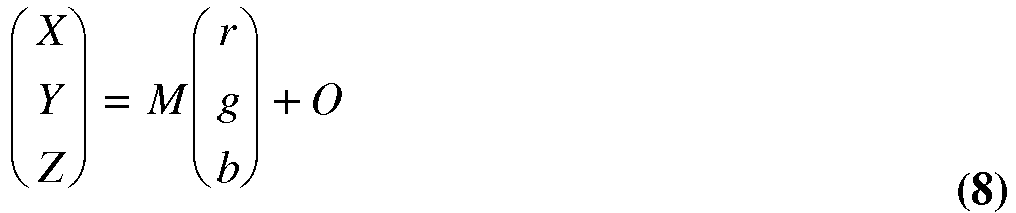
- In some embodiments, the maximum brightness of the target display for each of a plurality of primary colors is measured separately. For example, test patterns like those shown in
Figures 3A, 3B, 3C, 3D, 3E and 3F may be displayed on the target display for the case where the illuminatedarea 38A is each of red, green, blue and white. Black level and maximum luminance may be measured for each of these test patterns. From the known average luminance of each test pattern (which is different for different ones of the test patterns) one can derive relationships between black level and average image luminance and between white level and average image luminance. These relationships may be used to construct models of the type described above that may be applied to emulate the target display. - In some embodiments, modeling is performed that takes into account shifts in the saturation of primary colors as a function of the nature of the image data to be displayed. Light leakage can affect the color of a pixel. For example, a completely blue pixel may be desaturated by light leaking from neighboring red, green, or white pixels.
- Some embodiments emulate the effect of image content on color by adapting the colors of primaries used to emulate a target display based on image statistics. For images with only a single color, the full primary color is achievable. However, where an image has increasing amounts of other colors, the primaries may become desaturated. Statistics indicative of the color of an image may be measured globally (for an entire image), in which case the same response may be applied to each pixel. In the alternative or in addition, such statistics may be measured locally (for example in regions centered on each pixel), in which case different responses may be applied to different pixels or to pixels in different regions of an image.
- Methods and apparatus may be provided that map image luminance to emulate a target display based at least in part on image data characteristics or map image color to emulate a target display based at least in part on image data characteristics or both.
-
Figure 5 is a flowchart illustrating anexample method 50 for mapping input image data to emulate a target display in which both luminance and color are adjusted by the mapping in a manner that is based at least in part on image characteristics. -
Input image data 51 is normalized inblock 52. The input image data may, for example, be RGB image data in which code values are provided for each pixel for each of red (R), green (G) and blue (B) channels. The code values may, for example, be values on the range of 0 to 255 or 0 to 1024 or 0 to 4096. Inblock 52 the values are scaled into a standard range, for example the range of 0 to 1.Block 54 analyzes the image content ofinput image data 51 and derives a luminance mapping (or 'tone' mapping) 55 from that image data.Block 54 may, for example, derive a mapping from characteristics ofinput image data 51 as is done inmethod 30 ofFigure 2 ormethod 40 ofFigure 4 .Block 56 applies the mapping derived inblock 54 to linearize the input image data. -
Block 58 analyzes the color content of input image data 51 (block 58 may operate on rawinput image data 51 or on data that has been processed byblock 52 or block 54).Block 58 generatesparameters 59 for a color mapping. In some embodiments, block 58 determines effective primary colors for a target display (taking into account desaturation of the primary colors in the target display).Block 60 implements a color mapping into a display color space for the target display based on the chromaticities of the effective primary colors or other parameters derived inblock 58.Block 60 may, for example, apply a 3×3 transformation matrix to a set of RGB values provided at the input ofblock 60. -
Block 62 performs gamut mapping into the available color gamut of the target display. For example, block 62 may map or clip pixel values that are outside of the gamut of the target display onto or into the boundary of the gamut of the target display. -
Optional block 64 performs a mapping to a desired output color space.Block 64 may, for example, apply a 3×3 matrix transformation and output the result as modifiedimage data 65. -
Figure 6 shows anexample method 70 for determining a chromatic transformation.Method 70 may, for example, be applied inblock 58 ofmethod 50.Method 70 may be applied to each image to be displayed on a target display. Inblock 72,method 70 determines the relative amount of each primary color in the image. For example, the relative amounts of red, green and blue primaries in a RGB display may be determined by computing the ratios:
Block 72 may comprise performing a transformation into a display-referenced color space (such as an sRGB color space) as this may facilitate the processing ofblock 72. -
Blocks 

- The values for the parameters g and h (and for corresponding parameters for other primaries) may be determined by measurements made on a sample of the target display. For example,
test patterns 75A through 75D (collectively test patterns 75) as shown respectively inFigures 8A to 8D may be displayed on the target display. Each oftest patterns 75 has anarea 76 of a first primary color. Surroundingarea 76 is anotherarea 77 in which different ones oftest patterns 75 provide different proportions of the first primary color and a second primary color. In some embodiments one of the test patterns displays only the second primary color inarea 77. By displaying the series oftest patterns 75 and measuring the chromaticity of a point withinarea 76 one can determine a relationship between the effective chromaticity of the first primary color and the relative amount of the second primary color in the image (for example, one can find a value for a parameter value such as g or h that is a good fit to the results of such measurements). - For a target display having three primaries (e.g. R, G and B) one may provide six series of test patterns. Each series of test patterns may measure the effect on the chromaticity of one of the primary colors of one of the other two primary colors. For example, one series of test patterns may have saturated red in
area 76 and various mixtures of red and blue inarea 77. Another series of test patterns may have saturated red inarea 76 and various mixtures of red and green inarea 77. Another series of test patterns may have saturated blue inarea 76 and various mixtures of blue and green inarea 77. Another series of test patterns may have saturated blue inarea 76 and various mixtures of blue and red inarea 77. Another series of test patterns may have saturated green inarea 76 and various mixtures of green and red inarea 77. Another series of test patterns may have saturated green inarea 76 and various mixtures of green and blue inarea 77. The test patterns may be constructed such that the average luminance or other characteristics of the test patterns are essentially the same across the test patterns. - In an alternative embodiment, test patterns like test patterns 37 of
Figures 3A, 3B, 3C, 3D, 3E and 3F (modified such thatareas 38A display one primary color andareas 38B display a second primary color) may be used to measure the effect of desaturation on primaries. - Equations (10) and (11) model the desaturation of primaries as linear relationships. Other functional forms are possible. For example, coordinates of an effective primary could be determined using non-linear functions of the other primaries.
Figure 7 illustrates the relative locations in color space of the red, green and blue primaries (R, G, and B) of an example target display and the effective red, green and blue primaries (REFF, GEFF, BEFF). - In
block 75 the effective primaries determined inblocks block 76 the color transform is applied to transform the colors of image pixels into a color space based on the effective primaries to yield modifiedimage data 78. - A display may have more than three primary colors. A methodology similar to that described above may be applied to displays having four or more primary colors. An equivalent primary may be developed for one or more of the primary colors and a transformation may be performed which yields an output indicative of the appearance of the image when displayed using the equivalent primary colors in place of the corresponding primary colors.
- Shifts in the effective color of non-primary colors such as white (as in a RGBW display) may also be estimated based on the intensities of other colors in the image. This may be done by moving the effective white point for a white color (or the effective chromaticity for another color) to new chromaticity coordinates according to a vector that is the vector sum of vectors each directed toward a primary color with a magnitude related to the intensity of that primary color in the image (or a local area within the image). The magnitude of the vectors may be linearly or non-linearly related to the intensity of each corresponding primary color.
- A chromatic transformation may be generated for an entire image or, in the alternative, different chromatic transformations may be determined for local areas within an image. For example, values of R, G and B for use in Equations (9), (10) and (11) may be determined for a pixel in an image by summing or taking a weighted sum of pixel values in a region including the current pixel. The region may, for example comprise a region centered on the current pixel. The region could, for example, be rectangular or circular.
- Where a weighted sum is taken, the weight may become smaller as distance from the current pixel is increased. A different chromatic transformation may be generated for each pixel. In the alternative, chromatic transformations may be generated and used for pixels within a local area of an image. Processing may be reduced by calculating the chromatic transformations based on a low-resolution version of the image (which may be generated, for example, by appropriate downsampling or decimation of the image data).
- Some target displays may perform image processing that alters the appearance of pixels in an image. For example, a target display may incorporate image processing that performs gamut mapping. Examples of some situations where gamut mapping may be performed include:
- a target display that maps pixel values in an absolute color space (such as LogYuv, or XYZ) into a color space based on the physical primaries provided by the target display (e.g. a display-referred RGB color space);
- a target display that includes image processing to map out of gamut colors into the color gamut of the target display. Such a target display may, for example, accept image data specified in a color space that can encode colors in a very large gamut (such as sRGB, P3, OCES, RIMM, xvYcc);
- a target display that has more than three primaries but uses a three-primary interface that includes one or more virtual primaries. For example, a target display may have two green physical primaries and may assign values to the physical primaries based on a value for a single green virtual primary.
- a target display may perform color boosting.
- Some embodiments perform processing that emulates the effect of gamut mapping performed by a target display. In some embodiments, this processing is performed relatively simply. An example embodiment provides a transformation that converts input virtual primaries into the physical primaries of the target display. For example, the virtual primaries could be specified in a P3 color gamut, and the actual physical primaries could be represented in a sRGB color space. The transformation may be, for example a 3×3 color space transformation. If some resulting values have values that are invalid in the color space of the target display (e.g. sRGB values that are negative or greater than a maximum allowable value such as 1) the processing may clip or map the invalid values into a valid range in the target display color space.
- In a simple example embodiment, negative sRGB values are clipped to zero and sRGB values greater than a maximum allowed value (e.g. 1) are clipped to one. Many alternative algorithms may be applied for processing values that are invalid in the color space of the target display. Some examples are as follows. Where one or more of the pixel values for a pixel is negative, add the same amount to all of the pixel values for the pixel such that all of the pixel values are at least zero. For example, one could add the absolute value of the most negative pixel value to each of R, G and B pixel values for a pixel. Where one or more of the pixel values for a pixel exceeds a maximum value (e.g. 1) scale the pixel values by dividing each pixel value by the same amount to bring the values into range while preserving the ratios between the pixel values. For example multiply the R, G, and B values for a pixel by the inverse of the largest one of the R G B values for the pixel. Where one or more pixel values for a pixel exceeds a maximum value or is less than a minimum value, perform a soft compression to bring the values into a valid range. For example, perform a soft compression on the R G B values where the soft compression brings R G B values approaching 1 and greater than 1 into the range [0,1].
- In some embodiments, a rotation is applied using a 3×3 matrix transformation to help bring colors in the image data into the gamut of the target display.
- The result of any of the above is that the processed pixel values will be within the gamut of the target display. Pixel values in the display color space may optionally be converted back into a virtual color space (for example by applying a 3×3 matrix transformation).
- Processing to model gamut mapping that may occur within a target display may be combined with determining a chromatic transformation as discussed above with reference to
method 70 ofFigure 6 . For example, in one example embodiment,method 80 as illustrated inFigure 8 is performed prior to or together withmethod 70. In (optional) block 82 a specific transformation is applied to pixel values for an image.Block 82 may be a specific transformation that the target display is known to perform. For example, a target display may perform image processing that involves tone mapping or gamut mapping of image data to be displayed (color boosting is one example of this).Optional block 83 performs a color space rotation.Block 84 performs a transformation into a display-referenced color space (if the image data is not already in that color space).Block 85 performs gamut mapping (e.g. clipping, compressing or the like) into a valid range of pixel values. - A model may be selected to mimic the gamut mapping performed by the target display. The model may be selected to provide acceptable emulation of the gamut mapping provided by the target display without requiring excessive processing.
- While the operations described above have been explained separately for explanatory purposes, it may be convenient to combine two or more operations in practice. For example, two matrix multiplication operations may be combined into a single matrix multiplication. Also, those skilled in the art will understand that certain steps may be performed in alternative orders to arrive at the same result.
- In addition to the display aspects listed above, it may also be desirable to model other characteristics of a target display. For example, a target display may incorporate filters for image sharpening, blurring and/or noise reduction. The effect of such filters may be emulated by providing corresponding filters in the image processing used to model the target display. As another example, the target display may resize images to be displayed (for example, the target display may change an aspect ratio of the image or change a spatial resolution of the image by some form of upsampling or downsampling). In some embodiments, resizing is performed as part of the emulation of the target display.
- Some displays generate interpolated frames that are displayed between frames specified by image data. Such interpolation may be provided, for example, to make depictions of fast-moving objects clearer. Image statistics for an interpolated frame may differ from image statistics for non-interpolated frames in a manner that depends on how the target display performs interpolation. Some embodiments emulate interpolated frames by performing an interpolation to generate image data for an interpolated frame, generating image statistics for the interpolated frame and applying a method as described above to the interpolated frame. Some embodiments ignore the fact that a target display may insert interpolated frames between frames specified by image data. Some embodiments combine image statistics for frames before and after an interpolated frame (e.g. by averaging). such methods may avoid computing image statistics for the interpolated frame.
- As noted above, some aspects of the performance of a target display may depend at least in part on previously-displayed frames. For example, where the target display is of a type that has a global dimming backlight (i.e. the display has a backlight that is controlled to be brighter or dimmer based on the image content to be displayed) the display of one frame may effect the performance of the target display in one or more subsequent frames. This is especially the case where the target display limits the rate of change of luminance of the backlight. As another example, the white level achievable by a target display may depend on the capacity of a power supply of the target display. The display of one or more very bright frames may limit the white level achievable in a subsequent frame displayed before the power supply has had time to recover from displaying the very bright frame(s).
- In some embodiments, some or all features of the emulation described herein may be performed based on image data for one or more previous frames. For example, image data for one frame may be applied to the emulation of the next frame (or another subsequent frame). Other example embodiments use image statistics for previous frames to model some features of an emulation but not others. For example, white level, or in some cases white level and black level, may be based at least in part on image statistics for one or more previous frames while other features of the emulation such as chromaticity transformations and/or black level may be based on image data for a current frame.
- Image statistics for one or more previous frames may be used in an emulation in combination with image statistics for a current frame. For example, for one or more features of a model, the emulation may be based on a weighted average of image statistics of a current frame and image statistics for one or more previous frames.
- In some embodiments, some features of the emulation described herein may be performed based on image statistics for a local area within an image while other features are performed based on image statistics for an entire image. For example, white level may be determined based on image statistics for an entire image while other features such as black level and chromaticity transformations may be based on image statistics for a local area around a pixel for which emulation is being performed.
- In some embodiments, some features of the emulation are based both on image statistics for an entire image and for local image statistics. For example in a target display, a white level for a pixel may be affected both by limitations of a power supply or light source driving circuit in the display and by the local environment of a pixel being processed (e.g. the achievable white level may be different depending on whether the pixel is located in a region of bright pixels or is surrounded by mostly dark pixels). In such embodiments white level may be determined based both on overall image statistics for the image being displayed (and/or for one or more previous frames) and for a local area around the pixel in question. One or the other of these values may be selected (e.g. the emulation may use the lower one of these values) or the values may be combined (e.g. by averaging, weighted averaging, or the like) to establish a white level to be applied in emulating the appearance of the pixel in question.
-
Figure 9 illustratesapparatus 90 according to a non-limiting example embodiment.Apparatus 90 can be used to adjustinput image data 92 to createoutput image data 102 to be displayed on atarget display 103. -
Apparatus 90 comprises a series ofsetters 104. In the illustrated embodiment,setters 104 comprise agamut setter 96, acontrast setter 98, ablack level setter 99 and awhite level setter 100.Setters 104 may operate in series and/or in parallel to one another. Eachsetter 104 may comprise software executing on a data processor, application specific hardware, or a combination of hardware and a data processor configured with software to perform adjustments to a transformation as described herein.Setters 104 may be separate or the functions of two ormore setters 104 may be combined. Apparatus according to other embodiments may lack some of the setters depicted inFigure 9 .Setters 104 are illustrated as being discrete entities for example only. Apparatus may include circuitry and/or programmable processors configured to perform a plurality of adjustments together. -
Setters 104 receiveinput data 105 and produce output signals 106 that control aspects of atransformation unit 107 operating oninput image data 92 to yieldoutput image data 102.Input data 105 includesreference display specifications 93 andinput image data 92.Input data 105 optionally includes ambient light data 95. Ambient light data 95 may be produced by one or more ambientlight detectors 105, which may be located on or near thetarget display 103, and/or received from user input indicating an ambient light level. Thetarget display specifications 93, may include information about the features and capabilities of thetarget display 103 such as: - the color gamut that can be reproduced by the display;
- a relationship between the appearance of primary colors and color saturation of image data and/or relationship(s) between achievable color gamut and one or more image statistics;
- the white level;
- a relationship between white level and average image luminance or other image statistics;
- black level;
- a relationship between black level and average image luminance or other image statistics;
- mid-range contrast;
- a relationship between mid-range contrast and average image luminance or other image statistics;
- resolution;
- acceptable input signal formats;
- color depth;
- white point;
- grey steps;
- etc.
-
Setters 104 control atransformation unit 107 which may adjust theinput image data 92 in any suitable manner including the specific example systems and methods described herein and combinations and variations on such systems and methods. -
Setters 104 may share data with one an other (e.g., the operation of the contrast setter may rely on data output by the white level setter). -
Figure 10 illustrates anapparatus 100 according to another example embodiment.Apparatus 100 may be applied to determinedisplay specifications 112 for aparticular target display 109. -
Image data 108 is provided to targetdisplay 109.Image data 107 may comprise or consist of one or more test patterns that have different average illumination levels and/or include different amounts of primary colors. Non-limiting example test patterns that may be provided inimage data 107 are as shown inFigures 3A, 3B, 3C, 3D, 3E, 3F ,8A, 8B, 8C and 8D . -
Display measurer 110 comprises a light meter arranged to measure the light produced by thetarget display 109 at a particular location. Measurements fromdisplay measurer 110 are received at adisplay parameter calculator 112.Display parameter calculator 112 determines display parameters (e.g. parameters relating white level to average luminance or parameters relating desaturation of primary colors to levels of other primary colors) according to any of the systems and methods described herein. The resulting parameters may be applied asdisplay specifications 113. - In the illustrated embodiment, a
test controller 111 causesimage data 108 comprising test patterns to be displayed ontarget display 109.Test controller 111 also controlsdisplay measurer 110 to measure the light output at the location of thetarget display 109 while each test pattern is displayed,display parameter calculator 112 determines relationships between display characteristics such as black level, white level and achievable color gamut as a function of image statistics such as average luminance, average luminance in each color channel, and the like. - It is not mandatory that
image data 108 consist of constructed test patterns. In an alternative embodiment,image data 108 comprises a series of images over which image statistics vary in a known manner. Forexample image data 108 may be subjected to image analysis before or after it is displayed to determine the image statistics for the displayed images. Display measurer may measure characteristics of the displayed images such as black level for areas of the displayed images that are black, white level for areas of the displayed images that are white, chromaticities of areas of the displayed images made up of primary colors and the like. In such embodiments,display measurer 110 may comprise a calibrated high resolution camera, for example. - Apparatus according to other example embodiments comprises one or more data processors configured to perform any method as described above. In some embodiments the data processors are or comprise: software-programmable data processors executing software (which may include firmware) instructions which cause the processors to execute methods as described herein or parts of such methods. In other embodiments the data processors are or comprise configurable logic circuits configured to execute methods as described herein or parts of such methods. In other embodiments the data processors are or comprise hard-wired logic circuits connected to execute methods as described herein or parts of such methods. In other embodiments the data processors comprise combinations of two or more of the foregoing.
- Technology as described herein has a wide range of applications. Apparatus and methods as described herein may optionally be incorporated into video processing and/or video distribution equipment such as: video encoders; video decoders; pre-processors for consumer or professional video encoders; consumer or professional video encoders; output device transforms for image interchange formats (IIFs) such as the Academy™ IIF; post-processors for consumer or professional decoders; pre-processors and post-processors for display management; displays; video players; video servers; and the like.
- It is not practical to describe all possible applications. Non-limiting example applications include applying an emulation as described herein as a pre-processor prior to encoding and distributing video content. The pre-processor may emulate a reference display on which the video content was approved. In this example the video content has been produced and presented on a reference display. However, since no display is perfect, the reference display has not perfectly reproduced the video content. The content may not appear exactly as intended if the content is directly encoded and distributed for viewing on other displays with lesser and/or greater capabilities than the reference display (note that the capabilities of another display may be both greater and lesser than the capability of a reference display - for example, the other display may have a greater maximum luminance than the reference display but a smaller color gamut). By preprocessing to yield image data that emulates the actual appearance of the video content when viewed on the reference display. The modified image data input to the encoder has already accounted for the limitations of the reference display and thus can be reproduced as intended on another display, even if that other display has greater capabilities than the reference display.
- In another example application the emulation is performed for a target display on which the image content will be viewed. The target display may, for example, comprise a 'lowest-common-denominator' target display. Pre-processing to generate modified image data emulating the content as it will appear when viewed on the target display may eliminate image nuances that the target display cannot reproduce. This may result in modified image data that can be encoded more efficiently (e.g. encoded to produce a smaller encoded output) while still preserving image features that affect the appearance of the content when viewed on the target display.
- In another example, emulation as described herein may be performed in a pre-processor prior to performing additional image processing such as color management or an output data transformation (ODT). Such pre-processing may provide a more accurate model for the intended appearance of the content to a color management system (which may further adjust the content for viewing on a specific display that is the target of the color management system).
- In another example, emulation as described herein may be performed in a post-processor, after performing image processing such as color management or an ODT. In this case the emulation may be applied to determine how a downstream target display will display the content.
- In another example, emulation as described herein may be performed in a post-processor after a video decoder.
- Some embodiments may provide reasonable estimate emulations of target displays in cases where the target displays are subject to one or more of the following conditions: power limiting (the brightness of a pixel is dependent on the total power load of an image); optical and digital flare (the brightness and/or color of a pixel is dependent on light contributed from neighboring pixels); virtual primaries (a color signal sent to a display is not achievable by a display, instead it is mapped into a signal within the capabilities of the display); and reflections (the brightness and/or color of a pixel is dependent on ambient light reflected from the panel). Ambient light conditions of the viewing environment may be measured with a sensor, or may be provided by the user selecting a particular setting (e.g. "bright room", "dark room", "sunny outdoors", "cloudy outdoors", etc.).
- The above detailed description of examples of the technology is not intended to be exhaustive or to limit the system to the precise form disclosed above. While specific examples of, and examples for, the system are described above for illustrative purposes, various equivalent modifications are possible within the scope of the system, as those skilled in the relevant art will recognize. For example, while processes or blocks are presented in a given order, alternative examples may perform routines having steps, or employ systems having blocks, in a different order, and some processes or blocks may be deleted, moved, added, subdivided, combined, and/or modified to provide alternative or subcombinations. Each of these processes or blocks may be implemented in a variety of different ways. Also, while processes or blocks are at times shown as being performed in series, these processes or blocks may instead be performed in parallel, or may be performed at different times.
- Image processing and processing steps as described above may be performed in hardware, software (including 'firmware') in combination with a data processor to execute the software or suitable combinations of hardware and software. Certain implementations of the invention comprise computer processors which execute software instructions which cause the processors to perform a method of the invention. For example, one or more processors in a video workstation, set top box, display, video projector, transcoder or the like may implement methods as described herein by executing software instructions in a program memory accessible to the processors. For example, such image processing may be performed by a data processor (such as one or more microprocessors, graphics processors, digital signal processors or the like) executing software and/or firmware instructions which cause the data processor to implement methods as described herein. The software and other modules described herein may be executed by a general-purpose computer, e.g., a server computer or personal computer. Furthermore, aspects of the system can be embodied in a special purpose computer or data processor that is specifically programmed, configured, or constructed to perform one or more of the computer-executable instructions explained in detail herein. Such methods may also be performed by logic circuits which may be hard configured or configurable (such as, for example logic circuits provided by a field-programmable gate array "FPGA").
- Software and other modules may reside on servers, workstations, personal computers, tablet computers, image data encoders, image data decoders, PDAs, color-grading tools, video projectors, audio-visual receivers, displays (such as televisions), digital cinema projectors, media players, and other devices suitable for the purposes described herein. Those skilled in the relevant art will appreciate that aspects of the system can be practised with other communications, data processing, or computer system configurations, including: Internet appliances, hand-held devices (including personal digital assistants (PDAs)), wearable computers, all manner of cellular or mobile phones, multi-processor systems, microprocessor-based or programmable consumer electronics (e.g., video projectors, audio-visual receivers, displays, such as televisions, and the like), set-top boxes, color-grading tools, network PCs, minicomputers, mainframe computers, and the like.
- Software and other modules may be accessible via local memory, via a network, via a browser or other application in an ASP context, or via other means suitable for the purposes described herein. Examples of the technology can also be practised in distributed computing environments where tasks or modules are performed by remote processing devices, which are linked through a communications network, such as a Local Area Network (LAN), Wide Area Network (WAN), or the Internet. In a distributed computing environment, program modules may be located in both local and remote memory storage devices. Data structures (e.g., containers) described herein may comprise computer files, variables, programming arrays, programming structures, or any electronic information storage schemes or methods, or any combinations thereof, suitable for the purposes described herein.
- The invention may also be provided in the form of a program product. The program product may comprise any non-transitory medium which carries a set of computer-readable signals comprising instructions which, when executed by a data processor, cause the data processor to execute a method of the invention. Program products according to the invention may be in any of a wide variety of forms. The program product may comprise, for example, non-transitory media such as magnetic data storage media including floppy diskettes, hard disk drives, optical data storage media including CD ROMs, DVDs, electronic data storage media including ROMs, flash RAM, EPROMs, hardwired or preprogrammed chips (e.g., EEPROM semiconductor chips), nanotechnology memory, or the like. The computer-readable signals on the program product may optionally be compressed or encrypted. Computer instructions, data structures, and other data used in the practice of the technology may be distributed over the Internet or over other networks (including wireless networks), on a propagated signal on a propagation medium (e.g., an electromagnetic wave(s), a sound wave, etc.) over a period of time, or they may be provided on any analog or digital network (packet switched, circuit switched, or other scheme).
- Where a component (e.g. a display, encoder, color grading device, software module, processor, assembly, device, circuit, etc.) is referred to above, unless otherwise indicated, reference to that component (including a reference to a "means") should be interpreted as including as equivalents of that component any component which performs the function of the described component (i.e., that is functionally equivalent), including components which are not structurally equivalent to the disclosed structure which performs the function in the illustrated exemplary embodiments of the invention.
- Unless the context clearly requires otherwise, throughout the description and the claims, the words "comprise," "comprising," and the like are to be construed in an inclusive sense, as opposed to an exclusive or exhaustive sense; that is to say, in the sense of "including, but not limited to." As used herein, the terms "connected," "coupled," or any variant thereof, means any connection or coupling, either direct or indirect, between two or more elements; the coupling of connection between the elements can be physical, logical, or a combination thereof. Additionally, the words "herein," "above," "below," and words of similar import, when used in this application, shall refer to this application as a whole and not to any particular portions of this application. Where the context permits, words in the above Detailed Description using the singular or plural number may also include the plural or singular number respectively. The word "or," in reference to a list of two or more items, covers all of the following interpretations of the word: any of the items in the list, all of the items in the list, and any combination of the items in the list.
Claims (7)
- An image processing method (30, 40) for adjusting a pixel data value in an input image data (32) prepared for a source display (20) to generate a modified pixel data value (33,49) that emulate image content as it will appear when viewed on a target display (103), the method (40) comprising:obtaining (34, 42) one or more luminance image statistics parameter values, each luminance image statistics parameter value corresponding to a luminance image statistics parameter representing a luminance image statistics for the image content or a local area in the image content around the pixel by processing the image data prepared for a source display (20), wherein the luminance image statistics comprise at least one of: an average luminance, a geometric mean luminance, a median luminance, a weighted mean luminance, and a total luminance, each of them of the image content or of a local area in the image content around the pixel;accessing (35A, 35B) target display functions, wherein the target display functions are functions of a selected luminance image statistics parameter of the luminance image statistics parameters and represent the characteristics of the target display, wherein a first of the target display functions is configured to estimate a black level of the target display (103) corresponding to the obtained luminance image statistics parameter value of the selected luminance statistics parameter, and wherein a second of the target display functions is configured to estimate a white level of the target display (103) corresponding to the obtained luminance image statistics parameter value of the selected luminance statistics parameter;computing (36A, 36B, 43, 44, 45), for each of the accessed target display functions, a target display function value, wherein each target display function value is the function value of the corresponding target display function for the obtained luminance image statistics parameter values, wherein the target display function values comprise the estimated black level of the target display (103) corresponding to the obtained luminance image statistics parameter value of the selected luminance statistics parameter and the estimated white level of the target display (103) corresponding to the obtained luminance image statistics parameter value of the selected luminance statistics parameter;transforming (38, 47, 48) the pixel data value in the input image data (32) into the modified pixel data value (33, 49) by using the computed target display function values, wherein the transforming (38, 47, 48) comprises computing the value L according to:

- A method (30, 40) according to claim 1 wherein the selected luminance image statistics parameter represents the average luminance of the local area in the image content around the pixel.
- A method (30, 40) according to claim 1 or claim 2 wherein the selected luminance image statistics parameter represents the average luminance of the image content.
- A method (30, 40) according to any of claims 1-3, further comprising, prior to accessing the target display functions, determining the target display functions, the method (30, 40) comprising:
processing, for each of the target display functions, a plurality of test patterns, the processing of each of the plurality of test patterns comprising:displaying a test pattern on the target display (103);measuring light produced at a location on the target display (103) by display of the test pattern on the target display (103);calculating the target display function value based on the measured light that corresponds to the displayed test pattern; andcalculating the target display function by fitting a suitable curve of the corresponding calculated target display function values. - A method (30, 40) according to claim 4, wherein processing, for each of the target display functions, a plurality of test patterns, comprises a processing of a first plurality of test patterns (37A, 37B, 37C) to determine the first target display function representing the black level of the target display (103), wherein each of the first plurality of test patterns (37A, 37B, 37C) has a black area (38B) and has different luminance image statistics parameter values corresponding to the selected luminance image statistics parameter.
- A method (30, 40) according to claim 4 or claim 5, wherein processing, for each of the target display functions, a plurality of test patterns, comprises a processing of a second plurality of test patterns (37D, 37E, 37F) to determine the second target display function representing the white level of the target display (103), wherein each of the second plurality of test patterns (37D, 37E, 37F) has a white area (38A) and has different luminance image statistics parameter values corresponding to the selected luminance image statistics parameter.
- Apparatus (90) for adjusting image data (92) prepared for a source display (20) to generate modified image data (102) that emulate image content as it will appear when viewed on a target display (103), the apparatus (90) comprising one or more image adjusters (104) connected to receive the image data (92) and configured to perform the method (30, 40, 50) according to any of claims 1-6.
Applications Claiming Priority (2)
| Application Number | Priority Date | Filing Date | Title |
|---|---|---|---|
| US201161568636P | 2011-12-08 | 2011-12-08 | |
| PCT/US2012/068129 WO2013086107A1 (en) | 2011-12-08 | 2012-12-06 | Mapping for display emulation based on image characteristics |
Publications (2)
| Publication Number | Publication Date |
|---|---|
| EP2788973A1 EP2788973A1 (en) | 2014-10-15 |
| EP2788973B1 true EP2788973B1 (en) | 2022-01-26 |
Family
ID=47459139
Family Applications (1)
| Application Number | Title | Priority Date | Filing Date |
|---|---|---|---|
| EP12808593.3A Active EP2788973B1 (en) | 2011-12-08 | 2012-12-06 | Mapping for display emulation based on image characteristics |
Country Status (3)
| Country | Link |
|---|---|
| US (1) | US9514508B2 (en) |
| EP (1) | EP2788973B1 (en) |
| WO (1) | WO2013086107A1 (en) |
Families Citing this family (27)
| Publication number | Priority date | Publication date | Assignee | Title |
|---|---|---|---|---|
| US9035965B2 (en) | 2011-12-06 | 2015-05-19 | Dolby Laboratories Licensing Corporation | Metadata for use in color grading |
| JP6441956B2 (en) * | 2014-03-26 | 2018-12-19 | ドルビー ラボラトリーズ ライセンシング コーポレイション | Global light compensation in various displays |
| US10043425B2 (en) * | 2015-03-24 | 2018-08-07 | Microsoft Technology Licensing, Llc | Test patterns for motion-induced chromatic shift |
| EP4050895B1 (en) | 2015-05-06 | 2026-01-07 | Dolby Laboratories Licensing Corporation | Thermal compensation in image projection |
| CN105657494B (en) * | 2015-12-31 | 2018-12-25 | 北京小鸟看看科技有限公司 | A kind of virtual theater and its implementation |
| US10708478B2 (en) * | 2016-03-23 | 2020-07-07 | Karl Storz Imaging, Inc. | Image transformation and display for fluorescent and visible imaging |
| US10845245B2 (en) * | 2016-04-20 | 2020-11-24 | Leica Biosystems Imaging, Inc. | Digital pathology color calibration and validation |
| CN109314772B (en) | 2016-06-22 | 2021-10-29 | 杜比实验室特许公司 | Renders wide-gamut, two-dimensional (2D) images on three-dimensional (3D) capable displays |
| KR102672149B1 (en) | 2016-10-05 | 2024-06-05 | 돌비 레버러토리즈 라이쎈싱 코오포레이션 | Source color volume information messaging |
| US10373345B2 (en) * | 2017-04-06 | 2019-08-06 | International Business Machines Corporation | Adaptive image display characteristics |
| CN107068114B (en) * | 2017-04-24 | 2019-04-30 | 北京小米移动软件有限公司 | Screen color adjustment method, device, device and storage medium |
| US10847118B2 (en) | 2017-05-12 | 2020-11-24 | Apple Inc. | Electronic devices with tone mapping engines |
| CN107045863B (en) * | 2017-06-26 | 2018-02-16 | 惠科股份有限公司 | Gray scale adjusting method and device of display panel |
| US11347296B2 (en) * | 2017-07-25 | 2022-05-31 | Dell Products, L.P. | Backlight dimming via buck-boost conversion in an information handling system |
| CN108335362B (en) * | 2018-01-16 | 2021-11-12 | 重庆爱奇艺智能科技有限公司 | Light control method and device in virtual scene and VR (virtual reality) equipment |
| CN108235119B (en) * | 2018-03-15 | 2021-02-19 | 联想(北京)有限公司 | Video processing method and device, electronic equipment and computer readable medium |
| HUE071418T2 (en) | 2018-09-17 | 2025-08-28 | Dolby Laboratories Licensing Corp | Display mapping for high dynamic range images on performance-limited displays |
| BR112021005818A2 (en) | 2018-09-26 | 2021-06-29 | Dolby Laboratories Licensing Corporation | projector light source dimming using metadata from future frames |
| US11302288B2 (en) | 2018-09-28 | 2022-04-12 | Apple Inc. | Ambient saturation adaptation |
| US10672363B2 (en) * | 2018-09-28 | 2020-06-02 | Apple Inc. | Color rendering for images in extended dynamic range mode |
| US11024260B2 (en) | 2018-09-28 | 2021-06-01 | Apple Inc. | Adaptive transfer functions |
| CN110213554B (en) * | 2019-07-03 | 2021-07-13 | 大峡谷照明系统(苏州)股份有限公司 | An image map player and a method for pixel point debugging |
| TWI745871B (en) * | 2020-02-24 | 2021-11-11 | 佳世達科技股份有限公司 | Display device and color adjusting method |
| US11176859B2 (en) * | 2020-03-24 | 2021-11-16 | Synaptics Incorporated | Device and method for display module calibration |
| JP2023073071A (en) * | 2021-11-15 | 2023-05-25 | キヤノン株式会社 | Image processing device and image processing method |
| CN115546058B (en) * | 2022-09-27 | 2025-08-01 | 中国科学院光电技术研究所 | Automatic dimming method suitable for manual intersection butt joint |
| CN118887151B (en) * | 2024-09-12 | 2025-05-09 | 西安市航空基地天翼航空科技有限公司 | Virtual simulation image display quality processing method |
Citations (2)
| Publication number | Priority date | Publication date | Assignee | Title |
|---|---|---|---|---|
| US20100265264A1 (en) * | 2006-12-21 | 2010-10-21 | Thomson Licensing | Method, apparatus and system for providing color grading for displays |
| WO2011106247A2 (en) * | 2010-02-24 | 2011-09-01 | Dolby Laboratories Licensing Corporation | Display management methods and apparatus |
Family Cites Families (27)
| Publication number | Priority date | Publication date | Assignee | Title |
|---|---|---|---|---|
| US7339595B2 (en) * | 1998-10-19 | 2008-03-04 | Lightsurf Technologies, Inc. | Method and system for improved internet color |
| JP3697997B2 (en) | 2000-02-18 | 2005-09-21 | ソニー株式会社 | Image display apparatus and gradation correction data creation method |
| TW490701B (en) | 2001-04-04 | 2002-06-11 | Acer Display Tech Inc | Brightness compensation method for plasma display |
| US20040196302A1 (en) | 2003-03-04 | 2004-10-07 | Im Moon Hwan | Systems and methods for temporal subpixel rendering of image data |
| CN1777927A (en) | 2003-04-18 | 2006-05-24 | 皇家飞利浦电子股份有限公司 | LCD Gamma Correction |
| US7317462B2 (en) | 2004-03-29 | 2008-01-08 | Vastview Technologies, Inc. | Method for luminance compensation of liquid crystal display and its device |
| JP4073477B2 (en) * | 2005-03-25 | 2008-04-09 | 三菱電機株式会社 | Image processing apparatus and image display apparatus |
| CN101156455B (en) | 2005-04-04 | 2011-07-06 | 皇家飞利浦电子股份有限公司 | Method of converting signals for multi-primary displays |
| US20060251323A1 (en) | 2005-05-05 | 2006-11-09 | Genesis Microchip Inc. | Detection, correction fading and processing in hue, saturation and luminance directions |
| US7352410B2 (en) | 2005-05-31 | 2008-04-01 | Kolorific, Inc. | Method and system for automatic brightness and contrast adjustment of a video source |
| CN101390153B (en) | 2005-10-14 | 2011-10-12 | 三星电子株式会社 | Improved gamut mapping and subpixel rendering system and method |
| US9313470B2 (en) | 2005-10-28 | 2016-04-12 | Thomson Licensing | Systems and methods for determining and communicating correction information for video images |
| TWI288907B (en) | 2005-11-17 | 2007-10-21 | Marketech Int Corp | Compensation method of brightness inaccuracy applied in a flat display |
| US7746411B1 (en) | 2005-12-07 | 2010-06-29 | Marvell International Ltd. | Color management unit |
| US7592996B2 (en) | 2006-06-02 | 2009-09-22 | Samsung Electronics Co., Ltd. | Multiprimary color display with dynamic gamut mapping |
| US8406562B2 (en) * | 2006-08-11 | 2013-03-26 | Geo Semiconductor Inc. | System and method for automated calibration and correction of display geometry and color |
| US7821474B2 (en) | 2006-10-13 | 2010-10-26 | Apple Inc. | Rendering luminance levels of a high dynamic range display |
| US20100134529A1 (en) * | 2007-06-29 | 2010-06-03 | Ingo Tobias Doser | System and method for matching colors on displays with different modulation transfer functions |
| US8159616B2 (en) | 2008-03-27 | 2012-04-17 | Bang & Olufsen A/S | Histogram and chrominance processing |
| US8284218B2 (en) | 2008-05-23 | 2012-10-09 | Semiconductor Energy Laboratory Co., Ltd. | Display device controlling luminance |
| US9330630B2 (en) * | 2008-08-30 | 2016-05-03 | Sharp Laboratories Of America, Inc. | Methods and systems for display source light management with rate change control |
| CA2736270C (en) | 2008-09-30 | 2016-04-12 | Dolby Laboratories Licensing Corporation | Systems and methods for applying adaptive gamma in image processing for high brightness and high dynamic range displays |
| US8390642B2 (en) | 2009-04-30 | 2013-03-05 | Hewlett-Packard Development Company, L.P. | System and method for color space setting adjustment |
| US20100295864A1 (en) * | 2009-05-21 | 2010-11-25 | Kerofsky Louis J | Methods and Systems for Setting a Backlight Level |
| JP4668342B2 (en) | 2009-08-31 | 2011-04-13 | シャープ株式会社 | Liquid crystal display device |
| KR101034755B1 (en) * | 2009-11-12 | 2011-05-17 | 삼성모바일디스플레이주식회사 | Luminance Correction System and Luminance Correction Method Using the Same |
| JP5103507B2 (en) * | 2010-08-04 | 2012-12-19 | シャープ株式会社 | Multi display system |
-
2012
- 2012-12-06 EP EP12808593.3A patent/EP2788973B1/en active Active
- 2012-12-06 WO PCT/US2012/068129 patent/WO2013086107A1/en not_active Ceased
- 2012-12-06 US US14/358,117 patent/US9514508B2/en active Active
Patent Citations (2)
| Publication number | Priority date | Publication date | Assignee | Title |
|---|---|---|---|---|
| US20100265264A1 (en) * | 2006-12-21 | 2010-10-21 | Thomson Licensing | Method, apparatus and system for providing color grading for displays |
| WO2011106247A2 (en) * | 2010-02-24 | 2011-09-01 | Dolby Laboratories Licensing Corporation | Display management methods and apparatus |
Also Published As
| Publication number | Publication date |
|---|---|
| US9514508B2 (en) | 2016-12-06 |
| EP2788973A1 (en) | 2014-10-15 |
| WO2013086107A1 (en) | 2013-06-13 |
| US20140333660A1 (en) | 2014-11-13 |
Similar Documents
| Publication | Publication Date | Title |
|---|---|---|
| EP2788973B1 (en) | Mapping for display emulation based on image characteristics | |
| US10255879B2 (en) | Method and apparatus for image data transformation | |
| US9685120B2 (en) | Image formats and related methods and apparatuses | |
| US9842385B2 (en) | Display management for images with enhanced dynamic range | |
| US8704859B2 (en) | Dynamic display adjustment based on ambient conditions | |
| JP5522918B2 (en) | System and method for selectively processing out-of-gamut color conversion | |
| US8831343B2 (en) | Image processing and displaying methods for devices that implement color appearance models | |
| CN109983530A (en) | Ambient light adaptive display management | |
| US11386875B2 (en) | Automatic display adaptation based on environmental conditions | |
| US10332481B2 (en) | Adaptive display management using 3D look-up table interpolation | |
| WO2016154225A1 (en) | Dynamic power management for an hdr display | |
| JP2025533418A (en) | Dynamic system optical-to-optical transfer functions (OOTF) to provide perceptual criteria | |
| Kim | Optically adjustable display color gamut in time-sequential displays using LED/Laser light sources |
Legal Events
| Date | Code | Title | Description |
|---|---|---|---|
| PUAI | Public reference made under article 153(3) epc to a published international application that has entered the european phase |
Free format text: ORIGINAL CODE: 0009012 |
|
| 17P | Request for examination filed |
Effective date: 20140708 |
|
| AK | Designated contracting states |
Kind code of ref document: A1 Designated state(s): AL AT BE BG CH CY CZ DE DK EE ES FI FR GB GR HR HU IE IS IT LI LT LU LV MC MK MT NL NO PL PT RO RS SE SI SK SM TR |
|
| DAX | Request for extension of the european patent (deleted) | ||
| RAP1 | Party data changed (applicant data changed or rights of an application transferred) |
Owner name: DOLBY LABORATORIES LICENSING CORPORATION |
|
| STAA | Information on the status of an ep patent application or granted ep patent |
Free format text: STATUS: EXAMINATION IS IN PROGRESS |
|
| 17Q | First examination report despatched |
Effective date: 20171129 |
|
| GRAP | Despatch of communication of intention to grant a patent |
Free format text: ORIGINAL CODE: EPIDOSNIGR1 |
|
| STAA | Information on the status of an ep patent application or granted ep patent |
Free format text: STATUS: GRANT OF PATENT IS INTENDED |
|
| INTG | Intention to grant announced |
Effective date: 20210323 |
|
| GRAJ | Information related to disapproval of communication of intention to grant by the applicant or resumption of examination proceedings by the epo deleted |
Free format text: ORIGINAL CODE: EPIDOSDIGR1 |
|
| STAA | Information on the status of an ep patent application or granted ep patent |
Free format text: STATUS: EXAMINATION IS IN PROGRESS |
|
| GRAP | Despatch of communication of intention to grant a patent |
Free format text: ORIGINAL CODE: EPIDOSNIGR1 |
|
| STAA | Information on the status of an ep patent application or granted ep patent |
Free format text: STATUS: GRANT OF PATENT IS INTENDED |
|
| INTC | Intention to grant announced (deleted) | ||
| INTG | Intention to grant announced |
Effective date: 20210726 |
|
| GRAS | Grant fee paid |
Free format text: ORIGINAL CODE: EPIDOSNIGR3 |
|
| GRAA | (expected) grant |
Free format text: ORIGINAL CODE: 0009210 |
|
| STAA | Information on the status of an ep patent application or granted ep patent |
Free format text: STATUS: THE PATENT HAS BEEN GRANTED |
|
| AK | Designated contracting states |
Kind code of ref document: B1 Designated state(s): AL AT BE BG CH CY CZ DE DK EE ES FI FR GB GR HR HU IE IS IT LI LT LU LV MC MK MT NL NO PL PT RO RS SE SI SK SM TR |
|
| REG | Reference to a national code |
Ref country code: GB Ref legal event code: FG4D |
|
| REG | Reference to a national code |
Ref country code: CH Ref legal event code: EP |
|
| REG | Reference to a national code |
Ref country code: AT Ref legal event code: REF Ref document number: 1465891 Country of ref document: AT Kind code of ref document: T Effective date: 20220215 |
|
| REG | Reference to a national code |
Ref country code: IE Ref legal event code: FG4D |
|
| REG | Reference to a national code |
Ref country code: DE Ref legal event code: R096 Ref document number: 602012077595 Country of ref document: DE |
|
| REG | Reference to a national code |
Ref country code: LT Ref legal event code: MG9D |
|
| REG | Reference to a national code |
Ref country code: NL Ref legal event code: MP Effective date: 20220126 |
|
| REG | Reference to a national code |
Ref country code: AT Ref legal event code: MK05 Ref document number: 1465891 Country of ref document: AT Kind code of ref document: T Effective date: 20220126 |
|
| PG25 | Lapsed in a contracting state [announced via postgrant information from national office to epo] |
Ref country code: NL Free format text: LAPSE BECAUSE OF FAILURE TO SUBMIT A TRANSLATION OF THE DESCRIPTION OR TO PAY THE FEE WITHIN THE PRESCRIBED TIME-LIMIT Effective date: 20220126 |
|
| PG25 | Lapsed in a contracting state [announced via postgrant information from national office to epo] |
Ref country code: SE Free format text: LAPSE BECAUSE OF FAILURE TO SUBMIT A TRANSLATION OF THE DESCRIPTION OR TO PAY THE FEE WITHIN THE PRESCRIBED TIME-LIMIT Effective date: 20220126 Ref country code: RS Free format text: LAPSE BECAUSE OF FAILURE TO SUBMIT A TRANSLATION OF THE DESCRIPTION OR TO PAY THE FEE WITHIN THE PRESCRIBED TIME-LIMIT Effective date: 20220126 Ref country code: PT Free format text: LAPSE BECAUSE OF FAILURE TO SUBMIT A TRANSLATION OF THE DESCRIPTION OR TO PAY THE FEE WITHIN THE PRESCRIBED TIME-LIMIT Effective date: 20220526 Ref country code: NO Free format text: LAPSE BECAUSE OF FAILURE TO SUBMIT A TRANSLATION OF THE DESCRIPTION OR TO PAY THE FEE WITHIN THE PRESCRIBED TIME-LIMIT Effective date: 20220426 Ref country code: LT Free format text: LAPSE BECAUSE OF FAILURE TO SUBMIT A TRANSLATION OF THE DESCRIPTION OR TO PAY THE FEE WITHIN THE PRESCRIBED TIME-LIMIT Effective date: 20220126 Ref country code: HR Free format text: LAPSE BECAUSE OF FAILURE TO SUBMIT A TRANSLATION OF THE DESCRIPTION OR TO PAY THE FEE WITHIN THE PRESCRIBED TIME-LIMIT Effective date: 20220126 Ref country code: ES Free format text: LAPSE BECAUSE OF FAILURE TO SUBMIT A TRANSLATION OF THE DESCRIPTION OR TO PAY THE FEE WITHIN THE PRESCRIBED TIME-LIMIT Effective date: 20220126 Ref country code: BG Free format text: LAPSE BECAUSE OF FAILURE TO SUBMIT A TRANSLATION OF THE DESCRIPTION OR TO PAY THE FEE WITHIN THE PRESCRIBED TIME-LIMIT Effective date: 20220426 |
|
| PG25 | Lapsed in a contracting state [announced via postgrant information from national office to epo] |
Ref country code: PL Free format text: LAPSE BECAUSE OF FAILURE TO SUBMIT A TRANSLATION OF THE DESCRIPTION OR TO PAY THE FEE WITHIN THE PRESCRIBED TIME-LIMIT Effective date: 20220126 Ref country code: LV Free format text: LAPSE BECAUSE OF FAILURE TO SUBMIT A TRANSLATION OF THE DESCRIPTION OR TO PAY THE FEE WITHIN THE PRESCRIBED TIME-LIMIT Effective date: 20220126 Ref country code: GR Free format text: LAPSE BECAUSE OF FAILURE TO SUBMIT A TRANSLATION OF THE DESCRIPTION OR TO PAY THE FEE WITHIN THE PRESCRIBED TIME-LIMIT Effective date: 20220427 Ref country code: FI Free format text: LAPSE BECAUSE OF FAILURE TO SUBMIT A TRANSLATION OF THE DESCRIPTION OR TO PAY THE FEE WITHIN THE PRESCRIBED TIME-LIMIT Effective date: 20220126 Ref country code: AT Free format text: LAPSE BECAUSE OF FAILURE TO SUBMIT A TRANSLATION OF THE DESCRIPTION OR TO PAY THE FEE WITHIN THE PRESCRIBED TIME-LIMIT Effective date: 20220126 |
|
| PG25 | Lapsed in a contracting state [announced via postgrant information from national office to epo] |
Ref country code: IS Free format text: LAPSE BECAUSE OF FAILURE TO SUBMIT A TRANSLATION OF THE DESCRIPTION OR TO PAY THE FEE WITHIN THE PRESCRIBED TIME-LIMIT Effective date: 20220526 |
|
| REG | Reference to a national code |
Ref country code: DE Ref legal event code: R097 Ref document number: 602012077595 Country of ref document: DE |
|
| PG25 | Lapsed in a contracting state [announced via postgrant information from national office to epo] |
Ref country code: SM Free format text: LAPSE BECAUSE OF FAILURE TO SUBMIT A TRANSLATION OF THE DESCRIPTION OR TO PAY THE FEE WITHIN THE PRESCRIBED TIME-LIMIT Effective date: 20220126 Ref country code: SK Free format text: LAPSE BECAUSE OF FAILURE TO SUBMIT A TRANSLATION OF THE DESCRIPTION OR TO PAY THE FEE WITHIN THE PRESCRIBED TIME-LIMIT Effective date: 20220126 Ref country code: RO Free format text: LAPSE BECAUSE OF FAILURE TO SUBMIT A TRANSLATION OF THE DESCRIPTION OR TO PAY THE FEE WITHIN THE PRESCRIBED TIME-LIMIT Effective date: 20220126 Ref country code: EE Free format text: LAPSE BECAUSE OF FAILURE TO SUBMIT A TRANSLATION OF THE DESCRIPTION OR TO PAY THE FEE WITHIN THE PRESCRIBED TIME-LIMIT Effective date: 20220126 Ref country code: DK Free format text: LAPSE BECAUSE OF FAILURE TO SUBMIT A TRANSLATION OF THE DESCRIPTION OR TO PAY THE FEE WITHIN THE PRESCRIBED TIME-LIMIT Effective date: 20220126 Ref country code: CZ Free format text: LAPSE BECAUSE OF FAILURE TO SUBMIT A TRANSLATION OF THE DESCRIPTION OR TO PAY THE FEE WITHIN THE PRESCRIBED TIME-LIMIT Effective date: 20220126 |
|
| PG25 | Lapsed in a contracting state [announced via postgrant information from national office to epo] |
Ref country code: AL Free format text: LAPSE BECAUSE OF FAILURE TO SUBMIT A TRANSLATION OF THE DESCRIPTION OR TO PAY THE FEE WITHIN THE PRESCRIBED TIME-LIMIT Effective date: 20220126 |
|
| PLBE | No opposition filed within time limit |
Free format text: ORIGINAL CODE: 0009261 |
|
| STAA | Information on the status of an ep patent application or granted ep patent |
Free format text: STATUS: NO OPPOSITION FILED WITHIN TIME LIMIT |
|
| 26N | No opposition filed |
Effective date: 20221027 |
|
| PG25 | Lapsed in a contracting state [announced via postgrant information from national office to epo] |
Ref country code: SI Free format text: LAPSE BECAUSE OF FAILURE TO SUBMIT A TRANSLATION OF THE DESCRIPTION OR TO PAY THE FEE WITHIN THE PRESCRIBED TIME-LIMIT Effective date: 20220126 |
|
| P01 | Opt-out of the competence of the unified patent court (upc) registered |
Effective date: 20230512 |
|
| PG25 | Lapsed in a contracting state [announced via postgrant information from national office to epo] |
Ref country code: IT Free format text: LAPSE BECAUSE OF FAILURE TO SUBMIT A TRANSLATION OF THE DESCRIPTION OR TO PAY THE FEE WITHIN THE PRESCRIBED TIME-LIMIT Effective date: 20220126 |
|
| REG | Reference to a national code |
Ref country code: CH Ref legal event code: PL |
|
| REG | Reference to a national code |
Ref country code: BE Ref legal event code: MM Effective date: 20221231 |
|
| PG25 | Lapsed in a contracting state [announced via postgrant information from national office to epo] |
Ref country code: LU Free format text: LAPSE BECAUSE OF NON-PAYMENT OF DUE FEES Effective date: 20221206 |
|
| PG25 | Lapsed in a contracting state [announced via postgrant information from national office to epo] |
Ref country code: LI Free format text: LAPSE BECAUSE OF NON-PAYMENT OF DUE FEES Effective date: 20221231 Ref country code: IE Free format text: LAPSE BECAUSE OF NON-PAYMENT OF DUE FEES Effective date: 20221206 Ref country code: CH Free format text: LAPSE BECAUSE OF NON-PAYMENT OF DUE FEES Effective date: 20221231 |
|
| PG25 | Lapsed in a contracting state [announced via postgrant information from national office to epo] |
Ref country code: BE Free format text: LAPSE BECAUSE OF NON-PAYMENT OF DUE FEES Effective date: 20221231 |
|
| PG25 | Lapsed in a contracting state [announced via postgrant information from national office to epo] |
Ref country code: HU Free format text: LAPSE BECAUSE OF FAILURE TO SUBMIT A TRANSLATION OF THE DESCRIPTION OR TO PAY THE FEE WITHIN THE PRESCRIBED TIME-LIMIT; INVALID AB INITIO Effective date: 20121206 |
|
| PG25 | Lapsed in a contracting state [announced via postgrant information from national office to epo] |
Ref country code: CY Free format text: LAPSE BECAUSE OF FAILURE TO SUBMIT A TRANSLATION OF THE DESCRIPTION OR TO PAY THE FEE WITHIN THE PRESCRIBED TIME-LIMIT Effective date: 20220126 |
|
| PG25 | Lapsed in a contracting state [announced via postgrant information from national office to epo] |
Ref country code: MK Free format text: LAPSE BECAUSE OF FAILURE TO SUBMIT A TRANSLATION OF THE DESCRIPTION OR TO PAY THE FEE WITHIN THE PRESCRIBED TIME-LIMIT Effective date: 20220126 |
|
| PG25 | Lapsed in a contracting state [announced via postgrant information from national office to epo] |
Ref country code: MC Free format text: LAPSE BECAUSE OF FAILURE TO SUBMIT A TRANSLATION OF THE DESCRIPTION OR TO PAY THE FEE WITHIN THE PRESCRIBED TIME-LIMIT Effective date: 20220126 |
|
| PG25 | Lapsed in a contracting state [announced via postgrant information from national office to epo] |
Ref country code: MC Free format text: LAPSE BECAUSE OF FAILURE TO SUBMIT A TRANSLATION OF THE DESCRIPTION OR TO PAY THE FEE WITHIN THE PRESCRIBED TIME-LIMIT Effective date: 20220126 |
|
| PG25 | Lapsed in a contracting state [announced via postgrant information from national office to epo] |
Ref country code: MT Free format text: LAPSE BECAUSE OF FAILURE TO SUBMIT A TRANSLATION OF THE DESCRIPTION OR TO PAY THE FEE WITHIN THE PRESCRIBED TIME-LIMIT Effective date: 20220126 |
|
| PG25 | Lapsed in a contracting state [announced via postgrant information from national office to epo] |
Ref country code: TR Free format text: LAPSE BECAUSE OF FAILURE TO SUBMIT A TRANSLATION OF THE DESCRIPTION OR TO PAY THE FEE WITHIN THE PRESCRIBED TIME-LIMIT Effective date: 20220126 |
|
| PGFP | Annual fee paid to national office [announced via postgrant information from national office to epo] |
Ref country code: DE Payment date: 20251126 Year of fee payment: 14 |
|
| PGFP | Annual fee paid to national office [announced via postgrant information from national office to epo] |
Ref country code: GB Payment date: 20251119 Year of fee payment: 14 |
|
| PGFP | Annual fee paid to national office [announced via postgrant information from national office to epo] |
Ref country code: FR Payment date: 20251120 Year of fee payment: 14 |