EP2781536A1 - Block copolymer having phenylboronic acid group introduced therein, and use thereof - Google Patents
Block copolymer having phenylboronic acid group introduced therein, and use thereof Download PDFInfo
- Publication number
- EP2781536A1 EP2781536A1 EP12850688.8A EP12850688A EP2781536A1 EP 2781536 A1 EP2781536 A1 EP 2781536A1 EP 12850688 A EP12850688 A EP 12850688A EP 2781536 A1 EP2781536 A1 EP 2781536A1
- Authority
- EP
- European Patent Office
- Prior art keywords
- group
- amino acid
- block copolymer
- substituted
- chain segment
- Prior art date
- Legal status (The legal status is an assumption and is not a legal conclusion. Google has not performed a legal analysis and makes no representation as to the accuracy of the status listed.)
- Granted
Links
- 229920001400 block copolymer Polymers 0.000 title claims abstract description 128
- HXITXNWTGFUOAU-UHFFFAOYSA-N phenylboronic acid Chemical group OB(O)C1=CC=CC=C1 HXITXNWTGFUOAU-UHFFFAOYSA-N 0.000 title claims abstract description 31
- 239000002253 acid Substances 0.000 claims abstract description 71
- 125000000539 amino acid group Chemical group 0.000 claims abstract description 67
- 125000002091 cationic group Chemical group 0.000 claims abstract description 14
- 125000004435 hydrogen atom Chemical group [H]* 0.000 claims abstract description 12
- 125000001997 phenyl group Chemical group [H]C1=C([H])C([H])=C(*)C([H])=C1[H] 0.000 claims abstract description 11
- 229920001477 hydrophilic polymer Polymers 0.000 claims abstract description 10
- 125000003277 amino group Chemical group 0.000 claims description 27
- 229920001222 biopolymer Polymers 0.000 claims description 25
- 108020004707 nucleic acids Proteins 0.000 claims description 22
- 102000039446 nucleic acids Human genes 0.000 claims description 22
- 150000007523 nucleic acids Chemical class 0.000 claims description 22
- 150000001413 amino acids Chemical class 0.000 claims description 18
- 125000003178 carboxy group Chemical group [H]OC(*)=O 0.000 claims description 10
- 230000002378 acidificating effect Effects 0.000 claims description 6
- 229910052731 fluorine Inorganic materials 0.000 claims description 5
- 125000001165 hydrophobic group Chemical group 0.000 claims description 5
- ZHXTWWCDMUWMDI-UHFFFAOYSA-N dihydroxyboron Chemical compound O[B]O ZHXTWWCDMUWMDI-UHFFFAOYSA-N 0.000 claims description 2
- 125000003588 lysine group Chemical group [H]N([H])C([H])([H])C([H])([H])C([H])([H])C([H])([H])C([H])(N([H])[H])C(*)=O 0.000 claims description 2
- 239000008280 blood Substances 0.000 abstract description 22
- 210000004369 blood Anatomy 0.000 abstract description 22
- 239000003814 drug Substances 0.000 abstract description 16
- 229940079593 drug Drugs 0.000 abstract description 14
- 230000003578 releasing effect Effects 0.000 abstract description 6
- 108020004459 Small interfering RNA Proteins 0.000 description 65
- KNXQDJCZSVHEIW-UHFFFAOYSA-N (3-fluorophenyl)boronic acid Chemical group OB(O)C1=CC=CC(F)=C1 KNXQDJCZSVHEIW-UHFFFAOYSA-N 0.000 description 40
- 239000000243 solution Substances 0.000 description 30
- 125000004432 carbon atom Chemical group C* 0.000 description 24
- 210000004027 cell Anatomy 0.000 description 24
- 229920001223 polyethylene glycol Polymers 0.000 description 24
- 229920000642 polymer Polymers 0.000 description 22
- 239000000693 micelle Substances 0.000 description 20
- 230000002209 hydrophobic effect Effects 0.000 description 19
- 235000001014 amino acid Nutrition 0.000 description 18
- 229940024606 amino acid Drugs 0.000 description 18
- RPNUMPOLZDHAAY-UHFFFAOYSA-N Diethylenetriamine Chemical compound NCCNCCN RPNUMPOLZDHAAY-UHFFFAOYSA-N 0.000 description 15
- 108091032973 (ribonucleotides)n+m Proteins 0.000 description 14
- -1 amine compound Chemical class 0.000 description 14
- 238000009792 diffusion process Methods 0.000 description 13
- 239000002609 medium Substances 0.000 description 13
- OKKJLVBELUTLKV-UHFFFAOYSA-N Methanol Chemical compound OC OKKJLVBELUTLKV-UHFFFAOYSA-N 0.000 description 12
- ZMXDDKWLCZADIW-UHFFFAOYSA-N N,N-Dimethylformamide Chemical compound CN(C)C=O ZMXDDKWLCZADIW-UHFFFAOYSA-N 0.000 description 12
- FAPWRFPIFSIZLT-UHFFFAOYSA-M Sodium chloride Chemical compound [Na+].[Cl-] FAPWRFPIFSIZLT-UHFFFAOYSA-M 0.000 description 12
- 108090000765 processed proteins & peptides Proteins 0.000 description 12
- JKMHFZQWWAIEOD-UHFFFAOYSA-N 2-[4-(2-hydroxyethyl)piperazin-1-yl]ethanesulfonic acid Chemical compound OCC[NH+]1CCN(CCS([O-])(=O)=O)CC1 JKMHFZQWWAIEOD-UHFFFAOYSA-N 0.000 description 11
- 239000007995 HEPES buffer Substances 0.000 description 11
- VEXZGXHMUGYJMC-UHFFFAOYSA-N Hydrochloric acid Chemical compound Cl VEXZGXHMUGYJMC-UHFFFAOYSA-N 0.000 description 10
- 230000015572 biosynthetic process Effects 0.000 description 10
- 239000000203 mixture Substances 0.000 description 10
- UHOVQNZJYSORNB-UHFFFAOYSA-N Benzene Chemical compound C1=CC=CC=C1 UHOVQNZJYSORNB-UHFFFAOYSA-N 0.000 description 9
- 239000002202 Polyethylene glycol Substances 0.000 description 9
- 125000000217 alkyl group Chemical group 0.000 description 9
- 238000006243 chemical reaction Methods 0.000 description 9
- 150000000180 1,2-diols Chemical class 0.000 description 8
- HVYWMOMLDIMFJA-DPAQBDIFSA-N cholesterol Chemical compound C1C=C2C[C@@H](O)CC[C@]2(C)[C@@H]2[C@@H]1[C@@H]1CC[C@H]([C@H](C)CCCC(C)C)[C@@]1(C)CC2 HVYWMOMLDIMFJA-DPAQBDIFSA-N 0.000 description 8
- 150000001875 compounds Chemical class 0.000 description 8
- 238000006116 polymerization reaction Methods 0.000 description 8
- 239000003125 aqueous solvent Substances 0.000 description 7
- 238000000502 dialysis Methods 0.000 description 7
- RTZKZFJDLAIYFH-UHFFFAOYSA-N ether Substances CCOCC RTZKZFJDLAIYFH-UHFFFAOYSA-N 0.000 description 7
- 239000012091 fetal bovine serum Substances 0.000 description 7
- 238000003786 synthesis reaction Methods 0.000 description 7
- QYIXCDOBOSTCEI-QCYZZNICSA-N (5alpha)-cholestan-3beta-ol Chemical compound C([C@@H]1CC2)[C@@H](O)CC[C@]1(C)[C@@H]1[C@@H]2[C@@H]2CC[C@H]([C@H](C)CCCC(C)C)[C@@]2(C)CC1 QYIXCDOBOSTCEI-QCYZZNICSA-N 0.000 description 6
- IYMAXBFPHPZYIK-BQBZGAKWSA-N Arg-Gly-Asp Chemical class NC(N)=NCCC[C@H](N)C(=O)NCC(=O)N[C@@H](CC(O)=O)C(O)=O IYMAXBFPHPZYIK-BQBZGAKWSA-N 0.000 description 6
- 108091003079 Bovine Serum Albumin Proteins 0.000 description 6
- YMWUJEATGCHHMB-UHFFFAOYSA-N Dichloromethane Chemical compound ClCCl YMWUJEATGCHHMB-UHFFFAOYSA-N 0.000 description 6
- 239000006144 Dulbecco’s modified Eagle's medium Substances 0.000 description 6
- SECXISVLQFMRJM-UHFFFAOYSA-N N-Methylpyrrolidone Chemical compound CN1CCCC1=O SECXISVLQFMRJM-UHFFFAOYSA-N 0.000 description 6
- UIIMBOGNXHQVGW-UHFFFAOYSA-M Sodium bicarbonate Chemical compound [Na+].OC([O-])=O UIIMBOGNXHQVGW-UHFFFAOYSA-M 0.000 description 6
- QYIXCDOBOSTCEI-UHFFFAOYSA-N alpha-cholestanol Natural products C1CC2CC(O)CCC2(C)C2C1C1CCC(C(C)CCCC(C)C)C1(C)CC2 QYIXCDOBOSTCEI-UHFFFAOYSA-N 0.000 description 6
- 108010045325 cyclic arginine-glycine-aspartic acid peptide Proteins 0.000 description 6
- 230000000694 effects Effects 0.000 description 6
- 238000011156 evaluation Methods 0.000 description 6
- 125000003827 glycol group Chemical group 0.000 description 6
- 238000000034 method Methods 0.000 description 6
- 238000002360 preparation method Methods 0.000 description 6
- 125000002924 primary amino group Chemical group [H]N([H])* 0.000 description 6
- 239000000047 product Substances 0.000 description 6
- 239000011780 sodium chloride Substances 0.000 description 6
- DJJCXFVJDGTHFX-XVFCMESISA-N uridine 5'-monophosphate Chemical compound O[C@@H]1[C@H](O)[C@@H](COP(O)(O)=O)O[C@H]1N1C(=O)NC(=O)C=C1 DJJCXFVJDGTHFX-XVFCMESISA-N 0.000 description 6
- XLYOFNOQVPJJNP-UHFFFAOYSA-N water Substances O XLYOFNOQVPJJNP-UHFFFAOYSA-N 0.000 description 6
- FBPFZTCFMRRESA-FSIIMWSLSA-N D-Glucitol Natural products OC[C@H](O)[C@H](O)[C@@H](O)[C@H](O)CO FBPFZTCFMRRESA-FSIIMWSLSA-N 0.000 description 5
- FBPFZTCFMRRESA-JGWLITMVSA-N D-glucitol Chemical compound OC[C@H](O)[C@@H](O)[C@H](O)[C@H](O)CO FBPFZTCFMRRESA-JGWLITMVSA-N 0.000 description 5
- WQZGKKKJIJFFOK-GASJEMHNSA-N Glucose Natural products OC[C@H]1OC(O)[C@H](O)[C@@H](O)[C@@H]1O WQZGKKKJIJFFOK-GASJEMHNSA-N 0.000 description 5
- 206010028980 Neoplasm Diseases 0.000 description 5
- 229930182558 Sterol Natural products 0.000 description 5
- 150000003862 amino acid derivatives Chemical class 0.000 description 5
- UMGDCJDMYOKAJW-UHFFFAOYSA-N aminothiocarboxamide Natural products NC(N)=S UMGDCJDMYOKAJW-UHFFFAOYSA-N 0.000 description 5
- 239000000872 buffer Substances 0.000 description 5
- 239000008103 glucose Substances 0.000 description 5
- 239000004220 glutamic acid Substances 0.000 description 5
- 230000003993 interaction Effects 0.000 description 5
- 238000002156 mixing Methods 0.000 description 5
- 230000004962 physiological condition Effects 0.000 description 5
- 235000018102 proteins Nutrition 0.000 description 5
- 108090000623 proteins and genes Proteins 0.000 description 5
- 102000004169 proteins and genes Human genes 0.000 description 5
- 239000011369 resultant mixture Substances 0.000 description 5
- 229960002920 sorbitol Drugs 0.000 description 5
- 150000003432 sterols Chemical class 0.000 description 5
- 235000003702 sterols Nutrition 0.000 description 5
- 125000001424 substituent group Chemical group 0.000 description 5
- FBPFZTCFMRRESA-KVTDHHQDSA-N D-Mannitol Chemical compound OC[C@@H](O)[C@@H](O)[C@H](O)[C@H](O)CO FBPFZTCFMRRESA-KVTDHHQDSA-N 0.000 description 4
- 108020004414 DNA Proteins 0.000 description 4
- WHUUTDBJXJRKMK-UHFFFAOYSA-N Glutamic acid Natural products OC(=O)C(N)CCC(O)=O WHUUTDBJXJRKMK-UHFFFAOYSA-N 0.000 description 4
- KDXKERNSBIXSRK-YFKPBYRVSA-N L-lysine Chemical compound NCCCC[C@H](N)C(O)=O KDXKERNSBIXSRK-YFKPBYRVSA-N 0.000 description 4
- KDXKERNSBIXSRK-UHFFFAOYSA-N Lysine Natural products NCCCCC(N)C(O)=O KDXKERNSBIXSRK-UHFFFAOYSA-N 0.000 description 4
- 239000004472 Lysine Substances 0.000 description 4
- 241000699670 Mus sp. Species 0.000 description 4
- 108010017397 PAsp(DET) Proteins 0.000 description 4
- 108010039918 Polylysine Proteins 0.000 description 4
- XSQUKJJJFZCRTK-UHFFFAOYSA-N Urea Natural products NC(N)=O XSQUKJJJFZCRTK-UHFFFAOYSA-N 0.000 description 4
- 125000001931 aliphatic group Chemical group 0.000 description 4
- 230000000692 anti-sense effect Effects 0.000 description 4
- 239000007864 aqueous solution Substances 0.000 description 4
- 108010072041 arginyl-glycyl-aspartic acid Proteins 0.000 description 4
- CKLJMWTZIZZHCS-REOHCLBHSA-N aspartic acid group Chemical group N[C@@H](CC(=O)O)C(=O)O CKLJMWTZIZZHCS-REOHCLBHSA-N 0.000 description 4
- 235000012000 cholesterol Nutrition 0.000 description 4
- BGTOWKSIORTVQH-UHFFFAOYSA-N cyclopentanone Chemical compound O=C1CCCC1 BGTOWKSIORTVQH-UHFFFAOYSA-N 0.000 description 4
- POULHZVOKOAJMA-UHFFFAOYSA-N dodecanoic acid Chemical compound CCCCCCCCCCCC(O)=O POULHZVOKOAJMA-UHFFFAOYSA-N 0.000 description 4
- 210000001163 endosome Anatomy 0.000 description 4
- 238000005227 gel permeation chromatography Methods 0.000 description 4
- 235000013922 glutamic acid Nutrition 0.000 description 4
- IPCSVZSSVZVIGE-UHFFFAOYSA-N hexadecanoic acid Chemical compound CCCCCCCCCCCCCCCC(O)=O IPCSVZSSVZVIGE-UHFFFAOYSA-N 0.000 description 4
- 125000005647 linker group Chemical group 0.000 description 4
- 239000008363 phosphate buffer Substances 0.000 description 4
- 229920000656 polylysine Polymers 0.000 description 4
- 229920006395 saturated elastomer Polymers 0.000 description 4
- 230000004083 survival effect Effects 0.000 description 4
- 231100000820 toxicity test Toxicity 0.000 description 4
- BGGHCRNCRWQABU-JTQLQIEISA-N (2s)-2-amino-5-oxo-5-phenylmethoxypentanoic acid Chemical compound OC(=O)[C@@H](N)CCC(=O)OCC1=CC=CC=C1 BGGHCRNCRWQABU-JTQLQIEISA-N 0.000 description 3
- KWNPRVWFJOSGMZ-UHFFFAOYSA-N 2-boronobenzoic acid Chemical compound OB(O)C1=CC=CC=C1C(O)=O KWNPRVWFJOSGMZ-UHFFFAOYSA-N 0.000 description 3
- BMTZEAOGFDXDAD-UHFFFAOYSA-M 4-(4,6-dimethoxy-1,3,5-triazin-2-yl)-4-methylmorpholin-4-ium;chloride Chemical compound [Cl-].COC1=NC(OC)=NC([N+]2(C)CCOCC2)=N1 BMTZEAOGFDXDAD-UHFFFAOYSA-M 0.000 description 3
- CZDWJVSOQOMYGC-UHFFFAOYSA-N 4-borono-2-fluorobenzoic acid Chemical compound OB(O)C1=CC=C(C(O)=O)C(F)=C1 CZDWJVSOQOMYGC-UHFFFAOYSA-N 0.000 description 3
- ZAMOUSCENKQFHK-UHFFFAOYSA-N Chlorine atom Chemical compound [Cl] ZAMOUSCENKQFHK-UHFFFAOYSA-N 0.000 description 3
- LYCAIKOWRPUZTN-UHFFFAOYSA-N Ethylene glycol Chemical compound OCCO LYCAIKOWRPUZTN-UHFFFAOYSA-N 0.000 description 3
- PXGOKWXKJXAPGV-UHFFFAOYSA-N Fluorine Chemical compound FF PXGOKWXKJXAPGV-UHFFFAOYSA-N 0.000 description 3
- VGALFAWDSNRXJK-VIFPVBQESA-N L-aspartic acid beta-benzyl ester Chemical compound OC(=O)[C@@H](N)CC(=O)OCC1=CC=CC=C1 VGALFAWDSNRXJK-VIFPVBQESA-N 0.000 description 3
- WHUUTDBJXJRKMK-VKHMYHEASA-N L-glutamic acid Chemical compound OC(=O)[C@@H](N)CCC(O)=O WHUUTDBJXJRKMK-VKHMYHEASA-N 0.000 description 3
- TUNFSRHWOTWDNC-UHFFFAOYSA-N Myristic acid Natural products CCCCCCCCCCCCCC(O)=O TUNFSRHWOTWDNC-UHFFFAOYSA-N 0.000 description 3
- PYMYPHUHKUWMLA-LMVFSUKVSA-N Ribose Natural products OC[C@@H](O)[C@@H](O)[C@@H](O)C=O PYMYPHUHKUWMLA-LMVFSUKVSA-N 0.000 description 3
- 108091081021 Sense strand Proteins 0.000 description 3
- HEMHJVSKTPXQMS-UHFFFAOYSA-M Sodium hydroxide Chemical compound [OH-].[Na+] HEMHJVSKTPXQMS-UHFFFAOYSA-M 0.000 description 3
- HMFHBZSHGGEWLO-UHFFFAOYSA-N alpha-D-Furanose-Ribose Natural products OCC1OC(O)C(O)C1O HMFHBZSHGGEWLO-UHFFFAOYSA-N 0.000 description 3
- 238000004458 analytical method Methods 0.000 description 3
- 230000001093 anti-cancer Effects 0.000 description 3
- 125000002029 aromatic hydrocarbon group Chemical group 0.000 description 3
- 235000003704 aspartic acid Nutrition 0.000 description 3
- 230000008901 benefit Effects 0.000 description 3
- OQFSQFPPLPISGP-UHFFFAOYSA-N beta-carboxyaspartic acid Natural products OC(=O)C(N)C(C(O)=O)C(O)=O OQFSQFPPLPISGP-UHFFFAOYSA-N 0.000 description 3
- 239000000560 biocompatible material Substances 0.000 description 3
- 229910052796 boron Inorganic materials 0.000 description 3
- 230000008859 change Effects 0.000 description 3
- 239000003795 chemical substances by application Substances 0.000 description 3
- 229910052801 chlorine Inorganic materials 0.000 description 3
- 239000000460 chlorine Substances 0.000 description 3
- 210000000805 cytoplasm Anatomy 0.000 description 3
- GYOZYWVXFNDGLU-XLPZGREQSA-N dTMP Chemical compound O=C1NC(=O)C(C)=CN1[C@@H]1O[C@H](COP(O)(O)=O)[C@@H](O)C1 GYOZYWVXFNDGLU-XLPZGREQSA-N 0.000 description 3
- 238000011161 development Methods 0.000 description 3
- 238000005516 engineering process Methods 0.000 description 3
- 125000000816 ethylene group Chemical group [H]C([H])([*:1])C([H])([H])[*:2] 0.000 description 3
- 239000011737 fluorine Substances 0.000 description 3
- 125000000524 functional group Chemical group 0.000 description 3
- 230000014759 maintenance of location Effects 0.000 description 3
- 125000001570 methylene group Chemical group [H]C([H])([*:1])[*:2] 0.000 description 3
- 239000002244 precipitate Substances 0.000 description 3
- 230000008569 process Effects 0.000 description 3
- 125000000548 ribosyl group Chemical group C1([C@H](O)[C@H](O)[C@H](O1)CO)* 0.000 description 3
- 229910000030 sodium bicarbonate Inorganic materials 0.000 description 3
- KZJWDPNRJALLNS-VPUBHVLGSA-N (-)-beta-Sitosterol Natural products O[C@@H]1CC=2[C@@](C)([C@@H]3[C@H]([C@H]4[C@@](C)([C@H]([C@H](CC[C@@H](C(C)C)CC)C)CC4)CC3)CC=2)CC1 KZJWDPNRJALLNS-VPUBHVLGSA-N 0.000 description 2
- CSVWWLUMXNHWSU-UHFFFAOYSA-N (22E)-(24xi)-24-ethyl-5alpha-cholest-22-en-3beta-ol Natural products C1CC2CC(O)CCC2(C)C2C1C1CCC(C(C)C=CC(CC)C(C)C)C1(C)CC2 CSVWWLUMXNHWSU-UHFFFAOYSA-N 0.000 description 2
- BHQCQFFYRZLCQQ-UHFFFAOYSA-N (3alpha,5alpha,7alpha,12alpha)-3,7,12-trihydroxy-cholan-24-oic acid Natural products OC1CC2CC(O)CCC2(C)C2C1C1CCC(C(CCC(O)=O)C)C1(C)C(O)C2 BHQCQFFYRZLCQQ-UHFFFAOYSA-N 0.000 description 2
- CUXYLFPMQMFGPL-UHFFFAOYSA-N (9Z,11E,13E)-9,11,13-Octadecatrienoic acid Natural products CCCCC=CC=CC=CCCCCCCCC(O)=O CUXYLFPMQMFGPL-UHFFFAOYSA-N 0.000 description 2
- KLEXDBGYSOIREE-UHFFFAOYSA-N 24xi-n-propylcholesterol Natural products C1C=C2CC(O)CCC2(C)C2C1C1CCC(C(C)CCC(CCC)C(C)C)C1(C)CC2 KLEXDBGYSOIREE-UHFFFAOYSA-N 0.000 description 2
- 108091023037 Aptamer Proteins 0.000 description 2
- ZOXJGFHDIHLPTG-UHFFFAOYSA-N Boron Chemical compound [B] ZOXJGFHDIHLPTG-UHFFFAOYSA-N 0.000 description 2
- WKBOTKDWSSQWDR-UHFFFAOYSA-N Bromine atom Chemical compound [Br] WKBOTKDWSSQWDR-UHFFFAOYSA-N 0.000 description 2
- SGNBVLSWZMBQTH-FGAXOLDCSA-N Campesterol Natural products O[C@@H]1CC=2[C@@](C)([C@@H]3[C@H]([C@H]4[C@@](C)([C@H]([C@H](CC[C@H](C(C)C)C)C)CC4)CC3)CC=2)CC1 SGNBVLSWZMBQTH-FGAXOLDCSA-N 0.000 description 2
- 239000004380 Cholic acid Substances 0.000 description 2
- LPZCCMIISIBREI-MTFRKTCUSA-N Citrostadienol Natural products CC=C(CC[C@@H](C)[C@H]1CC[C@H]2C3=CC[C@H]4[C@H](C)[C@@H](O)CC[C@]4(C)[C@H]3CC[C@]12C)C(C)C LPZCCMIISIBREI-MTFRKTCUSA-N 0.000 description 2
- ARVGMISWLZPBCH-UHFFFAOYSA-N Dehydro-beta-sitosterol Natural products C1C(O)CCC2(C)C(CCC3(C(C(C)CCC(CC)C(C)C)CCC33)C)C3=CC=C21 ARVGMISWLZPBCH-UHFFFAOYSA-N 0.000 description 2
- BTEISVKTSQLKST-UHFFFAOYSA-N Haliclonasterol Natural products CC(C=CC(C)C(C)(C)C)C1CCC2C3=CC=C4CC(O)CCC4(C)C3CCC12C BTEISVKTSQLKST-UHFFFAOYSA-N 0.000 description 2
- 235000021314 Palmitic acid Nutrition 0.000 description 2
- NBIIXXVUZAFLBC-UHFFFAOYSA-N Phosphoric acid Chemical compound OP(O)(O)=O NBIIXXVUZAFLBC-UHFFFAOYSA-N 0.000 description 2
- 229920002845 Poly(methacrylic acid) Polymers 0.000 description 2
- 238000012228 RNA interference-mediated gene silencing Methods 0.000 description 2
- 235000021355 Stearic acid Nutrition 0.000 description 2
- 125000004036 acetal group Chemical group 0.000 description 2
- 125000003342 alkenyl group Chemical group 0.000 description 2
- 125000003302 alkenyloxy group Chemical group 0.000 description 2
- 125000003545 alkoxy group Chemical group 0.000 description 2
- 125000004448 alkyl carbonyl group Chemical group 0.000 description 2
- 125000000304 alkynyl group Chemical group 0.000 description 2
- 125000005133 alkynyloxy group Chemical group 0.000 description 2
- CUXYLFPMQMFGPL-SUTYWZMXSA-N all-trans-octadeca-9,11,13-trienoic acid Chemical compound CCCC\C=C\C=C\C=C\CCCCCCCC(O)=O CUXYLFPMQMFGPL-SUTYWZMXSA-N 0.000 description 2
- 150000001412 amines Chemical class 0.000 description 2
- 150000001450 anions Chemical class 0.000 description 2
- YZXBAPSDXZZRGB-DOFZRALJSA-N arachidonic acid Chemical compound CCCCC\C=C/C\C=C/C\C=C/C\C=C/CCCC(O)=O YZXBAPSDXZZRGB-DOFZRALJSA-N 0.000 description 2
- 125000003118 aryl group Chemical group 0.000 description 2
- MJVXAPPOFPTTCA-UHFFFAOYSA-N beta-Sistosterol Natural products CCC(CCC(C)C1CCC2C3CC=C4C(C)C(O)CCC4(C)C3CCC12C)C(C)C MJVXAPPOFPTTCA-UHFFFAOYSA-N 0.000 description 2
- LGJMUZUPVCAVPU-UHFFFAOYSA-N beta-Sitostanol Natural products C1CC2CC(O)CCC2(C)C2C1C1CCC(C(C)CCC(CC)C(C)C)C1(C)CC2 LGJMUZUPVCAVPU-UHFFFAOYSA-N 0.000 description 2
- NJKOMDUNNDKEAI-UHFFFAOYSA-N beta-sitosterol Natural products CCC(CCC(C)C1CCC2(C)C3CC=C4CC(O)CCC4C3CCC12C)C(C)C NJKOMDUNNDKEAI-UHFFFAOYSA-N 0.000 description 2
- GDTBXPJZTBHREO-UHFFFAOYSA-N bromine Substances BrBr GDTBXPJZTBHREO-UHFFFAOYSA-N 0.000 description 2
- 229910052794 bromium Inorganic materials 0.000 description 2
- SGNBVLSWZMBQTH-PODYLUTMSA-N campesterol Chemical compound C1C=C2C[C@@H](O)CC[C@]2(C)[C@@H]2[C@@H]1[C@@H]1CC[C@H]([C@H](C)CC[C@@H](C)C(C)C)[C@@]1(C)CC2 SGNBVLSWZMBQTH-PODYLUTMSA-N 0.000 description 2
- 235000000431 campesterol Nutrition 0.000 description 2
- 150000001720 carbohydrates Chemical class 0.000 description 2
- 239000011203 carbon fibre reinforced carbon Substances 0.000 description 2
- 125000006297 carbonyl amino group Chemical group [H]N([*:2])C([*:1])=O 0.000 description 2
- 238000010609 cell counting kit-8 assay Methods 0.000 description 2
- 210000000170 cell membrane Anatomy 0.000 description 2
- 239000003153 chemical reaction reagent Substances 0.000 description 2
- BHQCQFFYRZLCQQ-OELDTZBJSA-N cholic acid Chemical compound C([C@H]1C[C@H]2O)[C@H](O)CC[C@]1(C)[C@@H]1[C@@H]2[C@@H]2CC[C@H]([C@@H](CCC(O)=O)C)[C@@]2(C)[C@@H](O)C1 BHQCQFFYRZLCQQ-OELDTZBJSA-N 0.000 description 2
- 229960002471 cholic acid Drugs 0.000 description 2
- 235000019416 cholic acid Nutrition 0.000 description 2
- SECPZKHBENQXJG-UHFFFAOYSA-N cis-palmitoleic acid Natural products CCCCCCC=CCCCCCCCC(O)=O SECPZKHBENQXJG-UHFFFAOYSA-N 0.000 description 2
- 238000001816 cooling Methods 0.000 description 2
- 125000004122 cyclic group Chemical group 0.000 description 2
- KXGVEGMKQFWNSR-UHFFFAOYSA-N deoxycholic acid Natural products C1CC2CC(O)CCC2(C)C2C1C1CCC(C(CCC(O)=O)C)C1(C)C(O)C2 KXGVEGMKQFWNSR-UHFFFAOYSA-N 0.000 description 2
- UKMSUNONTOPOIO-UHFFFAOYSA-N docosanoic acid Chemical compound CCCCCCCCCCCCCCCCCCCCCC(O)=O UKMSUNONTOPOIO-UHFFFAOYSA-N 0.000 description 2
- 238000012377 drug delivery Methods 0.000 description 2
- 230000009881 electrostatic interaction Effects 0.000 description 2
- 238000001914 filtration Methods 0.000 description 2
- OVBPIULPVIDEAO-LBPRGKRZSA-N folic acid Chemical compound C=1N=C2NC(N)=NC(=O)C2=NC=1CNC1=CC=C(C(=O)N[C@@H](CCC(O)=O)C(O)=O)C=C1 OVBPIULPVIDEAO-LBPRGKRZSA-N 0.000 description 2
- 125000002485 formyl group Chemical group [H]C(*)=O 0.000 description 2
- 230000006870 function Effects 0.000 description 2
- 230000009368 gene silencing by RNA Effects 0.000 description 2
- 125000000291 glutamic acid group Chemical group N[C@@H](CCC(O)=O)C(=O)* 0.000 description 2
- 150000004676 glycans Chemical class 0.000 description 2
- 230000012010 growth Effects 0.000 description 2
- 125000005843 halogen group Chemical group 0.000 description 2
- XMHIUKTWLZUKEX-UHFFFAOYSA-N hexacosanoic acid Chemical compound CCCCCCCCCCCCCCCCCCCCCCCCCC(O)=O XMHIUKTWLZUKEX-UHFFFAOYSA-N 0.000 description 2
- 125000002887 hydroxy group Chemical group [H]O* 0.000 description 2
- VKOBVWXKNCXXDE-UHFFFAOYSA-N icosanoic acid Chemical compound CCCCCCCCCCCCCCCCCCCC(O)=O VKOBVWXKNCXXDE-UHFFFAOYSA-N 0.000 description 2
- 125000001841 imino group Chemical class [H]N=* 0.000 description 2
- 239000003999 initiator Substances 0.000 description 2
- 230000010354 integration Effects 0.000 description 2
- 238000010550 living polymerization reaction Methods 0.000 description 2
- 235000010355 mannitol Nutrition 0.000 description 2
- 238000005259 measurement Methods 0.000 description 2
- 239000002773 nucleotide Substances 0.000 description 2
- 125000003729 nucleotide group Chemical group 0.000 description 2
- UTOPWMOLSKOLTQ-UHFFFAOYSA-N octacosanoic acid Chemical compound CCCCCCCCCCCCCCCCCCCCCCCCCCCC(O)=O UTOPWMOLSKOLTQ-UHFFFAOYSA-N 0.000 description 2
- QIQXTHQIDYTFRH-UHFFFAOYSA-N octadecanoic acid Chemical compound CCCCCCCCCCCCCCCCCC(O)=O QIQXTHQIDYTFRH-UHFFFAOYSA-N 0.000 description 2
- OQCDKBAXFALNLD-UHFFFAOYSA-N octadecanoic acid Natural products CCCCCCCC(C)CCCCCCCCC(O)=O OQCDKBAXFALNLD-UHFFFAOYSA-N 0.000 description 2
- SECPZKHBENQXJG-FPLPWBNLSA-N palmitoleic acid Chemical compound CCCCCC\C=C/CCCCCCCC(O)=O SECPZKHBENQXJG-FPLPWBNLSA-N 0.000 description 2
- 239000002245 particle Substances 0.000 description 2
- 239000002504 physiological saline solution Substances 0.000 description 2
- 230000000379 polymerizing effect Effects 0.000 description 2
- 229920001282 polysaccharide Polymers 0.000 description 2
- 239000005017 polysaccharide Substances 0.000 description 2
- 102000004196 processed proteins & peptides Human genes 0.000 description 2
- 125000006239 protecting group Chemical group 0.000 description 2
- 238000000425 proton nuclear magnetic resonance spectrum Methods 0.000 description 2
- 150000003839 salts Chemical class 0.000 description 2
- 125000000467 secondary amino group Chemical group [H]N([*:1])[*:2] 0.000 description 2
- 125000004469 siloxy group Chemical group [SiH3]O* 0.000 description 2
- KZJWDPNRJALLNS-VJSFXXLFSA-N sitosterol Chemical compound C1C=C2C[C@@H](O)CC[C@]2(C)[C@@H]2[C@@H]1[C@@H]1CC[C@H]([C@H](C)CC[C@@H](CC)C(C)C)[C@@]1(C)CC2 KZJWDPNRJALLNS-VJSFXXLFSA-N 0.000 description 2
- 235000015500 sitosterol Nutrition 0.000 description 2
- NLQLSVXGSXCXFE-UHFFFAOYSA-N sitosterol Natural products CC=C(/CCC(C)C1CC2C3=CCC4C(C)C(O)CCC4(C)C3CCC2(C)C1)C(C)C NLQLSVXGSXCXFE-UHFFFAOYSA-N 0.000 description 2
- 229950005143 sitosterol Drugs 0.000 description 2
- 239000000126 substance Substances 0.000 description 2
- 238000001308 synthesis method Methods 0.000 description 2
- 230000002194 synthesizing effect Effects 0.000 description 2
- 230000008685 targeting Effects 0.000 description 2
- 210000001519 tissue Anatomy 0.000 description 2
- 238000012546 transfer Methods 0.000 description 2
- 210000003462 vein Anatomy 0.000 description 2
- GWHCXVQVJPWHRF-KTKRTIGZSA-N (15Z)-tetracosenoic acid Chemical compound CCCCCCCC\C=C/CCCCCCCCCCCCCC(O)=O GWHCXVQVJPWHRF-KTKRTIGZSA-N 0.000 description 1
- OYHQOLUKZRVURQ-NTGFUMLPSA-N (9Z,12Z)-9,10,12,13-tetratritiooctadeca-9,12-dienoic acid Chemical compound C(CCCCCCC\C(=C(/C\C(=C(/CCCCC)\[3H])\[3H])\[3H])\[3H])(=O)O OYHQOLUKZRVURQ-NTGFUMLPSA-N 0.000 description 1
- 125000004400 (C1-C12) alkyl group Chemical group 0.000 description 1
- 125000004191 (C1-C6) alkoxy group Chemical group 0.000 description 1
- 125000004454 (C1-C6) alkoxycarbonyl group Chemical group 0.000 description 1
- 125000004169 (C1-C6) alkyl group Chemical group 0.000 description 1
- WRIDQFICGBMAFQ-UHFFFAOYSA-N (E)-8-Octadecenoic acid Natural products CCCCCCCCCC=CCCCCCCC(O)=O WRIDQFICGBMAFQ-UHFFFAOYSA-N 0.000 description 1
- BJEPYKJPYRNKOW-REOHCLBHSA-N (S)-malic acid Chemical compound OC(=O)[C@@H](O)CC(O)=O BJEPYKJPYRNKOW-REOHCLBHSA-N 0.000 description 1
- 102000040650 (ribonucleotides)n+m Human genes 0.000 description 1
- 150000000185 1,3-diols Chemical class 0.000 description 1
- TWJNQYPJQDRXPH-UHFFFAOYSA-N 2-cyanobenzohydrazide Chemical compound NNC(=O)C1=CC=CC=C1C#N TWJNQYPJQDRXPH-UHFFFAOYSA-N 0.000 description 1
- 125000000094 2-phenylethyl group Chemical group [H]C1=C([H])C([H])=C(C([H])=C1[H])C([H])([H])C([H])([H])* 0.000 description 1
- LQJBNNIYVWPHFW-UHFFFAOYSA-N 20:1omega9c fatty acid Natural products CCCCCCCCCCC=CCCCCCCCC(O)=O LQJBNNIYVWPHFW-UHFFFAOYSA-N 0.000 description 1
- FWMNVWWHGCHHJJ-SKKKGAJSSA-N 4-amino-1-[(2r)-6-amino-2-[[(2r)-2-[[(2r)-2-[[(2r)-2-amino-3-phenylpropanoyl]amino]-3-phenylpropanoyl]amino]-4-methylpentanoyl]amino]hexanoyl]piperidine-4-carboxylic acid Chemical compound C([C@H](C(=O)N[C@H](CC(C)C)C(=O)N[C@H](CCCCN)C(=O)N1CCC(N)(CC1)C(O)=O)NC(=O)[C@H](N)CC=1C=CC=CC=1)C1=CC=CC=C1 FWMNVWWHGCHHJJ-SKKKGAJSSA-N 0.000 description 1
- QSBYPNXLFMSGKH-UHFFFAOYSA-N 9-Heptadecensaeure Natural products CCCCCCCC=CCCCCCCCC(O)=O QSBYPNXLFMSGKH-UHFFFAOYSA-N 0.000 description 1
- QTBSBXVTEAMEQO-UHFFFAOYSA-M Acetate Chemical compound CC([O-])=O QTBSBXVTEAMEQO-UHFFFAOYSA-M 0.000 description 1
- GUBGYTABKSRVRQ-XLOQQCSPSA-N Alpha-Lactose Chemical compound O[C@@H]1[C@@H](O)[C@@H](O)[C@@H](CO)O[C@H]1O[C@@H]1[C@@H](CO)O[C@H](O)[C@H](O)[C@H]1O GUBGYTABKSRVRQ-XLOQQCSPSA-N 0.000 description 1
- 239000004475 Arginine Substances 0.000 description 1
- 241000193830 Bacillus <bacterium> Species 0.000 description 1
- 244000063299 Bacillus subtilis Species 0.000 description 1
- 235000014469 Bacillus subtilis Nutrition 0.000 description 1
- 235000021357 Behenic acid Nutrition 0.000 description 1
- BTBUEUYNUDRHOZ-UHFFFAOYSA-N Borate Chemical compound [O-]B([O-])[O-] BTBUEUYNUDRHOZ-UHFFFAOYSA-N 0.000 description 1
- BVKZGUZCCUSVTD-UHFFFAOYSA-L Carbonate Chemical compound [O-]C([O-])=O BVKZGUZCCUSVTD-UHFFFAOYSA-L 0.000 description 1
- 102000053642 Catalytic RNA Human genes 0.000 description 1
- 108090000994 Catalytic RNA Proteins 0.000 description 1
- VEXZGXHMUGYJMC-UHFFFAOYSA-M Chloride anion Chemical compound [Cl-] VEXZGXHMUGYJMC-UHFFFAOYSA-M 0.000 description 1
- 229920002307 Dextran Polymers 0.000 description 1
- 108090000790 Enzymes Proteins 0.000 description 1
- 102000004190 Enzymes Human genes 0.000 description 1
- 108090000331 Firefly luciferases Proteins 0.000 description 1
- 229920002670 Fructan Polymers 0.000 description 1
- 101000808011 Homo sapiens Vascular endothelial growth factor A Proteins 0.000 description 1
- QUOGESRFPZDMMT-UHFFFAOYSA-N L-Homoarginine Natural products OC(=O)C(N)CCCCNC(N)=N QUOGESRFPZDMMT-UHFFFAOYSA-N 0.000 description 1
- AHLPHDHHMVZTML-BYPYZUCNSA-N L-Ornithine Chemical compound NCCC[C@H](N)C(O)=O AHLPHDHHMVZTML-BYPYZUCNSA-N 0.000 description 1
- ODKSFYDXXFIFQN-BYPYZUCNSA-P L-argininium(2+) Chemical compound NC(=[NH2+])NCCC[C@H]([NH3+])C(O)=O ODKSFYDXXFIFQN-BYPYZUCNSA-P 0.000 description 1
- HNDVDQJCIGZPNO-YFKPBYRVSA-N L-histidine Chemical compound OC(=O)[C@@H](N)CC1=CN=CN1 HNDVDQJCIGZPNO-YFKPBYRVSA-N 0.000 description 1
- QUOGESRFPZDMMT-YFKPBYRVSA-N L-homoarginine Chemical compound OC(=O)[C@@H](N)CCCCNC(N)=N QUOGESRFPZDMMT-YFKPBYRVSA-N 0.000 description 1
- AGPKZVBTJJNPAG-WHFBIAKZSA-N L-isoleucine Chemical compound CC[C@H](C)[C@H](N)C(O)=O AGPKZVBTJJNPAG-WHFBIAKZSA-N 0.000 description 1
- ROHFNLRQFUQHCH-YFKPBYRVSA-N L-leucine Chemical compound CC(C)C[C@H](N)C(O)=O ROHFNLRQFUQHCH-YFKPBYRVSA-N 0.000 description 1
- FFEARJCKVFRZRR-BYPYZUCNSA-N L-methionine Chemical compound CSCC[C@H](N)C(O)=O FFEARJCKVFRZRR-BYPYZUCNSA-N 0.000 description 1
- COLNVLDHVKWLRT-QMMMGPOBSA-N L-phenylalanine Chemical compound OC(=O)[C@@H](N)CC1=CC=CC=C1 COLNVLDHVKWLRT-QMMMGPOBSA-N 0.000 description 1
- QIVBCDIJIAJPQS-VIFPVBQESA-N L-tryptophane Chemical compound C1=CC=C2C(C[C@H](N)C(O)=O)=CNC2=C1 QIVBCDIJIAJPQS-VIFPVBQESA-N 0.000 description 1
- GUBGYTABKSRVRQ-QKKXKWKRSA-N Lactose Natural products OC[C@H]1O[C@@H](O[C@H]2[C@H](O)[C@@H](O)C(O)O[C@@H]2CO)[C@H](O)[C@@H](O)[C@H]1O GUBGYTABKSRVRQ-QKKXKWKRSA-N 0.000 description 1
- 239000005639 Lauric acid Substances 0.000 description 1
- ROHFNLRQFUQHCH-UHFFFAOYSA-N Leucine Natural products CC(C)CC(N)C(O)=O ROHFNLRQFUQHCH-UHFFFAOYSA-N 0.000 description 1
- 235000021353 Lignoceric acid Nutrition 0.000 description 1
- CQXMAMUUWHYSIY-UHFFFAOYSA-N Lignoceric acid Natural products CCCCCCCCCCCCCCCCCCCCCCCC(=O)OCCC1=CC=C(O)C=C1 CQXMAMUUWHYSIY-UHFFFAOYSA-N 0.000 description 1
- 241001465754 Metazoa Species 0.000 description 1
- 241000699666 Mus <mouse, genus> Species 0.000 description 1
- 235000021360 Myristic acid Nutrition 0.000 description 1
- OVBPIULPVIDEAO-UHFFFAOYSA-N N-Pteroyl-L-glutaminsaeure Natural products C=1N=C2NC(N)=NC(=O)C2=NC=1CNC1=CC=C(C(=O)NC(CCC(O)=O)C(O)=O)C=C1 OVBPIULPVIDEAO-UHFFFAOYSA-N 0.000 description 1
- XJXROGWVRIJYMO-SJDLZYGOSA-N Nervonic acid Natural products O=C(O)[C@@H](/C=C/CCCCCCCC)CCCCCCCCCCCC XJXROGWVRIJYMO-SJDLZYGOSA-N 0.000 description 1
- 239000005642 Oleic acid Substances 0.000 description 1
- ZQPPMHVWECSIRJ-UHFFFAOYSA-N Oleic acid Natural products CCCCCCCCC=CCCCCCCCC(O)=O ZQPPMHVWECSIRJ-UHFFFAOYSA-N 0.000 description 1
- 108091034117 Oligonucleotide Proteins 0.000 description 1
- AHLPHDHHMVZTML-UHFFFAOYSA-N Orn-delta-NH2 Natural products NCCCC(N)C(O)=O AHLPHDHHMVZTML-UHFFFAOYSA-N 0.000 description 1
- UTJLXEIPEHZYQJ-UHFFFAOYSA-N Ornithine Natural products OC(=O)C(C)CCCN UTJLXEIPEHZYQJ-UHFFFAOYSA-N 0.000 description 1
- 235000021319 Palmitoleic acid Nutrition 0.000 description 1
- KDCGOANMDULRCW-UHFFFAOYSA-N Purine Natural products N1=CNC2=NC=NC2=C1 KDCGOANMDULRCW-UHFFFAOYSA-N 0.000 description 1
- CZPWVGJYEJSRLH-UHFFFAOYSA-N Pyrimidine Chemical compound C1=CN=CN=C1 CZPWVGJYEJSRLH-UHFFFAOYSA-N 0.000 description 1
- 108091027967 Small hairpin RNA Proteins 0.000 description 1
- VMHLLURERBWHNL-UHFFFAOYSA-M Sodium acetate Chemical compound [Na+].CC([O-])=O VMHLLURERBWHNL-UHFFFAOYSA-M 0.000 description 1
- HEMHJVSKTPXQMS-DYCDLGHISA-M Sodium hydroxide-d Chemical compound [Na+].[2H][O-] HEMHJVSKTPXQMS-DYCDLGHISA-M 0.000 description 1
- 229920002125 Sokalan® Polymers 0.000 description 1
- 229920002472 Starch Polymers 0.000 description 1
- RWQNBRDOKXIBIV-UHFFFAOYSA-N Thymine Natural products CC1=CNC(=O)NC1=O RWQNBRDOKXIBIV-UHFFFAOYSA-N 0.000 description 1
- QIVBCDIJIAJPQS-UHFFFAOYSA-N Tryptophan Natural products C1=CC=C2C(CC(N)C(O)=O)=CNC2=C1 QIVBCDIJIAJPQS-UHFFFAOYSA-N 0.000 description 1
- 206010072810 Vascular wall hypertrophy Diseases 0.000 description 1
- 239000008351 acetate buffer Substances 0.000 description 1
- 239000003929 acidic solution Substances 0.000 description 1
- 125000005396 acrylic acid ester group Chemical group 0.000 description 1
- 230000009471 action Effects 0.000 description 1
- 239000013543 active substance Substances 0.000 description 1
- 125000002252 acyl group Chemical group 0.000 description 1
- 230000002411 adverse Effects 0.000 description 1
- BJEPYKJPYRNKOW-UHFFFAOYSA-N alpha-hydroxysuccinic acid Natural products OC(=O)C(O)CC(O)=O BJEPYKJPYRNKOW-UHFFFAOYSA-N 0.000 description 1
- DTOSIQBPPRVQHS-PDBXOOCHSA-N alpha-linolenic acid Chemical compound CC\C=C/C\C=C/C\C=C/CCCCCCCC(O)=O DTOSIQBPPRVQHS-PDBXOOCHSA-N 0.000 description 1
- 235000020661 alpha-linolenic acid Nutrition 0.000 description 1
- 229910000147 aluminium phosphate Inorganic materials 0.000 description 1
- 238000007098 aminolysis reaction Methods 0.000 description 1
- 230000033115 angiogenesis Effects 0.000 description 1
- 239000010775 animal oil Substances 0.000 description 1
- 239000012062 aqueous buffer Substances 0.000 description 1
- 235000021342 arachidonic acid Nutrition 0.000 description 1
- 229940114079 arachidonic acid Drugs 0.000 description 1
- ODKSFYDXXFIFQN-UHFFFAOYSA-N arginine Natural products OC(=O)C(N)CCCNC(N)=N ODKSFYDXXFIFQN-UHFFFAOYSA-N 0.000 description 1
- 125000003710 aryl alkyl group Chemical group 0.000 description 1
- 125000004104 aryloxy group Chemical group 0.000 description 1
- 230000001580 bacterial effect Effects 0.000 description 1
- 230000006399 behavior Effects 0.000 description 1
- 229940116226 behenic acid Drugs 0.000 description 1
- 125000001797 benzyl group Chemical group [H]C1=C([H])C([H])=C(C([H])=C1[H])C([H])([H])* 0.000 description 1
- WQZGKKKJIJFFOK-VFUOTHLCSA-N beta-D-glucose Chemical compound OC[C@H]1O[C@@H](O)[C@H](O)[C@@H](O)[C@@H]1O WQZGKKKJIJFFOK-VFUOTHLCSA-N 0.000 description 1
- 125000006367 bivalent amino carbonyl group Chemical group [H]N([*:1])C([*:2])=O 0.000 description 1
- 230000036765 blood level Effects 0.000 description 1
- 201000011510 cancer Diseases 0.000 description 1
- 239000004202 carbamide Substances 0.000 description 1
- CREMABGTGYGIQB-UHFFFAOYSA-N carbon carbon Chemical compound C.C CREMABGTGYGIQB-UHFFFAOYSA-N 0.000 description 1
- 125000003901 ceryl group Chemical group [H]C([*])([H])C([H])([H])C([H])([H])C([H])([H])C([H])([H])C([H])([H])C([H])([H])C([H])([H])C([H])([H])C([H])([H])C([H])([H])C([H])([H])C([H])([H])C([H])([H])C([H])([H])C([H])([H])C([H])([H])C([H])([H])C([H])([H])C([H])([H])C([H])([H])C([H])([H])C([H])([H])C([H])([H])C([H])([H])C([H])([H])[H] 0.000 description 1
- GWHCXVQVJPWHRF-UHFFFAOYSA-N cis-tetracosenoic acid Natural products CCCCCCCCC=CCCCCCCCCCCCCCC(O)=O GWHCXVQVJPWHRF-UHFFFAOYSA-N 0.000 description 1
- 125000004093 cyano group Chemical group *C#N 0.000 description 1
- 235000018417 cysteine Nutrition 0.000 description 1
- XUJNEKJLAYXESH-UHFFFAOYSA-N cysteine Natural products SCC(N)C(O)=O XUJNEKJLAYXESH-UHFFFAOYSA-N 0.000 description 1
- 125000002704 decyl group Chemical group [H]C([H])([H])C([H])([H])C([H])([H])C([H])([H])C([H])([H])C([H])([H])C([H])([H])C([H])([H])C([H])([H])C([H])([H])* 0.000 description 1
- 238000007865 diluting Methods 0.000 description 1
- 230000002708 enhancing effect Effects 0.000 description 1
- 230000007613 environmental effect Effects 0.000 description 1
- 150000002148 esters Chemical class 0.000 description 1
- FARYTWBWLZAXNK-WAYWQWQTSA-N ethyl (z)-3-(methylamino)but-2-enoate Chemical compound CCOC(=O)\C=C(\C)NC FARYTWBWLZAXNK-WAYWQWQTSA-N 0.000 description 1
- 125000001495 ethyl group Chemical group [H]C([H])([H])C([H])([H])* 0.000 description 1
- 239000007850 fluorescent dye Substances 0.000 description 1
- 229960000304 folic acid Drugs 0.000 description 1
- 235000019152 folic acid Nutrition 0.000 description 1
- 239000011724 folic acid Substances 0.000 description 1
- 239000012634 fragment Substances 0.000 description 1
- 238000004108 freeze drying Methods 0.000 description 1
- 230000004927 fusion Effects 0.000 description 1
- 229910052736 halogen Inorganic materials 0.000 description 1
- 150000002367 halogens Chemical class 0.000 description 1
- 125000002818 heptacosyl group Chemical group [H]C([*])([H])C([H])([H])C([H])([H])C([H])([H])C([H])([H])C([H])([H])C([H])([H])C([H])([H])C([H])([H])C([H])([H])C([H])([H])C([H])([H])C([H])([H])C([H])([H])C([H])([H])C([H])([H])C([H])([H])C([H])([H])C([H])([H])C([H])([H])C([H])([H])C([H])([H])C([H])([H])C([H])([H])C([H])([H])C([H])([H])C([H])([H])[H] 0.000 description 1
- HNDVDQJCIGZPNO-UHFFFAOYSA-N histidine Natural products OC(=O)C(N)CC1=CN=CN1 HNDVDQJCIGZPNO-UHFFFAOYSA-N 0.000 description 1
- 102000058223 human VEGFA Human genes 0.000 description 1
- 150000002430 hydrocarbons Chemical group 0.000 description 1
- 125000004356 hydroxy functional group Chemical group O* 0.000 description 1
- 125000005462 imide group Chemical group 0.000 description 1
- 210000000987 immune system Anatomy 0.000 description 1
- 102000006495 integrins Human genes 0.000 description 1
- 108010044426 integrins Proteins 0.000 description 1
- 230000003834 intracellular effect Effects 0.000 description 1
- 229920000831 ionic polymer Polymers 0.000 description 1
- 150000002500 ions Chemical class 0.000 description 1
- 229960000310 isoleucine Drugs 0.000 description 1
- AGPKZVBTJJNPAG-UHFFFAOYSA-N isoleucine Natural products CCC(C)C(N)C(O)=O AGPKZVBTJJNPAG-UHFFFAOYSA-N 0.000 description 1
- QXJSBBXBKPUZAA-UHFFFAOYSA-N isooleic acid Natural products CCCCCCCC=CCCCCCCCCC(O)=O QXJSBBXBKPUZAA-UHFFFAOYSA-N 0.000 description 1
- 125000001449 isopropyl group Chemical group [H]C([H])([H])C([H])(*)C([H])([H])[H] 0.000 description 1
- 239000008101 lactose Substances 0.000 description 1
- 125000002463 lignoceryl group Chemical group [H]C([*])([H])C([H])([H])C([H])([H])C([H])([H])C([H])([H])C([H])([H])C([H])([H])C([H])([H])C([H])([H])C([H])([H])C([H])([H])C([H])([H])C([H])([H])C([H])([H])C([H])([H])C([H])([H])C([H])([H])C([H])([H])C([H])([H])C([H])([H])C([H])([H])C([H])([H])C([H])([H])C([H])([H])[H] 0.000 description 1
- KQQKGWQCNNTQJW-UHFFFAOYSA-N linolenic acid Natural products CC=CCCC=CCC=CCCCCCCCC(O)=O KQQKGWQCNNTQJW-UHFFFAOYSA-N 0.000 description 1
- 229960004488 linolenic acid Drugs 0.000 description 1
- 150000002632 lipids Chemical class 0.000 description 1
- 239000001630 malic acid Substances 0.000 description 1
- 235000011090 malic acid Nutrition 0.000 description 1
- 238000004519 manufacturing process Methods 0.000 description 1
- FQPSGWSUVKBHSU-UHFFFAOYSA-N methacrylamide Chemical compound CC(=C)C(N)=O FQPSGWSUVKBHSU-UHFFFAOYSA-N 0.000 description 1
- 125000005397 methacrylic acid ester group Chemical group 0.000 description 1
- 229930182817 methionine Natural products 0.000 description 1
- 125000002496 methyl group Chemical group [H]C([H])([H])* 0.000 description 1
- 108091070501 miRNA Proteins 0.000 description 1
- 239000002679 microRNA Substances 0.000 description 1
- 230000003278 mimic effect Effects 0.000 description 1
- 239000012046 mixed solvent Substances 0.000 description 1
- 239000000178 monomer Substances 0.000 description 1
- 125000001421 myristyl group Chemical group [H]C([*])([H])C([H])([H])C([H])([H])C([H])([H])C([H])([H])C([H])([H])C([H])([H])C([H])([H])C([H])([H])C([H])([H])C([H])([H])C([H])([H])C([H])([H])C([H])([H])[H] 0.000 description 1
- WQEPLUUGTLDZJY-UHFFFAOYSA-N n-Pentadecanoic acid Natural products CCCCCCCCCCCCCCC(O)=O WQEPLUUGTLDZJY-UHFFFAOYSA-N 0.000 description 1
- 125000004108 n-butyl group Chemical group [H]C([H])([H])C([H])([H])C([H])([H])C([H])([H])* 0.000 description 1
- 125000001280 n-hexyl group Chemical group C(CCCCC)* 0.000 description 1
- 125000004123 n-propyl group Chemical group [H]C([H])([H])C([H])([H])C([H])([H])* 0.000 description 1
- 125000001624 naphthyl group Chemical group 0.000 description 1
- 229930014626 natural product Natural products 0.000 description 1
- 125000000449 nitro group Chemical group [O-][N+](*)=O 0.000 description 1
- 231100001083 no cytotoxicity Toxicity 0.000 description 1
- 125000001196 nonadecyl group Chemical group [H]C([*])([H])C([H])([H])C([H])([H])C([H])([H])C([H])([H])C([H])([H])C([H])([H])C([H])([H])C([H])([H])C([H])([H])C([H])([H])C([H])([H])C([H])([H])C([H])([H])C([H])([H])C([H])([H])C([H])([H])C([H])([H])C([H])([H])[H] 0.000 description 1
- 230000000269 nucleophilic effect Effects 0.000 description 1
- ZQPPMHVWECSIRJ-KTKRTIGZSA-N oleic acid Chemical compound CCCCCCCC\C=C/CCCCCCCC(O)=O ZQPPMHVWECSIRJ-KTKRTIGZSA-N 0.000 description 1
- 235000021313 oleic acid Nutrition 0.000 description 1
- 229960003104 ornithine Drugs 0.000 description 1
- 125000001820 oxy group Chemical group [*:1]O[*:2] 0.000 description 1
- 125000006353 oxyethylene group Chemical group 0.000 description 1
- SECPZKHBENQXJG-BQYQJAHWSA-N palmitelaidic acid Chemical compound CCCCCC\C=C\CCCCCCCC(O)=O SECPZKHBENQXJG-BQYQJAHWSA-N 0.000 description 1
- 125000002460 pentacosyl group Chemical group [H]C([*])([H])C([H])([H])C([H])([H])C([H])([H])C([H])([H])C([H])([H])C([H])([H])C([H])([H])C([H])([H])C([H])([H])C([H])([H])C([H])([H])C([H])([H])C([H])([H])C([H])([H])C([H])([H])C([H])([H])C([H])([H])C([H])([H])C([H])([H])C([H])([H])C([H])([H])C([H])([H])C([H])([H])C([H])([H])[H] 0.000 description 1
- 125000002958 pentadecyl group Chemical group [H]C([*])([H])C([H])([H])C([H])([H])C([H])([H])C([H])([H])C([H])([H])C([H])([H])C([H])([H])C([H])([H])C([H])([H])C([H])([H])C([H])([H])C([H])([H])C([H])([H])C([H])([H])[H] 0.000 description 1
- 150000002972 pentoses Chemical class 0.000 description 1
- 239000008194 pharmaceutical composition Substances 0.000 description 1
- COLNVLDHVKWLRT-UHFFFAOYSA-N phenylalanine Natural products OC(=O)C(N)CC1=CC=CC=C1 COLNVLDHVKWLRT-UHFFFAOYSA-N 0.000 description 1
- 125000002467 phosphate group Chemical group [H]OP(=O)(O[H])O[*] 0.000 description 1
- 239000007981 phosphate-citrate buffer Substances 0.000 description 1
- 239000013612 plasmid Substances 0.000 description 1
- 229920002401 polyacrylamide Polymers 0.000 description 1
- 108091033319 polynucleotide Proteins 0.000 description 1
- 229920002451 polyvinyl alcohol Polymers 0.000 description 1
- 239000002243 precursor Substances 0.000 description 1
- 230000002265 prevention Effects 0.000 description 1
- 150000003141 primary amines Chemical class 0.000 description 1
- 229940002612 prodrug Drugs 0.000 description 1
- 239000000651 prodrug Substances 0.000 description 1
- 230000005588 protonation Effects 0.000 description 1
- IGFXRKMLLMBKSA-UHFFFAOYSA-N purine Chemical compound N1=C[N]C2=NC=NC2=C1 IGFXRKMLLMBKSA-UHFFFAOYSA-N 0.000 description 1
- 230000002441 reversible effect Effects 0.000 description 1
- 108091092562 ribozyme Proteins 0.000 description 1
- 238000007363 ring formation reaction Methods 0.000 description 1
- 229920002477 rna polymer Polymers 0.000 description 1
- 125000002914 sec-butyl group Chemical group [H]C([H])([H])C([H])([H])C([H])(*)C([H])([H])[H] 0.000 description 1
- 210000002966 serum Anatomy 0.000 description 1
- 239000002924 silencing RNA Substances 0.000 description 1
- 239000004055 small Interfering RNA Substances 0.000 description 1
- 150000003384 small molecules Chemical class 0.000 description 1
- 239000001632 sodium acetate Substances 0.000 description 1
- 235000017281 sodium acetate Nutrition 0.000 description 1
- 239000000600 sorbitol Substances 0.000 description 1
- 239000008107 starch Substances 0.000 description 1
- 235000019698 starch Nutrition 0.000 description 1
- 239000008117 stearic acid Substances 0.000 description 1
- 238000012916 structural analysis Methods 0.000 description 1
- 229940124530 sulfonamide Drugs 0.000 description 1
- 125000000999 tert-butyl group Chemical group [H]C([H])([H])C(*)(C([H])([H])[H])C([H])([H])[H] 0.000 description 1
- 125000003396 thiol group Chemical group [H]S* 0.000 description 1
- 229940113082 thymine Drugs 0.000 description 1
- 125000003944 tolyl group Chemical group 0.000 description 1
- 230000001988 toxicity Effects 0.000 description 1
- 231100000419 toxicity Toxicity 0.000 description 1
- 125000002889 tridecyl group Chemical group [H]C([*])([H])C([H])([H])C([H])([H])C([H])([H])C([H])([H])C([H])([H])C([H])([H])C([H])([H])C([H])([H])C([H])([H])C([H])([H])C([H])([H])C([H])([H])[H] 0.000 description 1
- 230000004614 tumor growth Effects 0.000 description 1
- 125000002948 undecyl group Chemical group [H]C([*])([H])C([H])([H])C([H])([H])C([H])([H])C([H])([H])C([H])([H])C([H])([H])C([H])([H])C([H])([H])C([H])([H])C([H])([H])[H] 0.000 description 1
- 235000021122 unsaturated fatty acids Nutrition 0.000 description 1
- 150000004670 unsaturated fatty acids Chemical class 0.000 description 1
- 235000015112 vegetable and seed oil Nutrition 0.000 description 1
- 239000008158 vegetable oil Substances 0.000 description 1
- 125000005023 xylyl group Chemical group 0.000 description 1
Images


Classifications
-
- A—HUMAN NECESSITIES
- A61—MEDICAL OR VETERINARY SCIENCE; HYGIENE
- A61K—PREPARATIONS FOR MEDICAL, DENTAL OR TOILETRY PURPOSES
- A61K47/00—Medicinal preparations characterised by the non-active ingredients used, e.g. carriers or inert additives; Targeting or modifying agents chemically bound to the active ingredient
- A61K47/50—Medicinal preparations characterised by the non-active ingredients used, e.g. carriers or inert additives; Targeting or modifying agents chemically bound to the active ingredient the non-active ingredient being chemically bound to the active ingredient, e.g. polymer-drug conjugates
- A61K47/51—Medicinal preparations characterised by the non-active ingredients used, e.g. carriers or inert additives; Targeting or modifying agents chemically bound to the active ingredient the non-active ingredient being chemically bound to the active ingredient, e.g. polymer-drug conjugates the non-active ingredient being a modifying agent
- A61K47/62—Medicinal preparations characterised by the non-active ingredients used, e.g. carriers or inert additives; Targeting or modifying agents chemically bound to the active ingredient the non-active ingredient being chemically bound to the active ingredient, e.g. polymer-drug conjugates the non-active ingredient being a modifying agent the modifying agent being a protein, peptide or polyamino acid
- A61K47/64—Drug-peptide, drug-protein or drug-polyamino acid conjugates, i.e. the modifying agent being a peptide, protein or polyamino acid which is covalently bonded or complexed to a therapeutically active agent
- A61K47/645—Polycationic or polyanionic oligopeptides, polypeptides or polyamino acids, e.g. polylysine, polyarginine, polyglutamic acid or peptide TAT
- A61K47/6455—Polycationic oligopeptides, polypeptides or polyamino acids, e.g. for complexing nucleic acids
-
- A—HUMAN NECESSITIES
- A61—MEDICAL OR VETERINARY SCIENCE; HYGIENE
- A61K—PREPARATIONS FOR MEDICAL, DENTAL OR TOILETRY PURPOSES
- A61K31/00—Medicinal preparations containing organic active ingredients
- A61K31/70—Carbohydrates; Sugars; Derivatives thereof
- A61K31/7088—Compounds having three or more nucleosides or nucleotides
- A61K31/713—Double-stranded nucleic acids or oligonucleotides
-
- A—HUMAN NECESSITIES
- A61—MEDICAL OR VETERINARY SCIENCE; HYGIENE
- A61K—PREPARATIONS FOR MEDICAL, DENTAL OR TOILETRY PURPOSES
- A61K47/00—Medicinal preparations characterised by the non-active ingredients used, e.g. carriers or inert additives; Targeting or modifying agents chemically bound to the active ingredient
- A61K47/50—Medicinal preparations characterised by the non-active ingredients used, e.g. carriers or inert additives; Targeting or modifying agents chemically bound to the active ingredient the non-active ingredient being chemically bound to the active ingredient, e.g. polymer-drug conjugates
- A61K47/51—Medicinal preparations characterised by the non-active ingredients used, e.g. carriers or inert additives; Targeting or modifying agents chemically bound to the active ingredient the non-active ingredient being chemically bound to the active ingredient, e.g. polymer-drug conjugates the non-active ingredient being a modifying agent
- A61K47/56—Medicinal preparations characterised by the non-active ingredients used, e.g. carriers or inert additives; Targeting or modifying agents chemically bound to the active ingredient the non-active ingredient being chemically bound to the active ingredient, e.g. polymer-drug conjugates the non-active ingredient being a modifying agent the modifying agent being an organic macromolecular compound, e.g. an oligomeric, polymeric or dendrimeric molecule
- A61K47/59—Medicinal preparations characterised by the non-active ingredients used, e.g. carriers or inert additives; Targeting or modifying agents chemically bound to the active ingredient the non-active ingredient being chemically bound to the active ingredient, e.g. polymer-drug conjugates the non-active ingredient being a modifying agent the modifying agent being an organic macromolecular compound, e.g. an oligomeric, polymeric or dendrimeric molecule obtained otherwise than by reactions only involving carbon-to-carbon unsaturated bonds, e.g. polyureas or polyurethanes
- A61K47/60—Medicinal preparations characterised by the non-active ingredients used, e.g. carriers or inert additives; Targeting or modifying agents chemically bound to the active ingredient the non-active ingredient being chemically bound to the active ingredient, e.g. polymer-drug conjugates the non-active ingredient being a modifying agent the modifying agent being an organic macromolecular compound, e.g. an oligomeric, polymeric or dendrimeric molecule obtained otherwise than by reactions only involving carbon-to-carbon unsaturated bonds, e.g. polyureas or polyurethanes the organic macromolecular compound being a polyoxyalkylene oligomer, polymer or dendrimer, e.g. PEG, PPG, PEO or polyglycerol
-
- C—CHEMISTRY; METALLURGY
- C08—ORGANIC MACROMOLECULAR COMPOUNDS; THEIR PREPARATION OR CHEMICAL WORKING-UP; COMPOSITIONS BASED THEREON
- C08G—MACROMOLECULAR COMPOUNDS OBTAINED OTHERWISE THAN BY REACTIONS ONLY INVOLVING UNSATURATED CARBON-TO-CARBON BONDS
- C08G69/00—Macromolecular compounds obtained by reactions forming a carboxylic amide link in the main chain of the macromolecule
- C08G69/40—Polyamides containing oxygen in the form of ether groups
-
- C—CHEMISTRY; METALLURGY
- C08—ORGANIC MACROMOLECULAR COMPOUNDS; THEIR PREPARATION OR CHEMICAL WORKING-UP; COMPOSITIONS BASED THEREON
- C08G—MACROMOLECULAR COMPOUNDS OBTAINED OTHERWISE THAN BY REACTIONS ONLY INVOLVING UNSATURATED CARBON-TO-CARBON BONDS
- C08G69/00—Macromolecular compounds obtained by reactions forming a carboxylic amide link in the main chain of the macromolecule
- C08G69/42—Polyamides containing atoms other than carbon, hydrogen, oxygen, and nitrogen
-
- C—CHEMISTRY; METALLURGY
- C08—ORGANIC MACROMOLECULAR COMPOUNDS; THEIR PREPARATION OR CHEMICAL WORKING-UP; COMPOSITIONS BASED THEREON
- C08G—MACROMOLECULAR COMPOUNDS OBTAINED OTHERWISE THAN BY REACTIONS ONLY INVOLVING UNSATURATED CARBON-TO-CARBON BONDS
- C08G81/00—Macromolecular compounds obtained by interreacting polymers in the absence of monomers, e.g. block polymers
-
- C—CHEMISTRY; METALLURGY
- C08—ORGANIC MACROMOLECULAR COMPOUNDS; THEIR PREPARATION OR CHEMICAL WORKING-UP; COMPOSITIONS BASED THEREON
- C08G—MACROMOLECULAR COMPOUNDS OBTAINED OTHERWISE THAN BY REACTIONS ONLY INVOLVING UNSATURATED CARBON-TO-CARBON BONDS
- C08G2650/00—Macromolecular compounds obtained by reactions forming an ether link in the main chain of the macromolecule
- C08G2650/28—Macromolecular compounds obtained by reactions forming an ether link in the main chain of the macromolecule characterised by the polymer type
Definitions
- the present invention relates to a block copolymer that has a phenylboronic acid group introduced, and a complex including the block copolymer and a drug.
- Bio pharmaceuticals each including a biopolymer such as a protein or a nucleic acid are easily decomposed with an enzyme or eliminated by an immune system as compared to related-art pharmaceuticals each including a low-molecular-weight compound.
- the inventors of the present invention have developed a drug delivery system (DDS) using a polyamino acid-based block copolymer from the viewpoint of improving delivery of such biotechnology-based drugs to an affected area.
- DDS drug delivery system
- An aim of the development is to provide a carrier that simultaneously achieves stability in blood (retention property of the biotechnology-based drugs) and drug-releasing property at an affected area.
- the inventors of the present invention have further made basic studies on a biocompatible material applicable to a saccharide sensor or a saccharide-responsive actuator.
- a biocompatible material for example, there has been developed, as the biocompatible material, a phenylboronic acid-based compound having a fluorinated phenyl ring (Patent Literature 1).
- Patent Literature 2 is the related art relating to a reagent that is obtained by binding a nucleic acid to a polyamino acid-based derivative using a phenylboronic acid group and is applied to analyses of behaviors and structures of nucleic acids and nucleic acid-related substances.
- Patent Literature 2 describes that application of a reagent that carries a nucleic acid-related substance is developed as a DDS.
- the DDS thus developed is merely a prodrug like an RNA mimic and easily forms precipitates.
- the technology described in Patent Literature 2 is intended to provide a DDS different from the DDS developed by the inventors of the present invention, and cannot be easily applied as a carrier excellent in stability in blood.
- a biocompatible material created for a purpose different from the development of the DDS can significantly improve stability in blood of a biotechnology-based drug including a polyamino acid-based block copolymer, and the present invention has been completed. That is, according to one aspect of the present invention, there is provided a block copolymer including a polyamino acid chain segment and a hydrophilic polymer chain segment, in which the polyamino acid chain segment includes an amino acid residue having a cationic group in a side chain and an amino acid residue having a substituted phenylboronic acid group in a side chain, the substituted phenylboronic acid group having a phenyl ring in which at least one hydrogen atom is substituted to have a pKa around a physiological pH.
- the complex is a complex including the block copolymer and a biopolymer.
- a carrier capable of simultaneously achieving stability of a biotechnology-based drug in blood and releasing property of the drug in a target cell.
- a block copolymer of the present invention includes a polyamino acid chain segment and a hydrophilic polymer chain segment.
- the polyamino acid chain segment includes an amino acid residue having a cationic group in a side chain (hereinafter sometimes referred to as “cationic amino acid residue”) and an amino acid residue having a substituted phenylboronic acid group (hereinafter sometimes referred to as "substituted PBA group”) in a side chain, the substituted phenylboronic acid group having a phenyl ring in which at least one hydrogen atom is substituted to have a pKa around a physiological pH (hereinafter sometimes referred to as "substituted PBA group-containing amino acid residue”).
- the cationic amino acid residue may be different from or the same as the substituted PBA group-containing amino acid residue.
- the polyamino acid chain segment may include a cationic amino acid residue free of the substituted PBA group in a side chain and a substituted PBA group-containing amino acid residue free of the cationic group in a side chain.
- the polyamino acid chain segment may include an amino acid residue having both the cationic group and the substituted PBA group in a side chain.
- the substituted PBA group at least one hydrogen atom of a phenyl ring constituting a phenylboronic acid group is substituted by any substituent so that the substituted phenylboronic acid group has a pKa around a physiological pH.
- the pKa of the substituted PBA group is preferably less than 8, more preferably less than 7.5.
- the number of the hydrogen atoms substituted is 1, 2, 3, or 4.
- the substituent and B(OH) 2 may be introduced at any one of ortho, meta, and para positions.
- the substituent examples include a halogen such as fluorine, chlorine, or bromine; and a nitro group.
- the substituted PBA group is preferably a fluorinated phenylboronic acid group represented by the following formula (I) (hereinafter sometimes referred to as "FPBA group").
- the pKa of the substituted PBA group is specified from a substituted PBA group-containing amino acid synthesized as a monomer.
- the lower limit of the pKa of the substituted PBA group is not particularly limited, and may be 2 or 3, for example.
- F's are present independently; n represents 1, 2, 3, or 4; and when n represents 1, F and B (OH) 2 may be introduced at any one of ortho, meta, and para positions.
- the block copolymer of the present invention has a cationic group in a side chain moiety of the polyamino acid chain segment, and hence can associate with a biopolymer to form a complex, for example, a polyion complex (PIC).
- PIC polyion complex
- the block copolymer of the present invention has the substituted PBA group in a side chain moiety of the polyamino acid chain segment, and hence may exhibit the following effects. Firstly, hydrophobicity of the polyamino acid chain segment is enhanced, and hence a hydrophobic interaction as well as an electrostatic interaction is suitably caused among a plurality of block copolymers of the present invention in an aqueous solvent. As a result, the association force among the polymers is enhanced, and hence the block copolymer of the present invention may form a very stable polymer micelle in an aqueous solvent.
- the block copolymer of the present invention in the polymer micelle is estimated to be arranged in a radial fashion so that the polyamino acid chain segment faces the inside, and the hydrophilic polymer chain segment faces the outside.
- the aqueous solvent include water, physiological saline, aqueous buffers such as a phosphate buffer, a carbonate buffer, a borate buffer, and an acetate buffer.
- aphenylboronic acid compound has a reversible covalent binding ability for a molecule having a 1, 2-diol (cis-diol) or a 1,3-diol in an aqueous solvent. Therefore, the block copolymer of the present invention can be bound strongly to a biopolymer having a 1,2-diol or the like (for example, siRNA) in an aqueous solvent via a covalent bond to the substituted PBA group as well as an electrostatic bond to the cationic group, resulting in the formation of a stable complex (for example, a polymer micelle including the biopolymer encapsulated therein).
- a biopolymer having a 1,2-diol or the like for example, siRNA
- block copolymer of the present invention can be bound to siRNA having cis-diols in the 3'-terminal ribose of the both double strands at the two 3'-terminals, and hence may form a very stable complex.
- the phenylboronic acid usually has a pKa of about from 8 to 9, and hence has the maximum covalent binding ability for the molecule having a 1,2-diol or the like at pH around the pKa. Therefore, it has been considered that use of the phenylboronic acid is difficult in principle under a body environment of less than pH 7.5.
- a hydrogen atom of the phenyl ring is substituted so that the group has a pKa around the physiological pH (exhibits preferably a pKa of less than 8, more preferably a pKa of less than 7.5), and hence the substituted PBA group can suitably exhibit the binding ability under the body environment.
- the substituted PBA group is highly hydrophobized under an environment of pH equal to or less than the pKa. Therefore, when the pKa is appropriately controlled, it is possible to enhance both a bond to the molecule having a 1,2-diol or the like and a hydrophobic interaction among the block copolymers under the body environment. As a result, a very stable complex formed with the molecules can be obtained.
- the polyamino acid chain segment includes a cationic amino acid residue having a cationic group in a side chain and a substituted PBA group-containing amino acid residue having a substituted PBA group in a side chain.
- the cationic amino acid residue is preferably a cationic amino acid residue having an amino group in a side chain.
- the amino group can coordinate with boron of the substituted PBA group in an aqueous solvent.
- hydrophobization of the block copolymer due to introduction of the substituted PBA group can be avoided to maintain high hydrophilicity. It should be noted that even in a state where the amino group coordinates with boron, the binding ability of the substituted PBA group for the molecule having a cis-diol or the like can be maintained.
- amino acid from which the cationic amino acid residue having an amino group in a side chain is derived there are given, for example: a basic amino acid such as lysine, ornithine, arginine, homoarginine, or histidine; and an amino acid derivative obtained by introducing any appropriate amine compound into an acidic amino acid.
- a basic amino acid such as lysine, ornithine, arginine, homoarginine, or histidine
- amino acid derivative obtained by introducing any appropriate amine compound into an acidic amino acid for example: a basic amino acid such as lysine, ornithine, arginine, homoarginine, or histidine.
- lysine and an amino acid derivative obtained by substituting the -OH moiety of a carboxyl group (-C( O)OH) of an acidic amino acid by any one of the groups of the following formulas (i) to (iv)
- more preferred are lysine and an amino acid derivative obtained by substituting the -OH moiety of a carboxyl group (-C( O)OH) at the ⁇ -position or ⁇ -position of aspartic acid or at the ⁇ -position or ⁇ -position of glutamic acid by any one of the groups of the following formulas (i) to (iv)
- lysine and an amino acid derivative obtainedby substituting the -OHmoietyof a carboxyl group (-C( O)OH) at the ⁇ -position or ⁇ -position of aspartic acid or at the ⁇ -position or ⁇ -position of glutamic acid by the group of the following formula (i): -NH-(CH 2 ) p1 -[
- p1 to p4 and q1 to q6 each independently represent preferably 2 or 3, more preferably 2.
- r1 and r2 each independently represent preferably an integer of 1 to 3.
- the cationic amino acid residue is a lysine residue
- the residues have a plurality of different amine functional groups and hence show a plurality of stages of pKa' s, and a plurality of amine functional groups are partially protonated under a physiological condition at pH 7.4 and have a small damage on cells.
- the substituted PBA group is typically introduced into the side chain of the substituted PBA group-containing amino acid residue via a divalent linking group.
- the divalent linking group include an amide bond, a carbamoyl bond, an alkyl bond, an ether bond, an ester bond, a thioester bond, a thioether bond, a sulfonamide bond, a urethane bond, a sulfonyl bond, a thymine bond, a urea bond, a thiourea bond.
- any appropriate amino acid residue may be selected as long as the substituted PBA group is introduced via the linking group.
- the substituted PBA group is preferably introduced into the cationic amino acid residue having an amino group in a side chain.
- the substituted PBA group may be introduced into the cationic amino acid residue having an amino group in a side chain via an amide bond formed by a reaction of the amino group with carboxyphenylboronic acid in which at least one hydrogen atom of a phenyl ring is substituted or an ester thereof.
- only one substituted PBA group or a plurality of substituted PBA groups may be introduced into a cationic amino acid residue having a plurality of amino groups in a side chain.
- the substituted PBA group-containing amino acid residue after the introduction has both of the amino group and the substituted PBA group in the side chain, and hence is also a cationic amino acid residue. Therefore, in the present invention, apolyamino acid chain segment containing only such amino acid residue is also understood to include both of the cationic amino acid residue and the substituted PBA group-containing amino acid residue.
- such amino acid residues are counted as any one of the cationic amino acid residues and the substituted PBA group-containing amino acid residues.
- the polyamino acid chain segment may further include an amino acid residue having a hydrophobic group in a side chain (hereinafter sometimes referred to as "hydrophobic amino acid residue") as well as the cationic amino acid residue and the substituted PBA group-containing amino acid residue.
- hydrophobic amino acid residue a hydrophobic interaction among the block copolymers of the present invention increases in an aqueous solvent.
- the hydrophobic amino acid residue sticks into a hydrophobic moiety on a cell membrane and can function as an anchor for fixing the polymer micelle on a cell membrane. Therefore, when a biopolymer such as a nucleic acid is encapsulated in the polymer micelle, a ratio of the biopolymer introduced into cells can be improved.
- amino acid from which the hydrophobic amino acid residue is derived is preferably exemplified by an amino acid having a solubility in 100 g of water at 25°C of 5 g or less, more preferably 4 g or less.
- amino acid include a non-polar natural amino acid such as leucine, isoleucine, phenylalanine, methionine, or tryptophan and a hydrophobic derivative of an amino acid that has a hydrophobic group introduced into a side chain.
- a preferred example of the hydrophobic derivative of the amino acid is a derivative that has a hydrophobic group introduced into a side chain of an acidic amino acid such as aspartic acid or glutamic acid.
- the hydrophobic group to be introduced may be preferably exemplified by a saturated or unsaturated linear or branched aliphatic hydrocarbon group having 6 to 27 carbon atoms, an aromatic hydrocarbon group having 6 to 27 carbon atoms, or a steryl group.
- the saturated linear or branched aliphatic hydrocarbon group having 6 to 27 carbon atoms is exemplified by a pentacosyl group, a hexacosyl group, or a heptacosyl group as well as the alkyl group having 6 to 27 carbon atoms.
- An example of the unsaturated linear or branched aliphatic hydrocarbon group having 6 to 27 carbon atoms is a group in which 1 to 5 carbon-carbon single bonds in a chain of the alkyl group having 6 to 27 carbon atoms are replaced by carbon-carbon double bonds.
- an unsaturated fatty acid having such group there are given, for example, lauric acid (or dodecanoic acid), myristic acid (or tetradecanoic acid), palmitic acid (or hexadecanoic acid), palmitoleic acid (or 9-hexadecenoic acid), stearic acid (or octadecanoic acid), oleic acid, linoleic acid, linolenic acid, eleostearic acid (or 9,11, 13 -octadecatrienoic acid), arachidic acid, arachidonic acid, behenic acid, lignoceric acid, nervonic acid, cerotic acid, and montanic acid.
- lauric acid or dodecanoic acid
- myristic acid or tetradecanoic acid
- palmitic acid or hexadecanoic acid
- palmitoleic acid or 9-hexadecenoic acid
- Examples of the aromatic hydrocarbon group having 6 to 27 carbon atoms include an aryl group and an aralkyl group. Preferred specific examples of those groups include a phenyl group, a naphthyl group, a tolyl group, a xylyl group, a benzyl group, and a phenethyl group.
- a sterol from which the steryl group is derived means a natural, semisynthetic, or synthetic compound based on a cyclopentanone hydrophenanthrene ring (C 17 H 28 ) and derivatives thereof.
- a natural sterol is exemplified by, but not limited to, cholesterol, cholestanol, dihydrocholesterol, cholic acid, campesterol, or sitosterol.
- Semisynthetic or synthetic compounds thereof may be, for example, synthetic precursors of those natural products (as necessary, encompassing a compound in which part or all of, if present, certain functional groups, hydroxy groups have been protected with a hydroxy protective group known in the art, or a compound in which a carboxyl group has been protected with a carboxyl protective group).
- the sterol derivative means that, for example, without adversely affecting the object of the present invention, a C 1-12 alkyl group, a halogen atom such as chlorine, bromine, or fluorine may be introduced into a cyclopentanone hydrophenanthrene ring, and the ring system may be saturated or partially unsaturated.
- the sterol from which the steryl group is derived is preferably a sterol originating from an animal or vegetable oil such as cholesterol, cholestanol, dihydrocholesterol, cholic acid, campesterol, or sitosterol, more preferably cholesterol, cholestanol, or dihydrocholesterol, particularly preferably cholesterol.
- the polyamino acid chain segment may include, as each of the cationic amino acid residue, the substituted PBA group-containing amino acid residue, and the hydrophobic amino acid residue, one kind of amino acid residue or two or more kinds of amino acid residues.
- the cationic amino acid residue, substituted PBA group-containing amino acid residue, and hydrophobic amino acid residue in the polyamino acid chain segment are bound to each other in any suitable order, and a random structure or a block structure may be applicable.
- the numbers of the cationic amino acid residues, substituted PBA group-containing amino acid residues, and hydrophobic amino acid residues contained in the polyamino acid chain segment may be appropriately adjusted depending on the kind of each of the amino acid residues, the application of the block copolymer, or the like. From the viewpoint of improving retention property (stability in blood) of the biopolymer with additional certainty, the number of each of the amino acid residues is preferably adjusted so that the following relational expression is satisfied. It should be noted that when a plurality of cationic groups are present in a repeating unit (amino acid residue) constituting the polyamino acid chain segment, a plurality of substituted PBA groups may be introduced into one repeating unit.
- the total number of the substituted PBA groups in the polyamino acid chain segment may exceed the sum of the number of the cationic amino acid residues that have no substituted PBA group introduced and the number of the amino acid residues that have the substituted PBA group introduced (substituted PBA group-containing amino acid residue).
- the number of the cationic amino acid residues free of the substituted PBA group may be defined as a value determined by subtracting the number of the substituted PBA groups (measured value) from the sum of the number of the cationic amino acid residues and the number of the substituted PBA group-containing amino acid residues (theoretical value) (however, the lower limit is defined as 0).
- the upper limit of the following relational expression is not particularly limited, and may be, for example, 40, 38, 35, or 25. When the value of the following relational expression is 14 or more, or 15 or more, the stability in blood is improved with more certainty.
- the hydrophilic polymer chain segment may be formed of any appropriate hydrophilic polymer.
- the hydrophilic polymer include poly(ethylene glycol), polysaccharide, poly(vinylpyrrolidone), poly(vinyl alcohol), poly(acrylamide), poly (acrylic acid), poly (methacrylamide), poly (methacrylic acid), poly (methacrylic acid ester), poly (acrylic acid ester), polyamino acid, poly (malic acid), and derivatives thereof.
- Specific examples of the polysaccharide include starch, dextran, fructan, and galactan.
- poly(ethylene glycol) may be preferably used because terminal-reactive polyethylene glycols having a variety of functional groups at their terminus are commercially available, polyethylene glycols having a variety of molecular weights are commercially available, and these polyethylene glycols are readily available.
- a block copolymer in a particularly preferred embodiment of the present invention are represented by the formulas (1) to (4).
- the substituted PBA group is introduced into a side chain of a cationic amino acid residue.
- the group R 1 represents a hydrogen atom or an unsubstituted or substituted linear or branched alkyl group having 1 to 12 carbon atoms
- the group R 2 represents a hydrogen atom, an unsubstituted or substituted linear or branched alkyl group having 1 to 12 carbon atoms, or an unsubstituted or substituted linear or branched alkylcarbonyl group having 1 to 24 carbon atoms
- the group R 3 represents a hydroxyl group, an unsubstituted or substituted linear or branched alkyloxy group having 1 to 12 carbon atoms, an unsubstituted or substituted linear or branched alkenyloxy group having 2 to 12 carbon atoms, an unsubstituted or substituted linear or branched alkynyloxy group having 2 to 12 carbon atoms, or an unsubstituted or substituted linear or branched alkyl-substituted imino group having 1 to
- both of L 1 and L 2 and both of L 3 and L 4 each need to be combined together so as to form one linking group.
- L 1 when L 2 represents -NH-, L 1 does not represent -S-S- but represents a valence bond.
- k which represents the number of repetitions of ethylene glycol (or oxyethylene), represents an integer of 30 to 20,000, preferably 40 to 2,000, more preferably 50 to 1,500.
- An alkyl moiety in the linear or branched alkyloxy group, alkyl-substituted imino group, and alkyl group having 1 to 12 carbon atoms, which are defined by the groups R 1 to R 3 may be, for example, a methyl group, an ethyl group, an n-propyl group, an isopropyl group, an n-butyl group, an sec-butyl group, a tert-butyl group, an n-hexyl group, a decyl group, and an undecyl group.
- alkenyl or alkynyl moiety in the linear or branched alkenyloxy group having 2 to 12 carbon atoms or the linear or branched alkynyloxy group having 2 to 12 carbon atoms may be exemplified by an alkenyl or alkynyl moiety including a double bond or a triple bond in the alkyl group having 2 or more carbon atoms as exemplified above.
- a substituent in a "substituted" case may be exemplified by, but not limited to, a C 1-6 alkoxy group, an aryloxy group, an aryl C 1-3 oxy group, a cyano group, a carboxyl group, an amino group, a C 1-6 alkoxycarbonyl group, a C 2-7 acylamide group, a tri-C 1-6 alkyl siloxy group, a siloxy group, or a silylamino group, or may be exemplified by an acetalized formyl group, a formyl group, or a halogen atom such as chlorine or fluorine.
- C 1-6 means 1 to 6 carbon atoms and is used with the same meaning in the following description.
- an unsubstituted or substituted linear or branched alkyl moiety having 1 to 12 carbon atoms in the unsubstituted or substituted linear or branched alkylcarbonyl group having 1 to 24 carbon atoms may be selected with reference to the above-described examples, and an alkyl moiety having 13 or more carbon atoms may be, for example, a tridecyl group, a tetradecyl group, a pentadecyl group, a nonadecyl group, a docosanyl group, or a tetracosyl group.
- a substituent for the group R 1 may be a group containing a target binding site.
- the introduction of the target binding site into the terminus of a polymer can improve drug (biopolymer) delivery to a desired target site.
- the group containing the target binding site may be any appropriate group as long as the group has targeting property or functionality for a target tissue.
- the group may be a group originating from a physiologically active substance such as an antibody or a fragment thereof, or another protein having functionality or targeting property, a peptide, an aptamer, a sugar such as lactose, or folic acid, and a derivative thereof.
- R 1 substituted by a group including the target binding site is represented by the following formula (III): where: v represents an integer of 1 to 5; and D represents the target binding site.
- D represents preferably a peptide having a weight average molecular weight of 50 to 20,000, more preferably a peptide having a weight average molecular weight of 100 to 10,000, still more preferably a peptide having a weight average molecular weight of 150 to 3,000.
- D represents preferably a peptide having 1 to 200 amino acid residues, more preferably a peptide having 1 to 100 amino acid residues, still more preferably a peptide having 1 to 30 amino acid residues.
- the peptide examples include peptides capable of specifically binding to integrin, which is involved in angiogenesis, intimal thickening, and malignant tumor growth, and specific examples thereof include RGD peptides.
- RGD peptides By using an RGD peptide as the target binding site, particles, which are capable of specifically recognizing a diseased portion, and pharmaceutical compositions using the particles are obtainable.
- the RGD peptides as used herein refer to peptides that include an arginine-glycine-aspartic acid (RGD) sequence.
- the RGD peptide is preferably a cyclic RGD (cRGD) peptide. Specifically, Dmaybe representedby the following formula (IV) :
- the groups of the formulas (i) to (iv) defined by the groups R 6a and R 6b and the hydrocarbon group or steryl group defined by the groups R 8a and R 8b are as mentioned above.
- the groups Q, R 6a , R 6b , R 8a , and R 8b selected for all of repeating units may be the same as or different from one another. Further, s represents 1, 3, or 4, for example.
- a polyamino acid in which n represents an integer of 0 or a polyamino acid in which m-n represents an integer of 0 is typically represented.
- the former represents, for example, poly- ⁇ -glutamic acid, which is obtained by the polymerization of an N-carboxylic anhydride of glutamic acid ⁇ -benzyl ester, and the latter represents, for example, poly- ⁇ -glutamic acid, which is produced by a bacterial strain of the genus Bacillus bacteria such as Bacillus natto .
- both the groups of R 4a and R 4b each represent a methylene group
- the respective repeating units having those groups may coexist with each other.
- the groups R 5a and R 5b It is preferred that the groups R 4a and R 4b each represent a methylene group and the groups R 5a and R 5b each represent an ethylene group from the viewpoint of production efficiency.
- the total number z of the cationic amino acid residues and substituted PBA group-containing amino acid residues included in the block copolymer of the formula (1) or (2) is an integer of 1 to 300, preferably 20 to 300, more preferably 30 to 200, still more preferably 40 to 150.
- the total number m of the cationic amino acid residues and substituted PBA group-containing amino acid residues included in the block copolymer of the formula (3) or (4) is an integer of 1 to 300, preferably 1 to 200, more preferably 1 to 150.
- the block copolymer includes a hydrophobic amino acid residue (that is, when x represents any number other than 0)
- the number of the cationic amino acid residues may be, for example, an integer of 1 to 20, preferably 1 to 15, more preferably 1 to 10, still more preferably 1 to 5.
- Such block copolymer allows release of a biopolymer typified by a nucleic acid more suitably.
- the number x of the hydrophobic amino acid residues that may be included in the block copolymer of the formula (3) or (4) may be appropriately adjusted depending on the kind or number of the cationic amino acid residues, the application of the block copolymer, or the like.
- the number x of the hydrophobic amino acid residues is an integer of preferably 1 to 80, more preferably 5 to 70, still more preferably 10 to 60.
- the number of the substituted PBA group-containing amino acid residues may be appropriately adjusted depending on the kind or number of the cationic amino acid residues, the application of the block copolymer, or the like.
- the substituted PBA group is preferably introduced into the side chain of the cationic amino acid residue so that the following relationship is satisfied. When such relationship is satisfied, the retention property of the biopolymer by the block copolymer (stability in blood) is improved with more certainty.
- the upper limit of the following relational expression is not particularly limited, and may be 40, 38, 35, or 25, for example.
- the block copolymer of the present invention can be prepared by any appropriate synthesis method.
- An example of the synthesis method for a block copolymer in a preferred embodiment of the present invention is as follows.
- the block copolymer can be prepared by: forming a polyethylene glycol chain by anion living polymerization using an initiator capable of providing R 1 ; introducing an amino group at the growing end side of the polyethylene glycol chain; polymerizing from the amino end a protected amino acid derivative such as NCA-Lys (TFA) to form a polyamino acid chain segment; deprotecting the side chain of the polyamino acid to expose the amino group; and subjecting the exposed amino group to a reaction with a carboxyl group of a fluorinated carboxyphenylboronic acid to introduce a desired number of FPBA groups into the side chain via an amide bond.
- TFA NCA-Lys
- the block copolymer in another preferred embodiment of the present invention may be prepared as follows, for example.
- the block copolymer can be prepared by: forming a polyethylene glycol chain by anion living polymerization using an initiator capable of providing R 1 ; introducing an amino group at the growing end side of the polyethylene glycol chain; polymerizing from the amino end an N-carboxylic anhydride of a protected amino acid such as ⁇ -benzyl-L-aspartate or ⁇ -benzyl-L-glutamate to form a polyamino acid chain segment; subsequently subjecting the polyamino acid to a reaction with an amine compound such as diethylenetriamine (DET) to introduce an amine residue such as a DET group into the amino acid side chain by an ester-amide exchange reaction; and subsequently subjecting an amino group of the amine residue to a reaction with a carboxyl group of a fluorinated carboxyphenylboronic acid to introduce a desired number of FPBA groups into the
- part of amino acid ester residues may undergo a structural change by nucleophilic attack of an amine (for example, imide ring formation through the dealcoholization of an amino acid ester residue) during the synthesis process.
- the polyamino acid chain segment may further include residues that have undergone such structural change.
- the residues that have undergone the structural change are excluded from the cationic amino acid residue, the substituted PBA group-containing amino acid residue, and the hydrophobic amino acid residue.
- part of NH groups and NH 2 groups in the cationic amino acid residue may be converted into a salt (mainly a hydrochloride) by use of an acid (mainly hydrochloric acid) during the synthesis process.
- the polyamino acid chain segment may include such structure.
- part of NH groups and NH 2 groups in the groups Q, R 6a , and R 6b may be in a form of a salt (for example, a hydrochloride).
- a block copolymer including a hydrophilic polymer (polyethylene glycol) having a target binding site at the end can be synthesizedby: synthesizing a block copolymer as mentioned above using polyethylene glycol having a target binding site at the ⁇ -end or synthesizing a block copolymer as mentioned above using polyethylene glycol having a functional group capable of subsequently introducing a group including a target binding site into the ⁇ -end; and then introducing the group including the target binding site.
- a variety of methods may be used as introduction methods for the group including the target binding site.
- the target binding site can be given at the terminus of the polyethylene glycol chain side.
- the complex of the present invention is a complex of the block copolymer described in the section A above and a biopolymer.
- the complex may be a PIC of a plurality of the block copolymers and the biopolymers.
- the PIC may have a form of a polymer micelle in which the biopolymers are encapsulated in the plurality of the block copolymers.
- a related-art carrier has a problem in that the complex dissociates in a medium having an ion concentration almost the same as that of a physiological condition.
- the complex of the present invention is excellent in stability, and hence can maintain the form of the complex in the medium, and even in a medium containing a protein.
- the biopolymer examples include a protein, a lipid, and a nucleic acid.
- the protein includes a peptide.
- the block copolymer may suitably form a complex with a nucleic acid.
- a biopolymer suited for formation of a complex may be exemplified by an anionically chargeable compound having negative charge at a pH equal to or lower than the pKa of the block copolymer.
- the block copolymer has a cationic group in a side chain of the amino acid in the polyamino acid chain segment, and hence the block copolymer can form a stable complex (for example, vesicle or associate) with a small molecular weight nucleic acid as well under a physiological condition.
- the nucleic acid capable of forming a complex with the block copolymer means a poly- or oligonucleotide including nucleotides formed of a purine or pyrimidine base, a pentose, and phosphoric acid as basic units, and examples thereof may include oligo- or poly-double-stranded RNA, oligo- or poly-double-stranded DNA, oligo- or poly-single-stranded DNA, and oligo- or poly-single-stranded RNA.
- oligo- or poly-double-stranded nucleic acid and oligo-or poly-single-stranded nucleic acid in each of which RNA and DNA exist in a mixed state in the same chain are also included.
- the nucleotide contained in the nucleic acid may be of a natural type or of a chemically modified non-natural type, or may have added thereto an amino group, a thiol group, a fluorescent compound, or any other molecule.
- the RNA When the nucleic acid is RNA, the RNA includes 3'-terminal ribose having a 1, 2-cis-diol, and hence can be reversibly bound covalently to the block copolymer via the substituted PBA group as well as the electrostatic interaction with the cationic group of the cationic amino acid residue. As a result, a complex excellent in stability is obtained. Such complex excellent in stability enables prevention of replacement of RNA molecules with a blood level (usually, about 4 to 7 mM) of glucose (having a cis-diol structure in its molecule), and hence is excellent in stability in blood. Therefore, when the complex is administered to a living body, the retentivity in blood may be improved.
- a blood level usually, about 4 to 7 mM
- glucose having a cis-diol structure in its molecule
- the nucleic acid is double-stranded RNA
- a cross-linked structure having as a binding site 3'-terminal ribose of each chain may be formed in the micelle. Therefore, a complex that is very excellent instabilitycanbe obtained.
- the complex including the RNA is taken up into an endosome that is under a low-pH environment, the substituted PBA group is hydrophobized to increase a hydrophobic interaction, resulting in further improved stability.
- the RNA can be released rapidly by replacing another molecule that is present in the cytoplasm at a relatively high concentration and has a 1,2-cis-diol, such as ATP or ribonucleic acid.
- the strand length of the nucleic acid may be, for example, 4 to 20,000 bases, preferably 10 to 10,000 bases, more preferably 18 to 30 bases.
- examples of the nucleic acid may include plasmid DNA, siRNA, micro RNA, shRNA, an antisense nucleic acid, a decoy nucleic acid, an aptamer, and a ribozyme.
- the ratio of the content of the block copolymer to the content of the biopolymer in the complex of the present invention may be appropriately set depending on the kinds of the block copolymer and the biopolymer, the application of the complex, or the like.
- the complex of the present invention has anN/P ratio of preferably 2 or more from the viewpoint of improving stability under a physiological condition, or has an N/P ratio of preferably 200 or less from the viewpoint of suppressing toxicity due to the polymer. It should be noted that the N/P ratio means [concentration of amino group of polyamino acid side chain in block copolymer contained in complex]/[concentration of phosphate group in nucleic acid].
- the complex of the present invention may have [the number of positive charges in the polyamino acid chain segment] / [the total of the number of negative charges in the polyamino acid chain segment and the number of negative charges in siRNA] at pH 7.4 of, for example, 1/2 to 20/1, preferably 1/1 to 10/1.
- the block copolymer may maintain high hydrophilicity by appropriately selecting the kinds of substituted PBA groups and the number of the groups introduced, and hence the complex of the present invention can be prepared, for example, only by mixing the block copolymer and the biopolymer in an aqueous solution buffered as necessary.
- the complex of the present invention may have advantages in that it is not necessary to further modify the terminus of the block copolymer and in that the complex can be prepared by a simple method.
- the polymer when PEG has a molecular weight of 10,000, and the polyamino acid chain segment is a polyamino acid chain segment obtained by introducing 5 FPBA groups into polylysine having a polymerization degree of 40, the polymer is represented as "PEG-PLL 10-5/40.” Further, for example, when PEG has a molecular weight of 10,000, and the polyamino acid chain segment is polylysine that has no FPBA group introduced and has a polymerization degree of 40, the polymer is represented as "PEG-PLL 10-0/40". In this context, the numbers represented are average values in the whole of the block copolymers.
- a synthesis scheme A for a polylysine-based block copolymer used in the following experimental example is shown below. Specifically, the block copolymer was prepared as mentioned in (1-i) to (1-iii).
- the molecular weight of the resultant block copolymer was measured by gel permeation chromatography (GPC).
- GPC gel permeation chromatography
- the amount of the FPBA group introduced was estimated from an integration ratio of the side chain to the phenyl ring by 1 H-NMR spectra.
- a solution obtained by dissolving the polymer in D 2 O containing a small amount of D-sorbitol was usedas ameasurement sample.
- a synthesis scheme B for a PAsp(DET)-based block copolymer used in the following experimental example is shown below. Specifically, the block copolymer was prepared as mentioned in (2-i) to (2-iii).
- the molecular weight of the resultant block copolymer was measured by gel permeation chromatography (GPC).
- GPC gel permeation chromatography
- a solution obtained by dissolving D-sorbitol in a 50 mM phosphate buffer (pH 7.4) at 50 mg/mL was used as a mobile phase.
- the amount of the FPBA group introduced was estimated from an integration ratio of the side chain to the phenyl ring by 1 H-NMR spectra.
- a solution obtained by dissolving the polymer in D 2 O containing a small amount of NaOD was used as a measurement sample.
- a variety of block copolymers having different amino acid polymerization degrees and FPBA group contents were prepared as mentioned in the sections (1-i) to (1-iii) and (2-i) to (2-iii). It should be noted that PEG having a molecular weight (Mw) of 12, 000 was used as methoxy-PEG-NH 2 .
- the block copolymers were mixed with siRNA fluorescently labeled with Cy3 so as to achieve an N/P ratio of 8. The resultant mixtures were left to stand still in a refrigerator for 1 to 2 hours and diluted with a serum solution (150 mM NaCl, 10 mM Hepes, 10% FBS) so as to achieve an siRNA concentration of 50 nM.
- the resultant diluted solutions were left to stand still at room temperature for about 1 hour, and the siRNA diffusion time was measured with a confocal laser scanning microscope (manufactured by Carl Zeiss, product name "LSM510”) (10 sec ⁇ 10 times). Table 1 and FIG. 1 show the results. It should be noted that when measurement was carried out in the same manner as above except that the siRNA was not mixed with the block copolymer, the diffusion time (diffusion time of siRNA alone) was 157.5 ⁇ sec. It should be noted that GL3-siRNA was used as the siRNA.
- the siRNA diffusion time was longer than that when siRNA was used singly. Therefore, all of the block copolymers were found to form complexes with siRNA.
- the diffusion time with the block copolymers having the FPBA group introduced was longer than that with the block copolymers free of the FPBA group, and hence the block copolymers having the FPBA group introduced were found to form more stable complexes.
- FIG. 2 shows the results.
- FIG. 3 shows the results.
- the complexes were prepared by: adding the block copolymers and GL3-siRNA to a 10 mM HEPES buffer (pH 7.3) so as to achieve an N/P ratio of 4 and an siRNA concentration of 80 nM; mixing the resultant; leaving the mixture to stand still for about 1 to 2 hours at room temperature; and diluting the mixture to different concentrations.
- the groups treated with the block copolymers having the FPBA group introduced had higher cell survival rates as compared to the group treated with the block copolymer having no FPBA group introduced.
- the groups treated with the complexes including the block copolymers having the FPBA group introduced had higher cell survival rates as compared to the group treated with the complex including the block copolymer having no FPBA group introduced. The results reveal that the introduction of the FPBA group causes no cytotoxicity, and the block copolymers having the FPBA group introduced have satisfactory biocompatibility.
- a block copolymer (PEG-PLL 12-23/43) and GL3-siRNA labeled with Cy3 were dissolved in a buffer (phosphate buffer or phosphate-citrate buffer) having a variety of pH values, and mixed so as to achieve an N/P ratio of 4 and an siRNA concentration of 50 nM.
- the resultant mixtures were left to stand still for about 1 hour at room temperature, and the siRNA diffusion time was measured with the confocal laser scanning microscope (manufactured by Carl Zeiss, product name "LSM510”) (10 sec ⁇ 10 times).
- FIG. 4 shows the results.
- the siRNA diffusion time was longer than 800 ⁇ sec in a wide pH range of from a body environment (about pH 7.4) to an acidic environment (about pH 5.5) of the inside of an endosome or the like. Therefore, the block copolymer of the present invention was found to be able to form a stable complex with siRNA (siRNA-encapsulated polymer micelle) in the pH range.
- the block copolymer (PEG-PLL 12-23/43) and GL3-siRNA labeled with Cy3 were separately dissolved in a 10 mM HEPES buffer (pH 7.3), and mixed so as to achieve an N/P ratio of 4.
- the resultant mixtures were left to stand still for about 1 to 2 hours in a refrigerator, and diluted with 10 mM HEPES buffers (pH 7.3) containing a variety of concentrations of glucose, dTMP, or UMP so as to achieve an siRNA concentration of 50 nM.
- the resultant diluted solutions were left to stand still at room temperature for about 1 hour.
- the siRNAdif fusion time was measured with the confocal laser scanning microscope (manufactured by Carl Zeiss, product name "LSM510”) (10 sec ⁇ 10 times).
- FIG. 5 shows the results.
- the siRNA diffusion time at glucose concentrations almost the same as those in blood is longer than 800 ⁇ sec, which shows that the block copolymer of the present invention can form a stable complex with siRNA (siRNA-encapsulated polymer micelle) in blood.
- siRNA siRNA-encapsulated polymer micelle
- the micelle shape can be maintained in the presence of UMP having the 1,2-diol structure at low UMP concentrations, but the micelles collapse at UMP concentrations higher than 1 mM by replacement of the RNA molecules with UMP to rapidly release siRNA.
- the micelle shape can be maintained stably in the presence of dTMP having a structure similar to UMP but having no 1,2-diol structure, even at dTMP concentrations higher than 10 mM. This is probably because no replacement of the RNA molecules occurs.
- A549-Luc cells were seeded in a 48-well dish at 10,000 cells/well, and cultured for 24 hours in an incubator with a DMEM medium containing 10% fetal bovine serum. The medium was exchanged for a fresh DMEM medium containing 10% fetal bovine serum, and siRNA labeled with Cy3 or a complex of the siRNA and a block copolymer was added to the medium so that the concentration of siRNA was 100 nM/well. After having been cultured in an incubator at 37°C for 5 hours or 9 hours, the cells were washed three times with 1 mL of a PBS buffer, and detached from the dish with a trypsin-EDTA solution.
- the detached cells were subjected to histogram analysis using a flow cytometer (manufactured by BD, LSRII) in which a Cy3 filter was set.
- GL3-siRNA was used as siRNA.
- FIG. 6 shows a graph showing the amount of siRNA taken up into the cells.
- the complex was prepared by adding each block copolymer and siRNA to a 10 mM HEPES buffer (pH 7.3) so as to achieve an N/P ratio of 8 and an siRNA concentration of 4 ⁇ M, mixing the resultant, and leaving the mixture to stand still for about 1 to 2 hours at room temperature.
- the amounts of siRNA taken up in the case where siRNA was added as a complex with the block copolymer having the FPBA group introduced were dramatically improved as compared to those in the case where siRNA was added singly and in the case where siRNA was added as a complex with the block copolymer having no FPBA group introduced.
- the block copolymer (PEG-PLL 12-23/43) and Cy5-GL3-siRNA were added to a 10 mM HEPES buffer (pH 7.3) so as to achieve an N/P ratio of 8 and an siRNA concentration of 7.5 ⁇ M, and the resultant was mixed and left to stand still for about 1 to 2 hours at room temperature to prepare a complex solution.
- FIG. 7 shows the results.
- siRNA-encapsulated micelle is very excellent in retentivity in blood.
- a block copolymer Ace-PEG-PAsp (DET) 12-62/75 was obtained by a scheme similar to the scheme B. Specifically, Ace-PEG-PBLA (12-110) having an acetal group at the terminus on the PEG side was subjected to aminolysis with DET to afford Ace-PEG-PAsp(DET) (12-90). Subsequently, dialysis was carried out against an NaCl solution to convert acetate serving as a counterion into chloride, and 4-carboxy-3-fluorophenylboronic acid was condensed using a condensing agent (DMT-MM) to afford a block copolymer Ace-PEG-PAsp(DET) 12-62/75.
- DMT-MM condensing agent
- cRGD peptide (Cyclic (Arg-Gly-Asp-D-Phe-Cys)) was mixed with DTT in an amount of 5 equivalents relative to the acetal group at pH 7.2 for 1 hour, and the resultant mixture and the block copolymer were mixed, and the pH was adjusted to 2.
- the mixture was stirred for 1 hour, and the pH was adjusted to 5 with 2 M sodium acetate and NaOH. After that, water was added thereto so as to achieve a polymer concentration of 20 mg/mL, and the mixture was stirred overnight.
- Dialysis was carried out against pure water to remove unreacted products and unwanted matters, followed by lyophilization to afford a block copolymer cRGD-PEG-PAsp(DET) 12-62/75 having cRGD introduced at the terminus of the PEG chain. It should be noted that the reaction and the dialysis were carried out at 4°C (refrigerator).
- Block copolymers were dissolved in a 10 mM HEPES buffer so as to achieve a concentration of 10 mg/mL. 12.18 ⁇ L of the polymer solutions, 75 ⁇ L of siRNA (15 ⁇ M in a 10 mM HEPES buffer), and 7.81 ⁇ L of a 10 mM HEPES buffer were mixed, and the mixtures were left to stand still overnight. Several hours prior to administration, 5 ⁇ L of 3 M NaCl in a 10 mM HEPES buffer were added to the mixtures, and the concentration of NaCl was adjusted to 150 mM (total volume: 100 ⁇ L). Thus, complexes (siRNA-encapsulated polymer micelles) were obtained.
- Table 2 shows combinations of siRNA and the block copolymers and mixing ratios in the complexes prepared.
- FIG. 8 shows a relationship between a relative value of a tumor volume to a tumor volume on the administration start date and the number of days elapsed after administration.
- the block copolymer of the present invention can be suitably applied in the DDS field.
Landscapes
- Health & Medical Sciences (AREA)
- Chemical & Material Sciences (AREA)
- Life Sciences & Earth Sciences (AREA)
- Medicinal Chemistry (AREA)
- Public Health (AREA)
- Veterinary Medicine (AREA)
- Pharmacology & Pharmacy (AREA)
- Epidemiology (AREA)
- Animal Behavior & Ethology (AREA)
- General Health & Medical Sciences (AREA)
- Bioinformatics & Cheminformatics (AREA)
- Engineering & Computer Science (AREA)
- Chemical Kinetics & Catalysis (AREA)
- Polymers & Plastics (AREA)
- Organic Chemistry (AREA)
- Biochemistry (AREA)
- Molecular Biology (AREA)
- Proteomics, Peptides & Aminoacids (AREA)
- Medicinal Preparation (AREA)
- Other Resins Obtained By Reactions Not Involving Carbon-To-Carbon Unsaturated Bonds (AREA)
- Pharmaceuticals Containing Other Organic And Inorganic Compounds (AREA)
- Polyamides (AREA)
Abstract
Description
- The present invention relates to a block copolymer that has a phenylboronic acid group introduced, and a complex including the block copolymer and a drug.
- Biological pharmaceuticals each including a biopolymer such as a protein or a nucleic acid are easily decomposed with an enzyme or eliminated by an immune system as compared to related-art pharmaceuticals each including a low-molecular-weight compound. The inventors of the present invention have developed a drug delivery system (DDS) using a polyamino acid-based block copolymer from the viewpoint of improving delivery of such biotechnology-based drugs to an affected area. An aim of the development is to provide a carrier that simultaneously achieves stability in blood (retention property of the biotechnology-based drugs) and drug-releasing property at an affected area.
- Meanwhile, for a different purpose from the DDS development, the inventors of the present invention have further made basic studies on a biocompatible material applicable to a saccharide sensor or a saccharide-responsive actuator. For example, there has been developed, as the biocompatible material, a phenylboronic acid-based compound having a fluorinated phenyl ring (Patent Literature 1).
- It shouldbe noted that
Patent Literature 2 is the related art relating to a reagent that is obtained by binding a nucleic acid to a polyamino acid-based derivative using a phenylboronic acid group and is applied to analyses of behaviors and structures of nucleic acids and nucleic acid-related substances. -
- [Patent Literature 1]
JP 2011-140537 A - [Patent Literature 2]
JP 2002-179683 A - It is a main object of the present invention to provide a carrier that simultaneously achieves stability of a biotechnology-based drug in blood and drug-releasing property of the drug at an affected area. It should be noted that
Patent Literature 2 describes that application of a reagent that carries a nucleic acid-related substance is developed as a DDS. However, the DDS thus developed is merely a prodrug like an RNA mimic and easily forms precipitates. The technology described inPatent Literature 2 is intended to provide a DDS different from the DDS developed by the inventors of the present invention, and cannot be easily applied as a carrier excellent in stability in blood. - The inventors have found that a biocompatible material created for a purpose different from the development of the DDS can significantly improve stability in blood of a biotechnology-based drug including a polyamino acid-based block copolymer, and the present invention has been completed. That is, according to one aspect of the present invention, there is provided a block copolymer including a polyamino acid chain segment and a hydrophilic polymer chain segment, in which the polyamino acid chain segment includes an amino acid residue having a cationic group in a side chain and an amino acid residue having a substituted phenylboronic acid group in a side chain, the substituted phenylboronic acid group having a phenyl ring in which at least one hydrogen atom is substituted to have a pKa around a physiological pH.
- According to another aspect of the present invention, there is provided a complex. The complex is a complex including the block copolymer and a biopolymer.
- According to one embodiment of the present invention, there is provided a carrier capable of simultaneously achieving stability of a biotechnology-based drug in blood and releasing property of the drug in a target cell.
-
-
FIG. 1 is a graph showing a relationship between FPBA group contents and complex stability. -
FIG. 2 is a graph showing the results of a toxicity test of block copolymers. -
FIG. 3 is a graph showing the results of a toxicity test of complexes. -
FIG. 4 is a graph showing pH stability of a complex. -
FIG. 5 is a graph showing siRNA-releasing property of complexes. -
FIG. 6 is a graph showing an ability to take up a complex into cells. -
FIG. 7 is a graph showing retentivity of a complex in blood. -
FIG. 8 is a graph showing anticancer activities of complexes. - A block copolymer of the present invention includes a polyamino acid chain segment and a hydrophilic polymer chain segment. The polyamino acid chain segment includes an amino acid residue having a cationic group in a side chain (hereinafter sometimes referred to as "cationic amino acid residue") and an amino acid residue having a substituted phenylboronic acid group (hereinafter sometimes referred to as "substituted PBA group") in a side chain, the substituted phenylboronic acid group having a phenyl ring in which at least one hydrogen atom is substituted to have a pKa around a physiological pH (hereinafter sometimes referred to as "substituted PBA group-containing amino acid residue"). In the context, the cationic amino acid residue may be different from or the same as the substituted PBA group-containing amino acid residue. Specifically, the polyamino acid chain segment may include a cationic amino acid residue free of the substituted PBA group in a side chain and a substituted PBA group-containing amino acid residue free of the cationic group in a side chain. Alternatively, instead of one or both of the amino acid residues or in addition to the amino acid residues, the polyamino acid chain segment may include an amino acid residue having both the cationic group and the substituted PBA group in a side chain.
- From the viewpoint of compatibility with a body environment typified by blood (less than pH 7.5), in the substituted PBA group, at least one hydrogen atom of a phenyl ring constituting a phenylboronic acid group is substituted by any substituent so that the substituted phenylboronic acid group has a pKa around a physiological pH. The pKa of the substituted PBA group is preferably less than 8, more preferably less than 7.5. The number of the hydrogen atoms substituted is 1, 2, 3, or 4. When only one hydrogen atom is substituted, the substituent and B(OH)2 may be introduced at any one of ortho, meta, and para positions. Examples of the substituent include a halogen such as fluorine, chlorine, or bromine; and a nitro group. Of those, from the viewpoint of enhancing hydrophilicity of the block copolymer and the viewpoint of adjusting the pKa to less than 7.5, the substituted PBA group is preferably a fluorinated phenylboronic acid group represented by the following formula (I) (hereinafter sometimes referred to as "FPBA group"). The pKa of the substituted PBA group is specified from a substituted PBA group-containing amino acid synthesized as a monomer. The lower limit of the pKa of the substituted PBA group is not particularly limited, and may be 2 or 3, for example.

- The block copolymer of the present invention has a cationic group in a side chain moiety of the polyamino acid chain segment, and hence can associate with a biopolymer to form a complex, for example, a polyion complex (PIC).
- In addition, the block copolymer of the present invention has the substituted PBA group in a side chain moiety of the polyamino acid chain segment, and hence may exhibit the following effects. Firstly, hydrophobicity of the polyamino acid chain segment is enhanced, and hence a hydrophobic interaction as well as an electrostatic interaction is suitably caused among a plurality of block copolymers of the present invention in an aqueous solvent. As a result, the association force among the polymers is enhanced, and hence the block copolymer of the present invention may form a very stable polymer micelle in an aqueous solvent. It should be noted that the block copolymer of the present invention in the polymer micelle is estimated to be arranged in a radial fashion so that the polyamino acid chain segment faces the inside, and the hydrophilic polymer chain segment faces the outside. Examples of the aqueous solvent include water, physiological saline, aqueous buffers such as a phosphate buffer, a carbonate buffer, a borate buffer, and an acetate buffer.
- Secondly, aphenylboronic acid compound has a reversible covalent binding ability for a molecule having a 1, 2-diol (cis-diol) or a 1,3-diol in an aqueous solvent. Therefore, the block copolymer of the present invention can be bound strongly to a biopolymer having a 1,2-diol or the like (for example, siRNA) in an aqueous solvent via a covalent bond to the substituted PBA group as well as an electrostatic bond to the cationic group, resulting in the formation of a stable complex (for example, a polymer micelle including the biopolymer encapsulated therein). In particular, the block copolymer of the present invention can be bound to siRNA having cis-diols in the 3'-terminal ribose of the both double strands at the two 3'-terminals, and hence may form a very stable complex.
- Thirdly, the phenylboronic acid usually has a pKa of about from 8 to 9, and hence has the maximum covalent binding ability for the molecule having a 1,2-diol or the like at pH around the pKa. Therefore, it has been considered that use of the phenylboronic acid is difficult in principle under a body environment of less than pH 7.5. However, in the substituted PBA group to be introduced into the block copolymer of the present invention, a hydrogen atom of the phenyl ring is substituted so that the group has a pKa around the physiological pH (exhibits preferably a pKa of less than 8, more preferably a pKa of less than 7.5), and hence the substituted PBA group can suitably exhibit the binding ability under the body environment.
- Fourthly, the substituted PBA group is highly hydrophobized under an environment of pH equal to or less than the pKa. Therefore, when the pKa is appropriately controlled, it is possible to enhance both a bond to the molecule having a 1,2-diol or the like and a hydrophobic interaction among the block copolymers under the body environment. As a result, a very stable complex formed with the molecules can be obtained.
- The polyamino acid chain segment includes a cationic amino acid residue having a cationic group in a side chain and a substituted PBA group-containing amino acid residue having a substituted PBA group in a side chain.
- The cationic amino acid residue is preferably a cationic amino acid residue having an amino group in a side chain. When the cationic amino acid residue has the amino group in the side chain, the amino group can coordinate with boron of the substituted PBA group in an aqueous solvent. As a result, hydrophobization of the block copolymer due to introduction of the substituted PBA group can be avoided to maintain high hydrophilicity. It should be noted that even in a state where the amino group coordinates with boron, the binding ability of the substituted PBA group for the molecule having a cis-diol or the like can be maintained.
- As an amino acid from which the cationic amino acid residue having an amino group in a side chain is derived, there are given, for example: a basic amino acid such as lysine, ornithine, arginine, homoarginine, or histidine; and an amino acid derivative obtained by introducing any appropriate amine compound into an acidic amino acid. Of those, preferred are lysine and an amino acid derivative obtained by substituting the -OH moiety of a carboxyl group (-C(=O)OH) of an acidic amino acid by any one of the groups of the following formulas (i) to (iv), more preferred are lysine and an amino acid derivative obtained by substituting the -OH moiety of a carboxyl group (-C(=O)OH) at the α-position or β-position of aspartic acid or at the α-position or γ-position of glutamic acid by any one of the groups of the following formulas (i) to (iv), and still more preferred are lysine and an amino acid derivative obtainedby substituting the -OHmoietyof a carboxyl group (-C(=O)OH) at the α-position or β-position of aspartic acid or at the α-position or γ-position of glutamic acid by the group of the following formula (i):
-NH-(CH2)p1-[NH-(CH2)q1-]r1NH2 (i);
-NH-(CH2)p2-N[-(CH2)q2-NH2]2 (ii) ;
-NH-(CH2)p3-N{[-(CH2)q3-NH2][-(CH2)q4-NH-]r2H} (iii) ;
and
-NH-(CH2)p4-N{-(CH2)q5-N[-(CH2)q6-NH2]2}2 (iv)
in the formulas (i) to (iv) : p1 to p4, q1 to q6, and r1 and r2 each independently represent an integer of 1 to 5. - In the formulas (i) to (iv), p1 to p4 and q1 to q6 each independently represent preferably 2 or 3, more preferably 2. In addition, r1 and r2 each independently represent preferably an integer of 1 to 3.
- When the cationic amino acid residue is a lysine residue, there are advantages in that a polyamino acid chain is easily synthesized and the resultant block copolymer is very excellent in biocompatibility. On the other hand, it has been revealed that when the cationic amino acid residue is an amino acid residue obtained by substituting the -OH moiety of a carboxyl group (-C(=O)OH) of an acidic amino acid by any one of the groups of the formulas (i) to (iv), the residues have a plurality of different amine functional groups and hence show a plurality of stages of pKa' s, and a plurality of amine functional groups are partially protonated under a physiological condition at pH 7.4 and have a small damage on cells. In addition, there is an advantage in that an interaction with a nucleic acid or the like enables suitable formation of a complex such as a PIC. Further, when the complex thus formed is integrated into an endosome (pH 5.5), the protonation of the polyamino acid chain segment further proceeds due to decrease of environmental pH, and endosomal escape may be promoted based on a buffer effect (or a proton sponge effect) or enhanced membrane-damaging activity. As a result, it is possible to improve drug delivery efficiency to a cytoplasm.
- The substituted PBA group is typically introduced into the side chain of the substituted PBA group-containing amino acid residue via a divalent linking group. Examples of the divalent linking group include an amide bond, a carbamoyl bond, an alkyl bond, an ether bond, an ester bond, a thioester bond, a thioether bond, a sulfonamide bond, a urethane bond, a sulfonyl bond, a thymine bond, a urea bond, a thiourea bond.
- As an amino acid residue into which the substituted PBA group introduced, any appropriate amino acid residue may be selected as long as the substituted PBA group is introduced via the linking group. From the viewpoint of ease of synthesis, the substituted PBA group is preferably introduced into the cationic amino acid residue having an amino group in a side chain. Specifically, the substituted PBA group may be introduced into the cationic amino acid residue having an amino group in a side chain via an amide bond formed by a reaction of the amino group with carboxyphenylboronic acid in which at least one hydrogen atom of a phenyl ring is substituted or an ester thereof. In the context, only one substituted PBA group or a plurality of substituted PBA groups may be introduced into a cationic amino acid residue having a plurality of amino groups in a side chain. When only one substituted PBA group is introduced, the substituted PBA group-containing amino acid residue after the introduction has both of the amino group and the substituted PBA group in the side chain, and hence is also a cationic amino acid residue. Therefore, in the present invention, apolyamino acid chain segment containing only such amino acid residue is also understood to include both of the cationic amino acid residue and the substituted PBA group-containing amino acid residue. However, in determining the sum of the number of the cationic amino acid residues and the number of the substituted PBA group-containing amino acid residues in the polyamino acid chain segment containing such amino acid residue, such amino acid residues are counted as any one of the cationic amino acid residues and the substituted PBA group-containing amino acid residues.
- The polyamino acid chain segment may further include an amino acid residue having a hydrophobic group in a side chain (hereinafter sometimes referred to as "hydrophobic amino acid residue") as well as the cationic amino acid residue and the substituted PBA group-containing amino acid residue. When the polyamino acid chain segment includes the hydrophobic amino acid residue, a hydrophobic interaction among the block copolymers of the present invention increases in an aqueous solvent. As a result, a more stable polymer micelle may be formed. In addition, the hydrophobic amino acid residue sticks into a hydrophobic moiety on a cell membrane and can function as an anchor for fixing the polymer micelle on a cell membrane. Therefore, when a biopolymer such as a nucleic acid is encapsulated in the polymer micelle, a ratio of the biopolymer introduced into cells can be improved.
- An amino acid from which the hydrophobic amino acid residue is derived is preferably exemplified by an amino acid having a solubility in 100 g of water at 25°C of 5 g or less, more preferably 4 g or less. Examples of such amino acid include a non-polar natural amino acid such as leucine, isoleucine, phenylalanine, methionine, or tryptophan and a hydrophobic derivative of an amino acid that has a hydrophobic group introduced into a side chain. A preferred example of the hydrophobic derivative of the amino acid is a derivative that has a hydrophobic group introduced into a side chain of an acidic amino acid such as aspartic acid or glutamic acid.
- The hydrophobic group to be introduced may be preferably exemplified by a saturated or unsaturated linear or branched aliphatic hydrocarbon group having 6 to 27 carbon atoms, an aromatic hydrocarbon group having 6 to 27 carbon atoms, or a steryl group.
- The saturated linear or branched aliphatic hydrocarbon group having 6 to 27 carbon atoms is exemplified by a pentacosyl group, a hexacosyl group, or a heptacosyl group as well as the alkyl group having 6 to 27 carbon atoms.
- An example of the unsaturated linear or branched aliphatic hydrocarbon group having 6 to 27 carbon atoms is a group in which 1 to 5 carbon-carbon single bonds in a chain of the alkyl group having 6 to 27 carbon atoms are replaced by carbon-carbon double bonds. As an unsaturated fatty acid having such group, there are given, for example, lauric acid (or dodecanoic acid), myristic acid (or tetradecanoic acid), palmitic acid (or hexadecanoic acid), palmitoleic acid (or 9-hexadecenoic acid), stearic acid (or octadecanoic acid), oleic acid, linoleic acid, linolenic acid, eleostearic acid (or 9,11, 13 -octadecatrienoic acid), arachidic acid, arachidonic acid, behenic acid, lignoceric acid, nervonic acid, cerotic acid, and montanic acid.
- Examples of the aromatic hydrocarbon group having 6 to 27 carbon atoms include an aryl group and an aralkyl group. Preferred specific examples of those groups include a phenyl group, a naphthyl group, a tolyl group, a xylyl group, a benzyl group, and a phenethyl group.
- A sterol from which the steryl group is derived means a natural, semisynthetic, or synthetic compound based on a cyclopentanone hydrophenanthrene ring (C17H28) and derivatives thereof. For example, a natural sterol is exemplified by, but not limited to, cholesterol, cholestanol, dihydrocholesterol, cholic acid, campesterol, or sitosterol. Semisynthetic or synthetic compounds thereof may be, for example, synthetic precursors of those natural products (as necessary, encompassing a compound in which part or all of, if present, certain functional groups, hydroxy groups have been protected with a hydroxy protective group known in the art, or a compound in which a carboxyl group has been protected with a carboxyl protective group). Further, the sterol derivative means that, for example, without adversely affecting the object of the present invention, a C1-12 alkyl group, a halogen atom such as chlorine, bromine, or fluorine may be introduced into a cyclopentanone hydrophenanthrene ring, and the ring system may be saturated or partially unsaturated. The sterol from which the steryl group is derived is preferably a sterol originating from an animal or vegetable oil such as cholesterol, cholestanol, dihydrocholesterol, cholic acid, campesterol, or sitosterol, more preferably cholesterol, cholestanol, or dihydrocholesterol, particularly preferably cholesterol.
- The polyamino acid chain segment may include, as each of the cationic amino acid residue, the substituted PBA group-containing amino acid residue, and the hydrophobic amino acid residue, one kind of amino acid residue or two or more kinds of amino acid residues. In addition, the cationic amino acid residue, substituted PBA group-containing amino acid residue, and hydrophobic amino acid residue in the polyamino acid chain segment are bound to each other in any suitable order, and a random structure or a block structure may be applicable.
- The numbers of the cationic amino acid residues, substituted PBA group-containing amino acid residues, and hydrophobic amino acid residues contained in the polyamino acid chain segment may be appropriately adjusted depending on the kind of each of the amino acid residues, the application of the block copolymer, or the like. From the viewpoint of improving retention property (stability in blood) of the biopolymer with additional certainty, the number of each of the amino acid residues is preferably adjusted so that the following relational expression is satisfied. It should be noted that when a plurality of cationic groups are present in a repeating unit (amino acid residue) constituting the polyamino acid chain segment, a plurality of substituted PBA groups may be introduced into one repeating unit. Therefore, the total number of the substituted PBA groups in the polyamino acid chain segment may exceed the sum of the number of the cationic amino acid residues that have no substituted PBA group introduced and the number of the amino acid residues that have the substituted PBA group introduced (substituted PBA group-containing amino acid residue). In addition, in an analysis by a general-purpose structural analysis device, it may be difficult to distinguish whether a plurality of the substituted PBA groups are introduced into one repeating unit or separately introduced into a plurality of repeating units. Therefore, in the relational expression, for convenience sake, the number of the cationic amino acid residues free of the substituted PBA group may be defined as a value determined by subtracting the number of the substituted PBA groups (measured value) from the sum of the number of the cationic amino acid residues and the number of the substituted PBA group-containing amino acid residues (theoretical value) (however, the lower limit is defined as 0). It should be noted that the upper limit of the following relational expression is not particularly limited, and may be, for example, 40, 38, 35, or 25. When the value of the following relational expression is 14 or more, or 15 or more, the stability in blood is improved with more certainty.

- The hydrophilic polymer chain segment may be formed of any appropriate hydrophilic polymer. Examples of the hydrophilic polymer include poly(ethylene glycol), polysaccharide, poly(vinylpyrrolidone), poly(vinyl alcohol), poly(acrylamide), poly (acrylic acid), poly (methacrylamide), poly (methacrylic acid), poly (methacrylic acid ester), poly (acrylic acid ester), polyamino acid, poly (malic acid), and derivatives thereof. Specific examples of the polysaccharide include starch, dextran, fructan, and galactan. Of those, poly(ethylene glycol) may be preferably used because terminal-reactive polyethylene glycols having a variety of functional groups at their terminus are commercially available, polyethylene glycols having a variety of molecular weights are commercially available, and these polyethylene glycols are readily available.
- Specific examples of a block copolymer in a particularly preferred embodiment of the present invention are represented by the formulas (1) to (4). In the block copolymers of the formulas (1) to (4), the substituted PBA group is introduced into a side chain of a cationic amino acid residue.
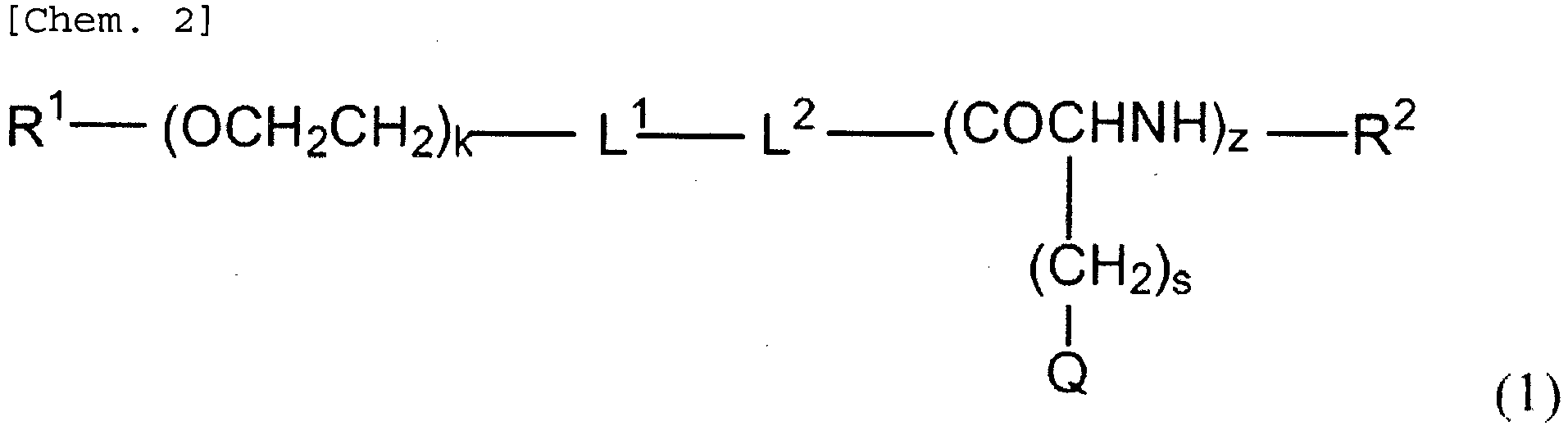
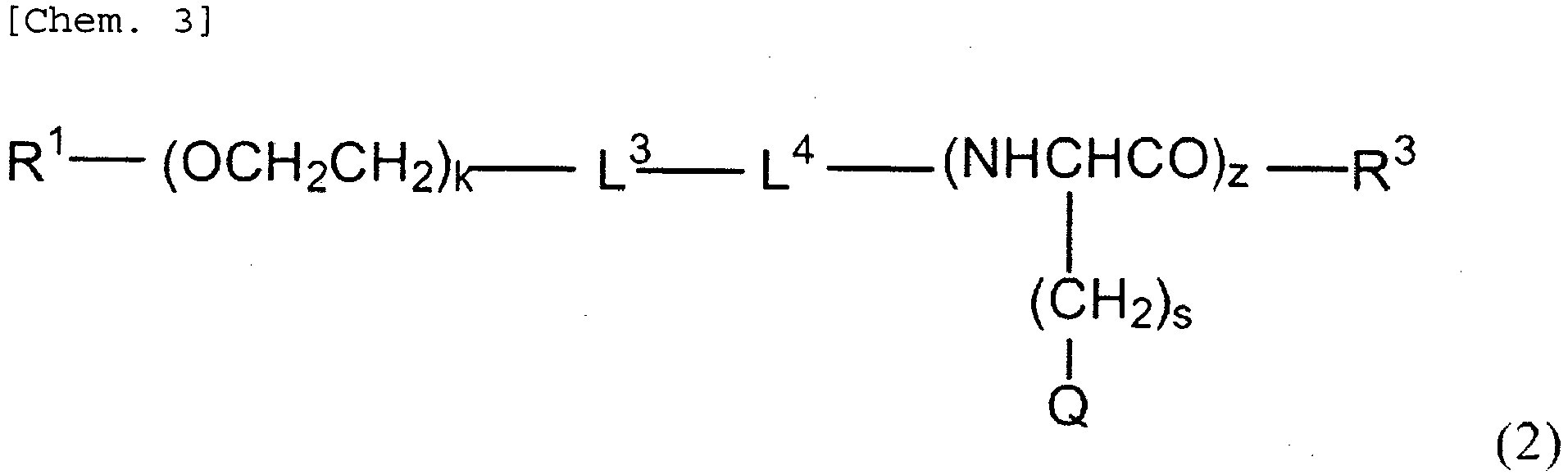
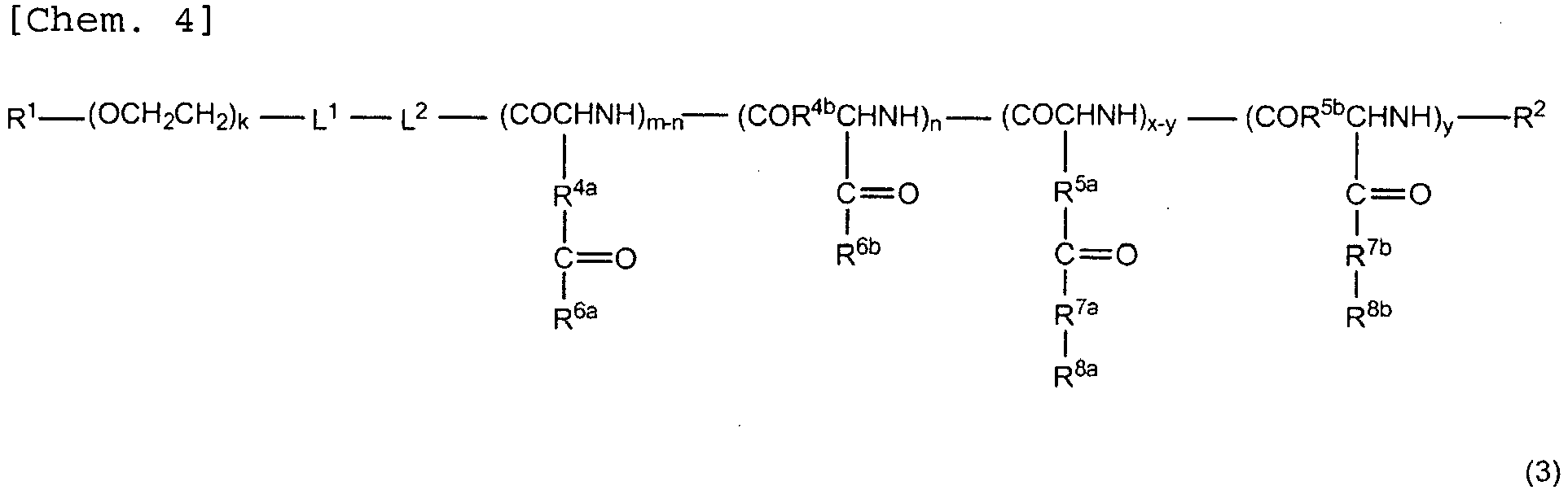

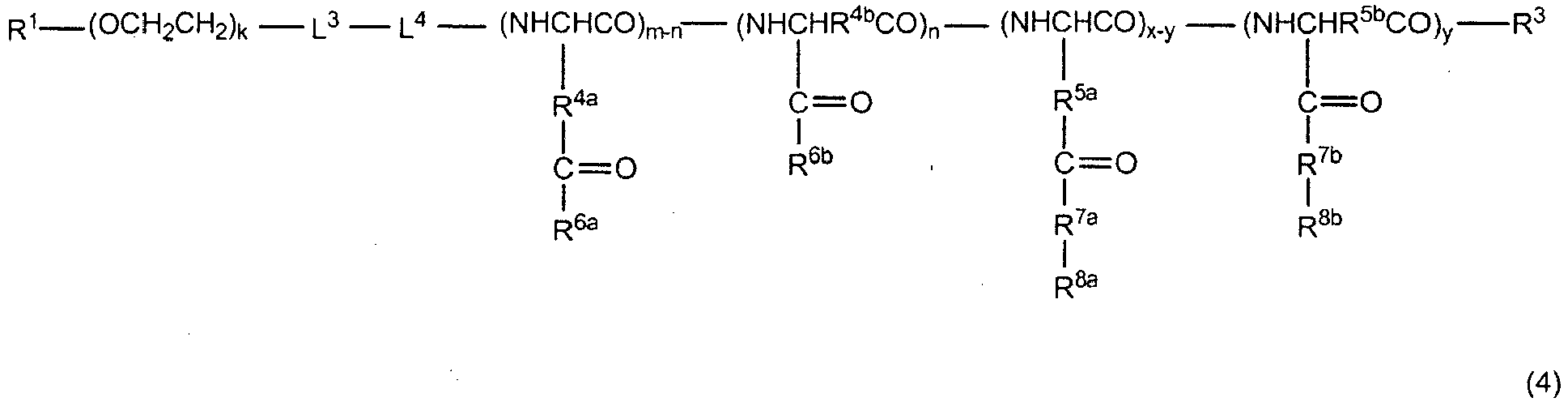
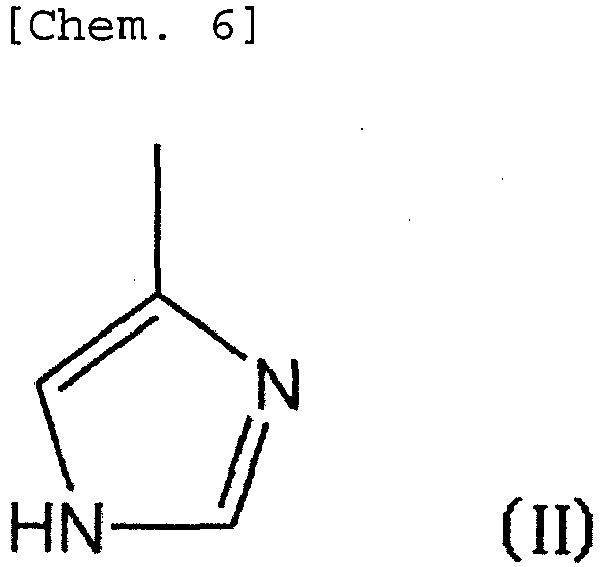
- In the formulas (1) to (4), both of L1 and L2 and both of L3 and L4 each need to be combined together so as to form one linking group. For example, when L2 represents -NH-, L1 does not represent -S-S- but represents a valence bond.
- In the formulas (1) to (4), k, which represents the number of repetitions of ethylene glycol (or oxyethylene), represents an integer of 30 to 20,000, preferably 40 to 2,000, more preferably 50 to 1,500.
- An alkyl moiety in the linear or branched alkyloxy group, alkyl-substituted imino group, and alkyl group having 1 to 12 carbon atoms, which are defined by the groups R1 to R3, may be, for example, a methyl group, an ethyl group, an n-propyl group, an isopropyl group, an n-butyl group, an sec-butyl group, a tert-butyl group, an n-hexyl group, a decyl group, and an undecyl group. An alkenyl or alkynyl moiety in the linear or branched alkenyloxy group having 2 to 12 carbon atoms or the linear or branched alkynyloxy group having 2 to 12 carbon atoms may be exemplified by an alkenyl or alkynyl moiety including a double bond or a triple bond in the alkyl group having 2 or more carbon atoms as exemplified above.
- For such group or moiety, a substituent in a "substituted" case may be exemplified by, but not limited to, a C1-6 alkoxy group, an aryloxy group, an aryl C1-3 oxy group, a cyano group, a carboxyl group, an amino group, a C1-6 alkoxycarbonyl group, a C2-7 acylamide group, a tri-C1-6 alkyl siloxy group, a siloxy group, or a silylamino group, or may be exemplified by an acetalized formyl group, a formyl group, or a halogen atom such as chlorine or fluorine. In this context, for example, the expression "C1-6" means 1 to 6 carbon atoms and is used with the same meaning in the following description. In addition, an unsubstituted or substituted linear or branched alkyl moiety having 1 to 12 carbon atoms in the unsubstituted or substituted linear or branched alkylcarbonyl group having 1 to 24 carbon atoms may be selected with reference to the above-described examples, and an alkyl moiety having 13 or more carbon atoms may be, for example, a tridecyl group, a tetradecyl group, a pentadecyl group, a nonadecyl group, a docosanyl group, or a tetracosyl group.
- In another embodiment, a substituent for the group R1 may be a group containing a target binding site. The introduction of the target binding site into the terminus of a polymer can improve drug (biopolymer) delivery to a desired target site. The group containing the target binding site may be any appropriate group as long as the group has targeting property or functionality for a target tissue. For example, the group may be a group originating from a physiologically active substance such as an antibody or a fragment thereof, or another protein having functionality or targeting property, a peptide, an aptamer, a sugar such as lactose, or folic acid, and a derivative thereof.
- An example of the group R1 substituted by a group including the target binding site is represented by the following formula (III):
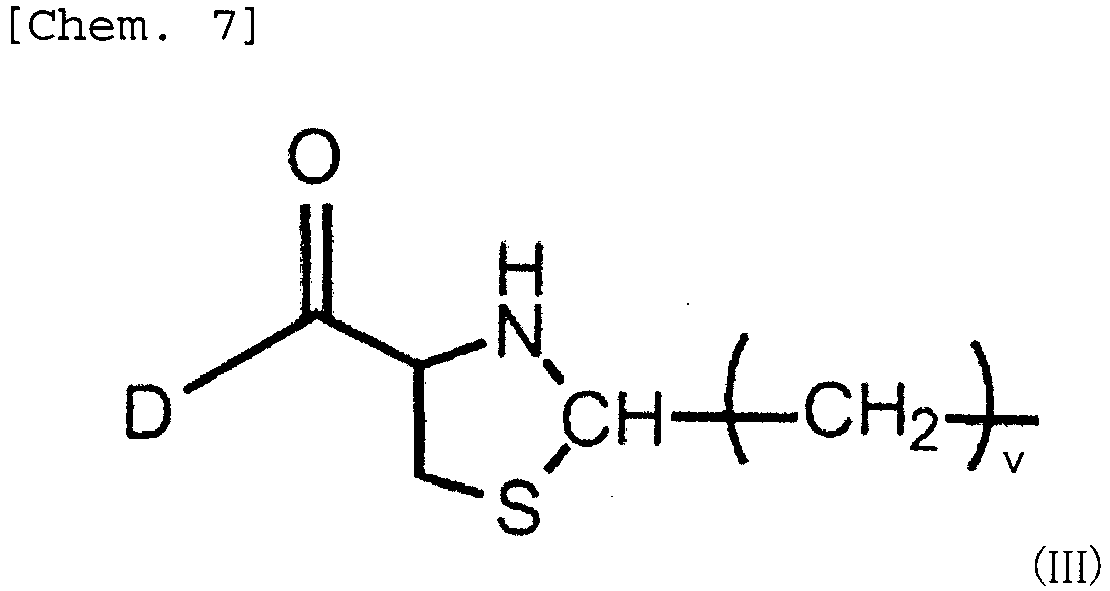
- D represents preferably a peptide having a weight average molecular weight of 50 to 20,000, more preferably a peptide having a weight average molecular weight of 100 to 10,000, still more preferably a peptide having a weight average molecular weight of 150 to 3,000.
- Further, D represents preferably a peptide having 1 to 200 amino acid residues, more preferably a peptide having 1 to 100 amino acid residues, still more preferably a peptide having 1 to 30 amino acid residues.
- Examples of the peptide include peptides capable of specifically binding to integrin, which is involved in angiogenesis, intimal thickening, and malignant tumor growth, and specific examples thereof include RGD peptides. By using an RGD peptide as the target binding site, particles, which are capable of specifically recognizing a diseased portion, and pharmaceutical compositions using the particles are obtainable. The RGD peptides as used herein refer to peptides that include an arginine-glycine-aspartic acid (RGD) sequence. The RGD peptide is preferably a cyclic RGD (cRGD) peptide. Specifically, Dmaybe representedby the following formula (IV) :
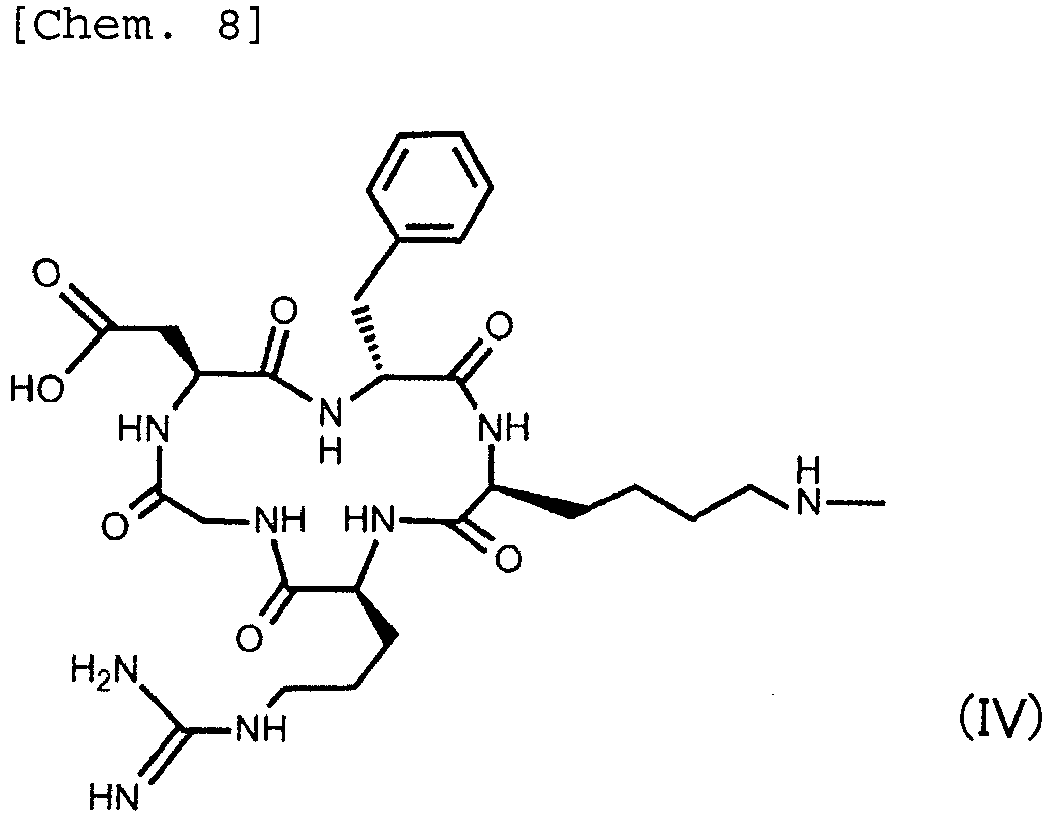
- In the formulas (1) to (4), the groups of the formulas (i) to (iv) defined by the groups R6a and R6b and the hydrocarbon group or steryl group defined by the groups R8a and R8b are as mentioned above. The groups Q, R6a, R6b, R8a, and R8b selected for all of repeating units may be the same as or different from one another. Further, s represents 1, 3, or 4, for example.
- In the formula (3) or (4), when both of the groups R4a and R4b each represent an ethylene group, a polyamino acid in which n represents an integer of 0 or a polyamino acid in which m-n represents an integer of 0 is typically represented. The former represents, for example, poly-α-glutamic acid, which is obtained by the polymerization of an N-carboxylic anhydride of glutamic acid γ-benzyl ester, and the latter represents, for example, poly-γ-glutamic acid, which is produced by a bacterial strain of the genus Bacillus bacteria such as Bacillus natto. Meanwhile, when both the groups of R4a and R4b each represent a methylene group, it is understood that the respective repeating units having those groups may coexist with each other. The same holds true for the groups R5a and R5b. It is preferred that the groups R4a and R4b each represent a methylene group and the groups R5a and R5b each represent an ethylene group from the viewpoint of production efficiency.
- From the viewpoint of stability of the polymer micelle formed, the total number z of the cationic amino acid residues and substituted PBA group-containing amino acid residues included in the block copolymer of the formula (1) or (2) is an integer of 1 to 300, preferably 20 to 300, more preferably 30 to 200, still more preferably 40 to 150.
- From the viewpoint of stability of the polymer micelle formed, the total number m of the cationic amino acid residues and substituted PBA group-containing amino acid residues included in the block copolymer of the formula (3) or (4) is an integer of 1 to 300, preferably 1 to 200, more preferably 1 to 150. When the block copolymer includes a hydrophobic amino acid residue (that is, when x represents any number other than 0), the number of the cationic amino acid residues may be, for example, an integer of 1 to 20, preferably 1 to 15, more preferably 1 to 10, still more preferably 1 to 5. Such block copolymer allows release of a biopolymer typified by a nucleic acid more suitably.
- The number x of the hydrophobic amino acid residues that may be included in the block copolymer of the formula (3) or (4) may be appropriately adjusted depending on the kind or number of the cationic amino acid residues, the application of the block copolymer, or the like. The number x of the hydrophobic amino acid residues is an integer of preferably 1 to 80, more preferably 5 to 70, still more preferably 10 to 60.
- In the block copolymers of the formulas (1) to (4), the number of the substituted PBA group-containing amino acid residues may be appropriately adjusted depending on the kind or number of the cationic amino acid residues, the application of the block copolymer, or the like. In the block copolymers, in particular, in the block copolymers of the formulas (1) and (2), the substituted PBA group is preferably introduced into the side chain of the cationic amino acid residue so that the following relationship is satisfied. When such relationship is satisfied, the retention property of the biopolymer by the block copolymer (stability in blood) is improved with more certainty. It should be noted that the upper limit of the following relational expression is not particularly limited, and may be 40, 38, 35, or 25, for example. When the value of the following relational expression is 14 or more, or 15 or more, the stability in blood is improved with more certainty.

- The block copolymer of the present invention can be prepared by any appropriate synthesis method. An example of the synthesis method for a block copolymer in a preferred embodiment of the present invention is as follows. In other words, the block copolymer can be prepared by: forming a polyethylene glycol chain by anion living polymerization using an initiator capable of providing R1; introducing an amino group at the growing end side of the polyethylene glycol chain; polymerizing from the amino end a protected amino acid derivative such as NCA-Lys (TFA) to form a polyamino acid chain segment; deprotecting the side chain of the polyamino acid to expose the amino group; and subjecting the exposed amino group to a reaction with a carboxyl group of a fluorinated carboxyphenylboronic acid to introduce a desired number of FPBA groups into the side chain via an amide bond.
- The block copolymer in another preferred embodiment of the present invention may be prepared as follows, for example. In other words, the block copolymer can be prepared by: forming a polyethylene glycol chain by anion living polymerization using an initiator capable of providing R1; introducing an amino group at the growing end side of the polyethylene glycol chain; polymerizing from the amino end an N-carboxylic anhydride of a protected amino acid such as β-benzyl-L-aspartate or γ-benzyl-L-glutamate to form a polyamino acid chain segment; subsequently subjecting the polyamino acid to a reaction with an amine compound such as diethylenetriamine (DET) to introduce an amine residue such as a DET group into the amino acid side chain by an ester-amide exchange reaction; and subsequently subjecting an amino group of the amine residue to a reaction with a carboxyl group of a fluorinated carboxyphenylboronic acid to introduce a desired number of FPBA groups into the side chain via an amide bond. In this process, when the polyamino acid chain segment is formed using β-benzyl-L-aspartate and γ-benzyl-L-glutamate in combination, the subsequent ester-amide exchange reaction occurs preferentially for β-benzyl-L-aspartate. As a result, a block copolymer including an amino acid residue originating from γ-benzyl-L-glutamate as the hydrophobic amino acid residue may be obtained.
- It should be noted that part of amino acid ester residues may undergo a structural change by nucleophilic attack of an amine (for example, imide ring formation through the dealcoholization of an amino acid ester residue) during the synthesis process. In the present invention, the polyamino acid chain segment may further include residues that have undergone such structural change. In this case, the residues that have undergone the structural change are excluded from the cationic amino acid residue, the substituted PBA group-containing amino acid residue, and the hydrophobic amino acid residue. Further, part of NH groups and NH2 groups in the cationic amino acid residue may be converted into a salt (mainly a hydrochloride) by use of an acid (mainly hydrochloric acid) during the synthesis process. In the present invention, the polyamino acid chain segment may include such structure. In other words, part of NH groups and NH2 groups in the groups Q, R6a, and R6b may be in a form of a salt (for example, a hydrochloride).
- In addition, a block copolymer including a hydrophilic polymer (polyethylene glycol) having a target binding site at the end can be synthesizedby: synthesizing a block copolymer as mentioned above using polyethylene glycol having a target binding site at the α-end or synthesizing a block copolymer as mentioned above using polyethylene glycol having a functional group capable of subsequently introducing a group including a target binding site into the α-end; and then introducing the group including the target binding site. A variety of methods may be used as introduction methods for the group including the target binding site. For example, when a block copolymer having a polyethylene glycol chain acetalized at the α-end and a compound having a desired target binding site and a cysteine terminus are mixed in an acidic solution, the target binding site can be given at the terminus of the polyethylene glycol chain side.
- The complex of the present invention is a complex of the block copolymer described in the section A above and a biopolymer. The complex may be a PIC of a plurality of the block copolymers and the biopolymers. In addition, the PIC may have a form of a polymer micelle in which the biopolymers are encapsulated in the plurality of the block copolymers. A related-art carrier has a problem in that the complex dissociates in a medium having an ion concentration almost the same as that of a physiological condition. However, the complex of the present invention is excellent in stability, and hence can maintain the form of the complex in the medium, and even in a medium containing a protein.
- Examples of the biopolymer include a protein, a lipid, and a nucleic acid. Herein, the protein includes a peptide. Of the biopolymers, the block copolymer may suitably form a complex with a nucleic acid. In addition, a biopolymer suited for formation of a complex may be exemplified by an anionically chargeable compound having negative charge at a pH equal to or lower than the pKa of the block copolymer.
- As mentioned above, the block copolymer has a cationic group in a side chain of the amino acid in the polyamino acid chain segment, and hence the block copolymer can form a stable complex (for example, vesicle or associate) with a small molecular weight nucleic acid as well under a physiological condition. The nucleic acid capable of forming a complex with the block copolymer means a poly- or oligonucleotide including nucleotides formed of a purine or pyrimidine base, a pentose, and phosphoric acid as basic units, and examples thereof may include oligo- or poly-double-stranded RNA, oligo- or poly-double-stranded DNA, oligo- or poly-single-stranded DNA, and oligo- or poly-single-stranded RNA. Further, oligo- or poly-double-stranded nucleic acid and oligo-or poly-single-stranded nucleic acid in each of which RNA and DNA exist in a mixed state in the same chain are also included. The nucleotide contained in the nucleic acid may be of a natural type or of a chemically modified non-natural type, or may have added thereto an amino group, a thiol group, a fluorescent compound, or any other molecule.
- When the nucleic acid is RNA, the RNA includes 3'-terminal ribose having a 1, 2-cis-diol, and hence can be reversibly bound covalently to the block copolymer via the substituted PBA group as well as the electrostatic interaction with the cationic group of the cationic amino acid residue. As a result, a complex excellent in stability is obtained. Such complex excellent in stability enables prevention of replacement of RNA molecules with a blood level (usually, about 4 to 7 mM) of glucose (having a cis-diol structure in its molecule), and hence is excellent in stability in blood. Therefore, when the complex is administered to a living body, the retentivity in blood may be improved. In particular, when the nucleic acid is double-stranded RNA, a cross-linked structure having as a binding site 3'-terminal ribose of each chain may be formed in the micelle. Therefore, a complex that is very excellent instabilitycanbe obtained. In addition, when the complex including the RNA is taken up into an endosome that is under a low-pH environment, the substituted PBA group is hydrophobized to increase a hydrophobic interaction, resulting in further improved stability. Further, after transfer from the endosome to a cytoplasm, the RNA can be released rapidly by replacing another molecule that is present in the cytoplasm at a relatively high concentration and has a 1,2-cis-diol, such as ATP or ribonucleic acid.
- The strand length of the nucleic acidmay be, for example, 4 to 20,000 bases, preferably 10 to 10,000 bases, more preferably 18 to 30 bases.
- In consideration of functions or actions, examples of the nucleic acid may include plasmid DNA, siRNA, micro RNA, shRNA, an antisense nucleic acid, a decoy nucleic acid, an aptamer, and a ribozyme.
- The ratio of the content of the block copolymer to the content of the biopolymer in the complex of the present invention may be appropriately set depending on the kinds of the block copolymer and the biopolymer, the application of the complex, or the like. When the biopolymer is siRNA, the complex of the present invention has anN/P ratio of preferably 2 or more from the viewpoint of improving stability under a physiological condition, or has an N/P ratio of preferably 200 or less from the viewpoint of suppressing toxicity due to the polymer. It should be noted that the N/P ratio means [concentration of amino group of polyamino acid side chain in block copolymer contained in complex]/[concentration of phosphate group in nucleic acid]. Further, from the viewpoint of improving stability under a physiological condition, when the biopolymer is siRNA, the complex of the present invention may have [the number of positive charges in the polyamino acid chain segment] / [the total of the number of negative charges in the polyamino acid chain segment and the number of negative charges in siRNA] at pH 7.4 of, for example, 1/2 to 20/1, preferably 1/1 to 10/1.
- The block copolymer may maintain high hydrophilicity by appropriately selecting the kinds of substituted PBA groups and the number of the groups introduced, and hence the complex of the present invention can be prepared, for example, only by mixing the block copolymer and the biopolymer in an aqueous solution buffered as necessary. In other words, the complex of the present invention may have advantages in that it is not necessary to further modify the terminus of the block copolymer and in that the complex can be prepared by a simple method.
- Hereinafter, the present invention is specifically described by way of Examples. However, the present invention is not limited to Examples below. It should be noted that in Examples below, polymer structures are described in the order of "the molecular weight (kDa) of PEG-the number of the FPBA group-containing amino acid residues/the total number of the amino acid residues constituting the polyamino acid chain segment". For example, when PEG has a molecular weight of 10,000, and the polyamino acid chain segment is a polyamino acid chain segment obtained by introducing 5 FPBA groups into polylysine having a polymerization degree of 40, the polymer is represented as "PEG-PLL 10-5/40." Further, for example, when PEG has a molecular weight of 10,000, and the polyamino acid chain segment is polylysine that has no FPBA group introduced and has a polymerization degree of 40, the polymer is represented as "PEG-PLL 10-0/40". In this context, the numbers represented are average values in the whole of the block copolymers.
- A synthesis scheme A for a polylysine-based block copolymer used in the following experimental example is shown below. Specifically, the block copolymer was prepared as mentioned in (1-i) to (1-iii).

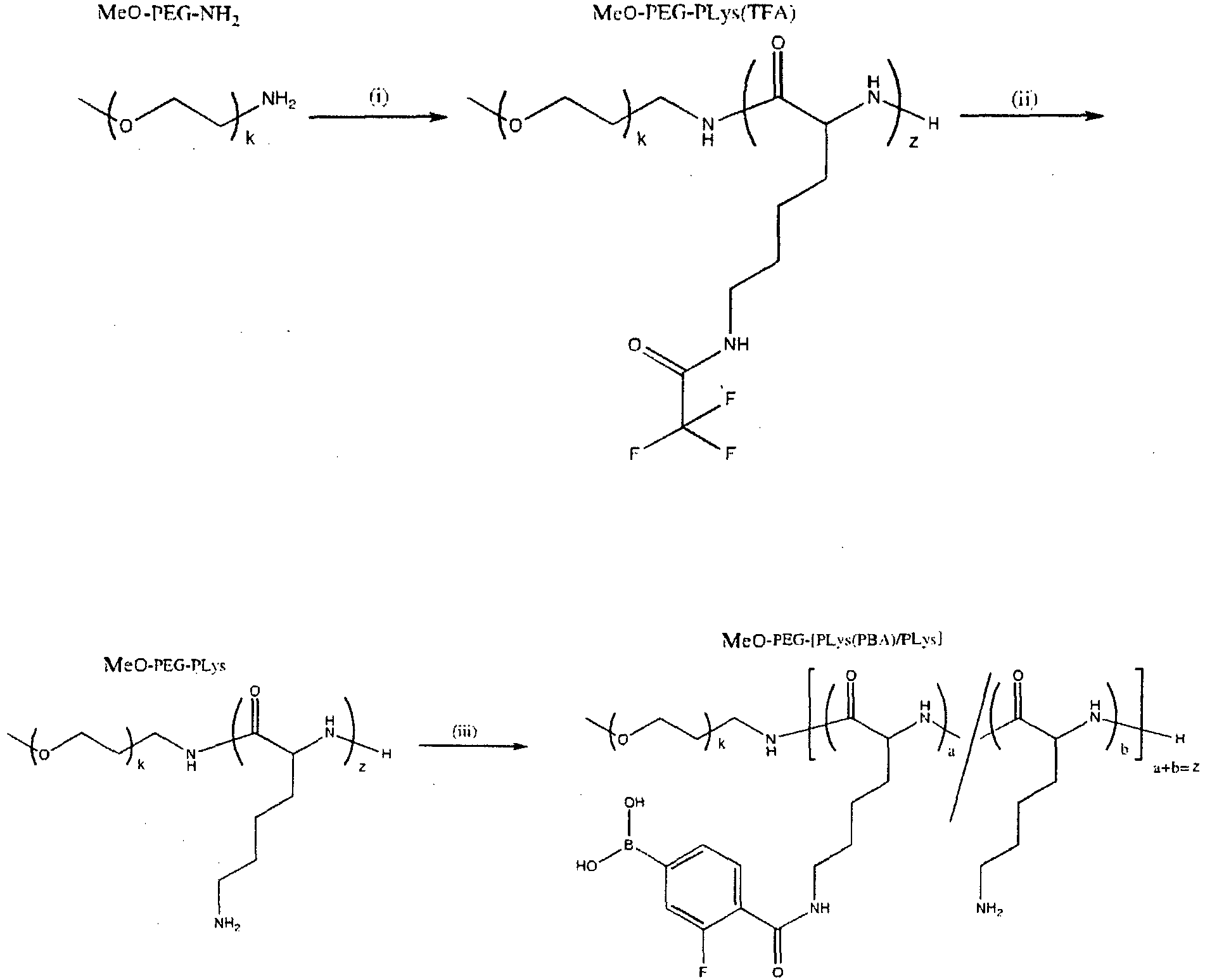
-
- (1-i) Methoxy-PEG-NH2 is lyophilized from benzene and dissolved in dimethylformamide (DMF) containing 1 M thiourea. To the resultant solution is added NCA-Lys(TFA) dissolved in DMF containing 1 M thiourea, and the mixture is stirred for 3 days at 25°C to perform polymerization. After the polymerization, the reaction solution is added dropwise to diethyl ether, and the resultant precipitates are collected by filtration and dried under reduced pressure to afford MeO-PEG-PLys(TFA).
- (1-ii) MeO-PEG-PLys(TFA) is stirred in 1 N NaOHaq./methanol=1/10 at 35°C for 12 hours, and the solution is subjected to dialysis (external solution: water) and lyophilized to afford MeO-PEG-PLys.
- (1-iii) MeO-PEG-PLys and D-Mannitol in an amount of 5 equivalents relative to amino groups of PLys are dissolved in a 50 mM NaHCO3 aqueous solution. To the resultant solution is added 3-fluoro-4-carboxyphenylboronic acid dissolved in methanol, and a condensing agent DMT-MM is added thereto. The resultant solution is stirred at room temperature the whole night, subj ected to dialysis (external solution: water), and lyophilized to afford MeO-PEG-[PLys(FPBA)/PLys].
- The molecular weight of the resultant block copolymer was measured by gel permeation chromatography (GPC). In this case, a solution obtained by dissolving D-sorbitol in 50 mM NaHCO3 at 50 mg/mL or more, a phosphate buffer (
pH 5 to 7), or a mixed solvent of a 500 mM NaCl aqueous solution containing 50 mg/mL D-sorbitol and methanol (NaCl aq./methanol=1/4) was used as a mobile phase. Further, the amount of the FPBA group introduced was estimated from an integration ratio of the side chain to the phenyl ring by 1H-NMR spectra. In this case, a solution obtained by dissolving the polymer in D2O containing a small amount of D-sorbitol was usedas ameasurement sample. - A synthesis scheme B for a PAsp(DET)-based block copolymer used in the following experimental example is shown below. Specifically, the block copolymer was prepared as mentioned in (2-i) to (2-iii).


-
- (2-i) Methoxy-PEG-NH2 is lyophilized from benzene and dissolved in dichloromethane. NCA-BLA dissolved in DMF/dichloromethane=1/10 is added to the resultant solution, and the mixture is stirred for 3 days at 35°C to perform polymerization. After the polymerization, the reaction solution is added dropwise to diethyl ether, and the resultant precipitates are collected by filtration and dried under reduced pressure to afford MeO-PEG-PBLA.
- (2-ii) MeO-PEG-PBLA is lyophilized from benzene and dissolved in N-methyl-2-pyrrolidone (NMP). The resultant solution is added dropwise to a solution of diethylenetriamine in NMP, and the mixture is stirred at 5 to 10°C for 1 hour. The resultant mixture is neutralized with hydrochloric acid under ice cooling, subjected to dialysis (external solution: 0.01 N hydrochloric acid), and lyophilized to afford MeO-PEG-PAsp(DET).
- (2-iii) MeO-PEG-PAsp(DET) and D-Mannitol in an amount of 5 equivalents relative to primary amines of PAsp(DET) are dissolved in a 50 mM NaHCO3 aqueous solution under ice cooling (0°C). To the resultant solution is added 3-fluoro-4-carboxyphenylboronic acid dissolved inmethanol, and a condensing agent DMT-MM is added thereto. The resultant solution is stirred for 6 hours, subjected to dialysis at 5°C (external solution: 0.01 N hydrochloric acid optionally containing sorbitol), and lyophilized to afford MeO-PEG-P[Asp(DET-FPBA/DET)].
- The molecular weight of the resultant block copolymer was measured by gel permeation chromatography (GPC). In this case, a solution obtained by dissolving D-sorbitol in a 50 mM phosphate buffer (pH 7.4) at 50 mg/mL was used as a mobile phase. Further, the amount of the FPBA group introduced was estimated from an integration ratio of the side chain to the phenyl ring by 1H-NMR spectra. In this case, a solution obtained by dissolving the polymer in D2O containing a small amount of NaOD was used as a measurement sample.
- Sequences of siRNAs used in the following experimental examples are as follows. Labels such as Cy3 were all introduced into the 5' ends of sense strands.
- (1) hVEGF-siRNA (siRNA for human vascular endothelial growth factor):
- Sense strand: 5'-GAUCUCAUCAGGGUACUCCdTdT-3' (SEQ ID NO: 1)
- Antisense strand: 5'-GGAGUACCCUGAUGAGAUCdTdT-3' (SEQ ID NO: 2)
- (2) Scramble-siRNA (siRNA having a sequence for nontherapeutic use) :
- Sense strand: 5'-UUCUCCGAACGUGUCACGUUU-3' (SEQ ID NO: 3)
- Antisense strand: 5'-ACGUGACACGUUCGGAGAAUU-3' (SEQ ID NO: 4)
- (3) GL3-siRNA (siRNA for firefly luciferase) Sense strand: 5'-CUUACGCUGACUACUUCGAUU-3' (SEQ ID NO: 5) Antisense strand: 5'-UCGAAGUACUCAGCGUAAGUU-3' (SEQ ID NO: 6)
- A variety of block copolymers having different amino acid polymerization degrees and FPBA group contents were prepared as mentioned in the sections (1-i) to (1-iii) and (2-i) to (2-iii). It should be noted that PEG having a molecular weight (Mw) of 12, 000 was used as methoxy-PEG-NH2. The block copolymers were mixed with siRNA fluorescently labeled with Cy3 so as to achieve an N/P ratio of 8. The resultant mixtures were left to stand still in a refrigerator for 1 to 2 hours and diluted with a serum solution (150 mM NaCl, 10 mM Hepes, 10% FBS) so as to achieve an siRNA concentration of 50 nM. The resultant diluted solutions were left to stand still at room temperature for about 1 hour, and the siRNA diffusion time was measured with a confocal laser scanning microscope (manufactured by Carl Zeiss, product name "LSM510") (10 sec×10 times). Table 1 and
FIG. 1 show the results. It should be noted that when measurement was carried out in the same manner as above except that the siRNA was not mixed with the block copolymer, the diffusion time (diffusion time of siRNA alone) was 157.5 µsec. It should be noted that GL3-siRNA was used as the siRNA.[Table 1] PLys-based block copolymer Molecular weight of PEG chain 12,000 Total number of amino acid residues in polyamino acid chain segment 21 43 54 Number of cationic amino acid residues free of FPBA group in polyamino acid chain segment 18.0 16.3 43.0 35.3 32.9 28.8 24.1 51.1 43.3 38.1 Number of FPBA groups in polyamino acid chain segment 3.0 4.7 0.0 7.7 10.1 14.2 18.9 2.9 10.7 15.9 Diffusion time 323.3 331.4 298.6 321.1 440.2 773.4 783.6 337.0 434.9 1,002.2 [µsec, N/P=8] √(number of cationic amino acid residues free of FPBA group)+2√(Number of FPBA groups) 7.7 8.4 6.6 11.5 12.1 12.9 13.6 10.6 13.1 14.1 PLys-based block copolymer Molecular weight of PEG chain 12,000 Total number of amino acid residues in polyamino acid chain segment 74 106 Number of cationic amino acid residues free of FPBA group in polyamino acid chain segment 74.0 70.7 68.2 65.9 62.1 56.9 106.0 104.5 101.9 93.7 Number of FPBA groups in polyamino acid chain segment 0.0 3.3 5.8 8.1 11.9 17.1 0.0 1.5 4.1 12.3 Diffusion time 379.1 1,326.2 553.1 764.2 1,073.0 1,238.9 382.4 2,120.6 1,778.7 2,896.3 [µsec, N/P=8] √(Number of cationic amino acid residues free of FPBA group)+2√(Number of FPBA groups) 8.6 12.1 13.1 13.8 14.8 15.8 10.3 12.7 14.2 16.7 PAsp(DET)-based block copolymer Molecular weight of PEG chain 12,000 Total number of amino acid residues in polyamino acid chain segment 35.6 33.9 34.5 57.4 74.1 74.0 Number of cationic amino acid residues free of FPBA group in polyamino acid chain segment 32.9 23.7 14.5 48.1 69.9 67.0 Number of FPBA groups in polyamino acid chain segment 2.6 10.2 20.0 9.3 4.2 7.0 Diffusion time 313.3 367.6 807.8 1,241.9 1,622.6 1,417.7 [µsec, N/P=8] √(Number of cationic amino acid residues free of FPBA group)+2√(Number of FPBA groups) 9.0 11.3 12.7 13.0 12.4 13.5 - As shown in Table 1 and
FIG. 1 , when siRNA is mixed with the block copolymers, the siRNA diffusion time was longer than that when siRNA was used singly. Therefore, all of the block copolymers were found to form complexes with siRNA. In addition, the diffusion time with the block copolymers having the FPBA group introduced was longer than that with the block copolymers free of the FPBA group, and hence the block copolymers having the FPBA group introduced were found to form more stable complexes. Of those, when the block copolymers satisfying the relationship of [√(the number of cationic amino acid residues free of the FPBA group in the polyamino acid chain segment)+2√(the number of FPBA groups in the polyamino acid chain segment)≥12.0] were used, the siRNA diffusion time was 400 µsec or more, suggesting that highly stable complexes were formed. - A549-Luc cells were seeded in a 96-well culture dish at 2, 500 cells/well and cultured in a DMEM medium containing 10% fetal bovine serum in an incubator for 24 hours. The medium was exchanged for a fresh DMEM medium containing 10% fetal bovine serum, and each of the block copolymers dissolved in physiological saline was added at different amine concentrations. Subsequently, the cells were cultured for 48 hours, the number of living cells were measured with "
Cell Counting Kit 8" (product name, manufactured by Dojindo Molecular Technologies, Inc.), and a cell survival rate thereof was calculated (N=4).FIG. 2 shows the results. - A549-Luc cells were seeded in a 96-well culture dish at 2,500 cells/well and cultured in a DMEM medium containing 10% fetal bovine serum in an incubator for 24 hours. The medium was exchanged for a fresh DMEM medium containing 10% fetal bovine serum, and each of the complexes of siRNA and the block copolymers was added at different siRNA concentrations. Subsequently, the cells were cultured for 48 hours, the number of living cells were measured with "
Cell Counting Kit 8" (product name, manufactured by Dojindo Molecular Technologies, Inc.), and a cell survival rate thereof was calculated (N=4).FIG. 3 shows the results. It should be noted that the complexes were prepared by: adding the block copolymers and GL3-siRNA to a 10 mM HEPES buffer (pH 7.3) so as to achieve an N/P ratio of 4 and an siRNA concentration of 80 nM; mixing the resultant; leaving the mixture to stand still for about 1 to 2 hours at room temperature; and diluting the mixture to different concentrations. - As shown in
FIG. 2 , the groups treated with the block copolymers having the FPBA group introduced had higher cell survival rates as compared to the group treated with the block copolymer having no FPBA group introduced. In addition, as shown inFIG. 3 , the groups treated with the complexes including the block copolymers having the FPBA group introduced had higher cell survival rates as compared to the group treated with the complex including the block copolymer having no FPBA group introduced. The results reveal that the introduction of the FPBA group causes no cytotoxicity, and the block copolymers having the FPBA group introduced have satisfactory biocompatibility. - A block copolymer (PEG-PLL 12-23/43) and GL3-siRNA labeled with Cy3 were dissolved in a buffer (phosphate buffer or phosphate-citrate buffer) having a variety of pH values, and mixed so as to achieve an N/P ratio of 4 and an siRNA concentration of 50 nM. The resultant mixtures were left to stand still for about 1 hour at room temperature, and the siRNA diffusion time was measured with the confocal laser scanning microscope (manufactured by Carl Zeiss, product name "LSM510") (10 sec×10 times).
FIG. 4 shows the results. - As shown in
FIG. 4 , the siRNA diffusion time was longer than 800 µsec in a wide pH range of from a body environment (about pH 7.4) to an acidic environment (about pH 5.5) of the inside of an endosome or the like. Therefore, the block copolymer of the present invention was found to be able to form a stable complex with siRNA (siRNA-encapsulated polymer micelle) in the pH range. - The block copolymer (PEG-PLL 12-23/43) and GL3-siRNA labeled with Cy3 were separately dissolved in a 10 mM HEPES buffer (pH 7.3), and mixed so as to achieve an N/P ratio of 4. The resultant mixtures were left to stand still for about 1 to 2 hours in a refrigerator, and diluted with 10 mM HEPES buffers (pH 7.3) containing a variety of concentrations of glucose, dTMP, or UMP so as to achieve an siRNA concentration of 50 nM. The resultant diluted solutions were left to stand still at room temperature for about 1 hour. Subsequently, the siRNAdif fusion time was measured with the confocal laser scanning microscope (manufactured by Carl Zeiss, product name "LSM510") (10 sec×10 times).
FIG. 5 shows the results. - As shown in
FIG. 5 , the siRNA diffusion time at glucose concentrations almost the same as those in blood (usually, about 4 to 7 mM) is longer than 800 µsec, which shows that the block copolymer of the present invention can form a stable complex with siRNA (siRNA-encapsulated polymer micelle) in blood. In addition, when the glucose concentrations are higher than that in blood, the diffusion time gradually becomes shorter, suggesting that the micelles collapse at such concentrations to rapidly release siRNA. It should be noted that such collapse of the micelles is estimated to occur by replacement of RNA molecules bound to the FPBA groups via the 1,2-diol structures in the micelles with glucose having the 1,2-diol structure like the RNA molecules. - Similarly, it is found that the micelle shape can be maintained in the presence of UMP having the 1,2-diol structure at low UMP concentrations, but the micelles collapse at UMP concentrations higher than 1 mM by replacement of the RNA molecules with UMP to rapidly release siRNA. On the other hand, the micelle shape can be maintained stably in the presence of dTMP having a structure similar to UMP but having no 1,2-diol structure, even at dTMP concentrations higher than 10 mM. This is probably because no replacement of the RNA molecules occurs.
- A549-Luc cells were seeded in a 48-well dish at 10,000 cells/well, and cultured for 24 hours in an incubator with a DMEM medium containing 10% fetal bovine serum. The medium was exchanged for a fresh DMEM medium containing 10% fetal bovine serum, and siRNA labeled with Cy3 or a complex of the siRNA and a block copolymer was added to the medium so that the concentration of siRNA was 100 nM/well. After having been cultured in an incubator at 37°C for 5 hours or 9 hours, the cells were washed three times with 1 mL of a PBS buffer, and detached from the dish with a trypsin-EDTA solution. The detached cells were subjected to histogram analysis using a flow cytometer (manufactured by BD, LSRII) in which a Cy3 filter was set. Thus, the amount of siRNA taken up into the cells was evaluated (N=4). It should be noted that GL3-siRNA was used as siRNA.
FIG. 6 shows a graph showing the amount of siRNA taken up into the cells. It should be noted that the complex was prepared by adding each block copolymer and siRNA to a 10 mM HEPES buffer (pH 7.3) so as to achieve an N/P ratio of 8 and an siRNA concentration of 4 µM, mixing the resultant, and leaving the mixture to stand still for about 1 to 2 hours at room temperature. - As shown in
FIG. 6 , the amounts of siRNA taken up in the case where siRNA was added as a complex with the block copolymer having the FPBA group introduced were dramatically improved as compared to those in the case where siRNA was added singly and in the case where siRNA was added as a complex with the block copolymer having no FPBA group introduced. - The block copolymer (PEG-PLL 12-23/43) and Cy5-GL3-siRNA were added to a 10 mM HEPES buffer (pH 7.3) so as to achieve an N/P ratio of 8 and an siRNA concentration of 7.5 µM, and the resultant was mixed and left to stand still for about 1 to 2 hours at room temperature to prepare a complex solution. The complex solution or a solution of the siRNA (10 mM HEPES buffer) was administered to the tail veins of mice (female Balb/C nude, 6-week-old, N=4) so that the dose was 20 µg of the siRNA, and the amount of the siRNA remaining in blood was determined over time.
FIG. 7 shows the results. - As shown in
FIG. 7 , when siRNA was administered singly, only about 10% of siRNA remained at 10 minutes after administration, and almost no siRNA remained after a lapse of 1 hour. On the other hand, when siRNA was administered as the complex, 40% or more of siRNA remained at 1 hour after administration, and 10% or more of siRNA remained even after a lapse of 2 hours. This suggests that the complex including the block copolymer of the present invention and siRNA (siRNA-encapsulated micelle) is very excellent in retentivity in blood. - A block copolymer Ace-PEG-PAsp (DET) 12-62/75 was obtained by a scheme similar to the scheme B. Specifically, Ace-PEG-PBLA (12-110) having an acetal group at the terminus on the PEG side was subjected to aminolysis with DET to afford Ace-PEG-PAsp(DET) (12-90). Subsequently, dialysis was carried out against an NaCl solution to convert acetate serving as a counterion into chloride, and 4-carboxy-3-fluorophenylboronic acid was condensed using a condensing agent (DMT-MM) to afford a block copolymer Ace-PEG-PAsp(DET) 12-62/75.
- Subsequently, cRGD peptide (Cyclic (Arg-Gly-Asp-D-Phe-Cys)) was mixed with DTT in an amount of 5 equivalents relative to the acetal group at pH 7.2 for 1 hour, and the resultant mixture and the block copolymer were mixed, and the pH was adjusted to 2. The mixture was stirred for 1 hour, and the pH was adjusted to 5 with 2 M sodium acetate and NaOH. After that, water was added thereto so as to achieve a polymer concentration of 20 mg/mL, and the mixture was stirred overnight. Dialysis was carried out against pure water to remove unreacted products and unwanted matters, followed by lyophilization to afford a block copolymer cRGD-PEG-PAsp(DET) 12-62/75 having cRGD introduced at the terminus of the PEG chain. It should be noted that the reaction and the dialysis were carried out at 4°C (refrigerator).
- Block copolymers were dissolved in a 10 mM HEPES buffer so as to achieve a concentration of 10 mg/mL. 12.18 µL of the polymer solutions, 75 µL of siRNA (15 µM in a 10 mM HEPES buffer), and 7.81 µL of a 10 mM HEPES buffer were mixed, and the mixtures were left to stand still overnight. Several hours prior to administration, 5 µL of 3 M NaCl in a 10 mM HEPES buffer were added to the mixtures, and the concentration of NaCl was adjusted to 150 mM (total volume: 100 µL). Thus, complexes (siRNA-encapsulated polymer micelles) were obtained. Table 2 shows combinations of siRNA and the block copolymers and mixing ratios in the complexes prepared.
[Table 2] Complex Block copolymer siRNA Mixing ratio*1 Average diameter (+) hVEGF cRGD-PEG-PAsp(DET) 12-62/75 siRNA-hVEGF 5 - (-) hVEGF Ace-PEG-PAsp(DET) 12-62/75 siRNA- hVEGF 5 39.95 nm (+)Scramble cRGD-PEG-PAsp(DET) 12-62/75 siRNA-Scramble 5 - *1: Ratio of number of positive charges of polyamino acid chain segment to total of number of negative charges of polyamino acid chain segment and number of negative charges of siRNA (positive charges/total of negative charges) at pH 7.4 - 6-week-old mice (female Balb/C nude, N=4) were purchased and fed for 1 week, and Hela-luc cells adjusted to 5.0×10⁷ cells/mL were injected subcutaneously in an amount of 100 µL per mouse. After that, the mice were further fed for 4 days, and treatment (i.e., administration of complex) was started. Specifically, the complex prepared in (3) above was administered to the tail veins of the mice every other day until day 6 (i.e., when the administration start date was defined as
day 0, the complex was administered four times in total onday 0,day 2,day 4, and day 6). The siRNA was administered in a dose of 15 µg/100 µL. To a control group, a HEPES solution was administered in a dose of 100 µL.FIG. 8 shows a relationship between a relative value of a tumor volume to a tumor volume on the administration start date and the number of days elapsed after administration. - As shown in
FIG. 8 , in the group to which the (-) hVEGF complex using as a carrier the block copolymer of the present invention in which the PEG terminus had no cRGD introduced was administered, growth of the tumor was clearly suppressed as compared to the control group and the group to which the (+) Scramble complex was administered. This reveals that siRNA was maintained stably in blood by the block copolymer and exhibited RNA interference ability. Further, the group to which the (+)hVEGF complex using as a carrier the block copolymer in which the PEG terminus had cRGD introduced was administered, growth of the tumor was significantly suppressed as compared to the control group and the group to which the (+) Scramble complex was administered. This reveals that the complex is excellent in stability in blood, and is taken up into tumor tissues with a high transfer rate to efficiently exhibit the RNA interference effect. - The block copolymer of the present invention can be suitably applied in the DDS field.
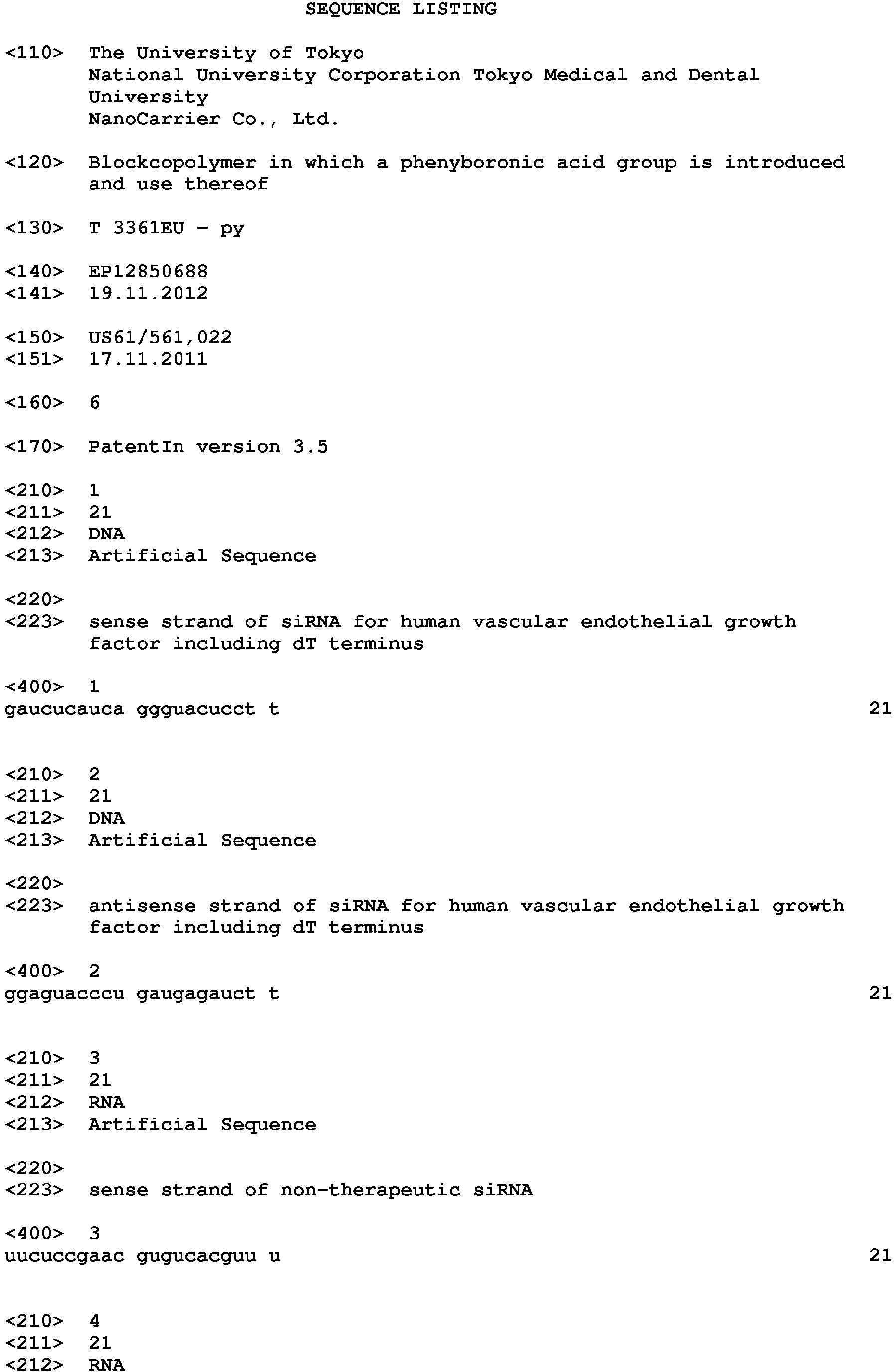
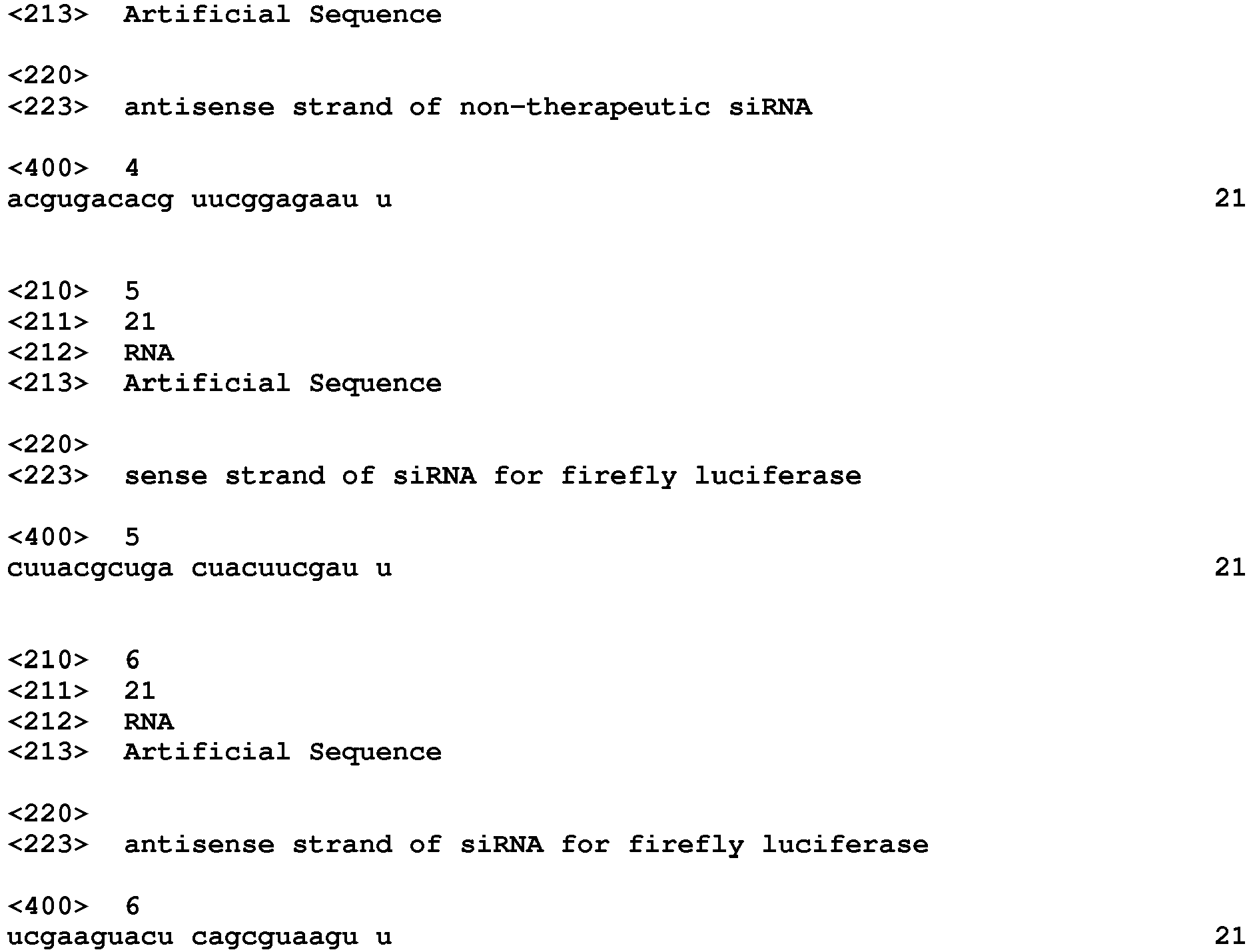
Claims (9)
- A block copolymer, comprising:a polyamino acid chain segment; anda hydrophilic polymer chain segment,wherein the polyamino acid chain segment includes an amino acid residue having a cationic group in a side chain and an amino acid residue having a substituted phenylboronic acid group in a side chain, the substituted phenylboronic acid group having a phenyl ring in which at least one hydrogen atom is substituted to have a pKa around a physiological pH.
- A block copolymer according to claim 1, wherein the substituted phenylboronic acid group has a pKa of less than 8.
- A block copolymer according to claim 1 or 2, wherein the substituted phenylboronic acid group comprises a fluorinated phenylboronic acid group represented by the following formula (I) :

- A block copolymer according to any one of claims 1 to 3, wherein the cationic group comprises an amino group.
- A block copolymer according to any one of claims 1 to 4, wherein the amino acid residue having a cationic group in a side chain is a lysine residue or an amino acid residue obtained by substituting an -OH moiety in a carboxyl group (-C(=O)OH) of an acidic amino acid by any one of groups of the following formulas (i) to (iv):
-NH- (CH2)p1-[NH- (CH2)q1-]r1NH2 (i);
-NH- (CH2)p2-N[-(CH2)q2-NH2]2 (ii) ;
-NH-(CH2)p3-N{[-(CH2)q3-NH2][-(CH2)q4-NH-]r2H} (iii);
and
-NH-(CH2)p4-N{-(CH2)q5-N[-(CH2)q6-NH2]2}2 (iv)
in the formulas (i) to (iv) : p1 to p4, q1 to q6, and r1 and r2 each independently represent an integer of from 1 to 5. - A block copolymer according to any one of claims 1 to 5, wherein a number of cationic amino acid residues free of the substituted phenylboronic acid group and a number of the substituted phenylboronic acid groups in the polyamino acid chain segment satisfy the following relationship.
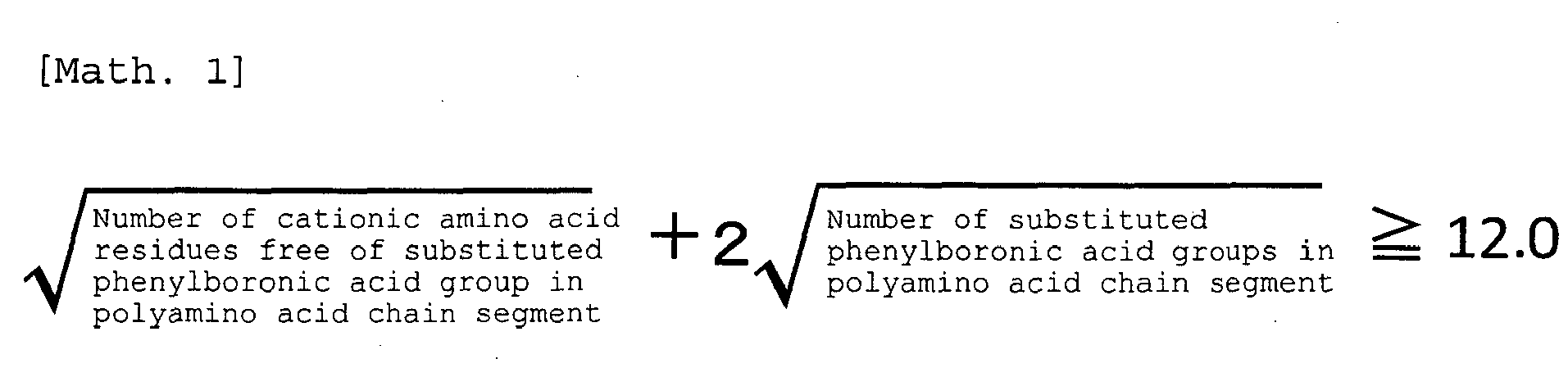
- A block copolymer according to any one of claims 1 to 6, wherein the polyamino acid chain segment further includes an amino acid residue having a hydrophobic group in a side chain.
- A complex, comprising the block copolymer according to any one of claims 1 to 7 and a biopolymer.
- A complex according to claim 8, wherein the biopolymer comprises a nucleic acid.
Applications Claiming Priority (2)
| Application Number | Priority Date | Filing Date | Title |
|---|---|---|---|
| US201161561022P | 2011-11-17 | 2011-11-17 | |
| PCT/JP2012/079897 WO2013073697A1 (en) | 2011-11-17 | 2012-11-19 | Block copolymer having phenylboronic acid group introduced therein, and use thereof |
Publications (3)
| Publication Number | Publication Date |
|---|---|
| EP2781536A1 true EP2781536A1 (en) | 2014-09-24 |
| EP2781536A4 EP2781536A4 (en) | 2015-06-10 |
| EP2781536B1 EP2781536B1 (en) | 2016-08-17 |
Family
ID=48429749
Family Applications (1)
| Application Number | Title | Priority Date | Filing Date |
|---|---|---|---|
| EP12850688.8A Not-in-force EP2781536B1 (en) | 2011-11-17 | 2012-11-19 | Block copolymer having phenylboronic acid group introduced therein, and use thereof |
Country Status (13)
| Country | Link |
|---|---|
| US (1) | US9114177B2 (en) |
| EP (1) | EP2781536B1 (en) |
| JP (1) | JP5481614B2 (en) |
| KR (1) | KR101912978B1 (en) |
| CN (1) | CN104093768B (en) |
| AU (1) | AU2012337721B2 (en) |
| BR (1) | BR112014011831A2 (en) |
| CA (1) | CA2853902A1 (en) |
| ES (1) | ES2603632T3 (en) |
| IN (1) | IN2014CN03580A (en) |
| MX (1) | MX2014005540A (en) |
| RU (1) | RU2014124333A (en) |
| WO (1) | WO2013073697A1 (en) |
Cited By (2)
| Publication number | Priority date | Publication date | Assignee | Title |
|---|---|---|---|---|
| EP3106177A4 (en) * | 2014-02-12 | 2018-01-03 | AccuRna, Inc. | COMPOSITION FOR mRNA DELIVERY |
| CN111050752A (en) * | 2017-08-31 | 2020-04-21 | 国立大学法人东京大学 | Nucleic acid-carrying haplotype polyion complex |
Families Citing this family (15)
| Publication number | Priority date | Publication date | Assignee | Title |
|---|---|---|---|---|
| RU2569847C2 (en) | 2011-03-31 | 2015-11-27 | Нанокэрриер Ко., Лтд. | Pharmaceutical composition, containing block-copolymer, including boronic acid compound |
| JP6195171B2 (en) | 2012-04-27 | 2017-09-13 | 国立大学法人 東京大学 | Unit structure type pharmaceutical composition for nucleic acid delivery |
| WO2015170757A1 (en) * | 2014-05-08 | 2015-11-12 | 国立大学法人 東京大学 | Pharmaceutical composition |
| KR101891655B1 (en) * | 2016-05-17 | 2018-08-24 | 기초과학연구원 | Drug delivery system comprising phenylboronic acid conjugated polymer |
| EP3495406A4 (en) | 2016-08-02 | 2020-04-01 | Nippon Kayaku Kabushiki Kaisha | Active-targeting-type polymer derivative, composition containing said polymer derivative, and uses of said polymer derivative and said composition |
| WO2018037996A1 (en) * | 2016-08-22 | 2018-03-01 | 国立大学法人東京工業大学 | Ligand capable of multivalently binding to glutamine transporter, and composition comprising same |
| KR102075476B1 (en) * | 2017-12-29 | 2020-02-10 | 포항공과대학교 산학협력단 | hydrogel comprising phenylboronic acid conjugated polymer |
| WO2019210326A2 (en) | 2018-04-27 | 2019-10-31 | Genedit Inc. | Cationic polymer and use for biomolecule delivery |
| US12415891B2 (en) | 2018-09-25 | 2025-09-16 | The University Of Tokyo | Amphiphilic poly (amino acid), block copolyer using the amphiphilic poly (amino acid), and complex including the amphiphilic poly (amino acid) or the block copolymer and nucleic acid |
| JP7536258B2 (en) * | 2019-05-29 | 2024-08-20 | 国立大学法人東京工業大学 | Complex, medicine, cancer therapeutic agent, kit and conjugate |
| KR20220065812A (en) | 2019-09-20 | 2022-05-20 | 글라이센드, 인코포레이티드 | Substituted Phenyl Boronic Acid Containing Polymers and Methods of Use |
| JP7739406B2 (en) * | 2021-03-10 | 2025-09-16 | Agc株式会社 | Polymer having halogen-containing moiety and pharmaceutical composition using said polymer |
| CN114163591B (en) * | 2021-11-29 | 2023-08-01 | 南方医科大学 | A kind of block copolymer, block copolymer drug-loaded micelle and its preparation method and application |
| CN114533669B (en) | 2022-01-18 | 2022-11-04 | 武汉大学 | A kind of oral care composition and its preparation method and application |
| CN114632145B (en) * | 2022-03-07 | 2024-02-27 | 浙江大学 | Insulin-loaded phenylboronic acid/fatty acid double-modified ε-polylysine particles and preparation method thereof |
Family Cites Families (14)
| Publication number | Priority date | Publication date | Assignee | Title |
|---|---|---|---|---|
| JP3257029B2 (en) | 1992-04-22 | 2002-02-18 | 日本油脂株式会社 | Phenylboronic acid derivative and production method |
| JPH083172A (en) | 1994-06-15 | 1996-01-09 | Nippon Oil & Fats Co Ltd | Phenylboronic acid derivative and its production |
| US6083903A (en) | 1994-10-28 | 2000-07-04 | Leukosite, Inc. | Boronic ester and acid compounds, synthesis and uses |
| JP2002179683A (en) | 2000-12-13 | 2002-06-26 | Japan Science & Technology Corp | Reagents for nucleic acid-related substances consisting of polyamino acid derivatives |
| DK2077293T3 (en) | 2006-10-19 | 2011-08-15 | Nanocarrier Co Ltd | Block copolymer for drug conjugates as well as their pharmaceutical compositions |
| EP2131814A4 (en) | 2007-02-26 | 2011-08-03 | Wisconsin Alumni Res Found | POLYMER MICELLES FOR THE DELIVERY OF A MEDICATION ASSOCIATION |
| JP5737705B2 (en) * | 2008-05-02 | 2015-06-17 | 国立大学法人 筑波大学 | Polymerized cyclic nitroxide radical compound and use thereof |
| US9006193B2 (en) | 2008-05-13 | 2015-04-14 | University Of Washington | Polymeric carrier |
| PT2281576E (en) | 2008-07-29 | 2013-10-01 | Nanocarrier Co Ltd | Active targeting type polymeric micelle carrying drug enclosed therein and medicinal composition |
| JP5848127B2 (en) | 2008-08-13 | 2016-01-27 | カリフォルニア インスティテュート オブ テクノロジー | Carrier nanoparticles and related compositions, methods and systems |
| WO2010114770A1 (en) | 2009-03-30 | 2010-10-07 | Cerulean Pharma Inc. | Polymer-agent conjugates, particles, compositions, and related methods of use |
| JP5622188B2 (en) * | 2010-01-05 | 2014-11-12 | 独立行政法人物質・材料研究機構 | Phenylboronic acid monomer and phenylboronic acid polymer |
| JP2011173960A (en) * | 2010-02-23 | 2011-09-08 | Univ Of Tsukuba | Polymer micelle type photostimulation-responsive nitrogen monoxide donor |
| RU2569847C2 (en) | 2011-03-31 | 2015-11-27 | Нанокэрриер Ко., Лтд. | Pharmaceutical composition, containing block-copolymer, including boronic acid compound |
-
2012
- 2012-11-19 AU AU2012337721A patent/AU2012337721B2/en not_active Ceased
- 2012-11-19 CN CN201280056639.0A patent/CN104093768B/en not_active Expired - Fee Related
- 2012-11-19 IN IN3580CHN2014 patent/IN2014CN03580A/en unknown
- 2012-11-19 EP EP12850688.8A patent/EP2781536B1/en not_active Not-in-force
- 2012-11-19 CA CA2853902A patent/CA2853902A1/en not_active Abandoned
- 2012-11-19 KR KR1020147013186A patent/KR101912978B1/en not_active Expired - Fee Related
- 2012-11-19 JP JP2013529476A patent/JP5481614B2/en not_active Expired - Fee Related
- 2012-11-19 RU RU2014124333/04A patent/RU2014124333A/en not_active Application Discontinuation
- 2012-11-19 WO PCT/JP2012/079897 patent/WO2013073697A1/en not_active Ceased
- 2012-11-19 ES ES12850688.8T patent/ES2603632T3/en active Active
- 2012-11-19 US US14/358,816 patent/US9114177B2/en not_active Expired - Fee Related
- 2012-11-19 MX MX2014005540A patent/MX2014005540A/en unknown
- 2012-11-19 BR BR112014011831A patent/BR112014011831A2/en not_active IP Right Cessation
Cited By (5)
| Publication number | Priority date | Publication date | Assignee | Title |
|---|---|---|---|---|
| EP3106177A4 (en) * | 2014-02-12 | 2018-01-03 | AccuRna, Inc. | COMPOSITION FOR mRNA DELIVERY |
| US10232054B2 (en) | 2014-02-12 | 2019-03-19 | Accurna, Inc. | Composition for mRNA delivery |
| CN111050752A (en) * | 2017-08-31 | 2020-04-21 | 国立大学法人东京大学 | Nucleic acid-carrying haplotype polyion complex |
| EP3677268A4 (en) * | 2017-08-31 | 2021-04-21 | The University Of Tokyo | UNIFORM POLYIONAL COMPLEX LOADED WITH NUCLEIC ACID |
| US11324835B2 (en) | 2017-08-31 | 2022-05-10 | Kawasaki Institute Of Industrial Promotion | Nucleic acid-loaded unit polyion complex |
Also Published As
| Publication number | Publication date |
|---|---|
| AU2012337721A1 (en) | 2014-05-22 |
| RU2014124333A (en) | 2015-12-27 |
| JPWO2013073697A1 (en) | 2015-04-02 |
| WO2013073697A1 (en) | 2013-05-23 |
| ES2603632T3 (en) | 2017-02-28 |
| EP2781536B1 (en) | 2016-08-17 |
| KR101912978B1 (en) | 2018-10-29 |
| US9114177B2 (en) | 2015-08-25 |
| US20150051347A1 (en) | 2015-02-19 |
| IN2014CN03580A (en) | 2015-10-09 |
| CN104093768A (en) | 2014-10-08 |
| EP2781536A4 (en) | 2015-06-10 |
| CA2853902A1 (en) | 2013-05-23 |
| AU2012337721B2 (en) | 2015-12-10 |
| MX2014005540A (en) | 2014-09-22 |
| CN104093768B (en) | 2016-09-21 |
| KR20140106511A (en) | 2014-09-03 |
| BR112014011831A2 (en) | 2017-05-09 |
| JP5481614B2 (en) | 2014-04-23 |
Similar Documents
| Publication | Publication Date | Title |
|---|---|---|
| EP2781536B1 (en) | Block copolymer having phenylboronic acid group introduced therein, and use thereof | |
| EP2591792B1 (en) | Composition for nucleic acid delivery, carrier composition, pharmaceutical composition using the composition for nucleic acid delivery or the carrier composition, and method for delivering nucleic acid | |
| EP2399948B1 (en) | Cationic poly-amino acids and uses thereof | |
| ES2453317T3 (en) | Cationic and short chain cationic polyamino acid | |
| US11020418B2 (en) | Unit structure-type pharmaceutical composition for nucleic acid delivery | |
| EP3141243B1 (en) | Pharmaceutical composition | |
| EP2462938B1 (en) | Anionic polymer, polyion complex and ternary polymer composite using anionic polymer, and pharmaceutical composition | |
| JP2010285460A (en) | Crystalline polyol fine particles and preparation method thereof | |
| US12415891B2 (en) | Amphiphilic poly (amino acid), block copolyer using the amphiphilic poly (amino acid), and complex including the amphiphilic poly (amino acid) or the block copolymer and nucleic acid |
Legal Events
| Date | Code | Title | Description |
|---|---|---|---|
| PUAI | Public reference made under article 153(3) epc to a published international application that has entered the european phase |
Free format text: ORIGINAL CODE: 0009012 |
|
| 17P | Request for examination filed |
Effective date: 20140522 |
|
| AK | Designated contracting states |
Kind code of ref document: A1 Designated state(s): AL AT BE BG CH CY CZ DE DK EE ES FI FR GB GR HR HU IE IS IT LI LT LU LV MC MK MT NL NO PL PT RO RS SE SI SK SM TR |
|
| DAX | Request for extension of the european patent (deleted) | ||
| RA4 | Supplementary search report drawn up and despatched (corrected) |
Effective date: 20150511 |
|
| RIC1 | Information provided on ipc code assigned before grant |
Ipc: C08G 69/42 20060101ALI20150504BHEP Ipc: C08G 69/40 20060101ALI20150504BHEP Ipc: A61K 47/48 20060101ALI20150504BHEP Ipc: C08G 81/00 20060101AFI20150504BHEP |
|
| RIC1 | Information provided on ipc code assigned before grant |
Ipc: C08G 81/00 20060101AFI20151218BHEP Ipc: C08G 69/42 20060101ALI20151218BHEP Ipc: C08G 69/40 20060101ALI20151218BHEP Ipc: A61K 47/48 20060101ALI20151218BHEP |
|
| GRAP | Despatch of communication of intention to grant a patent |
Free format text: ORIGINAL CODE: EPIDOSNIGR1 |
|
| INTG | Intention to grant announced |
Effective date: 20160405 |
|
| INTG | Intention to grant announced |
Effective date: 20160412 |
|
| GRAS | Grant fee paid |
Free format text: ORIGINAL CODE: EPIDOSNIGR3 |
|
| GRAA | (expected) grant |
Free format text: ORIGINAL CODE: 0009210 |
|
| RIN1 | Information on inventor provided before grant (corrected) |
Inventor name: ISHII, TAKEHIKO Inventor name: MATSUMOTO, AKIRA Inventor name: KATAOKA, KAZUNORI Inventor name: KATO, YASUKI Inventor name: NAITO, MITSURU |
|
| AK | Designated contracting states |
Kind code of ref document: B1 Designated state(s): AL AT BE BG CH CY CZ DE DK EE ES FI FR GB GR HR HU IE IS IT LI LT LU LV MC MK MT NL NO PL PT RO RS SE SI SK SM TR |
|
| REG | Reference to a national code |
Ref country code: GB Ref legal event code: FG4D |
|
| REG | Reference to a national code |
Ref country code: CH Ref legal event code: EP |
|
| REG | Reference to a national code |
Ref country code: IE Ref legal event code: FG4D |
|
| REG | Reference to a national code |
Ref country code: AT Ref legal event code: REF Ref document number: 821044 Country of ref document: AT Kind code of ref document: T Effective date: 20160915 Ref country code: CH Ref legal event code: NV Representative=s name: INTELLECTUAL PROPERTY SERVICES GMBH, CH |
|
| REG | Reference to a national code |
Ref country code: DE Ref legal event code: R096 Ref document number: 602012022048 Country of ref document: DE |
|
| REG | Reference to a national code |
Ref country code: FR Ref legal event code: PLFP Year of fee payment: 5 |
|
| REG | Reference to a national code |
Ref country code: NL Ref legal event code: MP Effective date: 20160817 |
|
| REG | Reference to a national code |
Ref country code: LT Ref legal event code: MG4D |
|
| REG | Reference to a national code |
Ref country code: AT Ref legal event code: MK05 Ref document number: 821044 Country of ref document: AT Kind code of ref document: T Effective date: 20160817 |
|
| PG25 | Lapsed in a contracting state [announced via postgrant information from national office to epo] |
Ref country code: NL Free format text: LAPSE BECAUSE OF FAILURE TO SUBMIT A TRANSLATION OF THE DESCRIPTION OR TO PAY THE FEE WITHIN THE PRESCRIBED TIME-LIMIT Effective date: 20160817 Ref country code: HR Free format text: LAPSE BECAUSE OF FAILURE TO SUBMIT A TRANSLATION OF THE DESCRIPTION OR TO PAY THE FEE WITHIN THE PRESCRIBED TIME-LIMIT Effective date: 20160817 Ref country code: NO Free format text: LAPSE BECAUSE OF FAILURE TO SUBMIT A TRANSLATION OF THE DESCRIPTION OR TO PAY THE FEE WITHIN THE PRESCRIBED TIME-LIMIT Effective date: 20161117 Ref country code: RS Free format text: LAPSE BECAUSE OF FAILURE TO SUBMIT A TRANSLATION OF THE DESCRIPTION OR TO PAY THE FEE WITHIN THE PRESCRIBED TIME-LIMIT Effective date: 20160817 Ref country code: FI Free format text: LAPSE BECAUSE OF FAILURE TO SUBMIT A TRANSLATION OF THE DESCRIPTION OR TO PAY THE FEE WITHIN THE PRESCRIBED TIME-LIMIT Effective date: 20160817 Ref country code: LT Free format text: LAPSE BECAUSE OF FAILURE TO SUBMIT A TRANSLATION OF THE DESCRIPTION OR TO PAY THE FEE WITHIN THE PRESCRIBED TIME-LIMIT Effective date: 20160817 |
|
| PG25 | Lapsed in a contracting state [announced via postgrant information from national office to epo] |
Ref country code: AT Free format text: LAPSE BECAUSE OF FAILURE TO SUBMIT A TRANSLATION OF THE DESCRIPTION OR TO PAY THE FEE WITHIN THE PRESCRIBED TIME-LIMIT Effective date: 20160817 Ref country code: LV Free format text: LAPSE BECAUSE OF FAILURE TO SUBMIT A TRANSLATION OF THE DESCRIPTION OR TO PAY THE FEE WITHIN THE PRESCRIBED TIME-LIMIT Effective date: 20160817 Ref country code: GR Free format text: LAPSE BECAUSE OF FAILURE TO SUBMIT A TRANSLATION OF THE DESCRIPTION OR TO PAY THE FEE WITHIN THE PRESCRIBED TIME-LIMIT Effective date: 20161118 Ref country code: PL Free format text: LAPSE BECAUSE OF FAILURE TO SUBMIT A TRANSLATION OF THE DESCRIPTION OR TO PAY THE FEE WITHIN THE PRESCRIBED TIME-LIMIT Effective date: 20160817 Ref country code: PT Free format text: LAPSE BECAUSE OF FAILURE TO SUBMIT A TRANSLATION OF THE DESCRIPTION OR TO PAY THE FEE WITHIN THE PRESCRIBED TIME-LIMIT Effective date: 20161219 Ref country code: BE Free format text: LAPSE BECAUSE OF NON-PAYMENT OF DUE FEES Effective date: 20161130 Ref country code: SE Free format text: LAPSE BECAUSE OF FAILURE TO SUBMIT A TRANSLATION OF THE DESCRIPTION OR TO PAY THE FEE WITHIN THE PRESCRIBED TIME-LIMIT Effective date: 20160817 |
|
| REG | Reference to a national code |
Ref country code: ES Ref legal event code: FG2A Ref document number: 2603632 Country of ref document: ES Kind code of ref document: T3 Effective date: 20170228 |
|
| PG25 | Lapsed in a contracting state [announced via postgrant information from national office to epo] |
Ref country code: RO Free format text: LAPSE BECAUSE OF FAILURE TO SUBMIT A TRANSLATION OF THE DESCRIPTION OR TO PAY THE FEE WITHIN THE PRESCRIBED TIME-LIMIT Effective date: 20160817 Ref country code: EE Free format text: LAPSE BECAUSE OF FAILURE TO SUBMIT A TRANSLATION OF THE DESCRIPTION OR TO PAY THE FEE WITHIN THE PRESCRIBED TIME-LIMIT Effective date: 20160817 |
|
| REG | Reference to a national code |
Ref country code: DE Ref legal event code: R097 Ref document number: 602012022048 Country of ref document: DE |
|
| PG25 | Lapsed in a contracting state [announced via postgrant information from national office to epo] |
Ref country code: BG Free format text: LAPSE BECAUSE OF FAILURE TO SUBMIT A TRANSLATION OF THE DESCRIPTION OR TO PAY THE FEE WITHIN THE PRESCRIBED TIME-LIMIT Effective date: 20161117 Ref country code: BE Free format text: LAPSE BECAUSE OF FAILURE TO SUBMIT A TRANSLATION OF THE DESCRIPTION OR TO PAY THE FEE WITHIN THE PRESCRIBED TIME-LIMIT Effective date: 20160817 Ref country code: SK Free format text: LAPSE BECAUSE OF FAILURE TO SUBMIT A TRANSLATION OF THE DESCRIPTION OR TO PAY THE FEE WITHIN THE PRESCRIBED TIME-LIMIT Effective date: 20160817 Ref country code: SM Free format text: LAPSE BECAUSE OF FAILURE TO SUBMIT A TRANSLATION OF THE DESCRIPTION OR TO PAY THE FEE WITHIN THE PRESCRIBED TIME-LIMIT Effective date: 20160817 Ref country code: DK Free format text: LAPSE BECAUSE OF FAILURE TO SUBMIT A TRANSLATION OF THE DESCRIPTION OR TO PAY THE FEE WITHIN THE PRESCRIBED TIME-LIMIT Effective date: 20160817 Ref country code: CZ Free format text: LAPSE BECAUSE OF FAILURE TO SUBMIT A TRANSLATION OF THE DESCRIPTION OR TO PAY THE FEE WITHIN THE PRESCRIBED TIME-LIMIT Effective date: 20160817 |
|
| PLBE | No opposition filed within time limit |
Free format text: ORIGINAL CODE: 0009261 |
|
| STAA | Information on the status of an ep patent application or granted ep patent |
Free format text: STATUS: NO OPPOSITION FILED WITHIN TIME LIMIT |
|
| 26N | No opposition filed |
Effective date: 20170518 |
|
| REG | Reference to a national code |
Ref country code: IE Ref legal event code: MM4A |
|
| PG25 | Lapsed in a contracting state [announced via postgrant information from national office to epo] |
Ref country code: SI Free format text: LAPSE BECAUSE OF FAILURE TO SUBMIT A TRANSLATION OF THE DESCRIPTION OR TO PAY THE FEE WITHIN THE PRESCRIBED TIME-LIMIT Effective date: 20160817 |
|
| PG25 | Lapsed in a contracting state [announced via postgrant information from national office to epo] |
Ref country code: LU Free format text: LAPSE BECAUSE OF NON-PAYMENT OF DUE FEES Effective date: 20161130 |
|
| REG | Reference to a national code |
Ref country code: FR Ref legal event code: PLFP Year of fee payment: 6 |
|
| PG25 | Lapsed in a contracting state [announced via postgrant information from national office to epo] |
Ref country code: IE Free format text: LAPSE BECAUSE OF NON-PAYMENT OF DUE FEES Effective date: 20161119 |
|
| PG25 | Lapsed in a contracting state [announced via postgrant information from national office to epo] |
Ref country code: HU Free format text: LAPSE BECAUSE OF FAILURE TO SUBMIT A TRANSLATION OF THE DESCRIPTION OR TO PAY THE FEE WITHIN THE PRESCRIBED TIME-LIMIT; INVALID AB INITIO Effective date: 20121119 |
|
| PG25 | Lapsed in a contracting state [announced via postgrant information from national office to epo] |
Ref country code: MC Free format text: LAPSE BECAUSE OF FAILURE TO SUBMIT A TRANSLATION OF THE DESCRIPTION OR TO PAY THE FEE WITHIN THE PRESCRIBED TIME-LIMIT Effective date: 20160817 Ref country code: CY Free format text: LAPSE BECAUSE OF FAILURE TO SUBMIT A TRANSLATION OF THE DESCRIPTION OR TO PAY THE FEE WITHIN THE PRESCRIBED TIME-LIMIT Effective date: 20160817 Ref country code: MK Free format text: LAPSE BECAUSE OF FAILURE TO SUBMIT A TRANSLATION OF THE DESCRIPTION OR TO PAY THE FEE WITHIN THE PRESCRIBED TIME-LIMIT Effective date: 20160817 Ref country code: IS Free format text: LAPSE BECAUSE OF FAILURE TO SUBMIT A TRANSLATION OF THE DESCRIPTION OR TO PAY THE FEE WITHIN THE PRESCRIBED TIME-LIMIT Effective date: 20160817 |
|
| PG25 | Lapsed in a contracting state [announced via postgrant information from national office to epo] |
Ref country code: MT Free format text: LAPSE BECAUSE OF NON-PAYMENT OF DUE FEES Effective date: 20161119 |
|
| PG25 | Lapsed in a contracting state [announced via postgrant information from national office to epo] |
Ref country code: TR Free format text: LAPSE BECAUSE OF FAILURE TO SUBMIT A TRANSLATION OF THE DESCRIPTION OR TO PAY THE FEE WITHIN THE PRESCRIBED TIME-LIMIT Effective date: 20160817 Ref country code: AL Free format text: LAPSE BECAUSE OF FAILURE TO SUBMIT A TRANSLATION OF THE DESCRIPTION OR TO PAY THE FEE WITHIN THE PRESCRIBED TIME-LIMIT Effective date: 20160817 |
|
| PGFP | Annual fee paid to national office [announced via postgrant information from national office to epo] |
Ref country code: DE Payment date: 20181214 Year of fee payment: 7 |
|
| PGFP | Annual fee paid to national office [announced via postgrant information from national office to epo] |
Ref country code: CH Payment date: 20181120 Year of fee payment: 7 Ref country code: IT Payment date: 20181128 Year of fee payment: 7 Ref country code: FR Payment date: 20181121 Year of fee payment: 7 Ref country code: GB Payment date: 20181120 Year of fee payment: 7 Ref country code: ES Payment date: 20181207 Year of fee payment: 7 |
|
| REG | Reference to a national code |
Ref country code: DE Ref legal event code: R119 Ref document number: 602012022048 Country of ref document: DE |
|
| REG | Reference to a national code |
Ref country code: CH Ref legal event code: PL |
|
| PG25 | Lapsed in a contracting state [announced via postgrant information from national office to epo] |
Ref country code: CH Free format text: LAPSE BECAUSE OF NON-PAYMENT OF DUE FEES Effective date: 20191130 Ref country code: LI Free format text: LAPSE BECAUSE OF NON-PAYMENT OF DUE FEES Effective date: 20191130 |
|
| GBPC | Gb: european patent ceased through non-payment of renewal fee |
Effective date: 20191119 |
|
| PG25 | Lapsed in a contracting state [announced via postgrant information from national office to epo] |
Ref country code: IT Free format text: LAPSE BECAUSE OF NON-PAYMENT OF DUE FEES Effective date: 20191119 Ref country code: GB Free format text: LAPSE BECAUSE OF NON-PAYMENT OF DUE FEES Effective date: 20191119 Ref country code: FR Free format text: LAPSE BECAUSE OF NON-PAYMENT OF DUE FEES Effective date: 20191130 Ref country code: DE Free format text: LAPSE BECAUSE OF NON-PAYMENT OF DUE FEES Effective date: 20200603 |
|
| REG | Reference to a national code |
Ref country code: ES Ref legal event code: FD2A Effective date: 20210528 |
|
| PG25 | Lapsed in a contracting state [announced via postgrant information from national office to epo] |
Ref country code: ES Free format text: LAPSE BECAUSE OF NON-PAYMENT OF DUE FEES Effective date: 20191120 |