EP2753659B1 - Polyethylene additive compositions and articles made from same - Google Patents
Polyethylene additive compositions and articles made from same Download PDFInfo
- Publication number
- EP2753659B1 EP2753659B1 EP12766756.6A EP12766756A EP2753659B1 EP 2753659 B1 EP2753659 B1 EP 2753659B1 EP 12766756 A EP12766756 A EP 12766756A EP 2753659 B1 EP2753659 B1 EP 2753659B1
- Authority
- EP
- European Patent Office
- Prior art keywords
- pipe
- polymer
- polyethylene
- zinc oxide
- cws
- Prior art date
- Legal status (The legal status is an assumption and is not a legal conclusion. Google has not performed a legal analysis and makes no representation as to the accuracy of the status listed.)
- Active
Links
Images


Classifications
-
- C—CHEMISTRY; METALLURGY
- C08—ORGANIC MACROMOLECULAR COMPOUNDS; THEIR PREPARATION OR CHEMICAL WORKING-UP; COMPOSITIONS BASED THEREON
- C08K—Use of inorganic or non-macromolecular organic substances as compounding ingredients
- C08K3/00—Use of inorganic substances as compounding ingredients
- C08K3/18—Oxygen-containing compounds, e.g. metal carbonyls
- C08K3/20—Oxides; Hydroxides
- C08K3/22—Oxides; Hydroxides of metals
-
- C—CHEMISTRY; METALLURGY
- C08—ORGANIC MACROMOLECULAR COMPOUNDS; THEIR PREPARATION OR CHEMICAL WORKING-UP; COMPOSITIONS BASED THEREON
- C08L—COMPOSITIONS OF MACROMOLECULAR COMPOUNDS
- C08L23/00—Compositions of homopolymers or copolymers of unsaturated aliphatic hydrocarbons having only one carbon-to-carbon double bond; Compositions of derivatives of such polymers
- C08L23/02—Compositions of homopolymers or copolymers of unsaturated aliphatic hydrocarbons having only one carbon-to-carbon double bond; Compositions of derivatives of such polymers not modified by chemical after-treatment
- C08L23/04—Homopolymers or copolymers of ethene
- C08L23/08—Copolymers of ethene
- C08L23/0807—Copolymers of ethene with unsaturated hydrocarbons only containing four or more carbon atoms
- C08L23/0815—Copolymers of ethene with unsaturated hydrocarbons only containing four or more carbon atoms with aliphatic 1-olefins containing one carbon-to-carbon double bond
-
- F—MECHANICAL ENGINEERING; LIGHTING; HEATING; WEAPONS; BLASTING
- F16—ENGINEERING ELEMENTS AND UNITS; GENERAL MEASURES FOR PRODUCING AND MAINTAINING EFFECTIVE FUNCTIONING OF MACHINES OR INSTALLATIONS; THERMAL INSULATION IN GENERAL
- F16L—PIPES; JOINTS OR FITTINGS FOR PIPES; SUPPORTS FOR PIPES, CABLES OR PROTECTIVE TUBING; MEANS FOR THERMAL INSULATION IN GENERAL
- F16L9/00—Rigid pipes
- F16L9/12—Rigid pipes of plastics with or without reinforcement
-
- F—MECHANICAL ENGINEERING; LIGHTING; HEATING; WEAPONS; BLASTING
- F16—ENGINEERING ELEMENTS AND UNITS; GENERAL MEASURES FOR PRODUCING AND MAINTAINING EFFECTIVE FUNCTIONING OF MACHINES OR INSTALLATIONS; THERMAL INSULATION IN GENERAL
- F16L—PIPES; JOINTS OR FITTINGS FOR PIPES; SUPPORTS FOR PIPES, CABLES OR PROTECTIVE TUBING; MEANS FOR THERMAL INSULATION IN GENERAL
- F16L9/00—Rigid pipes
- F16L9/12—Rigid pipes of plastics with or without reinforcement
- F16L9/127—Rigid pipes of plastics with or without reinforcement the walls consisting of a single layer
-
- C—CHEMISTRY; METALLURGY
- C08—ORGANIC MACROMOLECULAR COMPOUNDS; THEIR PREPARATION OR CHEMICAL WORKING-UP; COMPOSITIONS BASED THEREON
- C08K—Use of inorganic or non-macromolecular organic substances as compounding ingredients
- C08K3/00—Use of inorganic substances as compounding ingredients
- C08K3/18—Oxygen-containing compounds, e.g. metal carbonyls
- C08K3/20—Oxides; Hydroxides
- C08K3/22—Oxides; Hydroxides of metals
- C08K2003/2296—Oxides; Hydroxides of metals of zinc
-
- C—CHEMISTRY; METALLURGY
- C08—ORGANIC MACROMOLECULAR COMPOUNDS; THEIR PREPARATION OR CHEMICAL WORKING-UP; COMPOSITIONS BASED THEREON
- C08L—COMPOSITIONS OF MACROMOLECULAR COMPOUNDS
- C08L23/00—Compositions of homopolymers or copolymers of unsaturated aliphatic hydrocarbons having only one carbon-to-carbon double bond; Compositions of derivatives of such polymers
- C08L23/02—Compositions of homopolymers or copolymers of unsaturated aliphatic hydrocarbons having only one carbon-to-carbon double bond; Compositions of derivatives of such polymers not modified by chemical after-treatment
- C08L23/04—Homopolymers or copolymers of ethene
-
- Y—GENERAL TAGGING OF NEW TECHNOLOGICAL DEVELOPMENTS; GENERAL TAGGING OF CROSS-SECTIONAL TECHNOLOGIES SPANNING OVER SEVERAL SECTIONS OF THE IPC; TECHNICAL SUBJECTS COVERED BY FORMER USPC CROSS-REFERENCE ART COLLECTIONS [XRACs] AND DIGESTS
- Y10—TECHNICAL SUBJECTS COVERED BY FORMER USPC
- Y10T—TECHNICAL SUBJECTS COVERED BY FORMER US CLASSIFICATION
- Y10T428/00—Stock material or miscellaneous articles
- Y10T428/13—Hollow or container type article [e.g., tube, vase, etc.]
- Y10T428/1352—Polymer or resin containing [i.e., natural or synthetic]
- Y10T428/139—Open-ended, self-supporting conduit, cylinder, or tube-type article
Definitions
- the present disclosure relates generally to improved polymer compositions. More particularly, the present disclosure relates to polymer compositions displaying improved resistance to degradation.
- Articles produced from polymer compositions may have expected lifetimes of 50 to 100 years in some applications. When these same articles are used in applications that expose them to chlorinated water (e.g. potable water), this service lifetime can be decreased significantly. Thus, there is a need for polymeric compositions that display improved service lifetimes when exposed to chlorinated water.
- polymer polymer resin
- polyolefin polyolefin resin
- a polymer composition generally refers to at least one polymer and one or more additional components (e.g., a second polymer, an additive, etc.).
- ppm an abbreviation for "parts per million,” is used herein when reciting the weight percent of certain additives in a polyolefin composition, and is based on the weight of the polyolefin present in the polyolefin composition. For instance, 1000 ppm equates to 0.1 weight percent. Likewise, “ppm” is used herein when reciting the weight percent of certain additives in an article of manufacture, and is based on the weight of the polyolefin present in the article of manufacture. If more than one polyolefin is present in the polyolefin composition or in the article (e.g., a blend of two or more polyolefins), the amount in ppm is based on the total polyolefin content.
- the polymer composition comprises an additive to prevent, reduce, or retard degradation of the polymer resulting from exposure to chlorinated water.
- chlorinated water-stabilized polymer compositions are termed chlorinated water-stabilized polymer compositions and designated CWS-PC.
- the CWS-PC of the present disclosure can be produced by any appropriate polymerization method, using any appropriate type of polymerization reactor or reactors.
- polymerization reactor includes any polymerization reactor capable of polymerizing monomers to produce homopolymers or copolymers. Such homopolymers and copolymers may be referred to as resins or polymers.
- the various types of reactors include those that may be referred to as batch, slurry, gas-phase, solution, high pressure, tubular or autoclave reactors, or other appropriate reactor capable of achieving a desired result.
- Gas-phase reactors may comprise fluidized bed reactors or staged horizontal reactors.
- Slurry reactors may comprise vertical or horizontal loops.
- High pressure reactors may comprise autoclave or tubular reactors.
- Reactor types can include batch or continuous processes. Continuous processes could use intermittent or continuous product discharge. Processes may also include partial or full direct recycle of un-reacted monomer, un-reacted comonomer, and/or diluent.
- Polymerization reactor systems of the present disclosure may comprise one type of reactor in a system or multiple reactors of the same or different type.
- Production of polymers in multiple reactors may include single and/or multiple stages in one or more polymerization reactors.
- Multiple reactors may be interconnected by a transfer device making it possible to transfer the products, diluents and/or reactants from the one polymerization reactor to another reactor.
- the desired polymerization conditions in one of the reactors may be different, similar, or the same as the operating conditions of the other reactor or reactors.
- polymerization in multiple reactors may include the manual transfer of polymer from one reactor to subsequent reactors for continued polymerization.
- Multiple reactor systems may include any combination including, but not limited to, multiple loop reactors, multiple gas reactors, a combination of loop and gas reactors, multiple high pressure reactors or a combination of high pressure with loop and/or gas reactors. Multiple reactors may be operated in series or in parallel.
- the polymerization reactor system may comprise at least one loop slurry reactor. Such reactors may comprise vertical or horizontal loops. Monomer, diluent, catalyst and optionally any comonomer may be continuously fed to a loop reactor where polymerization occurs. Generally, continuous processes may comprise continuous introduction of a monomer, a catalyst, and/or a diluent into a polymerization reactor and/or the removal from this reactor of a suspension comprising polymer particles and the diluent, either continuously or as desired. Reactor effluent may be flashed to separate the solid polymer from the liquids that comprise the diluent, monomer and/or comonomer. Various technologies may be used for this separation step including but not limited to, flashing that may include any combination of heat addition and pressure reduction; separation by cyclonic action in either a cyclone or hydrocyclone; or separation by centrifugation.
- a typical slurry polymerization process (also known as the particle form process), is disclosed, for example, in U.S. Patent Nos. 3,248,179 , 4,501,885 , 5,565,175 , 5,575,979 , 6,239,235 , 6,262,191 and 6,833,415 .
- Suitable diluents used in slurry polymerization include without limitation the monomer being polymerized and hydrocarbons that are liquids under reaction conditions.
- suitable diluents include, but are not limited to, hydrocarbons such as propane, cyclohexane, isobutane, n-butane, n-pentane, isopentane, neopentane, and n-hexane.
- Some loop polymerization reactions can occur under bulk conditions where no diluent is used.
- An example is polymerization of propylene monomer as disclosed in U.S. Patent No. 5,455,314 .
- the polymerization reactor may comprise at least one gas-phase reactor.
- Such systems may employ a continuous recycle stream containing one or more monomers continuously cycled through a fluidized bed in the presence of the catalyst under polymerization conditions.
- a recycle stream may be withdrawn from the fluidized bed and recycled back into the reactor.
- polymer product may be withdrawn from the reactor and new or fresh monomer may be added to replace the polymerized monomer.
- Such gas-phase reactors may comprise a process for multi-step gas-phase polymerization of olefins, in which monomers such as olefins are polymerized in the gaseous phase in at least two independent gas-phase polymerization zones while feeding a catalyst-containing polymer formed in a first polymerization zone to a second polymerization zone.
- One type of gas-phase reactor is disclosed in U.S. Patent Nos. 5,352,749 , 4588,790 and 5,436,304 .
- a high pressure polymerization reactor may comprise a tubular reactor or an autoclave reactor.
- Tubular reactors may have several zones where fresh monomer, initiators, or catalysts are added.
- Monomer may be entrained in an inert gaseous stream and introduced at one zone of the reactor.
- Initiators, catalysts, and/or catalyst components may be entrained in a gaseous stream and introduced at another zone of the reactor.
- the gas streams may be intermixed for polymerization. Heat and pressure may be employed appropriately to obtain optimal polymerization reaction conditions.
- the polymerization reactor may comprise a solution polymerization reactor wherein the monomer is contacted with the catalyst composition by suitable stirring or other means.
- a carrier comprising an inert organic diluent or excess monomer may be employed.
- the monomer may be brought in the vapor phase into contact with the catalytic reaction product, in the presence or absence of liquid material.
- the polymerization zone is maintained at temperatures and pressures that will result in the formation of a solution of the polymer in a reaction medium. Agitation may be employed to obtain better temperature control and to maintain uniform polymerization mixtures throughout the polymerization zone. Adequate means are utilized for dissipating the exothermic heat of polymerization.
- Polymerization reactors suitable for the present disclosure may further comprise any combination of at least one raw material feed system, at least one feed system for catalyst or catalyst components, and/or at least one polymer recovery system.
- Suitable reactor systems for the present disclosure may further comprise systems for feedstock purification, catalyst storage and preparation, extrusion, reactor cooling, polymer recovery, fractionation, recycle, storage, loadout, laboratory analysis, and process control.
- Conditions that are controlled for polymerization efficiency and to provide resin properties include temperature, pressure and the concentrations of various reactants.
- Polymerization temperature can affect catalyst productivity, polymer molecular weight and molecular weight distribution.
- Suitable polymerization temperature may be any temperature below the de-polymerization temperature according to the Gibbs free energy equation. Typically, this includes from 60° C to 280° C, for example, and from 70° C to 110° C, depending upon the type of polymerization and the reactor.
- Suitable pressures will also vary according to the reactor and polymerization type.
- the pressure for liquid phase polymerizations in a loop reactor is typically less than 6895 kPa (1000 psig).
- Pressure for gas-phase polymerization is usually at 1379 to 3447 kPa (200 to 500 psig).
- High pressure polymerization in tubular or autoclave reactors is generally run at 137895 to 517107 kPa (20,000 to 75,000 psig).
- Polymerization reactors can also be operated in a supercritical region occurring at generally higher temperatures and pressures. Operation above the critical point of a pressure/temperature diagram (supercritical phase) may offer advantages.
- the concentration of various reactants can be controlled to produce resins with certain physical and mechanical properties.
- the intended end-use product that will be formed by the resin and the method of forming that product helps determine the desired resin properties.
- Non-limiting examples of mechanical properties include tensile, flexural, impact, creep, stress relaxation and hardness tests.
- Physical properties may include, but are not limited to density, molecular weight, molecular weight distribution, melting temperature, glass transition temperature, temperature melt of crystallization, density, stereoregularity, crack growth, long chain branching, rheological measurements, and chemical resistance.
- the concentrations of monomer, co-monomer, hydrogen, co-catalyst, modifiers, and electron donors are important in producing these resin properties.
- Comonomer may be used to control product density.
- Hydrogen can be used to control product molecular weight.
- Co-catalysts can be used to alkylate, scavenge poisons and control molecular weight.
- Modifiers can be used to control product properties and electron donors affect stereoregularity.
- the concentration of poisons is minimized because poisons impact the reactions and product properties.
- the polymer or resin is used to form a CWS-PC as described herein, which is further formed into an end use article which is pipe.
- additives and modifiers can be added to the polymer to provide better processing during manufacturing and for desired properties in the end product.
- Additives may include, but are not limited to surface modifiers such as slip agents, antiblocks, tackifiers; antioxidants such as primary and secondary antioxidants; pigments; processing aids such as waxes/oils and fluoroelastomers; and special additives such as stabilizers, fire retardants, antistats, scavengers, absorbers, odor enhancers, antimicrobials, preservatives, light stabilizers, and anti-degradation agents.
- Such additives may be used singularly or in combination and may be included in the polymer composition before, during or after preparation of the CWS-PC as described herein.
- Such additives may be added using any suitable technique, for example during an extrusion or a compounding step such as during pelletization or subsequent processing into an end use article.
- the CWS-PC comprises an additive that functions to reduce and/or inhibit degradation of a polymer when exposed to a chlorine-containing solution, and such additives are referred to herein as AIDs.
- the chlorine-containing solution may comprise chlorinated drinking water wherein chloramine or chlorine is introduced to a water-source as a disinfectant, in an amount of equal to or less than about 4 ppm, alternatively less than about 3.5 ppm, or alternatively less than about 3 ppm.
- the chlorine-containing solution is potable or drinking water, for example water from a municipal water supply.
- the CWS-PC is formed into a pipe and exposed to water from a municipal water supply having chloride in an amount sufficient to meet applicable local, state, and/or federal standards.
- the CWS-PC is formed into a pipe and exposed to a highly chlorinated water supply and/or water supplies having varying levels of chlorination, such as those encountered in recreational water sources such as pools, spas, hot tubs, water parks, and the like, and likewise which may be governed by applicable local, state, and/or federal standards.
- the AID comprises an oxide of zinc (ZnO).
- the AID (ZnO) is present in the CWS-PC in an amount of from 500 ppm to 10,000 ppm, alternatively from 1000 ppm to 9000 ppm, or alternatively from 5000 ppm to 8000 ppm. It is unexpectedly observed that the AID (ZnO) when present in the CWS-PC in the disclosed amounts reduces and/or inhibits degradation of the CWS-PC (e.g., the polymeric components thereof) as a result of exposure to chlorinated water. Any suitable methodology may be utilized to incorporate the AID into the polymeric composition.
- the AID ZnO
- the AID may be introduced to the CWS-PC during formation of the resin and/or extrusion of the reactor fluff.
- the AID may be introduced to the CWS-PC during the manufacture of a pipe from the CWS-PC.
- the CWS-PC may comprise a homopolymer, a copolymer, or blends thereof.
- the CWS-PC comprises a polymer of ethylene with one or more comonomers such as alpha olefins.
- suitable comonomers include, but are not limited to, unsaturated hydrocarbons having from 3 to 20 carbon atoms such as propylene, 1-butene, 1-pentene, 1-hexene, 3-methyl-1-butene, 4-methyl-1-pentene, 1-heptene, 1-octene, 1-nonene, 1-decene, and mixtures thereof.
- the CWS-PC comprises a copolymer of ethylene and 1-hexene.
- a polymer suitable for use in the CWS-PC is characterized by a density of from 0.93 g/cc to 0.97 g/cc, alternatively from 0.94 g/cc to 0.97 g/cc, alternatively from 0.96g/cc to 0.97 g/cc, or alternatively from 0.95 g/cc to 0.96 g/cc as determined in accordance with ASTM D-1505.
- the polymer may be a polyethylene homopolymer or copolymer having a density of greater than 0.95 g/cc, or alternatively greater than 0.96 g/cc.
- the "modality" of a polymer refers to the form of its molecular weight distribution curve, i.e. the appearance of the graph of the polymer weight fraction as a function of its molecular weight.
- the polymer weight fraction refers to the weight fraction of molecules of a given size.
- a polymer having a molecular weight distribution curve showing a single peak may be referred to as a unimodal polymer, a polymer having a curve showing two distinct peaks may be referred to as a bimodal polymer, a polymer having a curve showing three distinct peaks may be referred to as a trimodal polymer, etc.
- Polymers having molecular weight distribution curves showing more than one peak may be collectively referred to as multimodal polymers.
- the molecular weight distribution (MWD) of the CWS-PC may be characterized by the ratio of the weight average molecular weight to the number average molecular weight, which is also referred to as the polydispersity index (PDI) or more simply as polydispersity.
- the weight average molecular weight describes the molecular weight distribution of a polymer composition.
- the number average molecular weight is the common average of the molecular weights of the individual polymers.
- the z-average molecular weight is a higher order molecular weight average. All molecular weight averages are expressed in kilogram per mole (g/mol).
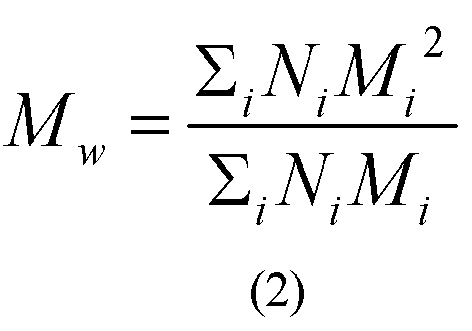
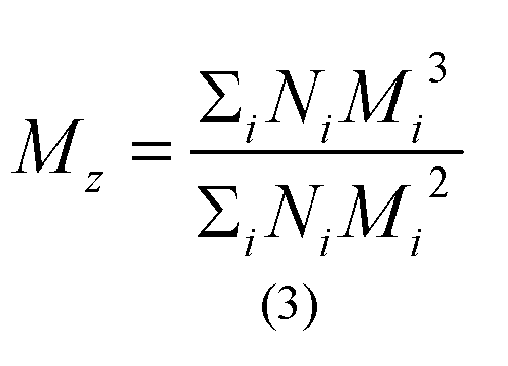
- M n , Mw, and M z may be calculated according to equations 1, 2, and 3 respectively where N i is the number of molecules of molecular weight M i .
- the CWS-PC has a PDI of from 5 to 40, alternatively from 10 to 35, or alternatively from 15 to 30.
- the CWS-PC may be formed into pipe by a shaping process such as extrusion.
- a method of making a polymeric pipe may comprise extruding the polymer or copolymer in a molten state through a die to form the polymeric pipe and cooling the pipe.
- Pipe extrusion in the simplest terms is performed by melting and conveying polymer (e.g., polyethylene) pellets into a particular shape (generally an annular shape), and solidifying that shape during a cooling process. There are numerous steps to pipe extrusion as provided below.
- the polymer feedstock can be a pre-pigmented polyethylene resin or it can be a mixture of polyethylene and color concentrate (referred to as "Salt and Pepper blends").
- the most common feedstock for pipe extrusion is "Salt and Pepper blends.”
- the most common feedstock for pipe extrusion is pre-pigmented polyethylene resin.
- from about 0.5 wt.% zinc oxide to about 0.75 wt.% ZnO is added to the feedstock prior to or during the extrusion step to form a CWS-PC.
- the feedstock is then fed into an extruder.
- the most common extruder system for pipe production is a single-screw extruder.
- the purpose of the extruder is to melt, convey, and homogenize the polyethylene pellets. Extrusion temperatures typically range from 178° C to 250° C depending upon the extruder screw design and flow properties of the polyethylene.
- the molten polymer is then passed through a die.
- the die distributes the homogenous polyethylene polymer melt around a solid mandrel, which forms it into an annular shape. Adjustments can be made at the die exit to try to compensate for polymer sag through the rest of the process.
- the pipe is then sized. There are two methods for sizing: vacuum or pressure. Each sizing method employs different techniques and different equipment.
- the pipe is cooled and solidified in the desired dimensions. Cooling is accomplished by the use of several water tanks wherein the pipe is either submerged or water is sprayed on the pipe exterior. The pipe is cooled from the outside surface to the inside surface. The interior wall and inside surfaces of the pipe can stay very hot for a long period of time, as polyethylene is a poor conductor of heat. Finally, the pipe is printed and either coiled or cut to length.
- Pipes formed from a CWS-PC of the type disclosed herein may display improved mechanical properties when subjected to chlorinated water having chloride present in the disclosed ranges as compared to pipes formed from an otherwise similar resin lacking an AID.
- the term "otherwise similar” as used herein is understood to include, but not limited to, embodiments where an "otherwise similar" polymer, polymeric composition, article, pipe or the like refers to the same or identical (including but not limited to the same or identical as determined within the tolerances or variances of known testing procedures or protocols) polymer, polymeric composition, article, pipe or the like with the exception of the specific feature that is identified as different (the presence or absence of ZnO).
- the CWS-PC comprises an ethylene polymer and ZnO and is formed into a PE-pipe.
- PE-pipes exposed to chlorinated water over time can display reduced structural integrity, in the form of cracks, ruptures, or leaks, which is typically attributed to chlorine-induced brittle oxidative failure (CBOF).
- CBOF chlorine-induced brittle oxidative failure
- PE-pipes prepared from a CWS-PC of the type disclosed herein display improved structural integrity when exposed to a chlorinated water source when compared to an otherwise similar PE-pipe prepared from a polymeric material lacking the AID.
- the resistance of a PE pipe to CBOF can be expressed in terms of the time-to-failure (TTF) as determined in accordance with ASTM F2263-07(E1).
- a pipe formed from a CWS-PC of the type disclosed herein displays a TTF that is increased when compared to an otherwise similar article formed from a polymer composition lacking the AID by equal to or greater than about 25%, alternatively greater than about 35%, or alternatively greater than about 50%.
- the method comprises providing a CWS-PC and forming the CWS-PC into a pipe.
- the method further comprises evaluating the resistance of a pipe formed from a CWS-PC of this disclosure to structural degradation upon exposure to a chlorinated water source.
- An article's resistance to structural degradation upon exposure to chlorinated water is hereinafter termed the structural integrity index (SII) of the article.
- SII structural integrity index
- the SII may be suitably correlated to a plurality of physical properties displayed by an article.
- the SII may be correlated to the TTF of a pipe formed from a CWS-PC of this disclosure.
- the SII of a pipe formed from a CWS-PC of this disclosure may be obtained and compared to a SII of a pipe fabricated from an otherwise similar polymer composition lacking the AID.
- the pipe may be further processed into a packaged product containing written material.
- the written material may provide information on the SII of a pipe formed from a CWS-PC of the type disclosed herein alone or in comparison to a pipe formed from a polymeric material not containing the AID.
- the written material may provide instructions and/or recommendations for utilization of the pipe in one or more applications.
- the written material may indicate the pipe formed from a CWS-PC of the type disclosed herein is suitable for use in applications wherein the pipe is contacted with chlorinated water.
- Sample 2 in addition to MARLEX® HP132 also contained 0.2 wt.% IRGANOX 1010, 0.2 wt.% IRGAFOS 168, 0.03 wt.% fatty acid salt, 0.04 wt.% VITON FREEFLOW Z200 and 0.75 wt.% ZnO.
- IRGANOX 1010 phenolic primary antioxidant for processing and long-term thermal stabilization is a sterically hindered phenolic antioxidant and IRGAFOS 168 is a hydrolytically stable phosphate processing stabilizer which are both commercially available.
- Table 1 presents the density, HLMI, tensile strength at yield, PENT, and the results of oxidative induction time (OIT) tests performed on specimens prepared from the samples.
- the OIT refers to the time between oxygen exposure and the onset of decomposition of a material under isothermal conditions and is a measure of the oxidative stability of the material and may be determined in accordance with ASTM D 3895.
- the high load melt index represents the rate of flow of a molten polymer through an orifice of 0.0825 inch diameter when subjected to a force of 21,600 grams at 190°C as determined in accordance with ASTM D1238.
- the tensile strength at yield refers to the tensile stress where an increase in strain no longer results in an increase in stress on a stress-strain curve as determined accordance with ASTM D638.
- the Pennsylvania Edge-Notch Tensile Test was used to measure the time to failure due to slow crack growth and conducted in accordance with ASTM F1473 with the exception that the specimens did not fail in the time tested as indicated in Table 1.
- Sample 1 is representative of a conventional composition used to prepare articles having an improved chlorine resistance while Sample 2 comprises a CWS-PC of the type disclosed herein.
- the samples were further processed to include MARLEX® M368 black concentrate which is a black masterbatch commercially available from Chevron Phillips Chemical Company LP.
- Samples 1 and 2 containing MARLEX® M368 were designated Samples 1A and 2A respectively.
- Table 2 presents the weight percent carbon black (i.e., MARLEX® M368), density, HLMI, tensile strength at yield, PENT, and results of OIT tests performed on specimens prepared from Samples 1A and 2A. Carbon black testing was conducted in accordance with ASTM D1603. Table 2 Sample No.
- Sample 2A (comprising a CWS-PC of the type disclosed herein) contains more carbon black than Sample 1A however this is a natural consequence of the incorporation of the refactory zinc oxide material and represents an approximate sum of the amount of zinc oxide and carbon black.
- Samples 1A and 2A were used to prepare pipe specimens and investigated to examine the influence of chlorinated water on the pipe samples.
- Specimens were tested as 15" length pipes with polyvinylidene fluoride (PVDF) compression fittings and PVDF inserts on both pipe ends. The length-to-diameter ratio is nominally 24.
- Specimens were exposed to continuous flowing chlorinated reverse osmosis (RO) water and tested in general accordance with ASTM F2263-07(E1) under conditions as detailed in Table 3.
- RO chlorinated reverse osmosis
- the hoop stress refers to a circumferential stress in a cylindrically shaped part as a result of internal or external pressure and may be determined in accordance with ASTM D1598. Referring to Table 4, all samples failures displayed a thick layer of degradation on the inside surface with moderate to extensive micro-cracking and minor to moderate radial cracking observed. The failures appeared to initiate on the inner pipe surface in the form of micro-cracks that propagated through the pipe wall to result in ultimate failure. Failure was due to a loss of fluid at a brittle slit perforation, which appeared to be caused by CBOF. A minor ductile lip was typically observed on the outside surface of each failure.
- TTF time to failure
- FIG. 5 shows gel permeation chromatographs of three PE samples.
- the three PE samples all contained the same base resin, 2000 ppm SONGNOX 1010 and 2000 ppm SONGNOX 1680.
- SONGNOX 1010 and SONGNOX 1680 are phenolic antixoxidants commercially available from Songwon Industrial.t Chromatograph A is of a PE resin that has not been exposed to a chlorinated water source.
- Chromatographs B and C are graphs of PE resins that have both been exposed to chlorinated water for 5 weeks.
- Chromatograph B is of a PE resin that does not contain ZnO while Chromatograph C is of a PE resin that contains 7500 ppm ZnO. While both Chromatographs B and C show degradation of the PE resin as evinced by the increase in the LMW component with a concomitant decrease in the HMW component, PE resin containing ZnO, i.e., as shown in Chromatograph C displays less degradation than the PE resin lacking ZnO, as shown in Chromatograph B.
- a base resin MARLEX® H525, polyethylene is a polyethylene hexane copolymer commercially available from Chevron Phillips Chemical Company LP was used to prepare 12.5 mil thick plaques.
- Each sample contained 0.2 wt.% SONGNOX 1010, and 0.2 wt.% SONGNOX 1680.
- the samples, designated samples A, B, C, D, and E contained 0, 0.1 wt.%, 0.25 wt.%, 0.5 wt.% and 0.75 wt.% ZnO respectively.
- the plaques were aged in chlorinated water at a temperature of 80 °C.
- Each sample contained 0.2 wt.% SONGNOX 1010, 0.1 wt.% DOVERPHOS S-9228, and 0.03 wt.% fatty acid salt.
- DOVERPHOS S-9228 is a solid phosphite commercially available from Dover Chemical Corporation.
- the samples, designated samples F, G, H, and I contained 0, 0.1 wt.%, 0.25 wt.%, and 0.5 wt.% ZnO respectively.
- the plaques were aged in chlorinated water at a temperature of 80 °C. A mixture of sodium hypochlorite and HCl was used to adjust the room temperature pH and ORP to 6.8 and greater than 825, respectively.
- the OIT values of the plaques were measured by differential scanning calorimetry prior to exposure to the chlorinated water and then every 24 hours thereafter. The results of these experiments are shown in Table 7 and depicted in Figures 6a and 6b .
- Table 7 Sample Average OIT (min) after Days in 80 ° Cl water 0 1 2 3 4 F 60 35 15 6 3 G 70 42 25 13 7 H 95 50 34 15 6 I 79 40 24 12 5 Percentage OIT retained F 100 58 25 10 5 G 100 60 36 19 11 H 100 52 35 16 7 I 100 51 31 15 7
Landscapes
- Engineering & Computer Science (AREA)
- General Engineering & Computer Science (AREA)
- Chemical & Material Sciences (AREA)
- Mechanical Engineering (AREA)
- Health & Medical Sciences (AREA)
- Chemical Kinetics & Catalysis (AREA)
- Medicinal Chemistry (AREA)
- Polymers & Plastics (AREA)
- Organic Chemistry (AREA)
- Rigid Pipes And Flexible Pipes (AREA)
- Compositions Of Macromolecular Compounds (AREA)
Description
- The present disclosure relates generally to improved polymer compositions. More particularly, the present disclosure relates to polymer compositions displaying improved resistance to degradation.
- Articles produced from polymer compositions may have expected lifetimes of 50 to 100 years in some applications. When these same articles are used in applications that expose them to chlorinated water (e.g. potable water), this service lifetime can be decreased significantly. Thus, there is a need for polymeric compositions that display improved service lifetimes when exposed to chlorinated water.
- According to the present invention there is provided a pipe according to
Claim 1 and a method according to Claim 7. -
-
Figures 1-3 are plots of the average failure time as a function of sample type for the samples from example 1. -
Figure 4 is a plot of the percentage OIT retained as a function of time at various zinc oxide amounts for the samples from example 2. -
Figure 5 is a plot of the molecular weight distribution for the samples from example 3. -
Figure 6 is a plot of the percentage OIT retained as a function of time at various zinc oxide amounts for the samples from example 5. - It should be understood at the outset that although an illustrative implementation of one or more embodiments are provided below, the disclosed systems and/or methods may be implemented using any number of techniques, whether currently known or in existence. The disclosure should in no way be limited to the illustrative implementations, drawings, and techniques illustrated below, including the exemplary designs and implementations illustrated and described herein, but may be modified within the scope of the appended claims along with their full scope of equivalents.
- To the extent that any definition or usage provided by any document disclosed herein conflicts with the definition or usage provided herein, the definition or usage provided herein controls.
- The terms "polymer," "polymer resin," "polyolefin," "polyolefin resin," and the like, are used herein to encompass any homopolymer of an olefin monomer or any copolymer of an olefin monomer with one or more comonomers. For example, this includes ethylene homopolymers and copolymers of ethylene and one or more comonomers. This also includes homopolymers, copolymers, terpolymers, etc., of any other olefin monomer disclosed herein (e.g., propylene). A polymer composition generally refers to at least one polymer and one or more additional components (e.g., a second polymer, an additive, etc.).
- The term "ppm," an abbreviation for "parts per million," is used herein when reciting the weight percent of certain additives in a polyolefin composition, and is based on the weight of the polyolefin present in the polyolefin composition. For instance, 1000 ppm equates to 0.1 weight percent. Likewise, "ppm" is used herein when reciting the weight percent of certain additives in an article of manufacture, and is based on the weight of the polyolefin present in the article of manufacture. If more than one polyolefin is present in the polyolefin composition or in the article (e.g., a blend of two or more polyolefins), the amount in ppm is based on the total polyolefin content.
- Disclosed herein are polymer compositions and methods of making and using same. The polymer composition comprises an additive to prevent, reduce, or retard degradation of the polymer resulting from exposure to chlorinated water. Hereinafter, such compositions are termed chlorinated water-stabilized polymer compositions and designated CWS-PC.
- The CWS-PC of the present disclosure, and specifically the polymer components thereof, can be produced by any appropriate polymerization method, using any appropriate type of polymerization reactor or reactors. As used herein, "polymerization reactor" includes any polymerization reactor capable of polymerizing monomers to produce homopolymers or copolymers. Such homopolymers and copolymers may be referred to as resins or polymers. The various types of reactors include those that may be referred to as batch, slurry, gas-phase, solution, high pressure, tubular or autoclave reactors, or other appropriate reactor capable of achieving a desired result. Gas-phase reactors may comprise fluidized bed reactors or staged horizontal reactors. Slurry reactors may comprise vertical or horizontal loops. High pressure reactors may comprise autoclave or tubular reactors. Reactor types can include batch or continuous processes. Continuous processes could use intermittent or continuous product discharge. Processes may also include partial or full direct recycle of un-reacted monomer, un-reacted comonomer, and/or diluent.
- Polymerization reactor systems of the present disclosure may comprise one type of reactor in a system or multiple reactors of the same or different type. Production of polymers in multiple reactors may include single and/or multiple stages in one or more polymerization reactors. Multiple reactors may be interconnected by a transfer device making it possible to transfer the products, diluents and/or reactants from the one polymerization reactor to another reactor. The desired polymerization conditions in one of the reactors may be different, similar, or the same as the operating conditions of the other reactor or reactors. Alternatively, polymerization in multiple reactors may include the manual transfer of polymer from one reactor to subsequent reactors for continued polymerization. Multiple reactor systems may include any combination including, but not limited to, multiple loop reactors, multiple gas reactors, a combination of loop and gas reactors, multiple high pressure reactors or a combination of high pressure with loop and/or gas reactors. Multiple reactors may be operated in series or in parallel.
- The polymerization reactor system may comprise at least one loop slurry reactor. Such reactors may comprise vertical or horizontal loops. Monomer, diluent, catalyst and optionally any comonomer may be continuously fed to a loop reactor where polymerization occurs. Generally, continuous processes may comprise continuous introduction of a monomer, a catalyst, and/or a diluent into a polymerization reactor and/or the removal from this reactor of a suspension comprising polymer particles and the diluent, either continuously or as desired. Reactor effluent may be flashed to separate the solid polymer from the liquids that comprise the diluent, monomer and/or comonomer. Various technologies may be used for this separation step including but not limited to, flashing that may include any combination of heat addition and pressure reduction; separation by cyclonic action in either a cyclone or hydrocyclone; or separation by centrifugation.
-
- Suitable diluents used in slurry polymerization include without limitation the monomer being polymerized and hydrocarbons that are liquids under reaction conditions. Examples of suitable diluents include, but are not limited to, hydrocarbons such as propane, cyclohexane, isobutane, n-butane, n-pentane, isopentane, neopentane, and n-hexane. Some loop polymerization reactions can occur under bulk conditions where no diluent is used. An example is polymerization of propylene monomer as disclosed in
U.S. Patent No. 5,455,314 . - The polymerization reactor may comprise at least one gas-phase reactor. Such systems may employ a continuous recycle stream containing one or more monomers continuously cycled through a fluidized bed in the presence of the catalyst under polymerization conditions. A recycle stream may be withdrawn from the fluidized bed and recycled back into the reactor. Simultaneously, polymer product may be withdrawn from the reactor and new or fresh monomer may be added to replace the polymerized monomer. Such gas-phase reactors may comprise a process for multi-step gas-phase polymerization of olefins, in which monomers such as olefins are polymerized in the gaseous phase in at least two independent gas-phase polymerization zones while feeding a catalyst-containing polymer formed in a first polymerization zone to a second polymerization zone. One type of gas-phase reactor is disclosed in
U.S. Patent Nos. 5,352,749 ,4588,790 and5,436,304 . - A high pressure polymerization reactor may comprise a tubular reactor or an autoclave reactor. Tubular reactors may have several zones where fresh monomer, initiators, or catalysts are added. Monomer may be entrained in an inert gaseous stream and introduced at one zone of the reactor. Initiators, catalysts, and/or catalyst components may be entrained in a gaseous stream and introduced at another zone of the reactor. The gas streams may be intermixed for polymerization. Heat and pressure may be employed appropriately to obtain optimal polymerization reaction conditions.
- The polymerization reactor may comprise a solution polymerization reactor wherein the monomer is contacted with the catalyst composition by suitable stirring or other means. A carrier comprising an inert organic diluent or excess monomer may be employed. If desired, the monomer may be brought in the vapor phase into contact with the catalytic reaction product, in the presence or absence of liquid material. The polymerization zone is maintained at temperatures and pressures that will result in the formation of a solution of the polymer in a reaction medium. Agitation may be employed to obtain better temperature control and to maintain uniform polymerization mixtures throughout the polymerization zone. Adequate means are utilized for dissipating the exothermic heat of polymerization.
- Polymerization reactors suitable for the present disclosure may further comprise any combination of at least one raw material feed system, at least one feed system for catalyst or catalyst components, and/or at least one polymer recovery system. Suitable reactor systems for the present disclosure may further comprise systems for feedstock purification, catalyst storage and preparation, extrusion, reactor cooling, polymer recovery, fractionation, recycle, storage, loadout, laboratory analysis, and process control.
- Conditions that are controlled for polymerization efficiency and to provide resin properties include temperature, pressure and the concentrations of various reactants. Polymerization temperature can affect catalyst productivity, polymer molecular weight and molecular weight distribution. Suitable polymerization temperature may be any temperature below the de-polymerization temperature according to the Gibbs free energy equation. Typically, this includes from 60° C to 280° C, for example, and from 70° C to 110° C, depending upon the type of polymerization and the reactor.
- Suitable pressures will also vary according to the reactor and polymerization type. The pressure for liquid phase polymerizations in a loop reactor is typically less than 6895 kPa (1000 psig). Pressure for gas-phase polymerization is usually at 1379 to 3447 kPa (200 to 500 psig). High pressure polymerization in tubular or autoclave reactors is generally run at 137895 to 517107 kPa (20,000 to 75,000 psig). Polymerization reactors can also be operated in a supercritical region occurring at generally higher temperatures and pressures. Operation above the critical point of a pressure/temperature diagram (supercritical phase) may offer advantages.
- The concentration of various reactants can be controlled to produce resins with certain physical and mechanical properties. The intended end-use product that will be formed by the resin and the method of forming that product helps determine the desired resin properties. Non-limiting examples of mechanical properties include tensile, flexural, impact, creep, stress relaxation and hardness tests. Physical properties may include, but are not limited to density, molecular weight, molecular weight distribution, melting temperature, glass transition temperature, temperature melt of crystallization, density, stereoregularity, crack growth, long chain branching, rheological measurements, and chemical resistance.
- The concentrations of monomer, co-monomer, hydrogen, co-catalyst, modifiers, and electron donors are important in producing these resin properties. Comonomer may be used to control product density. Hydrogen can be used to control product molecular weight. Co-catalysts can be used to alkylate, scavenge poisons and control molecular weight. Modifiers can be used to control product properties and electron donors affect stereoregularity. In addition, the concentration of poisons is minimized because poisons impact the reactions and product properties.
- The polymer or resin is used to form a CWS-PC as described herein, which is further formed into an end use article which is pipe.
- After polymerization, additives and modifiers can be added to the polymer to provide better processing during manufacturing and for desired properties in the end product. Additives may include, but are not limited to surface modifiers such as slip agents, antiblocks, tackifiers; antioxidants such as primary and secondary antioxidants; pigments; processing aids such as waxes/oils and fluoroelastomers; and special additives such as stabilizers, fire retardants, antistats, scavengers, absorbers, odor enhancers, antimicrobials, preservatives, light stabilizers, and anti-degradation agents. Such additives may be used singularly or in combination and may be included in the polymer composition before, during or after preparation of the CWS-PC as described herein. Such additives may be added using any suitable technique, for example during an extrusion or a compounding step such as during pelletization or subsequent processing into an end use article.
- The CWS-PC comprises an additive that functions to reduce and/or inhibit degradation of a polymer when exposed to a chlorine-containing solution, and such additives are referred to herein as AIDs. For example, the chlorine-containing solution may comprise chlorinated drinking water wherein chloramine or chlorine is introduced to a water-source as a disinfectant, in an amount of equal to or less than about 4 ppm, alternatively less than about 3.5 ppm, or alternatively less than about 3 ppm. In an embodiment, the chlorine-containing solution is potable or drinking water, for example water from a municipal water supply. In an embodiment, the CWS-PC is formed into a pipe and exposed to water from a municipal water supply having chloride in an amount sufficient to meet applicable local, state, and/or federal standards. In an embodiment, the CWS-PC is formed into a pipe and exposed to a highly chlorinated water supply and/or water supplies having varying levels of chlorination, such as those encountered in recreational water sources such as pools, spas, hot tubs, water parks, and the like, and likewise which may be governed by applicable local, state, and/or federal standards.
- The AID comprises an oxide of zinc (ZnO). In embodiments, the AID (ZnO) is present in the CWS-PC in an amount of from 500 ppm to 10,000 ppm, alternatively from 1000 ppm to 9000 ppm, or alternatively from 5000 ppm to 8000 ppm. It is unexpectedly observed that the AID (ZnO) when present in the CWS-PC in the disclosed amounts reduces and/or inhibits degradation of the CWS-PC (e.g., the polymeric components thereof) as a result of exposure to chlorinated water. Any suitable methodology may be utilized to incorporate the AID into the polymeric composition. For example, the AID (ZnO) may be introduced to the CWS-PC during formation of the resin and/or extrusion of the reactor fluff. Alternatively, the AID may be introduced to the CWS-PC during the manufacture of a pipe from the CWS-PC.
- The CWS-PC may comprise a homopolymer, a copolymer, or blends thereof. In an embodiment, the CWS-PC comprises a polymer of ethylene with one or more comonomers such as alpha olefins. Examples of suitable comonomers include, but are not limited to, unsaturated hydrocarbons having from 3 to 20 carbon atoms such as propylene, 1-butene, 1-pentene, 1-hexene, 3-methyl-1-butene, 4-methyl-1-pentene, 1-heptene, 1-octene, 1-nonene, 1-decene, and mixtures thereof. In an embodiment, the CWS-PC comprises a copolymer of ethylene and 1-hexene.
- In an embodiment, a polymer suitable for use in the CWS-PC is characterized by a density of from 0.93 g/cc to 0.97 g/cc, alternatively from 0.94 g/cc to 0.97 g/cc, alternatively from 0.96g/cc to 0.97 g/cc, or alternatively from 0.95 g/cc to 0.96 g/cc as determined in accordance with ASTM D-1505. For example, the polymer may be a polyethylene homopolymer or copolymer having a density of greater than 0.95 g/cc, or alternatively greater than 0.96 g/cc.
- Herein, the "modality" of a polymer refers to the form of its molecular weight distribution curve, i.e. the appearance of the graph of the polymer weight fraction as a function of its molecular weight. The polymer weight fraction refers to the weight fraction of molecules of a given size. A polymer having a molecular weight distribution curve showing a single peak may be referred to as a unimodal polymer, a polymer having a curve showing two distinct peaks may be referred to as a bimodal polymer, a polymer having a curve showing three distinct peaks may be referred to as a trimodal polymer, etc. Polymers having molecular weight distribution curves showing more than one peak may be collectively referred to as multimodal polymers.
- The molecular weight distribution (MWD) of the CWS-PC may be characterized by the ratio of the weight average molecular weight to the number average molecular weight, which is also referred to as the polydispersity index (PDI) or more simply as polydispersity. The weight average molecular weight describes the molecular weight distribution of a polymer composition. The number average molecular weight is the common average of the molecular weights of the individual polymers. The z-average molecular weight is a higher order molecular weight average. All molecular weight averages are expressed in kilogram per mole (g/mol). Mn, Mw, and Mz may be calculated according to
equations 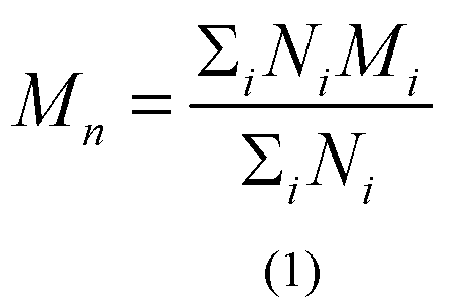
- In an embodiment, the CWS-PC has a PDI of from 5 to 40, alternatively from 10 to 35, or alternatively from 15 to 30.
- The CWS-PC may be formed into pipe by a shaping process such as extrusion. A method of making a polymeric pipe may comprise extruding the polymer or copolymer in a molten state through a die to form the polymeric pipe and cooling the pipe. Pipe extrusion in the simplest terms is performed by melting and conveying polymer (e.g., polyethylene) pellets into a particular shape (generally an annular shape), and solidifying that shape during a cooling process. There are numerous steps to pipe extrusion as provided below. The polymer feedstock can be a pre-pigmented polyethylene resin or it can be a mixture of polyethylene and color concentrate (referred to as "Salt and Pepper blends"). In North America, the most common feedstock for pipe extrusion is "Salt and Pepper blends." In Europe and other areas of the world, the most common feedstock for pipe extrusion is pre-pigmented polyethylene resin. In an embodiment, from about 0.5 wt.% zinc oxide to about 0.75 wt.% ZnO is added to the feedstock prior to or during the extrusion step to form a CWS-PC. The feedstock is then fed into an extruder. The most common extruder system for pipe production is a single-screw extruder. The purpose of the extruder is to melt, convey, and homogenize the polyethylene pellets. Extrusion temperatures typically range from 178° C to 250° C depending upon the extruder screw design and flow properties of the polyethylene.
- The molten polymer is then passed through a die. The die distributes the homogenous polyethylene polymer melt around a solid mandrel, which forms it into an annular shape. Adjustments can be made at the die exit to try to compensate for polymer sag through the rest of the process. In order for the pipe to meet the proper dimensional parameters, the pipe is then sized. There are two methods for sizing: vacuum or pressure. Each sizing method employs different techniques and different equipment.
- Next, the pipe is cooled and solidified in the desired dimensions. Cooling is accomplished by the use of several water tanks wherein the pipe is either submerged or water is sprayed on the pipe exterior. The pipe is cooled from the outside surface to the inside surface. The interior wall and inside surfaces of the pipe can stay very hot for a long period of time, as polyethylene is a poor conductor of heat. Finally, the pipe is printed and either coiled or cut to length.
- Pipes formed from a CWS-PC of the type disclosed herein may display improved mechanical properties when subjected to chlorinated water having chloride present in the disclosed ranges as compared to pipes formed from an otherwise similar resin lacking an AID. The term "otherwise similar" as used herein is understood to include, but not limited to, embodiments where an "otherwise similar" polymer, polymeric composition, article, pipe or the like refers to the same or identical (including but not limited to the same or identical as determined within the tolerances or variances of known testing procedures or protocols) polymer, polymeric composition, article, pipe or the like with the exception of the specific feature that is identified as different (the presence or absence of ZnO). The term "otherwise similar" is also understood to include comparisons of inventive embodiments to control embodiments, where variables or parameters related to the polymer, polymeric composition, article, pipe or the like are held constant within accepted scientific practice as understood by those skilled in the art with the exception of one or more designated variables or parameters of interest (the presence or absence of ZnO).
- The CWS-PC comprises an ethylene polymer and ZnO and is formed into a PE-pipe. PE-pipes exposed to chlorinated water over time can display reduced structural integrity, in the form of cracks, ruptures, or leaks, which is typically attributed to chlorine-induced brittle oxidative failure (CBOF). PE-pipes prepared from a CWS-PC of the type disclosed herein display improved structural integrity when exposed to a chlorinated water source when compared to an otherwise similar PE-pipe prepared from a polymeric material lacking the AID. The resistance of a PE pipe to CBOF can be expressed in terms of the time-to-failure (TTF) as determined in accordance with ASTM F2263-07(E1). A pipe formed from a CWS-PC of the type disclosed herein displays a TTF that is increased when compared to an otherwise similar article formed from a polymer composition lacking the AID by equal to or greater than about 25%, alternatively greater than about 35%, or alternatively greater than about 50%.
- The method comprises providing a CWS-PC and forming the CWS-PC into a pipe. The method further comprises evaluating the resistance of a pipe formed from a CWS-PC of this disclosure to structural degradation upon exposure to a chlorinated water source. An article's resistance to structural degradation upon exposure to chlorinated water is hereinafter termed the structural integrity index (SII) of the article. It is contemplated that the SII may be suitably correlated to a plurality of physical properties displayed by an article. The SII may be correlated to the TTF of a pipe formed from a CWS-PC of this disclosure.
- In an embodiment the SII of a pipe formed from a CWS-PC of this disclosure may be obtained and compared to a SII of a pipe fabricated from an otherwise similar polymer composition lacking the AID.
- The pipe may be further processed into a packaged product containing written material. In some embodiments, the written material may provide information on the SII of a pipe formed from a CWS-PC of the type disclosed herein alone or in comparison to a pipe formed from a polymeric material not containing the AID. In some embodiments, the written material may provide instructions and/or recommendations for utilization of the pipe in one or more applications. For example, the written material may indicate the pipe formed from a CWS-PC of the type disclosed herein is suitable for use in applications wherein the pipe is contacted with chlorinated water.
- The effect of an AID on the stability of pipes made from a CWS-PC of the type described herein was investigated. Two sample compositions were prepared and tested for their ability to withstand degradation when exposed to a chlorine source. All samples contained MARLEX® HP132 as the base resin. MARLEX® HP132 high-density polyethylene is commercially available from Chevron Phillips Chemical Company LP.
Sample 1 in addition to MARLEX® HP132 also contained 0.2 wt.% IRGANOX 1010, 0.2 wt.% IRGAFOS 168, 0.03 wt.% fatty acid salt, and 0.04 wt.% VITON FREEFLOW Z200 process aid.Sample 2 in addition to MARLEX® HP132 also contained 0.2 wt.% IRGANOX 1010, 0.2 wt.% IRGAFOS 168, 0.03 wt.% fatty acid salt, 0.04 wt.% VITON FREEFLOW Z200 and 0.75 wt.% ZnO. IRGANOX 1010 phenolic primary antioxidant for processing and long-term thermal stabilization is a sterically hindered phenolic antioxidant and IRGAFOS 168 is a hydrolytically stable phosphate processing stabilizer which are both commercially available. Table 1 presents the density, HLMI, tensile strength at yield, PENT, and the results of oxidative induction time (OIT) tests performed on specimens prepared from the samples. The OIT refers to the time between oxygen exposure and the onset of decomposition of a material under isothermal conditions and is a measure of the oxidative stability of the material and may be determined in accordance with ASTM D 3895.Table 1 Sample No. Density (g/cm3) HLMI (g/10min.) Tensile Strength at Yield (psi) PENT (hrs) OIT (min) 1* 0.9477 8.87 3710 >3985 160 2 0.9531 9.45 3720 >3985 133 *= reference example - The high load melt index (HLMI) represents the rate of flow of a molten polymer through an orifice of 0.0825 inch diameter when subjected to a force of 21,600 grams at 190°C as determined in accordance with ASTM D1238. The tensile strength at yield refers to the tensile stress where an increase in strain no longer results in an increase in stress on a stress-strain curve as determined accordance with ASTM D638. The Pennsylvania Edge-Notch Tensile Test (PENT) was used to measure the time to failure due to slow crack growth and conducted in accordance with ASTM F1473 with the exception that the specimens did not fail in the time tested as indicated in Table 1.
Sample 1 is representative of a conventional composition used to prepare articles having an improved chlorine resistance whileSample 2 comprises a CWS-PC of the type disclosed herein. The samples were further processed to include MARLEX® M368 black concentrate which is a black masterbatch commercially available from Chevron Phillips Chemical Company LP.Samples Samples Samples Table 2 Sample No. Carbon Black (wt.%) Density (g/cm3) HLMI (g/10min.) Tensile Strength at Yield (psi) PENT (hrs) OIT (min.) 1A 2.27 0.9588 8.54 3740 >3985 156 2A 2.92 0.9647 8.54 3770 >3985 152 - The density of all the samples was increased by the addition of MARLEX® M368. Further,
Sample 2A (comprising a CWS-PC of the type disclosed herein) contains more carbon black thanSample 1A however this is a natural consequence of the incorporation of the refactory zinc oxide material and represents an approximate sum of the amount of zinc oxide and carbon black. -
Samples Table 3 Parameter Actual Control Limits pH 6.8 ± 0.2 Chlorine (mg/L) 4.4 ± 0.2 ORP (mV) > 825 Measured Flow Rate (USGPM) 0.1 ± 10% • The Fluid and Air Temperature were controlled at the same set-point. No measurable temperature drop across the test specimens was observed. - Two specimens of each formulation of the ½ inch extruded black tubing were tested at under accelerated temperature and pressure conditions of (a) 90° C and 120 psig, (b) 90° C and 100 psig or (c) 80° C and 120 psig. The results of these experiments are presented in Table 4.
Table 4 Sample No Temperature (°C) Pressure (psig) Specimen ID Hoop Stress (psi) Test Time (h) 1A 80 120 1-1 356 2486 1-2 355 2658 90 100 1-1 296 2440 1-2 297 2340 120 1-1 357 1524 1-2 352 1294 2A 80 120 3-1 353 4759 3-2 354 5376 90 100 3-1 294 6549 3-2 300 7313 120 3-1 360 3496 3-2 354 4824 * Failure occurred away from the inlet - The hoop stress refers to a circumferential stress in a cylindrically shaped part as a result of internal or external pressure and may be determined in accordance with ASTM D1598. Referring to Table 4, all samples failures displayed a thick layer of degradation on the inside surface with moderate to extensive micro-cracking and minor to moderate radial cracking observed. The failures appeared to initiate on the inner pipe surface in the form of micro-cracks that propagated through the pipe wall to result in ultimate failure. Failure was due to a loss of fluid at a brittle slit perforation, which appeared to be caused by CBOF. A minor ductile lip was typically observed on the outside surface of each failure. A detailed examination of the inside surface of the failures revealed that the slit fractures may be associated with the die lines of the pipe. It appeared that the failure often occurs along a die line and can be unusually long for a brittle oxidative failure. The straight and elongated patterns of degradation on the inner surface also suggested that there may be preferential degradation along the die lines. The time to failure (TTF) for each sample under conditions a, b, and c are presented in
Figures 1 ,2 , and3 respectively. - The average TTF for each sample under conditions a, b, and c are given in Table 5.
Table 5 Condition Sample Average TTF (hours) a 1A 2572 a 2A 5067.5 b 1A 2390 b 2A 6931 c 1A 1409 c 2A 4160 - The results demonstrate that the comparative sample,
sample 1A, under condition (a) exhibited a 50.8% reduction in TTF when compared to a sample prepared from a CWS-PC of the type disclosed herein. Under conditions (b) and (c) the comparative sample displayed respectively a 47.2% and 27.8% reduction in TTF when compared to a pipe prepared from a CWS-PC of the type disclosed herein. - The effect of ZnO concentration on the oxidative induction time of a CWS-PC of the type described herein was investigated. The OIT of plaques prepared from the CWS-PC was determined and are presented in
FIG. 4 . - The effect of the presence of ZnO on polymer degradation was investigated and is depicted in
FIG. 5 which shows gel permeation chromatographs of three PE samples. The three PE samples all contained the same base resin, 2000ppm SONGNOX 1010 and 2000 ppm SONGNOX 1680. SONGNOX 1010 and SONGNOX 1680 are phenolic antixoxidants commercially available from Songwon Industrial.t Chromatograph A is of a PE resin that has not been exposed to a chlorinated water source. Chromatographs B and C are graphs of PE resins that have both been exposed to chlorinated water for 5 weeks. Chromatograph B is of a PE resin that does not contain ZnO while Chromatograph C is of a PE resin that contains 7500 ppm ZnO. While both Chromatographs B and C show degradation of the PE resin as evinced by the increase in the LMW component with a concomitant decrease in the HMW component, PE resin containing ZnO, i.e., as shown in Chromatograph C displays less degradation than the PE resin lacking ZnO, as shown in Chromatograph B. - The effect of the addition of an AID of the type described herein on polymer degradation was investigated. A base resin, MARLEX® H525, polyethylene is a polyethylene hexane copolymer commercially available from Chevron Phillips Chemical Company LP was used to prepare 12.5 mil thick plaques. Each sample contained 0.2 wt.% SONGNOX 1010, and 0.2 wt.% SONGNOX 1680. The samples, designated samples A, B, C, D, and E contained 0, 0.1 wt.%, 0.25 wt.%, 0.5 wt.% and 0.75 wt.% ZnO respectively. The plaques were aged in chlorinated water at a temperature of 80 °C. A mixture of sodium hypochlorite and HCl was used to adjust the room temperature pH and ORP to 6.8 and greater than 825, respectively. The OIT values of the plaques were measured by differential scanning calorimetry prior to exposure to the chlorinated water and then every 24 hours thereafter. The results of these experiments are shown in Table 6.
Table 6 Sample Average OIT (min) after Days in 80 ° water 0 1 2 3 4 5 6 7 A 100 71 30 20 8 4 0 0 B 120 103 40 30 20 16 10 6 C 151 144 76 58 44 25 5 4 D 146 132 67 43 27 14 3 3 E 145 119 65 38 29 16 6 0 Percentage OIT retained A 100 71 31 20 8 4 0 0 B 100 86 33 25 17 13 8 5 C 100 95 50 38 29 17 3 3 D 100 91 46 30 18 10 2 2 E 100 82 45 26 20 11 4 0 - The effect of the addition of an AID of the type described herein on polymer degradation was investigated. A base resin, MARLEX® HHM TR-130, a medium density polyethylene resin commercially available from Chevron Phillips Chemical Company LP was used to prepare 12.5 mil thick plaques. Each sample contained 0.2 wt.% SONGNOX 1010, 0.1 wt.% DOVERPHOS S-9228, and 0.03 wt.% fatty acid salt. DOVERPHOS S-9228 is a solid phosphite commercially available from Dover Chemical Corporation. The samples, designated samples F, G, H, and I contained 0, 0.1 wt.%, 0.25 wt.%, and 0.5 wt.% ZnO respectively. The plaques were aged in chlorinated water at a temperature of 80 °C. A mixture of sodium hypochlorite and HCl was used to adjust the room temperature pH and ORP to 6.8 and greater than 825, respectively. The OIT values of the plaques were measured by differential scanning calorimetry prior to exposure to the chlorinated water and then every 24 hours thereafter. The results of these experiments are shown in Table 7 and depicted in
Figures 6a and 6b .Table 7 Sample Average OIT (min) after Days in 80 ° Cl water 0 1 2 3 4 F 60 35 15 6 3 G 70 42 25 13 7 H 95 50 34 15 6 I 79 40 24 12 5 Percentage OIT retained F 100 58 25 10 5 G 100 60 36 19 11 H 100 52 35 16 7 I 100 51 31 15 7
Claims (14)
- A pipe comprising polyethylene and greater than 0.5 wt.% zinc oxide having a time to failure as determined in accordance with ASTM F2263-07(E1) that is at least 25% greater than an otherwise similar pipe prepared in the absence of zinc oxide, wherein the polymer is bimodal.
- The pipe of claim 1 wherein the pipe comprises greater than 0.75 wt.% zinc oxide.
- The pipe of claim 1 of claim 2 further comprising carbon black.
- The pipe of claim 1, 2 or 3 wherein the polyethylene has a density of from 0.93 g/cc to 0.97 g/cc.
- The pipe of claim 1, 2, 3, or 4, wherein the polyethylene is metallocene catalyzed.
- The pipe of claim 1, 2, 3, 4 or 5, wherein the polyethylene is a copolymer of ethylene and 1-hexene.
- A method comprising:forming a polymeric composition comprising a bimodal polymer, which is an olefin homopolymer or a copolymer of an olefin monomer with one or more comonomers, and zinc oxide into a pipe wherein the zinc oxide is present in an amount of from 500 ppm to 10000 ppm;and testing the structural integrity of the pipe when exposed to chlorinated water, in accordance with ASTM F2263-07 (E1).
- The method of claim 7, wherein the zinc oxide is present in the polymeric composition in an amount of from 1000 ppm to 9000 ppm.
- The method of claim 7 or 8 wherein the polymer comprises polyethylene.
- The method of claim 7, 8, or 9, wherein the polymer has a density of from 0.94 g/cc to 0.97 g/cc.
- The method of claim 7, wherein the polymeric composition has a polydispersity index of from 5 to 40.
- The method of claim 7, wherein the polyethylene is a copolymer of ethylene and 1-hexene.
- The method of claim 7, where the zinc oxide is included during extrusion of a reactor fluff or during formation of the pipe..
- A packaged product comprising the pipe of claim 7 and written instructions regarding contacting the pipe with chlorinated water.
Applications Claiming Priority (2)
| Application Number | Priority Date | Filing Date | Title |
|---|---|---|---|
| US201161532879P | 2011-09-09 | 2011-09-09 | |
| PCT/US2012/053880 WO2013036581A1 (en) | 2011-09-09 | 2012-09-06 | Polyethylene additive compositions and articles made from same |
Publications (2)
| Publication Number | Publication Date |
|---|---|
| EP2753659A1 EP2753659A1 (en) | 2014-07-16 |
| EP2753659B1 true EP2753659B1 (en) | 2021-10-27 |
Family
ID=46964024
Family Applications (1)
| Application Number | Title | Priority Date | Filing Date |
|---|---|---|---|
| EP12766756.6A Active EP2753659B1 (en) | 2011-09-09 | 2012-09-06 | Polyethylene additive compositions and articles made from same |
Country Status (10)
| Country | Link |
|---|---|
| US (1) | US8722165B2 (en) |
| EP (1) | EP2753659B1 (en) |
| KR (1) | KR20140074887A (en) |
| CN (1) | CN103890070A (en) |
| BR (1) | BR112014005397B1 (en) |
| CA (1) | CA2848045C (en) |
| ES (1) | ES2902829T3 (en) |
| MX (1) | MX353021B (en) |
| SG (1) | SG11201400495SA (en) |
| WO (1) | WO2013036581A1 (en) |
Families Citing this family (8)
| Publication number | Priority date | Publication date | Assignee | Title |
|---|---|---|---|---|
| EP2753659B1 (en) | 2011-09-09 | 2021-10-27 | Chevron Phillips Chemical Company LP | Polyethylene additive compositions and articles made from same |
| EP2725057B2 (en) * | 2012-10-24 | 2022-08-24 | Borealis AG | Use of an acid scavenger to increase the resistance of a polyolefin composition against disinfectant containing water |
| US8815357B1 (en) | 2013-02-27 | 2014-08-26 | Chevron Phillips Chemical Company Lp | Polymer resins with improved processability and melt fracture characteristics |
| WO2017032516A1 (en) * | 2015-08-26 | 2017-03-02 | Sabic Global Technologies B.V. | Polyolefin composition comprising an antimicrobial additive |
| WO2017111711A1 (en) * | 2015-12-24 | 2017-06-29 | Scg Chemicals Company Limited | An antifouling polymer based composition |
| US20190071561A1 (en) * | 2016-02-02 | 2019-03-07 | Sabic Global Technologies B.V. | Pipe produced with a polymer composition comprising a polyethylen |
| EP3649190B1 (en) * | 2017-07-07 | 2023-03-29 | SABIC Global Technologies B.V. | Polyethylene composition |
| CA3075856A1 (en) * | 2017-09-13 | 2019-03-21 | Chevron Phillips Chemical Company Lp | Pvdf pipe and methods of making and using same |
Citations (1)
| Publication number | Priority date | Publication date | Assignee | Title |
|---|---|---|---|---|
| EP2039720A1 (en) * | 2007-09-21 | 2009-03-25 | Total Petrochemicals Research Feluy | Pipes for transporting water containing chlorine. |
Family Cites Families (32)
| Publication number | Priority date | Publication date | Assignee | Title |
|---|---|---|---|---|
| US3248179A (en) | 1962-02-26 | 1966-04-26 | Phillips Petroleum Co | Method and apparatus for the production of solid polymers of olefins |
| US4501885A (en) | 1981-10-14 | 1985-02-26 | Phillips Petroleum Company | Diluent and inert gas recovery from a polymerization process |
| US4588790A (en) | 1982-03-24 | 1986-05-13 | Union Carbide Corporation | Method for fluidized bed polymerization |
| JPS61270580A (en) * | 1985-05-24 | 1986-11-29 | 三菱油化株式会社 | Water supply and drainage pipe |
| JPS6487904A (en) | 1987-09-30 | 1989-04-03 | Shimadzu Corp | Hydraulic actuator with environment-proof type sensor |
| US5565175A (en) | 1990-10-01 | 1996-10-15 | Phillips Petroleum Company | Apparatus and method for producing ethylene polymer |
| US5575979A (en) | 1991-03-04 | 1996-11-19 | Phillips Petroleum Company | Process and apparatus for separating diluents from solid polymers utilizing a two-stage flash and a cyclone separator |
| JPH04353543A (en) * | 1991-05-31 | 1992-12-08 | Hitachi Metals Ltd | Chlorine-resistant water-based rubber compositions and chlorine-resistant water-based rubber products |
| US5352749A (en) | 1992-03-19 | 1994-10-04 | Exxon Chemical Patents, Inc. | Process for polymerizing monomers in fluidized beds |
| US5436304A (en) | 1992-03-19 | 1995-07-25 | Exxon Chemical Patents Inc. | Process for polymerizing monomers in fluidized beds |
| US5455314A (en) | 1994-07-27 | 1995-10-03 | Phillips Petroleum Company | Method for controlling removal of polymerization reaction effluent |
| JPH1087904A (en) * | 1996-07-08 | 1998-04-07 | Toyo Ink Mfg Co Ltd | Colored resin composition |
| US6239235B1 (en) | 1997-07-15 | 2001-05-29 | Phillips Petroleum Company | High solids slurry polymerization |
| KR100531628B1 (en) | 1998-03-20 | 2005-11-29 | 엑손모빌 케미칼 패턴츠 인코포레이티드 | Continuous slurry polymerization volatile removal |
| US6262191B1 (en) | 1999-03-09 | 2001-07-17 | Phillips Petroleum Company | Diluent slip stream to give catalyst wetting agent |
| CN1211433C (en) * | 1999-10-12 | 2005-07-20 | 东丽株式会社 | Resin structure and use thereof |
| CZ304440B6 (en) * | 2000-05-19 | 2014-05-07 | Ciba Specialty Chemicals Holding Inc. | Process for reducing polypropylene molecular weight by making use of hydroxylamine esters |
| JP3586668B2 (en) * | 2000-10-16 | 2004-11-10 | 株式会社サンケイ技研 | Rubber composition |
| EP1462464A1 (en) * | 2003-03-25 | 2004-09-29 | Borealis Technology Oy | Metallocene catalysts and preparation of polyolefins therewith |
| MY145338A (en) | 2003-12-04 | 2012-01-31 | Dow Global Technologies Inc | Stabilized polyethylene material |
| US7696280B2 (en) * | 2004-04-30 | 2010-04-13 | Chevron Phillips Chemical Company, Lp | HDPE resins for use in pressure pipe and related applications |
| US20060014903A1 (en) * | 2004-07-14 | 2006-01-19 | Thierry Vromman | Thermoplastic vulcanizates with enhanced cooling and articles made therefrom |
| EP1966293A1 (en) | 2005-10-27 | 2008-09-10 | Polnox Corporation | Stabilized polyolefin compositions |
| US7420010B2 (en) * | 2005-11-02 | 2008-09-02 | Chevron Philips Chemical Company Lp | Polyethylene compositions |
| ES2339963T3 (en) * | 2006-12-01 | 2010-05-27 | Borealis Technology Oy | TUBE THAT HAS AN IMPROVED HIGH TEMPERATURE RESISTANCE. |
| RU2461579C2 (en) * | 2007-02-01 | 2012-09-20 | Базелль Полиолефине Гмбх | Monomodal ethylene copolymer for pressure moulding and production method thereof |
| US7855246B2 (en) * | 2007-12-05 | 2010-12-21 | Uponor Innovation Ab | Plastic pipe made of polyolefin |
| EP2100916A1 (en) | 2008-03-13 | 2009-09-16 | Clariant International Ltd. | Acid scavenger compositions |
| EP2133367A1 (en) * | 2008-06-09 | 2009-12-16 | INEOS Manufacturing Belgium NV | Novel Copolymers |
| US8110262B2 (en) * | 2008-11-10 | 2012-02-07 | Chevron Phillips Chemical Company Lp | Polymer compositions containing a polymer processing aid and a hindered amine light stabilizer |
| US8362161B2 (en) * | 2011-04-12 | 2013-01-29 | Chevron Phillips Chemical Company Lp | System and method for processing reactor polymerization effluent |
| EP2753659B1 (en) * | 2011-09-09 | 2021-10-27 | Chevron Phillips Chemical Company LP | Polyethylene additive compositions and articles made from same |
-
2012
- 2012-09-06 EP EP12766756.6A patent/EP2753659B1/en active Active
- 2012-09-06 BR BR112014005397-9A patent/BR112014005397B1/en active IP Right Grant
- 2012-09-06 CN CN201280043575.0A patent/CN103890070A/en active Pending
- 2012-09-06 CA CA2848045A patent/CA2848045C/en active Active
- 2012-09-06 KR KR1020147006065A patent/KR20140074887A/en not_active Ceased
- 2012-09-06 MX MX2014002727A patent/MX353021B/en active IP Right Grant
- 2012-09-06 ES ES12766756T patent/ES2902829T3/en active Active
- 2012-09-06 SG SG11201400495SA patent/SG11201400495SA/en unknown
- 2012-09-06 WO PCT/US2012/053880 patent/WO2013036581A1/en not_active Ceased
- 2012-11-06 US US13/670,297 patent/US8722165B2/en active Active
Patent Citations (1)
| Publication number | Priority date | Publication date | Assignee | Title |
|---|---|---|---|---|
| EP2039720A1 (en) * | 2007-09-21 | 2009-03-25 | Total Petrochemicals Research Feluy | Pipes for transporting water containing chlorine. |
Also Published As
| Publication number | Publication date |
|---|---|
| WO2013036581A1 (en) | 2013-03-14 |
| CN103890070A (en) | 2014-06-25 |
| ES2902829T3 (en) | 2022-03-30 |
| BR112014005397A2 (en) | 2017-03-28 |
| BR112014005397B1 (en) | 2021-08-24 |
| MX353021B (en) | 2017-12-18 |
| KR20140074887A (en) | 2014-06-18 |
| EP2753659A1 (en) | 2014-07-16 |
| CA2848045C (en) | 2020-03-24 |
| US8722165B2 (en) | 2014-05-13 |
| SG11201400495SA (en) | 2014-04-28 |
| CA2848045A1 (en) | 2013-03-14 |
| US20130122226A1 (en) | 2013-05-16 |
| MX2014002727A (en) | 2014-08-27 |
Similar Documents
| Publication | Publication Date | Title |
|---|---|---|
| EP2753659B1 (en) | Polyethylene additive compositions and articles made from same | |
| AU747084B2 (en) | Process for the manufacture of a composition comprising ethylene polymers | |
| EP3145991B1 (en) | Novel high clarity low haze compositions | |
| EP2256158B1 (en) | Polymer composition for crosslinked articles | |
| EP2300529B1 (en) | Polyethylene compositions | |
| KR101629384B1 (en) | Multimodal polyethylene composition for the production of pipes with improved slow crack growth resistance | |
| EP3765535B1 (en) | Bimodal polyethylene resins and pipes produced therefrom | |
| CN102449057B (en) | Polymer composition for crosslinked pipes | |
| EP3544814A1 (en) | A process for producing polyolefin film composition and films prepared thereof | |
| EP1378528A1 (en) | A process for the production of a linear low-density polyethylene composition | |
| WO2008006487A1 (en) | Ethylene polymer composition | |
| EP3298067B1 (en) | Process for producing polyethylene composition | |
| US7420010B2 (en) | Polyethylene compositions | |
| EP3088458B1 (en) | Polyethylene composition suitable for pipe applications | |
| EP2350139B1 (en) | Multimodal polymer | |
| EP3902850A1 (en) | A process for producing polyolefin film composition and films prepared thereof | |
| MX2012005920A (en) | Compositions, films and methods of preparing the same. | |
| CN105143282A (en) | Ethylene/alpha-olefin interpolymer composition | |
| WO2017202765A1 (en) | Propylene copolymer composition |
Legal Events
| Date | Code | Title | Description |
|---|---|---|---|
| PUAI | Public reference made under article 153(3) epc to a published international application that has entered the european phase |
Free format text: ORIGINAL CODE: 0009012 |
|
| 17P | Request for examination filed |
Effective date: 20140328 |
|
| AK | Designated contracting states |
Kind code of ref document: A1 Designated state(s): AL AT BE BG CH CY CZ DE DK EE ES FI FR GB GR HR HU IE IS IT LI LT LU LV MC MK MT NL NO PL PT RO RS SE SI SK SM TR |
|
| DAX | Request for extension of the european patent (deleted) | ||
| STAA | Information on the status of an ep patent application or granted ep patent |
Free format text: STATUS: EXAMINATION IS IN PROGRESS |
|
| 17Q | First examination report despatched |
Effective date: 20190520 |
|
| REG | Reference to a national code |
Ref country code: DE Ref legal event code: R079 Ref document number: 602012077024 Country of ref document: DE Free format text: PREVIOUS MAIN CLASS: C08K0003220000 Ipc: C08L0023080000 |
|
| GRAP | Despatch of communication of intention to grant a patent |
Free format text: ORIGINAL CODE: EPIDOSNIGR1 |
|
| STAA | Information on the status of an ep patent application or granted ep patent |
Free format text: STATUS: GRANT OF PATENT IS INTENDED |
|
| RIC1 | Information provided on ipc code assigned before grant |
Ipc: C08K 3/22 20060101ALI20210308BHEP Ipc: F16L 9/127 20060101ALI20210308BHEP Ipc: C08L 23/08 20060101AFI20210308BHEP |
|
| INTG | Intention to grant announced |
Effective date: 20210414 |
|
| GRAS | Grant fee paid |
Free format text: ORIGINAL CODE: EPIDOSNIGR3 |
|
| GRAA | (expected) grant |
Free format text: ORIGINAL CODE: 0009210 |
|
| STAA | Information on the status of an ep patent application or granted ep patent |
Free format text: STATUS: THE PATENT HAS BEEN GRANTED |
|
| AK | Designated contracting states |
Kind code of ref document: B1 Designated state(s): AL AT BE BG CH CY CZ DE DK EE ES FI FR GB GR HR HU IE IS IT LI LT LU LV MC MK MT NL NO PL PT RO RS SE SI SK SM TR |
|
| REG | Reference to a national code |
Ref country code: GB Ref legal event code: FG4D |
|
| REG | Reference to a national code |
Ref country code: CH Ref legal event code: EP |
|
| REG | Reference to a national code |
Ref country code: AT Ref legal event code: REF Ref document number: 1441776 Country of ref document: AT Kind code of ref document: T Effective date: 20211115 |
|
| REG | Reference to a national code |
Ref country code: DE Ref legal event code: R096 Ref document number: 602012077024 Country of ref document: DE |
|
| REG | Reference to a national code |
Ref country code: IE Ref legal event code: FG4D |
|
| REG | Reference to a national code |
Ref country code: LT Ref legal event code: MG9D |
|
| REG | Reference to a national code |
Ref country code: NL Ref legal event code: MP Effective date: 20211027 |
|
| REG | Reference to a national code |
Ref country code: AT Ref legal event code: MK05 Ref document number: 1441776 Country of ref document: AT Kind code of ref document: T Effective date: 20211027 |
|
| REG | Reference to a national code |
Ref country code: ES Ref legal event code: FG2A Ref document number: 2902829 Country of ref document: ES Kind code of ref document: T3 Effective date: 20220330 |
|
| PG25 | Lapsed in a contracting state [announced via postgrant information from national office to epo] |
Ref country code: RS Free format text: LAPSE BECAUSE OF FAILURE TO SUBMIT A TRANSLATION OF THE DESCRIPTION OR TO PAY THE FEE WITHIN THE PRESCRIBED TIME-LIMIT Effective date: 20211027 Ref country code: LT Free format text: LAPSE BECAUSE OF FAILURE TO SUBMIT A TRANSLATION OF THE DESCRIPTION OR TO PAY THE FEE WITHIN THE PRESCRIBED TIME-LIMIT Effective date: 20211027 Ref country code: FI Free format text: LAPSE BECAUSE OF FAILURE TO SUBMIT A TRANSLATION OF THE DESCRIPTION OR TO PAY THE FEE WITHIN THE PRESCRIBED TIME-LIMIT Effective date: 20211027 Ref country code: BG Free format text: LAPSE BECAUSE OF FAILURE TO SUBMIT A TRANSLATION OF THE DESCRIPTION OR TO PAY THE FEE WITHIN THE PRESCRIBED TIME-LIMIT Effective date: 20220127 Ref country code: AT Free format text: LAPSE BECAUSE OF FAILURE TO SUBMIT A TRANSLATION OF THE DESCRIPTION OR TO PAY THE FEE WITHIN THE PRESCRIBED TIME-LIMIT Effective date: 20211027 |
|
| PG25 | Lapsed in a contracting state [announced via postgrant information from national office to epo] |
Ref country code: IS Free format text: LAPSE BECAUSE OF FAILURE TO SUBMIT A TRANSLATION OF THE DESCRIPTION OR TO PAY THE FEE WITHIN THE PRESCRIBED TIME-LIMIT Effective date: 20220227 Ref country code: SE Free format text: LAPSE BECAUSE OF FAILURE TO SUBMIT A TRANSLATION OF THE DESCRIPTION OR TO PAY THE FEE WITHIN THE PRESCRIBED TIME-LIMIT Effective date: 20211027 Ref country code: PT Free format text: LAPSE BECAUSE OF FAILURE TO SUBMIT A TRANSLATION OF THE DESCRIPTION OR TO PAY THE FEE WITHIN THE PRESCRIBED TIME-LIMIT Effective date: 20220228 Ref country code: PL Free format text: LAPSE BECAUSE OF FAILURE TO SUBMIT A TRANSLATION OF THE DESCRIPTION OR TO PAY THE FEE WITHIN THE PRESCRIBED TIME-LIMIT Effective date: 20211027 Ref country code: NO Free format text: LAPSE BECAUSE OF FAILURE TO SUBMIT A TRANSLATION OF THE DESCRIPTION OR TO PAY THE FEE WITHIN THE PRESCRIBED TIME-LIMIT Effective date: 20220127 Ref country code: NL Free format text: LAPSE BECAUSE OF FAILURE TO SUBMIT A TRANSLATION OF THE DESCRIPTION OR TO PAY THE FEE WITHIN THE PRESCRIBED TIME-LIMIT Effective date: 20211027 Ref country code: LV Free format text: LAPSE BECAUSE OF FAILURE TO SUBMIT A TRANSLATION OF THE DESCRIPTION OR TO PAY THE FEE WITHIN THE PRESCRIBED TIME-LIMIT Effective date: 20211027 Ref country code: HR Free format text: LAPSE BECAUSE OF FAILURE TO SUBMIT A TRANSLATION OF THE DESCRIPTION OR TO PAY THE FEE WITHIN THE PRESCRIBED TIME-LIMIT Effective date: 20211027 Ref country code: GR Free format text: LAPSE BECAUSE OF FAILURE TO SUBMIT A TRANSLATION OF THE DESCRIPTION OR TO PAY THE FEE WITHIN THE PRESCRIBED TIME-LIMIT Effective date: 20220128 |
|
| REG | Reference to a national code |
Ref country code: DE Ref legal event code: R097 Ref document number: 602012077024 Country of ref document: DE |
|
| PG25 | Lapsed in a contracting state [announced via postgrant information from national office to epo] |
Ref country code: SM Free format text: LAPSE BECAUSE OF FAILURE TO SUBMIT A TRANSLATION OF THE DESCRIPTION OR TO PAY THE FEE WITHIN THE PRESCRIBED TIME-LIMIT Effective date: 20211027 Ref country code: SK Free format text: LAPSE BECAUSE OF FAILURE TO SUBMIT A TRANSLATION OF THE DESCRIPTION OR TO PAY THE FEE WITHIN THE PRESCRIBED TIME-LIMIT Effective date: 20211027 Ref country code: RO Free format text: LAPSE BECAUSE OF FAILURE TO SUBMIT A TRANSLATION OF THE DESCRIPTION OR TO PAY THE FEE WITHIN THE PRESCRIBED TIME-LIMIT Effective date: 20211027 Ref country code: EE Free format text: LAPSE BECAUSE OF FAILURE TO SUBMIT A TRANSLATION OF THE DESCRIPTION OR TO PAY THE FEE WITHIN THE PRESCRIBED TIME-LIMIT Effective date: 20211027 Ref country code: DK Free format text: LAPSE BECAUSE OF FAILURE TO SUBMIT A TRANSLATION OF THE DESCRIPTION OR TO PAY THE FEE WITHIN THE PRESCRIBED TIME-LIMIT Effective date: 20211027 Ref country code: CZ Free format text: LAPSE BECAUSE OF FAILURE TO SUBMIT A TRANSLATION OF THE DESCRIPTION OR TO PAY THE FEE WITHIN THE PRESCRIBED TIME-LIMIT Effective date: 20211027 |
|
| PLBE | No opposition filed within time limit |
Free format text: ORIGINAL CODE: 0009261 |
|
| STAA | Information on the status of an ep patent application or granted ep patent |
Free format text: STATUS: NO OPPOSITION FILED WITHIN TIME LIMIT |
|
| 26N | No opposition filed |
Effective date: 20220728 |
|
| PG25 | Lapsed in a contracting state [announced via postgrant information from national office to epo] |
Ref country code: AL Free format text: LAPSE BECAUSE OF FAILURE TO SUBMIT A TRANSLATION OF THE DESCRIPTION OR TO PAY THE FEE WITHIN THE PRESCRIBED TIME-LIMIT Effective date: 20211027 |
|
| PG25 | Lapsed in a contracting state [announced via postgrant information from national office to epo] |
Ref country code: SI Free format text: LAPSE BECAUSE OF FAILURE TO SUBMIT A TRANSLATION OF THE DESCRIPTION OR TO PAY THE FEE WITHIN THE PRESCRIBED TIME-LIMIT Effective date: 20211027 |
|
| PG25 | Lapsed in a contracting state [announced via postgrant information from national office to epo] |
Ref country code: MC Free format text: LAPSE BECAUSE OF FAILURE TO SUBMIT A TRANSLATION OF THE DESCRIPTION OR TO PAY THE FEE WITHIN THE PRESCRIBED TIME-LIMIT Effective date: 20211027 |
|
| REG | Reference to a national code |
Ref country code: CH Ref legal event code: PL |
|
| PG25 | Lapsed in a contracting state [announced via postgrant information from national office to epo] |
Ref country code: IT Free format text: LAPSE BECAUSE OF FAILURE TO SUBMIT A TRANSLATION OF THE DESCRIPTION OR TO PAY THE FEE WITHIN THE PRESCRIBED TIME-LIMIT Effective date: 20211027 |
|
| P01 | Opt-out of the competence of the unified patent court (upc) registered |
Effective date: 20230517 |
|
| PG25 | Lapsed in a contracting state [announced via postgrant information from national office to epo] |
Ref country code: LU Free format text: LAPSE BECAUSE OF NON-PAYMENT OF DUE FEES Effective date: 20220906 |
|
| PG25 | Lapsed in a contracting state [announced via postgrant information from national office to epo] |
Ref country code: LI Free format text: LAPSE BECAUSE OF NON-PAYMENT OF DUE FEES Effective date: 20220930 Ref country code: IE Free format text: LAPSE BECAUSE OF NON-PAYMENT OF DUE FEES Effective date: 20220906 Ref country code: CH Free format text: LAPSE BECAUSE OF NON-PAYMENT OF DUE FEES Effective date: 20220930 |
|
| PG25 | Lapsed in a contracting state [announced via postgrant information from national office to epo] |
Ref country code: HU Free format text: LAPSE BECAUSE OF FAILURE TO SUBMIT A TRANSLATION OF THE DESCRIPTION OR TO PAY THE FEE WITHIN THE PRESCRIBED TIME-LIMIT; INVALID AB INITIO Effective date: 20120906 |
|
| PG25 | Lapsed in a contracting state [announced via postgrant information from national office to epo] |
Ref country code: CY Free format text: LAPSE BECAUSE OF FAILURE TO SUBMIT A TRANSLATION OF THE DESCRIPTION OR TO PAY THE FEE WITHIN THE PRESCRIBED TIME-LIMIT Effective date: 20211027 |
|
| PG25 | Lapsed in a contracting state [announced via postgrant information from national office to epo] |
Ref country code: MK Free format text: LAPSE BECAUSE OF FAILURE TO SUBMIT A TRANSLATION OF THE DESCRIPTION OR TO PAY THE FEE WITHIN THE PRESCRIBED TIME-LIMIT Effective date: 20211027 |
|
| PG25 | Lapsed in a contracting state [announced via postgrant information from national office to epo] |
Ref country code: MT Free format text: LAPSE BECAUSE OF FAILURE TO SUBMIT A TRANSLATION OF THE DESCRIPTION OR TO PAY THE FEE WITHIN THE PRESCRIBED TIME-LIMIT Effective date: 20211027 |
|
| PGFP | Annual fee paid to national office [announced via postgrant information from national office to epo] |
Ref country code: DE Payment date: 20240820 Year of fee payment: 13 |
|
| PGFP | Annual fee paid to national office [announced via postgrant information from national office to epo] |
Ref country code: GB Payment date: 20240820 Year of fee payment: 13 |
|
| PGFP | Annual fee paid to national office [announced via postgrant information from national office to epo] |
Ref country code: BE Payment date: 20240820 Year of fee payment: 13 |
|
| PGFP | Annual fee paid to national office [announced via postgrant information from national office to epo] |
Ref country code: FR Payment date: 20240820 Year of fee payment: 13 |
|
| PGFP | Annual fee paid to national office [announced via postgrant information from national office to epo] |
Ref country code: ES Payment date: 20241001 Year of fee payment: 13 |
|
| PG25 | Lapsed in a contracting state [announced via postgrant information from national office to epo] |
Ref country code: TR Free format text: LAPSE BECAUSE OF FAILURE TO SUBMIT A TRANSLATION OF THE DESCRIPTION OR TO PAY THE FEE WITHIN THE PRESCRIBED TIME-LIMIT Effective date: 20211027 |