EP2708243A1 - Receptor ligand linked cytotoxic molecules - Google Patents
Receptor ligand linked cytotoxic molecules Download PDFInfo
- Publication number
- EP2708243A1 EP2708243A1 EP12006502.4A EP12006502A EP2708243A1 EP 2708243 A1 EP2708243 A1 EP 2708243A1 EP 12006502 A EP12006502 A EP 12006502A EP 2708243 A1 EP2708243 A1 EP 2708243A1
- Authority
- EP
- European Patent Office
- Prior art keywords
- group
- alkyl
- heteroalkyl
- formula
- alkenyl
- Prior art date
- Legal status (The legal status is an assumption and is not a legal conclusion. Google has not performed a legal analysis and makes no representation as to the accuracy of the status listed.)
- Withdrawn
Links
- 230000001472 cytotoxic effect Effects 0.000 title abstract description 22
- 231100000433 cytotoxic Toxicity 0.000 title abstract description 21
- 239000003446 ligand Substances 0.000 title abstract description 16
- 150000001875 compounds Chemical class 0.000 claims abstract description 81
- 206010028980 Neoplasm Diseases 0.000 claims abstract description 33
- 201000011510 cancer Diseases 0.000 claims abstract description 24
- 125000005647 linker group Chemical group 0.000 claims abstract description 21
- 238000011282 treatment Methods 0.000 claims abstract description 16
- -1 auristatins Natural products 0.000 claims description 49
- 125000004404 heteroalkyl group Chemical group 0.000 claims description 37
- 125000004435 hydrogen atom Chemical group [H]* 0.000 claims description 35
- 125000000217 alkyl group Chemical group 0.000 claims description 33
- 229910052760 oxygen Inorganic materials 0.000 claims description 29
- 125000004432 carbon atom Chemical group C* 0.000 claims description 28
- 125000003342 alkenyl group Chemical group 0.000 claims description 24
- 125000003118 aryl group Chemical group 0.000 claims description 23
- 125000000753 cycloalkyl group Chemical group 0.000 claims description 23
- 229910052739 hydrogen Inorganic materials 0.000 claims description 22
- 125000000592 heterocycloalkyl group Chemical group 0.000 claims description 20
- 239000001257 hydrogen Substances 0.000 claims description 20
- 125000002496 methyl group Chemical group [H]C([H])([H])* 0.000 claims description 20
- 229910052717 sulfur Inorganic materials 0.000 claims description 20
- 125000001072 heteroaryl group Chemical group 0.000 claims description 18
- 229910052757 nitrogen Inorganic materials 0.000 claims description 17
- 125000006193 alkinyl group Chemical group 0.000 claims description 16
- 125000003710 aryl alkyl group Chemical group 0.000 claims description 16
- 125000004169 (C1-C6) alkyl group Chemical group 0.000 claims description 15
- 239000000203 mixture Substances 0.000 claims description 15
- 229910052731 fluorine Inorganic materials 0.000 claims description 13
- 125000004446 heteroarylalkyl group Chemical group 0.000 claims description 13
- 125000005119 alkyl cycloalkyl group Chemical group 0.000 claims description 11
- 125000004475 heteroaralkyl group Chemical group 0.000 claims description 11
- 150000003839 salts Chemical class 0.000 claims description 10
- 238000009472 formulation Methods 0.000 claims description 9
- 125000001449 isopropyl group Chemical group [H]C([H])([H])C([H])(*)C([H])([H])[H] 0.000 claims description 9
- 125000000547 substituted alkyl group Chemical group 0.000 claims description 9
- 125000004178 (C1-C4) alkyl group Chemical group 0.000 claims description 8
- 229910052736 halogen Inorganic materials 0.000 claims description 8
- 150000002367 halogens Chemical class 0.000 claims description 8
- 125000000304 alkynyl group Chemical group 0.000 claims description 7
- QVGXLLKOCUKJST-UHFFFAOYSA-N atomic oxygen Chemical group [O] QVGXLLKOCUKJST-UHFFFAOYSA-N 0.000 claims description 7
- 125000001495 ethyl group Chemical group [H]C([H])([H])C([H])([H])* 0.000 claims description 7
- 239000001301 oxygen Substances 0.000 claims description 7
- 239000012453 solvate Substances 0.000 claims description 7
- 125000004474 heteroalkylene group Chemical group 0.000 claims description 6
- 125000006588 heterocycloalkylene group Chemical group 0.000 claims description 6
- 125000000959 isobutyl group Chemical group [H]C([H])([H])C([H])(C([H])([H])[H])C([H])([H])* 0.000 claims description 6
- 125000001436 propyl group Chemical group [H]C([*])([H])C([H])([H])C([H])([H])[H] 0.000 claims description 6
- 125000006413 ring segment Chemical group 0.000 claims description 6
- 125000002947 alkylene group Chemical group 0.000 claims description 5
- 125000000732 arylene group Chemical group 0.000 claims description 5
- 125000003178 carboxy group Chemical group [H]OC(*)=O 0.000 claims description 5
- 125000005549 heteroarylene group Chemical group 0.000 claims description 5
- 125000001280 n-hexyl group Chemical group C(CCCCC)* 0.000 claims description 5
- 125000000740 n-pentyl group Chemical group [H]C([H])([H])C([H])([H])C([H])([H])C([H])([H])C([H])([H])* 0.000 claims description 5
- 125000002993 cycloalkylene group Chemical group 0.000 claims description 4
- 229930013356 epothilone Natural products 0.000 claims description 4
- HESCAJZNRMSMJG-KKQRBIROSA-N epothilone A Chemical class C/C([C@@H]1C[C@@H]2O[C@@H]2CCC[C@@H]([C@@H]([C@@H](C)C(=O)C(C)(C)[C@@H](O)CC(=O)O1)O)C)=C\C1=CSC(C)=N1 HESCAJZNRMSMJG-KKQRBIROSA-N 0.000 claims description 4
- 125000004399 C1-C4 alkenyl group Chemical group 0.000 claims description 3
- 125000004450 alkenylene group Chemical group 0.000 claims description 3
- 125000004419 alkynylene group Chemical group 0.000 claims description 3
- 125000001797 benzyl group Chemical group [H]C1=C([H])C([H])=C(C([H])=C1[H])C([H])([H])* 0.000 claims description 3
- 239000000969 carrier Substances 0.000 claims description 3
- 239000008194 pharmaceutical composition Substances 0.000 claims description 3
- 125000001997 phenyl group Chemical group [H]C1=C([H])C([H])=C(*)C([H])=C1[H] 0.000 claims description 3
- 229930184737 tubulysin Natural products 0.000 claims description 3
- SLURUCSFDHKXFR-WWMWMSKMSA-N (7s,9s)-7-[[(1s,3r,4as,9s,9ar,10as)-9-methoxy-1-methyl-3,4,4a,6,7,9,9a,10a-octahydro-1h-pyrano[1,2][1,3]oxazolo[3,4-b][1,4]oxazin-3-yl]oxy]-6,9,11-trihydroxy-9-(2-hydroxyacetyl)-4-methoxy-8,10-dihydro-7h-tetracene-5,12-dione Chemical compound O=C1C2=CC=CC(OC)=C2C(=O)C(C(O)=C23)=C1C(O)=C3C[C@@](O)(C(=O)CO)C[C@@H]2O[C@H]1C[C@@H]2N3CCO[C@H](OC)[C@H]3O[C@@H]2[C@H](C)O1 SLURUCSFDHKXFR-WWMWMSKMSA-N 0.000 claims description 2
- 125000006273 (C1-C3) alkyl group Chemical group 0.000 claims description 2
- 125000000520 N-substituted aminocarbonyl group Chemical group [*]NC(=O)* 0.000 claims description 2
- 229940123237 Taxane Drugs 0.000 claims description 2
- JXLYSJRDGCGARV-WWYNWVTFSA-N Vinblastine Natural products O=C(O[C@H]1[C@](O)(C(=O)OC)[C@@H]2N(C)c3c(cc(c(OC)c3)[C@]3(C(=O)OC)c4[nH]c5c(c4CCN4C[C@](O)(CC)C[C@H](C3)C4)cccc5)[C@@]32[C@H]2[C@@]1(CC)C=CCN2CC3)C JXLYSJRDGCGARV-WWYNWVTFSA-N 0.000 claims description 2
- 239000002671 adjuvant Substances 0.000 claims description 2
- 239000000539 dimer Substances 0.000 claims description 2
- 229930188854 dolastatin Natural products 0.000 claims description 2
- 229960005501 duocarmycin Drugs 0.000 claims description 2
- 229930184221 duocarmycin Natural products 0.000 claims description 2
- 125000005842 heteroatom Chemical group 0.000 claims description 2
- CBOIHMRHGLHBPB-UHFFFAOYSA-N hydroxymethyl Chemical compound O[CH2] CBOIHMRHGLHBPB-UHFFFAOYSA-N 0.000 claims description 2
- CTMCWCONSULRHO-UHQPFXKFSA-N nemorubicin Chemical compound C1CO[C@H](OC)CN1[C@@H]1[C@H](O)[C@H](C)O[C@@H](O[C@@H]2C3=C(O)C=4C(=O)C5=C(OC)C=CC=C5C(=O)C=4C(O)=C3C[C@](O)(C2)C(=O)CO)C1 CTMCWCONSULRHO-UHQPFXKFSA-N 0.000 claims description 2
- 229950010159 nemorubicin Drugs 0.000 claims description 2
- 125000003107 substituted aryl group Chemical group 0.000 claims description 2
- 229960003048 vinblastine Drugs 0.000 claims description 2
- JXLYSJRDGCGARV-XQKSVPLYSA-N vincaleukoblastine Chemical compound C([C@@H](C[C@]1(C(=O)OC)C=2C(=CC3=C([C@]45[C@H]([C@@]([C@H](OC(C)=O)[C@]6(CC)C=CCN([C@H]56)CC4)(O)C(=O)OC)N3C)C=2)OC)C[C@@](C2)(O)CC)N2CCC2=C1NC1=CC=CC=C21 JXLYSJRDGCGARV-XQKSVPLYSA-N 0.000 claims description 2
- OGWKCGZFUXNPDA-XQKSVPLYSA-N vincristine Chemical compound C([N@]1C[C@@H](C[C@]2(C(=O)OC)C=3C(=CC4=C([C@]56[C@H]([C@@]([C@H](OC(C)=O)[C@]7(CC)C=CCN([C@H]67)CC5)(O)C(=O)OC)N4C=O)C=3)OC)C[C@@](C1)(O)CC)CC1=C2NC2=CC=CC=C12 OGWKCGZFUXNPDA-XQKSVPLYSA-N 0.000 claims description 2
- 229960004528 vincristine Drugs 0.000 claims description 2
- OGWKCGZFUXNPDA-UHFFFAOYSA-N vincristine Natural products C1C(CC)(O)CC(CC2(C(=O)OC)C=3C(=CC4=C(C56C(C(C(OC(C)=O)C7(CC)C=CCN(C67)CC5)(O)C(=O)OC)N4C=O)C=3)OC)CN1CCC1=C2NC2=CC=CC=C12 OGWKCGZFUXNPDA-UHFFFAOYSA-N 0.000 claims description 2
- 201000010099 disease Diseases 0.000 abstract description 4
- 208000037265 diseases, disorders, signs and symptoms Diseases 0.000 abstract description 4
- 102000009497 Neuropeptide Y1 receptors Human genes 0.000 abstract 1
- 108050000303 Neuropeptide Y1 receptors Proteins 0.000 abstract 1
- 210000004027 cell Anatomy 0.000 description 81
- 102000005962 receptors Human genes 0.000 description 35
- 108020003175 receptors Proteins 0.000 description 35
- 108090000765 processed proteins & peptides Proteins 0.000 description 34
- 239000000562 conjugate Substances 0.000 description 17
- 101000652582 Homo sapiens Antigen peptide transporter 2 Proteins 0.000 description 13
- 102000054264 human TAP2 Human genes 0.000 description 13
- URPYMXQQVHTUDU-OFGSCBOVSA-N nucleopeptide y Chemical compound C([C@@H](C(=O)N[C@@H]([C@@H](C)CC)C(=O)N[C@@H](CC(N)=O)C(=O)N[C@@H](CC(C)C)C(=O)N[C@@H]([C@@H](C)CC)C(=O)N[C@@H]([C@@H](C)O)C(=O)N[C@@H](CCCNC(N)=N)C(=O)N[C@@H](CCC(N)=O)C(=O)N[C@@H](CCCNC(N)=N)C(=O)N[C@@H](CC=1C=CC(O)=CC=1)C(N)=O)NC(=O)[C@H](CC=1NC=NC=1)NC(=O)[C@H](CCCNC(N)=N)NC(=O)[C@H](CC(C)C)NC(=O)[C@H](C)NC(=O)[C@H](CO)NC(=O)[C@H](CC=1C=CC(O)=CC=1)NC(=O)[C@H](CC=1C=CC(O)=CC=1)NC(=O)[C@H](CCCNC(N)=N)NC(=O)[C@H](C)NC(=O)[C@H](CC(C)C)NC(=O)[C@H](CC(O)=O)NC(=O)[C@H](CCC(O)=O)NC(=O)[C@H](C)NC(=O)[C@H]1N(CCC1)C(=O)[C@H](C)NC(=O)[C@H](CC(O)=O)NC(=O)[C@H](CCC(O)=O)NC(=O)CNC(=O)[C@H]1N(CCC1)C(=O)[C@H](CC(N)=O)NC(=O)[C@H](CC(O)=O)NC(=O)[C@H]1N(CCC1)C(=O)[C@H](CCCCN)NC(=O)[C@H](CO)NC(=O)[C@H]1N(CCC1)C(=O)[C@@H](N)CC=1C=CC(O)=CC=1)C1=CC=C(O)C=C1 URPYMXQQVHTUDU-OFGSCBOVSA-N 0.000 description 13
- 102000004169 proteins and genes Human genes 0.000 description 13
- 108090000623 proteins and genes Proteins 0.000 description 13
- 206010006187 Breast cancer Diseases 0.000 description 11
- 208000026310 Breast neoplasm Diseases 0.000 description 11
- 238000011534 incubation Methods 0.000 description 11
- 235000018102 proteins Nutrition 0.000 description 11
- 238000004458 analytical method Methods 0.000 description 10
- XLYOFNOQVPJJNP-UHFFFAOYSA-N water Substances O XLYOFNOQVPJJNP-UHFFFAOYSA-N 0.000 description 10
- RTZKZFJDLAIYFH-UHFFFAOYSA-N Diethyl ether Chemical compound CCOCC RTZKZFJDLAIYFH-UHFFFAOYSA-N 0.000 description 9
- 101710151321 Melanostatin Proteins 0.000 description 9
- 102400000064 Neuropeptide Y Human genes 0.000 description 9
- 102000004243 Tubulin Human genes 0.000 description 9
- 108090000704 Tubulin Proteins 0.000 description 9
- 150000001413 amino acids Chemical class 0.000 description 9
- 239000000460 chlorine Substances 0.000 description 9
- 229910052801 chlorine Inorganic materials 0.000 description 9
- 230000000694 effects Effects 0.000 description 9
- 239000011347 resin Substances 0.000 description 9
- 229920005989 resin Polymers 0.000 description 9
- 125000000882 C2-C6 alkenyl group Chemical group 0.000 description 8
- 101000603245 Homo sapiens Neuropeptide Y receptor type 2 Proteins 0.000 description 8
- PLXBWHJQWKZRKG-UHFFFAOYSA-N Resazurin Chemical compound C1=CC(=O)C=C2OC3=CC(O)=CC=C3[N+]([O-])=C21 PLXBWHJQWKZRKG-UHFFFAOYSA-N 0.000 description 8
- 238000005859 coupling reaction Methods 0.000 description 8
- 210000004940 nucleus Anatomy 0.000 description 8
- 239000000243 solution Substances 0.000 description 8
- 230000001225 therapeutic effect Effects 0.000 description 8
- 241001465754 Metazoa Species 0.000 description 7
- 239000002609 medium Substances 0.000 description 7
- 102000004196 processed proteins & peptides Human genes 0.000 description 7
- 238000004007 reversed phase HPLC Methods 0.000 description 7
- IJGRMHOSHXDMSA-UHFFFAOYSA-N Atomic nitrogen Chemical compound N#N IJGRMHOSHXDMSA-UHFFFAOYSA-N 0.000 description 6
- 101100189913 Caenorhabditis elegans pept-1 gene Proteins 0.000 description 6
- OAKJQQAXSVQMHS-UHFFFAOYSA-N Hydrazine Chemical compound NN OAKJQQAXSVQMHS-UHFFFAOYSA-N 0.000 description 6
- 230000004913 activation Effects 0.000 description 6
- 235000001014 amino acid Nutrition 0.000 description 6
- 229910052794 bromium Inorganic materials 0.000 description 6
- 230000001413 cellular effect Effects 0.000 description 6
- 238000006243 chemical reaction Methods 0.000 description 6
- 238000003776 cleavage reaction Methods 0.000 description 6
- 230000008878 coupling Effects 0.000 description 6
- 238000010168 coupling process Methods 0.000 description 6
- 238000013467 fragmentation Methods 0.000 description 6
- 238000006062 fragmentation reaction Methods 0.000 description 6
- 238000003384 imaging method Methods 0.000 description 6
- 229910052740 iodine Inorganic materials 0.000 description 6
- 238000000034 method Methods 0.000 description 6
- 229910052698 phosphorus Inorganic materials 0.000 description 6
- 125000006239 protecting group Chemical group 0.000 description 6
- 230000007017 scission Effects 0.000 description 6
- 230000008685 targeting Effects 0.000 description 6
- CXWXQJXEFPUFDZ-UHFFFAOYSA-N tetralin Chemical compound C1=CC=C2CCCCC2=C1 CXWXQJXEFPUFDZ-UHFFFAOYSA-N 0.000 description 6
- CQTGBCFGAAYOCY-ZCRNMIQFSA-N (3S)-3-[[(2S)-2-[[(2S)-2-[[(2S)-2-[[(2S,3R)-2-[[(2S)-2-[[(2S)-2-[[(2S)-2-acetamido-3-methylbutanoyl]amino]-3-methylbutanoyl]amino]-3-phenylpropanoyl]amino]-3-hydroxybutanoyl]amino]-3-hydroxypropanoyl]amino]-3-(1H-indol-3-yl)propanoyl]amino]-5-amino-5-oxopentanoyl]amino]-4-[[(2S)-1-[[(2S)-1-[[(2S)-1-[[(2S)-1-[[(2S)-1-amino-3-methyl-1-oxobutan-2-yl]amino]-3-(1H-indol-3-yl)-1-oxopropan-2-yl]amino]-1-oxo-3-phenylpropan-2-yl]amino]-4-methyl-1-oxopentan-2-yl]amino]-3-(4-hydroxyphenyl)-1-oxopropan-2-yl]amino]-4-oxobutanoic acid Chemical compound CC(C)C[C@H](NC(=O)[C@H](Cc1ccc(O)cc1)NC(=O)[C@H](CC(O)=O)NC(=O)[C@H](CCC(N)=O)NC(=O)[C@H](Cc1c[nH]c2ccccc12)NC(=O)[C@H](CO)NC(=O)[C@@H](NC(=O)[C@H](Cc1ccccc1)NC(=O)[C@@H](NC(=O)[C@@H](NC(C)=O)C(C)C)C(C)C)[C@@H](C)O)C(=O)N[C@@H](Cc1ccccc1)C(=O)N[C@@H](Cc1c[nH]c2ccccc12)C(=O)N[C@@H](C(C)C)C(N)=O CQTGBCFGAAYOCY-ZCRNMIQFSA-N 0.000 description 5
- 102000011727 Caspases Human genes 0.000 description 5
- 108010076667 Caspases Proteins 0.000 description 5
- 125000004429 atom Chemical group 0.000 description 5
- 229910052799 carbon Inorganic materials 0.000 description 5
- 238000004113 cell culture Methods 0.000 description 5
- 230000003833 cell viability Effects 0.000 description 5
- 239000003814 drug Substances 0.000 description 5
- 238000001840 matrix-assisted laser desorption--ionisation time-of-flight mass spectrometry Methods 0.000 description 5
- BDAGIHXWWSANSR-UHFFFAOYSA-N methanoic acid Natural products OC=O BDAGIHXWWSANSR-UHFFFAOYSA-N 0.000 description 5
- 230000003389 potentiating effect Effects 0.000 description 5
- 229920006395 saturated elastomer Polymers 0.000 description 5
- 229930012538 Paclitaxel Natural products 0.000 description 4
- NQRYJNQNLNOLGT-UHFFFAOYSA-N Piperidine Chemical compound C1CCNCC1 NQRYJNQNLNOLGT-UHFFFAOYSA-N 0.000 description 4
- 108020004459 Small interfering RNA Proteins 0.000 description 4
- 238000003556 assay Methods 0.000 description 4
- 229910002092 carbon dioxide Inorganic materials 0.000 description 4
- 125000004122 cyclic group Chemical group 0.000 description 4
- 238000010511 deprotection reaction Methods 0.000 description 4
- 229960000367 inositol Drugs 0.000 description 4
- KWGKDLIKAYFUFQ-UHFFFAOYSA-M lithium chloride Chemical compound [Li+].[Cl-] KWGKDLIKAYFUFQ-UHFFFAOYSA-M 0.000 description 4
- 238000005259 measurement Methods 0.000 description 4
- 230000001404 mediated effect Effects 0.000 description 4
- 229960001592 paclitaxel Drugs 0.000 description 4
- 239000000047 product Substances 0.000 description 4
- RCINICONZNJXQF-MZXODVADSA-N taxol Chemical compound O([C@@H]1[C@@]2(C[C@@H](C(C)=C(C2(C)C)[C@H](C([C@]2(C)[C@@H](O)C[C@H]3OC[C@]3([C@H]21)OC(C)=O)=O)OC(=O)C)OC(=O)[C@H](O)[C@@H](NC(=O)C=1C=CC=CC=1)C=1C=CC=CC=1)O)C(=O)C1=CC=CC=C1 RCINICONZNJXQF-MZXODVADSA-N 0.000 description 4
- 238000001890 transfection Methods 0.000 description 4
- 125000003088 (fluoren-9-ylmethoxy)carbonyl group Chemical group 0.000 description 3
- BDNKZNFMNDZQMI-UHFFFAOYSA-N 1,3-diisopropylcarbodiimide Chemical compound CC(C)N=C=NC(C)C BDNKZNFMNDZQMI-UHFFFAOYSA-N 0.000 description 3
- PRDFBSVERLRRMY-UHFFFAOYSA-N 2'-(4-ethoxyphenyl)-5-(4-methylpiperazin-1-yl)-2,5'-bibenzimidazole Chemical compound C1=CC(OCC)=CC=C1C1=NC2=CC=C(C=3NC4=CC(=CC=C4N=3)N3CCN(C)CC3)C=C2N1 PRDFBSVERLRRMY-UHFFFAOYSA-N 0.000 description 3
- STQGQHZAVUOBTE-UHFFFAOYSA-N 7-Cyan-hept-2t-en-4,6-diinsaeure Natural products C1=2C(O)=C3C(=O)C=4C(OC)=CC=CC=4C(=O)C3=C(O)C=2CC(O)(C(C)=O)CC1OC1CC(N)C(O)C(C)O1 STQGQHZAVUOBTE-UHFFFAOYSA-N 0.000 description 3
- OKTJSMMVPCPJKN-UHFFFAOYSA-N Carbon Chemical compound [C] OKTJSMMVPCPJKN-UHFFFAOYSA-N 0.000 description 3
- 239000006144 Dulbecco’s modified Eagle's medium Substances 0.000 description 3
- PXGOKWXKJXAPGV-UHFFFAOYSA-N Fluorine Chemical group FF PXGOKWXKJXAPGV-UHFFFAOYSA-N 0.000 description 3
- HVLSXIKZNLPZJJ-TXZCQADKSA-N HA peptide Chemical compound C([C@@H](C(=O)N[C@@H](CC(O)=O)C(=O)N[C@@H](C(C)C)C(=O)N1[C@@H](CCC1)C(=O)N[C@@H](CC(O)=O)C(=O)N[C@@H](CC=1C=CC(O)=CC=1)C(=O)N[C@@H](C)C(O)=O)NC(=O)[C@H]1N(CCC1)C(=O)[C@@H](N)CC=1C=CC(O)=CC=1)C1=CC=C(O)C=C1 HVLSXIKZNLPZJJ-TXZCQADKSA-N 0.000 description 3
- 102000019293 Kinesin-like proteins Human genes 0.000 description 3
- 108050006659 Kinesin-like proteins Proteins 0.000 description 3
- 102100038991 Neuropeptide Y receptor type 2 Human genes 0.000 description 3
- 108010088535 Pep-1 peptide Proteins 0.000 description 3
- HEMHJVSKTPXQMS-UHFFFAOYSA-M Sodium hydroxide Chemical compound [OH-].[Na+] HEMHJVSKTPXQMS-UHFFFAOYSA-M 0.000 description 3
- IBEDDHUHZBDXGB-OEJISELMSA-N Tubulysin A Chemical compound N([C@@H]([C@@H](C)CC)C(=O)N(COC(=O)CC(C)C)[C@H](C[C@@H](OC(C)=O)C=1SC=C(N=1)C(=O)N[C@H](C[C@H](C)C(O)=O)CC=1C=CC(O)=CC=1)C(C)C)C(=O)[C@H]1CCCCN1C IBEDDHUHZBDXGB-OEJISELMSA-N 0.000 description 3
- IBEDDHUHZBDXGB-UHFFFAOYSA-N Tubulysin A Natural products N=1C(C(=O)NC(CC(C)C(O)=O)CC=2C=CC(O)=CC=2)=CSC=1C(OC(C)=O)CC(C(C)C)N(COC(=O)CC(C)C)C(=O)C(C(C)CC)NC(=O)C1CCCCN1C IBEDDHUHZBDXGB-UHFFFAOYSA-N 0.000 description 3
- 238000010521 absorption reaction Methods 0.000 description 3
- 125000003545 alkoxy group Chemical group 0.000 description 3
- 150000001408 amides Chemical class 0.000 description 3
- 125000002915 carbonyl group Chemical group [*:2]C([*:1])=O 0.000 description 3
- 238000001516 cell proliferation assay Methods 0.000 description 3
- 238000003570 cell viability assay Methods 0.000 description 3
- KRKNYBCHXYNGOX-UHFFFAOYSA-N citric acid Chemical compound OC(=O)CC(O)(C(O)=O)CC(O)=O KRKNYBCHXYNGOX-UHFFFAOYSA-N 0.000 description 3
- STQGQHZAVUOBTE-VGBVRHCVSA-N daunorubicin Chemical compound O([C@H]1C[C@@](O)(CC=2C(O)=C3C(=O)C=4C=CC=C(C=4C(=O)C3=C(O)C=21)OC)C(C)=O)[C@H]1C[C@H](N)[C@H](O)[C@H](C)O1 STQGQHZAVUOBTE-VGBVRHCVSA-N 0.000 description 3
- 229960000975 daunorubicin Drugs 0.000 description 3
- 230000001687 destabilization Effects 0.000 description 3
- BGRWYRAHAFMIBJ-UHFFFAOYSA-N diisopropylcarbodiimide Natural products CC(C)NC(=O)NC(C)C BGRWYRAHAFMIBJ-UHFFFAOYSA-N 0.000 description 3
- 229940079593 drug Drugs 0.000 description 3
- 238000002330 electrospray ionisation mass spectrometry Methods 0.000 description 3
- 238000002073 fluorescence micrograph Methods 0.000 description 3
- 239000011737 fluorine Chemical group 0.000 description 3
- 235000019253 formic acid Nutrition 0.000 description 3
- 239000000499 gel Substances 0.000 description 3
- 238000001727 in vivo Methods 0.000 description 3
- 238000002372 labelling Methods 0.000 description 3
- 239000003921 oil Substances 0.000 description 3
- 239000000863 peptide conjugate Substances 0.000 description 3
- 230000004962 physiological condition Effects 0.000 description 3
- 230000019491 signal transduction Effects 0.000 description 3
- 230000000638 stimulation Effects 0.000 description 3
- 125000002023 trifluoromethyl group Chemical group FC(F)(F)* 0.000 description 3
- 108010061145 tubulysin A Proteins 0.000 description 3
- 125000006716 (C1-C6) heteroalkyl group Chemical group 0.000 description 2
- WXTMDXOMEHJXQO-UHFFFAOYSA-N 2,5-dihydroxybenzoic acid Chemical compound OC(=O)C1=CC(O)=CC=C1O WXTMDXOMEHJXQO-UHFFFAOYSA-N 0.000 description 2
- OSWFIVFLDKOXQC-UHFFFAOYSA-N 4-(3-methoxyphenyl)aniline Chemical compound COC1=CC=CC(C=2C=CC(N)=CC=2)=C1 OSWFIVFLDKOXQC-UHFFFAOYSA-N 0.000 description 2
- FZTIWOBQQYPTCJ-UHFFFAOYSA-N 4-[4-(4-carboxyphenyl)phenyl]benzoic acid Chemical compound C1=CC(C(=O)O)=CC=C1C1=CC=C(C=2C=CC(=CC=2)C(O)=O)C=C1 FZTIWOBQQYPTCJ-UHFFFAOYSA-N 0.000 description 2
- 102100026357 40S ribosomal protein S13 Human genes 0.000 description 2
- 101710131790 40S ribosomal protein S13 Proteins 0.000 description 2
- IZZIWIAOVZOBLF-UHFFFAOYSA-N 5-methoxysalicylic acid Chemical compound COC1=CC=C(O)C(C(O)=O)=C1 IZZIWIAOVZOBLF-UHFFFAOYSA-N 0.000 description 2
- 102100033416 60S acidic ribosomal protein P1 Human genes 0.000 description 2
- 101710123000 60S acidic ribosomal protein P1 Proteins 0.000 description 2
- 102100037965 60S ribosomal protein L21 Human genes 0.000 description 2
- 101710187789 60S ribosomal protein L21 Proteins 0.000 description 2
- 102100021671 60S ribosomal protein L29 Human genes 0.000 description 2
- 101710187787 60S ribosomal protein L29 Proteins 0.000 description 2
- 208000036832 Adenocarcinoma of ovary Diseases 0.000 description 2
- XKRFYHLGVUSROY-UHFFFAOYSA-N Argon Chemical compound [Ar] XKRFYHLGVUSROY-UHFFFAOYSA-N 0.000 description 2
- 102100026653 Beta-actin-like protein 2 Human genes 0.000 description 2
- 101710195555 Beta-actin-like protein 2 Proteins 0.000 description 2
- 206010055113 Breast cancer metastatic Diseases 0.000 description 2
- CURLTUGMZLYLDI-UHFFFAOYSA-N Carbon dioxide Chemical compound O=C=O CURLTUGMZLYLDI-UHFFFAOYSA-N 0.000 description 2
- 102100028624 Cytoskeleton-associated protein 5 Human genes 0.000 description 2
- 101710087041 Cytoskeleton-associated protein 5 Proteins 0.000 description 2
- QOSSAOTZNIDXMA-UHFFFAOYSA-N Dicylcohexylcarbodiimide Chemical compound C1CCCCC1N=C=NC1CCCCC1 QOSSAOTZNIDXMA-UHFFFAOYSA-N 0.000 description 2
- BWGNESOTFCXPMA-UHFFFAOYSA-N Dihydrogen disulfide Chemical compound SS BWGNESOTFCXPMA-UHFFFAOYSA-N 0.000 description 2
- 101710173654 DnaJ homolog subfamily B member 1 Proteins 0.000 description 2
- 102100029721 DnaJ homolog subfamily B member 1 Human genes 0.000 description 2
- AOJJSUZBOXZQNB-TZSSRYMLSA-N Doxorubicin Chemical compound O([C@H]1C[C@@](O)(CC=2C(O)=C3C(=O)C=4C=CC=C(C=4C(=O)C3=C(O)C=21)OC)C(=O)CO)[C@H]1C[C@H](N)[C@H](O)[C@H](C)O1 AOJJSUZBOXZQNB-TZSSRYMLSA-N 0.000 description 2
- 102000007989 Effector Caspases Human genes 0.000 description 2
- 108010089510 Effector Caspases Proteins 0.000 description 2
- VGGSQFUCUMXWEO-UHFFFAOYSA-N Ethene Chemical compound C=C VGGSQFUCUMXWEO-UHFFFAOYSA-N 0.000 description 2
- 102100038045 Eukaryotic translation initiation factor 2A Human genes 0.000 description 2
- 101710092068 Eukaryotic translation initiation factor 2A Proteins 0.000 description 2
- VZCYOOQTPOCHFL-OWOJBTEDSA-N Fumaric acid Chemical compound OC(=O)\C=C\C(O)=O VZCYOOQTPOCHFL-OWOJBTEDSA-N 0.000 description 2
- 206010051066 Gastrointestinal stromal tumour Diseases 0.000 description 2
- PEDCQBHIVMGVHV-UHFFFAOYSA-N Glycerine Chemical compound OCC(O)CO PEDCQBHIVMGVHV-UHFFFAOYSA-N 0.000 description 2
- 101000939246 Homo sapiens SUMO-conjugating enzyme UBC9 Proteins 0.000 description 2
- 101000807354 Homo sapiens Ubiquitin-conjugating enzyme E2 C Proteins 0.000 description 2
- 101000644689 Homo sapiens Ubiquitin-conjugating enzyme E2 K Proteins 0.000 description 2
- 101000644684 Homo sapiens Ubiquitin-conjugating enzyme E2 N Proteins 0.000 description 2
- 101000837565 Homo sapiens Ubiquitin-conjugating enzyme E2 S Proteins 0.000 description 2
- VEXZGXHMUGYJMC-UHFFFAOYSA-N Hydrochloric acid Chemical compound Cl VEXZGXHMUGYJMC-UHFFFAOYSA-N 0.000 description 2
- UFHFLCQGNIYNRP-UHFFFAOYSA-N Hydrogen Chemical compound [H][H] UFHFLCQGNIYNRP-UHFFFAOYSA-N 0.000 description 2
- 101710118228 Importin subunit alpha-2 Proteins 0.000 description 2
- XUJNEKJLAYXESH-REOHCLBHSA-N L-Cysteine Chemical compound SC[C@H](N)C(O)=O XUJNEKJLAYXESH-REOHCLBHSA-N 0.000 description 2
- 238000011786 NMRI nude mouse Methods 0.000 description 2
- 108050002826 Neuropeptide Y Receptor Proteins 0.000 description 2
- 102000012301 Neuropeptide Y receptor Human genes 0.000 description 2
- 239000012124 Opti-MEM Substances 0.000 description 2
- 206010061328 Ovarian epithelial cancer Diseases 0.000 description 2
- 229910019142 PO4 Inorganic materials 0.000 description 2
- 102000004503 Perforin Human genes 0.000 description 2
- 108010056995 Perforin Proteins 0.000 description 2
- NBIIXXVUZAFLBC-UHFFFAOYSA-N Phosphoric acid Chemical compound OP(O)(O)=O NBIIXXVUZAFLBC-UHFFFAOYSA-N 0.000 description 2
- 102100027583 Proteasome assembly chaperone 1 Human genes 0.000 description 2
- 101710179514 Proteasome assembly chaperone 1 Proteins 0.000 description 2
- 238000002123 RNA extraction Methods 0.000 description 2
- 208000006265 Renal cell carcinoma Diseases 0.000 description 2
- 102100029807 SUMO-conjugating enzyme UBC9 Human genes 0.000 description 2
- NINIDFKCEFEMDL-UHFFFAOYSA-N Sulfur Chemical group [S] NINIDFKCEFEMDL-UHFFFAOYSA-N 0.000 description 2
- QAOWNCQODCNURD-UHFFFAOYSA-N Sulfuric acid Chemical compound OS(O)(=O)=O QAOWNCQODCNURD-UHFFFAOYSA-N 0.000 description 2
- 239000005864 Sulphur Substances 0.000 description 2
- 102100024813 Targeting protein for Xklp2 Human genes 0.000 description 2
- 101710200273 Targeting protein for Xklp2 Proteins 0.000 description 2
- DKGAVHZHDRPRBM-UHFFFAOYSA-N Tert-Butanol Chemical compound CC(C)(C)O DKGAVHZHDRPRBM-UHFFFAOYSA-N 0.000 description 2
- YXFVVABEGXRONW-UHFFFAOYSA-N Toluene Chemical compound CC1=CC=CC=C1 YXFVVABEGXRONW-UHFFFAOYSA-N 0.000 description 2
- 102100037256 Ubiquitin-conjugating enzyme E2 C Human genes 0.000 description 2
- 102100020696 Ubiquitin-conjugating enzyme E2 K Human genes 0.000 description 2
- 102100020695 Ubiquitin-conjugating enzyme E2 N Human genes 0.000 description 2
- 102100028718 Ubiquitin-conjugating enzyme E2 S Human genes 0.000 description 2
- 208000008383 Wilms tumor Diseases 0.000 description 2
- 102100021366 Zinc finger protein 428 Human genes 0.000 description 2
- 101710145260 Zinc finger protein 428 Proteins 0.000 description 2
- 102100023895 Zyxin Human genes 0.000 description 2
- 108010023249 Zyxin Proteins 0.000 description 2
- 125000002777 acetyl group Chemical group [H]C([H])([H])C(*)=O 0.000 description 2
- 239000002253 acid Substances 0.000 description 2
- 125000002252 acyl group Chemical group 0.000 description 2
- 125000004423 acyloxy group Chemical group 0.000 description 2
- 239000000654 additive Substances 0.000 description 2
- 201000002454 adrenal cortex cancer Diseases 0.000 description 2
- 208000038018 age-related macular disease Diseases 0.000 description 2
- 125000003282 alkyl amino group Chemical group 0.000 description 2
- 230000001640 apoptogenic effect Effects 0.000 description 2
- 238000003782 apoptosis assay Methods 0.000 description 2
- 230000006907 apoptotic process Effects 0.000 description 2
- 125000003236 benzoyl group Chemical group [H]C1=C([H])C([H])=C(C([H])=C1[H])C(*)=O 0.000 description 2
- 125000001584 benzyloxycarbonyl group Chemical group C(=O)(OCC1=CC=CC=C1)* 0.000 description 2
- 230000033228 biological regulation Effects 0.000 description 2
- 229910052796 boron Inorganic materials 0.000 description 2
- 239000000872 buffer Substances 0.000 description 2
- 125000000484 butyl group Chemical group [H]C([*])([H])C([H])([H])C([H])([H])C([H])([H])[H] 0.000 description 2
- 239000006143 cell culture medium Substances 0.000 description 2
- 230000004663 cell proliferation Effects 0.000 description 2
- 238000005119 centrifugation Methods 0.000 description 2
- 102000005352 centromere protein F Human genes 0.000 description 2
- 108010031377 centromere protein F Proteins 0.000 description 2
- 230000008859 change Effects 0.000 description 2
- 239000003153 chemical reaction reagent Substances 0.000 description 2
- 239000003795 chemical substances by application Substances 0.000 description 2
- 230000021615 conjugation Effects 0.000 description 2
- 239000012228 culture supernatant Substances 0.000 description 2
- RWGFKTVRMDUZSP-UHFFFAOYSA-N cumene Chemical compound CC(C)C1=CC=CC=C1 RWGFKTVRMDUZSP-UHFFFAOYSA-N 0.000 description 2
- JHIVVAPYMSGYDF-UHFFFAOYSA-N cyclohexanone Chemical compound O=C1CCCCC1 JHIVVAPYMSGYDF-UHFFFAOYSA-N 0.000 description 2
- BGTOWKSIORTVQH-UHFFFAOYSA-N cyclopentanone Chemical compound O=C1CCCC1 BGTOWKSIORTVQH-UHFFFAOYSA-N 0.000 description 2
- 125000002433 cyclopentenyl group Chemical group C1(=CCCC1)* 0.000 description 2
- XUJNEKJLAYXESH-UHFFFAOYSA-N cysteine Natural products SCC(N)C(O)=O XUJNEKJLAYXESH-UHFFFAOYSA-N 0.000 description 2
- 235000018417 cysteine Nutrition 0.000 description 2
- 210000004292 cytoskeleton Anatomy 0.000 description 2
- 239000000824 cytostatic agent Substances 0.000 description 2
- 230000001085 cytostatic effect Effects 0.000 description 2
- 238000007405 data analysis Methods 0.000 description 2
- 230000001419 dependent effect Effects 0.000 description 2
- 125000004663 dialkyl amino group Chemical group 0.000 description 2
- 238000010828 elution Methods 0.000 description 2
- 238000010195 expression analysis Methods 0.000 description 2
- 125000000524 functional group Chemical group 0.000 description 2
- 201000011243 gastrointestinal stromal tumor Diseases 0.000 description 2
- 230000012010 growth Effects 0.000 description 2
- 150000007857 hydrazones Chemical class 0.000 description 2
- 150000002430 hydrocarbons Chemical group 0.000 description 2
- 150000002466 imines Chemical class 0.000 description 2
- 238000010348 incorporation Methods 0.000 description 2
- PQNFLJBBNBOBRQ-UHFFFAOYSA-N indane Chemical compound C1=CC=C2CCCC2=C1 PQNFLJBBNBOBRQ-UHFFFAOYSA-N 0.000 description 2
- 230000006882 induction of apoptosis Effects 0.000 description 2
- 238000000534 ion trap mass spectrometry Methods 0.000 description 2
- JVTAAEKCZFNVCJ-UHFFFAOYSA-N lactic acid Chemical compound CC(O)C(O)=O JVTAAEKCZFNVCJ-UHFFFAOYSA-N 0.000 description 2
- 238000004020 luminiscence type Methods 0.000 description 2
- 125000003588 lysine group Chemical group [H]N([H])C([H])([H])C([H])([H])C([H])([H])C([H])([H])C([H])(N([H])[H])C(*)=O 0.000 description 2
- 238000004519 manufacturing process Methods 0.000 description 2
- 239000011159 matrix material Substances 0.000 description 2
- 125000001570 methylene group Chemical group [H]C([H])([*:1])[*:2] 0.000 description 2
- 125000004108 n-butyl group Chemical group [H]C([H])([H])C([H])([H])C([H])([H])C([H])([H])* 0.000 description 2
- 238000005319 nano flow HPLC Methods 0.000 description 2
- 208000016359 neuroblastic tumor Diseases 0.000 description 2
- 208000013371 ovarian adenocarcinoma Diseases 0.000 description 2
- 201000006842 ovarian sex-cord stromal tumor Diseases 0.000 description 2
- 201000006588 ovary adenocarcinoma Diseases 0.000 description 2
- 125000004430 oxygen atom Chemical group O* 0.000 description 2
- 208000007312 paraganglioma Diseases 0.000 description 2
- 239000008188 pellet Substances 0.000 description 2
- 239000003208 petroleum Substances 0.000 description 2
- 230000000144 pharmacologic effect Effects 0.000 description 2
- 208000028591 pheochromocytoma Diseases 0.000 description 2
- 235000021317 phosphate Nutrition 0.000 description 2
- 239000008363 phosphate buffer Substances 0.000 description 2
- 125000002924 primary amino group Chemical group [H]N([H])* 0.000 description 2
- 230000008569 process Effects 0.000 description 2
- 150000003254 radicals Chemical class 0.000 description 2
- 230000014493 regulation of gene expression Effects 0.000 description 2
- HSSLDCABUXLXKM-UHFFFAOYSA-N resorufin Chemical compound C1=CC(=O)C=C2OC3=CC(O)=CC=C3N=C21 HSSLDCABUXLXKM-UHFFFAOYSA-N 0.000 description 2
- 238000003757 reverse transcription PCR Methods 0.000 description 2
- YGSDEFSMJLZEOE-UHFFFAOYSA-N salicylic acid Chemical compound OC(=O)C1=CC=CC=C1O YGSDEFSMJLZEOE-UHFFFAOYSA-N 0.000 description 2
- 210000002966 serum Anatomy 0.000 description 2
- 239000007790 solid phase Substances 0.000 description 2
- 239000002904 solvent Substances 0.000 description 2
- 241000894007 species Species 0.000 description 2
- 238000003756 stirring Methods 0.000 description 2
- 238000003786 synthesis reaction Methods 0.000 description 2
- 125000000999 tert-butyl group Chemical group [H]C([H])([H])C(*)(C([H])([H])[H])C([H])([H])[H] 0.000 description 2
- JOXIMZWYDAKGHI-UHFFFAOYSA-N toluene-4-sulfonic acid Chemical compound CC1=CC=C(S(O)(=O)=O)C=C1 JOXIMZWYDAKGHI-UHFFFAOYSA-N 0.000 description 2
- 239000003053 toxin Substances 0.000 description 2
- 231100000765 toxin Toxicity 0.000 description 2
- 108700012359 toxins Proteins 0.000 description 2
- VZCYOOQTPOCHFL-UHFFFAOYSA-N trans-butenedioic acid Natural products OC(=O)C=CC(O)=O VZCYOOQTPOCHFL-UHFFFAOYSA-N 0.000 description 2
- 230000001052 transient effect Effects 0.000 description 2
- 230000001960 triggered effect Effects 0.000 description 2
- 210000004881 tumor cell Anatomy 0.000 description 2
- 230000003827 upregulation Effects 0.000 description 2
- DLKUYSQUHXBYPB-NSSHGSRYSA-N (2s,4r)-4-[[2-[(1r,3r)-1-acetyloxy-4-methyl-3-[3-methylbutanoyloxymethyl-[(2s,3s)-3-methyl-2-[[(2r)-1-methylpiperidine-2-carbonyl]amino]pentanoyl]amino]pentyl]-1,3-thiazole-4-carbonyl]amino]-2-methyl-5-(4-methylphenyl)pentanoic acid Chemical class N([C@@H]([C@@H](C)CC)C(=O)N(COC(=O)CC(C)C)[C@H](C[C@@H](OC(C)=O)C=1SC=C(N=1)C(=O)N[C@H](C[C@H](C)C(O)=O)CC=1C=CC(C)=CC=1)C(C)C)C(=O)[C@H]1CCCCN1C DLKUYSQUHXBYPB-NSSHGSRYSA-N 0.000 description 1
- 125000004209 (C1-C8) alkyl group Chemical group 0.000 description 1
- VYMPLPIFKRHAAC-UHFFFAOYSA-N 1,2-ethanedithiol Chemical compound SCCS VYMPLPIFKRHAAC-UHFFFAOYSA-N 0.000 description 1
- AUHZEENZYGFFBQ-UHFFFAOYSA-N 1,3,5-trimethylbenzene Chemical compound CC1=CC(C)=CC(C)=C1 AUHZEENZYGFFBQ-UHFFFAOYSA-N 0.000 description 1
- ASOKPJOREAFHNY-UHFFFAOYSA-N 1-Hydroxybenzotriazole Chemical compound C1=CC=C2N(O)N=NC2=C1 ASOKPJOREAFHNY-UHFFFAOYSA-N 0.000 description 1
- MMZYCBHLNZVROM-UHFFFAOYSA-N 1-fluoro-2-methylbenzene Chemical compound CC1=CC=CC=C1F MMZYCBHLNZVROM-UHFFFAOYSA-N 0.000 description 1
- YBYIRNPNPLQARY-UHFFFAOYSA-N 1H-indene Chemical compound C1=CC=C2CC=CC2=C1 YBYIRNPNPLQARY-UHFFFAOYSA-N 0.000 description 1
- LJCZNYWLQZZIOS-UHFFFAOYSA-N 2,2,2-trichlorethoxycarbonyl chloride Chemical compound ClC(=O)OCC(Cl)(Cl)Cl LJCZNYWLQZZIOS-UHFFFAOYSA-N 0.000 description 1
- REBWSFKBXIVNRQ-UHFFFAOYSA-N 2-(furan-3-yl)furan Chemical group C1=COC(C2=COC=C2)=C1 REBWSFKBXIVNRQ-UHFFFAOYSA-N 0.000 description 1
- NEAQRZUHTPSBBM-UHFFFAOYSA-N 2-hydroxy-3,3-dimethyl-7-nitro-4h-isoquinolin-1-one Chemical class C1=C([N+]([O-])=O)C=C2C(=O)N(O)C(C)(C)CC2=C1 NEAQRZUHTPSBBM-UHFFFAOYSA-N 0.000 description 1
- AAUQLHHARJUJEH-UHFFFAOYSA-N 2-hydroxy-5-methoxybenzoic acid Natural products COC1=CC=CC(O)=C1C(O)=O AAUQLHHARJUJEH-UHFFFAOYSA-N 0.000 description 1
- 125000004204 2-methoxyphenyl group Chemical group [H]C1=C([H])C(*)=C(OC([H])([H])[H])C([H])=C1[H] 0.000 description 1
- 125000004493 2-methylbut-1-yl group Chemical group CC(C*)CC 0.000 description 1
- 125000003903 2-propenyl group Chemical group [H]C([*])([H])C([H])=C([H])[H] 0.000 description 1
- 125000001494 2-propynyl group Chemical group [H]C#CC([H])([H])* 0.000 description 1
- 125000004203 4-hydroxyphenyl group Chemical group [H]OC1=C([H])C([H])=C(*)C([H])=C1[H] 0.000 description 1
- 125000004172 4-methoxyphenyl group Chemical group [H]C1=C([H])C(OC([H])([H])[H])=C([H])C([H])=C1* 0.000 description 1
- 125000000339 4-pyridyl group Chemical group N1=C([H])C([H])=C([*])C([H])=C1[H] 0.000 description 1
- HBAQYPYDRFILMT-UHFFFAOYSA-N 8-[3-(1-cyclopropylpyrazol-4-yl)-1H-pyrazolo[4,3-d]pyrimidin-5-yl]-3-methyl-3,8-diazabicyclo[3.2.1]octan-2-one Chemical class C1(CC1)N1N=CC(=C1)C1=NNC2=C1N=C(N=C2)N1C2C(N(CC1CC2)C)=O HBAQYPYDRFILMT-UHFFFAOYSA-N 0.000 description 1
- 239000004475 Arginine Substances 0.000 description 1
- 208000023275 Autoimmune disease Diseases 0.000 description 1
- 101800001415 Bri23 peptide Proteins 0.000 description 1
- 102400000107 C-terminal peptide Human genes 0.000 description 1
- 101800000655 C-terminal peptide Proteins 0.000 description 1
- 125000000041 C6-C10 aryl group Chemical group 0.000 description 1
- DGKCCFRWURJLKB-CJBIYPBOSA-N CCC(C)[C@@H](C(N(C)[C@H](C[C@H](c1nc(C(NC(CC(C(O)=C)=C)(C2)C2c2ccccc2)=O)c[s]1)OC(C)=O)C(C)C)=O)NC([C@@H]1N(C)CCCC1)=O Chemical compound CCC(C)[C@@H](C(N(C)[C@H](C[C@H](c1nc(C(NC(CC(C(O)=C)=C)(C2)C2c2ccccc2)=O)c[s]1)OC(C)=O)C(C)C)=O)NC([C@@H]1N(C)CCCC1)=O DGKCCFRWURJLKB-CJBIYPBOSA-N 0.000 description 1
- ZAMOUSCENKQFHK-UHFFFAOYSA-N Chlorine atom Chemical compound [Cl] ZAMOUSCENKQFHK-UHFFFAOYSA-N 0.000 description 1
- 108020004414 DNA Proteins 0.000 description 1
- 102000007260 Deoxyribonuclease I Human genes 0.000 description 1
- 108010008532 Deoxyribonuclease I Proteins 0.000 description 1
- 206010012689 Diabetic retinopathy Diseases 0.000 description 1
- 108091006027 G proteins Proteins 0.000 description 1
- 102000030782 GTP binding Human genes 0.000 description 1
- 108091000058 GTP-Binding Proteins 0.000 description 1
- WQZGKKKJIJFFOK-GASJEMHNSA-N Glucose Natural products OC[C@H]1OC(O)[C@H](O)[C@@H](O)[C@@H]1O WQZGKKKJIJFFOK-GASJEMHNSA-N 0.000 description 1
- WHUUTDBJXJRKMK-UHFFFAOYSA-N Glutamic acid Natural products OC(=O)C(N)CCC(O)=O WHUUTDBJXJRKMK-UHFFFAOYSA-N 0.000 description 1
- 101100516969 Homo sapiens NPY1R gene Proteins 0.000 description 1
- 101000840051 Homo sapiens Ubiquitin-60S ribosomal protein L40 Proteins 0.000 description 1
- 102100034343 Integrase Human genes 0.000 description 1
- AHLPHDHHMVZTML-BYPYZUCNSA-N L-Ornithine Chemical compound NCCC[C@H](N)C(O)=O AHLPHDHHMVZTML-BYPYZUCNSA-N 0.000 description 1
- ODKSFYDXXFIFQN-BYPYZUCNSA-N L-arginine Chemical compound OC(=O)[C@@H](N)CCCN=C(N)N ODKSFYDXXFIFQN-BYPYZUCNSA-N 0.000 description 1
- 229930064664 L-arginine Natural products 0.000 description 1
- 235000014852 L-arginine Nutrition 0.000 description 1
- ODKSFYDXXFIFQN-BYPYZUCNSA-P L-argininium(2+) Chemical compound NC(=[NH2+])NCCC[C@H]([NH3+])C(O)=O ODKSFYDXXFIFQN-BYPYZUCNSA-P 0.000 description 1
- CKLJMWTZIZZHCS-REOHCLBHSA-N L-aspartic acid Chemical compound OC(=O)[C@@H](N)CC(O)=O CKLJMWTZIZZHCS-REOHCLBHSA-N 0.000 description 1
- WHUUTDBJXJRKMK-VKHMYHEASA-N L-glutamic acid Chemical compound OC(=O)[C@@H](N)CCC(O)=O WHUUTDBJXJRKMK-VKHMYHEASA-N 0.000 description 1
- KDXKERNSBIXSRK-YFKPBYRVSA-N L-lysine Chemical compound NCCCC[C@H](N)C(O)=O KDXKERNSBIXSRK-YFKPBYRVSA-N 0.000 description 1
- COLNVLDHVKWLRT-QMMMGPOBSA-N L-phenylalanine Chemical compound OC(=O)[C@@H](N)CC1=CC=CC=C1 COLNVLDHVKWLRT-QMMMGPOBSA-N 0.000 description 1
- 239000012097 Lipofectamine 2000 Substances 0.000 description 1
- KDXKERNSBIXSRK-UHFFFAOYSA-N Lysine Natural products NCCCCC(N)C(O)=O KDXKERNSBIXSRK-UHFFFAOYSA-N 0.000 description 1
- 239000004472 Lysine Substances 0.000 description 1
- AFVFQIVMOAPDHO-UHFFFAOYSA-N Methanesulfonic acid Chemical compound CS(O)(=O)=O AFVFQIVMOAPDHO-UHFFFAOYSA-N 0.000 description 1
- 241000699666 Mus <mouse, genus> Species 0.000 description 1
- 238000011887 Necropsy Methods 0.000 description 1
- 102100038878 Neuropeptide Y receptor type 1 Human genes 0.000 description 1
- 101710197945 Neuropeptide Y receptor type 2 Proteins 0.000 description 1
- 101710198055 Neuropeptide Y receptor type 5 Proteins 0.000 description 1
- 102100029549 Neuropeptide Y receptor type 5 Human genes 0.000 description 1
- 108010002245 Neuropeptide Y4 receptor Proteins 0.000 description 1
- 102000028435 Neuropeptide Y4 receptor Human genes 0.000 description 1
- 102000007399 Nuclear hormone receptor Human genes 0.000 description 1
- 108020005497 Nuclear hormone receptor Proteins 0.000 description 1
- CTQNGGLPUBDAKN-UHFFFAOYSA-N O-Xylene Chemical compound CC1=CC=CC=C1C CTQNGGLPUBDAKN-UHFFFAOYSA-N 0.000 description 1
- AHLPHDHHMVZTML-UHFFFAOYSA-N Orn-delta-NH2 Natural products NCCCC(N)C(O)=O AHLPHDHHMVZTML-UHFFFAOYSA-N 0.000 description 1
- UTJLXEIPEHZYQJ-UHFFFAOYSA-N Ornithine Natural products OC(=O)C(C)CCCN UTJLXEIPEHZYQJ-UHFFFAOYSA-N 0.000 description 1
- ONIBWKKTOPOVIA-UHFFFAOYSA-N Proline Natural products OC(=O)C1CCCN1 ONIBWKKTOPOVIA-UHFFFAOYSA-N 0.000 description 1
- OFOBLEOULBTSOW-UHFFFAOYSA-N Propanedioic acid Natural products OC(=O)CC(O)=O OFOBLEOULBTSOW-UHFFFAOYSA-N 0.000 description 1
- 108010092799 RNA-directed DNA polymerase Proteins 0.000 description 1
- FAPWRFPIFSIZLT-UHFFFAOYSA-M Sodium chloride Chemical compound [Na+].[Cl-] FAPWRFPIFSIZLT-UHFFFAOYSA-M 0.000 description 1
- PPBRXRYQALVLMV-UHFFFAOYSA-N Styrene Chemical compound C=CC1=CC=CC=C1 PPBRXRYQALVLMV-UHFFFAOYSA-N 0.000 description 1
- KDYFGRWQOYBRFD-UHFFFAOYSA-N Succinic acid Natural products OC(=O)CCC(O)=O KDYFGRWQOYBRFD-UHFFFAOYSA-N 0.000 description 1
- ZMZDMBWJUHKJPS-UHFFFAOYSA-M Thiocyanate anion Chemical compound [S-]C#N ZMZDMBWJUHKJPS-UHFFFAOYSA-M 0.000 description 1
- DTQVDTLACAAQTR-UHFFFAOYSA-N Trifluoroacetic acid Chemical compound OC(=O)C(F)(F)F DTQVDTLACAAQTR-UHFFFAOYSA-N 0.000 description 1
- 208000003721 Triple Negative Breast Neoplasms Diseases 0.000 description 1
- 102000004142 Trypsin Human genes 0.000 description 1
- 108090000631 Trypsin Proteins 0.000 description 1
- 239000012963 UV stabilizer Substances 0.000 description 1
- 102000005918 Ubiquitin Thiolesterase Human genes 0.000 description 1
- 108010005656 Ubiquitin Thiolesterase Proteins 0.000 description 1
- 102100028462 Ubiquitin-60S ribosomal protein L40 Human genes 0.000 description 1
- KPFBUSLHFFWMAI-HYRPPVSQSA-N [(8r,9s,10r,13s,14s,17r)-17-acetyl-6-formyl-3-methoxy-10,13-dimethyl-1,2,7,8,9,11,12,14,15,16-decahydrocyclopenta[a]phenanthren-17-yl] acetate Chemical compound C1C[C@@H]2[C@](CCC(OC)=C3)(C)C3=C(C=O)C[C@H]2[C@@H]2CC[C@](OC(C)=O)(C(C)=O)[C@]21C KPFBUSLHFFWMAI-HYRPPVSQSA-N 0.000 description 1
- 125000003668 acetyloxy group Chemical group [H]C([H])([H])C(=O)O[*] 0.000 description 1
- 150000007513 acids Chemical class 0.000 description 1
- 125000000641 acridinyl group Chemical group C1(=CC=CC2=NC3=CC=CC=C3C=C12)* 0.000 description 1
- 230000003213 activating effect Effects 0.000 description 1
- 125000005354 acylalkyl group Chemical group 0.000 description 1
- 125000005041 acyloxyalkyl group Chemical group 0.000 description 1
- 239000000443 aerosol Substances 0.000 description 1
- 150000001298 alcohols Chemical class 0.000 description 1
- 150000001335 aliphatic alkanes Chemical class 0.000 description 1
- 150000001336 alkenes Chemical class 0.000 description 1
- 150000001345 alkine derivatives Chemical class 0.000 description 1
- 125000005262 alkoxyamine group Chemical group 0.000 description 1
- 125000004453 alkoxycarbonyl group Chemical group 0.000 description 1
- 125000005194 alkoxycarbonyloxy group Chemical group 0.000 description 1
- 125000002877 alkyl aryl group Chemical group 0.000 description 1
- 229910000147 aluminium phosphate Inorganic materials 0.000 description 1
- 150000001412 amines Chemical class 0.000 description 1
- MDFFNEOEWAXZRQ-UHFFFAOYSA-N aminyl Chemical compound [NH2] MDFFNEOEWAXZRQ-UHFFFAOYSA-N 0.000 description 1
- 238000005571 anion exchange chromatography Methods 0.000 description 1
- 230000001772 anti-angiogenic effect Effects 0.000 description 1
- 230000005911 anti-cytotoxic effect Effects 0.000 description 1
- 230000001028 anti-proliverative effect Effects 0.000 description 1
- 239000003963 antioxidant agent Substances 0.000 description 1
- 230000009925 apoptotic mechanism Effects 0.000 description 1
- 238000013459 approach Methods 0.000 description 1
- ODKSFYDXXFIFQN-UHFFFAOYSA-N arginine Natural products OC(=O)C(N)CCCNC(N)=N ODKSFYDXXFIFQN-UHFFFAOYSA-N 0.000 description 1
- 235000009697 arginine Nutrition 0.000 description 1
- 229910052786 argon Inorganic materials 0.000 description 1
- 125000005018 aryl alkenyl group Chemical group 0.000 description 1
- 125000002102 aryl alkyloxo group Chemical group 0.000 description 1
- 125000004350 aryl cycloalkyl group Chemical group 0.000 description 1
- 235000003704 aspartic acid Nutrition 0.000 description 1
- 238000003149 assay kit Methods 0.000 description 1
- 125000003785 benzimidazolyl group Chemical group N1=C(NC2=C1C=CC=C2)* 0.000 description 1
- KCXMKQUNVWSEMD-UHFFFAOYSA-N benzyl chloride Chemical compound ClCC1=CC=CC=C1 KCXMKQUNVWSEMD-UHFFFAOYSA-N 0.000 description 1
- 229940073608 benzyl chloride Drugs 0.000 description 1
- OQFSQFPPLPISGP-UHFFFAOYSA-N beta-carboxyaspartic acid Natural products OC(=O)C(N)C(C(O)=O)C(O)=O OQFSQFPPLPISGP-UHFFFAOYSA-N 0.000 description 1
- 230000004071 biological effect Effects 0.000 description 1
- 230000031018 biological processes and functions Effects 0.000 description 1
- 230000015572 biosynthetic process Effects 0.000 description 1
- 210000004369 blood Anatomy 0.000 description 1
- 239000008280 blood Substances 0.000 description 1
- 230000037396 body weight Effects 0.000 description 1
- 201000008275 breast carcinoma Diseases 0.000 description 1
- KDYFGRWQOYBRFD-NUQCWPJISA-N butanedioic acid Chemical compound O[14C](=O)CC[14C](O)=O KDYFGRWQOYBRFD-NUQCWPJISA-N 0.000 description 1
- 238000010804 cDNA synthesis Methods 0.000 description 1
- 230000005880 cancer cell killing Effects 0.000 description 1
- 235000013877 carbamide Nutrition 0.000 description 1
- 125000000609 carbazolyl group Chemical group C1(=CC=CC=2C3=CC=CC=C3NC12)* 0.000 description 1
- 150000001721 carbon Chemical group 0.000 description 1
- 239000001569 carbon dioxide Substances 0.000 description 1
- 150000004649 carbonic acid derivatives Chemical class 0.000 description 1
- 150000001732 carboxylic acid derivatives Chemical class 0.000 description 1
- 230000015556 catabolic process Effects 0.000 description 1
- 210000000170 cell membrane Anatomy 0.000 description 1
- 210000003855 cell nucleus Anatomy 0.000 description 1
- 230000009134 cell regulation Effects 0.000 description 1
- 239000006285 cell suspension Substances 0.000 description 1
- 239000002738 chelating agent Substances 0.000 description 1
- 125000001309 chloro group Chemical group Cl* 0.000 description 1
- 239000007979 citrate buffer Substances 0.000 description 1
- 239000011248 coating agent Substances 0.000 description 1
- 238000000576 coating method Methods 0.000 description 1
- 239000002299 complementary DNA Substances 0.000 description 1
- 238000010668 complexation reaction Methods 0.000 description 1
- XLJMAIOERFSOGZ-UHFFFAOYSA-M cyanate Chemical compound [O-]C#N XLJMAIOERFSOGZ-UHFFFAOYSA-M 0.000 description 1
- 150000004292 cyclic ethers Chemical class 0.000 description 1
- 150000003997 cyclic ketones Chemical class 0.000 description 1
- 150000001924 cycloalkanes Chemical class 0.000 description 1
- 125000000392 cycloalkenyl group Chemical group 0.000 description 1
- 125000001995 cyclobutyl group Chemical group [H]C1([H])C([H])([H])C([H])(*)C1([H])[H] 0.000 description 1
- FWFSEYBSWVRWGL-UHFFFAOYSA-N cyclohex-2-enone Chemical compound O=C1CCCC=C1 FWFSEYBSWVRWGL-UHFFFAOYSA-N 0.000 description 1
- 125000003678 cyclohexadienyl group Chemical group C1(=CC=CCC1)* 0.000 description 1
- 125000000113 cyclohexyl group Chemical group [H]C1([H])C([H])([H])C([H])([H])C([H])(*)C([H])([H])C1([H])[H] 0.000 description 1
- 125000001559 cyclopropyl group Chemical group [H]C1([H])C([H])([H])C1([H])* 0.000 description 1
- 230000001086 cytosolic effect Effects 0.000 description 1
- 229940127089 cytotoxic agent Drugs 0.000 description 1
- 239000002254 cytotoxic agent Substances 0.000 description 1
- 125000004855 decalinyl group Chemical group C1(CCCC2CCCCC12)* 0.000 description 1
- 230000007423 decrease Effects 0.000 description 1
- 230000003247 decreasing effect Effects 0.000 description 1
- 238000006731 degradation reaction Methods 0.000 description 1
- 230000003831 deregulation Effects 0.000 description 1
- 238000001514 detection method Methods 0.000 description 1
- 239000008121 dextrose Substances 0.000 description 1
- 230000029087 digestion Effects 0.000 description 1
- 239000013024 dilution buffer Substances 0.000 description 1
- 125000006222 dimethylaminomethyl group Chemical group [H]C([H])([H])N(C([H])([H])[H])C([H])([H])* 0.000 description 1
- ZUOUZKKEUPVFJK-UHFFFAOYSA-N diphenyl Chemical group C1=CC=CC=C1C1=CC=CC=C1 ZUOUZKKEUPVFJK-UHFFFAOYSA-N 0.000 description 1
- 230000003828 downregulation Effects 0.000 description 1
- 229960004679 doxorubicin Drugs 0.000 description 1
- 239000003995 emulsifying agent Substances 0.000 description 1
- 239000000839 emulsion Substances 0.000 description 1
- 230000012202 endocytosis Effects 0.000 description 1
- 230000001159 endocytotic effect Effects 0.000 description 1
- 210000001163 endosome Anatomy 0.000 description 1
- 150000002084 enol ethers Chemical class 0.000 description 1
- 150000002148 esters Chemical class 0.000 description 1
- 102000015694 estrogen receptors Human genes 0.000 description 1
- 108010038795 estrogen receptors Proteins 0.000 description 1
- 150000002170 ethers Chemical class 0.000 description 1
- 125000003754 ethoxycarbonyl group Chemical group C(=O)(OCC)* 0.000 description 1
- 125000005745 ethoxymethyl group Chemical group [H]C([H])([H])C([H])([H])OC([H])([H])* 0.000 description 1
- 125000006534 ethyl amino methyl group Chemical group [H]N(C([H])([H])*)C([H])([H])C([H])([H])[H] 0.000 description 1
- 230000005284 excitation Effects 0.000 description 1
- 230000001747 exhibiting effect Effects 0.000 description 1
- 238000002474 experimental method Methods 0.000 description 1
- 239000012467 final product Substances 0.000 description 1
- NIHNNTQXNPWCJQ-UHFFFAOYSA-N fluorene Chemical compound C1=CC=C2CC3=CC=CC=C3C2=C1 NIHNNTQXNPWCJQ-UHFFFAOYSA-N 0.000 description 1
- 125000005519 fluorenylmethyloxycarbonyl group Chemical group 0.000 description 1
- 102000006815 folate receptor Human genes 0.000 description 1
- 108020005243 folate receptor Proteins 0.000 description 1
- 235000003599 food sweetener Nutrition 0.000 description 1
- 239000001530 fumaric acid Substances 0.000 description 1
- 239000007789 gas Substances 0.000 description 1
- 235000013922 glutamic acid Nutrition 0.000 description 1
- 239000004220 glutamic acid Substances 0.000 description 1
- 235000011187 glycerol Nutrition 0.000 description 1
- 239000001963 growth medium Substances 0.000 description 1
- 125000005843 halogen group Chemical group 0.000 description 1
- 125000004447 heteroarylalkenyl group Chemical group 0.000 description 1
- 125000005349 heteroarylcycloalkyl group Chemical group 0.000 description 1
- 108091008039 hormone receptors Proteins 0.000 description 1
- 102000054584 human Y acceptor Human genes 0.000 description 1
- 108700023876 human Y acceptor Proteins 0.000 description 1
- 150000004677 hydrates Chemical class 0.000 description 1
- 230000036571 hydration Effects 0.000 description 1
- 238000006703 hydration reaction Methods 0.000 description 1
- 150000002429 hydrazines Chemical class 0.000 description 1
- 239000000017 hydrogel Substances 0.000 description 1
- ZMZDMBWJUHKJPS-UHFFFAOYSA-N hydrogen thiocyanate Natural products SC#N ZMZDMBWJUHKJPS-UHFFFAOYSA-N 0.000 description 1
- 238000006460 hydrolysis reaction Methods 0.000 description 1
- 208000026278 immune system disease Diseases 0.000 description 1
- 239000002596 immunotoxin Substances 0.000 description 1
- 239000007943 implant Substances 0.000 description 1
- 238000005470 impregnation Methods 0.000 description 1
- QNXSIUBBGPHDDE-UHFFFAOYSA-N indan-1-one Chemical compound C1=CC=C2C(=O)CCC2=C1 QNXSIUBBGPHDDE-UHFFFAOYSA-N 0.000 description 1
- 125000003453 indazolyl group Chemical group N1N=C(C2=C1C=CC=C2)* 0.000 description 1
- 125000001041 indolyl group Chemical group 0.000 description 1
- 230000006698 induction Effects 0.000 description 1
- 208000027866 inflammatory disease Diseases 0.000 description 1
- 229910052500 inorganic mineral Inorganic materials 0.000 description 1
- 230000003834 intracellular effect Effects 0.000 description 1
- 238000011835 investigation Methods 0.000 description 1
- 239000012948 isocyanate Substances 0.000 description 1
- 150000002513 isocyanates Chemical class 0.000 description 1
- 150000002527 isonitriles Chemical class 0.000 description 1
- 150000002540 isothiocyanates Chemical class 0.000 description 1
- 125000000842 isoxazolyl group Chemical group 0.000 description 1
- 150000003951 lactams Chemical class 0.000 description 1
- 239000004310 lactic acid Substances 0.000 description 1
- 235000014655 lactic acid Nutrition 0.000 description 1
- 239000006193 liquid solution Substances 0.000 description 1
- 238000011068 loading method Methods 0.000 description 1
- 235000018977 lysine Nutrition 0.000 description 1
- 210000003712 lysosome Anatomy 0.000 description 1
- 230000001868 lysosomic effect Effects 0.000 description 1
- VZCYOOQTPOCHFL-UPHRSURJSA-N maleic acid Chemical compound OC(=O)\C=C/C(O)=O VZCYOOQTPOCHFL-UPHRSURJSA-N 0.000 description 1
- 239000011976 maleic acid Substances 0.000 description 1
- 238000004949 mass spectrometry Methods 0.000 description 1
- 238000000816 matrix-assisted laser desorption--ionisation Methods 0.000 description 1
- 230000007246 mechanism Effects 0.000 description 1
- 239000012528 membrane Substances 0.000 description 1
- 230000004060 metabolic process Effects 0.000 description 1
- 229910052751 metal Inorganic materials 0.000 description 1
- 239000002184 metal Substances 0.000 description 1
- JIQNWFBLYKVZFY-UHFFFAOYSA-N methoxycyclohexatriene Chemical compound COC1=C[C]=CC=C1 JIQNWFBLYKVZFY-UHFFFAOYSA-N 0.000 description 1
- 239000011707 mineral Substances 0.000 description 1
- 230000002438 mitochondrial effect Effects 0.000 description 1
- 125000000896 monocarboxylic acid group Chemical group 0.000 description 1
- 125000002757 morpholinyl group Chemical group 0.000 description 1
- 125000001624 naphthyl group Chemical group 0.000 description 1
- 230000035407 negative regulation of cell proliferation Effects 0.000 description 1
- 125000001971 neopentyl group Chemical group [H]C([*])([H])C(C([H])([H])[H])(C([H])([H])[H])C([H])([H])[H] 0.000 description 1
- 108010043412 neuropeptide Y-Y1 receptor Proteins 0.000 description 1
- 238000006386 neutralization reaction Methods 0.000 description 1
- 150000002825 nitriles Chemical group 0.000 description 1
- 125000004433 nitrogen atom Chemical group N* 0.000 description 1
- 231100001083 no cytotoxicity Toxicity 0.000 description 1
- 229910052756 noble gas Inorganic materials 0.000 description 1
- 125000002868 norbornyl group Chemical group C12(CCC(CC1)C2)* 0.000 description 1
- 238000010899 nucleation Methods 0.000 description 1
- 210000003463 organelle Anatomy 0.000 description 1
- 150000007524 organic acids Chemical class 0.000 description 1
- 235000005985 organic acids Nutrition 0.000 description 1
- 230000008520 organization Effects 0.000 description 1
- 229960003104 ornithine Drugs 0.000 description 1
- 230000003204 osmotic effect Effects 0.000 description 1
- 125000002971 oxazolyl group Chemical group 0.000 description 1
- FJKROLUGYXJWQN-UHFFFAOYSA-N papa-hydroxy-benzoic acid Natural products OC(=O)C1=CC=C(O)C=C1 FJKROLUGYXJWQN-UHFFFAOYSA-N 0.000 description 1
- 230000037361 pathway Effects 0.000 description 1
- 238000005897 peptide coupling reaction Methods 0.000 description 1
- 238000010647 peptide synthesis reaction Methods 0.000 description 1
- 239000000546 pharmaceutical excipient Substances 0.000 description 1
- 239000008196 pharmacological composition Substances 0.000 description 1
- 239000012071 phase Substances 0.000 description 1
- COLNVLDHVKWLRT-UHFFFAOYSA-N phenylalanine Natural products OC(=O)C(N)CC1=CC=CC=C1 COLNVLDHVKWLRT-UHFFFAOYSA-N 0.000 description 1
- UYWQUFXKFGHYNT-UHFFFAOYSA-N phenylmethyl ester of formic acid Natural products O=COCC1=CC=CC=C1 UYWQUFXKFGHYNT-UHFFFAOYSA-N 0.000 description 1
- 125000005936 piperidyl group Chemical group 0.000 description 1
- 239000004033 plastic Substances 0.000 description 1
- 229920000768 polyamine Polymers 0.000 description 1
- 229920005862 polyol Polymers 0.000 description 1
- 150000003077 polyols Chemical class 0.000 description 1
- 239000000843 powder Substances 0.000 description 1
- 238000011533 pre-incubation Methods 0.000 description 1
- 238000001556 precipitation Methods 0.000 description 1
- 238000002360 preparation method Methods 0.000 description 1
- 230000002265 prevention Effects 0.000 description 1
- 229940002612 prodrug Drugs 0.000 description 1
- 239000000651 prodrug Substances 0.000 description 1
- 102000003998 progesterone receptors Human genes 0.000 description 1
- 108090000468 progesterone receptors Proteins 0.000 description 1
- 230000035755 proliferation Effects 0.000 description 1
- 125000001501 propionyl group Chemical group O=C([*])C([H])([H])C([H])([H])[H] 0.000 description 1
- 235000019624 protein content Nutrition 0.000 description 1
- 230000017854 proteolysis Effects 0.000 description 1
- 238000000746 purification Methods 0.000 description 1
- 125000000561 purinyl group Chemical group N1=C(N=C2N=CNC2=C1)* 0.000 description 1
- 125000002098 pyridazinyl group Chemical group 0.000 description 1
- 125000000714 pyrimidinyl group Chemical group 0.000 description 1
- 125000000719 pyrrolidinyl group Chemical group 0.000 description 1
- 125000002943 quinolinyl group Chemical group N1=C(C=CC2=CC=CC=C12)* 0.000 description 1
- 238000004064 recycling Methods 0.000 description 1
- 230000002829 reductive effect Effects 0.000 description 1
- 230000008439 repair process Effects 0.000 description 1
- 206010039073 rheumatoid arthritis Diseases 0.000 description 1
- 229960004889 salicylic acid Drugs 0.000 description 1
- 150000003349 semicarbazides Chemical class 0.000 description 1
- 229910052710 silicon Inorganic materials 0.000 description 1
- 150000003384 small molecules Chemical class 0.000 description 1
- 239000007974 sodium acetate buffer Substances 0.000 description 1
- 239000011780 sodium chloride Substances 0.000 description 1
- 238000002415 sodium dodecyl sulfate polyacrylamide gel electrophoresis Methods 0.000 description 1
- 239000007921 spray Substances 0.000 description 1
- 230000006641 stabilisation Effects 0.000 description 1
- 238000007920 subcutaneous administration Methods 0.000 description 1
- 239000000126 substance Substances 0.000 description 1
- 125000001424 substituent group Chemical group 0.000 description 1
- 125000005750 substituted cyclic group Chemical group 0.000 description 1
- 238000006467 substitution reaction Methods 0.000 description 1
- 125000004434 sulfur atom Chemical group 0.000 description 1
- 239000000829 suppository Substances 0.000 description 1
- 238000004381 surface treatment Methods 0.000 description 1
- 230000004083 survival effect Effects 0.000 description 1
- 239000000725 suspension Substances 0.000 description 1
- 239000003765 sweetening agent Substances 0.000 description 1
- 239000006188 syrup Substances 0.000 description 1
- 235000020357 syrup Nutrition 0.000 description 1
- 125000003718 tetrahydrofuranyl group Chemical group 0.000 description 1
- 125000001412 tetrahydropyranyl group Chemical group 0.000 description 1
- 125000003507 tetrahydrothiofenyl group Chemical group 0.000 description 1
- 125000003831 tetrazolyl group Chemical group 0.000 description 1
- 229940124597 therapeutic agent Drugs 0.000 description 1
- 125000000335 thiazolyl group Chemical group 0.000 description 1
- HNKJADCVZUBCPG-UHFFFAOYSA-N thioanisole Chemical compound CSC1=CC=CC=C1 HNKJADCVZUBCPG-UHFFFAOYSA-N 0.000 description 1
- 210000001519 tissue Anatomy 0.000 description 1
- 231100000331 toxic Toxicity 0.000 description 1
- 230000002588 toxic effect Effects 0.000 description 1
- 230000001988 toxicity Effects 0.000 description 1
- 231100000419 toxicity Toxicity 0.000 description 1
- 230000032258 transport Effects 0.000 description 1
- 125000001425 triazolyl group Chemical group 0.000 description 1
- 208000022679 triple-negative breast carcinoma Diseases 0.000 description 1
- 239000012588 trypsin Substances 0.000 description 1
- 230000004614 tumor growth Effects 0.000 description 1
- 230000005909 tumor killing Effects 0.000 description 1
- 150000003672 ureas Chemical class 0.000 description 1
- 150000003673 urethanes Chemical class 0.000 description 1
- 235000013311 vegetables Nutrition 0.000 description 1
- 210000003462 vein Anatomy 0.000 description 1
- 125000000391 vinyl group Chemical group [H]C([*])=C([H])[H] 0.000 description 1
- 229940088594 vitamin Drugs 0.000 description 1
- 239000011782 vitamin Substances 0.000 description 1
- 235000013343 vitamin Nutrition 0.000 description 1
- 229930003231 vitamin Natural products 0.000 description 1
- 238000005406 washing Methods 0.000 description 1
Images


Classifications
-
- C—CHEMISTRY; METALLURGY
- C07—ORGANIC CHEMISTRY
- C07K—PEPTIDES
- C07K5/00—Peptides containing up to four amino acids in a fully defined sequence; Derivatives thereof
- C07K5/04—Peptides containing up to four amino acids in a fully defined sequence; Derivatives thereof containing only normal peptide links
- C07K5/06—Dipeptides
- C07K5/06139—Dipeptides with the first amino acid being heterocyclic
-
- A—HUMAN NECESSITIES
- A61—MEDICAL OR VETERINARY SCIENCE; HYGIENE
- A61K—PREPARATIONS FOR MEDICAL, DENTAL OR TOILETRY PURPOSES
- A61K47/00—Medicinal preparations characterised by the non-active ingredients used, e.g. carriers or inert additives; Targeting or modifying agents chemically bound to the active ingredient
- A61K47/50—Medicinal preparations characterised by the non-active ingredients used, e.g. carriers or inert additives; Targeting or modifying agents chemically bound to the active ingredient the non-active ingredient being chemically bound to the active ingredient, e.g. polymer-drug conjugates
- A61K47/51—Medicinal preparations characterised by the non-active ingredients used, e.g. carriers or inert additives; Targeting or modifying agents chemically bound to the active ingredient the non-active ingredient being chemically bound to the active ingredient, e.g. polymer-drug conjugates the non-active ingredient being a modifying agent
- A61K47/62—Medicinal preparations characterised by the non-active ingredients used, e.g. carriers or inert additives; Targeting or modifying agents chemically bound to the active ingredient the non-active ingredient being chemically bound to the active ingredient, e.g. polymer-drug conjugates the non-active ingredient being a modifying agent the modifying agent being a protein, peptide or polyamino acid
- A61K47/64—Drug-peptide, drug-protein or drug-polyamino acid conjugates, i.e. the modifying agent being a peptide, protein or polyamino acid which is covalently bonded or complexed to a therapeutically active agent
-
- A—HUMAN NECESSITIES
- A61—MEDICAL OR VETERINARY SCIENCE; HYGIENE
- A61P—SPECIFIC THERAPEUTIC ACTIVITY OF CHEMICAL COMPOUNDS OR MEDICINAL PREPARATIONS
- A61P1/00—Drugs for disorders of the alimentary tract or the digestive system
- A61P1/04—Drugs for disorders of the alimentary tract or the digestive system for ulcers, gastritis or reflux esophagitis, e.g. antacids, inhibitors of acid secretion, mucosal protectants
-
- A—HUMAN NECESSITIES
- A61—MEDICAL OR VETERINARY SCIENCE; HYGIENE
- A61P—SPECIFIC THERAPEUTIC ACTIVITY OF CHEMICAL COMPOUNDS OR MEDICINAL PREPARATIONS
- A61P13/00—Drugs for disorders of the urinary system
- A61P13/12—Drugs for disorders of the urinary system of the kidneys
-
- A—HUMAN NECESSITIES
- A61—MEDICAL OR VETERINARY SCIENCE; HYGIENE
- A61P—SPECIFIC THERAPEUTIC ACTIVITY OF CHEMICAL COMPOUNDS OR MEDICINAL PREPARATIONS
- A61P15/00—Drugs for genital or sexual disorders; Contraceptives
-
- A—HUMAN NECESSITIES
- A61—MEDICAL OR VETERINARY SCIENCE; HYGIENE
- A61P—SPECIFIC THERAPEUTIC ACTIVITY OF CHEMICAL COMPOUNDS OR MEDICINAL PREPARATIONS
- A61P19/00—Drugs for skeletal disorders
-
- A—HUMAN NECESSITIES
- A61—MEDICAL OR VETERINARY SCIENCE; HYGIENE
- A61P—SPECIFIC THERAPEUTIC ACTIVITY OF CHEMICAL COMPOUNDS OR MEDICINAL PREPARATIONS
- A61P25/00—Drugs for disorders of the nervous system
-
- A—HUMAN NECESSITIES
- A61—MEDICAL OR VETERINARY SCIENCE; HYGIENE
- A61P—SPECIFIC THERAPEUTIC ACTIVITY OF CHEMICAL COMPOUNDS OR MEDICINAL PREPARATIONS
- A61P35/00—Antineoplastic agents
-
- A—HUMAN NECESSITIES
- A61—MEDICAL OR VETERINARY SCIENCE; HYGIENE
- A61P—SPECIFIC THERAPEUTIC ACTIVITY OF CHEMICAL COMPOUNDS OR MEDICINAL PREPARATIONS
- A61P35/00—Antineoplastic agents
- A61P35/04—Antineoplastic agents specific for metastasis
-
- C—CHEMISTRY; METALLURGY
- C07—ORGANIC CHEMISTRY
- C07K—PEPTIDES
- C07K14/00—Peptides having more than 20 amino acids; Gastrins; Somatostatins; Melanotropins; Derivatives thereof
- C07K14/435—Peptides having more than 20 amino acids; Gastrins; Somatostatins; Melanotropins; Derivatives thereof from animals; from humans
- C07K14/575—Hormones
- C07K14/57545—Neuropeptide Y
Definitions
- the present invention refers to novel cytotoxic molecules and their use for the treatment of cancer and other diseases.
- the present invention describes receptor ligand linked cytotoxic compounds that are derivatives of a cytotoxic compound, conjugated via a linker moiety to a peptide that is a ligand of the neuropeptide Y receptor 1, providing thereby the targeting property of the compounds to enhance the selectivity and the therapeutic window of the cytotoxic compounds.
- cytotoxic compounds for example naturally occurring tubulysins or derivatives thereof and others ( A. Dömling, W. Richter, Mol. Diversity 2005, 9, 141-147 ) that exhibit highly potent cytotoxic activity against a large panel of cancer cell lines.
- tubulysins or derivatives thereof and others A. Dömling, W. Richter, Mol. Diversity 2005, 9, 141-147 .
- the use of those compounds as novel treatments for cancer is limited due to their small therapeutic window and insufficient selectivity against non-cancer cells.
- One known strategy to increase the therapeutic window of highly potent cytotoxics is to conjugate those molecules to cancer specific ligands such as antibodies ( US 2010/0092496 and US 2011/0166319 ), peptides ( US 2011/0166319 ) or small molecule ligands of receptors such as for example the folate receptor ( US 2011/0027274 and 2011/0172254 ) or molecules that are internalized in vivo such as for example vitamins ( US 2010/0004276 ).
- cancer specific ligands such as antibodies ( US 2010/0092496 and US 2011/0166319 ), peptides ( US 2011/0166319 ) or small molecule ligands of receptors such as for example the folate receptor ( US 2011/0027274 and 2011/0172254 ) or molecules that are internalized in vivo such as for example vitamins ( US 2010/0004276 ).
- the conjugation may significantly decrease both the affinity and/or selectivity or other binding properties of the cancer specific ligand towards its target.
- Internalization of the cytotoxic drug conjugate may happen through an unspecific transport into the cell such as for example endocytosis, decreasing thereby the therapeutic window.
- the specific internalization of the ligand through for example receptor activation and subsequent internalization may be abolished by the conjugation.
- the cleavage of the cytotoxic molecule from the targeting ligand may already happen in the extracytolic space or in the blood, resulting in a general toxicity of the conjugate.
- the cleavage within the cell maybe slower as required or results in a more inactive toxin by having a part of the linker still attached or may not happen at all.
- the NPY-1 receptor is overexpressed in certain cancer types such as breast cancer and especially metastatic breast cancer, but also in other cancer conditions such as renal cell carcinomas, gastrointestinal stromal tumors, nephroblastomas, neuroblastic tumors, paragangliomas, pheochromocytomas, adrenal cortical tumors, ovarian sex cord-stromal tumors, and ovarian adeno carcinomas ( Körner and Reubi, Peptides 28, 419-425 (2007 )).
- the NPY 1 receptor upon activation by its natural ligand, the NPY peptide, internalizes.
- NPY-1 receptor for targeting.
- This approach has been published by Zwanziger ( Zwanziger et al. Bioconjugate Chem. 2008, 19, 1430-1438 ), using a chelator bound to modified NPY peptides for diagnostic purposes.
- the half-life of some conjugates was found to be much longer (T1/2 > 24 h) when compared with the native peptide (T1/2 ⁇ 4 minutes) in different tissues.
- the modified NPY included a change in position 7 to phenylalanine and in position 34 to proline.
- This modified NPY molecule was claimed to be especially selective for the NPY 1 receptor in comparison to the competing NPY-2, -4, -5 or -6 receptors. While these results were promising, the conjugates had a very low uptake by the tumors, satisfying prerequisite 1 and 2, but violating prerequisite 3 from above.
- NPY-1 ligand toxin conjugates have been published by Langer ( Langer et al. J. Med. Chem. 2001, 44, 1341-1348 ), using daunorubicin and doxorubicin as cytotoxic drugs, conjugated to the native NPY peptide.
- the different conjugates were able to bind to the receptor with affinities ranging from 25 to 51 nM, but only the compound containing the acid-sensitive hydrazone linked Daunorubicin showed cytotoxic activity comparable to the free daunorubicin.
- the hydrazone linker is already cleaved in serum, this does not satisfy prerequisite 1 and 4 from above and such conjugates cannot be used as therapeutics.
- the present invention provides a compound of Formula (I): A-L-Pep (I) wherein
- A is a suitable (preferably highly potent) molecule (especially toxic, e.g. a cytotoxic molecule), preferably with a cellular activity below 100 nanomolar concentration and preferably, A has the ability to kill cancer cells e.g. by cytostatic, cytotoxic, antiangiogenic or other properties.
- a suitable (preferably highly potent) molecule especially toxic, e.g. a cytotoxic molecule
- A has the ability to kill cancer cells e.g. by cytostatic, cytotoxic, antiangiogenic or other properties.
- L is a releasable or non-releasable linker or a bond between A and Pep
- Pep is a NPY-1 receptor binding ligand, exhibiting additionally NPY-1 receptor activating and internalizing properties; or a pharmacologically acceptable salt, a solvate, a hydrate or a pharmacologically acceptable formulation thereof.
- A is a cytotoxic or cytostatic molecule especially selected from highly potent molecules like tubulysins and derivatives thereof, natural and synthetic epothilones and derivatives thereof, auristatins, dolastatins, natural and synthetic vincristine and its analogues, natural and synthetic vinblastine and its analogues, amanitine and its analogues, maytansines and its analogues, taxanes, Nemorubicin, PNU-159682, pyrrolobenzodiazepins and dimers, duocarmycins and its analogues.
- R 2 is optionally branched alkyl like methyl, ethyl, propyl, isopropyl, n-butyl, isobutyl, CH 2 OR 7 , C(O)R 7 or CH 2 OCOR 8 , wherein R 7 is optionally branched alkyl, especially isopropyl, R 8 is optionally branched C 1 -C 6 alkyl or C 2 -C 6 alkenyl.
- R 2 is an optionally substituted alkyl; -R 9 -OR 10 , wherein R 9 is alkylen (especially methylen or ethylen), and R 10 is an alkyl, alkenyl, cycloalkyl, heteroalkyl, heterocycloalkyl, aryl, or heteroaryl group; C(O)R 7 , wherein R 7 is an alkyl group, especially isopropyl; CH 2 OCOPh; CH 2 OCOCH 2 Ph; -R 9 -NR 11 R 12 , wherein R 9 is alkylen, and R 11 and R 12 are independently of each other H or alkyl; or R 13 -OH, wherein R 13 is alkylen; or CH 2 OCOR 8 , wherein R 8 is optionally branched C 1 -C 6 alkyl or C 2 -C 6 alkenyl.
- R 9 is alkylen (especially methylen or ethylen)
- R 10 is an alkyl
- R 2 is a C 1 -C 8 -alkyl; -R 9 -O-R 10 , wherein R 9 is C 1 -C 6 -alkylen, especially methylen or ethylen, and R 10 is a C 1 -C 6 -alkyl, C 2 -C 6 -alkenyl, cycloalkyl, heteroalkyl, aryl, or heteroaryl group; C(O)R 7 , wherein R 7 is a C 1 -C 6 -alkyl group, especially isopropyl; CH 2 OCOPh; or CH 2 OCOCH 2 Ph.
- R 4 is aralkyl or heteroaralkyl; especially preferred R 4 is a group of the Formula wherein R 14 is H, halogen, OH, NO 2 , NH 2 , CN, alkyl, heteroalkyl, cyclo-alkyl, heterocycloalkyl, aryl, heteroaryl, alkyloxy, alkyl amino or dialkyl amino.
- R 14 is H, OH, halogen, NH 2 , alkyloxy, phenyl, alkyl amino or dialkyl amino.
- m is 0 or 1.
- X 1 is hydrogen and X 2 is -L-Pep.
- R 2 is C 1 -C 6 alkyl (especially CH 3 , ethyl, propyl, isopropyl, isobutyl, n-pentyl or n-hexyl), CH 2 Ph, CH 2 OCH 2 CH(CH 3 ) 2 , CH 2 OCOCHC 1 -C 6 -Alkyl, CH 2 OCOCH 2 Ph or CH 2 OCOPh;
- R 3 is H, OAc or OPr;
- R 5 is CH 3 or H;
- R 6 is -COO-, -CONH-, -CONHNH-, -O-, -NH-, -CH 2 O- -CH 2 NH- or -CH 2 S-;
- R 14 is H, F, OH, NH 2 , CH 3 , OMe or Ph; and L and Pep are as defined above; or a pharmacologically acceptable salt, a solvate, a hydrate or a
- A is a compound of Formula (Tub) wherein R" is H, alkyl, alkenyl, aryl, or heteroaryl and R''' is H, OH, and wherein one hydrogen atom of the compound of Formula (Tub) is replaced by the bond to linker L.
- A is selected from the following compounds: Tubulysin A, B, C, D, E, F, G, H and I, wherein one hydrogen atom is replaced by the bond to linker L.
- A is a compound of formula (IV), wherein one hydrogen atom is replaced by the bond to linker L: wherein R 41 is H or an alkyl, alkenyl, alkynyl, CO-alkyl, heteroalkyl, aralkyl or heteroaralkyl group, all of which may optionally be substituted; R 42 is OH, an alkyl, alkenyl, alkynyl, -O-alkyl, -O-alkenyl, - O-alkynyl, -O-CO-alkyl or heteroalkyl group, all of which may optionally be substituted; R 43 is a group of formula CO 2 H, CO 2 R 45 , CONHR 45 , CONR 2 45 , or a group of formula CH 2 OH or R 45 independently being an alkyl, aryl, aralkyl or heteroalkyl group; X 4 is S or O; R 44 is independently optionally substituted alkyl (e.g. methyl), optional
- R 41 is H or C 1 -C 6 alkyl; especially a methyl, ethyl, propyl, butyl, isopropyl, isobutyl, n-pentyl or n-hexyl.
- R 42 is -O-CO-alkyl, alkyl or heteroalkyl (e.g. -O-alkyl, -O-alkyl-O-alkyl), especially O-Acetyl (OAc, OCOCH 3 ), -O-propyl or -OCH 2 OCH 3 .
- R 43 is a group of formula CO 2 H or CO 2 R 45 , with R 45 preferably being an alkyl group.
- R 43 is or -CH 2 OH.
- X 4 is S.
- R 44 is independently optionally substituted alkyl, halogen (e.g. F or Cl) or OH.
- r is 0, 1, 2 or 3, especially 0 or 1.
- R 41 is C 1 -C 6 alkyl, especially -CH 3 , ethyl, propyl, butyl, isopropyl, isobutyl, n-pentyl, n-hexyl;
- R 42 is -O-CO-alkyl or heteroalkyl, especially -O-CO-CH 3 , -O-propyl or -OCH 2 OCH 3 ;
- R 43 is -CO 2 H, -CO 2 R 45 , -CH 2 OH or R 45 is an alkyl group;
- X 4 is S;
- R 44 is independently optionally substituted alkyl, halogen (e.g. F or Cl) or OH; and
- r is 0 or 1.
- T is a group of formula (EpoI) or (EpoII) (especially a group (EpoI)): wherein Q is sulphur, oxygen or NR 21 (especially oxygen or sulphur), wherein R 21 is hydrogen, C 1 -C 4 alkyl or C 1 -C 4 heteroalkyl, z is Nitrogen or CH (especially CH) and R 20 is OR 22 , NHR 22 , C 1 -C 4 alkyl, C 1 -C 4 alkenyl, C 1 -C 4 alkynyl or C 1 -C 6 heteroalkyl (especially methyl, CH 2 OR 22 or CH 2 NHR 22 ), wherein R 22 is hydrogen, C 1 -C 4 alkyl or C 1 -C 4 heteroalkyl (especially hydrogen).
- L is a bond or an alkylene, alkenylene, alkinylene, heteroalkylene, arylene, heteroarylene, cycloalkylene, heterocycloalkylene, alkylcycloalkylene, heteroalkylcycloalkylene, aralkylene or heteroaralkylene group.
- L is a bond or a heteroalkylene, a heteroalkylcycloalkylene or a heteroaralkylene group (i.e. preferably a group comprising a heteroalkylene group).
- L is a chain of atoms selected from C, N, O, S, Si, and P that covalently connects A to Pep.
- L may have a wide variety of lengths, such as in the range from about 2 to about 100 atoms.
- the atoms used in forming L may be combined in all chemically relevant ways, such as chains of carbon atoms forming alkylene, alkenylene, and alkynylene groups, and the like; chains of carbon and oxygen atoms forming ethers, polyoxyalkylene groups, or when combined with carbonyl groups forming esters and carbonates, and the like; chains of carbon and nitrogen atoms forming amines, imines, polyamines, hydrazines, hydrazones, or when combined with carbonyl groups forming amides, ureas, semicarbazides, carbazides, and the like; chains of carbon, nitrogen, and oxygen atoms forming alkoxyamines, alkoxylamines, or when combined with carbonyl groups forming urethanes, amino acids, acyloxylamines, hydroxamic acids, and the like; and many others.
- the atoms forming the chain in each of the foregoing illustrative embodiments may be either saturated or unsaturated, such that for example, alkanes, alkenes, alkynes, imines, and the like may be radicals that are included in L.
- the atoms forming L may also be cyclized upon each other to form divalent cyclic structures that form the linker, including cyclo alkanes, cyclic ethers, cyclic amines, arylenes, heteroarylenes, and the like in the linker.
- L includes radicals that form at least one releasable linker, and optionally one or more spacer linkers.
- releasable linker refers to a linker that includes at least one bond that can be broken under physiological conditions, such as a pH-labile, acid-labile, base-labile, oxidatively labile, metabolically labile, biochemically labile, or enzyme-labile bond.
- physiological conditions resulting in bond breaking do not necessarily include a biological or metabolic process, and instead may include a standard chemical reaction, such as a hydrolysis reaction, for example, at physiological pH, or as a result of compartmentalization into a cellular organelle such as an endosome and/or lysosome having a lower pH than cytosolic pH.
- a standard chemical reaction such as a hydrolysis reaction, for example, at physiological pH, or as a result of compartmentalization into a cellular organelle such as an endosome and/or lysosome having a lower pH than cytosolic pH.
- L is a bond
- L is an optionally substituted heteroalkyl group containing from 1 to 20 carbon atoms and from 1 to 12 heteroatoms selected from O, S and N and wherein the preferred substituent is NH 2 .
- L comprises a -S-S- group or forms an -S-S- group with Pep or A.
- L is a linker described in US 2010/0004276 , EP 2 481 427 , WO 2006/012527 and WO 2008/112873 , all of which are incorporated herein by reference. Especially preferably, L is selected from the linkers described in EP 2 481 427 A1 in paragraphs [0039] to [0132] and in claims 6 to 12.
- L is selected from the following groups:
- the left side of L is bound to A and the right side is bound to Pep.
- L is selected from the following groups:
- the left side of L is bound to A and the right side is bound to Pep.
- Pep is a group (peptide residue) selected from:
- Pep is the following peptide (PepX): H-Tyr-Pro-Ser-Lys-Pro-Asp-Phe-Pro-Gly-Glu-Asp-Ala-Pro-Ala-Glu-Asp-Leu-Ala-Arg-Tyr-Tyr-Ser-Ala-Leu-Arg-His-Tyr-Ile-Asn-Leu-Ile-Thr-Arg-Pro-Arg-Tyr-NH 2 (PepX, SEQ ID NO: 1), wherein one hydrogen atom is replaced by the bond to L.
- alkyl or alk refers to a saturated, linear or branched, optionally substituted hydrocarbon group, containing preferably from one to twenty carbon atoms, preferably from one to twelve carbon atoms, mostly preferred from one to six carbon atoms, for example methyl, ethyl, propyl, isopropyl, isobutyl, n-butyl, sek-butyl, tert-butyl, n-pentyl, 2,2-dimethylpropyl, 2-methylbutyl, n-hexyl, 2,2-dimethylbutyl or 2,3-dimethylbutyl.
- alkenyl and alkinyl refers to an at least partially unsaturated, linear or branched, optionally substituted hydrocarbon group, containing preferably from two to twenty carbon atoms, preferably from two to twelve carbon atoms, mostly preferred from two to six carbon atoms, for example ethenyl, allyl, acetylenyl, propargyl, isoprenyl, or hex-2-enyl.
- alkenyl groups contain one or two, most preferred one double bond and alkinyl groups contain one or two, most preferred one triple bond.
- alkyl, alkenyl and/or alkinyl refer to groups where one or several, preferentially one, two or three hydrogen atoms are replaced by a halogen atom, preferentially fluorine or chlorine or a 2,2,2-trichlorethyl, or a trifluoromethyl group.
- heteroalkyl refers to an alkyl, alkenyl or alkinyl group, where one or more, preferentially one, two or three carbon atoms are replaced by an O, N, P, B, Se, Si, or S atom, preferentially O, S or N.
- heteroalkyl also refers to a carboxylic acid or a group derived thereof, for example acyl (alkyl-CO), acylalkyl, alkoxycarbonyl, acyloxy, acyloxyalkyl, carboxyalkylamid or alkoxycarbonyloxy.
- heteroalkyl groups are groups of the formula R a -O-Y a -, R a -S-Y a -, R a -N(R b ) -Y a -, R a -CO-Y a -, R a -O-CO-Y a -, R a -CO-O-Y a -, R a -CO-N(R b )-Y a -, R a -N(R b )-CO-y a -, R a -O-CO-N(R b )-Y a -, R a -N(R b )-CO-O-Y a -, R a -N(R b )-CO-O-Y a -, R a -N(R b )-CO-O-Y a -, R a -N(R b )-CO-N(R c
- heteroalkyl groups are methoxy, trifluormethoxy, ethoxy, n-propyloxy, iso-propyloxy, tert-butyloxy, methoxymethyl, ethoxymethyl, methoxyethyl, methylamino, ethylamino, dimethylamino, diethylamino, iso-propylethylamino, methyl-aminomethyl, ethylaminomethyl, di-iso-propylaminoethyl, enolether, dimethylaminomethyl, dimethylaminoethyl, acetyl, propionyl, butyryloxy, acetyloxy, methoxycarbonyl, ethoxy-carbonyl, N-ethyl-N-methylcarbamoyl or N-methylcarbamoyl.
- Other examples of heteroalkyl groups are nitrile, isonitrile, cyanate, thio
- cycloalkyl refers to a saturated or partially unsaturated (e.g. cycloalkenyl) optionally substituted cyclic group, comprising one or several rings, preferentially one or two rings, containing three to fourteen ring carbon atoms, preferentially three to ten, preferentially three, four, five, six or seven ring carbon atoms.
- cycloalkyl groups are cyclopropyl, cyclobutyl, cyclopentenyl, spiro[4,5]-decanyl, norbornyl, cyclohexyl, cyclopentenyl, cyclohexadienyl, decalinyl, cubanyl, bicyclo[4.3.0]nonyl, tetralin, cyclopentylcyclohexyl, fluorcyclohexyl or the cyclohex-2-enyl group.
- heterocycloalkyl refers to a cycloalkyl as defined above, wherein one or several, preferentially one, two or three ring carbon atoms are replaced by an O, N, Si, Se, P, or S, preferentially O, S or N.
- a heterocycloalkyl group is composed of one or two rings comprising three to ten, preferentially three, four, five, six or seven ring atoms.
- heterocycloalkyl examples include piperidyl, morpholinyl, urotropinyl, pyrrolidinyl, tetrahydrothiophenyl, tetrahydropyranyl, tetrahydro-furyl, oxacyclopropyl, azacyclopropyl or 2-pyrazolinyl groups as well as lactams, lactons, cyclic imides and cyclic anhydrides.
- alkylcycloalkyl refers to groups, which contain cycloalkyl as well as alkyl, alkenyl or alkinyl groups according to the above definition, e.g. alkylcycloalkyl, alkylcycloalkenyl, alkenylcycloalkyl and alkinylcycloalkyl groups.
- an alkylcycloalkyl group is composed of a cycloalkyl group, comprising one or more rings, comprising three to ten, preferentially three, four, five, six or seven carbon atoms and one or two alkyl, alkenyl oder alkinyl groups with one or two to six carbon atoms.
- heteroalkylcycloalkyl refers to alkylcycloalkyl groups, according to the above definition, wherein one or several, preferentially one, two or three carbon atoms are replaced by O, N, Si, Se, P or S, preferentialy O, S or N. Preferentially it is composed of one or two ring systems with three to ten, preferentially three, four, five, six or seven ring atoms and one or two alkyl, alkenyl, alkinyl or heteroalkyl groups with one or two to six carbon atoms.
- Examples of such a group are alkylheterocycloalkyl, alkylheterocycloalkenyl, alkenylheterocycloalkyl, alkinylheterocycloalkyl, heteroalkylcycloalkyl, heteroalkylheterocycloalkyl and heteroalkylheterocylcloalkenyl, wherein the cyclic group is saturated or partially (simply, twofold or threefold) unsaturated.
- aryl or ar refers to an optionally substituted aromatic group, composed of one or several rings, comprising six to fourteen carbon atoms, preferentially six to ten, preferentially six carbon atoms.
- aryl or ar can also refer to an aromatic group, wherein one or several H atoms are replaced by F, Cl, Br or I or OH, SH, NH2, or NO2. Examples are phenyl-, naphthyl-, biphenyl-, 2-fluorphenyl, anilinyl-, 3-nitrophenyl or 4-hydroxy-phenyl.
- heteroaryl refers to an aromatic group, composed of one or several rings, comprising five to fourteen ring atoms, preferentially five to ten, whereof one or several, preferentially one, two, three or four are O, N, P or S ring atoms, preferentially O, S or N.
- heteroaryl can also refer to groups, wherein one or several H atoms are replaced by F, Cl, Br or I or OH, SH, NH2, or NO2.
- Examples are 4-pyridyl, 2-imidazolyl, 3-phenylpyrrolyl, thiazolyl, oxazolyl, triazolyl, tetrazolyl, isoxazolyl, indazolyl, indolyl, benzimidazolyl, pyridazinyl, chinolinyl, purinyl, carbazolyl, acridinyl, pyrimidyl, 2,3'-bifuryl, 3-pyrazolyl and isochinolinyl.
- aralkyl refers to groups composed of aryl and alkyl, alkenyl, alkinyl and/or cycloalkyl, e.g. arylalkyl, arylalkenyl, arylalkinyl, arylcycloalkyl, arylcycloalkenyl, alkylarylacycloalkyl and alkylarylcycloalkenyl.
- aralkyles examples include toluol, xylol, mesitylen, styren, benzylchloride, o-fluortoluene, 1H-inden, tetralin, dihydronaphthaline, indanon, phenylcyclopentyl, cumol, cyclo-hexylphenyl, fluoren and indan.
- an aralkyl group is composed of one or two aromatic rings, comprising six to ten ring carbon atoms and one or two alkyl, alkenyl and/or alkinyl comprising one or two to six carbon atoms and/or one cyclo-alkyl comprising five or six ring carbon atoms.
- heteroaralkyl refers to an aralkyl group as defined above, wherein one or several, preferentially one, two, three or four carbon atoms are replaced by O, N, Si, Se, P, B or S, preferentially O, N or S, and to groups which contain aryl, heteroaryl and alkyl, alkenyl, alkinyl and/or heteroalkyl and/or cycloalkyl and/or heterocycloalkyl.
- a heteroaralkyl group is composed of one or two aromatic ring systems comprising five or six to ten carbon atoms and one or two alkyl, alkenyl and/or alkinyl comprising one or two to six carbon atoms and/or one cycloalkyl comprising five or six ring carbon atoms, wherein one, two, three or four carbon atoms can be replaced by O, N or S.
- Examples are arylheteroalkyl, arylheterocycloalkyl, aryl-heterocycloalkenyl, arylalkylheterocycloalkyl, aryl-alkenylheterocycloalkyl, arylalkinylheterocyclo-alkyl, arylalkylheterocycloalkenyl, heteroarylalkyl, heteroarylalkenyl, heteroarylalkinyl, heteroarylheteroalkyl, heteroarylcycloalkyl, heteroarylcycloalkenyl, heteroarylheterocycloalkyl, heteroarylheterocycloalken-yl, heteroarylalkylcycloalkyl, heteroarylalkylhetero-cycloalkenyl, heteroarylheteroalkylcycloalkyl, heteroarylhetero-cycloalkenyl, heteroarylheteroalkylcycloalkyl,
- Examples are tetrahydroisochinolinyl, benzoyl, 2- or 3-ethyl-indolyl, 4-methylpyridino, 2-, 3- or 4-methoxyphenyl, 4-ethoxyphenyl, 2-, 3- or 4-carboxyphenylalkyl.
- cycloalkyl, heterocycloalkyl, alkylcyclo-alkyl, heteroalkylcycloalkyl, aryl, heteroaryl, aralkyl and heteroaralkyl also refer to groups, wherein one or several H atoms are replaced by F, Cl, Br or I or OH, SH, NH 2 , NO 2 .
- the term "optionally substituted” relates to groups, wherein one or several H atoms can be replaced by F, Cl, Br or I or OH, SH, NH 2 , or NO 2 .
- This term relates further to groups, which can be exclusively or additionally substituted with unsubstituted C 1 -C 6 alkyl, C 2 -C 6 alkenyl, C 2 -C 6 alkinyl, C 1 -C 6 heteroalkyl, C 3 -C 10 cycloalkyl, C 2 -C 9 heterocycloalkyl, C 6 -C 10 aryl, C 1 -C 9 heteroaryl, C 7 -C 12 aralkyl or C 2 -C 11 heteroaralkyl groups.
- the compounds described herein can comprise several chiral centers depending on their substitution pattern.
- the present invention relates to all defined enantio- and diastereo isomers as well as their mixtures in all ratios. Moreover, the present invention relates to all cis/trans isomers of the compounds described herein as well as their mixtures. Moreover, the present invention relates to all tautomeric forms of the compounds described herein.
- Examples of pharmacologically acceptable salts of the compounds described herein are physiologically acceptable mineral acids, e.g. hydrochloric acid, sulfuric acid, phosphoric acid or salts of organic acids, e.g. methansulfonic acid, p-toluenesulfonic acid, lactic acid, formic acid, trifluoracetic acid, citric acid, succinic acid, fumaric acid, maleic acid and salicylic acid.
- the compounds described herein can be solvated, especially hydrated. The hydration can occur during the synthesis process or can be a consequence of the hygroscopic nature of the originally dehydrated compounds described herein.
- compounds described herein, containing asymmetric carbon atoms might exist as mixtures of diastereomers, as mixtures of enantiomers or as optically pure compounds.
- compositions according to the present invention are composed of at least one compound described herein and optionally carriers and/or adjuvants.
- Prodrugs are also subject of the present invention and they are composed of a compound described herein and at least one pharmacologically acceptable protecting group, which is cleaved under physiological conditions, e.g. alkoxy, aralkyloxy, acyl or acyloxy, more precisely ethoxy, benzyloxy, acetyl or acetyloxy.
- the use of the compounds described herein for the preparation of drugs for the treatment of cancer is also subject of the present invention.
- the present compounds are of interest for the prevention and/or treatment of rheumatoid arthritis, inflammatory diseases, immunological diseases (e.g. type I diabetis), autoimmune diseases, diseases of the eye, e.g. AMD ( a ge related m acular d isease) or diabetic retinopathy other tumor diseases as well as for the surface treatment (impregnation) of plastic and metal implants, e.g. stents.
- the compounds described herein are of interest for the treatment of cancers such as cancer types in which the NPY-1 receptor is overexpressed, such as breast cancer and especially metastatic breast cancer, and also in other cancer conditions such as renal cell carcinomas, gastrointestinal stromal tumors, nephroblastomas, neuroblastic tumors, paragangliomas, pheochromocytomas, adrenal cortical tumors, ovarian sex cord-stromal tumors, and ovarian adeno carcinomas.
- cancers such as cancer types in which the NPY-1 receptor is overexpressed, such as breast cancer and especially metastatic breast cancer
- cancer conditions such as renal cell carcinomas, gastrointestinal stromal tumors, nephroblastomas, neuroblastic tumors, paragangliomas, pheochromocytomas, adrenal cortical tumors, ovarian sex cord-stromal tumors, and ovarian adeno carcinomas.
- the compounds described herein can be given as a single treatment or as multiple treatments either alone or in combination with an arbitrary therapeutic substance according to known and accepted modes or as a continuous treatment whereby the active principle can be embedded in a matrix such as e.g. an implantable hydrogel.
- compositions according to the invention can be administered in one of the following ways: solutions, emulsions or suspensions; parenteral, including injectable solutions; by inhalation, including powder formulation or as a spray, transdermal or intranasal.
- solutions emulsions or suspensions
- parenteral including injectable solutions
- by inhalation including powder formulation or as a spray, transdermal or intranasal.
- carriers for example water, alcohols, aqueous saline, aqueous dextrose, polyole, glycerin, vegatable oils, petroleum, animal or synthetic oils.
- excipients like e.g. vegetable, petroleum, animal or synthetic oils, wax, fat and polyols.
- aerosol formulations one may use compressed gases suitable for this purpose like e.g.
- the pharmaceutically useful agents may also contain additives for conservation, stabilisation, e.g. UV stabilizer, emulsifier, sweetener, aromatiser, salts to change the osmotic pressure, buffers, coating additives and antioxidants.
- stabilisation e.g. UV stabilizer, emulsifier, sweetener, aromatiser, salts to change the osmotic pressure, buffers, coating additives and antioxidants.
- Combinations with other therapeutic agents can include further agents, which are commonly used to treat the diseases mentioned above, especially cancer.
- Compounds of Formula (I), (II) and (III) can e.g. produced from building blocks that can be linked via peptide coupling methods using known coupling reagents, e.g. hydroxybenzotriazole (HOBt) and diisopropylcarbodiimide (DIC) or dicyclohexylcarbodiimide (DCC). Unless otherwise defined, all residues are defined as herein above.
- known coupling reagents e.g. hydroxybenzotriazole (HOBt) and diisopropylcarbodiimide (DIC) or dicyclohexylcarbodiimide (DCC).
- Tubulysines and derivatives thereof are known to a person skilled in the art and can e.g. be prepared as described in WO 2008/138561 , WO 2004046170 , WO 2004/005327 , WO 2011/057806 , WO 2011/057805 and documents cited therein.
- Epothilones and derivatives thereof are known to a person skilled in the art and can e.g. be prepared as described in Nicolaou et al. Angew. Chem. Int. Ed. 1998, 37, 2014-2045 , WO 2004/007492 , WO 2004/048372 and documents cited therein.
- the following derivatives were synthesized from building blocks A, L and Pep.
- the building blocks were synthesized according to methods known to a person skilled in the art.
- Peptides were synthesized according to the Fmoc/tBu strategy using an automated multiple solid-phase peptide synthesizer Syro II (MultiSynTech GmbH, Bochum, Germany). To gain C-terminal peptide amides, a Rink amide resin with a loading capacity of 0.63 mmol/g was used.
- the base-labile N ⁇ -protecting group Fmoc had to be cleaved off from the building blocks, and in a first step from the Rink amide resin as well.
- Fmoc cleavage 400 ⁇ L piperidine in DMF (40% v/v) was added to the resin and incubated for 3 min while stirring. The deprotection was repeated with 400 ⁇ L piperidine in DMF (20% v/v) for 10 min. Subsequently, the resin was washed with 4x 600 ⁇ L DMF.
- Amino acids were coupled by preincubation of the resin with 200 ⁇ L amino acid building block solution (0.5 M in DMF) and 100 ⁇ L 3 M Oxyma in DMF for 2 min. Subsequently, 100 ⁇ L 3.3 M DIC in DMF were added and the reaction was allowed to proceed for 40 min with stirring. After a washing step with 800 ⁇ L DMF, the coupling step was repeated once for each amino acid.
- the fully protected, resin-bound peptide was incubated 12 x 10 min with 1 mL freshly prepared 3 % hydrazine in DMF. After each of the 12 steps, the resin was washed with DMF. After the first and the twelfth step, the removed hydrazine solution was collected, and its absorption was measured at 301 nm against a reference of fresh hydrazine in DMF. The Dde deprotection was successful if the absorption of the tenth fraction was ⁇ 0.1.
- peptide-loaded resin was incubated with TFA/thioanisole/1,2-ethanedithiol (900:70:30 v/v) for 3 h at room temperature, removing all acid-labile protecting groups. Subsequently, the peptide was precipitated for 20 min at -20 °C in 1 mL ice cold diethyl ether, collected by centrifugation (2 min at 7,000 g), and washed with ice cold diethyl ether at least five times. The peptide pellet was dried and finally dissolved in 100 ⁇ L H 2 O/tBuOH (1:3 v/v) for analysis.
- the purified peptide was dissolved in 0.1 mM phosphate buffer according to Sörensen (pH 6.0) and degased using argon. The coupling reaction was performed under equimolar conditions (A-L and peptide) at room temperature. After 60 min the reaction was complete and product identity was confirmed by MALDI-TOF mass spectrometry. The product was purified immediately by preparative RP-HPLC.
- Cos-7 cells stably transfected with the cDNA encoding the human Y1 receptor C-terminally fused to EYFP and the human Y2 receptor C-terminally fused to EYFP as well as the chimeric G protein G ⁇ ⁇ 6qi4myr (Cos7_hY1R_EYFP_G ⁇ ⁇ 6qi4myr and Cos7_hY2R_EYFP_G ⁇ ⁇ 6qi4myr ), were seeded into 24 well-plates. 24 hours after seeding, cells were incubated for 16 hours with 3 H-myo-inositol solution (300 ⁇ l DMEM/ 0.6 ⁇ l 3 H-myo-inositol per well).
- the cell culture medium was removed and cells were washed with 500 ⁇ l DMEM containing 10 mM LiCl. After 1 hour stimulation with different peptide concentrations (10 -5 to 10 -12 M) in DMEM containing 10 mM LiCl was performed. 3 H-inositol phosphates were accumulated. After stimulation, the samples were hydrolysed with 150 ⁇ l 0.1 N NaOH for 5 minutes. Neutralization was carried out by addition of 50 ⁇ l 0.2 M formic acid. The samples were subsequently diluted in IP dilution buffer and the cell pellet was removed with a pipette. 3 H-inositol phosphates were isolated by anion exchange chromatography.
- HEK293 cells stably transfected with the human Y1 receptor C-terminally fused to EYFP (HEK293_hY1_EYFP) and the human Y2 receptor C-terminally fused to EYFP and an HA tag (HEK293_HA_hY2_EYFP) were seeded into sterile ⁇ -slide 8 well-plates (ibidi GmbH, Martinsried, Germany) and cultivated until 80% confluency was reached. Cells were cultivated for 30 minutes in OptiMEM before ligand stimulation. Cell nuclei were stained with HOECHST 33342 nuclear dye. Cells were stimulated for 60 minutes with 1 ⁇ M NPY in OptiMEM at 37°C. Live cell images were obtained with an Axio Observer microscope and ApoTome imaging system (Zeiss, Jena, Germany). The fluorescence images were analyzed with the Zeiss Axio Viosion software Release 3.0.
- HEK293 cells stably transfected with the human Y1 receptor C-terminally fused to EYFP (HEK293_hY1_EYFP) and the human Y2 receptor C-terminally fused to EYFP and an HA tag (HEK293_HA_hY2_EYFP) were seeded into sterile ⁇ -slide 8 well-plates (ibidi GmbH, Martinsried, Germany) and cultivated at 37°C.
- Cells were transfected with pTub_ECFP_C1 (1 ⁇ g DNA per well, 1 ⁇ l Lipofectamine 2000 per well, transfection for 60 min at 37 °C). Expression of Tubulin_ECFP was allowed over night.
- K4( ⁇ Ala-Cys-OC169)-F7,P34-NPY was diluted to 10 -4 M in 0.1 M citrate buffer, pH 4 and 6, as well as in 0.2 M sodium acetate buffer, pH 4.
- Peptide identity was determined after 0h, 1h, 2h, 4h, 6h, 24h, 72h and 96h by ESI mass spectrometry.
- K4( ⁇ Ala-Cys-OC169)-F7, P34-NPY was diluted to 10 -4 M in MCF-7 cell culture supernatant and peptide identity was determined after 0h, 1h, 3h, 5h, 7h and 24h by ESI mass spectrometry.
- K4( ⁇ Ala-Cys-OC169)-F7,P34-NPY was diluted to 10 -4 M in 20x cysteine in 0.1 M phosphate buffer, pH 6. Peptide identity was determined after 1 h and 24 h by ESI mass spectrometry.
- a fluorometric resazurin-based cell viability assay was used.
- Human cancer and non-cancer cell lines (primarily breast cancer) were seeded with low densities into 96-well plates (1,500 - 6,000 cells per well), and were allowed to adhere for 24 h. Subsequently, the compounds - dissolved to appropriate concentrations in medium - were added to the cells. After 72 h under standard growth conditions, the incubation solution was replaced by 50 ⁇ M resazurin in medium, and the cells were incubated for 2 h. Finally, the conversion of resazurin to resorufin by viable, metabolically active cells was measured using a Synergy 2 multiwell plate reader (BioTek) with 540 nm excitation and 590 nm emission filter setting.
- HEK293 cells stably transfected with the human Y1 receptor C-terminally fused to EYFP (HEK293_hY1_EYFP) and the human Y2 receptor C-terminally fused to EYFP and an HA tag (HEK293_HA_hY2_EYFP) were seeded into sterile ⁇ -slide 8 well-plates (ibidi GmbH, Martinsried, Germany) and cultivated to 80% confluency. Cells were stimulated with OC500 or free cytolysin for 16h in OptiMem.
- Nuclei were stained using HOECHST 33342 nuclear dye. Live cell images were obtained with an Axio Observer microscope and ApoTome imaging system (Zeiss, Jena, Germany). The fluorescence images were analyzed with the Zeiss Axio Viosion software Release 3.0.
- siRNA was used for transient NPY1R knockdown.
- siGENOME SMARTpool human NPY1R and as control a siGENOME non-targeting siRNA pool #2 (Dharmacon) were used.
- Samples for expression analyses were prepared by RNA extraction using the Bio&Sell RNA Mini Kit, followed by a DNase I digestion step and cDNA synthesis using RevertAid Premium Reverse Transcriptase (Fermentas). All methods are done according to the manufacturer's guidelines. Finally, expression of NPY Y receptors, estrogen and progesterone receptors etc. were analyzed by using appropriate primers and conventional PCR.
- SILAC was used for the examination of compound-mediated protein deregulations in the cells.
- incorporation rate of 13 C-labeled L-arginine ("heavy" medium) was determined for the used cell lines.
- the compound incubation (e.g. for 24 h) sued with "light” medium for the untreated reference and "heavy” medium for treated cells. After finished incubation, the cells were harvested and lysed. Protein contents were quantified, 20 ⁇ g "light”-labeled protein extract was mixed with 20 ⁇ g "heavy”-labeled protein extract and separated on a 12% SDS-PAGE. The gel was cut into gel slices and in-gel digested with trypsin. The samples were measured with a LTQ Orbitrap Velos (Thermo Scientific) coupled with a nano-HPLC. The resulting mass spec-data were analyzed using the MaxQuant software. The mormalized ratios "heavy”/"light” were used to identify significantly up- or downregulated proteins (upregulation > 1.5; downregulation ⁇ 0.666).
- a subcutaneous human breast carcinoma xenograft model (MDA-MB-468) in NMRI nude mice was used.
- Female NMRI nude mice were 7 weeks when the tumor cells were inoculated with 5x10 6 MDA-MB-468 cells per mouse (200 ⁇ L of cell suspension in PBS with 2.5x10 7 cells/mL injected in the right flank).
- Each experimental group consisted of 5 animals (untreated reference group and OC compound treated group). Treatment started with tumor volumes - 100 mm 3 (range 80 - 120 mm 3 ). Animals were treated iv in the lateral tail vein with doses of 1 ⁇ mol/kg (in sterile PBS; application volume 5 mL/kg) 3x per week for 2 weeks. Following the final treatment, the animals were observed for further 3 weeks.
- Pep1 and Pep 2 were synthesized as described above.
- the tubulysin derivatives were prepared as described in the literature given above.
- OC-175 OC509 + Pep1 MS-ESI: 1028.0 [M+5H], 5+ ;
- OC-510 OC-504 + Pep2 MS-TOF: 5242.8 [M+H] + ;
- the new molecules according to this invention show an activity against several cancer cell lines between 0.03 to 60 nM.
- Figure 1 shows functional activation of human Y1 and Y2 receptors by NPY and the CytoPep conjugates OC500 and OC508 as determined by using an functional IP 3 assay.
- Table 2 EC 50 s of Y receptor activation by NPY derivatives and CytoPep conjugates OC500 and OC508 as determined by using an functional IP 3 assay.
- OC500 activates the human Y1 receptor with an sub-nanomolar EC 50 , and is highly hY1 selective versus the human Y2 receptor. As determined, OC508 activates the human Y1 receptor with an low-nanomolar EC 50 , i.e. around 50-times better compared with the human Y2 receptor.
- Figure 2 shows peptide-mediated cellular internalization of human Y receptor species.
- HEK293 cells stably expressing EYFP-tagged human Y1, Y2, Y4 and Y5 receptors (dark gray), respectively, were treated with 1 ⁇ M peptide for 1 h.
- Nuclei were stained with H33342 (light gray).
- Live cell images were taken with an Axio Observer microscope and ApoTome imaging system (Zeiss, Jena, Germany). Scale bars indicate 10 ⁇ m.
- HEK293 cells expressing ECFP-tagged Tubulin and EYFP-tagged human Y1 receptor, were used to investigate the effects of the compounds on the tubulin network integrity. For instance, treatment of the cells with 100 nM OC500 for 16 h caused a degraded tubulin network and a apoptosis-like cell morphology ( Figure 3 ).
- Figure 3 shows OC500-mediated destabilization of the cellular tubulin network.
- HEK293 cells expressing EYFP-tagged human Y1 receptors (dark gray in membranes) and ECFP-tagged tubulin (mid gray in cell plasma) were treated with indicated OC500 concentrations for 16 h.
- Live cell images were taken with an Axio Observer microscope and ApoTome imaging system (Zeiss, Jena, Germany).
- Figures 4A-D show inhibition of cell proliferation of various breast cancer cell lines, (A) MCF-7, (B) T-47D, (C) MDA-MB-231, and (D) MDA-MB-468.
- Cells were treated with OC501 and its corresponding derivatives OC169 and OC500, as well as the underlying peptide OC502.
- Cell proliferation was detected after 72 h using a resazurin-based cell viability assay. The effects of the compounds are expressed as IC 50 values.
- Figures 5A-D show activation of caspases 3/7 (columns) and cell viability (triangle) of breast cancer cell lines MDA-MB-468 (A, B) and 184B5 (C, D).
- Cells were treated with the indicated compound concentrations for 24 h (A, C)and 48 h (B, D), respectively.
- activation of effector caspases 3/7 was measured using a luminescence-based caspase-GloTM assay kit (Promega), and cell viability was fluorimetrically detected using a resazurin-based cell viability assay.
- Cell viability counts were used to normalize the caspase activity data, which are shown as x-fold over basal (untreated cells).
- Figure 6A-C show nuclei fragmentation of HEK293 cells stably expressing the human Y1 and Y2 receptor, respectively.
- Cells were treated for 16 h with indicated concentrations of OC500 (A) and OC508 (B), respectively. Nuclei were stained using Hoechst 33342. Live cell images were taken with an Axio Observer microscope and ApoTome imaging system (Zeiss, Jena, Germany). Subsequently, the portion of fragmented nuclei were calculated.
- Proteomic analyses using SILAC were conducted to evaluate the effects of the compounds on the cellular regulation of protein expression ( Figure 7 ).
- the observed upregulation of the expression of a number of proteins can be roughly classified into at least three functional groups, i. e. proteins dealing with the regulation of protein expression, cytoskeleton-related proteins, and those proteins dealing with proteolysis-associated events.
- the regulation of all these proteins triggered by OC169 and OC500 can be seen in the context of the compounds induced degradation of the cellular tubulin network, and the effort of the cell to recycle and repair the cytoskeleton.
- Figure 7 shows proteom analyses of MCF-7 (A) and MDA-MB-468 (B) cells after treatment with OC169 and OC500, respectively, using stable isotope labelling by amino acids in cell culture (SILAC).
- SILAC stable isotope labelling by amino acids in cell culture
Landscapes
- Health & Medical Sciences (AREA)
- Chemical & Material Sciences (AREA)
- Life Sciences & Earth Sciences (AREA)
- Organic Chemistry (AREA)
- General Health & Medical Sciences (AREA)
- Medicinal Chemistry (AREA)
- Public Health (AREA)
- Veterinary Medicine (AREA)
- Pharmacology & Pharmacy (AREA)
- Animal Behavior & Ethology (AREA)
- Bioinformatics & Cheminformatics (AREA)
- Engineering & Computer Science (AREA)
- Proteomics, Peptides & Aminoacids (AREA)
- Chemical Kinetics & Catalysis (AREA)
- Nuclear Medicine, Radiotherapy & Molecular Imaging (AREA)
- General Chemical & Material Sciences (AREA)
- Molecular Biology (AREA)
- Biochemistry (AREA)
- Biophysics (AREA)
- Genetics & Genomics (AREA)
- Endocrinology (AREA)
- Zoology (AREA)
- Gastroenterology & Hepatology (AREA)
- Toxicology (AREA)
- Epidemiology (AREA)
- Reproductive Health (AREA)
- Physical Education & Sports Medicine (AREA)
- Urology & Nephrology (AREA)
- Oncology (AREA)
- Biomedical Technology (AREA)
- Neurology (AREA)
- Neurosurgery (AREA)
- Medicines That Contain Protein Lipid Enzymes And Other Medicines (AREA)
- Peptides Or Proteins (AREA)
- Pharmaceuticals Containing Other Organic And Inorganic Compounds (AREA)
- Acyclic And Carbocyclic Compounds In Medicinal Compositions (AREA)
Abstract
The present invention relates to conjugates comprising cytotoxic compounds conjugated via a linker moiety to neuropeptide Y1 receptor ligands and their use for the treatment of cancer and other diseases.
Description
- The present invention refers to novel cytotoxic molecules and their use for the treatment of cancer and other diseases.
- It is one object of the present invention to provide novel cytotoxic molecules which link to a receptor ligand and have an activity against cancer cells and tuneable pharmacological properties especially for efficiently targeting those cancer cells that express the
neuropeptide Y receptor 1. In particular, the present invention describes receptor ligand linked cytotoxic compounds that are derivatives of a cytotoxic compound, conjugated via a linker moiety to a peptide that is a ligand of theneuropeptide Y receptor 1, providing thereby the targeting property of the compounds to enhance the selectivity and the therapeutic window of the cytotoxic compounds. - A variety of cytotoxic compounds are known, for example naturally occurring tubulysins or derivatives thereof and others (A. Dömling, W. Richter, Mol. ) that exhibit highly potent cytotoxic activity against a large panel of cancer cell lines. However, the use of those compounds as novel treatments for cancer is limited due to their small therapeutic window and insufficient selectivity against non-cancer cells. One known strategy to increase the therapeutic window of highly potent cytotoxics is to conjugate those molecules to cancer specific ligands such as antibodies (
US 2010/0092496 andUS 2011/0166319 ), peptides (US 2011/0166319 ) or small molecule ligands of receptors such as for example the folate receptor (US 2011/0027274 and2011/0172254 ) or molecules that are internalized in vivo such as for example vitamins (US 2010/0004276 ). - While this general principle is known, it is not possible to predict which specific compound will be a useful cytotoxic conjugate as many factors influence the potential therapeutic use of such conjugates. In general, a useful conjugate must exhibit 4 major properties that are all required for the selective and potent killing of cancer cells:
- 1. Sufficient half-life in vivo to reach the cancer cells;
- 2. selective binding to cancer cells;
- 3. efficient internalization of the conjugate into the cell; and
- 4. cleavage of the cytotoxic molecule from the conjugate within the cell, efficient killing of tumor cells.
- These properties are difficult to combine in one molecule. For example, the conjugation may significantly decrease both the affinity and/or selectivity or other binding properties of the cancer specific ligand towards its target. Internalization of the cytotoxic drug conjugate may happen through an unspecific transport into the cell such as for example endocytosis, decreasing thereby the therapeutic window. The specific internalization of the ligand through for example receptor activation and subsequent internalization may be abolished by the conjugation. The cleavage of the cytotoxic molecule from the targeting ligand may already happen in the extracytolic space or in the blood, resulting in a general toxicity of the conjugate. Alternatively, the cleavage within the cell maybe slower as required or results in a more inactive toxin by having a part of the linker still attached or may not happen at all.
- It has been shown that the NPY-1 receptor is overexpressed in certain cancer types such as breast cancer and especially metastatic breast cancer, but also in other cancer conditions such as renal cell carcinomas, gastrointestinal stromal tumors, nephroblastomas, neuroblastic tumors, paragangliomas, pheochromocytomas, adrenal cortical tumors, ovarian sex cord-stromal tumors, and ovarian adeno carcinomas (Körner and Reubi, Peptides 28, 419-425 (2007)). Interestingly, the
NPY 1 receptor, upon activation by its natural ligand, the NPY peptide, internalizes. - Therefore, it is interesting to consider the NPY-1 receptor for targeting. This approach has been published by Zwanziger (Zwanziger et al. Bioconjugate Chem. 2008, 19, 1430-1438), using a chelator bound to modified NPY peptides for diagnostic purposes. The half-life of some conjugates was found to be much longer (T1/2 > 24 h) when compared with the native peptide (T1/2 ∼ 4 minutes) in different tissues. For example, the modified NPY included a change in
position 7 to phenylalanine and in position 34 to proline. This modified NPY molecule was claimed to be especially selective for theNPY 1 receptor in comparison to the competing NPY-2, -4, -5 or -6 receptors. While these results were promising, the conjugates had a very low uptake by the tumors, satisfyingprerequisite prerequisite 3 from above. - NPY-1 ligand toxin conjugates have been published by Langer (Langer et al. J. Med. Chem. 2001, 44, 1341-1348), using daunorubicin and doxorubicin as cytotoxic drugs, conjugated to the native NPY peptide. The different conjugates were able to bind to the receptor with affinities ranging from 25 to 51 nM, but only the compound containing the acid-sensitive hydrazone linked Daunorubicin showed cytotoxic activity comparable to the free daunorubicin. However, since the hydrazone linker is already cleaved in serum, this does not satisfy
prerequisite - It is the aim of the present invention to provide novel compounds and methods that satisfy all 4 prerequisites for targeted drug conjugates and that utilize NPY-1 receptor specific ligands coupled via suitable strategies to cytotoxic molecules.
- The present invention provides a compound of Formula (I):
A-L-Pep (I)
wherein - A is a suitable (preferably highly potent) molecule (especially toxic, e.g. a cytotoxic molecule), preferably with a cellular activity below 100 nanomolar concentration and preferably, A has the ability to kill cancer cells e.g. by cytostatic, cytotoxic, antiangiogenic or other properties.
- L is a releasable or non-releasable linker or a bond between A and Pep, and
- Pep is a NPY-1 receptor binding ligand, exhibiting additionally NPY-1 receptor activating and internalizing properties;
or a pharmacologically acceptable salt, a solvate, a hydrate or a pharmacologically acceptable formulation thereof. - Preferably, A is a cytotoxic or cytostatic molecule especially selected from highly potent molecules like tubulysins and derivatives thereof, natural and synthetic epothilones and derivatives thereof, auristatins, dolastatins, natural and synthetic vincristine and its analogues, natural and synthetic vinblastine and its analogues, amanitine and its analogues, maytansines and its analogues, taxanes, Nemorubicin, PNU-159682, pyrrolobenzodiazepins and dimers, duocarmycins and its analogues.
- Preferably the present invention provides compounds of Formula (II):

n = 0, 1, 2;
R1 is an alkyl or a heteroalkyl group;
R2 is hydrogen, an optionally substituted alkyl, alkenyl, alkinyl, heteroalkyl, cycloalkyl, heterocycloalkyl, alkylcycloalkyl, heteroalkylcycloalkyl, aryl, heteroaryl, aralkyl or heteroaralkyl group;
R3 is is hydrogen, OH, an optionally substituted alkyl, alkenyl, alkinyl, heteroalkyl, cycloalkyl, heterocycloalkyl, alkylcycloalkyl, heteroalkylcycloalkyl, aryl, heteroaryl, aralkyl or heteroaralkyl group;
X is O or S (especially S);
R4 is an optionally substituted arylene, heteroarylene, heterocycloalkylene, heteroalkylcycloalkylene, aralkylene or heteroaralkylene group;
R5 is hydrogen, an optionally substituted C1-C6 alkyl group, or an optionally substituted aryl or heteroaryl group;
R6 is -CO2- -CONH-, -CO-, -CONHNH-, -O-, -NH-, -S-, -SO-, -SO2-, -OP(=O)O2- or a branched or unbranched substituted or unsubstituted alkylene, cycloalkylene, heteroalkylene or heterocycloalkylene group;
m is 0, 1, 2 or 3;
X1 is -L-Pep and X2 is H or X1 is H and X2 is -L-Pep; and
L and Pep are as defined herein;
or a pharmacologically acceptable salt, a solvate, a hydrate or a pharmacologically acceptable formulation thereof. - Preferably R2 is optionally branched alkyl like methyl, ethyl, propyl, isopropyl, n-butyl, isobutyl, CH2OR7, C(O)R7 or CH2OCOR8, wherein R7 is optionally branched alkyl, especially isopropyl, R8 is optionally branched C1-C6 alkyl or C2-C6 alkenyl.
- Further preferred R2 is an optionally substituted alkyl; -R9-OR10, wherein R9 is alkylen (especially methylen or ethylen), and R10 is an alkyl, alkenyl, cycloalkyl, heteroalkyl, heterocycloalkyl, aryl, or heteroaryl group; C(O)R7, wherein R7 is an alkyl group, especially isopropyl; CH2OCOPh; CH2OCOCH2Ph; -R9-NR11R12, wherein R9 is alkylen, and R11 and R12 are independently of each other H or alkyl; or R13-OH, wherein R13 is alkylen; or CH2OCOR8, wherein R8 is optionally branched C1-C6 alkyl or C2-C6 alkenyl.
- More preferred R2 is a C1-C8-alkyl; -R9-O-R10, wherein R9 is C1-C6-alkylen, especially methylen or ethylen, and R10 is a C1-C6-alkyl, C2-C6-alkenyl, cycloalkyl, heteroalkyl, aryl, or heteroaryl group; C(O)R 7, wherein R7 is a C1-C6-alkyl group, especially isopropyl; CH2OCOPh; or CH2OCOCH2Ph.
- Preferably R3 is H, -O(C=O)-(C1-4)alkyl, O-alkyl or O-acetyl.
- Preferably, when X1 is hydrogen, R4 is aralkyl or heteroaralkyl; especially preferred R4 is a group of the Formula

- Especially preferred, R14 is H, OH, halogen, NH2, alkyloxy, phenyl, alkyl amino or dialkyl amino.
- Preferably m is 0 or 1.
- Further preferably, X1 is hydrogen and X2 is -L-Pep.
- Especially preferred are compounds of the following formula (III) :

R2 is C1-C6 alkyl (especially CH3, ethyl, propyl, isopropyl, isobutyl, n-pentyl or n-hexyl), CH2Ph, CH2OCH2CH(CH3)2, CH2OCOCHC1-C6-Alkyl, CH2OCOCH2Ph or CH2OCOPh;
R3 is H, OAc or OPr;
R5 is CH3 or H;
R6 is -COO-, -CONH-, -CONHNH-, -O-, -NH-, -CH2O- -CH2NH- or -CH2S-;
R14 is H, F, OH, NH2, CH3, OMe or Ph; and
L and Pep are as defined above;
or a pharmacologically acceptable salt, a solvate, a hydrate or a pharmacologically acceptable formulation thereof. - Further preferably, A is a compound of Formula (Tub)

- Further preferred, A is selected from the following compounds: Tubulysin A, B, C, D, E, F, G, H and I, wherein one hydrogen atom is replaced by the bond to linker L.
- Further preferably, A is a compound of formula (IV), wherein one hydrogen atom is replaced by the bond to linker L:

R41 is H or an alkyl, alkenyl, alkynyl, CO-alkyl, heteroalkyl, aralkyl or heteroaralkyl group, all of which may optionally be substituted;
R42 is OH, an alkyl, alkenyl, alkynyl, -O-alkyl, -O-alkenyl, - O-alkynyl, -O-CO-alkyl or heteroalkyl group, all of which may optionally be substituted;
R43 is a group of formula CO2H, CO2R45, CONHR45, CONR2 45, or a group of formula CH2OH or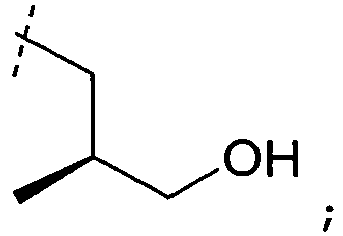
X4 is S or O;
R44 is independently optionally substituted alkyl (e.g. methyl), optionally substituted heteroalkyl (e.g. OMe), halogen, CN, NO2 or OH; and r is 0, 1, 2, 3, 4 or 5. - Preferably, R41 is H or C1-C6 alkyl; especially a methyl, ethyl, propyl, butyl, isopropyl, isobutyl, n-pentyl or n-hexyl.
- Preferably, R42 is -O-CO-alkyl, alkyl or heteroalkyl (e.g. -O-alkyl, -O-alkyl-O-alkyl), especially O-Acetyl (OAc, OCOCH3), -O-propyl or -OCH2OCH3.
- Preferably, R43 is a group of formula CO2H or CO2R45, with R45 preferably being an alkyl group.
- Further preferably, R43 is
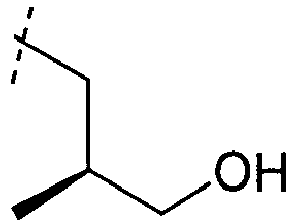
- Preferably X4 is S.
- Preferably R44 is independently optionally substituted alkyl, halogen (e.g. F or Cl) or OH.
- Preferably r is 0, 1, 2 or 3, especially 0 or 1.
- Especially preferred are compounds of formula (IV) wherein: R41 is C1-C6 alkyl, especially -CH3, ethyl, propyl, butyl, isopropyl, isobutyl, n-pentyl, n-hexyl; R42 is -O-CO-alkyl or heteroalkyl, especially -O-CO-CH3, -O-propyl or -OCH2OCH3;
- R43 is -CO2H, -CO2R45, -CH2OH or

X4 is S;
R44 is independently optionally substituted alkyl, halogen (e.g. F or Cl) or OH; and
r is 0 or 1. - Further preferably, A is a compound of Formula (Epo)

T is a heteroalkyl-, heterocycloalkyl-, heteroalkylcycloalkyl-, heteroaryl- or heteroarylalkyl-group,
U is hydrogen, halogen, an alkyl, heteroalkyl-, heterocycloalkyl-, heteroalkylcycloalkyl-, heteroaryl- or heteroarylalkyl-group,
G-E is selected from the following groups,
R15 is a C1-C4-alkyl-, a C1-C4-alkenyl-, a C1-C4-alkynyl- or a C3-C4-cycloalkyl-group,
Y-V-W is a group of formula CH=CH-CH, CH2-CH2-CH or CH2-CH=C, wherein the double bonds give rise to cis or trans isomers,
D1 is C=O or S(=O)p, wherein p is 0, 1 or 2,
D2 is CHOH, O or S(=O)q, wherein q is 0, 1 or 2,
B is oxygen or a group of the formula NR18, wherein R18 is hydrogen, an alkyl-, alkenyl-, alkynyl-, heteroalkyl-, aryl-, heteroaryl-, cycloalkyl-, alkylcycloalkyl-, heteroalkylcycloalkyl-, heterocycloalkyl-, aralkyl- or heteroarylalkyl-group and
R16 and R17 independently from each other represent hydrogen, C1-C4-alkyl or together are part of a cycloalkyl group with 3 or 4 ring atoms,
wherein one hydrogen atom of the compound of Formula (Epo) is replaced by the bond to linker L. - Preferred are compounds of formula (Epo), wherein T is a group of the formula -C(CH3)=CHR19 or -CH=CHR19, wherein R19 is a heteroaryl- or a heteroarylalkyl group.
- Further preferred are compounds of formula (Epo), wherein T is a group of formula (EpoI) or (EpoII) (especially a group (EpoI)):

- Further preferably, D1 is C=O and D2 is CHOH or S(=O)q, wherein q is 0, 1 or 2.
- Moreover preferably, D1 is S(=O)p, wherein p is 0, 1 or 2 and D2 is CHOH.
- Moreover preferred are compounds of formula (Epo), wherein R18 is hydrogen or C1-C4 alkyl.
- Further preferred are compounds of formula (Epo), wherein B is oxygen or NH (especially oxygen).
- Moreover preferred are compounds of formula (Epo), wherein R15 is methyl or ethyl (especially methyl).
- Further preferred are compounds of formula (Epo), wherein R16 and R17 are methyl groups.
- Moreover preferred are compounds of formula (Epo), wherein U is hydrogen, fluorine, methyl, trifluoromethyl or COOH (especially hydrogen).
- Further preferred are compounds of formula (Epo), wherein the absolute stereochemistry is the same as in the natural occurring epothilones B and/or D.
- Moreover preferred are compounds of formula (Epo), wherein R' is CH3 or CF3.
- Further preferred are compounds of formula (Epo), wherein D is C=O.
- Preferably, L is a bond or an alkylene, alkenylene, alkinylene, heteroalkylene, arylene, heteroarylene, cycloalkylene, heterocycloalkylene, alkylcycloalkylene, heteroalkylcycloalkylene, aralkylene or heteroaralkylene group.
- Further preferably, L is a bond or a heteroalkylene, a heteroalkylcycloalkylene or a heteroaralkylene group (i.e. preferably a group comprising a heteroalkylene group).
- In a preferred embodiment, L is a chain of atoms selected from C, N, O, S, Si, and P that covalently connects A to Pep. L may have a wide variety of lengths, such as in the range from about 2 to about 100 atoms. The atoms used in forming L may be combined in all chemically relevant ways, such as chains of carbon atoms forming alkylene, alkenylene, and alkynylene groups, and the like; chains of carbon and oxygen atoms forming ethers, polyoxyalkylene groups, or when combined with carbonyl groups forming esters and carbonates, and the like; chains of carbon and nitrogen atoms forming amines, imines, polyamines, hydrazines, hydrazones, or when combined with carbonyl groups forming amides, ureas, semicarbazides, carbazides, and the like; chains of carbon, nitrogen, and oxygen atoms forming alkoxyamines, alkoxylamines, or when combined with carbonyl groups forming urethanes, amino acids, acyloxylamines, hydroxamic acids, and the like; and many others. In addition, it is to be understood that the atoms forming the chain in each of the foregoing illustrative embodiments may be either saturated or unsaturated, such that for example, alkanes, alkenes, alkynes, imines, and the like may be radicals that are included in L. In addition, it is to be understood that the atoms forming L may also be cyclized upon each other to form divalent cyclic structures that form the linker, including cyclo alkanes, cyclic ethers, cyclic amines, arylenes, heteroarylenes, and the like in the linker.
- Further preferably, L includes radicals that form at least one releasable linker, and optionally one or more spacer linkers. As used herein, the term releasable linker refers to a linker that includes at least one bond that can be broken under physiological conditions, such as a pH-labile, acid-labile, base-labile, oxidatively labile, metabolically labile, biochemically labile, or enzyme-labile bond. It is appreciated that such physiological conditions resulting in bond breaking do not necessarily include a biological or metabolic process, and instead may include a standard chemical reaction, such as a hydrolysis reaction, for example, at physiological pH, or as a result of compartmentalization into a cellular organelle such as an endosome and/or lysosome having a lower pH than cytosolic pH.
- Further preferably, L is a bond.
- Moreover preferably, L is an optionally substituted heteroalkyl group containing from 1 to 20 carbon atoms and from 1 to 12 heteroatoms selected from O, S and N and wherein the preferred substituent is NH2.
- Further preferably, L comprises a -S-S- group or forms an -S-S- group with Pep or A.
- Morover preferably, L comprises a group of formula -S-CH2-CH2-O-C(=O)-, -S-CH2-CH(NH2)-C(=O)- and/or -N-CH(CO2H)-CH2-S- and/or a tripeptide, tetrapeptide, pentapeptide, or hexapeptide preferably consisting of amino acids selected from the group consisting of aspartic acid, cysteine, glutamic acid, lysine, arginine, and ornithine, and combinations thereof.
- Moreover preferably L is a linker described in
US 2010/0004276 ,EP 2 481 427WO 2006/012527 andWO 2008/112873 , all of which are incorporated herein by reference. Especially preferably, L is selected from the linkers described inEP 2 481 427 A1claims 6 to 12. - Especially preferably, L is selected from the following groups:
- a bond
-CH2-CH2-S-
-O-CH2-CH2-S-;
-NH-CH2-CH2-S-; or
-NH-NH-C(=O)-O-CH2-CH2-S-.
- Preferably, therein the left side of L is bound to A and the right side is bound to Pep.
- Further especially preferably, L is selected from the following groups:
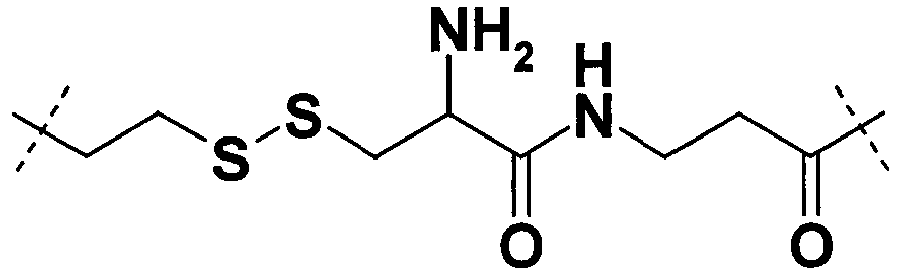


- Preferably, therein the left side of L is bound to A and the right side is bound to Pep.
- Preferably, Pep is a group (peptide residue) selected from:
- H-Tyr-Pro-Ser-Lys(β-Ala-Cys-XL)-Pro-Asp-Phe-Pro-Gly-Glu-Asp-Ala-Pro-Ala-Glu-Asp-Leu-Ala-Arg-Tyr-Tyr-Ser-Ala-Leu-Arg-His-Tyr-Ile-Asn-Leu-Ile-Thr-Arg-Pro-Arg-Tyr-NH2;
- H-Tyr-Pro-Ser-Lys(β-Ala-p-Ala-XL)-Pro-Asp-Phe-Pro-Gly-Glu-Asp-Ala-Pro-Ala-Glu-Asp-Leu-Ala-Arg-Tyr-Tyr-Ser-Ala-Leu-Arg-His-Tyr-Ile-Asn-Leu-Ile-Thr-Arg-Pro-Arg-Tyr-NH2; H-Tyr-Pro-Ser-Lys(β-Ala-XL)-Pro-Asp-Phe-Pro-Gly-Glu-Asp-Ala-Pro-Ala-Glu-Asp-Leu-Ala-Arg-Tyr-Tyr-Ser-Ala-Leu-Arg-His-Tyr-Ile-Asn-Leu-Ile-Thr-Arg-Pro-Arg-Tyr-NH2;
- H-Tyr-Pro-Ser-Lys(XL)-Pro-Asp-Phe-Pro-Gly-Glu-Asp-Ala-Pro-Ala-Glu-Asp-Leu-Ala-Arg-Tyr-Tyr-Ser-Ala-Leu-Arg-His-Tyr-Ile-Asn-Leu-Ile-Thr-Arg-Pro-Arg-Tyr-NH2;
- H-Tyr-Pro-Ser-Lys-Pro-Asp-Phe-Pro-Gly-Glu-Asp-Ala-Pro-Ala-Glu-Asp-Leu-Ala-Arg-Tyr-Tyr-Ser-Ala-Leu-Arg-His-Tyr-Ile-Asn-Leu-Ile-Thr-Arg-Pro-Arg-Tyr-NH-XL; and
- XL-Tyr-Pro-Ser-Lys-Pro-Asp-Phe-Pro-Gly-Glu-Asp-Ala-Pro-Ala-Glu-Asp-Leu-Ala-Arg-Tyr-Tyr-Ser-Ala-Leu-Arg-His-Tyr-Ile-Asn-Leu-Ile-Thr-Arg-Pro-Arg-Tyr-NH2,
- wherein XL denotes the point of attachement to L.
- Further preferably, Pep is the following peptide (PepX): H-Tyr-Pro-Ser-Lys-Pro-Asp-Phe-Pro-Gly-Glu-Asp-Ala-Pro-Ala-Glu-Asp-Leu-Ala-Arg-Tyr-Tyr-Ser-Ala-Leu-Arg-His-Tyr-Ile-Asn-Leu-Ile-Thr-Arg-Pro-Arg-Tyr-NH2 (PepX, SEQ ID NO: 1), wherein one hydrogen atom is replaced by the bond to L.
- The term alkyl or alk refers to a saturated, linear or branched, optionally substituted hydrocarbon group, containing preferably from one to twenty carbon atoms, preferably from one to twelve carbon atoms, mostly preferred from one to six carbon atoms, for example methyl, ethyl, propyl, isopropyl, isobutyl, n-butyl, sek-butyl, tert-butyl, n-pentyl, 2,2-dimethylpropyl, 2-methylbutyl, n-hexyl, 2,2-dimethylbutyl or 2,3-dimethylbutyl.
- The term alkenyl and alkinyl refers to an at least partially unsaturated, linear or branched, optionally substituted hydrocarbon group, containing preferably from two to twenty carbon atoms, preferably from two to twelve carbon atoms, mostly preferred from two to six carbon atoms, for example ethenyl, allyl, acetylenyl, propargyl, isoprenyl, or hex-2-enyl. Preferentially, alkenyl groups contain one or two, most preferred one double bond and alkinyl groups contain one or two, most preferred one triple bond.
- Optionally the terms alkyl, alkenyl and/or alkinyl refer to groups where one or several, preferentially one, two or three hydrogen atoms are replaced by a halogen atom, preferentially fluorine or chlorine or a 2,2,2-trichlorethyl, or a trifluoromethyl group.
- The term heteroalkyl refers to an alkyl, alkenyl or alkinyl group, where one or more, preferentially one, two or three carbon atoms are replaced by an O, N, P, B, Se, Si, or S atom, preferentially O, S or N. The term heteroalkyl also refers to a carboxylic acid or a group derived thereof, for example acyl (alkyl-CO), acylalkyl, alkoxycarbonyl, acyloxy, acyloxyalkyl, carboxyalkylamid or alkoxycarbonyloxy.
- Examples of heteroalkyl groups are groups of the formula Ra-O-Ya-, Ra-S-Ya-, Ra-N(Rb) -Ya-, Ra-CO-Ya-, Ra-O-CO-Ya-, Ra-CO-O-Ya-, Ra-CO-N(Rb)-Ya-, Ra-N(Rb)-CO-ya-, Ra-O-CO-N(Rb)-Ya-, Ra-N(Rb)-CO-O-Ya-, Ra-N(Rb)-CO-N(Rc)-Ya-, Ra-O-CO-O-Ya-, Ra-N(Rb)-C(=NRd)-N(Rc)-Ya-, Ra-CS-Ya-, Ra-O-CS-Ya-, Ra-CS-O-Ya-, Ra-CS-N(Rb) -Ya-, Ra-N(Rb)-CS-Ya-, Ra-O-CS-N(Rb)-Ya-, Ra-N(Rb)-CS-O-Ya-, Ra-N (Rb)-CS-N(Rc)-Ya-, Ra-O-CS-O-ya-, Ra-S-CO-Ya-, Ra-CO-S-Ya-, Ra-S-CO-N(Rb) -Ya-, Ra-N(Rb) -CO-S-Ya-, Ra-S-CO-O-Ya-, Ra-O-CO-S-Ya-, Ra-S-CO-S-Ya-, Ra-S-CS-Ya-, Ra-CS-S-Ya-, Ra-S-CS-N(Rb)-Ya-, Ra-N(Rb)-CS-S-Ya-, Ra-S-CS-O-Ya-, Ra-O-CS-S-Ya-, wherein Ra refers to a H, a C1-C6-alkyl, a C2-C6-alkenyl or a C2-C6-alkinyl group; wherein Rb refers to a H, a C1-C6-alkyl, a C2-C6-alkenyl or a C2-C6-alkinyl group; wherein Rc refers to a H, a C1-C6-alkyl, a C2-C6-alkenyl or a C2-C6-alkinyl group; wherein Rd refers to a H, a C1-C6-alkyl, a C2-C6-alkenyl or a C2-C6-alkinyl group and Ya refers to a direct binding, a C1-C6-alkylen, a C2-C6-alkenylen or a C2-C6-alkinylen group, wherein each heteroalkyl group can be replace by a carbon atom and one or several hydrogen atoms can be replaced by fluorine or chlorine atoms. Examples of heteroalkyl groups are methoxy, trifluormethoxy, ethoxy, n-propyloxy, iso-propyloxy, tert-butyloxy, methoxymethyl, ethoxymethyl, methoxyethyl, methylamino, ethylamino, dimethylamino, diethylamino, iso-propylethylamino, methyl-aminomethyl, ethylaminomethyl, di-iso-propylaminoethyl, enolether, dimethylaminomethyl, dimethylaminoethyl, acetyl, propionyl, butyryloxy, acetyloxy, methoxycarbonyl, ethoxy-carbonyl, N-ethyl-N-methylcarbamoyl or N-methylcarbamoyl. Other examples of heteroalkyl groups are nitrile, isonitrile, cyanate, thiocyanate, isocyanate, isothiocyanate and alkylnitrile groups.
- The term cycloalkyl refers to a saturated or partially unsaturated (e.g. cycloalkenyl) optionally substituted cyclic group, comprising one or several rings, preferentially one or two rings, containing three to fourteen ring carbon atoms, preferentially three to ten, preferentially three, four, five, six or seven ring carbon atoms. Furthermore the term cycloalkyl refers to a group where one or more hydrogen atoms are replaced by F, Cl, Br, I, OH, =O, SH, =S, NH2, =NH, or NO2, or cyclic ketones, for example cyclohexanone, 2-cyclohexenone or cyclopentanone. Examples of cycloalkyl groups are cyclopropyl, cyclobutyl, cyclopentenyl, spiro[4,5]-decanyl, norbornyl, cyclohexyl, cyclopentenyl, cyclohexadienyl, decalinyl, cubanyl, bicyclo[4.3.0]nonyl, tetralin, cyclopentylcyclohexyl, fluorcyclohexyl or the cyclohex-2-enyl group.
- The term heterocycloalkyl refers to a cycloalkyl as defined above, wherein one or several, preferentially one, two or three ring carbon atoms are replaced by an O, N, Si, Se, P, or S, preferentially O, S or N. Preferentially a heterocycloalkyl group is composed of one or two rings comprising three to ten, preferentially three, four, five, six or seven ring atoms. Moreover the term heterocycloalkyl refers to groups where one or several hydrogen atoms are replaced by F, Cl, Br, I, OH, =O, SH, =S, NH2 or NO2. Examples of heterocycloalkyl are piperidyl, morpholinyl, urotropinyl, pyrrolidinyl, tetrahydrothiophenyl, tetrahydropyranyl, tetrahydro-furyl, oxacyclopropyl, azacyclopropyl or 2-pyrazolinyl groups as well as lactams, lactons, cyclic imides and cyclic anhydrides.
- The term alkylcycloalkyl refers to groups, which contain cycloalkyl as well as alkyl, alkenyl or alkinyl groups according to the above definition, e.g. alkylcycloalkyl, alkylcycloalkenyl, alkenylcycloalkyl and alkinylcycloalkyl groups. Preferentially an alkylcycloalkyl group is composed of a cycloalkyl group, comprising one or more rings, comprising three to ten, preferentially three, four, five, six or seven carbon atoms and one or two alkyl, alkenyl oder alkinyl groups with one or two to six carbon atoms.
- The term heteroalkylcycloalkyl refers to alkylcycloalkyl groups, according to the above definition, wherein one or several, preferentially one, two or three carbon atoms are replaced by O, N, Si, Se, P or S, preferentialy O, S or N. Preferentially it is composed of one or two ring systems with three to ten, preferentially three, four, five, six or seven ring atoms and one or two alkyl, alkenyl, alkinyl or heteroalkyl groups with one or two to six carbon atoms. Examples of such a group are alkylheterocycloalkyl, alkylheterocycloalkenyl, alkenylheterocycloalkyl, alkinylheterocycloalkyl, heteroalkylcycloalkyl, heteroalkylheterocycloalkyl and heteroalkylheterocylcloalkenyl, wherein the cyclic group is saturated or partially (simply, twofold or threefold) unsaturated.
- The term aryl or ar refers to an optionally substituted aromatic group, composed of one or several rings, comprising six to fourteen carbon atoms, preferentially six to ten, preferentially six carbon atoms. The term aryl or ar can also refer to an aromatic group, wherein one or several H atoms are replaced by F, Cl, Br or I or OH, SH, NH2, or NO2. Examples are phenyl-, naphthyl-, biphenyl-, 2-fluorphenyl, anilinyl-, 3-nitrophenyl or 4-hydroxy-phenyl.
- The term heteroaryl refers to an aromatic group, composed of one or several rings, comprising five to fourteen ring atoms, preferentially five to ten, whereof one or several, preferentially one, two, three or four are O, N, P or S ring atoms, preferentially O, S or N. The term heteroaryl can also refer to groups, wherein one or several H atoms are replaced by F, Cl, Br or I or OH, SH, NH2, or NO2. Examples are 4-pyridyl, 2-imidazolyl, 3-phenylpyrrolyl, thiazolyl, oxazolyl, triazolyl, tetrazolyl, isoxazolyl, indazolyl, indolyl, benzimidazolyl, pyridazinyl, chinolinyl, purinyl, carbazolyl, acridinyl, pyrimidyl, 2,3'-bifuryl, 3-pyrazolyl and isochinolinyl.
- The term aralkyl (or arylalkyl or alkylaryl) refers to groups composed of aryl and alkyl, alkenyl, alkinyl and/or cycloalkyl, e.g. arylalkyl, arylalkenyl, arylalkinyl, arylcycloalkyl, arylcycloalkenyl, alkylarylacycloalkyl and alkylarylcycloalkenyl. Examples of aralkyles are toluol, xylol, mesitylen, styren, benzylchloride, o-fluortoluene, 1H-inden, tetralin, dihydronaphthaline, indanon, phenylcyclopentyl, cumol, cyclo-hexylphenyl, fluoren and indan. Preferentially, an aralkyl group is composed of one or two aromatic rings, comprising six to ten ring carbon atoms and one or two alkyl, alkenyl and/or alkinyl comprising one or two to six carbon atoms and/or one cyclo-alkyl comprising five or six ring carbon atoms.
- The term heteroaralkyl (or heteroarylalkyl or heteroalkylaryl) refers to an aralkyl group as defined above, wherein one or several, preferentially one, two, three or four carbon atoms are replaced by O, N, Si, Se, P, B or S, preferentially O, N or S, and to groups which contain aryl, heteroaryl and alkyl, alkenyl, alkinyl and/or heteroalkyl and/or cycloalkyl and/or heterocycloalkyl. Preferentially a heteroaralkyl group is composed of one or two aromatic ring systems comprising five or six to ten carbon atoms and one or two alkyl, alkenyl and/or alkinyl comprising one or two to six carbon atoms and/or one cycloalkyl comprising five or six ring carbon atoms, wherein one, two, three or four carbon atoms can be replaced by O, N or S.
- Examples are arylheteroalkyl, arylheterocycloalkyl, aryl-heterocycloalkenyl, arylalkylheterocycloalkyl, aryl-alkenylheterocycloalkyl, arylalkinylheterocyclo-alkyl, arylalkylheterocycloalkenyl, heteroarylalkyl, heteroarylalkenyl, heteroarylalkinyl, heteroarylheteroalkyl, heteroarylcycloalkyl, heteroarylcycloalkenyl, heteroarylheterocycloalkyl, heteroarylheterocycloalken-yl, heteroarylalkylcycloalkyl, heteroarylalkylhetero-cycloalkenyl, heteroarylheteroalkylcycloalkyl, heteroarylheteroalkylcycloalkenyl and heteroarylheteroalkyl heterocycloalkyl, wherein the cyclic groups can be saturated or once, twice, three fold of four fold unsaturated. Examples are tetrahydroisochinolinyl, benzoyl, 2- or 3-ethyl-indolyl, 4-methylpyridino, 2-, 3- or 4-methoxyphenyl, 4-ethoxyphenyl, 2-, 3- or 4-carboxyphenylalkyl.
- The terms cycloalkyl, heterocycloalkyl, alkylcyclo-alkyl, heteroalkylcycloalkyl, aryl, heteroaryl, aralkyl and heteroaralkyl also refer to groups, wherein one or several H atoms are replaced by F, Cl, Br or I or OH, SH, NH2, NO2.
- The term "optionally substituted" relates to groups, wherein one or several H atoms can be replaced by F, Cl, Br or I or OH, SH, NH2, or NO2. This term relates further to groups, which can be exclusively or additionally substituted with unsubstituted C1-C6 alkyl, C2-C6 alkenyl, C2-C6 alkinyl, C1-C6 heteroalkyl, C3-C10 cycloalkyl, C2-C9 heterocycloalkyl, C6-C10 aryl, C1-C9 heteroaryl, C7-C12 aralkyl or C2-C11 heteroaralkyl groups.
- Protecting groups are known to a person skilled in the art and described in P. J. Kocienski, Protecting Groups, Georg Thieme Verlag, Stuttgart, 1994 and in T. W. Greene, P. G. M. Wuts, Protective Groups in Organic Synthesis, John Wiley & Sons, New York, 1999. Common amino protecting groups are e.g. t-butyloxycarbonyl (Boc), benzyloxycarbonyl (Cbz, Z), benzyl (Bn), benzoyl (Bz), fluorenylmethyloxycarbonyl (Fmoc), allyloxycarbonyl (Alloc), trichlorethyloxycarbonyl (Troc), acetyl or trifluoracetyl.
- The compounds described herein can comprise several chiral centers depending on their substitution pattern. The present invention relates to all defined enantio- and diastereo isomers as well as their mixtures in all ratios. Moreover, the present invention relates to all cis/trans isomers of the compounds described herein as well as their mixtures. Moreover, the present invention relates to all tautomeric forms of the compounds described herein.
- Examples of pharmacologically acceptable salts of the compounds described herein are physiologically acceptable mineral acids, e.g. hydrochloric acid, sulfuric acid, phosphoric acid or salts of organic acids, e.g. methansulfonic acid, p-toluenesulfonic acid, lactic acid, formic acid, trifluoracetic acid, citric acid, succinic acid, fumaric acid, maleic acid and salicylic acid. The compounds described herein can be solvated, especially hydrated. The hydration can occur during the synthesis process or can be a consequence of the hygroscopic nature of the originally dehydrated compounds described herein. As mentioned above, compounds described herein, containing asymmetric carbon atoms might exist as mixtures of diastereomers, as mixtures of enantiomers or as optically pure compounds.
- The pharmaceutical compositions according to the present invention are composed of at least one compound described herein and optionally carriers and/or adjuvants.
- Prodrugs are also subject of the present invention and they are composed of a compound described herein and at least one pharmacologically acceptable protecting group, which is cleaved under physiological conditions, e.g. alkoxy, aralkyloxy, acyl or acyloxy, more precisely ethoxy, benzyloxy, acetyl or acetyloxy.
- The therapeutic use of the compounds described herein, their pharmacologic acceptable salts and/or solvates and hydrates, as well as the corresponding formulations and pharmacological compositions are also subject of the present invention.
- The use of the compounds described herein for the preparation of drugs for the treatment of cancer is also subject of the present invention. Moreover, the present compounds are of interest for the prevention and/or treatment of rheumatoid arthritis, inflammatory diseases, immunological diseases (e.g. type I diabetis), autoimmune diseases, diseases of the eye, e.g. AMD (age related macular disease) or diabetic retinopathy other tumor diseases as well as for the surface treatment (impregnation) of plastic and metal implants, e.g. stents.
- Especially, the compounds described herein are of interest for the treatment of cancers such as cancer types in which the NPY-1 receptor is overexpressed, such as breast cancer and especially metastatic breast cancer, and also in other cancer conditions such as renal cell carcinomas, gastrointestinal stromal tumors, nephroblastomas, neuroblastic tumors, paragangliomas, pheochromocytomas, adrenal cortical tumors, ovarian sex cord-stromal tumors, and ovarian adeno carcinomas.
- In general, the compounds described herein can be given as a single treatment or as multiple treatments either alone or in combination with an arbitrary therapeutic substance according to known and accepted modes or as a continuous treatment whereby the active principle can be embedded in a matrix such as e.g. an implantable hydrogel.
- Compositions according to the invention can be administered in one of the following ways: solutions, emulsions or suspensions; parenteral, including injectable solutions; by inhalation, including powder formulation or as a spray, transdermal or intranasal. For the production of liquid solutions and syrups one may use carriers for example water, alcohols, aqueous saline, aqueous dextrose, polyole, glycerin, vegatable oils, petroleum, animal or synthetic oils. For the production of suppositories one may use excipients like e.g. vegetable, petroleum, animal or synthetic oils, wax, fat and polyols. For aerosol formulations one may use compressed gases suitable for this purpose like e.g. oxygen, nitrogen, noble gas and carbon dioxide. The pharmaceutically useful agents may also contain additives for conservation, stabilisation, e.g. UV stabilizer, emulsifier, sweetener, aromatiser, salts to change the osmotic pressure, buffers, coating additives and antioxidants.
- Combinations with other therapeutic agents can include further agents, which are commonly used to treat the diseases mentioned above, especially cancer.
- Compounds of Formula (I), (II) and (III) can e.g. produced from building blocks that can be linked via peptide coupling methods using known coupling reagents, e.g. hydroxybenzotriazole (HOBt) and diisopropylcarbodiimide (DIC) or dicyclohexylcarbodiimide (DCC). Unless otherwise defined, all residues are defined as herein above.
- Tubulysines and derivatives thereof are known to a person skilled in the art and can e.g. be prepared as described in
WO 2008/138561 ,WO 2004046170 ,WO 2004/005327 ,WO 2011/057806 ,WO 2011/057805 and documents cited therein. - Epothilones and derivatives thereof are known to a person skilled in the art and can e.g. be prepared as described in Nicolaou et al. Angew. Chem. Int. Ed. 1998, 37, 2014-2045,
WO 2004/007492 ,WO 2004/048372 and documents cited therein. - The following derivatives were synthesized from building blocks A, L and Pep. The building blocks were synthesized according to methods known to a person skilled in the art.
- Peptides were synthesized according to the Fmoc/tBu strategy using an automated multiple solid-phase peptide synthesizer Syro II (MultiSynTech GmbH, Bochum, Germany). To gain C-terminal peptide amides, a Rink amide resin with a loading capacity of 0.63 mmol/g was used.
- Prior to each amino acid coupling step the base-labile Nα-protecting group Fmoc had to be cleaved off from the building blocks, and in a first step from the Rink amide resin as well. For Fmoc cleavage, 400 µL piperidine in DMF (40% v/v) was added to the resin and incubated for 3 min while stirring. The deprotection was repeated with 400 µL piperidine in DMF (20% v/v) for 10 min. Subsequently, the resin was washed with 4x 600 µL DMF.
- Amino acids were coupled by preincubation of the resin with 200 µL amino acid building block solution (0.5 M in DMF) and 100 µL 3 M Oxyma in DMF for 2 min. Subsequently, 100 µL 3.3 M DIC in DMF were added and the reaction was allowed to proceed for 40 min with stirring. After a washing step with 800 µL DMF, the coupling step was repeated once for each amino acid.
- For the selective deprotection of a Dde-protected lysine residue, the fully protected, resin-bound peptide was incubated 12 x 10 min with 1 mL freshly prepared 3 % hydrazine in DMF. After each of the 12 steps, the resin was washed with DMF. After the first and the twelfth step, the removed hydrazine solution was collected, and its absorption was measured at 301 nm against a reference of fresh hydrazine in DMF. The Dde deprotection was successful if the absorption of the tenth fraction was < 0.1.
- For analytical purposes, a small amount of peptide-loaded resin was incubated with TFA/thioanisole/1,2-ethanedithiol (900:70:30 v/v) for 3 h at room temperature, removing all acid-labile protecting groups. Subsequently, the peptide was precipitated for 20 min at -20 °C in 1 mL ice cold diethyl ether, collected by centrifugation (2 min at 7,000 g), and washed with ice cold diethyl ether at least five times. The peptide pellet was dried and finally dissolved in 100 µL H2O/tBuOH (1:3 v/v) for analysis.
- For preparative cleavage, the complete resin was treated as described. However, precipitation occurred in 10 mL ice cold diethyl ether and centrifugation was performed at 4,400 g. The peptide was dried by using a SpeedVac, and finally lyophilized from 1 - 2 mL H2O/tBuOH (1:3 v/v).
- To analyse the synthesized peptides by analytical RP-HPLC on a reversed phase Phenomenex Jupiter Proteo C18 column (4.6 mm x 250 mm, 5 µm), and an elution system composed of (A) 0.1% TFA in H2O and (B) 0.08% TFA in ACN was used. A linear gradient of 20-70% solvent B in A over 40 min with a flow rate of 0.6 mL min-1 was used. The peptides were detected at 220 nm.
- Purification of the synthesized peptides was achieved by preparative RP-HPLC on a Phenomenex Jupiter Proteo C18 column (21.2 mm x 250 mm) using an elution system composed of (A) 0.1% TFA in H2O and (B) 0.08% TFA in ACN, and an appropriate linear gradient of solvent B in A over 40-50 min and a flow rate of 10 mL min-1. For peptide detection, absorption at 220 nm was measured. Fractions were manually taken and analysed by MALDI-TOF mass spectrometry and analytical RP-HPLC. As pure identified fractions were combined and lyophilized.
- For mass analysis using MALDI-TOF mass spectrometry, a matrix consisting of 2,5-dihydroxybenzoic acid and 2-hydroxy-5-methoxybenzoic acid (10 g/L in ACN/H2O/TFA 50 : 49.7 : 0.3 v/v) was used. A Bruker Daltonis Ultraflex III TOF/TOF was used for MALDI measurements.
- For mass analysis using ESI Ion Trap mass spectrometry, the samples were diluted to 20 µM in H2O (0.1% HCOOH) with ACN (7:3 v/v), injected and analysed. A Bruker HCT mass spectrometer was used for ESI measurements.
- To couple OC169, OC503, OC504, OC505, OC506 via a disulfide linkage to K4(βAla-Cys)-[F7,P34]-NPY, the purified peptide was dissolved in 0.1 mM phosphate buffer according to Sörensen (pH 6.0) and degased using argon. The coupling reaction was performed under equimolar conditions (A-L and peptide) at room temperature. After 60 min the reaction was complete and product identity was confirmed by MALDI-TOF mass spectrometry. The product was purified immediately by preparative RP-HPLC.
- To couple OC501 or OC503 via a peptide bond to K4(βAla-βAla)Cys)-[F7,P34]-NPY or [K4,F7,P34]-NPY, standard amide coupling was used as described above after the described selective deprotection of the lysine residue. The coupling reaction was performed under equimolar conditions (A-L and peptide) at room temperature. Subsequently, the final product was cleaved from the resin. Product identity was confirmed by MALDI-TOF mass spectrometry. The product was purified immediately by preparative RP-HPLC.
- Cos-7 cells, stably transfected with the cDNA encoding the human Y1 receptor C-terminally fused to EYFP and the human Y2 receptor C-terminally fused to EYFP as well as the chimeric G protein GαΔ6qi4myr (Cos7_hY1R_EYFP_GαΔ6qi4myr and Cos7_hY2R_EYFP_GαΔ6qi4myr), were seeded into 24 well-plates. 24 hours after seeding, cells were incubated for 16 hours with 3H-myo-inositol solution (300 µl DMEM/ 0.6 µl 3H-myo-inositol per well). Subsequently, the cell culture medium was removed and cells were washed with 500 µl DMEM containing 10 mM LiCl. After 1 hour stimulation with different peptide concentrations (10-5 to 10-12 M) in DMEM containing 10 mM LiCl was performed. 3H-inositol phosphates were accumulated. After stimulation, the samples were hydrolysed with 150 µl 0.1 N NaOH for 5 minutes. Neutralization was carried out by addition of 50 µl 0.2 M formic acid. The samples were subsequently diluted in IP dilution buffer and the cell pellet was removed with a pipette. 3H-inositol phosphates were isolated by anion exchange chromatography.
- HEK293 cells stably transfected with the human Y1 receptor C-terminally fused to EYFP (HEK293_hY1_EYFP) and the human Y2 receptor C-terminally fused to EYFP and an HA tag (HEK293_HA_hY2_EYFP) were seeded into sterile µ-
slide 8 well-plates (ibidi GmbH, Martinsried, Germany) and cultivated until 80% confluency was reached. Cells were cultivated for 30 minutes in OptiMEM before ligand stimulation. Cell nuclei were stained with HOECHST 33342 nuclear dye. Cells were stimulated for 60 minutes with 1 µM NPY in OptiMEM at 37°C. Live cell images were obtained with an Axio Observer microscope and ApoTome imaging system (Zeiss, Jena, Germany). The fluorescence images were analyzed with the Zeiss Axio Viosion software Release 3.0. - HEK293 cells stably transfected with the human Y1 receptor C-terminally fused to EYFP (HEK293_hY1_EYFP) and the human Y2 receptor C-terminally fused to EYFP and an HA tag (HEK293_HA_hY2_EYFP) were seeded into sterile µ-
slide 8 well-plates (ibidi GmbH, Martinsried, Germany) and cultivated at 37°C. Cells were transfected with pTub_ECFP_C1 (1 µg DNA per well, 1 µl Lipofectamine 2000 per well, transfection for 60 min at 37 °C). Expression of Tubulin_ECFP was allowed over night. The next day, cells were stimulated with OC500 or free cytolysin for 16h in OptiMem. Live cell images were obtained with an Axio Observer microscope and ApoTome imaging system (Zeiss, Jena, Germany). The fluorescence images were analyzed with the Zeiss Axio Viosion software Release 3.0. - K4(βAla-Cys-OC169)-F7,P34-NPY was diluted to 10-4 M in 0.1 M citrate buffer,
pH pH 4. Peptide identity was determined after 0h, 1h, 2h, 4h, 6h, 24h, 72h and 96h by ESI mass spectrometry. - K4(βAla-Cys-OC169)-F7, P34-NPY was diluted to 10-4 M in MCF-7 cell culture supernatant and peptide identity was determined after 0h, 1h, 3h, 5h, 7h and 24h by ESI mass spectrometry.
- K4(βAla-Cys-OC169)-F7,P34-NPY was diluted to 10-4 M in 20x cysteine in 0.1 M phosphate buffer,
pH 6. Peptide identity was determined after 1 h and 24 h by ESI mass spectrometry. - To evaluate the anti-proliferative and cytotoxic effect, respectively, of the compounds, a fluorometric resazurin-based cell viability assay was used. Human cancer and non-cancer cell lines (primarily breast cancer) were seeded with low densities into 96-well plates (1,500 - 6,000 cells per well), and were allowed to adhere for 24 h. Subsequently, the compounds - dissolved to appropriate concentrations in medium - were added to the cells. After 72 h under standard growth conditions, the incubation solution was replaced by 50 µM resazurin in medium, and the cells were incubated for 2 h. Finally, the conversion of resazurin to resorufin by viable, metabolically active cells was measured using a
Synergy 2 multiwell plate reader (BioTek) with 540 nm excitation and 590 nm emission filter setting. - Alternative to 72 h compound incubations, pulsed experiments were conducted. In these cases, cells were incubated with compounds for e.g. 4, 6, 12, 18, 24, 36 or 48 h, then the incubation solution was replaced, the cells were rinsed once with cell culture medium, and subsequently were allowed to proliferate in compound-free medium until 72 h were reached. Resazurin reaction and measurement were done as written above.
- Compound-mediated induction of apoptosis was examined using comercially available luminescent caspase assays (Promega). Human cancer and non-cancer cell lines (primarily breast cancer) were seeded with densities depending on the incubation time into 96-well plates (5,000 - 20,000 cells per well for 48 h incubations; 15,000 - 40,000 cells per well for 16 - 24 h incubations), and were allowed to adhere for 24 h. Subsequently, the compounds - dissolved to appropriate concentrations in medium - were added to the cells in 70 µL per well. Cells were incubated for 16 - 48 h under standard growth conditions. For the last hour of incubation, 10 µL/well of 8X resazurin solution (400 µM) were added in order to multiplex the caspase activities with the cell number/cell viability. When the incubation was finished, conversion of resazurin to resorufin was measured as described above. After that, Caspase-Glo reagent was added according to Promega's guidelines and incubated for 1 h at room temperature. Luminescence read-out was done using a
Synergy 2 multiwell plate reader (BioTek). - Since fragmentation of the nuclei indicates ongoing apoptotic events as well, we examined whether CytoPep conjugates were able to induce nuclear fragmentation. For this purpose, HEK293 cells stably transfected with the human Y1 receptor C-terminally fused to EYFP (HEK293_hY1_EYFP) and the human Y2 receptor C-terminally fused to EYFP and an HA tag (HEK293_HA_hY2_EYFP) were seeded into sterile µ-
slide 8 well-plates (ibidi GmbH, Martinsried, Germany) and cultivated to 80% confluency. Cells were stimulated with OC500 or free cytolysin for 16h in OptiMem. Nuclei were stained using HOECHST 33342 nuclear dye. Live cell images were obtained with an Axio Observer microscope and ApoTome imaging system (Zeiss, Jena, Germany). The fluorescence images were analyzed with the Zeiss Axio Viosion software Release 3.0. - To examine the biological effects of the compounds in dependence of the hY1 receptor density on the cell surface, siRNA was used for transient NPY1R knockdown. For specific targeting a siGENOME SMARTpool human NPY1R and as control a siGENOME non-targeting siRNA pool #2 (Dharmacon) were used.
- Human Y1 receptor expressing breast cancer cell lines were seeded in 25 cm2 culture flasks to reach - 50% confluency for cell transfection after - 24 h. Transient, liposomal cell transfection was performed using Metafectene Pro (Biontex). Briefly, per 25 cm2 culture flask 0 - 400 pmol siRNA were preincubated in 500 µL PBS for 5 min at room temperature and, subsequently, gently mixed with 32 µL Metafectene Pro in 500 µL PBS. After 20 min complexation at room temperature the transfection mixture was added to 4 mL fresh culture medium (with 4 - 5% FCS, instead of 10%) per culture flask.
- Incubation was stopped after 24 h, and the transfected cells were used as indicated. For proliferation or apoptosis studies cells were seeded into 96-well plates. To evaluate the receptor expression levels, cells were harvested and RNA extraction as well as RT-PCR was conducted.
- Samples for expression analyses were prepared by RNA extraction using the Bio&Sell RNA Mini Kit, followed by a DNase I digestion step and cDNA synthesis using RevertAid Premium Reverse Transcriptase (Fermentas). All methods are done according to the manufacturer's guidelines. Finally, expression of NPY Y receptors, estrogen and progesterone receptors etc. were analyzed by using appropriate primers and conventional PCR.
- SILAC was used for the examination of compound-mediated protein deregulations in the cells. In a first step, the incorporation rate of 13C-labeled L-arginine ("heavy" medium) was determined for the used cell lines.
- When the incorporation rate was ≥ 95%, the compound incubation (e.g. for 24 h) startet with "light" medium for the untreated reference and "heavy" medium for treated cells. After finished incubation, the cells were harvested and lysed. Protein contents were quantified, 20 µg "light"-labeled protein extract was mixed with 20 µg "heavy"-labeled protein extract and separated on a 12% SDS-PAGE. The gel was cut into gel slices and in-gel digested with trypsin. The samples were measured with a LTQ Orbitrap Velos (Thermo Scientific) coupled with a nano-HPLC. The resulting mass spec-data were analyzed using the MaxQuant software. The mormalized ratios "heavy"/"light" were used to identify significantly up- or downregulated proteins (upregulation > 1.5; downregulation < 0.666).
- For data analysis GraphPad Prism 5.03 and LibreOffice Calc were used.
- For in vivo efficacy studies, a subcutaneous human breast carcinoma xenograft model (MDA-MB-468) in NMRI nude mice was used. Female NMRI nude mice were 7 weeks when the tumor cells were inoculated with 5x10⁶ MDA-MB-468 cells per mouse (200 µL of cell suspension in PBS with 2.5x10⁷ cells/mL injected in the right flank).
- Each experimental group consisted of 5 animals (untreated reference group and OC compound treated group). Treatment started with tumor volumes - 100 mm3 (range 80 - 120 mm3). Animals were treated iv in the lateral tail vein with doses of 1 µmol/kg (in sterile PBS;
application volume 5 mL/kg) 3x per week for 2 weeks. Following the final treatment, the animals were observed for further 3 weeks. - Investigated parameters were: survival, clinical signs and animal behaviour (daily), body weight and tumor volume (2x per week). Tumor growth was monitored by calliper measurement and tumor volume was calculated according to the formula W2xL/2 (L = length and W = perpendicular width of the tumor, L > W).
- At the end of the study, a necropsy was done, primary tumor net weights were determined, and serum and tumor samples were taken.
- Pep1 and
Pep 2 were synthesized as described above. The tubulysin derivatives were prepared as described in the literature given above. - Pep1:
- H-Tyr-Pro-Ser-Lys(β-Ala-β-Ala)-Pro-Asp-Phe-Pro-Gly-Glu-Asp-Ala-Pro-Ala-Glu-Asp-Leu-Ala-Arg-Tyr-Tyr-Ser-Ala-Leu-Arg-His-Tyr-Ile-Asn-Leu-Ile-Thr-Arg-Pro-Arg-Tyr-NH2 MS-TOF: 4396.1 [M+H]+
- Pep2:
- H-Tyr-Pro-Ser-Lys(β-Ala-Cys-H)-Pro-Asp-Phe-Pro-Gly-Glu-Asp-Ala-Pro-Ala-Glu-Asp-Leu-Ala-Arg-Tyr-Tyr-Ser-Ala-Leu-Arg-His-Tyr-Ile-Asn-Leu-Ile-Thr-Arg-Pro-Arg-Tyr-NH2 MS-ESI: 1108.3 [M+4H] 4+; MS-TOF: 4428.2 [M+H]+
- OC-501:
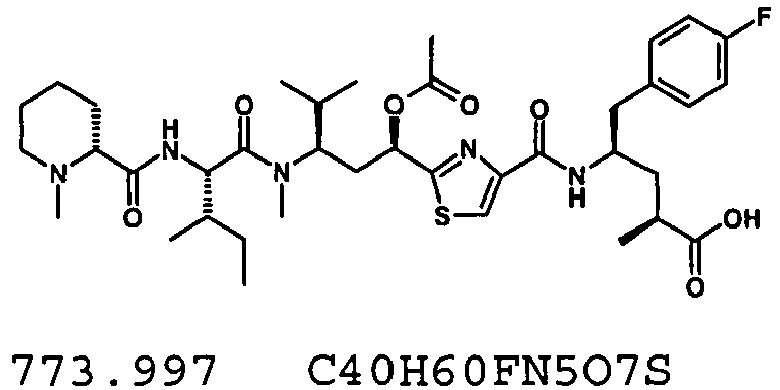
- OC-169:

- OC-506:

- OC-503:

- OC-504:

- OC-505:

- OC-509:

- OC-175:
OC509 + Pep1
- OC 500:
OC-169 + Pep2
- OC-508:
OC-506 + Pep2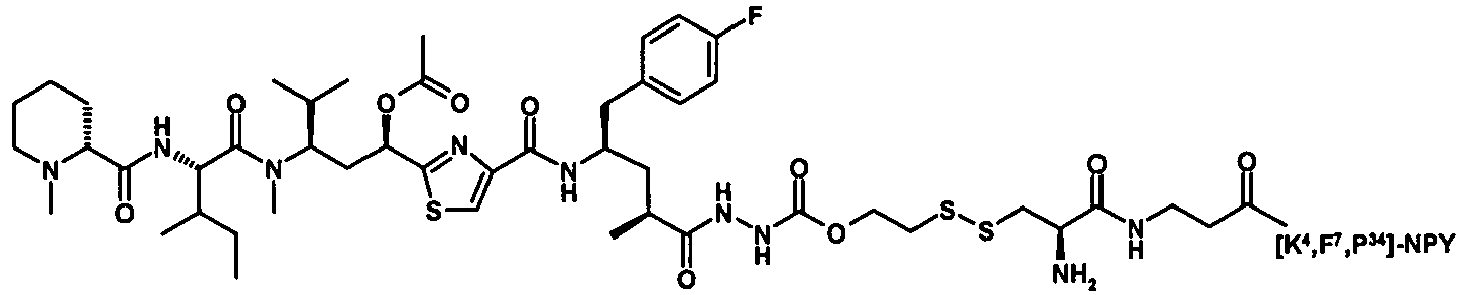
- OC-510:
OC-504 + Pep2
- OC-511:
OC-505 + Pep2
- Tubulysin A and Paclitaxel have been used as references. The results are shown in Table 1.
Table 1: IC50 values determined in 72 h cell proliferation assays. Compound cell lines - IC50 [nM] MCF-7 T-47D MDA-MB-231 MDA-MB-468 184B5 HT-29 Tubulysin A (Reference) 0.6 0.75 Paclitaxel (Reference) 25.5 30.7 35.1 31.1 OC501 4.1 5.4 7.2 3.6 1.2 OC169 18.4 18.7 31.0 18.7 26.1 OC500 411 460 304 286 231 OC503 4.2 8.3 10.9 8.2 0.8 OC509 0.34 OC175 994 OC502 > 1,000 > 1,000 > 1,000 > 1,000 - In general the new molecules according to this invention show an activity against several cancer cell lines between 0.03 to 60 nM.
-
Figure 1 shows functional activation of human Y1 and Y2 receptors by NPY and the CytoPep conjugates OC500 and OC508 as determined by using an functional IP3 assay.Table 2: EC50s of Y receptor activation by NPY derivatives and CytoPep conjugates OC500 and OC508 as determined by using an functional IP3 assay. Peptide hY1R hY2R EC50 [nM] EC50 [nM] (pEC50 ± SEM) (pEC50 ± SEM) OC500 0.6 > 1,000 (9.2 ± 0.15) OC508 2.0 92.9 (8.7 ± 0.14) (7.0 ± 0.05) NPY 1.7 0.5 (8.7 ± 0.07) (9.3 ± 0.09) [F7, P34] -NPY 1.4 135.6 (8.8 ± 0.10) (6.7 ± 0.20) hPP n.d. n.d. - OC500 activates the human Y1 receptor with an sub-nanomolar EC50, and is highly hY1 selective versus the human Y2 receptor. As determined, OC508 activates the human Y1 receptor with an low-nanomolar EC50, i.e. around 50-times better compared with the human Y2 receptor.
- Fluorescence microscopic internalization studies revealed for [F7, P34] -NPY and OC500 human Y1 receptor selective cellular internalization by endocytotic pathways (
Figure 2 ). The endogeneous and unselective ligand NPY binds and internalizes with all of the four Y receptor species, indicated by the relocation of the EYFP-tagged receptors (shown in gark gray) from the plasma membrane to intracellular vesicles. With [F7,P34]-NPY and OC500, this relocation - compared to an untreated reference - was observed just with cells expressing the hY1 receptor, and not with those expressing hY2, and to a minor extent with those expressing hY4 or hY5 receptors. -
Figure 2 shows peptide-mediated cellular internalization of human Y receptor species. HEK293 cells stably expressing EYFP-tagged human Y1, Y2, Y4 and Y5 receptors (dark gray), respectively, were treated with 1 µM peptide for 1 h. Nuclei were stained with H33342 (light gray). Live cell images were taken with an Axio Observer microscope and ApoTome imaging system (Zeiss, Jena, Germany). Scale bars indicate 10 µm. - HEK293 cells, expressing ECFP-tagged Tubulin and EYFP-tagged human Y1 receptor, were used to investigate the effects of the compounds on the tubulin network integrity. For instance, treatment of the cells with 100 nM OC500 for 16 h caused a degraded tubulin network and a apoptosis-like cell morphology (
Figure 3 ). -
Figure 3 shows OC500-mediated destabilization of the cellular tubulin network. HEK293 cells, expressing EYFP-tagged human Y1 receptors (dark gray in membranes) and ECFP-tagged tubulin (mid gray in cell plasma) were treated with indicated OC500 concentrations for 16 h. Live cell images were taken with an Axio Observer microscope and ApoTome imaging system (Zeiss, Jena, Germany). - Cell proliferation assays with various breast cancer cell lines revealed that the free toxins, e. g. OC501, were - 5-fold more effective than the refernce compound paclitaxel. The linker-activated compounds (e. g. OC169) were active in the range of paclitaxel. The cytotoxic peptide conjugates (e. g. OC500) were active in the mid-nanomolar range, whereas the underlying peptide alone (e. g. OC502) showed no cytotoxicity. Generally, the peptide conjugates were more efficient against cells of the basal or triple negative breast cancer type (MDA-MB-231 and MDA-MB-468), whereas the hormone receptor positive cell lines MCF-7 and T-47D were more resistant (
Figure 4 ). -
Figures 4A-D show inhibition of cell proliferation of various breast cancer cell lines, (A) MCF-7, (B) T-47D, (C) MDA-MB-231, and (D) MDA-MB-468. Cells were treated with OC501 and its corresponding derivatives OC169 and OC500, as well as the underlying peptide OC502. Cell proliferation was detected after 72 h using a resazurin-based cell viability assay. The effects of the compounds are expressed as IC50 values. - Investigations of activity levels of the
effector caspases Figure 5 ). -
Figures 5A-D show activation ofcaspases 3/7 (columns) and cell viability (triangle) of breast cancer cell lines MDA-MB-468 (A, B) and 184B5 (C, D). Cells were treated with the indicated compound concentrations for 24 h (A, C)and 48 h (B, D), respectively. Subsequently, activation ofeffector caspases 3/7 was measured using a luminescence-based caspase-Glo™ assay kit (Promega), and cell viability was fluorimetrically detected using a resazurin-based cell viability assay. Cell viability counts were used to normalize the caspase activity data, which are shown as x-fold over basal (untreated cells). - Nuclei fragmentation assays revealed for both compounds, OC500 and OC508, remarkable fragmentation of the nuclei of hY1 expressing cells at concentration of 50-100 nM and higher (
Figure 6 ). In cells expressing hY2 receptors, the fragmentation was less at these compound concentrations. Therefore, OC500 as well as OC508 showed hY1 receptor selectivity, which was obviously more distinct with OC500. However, OC508 was slightly more effective. These findings are consistent with signal transduction data, and point to apoptotic mechanisms triggered by OC500 and OC508. -
Figure 6A-C show nuclei fragmentation of HEK293 cells stably expressing the human Y1 and Y2 receptor, respectively. Cells were treated for 16 h with indicated concentrations of OC500 (A) and OC508 (B), respectively. Nuclei were stained using Hoechst 33342. Live cell images were taken with an Axio Observer microscope and ApoTome imaging system (Zeiss, Jena, Germany). Subsequently, the portion of fragmented nuclei were calculated. - Proteomic analyses using SILAC were conducted to evaluate the effects of the compounds on the cellular regulation of protein expression (
Figure 7 ). Treatment with e. g. OC169 and OC500, respectively, resulted in comparable protein regulations in various breast cancer cell lines. The observed upregulation of the expression of a number of proteins can be roughly classified into at least three functional groups, i. e. proteins dealing with the regulation of protein expression, cytoskeleton-related proteins, and those proteins dealing with proteolysis-associated events. In general, the regulation of all these proteins triggered by OC169 and OC500 can be seen in the context of the compounds induced degradation of the cellular tubulin network, and the effort of the cell to recycle and repair the cytoskeleton. -
Figure 7 shows proteom analyses of MCF-7 (A) and MDA-MB-468 (B) cells after treatment with OC169 and OC500, respectively, using stable isotope labelling by amino acids in cell culture (SILAC). Cells were treated with indicated concentrations of the compounds for the indicated times, and up- or downregulated proteins were detected using nano-HPLC/mass spectrometry. Here, exclusively the upregulated proteins are shown, and classified into three functional groups, dealing with regulation of protein expression, organization of the tubulin network and proteasomal recycling processes. IMA2, importin subunit alpha-2; DNAJ, DnaJ homologsubfamily B member 1; KIF11, kinesin-like protein 11; TPX2, targeting protein for Xklp2; PSMG1,proteasome assembly chaperone 1; UBE2S, ubiquitin conjugating enzyme E2S; CKAP5, cytoskeleton-associatedprotein 5; RLA1, 60S acidic ribosomal protein P1; RL21, 60S ribosomal protein L21; RL29, 60S ribosomal protein L29; ZN428, zinc finger protein 428; KIF20A, kinesin-like protein 20A; KIFC1, kinesin-like protein C1; UBE2N, ubiquitin conjugating enzyme E2N; USP10, ubiquitin carboxy-terminal hydrolase 10; UBE2I, ubiquitin conjugating enzyme E2I; RM40, 39S ribosomal protein L40 (mitochondrial); RS13, 40S ribosomal protein S13; EIF2A, eukaryotic translation initiation factor 2A; CENPF, centromere protein F; ZYX, zyxin; ACTBL, beta-actin-like protein 2; UBE2C, ubiquitin conjugating enzyme E2C; UBE2K, ubiquitin conjugating enzyme E2K.
Claims (9)
- A compound of Formula (I):
A-L-Pep (I)
wherein
Pep is selected from:


 and
and wherein XL denotes the bond to L;
A is selected from tubulysins, natural and synthetic epothilones, auristatins, dolastatins, natural and synthetic vincristine, natural and synthetic vinblastine, amanitine, maytansines, taxanes, Nemorubicin, PNU-159682, pyrrolobenzodiazepins and dimers and duocarmycins wherein one hydrogen atom is replaced by the bond to linker L; and
L is a linker or a bond between A and Pep;
or a pharmacologically acceptable salt, a solvate, a hydrate or a pharmacologically acceptable formulation thereof. - The compound according to claim 1, wherein L is a bond or an optionally substituted alkylene, alkenylene, alkinylene, heteroalkylene, arylene, heteroarylene, cycloalkylene, heterocycloalkylene, alkylcycloalkylene, heteroalkylcycloalkylene, aralkylene or heteroaralkylene group.
- The compound according to claims 1 or 2, wherein L is a bond or an optionally substituted heteroalkyl group containing from 1 to 20 carbon atoms and from 1 to 12 heteroatoms selected from O, S and N.
- The compound of claim 1, 2 or 3, wherein A is a compound of Formula (Tub)

or
wherein A is a compound of formula (IV), wherein one hydrogen atom is replaced by the bond to linker L:
R41 is H or an alkyl, alkenyl, alkynyl, CO-alkyl, heteroalkyl, aralkyl or heteroaralkyl group, all of which may optionally be substituted;
R42 is OH, an alkyl, alkenyl, alkynyl, -O-alkyl, -O-alkenyl, - O-alkynyl, -O-CO-alkyl or heteroalkyl group, all of which may optionally be substituted;
R43 is a group of formula CO2H, CO2R45, CONHR45, CONR2 45, or a
group of formula CH2OH or
X4 is S or O;
R44 is independently optionally substituted alkyl (e.g. methyl), optionally substituted heteroalkyl (e.g. OMe), halogen, CN, NO2 or OH; and
r is 0, 1, 2, 3, 4 or 5. - The compound of claim 1, 2 or 3, wherein A is a compound of Formula (Epo)


T is a heteroalkyl-, heterocycloalkyl-, heteroalkylcycloalkyl-, heteroaryl- or heteroarylalkyl-group,
U is hydrogen, halogen, an alkyl, heteroalkyl-, heterocycloalkyl-, heteroalkylcycloalkyl-, heteroaryl- or heteroarylalkyl-group,
G-E is selected from the following groups,
R15 is a C1-C4-alkyl-, a C1-C4-alkenyl-, a C1-C4-alkynyl- or a C3-C4-cycloalkyl-group,
Y-V-W is a group of formula CH=CH-CH, CH2-CH2-CH or CH2-CH=C, wherein the double bonds give rise to cis or trans isomers,
D1 is C=O or S(=O)p, wherein p is 0, 1 or 2,
D2 is CHOH, O or S(=O)q, wherein q is 0, 1 or 2,
B is oxygen or a group of the formula NR18, wherein R18 is hydrogen, an alkyl-, alkenyl-, alkynyl-, heteroalkyl-, aryl-, heteroaryl-, cycloalkyl-, alkylcycloalkyl-, heteroalkylcycloalkyl-, heterocycloalkyl-, aralkyl- or heteroarylalkyl-group and
R16 and R17 independently from each other represent hydrogen, C1-C4-alkyl or together are part of a cycloalkyl group with 3 or 4 ring atoms,
wherein one hydrogen atom of the compound of Formula (Epo) is replaced by the bond to linker L. - A compound according to claim 1, 2 or 3 having the following formula (II):
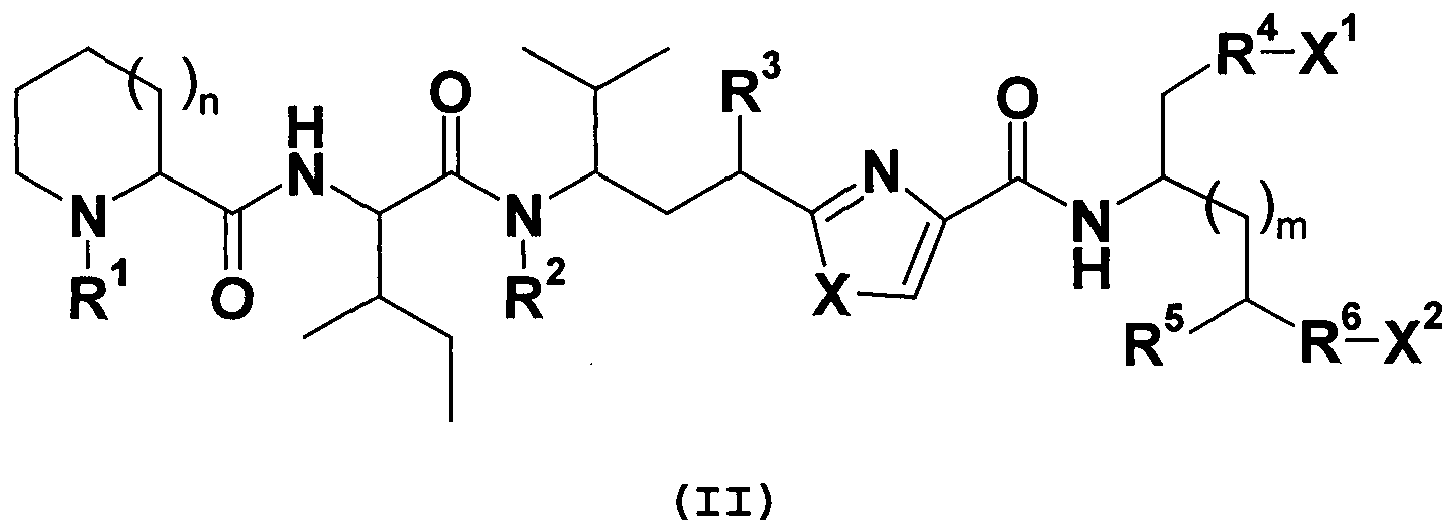
n = 0, 1, 2;
R1 is an alkyl or a heteroalkyl group;
R2 is hydrogen, an optionally substituted alkyl, alkenyl, alkinyl, heteroalkyl, cycloalkyl, heterocycloalkyl, alkylcycloalkyl, heteroalkylcycloalkyl, aryl, heteroaryl, aralkyl or heteroaralkyl group;
R3 is is hydrogen, OH, an optionally substituted alkyl, alkenyl, alkinyl, heteroalkyl, cycloalkyl, heterocycloalkyl, alkylcycloalkyl, heteroalkylcycloalkyl, aryl, heteroaryl, aralkyl or heteroaralkyl group;
X is O or S (especially S);
R4 is an optionally substituted arylene, heteroarylene, heterocycloalkylene, heteroalkylcycloalkylene, aralkylene or heteroaralkylene group;
R5 is hydrogen, an optionally substituted C1-C6 alkyl group, or an optionally substituted aryl or heteroaryl group;
R6 is -CO2-, -CONH-, -CO-, -CONHNH-, -O-, -NH-, -S-, -SO-, -SO2-, -OP(=O)O2- or a branched or unbranched substituted or unsubstituted alkylene, cycloalkylene, heteroalkylene or heterocycloalkylene group;
m is 0, 1, 2 or 3;
X1 is -L-Pep and X2 is H or X1 is H and X2 is -L-Pep; and
L and Pep are as defined herein;
or a pharmacologically acceptable salt, a solvate, a hydrate or a pharmacologically acceptable formulation thereof. - A compound according to claim 1, 2 or 3 having the following formula (III):

R2 is C1-C6 alkyl (especially CH3, ethyl, propyl, isopropyl, isobutyl, n-pentyl or n-hexyl), CH2Ph, CH2OCH2CH(CH3)2, CH2OCOCHC1-C6-Alkyl, CH2OCOCH2Ph or CH2OCOPh;
R3 is H, OAc or OPr;
R5 i s CH3 or H;
R6 is -COO-, -CONH-, -CONHNH-, -O-, -NH-, -CH2O-, -CH2NH- or -CH2S-;
R14 is H, F, OH, NH2, CH3, OMe or Ph; and
L and Pep are as defined above;
or a pharmacologically acceptable salt, a solvate, a hydrate or a pharmacologically acceptable formulation thereof. - A pharmaceutical composition containing a compound according to anyone of Claims 1 to 7 and optionally one or more carriers and/or adjuvants.
- A compound according to anyone of claims 1 to 7 or a pharmaceutical composition according to claim 8 for use in the treatment of cancer.
Priority Applications (8)
| Application Number | Priority Date | Filing Date | Title |
|---|---|---|---|
| EP12006502.4A EP2708243A1 (en) | 2012-09-17 | 2012-09-17 | Receptor ligand linked cytotoxic molecules |
| EP13766471.0A EP2895196A1 (en) | 2012-09-17 | 2013-09-17 | Receptor ligand linked cytotoxic molecules |
| CA2882814A CA2882814A1 (en) | 2012-09-17 | 2013-09-17 | Receptor ligand linked cytotoxic molecules |
| PCT/EP2013/002790 WO2014040752A1 (en) | 2012-09-17 | 2013-09-17 | Receptor ligand linked cytotoxic molecules |
| US14/428,368 US20150238626A1 (en) | 2012-09-17 | 2013-09-17 | Receptor ligand linked cytotoxic molecules |
| CN201380055695.7A CN104755105A (en) | 2012-09-17 | 2013-09-17 | Receptor ligand linked cytotoxic molecules |
| AU2013314625A AU2013314625B2 (en) | 2012-09-17 | 2013-09-17 | Receptor ligand linked cytotoxic molecules |
| JP2015533474A JP2015531794A (en) | 2012-09-17 | 2013-09-17 | Cytotoxic molecules linked to receptor ligands |
Applications Claiming Priority (1)
| Application Number | Priority Date | Filing Date | Title |
|---|---|---|---|
| EP12006502.4A EP2708243A1 (en) | 2012-09-17 | 2012-09-17 | Receptor ligand linked cytotoxic molecules |
Publications (1)
| Publication Number | Publication Date |
|---|---|
| EP2708243A1 true EP2708243A1 (en) | 2014-03-19 |
Family
ID=46924213
Family Applications (2)
| Application Number | Title | Priority Date | Filing Date |
|---|---|---|---|
| EP12006502.4A Withdrawn EP2708243A1 (en) | 2012-09-17 | 2012-09-17 | Receptor ligand linked cytotoxic molecules |
| EP13766471.0A Withdrawn EP2895196A1 (en) | 2012-09-17 | 2013-09-17 | Receptor ligand linked cytotoxic molecules |
Family Applications After (1)
| Application Number | Title | Priority Date | Filing Date |
|---|---|---|---|
| EP13766471.0A Withdrawn EP2895196A1 (en) | 2012-09-17 | 2013-09-17 | Receptor ligand linked cytotoxic molecules |
Country Status (7)
| Country | Link |
|---|---|
| US (1) | US20150238626A1 (en) |
| EP (2) | EP2708243A1 (en) |
| JP (1) | JP2015531794A (en) |
| CN (1) | CN104755105A (en) |
| AU (1) | AU2013314625B2 (en) |
| CA (1) | CA2882814A1 (en) |
| WO (1) | WO2014040752A1 (en) |
Cited By (4)
| Publication number | Priority date | Publication date | Assignee | Title |
|---|---|---|---|---|
| WO2015135659A1 (en) * | 2014-03-14 | 2015-09-17 | Ontochem Gmbh | Receptor ligand linked cytotoxic molecules |
| CN106999444A (en) * | 2014-10-03 | 2017-08-01 | 安吉尼科分子传输公司 | Enhancing of the vesica of complete bacterial derivation to micromolecular compound is loaded |
| WO2019051322A1 (en) * | 2017-09-08 | 2019-03-14 | Seattle Genetics, Inc. | Process for the preparation of tubulysins and intermediates thereof |
| WO2021013999A1 (en) * | 2019-07-24 | 2021-01-28 | Ontochem Gmbh | Receptor-targeting peptide-drug conjugates |
Families Citing this family (11)
| Publication number | Priority date | Publication date | Assignee | Title |
|---|---|---|---|---|
| US8288557B2 (en) | 2004-07-23 | 2012-10-16 | Endocyte, Inc. | Bivalent linkers and conjugates thereof |
| CN104127878A (en) | 2007-03-14 | 2014-11-05 | 恩多塞特公司 | Binding ligand linked drug delivery conjugates of tubulysins |
| CA2690943A1 (en) | 2007-06-25 | 2008-12-31 | Endocyte, Inc. | Conjugates containing hydrophilic spacer linkers |
| US9877965B2 (en) | 2007-06-25 | 2018-01-30 | Endocyte, Inc. | Vitamin receptor drug delivery conjugates for treating inflammation |
| US10080805B2 (en) | 2012-02-24 | 2018-09-25 | Purdue Research Foundation | Cholecystokinin B receptor targeting for imaging and therapy |
| US20140080175A1 (en) | 2012-03-29 | 2014-03-20 | Endocyte, Inc. | Processes for preparing tubulysin derivatives and conjugates thereof |
| CA2887727A1 (en) | 2012-10-16 | 2014-04-24 | Endocyte, Inc. | Drug delivery conjugates containing unnatural amino acids and methods for using |
| ES2843537T3 (en) * | 2014-01-28 | 2021-07-19 | Tube Pharmaceuticals Gmbh | Cytotoxic tubulysin compounds and conjugates thereof |
| US10077287B2 (en) | 2014-11-10 | 2018-09-18 | Bristol-Myers Squibb Company | Tubulysin analogs and methods of making and use |
| ES2919323T3 (en) * | 2015-12-04 | 2022-07-26 | Seagen Inc | Conjugates of quaternized tubulisin compounds |
| US11793880B2 (en) | 2015-12-04 | 2023-10-24 | Seagen Inc. | Conjugates of quaternized tubulysin compounds |
Citations (15)
| Publication number | Priority date | Publication date | Assignee | Title |
|---|---|---|---|---|
| WO2004005327A1 (en) | 2002-07-09 | 2004-01-15 | Morphochem Ag Komb Chemie | Novel tubulysin analogues |
| WO2004007492A1 (en) | 2002-07-15 | 2004-01-22 | Gesellschaft Fuer Biotechnolgische Forschung Mbh (Gbf) | Novel macrocycles for the treatment of cancer |
| WO2004046170A2 (en) | 2002-11-21 | 2004-06-03 | Gesellschaft Fuer Biotechnologische Forschung Mbh (Gbf) | Tubulysins, method for producing the same and tubulysin preparations |
| WO2004048372A1 (en) | 2002-11-28 | 2004-06-10 | Morphochem Ag Komb Chemie | Thia-epothilone derivatives for the treatment of cancer |
| WO2006012527A1 (en) | 2004-07-23 | 2006-02-02 | Endocyte, Inc. | Bivalent linkers and conjugates thereof |
| WO2008112873A2 (en) | 2007-03-14 | 2008-09-18 | Endocyte, Inc. | Binding ligand linked drug delivery conjugates of tubulysins |
| WO2008138561A1 (en) | 2007-05-10 | 2008-11-20 | R & D Biopharmaceuticals Gmbh | Tubulysine derivatives |
| US20100004276A1 (en) | 2003-01-27 | 2010-01-07 | Vlahov Iontcho R | Vitamin receptor binding drug delivery conjugates |
| US20100092496A1 (en) | 2004-05-19 | 2010-04-15 | Medarex, Inc. | Chemical linkers and conjugates thereof |
| WO2010096175A1 (en) * | 2009-02-20 | 2010-08-26 | Ipsen Pharma S.A.S. | Cytotoxic conjugates having neuropeptide y receptor binding compound |
| US20110027274A1 (en) | 2009-08-03 | 2011-02-03 | Medarex, Inc. | Antiproliferative compounds, conjugates thereof, methods therefor, and uses thereof |
| WO2011057805A1 (en) | 2009-11-12 | 2011-05-19 | R&D Biopharmaceuticals Gmbh | Tubulin inhibitors |
| WO2011057806A1 (en) | 2009-11-12 | 2011-05-19 | R&D Biopharmaceuticals Gmbh | Tubulin inhibitors |
| US20110166319A1 (en) | 2005-02-11 | 2011-07-07 | Immunogen, Inc. | Process for preparing purified drug conjugates |
| US20110172254A1 (en) | 2008-09-17 | 2011-07-14 | Endocyte, Inc. | Folate receptor binding conjugates of antifolates |
Family Cites Families (2)
| Publication number | Priority date | Publication date | Assignee | Title |
|---|---|---|---|---|
| WO2007039318A2 (en) * | 2005-10-06 | 2007-04-12 | Bayer Schering Pharma Aktiengesellschaft | Neuropeptide y analogs |
| EP2488195A2 (en) * | 2009-10-13 | 2012-08-22 | F. Hoffmann-La Roche AG | Neuropeptide-2 receptor (y-2r) agonists |
-
2012
- 2012-09-17 EP EP12006502.4A patent/EP2708243A1/en not_active Withdrawn
-
2013
- 2013-09-17 WO PCT/EP2013/002790 patent/WO2014040752A1/en not_active Ceased
- 2013-09-17 CA CA2882814A patent/CA2882814A1/en not_active Abandoned
- 2013-09-17 JP JP2015533474A patent/JP2015531794A/en active Pending
- 2013-09-17 US US14/428,368 patent/US20150238626A1/en not_active Abandoned
- 2013-09-17 EP EP13766471.0A patent/EP2895196A1/en not_active Withdrawn
- 2013-09-17 CN CN201380055695.7A patent/CN104755105A/en active Pending
- 2013-09-17 AU AU2013314625A patent/AU2013314625B2/en not_active Expired - Fee Related
Patent Citations (16)
| Publication number | Priority date | Publication date | Assignee | Title |
|---|---|---|---|---|
| WO2004005327A1 (en) | 2002-07-09 | 2004-01-15 | Morphochem Ag Komb Chemie | Novel tubulysin analogues |
| WO2004007492A1 (en) | 2002-07-15 | 2004-01-22 | Gesellschaft Fuer Biotechnolgische Forschung Mbh (Gbf) | Novel macrocycles for the treatment of cancer |
| WO2004046170A2 (en) | 2002-11-21 | 2004-06-03 | Gesellschaft Fuer Biotechnologische Forschung Mbh (Gbf) | Tubulysins, method for producing the same and tubulysin preparations |
| WO2004048372A1 (en) | 2002-11-28 | 2004-06-10 | Morphochem Ag Komb Chemie | Thia-epothilone derivatives for the treatment of cancer |
| US20100004276A1 (en) | 2003-01-27 | 2010-01-07 | Vlahov Iontcho R | Vitamin receptor binding drug delivery conjugates |
| US20100092496A1 (en) | 2004-05-19 | 2010-04-15 | Medarex, Inc. | Chemical linkers and conjugates thereof |
| WO2006012527A1 (en) | 2004-07-23 | 2006-02-02 | Endocyte, Inc. | Bivalent linkers and conjugates thereof |
| US20110166319A1 (en) | 2005-02-11 | 2011-07-07 | Immunogen, Inc. | Process for preparing purified drug conjugates |
| WO2008112873A2 (en) | 2007-03-14 | 2008-09-18 | Endocyte, Inc. | Binding ligand linked drug delivery conjugates of tubulysins |
| EP2481427A1 (en) | 2007-03-14 | 2012-08-01 | Endocyte, Inc. | Folate-Tubulysin conjugates |
| WO2008138561A1 (en) | 2007-05-10 | 2008-11-20 | R & D Biopharmaceuticals Gmbh | Tubulysine derivatives |
| US20110172254A1 (en) | 2008-09-17 | 2011-07-14 | Endocyte, Inc. | Folate receptor binding conjugates of antifolates |
| WO2010096175A1 (en) * | 2009-02-20 | 2010-08-26 | Ipsen Pharma S.A.S. | Cytotoxic conjugates having neuropeptide y receptor binding compound |
| US20110027274A1 (en) | 2009-08-03 | 2011-02-03 | Medarex, Inc. | Antiproliferative compounds, conjugates thereof, methods therefor, and uses thereof |
| WO2011057805A1 (en) | 2009-11-12 | 2011-05-19 | R&D Biopharmaceuticals Gmbh | Tubulin inhibitors |
| WO2011057806A1 (en) | 2009-11-12 | 2011-05-19 | R&D Biopharmaceuticals Gmbh | Tubulin inhibitors |
Non-Patent Citations (9)
| Title |
|---|
| A. DOMLING; W. RICHTER, MOL. DIVERSITY, vol. 9, 2005, pages 141 - 147 |
| DENISE ZWANZIGER ET AL: "Novel chemically modified analogues of neuropeptide Y for tumor targeting", BIOCONJUGATE CHEMISTRY, ACS, WASHINGTON, DC, US, vol. 19, no. 7, 1 July 2008 (2008-07-01), pages 1430 - 1438, XP002679198, ISSN: 1043-1802, DOI: 10.1021/BC7004297 * |
| KORNER; REUBI, PEPTIDES, vol. 28, 2007, pages 419 - 425 |
| LANGER ET AL., J. MED. CHEM., vol. 44, 2001, pages 1341 - 1348 |
| NICOLAOU ET AL., ANGEW. CHEM. INT. ED., vol. 37, 1998, pages 2014 - 2045 |
| P. J. KOCIENSKI: "Protecting Groups", 1994, GEORG THIEME VERLAG |
| SOELL R M ET AL: "NOVEL ANALOGUES OF NEUROPEPTIDE Y WITH A PREFERENCE FOR THE Y1- RECEPTOR", EUROPEAN JOURNAL OF BIOCHEMISTRY, BLACKWELL PUBLISHING, BERLIN, DE, vol. 268, 1 January 2001 (2001-01-01), pages 2828 - 2837, XP001059455, ISSN: 0014-2956, DOI: 10.1046/J.1432-1327.2001.02161.X * |
| T. W. GREENE; P. G. M. WUTS: "Protective Groups in Organic Synthesis", 1999, JOHN WILEY & SONS |
| ZWANZIGER ET AL., BIOCONJUGATE CHEM., vol. 19, 2008, pages 1430 - 1438 |
Cited By (9)
| Publication number | Priority date | Publication date | Assignee | Title |
|---|---|---|---|---|
| WO2015135659A1 (en) * | 2014-03-14 | 2015-09-17 | Ontochem Gmbh | Receptor ligand linked cytotoxic molecules |
| CN106999444A (en) * | 2014-10-03 | 2017-08-01 | 安吉尼科分子传输公司 | Enhancing of the vesica of complete bacterial derivation to micromolecular compound is loaded |
| CN106999444B (en) * | 2014-10-03 | 2023-12-12 | 安吉尼科分子传输公司 | Enhanced loading of small molecule compounds by intact bacterial-derived vesicles |
| WO2019051322A1 (en) * | 2017-09-08 | 2019-03-14 | Seattle Genetics, Inc. | Process for the preparation of tubulysins and intermediates thereof |
| US11389543B2 (en) | 2017-09-08 | 2022-07-19 | Seagen Inc. | Process for the preparation of tubulysins and intermediates thereof |
| AU2018329951B2 (en) * | 2017-09-08 | 2023-12-14 | Seagen Inc. | Process for the preparation of tubulysins and intermediates thereof |
| IL272837B1 (en) * | 2017-09-08 | 2024-02-01 | Seagen Inc | Process for the preparation of tubulysins and intermediates thereof |
| IL272837B2 (en) * | 2017-09-08 | 2024-06-01 | Seagen Inc | A process for preparing tubolysins and their intermediates |
| WO2021013999A1 (en) * | 2019-07-24 | 2021-01-28 | Ontochem Gmbh | Receptor-targeting peptide-drug conjugates |
Also Published As
| Publication number | Publication date |
|---|---|
| US20150238626A1 (en) | 2015-08-27 |
| CA2882814A1 (en) | 2014-03-20 |
| WO2014040752A1 (en) | 2014-03-20 |
| JP2015531794A (en) | 2015-11-05 |
| AU2013314625B2 (en) | 2016-06-09 |
| CN104755105A (en) | 2015-07-01 |
| EP2895196A1 (en) | 2015-07-22 |
| AU2013314625A1 (en) | 2015-04-16 |
Similar Documents
| Publication | Publication Date | Title |
|---|---|---|
| EP2708243A1 (en) | Receptor ligand linked cytotoxic molecules | |
| CN114521197B (en) | Hetero-tandem bicyclic peptide complex | |
| JP7780253B2 (en) | Polypeptide conjugates for intracellular delivery of stapled peptides - Patent Application 20070122999 | |
| CN109316605B (en) | Folate receptor binding ligand-drug conjugates | |
| US12329799B2 (en) | Peptidyl inhibitors of calcineurin-NFAT interaction | |
| You et al. | Pheophorbide-a conjugates with cancer-targeting moieties for targeted photodynamic cancer therapy | |
| US20110288152A1 (en) | Psma binding ligand-linker conjugates and methods for using | |
| JP2018052951A (en) | Drug complex, complex formation method and use thereof | |
| JP2011523415A (en) | Novel dual-targeting anti-tumor complex | |
| WO2021041895A1 (en) | Stapled beta-catenin ligands | |
| KR101171381B1 (en) | Novel anti-cancer agents comprising peptides with cancer-specific toxicity | |
| JP6583411B2 (en) | Drug complex | |
| US20220241377A1 (en) | Receptor-targeting peptide-drug conjugates | |
| Park et al. | Complexation and conjugation approaches to evaluate siRNA delivery using cationic, hydrophobic and amphiphilic peptides | |
| US20190135858A1 (en) | Legumain Activated Doxorubicin Derivative as well as Preparation Method and Application Thereof | |
| WO2022054625A1 (en) | Pyrrole-imidazole polyamide having improved nuclear transportation properties | |
| KR20250134731A (en) | EPHA2-binding pending peptide and composition comprising the same | |
| CA3208877A1 (en) | Cryptophycin compounds and conjugates thereof | |
| Llanes Martinez | Synthesis, conjugation, and biological evaluation of new N-functionalized tubugis |
Legal Events
| Date | Code | Title | Description |
|---|---|---|---|
| PUAI | Public reference made under article 153(3) epc to a published international application that has entered the european phase |
Free format text: ORIGINAL CODE: 0009012 |
|
| AK | Designated contracting states |
Kind code of ref document: A1 Designated state(s): AL AT BE BG CH CY CZ DE DK EE ES FI FR GB GR HR HU IE IS IT LI LT LU LV MC MK MT NL NO PL PT RO RS SE SI SK SM TR |
|
| AX | Request for extension of the european patent |
Extension state: BA ME |
|
| STAA | Information on the status of an ep patent application or granted ep patent |
Free format text: STATUS: THE APPLICATION HAS BEEN WITHDRAWN |
|
| 18W | Application withdrawn |
Effective date: 20141113 |