EP2699260B1 - Bispecifc antibodies against her2 - Google Patents
Bispecifc antibodies against her2 Download PDFInfo
- Publication number
- EP2699260B1 EP2699260B1 EP12715407.8A EP12715407A EP2699260B1 EP 2699260 B1 EP2699260 B1 EP 2699260B1 EP 12715407 A EP12715407 A EP 12715407A EP 2699260 B1 EP2699260 B1 EP 2699260B1
- Authority
- EP
- European Patent Office
- Prior art keywords
- region
- seq
- sequence
- antibody
- her2
- Prior art date
- Legal status (The legal status is an assumption and is not a legal conclusion. Google has not performed a legal analysis and makes no representation as to the accuracy of the status listed.)
- Active
Links
Images




Classifications
-
- C07K16/1145—
-
- C—CHEMISTRY; METALLURGY
- C07—ORGANIC CHEMISTRY
- C07K—PEPTIDES
- C07K16/00—Immunoglobulins [IGs], e.g. monoclonal or polyclonal antibodies
- C07K16/18—Immunoglobulins [IGs], e.g. monoclonal or polyclonal antibodies against material from animals or humans
- C07K16/28—Immunoglobulins [IGs], e.g. monoclonal or polyclonal antibodies against material from animals or humans against receptors, cell surface antigens or cell surface determinants
- C07K16/2803—Immunoglobulins [IGs], e.g. monoclonal or polyclonal antibodies against material from animals or humans against receptors, cell surface antigens or cell surface determinants against the immunoglobulin superfamily
- C07K16/2809—Immunoglobulins [IGs], e.g. monoclonal or polyclonal antibodies against material from animals or humans against receptors, cell surface antigens or cell surface determinants against the immunoglobulin superfamily against the T-cell receptor (TcR)-CD3 complex
-
- C—CHEMISTRY; METALLURGY
- C07—ORGANIC CHEMISTRY
- C07K—PEPTIDES
- C07K16/00—Immunoglobulins [IGs], e.g. monoclonal or polyclonal antibodies
- C07K16/18—Immunoglobulins [IGs], e.g. monoclonal or polyclonal antibodies against material from animals or humans
- C07K16/28—Immunoglobulins [IGs], e.g. monoclonal or polyclonal antibodies against material from animals or humans against receptors, cell surface antigens or cell surface determinants
- C07K16/2863—Immunoglobulins [IGs], e.g. monoclonal or polyclonal antibodies against material from animals or humans against receptors, cell surface antigens or cell surface determinants against receptors for growth factors, growth regulators
-
- C—CHEMISTRY; METALLURGY
- C07—ORGANIC CHEMISTRY
- C07K—PEPTIDES
- C07K16/00—Immunoglobulins [IGs], e.g. monoclonal or polyclonal antibodies
- C07K16/18—Immunoglobulins [IGs], e.g. monoclonal or polyclonal antibodies against material from animals or humans
- C07K16/28—Immunoglobulins [IGs], e.g. monoclonal or polyclonal antibodies against material from animals or humans against receptors, cell surface antigens or cell surface determinants
- C07K16/2887—Immunoglobulins [IGs], e.g. monoclonal or polyclonal antibodies against material from animals or humans against receptors, cell surface antigens or cell surface determinants against CD20
-
- C—CHEMISTRY; METALLURGY
- C07—ORGANIC CHEMISTRY
- C07K—PEPTIDES
- C07K16/00—Immunoglobulins [IGs], e.g. monoclonal or polyclonal antibodies
- C07K16/18—Immunoglobulins [IGs], e.g. monoclonal or polyclonal antibodies against material from animals or humans
- C07K16/32—Immunoglobulins [IGs], e.g. monoclonal or polyclonal antibodies against material from animals or humans against translation products of oncogenes
-
- C—CHEMISTRY; METALLURGY
- C07—ORGANIC CHEMISTRY
- C07K—PEPTIDES
- C07K16/00—Immunoglobulins [IGs], e.g. monoclonal or polyclonal antibodies
- C07K16/46—Hybrid immunoglobulins
- C07K16/468—Immunoglobulins having two or more different antigen binding sites, e.g. multifunctional antibodies
-
- C—CHEMISTRY; METALLURGY
- C07—ORGANIC CHEMISTRY
- C07K—PEPTIDES
- C07K2317/00—Immunoglobulins specific features
- C07K2317/20—Immunoglobulins specific features characterized by taxonomic origin
- C07K2317/21—Immunoglobulins specific features characterized by taxonomic origin from primates, e.g. man
-
- C—CHEMISTRY; METALLURGY
- C07—ORGANIC CHEMISTRY
- C07K—PEPTIDES
- C07K2317/00—Immunoglobulins specific features
- C07K2317/20—Immunoglobulins specific features characterized by taxonomic origin
- C07K2317/24—Immunoglobulins specific features characterized by taxonomic origin containing regions, domains or residues from different species, e.g. chimeric, humanized or veneered
-
- C—CHEMISTRY; METALLURGY
- C07—ORGANIC CHEMISTRY
- C07K—PEPTIDES
- C07K2317/00—Immunoglobulins specific features
- C07K2317/30—Immunoglobulins specific features characterized by aspects of specificity or valency
- C07K2317/31—Immunoglobulins specific features characterized by aspects of specificity or valency multispecific
-
- C—CHEMISTRY; METALLURGY
- C07—ORGANIC CHEMISTRY
- C07K—PEPTIDES
- C07K2317/00—Immunoglobulins specific features
- C07K2317/40—Immunoglobulins specific features characterized by post-translational modification
- C07K2317/41—Glycosylation, sialylation, or fucosylation
-
- C—CHEMISTRY; METALLURGY
- C07—ORGANIC CHEMISTRY
- C07K—PEPTIDES
- C07K2317/00—Immunoglobulins specific features
- C07K2317/50—Immunoglobulins specific features characterized by immunoglobulin fragments
- C07K2317/52—Constant or Fc region; Isotype
- C07K2317/526—CH3 domain
-
- C—CHEMISTRY; METALLURGY
- C07—ORGANIC CHEMISTRY
- C07K—PEPTIDES
- C07K2317/00—Immunoglobulins specific features
- C07K2317/50—Immunoglobulins specific features characterized by immunoglobulin fragments
- C07K2317/52—Constant or Fc region; Isotype
- C07K2317/53—Hinge
-
- C—CHEMISTRY; METALLURGY
- C07—ORGANIC CHEMISTRY
- C07K—PEPTIDES
- C07K2317/00—Immunoglobulins specific features
- C07K2317/50—Immunoglobulins specific features characterized by immunoglobulin fragments
- C07K2317/55—Fab or Fab'
-
- C—CHEMISTRY; METALLURGY
- C07—ORGANIC CHEMISTRY
- C07K—PEPTIDES
- C07K2317/00—Immunoglobulins specific features
- C07K2317/70—Immunoglobulins specific features characterized by effect upon binding to a cell or to an antigen
- C07K2317/73—Inducing cell death, e.g. apoptosis, necrosis or inhibition of cell proliferation
-
- C—CHEMISTRY; METALLURGY
- C07—ORGANIC CHEMISTRY
- C07K—PEPTIDES
- C07K2317/00—Immunoglobulins specific features
- C07K2317/70—Immunoglobulins specific features characterized by effect upon binding to a cell or to an antigen
- C07K2317/73—Inducing cell death, e.g. apoptosis, necrosis or inhibition of cell proliferation
- C07K2317/732—Antibody-dependent cellular cytotoxicity [ADCC]
-
- C—CHEMISTRY; METALLURGY
- C07—ORGANIC CHEMISTRY
- C07K—PEPTIDES
- C07K2317/00—Immunoglobulins specific features
- C07K2317/70—Immunoglobulins specific features characterized by effect upon binding to a cell or to an antigen
- C07K2317/73—Inducing cell death, e.g. apoptosis, necrosis or inhibition of cell proliferation
- C07K2317/734—Complement-dependent cytotoxicity [CDC]
-
- C—CHEMISTRY; METALLURGY
- C07—ORGANIC CHEMISTRY
- C07K—PEPTIDES
- C07K2317/00—Immunoglobulins specific features
- C07K2317/70—Immunoglobulins specific features characterized by effect upon binding to a cell or to an antigen
- C07K2317/77—Internalization into the cell
-
- C—CHEMISTRY; METALLURGY
- C07—ORGANIC CHEMISTRY
- C07K—PEPTIDES
- C07K2317/00—Immunoglobulins specific features
- C07K2317/90—Immunoglobulins specific features characterized by (pharmaco)kinetic aspects or by stability of the immunoglobulin
- C07K2317/94—Stability, e.g. half-life, pH, temperature or enzyme-resistance
Definitions
- the present invention relates to bispecific antibodies directed to human epidermal growth factor receptor 2 (HER2) and to uses of such antibodies, in particular their use in the treatment of cancer.
- HER2 human epidermal growth factor receptor 2
- HER2 is a 185-kDa cell surface receptor tyrosine kinase and member of the epidermal growth factor receptor (EGFR) family that comprises four distinct receptors: EGFR/ErbB-1, HER2/ErbB-2, HER3/ErbB-3, and HER4/ErbB-4. Both homo- and heterodimers are formed by the four members of the EGFR family, with HER2 being the preferred and most potent dimerization partner for other ErbB receptors ( Graus-Porta et al., Embo J 1997;16:1647-1655 ; Tao et al., J Cell Sci 2008;121:3207-3217 ).
- EGFR epidermal growth factor receptor
- HER2 can be activated by overexpression or by heterodimerization with other ErbBs that can be activated by ligand binding ( Riese and Stern, Bioessays 1998;20:41-48 ). For HER2, no ligand has been identified. HER2 activation leads to receptor phosphorylation, which triggers a cascade of downstream signals through multiple signaling pathways, such as MAPK, phosphoinositol 3-kinase/AKT, JAK/STAT and PKC, which ultimately results in the regulation of multiple cellular functions, such as growth, survival and differentiation ( Huang et al., Expert Opin Biol Ther 2009;9:97-110 ).
- HER2 overexpression is reported in approximately 20% of the cases and is correlated with poor prognosis ( Reese et al., Stem Cells 1997;15:1-8 ; Andrechek et al., Proc Natl Acad Sci U S A 2000;97:3444-3449 ; and Slamon et al., Science 1987;235:177-182 ).
- HER2 expression has also been associated with other human carcinoma types, including prostate cancer, non-small cell lung cancer, bladder cancer, ovarian cancer, gastric cancer, colon cancer, esophageal cancer and squamous cell carcinoma of the head & neck ( Garcia de Palazzo et al., Int J Biol Markers 1993;8:233-239 ; Ross et al., Oncologist 2003;8:307-325 ; Osman et al., J Urol 2005;174:2174-2177 ; Kapitanovic et al., Gastroenterology 1997;112:1103-1113 ; Turken et al., Neoplasma 2003;50:257-261 ; and Oshima et al., Int J Biol Markers 2001;16:250-254 ).
- Trastuzumab (Herceptin ® ) is a recombinant, humanized monoclonal antibody directed against domain IV of the HER2 protein, thereby blocking ligand-independent HER2 homodimerization, and to a lesser extend heterodimerization of HER2 with other family members in cells with high HER2 overexpression ( Cho et al., Nature 2003;421:756-760 and Wehrman et al., Proc Natl Acad Sci U S A 2006;103:19063-19068 ).
- trastuzumab In cells with modest HER2 expressing levels, trastuzumab was found to inhibit the formation of HER2/EGFR heterodimers (Wehrman et al., (2006), supra ; Schmitz et al., Exp Cell Res 2009;315:659-670 ). Trastuzumab mediates antibody-dependent cellular cytotoxicity (ADCC) and prevents ectodomain shedding, which would otherwise result in the formation of a truncated constitutively active protein in HER2 overexpressing cells. Also inhibition of both in vitro and in vivo proliferation of tumor cells expressing high levels of HER2 has been reported for trastuzumab (reviewed in Nahta and Esteva, Oncogene 2007;26:3637-3643 ).
- ADCC antibody-dependent cellular cytotoxicity
- Herceptin ® has been approved both for first-line and adjuvant treatment of HER2 overexpressing metastatic breast cancer, either in combination with chemotherapy, or as a single agent following one or more chemotherapy regimens.
- Trastuzumab has been found to be effective only in 20-50% of HER2 overexpressing breast tumor patients and many of the initial responders show relapse after a few months ( Dinh et al., Clin Adv Hematol Oncol 2007;5:707-717 ).
- Herceptin ® is also approved, in combination with cisplatin and a fluoropyrimidine (either capecitabine or 5-fluorouracil), for the treatment of patients with HER2-overexpressing metastatic gastric or gastroesophageal (GE) junction adenocarcinoma who have not received prior treatment for metastatic disease.
- a fluoropyrimidine either capecitabine or 5-fluorouracil
- Pertuzumab (Omnitarg TM ) is another humanized monoclonal antibody. It is directed against domain II of the HER2 protein, resulting in inhibition of ligand-induced heterodimerization (i.e ., HER2 dimerizing with another member of the ErbB family to which a ligand has bound); a mechanism reported to not strictly require high HER2 expression levels ( Franklin et al., Cancer Cell 2004;5:317-328 .). Although pertuzumab also mediates ADCC, the main mechanism of action of pertuzumab relies on its dimerization blockade ( Hughes et al., Mol Cancer Ther 2009;8:1885-1892 ).
- pertuzumab was found to enhance EGFR internalization and downregulation by inhibiting the formation of EGFR/HER2 heterodimers, which otherwise tethers EGFR at the plasma membrane (Hughes et al., 2009, supra ) . This correlates with the observation that EGFR homodimers internalize more efficient than EGFR/HER2 dimers ( Pedersen et al., Mol Cancer Res 2009;7:275-284 ).
- HER2-based therapeutic approach is the combination of HER2 antibodies against different HER2 epitopes, which was reported to be more effective than individual HER2 antibodies in reducing tumor growth in in vitro and in vivo tumor models ( Emde et al., Oncogene 2011;30:1631-1642 ; Spiridon et al., Clin Cancer res 2002;8:1720-1730 ).
- the complementary mechanisms of action of pertuzumab and trastuzumab reportedly results in enhanced anti-tumor effects and efficacy when combined in patients who progressed during prior trastuzumab therapy ( Baselga et al., J Clin Oncol 2010;28:1138-1144 ).
- An alternative approach to improve targeted antibody therapy is by delivering cytotoxic cells or drugs specifically to the antigen-expressing cancer cells.
- T-DM1 consists of trastuzumab conjugated to the fungal toxin maytansine.
- responses in a heavily pretreated patient cohort including prior trastuzumab and/or lapatinib therapy were reported ( Burris et al, 2011, J Clin Oncol 29: 398-405 and Lewis Phillips et al., Cancer Res 2008;68:9280-9290 ).
- HER2-antibody complex efficiently internalizes upon antibody binding.
- Studies on murine HER2 antibodies have shown that certain combinations of antibodies instigate HER2 endocytosis ( Ben-Kasus et al., PNAS 2009;106:3294-9 ).
- Human HER2 antibodies F5 and C1 have been reported to internalize relatively rapidly when bound to HER2 antigen and to bind the same epitope ( WO 99/55367 and WO 2006/116107 ). As compared to EGFR, however, internalization of HER2 is impaired.
- EGFR homodimers internalize much more efficiently than HER2 homodimers ( Dinh et al., Clin Adv Hematol Oncol 2007;5:707-717 ).
- EGFR, and also HER3, can increase endocytosis of HER2 by the formation of EGFR/HER2 and HER3/HER2 heterodimers, respectively ( Baulida et al., J Biol Chem 1996;271:5251-5257 ; Pedersen NM, et al., Mol Cancer Res 2009;7:275-84 ).
- bispecific antibodies can be applied to mediate killing of target cells by combining two different Fab arms in one molecule: one Fab arm that binds the antigen on the tumor cell, and one Fab arm that binds CD3 on cytotoxic T cells (CTL).
- CTL cytotoxic T cells
- the so-called trifunctional antibodies provide bispecific antigen binding by the Fab arms in addition to Fc receptor binding by the Fc region.
- T cells CD3 are recruited to tumor cells (tumor antigen) and, additionally, effector cells bind the Fc domain of the trifunctional antibody. The formed complexes lead to killing of the tumor cells ( Muller and Kontermann, BioDrugs 2010;24:89-98 ).
- Ertumaxomab is one such HER2xCD3 trifunctional antibody, which induces cytotoxicity in cell lines with low HER2 expression ( Jones et al., Lancet Oncol 2009;10: 1179-1187 and Kiewe et al., Clin Cancer Res 2006;12:3085-3091 ).
- a complex of T cells and tumor cells can be formed, leading to killing of the tumor cells ( Muller and Kontermann, BioDrugs 2010;24:89-98 , Baeuerle and Reinhardt 2009, Cancer Research 96: 4941 ) by an dual targeting antibody fragment ( e.g . dual targeting single chain antibodies).
- Blinatumomab ( Bargou et al, Science 2008, 321:974-976 ) is a single chain antibody construct named BiTE which induces cytotoxicity by targeting CD19 and CD3.
- BiTE a single chain antibody construct named BiTE which induces cytotoxicity by targeting CD19 and CD3.
- Other antibody fragment based T-cell engaging bispecifics have been described ( Moore et al. 2011, Blood 117:4542-4551 , Baeuerle et al., Current opinion in Molecular Therapeutics 2009, 11:22-30 ).
- HER2xEGFR affibody Friedman et al., Biotechnol Appl Biochem. 2009 Aug 21;54(2):121-31
- HER2xHER3 tandem single chain Fv's MM-111 Robinson et al., Br.J.Cancer 2008;99:1415-25 ; WO 2005/117973 ).
- trastuzumab and pertuzumab leads to improve tumor growth inhibition and survival when compared to the respective monotherapies.
- WO 2009/154651 provides a method for the treatment of breast cancer, comprising administering to a HER2 positive metastatic breast cancer patient an effective amount of a growth inhibitory HER2 antibody, a HER2 dimeriation inhibitor antibody, and a taxane, wherein the growth inhibitory HER2 antibody binds within Domain IV of the HER2 amino acid sequence; e.g. the growth inhibitory HER2 antibody binds essentially to epitope 4D5 of HER2, and wherein the HER2 dimirization inhibitory antibody binds essentially to epitope 2C4; and bispecific antibodies which bind to two different epitopes of the HER2 protein.
- WO 2009/068628 discloses three biparatopi HER2xHER2 antibodies. It is further disclosed that these antibodies are to be conjugated with cytotoxic drugs or with cytokines. Further disclosed are expression vetors, host cells, pharmaceutical sompositions, first and second medical uses, combination uses amd methods of production.
- bispecific antibodies comprising a first antigen-binding region and a second antigen-binding region, which first and second antigen-binding regions bind different epitopes on human epidermal growth factor receptor 2 (HER2), and wherein the first antigen-binding region is selected from the group consisting of:
- the bispecific antibodies may be prepared from HER2 antibodies that are fully human or humanized, bind to novel epitopes, and/or have favorable properties for therapeutic use in human patients.
- Each Fab-arm of the bispecific antibodies may further include an Fc-region, optionally comprising modifications promoting the formation of the bispecific antibody, modifications affecting Fc-mediated effector functions, conjugated drugs, or any combination of these and/or other features described herein.
- HER2 also known as ErbB-2, NEU, HER-2, and CD340
- HER2 refers to human epidermal growth factor receptor 2 (SwissProt P04626) and includes any variants, isoforms and species homologs of HER2 which are naturally expressed by cells, including tumor cells, or are expressed on cells transfected with the HER2 gene or cDNA.
- Species homologs include rhesus monkey HER2 (macaca mulatta; Genbank accession No. GI:109114897).
- immunoglobulin refers to a class of structurally related glycoproteins consisting of two pairs of polypeptide chains, one pair of light (L) low molecular weight chains and one pair of heavy (H) chains, all four inter-connected by disulfide bonds.
- L light
- H heavy
- each heavy chain typically is comprised of a heavy chain variable region (abbreviated herein as V H or VH) and a heavy chain constant region.
- the heavy chain constant region typically is comprised of three domains, C H 1, C H 2, and C H 3.
- Each light chain typically is comprised of a light chain variable region (abbreviated herein as V L or VL) and a light chain constant region.
- the light chain constant region typically is comprised of one domain, C L .
- the V H and V L regions may be further subdivided into regions of hypervariability (or hypervariable regions which may be hypervariable in sequence and/or form of structurally defined loops), also termed complementarity determining regions (CDRs), interspersed with regions that are more conserved, termed framework regions (FRs).
- CDRs complementarity determining regions
- Each V H and V L is typically composed of three CDRs and four FRs, arranged from amino-terminus to carboxy-terminus in the following order: FR1, CDR1, FR2, CDR2, FR3, CDR3, FR4 (see also Chothia and Lesk J. Mol. Biol. 196, 901-917 (1987 )).
- CDR sequences herein are identified according to IMGT rules ( Brochet X., Nucl Acids Res.
- the EU index numbering system (Kabat et al, supra)
- the Kabat numbering of residues may be determined for a given antibody as described in Kabat et al., supra.
- antibody in the context of the present invention refers to an immunoglobulin molecule, a fragment of an immunoglobulin molecule, or a derivative of either thereof, which has the ability to specifically bind to an antigen under typical physiological conditions with a half life of significant periods of time, such as at least about 30 minutes, at least about 45 minutes, at least about one hour, at least about two hours, at least about four hours, at least about 8 hours, at least about 12 hours, about 24 hours or more, about 48 hours or more, about 3, 4, 5, 6, 7 or more days, etc., or any other relevant functionally-defined period (such as a time sufficient to induce, promote, enhance, and/or modulate a physiological response associated with antibody binding to the antigen and/or time sufficient for the antibody to recruit an effector activity).
- variable regions of the heavy and light chains of the immunoglobulin molecule contain a binding domain that interacts with an antigen.
- the constant regions of the antibodies (Abs) may mediate the binding of the immunoglobulin to host tissues or factors, including various cells of the immune system (such as effector cells) and components of the complement system such as C1q, the first component in the classical pathway of complement activation.
- a HER2 antibody may also be a multispecific antibody, such as a bispecific antibody, diabody, or similar molecule (see for instance PNAS USA 90 (14), 6444-8 (1993) for a description of diabodies). Indeed, bispecific antibodies, diabodies, and the like, provided by the present invention may bind any suitable target in addition to a portion of HER2.
- antibody herein, unless otherwise stated or clearly contradicted by context, includes fragments of an antibody that are antigen-binding fragments, i.e., retain the ability to specifically bind to the antigen. It has been shown that the antigen-binding function of an antibody may be performed by fragments of a full-length antibody.
- antigen-binding fragments encompassed within the term "antibody” include (i) a Fab' or Fab fragment, a monovalent fragment consisting of the V L , V H , C L and C H 1 domains, or a monovalent antibody as described in WO2007059782 (Genmab ); (ii) F(ab') 2 fragments, bivalent fragments comprising two Fab fragments linked by a disulfide bridge at the hinge region; (iii) a Fd fragment consisting essentially of the V H and C H 1 domains; (iv) a Fv fragment consisting essentially of the V L and V H domains of a single arm of an antibody, (v) a dAb fragment ( Ward et al., Nature 341, 544-546 (1989 )), which consists essentially of a V H domain and also called domain antibodies ( Holt et al; Trends Biotechnol.
- the two domains of the Fv fragment, V L and V H are coded for by separate genes, they may be joined, using recombinant methods, by a synthetic linker that enables them to be made as a single protein chain in which the V L and V H regions pair to form monovalent molecules (known as single chain antibodies or single chain Fv (scFv), see for instance Bird et al., Science 242, 423-426 (1988 ) and Huston et al., PNAS USA 85, 5879-5883 (1988 )).
- single chain antibodies single chain antibodies
- scFv single chain Fv
- antibody also includes polyclonal antibodies, monoclonal antibodies (mAbs), antibody-like polypeptides, such as chimeric antibodies and humanized antibodies, and antibody fragments retaining the ability to specifically bind to the antigen (antigen-binding fragments) provided by any known technique, such as enzymatic cleavage, peptide synthesis, and recombinant techniques.
- mAbs monoclonal antibodies
- antibody-like polypeptides such as chimeric antibodies and humanized antibodies
- An antibody as generated can possess any isotype.
- bispecific antibody is in the context of the present invention to be understood as an antibody with two different antigen-binding regions (based on sequence information). This can mean different target binding but includes as well binding to different epitopes in one target.
- Fab-arm or “arm” refers to one heavy chain-light chain pair.
- Fc region refers to an antibody region comprising at least a hinge region, CH2 domain, and a CH3 domain.
- isotype refers to the immunoglobulin class (for instance IgG1, IgG2, IgG3, IgG4, IgD, IgA, IgE, or IgM) that is encoded by heavy chain constant region genes.
- monovalent antibody means in the context of the present invention that an antibody molecule is capable of binding a single molecule of the antigen, and thus is not able of antigen crosslinking.
- an “antibody deficient in effector function” or an “effector-function-deficient antibody” refers to an antibody which has a significantly reduced or no ability to activate one or more effector mechanisms, such as complement activation or Fc receptor binding.
- effector-function deficient antibodies have significantly reduced or no ability to mediate antibody-dependent cell-mediated cytotoxicity (ADCC) and/or complement-dependent cytotoxicity (CDC).
- An example of such an antibody is IgG4.
- Another example is the introduction of mutations in Fc-region which can strongly reduce the interaction with complement proteins and Fc-receptors. See, for example, Bolt S et al., Eur J Immunol 1993, 23:403-411 ; Oganesyan, Acta Crys. 2008, D64, 700-704 ; and Shields et al., JBC 2001, 276: 6591-6604 .
- HER2 antibody or "anti-HER2 antibody” is an antibody as described above, which binds specifically to the antigen HER2.
- HER2xHER2 antibody or "anti-HER2xHER2 antibody” is a multispecific antibody, optionally a bispecific antibody, which comprises two different antigen-binding regions, both of which bind specifically to the antigen HER2, optionally to different HER2 epitopes.
- human antibody is intended to include antibodies having variable and constant regions derived from human germline immunoglobulin sequences.
- the human antibodies of the invention may include amino acid residues not encoded by human germline immunoglobulin sequences ( e.g ., mutations introduced by random or site-specific mutagenesis in vitro or by somatic mutation in vivo ) .
- the term “human antibody”, as used herein is not intended to include antibodies in which CDR sequences derived from the germline of another mammalian species, such as a mouse, have been grafted onto human framework sequences.
- a human antibody is "derived from" a particular germline sequence if the antibody is obtained from a system using human immunoglobulin sequences, for instance by immunizing a transgenic mouse carrying human immunoglobulin genes or by screening a human immunoglobulin gene library, and wherein the selected human antibody is at least 90%, such as at least 95%, for instance at least 96%, such as at least 97%, for instance at least 98%, or such as at least 99% identical in amino acid sequence to the amino acid sequence encoded by the germline immunoglobulin gene.
- a human antibody derived from a particular human germline sequence will display no more than 20 amino acid differences, e.g . no more than 10 amino acid differences, such as no more than 9, 8, 7, 6 or 5, for instance no more than 4, 3, 2, or 1 amino acid difference from the amino acid sequence encoded by the germline immunoglobulin gene.
- heavy chain antibody or “heavy-chain antibody” refers to an antibody which consists only of two heavy chains and lacks the two light chains usually found in antibodies. Heavy chain antibodies, which naturally occur in e.g . camelids, can bind antigens despite their lack of VL domains.
- the antibody of the invention may be isolated.
- An "isolated antibody,” as used herein, is intended to refer to an antibody which is substantially free of other antibodies having different antigenic specificities (for instance an isolated antibody that specifically binds to HER2 is substantially free of antibodies that specifically bind antigens other than HER2).
- An isolated antibody that specifically binds to an epitope, isoform or variant of HER2 may, however, have cross-reactivity to other related antigens, for instance from other species (such as HER2 species homologs).
- an isolated antibody may be substantially free of other cellular material and/or chemicals.
- two or more "isolated" monoclonal antibodies having different antigen-binding specificities are combined in a well-defined composition.
- the term “competes with” or “cross-competes with” indicates that the two or more antibodies compete for binding to HER2, e.g . compete for HER2 binding in the assay described in Example 14.
- An antibody “blocks” or “cross-blocks” one or more other antibodies from binding to HER2 if the antibody competes with the one or more other antibodies 25% or more, with 25%-74% representing "partial block” and 75%-100% representing "full block", preferably as determined using the assay of Example 14.
- competition or blocking in the assay of the Examples is only observed when one antibody is coated on the plate and the other is used to compete, and not vice versa.
- the terms “competes with”, “cross-competes with”, “blocks” or “cross-blocks” when used herein is also intended to cover such pairs of antibodies.
- epitope means a protein determinant capable of specific binding to an antibody.
- Epitopes usually consist of surface groupings of molecules such as amino acids or sugar side chains and usually have specific three dimensional structural characteristics, as well as specific charge characteristics. Conformational and nonconformational epitopes are distinguished in that the binding to the former but not the latter is lost in the presence of denaturing solvents.
- the epitope may comprise amino acid residues directly involved in the binding and other amino acid residues, which are not directly involved in the binding, such as amino acid residues which are effectively blocked or covered by the specifically antigen binding peptide (in other words, the amino acid residue is within the footprint of the specifically antigen binding peptide).
- the term "monoclonal antibody” as used herein refers to a preparation of antibody molecules of single molecular composition.
- a monoclonal antibody composition displays a single binding specificity and affinity for a particular epitope.
- the term “human monoclonal antibody” refers to antibodies displaying a single binding specificity which have variable and constant regions derived from human germline immunoglobulin sequences.
- the human monoclonal antibodies may be generated by a hybridoma which includes a B cell obtained from a transgenic or transchromosomal nonhuman animal, such as a transgenic mouse, having a genome comprising a human heavy chain transgene and a light chain transgene, fused to an immortalized cell.
- the amount with which the affinity is lower is dependent on the K D of the antibody, so that when the K D of the antibody is very low (that is, the antibody is highly specific), then the amount with which the affinity for the antigen is lower than the affinity for a non-specific antigen may be at least 10,000 fold.
- k d (sec -1 ), as used herein, refers to the dissociation rate constant of a particular antibody-antigen interaction. Said value is also referred to as the k off value.
- k a (M -1 x sec -1 ), as used herein, refers to the association rate constant of a particular antibody-antigen interaction.
- K D (M), as used herein, refers to the dissociation equilibrium constant of a particular antibody-antigen interaction.
- KA (M -1 ), as used herein, refers to the association equilibrium constant of a particular antibody-antigen interaction and is obtained by dividing the k a by the k d .
- heterodimeric interaction between the first and second CH3 regions refers to the interaction between the first CH3 region and the second CH3 region in a first-CH3/second-CH3 heterodimeric protein.
- homodimeric interactions of the first and second CH3 regions refers to the interaction between a first CH3 region and another first CH3 region in a first-CH3/first-CH3 homodimeric protein and the interaction between a second CH3 region and another second CH3 region in a second-CH3/second-CH3 homodimeric protein.
- the term "inhibits proliferation" (e.g . referring to cells, such as tumor cells) is intended to include any substantial decrease in the cell proliferation when contacted with a HER2 antibody as compared to the proliferation of the same cells not in contact with a HER2 antibody, e.g ., the inhibition of proliferation of a cell culture by at least about 10%, at least about 20% or at least about 30%, or at least as much as a reference antibody such as trastuzumab, e.g., as determined by an assay in the Examples, e.g. Example 16.
- the term "promotes proliferation" (e.g . referring to cells, such as tumor cells) is intended to include any substantial increase in the cell proliferation when contacted with a HER2 antibody as compared to the proliferation of the same cells not in contact with a HER2 antibody, e.g ., the promotion of proliferation of a cell culture by at least about 10%, at least about 20% or at least about 30%, or at least as much as a reference antibody as F5, e.g ., as determined by an assay in the Examples.
- the term "internalization”, when used in the context of a HER2 antibody includes any mechanism by which the antibody is internalized into a HER2-expressing cell from the cell-surface and/or from surrounding medium, e.g ., via endocytosis.
- the internalization of an antibody can be evaluated using a direct assay measuring the amount of internalized antibody (such as, e.g ., the fab-CypHer5E assay described in Example 19), or an indirect assay where the effect of an internalized antibody-toxin conjugate is measured (such as, e.g ., the anti-kappa-ETA'assay of Example 18).
- the present invention also provides antibodies comprising functional variants of the V L region, V H region, or one or more CDRs of the antibodies of the examples.
- a functional variant of a V L , V H , or CDR used in the context of a HER2 antibody still allows the antibody to retain at least a substantial proportion (at least about 50%, 60%, 70%, 80%, 90%, 95% or more) of the affinity/avidity and/or the specificity/selectivity of the parent antibody and in some cases such a HER2 antibody may be associated with greater affinity, selectivity and/or specificity than the parent antibody.
- the percent identity between two nucleotide or amino acid sequences may e.g. be determined using the algorithm of E. Meyers and W. Miller, Comput. Appl. Biosci 4, 11-17 (1988 ) which has been incorporated into the ALIGN program (version 2.0), using a PAM120 weight residue table, a gap length penalty of 12 and a gap penalty of 4.
- the percent identity between two amino acid sequences may be determined using the Needleman and Wunsch, J. Mol. Biol. 48, 444-453 (1970 ) algorithm.
- Exemplary variants include those which differ from a parent antibody VH and/or VL sequence shown in Figures 1 and 2 at one or more "variant" amino acid positions, denoted "X" in the corresponding consensus sequence.
- Preferred variants are those in which the new amino acid is selected from those at the corresponding position in one of the aligned sequences in Figure 1 or 2 (for details on CDR sequence variants, see Table 4).
- the sequence of VH, VL or CDR variants may differ from the sequence of the VH, VL or CDR of the parent antibody sequences mainly by conservative substitutions; for instance at least 10, such as at least 9, 8, 7, 6, 5, 4, 3, 2 or 1 of the substitutions in the variant are conservative amino acid residue replacements.
- conservative substitutions may be defined by substitutions within the classes of amino acids reflected in the following table: Amino acid residue classes for conservative substitutions Acidic Residues Asp (D) and Glu (E) Basic Residues Lys (K), Arg (R), and His (H) Hydrophilic Uncharged Residues Ser (S), Thr (T), Asn (N), and Gln (Q) Aliphatic Uncharged Residues Gly (G), Ala (A), Val (V), Leu (L), and Ile (I) Non-polar Uncharged Residues Cys (C), Met (M), and Pro (P) Aromatic Residues Phe (F), Tyr (Y), and Trp (W)
- substitution of an amino acid in a given position is written as e.g . K405R which means a substitution of a lysine in position 405 with an arginine; and ii) for specific variants the specific three or one letter codes are used, including the codes Xaa and X to indicate any amino acid residue.
- substitution of Arginine for Lysine in position 405 is designated as: K405R, or the substitution of any amino acid residue for Lysine in position 405 is designated as K405X.
- deletion of Lysine in position 405 it is indicated by K405*.
- Recombinant host cell (or simply “host cell”), as used herein, is intended to refer to a cell into which an expression vector has been introduced, e.g . an expression vector encoding an antibody of the invention.
- Recombinant host cells include, for example, transfectomas, such as CHO cells, HEK293 cells, NS/0 cells, and lymphocytic cells.
- transgenic non-human animal refers to a non-human animal having a genome comprising one or more human heavy and/or light chain transgenes or transchromosomes (either integrated or non-integrated into the animal's natural genomic DNA) and which is capable of expressing fully human antibodies.
- a transgenic mouse can have a human light chain transgene and either a human heavy chain transgene or human heavy chain transchromosome, such that the mouse produces human HER2 antibodies when immunized with HER2 antigen and/or cells expressing HER2.
- the human heavy chain transgene may be integrated into the chromosomal DNA of the mouse, as is the case for transgenic mice, for instance HuMAb ® mice, such as HCo7, HCo12, or HCo17 mice, or the human heavy chain transgene may be maintained extrachromosomally, as is the case for transchromosomal KM mice as described in WO02/43478 .
- Similar mice, having a larger human Ab gene repertoire, include HCo7 and HCo20 (see e.g . WO2009097006 ).
- transgenic mice are capable of producing multiple isotypes of human monoclonal antibodies to a given antigen (such as IgG, IgA, IgM, IgD and/or IgE) by undergoing V-D-J recombination and isotype switching.
- Transgenic, nonhuman animal can also be used for production of antibodies against a specific antigen by introducing genes encoding such specific antibody, for example by operatively linking the genes to a gene which is expressed in the milk of the animal.
- Treatment refers to the administration of an effective amount of a therapeutically active compound of the present invention with the purpose of easing, ameliorating, arresting or eradicating (curing) symptoms or disease states.
- an “effective amount” or “therapeutically effective amount” refers to an amount effective, at dosages and for periods of time necessary, to achieve a desired therapeutic result.
- a therapeutically effective amount of a HER2 antibody may vary according to factors such as the disease state, age, sex, and weight of the individual, and the ability of the HER2 antibody to elicit a desired response in the individual.
- a therapeutically effective amount is also one in which any toxic or detrimental effects of the antibody or antibody portion are outweighed by the therapeutically beneficial effects.
- an "anti-idiotypic” antibody is an antibody which recognizes unique determinants generally associated with the antigen-binding site of an antibody.
- the present disclosure relates to a bispecific antibody comprising two different antigen-binding regions which bind HER2.
- the disclosure relates to a bispecific molecule comprising a first antigen binding site from a HER2 antibody described herein and a second antigen binding site from a HER2 antibody described herein with a different binding specificity, such as a binding specificity for a non-overlapping epitope of HER2, i.e. a bispecific antibody wherein the first and second antigen binding regions do not cross-block each other for binding to HER2, e.g . when tested as described in Example 14.
- the bispecific antibody may comprise at least one antigen-binding region from an antibody of cross-block group 1, 2, 3 or 4, described below.
- the bispecific antibody may comprise at least one antigen-binding region from an antibody cross-blocking or binding to the same epitope as a reference antibody selected from cross-block groups 1, 2, 3 and 4, e.g ., cross-block group 4.
- the bispecific antibody may comprise two different antigen-binding regions from the antibodies of cross-block groups 1, 2, 3 and 4, optionally from different cross-block groups.
- the bispecific antibody may comprise two different antigen-binding regions from antibodies which each cross-block or bind to the same epitope as a reference antibody of cross-block groups 1, 2, 3 and 4, optionally from different cross-block groups.
- the bispecific antibody may comprise one antigen-binding region from an antibody of cross-block group 1, 2, 3 or 4, and one antigen-binding region from trastuzumab or pertuzumab.
- the bispecific antibody of the present disclosure may comprise a first antigen-binding region and a second antigen-binding region, which first and second antigen-binding regions bind different epitopes on human epidermal growth factor receptor 2 (HER2).
- HER2 human epidermal growth factor receptor 2
- the first and second antigen-binding region of the bispecific antibody of the present disclosurei may be an antigen-binding region from any of cross-block groups 1, 2, 3, and 4.
- the bispecific antibody of the present disclosurei comprises two different antigen-binding regions which bind HER2. Furthermore, as described below one method of producing a
- bispecific antibody of the present invention is based on incubating a first and a second HER2 antibody under reducing conditions.
- the antigen-binding regions of a bispecific antibody of the present disclosurei and the antigen-binding region of a first or second HER2 antibody of the present disclosurei may belong to any of cross-block groups 1, 2, 3 and 4 described herein.
- a first or second HER2 antibody of the present disclosure may comprise an antigen-binding region of any of the HER2 antibodies of cross-block groups 1, 2, 3 and 4, which are described below.
- the bispecific antibody may comprise an antigen-binding region of one or more of the human antibodies of cross-blocks 1, 2, 3, or 4, which blocks the binding to HER2.
- the bispecific antibody may comprise an antigen-binding region which blocks binding to the same epitope on soluble HER2 as one or more of the human antibodies of cross-blocks 1, 2, 3, or 4.
- the bispecific antibody may comprise an antigen-binding region which binds to the same epitope on HER2 as one or more of the human antibodies of cross-blocks 1, 2, 3, or 4.
- the bispecific antibody of the disclosurei may comprise one antigen-binding region which blocks the binding to HER2, e.g. soluble HER2, of one or more of the human antibodies of cross-block group 1 described herein, or binds the same epitope on HER2 as one or more of the human antibodies of cross-block group 1 described herein.
- the bispecific antibody may then comprise a second antigen-binding region which cross-blocks or binds to the same epitope as an antibody of cross-block groups 2, 3, or 4.
- the antigen-binding region may cross-block the binding to soluble HER2 of trastuzumab, when determined as described in Example 14.
- the antigen-binding region may block the binding to HER2, e.g soluble HER2, or may bind the same epitope as a reference antibody comprising a VH region comprising the sequence of SEQ ID NO:1 and a VL region comprising the sequence of SEQ ID NO:5 ( 169 ).
- the antigen-binding region may block the binding to HER2, e.g soluble HER2, or bind the same epitope as a reference antibody comprising a VH region comprising the sequence of SEQ ID NO:8 and a VL region comprising the sequence of SEQ ID NO:12 ( 050 ).
- the antigen-binding region may block the binding to HER2, e.g soluble HER2, or bind the same epitope as a reference antibody comprising a VH region comprising the sequence of SEQ ID NO:15 and a VL region comprising the sequence of SEQ ID NO:19 (084).
- the antigen-binding region may block the binding to HER2, e.g soluble HER2, or binds to the same epitope as a reference antibody comprising VH and VL regions selected from the group consisting of:
- one antigen-binding region may bind to HER2 and comprises a VH CDR3, VH region and/or VL region sequence similar or identical to such a sequence of an antibody described herein.
- the antigen-binding region may comprise a VH CDR3 region having a sequence selected from the group consisting of
- the bispecific antibody or antigen-binding region may comprise a VH region selected from the group consisting of
- the bispecific antibody or antigen-binding region may comprise a VH region selected from the preceding embodiments (a) or (b) and a VL region comprising the CDR1, CDR2, and CDR3 sequences of SEQ ID NO:13, XAS (wherein X is A or V), and SEQ ID No: 155, respectively, such as a CDR1 sequence selected from SEQ ID Nos: 13 or 20, a CDR2 which is AAS or VAS, and a CDR3 sequence selected from SEQ ID NOs:14 and 21 ( 050, 084 ); respectively, optionally where the VL region is derived from an IgKV1-12-01 germline.
- the bispecific antibody or antigen-binding region may comprise a VH region comprising the CDR1, CDR2 and CDR3 sequences of SEQ ID NOs:2, 3 and 4, respectively; and a VL region comprising the CDR1, CDR2 and CDR3 sequences of SEQ ID NOs:6, DAS, and SEQ ID NO:7, respectively ( 169 ).
- the bispecific antibody or antigen-binding region may comprise a VH region comprising the CDR1, CDR2 and CDR3 sequences of SEQ ID NOs:9, 10 and 11, respectively; and a VL region comprising the CDR1, CDR2 and CDR3 sequences of SEQ ID NOs:13, AAS, and SEQ ID NO:14, respectively ( 050 ).
- the bispecific antibody or antigen-binding region may comprise a VH region comprising the CDR1, CDR2 and CDR3 sequences of SEQ ID NOs:16, 17 and 18, respectively; and a VL region comprising the CDR1, CDR2 and CDR3 sequences of SEQ ID NOs:20, VAS, and SEQ ID NO:21, respectively ( 084 ).
- the bispecific antibody or antigen-binding region may comprise:
- the bispecific antibody of the disclosure may comprise an antigen-binding region which blocks the binding to HER2 of one or more of the human antibodies of cross-block group 2 described herein, or binds the same epitope on HER2 as one or more of the human antibodies of cross-block group 2 described herein.
- the bispecific antibody may then comprise a second antigen-binding region which cross-blocks, blocks the binding to HER2, e.g soluble HER2, or binds to the same epitope as an antibody of cross-block groups 1, 3, or 4.
- the antigen-binding region may cross-block the binding to soluble HER2 of pertuzumab, when determined as described in Example 14.
- the antigen-binding region may block the binding to soluble HER2, e.g soluble HER2, or bind the same epitope as a reference antibody comprising a VH region comprising the sequence of SEQ ID NO:22 and a VL region comprising the sequence of SEQ ID NO:26 ( 025 ).
- the antigen-binding region may block the binding to soluble HER2, e.g soluble HER2, or bind the same epitope as a reference antibody comprising a VH region comprising the sequence of SEQ ID NO:29 and a VL region comprising the sequence of SEQ ID NO:32 ( 091 ).
- the antigen-binding region may block the binding to soluble HER2, e.g soluble HER2, or bind the same epitope as a reference antibody comprising a VH region comprising the sequence of SEQ ID NO:35 and a VL region comprising the sequence of SEQ ID NO:39 ( 129 ).
- the antigen-binding region may block the binding to soluble HER2, e.g soluble HER2, or bind to the same epitope as a reference antibody comprising VH and VL regions selected from the group consisting of:
- the bispecific antibody or antigen-binding region may comprise a VH CDR3, VH region and/or VL region sequence similar or identical to a sequence of the novel antibodies described herein.
- the bispecific antibody or antigen-binding region may comprise a VH CDR3 region having a sequence selected from the group consisting of
- the bispecific antibody or antigen-binding region may comprise a VH CDR3 region of one of antibodies 001, 143, 019, 021, 027, 032, 035, 036, 054 or 094 as shown in Figure 1 , optionally wherein the VH region is derived from an IgHV4-34-1 germline.
- the bispecific antibody or antigen-binding region may comprise a VH region selected from the group consisting of
- the bispecific antibody or antigen-binding region may comprise a VH region selected from the preceding embodiment (a) and a VL region comprising the CDR1, CDR2, and CDR3 sequences of SEQ ID NO:157, AAS, and SEQ ID No: 164, respectively, such as the CDR1, CDR2, and CDR3 sequences of SEQ ID Nos:27, AAS, and SEQ ID NO:28 ( 025 ); respectively, optionally where the VL region is derived from an IgKV1D-16-01 germline.
- the bispecific antibody or antigen-binding region may comprise a VH region selected from the preceding embodiment (b) and a VL region comprising the CDR1, CDR2, and CDR3 sequences of SEQ ID NO:33, AX 1 X 2 (wherein X 1 is A or T, preferably A; and X 2 is S or F, preferably S), and SEQ ID No: 158, respectively, such as the CDR1, CDR2 and CDR3 sequences of SEQ ID Nos:33, AAS, and SEQ ID NO:34 ( 091 ); respectively, optionally where the VL region is derived from an IgKV1D-16-01 germline.
- the bispecific antibody or antigen-binding region may comprise a VH region which is the preceding embodiment (c) and a VL region comprising the CDR1, CDR2, and CDR3 sequences of SEQ ID NO:40, DAS and SEQ ID NO:41 ( 129 ), respectively, optionally wherein the VL region is derived from IgKV3-11-01.
- the bispecific antibody or antigen-binding region may comprise a VH region comprising the CDR1, CDR2 and CDR3 sequences of SEQ ID NOs:23, 24 and 25, respectively; and a VL region comprising the CDR1, CDR2 and CDR3 sequences of SEQ ID NOs:27, AAS, and SEQ ID NO:28, respectively ( 025 ).
- the bispecific antibody or antigen-binding region may comprise a VH region comprising the CDR1, CDR2 and CDR3 sequences of SEQ ID NOs:30, 163 and 31, respectively; and a VL region comprising the CDR1, CDR2 and CDR3 sequences of SEQ ID NOs:33, AAS, and SEQ ID NO:34, respectively ( 091 ).
- the bispecific antibody or antigen-binding region may comprise a VH region comprising the CDR1, CDR2 and CDR3 sequences of SEQ ID NOs:36, 37 and 38, respectively; and a VL region comprising the CDR1, CDR2 and CDR3 sequences of SEQ ID NOs:40, DAS, and SEQ ID NO:41, respectively ( 129 ).
- the bispecific antibody or antigen-binding region may comprises:
- the bispecific antibody may comprise an antigen-binding region which blocks the binding to HER2 of one or more of the human antibodies of cross-block group 3 described herein or binds the same epitope on HER2 as one or more of the human antibodies of cross-block group 3 described herein.
- the bispecific antibody may then comprise a second antigen-binding region which cross-blocks, blocks the binding to HER2, e.g soluble HER2, or binds to the same epitope as an antibody of cross-block groups 1, 2, or 4.
- the antigen-binding region may cross-block the binding to soluble HER2 of F5 and/or C1, when determined as described in Example 14.
- the antigen-binding region may block the binding to HER2, e.g soluble HER2, or bind the same epitope as a reference antibody comprising a VH region comprising the sequence of SEQ ID NO:46 and a VL region comprising the sequence of SEQ ID NO:49 ( 127 ).
- the antigen-binding region may block the binding to HER2, e.g soluble HER2, or bind the same epitope as a reference antibody comprising a VH region comprising the sequence of SEQ ID NO:49 and a VL region comprising the sequence of SEQ ID NO:53 ( 159 ).
- the antigen-binding region may block the binding to HER2, e.g soluble HER2, or bind the same epitope as a reference antibody comprising a VH region comprising the sequence of SEQ ID NO:56 and a VL region comprising the sequence of SEQ ID NO:60 ( 098 ).
- the antigen-binding region may block the binding to HER2, e.g soluble HER2, or bind the same epitope as a reference antibody comprising a VH region comprising the sequence of SEQ ID NO:63 and a VL region comprising the sequence of SEQ ID NO:67 ( 153 ).
- the antigen-binding region may block the binding to HER2, e.g soluble HER2, or binds the same epitope as a reference antibody comprising a VH region comprising the sequence of SEQ ID NO:70 and a VL region comprising the sequence of SEQ ID NO:74 ( 132 ).
- the antigen-binding region may block the binding to HER2, e.g soluble HER2, or bind to the same epitope as a reference antibody comprising VH and VL regions selected from the group consisting of:
- the bispecific antibody of the disclosure or antigen-binding region may comprise a VH CDR3, VH region and/or VL region sequence similar or identical to a sequence of the novel antibodies described herein.
- the bispecific antibody or antigen-binding region may comprise a VH CDR3 region having a sequence selected from the group consisting of
- the bispecific antibody or antigen-binding region may comprise a VH CDR3 region of one of antibodies 105, 100, 125 or 162 as shown in Figure 1 , optionally wherein the VH region is derived from an IgHV3-23-1 germline.
- the bispecific antibody or antigen-binding region may comprise a VH CDR3 region of one of antibodies 033, 160, 166, 152 or 167 as shown in Figure 1 , optionally wherein the VH region is derived from an IgHV3-30-3-01 germline.
- the bispecific antibody or antigen-binding region may comprise a VH region selected from the group consisting of
- the bispecific antibody or antigen-binding region may comprise a VH region selected from the preceding embodiment (a) and a VL region comprising the CDR1, CDR2, and CDR3 sequences of SEQ ID NO:47, AAS and SEQ ID NO:48, respectively ( 127 ); respectively, optionally where the VL region is derived from an IgKV1D-8-01 germline.
- the bispecific antibody or antigen-binding region may comprise a VH region selected from the preceding embodiment (b) and a VL region comprising the CDR1, CDR2, and CDR3 sequences of SEQ ID NO:54, AAS, and SEQ ID No:55 ( 159 ); respectively, optionally where the VL region is derived from an IgKV1D-16-01 germline.
- the bispecific antibody or antigen-binding region may comprise a VH region which is the preceding embodiment (c) and a VL region comprising the CDR1, CDR2, and CDR3 sequences of SEQ ID NO:159, AAS and SEQ ID NO:160, respectively, such as the VL CDR1, CDR2 and CDR3 sequences of SEQ ID NOS: 61, AAS and SEQ ID NO:62 ( 098 ), optionally wherein the VL region is derived from IgKV1D-16-01.
- the bispecific antibody or antigen-binding region may comprise a VH region which is the preceding embodiment (e) and a VL region comprising the CDR1, CDR2, and CDR3 sequences of SEQ ID NO:75, DAS and SEQ ID NO:76 ( 132 ), respectively, optionally wherein the VL region is derived from IgKV3-11-01.
- the bispecific antibody or antigen-binding region may comprise a VH region comprising the CDR1, CDR2 and CDR3 sequences of SEQ ID NOs:43, 44 and 45, respectively; and a VL region comprising the CDR1, CDR2 and CDR3 sequences of SEQ ID NOs:47, AAS, and SEQ ID NO:48, respectively ( 127 ).
- the bispecific antibody or antigen-binding region may comprise a VH region comprising the CDR1, CDR2 and CDR3 sequences of SEQ ID NOs:50, 51 and 52, respectively; and a VL region comprising the CDR1, CDR2 and CDR3 sequences of SEQ ID NOs:54, AAS, and SEQ ID NO:55, respectively ( 159 ).
- the bispecific antibody or antigen-binding region may comprise a VH region comprising the CDR1, CDR2 and CDR3 sequences of SEQ ID NOs:57, 58 and 59, respectively; and a VL region comprising the CDR1, CDR2 and CDR3 sequences of SEQ ID NOs:60, AAS, and SEQ ID NO:61, respectively ( 098 ).
- the bispecific antibody or antigen-binding region may comprise a VH region comprising the CDR1, CDR2 and CDR3 sequences of SEQ ID NOs:64, 65 and 66, respectively; and a VL region comprising the CDR1, CDR2 and CDR3 sequences of SEQ ID NOs:68, DAS, and SEQ ID NO:69, respectively ( 153 ).
- the bispecific antibody or antigen-binding region may comprise a VH region comprising the CDR1, CDR2 and CDR3 sequences of SEQ ID NOs:71, 72 and 73, respectively; and a VL region comprising the CDR1, CDR2 and CDR3 sequences of SEQ ID NOs:75, DAS, and SEQ ID NO:76, respectively ( 132 ).
- the bispecific antibody or antigen-binding region may comprises:
- the bispecific antibody may comprise an antigen-binding region which binds HER2 but which does not block the binding to soluble HER2 of a second antibody, optionally in immobilized form, comprising the VH and VL sequences of any of trastuzumab, pertuzumab, F5, and C1, when determined as described in Example 14.
- the antigen-binding region may block or cross-block the binding to soluble HER2 of one or more of the human antibodies of cross-block group 4.
- the bispecific antibody may then comprise a second antigen-binding region which cross-blocks or binds to the same epitope as an antibody of cross-block groups 1, 2, or 3.
- the antigen-binding region may block the binding to soluble HER2 of a reference antibody, optionally immobilized, wherein the reference antibody comprises a VH region comprising the sequence of SEQ ID NO:165 and a VL region comprising the sequence of SEQ ID NO:5 ( 005 ), preferably wherein the antibody is fully blocking when determined as described in Example 14.
- the antigen-binding region may block the binding to soluble HER2 of a reference antibody, optionally immobilized, wherein the reference antibody comprises a VH region comprising the sequence of SEQ ID NO:172 and a VL region comprising the sequence of SEQ ID NO:176 ( 006 ), preferably wherein the antibody is fully-blocking when determined as described in Example 14.
- the antigen-binding region may block the binding to soluble HER2 of a reference antibody, optionally immobilized, wherein the reference antibody comprises a VH region comprising the sequence of SEQ ID NO:179 and a VL region comprising the sequence of SEQ ID NO:183 ( 059 ), preferably wherein the antibody is fully-blocking when determined as described in Example 14.
- the antigen-binding region may block the binding to soluble HER2 of a reference antibody, optionally immobilized, wherein the reference antibody comprises a VH region comprising the sequence of SEQ ID NO:186 and a VL region comprising the sequence of SEQ ID NO:190 ( 060 ), preferably wherein the antibody is fully-blocking when determined as described in Example 14.
- the antigen-binding region may block the binding to soluble HER2 of a reference antibody, optionally immobilized, wherein the reference antibody comprises a VH region comprising the sequence of SEQ ID NO:193 and a VL region comprising the sequence of SEQ ID NO:197 ( 106 ), preferably wherein the antibody is fully-blocking when determined as described in Example 14.
- the antigen-binding region may block the binding to soluble HER2 of a reference antibody, optionally immobilized, wherein the reference antibody comprises a VH region comprising the sequence of SEQ ID NO:200 and a VL region comprising the sequence of SEQ ID NO:204 ( 111 ), preferably wherein the antibody is fully-blocking when determined as described in Example 14.
- the antigen-binding region may block the binding of two, three, four, five, or six reference antibodies of the preceding embodiment, such as, e.g., antibodies 005 and 111, antibodies 005 and 006; antibodies 059 and 106; antibodies 006 and 059; antibodies 059, 106, 005 and 060; antibodies 006, 59, 060, and 111; or antibodies 059, 106, 005, 060, 111 and 006.
- two, three, four, five, or six reference antibodies of the preceding embodiment such as, e.g., antibodies 005 and 111, antibodies 005 and 006; antibodies 059 and 106; antibodies 006 and 059; antibodies 059, 106, 005 and 060; antibodies 006, 59, 060, and 111; or antibodies 059, 106, 005, 060, 111 and 006.
- the antibody when immobilized, may compete for binding to soluble HER2 with all antibodies defined in the preceding embodiment for 25% or more, preferably 50% or more, when determined as described in Example 14.
- the antibody may bind the same epitope on HER2 as one or more of the novel human antibodies described herein.
- the antigen-binding region may bind the same epitope as an antibody comprising a VH region comprising the sequence of SEQ ID NO:165 and a VL region comprising the sequence of SEQ ID NO:169 ( 005 ).
- the antigen-binding region may bind the same epitope as an antibody comprising a VH region comprising the sequence of SEQ ID NO:172 and a VL region comprising the sequence of SEQ ID NO:176 ( 006 ).
- the antigen-binding region may bind the same epitope as an antibody comprising a VH region comprising the sequence of SEQ ID NO:179 and a VL region comprising the sequence of SEQ ID NO:183 ( 059 ).
- the antigen-binding region may bind the same epitope as an antibody comprising a VH region comprising the sequence of SEQ ID NO:186 and a VL region comprising the sequence of SEQ ID NO:190 ( 060 ).
- the antigen-binding region may bind the same epitope as an antibody comprising a VH region comprising the sequence of SEQ ID NO:193 and a VL region comprising the sequence of SEQ ID NO:197 ( 106 ).
- the antigen-binding region may bind the same epitope as an antibody comprising a VH region comprising the sequence of SEQ ID NO:200 and a VL region comprising the sequence of SEQ ID NO:204 ( 111 ).
- the antigen-binding region may bind to the same epitope as at least one antibody selected from the group consisting of:
- the bispecific antibody or antigen-binding region may comprise a VH CDR3, VH region and/or VL region sequence similar or identical to a sequence of the HER2 antibodies described herein.
- the bispecific antibody or antigen-binding region may comprise a VH CDR3 region having an amino acid sequence selected from the group consisting of
- the bispecific antibody or antigen-binding region may comprise a VH CDR3 region of one of antibodies 041, 150, 067, 072, 163, or 093, as shown in Figure 1 , optionally wherein the VH region is derived from an IgHV5-51-1 germline.
- the bispecific antibody or antigen-binding region may comprise a VH region selected from the group consisting of
- the bispecific antibody or antigen-binding region may comprise a VH region selected from the preceding embodiments (a), (c) or (d) and a VL region comprising the CDR1, CDR2, and CDR3 sequences of SEQ ID NO:232, GAS, and SEQ ID No:233, respectively, such as a CDR1 sequence selected from SEQ ID Nos: 170, 184, 191, 198 and 205, a CDR2 which is GAS, and a CDR3 sequence selected from 171, 85, 192, 199 and 206 ( 005, 059, 060, 106, 111 ); respectively, optionally where the VL region is derived from an IgKV3-20-01 germline.
- the bispecific antibody or antigen-binding region may comprise a VH region which is the preceding embodiment (b) and a VL region comprising the CDR1, CDR2, and CDR3 sequences of SEQ ID NO:177, DAS, and SEQ ID NO:178 ( 006 ), respectively, optionally where the VL region is derived from IgKV3-11-01.
- the bispecific antibody or antigen-binding region may comprise a VH region comprising the CDR1, CDR2 and CDR3 sequences of SEQ ID NOs:166, 167 and 168, respectively; and a VL region comprising the CDR1, CDR2 and CDR3 sequences of SEQ ID NOs:170, GAS, and SEQ ID NO:171, respectively ( 005 ).
- the bispecific antibody or antigen-binding region may comprise a VH region comprising the CDR1, CDR2 and CDR3 sequences of SEQ ID NOs:173, 174 and 175, respectively; and a VL region comprising the CDR1, CDR2 and CDR3 sequences of SEQ ID NOs:177, DAS, and SEQ ID NO:178, respectively ( 006 ).
- the bispecific antibody or antigen-binding region may comprise a VH region comprising the CDR1, CDR2 and CDR3 sequences of SEQ ID NOs:180, 181 and 182, respectively; and a VL region comprising the CDR1, CDR2 and CDR3 sequences of SEQ ID NOs:184, GAS, and SEQ ID NO:185, respectively ( 059 ).
- the bispecific antibody or antigen-binding region may comprise a VH region comprising the CDR1, CDR2 and CDR3 sequences of SEQ ID NOs:187, 188 and 189, respectively; and a VL region comprising the CDR1, CDR2 and CDR3 sequences of SEQ ID NOs: 191, GAS, and SEQ ID NO:192, respectively ( 060 ).
- the bispecific antibody or antigen-binding region may comprise a VH region comprising the CDR1, CDR2 and CDR3 sequences of SEQ ID NOs:194, 195 and 196, respectively; and a VL region comprising the CDR1, CDR2 and CDR3 sequences of SEQ ID NOs: 198, GAS, and SEQ ID NO:199, respectively ( 106 ).
- the bispecific antibody or antigen-binding region may comprise a VH region comprising the CDR1, CDR2 and CDR3 sequences of SEQ ID NOs:201, 202 and 203, respectively; and a VL region comprising the CDR1, CDR2 and CDR3 sequences of SEQ ID NOs:205, GAS, and SEQ ID NO:206, respectively ( 111 ).
- the bispecific antibody or antigen-binding region may comprise:
- the antigen-binding region e.g. first or second antigen-binding region of a bispecific antibody of the present invention, or a first or second HER2 antibody disclosed herein, may block binding to HER2 of or binds to the same HER2 epitope as, one or more of the antingen-binding regions or antibodies of cross-block group 1, 2, 3 or 4 described herein, preferably when determined as described in Example 14; and is further characterized by one or more properties described below or determined as described in Examples 12, 13, 15, 16, 17, 18 and 19.
- first and/or second antigen-binding region of the bispecific antibody of the present disclosure may be the same as the antigen-binding region of an antibody or anti-HER2 antibody having one of the following characteristics.
- the first and/or second HER2 antibody of the present disclosure may have one or more of the following characteristics.
- the anti-HER2 antibody may have a lower EC 50 value (half maximal effective concentration) than trastuzumab in binding to A431 cells, preferably an EC 50 value lower than 0.80 ⁇ g/ml, 0.50 ⁇ g/ml, or 0.30 ⁇ g/ml, when determined as described in Example 12, and preferably binds the same epitope as at least one reference antibody comprising the VH and VL regions selected from the group consisting of
- the anti-HER2 antibody may specifically bind HER2-positive Rhesus monkey epithelial cells, when determined as described in Example 13, and may preferably bind the same epitope as at least one reference antibody comprising the VH and VL regions selected from the group consisting of the VH and VL regions of any of antibodies 169, 050, 084, 025, 091, 129, 127, 159, 098, 153, 132, 005, 006, 059, 060, 106 and 111.
- the anti-HER2 antibody may efficiently induce ADCC (antibody-dependent cell-mediated cytotoxicity), preferably achieving a specific 51 Cr-release of at least 30%, more preferably at least 40%, when determined as described in Example 15, and may preferably bind the same epitope as at least one reference antibody comprising the VH and VL regions selected from the group consisting of:
- the anti-HER2 antibody may specifically bind HER2-expressing AU565 cells but promotes ligand-independent proliferation of the cells less than any of F5 and C1 when determined as described in Example 16, and may preferably bind the same epitope as at least one reference antibody comprising the VH and VL regions selected from the group consisting of
- the anti-HER2 antibody may specifically bind HER2-expressing AU565 cells and inhibits ligand-independent proliferation of the cells, preferably inhibiting proliferation by at least 20%, more preferably at least 25%, when determined as described in Example 16, and may preferably bind the same epitope as at least one reference antibody comprising the VH and VL regions selected from the group consisting of:
- the anti-HER2 antibody may specifically bind HER2-expressing AU565 cells but may have no significant effect on, or may not promote, ligand-induced proliferation of the cells, preferably inhibiting proliferation by no more than 25%, more preferably by no more than 15%, when determined as described in Example 17, and may bind the same epitope as at least one reference antibody comprising the VH and VL regions selected from the group consisting of:
- the anti-HER2 antibody may specifically bind HER2-expressing MCF-7 cells and may inhibit ligand-induced proliferation, e.g. it may completely inhibit the ligand-induced effect or inhibit the total proliferation by 50%, e.g. 60% or 70% or 80%, of the cells when determined as described in Example 17, and may bind the same epitope as at least one reference antibody comprising the VH and VL regions selected from the group consisting of:
- the anti-HER2 antibody when conjugated directly or indirectly to a therapeutic moiety such as a truncated form of the pseudomonas-exotoxin A, may be more effective than trastuzumab in killing AU565 cells, A431 cells, or both AU565 and A431 cells, when determined as described in Example 18.
- the conjugated anti-HER2 antibody may have an EC 50 value of less than 70 ng/ml, less than 50 ng/ml, or less than 30 ng/ml in killing AU565 cells and/or A431 cells, when determined as described in Example 18, and may bind the same epitope as at least one reference antibody comprising the VH and VL regions of an antibody selected from the group consisting of 169, 091, 050, 084, 098, 05, 153, 129, 132, 127 and 159; preferably selected from antibodies 153, 129, 098, 091 and 025.
- the conjugated anti-HER2 antibody may result in a higher percentage of killed AU565 cells than trastuzumab and pertuzumab when determined as described in Example 18, preferably killing at least 49%, more preferably at least 60% of the AU565 cells, and may bind the same epitope as at least one reference antibody comprising the VH and VL regions of an antibody selected from the group consisting of 169, 091, 050, 084, 098, 025, 153, 129, 132, 127 and 159; preferably selected from antibodies 153, 132, 127, 129, 159 and 025.
- the conjugated anti-HER2 antibody may bind to the same epitope as a reference antibody comprising a VH region comprising the sequence of SEQ ID NO:49 and a VL region comprising the sequence of SEQ ID NO:53 ( 159 ).
- the conjugated anti-HER2 antibody may have a higher percentage of killed AU431 cells than trastuzumab and pertuzumab when determined as described in Example 18, preferably killing at least 50%, more preferably at least 70%, and binds the same epitope as at least one reference antibody comprising the VH and VL regions of an antibody selected from the group consisting of 025, 084, 091, 098, 129 and 153; preferably selected from antibodies 025, 091, 098, 129 and 153.
- the anti-HER2 conjugated antibody may bind to the same epitope as a reference antibody comprising a VH region comprising the sequence of SEQ ID NO:56 and a VL region comprising the sequence of SEQ ID NO:60 ( 098 ).
- the first or second HER2 antibody may be internalized by tumor cells expressing HER2, such as AU565 cells, to a higher degree than trastuzumab and pertuzumab, preferably more than twice or three times the amount of internalized trastuzumab, preferably when determined according to Example 18, and may bind to the same epitope as an antibody comprising VH and VL regions selected from the group consisting of:
- the antibody may bind to the same epitope as an antibody comprising VH and VL regions selected from
- the anti-HER2 antibody may bind to Domain II or IV of HER2, preferably wherein the antibody does not significantly promote proliferation of HER2 expressing cells, and is more efficiently internalized, or is internalized to a higher degree, than trastuzumab or pertuzumab into HER2-expressing tumor cells, preferably when determined as described in the Examples, e.g . examples 16 and 19, respectively.
- the anti-HER2 antibody may enhance HER2 downmodulation more than trastuzumab, e.g . the antibody may enhance HER2 downmodulation by more 30%, such as more than 40% or more than 50% when determined as described in Example 22, preferably wherein the antibody binds to the same epitope as an antibody of cross-block group 3 of the present invention, e.g . an antibody binding to the same epitope as an antibody comprising VH and VL regions selected from the group consisting of:
- the anti-HER2 antibody may decrease tumour growth and improve survival in vivo more than trastuzumab, when determined as described in Example 28, preferably wherein the antibody binds to the same epitope as an antibody of cross-block 1 or cross-block 2 of the present invention, e.g . an antibody binding to the same epitope as an antibody comprising VH and VL regions selected from the group consisting of:
- the anti-HER2 antibody may decrease tumour growth and improved survival in vivo more than trastuzumab, when determined as described in Example 29, preferably wherein the antibody binds to the same epitope as an antibody of cross-block 2 or cross-block 3 of the present invention, e.g . an antibody binding to the same epitope as an antibody comprising VH and VL regions selected from the group consisting of:
- the anti-HER2 antibody binds to the same epitope as an antibody comprising VH and VL regions selected from the group consisting of:
- the conjugated anti-HER2 antibody may kill at least 60%, preferably at least 70% AU565 cells or A431 cells, when determined as described in Example 18, and may cross-block at least one antibody selected from
- the anti-HER2 antibody of the preceding embodiment fully cross-blocks, preferably bind to the same epitope as, antibody 005, 060, 059, 111, or a combination thereof.
- the anti-HER2 antibody when conjugated directly or indirectly to a therapeutic moiety, may be capable of killing tumor cells expressing a lower average amount of HER2 copies per cell than AU565 cells, such as an average of about 500,000 or less, 100,000 or less, or 30,000 or less copies of HER2 per cell (when determined, e.g., as referred to in Example 12), at concentrations where non-conjugated antibody does not induce killing of the cells, preferably when determined as described in Example 17.
- the antibody of the preceding embodiment kills at least 80% of A431 cells when determined as described in Example 18, and cross-blocks at least one antibody selected from
- the antibody of the preceding embodiment fully cross-blocks, preferably bind to the same epitope as, antibody 005, 060, or a combination thereof.
- the anti-HER2 antibody may be internalized by tumor cells expressing HER2, such as AU565 cells, more than trastuzumab is, preferably more than twice or three times the amount of internalized trastuzumab, preferably when determined according to Example 19, and may cross-block at least one antibody selected from the group consisting of:
- the antibody of the preceding embodiment fully cross-blocks, preferably bind to the same epitope as, antibody 005, 006, 059, 060, 106, 111, or a combination thereof.
- the antibody may be a bispecific antibody, comprising (i) a first antigen-binding region of a first HER2 antibody as defined herein, and (ii) a second antigen-binding region of a second HER2 antibody as defined herein, wherein the first antigen-binding region binds to a different epitope than the second antigen-binding region.
- the first antigen-binding region may comprise a VH region comprising a CDR3 sequence of an antibody of cross-block 1, 2, 3 or 4 as defined herein, such as SEQ ID NO: 4, 25, 66 or 168 ( 169, 025, 153, or 005 ).
- the first antigen-binding region may comprise a VH region comprising CDR1, CDR2 and CDR3 sequences of an antibody of cross-block 1, 2, 3 or 4 as defined herein, such as CDR1, CDR2, and CDR3 sequences SEQ ID NOs: 2, 3 and 4 ( 169 ), or CDR1, CDR2 and CDR3 sequences of SEQ ID NOs:23, 24 and 25 ( 025 ), or CDR1, CDR2 and CDR3 sequences of SEQ ID NOs: 64, 65 and 66 ( 153 ), or CDR1, CDR2 CDR3 sequence of SEQ ID NOs: 166, 167 and 168 ( 005 ).
- the first antigen-binding region may comprise a VH region comprising a CDR3 sequence of an antibody of cross-block 1, 2, 3 or 4 as defined herein, such as CDR3 sequence an antibody of cross-block 1 of SEQ ID NO: 11 ( 050 ), or SEQ ID NO: 18 ( 084 ); or a CDR3 sequence of an antibody of cross-block 2 of SEQ ID NO: 31 ( 091 ), or SEQ ID NO: 38 ( 129 ), or a CDR3 sequence of an antibody of cross-block 3 of SEQ ID NO: 45 ( 127 ), or SEQ ID NO:52 ( 159 ), or SEQ ID NO:59 ( 098 ), or SEQ ID NO:73 ( 132 ), or a CDR3 sequence of an antibody of cross-block 4 of SEQ ID NO:175 ( 006 ), SEQ ID NO: 182 ( 059 ), SEQ ID NO:189 ( 060 ), SEQ ID NO:196 ( 106 ), or SEQ ID NO:203 ( 111
- the first antigen-binding region may comprise a VH region comprising CDR1, CDR2 and CDR3 sequences of an antibody of cross-block 1, 2 or 3 as defined herein, such as CDR1, CDR2, and CDR3 sequences SEQ ID NOs: 2, 3 and 4 ( 169 ), or CDR1, CDR2 and CDR3 sequences of SEQ ID NOs:23, 24 and 25 ( 025 ), or CDR1, CDR2 and CDR3 sequences of SEQ ID NOs: 64, 65 and 66 ( 153 ), or CDR1, CDR2 CDR3 sequence of SEQ ID NOs: 170, GAS and 171 ( 005 ).
- the first antigen-binding region may comprise a VH region comprising CDR1, CDR2 and CDR3 sequences of an antibody of cross-block 1, 2, 3 or 4 as defined herein a VL region comprising CDR1, CDR2 and CDR3 sequences of an antibody of cross-block 1, 2, 3 or 4 as defined herein.
- the first antigen-binding region may comprise a VH region comprising CDR1, CDR2 and CDR3 sequences of an antibody of cross-block 1, 2, 3 or 4 as defined herein, such as CDR1, CDR2, and CDR3 sequences of an antibody of cross-block 1 of SEQ ID NOs: 9, 10 and 11 ( 050 ), or SEQ ID NOs: 16, 17 and 18 ( 084 ); or CDR1, CDR2, and CDR3 sequences of an antibody of cross-block 2 of SEQ ID NOs: 30, 163 and 31 ( 091 ), or SEQ ID NOs: 36, 37 and 38 ( 129 ), or CDR1, CDR2, and CDR3 sequences of an antibody of cross-block 3 SEQ ID NOs: 43, 44 and 45 ( 127 ), or SEQ ID NOs:50, 51 and 52 ( 159 ), or SEQ ID NOs:57, 58 and 59 ( 098 ), or SEQ ID NOs:71, 72 and 73 ( 132 ), or CDR1, CDR2
- the first antigen-binding region may comprise a VH region and a VL region selected from the group consisting of:
- the first antigen-binding region comprises a VH region and a VL region selected from the group consisting of:
- the second antigen-binding region may be as described for the first antigen-binding region, but wherein the second antigen-binding region binds to a different epitope than the first antigen-binding region.
- the second antigen-binding region may be from trastuzumab or pertuzumab, comprising the VH and/or VL CDR1, 2 and 3 sequences or VH and/or VL sequences of trastuzumab or pertuzumab.
- the bispecific antibody may comprise a first antigen-binding region and a second antigen-binding region, which first and second antigen-binding regions bind different epitopes on human epidermal growth factor receptor 2 (HER2), and wherein each of the first and second antigen-binding region block the binding to soluble HER2 of a reference antibody independently selected from the group consisting of:
- the bispecific antibody amy be one, wherein at least one of said first and second antigen-binding regions block the binding to soluble HER2 of an antibody of (a).
- the bispecific antibody may be one, wherein at least one of said first and second antigen-binding regions block the binding to soluble HER2 of an antibody of (b).
- the bispecific antibody may be one, wherein at least one of said first and second antigen-binding regions block the binding to soluble HER2 of an antibody of (c).
- the bispecific antibody may be one, wherein at least one of said first and second antigen-binding regions block the binding to soluble HER2 of an antibody of (d).
- the bispecific antibody may be one, wherein
- the bispecific antibody may be one, wherein the first and second antigen-binding regions each comprises VH CDR1, CDR2, and CDR3 sequences independently selected from the group consisting of:
- the first and second antigen-binding regions may each comprise a VH region and a VL region independently selected from the group consisting of
- first and the second antigen-binding regions may each comprise a VH region and a VL region independently selected from the group consisting of
- the present disclosure relates to a bispecific antibody comprising a first antigen-binding region comprising the VH CDR3 sequence of SEQ ID NO:66 ( 153 ) and a second antigen-binding region comprising the VH CDR3 sequence of SEQ ID NO:168 ( 005 ), or vice versa.
- the first antigen-binding region may further comprise the VL CDR3 sequence of SEQ ID NO:69 ( 153 ), and the second antigen-binding region may further comprise the VL CDR3 sequence of SEQ ID NO:171 ( 005 ).
- the first antigen-binding region may further comprise the VH CDR1 sequence of SEQ ID NO:64 and the VH CDR2 sequence of SEQ ID NO:65 ( 153 ), and the second antigen-binding region may further comprise the VH CDR1 sequence of SEQ ID NO:166 and a VH CDR2 sequence of SEQ ID NO:167 ( 005 ).
- the first antigen-binding region may further comprise the VL CDR1 sequence of SEQ ID NO: 68 and the VL CDR2 sequence of DAS ( 153 ), and the second antigen-binding region may further comprise the VL CDR1 sequence of SEQ ID NO:170 and a VL CDR2 sequence of GAS ( 005 ).
- the bispecific antibody may comprise a first antigen-binding region comprising a VH region comprising SEQ ID NO:63 and a VL region comprising SEQ ID NO:67 ( 153 ), and a second antigen-binding region comprising a VH region comprising SEQ ID NO:165 and a VL region comprising SEQ ID NO:169 ( 005 ), or vice versa.
- the present disclosure relates to a bispecific antibody comprising a first antigen-binding region comprising the VH CDR3 sequence of SEQ ID NO:66 ( 153 ) and a second antigen-binding region comprising the VH CDR3 sequence of SEQ ID NO:4 ( 169 ), or vice versa.
- the first antigen-binding region may further comprise the VL CDR3 sequence of SEQ ID NO:69 ( 153 ), and the second antigen-binding region may further comprise the VL CDR3 sequence of SEQ ID NO:7 ( 169 ).
- the first antigen-binding region may further comprise the VH CDR1 sequence of SEQ ID NO:64 and the VH CDR2 sequence of SEQ ID NO:65 ( 153 ), and the second antigen-binding region may further comprise the VH CDR1 sequence of SEQ ID NO:2 and a VH CDR2 sequence of SEQ ID NO:3 ( 169 ).
- the first antigen-binding region may further comprise the VL CDR1 sequence of SEQ ID NO: 68 and the VL CDR2 sequence of DAS ( 153 ), and the second antigen-binding region further comprises the VL CDR1 sequence of SEQ ID NO: 6 and a VL CDR2 sequence of DAS ( 169 ).
- the bispecific antibody may comprise a first antigen-binding region comprising a VH region comprising SEQ ID NO:63 and a VL region comprising SEQ ID NO:67 ( 153 ), and a second antigen-binding region comprising a VH region comprising SEQ ID NO:1 and a VL region comprising SEQ ID NO:5 ( 169 ), or vice versa.
- the present disclosure relates to a bispecific antibody comprising a first antigen-binding region comprising the VH CDR3 sequence of SEQ ID NO:168 ( 005 ) and a second antigen-binding region comprising the VH CDR3 sequence of SEQ ID NO:4 ( 169 ), or vice versa.
- the first antigen-binding region may further comprise the VL CDR3 sequence of SEQ ID NO:171 ( 005 )
- the second antigen-binding region may further comprise the VL CDR3 sequence of SEQ ID NO:7 ( 169 ).
- the first antigen-binding region may further comprise the VH CDR1 sequence of SEQ ID NO:166 and the VH CDR2 sequence of SEQ ID NO:167 ( 005 ), and the second antigen-binding region may further comprise the VH CDR1 sequence of SEQ ID NO:2 and a VH CDR2 sequence of SEQ ID NO:3 ( 169 ).
- the first antigen-binding region may further comprise the VL CDR1 sequence of SEQ ID NO: 170 and the VL CDR2 sequence of GAS ( 005 ), and the second antigen-binding region may further comprise the VL CDR1 sequence of SEQ ID NO: 6 and a VL CDR2 sequence of DAS ( 169 ).
- the bispecific antibody may comprise a first antigen-binding region comprising a VH region comprising SEQ ID NO:165 and a VL region comprising SEQ ID NO:169 ( 005 ), and a second antigen-binding region comprising a VH region comprising SEQ ID NO:1 and a VL region comprising SEQ ID NO:5 ( 169 ), or vice versa.
- the present disclosure relates to a bispecific antibody comprising a first antigen-binding region comprising the VH CDR3 sequence of SEQ ID NO:25 ( 025 ) and a second antigen-binding region comprising the VH CDR3 sequence of SEQ ID NO:168 ( 005 ), or vice versa.
- the first antigen-binding region may further comprise the VL CDR3 sequence of SEQ ID NO:28 ( 025 )
- the second antigen-binding region may further comprise the VL CDR3 sequence of SEQ ID NO:171 ( 005 ).
- the first antigen-binding region may further comprise the VH CDR1 sequence of SEQ ID NO:23 and the VH CDR2 sequence of SEQ ID NO:24 ( 025 ), and the second antigen-binding region further may comprise the VH CDR1 sequence of SEQ ID NO:166 and a VH CDR2 sequence of SEQ ID NO:167 ( 005 ).
- the first antigen-binding region may further comprise the VL CDR1 sequence of SEQ ID NO: 27 and the VL CDR2 sequence of AAS ( 025 ), and the second antigen-binding region may further comprise the VL CDR1 sequence of SEQ ID NO: 170 and a VL CDR2 sequence of GAS ( 005 ).
- the bispecific antibody may comprise a first antigen-binding region comprising a VH region comprising SEQ ID NO:22 and a VL region comprising SEQ ID NO:26 ( 025 ), and a second antigen-binding region comprising a VH region comprising SEQ ID NO:165 and a VL region comprising SEQ ID NO:169 ( 005 ), or vice versa.
- the present disclosure relates to a bispecific antibody comprising a first antigen-binding region comprising the VH CDR3 sequence of SEQ ID NO:25 ( 025 ) and a second antigen-binding region comprising the VH CDR3 sequence of SEQ ID NO:66 ( 153 ), or vice versa.
- the first antigen-binding region may further comprise the VL CDR3 sequence of SEQ ID NO:28 ( 025 )
- the second antigen-binding region may further comprise the VL CDR3 sequence of SEQ ID NO:69 ( 153 ).
- the first antigen-binding region may further comprise the VH CDR1 sequence of SEQ ID NO:23 and the VH CDR2 sequence of SEQ ID NO:24 ( 025 ), and the second antigen-binding region may further comprise the VH CDR1 sequence of SEQ ID NO:64 and a VH CDR2 sequence of SEQ ID NO:65 ( 153 ).
- the first antigen-binding region may further comprise the VL CDR1 sequence of SEQ ID NO: 27 and the VL CDR2 sequence of AAS ( 025 ), and the second antigen-binding region may further comprise the VL CDR1 sequence of SEQ ID NO: 68 and a VL CDR2 sequence of DAS ( 153 ).
- the bispecific antibody may comprise a first antigen-binding region comprising a VH region comprising SEQ ID NO:22 and a VL region comprising SEQ ID NO:26 ( 025 ), and a second antigen-binding region comprising a VH region comprising SEQ ID NO:63 and a VL region comprising SEQ ID NO:67 ( 153 ), or vice versa.
- the present disclosure relates to a bispecific antibody comprising a first antigen-binding region comprising the VH CDR3 sequence of SEQ ID NO:25 ( 025 ) and a second antigen-binding region comprising the VH CDR3 sequence of SEQ ID NO:4 ( 169 ), or vice versa.
- the first antigen-binding region may further comprise the VL CDR3 sequence of SEQ ID NO:28 ( 025 )
- the second antigen-binding region may further comprise the VL CDR3 sequence of SEQ ID NO:7 ( 169 ).
- the first antigen-binding region may further comprise the VH CDR1 sequence of SEQ ID NO:23 and the VH CDR2 sequence of SEQ ID NO:24 ( 025 ), and the second antigen-binding region may further comprise the VH CDR1 sequence of SEQ ID NO:2 and a VH CDR2 sequence of SEQ ID NO:3 ( 169 ).
- the first antigen-binding region may further comprise the VL CDR1 sequence of SEQ ID NO: 27 and the VL CDR2 sequence of AAS ( 025 ), and the second antigen-binding region may further comprise the VL CDR1 sequence of SEQ ID NO: 6 and a VL CDR2 sequence of DAS ( 169 ).
- the present disclosure relates to a bispecific antibody comprising a first antigen-binding region comprising a VH region comprising SEQ ID NO:22 and a VL region comprising SEQ ID NO:26 ( 025 ), and a second antigen-binding region comprising a VH region comprising SEQ ID NO:1 and a VL region comprising SEQ ID NO:5 ( 169 ), or vice versa.
- the present disclosure also relates to a bispecific antibody comprising a first antigen-binding region which binds an epitope in HER2 Domain II and a second antigen-binding region which binds an epitope in HER2 Domain III or IV.
- the second antigen-binding region may bind an epitope in HER2 Domain III.
- the second antigen-binding region may bind an epitope in HER2 Domain IV.
- the first antigen-binding region may block the binding to soluble HER2 of a reference antibody comprising a VH region comprising the sequence of SEQ ID NO:63 and a VL region comprising the sequence of SEQ ID NO:67 ( 153 ).
- the first and/or second antigen-binding region may comprise a VH region and, optionally, a VL region, of any of the embodiments described above.
- the present disclosure also relates to a bispecific antibody, wherein the first and second antigen-binding regions comprise human antibody VH sequences and, optionally, human antibody VL sequences.
- the present disclosure relates to a bispecific antibody, wherein the first and second antigen-binding regions are from heavy-chain antibodies.
- the present disclosure relates to a bispecific antibody, wherein the first and second antigen-binding regions comprise a first and second light chain.
- the present invention disclosure to a bispecific antibody, wherein said first and second light chains are different.
- the bispecific antibody may enhance HER2 downmodulation, in particular more than their monospecific counterparts, e.g. the antibody enhanced HER2 downmodulation by more 20%, such as more than 30% or more than 40% when determined as described in example 22, preferably wherein the antibody binds to the same epitopes as bispecific antibody selected from the group consisting of IgG1-005-ITL x IgG1-169-K409R, IgG1-025-ITL x IgG1-005-K409R, IgG1-025-ITL x IgG1-153-K409R, IgG1-025-ITL x IgG1-169-K409R, IgG1-153-ITL x IgG1-005-K409R; and IgG1-153-ITL x IgG1-169-K409R.
- the bispecific antibody may specifically bind HER2-expressing AU565 cells and inhibits ligand-induced proliferation of the cells when determined as described in Example 24, and may bind the same epitopes as at least one bispecific antibody selected from the group consisting of: IgG1-005-ITL x IgG1-169-K409R, IgG1-025-ITL x IgG1-005-K409R, IgG1-025-ITL x IgG1-153-K409R, IgG1-025-ITL x IgG1-169-K409R, IgG1-153-ITL x IgG1-005-K409R; and IgG1-153-ITL x IgG1-169-K409R.
- the bispecific antibody may inhibit proliferation of the AU565 cells more than their monospecific counterparts and is selected from the group consisting of IgG1-005-ITL x IgG1-169-K409R and IgG1-025-ITL x IgG1-005-K409R.
- the bispecific antibody may induce PBMC-mediated cytotoxicity when determined as described in Example 31, and may bind the same epitopes as at least one bispecific antibody selected from the group consisting of: IgG1-153-ITL x IgG1-169-K409R and IgG1-005-ITL x IgG1-153-K409R.
- the bispecific antibody induces higher levels of PBMC-mediated cytotoxicity than their monospecific counterparts, optionally more than the combination of their monospecific counterparts.
- the bispecific antibody may reduce tumor growth and/or results in a better survival of mice in the NCI-N87 human gastric carcinoma xenograft model described in Example 32, and may bind the same epitopes as at least one bispecific antibody selected from the group consisting of: IgG1-153-ITL x IgG1-169-K409R and IgG1-005-ITL x IgG1-153-K409R.
- the bispecific antibody may reduce tumor growth more than their monospecific counterparts, optionally more than the combination of their monospecific counterparts.
- the present invention provides a bispecific antibody comprising a first antigen-binding region and a second antigen-binding region, which first and second antigen-binding regions bind different epitopes on human epidermal growth factor receptor 2 (HER2), and wherein the first antigen-binding region is selected from the group consisting of:
- the bispecific HER2xHER2 antibody may further comprise a first and a second Fc-region, which may be comprised in a first and a second Fab arm which respectively further comprise the first and second antigen-binding regions described above (or vice versa).
- the bispecific antibody may comprise a first Fab-arm comprising a first antigen-binding region and a first Fc region, and a second Fab-arm comprising a second antigen-binding region and a second Fc region.
- the bispecific antibody may comprise a first Fab-arm comprising a first antigen-binding region and a second Fc region, and a second Fab-arm comprising a second antigen-binding region and a first Fc region.
- the first and second Fc-regions of Fab-arms may be of any isotype, including, but not limited to, IgG1, IgG2, IgG3 and IgG4.
- Each of the first and second Fc regions may be of the IgG4 isotype or derived therefrom, optionally with one or more mutations or modifications.
- Each of the first and second Fc regions may be of the IgG1 isotype or derived therefrom, optionally with one or more mutations or modifications.
- One of the Fc regions may be of the IgG1 isotype and the other of the IgG4 isotype, or may be derived from such respective isotype, optionally with one or more mutations or modifications.
- One or both Fc-regions may comprise an IgG1 wildtype sequence (SEQ ID NO:234).
- One or both of the Fc regions may comprise a mutation removing the acceptor site for Asn-linked glycosylation or is otherwise manipulated to change the glycosylation properties.
- an N297Q mutation can be used to remove an Asn-linked glycosylation site.
- one or both Fc regions may comprise an IgG1 wildtype sequence with an N297Q mutation (SEQ ID NO: 235).
- One or both of the Fc regions may be glyco-engineered to reduce fucose and thus enhance ADCC, e.g . by addition of compounds to the culture media during antibody production as described in US2009317869 or as described in van Berkel et al. (2010) Biotechnol. Bioeng. 105:350 or by using FUT8 knockout cells, e.g. as described in Yamane-Ohnuki et al (2004) Biotechnol. Bioeng 87:614 .
- ADCC may alternatively be optimized using the method described by Uma ⁇ a et al. (1999) Nature Biotech 17:176 .
- One or both of the Fc-regions may have been engineered to enhance complement activation, e.g. as described in Natsume et al. (2009) Cancer Sci. 100:2411 .
- the first or second antigen-binding regions or a part thereof may be of a species in the family Camelidae, see WO2010001251 , or a species of cartilaginous fish, such as the nurse shark.
- the first and second antigen-binding regions or heavy chains are from heavy-chain antibodies.
- the first and/or second Fc-region may be conjugated to a drug, a prodrug or a toxin or contains an acceptor group for the same.
- acceptor group may e.g. be an unnatural amino acid.
- the bispecific antibody of the invention may comprise a first Fc-region comprising a first CH3 region, and a second Fc-region comprising a second CH3 region, wherein the sequences of the first and second CH3 regions are different and are such that the heterodimeric interaction between said first and second CH3 regions is stronger than each of the homodimeric interactions of said first and second CH3 regions. More details on these interactions and how they can be achieved are provided in PCT/EP2011/056388 , published as WO 11/131746 .
- a stable bispecific HER2xHER2 molecule can be obtained at high yield using a particular method on the basis of two homodimeric starting HER2 antibodies containing only a few, fairly conservative, asymmetrical mutations in the CH3 regions.
- Asymmetrical mutations mean that the sequences of said first and second CH3 regions contain amino acid substitutions at non-identical positions.
- the first Fc-region may have an amino acid substitution at a position selected from the group consisting of: 366, 368, 370, 399, 405, 407 and 409
- the second Fc-region may have an amino acid substitution at a position selected from the group consisting of: 366, 368, 370, 399, 405, 407 and 409, and wherein the first and second Fc-regions are not substituted in the same positions.
- the first Fc-region may have an amino acid substitution at position 366
- said second Fc-region may have an amino acid substitution at a position selected from the group consisting of: 368, 370, 399, 405, 407 and 409.
- the amino acid at position 366 may be selected from Ala, Asp, Glu, His, Asn, Val, or Gln.
- the first Fc-region may have an amino acid substitution at position 368, and said second Fc-region may have an amino acid substitution at a position selected from the group consisting of: 366, 370, 399, 405, 407 and 409.
- the first Fc-region may have an amino acid substitution at position 370
- said second HER2 antibody may have an amino acid substitution at a position selected from the group consisting of: 366, 368, 399, 405, 407 and 409.
- the first Fc-region may have an amino acid substitution at position 399, and said second Fc-region my have an amino acid substitution at a position selected from the group consisting of: 366, 368, 370, 405, 407 and 409.
- the first Fc-region may have an amino acid substitution at position 405, and said second Fc-region may have an amino acid substitution at a position selected from the group consisting of: 366, 368, 370, 399, 407 and 409.
- the first Fc-region may have an amino acid substitution at position 407, and said second Fc-region may have an amino acid substitution at a position selected from the group consisting of: 366, 368, 370, 399, 405, and 409.
- the first Fc-region may have an amino acid substitution at position 409, and said second Fc-region may have an amino acid substitution at a position selected from the group consisting of: 366, 368, 370, 399, 405, and 407.
- sequences of said first and second CH3 regions may contain asymmetrical mutations, i.e. mutations at different positions in the two CH3 regions, e.g. a mutation at position 405 in one of the CH3 regions and a mutation at position 409 in the other CH3 region.
- the first Fc-region may have an amino acid other than Lys, Leu or Met at position 409, e.g. Arg, His, Asp, Glu, Ser, Thr, Asn, Gln, Gly, Pro, Ala, Val, Ile, Phe, Tyr, Trp or Cys, and said second Fc-region may have an amino-acid substitution at a position selected from the group consisting of: 366, 368, 370, 399, 405 and 407.
- Said first Fc-region may have an amino acid other than Lys, Leu or Met at position 409, e.g.
- said second Fc-region may have an amino acid other than Phe at position 405, e.g. Lys, Leu, Met, Arg, His, Asp, Glu, Ser, Thr, Asn, Gln, Gly, Pro, Ala, Val, Ile, Tyr, Trp or Cys.
- said first Fc-region may have an amino acid other than Lys, Leu or Met, e.g.
- Arg, His, Asp, Glu, Ser, Thr, Asn, Gln, Gly, Pro, Ala, Val, Ile, Phe, Tyr, Trp or Cys, at position 409 and said second Fc-region may have an amino acid other than Phe, Arg or Gly, e.g. e.g. Lys, Leu, Met, His, Asp, Glu, Ser, Thr, Asn, Gln, Pro, Ala, Val, Ile, Tyr, Trp or Cys, at position 405.
- Said first Fc-region may comprise a Phe at position 405 and an amino acid other than Lys, Leu or Met at position 409, e.g. Arg, His, Asp, Glu, Ser, Thr, Asn, Gln, Gly, Pro, Ala, Val, Ile, Phe, Tyr, Trp or Cys
- said second Fc-region may comprise an amino acid other than Phe, e.g. Lys, Leu, Met, Arg, His, Asp, Glu, Ser, Thr, Asn, Gln, Gly, Pro, Ala, Val, Ile, Tyr, Trp or Cys, at position 405 and a Lys at position 409.
- Said first Fc-region may comprise a Phe at position 405 and an amino acid other than Lys, Leu or Met at position 409, e.g. Arg, His, Asp, Glu, Ser, Thr, Asn, Gln, Gly, Pro, Ala, Val, Ile, Phe, Tyr, Trp or Cys
- said second Fc-region may comprise an amino acid other than Phe, Arg or Gly at position 405, e.g. Lys, Leu, Met, His, Asp, Glu, Ser, Thr, Asn, Gln, Pro, Ala, Val, Ile, Tyr, Trp or Cys, and a Lys at position 409.
- Said first Fc-region may comprise a Phe at position 405 and an amino acid other than Lys, Leu or Met at position 409, e.g. Arg, His, Asp, Glu, Ser, Thr, Asn, Gln, Gly, Pro, Ala, Val, Ile, Phe, Tyr, Trp or Cys
- said second Fc-region may comprise a Leu at position 405 and a Lys at position 409.
- Said first Fc-region comprises a Phe at position 405 and an Arg at position 409 and said second Fc-region may comprise an amino acid other than Phe, Arg or Gly, e.g.
- Said first Fc-region may comprise Phe at position 405 and an Arg at position 409 and said second Fc-region may comprise a Leu at position 405 and a Lys at position 409.
- Said first Fc-region may comprise an amino acid other than Lys, Leu or Met at position 409, e.g. Arg, His, Asp, Glu, Ser, Thr, Asn, Gln, Gly, Pro, Ala, Val, Ile, Phe, Tyr, Trp or Cys
- said second Fc-region may comprise a Lys at position 409, a Thr at position 370 and a Leu at position 405.
- said first Fc-region comprises an Arg at position 409 and said second Fc-region comprises a Lys at position 409, a Thr at position 370 and a Leu at position 405.
- Said first Fc-region may comprise a Lys at position 370, a Phe at position 405 and an Arg at position 409 and said second Fc-region comprises a Lys at position 409, a Thr at position 370 and a Leu at position 405.
- Said first Fc-region may comprise an amino acid other than Lys, Leu or Met at position 409, e.g. Arg, His, Asp, Glu, Ser, Thr, Asn, Gln, Gly, Pro, Ala, Val, Ile, Phe, Tyr, Trp or Cys
- said second Fc-region may comprise a Lys at position 409 and: a) an Ile at position 350 and a Leu at position 405, or b) a Thr at position 370 and a Leu at position 405.
- Said first Fc-region may comprise an Arg at position 409 and said second Fc region may comprise a Lys at position 409 and: a) an Ile at position 350 and a Leu at position 405, or b) a Thr at position 370 and a Leu at position 405.
- Said first Fc-region may comprise a Thr at position 350, a Lys at position 370, a Phe at position 405 and an Arg at position 409 and said second HER2 antibody may comprise a Lys at position 409 and: a) an Ile at position 350 and a Leu at position 405, or b) a Thr at position 370 and a Leu at position 405.
- Said first Fc-region may comprise a Thr at position 350, a Lys at position 370, a Phe at position 405 and an Arg at position 409 and said second Fc-region may comprise an Ile at position 350, a Thr at position 370, a Leu at position 405 and a Lys at position 409.
- Said first Fc-region may have an amino acid other than Lys, Leu or Met at position 409, e.g. Arg, His, Asp, Glu, Ser, Thr, Asn, Gln, Gly, Pro, Ala, Val, Ile, Phe, Tyr, Trp or Cys
- said second Fc-region may have an amino acid other than Tyr, Asp, Glu, Phe, Lys, Gln, Arg, Ser or Thr at position 407, e.g. His, Asn, Gly, Pro, Ala, Val, Ile, Trp, Leu, Met or Cys.
- Said first Fc-region may have an amino acid other than Lys, Leu or Met at position 409, e.g.
- said second Fc-region may have an Ala, Gly, His, Ile, Leu, Met, Asn, Val or Trp at position 407.
- Said first Fc-region may have an amino acid other than Lys, Leu or Met at position 409, e.g. Arg, His, Asp, Glu, Ser, Thr, Asn, Gln, Gly, Pro, Ala, Val, Ile, Phe, Tyr, Trp or Cys, and said second Fc-region may have a Gly, Leu, Met, Asn or Trp at position 407.
- Said first Fc-region may have a Tyr at position 407 and an amino acid other than Lys, Leu or Met at position 409, e.g. Arg, His, Asp, Glu, Ser, Thr, Asn, Gln, Gly, Pro, Ala, Val, Ile, Phe, Tyr, Trp or Cys
- said second Fc-region may have an amino acid other than Tyr, Asp, Glu, Phe, Lys, Gln, Arg, Ser or Thr at position 407, e.g. His, Asn, Gly, Pro, Ala, Val, Ile, Trp, Leu, Met or Cys, and a Lys at position 409.
- Said first Fc-region may have a Tyr at position 407 and an amino acid other than Lys, Leu or Met at position 409, e.g. Arg, His, Asp, Glu, Ser, Thr, Asn, Gln, Gly, Pro, Ala, Val, Ile, Phe, Tyr, Trp or Cys
- said second Fc-region may have an Ala, Gly, His, Ile, Leu, Met, Asn, Val or Trp at position 407 and a Lys at position 409.
- Said first Fc-region may have a Tyr at position 407 and an amino acid other than Lys, Leu or Met at position 409, e.g. Arg, His, Asp, Glu, Ser, Thr, Asn, Gln, Gly, Pro, Ala, Val, Ile, Phe, Tyr, Trp or Cys, and said second Fc-region may have a Gly, Leu, Met, Asn or Trp at position 407 and a Lys at position 409.
- Said first Fc-region may have a Tyr at position 407 and an Arg at position 409 and said second Fc-region may have an amino acid other than Tyr, Asp, Glu, Phe, Lys, Gln, Arg, Ser or Thr at position 407, e.g. His, Asn, Gly, Pro, Ala, Val, Ile, Trp, Leu, Met or Cys and a Lys at position 409.
- Said first Fc-region has a Tyr at position 407 and an Arg at position 409 and said second Fc-region may have an Ala, Gly, His, Ile, Leu, Met, Asn, Val or Trp at position 407 and a Lys at position 409.
- Said first Fc-region may have a Tyr at position 407 and an Arg at position 409 and said second Fc-region may have a Gly, Leu, Met, Asn or Trp at position 407 and a Lys at position 409.
- the first Fc-region may have an amino acid other than Lys, Leu or Met at position 409, e.g. Arg, His, Asp, Glu, Ser, Thr, Asn, Gln, Gly, Pro, Ala, Val, Ile, Phe, Tyr, Trp or Cys, and the second Fc-region may have
- the first Fc-region may have an Arg, Ala, His or Gly at position 409, and the second FC-region may have
- the first Fc-region may have an Arg at position 409, and the second Fc-region may have
- said first and second FC-regions may contain further amino-acid substitutions, deletion or insertions relative to wild-type Fc sequences.
- Said first and second Fab-arms (or heavy-chain constant domains) comprising the first and second Fc regions may comprise, except for the specified mutations, a sequence independently selected from the following:
- neither said first nor said second Fc-region comprises a Cys-Pro-Ser-Cys sequence in the (core) hinge region.
- Both said first and said second Fc-region may comprise a Cys-Pro-Pro-Cys sequence in the (core) hinge region.
- One or both Fab-arms may comprise a sequence separately selected from the following:
- the antibody may be a bispecific antibody, comprising (i) a first Fab-arm comprising an Fc region and VH and VL sequences, which Fab-arm comprises the VH and optionally VL region sequences of ( 005 ), ( 025 ), ( 153 ) or ( 169 ), and which Fab-arm comprises an IgG1 wildtype Fc region, wherein the CH3 region contains a Leu at position 405, and optionally Ile at position 350 and Thr at position 370, and (ii) a second Fab-arm having an Fc region and VH and VL sequences, which Fab-arm comprises the VH and VL region sequences of ( 005 ), ( 025 ), ( 153 ) or ( 169 ), and which Fab-arm comprises a IgG1 wildtype Fc region, wherein the CH3 region contains an Arg at position 409. Specific embodiments are disclosed in the Examples.
- VH and VL region sequences of ( 005 ) may be selected from the group consisting of:
- VH and VL region sequences of ( 025 ) may be selected from the group consisting of:
- VH and VL region sequences of ( 153 ) may be selected from the group consisting of:
- VH and VL region sequences of ( 169 ) may be selected from the group consisting of:
- the F405L mutation appears sufficient to engage human IgG1 in Fab-arm exchange under the indicated. Furthermore, as indicated in the Examples other combinations of mutations may also be suitable.
- the antibody may be a bispecific antibody, comprising (i) a first Fab-arm having an Fc region and VH and VL sequences, wherein the VH region comprises the amino acid sequence of SEQ ID NO:165, and the VL region comprises the amino acid sequence of SEQ ID NO:169 ( 005 ), optionally wherein the first Fab-arm comprises an IgG1, ⁇ Fc region, wherein the CH3 region contains a Leu at position 405, and optionally Ile at position 350 and a Thr at position 370; and (ii) a second Fab-arm having an Fc region and VH and VL sequences wherein the VH region comprises the amino acid sequence of SEQ ID NO:1 and the VL region comprises the amino acid sequence of SEQ ID NO:5 ( 169 ), optionally wherein the second Fab-arm comprises an IgG1, ⁇ Fc region having an Arg at position 409.
- the bispecific antibody may comprise (i) a first Fab-arm having an Fc region and VH and VL sequences, wherein the VH region comprises the amino acid sequence of SEQ ID NO:22, and the VL region comprises the amino acid sequence of SEQ ID NO:26 ( 025 ), optionally wherein the first Fab-arm comprises an IgG1, ⁇ Fc region, wherein the CH3 region contains a Leu at position 405, and optionally Ile at position 350 and a Thr at position 370; and (ii) a second Fab-arm having an Fc region and VH and VL sequences wherein the VH region comprises the amino acid sequence of SEQ ID NO:165 and the VL region comprises the amino acid sequence of SEQ ID NO:169 ( 005 ), optionally wherein the second Fab-arm comprises an IgG1, ⁇ Fc region having an Arg at position 409.
- the bispecific antibody may comprise (i) a first Fab-arm having an Fc region and VH and VL sequences, wherein the VH region comprises the amino acid sequence of SEQ ID NO:22, and the VL region comprises the amino acid sequence of SEQ ID NO:26 ( 025 ), optionally wherein the first Fab-arm comprises an IgG1, ⁇ Fc region, wherein the CH3 region contains a Leu at position 405, and optionally Ile at position 350 and a Thr at position 370; and (ii) a second Fab-arm having an Fc region and VH and VL sequences wherein the VH region comprises the amino acid sequence of SEQ ID NO:63 and the VL region comprises the amino acid sequence of SEQ ID NO:37 ( 153 ), optionally wherein the second Fab-arm comprises an IgG1, ⁇ Fc region having an Arg at position 409.
- the bispecific antibody may comprise (i) a first Fab-arm having an Fc region and VH and VL sequences, wherein the VH region comprises the amino acid sequence of SEQ ID NO:22, and the VL region comprises the amino acid sequence of SEQ ID NO:26 ( 025 ), optionally wherein the first Fab-arm comprises an IgG1, ⁇ Fc region, wherein the CH3 region contains a Leu at position 405, and optionally Ile at position 350 and a Thr at position 370; and (ii) a second Fab-arm having an Fc region and VH and VL sequences wherein the VH region comprises the amino acid sequence of SEQ ID NO:1 and the VL region comprises the amino acid sequence of SEQ ID NO:5 (169), optionally wherein the second Fab-arm comprises an IgG1, ⁇ Fc region having an Arg at position 409.
- the bispecific antibody comprises (i) a first Fab-arm having an Fc region and VH and VL sequences, wherein the VH region comprises the amino acid sequence of SEQ ID NO:63, and the VL region comprises the amino acid sequence of SEQ ID NO:67 ( 153 ), optionally wherein the first Fab-arm comprises an IgG1, ⁇ Fc region, wherein the CH3 region contains a Leu at position 405, and optionally Ile at position 350 and a Thr at position 370; and (ii) a second Fab-arm having an Fc region and VH and VL sequences wherein the VH region comprises the amino acid sequence of SEQ ID NO:165 and the VL region comprises the amino acid sequence of SEQ ID NO:169 ( 005 ), optionally wherein the second Fab-arm comprises an IgG1, ⁇ Fc region having an Arg at position 409.
- the bispecific antibody comprises (i) a first Fab-arm having an Fc region and VH and VL sequences, wherein the VH region comprises the amino acid sequence of SEQ ID NO:63, and the VL region comprises the amino acid sequence of SEQ ID NO:67 ( 153 ), optionally wherein the first Fab-arm comprises an IgG1, ⁇ Fc region, wherein the CH3 region contains a Leu at position 405, and optionally Ile at position 350 and a Thr at position 370; and (ii) a second Fab-arm having an Fc region and VH and VL sequences, wherein the VH region comprises the amino acid sequence of SEQ ID NO:1 and the VL region comprises the amino acid sequence of SEQ ID NO:5 ( 169 ), optionally wherein the second Fab-arm comprises an IgG1, ⁇ Fc region having an Arg at position 409.
- the first and/or second Fab-arm may further comprise CH1 and/or CL sequences.
- a bispecific antibody of the present disclosure may be selected from the group consisting of: IgG1-005-ITL x IgG1-169-K409R, IgG1-025-ITL x IgG1-005-K409R, IgG1-025-ITL x IgG1-153-K409R, IgG1-025-ITL x IgG1-169-K409R, IgG1-153-ITL x IgG1-005-K409R; and IgG1-153-ITL x IgG1-169-K409R, wherein IgG1-005-ITL means 005 IgG1, ⁇ having Ile at position 350, Thr at position 370, and Leu at position 405, IgG1-005-K409R means 005 IgG1, ⁇ having an Arg at position 409, IgG1-025-ITL means 025 IgG1, ⁇ having Ile at position 350, Thr at position 370, and Leu at position
- the present disclosure provides bispecific HER2xHER2 antibodies which efficiently bind to and optionally internalize into HER2-expressing tumor cells, typically without significantly promoting ligand-independent proliferation of the cells.
- particular antigen-binding regions can be selected from the set of antibodies or antigen-binding regions provided by the present invention or from those antibodies or antigen-binding regions sharing, e.g., an epitope or cross-blocking region with the antibodies or antigen-binding regions provided by the present invention.
- Many different formats and uses of bispecific antibodies are known in the art, and were recently been reviewed by Chames and Baty (2009) Curr Opin Drug Disc Dev 12: 276.
- Exemplary bispecific antibody molecules of the disclosure comprise (i) a single antibody that has two arms comprising different antigen-binding regions, each one with a specificity to a HER2 epitope, (ii) a single antibody that has one antigen-binding region or arm specific to a first HER2 epitope and a second chain or arm specific to a second HER2 epitope, (iii) a single chain antibody that has specificity to a first HER2 epitope and a second HER2 epitope, e.g., via two scFvs linked in tandem by an extra peptide linker; (iv) a dual-variable-domain antibody (DVD-Ig), where each light chain and heavy chain contains two variable domains in tandem through a short peptide linkage (Wu et al., Generation and Characterization of a Dual Variable Domain Immunoglobulin (DVD-Ig TM ) Molecule, In: Antibody Engineering, Springer Berlin Heidelberg (2010)); (
- the bispecific antibody may be a diabody, a cross-body, or a bispecific antibody obtained via a controlled Fab arm exchange as those described in the present invention.
- bispecific antibodies examples include but are not limited to
- IgG-like molecules with complementary CH3 domains molecules include but are not limited to the Triomab/Quadroma (Trion Pharma/Fresenius Biotech), the Knobsinto-Holes (Genentech), CrossMAbs (Roche) and the electrostatically-matched (Amgen), the LUZ-Y (Genentech), the Strand Exchange Engineered Domain body (SEEDbody)(EMD Serono), the Biclonic (Merus) and the DuoBody (Genmab A/S).
- IgG-like dual targeting molecules include but are not limited to Dual Targeting (DT)-Ig (GSK/Domantis), Two-in-one Antibody (Genentech), Cross-linked Mabs (Karmanos Cancer Center), mAb 2 (F-Star) and CovX-body (CovX/Pfizer).
- DT Dual Targeting
- Genentech Two-in-one Antibody
- Cross-linked Mabs Karmanos Cancer Center
- mAb 2 F-Star
- CovX-body CovX/Pfizer
- IgG fusion molecules include but are not limited to Dual Variable Domain (DVD)-Ig (Abbott), IgG-like Bispecific (ImClone/Eli Lilly), Ts2Ab (MedImmune/AZ) and BsAb (Zymogenetics), HERCULES (Biogen Idec) and TvAb (Roche).
- DVD Dual Variable Domain
- ImClone/Eli Lilly IgG-like Bispecific
- Ts2Ab MedImmune/AZ
- BsAb Zymogenetics
- HERCULES Biogen Idec
- TvAb Roche.
- Fc fusion molecules include but are not limited to ScFv/Fc Fusions (Academic Institution), SCORPION (Emergent BioSolutions/Trubion, Zymogenetics/BMS), Dual Affinity Retargeting Technology (Fc-DART) (MacroGenics) and Dual(ScFv) 2 -Fab (National Research Center for Antibody Medicine - China).
- Fab fusion bispecific antibodies include but are not limited to F(ab) 2 (Medarex/AMGEN), Dual-Action or Bis-Fab (Genentech), Dock-and-Lock (DNL) (ImmunoMedics), Bivalent Bispecific (Biotecnol) and Fab-Fv (UCB-Celltech).
- ScFv-, diabody-based and domain antibodies include but are not limited to Bispecific T Cell Engager (BiTE) (Micromet, Tandem Diabody (Tandab) (Affimed), Dual Affinity Retargeting Technology (DART) (MacroGenics), Single-chain Diabody (Academic), TCR-like Antibodies (AIT, ReceptorLogics), Human Serum Albumin ScFv Fusion (Merrimack) and COMBODY (Epigen Biotech), dual targeting nanobodies (Ablynx), dual targeting heavy chain only domain antibodies.
- BiTE Bispecific T Cell Engager
- Tandab Tandem Diabody
- DART Dual Affinity Retargeting Technology
- AIT TCR-like Antibodies
- AIT ReceptorLogics
- Human Serum Albumin ScFv Fusion Merrimack
- COMBODY Epigen Biotech
- dual targeting nanobodies Ablynx
- dual targeting heavy chain only domain antibodies dual targeting heavy chain only domain antibodies.
- bispecific antibodies of the present disclosure include those described in WO 2008119353 (Genmab ), WO 2011131746 (Genmab ) and reported by van der Neut-Kolfschoten et al. (Science. 2007 Sep 14;317(5844): 1554-7 ).
- Examples of other platforms useful for preparing bispecific antibodies include but are not limited to BiTE (Micromet), DART (MacroGenics), Fcab and Mab 2 (F-star) , Fc-engineered IgG1 (Xencor) or DuoBody (based on Fab arm exchange, Genmab, this application, described below and in, e.g., Example 20).
- Another strategy to promote formation of heterodimers over homodimers is a "knob-into-hole” strategy in which a protuberance is introduced on a first heavy-chain polypeptide and a corresponding cavity in a second heavy-chain polypeptide, such that the protuberance can be positioned in the cavity at the interface of these two heavy chains so as to promote heterodimer formation and hinder homodimer formation.
- protuberances are constructed by replacing small amino-acid side-chains from the interface of the first polypeptide with larger side chains.
- Compensatory "cavities" of identical or similar size to the protuberances are created in the interface of the second polypeptide by replacing large amino-acid side-chains with smaller ones ( US patent 5,731,168 ).
- EP1870459 Chougai
- WO 2009089004 Amgen
- EP1870459 Chougai
- WO 2009089004 Amgen
- one or more residues that make up the CH3-CH3 interface in both CH3 domains are replaced with a charged amino acid such that homodimer formation is electrostatically unfavorable and heterodimerization is electrostatically favorable.
- WO2007110205 Merck
- bispecific antibodies Another in vitro method for producing bispecific antibodies has been described in WO 2008119353 (Genmab ) and WO 2011131746 (Genmab ), wherein a bispecific antibody is formed by "Fab-arm” or "half-molecule” exchange (swapping of a heavy chain and attached light chain) between two monospecific IgG4- or IgG4-like antibodies upon incubation under reducing conditions.
- the resulting product is a bispecific antibody having two Fab arms which may comprise different sequences.
- a preferred method for preparing bispecific HER2xHER2 antibodies of the present disclosure includes the method described in WO 2011131746 (Genmab ) comprising the following steps:
- the first and/or secon Fc region may be of an immunoglobulin.
- step c) the heavy-chain disulfide bonds in the hinge regions of the parent antibodies are reduced and the resulting cysteines are then able to form inter heavy-chain disulfide bond with cysteine residues of another parent parent antibody molecule (originally with a different specificity).
- the reducing conditions in step c) may comprise the addition of a reducing agent, e.g.
- Step c) may comprises restoring the conditions to become non-reducing or less reducing, for example by removal of a reducing agent, e.g. by desalting.
- the first and second antibodies are a first and second HER2 antibody binding to different epitopes of HER2 and/or comprising different antigen-binding sequences.
- Said first and/or second homodimeric proteins may be full-length antibodies.
- any of the first and second HER2 antibodies described above may used, including first and second HER2 antibodies comprising a first and/or second Fc regions. Examples of such first and second Fc regions, including combinations of such first and second Fc regions may include any of those described above.
- the first and second HER2 antibodies may be chosen so as to obtain a bispecific antibody as described herein.
- the first and second antibodies are a first and second HER2 antibody binding to different epitopes of HER2 and/or comprising different antigen-binding sequences.
- Said first and/or second homodimeric proteins may be full-length antibodies.
- the Fc regions of both said first and said second antibodies may be of the IgG1 isotype.
- One of the Fc regions of said antibodies is of the IgG1 isotype and the other of the IgG4 isotype.
- the resulting bispecific antibody may comprise an Fc region of an IgG1 and an Fc region of IgG4 and may thus have interesting intermediate properties with respect to activation of effector functions.
- a similar product can be obtained if said first and/or said second antibody comprises a mutation removing the acceptor site for Asn-linked glycosylation or is otherwise manipulated to change the glycosylation properties.
- One or both of the antibodies may be glyco-engineered to reduce fucose and thus enhance ADCC, e.g. by addition of compounds to the culture media during antibody production as described in US2009317869 or as described in van Berkel et al. (2010) Biotechnol. Bioeng. 105:350 or by using FUT8 knockout cells, e.g. as described in Yamane-Ohnuki et al (2004) Biotechnol. Bioeng 87:614 .
- ADCC may alternatively be optimized using the method described by Uma ⁇ a et al. (1999) Nature Biotech 17:176 .
- One or both of the antibodies may have been engineered to enhance complement activation, e.g. as described in Natsume et al. (2009) Cancer Sci. 100:2411 .
- One or both of the antibodies may have been engineered to reduce or increase the binding to the neonatal Fc receptor (FcRn) in order to manipulate the serum half-life of the heterodimeric protein.
- One of the antibody starting proteins may have been engineered to not bind Protein A, thus allowing to separate the heterodimeric protein from said homodimeric starting protein by passing the product over a protein A column.
- the antibody or a part thereof may be of a species in the family Camelidae, see WO2010001251 , or a species of cartilaginous fish, such as the nurse shark, or may be a heavy-chain or domain antibody.
- the first and/or second HER2 antibody may be conjugated to a drug, a prodrug or a toxin or contains an acceptor group for the same.
- acceptor group may e.g. be an unnatural amino acid.
- the sequences of the first and second CH3 regions of the starting HER2 antibodies are different and are such that the heterodimeric interaction between said first and second CH3 regions is stronger than each of the homodimeric interactions of said first and second CH3 regions WO 2011131746 (Genmab ). More details on these interactions and how they can be achieved are provided in PCT/EP2011/056388 .
- a stable bispecific HER2xHER2 molecule can be obtained at high yield using the above method of the invention on the basis of two homodimeric starting HER2 antibodies containing only a few, fairly conservative, asymmetrical mutations in the CH3 regions.
- Asymmetrical mutations mean that the sequences of said first and second CH3 regions contain amino acid substitutions at non-identical positions.
- the first HER2 antibody may have an amino acid substitution at a position selected from the group consisting of: 366, 368, 370, 399, 405, 407 and 409
- the second HER2 antibody may have an amino acid substitution at a position selected from the group consisting of: 366, 368, 370, 399, 405, 407 and 409, and wherein the first and second HER2 antibodies are not substituted in the same positions.
- the first HER2 antibody my have an amino acid substitution at position 366, and said second HER2 antibody may have an amino acid substitution at a position selected from the group consisting of: 368, 370, 399, 405, 407 and 409.
- the amino acid at position 366 may be selected from Ala, Asp, Glu, His, Asn, Val, or Gln.
- the first HER2 antibody protein may have an amino acid substitution at position 368, and said second HER2 antibody may have an amino acid substitution at a position selected from the group consisting of: 366, 370, 399, 405, 407 and 409.
- the first HER2 antibody may have an amino acid substitution at position 370, and said second HER2 antibody may have an amino acid substitution at a position selected from the group consisting of: 366, 368, 399, 405, 407 and 409.
- the first HER2 antibody may have an amino acid substitution at position 399, and said second HER2 antibody may have an amino acid substitution at a position selected from the group consisting of: 366, 368, 370, 405, 407 and 409.
- the first HER2 antibody may ahve an amino acid substitution at position 405, and said second HER2 antibody may have an amino acid substitution at a position selected from the group consisting of: 366, 368, 370, 399, 407 and 409.
- the first HER2 antibody may have an amino acid substitution at position 407, and said second HER2 antibody may have an amino acid substitution at a position selected from the group consisting of: 366, 368, 370, 399, 405, and 409.
- the first HER2 antibody may have an amino acid substitution at position 409, and said second HER2 antibody may have an amino acid substitution at a position selected from the group consisting of: 366, 368, 370, 399, 405, and 407.
- sequences of said first and second CH3 regions may contain asymmetrical mutations, i.e. mutations at different positions in the two CH3 regions, e.g. a mutation at position 405 in one of the CH3 regions and a mutation at position 409 in the other CH3 region.
- the first HER2 antibody may have an amino acid other than Lys, Leu or Met at position 409, and said second HER2 antibody may have an amino-acid substitution at a position selected from the group consisting of: 366, 368, 370, 399, 405 and 407.
- said first HER2 antibody may have an amino acid other than Lys, Leu or Met at position 409, and said second HER2 antibody may have an amino acid other than Phe at position 405.
- said first HER2 antibody may have an amino acid other than Lys, Leu or Met at position 409, and said second HER2 antibody may have an amino acid other than Phe, Arg or Gly at position 405.
- Said first HER2 antibody may comprises a Phe at position 405 and an amino acid other than Lys, Leu or Met at position 409 and said second HER2 antibody may comprise an amino acid other than Phe at position 405 and a Lys at position 409.
- Said first HER2 antibody may comprise a Phe at position 405 and an amino acid other than Lys, Leu or Met at position 409 and said second HER2 antibody may comprise an amino acid other than Phe, Arg or Gly at position 405 and a Lys at position 409.
- Said first HER2 antibody may comprise a Phe at position 405 and an amino acid other than Lys, Leu or Met at position 409 and said second HER2 antibody may comprise a Leu at position 405 and a Lys at position 409.
- Said first HER2 antibody may comprise a Phe at position 405 and an Arg at position 409 and said second HER2 antibody comprises an amino acid other than Phe, Arg or Gly at position 405 and a Lys at position 409.
- Said first HER2 antibody comprises Phe at position 405 and an Arg at position 409 and said second HER2 antibody may comprise a Leu at position 405 and a Lys at position 409.
- Said first HER2 antibody may comprise an amino acid other than Lys, Leu or Met at position 409 and said second homodimeric protein comprises a Lys at position 409, a Thr at position 370 and a Leu at position 405.
- Said first homodimeric protein may comprise an Arg at position 409 and said second homodimeric protein comprises a Lys at position 409, a Thr at position 370 and a Leu at position 405.
- Said first HER2 antibody may comprise a Lys at position 370, a Phe at position 405 and an Arg at position 409 and said second HER2 antibody may comprise a Lys at position 409, a Thr at position 370 and a Leu at position 405.
- Said first HER2 antibody may comprise an amino acid other than Lys, Leu or Met at position 409 and said second HER2 antibody may comprise a Lys at position 409 and: a) an Ile at position 350 and a Leu at position 405, or b) a Thr at position 370 and a Leu at position 405.
- Said first HER2 antibody may comprise an Arg at position 409 and said second HER2 antibody may comprise a Lys at position 409 and: a) an Ile at position 350 and a Leu at position 405, or b) a Thr at position 370 and a Leu at position 405.
- Said first HER2 antibody may comprise a Thr at position 350, a Lys at position 370, a Phe at position 405 and an Arg at position 409 and said second HER2 antibody may comprise a Lys at position 409 and: a) an Ile at position 350 and a Leu at position 405, or b) a Thr at position 370 and a Leu at position 405.
- Said first HER2 antibody may comprise a Thr at position 350, a Lys at position 370, a Phe at position 405 and an Arg at position 409 and said second may comprise an Ile at position 350, a Thr at position 370, a Leu at position 405 and a Lys at position 409.
- Said first HER2 antibody may have an amino acid other than Lys, Leu or Met at position 409 and said second HER2 antibody may have an amino acid other than Tyr, Asp, Glu, Phe, Lys, Gln, Arg, Ser or Thr at position 407.
- Said first HER2 antibody may have an amino acid other than Lys, Leu or Met at position 409 and said second HER2 antibody may have an Ala, Gly, His, Ile, Leu, Met, Asn, Val or Trp at position 407.
- Said first HER2 antibody may have an amino acid other than Lys, Leu or Met at position 409 and said second HER2 antibody may have a Gly, Leu, Met, Asn or Trp at position 407.
- Said first HER2 antibody may have a Tyr at position 407 and an amino acid other than Lys, Leu or Met at position 409 and said second HER2 antibody may have an amino acid other than Tyr, Asp, Glu, Phe, Lys, Gln, Arg, Ser or Thr at position 407 and a Lys at position 409.
- Said first HER2 antibody may have a Tyr at position 407 and an amino acid other than Lys, Leu or Met at position 409 and said second HER2 antibody may have an Ala, Gly, His, Ile, Leu, Met, Asn, Val or Trp at position 407 and a Lys at position 409.
- Said first HER2 antibody may have a Tyr at position 407 and an amino acid other than Lys, Leu or Met at position 409 and said second HER2 antibody may have a Gly, Leu, Met, Asn or Trp at position 407 and a Lys at position 409.
- Said first HER2 antibody may have a Tyr at position 407 and an Arg at position 409 and said second HER2 antibody may have an amino acid other than Tyr, Asp, Glu, Phe, Lys, Gln, Arg, Ser or Thr at position 407 and a Lys at position 409.
- Said first HER2 antibody may have a Tyr at position 407 and an Arg at position 409 and said second HER2 antibody may have an Ala, Gly, His, Ile, Leu, Met, Asn, Val or Trp at position 407 and a Lys at position 409.
- Said first HER2 antibody may have a Tyr at position 407 and an Arg at position 409 and said second HER2 antibody may have a Gly, Leu, Met, Asn or Trp at position 407 and a Lys at position 409.
- the first HER2 antibody may have an amino acid other than Lys, Leu or Met at position 409, and the second HER2 antibody may have
- the first HER2 antibody may have an Arg, Ala, His or Gly at position 409, and the second homodimeric protein may have
- the first HER2 antibody may have an Arg at position 409, and the second homodimeric protein may have
- said first and second homodimeric protein may contain further amino-acid substitutions, deletion or insertions relative to wild-type Fc sequences.
- Said first and second CH3 regions may, except for the specified mutations, comprise the sequences of IgG1m(a) (SEQ ID NO:236), IgG1m(f) (SEQ ID NO:237), or IgG1m(ax) (SEQ ID NO:238)
- neither said first nor said second HER2 antibody may be one that comprises a Cys-Pro-Ser-Cys sequence in the (core) hinge region.
- Both said first and said second HER2 antibody may comprise a Cys-Pro-Pro-Cys sequence in the (core) hinge region.
- the bispecific antibodies of the disclosure may also be obtained by co-expression of constructs encoding a first and second polypeptide in a single cell.
- the disclosure further relates to a method for producing a bispecific antibody, said method comprising the following steps:
- the first antigen-binding region may be from a first HER2 antibody of the present invention.
- the second antigen-binding region may be from a second HER2 antibody of the present invention.
- Suitable expression vectors including promoters, enhancers, etc., and suitable host cells for the production of antibodies are well-known in the art.
- suitable host cells include yeast, bacterial and mammalian cells, such as CHO or HEK cells.
- Said first CH3 region may have an amino acid other than Lys, Leu or Met at position 409 and said second CH3 region may have an amino acid other than Phe at position 405.
- Said first CH3 region may have an amino acid other than Lys, Leu or Met at position 409 and said second CH3 region may have an amino acid other than Phe at position 405, such as other than Phe, Arg or Gly at position 405; or said first CH3 region may have an amino acid other than Lys, Leu or Met at position 409 and said second CH3 region may have an amino acid other than Tyr, Asp, Glu, Phe, Lys, Gln, Arg, Ser or Thr at position 407.
- Said first and second polypeptides may be full-length heavy chains of two antibodies that bind different epitopes (i.e . said first and second nucleic-acid constructs encode full-length heavy chains of two antibodies that bind different epitopes), and thus the heterodimeric protein may be a bispecific antibody.
- This bispecific antibody can be a heavy-chain antibody, or said host cell may further express one or more nucleic-acid constructs encoding a light-chain. If only one light-chain construct is co-expressed with the heavy chain constructs, then a functional bispecific antibody is only formed if the light chain sequence is such that it can form a functional antigen-binding domain with each of the heavy chains. If two or more different light-chain constructs are co-expressed with the heavy chain, multiple products will be formed.
- the co-expression method according to the disclosure may comprise any of the further features described under the in vitro method above.
- the disclosure further relates to an expression vector comprising the first and second nucleic-acid constructs specified herein above.
- the expression vector may further comprise a nucleotide sequence encoding the constant region of a light chain, a heavy chain or both light and heavy chains of an antibody, e.g. a human antibody.
- An expression vector in the context of the present disclosure may be any suitable vector, including chromosomal, non-chromosomal, and synthetic nucleic acid vectors (a nucleic acid sequence comprising a suitable set of expression control elements).
- suitable vectors include derivatives of SV40, bacterial plasmids, phage DNA, baculovirus, yeast plasmids, vectors derived from combinations of plasmids and phage DNA, and viral nucleic acid (RNA or DNA) vectors.
- a HER2 antibody-encoding nucleic acid may be comprised in a naked DNA or RNA vector, including, for example, a linear expression element (as described in for instance Sykes and Johnston, Nat Biotech 17, 355-59 (1997 )), a compacted nucleic acid vector (as described in for instance US 6,077 , 835 and/or WO 00/70087 ), a plasmid vector such as pBR322, pUC 19/18, or pUC 118/119, a "midge" minimally-sized nucleic acid vector (as described in for instance Schakowski et al., Mol Ther 3, 793-800 (2001 )), or as a precipitated nucleic acid vector construct, such as a CaP04-precipitated construct (as described in for instance WO 00/46147 , Benvenisty and Reshef, PNAS USA 83, 9551-55 (1986 ), Wigler et al., Cell 14, 725 (1978 ), and Cor
- the vector may be one that is suitable for expression of the HER2 antibody in a bacterial cell.
- examples of such vectors include expression vectors such as BlueScript (Stratagene), pIN vectors ( Van Heeke & Schuster, J Biol Chem 264, 5503-5509 (1989 ), pET vectors (Novagen, Madison WI) and the like).
- An expression vector may also or alternatively be a vector suitable for expression in a yeast system. Any vector suitable for expression in a yeast system may be employed. Suitable vectors include, for example, vectors comprising constitutive or inducible promoters such as alpha factor, alcohol oxidase and PGH (reviewed in: F. Ausubel et al., ed. Current Protocols in Molecular Biology, Greene Publishing and Wiley InterScience New York (1987 ), and Grant et al., Methods in Enzymol 153, 516-544 (1987 )).
- constitutive or inducible promoters such as alpha factor, alcohol oxidase and PGH
- An expression vector may also or alternatively be a vector suitable for expression in mammalian cells, e.g. a vector comprising glutamine synthetase as a selectable marker, such as the vectors described in Bebbington (1992) Biotechnology (NY) 10:169-175 .
- a nucleic acid and/or vector may also comprises a nucleic acid sequence encoding a secretion/localization sequence, which can target a polypeptide, such as a nascent polypeptide chain, to the periplasmic space or into cell culture media.
- a secretion/localization sequence which can target a polypeptide, such as a nascent polypeptide chain, to the periplasmic space or into cell culture media.
- sequences are known in the art, and include secretion leader or signal peptides.
- the expression vector may comprise or be associated with any suitable promoter, enhancer, and other expression-facilitating elements.
- suitable promoter, enhancer, and other expression-facilitating elements include strong expression promoters (e. g., human CMV IE promoter/enhancer as well as RSV, SV40, SL3-3, MMTV, and HIV LTR promoters), effective poly (A) termination sequences, an origin of replication for plasmid product in E. coli, an antibiotic resistance gene as selectable marker, and/or a convenient cloning site (e.g ., a polylinker).
- Nucleic acids may also comprise an inducible promoter as opposed to a constitutive promoter such as CMV IE.
- the HER2 antibody-encoding expression vector may be positioned in and/or delivered to the host cell or host animal via a viral vector.
- the disclosure further relates to a host cell comprising the first and second nucleic-acid constructs specified herein above.
- the present disclosure also relates to a recombinant eukaryotic or prokaryotic host cell which produces a bispecific antibody of the present invention, such as a transfectoma.
- host cells include yeast, bacterial, and mammalian cells, such as CHO or HEK cells.
- the host cell may comprise a first and second nucleic acid construct stably integrated into the cellular genome.
- the present disclosure provides a cell comprising a non-integrated nucleic acid, such as a plasmid, cosmid, phagemid, or linear expression element, which comprises a first and second nucleic acid construct as specified above.
- the disclosure further relates to a transgenic non-human animal or plant comprising nucleic acids encoding one or two sets of a human heavy chain and a human light chain, wherein the animal or plant produces an bispecific antibody of the invention of the invention.
- the present disclosure also relates to a method for producing a bispecific antibody of the present disclosure, said method comprising the steps of
- the present disclosure also relates to a bispecific antibody obtainable by a method of the present invention.
- Monoclonal antibodies such as the first and second HER2 antibodies, for use according to the present disclosure, for example to provide an antigen-binding region sharing an epitope or cross-blocking region with an antibody of cross-block groups 1, 2, 3 or 4 may be produced, e.g., by the hybridoma method first described by Kohler et al., Nature 256, 495 (1975 ), or may be produced by recombinant DNA methods.
- Monoclonal antibodies may also be isolated from phage antibody libraries using the techniques described in, for example, Clackson et al., Nature 352, 624-628 (1991 ) and Marks et al., J. Mol. Biol. 222, 581-597 (1991 ).
- Monoclonal antibodies may be obtained from any suitable source.
- monoclonal antibodies may be obtained from hybridomas prepared from murine splenic B cells obtained from mice immunized with an antigen of interest, for instance in form of cells expressing the antigen on the surface, or a nucleic acid encoding an antigen of interest.
- Monoclonal antibodies may also be obtained from hybridomas derived from antibody-expressing cells of immunized humans or non-human mammals such as rats, dogs, primates, etc.
- the antibody may be a human antibody.
- Human monoclonal antibodies directed against HER2 may be generated using transgenic or transchromosomal mice carrying parts of the human immune system rather than the mouse system.
- transgenic and transchromosomic mice include mice referred to herein as HuMAb ® mice and KM mice, respectively, and are collectively referred to herein as "transgenic mice”.
- the HuMAb ® mouse contains a human immunoglobulin gene miniloci that encodes unrearranged human heavy ( ⁇ and ⁇ ) and ⁇ light chain immunoglobulin sequences, together with targeted mutations that inactivate the endogenous ⁇ and ⁇ chain loci ( Lonberg, N. et al., Nature 368, 856-859 (1994 )). Accordingly, the mice exhibit reduced expression of mouse IgM or ⁇ and in response to immunization, the introduced human heavy and light chain transgenes, undergo class switching and somatic mutation to generate high affinity human IgG, ⁇ monoclonal antibodies (Lonberg, N. et al. (1994), supra; reviewed in Lonberg, N.
- HuMAb ® mice The preparation of HuMAb ® mice is described in detail in Taylor, L. et al., Nucleic Acids Research 20, 6287-6295 (1992 ), Chen, J. et al., International Immunology 5, 647-656 (1993 ), Tuaillon et al., J. Immunol. 152, 2912-2920 (1994 ), Taylor, L.
- mice have a JKD disruption in their endogenous light chain (kappa) genes (as described in Chen et al., EMBO J. 12, 821-830 (1993 )), a CMD disruption in their endogenous heavy chain genes (as described in Example 1 of WO 01/14424 ), and a KCo5 human kappa light chain transgene (as described in Fishwild et al., Nature Biotechnology 14, 845-851 (1996 )).
- kappa endogenous light chain
- CMD disruption in their endogenous heavy chain genes as described in Example 1 of WO 01/14424
- KCo5 human kappa light chain transgene as described in Fishwild et al., Nature Biotechnology 14, 845-851 (1996 )
- the Hco7 mice have a HCo7 human heavy chain transgene (as described in US 5,770,429 ), the HCo12 mice have a HCo12 human heavy chain transgene (as described in Example 2 of WO 01/14424 ), the HCo17 mice have a HCo17 human heavy chain transgene (as described in Example 2 of WO 01/09187 ) and the HCo20 mice have a HCo20 human heavy chain transgene.
- the resulting mice express human immunoglobulin heavy and kappa light chain transgenes in a background homozygous for disruption of the endogenous mouse heavy and kappa light chain loci.
- mice In the KM mouse strain, the endogenous mouse kappa light chain gene has been homozygously disrupted as described in Chen et al., EMBO J. 12, 811-820 (1993 ) and the endogenous mouse heavy chain gene has been homozygously disrupted as described in Example 1 of WO 01/09187 .
- This mouse strain carries a human kappa light chain transgene, KCo5, as described in Fishwild et al., Nature Biotechnology 14, 845-851 (1996 ).
- This mouse strain also carries a human heavy chain transchromosome composed of chromosome 14 fragment hCF (SC20) as described in WO 02/43478 .
- HCo12-Balb/C mice can be generated by crossing HCo12 to KCo5[J/K](Balb) as described in WO/2009/097006 .
- Splenocytes from these transgenic mice may be used to generate hybridomas that secrete human monoclonal antibodies according to well known techniques.
- HER2 antigen-binding regions may be obtained from human antibodies or antibodies from other species identified through display-type technologies, including, without limitation, phage display, retroviral display, ribosomal display, and other techniques, using techniques well known in the art and the resulting molecules may be subjected to additional maturation, such as affinity maturation, as such techniques are well known in the art (see for instance Hoogenboom et al., J. Mol. Biol.
- the bispecific antibody can be of any isotype.
- the choice of isotype typically will be guided by the desired effector functions, such as ADCC induction.
- Exemplary isotypes are IgG1, IgG2, IgG3, and IgG4. Either of the human light chain constant regions, kappa or lambda, may be used.
- the effector function of the antibodies of the present invention may be changed by isotype switching to, e.g., an IgG1, IgG2, IgG3, IgG4, IgD, IgA, IgE, or IgM antibody for various therapeutic uses.
- Both Fc-regions of an antibody of the present invention may be of the IgG1 isotype, for instance an IgG1, ⁇ .
- the two Fc-regions of a bispecific antibody may be of the IgG1 and IgG4 isotypes, respectively.
- the Fc-region may be modified in the hinge and/or CH3 region as described elsewhere herein.
- the bispecific antibody may be a full-length antibody, preferably an IgG1 antibody, in particular an IgG1, ⁇ antibody or a variant thereof.
- the bispecific antibody may comprise an antibody fragment or a single-chain antibody.
- Antibody fragments may e.g. be obtained by fragmentation using conventional techniques, and the fragments screened for utility in the same manner as described herein for whole antibodies.
- F(ab') 2 fragments may be generated by treating an antibody with pepsin.
- the resulting F(ab') 2 fragment may be treated to reduce disulfide bridges with a reducing agent, such as dithiothreitol, to produce Fab' fragments.
- Fab fragments may be obtained by treating an antibody with papain.
- a F(ab') 2 fragment may also be produced by binding Fab' fragments via a thioether bond or a disulfide bond.
- Antibody fragments may also be generated by expression of nucleic acids encoding such fragments in recombinant cells (see for instance Evans et al., J. Immunol. Meth. 184, 123-38 (1995 )).
- a chimeric gene encoding a portion of an F(ab') 2 fragment could include DNA sequences encoding the C H 1 domain and hinge region of the H chain, followed by a translational stop codon to yield such a truncated antibody fragment molecule.
- Bispecific HER2xHER2 antibodies may also be prepared from single chain antibodies.
- Single chain antibodies are peptides in which the heavy and light chain Fv regions are connected.
- the bispecific antibody may comprise a single-chain Fv (scFv) wherein the heavy and light chains in the Fv of a HER2 antibody of the present invention are joined with a flexible peptide linker (typically of about 10, 12, 15 or more amino acid residues) in a single peptide chain.
- scFv single-chain Fv
- a flexible peptide linker typically of about 10, 12, 15 or more amino acid residues
- a bispecific antibody can then be formed from two V H and V L from different single-chain HER2 antibodies, or a polyvalent antibody formed from more than two V H and V L chains.
- One or both Fc-regions of the bispecific HER2xHER2 antibody of the disclosure may be effector-function-deficient.
- the effector-function-deficient HER2 antibody may be a human stabilized IgG4 antibody, which has been modified to prevent Fab-arm exchange ( van der Neut Kolfschoten et al. (2007) Science 317(5844):1554-7 ).
- Suitable human stabilized IgG4 antibodies are antibodies, wherein arginine at position 409 in a heavy chain constant region of human IgG4, which is indicated in the EU index as in Kabat et al., is substituted with lysine, threonine, methionine, or leucine, preferably lysine (described in WO2006033386 (Kirin )) and/or wherein the hinge region has been modified to comprise a Cys-Pro-Pro-Cys sequence.
- the stabilized IgG4 HER2 antibody may be an IgG4 antibody comprising a heavy chain and a light chain, wherein said heavy chain comprises a human IgG4 constant region having a residue selected from the group consisting of: Lys, Ala, Thr, Met and Leu at the position corresponding to 409 and/or a residue selected from the group consisting of: Ala, Val, Gly, Ile and Leu at the position corresponding to 405, and wherein said antibody optionally comprises one or more further substitutions, deletions and/or insertions, but does not comprise a Cys-Pro-Pro-Cys sequence in the hinge region.
- said antibody comprises a Lys or Ala residue at the position corresponding to 409 or the CH3 region of the antibody has been replaced by the CH3 region of human IgG1, of human IgG2 or of human IgG3.
- WO2008145142 (Genmab )
- WO 2011131746 (Genmab ).
- the stabilized IgG4 HER2 antibody may be an IgG4 antibody comprising a heavy chain and a light chain, wherein said heavy chain comprises a human IgG4 constant region having a residue selected from the group consisting of: Lys, Ala, Thr, Met and Leu at the position corresponding to 409 and/or a residue selected from the group consisting of: Ala, Val, Gly, Ile and Leu at the position corresponding to 405, and wherein said antibody optionally comprises one or more further substitutions, deletions and/or insertions and wherein said antibody comprises a Cys-Pro-Pro-Cys sequence in the hinge region.
- said antibody comprises a Lys or Ala residue at the position corresponding to 409 or the CH3 region of the antibody has been replaced by the CH3 region of human IgG1, of human IgG2 or of human IgG3.
- the effector-function-deficient HER2 antibody may be an antibody of a non-IgG4 type, e.g. IgG1, IgG2 or IgG3 which has been mutated such that the ability to mediate effector functions, such as ADCC, has been reduced or even eliminated.
- a non-IgG4 type e.g. IgG1, IgG2 or IgG3 which has been mutated such that the ability to mediate effector functions, such as ADCC, has been reduced or even eliminated.
- Such mutations have e.g. been described in Dall'Acqua WF et al., J Immunol. 177(2):1129-1138 (2006 ) and Hezareh M, J Virol. ;75(24):12161-12168 (2001 ).
- the present disclosure further provides a bispecific HER2xHER2 antibody linked or conjugated to one or more therapeutic moieties, such as a cytotoxin, a chemotherapeutic drug, a cytokine, an immunosuppressant, and/or a radioisotope.
- therapeutic moieties such as a cytotoxin, a chemotherapeutic drug, a cytokine, an immunosuppressant, and/or a radioisotope.
- Such conjugates are referred to herein as “immunoconjugates” or “drug conjugates”.
- Immunoconjugates which include one or more cytotoxins are referred to as "immunotoxins”.
- a cytotoxin or cytotoxic agent includes any agent that is detrimental to (e.g ., kills) cells.
- Suitable therapeutic agents for forming immunoconjugates of the present invention include taxol, cytochalasin B, gramicidin D, ethidium bromide, emetine, mitomycin, etoposide, tenoposide, vincristine, vinblastine, colchicin, doxorubicin, daunorubicin, dihydroxy anthracin dione, maytansine or an analog or derivative thereof, enediyene antitumor antibiotics including neocarzinostatin, calicheamycins, esperamicins, dynemicins, lidamycin, kedarcidin or analogs or derivatives thereof, anthracyclins, mitoxantrone, mithramycin, actinomycin D, 1-dehydrotestosterone, glucocorticoids, procaine,
- rachelmycin or analogs or derivatives of CC-1065
- dolastatin pyrrolo[2,1-c][1,4] benzodiazepins (PDBs) or analogues thereof
- antibiotics such as dactinomycin (formerly actinomycin), bleomycin, daunorubicin (formerly daunomycin), doxorubicin, idarubicin, mithramycin, mitomycin, mitoxantrone, plicamycin, anthramycin (AMC)
- anti-mitotic agents e.g ., tubulin-inhibitors
- monomethyl auristatin E monomethyl auristatin F
- Histone deacetylase inhibitors such as the hydroxamic acids trichostatin A, vorinostat (SAHA), belinostat, LAQ824, and panobinostat as well as the benzamides, entinostat,
- conjugated molecules include antimicrobial/lytic peptides such as CLIP, Magainin 2, mellitin, Cecropin, and P18; ribonuclease (RNase), DNase I, Staphylococcal enterotoxin-A, pokeweed antiviral protein, diphtherin toxin, and Pseudomonas endotoxin.
- RNase ribonuclease
- DNase I DNase I
- Staphylococcal enterotoxin-A Staphylococcal enterotoxin-A
- pokeweed antiviral protein diphtherin toxin
- Pseudomonas endotoxin See, for example, Pastan et al., Cell 47, 641 (1986 ) and Goldenberg, Calif. A Cancer Journal for Clinicians 44, 43 (1994 ).
- Therapeutic agents that may be administered in combination with a HER2 antibody of the present invention as described elsewhere herein, such as, e.g., anti-cancer cytokines or chemokines, are also candidates for therapeutic moieties useful for conjugation to an antibody of the present invention.
- the drug conjugates of the present disclosure comprise a bispecific antibody as disclosed herein conjugated to auristatins or auristatin peptide analogs and derivates ( US5635483 ; US5780588 ).
- Auristatins have been shown to interfere with microtubule dynamics, GTP hydrolysis and nuclear and cellular division ( Woyke et al (2001) Antimicrob. Agents and Chemother. 45(12): 3580-3584 ) and have anti-cancer ( US5663149 ) and antifungal activity ( Pettit et al., (1998) Antimicrob. Agents and Chemother. 42:2961-2965 .
- the auristatin drug moiety may be attached to the antibody via a linker, through the N (amino) terminus or the C (terminus) of the peptidic drug moiety.
- Exemplary auristatin embodiments include the N-terminus-linked monomethyl auristatin drug moieties DE and DF, disclosed in Senter et al., Proceedings of the American Association for Cancer Research. Volume 45, abstract number 623, presented March 28, 2004 and described in US 2005/0238649 ).
- An exemplary auristatin embodiment is MMAE (monomethyl auristatin E).
- Another exemplary auristatin embodiment is MMAF (monomethyl auristatin F).
- a bispecific antibody of the disclosure may comprise a conjugated nucleic acid or nucleic acid-associated molecule.
- the conjugated nucleic acid may be a cytotoxic ribonuclease, an antisense nucleic acid, an inhibitory RNA molecule ( e.g ., a siRNA molecule) or an immunostimulatory nucleic acid ( e.g ., an immunostimulatory CpG motif-containing DNA molecule).
- a HER2xHER2 antibody of the disclosure may be conjugated to an aptamer or a ribozyme.
- Bispecific antibodies comprising one or more radiolabeled amino acids are provided.
- a radiolabeled bispecific antibody may be used for both diagnostic and therapeutic purposes (conjugation to radiolabeled molecules is another possible feature).
- Non-limiting examples of labels for polypeptides include 3H, 14C, 15N, 35S, 90Y, 99Tc, and 125I, 131I, and 186Re.
- Methods for preparing radiolabeled amino acids and related peptide derivatives are known in the art, (see, for instance Junghans et al., in Cancer Chemotherapy and Biotherapy 655-686 (2nd Ed., Chafner and Longo, eds., Lippincott Raven (1996 )) and U.S. 4,681,581 , U.S.
- a radioisotope may be conjugated by the chloramine-T method.
- the bispecific antibody may be conjugated to a radioisotope or to a radioisotope-containing chelate.
- the bispecific antibody can be conjugated to a chelator linker, e.g. DOTA, DTPA or tiuxetan, which allows for the bispecific antibody to be complexed with a radioisotope.
- the bispecific antibody may also or alternatively comprise or be conjugated to one or more radiolabeled amino acids or other radiolabeled molecule.
- a radiolabeled HER2xHER2 antibody may be used for both diagnostic and therapeutic purposes.
- the bispecific antibody of the present invention is conjugated to an alpha-emitter.
- Non-limiting examples of radioisotopes include 3 H, 14 C, 15 N, 35 S, 90 Y, 99 Tc, 125 I, 111 In, 131 I, 186 Re, 213 Bs, 225 Ac and 227 Th.
- the bispecific antibody of the present disclosure may be conjugated to a cytokine selected from the group consisting of IL-2, IL-4, IL-6, IL-7, IL-10, IL-12, IL-13, IL-15, IL-18, IL-23, IL-24, IL-27, IL-28a, IL-28b, IL-29, KGF, IFNo, IFN ⁇ , IFN ⁇ , GM-CSF, CD40L, Flt3 ligand, stem cell factor, ancestim, and TNFo.
- a cytokine selected from the group consisting of IL-2, IL-4, IL-6, IL-7, IL-10, IL-12, IL-13, IL-15, IL-18, IL-23, IL-24, IL-27, IL-28a, IL-28b, IL-29, KGF, IFNo, IFN ⁇ , IFN ⁇ , GM-CSF, CD40L, Flt3 ligand, stem
- Bispecific antibodies may also be chemically modified by covalent conjugation to a polymer to for instance increase their circulating half-life.
- Exemplary polymers, and methods to attach them to peptides are illustrated in for instance US 4,766,106 , US 4,179,337 , US 4,495,285 and US 4,609,546 .
- Additional polymers include polyoxyethylated polyols and polyethylene glycol (PEG) (e.g ., a PEG with a molecular weight of between about 1,000 and about 40,000, such as between about 2,000 and about 20,000).
- PEG polyethylene glycol
- any method known in the art for conjugating the bispecific antibody to the conjugated molecule(s), such as those described above, may be employed, including the methods described by Hunter et al., Nature 144, 945 (1962 ), David et al., Biochemistry 13, 1014 (1974 ), Pain et al., J. Immunol. Meth. 40, 219 (1981 ) and Nygren, J. Histochem. and Cytochem. 30, 407 (1982 ).
- bispecific antibodies may be produced by chemically conjugating the other moiety to the N-terminal side or C-terminal side of the bispecific antibody or fragment thereof (e.g ., a HER2 bispecific antibody H or L chain) (see, e.g., Antibody Engineering Handbook, edited by Osamu Kanemitsu, published by Chijin Shokan (1994 )).
- conjugated bispecific antibody derivatives may also be generated by conjugation at internal residues or sugars, where appropriate.
- the agents may be coupled either directly or indirectly to a bispecific antibody of the present invention.
- One example of indirect coupling of a second agent is coupling via a spacer or linker moiety to cysteine or lysine residues in the bispecific antibody.
- a HER2xHER2 antibody may be conjugated to a prodrug molecule that can be activated in vivo to a therapeutic drug via a spacer or linker.
- the linker may be cleavable under intracellular conditions, such that the cleavage of the linker releases the drug unit from the bispecific antibody in the intracellular environment.
- the linker may be cleavable by a cleavable agent that is present in the intracellular environment (e. g.
- the spacers or linkers may be cleaveable by tumor-cell associated enzymes or other tumor-specific conditions, by which the active drug is formed.
- prodrug techologies and linkers are described in WO02083180 , WO2004043493 , WO2007018431 , WO2007089149 , WO2009017394 and WO201062171 by Syntarga BV , et al. Suitable antibody-prodrug technology and duocarmycin analogs can also be found in U.S. Patent No. 6,989,452 (Medarex ).
- the linker can also or alternatively be, e.g.
- a peptidyl linker that is cleaved by an intracellular peptidase or protease enzyme, including but not limited to, a lysosomal or endosomal protease.
- the peptidyl linker may be at least two amino acids long or at least three amino acids long.
- Cleaving agents can include cathepsins B and D and plasmin, all of which are known to hydrolyze dipeptide drug derivatives resulting in the release of active drug inside the target cells (see e. g. Dubowchik and Walker, 1999, Pharm. Therapeutics 83:67-123 ).
- the peptidyl linker may be cleavable by an intracellular protease is a Val-Cit (valine-citrulline) linker or a Phe-Lys (phenylalanine-lysine) linker (see e.g. US6214345 , which describes the synthesis of doxorubicin with the Val-Cit linker and different examples of Phe-Lys linkers).
- Val-Cit valine-citrulline
- Phe-Lys phenylalanine-lysine
- Examples of the structures of a Val-Cit and a Phe-Lys linker include but are not limited to MC-vc-PAB described below, MC-vc-GABA, MC-Phe-Lys-PAB or MC-Phe-Lys-GABA, wherein MC is an abbreviation for maleimido caproyl, vc is an abbreviation for Val-Cit, PAB is an abbreviation for p -aminobenzylcarbamate and GABA is an abbreviation for ⁇ -aminobutyric acid.
- An advantage of using intracellular proteolytic release of the therapeutic agent is that the agent is typically attenuated when conjugated and the serum stabilities of the conjugates are typically high.
- the linker unit may be one that is not cleavable and the drug may be released by antibody degradation (see US 2005/0238649 ).
- a linker is not substantially sensitive to the extracellular environment.
- "not substantially sensitive to the extracellular environment" in the context of a linker means that no more than 20%, typically no more than about 15%, more typically no more than about 10%, and even more typically no more than about 5%, no more than about 3%, or no more than about 1% of the linkers, in a sample of antibody drug conjugate compound, are cleaved when the antibody drug conjugate compound presents in an extracellular environment ( e.g . plasma).
- Whether a linker is not substantially sensitive to the extracellular environment can be determined for example by incubating the antibody drug conjugate compound with plasma for a predetermined time period (e.g . 2, 4, 8, 16 or 24 hours) and then quantitating the amount of free drug present in the plasma.
- exemplary embodiments comprising MMAE or MMAF and various linker components have the following structures (wherein Ab means antibody and p, representing the drug-loading (or average number of cytostatic or cytotoxic drugs per antibody molecule), is 1 to about 8, e.g . p may be from 4-6, such as from 3-5, or p may be 1, 2, 3, 4, 5, 6, 7 or 8).
- Examples where a cleavable linker is combined with an auristatin include MC-vc-PAB-MMAF (also designated as vcMMAF) and MC-vc-PAB-MMAF (also designated as vcMMAE), wherein MC is an abbreviation for maleimido caproyl, vc is an abbreviation for the Val-Cit (valine-citruline) based linker, and PAB is an abbreviation for p -aminobenzylcarbamate.
- auristatins combined with a non-cleavable linker, such as mcMMAF (mc (MC is the same as mc in this context) is an abbreviation of maleimido caproyl).
- the drug linker moiety may be vcMMAE.
- the vcMMAE drug linker moiety and conjugation methods are disclosed in WO2004010957 , US7659241 , US7829531 , US7851437 and US 11/833,028 (Seattle Genetics, Inc. ) , and the vcMMAE drug linker moiety is bound to the anti-HER2 bispecific antibodies at the cysteines using a method similar to those disclosed in therein.
- the drug linker moiety may be mcMMAF.
- the mcMMAF drug linker moiety and conjugation methods are disclosed in US7498298 , US 11/833,954 , and WO2005081711 (Seattle Genetics, Inc. ) , and the mcMMAF drug linker moiety is bound to the anti-HER2 bispecific antibodies at the cysteines using a method similar to those disclosed in therein.
- the bispecific antibody of the present disclosure may be attached to a chelator linker, e.g. tiuxetan, which allows for the bispecific antibody to be conjugated to a radioisotope.
- a chelator linker e.g. tiuxetan
- Each arm (or Fab-arm) of the bispecific antibody may be coupled directly or indirectly to the same one or more therapeutic moieties.
- only one arm of the bispecific antibody is coupled directly or indirectly to one or more therapeutic moieties.
- Each arm of the bispecific antibody may be coupled directly or indirectly to different therapeutic moieties.
- the bispecific antibody is prepared by controlled Fab-arm exchange of two different monospecific HER2 antibodies, e.g. a first and second HER2 antibody, as described herein, such bispecific antibodies can be obtained by using monospecific antibodies which are conjugated or associated with different therapeutic moieties. Accordingly, the present disclosure provides for a method of preparing bispecific HER2xHER2 antibodies comprising the following steps:
- the first and second therapeutic moieties may be the same.
- the first and second therapeutic moieties may be different.
- the invention relates to a pharmaceutical composition
- a pharmaceutical composition comprising the bispecific antibody according to the inventoin and a pharmaceutically-acceptable carrier.
- the pharmaceutical composition of the present invention may contain one bispecific antibody of the present invention or a combination of different bispecific antibodies of the present invention.
- compositions may be formulated in accordance with conventional techniques such as those disclosed in Remington: The Science and Practice of Pharmacy, 19th Edition, Gennaro, Ed., Mack Publishing Co., Easton, PA, 1995 .
- a pharmaceutical composition of the present invention may e.g. include diluents, fillers, salts, buffers, detergents (e. g., a nonionic detergent, such as Tween-20 or Tween-80), stabilizers (e. g., sugars or protein-free amino acids), preservatives, tissue fixatives, solubilizers, and/or other materials suitable for inclusion in a pharmaceutical composition.
- detergents e. g., a nonionic detergent, such as Tween-20 or Tween-80
- stabilizers e. g., sugars or protein-free amino acids
- preservatives e. g., tissue fixatives, solubilizers, and/or other materials suitable for inclusion in a pharmaceutical composition.
- Pharmaceutically acceptable carriers include any and all suitable solvents, dispersion media, coatings, antibacterial and antifungal agents, isotonicity agents, antioxidants and absorption delaying agents, and the like that are physiologically compatible with a bispecific antibody of the present invention.
- suitable aqueous and nonaqueous carriers which may be employed in the pharmaceutical compositions of the present invention include water, saline, phosphate buffered saline, ethanol, dextrose, polyols (such as glycerol, propylene glycol, polyethylene glycol, and the like), and suitable mixtures thereof, vegetable oils, carboxymethyl cellulose colloidal solutions, tragacanth gum and injectable organic esters, such as ethyl oleate, and/or various buffers.
- Pharmaceutically acceptable carriers include sterile aqueous solutions or dispersions and sterile powders for the extemporaneous preparation of sterile injectable solutions or dispersion.
- Proper fluidity may be maintained, for example, by the use of coating materials, such as lecithin, by the maintenance of the required particle size in the case of dispersions, and by the use of surfactants.
- compositions of the present invention may also comprise pharmaceutically acceptable antioxidants for instance (1) water soluble antioxidants, such as ascorbic acid, cysteine hydrochloride, sodium bisulfate, sodium metabisulfite, sodium sulfite and the like; (2) oil-soluble antioxidants, such as ascorbyl palmitate, butylated hydroxyanisole, butylated hydroxytoluene, lecithin, propyl gallate, alpha-tocopherol, and the like; and (3) metal chelating agents, such as citric acid, ethylenediamine tetraacetic acid (EDTA), sorbitol, tartaric acid, phosphoric acid, and the like.
- water soluble antioxidants such as ascorbic acid, cysteine hydrochloride, sodium bisulfate, sodium metabisulfite, sodium sulfite and the like
- oil-soluble antioxidants such as ascorbyl palmitate, butylated hydroxyanisole, butylated hydroxytoluene, lec
- compositions of the present invention may also comprise isotonicity agents, such as sugars, polyalcohols, such as mannitol, sorbitol, glycerol or sodium chloride in the compositions.
- isotonicity agents such as sugars, polyalcohols, such as mannitol, sorbitol, glycerol or sodium chloride in the compositions.
- compositions of the present invention may also contain one or more adjuvants appropriate for the chosen route of administration such as preservatives, wetting agents, emulsifying agents, dispersing agents, preservatives or buffers, which may enhance the shelf life or effectiveness of the pharmaceutical composition.
- adjuvants appropriate for the chosen route of administration such as preservatives, wetting agents, emulsifying agents, dispersing agents, preservatives or buffers, which may enhance the shelf life or effectiveness of the pharmaceutical composition.
- the bispecific antibodies of the present invention may be prepared with carriers that will protect the bispecific antibody against rapid release, such as a controlled release formulation, including implants, transdermal patches, and microencapsulated delivery systems.
- Such carriers may include gelatin, glyceryl monostearate, glyceryl distearate, biodegradable, biocompatible polymers such as ethylene vinyl acetate, polyanhydrides, polyglycolic acid, collagen, polyorthoesters, and polylactic acid alone or with a wax, or other materials well known in the art. Methods for the preparation of such formulations are generally known to those skilled in the art.
- Sterile injectable solutions may be prepared by incorporating the active compound in the required amount in an appropriate solvent with one or a combination of ingredients e.g. as enumerated above, as required, followed by sterilization microfiltration.
- dispersions are prepared by incorporating the active compound into a sterile vehicle that contains a basic dispersion medium and the required other ingredients e.g. from those enumerated above.
- examples of methods of preparation are vacuum drying and freeze-drying (lyophilization) that yield a powder of the active ingredient plus any additional desired ingredient from a previously sterile-filtered solution thereof.
- the actual dosage levels of the active ingredients in the pharmaceutical compositions may be varied so as to obtain an amount of the active ingredient which is effective to achieve the desired therapeutic response for a particular patient, composition, and mode of administration, without being toxic to the patient.
- the selected dosage level will depend upon a variety of pharmacokinetic factors including the activity of the particular compositions of the present invention employed, or the amide thereof, the route of administration, the time of administration, the rate of excretion of the particular compound being employed, the duration of the treatment, other drugs, compounds and/or materials used in combination with the particular compositions employed, the age, sex, weight, condition, general health and prior medical history of the patient being treated, and like factors well known in the medical arts.
- the pharmaceutical composition may be administered by any suitable route and mode.
- a pharmaceutical composition of the present invention is administered parenterally.
- "Administered parenterally" as used herein means modes of administration other than enteral and topical administration, usually by injection, and include epidermal, intravenous, intramuscular, intraarterial, intrathecal, intracapsular, intraorbital, intracardiac, intradermal, intraperitoneal, intratendinous, transtracheal, subcutaneous, subcuticular, intraarticular, subcapsular, subarachnoid, intraspinal, intracranial, intrathoracic, epidural and intrasternal injection and infusion.
- the pharmaceutical composition may be administered by intravenous or subcutaneous injection or infusion.
- the invention relates to a bispecific HER2xHER2 antibody of the invention for use as a medicament.
- the bispecific antibodies of the invention may be used for a number of purposes.
- the antibodies of the invention may be used for the treatment of various forms of cancer, including metastatic cancer and refractory cancer.
- the bispecific antibodies of the invention may be used for the treatment of breast cancer, including primary, metastatic, and refractory breast cancer.
- the bispecific antibodies of the invention may be used for the treatment of a form of cancer selected from the group consisting of prostate cancer, non-small cell lung cancer, bladder cancer, ovarian cancer, gastric cancer, colorectal cancer, esophageal cancer, squamous cell carcinoma of the head & neck, cervical cancer, pancreatic cancer, testis cancer, malignant melanoma and a soft-tissue cancer (e.g . synovial sarcoma).
- a form of cancer selected from the group consisting of prostate cancer, non-small cell lung cancer, bladder cancer, ovarian cancer, gastric cancer, colorectal cancer, esophageal cancer, squamous cell carcinoma of the head & neck, cervical cancer, pancreatic cancer, testis cancer, malignant melanoma and a soft-tissue cancer (e.g . synovial sarcoma).
- the disclosure relates to a method for killing a tumor cell expressing HER2, comprising administration, to an individual in need thereof, of an effective amount of an antibody of the invention, such as an antibody drug-conjugate (ADC).
- ADC antibody drug-conjugate
- the present disclosure also relates to a method for inhibiting growth and/or proliferation of one or more tumor cells expressing HER2, comprising administration, to an individual in need thereof, of a bispecific antibody according to the present invention.
- the present disclosure also relates to a method for treating cancer, comprising
- Said tumor cell may be involved in a form of cancer selected from the group consisting of: breast cancer, prostate cancer, non-small cell lung cancer, bladder cancer, ovarian cancer, gastric cancer, colorectal cancer, esophageal cancer and squamous cell carcinoma of the head & neck, cervical cancer, pancreatic cancer, testis cancer, malignant melanoma, and a soft-tissue cancer (e.g ., synovial sarcoma).
- a form of cancer selected from the group consisting of: breast cancer, prostate cancer, non-small cell lung cancer, bladder cancer, ovarian cancer, gastric cancer, colorectal cancer, esophageal cancer and squamous cell carcinoma of the head & neck, cervical cancer, pancreatic cancer, testis cancer, malignant melanoma, and a soft-tissue cancer (e.g ., synovial sarcoma).
- the tumor cell may be one that co-expresses HER2 and at least one other member of the EGFR family, preferably EGFR, HER3, or both of EGFR and HER3, and is a tumor cell involved in breast cancer, colorectal cancer, endometrial/cervical cancer, lung cancer, malignant melanoma, ovarian cancer, pancreatic cancer, prostate cancer, testis cancer, a soft-tissue tumor ( e.g ., synovial sarcoma), or bladder cancer.
- a soft-tissue tumor e.g ., synovial sarcoma
- the disclosure also relates to a method for treating cancer in a subject, comprising selecting a subject suffering from a cancer comprising tumor cells co-expressing HER2 and EGFR and/or HER3, and administering to the subject a bispecific antibody of the invention, optionally in the form of a bispecific antibody conjugated to a cytotoxic agent or drug.
- the subject suffers from a cancer selected from the group consisting of breast cancer, colorectal cancer, endometrial/cervical cancer, lung cancer, malignant melanoma, ovarian cancer, pancreatic cancer, prostate cancer, testis cancer, a soft-tissue tumor (e.g ., synovial sarcoma), or bladder cancer.
- the disclosure relates to the use of a bispecific antibody that binds to human HER2 for the preparation of a medicament for the treatment of cancer, such as one of the specific cancer indications mentioned above.
- the invention further relates to a bispecific antibody for use in the treatment of cancer, such as one of the cancer indications mentioned above.
- the efficacy of the treatment may be being monitored during the therapy, e.g. at predefined points in time, by determining tumor burden or HER2 expression levels on the relevant tumor cells.
- Dosage regimens in the above methods of treatment and uses are adjusted to provide the optimum desired response (e.g ., a therapeutic response). For example, a single bolus may be administered, several divided doses may be administered over time or the dose may be proportionally reduced or increased as indicated by the exigencies of the therapeutic situation. Parenteral compositions may be formulated in dosage unit form for ease of administration and uniformity of dosage.
- An exemplary, non-limiting range for a therapeutically effective amount of a compound of the present invention is about 0.1-100 mg/kg, such as about 0.1-50 mg/kg, for example about 0.1-20 mg/kg, such as about 0.1-10 mg/kg, for instance about 0.5, about such as 0.3, about 1, about 3, about 5, or about 8 mg/kg.
- a physician or veterinarian having ordinary skill in the art may readily determine and prescribe the effective amount of the pharmaceutical composition required.
- the physician or veterinarian could start doses of the bispecific antibody employed in the pharmaceutical composition at levels lower than that required in order to achieve the desired therapeutic effect and gradually increase the dosage until the desired effect is achieved.
- a suitable daily dose of a composition of the present invention will be that amount of the bispecific antibody which is the lowest dose effective to produce a therapeutic effect.
- Administration may e.g. be parenteral, such as intravenous, intramuscular or subcutaneous.
- the bispecific antibodies may be administered by infusion in a weekly dosage of from 10 to 500 mg/m 2 , such as of from 200 to 400 mg/m 2 .
- Such administration may be repeated, e.g., 1 to 8 times, such as 3 to 5 times.
- the administration may be performed by continuous infusion over a period of from 2 to 24 hours, such as of from 2 to 12 hours.
- the bispecific antibodies may be administered by slow continuous infusion over a long period, such as more than 24 hours, in order to reduce toxic side effects.
- the bispecific antibodies may be administered in a weekly dosage of from 250 mg to 2000 mg, such as for example 300 mg, 500 mg, 700 mg, 1000 mg, 1500 mg or 2000 mg, for up to 8 times, such as from 4 to 6 times when given once a week. Such regimen may be repeated one or more times as necessary, for example, after 6 months or 12 months.
- the dosage may be determined or adjusted by measuring the amount of bispecific antibody of the present invention in the blood upon administration by for instance taking out a biological sample and using anti-idiotypic antibodies which target the antigen binding region of the HER2 bispecific antibodies of the present invention.
- the efficient dosages and the dosage regimens for the bispecific antibodies depend on the disease or condition to be treated and may be determined by the persons skilled in the art.
- An exemplary, non-limiting range for a therapeutically effective amount of a bispecific antibody of the present invention is about 0.1-100 mg/kg, such as about 0.1-50 mg/kg, for example about 0.1-20 mg/kg, such as about 0.1-10 mg/kg, for instance about 0.5, about such as 0.3, about 1, about 3, about 5, or about 8 mg/kg.
- the bispecific antibodies may be administered by maintenance therapy, such as, e.g., once a week for a period of 6 months or more.
- a bispecific antibody may also be administered prophylactically in order to reduce the risk of developing cancer, delay the onset of the occurrence of an event in cancer progression, and/or reduce the risk of recurrence when a cancer is in remission.
- the bispecific antibodies of the invention may also be administered in combination therapy, i.e., combined with other therapeutic agents relevant for the disease or condition to be treated. Accordingly, the bispecific antibody-containing medicament may be for combination with one or more further therapeutic agent, such as a cytotoxic, chemotherapeutic or anti-angiogenic agent.
- Such combined administration may be simultaneous, separate or sequential.
- the agents may be administered as one composition or as separate compositions, as appropriate.
- the present disclosure thus also provides methods for treating a disorder involving cells expressing HER2 as described above, which methods comprise administration of a bispecific antibody of the present invention combined with one or more additional therapeutic agents as described below.
- the present disclosure provides a method for treating a disorder involving cells expressing HER2 in a subject, which method comprises administration of a therapeutically effective amount of a bispecific antibody of the present invention, and optionally at least one additional therapeutic agent, or an antibody binding to a different epitope than said HER2 antibody, to a subject in need thereof.
- the present disclosure provides a method for treating or preventing cancer, which method may comprise administration of a therapeutically effective amount of a bispecific antibody of the present invention and at least one additional therapeutic agent to a subject in need thereof.
- Such an additional therapeutic agent may be selected from an antimetabolite, such as methotrexate, 6-mercaptopurine, 6-thioguanine, cytarabine, fludarabine, 5-fluorouracil, decarbazine, hydroxyurea, asparaginase, gemcitabine or cladribine.
- an antimetabolite such as methotrexate, 6-mercaptopurine, 6-thioguanine, cytarabine, fludarabine, 5-fluorouracil, decarbazine, hydroxyurea, asparaginase, gemcitabine or cladribine.
- Such an additional therapeutic agent may be selected from an alkylating agent, such as mechlorethamine, thioepa, chlorambucil, melphalan, carmustine (BSNU), lomustine (CCNU), cyclophosphamide, busulfan, dibromomannitol, streptozotocin, dacarbazine (DTIC), procarbazine, mitomycin C, cisplatin and other platinum derivatives, such as carboplatin.
- an alkylating agent such as mechlorethamine, thioepa, chlorambucil, melphalan, carmustine (BSNU), lomustine (CCNU), cyclophosphamide, busulfan, dibromomannitol, streptozotocin, dacarbazine (DTIC), procarbazine, mitomycin C, cisplatin and other platinum derivatives, such as carboplatin.
- Such an additional therapeutic agent may be selected from an anti-mitotic agent, such as taxanes, for instance docetaxel, and paclitaxel, and vinca alkaloids, for instance vindesine, vincristine, vinblastine, and vinorelbine.
- an anti-mitotic agent such as taxanes, for instance docetaxel, and paclitaxel
- vinca alkaloids for instance vindesine, vincristine, vinblastine, and vinorelbine.
- Such an additional therapeutic agent may be selected from a topoisomerase inhibitor, such as topotecan or irinotecan, or a cytostatic drug, such as etoposide and teniposide.
- a topoisomerase inhibitor such as topotecan or irinotecan
- a cytostatic drug such as etoposide and teniposide.
- Such an additional therapeutic agent may be selected from a growth factor inhibitor, such as an inhibitor of ErbB1 (EGFR) (such as an EGFR antibody, e.g. zalutumumab, cetuximab, panitumumab or nimotuzumab or other EGFR inhibitors, such as gefitinib or erlotinib), another inhibitor of ErbB2 (HER2/neu) (such as a HER2 antibody, e.g. trastuzumab, trastuzumab-DM1 or pertuzumab) or an inhibitor of both EGFR and HER2, such as lapatinib).
- EGFR ErbB1
- HER2/neu another inhibitor of ErbB2
- HER2 antibody e.g. trastuzumab, trastuzumab-DM1 or pertuzumab
- an inhibitor of both EGFR and HER2 such as lapatinib
- Such an additional therapeutic agent may be selected from a tyrosine kinase inhibitor, such as imatinib (Glivec, Gleevec STI571) or lapatinib, PTK787/ZK222584.
- a tyrosine kinase inhibitor such as imatinib (Glivec, Gleevec STI571) or lapatinib, PTK787/ZK222584.
- the present disclosure provides a method for treating a disorder involving cells expressing HER2 in a subject, which method may comprise administration of a therapeutically effective amount of a bispecific antibody of the present disclosure and at least one inhibitor of angiogenesis, neovascularization, and/or other vascularization to a subject in need thereof
- angiogenesis inhibitors are urokinase inhibitors, matrix metalloprotease inhibitors (such as marimastat, neovastat, BAY 12-9566, AG 3340, BMS-275291 and similar agents), inhibitors of endothelial cell migration and proliferation (such as TNP-470, squalamine, 2-methoxyestradiol, combretastatins, endostatin, angiostatin, penicillamine, SCH66336 (Schering-Plough Corp, Madison, NJ), R115777 (Janssen Pharmaceutica, Inc, Titusville, NJ) and similar agents), antagonists of angiogenic growth factors (such as such as Z
- thalidomide such as CC-5013
- Sugen 5416 such as SU5402
- antiangiogenic ribozyme such as angiozyme
- interferon ⁇ such as interferon a2a
- suramin and similar agents antiangiogenic ribozyme
- VEGF-R kinase inhibitors and other anti-angiogenic tyrosine kinase inhibitors (such as SU011248)
- inhibitors of endothelial-specific integrin/survival signaling such as vitaxin and similar agents
- copper antagonists/chelators such as tetrathiomolybdate, captopril and similar agents
- carboxyamido-triazole CAI
- ABT-627 CM101
- IM862, PNU145156E as well as nucleotide molecules inhibiting angiogenesis (such as antisense-VEGF-
- inhibitors of angiogenesis, neovascularization, and/or other vascularization are anti-angiogenic heparin derivatives (e.g ., heperinase III), temozolomide, NK4, macrophage migration inhibitory factor, cyclooxygenase-2 inhibitors, inhibitors of hypoxia-inducible factor 1, anti-angiogenic soy isoflavones, oltipraz, fumagillin and analogs thereof, somatostatin analogues, pentosan polysulfate, tecogalan sodium, dalteparin, tumstatin, thrombospondin, NM-3, combrestatin, canstatin, avastatin, antibodies against other targets, such as anti-alpha-v/beta-3 integrin and anti-kininostatin antibodies.
- anti-angiogenic heparin derivatives e.g ., heperinase III
- temozolomide e.g
- a therapeutic agent for use in combination with a HER2 bispecific antibody for treating the disorders as described above may be an anti-cancer immunogen, such as a cancer antigen/tumor-associated antigen (e.g ., epithelial cell adhesion molecule (EpCAM/TACSTD1), mucin 1 (MUC1), carcinoembryonic antigen (CEA), tumor-associated glycoprotein 72 (TAG-72), gp100, Melan-A, MART-1, KDR, RCAS1, MDA7, cancer-associated viral vaccines (e.g ., human papillomavirus vaccines) or tumor-derived heat shock proteins,
- a therapeutic agent for use in combination with a HER2 bispecific antibody for treating the disorders as described above may be an anti-cancer cytokine, chemokine, or combination thereof.
- cytokines and growth factors examples include IFN ⁇ , IL-2, IL-4, IL-6, IL-7, IL-10, IL-12, IL-13, IL-15, IL-18, IL-23, IL-24, IL-27, IL-28a, IL-28b, IL-29, KGF, IFN ⁇ (e.g ., INFa2b), IFN ⁇ , GM-CSF, CD40L, Flt3 ligand, stem cell factor, ancestim, and TNF ⁇ .
- IFN ⁇ e.g ., INFa2b
- IFN ⁇ e.g ., INFa2b
- IFN ⁇ e.g ., INFa2b
- IFN ⁇ e.g ., INFa2b
- IFN ⁇ e.g ., INFa2b
- IFN ⁇ e.g ., INFa2b
- IFN ⁇ e.g ., INFa2b
- Suitable chemokines may include Glu-Leu-Arg (ELR)-negative chemokines such as IP-10, MCP-3, MIG, and SDF-1a from the human CXC and C-C chemokine families.
- Suitable cytokines include cytokine derivatives, cytokine variants, cytokine fragments, and cytokine fusion proteins.
- a therapeutic agent for use in combination with a bispecific antibody for treating the disorders as described above may be a cell cycle control/apoptosis regulator (or "regulating agent”).
- a cell cycle control/apoptosis regulator may include molecules that target and modulate cell cycle control/apoptosis regulators such as (i) cdc-25 (such as NSC 663284), (ii) cyclin-dependent kinases that overstimulate the cell cycle (such as flavopiridol (L868275, HMR1275), 7-hydroxystaurosporine (UCN-01, KW-2401), and roscovitine (R-roscovitine, CYC202)), and (iii) telomerase modulators (such as BIBR1532, SOT-095, GRN163 and compositions described in for instance US 6,440,735 and US 6,713,055 ).
- cdc-25 such as NSC 663284
- Non-limiting examples of molecules that interfere with apoptotic pathways include TNF-related apoptosis-inducing ligand (TRAIL)/apoptosis-2 ligand (Apo-2L), antibodies that activate TRAIL receptors, IFNs,L and anti-sense Bcl-2.
- TRAIL TNF-related apoptosis-inducing ligand
- Apo-2L apoptosis-2 ligand
- antibodies that activate TRAIL receptors IFNs,L and anti-sense Bcl-2.
- a therapeutic agent for use in combination with a bispecific antibody for treating the disorders as described above may be a hormonal regulating agent, such as agents useful for anti-androgen and anti-estrogen therapy.
- hormonal regulating agents are tamoxifen, idoxifene, fulvestrant, droloxifene, toremifene, raloxifene, diethylstilbestrol, ethinyl estradiol/estinyl, an antiandrogene (such as flutaminde/eulexin), a progestin (such as such as hydroxyprogesterone caproate, medroxyprogesterone/provera, megestrol acepate/megace), an adrenocorticosteroid (such as hydrocortisone, prednisone), luteinizing hormone-releasing hormone (and analogs thereof and other LHRH agonists such as buserelin and goserelin), an aromatase inhibitor (
- a therapeutic agent for use in combination with a bispecific antibody for treating the disorders as described above may be an anti-anergic agent, such as molecules that block the activity of CTLA-4, e.g. ipilimumab.
- a therapeutic agent for use in combination with a bispecific antibody for treating the disorders as described above may be an anti-cancer nucleic acid or an anti-cancer inhibitory RNA molecule.
- differentiation inducing agents such as all trans retinoic acid, 13-cis retinoic acid and similar agents
- vitamin D analogues such as seocalcitol and similar agents
- anti-cancer agents which may be relevant as therapeutic agents for use in combination with a bispecific antibody according to the disclosure for treating the disorders as described above are estramustine and epirubicin.
- anti-cancer agents which may be relevant as therapeutic agents for use in combination with a bispecific antibody according to the disclosure for treating the disorders as described above are a HSP90 inhibitor like 17-allyl amino geld-anamycin, antibodies directed against a tumor antigen such as PSA, CA125, KSA, integrins, e.g. integrin ⁇ 1, or inhibitors of VCAM.
- anti-cancer agents which may be relevant as therapeutic agents for use in combination with a bispecific antibody for treating the disorders as described above are calcineurin-inhibitors (such as valspodar, PSC 833 and other MDR-1 or p-glycoprotein inhibitors), TOR-inhibitors (such as sirolimus, everolimus and rapamcyin). and inhibitors of "lymphocyte homing" mechanisms (such as FTY720), and agents with effects on cell signaling such as adhesion molecule inhibitors (for instance anti-LFA).
- calcineurin-inhibitors such as valspodar, PSC 833 and other MDR-1 or p-glycoprotein inhibitors
- TOR-inhibitors such as sirolimus, everolimus and rapamcyin
- inhibitors of "lymphocyte homing" mechanisms such as FTY720
- agents with effects on cell signaling such as adhesion molecule inhibitors (for instance anti-LFA).
- the bispecific antibody of the disclosure may be for use in combination with one or more other therapeutic antibodies, such as ofatumumab, zanolimumab, daratumumab, ranibizumab, nimotuzumab, panitumumab, hu806, daclizumab (Zenapax), basiliximab (Simulect), infliximab (Remicade), adalimumab (Humira), natalizumab (Tysabri), omalizumab (Xolair), efalizumab (Raptiva), ipilimumab and/or rituximab.
- other therapeutic antibodies such as ofatumumab, zanolimumab, daratumumab, ranibizumab, nimotuzumab, panitumumab, hu806, daclizumab (Zenapax), basiliximab (Simulect), in
- Two or more different antibodies of the present disclosure or therapeutic conjugates thereof, as described herein may be used in combination for the treatment of disease.
- Particularly interesting combinations include two or more non-blocking antibodies.
- Such combination therapy may lead to binding of an increased number of antibody molecules per cell, which may give increase efficacy, e.g. via activation of complement-mediated lysis.
- combination therapies of the disclosure include the following: For the treatment of breast cancer, a bispecific antibody of the present disclosure or a therapeutic conjugate thereof, in combination with methotrexate, paclitaxel, doxorubicin, carboplatin, cyclophosphamide, daunorubicin, epirubicin, 5-fluorouracil, gemcitabine, ixabepilone, mutamycin, mitoxantrone, vinorelbine, docetaxel, thiotepa, vincristine, capecitabine, an EGFR antibody (e.g.
- HER2 antibody or -conjugate such as, e.g., trastuzumab, trastuzumab-DM1 or pertuzumab
- an inhibitor of both EGFR and HER2 such as lapatinib
- HER3 inhibitor such as trastuzumab, trastuzumab-DM1 or pertuzumab
- a bispecific antibody of the present disclosure or a therapeutic conjugate thereof in combination with EGFR inhibitors such as an EGFR antibody, e.g. zalutumumab, cetuximab, panitumumab or nimotuzumab or other EGFR inhibitors (such as gefitinib or erlotinib), or in combination with an another HER2 agent (such as a HER2 antibody, e.g. trastuzumab, trastuzumab-DM1 or pertuzumab) or in combination with an inhibitor of both EGFR and HER2, such as lapatinib, or in combination with a HER3 inhibitor.
- an EGFR antibody e.g. zalutumumab, cetuximab, panitumumab or nimotuzumab or other EGFR inhibitors (such as gefitinib or erlotinib)
- an another HER2 agent such as a HER
- a bispecific antibody of the present disclosure or a therapeutic conjugate thereof in combination with one or more compounds selected from: gemcitabine, bevacizumab, FOLFOX, FOLFIRI, XELOX, IFL, oxaliplatin, irinotecan, 5-FU/LV, Capecitabine, UFT, EGFR targeting agents, such as cetuximab, panitumumab, zalutumumab; VEGF inhibitors, or tyrosine kinase inhibitors such as sunitinib.
- a bispecific antibody of the present disclosure or a therapeutic conjugate thereof in combination with one or more compounds selected from: hormonal/antihormonal therapies; such as antiandrogens, Luteinizing hormone releasing hormone (LHRH) agonists, and chemotherapeutics such as taxanes, mitoxantrone, estramustine, 5FU, vinblastine, and ixabepilone.
- hormonal/antihormonal therapies such as antiandrogens, Luteinizing hormone releasing hormone (LHRH) agonists, and chemotherapeutics such as taxanes, mitoxantrone, estramustine, 5FU, vinblastine, and ixabepilone.
- the present disclosure provides a method for treating a disorder involving cells expressing HER2 in a subject, which method comprises administration of a therapeutically effective amount of a bispecific antibody, such as a HER2xHER2 antibody of the present disclosure, and radiotherapy to a subject in need thereof.
- a bispecific antibody such as a HER2xHER2 antibody of the present disclosure
- the present disclosure provides a method for treating or preventing cancer, which method comprises administration of a therapeutically effective amount of a bispecific antibody, such as a HER2xHER2 antibody of the present disclosure, and radiotherapy to a subject in need thereof.
- a bispecific antibody such as a HER2xHER2 antibody of the present disclosure
- the present disclosure provides the use of a bispecific antibody of the present disclosure, for the preparation of a pharmaceutical composition for treating cancer to be administered in combination with radiotherapy.
- Radiotherapy may comprise radiation or associated administration of radiopharmaceuticals to a patient is provided.
- the source of radiation may be either external or internal to the patient being treated (radiation treatment may, for example, be in the form of external beam radiation therapy (EBRT) or brachytherapy (BT)).
- Radioactive elements that may be used in practicing such methods include, e.g., radium, cesium-137, iridium-192, americium-241, gold-198, cobalt-57, copper-67, technetium-99, iodide-123, iodide-131, and indium-111.
- the present disclosure provides a method for treating or preventing cancer, which method comprises administration to a subject in need thereof of a therapeutically effective amount of a bispecific antibody of the present disclosure, in combination with surgery.
- the bispecific antibodies of the disclosure may also be used for diagnostic purposes.
- the disclosure relates to a diagnostic composition comprising a bispecific HER2xHER2 antibody as defined herein.
- the bispecific antibodies of the present disclosure may be used in vivo or in vitro for diagnosing diseases wherein activated cells expressing HER2 play an active role in the pathogenesis, by detecting levels of HER2, or levels of cells which contain HER2 on their membrane surface. This may be achieved, for example, by contacting a sample to be tested, optionally along with a control sample, with the bispecific antibody under conditions that allow for formation of a complex between the bispecific antibody and HER2.
- the disclosure relates to a method for detecting the presence of HER2 antigen, or a cell expressing HER2, in a sample comprising:
- the method may be performed in vitro.
- the present disclosure provides methods for the identification of, and diagnosis of invasive cells and tissues, and other cells targeted by bispecific antibodies of the present invention, and for the monitoring of the progress of therapeutic treatments, status after treatment, risk of developing cancer, cancer progression, and the like.
- bispecific antibody and/or secondary antibodies used in such techniques are well-known in the art.
- the disclosure relates to a kit for detecting the presence of HER2 antigen, or a cell expressing HER2, in a sample comprising
- the present disclosure provides a kit for diagnosis of cancer comprising a container comprising a bispecific HER2xHER2 antibody, and one or more reagents for detecting binding of the bispecific antibody to HER2.
- Reagents may include, for example, fluorescent tags, enzymatic tags, or other detectable tags.
- the reagents may also include secondary or tertiary antibodies or reagents for enzymatic reactions, wherein the enzymatic reactions produce a product that may be visualized.
- HER2-ECDHis aa 1-653 with a C-terminal His6 tag
- HER2-delex16 the naturally occurring HER2 splice variant
- HER2-stumpy aa 648-1256
- the construct contained suitable restriction sites for cloning and an optimal Kozak sequence ( Kozak, M., Gene 1999;234(2):187-208 .).
- constructs were cloned in the mammalian expression vector pEE13.4 ( Lonza Biologics; Bebbington, C.R., etal., Biotechnology (N Y) 1992;10(2):169-75 ) and fully sequenced to confirm the correctness of the construct.
- the mammalian expression vectors p33G1f and p33K or p33L containing the fully codon optimized constant region for the human IgG1 heavy chain (allotype f), the human kappa light chain or the human lambda light chain, respectively, were used.
- the mammalian expression vectors pGlf (pEE12.4 (Lonza Biologics) and pKappa (pEE6.4 (Lonza Biologics), containing the fully codon-optimized constant region for the human IgG1 heavy chain (allotype f) and the human kappa light chain, respectively were used.
- Trastuzumab (Herceptin ® ) can be produced in the same manner, using the heavy and light chain sequences described in, e.g., U.S. Patent No. 7,632,924 .
- Freestyle TM 293-F (a HEK-293 subclone adapted to suspension growth and chemically defined Freestyle medium, (HEK-293F)) cells were obtained from Invitrogen and transfected with the appropriate plasmid DNA, using 293fectin (Invitrogen) according to the manufacturer's instructions. In the case of antibody expression, the appropriate heavy chain and light chain expression vectors were co-expressed.
- pEE13.4HER2, pEE13.4HER2-delex16 and pEE13.4HER2-stumpy were transiently transfected in the Freestyle TM CHO-S (Invitrogen) cell line using Freestyle MAX transfection reagent (Invitrogen). Expression of HER2 and HER2-delex16 was tested by means of FACS analysis as described below.
- pEE13.4HER2, pEE13.4HER2-delex16 and pEE13.4HER2-stumpy were stably transfected in NS0 cells by nucleofection (Amaxa).
- a pool of stably transfected cells was established after selection on glutamine dependent growth, based on the integrated glutamine synthetase selection marker ( Barnes, L.M., et al., Cytotechnology 2000;32(2):109-123 ).
- HER2ECDHis was expressed in HEK-293F cells.
- the His-tag in HER2ECDHis enabled purification with immobilized metal affinity chromatography, since the His-tagged protein binds strongly to the resin beads, while other proteins present in the culture supernatant do not bind strongly.
- a chelator fixed onto the chromatographic resin was charged with Co 2+ cations.
- HER2ECDHis containing supernatant was incubated with the resin in batch mode (i.e. solution). After incubation, the beads were retrieved from the supernatant and packed into a column. The column was washed in order to remove weakly bound proteins. The strongly bound HER2ECDHis proteins were then eluted with a buffer containing imidazole, which competes with the binding of His to Co 2+ . The eluent was removed from the protein by buffer exchange on a desalting column.
- Antibodies 001, 019, 021, 025, 027, 032, 033, 035, 036, 049, 050, 051, 054, 055, 084, 091, 094, 098, 100, 105, 123 and 124 were derived from the following immunization: three female HCo12 mice, one male and two female HCo12-Balb/C mice, one male HCo17 mouse and one male HCo20 mouse (Medarex, San Jose, CA, USA) were immunized alternating with 5 ⁇ 10 6 NS0 cells stably transfected with HER2ECD intraperitoneal (IP) and 20 ⁇ g HER2ECDHis protein coupled to the hapten Keyhole Limpet Hemocyanin (KLH) subcutaneous (SC) at the tail base, with an interval of fourteen days.
- IP intraperitoneal
- KLH hapten Keyhole Limpet Hemocyanin
- a maximum of eight immunizations was performed per mouse (four IP and four SC immunizations).
- the first immunization with cells was done in complete Freunds' adjuvant (CFA; Difco Laboratories, Detroit, MI, USA).
- CFA complete Freunds' adjuvant
- IFA incomplete Freunds' adjuvant
- Antibodies 125, 127, 129, 132, 152, 153 and 159 were derived from the following immunization: one male and two female HCo12-Balb/C mice, one female HCo20 mouse, and one female HCo12 mouse (Medarex) were immunized alternating with 5 ⁇ 10 6 NS0 cells stably transfected with HER2delex16 IP and 20 ⁇ g HER2ECDHis protein coupled to the hapten Keyhole Limpet Hemocyanin (KLH) SC at the tail base, with an interval of fourteen days. A maximum of eight immunizations was performed per mouse (four IP and four SC immunizations).
- KLH Keyhole Limpet Hemocyanin
- the first immunization with cells was done in complete Freunds' adjuvant (CFA; Difco Laboratories, Detroit, MI, USA).
- CFA complete Freunds' adjuvant
- IFA incomplete Freunds' adjuvant
- Antibody 143, 160, 161, 162, 166 and 169 were derived from the following immunization: one female and one male Hco12 mouse, one female Hco12-Balb/C mouse, one male HCo17 mouse and one male HCo20 mouse (Medarex) were immunized alternating with 20 ⁇ g HER2ECDHis protein coupled to the hapten Keyhole Limpet Hemocyanin (KLH), alternating IP and SC at the tail base with an interval of fourteen days. A maximum of eight immunizations was performed per mouse (four IP and four SC immunizations). The first immunization was done IP in complete Freunds' adjuvant (CFA; Difco Laboratories, Detroit, MI, USA). The other immunizations were injected using incomplete Freunds' adjuvant (IFA; Difco Laboratories, Detroit, MI, USA).
- CFA complete Freunds' adjuvant
- IFA incomplete Freunds' adjuvant
- Antibodies 005, 006, 041, 044, 059, 060, 067, 072, 093, 106 and 111 were derived from the following immunization procedure: two female HCo12 mice, one female and one male HCo12-Balb/C mouse, one female and one male HCo17 mouse, and two male HCo20 mice (Medarex, San Jose, CA, USA) were immunized every fortnight, alternating between 5 ⁇ 10 6 NS0 cells stably transfected with HER2ECD intraperitoneal (IP) and 20 ⁇ g HER2ECDHis protein coupled to the hapten Keyhole Limpet Hemocyanin (KLH) subcutaneous (SC) at the tail base.
- IP intraperitoneal
- KLH Keyhole Limpet Hemocyanin
- a maximum of eight immunizations was performed per mouse (four IP and four SC immunizations).
- the first immunization with cells was done in complete Freunds' adjuvant (CFA; Difco Laboratories, Detroit, MI, USA).
- CFA complete Freunds' adjuvant
- IFA incomplete Freunds' adjuvant
- Antibody 150 was derived from immunization of one female HCo17 mouse (Medarex) alternating with 5 ⁇ 10 6 NS0 cells stably transfected with HER2delex16 IP and 20 ⁇ g HER2ECDHis protein coupled to the hapten Keyhole Limpet Hemocyanin (KLH) SC at the tail base, with an interval of fourteen days. A maximum of eight immunizations was performed (four IP and four SC immunizations). The first immunization with cells was done in complete Freunds' adjuvant (CFA; Difco Laboratories, Detroit, MI, USA). For all other immunizations, cells were injected IP in PBS and KLH coupled HER2ECD was injected SC using incomplete Freunds' adjuvant (IFA; Difco Laboratories, Detroit, MI, USA).
- CFA complete Freunds' adjuvant
- IFA incomplete Freunds' adjuvant
- Antibody 163 was derived from immunization of one male HCo20 mouse (Medarex) with 20 ⁇ g HER2ECDHis protein coupled to the hapten Keyhole Limpet Hemocyanin (KLH), alternating IP and SC at the tailbase with an interval of fourteen days. A maximum of eight immunizations was performed (four IP and four SC immunizations). The first immunization was done IP in complete Freunds' adjuvant (CFA; Difco Laboratories, Detroit, MI, USA). The other immunizations were injected using incomplete Freunds' adjuvant (IFA; Difco Laboratories, Detroit, MI, USA).
- CFA complete Freunds' adjuvant
- IFA incomplete Freunds' adjuvant
- Example 7 Homogeneous screening assay for the detection of antigen-specific HER2 antibodies
- HER2 antibodies in sera of immunized mice (Example 6) or HuMab (human monoclonal antibody) hybridoma (Example 8) or transfectoma (Example 10) culture supernatant was determined by homogeneous antigen specific screening assays (four quadrant) using Fluorometric Micro volume Assay Technology (FMAT; Applied Biosystems, Foster City, CA, USA). For this, a combination of 4 cell based assays was used.
- FMAT Fluorometric Micro volume Assay Technology
- TC1014-HER2 CHO-S cells transiently expressing the HER2 receptor; produced as described above
- TC1014-HER2delex16 CHO-S cells transiently expressing the extracellular domain of HER2-delex (a 16 amino acid deletion mutant of the HER2 receptor; produced as described above)
- TC1014-HER2stumpy CHO-S cells transiently expressing the extracellular stumpy domain of the HER2 receptor; produced as described above
- CHO-S wild type cells negative control cells which do not express HER2
- HuMab binding of HuMab was detected using a fluorescent conjugate (Goat anti-Human IgG-Cy5; Jackson ImmunoResearch).
- TH1014-Pertuzumab produced in HEK-293F cells
- HuMAb ® -mouse pooled serum and HuMab-KLH were used as negative controls.
- the samples were scanned using an Applied Biosystems 8200 Cellular Detection System (8200 CDS) and 'counts x fluorescence' was used as read-out. Samples were stated positive when counts were higher than 50 and counts x fluorescence were at least three times higher than the negative control.
- HuMAb ® mice with sufficient antigen-specific titer development were sacrificed and the spleen and lymph nodes flanking the abdominal aorta and vena cava were collected. Fusion of splenocytes and lymph node cells to a mouse myeloma cell line was done by electrofusion using a CEEF 50 Electrofusion System (Cyto Pulse Sciences, Glen Burnie, MD, USA), essentially according to the manufacturer's instructions. Next, the primary wells were subcloned using the ClonePix system (Genetix, Hampshire, UK).
- samples were placed in a 384-well plate (Waters, 100 ⁇ l square well plate, part# 186002631). Samples were deglycosylated overnight at 37°C with N-glycosidase F (Roche cat no 11365177001. DTT (15 mg/mL) was added (1 ⁇ L/well) and incubated for 1 h at 37°C. Samples (5 or 6 ⁇ L) were desalted on an Acquity UPLC TM (Waters, Milford, USA) with a BEH300 C18, 1.7 ⁇ m, 2.1x 50 mm column at 60°C.
- RNA of the HER2 HuMabs was prepared from 5 ⁇ 10 6 hybridoma cells and 5'-RACE-Complementary DNA (cDNA) was prepared from 100 ng total RNA, using the SMART RACE cDNA Amplification kit (Clontech), according to the manufacturer's instructions. VH and VL coding regions were amplified by PCR and cloned directly, in frame, in the pGlf and pKappa expression vectors, by ligation independent cloning ( Aslanidis, C. and P.J. de Jong, Nucleic Acids Res 1990;18(20): 6069-74 ).
- the appropriate heavy chain and light chain vectors were transiently co-expressed in Freestyle TM 293-F cells using 293fectin. Clones derived by this process were designated TH1014. For each antibody, 16 VL clones and 8 VH clones were sequenced. Clones with predicted heavy and light chain mass in agreement with the mass of the hybridoma derived material of the same antibody (as determined by mass spectrometry) were selected for further study and expression.
- Table 1A and 1B Heavy chain variable region (VH), light chain variable region (VL) and CDR sequences of HuMabs 169, 050, 084, 025, 091, 129, 127, 159, 098, 153, and 132 (Table 1A) and HuMabs 005, 006, 059, 060, 106, and 111 (Table 1B).
- VH 169 SEQ ID No:2 VH 169, CDR1 GYTFTNYG SEQ ID No:3 VH 169, CDR2 LSAYSGNT SEQ ID No:4 VH 169, CDR3 ARDRIVVRPDYFDY SEQ ID No:5 VL 169 SEQ ID No:6 VL 169, CDR1 QSVSSY VL 169, CDR2 DAS SEQ ID No:7 VL 169, CDR3 QQRSNWPRT SEQ ID No:8 VH 050 SEQ ID No:9 VH 050, CDR1 GFTFSSYA SEQ ID No:10 VH 050, CDR2 ISGRGGTT SEQ ID No:11 VH 050, CDR3 AKARANWDYFDY SEQ ID No:12 VL 050 SEQ ID No:13 VL 050, CDR1 QGISSW VL 050, CDR2 AAS SEQ ID No:14 VL
- HuMab Mouse: Strain: Germline VH: Germline VL: 169 361494 HCo20 IgHV1-18-01 IgKV3-11-01 050 350633 HCo12 IgHV3-23-01 IgKV1-12-01 084 350615 HCo12-BalbC IgHV1-69-04 IgKV1-12-01 025 350631 HCo12 IgHV4-34-01 IgKV1D-16-01 091 350630 HCo12 IgHV4-34-01 IgKV1D-16-01 129 359783 HCo12-BalbC IgHV3-30-3-01 IgKV3-11-01 127 359783 HCo12-BalbC IgHV5-51-01 IgKV1D-8-01 159 363503 HCo12 IgHV5-51-01 IgKV1D-16-01 098 350659 HCo17 IgHV3-23-01 IgKV1D-16-01 09
- Culture supernatant was filtered over 0.2 ⁇ m dead-end filters, loaded on 5 mL MabSelect SuRe columns (GE Health Care) and eluted with 0.1 M sodium citrate-NaOH, pH 3.
- the eluate was immediately neutralized with 2M Tris-HCl, pH 9 and dialyzed overnight to 12.6 mM NaH2PO4, 140 mM NaCl, pH 7.4 (B.Braun).
- the eluate was loaded on a HiPrep Desalting column and the antibody was exchanged into 12.6 mM NaH2PO4, 140 mM NaCl, pH 7.4 (B.Braun) buffer.
- Example 12 Binding of HER2 antibody clones to tumor cells expressing membrane-bound HER2 measured by means of FACS analysis
- HER2 antibodies to AU565 cells (purchased at ATCC, CRL-2351) and A431 cells (purchased at ATCC, CRL-1555), was tested using flow cytometry (FACS Canto II, BD Biosciences).
- flow cytometry FACS Canto II, BD Biosciences.
- Qifi analysis revealed that AU565 cells expressed on average 1,000,000 copies of HER2 protein per cell, whereas A431 cells expressed on average 15,000 copies per cell.
- Binding of HER2 antibodies was detected using a Phycoerythrin (PE)-conjugated goat-anti-human IgG antibody (Jackson).
- Trastuzumab (clinical-grade Herceptin ® ) was used as positive control antibody, and an isotype control antibody was used as negative control antibody.
- EC 50 values were determined by means of non-linear regression (sigmoidal dose-response with variable slope) using GraphPad Prism V4.03 software (GraphPad Software, San Diego, CA, USA).
- antibody 098 had the best (i.e., lowest) EC 50 value on both types of cells. Also some differences in maximum binding levels were observed between different antibodies, on both AU565 and A431 cells. Of the tested cross-block groups 1-3 antibodies, antibody 098 also had the highest maximum binding level on AU565 cells, whereas antibody 025 had the highest maximum binding level on A431 cells. For antibodies of cross-block group 4, antibodies 005 and 006 demonstrated higher maximum binding levels on A431 as compared to other HER2 antibodies.
- Example 13 Binding of HER2 antibodies to membrane-bound HER2 expressed on Rhesus epithelial cells measured by means of FACS analysis
- HER2 antibodies were cross-reactive with Rhesus monkey HER2 ( Figure 4A and B ). At both tested concentrations (1 ⁇ g/mL and 10 ⁇ g/mL), the HER2 antibodies were able to bind specifically to Rhesus monkey HER2.
- Antibody 127 demonstrated poor binding at 1 ⁇ g/mL concentration, but showed good binding at 10 ⁇ g/mL concentration.
- Antibody 098 had the highest binding level at both antibody concentrations. No binding was observed with the isotype control antibody.
- Example 14 Competition of HER2 antibodies for binding to soluble HER2ECDHis measured in sandwich-ELISA
- the optimal coating concentrations of the tested HER2 antibodies and optimal HER2ECDHis concentration were determined in the following manner: ELISA wells were coated overnight at 4°C with HER2 HuMabs serially diluted in PBS (0.125-8 ⁇ g/mL in 2-fold dilutions). Next, the ELISA wells were washed with PBST (PBS supplemented with 0.05% Tween-20 [Sigma-Aldrich, Zwijndrecht, The Netherlands]) and blocked for one hour at room temperature (RT) with PBSTC (PBST supplemented 2% [v/v] chicken serum [Gibco, Paisley, Scotland]).
- PBST PBS supplemented with 0.05% Tween-20 [Sigma-Aldrich, Zwijndrecht, The Netherlands]
- RT room temperature
- PBSTC PBST supplemented 2% [v/v] chicken serum [Gibco, Paisley, Scotland]
- HER2ECDHis serially diluted in PBSTC (0.25-2 ⁇ g/mL in 2-fold dilutions). Unbound HER2ECDHis was washed away with PBST, and bound HER2ECDHis was incubated for one hour at RT with 0.25 ⁇ g/mL biotinylated rabbit-anti-6xhis-biot (Abcam, Cambridge, UK). The plate was thereafter washed with PBST and incubated for one hour with 0.1 ⁇ g/mL Streptavidin-poly-HRP (Sanquin, Amsterdam, The Netherlands) diluted in PBST.
- ABTS 2,2'-azino-bis (3-ethylbenzothiazoline-6-sulfonic acid)
- ABTS 2,2'-azino-bis (3-ethylbenzothiazoline-6-sulfonic acid)
- the colorization was stopped by adding an equal volume of oxalic acid (Sigma-Aldrich, Zwijndrecht, The Netherlands). Fluorescence at 405 nm was measured on a microtiter plate reader (Biotek Instruments, Winooski, USA). The antibody concentrations that resulted in sub-optimal binding of each antibody were determined and used for the following cross-block experiments.
- Each HER2 antibody was coated to the ELISA wells at the sub-optimal dose that was determined as described above. After blocking of the ELISA wells, the wells were incubated with the predetermined concentration of 1 ⁇ g/mL biotinylated HER2ECDHis in the presence or absence of an excess of a second (competitor) HER2 antibody. The ELISA was then performed as described above. Residual binding of HER2ECDHis to the coated antibody was expressed as a percentage relative to the binding observed in the absence of competitor antibody. Percentage competition was then determined as 100 minus the percentage of inhibition. 75% competition was considered as complete cross-block, whereas 25-74% competition was considered as partial cross-block, and 0-24% competition was considered non-blocking.
- the first group comprised trastuzumab and antibodies 169, 050 and 084, which blocked each other for binding to HER2ECDHis, but did not cross-block antibodies from other groups.
- the second group comprised pertuzumab and antibodies 025, 091 and 129, which blocked each other for binding to HER2ECDHis, except for antibodies 129 and 091 which both cross-blocked pertuzumab and 025, but not each other. None of the antibodies of group 2 blocked antibodies from other groups.
- a third group comprised antibodies C1, F5, 127, 098, 132, 153 and 159, which did not cross-block any antibody from the other groups. Within this group 3, some variation was observed.
- Antibody 127 was the only antibody that was able to cross-block all other antibodies in this group for binding to HER2ECDHis; antibody 159 cross-blocked all other antibodies within this group, except 132; clone 098 cross-blocked all antibodies of group 3, except 132 and 153; antibody 153 cross-blocked 127, 132 and 159 for binding to HER2ECDHis, but not 098, C1 or F5; clone 132 cross-blocked 127, 132 and 153.
- HER2 antibodies of this group competed for binding to HER2ECDHis, at least partially, with themselves.
- Trastuzumab clinical grade Herceptin ®
- pertuzumab TH1014-pert, transiently produced in HEK-293 cells
- C1 and F5 both transiently produced in HEK-293 cells
- Antibodies 005, 006, 059, 060, 106 and 111 all competed with each other for binding to HER2ECDHis, but did not cross-block with trastuzumab, pertuzumab, C1 or F5. Clones 005, 059, 060 and 106 only blocked 006 when 006 was the competitor antibody. In the reverse reaction where 006 was immobilized, no blocking was found with 005, 059, 060 or 106. This was possibly a result of the higher apparent affinity of clone 006 compared to 005, 059, 060, 106 and 111. Values higher than 100% can be explained by avidity effects and the formation of antibody-HER2ECDHis complexes containing two non-blocking antibodies.
- SK-BR-3 cells purchased at ATCC, HTB-30 were harvested (5 ⁇ 10 6 cells), washed (twice in PBS, 1500 rpm, 5 min) and collected in 1 mL RPMI 1640 medium supplemented with 10% cosmic calf serum (CCS) (HyClone, Logan, UT, USA), to which 200 ⁇ Ci 51 Cr (Chromium-51; Amersham Biosciences Europe GmbH, Roosendaal, The Netherlands) was added. The mixture was incubated in a shaking water bath for 1.5 hours at 37°C.
- CCS cosmic calf serum
- the cells were resuspended in RPMI 1640 medium supplemented with 10% CCS, counted by trypan blue exclusion and diluted to a concentration of 1 ⁇ 10 5 cells/mL.
- peripheral blood mononuclear cells were isolated from fresh buffy coats (Sanquin, Amsterdam, The Netherlands) using standard Ficoll density centrifugation according to the manufacturer's instructions (lymphocyte separation medium; Lonza, Verviers, France). After resuspension of cells in RPMI 1640 medium supplemented with 10% CCS, cells were counted by trypan blue exclusion and concentrated to 1 ⁇ 10 7 cells/mL.
- Trastuzumab was produced in CHO cells resulting in an (increased) non-core fucosylation grade of 12.4%, whereas the other HER2 antibodies were produced in HEK cells, resulting on average in 4% non-core fucosylation.
- the amount of spontaneous lysis was determined by incubating 5.000 51 Cr-labeled SK-BR-3 cells in 150 ⁇ L medium, without any antibody or effector cells.
- the level of antibody-independent cell lysis was determined by incubating 5.000 SK-BR-3 cells with 500,000 PBMCs without antibody. Subsequently, the cells were incubated 4 hr at 37°C, 5% CO 2 . To determine the amount of cell lysis, the cells were centrifuged (1.200 rpm, 3 min) and 75 ⁇ L of supernatant was transferred to micronic tubes, after which the released 51 Cr was counted using a gamma counter.
- the measured counts per minute (cpm) were used to calculate the percentage of antibody-mediated lysis as follows: cpm sample ⁇ cpm Ab - independent lysis / cpm max . lysis ⁇ cpm spontaneous lysis ⁇ 100 % HER2 antibodies from cross-block groups 1 and 2 induced efficient lysis of SK-BR-3 cells through ADCC ( Figure 5A ). From group 3, antibody 153 was the only antibody that induced efficient ADCC, antibody 132 induced about 10% ADCC, and clones 098, 159 and 127 did not induce ADCC. All HER2 antibodies from cross-block group 4 induced efficient lysis of SK-BR-3 cells through ADCC ( Figure 5B ).
- trastuzumab Herceptin ®
- trastuzumab Herceptin ®
- trastuzumab Herceptin ®
- the higher percentage lysis by trastuzumab possibly resulted from an increased non-core fucosylation grade (12.4%) due to its CHO production, compared to ⁇ 4% non-core fucosylation on the other HEK-produced HER2 antibodies, or by recognizing an epitope that induces less internalization of the HER2 receptor-antibody complexes.
- HER2 antibodies were tested for their ability to inhibit proliferation of AU565 cells in vitro. Due to the high HER2 expression levels on AU565 cells ( ⁇ 1,000,000 copies per cell as described in Example 12), HER2 is constitutively active in these cells and thus not dependent on ligand-induced heterodimerization.
- trastuzumab 050 and 169 demonstrated significant inhibition of AU565 cell proliferation (P ⁇ 0.05), whereas 084 had no effect. None of the tested antibodies from group 2 (Pertuzumab, 025, 092 and 129) was able to inhibit AU565 cell proliferation. The tested antibodies from group 3 (098 and 153) did not inhibit AU565 proliferation. In contrast, both antibodies induced enhanced proliferation of AU565 cells compared to untreated cells (098 more than 153). See Figure 6 . For trastuzumab and pertuzumab, this was in accordance with the results described by Juntilla et al. (Cancer Cell 2009;15(5):353-355 ).
- TH1014-F5 significantly enhanced proliferation of AU565 cells indicating that this is an agonistic antibody, whereas none of the other antibodies of cross-block group 4 tested (005, 060 and pertuzumab) had a substantial effect on AU565 proliferation (data not shown). Enhancing proliferation can be an advantage in some therapeutic applications of ADC-conjugates, e.g., where the cytotoxic action of the drug relies on, or is enhanced by, cell proliferation.
- HER2 is an orphan receptor, its signaling is mainly dependent on activation of other ErbB-family members such as EGFR and Her3. Upon ligand binding, these two receptors can bind to and activate the HER2 receptor, resulting in e.g. proliferation.
- Various publications describe that pertuzumab efficiently inhibits Heregulin-(31-induced proliferation ( Franklin MC. Cancer Cell 2004 / Landgraf R. BCR 2007 ).
- trastuzumab For trastuzumab, it has been described that it has little effect on Heregulin-(31-induced HER2/HER3 heterodimerization and proliferation ( Larsen SS., et al., Breast Cancer Res Treat 2000;58:41-56 ; Agus DB., et al., Cancer Cell 2002;2:127-137 ; Wehrman et al. (2006), supra).
- MCF7 cells purchased at ATCC, HTB-22
- a Heregulin- ⁇ 1-induced proliferation assay was performed. Therefore, MCF7 cells (purchased at ATCC, HTB-22) expressing ⁇ 20.000 HER2 molecules per cell, were seeded in a 96-wells tissue culture plate (Greiner bio-one) (2.500 cells/well) in complete cell culture medium. After 4 hours, the cell culture medium was replaced with starvation medium containing 1% Cosmic Calf Serum (CCS) and 10 ⁇ g/mL HER2 antibody.
- CCS Cosmic Calf Serum
- Heregulin- ⁇ 1 (PeproTech, Princeton Business Park, US) diluted in 1% CCS containing starvation medium was added to the wells to a final concentration of 1.5 ng/mL. After 4 days incubation, the amount of viable cells was quantified with Alamarblue (BioSource International) according to the manufacturer's instructions. Fluorescence was monitored using the EnVision 2101 Multilabel reader (PerkinElmer) with standard Alamarblue settings. The Alamarblue signal of HER2 antibody-treated ligand-induced cells was plotted as a percentage signal compared to ligand-induced cells incubated without HER2 antibody. Dunnett's test was applied for statistical analysis.
- Example 18 - HER2 antibodies tested in an anti-kappa-ETA' assay
- HER2 antibodies for an antibody-drug conjugate approach, a generic in vitro cell-based killing assay using kappa-directed pseudomonas-exotoxin A (anti-kappa-ETA') was developed.
- the assay makes use of a high affinity anti-kappa domain antibody conjugated to a truncated form of the pseudomonas-exotoxin A.
- the anti-kappa-ETA' domain antibody undergoes proteolysis and disulfide-bond reduction, separating the catalytic from the binding domain.
- the catalytic domain is transported from the Golgi to the endoplasmic reticulum via the KDEL retention motif, and subsequently translocated to the cytosol where it inhibits protein synthesis and induces apoptosis (ref. Kreitman RJ. BioDrugs 2009;23(1):1-13 ).
- HER2 antibodies are preconjugated with the anti-kappa-ETA' before incubation with HER2-positive cells.
- the optimal concentration of anti-kappa-ETA' was determined for each cell line, i.e. the maximally tolerated dose that does not lead to induction of non-specific cell death.
- AU565 cells (7.500 cells/well) and A431 cells (2500 cells/well) were seeded in normal cell culture medium in 96-wells tissue culture plate (Greiner bio-one) and allowed to adhere for at least 4 hours.
- cells were incubated with 100, 10, 1, 0.1, 0.01, 0.001 and 0 ⁇ g/mL anti-kappa-ETA' dilutions in normal cell culture medium. After 3 days, the amount of viable cells was quantified with Alamarblue (BioSource International, San Francisco, US) according to the manufacturer's instruction.
- antibodies 025, 091, 098, 129 and 153 were able to induce effective killing of A431 cells ( ⁇ 75%). The highest percentage of cell-kill, and lowest EC 50 was shown by antibody 098. When conjugated to anti-kappa-ETA', trastuzumab and isotype control antibody did not induce killing of A431 cells. Antibodies 169, 084 and pertuzumab induced percentages of cell kill of no more than about 50%. No cell kill was observed with non-conjugated HER2 antibodies.
- antibodies 005 and 060 were able to induce effective killing of A431 cells ( ⁇ 85%) when conjugated to anti-kappa-ETA'.
- Antibodies 005 and 111 demonstrated killing of A431 cells already at low antibody concentrations (10 ng/mL) with EC 50 values of ⁇ 10 ng/mL. No cell kill was observed with non-conjugated HER2 antibodies of cross-block group 4.
- Table 6 Data shown are EC 50 values and maximal percentage cell kill of AU565 cells treated with anti-kappa-ETA'-conjugated HER2 antibodies (A, cross-block groups 1, 2 and 3; B, cross-block group 4), measured in one representative experiment.
- CypHer5E is a pH-sensitive dye which is non-fluorescent at basic pH (extracellular: culture medium) and fluorescent at acidic pH (intracellular: lysosomes), with an acid dissociation constant (pKa) of 7.3.
- AU565 cells were seeded in 384-well tissue culture plates (Greiner bio-one), at a density of 3.000 cells/well in normal cell culture medium supplemented with 240 ng/mL fab-CypHer5E (conjugation of Goat-fab-anti-Human IgG [Jackson] with CypHer5E [GE Healthcare, Eindhoven, The Netherlands] was made according to manufacturer's instructions).
- HER2 antibodies were serially diluted in normal cell culture medium, added to the cells and left at room temperature for 9 hours.
- MFI Mean fluorescent intensities of intracellular CypHer5E were measured using the 8200 FMAT (Applied Biosystems, Nieuwerkerk A/D IJssel, The Netherlands) and 'counts x fluorescence' was used as read-out. An isotype control antibody was used as negative control antibody. EC 50 values and maximal MFI were determined by means of non-linear regression (sigmoidal dose-response with variable slope) using GraphPad Prism V4.03 software (GraphPad Software, San Diego, CA, USA).
- Table 8A depicting the EC 50 and maximal MFI values for all tested HER2 antibodies of cross-block groups 1, 2 and 3 in the CypHer5E internalization assay with AU565 cells.
- the maximal MFI values indicate how many HER2 receptors are internalized upon antibody binding. All HER2 antibodies showed higher maximal MFI values (137,904 - 38,801) compared to trastuzumab (35,000) and pertuzumab (TH1014-pert) (32,366), indicating that the tested HER2 antibodies induced enhanced receptor internalization.
- antibodies that did not compete for HER2 binding with trastuzumab or TH1014-pert induced more receptor internalization compared to antibodies that did compete with trastuzumab and TH1014-pert, with the highest MFI achieved by antibodies 098 and 127. Without being limited to theory, this might be inherent to an inability to inhibit HER2 heterodimerization.
- Table 8B depicting the EC 50 values and maximal MFI for all tested HER2 antibodies of cross-block group 4 in the CypHer5E internalization assay with AU565 cells.
- the maximal MFI values reflect how many HER2 antibodies were internalized upon binding.
- All tested human HER2 antibodies of cross-block group 4 showed higher maximal MFI values (130.529-57.428) than trastuzumab (35.000) and TH1014-pert (35.323), indicating that these antibodies induced enhanced receptor internalization.
- the enhanced internalization of TH1014-F5 may be a result from its agonistic activity and the induction of HER2-HER2 dimerization (see Example 16).
- Example 20 Generation of bispecific HER2 x HER2 antibodies by 2-MEA-induced Fab-arm exchange
- Bispecific HER2 x HER2 antibodies (used in Examples 21-24, 30-33) were derived from IgG1, ⁇ antibodies being modified in their Fc regions (either K409R or T350I/K370T/F405L, which is further referred to as ITL) to allow heterodimerization in the process of bispecific antibody generation as described further in this example.
- the following Fc-modified IgG1, ⁇ antibodies were used: IgG1-HER2-005-ITL, IgG1-HER2-025-ITL, IgG1-HER2-153-ITL, IgG1-HER2-005-K409R, IgG1-HER2-153-K409R, IgG1-HER2-169-K409R.
- IgG1-HER2-153-N297Q-K409R was used.
- the N297Q mutation makes the Fc-domain of the antibodies inert.
- An inert Fc-domain prevents the antibody to interact with Fc-receptors present on e.g. monocytes.
- Monospecific parental antibodies were produced, under serum-free conditions, by performing a transient cotransfection of the relevant heavy and light chain expression vectors in HEK-293F cells (Invitrogen), using 293fectin (Invitrogen), according to the manufacturer's instructions.
- IgG1 antibodies were purified by protein A affinity chromatography. The cell culture supernatants were filtered over a 0.20 ⁇ M dead-end filter, followed by loading on a 5 mL Protein A column (rProtein A FF, GE Healthcare, Uppsala, Sweden) and elution of the IgG with 0.1 M citric acid-NaOH, pH 3.
- the eluate was immediately neutralized with 2 M Tris-HCl, pH 9 and dialyzed overnight to 12.6 mM sodium phosphate, 140 mM NaCl, pH 7.4 (B. Braun, Oss, The Netherlands). After dialysis, samples were sterile filtered over a 0.20 ⁇ M dead-end filter. Concentration of the purified IgGs was determined by nephelometry and absorbance at 280 nm. Purified proteins were analyzed by SDS-PAGE, IEF, mass spectrometry and glycoanalysis.
- Stable bispecific IgG1 antibodies were generated in vitro using a method that is based on the natural process of IgG4 Fab-arm exchange as described in WO 2008119353 (Genmab ) and by van der Neut-Kolfschoten et al. (Science. 2007 Sep 14;317(5844): 1554-7 ).
- the basis for this novel method to generate bispecific IgG1 antibodies is the use of complimentary CH3 domains, which promote the formation of heterodimers under specific assay conditions ( WO 2011131746 ).
- Complimentary CH3 domains were obtained by introducing T350I-K370T-F405L or, alternatively F405L, in the first, and K409R in the second of the two "parental" monospecific IgG1 molecules that are combined for the production of bispecific antibodies, according to the following procedure.
- a 1:1 mixture of the two parental antibodies was incubated under mild reducing conditions. Therefore, the antibody mixture was incubated for 90 min at 37°C in 100 ⁇ L 25 mM 2-mercaptoethylamine-HCl (2-MEA) in PBS (0.5 mg/mL final concentration for each parental antibody). Due to the specific design of the homodimers, the reduced products naturally recombine to bispecific heterodimers during this reduction step.
- Example 21 - HER2 x HER2 bispecific antibodies tested in an in vitro kappa-directed ETA' killing assay
- HER2 x HER2 bispecific antibodies can deliver a cytotoxic agent into tumor cells after internalization in a generic in vitro cell-based killing assay as described in Example 18 using kappa-directed pseudomonas-exotoxin A (anti-kappa-ETA').
- This assay makes use of a high affinity anti-kappa domain antibody conjugated to a truncated form of the pseudomonas-exotoxin A.
- Similar fusion proteins of antibody binding proteins IgG-binding motif from Streptococcal protein A or protein G
- diphtheria toxin or Pseudomonas exotoxin A have previously been used ( Mazor Y. et al., J. Immunol.
- the bispecific antibodies were produced according to the procedure described in Example 20.
- the HER2 x HER2 bispecific antibodies were pre-incubated with the anti-kappa-ETA' before incubation with A431 cells.
- A431 cells express ⁇ 15,000 HER2 molecules per cell (determined via Qifi analysis) and are not sensitive to treatment with 'naked' HER2-antibodies.
- the assay was performed as described in Example 18.
- the optimal concentration of anti-kappa-ETA' was determined for each cell line, i.e. the maximally tolerated dose that does not lead to induction of non-specific cell death.
- A431 cells (2500 cells/well) were seeded in normal cell culture medium in a 96-wells tissue culture plate (Greiner bio-one) and allowed to adhere for at least 4 hours. These cells were incubated with an anti-kappa-ETA' dilution series, 100, 10, 1, 0.1, 0.01, 0.001 and 0 ⁇ g/mL in normal cell culture medium. After 3 days, the amount of viable cells was quantified with Alamarblue (BioSource International, San Francisco, US) according to the manufacturer's instruction.
- HER2 x HER2 bispecific antibodies and HER2 monospecific antibodies pre-incubated with anti-kappa-ETA' was tested for their ability to induce cell kill.
- A431 cells were seeded as described above.
- a dilution series of the HER2 specific antibodies (monospecific and bispecific antibodies) was made and pre-incubated for 30 min with the predetermined concentration of anti-kappa-ETA' before adding them to the cells. After 3 days incubation at 37°C, the amount of viable cells was quantified as described above.
- the Alamarblue signal of cells treated with anti-kappa-ETA' pre-incubated with the antibodies was plotted compared to cells treated without antibody treatment.
- EC 50 values and maximal cell death were calculated using GraphPad Prism 5 software. Staurosporin (23.4 ⁇ g/mL) was used as positive control for cell killing. An isotype control antibody (IgG1/kappa; IgG1-3G8-QITL) was used as negative control.
- Figure 9 and Table 9 shows that all anti-kappa-ETA' pre-incubated HER2 bispecific antibodies were able to kill A431 cells in a dose-dependent manner. These results demonstrate that the HER2 bispecific antibodies tested were comparably effective as the most effective one of the parental monospecific antibodies present in the combination in this anti-kappa-ETA' assay.
- the efficacy of bispecific antibody 005X169, 025X169 and 153X169 showed that the efficacy of a monospecific antibody which lacks activity in this in vitro kappa-directed ETA' killing, HER2 specific antibody (169), can be increased through bispecific combination with another HER2 specific antibody.
- Table 9 EC 50 values and maximal percentage cell kill of AU565 cells treated with anti-kappa-ETA'-conjugated HER2 x HER2 bispecific antibodies. "Ndet” means not detected. antibody percentage kill EC50 [ng/mL] Herceptin 2.79 Ndet IgG1-005-ITL 79.34 2.57 IgG1-005-K409R 79.83 2.87 IgG1-025-ITL 69.81 3.76 IgG1-153-ITL 70.66 12.45 IgG1-153-K409R 72.84 15.47 IgG1-169-K409R 16.45 3.45 IgG1-005-ITL x IgG1-169-K409R 59.94 4.28 IgG1-025-ITL x IgG1-005-K409R 63.45 4.27 IgG1-025-ITL x IgG1-153-K409R 80.82 7.66 IgG1-025-ITL x IgG
- Example 22 - HER2 receptor downmodulation by incubation with bispecific antibodies targeting different HER2 epitopes
- HER2 x HER2 bispecific antibodies may bind two different epitopes on two spatially different HER2 receptors. This may allow other HER2 x HER2 bispecific antibodies to bind to the remaining epitopes on these receptors. This could result in multivalent receptor crosslinking (compared to dimerization induced by monospecific antibodies) and consequently enhance receptor downmodulation.
- HER2 x HER2 bispecific antibodies induce enhanced downmodulation of HER2
- AU565 cells were incubated with antibodies and bispecific antibodies for three days. Total levels of HER2 and levels of antibody bound HER2 were determined.
- AU565 cells were seeded in a 24-well tissue culture plate (100.000 cells / well) in normal cell culture medium and cultured for three days at 37°C in the presence of 10 ⁇ g/mL HER2 antibody with either the ITL or the K409R mutation or HER2 x HER2 bispecific antibodies.
- HER2 antibody with either the ITL or the K409R mutation or HER2 x HER2 bispecific antibodies.
- the combination of two monospecific HER2 antibodies, with unmodified IgG1 backbones was also tested (1:1), at a final concentration of 10 ⁇ g/mL. After washing with PBS, cells were lysed by incubating them for 30 min at room temperature with 25 ⁇ L Surefire Lysis buffer (Perkin Elmer, Turku, Finland).
- HER2 protein levels in the lysates were analyzed using a HER2-specific sandwich ELISA.
- Rabbit-anti-human HER2 intracellular domain antibody (Cell Signaling) was used to capture HER2 and biotinylated goat-anti-human HER2 polyclonal antibody R&D systems, Minneapolis, USA), followed by streptavidin-poly-HRP, were used to detect bound HER2.
- the reaction was visualized using 2,2'-azino-bis 3-ethylbenzothiazoline-6-sulfonic acid (one ABTS tablet diluted in 50 mL ABTS buffer [Roche Diagnostics, Almere, The Netherlands]) and stopped with oxalic acid (Sigma-Aldrich, Zwijndrecht, The Netherlands). Fluorescence at 405 nm was measured on a microtiter plate reader (Biotek Instruments, Winooski, USA) and the amount of HER2 was expressed as a percentage relative to untreated cells.
- Table 10 HER2 x HER2 bispecific induced downmodulation of HER2 depicted as percentage HER2 compared to untreated cells antibody % HER2 compared to untreated cells
- Herceptin 71 IgG1-005-ITL 54 IgG1-005-K409R 50 IgG1-025-ITL 64 IgG1-153-ITL 43 IgG1-153-K409R 40 IgG1-169-K409R 64 IgG1-005-ITL x IgG1-169-K409R 29 IgG1-025-ITL x IgG1-005-K409R 38 IgG1-025-ITL x IgG1-153-K409R 29 IgG1-025-ITL x IgG1-169-K409R 34 IgG1-153-ITL x IgG1-005-K409R 23 IgG1-153-ITL x IgG1-169-K409R 28 IgG1-005
- HER2 downmodulation as described in Example 22 indicated that HER2 x HER2 bispecific antibodies were able to increase lysosomal degradation of HER2.
- confocal microscopy technology was applied.
- AU565 cells were grown on glass coverslips (thickness 1.5 micron, Thermo Fisher Scientific, Braunschweig, Germany) in standard tissue culture medium at 37°C for 3 days. Cells were pre-incubated for 1 hour with 50 ⁇ g/mL leupeptin (Sigma) to block lysosomal activity after which 10 ⁇ g/mL HER2 monospecific antibodies or HER2 x HER2 bispecific antibodies were added.
- the FITC laser intensity was decreased to 10%, smart gain was set at 830 V and smart offset was set at -9.48 %.
- the bispecific antibodies were clearly visualized without pixel saturation, but the monospecific antibodies were sometimes difficult to detect.
- these settings were kept the same for all analyzed confocal slides.
- Goat-anti-mouse IgG-Cy5 was used to stain the lysosomal marker LAMP1 (CD107a).
- the pixel intensity of LAMP1 should not differ between various HER2 antibodies or the HER2 x HER2 bispecific antibodies tested (one cell had a pixel intensity of Cy5 of roughly 200.000).
- Normalized values for colocalization of FITC and Cy5 TPI ⁇ FITC ⁇ percentage FITC ⁇ Cy5 colocalization / 100 ⁇ 200.000 / TPI ⁇ Cy5 In this formula, TPI stands for Total Pixel Intensity.
- Figure 11 and Table 11 present colocalization, as measured by the FITC pixel intensity overlapping with Cy5 for various monospecific HER2 antibodies and HER2 x HER2 bispecific antibodies.
- HER2 x HER2 bispecific antibodies demonstrate increased colocalisation with the lysosomal marker LAMP1, when compared with their monospecific counterparts.
- Table 11 Mean FITC pixel intensities overlapping with Cy5 depicted as arbitrary units antibody FITC pixel intensity in lysosomes [arbitrary units]
- Example 24 Inhibition of proliferation of AU565 cells upon incubation with HER2 monospecific or HER2 X HER2 bispecific antibodies
- the HER2 x HER2 bispecific antibodies were tested for their ability to inhibit proliferation of AU565 cells in vitro. Due to the high HER2 expression levels on AU565 cells ( ⁇ 1.000.000 copies per cell as determined with Qifi-kit), HER2 is constitutively active in these cells and thus not dependent on ligand-induced heterodimerization. In a 96-wells tissue culture plate (Greiner bio-one, Frickenhausen, Germany), 9.000 AU565 cells were seeded per well in the presence of 10 ⁇ g/mL HER2 antibody or HER2 x HER2 bispecific antibodies in serum-free cell culture medium. As a control, cells were seeded in serum-free medium without antibody or bispecific antibodies.
- the amount of viable cells was quantified with Alamarblue (BioSource International, San Francisco, US) according to the manufacturer's instructions. Fluorescence was monitored using the EnVision 2101 Multilabel reader (PerkinElmer, Turku, Finland) with standard Alamarblue settings. The Alamarblue signal of antibody-treated cells was plotted as a percentage relative to untreated cells.
- Figure 12 and Table 12 depicts the fluorescent intensity of Alamarblue of AU565 cells after incubation with HER2 antibodies and HER2XHER2 bispecific antibodies.
- Herceptin ® (trastuzumab) was included as positive control and demonstrated inhibition of proliferation as described by Juntilla TT. et al., Cancer Cell 2009; 15: 429-440 . All HER2 x HER2 bispecific antibodies were able to inhibit proliferation of AU565 cells.
- Table 12 Percentage viable AU565 cells after treatment with HER2 x HER2 bispecific antibodies. antibody percentage viable cells Herceptin 62 IgG1-005-ITL 91 IgG1-005-K409R 96 IgG1-025-ITL 79 IgG1-153-ITL 98 IgG1-153-K409R 97 IgG1-169-K409R 63 IgG1-005-ITL x IgG1-169-K409R 49 IgG1-025-ITL x IgG1-005-K409R 61 IgG1-025-ITL x IgG1-153-K409R 74 IgG1-025-ITL x IgG1-169-K409R 76 IgG1-153-ITL x IgG1-005-K409R 71 IgG1-153-ITL x IgG1-169-K409R 77 isotype control 95
- AU565 cells were incubated with HER2 antibodies for 3 days, and analyzed for presence of HER2.
- AU565 cells were seeded in a 24-wells tissue culture plate (100.000 cells/well) in normal cell culture medium and cultured for 3 days at 37°C in the presence of 10 ⁇ g/mL HER2 antibody. After washing with PBS, cells were lysed by incubating 30 min at room temperature with 25 ⁇ L Surefire Lysis buffer (Perkin Elmer, Turku, Finland).
- HER2 protein levels in the lysates were analyzed using a HER2-specific sandwich ELISA.
- Rabbit-anti-human HER2 intracellular domain antibody (Cell Signaling) was used to capture HER2 and biotinylated goat-anti-human HER2 polyclonal antibody (R&D), followed by streptavidin-poly-HRP, were used to detect bound HER2.
- ABTS 2,2'-azino-bis 3-ethylbenzothiazoline-6-sulfonic acid
- ABTS buffer 50 mL ABTS buffer [Roche Diagnostics, Almere, The Netherlands]
- oxalic acid Sigma-Aldrich, Zwijndrecht, The Netherlands
- Fluorescence at 405 nm was measured on a microtiter plate reader (Biotek Instruments, Winooski, USA) and the amount of HER2 was expressed as a percentage relative to untreated cells.
- Example 26 Colocalization of HER2 antibodies with lysosomal marker LAMP1 analyzed by confocal microscopy.
- HER2 downmodulation assay as described in Example 25 and the CypHer-5E based internalization assay as described in Example 19 indicated that HER2 antibodies from groups 3 and 4 were more efficiently internalized and targeted towards lysosomes compared to antibodies from Groups 1 and 2.
- AU565 cells were cultured on glass coverslips and treated for 18 hours with the indicated antibodies. Cells were fixed, permeabilized and stained with FITC-conjugated goat anti-human IgG1 to visualize antibody and mouse anti-human CD107a (LAMP1) followed by goat anti-mouse IgG-Cy5 to identify lysosomes.
- Table 14 Mean FITC pixel intensities overlapping with Cy5 depicted as arbitrary units antibody FITC pixel intensity in lysosomes [arbitrary units] TH1014-005 0.619 TH1014-098 0.522 TH1014-153 0.409 TH1014-025 0.248 TH1014-pert 0.214 TH1014-169 0.255 Herceptin 0.236
- HER2 extracellular domain shuffle experiment was performed.
- a small gene-synthesis library with five constructs was generated, swapping the sequences of domain I, II, III or IV of the extracellular domain of human HER2 to the corresponding sequence of chicken HER2 (Gallus gallus isoform B NCBI: NP_001038126.1): 1) fully human HER2 (Uniprot P04626) hereafter named hu-HER2, 2) hu-HER2 with chicken domain I (replacing amino acids (aa) 1-203 of the human HER2 with the corresponding chicken HER2 region) hereafter named hu-HER2-ch(I), 3) hu-HER2 with chicken domain II (replacing amino acids (aa) 204-330 of the human HER2 with the corresponding chicken HER2 region) hereafter named hu-HER2-ch(II), 4) hu
- the human and chicken HER2 orthologs show 67% homology in their extracellular domain with 62% homology in domain I, 72% homology in domain II, 63% homology in domain III and 68% homology in domain IV.
- the constructs were transiently transfected in the Freestyle TM CHO-S (Invitrogen) cell line using Freestyle MAX transfection reagent (Invitrogen) according to the instructions of the manufacturer, and transfected cells were cultured for 20 hours.
- HER2 antibody binding to the transfected cells was analyzed by means of flow cytometry: The transfected CHO-S cells were harvested, washed with FACS buffer and incubated with 10 ⁇ g/mL HER2 antibody (30 minutes on ice).
- Binding of HER2 antibodies was detected using a Phycoerythrin (PE)-conjugated goat-anti-human IgG antibody (Jackson).
- PE Phycoerythrin
- Jackson Phycoerythrin-conjugated goat-anti-human IgG antibody
- BD Cytofix/Cytoperm solution
- DAKO rabbit-anti-human intracellular HER2 antibody
- Jackson secondary PE-conjugated goat-anti-rabbit antibody
- Exemplary binding curves for antibody 153 are shown in Figure 15 . All binding results are shown in Table 15.
- Group 1 HER2 antibodies 050, 084, 169 and Herceptin showed loss of binding to Hu-HER2-ch(IV), but not to the proteins with one of the remaining domains shuffled, demonstrating that the epitopes of Group 1 mAbs reside in HER2 domain IV.
- Group 2 antibodies 025, 091, 129 and pertuzumab showed only loss of binding to Hu-HER2-ch(II), indicating that the epitope resides in HER2 domain II.
- Antibodies 098 and 153 were both defined to Group 3 in cross-competition assays (not shown) but showed some variation in the shuffle experiment.
- Antibody 098 clearly showed loss of binding to Hu-HER2-ch(I) and a minor decrease in binding to Hu-HER2-ch(II), while 153 showed only loss of binding to Hu-HER2-ch(II).
- Group 3 mAbs 098 and 153 can also bind, at least partially, to the HER2 domain II, with epitopes that possibly extend into HER2 domain I, as is the case for 098.
- Antibodies 005, 006, 060 and 111 showed loss of binding upon substitution of HER2 domain III, which demonstrated that the epitope resides in HER2 domain III.
- antibodies 059 and 106 demonstrated loss of binding to both hu-HER2-ch(III) and hu-HER2-ch(I), implying that antibodies 059 and 106 recognize a conformational epitope within these two domains.
- HER2-HuMabs 091 cross-competition Group 2
- 084 and 169 both cross-competition Group 1
- 005 cross-block Group 4
- 10 ⁇ 10 6 NCI-N87 tumor cells in 50% matrigel were injected s.c. in female SCID mice, 10 mice per group.
- BT-474 tumor cells were injected 24 to 72 hours after a whole body irradiation with a ⁇ -source (1.8 Gy, Co60, BioMep, France). 2 ⁇ 10 7 BT-474 cells in 200 ⁇ l of RPMI 1640 containing matrigel (50:50, v:v; BD Biosciences) were injected subcutaneously into the right flank of female Balb/C nude mice. Body weight and tumor volume of the mice was recorded twice a week. Tumor volumes (mm 3 ) were calculated from caliper (PLEXX) measurements as: (width 2 ⁇ length)/2.
- HER2 HuMabs Treatment with HER2 HuMabs was started when the tumors reached a mean volume of 100-200 mm3. Tumor bearing mice were randomized into groups of 8 mice. One group received twice weekly intravenous (i.v.) injections of the control mAb HuMab-HepC. Four other groups received twice weekly i.v. injections of HER2 HuMab 025, 129, 153 and 091, with a first dose of 20 mg/kg and following 9 doses of 5 mg/kg.
- i.v. intravenous
- FIG. 17A and 17B show that BT-474 tumor growth was partially inhibited with HuMab 129 and HuMab 153 treatment (about 30 and 50% of inhibition compared to HuMab-HepC control treatment).
- HuMab-025 and HuMab-091 strongly inhibited the BT-474 tumor growth and the time to reach a tumor volume of 800 mm 3 was significantly delayed by these antibodies. Survival was also improved in the HER2 HuMab receiving mice.
- Multivalent receptor crosslinking by bispecific HER2 ⁇ HER2 antibodies can result in enhanced receptor downmodulation.
- SKOV3 (ATCC) is an ovarian carcinoma cell line that has ⁇ 2 ⁇ 10e5 HER2 copy numbers per cell.
- SKOV3 cells were seeded in 96-wells non-binding plates (100,000 cells/well) in serum-free culture medium and incubated for 30 min at 37°C. Next, cells were incubated for 3 hours at 37°C with 10 ⁇ g/mL antibody, with or without 100 ⁇ M monensin (Dako), which blocks receptor recycling. The combination of two monospecific IgG1 antibodies (1:1) was also tested (10 ⁇ g/mL final total antibody concentration). Quantification of cell surface expressed HER2 molecules was done by indirect immunofluorescence staining and flow cytometry using QIFIKIT ® (Dako) according to the manufacturer's instructions.
- Figure 18 and Table 16 shows that monospecific HER2 antibodies have no significant effect on the HER2 surface expression in SKOV3 cells on their own.
- treatment with a combination of two monospecific HER2 antibodies or HER2 ⁇ HER2 bispecific antibodies clearly reduced the amount of surface-expressed HER2.
- the addition of monensin resulted for all samples in only a minor decrease in surface-expressed HER2 levels compared to those without monensin. This suggests that the majority of internalized HER2 molecules is intracellularly degraded, rather than recycled.
- Table 16 - monensin + monensin untreated 169923 135108 IgG1-b12 153217 132255 IgG1-005 150486 122154 IgG1-025 136833 121230 IgG1-153 161516 102301 IgG1-005 + IgG1-025 87435 67858 IgG1-005 + IgG1-153 96817 66815 IgG1-025 + IgG1-153 100981 77325 IgG1-025-ITL ⁇ IgG1-005-K409R 114429 103408 IgG1-025-ITL ⁇ IgG1-153-K409R 95912 63770 IgG1-153-ITL ⁇ IgG1-005-K409R 83028 62407
- Example 31 Induction of PBMC-mediated cytotoxicity by bispecific HER2 ⁇ HER2 antibodies
- HER2xHER2 antibodies were tested in an in vitro cytotoxicity assay using AU565 cells with Peripheral blood mononuclear cells (PBMC) as effector cells, and compared to their parental monospecific HER2 antibodies and the combination thereof.
- AU565 cells were cultured to near confluency. Cells were washed twice with PBS, and trypsinized for 5 minutes at 37°C. 12 mL culture medium was added to inactivate trypsin and cells were spun down for 5 min, 800 rpm. Cells were resuspended in 10 mL culture medium and a single cell suspension was made by passing the cells through a cell strainer.
- PBMC Peripheral blood mononuclear cells
- PBMCs were isolated from a buffy coat from healthy volunteers using Leucosep 30 mL tubes, according to the manufacturer's protocol (Greiner Bio-one). Isolated cells were resuspended in culture medium to a final concentration op 10 ⁇ 10 6 cells/mL. Culture medium was removed from the adhered AU565 cells, and replaced with 50 ⁇ L/well 2x concentrated antibody-dilution and 50 ⁇ L/well of the 10 ⁇ 10 6 /mL PBMC suspension.
- Figure 19 shows that the ability of the monospecific HER2 antibodies to induce PBMC-mediated cytotoxicity was retained in bispecific HER2 ⁇ HER2 antibodies.
- the efficacy of the HER2 ⁇ HER2 bispecific antibodies was comparable (025-ITLx169-K409R; 005-ITLx169-K409R; 025-ITLx005-K409R) or tended to be better (153-ITLx005-K409R and 153-ITLx169-K409R) than for the monospecific parental antibodies or the combination thereof.
- Antibody Fc glycosylation is known to be critical for IgG-Fc ⁇ receptor interactions and thus antibody-dependent cellular cytotoxicity (ADCC).
- ADCC antibody-dependent cellular cytotoxicity
- Example 32 In vivo efficacy of HER2 ⁇ HER2 bispecific antibodies in NCI-N87 human gastric carcinoma xenografts in SCID mice
- Table 17 1st dose 2nd dose 3th dose IgG1-005 800 ⁇ g 400 ⁇ g 200 ⁇ g IgG1-153 1000 ⁇ g 500 ⁇ g 250 ⁇ g IgG1-169 600 ⁇ g 300 ⁇ g 150 ⁇ g IgG1-169 + IgG1-153 300 ⁇ g (169) + 500 ⁇ g (153) 150 ⁇ g (169) + 250 ⁇ g (153) 75 ⁇ g (169) + 125 ⁇ g (153) IgG1-005 + IgG1-153 400 ⁇ g (005) + 500 ⁇ g (153) 200 ⁇ g (005) + 250 ⁇ g (153) 100 ⁇ g (005) + 125 ⁇ g (153) IgG1-153-ITL ⁇ IgG1-169-K409R 800 ⁇ g 400 ⁇ g 200 ⁇ g IgG1-005-ITL ⁇ IgG1-153-K409R 800 ⁇ g 400 ⁇ g 200 ⁇ g IgG1-005-ITL ⁇ IgG1
- both bispecific HER2 ⁇ HER2 antibodies showed on day 41 a lower mean tumor volume than the combination of the monospecific counterparts, which was for IgG1-153-ITL ⁇ IgG1-169-K409R statistically significant.
- Example 33 In vivo efficacy of Her2 ⁇ Her2 bispecific antibodies in NCI-N87 human gastric carcinoma xenografts in SCID mice.
- Table 18 Treatment groups and dosing 1 st dose 2 nd dose IgG1-153-K409R 800 ⁇ g (40 mg/kg) 400 ⁇ g (20 mg/kg) IgG1-169 800 ⁇ g (40 mg/kg)) 400 ⁇ g (20 mg/kg) IgG1-169 + IgG1-153 320 ⁇ g 153 (16 mg/kg) + 400 ⁇ g 169 (20 mg/kg) 130 ⁇ g 153 (8 mg/kg) + 200 ⁇ g 169 (10 mg/kg) IgG1-153-ITL ⁇ IgG1-169-K409R 800 ⁇ g (40 mg/kg) 400 ⁇ g (20 mg/kg) Herceptin 800 ⁇ g (40 mg/kg) 400 ⁇ g (20 mg/kg) IgG1-b12 800 ⁇ g (40 mg/kg) 400 ⁇ g (20 mg/kg)
- FIG. 21A shows that none of the monospecific HER2 antibodies inhibited tumor growth significantly compared to negative control antibody b12. A significant inhibition of tumor growth was found for the bispecific HER2 ⁇ HER2 antibody IgG1-153-ITL ⁇ IgG1-169-K409R compared to the isotype control antibody b12.
- Figure 21B shows a Kaplan-Meier plot displaying the percentage of mice with tumors ⁇ 400 mm 3 .
- the group treated with the HER2xHER2 bispecific IgG1-153-ITL ⁇ IgG1-169-K409R antibody shows signifcant tumor inhibition compared to the control and all other groups.
- IgG1 containing the triple mutation T350I-K370T-F405L (ITL) was compared to the double mutants T350I-K370T (IT), T350I-F405L (IL) and K370T-F405L (TL) were studied using antibodies 2F8 and 7D8, respectively described in WO 02/100348 and WO 04/035607 . Also the single mutant F405L (L) was tested.
- 2-MEA was used as a reductant to induce in vitro Fab-arm exchange (50 ⁇ g of each antibody in 100 ⁇ L PBS/25 mM 2-MEA for 90 min at 37°C).
- unpurified antibody from supernatant of a transient transfection was used after buffer-exchange to PBS using Amicon Ultra centrifugal devices (30k, Millipore, cat. no. UFC803096).
- the reducing agent 2-MEA was removed by desalting the samples using spin columns. The generation of bispecific antibodies was determined by bispecific binding measured in an ELISA.
- IgG1-2F8 The triple (ITL), double mutations (IT, IL and TL) and single mutation (L) were introduced in IgG1-2F8. These mutants were combined with IgG4-7D8, containing a CPSC hinge (wild type) or a stabilized hinge (IgG4-7D8-CPPC), for Fab-arm exchange using 25 mM 2-MEA for 90 min at 37°C.
- Figures 22A-B show that the IgG1-2F8-IL and -TL mutants showed Fab-arm exchange to the same level as the triple mutant ITL, irrespective of the combined IgG4-7D8 (CPSC or CPPC hinge). In contrast, no bispecific binding was found for the combination with the IgG1-2F8-IT mutant.
- Figure 22C shows that also the IgG1-2F8-F405L mutant showed Fab-arm exchange, irrespective of the combined IgG4-7D8 (CPSC or CPPC hinge). These data indicate that the F405L mutation is sufficient to engage human IgG1 for Fab-arm exchange under the conditions mentioned above.
- Example 35 Determinants at the IgG1 409 position for engagement in 2-MEA-induced Fab-arm exchange in combination with IgG1-ITL
- 2-MEA can induce Fab-arm exchange between human IgG1-ITL and IgG4-CPPC.
- the CH3 interface residues of human IgG1 and IgG4 differ at position 409 only: lysine (K) in IgG1 and arginine (R) in IgG4. Therefore, it was tested whether substitution of lysine at position 409 by arginine or any other amino acid (K409X) could enable IgG1 to engage in 2-MEA-induced Fab-arm exchange with IgG1-ITL.
- FIG 23A shows the results of bispecific binding upon 2-MEA induced Fab-arm exchange between IgG1-2F8-ITL ⁇ IgG1-7D8-K409X.
- Figure 23B the exchange is presented as bispecific binding relative to a purified batch of bispecific antibody derived from a 2-MEA-induced Fab-arm-exchange between IgG1-2F8-ITL and IgG4-7D8-CPPC, which was set to 100%.
- These data were also scored as (-) no Fab-arm exchange, (+/-) low, (+) intermediate or (++) high Fab-arm exchange, as presented in Table 19.
- Fab-arm exchange was found to be intermediate (+) when the 409 position in IgG1-7D8 was F, I, N or Y and high (++) when the 409 position in IgG1-7D8 was A, D, E, G, H, Q, R, S, T, V or W.
- Example 36 Determinants at the IgG1 405 position for engagement in 2-MEA-induced Fab-arm-exchange in combination with IgG1-K409R
- Example 34 it is described that the F405L mutation is sufficient to enable human IgG1 to engage in Fab-arm-exchange when combined with IgG4-7D8.
- IgG1 405 position for engagement in 2-MEA-induced Fab-arm-exchange in combination with human IgG1-K409R
- all possible IgG1-2F8-F405X mutants were combined with IgG1-7D8-K409R. The procedure was performed with purified antibodies as described in Example 35.
- Example 37 Determinants at the IgG1 407 position for engagement in 2-MEA-induced Fab-arm-exchange in combination with IgG1-K409R
- Fab-arm exchange was found to be low (+/-) when the 407 position in IgG1-2F8 was D, F, I, S or T and intermediate (+) when the 407 position in IgG1-2F8 was A, H, N or V, and high (++) when the 407 position in IgG1-2F8 was G, L, M or W.
- Example 38 Determinants at the IgG1 368 position for engagement in 2-MEA-induced Fab-arm exchange in combination with IgG1-K409R
- Examples 34 and 37 show that certain single mutations at position F405 and Y407 are sufficient to enable human IgG1 to engage in Fab-arm exchange when combined with IgG1-K409R.
- further determinants implicated in the Fc:Fc interface positions in the CH3 domain may also mediate the Fab-arm exchange mechanism.
- mutagenesis of the IgG1 368 position was performed and the mutants were tested for engagement in 2-MEA-induced Fab-arm-exchange in combination with human IgG1-K409R.
- All possible IgG1-2F8-L368X mutants (with the exception of C and P) were combined with IgG1-7D8-K409R. The procedure was performed with purified antibodies.
- Fab-arm exchange was found to be intermediate (+) when the 368 position in IgG1-2F8 was K and high (++) when the 368 position in IgG1-2F8 was A, D, E, G, H, I, N, Q, R, S, T, V, or W.
- Example 39 Determinants at the IgG1 370 position for engagement in 2-MEA-induced Fab-arm exchange in combination with IgG1-K409R
- Examples 34, 37 and 38 show that certain single mutations at positions F405, Y407 or L368 are sufficient to enable human IgG1 to engage in Fab-arm exchange when combined with IgG1-K409R.
- further determinants implicated in the Fc:Fc interface positions in the CH3 domain may also mediate the Fab-arm exchange mechanism.
- mutagenesis of the IgG1 370 position was performed and the mutants were tested for engagement in 2-MEA-induced Fab-arm-exchange in combination with human IgG1-K409R. All possible IgG1-2F8-K370X mutants (with the exception of C and P) were combined with IgG1-7D8-K409R. The procedure was performed with purified antibodies.
- Example 40 Determinants at the IgG1 399 position for engagement in 2-MEA-induced Fab-arm exchange in combination with IgG1-K409R
- Example 41 Determinants at the IgG1 366 position for engagement in 2-MEA-induced Fab-arm exchange in combination with IgG1-K409R
- Examples 34 to 40 show that certain single mutations at positions F405, Y407, L368, K370 or D399 are sufficient to enable human IgG1 to engage in Fab-arm exchange when combined with IgG1-K409R.
- further determinants implicated in the Fc:Fc interface positions in the CH3 domain may also mediate the Fab-arm exchange mechanism.
- mutagenesis of the IgG1 366 position was performed and the mutants were tested for engagement in 2-MEA-induced Fab-arm-exchange in combination with human IgG1-K409R.
- All possible IgG1-2F8-T366X mutants (with the exception of C and P) were combined with IgG1-7D8-K409R. The procedure was performed with purified antibodies as described in Example 35.
- Fab-arm exchange was found to be low (+/-) when the 366 position in IgG1-2F8 was F, G, I, L, M or Y, intermediate (+) when the 366 position in IgG1-2F8 was A, D, E, H, N, V or Q.
Landscapes
- Health & Medical Sciences (AREA)
- Chemical & Material Sciences (AREA)
- Immunology (AREA)
- Organic Chemistry (AREA)
- General Health & Medical Sciences (AREA)
- Biophysics (AREA)
- Biochemistry (AREA)
- Genetics & Genomics (AREA)
- Medicinal Chemistry (AREA)
- Molecular Biology (AREA)
- Proteomics, Peptides & Aminoacids (AREA)
- Life Sciences & Earth Sciences (AREA)
- Oncology (AREA)
- Peptides Or Proteins (AREA)
- Medicines Containing Antibodies Or Antigens For Use As Internal Diagnostic Agents (AREA)
Description
- The present invention relates to bispecific antibodies directed to human epidermal growth factor receptor 2 (HER2) and to uses of such antibodies, in particular their use in the treatment of cancer.
- HER2 is a 185-kDa cell surface receptor tyrosine kinase and member of the epidermal growth factor receptor (EGFR) family that comprises four distinct receptors: EGFR/ErbB-1, HER2/ErbB-2, HER3/ErbB-3, and HER4/ErbB-4. Both homo- and heterodimers are formed by the four members of the EGFR family, with HER2 being the preferred and most potent dimerization partner for other ErbB receptors (Graus-Porta et al., Embo J 1997;16:1647-1655; Tao et al., J Cell Sci 2008;121:3207-3217). HER2 can be activated by overexpression or by heterodimerization with other ErbBs that can be activated by ligand binding (Riese and Stern, Bioessays 1998;20:41-48). For HER2, no ligand has been identified. HER2 activation leads to receptor phosphorylation, which triggers a cascade of downstream signals through multiple signaling pathways, such as MAPK, phosphoinositol 3-kinase/AKT, JAK/STAT and PKC, which ultimately results in the regulation of multiple cellular functions, such as growth, survival and differentiation (Huang et al., Expert Opin Biol Ther 2009;9:97-110).
- Much of the attention on HER2 in tumors has been focused on its role in breast cancer, in which HER2 overexpression is reported in approximately 20% of the cases and is correlated with poor prognosis (Reese et al., Stem Cells 1997;15:1-8; Andrechek et al., Proc Natl Acad Sci U S A 2000;97:3444-3449; and Slamon et al., Science 1987;235:177-182). Besides breast cancer, HER2 expression has also been associated with other human carcinoma types, including prostate cancer, non-small cell lung cancer, bladder cancer, ovarian cancer, gastric cancer, colon cancer, esophageal cancer and squamous cell carcinoma of the head & neck (Garcia de Palazzo et al., Int J Biol Markers 1993;8:233-239; Ross et al., Oncologist 2003;8:307-325; Osman et al., J Urol 2005;174:2174-2177; Kapitanovic et al., Gastroenterology 1997;112:1103-1113; Turken et al., Neoplasma 2003;50:257-261; and Oshima et al., Int J Biol Markers 2001;16:250-254).
- Trastuzumab (Herceptin®) is a recombinant, humanized monoclonal antibody directed against domain IV of the HER2 protein, thereby blocking ligand-independent HER2 homodimerization, and to a lesser extend heterodimerization of HER2 with other family members in cells with high HER2 overexpression (Cho et al., Nature 2003;421:756-760 and Wehrman et al., Proc Natl Acad Sci U S A 2006;103:19063-19068). In cells with modest HER2 expressing levels, trastuzumab was found to inhibit the formation of HER2/EGFR heterodimers (Wehrman et al., (2006), supra; Schmitz et al., Exp Cell Res 2009;315:659-670). Trastuzumab mediates antibody-dependent cellular cytotoxicity (ADCC) and prevents ectodomain shedding, which would otherwise result in the formation of a truncated constitutively active protein in HER2 overexpressing cells. Also inhibition of both in vitro and in vivo proliferation of tumor cells expressing high levels of HER2 has been reported for trastuzumab (reviewed in Nahta and Esteva, Oncogene 2007;26:3637-3643). Herceptin® has been approved both for first-line and adjuvant treatment of HER2 overexpressing metastatic breast cancer, either in combination with chemotherapy, or as a single agent following one or more chemotherapy regimens. Trastuzumab has been found to be effective only in 20-50% of HER2 overexpressing breast tumor patients and many of the initial responders show relapse after a few months (Dinh et al., Clin Adv Hematol Oncol 2007;5:707-717). Herceptin® is also approved, in combination with cisplatin and a fluoropyrimidine (either capecitabine or 5-fluorouracil), for the treatment of patients with HER2-overexpressing metastatic gastric or gastroesophageal (GE) junction adenocarcinoma who have not received prior treatment for metastatic disease.
- Pertuzumab (Omnitarg™) is another humanized monoclonal antibody. It is directed against domain II of the HER2 protein, resulting in inhibition of ligand-induced heterodimerization (i.e., HER2 dimerizing with another member of the ErbB family to which a ligand has bound); a mechanism reported to not strictly require high HER2 expression levels (Franklin et al., Cancer Cell 2004;5:317-328.). Although pertuzumab also mediates ADCC, the main mechanism of action of pertuzumab relies on its dimerization blockade (Hughes et al., Mol Cancer Ther 2009;8:1885-1892). Moreover, pertuzumab was found to enhance EGFR internalization and downregulation by inhibiting the formation of EGFR/HER2 heterodimers, which otherwise tethers EGFR at the plasma membrane (Hughes et al., 2009, supra). This correlates with the observation that EGFR homodimers internalize more efficient than EGFR/HER2 dimers (Pedersen et al., Mol Cancer Res 2009;7:275-284).
- Another suggested HER2-based therapeutic approach is the combination of HER2 antibodies against different HER2 epitopes, which was reported to be more effective than individual HER2 antibodies in reducing tumor growth in in vitro and in vivo tumor models (Emde et al., Oncogene 2011;30:1631-1642; Spiridon et al., Clin Cancer res 2002;8:1720-1730). For example, the complementary mechanisms of action of pertuzumab and trastuzumab reportedly results in enhanced anti-tumor effects and efficacy when combined in patients who progressed during prior trastuzumab therapy (Baselga et al., J Clin Oncol 2010;28:1138-1144). It was shown in a phase III trial (CLEOPATRA) that the antibody combination pertuzumab plus trastuzumab together with Docetaxel results in prolonged progression-free survival compared to trastuzumab with Docetaxel in patients with previously untreated HER2-positive metastatic breast cancer.
- An alternative approach to improve targeted antibody therapy is by delivering cytotoxic cells or drugs specifically to the antigen-expressing cancer cells.
- A HER2 antibody drug conjugate (ADC) is currently in clinical development. T-DM1 consists of trastuzumab conjugated to the fungal toxin maytansine. In Phase II trials, responses in a heavily pretreated patient cohort including prior trastuzumab and/or lapatinib therapy were reported (Burris et al, 2011, J Clin Oncol 29: 398-405 and Lewis Phillips et al., Cancer Res 2008;68:9280-9290). Preliminary data from a Phase II trial determining efficacy and safety of T-DM1 versus trastuzumab plus docetaxel in HER2-positive metastatic breast cancer patients with no prior chemotherapy for metastatic disease were reported (Perez et al, Abstract BA3, European Society for Medical Oncology meeting 2010). A Phase III trial (EMILIA) to evaluate T-DM1 efficacy and safety versus capecitabine + lapatinib in patients with HER2-positive locally advanced or metastatic breast cancer who received prior trastuzumab therapy is ongoing. A Phase III trial (MARIANNE) to evaluate T-DM1 for first line treatment in patients with advanced HER2-positive breast cancer has started in July 2010.
- While many factors are involved in selecting a suitable antibody for HER2 targeted therapy, it is typically an advantage for an ADC approach if the HER2-antibody complex efficiently internalizes upon antibody binding. Studies on murine HER2 antibodies have shown that certain combinations of antibodies instigate HER2 endocytosis (Ben-Kasus et al., PNAS 2009;106:3294-9). Human HER2 antibodies F5 and C1 have been reported to internalize relatively rapidly when bound to HER2 antigen and to bind the same epitope (
WO 99/55367 WO 2006/116107 ). As compared to EGFR, however, internalization of HER2 is impaired. Indeed, EGFR homodimers internalize much more efficiently than HER2 homodimers (Dinh et al., Clin Adv Hematol Oncol 2007;5:707-717). EGFR, and also HER3, can increase endocytosis of HER2 by the formation of EGFR/HER2 and HER3/HER2 heterodimers, respectively (Baulida et al., J Biol Chem 1996;271:5251-5257; Pedersen NM, et al., Mol Cancer Res 2009;7:275-84). - Alternatively, bispecific antibodies can be applied to mediate killing of target cells by combining two different Fab arms in one molecule: one Fab arm that binds the antigen on the tumor cell, and one Fab arm that binds CD3 on cytotoxic T cells (CTL). For example, the so-called trifunctional antibodies provide bispecific antigen binding by the Fab arms in addition to Fc receptor binding by the Fc region. Upon bispecific antigen binding, T cells (CD3) are recruited to tumor cells (tumor antigen) and, additionally, effector cells bind the Fc domain of the trifunctional antibody. The formed complexes lead to killing of the tumor cells (Muller and Kontermann, BioDrugs 2010;24:89-98). Ertumaxomab is one such HER2xCD3 trifunctional antibody, which induces cytotoxicity in cell lines with low HER2 expression (Jones et al., Lancet Oncol 2009;10: 1179-1187 and Kiewe et al., Clin Cancer Res 2006;12:3085-3091). Alternatively, a complex of T cells and tumor cells can be formed, leading to killing of the tumor cells (Muller and Kontermann, BioDrugs 2010;24:89-98, Baeuerle and Reinhardt 2009, Cancer Research 96: 4941) by an dual targeting antibody fragment (e.g. dual targeting single chain antibodies). Blinatumomab (Bargou et al, Science 2008, 321:974-976) is a single chain antibody construct named BiTE which induces cytotoxicity by targeting CD19 and CD3. Other antibody fragment based T-cell engaging bispecifics have been described (Moore et al. 2011, Blood 117:4542-4551, Baeuerle et al., Current opinion in Molecular Therapeutics 2009, 11:22-30).
- Other bispecific constructs, simulatanously targeting HER2 and a second member of the EGFR family, have also been discussed as a potential strategy to increase efficiency and selectivity of HER2-targeted therapy. Examples of such constructs are HER2xEGFR affibody (Friedman et al., Biotechnol Appl Biochem. 2009 Aug 21;54(2):121-31) and HER2xHER3 tandem single chain Fv's MM-111 (Robinson et al., Br.J.Cancer 2008;99:1415-25;
WO 2005/117973 ). - In
WO 2008/031531 it is concluded that the the combined use of trastuzumab and pertuzumab leads to improve tumor growth inhibition and survival when compared to the respective monotherapies. -
WO 2009/154651 provides a method for the treatment of breast cancer, comprising administering to a HER2 positive metastatic breast cancer patient an effective amount of a growth inhibitory HER2 antibody, a HER2 dimeriation inhibitor antibody, and a taxane, wherein the growth inhibitory HER2 antibody binds within Domain IV of the HER2 amino acid sequence; e.g. the growth inhibitory HER2 antibody binds essentially to epitope 4D5 of HER2, and wherein the HER2 dimirization inhibitory antibody binds essentially to epitope 2C4; and bispecific antibodies which bind to two different epitopes of the HER2 protein. -
WO 2009/068628 discloses three biparatopi HER2xHER2 antibodies. It is further disclosed that these antibodies are to be conjugated with cytotoxic drugs or with cytokines. Further disclosed are expression vetors, host cells, pharmaceutical sompositions, first and second medical uses, combination uses amd methods of production. - The complex mechanisms regulating the function of HER2 warrant further research on new and optimized therapeutic strategies against this proto-oncogene. Accordingly, there remains a need for effective and safe products for treating HER2-related diseases, such as cancer.
- It is an object of the present invention to provide bispecific antibodies comprising a first antigen-binding region and a second antigen-binding region, which first and second antigen-binding regions bind different epitopes on human epidermal growth factor receptor 2 (HER2), and wherein the first antigen-binding region is selected from the group consisting of:
- a) an antibody comprising a VH region comprising the sequence of SEQ ID NO:63 and a VL region comprising the sequence of SEQ ID NO:67 (153),
- b) an antibody comprising a variable heavy (VH) region comprising the sequence of SEQ ID NO:165 and a variable light (VL) region comprising the sequence of SEQ ID NO:169 (005), and
- c) an antibody comprising a VH region comprising the sequence of SEQ ID NO:22 and a VL region comprising the sequence of SEQ ID NO:26 (025),
- The bispecific antibodies may be prepared from HER2 antibodies that are fully human or humanized, bind to novel epitopes, and/or have favorable properties for therapeutic use in human patients. Each Fab-arm of the bispecific antibodies may further include an Fc-region, optionally comprising modifications promoting the formation of the bispecific antibody, modifications affecting Fc-mediated effector functions, conjugated drugs, or any combination of these and/or other features described herein.
-
-
Figure 1 : Alignment of HuMab heavy chain variable region (VH) sequences with germline (reference) sequences (A-O). In each VH sequence, the amino acids that differ from those of the germline (reference) at specific positions are highlighted. Consensus VH sequences are shown, where "X" indicates positions at which alternative amino acids (selected from those aligned at each position) are possible. The CDR1, CDR2, and CDR3 sequences are underlined in each VH sequence. The consensus CDR sequences are further defined in Table 4. -
Figure 2 : Alignment of HuMab light chain variable region (VL) sequences with germline (reference) sequences (panels A-H). In each VL sequence, the amino acids that differ from those of the germline (reference) at specific positions are highlighted. InFigure 2A , all VL sequences derived from the same V-segment (IgKV1-12-01), but the closest J-segment differed between antibodies. Consensus VL sequences are shown, where "X" indicates positions at which alternative amino acids (selected from those aligned at the indicated position) are possible. The CDR1, CDR2, and CDR3 sequences are underlined in each VL sequence. The consensus CDR sequences are further defined in Table 4. -
Figure 3 : Binding curves of HER2 antibodies to (A, B, E) high (AU565) and (C, D, F) low (A431) HER2 expressing cell lines, determined as described in Example 12. Data shown are mean fluorescence intensities (MFI) of one representative experiment for each cell line. The EC50 values indicate the apparent affinities. -
Figure 4 : Binding of HER2 antibodies to HER2 expressed on monkey Rhesus epithelial cells. Data shown are mean fluorescence intensities (MFI) of one experiment, described in Example 13. -
Figure 5 : Chromium-release (ADCC) assay of HER2 antibodies, showing PBMC-mediated lysis of 51Cr-labeled SK-BR-3 cells after incubation with HER2 antibody. Values depicted are the mean maximum percentages 51Cr-release ± the standard deviation from one representative in vitro ADCC experiment with SK-BR-3 cells. See Example 15 for details. -
Figure 6 : Effect of HER2 antibodies on the proliferation of AU565 cells, as compared to untreated cells (set to 100%). Data shown are percentages proliferation of AU565 cells compared to untreated cells measured in three independent experiments ± the standard deviation. * Significant (P<0.05). See Example 16 for details. -
Figure 7 : Percentage of viable MCF7 cells stimulated with Heregulin-β1 and treated with the indicated HER2 antibodies, relative to cells stimulated with Heregulin-β1 only. As a control, the percentage proliferation of unstimulated cells is shown (none). Data was obtained from three independent experiments ± the stdev. * Significant inhibition of Heregulin-β1-induced proliferation (P<0.05). See Example 17 for details. -
Figure 8 : ADC assay, showing killing of AU565 cells (A, B) or A431 cells (C, D) via anti-kappa-ETA'-conjugated HER2 antibodies. (A, B) Data shown are fluorescence intensities (FI) of one representative experiment with AU565 cells treated with non-conjugated and anti-kappa-ETA'-conjugated HER2 antibodies. (C, D) Data shown are mean fluorescence intensities (MFI) of one representative experiment with A431 cells treated with non-conjugated and anti-kappa-ETA'-conjugated HER2 antibodies. See Example 18 for details. -
Figure 9 : Killing of A431 cells induced by anti-kappa-ETA' pre-incubated HER2 x HER2 bispecific antibodies. The viability of A431 cells after 3 days incubation with HER2 antibodies, pre-incubated with anti-kappa-ETA'. Cell viability was quantified using Alamarblue. Data shown are fluorescence intensities (FI) of one experiment with A431 cells treated with anti-kappa-ETA'-conjugated HER2 antibodies and HER2 x HER2 bispecific antibodies. Staurosporin was used as positive control, whereas an isotype control antibody was used as negative control. -
Figure 10 : HER2 x HER2 bispecific molecules induced downmodulation of HER2 receptor. Relative percentage of HER2 expression levels in AU565 cell lysates after 3 days incubation with 10 µg/mL mAb. The amount of HER2 was quantified using a HER2-specific capture ELISA and depicted as percentage inhibition compared to untreated cells. Isotype control was IgG1-3G8-QITL. Data shown is the mean of two experiments plus standard deviation, except for combinations of monospecific IgG1 antibodies which were tested once. -
Figure 11 : Colocalization analysis of HER2 x HER2 bispecific antibodies (FITC) with lysosomal marker LAMP1 (Cy5). FITC pixel intensity overlapping with Cy5 for various monospecific HER2 antibodies and HER2 x HER2 bispecific antibodies (A). FITC pixel intensity in LAMP1/Cy5 positive pixels of three different images is plotted for each antibody tested. Monospecifics show lower FITC pixel intensities in the LAMP1/Cy5 positive pixels compared to bispecifics. (B) Mean value of FITC pixel intensity per LAMP1/Cy5 positive pixel calculated from the three different images. Together these results indicate that after internalization higher levels of bispecific antibodies, compared to monospecifics antibodies, localize to Lamp1/Cy5 positive vesicles. -
Figure 12 : Inhibition of proliferation by HER2 mono- and bispecific antibodies. AU565 cells were seeded in the presence of 10 µg/mL HER2 antibody or HER2 x HER2 bispecific antibody in serum-free cell culture medium. After three days, the amount of viable cells was quantified with Alamarblue and cell viability was presented as a percentage relative to untreated cells. An isotype control antibody (IgG1-b12) was used as negative control. Data shown are percentage viable AU565 cells compared to untreated cells measured in five-fold ± the standard deviation. * indicates only one data point was depicted. -
Figure 13 : Antibody induced downmodulation of HER2. Relative percentage of HER2 expressed in AU565 cell lysate after 3 days incubation with 10 µg/mL antibody. The amount of HER2 was quantified using a HER2-specific capture ELISA and plotted as a percentage relative to untreated cells. Data shown are mean of three experiments ± standard deviation. -
Figure 14 : Colocalization analysis of HER2 antibodies (FITC) with lysosomal marker LAMP1 (Cy5). FITC pixel intensity overlapping with Cy5 for various monospecific HER2 antibodies. FITC pixel intensity in LAMP1/Cy5 positive pixels of three different images is plotted for each antibody.Group 3antibodies 098 and 153 show higher FITC pixel intensities in the LAMP1/Cy5 positive compartments compared toantibodies 025 and pertuzumab fromGroup Group 1. -
Figure 15 : HER2 antibody binding to CHO-S cells transfected with different HER2 ECD construct analyzed by means of flow cytometry. Hu-HER2 = fully human HER2, Hu-HER2-ch(I) CR1 = hu-HER2 with chicken domain I, Hu-HER2-ch(II) = hu-HER2 with chicken domain II, hu-HER2-ch(III) = hu-HER2 with chicken domain III and Hu-HER2-ch(IV) = hu-HER2 with chicken domain IV. Data shown are mean fluorescence intensities (MFI) of one representative antibody, TH1014-153. See Example 27 for details. -
Figure 16 : In vivo effect of HER2-HuMabs in the NCI-N87 human gastric carcinoma xenograft model in female CB.17 severe combined immunodeficiency (SCID) mice. Data shown are mean tumorsize ± S.E.M. per group (n = 10 mice per group) (A, C) and survival (B, D). See Example 28 for details. -
Figure 17 : In vivo effect of HER2 HuMabs in BT-474 breast tumor xenografts in Balb/C nude mice. Data shown are mean tumorsize ± S.E.M. per group (n = 8 mice per group) (A) and survival (B). See Example 29 for details. -
Figure 18 : Antibody-induced downmodulation of HER2 surface expression. HER2 surface expression was determined after 3 hours incubation with the indicated antibodies at a final concentration of 10 µg/mL, with are without monensis to block recycling. Receptor surface expression was quantified by QIFIKIT® analysis. Monospecific HER2 antibodies did not influence the number of HER2 molecules present on the cell surface compared to untreated cells. Bispecific HER2 x HER2 antibodies resulted in HER2 downmodulation from the surface, comparable to the combination of the two corresponding monospecific parental antibodies. Monensin had only a minor effect on the surface expression in all samples, suggesting that only a minority of the internalized HER2 molecules is recycled back to the surface. Graphs present mean +/- standard deviation. -
Figure 19 : PBMC-mediated cytotoxicity by HER2 x HER2 bispecific antibodies on AU565 cells. Killing activity of bispecific antibodies (indicated by x in the legend) was compared to that of the parental monospecific antibodies and the combination thereor (indicated by + in the legend). Dose-dependent killing of AU565 cells by HER2 antibodies in a PBMC-mediated cytotoxicity assay was retained in bispecific HER2 x HER2 antibodies. Herceptin and IgG1-KLH (irrelevant antibody) were used as positive and negative control antibodies, respectively. Inactivating one of the two Fc-domains by introduction of the N297Q mutation, resulted in loss of ADCC for IgG1-153-ITLxIgG1-153-K409R-N297Q. -
Figure 20 : Efficacy of HER2 x HER2 bispecific antibodies to inhibit tumor growth in an NCI-N87 xenograft model in SCID mice. Mice were treated with saturating antibody doses onday day 41 per treatment group are shown. Both tested HER2 x HER2 bispecific antibodies demonstrated better in vivo efficacy compared to their monospecific counterparts and the combination of these two monospecific antibodies. -
Figure 21 : Efficacy of Her2 x Her2 bispecific antibodies to inhibit tumor growth in an NCI-N87 xenograft model in SCID mice. In (A), tumor development (Mean & SEM) in mice with NCI-N87 s.c. xenografts treated with saturating antibody doses onday -
Figure 22 : Comparison between triple mutant (ITL), double mutants (IT, IL, TL) and single mutant (L) human IgG1-2F8 in the generation of bispecific antibodies by Fab-arm exchange with human IgG4-7D8. The generation of bispecific antibodies after 2-MEA-induced in vitro Fab-arm exchange between the human IgG1-2F8 triple and double mutants and wild type IgG4-7D8 with a CPSC hinge (A) or mutant IgG4-7D8-CPPC with a stabilized hinge (B), or the single mutant IgG1-2F8-F405L and IgG4-7D8 with a wild type CPSC or stabilized CPPC hinge (C), was determined by an ELISA. A concentration series (total antibody) of 0-20 µg/mL or 0-10 µg/mL was analyzed in the ELISA for the experiments including the double and single mutants, respectively. Combinations with the double mutants IgG1-2F8-IL and - TL result in bispecific EGFR/CD20 binding similar as the triple mutant IgG1-ITL. Combinations with the IgG1-2F8-IT do not result in a bispecific product. Combinations with the single mutant IgG1-2F8-F405L result in bispecific EGFR/CD20 binding. -
Figure 23 : 2-MEA-induced Fab-arm exchange between IgG1-2F8-ITL and IgG1-7D8-K409X mutants. The generation of bispecific antibodies after 2-MEA-induced in vitro Fab-arm exchange between IgG1-2F8-ITL and the indicated IgG1-7D8-K409X mutants was determined by an ELISA. (A) A concentration series (total antibody) of 0-20 µg/mL was analyzed. The positive control is a purified batch of bispecific antibody, derived from IgG1-2F8-ITL x IgG4-7D8-CPPC. (B) The exchange is presented as bispecific binding at 20 µg/mL relative to the positive control (black bar). Dark grey bars represents the bispecific binding between the IgG4 control (IgG4-7D8 x IgG4-2F8), the negative control (IgG1-2F8 x IgG1-7D8-K409R) and between IgG1-2F8-ITL and IgG4-7D8-CPPC. Light grey bars represent results from simultaneously performed Fab-arm-exchange reactions between the indicated IgG1-7D8-K409X mutants and IgG1-2F8-ITL. -
Figure 24 : 2-MEA-induced Fab-arm-exchange between IgG1-2F8-F405X mutants and IgG1-7D8-K409R. The generation of bispecific antibodies after 2-MEA-induced in vitro Fab-arm-exchange between the indicated IgG1-2F8-F405X mutants and IgG1-7D8-K409R was determined by an ELISA. (A) A concentration series (total antibody) of 0-20 µg/mL was analyzed in the ELISA. The positive control is a purified batch of bispecific antibody, derived from IgG1-2F8-F405L x IgG1-7D8-K409R. (B) The exchange is presented as bispecific binding at 20 µg/mL antibody concentration relative to the positive control (black bar). Dark grey bars represents the bispecific binding between the IgG4 control (IgG4-7D8 x IgG4-2F8) and the negative control (IgG1-2F8 x IgG1-7D8-K409R). Light grey bars represent results from simultaneously performed Fab-arm-exchange reactions between the indicatedIgG1-2F8-F405X mutants and IgG1-7D8-K409R or controls. -
Figure 25 : 2-MEA-induced Fab-arm-exchange between IgG1-2F8-Y407X mutants and IgG1-7D8-K409R. The generation of bispecific antibodies after 2-MEA-induced in vitro Fab-arm-exchange between the indicated IgG1-2F8-Y407X mutants and IgG1-7D8-K409R was determined by an ELISA. (A) A concentration series (total antibody) of 0-20 µg/mL was analyzed in the ELISA. The positive control is a purified batch of bispecific antibody, derived from IgG1-2F8-F405L x IgG1-7D8-K409R. (B) The exchange is presented as bispecific binding at 20 µg/mL antibody concentration relative to the positive control (black bar). Dark grey bars represents the bispecific binding between the IgG4 control (IgG4-7D8 x IgG4-2F8) and the negative control (IgG1-2F8 x IgG1-7D8-K409R). Light grey bars represent results from simultaneously performed Fab-arm-exchange reactions between the indicated IgG1-2F8-Y407X mutants and IgG1-7D8-K409R or controls. -
Figure 26 : Generation of bispecific antibodies after 2-MEA-induced in vitro Fab-arm exchange between the indicated IgG1-2F8-L368X mutants and IgG1-7D8-K409R was determined by an ELISA using a concentration series (total antibody) of 0-20 µg/mL (A). The positive control is a purified batch of bispecific antibody, derived from IgG1-2F8-F405L x IgG1-7D8-K409R. (B) The bispecific binding at 20 µg/mL relative to the positive control (black bar). Dark grey bars represents the bispecific binding between the IgG4 control (IgG4-7D8 x IgG4-2F8) and the negative control (IgG1-2F8 x IgG1-7D8-K409R). Light grey bars represent results from simultaneously performed Fab-arm-exchange reactions between the indicated IgG1-2F8-L368X mutants and IgG1-7D8-K409R. -
Figure 27 : Generation of bispecific antibodies after 2-MEA-induced in vitro Fab-arm exchange between the indicated IgG1-2F8-K370X mutants and IgG1-7D8-K409R was determined by an ELISA using a concentration series (total antibody) of 0-20 µg/mL (A). The positive control is a purified batch of bispecific antibody, derived from IgG1-2F8-F405L x IgG1-7D8-K409R. (B) The bispecific binding at 20 µg/mL relative to the positive control (black bar). Dark grey bars represents the bispecific binding between the IgG4 control (IgG4-7D8 x IgG4-2F8) and the negative control (IgG1-2F8 x IgG1-7D8-K409R). Light grey bars represent results from simultaneously performed Fab-arm-exchange reactions between the indicated IgG1-2F8-D370X mutants and IgG1-7D8-K409R. -
Figure 28 : Generation of bispecific antibodies after 2-MEA-induced in vitro Fab-arm exchange between the indicated IgG1-2F8-D399X mutants and IgG1-7D8-K409R was determined by an ELISA using a concentration series (total antibody) of 0-20 µg/mL (A). (B) The bispecific binding at 20 µg/mL antibody concentration relative to the positive control (black bar). Dark grey bars represents the bispecific binding between the IgG4 control (IgG4-7D8 x IgG4-2F8) and the negative control (IgG1-2F8 x IgG1-7D8-K409R). Light grey bars represent results from simultaneously performed Fab-arm-exchange reactions between the indicated IgG1-2F8-D399X mutants and IgG1-7D8-K409R. -
Figure 29 : Generation of bispecific antibodies after 2-MEA-induced in vitro Fab-arm exchange between the indicated IgG1-2F8-T366X mutants and IgG1-7D8-K409R was determined by an ELISA using a concentration series (total antibody) of 0-20 µg/mL (A). (B) The bispecific binding at 20 µg/mL antibody concentration relative to the positive control (black bar). Dark grey bars represents the bispecific binding between the IgG4 control (IgG4-7D8 x IgG4-2F8) and the negative control (IgG1-2F8 x IgG1-7D8-K409R). Light grey bars represent results from simultaneously performed Fab-arm-exchange reactions between the indicated IgG1-2F8-T366X mutants and IgG1-7D8-K409R. - The term "HER2" (also known as ErbB-2, NEU, HER-2, and CD340), when used herein, refers to human epidermal growth factor receptor 2 (SwissProt P04626) and includes any variants, isoforms and species homologs of HER2 which are naturally expressed by cells, including tumor cells, or are expressed on cells transfected with the HER2 gene or cDNA. Species homologs include rhesus monkey HER2 (macaca mulatta; Genbank accession No. GI:109114897).
- The term "immunoglobulin" refers to a class of structurally related glycoproteins consisting of two pairs of polypeptide chains, one pair of light (L) low molecular weight chains and one pair of heavy (H) chains, all four inter-connected by disulfide bonds. The structure of immunoglobulins has been well characterized. See for instance Fundamental Immunology Ch. 7 (Paul, W., ed., 2nd ed. Raven Press, N.Y. (1989)). Briefly, each heavy chain typically is comprised of a heavy chain variable region (abbreviated herein as VH or VH) and a heavy chain constant region. The heavy chain constant region typically is comprised of three domains,
C H1,C H2, andC H3. Each light chain typically is comprised of a light chain variable region (abbreviated herein as VL or VL) and a light chain constant region. The light chain constant region typically is comprised of one domain, CL. The VH and VL regions may be further subdivided into regions of hypervariability (or hypervariable regions which may be hypervariable in sequence and/or form of structurally defined loops), also termed complementarity determining regions (CDRs), interspersed with regions that are more conserved, termed framework regions (FRs). Each VH and VL is typically composed of three CDRs and four FRs, arranged from amino-terminus to carboxy-terminus in the following order: FR1, CDR1, FR2, CDR2, FR3, CDR3, FR4 (see also Chothia and Lesk J. Mol. Biol. 196, 901-917 (1987)). Unless otherwise stated or contradicted by context, CDR sequences herein are identified according to IMGT rules (Brochet X., Nucl Acids Res. 2008;36:W503-508 and Lefranc MP., Nucleic Acids Research 1999;27:209-212; see also internet http address imgt.cines.fr/IMGT_vquest/vquest?livret=0&Option=humanIg). However, the numbering of amino acid residues in an antibody sequence can also be performed by the method described in Kabat et al., Sequences of Proteins of Immunological Interest, 5th Ed. Public Health Service, National Institutes of Health, Bethesda, MD. (1991) (phrases such as "variable domain residue numbering as in Kabat", "Kabat position" or "according to Kabat" herein refer to this numbering system). Particularly, for numbering of amino acids in the constant region, the EU index numbering system (Kabat et al, supra), can be used. The Kabat numbering of residues may be determined for a given antibody as described in Kabat et al., supra. - In the present invention reference to amino acid positions is, unless contradicted by the context, according to the EU-index as described in Kabat et al., Sequences of Proteins of Immunological Interest, 5th Ed. Public Health Service, National Institutes of Health, Bethesda, MD. (1991).
- The term "antibody" (Ab) in the context of the present invention refers to an immunoglobulin molecule, a fragment of an immunoglobulin molecule, or a derivative of either thereof, which has the ability to specifically bind to an antigen under typical physiological conditions with a half life of significant periods of time, such as at least about 30 minutes, at least about 45 minutes, at least about one hour, at least about two hours, at least about four hours, at least about 8 hours, at least about 12 hours, about 24 hours or more, about 48 hours or more, about 3, 4, 5, 6, 7 or more days, etc., or any other relevant functionally-defined period (such as a time sufficient to induce, promote, enhance, and/or modulate a physiological response associated with antibody binding to the antigen and/or time sufficient for the antibody to recruit an effector activity). The variable regions of the heavy and light chains of the immunoglobulin molecule contain a binding domain that interacts with an antigen. The constant regions of the antibodies (Abs) may mediate the binding of the immunoglobulin to host tissues or factors, including various cells of the immune system (such as effector cells) and components of the complement system such as C1q, the first component in the classical pathway of complement activation. A HER2 antibody may also be a multispecific antibody, such as a bispecific antibody, diabody, or similar molecule (see for instance PNAS USA 90(14), 6444-8 (1993) for a description of diabodies). Indeed, bispecific antibodies, diabodies, and the like, provided by the present invention may bind any suitable target in addition to a portion of HER2. As indicated above, the term antibody herein, unless otherwise stated or clearly contradicted by context, includes fragments of an antibody that are antigen-binding fragments, i.e., retain the ability to specifically bind to the antigen. It has been shown that the antigen-binding function of an antibody may be performed by fragments of a full-length antibody. Examples of antigen-binding fragments encompassed within the term "antibody" include (i) a Fab' or Fab fragment, a monovalent fragment consisting of the VL, VH, CL and
C H1 domains, or a monovalent antibody as described inWO2007059782 (Genmab ); (ii) F(ab')2 fragments, bivalent fragments comprising two Fab fragments linked by a disulfide bridge at the hinge region; (iii) a Fd fragment consisting essentially of the VH andC H1 domains; (iv) a Fv fragment consisting essentially of the VL and VH domains of a single arm of an antibody, (v) a dAb fragment (Ward et al., Nature 341, 544-546 (1989)), which consists essentially of a VH domain and also called domain antibodies (Holt et al; Trends Biotechnol. 2003 Nov;21(11):484-90); (vi) camelid or nanobodies (Revets et al; Expert Opin Biol Ther. 2005 Jan;5(1):111-24) and (vii) an isolated complementarity determining region (CDR). Furthermore, although the two domains of the Fv fragment, VL and VH, are coded for by separate genes, they may be joined, using recombinant methods, by a synthetic linker that enables them to be made as a single protein chain in which the VL and VH regions pair to form monovalent molecules (known as single chain antibodies or single chain Fv (scFv), see for instance Bird et al., Science 242, 423-426 (1988) and Huston et al., PNAS USA 85, 5879-5883 (1988)). Such single chain antibodies are encompassed within the term antibody unless otherwise noted or clearly indicated by context. Although such fragments are generally included within the meaning of antibody, they collectively and each independently are unique features of the present invention, exhibiting different biological properties and utility. These and other useful antibody fragments in the context of the present invention, as well as bispecific formats of such fragments, are discussed further herein. It also should be understood that the term antibody, unless specified otherwise, also includes polyclonal antibodies, monoclonal antibodies (mAbs), antibody-like polypeptides, such as chimeric antibodies and humanized antibodies, and antibody fragments retaining the ability to specifically bind to the antigen (antigen-binding fragments) provided by any known technique, such as enzymatic cleavage, peptide synthesis, and recombinant techniques. An antibody as generated can possess any isotype. - The term "bispecific antibody" is in the context of the present invention to be understood as an antibody with two different antigen-binding regions (based on sequence information). This can mean different target binding but includes as well binding to different epitopes in one target.
- When used herein, unless contradicted by context, the term "Fab-arm" or "arm" refers to one heavy chain-light chain pair.
- When used herein, unless contradicted by context, the term "Fc region" refers to an antibody region comprising at least a hinge region, CH2 domain, and a CH3 domain.
- As used herein, "isotype" refers to the immunoglobulin class (for instance IgG1, IgG2, IgG3, IgG4, IgD, IgA, IgE, or IgM) that is encoded by heavy chain constant region genes.
- The term "monovalent antibody" means in the context of the present invention that an antibody molecule is capable of binding a single molecule of the antigen, and thus is not able of antigen crosslinking.
- An "antibody deficient in effector function" or an "effector-function-deficient antibody" refers to an antibody which has a significantly reduced or no ability to activate one or more effector mechanisms, such as complement activation or Fc receptor binding. Thus, effector-function deficient antibodies have significantly reduced or no ability to mediate antibody-dependent cell-mediated cytotoxicity (ADCC) and/or complement-dependent cytotoxicity (CDC). An example of such an antibody is IgG4. Another example is the introduction of mutations in Fc-region which can strongly reduce the interaction with complement proteins and Fc-receptors. See, for example, Bolt S et al., Eur J Immunol 1993, 23:403-411; Oganesyan, Acta Crys. 2008, D64, 700-704; and Shields et al., JBC 2001, 276: 6591-6604.
- A "HER2 antibody" or "anti-HER2 antibody" is an antibody as described above, which binds specifically to the antigen HER2.
- A "HER2xHER2 antibody" or "anti-HER2xHER2 antibody" is a multispecific antibody, optionally a bispecific antibody, which comprises two different antigen-binding regions, both of which bind specifically to the antigen HER2, optionally to different HER2 epitopes.
- The term "human antibody", as used herein, is intended to include antibodies having variable and constant regions derived from human germline immunoglobulin sequences. The human antibodies of the invention may include amino acid residues not encoded by human germline immunoglobulin sequences (e.g., mutations introduced by random or site-specific mutagenesis in vitro or by somatic mutation in vivo). However, the term "human antibody", as used herein, is not intended to include antibodies in which CDR sequences derived from the germline of another mammalian species, such as a mouse, have been grafted onto human framework sequences.
- As used herein, a human antibody is "derived from" a particular germline sequence if the antibody is obtained from a system using human immunoglobulin sequences, for instance by immunizing a transgenic mouse carrying human immunoglobulin genes or by screening a human immunoglobulin gene library, and wherein the selected human antibody is at least 90%, such as at least 95%, for instance at least 96%, such as at least 97%, for instance at least 98%, or such as at least 99% identical in amino acid sequence to the amino acid sequence encoded by the germline immunoglobulin gene. Typically, outside the heavy chain CDR3, a human antibody derived from a particular human germline sequence will display no more than 20 amino acid differences, e.g. no more than 10 amino acid differences, such as no more than 9, 8, 7, 6 or 5, for instance no more than 4, 3, 2, or 1 amino acid difference from the amino acid sequence encoded by the germline immunoglobulin gene.
- When used herein, the term "heavy chain antibody" or "heavy-chain antibody" refers to an antibody which consists only of two heavy chains and lacks the two light chains usually found in antibodies. Heavy chain antibodies, which naturally occur in e.g. camelids, can bind antigens despite their lack of VL domains.
- The antibody of the invention may be isolated. An "isolated antibody," as used herein, is intended to refer to an antibody which is substantially free of other antibodies having different antigenic specificities (for instance an isolated antibody that specifically binds to HER2 is substantially free of antibodies that specifically bind antigens other than HER2). An isolated antibody that specifically binds to an epitope, isoform or variant of HER2 may, however, have cross-reactivity to other related antigens, for instance from other species (such as HER2 species homologs). Moreover, an isolated antibody may be substantially free of other cellular material and/or chemicals. In one embodiment of the present invention, two or more "isolated" monoclonal antibodies having different antigen-binding specificities are combined in a well-defined composition.
- When used herein in the context of two or more antibodies, the term "competes with" or "cross-competes with" indicates that the two or more antibodies compete for binding to HER2, e.g. compete for HER2 binding in the assay described in Example 14. An antibody "blocks" or "cross-blocks" one or more other antibodies from binding to HER2 if the antibody competes with the one or more
other antibodies 25% or more, with 25%-74% representing "partial block" and 75%-100% representing "full block", preferably as determined using the assay of Example 14. For some pairs of antibodies, competition or blocking in the assay of the Examples is only observed when one antibody is coated on the plate and the other is used to compete, and not vice versa. Unless otherwise defined or negated by context, the terms "competes with", "cross-competes with", "blocks" or "cross-blocks" when used herein is also intended to cover such pairs of antibodies. - The term "epitope" means a protein determinant capable of specific binding to an antibody. Epitopes usually consist of surface groupings of molecules such as amino acids or sugar side chains and usually have specific three dimensional structural characteristics, as well as specific charge characteristics. Conformational and nonconformational epitopes are distinguished in that the binding to the former but not the latter is lost in the presence of denaturing solvents. The epitope may comprise amino acid residues directly involved in the binding and other amino acid residues, which are not directly involved in the binding, such as amino acid residues which are effectively blocked or covered by the specifically antigen binding peptide (in other words, the amino acid residue is within the footprint of the specifically antigen binding peptide).
- The term "monoclonal antibody" as used herein refers to a preparation of antibody molecules of single molecular composition. A monoclonal antibody composition displays a single binding specificity and affinity for a particular epitope. Accordingly, the term "human monoclonal antibody" refers to antibodies displaying a single binding specificity which have variable and constant regions derived from human germline immunoglobulin sequences. The human monoclonal antibodies may be generated by a hybridoma which includes a B cell obtained from a transgenic or transchromosomal nonhuman animal, such as a transgenic mouse, having a genome comprising a human heavy chain transgene and a light chain transgene, fused to an immortalized cell.
- As used herein, the term "binding" in the context of the binding of an antibody to a predetermined antigen or epitope typically is a binding with an affinity corresponding to a KD of about 10-7 M or less, such as about 10-8 M or less, such as about 10-9 M or less, about 10-10 M or less, or about 10-11 M or even less when determined by for instance surface plasmon resonance (SPR) technology in a BIAcore 3000 instrument using the antigen as the ligand and the antibody as the analyte, and binds to the predetermined antigen with an affinity corresponding to a KD that is at least ten-fold lower, such as at least 100 fold lower, for instance at least 1,000 fold lower, such as at least 10,000 fold lower, for instance at least 100,000 fold lower than its affinity for binding to a non-specific antigen (e.g., BSA, casein) other than the predetermined antigen or a closely-related antigen. The amount with which the affinity is lower is dependent on the KD of the antibody, so that when the KD of the antibody is very low (that is, the antibody is highly specific), then the amount with which the affinity for the antigen is lower than the affinity for a non-specific antigen may be at least 10,000 fold.
- The term "kd" (sec-1), as used herein, refers to the dissociation rate constant of a particular antibody-antigen interaction. Said value is also referred to as the koff value.
- The term "ka" (M-1 x sec-1), as used herein, refers to the association rate constant of a particular antibody-antigen interaction.
- The term "KD" (M), as used herein, refers to the dissociation equilibrium constant of a particular antibody-antigen interaction.
- The term "KA" (M-1), as used herein, refers to the association equilibrium constant of a particular antibody-antigen interaction and is obtained by dividing the ka by the kd.
- When used herein the term "heterodimeric interaction between the first and second CH3 regions" refers to the interaction between the first CH3 region and the second CH3 region in a first-CH3/second-CH3 heterodimeric protein.
- When used herein the term "homodimeric interactions of the first and second CH3 regions" refers to the interaction between a first CH3 region and another first CH3 region in a first-CH3/first-CH3 homodimeric protein and the interaction between a second CH3 region and another second CH3 region in a second-CH3/second-CH3 homodimeric protein.
- The term "reducing conditions" or "reducing environment" refers to a condition or an environment in which a substrate, here a cysteine residue in the hinge region of an antibody, is more likely to become reduced than oxidized.
- As used herein, the term "inhibits proliferation" (e.g. referring to cells, such as tumor cells) is intended to include any substantial decrease in the cell proliferation when contacted with a HER2 antibody as compared to the proliferation of the same cells not in contact with a HER2 antibody, e.g., the inhibition of proliferation of a cell culture by at least about 10%, at least about 20% or at least about 30%, or at least as much as a reference antibody such as trastuzumab, e.g., as determined by an assay in the Examples, e.g. Example 16.
- As used herein, the term "promotes proliferation" (e.g. referring to cells, such as tumor cells) is intended to include any substantial increase in the cell proliferation when contacted with a HER2 antibody as compared to the proliferation of the same cells not in contact with a HER2 antibody, e.g., the promotion of proliferation of a cell culture by at least about 10%, at least about 20% or at least about 30%, or at least as much as a reference antibody as F5, e.g., as determined by an assay in the Examples.
- As used herein, the term "internalization", when used in the context of a HER2 antibody includes any mechanism by which the antibody is internalized into a HER2-expressing cell from the cell-surface and/or from surrounding medium, e.g., via endocytosis. The internalization of an antibody can be evaluated using a direct assay measuring the amount of internalized antibody (such as, e.g., the fab-CypHer5E assay described in Example 19), or an indirect assay where the effect of an internalized antibody-toxin conjugate is measured (such as, e.g., the anti-kappa-ETA'assay of Example 18).
- The present invention also provides antibodies comprising functional variants of the VL region, VH region, or one or more CDRs of the antibodies of the examples. A functional variant of a VL, VH, or CDR used in the context of a HER2 antibody still allows the antibody to retain at least a substantial proportion (at least about 50%, 60%, 70%, 80%, 90%, 95% or more) of the affinity/avidity and/or the specificity/selectivity of the parent antibody and in some cases such a HER2 antibody may be associated with greater affinity, selectivity and/or specificity than the parent antibody.
- Such functional variants typically retain significant sequence identity to the parent antibody. The percent identity between two sequences is a function of the number of identical positions shared by the sequences (i.e., % homology = # of identical positions/total # of positions x 100), taking into account the number of gaps, and the length of each gap, which need to be introduced for optimal alignment of the two sequences. The percent identity between two nucleotide or amino acid sequences may e.g. be determined using the algorithm of E. Meyers and W. Miller, Comput. Appl. ) which has been incorporated into the ALIGN program (version 2.0), using a PAM120 weight residue table, a gap length penalty of 12 and a gap penalty of 4. In addition, the percent identity between two amino acid sequences may be determined using the Needleman and Wunsch, J. Mol. Biol. 48, 444-453 (1970) algorithm.
- Exemplary variants include those which differ from a parent antibody VH and/or VL sequence shown in
Figures 1 and2 at one or more "variant" amino acid positions, denoted "X" in the corresponding consensus sequence. Preferred variants are those in which the new amino acid is selected from those at the corresponding position in one of the aligned sequences inFigure 1 or2 (for details on CDR sequence variants, see Table 4). Alternatively or additionally, the sequence of VH, VL or CDR variants may differ from the sequence of the VH, VL or CDR of the parent antibody sequences mainly by conservative substitutions; for instance at least 10, such as at least 9, 8, 7, 6, 5, 4, 3, 2 or 1 of the substitutions in the variant are conservative amino acid residue replacements. - In the context of the present invention, conservative substitutions may be defined by substitutions within the classes of amino acids reflected in the following table:
Amino acid residue classes for conservative substitutions Acidic Residues Asp (D) and Glu (E) Basic Residues Lys (K), Arg (R), and His (H) Hydrophilic Uncharged Residues Ser (S), Thr (T), Asn (N), and Gln (Q) Aliphatic Uncharged Residues Gly (G), Ala (A), Val (V), Leu (L), and Ile (I) Non-polar Uncharged Residues Cys (C), Met (M), and Pro (P) Aromatic Residues Phe (F), Tyr (Y), and Trp (W) - In the context of the present invention the following notations are, unless otherwise indicated used to describe a mutation; i) substitution of an amino acid in a given position is written as e.g. K405R which means a substitution of a lysine in
position 405 with an arginine; and ii) for specific variants the specific three or one letter codes are used, including the codes Xaa and X to indicate any amino acid residue. Thus, the substitution of Arginine for Lysine inposition 405 is designated as: K405R, or the substitution of any amino acid residue for Lysine inposition 405 is designated as K405X. In case of deletion of Lysine inposition 405 it is indicated by K405*.
The term "recombinant host cell" (or simply "host cell"), as used herein, is intended to refer to a cell into which an expression vector has been introduced, e.g. an expression vector encoding an antibody of the invention. Recombinant host cells include, for example, transfectomas, such as CHO cells, HEK293 cells, NS/0 cells, and lymphocytic cells. - The term "transgenic non-human animal" refers to a non-human animal having a genome comprising one or more human heavy and/or light chain transgenes or transchromosomes (either integrated or non-integrated into the animal's natural genomic DNA) and which is capable of expressing fully human antibodies. For example, a transgenic mouse can have a human light chain transgene and either a human heavy chain transgene or human heavy chain transchromosome, such that the mouse produces human HER2 antibodies when immunized with HER2 antigen and/or cells expressing HER2. The human heavy chain transgene may be integrated into the chromosomal DNA of the mouse, as is the case for transgenic mice, for instance HuMAb® mice, such as HCo7, HCo12, or HCo17 mice, or the human heavy chain transgene may be maintained extrachromosomally, as is the case for transchromosomal KM mice as described in
WO02/43478 WO2009097006 ). Such transgenic and transchromosomal mice (collectively referred to herein as "transgenic mice") are capable of producing multiple isotypes of human monoclonal antibodies to a given antigen (such as IgG, IgA, IgM, IgD and/or IgE) by undergoing V-D-J recombination and isotype switching. Transgenic, nonhuman animal can also be used for production of antibodies against a specific antigen by introducing genes encoding such specific antibody, for example by operatively linking the genes to a gene which is expressed in the milk of the animal. - "Treatment" refers to the administration of an effective amount of a therapeutically active compound of the present invention with the purpose of easing, ameliorating, arresting or eradicating (curing) symptoms or disease states.
- An "effective amount" or "therapeutically effective amount" refers to an amount effective, at dosages and for periods of time necessary, to achieve a desired therapeutic result. A therapeutically effective amount of a HER2 antibody may vary according to factors such as the disease state, age, sex, and weight of the individual, and the ability of the HER2 antibody to elicit a desired response in the individual. A therapeutically effective amount is also one in which any toxic or detrimental effects of the antibody or antibody portion are outweighed by the therapeutically beneficial effects.
- An "anti-idiotypic" antibody is an antibody which recognizes unique determinants generally associated with the antigen-binding site of an antibody.
- The technical information set out below may in some respects go beyond the disclosure of the invention, which is defined exclusively by the appended claims. The additional technical information is provided to place the actual invention in a broader technical context and to illustrate possible related technical developments. Such additional technical information which does not fall within the scope of the appended claims, is not part of the invention.
- The present disclosure relates to a bispecific antibody comprising two different antigen-binding regions which bind HER2.
- The disclosure relates to a bispecific molecule comprising a first antigen binding site from a HER2 antibody described herein and a second antigen binding site from a HER2 antibody described herein with a different binding specificity, such as a binding specificity for a non-overlapping epitope of HER2, i.e. a bispecific antibody wherein the first and second antigen binding regions do not cross-block each other for binding to HER2, e.g. when tested as described in Example 14.
- The bispecific antibody may comprise at least one antigen-binding region from an antibody of
cross-block group cross-block groups cross-block group 4. The bispecific antibody may comprise two different antigen-binding regions from the antibodies ofcross-block groups cross-block groups cross-block group - Thus the bispecific antibody of the present disclosure may comprise a first antigen-binding region and a second antigen-binding region, which first and second antigen-binding regions bind different epitopes on human epidermal growth factor receptor 2 (HER2).
- The first and second antigen-binding region of the bispecific antibody of the present disclosurei may be an antigen-binding region from any of
cross-block groups - bispecific antibody of the present invention is based on incubating a first and a second HER2 antibody under reducing conditions.
- The antigen-binding regions of a bispecific antibody of the present disclosurei and the antigen-binding region of a first or second HER2 antibody of the present disclosurei may belong to any of
cross-block groups cross-block groups - The bispecific antibody may comprise an antigen-binding region of one or more of the human antibodies of
cross-blocks - The bispecific antibody may comprise an antigen-binding region which blocks binding to the same epitope on soluble HER2 as one or more of the human antibodies of
cross-blocks - The bispecific antibody may comprise an antigen-binding region which binds to the same epitope on HER2 as one or more of the human antibodies of
cross-blocks - The bispecific antibody of the disclosurei may comprise one antigen-binding region which blocks the binding to HER2, e.g. soluble HER2, of one or more of the human antibodies of
cross-block group 1 described herein, or binds the same epitope on HER2 as one or more of the human antibodies ofcross-block group 1 described herein. - The bispecific antibody may then comprise a second antigen-binding region which cross-blocks or binds to the same epitope as an antibody of
cross-block groups - The antigen-binding region may cross-block the binding to soluble HER2 of trastuzumab, when determined as described in Example 14.
- The antigen-binding region may block the binding to HER2, e.g soluble HER2, or may bind the same epitope as a reference antibody comprising a VH region comprising the sequence of SEQ ID NO:1 and a VL region comprising the sequence of SEQ ID NO:5 (169).
- The antigen-binding region may block the binding to HER2, e.g soluble HER2, or bind the same epitope as a reference antibody comprising a VH region comprising the sequence of SEQ ID NO:8 and a VL region comprising the sequence of SEQ ID NO:12 (050).
- The antigen-binding region may block the binding to HER2, e.g soluble HER2, or bind the same epitope as a reference antibody comprising a VH region comprising the sequence of SEQ ID NO:15 and a VL region comprising the sequence of SEQ ID NO:19 (084).
- The antigen-binding region may block the binding to HER2, e.g soluble HER2, or binds to the same epitope as a reference antibody comprising VH and VL regions selected from the group consisting of:
- a) a VH region comprising the sequence of SEQ ID NO:77 and a VL region comprising the sequence of SEQ ID NO:78 (049);
- b) a VH region comprising the sequence of SEQ ID NO:79 and a VL region comprising the sequence of SEQ ID NO:80 (051);
- c) a VH region comprising the sequence of SEQ ID NO:81 and a VL region comprising the sequence of SEQ ID NO:82 (055);
- d) a VH region comprising the sequence of SEQ ID NO:83 and a VL region comprising the sequence of SEQ ID NO:84 (123);
- e) a VH region comprising the sequence of SEQ ID NO:85 and a VL region comprising the sequence of SEQ ID NO:86 (161); and
- f) a VH region comprising the sequence of SEQ ID NO:87 and a VL region comprising the sequence of SEQ ID NO:88 (124).
- In the bispecific antibody of the disclosurei, one antigen-binding region may bind to HER2 and comprises a VH CDR3, VH region and/or VL region sequence similar or identical to such a sequence of an antibody described herein.
- The antigen-binding region may comprise a VH CDR3 region having a sequence selected from the group consisting of
- SEQ ID NO:11 (050, 049, 051, 055), optionally wherein the VH region is derived from the IgHV3-21-1 germline sequence;
- SEQ ID No: 130, such as the sequence of SEQ ID NO:18 (084), optionally wherein the VH region is derived from the IgHV1-69-04 germline sequence;
- SEQ ID NO:133 (169, 123, 161, 124), such as the sequence of SEQ ID NO:4 (169), optionally wherein the VH region is derived from the IgHV1-18-1 germline sequence; or
- The antigen-binding region may comprise a VH CDR3 region of one of antibodies 123, 161, or 124, as shown in
Figure 1 , optionally wherein the VH region is derived from an IgHV1-18-1 germline. - The bispecific antibody or antigen-binding region may comprise a VH region selected from the group consisting of
- a) a VH region comprising the CDR1, CDR2 and CDR3 sequences of SEQ ID NOs:9, 127 and 11, such as the CDR1, CDR2 and CDR3 sequences of SEQ ID NOS: 9, 10 and 11 (050); optionally where the VH region is derived from an IgHV3-23-1 germline;
- b) a VH region comprising the CDR1, CDR2 and CDR3 sequences of SEQ ID NOs:128, 129 and 130, such the CDR1, CDR2 and CDR3 sequences of SEQ ID NOs: 16, 17 and 18, respectively (084), optionally where the VH region is derived from an IgHV1-69-04 germline; and
- c) a VH region comprising the CDR1, CDR2, and CDR3 sequences of SEQ ID NOs:131, 132, and 133, such as the CDR1, CDR2, and CDR3 sequences of SEQ ID NOs: 2, 3 and 4 (169), respectively, optionally where the VH region is derived from an IgHV1-18-1 germline.
- The bispecific antibody or antigen-binding region may comprise a VH region selected from the preceding embodiments (a) or (b) and a VL region comprising the CDR1, CDR2, and CDR3 sequences of SEQ ID NO:13, XAS (wherein X is A or V), and SEQ ID No: 155, respectively, such as a CDR1 sequence selected from SEQ ID Nos: 13 or 20, a CDR2 which is AAS or VAS, and a CDR3 sequence selected from SEQ ID NOs:14 and 21 (050, 084); respectively, optionally where the VL region is derived from an IgKV1-12-01 germline.
- The bispecific antibody or antigen-binding region may comprise a VH region which is the preceding embodiment (c) and a VL region comprising the CDR1, CDR2, and CDR3 sequences of SEQ ID NO:6, DXS (wherein X=A or T), and SEQ ID NO:156 (169), respectively, optionally wherein the VL region is derived from IgKV3-11-01.
- The bispecific antibody or antigen-binding region may comprise a VH region comprising the CDR1, CDR2 and CDR3 sequences of SEQ ID NOs:2, 3 and 4, respectively; and a VL region comprising the CDR1, CDR2 and CDR3 sequences of SEQ ID NOs:6, DAS, and SEQ ID NO:7, respectively (169).
- The bispecific antibody or antigen-binding region may comprise a VH region comprising the CDR1, CDR2 and CDR3 sequences of SEQ ID NOs:9, 10 and 11, respectively; and a VL region comprising the CDR1, CDR2 and CDR3 sequences of SEQ ID NOs:13, AAS, and SEQ ID NO:14, respectively (050).
- The bispecific antibody or antigen-binding region may comprise a VH region comprising the CDR1, CDR2 and CDR3 sequences of SEQ ID NOs:16, 17 and 18, respectively; and a VL region comprising the CDR1, CDR2 and CDR3 sequences of SEQ ID NOs:20, VAS, and SEQ ID NO:21, respectively (084).
- The bispecific antibody or antigen-binding region may comprise:
- a) a VH region comprising the sequence of SEQ ID NO:1 and, preferably, a VL region comprising the sequence of SEQ ID NO:5 (169);
- b) a VH region comprising the sequence of SEQ ID NO:8 and, preferably, a VL region comprising the sequence of SEQ ID NO:12 (050);
- c) a VH region comprising the sequence of SEQ ID NO:15 and, preferably, a VL region comprising the sequence of SEQ ID NO:19 (084);
- d) a VH region comprising the sequence of SEQ ID NO:77 and, preferably, a VL region comprising the sequence of SEQ ID NO:78 (049);
- e) a VH region comprising the sequence of SEQ ID NO:79 and, preferably, a VL region comprising the sequence of SEQ ID NO:80 (051);
- f) a VH region comprising the sequence of SEQ ID NO:81 and, preferably, a VL region comprising the sequence of SEQ ID NO:82 (055);
- g) a VH region comprising the sequence of SEQ ID NO:83 and, preferably, a VL region comprising the sequence of SEQ ID NO:84 (123);
- h) a VH region comprising the sequence of SEQ ID NO:85 and, preferably, a VL region comprising the sequence of SEQ ID NO:86 (161);
- i) a VH region comprising the sequence of SEQ ID NO:87 and, preferably, a VL region comprising the sequence of SEQ ID NO:88 (124); and/or
- j) a variant of any of said antibodies or antigen-binding regions, wherein said variant preferably has at most 1, 2 or 3 amino-acid modifications, more preferably amino-acid substitutions, such as conservative amino acid substitutions and substitutions where the new amino acid is one at the same position in an aligned sequence in
Figures 1 or2 , particularly at positions indicated by "X" in the corresponding consensus sequence. - The bispecific antibody of the disclosure may comprise an antigen-binding region which blocks the binding to HER2 of one or more of the human antibodies of
cross-block group 2 described herein, or binds the same epitope on HER2 as one or more of the human antibodies ofcross-block group 2 described herein. - The bispecific antibody may then comprise a second antigen-binding region which cross-blocks, blocks the binding to HER2, e.g soluble HER2, or binds to the same epitope as an antibody of
cross-block groups - The antigen-binding region may cross-block the binding to soluble HER2 of pertuzumab, when determined as described in Example 14.
- The antigen-binding region may block the binding to soluble HER2, e.g soluble HER2, or bind the same epitope as a reference antibody comprising a VH region comprising the sequence of SEQ ID NO:22 and a VL region comprising the sequence of SEQ ID NO:26 (025).
- The antigen-binding region may block the binding to soluble HER2, e.g soluble HER2, or bind the same epitope as a reference antibody comprising a VH region comprising the sequence of SEQ ID NO:29 and a VL region comprising the sequence of SEQ ID NO:32 (091).
- The antigen-binding region may block the binding to soluble HER2, e.g soluble HER2, or bind the same epitope as a reference antibody comprising a VH region comprising the sequence of SEQ ID NO:35 and a VL region comprising the sequence of SEQ ID NO:39 (129).
- The antigen-binding region may block the binding to soluble HER2, e.g soluble HER2, or bind to the same epitope as a reference antibody comprising VH and VL regions selected from the group consisting of:
- a) a VH region comprising the sequence of SEQ ID NO:89 and a VL region comprising the sequence of SEQ ID NO:90 (001);
- b) a VH region comprising the sequence of SEQ ID NO:91 and a VL region comprising the sequence of SEQ ID NO:92 (143);
- c) a VH region comprising the sequence of SEQ ID NO:93 and a VL region comprising the sequence of SEQ ID NO:94 (019);
- d) a VH region comprising the sequence of SEQ ID NO:95 and a VL region comprising the sequence of SEQ ID NO:96 (021);
- e) a VH region comprising the sequence of SEQ ID NO:97 and a VL region comprising the sequence of SEQ ID NO:98 (027);
- f) a VH region comprising the sequence of SEQ ID NO:99 and a VL region comprising the sequence of SEQ ID NO:100 (032)
- g) a VH region comprising the sequence of SEQ ID NO:101 and a VL region comprising the sequence of SEQ ID NO:102 (035);
- h) a VH region comprising the sequence of SEQ ID NO:103 and a VL region comprising the sequence of SEQ ID NO:104 (036);
- i) a VH region comprising the sequence of SEQ ID NO:105 and a VL region comprising the sequence of SEQ ID NO:106 (054); and
- j) a VH region comprising the sequence of SEQ ID NO:107 and a VL region comprising the sequence of SEQ ID NO:108 (094).
- Alternatively or additionally, the bispecific antibody or antigen-binding region may comprise a VH CDR3, VH region and/or VL region sequence similar or identical to a sequence of the novel antibodies described herein.
- The bispecific antibody or antigen-binding region may comprise a VH CDR3 region having a sequence selected from the group consisting of
- SEQ ID NO:136, such as the sequence of SEQ ID NO:25 (025), optionally wherein the VH region is derived from the IgHV4-34-1 germline sequence;
- SEQ ID NO:139, such as the sequence of SEQ ID NO:31 (091), optionally wherein the VH region is derived from the IgHV4-34-01 germline sequence; and
- SEQ ID NO:142, such as the sequence of SEQ ID NO:38 (129), optionally wherein the VH region is derived from the IgHV3-30-01 germline sequence.
- The bispecific antibody or antigen-binding region may comprise a VH CDR3 region of one of antibodies 001, 143, 019, 021, 027, 032, 035, 036, 054 or 094 as shown in
Figure 1 , optionally wherein the VH region is derived from an IgHV4-34-1 germline. - The bispecific antibody or antigen-binding region may comprise a VH region selected from the group consisting of
- a) a VH region comprising the CDR1, CDR2 and CDR3 sequences of SEQ ID NOs:134, 135 and 136, such as the CDR1, CDR2 and CDR3 sequences of SEQ ID NOS: 23, 24 and 25 (025); optionally where the VH region is derived from an IgHV4-34-1 germline;
- b) a VH region comprising the CDR1, CDR2 and CDR3 sequences of SEQ ID NOs:137, 138 and 139, such the CDR1, CDR2 and CDR3 sequences of SEQ ID NOs:30, 163, and 31, respectively (091), optionally where the VH region is derived from an IgHV4-34-01 germline; and
- c) a VH region comprising the CDR1, CDR2, and CDR3 sequences of SEQ ID NOs:140, 141 and 142, such as the CDR1, CDR2, and CDR3 sequences of SEQ ID NOs: 36, 37 and 38 (129), respectively, optionally where the VH region is derived from an IgHV3-30-01 germline.
- The bispecific antibody or antigen-binding region may comprise a VH region selected from the preceding embodiment (a) and a VL region comprising the CDR1, CDR2, and CDR3 sequences of SEQ ID NO:157, AAS, and SEQ ID No: 164, respectively, such as the CDR1, CDR2, and CDR3 sequences of SEQ ID Nos:27, AAS, and SEQ ID NO:28 (025);
respectively, optionally where the VL region is derived from an IgKV1D-16-01 germline. - The bispecific antibody or antigen-binding region may comprise a VH region selected from the preceding embodiment (b) and a VL region comprising the CDR1, CDR2, and CDR3 sequences of SEQ ID NO:33, AX1X2 (wherein X1 is A or T, preferably A; and X2 is S or F, preferably S), and SEQ ID No: 158, respectively, such as the CDR1, CDR2 and CDR3 sequences of SEQ ID Nos:33, AAS, and SEQ ID NO:34 (091); respectively, optionally where the VL region is derived from an IgKV1D-16-01 germline.
- The bispecific antibody or antigen-binding region may comprise a VH region which is the preceding embodiment (c) and a VL region comprising the CDR1, CDR2, and CDR3 sequences of SEQ ID NO:40, DAS and SEQ ID NO:41 (129), respectively, optionally wherein the VL region is derived from IgKV3-11-01.
- The bispecific antibody or antigen-binding region may comprise a VH region comprising the CDR1, CDR2 and CDR3 sequences of SEQ ID NOs:23, 24 and 25, respectively; and a VL region comprising the CDR1, CDR2 and CDR3 sequences of SEQ ID NOs:27, AAS, and SEQ ID NO:28, respectively (025).
- The bispecific antibody or antigen-binding region may comprise a VH region comprising the CDR1, CDR2 and CDR3 sequences of SEQ ID NOs:30, 163 and 31, respectively; and a VL region comprising the CDR1, CDR2 and CDR3 sequences of SEQ ID NOs:33, AAS, and SEQ ID NO:34, respectively (091).
- The bispecific antibody or antigen-binding region may comprise a VH region comprising the CDR1, CDR2 and CDR3 sequences of SEQ ID NOs:36, 37 and 38, respectively; and a VL region comprising the CDR1, CDR2 and CDR3 sequences of SEQ ID NOs:40, DAS, and SEQ ID NO:41, respectively (129).
- The bispecific antibody or antigen-binding region may comprises:
- a) a VH region comprising the sequence of SEQ ID NO:22 and, preferably, a VL region comprising the sequence of SEQ ID NO:26 (025);
- b) a VH region comprising the sequence of SEQ ID NO:29 and, preferably, a VL region comprising the sequence of SEQ ID NO:32 (091);
- c) a VH region comprising the sequence of SEQ ID NO:35 and, preferably, a VL region comprising the sequence of SEQ ID NO:39 (129);
- d) a VH region comprising the sequence of SEQ ID NO:89 and, preferably, a VL region comprising the sequence of SEQ ID NO:90 (001);
- e) a VH region comprising the sequence of SEQ ID NO:91 and, preferably, a VL region comprising the sequence of SEQ ID NO:92 (143);
- f) a VH region comprising the sequence of SEQ ID NO:93 and, preferably, a VL region comprising the sequence of SEQ ID NO:94 (019);
- g) a VH region comprising the sequence of SEQ ID NO:95 and, preferably, a VL region comprising the sequence of SEQ ID NO:96 (021);
- h) a VH region comprising the sequence of SEQ ID NO:97 and, preferably, a VL region comprising the sequence of SEQ ID NO:98 (027);
- i) a VH region comprising the sequence of SEQ ID NO:99 and, preferably, a VL region comprising the sequence of SEQ ID NO:100 (032);
- j) a VH region comprising the sequence of SEQ ID NO:101 and, preferably, a VL region comprising the sequence of SEQ ID NO:102 (035);
- k) a VH region comprising the sequence of SEQ ID NO:103 and, preferably, a VL region comprising the sequence of SEQ ID NO:104 (036);
- l) a VH region comprising the sequence of SEQ ID NO:105 and, preferably, a VL region comprising the sequence of SEQ ID NO:106 (054);
- m) a VH region comprising the sequence of SEQ ID NO:106 and, preferably, a VL region comprising the sequence of SEQ ID NO:108 (094); and/or
- n) a variant of any of said antibodies, wherein said variant preferably has at most 1, 2 or 3 amino-acid modifications, more preferably amino-acid substitutions, such as conservative amino acid substitutions and substitutions where the new amino acid is one at the same position in an aligned sequence in
Figures 1 or2 , particularly at positions indicated by "X" in the corresponding consensus sequence. - IThe bispecific antibody may comprise an antigen-binding region which blocks the binding to HER2 of one or more of the human antibodies of
cross-block group 3 described herein or binds the same epitope on HER2 as one or more of the human antibodies ofcross-block group 3 described herein. The bispecific antibody may then comprise a second antigen-binding region which cross-blocks, blocks the binding to HER2, e.g soluble HER2, or binds to the same epitope as an antibody ofcross-block groups - The antigen-binding region may cross-block the binding to soluble HER2 of F5 and/or C1, when determined as described in Example 14.
- The antigen-binding region may block the binding to HER2, e.g soluble HER2, or bind the same epitope as a reference antibody comprising a VH region comprising the sequence of SEQ ID NO:46 and a VL region comprising the sequence of SEQ ID NO:49 (127).
- The antigen-binding region may block the binding to HER2, e.g soluble HER2, or bind the same epitope as a reference antibody comprising a VH region comprising the sequence of SEQ ID NO:49 and a VL region comprising the sequence of SEQ ID NO:53 (159).
- The antigen-binding region may block the binding to HER2, e.g soluble HER2, or bind the same epitope as a reference antibody comprising a VH region comprising the sequence of SEQ ID NO:56 and a VL region comprising the sequence of SEQ ID NO:60 (098).
- The antigen-binding region may block the binding to HER2, e.g soluble HER2, or bind the same epitope as a reference antibody comprising a VH region comprising the sequence of SEQ ID NO:63 and a VL region comprising the sequence of SEQ ID NO:67 (153).
- The antigen-binding region may block the binding to HER2, e.g soluble HER2, or binds the same epitope as a reference antibody comprising a VH region comprising the sequence of SEQ ID NO:70 and a VL region comprising the sequence of SEQ ID NO:74 (132).
- The antigen-binding region may block the binding to HER2, e.g soluble HER2, or bind to the same epitope as a reference antibody comprising VH and VL regions selected from the group consisting of:
- a) a VH region comprising the sequence of SEQ ID NO:109 and a VL region comprising the sequence of SEQ ID NO:110 (105);
- b) a VH region comprising the sequence of SEQ ID NO:111 and a VL region comprising the sequence of SEQ ID NO:112 (100);
- c) a VH region comprising the sequence of SEQ ID NO:113 and a VL region comprising the sequence of SEQ ID NO:114 (125);
- d) a VH region comprising the sequence of SEQ ID NO:115 and a VL region comprising the sequence of SEQ ID NO:116 (162);
- e) a VH region comprising the sequence of SEQ ID NO:117 and a VL region comprising the sequence of SEQ ID NO:118 (033);
- f) a VH region comprising the sequence of SEQ ID NO:119 and a VL region comprising the sequence of SEQ ID NO:120 (160)
- g) a VH region comprising the sequence of SEQ ID NO:121 and a VL region comprising the sequence of SEQ ID NO:122 (166);
- h) a VH region comprising the sequence of SEQ ID NO:123 and a VL region comprising the sequence of SEQ ID NO:124 (152); and
- i) a VH region comprising the sequence of SEQ ID NO:125 and a VL region comprising the sequence of SEQ ID NO:126 (167).
- Aditionally or alternatively, the bispecific antibody of the disclosure or antigen-binding region may comprise a VH CDR3, VH region and/or VL region sequence similar or identical to a sequence of the novel antibodies described herein.
- The bispecific antibody or antigen-binding region may comprise a VH CDR3 region having a sequence selected from the group consisting of
- SEQ ID NO:148, such as the sequence of SEQ ID NO:48 (127), optionally wherein the VH region is derived from the IgHV5-51-01 germline sequence;
- SEQ ID NO:52 (159), optionally wherein the VH region is derived from the IgHV5-51-01 germline sequence;
- SEQ ID NO:145, such as the sequence of SEQ ID NO:59 (098), optionally wherein the VH region is derived from the IgHV3-23-01 germline sequence;
- SEQ ID NO:154, such as the sequence of SEQ ID NO:66 (153), optionally wherein the VH region is derived from the IgHV3-30-03-01 germline sequence; and
- SEQ ID NO:151, such as the sequence of SEQ ID NO:73 (132), optionally wherein the VH region is derived from the IgHV1-18-01 germline sequence.
- The bispecific antibody or antigen-binding region may comprise a VH CDR3 region of one of
antibodies 105, 100, 125 or 162 as shown inFigure 1 , optionally wherein the VH region is derived from an IgHV3-23-1 germline. - The bispecific antibody or antigen-binding region may comprise a VH CDR3 region of one of antibodies 033, 160, 166, 152 or 167 as shown in
Figure 1 , optionally wherein the VH region is derived from an IgHV3-30-3-01 germline. - The bispecific antibody or antigen-binding region may comprise a VH region selected from the group consisting of
- a) a VH region comprising the CDR1, CDR2 and CDR3 sequences of SEQ ID NOs:146, 147 and 148, such as the CDR1, CDR2 and CDR3 sequences of SEQ ID NOS: 43, 44 and 45 (127); optionally where the VH region is derived from an IgHV5-51-01 germline;
- b) a VH region comprising the CDR1, CDR2 and CDR3 sequences of SEQ ID NOs:149, 51 and 52, such as the CDR1, CDR2 and CDR3 sequences of SEQ ID NOs:50, 51 and 52, respectively (159), optionally where the VH region is derived from an IgHV5-51-01 germline;
- c) a VH region comprising the CDR1, CDR2, and CDR3 sequences of SEQ ID NOs:143, 144 and 145, such as the CDR1, CDR2, and CDR3 sequences of SEQ ID NOs: 57, 58 and 59 (098), respectively, optionally where the VH region is derived from an IgHV3-23-01 germline;
- d) a VH region comprising the CDR1, CDR2 and CDR3 sequences of SEQ ID NOs:152, 153 and 154, such as the CDR1, CDR2 and CDR3 sequences of SEQ ID NOs:64, 65 and 66, respectively (153), optionally where the VH region is derived from an IgHV3-30-03-01 germline; and
- e) a VH region comprising the CDR1, CDR2, and CDR3 sequences of SEQ ID NOs:71, 150 and 151, such as the CDR1, CDR2, and CDR3 sequences of SEQ ID NOs: 71, 72 and 73 (132), respectively, optionally where the VH region is derived from an IgHV1-18-01 germline.
- The bispecific antibody or antigen-binding region may comprise a VH region selected from the preceding embodiment (a) and a VL region comprising the CDR1, CDR2, and CDR3 sequences of SEQ ID NO:47, AAS and SEQ ID NO:48, respectively (127); respectively, optionally where the VL region is derived from an IgKV1D-8-01 germline.
- The bispecific antibody or antigen-binding region may comprise a VH region selected from the preceding embodiment (b) and a VL region comprising the CDR1, CDR2, and CDR3 sequences of SEQ ID NO:54, AAS, and SEQ ID No:55 (159); respectively, optionally where the VL region is derived from an IgKV1D-16-01 germline.
- The bispecific antibody or antigen-binding region may comprise a VH region which is the preceding embodiment (c) and a VL region comprising the CDR1, CDR2, and CDR3 sequences of SEQ ID NO:159, AAS and SEQ ID NO:160, respectively, such as the VL CDR1, CDR2 and CDR3 sequences of SEQ ID NOS: 61, AAS and SEQ ID NO:62 (098), optionally wherein the VL region is derived from IgKV1D-16-01.
- The bispecific antibody or antigen-binding region may comprise a VH region which is the preceding embodiment (d) and a VL region comprising the CDR1, CDR2, and CDR3 sequences of SEQ ID NO:161, XAS (wherein X=D or A, preferably D), and SEQ ID NO:162 (153), respectively, such as the VL CDR sequences of SEQ ID NO:68, DAS, and 69, optionally wherein the VL region is derived from IgKV1D-16-01.
- The bispecific antibody or antigen-binding region may comprise a VH region which is the preceding embodiment (e) and a VL region comprising the CDR1, CDR2, and CDR3 sequences of SEQ ID NO:75, DAS and SEQ ID NO:76 (132), respectively, optionally wherein the VL region is derived from IgKV3-11-01.
- The bispecific antibody or antigen-binding region may comprise a VH region comprising the CDR1, CDR2 and CDR3 sequences of SEQ ID NOs:43, 44 and 45, respectively; and a VL region comprising the CDR1, CDR2 and CDR3 sequences of SEQ ID NOs:47, AAS, and SEQ ID NO:48, respectively (127).
- The bispecific antibody or antigen-binding region may comprise a VH region comprising the CDR1, CDR2 and CDR3 sequences of SEQ ID NOs:50, 51 and 52, respectively; and a VL region comprising the CDR1, CDR2 and CDR3 sequences of SEQ ID NOs:54, AAS, and SEQ ID NO:55, respectively (159).
- The bispecific antibody or antigen-binding region may comprise a VH region comprising the CDR1, CDR2 and CDR3 sequences of SEQ ID NOs:57, 58 and 59, respectively; and a VL region comprising the CDR1, CDR2 and CDR3 sequences of SEQ ID NOs:60, AAS, and SEQ ID NO:61, respectively (098).
- The bispecific antibody or antigen-binding region may comprise a VH region comprising the CDR1, CDR2 and CDR3 sequences of SEQ ID NOs:64, 65 and 66, respectively; and a VL region comprising the CDR1, CDR2 and CDR3 sequences of SEQ ID NOs:68, DAS, and SEQ ID NO:69, respectively (153).
- The bispecific antibody or antigen-binding region may comprise a VH region comprising the CDR1, CDR2 and CDR3 sequences of SEQ ID NOs:71, 72 and 73, respectively; and a VL region comprising the CDR1, CDR2 and CDR3 sequences of SEQ ID NOs:75, DAS, and SEQ ID NO:76, respectively (132).
- The bispecific antibody or antigen-binding region may comprises:
- a) a VH region comprising the sequence of SEQ ID NO:46 and, preferably, a VL region comprising the sequence of SEQ ID NO:49 (127);
- b) a VH region comprising the sequence of SEQ ID NO:49 and, preferably, a VL region comprising the sequence of SEQ ID NO:53 (159);
- c) a VH region comprising the sequence of SEQ ID NO:56 and, preferably, a VL region comprising the sequence of SEQ ID NO:60 (098);
- d) a VH region comprising the sequence of SEQ ID NO:63 an, preferably, a VL region comprising the sequence of SEQ ID NO:67 (153);
- e) a VH region comprising the sequence of SEQ ID NO:70 and, preferably, a VL region comprising the sequence of SEQ ID NO:74 (132);
- f) a VH region comprising the sequence of SEQ ID NO:109 and, preferably, a VL region comprising the sequence of SEQ ID NO:110 (105);
- g) a VH region comprising the sequence of SEQ ID NO:111 and, preferably, a VL region comprising the sequence of SEQ ID NO:112 (100);
- h) a VH region comprising the sequence of SEQ ID NO:113 and, preferably, a VL region comprising the sequence of SEQ ID NO:114 (125);
- i) a VH region comprising the sequence of SEQ ID NO:115 and, preferably, a VL region comprising the sequence of SEQ ID NO:116 (162);
- j) a VH region comprising the sequence of SEQ ID NO:117 and, preferably, a VL region comprising the sequence of SEQ ID NO:118 (033);
- k) a VH region comprising the sequence of SEQ ID NO:119 and, preferably, a VL region comprising the sequence of SEQ ID NO:120 (160)
- I) a VH region comprising the sequence of SEQ ID NO:121 and, preferably, a VL region comprising the sequence of SEQ ID NO:122 (166);
- m) a VH region comprising the sequence of SEQ ID NO:123 and, preferably, a VL region comprising the sequence of SEQ ID NO:124 (152);
- o) a VH region comprising the sequence of SEQ ID NO:125 and, preferably, a VL region comprising the sequence of SEQ ID NO:126 (167); and/or
- p) a variant of any of said antibodies, wherein said variant preferably has at most 1, 2 or 3 amino-acid modifications, more preferably amino-acid substitutions, such as conservative amino acid substitutions and substitutions where the new amino acid is one at the same position in an aligned sequence in
Figures 1 or2 , particularly at positions indicated by "X" in the corresponding consensus sequence. - The bispecific antibody may comprise an antigen-binding region which binds HER2 but which does not block the binding to soluble HER2 of a second antibody, optionally in immobilized form, comprising the VH and VL sequences of any of trastuzumab, pertuzumab, F5, and C1, when determined as described in Example 14.
- Additionally or alternatively the antibody of the disclosureiinvention, the antigen-binding region may block or cross-block the binding to soluble HER2 of one or more of the human antibodies of
cross-block group 4. The bispecific antibody may then comprise a second antigen-binding region which cross-blocks or binds to the same epitope as an antibody ofcross-block groups - The antigen-binding region may block the binding to soluble HER2 of a reference antibody, optionally immobilized, wherein the reference antibody comprises a VH region comprising the sequence of SEQ ID NO:165 and a VL region comprising the sequence of SEQ ID NO:5 (005), preferably wherein the antibody is fully blocking when determined as described in Example 14.
- The antigen-binding region may block the binding to soluble HER2 of a reference antibody, optionally immobilized, wherein the reference antibody comprises a VH region comprising the sequence of SEQ ID NO:172 and a VL region comprising the sequence of SEQ ID NO:176 (006), preferably wherein the antibody is fully-blocking when determined as described in Example 14.
- The antigen-binding region may block the binding to soluble HER2 of a reference antibody, optionally immobilized, wherein the reference antibody comprises a VH region comprising the sequence of SEQ ID NO:179 and a VL region comprising the sequence of SEQ ID NO:183 (059), preferably wherein the antibody is fully-blocking when determined as described in Example 14.
- The antigen-binding region may block the binding to soluble HER2 of a reference antibody, optionally immobilized, wherein the reference antibody comprises a VH region comprising the sequence of SEQ ID NO:186 and a VL region comprising the sequence of SEQ ID NO:190 (060), preferably wherein the antibody is fully-blocking when determined as described in Example 14.
- The antigen-binding region may block the binding to soluble HER2 of a reference antibody, optionally immobilized, wherein the reference antibody comprises a VH region comprising the sequence of SEQ ID NO:193 and a VL region comprising the sequence of SEQ ID NO:197 (106), preferably wherein the antibody is fully-blocking when determined as described in Example 14.
- The antigen-binding region may block the binding to soluble HER2 of a reference antibody, optionally immobilized, wherein the reference antibody comprises a VH region comprising the sequence of SEQ ID NO:200 and a VL region comprising the sequence of SEQ ID NO:204 (111), preferably wherein the antibody is fully-blocking when determined as described in Example 14.
- The antigen-binding region may block the binding of two, three, four, five, or six reference antibodies of the preceding embodiment, such as, e.g.,
antibodies 005 and 111,antibodies 005 and 006; antibodies 059 and 106; antibodies 006 and 059;antibodies 059, 106, 005 and 060; antibodies 006, 59, 060, and 111; orantibodies 059, 106, 005, 060, 111 and 006. - The antibody, when immobilized, may compete for binding to soluble HER2 with all antibodies defined in the preceding embodiment for 25% or more, preferably 50% or more, when determined as described in Example 14.
- The antibody may bind the same epitope on HER2 as one or more of the novel human antibodies described herein.
- The antigen-binding region may bind the same epitope as an antibody comprising a VH region comprising the sequence of SEQ ID NO:165 and a VL region comprising the sequence of SEQ ID NO:169 (005).
- The antigen-binding region may bind the same epitope as an antibody comprising a VH region comprising the sequence of SEQ ID NO:172 and a VL region comprising the sequence of SEQ ID NO:176 (006).
- The antigen-binding region may bind the same epitope as an antibody comprising a VH region comprising the sequence of SEQ ID NO:179 and a VL region comprising the sequence of SEQ ID NO:183 (059).
- The antigen-binding region may bind the same epitope as an antibody comprising a VH region comprising the sequence of SEQ ID NO:186 and a VL region comprising the sequence of SEQ ID NO:190 (060).
- The antigen-binding region may bind the same epitope as an antibody comprising a VH region comprising the sequence of SEQ ID NO:193 and a VL region comprising the sequence of SEQ ID NO:197 (106).
- The antigen-binding region may bind the same epitope as an antibody comprising a VH region comprising the sequence of SEQ ID NO:200 and a VL region comprising the sequence of SEQ ID NO:204 (111).
- The antigen-binding region may bind to the same epitope as at least one antibody selected from the group consisting of:
- a) an antibody comprising a VH region comprising the sequence of SEQ ID NO:207 and a VL region comprising the sequence of SEQ ID NO:208 (041)
- b) an antibody comprising a VH region comprising the sequence of SEQ ID NO:209 and a VL region comprising the sequence of SEQ ID NO:210 (150), and
- c) an antibody comprising a VH region comprising the sequence of SEQ ID NO:211 and a VL region comprising the sequence of SEQ ID NO:212 (067);
- d) an antibody comprising a VH region comprising the sequence of SEQ ID NO:213 and a VL region comprising the sequence of SEQ ID NO:214 (072);
- e) an antibody comprising a VH region comprising the sequence of SEQ ID NO:215 and a VL region comprising the sequence of SEQ ID NO:216 (163);
- f) an antibody comprising a VH region comprising the sequence of SEQ ID NO:217 and a VL region comprising the sequence of SEQ ID NO:218 (093);
- g) an antibody comprising a VH region comprising the sequence of SEQ ID NO:219 and a VL region comprising the sequence of SEQ ID NO:220 (044).
- Additionally or alternatively , the bispecific antibody or antigen-binding region may comprise a VH CDR3, VH region and/or VL region sequence similar or identical to a sequence of the HER2 antibodies described herein.
- The bispecific antibody or antigen-binding region may comprise a VH CDR3 region having an amino acid sequence selected from the group consisting of
- SEQ ID No:223, such as the sequence of SEQ ID No: 168, 189, 196 (005, 060, 106), optionally wherein the VH region is derived from the IgHV5-51-1 germline;
- SEQ ID No:226, such as the sequence of SEQ ID NO:175 (006), optionally wherein the VH region is derived from the IgHV3-23-1 germline sequence;
- SEQ ID NO:229, such as the sequence of SEQ ID NO:182 (059), optionally wherein the VH region is derived from the IgHV1-18-1 germline sequence; or
- SEQ ID NO:231, such as the sequence of SEQ ID NO:203 (111), optionally wherein the VH region is derived from the IgHV1-69-4 germline sequence.
- The bispecific antibody or antigen-binding region may comprise a VH CDR3 region comprising the amino acid sequence of SEQ ID NO: 223, wherein X1=Q, H, or L; X2 = R, A, T, or K; X3=G; X4=D; X5=R or none; X6=G or none; X7=Y or F; X8=Y or D; X9=Y, F, or H; X10=Y, D, S, F, or N; X11=M or L; and X12=V or I; preferably, wherein X1=Q, X2=R or A; X5=X6=none; X7=Y or F; X8=Y; X9=F; X10=Y; and X12=V. The antibody may comprise a VH CDR3 region comprising the amino acid sequence of SEQ ID NO: 223, wherein X1=Q, X2=R or A; X3=G; X4=D, X5=X6=none; X7=Y or F; X8=Y; X9=F; X10=Y; and X12=V. The antibody may comprise a VH CDR3 region comprising the amino acid sequence of SEQ ID NO:223, wherein X1=Q, X2=K; X3=G; X4=D, X5=X6=none; X7=F; X8=Y; X9=X10=F; X11=L; and X12=V; or wherein X1=Q, X2=A; X3=G; X4=D, X5=X6=none; X7=X8=Y; X9=Y; X10=N; X11=M; and X12=V; or wherein X1=Q, X2=K; X3=G; X4=D, X5=X6=none; X7=X8=Y; X9=H; X10=Y; X11=L; and X12=V; or wherein X1=Q, X2=K; X3=G; X4=D, X5=X6=none; X7=Y; X8=Y; X9=F; X10=N; X11=L; and X12=V; or wherein X1=Q, X2=R; X3=G; X4=D, X5=X6=none; X7=Y; X8=Y; X9=F; X10=N; X11=L; and X12=V; or wherein X1=Q, X2=R; X3=G; X4=D, X5=X6=none; X7=Y; X8=Y; X9=X10=F; X11=L; and X12=I; or wherein X1=Q, X2=A; X3=G; X4=D, X5=X6=none; X7=X8=Y; X9=Y; X10=N; X11=M; and X12=V.
- The bispecific antibody or antigen-binding region may comprise a VH CDR3 region of one of
antibodies 041, 150, 067, 072, 163, or 093, as shown inFigure 1 , optionally wherein the VH region is derived from an IgHV5-51-1 germline. - The bispecific antibody or antigen-binding region may comprise a VH region selected from the group consisting of
- a) a VH region comprising the CDR1, CDR2 and CDR3 sequences of SEQ ID NOs:221, 222 and 223, such as
- a. a CDR1 sequence selected from SEQ ID NOs:166, 187, and 194; a CDR2 sequence selected from 167, 188, and 195; and a CDR3 sequence selected from 168, 189, and 196 (005, 060, 106),
- b. the CDR1, CDR2, and CDR3 sequences of SEQ ID NOs:166, 167 and 168, respectively (005),
- c. the CDR1, CDR2, and CDR3 sequences of SEQ ID NOs:187, 188 and 189, respectively (060),
- d. the CDR1, CDR2, and CDR3 sequences of SEQ ID NOs:196, 197 and 198, respectively (106),
- b) a VH region comprising the CDR1, CDR2 and CDR3 sequences of SEQ ID NOs:224, 225 and 226, such the CDR1, CDR2 and CDR3 sequences of SEQ ID NOs:173, 174, and 175, respectively (006), optionally where the VH region is derived from an IgHV3-23-1 germline; and
- c) a VH region comprising the CDR1, CDR2, and CDR3 sequences of SEQ ID NOs:227, 228, and 229, such as the CDR1, CDR2, and CDR3 sequences of SEQ ID NOs: 180, 181 and 182 (059), respectively, optionally where the VH region is derived from an IgHV1-18-1 germline; and
- d) a VH region comprising the CDR1, CDR2, and CDR3 sequences of SEQ ID NOs:230, 202 and 231, such as the CDR1, CDR2, and CDR3 sequences of SEQ ID NOs: 201, 202 and 203 (111), respectively, optionally where the VH region is derived from an IgHV1-69-4 germline.
- The bispecific antibody or antigen-binding region may comprise a VH region selected from the preceding embodiments (a), (c) or (d) and a VL region comprising the CDR1, CDR2, and CDR3 sequences of SEQ ID NO:232, GAS, and SEQ ID No:233, respectively, such as a CDR1 sequence selected from SEQ ID Nos: 170, 184, 191, 198 and 205, a CDR2 which is GAS, and a CDR3 sequence selected from 171, 85, 192, 199 and 206 (005, 059, 060, 106, 111); respectively, optionally where the VL region is derived from an IgKV3-20-01 germline.
- The bispecific antibody or antigen-binding region may comprise a VH region which is the preceding embodiment (b) and a VL region comprising the CDR1, CDR2, and CDR3 sequences of SEQ ID NO:177, DAS, and SEQ ID NO:178 (006), respectively, optionally where the VL region is derived from IgKV3-11-01.
- The bispecific antibody or antigen-binding region may comprise a VH region comprising the CDR1, CDR2 and CDR3 sequences of SEQ ID NOs:166, 167 and 168, respectively; and a VL region comprising the CDR1, CDR2 and CDR3 sequences of SEQ ID NOs:170, GAS, and SEQ ID NO:171, respectively (005).
- The bispecific antibody or antigen-binding region may comprise a VH region comprising the CDR1, CDR2 and CDR3 sequences of SEQ ID NOs:173, 174 and 175, respectively; and a VL region comprising the CDR1, CDR2 and CDR3 sequences of SEQ ID NOs:177, DAS, and SEQ ID NO:178, respectively (006).
- The bispecific antibody or antigen-binding region may comprise a VH region comprising the CDR1, CDR2 and CDR3 sequences of SEQ ID NOs:180, 181 and 182, respectively; and a VL region comprising the CDR1, CDR2 and CDR3 sequences of SEQ ID NOs:184, GAS, and SEQ ID NO:185, respectively (059).
- The bispecific antibody or antigen-binding region may comprise a VH region comprising the CDR1, CDR2 and CDR3 sequences of SEQ ID NOs:187, 188 and 189, respectively; and a VL region comprising the CDR1, CDR2 and CDR3 sequences of SEQ ID NOs: 191, GAS, and SEQ ID NO:192, respectively (060).
- The bispecific antibody or antigen-binding region may comprise a VH region comprising the CDR1, CDR2 and CDR3 sequences of SEQ ID NOs:194, 195 and 196, respectively; and a VL region comprising the CDR1, CDR2 and CDR3 sequences of SEQ ID NOs: 198, GAS, and SEQ ID NO:199, respectively (106).
- The bispecific antibody or antigen-binding region may comprise a VH region comprising the CDR1, CDR2 and CDR3 sequences of SEQ ID NOs:201, 202 and 203, respectively; and a VL region comprising the CDR1, CDR2 and CDR3 sequences of SEQ ID NOs:205, GAS, and SEQ ID NO:206, respectively (111).
- The bispecific antibody or antigen-binding region may comprise a VH region comprising the CDR1 sequence of SEQ ID NO:221, wherein X1=S; X2=T and X3=S; the CDR2 sequence of SEQ ID NO:226, wherein X1=Y and X2=H and the CDR3 sequence of SEQ ID NO:227, wherein X1=Q, X2=K; X3=G; X4=D, X5=X6=none; X7=F; X8=Y; X9=X10=F; X11=L; and X12=V; and a VL region comprising the CDR1 sequence of SEQ ID NO:232, wherein X1=X2=S; the CDR2 sequence GAS; and the CDR3 sequence of SEQ ID NO: 233, wherein X1=Q, X2=S, X3=X4=none and X5=L (041).
- The bispecific antibody or antigen-binding region may comprise a VH region comprising the CDR1 sequence of SEQ ID NO:221, wherein X1=S; X2=T and X3=S; the CDR2 sequence of SEQ ID NO:222, wherein X1=Y and X2=H, and the CDR3 sequence of SEQ ID NO:223, wherein X1=Q, X2=A; X3=G; X4=D, X5=X6=none; X7=X8=Y; X9=Y; X10=N; X11=M; and X12=V; and a VL region comprising the CDR1 sequence of SEQ ID NO:232, wherein X1=X2=S; the CDR2 sequence GAS; and the CDR3 sequence of SEQ ID NO: 233, wherein X1=Q, X2=S, X3=X4=none and X5=L (150).
- The bispecific antibody or antigen-binding region may comprise a VH region comprising the CDR1 sequence of SEQ ID NO:221, wherein X1=S; X2=T and X3=S; the CDR2 sequence of SEQ ID NO:222, wherein X1=Y and X2=D, and the CDR3 sequence of SEQ ID NO:223, X1=Q, X2=K; X3=G; X4=D, X5=X6=none; X7=X8=Y; X9=H; X10=Y; X11=L; and X12=V; and a VL region comprising the CDR1 sequence of SEQ ID NO:232, wherein X1=X2=S; the CDR2 sequence GAS; and the CDR3 sequence of SEQ ID NO: 233, wherein X1=Q, X2=S, X3=P, X4=R and X5=L (067).
- The bispecific antibody or antigen-binding region may comprise a VH region comprising the CDR1 sequence of SEQ ID NO:221, wherein X1=S; X2=T and X3=S; the CDR2 sequence of SEQ ID NO:222, wherein X1=Y and X2=D, and the CDR3 sequence of SEQ ID NO:223, wherein X1=Q, X2=K; X3=G; X4=D, X5=X6=none; X7=Y; X8=Y; X9=F; X10=N; X11=L; and X12=V; and a VL region comprising the CDR1 sequence of SEQ ID NO:232, wherein X1=X2=S; the CDR2 sequence GAS; and the CDR3 sequence of SEQ ID NO: 233, wherein X1=Q, X2=S, X3=P, X4=R and X5=L (072).
- The bispecific antibody or antigen-binding region may comprise a VH region comprising the CDR1 sequence of SEQ ID NO:221, wherein X1=R; X2=I and X3=S; the CDR2 sequence of SEQ ID NO:222, wherein X1=Y and X2=D, and the CDR3 sequence of SEQ ID NO:223, wherein X1=Q, X2=R; X3=G; X4=D, X5=X6=none; X7=Y; X8=Y; X9=F; X10=N; X11=L; and X12=V; and a VL region comprising the CDR1 sequence of SEQ ID NO:232, wherein X1=X2=S; the CDR2 sequence GAS; and the CDR3 sequence of SEQ ID NO: 233, wherein X1=Q, X2=S, X3=X4=none and X5=L (163).
- The bispecific antibody or antigen-binding region may comprise a VH region comprising the CDR1 sequence of SEQ ID NO:221, wherein X1=S; X2=T and X3=S; the CDR2 sequence of SEQ ID NO:222, wherein X1=Y and X2=D, and the CDR3 sequence of SEQ ID NO:223, wherein X1=Q, X2=R; X3=G; X4=D, X5=X6=none; X7=Y; X8=Y; X9=X10=F; X11=L; and X12=I; and a VL region comprising the CDR1 sequence of SEQ ID NO:232, wherein X1=X2=S; the CDR2 sequence GAS; and the CDR3 sequence of SEQ ID NO: 233, wherein X1=Q, X2=S, X3=X4=none and X5=L (093).
- The bispecific antibody or antigen-binding region may comprise a VH region comprising the CDR1 sequence of SEQ ID NO:221, wherein X1=R; X2=S and X3=S; the CDR2 sequence of SEQ ID NO:222, wherein X1=F and X2=D, and the CDR3 sequence of SEQ ID NO:223, wherein X1=Q, X2=A; X3=G; X4=D, X5=X6=none; X7=X8=Y; X9=Y; X10=N; X11=M; and X12=V; and a VL region comprising the CDR1 sequence of SEQ ID NO:232, wherein X1=X2=S; the CDR2 sequence GAS; and the CDR3 sequence of SEQ ID NO: 233, wherein X1=Q, X2=S, X3=X4=none and X5=L (044).
- The bispecific antibody or antigen-binding region may comprise:
- a) a VH region comprising the sequence of SEQ ID NO:165 and, preferably, a VL region comprising the sequence of SEQ ID NO:169 (005)
- b) a VH region comprising the sequence of SEQ ID NO:172 and, preferably, a VL region comprising the sequence of SEQ ID NO:176 (006)
- c) a VH region comprising the sequence of SEQ ID NO:179 and, preferably, a VL region comprising the sequence of SEQ ID NO:183 (059)
- d) a VH region comprising the sequence of SEQ ID NO:186 and, preferably, a VL region comprising the sequence of SEQ ID NO:190 (060)
- e) a VH region comprising the sequence of SEQ ID NO:193 and, preferably, a VL region comprising the sequence of SEQ ID NO:197 (106)
- f) a VH region comprising the sequence of SEQ ID NO:200 and, preferably, a VL region comprising the sequence of SEQ ID NO:204 (111)
- g) a VH region comprising the sequence of SEQ ID NO:297 and, preferably, a VL region comprising the sequence of SEQ ID NO:208 (041)
- h) a VH region comprising the sequence of SEQ ID NO:209 and, preferably, a VL region comprising the sequence of SEQ ID NO:210 (150),
- i) a VH region comprising the sequence of SEQ ID NO:211 and, preferably, a VL region comprising the sequence of SEQ ID NO:212 (067),
- j) a VH region comprising the sequence of SEQ ID NO:213 and, preferably, a VL region comprising the sequence of SEQ ID NO:214 (072),
- k) a VH region comprising the sequence of SEQ ID NO:215 and, preferably, a VL region comprising the sequence of SEQ ID NO:216 (163),
- l) a VH region comprising the sequence of SEQ ID NO:217 and, preferably, a VL region comprising the sequence of SEQ ID NO:218 (093),
- m) a VH region comprising the sequence of SEQ ID NO:219 and, preferably, a VL region comprising the sequence of SEQ ID NO:220 (044), and/or
- n) a variant of any of said antibodies, wherein said variant preferably has at most 1,2 or 3 amino-acid modifications, more preferably amino-acid substitutions, such as conservative amino acid substitutions and substitutions where the new amino acid is one at the same position in an aligned sequence in
Figures 1 or2 , particularly at positions indicated by "X" in the corresponding consensus sequence. - The antigen-binding region, e.g. first or second antigen-binding region of a bispecific antibody of the present invention, or a first or second HER2 antibody disclosed herein, may block binding to HER2 of or binds to the same HER2 epitope as, one or more of the antingen-binding regions or antibodies of
cross-block group - Thus the first and/or second antigen-binding region of the bispecific antibody of the present disclosure may be the same as the antigen-binding region of an antibody or anti-HER2 antibody having one of the following characteristics. The first and/or second HER2 antibody of the present disclosure may have one or more of the following characteristics.
- The anti-HER2 antibody may have a lower EC50 value (half maximal effective concentration) than trastuzumab in binding to A431 cells, preferably an EC50 value lower than 0.80 µg/ml, 0.50 µg/ml, or 0.30 µg/ml, when determined as described in Example 12, and preferably binds the same epitope as at least one reference antibody comprising the VH and VL regions selected from the group consisting of
- a) a VH region comprising the sequence of SEQ ID NO:1 and a VL region comprising the sequence of SEQ ID NO:5 (169);
- b) a VH region comprising the sequence of SEQ ID NO:15 and a VL region comprising the sequence of SEQ ID NO:19 (084);
- c) a VH region comprising the sequence of SEQ ID NO:22 and a VL region comprising the sequence of SEQ ID NO:26 (025);
- d) a VH region comprising the sequence of SEQ ID NO:29 and a VL region comprising the sequence of SEQ ID NO:32 (091);
- e) a VH region comprising the sequence of SEQ ID NO:46 and a VL region comprising the sequence of SEQ ID NO:49 (127);
- f) a VH region comprising the sequence of SEQ ID NO:49 and a VL region comprising the sequence of SEQ ID NO:53 (159);
- g) a VH region comprising the sequence of SEQ ID NO:56 and a VL region comprising the sequence of SEQ ID NO:60 (098);
- h) a VH region comprising the sequence of SEQ ID NO:63 and a VL region comprising the sequence of SEQ ID NO:67 (153);
- i) a VH region comprising the sequence of SEQ ID NO:70 and a VL region comprising the sequence of SEQ ID NO:74 (132);
- j) a VH region comprising the sequence of SEQ ID NO:1 and a VL region comprising the sequence of SEQ ID NO:5 (005);
- k) a VH region comprising the sequence of SEQ ID NO:8 and a VL region comprising the sequence of SEQ ID NO:11 (006); and
- l) a VH region comprising the sequence of SEQ ID NO:15 and a VL region comprising the sequence of SEQ ID NO:19 (059).
- The anti-HER2 antibody may specifically bind HER2-positive Rhesus monkey epithelial cells, when determined as described in Example 13, and may preferably bind the same epitope as at least one reference antibody comprising the VH and VL regions selected from the group consisting of the VH and VL regions of any of
antibodies - The anti-HER2 antibody may efficiently induce ADCC (antibody-dependent cell-mediated cytotoxicity), preferably achieving a specific 51Cr-release of at least 30%, more preferably at least 40%, when determined as described in Example 15, and may preferably bind the same epitope as at least one reference antibody comprising the VH and VL regions selected from the group consisting of:
- a) a VH region comprising the sequence of SEQ ID NO:1 and a VL region comprising the sequence of SEQ ID NO:5 (169);
- b) a VH region comprising the sequence of SEQ ID NO:8 and a VL region comprising the sequence of SEQ ID NO:12 (050);
- c) a VH region comprising the sequence of SEQ ID NO:15 and a VL region comprising the sequence of SEQ ID NO:19 (084);
- d) a VH region comprising the sequence of SEQ ID NO:22 and a VL region comprising the sequence of SEQ ID NO:26 (025);
- e) a VH region comprising the sequence of SEQ ID NO:29 and a VL region comprising the sequence of SEQ ID NO:32 (091);
- f) a VH region comprising the sequence of SEQ ID NO:35 and a VL region comprising the sequence of SEQ ID NO:39 (129); and
- g) a VH region comprising the sequence of SEQ ID NO:63 an, preferably, a VL region comprising the sequence of SEQ ID NO:67 (153).
- The anti-HER2 antibody may specifically bind HER2-expressing AU565 cells but promotes ligand-independent proliferation of the cells less than any of F5 and C1 when determined as described in Example 16, and may preferably bind the same epitope as at least one reference antibody comprising the VH and VL regions selected from the group consisting of
- a) a VH region comprising the sequence of SEQ ID NO:1 and a VL region comprising the sequence of SEQ ID NO:5 (169);
- b) a VH region comprising the sequence of SEQ ID NO:8 and a VL region comprising the sequence of SEQ ID NO:12 (050);
- c) a VH region comprising the sequence of SEQ ID NO:15 and a VL region comprising the sequence of SEQ ID NO:19 (084);
- d) a VH region comprising the sequence of SEQ ID NO:22 and a VL region comprising the sequence of SEQ ID NO:26 (025);
- e) a VH region comprising the sequence of SEQ ID NO:29 and a VL region comprising the sequence of SEQ ID NO:32 (091);
- f) a VH region comprising the sequence of SEQ ID NO:35 and a VL region comprising the sequence of SEQ ID NO:39 (129);
- g) a VH region comprising the sequence of SEQ ID NO:46 and a VL region comprising the sequence of SEQ ID NO:49 (127);
- h) a VH region comprising the sequence of SEQ ID NO:49 and a VL region comprising the sequence of SEQ ID NO:53 (159);
- i) a VH region comprising the sequence of SEQ ID NO:56 and a VL region comprising the sequence of SEQ ID NO:60 (098);
- j) a VH region comprising the sequence of SEQ ID NO:63 and a VL region comprising the sequence of SEQ ID NO:67 (153);
- k) a VH region comprising the sequence of SEQ ID NO:70 and a VL region comprising the sequence of SEQ ID NO:74 (132),
- l) a VH region comprising the sequence of SEQ ID NO:1 and a VL region comprising the sequence of SEQ ID NO:5 (005); and
- m) a VH region comprising the sequence of SEQ ID NO:22 and a VL region comprising the sequence of SEQ ID NO:26 (060).
- The anti-HER2 antibody may specifically bind HER2-expressing AU565 cells and inhibits ligand-independent proliferation of the cells, preferably inhibiting proliferation by at least 20%, more preferably at least 25%, when determined as described in Example 16, and may preferably bind the same epitope as at least one reference antibody comprising the VH and VL regions selected from the group consisting of:
- a) a VH region comprising the sequence of SEQ ID NO:1 and a VL region comprising the sequence of SEQ ID NO:5 (169); and
- b) a VH region comprising the sequence of SEQ ID NO:8 and a VL region comprising the sequence of SEQ ID NO:12 (050).
- The anti-HER2 antibody may specifically bind HER2-expressing AU565 cells but may have no significant effect on, or may not promote, ligand-induced proliferation of the cells, preferably inhibiting proliferation by no more than 25%, more preferably by no more than 15%, when determined as described in Example 17, and may bind the same epitope as at least one reference antibody comprising the VH and VL regions selected from the group consisting of:
- a) a VH region comprising the sequence of SEQ ID NO:1 and a VL region comprising the sequence of SEQ ID NO:5 (169);
- b) a VH region comprising the sequence of SEQ ID NO:8 and a VL region comprising the sequence of SEQ ID NO:12 (050);
- a) a VH region comprising the sequence of SEQ ID NO:15 and a VL region comprising the sequence of SEQ ID NO:19 (084); and
- b) a VH region comprising the sequence of SEQ ID NO:56 and a VL region comprising the sequence of SEQ ID NO:60 (098).
- The anti-HER2 antibody may specifically bind HER2-expressing MCF-7 cells and may inhibit ligand-induced proliferation, e.g. it may completely inhibit the ligand-induced effect or inhibit the total proliferation by 50%, e.g. 60% or 70% or 80%, of the cells when determined as described in Example 17, and may bind the same epitope as at least one reference antibody comprising the VH and VL regions selected from the group consisting of:
- a) a VH region comprising the sequence of SEQ ID NO:22 and a VL region comprising the sequence of SEQ ID NO:26 (025);
- b) a VH region comprising the sequence of SEQ ID NO:29 and a VL region comprising the sequence of SEQ ID NO:32 (091);
- c) a VH region comprising the sequence of SEQ ID NO:35 and a VL region comprising the sequence of SEQ ID NO:39 (129); and
- d) a VH region comprising the sequence of SEQ ID NO:63 an, preferably, a VL region comprising the sequence of SEQ ID NO:67 (153).
- The anti-HER2 antibody, when conjugated directly or indirectly to a therapeutic moiety such as a truncated form of the pseudomonas-exotoxin A, may be more effective than trastuzumab in killing AU565 cells, A431 cells, or both AU565 and A431 cells, when determined as described in Example 18.
- The conjugated anti-HER2 antibody may have an EC50 value of less than 70 ng/ml, less than 50 ng/ml, or less than 30 ng/ml in killing AU565 cells and/or A431 cells, when determined as described in Example 18, and may bind the same epitope as at least one reference antibody comprising the VH and VL regions of an antibody selected from the group consisting of 169, 091, 050, 084, 098, 05, 153, 129, 132, 127 and 159; preferably selected from
antibodies - The conjugated anti-HER2 antibody may result in a higher percentage of killed AU565 cells than trastuzumab and pertuzumab when determined as described in Example 18, preferably killing at least 49%, more preferably at least 60% of the AU565 cells, and may bind the same epitope as at least one reference antibody comprising the VH and VL regions of an antibody selected from the group consisting of 169, 091, 050, 084, 098, 025, 153, 129, 132, 127 and 159; preferably selected from
antibodies - The conjugated anti-HER2 antibody may bind to the same epitope as a reference antibody comprising a VH region comprising the sequence of SEQ ID NO:49 and a VL region comprising the sequence of SEQ ID NO:53 (159).
- The conjugated anti-HER2 antibody may have a higher percentage of killed AU431 cells than trastuzumab and pertuzumab when determined as described in Example 18, preferably killing at least 50%, more preferably at least 70%, and binds the same epitope as at least one reference antibody comprising the VH and VL regions of an antibody selected from the group consisting of 025, 084, 091, 098, 129 and 153; preferably selected from
antibodies - The anti-HER2 conjugated antibody may bind to the same epitope as a reference antibody comprising a VH region comprising the sequence of SEQ ID NO:56 and a VL region comprising the sequence of SEQ ID NO:60 (098).
- The first or second HER2 antibody may be internalized by tumor cells expressing HER2, such as AU565 cells, to a higher degree than trastuzumab and pertuzumab, preferably more than twice or three times the amount of internalized trastuzumab, preferably when determined according to Example 18, and may bind to the same epitope as an antibody comprising VH and VL regions selected from the group consisting of:
- a) a VH region comprising the sequence of SEQ ID NO:46 and a VL region comprising the sequence of SEQ ID NO:49 (127);
- b) a VH region comprising the sequence of SEQ ID NO:49 and a VL region comprising the sequence of SEQ ID NO:53 (159);
- c) a VH region comprising the sequence of SEQ ID NO:56 and a VL region comprising the sequence of SEQ ID NO:60 (098);
- d) a VH region comprising the sequence of SEQ ID NO:63 and a VL region comprising the sequence of SEQ ID NO:67 (153); and
- e) a VH region comprising the sequence of SEQ ID NO:70 and a VL region comprising the sequence of SEQ ID NO:74 (132).
- Preferably, the antibody may bind to the same epitope as an antibody comprising VH and VL regions selected from
- a) a VH region comprising the sequence of SEQ ID NO:46 and a VL region comprising the sequence of SEQ ID NO:49 (127) and
- b) a VH region comprising the sequence of SEQ ID NO:56 and a VL region comprising the sequence of SEQ ID NO:60 (098).
- The anti-HER2 antibody may bind to Domain II or IV of HER2, preferably wherein the antibody does not significantly promote proliferation of HER2 expressing cells, and is more efficiently internalized, or is internalized to a higher degree, than trastuzumab or pertuzumab into HER2-expressing tumor cells, preferably when determined as described in the Examples, e.g. examples 16 and 19, respectively.
- The anti-HER2 antibody may enhance HER2 downmodulation more than trastuzumab, e.g. the antibody may enhance HER2 downmodulation by more 30%, such as more than 40% or more than 50% when determined as described in Example 22, preferably wherein the antibody binds to the same epitope as an antibody of
cross-block group 3 of the present invention, e.g. an antibody binding to the same epitope as an antibody comprising VH and VL regions selected from the group consisting of: - a) a VH region comprising the sequence of SEQ ID NO:56 and a VL region comprising the sequence of SEQ ID NO:60 (098);
- b) a VH region comprising the sequence of SEQ ID NO:63 and a VL region comprising the sequence of SEQ ID NO:67 (153).
- The anti-HER2 antibody may decrease tumour growth and improve survival in vivo more than trastuzumab, when determined as described in Example 28, preferably wherein the antibody binds to the same epitope as an antibody of
cross-block 1 orcross-block 2 of the present invention, e.g. an antibody binding to the same epitope as an antibody comprising VH and VL regions selected from the group consisting of: - a) a VH region comprising the sequence of SEQ ID NO:1 and a VL region comprising the sequence of SEQ ID NO:5 (169);
- b) a VH region comprising the sequence of SEQ ID NO:15 and a VL region comprising the sequence of SEQ ID NO:19 (084); and
- c) a VH region comprising the sequence of SEQ ID NO:29 and a VL region comprising the sequence of SEQ ID NO:32 (091).
- The anti-HER2 antibody may decrease tumour growth and improved survival in vivo more than trastuzumab, when determined as described in Example 29, preferably wherein the antibody binds to the same epitope as an antibody of
cross-block 2 orcross-block 3 of the present invention, e.g. an antibody binding to the same epitope as an antibody comprising VH and VL regions selected from the group consisting of: - a) a VH region comprising the sequence of SEQ ID NO:22 and a VL region comprising the sequence of SEQ ID NO:26 (025);
- b) a VH region comprising the sequence of SEQ ID NO:29 and a VL region comprising the sequence of SEQ ID NO:32 (091);
- c) a VH region comprising the sequence of SEQ ID NO:35 and a VL region comprising the sequence of SEQ ID NO:39 (129); and
- d) a VH region comprising the sequence of SEQ ID NO:63 and a VL region comprising the sequence of SEQ ID NO:67 (153).
- More particularly, wherein the anti-HER2 antibody binds to the same epitope as an antibody comprising VH and VL regions selected from the group consisting of:
- a) a VH region comprising the sequence of SEQ ID NO:22 and a VL region comprising the sequence of SEQ ID NO:26 (025); and
- b) a VH region comprising the sequence of SEQ ID NO:29 and a VL region comprising the sequence of SEQ ID NO:32 (091).
- The conjugated anti-HER2 antibody may kill at least 60%, preferably at least 70% AU565 cells or A431 cells, when determined as described in Example 18, and may cross-block at least one antibody selected from
- a) an antibody comprising a VH region comprising the sequence of SEQ ID NO:1 and a VL region comprising the sequence of SEQ ID NO:5 (005)
- b) an antibody comprising a VH region comprising the sequence of SEQ ID NO:22 and a VL region comprising the sequence of SEQ ID NO:26 (060)
- c) an antibody comprising a VH region comprising the sequence of SEQ ID NO:15 and a VL region comprising the sequence of SEQ ID NO:19 (059), and
- d) an antibody comprising a VH region comprising the sequence of SEQ ID NO:36 and a VL region comprising the sequence of SEQ ID NO:40 (111).
- In separate and specific embodiments, the anti-HER2 antibody of the preceding embodiment fully cross-blocks, preferably bind to the same epitope as,
antibody 005, 060, 059, 111, or a combination thereof. - The anti-HER2 antibody, when conjugated directly or indirectly to a therapeutic moiety, may be capable of killing tumor cells expressing a lower average amount of HER2 copies per cell than AU565 cells, such as an average of about 500,000 or less, 100,000 or less, or 30,000 or less copies of HER2 per cell (when determined, e.g., as referred to in Example 12), at concentrations where non-conjugated antibody does not induce killing of the cells, preferably when determined as described in Example 17.
- The antibody of the preceding embodiment kills at least 80% of A431 cells when determined as described in Example 18, and cross-blocks at least one antibody selected from
- a) an antibody comprising a VH region comprising the sequence of SEQ ID NO:1 and a VL region comprising the sequence of SEQ ID NO:5 (005), and
- b) an antibody comprising a VH region comprising the sequence of SEQ ID NO:22 and a VL region comprising the sequence of SEQ ID NO:26 (060).
- In separate and specific embodiments, the antibody of the preceding embodiment fully cross-blocks, preferably bind to the same epitope as,
antibody 005, 060, or a combination thereof. - The anti-HER2 antibody may be internalized by tumor cells expressing HER2, such as AU565 cells, more than trastuzumab is, preferably more than twice or three times the amount of internalized trastuzumab, preferably when determined according to Example 19, and may cross-block at least one antibody selected from the group consisting of:
- a) an antibody comprising a VH region comprising the sequence of SEQ ID NO:1 and a VL region comprising the sequence of SEQ ID NO:5 (005)
- b) an antibody comprising a VH region comprising the sequence of SEQ ID NO:8 and a VL region comprising the sequence of SEQ ID NO:11 (006)
- c) an antibody comprising a VH region comprising the sequence of SEQ ID NO:15 and a VL region comprising the sequence of SEQ ID NO:19 (059)
- d) an antibody comprising a VH region comprising the sequence of SEQ ID NO:22 and a VL region comprising the sequence of SEQ ID NO:26 (060)
- e) an antibody comprising a VH region comprising the sequence of SEQ ID NO:29 and a VL region comprising the sequence of SEQ ID NO:33 (106)
- f) an antibody comprising a VH region comprising the sequence of SEQ ID NO:36 and a VL region comprising the sequence of SEQ ID NO:40 (111).
- In separate and specific embodiments, the antibody of the preceding embodiment fully cross-blocks, preferably bind to the same epitope as,
antibody 005, 006, 059, 060, 106, 111, or a combination thereof. - The antibody may be a bispecific antibody, comprising (i) a first antigen-binding region of a first HER2 antibody as defined herein, and (ii) a second antigen-binding region of a second HER2 antibody as defined herein, wherein the first antigen-binding region binds to a different epitope than the second antigen-binding region.
- The first antigen-binding region may comprise a VH region comprising a CDR3 sequence of an antibody of
cross-block - The first antigen-binding region may comprise a VH region comprising CDR1, CDR2 and CDR3 sequences of an antibody of
cross-block - The first antigen-binding region may comprise a VH region comprising a CDR3 sequence of an antibody of
cross-block cross-block 1 of SEQ ID NO: 11 (050), or SEQ ID NO: 18 (084); or a CDR3 sequence of an antibody ofcross-block 2 of SEQ ID NO: 31 (091), or SEQ ID NO: 38 (129), or a CDR3 sequence of an antibody ofcross-block 3 of SEQ ID NO: 45 (127), or SEQ ID NO:52 (159), or SEQ ID NO:59 (098), or SEQ ID NO:73 (132), or a CDR3 sequence of an antibody ofcross-block 4 of SEQ ID NO:175 (006), SEQ ID NO: 182 (059), SEQ ID NO:189 (060), SEQ ID NO:196 (106), or SEQ ID NO:203 (111). - The first antigen-binding region may comprise a VH region comprising CDR1, CDR2 and CDR3 sequences of an antibody of
cross-block - The first antigen-binding region may comprise a VH region comprising CDR1, CDR2 and CDR3 sequences of an antibody of
cross-block cross-block - The first antigen-binding region may comprise a VH region comprising CDR1, CDR2 and CDR3 sequences of an antibody of cross-block 1, 2, 3 or 4 as defined herein, such as CDR1, CDR2, and CDR3 sequences of an antibody of cross-block 1 of SEQ ID NOs: 9, 10 and 11 (050), or SEQ ID NOs: 16, 17 and 18 (084); or CDR1, CDR2, and CDR3 sequences of an antibody of cross-block 2 of SEQ ID NOs: 30, 163 and 31 (091), or SEQ ID NOs: 36, 37 and 38 (129), or CDR1, CDR2, and CDR3 sequences of an antibody of cross-block 3 SEQ ID NOs: 43, 44 and 45 (127), or SEQ ID NOs:50, 51 and 52 (159), or SEQ ID NOs:57, 58 and 59 (098), or SEQ ID NOs:71, 72 and 73 (132), or CDR1, CDR2 and CDR3 sequences of an antibody of cross-block 4 such as SEQ ID NOS: 173, 174,_and 175 (006), SEQ ID NOS: 180, 181 , and 182 (059), SEQ ID NOS: 187, 188, and 189 (060), SEQ ID NOS: 194, 195, and 196 (106), or SEQ ID NOS:201, 202, and 203 (111).
- The first antigen-binding region may comprise a VH region and a VL region selected from the group consisting of:
- a) a VH region comprising the CDR1, CDR2, and CDR3 sequences of SEQ ID NOs: 2, 3 and 4; and a VL region comprising the CDR1, CDR2 and CDR3 sequences of SEQ ID: 6, DAS and SEQ ID NO:7, respectively (169);
- b) a VH region comprising the CDR1, CDR2, and CDR3 sequences of SEQ ID NOs: 23, 24 and 25; and a VL region comprising the CDR1, CDR2 and CDR3 sequences of SEQ ID NO: 27, AAS and SEQ ID NO:28, respectively (025);
- c) a VH region comprising the CDR1, CDR2 and CDR3 sequences of SEQ ID NOs:64, 65 and 66; and a VL region comprising the CDR1, CDR2 and CDR3 sequences of SEQ ID NO: 68, DAS and SEQ ID NO:69 (153); and
- d) a VH region comprising the CDR1, CDR2 and CDR3 sequences of SEQ ID NOs:166, 167 and 168; and a VL region comprising the CDR1, CDR2 and CDR3 sequences of SEQ ID NO: 170, GAS and SEQ ID NO:171 (005).
- The first antigen-binding region comprises a VH region and a VL region selected from the group consisting of:
- a) a VH region comprising the CDR1, CDR2 and CDR3 sequences of SEQ ID NOs:9, 127 and 11, such as the CDR1, CDR2 and CDR3 sequences of SEQ ID NOS: 9, 10 and 11 (050); optionally where the VH region is derived from an IgHV3-23-1 germline;
- b) a VH region comprising the CDR1, CDR2 and CDR3 sequences of SEQ ID NOs:128, 129 and 130, such the CDR1, CDR2 and CDR3 sequences of SEQ ID NOs:16, 17 and 18, respectively (084), optionally where the VH region is derived from an IgHV1-69-04 germline; and
- c) a VH region comprising the CDR1, CDR2 and CDR3 sequences of SEQ ID NOs:137, 138 and 139, such the CDR1, CDR2 and CDR3 sequences of SEQ ID NOs:30, 163, and 31, respectively (091), optionally where the VH region is derived from an IgHV4-34-01 germline; and
- d) a VH region comprising the CDR1, CDR2, and CDR3 sequences of SEQ ID NOs:140, 141 and 142, such as the CDR1, CDR2, and CDR3 sequences of SEQ ID NOs: 36, 37 and 38 (129), respectively, optionally where the VH region is derived from an IgHV3-30-01 germline.
- e) a VH region comprising the CDR1, CDR2 and CDR3 sequences of SEQ ID NOs:146, 147 and 148, such as the CDR1, CDR2 and CDR3 sequences of SEQ ID NOS: 43, 44 and 45 (127); optionally where the VH region is derived from an IgHV5-51-01 germline;
- f) a VH region comprising the CDR1, CDR2 and CDR3 sequences of SEQ ID NOs:149, 51 and 52, such as the CDR1, CDR2 and CDR3 sequences of SEQ ID NOs:50, 51 and 52, respectively (159), optionally where the VH region is derived from an IgHV5-51-01 germline;
- g) a VH region comprising the CDR1, CDR2, and CDR3 sequences of SEQ ID NOs:143, 144 and 145, such as the CDR1, CDR2, and CDR3 sequences of SEQ ID NOs: 57, 58 and 59 (098), respectively, optionally where the VH region is derived from an IgHV3-23-01 germline;
- h) a VH region comprising the CDR1, CDR2, and CDR3 sequences of SEQ ID NOs:71, 150 and 151, such as the CDR1, CDR2, and CDR3 sequences of SEQ ID NOs: 71, 72 and 73 (132), respectively, optionally where the VH region is derived from an IgHV1-18-01 germline;
- i) a VH region comprising the CDR1, CDR2 and CDR3 sequences of SEQ ID NOs:221, 222 and 223, such as the CDR1, CDR2, and CDR3 sequences of SEQ ID NOs:187, 188 and 189, respectively (060), optionally where the VH region is derived from an IgHV5-51-1 germline;
- j) A VH region comprising the CDR1, CDR2, and CDR3 sequences of SEQ ID NOs:194, 195 and 196, respectively (106), optionally where the VH region is derived from an IgHV5-51-1 germline;
- k) a VH region comprising the CDR1, CDR2 and CDR3 sequences of SEQ ID NOs:224, 225 and 226, such the CDR1, CDR2 and CDR3 sequences of SEQ ID NOs:173, 174, and 175, respectively (006), optionally where the VH region is derived from an IgHV3-23-1 germline;
- l) a VH region comprising the CDR1, CDR2, and CDR3 sequences of SEQ ID NOs:227, 228, and 229, such as the CDR1, CDR2, and CDR3 sequences of SEQ ID NOs: 180, 181 and 182 (059), respectively, optionally where the VH region is derived from an IgHV1-18-1 germline; and
- m) a VH region comprising the CDR1, CDR2, and CDR3 sequences of SEQ ID NOs:230, 202 and 231, such as the CDR1, CDR2, and CDR3 sequences of SEQ ID NOs: 201, 202 and 203 (111), respectively, optionally where the VH region is derived from an IgHV1-69-4 germline.
- The second antigen-binding region may be as described for the first antigen-binding region, but wherein the second antigen-binding region binds to a different epitope than the first antigen-binding region. The second antigen-binding region may be from trastuzumab or pertuzumab, comprising the VH and/or VL CDR1, 2 and 3 sequences or VH and/or VL sequences of trastuzumab or pertuzumab.
- The bispecific antibody may comprise a first antigen-binding region and a second antigen-binding region, which first and second antigen-binding regions bind different epitopes on human epidermal growth factor receptor 2 (HER2), and wherein each of the first and second antigen-binding region block the binding to soluble HER2 of a reference antibody independently selected from the group consisting of:
- a) an antibody comprising a VH region comprising the sequence of SEQ ID NO:63 and a VL region comprising the sequence of SEQ ID NO:67 (153),
- b) an antibody comprising a variable heavy (VH) region comprising the sequence of SEQ ID NO:165 and a variable light (VL) region comprising the sequence of SEQ ID NO:169 (005),
- c) an antibody comprising a VH region comprising the sequence of SEQ ID NO:1 and a VL region comprising the sequence of SEQ ID NO:5 (169), and
- d) an antibody comprising a VH region comprising the sequence of SEQ ID NO:22 and a VL region comprising the sequence of SEQ ID NO:26 (025).
- The bispecific antibody amy be one, wherein at least one of said first and second antigen-binding regions block the binding to soluble HER2 of an antibody of (a).
- The bispecific antibody may be one, wherein at least one of said first and second antigen-binding regions block the binding to soluble HER2 of an antibody of (b).
- The bispecific antibody may be one, wherein at least one of said first and second antigen-binding regions block the binding to soluble HER2 of an antibody of (c).
- The bispecific antibody may be one, wherein at least one of said first and second antigen-binding regions block the binding to soluble HER2 of an antibody of (d).
- The bispecific antibody may be one, wherein
- (i) the first antigen-binding region blocks the binding to soluble HER2 of an antibody of (a) and the second antigen-binding region blocks the binding to soluble HER2 of an antibody of (b), or vice versa;
- (ii) the first antigen-binding region blocks the binding to soluble HER2 of an antibody of (a) and the second antigen-binding region blocks the binding to soluble HER2 of an antibody of (c), or vice versa;
- (iii)the first antigen-binding region blocks the binding to soluble HER2 of an antibody of (a) and the second antigen-binding region blocks the binding to soluble HER2 of an antibody of (d), or vice versa;
- (iv)the first antigen-binding region blocks the binding to soluble HER2 of an antibody of (b) and the second antigen-binding region blocks the binding to soluble HER2 of an antibody of (c), or vice versa;
- (v) the first antigen-binding region blocks the binding to soluble HER2 of an antibody of (b) and the second antigen-binding region blocks the binding to soluble HER2 of an antibody of (d), or vice versa;
- (vi)the first antigen-binding region blocks the binding to soluble HER2 of an antibody of (c) and the second antigen-binding region blocks the binding to soluble HER2 of an antibody of (d), or vice versa.
- The bispecific antibody may be one, wherein the first and second antigen-binding regions each comprises VH CDR1, CDR2, and CDR3 sequences independently selected from the group consisting of:
- a) SEQ ID NOs:64, 65 and 66, respectively (153);
- b) SEQ ID NOS: 43, 44 and 45, respectively (127);
- c) SEQ ID NOs:50, 51 and 52, respectively (159);
- d) SEQ ID NOs: 57, 58 and 59, respectively (098);
- e) SEQ ID NOs: 71, 72 and 73, respectively (132)
- f) SEQ ID NOs: 166, 167 and 168, respectively (005);
- g) SEQ OD NOS: 173, 174, and 175, respectively (006);
- h) SEQ ID NOS: 180, 181, and 182, respectively (059);
- i) SEQ ID NOS:187, 188, and 189, respectively (060);
- j) SEQ ID NOS:194, 195, and 196, respectively (106);
- k) SEQ ID NOS:201, 202, and 203, respectively (111);
- l) SEQ ID NOs: 2, 3 and 4, respectively (169);
- m) SEQ ID NOS: 9, 10 and 11, respectively (050);
- n) SEQ ID NOs: 16, 17 and 18, respectively (084);
- o) SEQ ID NOS: 23, 24 and 25, respectively (025);
- p) SEQ ID NOs:30, 163, and 31, respectively (091);
- q) SEQ ID NOs: 36, 37 and 38, respectively (129);
- r) the VH CDR1, CDR2 and CDR3 sequences of trastuzumab; and
- s) the VH CDR1, CDR2 and CDR3 sequences of pertuzumab,
- For example, the first and second antigen-binding regions may each comprise a VH region and a VL region independently selected from the group consisting of
- a) a VH region comprising the CDR1, CDR2 and CDR3 sequences of SEQ ID NOs:64, 65 and 66, respectively; and a VL region comprising the CDR1, CDR2 and CDR3 sequences of SEQ ID NOs:68, DAS, and SEQ ID NO:69, respectively (153);
- b) a VH region comprising the CDR1, CDR2 and CDR3 sequences of SEQ ID NOs:43, 44 and 45, respectively; and a VL region comprising the CDR1, CDR2 and CDR3 sequences of SEQ ID NOs:47, AAS, and SEQ ID NO:48, respectively (127);
- c) a VH region comprising the CDR1, CDR2 and CDR3 sequences of SEQ ID NOs:50, 51 and 52, respectively; and a VL region comprising the CDR1, CDR2 and CDR3 sequences of SEQ ID NOs:54, AAS, and SEQ ID NO:55, respectively (159);
- d) a VH region comprising the CDR1, CDR2 and CDR3 sequences of SEQ ID NOs:57, 58 and 59, respectively; and a VL region comprising the CDR1, CDR2 and CDR3 sequences of SEQ ID NOs:60, AAS, and SEQ ID NO:61, respectively (098);
- e) a VH region comprising the CDR1, CDR2 and CDR3 sequences of SEQ ID NOs:71, 72 and 73, respectively; and a VL region comprising the CDR1, CDR2 and CDR3 sequences of SEQ ID NOs:75, DAS, and SEQ ID NO:76, respectively (132);
- f) a VH region comprising the CDR1, CDR2 and CDR3 sequences of SEQ ID NOs:166, 167 and 168, respectively; and a VL region comprising the CDR1, CDR2 and CDR3 sequences of SEQ ID NO: 170, GAS and SEQ ID NO:171, respectively (005);
- g) a VH region comprising the CDR1, CDR2 and CDR3 sequences of SEQ ID NOs: 173, 174 and 175, respectively; and a VL region comprising the CDR1, CDR2 and CDR3 sequences of SEQ ID NOs:177, DAS, and SEQ ID NO:178, respectively (006);
- h) a VH region comprising the CDR1, CDR2 and CDR3 sequences of SEQ ID NOs: 180, 181 and 182, respectively; and a VL region comprising the CDR1, CDR2 and CDR3 sequences of SEQ ID NOs: 184, GAS, and SEQ ID NO:185, respectively (059);
- i) a VH region comprising the CDR1, CDR2 and CDR3 sequences of SEQ ID NOs:187, 188 and 189, respectively; and a VL region comprising the CDR1, CDR2 and CDR3 sequences of SEQ ID NOs: 191, GAS, and SEQ ID NO:192, respectively (060);
- j) a VH region comprising the CDR1, CDR2 and CDR3 sequences of SEQ ID NOs: 194, 195 and 196, respectively; and a VL region comprising the CDR1, CDR2 and CDR3 sequences of SEQ ID NOs: 198, GAS, and SEQ ID NO:199, respectively (106);
- k) a VH region comprising the CDR1, CDR2 and CDR3 sequences of SEQ ID NOs:201, 202 and 203, respectively; and a VL region comprising the CDR1, CDR2 and CDR3 sequences of SEQ ID NOs:205, GAS, and SEQ ID NO:206, respectively (111);
- l) a VH region comprising the CDR1, CDR2 and CDR3 sequences of SEQ ID NOs:2, 3 and 4, respectively; and a VL region comprising the CDR1, CDR2 and CDR3 sequences of SEQ ID NOs:6, DAS, and SEQ ID NO:7, respectively (169);
- m) a VH region comprising the CDR1, CDR2 and CDR3 sequences of SEQ ID NOs:9, 10 and 11, respectively; and a VL region comprising the CDR1, CDR2 and CDR3 sequences of SEQ ID NOs: 13, AAS, and SEQ ID NO:14, respectively (050);
- n) a VH region comprising the CDR1, CDR2 and CDR3 sequences of SEQ ID NOs:16, 17 and 18, respectively; and a VL region comprising the CDR1, CDR2 and CDR3 sequences of SEQ ID NOs:20, VAS, and SEQ ID NO:21, respectively (084);
- o) a VH region comprising the CDR1, CDR2 and CDR3 sequences of SEQ ID NOs:23, 24 and 25, respectively; and a VL region comprising the CDR1, CDR2 and CDR3 sequences of SEQ ID NOs:27, AAS, and SEQ ID NO:28, respectively (025);
- p) a VH region comprising the CDR1, CDR2 and CDR3 sequences of SEQ ID NOs:30, 163 and 31, respectively; and a VL region comprising the CDR1, CDR2 and CDR3 sequences of SEQ ID NOs:33, AAS, and SEQ ID NO:34, respectively (091);
- q) a VH region comprising the CDR1, CDR2 and CDR3 sequences of SEQ ID NOs:36, 37 and 38, respectively; and a VL region comprising the CDR1, CDR2 and CDR3 sequences of SEQ ID NOs:40, DAS, and SEQ ID NO:41, respectively (129);
- t) a VH region comprising the VH CDR1, CDR2 and CDR3 sequences of trastuzumab and a VL region comprising the VL CDR1, CDR2 and CDR3 sequences of trastuzumab; and
- u) a VH region comprising the VH CDR1, CDR2 and CDR3 sequences of pertuzumab and a VL region comprising the VL CDR1, CDR2 and CDR3 sequences of pertuzumab;
- Even more particularly, the first and the second antigen-binding regions may each comprise a VH region and a VL region independently selected from the group consisting of
- a) a VH region comprising the CDR1, CDR2 and CDR3 sequences of SEQ ID NOs:64, 65 and 66, respectively; and a VL region comprising the CDR1, CDR2 and CDR3 sequences of SEQ ID NOs:68, DAS, and SEQ ID NO:69, respectively (153)
- b) a VH region comprising the CDR1, CDR2 and CDR3 sequences of SEQ ID NOs: 166, 167 and 168, respectively; and a VL region comprising the CDR1, CDR2 and CDR3 sequences of SEQ ID NOs: 170, GAS and SEQ ID NO:171, respectively (005);
- c) a VH region comprising the CDR1, CDR2 and CDR3 sequences of SEQ ID NOs:2, 3 and 4, respectively; and a VL region comprising the CDR1, CDR2 and CDR3 sequences of SEQ ID NOs:6, DAS, and SEQ ID NO:7, respectively (169); and
- d) a VH region comprising the CDR1, CDR2 and CDR3 sequences of SEQ ID NOs:23, 24 and 25, respectively; and a VL region comprising the CDR1, CDR2 and CDR3 sequences of SEQ ID NOs:27, AAS, and SEQ ID NO:28, respectively (025).
- The present disclosure relates to a bispecific antibody comprising a first antigen-binding region comprising the VH CDR3 sequence of SEQ ID NO:66 (153) and a second antigen-binding region comprising the VH CDR3 sequence of SEQ ID NO:168 (005), or vice versa.
- The first antigen-binding region may further comprise the VL CDR3 sequence of SEQ ID NO:69 (153), and the second antigen-binding region may further comprise the VL CDR3 sequence of SEQ ID NO:171 (005).
- The first antigen-binding region may further comprise the VH CDR1 sequence of SEQ ID NO:64 and the VH CDR2 sequence of SEQ ID NO:65 (153), and the second antigen-binding region may further comprise the VH CDR1 sequence of SEQ ID NO:166 and a VH CDR2 sequence of SEQ ID NO:167 (005).
- The first antigen-binding region may further comprise the VL CDR1 sequence of SEQ ID NO: 68 and the VL CDR2 sequence of DAS (153), and the second antigen-binding region may further comprise the VL CDR1 sequence of SEQ ID NO:170 and a VL CDR2 sequence of GAS (005).
- The bispecific antibody may comprise a first antigen-binding region comprising a VH region comprising SEQ ID NO:63 and a VL region comprising SEQ ID NO:67 (153), and a second antigen-binding region comprising a VH region comprising SEQ ID NO:165 and a VL region comprising SEQ ID NO:169 (005), or vice versa.
- The present disclosure relates to a bispecific antibody comprising a first antigen-binding region comprising the VH CDR3 sequence of SEQ ID NO:66 (153) and a second antigen-binding region comprising the VH CDR3 sequence of SEQ ID NO:4 (169), or vice versa.
- The first antigen-binding region may further comprise the VL CDR3 sequence of SEQ ID NO:69 (153), and the second antigen-binding region may further comprise the VL CDR3 sequence of SEQ ID NO:7 (169).
- The first antigen-binding region may further comprise the VH CDR1 sequence of SEQ ID NO:64 and the VH CDR2 sequence of SEQ ID NO:65 (153), and the second antigen-binding region may further comprise the VH CDR1 sequence of SEQ ID NO:2 and a VH CDR2 sequence of SEQ ID NO:3 (169).
- The first antigen-binding region may further comprise the VL CDR1 sequence of SEQ ID NO: 68 and the VL CDR2 sequence of DAS (153), and the second antigen-binding region further comprises the VL CDR1 sequence of SEQ ID NO: 6 and a VL CDR2 sequence of DAS (169).
- The bispecific antibody may comprise a first antigen-binding region comprising a VH region comprising SEQ ID NO:63 and a VL region comprising SEQ ID NO:67 (153), and a second antigen-binding region comprising a VH region comprising SEQ ID NO:1 and a VL region comprising SEQ ID NO:5 (169), or vice versa.
- The present disclosure relates to a bispecific antibody comprising a first antigen-binding region comprising the VH CDR3 sequence of SEQ ID NO:168 (005) and a second antigen-binding region comprising the VH CDR3 sequence of SEQ ID NO:4 (169), or vice versa. The first antigen-binding region may further comprise the VL CDR3 sequence of SEQ ID NO:171 (005), and the second antigen-binding region may further comprise the VL CDR3 sequence of SEQ ID NO:7 (169).
- The first antigen-binding region may further comprise the VH CDR1 sequence of SEQ ID NO:166 and the VH CDR2 sequence of SEQ ID NO:167 (005), and the second antigen-binding region may further comprise the VH CDR1 sequence of SEQ ID NO:2 and a VH CDR2 sequence of SEQ ID NO:3 (169).
- The first antigen-binding region may further comprise the VL CDR1 sequence of SEQ ID NO: 170 and the VL CDR2 sequence of GAS (005), and the second antigen-binding region may further comprise the VL CDR1 sequence of SEQ ID NO: 6 and a VL CDR2 sequence of DAS (169).
- The bispecific antibody may comprise a first antigen-binding region comprising a VH region comprising SEQ ID NO:165 and a VL region comprising SEQ ID NO:169 (005), and a second antigen-binding region comprising a VH region comprising SEQ ID NO:1 and a VL region comprising SEQ ID NO:5 (169), or vice versa.
- The present disclosure relates to a bispecific antibody comprising a first antigen-binding region comprising the VH CDR3 sequence of SEQ ID NO:25 (025) and a second antigen-binding region comprising the VH CDR3 sequence of SEQ ID NO:168 (005), or vice versa. The first antigen-binding region may further comprise the VL CDR3 sequence of SEQ ID NO:28 (025), and the second antigen-binding region may further comprise the VL CDR3 sequence of SEQ ID NO:171 (005).
- The first antigen-binding region may further comprise the VH CDR1 sequence of SEQ ID NO:23 and the VH CDR2 sequence of SEQ ID NO:24 (025), and the second antigen-binding region further may comprise the VH CDR1 sequence of SEQ ID NO:166 and a VH CDR2 sequence of SEQ ID NO:167 (005).
- The first antigen-binding region may further comprise the VL CDR1 sequence of SEQ ID NO: 27 and the VL CDR2 sequence of AAS (025), and the second antigen-binding region may further comprise the VL CDR1 sequence of SEQ ID NO: 170 and a VL CDR2 sequence of GAS (005).
- The bispecific antibody may comprise a first antigen-binding region comprising a VH region comprising SEQ ID NO:22 and a VL region comprising SEQ ID NO:26 (025), and a second antigen-binding region comprising a VH region comprising SEQ ID NO:165 and a VL region comprising SEQ ID NO:169 (005), or vice versa.
- The present disclosure relates to a bispecific antibody comprising a first antigen-binding region comprising the VH CDR3 sequence of SEQ ID NO:25 (025) and a second antigen-binding region comprising the VH CDR3 sequence of SEQ ID NO:66 (153), or vice versa. The first antigen-binding region may further comprise the VL CDR3 sequence of SEQ ID NO:28 (025), and the second antigen-binding region may further comprise the VL CDR3 sequence of SEQ ID NO:69 (153).
- The first antigen-binding region may further comprise the VH CDR1 sequence of SEQ ID NO:23 and the VH CDR2 sequence of SEQ ID NO:24 (025), and the second antigen-binding region may further comprise the VH CDR1 sequence of SEQ ID NO:64 and a VH CDR2 sequence of SEQ ID NO:65 (153).
- The first antigen-binding region may further comprise the VL CDR1 sequence of SEQ ID NO: 27 and the VL CDR2 sequence of AAS (025), and the second antigen-binding region may further comprise the VL CDR1 sequence of SEQ ID NO: 68 and a VL CDR2 sequence of DAS (153).
- The bispecific antibody may comprise a first antigen-binding region comprising a VH region comprising SEQ ID NO:22 and a VL region comprising SEQ ID NO:26 (025), and a second antigen-binding region comprising a VH region comprising SEQ ID NO:63 and a VL region comprising SEQ ID NO:67 (153), or vice versa.
- The present disclosure relates to a bispecific antibody comprising a first antigen-binding region comprising the VH CDR3 sequence of SEQ ID NO:25 (025) and a second antigen-binding region comprising the VH CDR3 sequence of SEQ ID NO:4 (169), or vice versa. The first antigen-binding region may further comprise the VL CDR3 sequence of SEQ ID NO:28 (025), and the second antigen-binding region may further comprise the VL CDR3 sequence of SEQ ID NO:7 (169).
- The first antigen-binding region may further comprise the VH CDR1 sequence of SEQ ID NO:23 and the VH CDR2 sequence of SEQ ID NO:24 (025), and the second antigen-binding region may further comprise the VH CDR1 sequence of SEQ ID NO:2 and a VH CDR2 sequence of SEQ ID NO:3 (169).
- The first antigen-binding region may further comprise the VL CDR1 sequence of SEQ ID NO: 27 and the VL CDR2 sequence of AAS (025), and the second antigen-binding region may further comprise the VL CDR1 sequence of SEQ ID NO: 6 and a VL CDR2 sequence of DAS (169).
- The present disclosure relates to a bispecific antibody comprising a first antigen-binding region comprising a VH region comprising SEQ ID NO:22 and a VL region comprising SEQ ID NO:26 (025), and a second antigen-binding region comprising a VH region comprising SEQ ID NO:1 and a VL region comprising SEQ ID NO:5 (169), or vice versa.
- The present disclosure also relates to a bispecific antibody comprising a first antigen-binding region which binds an epitope in HER2 Domain II and a second antigen-binding region which binds an epitope in HER2 Domain III or IV.
- The second antigen-binding region may bind an epitope in HER2 Domain III.
- The second antigen-binding region may bind an epitope in HER2 Domain IV.
- The first antigen-binding region may block the binding to soluble HER2 of a reference antibody comprising a VH region comprising the sequence of SEQ ID NO:63 and a VL region comprising the sequence of SEQ ID NO:67 (153).
- The first and/or second antigen-binding region may comprise a VH region and, optionally, a VL region, of any of the embodiments described above.
- The present disclosure also relates to a bispecific antibody, wherein the first and second antigen-binding regions comprise human antibody VH sequences and, optionally, human antibody VL sequences.
- The present disclosure relates to a bispecific antibody, wherein the first and second antigen-binding regions are from heavy-chain antibodies.
- The present disclosure relates to a bispecific antibody, wherein the first and second antigen-binding regions comprise a first and second light chain.
- The present invention disclosure to a bispecific antibody, wherein said first and second light chains are different.
- The bispecific antibody may enhance HER2 downmodulation, in particular more than their monospecific counterparts, e.g. the antibody enhanced HER2 downmodulation by more 20%, such as more than 30% or more than 40% when determined as described in example 22, preferably wherein the antibody binds to the same epitopes as bispecific antibody selected from the group consisting of IgG1-005-ITL x IgG1-169-K409R, IgG1-025-ITL x IgG1-005-K409R, IgG1-025-ITL x IgG1-153-K409R, IgG1-025-ITL x IgG1-169-K409R, IgG1-153-ITL x IgG1-005-K409R; and IgG1-153-ITL x IgG1-169-K409R.
- The bispecific antibody may specifically bind HER2-expressing AU565 cells and inhibits ligand-induced proliferation of the cells when determined as described in Example 24, and may bind the same epitopes as at least one bispecific antibody selected from the group consisting of: IgG1-005-ITL x IgG1-169-K409R, IgG1-025-ITL x IgG1-005-K409R, IgG1-025-ITL x IgG1-153-K409R, IgG1-025-ITL x IgG1-169-K409R, IgG1-153-ITL x IgG1-005-K409R; and IgG1-153-ITL x IgG1-169-K409R. In particular the bispecific antibody may inhibit proliferation of the AU565 cells more than their monospecific counterparts and is selected from the group consisting of IgG1-005-ITL x IgG1-169-K409R and IgG1-025-ITL x IgG1-005-K409R.
- The bispecific antibody may induce PBMC-mediated cytotoxicity when determined as described in Example 31, and may bind the same epitopes as at least one bispecific antibody selected from the group consisting of: IgG1-153-ITL x IgG1-169-K409R and IgG1-005-ITL x IgG1-153-K409R. In particular the bispecific antibody induces higher levels of PBMC-mediated cytotoxicity than their monospecific counterparts, optionally more than the combination of their monospecific counterparts.
- The bispecific antibody may reduce tumor growth and/or results in a better survival of mice in the NCI-N87 human gastric carcinoma xenograft model described in Example 32, and may bind the same epitopes as at least one bispecific antibody selected from the group consisting of: IgG1-153-ITL x IgG1-169-K409R and IgG1-005-ITL x IgG1-153-K409R. In particular the bispecific antibody may reduce tumor growth more than their monospecific counterparts, optionally more than the combination of their monospecific counterparts.
- The present invention provides a bispecific antibody comprising a first antigen-binding region and a second antigen-binding region, which first and second antigen-binding regions bind different epitopes on human epidermal growth factor receptor 2 (HER2), and wherein the first antigen-binding region is selected from the group consisting of:
- a) an antibody comprising a VH region comprising the sequence of SEQ ID NO:63 and a VL region comprising the sequence of SEQ ID NO:67 (153),
- b) an antibody comprising a variable heavy (VH) region comprising the sequence of SEQ ID NO:165 and a variable light (VL) region comprising the sequence of SEQ ID NO: 169 (005), and
- c) an antibody comprising a VH region comprising the sequence of SEQ ID NO:22 and a VL region comprising the sequence of SEQ ID NO:26 (025),
- The bispecific HER2xHER2 antibody may further comprise a first and a second Fc-region, which may be comprised in a first and a second Fab arm which respectively further comprise the first and second antigen-binding regions described above (or vice versa).Hence the bispecific antibody may comprise a first Fab-arm comprising a first antigen-binding region and a first Fc region, and a second Fab-arm comprising a second antigen-binding region and a second Fc region. Alternatively, the bispecific antibody may comprise a first Fab-arm comprising a first antigen-binding region and a second Fc region, and a second Fab-arm comprising a second antigen-binding region and a first Fc region.
- The first and second Fc-regions of Fab-arms may be of any isotype, including, but not limited to, IgG1, IgG2, IgG3 and IgG4. Each of the first and second Fc regions may be of the IgG4 isotype or derived therefrom, optionally with one or more mutations or modifications. Each of the first and second Fc regions may be of the IgG1 isotype or derived therefrom, optionally with one or more mutations or modifications. One of the Fc regions may be of the IgG1 isotype and the other of the IgG4 isotype, or may be derived from such respective isotype, optionally with one or more mutations or modifications.
- One or both Fc-regions may comprise an IgG1 wildtype sequence (SEQ ID NO:234).
- One or both of the Fc regions may comprise a mutation removing the acceptor site for Asn-linked glycosylation or is otherwise manipulated to change the glycosylation properties. For example, in an IgG1 Fc-region, an N297Q mutation can be used to remove an Asn-linked glycosylation site. Accordingly, one or both Fc regions may comprise an IgG1 wildtype sequence with an N297Q mutation (SEQ ID NO: 235).
- One or both of the Fc regions may be glyco-engineered to reduce fucose and thus enhance ADCC, e.g. by addition of compounds to the culture media during antibody production as described in
US2009317869 or as described in van Berkel et al. (2010) Biotechnol. Bioeng. 105:350 or by using FUT8 knockout cells, e.g. as described in Yamane-Ohnuki et al (2004) Biotechnol. Bioeng 87:614. ADCC may alternatively be optimized using the method described by Umaña et al. (1999) Nature Biotech 17:176. One or both of the Fc-regions may have been engineered to enhance complement activation, e.g. as described in Natsume et al. (2009) Cancer Sci. 100:2411. - The first or second antigen-binding regions or a part thereof, e.g. one or more CDRs, may be of a species in the family Camelidae, see
WO2010001251 , or a species of cartilaginous fish, such as the nurse shark. In one embodiment, the first and second antigen-binding regions or heavy chains are from heavy-chain antibodies. - The first and/or second Fc-region may be conjugated to a drug, a prodrug or a toxin or contains an acceptor group for the same. Such acceptor group may e.g. be an unnatural amino acid.
- The bispecific antibody of the invention may comprise a first Fc-region comprising a first CH3 region, and a second Fc-region comprising a second CH3 region, wherein the sequences of the first and second CH3 regions are different and are such that the heterodimeric interaction between said first and second CH3 regions is stronger than each of the homodimeric interactions of said first and second CH3 regions. More details on these interactions and how they can be achieved are provided in
PCT/EP2011/056388 WO 11/131746 - As described further herein and in the Examples, a stable bispecific HER2xHER2 molecule can be obtained at high yield using a particular method on the basis of two homodimeric starting HER2 antibodies containing only a few, fairly conservative, asymmetrical mutations in the CH3 regions. Asymmetrical mutations mean that the sequences of said first and second CH3 regions contain amino acid substitutions at non-identical positions.
- The first Fc-region may have an amino acid substitution at a position selected from the group consisting of: 366, 368, 370, 399, 405, 407 and 409, and the second Fc-region may have an amino acid substitution at a position selected from the group consisting of: 366, 368, 370, 399, 405, 407 and 409, and wherein the first and second Fc-regions are not substituted in the same positions.
- The first Fc-region may have an amino acid substitution at position 366, and said second Fc-region may have an amino acid substitution at a position selected from the group consisting of: 368, 370, 399, 405, 407 and 409. The amino acid at position 366 may be selected from Ala, Asp, Glu, His, Asn, Val, or Gln.
- The first Fc-region may have an amino acid substitution at position 368, and said second Fc-region may have an amino acid substitution at a position selected from the group consisting of: 366, 370, 399, 405, 407 and 409.
- The first Fc-region may have an amino acid substitution at position 370, and said second HER2 antibody may have an amino acid substitution at a position selected from the group consisting of: 366, 368, 399, 405, 407 and 409.
- The first Fc-region may have an amino acid substitution at position 399, and said second Fc-region my have an amino acid substitution at a position selected from the group consisting of: 366, 368, 370, 405, 407 and 409.
- The first Fc-region may have an amino acid substitution at
position 405, and said second Fc-region may have an amino acid substitution at a position selected from the group consisting of: 366, 368, 370, 399, 407 and 409. - The first Fc-region may have an amino acid substitution at position 407, and said second Fc-region may have an amino acid substitution at a position selected from the group consisting of: 366, 368, 370, 399, 405, and 409.
- The first Fc-region may have an amino acid substitution at position 409, and said second Fc-region may have an amino acid substitution at a position selected from the group consisting of: 366, 368, 370, 399, 405, and 407.
- Accordingly, the sequences of said first and second CH3 regions may contain asymmetrical mutations, i.e. mutations at different positions in the two CH3 regions, e.g. a mutation at
position 405 in one of the CH3 regions and a mutation at position 409 in the other CH3 region. - The first Fc-region may have an amino acid other than Lys, Leu or Met at position 409, e.g. Arg, His, Asp, Glu, Ser, Thr, Asn, Gln, Gly, Pro, Ala, Val, Ile, Phe, Tyr, Trp or Cys, and said second Fc-region may have an amino-acid substitution at a position selected from the group consisting of: 366, 368, 370, 399, 405 and 407. Said first Fc-region may have an amino acid other than Lys, Leu or Met at position 409, e.g. Arg, His, Asp, Glu, Ser, Thr, Asn, Gln, Gly, Pro, Ala, Val, Ile, Phe, Tyr, Trp or Cys, and said second Fc-region may have an amino acid other than Phe at
position 405, e.g. Lys, Leu, Met, Arg, His, Asp, Glu, Ser, Thr, Asn, Gln, Gly, Pro, Ala, Val, Ile, Tyr, Trp or Cys. In a further embodiment hereof, said first Fc-region may have an amino acid other than Lys, Leu or Met, e.g. Arg, His, Asp, Glu, Ser, Thr, Asn, Gln, Gly, Pro, Ala, Val, Ile, Phe, Tyr, Trp or Cys, at position 409 and said second Fc-region may have an amino acid other than Phe, Arg or Gly, e.g. e.g. Lys, Leu, Met, His, Asp, Glu, Ser, Thr, Asn, Gln, Pro, Ala, Val, Ile, Tyr, Trp or Cys, atposition 405. - Said first Fc-region may comprise a Phe at
position 405 and an amino acid other than Lys, Leu or Met at position 409, e.g. Arg, His, Asp, Glu, Ser, Thr, Asn, Gln, Gly, Pro, Ala, Val, Ile, Phe, Tyr, Trp or Cys, and said second Fc-region may comprise an amino acid other than Phe, e.g. Lys, Leu, Met, Arg, His, Asp, Glu, Ser, Thr, Asn, Gln, Gly, Pro, Ala, Val, Ile, Tyr, Trp or Cys, atposition 405 and a Lys at position 409. Said first Fc-region may comprise a Phe atposition 405 and an amino acid other than Lys, Leu or Met at position 409, e.g. Arg, His, Asp, Glu, Ser, Thr, Asn, Gln, Gly, Pro, Ala, Val, Ile, Phe, Tyr, Trp or Cys, and said second Fc-region may comprise an amino acid other than Phe, Arg or Gly atposition 405, e.g. Lys, Leu, Met, His, Asp, Glu, Ser, Thr, Asn, Gln, Pro, Ala, Val, Ile, Tyr, Trp or Cys, and a Lys at position 409. - Said first Fc-region may comprise a Phe at
position 405 and an amino acid other than Lys, Leu or Met at position 409, e.g. Arg, His, Asp, Glu, Ser, Thr, Asn, Gln, Gly, Pro, Ala, Val, Ile, Phe, Tyr, Trp or Cys, and said second Fc-region may comprise a Leu atposition 405 and a Lys at position 409. Said first Fc-region comprises a Phe atposition 405 and an Arg at position 409 and said second Fc-region may comprise an amino acid other than Phe, Arg or Gly, e.g. Lys, Leu, Met, His, Asp, Glu, Ser, Thr, Asn, Gln, Pro, Ala, Val, Ile, Tyr, Trp or Cys, atposition 405 and a Lys at position 409. Said first Fc-region may comprise Phe atposition 405 and an Arg at position 409 and said second Fc-region may comprise a Leu atposition 405 and a Lys at position 409. - Said first Fc-region may comprise an amino acid other than Lys, Leu or Met at position 409, e.g. Arg, His, Asp, Glu, Ser, Thr, Asn, Gln, Gly, Pro, Ala, Val, Ile, Phe, Tyr, Trp or Cys, and said second Fc-region may comprise a Lys at position 409, a Thr at position 370 and a Leu at
position 405. In a further embodiment, said first Fc-region comprises an Arg at position 409 and said second Fc-region comprises a Lys at position 409, a Thr at position 370 and a Leu atposition 405. - Said first Fc-region may comprise a Lys at position 370, a Phe at
position 405 and an Arg at position 409 and said second Fc-region comprises a Lys at position 409, a Thr at position 370 and a Leu atposition 405. - Said first Fc-region may comprise an amino acid other than Lys, Leu or Met at position 409, e.g. Arg, His, Asp, Glu, Ser, Thr, Asn, Gln, Gly, Pro, Ala, Val, Ile, Phe, Tyr, Trp or Cys, and said second Fc-region may comprise a Lys at position 409 and: a) an Ile at position 350 and a Leu at
position 405, or b) a Thr at position 370 and a Leu atposition 405. - Said first Fc-region may comprise an Arg at position 409 and said second Fc region may comprise a Lys at position 409 and: a) an Ile at position 350 and a Leu at
position 405, or b) a Thr at position 370 and a Leu atposition 405. - Said first Fc-region may comprise a Thr at position 350, a Lys at position 370, a Phe at
position 405 and an Arg at position 409 and said second HER2 antibody may comprise a Lys at position 409 and: a) an Ile at position 350 and a Leu atposition 405, or b) a Thr at position 370 and a Leu atposition 405. - Said first Fc-region may comprise a Thr at position 350, a Lys at position 370, a Phe at
position 405 and an Arg at position 409 and said second Fc-region may comprise an Ile at position 350, a Thr at position 370, a Leu atposition 405 and a Lys at position 409. - Said first Fc-region may have an amino acid other than Lys, Leu or Met at position 409, e.g. Arg, His, Asp, Glu, Ser, Thr, Asn, Gln, Gly, Pro, Ala, Val, Ile, Phe, Tyr, Trp or Cys, and said second Fc-region may have an amino acid other than Tyr, Asp, Glu, Phe, Lys, Gln, Arg, Ser or Thr at position 407, e.g. His, Asn, Gly, Pro, Ala, Val, Ile, Trp, Leu, Met or Cys. Said first Fc-region may have an amino acid other than Lys, Leu or Met at position 409, e.g. Arg, His, Asp, Glu, Ser, Thr, Asn, Gln, Gly, Pro, Ala, Val, Ile, Phe, Tyr, Trp or Cys, and said second Fc-region may have an Ala, Gly, His, Ile, Leu, Met, Asn, Val or Trp at position 407.
- Said first Fc-region may have an amino acid other than Lys, Leu or Met at position 409, e.g. Arg, His, Asp, Glu, Ser, Thr, Asn, Gln, Gly, Pro, Ala, Val, Ile, Phe, Tyr, Trp or Cys, and said second Fc-region may have a Gly, Leu, Met, Asn or Trp at position 407.
- Said first Fc-region may have a Tyr at position 407 and an amino acid other than Lys, Leu or Met at position 409, e.g. Arg, His, Asp, Glu, Ser, Thr, Asn, Gln, Gly, Pro, Ala, Val, Ile, Phe, Tyr, Trp or Cys, and said second Fc-region may have an amino acid other than Tyr, Asp, Glu, Phe, Lys, Gln, Arg, Ser or Thr at position 407, e.g. His, Asn, Gly, Pro, Ala, Val, Ile, Trp, Leu, Met or Cys, and a Lys at position 409.
- Said first Fc-region may have a Tyr at position 407 and an amino acid other than Lys, Leu or Met at position 409, e.g. Arg, His, Asp, Glu, Ser, Thr, Asn, Gln, Gly, Pro, Ala, Val, Ile, Phe, Tyr, Trp or Cys, and said second Fc-region may have an Ala, Gly, His, Ile, Leu, Met, Asn, Val or Trp at position 407 and a Lys at position 409.
- Said first Fc-region may have a Tyr at position 407 and an amino acid other than Lys, Leu or Met at position 409, e.g. Arg, His, Asp, Glu, Ser, Thr, Asn, Gln, Gly, Pro, Ala, Val, Ile, Phe, Tyr, Trp or Cys, and said second Fc-region may have a Gly, Leu, Met, Asn or Trp at position 407 and a Lys at position 409.
- Said first Fc-region may have a Tyr at position 407 and an Arg at position 409 and said second Fc-region may have an amino acid other than Tyr, Asp, Glu, Phe, Lys, Gln, Arg, Ser or Thr at position 407, e.g. His, Asn, Gly, Pro, Ala, Val, Ile, Trp, Leu, Met or Cys and a Lys at position 409.
- Said first Fc-region has a Tyr at position 407 and an Arg at position 409 and said second Fc-region may have an Ala, Gly, His, Ile, Leu, Met, Asn, Val or Trp at position 407 and a Lys at position 409.
- Said first Fc-region may have a Tyr at position 407 and an Arg at position 409 and said second Fc-region may have a Gly, Leu, Met, Asn or Trp at position 407 and a Lys at position 409.
- The first Fc-region may have an amino acid other than Lys, Leu or Met at position 409, e.g. Arg, His, Asp, Glu, Ser, Thr, Asn, Gln, Gly, Pro, Ala, Val, Ile, Phe, Tyr, Trp or Cys, and the second Fc-region may have
- (i) an amino acid other than Phe, Leu and Met at position 368, e.g. Arg, His, Asp, Glu, Ser, Thr, Asn, Gln, Gly, Pro, Ala, Val, Ile, Lys, Tyr, Trp or Cys or
- (ii) a Trp at position 370, or
- (iii) an amino acid other than Asp, Cys, Pro, Glu or Gln at position 399, e.g. Arg, His, Ser, Thr, Asn, Gly, Ala, Val, Ile, Phe, Tyr, Trp, Lys, Leu, or Met, or
- (iv) an amino acid other than Lys, Arg, Ser, Thr, or Trp at position 366, e.g. Leu, Met, His, Asp, Glu, Asn, Glu, Gly, Pro, Ala, Val, Ile, Phe, Tyr or Cys.
- The first Fc-region may have an Arg, Ala, His or Gly at position 409, and the second FC-region may have
- (i) a Lys, Gln, Ala, Asp, Glu, Gly, His, Ile, Asn, Arg, Ser, Thr, Val, or Trp at position 368, or
- (ii) a Trp at position 370, or
- (iii) an Ala, Gly, Ile, Leu, Met, Asn, Ser, Thr, Trp, Phe, His, Lys, Arg or Tyr at position 399 or
- (iv) an Ala, Asp, Glu, His, Asn, Val, Gln, Phe, Gly, Ile, Leu, Met, or Tyr at position 366.
- The first Fc-region may have an Arg at position 409, and the second Fc-region may have
- (i) an Asp, Glu, Gly, Asn, Arg, Ser, Thr, Val, or Trp at position 368, or
- (ii) a Trp at position 370, or
- (iii) a Phe, His, Lys, Arg or Tyr at position 399, or
- (iv) an Ala, Asp, Glu, His, Asn, Val, Gln at position 366.
- In addition to the above-specified amino-acid substitutions, said first and second FC-regions may contain further amino-acid substitutions, deletion or insertions relative to wild-type Fc sequences.
- Said first and second Fab-arms (or heavy-chain constant domains) comprising the first and second Fc regions may comprise, except for the specified mutations, a sequence independently selected from the following:
- a) (IgG1m(a)):

- b) (IgG1m(f)):

- c) (IgG1m(ax)):

- Optionally, neither said first nor said second Fc-region comprises a Cys-Pro-Ser-Cys sequence in the (core) hinge region.
- Both said first and said second Fc-region may comprise a Cys-Pro-Pro-Cys sequence in the (core) hinge region.
- One or both Fab-arms may comprise a sequence separately selected from the following:
- a) IgG1 wildtype sequence (SEQ ID NO:234):

- b) IgG1 N297Q (SEQ ID NO:235)

- c) IgG1- LFLEDANQPS mut (SEQ ID NO:239)


- d) IgG1- F405L N297Q (SEQ ID NO:240)
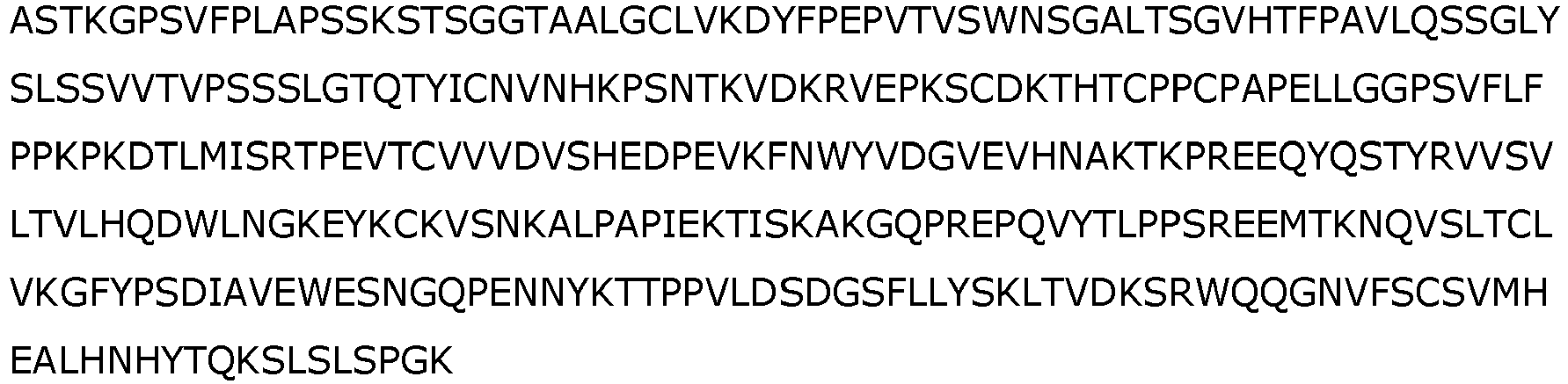
- e) IgG1- K409R N297Q (SEQ ID NO:241)

- f) IgG1- F405L LFLEDANQPS (SEQ ID NO:242)

- g) IgG1 - K409R LFLEDANQPS (SEQ ID NO:243)

- h) IgG1 Fc region - ITL (SEQ ID NO:244)


- i) IgG1 Fc region - K409R (SEQ ID NO:245)

- The antibody may be a bispecific antibody, comprising (i) a first Fab-arm comprising an Fc region and VH and VL sequences, which Fab-arm comprises the VH and optionally VL region sequences of (005), (025), (153) or (169), and which Fab-arm comprises an IgG1 wildtype Fc region, wherein the CH3 region contains a Leu at
position 405, and optionally Ile at position 350 and Thr at position 370, and (ii) a second Fab-arm having an Fc region and VH and VL sequences, which Fab-arm comprises the VH and VL region sequences of (005), (025), (153) or (169), and which Fab-arm comprises a IgG1 wildtype Fc region, wherein the CH3 region contains an Arg at position 409. Specific embodiments are disclosed in the Examples. - The VH and VL region sequences of (005) may be selected from the group consisting of:
- a) the VH CDR3 sequence of SEQ ID NO:168 (005),
- b) the VH CDR3 sequence of SEQ ID NO:168 and VL CDR3 sequence of SEQ ID NO:171 (005),
- c) the VH CDR1 sequence of SEQ ID NO:166, VH CDR2 sequence of SEQ ID NO:167, and VH CDR3 sequence of SEQ ID NO:168 (005),
- d) the VH CDR1 sequence of SEQ ID NO:64, VH CDR2 sequence of SEQ ID NO:65, VH CDR3 sequence of SEQ ID NO:168, VL CDR1 sequence of SEQ ID NO:170, VL CDR2 sequence of GAS, and VL CDR3 sequence of SEQ ID NO:171 (005), and
- e) VH region comprising SEQ ID NO:165 and VL region comprising SEQ ID NO:169 (005).
- The VH and VL region sequences of (025) may be selected from the group consisting of:
- a) the VH CDR3 sequence of SEQ ID NO:25 (025),
- b) the VH CDR3 sequence of SEQ ID NO:25 and VL CDR3 sequence of SEQ ID NO:28 (025),
- c) the VH CDR1 sequence of SEQ ID NO:23, VH CDR2 sequence of SEQ ID NO:24 and VH CDR3 sequence of SEQ ID NO:25 (025),
- d) the VH CDR1 sequence of SEQ ID NO:23, VH CDR2 sequence of SEQ ID NO:24, VH CDR3 sequence of SEQ ID NO:25, VL CDR1 sequence of SEQ ID NO: 27, VL CDR2 sequence of AAS, and VL CDR3 sequence of SEQ ID NO:28 (025), and
- e) the VH region comprising SEQ ID NO:22 and VL region comprising SEQ ID NO:26 (025).
- The VH and VL region sequences of (153) may be selected from the group consisting of:
- a) the VH CDR3 sequence of SEQ ID NO:66 (153),
- b) the VH CDR3 sequence of SEQ ID NO:66 and VL CDR3 sequence of SEQ ID NO:69 (153),
- c) the VH CDR1 sequence of SEQ ID NO:64, VH CDR2 sequence of SEQ ID NO:65 and VH CDR3 sequence of SEQ ID NO:66 (153),
- d) the VH CDR1 sequence of SEQ ID NO:64, VH CDR2 sequence of SEQ ID NO:65, VH CDR3 sequence of SEQ ID NO:66, VL CDR1 sequence of SEQ ID NO: 68, VL CDR2 sequence of DAS, and VL CDR3 sequence of SEQ ID NO:69 (153), and
- e) the VH region comprising SEQ ID NO:63 and VL region comprising SEQ ID NO:67 (153).
- The VH and VL region sequences of (169) may be selected from the group consisting of:
- a) the VH CDR3 sequence of SEQ ID NO:4 (169),
- b) the VH CDR3 sequence of SEQ ID NO:4, and VL CDR3 sequence of SEQ ID NO:7 (169),
- c) the VH CDR1 sequence of SEQ ID NO:2, VH CDR2 sequence of SEQ ID NO:3 and VH CDR3 sequence of SEQ ID NO:4 (169),
- d) the VH CDR1 sequence of SEQ ID NO:2, VH CDR2 sequence of SEQ ID NO:3, VH CDR3 sequence of SEQ ID NO:4, VL CDR1 sequence of SEQ ID NO: 6, VL CDR2 sequence of DAS, and VL CDR3 sequence of SEQ ID NO:7 (169), and
- e) the VH region comprising SEQ ID NO:1 and VL region comprising SEQ ID NO:5 (169).
- As shown in Example 34, the F405L mutation appears sufficient to engage human IgG1 in Fab-arm exchange under the indicated. Furthermore, as indicated in the Examples other combinations of mutations may also be suitable.
- The antibody may be a bispecific antibody, comprising (i) a first Fab-arm having an Fc region and VH and VL sequences, wherein the VH region comprises the amino acid sequence of SEQ ID NO:165, and the VL region comprises the amino acid sequence of SEQ ID NO:169 (005), optionally wherein the first Fab-arm comprises an IgG1,κ Fc region, wherein the CH3 region contains a Leu at
position 405, and optionally Ile at position 350 and a Thr at position 370; and (ii) a second Fab-arm having an Fc region and VH and VL sequences wherein the VH region comprises the amino acid sequence of SEQ ID NO:1 and the VL region comprises the amino acid sequence of SEQ ID NO:5 (169), optionally wherein the second Fab-arm comprises an IgG1,κ Fc region having an Arg at position 409. - The bispecific antibody may comprise (i) a first Fab-arm having an Fc region and VH and VL sequences, wherein the VH region comprises the amino acid sequence of SEQ ID NO:22, and the VL region comprises the amino acid sequence of SEQ ID NO:26 (025), optionally wherein the first Fab-arm comprises an IgG1,κ Fc region, wherein the CH3 region contains a Leu at
position 405, and optionally Ile at position 350 and a Thr at position 370; and (ii) a second Fab-arm having an Fc region and VH and VL sequences wherein the VH region comprises the amino acid sequence of SEQ ID NO:165 and the VL region comprises the amino acid sequence of SEQ ID NO:169 (005), optionally wherein the second Fab-arm comprises an IgG1,κ Fc region having an Arg at position 409. - The bispecific antibody may comprise (i) a first Fab-arm having an Fc region and VH and VL sequences, wherein the VH region comprises the amino acid sequence of SEQ ID NO:22, and the VL region comprises the amino acid sequence of SEQ ID NO:26 (025), optionally wherein the first Fab-arm comprises an IgG1,κ Fc region, wherein the CH3 region contains a Leu at
position 405, and optionally Ile at position 350 and a Thr at position 370; and (ii) a second Fab-arm having an Fc region and VH and VL sequences wherein the VH region comprises the amino acid sequence of SEQ ID NO:63 and the VL region comprises the amino acid sequence of SEQ ID NO:37 (153), optionally wherein the second Fab-arm comprises an IgG1,κ Fc region having an Arg at position 409. - The bispecific antibody may comprise (i) a first Fab-arm having an Fc region and VH and VL sequences, wherein the VH region comprises the amino acid sequence of SEQ ID NO:22, and the VL region comprises the amino acid sequence of SEQ ID NO:26 (025), optionally wherein the first Fab-arm comprises an IgG1,κ Fc region, wherein the CH3 region contains a Leu at
position 405, and optionally Ile at position 350 and a Thr at position 370; and (ii) a second Fab-arm having an Fc region and VH and VL sequences wherein the VH region comprises the amino acid sequence of SEQ ID NO:1 and the VL region comprises the amino acid sequence of SEQ ID NO:5 (169), optionally wherein the second Fab-arm comprises an IgG1,κ Fc region having an Arg at position 409. - The bispecific antibody comprises (i) a first Fab-arm having an Fc region and VH and VL sequences, wherein the VH region comprises the amino acid sequence of SEQ ID NO:63, and the VL region comprises the amino acid sequence of SEQ ID NO:67 (153), optionally wherein the first Fab-arm comprises an IgG1,κ Fc region, wherein the CH3 region contains a Leu at
position 405, and optionally Ile at position 350 and a Thr at position 370; and (ii) a second Fab-arm having an Fc region and VH and VL sequences wherein the VH region comprises the amino acid sequence of SEQ ID NO:165 and the VL region comprises the amino acid sequence of SEQ ID NO:169 (005), optionally wherein the second Fab-arm comprises an IgG1,κ Fc region having an Arg at position 409. - The bispecific antibody comprises (i) a first Fab-arm having an Fc region and VH and VL sequences, wherein the VH region comprises the amino acid sequence of SEQ ID NO:63, and the VL region comprises the amino acid sequence of SEQ ID NO:67 (153), optionally wherein the first Fab-arm comprises an IgG1,κ Fc region, wherein the CH3 region contains a Leu at
position 405, and optionally Ile at position 350 and a Thr at position 370; and (ii) a second Fab-arm having an Fc region and VH and VL sequences, wherein the VH region comprises the amino acid sequence of SEQ ID NO:1 and the VL region comprises the amino acid sequence of SEQ ID NO:5 (169), optionally wherein the second Fab-arm comprises an IgG1,κ Fc region having an Arg at position 409. - The first and/or second Fab-arm may further comprise CH1 and/or CL sequences.
- A bispecific antibody of the present disclosure may be selected from the group consisting of: IgG1-005-ITL x IgG1-169-K409R, IgG1-025-ITL x IgG1-005-K409R, IgG1-025-ITL x IgG1-153-K409R, IgG1-025-ITL x IgG1-169-K409R, IgG1-153-ITL x IgG1-005-K409R; and IgG1-153-ITL x IgG1-169-K409R, wherein IgG1-005-ITL means 005 IgG1,κ having Ile at position 350, Thr at position 370, and Leu at
position 405, IgG1-005-K409R means 005 IgG1,κ having an Arg at position 409, IgG1-025-ITL means 025 IgG1,κ having Ile at position 350, Thr at position 370, and Leu atposition 405, IgG1-153-ITL means 153 IgG1,κ having contains Ile at position 350, Thr at position 370, and Leu atposition 405, IgG1-153-K409R means 153 IgG1,κ having an Arg at position 409, IgG1-169-K409R means 169 IgG1,κ having an Arg at position 409, and wherein the bold numbers refer to antibodies described herein with the VH and VL regions comprising the sequences described in Table 1. - The present disclosure provides bispecific HER2xHER2 antibodies which efficiently bind to and optionally internalize into HER2-expressing tumor cells, typically without significantly promoting ligand-independent proliferation of the cells. Depending on the desired functional properties for a particular use, particular antigen-binding regions can be selected from the set of antibodies or antigen-binding regions provided by the present invention or from those antibodies or antigen-binding regions sharing, e.g., an epitope or cross-blocking region with the antibodies or antigen-binding regions provided by the present invention. Many different formats and uses of bispecific antibodies are known in the art, and were recently been reviewed by Chames and Baty (2009) Curr Opin Drug Disc Dev 12: 276.
- Exemplary bispecific antibody molecules of the disclosure comprise (i) a single antibody that has two arms comprising different antigen-binding regions, each one with a specificity to a HER2 epitope, (ii) a single antibody that has one antigen-binding region or arm specific to a first HER2 epitope and a second chain or arm specific to a second HER2 epitope, (iii) a single chain antibody that has specificity to a first HER2 epitope and a second HER2 epitope, e.g., via two scFvs linked in tandem by an extra peptide linker; (iv) a dual-variable-domain antibody (DVD-Ig), where each light chain and heavy chain contains two variable domains in tandem through a short peptide linkage (Wu et al., Generation and Characterization of a Dual Variable Domain Immunoglobulin (DVD-Ig™) Molecule, In: Antibody Engineering, Springer Berlin Heidelberg (2010)); (v) a chemically-linked bispecific (Fab')2 fragment; (vi) a Tandab, which is a fusion of two single chain diabodies resulting in a tetravalent bispecific antibody that has two binding sites for each of the target antigens; (vii) a flexibody, which is a combination of scFvs with a diabody resulting in a multivalent molecule; (viii) a so called "dock and lock" molecule, based on the "dimerization and docking domain" in Protein Kinase A, which, when applied to Fabs, can yield a trivalent bispecific binding protein consisting of two identical Fab fragments linked to a different Fab fragment; (ix) a so-called Scorpion molecule, comprising, e.g., two scFvs fused to both termini of a human Fab-arm; and (x) a diabody.
- The bispecific antibody may be a diabody, a cross-body, or a bispecific antibody obtained via a controlled Fab arm exchange as those described in the present invention.
- Examples of different classes of bispecific antibodies include but are not limited to
- IgG-like molecules with complementary CH3 domains to force heterodimerisation
- recombinant IgG-like dual targeting molecules, wherein the two sides of the molecule each contain the Fab fragment or part of the Fab fragment of at least two different antibodies;
- IgG fusion molecules, wherein full length IgG antibodies are fused to extra Fab fragment or parts of Fab fragment;
- Fc fusion molecules, wherein single chain Fv molecules or stabilized diabodies are fused to heavy-chain constant-domains, Fc-regions or parts thereof;
- Fab fusion molecules, wherein different Fab-fragments are fused together;
- ScFv-and diabody-based and heavy chain antibodies (e.g., domain antibodies, nanobodies) wherein different single chain Fv molecules or different diabodies or different heavy-chain antibodies (e.g. domain antibodies, nanobodies) are fused to each other or to another protein or carrier molecule.
- Examples of IgG-like molecules with complementary CH3 domains molecules include but are not limited to the Triomab/Quadroma (Trion Pharma/Fresenius Biotech), the Knobsinto-Holes (Genentech), CrossMAbs (Roche) and the electrostatically-matched (Amgen), the LUZ-Y (Genentech), the Strand Exchange Engineered Domain body (SEEDbody)(EMD Serono), the Biclonic (Merus) and the DuoBody (Genmab A/S).
- Examples of recombinant IgG-like dual targeting molecules include but are not limited to Dual Targeting (DT)-Ig (GSK/Domantis), Two-in-one Antibody (Genentech), Cross-linked Mabs (Karmanos Cancer Center), mAb2 (F-Star) and CovX-body (CovX/Pfizer).
- Examples of IgG fusion molecules include but are not limited to Dual Variable Domain (DVD)-Ig (Abbott), IgG-like Bispecific (ImClone/Eli Lilly), Ts2Ab (MedImmune/AZ) and BsAb (Zymogenetics), HERCULES (Biogen Idec) and TvAb (Roche).
- Examples of Fc fusion molecules include but are not limited to ScFv/Fc Fusions (Academic Institution), SCORPION (Emergent BioSolutions/Trubion, Zymogenetics/BMS), Dual Affinity Retargeting Technology (Fc-DART) (MacroGenics) and Dual(ScFv)2-Fab (National Research Center for Antibody Medicine - China).
- Examples of Fab fusion bispecific antibodies include but are not limited to F(ab)2 (Medarex/AMGEN), Dual-Action or Bis-Fab (Genentech), Dock-and-Lock (DNL) (ImmunoMedics), Bivalent Bispecific (Biotecnol) and Fab-Fv (UCB-Celltech). Examples of ScFv-, diabody-based and domain antibodies include but are not limited to Bispecific T Cell Engager (BiTE) (Micromet, Tandem Diabody (Tandab) (Affimed), Dual Affinity Retargeting Technology (DART) (MacroGenics), Single-chain Diabody (Academic), TCR-like Antibodies (AIT, ReceptorLogics), Human Serum Albumin ScFv Fusion (Merrimack) and COMBODY (Epigen Biotech), dual targeting nanobodies (Ablynx), dual targeting heavy chain only domain antibodies.
- Methods of preparing bispecific antibodies of the present disclosure include those described in
WO 2008119353 (Genmab ),WO 2011131746 (Genmab ) and reported by van der Neut-Kolfschoten et al. (Science. 2007 ). Examples of other platforms useful for preparing bispecific antibodies include but are not limited to BiTE (Micromet), DART (MacroGenics), Fcab and Mab2 (F-star) , Fc-engineered IgG1 (Xencor) or DuoBody (based on Fab arm exchange, Genmab, this application, described below and in, e.g., Example 20). - Traditional methods such as the hybrid hybridoma and chemical conjugation methods (Marvin and Zhu (2005) Acta Pharmacol Sin 26:649) can also be used. Co-expression in a host cell of two antibodies, consisting of different heavy and light chains, leads to a mixture of possible antibody products in addition to the desired bispecific antibody, which can then be isolated by, e.g., affinity chromatography or similar methods.
- Strategies favoring the formation of a functional bispecific, product, upon co-expression of different antibody constructs can also be used, e.g., the method described by Lindhofer et al. (1995 J Immunol 155:219). Fusion of rat and mouse hydridomas producing different antibodies leads to a limited number of heterodimeric proteins because of preferential species-restricted heavy/light chain pairing. Another strategy to promote formation of heterodimers over homodimers is a "knob-into-hole" strategy in which a protuberance is introduced on a first heavy-chain polypeptide and a corresponding cavity in a second heavy-chain polypeptide, such that the protuberance can be positioned in the cavity at the interface of these two heavy chains so as to promote heterodimer formation and hinder homodimer formation. "Protuberances" are constructed by replacing small amino-acid side-chains from the interface of the first polypeptide with larger side chains. Compensatory "cavities" of identical or similar size to the protuberances are created in the interface of the second polypeptide by replacing large amino-acid side-chains with smaller ones (
US patent 5,731,168 ).EP1870459 (Chugai ) andWO 2009089004 (Amgen ) describe other strategies for favoring heterodimer formation upon co-expression of different antibody domains in a host cell. In these methods, one or more residues that make up the CH3-CH3 interface in both CH3 domains are replaced with a charged amino acid such that homodimer formation is electrostatically unfavorable and heterodimerization is electrostatically favorable.WO2007110205 (Merck ) describe yet another strategy, wherein differences between IgA and IgG CH3 domains are exploited to promote heterodimerization. - Another in vitro method for producing bispecific antibodies has been described in
WO 2008119353 (Genmab ) andWO 2011131746 (Genmab ), wherein a bispecific antibody is formed by "Fab-arm" or "half-molecule" exchange (swapping of a heavy chain and attached light chain) between two monospecific IgG4- or IgG4-like antibodies upon incubation under reducing conditions. The resulting product is a bispecific antibody having two Fab arms which may comprise different sequences. - A preferred method for preparing bispecific HER2xHER2 antibodies of the present disclosure includes the method described in
WO 2011131746 (Genmab ) comprising the following steps: - a) providing a first HER2 antibody comprising a first Fc region , said Fc region comprising a first CH3 region,
- b) providing a second HER2 antibody comprising a second Fc region , said Fc region comprising a second CH3 region,
wherein the sequences of said first and second CH3 regions are different and are such that the heterodimeric interaction between said first and second CH3 regions is stronger than each of the homodimeric interactions of said first and second CH3 regions, - c) incubating said first antibody together with said second antibody under reducing conditions, and
- d) obtaining said bispecific HER2xHER2 antibody.
- The first and/or secon Fc region may be of an immunoglobulin.
- Without being limited to theory, in step c), the heavy-chain disulfide bonds in the hinge regions of the parent antibodies are reduced and the resulting cysteines are then able to form inter heavy-chain disulfide bond with cysteine residues of another parent parent antibody molecule (originally with a different specificity). The reducing conditions in step c) may comprise the addition of a reducing agent, e.g. a reducing agent selected from the group consisting of: 2-mercaptoethylamine (2-MEA), dithiothreitol (DTT), dithioerythritol (DTE), glutathione, tris(2-carboxyethyl)phosphine (TCEP), L-cysteine and beta-mercaptoethanol, preferably a reducing agent selected from the group consisting of: 2-mercaptoethylamine, dithiothreitol and tris(2-carboxyethyl)phosphine. Step c) may comprises restoring the conditions to become non-reducing or less reducing, for example by removal of a reducing agent, e.g. by desalting.
- Typically, in this method, the first and second antibodies are a first and second HER2 antibody binding to different epitopes of HER2 and/or comprising different antigen-binding sequences. Said first and/or second homodimeric proteins may be full-length antibodies. For this method any of the first and second HER2 antibodies described above may used, including first and second HER2 antibodies comprising a first and/or second Fc regions. Examples of such first and second Fc regions, including combinations of such first and second Fc regions may include any of those described above. The first and second HER2 antibodies may be chosen so as to obtain a bispecific antibody as described herein.
- Typically, in this method, the first and second antibodies are a first and second HER2 antibody binding to different epitopes of HER2 and/or comprising different antigen-binding sequences. Said first and/or second homodimeric proteins may be full-length antibodies.
- The Fc regions of both said first and said second antibodies may be of the IgG1 isotype. One of the Fc regions of said antibodies is of the IgG1 isotype and the other of the IgG4 isotype. The resulting bispecific antibody may comprise an Fc region of an IgG1 and an Fc region of IgG4 and may thus have interesting intermediate properties with respect to activation of effector functions. A similar product can be obtained if said first and/or said second antibody comprises a mutation removing the acceptor site for Asn-linked glycosylation or is otherwise manipulated to change the glycosylation properties.
- One or both of the antibodies may be glyco-engineered to reduce fucose and thus enhance ADCC, e.g. by addition of compounds to the culture media during antibody production as described in
US2009317869 or as described in van Berkel et al. (2010) Biotechnol. Bioeng. 105:350 or by using FUT8 knockout cells, e.g. as described in Yamane-Ohnuki et al (2004) Biotechnol. Bioeng 87:614. ADCC may alternatively be optimized using the method described by Umaña et al. (1999) Nature Biotech 17:176. One or both of the antibodies may have been engineered to enhance complement activation, e.g. as described in Natsume et al. (2009) Cancer Sci. 100:2411. - One or both of the antibodies may have been engineered to reduce or increase the binding to the neonatal Fc receptor (FcRn) in order to manipulate the serum half-life of the heterodimeric protein. One of the antibody starting proteins may have been engineered to not bind Protein A, thus allowing to separate the heterodimeric protein from said homodimeric starting protein by passing the product over a protein A column.
- The antibody or a part thereof, e.g. one or more CDRs, may be of a species in the family Camelidae, see
WO2010001251 , or a species of cartilaginous fish, such as the nurse shark, or may be a heavy-chain or domain antibody. - The first and/or second HER2 antibody may be conjugated to a drug, a prodrug or a toxin or contains an acceptor group for the same. Such acceptor group may e.g. be an unnatural amino acid.
- As described above, the sequences of the first and second CH3 regions of the starting HER2 antibodies are different and are such that the heterodimeric interaction between said first and second CH3 regions is stronger than each of the homodimeric interactions of said first and second CH3 regions
WO 2011131746 (Genmab ). More details on these interactions and how they can be achieved are provided inPCT/EP2011/056388 - In particular, a stable bispecific HER2xHER2 molecule can be obtained at high yield using the above method of the invention on the basis of two homodimeric starting HER2 antibodies containing only a few, fairly conservative, asymmetrical mutations in the CH3 regions. Asymmetrical mutations mean that the sequences of said first and second CH3 regions contain amino acid substitutions at non-identical positions.
- The first HER2 antibody may have an amino acid substitution at a position selected from the group consisting of: 366, 368, 370, 399, 405, 407 and 409, and the second HER2 antibody may have an amino acid substitution at a position selected from the group consisting of: 366, 368, 370, 399, 405, 407 and 409, and wherein the first and second HER2 antibodies are not substituted in the same positions.
- The first HER2 antibody my have an amino acid substitution at position 366, and said second HER2 antibody may have an amino acid substitution at a position selected from the group consisting of: 368, 370, 399, 405, 407 and 409. The amino acid at position 366 may be selected from Ala, Asp, Glu, His, Asn, Val, or Gln.
- The first HER2 antibody protein may have an amino acid substitution at position 368, and said second HER2 antibody may have an amino acid substitution at a position selected from the group consisting of: 366, 370, 399, 405, 407 and 409.
- The first HER2 antibody may have an amino acid substitution at position 370, and said second HER2 antibody may have an amino acid substitution at a position selected from the group consisting of: 366, 368, 399, 405, 407 and 409.
- The first HER2 antibody may have an amino acid substitution at position 399, and said second HER2 antibody may have an amino acid substitution at a position selected from the group consisting of: 366, 368, 370, 405, 407 and 409.
- The first HER2 antibody may ahve an amino acid substitution at
position 405, and said second HER2 antibody may have an amino acid substitution at a position selected from the group consisting of: 366, 368, 370, 399, 407 and 409. - The first HER2 antibody may have an amino acid substitution at position 407, and said second HER2 antibody may have an amino acid substitution at a position selected from the group consisting of: 366, 368, 370, 399, 405, and 409.
- The first HER2 antibody may have an amino acid substitution at position 409, and said second HER2 antibody may have an amino acid substitution at a position selected from the group consisting of: 366, 368, 370, 399, 405, and 407.
- Accordingly, the sequences of said first and second CH3 regions may contain asymmetrical mutations, i.e. mutations at different positions in the two CH3 regions, e.g. a mutation at
position 405 in one of the CH3 regions and a mutation at position 409 in the other CH3 region. - The first HER2 antibody may have an amino acid other than Lys, Leu or Met at position 409, and said second HER2 antibody may have an amino-acid substitution at a position selected from the group consisting of: 366, 368, 370, 399, 405 and 407. In one such embodiment, said first HER2 antibody may have an amino acid other than Lys, Leu or Met at position 409, and said second HER2 antibody may have an amino acid other than Phe at
position 405. In a further embodiment hereof, said first HER2 antibody may have an amino acid other than Lys, Leu or Met at position 409, and said second HER2 antibody may have an amino acid other than Phe, Arg or Gly atposition 405. - Said first HER2 antibody may comprises a Phe at
position 405 and an amino acid other than Lys, Leu or Met at position 409 and said second HER2 antibody may comprise an amino acid other than Phe atposition 405 and a Lys at position 409. Said first HER2 antibody may comprise a Phe atposition 405 and an amino acid other than Lys, Leu or Met at position 409 and said second HER2 antibody may comprise an amino acid other than Phe, Arg or Gly atposition 405 and a Lys at position 409. - Said first HER2 antibody may comprise a Phe at
position 405 and an amino acid other than Lys, Leu or Met at position 409 and said second HER2 antibody may comprise a Leu atposition 405 and a Lys at position 409. Said first HER2 antibody may comprise a Phe atposition 405 and an Arg at position 409 and said second HER2 antibody comprises an amino acid other than Phe, Arg or Gly atposition 405 and a Lys at position 409. Said first HER2 antibody comprises Phe atposition 405 and an Arg at position 409 and said second HER2 antibody may comprise a Leu atposition 405 and a Lys at position 409. - Said first HER2 antibody may comprise an amino acid other than Lys, Leu or Met at position 409 and said second homodimeric protein comprises a Lys at position 409, a Thr at position 370 and a Leu at
position 405. Said first homodimeric protein may comprise an Arg at position 409 and said second homodimeric protein comprises a Lys at position 409, a Thr at position 370 and a Leu atposition 405. - Said first HER2 antibody may comprise a Lys at position 370, a Phe at
position 405 and an Arg at position 409 and said second HER2 antibody may comprise a Lys at position 409, a Thr at position 370 and a Leu atposition 405. - Said first HER2 antibody may comprise an amino acid other than Lys, Leu or Met at position 409 and said second HER2 antibody may comprise a Lys at position 409 and: a) an Ile at position 350 and a Leu at
position 405, or b) a Thr at position 370 and a Leu atposition 405. - Said first HER2 antibody may comprise an Arg at position 409 and said second HER2 antibody may comprise a Lys at position 409 and: a) an Ile at position 350 and a Leu at
position 405, or b) a Thr at position 370 and a Leu atposition 405. - Said first HER2 antibody may comprise a Thr at position 350, a Lys at position 370, a Phe at
position 405 and an Arg at position 409 and said second HER2 antibody may comprise a Lys at position 409 and: a) an Ile at position 350 and a Leu atposition 405, or b) a Thr at position 370 and a Leu atposition 405. - Said first HER2 antibody may comprise a Thr at position 350, a Lys at position 370, a Phe at
position 405 and an Arg at position 409 and said second may comprise an Ile at position 350, a Thr at position 370, a Leu atposition 405 and a Lys at position 409. - Said first HER2 antibody may have an amino acid other than Lys, Leu or Met at position 409 and said second HER2 antibody may have an amino acid other than Tyr, Asp, Glu, Phe, Lys, Gln, Arg, Ser or Thr at position 407. Said first HER2 antibody may have an amino acid other than Lys, Leu or Met at position 409 and said second HER2 antibody may have an Ala, Gly, His, Ile, Leu, Met, Asn, Val or Trp at position 407.
- Said first HER2 antibody may have an amino acid other than Lys, Leu or Met at position 409 and said second HER2 antibody may have a Gly, Leu, Met, Asn or Trp at position 407.
- Said first HER2 antibody may have a Tyr at position 407 and an amino acid other than Lys, Leu or Met at position 409 and said second HER2 antibody may have an amino acid other than Tyr, Asp, Glu, Phe, Lys, Gln, Arg, Ser or Thr at position 407 and a Lys at position 409.
- Said first HER2 antibody may have a Tyr at position 407 and an amino acid other than Lys, Leu or Met at position 409 and said second HER2 antibody may have an Ala, Gly, His, Ile, Leu, Met, Asn, Val or Trp at position 407 and a Lys at position 409.
- Said first HER2 antibody may have a Tyr at position 407 and an amino acid other than Lys, Leu or Met at position 409 and said second HER2 antibody may have a Gly, Leu, Met, Asn or Trp at position 407 and a Lys at position 409.
- Said first HER2 antibody may have a Tyr at position 407 and an Arg at position 409 and said second HER2 antibody may have an amino acid other than Tyr, Asp, Glu, Phe, Lys, Gln, Arg, Ser or Thr at position 407 and a Lys at position 409.
- Said first HER2 antibody may havea Tyr at position 407 and an Arg at position 409 and said second HER2 antibody may have an Ala, Gly, His, Ile, Leu, Met, Asn, Val or Trp at position 407 and a Lys at position 409.
- Said first HER2 antibody may have a Tyr at position 407 and an Arg at position 409 and said second HER2 antibody may have a Gly, Leu, Met, Asn or Trp at position 407 and a Lys at position 409.
- The first HER2 antibody may have an amino acid other than Lys, Leu or Met at position 409, and the second HER2 antibody may have
- (i) an amino acid other than Phe, Leu and Met at position 368, or
- (ii) a Trp at position 370, or
- (iii) an amino acid other than Asp, Cys, Pro, Glu or Gln at position 399, or
- (iv) an amino acid other than Lys, Arg, Ser, Thr, or Trp at position 366, e.g. Leu, Met, His, Asp, Glu, Asn, Glu, Gly, Pro, Ala, Val, Ile, Phe, Tyr or Cys.
- The first HER2 antibody may have an Arg, Ala, His or Gly at position 409, and the second homodimeric protein may have
- (i) a Lys, Gln, Ala, Asp, Glu, Gly, His, Ile, Asn, Arg, Ser, Thr, Val, or Trp at position 368, or
- (ii) a Trp at position 370, or
- (iii) an Ala, Gly, Ile, Leu, Met, Asn, Ser, Thr, Trp, Phe, His, Lys, Arg or Tyr at position 399, or
- (iv) an Ala, Asp, Glu, His, Asn, Val, Gln, Phe, Gly, Ile, Leu, Met, or Tyr at position 366.
- The first HER2 antibody may have an Arg at position 409, and the second homodimeric protein may have
- (i) an Asp, Glu, Gly, Asn, Arg, Ser, Thr, Val, or Trp at position 368, or
- (ii) a Trp at position 370, or
- (iii) a Phe, His, Lys, Arg or Tyr at position 399, or
- (iv) an Ala, Asp, Glu, His, Asn, Val, Gln at position 366.
- Other specific combinations include any of those described in the section relating to the Fc regions.
- In addition to the above-specified amino-acid substitutions, said first and second homodimeric protein may contain further amino-acid substitutions, deletion or insertions relative to wild-type Fc sequences.
- Said first and second CH3 regions may, except for the specified mutations, comprise the sequences of IgG1m(a) (SEQ ID NO:236), IgG1m(f) (SEQ ID NO:237), or IgG1m(ax) (SEQ ID NO:238)
- Thus, neither said first nor said second HER2 antibody may be one that comprises a Cys-Pro-Ser-Cys sequence in the (core) hinge region.
- Both said first and said second HER2 antibody may comprise a Cys-Pro-Pro-Cys sequence in the (core) hinge region.
- The bispecific antibodies of the disclosure may also be obtained by co-expression of constructs encoding a first and second polypeptide in a single cell. Thus,the disclosure further relates to a method for producing a bispecific antibody, said method comprising the following steps:
- a) providing a first nucleic-acid construct encoding a first polypeptide comprising a first Fc region of an immunoglobulin and a first antigen-binding region, said first Fc region comprising a first CH3 region,
- b) providing a second nucleic-acid construct encoding a second polypeptide comprising a second Fc region and a second antigen-binding region, said second Fc region comprising a second CH3 region,
- wherein the sequences of said first and second CH3 regions are different and are such that the heterodimeric interaction between said first and second CH3 regions is stronger than each of the homodimeric interactions of said first and second CH3 regions, and
- wherein said first homodimeric protein has an amino acid other than Lys, Leu or Met at position 409 and said second homodimeric protein has an amino acid substitution at a position selected from the group consisting of: 366, 368, 370, 399, 405 and 407,
- optionally wherein said first and second nucleic acid constructs encode light chain sequences of said first and second HER2 antibodies
- c) co-expressing said first and second nucleic-acid constructs in a host cell, and
- d) obtaining said heterodimeric protein from the cell culture.
- The first antigen-binding region may be from a first HER2 antibody of the present invention.
- The second antigen-binding region may be from a second HER2 antibody of the present invention.
- Suitable expression vectors, including promoters, enhancers, etc., and suitable host cells for the production of antibodies are well-known in the art. Examples of host cells include yeast, bacterial and mammalian cells, such as CHO or HEK cells.
- Said first CH3 region may have an amino acid other than Lys, Leu or Met at position 409 and said second CH3 region may have an amino acid other than Phe at
position 405. - Said first CH3 region may have an amino acid other than Lys, Leu or Met at position 409 and said second CH3 region may have an amino acid other than Phe at
position 405, such as other than Phe, Arg or Gly atposition 405; or said first CH3 region may have an amino acid other than Lys, Leu or Met at position 409 and said second CH3 region may have an amino acid other than Tyr, Asp, Glu, Phe, Lys, Gln, Arg, Ser or Thr at position 407. - Said first and second polypeptides may be full-length heavy chains of two antibodies that bind different epitopes (i.e. said first and second nucleic-acid constructs encode full-length heavy chains of two antibodies that bind different epitopes), and thus the heterodimeric protein may be a bispecific antibody. This bispecific antibody can be a heavy-chain antibody, or said host cell may further express one or more nucleic-acid constructs encoding a light-chain. If only one light-chain construct is co-expressed with the heavy chain constructs, then a functional bispecific antibody is only formed if the light chain sequence is such that it can form a functional antigen-binding domain with each of the heavy chains. If two or more different light-chain constructs are co-expressed with the heavy chain, multiple products will be formed.
- The co-expression method according to the disclosure may comprise any of the further features described under the in vitro method above.
- The disclosure further relates to an expression vector comprising the first and second nucleic-acid constructs specified herein above. The expression vector may further comprise a nucleotide sequence encoding the constant region of a light chain, a heavy chain or both light and heavy chains of an antibody, e.g. a human antibody.
- An expression vector in the context of the present disclosure may be any suitable vector, including chromosomal, non-chromosomal, and synthetic nucleic acid vectors (a nucleic acid sequence comprising a suitable set of expression control elements). Examples of such vectors include derivatives of SV40, bacterial plasmids, phage DNA, baculovirus, yeast plasmids, vectors derived from combinations of plasmids and phage DNA, and viral nucleic acid (RNA or DNA) vectors. A HER2 antibody-encoding nucleic acid may be comprised in a naked DNA or RNA vector, including, for example, a linear expression element (as described in for instance Sykes and Johnston, Nat Biotech 17, 355-59 (1997)), a compacted nucleic acid vector (as described in for instance
US 6,077 ,835 and/orWO 00/70087 WO 00/46147 US 5,589,466 andUS 5,973,972 ). - Exemplary expression vectors for the antibodies of the disclosure are also described in Examples 2 and 3.
- The vector may be one that is suitable for expression of the HER2 antibody in a bacterial cell. Examples of such vectors include expression vectors such as BlueScript (Stratagene), pIN vectors (Van Heeke & Schuster, J Biol Chem 264, 5503-5509 (1989), pET vectors (Novagen, Madison WI) and the like).
- An expression vector may also or alternatively be a vector suitable for expression in a yeast system. Any vector suitable for expression in a yeast system may be employed. Suitable vectors include, for example, vectors comprising constitutive or inducible promoters such as alpha factor, alcohol oxidase and PGH (reviewed in: F. Ausubel et al., ed. Current Protocols in Molecular Biology, Greene Publishing and Wiley InterScience New York (1987), and Grant et al., Methods in )).
- An expression vector may also or alternatively be a vector suitable for expression in mammalian cells, e.g. a vector comprising glutamine synthetase as a selectable marker, such as the vectors described in Bebbington (1992) Biotechnology (NY) 10:169-175.
- A nucleic acid and/or vector may also comprises a nucleic acid sequence encoding a secretion/localization sequence, which can target a polypeptide, such as a nascent polypeptide chain, to the periplasmic space or into cell culture media. Such sequences are known in the art, and include secretion leader or signal peptides.
- The expression vector may comprise or be associated with any suitable promoter, enhancer, and other expression-facilitating elements. Examples of such elements include strong expression promoters (e. g., human CMV IE promoter/enhancer as well as RSV, SV40, SL3-3, MMTV, and HIV LTR promoters), effective poly (A) termination sequences, an origin of replication for plasmid product in E. coli, an antibiotic resistance gene as selectable marker, and/or a convenient cloning site (e.g., a polylinker). Nucleic acids may also comprise an inducible promoter as opposed to a constitutive promoter such as CMV IE.
- The HER2 antibody-encoding expression vector may be positioned in and/or delivered to the host cell or host animal via a viral vector.
- The disclosure further relates to a host cell comprising the first and second nucleic-acid constructs specified herein above.
- Thus the present disclosure also relates to a recombinant eukaryotic or prokaryotic host cell which produces a bispecific antibody of the present invention, such as a transfectoma. Examples of host cells include yeast, bacterial, and mammalian cells, such as CHO or HEK cells. For example, the host cell may comprise a first and second nucleic acid construct stably integrated into the cellular genome. The present disclosure provides a cell comprising a non-integrated nucleic acid, such as a plasmid, cosmid, phagemid, or linear expression element, which comprises a first and second nucleic acid construct as specified above.
- The disclosure further relates to a transgenic non-human animal or plant comprising nucleic acids encoding one or two sets of a human heavy chain and a human light chain, wherein the animal or plant produces an bispecific antibody of the invention of the invention.
- The present disclosure also relates to a method for producing a bispecific antibody of the present disclosure, said method comprising the steps of
- a) culturing a host cell of the present invention, and
- b) purifying the bispecific antibody from the culture media.
- Furthermore, the present disclosure also relates to a bispecific antibody obtainable by a method of the present invention.
- Monoclonal antibodies, such as the first and second HER2 antibodies, for use according to the present disclosure, for example to provide an antigen-binding region sharing an epitope or cross-blocking region with an antibody of
cross-block groups - The antibody may be a human antibody. Human monoclonal antibodies directed against HER2 may be generated using transgenic or transchromosomal mice carrying parts of the human immune system rather than the mouse system. Such transgenic and transchromosomic mice include mice referred to herein as HuMAb® mice and KM mice, respectively, and are collectively referred to herein as "transgenic mice".
- The HuMAb® mouse contains a human immunoglobulin gene miniloci that encodes unrearranged human heavy (µ and γ) and κ light chain immunoglobulin sequences, together with targeted mutations that inactivate the endogenous µ and κ chain loci (Lonberg, N. et al., Nature 368, 856-859 (1994)). Accordingly, the mice exhibit reduced expression of mouse IgM or κ and in response to immunization, the introduced human heavy and light chain transgenes, undergo class switching and somatic mutation to generate high affinity human IgG,κ monoclonal antibodies (Lonberg, N. et al. (1994), supra; reviewed in Lonberg, N. Handbook of Experimental Pharmacology 113, 49-101 (1994) , Lonberg, N. and Huszar, D., Intern. Rev. Immunol. Vol. 13 65-93 (1995) and Harding, F. and Lonberg, N. Ann. N.Y. Acad. Sci 764 536-546 (1995)). The preparation of HuMAb® mice is described in detail in Taylor, L. et al., ), Chen, J. et al., ), Tuaillon et al., J. Immunol. 152, 2912-2920 (1994), Taylor, L. et al., ), Fishwild, D. et al., ). See also
US 5,545,806 ,US 5,569,825 ,US 5,625,126 ,US 5,633,425 ,US 5,789,650 ,US 5,877,397 ,US 5,661,016 ,US 5,814,318 ,US 5,874,299 ,US 5,770,429 ,US 5,545,807 ,WO 98/24884 WO 94/25585 WO 93/1227 WO 92/22645 WO 92/03918 WO 01/09187 - The HCo7, HCo12, HCo17 and HCo20 mice have a JKD disruption in their endogenous light chain (kappa) genes (as described in Chen et al., EMBO J. 12, 821-830 (1993)), a CMD disruption in their endogenous heavy chain genes (as described in Example 1 of
WO 01/14424 US 5,770,429 ), the HCo12 mice have a HCo12 human heavy chain transgene (as described in Example 2 ofWO 01/14424 WO 01/09187 - In the KM mouse strain, the endogenous mouse kappa light chain gene has been homozygously disrupted as described in Chen et al., EMBO J. 12, 811-820 (1993) and the endogenous mouse heavy chain gene has been homozygously disrupted as described in Example 1 of
WO 01/09187 chromosome 14 fragment hCF (SC20) as described inWO 02/43478 WO/2009/097006 . - Splenocytes from these transgenic mice may be used to generate hybridomas that secrete human monoclonal antibodies according to well known techniques.
- Further, HER2 antigen-binding regions may be obtained from human antibodies or antibodies from other species identified through display-type technologies, including, without limitation, phage display, retroviral display, ribosomal display, and other techniques, using techniques well known in the art and the resulting molecules may be subjected to additional maturation, such as affinity maturation, as such techniques are well known in the art (see for instance Hoogenboom et al., J. Mol. Biol. 227, 381 (1991) (phage display), Vaughan et al., ) (phage display), Hanes and Plucthau, PNAS USA 94, 4937-4942 (1997) (ribosomal display), Parmley and Smith, Gene 73, 305-318 (1988) (phage display), Scott TIBS 17, 241-245 (1992), Cwirla et al., PNAS USA 87, 6378-6382 (1990), Russel et al., Nucl. ), Hogenboom et al., Immunol. Reviews 130, 43-68 (1992), Chiswell and ), and
US 5,733,743 ). If display technologies are utilized to produce antibodies that are not human, such antibodies may be humanized. - The bispecific antibody can be of any isotype. The choice of isotype typically will be guided by the desired effector functions, such as ADCC induction. Exemplary isotypes are IgG1, IgG2, IgG3, and IgG4. Either of the human light chain constant regions, kappa or lambda, may be used. The effector function of the antibodies of the present invention may be changed by isotype switching to, e.g., an IgG1, IgG2, IgG3, IgG4, IgD, IgA, IgE, or IgM antibody for various therapeutic uses. Both Fc-regions of an antibody of the present invention may be of the IgG1 isotype, for instance an IgG1,κ. The two Fc-regions of a bispecific antibody may be of the IgG1 and IgG4 isotypes, respectively. Optionally, the Fc-region may be modified in the hinge and/or CH3 region as described elsewhere herein.
- The bispecific antibody may be a full-length antibody, preferably an IgG1 antibody, in particular an IgG1,κ antibody or a variant thereof. The bispecific antibody may comprise an antibody fragment or a single-chain antibody. Antibody fragments may e.g. be obtained by fragmentation using conventional techniques, and the fragments screened for utility in the same manner as described herein for whole antibodies. For example, F(ab')2 fragments may be generated by treating an antibody with pepsin. The resulting F(ab')2 fragment may be treated to reduce disulfide bridges with a reducing agent, such as dithiothreitol, to produce Fab' fragments. Fab fragments may be obtained by treating an antibody with papain. A F(ab')2 fragment may also be produced by binding Fab' fragments via a thioether bond or a disulfide bond. Antibody fragments may also be generated by expression of nucleic acids encoding such fragments in recombinant cells (see for instance Evans et al., J. Immunol. Meth. 184, 123-38 (1995)). For example, a chimeric gene encoding a portion of an F(ab')2 fragment could include DNA sequences encoding the
C H1 domain and hinge region of the H chain, followed by a translational stop codon to yield such a truncated antibody fragment molecule. - Bispecific HER2xHER2 antibodies may also be prepared from single chain antibodies. Single chain antibodies are peptides in which the heavy and light chain Fv regions are connected. The bispecific antibody may comprise a single-chain Fv (scFv) wherein the heavy and light chains in the Fv of a HER2 antibody of the present invention are joined with a flexible peptide linker (typically of about 10, 12, 15 or more amino acid residues) in a single peptide chain. Methods of producing such antibodies are described in for instance
US 4,946,778 , Pluckthun in The Pharmacology of Monoclonal Antibodies, vol. 113, Rosenburg and Moore eds. Springer-Verlag, New York, pp. 269-315 (1994), Bird et al., Science 242, 423-426 (1988), Huston et al., PNAS USA 85, 5879-5883 (1988) and McCafferty et al., Nature 348, 552-554 (1990). A bispecific antibody can then be formed from two VH and VL from different single-chain HER2 antibodies, or a polyvalent antibody formed from more than two VH and VL chains. - One or both Fc-regions of the bispecific HER2xHER2 antibody of the disclosure may be effector-function-deficient. The effector-function-deficient HER2 antibody may be a human stabilized IgG4 antibody, which has been modified to prevent Fab-arm exchange (van der Neut Kolfschoten et al. (2007) Science 317(5844):1554-7). Examples of suitable human stabilized IgG4 antibodies are antibodies, wherein arginine at position 409 in a heavy chain constant region of human IgG4, which is indicated in the EU index as in Kabat et al., is substituted with lysine, threonine, methionine, or leucine, preferably lysine (described in
WO2006033386 (Kirin )) and/or wherein the hinge region has been modified to comprise a Cys-Pro-Pro-Cys sequence. - The stabilized IgG4 HER2 antibody may be an IgG4 antibody comprising a heavy chain and a light chain, wherein said heavy chain comprises a human IgG4 constant region having a residue selected from the group consisting of: Lys, Ala, Thr, Met and Leu at the position corresponding to 409 and/or a residue selected from the group consisting of: Ala, Val, Gly, Ile and Leu at the position corresponding to 405, and wherein said antibody optionally comprises one or more further substitutions, deletions and/or insertions, but does not comprise a Cys-Pro-Pro-Cys sequence in the hinge region. Preferably, said antibody comprises a Lys or Ala residue at the position corresponding to 409 or the CH3 region of the antibody has been replaced by the CH3 region of human IgG1, of human IgG2 or of human IgG3. See also
WO2008145142 (Genmab ) andWO 2011131746 (Genmab ). - Even further, the stabilized IgG4 HER2 antibody may be an IgG4 antibody comprising a heavy chain and a light chain, wherein said heavy chain comprises a human IgG4 constant region having a residue selected from the group consisting of: Lys, Ala, Thr, Met and Leu at the position corresponding to 409 and/or a residue selected from the group consisting of: Ala, Val, Gly, Ile and Leu at the position corresponding to 405, and wherein said antibody optionally comprises one or more further substitutions, deletions and/or insertions and wherein said antibody comprises a Cys-Pro-Pro-Cys sequence in the hinge region. Preferably, said antibody comprises a Lys or Ala residue at the position corresponding to 409 or the CH3 region of the antibody has been replaced by the CH3 region of human IgG1, of human IgG2 or of human IgG3.
- The effector-function-deficient HER2 antibody may be an antibody of a non-IgG4 type, e.g. IgG1, IgG2 or IgG3 which has been mutated such that the ability to mediate effector functions, such as ADCC, has been reduced or even eliminated. Such mutations have e.g. been described in Dall'Acqua WF et al., J Immunol. 177(2):1129-1138 (2006) and Hezareh M, J Virol. ;75(24):12161-12168 (2001).
- The present disclosure further provides a bispecific HER2xHER2 antibody linked or conjugated to one or more therapeutic moieties, such as a cytotoxin, a chemotherapeutic drug, a cytokine, an immunosuppressant, and/or a radioisotope. Such conjugates are referred to herein as "immunoconjugates" or "drug conjugates". Immunoconjugates which include one or more cytotoxins are referred to as "immunotoxins".
- A cytotoxin or cytotoxic agent includes any agent that is detrimental to (e.g., kills) cells. Suitable therapeutic agents for forming immunoconjugates of the present invention include taxol, cytochalasin B, gramicidin D, ethidium bromide, emetine, mitomycin, etoposide, tenoposide, vincristine, vinblastine, colchicin, doxorubicin, daunorubicin, dihydroxy anthracin dione, maytansine or an analog or derivative thereof, enediyene antitumor antibiotics including neocarzinostatin, calicheamycins, esperamicins, dynemicins, lidamycin, kedarcidin or analogs or derivatives thereof, anthracyclins, mitoxantrone, mithramycin, actinomycin D, 1-dehydrotestosterone, glucocorticoids, procaine, tetracaine, lidocaine, propranolol, and puromycin, antimetabolites (such as methotrexate, 6-mercaptopurine, 6-thioguanine, cytarabine, fludarabin, 5-fluorouracil, decarbazine, hydroxyurea, asparaginase, gemcitabine, cladribine), alkylating agents (such as mechlorethamine, thioepa, chlorambucil, melphalan, carmustine (BSNU), lomustine (CCNU), cyclophosphamide, busulfan, dibromomannitol, streptozotocin, dacarbazine (DTIC), procarbazine, mitomycin C, cisplatin and other platinum derivatives, such as carboplatin; as well as duocarmycin A, duocarmycin SA, CC-1065 (a.k.a. rachelmycin), or analogs or derivatives of CC-1065), dolastatin, pyrrolo[2,1-c][1,4] benzodiazepins (PDBs) or analogues thereof, antibiotics (such as dactinomycin (formerly actinomycin), bleomycin, daunorubicin (formerly daunomycin), doxorubicin, idarubicin, mithramycin, mitomycin, mitoxantrone, plicamycin, anthramycin (AMC)), anti-mitotic agents (e.g., tubulin-inhibitors) such as monomethyl auristatin E, monomethyl auristatin F, or other analogs or derivatives of dolastatin 10; Histone deacetylase inhibitors such as the hydroxamic acids trichostatin A, vorinostat (SAHA), belinostat, LAQ824, and panobinostat as well as the benzamides, entinostat, CI994, mocetinostat and aliphatic acid compounds such as phenylbutyrate and valproic acid, proteasome inhibitors such as Danoprevir, bortezomib, amatoxins such as α-amantin, diphtheria toxin and related molecules (such as diphtheria A chain and active fragments thereof and hybrid molecules); ricin toxin (such as ricin A or a deglycosylated ricin A chain toxin), cholera toxin, a Shiga-like toxin (SLT-I, SLT-II, SLT-IIV), LT toxin, C3 toxin, Shiga toxin, pertussis toxin, tetanus toxin, soybean Bowman-Birk protease inhibitor, Pseudomonas exotoxin, alorin, saporin, modeccin, gelanin, abrin A chain, modeccin A chain, alpha-sarcin, Aleurites fordii proteins, dianthin proteins, Phytolacca americana proteins (PAPI, PAPII, and PAP-S), momordica charantia inhibitor, curcin, crotin, sapaonaria officinalis inhibitor, gelonin, mitogellin, restrictocin, phenomycin, and enomycin toxins. Other suitable conjugated molecules include antimicrobial/lytic peptides such as CLIP,
Magainin 2, mellitin, Cecropin, and P18; ribonuclease (RNase), DNase I, Staphylococcal enterotoxin-A, pokeweed antiviral protein, diphtherin toxin, and Pseudomonas endotoxin. See, for example, Pastan et al., Cell 47, 641 (1986) and Goldenberg, Calif. A Cancer Journal for Clinicians 44, 43 (1994). Therapeutic agents that may be administered in combination with a HER2 antibody of the present invention as described elsewhere herein, such as, e.g., anti-cancer cytokines or chemokines, are also candidates for therapeutic moieties useful for conjugation to an antibody of the present invention. - The drug conjugates of the present disclosure comprise a bispecific antibody as disclosed herein conjugated to auristatins or auristatin peptide analogs and derivates (
US5635483 ;US5780588 ). Auristatins have been shown to interfere with microtubule dynamics, GTP hydrolysis and nuclear and cellular division (Woyke et al (2001) Antimicrob. Agents and Chemother. 45(12): 3580-3584) and have anti-cancer (US5663149 ) and antifungal activity (Pettit et al., (1998) Antimicrob. Agents and Chemother. 42:2961-2965. The auristatin drug moiety may be attached to the antibody via a linker, through the N (amino) terminus or the C (terminus) of the peptidic drug moiety. - Exemplary auristatin embodiments include the N-terminus-linked monomethyl auristatin drug moieties DE and DF, disclosed in Senter et al., Proceedings of the American Association for Cancer Research. Volume 45, abstract number 623, presented March 28, 2004 and described in
US 2005/0238649 ). - An exemplary auristatin embodiment is MMAE (monomethyl auristatin E). Another exemplary auristatin embodiment is MMAF (monomethyl auristatin F).
- A bispecific antibody of the disclosure may comprise a conjugated nucleic acid or nucleic acid-associated molecule. The conjugated nucleic acid may be a cytotoxic ribonuclease, an antisense nucleic acid, an inhibitory RNA molecule (e.g., a siRNA molecule) or an immunostimulatory nucleic acid (e.g., an immunostimulatory CpG motif-containing DNA molecule). A HER2xHER2 antibody of the disclosure may be conjugated to an aptamer or a ribozyme.
- Bispecific antibodies comprising one or more radiolabeled amino acids are provided. A radiolabeled bispecific antibody may be used for both diagnostic and therapeutic purposes (conjugation to radiolabeled molecules is another possible feature). Non-limiting examples of labels for polypeptides include 3H, 14C, 15N, 35S, 90Y, 99Tc, and 125I, 131I, and 186Re. Methods for preparing radiolabeled amino acids and related peptide derivatives are known in the art, (see, for instance Junghans et al., in Cancer Chemotherapy and Biotherapy 655-686 (2nd Ed., Chafner and Longo, eds., Lippincott Raven (1996)) and
U.S. 4,681,581 ,U.S. 4,735,210 ,U.S. 5,101,827 ,U.S. 5,102,990 (US RE35,500 ),U.S. 5,648,471 andU.S. 5,697,902 . For example, a radioisotope may be conjugated by the chloramine-T method. - The bispecific antibody may be conjugated to a radioisotope or to a radioisotope-containing chelate. For example, the bispecific antibody can be conjugated to a chelator linker, e.g. DOTA, DTPA or tiuxetan, which allows for the bispecific antibody to be complexed with a radioisotope. The bispecific antibody may also or alternatively comprise or be conjugated to one or more radiolabeled amino acids or other radiolabeled molecule. A radiolabeled HER2xHER2 antibody may be used for both diagnostic and therapeutic purposes. In one embodiment the bispecific antibody of the present invention is conjugated to an alpha-emitter. Non-limiting examples of radioisotopes include 3H, 14C, 15N, 35S, 90Y, 99Tc, 125I, 111In, 131I, 186Re, 213Bs, 225Ac and 227Th.
- The bispecific antibody of the present disclosure may be conjugated to a cytokine selected from the group consisting of IL-2, IL-4, IL-6, IL-7, IL-10, IL-12, IL-13, IL-15, IL-18, IL-23, IL-24, IL-27, IL-28a, IL-28b, IL-29, KGF, IFNo, IFNβ, IFNγ, GM-CSF, CD40L, Flt3 ligand, stem cell factor, ancestim, and TNFo.
- Bispecific antibodies may also be chemically modified by covalent conjugation to a polymer to for instance increase their circulating half-life. Exemplary polymers, and methods to attach them to peptides, are illustrated in for instance
US 4,766,106 ,US 4,179,337 ,US 4,495,285 andUS 4,609,546 . Additional polymers include polyoxyethylated polyols and polyethylene glycol (PEG) (e.g., a PEG with a molecular weight of between about 1,000 and about 40,000, such as between about 2,000 and about 20,000). - Any method known in the art for conjugating the bispecific antibody to the conjugated molecule(s), such as those described above, may be employed, including the methods described by Hunter et al., Nature 144, 945 (1962), David et al., Biochemistry 13, 1014 (1974), Pain et al., J. Immunol. Meth. 40, 219 (1981) and Nygren, J. Histochem. and Cytochem. 30, 407 (1982). Such bispecific antibodies may be produced by chemically conjugating the other moiety to the N-terminal side or C-terminal side of the bispecific antibody or fragment thereof (e.g., a HER2 bispecific antibody H or L chain) (see, e.g., Antibody Engineering Handbook, edited by Osamu Kanemitsu, published by Chijin Shokan (1994)). Such conjugated bispecific antibody derivatives may also be generated by conjugation at internal residues or sugars, where appropriate.
- The agents may be coupled either directly or indirectly to a bispecific antibody of the present invention. One example of indirect coupling of a second agent is coupling via a spacer or linker moiety to cysteine or lysine residues in the bispecific antibody. A HER2xHER2 antibody may be conjugated to a prodrug molecule that can be activated in vivo to a therapeutic drug via a spacer or linker. The linker may be cleavable under intracellular conditions, such that the cleavage of the linker releases the drug unit from the bispecific antibody in the intracellular environment. The linker may be cleavable by a cleavable agent that is present in the intracellular environment (e. g. within a lysosome or endosome or caveola). For example, the spacers or linkers may be cleaveable by tumor-cell associated enzymes or other tumor-specific conditions, by which the active drug is formed. Examples of such prodrug techologies and linkers are described in
WO02083180 WO2004043493 ,WO2007018431 ,WO2007089149 ,WO2009017394 andWO201062171 by Syntarga BV U.S. Patent No. 6,989,452 (Medarex ). The linker can also or alternatively be, e.g. a peptidyl linker that is cleaved by an intracellular peptidase or protease enzyme, including but not limited to, a lysosomal or endosomal protease. The peptidyl linker may be at least two amino acids long or at least three amino acids long. Cleaving agents can include cathepsins B and D and plasmin, all of which are known to hydrolyze dipeptide drug derivatives resulting in the release of active drug inside the target cells (see e. g. Dubowchik and Walker, 1999, Pharm. Therapeutics 83:67-123). The peptidyl linker may be cleavable by an intracellular protease is a Val-Cit (valine-citrulline) linker or a Phe-Lys (phenylalanine-lysine) linker (see e.g.US6214345 , which describes the synthesis of doxorubicin with the Val-Cit linker and different examples of Phe-Lys linkers). Examples of the structures of a Val-Cit and a Phe-Lys linker include but are not limited to MC-vc-PAB described below, MC-vc-GABA, MC-Phe-Lys-PAB or MC-Phe-Lys-GABA, wherein MC is an abbreviation for maleimido caproyl, vc is an abbreviation for Val-Cit, PAB is an abbreviation for p-aminobenzylcarbamate and GABA is an abbreviation for γ-aminobutyric acid. An advantage of using intracellular proteolytic release of the therapeutic agent is that the agent is typically attenuated when conjugated and the serum stabilities of the conjugates are typically high. - The linker unit may be one that is not cleavable and the drug may be released by antibody degradation (see
US 2005/0238649 ). Typically, such a linker is not substantially sensitive to the extracellular environment. As used herein, "not substantially sensitive to the extracellular environment" in the context of a linker means that no more than 20%, typically no more than about 15%, more typically no more than about 10%, and even more typically no more than about 5%, no more than about 3%, or no more than about 1% of the linkers, in a sample of antibody drug conjugate compound, are cleaved when the antibody drug conjugate compound presents in an extracellular environment (e.g. plasma). Whether a linker is not substantially sensitive to the extracellular environment can be determined for example by incubating the antibody drug conjugate compound with plasma for a predetermined time period (e.g. 2, 4, 8, 16 or 24 hours) and then quantitating the amount of free drug present in the plasma. Exemplary embodiments comprising MMAE or MMAF and various linker components have the following structures (wherein Ab means antibody and p, representing the drug-loading (or average number of cytostatic or cytotoxic drugs per antibody molecule), is 1 to about 8, e.g. p may be from 4-6, such as from 3-5, or p may be 1, 2, 3, 4, 5, 6, 7 or 8). - Examples where a cleavable linker is combined with an auristatin include MC-vc-PAB-MMAF (also designated as vcMMAF) and MC-vc-PAB-MMAF (also designated as vcMMAE), wherein MC is an abbreviation for maleimido caproyl, vc is an abbreviation for the Val-Cit (valine-citruline) based linker, and PAB is an abbreviation for p-aminobenzylcarbamate.
- Other examples include auristatins combined with a non-cleavable linker, such as mcMMAF (mc (MC is the same as mc in this context) is an abbreviation of maleimido caproyl).
- The drug linker moiety may be vcMMAE. The vcMMAE drug linker moiety and conjugation methods are disclosed in
WO2004010957 ,US7659241 ,US7829531 ,US7851437 andUS 11/833,028 (Seattle Genetics, Inc. - The drug linker moiety may be mcMMAF. The mcMMAF drug linker moiety and conjugation methods are disclosed in
US7498298 ,US 11/833,954WO2005081711 (Seattle Genetics, Inc. ) , and the mcMMAF drug linker moiety is bound to the anti-HER2 bispecific antibodies at the cysteines using a method similar to those disclosed in therein. - The bispecific antibody of the present disclosure may be attached to a chelator linker, e.g. tiuxetan, which allows for the bispecific antibody to be conjugated to a radioisotope.
- Each arm (or Fab-arm) of the bispecific antibody may be coupled directly or indirectly to the same one or more therapeutic moieties.
- Optionally, only one arm of the bispecific antibody is coupled directly or indirectly to one or more therapeutic moieties.
- Each arm of the bispecific antibody may be coupled directly or indirectly to different therapeutic moieties. For example, where the bispecific antibody is prepared by controlled Fab-arm exchange of two different monospecific HER2 antibodies, e.g. a first and second HER2 antibody, as described herein, such bispecific antibodies can be obtained by using monospecific antibodies which are conjugated or associated with different therapeutic moieties. Accordingly, the present disclosure provides for a method of preparing bispecific HER2xHER2 antibodies comprising the following steps:
- a) providing a first HER2 antibody comprising an Fc region of an immunoglobulin and a first therapeutic moiety, said Fc region comprising a first CH3 region,
- b) providing a second HER2 antibody comprising an Fc region of an immunoglobulin and a second therapeutic moiety, said Fc region comprising a second CH3 region,
wherein the sequences of said first and second CH3 regions are different and are such that the heterodimeric interaction between said first and second CH3 regions is stronger than each of the homodimeric interactions of said first and second CH3 regions, - c) incubating said first HER2 antibody together with said second HER2 antibody under reducing conditions, and
- d) obtaining said bispecific HER2xHER2 antibody.
- The first and second therapeutic moieties may be the same. The first and second therapeutic moieties may be different.
- In a further main aspect, the invention relates to a pharmaceutical composition comprising the bispecific antibody according to the inventoin and
a pharmaceutically-acceptable carrier. - The pharmaceutical composition of the present invention may contain one bispecific antibody of the present invention or a combination of different bispecific antibodies of the present invention.
- The pharmaceutical compositions may be formulated in accordance with conventional techniques such as those disclosed in Remington: The Science and Practice of Pharmacy, 19th Edition, Gennaro, Ed., Mack Publishing Co., Easton, PA, 1995. A pharmaceutical composition of the present invention may e.g. include diluents, fillers, salts, buffers, detergents (e. g., a nonionic detergent, such as Tween-20 or Tween-80), stabilizers (e. g., sugars or protein-free amino acids), preservatives, tissue fixatives, solubilizers, and/or other materials suitable for inclusion in a pharmaceutical composition.
- Pharmaceutically acceptable carriers include any and all suitable solvents, dispersion media, coatings, antibacterial and antifungal agents, isotonicity agents, antioxidants and absorption delaying agents, and the like that are physiologically compatible with a bispecific antibody of the present invention. Examples of suitable aqueous and nonaqueous carriers which may be employed in the pharmaceutical compositions of the present invention include water, saline, phosphate buffered saline, ethanol, dextrose, polyols (such as glycerol, propylene glycol, polyethylene glycol, and the like), and suitable mixtures thereof, vegetable oils, carboxymethyl cellulose colloidal solutions, tragacanth gum and injectable organic esters, such as ethyl oleate, and/or various buffers. Pharmaceutically acceptable carriers include sterile aqueous solutions or dispersions and sterile powders for the extemporaneous preparation of sterile injectable solutions or dispersion. Proper fluidity may be maintained, for example, by the use of coating materials, such as lecithin, by the maintenance of the required particle size in the case of dispersions, and by the use of surfactants.
- Pharmaceutical compositions of the present invention may also comprise pharmaceutically acceptable antioxidants for instance (1) water soluble antioxidants, such as ascorbic acid, cysteine hydrochloride, sodium bisulfate, sodium metabisulfite, sodium sulfite and the like; (2) oil-soluble antioxidants, such as ascorbyl palmitate, butylated hydroxyanisole, butylated hydroxytoluene, lecithin, propyl gallate, alpha-tocopherol, and the like; and (3) metal chelating agents, such as citric acid, ethylenediamine tetraacetic acid (EDTA), sorbitol, tartaric acid, phosphoric acid, and the like.
- Pharmaceutical compositions of the present invention may also comprise isotonicity agents, such as sugars, polyalcohols, such as mannitol, sorbitol, glycerol or sodium chloride in the compositions.
- The pharmaceutical compositions of the present invention may also contain one or more adjuvants appropriate for the chosen route of administration such as preservatives, wetting agents, emulsifying agents, dispersing agents, preservatives or buffers, which may enhance the shelf life or effectiveness of the pharmaceutical composition. The bispecific antibodies of the present invention may be prepared with carriers that will protect the bispecific antibody against rapid release, such as a controlled release formulation, including implants, transdermal patches, and microencapsulated delivery systems. Such carriers may include gelatin, glyceryl monostearate, glyceryl distearate, biodegradable, biocompatible polymers such as ethylene vinyl acetate, polyanhydrides, polyglycolic acid, collagen, polyorthoesters, and polylactic acid alone or with a wax, or other materials well known in the art. Methods for the preparation of such formulations are generally known to those skilled in the art.
- Sterile injectable solutions may be prepared by incorporating the active compound in the required amount in an appropriate solvent with one or a combination of ingredients e.g. as enumerated above, as required, followed by sterilization microfiltration. Generally, dispersions are prepared by incorporating the active compound into a sterile vehicle that contains a basic dispersion medium and the required other ingredients e.g. from those enumerated above. In the case of sterile powders for the preparation of sterile injectable solutions, examples of methods of preparation are vacuum drying and freeze-drying (lyophilization) that yield a powder of the active ingredient plus any additional desired ingredient from a previously sterile-filtered solution thereof.
- The actual dosage levels of the active ingredients in the pharmaceutical compositions may be varied so as to obtain an amount of the active ingredient which is effective to achieve the desired therapeutic response for a particular patient, composition, and mode of administration, without being toxic to the patient. The selected dosage level will depend upon a variety of pharmacokinetic factors including the activity of the particular compositions of the present invention employed, or the amide thereof, the route of administration, the time of administration, the rate of excretion of the particular compound being employed, the duration of the treatment, other drugs, compounds and/or materials used in combination with the particular compositions employed, the age, sex, weight, condition, general health and prior medical history of the patient being treated, and like factors well known in the medical arts.
- The pharmaceutical composition may be administered by any suitable route and mode. In one embodiment, a pharmaceutical composition of the present invention is administered parenterally. "Administered parenterally" as used herein means modes of administration other than enteral and topical administration, usually by injection, and include epidermal, intravenous, intramuscular, intraarterial, intrathecal, intracapsular, intraorbital, intracardiac, intradermal, intraperitoneal, intratendinous, transtracheal, subcutaneous, subcuticular, intraarticular, subcapsular, subarachnoid, intraspinal, intracranial, intrathoracic, epidural and intrasternal injection and infusion.
- The pharmaceutical composition may be administered by intravenous or subcutaneous injection or infusion.
- In a further main aspect, the invention relates to a bispecific HER2xHER2 antibody of the invention for use as a medicament.
- The bispecific antibodies of the invention may be used for a number of purposes. In particular, the antibodies of the invention may be used for the treatment of various forms of cancer, including metastatic cancer and refractory cancer.
- The bispecific antibodies of the invention may be used for the treatment of breast cancer, including primary, metastatic, and refractory breast cancer.
- The bispecific antibodies of the invention may be used for the treatment of a form of cancer selected from the group consisting of prostate cancer, non-small cell lung cancer, bladder cancer, ovarian cancer, gastric cancer, colorectal cancer, esophageal cancer, squamous cell carcinoma of the head & neck, cervical cancer, pancreatic cancer, testis cancer, malignant melanoma and a soft-tissue cancer (e.g. synovial sarcoma).
- Similarly, the disclosure relates to a method for killing a tumor cell expressing HER2, comprising administration, to an individual in need thereof, of an effective amount of an antibody of the invention, such as an antibody drug-conjugate (ADC).
- The present disclosure also relates to a method for inhibiting growth and/or proliferation of one or more tumor cells expressing HER2, comprising administration, to an individual in need thereof, of a bispecific antibody according to the present invention.
- The present disclosure also relates to a method for treating cancer, comprising
- a) selecting a subject suffering from a cancer comprising tumor cells expressing HER2, and
- b) administering to the subject the bispecific antibody of the present invention or a pharmaceutical composition of the present invention
- Said tumor cell may be involved in a form of cancer selected from the group consisting of: breast cancer, prostate cancer, non-small cell lung cancer, bladder cancer, ovarian cancer, gastric cancer, colorectal cancer, esophageal cancer and squamous cell carcinoma of the head & neck, cervical cancer, pancreatic cancer, testis cancer, malignant melanoma, and a soft-tissue cancer (e.g., synovial sarcoma).
- The tumor cell may be one that co-expresses HER2 and at least one other member of the EGFR family, preferably EGFR, HER3, or both of EGFR and HER3, and is a tumor cell involved in breast cancer, colorectal cancer, endometrial/cervical cancer, lung cancer, malignant melanoma, ovarian cancer, pancreatic cancer, prostate cancer, testis cancer, a soft-tissue tumor (e.g., synovial sarcoma), or bladder cancer.
- The disclosure also relates to a method for treating cancer in a subject, comprising selecting a subject suffering from a cancer comprising tumor cells co-expressing HER2 and EGFR and/or HER3, and administering to the subject a bispecific antibody of the invention, optionally in the form of a bispecific antibody conjugated to a cytotoxic agent or drug. The subject suffers from a cancer selected from the group consisting of breast cancer, colorectal cancer, endometrial/cervical cancer, lung cancer, malignant melanoma, ovarian cancer, pancreatic cancer, prostate cancer, testis cancer, a soft-tissue tumor (e.g., synovial sarcoma), or bladder cancer.
- Also, the disclosurerelates to the use of a bispecific antibody that binds to human HER2 for the preparation of a medicament for the treatment of cancer, such as one of the specific cancer indications mentioned above.
- The invention further relates to a bispecific antibody for use in the treatment of cancer, such as one of the cancer indications mentioned above.
- In the methods of treatment of the present disclosure, the efficacy of the treatment may be being monitored during the therapy, e.g. at predefined points in time, by determining tumor burden or HER2 expression levels on the relevant tumor cells.
- Dosage regimens in the above methods of treatment and uses are adjusted to provide the optimum desired response (e.g., a therapeutic response). For example, a single bolus may be administered, several divided doses may be administered over time or the dose may be proportionally reduced or increased as indicated by the exigencies of the therapeutic situation. Parenteral compositions may be formulated in dosage unit form for ease of administration and uniformity of dosage.
- The efficient dosages and the dosage regimens for the bispecific antibodies depend on the disease or condition to be treated and may be determined by the persons skilled in the art. An exemplary, non-limiting range for a therapeutically effective amount of a compound of the present invention is about 0.1-100 mg/kg, such as about 0.1-50 mg/kg, for example about 0.1-20 mg/kg, such as about 0.1-10 mg/kg, for instance about 0.5, about such as 0.3, about 1, about 3, about 5, or about 8 mg/kg.
- A physician or veterinarian having ordinary skill in the art may readily determine and prescribe the effective amount of the pharmaceutical composition required. For example, the physician or veterinarian could start doses of the bispecific antibody employed in the pharmaceutical composition at levels lower than that required in order to achieve the desired therapeutic effect and gradually increase the dosage until the desired effect is achieved. In general, a suitable daily dose of a composition of the present invention will be that amount of the bispecific antibody which is the lowest dose effective to produce a therapeutic effect. Administration may e.g. be parenteral, such as intravenous, intramuscular or subcutaneous. In one embodiment, the bispecific antibodies may be administered by infusion in a weekly dosage of from 10 to 500 mg/m2, such as of from 200 to 400 mg/m2. Such administration may be repeated, e.g., 1 to 8 times, such as 3 to 5 times. The administration may be performed by continuous infusion over a period of from 2 to 24 hours, such as of from 2 to 12 hours. In one embodiment, the bispecific antibodies may be administered by slow continuous infusion over a long period, such as more than 24 hours, in order to reduce toxic side effects.
- The bispecific antibodies may be administered in a weekly dosage of from 250 mg to 2000 mg, such as for example 300 mg, 500 mg, 700 mg, 1000 mg, 1500 mg or 2000 mg, for up to 8 times, such as from 4 to 6 times when given once a week. Such regimen may be repeated one or more times as necessary, for example, after 6 months or 12 months. The dosage may be determined or adjusted by measuring the amount of bispecific antibody of the present invention in the blood upon administration by for instance taking out a biological sample and using anti-idiotypic antibodies which target the antigen binding region of the HER2 bispecific antibodies of the present invention.
- The efficient dosages and the dosage regimens for the bispecific antibodies depend on the disease or condition to be treated and may be determined by the persons skilled in the art. An exemplary, non-limiting range for a therapeutically effective amount of a bispecific antibody of the present invention is about 0.1-100 mg/kg, such as about 0.1-50 mg/kg, for example about 0.1-20 mg/kg, such as about 0.1-10 mg/kg, for instance about 0.5, about such as 0.3, about 1, about 3, about 5, or about 8 mg/kg.
- The bispecific antibodies may be administered by maintenance therapy, such as, e.g., once a week for a period of 6 months or more.
- A bispecific antibody may also be administered prophylactically in order to reduce the risk of developing cancer, delay the onset of the occurrence of an event in cancer progression, and/or reduce the risk of recurrence when a cancer is in remission.
- The bispecific antibodies of the invention may also be administered in combination therapy, i.e., combined with other therapeutic agents relevant for the disease or condition to be treated. Accordingly, the bispecific antibody-containing medicament may be for combination with one or more further therapeutic agent, such as a cytotoxic, chemotherapeutic or anti-angiogenic agent.
- Such combined administration may be simultaneous, separate or sequential. For simultaneous administration the agents may be administered as one composition or as separate compositions, as appropriate. The present disclosure thus also provides methods for treating a disorder involving cells expressing HER2 as described above, which methods comprise administration of a bispecific antibody of the present invention combined with one or more additional therapeutic agents as described below.
- The present disclosure provides a method for treating a disorder involving cells expressing HER2 in a subject, which method comprises administration of a therapeutically effective amount of a bispecific antibody of the present invention, and optionally at least one additional therapeutic agent, or an antibody binding to a different epitope than said HER2 antibody, to a subject in need thereof.
- The present disclosure provides a method for treating or preventing cancer, which method may comprise administration of a therapeutically effective amount of a bispecific antibody of the present invention and at least one additional therapeutic agent to a subject in need thereof.
- Such an additional therapeutic agent may be selected from an antimetabolite, such as methotrexate, 6-mercaptopurine, 6-thioguanine, cytarabine, fludarabine, 5-fluorouracil, decarbazine, hydroxyurea, asparaginase, gemcitabine or cladribine.
- Such an additional therapeutic agent may be selected from an alkylating agent, such as mechlorethamine, thioepa, chlorambucil, melphalan, carmustine (BSNU), lomustine (CCNU), cyclophosphamide, busulfan, dibromomannitol, streptozotocin, dacarbazine (DTIC), procarbazine, mitomycin C, cisplatin and other platinum derivatives, such as carboplatin.
- Such an additional therapeutic agent may be selected from an anti-mitotic agent, such as taxanes, for instance docetaxel, and paclitaxel, and vinca alkaloids, for instance vindesine, vincristine, vinblastine, and vinorelbine.
- Such an additional therapeutic agent may be selected from a topoisomerase inhibitor, such as topotecan or irinotecan, or a cytostatic drug, such as etoposide and teniposide.
- Such an additional therapeutic agent may be selected from a growth factor inhibitor, such as an inhibitor of ErbB1 (EGFR) (such as an EGFR antibody, e.g. zalutumumab, cetuximab, panitumumab or nimotuzumab or other EGFR inhibitors, such as gefitinib or erlotinib), another inhibitor of ErbB2 (HER2/neu) (such as a HER2 antibody, e.g. trastuzumab, trastuzumab-DM1 or pertuzumab) or an inhibitor of both EGFR and HER2, such as lapatinib).
- Such an additional therapeutic agent may be selected from a tyrosine kinase inhibitor, such as imatinib (Glivec, Gleevec STI571) or lapatinib, PTK787/ZK222584.
- The present disclosure provides a method for treating a disorder involving cells expressing HER2 in a subject, which method may comprise administration of a therapeutically effective amount of a bispecific antibody of the present disclosure and at least one inhibitor of angiogenesis, neovascularization, and/or other vascularization to a subject in need thereof
Examples of such angiogenesis inhibitors are urokinase inhibitors, matrix metalloprotease inhibitors (such as marimastat, neovastat, BAY 12-9566, AG 3340, BMS-275291 and similar agents), inhibitors of endothelial cell migration and proliferation (such as TNP-470, squalamine, 2-methoxyestradiol, combretastatins, endostatin, angiostatin, penicillamine, SCH66336 (Schering-Plough Corp, Madison, NJ), R115777 (Janssen Pharmaceutica, Inc, Titusville, NJ) and similar agents), antagonists of angiogenic growth factors (such as such as ZD6474, SU6668, antibodies against angiogenic agents and/or their receptors (such as VEGF (e.g. bevacizumab), bFGF, and angiopoietin-1), thalidomide, thalidomide analogs (such as CC-5013), Sugen 5416, SU5402, antiangiogenic ribozyme (such as angiozyme), interferon α (such as interferon a2a), suramin and similar agents), VEGF-R kinase inhibitors and other anti-angiogenic tyrosine kinase inhibitors (such as SU011248), inhibitors of endothelial-specific integrin/survival signaling (such as vitaxin and similar agents), copper antagonists/chelators (such as tetrathiomolybdate, captopril and similar agents), carboxyamido-triazole (CAI), ABT-627, CM101, interleukin-12 (IL-12), IM862, PNU145156E as well as nucleotide molecules inhibiting angiogenesis (such as antisense-VEGF-cDNA, cDNA coding for angiostatin, cDNA coding for p53 and cDNA coding for deficient VEGF receptor-2). - Other examples of such inhibitors of angiogenesis, neovascularization, and/or other vascularization are anti-angiogenic heparin derivatives (e.g., heperinase III), temozolomide, NK4, macrophage migration inhibitory factor, cyclooxygenase-2 inhibitors, inhibitors of hypoxia-
inducible factor 1, anti-angiogenic soy isoflavones, oltipraz, fumagillin and analogs thereof, somatostatin analogues, pentosan polysulfate, tecogalan sodium, dalteparin, tumstatin, thrombospondin, NM-3, combrestatin, canstatin, avastatin, antibodies against other targets, such as anti-alpha-v/beta-3 integrin and anti-kininostatin antibodies. - A therapeutic agent for use in combination with a HER2 bispecific antibody for treating the disorders as described above may be an anti-cancer immunogen, such as a cancer antigen/tumor-associated antigen (e.g., epithelial cell adhesion molecule (EpCAM/TACSTD1), mucin 1 (MUC1), carcinoembryonic antigen (CEA), tumor-associated glycoprotein 72 (TAG-72), gp100, Melan-A, MART-1, KDR, RCAS1, MDA7, cancer-associated viral vaccines (e.g., human papillomavirus vaccines) or tumor-derived heat shock proteins,
A therapeutic agent for use in combination with a HER2 bispecific antibody for treating the disorders as described above may be an anti-cancer cytokine, chemokine, or combination thereof. Examples of suitable cytokines and growth factors include IFNγ, IL-2, IL-4, IL-6, IL-7, IL-10, IL-12, IL-13, IL-15, IL-18, IL-23, IL-24, IL-27, IL-28a, IL-28b, IL-29, KGF, IFNα (e.g., INFa2b), IFNβ, GM-CSF, CD40L, Flt3 ligand, stem cell factor, ancestim, and TNFα. Suitable chemokines may include Glu-Leu-Arg (ELR)-negative chemokines such as IP-10, MCP-3, MIG, and SDF-1a from the human CXC and C-C chemokine families. Suitable cytokines include cytokine derivatives, cytokine variants, cytokine fragments, and cytokine fusion proteins. - A therapeutic agent for use in combination with a bispecific antibody for treating the disorders as described above may be a cell cycle control/apoptosis regulator (or "regulating agent"). A cell cycle control/apoptosis regulator may include molecules that target and modulate cell cycle control/apoptosis regulators such as (i) cdc-25 (such as NSC 663284), (ii) cyclin-dependent kinases that overstimulate the cell cycle (such as flavopiridol (L868275, HMR1275), 7-hydroxystaurosporine (UCN-01, KW-2401), and roscovitine (R-roscovitine, CYC202)), and (iii) telomerase modulators (such as BIBR1532, SOT-095, GRN163 and compositions described in for instance
US 6,440,735 andUS 6,713,055 ). Non-limiting examples of molecules that interfere with apoptotic pathways include TNF-related apoptosis-inducing ligand (TRAIL)/apoptosis-2 ligand (Apo-2L), antibodies that activate TRAIL receptors, IFNs,L and anti-sense Bcl-2. - A therapeutic agent for use in combination with a bispecific antibody for treating the disorders as described above may be a hormonal regulating agent, such as agents useful for anti-androgen and anti-estrogen therapy. Examples of such hormonal regulating agents are tamoxifen, idoxifene, fulvestrant, droloxifene, toremifene, raloxifene, diethylstilbestrol, ethinyl estradiol/estinyl, an antiandrogene (such as flutaminde/eulexin), a progestin (such as such as hydroxyprogesterone caproate, medroxyprogesterone/provera, megestrol acepate/megace), an adrenocorticosteroid (such as hydrocortisone, prednisone), luteinizing hormone-releasing hormone (and analogs thereof and other LHRH agonists such as buserelin and goserelin), an aromatase inhibitor (such as anastrazole/arimidex, aminoglutethimide/cytraden, exemestane) or a hormone inhibitor (such as octreotide/- sandostatin).
- A therapeutic agent for use in combination with a bispecific antibody for treating the disorders as described above may be an anti-anergic agent, such as molecules that block the activity of CTLA-4, e.g. ipilimumab.
- A therapeutic agent for use in combination with a bispecific antibody for treating the disorders as described above may be an anti-cancer nucleic acid or an anti-cancer inhibitory RNA molecule.
- Examples of other anti-cancer agents, which may be relevant as therapeutic agents for use in combination with a bispecific antibody according to the invention for treating the disorders as described above are differentiation inducing agents, retinoic acid analogues (such as all trans retinoic acid, 13-cis retinoic acid and similar agents), vitamin D analogues (such as seocalcitol and similar agents), inhibitors of ErbB3, ErbB4, IGF-IR, insulin receptor, PDGFRa, PDGFRbeta, Flk2, Flt4, FGFR1, FGFR2, FGFR3, FGFR4, TRKA, TRKC, RON (such as an anti-RON antibody), Sea, Tie, Tie2, Eph, Ret, Ros, Alk, LTK, PTK7 and similar agents.
- Examples of other anti-cancer agents, which may be relevant as therapeutic agents for use in combination with a bispecific antibody according to the disclosure for treating the disorders as described above are estramustine and epirubicin.
- Examples of other anti-cancer agents, which may be relevant as therapeutic agents for use in combination with a bispecific antibody according to the disclosure for treating the disorders as described above are a HSP90 inhibitor like 17-allyl amino geld-anamycin, antibodies directed against a tumor antigen such as PSA, CA125, KSA, integrins, e.g. integrin β1, or inhibitors of VCAM. Examples of other anti-cancer agents, which may be relevant as therapeutic agents for use in combination with a bispecific antibody for treating the disorders as described above are calcineurin-inhibitors (such as valspodar, PSC 833 and other MDR-1 or p-glycoprotein inhibitors), TOR-inhibitors (such as sirolimus, everolimus and rapamcyin). and inhibitors of "lymphocyte homing" mechanisms (such as FTY720), and agents with effects on cell signaling such as adhesion molecule inhibitors (for instance anti-LFA).
- The bispecific antibody of the disclosure may be for use in combination with one or more other therapeutic antibodies, such as ofatumumab, zanolimumab, daratumumab, ranibizumab, nimotuzumab, panitumumab, hu806, daclizumab (Zenapax), basiliximab (Simulect), infliximab (Remicade), adalimumab (Humira), natalizumab (Tysabri), omalizumab (Xolair), efalizumab (Raptiva), ipilimumab and/or rituximab.
- Two or more different antibodies of the present disclosure or therapeutic conjugates thereof, as described herein may be used in combination for the treatment of disease. Particularly interesting combinations include two or more non-blocking antibodies. Such combination therapy may lead to binding of an increased number of antibody molecules per cell, which may give increase efficacy, e.g. via activation of complement-mediated lysis.
- In addition to the above, other embodiments of combination therapies of the disclosure include the following:
For the treatment of breast cancer, a bispecific antibody of the present disclosure or a therapeutic conjugate thereof, in combination with methotrexate, paclitaxel, doxorubicin, carboplatin, cyclophosphamide, daunorubicin, epirubicin, 5-fluorouracil, gemcitabine, ixabepilone, mutamycin, mitoxantrone, vinorelbine, docetaxel, thiotepa, vincristine, capecitabine, an EGFR antibody (e.g. zalutumumab, cetuximab, panitumumab or nimotuzumab) or other EGFR inhibitor (such as gefitinib or erlotinib), another HER2 antibody or -conjugate (such as, e.g., trastuzumab, trastuzumab-DM1 or pertuzumab), an inhibitor of both EGFR and HER2 (such as lapatinib), and/or in combination with a HER3 inhibitor. - For the treatment of non-small-cell lung cancer, a bispecific antibody of the present disclosure or a therapeutic conjugate thereof in combination with EGFR inhibitors, such as an EGFR antibody, e.g. zalutumumab, cetuximab, panitumumab or nimotuzumab or other EGFR inhibitors (such as gefitinib or erlotinib), or in combination with an another HER2 agent (such as a HER2 antibody, e.g. trastuzumab, trastuzumab-DM1 or pertuzumab) or in combination with an inhibitor of both EGFR and HER2, such as lapatinib, or in combination with a HER3 inhibitor.
- For the treatment of colorectal cancer, a bispecific antibody of the present disclosure or a therapeutic conjugate thereof, in combination with one or more compounds selected from: gemcitabine, bevacizumab, FOLFOX, FOLFIRI, XELOX, IFL, oxaliplatin, irinotecan, 5-FU/LV, Capecitabine, UFT, EGFR targeting agents, such as cetuximab, panitumumab, zalutumumab; VEGF inhibitors, or tyrosine kinase inhibitors such as sunitinib.
- For the treatment of prostate cancer, a bispecific antibody of the present disclosure or a therapeutic conjugate thereof, in combination with one or more compounds selected from: hormonal/antihormonal therapies; such as antiandrogens, Luteinizing hormone releasing hormone (LHRH) agonists, and chemotherapeutics such as taxanes, mitoxantrone, estramustine, 5FU, vinblastine, and ixabepilone.
- The present disclosure provides a method for treating a disorder involving cells expressing HER2 in a subject, which method comprises administration of a therapeutically effective amount of a bispecific antibody, such as a HER2xHER2 antibody of the present disclosure, and radiotherapy to a subject in need thereof.
- The present disclosure provides a method for treating or preventing cancer, which method comprises administration of a therapeutically effective amount of a bispecific antibody, such as a HER2xHER2 antibody of the present disclosure, and radiotherapy to a subject in need thereof.
- The present disclosure provides the use of a bispecific antibody of the present disclosure, for the preparation of a pharmaceutical composition for treating cancer to be administered in combination with radiotherapy.
- Radiotherapy may comprise radiation or associated administration of radiopharmaceuticals to a patient is provided. The source of radiation may be either external or internal to the patient being treated (radiation treatment may, for example, be in the form of external beam radiation therapy (EBRT) or brachytherapy (BT)). Radioactive elements that may be used in practicing such methods include, e.g., radium, cesium-137, iridium-192, americium-241, gold-198, cobalt-57, copper-67, technetium-99, iodide-123, iodide-131, and indium-111.
- The present disclosure provides a method for treating or preventing cancer, which method comprises administration to a subject in need thereof of a therapeutically effective amount of a bispecific antibody of the present disclosure, in combination with surgery.
- The bispecific antibodies of the disclosure may also be used for diagnostic purposes. Thus, the disclosure relates to a diagnostic composition comprising a bispecific HER2xHER2 antibody as defined herein.
- The bispecific antibodies of the present disclosure may be used in vivo or in vitro for diagnosing diseases wherein activated cells expressing HER2 play an active role in the pathogenesis, by detecting levels of HER2, or levels of cells which contain HER2 on their membrane surface. This may be achieved, for example, by contacting a sample to be tested, optionally along with a control sample, with the bispecific antibody under conditions that allow for formation of a complex between the bispecific antibody and HER2.
- Thus, the disclosure relates to a method for detecting the presence of HER2 antigen, or a cell expressing HER2, in a sample comprising:
- contacting the sample with a bispecific HER2xHER2 antibody of the disclosure under conditions that allow for formation of a complex between the bispecific antibody and HER2; and
- analyzing whether a complex has been formed.
- The method may be performed in vitro.
- More specifically, the present disclosure provides methods for the identification of, and diagnosis of invasive cells and tissues, and other cells targeted by bispecific antibodies of the present invention, and for the monitoring of the progress of therapeutic treatments, status after treatment, risk of developing cancer, cancer progression, and the like.
- Suitable labels for the bispecific antibody and/or secondary antibodies used in such techniques are well-known in the art.
- Further, the disclosure relates to a kit for detecting the presence of HER2 antigen, or a cell expressing HER2, in a sample comprising
- a bispecific HER2xHER2 antibody of the disclosure or a bispecific molecule of the disclosure; and
- instructions for use of the kit.
- The present disclosure provides a kit for diagnosis of cancer comprising a container comprising a bispecific HER2xHER2 antibody, and one or more reagents for detecting binding of the bispecific antibody to HER2. Reagents may include, for example, fluorescent tags, enzymatic tags, or other detectable tags. The reagents may also include secondary or tertiary antibodies or reagents for enzymatic reactions, wherein the enzymatic reactions produce a product that may be visualized.
- The present invention is further illustrated by the following examples, which should not be construed as limiting the scope of the invention, which is limited only by the scope of the claims.
- Fully codon-optimized constructs for expression of full length HER2 (1255 aa, Swissprot P04626), the extracellular domain (ECD) of HER2 (HER2-ECDHis, aa 1-653 with a C-terminal His6 tag), the naturally occurring HER2 splice variant (HER2-delex16, resulting from
exon 16 deletion and lacking aa 633-648) and a truncated form of the HER2 receptor (HER2-stumpy, aa 648-1256), were generated. The construct contained suitable restriction sites for cloning and an optimal Kozak sequence (Kozak, M., Gene 1999;234(2):187-208.). The constructs were cloned in the mammalian expression vector pEE13.4 (Lonza Biologics; Bebbington, C.R., etal., Biotechnology (N Y) 1992;10(2):169-75) and fully sequenced to confirm the correctness of the construct. - Fully codon-optimized constructs for expression of the heavy chain (HC) and the light chain (LC) of the IgG1 antibodies pertuzumab, C1 and F5 in HEK cells, were generated. The variable regions encoded by these constructs are identical to those described in
U.S. Patent No. 6,949,245 for pertuzumab heavy chain and light chain andU.S. Patent No. 7,244,826 for C1 and F5 heavy and light chain. For C1 and F5, the mammalian expression vectors p33G1f and p33K or p33L (pcDNA3.3 (Invitrogen)) containing the fully codon optimized constant region for the human IgG1 heavy chain (allotype f), the human kappa light chain or the human lambda light chain, respectively, were used. For pertuzumab, the mammalian expression vectors pGlf (pEE12.4 (Lonza Biologics) and pKappa (pEE6.4 (Lonza Biologics), containing the fully codon-optimized constant region for the human IgG1 heavy chain (allotype f) and the human kappa light chain, respectively, were used. - Trastuzumab (Herceptin®) can be produced in the same manner, using the heavy and light chain sequences described in, e.g.,
U.S. Patent No. 7,632,924 . - Freestyle™ 293-F (a HEK-293 subclone adapted to suspension growth and chemically defined Freestyle medium, (HEK-293F)) cells were obtained from Invitrogen and transfected with the appropriate plasmid DNA, using 293fectin (Invitrogen) according to the manufacturer's instructions. In the case of antibody expression, the appropriate heavy chain and light chain expression vectors were co-expressed.
- pEE13.4HER2, pEE13.4HER2-delex16 and pEE13.4HER2-stumpy were transiently transfected in the Freestyle™ CHO-S (Invitrogen) cell line using Freestyle MAX transfection reagent (Invitrogen). Expression of HER2 and HER2-delex16 was tested by means of FACS analysis as described below.
- pEE13.4HER2, pEE13.4HER2-delex16 and pEE13.4HER2-stumpy were stably transfected in NS0 cells by nucleofection (Amaxa). A pool of stably transfected cells was established after selection on glutamine dependent growth, based on the integrated glutamine synthetase selection marker (Barnes, L.M., et al., ).
- HER2ECDHis was expressed in HEK-293F cells. The His-tag in HER2ECDHis enabled purification with immobilized metal affinity chromatography, since the His-tagged protein binds strongly to the resin beads, while other proteins present in the culture supernatant do not bind strongly.
- In this process, a chelator fixed onto the chromatographic resin was charged with Co2+ cations. HER2ECDHis containing supernatant was incubated with the resin in batch mode (i.e. solution). After incubation, the beads were retrieved from the supernatant and packed into a column. The column was washed in order to remove weakly bound proteins. The strongly bound HER2ECDHis proteins were then eluted with a buffer containing imidazole, which competes with the binding of His to Co2+. The eluent was removed from the protein by buffer exchange on a desalting column.
-
Antibodies -
Antibodies -
Antibody 143, 160, 161, 162, 166 and 169 were derived from the following immunization: one female and one male Hco12 mouse, one female Hco12-Balb/C mouse, one male HCo17 mouse and one male HCo20 mouse (Medarex) were immunized alternating with 20 µg HER2ECDHis protein coupled to the hapten Keyhole Limpet Hemocyanin (KLH), alternating IP and SC at the tail base with an interval of fourteen days. A maximum of eight immunizations was performed per mouse (four IP and four SC immunizations). The first immunization was done IP in complete Freunds' adjuvant (CFA; Difco Laboratories, Detroit, MI, USA). The other immunizations were injected using incomplete Freunds' adjuvant (IFA; Difco Laboratories, Detroit, MI, USA). -
Antibodies 005, 006, 041, 044, 059, 060, 067, 072, 093, 106 and 111 were derived from the following immunization procedure: two female HCo12 mice, one female and one male HCo12-Balb/C mouse, one female and one male HCo17 mouse, and two male HCo20 mice (Medarex, San José, CA, USA) were immunized every fortnight, alternating between 5×10⁶ NS0 cells stably transfected with HER2ECD intraperitoneal (IP) and 20 µg HER2ECDHis protein coupled to the hapten Keyhole Limpet Hemocyanin (KLH) subcutaneous (SC) at the tail base. A maximum of eight immunizations was performed per mouse (four IP and four SC immunizations). The first immunization with cells was done in complete Freunds' adjuvant (CFA; Difco Laboratories, Detroit, MI, USA). For all other immunizations, cells were injected IP in PBS and KLH coupled HER2ECD was injected SC using incomplete Freunds' adjuvant (IFA; Difco Laboratories, Detroit, MI, USA). -
Antibody 150 was derived from immunization of one female HCo17 mouse (Medarex) alternating with 5×10⁶ NS0 cells stably transfected with HER2delex16 IP and 20 µg HER2ECDHis protein coupled to the hapten Keyhole Limpet Hemocyanin (KLH) SC at the tail base, with an interval of fourteen days. A maximum of eight immunizations was performed (four IP and four SC immunizations). The first immunization with cells was done in complete Freunds' adjuvant (CFA; Difco Laboratories, Detroit, MI, USA). For all other immunizations, cells were injected IP in PBS and KLH coupled HER2ECD was injected SC using incomplete Freunds' adjuvant (IFA; Difco Laboratories, Detroit, MI, USA). - Antibody 163 was derived from immunization of one male HCo20 mouse (Medarex) with 20 µg HER2ECDHis protein coupled to the hapten Keyhole Limpet Hemocyanin (KLH), alternating IP and SC at the tailbase with an interval of fourteen days. A maximum of eight immunizations was performed (four IP and four SC immunizations). The first immunization was done IP in complete Freunds' adjuvant (CFA; Difco Laboratories, Detroit, MI, USA). The other immunizations were injected using incomplete Freunds' adjuvant (IFA; Difco Laboratories, Detroit, MI, USA).
- Mice with at least two sequential titers against TC1014-HER2, TC1014-HER2delex16 or TC1014-HER2stumpy in the antigen specific FMAT screening assay (as described in Example 7), were considered positive and fused.
- The presence of HER2 antibodies in sera of immunized mice (Example 6) or HuMab (human monoclonal antibody) hybridoma (Example 8) or transfectoma (Example 10) culture supernatant was determined by homogeneous antigen specific screening assays (four quadrant) using Fluorometric Micro volume Assay Technology (FMAT; Applied Biosystems, Foster City, CA, USA). For this, a combination of 4 cell based assays was used. Binding to TC1014-HER2 (CHO-S cells transiently expressing the HER2 receptor; produced as described above), TC1014-HER2delex16 (CHO-S cells transiently expressing the extracellular domain of HER2-delex (a 16 amino acid deletion mutant of the HER2 receptor; produced as described above) and TC1014-HER2stumpy (CHO-S cells transiently expressing the extracellular stumpy domain of the HER2 receptor; produced as described above) as well as CHO-S wild type cells (negative control cells which do not express HER2) was determined. Samples were added to the cells to allow binding to HER2. Subsequently, binding of HuMab was detected using a fluorescent conjugate (Goat anti-Human IgG-Cy5; Jackson ImmunoResearch). TH1014-Pertuzumab (produced in HEK-293F cells) was used as a positive control and HuMAb®-mouse pooled serum and HuMab-KLH were used as negative controls. The samples were scanned using an Applied Biosystems 8200 Cellular Detection System (8200 CDS) and 'counts x fluorescence' was used as read-out. Samples were stated positive when counts were higher than 50 and counts x fluorescence were at least three times higher than the negative control.
- HuMAb® mice with sufficient antigen-specific titer development (defined as above) were sacrificed and the spleen and lymph nodes flanking the abdominal aorta and vena cava were collected. Fusion of splenocytes and lymph node cells to a mouse myeloma cell line was done by electrofusion using a
CEEF 50 Electrofusion System (Cyto Pulse Sciences, Glen Burnie, MD, USA), essentially according to the manufacturer's instructions. Next, the primary wells were subcloned using the ClonePix system (Genetix, Hampshire, UK). To this end specific primary well hybridoma's were seeded in semisolid medium made from 40% CloneMedia (Genetix, Hampshire, UK) and 60% HyQ 2x complete media (Hyclone, Waltham, USA). The subclones were retested in the antigen-specific binding assay as described in Example 7 and IgG levels were measured using an Octet (Fortebio, Menlo Park, USA) in order to select the most specific and best producing clone per primary well for further expansion. Further expansion and culturing of the resulting HuMab hybridomas were done based upon standard protocols (e.g. as described in Coligan J.E., Bierer, B.E., Margulies, D.H., Shevach, E.M. and Strober, W., eds. Current Protocols in Immunology, John Wiley & Sons, Inc., 2006). Clones derived by this process were designated PC1014. - Small aliquots of 0.8 mL antibody containing supernatant from 6-well or Hyperflask stage were purified using PhyTip columns containing Protein G resin (PhyNexus Inc., San Jose, USA) on a Sciclone ALH 3000 workstation (Caliper Lifesciences, Hopkinton, USA). The PhyTip columns were used according to manufacturer's instructions, although buffers were replaced by: Binding Buffer PBS (B.Braun, Medical B.V., Oss, Netherlands) and Elution Buffer 0.1M Glycine-HCl pH 2.7 (Fluka Riedel-de Haën, Buchs, Germany). After purification, samples were neutralized with 2M Tris-HCl, pH 9.0 (Sigma-Aldrich, Zwijndrecht, Netherlands). Alternatively, in some cases larger volumes of culture supernatant were purified using MabSelect SuRe columns (GE Heath Care).
- After purification, the samples were placed in a 384-well plate (Waters, 100 µl square well plate, part# 186002631). Samples were deglycosylated overnight at 37°C with N-glycosidase F (Roche cat no 11365177001. DTT (15 mg/mL) was added (1 µL/well) and incubated for 1 h at 37°C. Samples (5 or 6 µL) were desalted on an Acquity UPLC™ (Waters, Milford, USA) with a BEH300 C18, 1.7µm, 2.1x 50 mm column at 60°C. MQ water and LC-MS grade acetonitrile (Biosolve, cat no 01204101, Valkenswaard, The Netherlands) with both 0.1% formic acid (Fluka, cat no 56302, Buchs, Germany), were used as Eluens A and B, respectively. Time-of-flight electrospray ionization mass spectra were recorded on-line on a micrOTOF™ mass spectrometer (Bruker, Bremen, Germany) operating in the positive ion mode. Prior to analysis, a 900-3000 m/z scale was calibrated with ES tuning mix (Agilent Technologies, Santa Clara, USA). Mass spectra were deconvoluted with DataAnalysis™ software v. 3.4 (Bruker) using the Maximal Entropy algorithm searching for molecular weights between 5 and 80 kDa.
- After deconvolution, the resulting heavy and light chain masses for all samples were compared in order to find duplicate antibodies. This was sometimes due to the presence of an extra light chain, but in the comparison of the heavy chains, the possible presence of C-terminal lysine variants was also taken into account. This resulted in a list of unique antibodies, i.e., a unique combination of specific heavy and light chains. In case duplicate antibodies were found, one unique antibody was selected based on results from other tests.
- Total RNA of the HER2 HuMabs was prepared from 5×10⁶ hybridoma cells and 5'-RACE-Complementary DNA (cDNA) was prepared from 100 ng total RNA, using the SMART RACE cDNA Amplification kit (Clontech), according to the manufacturer's instructions. VH and VL coding regions were amplified by PCR and cloned directly, in frame, in the pGlf and pKappa expression vectors, by ligation independent cloning (Aslanidis, C. and P.J. de Jong, Nucleic Acids Res 1990;18(20): 6069-74). The appropriate heavy chain and light chain vectors were transiently co-expressed in Freestyle™ 293-F cells using 293fectin. Clones derived by this process were designated TH1014. For each antibody, 16 VL clones and 8 VH clones were sequenced. Clones with predicted heavy and light chain mass in agreement with the mass of the hybridoma derived material of the same antibody (as determined by mass spectrometry) were selected for further study and expression.
- The resulting sequences are shown in
Figures 1 and2 and in the Sequence Listing. Selected sequences are also described in more detail below. CDR sequences were defined according to IMGT (Lefranc MP. et al., Nucleic Acids Research, 27, 209-212, 1999 and Brochet X. Nucl. Acids Res. 36, W503-508 (2008)). Table 1, Table 2 and Table 3 give an overview of antibody sequence information or germline sequences, and Table 4 shows consensus sequences.Table 1A and 1B: Heavy chain variable region (VH), light chain variable region (VL) and CDR sequences of HuMabs HuMabs 005, 006, 059, 060, 106, and 111 (Table 1B).1A: SEQ ID No:1 VH 169
SEQ ID No:2 VH 169, CDR1GYTFTNYG SEQ ID No:3 VH 169, CDR2 LSAYSGNT SEQ ID No:4 VH 169, CDR3 ARDRIVVRPDYFDY SEQ ID No:5 VL 169 
SEQ ID No:6 VL 169, CDR1 QSVSSY VL 169, CDR2 DAS SEQ ID No:7 VL 169, CDR3 QQRSNWPRT SEQ ID No:8 VH 050 
SEQ ID No:9 VH 050, CDR1 GFTFSSYA SEQ ID No:10 VH 050, CDR2 ISGRGGTT SEQ ID No:11 VH 050, CDR3 AKARANWDYFDY SEQ ID No:12 VL 050 
SEQ ID No:13 VL 050, CDR1 QGISSW VL 050, CDR2 AAS SEQ ID No:14 VL 050, CDR3 QQANSFPIT SEQ ID No:15 VH 084 
SEQ ID No:16 VH 084, CDR1 GGTFRTYA SEQ ID No:17 VH 084, CDR2 INTVLGIV SEQ ID No:18 VH 084, CDR3 AREKGVDYYYGIEV SEQ ID No:19 VL 084 
SEQ ID No:20 VL 084, CDR1 QGISSW VL 084, CDR2 VAS SEQ ID No:21 VL 084, CDR3 QQANSFPLT SEQ ID No:22 VH 025 
SEQ ID No:23 VH 025, CDR1 GGSFSDYY SEQ ID No:24 VH 025, CDR2 IHHSGST SEQ ID No:25 VH 025, CDR3 ARGYYDSGVYYFDY SEQ ID No:26 VL 025 
SEQ ID No:27 VL 025, CDR1 QGISRW VL 025, CDR2 AAS SEQ ID No:28 VL 025, CDR3 QQYNSYPIT SEQ ID No:29 VH 091 
SEQ ID No:30 VH 091, CDR1 GGSFSGYY SEQ ID No:163 VH 091, CDR2 IYHSGDT SEQ ID No:31 VH 091, CDR3 ARLYFGSGIYYLDY SEQ ID No:32 VL 091 
SEQ ID No:33 VL 091, CDR1 QGISSW VL 091, CDR2 AAS SEQ ID No:34 VL 091, CDR3 QQYNSFPPT SEQ ID No:35 VH 129 
SEQ ID No:36 VH 129, CDR1 GFTFSTFA SEQ ID No:37 VH 129, CDR2 ISYDGGHK SEQ ID No:38 VH 129, CDR3 ARGLGVWGAFDY SEQ ID No:39 VL 129 
SEQ ID No:40 VL 129, CDR1 QSVSSY VL 129, CDR2 DAS SEQ ID No:41 VL 129, CDR3 QQRSNWWT SEQ ID No:42 VH 127 
SEQ ID No:43 VH 127, CDR1 GYSFSIYW SEQ ID No:44 VH 127, CDR2 IFPGDSDI SEQ ID No:45 VH 127, CDR3 ARQPGDWSPRHWYFDL SEQ ID No:46 VL 127 
SEQ ID No:47 VL 127, CDR1 QGISSY VL 127, CDR2 AAS SEQ ID No:48 VL 127, CDR3 QQYYSFPLT SEQ ID No:49 VH 159 
SEQ ID No:50 VH 159, CDR1 GYNFTSYW SEQ ID No:51 VH 159, CDR2 IYPGDSDT SEQ ID No:52 VH 159, CDR3 ARWGTYYDILTGYFN SEQ ID No:53 VL 159 
SEQ ID No:54 VL 159, CDR1 QGISSW VL 159, CDR2 AAS SEQ ID No:55 VL 159, CDR3 QQYYIYPWT SEQ ID No:56 VH 098 
SEQ ID No:57 VH 098, CDR1 GFTFSNYG SEQ ID No:58 VH 098, CDR2 ISGSAYST SEQ ID No:59 VH 098, CDR3 AKAHYHGSGSYYTLFDY SEQ ID No:60 VL 098 
SEQ ID No:61 VL 098, CDR1 QGISSW VL 098, CDR2 AAS SEQ ID No:62 VL 098, CDR3 QQYNSYPYT SEQ ID No:63 VH 153 
SEQ ID No:64 VH 153, CDR1 GFTFSDYV SEQ ID No:65 VH 153, CDR2 ISYDGSNK SEQ ID No:66 VH 153, CDR3 ARGGITGTTGVFDY SEQ ID No:67 VL 153 
SEQ ID No:68 VL 153, CDR1 QGISSW VL 153, CDR2 DAS SEQ ID No:69 VL 153, CDR3 QQYKSYPIT SEQ ID No:70 VH 132 
SEQ ID No:71 VH 132, CDR1 GYTFTSYG SEQ ID No:72 VH 132, CDR2 ISAYNGNS SEQ ID No:73 VH 132, CDR3 AREYSYDSGTYFYYGMDV SEQ ID No:74 VL 132 
SEQ ID No:75 VL 132, CDR1 QSVSSY VL 132, CDR2 DAS SEQ ID No:76 VL 132, CDR3 QQRSNWPMYT 1B) SEQ ID No: 165 VH 005 
SEQ ID No: 166 VH 005, CDR1 GYSFHFYW SEQ ID No: 167 VH 005, CDR2 IYPGDSDT SEQ ID No: 168 VH 005, CDR3 ARQRGDYYYFYGMDV SEQ ID No: 169 VL 005 
SEQ ID No: 170 VL 005, CDR1 QSVSSSY VL 005, CDR2 GAS SEQ ID No: 171 VL 005, CDR3 QQYGSSLT SEQ ID No: 172 VH 006 
SEQ ID No: 173 VH 006, CDR1 GFTFSNYA SEQ ID No: 174 VH 006, CDR2 IRGGAGST SEQ ID No: 175 VH 006, CDR3 AKARIWGPLFDY SEQ ID No: 176 VL 006 
SEQ ID No: 177 VL 006, CDR1 QSVSSY VL 006, CDR2 DAS SEQ ID No: 178 VL 006, CDR3 QQRSNWPPLT SEQ ID No: 179 VH 059 
SEQ ID No: 180 VH 059, CDR1 GYTFTRYG SEQ ID No: 181 VH 059, CDR2 ISAYNGKT SEQ ID No: 182 VH 059, CDR3 ARSPLLWFEELYFDY SEQ ID No: 183 VL 059 
SEQ ID No: 184 VL 059, CDR1 QSVSSTY VL 059, CDR2 GAS SEQ ID No: 185 VL 059, CDR3 QQYGTSLFT SEQ ID No: 186 VH 060 
SEQ ID No: 187 VH 060, CDR1 GYRFTTSYW SEQ ID No: 188 VH 060, CDR2 IYPGDSYT SEQ ID No: 189 VH 060, CDR3 ARHAGDFYYFDGLDV SEQ ID No: 190 VL 060 
SEQ ID No: 191 VL 060, CDR1 QSVSSSY VL 060, CDR2 GAS SEQ ID No: 192 VL 060, CDR3 QQYGSSPPIT SEQ ID No: 193 VH 106 
SEQ ID No: 194 VH 106, CDR1 GYSFTRYW SEQ ID No: 195 VH 106, CDR2 IYPGDSDT SEQ ID No: 196 VH 106, CDR3 ARLTGDRGFDYYSGMDV SEQ ID No: 197 VL 106 
SEQ ID No: 198 VL 106, CDR1 QSVSSSY VL 106, CDR2 GAS SEQ ID No: 199 VL 106, CDR3 QQYGSSFT SEQ ID No: 200 VH 111 
SEQ ID No: 201 VH 111, CDR1 GGTFSSYG SEQ ID No: 202 VH 111, CDR2 IIPILGIA SEQ ID No: 203 VH 111, CDR3 ARDQEYSSNWYY SEQ ID No: 204 VL 111 
SEQ ID No: 205 VL 111, CDR1 QSVRSSY VL 111, CDR2 GAS SEQ ID No: 206 VL 111, CDR3 QLYGSSPT Table 2: Mouse origin and heavy and light chain sequence homologies of selected HuMabs. HuMab: Mouse: Strain: Germline VH: Germline VL: 169 361494 HCo20 IgHV1-18-01 IgKV3-11-01 050 350633 HCo12 IgHV3-23-01 IgKV1-12-01 084 350615 HCo12-BalbC IgHV1-69-04 IgKV1-12-01 025 350631 HCo12 IgHV4-34-01 IgKV1D-16-01 091 350630 HCo12 IgHV4-34-01 IgKV1D-16-01 129 359783 HCo12-BalbC IgHV3-30-3-01 IgKV3-11-01 127 359783 HCo12-BalbC IgHV5-51-01 IgKV1D-8-01 159 363503 HCo12 IgHV5-51-01 IgKV1D-16-01 098 350659 HCo17 IgHV3-23-01 IgKV1D-16-01 153 359785 HCo12-BalbC IgHV3-30-3-01 IgKV1D-16-01 132 361487 HCo20 IgHV1-18-01 IgKV3-11-01 005 350611 HCo12-BalbC IgHV5-51-1 IgKV3-20-01 006 350611 HCo12-BalbC IgHV3-23-1 IgKV3-11-01 059 350654 HCo17 IgHV1-18-1 IgKV3-20-01 060 350654 HCo17 IgHV5-51-1 IgKV3-20-01 106 350660 HCo17 IgHV5-51-1 IgKV3-20-01 111 350660 HCo17 IgHV1-69-4 IgKV3-20-01 Table 3A and 3B: Heavy chain variable region (VH), light chain variable region (VL) sequences of HuMabs 049, 051, 055, 123, 161, 124, 001, 143, 019, 021, 027, 032, 035, 036, 054, 094 (3A) and HuMabs 041, 150, 067, 072, 163, 093, and 044 (3B). The respective CDRs correspond to those underlined in Figures 1 and 2, for VH and VL sequences, respectively. 3A: SEQ ID No: 77 VH 049 
SEQ ID No: 78 VL 049 
SEQ ID No: 79 VH 051 
SEQ ID No: 80 VL 051 
SEQ ID No: 81 VH 055 
SEQ ID No: 82 VL 055 
SEQ ID No: 83 VH 123 
SEQ ID No: 84 VL 123 
SEQ ID No: 85 VH 161 
SEQ ID No: 86 VL 161 
SEQ ID No: 87 VH 124 
SEQ ID No: 88 VL 124 
SEQ ID No: 89 VH 001 
SEQ ID No: 90 VL 001 
SEQ ID No: 91 VH 143 
SEQ ID No: 92 VL 143 
SEQ ID No: 93 VH 019 
SEQ ID No: 94 VL 019 
SEQ ID No: 95 VH 021 
SEQ ID No: 96 VL 021 
SEQ ID No: 97 VH 027 
SEQ ID No: 98 VL 027 
SEQ ID No: 99 VH 032 
SEQ ID No: 100 VL 032 
SEQ ID No: 101 VH 035 
SEQ ID No: 102 VL 035 
SEQ ID No: 103 VH 036 
SEQ ID No: 104 VL 036 
SEQ ID No: 105 VH 054 
SEQ ID No: 106 VL 054 
SEQ ID No: 107 VH 094 
SEQ ID No: 108 VL 094 
SEQ ID No: 109 VH 105 
SEQ ID No: 110 VL 105 
SEQ ID No: 111 VH 100 
SEQ ID No: 112 VL 100 
SEQ ID No: 113 VH 125 
SEQ ID No: 114 VL 125 
SEQ ID No: 115 VH 162 
SEQ ID No: 116 VL 162 
SEQ ID No: 117 VH 033 
SEQ ID No: 118 VL 033 
SEQ ID No: 119 VH 160 
SEQ ID No: 120 VL 160 
SEQ ID No: 121 VH 166 
SEQ ID No: 122 VL 166 
SEQ ID No: 123 VH 152 
SEQ ID No: 124 VL 152 
SEQ ID No: 125 VH 167 
SEQ ID No: 126 VL 167 
3B: SEQ ID No: 207 VH 041 
SEQ ID No: 208 VL 041 
SEQ ID No: 209 VH 150 
SEQ ID No: 201 VL 150 
SEQ ID No: 211 VH 067 
SEQ ID No: 212 VL 067 
SEQ ID No: 213 VH 072 
SEQ ID No: 214 VL 072 
SEQ ID No: 215 VH 163 
SEQ ID No: 216 VL 163 
SEQ ID No: 217 VH 093 
SEQ ID No: 218 VL 093 
SEQ ID No: 219 VH 044 
SEQ ID No: 220 VL 044 
Table 4: Consensus CDRs based on sequence alignments shown in Figures 1 and 2. SEQ ID No: 9 050-049-051-055 IgHV3-23-1 VH CDR1 GFTFSSYA SEQ ID No: 127 050-049-051-055 IgHV3-23-1 VH CDR2 ISGX1GGX2T Wherein X1=R or S, and X2=T or S; preferably, wherein X1=R and X2=T SEQ ID No: 11 050-049-051-055 IgHV3-23-1 VH CDR3 
SEQ ID No: 128 084 IgHV1-69-04 VH CDR1 GGTFX1X2YA Wherein X1=R or S, and X2=T or S; preferably, wherein X1=R and X2=T SEQ ID No: 129 084 Ig HV 1-69-04 VH CDR2 IX1X2X3LGIX4 Wherein X1=N or I, X2=T or P, X3=V or I, and X4=V or A, preferably, wherein X1=N, X2=T, X3=V, and X4=V SEQ ID No: 130 084 IgHV1-69-04 VH CDR3 
Wherein X1=I or M, X2=E or D; preferably, wherein X1=I, X2=E SEQ ID No: 131 169-123-161-124 IgHV1-18-1 VH CDR1 GYTFTXYG Wherein X=N or S, preferably N SEQ ID No: 132 169-123-161-124 IgHV1-18-1 VH CDR2 
Wherein X1=L or I, X2 = S, T, or I; X3=A or T; X4=S or N; X5 = G or S; preferably, wherein X2=S, X3=A, and X4=S SEQ ID No: 133 169-123-161-124 IgHV1-18-1 VH CDR3 
Wherein X1=I or V, X2=V or I; preferably, wherein X1=I and X2=V SEQ ID No: 134 025-001-143-019-021-027 IgHV4-34-01 VH CDR1 GGSFSX1YX2 Wherein X1=D or G and X2=Y or F; preferably, wherein X1=D and X2=Y SEQ ID No: 135 025-001-143-019-021-027 IgHV4-34-01 VH CDR2 IX1HX2GSX3 Wherein X1=H or N, X2=S or V, and X3=T or A; preferably, wherein X1=H, X2=S, and X3=T SEQ ID No: 136 025-001-143-019-021-027 IgHV4-34-01 VH CDR3 
Wherein X1=Y, N or L; X2=Y or I, X3=D, G or A; X4=V or Y; and X5=Y or L; preferably, wherein X1=Y, X2=Y, X3=D, X4=V, and X5=Y SEQ ID No: 137 091-032-035-036-054-094 IgHV4-34-01 VH CDR1 GGSFSX1YY Wherein X1=G or D, preferably G SEQ ID No: 138 091-032-035-036-054-094 IgHV4-34-01 VH CDR2 IX1HSGX2T Wherein X1=Y, N or H; and X2=D or S; preferably, wherein X1=Y and X2=D SEQ ID No: 139 091-032-035-036-054-094 IgHV4-34-01 VH CDR3 
Wherein X1=Y, For W; X2=F or Y; X3=I, T or S; and X4=L or F; preferably, wherein X1=Y, X2=F, X3=I, and X4=L SEQ ID No: 140 129 IgHV3-30-01 VH CDR1 GFTFSX1X2A Wherein X1=T or F, X2=F or Y; preferably, wherein X1=T and X2=F SEQ ID No: 141 129 IgHV3-30-01 VH CDR2 ISYDGX1X2K Wherein X1=G or S, X2=H or N; preferably, wherein X1=G and X2=H SEQ ID No: 142 129 IgHV3-30-01 VH CDR3 
Wherein X1=A or Y, preferably A SEQ ID No: 143 098-105-100-125-162 IgHV3-23-01 VH CDR1 GFTFX1X2YX3 Wherein X1=S, N or T; X2=N, D or S; and X3=G or A; preferably, wherein X1=S, X2=N and X3=G SEQ ID No: 144 098-105-100-125-162 IgHV3-23-01 VH CDR2 ISGX1X2X3X4T Wherein X1=S or T, X2=A or G, X3=Y or G, X4=S or A; preferably, wherein X1=S, X2=A, X3=Y, X4=S SEQ ID No: 145 098-105-100-125-162 IgHV3-23-01 VH CDR3 
Wherein X1=A or G; X2=H or Y; X3=Y or T; X4=H, For L; X5=L or S; preferably, wherein X1=A; X2=H; X3=Y; X4=H; X5=L SEQ ID No: 146 127 IgHV5-51-01 VH CDR1 GYSFX1X2YW Wherein X1=S or T, X2=I or S; preferably, wherein X1=S, X2=I SEQ ID No: 147 127 IgHV5-51-01 VH CDR2 IX1PGDSDX2 Wherein X1=F or Y, X2=I or T; preferably, wherein X1=F, X2=I SEQ ID No: 148 127 IgHV5-51-01 VH CDR3 
SEQ ID No: 149 159 IgHV5-51-01 VH CDR1 GYXFTSYW Wherein X=N or S, preferably N SEQ ID No:51 159 IgHV5-51-01 VH CDR2 IYPGDSDT SEQ ID No:52 159 IgHV5-51-01 VH CDR3 
SEQ ID No:71 132 IgHV1-18-01 VH CDR1 GYTFTSYG SEQ ID No: 150 132 IgHV1-18-01 VH CDR2 ISAYNGNX Wherein X=S or T, preferably S SEQ ID No: 151 132 IgHV1-18-01 VH CDR3 
SEQ ID No: 152 153-033-160-166-152-167 IgHV3-30-03-01 VH CDR1 GFTFSX1X2X3 Wherein X1=D or S, X2=Y or H, X3=V or A; preferably, wherein X1=D, X2=Y, X3=V SEQ ID No: 153 153-033-160-166-152-167 IgHV3-30-03-01 VH CDR2 ISYDGSX1X2 Wherein X1=N or Y, X2=K or E, preferably wherein X1=N and X2=K SEQ ID No: 154 153-033-160-166-152-167 IgHV3-30-03-01 VH CDR3 
Wherein X1=G, D or S; X2=I or Y; X3=T or I; X4=G or S; X5=T or S; X6=T or S; X7=Y or V; preferably, wherein X1=G; X2=I; X3=T; X4=G; X5=T; X6=T; and X7=V SEQ ID No: 13 050-084-049-051-055 IgKV1-12-01 VL CDR1 QGISSW 050-084-049-051-055 IgKV1-12-01 VL CDR2 XAS Wherein X=A or V SEQ ID No:155 050-084-049-051-055 IgKV1-12-01 VL CDR3 QQANSFPXT Wherein X=I or L SEQ ID No:6 169-124-161-123 IgKV3-11-01 VL CDR1 QSVSSY 169-124-161-123 IgKV3-11-01 VL CDR2 DXS Wherein X=A or T, preferably A SEQ ID No:156 169-124-161-123 IgKV3-11-01 VL CDR3 QQRSXWPRT Wherein X=N or H, preferably N SEQ ID No:157 025-001-019-143-021-027 IgKV1D-16-01 VL CDR1 QGISXW Wherein X=R or S, preferably R 025-001-019-143-021-027 IgKV1D-16-01 VL CDR2 AAS SEQ ID No:164 025-001-019-143-021-027 IgKV1D-16-01 VL CDR3 QQYNSXPIT Wherein X=Y or F, preferably Y SEQ ID No:33 091-032-035-036-054-094 IgKV1D-16-01 VL CDR1 QGISSW 091-032-035-036-054-094 IgKV1D-16-01 VL CDR2 AX1X2 Wherein X1=A or T, and X2=S or F; preferably, wherein X1=A and X2=S SEQ ID No:158 091-032-035-036-054-094 IgKV1D-16-01 VL CDR3 QQYNSFPPT SEQ ID No:159 098-100-105-125-162 IgKV1D-16-01 VL CDR1 QGIXSW Wherein X=S or N, preferably S 098-100-105-125-162 IgKV1D-16-01 VL CDR2 AAS SEQ ID No:160 098-100-105-125-162 IgKV1D-16-01 VL CDR3 QQYNSYPXT Wherein X=Y or L, preferably Y SEQ ID No:161 153-152-166-167-160-033 IgKV1D-16-01 VL CDR1 QGIX1X2W Wherein X1=S or N; X2=S or N; preferably, wherein X1=X2=S 153-152-166-167-160-033 IgKV1D-16-01 VL CDR2 XAS Wherein X=D or A, preferably D SEQ ID No:162 153-152-166-167-160-033 IgKV1D-16-01 VL CDR3 QQYXSYPIT Wherein X=K or N, preferably K SEQ ID No: 221 005-060-106-041-150-067-072-163-093-044 IgHV5-51-1 VH CDR1 GYX1FX2X3YW wherein X1=S or R; X2=S, T, H, or I; and X3=S, R, or F; preferably, wherein X2=H or T SEQ ID No: 222 005-060-106-041-150-067-072-163-093-044 IgHV5-51-1 VH CDR2 IX1PGDSX2T wherein X1=Y or F; X2=D, Y, or H preferably, wherein X2=D or Y SEQ ID No: 223 005-060-106-041-150-067-072-163-093-044 IgHV5-51-1 VH CDR3 
wherein X1=Q, H, or L; X2= R, A, T, or K; X3=G; X4=D; X5=R or none; X6=G or none; X7=Y or F; X8=Y or D; X9=Y, F, or H; X10=Y, D, S, F, or N; X11=M or L; and X12=V or I; preferably, wherein X1=Q, X2= R or A; X5=X6=none; X7=Y or F; X8=Y; X9=F; X10=Y; and X12=V SEQ ID No: 224 006 IgHV3-23-1 VH CDR1 GFTFSXYA wherein X=N or S, preferably N SEQ ID No: 225 006 IgHV3-23-1 VH CDR2 IX1GX2X3GST wherein X1=R or S; X2=G or S; and X3=A or G, preferably wherein X1=R; X2=G; and X3=A SEQ ID No: 226 006 IgHV3-23-1 VH CDR3 AKRIWGPXFDY wherein X=L or Y, preferably L SEQ ID No: 227 059 IgHV1-18-1 VH CDR1 GYTFTXYG wherein X=R or S, preferably R SEQ ID No: 228 059 IgHV1-18-1 VH CDR2 ISAYNGXT wherein X=K or N, preferably K SEQ ID No: 229 059 IgHV1-18-1 VH CDR3 
SEQ ID No:230 111 IgHV1-69-4 VH CDR1 GGTFSSYX wherein X=G or A, preferably G SEQ ID No: 202 111 Ig HV 1-69-4 VH CDR2 IIPILGIA SEQ ID No: 231 111 Ig HV 1-69-4 VH CDR3 
wherein X1=N or Y; X2=W or F; and X3=Y or D, preferably wherein X1=N; X2=W; and X3=Y SEQ ID No: 232 005-059-060-106-111-041-150-067-072-163-093-044 IgKV3-20-01 VL CDR1 QSVX1SX2Y wherein X1=S or R and X2=S or T 005-059-060-106-111-041-150-067-072-163-093-044 IgKV3-20-01 VL CDR2 GAS SEQ ID No: 233 005-059-060-106-111-041-150-067-072-163-093-044 IgKV3-20-01 VL CDR3 
wherein X1=Q or L; X2=S or T; X3=P or none; X4=P, L, R, or none; and X5=L, F, I, or none; preferably, wherein X4=P, L, or none SEQ ID No: 177 006 IgKV3-11-01 VL CDR1 QSVSSY 006 IgKV3-11-01 VL CDR2 DAS SEQ ID No: 178 006 IgKV3-11-01 VL CDR3 QQRSNWPPLT - Culture supernatant was filtered over 0.2 µm dead-end filters, loaded on 5 mL MabSelect SuRe columns (GE Health Care) and eluted with 0.1 M sodium citrate-NaOH,
pH 3. The eluate was immediately neutralized with 2M Tris-HCl, pH 9 and dialyzed overnight to 12.6 mM NaH2PO4, 140 mM NaCl, pH 7.4 (B.Braun). Alternatively, subsequent to purification, the eluate was loaded on a HiPrep Desalting column and the antibody was exchanged into 12.6 mM NaH2PO4, 140 mM NaCl, pH 7.4 (B.Braun) buffer. After dialysis or exchange of buffer, samples were sterile filtered over 0.2 µm dead-end filters. Purity was determined by SDS-PAGE and concentration was measured by nephelometry and absorbance at 280 nm. Purified antibodies were stored at 4°C. Mass spectrometry was performed to identify the molecular mass of the antibody heavy and light chains expressed by the hybridomas as described in Example 9. - The binding of HER2 antibodies to AU565 cells (purchased at ATCC, CRL-2351) and A431 cells (purchased at ATCC, CRL-1555), was tested using flow cytometry (FACS Canto II, BD Biosciences). Qifi analysis (Dako, Glostrup, Denmark) revealed that AU565 cells expressed on average 1,000,000 copies of HER2 protein per cell, whereas A431 cells expressed on average 15,000 copies per cell. Binding of HER2 antibodies was detected using a Phycoerythrin (PE)-conjugated goat-anti-human IgG antibody (Jackson). Trastuzumab (clinical-grade Herceptin®) was used as positive control antibody, and an isotype control antibody was used as negative control antibody. EC50 values were determined by means of non-linear regression (sigmoidal dose-response with variable slope) using GraphPad Prism V4.03 software (GraphPad Software, San Diego, CA, USA).
- All tested HER2 antibodies bound to HER2 expressed on both AU565 and A431 cells in a dose-dependent manner. For antibodies of
cross-block groups Figure 3A-D ). For antibodies ofcross-block group 4, the EC50 values for binding varied between 0.304-2.678 µg/mL for AU565 cells and 0.106-1.982 µg/mL for A431 cells (Figure 3E and F ). Especially on A431 cells, large differences in EC50 values were observed between the tested antibodies. However, antibody 098 had the best (i.e., lowest) EC50 value on both types of cells. Also some differences in maximum binding levels were observed between different antibodies, on both AU565 and A431 cells. Of the tested cross-block groups 1-3 antibodies, antibody 098 also had the highest maximum binding level on AU565 cells, whereasantibody 025 had the highest maximum binding level on A431 cells. For antibodies ofcross-block group 4,antibodies 005 and 006 demonstrated higher maximum binding levels on A431 as compared to other HER2 antibodies. - To determine cross-reactivity with Rhesus HER2, the binding of HER2 antibodies to HER2-positive Rhesus epithelial cells (4MBr-5 purchased at ATCC) was tested using flow cytometry (FACS Canto II, BD Biosciences). A Phycoerythrin-conjugated goat-anti-human IgG antibody (Jackson) was used as a secondary conjugate. An isotype control antibody was used as negative control antibody.
- All tested HER2 antibodies were cross-reactive with Rhesus monkey HER2 (
Figure 4A and B ). At both tested concentrations (1 µg/mL and 10 µg/mL), the HER2 antibodies were able to bind specifically to Rhesus monkey HER2. Antibody 127 demonstrated poor binding at 1 µg/mL concentration, but showed good binding at 10 µg/mL concentration. Antibody 098 had the highest binding level at both antibody concentrations. No binding was observed with the isotype control antibody. - The optimal coating concentrations of the tested HER2 antibodies and optimal HER2ECDHis concentration were determined in the following manner: ELISA wells were coated overnight at 4°C with HER2 HuMabs serially diluted in PBS (0.125-8 µg/mL in 2-fold dilutions). Next, the ELISA wells were washed with PBST (PBS supplemented with 0.05% Tween-20 [Sigma-Aldrich, Zwijndrecht, The Netherlands]) and blocked for one hour at room temperature (RT) with PBSTC (PBST supplemented 2% [v/v] chicken serum [Gibco, Paisley, Scotland]). The ELISA wells were then washed with PBST and incubated for one hour at RT with HER2ECDHis serially diluted in PBSTC (0.25-2 µg/mL in 2-fold dilutions). Unbound HER2ECDHis was washed away with PBST, and bound HER2ECDHis was incubated for one hour at RT with 0.25 µg/mL biotinylated rabbit-anti-6xhis-biot (Abcam, Cambridge, UK). The plate was thereafter washed with PBST and incubated for one hour with 0.1 µg/mL Streptavidin-poly-HRP (Sanquin, Amsterdam, The Netherlands) diluted in PBST. After washing, the reaction was visualized through a 15 minutes incubation with 2,2'-azino-bis (3-ethylbenzothiazoline-6-sulfonic acid) (ABTS: one ABTS tablet diluted in 50 mL ABTS buffer (Roche Diagnostics, Almere, The Netherlands)) at RT protected from light. The colorization was stopped by adding an equal volume of oxalic acid (Sigma-Aldrich, Zwijndrecht, The Netherlands). Fluorescence at 405 nm was measured on a microtiter plate reader (Biotek Instruments, Winooski, USA). The antibody concentrations that resulted in sub-optimal binding of each antibody were determined and used for the following cross-block experiments.
- Each HER2 antibody was coated to the ELISA wells at the sub-optimal dose that was determined as described above. After blocking of the ELISA wells, the wells were incubated with the predetermined concentration of 1 µg/mL biotinylated HER2ECDHis in the presence or absence of an excess of a second (competitor) HER2 antibody. The ELISA was then performed as described above. Residual binding of HER2ECDHis to the coated antibody was expressed as a percentage relative to the binding observed in the absence of competitor antibody. Percentage competition was then determined as 100 minus the percentage of inhibition. 75% competition was considered as complete cross-block, whereas 25-74% competition was considered as partial cross-block, and 0-24% competition was considered non-blocking.
- As shown in Table 5A, all HER2 antibodies of these groups were found to be able to block binding to HER2ECDHis, at least partially, for themselves. After dividing the antibodies into 3 major cross-block groups, all antibodies were tested for competition with at least one representative antibody from each group.
- The first group comprised trastuzumab and
antibodies - The second group comprised pertuzumab and
antibodies antibodies group 2 blocked antibodies from other groups. - A third group comprised antibodies C1, F5, 127, 098, 132, 153 and 159, which did not cross-block any antibody from the other groups. Within this
group 3, some variation was observed. Antibody 127 was the only antibody that was able to cross-block all other antibodies in this group for binding to HER2ECDHis; antibody 159 cross-blocked all other antibodies within this group, except 132; clone 098 cross-blocked all antibodies ofgroup 3, except 132 and 153;antibody 153 cross-blocked 127, 132 and 159 for binding to HER2ECDHis, but not 098, C1 or F5; clone 132 cross-blocked 127, 132 and 153. When added as competitor antibodies, F5 and C1 only demonstrated cross-blocking of each other. However, the reverse reaction also revealed competition with antibodies 127, 098 and 159, but not 153 and 132. Possibly, these differences may have resulted from lower affinities of antibodies C1 and F5 for HER2ECDHis. - Values higher than 100% can be explained by avidity effects and the formation of antibody-HER2ECDHis complexes containing two non-competing antibodies.
- As shown in Table 5B, all HER2 antibodies of this group competed for binding to HER2ECDHis, at least partially, with themselves. Trastuzumab (clinical grade Herceptin®) and pertuzumab (TH1014-pert, transiently produced in HEK-293 cells) could only compete with themselves, and not with any of the other listed HER2 antibodies of
cross-block group 4. C1 and F5 (both transiently produced in HEK-293 cells) competed with each other for binding to HER2ECDHis, but did not compete with other HER2 antibodies ofcross-block group 4. -
Antibodies 005, 006, 059, 060, 106 and 111 all competed with each other for binding to HER2ECDHis, but did not cross-block with trastuzumab, pertuzumab, C1 or F5.Clones 005, 059, 060 and 106 only blocked 006 when 006 was the competitor antibody. In the reverse reaction where 006 was immobilized, no blocking was found with 005, 059, 060 or 106. This was possibly a result of the higher apparent affinity of clone 006 compared to 005, 059, 060, 106 and 111. Values higher than 100% can be explained by avidity effects and the formation of antibody-HER2ECDHis complexes containing two non-blocking antibodies.

- Depicted values are mean percentages of binding relative to the binding observed in the absence of competitor antibody, of two independent experiments. Competition experiments with HEK produced TH1014-C1 and TH1014-F5 were performed once. Trastuzumab (clinical grade Herceptin®) and HEK-produced pertuzumab (TH1014-pert) were also tested.
- SK-BR-3 cells (purchased at ATCC, HTB-30) were harvested (5×10⁶ cells), washed (twice in PBS, 1500 rpm, 5 min) and collected in 1 mL RPMI 1640 medium supplemented with 10% cosmic calf serum (CCS) (HyClone, Logan, UT, USA), to which 200 µCi 51Cr (Chromium-51; Amersham Biosciences Europe GmbH, Roosendaal, The Netherlands) was added. The mixture was incubated in a shaking water bath for 1.5 hours at 37°C. After washing of the cells (twice in PBS, 1500 rpm, 5 min), the cells were resuspended in RPMI 1640 medium supplemented with 10% CCS, counted by trypan blue exclusion and diluted to a concentration of 1×10⁵ cells/mL.
- Meanwhile, peripheral blood mononuclear cells (PBMCs) were isolated from fresh buffy coats (Sanquin, Amsterdam, The Netherlands) using standard Ficoll density centrifugation according to the manufacturer's instructions (lymphocyte separation medium; Lonza, Verviers, France). After resuspension of cells in RPMI 1640 medium supplemented with 10% CCS, cells were counted by trypan blue exclusion and concentrated to 1×10⁷ cells/mL.
- Trastuzumab was produced in CHO cells resulting in an (increased) non-core fucosylation grade of 12.4%, whereas the other HER2 antibodies were produced in HEK cells, resulting on average in 4% non-core fucosylation.
- For the ADCC experiment, 50 µL 51Cr-labeled SK-BR-3 cells (5.000 cells) were pre-incubated with 15 µg/mL HER2 antibody (IgG1,κ) in a total volume of 100 µL RPMI medium supplemented with 10% CCS in a 96-well microtiter plate. After 15 min at RT, 50 µL PBMCs (500,000 cells) were added, resulting in an effector to target ratio of 100:1. The maximum amount of cell lysis was determined by incubating 50 µL 51Cr-labeled SK-BR-3 cells (5.000 cells) with 100
µL 5% Triton-X100. The amount of spontaneous lysis was determined by incubating 5.000 51Cr-labeled SK-BR-3 cells in 150 µL medium, without any antibody or effector cells. The level of antibody-independent cell lysis was determined by incubating 5.000 SK-BR-3 cells with 500,000 PBMCs without antibody. Subsequently, the cells were incubated 4 hr at 37°C, 5% CO2. To determine the amount of cell lysis, the cells were centrifuged (1.200 rpm, 3 min) and 75 µL of supernatant was transferred to micronic tubes, after which the released 51Cr was counted using a gamma counter. The measured counts per minute (cpm) were used to calculate the percentage of antibody-mediated lysis as follows:
cross-block groups Figure 5A ). Fromgroup 3,antibody 153 was the only antibody that induced efficient ADCC, antibody 132 induced about 10% ADCC, and clones 098, 159 and 127 did not induce ADCC. All HER2 antibodies fromcross-block group 4 induced efficient lysis of SK-BR-3 cells through ADCC (Figure 5B ). The average percentage lysis by the different antibodies ofcross-block group 4 varied between 15% and 28%, in contrast to trastuzumab (Herceptin®), which showed on average 41% lysis. Without being bound by theory, the higher percentage lysis by trastuzumab possibly resulted from an increased non-core fucosylation grade (12.4%) due to its CHO production, compared to ~4% non-core fucosylation on the other HEK-produced HER2 antibodies, or by recognizing an epitope that induces less internalization of the HER2 receptor-antibody complexes. - HER2 antibodies were tested for their ability to inhibit proliferation of AU565 cells in vitro. Due to the high HER2 expression levels on AU565 cells (~1,000,000 copies per cell as described in Example 12), HER2 is constitutively active in these cells and thus not dependent on ligand-induced heterodimerization.
- In a 96-well tissue culture plate (Greiner bio-one, Frickenhausen, Germany), 9.000 AU565 cells were seeded per well in the presence of 10 µg/mL HER2 antibody in serum-free cell culture medium. As a control, cells were seeded in serum-free medium without antibody. After 3 days, the amount of viable cells was quantified with Alamarblue (BioSource International, San Francisco, US) according to the manufacturer's instructions. Fluorescence was monitored using the EnVision 2101 Multilabel reader (PerkinElmer, Turku, Finland) with standard Alamarblue settings. The Alamarblue signal of antibody-treated cells was plotted as a percentage relative to untreated cells. Dunnett's test was applied for statistical analysis.
- The percentage proliferation of AU565 cells after HER2 antibody treatment was compared to untreated cells, which was set to 100%. Of the tested
Group 1 antibodies, trastuzumab, 050 and 169 demonstrated significant inhibition of AU565 cell proliferation (P<0.05), whereas 084 had no effect. None of the tested antibodies from group 2 (Pertuzumab, 025, 092 and 129) was able to inhibit AU565 cell proliferation. The tested antibodies from group 3 (098 and 153) did not inhibit AU565 proliferation. In contrast, both antibodies induced enhanced proliferation of AU565 cells compared to untreated cells (098 more than 153). SeeFigure 6 . For trastuzumab and pertuzumab, this was in accordance with the results described by Juntilla et al. (Cancer Cell 2009;15(5):353-355). - From
cross-block group 4, TH1014-F5 significantly enhanced proliferation of AU565 cells indicating that this is an agonistic antibody, whereas none of the other antibodies ofcross-block group 4 tested (005, 060 and pertuzumab) had a substantial effect on AU565 proliferation (data not shown). Enhancing proliferation can be an advantage in some therapeutic applications of ADC-conjugates, e.g., where the cytotoxic action of the drug relies on, or is enhanced by, cell proliferation. - Since HER2 is an orphan receptor, its signaling is mainly dependent on activation of other ErbB-family members such as EGFR and Her3. Upon ligand binding, these two receptors can bind to and activate the HER2 receptor, resulting in e.g. proliferation. Various publications describe that pertuzumab efficiently inhibits Heregulin-(31-induced proliferation (Franklin MC. Cancer Cell 2004 / Landgraf R. BCR 2007). For trastuzumab, it has been described that it has little effect on Heregulin-(31-induced HER2/HER3 heterodimerization and proliferation (Larsen SS., et al., Breast ; Agus DB., et al., Cancer Cell 2002;2:127-137; Wehrman et al. (2006), supra).
- To investigate the ability of the present human HER2 antibodies to interfere with Heregulin-β1-induced HER2/HER3 heterodimers, a Heregulin-β1-induced proliferation assay was performed. Therefore, MCF7 cells (purchased at ATCC, HTB-22) expressing ~20.000 HER2 molecules per cell, were seeded in a 96-wells tissue culture plate (Greiner bio-one) (2.500 cells/well) in complete cell culture medium. After 4 hours, the cell culture medium was replaced with starvation medium containing 1% Cosmic Calf Serum (CCS) and 10 µg/mL HER2 antibody. Next, Heregulin-β1 (PeproTech, Princeton Business Park, US) diluted in 1% CCS containing starvation medium was added to the wells to a final concentration of 1.5 ng/mL. After 4 days incubation, the amount of viable cells was quantified with Alamarblue (BioSource International) according to the manufacturer's instructions. Fluorescence was monitored using the EnVision 2101 Multilabel reader (PerkinElmer) with standard Alamarblue settings. The Alamarblue signal of HER2 antibody-treated ligand-induced cells was plotted as a percentage signal compared to ligand-induced cells incubated without HER2 antibody. Dunnett's test was applied for statistical analysis.
- The percentage of viable MCF7 cells stimulated with Heregulin-β1 and treated with the indicated HER2 antibody, relative to the viable cells after stimulation with Heregulin-β1 in the absence of HER2 antibody, was calculated. There was no MCF-7 proliferation in absence of both Heregulin-β1 and antibody. As shown in
Figure 7 ,antibodies Antibodies - To investigate the suitability of HER2 antibodies for an antibody-drug conjugate approach, a generic in vitro cell-based killing assay using kappa-directed pseudomonas-exotoxin A (anti-kappa-ETA') was developed. The assay makes use of a high affinity anti-kappa domain antibody conjugated to a truncated form of the pseudomonas-exotoxin A. Upon internalization, the anti-kappa-ETA' domain antibody undergoes proteolysis and disulfide-bond reduction, separating the catalytic from the binding domain. The catalytic domain is transported from the Golgi to the endoplasmic reticulum via the KDEL retention motif, and subsequently translocated to the cytosol where it inhibits protein synthesis and induces apoptosis (ref. Kreitman RJ. BioDrugs 2009;23(1):1-13). In this assay, to identify HER2 antibodies that enable internalization and killing through the toxin, HER2 antibodies are preconjugated with the anti-kappa-ETA' before incubation with HER2-positive cells.
- First, the optimal concentration of anti-kappa-ETA' was determined for each cell line, i.e. the maximally tolerated dose that does not lead to induction of non-specific cell death. AU565 cells (7.500 cells/well) and A431 cells (2500 cells/well) were seeded in normal cell culture medium in 96-wells tissue culture plate (Greiner bio-one) and allowed to adhere for at least 4 hours. Next, cells were incubated with 100, 10, 1, 0.1, 0.01, 0.001 and 0 µg/mL anti-kappa-ETA' dilutions in normal cell culture medium. After 3 days, the amount of viable cells was quantified with Alamarblue (BioSource International, San Francisco, US) according to the manufacturer's instruction. Fluorescence was monitored using the EnVision 2101 Multilabel reader (PerkinElmer, Turku, Finland) with standard Alamarblue settings. The highest concentration anti-kappa-ETA' that did not kill the cells by itself was used for following experiments (0.5 µg/mL for AU565 and 1 µg/mL for A431).
- Next, antibody-mediated internalization and killing by the toxin was tested for different HER2 antibodies. Cells were seeded as described above. Dilution-series of HER2 antibodies were pre-incubated for 30 minutes with the predetermined concentration anti-kappa-ETA' before adding them to the cells. After 3 days of incubation, the amount of viable cells was quantified as described above. The Alamarblue signal of cells treated with anti-kappa-ETA' conjugated antibodies was plotted compared to cells treated with antibody alone. 23.4 µg/mL Staurosporin was used as positive control for cell killing. An isotype control antibody was used as negative control.
- As shown in
Figure 8A,B and Table 6A, all anti-kappa-ETA'-conjugated HER2 antibodies were able to kill AU565 cells in a dose-dependent manner. All tested anti-kappa-ETA'-conjugated HER2 antibodies demonstrated better killing of AU565 cells (70.3 - 49.9 %) compared to both anti-kappa-ETA'-conjugated trastuzumab (31.9 %) and anti-kappa-ETA'-conjugated pertuzumab (TH1014-pert) (47.51 %) and the EC50 values were increased (12.12 - 46.49 ng/mL compared to 78.49 ng/mL for anti-kappa-ETA'-conjugated trastuzumab and 117.8 ng/mL for anti-kappa-ETA'-conjugated pertuzumab). Antibody 159 had the highest percentage of cell-kill, and 098 the lowest EC50. - As shown in
Figure 8C,D and Table 7A,antibodies Antibodies 169, 084 and pertuzumab induced percentages of cell kill of no more than about 50%. No cell kill was observed with non-conjugated HER2 antibodies. - As shown in Table 6B, all anti-kappa-ETA'-conjugated HER2 antibodies of
cross-block group 4 were able to kill AU565 cells in a dose-dependent manner (50-72% cell killing).Antibodies 005 and 111 demonstrated more than three times improved EC50 values (resp. 15.13 and 24.20 ng/mL) compared to trastuzumab (78.49 ng/mL). Non-conjugated HER2 antibodies ofcross-block group 4 did not induce killing of AU565 cells at the concentrations tested. - As shown in Table 7B,
antibodies 005 and 060 were able to induce effective killing of A431 cells (≥85%) when conjugated to anti-kappa-ETA'.Antibodies 005 and 111 demonstrated killing of A431 cells already at low antibody concentrations (10 ng/mL) with EC50 values of ~10 ng/mL. No cell kill was observed with non-conjugated HER2 antibodies ofcross-block group 4.Table 6: Data shown are EC50 values and maximal percentage cell kill of AU565 cells treated with anti-kappa-ETA'-conjugated HER2 antibodies (A, cross-block groups A: antibody % cells killed EC50 ng/mL PC1014-159 70.3 34.93 PC1014-127 69.0 34.46 PC1014-132 61.6 39.35 PC1014-129 60.8 30.85 PC1014-153 60.3 32.26 PC1014-025 60.0 16.71 PC1014-098 58.7 12.12 PC1014-084 58.1 26.97 PC1014-050 52.4 12.71 PC1014-091 50.6 46.49 PC1014-169 49.9 35.62 TH1014-pert 47.5 117.8 trastuzumab 31.9 78.49 isotype control Ndet Ndet B: antibody % cells killed EC50 ng/mL PC1014-111 72.0 24.2 PC1014-005 69.7 15.13 PC1014-059 67.0 67.65 PC1014-060 64.3 79.38 PC1014-106 59.1 107.9 PC1014-006 50.4 45.14 Trastuzumab 31.9 78.49 isotype control Ndet Ndet Table 7: Data shown are EC50 values and maximal percentage cell kill of A431 cells treated with anti-kappa-ETA'-conjugated HER2 antibodies (A, cross-block groups A: antibody % cells killed EC50 ng/mL PC1014-025 86.7 ∼9.77 PC1014-084 50.5 ND PC 1014-091 83.3 ∼9.86 PC1014-098 87.2 1.65 PC1014-129 75.9 ∼10.60 PC1014-153 82.4 ∼10.11 PC1014-169 34.0 ND TH1014-pert 37.0 61.58 trastuzumab Ndet Ndet isotype control NDet NDet B: antibody % cells killed EC50 ng/mL PC1014-005 88.5 ∼ 10.07 PC1014-060 85.0 ∼ 10.03 Trastuzumab NDet NDet isotype control NDet NDet - To investigate whether the enhanced killing of AU565 cells by the described HER2 antibodies compared trastuzumab (Herceptin) and pertuzumab in the kappa-toxin-ETA' assay described in the previous Example correlated with enhanced internalization of HER2 antibodies, a fab-CypHer5E-based internalization assay was performed. CypHer5E is a pH-sensitive dye which is non-fluorescent at basic pH (extracellular: culture medium) and fluorescent at acidic pH (intracellular: lysosomes), with an acid dissociation constant (pKa) of 7.3.
- AU565 cells were seeded in 384-well tissue culture plates (Greiner bio-one), at a density of 3.000 cells/well in normal cell culture medium supplemented with 240 ng/mL fab-CypHer5E (conjugation of Goat-fab-anti-Human IgG [Jackson] with CypHer5E [GE Healthcare, Eindhoven, The Netherlands] was made according to manufacturer's instructions). Next, HER2 antibodies were serially diluted in normal cell culture medium, added to the cells and left at room temperature for 9 hours. Mean fluorescent intensities (MFI) of intracellular CypHer5E were measured using the 8200 FMAT (Applied Biosystems, Nieuwerkerk A/D IJssel, The Netherlands) and 'counts x fluorescence' was used as read-out. An isotype control antibody was used as negative control antibody. EC50 values and maximal MFI were determined by means of non-linear regression (sigmoidal dose-response with variable slope) using GraphPad Prism V4.03 software (GraphPad Software, San Diego, CA, USA).
- The results are shown in Table 8A, depicting the EC50 and maximal MFI values for all tested HER2 antibodies of
cross-block groups - The results are shown in Table 8B, depicting the EC50 values and maximal MFI for all tested HER2 antibodies of
cross-block group 4 in the CypHer5E internalization assay with AU565 cells. The maximal MFI values reflect how many HER2 antibodies were internalized upon binding. All tested human HER2 antibodies ofcross-block group 4 showed higher maximal MFI values (130.529-57.428) than trastuzumab (35.000) and TH1014-pert (35.323), indicating that these antibodies induced enhanced receptor internalization. The enhanced internalization of TH1014-F5 may be a result from its agonistic activity and the induction of HER2-HER2 dimerization (see Example 16).

- Bispecific HER2 x HER2 antibodies (used in Examples 21-24, 30-33) were derived from IgG1,κ antibodies being modified in their Fc regions (either K409R or T350I/K370T/F405L, which is further referred to as ITL) to allow heterodimerization in the process of bispecific antibody generation as described further in this example. The following Fc-modified IgG1,κ antibodies were used: IgG1-HER2-005-ITL, IgG1-HER2-025-ITL, IgG1-HER2-153-ITL, IgG1-HER2-005-K409R, IgG1-HER2-153-K409R, IgG1-HER2-169-K409R. Also IgG1-HER2-153-N297Q-K409R was used. The N297Q mutation makes the Fc-domain of the antibodies inert. An inert Fc-domain prevents the antibody to interact with Fc-receptors present on e.g. monocytes.
- Heavy and light chain variable region sequences for the
HER2 antibodies - The following heavy chain constant domain sequences were used for the different Fc-variants (Antibody sequences were defined according to IMGT (Lefranc MP. et al., Nucleic Acids Research, 27, 209-212, 1999 and Brochet X. Nucl. Acids Res. 36, W503-508 (2008))):
- IgG1 Fc region - WT (SEQ ID NO:234)

- IgG1 Fc region - ITL (SEQ D NO:244)
IgG1 Fc region - K409R (SEQ ID NO:245)


- IgG1 Fc region - K409R N297Q (SEQ ID NO:241)

- The following heavy and light chain variable region sequences for the HIV gp120-specific negative control antibody b12, were used (sequence as described by Barbas, CF. J Mol Biol. 1993 .)
- VH b12 (SEQ ID NO:246)

- VL b12 (SEQ ID NO:247)

- The following heavy and light chain variable region sequences for the negative control antibody IgG1-KLH, were used.
- VH KLH (SEQ ID NO:248)

- VL KLH (SEQ ID NO:249)

- The following sequences for the CD16-specific negative control antibody IgG1-3G8-QITL, were used.
- VH 3G8 (SEQ ID NO:250)

- VL 3G8 (SEQ ID NO:251)

- IgG1 Fc region - QITL (SEQ ID NO:252)

- The following sequences for the control antibody trastuzumab (Herceptin) were used (sequence as described in, e.g., U.S. Patent No. 7,632,924)
- VH Herceptin (SEQ ID NO:253)

- VL Herceptin (SEQ ID NO:254)

- Monospecific parental antibodies were produced, under serum-free conditions, by performing a transient cotransfection of the relevant heavy and light chain expression vectors in HEK-293F cells (Invitrogen), using 293fectin (Invitrogen), according to the manufacturer's instructions. IgG1 antibodies were purified by protein A affinity chromatography. The cell culture supernatants were filtered over a 0.20 µM dead-end filter, followed by loading on a 5 mL Protein A column (rProtein A FF, GE Healthcare, Uppsala, Sweden) and elution of the IgG with 0.1 M citric acid-NaOH,
pH 3. The eluate was immediately neutralized with 2 M Tris-HCl, pH 9 and dialyzed overnight to 12.6 mM sodium phosphate, 140 mM NaCl, pH 7.4 (B. Braun, Oss, The Netherlands). After dialysis, samples were sterile filtered over a 0.20 µM dead-end filter. Concentration of the purified IgGs was determined by nephelometry and absorbance at 280 nm. Purified proteins were analyzed by SDS-PAGE, IEF, mass spectrometry and glycoanalysis. - Stable bispecific IgG1 antibodies were generated in vitro using a method that is based on the natural process of IgG4 Fab-arm exchange as described in
WO 2008119353 (Genmab ) and by van der Neut-Kolfschoten et al. (Science. 2007 ). The basis for this novel method to generate bispecific IgG1 antibodies is the use of complimentary CH3 domains, which promote the formation of heterodimers under specific assay conditions (WO 2011131746 ). Complimentary CH3 domains were obtained by introducing T350I-K370T-F405L or, alternatively F405L, in the first, and K409R in the second of the two "parental" monospecific IgG1 molecules that are combined for the production of bispecific antibodies, according to the following procedure. In a first step, a 1:1 mixture of the two parental antibodies was incubated under mild reducing conditions. Therefore, the antibody mixture was incubated for 90 min at 37°C in 100µL 25 mM 2-mercaptoethylamine-HCl (2-MEA) in PBS (0.5 mg/mL final concentration for each parental antibody). Due to the specific design of the homodimers, the reduced products naturally recombine to bispecific heterodimers during this reduction step. Next, the reduction reaction was stopped by removing the reducing agent 2-MEA by using Zeba desalting spin plates (7K, Thermo Fisher Scientific) according to the manufacturer's protocol. Concentrations of the bispecific samples were determined by measuring absorbance at 280 nm using a Nanodrop ND-1000 spectrophotometer (Isogen Life Science, Maarssen, The Netherlands). - This example shows that HER2 x HER2 bispecific antibodies can deliver a cytotoxic agent into tumor cells after internalization in a generic in vitro cell-based killing assay as described in Example 18 using kappa-directed pseudomonas-exotoxin A (anti-kappa-ETA'). This assay makes use of a high affinity anti-kappa domain antibody conjugated to a truncated form of the pseudomonas-exotoxin A. Similar fusion proteins of antibody binding proteins (IgG-binding motif from Streptococcal protein A or protein G) and diphtheria toxin or Pseudomonas exotoxin A have previously been used (Mazor Y. et al., J. Immunol. Methods 2007; 321:41-59); Kuo SR. et al., 2009 Bioconjugate Chem. 2009; 20:1975-1982). These molecules in contrast to anti-kappa-ETA' bound the Fc part of complete antibodies. Upon internalization and endocytic sorting the anti-kappa-ETA' domain antibody undergoes proteolysis and disulfide-bond reduction, separating the catalytic from the binding domain. The catalytic domain is then transported from the Golgi to the endoplasmic reticulum via a KDEL retention motif, and subsequently translocated to the cytosol where it inhibits protein synthesis and induces apoptosis (Kreitman RJ. et. al., BioDrugs 2009; 23:1-13).
- The bispecific antibodies were produced according to the procedure described in Example 20. The HER2 x HER2 bispecific antibodies were pre-incubated with the anti-kappa-ETA' before incubation with A431 cells. A431 cells express ~15,000 HER2 molecules per cell (determined via Qifi analysis) and are not sensitive to treatment with 'naked' HER2-antibodies.
- The assay was performed as described in Example 18.
- First, the optimal concentration of anti-kappa-ETA' was determined for each cell line, i.e. the maximally tolerated dose that does not lead to induction of non-specific cell death. A431 cells (2500 cells/well) were seeded in normal cell culture medium in a 96-wells tissue culture plate (Greiner bio-one) and allowed to adhere for at least 4 hours. These cells were incubated with an anti-kappa-ETA' dilution series, 100, 10, 1, 0.1, 0.01, 0.001 and 0 µg/mL in normal cell culture medium. After 3 days, the amount of viable cells was quantified with Alamarblue (BioSource International, San Francisco, US) according to the manufacturer's instruction. Fluorescence was monitored using the EnVision 2101 Multilabel reader (PerkinElmer, Turku, Finland) with standard Alamarblue settings. The highest concentration anti-kappa-ETA' that did not kill the cells by itself (1 µg/mL for A431 cells) was used for following experiments.
- Next, the effect of HER2 x HER2 bispecific antibodies and HER2 monospecific antibodies pre-incubated with anti-kappa-ETA' was tested for their ability to induce cell kill. A431 cells were seeded as described above. A dilution series of the HER2 specific antibodies (monospecific and bispecific antibodies) was made and pre-incubated for 30 min with the predetermined concentration of anti-kappa-ETA' before adding them to the cells. After 3 days incubation at 37°C, the amount of viable cells was quantified as described above. The Alamarblue signal of cells treated with anti-kappa-ETA' pre-incubated with the antibodies was plotted compared to cells treated without antibody treatment. EC50 values and maximal cell death were calculated using
GraphPad Prism 5 software. Staurosporin (23.4 µg/mL) was used as positive control for cell killing. An isotype control antibody (IgG1/kappa; IgG1-3G8-QITL) was used as negative control. -
Figure 9 and Table 9 shows that all anti-kappa-ETA' pre-incubated HER2 bispecific antibodies were able to kill A431 cells in a dose-dependent manner. These results demonstrate that the HER2 bispecific antibodies tested were comparably effective as the most effective one of the parental monospecific antibodies present in the combination in this anti-kappa-ETA' assay. In addition, the efficacy of bispecific antibody 005X169, 025X169 and 153X169 showed that the efficacy of a monospecific antibody which lacks activity in this in vitro kappa-directed ETA' killing, HER2 specific antibody (169), can be increased through bispecific combination with another HER2 specific antibody.Table 9: EC50 values and maximal percentage cell kill of AU565 cells treated with anti-kappa-ETA'-conjugated HER2 x HER2 bispecific antibodies. "Ndet" means not detected. antibody percentage kill EC50 [ng/mL] Herceptin 2.79 Ndet IgG1-005-ITL 79.34 2.57 IgG1-005-K409R 79.83 2.87 IgG1-025-ITL 69.81 3.76 IgG1-153-ITL 70.66 12.45 IgG1-153-K409R 72.84 15.47 IgG1-169-K409R 16.45 3.45 IgG1-005-ITL x IgG1-169-K409R 59.94 4.28 IgG1-025-ITL x IgG1-005-K409R 63.45 4.27 IgG1-025-ITL x IgG1-153-K409R 80.82 7.66 IgG1-025-ITL x IgG1-169-K409R 45.88 7.97 IgG1-153-ITL x IgG1-005-K409R 80.05 4.51 IgG1-153-ITL x IgG1-169-K409R 84.68 29.14 - HER2 x HER2 bispecific antibodies may bind two different epitopes on two spatially different HER2 receptors. This may allow other HER2 x HER2 bispecific antibodies to bind to the remaining epitopes on these receptors. This could result in multivalent receptor crosslinking (compared to dimerization induced by monospecific antibodies) and consequently enhance receptor downmodulation. To investigate whether HER2 x HER2 bispecific antibodies induce enhanced downmodulation of HER2, AU565 cells were incubated with antibodies and bispecific antibodies for three days. Total levels of HER2 and levels of antibody bound HER2 were determined.
- AU565 cells were seeded in a 24-well tissue culture plate (100.000 cells / well) in normal cell culture medium and cultured for three days at 37°C in the presence of 10 µg/mL HER2 antibody with either the ITL or the K409R mutation or HER2 x HER2 bispecific antibodies. As a control, the combination of two monospecific HER2 antibodies, with unmodified IgG1 backbones, was also tested (1:1), at a final concentration of 10 µg/mL. After washing with PBS, cells were lysed by incubating them for 30 min at room temperature with 25 µL Surefire Lysis buffer (Perkin Elmer, Turku, Finland). Total protein levels were quantified using bicinchoninic acid (BCA) protein assay reagent (Pierce) following manufacturer's protocol. HER2 protein levels in the lysates were analyzed using a HER2-specific sandwich ELISA. Rabbit-anti-human HER2 intracellular domain antibody (Cell Signaling) was used to capture HER2 and biotinylated goat-anti-human HER2 polyclonal antibody R&D systems, Minneapolis, USA), followed by streptavidin-poly-HRP, were used to detect bound HER2. The reaction was visualized using 2,2'-azino-bis 3-ethylbenzothiazoline-6-sulfonic acid (one ABTS tablet diluted in 50 mL ABTS buffer [Roche Diagnostics, Almere, The Netherlands]) and stopped with oxalic acid (Sigma-Aldrich, Zwijndrecht, The Netherlands). Fluorescence at 405 nm was measured on a microtiter plate reader (Biotek Instruments, Winooski, USA) and the amount of HER2 was expressed as a percentage relative to untreated cells.
- The results shown in
Figure 10 and Table 10 demonstrate that all the tested HER2 x HER2 bispecific antibodies induced HER2 downmodulation. Interestingly, all HER2 x HER2 bispecific antibodies demonstrated increased HER2 downmodulation compared to both of their monospecific counterparts.Table 10: HER2 x HER2 bispecific induced downmodulation of HER2 depicted as percentage HER2 compared to untreated cells antibody % HER2 compared to untreated cells Herceptin 71 IgG1-005-ITL 54 IgG1-005- K409R 50 IgG1-025-ITL 64 IgG1-153-ITL 43 IgG1-153- K409R 40 IgG1-169-K409R 64 IgG1-005-ITL x IgG1-169-K409R 29 IgG1-025-ITL x IgG1-005-K409R 38 IgG1-025-ITL x IgG1-153-K409R 29 IgG1-025-ITL x IgG1-169-K409R 34 IgG1-153-ITL x IgG1-005-K409R 23 IgG1-153-ITL x IgG1-169- K409R 28 IgG1-005 + IgG1-169 28 IgG1-025 + IgG1-005 28 IgG1-025 + IgG1-153 23 TgG1-025 + IgG1-169 25 IgG1-153 + IgG1-005 23 IgG1-153 + IgG1-169 23 isotype control 108 - The HER2 downmodulation as described in Example 22 indicated that HER2 x HER2 bispecific antibodies were able to increase lysosomal degradation of HER2. To confirm these findings, confocal microscopy technology was applied. AU565 cells were grown on glass coverslips (thickness 1.5 micron, Thermo Fisher Scientific, Braunschweig, Germany) in standard tissue culture medium at 37°C for 3 days. Cells were pre-incubated for 1 hour with 50 µg/mL leupeptin (Sigma) to block lysosomal activity after which 10 µg/mL HER2 monospecific antibodies or HER2 x HER2 bispecific antibodies were added. Also the combination of two monospecific IgG1 antibodies (1:1) was tested at a final concentration of 10 µg/mL. The cells were incubated for an additional 3 or 18 hours at 37°C. Hereafter the cells were washed with PBS and incubated for 30 min. at room temperature with 4% formaldehyde (Klinipath). Slides were washed with blocking buffer (PBS supplemented with 0.1% saponin [Roche] and 2% BSA [Roche]) and incubated for 20 min with blocking buffer containing 20 mM NH4Cl to quench formaldehyde. Slides were washed again with blocking buffer and incubated for 45 min at room temperature with mouse-anti-human CD107a (LAMP1) (BD Pharmingen) to stain/identify lysosomes. Following washing with blocking buffer, the slides were incubated 30 min at room temperature with a cocktail of secondary antibodies; goat-anti-mouse IgG-Cy5 (Jackson) and goat-anti-human IgG-FITC (Jackson). Slides were washed again with blocking buffer and mounted overnight on microscope slides using 20 µL mounting medium (6 gram Glycerol [Sigma] and 2.4 gram Mowiol 4-88 [Omnilabo] was dissolved in 6 mL distilled water to which 12 mL 0.2M Tris [Sigma] pH8.5 was added followed by incubation for 10 min at 50-60°C. Mounting medium was aliquoted and stored at -20°C.). Slides were imaged with a Leica SPE-II confocal microscope (Leica Microsystems) equipped with a 63x 1.32-0.6 oil immersion objective lens and LAS-AF software. To allow for quantification of overlapping pixel intensities, saturation of pixels should be avoided. Therefore the FITC laser intensity was decreased to 10%, smart gain was set at 830 V and smart offset was set at -9.48 %. By using these settings, the bispecific antibodies were clearly visualized without pixel saturation, but the monospecific antibodies were sometimes difficult to detect. To compare lysosomal colocalization between monospecific and bispecific antibodies, these settings were kept the same for all analyzed confocal slides.
- 12-bit grayscale TIFF images were analyzed for colocalisation using MetaMorph® software (version Meta Series 6.1, Molecular Devices Inc, Sunnyvale California, USA). FITC and Cy5 images were imported as stacks and background was subtracted. Identical thresholds settings were used (manually set) for all FITC images and all Cy5 images. Colocalisation was depicted as the pixel intensity of FITC in the region of overlap (ROI), were the ROI is composed of all Cy5 positive regions. To compare different slides stained with several HER2 antibodies, HER2 x HER2 bispecific antibodies or the combination of two different monospecific antibodies the images were normalized using the pixel intensity of Cy5. Goat-anti-mouse IgG-Cy5 was used to stain the lysosomal marker LAMP1 (CD107a). The pixel intensity of LAMP1 should not differ between various HER2 antibodies or the HER2 x HER2 bispecific antibodies tested (one cell had a pixel intensity of Cy5 of roughly 200.000).

-
Figure 11 and Table 11 present colocalization, as measured by the FITC pixel intensity overlapping with Cy5 for various monospecific HER2 antibodies and HER2 x HER2 bispecific antibodies. For each antibody or bispecific molecule depicted, three different images were analyzed from one slide containing ~ 1, 3 or >5 cells. Significant variation was observed between the different images within each slide. However, it was evident that all HER2 x HER2 bispecific antibodies demonstrate increased colocalisation with the lysosomal marker LAMP1, when compared with their monospecific counterparts. These results indicate that once internalized, HER2 x HER2 bispecific antibodies are efficiently sorted towards lysosomal compartments, making them suitable for a bispecific antibody drug conjugate approach.Table 11: Mean FITC pixel intensities overlapping with Cy5 depicted as arbitrary units antibody FITC pixel intensity in lysosomes [arbitrary units] Herceptin 0.218 IgG1-005-ITL 0.070 IgG1-025-ITL 0.268 IgG1-153-ITL 0.102 IgG1-169-K409R 0.220 IgG1-005-ITL x IgG1-169- K409R 0.531 IgG1-025-ITL x IgG1-005-K409R 0.347 IgG1-025-ITL x IgG1-153-K409R 0.582 IgG1-025-ITL x IgG1-169- K409R 0.439 IgG1-153-ITL x IgG1-005-K409R 0.494 IgG1-153-ITL x IgG1-169-K409R 0.604 IgG1-025 + IgG1-169 0.576 IgG1-153 + IgG1-005 0.636 IgG1-153 + IgG1-169 0.626 - The HER2 x HER2 bispecific antibodies were tested for their ability to inhibit proliferation of AU565 cells in vitro. Due to the high HER2 expression levels on AU565 cells (~1.000.000 copies per cell as determined with Qifi-kit), HER2 is constitutively active in these cells and thus not dependent on ligand-induced heterodimerization. In a 96-wells tissue culture plate (Greiner bio-one, Frickenhausen, Germany), 9.000 AU565 cells were seeded per well in the presence of 10 µg/mL HER2 antibody or HER2 x HER2 bispecific antibodies in serum-free cell culture medium. As a control, cells were seeded in serum-free medium without antibody or bispecific antibodies. After three days, the amount of viable cells was quantified with Alamarblue (BioSource International, San Francisco, US) according to the manufacturer's instructions. Fluorescence was monitored using the EnVision 2101 Multilabel reader (PerkinElmer, Turku, Finland) with standard Alamarblue settings. The Alamarblue signal of antibody-treated cells was plotted as a percentage relative to untreated cells.
-
Figure 12 and Table 12 depicts the fluorescent intensity of Alamarblue of AU565 cells after incubation with HER2 antibodies and HER2XHER2 bispecific antibodies. Herceptin® (trastuzumab) was included as positive control and demonstrated inhibition of proliferation as described by Juntilla TT. et al., Cancer Cell 2009; 15: 429-440. All HER2 x HER2 bispecific antibodies were able to inhibit proliferation of AU565 cells. Bispecific antibodies: IgG1-005-ITL x IgG1-169-K409R and IgG1-025-ITL x IgG1-005-K409R were more effective compared to their monospecific antibody counterparts in this assay.Table 12: Percentage viable AU565 cells after treatment with HER2 x HER2 bispecific antibodies. antibody percentage viable cells Herceptin 62 IgG1-005-ITL 91 IgG1-005-K409R 96 IgG1-025-ITL 79 IgG1-153-ITL 98 IgG1-153-K409R 97 IgG1-169- K409R 63 IgG1-005-ITL x IgG1-169- K409R 49 IgG1-025-ITL x IgG1-005-K409R 61 IgG1-025-ITL x IgG1-153-K409R 74 IgG1-025-ITL x IgG1-169-K409R 76 IgG1-153-ITL x IgG1-005-K409R 71 IgG1-153-ITL x IgG1-169- K409R 77 isotype control 95 - To investigate if enhanced HER2 internalization induced by
Group 3antibodies 098 and 153 andGroup 4antibody 005 also results in enhanced receptor downmodulation, AU565 cells were incubated with HER2 antibodies for 3 days, and analyzed for presence of HER2. AU565 cells were seeded in a 24-wells tissue culture plate (100.000 cells/well) in normal cell culture medium and cultured for 3 days at 37°C in the presence of 10 µg/mL HER2 antibody. After washing with PBS, cells were lysed by incubating 30 min at room temperature with 25 µL Surefire Lysis buffer (Perkin Elmer, Turku, Finland). Total protein levels were quantified using bicinchoninic acid (BCA) protein assay reagent (Pierce) according to the manufacturer's protocol. HER2 protein levels in the lysates were analyzed using a HER2-specific sandwich ELISA. Rabbit-anti-human HER2 intracellular domain antibody (Cell Signaling) was used to capture HER2 and biotinylated goat-anti-human HER2 polyclonal antibody (R&D), followed by streptavidin-poly-HRP, were used to detect bound HER2. The reaction was visualized using 2,2'-azino-bis 3-ethylbenzothiazoline-6-sulfonic acid (ABTS: dilute one ABTS tablet in 50 mL ABTS buffer [Roche Diagnostics, Almere, The Netherlands]) and stopped with oxalic acid (Sigma-Aldrich, Zwijndrecht, The Netherlands). Fluorescence at 405 nm was measured on a microtiter plate reader (Biotek Instruments, Winooski, USA) and the amount of HER2 was expressed as a percentage relative to untreated cells. - The results shown in
Figure 13 and Table 13 demonstrate that both testedGroup 3 antibodies (098 and 153) induced more than 50% HER2 downmodulation. In contrast,antibodies antibody 005 induced moderate downmodulation (approximately 30% of untreated cells). This was in line with enhanced internalization observed byantibodies Table 13: Antibody induced downmodulation of HER2 depicted as percentage HER2 compared to untreated cells. antibody % HER2 compared to untreated cells Herceptin 80 IgG1-1014-169 82 IgG1-1014-025 85 IgG1-1014-098 44 IgG1-1014-153 50 IgG1-1014-005 70 isotype control 108 - The HER2 downmodulation assay as described in Example 25 and the CypHer-5E based internalization assay as described in Example 19 indicated that HER2 antibodies from
groups Groups groups - The results are depicted in
Figure 14 and Table 14, and show that the FITC pixel intensity overlapping with Cy5 for various monospecific HER2 antibodies. From each slide three different images were analyzed containing ~ 1, 3 or >5 cells. Significant variation was observed between the different images within each slide. Still, it was evident thatantibodies Table 14: Mean FITC pixel intensities overlapping with Cy5 depicted as arbitrary units antibody FITC pixel intensity in lysosomes [arbitrary units] TH1014-005 0.619 TH1014-098 0.522 TH1014-153 0.409 TH1014-025 0.248 TH1014-pert 0.214 TH1014-169 0.255 Herceptin 0.236 - To further define the HER2 binding regions recognized by antibodies from the four different cross-competition groups described in Example 14, a HER2 extracellular domain shuffle experiment was performed. To this end, a small gene-synthesis library with five constructs was generated, swapping the sequences of domain I, II, III or IV of the extracellular domain of human HER2 to the corresponding sequence of chicken HER2 (Gallus gallus isoform B NCBI: NP_001038126.1): 1) fully human HER2 (Uniprot P04626) hereafter named hu-HER2, 2) hu-HER2 with chicken domain I (replacing amino acids (aa) 1-203 of the human HER2 with the corresponding chicken HER2 region) hereafter named hu-HER2-ch(I), 3) hu-HER2 with chicken domain II (replacing amino acids (aa) 204-330 of the human HER2 with the corresponding chicken HER2 region) hereafter named hu-HER2-ch(II), 4) hu-HER2 with chicken domain III (replacing aa 331-507 of the human HER2 with the corresponding chicken HER2 region) hereafter named hu-HER2-ch(III) and 5) hu-HER2 with chicken domain IV (replacing aa 508-651 of the human HER2 with the corresponding chicken HER2 region) hereafter named hu-HER2-ch(IV). The human and chicken HER2 orthologs show 67% homology in their extracellular domain with 62% homology in domain I, 72% homology in domain II, 63% homology in domain III and 68% homology in domain IV. The constructs were transiently transfected in the Freestyle™ CHO-S (Invitrogen) cell line using Freestyle MAX transfection reagent (Invitrogen) according to the instructions of the manufacturer, and transfected cells were cultured for 20 hours. HER2 antibody binding to the transfected cells was analyzed by means of flow cytometry: The transfected CHO-S cells were harvested, washed with FACS buffer and incubated with 10 µg/mL HER2 antibody (30 minutes on ice). Binding of HER2 antibodies was detected using a Phycoerythrin (PE)-conjugated goat-anti-human IgG antibody (Jackson). To check if expression between different batches was the same, cells were fixed and permeabilized using Cytofix/Cytoperm solution (BD) according manufacturer's instruction and stained with a rabbit-anti-human intracellular HER2 antibody (DAKO) in combination with a secondary PE-conjugated goat-anti-rabbit antibody (Jackson). An isotype control antibody was used as negative control. Fluorescence was measured on a FACSCanto-II (BD) and binding curves were made by means of non-linear regression (sigmoidal dose-response with variable slope) using GraphPad Prism V4.03 software (GraphPad Software, San Diego, CA, USA). Loss of binding was used as read out to identify which HER2 domains were recognized by the different antibodies.
- Exemplary binding curves for
antibody 153 are shown inFigure 15 . All binding results are shown in Table 15.Group 1HER2 antibodies Group 1 mAbs reside in HER2 domain IV.Group 2antibodies Antibodies 098 and 153 were both defined toGroup 3 in cross-competition assays (not shown) but showed some variation in the shuffle experiment. Antibody 098 clearly showed loss of binding to Hu-HER2-ch(I) and a minor decrease in binding to Hu-HER2-ch(II), while 153 showed only loss of binding to Hu-HER2-ch(II). These data suggest thatGroup 3mAbs 098 and 153 can also bind, at least partially, to the HER2 domain II, with epitopes that possibly extend into HER2 domain I, as is the case for 098.Antibodies 005, 006, 060 and 111 showed loss of binding upon substitution of HER2 domain III, which demonstrated that the epitope resides in HER2 domain III. Interestingly, antibodies 059 and 106 demonstrated loss of binding to both hu-HER2-ch(III) and hu-HER2-ch(I), implying that antibodies 059 and 106 recognize a conformational epitope within these two domains.
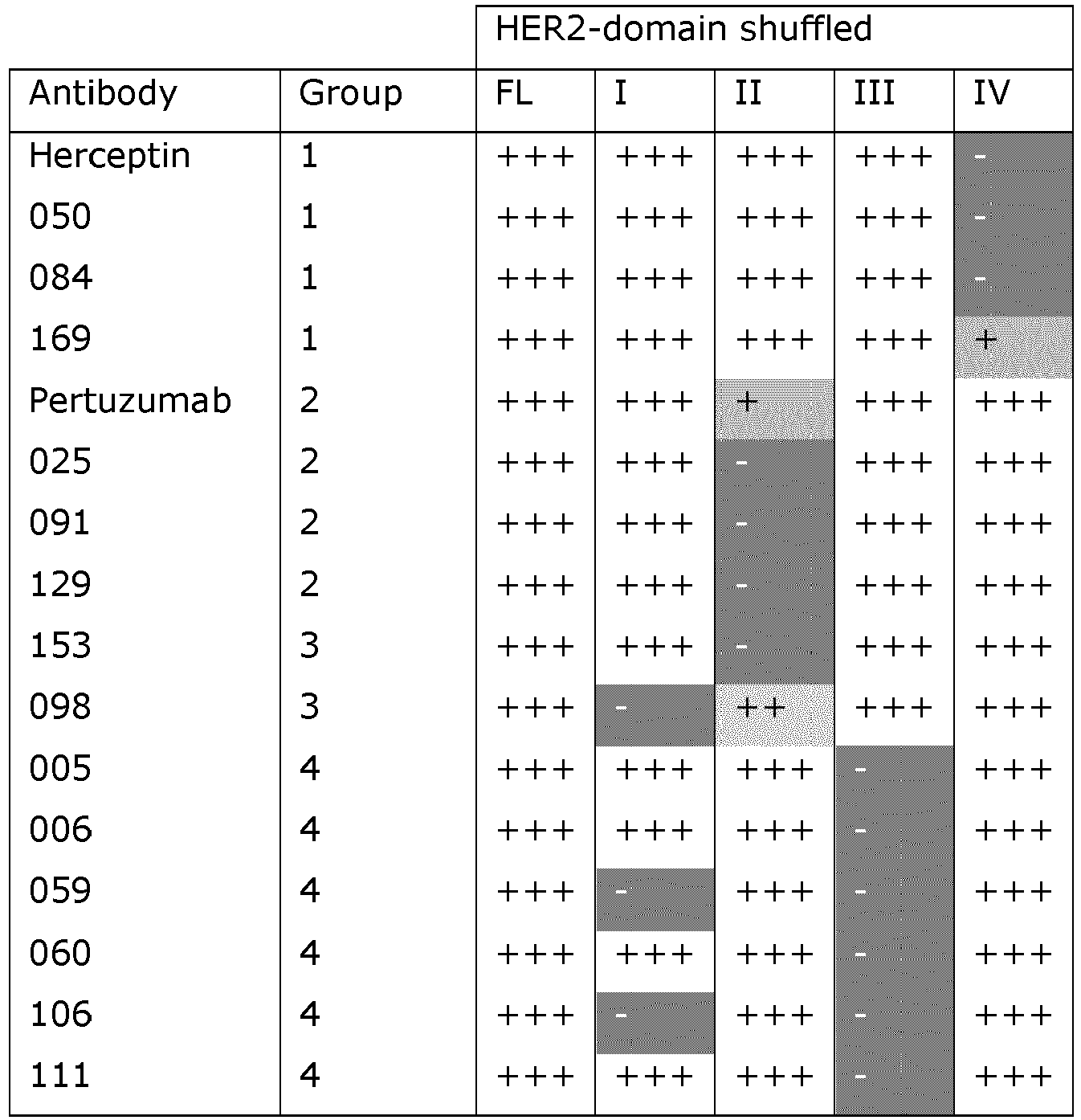
- The in vivo effect of HER2-HuMabs 091 (cross-competition Group 2), 084 and 169 (both cross-competition Group 1), and 005 (cross-block Group 4) on tumor growth and survival in a NCI-N87 human gastric carcinoma xenograft model in female CB.17 severe combined immunodeficiency (SCID) mice was determined. 10×106 NCI-N87 tumor cells in 50% matrigel were injected s.c. in female SCID mice, 10 mice per group. Eight days after tumor inoculation, intravenous treatment with HER2-
HuMabs Figure 16 (A) and(C) , this is indicated asday 1, day of treatment initiation. The first dose was at 40 mg/kg, followed by 10 mg/kg ondays - The results are depicted in
Figure 16A, 16B ,16C and 16D , which show that the mice administered withHuMab - The effect of therapeutic treatment of five different HER2 HuMabs on human subcutaneous BT-474 breast tumor xenografts in Balb/C nude mice was determined. BT-474 tumor cells were injected 24 to 72 hours after a whole body irradiation with a γ-source (1.8 Gy, Co60, BioMep, France). 2×10⁷ BT-474 cells in 200 µl of RPMI 1640 containing matrigel (50:50, v:v; BD Biosciences) were injected subcutaneously into the right flank of female Balb/C nude mice. Body weight and tumor volume of the mice was recorded twice a week. Tumor volumes (mm3) were calculated from caliper (PLEXX) measurements as: (width2 × length)/2.
- Treatment with HER2 HuMabs was started when the tumors reached a mean volume of 100-200 mm3. Tumor bearing mice were randomized into groups of 8 mice. One group received twice weekly intravenous (i.v.) injections of the control mAb HuMab-HepC. Four other groups received twice weekly i.v. injections of
HER2 HuMab - The results are depicted in
Figure 17A and 17B and show that BT-474 tumor growth was partially inhibited withHuMab 129 andHuMab 153 treatment (about 30 and 50% of inhibition compared to HuMab-HepC control treatment). HuMab-025 and HuMab-091 strongly inhibited the BT-474 tumor growth and the time to reach a tumor volume of 800 mm3 was significantly delayed by these antibodies. Survival was also improved in the HER2 HuMab receiving mice. - Multivalent receptor crosslinking by bispecific HER2 × HER2 antibodies can result in enhanced receptor downmodulation. In this Example, the effect of such bispecific antibodies on the expression of the receptor on the cell surface of SKOV3 cells was analyzed. SKOV3 (ATCC) is an ovarian carcinoma cell line that has ~2 × 10e5 HER2 copy numbers per cell.
- SKOV3 cells were seeded in 96-wells non-binding plates (100,000 cells/well) in serum-free culture medium and incubated for 30 min at 37°C. Next, cells were incubated for 3 hours at 37°C with 10 µg/mL antibody, with or without 100 µM monensin (Dako), which blocks receptor recycling. The combination of two monospecific IgG1 antibodies (1:1) was also tested (10 µg/mL final total antibody concentration). Quantification of cell surface expressed HER2 molecules was done by indirect immunofluorescence staining and flow cytometry using QIFIKIT® (Dako) according to the manufacturer's instructions. Briefly, cells were incubated with a non-competing mouse anti-HER2 antibody (R&D, cat: IBD0207061, 1:50) for 30 min at 4°C. Next, detection was done using goat anti-mouse IgG-FITC (Dako, cat: F0479, 1:50) for 30 min at 4°C. Mean Fluorescence Intensity (MFI) of FITC was measured using flow cytometry on a FACS-Canto-II (BD Pharmingen). For calibration, the goat anti-mouse IgG-FITC detection antibody was applied to a series of bead populations with a defined number of mouse IgG molecules per bead. The measured MFI of the individual bead populations were plotted against the known number of antibody molecules on the beads to obtain a calibration curve that was used to interpolate the number of HER2 molecules per cell from the measured MFI.
-
Figure 18 and Table 16 shows that monospecific HER2 antibodies have no significant effect on the HER2 surface expression in SKOV3 cells on their own. However, treatment with a combination of two monospecific HER2 antibodies or HER2 × HER2 bispecific antibodies clearly reduced the amount of surface-expressed HER2. The addition of monensin resulted for all samples in only a minor decrease in surface-expressed HER2 levels compared to those without monensin. This suggests that the majority of internalized HER2 molecules is intracellularly degraded, rather than recycled.Table 16: - monensin + monensin untreated 169923 135108 IgG1-b12 153217 132255 IgG1-005 150486 122154 IgG1-025 136833 121230 IgG1-153 161516 102301 IgG1-005 + IgG1-025 87435 67858 IgG1-005 + IgG1-153 96817 66815 IgG1-025 + IgG1-153 100981 77325 IgG1-025-ITL × IgG1-005-K409R 114429 103408 IgG1-025-ITL × IgG1-153-K409R 95912 63770 IgG1-153-ITL × IgG1-005-K409R 83028 62407 - HER2xHER2 antibodies were tested in an in vitro cytotoxicity assay using AU565 cells with Peripheral blood mononuclear cells (PBMC) as effector cells, and compared to their parental monospecific HER2 antibodies and the combination thereof. AU565 cells were cultured to near confluency. Cells were washed twice with PBS, and trypsinized for 5 minutes at 37°C. 12 mL culture medium was added to inactivate trypsin and cells were spun down for 5 min, 800 rpm. Cells were resuspended in 10 mL culture medium and a single cell suspension was made by passing the cells through a cell strainer. 100 µL of a 5×10⁵ cells/mL suspension was added to each well of a 96-wells culture plate, and cells were incubated for 3 hrs at 37°C, 5% CO2 to allow adherence to the plate. PBMCs were isolated from a buffy coat from healthy volunteers using Leucosep 30 mL tubes, according to the manufacturer's protocol (Greiner Bio-one). Isolated cells were resuspended in culture medium to a
final concentration op 10×106 cells/mL. Culture medium was removed from the adhered AU565 cells, and replaced with 50 µL/well 2x concentrated antibody-dilution and 50 µL/well of the 10×106/mL PBMC suspension. Plates were incubated for 3 days at 37°C, 5% CO2. Supernatants were removed and plates were washed twice with PBS. To each well, 150 µL culture medium and 15 µL alamarBlue solution was added. Plates were incubated for 4 hours at 37°C, 5% CO2, and absorbance was measured (Envision, Perkin Elmer). -
Figure 19 shows that the ability of the monospecific HER2 antibodies to induce PBMC-mediated cytotoxicity was retained in bispecific HER2 × HER2 antibodies. The efficacy of the HER2 × HER2 bispecific antibodies was comparable (025-ITLx169-K409R; 005-ITLx169-K409R; 025-ITLx005-K409R) or tended to be better (153-ITLx005-K409R and 153-ITLx169-K409R) than for the monospecific parental antibodies or the combination thereof. Moreover, it was shown that it was required that both parental antibodies that are used to generate a HER2 × HER2 antibody need to contain activating Fc-domains, i.e. proper interaction with Fc-receptors, to be able to induce PBMC-mediated cytotoxicity in the HER2 × HER2 antibody. Antibody Fc glycosylation is known to be critical for IgG-Fcγ receptor interactions and thus antibody-dependent cellular cytotoxicity (ADCC). Deglycosylation by introduction of the N297Q mutation in IgG1-153-K409R resulted in loss of PBMC-mediated cytotoxicity of both IgG1-153-K409R-N297Q and IgG1-153-ITLxIgG1-153-K409R-N297Q. - The in vivo anti-tumor efficacy of HER2 × HER2 bispecific antibodies was compared to that of the corresponding parental monospecific HER2 antibodies and combinations thereof in a human gastric carcinoma NCI-N87 xenograft tumor model in SCID mice. Six to eleven weeks old female SCID (C.B-17/IcrPrkdc-scid/CRL) mice were used. At
day days Table 17 1st dose 2nd dose 3th dose IgG1-005 800 µg 400 µg 200 µg IgG1-153 1000 µg 500 µg 250 µg IgG1-169 600 µg 300 µg 150 µg IgG1-169 + IgG1-153 300 µg (169) + 500 µg (153) 150 µg (169) + 250 µg (153) 75 µg (169) + 125 µg (153) IgG1-005 + IgG1-153 400 µg (005) + 500 µg (153) 200 µg (005) + 250 µg (153) 100 µg (005) + 125 µg (153) IgG1-153-ITL × IgG1-169- K409R 800 µg 400 µg 200 µg IgG1-005-ITL × IgG1-153- K409R 800 µg 400 µg 200 µg IgG1- b12 800 µg 400 µg 200 µg - Tumors were measured twice per week using calipers until an endpoint tumor volume of 1500 mm3 or until the end of the study (day 63).
Figure 20 shows that onday 41 of the experiment, none of the monospecific HER2 antibodies significantly inhibited tumor growth compared to negative control antibody b12, with IgG1-005 and IgG1-153 even showing a trend towards being agonistic in this model. Both tested bispecific HER2 × HER2 antibodies IgG1-153-ITL × IgG1-169-K409R and IgG1-005-ITL × IgG1-153-K409R showed significant inhibition of tumor growth compared to their monospecific counterparts. Moreover, both bispecific HER2 × HER2 antibodies showed on day 41 a lower mean tumor volume than the combination of the monospecific counterparts, which was for IgG1-153-ITL × IgG1-169-K409R statistically significant. - The in vivo anti-tumor efficacy of the Her2 × Her2 bispecific antibody IgG1-153-ITL × IgG1-169-K409R was tested in a human gastric carcinoma NCI-N87 xenograft tumor model in SCID mice as described in Example 32. At
day days Table 18: Treatment groups and dosing 1st dose 2nd dose IgG1-153- K409R 800 µg (40 mg/kg) 400 µg (20 mg/kg) IgG1-169 800 µg (40 mg/kg)) 400 µg (20 mg/kg) IgG1-169 + IgG1-153 320 µg 153 (16 mg/kg) + 400 µg 169 (20 mg/kg) 130 µg 153 (8 mg/kg) + 200 µg 169 (10 mg/kg) IgG1-153-ITL × IgG1-169- K409R 800 µg (40 mg/kg) 400 µg (20 mg/kg) Herceptin 800 µg (40 mg/kg) 400 µg (20 mg/kg) IgG1- b12 800 µg (40 mg/kg) 400 µg (20 mg/kg) - Tumors were measured twice per week using calipers until an endpoint tumor volume of 1500 mm3 or until the end of the study.
Figure 21A shows that none of the monospecific HER2 antibodies inhibited tumor growth significantly compared to negative control antibody b12. A significant inhibition of tumor growth was found for the bispecific HER2 × HER2 antibody IgG1-153-ITL × IgG1-169-K409R compared to the isotype control antibody b12.Figure 21B shows a Kaplan-Meier plot displaying the percentage of mice with tumors <400 mm3. The group treated with the HER2xHER2 bispecific IgG1-153-ITL × IgG1-169-K409R antibody shows signifcant tumor inhibition compared to the control and all other groups. - To further identify the determinants in the IgG1 CH3 domain that are required for IgG1 to be engaged in Fab-arm exchange, IgG1 containing the triple mutation T350I-K370T-F405L (ITL) was compared to the double mutants T350I-K370T (IT), T350I-F405L (IL) and K370T-F405L (TL) were studied using antibodies 2F8 and 7D8, respectively described in
WO 02/100348 WO 04/035607 - The triple (ITL), double mutations (IT, IL and TL) and single mutation (L) were introduced in IgG1-2F8. These mutants were combined with IgG4-7D8, containing a CPSC hinge (wild type) or a stabilized hinge (IgG4-7D8-CPPC), for Fab-arm exchange using 25 mM 2-MEA for 90 min at 37°C.
Figures 22A-B show that the IgG1-2F8-IL and -TL mutants showed Fab-arm exchange to the same level as the triple mutant ITL, irrespective of the combined IgG4-7D8 (CPSC or CPPC hinge). In contrast, no bispecific binding was found for the combination with the IgG1-2F8-IT mutant.Figure 22C shows that also the IgG1-2F8-F405L mutant showed Fab-arm exchange, irrespective of the combined IgG4-7D8 (CPSC or CPPC hinge). These data indicate that the F405L mutation is sufficient to engage human IgG1 for Fab-arm exchange under the conditions mentioned above. - 2-MEA can induce Fab-arm exchange between human IgG1-ITL and IgG4-CPPC. The CH3 interface residues of human IgG1 and IgG4 differ at position 409 only: lysine (K) in IgG1 and arginine (R) in IgG4. Therefore, it was tested whether substitution of lysine at position 409 by arginine or any other amino acid (K409X) could enable IgG1 to engage in 2-MEA-induced Fab-arm exchange with IgG1-ITL. Combinations of 10 µg human IgG1-2F8-ITL and 10 µg IgG1-7D8-K409X in 20 µl PBS/25 mM 2-MEA (final concentration of 0.5 mg/mL for each antibody) were incubated for 90 min at 37°C. Unpurified antibodies from supernatants of transient transfections were used after buffer-exchange to PBS using Amicon Ultra centrifugal devices (30k, Millipore, cat. no. UFC803096). After the Fab-arm exchange reaction, 20 µL PBS was added to each sample and the reducing agent was removed by desalting the samples using spin desalting plate. Dilution series of the antibody samples (total antibody concentration 0-20 µg/mL in 3-fold dilutions) were used in an ELISA to measure bispecific binding.
-
Figure 23A shows the results of bispecific binding upon 2-MEA induced Fab-arm exchange between IgG1-2F8-ITL × IgG1-7D8-K409X. InFigure 23B , the exchange is presented as bispecific binding relative to a purified batch of bispecific antibody derived from a 2-MEA-induced Fab-arm-exchange between IgG1-2F8-ITL and IgG4-7D8-CPPC, which was set to 100%. These data were also scored as (-) no Fab-arm exchange, (+/-) low, (+) intermediate or (++) high Fab-arm exchange, as presented in Table 19. No Fab-arm exchange (-) was found when the 409 position in IgG1-7D8 was K (=wild type IgG1), L or M. Fab-arm exchange was found to be intermediate (+) when the 409 position in IgG1-7D8 was F, I, N or Y and high (++) when the 409 position in IgG1-7D8 was A, D, E, G, H, Q, R, S, T, V or W.
- In Example 34 it is described that the F405L mutation is sufficient to enable human IgG1 to engage in Fab-arm-exchange when combined with IgG4-7D8. To further test the determinants at the
IgG1 405 position for engagement in 2-MEA-induced Fab-arm-exchange in combination with human IgG1-K409R, all possible IgG1-2F8-F405X mutants (with the exception of C and P) were combined with IgG1-7D8-K409R. The procedure was performed with purified antibodies as described in Example 35. -
Figure 24 shows the results of bispecific binding upon 2-MEA-induced Fab-arm-exchange between IgG1-2F8-F405X × IgG1-7D8-K409R. These data were also scored as (-) no Fab-arm exchange, (+/-) low, (+) intermediate or (++) high Fab-arm exchange, as presented in Table 20. No Fab-arm exchange (-) was found when the 405 position in IgG1-2F8 was F (= wild type IgG1). Fab-arm exchange was found to be low (+/-) when the 405 position in IgG1-2F8 was G or R. Fab-arm exchange was found to be high (++) when the 405 position in IgG1-2F8 was A, D, E, H, I, K, L, M, N, Q, S, T, V, W or Y. These data indicate that particular mutations at theIgG1 405 position allow IgG1 to engage in 2-MEA-induced Fab-arm-exchange when combined with IgG1-K409R.
- In the previous Example, it is described that certain single mutations at position F405 are sufficient to enable human IgG1 to engage in Fab-arm-exchange when combined with IgG1-K409R. To test whether other determinants implicated in the Fc:Fc interface positions in the CH3 domain could also mediate the Fab-arm-exchange mechanism, mutagenesis of the IgG1 407 position was performed and the mutants were tested for engagement in 2-MEA-induced Fab-arm-exchange in combination with human IgG1-K409R. All possible IgG1-2F8-Y407X mutants (with the exception of C and P) were combined with IgG1-7D8-K409R. The procedure was performed with purified antibodies.
-
Figure 25 shows the results of bispecific binding upon 2-MEA-induced Fab-arm-exchange between IgG1-2F8-Y407X × IgG1-7D8-K409R. These data were also scored as (-) no Fab-arm exchange, (+/-) low, (+) intermediate or (++) high Fab-arm exchange, as presented in Table 21. No Fab-arm exchange (-) was found when the 407 position in IgG1-2F8 was Y (= wild type IgG1), E, K, Q, or R. Fab-arm exchange was found to be low (+/-) when the 407 position in IgG1-2F8 was D, F, I, S or T and intermediate (+) when the 407 position in IgG1-2F8 was A, H, N or V, and high (++) when the 407 position in IgG1-2F8 was G, L, M or W. These data indicate that particular single mutations at the IgG1 407 position allow IgG1 to engage in 2-MEA-induced Fab-arm-exchange when combined with IgG1-K409R.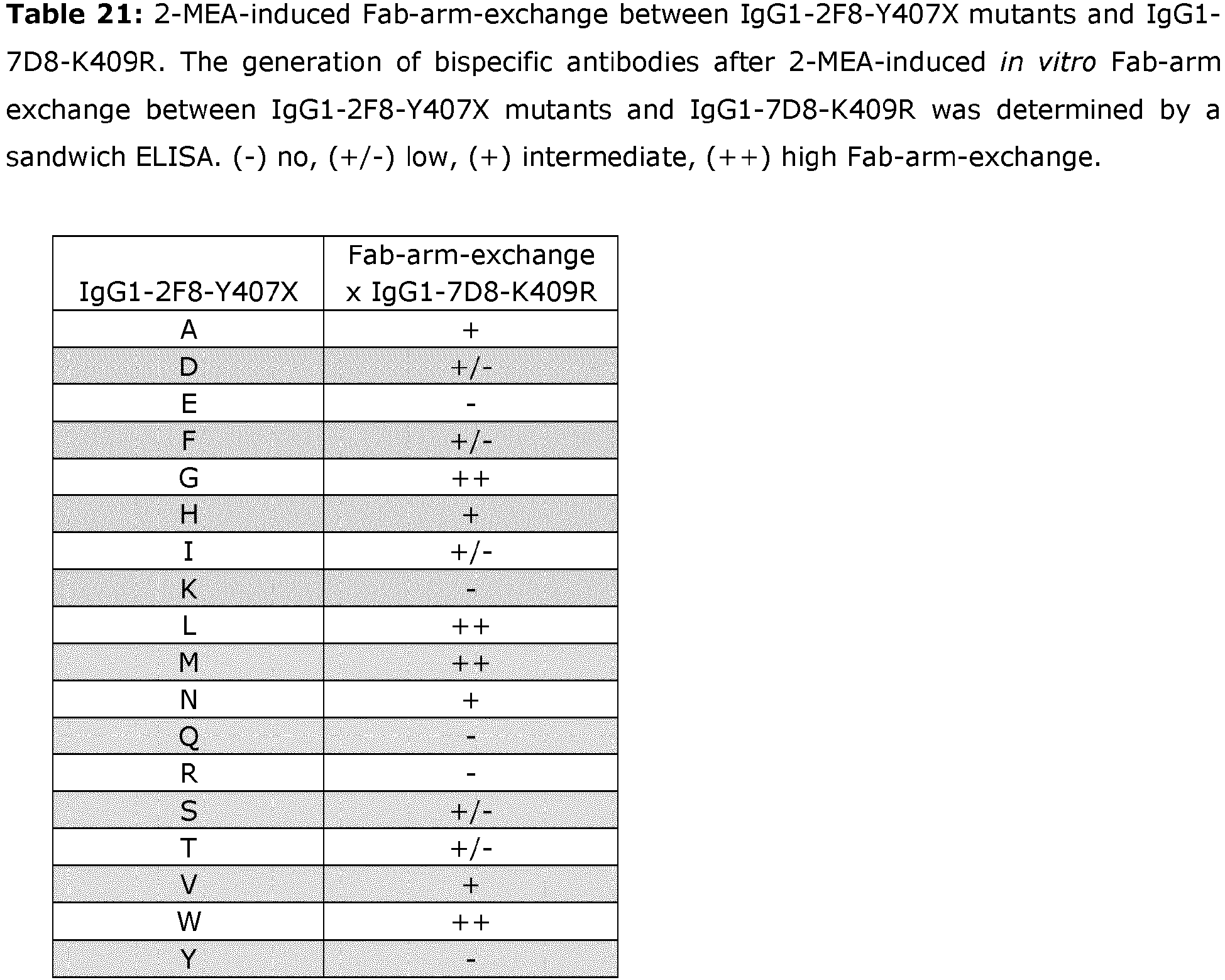
- Examples 34 and 37 show that certain single mutations at position F405 and Y407 are sufficient to enable human IgG1 to engage in Fab-arm exchange when combined with IgG1-K409R. As illustrated in this example further determinants implicated in the Fc:Fc interface positions in the CH3 domain may also mediate the Fab-arm exchange mechanism. To this effect mutagenesis of the IgG1 368 position was performed and the mutants were tested for engagement in 2-MEA-induced Fab-arm-exchange in combination with human IgG1-K409R. All possible IgG1-2F8-L368X mutants (with the exception of C and P) were combined with IgG1-7D8-K409R. The procedure was performed with purified antibodies.
-
Figure 26 shows the results of bispecific binding upon 2-MEA-induced Fab-arm exchange between IgG1-2F8-L368X × IgG1-7D8-K409R. These data were also scored as (-) no Fab-arm exchange, (+/-) low, (+) intermediate or (++) high Fab-arm exchange, as presented in Table 22. No Fab-arm exchange (-) was found when the 368 position in IgG1-2F8 was L (= wild type IgG1), For M. Fab-arm exchange was found to be low (+/-) when the 368 position in IgG1-2F8 was Y. Fab-arm exchange was found to be intermediate (+) when the 368 position in IgG1-2F8 was K and high (++) when the 368 position in IgG1-2F8 was A, D, E, G, H, I, N, Q, R, S, T, V, or W. These data indicate that particular mutations at the IgG1 368 position allow IgG1 to engage in 2-MEA-induced Fab-arm exchange when combined with IgG1-K409R.
- Examples 34, 37 and 38 show that certain single mutations at positions F405, Y407 or L368 are sufficient to enable human IgG1 to engage in Fab-arm exchange when combined with IgG1-K409R. As illustrated in this example further determinants implicated in the Fc:Fc interface positions in the CH3 domain may also mediate the Fab-arm exchange mechanism. To this effect mutagenesis of the IgG1 370 position was performed and the mutants were tested for engagement in 2-MEA-induced Fab-arm-exchange in combination with human IgG1-K409R. All possible IgG1-2F8-K370X mutants (with the exception of C and P) were combined with IgG1-7D8-K409R. The procedure was performed with purified antibodies.
-
Figure 27 shows the results of bispecific binding upon 2-MEA-induced Fab-arm exchange between IgG1-2F8-K370X × IgG1-7D8-K409R. These data were also scored as (-) no Fab-arm exchange, (+/-) low, (+) intermediate or (++) high Fab-arm exchange, as presented in Table 23. No Fab-arm exchange (-) was found when the 370 position in IgG1-2F8 was K (= wild type IgG1), A, D, E, F, G, H, I, L, M, N, Q, R, S, T, V or Y. Only substitution of K370 with W resulted in intermediate Fab-arm exchange (+). These data indicate that only one mutation at the IgG1 370 position (K370W) allows IgG1 to engage in 2-MEA-induced Fab-arm exchange when combined with IgG1-K409R.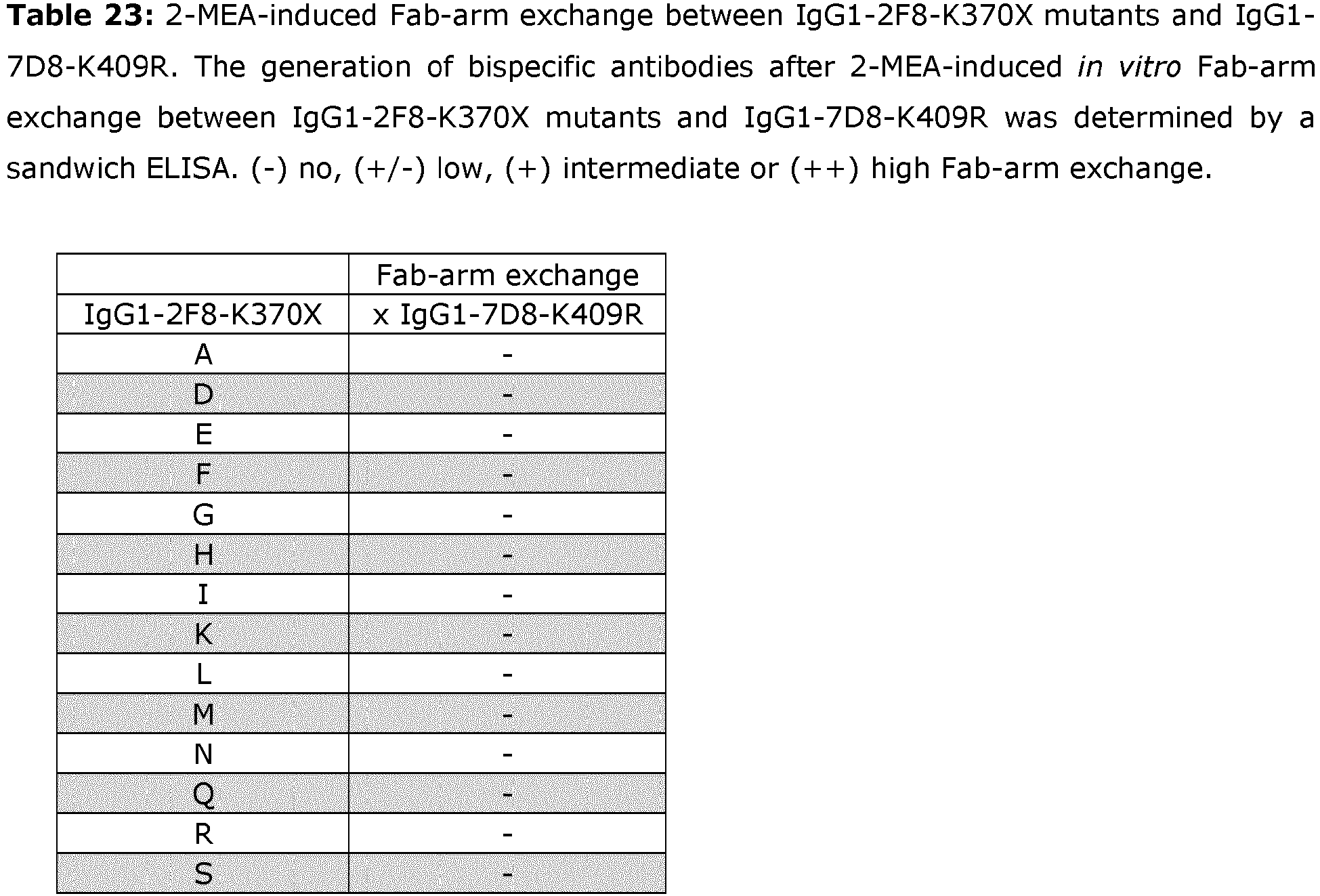

- The preceding Examples show that certain single mutations at positions F405, Y407, L368 or K370 are sufficient to enable human IgG1 to engage in Fab-arm exchange when combined with IgG1-K409R. As illustrated in this example further determinants implicated in the Fc:Fc interface positions in the CH3 domain may also mediate the Fab-arm exchange mechanism. To this effect mutagenesis of the IgG1 399 position was performed and the mutants were tested for engagement in 2-MEA-induced Fab-arm-exchange in combination with human IgG1-K409R. All possible IgG1-2F8-D399X mutants (with the exception of C and P) were combined with IgG1-7D8-K409R. The procedure was performed with purified antibodies as described in Example 35.
-
Figure 28 shows the results of bispecific binding upon 2-MEA-induced Fab-arm exchange between IgG1-2F8-D399X × IgG1-7D8-K409R. These data were also scored as (-) no, (+/-) low, (+) intermediate or (++) high Fab-arm exchange, as presented in Table 24. No Fab-arm exchange (-) was found when the 399 position in IgG1-2F8 was D (= wild type IgG1), E and Q. Fab-arm exchange was found to be low (+/-) when the 399 position in IgG1-2F8 was V, intermediate (+) when the 399 position in IgG1-2F8 was G, I, L, M, N, S, T or W. Fab-arm exchange was found to be high (++) when the 399 position in IgG1-2F8 was A, F, H, K, R or Y. These data indicate that particular mutations at the IgG1 399 position allow IgG1 to engage in 2-MEA-induced Fab-arm exchange when combined with IgG1-K409R.

- Examples 34 to 40 show that certain single mutations at positions F405, Y407, L368, K370 or D399 are sufficient to enable human IgG1 to engage in Fab-arm exchange when combined with IgG1-K409R. As illustrated in this example further determinants implicated in the Fc:Fc interface positions in the CH3 domain may also mediate the Fab-arm exchange mechanism. To this effect mutagenesis of the IgG1 366 position was performed and the mutants were tested for engagement in 2-MEA-induced Fab-arm-exchange in combination with human IgG1-K409R. All possible IgG1-2F8-T366X mutants (with the exception of C and P) were combined with IgG1-7D8-K409R. The procedure was performed with purified antibodies as described in Example 35.
-
Figure 29 shows the results of bispecific binding upon 2-MEA-induced Fab-arm exchange between IgG1-2F8-T366X × IgG1-7D8-K409R. These data were also scored as (-) no, (+/-) low, (+) intermediate or (++) high Fab-arm exchange, as presented in Table 25. No Fab-arm exchange (-) was found when the 366 position in IgG1-2F8 was T (= wild type IgG1), K, R, S or W. Fab-arm exchange was found to be low (+/-) when the 366 position in IgG1-2F8 was F, G, I, L, M or Y, intermediate (+) when the 366 position in IgG1-2F8 was A, D, E, H, N, V or Q. These data indicate that particular mutations at the IgG1 366 position allow IgG1 to engage in 2-MEA-induced Fab-arm exchange when combined with IgG1-K409R.

Claims (25)
- A bispecific antibody comprising a first antigen-binding region and a second antigen-binding region, which first and second antigen-binding regions bind different epitopes on human epidermal growth factor receptor 2 (HER2), and wherein the first antigen-binding region is selected from the group consisting of:a) an antibody comprising a VH region comprising the sequence of SEQ ID NO:63 and a VL region comprising the sequence of SEQ ID NO:67 (153),b) an antibody comprising a variable heavy (VH) region comprising the sequence of SEQ ID NO: 165 and a variable light (VL) region comprising the sequence of SEQ ID NO: 169 (005), andc) an antibody comprising a VH region comprising the sequence of SEQ ID NO:22 and a VL region comprising the sequence of SEQ ID NO:26 (025),wherein the second antigen binding region comprises a VH region comprising SEQ ID NO:1, and a VL region comprising SEQ ID NO:5 (169).
- The bispecific antibody of claim 1, wherein said bispecific antibody further comprises a first Fc region and a second Fc region.
- The bispecific antibody of any one of the preceding claims comprising a first Fab-arm comprising the first antigen-binding region and a first Fc-region, and a second Fab-arm comprising the second antigen-binding region and a second Fc-region.
- The bispecific antibody of any one of claims 1 to 2 comprising a first Fab-arm comprising the second antigen-binding region and a first Fc-region, and a second Fab-arm comprising the first antigen-binding region and a second Fc-region.
- The bispecific antibody of any one of claims 2 to 4, wherein the isotypes of the first and second Fab-arms are independently selected from IgG1, IgG2, IgG3, and IgG4.
- The bispecific antibody of claim 5, wherein the isotypes of the first and second Fc-regions are independently selected from IgG1 and IgG4.
- The bispecific antibody of claim 6, wherein one of the first and second Fc-regions is of an IgG1 isotype and one is of an IgG4 isotype.
- The bispecific antibody of claim 6, wherein the isotypes of the first and second Fc-region are of IgG1 isotype.
- The bispecific antibody of any one of claims 2 to 8, wherein the first Fc-region has an amino acid substitution at a position selected from the group consisting of 409, 366, 368, 370, 399, 405 and 409, and said second Fc-region has an amino acid substitution at a position selected from the group consisting of 405, 366, 368, 370, 399, 407 and 409, and wherein said first Fc-region and said second Fc-region are not substituted in the same positions, and wherein said amino acid positions are according to the Eu-index as described in Kabat et al.
- The bispecific antibody of any one of claims 2 to 9, whereina) the first Fc-region has an amino acid other than Lys, Leu or Met at position 409 and the second Fc region has an amino acid other than Phe at position 405;b) the first Fc-region has an amino acid other than Lys, Leu or Met at position 409 and the second Fc-region has an amino acid other than Phe, Arg or Gly at position 405;c) the first Fc-region comprises a Phe at position 405 and an amino acid other than Lys, Leu or Met at position 409 and said second Fc-region comprises an amino acid other than Phe at position 405 and a Lys at position 409;d) the first Fc-region comprises a Phe at position 405 and an amino acid other than Lys, Leu or Met at position 409 and the second Fc-region comprises an amino acid other than Phe, Arg or Gly at position 405 and a Lys at position 409;e) the first Fc-region comprises a Phe at position 405 and an amino acid other than Lys, Leu or Met at position 409 and the second Fc-region comprises a Leu at position 405 and a Lys at position 409;f) the first Fc-region comprises a Phe at position 405 and an Arg at position 409 and said second Fc-region comprises an amino acid other than Phe, Arg or Gly at position 405 and a Lys at position 409;g) the first Fc-region comprises Phe at position 405 and an Arg at position 409 and the second Fc-region comprises a Leu at position 405 and a Lys at position 409;h) the first Fc-region comprises an amino acid other than Lys, Leu or Met at position 409 and the second Fc-region comprises a Lys at position 409, a Thr at position 370 and a Leu at position 405;i) the first Fc-region comprises an Arg at position 409 and the second Fc-region comprises a Lys at position 409, a Thr at position 370 and a Leu at position 405; orj) the first Fc-region comprises a Lys at position 370, a Phe at position 405 and an Arg at position 409 and the second Fc-region comprises a Lys at position 409, a Thr at position 370 and a Leu at position 405.
- The bispecific antibody of any one of claims 2 to 9, wherein said first and second Fc regions, except for the specified mutations, comprise the sequence of SEQ ID NO:236 (IgG1m(a)).
- The bispecific antibody of any one of claims 2 to 9, wherein neither said first nor said second Fc-region comprises a Cys-Pro-Ser-Cys sequence in the hinge region; or wherein both of said first and said second Fc-region comprise a Cys-Pro-Pro-Cys sequence in the hinge region.
- The bispecific antibody of any one of claims 2 to 12, wherein the first and second Fc-regions are human antibody Fc-regions.
- The bispecific antibody of any one of claims 3 to 13, wherein said first and second Fab arm, except for the specified mutations, comprise a sequence selected from the group consisting of SEQ ID NOS: 234, 235, 236, 237, 238, 239, 240, 241, 242, 243, 244 and 245.
- The bispecific antibody of any one of the preceding claims, wherein the first and second antigen-binding regions comprise human antibody VH sequences and, optionally, human antibody VL sequences.
- The bispecific antibody of any one of claims 2 to 15, wherein the first and/or the second Fc-region comprise a mutation removing the acceptor site for Asn-linked glycosylation.
- The bispecific antibody of any one of the preceding claims, which is conjugated to one or more other moieties, such as a drug, radioisotope, cytokine or cytotoxic moiety, or contains one or more acceptor group for the same.
- The bispecific antibody of claim 17, which is conjugated toa) at least one cytotoxic moiety selected from the group consisting of maytansine, calicheamicin, duocarmycin, rachelmycin (CC-1065), monomethyl auristatin E, monomethyl auristatin For an analog, derivative, or prodrug of any thereof;b) a cytokine selected from the group consisting of IL-2, IL-4, IL-6, IL-7, IL-10, IL-12, IL-13, IL-15, IL-18, IL-23, IL-24, IL-27, IL-28a, IL-28b, IL-29, KGF, IFNα, IFNβ, IFNγ, GM-CSF, CD40L, Flt3 ligand, stem cell factor, ancestim, and TNFa; orc) a radioisotope, such as an alpha emitter.
- A recombinant eukaryotic or prokaryotic host cell which produces a bispecific antibody as defined in any one of claims 1 to 17.
- A pharmaceutical composition comprising a bispecific antibody as defined in any one of claims 1 to 18 and a pharmaceutically acceptable carrier.
- The bispecific antibody of any one of claims 1 to 18 for use as a medicament.
- The bispecific antibody of any one of claims 1 to 18 for use in the treatment of cancer.
- The bispecific antibody for the use of claim 22, wherein the cancer is selected from the group consisting of breast cancer, prostate cancer, non-small cell lung cancer, bladder cancer, ovarian cancer, gastric cancer, colorectal cancer, esophageal cancer, squamous cell carcinoma of the head and neck, cervical cancer, pancreatic cancer, testis cancer, malignant melanoma and soft-tissue cancer.
- The bispecific antibody for the use of any one of claims 21 to 23, wherein the bispecific antibody is for the treatment of cancer in combination with one or more further therapeutic agent, such as a chemotherapeutic agent.
- A method for producing a bispecific antibody of any one of claims 1 to 17, said method comprising the steps ofa) culturing a host cell of claim 19, andb) purifying the bispecific antibody from the culture media.
Priority Applications (2)
| Application Number | Priority Date | Filing Date | Title |
|---|---|---|---|
| EP24214055.6A EP4520771A3 (en) | 2011-04-20 | 2012-04-20 | Bispecifc antibodies against her2 |
| EP12715407.8A EP2699260B1 (en) | 2011-04-20 | 2012-04-20 | Bispecifc antibodies against her2 |
Applications Claiming Priority (8)
| Application Number | Priority Date | Filing Date | Title |
|---|---|---|---|
| PCT/EP2011/056388 WO2011131746A2 (en) | 2010-04-20 | 2011-04-20 | Heterodimeric antibody fc-containing proteins and methods for production thereof |
| DKPA201100312 | 2011-04-20 | ||
| PCT/EP2011/058779 WO2011147986A1 (en) | 2010-05-27 | 2011-05-27 | Monoclonal antibodies against her2 |
| PCT/EP2011/058772 WO2011147982A2 (en) | 2010-05-27 | 2011-05-27 | Monoclonal antibodies against her2 epitope |
| US201161552267P | 2011-10-27 | 2011-10-27 | |
| DKPA201100822 | 2011-10-27 | ||
| PCT/EP2012/057303 WO2012143523A1 (en) | 2011-04-20 | 2012-04-20 | Bispecifc antibodies against her2 |
| EP12715407.8A EP2699260B1 (en) | 2011-04-20 | 2012-04-20 | Bispecifc antibodies against her2 |
Related Child Applications (1)
| Application Number | Title | Priority Date | Filing Date |
|---|---|---|---|
| EP24214055.6A Division EP4520771A3 (en) | 2011-04-20 | 2012-04-20 | Bispecifc antibodies against her2 |
Publications (2)
| Publication Number | Publication Date |
|---|---|
| EP2699260A1 EP2699260A1 (en) | 2014-02-26 |
| EP2699260B1 true EP2699260B1 (en) | 2024-11-20 |
Family
ID=45976956
Family Applications (2)
| Application Number | Title | Priority Date | Filing Date |
|---|---|---|---|
| EP12715407.8A Active EP2699260B1 (en) | 2011-04-20 | 2012-04-20 | Bispecifc antibodies against her2 |
| EP24214055.6A Pending EP4520771A3 (en) | 2011-04-20 | 2012-04-20 | Bispecifc antibodies against her2 |
Family Applications After (1)
| Application Number | Title | Priority Date | Filing Date |
|---|---|---|---|
| EP24214055.6A Pending EP4520771A3 (en) | 2011-04-20 | 2012-04-20 | Bispecifc antibodies against her2 |
Country Status (1)
| Country | Link |
|---|---|
| EP (2) | EP2699260B1 (en) |
Citations (2)
| Publication number | Priority date | Publication date | Assignee | Title |
|---|---|---|---|---|
| WO2009068628A1 (en) * | 2007-11-27 | 2009-06-04 | Ablynx N.V. | Constructs comprising single variable domains and an fc portion derived from lge. |
| WO2011131746A2 (en) * | 2010-04-20 | 2011-10-27 | Genmab A/S | Heterodimeric antibody fc-containing proteins and methods for production thereof |
Family Cites Families (73)
| Publication number | Priority date | Publication date | Assignee | Title |
|---|---|---|---|---|
| US835A (en) | 1838-07-12 | X i i i x | ||
| US6077A (en) | 1849-01-30 | Improved hinged claw-wrench | ||
| US4179337A (en) | 1973-07-20 | 1979-12-18 | Davis Frank F | Non-immunogenic polypeptides |
| JPS5896026A (en) | 1981-10-30 | 1983-06-07 | Nippon Chemiphar Co Ltd | Novel urokinase derivative, its preparation and thrombolytic agent containing the same |
| US4609546A (en) | 1982-06-24 | 1986-09-02 | Japan Chemical Research Co., Ltd. | Long-acting composition |
| US4681581A (en) | 1983-12-05 | 1987-07-21 | Coates Fredrica V | Adjustable size diaper and folding method therefor |
| US4766106A (en) | 1985-06-26 | 1988-08-23 | Cetus Corporation | Solubilization of proteins for pharmaceutical compositions using polymer conjugation |
| US4735210A (en) | 1985-07-05 | 1988-04-05 | Immunomedics, Inc. | Lymphographic and organ imaging method and kit |
| US5776093A (en) | 1985-07-05 | 1998-07-07 | Immunomedics, Inc. | Method for imaging and treating organs and tissues |
| US5101827A (en) | 1985-07-05 | 1992-04-07 | Immunomedics, Inc. | Lymphographic and organ imaging method and kit |
| US4946778A (en) | 1987-09-21 | 1990-08-07 | Genex Corporation | Single polypeptide chain binding molecules |
| US5648471A (en) | 1987-12-03 | 1997-07-15 | Centocor, Inc. | One vial method for labeling antibodies with Technetium-99m |
| GB8823869D0 (en) | 1988-10-12 | 1988-11-16 | Medical Res Council | Production of antibodies |
| US5703055A (en) | 1989-03-21 | 1997-12-30 | Wisconsin Alumni Research Foundation | Generation of antibodies through lipid mediated DNA delivery |
| WO1991001754A1 (en) | 1989-08-09 | 1991-02-21 | Rhodes Buck A | Direct radiolabeling of antibodies and other proteins with technetium or rhenium |
| US5633425A (en) | 1990-08-29 | 1997-05-27 | Genpharm International, Inc. | Transgenic non-human animals capable of producing heterologous antibodies |
| US5877397A (en) | 1990-08-29 | 1999-03-02 | Genpharm International Inc. | Transgenic non-human animals capable of producing heterologous antibodies of various isotypes |
| US5814318A (en) | 1990-08-29 | 1998-09-29 | Genpharm International Inc. | Transgenic non-human animals for producing heterologous antibodies |
| JP2938569B2 (en) | 1990-08-29 | 1999-08-23 | ジェンファーム インターナショナル,インコーポレイティド | Method for producing xenogeneic immunoglobulin and transgenic mouse |
| US5874299A (en) | 1990-08-29 | 1999-02-23 | Genpharm International, Inc. | Transgenic non-human animals capable of producing heterologous antibodies |
| US6300129B1 (en) | 1990-08-29 | 2001-10-09 | Genpharm International | Transgenic non-human animals for producing heterologous antibodies |
| US5770429A (en) | 1990-08-29 | 1998-06-23 | Genpharm International, Inc. | Transgenic non-human animals capable of producing heterologous antibodies |
| US5789650A (en) | 1990-08-29 | 1998-08-04 | Genpharm International, Inc. | Transgenic non-human animals for producing heterologous antibodies |
| US5661016A (en) | 1990-08-29 | 1997-08-26 | Genpharm International Inc. | Transgenic non-human animals capable of producing heterologous antibodies of various isotypes |
| US5625126A (en) | 1990-08-29 | 1997-04-29 | Genpharm International, Inc. | Transgenic non-human animals for producing heterologous antibodies |
| US5545806A (en) | 1990-08-29 | 1996-08-13 | Genpharm International, Inc. | Ransgenic non-human animals for producing heterologous antibodies |
| AU2235992A (en) | 1991-06-14 | 1993-01-12 | Genpharm International, Inc. | Transgenic immunodeficient non-human animals |
| DE69224906T2 (en) | 1991-07-08 | 1998-10-29 | Univ Massachusetts | THERMOTROPES LIQUID CRYSTALLINE SEGMENT BLOCK COPOLYMER |
| US5733743A (en) | 1992-03-24 | 1998-03-31 | Cambridge Antibody Technology Limited | Methods for producing members of specific binding pairs |
| US5635483A (en) | 1992-12-03 | 1997-06-03 | Arizona Board Of Regents Acting On Behalf Of Arizona State University | Tumor inhibiting tetrapeptide bearing modified phenethyl amides |
| US5780588A (en) | 1993-01-26 | 1998-07-14 | Arizona Board Of Regents | Elucidation and synthesis of selected pentapeptides |
| CA2161351C (en) | 1993-04-26 | 2010-12-21 | Nils Lonberg | Transgenic non-human animals capable of producing heterologous antibodies |
| US6214345B1 (en) | 1993-05-14 | 2001-04-10 | Bristol-Myers Squibb Co. | Lysosomal enzyme-cleavable antitumor drug conjugates |
| US5663149A (en) | 1994-12-13 | 1997-09-02 | Arizona Board Of Regents Acting On Behalf Of Arizona State University | Human cancer inhibitory pentapeptide heterocyclic and halophenyl amides |
| US5731168A (en) | 1995-03-01 | 1998-03-24 | Genentech, Inc. | Method for making heteromultimeric polypeptides |
| KR970029803A (en) | 1995-11-03 | 1997-06-26 | 김광호 | Precharge Circuit of Semiconductor Memory Device |
| AU3456099A (en) | 1998-03-31 | 1999-10-18 | Geron Corporation | Methods and compositions for eliciting an immune response to a telomerase antigen |
| US7244826B1 (en) | 1998-04-24 | 2007-07-17 | The Regents Of The University Of California | Internalizing ERB2 antibodies |
| PT1150918E (en) | 1999-02-03 | 2005-01-31 | Biosante Pharmaceuticals Inc | METHOD OF MANUFACTURE OF CALCIUM PHOSPHATE THERAPEUTIC PARTICLES |
| US6281005B1 (en) | 1999-05-14 | 2001-08-28 | Copernicus Therapeutics, Inc. | Automated nucleic acid compaction device |
| US6949245B1 (en) | 1999-06-25 | 2005-09-27 | Genentech, Inc. | Humanized anti-ErbB2 antibodies and treatment with anti-ErbB2 antibodies |
| AU6375000A (en) | 1999-07-29 | 2001-02-19 | Medarex, Inc. | Human monoclonal antibodies to her2/neu |
| ATE354655T1 (en) | 1999-08-24 | 2007-03-15 | Medarex Inc | HUMAN ANTIBODIES TO CTLA-4 AND THEIR USES |
| US6713055B2 (en) | 2000-11-27 | 2004-03-30 | Geron Corporation | Glycosyltransferase vectors for treating cancer |
| EP1916303B1 (en) | 2000-11-30 | 2013-02-27 | Medarex, Inc. | Nucleic acids encoding rearranged human immunoglobulin sequences from transgenic transchromosomal mice |
| EP1243276A1 (en) | 2001-03-23 | 2002-09-25 | Franciscus Marinus Hendrikus De Groot | Elongated and multiple spacers containing activatible prodrugs |
| US7129261B2 (en) | 2001-05-31 | 2006-10-31 | Medarex, Inc. | Cytotoxic agents |
| CN100497389C (en) | 2001-06-13 | 2009-06-10 | 根马布股份公司 | Human monoclonal antibodies to epidermal growth factor receptor (EGFR) |
| EP2353611B1 (en) | 2002-07-31 | 2015-05-13 | Seattle Genetics, Inc. | Drug conjugates and their use for treating cancer, an autoimmune disease or an infectious disease |
| NZ568769A (en) | 2002-10-17 | 2010-04-30 | Genmab As | Human monoclonal antibodies against CD20 |
| AU2003282624A1 (en) | 2002-11-14 | 2004-06-03 | Syntarga B.V. | Prodrugs built as multiple self-elimination-release spacers |
| PT2489364E (en) | 2003-11-06 | 2015-04-16 | Seattle Genetics Inc | Monomethylvaline compounds conjugated to antibodies |
| BRPI0510716A (en) | 2004-05-05 | 2007-11-20 | Merrimack Pharmaceuticals Inc | use of a bispecific binding agent, bispecific binding agent, composition of a bispecific binding agent, and kit |
| CN102603895B (en) | 2004-06-18 | 2016-09-28 | Ambrx公司 | Novel antigen-binding polypeptides and its purposes |
| EP1810979B1 (en) | 2004-09-22 | 2012-06-20 | Kyowa Hakko Kirin Co., Ltd. | STABILIZED HUMAN IgG4 ANTIBODIES |
| WO2006106905A1 (en) | 2005-03-31 | 2006-10-12 | Chugai Seiyaku Kabushiki Kaisha | Process for production of polypeptide by regulation of assembly |
| CA2605560A1 (en) | 2005-04-22 | 2006-11-02 | Kristen Hjortsvang | Immunoliposome composition for targeting to a her2 cell receptor |
| US8158590B2 (en) | 2005-08-05 | 2012-04-17 | Syntarga B.V. | Triazole-containing releasable linkers, conjugates thereof, and methods of preparation |
| WO2007059782A1 (en) | 2005-11-28 | 2007-05-31 | Genmab A/S | Recombinant monovalent antibodies and methods for production thereof |
| MX2008009956A (en) | 2006-02-02 | 2008-12-12 | Syntarga Bv | Water-soluble cc-1065 analogs and their conjugates. |
| PT1999154E (en) | 2006-03-24 | 2013-01-24 | Merck Patent Gmbh | Engineered heterodimeric protein domains |
| WO2008031531A1 (en) * | 2006-09-15 | 2008-03-20 | F. Hoffmann-La Roche Ag | Tumor therapy with a combination of anti-her2 antibodies |
| MX2009010282A (en) | 2007-03-29 | 2009-10-12 | Genmab As | Bispecific antibodies and methods for production thereof. |
| EP2164873B2 (en) | 2007-05-31 | 2018-09-12 | Genmab A/S | Stable igg4 antibodies |
| ES2433379T3 (en) | 2007-08-01 | 2013-12-10 | Syntarga B.V. | CC-1065 analogs substituted and their conjugates |
| EP3255144A1 (en) | 2007-08-10 | 2017-12-13 | E. R. Squibb & Sons, L.L.C. | Recombineering construct for preparing transgenic mice capable of producing human immunoglobulin |
| SI2235064T1 (en) | 2008-01-07 | 2016-04-29 | Amgen Inc. | Method for making antibody fc-heterodimeric molecules using electrostatic steering effects |
| EP2282773B2 (en) | 2008-05-02 | 2025-03-05 | Seagen Inc. | Methods and compositions for making antibodies and antibody derivatives with reduced core fucosylation |
| BRPI0812682A2 (en) * | 2008-06-16 | 2010-06-22 | Genentech Inc | metastatic breast cancer treatment |
| GB2461546B (en) | 2008-07-02 | 2010-07-07 | Argen X Bv | Antigen binding polypeptides |
| US8889868B2 (en) | 2008-11-03 | 2014-11-18 | Syntarga Bv | CC-1065 analogs and their conjugates |
| CA2800785C (en) * | 2010-05-27 | 2019-09-24 | Genmab A/S | Monoclonal antibodies against her2 |
| CA2832389A1 (en) * | 2011-04-20 | 2012-10-26 | Genmab A/S | Bispecific antibodies against her2 and cd3 |
-
2012
- 2012-04-20 EP EP12715407.8A patent/EP2699260B1/en active Active
- 2012-04-20 EP EP24214055.6A patent/EP4520771A3/en active Pending
Patent Citations (2)
| Publication number | Priority date | Publication date | Assignee | Title |
|---|---|---|---|---|
| WO2009068628A1 (en) * | 2007-11-27 | 2009-06-04 | Ablynx N.V. | Constructs comprising single variable domains and an fc portion derived from lge. |
| WO2011131746A2 (en) * | 2010-04-20 | 2011-10-27 | Genmab A/S | Heterodimeric antibody fc-containing proteins and methods for production thereof |
Also Published As
| Publication number | Publication date |
|---|---|
| EP2699260A1 (en) | 2014-02-26 |
| EP4520771A2 (en) | 2025-03-12 |
| EP4520771A3 (en) | 2025-07-16 |
Similar Documents
| Publication | Publication Date | Title |
|---|---|---|
| US20250066506A1 (en) | Bispecific antibodies against her2 | |
| AU2021261868B2 (en) | Monoclonal antibodies against HER2 | |
| US20210122830A1 (en) | Monoclonal antibodies against her2 epitope | |
| US20140170148A1 (en) | Bispecific antibodies against her2 | |
| HK40123757A (en) | Bispecifc antibodies against her2 | |
| EP2699260B1 (en) | Bispecifc antibodies against her2 | |
| AU2016201799B2 (en) | Monoclonal antibodies aganst HER2 epitope | |
| HK40014440A (en) | Monoclonal antibodies against her2 | |
| HK1195248A (en) | Bispecific antibodies against her2 | |
| HK1195248B (en) | Bispecific antibodies against her2 | |
| NZ761608A (en) | Systems and methods for load balancing across media server instances | |
| HK1183882A (en) | Monoclonal antibodies against her2 | |
| HK1183882B (en) | Monoclonal antibodies against her2 | |
| NZ761608B2 (en) | Systems and methods for merging and compressing compact tori | |
| HK1183796A (en) | Monoclonal antibodies against her2 epitope | |
| HK1183796B (en) | Monoclonal antibodies against her2 epitope |
Legal Events
| Date | Code | Title | Description |
|---|---|---|---|
| PUAI | Public reference made under article 153(3) epc to a published international application that has entered the european phase |
Free format text: ORIGINAL CODE: 0009012 |
|
| 17P | Request for examination filed |
Effective date: 20131028 |
|
| AK | Designated contracting states |
Kind code of ref document: A1 Designated state(s): AL AT BE BG CH CY CZ DE DK EE ES FI FR GB GR HR HU IE IS IT LI LT LU LV MC MK MT NL NO PL PT RO RS SE SI SK SM TR |
|
| AX | Request for extension of the european patent |
Extension state: BA ME |
|
| REG | Reference to a national code |
Ref country code: HK Ref legal event code: DE Ref document number: 1195248 Country of ref document: HK |
|
| 17Q | First examination report despatched |
Effective date: 20160608 |
|
| STAA | Information on the status of an ep patent application or granted ep patent |
Free format text: STATUS: EXAMINATION IS IN PROGRESS |
|
| RAP1 | Party data changed (applicant data changed or rights of an application transferred) |
Owner name: GENMAB A/S |
|
| GRAP | Despatch of communication of intention to grant a patent |
Free format text: ORIGINAL CODE: EPIDOSNIGR1 |
|
| STAA | Information on the status of an ep patent application or granted ep patent |
Free format text: STATUS: GRANT OF PATENT IS INTENDED |
|
| INTG | Intention to grant announced |
Effective date: 20210319 |
|
| GRAJ | Information related to disapproval of communication of intention to grant by the applicant or resumption of examination proceedings by the epo deleted |
Free format text: ORIGINAL CODE: EPIDOSDIGR1 |
|
| STAA | Information on the status of an ep patent application or granted ep patent |
Free format text: STATUS: EXAMINATION IS IN PROGRESS |
|
| INTC | Intention to grant announced (deleted) | ||
| GRAP | Despatch of communication of intention to grant a patent |
Free format text: ORIGINAL CODE: EPIDOSNIGR1 |
|
| STAA | Information on the status of an ep patent application or granted ep patent |
Free format text: STATUS: GRANT OF PATENT IS INTENDED |
|
| INTG | Intention to grant announced |
Effective date: 20220103 |
|
| GRAJ | Information related to disapproval of communication of intention to grant by the applicant or resumption of examination proceedings by the epo deleted |
Free format text: ORIGINAL CODE: EPIDOSDIGR1 |
|
| STAA | Information on the status of an ep patent application or granted ep patent |
Free format text: STATUS: EXAMINATION IS IN PROGRESS |
|
| GRAJ | Information related to disapproval of communication of intention to grant by the applicant or resumption of examination proceedings by the epo deleted |
Free format text: ORIGINAL CODE: EPIDOSDIGR1 |
|
| GRAP | Despatch of communication of intention to grant a patent |
Free format text: ORIGINAL CODE: EPIDOSNIGR1 |
|
| GRAP | Despatch of communication of intention to grant a patent |
Free format text: ORIGINAL CODE: EPIDOSNIGR1 |
|
| STAA | Information on the status of an ep patent application or granted ep patent |
Free format text: STATUS: GRANT OF PATENT IS INTENDED |
|
| INTC | Intention to grant announced (deleted) | ||
| INTG | Intention to grant announced |
Effective date: 20220926 |
|
| GRAJ | Information related to disapproval of communication of intention to grant by the applicant or resumption of examination proceedings by the epo deleted |
Free format text: ORIGINAL CODE: EPIDOSDIGR1 |
|
| STAA | Information on the status of an ep patent application or granted ep patent |
Free format text: STATUS: EXAMINATION IS IN PROGRESS |
|
| GRAP | Despatch of communication of intention to grant a patent |
Free format text: ORIGINAL CODE: EPIDOSNIGR1 |
|
| STAA | Information on the status of an ep patent application or granted ep patent |
Free format text: STATUS: GRANT OF PATENT IS INTENDED |
|
| INTC | Intention to grant announced (deleted) | ||
| INTG | Intention to grant announced |
Effective date: 20230609 |
|
| RAP3 | Party data changed (applicant data changed or rights of an application transferred) |
Owner name: GENMAB A/S |
|
| GRAJ | Information related to disapproval of communication of intention to grant by the applicant or resumption of examination proceedings by the epo deleted |
Free format text: ORIGINAL CODE: EPIDOSDIGR1 |
|
| STAA | Information on the status of an ep patent application or granted ep patent |
Free format text: STATUS: EXAMINATION IS IN PROGRESS |
|
| INTC | Intention to grant announced (deleted) | ||
| GRAP | Despatch of communication of intention to grant a patent |
Free format text: ORIGINAL CODE: EPIDOSNIGR1 |
|
| STAA | Information on the status of an ep patent application or granted ep patent |
Free format text: STATUS: GRANT OF PATENT IS INTENDED |
|
| INTG | Intention to grant announced |
Effective date: 20240222 |
|
| GRAS | Grant fee paid |
Free format text: ORIGINAL CODE: EPIDOSNIGR3 |
|
| GRAA | (expected) grant |
Free format text: ORIGINAL CODE: 0009210 |
|
| STAA | Information on the status of an ep patent application or granted ep patent |
Free format text: STATUS: THE PATENT HAS BEEN GRANTED |
|
| RIN1 | Information on inventor provided before grant (corrected) |
Inventor name: SCHUURMAN, JANINE Inventor name: PARREN, PAUL Inventor name: MEESTERS, JOYCE I. Inventor name: NEIJSSEN, JOOST J. Inventor name: LABRIJN, ARAN FRANK Inventor name: STRUMANE, KRISTIN Inventor name: VAN BERKEL, PATRICK Inventor name: DE GOEIJ, BART |
|
| AK | Designated contracting states |
Kind code of ref document: B1 Designated state(s): AL AT BE BG CH CY CZ DE DK EE ES FI FR GB GR HR HU IE IS IT LI LT LU LV MC MK MT NL NO PL PT RO RS SE SI SK SM TR |
|
| REG | Reference to a national code |
Ref country code: GB Ref legal event code: FG4D |
|
| REG | Reference to a national code |
Ref country code: CH Ref legal event code: EP |
|
| REG | Reference to a national code |
Ref country code: DE Ref legal event code: R096 Ref document number: 602012081218 Country of ref document: DE |
|
| REG | Reference to a national code |
Ref country code: IE Ref legal event code: FG4D |
|
| P01 | Opt-out of the competence of the unified patent court (upc) registered |
Free format text: CASE NUMBER: APP_61110/2024 Effective date: 20241114 |
|
| REG | Reference to a national code |
Ref country code: LT Ref legal event code: MG9D |
|
| REG | Reference to a national code |
Ref country code: NL Ref legal event code: MP Effective date: 20241120 |
|
| PG25 | Lapsed in a contracting state [announced via postgrant information from national office to epo] |
Ref country code: HR Free format text: LAPSE BECAUSE OF FAILURE TO SUBMIT A TRANSLATION OF THE DESCRIPTION OR TO PAY THE FEE WITHIN THE PRESCRIBED TIME-LIMIT Effective date: 20241120 Ref country code: PT Free format text: LAPSE BECAUSE OF FAILURE TO SUBMIT A TRANSLATION OF THE DESCRIPTION OR TO PAY THE FEE WITHIN THE PRESCRIBED TIME-LIMIT Effective date: 20250320 Ref country code: IS Free format text: LAPSE BECAUSE OF FAILURE TO SUBMIT A TRANSLATION OF THE DESCRIPTION OR TO PAY THE FEE WITHIN THE PRESCRIBED TIME-LIMIT Effective date: 20250320 |
|
| PG25 | Lapsed in a contracting state [announced via postgrant information from national office to epo] |
Ref country code: NL Free format text: LAPSE BECAUSE OF FAILURE TO SUBMIT A TRANSLATION OF THE DESCRIPTION OR TO PAY THE FEE WITHIN THE PRESCRIBED TIME-LIMIT Effective date: 20241120 Ref country code: FI Free format text: LAPSE BECAUSE OF FAILURE TO SUBMIT A TRANSLATION OF THE DESCRIPTION OR TO PAY THE FEE WITHIN THE PRESCRIBED TIME-LIMIT Effective date: 20241120 |
|
| REG | Reference to a national code |
Ref country code: AT Ref legal event code: MK05 Ref document number: 1742990 Country of ref document: AT Kind code of ref document: T Effective date: 20241120 |
|
| PG25 | Lapsed in a contracting state [announced via postgrant information from national office to epo] |
Ref country code: BG Free format text: LAPSE BECAUSE OF FAILURE TO SUBMIT A TRANSLATION OF THE DESCRIPTION OR TO PAY THE FEE WITHIN THE PRESCRIBED TIME-LIMIT Effective date: 20241120 |
|
| PG25 | Lapsed in a contracting state [announced via postgrant information from national office to epo] |
Ref country code: ES Free format text: LAPSE BECAUSE OF FAILURE TO SUBMIT A TRANSLATION OF THE DESCRIPTION OR TO PAY THE FEE WITHIN THE PRESCRIBED TIME-LIMIT Effective date: 20241120 |
|
| PG25 | Lapsed in a contracting state [announced via postgrant information from national office to epo] |
Ref country code: NO Free format text: LAPSE BECAUSE OF FAILURE TO SUBMIT A TRANSLATION OF THE DESCRIPTION OR TO PAY THE FEE WITHIN THE PRESCRIBED TIME-LIMIT Effective date: 20250220 |
|
| PG25 | Lapsed in a contracting state [announced via postgrant information from national office to epo] |
Ref country code: GR Free format text: LAPSE BECAUSE OF FAILURE TO SUBMIT A TRANSLATION OF THE DESCRIPTION OR TO PAY THE FEE WITHIN THE PRESCRIBED TIME-LIMIT Effective date: 20250221 Ref country code: AT Free format text: LAPSE BECAUSE OF FAILURE TO SUBMIT A TRANSLATION OF THE DESCRIPTION OR TO PAY THE FEE WITHIN THE PRESCRIBED TIME-LIMIT Effective date: 20241120 Ref country code: LV Free format text: LAPSE BECAUSE OF FAILURE TO SUBMIT A TRANSLATION OF THE DESCRIPTION OR TO PAY THE FEE WITHIN THE PRESCRIBED TIME-LIMIT Effective date: 20241120 |
|
| PG25 | Lapsed in a contracting state [announced via postgrant information from national office to epo] |
Ref country code: PL Free format text: LAPSE BECAUSE OF FAILURE TO SUBMIT A TRANSLATION OF THE DESCRIPTION OR TO PAY THE FEE WITHIN THE PRESCRIBED TIME-LIMIT Effective date: 20241120 |
|
| PGFP | Annual fee paid to national office [announced via postgrant information from national office to epo] |
Ref country code: FR Payment date: 20250310 Year of fee payment: 14 |
|
| PGFP | Annual fee paid to national office [announced via postgrant information from national office to epo] |
Ref country code: GB Payment date: 20250306 Year of fee payment: 14 |
|
| PG25 | Lapsed in a contracting state [announced via postgrant information from national office to epo] |
Ref country code: RS Free format text: LAPSE BECAUSE OF FAILURE TO SUBMIT A TRANSLATION OF THE DESCRIPTION OR TO PAY THE FEE WITHIN THE PRESCRIBED TIME-LIMIT Effective date: 20250220 |
|
| PG25 | Lapsed in a contracting state [announced via postgrant information from national office to epo] |
Ref country code: SM Free format text: LAPSE BECAUSE OF FAILURE TO SUBMIT A TRANSLATION OF THE DESCRIPTION OR TO PAY THE FEE WITHIN THE PRESCRIBED TIME-LIMIT Effective date: 20241120 |
|
| PGFP | Annual fee paid to national office [announced via postgrant information from national office to epo] |
Ref country code: DE Payment date: 20250305 Year of fee payment: 14 |
|
| PG25 | Lapsed in a contracting state [announced via postgrant information from national office to epo] |
Ref country code: DK Free format text: LAPSE BECAUSE OF FAILURE TO SUBMIT A TRANSLATION OF THE DESCRIPTION OR TO PAY THE FEE WITHIN THE PRESCRIBED TIME-LIMIT Effective date: 20241120 |
|
| PG25 | Lapsed in a contracting state [announced via postgrant information from national office to epo] |
Ref country code: EE Free format text: LAPSE BECAUSE OF FAILURE TO SUBMIT A TRANSLATION OF THE DESCRIPTION OR TO PAY THE FEE WITHIN THE PRESCRIBED TIME-LIMIT Effective date: 20241120 |
|
| PG25 | Lapsed in a contracting state [announced via postgrant information from national office to epo] |
Ref country code: RO Free format text: LAPSE BECAUSE OF FAILURE TO SUBMIT A TRANSLATION OF THE DESCRIPTION OR TO PAY THE FEE WITHIN THE PRESCRIBED TIME-LIMIT Effective date: 20241120 |
|
| PG25 | Lapsed in a contracting state [announced via postgrant information from national office to epo] |
Ref country code: SK Free format text: LAPSE BECAUSE OF FAILURE TO SUBMIT A TRANSLATION OF THE DESCRIPTION OR TO PAY THE FEE WITHIN THE PRESCRIBED TIME-LIMIT Effective date: 20241120 |
|
| PG25 | Lapsed in a contracting state [announced via postgrant information from national office to epo] |
Ref country code: CZ Free format text: LAPSE BECAUSE OF FAILURE TO SUBMIT A TRANSLATION OF THE DESCRIPTION OR TO PAY THE FEE WITHIN THE PRESCRIBED TIME-LIMIT Effective date: 20241120 |
|
| PG25 | Lapsed in a contracting state [announced via postgrant information from national office to epo] |
Ref country code: IT Free format text: LAPSE BECAUSE OF FAILURE TO SUBMIT A TRANSLATION OF THE DESCRIPTION OR TO PAY THE FEE WITHIN THE PRESCRIBED TIME-LIMIT Effective date: 20241120 |
|
| REG | Reference to a national code |
Ref country code: DE Ref legal event code: R097 Ref document number: 602012081218 Country of ref document: DE |
|
| PG25 | Lapsed in a contracting state [announced via postgrant information from national office to epo] |
Ref country code: SE Free format text: LAPSE BECAUSE OF FAILURE TO SUBMIT A TRANSLATION OF THE DESCRIPTION OR TO PAY THE FEE WITHIN THE PRESCRIBED TIME-LIMIT Effective date: 20241120 |
|
| PLBE | No opposition filed within time limit |
Free format text: ORIGINAL CODE: 0009261 |
|
| STAA | Information on the status of an ep patent application or granted ep patent |
Free format text: STATUS: NO OPPOSITION FILED WITHIN TIME LIMIT |
|
| 26N | No opposition filed |
Effective date: 20250821 |
|
| REG | Reference to a national code |
Ref country code: CH Ref legal event code: H13 Free format text: ST27 STATUS EVENT CODE: U-0-0-H10-H13 (AS PROVIDED BY THE NATIONAL OFFICE) Effective date: 20251125 |
|
| PG25 | Lapsed in a contracting state [announced via postgrant information from national office to epo] |
Ref country code: LU Free format text: LAPSE BECAUSE OF NON-PAYMENT OF DUE FEES Effective date: 20250420 |
|
| PG25 | Lapsed in a contracting state [announced via postgrant information from national office to epo] |
Ref country code: MC Free format text: LAPSE BECAUSE OF FAILURE TO SUBMIT A TRANSLATION OF THE DESCRIPTION OR TO PAY THE FEE WITHIN THE PRESCRIBED TIME-LIMIT Effective date: 20241120 |
|
| REG | Reference to a national code |
Ref country code: BE Ref legal event code: MM Effective date: 20250430 |
|
| PG25 | Lapsed in a contracting state [announced via postgrant information from national office to epo] |
Ref country code: BE Free format text: LAPSE BECAUSE OF NON-PAYMENT OF DUE FEES Effective date: 20250430 |
|
| PG25 | Lapsed in a contracting state [announced via postgrant information from national office to epo] |
Ref country code: CH Free format text: LAPSE BECAUSE OF NON-PAYMENT OF DUE FEES Effective date: 20250430 |