EP2688133B1 - Hybrid electrolyte - Google Patents
Hybrid electrolyte Download PDFInfo
- Publication number
- EP2688133B1 EP2688133B1 EP12382290.0A EP12382290A EP2688133B1 EP 2688133 B1 EP2688133 B1 EP 2688133B1 EP 12382290 A EP12382290 A EP 12382290A EP 2688133 B1 EP2688133 B1 EP 2688133B1
- Authority
- EP
- European Patent Office
- Prior art keywords
- sodium
- hybrid material
- organic
- nanoparticles
- nanoparticle
- Prior art date
- Legal status (The legal status is an assumption and is not a legal conclusion. Google has not performed a legal analysis and makes no representation as to the accuracy of the status listed.)
- Active
Links
- SFRAWKJJGIDMIL-UHFFFAOYSA-N CS([N]S(C(F)(F)F)(=O)=O)(=O)=O Chemical compound CS([N]S(C(F)(F)F)(=O)=O)(=O)=O SFRAWKJJGIDMIL-UHFFFAOYSA-N 0.000 description 1
Images


Classifications
-
- H—ELECTRICITY
- H01—ELECTRIC ELEMENTS
- H01B—CABLES; CONDUCTORS; INSULATORS; SELECTION OF MATERIALS FOR THEIR CONDUCTIVE, INSULATING OR DIELECTRIC PROPERTIES
- H01B1/00—Conductors or conductive bodies characterised by the conductive materials; Selection of materials as conductors
- H01B1/06—Conductors or conductive bodies characterised by the conductive materials; Selection of materials as conductors mainly consisting of other non-metallic substances
- H01B1/12—Conductors or conductive bodies characterised by the conductive materials; Selection of materials as conductors mainly consisting of other non-metallic substances organic substances
- H01B1/122—Ionic conductors
-
- H—ELECTRICITY
- H01—ELECTRIC ELEMENTS
- H01M—PROCESSES OR MEANS, e.g. BATTERIES, FOR THE DIRECT CONVERSION OF CHEMICAL ENERGY INTO ELECTRICAL ENERGY
- H01M10/00—Secondary cells; Manufacture thereof
- H01M10/05—Accumulators with non-aqueous electrolyte
- H01M10/056—Accumulators with non-aqueous electrolyte characterised by the materials used as electrolytes, e.g. mixed inorganic/organic electrolytes
- H01M10/0564—Accumulators with non-aqueous electrolyte characterised by the materials used as electrolytes, e.g. mixed inorganic/organic electrolytes the electrolyte being constituted of organic materials only
- H01M10/0565—Polymeric materials, e.g. gel-type or solid-type
-
- C—CHEMISTRY; METALLURGY
- C09—DYES; PAINTS; POLISHES; NATURAL RESINS; ADHESIVES; COMPOSITIONS NOT OTHERWISE PROVIDED FOR; APPLICATIONS OF MATERIALS NOT OTHERWISE PROVIDED FOR
- C09C—TREATMENT OF INORGANIC MATERIALS, OTHER THAN FIBROUS FILLERS, TO ENHANCE THEIR PIGMENTING OR FILLING PROPERTIES ; PREPARATION OF CARBON BLACK ; PREPARATION OF INORGANIC MATERIALS WHICH ARE NO SINGLE CHEMICAL COMPOUNDS AND WHICH ARE MAINLY USED AS PIGMENTS OR FILLERS
- C09C1/00—Treatment of specific inorganic materials other than fibrous fillers; Preparation of carbon black
- C09C1/28—Compounds of silicon
- C09C1/30—Silicic acid
- C09C1/3063—Treatment with low-molecular organic compounds
-
- C—CHEMISTRY; METALLURGY
- C09—DYES; PAINTS; POLISHES; NATURAL RESINS; ADHESIVES; COMPOSITIONS NOT OTHERWISE PROVIDED FOR; APPLICATIONS OF MATERIALS NOT OTHERWISE PROVIDED FOR
- C09C—TREATMENT OF INORGANIC MATERIALS, OTHER THAN FIBROUS FILLERS, TO ENHANCE THEIR PIGMENTING OR FILLING PROPERTIES ; PREPARATION OF CARBON BLACK ; PREPARATION OF INORGANIC MATERIALS WHICH ARE NO SINGLE CHEMICAL COMPOUNDS AND WHICH ARE MAINLY USED AS PIGMENTS OR FILLERS
- C09C1/00—Treatment of specific inorganic materials other than fibrous fillers; Preparation of carbon black
- C09C1/28—Compounds of silicon
- C09C1/30—Silicic acid
- C09C1/3072—Treatment with macro-molecular organic compounds
-
- C—CHEMISTRY; METALLURGY
- C09—DYES; PAINTS; POLISHES; NATURAL RESINS; ADHESIVES; COMPOSITIONS NOT OTHERWISE PROVIDED FOR; APPLICATIONS OF MATERIALS NOT OTHERWISE PROVIDED FOR
- C09C—TREATMENT OF INORGANIC MATERIALS, OTHER THAN FIBROUS FILLERS, TO ENHANCE THEIR PIGMENTING OR FILLING PROPERTIES ; PREPARATION OF CARBON BLACK ; PREPARATION OF INORGANIC MATERIALS WHICH ARE NO SINGLE CHEMICAL COMPOUNDS AND WHICH ARE MAINLY USED AS PIGMENTS OR FILLERS
- C09C1/00—Treatment of specific inorganic materials other than fibrous fillers; Preparation of carbon black
- C09C1/28—Compounds of silicon
- C09C1/30—Silicic acid
- C09C1/3081—Treatment with organo-silicon compounds
-
- H—ELECTRICITY
- H01—ELECTRIC ELEMENTS
- H01M—PROCESSES OR MEANS, e.g. BATTERIES, FOR THE DIRECT CONVERSION OF CHEMICAL ENERGY INTO ELECTRICAL ENERGY
- H01M10/00—Secondary cells; Manufacture thereof
- H01M10/05—Accumulators with non-aqueous electrolyte
- H01M10/052—Li-accumulators
-
- H—ELECTRICITY
- H01—ELECTRIC ELEMENTS
- H01M—PROCESSES OR MEANS, e.g. BATTERIES, FOR THE DIRECT CONVERSION OF CHEMICAL ENERGY INTO ELECTRICAL ENERGY
- H01M10/00—Secondary cells; Manufacture thereof
- H01M10/05—Accumulators with non-aqueous electrolyte
- H01M10/054—Accumulators with insertion or intercalation of metals other than lithium, e.g. with magnesium or aluminium
-
- H—ELECTRICITY
- H01—ELECTRIC ELEMENTS
- H01M—PROCESSES OR MEANS, e.g. BATTERIES, FOR THE DIRECT CONVERSION OF CHEMICAL ENERGY INTO ELECTRICAL ENERGY
- H01M10/00—Secondary cells; Manufacture thereof
- H01M10/05—Accumulators with non-aqueous electrolyte
- H01M10/056—Accumulators with non-aqueous electrolyte characterised by the materials used as electrolytes, e.g. mixed inorganic/organic electrolytes
-
- C—CHEMISTRY; METALLURGY
- C01—INORGANIC CHEMISTRY
- C01P—INDEXING SCHEME RELATING TO STRUCTURAL AND PHYSICAL ASPECTS OF SOLID INORGANIC COMPOUNDS
- C01P2002/00—Crystal-structural characteristics
- C01P2002/80—Crystal-structural characteristics defined by measured data other than those specified in group C01P2002/70
- C01P2002/85—Crystal-structural characteristics defined by measured data other than those specified in group C01P2002/70 by XPS, EDX or EDAX data
-
- C—CHEMISTRY; METALLURGY
- C01—INORGANIC CHEMISTRY
- C01P—INDEXING SCHEME RELATING TO STRUCTURAL AND PHYSICAL ASPECTS OF SOLID INORGANIC COMPOUNDS
- C01P2002/00—Crystal-structural characteristics
- C01P2002/80—Crystal-structural characteristics defined by measured data other than those specified in group C01P2002/70
- C01P2002/88—Crystal-structural characteristics defined by measured data other than those specified in group C01P2002/70 by thermal analysis data, e.g. TGA, DTA, DSC
-
- C—CHEMISTRY; METALLURGY
- C01—INORGANIC CHEMISTRY
- C01P—INDEXING SCHEME RELATING TO STRUCTURAL AND PHYSICAL ASPECTS OF SOLID INORGANIC COMPOUNDS
- C01P2004/00—Particle morphology
- C01P2004/01—Particle morphology depicted by an image
- C01P2004/04—Particle morphology depicted by an image obtained by TEM, STEM, STM or AFM
-
- C—CHEMISTRY; METALLURGY
- C01—INORGANIC CHEMISTRY
- C01P—INDEXING SCHEME RELATING TO STRUCTURAL AND PHYSICAL ASPECTS OF SOLID INORGANIC COMPOUNDS
- C01P2006/00—Physical properties of inorganic compounds
- C01P2006/40—Electric properties
-
- H—ELECTRICITY
- H01—ELECTRIC ELEMENTS
- H01M—PROCESSES OR MEANS, e.g. BATTERIES, FOR THE DIRECT CONVERSION OF CHEMICAL ENERGY INTO ELECTRICAL ENERGY
- H01M2300/00—Electrolytes
- H01M2300/0017—Non-aqueous electrolytes
- H01M2300/0065—Solid electrolytes
-
- H—ELECTRICITY
- H01—ELECTRIC ELEMENTS
- H01M—PROCESSES OR MEANS, e.g. BATTERIES, FOR THE DIRECT CONVERSION OF CHEMICAL ENERGY INTO ELECTRICAL ENERGY
- H01M2300/00—Electrolytes
- H01M2300/0017—Non-aqueous electrolytes
- H01M2300/0065—Solid electrolytes
- H01M2300/0082—Organic polymers
-
- Y—GENERAL TAGGING OF NEW TECHNOLOGICAL DEVELOPMENTS; GENERAL TAGGING OF CROSS-SECTIONAL TECHNOLOGIES SPANNING OVER SEVERAL SECTIONS OF THE IPC; TECHNICAL SUBJECTS COVERED BY FORMER USPC CROSS-REFERENCE ART COLLECTIONS [XRACs] AND DIGESTS
- Y02—TECHNOLOGIES OR APPLICATIONS FOR MITIGATION OR ADAPTATION AGAINST CLIMATE CHANGE
- Y02E—REDUCTION OF GREENHOUSE GAS [GHG] EMISSIONS, RELATED TO ENERGY GENERATION, TRANSMISSION OR DISTRIBUTION
- Y02E60/00—Enabling technologies; Technologies with a potential or indirect contribution to GHG emissions mitigation
- Y02E60/10—Energy storage using batteries
Definitions
- the present invention relates to nanoparticle organic hybrid materials (NOHMs), methods of making NOHMs and their use in the preparation of electrolytes suitable for its incorporation in lithium and sodium secondary batteries.
- NOHMs nanoparticle organic hybrid materials
- Solid-state batteries are referred in the state of the art as electrochemical cells containing at least an anode, a cathode and a solid electrolyte. These cells offer a number of advantages over electrochemical cells containing a liquid electrolyte, especially improved safety features.
- the secondary batteries with the highest energy density used today use lithium, wherein lithium ions are the active charge carrying species.
- Advanced secondary lithium battery systems require electrolytes with specific properties such as wide electrochemical stability windows, high mechanical strength alone or when imbibing a porous separator, and/or chemical inertness or non-solvency towards the electrode materials at any stage of charge or discharge. It is also desirable that electrolytes are non-flammable, nonvolatile, do not leak and are non-toxic, making them safer both in use and after disposal. In pursuit of such materials, several classes of electrolytes have been studied as replacement for conventional liquid electrolytes, either of inorganic or organic nature: polymers, polymer composites, hybrids, gels, ionic liquids and ceramics.
- Typical materials used for the manufacture of solid electrolytes can be inorganic matrices, such as ⁇ -alumina and Nasicon, sulfide glasses in the SiS 2 + Li 2 S + LiI system or simple Lithium halide with enhanced grain boundaries defect induced by nanoparticles oxides, like silicon dioxide in. All these are brittle materials where the volume changes inevitable during operation induce stress and possible cracks in the electrolytes.
- organic polymeric matrices is preferred.
- Typical examples include polyethylene oxide, polypropylene oxide or polyethyleneimine and their copolymers.
- LiTFSI lithium bis(triflruoromethane sulfonyl imide
- the polymers containing the (CH 2 CH 2 O) n repeat unit are the most conductive, and the polymers containing this unit have been most studied.
- the tendency for segments with n ⁇ 15 to crystallize require to function above the melting point, as only the amorphous phase is conducting, whether this sequence is in copolymers of the random type or block, or of comb type.
- the polymers have insufficient mechanical properties to act as an electrolyte and separator in a battery. This is especially true when lower M w ⁇ - ⁇ methyl-end-capped polyoxyethene unit with 4 ⁇ n ⁇ 20 (known ad PGDME) are used as additive to plasticize the membrane.
- Crosslinking is usually necessary to improve the mechanical resistance, which in turn decrease the thermal motion of the chains, hence the conductivity. The cross-linking process is usually slow and diminishes the speed of battery production.
- WO2010/083041 also discloses hybrid electrolytes based on NOHMs comprising a polymeric corona attached to an inorganic nanoparticle core, being the polymeric corona doped with lithium salts.
- the fact that the free salt is dissolved in the grafted PEG parts of these nano composites means that the transport number t + is ⁇ 1, having as result the same concentration polarization during battery operation.
- sodium-ion secondary batteries in which sodium ion is employed in place of lithium ion.
- the use of sodium as the electrochemical vector for batteries is becoming increasingly popular, as sodium is much more abundant than lithium, and for large-scale applications, like electrical grid storage, it becomes mandatory.
- sodium insertion electrodes undergo large volume changes during operation, and besides, the non-compliant solid electrolyte interface at the electrolyte/electrode surface is much less favorable for sodium.
- polymer electrolytes which are compliant for volume changes and far more stable than conventional carbonate solvents.
- fewer studies than for Li have been devoted to polymer Na-ion batteries.
- Sodium batteries electrolytes have the same requirement as for lithium, to have the highest possible transport number t + ⁇ 1 to avoid concentration polarization.
- Kumar, D. J. Power Sources, 2010, 195, 5101-5108 discloses sodium ion conducting, gel polymer electrolyte nanocomposites based on poly(methyl methacrylate) and dispersed with unfunctionalized silica nanoparticles. However, only a slight enhancement in the sodium ion transport is observed due to the dispersion of silica nanoparticles in the gel system.
- Kumar Solid State Ionics, 2010, 181, 416-423 also describes other sodium ion conducting gel polymer electrolyte which comprises a solution of sodium triflate (NaCF 3 SO 3 ) in an ionic liquid 1-ethyl-3-methyl imidazolium trifluoro-methane sulfonate, immobilized in poly(vinylidene fluoride-co-hexafluoropropylene).
- sodium triflate NaCF 3 SO 3
- 1-ethyl-3-methyl imidazolium trifluoro-methane sulfonate immobilized in poly(vinylidene fluoride-co-hexafluoropropylene).
- the anions needed to compensate the charge of the organic cation and of sodium have a far higher concentration and mobility than that of the latter ion.
- a t + of ⁇ 1 is, in addition to avoid concentration polarization, the best strategy to avoid the growth of dendrites for Li or Na metal electrodes, which have intrinsically higher energy densities than Li-ion nd Na-ion systems.
- the authors of the present invention have developed a new solvent-free nanoscale organic hybrid material in which the anion of a lithium or sodium salt is covalently grafted in the surface of inorganic nanoparticles.
- the anchorage of the anion by covalent bonds to the nanoparticles by means of a hydrocarbon arm avoids concentration gradients, with only lithium or sodium cations mobile, without decrease in ionic conductivities.
- Additional advantages conferred by the hybrid material of the invention are good mechanical properties due to the hard nanoparticles preventing creep under pressure, without the need for cross-linking and good electrochemical stability window.
- a first aspect of the present invention refers to a nanoparticle organic hybrid material comprising inorganic nanoparticles covalently grafted with at least one anion of an organic sodium or lithium salt through a linker group, according to the following formula (I): wherein:
- the inorganic nanoparticles are further grafted with at least one organic polymeric segment.
- Another aspect of the invention relates to a process for the preparation of a hybrid material as defined above, said process comprising reacting a compound of formula (III): wherein:
- An additional aspect of the invention refers to an electrolyte suitable for its use in a sodium or lithium battery, said electrolyte comprising a hybrid material as defined above.
- the grafted nanoparticles can be used alone or can be dispersed in PEG (polyethylene glycol), PEGDME(polyethylene glycol dimethyl ether), mixtures thereof or in a polymer comprising a high fraction ( ⁇ 60%) of CH 2 CH 2 O units, optionally plasticized with PEGDME, organic cyclic carbonates, ⁇ -butyrolactone or tetralkyl sulfamides.
- sodium or lithium battery which comprises an electrolyte as defined above.
- the present invention relates to a nanoparticle organic hybrid material (NOHM) comprising an inorganic nanoparticle core to which an organic sodium or lithium salt is covalently attached.
- NOHM nanoparticle organic hybrid material
- the sodium or lithium salt derives from a highly delocalized anion which is attached to the nanoparticle through an organic hydrocarbon linker (L group).
- the inorganic nanoparticle is therefore covalently grafted with at least one anion of the sodium or lithium salt remaining said anion anchored to the nanoparticle, with only sodium or lithium cations being mobile.
- nanoparticle an inorganic physical entity, which is independent and observable, whose effective size in at least one dimension is less than 1 ⁇ m, i.e. a size between 1 and 999 nm, more preferably between 1 and 500 nm, even more preferably between 1 and 100 nm. Nanoparticles have a very high surface area to volume ratio which allows attaching numerous organic fragments on the surface of the nanoparticles. Extensive libraries of nanoparticles, composed of an assortment of different sizes, shapes, and materials, and with various chemical and surface properties, have been constructed.
- nanoparticles can be used as cores, including multi-lobed nanoparticles, conductive nanoparticles, metal nanoparticles, hollow nanoparticles, quantum dots, nanocrystals, magnetic nanoparticles, metal nanoparticles, metal oxide nanoparticles and nanorods.
- L is a C 1 -C 6 alkylene group.
- alkylene refers to a straight or branched divalent hydrocarbon residue, containing no insaturation, having one to six carbon atoms, and which is attached to the nanoparticle by a single bond and to the sulfonyl group by the other single bond, e. g., methylene, ethylene, n-propylene, n-butylene, pentylene, hexylene, and isomers.
- L is a propylene group -(CH 2 ) 3 -.
- L may be found with a phenylene group intercalated between the alkylene and the SO 2 group.
- L is a phenylene-C 1 -C 4 -alkylen group, more preferably is phenylene ethylene -(C 6 H 4 )CH 2 CH 2 -.
- the inorganic nanoparticle is composed of a material selected from the group consisting of a metal oxide, a metal and a metal salt.
- metal oxides include SiO 2 , SnO 2 , Fe 2 O 3 , Fe 3 O 4 , Co 3 O 4 , MgO, SrO, BaO, CaO, TiO 2 , ZrO 2 , FeO, V 2 O 3 , V 2 O 5 , Mn 2 O 3 , NiO, CuO, Al 2 O 3 , ZnO, Ag 2 O.
- Metal oxides include both oxides, metal hydroxides, metal hydrated oxides, metal oxohydroxides or metal oxoperoxohydroxides. Examples of metals include Y, Zr, La, Ce, Mg, Sr, Ba, Ca, Ti, Fe, V, Mn, Ni, Cu, Al, Si, Zn, Ag, Au or Co.
- nanoparticles are composed of an oxide, more preferably is SiO 2 .
- the inorganic nanoparticles may be grafted with a single anion of the organic lithium or sodium salt or with multiple anions of the lithium or sodium salts.
- the nanoparticles are grafted with 1 to 100 anions of the lithium or sodium salt, more preferably with 1 to 20 anions of the lithium or sodium salt.
- the linker L is selected from -(CH 2 ) 3 - and phenyl-CH 2 -CH 2 -.
- cation X is sodium
- nanoparticles are further grafted with at least a single organic polymeric segment of a polymer material selected from polyethers, polyesters, polyamides, polysiloxanes, polysulfides, polysulfonates, polysulfonamides, poly(thio ester)s and polyamines.
- a polymer material selected from polyethers, polyesters, polyamides, polysiloxanes, polysulfides, polysulfonates, polysulfonamides, poly(thio ester)s and polyamines.
- Preferred organic polymeric materials are polyethylene glycol (PEG), polyethylene oxide (PEO) and polyoxyethylene (POE).
- the organic polymer material is polyethylene glycol, even more preferably is polyethylene glycol monomethyl ether with M w comprised between 100 and 5000.
- the inorganic nanoparticles may be grafted with a single organic polymeric segment or with multiple organic polymeric segments.
- the nanoparticles are grafted with 1 to 100 organic polymeric segments, more preferably with 1 to 20 organic segments.
- NOHM nanoparticle organic hybrid material
- the nanoparticle organic hybrid material (NOHM) grafted with the salt and the organic polymeric segments exhibit liquid-like properties so that the NOHM moves freely and flows in the absence of a suspending solvent.
- NOHM are in the form of a self-suspended suspension, wherein the nanoparticles are loose.
- the nanoparticle organic hybrid material has a formula (II): wherein:
- L is selected from -(CH 2 ) 3 - and phenylene-CH 2 -CH 2 -.
- n ranges from 3 to 20, more preferably from 3 to 10, more preferably from 5 to 9.
- q ranges from 1 to 20, more preferably from 1 to 10.
- p ranges from 1 to 20, more preferably from 1 to 10.
- the material constitutive of the inorganic nanoparticle is a metal oxide, more preferably is SiO 2 .
- the nanoparticle organic hybrid material is dispersed in a binder or plasticizer selected from PEG, polyethylene glycol dimethyl ether (PEGDME) and mixtures thereof in order to improve the ionic conductivity.
- a binder or plasticizer selected from PEG, polyethylene glycol dimethyl ether (PEGDME) and mixtures thereof in order to improve the ionic conductivity.
- said binder is added to the hybrid material in amounts ranging from 1 to 50 wt% with respect to the weight of the hybrid material.
- the nanoparticle organic hybrid material is dispersed in a binder based on a polymer comprising a high fraction ( ⁇ 60%) of CH 2 CH 2 O units, optionally plasticized with PEGDME, organic cyclic carbonates, ⁇ -butyrolactone or tetralkyl sulfamides.
- a second aspect of the present invention relates to a process for the preparation of the nanoparticle organic hybrid material of the invention.
- Said process comprises attaching at least an anion of an organic sodium or lithium salt to an inorganic nanoparticle via a covalent bond through an organic linker.
- the process for obtaining the nanoparticle organic hybrid material includes the reaction of a pre-synthesized organic salt bearing the linker L and reacting groups at one end, with complementary functional groups naturally present on or introduced onto the nanoparticles.
- the nanoparticle organic hybrid materials are produced by dispersing the pre-synthesized organic salt of formula (III) and an inorganic nanoparticle within the same solution.
- a pre-synthesized organic salt containing terminal reactive functional groups e.g. alkoxysiloxane groups
- the precursor core nanoparticles, stored in the form of an aqueous suspension, is diluted with an aqueous solution.
- Temporary hydrogen bonds are created between the organic salt and hydroxyl groups that have formed at the surface of the inorganic nanoparticles. The temporary bonds can then be cured between the inorganic nanoparticle core and the organic salt, resulting in permanent covalent bonds.
- the reacting groups present at one end of the pre-synthesized organic salt of formula (III) are alkoxysiloxane groups, such as (CH 3 O) 3 Si- or (C 2 H 5 O) 3 Si-.
- the material constitutive of the inorganic nanoparticle is SiO 2 .
- the pre-synthesized organic salt can be formed by reacting a compound of formula (IV): wherein:
- the base can be for example triethylamine, so as the countercation of the compound of formula (III) would be EtNH 3 (+) .
- the reaction of the pre-synthesized organic salt with the functional groups of the nanoparticle is performed in the presence of an inorganic sodium o lithium salt, such as a lithium or sodium carbonate, in order to provide with the lithium or sodium cations.
- an inorganic sodium o lithium salt such as a lithium or sodium carbonate
- the process of the invention comprises:
- the process for the preparation of said hybrid material also comprises attaching the organic polymeric segment to the inorganic nanoparticle.
- the organic polymer is also attached to the inorganic nanoparticle via a covalent bond.
- organic polymeric segments used in accordance to this embodiment can be produced by a variety of techniques known to those skilled in the art, including bulk, solution, dispersion, emulsion, condensation, anionic, free-radical and living radical polymerization.
- one approach to produce said nanoparticle organic hybrid material is the "graft-to" methodology, which involves the reaction of a pre-synthesized polymer bearing reactive groups at one end of the chain with complementary functional groups naturally present on or introduced onto the nanoparticle.
- the nanoparticle organic hybrid material is produced by dispersing the reactive polymer, the pre-synthesized organic salt and the inorganic nanoparticle in the same solution.
- the pre-synthesized organic salt and the polymer, both containing terminal reactive functional groups (alkoxysiloxane) are dissolved in water to form a dilute solution.
- the precursor core nanoparticles, stored in the form of an aqueous suspension, is diluted with an aqueous solution.
- Temporary hydrogen bonds are created between the organic salt and hydroxyl groups that have formed at the surface of the inorganic nanoparticles and between the organic polymer and hydroxyl groups that have formed at the surface of the inorganic nanoparticles.
- the temporary bonds can then be cured between the inorganic nanoparticle core and the organic salt and between the inorganic core and the organic polymer, resulting in permanent covalent bonds.
- both the organic salt and the organic polymer have alkoxysiloxanes as terminal reacting groups.
- the organic polymer containing terminal reactive functional group is alkoxysiloxane-PEG-OH or alkoxysiloxane-PEG-epoxide.
- the nanoparticles is composed of SiO 2 .
- the process of the invention comprises:
- n ranges from 5 to 20.
- L is preferably selected from -(CH 2 ) 3 - and -phenyl-CH 2 -CH 2 -.
- the process for the preparation of the nanoparticle organic hybrid material further comprises subjecting the obtained nanoparticle organic hybrid material to a dialysis process.
- This technique is widely known by a skilled person. It includes the separation of the suspended nanoparticle hybrid material from dissolved ions or small molecules though the pores of a semipermeable membrane.
- the process of the invention further comprises the addition of a binder selected from polyethylene oxide and polyethylene glycol dimethylether to the grafted nanoparticles.
- the nanoparticle organic hybrid material of the invention is useful for a wide range of application but, in particular, for the preparation of electrolytes for rechargeable batteries.
- a further aspect of the present invention refers to an electrolyte suitable for its use in a sodium or lithium battery, said electrolyte comprising a hybrid material as defined above.
- a lithium or sodium rechargeable battery comprising: (i) an electrolyte as describe above, (ii) a lithium or sodium anode, and (iii) a cathode.
- Example 1 Synthesis of Triethylammonium 2-[(Trifluoromethanesulfonylimido)- N -4-sulfonylphenyl]ethyl trimethoxysilane.
- Example 3 Synthesis of SiO 2 nanoparticles functionalized with PEG and Na salt.
- SiO 2 nanoparticles functionalized to remove the tryethylamine After removing the water, the product was dialyzed for several days in water to remove any remaining free organosilane. Finally, SiO 2 nanoparticles functionalized with polymer and anion were obtained after distillation of the solvent.
- Figures 2, 3 and 4 show the characterization of such nanoparticles by TEM, TGA and NMR, respectively.
- Example 4 Preparation of polymer electrolytes based on SiO 2 nanoparticles functionalized with Na salt.
- a dispersion of SiO 2 nanoparticles functionalized with Na salt was prepared in methanol and water.
- PEGDME polyethylene glycol dimethyl ether
- PEO polyethylene oxide
- Example 5 Preparation of polymer electrolytes based on SiO 2 nanoparticles functionalized with PEG and Na salt and measurements of ionic conductivity.
- a dispersion of SiO 2 nanoparticles functionalized with polymer and Na salt was prepared in water.
- the ionic conductivity measurement of the polymer electrolytes were carried out by AC impedance spectroscopic technique using a Solartron 1260 over the frequency range from 1Hz to 1MHz with a signal level of 10 mV.
- the conductivity measurements of polymer electrolytes were carried out by sandwiching the samples between two stainless-steel (SS) electrodes. The temperature dependence of the ionic conductivity was performed in a temperature range from 25 to 80 °C.
- Figure 5 shows the results of the ionic conductivity.
Landscapes
- Chemical & Material Sciences (AREA)
- Engineering & Computer Science (AREA)
- Chemical Kinetics & Catalysis (AREA)
- Manufacturing & Machinery (AREA)
- Electrochemistry (AREA)
- General Chemical & Material Sciences (AREA)
- Organic Chemistry (AREA)
- Inorganic Chemistry (AREA)
- Physics & Mathematics (AREA)
- Materials Engineering (AREA)
- Spectroscopy & Molecular Physics (AREA)
- Dispersion Chemistry (AREA)
- General Physics & Mathematics (AREA)
- Condensed Matter Physics & Semiconductors (AREA)
- Silicon Polymers (AREA)
- Secondary Cells (AREA)
- Compositions Of Macromolecular Compounds (AREA)
- Conductive Materials (AREA)
- Health & Medical Sciences (AREA)
- Medicinal Chemistry (AREA)
- Polymers & Plastics (AREA)
- Inorganic Compounds Of Heavy Metals (AREA)
Description
- The present invention relates to nanoparticle organic hybrid materials (NOHMs), methods of making NOHMs and their use in the preparation of electrolytes suitable for its incorporation in lithium and sodium secondary batteries.
- Solid-state batteries are referred in the state of the art as electrochemical cells containing at least an anode, a cathode and a solid electrolyte. These cells offer a number of advantages over electrochemical cells containing a liquid electrolyte, especially improved safety features.
- The secondary batteries with the highest energy density used today use lithium, wherein lithium ions are the active charge carrying species. Advanced secondary lithium battery systems require electrolytes with specific properties such as wide electrochemical stability windows, high mechanical strength alone or when imbibing a porous separator, and/or chemical inertness or non-solvency towards the electrode materials at any stage of charge or discharge. It is also desirable that electrolytes are non-flammable, nonvolatile, do not leak and are non-toxic, making them safer both in use and after disposal. In pursuit of such materials, several classes of electrolytes have been studied as replacement for conventional liquid electrolytes, either of inorganic or organic nature: polymers, polymer composites, hybrids, gels, ionic liquids and ceramics.
- Typical materials used for the manufacture of solid electrolytes can be inorganic matrices, such as β-alumina and Nasicon, sulfide glasses in the SiS2 + Li2S + LiI system or simple Lithium halide with enhanced grain boundaries defect induced by nanoparticles oxides, like silicon dioxide in. All these are brittle materials where the volume changes inevitable during operation induce stress and possible cracks in the electrolytes. In order to have electrolytes compliant with volumes changes, the use of organic polymeric matrices is preferred. Typical examples include polyethylene oxide, polypropylene oxide or polyethyleneimine and their copolymers. These materials are used in combination with a suitable lithium salt, such as lithium tetrafluoroborate (LiBF4) and lithium bis(triflruoromethane sulfonyl imide [Li(CF3SO2)2N] referred in the following as LiTFSI.
- Conductivity levels sufficient for battery operation (10-5 - 10-3 S.cm-1) are only obtained above room temperature, from 50 to 80°C.
- The polymers containing the (CH2CH2O)n repeat unit are the most conductive, and the polymers containing this unit have been most studied. The tendency for segments with n ≥ 15 to crystallize require to function above the melting point, as only the amorphous phase is conducting, whether this sequence is in copolymers of the random type or block, or of comb type. However, at the temperature of operation, the polymers have insufficient mechanical properties to act as an electrolyte and separator in a battery. This is especially true when lower Mw α-ωmethyl-end-capped polyoxyethene unit with 4 ≤ n ≤ 20 (known ad PGDME) are used as additive to plasticize the membrane. Crosslinking is usually necessary to improve the mechanical resistance, which in turn decrease the thermal motion of the chains, hence the conductivity. The cross-linking process is usually slow and diminishes the speed of battery production.
- The main disadvantage of all these polymer electrolytes is the ambipolar conductivity. When a current is applied, both the anions and cations are mobile, then ≈ 1/3 of the current through the electrolyte is transported by the cation and 2/3 by the anion. This aspect is quantified by the transport number t+ defined as t+ = σcation /σcation + σanion = Dcation /Dcation +Danion, σ and D being the conductivity and diffusion of each charges species. In most battery electrode systems, only cations react at the electrodes, so eventually the electroneutrality results in an accumulation of salt in the vicinity of the anode and salt depletion close to the cathode. Both over-concentrated and depleted electrolyte have a far lower conductivity, thus the polarization of the cell increases markedly with a reduction in power capability.
- Some attempts have been proposed in order to overcome these problems. For example,
US 5,569,560 describes the use of an anion complexing agent comprising polyamines with the strong electron-withdrawing unit CF3SO2 attached to slow-down the anions, thus allowing the lithium cations to carry a larger fraction of the current in an electrochemical cell. The effect on the transport number t+ is however minimal. - Recently, solvent-free, hybrid electrolytes based on nanoscale organic/silica hybrid materials (NOHMs) have been prepared with lithium salts [Nugent, J.L. et al., Adv. Mater., 2010, 22, 3677; Lu, Y. et al., J. Mater. Chem., 2012, 22, 4066]. Such electrolytes have uniformly dispersed nanoparticle cores covalently to which polyethylene glycol (PEG) chains are covalently bonded. These electrolytes are self-suspended and provides homogeneous fluids where the PEG oligomers simultaneously serve as the suspending medium for the nanoparticle cores and as ion-conducting network for lithium ion transport.
-
WO2010/083041 also discloses hybrid electrolytes based on NOHMs comprising a polymeric corona attached to an inorganic nanoparticle core, being the polymeric corona doped with lithium salts. - Schaefer, J.L. et al. (J. Mater. Chem., 2011, 21, 10094) also describes hybrid electrolytes based on SiO2 nanoparticles covalently bonded to a dense brush of oligo-PEG chains, doped with a lithium salt, in particular lithium bis(trifluromethanesulfone imide). This electrolyte is prepared in polyethylene glycol dimethyl ether (PEGDME) which provides an excellent ion conductivity. However, the anion of the lithium salt freely moves through the electrolyte and 2/3 of the current is carried by anions, thus generating a high concentration polarization, and therefore an internal resistance and voltage loss.
- In all these three last examples, the fact that the free salt is dissolved in the grafted PEG parts of these nano composites means that the transport number t+ is << 1, having as result the same concentration polarization during battery operation.
- On the other hand, recent investigation is focused on the development of sodium-ion secondary batteries in which sodium ion is employed in place of lithium ion. The use of sodium as the electrochemical vector for batteries is becoming increasingly popular, as sodium is much more abundant than lithium, and for large-scale applications, like electrical grid storage, it becomes mandatory. However, sodium insertion electrodes undergo large volume changes during operation, and besides, the non-compliant solid electrolyte interface at the electrolyte/electrode surface is much less favorable for sodium. This suggests again the use of polymer electrolytes which are compliant for volume changes and far more stable than conventional carbonate solvents. However, fewer studies than for Li have been devoted to polymer Na-ion batteries. Sodium batteries electrolytes have the same requirement as for lithium, to have the highest possible transport number t+ ≈ 1 to avoid concentration polarization.
- In this sense, Kumar, D. (J. Power Sources, 2010, 195, 5101-5108) discloses sodium ion conducting, gel polymer electrolyte nanocomposites based on poly(methyl methacrylate) and dispersed with unfunctionalized silica nanoparticles. However, only a slight enhancement in the sodium ion transport is observed due to the dispersion of silica nanoparticles in the gel system.
- Kumar (Solid State Ionics, 2010, 181, 416-423) also describes other sodium ion conducting gel polymer electrolyte which comprises a solution of sodium triflate (NaCF3SO3) in an ionic liquid 1-ethyl-3-methyl imidazolium trifluoro-methane sulfonate, immobilized in poly(vinylidene fluoride-co-hexafluoropropylene). Similarly, the anions needed to compensate the charge of the organic cation and of sodium have a far higher concentration and mobility than that of the latter ion.
- In view of that, there is still a need to develop lithium and sodium secondary batteries comprising solid electrolytes with improved mechanical properties and ionic conductivity selective to Li+ or Na+ cations. A t+ of ≈ 1 is, in addition to avoid concentration polarization, the best strategy to avoid the growth of dendrites for Li or Na metal electrodes, which have intrinsically higher energy densities than Li-ion nd Na-ion systems.
- The authors of the present invention have developed a new solvent-free nanoscale organic hybrid material in which the anion of a lithium or sodium salt is covalently grafted in the surface of inorganic nanoparticles. The anchorage of the anion by covalent bonds to the nanoparticles by means of a hydrocarbon arm avoids concentration gradients, with only lithium or sodium cations mobile, without decrease in ionic conductivities. Additional advantages conferred by the hybrid material of the invention are good mechanical properties due to the hard nanoparticles preventing creep under pressure, without the need for cross-linking and good electrochemical stability window.
- Thus, a first aspect of the present invention refers to a nanoparticle organic hybrid material comprising inorganic nanoparticles covalently grafted with at least one anion of an organic sodium or lithium salt through a linker group, according to the following formula (I):

- Np represents the inorganic nanoparticle;
- L is is the linker group selected from a C1-C6 alkylen and a phenyl-C1-C4-alkylen group, and
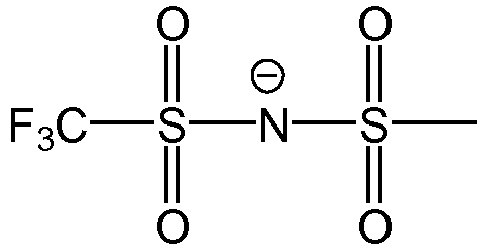
- In a particular embodiment, the inorganic nanoparticles are further grafted with at least one organic polymeric segment.
- Another aspect of the invention relates to a process for the preparation of a hybrid material as defined above, said process comprising reacting a compound of formula (III):

- RG is a reacting group;
- L is a C1-C6 alkylen or phenyl-C1-C4-alkylen group; and
- X(+) is a cation of an alkali metal,
- An additional aspect of the invention refers to an electrolyte suitable for its use in a sodium or lithium battery, said electrolyte comprising a hybrid material as defined above. In particular, the grafted nanoparticles can be used alone or can be dispersed in PEG (polyethylene glycol), PEGDME(polyethylene glycol dimethyl ether), mixtures thereof or in a polymer comprising a high fraction (≥ 60%) of CH2CH2O units, optionally plasticized with PEGDME, organic cyclic carbonates, γ-butyrolactone or tetralkyl sulfamides.
- Finally, another aspect of the invention includes sodium or lithium battery which comprises an electrolyte as defined above.
-
-
Figure 1 shows the structure of SiO2 nanoparticles grafted with PEG and Na salt where L is phenyl ethyl and the Mw of the PEG is 600. -
Figure 2 shows the characterization of SiO2 nanoparticles grafted with PEG and Na salt with same L and Mw by Transmission Electron Microscopy (TEM). -
Figure 3 shows the characterization of such SiO2 nanoparticles grafted with PEG and Na salt by Thermogravimetric analysis (TGA).Yes -
Figure 4 shows the characterization of the sameSiO2 nanoparticles grafted with PEG and Na salt by NMR (a) 13C; (b) 19F and (c) 29Si. Yes -
Figure 5 shows the ionic conductivity of these nanoparticles grafted with PEG and Na salt in the presence of different amounts of PEGDME. - The present invention relates to a nanoparticle organic hybrid material (NOHM) comprising an inorganic nanoparticle core to which an organic sodium or lithium salt is covalently attached.
- The sodium or lithium salt derives from a highly delocalized anion which is attached to the nanoparticle through an organic hydrocarbon linker (L group).
- The inorganic nanoparticle is therefore covalently grafted with at least one anion of the sodium or lithium salt remaining said anion anchored to the nanoparticle, with only sodium or lithium cations being mobile.
- The structure of the nanoparticle organic hybrid material of the invention is shown below:

- Np represents the inorganic nanoparticle;
- L is the linker group selected from C1-C6 alkylene and a phenylene-C1-C4-alkylen group; and

- By the term "nanoparticle" it is understood an inorganic physical entity, which is independent and observable, whose effective size in at least one dimension is less than 1 µm, i.e. a size between 1 and 999 nm, more preferably between 1 and 500 nm, even more preferably between 1 and 100 nm. Nanoparticles have a very high surface area to volume ratio which allows attaching numerous organic fragments on the surface of the nanoparticles. Extensive libraries of nanoparticles, composed of an assortment of different sizes, shapes, and materials, and with various chemical and surface properties, have been constructed. In this regard, a variety of nanoparticles can be used as cores, including multi-lobed nanoparticles, conductive nanoparticles, metal nanoparticles, hollow nanoparticles, quantum dots, nanocrystals, magnetic nanoparticles, metal nanoparticles, metal oxide nanoparticles and nanorods.
- In a particular embodiment, L is a C1-C6 alkylene group. The term "alkylene" refers to a straight or branched divalent hydrocarbon residue, containing no insaturation, having one to six carbon atoms, and which is attached to the nanoparticle by a single bond and to the sulfonyl group by the other single bond, e. g., methylene, ethylene, n-propylene, n-butylene, pentylene, hexylene, and isomers. In a preferred embodiment, L is a propylene group -(CH2)3-.
- Other L may be found with a phenylene group intercalated between the alkylene and the SO2 group. In fact, in a preferred embodiment, L is a phenylene-C1-C4-alkylen group, more preferably is phenylene ethylene -(C6H4)CH2CH2-.
- In a particular embodiment, the inorganic nanoparticle is composed of a material selected from the group consisting of a metal oxide, a metal and a metal salt. Examples of metal oxides include SiO2, SnO2, Fe2O3, Fe3O4, Co3O4, MgO, SrO, BaO, CaO, TiO2, ZrO2, FeO, V2O3, V2O5, Mn2O3, NiO, CuO, Al2O3, ZnO, Ag2O. Metal oxides include both oxides, metal hydroxides, metal hydrated oxides, metal oxohydroxides or metal oxoperoxohydroxides. Examples of metals include Y, Zr, La, Ce, Mg, Sr, Ba, Ca, Ti, Fe, V, Mn, Ni, Cu, Al, Si, Zn, Ag, Au or Co.
- In a preferred embodiment, nanoparticles are composed of an oxide, more preferably is SiO2.
- The inorganic nanoparticles may be grafted with a single anion of the organic lithium or sodium salt or with multiple anions of the lithium or sodium salts. Preferably, the nanoparticles are grafted with 1 to 100 anions of the lithium or sodium salt, more preferably with 1 to 20 anions of the lithium or sodium salt.
- In a preferred embodiment, the linker L is selected from -(CH2)3- and phenyl-CH2-CH2-.
- In another preferred embodiment, cation X is sodium.
- In another preferred embodiment, nanoparticles are further grafted with at least a single organic polymeric segment of a polymer material selected from polyethers, polyesters, polyamides, polysiloxanes, polysulfides, polysulfonates, polysulfonamides, poly(thio ester)s and polyamines.
- Preferred organic polymeric materials are polyethylene glycol (PEG), polyethylene oxide (PEO) and polyoxyethylene (POE). In a preferred embodiment, the organic polymer material is polyethylene glycol, even more preferably is polyethylene glycol monomethyl ether with Mw comprised between 100 and 5000.
- The inorganic nanoparticles may be grafted with a single organic polymeric segment or with multiple organic polymeric segments. Preferably, the nanoparticles are grafted with 1 to 100 organic polymeric segments, more preferably with 1 to 20 organic segments.
- The nanoparticle organic hybrid material (NOHM) grafted with the salt and the organic polymeric segments exhibit liquid-like properties so that the NOHM moves freely and flows in the absence of a suspending solvent. Thus, NOHM are in the form of a self-suspended suspension, wherein the nanoparticles are loose.
- In a particular embodiment, the nanoparticle organic hybrid material has a formula (II):

- Np represents an inorganic nanoparticle;
- L is a C1-C6 alkylene or phenylene-C1-C4-alkylene group;
- X is sodium or lithium;
- n is an integer ranging from 3 to 100;
- q is an integer ranging from 1 to 100;
- p is an integer ranging from 0 to 100:
- In a preferred embodiment, L is selected from -(CH2)3- and phenylene-CH2-CH2-.
- In another preferred embodiment, n ranges from 3 to 20, more preferably from 3 to 10, more preferably from 5 to 9.
- In another preferred embodiment, q ranges from 1 to 20, more preferably from 1 to 10.
- In another preferred embodiment, p ranges from 1 to 20, more preferably from 1 to 10.
- In another preferred embodiment, the material constitutive of the inorganic nanoparticle is a metal oxide, more preferably is SiO2.
- In another particular embodiment of the invention, the nanoparticle organic hybrid material is dispersed in a binder or plasticizer selected from PEG, polyethylene glycol dimethyl ether (PEGDME) and mixtures thereof in order to improve the ionic conductivity. Preferably, said binder is added to the hybrid material in amounts ranging from 1 to 50 wt% with respect to the weight of the hybrid material.
- Alternatively, the nanoparticle organic hybrid material is dispersed in a binder based on a polymer comprising a high fraction (≥ 60%) of CH2CH2O units, optionally plasticized with PEGDME, organic cyclic carbonates, γ-butyrolactone or tetralkyl sulfamides.
- A second aspect of the present invention relates to a process for the preparation of the nanoparticle organic hybrid material of the invention. Said process comprises attaching at least an anion of an organic sodium or lithium salt to an inorganic nanoparticle via a covalent bond through an organic linker.
- In a particular embodiment, the process for obtaining the nanoparticle organic hybrid material includes the reaction of a pre-synthesized organic salt bearing the linker L and reacting groups at one end, with complementary functional groups naturally present on or introduced onto the nanoparticles.
- Thus, the process of the invention comprises reacting a compound of formula (III):

- RG is a reacting group;
- L is a C1-C6 alkylene or phenylene-C1-C4-alkylene group; and
- X(+) is a cation of a base,
- For example, the nanoparticle organic hybrid materials are produced by dispersing the pre-synthesized organic salt of formula (III) and an inorganic nanoparticle within the same solution. Preferably, a pre-synthesized organic salt containing terminal reactive functional groups (e.g. alkoxysiloxane groups) is dissolved in water to form a dilute solution. The precursor core nanoparticles, stored in the form of an aqueous suspension, is diluted with an aqueous solution. Temporary hydrogen bonds are created between the organic salt and hydroxyl groups that have formed at the surface of the inorganic nanoparticles. The temporary bonds can then be cured between the inorganic nanoparticle core and the organic salt, resulting in permanent covalent bonds.
- In a preferred embodiment, the reacting groups present at one end of the pre-synthesized organic salt of formula (III) are alkoxysiloxane groups, such as (CH3O)3Si- or (C2H5O)3Si-.
- In another preferred embodiment, the material constitutive of the inorganic nanoparticle is SiO2.
- The pre-synthesized organic salt can be formed by reacting a compound of formula (IV):

- L is a C1-C6 alkylene or phenylene-C1-C4-alkylene group, and
- RG is a reacting group,
- The base can be for example triethylamine, so as the countercation of the compound of formula (III) would be EtNH3 (+).
- In a preferred embodiment, the reaction of the pre-synthesized organic salt with the functional groups of the nanoparticle is performed in the presence of an inorganic sodium o lithium salt, such as a lithium or sodium carbonate, in order to provide with the lithium or sodium cations.
- Therefore, in a further preferred embodiment, the process of the invention comprises:
- a) reacting a compound of formula (IV):
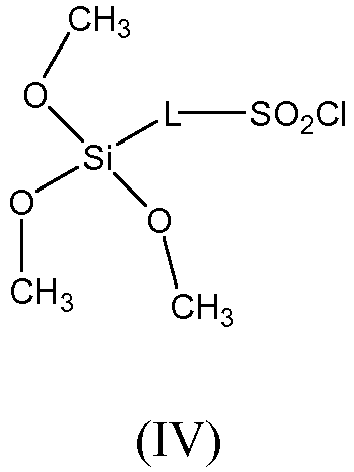
with the compound:
to obtain a compound of formula (III):
- b) reacting a nanoparticle of silicon dioxide with the compound of formula (III) in the presence of a sodium or lithium carbonate.
- In a particular embodiment, when the nanoparticle organic hybrid material of the invention is also grafted with at least a single organic polymeric segment, the process for the preparation of said hybrid material also comprises attaching the organic polymeric segment to the inorganic nanoparticle. The organic polymer is also attached to the inorganic nanoparticle via a covalent bond.
- The organic polymeric segments used in accordance to this embodiment can be produced by a variety of techniques known to those skilled in the art, including bulk, solution, dispersion, emulsion, condensation, anionic, free-radical and living radical polymerization.
- The same methodology as described for the attachment of the organic salt to the nanoparticle can be used to attach the organic polymeric segment.
- Therefore, one approach to produce said nanoparticle organic hybrid material is the "graft-to" methodology, which involves the reaction of a pre-synthesized polymer bearing reactive groups at one end of the chain with complementary functional groups naturally present on or introduced onto the nanoparticle.
- For example, the nanoparticle organic hybrid material is produced by dispersing the reactive polymer, the pre-synthesized organic salt and the inorganic nanoparticle in the same solution. In particular, the pre-synthesized organic salt and the polymer, both containing terminal reactive functional groups (alkoxysiloxane) are dissolved in water to form a dilute solution. The precursor core nanoparticles, stored in the form of an aqueous suspension, is diluted with an aqueous solution. Temporary hydrogen bonds are created between the organic salt and hydroxyl groups that have formed at the surface of the inorganic nanoparticles and between the organic polymer and hydroxyl groups that have formed at the surface of the inorganic nanoparticles. The temporary bonds can then be cured between the inorganic nanoparticle core and the organic salt and between the inorganic core and the organic polymer, resulting in permanent covalent bonds.
- In a preferred embodiment, both the organic salt and the organic polymer have alkoxysiloxanes as terminal reacting groups. In a further preferred embodiment, the organic polymer containing terminal reactive functional group is alkoxysiloxane-PEG-OH or alkoxysiloxane-PEG-epoxide.
- In another preferred embodiment, the nanoparticles is composed of SiO2.
- In a further preferred embodiment, the process of the invention comprises:
- a) reacting a compound of formula (IV):

with the compound: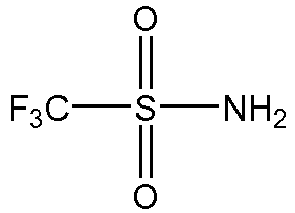
to obtain a compound of formula (III):
- b) reacting a nanoparticle of silicon dioxide with the compound of formula (III) and with the compound of formula (V):
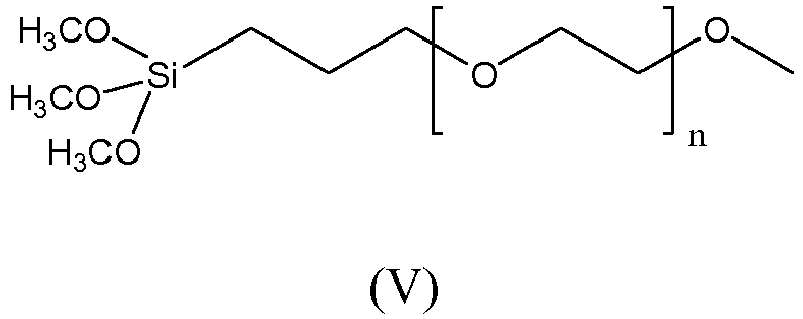
in the presence of a sodium or lithium carbonate. - In a preferred embodiment, n ranges from 5 to 20.
- In all the embodiments, L is preferably selected from -(CH2)3- and -phenyl-CH2-CH2-.
- In a particular embodiment, the process for the preparation of the nanoparticle organic hybrid material further comprises subjecting the obtained nanoparticle organic hybrid material to a dialysis process. This technique is widely known by a skilled person. It includes the separation of the suspended nanoparticle hybrid material from dissolved ions or small molecules though the pores of a semipermeable membrane.
- In a preferred embodiment, the process of the invention further comprises the addition of a binder selected from polyethylene oxide and polyethylene glycol dimethylether to the grafted nanoparticles.
- The nanoparticle organic hybrid material of the invention is useful for a wide range of application but, in particular, for the preparation of electrolytes for rechargeable batteries.
- Thus, a further aspect of the present invention refers to an electrolyte suitable for its use in a sodium or lithium battery, said electrolyte comprising a hybrid material as defined above.
- Finally, another aspect of the invention relates to a lithium or sodium rechargeable battery comprising: (i) an electrolyte as describe above, (ii) a lithium or sodium anode, and (iii) a cathode.
- This synthesis is carried out according to the process described in J. Am. Chem. Soc. 2009, 131, 2882. 2-(4-Chlorosulfonylphenyl) ethyltrimethoxysilane (2 g) was added under argon to a solution of trifluoromethanesulfonamide (1 g) and triethylamine (3.38 g) into 30 mL of methylene dichloride. The reaction mixture was stirred and heated at 40°C overnight. An orange-brown-colored wax was obtained after distillation of the solvent.
- An alkaline stabilized dispersion of silica nanoparticles was diluted to 4 wt% particle fraction by addition of aqueous sodium hydroxide solution, pH∼11 following the procedure described in J. Mater.Chem. 2011, 21, 10094. Triethylammonium 2-[(Trifluoromethanesulfonylimido)-N-4-sulfonylphenyl]ethyl-trimethoxysilane at a ratio of 1.5 g per 1.0 g SiO2 nanoparticles was added dropwise at 100°C. Following the reaction solution was heated for 12 hours at 100°C. After 24 hours, an excess of Na2CO3 in hot water was added to grafted SiO2 nanoparticles to remove the triethylamine. After removing the water, the product was dialyzed with a cellulose acetate (supplier, Aldrich) for several days in water to remove any remaining free organosilane. Finally, MP-TsOH (macroporous polystyrene sulfonic acid) columns were used to remove any remaining triethylamine of dialyzed SiO2 nanoparticles. SiO2 nanoparticles functionalized with Na salt were obtained after distillation of the solvent.
- An alkaline stabilized dispersion of silica nanoparticles was diluted to 4 wt% particle fraction by addition of aqueous sodium hydroxide solution, pH∼11. [Methoxy(polyethyleneoxy)propyl] trimethoxysilane (0.75 g, Mw∼ 600) and triethylammonium 2-[(Trifluoromethanesulfonylimido)-N-4-sulfonylphenyl]ethyltrimethoxysilane (0.75 g) were added to 1.0 g SiO2 nanoparticles dropwise at 100°C. Following the reaction solution was heated for 12 hours at 100°C. The next day, an excess of Na2CO3 in hot water was added to SiO2 nanoparticles functionalized to remove the tryethylamine. After removing the water, the product was dialyzed for several days in water to remove any remaining free organosilane. Finally, SiO2 nanoparticles functionalized with polymer and anion were obtained after distillation of the solvent.
- The chemical structure of the obtained SiO2 nanoparticle grafted with the sodium salt and PEG is depicted in
Figure 1 . -
Figures 2, 3 and4 show the characterization of such nanoparticles by TEM, TGA and NMR, respectively. - A dispersion of SiO2 nanoparticles functionalized with Na salt was prepared in methanol and water. The dispersion of grafted SiO2 nanoparticles (0.013 g is equivalent to 1mol of Na) was added to a mixture of polyethylene glycol dimethyl ether (PEGDME, 0.050g, Mw=250) and polyethylene oxide (PEO, 0.050g, Mw=5x10⁶) at ratio 1:1 in weight. After mixing, samples were dried in the convection oven at 80°C overnight and for at least 24 hours under vacuum.
- A dispersion of SiO2 nanoparticles functionalized with polymer and Na salt was prepared in water. Polymer electrolytes were synthesized by functionalized SiO2 nanoparticles (grafted with PEG and Na salt) with different amounts (50wt%, 30wt%, 10wt% and 0wt%) of PEGDME 5 (Mw= 250). After mixing, samples were dried in the convection oven at 80°C overnight and for at least 24 hours under vacuum.
- The ionic conductivity measurement of the polymer electrolytes were carried out by AC impedance spectroscopic technique using a Solartron 1260 over the frequency range from 1Hz to 1MHz with a signal level of 10 mV. The conductivity measurements of polymer electrolytes were carried out by sandwiching the samples between two stainless-steel (SS) electrodes. The temperature dependence of the ionic conductivity was performed in a temperature range from 25 to 80 °C.
-
Figure 5 shows the results of the ionic conductivity.
in the presence an inorganic sodium or lithium salt.
in the presence of an inorganic sodium or lithium salt.

Claims (15)
- A nanoparticle organic hybrid material comprising inorganic nanoparticles covalently grafted with at least one anion of an organic sodium or lithium salt through a linker group, according to the following formula (I):
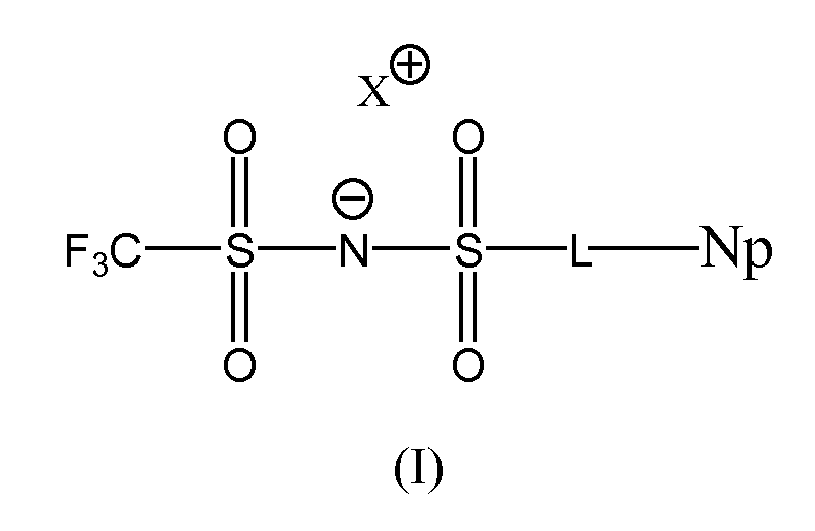 Np represents the inorganic nanoparticle;L is the linker group selected from a C1-C6 alkylene and a phenylene-C1-C4-alkylene group, and
- The hybrid material according to claim 1, wherein the inorganic nanoparticles are composed of SiO2.
- The hybrid material according to any of claim 1 and 2, wherein L is selected from -(CH2)3- and -phenylene-CH2-CH2-.
- The hybrid material according to any of claims 1 to 3, wherein the inorganic nanoparticles are further grafted with at least an organic polymeric segment.
- The hybrid material according to claim 4, wherein the organic polymeric segment is a polyethylene glycol segment.
- The hybrid material according to any of claims 1 to 5, having a formula (II):
 Np represents a nanoparticle of silicon dioxide;L is a C1-C6 alkylene or phenylene-C1-C4-alkylene group;X is sodium or lithium;n is an integer ranging from 3 to 100;q is an integer ranging from 1 to 100;p is an integer ranging from 0 to 100:
 - The hybrid material according to any of claims 1 to 6, further comprising a binder selected from polyethylene oxide and polyethylene glycol dimethylether or mixtures thereof.
- A process for the preparation of a hybrid material as defined in any of claims 1 to 7, said process comprising reacting a compound of formula (III):
 RG is a reacting group;L is a C1-C6 alkylene or phenylene-C1-C4-alkylene group; andX(+) is a cation of a base,with an inorganic nanoparticle,
in the presence of an inorganic sodium or lithium salt. - The process according to claim 8, wherein compound of formula (III) is prepared by reacting a compound of formula (IV):
 L is a C1-C6 alkylene or phenylene-C1-C4-alkylene group, andRG is a reacting group,with the compound:
- The process according to any of claims 8 and 9, wherein the reactive group is an alkoxysiloxane group.
- The process according to any of claims 8 to 10, wherein the inorganic nanoparticle is composed of SiO2.
- The process according to any of claims 8 to 11, for the preparation of a hybrid material as defined in any of claims 4 to 7, said process further comprises attaching an organic polymeric segment to the inorganic nanoparticle via a covalent bond.
- The process according to any of claims 8 to 12, which further comprises the addition of a binder selected from polyethylene oxide, polyethylene glycol dimethylether and mixtures thereof to the grafted nanoparticles.
- An electrolyte suitable for its use in a sodium or lithium battery, said electrolyte comprising a hybrid material as defined in any of claims 1 to 7.
- A sodium or lithium battery which comprises an electrolyte as defined in claim 14.
Priority Applications (9)
| Application Number | Priority Date | Filing Date | Title |
|---|---|---|---|
| ES12382290.0T ES2540463T3 (en) | 2012-07-19 | 2012-07-19 | Hybrid electrolyte |
| EP12382290.0A EP2688133B1 (en) | 2012-07-19 | 2012-07-19 | Hybrid electrolyte |
| IN1340DEN2015 IN2015DN01340A (en) | 2012-07-19 | 2013-01-21 | |
| KR1020157004124A KR102071309B1 (en) | 2012-07-19 | 2013-01-21 | Hybrid electrolyte |
| CA2878474A CA2878474A1 (en) | 2012-07-19 | 2013-01-21 | Hybrid electrolyte |
| US14/415,397 US9923235B2 (en) | 2012-07-19 | 2013-01-21 | Hybrid electrolyte |
| CN201380038388.8A CN104704668B (en) | 2012-07-19 | 2013-01-21 | mixed electrolyte |
| JP2015521996A JP2015531144A (en) | 2012-07-19 | 2013-01-21 | Hybrid electrolyte |
| PCT/EP2013/051023 WO2014012679A1 (en) | 2012-07-19 | 2013-01-21 | Hybrid electrolyte |
Applications Claiming Priority (1)
| Application Number | Priority Date | Filing Date | Title |
|---|---|---|---|
| EP12382290.0A EP2688133B1 (en) | 2012-07-19 | 2012-07-19 | Hybrid electrolyte |
Publications (2)
| Publication Number | Publication Date |
|---|---|
| EP2688133A1 EP2688133A1 (en) | 2014-01-22 |
| EP2688133B1 true EP2688133B1 (en) | 2015-03-25 |
Family
ID=46829681
Family Applications (1)
| Application Number | Title | Priority Date | Filing Date |
|---|---|---|---|
| EP12382290.0A Active EP2688133B1 (en) | 2012-07-19 | 2012-07-19 | Hybrid electrolyte |
Country Status (9)
| Country | Link |
|---|---|
| US (1) | US9923235B2 (en) |
| EP (1) | EP2688133B1 (en) |
| JP (1) | JP2015531144A (en) |
| KR (1) | KR102071309B1 (en) |
| CN (1) | CN104704668B (en) |
| CA (1) | CA2878474A1 (en) |
| ES (1) | ES2540463T3 (en) |
| IN (1) | IN2015DN01340A (en) |
| WO (1) | WO2014012679A1 (en) |
Families Citing this family (22)
| Publication number | Priority date | Publication date | Assignee | Title |
|---|---|---|---|---|
| EP3353844B1 (en) | 2015-03-27 | 2022-05-11 | Mason K. Harrup | All-inorganic solvents for electrolytes |
| KR102466670B1 (en) | 2015-05-29 | 2022-11-14 | 삼성전자주식회사 | Electrolyte for lithium battery, and negative electrode and lithium battery including the same |
| KR20190015248A (en) | 2016-06-07 | 2019-02-13 | 시오 인코퍼레이티드 | Polyalkoxysiloxane catholyte for high-voltage lithium battery |
| US10707531B1 (en) | 2016-09-27 | 2020-07-07 | New Dominion Enterprises Inc. | All-inorganic solvents for electrolytes |
| US20180131041A1 (en) * | 2016-11-09 | 2018-05-10 | Blue Solutions Canada Inc. | Lithium salt grafted nanocrystalline cellulose for solid polymer electrolyte |
| WO2018107263A1 (en) | 2016-12-14 | 2018-06-21 | Blue Solutions Canada Inc. | Lithium metal battery containing electrolyte grafted with immobilized anions |
| US10361457B2 (en) | 2017-03-24 | 2019-07-23 | Seeo, Inc. | Polar polysiloxane electrolytes for lithium batteries |
| KR102016642B1 (en) | 2017-05-24 | 2019-08-30 | 주식회사 그래피니드테크놀로지 | Electrolyte for electrochemical devices and preparation method |
| WO2018217043A1 (en) | 2017-05-24 | 2018-11-29 | 신익수 | Electrolyte for electrochemical device and preparation method therefor |
| KR102034205B1 (en) | 2017-05-24 | 2019-10-18 | 주식회사 그래피니드테크놀로지 | Electriochemical device including carbon quantum dots ion compound electrolyte |
| CN109585754B (en) * | 2017-09-28 | 2022-09-27 | 三星电子株式会社 | Composite film for lithium battery, positive electrode for lithium battery, and lithium battery |
| JP7080732B2 (en) * | 2018-06-01 | 2022-06-06 | 三菱マテリアル電子化成株式会社 | Fluorine-containing sulfonylimide base-containing silicone compound and a conductive silicone composition containing the same |
| FR3083006A1 (en) * | 2018-06-22 | 2019-12-27 | Institut Polytechnique De Grenoble | SOLID POLYMER ELECTROLYTE, PREPARATION METHOD THEREOF, AND ELECTROCHEMICAL ACCUMULATOR / CELL COMPRISING SAME |
| EP3821487B1 (en) * | 2018-07-10 | 2022-09-07 | Repsol, S.A. | Functionalized metal oxide nanoparticles and process for preparnig the same |
| JP6966396B2 (en) * | 2018-08-23 | 2021-11-17 | 信越化学工業株式会社 | Bioelectrode composition, bioelectrode, and method for manufacturing bioelectrode |
| US20210013490A1 (en) * | 2019-07-08 | 2021-01-14 | Nanotek Instruments, Inc. | Prelithiated anode active material particles for lithium-ion batteries and production method |
| JP7444821B2 (en) * | 2020-09-15 | 2024-03-06 | 信越化学工業株式会社 | Bioelectrode composition, bioelectrode, bioelectrode manufacturing method, and silicon material particles |
| JP7444824B2 (en) * | 2020-09-24 | 2024-03-06 | 信越化学工業株式会社 | Bioelectrode composition, bioelectrode, bioelectrode manufacturing method, and silicon material particles |
| JP7524148B2 (en) * | 2020-10-13 | 2024-07-29 | 信越化学工業株式会社 | Bioelectrode composition, bioelectrode, method for producing bioelectrode, polymer compound and composite |
| CN113667133B (en) * | 2021-08-10 | 2022-08-02 | 中国科学院化学研究所 | Polyethylene grafted nanoparticle nucleating agent and preparation method and application thereof |
| US12080849B1 (en) * | 2021-12-13 | 2024-09-03 | National Technology & Engineering Solutions Of Sandia, Llc | Ionogel-based batteries and ionogel liquid exchange |
| CN119361613B (en) * | 2024-10-22 | 2025-05-27 | 金马能源科技(淮南)有限公司 | Positive electrode interface coating process for all-solid-state battery |
Family Cites Families (4)
| Publication number | Priority date | Publication date | Assignee | Title |
|---|---|---|---|---|
| US5569560A (en) | 1995-04-12 | 1996-10-29 | Olsen; Ib I. | Complexing agent for improved performance in a lithium based hybrid electrolyte |
| US5965299A (en) * | 1997-06-23 | 1999-10-12 | North Carolina State University | Composite electrolyte containing surface modified fumed silica |
| EP2050755A1 (en) | 2007-10-19 | 2009-04-22 | Total Petrochemicals Research Feluy | Supported ionic liquids or activating supports |
| EP2387597A4 (en) | 2009-01-15 | 2014-05-14 | Univ Cornell | NANOPARTICULAR ORGANIC HYBRID MATERIALS (NOHM) |
-
2012
- 2012-07-19 EP EP12382290.0A patent/EP2688133B1/en active Active
- 2012-07-19 ES ES12382290.0T patent/ES2540463T3/en active Active
-
2013
- 2013-01-21 KR KR1020157004124A patent/KR102071309B1/en active Active
- 2013-01-21 CN CN201380038388.8A patent/CN104704668B/en active Active
- 2013-01-21 IN IN1340DEN2015 patent/IN2015DN01340A/en unknown
- 2013-01-21 US US14/415,397 patent/US9923235B2/en active Active
- 2013-01-21 JP JP2015521996A patent/JP2015531144A/en active Pending
- 2013-01-21 WO PCT/EP2013/051023 patent/WO2014012679A1/en not_active Ceased
- 2013-01-21 CA CA2878474A patent/CA2878474A1/en not_active Abandoned
Also Published As
| Publication number | Publication date |
|---|---|
| KR102071309B1 (en) | 2020-01-30 |
| US20150188189A1 (en) | 2015-07-02 |
| CN104704668A (en) | 2015-06-10 |
| CN104704668B (en) | 2017-03-01 |
| JP2015531144A (en) | 2015-10-29 |
| CA2878474A1 (en) | 2014-01-23 |
| US9923235B2 (en) | 2018-03-20 |
| IN2015DN01340A (en) | 2015-07-03 |
| EP2688133A1 (en) | 2014-01-22 |
| KR20150052008A (en) | 2015-05-13 |
| WO2014012679A1 (en) | 2014-01-23 |
| ES2540463T3 (en) | 2015-07-09 |
Similar Documents
| Publication | Publication Date | Title |
|---|---|---|
| EP2688133B1 (en) | Hybrid electrolyte | |
| Chen et al. | Ionogel electrolytes for high‐performance lithium batteries: a review | |
| Strauss et al. | On the way to high-conductivity single lithium-ion conductors | |
| Long et al. | Polymer electrolytes for lithium polymer batteries | |
| CN103765663B (en) | Ionic liquid nanoscale ionic material composition, method and application | |
| Li et al. | A single-ion conducting and shear-thinning polymer electrolyte based on ionic liquid-decorated PMMA nanoparticles for lithium-metal batteries | |
| US10892521B2 (en) | Solid polymer electrolyte based on modified cellulose and its use in lithium or sodium secondary batteries | |
| Zhai et al. | Composite hybrid quasi-solid electrolyte for high-energy lithium metal batteries | |
| KR102592147B1 (en) | Composite separator, preparing method thereof, and lithium secondary battery including the same | |
| Zhao et al. | Fumed silica-based single-ion nanocomposite electrolyte for lithium batteries | |
| KR102527477B1 (en) | Solid nanocomposite electrolyte materials | |
| JP2001519464A (en) | Mixtures with specific plasticizers suitable as solid electrolytes or separators for electrochemical cells | |
| US20250007009A1 (en) | High temperature li-ion battery cells utilizing boron nitride aerogels and boron nitride nanotubes | |
| BRPI0713641A2 (en) | process of modifying the interfacial resistance of a lithium metal electrode immersed in an electrolyte solution, lithium metal battery electrode, and lithium metal type battery | |
| KR100754421B1 (en) | Paste electrolyte and rechargeable lithium battery containing the same | |
| Zhu et al. | Molecular coupling strategy achieving in situ synthesis of agglomeration-free solid composite electrolytes | |
| Swathi et al. | Cross-linked polymer composite electrolyte incorporated with waste seashell based nanofiller for lithium metal batteries | |
| Bristi et al. | Ionic conductivity, Na plating–stripping, and battery performance of solid polymer Na ion electrolyte based on poly (vinylidene fluoride) and poly (vinyl pyrrolidone) | |
| Kurc | Composite gel polymer electrolyte with modified silica for LiMn2O4 positive electrode in lithium-ion battery | |
| Hu et al. | Adapting sol-gel chemistry for ionogel solid electrolytes | |
| Zafar et al. | Nanofillers in composite solid polymer electrolytes for Li-Ion battery applications | |
| CN112382786A (en) | Composition for forming solid polymer electrolyte, solid polymer electrolyte membrane, and lithium ion battery | |
| Hoang Huy et al. | Inorganic Fillers in Composite Gel Polymer Electrolytes for High-Performance Lithium and Non-Lithium Polymer Batteries. Nanomaterials 2021, 11, 614 | |
| KR102821116B1 (en) | Molecular Crowding Aqueous Electrolyte, Manufacturing Method Thereof and Lithium Secondary Battery Containing The Same | |
| Thakur et al. | Solid Polymer Electrolytes for Solid State Batteries |
Legal Events
| Date | Code | Title | Description |
|---|---|---|---|
| PUAI | Public reference made under article 153(3) epc to a published international application that has entered the european phase |
Free format text: ORIGINAL CODE: 0009012 |
|
| AK | Designated contracting states |
Kind code of ref document: A1 Designated state(s): AL AT BE BG CH CY CZ DE DK EE ES FI FR GB GR HR HU IE IS IT LI LT LU LV MC MK MT NL NO PL PT RO RS SE SI SK SM TR |
|
| AX | Request for extension of the european patent |
Extension state: BA ME |
|
| RIN1 | Information on inventor provided before grant (corrected) |
Inventor name: ARMAND, MICHEL Inventor name: ROJO, TEOFILO Inventor name: VILLALUENGA, IRUNE |
|
| 17P | Request for examination filed |
Effective date: 20140327 |
|
| RBV | Designated contracting states (corrected) |
Designated state(s): AL AT BE BG CH CY CZ DE DK EE ES FI FR GB GR HR HU IE IS IT LI LT LU LV MC MK MT NL NO PL PT RO RS SE SI SK SM TR |
|
| 17Q | First examination report despatched |
Effective date: 20140425 |
|
| GRAP | Despatch of communication of intention to grant a patent |
Free format text: ORIGINAL CODE: EPIDOSNIGR1 |
|
| RIC1 | Information provided on ipc code assigned before grant |
Ipc: H01M 10/054 20100101ALI20140702BHEP Ipc: C09C 1/30 20060101ALI20140702BHEP Ipc: H01M 10/056 20100101ALI20140702BHEP Ipc: H01B 1/12 20060101ALI20140702BHEP Ipc: H01M 10/052 20100101AFI20140702BHEP |
|
| INTG | Intention to grant announced |
Effective date: 20140714 |
|
| GRAP | Despatch of communication of intention to grant a patent |
Free format text: ORIGINAL CODE: EPIDOSNIGR1 |
|
| GRAS | Grant fee paid |
Free format text: ORIGINAL CODE: EPIDOSNIGR3 |
|
| INTG | Intention to grant announced |
Effective date: 20150123 |
|
| GRAA | (expected) grant |
Free format text: ORIGINAL CODE: 0009210 |
|
| AK | Designated contracting states |
Kind code of ref document: B1 Designated state(s): AL AT BE BG CH CY CZ DE DK EE ES FI FR GB GR HR HU IE IS IT LI LT LU LV MC MK MT NL NO PL PT RO RS SE SI SK SM TR |
|
| REG | Reference to a national code |
Ref country code: GB Ref legal event code: FG4D |
|
| REG | Reference to a national code |
Ref country code: CH Ref legal event code: EP |
|
| REG | Reference to a national code |
Ref country code: IE Ref legal event code: FG4D |
|
| REG | Reference to a national code |
Ref country code: DE Ref legal event code: R096 Ref document number: 602012006149 Country of ref document: DE Effective date: 20150507 |
|
| REG | Reference to a national code |
Ref country code: AT Ref legal event code: REF Ref document number: 718352 Country of ref document: AT Kind code of ref document: T Effective date: 20150515 |
|
| REG | Reference to a national code |
Ref country code: ES Ref legal event code: FG2A Ref document number: 2540463 Country of ref document: ES Kind code of ref document: T3 Effective date: 20150709 |
|
| PG25 | Lapsed in a contracting state [announced via postgrant information from national office to epo] |
Ref country code: HR Free format text: LAPSE BECAUSE OF FAILURE TO SUBMIT A TRANSLATION OF THE DESCRIPTION OR TO PAY THE FEE WITHIN THE PRESCRIBED TIME-LIMIT Effective date: 20150325 Ref country code: SE Free format text: LAPSE BECAUSE OF FAILURE TO SUBMIT A TRANSLATION OF THE DESCRIPTION OR TO PAY THE FEE WITHIN THE PRESCRIBED TIME-LIMIT Effective date: 20150325 Ref country code: LT Free format text: LAPSE BECAUSE OF FAILURE TO SUBMIT A TRANSLATION OF THE DESCRIPTION OR TO PAY THE FEE WITHIN THE PRESCRIBED TIME-LIMIT Effective date: 20150325 Ref country code: FI Free format text: LAPSE BECAUSE OF FAILURE TO SUBMIT A TRANSLATION OF THE DESCRIPTION OR TO PAY THE FEE WITHIN THE PRESCRIBED TIME-LIMIT Effective date: 20150325 |
|
| REG | Reference to a national code |
Ref country code: AT Ref legal event code: MK05 Ref document number: 718352 Country of ref document: AT Kind code of ref document: T Effective date: 20150325 |
|
| REG | Reference to a national code |
Ref country code: LT Ref legal event code: MG4D |
|
| PG25 | Lapsed in a contracting state [announced via postgrant information from national office to epo] |
Ref country code: LV Free format text: LAPSE BECAUSE OF FAILURE TO SUBMIT A TRANSLATION OF THE DESCRIPTION OR TO PAY THE FEE WITHIN THE PRESCRIBED TIME-LIMIT Effective date: 20150325 Ref country code: GR Free format text: LAPSE BECAUSE OF FAILURE TO SUBMIT A TRANSLATION OF THE DESCRIPTION OR TO PAY THE FEE WITHIN THE PRESCRIBED TIME-LIMIT Effective date: 20150626 Ref country code: RS Free format text: LAPSE BECAUSE OF FAILURE TO SUBMIT A TRANSLATION OF THE DESCRIPTION OR TO PAY THE FEE WITHIN THE PRESCRIBED TIME-LIMIT Effective date: 20150325 |
|
| PG25 | Lapsed in a contracting state [announced via postgrant information from national office to epo] |
Ref country code: NL Free format text: LAPSE BECAUSE OF FAILURE TO SUBMIT A TRANSLATION OF THE DESCRIPTION OR TO PAY THE FEE WITHIN THE PRESCRIBED TIME-LIMIT Effective date: 20150325 |
|
| PG25 | Lapsed in a contracting state [announced via postgrant information from national office to epo] |
Ref country code: PT Free format text: LAPSE BECAUSE OF FAILURE TO SUBMIT A TRANSLATION OF THE DESCRIPTION OR TO PAY THE FEE WITHIN THE PRESCRIBED TIME-LIMIT Effective date: 20150727 Ref country code: EE Free format text: LAPSE BECAUSE OF FAILURE TO SUBMIT A TRANSLATION OF THE DESCRIPTION OR TO PAY THE FEE WITHIN THE PRESCRIBED TIME-LIMIT Effective date: 20150325 Ref country code: CZ Free format text: LAPSE BECAUSE OF FAILURE TO SUBMIT A TRANSLATION OF THE DESCRIPTION OR TO PAY THE FEE WITHIN THE PRESCRIBED TIME-LIMIT Effective date: 20150325 Ref country code: SK Free format text: LAPSE BECAUSE OF FAILURE TO SUBMIT A TRANSLATION OF THE DESCRIPTION OR TO PAY THE FEE WITHIN THE PRESCRIBED TIME-LIMIT Effective date: 20150325 Ref country code: RO Free format text: LAPSE BECAUSE OF FAILURE TO SUBMIT A TRANSLATION OF THE DESCRIPTION OR TO PAY THE FEE WITHIN THE PRESCRIBED TIME-LIMIT Effective date: 20150325 |
|
| PG25 | Lapsed in a contracting state [announced via postgrant information from national office to epo] |
Ref country code: PL Free format text: LAPSE BECAUSE OF FAILURE TO SUBMIT A TRANSLATION OF THE DESCRIPTION OR TO PAY THE FEE WITHIN THE PRESCRIBED TIME-LIMIT Effective date: 20150325 Ref country code: AT Free format text: LAPSE BECAUSE OF FAILURE TO SUBMIT A TRANSLATION OF THE DESCRIPTION OR TO PAY THE FEE WITHIN THE PRESCRIBED TIME-LIMIT Effective date: 20150325 Ref country code: IS Free format text: LAPSE BECAUSE OF FAILURE TO SUBMIT A TRANSLATION OF THE DESCRIPTION OR TO PAY THE FEE WITHIN THE PRESCRIBED TIME-LIMIT Effective date: 20150725 |
|
| REG | Reference to a national code |
Ref country code: DE Ref legal event code: R097 Ref document number: 602012006149 Country of ref document: DE |
|
| PG25 | Lapsed in a contracting state [announced via postgrant information from national office to epo] |
Ref country code: DK Free format text: LAPSE BECAUSE OF FAILURE TO SUBMIT A TRANSLATION OF THE DESCRIPTION OR TO PAY THE FEE WITHIN THE PRESCRIBED TIME-LIMIT Effective date: 20150325 |
|
| PLBE | No opposition filed within time limit |
Free format text: ORIGINAL CODE: 0009261 |
|
| STAA | Information on the status of an ep patent application or granted ep patent |
Free format text: STATUS: NO OPPOSITION FILED WITHIN TIME LIMIT |
|
| PG25 | Lapsed in a contracting state [announced via postgrant information from national office to epo] |
Ref country code: MC Free format text: LAPSE BECAUSE OF FAILURE TO SUBMIT A TRANSLATION OF THE DESCRIPTION OR TO PAY THE FEE WITHIN THE PRESCRIBED TIME-LIMIT Effective date: 20150325 |
|
| 26N | No opposition filed |
Effective date: 20160105 |
|
| PG25 | Lapsed in a contracting state [announced via postgrant information from national office to epo] |
Ref country code: LU Free format text: LAPSE BECAUSE OF FAILURE TO SUBMIT A TRANSLATION OF THE DESCRIPTION OR TO PAY THE FEE WITHIN THE PRESCRIBED TIME-LIMIT Effective date: 20150719 |
|
| REG | Reference to a national code |
Ref country code: IE Ref legal event code: MM4A |
|
| PG25 | Lapsed in a contracting state [announced via postgrant information from national office to epo] |
Ref country code: IT Free format text: LAPSE BECAUSE OF FAILURE TO SUBMIT A TRANSLATION OF THE DESCRIPTION OR TO PAY THE FEE WITHIN THE PRESCRIBED TIME-LIMIT Effective date: 20150325 |
|
| PG25 | Lapsed in a contracting state [announced via postgrant information from national office to epo] |
Ref country code: SI Free format text: LAPSE BECAUSE OF FAILURE TO SUBMIT A TRANSLATION OF THE DESCRIPTION OR TO PAY THE FEE WITHIN THE PRESCRIBED TIME-LIMIT Effective date: 20150325 |
|
| REG | Reference to a national code |
Ref country code: FR Ref legal event code: PLFP Year of fee payment: 5 |
|
| PG25 | Lapsed in a contracting state [announced via postgrant information from national office to epo] |
Ref country code: IE Free format text: LAPSE BECAUSE OF NON-PAYMENT OF DUE FEES Effective date: 20150719 |
|
| PG25 | Lapsed in a contracting state [announced via postgrant information from national office to epo] |
Ref country code: BE Free format text: LAPSE BECAUSE OF FAILURE TO SUBMIT A TRANSLATION OF THE DESCRIPTION OR TO PAY THE FEE WITHIN THE PRESCRIBED TIME-LIMIT Effective date: 20150325 |
|
| REG | Reference to a national code |
Ref country code: ES Ref legal event code: PC2A Owner name: FUNDACION CENTRO DE INVESTIGACION COOPERATIVA DE E Effective date: 20161028 |
|
| PG25 | Lapsed in a contracting state [announced via postgrant information from national office to epo] |
Ref country code: MT Free format text: LAPSE BECAUSE OF FAILURE TO SUBMIT A TRANSLATION OF THE DESCRIPTION OR TO PAY THE FEE WITHIN THE PRESCRIBED TIME-LIMIT Effective date: 20150325 |
|
| PG25 | Lapsed in a contracting state [announced via postgrant information from national office to epo] |
Ref country code: BG Free format text: LAPSE BECAUSE OF FAILURE TO SUBMIT A TRANSLATION OF THE DESCRIPTION OR TO PAY THE FEE WITHIN THE PRESCRIBED TIME-LIMIT Effective date: 20150325 Ref country code: HU Free format text: LAPSE BECAUSE OF FAILURE TO SUBMIT A TRANSLATION OF THE DESCRIPTION OR TO PAY THE FEE WITHIN THE PRESCRIBED TIME-LIMIT; INVALID AB INITIO Effective date: 20120719 Ref country code: SM Free format text: LAPSE BECAUSE OF FAILURE TO SUBMIT A TRANSLATION OF THE DESCRIPTION OR TO PAY THE FEE WITHIN THE PRESCRIBED TIME-LIMIT Effective date: 20150325 Ref country code: NO Free format text: LAPSE BECAUSE OF FAILURE TO SUBMIT A TRANSLATION OF THE DESCRIPTION OR TO PAY THE FEE WITHIN THE PRESCRIBED TIME-LIMIT Effective date: 20150625 |
|
| PG25 | Lapsed in a contracting state [announced via postgrant information from national office to epo] |
Ref country code: CY Free format text: LAPSE BECAUSE OF FAILURE TO SUBMIT A TRANSLATION OF THE DESCRIPTION OR TO PAY THE FEE WITHIN THE PRESCRIBED TIME-LIMIT Effective date: 20150325 |
|
| REG | Reference to a national code |
Ref country code: FR Ref legal event code: PLFP Year of fee payment: 6 |
|
| PG25 | Lapsed in a contracting state [announced via postgrant information from national office to epo] |
Ref country code: MK Free format text: LAPSE BECAUSE OF FAILURE TO SUBMIT A TRANSLATION OF THE DESCRIPTION OR TO PAY THE FEE WITHIN THE PRESCRIBED TIME-LIMIT Effective date: 20150325 Ref country code: TR Free format text: LAPSE BECAUSE OF FAILURE TO SUBMIT A TRANSLATION OF THE DESCRIPTION OR TO PAY THE FEE WITHIN THE PRESCRIBED TIME-LIMIT Effective date: 20150325 |
|
| REG | Reference to a national code |
Ref country code: FR Ref legal event code: PLFP Year of fee payment: 7 |
|
| PG25 | Lapsed in a contracting state [announced via postgrant information from national office to epo] |
Ref country code: AL Free format text: LAPSE BECAUSE OF FAILURE TO SUBMIT A TRANSLATION OF THE DESCRIPTION OR TO PAY THE FEE WITHIN THE PRESCRIBED TIME-LIMIT Effective date: 20150325 |
|
| P01 | Opt-out of the competence of the unified patent court (upc) registered |
Effective date: 20230427 |
|
| REG | Reference to a national code |
Ref country code: ES Ref legal event code: GD2A Effective date: 20240626 |
|
| PGFP | Annual fee paid to national office [announced via postgrant information from national office to epo] |
Ref country code: GB Payment date: 20240729 Year of fee payment: 13 |
|
| PGFP | Annual fee paid to national office [announced via postgrant information from national office to epo] |
Ref country code: CH Payment date: 20240801 Year of fee payment: 13 |
|
| PGFP | Annual fee paid to national office [announced via postgrant information from national office to epo] |
Ref country code: ES Payment date: 20250806 Year of fee payment: 14 |
|
| PGFP | Annual fee paid to national office [announced via postgrant information from national office to epo] |
Ref country code: DE Payment date: 20250729 Year of fee payment: 14 |
|
| PGFP | Annual fee paid to national office [announced via postgrant information from national office to epo] |
Ref country code: FR Payment date: 20250725 Year of fee payment: 14 |