EP2674432A1 - New synthetic route for the preparation of ß aminobutyryl substituted 5,6,7,8-tetrahydro[1,4]diazolo[4,3-alpha]pyrazin-7-yl compounds - Google Patents
New synthetic route for the preparation of ß aminobutyryl substituted 5,6,7,8-tetrahydro[1,4]diazolo[4,3-alpha]pyrazin-7-yl compounds Download PDFInfo
- Publication number
- EP2674432A1 EP2674432A1 EP12172012.2A EP12172012A EP2674432A1 EP 2674432 A1 EP2674432 A1 EP 2674432A1 EP 12172012 A EP12172012 A EP 12172012A EP 2674432 A1 EP2674432 A1 EP 2674432A1
- Authority
- EP
- European Patent Office
- Prior art keywords
- compound
- formula
- process according
- alkyl
- substituted
- Prior art date
- Legal status (The legal status is an assumption and is not a legal conclusion. Google has not performed a legal analysis and makes no representation as to the accuracy of the status listed.)
- Ceased
Links
- 150000001875 compounds Chemical class 0.000 title claims abstract description 152
- -1 aminobutyryl Chemical group 0.000 title claims abstract description 20
- 238000002360 preparation method Methods 0.000 title claims description 13
- 238000004519 manufacturing process Methods 0.000 claims abstract description 10
- 238000000034 method Methods 0.000 claims description 93
- 230000008569 process Effects 0.000 claims description 83
- LMBFAGIMSUYTBN-MPZNNTNKSA-N teixobactin Chemical compound C([C@H](C(=O)N[C@@H]([C@@H](C)CC)C(=O)N[C@@H](CO)C(=O)N[C@H](CCC(N)=O)C(=O)N[C@H]([C@@H](C)CC)C(=O)N[C@@H]([C@@H](C)CC)C(=O)N[C@@H](CO)C(=O)N[C@H]1C(N[C@@H](C)C(=O)N[C@@H](C[C@@H]2NC(=N)NC2)C(=O)N[C@H](C(=O)O[C@H]1C)[C@@H](C)CC)=O)NC)C1=CC=CC=C1 LMBFAGIMSUYTBN-MPZNNTNKSA-N 0.000 claims description 59
- MFFMDFFZMYYVKS-SECBINFHSA-N sitagliptin Chemical compound C([C@H](CC(=O)N1CC=2N(C(=NN=2)C(F)(F)F)CC1)N)C1=CC(F)=C(F)C=C1F MFFMDFFZMYYVKS-SECBINFHSA-N 0.000 claims description 31
- 150000003839 salts Chemical class 0.000 claims description 30
- 239000002253 acid Substances 0.000 claims description 27
- 102000004190 Enzymes Human genes 0.000 claims description 26
- 108090000790 Enzymes Proteins 0.000 claims description 26
- OKKJLVBELUTLKV-UHFFFAOYSA-N Methanol Chemical compound OC OKKJLVBELUTLKV-UHFFFAOYSA-N 0.000 claims description 21
- 230000002255 enzymatic effect Effects 0.000 claims description 20
- 239000000543 intermediate Substances 0.000 claims description 19
- 229960004034 sitagliptin Drugs 0.000 claims description 19
- YXFVVABEGXRONW-UHFFFAOYSA-N Toluene Chemical compound CC1=CC=CC=C1 YXFVVABEGXRONW-UHFFFAOYSA-N 0.000 claims description 18
- 239000002904 solvent Substances 0.000 claims description 18
- 239000003054 catalyst Substances 0.000 claims description 16
- 230000003301 hydrolyzing effect Effects 0.000 claims description 16
- 239000003960 organic solvent Substances 0.000 claims description 15
- OKBMCNHOEMXPTM-UHFFFAOYSA-M potassium peroxymonosulfate Chemical group [K+].OOS([O-])(=O)=O OKBMCNHOEMXPTM-UHFFFAOYSA-M 0.000 claims description 15
- WYURNTSHIVDZCO-UHFFFAOYSA-N Tetrahydrofuran Chemical compound C1CCOC1 WYURNTSHIVDZCO-UHFFFAOYSA-N 0.000 claims description 14
- 239000007800 oxidant agent Substances 0.000 claims description 14
- 239000003638 chemical reducing agent Substances 0.000 claims description 13
- 239000000203 mixture Substances 0.000 claims description 13
- 239000008194 pharmaceutical composition Substances 0.000 claims description 13
- 239000004480 active ingredient Substances 0.000 claims description 12
- 238000010168 coupling process Methods 0.000 claims description 12
- 150000002170 ethers Chemical class 0.000 claims description 12
- NOESYZHRGYRDHS-UHFFFAOYSA-N insulin Chemical compound N1C(=O)C(NC(=O)C(CCC(N)=O)NC(=O)C(CCC(O)=O)NC(=O)C(C(C)C)NC(=O)C(NC(=O)CN)C(C)CC)CSSCC(C(NC(CO)C(=O)NC(CC(C)C)C(=O)NC(CC=2C=CC(O)=CC=2)C(=O)NC(CCC(N)=O)C(=O)NC(CC(C)C)C(=O)NC(CCC(O)=O)C(=O)NC(CC(N)=O)C(=O)NC(CC=2C=CC(O)=CC=2)C(=O)NC(CSSCC(NC(=O)C(C(C)C)NC(=O)C(CC(C)C)NC(=O)C(CC=2C=CC(O)=CC=2)NC(=O)C(CC(C)C)NC(=O)C(C)NC(=O)C(CCC(O)=O)NC(=O)C(C(C)C)NC(=O)C(CC(C)C)NC(=O)C(CC=2NC=NC=2)NC(=O)C(CO)NC(=O)CNC2=O)C(=O)NCC(=O)NC(CCC(O)=O)C(=O)NC(CCCNC(N)=N)C(=O)NCC(=O)NC(CC=3C=CC=CC=3)C(=O)NC(CC=3C=CC=CC=3)C(=O)NC(CC=3C=CC(O)=CC=3)C(=O)NC(C(C)O)C(=O)N3C(CCC3)C(=O)NC(CCCCN)C(=O)NC(C)C(O)=O)C(=O)NC(CC(N)=O)C(O)=O)=O)NC(=O)C(C(C)CC)NC(=O)C(CO)NC(=O)C(C(C)O)NC(=O)C1CSSCC2NC(=O)C(CC(C)C)NC(=O)C(NC(=O)C(CCC(N)=O)NC(=O)C(CC(N)=O)NC(=O)C(NC(=O)C(N)CC=1C=CC=CC=1)C(C)C)CC1=CN=CN1 NOESYZHRGYRDHS-UHFFFAOYSA-N 0.000 claims description 12
- 239000011541 reaction mixture Substances 0.000 claims description 12
- ZMANZCXQSJIPKH-UHFFFAOYSA-N Triethylamine Chemical compound CCN(CC)CC ZMANZCXQSJIPKH-UHFFFAOYSA-N 0.000 claims description 11
- 238000006210 cyclodehydration reaction Methods 0.000 claims description 11
- 230000009467 reduction Effects 0.000 claims description 11
- XLYOFNOQVPJJNP-UHFFFAOYSA-N water Substances O XLYOFNOQVPJJNP-UHFFFAOYSA-N 0.000 claims description 11
- 239000003112 inhibitor Substances 0.000 claims description 10
- 125000006273 (C1-C3) alkyl group Chemical group 0.000 claims description 9
- 108010031797 Candida antarctica lipase B Proteins 0.000 claims description 9
- DTHNMHAUYICORS-KTKZVXAJSA-N Glucagon-like peptide 1 Chemical compound C([C@@H](C(=O)N[C@@H]([C@@H](C)CC)C(=O)N[C@@H](C)C(=O)N[C@@H](CC=1C2=CC=CC=C2NC=1)C(=O)N[C@@H](CC(C)C)C(=O)N[C@@H](C(C)C)C(=O)N[C@@H](CCCCN)C(=O)NCC(=O)N[C@@H](CCCNC(N)=N)C(N)=O)NC(=O)[C@H](CCC(O)=O)NC(=O)[C@H](CCCCN)NC(=O)[C@H](C)NC(=O)[C@H](C)NC(=O)[C@H](CCC(N)=O)NC(=O)CNC(=O)[C@H](CCC(O)=O)NC(=O)[C@H](CC(C)C)NC(=O)[C@H](CC=1C=CC(O)=CC=1)NC(=O)[C@H](CO)NC(=O)[C@H](CO)NC(=O)[C@@H](NC(=O)[C@H](CC(O)=O)NC(=O)[C@H](CO)NC(=O)[C@@H](NC(=O)[C@H](CC=1C=CC=CC=1)NC(=O)[C@@H](NC(=O)CNC(=O)[C@H](CCC(O)=O)NC(=O)[C@H](C)NC(=O)[C@@H](N)CC=1N=CNC=1)[C@@H](C)O)[C@@H](C)O)C(C)C)C1=CC=CC=C1 DTHNMHAUYICORS-KTKZVXAJSA-N 0.000 claims description 9
- BZLVMXJERCGZMT-UHFFFAOYSA-N Methyl tert-butyl ether Chemical compound COC(C)(C)C BZLVMXJERCGZMT-UHFFFAOYSA-N 0.000 claims description 9
- 239000012425 OXONE® Substances 0.000 claims description 9
- VLKZOEOYAKHREP-UHFFFAOYSA-N n-Hexane Chemical compound CCCCCC VLKZOEOYAKHREP-UHFFFAOYSA-N 0.000 claims description 9
- 239000007858 starting material Substances 0.000 claims description 9
- UIIMBOGNXHQVGW-UHFFFAOYSA-M Sodium bicarbonate Chemical compound [Na+].OC([O-])=O UIIMBOGNXHQVGW-UHFFFAOYSA-M 0.000 claims description 8
- 229910052799 carbon Inorganic materials 0.000 claims description 8
- 238000005859 coupling reaction Methods 0.000 claims description 8
- 238000001914 filtration Methods 0.000 claims description 8
- 125000001153 fluoro group Chemical group F* 0.000 claims description 8
- 230000003647 oxidation Effects 0.000 claims description 8
- 238000007254 oxidation reaction Methods 0.000 claims description 8
- 125000001997 phenyl group Chemical group [H]C1=C([H])C([H])=C(*)C([H])=C1[H] 0.000 claims description 8
- 238000000926 separation method Methods 0.000 claims description 8
- OBETXYAYXDNJHR-SSDOTTSWSA-M (2r)-2-ethylhexanoate Chemical compound CCCC[C@@H](CC)C([O-])=O OBETXYAYXDNJHR-SSDOTTSWSA-M 0.000 claims description 7
- 125000004169 (C1-C6) alkyl group Chemical group 0.000 claims description 7
- 239000012359 Methanesulfonyl chloride Substances 0.000 claims description 7
- OBETXYAYXDNJHR-UHFFFAOYSA-N alpha-ethylcaproic acid Natural products CCCCC(CC)C(O)=O OBETXYAYXDNJHR-UHFFFAOYSA-N 0.000 claims description 7
- QARBMVPHQWIHKH-UHFFFAOYSA-N methanesulfonyl chloride Chemical compound CS(Cl)(=O)=O QARBMVPHQWIHKH-UHFFFAOYSA-N 0.000 claims description 7
- 125000004178 (C1-C4) alkyl group Chemical group 0.000 claims description 6
- 108010061846 Cholesterol Ester Transfer Proteins Proteins 0.000 claims description 6
- 102000012336 Cholesterol Ester Transfer Proteins Human genes 0.000 claims description 6
- ZAFNJMIOTHYJRJ-UHFFFAOYSA-N Diisopropyl ether Chemical compound CC(C)OC(C)C ZAFNJMIOTHYJRJ-UHFFFAOYSA-N 0.000 claims description 6
- 101710198884 GATA-type zinc finger protein 1 Proteins 0.000 claims description 6
- 102000004877 Insulin Human genes 0.000 claims description 6
- 108090001061 Insulin Proteins 0.000 claims description 6
- 102000002808 Pituitary adenylate cyclase-activating polypeptide Human genes 0.000 claims description 6
- 108010004684 Pituitary adenylate cyclase-activating polypeptide Proteins 0.000 claims description 6
- 102100040918 Pro-glucagon Human genes 0.000 claims description 6
- 239000003795 chemical substances by application Substances 0.000 claims description 6
- 230000008878 coupling Effects 0.000 claims description 6
- 150000004292 cyclic ethers Chemical class 0.000 claims description 6
- 229940125396 insulin Drugs 0.000 claims description 6
- YLQBMQCUIZJEEH-UHFFFAOYSA-N tetrahydrofuran Natural products C=1C=COC=1 YLQBMQCUIZJEEH-UHFFFAOYSA-N 0.000 claims description 6
- 125000002023 trifluoromethyl group Chemical group FC(F)(F)* 0.000 claims description 6
- OKTJSMMVPCPJKN-UHFFFAOYSA-N Carbon Chemical group [C] OKTJSMMVPCPJKN-UHFFFAOYSA-N 0.000 claims description 5
- 230000001590 oxidative effect Effects 0.000 claims description 5
- 239000000546 pharmaceutical excipient Substances 0.000 claims description 5
- 239000000376 reactant Substances 0.000 claims description 5
- JBQYATWDVHIOAR-UHFFFAOYSA-N tellanylidenegermanium Chemical compound [Te]=[Ge] JBQYATWDVHIOAR-UHFFFAOYSA-N 0.000 claims description 5
- QCQCHGYLTSGIGX-GHXANHINSA-N 4-[[(3ar,5ar,5br,7ar,9s,11ar,11br,13as)-5a,5b,8,8,11a-pentamethyl-3a-[(5-methylpyridine-3-carbonyl)amino]-2-oxo-1-propan-2-yl-4,5,6,7,7a,9,10,11,11b,12,13,13a-dodecahydro-3h-cyclopenta[a]chrysen-9-yl]oxy]-2,2-dimethyl-4-oxobutanoic acid Chemical compound N([C@@]12CC[C@@]3(C)[C@]4(C)CC[C@H]5C(C)(C)[C@@H](OC(=O)CC(C)(C)C(O)=O)CC[C@]5(C)[C@H]4CC[C@@H]3C1=C(C(C2)=O)C(C)C)C(=O)C1=CN=CC(C)=C1 QCQCHGYLTSGIGX-GHXANHINSA-N 0.000 claims description 4
- 108090001060 Lipase Proteins 0.000 claims description 4
- 102000004882 Lipase Human genes 0.000 claims description 4
- 239000004367 Lipase Substances 0.000 claims description 4
- 229910052731 fluorine Inorganic materials 0.000 claims description 4
- 125000005843 halogen group Chemical group 0.000 claims description 4
- 235000019421 lipase Nutrition 0.000 claims description 4
- 229910000030 sodium bicarbonate Inorganic materials 0.000 claims description 4
- 239000004925 Acrylic resin Substances 0.000 claims description 3
- 102000012195 Fructose-1,6-bisphosphatases Human genes 0.000 claims description 3
- 108010017464 Fructose-Bisphosphatase Proteins 0.000 claims description 3
- 229940122904 Glucagon receptor antagonist Drugs 0.000 claims description 3
- 229940089838 Glucagon-like peptide 1 receptor agonist Drugs 0.000 claims description 3
- 102000030595 Glucokinase Human genes 0.000 claims description 3
- 108010021582 Glucokinase Proteins 0.000 claims description 3
- 229940122355 Insulin sensitizer Drugs 0.000 claims description 3
- 101710098556 Lipase A Proteins 0.000 claims description 3
- 101710099648 Lysosomal acid lipase/cholesteryl ester hydrolase Proteins 0.000 claims description 3
- 102100026001 Lysosomal acid lipase/cholesteryl ester hydrolase Human genes 0.000 claims description 3
- 241001661345 Moesziomyces antarcticus Species 0.000 claims description 3
- 102000014743 Pituitary Adenylate Cyclase-Activating Polypeptide Receptors Human genes 0.000 claims description 3
- 108010064032 Pituitary Adenylate Cyclase-Activating Polypeptide Receptors Proteins 0.000 claims description 3
- 229940100389 Sulfonylurea Drugs 0.000 claims description 3
- 239000012190 activator Substances 0.000 claims description 3
- 239000000556 agonist Substances 0.000 claims description 3
- 150000001335 aliphatic alkanes Chemical class 0.000 claims description 3
- 230000003579 anti-obesity Effects 0.000 claims description 3
- 239000003529 anticholesteremic agent Substances 0.000 claims description 3
- 229940127226 anticholesterol agent Drugs 0.000 claims description 3
- 229940030600 antihypertensive agent Drugs 0.000 claims description 3
- 239000002220 antihypertensive agent Substances 0.000 claims description 3
- 238000005119 centrifugation Methods 0.000 claims description 3
- 238000010908 decantation Methods 0.000 claims description 3
- 239000011737 fluorine Substances 0.000 claims description 3
- 229910052736 halogen Inorganic materials 0.000 claims description 3
- 229940121380 ileal bile acid transporter inhibitor Drugs 0.000 claims description 3
- 230000004968 inflammatory condition Effects 0.000 claims description 3
- JMMWKPVZQRWMSS-UHFFFAOYSA-N isopropanol acetate Natural products CC(C)OC(C)=O JMMWKPVZQRWMSS-UHFFFAOYSA-N 0.000 claims description 3
- 229940011051 isopropyl acetate Drugs 0.000 claims description 3
- GWYFCOCPABKNJV-UHFFFAOYSA-N isovaleric acid Chemical compound CC(C)CC(O)=O GWYFCOCPABKNJV-UHFFFAOYSA-N 0.000 claims description 3
- XZWYZXLIPXDOLR-UHFFFAOYSA-N metformin Chemical group CN(C)C(=N)NC(N)=N XZWYZXLIPXDOLR-UHFFFAOYSA-N 0.000 claims description 3
- 229960003105 metformin Drugs 0.000 claims description 3
- 239000002952 polymeric resin Substances 0.000 claims description 3
- 229940044601 receptor agonist Drugs 0.000 claims description 3
- 239000000018 receptor agonist Substances 0.000 claims description 3
- 125000003107 substituted aryl group Chemical group 0.000 claims description 3
- 229920003002 synthetic resin Polymers 0.000 claims description 3
- 229940077274 Alpha glucosidase inhibitor Drugs 0.000 claims description 2
- 102100038824 Peroxisome proliferator-activated receptor delta Human genes 0.000 claims description 2
- 239000003888 alpha glucosidase inhibitor Substances 0.000 claims description 2
- NLFBCYMMUAKCPC-KQQUZDAGSA-N ethyl (e)-3-[3-amino-2-cyano-1-[(e)-3-ethoxy-3-oxoprop-1-enyl]sulfanyl-3-oxoprop-1-enyl]sulfanylprop-2-enoate Chemical compound CCOC(=O)\C=C\SC(=C(C#N)C(N)=O)S\C=C\C(=O)OCC NLFBCYMMUAKCPC-KQQUZDAGSA-N 0.000 claims description 2
- 108091008765 peroxisome proliferator-activated receptors β/δ Proteins 0.000 claims description 2
- FKLJPTJMIBLJAV-UHFFFAOYSA-N Compound IV Chemical compound O1N=C(C)C=C1CCCCCCCOC1=CC=C(C=2OCCN=2)C=C1 FKLJPTJMIBLJAV-UHFFFAOYSA-N 0.000 claims 2
- 102000008645 11-beta-Hydroxysteroid Dehydrogenase Type 1 Human genes 0.000 claims 1
- 108010088011 11-beta-Hydroxysteroid Dehydrogenase Type 1 Proteins 0.000 claims 1
- 125000002467 phosphate group Chemical class [H]OP(=O)(O[H])O[*] 0.000 claims 1
- 229940086542 triethylamine Drugs 0.000 claims 1
- 229940088598 enzyme Drugs 0.000 description 21
- CSCPPACGZOOCGX-UHFFFAOYSA-N Acetone Chemical compound CC(C)=O CSCPPACGZOOCGX-UHFFFAOYSA-N 0.000 description 15
- 238000006243 chemical reaction Methods 0.000 description 15
- 150000001576 beta-amino acids Chemical class 0.000 description 13
- VEXZGXHMUGYJMC-UHFFFAOYSA-N Hydrochloric acid Chemical compound Cl VEXZGXHMUGYJMC-UHFFFAOYSA-N 0.000 description 10
- 230000015572 biosynthetic process Effects 0.000 description 10
- 239000013543 active substance Substances 0.000 description 9
- 238000003786 synthesis reaction Methods 0.000 description 9
- 0 CC(C)[C@]1/C(/OC)=N\[C@](Cc(cc(c(F)c2)F)c2F)/C(/OC)=*\CC1 Chemical compound CC(C)[C@]1/C(/OC)=N\[C@](Cc(cc(c(F)c2)F)c2F)/C(/OC)=*\CC1 0.000 description 7
- 125000000217 alkyl group Chemical group 0.000 description 7
- 238000013459 approach Methods 0.000 description 7
- 239000003153 chemical reaction reagent Substances 0.000 description 7
- 239000000758 substrate Substances 0.000 description 7
- 239000000725 suspension Substances 0.000 description 7
- QTBSBXVTEAMEQO-UHFFFAOYSA-N Acetic acid Chemical compound CC(O)=O QTBSBXVTEAMEQO-UHFFFAOYSA-N 0.000 description 6
- WEVYAHXRMPXWCK-UHFFFAOYSA-N Acetonitrile Chemical compound CC#N WEVYAHXRMPXWCK-UHFFFAOYSA-N 0.000 description 6
- KWYUFKZDYYNOTN-UHFFFAOYSA-M Potassium hydroxide Chemical compound [OH-].[K+] KWYUFKZDYYNOTN-UHFFFAOYSA-M 0.000 description 6
- 125000003118 aryl group Chemical group 0.000 description 6
- MNFORVFSTILPAW-UHFFFAOYSA-N azetidin-2-one Chemical compound O=C1CCN1 MNFORVFSTILPAW-UHFFFAOYSA-N 0.000 description 6
- 229940090124 dipeptidyl peptidase 4 (dpp-4) inhibitors for blood glucose lowering Drugs 0.000 description 6
- 125000001424 substituent group Chemical group 0.000 description 6
- 239000011701 zinc Substances 0.000 description 6
- KEFQQJVYCWLKPL-UHFFFAOYSA-N 3-azaniumyl-4-(2,4,5-trifluorophenyl)butanoate Chemical compound OC(=O)CC(N)CC1=CC(F)=C(F)C=C1F KEFQQJVYCWLKPL-UHFFFAOYSA-N 0.000 description 5
- HHIQVEGORALSKE-UHFFFAOYSA-N 4-[(2,4,5-trifluorophenyl)methyl]azetidin-2-one Chemical compound Fc1cc(F)c(CC2CC(=O)N2)cc1F HHIQVEGORALSKE-UHFFFAOYSA-N 0.000 description 5
- HCHKCACWOHOZIP-UHFFFAOYSA-N Zinc Chemical compound [Zn] HCHKCACWOHOZIP-UHFFFAOYSA-N 0.000 description 5
- 125000000623 heterocyclic group Chemical group 0.000 description 5
- 229910052725 zinc Inorganic materials 0.000 description 5
- MHAJPDPJQMAIIY-UHFFFAOYSA-N Hydrogen peroxide Chemical compound OO MHAJPDPJQMAIIY-UHFFFAOYSA-N 0.000 description 4
- CSNNHWWHGAXBCP-UHFFFAOYSA-L Magnesium sulfate Chemical compound [Mg+2].[O-][S+2]([O-])([O-])[O-] CSNNHWWHGAXBCP-UHFFFAOYSA-L 0.000 description 4
- 239000008186 active pharmaceutical agent Substances 0.000 description 4
- 125000003277 amino group Chemical group 0.000 description 4
- 125000006239 protecting group Chemical group 0.000 description 4
- 238000004064 recycling Methods 0.000 description 4
- 239000007787 solid Substances 0.000 description 4
- 239000000126 substance Substances 0.000 description 4
- YMWUJEATGCHHMB-UHFFFAOYSA-N Dichloromethane Chemical compound ClCCl YMWUJEATGCHHMB-UHFFFAOYSA-N 0.000 description 3
- HEMHJVSKTPXQMS-UHFFFAOYSA-M Sodium hydroxide Chemical compound [OH-].[Na+] HEMHJVSKTPXQMS-UHFFFAOYSA-M 0.000 description 3
- 235000011054 acetic acid Nutrition 0.000 description 3
- 150000007513 acids Chemical class 0.000 description 3
- 125000002877 alkyl aryl group Chemical group 0.000 description 3
- 239000003472 antidiabetic agent Substances 0.000 description 3
- 229940125708 antidiabetic agent Drugs 0.000 description 3
- 125000003460 beta-lactamyl group Chemical group 0.000 description 3
- 239000011230 binding agent Substances 0.000 description 3
- 238000002425 crystallisation Methods 0.000 description 3
- 238000005580 one pot reaction Methods 0.000 description 3
- 230000037361 pathway Effects 0.000 description 3
- IJGRMHOSHXDMSA-UHFFFAOYSA-N Atomic nitrogen Chemical compound N#N IJGRMHOSHXDMSA-UHFFFAOYSA-N 0.000 description 2
- 101710088194 Dehydrogenase Proteins 0.000 description 2
- XEKOWRVHYACXOJ-UHFFFAOYSA-N Ethyl acetate Chemical compound CCOC(C)=O XEKOWRVHYACXOJ-UHFFFAOYSA-N 0.000 description 2
- 108010088406 Glucagon-Like Peptides Proteins 0.000 description 2
- WQZGKKKJIJFFOK-GASJEMHNSA-N Glucose Natural products OC[C@H]1OC(O)[C@H](O)[C@@H](O)[C@@H]1O WQZGKKKJIJFFOK-GASJEMHNSA-N 0.000 description 2
- 108010093096 Immobilized Enzymes Proteins 0.000 description 2
- PCLIMKBDDGJMGD-UHFFFAOYSA-N N-bromosuccinimide Chemical compound BrN1C(=O)CCC1=O PCLIMKBDDGJMGD-UHFFFAOYSA-N 0.000 description 2
- HZMNDXPBAPHJDL-UHFFFAOYSA-N NC(CC(O)=O)C[AlH2] Chemical compound NC(CC(O)=O)C[AlH2] HZMNDXPBAPHJDL-UHFFFAOYSA-N 0.000 description 2
- KDLHZDBZIXYQEI-UHFFFAOYSA-N Palladium Chemical compound [Pd] KDLHZDBZIXYQEI-UHFFFAOYSA-N 0.000 description 2
- 230000002378 acidificating effect Effects 0.000 description 2
- 150000008064 anhydrides Chemical class 0.000 description 2
- 230000008025 crystallization Effects 0.000 description 2
- 238000000354 decomposition reaction Methods 0.000 description 2
- 230000018044 dehydration Effects 0.000 description 2
- 238000006297 dehydration reaction Methods 0.000 description 2
- 238000010511 deprotection reaction Methods 0.000 description 2
- 238000001212 derivatisation Methods 0.000 description 2
- FFHWGQQFANVOHV-UHFFFAOYSA-N dimethyldioxirane Chemical compound CC1(C)OO1 FFHWGQQFANVOHV-UHFFFAOYSA-N 0.000 description 2
- VURFVHCLMJOLKN-UHFFFAOYSA-N diphosphane Chemical compound PP VURFVHCLMJOLKN-UHFFFAOYSA-N 0.000 description 2
- 239000007884 disintegrant Substances 0.000 description 2
- 229940079593 drug Drugs 0.000 description 2
- 239000003814 drug Substances 0.000 description 2
- 230000000694 effects Effects 0.000 description 2
- 239000000706 filtrate Substances 0.000 description 2
- 239000012458 free base Substances 0.000 description 2
- 239000008103 glucose Substances 0.000 description 2
- 238000005984 hydrogenation reaction Methods 0.000 description 2
- 238000011065 in-situ storage Methods 0.000 description 2
- 238000009776 industrial production Methods 0.000 description 2
- 229910052500 inorganic mineral Inorganic materials 0.000 description 2
- 239000013067 intermediate product Substances 0.000 description 2
- 239000003446 ligand Substances 0.000 description 2
- 229910052943 magnesium sulfate Inorganic materials 0.000 description 2
- 239000000463 material Substances 0.000 description 2
- 239000011707 mineral Substances 0.000 description 2
- 235000010755 mineral Nutrition 0.000 description 2
- 239000012074 organic phase Substances 0.000 description 2
- 239000002245 particle Substances 0.000 description 2
- 239000008363 phosphate buffer Substances 0.000 description 2
- 150000003013 phosphoric acid derivatives Chemical class 0.000 description 2
- 229920000642 polymer Polymers 0.000 description 2
- 239000010970 precious metal Substances 0.000 description 2
- 239000003755 preservative agent Substances 0.000 description 2
- 150000003141 primary amines Chemical class 0.000 description 2
- 239000000047 product Substances 0.000 description 2
- RIOQSEWOXXDEQQ-UHFFFAOYSA-N triphenylphosphine Chemical compound C1=CC=CC=C1P(C=1C=CC=CC=1)C1=CC=CC=C1 RIOQSEWOXXDEQQ-UHFFFAOYSA-N 0.000 description 2
- KEFQQJVYCWLKPL-LURJTMIESA-N (3s)-3-amino-4-(2,4,5-trifluorophenyl)butanoic acid Chemical compound OC(=O)C[C@@H](N)CC1=CC(F)=C(F)C=C1F KEFQQJVYCWLKPL-LURJTMIESA-N 0.000 description 1
- HHIQVEGORALSKE-ZCFIWIBFSA-N (4r)-4-[(2,4,5-trifluorophenyl)methyl]azetidin-2-one Chemical compound C1=C(F)C(F)=CC(F)=C1C[C@H]1NC(=O)C1 HHIQVEGORALSKE-ZCFIWIBFSA-N 0.000 description 1
- 125000004191 (C1-C6) alkoxy group Chemical group 0.000 description 1
- QYMGRIFMUQCAJW-UHFFFAOYSA-N 1,2-dihydropyrazine Chemical compound C1NC=CN=C1 QYMGRIFMUQCAJW-UHFFFAOYSA-N 0.000 description 1
- PQXKWPLDPFFDJP-UHFFFAOYSA-N 2,3-dimethyloxirane Chemical compound CC1OC1C PQXKWPLDPFFDJP-UHFFFAOYSA-N 0.000 description 1
- OBTZDIRUQWFRFZ-UHFFFAOYSA-N 2-(5-methylfuran-2-yl)-n-(4-methylphenyl)quinoline-4-carboxamide Chemical compound O1C(C)=CC=C1C1=CC(C(=O)NC=2C=CC(C)=CC=2)=C(C=CC=C2)C2=N1 OBTZDIRUQWFRFZ-UHFFFAOYSA-N 0.000 description 1
- AQCSCRYRCRORET-UHFFFAOYSA-N 3-(trifluoromethyl)-5,6,7,8-tetrahydro-[1,2,4]triazolo[4,3-a]pyrazine;hydrochloride Chemical compound Cl.C1NCCN2C(C(F)(F)F)=NN=C21 AQCSCRYRCRORET-UHFFFAOYSA-N 0.000 description 1
- HBAQYPYDRFILMT-UHFFFAOYSA-N 8-[3-(1-cyclopropylpyrazol-4-yl)-1H-pyrazolo[4,3-d]pyrimidin-5-yl]-3-methyl-3,8-diazabicyclo[3.2.1]octan-2-one Chemical class C1(CC1)N1N=CC(=C1)C1=NNC2=C1N=C(N=C2)N1C2C(N(CC1CC2)C)=O HBAQYPYDRFILMT-UHFFFAOYSA-N 0.000 description 1
- 102000004092 Amidohydrolases Human genes 0.000 description 1
- 108090000531 Amidohydrolases Proteins 0.000 description 1
- 102000013142 Amylases Human genes 0.000 description 1
- 108010065511 Amylases Proteins 0.000 description 1
- 239000007848 Bronsted acid Substances 0.000 description 1
- OJRUSAPKCPIVBY-KQYNXXCUSA-N C1=NC2=C(N=C(N=C2N1[C@H]3[C@@H]([C@@H]([C@H](O3)COP(=O)(CP(=O)(O)O)O)O)O)I)N Chemical compound C1=NC2=C(N=C(N=C2N1[C@H]3[C@@H]([C@@H]([C@H](O3)COP(=O)(CP(=O)(O)O)O)O)O)I)N OJRUSAPKCPIVBY-KQYNXXCUSA-N 0.000 description 1
- FTWHJNNFVISGNQ-LLVKDONJSA-N CC(C)(C)OC(N[C@H](Cc(c(F)c1)cc(F)c1F)C(O)=O)=O Chemical compound CC(C)(C)OC(N[C@H](Cc(c(F)c1)cc(F)c1F)C(O)=O)=O FTWHJNNFVISGNQ-LLVKDONJSA-N 0.000 description 1
- RYWMEYPNKUBKNX-GFCCVEGCSA-N CC(C)(C)OC(N[C@H](Cc(cc(c(F)c1)F)c1F)C(C=N)=O)=O Chemical compound CC(C)(C)OC(N[C@H](Cc(cc(c(F)c1)F)c1F)C(C=N)=O)=O RYWMEYPNKUBKNX-GFCCVEGCSA-N 0.000 description 1
- FCFWEOGTZZPCTO-QMMMGPOBSA-N CC(C)[C@@H](C(OC)=NC1)N=C1OC Chemical compound CC(C)[C@@H](C(OC)=NC1)N=C1OC FCFWEOGTZZPCTO-QMMMGPOBSA-N 0.000 description 1
- KMPBFLICVIPTLD-KOVKIGIPSA-N C[C@@H](CC(N(CCN1CCCC(F)(F)F)C/C1=N/N)=O)Cc(cc(c(F)c1)F)c1F Chemical compound C[C@@H](CC(N(CCN1CCCC(F)(F)F)C/C1=N/N)=O)Cc(cc(c(F)c1)F)c1F KMPBFLICVIPTLD-KOVKIGIPSA-N 0.000 description 1
- 239000004215 Carbon black (E152) Substances 0.000 description 1
- SHHJLRDMDRJWMV-UHFFFAOYSA-N Cc(c(F)c(cc1CO)F)c1F Chemical compound Cc(c(F)c(cc1CO)F)c1F SHHJLRDMDRJWMV-UHFFFAOYSA-N 0.000 description 1
- YXHKONLOYHBTNS-UHFFFAOYSA-N Diazomethane Chemical compound C=[N+]=[N-] YXHKONLOYHBTNS-UHFFFAOYSA-N 0.000 description 1
- QOSSAOTZNIDXMA-UHFFFAOYSA-N Dicylcohexylcarbodiimide Chemical compound C1CCCCC1N=C=NC1CCCCC1 QOSSAOTZNIDXMA-UHFFFAOYSA-N 0.000 description 1
- 108090000371 Esterases Proteins 0.000 description 1
- FMTDZGCPYKWMPT-UHFFFAOYSA-N FC(c1nnc2[n]1CCNC2)(F)F Chemical compound FC(c1nnc2[n]1CCNC2)(F)F FMTDZGCPYKWMPT-UHFFFAOYSA-N 0.000 description 1
- GAUXEYCSWSMMFZ-UHFFFAOYSA-N Fc(c(CBr)c1)cc(F)c1F Chemical compound Fc(c(CBr)c1)cc(F)c1F GAUXEYCSWSMMFZ-UHFFFAOYSA-N 0.000 description 1
- 102000004366 Glucosidases Human genes 0.000 description 1
- 108010056771 Glucosidases Proteins 0.000 description 1
- AVXURJPOCDRRFD-UHFFFAOYSA-N Hydroxylamine Chemical compound ON AVXURJPOCDRRFD-UHFFFAOYSA-N 0.000 description 1
- 208000013016 Hypoglycemia Diseases 0.000 description 1
- DGAQECJNVWCQMB-PUAWFVPOSA-M Ilexoside XXIX Chemical compound C[C@@H]1CC[C@@]2(CC[C@@]3(C(=CC[C@H]4[C@]3(CC[C@@H]5[C@@]4(CC[C@@H](C5(C)C)OS(=O)(=O)[O-])C)C)[C@@H]2[C@]1(C)O)C)C(=O)O[C@H]6[C@@H]([C@H]([C@@H]([C@H](O6)CO)O)O)O.[Na+] DGAQECJNVWCQMB-PUAWFVPOSA-M 0.000 description 1
- HZMNDXPBAPHJDL-LHWPGRLPSA-N N[C@H](CC(O)=O)C[AlH2] Chemical compound N[C@H](CC(O)=O)C[AlH2] HZMNDXPBAPHJDL-LHWPGRLPSA-N 0.000 description 1
- SWJFYJHCOWRRLR-MRVPVSSYSA-N N[C@H](Cc(c(F)c1)cc(F)c1F)C(O)=O Chemical compound N[C@H](Cc(c(F)c1)cc(F)c1F)C(O)=O SWJFYJHCOWRRLR-MRVPVSSYSA-N 0.000 description 1
- 229910020350 Na2WO4 Inorganic materials 0.000 description 1
- QAEDTLFWHIEVPK-UHFFFAOYSA-N O=C(CC(N1Cc2nnc(C(F)(F)F)[n]2CC1)=O)Cc(cc(c(F)c1)F)c1F Chemical compound O=C(CC(N1Cc2nnc(C(F)(F)F)[n]2CC1)=O)Cc(cc(c(F)c1)F)c1F QAEDTLFWHIEVPK-UHFFFAOYSA-N 0.000 description 1
- AKAMNXFLKYKFOJ-UHFFFAOYSA-N OC(c(c(F)c1)cc(F)c1F)=O Chemical compound OC(c(c(F)c1)cc(F)c1F)=O AKAMNXFLKYKFOJ-UHFFFAOYSA-N 0.000 description 1
- 102000035195 Peptidases Human genes 0.000 description 1
- 108091005804 Peptidases Proteins 0.000 description 1
- KJTLSVCANCCWHF-UHFFFAOYSA-N Ruthenium Chemical compound [Ru] KJTLSVCANCCWHF-UHFFFAOYSA-N 0.000 description 1
- QAOWNCQODCNURD-UHFFFAOYSA-N Sulfuric acid Chemical class OS(O)(=O)=O QAOWNCQODCNURD-UHFFFAOYSA-N 0.000 description 1
- 239000004809 Teflon Substances 0.000 description 1
- 229920006362 Teflon® Polymers 0.000 description 1
- ATJFFYVFTNAWJD-UHFFFAOYSA-N Tin Chemical compound [Sn] ATJFFYVFTNAWJD-UHFFFAOYSA-N 0.000 description 1
- 150000001243 acetic acids Chemical class 0.000 description 1
- 239000012042 active reagent Substances 0.000 description 1
- 230000003113 alkalizing effect Effects 0.000 description 1
- 108010003977 aminoacylase I Proteins 0.000 description 1
- 235000019418 amylase Nutrition 0.000 description 1
- 229940025131 amylases Drugs 0.000 description 1
- 239000007900 aqueous suspension Substances 0.000 description 1
- 150000001509 aspartic acid derivatives Chemical class 0.000 description 1
- 125000004429 atom Chemical group 0.000 description 1
- 230000001580 bacterial effect Effects 0.000 description 1
- 239000002585 base Substances 0.000 description 1
- 239000011324 bead Substances 0.000 description 1
- 230000008901 benefit Effects 0.000 description 1
- 150000004725 beta keto acid derivatives Chemical class 0.000 description 1
- 150000004718 beta keto acids Chemical class 0.000 description 1
- 239000008280 blood Substances 0.000 description 1
- 210000004369 blood Anatomy 0.000 description 1
- 230000036765 blood level Effects 0.000 description 1
- 150000001718 carbodiimides Chemical class 0.000 description 1
- 150000001721 carbon Chemical group 0.000 description 1
- 150000004649 carbonic acid derivatives Chemical class 0.000 description 1
- 230000003197 catalytic effect Effects 0.000 description 1
- 238000009903 catalytic hydrogenation reaction Methods 0.000 description 1
- 150000001805 chlorine compounds Chemical class 0.000 description 1
- AOGYCOYQMAVAFD-UHFFFAOYSA-N chlorocarbonic acid Chemical class OC(Cl)=O AOGYCOYQMAVAFD-UHFFFAOYSA-N 0.000 description 1
- 239000013065 commercial product Substances 0.000 description 1
- 229940125904 compound 1 Drugs 0.000 description 1
- 229940125758 compound 15 Drugs 0.000 description 1
- 229940125782 compound 2 Drugs 0.000 description 1
- 238000001816 cooling Methods 0.000 description 1
- 239000013078 crystal Substances 0.000 description 1
- 125000000753 cycloalkyl group Chemical group 0.000 description 1
- 230000002950 deficient Effects 0.000 description 1
- 150000004844 dioxiranes Chemical class 0.000 description 1
- 239000003603 dipeptidyl peptidase IV inhibitor Substances 0.000 description 1
- 238000004090 dissolution Methods 0.000 description 1
- 150000002019 disulfides Chemical class 0.000 description 1
- 238000005516 engineering process Methods 0.000 description 1
- 235000019439 ethyl acetate Nutrition 0.000 description 1
- 239000000945 filler Substances 0.000 description 1
- 239000012634 fragment Substances 0.000 description 1
- 150000002391 heterocyclic compounds Chemical class 0.000 description 1
- 229930195733 hydrocarbon Natural products 0.000 description 1
- 125000002887 hydroxy group Chemical group [H]O* 0.000 description 1
- 230000002218 hypoglycaemic effect Effects 0.000 description 1
- 230000006872 improvement Effects 0.000 description 1
- 230000002779 inactivation Effects 0.000 description 1
- 230000003914 insulin secretion Effects 0.000 description 1
- 238000002955 isolation Methods 0.000 description 1
- 235000019341 magnesium sulphate Nutrition 0.000 description 1
- 201000000083 maturity-onset diabetes of the young type 1 Diseases 0.000 description 1
- 230000007246 mechanism Effects 0.000 description 1
- 230000010534 mechanism of action Effects 0.000 description 1
- 150000002739 metals Chemical group 0.000 description 1
- AWFWTEYDIPQVSG-UHFFFAOYSA-N methyl 3-amino-4-(2,4,5-trifluorophenyl)butanoate Chemical compound COC(=O)CC(N)CC1=CC(F)=C(F)C=C1F AWFWTEYDIPQVSG-UHFFFAOYSA-N 0.000 description 1
- XDQLWVSUKUDAEO-UHFFFAOYSA-N methyl 3-oxo-4-(2,4,5-trifluorophenyl)butanoate Chemical compound COC(=O)CC(=O)CC1=CC(F)=C(F)C=C1F XDQLWVSUKUDAEO-UHFFFAOYSA-N 0.000 description 1
- 230000000813 microbial effect Effects 0.000 description 1
- 230000004048 modification Effects 0.000 description 1
- 238000012986 modification Methods 0.000 description 1
- 239000005078 molybdenum compound Substances 0.000 description 1
- 150000002752 molybdenum compounds Chemical class 0.000 description 1
- 125000001624 naphthyl group Chemical group 0.000 description 1
- 229910052757 nitrogen Inorganic materials 0.000 description 1
- 125000000018 nitroso group Chemical group N(=O)* 0.000 description 1
- 239000012038 nucleophile Substances 0.000 description 1
- 230000003287 optical effect Effects 0.000 description 1
- 229940127017 oral antidiabetic Drugs 0.000 description 1
- 150000002923 oximes Chemical class 0.000 description 1
- 238000010979 pH adjustment Methods 0.000 description 1
- 229910052763 palladium Inorganic materials 0.000 description 1
- XCRBXWCUXJNEFX-UHFFFAOYSA-N peroxybenzoic acid Chemical class OOC(=O)C1=CC=CC=C1 XCRBXWCUXJNEFX-UHFFFAOYSA-N 0.000 description 1
- FHHJDRFHHWUPDG-UHFFFAOYSA-N peroxysulfuric acid Chemical compound OOS(O)(=O)=O FHHJDRFHHWUPDG-UHFFFAOYSA-N 0.000 description 1
- 230000000144 pharmacologic effect Effects 0.000 description 1
- 239000012071 phase Substances 0.000 description 1
- 150000003009 phosphonic acids Chemical class 0.000 description 1
- 239000002244 precipitate Substances 0.000 description 1
- 239000002243 precursor Substances 0.000 description 1
- 235000019833 protease Nutrition 0.000 description 1
- 238000000746 purification Methods 0.000 description 1
- 230000035484 reaction time Effects 0.000 description 1
- 239000011347 resin Substances 0.000 description 1
- 229920005989 resin Polymers 0.000 description 1
- 229910052703 rhodium Inorganic materials 0.000 description 1
- 239000010948 rhodium Substances 0.000 description 1
- MHOVAHRLVXNVSD-UHFFFAOYSA-N rhodium atom Chemical compound [Rh] MHOVAHRLVXNVSD-UHFFFAOYSA-N 0.000 description 1
- 229910052707 ruthenium Inorganic materials 0.000 description 1
- 238000004904 shortening Methods 0.000 description 1
- 238000007086 side reaction Methods 0.000 description 1
- 239000011734 sodium Substances 0.000 description 1
- 229910052708 sodium Inorganic materials 0.000 description 1
- 235000017557 sodium bicarbonate Nutrition 0.000 description 1
- XMVONEAAOPAGAO-UHFFFAOYSA-N sodium tungstate Chemical compound [Na+].[Na+].[O-][W]([O-])(=O)=O XMVONEAAOPAGAO-UHFFFAOYSA-N 0.000 description 1
- 238000003756 stirring Methods 0.000 description 1
- 150000003460 sulfonic acids Chemical class 0.000 description 1
- MFPWEWYKQYMWRO-UHFFFAOYSA-N tert-butyl carboxy carbonate Chemical compound CC(C)(C)OC(=O)OC(O)=O MFPWEWYKQYMWRO-UHFFFAOYSA-N 0.000 description 1
- 231100000331 toxic Toxicity 0.000 description 1
- 230000002588 toxic effect Effects 0.000 description 1
- 230000009466 transformation Effects 0.000 description 1
- 230000001131 transforming effect Effects 0.000 description 1
- 125000001425 triazolyl group Chemical group 0.000 description 1
- PBYZMCDFOULPGH-UHFFFAOYSA-N tungstate Chemical compound [O-][W]([O-])(=O)=O PBYZMCDFOULPGH-UHFFFAOYSA-N 0.000 description 1
- WFKWXMTUELFFGS-UHFFFAOYSA-N tungsten Chemical compound [W] WFKWXMTUELFFGS-UHFFFAOYSA-N 0.000 description 1
- 229910052721 tungsten Inorganic materials 0.000 description 1
- 239000010937 tungsten Substances 0.000 description 1
- FZFRVZDLZISPFJ-UHFFFAOYSA-N tungsten(6+) Chemical class [W+6] FZFRVZDLZISPFJ-UHFFFAOYSA-N 0.000 description 1
- 229910052720 vanadium Inorganic materials 0.000 description 1
- GPPXJZIENCGNKB-UHFFFAOYSA-N vanadium Chemical compound [V]#[V] GPPXJZIENCGNKB-UHFFFAOYSA-N 0.000 description 1
- 230000004584 weight gain Effects 0.000 description 1
- 235000019786 weight gain Nutrition 0.000 description 1
Classifications
-
- C—CHEMISTRY; METALLURGY
- C07—ORGANIC CHEMISTRY
- C07D—HETEROCYCLIC COMPOUNDS
- C07D487/00—Heterocyclic compounds containing nitrogen atoms as the only ring hetero atoms in the condensed system, not provided for by groups C07D451/00 - C07D477/00
- C07D487/02—Heterocyclic compounds containing nitrogen atoms as the only ring hetero atoms in the condensed system, not provided for by groups C07D451/00 - C07D477/00 in which the condensed system contains two hetero rings
- C07D487/04—Ortho-condensed systems
-
- A—HUMAN NECESSITIES
- A61—MEDICAL OR VETERINARY SCIENCE; HYGIENE
- A61P—SPECIFIC THERAPEUTIC ACTIVITY OF CHEMICAL COMPOUNDS OR MEDICINAL PREPARATIONS
- A61P3/00—Drugs for disorders of the metabolism
- A61P3/08—Drugs for disorders of the metabolism for glucose homeostasis
- A61P3/10—Drugs for disorders of the metabolism for glucose homeostasis for hyperglycaemia, e.g. antidiabetics
-
- C—CHEMISTRY; METALLURGY
- C07—ORGANIC CHEMISTRY
- C07C—ACYCLIC OR CARBOCYCLIC COMPOUNDS
- C07C227/00—Preparation of compounds containing amino and carboxyl groups bound to the same carbon skeleton
- C07C227/14—Preparation of compounds containing amino and carboxyl groups bound to the same carbon skeleton from compounds containing already amino and carboxyl groups or derivatives thereof
- C07C227/18—Preparation of compounds containing amino and carboxyl groups bound to the same carbon skeleton from compounds containing already amino and carboxyl groups or derivatives thereof by reactions involving amino or carboxyl groups, e.g. hydrolysis of esters or amides, by formation of halides, salts or esters
-
- C—CHEMISTRY; METALLURGY
- C07—ORGANIC CHEMISTRY
- C07D—HETEROCYCLIC COMPOUNDS
- C07D205/00—Heterocyclic compounds containing four-membered rings with one nitrogen atom as the only ring hetero atom
- C07D205/02—Heterocyclic compounds containing four-membered rings with one nitrogen atom as the only ring hetero atom not condensed with other rings
- C07D205/06—Heterocyclic compounds containing four-membered rings with one nitrogen atom as the only ring hetero atom not condensed with other rings having one double bond between ring members or between a ring member and a non-ring member
- C07D205/08—Heterocyclic compounds containing four-membered rings with one nitrogen atom as the only ring hetero atom not condensed with other rings having one double bond between ring members or between a ring member and a non-ring member with one oxygen atom directly attached in position 2, e.g. beta-lactams
Definitions
- the present invention relates to the field of organic chemistry, more specifically to a process for preparing ⁇ -aminobutyryl substituted 5,6,7,8-tetrahydro[1,4]diazolo[4,3-a]pyrazin-7-yl compounds.
- Such compounds are useful as key structure framework of modern drug chemistry and especially of antidiabetic agents.
- ⁇ -Amino acids are of interest in the preparation of active pharmaceutical ingredients (APIs).
- APIs active pharmaceutical ingredients
- the ⁇ -amino acid moiety in APIs of interest is normally part of a complex whole structure. Complexity is typically enhanced when considering a chiral center at the ⁇ -position of the ⁇ -aminobutyryl group and the general desire to obtain enantiopure compounds.
- DPP-4 inhibitors are oral antidiabetic drugs which reduce glucose blood levels by a new mechanism of action in which the DPP-4 inhibitors ("gliptins") inhibit inactivation of glucagon-like peptide (GLP), which stimulate insulin secretion.
- GLP glucagon-like peptide
- the benefit of these medicines lies in their lower side-effects (e.g., less hypoglycemia, less weight gain) and in the control of blood glucose values. It can be used for treatment of diabetes mellitus type 2.
- the first member of the novel pharmacological group is sitagliptin which is chemically (R)-3-amino-1-(3-(trifluoromethyl)-5,6-dihydro-[1,2,4]triazolo[4,3-a]pyrazin-7(8H)-yl)-4-(2,4,5-trifluorophenyl)butan-1-one and which has the following structural formula including a ⁇ -amino acid part.
- sitagliptin This is well reflected in the literature for the synthesis of sitagliptin. Several methods are described how to introduce the ⁇ -amino acid structure into the molecule of sitagliptin.
- the first synthesis of sitagliptin molecule disclosed in WO 03/004498 uses an unusual chiral dihydropyrazine promoter, diazomethane and silver salts, which compounds are unacceptable reagents for industrial synthesis.
- the synthetic pathway of WO 03/004498 is depicted in Scheme 1.
- sitagliptin which is composed from the ⁇ -amino acid part and the heterocyclic part
- synthetic routes can be divided in two approaches.
- a heterocycle is coupled to the ⁇ -amino acid in later steps.
- the corresponding ⁇ -aryl- ⁇ -amino acids are readily available from the corresponding ⁇ -keto acids, prepared from acetic acids and malonic derivatives ( WO 09/064476 , WO 10/122578 , WO 10/131025 , WO 11/127794 ).
- the amino group needs protection before coupling with the heterocycle in order to eliminate side reactions.
- the protection/deprotection scenario considerably prolongs the synthesis of antidiabetic agents (Scheme 4).
- Yet another option is creating a chiral center by selective reduction of ⁇ -keto acid derivatives.
- Precious metal catalysts WO 04/087650 , Org. Prep. Res. & Dev. 9, 634-639 (2005 )
- enzymatic reduction WO 09/045507
- the transformation of the obtained chiral hydroxyl intermediates to final sitagliptin precursors via azetidinone intermediates is laborious, as can be gathered from Scheme 5.
- an opening of the four-member ring of the N-unsubstituted azetidinone with nitrogen nucleophiles is accomplished by a complex reaction mixture with carbonic acid derivatives such as tert-butyl dicarbonate or chloroformates ( WO 04/089362 , WO 08/019124 , Bioorg. Med. Chem. Lett. 13, 241 (2003 , Tetrahedron Lett. 43, 3951 (2002 ), Org. Biomol. Chem, 1, 2670 (2003 ), ES 2335380 ).
- carbonic acid derivatives such as tert-butyl dicarbonate or chloroformates
- DPP-4 dipeptidyl peptidase-4
- chiral center means a tetrahedral carbon atom having four different substituents attached thereto.
- the arrangement of these different substituents around the asymmetric atom determines its optical activity which is denoted in the art by the terms S or R and D or L respectively.
- alkyl as used herein means straight, branched or cyclic hydrocarbons.
- aryl as used herein means hydrocarbon aryls, preferably single or condensed six-membered rings, more preferably phenyl or naphthyl, in particular phenyl.
- alkylaryl as used herein means that the aforementioned aryl moieties are incorporated into the aforementioned straight or branched alkyl moieties either at one of the proximal or distal ends of the alkyl chain or between the aforementioned alkyl chains.
- proximal end means adjacent to the carbon of Q incorporated into the di-or triazole ring of the heterocyclic moiety of compound of formulae III and IV, while distal means the terminal carbon of the alkyl moiety which is furthermost from substituent Q.
- the aryl moiety is located at the distal end of the alkyl moiety.
- substituted as employed herein in connection with Ar, Q and R means that the alkyl, aryl and alkylaryl groups have at least one C 1 -C 6 alkyl, C 1 -C 6 alkoxy and/or at least one halogen substituent selected from the group consisting of F, CI, Br and 1.
- R and S indicate the absolute configuration at chiral center(s) of the respective compounds, determined by means of the Cahn Ingold Prelog convention (CIP-convention) known in the art (cf. e.g. M.B. Smith, J. March, “March's Advanced Organic Chemistry: Reactions, Mechanisms and Structure", 6th edition, John Wiley&Sons, Inc., p. 155-158 ).
- CIP-convention Cahn Ingold Prelog convention
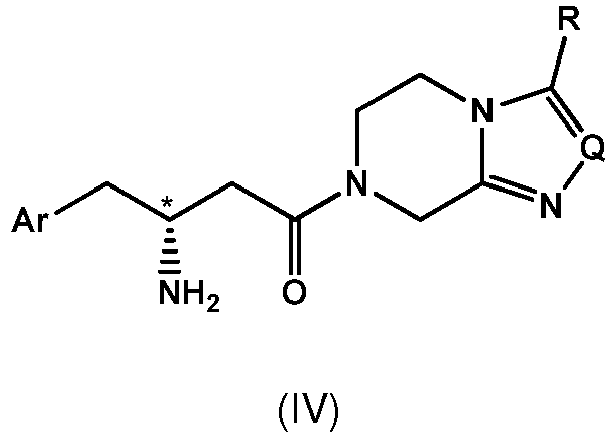
- Compound of formula IV in R-configuration has the following structural formula, wherein the dashed C-N bond indicates that this bond is located below the plane of the paper according to the CIP-convention.
- protons acceptor means a Br ⁇ nsted base which provides for accepting protons of acids.
- proton donator means a Br ⁇ nsted acid which provides for donating protons to another compound or an amphoteric compound capable of donating a proton under the given reaction conditions.
- substantially enantiopure as used herein means that a compound has an enantiomeric excess of at least 80%, preferably at least 90%, more preferably at least 95%, even more preferably at least 98%.
- hydrolytic enzyme as used herein means an enzyme which is capable to hydrolyze a covalent bond.
- an amide bond is hydrolyzed, whereby the lactame ring of compound of formula II is opened.
- enantiomer as used herein means two stereoisomers which are mirror images of one another, but which are not superimposable.
- compounds of formula II and III represent R-enantiomers.
- compounds of formula II and III represent S-enantiomers.
- enantiopure as used herein means that an enantiomer is present in a purity of at least 99% enantiomeric excess, preferably in a purity of 99.5-100% enantiomeric excess.
- substantially unreacted means that at least 80% of the other enantiomer of compound of formula II remains unreacted, preferably at least 90%, more preferably at least 95%, even more preferably at least 98%, in particular 100% of the other enantiomer remains unreacted.
- enantiomeric excess means the difference between the percentage of one enantiomer of an optically active compound and the percentage of the other enantiomer of the same optically active compound. For example, an optically active compound which contains 75% R-enantiomer and 25% S-enantiomer will have an enantiomeric excess of 50% of R-enantiomer.
- racemisation means that a compound in enantioenriched or (substantially) enantiopure form is converted to its racemic form, that is a 1:1 mixture of the respective enantiomers.
- enantioenriched means, that a compound has an enantiomeric excess higher than zero.
- both step i) and ii) of the racemisation process are carried out in a one-pot process. That is, steps i) and ii) are carried out in the same reaction vessel.
- cyclodehydration reaction means a reaction in which a ring is formed by means of dehydration, that is by removal of water.
- compound of formula I is provided in form of (substantially) enantiopure compound of formula I" wherein chiral center is in R-configuration.
- the present invention surprisingly satisfies an unmet need for a significant improvement of a process for preparing a compound of formula IV that is suitable for industrial production of an pharmaceutically active agent such as dipeptidyl peptidase-4 (DPP-4) inhibitors, for example sitagliptin.
- DPP-4 dipeptidyl peptidase-4
- the present invention provides an industrially applicable, economical and advantageous process for the preparation of a compound of formula IV, wherein Ar denotes unsubstituted or substituted C6-C12-aryl, Q denotes N, CH or a carbon substituted with unsubstituted or substituted C1-C6-alkyl, C6-C12-aryl or C7-C12-alkylaryl, and R denotes H or unsubstituted or substituted C1-C6-alkyl, C6-C12-aryl or C7-C12-alkylaryl, which process comprises a step of coupling a compound of formula II, wherein Ar is defined as above, with a compound of formula III or salt thereof, wherein R and Q are defined as above, in the presence of a catalyst in an organic solvent.
- compound(s) of formula II, III and/or IV is/are characterized by either one or a combination of the following features i) to vi):
- the configuration at the chiral center and substituents Ar, R and Q of compounds of formula IV, III and II are respectively suitably selected from features i) to vi) in order to provide for a particularly smooth coupling reaction and in order to obtain compounds of formula IV which represent particularly desirable pharmaceutically active agents and/or intermediate products for preparing pharmaceutically active agents.
- selection of feature vi) provides for the pharmaceutically active agent sitagliptin having the structural formula as coupling product.
- compound of formula III is provided in the form of its acid addition salt, preferably in the form of its hydrochloride salt.
- a proton acceptor is added in an amount at least equimolar to the amount of the acid addition salt of compound of formula III, preferably an organic proton acceptor, more preferably triethylamine.
- compound of formula III is provided as a free base.
- the coupling process is characterized by either one or a combination of the following procedural features:
- solvent and catalyst are suitably selected in order to provide for particularly advantageous conversion rate to compound of formula IV.
- compound of formula II wherein Ar denotes unsubstituted or substituted aryl, is provided in substantially enantiopure form.
- substantially enantiopure compound of formula II' or II" having the structural formula wherein Ar is defined as above is prepared by subjecting racemic or enantioenriched compound of formula II, wherein Ar is defined as above, to kinetic resolution by means of a hydrolytic enzyme in the presence of an organic solvent, wherein one kind of enantiomer of compound of formula II is converted to a compound of formula I, wherein Ar is defined as above, while the other enantiomer of compound of formula II remains substantially unreacted.
- enantiopure compound of formula II is obtained by means of enzymatic kinetic resolution.
- one enantiomer of compound of formula II can be converted to compound of formula I, while the other enantiomer of compound of formula II remains substantially unreacted.
- an individual one e.g. the "undesired” enantiomer of compound of formula II
- compound of formula I which can be easily separated by physical and/or chemical methods from compound of formula II
- the other individual one e.g. the "desired” enantiomer of compound of formula II is converted in a lesser extend, preferably compound of formula II is not or at least substantially not converted to compound of formula I.
- compound of formula II in substantially enantiopure form in the coupling process for preparing compound of formula IV, it can be dispensed with subsequent laborious and costly racemic resolution of compound of formula IV, e.g. by means of conventional formation of diastereomeric salts.
- the S-enantiomer of compound of formula II is converted to compound of formula I, while the R-enantiomer of compound of formula II remains substantially unreacted.
- a process for preparing substantially enantiopure compound of formula IIa" which chiral center is in R-configuration in which process a racemic or enantioenriched compound of formula IIa is subjected to kinetic resolution by means of a hydrolytic enzyme in the presence of an organic solvent, wherein the S-enantiomer of compound of formula IIa' is converted to a compound of formula la' while the R-enantiomer of compound of formula IIa" remains substantially unreacted.
- compound of formula IIa can be provided in (substantially) enantiopure form by means of enzymatic kinetic resolution. It was surprisingly found that compound of formula IIa representing a valuable intermediate for preparing a pharmaceutically active compound such as sitagliptin is a particularly suitable substrate for enzymatic kinetic resolution. It is well known in the art that enzyme activity and also its stereochemical outcome depend on the electronic and steric nature of substituents in the substrate. Although compound IIa contains three fluorine atoms on the aromatic ring that result in bulkier and very electron deficient aromatic system it was surprisingly found that a successful enzymatic kinetic resolution by CaIB was achieved, which provided the substantially enantiopure form of compound IIa".
- compound of formula II provided as the starting material is in racemic form.
- the racemic form serves as a particularly suitable substrate for efficiently enantiomerically enriching compound of formula II by means of enzymatic kinetic resolution.
- the hydrolytic enzyme is selected from the group of lipases, preferably from Candida antarctica lipase A and Candida antarctica lipase B, most preferably Candida antarctica lipase B.
- hydrolytic enzymes are selected which are particularly suitable in view of the substrate in the form of compound of formula II, that is, enzymes having a particularly advantageous substrate specificity towards compounds of formula II.
- the enzyme is immobilised on a polymer resin, preferably on a polyacrylic resin. This provides for a simplified removal of the enzyme from the reaction mixture subsequent to termination of kinetic resolution reaction.
- compound of formula II" or IIa" obtained after enzymatic racemic resolution has an enantiomeric excess (ee) of at least 80%, preferably at least 90%, more preferably at least 95%, and in particular at least 98%.
- the organic solvent is selected from C5-C7 alkanes, C2-C8 aliphatic ethers, C4-C6 cyclic ethers, C1-C4-alkyl C1-C4-alkanoates and C1-C4-alcohols and toluene, preferably the solvent is selected from symmetric di-(C2-C4-alkyl) ethers or asymmetric di-(C1-C4-alkyl) ethers, in particular diisopropyl ether (i-Pr 2 O) or methyl tert -butyl ether.
- the solvent is suitably selected in order to provide for both compatibility with the enzyme and for particularly advantageous conversion rate to compound of formula II' or IIa'.
- compound of formula I is separated from the resulting reaction mixture by means of separation, preferably by separation selected from the group consisting of filtration, centrifugation or decantation, more preferably filtration. In this way, separation of compound of formula I can be accomplished by simple means.
- enantioenriched or (substantially) enantiopure compound of formula I can be converted to its racemate, that is, up to 50% of an "undesired" enantiomer can be converted to the desired enantiomer.
- S-enantiomer of compound of formula I can be readily converted to a racemate comprising, 50% S-enantiomer and 50% R-enantiomer.
- the desired R-enantiomer can be provided as starting material in a preparation process, preferably a process according to item (1), while the undesired S-enantiomer can be again subjected to the racemisation process according to item (20).
- both steps i) and ii) of the racemisation process are carried out in a one-pot process. That is, steps i) and ii) are carried out in the same reaction vessel. In a preferred embodiment the same solvents are used in both steps. Alternatively, solvents used in the oxidation step are easily removed and replaced by the solvent suitable for the reduction step. Preferably, oxidizing and reducing agents are specially selected to act in media, which allow one-pot procedure.
- compound of formula I is provided in (substantially) enantiopure form, preferably (substantially) enantiopure compound of formula I', wherein chiral center is in S-configuration is provided.
- the (substantially) enantiopure form serves as a particularly suitable substrate for efficiently racemizing compound of formula I.
- oxidation agents are selected to efficiently racemize primary amines via C-N double bonded intermediates.
- oximes as a tautomeric form of nitroso intermediates are the sufficiently stable C-N double bonded representatives, used for such conversion.
- oxidation agents are selected from tungsten (VI) compounds, preferably Na 2 WO 4 or WO 3 in molar amounts or catalytic amounts with co-oxidant such as hydrogen peroxide, various peroxo compounds, formed in situ from hydrogen peroxide and a compound which is transformed to an active peroxo intermediate and is selected tungsten, vanadium, molybdenum compounds or used as isolated reagents such as dioxiranes, such as dimethyldioxirane, perbenzoic acids and salts, peroxysulfuric acid and salts.
- the most preferred reagents are sodium (VI) tungstate, dimethyldioxirane and potassium peroxymonosulfate (KHSO 5 ), particularly in the commercial product Oxone®.
- Oxone is a complex mixture of derivatives of sulfuric acid in which potassium peroxymonosulfate is the active reagent. It is preferably used in acetone, in which dimethyloxirane is formed in situ as an active oxidizing reagent
- reducing methods for conversion of N-oxyamino and/or N-oxyimino intermediates to racemic primary amines are selected from catalytic hydrogenation on palladium catalyst on a supporter as a preferred catalyst or from reduction with metals form low oxidation states, such as Fe 2+ , Sn 2+ , elemental tin and zinc, most preferably elemental zinc in acidic medium is used.
- the oxidizing agent is potassium peroxymonosulfate (KHSO 5 ) and/or the reducing agent is elemental zinc (Zn).
- KHSO 5 potassium peroxymonosulfate
- Zn elemental zinc
- pH of the reaction mixtures is suitably adjusted in view of the oxidizing and reducing agent respectively applied.
- the pH value is adjusted to mild alkaline from 7 to10, preferably 7 to 9, most preferably pH is 9 in the part of the reaction time.
- the preferred reagent for pH adjustment is the phosphate buffer and potassium hydroxide for alkalizing.
- the reduction with elemental zinc is carried out in highly acidic medium with pH lower than 4, preferably lower than 2, accomplished by preceding addition of mineral acid, preferably hydrochloric acid or acetic acid.
- step ii) subsequent to step i) and prior to step ii), water and/or organic solvents are removed from the reaction mixture.
- the oxidizing agent is potassium peroxymonosulfate (KHSO 5 ) and/or the reducing agent is elemental zinc (Zn).
- compound of formula I is prepared via the above described enzymatic kinetic resolution process.
- a particularly desirable recycling concept is provided, since "undesired" enantiomer of compound of formula I can be converted to "desired” enantiomer of compound of formula I. That is, in a reaction affording an enantiomer which is undesired, for example in the above described enzymatic kinetic resolution process, the resulting undesired enantiomer can be recycled by converting it to the desired enantiomer.
- compound of formula II for the above-described coupling reaction and/or enzymatic kinetic resolution is prepared from a compound of formula I by means of a cyclodehydration reaction.
- a particularly advantageous procedural concept which renders possible to recycle compound of formula I, preferably obtained by the aforementioned enzymatic kinetic resolution process, as compound of formula II in the coupling process according to item (1).
- compound of formula II in the form of its (substantially) enantiopure R-enantiomer to compound of formula II
- compound of formula II in the form of its R-enantiomer represents a particularly advantageous starting material for the coupling process according to item (1).
- cyclodehydration of ⁇ -amino carboxylic acids to ⁇ -lactames is carried out by applying various dehydration reagents such as carbodiimides, preferably dicyclohexylcarbodiimide, triphenylphosphine in combination with tetrahalomethanes, with N-bromo compounds, such as N-bromosuccinimide, or with disulfides or by transforming the acid to highly reactive derivatives such as acid chlorides or mixed anhydrides with phosphonic or sulfonic acids.
- dehydration reagents such as carbodiimides, preferably dicyclohexylcarbodiimide, triphenylphosphine in combination with tetrahalomethanes, with N-bromo compounds, such as N-bromosuccinimide, or with disulfides or by transforming the acid to highly reactive derivatives such as acid chlorides or mixed anhydrides with phosphonic or sulfonic acids.
- cyclodehydration of ⁇ -amino carboxylic acids to ⁇ -lactames is carried out by applying a C1-C6-alkylsulfonyl chloride in combination with a proton acceptor which converted the mixed anhydride to ⁇ -lactames.
- a proton acceptor which converted the mixed anhydride to ⁇ -lactames.
- methanesulfonyl chloride (MeSO 2 Cl) and NaHCO 3 are applied as reactants.
- a combination of reagents is selected which provides for particularly effective cyclodehydration reaction.
- compound of formula I applied as the starting material for cyclodehydration reaction is prepared according to the enzymatic kinetic resolution process described above.
- the thus obtained compound of formula II is applied as the starting material in the coupling process described above.
- compound of formula I prepared by the aforementioned racemisation process and/or enzymatic kinetic resolution process can be converted to compound of formula II, which in turn can be applied as the starting material in the coupling process described above.
- a process for the preparation of a pharmaceutical composition comprising compound of formula IV or a pharmaceutically acceptable salt thereof as pharmaceutically active ingredient is provided, the process comprises the steps of:
- pharmaceutically acceptable excipient means any physiologically inert, pharmacologically inactive material known in the art being compatible with the physical and chemical characteristics of the active agent.
- the pharmaceutically acceptable excipient is selected from the group consisting of binders, disintegrants, bulk polymers and preservatives.
- binding agent means a binding agent which improves adhesion in between particles of the pharmaceutically active agent.
- disintegrant means an agent providing for rapid disintegration of a pharmaceutical composition into smaller fragments when in contact with water, wherein dissolution of the pharmaceutical composition and in particular of a pharmaceutically active agent comprised therein is improved.
- bulk polymer as used herein means a polymeric filling agent which is typically added to a pharmaceutical composition in large amounts, at least in an amount larger than 6% by weight relative to the total weight of the pharmaceutical composition.
- preservatives means a substance or mixture of substances which prevents decomposition of a pharmaceutical composition, e.g. microbial or bacterial decomposition.
- compound of formula IV is sitagliptin having the structural formula, preferably sitagliptin is in the form of its phosphate salt.
- the pharmaceutical composition comprises at least one additional pharmaceutically active ingredient besides of compound of formula IV, wherein said additional pharmaceutically active ingredient is selected from the group consisting of insulin sensitizers, insulin, insulin mimetics, sulfonylureas, (glucosidase inhibitors, glucagon receptor antagonists, GLP-1, GLP-1 analogues, GLP-1 mimetics, GLP-1 receptor agonists, GIP, GIP mimetics, PACAP, PACAP mimetics, PACAP receptor agonists, cholesterol lowering agents, PPAR- ⁇ agonists, anti-obesity compounds, ileal bile acid transporter inhibitors, agents intended for use in inflammatory conditions, antihypertensive agents, glucokinase activators (GKAs), inhibitors of 11(-hydroxysteroid dehydrogenase type 1, inhibitors of cholesteryl ester transfer protein (CETP) and inhibitors of fructose 1,6-bisphosphatase.
- the additional pharmaceutically active ingredient is selected
- Methyl 3-amino-4-(2,4,5-trifluorophenyl)butanoate (5.8 g, 23.5 mmol), prepared from methyl 3-oxo-4-(2,4,5-trifluorophenyl)butanoate according to the process of WO 10/122578 , was refluxed in the solution of NaOH (1.88 g, 46.9 mmol) in MeOH (40 mL) and water (20 mL) overnight. After the completion of the reaction, the MeOH was evaporated and 80 mL of water was added. The pH of the solution was adjusted to 8 by addition of 6M HCl and the resulting white precipitate was filtered off and dried overnight in an oven at 100°C to afford 3.5 g of ( ⁇ )-I a.
- Azetidinone IIa' (0.5 g, 2.32 mmol, ee 99.5 %), 3-(trifluoromethyl)-5,6,7,8-tetrahydro-[1,2,4] triazolo[4,3-a] pyrazine hydrochloride (III', 1.06 g, 4.65 mmol), Et 3 N (0.28 g, 4.65 mmol) and 2-ethylhexanoic acid (0.17 g, 1.16 mmol) were suspended in THF (10 mL). The resulting suspension was stirred at 75°C for 72 h. After cooling the mixture to 0°C, compound 2 was filtered off and the solvent was removed in vacuo.
Landscapes
- Chemical & Material Sciences (AREA)
- Organic Chemistry (AREA)
- Health & Medical Sciences (AREA)
- Chemical Kinetics & Catalysis (AREA)
- Diabetes (AREA)
- Public Health (AREA)
- Medicinal Chemistry (AREA)
- Veterinary Medicine (AREA)
- General Health & Medical Sciences (AREA)
- Animal Behavior & Ethology (AREA)
- Life Sciences & Earth Sciences (AREA)
- Pharmacology & Pharmacy (AREA)
- Obesity (AREA)
- Nuclear Medicine, Radiotherapy & Molecular Imaging (AREA)
- General Chemical & Material Sciences (AREA)
- Endocrinology (AREA)
- Hematology (AREA)
- Bioinformatics & Cheminformatics (AREA)
- Emergency Medicine (AREA)
- Engineering & Computer Science (AREA)
- Organic Low-Molecular-Weight Compounds And Preparation Thereof (AREA)
- Pharmaceuticals Containing Other Organic And Inorganic Compounds (AREA)
- Preparation Of Compounds By Using Micro-Organisms (AREA)
- Nitrogen Condensed Heterocyclic Rings (AREA)
- Epidemiology (AREA)
Abstract
The present invention relates to a process for preparing β-aminobutyryl substituted 5,6,7,8-tetrahydro[1,4]diazolo[4,3-α]pyrazin-7-yl compounds.
Description
- The present invention relates to the field of organic chemistry, more specifically to a process for preparing β-aminobutyryl substituted 5,6,7,8-tetrahydro[1,4]diazolo[4,3-a]pyrazin-7-yl compounds. Such compounds are useful as key structure framework of modern drug chemistry and especially of antidiabetic agents.
- β-Amino acids are of interest in the preparation of active pharmaceutical ingredients (APIs). The β-amino acid moiety in APIs of interest is normally part of a complex whole structure. Complexity is typically enhanced when considering a chiral center at the β-position of the β-aminobutyryl group and the general desire to obtain enantiopure compounds.
- A particularly interesting class of APIs having β-amino acid structural moieties are dipeptidyl peptidase-4 (DPP-4) inhibitors which act as antidiabetic agents. DPP-4 inhibitors are oral antidiabetic drugs which reduce glucose blood levels by a new mechanism of action in which the DPP-4 inhibitors ("gliptins") inhibit inactivation of glucagon-like peptide (GLP), which stimulate insulin secretion. The benefit of these medicines lies in their lower side-effects (e.g., less hypoglycemia, less weight gain) and in the control of blood glucose values. It can be used for treatment of diabetes mellitus type 2.
- The first member of the novel pharmacological group is sitagliptin which is chemically (R)-3-amino-1-(3-(trifluoromethyl)-5,6-dihydro-[1,2,4]triazolo[4,3-a]pyrazin-7(8H)-yl)-4-(2,4,5-trifluorophenyl)butan-1-one and which has the following structural formula

- However, an inclusion of a β-amino acid framework into a more complex molecule remains a permanent challenge for industrial production.
- This is well reflected in the literature for the synthesis of sitagliptin. Several methods are described how to introduce the β-amino acid structure into the molecule of sitagliptin. The first synthesis of sitagliptin molecule disclosed in
WO 03/004498 WO 03/004498 
- Since then, several trials to improve this unacceptable method have been published in literature. In general, regarding the structure of sitagliptin, which is composed from the β-amino acid part and the heterocyclic part, synthetic routes can be divided in two approaches.
- In the first general approach, a heterocycle is coupled to the system in earlier steps of the synthesis, while the desired configuration of β-amino acid part is constructed later. This approach seems less feasible, because typically, it is better to couple more complicated and more expensive parts of molecule in last steps. A typical example of this approach is shown in Scheme 2.

- There is no good method for non-chromatographical chiral resolution of final compound 1 (
WO 09/084024 WO 03/004498 WO 09/064476 WO 04/085378 WO 05/097733 WO 06/081151 WO 11/113399 - Another option is a derivatization of the amino group with a chiral group. Chiral resolution is then achieved by hydrogenation with a cheaper achiral catalyst, by crystallisation of diastereomeric mixtures or by combination of both methods, as depicted in Scheme 3 (
WO 04/085661 WO 09/085990 WO 11/025932 WO 11/060213 WO 11/142825 
- In the second general approach, a heterocycle is coupled to the β-amino acid in later steps. The corresponding δ-aryl-β-amino acids are readily available from the corresponding β-keto acids, prepared from acetic acids and malonic derivatives (
WO 09/064476 WO 10/122578 WO 10/131025 WO 11/127794 
- There are several methods in literature how to prepare enantiomerically enriched or pure intermediates 18, 19, 20, and 21, such as by enantioselective reduction of 17 (
WO 09/064476 CN 102126976 ), by crystallization of diastereomeric salt of compounds (±)-18, (±)-19, (±)-20, or (±)-21 with chiral acids (WO 10/122578 WO 10/131025 WO 11/035725 WO 11/116686A2 CN 102093245 ,CN 10212697 ) or by enzymatic approach. - Yet another option is creating a chiral center by selective reduction of β-keto acid derivatives. Precious metal catalysts (
WO 04/087650 WO 09/045507 
- A hypothetical shortening of this conversion could be realized by preparation of an N-unsubstituted azetidinone having the structural formula

- However, the synthesis is very complicated and is realized by introduction of toxic hydroxylamine (http://ip.com/IPCOM/000176671). In a characteristic literature example, only the non-fluoro analogue of the aforementioned N-unsubstituted azetidinone is prepared, while 2,4,5-fluoro analogues were prepared according to the reaction pathway depicted in Scheme 4, that is not via azetidinone derivatives (Org. Biomol. Chem., 8, 893 (2009)). Furthermore, an opening of the four-member ring of the N-unsubstituted azetidinone with nitrogen nucleophiles is accomplished by a complex reaction mixture with carbonic acid derivatives such as tert-butyl dicarbonate or chloroformates (
WO 04/089362 WO 08/019124 ES 2335380 - Therefore, there is still a need for a simplification of industrial synthesis of β-amino acid derivatives as intermediates in the synthesis of dipeptidyl peptidase-4 (DPP-4) inhibitors such as sitagliptin.
- It was therefore an object of the present invention to provide an improved process for preparing β-aminobutyryl substituted 5,6,7,8-tetrahydro[1,4]diazolo[4,3-a]pyrazin-7-yl compounds representing valuable key intermediates for the preparation of pharmaceutically active agents or representing a pharmaceutically active agent such as dipeptidyl peptidase-4 (DPP-4) inhibitors, e.g. sitagliptin.
- Various aspects, advantageous features and preferred embodiments of the present invention as summarized in the following items, respectively alone or in combination, contribute to solving the object of the invention.
- (1) A process for the preparation of a compound of formula IV,


with a compound of formula III or a salt thereof,
- The designation "*" in the structural formulae of compounds of formula IV and III indicates a chiral center.
- The term "chiral center" as used herein means a tetrahedral carbon atom having four different substituents attached thereto. The arrangement of these different substituents around the asymmetric atom determines its optical activity which is denoted in the art by the terms S or R and D or L respectively.
- The term "alkyl" as used herein means straight, branched or cyclic hydrocarbons.
- The term "aryl" as used herein means hydrocarbon aryls, preferably single or condensed six-membered rings, more preferably phenyl or naphthyl, in particular phenyl.
- The term "alkylaryl" as used herein means that the aforementioned aryl moieties are incorporated into the aforementioned straight or branched alkyl moieties either at one of the proximal or distal ends of the alkyl chain or between the aforementioned alkyl chains. For example, for substituent Q, proximal end means adjacent to the carbon of Q incorporated into the di-or triazole ring of the heterocyclic moiety of compound of formulae III and IV, while distal means the terminal carbon of the alkyl moiety which is furthermost from substituent Q. Preferably, in the alkylaryl moiety, the aryl moiety is located at the distal end of the alkyl moiety.
- The term "substituted" as employed herein in connection with Ar, Q and R means that the alkyl, aryl and alkylaryl groups have at least one C1-C6 alkyl, C1-C6 alkoxy and/or at least one halogen substituent selected from the group consisting of F, CI, Br and 1.
- (2) The process according to item (1), wherein the chiral center of the compound of formula IV and the compound of formula II is in R-configuration, respectively.
- The designations "R" and "S" used herein indicate the absolute configuration at chiral center(s) of the respective compounds, determined by means of the Cahn Ingold Prelog convention (CIP-convention) known in the art (cf. e.g. M.B. Smith, J. March, "March's Advanced Organic Chemistry: Reactions, Mechanisms and Structure", 6th edition, John Wiley&Sons, Inc., p. 155-158). Compound of formula IV in R-configuration has the following structural formula,
- (3) The process according to item (1) or (2), wherein in the compounds of formulae II and IV, Ar is substituted phenyl, preferably fluorine substituted phenyl, in particular 2,4,5-trifluoro-phenyl.
- (4) The process according to any one of the preceding items, wherein in the compounds of formulae II and IV, R is substituted C1-C3-alkyl, preferably halogen substituted C1-C3-alkyl, more preferably fluoro substituted C1-C3-alkyl, in particular trifluoromethyl.
- (5) The process according to any one of the preceding items, wherein in the compounds of formulae II and IV, Q is N.
- (6) The process according to any one of the preceding items, wherein Ar is 2,4,5-trifluorophenyl, R is trifluoromethyl, Q is N and the chiral center is in R-configuration.
- (7) The process according to any one of the preceding items, wherein the compound of formula III Il is provided in the form of its acid addition salt, preferably in the form of its hydrochloride salt.
- (8) The process according to item (7), wherein a proton acceptor is added in an amount at least equimolar to the amount of acid addition salt of the compound of formula III, preferably an organic proton acceptor, more preferably triethylamine.
- The term "proton acceptor" as used herein means a Brønsted base which provides for accepting protons of acids.
- (9) The process according to any one of the preceding items, wherein the solvent is selected from the group of C2-C8 aliphatic ethers, C4-C6 cyclic ethers, C1-C4-alkyl C1-C4-alkanoates and C1-C4-alcohols, preferably the solvent is selected from symmetric di-(C2-C4-alkyl) ethers or asymmetric di-(C1-C4-alkyl) ethers, tetrahydrofuran, methanol, toluene, hexane or isopropyl acetate, in particular the solvent is tetrahydrofuran.
- (10) The process according to any one of the preceding items, wherein the catalyst is selected from organic and inorganic proton donators, preferably the catalyst is selected from H2O, HCl or C1-C12-alkanecarboxylic acid, preferably C4-C10 alkanecarboxylic acid, more preferably C7-C9-alkanecarboxylic acid, in particular 2-ethylhexanoic acid (2-EHA).
- The term "proton donator" as used herein means a Brønsted acid which provides for donating protons to another compound or an amphoteric compound capable of donating a proton under the given reaction conditions.
- (11) The process according to any one of the preceding items, wherein the compound of formula II,

is provided in substantially enantiopure form; preferably substantially enantiopure compound of formula II' or II" having the structural formula
is prepared by subjecting racemic or enantioenriched compound of formula II,
to kinetic resolution by means of a hydrolytic enzyme in the presence of an organic solvent, wherein one kind of enantiomer of the compound of formula II is converted to a compound of formula I,
- The term "substantially enantiopure" as used herein means that a compound has an enantiomeric excess of at least 80%, preferably at least 90%, more preferably at least 95%, even more preferably at least 98%.
- The term "hydrolytic enzyme" as used herein means an enzyme which is capable to hydrolyze a covalent bond. In particular, in the present process, an amide bond is hydrolyzed, whereby the lactame ring of compound of formula II is opened.
- The term "enantiomer" as used herein means two stereoisomers which are mirror images of one another, but which are not superimposable. In the case of compound of formulae II and IV, in case the chiral center "*" is in the form of the R-configuration according to the CIP-convention, compounds of formula II and III represent R-enantiomers. On the other hand, in case the chiral center "*" is in the form of the S-configuration according to the CIP-convention, compounds of formula II and III represent S-enantiomers.
- The term "enantiopure" as used herein means that an enantiomer is present in a purity of at least 99% enantiomeric excess, preferably in a purity of 99.5-100% enantiomeric excess.
- The term "substantially unreacted" as used herein means that at least 80% of the other enantiomer of compound of formula II remains unreacted, preferably at least 90%, more preferably at least 95%, even more preferably at least 98%, in particular 100% of the other enantiomer remains unreacted.
- (12) The process according to item (11), wherein the S-enantiomer of compound of formula II is converted to compound of formula I, while the R-enantiomer of compound of formula II remains substantially unreacted.
- (13) A process for preparing a substantially enantiopure compound of formula IIa"

in which process a racemic or enantioenriched compound of formula IIa
- As regards the meanings of the terms "substantially enantiopure", "hydrolytic enzyme", "enantiomer", "enantiopure", and "substantially unreacted" reference is made to the explanations under item (11) above.
- (14) The process according to any one of items (11) to (13), wherein compound of formula II provided as the starting material is in racemic form.
- (15) The process according to any one of items (11) to (14), wherein the hydrolytic enzyme is selected from the class of lipases, esterases, aminoacylases, amidases, peptidases and amylases.
- (16) The process according to item (15), wherein the hydrolytic enzyme is selected from the group of lipases, preferably from Candida antarctica lipase A and Candida antarctica lipase B, most preferably Candida antarctica lipase B.
- (17) The process according to any one of items (11) to (16), wherein the process is carried out at the temperature from 25°C to 70°C, preferably from 30°C to 60°C, in particular from 40°C to 55°C.
- (18) The process according to any one of items (11) to (15), wherein the enzyme is immobilised on a polymer resin, preferably on a polyacrylic resin.
- (19) The process according to any one of items (11) to (18), wherein the load of immobilized enzyme is from 10 g/L to 500 g/L, preferably from 20 g/L to 300 g/L, in particular from 25 g/L to 250 g/L.
- (20) The process according to any one of items (11) to (19), wherein the ratio of immobilized enzyme to substrate is from 1:1 to 20:1.
- (21) The process according to any one of items (11) to (16), wherein the compound of formula II" or IIa" obtained after enzymatic racemic resolution has an enantiomeric excess (ee) of at least 80%, preferably at least 90%, more preferably at least 95% and in particular at least 98%.
- The term "enantiomeric excess" as used herein means the difference between the percentage of one enantiomer of an optically active compound and the percentage of the other enantiomer of the same optically active compound. For example, an optically active compound which contains 75% R-enantiomer and 25% S-enantiomer will have an enantiomeric excess of 50% of R-enantiomer.
- As regards the definition of the term "enantiomer", reference is made to the explanations under item (11) above.
- (22) The process according to any one of items (11) to (21), wherein the organic solvent is selected from C5-C7 alkanes, C2-C8 aliphatic ethers, C4-C6 cyclic ethers, C1-C4-alkyl C1-C4-carboxylates and C1-C4-alcohols and toluene, preferably the solvent is selected from symmetric di-(C2-C4-alkyl) ethers or asymmetric di-(C1-C4-alkyl) ethers, in particular diisopropyl ether (i-Pr2O) or methyl tert-butyl ether.
- (23) The process according to any one of items (11) to (22), wherein subsequent to removal of the hydrolytic enzyme, compound of formula I or compound of formula la is separated from the resulting reaction mixture by means of separation, preferably by separation selected from the group consisting of filtration, centrifugation or decantation, more preferably filtration.
- (24) A process for preparing compound of formula I

- i) oxidation of a compound of formula I in enantioenriched or enantiopure form to its C-N double bonded intermediates by means of an oxidizing agent, and
- ii) reduction of the C-N double bonded intermediates obtained in step i) by means of a reducing agent, in order to obtain compound of formula I in racemic form.
- The term "racemisation" as used herein means that a compound in enantioenriched or (substantially) enantiopure form is converted to its racemic form, that is a 1:1 mixture of the respective enantiomers.
- The term "enantioenriched" means, that a compound has an enantiomeric excess higher than zero.
- As regards the meaning of the term "enantiopure", reference is made to the explanations under item (11) above.
- Preferably, both step i) and ii) of the racemisation process are carried out in a one-pot process. That is, steps i) and ii) are carried out in the same reaction vessel.
- (25) The process according to item (24), wherein compound of formula I is provided in (substantially) enantiopure form, preferably (substantially) enantiopure compound of formula I'

- As regards the meaning of the term "(substantially) enantiopure", reference is made to the explanations under item (11) above.
- (26) The process according to item (24) or (25), wherein in step i) and ii), pH of the reaction mixtures is suitably adjusted in view of the oxidizing and reducing agent respectively applied.
- (27) The process according to any one of items (24) to (26), wherein subsequent to step i) and prior to step ii), water and/or organic solvents are removed from the reaction mixture.
- (28) The process according to any one of items (24) to (27), wherein the oxidizing agent is potassium peroxymonosulfate (KHSO5) and/or the reducing agent is elemental zinc (Zn).
- (29) The process according to item (28), wherein the oxidizing agent is potassium peroxymonosulfate (KHSO5) and pH is adjusted to from 7 to 10, preferably from 7 to 9, in particular to 9.
- (30) The process according to item (28), wherein the reducing agent is elemental zinc (Zn) and pH is adjusted to pH lower than 4, preferably lower than 2 using mineral acids, preferably hydrochloric acid or acetic acid.
- (31) The process according to any one of items (24) to (30), wherein compound of formula I is prepared via a process according to any one of items (11) to (23).
- (32) The process according to any one of items (11) to (23), wherein at least a part of the amount of compound of formula II is prepared according to the process of any one of items (24) to (31).
- (33) The process according to any one of the preceding items, wherein the compound of formula II

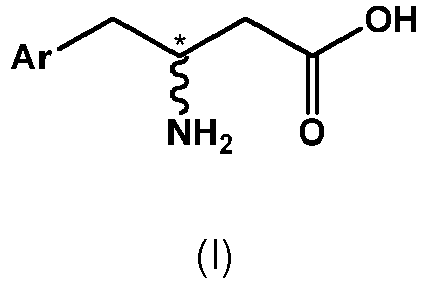
- The term "cyclodehydration reaction" as used herein means a reaction in which a ring is formed by means of dehydration, that is by removal of water.
- Preferably, in the cyclodehydration reaction, compound of formula I is provided in form of (substantially) enantiopure compound of formula I"

- As regards the meaning of the term "(substantially) enantiopure", reference is made to the explanations under item (11) above.
- (34) The process according to item (33), wherein cyclodehydration is carried out by applying an C1-C6-alkanesulfonylchloride and a proton acceptor as reactants, preferably methanesulfonyl chloride (MeSO2Cl) and NaHCO3 are applied as reactants.
- As regards the term "proton acceptor", reference is made to the explanations under item (8) above.
- (35) The process according to item (33) or (34), wherein compound of formula I is prepared according to a process according to any one of items (11) to (23).
- (36) The process according to any one of items (1) to (12), wherein compound of formula II is prepared according to the process of any one of items (33) to (35).
- (37) A process for the preparation of a pharmaceutical composition comprising compound of formula IV or a pharmaceutically acceptable salt thereof as pharmaceutically active ingredient, comprising the steps of:
- a) preparing a compound of formula IV or a salt thereof according to the process according to any one of items (1) to (12), (14) to (23), (31) and (36), and
- b) admixing the prepared compound of formula IV or pharmaceutically acceptable salt thereof with at least one pharmaceutically acceptable excipient.
- (38) The process according to item (37), wherein the compound of formula IV is sitagliptin having the structural formula,
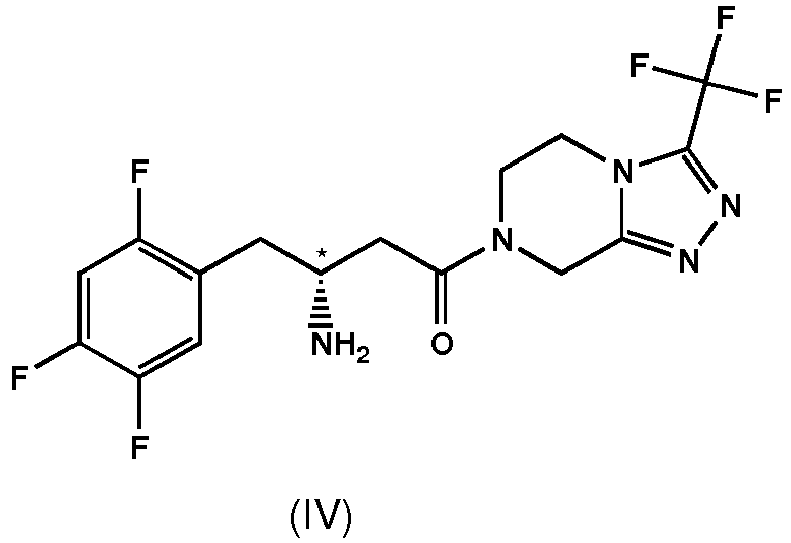
- (39) The pharmaceutical composition according to item (37) or (38), which composition comprises at least one additional pharmaceutically active ingredient besides of compound of formula IV, wherein said additional pharmaceutically active ingredient is selected from the group consisting of insulin sensitizers, insulin, insulin mimetics, sulfonylureas, α-glucosidase inhibitors, glucagon receptor antagonists, GLP-1, GLP-1 analogues, GLP-1 mimetics, GLP-1 receptor agonists, GIP, GIP mimetics, PACAP, PACAP mimetics, PACAP receptor agonists, cholesterol lowering agents, PPARδ- agonists, anti-obesity compounds, ileal bile acid transporter inhibitors, agents intended for use in inflammatory conditions, antihypertensive agents, glucokinase activators (GKAs), inhibitors of 11 (-hydroxysteroid dehydrogenase type 1, inhibitors of cholesteryl ester transfer protein (CETP) and inhibitors of fructose 1,6-bisphosphatase.
- (40) The pharmaceutical composition according to item (38), wherein the additional pharmaceutically active ingredient is metformin and/or its pharmaceutically acceptable salt.
- The present invention will now be described in further detail with respect to preferred embodiments and specific examples, which embodiments and examples are however presented for illustrative purposes only and shall not be understood as limiting the scope of the present invention.
- Compared with the conventional synthetic pathways for preparing a compound of formula IV requiring a large number of synthetic steps and typically protection and deprotection of the amine group of an intermediate β-aminoacid derivative, the present invention surprisingly satisfies an unmet need for a significant improvement of a process for preparing a compound of formula IV that is suitable for industrial production of an pharmaceutically active agent such as dipeptidyl peptidase-4 (DPP-4) inhibitors, for example sitagliptin.
- In particular, the present invention provides an industrially applicable, economical and advantageous process for the preparation of a compound of formula IV,


with a compound of formula III or salt thereof,
in the presence of a catalyst in an organic solvent. - The above procedural concept provides for a particularly efficient preparation of compounds of formula IV. In particular, it was surprisingly found that a heterocyclic compound of formula III can be readily substituted with a β-amino acid by means of a single coupling step, wherein compound of formula IV is obtained in both high yields and purity, while it can be dispensed with e.g. conventional application of a protecting group for the amine moiety of the β-amino acid. Owing to the finding that protecting group application technology can be dispensed with, the preparation of a compound of formula IV can be reduced by at least two process steps, namely introduction and removal of a protecting group and both isolation and purification of the respective intermediate products obtained in said steps. Furthermore, the starting materials compound of formula II and III are readily available by established prior art synthesis.
- According to a preferred embodiment of the invention, compound(s) of formula II, III and/or IV is/are characterized by either one or a combination of the following features i) to vi):
- i) the chiral center of compound of formula II and IV is in R-configuration;
- ii) in compounds of formulae II and IV, Ar is substituted phenyl, preferably fluorine substituted phenyl, in particular 2,4,5-trifluorophenyl;
- iii) in compounds of formulae II and IV, R is substituted C1-C3-alkyl, preferably halogen substituted C1-C3-alkyl, more preferably fluoro substituted C1-C3-alkyl, in particular trifluoromethyl;
- iv) in compounds of formulae II and IV, Q is N;
- v) Ar is 2,4,5-trifluorophenyl, R is trifluoromethyl, Q is N and the chiral center is in R-configuration.
- vi) compound of formula III is provided in the form of its pharmaceutically acceptable acid addition salt, preferably in the form of its hydrochloride salt,

- In the aforementioned preferred embodiment, the configuration at the chiral center and substituents Ar, R and Q of compounds of formula IV, III and II are respectively suitably selected from features i) to vi) in order to provide for a particularly smooth coupling reaction and in order to obtain compounds of formula IV which represent particularly desirable pharmaceutically active agents and/or intermediate products for preparing pharmaceutically active agents. In particular, selection of feature vi) provides for the pharmaceutically active agent sitagliptin having the structural formula
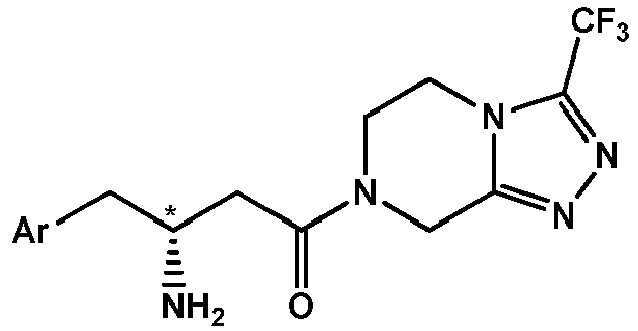
- According to another preferred embodiment of the invention, compound of formula III is provided in the form of its acid addition salt, preferably in the form of its hydrochloride salt. In case compound of formula III is provided in the form of its acid addition salt, a proton acceptor is added in an amount at least equimolar to the amount of the acid addition salt of compound of formula III, preferably an organic proton acceptor, more preferably triethylamine. In this way, it is rendered possible to provide compound of formula III in the form of its acid addition salt, which acid addition salt can be easily converted to its free base by adding a proton acceptor and also leads to simplified the removal and recycling of the compound of formula III after the completion of the reaction.
- Alternatively, compound of formula III is provided as a free base.
- In yet another preferred embodiment, the coupling process is characterized by either one or a combination of the following procedural features:
- the solvent is selected from the group of C2-C8 aliphatic ethers, C4-C6 cyclic ethers, C1-C4-alkyl C1-C4- alkanoates and C1-C4-alcohols, preferably the solvent is selected from symmetric di-(C2-C4-alkyl) ethers or asymmetric di-(C1-C4-alkyl) ethers, tetrahydrofuran, methanol, toluene, hexane or isopropyl acetate, in particular the solvent is tetrahydrofuran; and/or
- the catalyst is selected from organic and inorganic proton donators, preferably the catalyst is selected from H2O, HCl or C1-C12-alkanecarboxylic acid, preferably C4-C10-alkanecarboxylic acid, more preferably C7-C9-alkanecarboxylic acid, in particular 2-ethylhexanoic acid (2-EHA).
- Thereby, solvent and catalyst are suitably selected in order to provide for particularly advantageous conversion rate to compound of formula IV.
- Preferably, compound of formula II,

is provided in substantially enantiopure form. - According a particularly preferred embodiment, substantially enantiopure compound of formula II' or II" having the structural formula

is prepared by subjecting racemic or enantioenriched compound of formula II,
to kinetic resolution by means of a hydrolytic enzyme in the presence of an organic solvent, wherein one kind of enantiomer of compound of formula II is converted to a compound of formula I,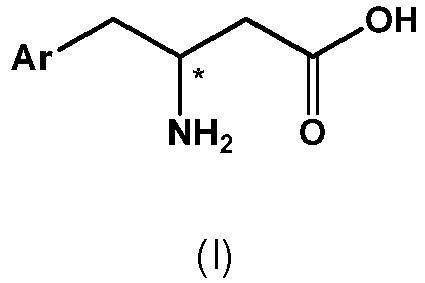
while the other enantiomer of compound of formula II remains substantially unreacted. - In this way, (substantially) enantiopure compound of formula II" is obtained by means of enzymatic kinetic resolution. In particular, it was surprisingly found that by means of enzymatic kinetic resolution, one enantiomer of compound of formula II can be converted to compound of formula I, while the other enantiomer of compound of formula II remains substantially unreacted.
- In particular, in this kinetic resolution an individual one, e.g. the "undesired" enantiomer of compound of formula II, is converted to compound of formula I which can be easily separated by physical and/or chemical methods from compound of formula II, while the other individual one, e.g. the "desired" enantiomer of compound of formula II is converted in a lesser extend, preferably compound of formula II is not or at least substantially not converted to compound of formula I. By providing compound of formula II in substantially enantiopure form in the coupling process for preparing compound of formula IV, it can be dispensed with subsequent laborious and costly racemic resolution of compound of formula IV, e.g. by means of conventional formation of diastereomeric salts.
- Preferably, the S-enantiomer of compound of formula II is converted to compound of formula I, while the R-enantiomer of compound of formula II remains substantially unreacted.
- According to another aspect of the present invention, a process for preparing substantially enantiopure compound of formula IIa"

is provided, in which process a racemic or enantioenriched compound of formula IIa
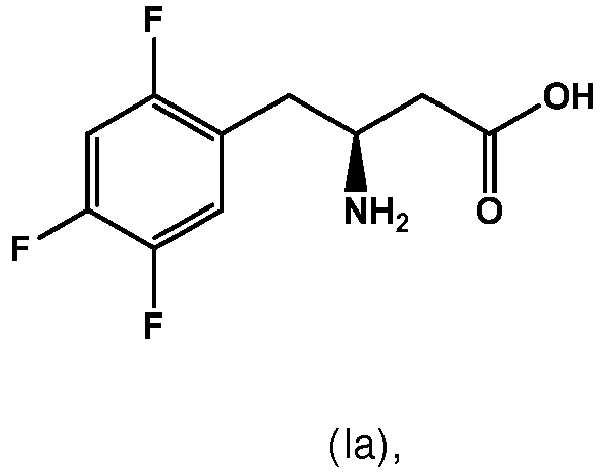
- According to this further aspect of the invention, compound of formula IIa" can be provided in (substantially) enantiopure form by means of enzymatic kinetic resolution. It was surprisingly found that compound of formula IIa representing a valuable intermediate for preparing a pharmaceutically active compound such as sitagliptin is a particularly suitable substrate for enzymatic kinetic resolution. It is well known in the art that enzyme activity and also its stereochemical outcome depend on the electronic and steric nature of substituents in the substrate. Although compound IIa contains three fluorine atoms on the aromatic ring that result in bulkier and very electron deficient aromatic system it was surprisingly found that a successful enzymatic kinetic resolution by CaIB was achieved, which provided the substantially enantiopure form of compound IIa".
- According to a preferred embodiment, in the above described processes for preparing compounds of formula II" and IIa" respectively by means of enzymatic kinetic resolution, compound of formula II provided as the starting material is in racemic form. The racemic form serves as a particularly suitable substrate for efficiently enantiomerically enriching compound of formula II by means of enzymatic kinetic resolution.
- According to another preferred embodiment, the hydrolytic enzyme is selected from the group of lipases, preferably from Candida antarctica lipase A and Candida antarctica lipase B, most preferably Candida antarctica lipase B. In this way, hydrolytic enzymes are selected which are particularly suitable in view of the substrate in the form of compound of formula II, that is, enzymes having a particularly advantageous substrate specificity towards compounds of formula II.
- Preferably, the enzyme is immobilised on a polymer resin, preferably on a polyacrylic resin. This provides for a simplified removal of the enzyme from the reaction mixture subsequent to termination of kinetic resolution reaction.
- According to a preferred embodiment of the invention, compound of formula II" or IIa" obtained after enzymatic racemic resolution has an enantiomeric excess (ee) of at least 80%, preferably at least 90%, more preferably at least 95%, and in particular at least 98%.
- Preferably, the organic solvent is selected from C5-C7 alkanes, C2-C8 aliphatic ethers, C4-C6 cyclic ethers, C1-C4-alkyl C1-C4-alkanoates and C1-C4-alcohols and toluene, preferably the solvent is selected from symmetric di-(C2-C4-alkyl) ethers or asymmetric di-(C1-C4-alkyl) ethers, in particular diisopropyl ether (i-Pr2O) or methyl tert-butyl ether. Thereby, the solvent is suitably selected in order to provide for both compatibility with the enzyme and for particularly advantageous conversion rate to compound of formula II' or IIa'.
- In a preferred embodiment, subsequent to removal of the hydrolytic enzyme, compound of formula I is separated from the resulting reaction mixture by means of separation, preferably by separation selected from the group consisting of filtration, centrifugation or decantation, more preferably filtration. In this way, separation of compound of formula I can be accomplished by simple means.
- According to another aspect of the invention, a process for preparing compound of formula I

- i) oxidation of a compound of formula I in enantioenriched or enantiopure form to its C-N double bonded intermediates by means of an oxidizing agent, and
- ii) reduction of the C-N double bonded intermediates obtained in step i) by means of a reducing agent,
- According to this aspect of the invention, a particularly advantageous recycling concept is provided. In particular, enantioenriched or (substantially) enantiopure compound of formula I can be converted to its racemate, that is, up to 50% of an "undesired" enantiomer can be converted to the desired enantiomer. For example, in case the R-enantiomer of compound of formula I is desired for a specific application, S-enantiomer of compound of formula I can be readily converted to a racemate comprising, 50% S-enantiomer and 50% R-enantiomer. The desired R-enantiomer can be provided as starting material in a preparation process, preferably a process according to item (1), while the undesired S-enantiomer can be again subjected to the racemisation process according to item (20).
- Preferably, both steps i) and ii) of the racemisation process are carried out in a one-pot process. That is, steps i) and ii) are carried out in the same reaction vessel. In a preferred embodiment the same solvents are used in both steps. Alternatively, solvents used in the oxidation step are easily removed and replaced by the solvent suitable for the reduction step. Preferably, oxidizing and reducing agents are specially selected to act in media, which allow one-pot procedure.
- According to a preferred embodiment of the invention, compound of formula I is provided in (substantially) enantiopure form, preferably (substantially) enantiopure compound of formula I',
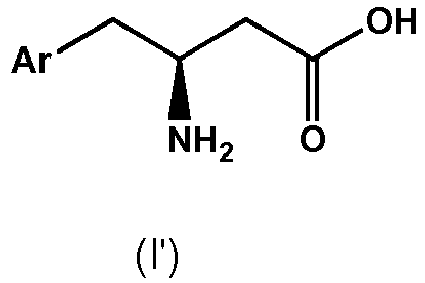
- According to another preferred embodiment of the invention, oxidation agents are selected to efficiently racemize primary amines via C-N double bonded intermediates. Preferably, oximes as a tautomeric form of nitroso intermediates are the sufficiently stable C-N double bonded representatives, used for such conversion.
- Preferably, oxidation agents are selected from tungsten (VI) compounds, preferably Na2WO4 or WO3 in molar amounts or catalytic amounts with co-oxidant such as hydrogen peroxide, various peroxo compounds, formed in situ from hydrogen peroxide and a compound which is transformed to an active peroxo intermediate and is selected tungsten, vanadium, molybdenum compounds or used as isolated reagents such as dioxiranes, such as dimethyldioxirane, perbenzoic acids and salts, peroxysulfuric acid and salts. The most preferred reagents are sodium (VI) tungstate, dimethyldioxirane and potassium peroxymonosulfate (KHSO5), particularly in the commercial product Oxone®. Oxone is a complex mixture of derivatives of sulfuric acid in which potassium peroxymonosulfate is the active reagent. It is preferably used in acetone, in which dimethyloxirane is formed in situ as an active oxidizing reagent.
- Preferably, reducing methods for conversion of N-oxyamino and/or N-oxyimino intermediates to racemic primary amines are selected from catalytic hydrogenation on palladium catalyst on a supporter as a preferred catalyst or from reduction with metals form low oxidation states, such as Fe2+, Sn2+, elemental tin and zinc, most preferably elemental zinc in acidic medium is used.
- According to a particularly preferred embodiment, the oxidizing agent is potassium peroxymonosulfate (KHSO5) and/or the reducing agent is elemental zinc (Zn). Thereby, a particularly effective combination of oxidizing agent and reducing agent is selected. Although according to literature (J. Org Chem. 57, 6759 (1992)) potassium peroxymonosulfate in acetone may lead to a complex mixture of oxidation intermediates, it was surprisingly found that following by reduction with zinc in hydrochloric acid the intermediates are transformed to the unique compound of formula IV with high selectivity.
- According to another preferred embodiment of the invention, in step i) and ii), pH of the reaction mixtures is suitably adjusted in view of the oxidizing and reducing agent respectively applied. Thus, using potassium peroxymonosulfate in acetone the pH value is adjusted to mild alkaline from 7 to10, preferably 7 to 9, most preferably pH is 9 in the part of the reaction time. The preferred reagent for pH adjustment is the phosphate buffer and potassium hydroxide for alkalizing. The reduction with elemental zinc is carried out in highly acidic medium with pH lower than 4, preferably lower than 2, accomplished by preceding addition of mineral acid, preferably hydrochloric acid or acetic acid.
- According to still another preferred embodiment of the invention, subsequent to step i) and prior to step ii), water and/or organic solvents are removed from the reaction mixture.
- According to a particularly preferred embodiment, the oxidizing agent is potassium peroxymonosulfate (KHSO5) and/or the reducing agent is elemental zinc (Zn).
- According to another particularly preferred embodiment, compound of formula I is prepared via the above described enzymatic kinetic resolution process. In this way, a particularly desirable recycling concept is provided, since "undesired" enantiomer of compound of formula I can be converted to "desired" enantiomer of compound of formula I. That is, in a reaction affording an enantiomer which is undesired, for example in the above described enzymatic kinetic resolution process, the resulting undesired enantiomer can be recycled by converting it to the desired enantiomer. In particular, in said enzymatic kinetic resolution process, it is preferred that at least a part of the amount of compound of formula II is prepared according to the aforementioned racemisation process.
- In another preferred embodiment of the invention, compound of formula II
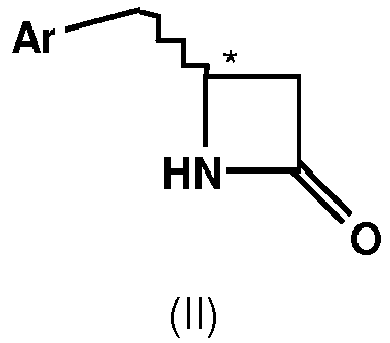

- According to this preferred embodiment of the invention, a particularly advantageous procedural concept is provided which renders possible to recycle compound of formula I, preferably obtained by the aforementioned enzymatic kinetic resolution process, as compound of formula II in the coupling process according to item (1). In particular, it is preferred to cyclodehydrate compound of formula I in the form of its (substantially) enantiopure R-enantiomer to compound of formula II", since compound of formula II" in the form of its R-enantiomer represents a particularly advantageous starting material for the coupling process according to item (1).
- Preferably, cyclodehydration of β-amino carboxylic acids to β-lactames is carried out by applying various dehydration reagents such as carbodiimides, preferably dicyclohexylcarbodiimide, triphenylphosphine in combination with tetrahalomethanes, with N-bromo compounds, such as N-bromosuccinimide, or with disulfides or by transforming the acid to highly reactive derivatives such as acid chlorides or mixed anhydrides with phosphonic or sulfonic acids. More preferably cyclodehydration of β-amino carboxylic acids to β-lactames is carried out by applying a C1-C6-alkylsulfonyl chloride in combination with a proton acceptor which converted the mixed anhydride to β-lactames. Preferably methanesulfonyl chloride (MeSO2Cl) and NaHCO3 are applied as reactants. Thereby, a combination of reagents is selected which provides for particularly effective cyclodehydration reaction.
- According to a preferred embodiment, compound of formula I applied as the starting material for cyclodehydration reaction is prepared according to the enzymatic kinetic resolution process described above. Preferably, the thus obtained compound of formula II is applied as the starting material in the coupling process described above. In this way, a further particularly desirable recycling concept is provided, since compound of formula I prepared by the aforementioned racemisation process and/or enzymatic kinetic resolution process can be converted to compound of formula II, which in turn can be applied as the starting material in the coupling process described above.
- According to another aspect of the invention, a process for the preparation of a pharmaceutical composition comprising compound of formula IV or a pharmaceutically acceptable salt thereof as pharmaceutically active ingredient is provided, the process comprises the steps of:
- a) preparing a compound of formula IV or a salt thereof according to the process according to any one of items (1) to (12), (14) to (23), (31) and (36), and
- b) admixing the prepared compound of formula IV or pharmaceutically acceptable salt thereof with at least one pharmaceutically acceptable excipient.
- The term "pharmaceutically acceptable excipient" as used herein means any physiologically inert, pharmacologically inactive material known in the art being compatible with the physical and chemical characteristics of the active agent. Preferably, the pharmaceutically acceptable excipient is selected from the group consisting of binders, disintegrants, bulk polymers and preservatives.
- The term "binder" as used herein means a binding agent which improves adhesion in between particles of the pharmaceutically active agent.
- The term "disintegrant" as used herein means an agent providing for rapid disintegration of a pharmaceutical composition into smaller fragments when in contact with water, wherein dissolution of the pharmaceutical composition and in particular of a pharmaceutically active agent comprised therein is improved.
- The term "bulk polymer" as used herein means a polymeric filling agent which is typically added to a pharmaceutical composition in large amounts, at least in an amount larger than 6% by weight relative to the total weight of the pharmaceutical composition.
- The term "preservatives" as used herein means a substance or mixture of substances which prevents decomposition of a pharmaceutical composition, e.g. microbial or bacterial decomposition.
- According to a preferred embodiment, in the pharmaceutical composition, compound of formula IV is sitagliptin having the structural formula,

- According to another preferred embodiment, the pharmaceutical composition comprises at least one additional pharmaceutically active ingredient besides of compound of formula IV, wherein said additional pharmaceutically active ingredient is selected from the group consisting of insulin sensitizers, insulin, insulin mimetics, sulfonylureas, (glucosidase inhibitors, glucagon receptor antagonists, GLP-1, GLP-1 analogues, GLP-1 mimetics, GLP-1 receptor agonists, GIP, GIP mimetics, PACAP, PACAP mimetics, PACAP receptor agonists, cholesterol lowering agents, PPAR-δ agonists, anti-obesity compounds, ileal bile acid transporter inhibitors, agents intended for use in inflammatory conditions, antihypertensive agents, glucokinase activators (GKAs), inhibitors of 11(-hydroxysteroid dehydrogenase type 1, inhibitors of cholesteryl ester transfer protein (CETP) and inhibitors of fructose 1,6-bisphosphatase. Preferably, the additional pharmaceutically active ingredient is metformin and/or its pharmaceutically acceptable salt.
- The following examples are merely illustrative of the present invention and they should not be considered as limiting the scope of the invention in any way. The examples and modifications or other equivalents thereof will become apparent to those versed in the art in the light of the present entire disclosure.
-

- Methyl 3-amino-4-(2,4,5-trifluorophenyl)butanoate (5.8 g, 23.5 mmol), prepared from methyl 3-oxo-4-(2,4,5-trifluorophenyl)butanoate according to the process of
WO 10/122578 -

- To the rapidly stirred 80°C suspension of methanesulfonyl chloride (0.88 g, 7.72 mmol) and sodium bicarbonate (3.24 g, 38.6 mmol) in acetonitrile (400 mL), 3-amino-4-(2,4,5-trifluorophenyl)butanoic acid ((±)-Ia, 1.5 g, 6.43 mmol) is added over period of 2h. The resulting suspension was further stirred for 16 h at 80°C, after which time the fine suspension was cooled to 0°C and filtered. The filtrate was evaporated under reduced pressure to afford 1.34 g (96% yield) of racemic 4-(2,4,5-trifluorobenzyl)azetidin-2-one ((±)-Ila) as pale yellow crystalline solid.
-
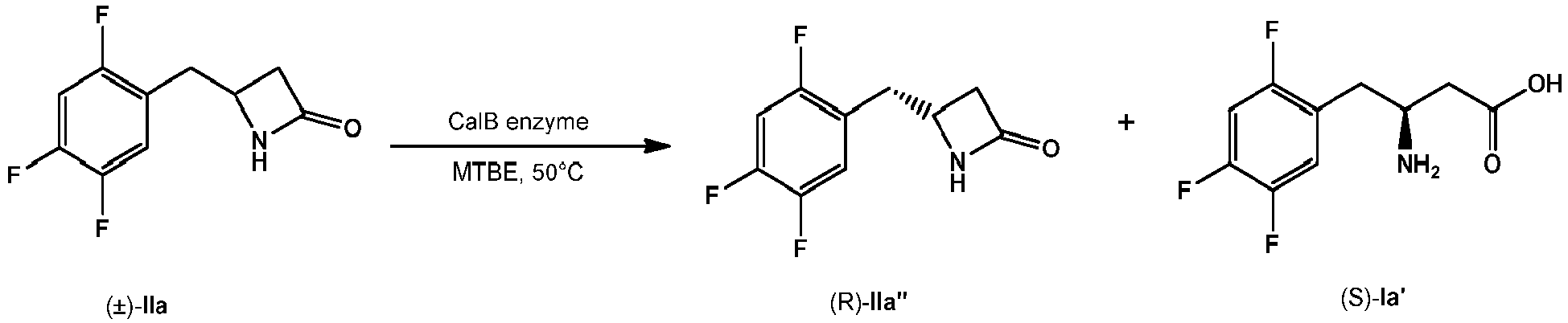
- To a suspension of racemic 4-(2,4,5-trifluorobenzyl)azetidin-2-one ((±)-Ila) (50 mg, 0.23 mmol) in MTBE (15.0 mL) was added Candida antarctica lipase B (CaIB) enzyme in recombinant form immobilised on polyacryllic resin (375 mg), and the mixture was mixed for 40 h at 50°C. After the separation of the enzyme beads from the rest of the mixture by filtration through 0.1 mm filter net, the remaining suspension was filtrated through 0.22 µm teflon filter and washed two times with 2 x 5 mL of MTBE. The remaining white solid was collected and re-suspended in cold acetonitrile (2 mL), filtered off and dried to afford 24 mg of (S)-la' as white amorphous solid (ee 97%). The MTBE filtrate was evaporated to afford 18 mg of compound (R)-Ila" as white crystals (ee 99%).
-

- To the suspension of (S)-la' (2.0 g, 8.58 mmol) in acetone (35 ml) and 0.1 M phosphate buffer (35 mL), the solution of Oxone®(15.8 g, 25.7 mmol) in water (20 mL) was added slowly over period of 20 min at 5°C. The pH 7-8 was maintained by addition of 5M KOH. After all Oxone®was added and pH stabilized at 8.0 the mixture was allowed to warm to room temperature. After 1h the pH of the reaction mixture was elevated to 9.0 and the mixture was stirred for 16 hours at room temperature. Then the acetone was evaporated in vacuum and the pH of remaining water suspension was lowered to 2.0 and washed with EtOAc (80 mL). After the removal of water phase, the organic phase was dried over MgSO4 filtered and evaporated in vacuum. The remaining yellow oily residue (1.9 g) was dissolved in 120 mL of MeOH and cooled to 0°C. Powdered Zn (12 g) and 36% HCl (10 mL) were added and after 1 h the mixture was allowed to stir at room temperature for further 16 h. Zinc particles were removed by filtration and methanol was removed under reduced pressure. To the remaining oily residue, water was added and pH elevated to 8. The precipitated white solid was filtered off and dried in an oven to afford 1.9 g of (±)-la.
-

- Azetidinone IIa' (0.5 g, 2.32 mmol, ee 99.5 %), 3-(trifluoromethyl)-5,6,7,8-tetrahydro-[1,2,4] triazolo[4,3-a] pyrazine hydrochloride (III', 1.06 g, 4.65 mmol), Et3N (0.28 g, 4.65 mmol) and 2-ethylhexanoic acid (0.17 g, 1.16 mmol) were suspended in THF (10 mL). The resulting suspension was stirred at 75°C for 72 h. After cooling the mixture to 0°C, compound 2 was filtered off and the solvent was removed in vacuo. To the remaining oil was added water (10 mL) and the product was extracted with dichloromethane (3 x10 mL). The organic phases were combined, dried over magnesium sulfate and concentrated in vacuo to give 0.90 g of sitagliptin (IV") (95%, ee 99.5 %) as dark yellow oil.
in the presence of a catalyst in an organic solvent.
while the other enantiomer of the compound of formula II remains substantially unreacted.

Claims (15)
- A process for the preparation of a compound of formula IV,

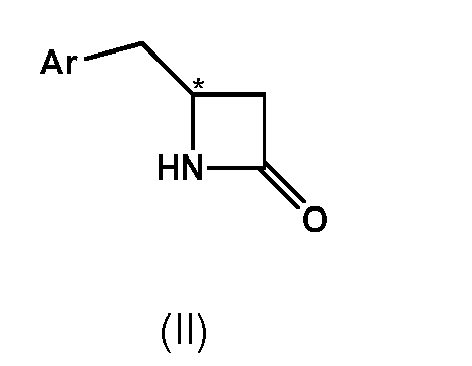
with a compound of formula III or a salt thereof,
in the presence of a catalyst in an organic solvent. - The process according to claim 1, wherein the compound of formula II, III and/or IV is/are characterized by either one or a combination of the following features i) to vi):i) the chiral center of compound of formula II and IV is in R-configuration;ii) in compounds of formulae II and IV, Ar is substituted phenyl, preferably fluorine substituted phenyl, in particular 2,4,5-trifluorophenyl;iii) in compounds of formulae II and IV, R is substituted C1-C3-alkyl, preferably halogen substituted C1-C3-alkyl, more preferably fluoro substituted C1-C3-alkyl, in particular trifluoromethyl;iv) in compounds of formulae II and IV, Q is N;v) Ar is 2,4,5-trifluorophenyl, R is trifluoromethyl, Q is N and the chiral center is in R-configuration.vi) compound of formula III is provided in the form of its acid addition salt, preferably in the form of its hydrochloride salt.
- The process according to claim 1 or 2, characterized by either one or a combination of procedural features I) to III):I) in case compound of formula III is provided in the form of its acid addition salt, a proton acceptor is added in an amount equimolar to the amount of acid addition salt of compound of formula III, preferably an organic proton acceptor, more preferably triethylam ine;II) the solvent is selected from the group of C2-C8 aliphatic ethers, C4-C6 cyclic ethers, C1-C4-alkyl C1-C4-alkanoates and C1-C4-alcohols, preferably the solvent is selected from symmetric di-(C2-C4-alkyl) ethers or asymmetric di-(C1-C4-alkyl) ethers, tetrahydrofuran, methanol, toluene, hexane or isopropyl acetate, in particular the solvent is tetrahydrofuran;III) the catalyst is selected from organic and inorganic proton donators, preferably the catalyst is selected from H2O, HCl or C1-C12- alkanecarboxylic acid, preferably C4-C10- alkanecarboxylic acid, more preferably C7-C9- alkanecarboxylic acid, in particular 2-ethylhexanoic acid (2-EHA).
- The process according to any one of the preceding claims, wherein the compound of formula II,

is provided in substantially enantiopure form; preferably, the substantially enantiopure compound of formula II' or II" having the structural formula
is prepared by subjecting racemic or enantioenriched compound of formula II,

to kinetic resolution by means of a hydrolytic enzyme in the presence of an organic solvent, wherein one kind of enantiomer of compound of formula II is converted to a compound of formula I,
while the other enantiomer of compound of formula II remains substantially unreacted. - The process according to claim 4, wherein the S-enantiomer of compound of formula II is converted to compound of formula I, while the R-enantiomer of compound of formula II remains substantially unreacted.
- A process for preparing a substantially enantiopure compound of formula Ila",

in which process a racemic or enantioenriched compound of formula IIa

- The process according to any one of claims 4 to 6, characterized by either one or a combination of the features a) to g):a) compound of formula II provided as the starting material is in racemic form;b) the hydrolytic enzyme is selected from the group of lipases, preferably from Candida antarctica lipase A and Candida antarctica lipase B, most preferably Candida antarctica lipase B;c) the process is carried out at the temperature from 25°C to 70°C, preferably from 30°C to 60°C, in particular from 40°C to 55°C;d) the enzyme is immobilised on a polymer resin, preferably on a polyacrylic resin;e) compound of formula II" or IIa" obtained after enzymatic racemic resolution has an enantiomeric excess (ee) of at least 80%, preferably at least 90%, more preferably at least 95%, and in particular at least 98%;f) the organic solvent is selected from is selected C5-C7 alkanes, C2-C8 aliphatic ethers, C4-C6 cyclic ethers, C1-C4-alkyl C1-C4-carboxylates and C1-C4-alcohols and toluene, preferably the solvent is selected from symmetric di-(C2-C4-alkyl) ethers or asymmetric di-(C1-C4-alkyl) ethers, in particular diisopropyl ether (i-Pr2O) or methyl tert-butyl ether;g) subsequent to removal of the hydrolytic enzyme, compound of formula I is separated from the resulting reaction mixture by means of separation, preferably by separation selected from the group consisting of filtration, centrifugation or decantation, more preferably filtration.
- A process for preparing compound of formula I
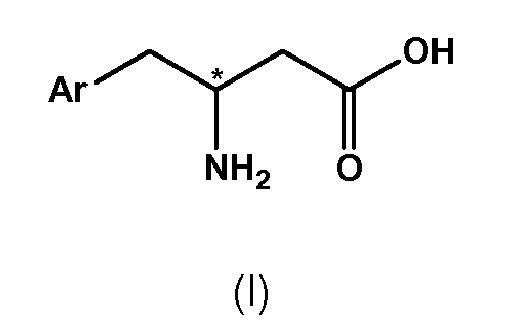 i) oxidation of a compound of formula I in enantioenriched or enantiopure form to its C-N double bonded intermediates by means of an oxidizing agent, andii) reduction of the C-N double bonded intermediates obtained in step i) by means of a reducing agent,in order to obtain compound of formula I in racemic form.
 - The process according to claim 8, characterized by either one or a combination of the procedural features A) to D):A) compound of formula I is provided in (substantially) enantiopure form, preferably substantially enantiopure compound of formula I'
 B) in step i) and ii), pH of the reaction mixtures is suitably adjusted in view of the oxidizing and reducing agent respectively applied;C) subsequent to step i) and prior to step ii), water and/or organic solvents are removed from the reaction mixture;D) the oxidizing agent is potassium peroxymonosulfate (KHSO5) and/or the reducing agent is elemental zinc (Zn).
 - The process according to claim 8 or 9, wherein compound of formula I is prepared via a process according to any one of claims 4 to 7.
- The process according to any one of the preceding claims, wherein compound of formula II


- The process according to claim 11, wherein cyclodehydration is carried out by applying C1-C6-alkanesulfonylchloride and a proton acceptor as reactants, preferably methanesulfonyl chloride (MeSO2Cl) and NaHCO3 are applied as reactants.
- A process for the preparation of a pharmaceutical composition comprising compound of formula IV or a pharmaceutically acceptable salt thereof as pharmaceutically active ingredient, comprising the steps of:a) preparing a compound of formula IV or a salt thereof according to the process according to any one of claims 1 to 5, 7, 11 and 12, andb) admixing the prepared compound of formula IV or pharmaceutically acceptable salt thereof with at least one pharmaceutically acceptable excipient.
- The process according to claim 13, wherein compound of formula IV is sitagliptin having the structural formula

- The pharmaceutical composition according to claim 13 or 14, which composition comprises at least one additional pharmaceutically active ingredient besides of compound of formula IV, wherein said additional pharmaceutically active ingredient is selected from the group consisting of insulin sensitizers, insulin, insulin mimetics, sulfonylureas, α-glucosidase inhibitors, glucagon receptor antagonists, GLP-1, GLP-1 analogues, GLP-1 mimetics, GLP-1 receptor agonists, GIP, GIP mimetics, PACAP, PACAP mimetics, PACAP receptor agonists, cholesterol lowering agents, PPAR-δ agonists, anti-obesity compounds, ileal bile acid transporter inhibitors, agents intended for use in inflammatory conditions, antihypertensive agents, glucokinase activators (GKAs), inhibitors of 11 β-hydroxysteroid dehydrogenase type 1, inhibitors of cholesteryl ester transfer protein (CETP) and inhibitors of fructose 1,6-bisphosphatase;
preferably, the additional pharmaceutically active ingredient is metformin and/or its pharmaceutically acceptable salt.
Priority Applications (6)
| Application Number | Priority Date | Filing Date | Title |
|---|---|---|---|
| EP12172012.2A EP2674432A1 (en) | 2012-06-14 | 2012-06-14 | New synthetic route for the preparation of ß aminobutyryl substituted 5,6,7,8-tetrahydro[1,4]diazolo[4,3-alpha]pyrazin-7-yl compounds |
| US14/406,686 US9388188B2 (en) | 2012-06-14 | 2013-06-13 | Synthetic route for the preparation of β-aminobutyryl substituted 5,6,7,8-tetrahydro[1,4]diazolo[4,3-alpha ]pyrazin-7-yl compounds |
| EP13730191.7A EP2861598B1 (en) | 2012-06-14 | 2013-06-13 | NEW SYNTHETIC ROUTE FOR THE PREPARATION OF ß-AMINOBUTYRYL SUBSTITUTED 5,6,7,8-TETRAHYDRO[1,4]DIAZOLO[4,3-a]PYRAZIN-7-YL COMPOUNDS |
| KR1020157000530A KR102154881B1 (en) | 2012-06-14 | 2013-06-13 | NEW SYNTHETIC ROUTE FOR THE PREPARATION OF β-AMINOBUTYRYL SUBSTITUTED 5,6,7,8-TETRAHYDRO[1,4]DIAZOLO[4,3-alpha]PYRAZIN-7-YL COMPOUNDS |
| CN201380031570.0A CN104520299B (en) | 2012-06-14 | 2013-06-13 | Prepare the new synthesis route of 5,6,7,8 tetrahydrochysenes [1,4] diazole simultaneously [4,3 α] pyrazine 7 based compound of β aminobutanonyl replacement |
| PCT/EP2013/062307 WO2013186326A1 (en) | 2012-06-14 | 2013-06-13 | NEW SYNTHETIC ROUTE FOR THE PREPARATION OF ß-AMINOBUTYRYL SUBSTITUTED 5,6,7,8-TETRAHYDRO[1,4]DIAZOLO[4,3-alpha]PYRAZIN-7-YL COMPOUNDS |
Applications Claiming Priority (1)
| Application Number | Priority Date | Filing Date | Title |
|---|---|---|---|
| EP12172012.2A EP2674432A1 (en) | 2012-06-14 | 2012-06-14 | New synthetic route for the preparation of ß aminobutyryl substituted 5,6,7,8-tetrahydro[1,4]diazolo[4,3-alpha]pyrazin-7-yl compounds |
Publications (1)
| Publication Number | Publication Date |
|---|---|
| EP2674432A1 true EP2674432A1 (en) | 2013-12-18 |
Family
ID=48669919
Family Applications (2)
| Application Number | Title | Priority Date | Filing Date |
|---|---|---|---|
| EP12172012.2A Ceased EP2674432A1 (en) | 2012-06-14 | 2012-06-14 | New synthetic route for the preparation of ß aminobutyryl substituted 5,6,7,8-tetrahydro[1,4]diazolo[4,3-alpha]pyrazin-7-yl compounds |
| EP13730191.7A Not-in-force EP2861598B1 (en) | 2012-06-14 | 2013-06-13 | NEW SYNTHETIC ROUTE FOR THE PREPARATION OF ß-AMINOBUTYRYL SUBSTITUTED 5,6,7,8-TETRAHYDRO[1,4]DIAZOLO[4,3-a]PYRAZIN-7-YL COMPOUNDS |
Family Applications After (1)
| Application Number | Title | Priority Date | Filing Date |
|---|---|---|---|
| EP13730191.7A Not-in-force EP2861598B1 (en) | 2012-06-14 | 2013-06-13 | NEW SYNTHETIC ROUTE FOR THE PREPARATION OF ß-AMINOBUTYRYL SUBSTITUTED 5,6,7,8-TETRAHYDRO[1,4]DIAZOLO[4,3-a]PYRAZIN-7-YL COMPOUNDS |
Country Status (5)
| Country | Link |
|---|---|
| US (1) | US9388188B2 (en) |
| EP (2) | EP2674432A1 (en) |
| KR (1) | KR102154881B1 (en) |
| CN (1) | CN104520299B (en) |
| WO (1) | WO2013186326A1 (en) |
Families Citing this family (3)
| Publication number | Priority date | Publication date | Assignee | Title |
|---|---|---|---|---|
| CN105254519B (en) * | 2015-11-25 | 2017-05-17 | 常州吉恩药业有限公司 | Synthesizing method of sitagliptin key intermediate |
| JP7057781B2 (en) | 2016-12-20 | 2022-04-20 | ダウ グローバル テクノロジーズ エルエルシー | A method of using an N-oxyl polymerization inhibitor in a washer-precipitator for the preparation of methyl methacrylate. |
| CN119569736B (en) * | 2024-11-29 | 2025-11-28 | 南通常佑药业科技有限公司 | Siglibenclamide Synthesis method of statin |
Citations (26)
| Publication number | Priority date | Publication date | Assignee | Title |
|---|---|---|---|---|
| WO2003004498A1 (en) | 2001-07-06 | 2003-01-16 | Merck & Co., Inc. | Beta-amino tetrahydroimidazo (1, 2-a) pyrazines and tetrahydrotrioazolo (4, 3-a) pyrazines as dipeptidyl peptidase inhibitors for the treatment or prevention of diabetes |
| WO2004085661A2 (en) | 2003-03-24 | 2004-10-07 | Merck & Co., Inc | Process to chiral beta-amino acid derivatives |
| WO2004085378A1 (en) | 2003-03-19 | 2004-10-07 | Merck & Co. Inc. | Process for the preparation of chiral beta amino acid derivatives by asymmetric hydrogenation |
| WO2004087650A2 (en) | 2003-03-27 | 2004-10-14 | Merck & Co. Inc. | Process and intermediates for the preparation of beta-amino acid amide dipeptidyl peptidase-iv inhibitors |
| WO2004089362A1 (en) | 2003-04-11 | 2004-10-21 | Novo Nordisk A/S | 2-cyanopyrroles and their analogues as ddp-iv inhibitors |
| WO2005097733A1 (en) | 2004-04-05 | 2005-10-20 | Merck & Co., Inc. | Process for the preparation of enantiomerically enriched beta amino acid derivatives |
| WO2006081151A1 (en) | 2005-01-24 | 2006-08-03 | Merck & Co., Inc. | Process to chiral beta amino acid derivatives by asymmetric hydrogenation |
| WO2008019124A1 (en) | 2006-08-08 | 2008-02-14 | Millennium Pharmaceuticals, Inc. | Heteroaryl compounds useful as inhibitors of e1 activating enzymes |
| WO2009045507A2 (en) | 2007-10-03 | 2009-04-09 | Teva Pharmaceutical Industries Ltd. | Processes for preparing an intermediate of sitagliptin via enzymatic reduction |
| WO2009064476A1 (en) | 2007-11-13 | 2009-05-22 | Teva Pharmaceutical Industries Ltd. | Preparation of sitagliptin intermediate |
| WO2009085990A2 (en) | 2007-12-20 | 2009-07-09 | Dr. Reddy's Laboratories Limited | Processes for the preparation of sitagliptin and pharmaceutically acceptable salts thereof |
| WO2009084024A2 (en) | 2007-11-02 | 2009-07-09 | Glenmark Generics Limited | A process for the preparation of r-sit agliptin and its pharmaceutically acceptable salts thereof |
| ES2335380A1 (en) | 2008-09-24 | 2010-03-25 | Consejo Superior De Investigaciones Cientificas (Cic) | NEW QUATERNARY AMINO ACIDS DERIVED FROM AZEPANOS AND ITS APPLICATIONS. |
| WO2010122578A2 (en) | 2009-04-20 | 2010-10-28 | Msn Laboratories Limited | Process for the preparation of sitagliptin and its intermediates |
| WO2010131025A1 (en) | 2009-05-11 | 2010-11-18 | Generics [Uk] Limited | Sitagliptin synthesis |
| WO2011025932A2 (en) | 2009-08-28 | 2011-03-03 | Dr. Reddy's Laboratories Ltd. | Preparation of sitagliptin and salts thereof |
| WO2011035725A1 (en) | 2009-09-27 | 2011-03-31 | 浙江九洲药业股份有限公司 | Sitagliptin intermediates, preparation methods and uses thereof |
| WO2011060213A2 (en) | 2009-11-12 | 2011-05-19 | Dr. Reddy's Laboratories Ltd. | Preparation of sitagliptin and salts thereof |
| CN102093245A (en) | 2009-12-14 | 2011-06-15 | 浙江海翔药业股份有限公司 | Preparation method of sitagliptin intermediate, sitagliptin or salts thereof |
| CN102126987A (en) | 2010-12-30 | 2011-07-20 | 中国科学院上海有机化学研究所 | Chiral allylamine compounds and synthesis method and applications thereof |
| CN102126976A (en) | 2010-12-20 | 2011-07-20 | 博瑞生物医药技术(苏州)有限公司 | Intermediates of Sitagliptin and preparation method thereof |
| WO2011113399A1 (en) | 2010-03-16 | 2011-09-22 | Zentiva, K.S. | Method of preparing sitagliptin |
| WO2011116686A1 (en) | 2010-03-25 | 2011-09-29 | 浙江九洲药业股份有限公司 | Sitagliptin intermediate compounds, preparation methods and uses thereof |
| WO2011127794A1 (en) | 2010-04-12 | 2011-10-20 | 上海源力生物技术有限公司 | Chiral cyclic beta-amino aryl butyric acid derivatives, their preparation methods and methods for preparation of chiral beta-amino aryl butyric acid derivatives via them |
| WO2011142825A2 (en) | 2010-05-12 | 2011-11-17 | Dissymmetrix (P) Ltd. | Novel sulfur containing compounds |
| EP2397141A1 (en) * | 2010-06-16 | 2011-12-21 | LEK Pharmaceuticals d.d. | Process for the synthesis of beta-amino acids and derivatives thereof |
Family Cites Families (1)
| Publication number | Priority date | Publication date | Assignee | Title |
|---|---|---|---|---|
| US20130158265A1 (en) * | 2010-08-27 | 2013-06-20 | Dhananjay Govind Sathe | Sitagliptin, salts and polymorphs thereof |
-
2012
- 2012-06-14 EP EP12172012.2A patent/EP2674432A1/en not_active Ceased
-
2013
- 2013-06-13 EP EP13730191.7A patent/EP2861598B1/en not_active Not-in-force
- 2013-06-13 CN CN201380031570.0A patent/CN104520299B/en not_active Expired - Fee Related
- 2013-06-13 WO PCT/EP2013/062307 patent/WO2013186326A1/en not_active Ceased
- 2013-06-13 US US14/406,686 patent/US9388188B2/en not_active Expired - Fee Related
- 2013-06-13 KR KR1020157000530A patent/KR102154881B1/en not_active Expired - Fee Related
Patent Citations (26)
| Publication number | Priority date | Publication date | Assignee | Title |
|---|---|---|---|---|
| WO2003004498A1 (en) | 2001-07-06 | 2003-01-16 | Merck & Co., Inc. | Beta-amino tetrahydroimidazo (1, 2-a) pyrazines and tetrahydrotrioazolo (4, 3-a) pyrazines as dipeptidyl peptidase inhibitors for the treatment or prevention of diabetes |
| WO2004085378A1 (en) | 2003-03-19 | 2004-10-07 | Merck & Co. Inc. | Process for the preparation of chiral beta amino acid derivatives by asymmetric hydrogenation |
| WO2004085661A2 (en) | 2003-03-24 | 2004-10-07 | Merck & Co., Inc | Process to chiral beta-amino acid derivatives |
| WO2004087650A2 (en) | 2003-03-27 | 2004-10-14 | Merck & Co. Inc. | Process and intermediates for the preparation of beta-amino acid amide dipeptidyl peptidase-iv inhibitors |
| WO2004089362A1 (en) | 2003-04-11 | 2004-10-21 | Novo Nordisk A/S | 2-cyanopyrroles and their analogues as ddp-iv inhibitors |
| WO2005097733A1 (en) | 2004-04-05 | 2005-10-20 | Merck & Co., Inc. | Process for the preparation of enantiomerically enriched beta amino acid derivatives |
| WO2006081151A1 (en) | 2005-01-24 | 2006-08-03 | Merck & Co., Inc. | Process to chiral beta amino acid derivatives by asymmetric hydrogenation |
| WO2008019124A1 (en) | 2006-08-08 | 2008-02-14 | Millennium Pharmaceuticals, Inc. | Heteroaryl compounds useful as inhibitors of e1 activating enzymes |
| WO2009045507A2 (en) | 2007-10-03 | 2009-04-09 | Teva Pharmaceutical Industries Ltd. | Processes for preparing an intermediate of sitagliptin via enzymatic reduction |
| WO2009084024A2 (en) | 2007-11-02 | 2009-07-09 | Glenmark Generics Limited | A process for the preparation of r-sit agliptin and its pharmaceutically acceptable salts thereof |
| WO2009064476A1 (en) | 2007-11-13 | 2009-05-22 | Teva Pharmaceutical Industries Ltd. | Preparation of sitagliptin intermediate |
| WO2009085990A2 (en) | 2007-12-20 | 2009-07-09 | Dr. Reddy's Laboratories Limited | Processes for the preparation of sitagliptin and pharmaceutically acceptable salts thereof |
| ES2335380A1 (en) | 2008-09-24 | 2010-03-25 | Consejo Superior De Investigaciones Cientificas (Cic) | NEW QUATERNARY AMINO ACIDS DERIVED FROM AZEPANOS AND ITS APPLICATIONS. |
| WO2010122578A2 (en) | 2009-04-20 | 2010-10-28 | Msn Laboratories Limited | Process for the preparation of sitagliptin and its intermediates |
| WO2010131025A1 (en) | 2009-05-11 | 2010-11-18 | Generics [Uk] Limited | Sitagliptin synthesis |
| WO2011025932A2 (en) | 2009-08-28 | 2011-03-03 | Dr. Reddy's Laboratories Ltd. | Preparation of sitagliptin and salts thereof |
| WO2011035725A1 (en) | 2009-09-27 | 2011-03-31 | 浙江九洲药业股份有限公司 | Sitagliptin intermediates, preparation methods and uses thereof |
| WO2011060213A2 (en) | 2009-11-12 | 2011-05-19 | Dr. Reddy's Laboratories Ltd. | Preparation of sitagliptin and salts thereof |
| CN102093245A (en) | 2009-12-14 | 2011-06-15 | 浙江海翔药业股份有限公司 | Preparation method of sitagliptin intermediate, sitagliptin or salts thereof |
| WO2011113399A1 (en) | 2010-03-16 | 2011-09-22 | Zentiva, K.S. | Method of preparing sitagliptin |
| WO2011116686A1 (en) | 2010-03-25 | 2011-09-29 | 浙江九洲药业股份有限公司 | Sitagliptin intermediate compounds, preparation methods and uses thereof |
| WO2011127794A1 (en) | 2010-04-12 | 2011-10-20 | 上海源力生物技术有限公司 | Chiral cyclic beta-amino aryl butyric acid derivatives, their preparation methods and methods for preparation of chiral beta-amino aryl butyric acid derivatives via them |
| WO2011142825A2 (en) | 2010-05-12 | 2011-11-17 | Dissymmetrix (P) Ltd. | Novel sulfur containing compounds |
| EP2397141A1 (en) * | 2010-06-16 | 2011-12-21 | LEK Pharmaceuticals d.d. | Process for the synthesis of beta-amino acids and derivatives thereof |
| CN102126976A (en) | 2010-12-20 | 2011-07-20 | 博瑞生物医药技术(苏州)有限公司 | Intermediates of Sitagliptin and preparation method thereof |
| CN102126987A (en) | 2010-12-30 | 2011-07-20 | 中国科学院上海有机化学研究所 | Chiral allylamine compounds and synthesis method and applications thereof |
Non-Patent Citations (13)
| Title |
|---|
| BIOORG. MED. CHEM. LETT., vol. 13, 2003, pages 241 |
| CHRISTIANE YOAKIM ET AL: "[beta]-Lactam Derivatives as Inhibitors of Human Cytomegalovirus Protease", JOURNAL OF MEDICINAL CHEMISTRY, vol. 41, no. 15, 1 July 1998 (1998-07-01), pages 2882 - 2891, XP055035004, ISSN: 0022-2623, DOI: 10.1021/jm980131z * |
| HANSEN KARL B ET AL: "First Generation Process for the Preparation of the DPP-IV Inhibitor Sitagliptin", ORGANIC PROCESS RESEARCH AND DEVELOPMENT, AMERICAN CHEMICAL SOCIETY, US, vol. 9, no. 5, 1 September 2005 (2005-09-01), pages 634 - 639, XP009142089, ISSN: 1083-6160, [retrieved on 20050831], DOI: 10.1021/OP0500786 * |
| J. AM. CHEM. SOC., vol. 126, 2004, pages 9918 |
| J. CHEM. RES., vol. 4, 2010, pages 230 |
| J. ORG CHEM., vol. 57, 1992, pages 6759 |
| M.B. SMITH; J. MARCH: "March's Advanced Organic Chemistry: Reactions, Mechanisms and Structure", 6th edition", JOHN WILEY&SONS, INC., pages: 155 - 158 |
| ORG. BIOMOL. CHEM, vol. 1, 2003, pages 2670 |
| ORG. BIOMOL. CHEM., vol. 8, 2009, pages 893 |
| ORG. PREP. RES. & DEV., vol. 9, 2005, pages 634 - 639 |
| TASNADI G ET AL: "Candida antarctica lipase B-catalyzed ring opening of 4-arylalkyl-substituted beta-lactams", TETRAHEDRON ASYMMETRY, PERGAMON PRESS LTD, OXFORD, GB, vol. 18, no. 23, 26 November 2007 (2007-11-26), pages 2841 - 2844, XP025970597, ISSN: 0957-4166, [retrieved on 20071203], DOI: 10.1016/J.TETASY.2007.11.016 * |
| TETRAHEDRON ASYMMETRY, vol. 17, 2006, pages 205 |
| TETRAHEDRON LETT., vol. 43, 2002, pages 3951 |
Also Published As
| Publication number | Publication date |
|---|---|
| EP2861598B1 (en) | 2017-10-25 |
| KR20150023689A (en) | 2015-03-05 |
| CN104520299A (en) | 2015-04-15 |
| EP2861598A1 (en) | 2015-04-22 |
| US20150148533A1 (en) | 2015-05-28 |
| US9388188B2 (en) | 2016-07-12 |
| KR102154881B1 (en) | 2020-09-11 |
| WO2013186326A1 (en) | 2013-12-19 |
| CN104520299B (en) | 2017-03-01 |
Similar Documents
| Publication | Publication Date | Title |
|---|---|---|
| EP0839149B1 (en) | Galanthamine derivatives, preparation method therefor, use thereof as drugs, and pharmaceutical compositions containing such derivatives | |
| EP2392575A1 (en) | A novel synthetic approach to ß-aminobutyryl substituted compounds | |
| WO2024216008A1 (en) | Synthesis of ras inhibitors | |
| EP2861598B1 (en) | NEW SYNTHETIC ROUTE FOR THE PREPARATION OF ß-AMINOBUTYRYL SUBSTITUTED 5,6,7,8-TETRAHYDRO[1,4]DIAZOLO[4,3-a]PYRAZIN-7-YL COMPOUNDS | |
| WO2013114173A1 (en) | A novel process for the preparation of sitagliptin | |
| CN1125073C (en) | Process and intermediates for preparing (-) pyridobenzoxazine carboxylic acid derivatives | |
| EP2576563B1 (en) | A NOVEL SYNTHETIC APPROACH TO ß-AMINOBUTYRYL SUBSTITUTED COMPOUNDS | |
| EP1440075B1 (en) | Novel 3beta-amino azabicyclooctane heteroaromatic amide derivatives, preparation method and therapeutic uses thereof | |
| EP2935205B1 (en) | An enzymatic route for the preparation of chiral gamma-aryl-beta-aminobutyric acid derivatives | |
| JP2008509105A (en) | 4-sulfonyl-substituted benzoylalanine derivatives useful as kynurenine-aminotransferase inhibitors | |
| EP1833798B1 (en) | A process for the preparation of (s)-(+)-10,11-dihydro-10-hydroxy-5h-dibenz[b,f]azepine-5-carboxamide | |
| WO1999031097A1 (en) | Imidazol derivatives as muscarinic m3 receptor antagonists | |
| EP1593682B1 (en) | Derivatives of 4-oxo-4,6,7,8-tetrahydropyrrolo¬1,2-a pyrazine-6-carboxamides, process for their preparation and pharmaceutical compositions thereof | |
| EP4685237A1 (en) | Process and intermediates for the preparation of etrasimod and related compounds | |
| JP2008545006A (en) | Method for synthesizing ACE inhibitor | |
| CA3207714C (en) | Pyrrolopyridine derivative preparation method | |
| JP3161999B2 (en) | Method for producing 2,4-dioxo-3-azabicyclo [3.1.0] hexane | |
| US20160107992A1 (en) | Intermediates useful for the preparation of saxagliptin | |
| CA3207714A1 (en) | Pyrrolopyridine derivative preparation method | |
| EP1357110A1 (en) | Synthesis for the preparation of porphobilinogen, the compound as such as stabilized salt and intermediates thereof | |
| BE831941A (en) | NEW ANTIBIOTIC AND ITS PREPARATION PROCESS | |
| WO2003002512A1 (en) | Process for producing hydroxyamino acid derivative | |
| JP2008208057A (en) | Method for producing carboxylic acid and intermediate thereof | |
| CN1346357A (en) | Process for production of optically active pyrrolazepine derivatives |
Legal Events
| Date | Code | Title | Description |
|---|---|---|---|
| PUAI | Public reference made under article 153(3) epc to a published international application that has entered the european phase |
Free format text: ORIGINAL CODE: 0009012 |
|
| AK | Designated contracting states |
Kind code of ref document: A1 Designated state(s): AL AT BE BG CH CY CZ DE DK EE ES FI FR GB GR HR HU IE IS IT LI LT LU LV MC MK MT NL NO PL PT RO RS SE SI SK SM TR |
|
| AX | Request for extension of the european patent |
Extension state: BA ME |
|
| STAA | Information on the status of an ep patent application or granted ep patent |
Free format text: STATUS: THE APPLICATION HAS BEEN REFUSED |
|
| 18R | Application refused |
Effective date: 20140220 |