EP2632271B1 - Glyphosate formulations based on compositions derived from natural oil metathesis - Google Patents
Glyphosate formulations based on compositions derived from natural oil metathesis Download PDFInfo
- Publication number
- EP2632271B1 EP2632271B1 EP11838510.3A EP11838510A EP2632271B1 EP 2632271 B1 EP2632271 B1 EP 2632271B1 EP 11838510 A EP11838510 A EP 11838510A EP 2632271 B1 EP2632271 B1 EP 2632271B1
- Authority
- EP
- European Patent Office
- Prior art keywords
- diamidoamine
- quat
- amidoamine
- mixture
- surfactant
- Prior art date
- Legal status (The legal status is an assumption and is not a legal conclusion. Google has not performed a legal analysis and makes no representation as to the accuracy of the status listed.)
- Active
Links
- 239000000203 mixture Substances 0.000 title claims description 213
- XDDAORKBJWWYJS-UHFFFAOYSA-N glyphosate Chemical compound OC(=O)CNCP(O)(O)=O XDDAORKBJWWYJS-UHFFFAOYSA-N 0.000 title claims description 68
- 239000005562 Glyphosate Substances 0.000 title claims description 57
- 238000009472 formulation Methods 0.000 title claims description 57
- 229940097068 glyphosate Drugs 0.000 title claims description 57
- 238000005649 metathesis reaction Methods 0.000 title claims description 28
- 239000004094 surface-active agent Substances 0.000 claims description 84
- 150000001412 amines Chemical class 0.000 claims description 74
- 239000002253 acid Substances 0.000 claims description 71
- XLYOFNOQVPJJNP-UHFFFAOYSA-N water Substances O XLYOFNOQVPJJNP-UHFFFAOYSA-N 0.000 claims description 58
- KWIUHFFTVRNATP-UHFFFAOYSA-N glycine betaine Chemical compound C[N+](C)(C)CC([O-])=O KWIUHFFTVRNATP-UHFFFAOYSA-N 0.000 claims description 56
- PUAQLLVFLMYYJJ-UHFFFAOYSA-N 2-aminopropiophenone Chemical compound CC(N)C(=O)C1=CC=CC=C1 PUAQLLVFLMYYJJ-UHFFFAOYSA-N 0.000 claims description 49
- 150000002148 esters Chemical class 0.000 claims description 47
- -1 C12 amine Chemical class 0.000 claims description 38
- 235000012424 soybean oil Nutrition 0.000 claims description 37
- 239000003549 soybean oil Substances 0.000 claims description 37
- 235000019482 Palm oil Nutrition 0.000 claims description 30
- 239000002540 palm oil Substances 0.000 claims description 30
- 229960003237 betaine Drugs 0.000 claims description 29
- 239000005630 Diquat Substances 0.000 claims description 9
- SYJFEGQWDCRVNX-UHFFFAOYSA-N diquat Chemical compound C1=CC=[N+]2CC[N+]3=CC=CC=C3C2=C1 SYJFEGQWDCRVNX-UHFFFAOYSA-N 0.000 claims description 9
- MTNDZQHUAFNZQY-UHFFFAOYSA-N imidazoline Chemical compound C1CN=CN1 MTNDZQHUAFNZQY-UHFFFAOYSA-N 0.000 claims description 9
- 239000000047 product Substances 0.000 description 66
- OKKJLVBELUTLKV-UHFFFAOYSA-N Methanol Chemical compound OC OKKJLVBELUTLKV-UHFFFAOYSA-N 0.000 description 60
- IJGRMHOSHXDMSA-UHFFFAOYSA-N Atomic nitrogen Chemical compound N#N IJGRMHOSHXDMSA-UHFFFAOYSA-N 0.000 description 46
- 238000006243 chemical reaction Methods 0.000 description 41
- 239000003921 oil Substances 0.000 description 41
- 235000019198 oils Nutrition 0.000 description 41
- KFYRJJBUHYILSO-YFKPBYRVSA-N (2s)-2-amino-3-dimethylarsanylsulfanyl-3-methylbutanoic acid Chemical compound C[As](C)SC(C)(C)[C@@H](N)C(O)=O KFYRJJBUHYILSO-YFKPBYRVSA-N 0.000 description 38
- 238000000034 method Methods 0.000 description 37
- VXNZUUAINFGPBY-UHFFFAOYSA-N 1-Butene Chemical compound CCC=C VXNZUUAINFGPBY-UHFFFAOYSA-N 0.000 description 31
- 239000000243 solution Substances 0.000 description 31
- 150000001336 alkenes Chemical class 0.000 description 30
- 239000000523 sample Substances 0.000 description 30
- 238000007792 addition Methods 0.000 description 28
- 239000003054 catalyst Substances 0.000 description 28
- WQDUMFSSJAZKTM-UHFFFAOYSA-N Sodium methoxide Chemical compound [Na+].[O-]C WQDUMFSSJAZKTM-UHFFFAOYSA-N 0.000 description 26
- MHAJPDPJQMAIIY-UHFFFAOYSA-N Hydrogen peroxide Chemical compound OO MHAJPDPJQMAIIY-UHFFFAOYSA-N 0.000 description 24
- KWYUFKZDYYNOTN-UHFFFAOYSA-M Potassium hydroxide Chemical compound [OH-].[K+] KWYUFKZDYYNOTN-UHFFFAOYSA-M 0.000 description 24
- 229910052757 nitrogen Inorganic materials 0.000 description 23
- 238000005160 1H NMR spectroscopy Methods 0.000 description 20
- 150000001408 amides Chemical class 0.000 description 20
- 238000004458 analytical method Methods 0.000 description 20
- 150000002978 peroxides Chemical class 0.000 description 20
- 238000005686 cross metathesis reaction Methods 0.000 description 19
- HEMHJVSKTPXQMS-UHFFFAOYSA-M Sodium hydroxide Chemical compound [OH-].[Na+] HEMHJVSKTPXQMS-UHFFFAOYSA-M 0.000 description 18
- 239000012141 concentrate Substances 0.000 description 17
- 150000004702 methyl esters Chemical class 0.000 description 16
- 239000011541 reaction mixture Substances 0.000 description 16
- 0 *C(CCCCCCCC(CN=O)OC(CCCCCCCC=C)=O)=O Chemical compound *C(CCCCCCCC(CN=O)OC(CCCCCCCC=C)=O)=O 0.000 description 15
- YMWUJEATGCHHMB-UHFFFAOYSA-N Dichloromethane Chemical compound ClCCl YMWUJEATGCHHMB-UHFFFAOYSA-N 0.000 description 15
- 239000008367 deionised water Substances 0.000 description 15
- 229910021641 deionized water Inorganic materials 0.000 description 15
- VAYGXNSJCAHWJZ-UHFFFAOYSA-N dimethyl sulfate Chemical compound COS(=O)(=O)OC VAYGXNSJCAHWJZ-UHFFFAOYSA-N 0.000 description 15
- DUWQEMMRMJGHSA-UHFFFAOYSA-N methyl dodec-9-enoate Chemical compound CCC=CCCCCCCCC(=O)OC DUWQEMMRMJGHSA-UHFFFAOYSA-N 0.000 description 15
- XKRFYHLGVUSROY-UHFFFAOYSA-N Argon Chemical compound [Ar] XKRFYHLGVUSROY-UHFFFAOYSA-N 0.000 description 14
- KFZMGEQAYNKOFK-UHFFFAOYSA-N Isopropanol Chemical compound CC(C)O KFZMGEQAYNKOFK-UHFFFAOYSA-N 0.000 description 14
- 239000007787 solid Substances 0.000 description 14
- 238000003756 stirring Methods 0.000 description 14
- JRZJOMJEPLMPRA-UHFFFAOYSA-N olefin Natural products CCCCCCCC=C JRZJOMJEPLMPRA-UHFFFAOYSA-N 0.000 description 13
- DNIAPMSPPWPWGF-UHFFFAOYSA-N Propylene glycol Chemical compound CC(O)CO DNIAPMSPPWPWGF-UHFFFAOYSA-N 0.000 description 12
- YXFVVABEGXRONW-UHFFFAOYSA-N Toluene Chemical compound CC1=CC=CC=C1 YXFVVABEGXRONW-UHFFFAOYSA-N 0.000 description 12
- 238000004817 gas chromatography Methods 0.000 description 12
- 238000004448 titration Methods 0.000 description 12
- JUJWROOIHBZHMG-UHFFFAOYSA-N Pyridine Chemical compound C1=CC=NC=C1 JUJWROOIHBZHMG-UHFFFAOYSA-N 0.000 description 11
- FAPWRFPIFSIZLT-UHFFFAOYSA-M Sodium chloride Chemical compound [Na+].[Cl-] FAPWRFPIFSIZLT-UHFFFAOYSA-M 0.000 description 11
- 230000015572 biosynthetic process Effects 0.000 description 11
- 238000004821 distillation Methods 0.000 description 11
- SBIGSHCJXYGFMX-UHFFFAOYSA-N methyl dec-9-enoate Chemical compound COC(=O)CCCCCCCC=C SBIGSHCJXYGFMX-UHFFFAOYSA-N 0.000 description 11
- HEDRZPFGACZZDS-MICDWDOJSA-N Trichloro(2H)methane Chemical compound [2H]C(Cl)(Cl)Cl HEDRZPFGACZZDS-MICDWDOJSA-N 0.000 description 10
- 150000007513 acids Chemical class 0.000 description 10
- 125000005907 alkyl ester group Chemical group 0.000 description 10
- 238000001816 cooling Methods 0.000 description 10
- 235000014113 dietary fatty acids Nutrition 0.000 description 10
- QYDYPVFESGNLHU-UHFFFAOYSA-N elaidic acid methyl ester Natural products CCCCCCCCC=CCCCCCCCC(=O)OC QYDYPVFESGNLHU-UHFFFAOYSA-N 0.000 description 10
- 239000000194 fatty acid Substances 0.000 description 10
- 229930195729 fatty acid Natural products 0.000 description 10
- 150000004665 fatty acids Chemical class 0.000 description 10
- 238000010438 heat treatment Methods 0.000 description 10
- QYDYPVFESGNLHU-KHPPLWFESA-N methyl oleate Chemical compound CCCCCCCC\C=C/CCCCCCCC(=O)OC QYDYPVFESGNLHU-KHPPLWFESA-N 0.000 description 10
- 238000005872 self-metathesis reaction Methods 0.000 description 10
- FDRCDNZGSXJAFP-UHFFFAOYSA-M sodium chloroacetate Chemical compound [Na+].[O-]C(=O)CCl FDRCDNZGSXJAFP-UHFFFAOYSA-M 0.000 description 10
- AKEJUJNQAAGONA-UHFFFAOYSA-N sulfur trioxide Chemical compound O=S(=O)=O AKEJUJNQAAGONA-UHFFFAOYSA-N 0.000 description 10
- XEKOWRVHYACXOJ-UHFFFAOYSA-N Ethyl acetate Chemical compound CCOC(C)=O XEKOWRVHYACXOJ-UHFFFAOYSA-N 0.000 description 9
- KRKNYBCHXYNGOX-UHFFFAOYSA-N citric acid Chemical compound OC(=O)CC(O)(C(O)=O)CC(O)=O KRKNYBCHXYNGOX-UHFFFAOYSA-N 0.000 description 9
- 150000003839 salts Chemical class 0.000 description 9
- WYURNTSHIVDZCO-UHFFFAOYSA-N Tetrahydrofuran Chemical compound C1CCOC1 WYURNTSHIVDZCO-UHFFFAOYSA-N 0.000 description 8
- HGGLIXDRUINGBB-ONEGZZNKSA-N dimethyl (e)-octadec-9-enedioate Chemical compound COC(=O)CCCCCCC\C=C\CCCCCCCC(=O)OC HGGLIXDRUINGBB-ONEGZZNKSA-N 0.000 description 8
- 150000002194 fatty esters Chemical class 0.000 description 8
- VLTRZXGMWDSKGL-UHFFFAOYSA-N perchloric acid Chemical compound OCl(=O)(=O)=O VLTRZXGMWDSKGL-UHFFFAOYSA-N 0.000 description 8
- 238000002360 preparation method Methods 0.000 description 8
- 150000003626 triacylglycerols Chemical class 0.000 description 8
- 239000004711 α-olefin Substances 0.000 description 8
- UEEJHVSXFDXPFK-UHFFFAOYSA-N N-dimethylaminoethanol Chemical compound CN(C)CCO UEEJHVSXFDXPFK-UHFFFAOYSA-N 0.000 description 7
- 229910052786 argon Inorganic materials 0.000 description 7
- 239000003446 ligand Substances 0.000 description 7
- LQPLDXQVILYOOL-UHFFFAOYSA-I pentasodium;2-[bis[2-[bis(carboxylatomethyl)amino]ethyl]amino]acetate Chemical compound [Na+].[Na+].[Na+].[Na+].[Na+].[O-]C(=O)CN(CC([O-])=O)CCN(CC(=O)[O-])CCN(CC([O-])=O)CC([O-])=O LQPLDXQVILYOOL-UHFFFAOYSA-I 0.000 description 7
- 150000003512 tertiary amines Chemical class 0.000 description 7
- 238000012360 testing method Methods 0.000 description 7
- LIKMAJRDDDTEIG-UHFFFAOYSA-N 1-hexene Chemical compound CCCCC=C LIKMAJRDDDTEIG-UHFFFAOYSA-N 0.000 description 6
- KWKAKUADMBZCLK-UHFFFAOYSA-N 1-octene Chemical compound CCCCCCC=C KWKAKUADMBZCLK-UHFFFAOYSA-N 0.000 description 6
- CURLTUGMZLYLDI-UHFFFAOYSA-N Carbon dioxide Chemical compound O=C=O CURLTUGMZLYLDI-UHFFFAOYSA-N 0.000 description 6
- RPNUMPOLZDHAAY-UHFFFAOYSA-N Diethylenetriamine Chemical compound NCCNCCN RPNUMPOLZDHAAY-UHFFFAOYSA-N 0.000 description 6
- ROSDSFDQCJNGOL-UHFFFAOYSA-N Dimethylamine Chemical compound CNC ROSDSFDQCJNGOL-UHFFFAOYSA-N 0.000 description 6
- PEDCQBHIVMGVHV-UHFFFAOYSA-N Glycerine Chemical compound OCC(O)CO PEDCQBHIVMGVHV-UHFFFAOYSA-N 0.000 description 6
- 230000008901 benefit Effects 0.000 description 6
- 235000011089 carbon dioxide Nutrition 0.000 description 6
- KHAVLLBUVKBTBG-UHFFFAOYSA-N dec-9-enoic acid Chemical compound OC(=O)CCCCCCCC=C KHAVLLBUVKBTBG-UHFFFAOYSA-N 0.000 description 6
- 150000005690 diesters Chemical class 0.000 description 6
- 230000002363 herbicidal effect Effects 0.000 description 6
- 239000000463 material Substances 0.000 description 6
- 125000002496 methyl group Chemical group [H]C([H])([H])* 0.000 description 6
- IZFGRAGOVZCUFB-UHFFFAOYSA-N methyl hexadec-9-enoate Chemical compound CCCCCCC=CCCCCCCCC(=O)OC IZFGRAGOVZCUFB-UHFFFAOYSA-N 0.000 description 6
- 239000002904 solvent Substances 0.000 description 6
- 239000007858 starting material Substances 0.000 description 6
- 238000003786 synthesis reaction Methods 0.000 description 6
- HXMVNCMPQGPRLN-UHFFFAOYSA-N 2-hydroxyputrescine Chemical compound NCCC(O)CN HXMVNCMPQGPRLN-UHFFFAOYSA-N 0.000 description 5
- 241000196324 Embryophyta Species 0.000 description 5
- 239000002671 adjuvant Substances 0.000 description 5
- 229910052799 carbon Inorganic materials 0.000 description 5
- 239000007795 chemical reaction product Substances 0.000 description 5
- 239000003795 chemical substances by application Substances 0.000 description 5
- 239000012972 dimethylethanolamine Substances 0.000 description 5
- 239000011984 grubbs catalyst Substances 0.000 description 5
- 125000001183 hydrocarbyl group Chemical group 0.000 description 5
- 230000007062 hydrolysis Effects 0.000 description 5
- 238000006460 hydrolysis reaction Methods 0.000 description 5
- HZVOZRGWRWCICA-UHFFFAOYSA-N methanediyl Chemical class [CH2] HZVOZRGWRWCICA-UHFFFAOYSA-N 0.000 description 5
- UMJSCPRVCHMLSP-UHFFFAOYSA-N pyridine Natural products COC1=CC=CN=C1 UMJSCPRVCHMLSP-UHFFFAOYSA-N 0.000 description 5
- 238000005956 quaternization reaction Methods 0.000 description 5
- 239000002002 slurry Substances 0.000 description 5
- 239000011780 sodium chloride Substances 0.000 description 5
- AFFLGGQVNFXPEV-UHFFFAOYSA-N 1-decene Chemical compound CCCCCCCCC=C AFFLGGQVNFXPEV-UHFFFAOYSA-N 0.000 description 4
- PFFANLXVTHIIBE-UHFFFAOYSA-N 1-methyl-4-pyridin-4-ylpyridin-1-ium Chemical compound C1=C[N+](C)=CC=C1C1=CC=NC=C1 PFFANLXVTHIIBE-UHFFFAOYSA-N 0.000 description 4
- UADSXJIEPPNBSV-AATRIKPKSA-N CN(C)CCCNC(CCCCCCC/C=C/CCCCCCCC(NCCCN(C)C)=O)=O Chemical compound CN(C)CCCNC(CCCCCCC/C=C/CCCCCCCC(NCCCN(C)C)=O)=O UADSXJIEPPNBSV-AATRIKPKSA-N 0.000 description 4
- OKKJLVBELUTLKV-MZCSYVLQSA-N Deuterated methanol Chemical compound [2H]OC([2H])([2H])[2H] OKKJLVBELUTLKV-MZCSYVLQSA-N 0.000 description 4
- 241001465754 Metazoa Species 0.000 description 4
- ZLMJMSJWJFRBEC-UHFFFAOYSA-N Potassium Chemical compound [K] ZLMJMSJWJFRBEC-UHFFFAOYSA-N 0.000 description 4
- QAOWNCQODCNURD-UHFFFAOYSA-N Sulfuric acid Chemical compound OS(O)(=O)=O QAOWNCQODCNURD-UHFFFAOYSA-N 0.000 description 4
- 125000001118 alkylidene group Chemical group 0.000 description 4
- 239000002280 amphoteric surfactant Substances 0.000 description 4
- 239000011203 carbon fibre reinforced carbon Substances 0.000 description 4
- 230000008034 disappearance Effects 0.000 description 4
- SYELZBGXAIXKHU-UHFFFAOYSA-N dodecyldimethylamine N-oxide Chemical compound CCCCCCCCCCCC[N+](C)(C)[O-] SYELZBGXAIXKHU-UHFFFAOYSA-N 0.000 description 4
- RTZKZFJDLAIYFH-UHFFFAOYSA-N ether Substances CCOCC RTZKZFJDLAIYFH-UHFFFAOYSA-N 0.000 description 4
- 230000007935 neutral effect Effects 0.000 description 4
- 239000002736 nonionic surfactant Substances 0.000 description 4
- 229910052700 potassium Inorganic materials 0.000 description 4
- 239000011591 potassium Substances 0.000 description 4
- 238000000926 separation method Methods 0.000 description 4
- 239000007921 spray Substances 0.000 description 4
- 229910052723 transition metal Inorganic materials 0.000 description 4
- DYLIWHYUXAJDOJ-OWOJBTEDSA-N (e)-4-(6-aminopurin-9-yl)but-2-en-1-ol Chemical compound NC1=NC=NC2=C1N=CN2C\C=C\CO DYLIWHYUXAJDOJ-OWOJBTEDSA-N 0.000 description 3
- NGNBDVOYPDDBFK-UHFFFAOYSA-N 2-[2,4-di(pentan-2-yl)phenoxy]acetyl chloride Chemical compound CCCC(C)C1=CC=C(OCC(Cl)=O)C(C(C)CCC)=C1 NGNBDVOYPDDBFK-UHFFFAOYSA-N 0.000 description 3
- QSBYPNXLFMSGKH-UHFFFAOYSA-N 9-Heptadecensaeure Natural products CCCCCCCC=CCCCCCCCC(O)=O QSBYPNXLFMSGKH-UHFFFAOYSA-N 0.000 description 3
- QTBSBXVTEAMEQO-UHFFFAOYSA-N Acetic acid Chemical compound CC(O)=O QTBSBXVTEAMEQO-UHFFFAOYSA-N 0.000 description 3
- CSCPPACGZOOCGX-UHFFFAOYSA-N Acetone Chemical compound CC(C)=O CSCPPACGZOOCGX-UHFFFAOYSA-N 0.000 description 3
- YMPDUXKCHZVPKA-AATRIKPKSA-N CC/C=C/CCCCCCCC(NCCC[N](C)(C)O)=O Chemical compound CC/C=C/CCCCCCCC(NCCC[N](C)(C)O)=O YMPDUXKCHZVPKA-AATRIKPKSA-N 0.000 description 3
- CICHRKHLMXHUCR-UHFFFAOYSA-N C[N](C)(CCCNC(CCCCCCCC=C)=O)O Chemical compound C[N](C)(CCCNC(CCCCCCCC=C)=O)O CICHRKHLMXHUCR-UHFFFAOYSA-N 0.000 description 3
- OKTJSMMVPCPJKN-UHFFFAOYSA-N Carbon Chemical compound [C] OKTJSMMVPCPJKN-UHFFFAOYSA-N 0.000 description 3
- LFQSCWFLJHTTHZ-UHFFFAOYSA-N Ethanol Chemical compound CCO LFQSCWFLJHTTHZ-UHFFFAOYSA-N 0.000 description 3
- 235000019484 Rapeseed oil Nutrition 0.000 description 3
- 238000013019 agitation Methods 0.000 description 3
- 229910052783 alkali metal Inorganic materials 0.000 description 3
- 239000008346 aqueous phase Substances 0.000 description 3
- 239000007864 aqueous solution Substances 0.000 description 3
- 239000002585 base Substances 0.000 description 3
- 150000001875 compounds Chemical class 0.000 description 3
- 150000002191 fatty alcohols Chemical class 0.000 description 3
- 150000002193 fatty amides Chemical class 0.000 description 3
- 238000004508 fractional distillation Methods 0.000 description 3
- 235000011187 glycerol Nutrition 0.000 description 3
- 239000004009 herbicide Substances 0.000 description 3
- 239000012456 homogeneous solution Substances 0.000 description 3
- 230000010354 integration Effects 0.000 description 3
- 239000012280 lithium aluminium hydride Substances 0.000 description 3
- 229910052751 metal Inorganic materials 0.000 description 3
- 239000002184 metal Substances 0.000 description 3
- 229940073769 methyl oleate Drugs 0.000 description 3
- TVMXDCGIABBOFY-UHFFFAOYSA-N n-Octanol Natural products CCCCCCCC TVMXDCGIABBOFY-UHFFFAOYSA-N 0.000 description 3
- ZQPPMHVWECSIRJ-KTKRTIGZSA-N oleic acid group Chemical group C(CCCCCCC\C=C/CCCCCCCC)(=O)O ZQPPMHVWECSIRJ-KTKRTIGZSA-N 0.000 description 3
- 239000012074 organic phase Substances 0.000 description 3
- 230000003647 oxidation Effects 0.000 description 3
- 238000007254 oxidation reaction Methods 0.000 description 3
- 239000008188 pellet Substances 0.000 description 3
- 239000000575 pesticide Substances 0.000 description 3
- XAEFZNCEHLXOMS-UHFFFAOYSA-M potassium benzoate Chemical compound [K+].[O-]C(=O)C1=CC=CC=C1 XAEFZNCEHLXOMS-UHFFFAOYSA-M 0.000 description 3
- 239000002244 precipitate Substances 0.000 description 3
- 239000002243 precursor Substances 0.000 description 3
- 239000000376 reactant Substances 0.000 description 3
- 230000009467 reduction Effects 0.000 description 3
- 238000010992 reflux Methods 0.000 description 3
- 229920006395 saturated elastomer Polymers 0.000 description 3
- 229910052708 sodium Inorganic materials 0.000 description 3
- 239000011734 sodium Substances 0.000 description 3
- 238000006277 sulfonation reaction Methods 0.000 description 3
- 125000000383 tetramethylene group Chemical group [H]C([H])([*:1])C([H])([H])C([H])([H])C([H])([H])[*:2] 0.000 description 3
- FYSNRJHAOHDILO-UHFFFAOYSA-N thionyl chloride Chemical compound ClS(Cl)=O FYSNRJHAOHDILO-UHFFFAOYSA-N 0.000 description 3
- 150000003624 transition metals Chemical class 0.000 description 3
- 150000004670 unsaturated fatty acids Chemical group 0.000 description 3
- 238000005406 washing Methods 0.000 description 3
- WRIDQFICGBMAFQ-UHFFFAOYSA-N (E)-8-Octadecenoic acid Natural products CCCCCCCCCC=CCCCCCCC(O)=O WRIDQFICGBMAFQ-UHFFFAOYSA-N 0.000 description 2
- PSBDWGZCVUAZQS-UHFFFAOYSA-N (dimethylsulfonio)acetate Chemical compound C[S+](C)CC([O-])=O PSBDWGZCVUAZQS-UHFFFAOYSA-N 0.000 description 2
- RUKVGXGTVPPWDD-UHFFFAOYSA-N 1,3-bis(2,4,6-trimethylphenyl)imidazolidine Chemical group CC1=CC(C)=CC(C)=C1N1CN(C=2C(=CC(C)=CC=2C)C)CC1 RUKVGXGTVPPWDD-UHFFFAOYSA-N 0.000 description 2
- ZGEGCLOFRBLKSE-UHFFFAOYSA-N 1-Heptene Chemical compound CCCCCC=C ZGEGCLOFRBLKSE-UHFFFAOYSA-N 0.000 description 2
- HZAXFHJVJLSVMW-UHFFFAOYSA-N 2-Aminoethan-1-ol Chemical compound NCCO HZAXFHJVJLSVMW-UHFFFAOYSA-N 0.000 description 2
- LQJBNNIYVWPHFW-UHFFFAOYSA-N 20:1omega9c fatty acid Natural products CCCCCCCCCCC=CCCCCCCCC(O)=O LQJBNNIYVWPHFW-UHFFFAOYSA-N 0.000 description 2
- ZQDPJFUHLCOCRG-UHFFFAOYSA-N 3-hexene Chemical compound CCC=CCC ZQDPJFUHLCOCRG-UHFFFAOYSA-N 0.000 description 2
- XCRITOXSGZKXCX-UHFFFAOYSA-O C[N+]1=C(CCCCCCCC=C)N(CCNC(CCCCCCCC=C)=O)CC1 Chemical compound C[N+]1=C(CCCCCCCC=C)N(CCNC(CCCCCCCC=C)=O)CC1 XCRITOXSGZKXCX-UHFFFAOYSA-O 0.000 description 2
- UUDGVPFFKSBALH-UHFFFAOYSA-O C[NH+](CCCNC(CCCCCCCC=C)=O)CC(O)=O Chemical compound C[NH+](CCCNC(CCCCCCCC=C)=O)CC(O)=O UUDGVPFFKSBALH-UHFFFAOYSA-O 0.000 description 2
- 108090000790 Enzymes Proteins 0.000 description 2
- 102000004190 Enzymes Human genes 0.000 description 2
- QUSNBJAOOMFDIB-UHFFFAOYSA-N Ethylamine Chemical compound CCN QUSNBJAOOMFDIB-UHFFFAOYSA-N 0.000 description 2
- VEXZGXHMUGYJMC-UHFFFAOYSA-N Hydrochloric acid Chemical compound Cl VEXZGXHMUGYJMC-UHFFFAOYSA-N 0.000 description 2
- DGAQECJNVWCQMB-PUAWFVPOSA-M Ilexoside XXIX Chemical compound C[C@@H]1CC[C@@]2(CC[C@@]3(C(=CC[C@H]4[C@]3(CC[C@@H]5[C@@]4(CC[C@@H](C5(C)C)OS(=O)(=O)[O-])C)C)[C@@H]2[C@]1(C)O)C)C(=O)O[C@H]6[C@@H]([C@H]([C@@H]([C@H](O6)CO)O)O)O.[Na+] DGAQECJNVWCQMB-PUAWFVPOSA-M 0.000 description 2
- XEEYBQQBJWHFJM-UHFFFAOYSA-N Iron Chemical compound [Fe] XEEYBQQBJWHFJM-UHFFFAOYSA-N 0.000 description 2
- BAVYZALUXZFZLV-UHFFFAOYSA-N Methylamine Chemical compound NC BAVYZALUXZFZLV-UHFFFAOYSA-N 0.000 description 2
- 239000005642 Oleic acid Substances 0.000 description 2
- ZQPPMHVWECSIRJ-UHFFFAOYSA-N Oleic acid Natural products CCCCCCCCC=CCCCCCCCC(O)=O ZQPPMHVWECSIRJ-UHFFFAOYSA-N 0.000 description 2
- KAESVJOAVNADME-UHFFFAOYSA-N Pyrrole Chemical compound C=1C=CNC=1 KAESVJOAVNADME-UHFFFAOYSA-N 0.000 description 2
- SMWDFEZZVXVKRB-UHFFFAOYSA-N Quinoline Chemical compound N1=CC=CC2=CC=CC=C21 SMWDFEZZVXVKRB-UHFFFAOYSA-N 0.000 description 2
- VYPSYNLAJGMNEJ-UHFFFAOYSA-N Silicium dioxide Chemical compound O=[Si]=O VYPSYNLAJGMNEJ-UHFFFAOYSA-N 0.000 description 2
- PMZURENOXWZQFD-UHFFFAOYSA-L Sodium Sulfate Chemical compound [Na+].[Na+].[O-]S([O-])(=O)=O PMZURENOXWZQFD-UHFFFAOYSA-L 0.000 description 2
- YTPLMLYBLZKORZ-UHFFFAOYSA-N Thiophene Chemical compound C=1C=CSC=1 YTPLMLYBLZKORZ-UHFFFAOYSA-N 0.000 description 2
- KNAFKGCUHDGMGE-UHFFFAOYSA-N [O-][N+](CC(CO)O)=O Chemical compound [O-][N+](CC(CO)O)=O KNAFKGCUHDGMGE-UHFFFAOYSA-N 0.000 description 2
- 150000001340 alkali metals Chemical class 0.000 description 2
- 125000000217 alkyl group Chemical group 0.000 description 2
- 230000002152 alkylating effect Effects 0.000 description 2
- 150000003863 ammonium salts Chemical class 0.000 description 2
- 125000000129 anionic group Chemical group 0.000 description 2
- 125000002915 carbonyl group Chemical group [*:2]C([*:1])=O 0.000 description 2
- 239000004359 castor oil Substances 0.000 description 2
- 125000002091 cationic group Chemical group 0.000 description 2
- NEHMKBQYUWJMIP-UHFFFAOYSA-N chloromethane Chemical compound ClC NEHMKBQYUWJMIP-UHFFFAOYSA-N 0.000 description 2
- QDRSJFZQMOOSAF-IHWYPQMZSA-N cis-9-undecenoic acid Chemical compound C\C=C/CCCCCCCC(O)=O QDRSJFZQMOOSAF-IHWYPQMZSA-N 0.000 description 2
- 239000004927 clay Substances 0.000 description 2
- 235000019864 coconut oil Nutrition 0.000 description 2
- 239000003240 coconut oil Substances 0.000 description 2
- 125000004122 cyclic group Chemical group 0.000 description 2
- 239000003599 detergent Substances 0.000 description 2
- 150000004985 diamines Chemical class 0.000 description 2
- IUNMPGNGSSIWFP-UHFFFAOYSA-N dimethylaminopropylamine Chemical compound CN(C)CCCN IUNMPGNGSSIWFP-UHFFFAOYSA-N 0.000 description 2
- 150000002149 estolides Chemical class 0.000 description 2
- 239000003925 fat Substances 0.000 description 2
- 235000019197 fats Nutrition 0.000 description 2
- 239000000706 filtrate Substances 0.000 description 2
- 239000007789 gas Substances 0.000 description 2
- 238000007429 general method Methods 0.000 description 2
- 239000011521 glass Substances 0.000 description 2
- 125000005842 heteroatom Chemical group 0.000 description 2
- 229930195733 hydrocarbon Natural products 0.000 description 2
- 150000002430 hydrocarbons Chemical class 0.000 description 2
- 229910052739 hydrogen Inorganic materials 0.000 description 2
- 238000002955 isolation Methods 0.000 description 2
- 238000006317 isomerization reaction Methods 0.000 description 2
- QXJSBBXBKPUZAA-UHFFFAOYSA-N isooleic acid Natural products CCCCCCCC=CCCCCCCCCC(O)=O QXJSBBXBKPUZAA-UHFFFAOYSA-N 0.000 description 2
- 229910052744 lithium Inorganic materials 0.000 description 2
- 238000010907 mechanical stirring Methods 0.000 description 2
- 238000006140 methanolysis reaction Methods 0.000 description 2
- 238000002156 mixing Methods 0.000 description 2
- 125000004433 nitrogen atom Chemical group N* 0.000 description 2
- 229910052760 oxygen Inorganic materials 0.000 description 2
- 230000035515 penetration Effects 0.000 description 2
- YWAKXRMUMFPDSH-UHFFFAOYSA-N pentene Chemical compound CCCC=C YWAKXRMUMFPDSH-UHFFFAOYSA-N 0.000 description 2
- BWHMMNNQKKPAPP-UHFFFAOYSA-L potassium carbonate Chemical compound [K+].[K+].[O-]C([O-])=O BWHMMNNQKKPAPP-UHFFFAOYSA-L 0.000 description 2
- 125000002924 primary amino group Chemical group [H]N([H])* 0.000 description 2
- 238000000746 purification Methods 0.000 description 2
- 238000010791 quenching Methods 0.000 description 2
- 238000007127 saponification reaction Methods 0.000 description 2
- 150000003335 secondary amines Chemical class 0.000 description 2
- SQGYOTSLMSWVJD-UHFFFAOYSA-N silver(1+) nitrate Chemical compound [Ag+].[O-]N(=O)=O SQGYOTSLMSWVJD-UHFFFAOYSA-N 0.000 description 2
- 229910052938 sodium sulfate Inorganic materials 0.000 description 2
- GEHJYWRUCIMESM-UHFFFAOYSA-L sodium sulfite Chemical compound [Na+].[Na+].[O-]S([O-])=O GEHJYWRUCIMESM-UHFFFAOYSA-L 0.000 description 2
- 238000012430 stability testing Methods 0.000 description 2
- 229910001220 stainless steel Inorganic materials 0.000 description 2
- 239000010935 stainless steel Substances 0.000 description 2
- 229940117986 sulfobetaine Drugs 0.000 description 2
- 239000003760 tallow Substances 0.000 description 2
- 238000005809 transesterification reaction Methods 0.000 description 2
- UFTFJSFQGQCHQW-UHFFFAOYSA-N triformin Chemical compound O=COCC(OC=O)COC=O UFTFJSFQGQCHQW-UHFFFAOYSA-N 0.000 description 2
- 235000021122 unsaturated fatty acids Nutrition 0.000 description 2
- 229930195735 unsaturated hydrocarbon Natural products 0.000 description 2
- 238000005292 vacuum distillation Methods 0.000 description 2
- 235000015112 vegetable and seed oil Nutrition 0.000 description 2
- 239000008158 vegetable oil Substances 0.000 description 2
- GGQQNYXPYWCUHG-RMTFUQJTSA-N (3e,6e)-deca-3,6-diene Chemical compound CCC\C=C\C\C=C\CC GGQQNYXPYWCUHG-RMTFUQJTSA-N 0.000 description 1
- YWWVWXASSLXJHU-AATRIKPKSA-N (9E)-tetradecenoic acid Chemical compound CCCC\C=C\CCCCCCCC(O)=O YWWVWXASSLXJHU-AATRIKPKSA-N 0.000 description 1
- WLTSXAIICPDFKI-FNORWQNLSA-N (E)-3-dodecene Chemical compound CCCCCCCC\C=C\CC WLTSXAIICPDFKI-FNORWQNLSA-N 0.000 description 1
- RYHBNJHYFVUHQT-UHFFFAOYSA-N 1,4-Dioxane Chemical compound C1COCCO1 RYHBNJHYFVUHQT-UHFFFAOYSA-N 0.000 description 1
- 238000001644 13C nuclear magnetic resonance spectroscopy Methods 0.000 description 1
- MFYSUUPKMDJYPF-UHFFFAOYSA-N 2-[(4-methyl-2-nitrophenyl)diazenyl]-3-oxo-n-phenylbutanamide Chemical compound C=1C=CC=CC=1NC(=O)C(C(=O)C)N=NC1=CC=C(C)C=C1[N+]([O-])=O MFYSUUPKMDJYPF-UHFFFAOYSA-N 0.000 description 1
- 108010020183 3-phosphoshikimate 1-carboxyvinyltransferase Proteins 0.000 description 1
- ZCYVEMRRCGMTRW-UHFFFAOYSA-N 7553-56-2 Chemical compound [I] ZCYVEMRRCGMTRW-UHFFFAOYSA-N 0.000 description 1
- OZKLKDKGPNBGPK-UHFFFAOYSA-N 9-Dodecenoic acid Natural products CCCC=CCCCCCCC(O)=O OZKLKDKGPNBGPK-UHFFFAOYSA-N 0.000 description 1
- DJCQJZKZUCHHAL-VOTSOKGWSA-N 9-pentadecenoic acid Chemical compound CCCCC\C=C\CCCCCCCC(O)=O DJCQJZKZUCHHAL-VOTSOKGWSA-N 0.000 description 1
- QSBYPNXLFMSGKH-CMDGGOBGSA-N 9E-Heptadecenoic acid Chemical compound CCCCCCC\C=C\CCCCCCCC(O)=O QSBYPNXLFMSGKH-CMDGGOBGSA-N 0.000 description 1
- FKLSONDBCYHMOQ-UHFFFAOYSA-N 9E-dodecenoic acid Natural products CCC=CCCCCCCCC(O)=O FKLSONDBCYHMOQ-UHFFFAOYSA-N 0.000 description 1
- YWWVWXASSLXJHU-UHFFFAOYSA-N 9E-tetradecenoic acid Natural products CCCCC=CCCCCCCCC(O)=O YWWVWXASSLXJHU-UHFFFAOYSA-N 0.000 description 1
- 235000019737 Animal fat Nutrition 0.000 description 1
- YEZFZWKMYVDWFK-SNAWJCMRSA-N C/C=C/CN(C)C Chemical compound C/C=C/CN(C)C YEZFZWKMYVDWFK-SNAWJCMRSA-N 0.000 description 1
- KPNWXYCUYIZECL-UHFFFAOYSA-N CC(C1C)C(C)C1=N Chemical compound CC(C1C)C(C)C1=N KPNWXYCUYIZECL-UHFFFAOYSA-N 0.000 description 1
- CVLMADXBFMMTGQ-UHFFFAOYSA-O CCC=CCCCCCCCC(NC=CC[NH+](C)CC(O)=O)=O Chemical compound CCC=CCCCCCCCC(NC=CC[NH+](C)CC(O)=O)=O CVLMADXBFMMTGQ-UHFFFAOYSA-O 0.000 description 1
- JNBKPGSPSAJFES-UHFFFAOYSA-N CCC=CCCCCCCCC(NCCC[NH+](C)CC([O-])=O)=O Chemical compound CCC=CCCCCCCCC(NCCC[NH+](C)CC([O-])=O)=O JNBKPGSPSAJFES-UHFFFAOYSA-N 0.000 description 1
- AEDIXYWIVPYNBI-UHFFFAOYSA-N CCCCCCC(N)=O Chemical compound CCCCCCC(N)=O AEDIXYWIVPYNBI-UHFFFAOYSA-N 0.000 description 1
- ZDMHQLGJMRRXGB-UHFFFAOYSA-N CCCCCCCCCCNCCC[N](C)(C)N Chemical compound CCCCCCCCCCNCCC[N](C)(C)N ZDMHQLGJMRRXGB-UHFFFAOYSA-N 0.000 description 1
- ICVFPLUSMYSIFO-UHFFFAOYSA-N CCCCCNCC Chemical compound CCCCCNCC ICVFPLUSMYSIFO-UHFFFAOYSA-N 0.000 description 1
- DJEQZVQFEPKLOY-UHFFFAOYSA-N CCCCN(C)C Chemical compound CCCCN(C)C DJEQZVQFEPKLOY-UHFFFAOYSA-N 0.000 description 1
- BSKQSCLFSMZDPG-UHFFFAOYSA-N CCCC[N](C)(C)O Chemical compound CCCC[N](C)(C)O BSKQSCLFSMZDPG-UHFFFAOYSA-N 0.000 description 1
- KNAFYKOXIIZLBI-UHFFFAOYSA-N CN(C)CCC=N Chemical compound CN(C)CCC=N KNAFYKOXIIZLBI-UHFFFAOYSA-N 0.000 description 1
- MPIDEDDINUFXTO-AATRIKPKSA-O C[N+](C)(C)CCCNC(CCCCCCC/C=C/CCCCCCCC(OC)=O)=O Chemical compound C[N+](C)(C)CCCNC(CCCCCCC/C=C/CCCCCCCC(OC)=O)=O MPIDEDDINUFXTO-AATRIKPKSA-O 0.000 description 1
- ZUEPGOHANYRSSO-AATRIKPKSA-O C[N+](C)(CCCNC(CCCCCCC/C=C/CCCCCCCC(NCCC[N+](C)(C)CC(O)=O)=O)=O)CC([O-])=O Chemical compound C[N+](C)(CCCNC(CCCCCCC/C=C/CCCCCCCC(NCCC[N+](C)(C)CC(O)=O)=O)=O)CC([O-])=O ZUEPGOHANYRSSO-AATRIKPKSA-O 0.000 description 1
- OOYDCZYNCJQTPZ-VOTSOKGWSA-N C[N](C)(C)CCCNC(CCCCCCC/C=C/CCCCCCCC(NCCC[N](C)(C)O)=O)=O Chemical compound C[N](C)(C)CCCNC(CCCCCCC/C=C/CCCCCCCC(NCCC[N](C)(C)O)=O)=O OOYDCZYNCJQTPZ-VOTSOKGWSA-N 0.000 description 1
- VPUWGUYJJPNDEM-VOTSOKGWSA-O C[N](C)(CCCNC(CCCCCCC/C=C/CCCCCCCC(NCCC[N+](C)(C)C)=O)=O)O Chemical compound C[N](C)(CCCNC(CCCCCCC/C=C/CCCCCCCC(NCCC[N+](C)(C)C)=O)=O)O VPUWGUYJJPNDEM-VOTSOKGWSA-O 0.000 description 1
- BRWIRXURMBMQAY-AATRIKPKSA-N C[N](C)(CCCNC(CCCCCCC/C=C/CCCCCCCC(NCCC[N](C)(C)O)=O)=O)O Chemical compound C[N](C)(CCCNC(CCCCCCC/C=C/CCCCCCCC(NCCC[N](C)(C)O)=O)=O)O BRWIRXURMBMQAY-AATRIKPKSA-N 0.000 description 1
- XYASMHLZYQOQHV-HQKWGPRQSA-N C[N](C)(CCCNC(CCCCCCCCCCCC/C=C/C=C/C(NCCC[N](C)(C)[U])=O)=O)O Chemical compound C[N](C)(CCCNC(CCCCCCCCCCCC/C=C/C=C/C(NCCC[N](C)(C)[U])=O)=O)O XYASMHLZYQOQHV-HQKWGPRQSA-N 0.000 description 1
- 240000003133 Elaeis guineensis Species 0.000 description 1
- BRLQWZUYTZBJKN-UHFFFAOYSA-N Epichlorohydrin Chemical compound ClCC1CO1 BRLQWZUYTZBJKN-UHFFFAOYSA-N 0.000 description 1
- 229910004373 HOAc Inorganic materials 0.000 description 1
- WHXSMMKQMYFTQS-UHFFFAOYSA-N Lithium Chemical compound [Li] WHXSMMKQMYFTQS-UHFFFAOYSA-N 0.000 description 1
- 229910015227 MoCl3 Inorganic materials 0.000 description 1
- 229910015221 MoCl5 Inorganic materials 0.000 description 1
- 239000007832 Na2SO4 Substances 0.000 description 1
- 235000019483 Peanut oil Nutrition 0.000 description 1
- LGRFSURHDFAFJT-UHFFFAOYSA-N Phthalic anhydride Natural products C1=CC=C2C(=O)OC(=O)C2=C1 LGRFSURHDFAFJT-UHFFFAOYSA-N 0.000 description 1
- CZPWVGJYEJSRLH-UHFFFAOYSA-N Pyrimidine Chemical compound C1=CN=CN=C1 CZPWVGJYEJSRLH-UHFFFAOYSA-N 0.000 description 1
- 229910019571 Re2O7 Inorganic materials 0.000 description 1
- 235000019485 Safflower oil Nutrition 0.000 description 1
- DWAQJAXMDSEUJJ-UHFFFAOYSA-M Sodium bisulfite Chemical compound [Na+].OS([O-])=O DWAQJAXMDSEUJJ-UHFFFAOYSA-M 0.000 description 1
- 229920002472 Starch Polymers 0.000 description 1
- 235000019486 Sunflower oil Nutrition 0.000 description 1
- GSEJCLTVZPLZKY-UHFFFAOYSA-N Triethanolamine Chemical compound OCCN(CCO)CCO GSEJCLTVZPLZKY-UHFFFAOYSA-N 0.000 description 1
- 229910003091 WCl6 Inorganic materials 0.000 description 1
- 229960000583 acetic acid Drugs 0.000 description 1
- 229910052768 actinide Inorganic materials 0.000 description 1
- 150000001255 actinides Chemical class 0.000 description 1
- 150000008044 alkali metal hydroxides Chemical class 0.000 description 1
- 229910052784 alkaline earth metal Inorganic materials 0.000 description 1
- 150000001342 alkaline earth metals Chemical class 0.000 description 1
- 150000004703 alkoxides Chemical class 0.000 description 1
- 150000003973 alkyl amines Chemical class 0.000 description 1
- 229910052782 aluminium Inorganic materials 0.000 description 1
- PNEYBMLMFCGWSK-UHFFFAOYSA-N aluminium oxide Inorganic materials [O-2].[O-2].[O-2].[Al+3].[Al+3] PNEYBMLMFCGWSK-UHFFFAOYSA-N 0.000 description 1
- 150000001413 amino acids Chemical class 0.000 description 1
- LHIJANUOQQMGNT-UHFFFAOYSA-N aminoethylethanolamine Chemical compound NCCNCCO LHIJANUOQQMGNT-UHFFFAOYSA-N 0.000 description 1
- 239000004599 antimicrobial Substances 0.000 description 1
- QVGXLLKOCUKJST-UHFFFAOYSA-N atomic oxygen Chemical compound [O] QVGXLLKOCUKJST-UHFFFAOYSA-N 0.000 description 1
- RQPZNWPYLFFXCP-UHFFFAOYSA-L barium dihydroxide Chemical compound [OH-].[OH-].[Ba+2] RQPZNWPYLFFXCP-UHFFFAOYSA-L 0.000 description 1
- 150000007514 bases Chemical class 0.000 description 1
- 125000001797 benzyl group Chemical group [H]C1=C([H])C([H])=C(C([H])=C1[H])C([H])([H])* 0.000 description 1
- 238000004061 bleaching Methods 0.000 description 1
- 229910052796 boron Inorganic materials 0.000 description 1
- 239000000872 buffer Substances 0.000 description 1
- JHIWVOJDXOSYLW-UHFFFAOYSA-N butyl 2,2-difluorocyclopropane-1-carboxylate Chemical compound CCCCOC(=O)C1CC1(F)F JHIWVOJDXOSYLW-UHFFFAOYSA-N 0.000 description 1
- 239000006227 byproduct Substances 0.000 description 1
- 229910052791 calcium Inorganic materials 0.000 description 1
- 239000000828 canola oil Substances 0.000 description 1
- 235000019519 canola oil Nutrition 0.000 description 1
- 235000019438 castor oil Nutrition 0.000 description 1
- 239000002738 chelating agent Substances 0.000 description 1
- 239000003638 chemical reducing agent Substances 0.000 description 1
- IAQRGUVFOMOMEM-ARJAWSKDSA-N cis-but-2-ene Chemical compound C\C=C/C IAQRGUVFOMOMEM-ARJAWSKDSA-N 0.000 description 1
- SECPZKHBENQXJG-UHFFFAOYSA-N cis-palmitoleic acid Natural products CCCCCCC=CCCCCCCCC(O)=O SECPZKHBENQXJG-UHFFFAOYSA-N 0.000 description 1
- 239000012612 commercial material Substances 0.000 description 1
- 230000000052 comparative effect Effects 0.000 description 1
- 239000013256 coordination polymer Substances 0.000 description 1
- 235000005687 corn oil Nutrition 0.000 description 1
- 239000002285 corn oil Substances 0.000 description 1
- 230000007797 corrosion Effects 0.000 description 1
- 238000005260 corrosion Methods 0.000 description 1
- 235000012343 cottonseed oil Nutrition 0.000 description 1
- 239000002385 cottonseed oil Substances 0.000 description 1
- 239000007822 coupling agent Substances 0.000 description 1
- 238000002425 crystallisation Methods 0.000 description 1
- 230000008025 crystallization Effects 0.000 description 1
- 229960002887 deanol Drugs 0.000 description 1
- ZRKZFNZPJKEWPC-UHFFFAOYSA-N decylamine-N,N-dimethyl-N-oxide Chemical compound CCCCCCCCCC[N+](C)(C)[O-] ZRKZFNZPJKEWPC-UHFFFAOYSA-N 0.000 description 1
- 238000001212 derivatisation Methods 0.000 description 1
- 125000005265 dialkylamine group Chemical group 0.000 description 1
- DHCWLIOIJZJFJE-UHFFFAOYSA-L dichlororuthenium Chemical compound Cl[Ru]Cl DHCWLIOIJZJFJE-UHFFFAOYSA-L 0.000 description 1
- SBZXBUIDTXKZTM-UHFFFAOYSA-N diglyme Chemical compound COCCOCCOC SBZXBUIDTXKZTM-UHFFFAOYSA-N 0.000 description 1
- QYMFNZIUDRQRSA-UHFFFAOYSA-N dimethyl butanedioate;dimethyl hexanedioate;dimethyl pentanedioate Chemical compound COC(=O)CCC(=O)OC.COC(=O)CCCC(=O)OC.COC(=O)CCCCC(=O)OC QYMFNZIUDRQRSA-UHFFFAOYSA-N 0.000 description 1
- HGGLIXDRUINGBB-UHFFFAOYSA-N dimethyl octadec-9-enedioate Chemical compound COC(=O)CCCCCCCC=CCCCCCCCC(=O)OC HGGLIXDRUINGBB-UHFFFAOYSA-N 0.000 description 1
- VURFVHCLMJOLKN-UHFFFAOYSA-N diphosphane Chemical compound PP VURFVHCLMJOLKN-UHFFFAOYSA-N 0.000 description 1
- UZUODNWWWUQRIR-UHFFFAOYSA-L disodium;3-aminonaphthalene-1,5-disulfonate Chemical compound [Na+].[Na+].C1=CC=C(S([O-])(=O)=O)C2=CC(N)=CC(S([O-])(=O)=O)=C21 UZUODNWWWUQRIR-UHFFFAOYSA-L 0.000 description 1
- 239000002270 dispersing agent Substances 0.000 description 1
- 238000004090 dissolution Methods 0.000 description 1
- 238000009826 distribution Methods 0.000 description 1
- 238000001035 drying Methods 0.000 description 1
- 239000000975 dye Substances 0.000 description 1
- 230000000694 effects Effects 0.000 description 1
- 239000000839 emulsion Substances 0.000 description 1
- 125000004185 ester group Chemical group 0.000 description 1
- 230000032050 esterification Effects 0.000 description 1
- 238000005886 esterification reaction Methods 0.000 description 1
- 238000001704 evaporation Methods 0.000 description 1
- 230000008020 evaporation Effects 0.000 description 1
- 239000004744 fabric Substances 0.000 description 1
- 239000003337 fertilizer Substances 0.000 description 1
- 238000001914 filtration Methods 0.000 description 1
- 235000021323 fish oil Nutrition 0.000 description 1
- 239000003205 fragrance Substances 0.000 description 1
- 230000008014 freezing Effects 0.000 description 1
- 238000007710 freezing Methods 0.000 description 1
- 125000000524 functional group Chemical group 0.000 description 1
- 229910052732 germanium Inorganic materials 0.000 description 1
- GNPVGFCGXDBREM-UHFFFAOYSA-N germanium atom Chemical compound [Ge] GNPVGFCGXDBREM-UHFFFAOYSA-N 0.000 description 1
- 239000012362 glacial acetic acid Substances 0.000 description 1
- 125000005456 glyceride group Chemical group 0.000 description 1
- ZEMPKEQAKRGZGQ-XOQCFJPHSA-N glycerol triricinoleate Natural products CCCCCC[C@@H](O)CC=CCCCCCCCC(=O)OC[C@@H](COC(=O)CCCCCCCC=CC[C@@H](O)CCCCCC)OC(=O)CCCCCCCC=CC[C@H](O)CCCCCC ZEMPKEQAKRGZGQ-XOQCFJPHSA-N 0.000 description 1
- 150000002314 glycerols Chemical class 0.000 description 1
- 125000000623 heterocyclic group Chemical group 0.000 description 1
- 239000002638 heterogeneous catalyst Substances 0.000 description 1
- 239000008241 heterogeneous mixture Substances 0.000 description 1
- 239000002815 homogeneous catalyst Substances 0.000 description 1
- XMBWDFGMSWQBCA-UHFFFAOYSA-N hydrogen iodide Chemical compound I XMBWDFGMSWQBCA-UHFFFAOYSA-N 0.000 description 1
- 239000008172 hydrogenated vegetable oil Substances 0.000 description 1
- 125000002887 hydroxy group Chemical group [H]O* 0.000 description 1
- 150000002462 imidazolines Chemical class 0.000 description 1
- 239000012535 impurity Substances 0.000 description 1
- 239000003112 inhibitor Substances 0.000 description 1
- 239000003999 initiator Substances 0.000 description 1
- 238000011835 investigation Methods 0.000 description 1
- 239000011630 iodine Substances 0.000 description 1
- 229910052740 iodine Inorganic materials 0.000 description 1
- 229910052742 iron Inorganic materials 0.000 description 1
- JJWLVOIRVHMVIS-UHFFFAOYSA-N isopropylamine Chemical class CC(C)N JJWLVOIRVHMVIS-UHFFFAOYSA-N 0.000 description 1
- 229910052747 lanthanoid Inorganic materials 0.000 description 1
- 150000002602 lanthanoids Chemical class 0.000 description 1
- 229910052745 lead Inorganic materials 0.000 description 1
- LQBJWKCYZGMFEV-UHFFFAOYSA-N lead tin Chemical compound [Sn].[Pb] LQBJWKCYZGMFEV-UHFFFAOYSA-N 0.000 description 1
- 239000007788 liquid Substances 0.000 description 1
- 239000012669 liquid formulation Substances 0.000 description 1
- 238000011068 loading method Methods 0.000 description 1
- 231100000053 low toxicity Toxicity 0.000 description 1
- 229910052749 magnesium Inorganic materials 0.000 description 1
- 238000004519 manufacturing process Methods 0.000 description 1
- 230000001404 mediated effect Effects 0.000 description 1
- 238000002844 melting Methods 0.000 description 1
- 230000008018 melting Effects 0.000 description 1
- 229940050176 methyl chloride Drugs 0.000 description 1
- CRVGTESFCCXCTH-UHFFFAOYSA-N methyl diethanolamine Chemical compound OCCN(C)CCO CRVGTESFCCXCTH-UHFFFAOYSA-N 0.000 description 1
- 230000005012 migration Effects 0.000 description 1
- 238000013508 migration Methods 0.000 description 1
- 239000005078 molybdenum compound Substances 0.000 description 1
- 150000002752 molybdenum compounds Chemical class 0.000 description 1
- GICWIDZXWJGTCI-UHFFFAOYSA-I molybdenum pentachloride Chemical compound Cl[Mo](Cl)(Cl)(Cl)Cl GICWIDZXWJGTCI-UHFFFAOYSA-I 0.000 description 1
- ZSSVQAGPXAAOPV-UHFFFAOYSA-K molybdenum trichloride Chemical compound Cl[Mo](Cl)Cl ZSSVQAGPXAAOPV-UHFFFAOYSA-K 0.000 description 1
- 235000021281 monounsaturated fatty acids Nutrition 0.000 description 1
- 238000006386 neutralization reaction Methods 0.000 description 1
- 230000003472 neutralizing effect Effects 0.000 description 1
- SBLKVIQSIHEQOF-UHFFFAOYSA-N octadec-9-enedioic acid Chemical compound OC(=O)CCCCCCCC=CCCCCCCCC(O)=O SBLKVIQSIHEQOF-UHFFFAOYSA-N 0.000 description 1
- 229940049964 oleate Drugs 0.000 description 1
- 239000004006 olive oil Substances 0.000 description 1
- 235000008390 olive oil Nutrition 0.000 description 1
- 150000005310 oxohalides Chemical class 0.000 description 1
- 239000001301 oxygen Substances 0.000 description 1
- 125000004430 oxygen atom Chemical group O* 0.000 description 1
- 239000003346 palm kernel oil Substances 0.000 description 1
- 235000019865 palm kernel oil Nutrition 0.000 description 1
- SECPZKHBENQXJG-BQYQJAHWSA-N palmitelaidic acid Chemical compound CCCCCC\C=C\CCCCCCCC(O)=O SECPZKHBENQXJG-BQYQJAHWSA-N 0.000 description 1
- IPCSVZSSVZVIGE-UHFFFAOYSA-N palmitic acid group Chemical group C(CCCCCCCCCCCCCCC)(=O)O IPCSVZSSVZVIGE-UHFFFAOYSA-N 0.000 description 1
- 239000000312 peanut oil Substances 0.000 description 1
- 239000003208 petroleum Substances 0.000 description 1
- 238000005191 phase separation Methods 0.000 description 1
- 125000000951 phenoxy group Chemical group [H]C1=C([H])C([H])=C(O*)C([H])=C1[H] 0.000 description 1
- 125000004437 phosphorous atom Chemical group 0.000 description 1
- 230000000704 physical effect Effects 0.000 description 1
- 230000008635 plant growth Effects 0.000 description 1
- 229910000027 potassium carbonate Inorganic materials 0.000 description 1
- LIOPHZNMBKHGAV-UHFFFAOYSA-M potassium;2-(phosphonomethylamino)acetate Chemical compound [K+].OC(=O)CNCP(O)([O-])=O LIOPHZNMBKHGAV-UHFFFAOYSA-M 0.000 description 1
- 244000144977 poultry Species 0.000 description 1
- 238000001556 precipitation Methods 0.000 description 1
- 150000003141 primary amines Chemical class 0.000 description 1
- 230000008569 process Effects 0.000 description 1
- 238000012545 processing Methods 0.000 description 1
- QQONPFPTGQHPMA-UHFFFAOYSA-N propylene Natural products CC=C QQONPFPTGQHPMA-UHFFFAOYSA-N 0.000 description 1
- 125000004805 propylene group Chemical group [H]C([H])([H])C([H])([*:1])C([H])([H])[*:2] 0.000 description 1
- 238000000425 proton nuclear magnetic resonance spectrum Methods 0.000 description 1
- 238000010926 purge Methods 0.000 description 1
- 125000001453 quaternary ammonium group Chemical group 0.000 description 1
- 230000035484 reaction time Effects 0.000 description 1
- 229910052702 rhenium Inorganic materials 0.000 description 1
- WUAPFZMCVAUBPE-UHFFFAOYSA-N rhenium atom Chemical compound [Re] WUAPFZMCVAUBPE-UHFFFAOYSA-N 0.000 description 1
- 238000006798 ring closing metathesis reaction Methods 0.000 description 1
- 238000002390 rotary evaporation Methods 0.000 description 1
- 229910052707 ruthenium Inorganic materials 0.000 description 1
- 235000005713 safflower oil Nutrition 0.000 description 1
- 239000003813 safflower oil Substances 0.000 description 1
- 238000005070 sampling Methods 0.000 description 1
- 150000004671 saturated fatty acids Chemical class 0.000 description 1
- 239000008159 sesame oil Substances 0.000 description 1
- 235000011803 sesame oil Nutrition 0.000 description 1
- 238000000526 short-path distillation Methods 0.000 description 1
- 150000003377 silicon compounds Chemical class 0.000 description 1
- 239000000377 silicon dioxide Substances 0.000 description 1
- 229910001961 silver nitrate Inorganic materials 0.000 description 1
- 239000012279 sodium borohydride Substances 0.000 description 1
- 229910000033 sodium borohydride Inorganic materials 0.000 description 1
- HRZFUMHJMZEROT-UHFFFAOYSA-L sodium disulfite Chemical compound [Na+].[Na+].[O-]S(=O)S([O-])(=O)=O HRZFUMHJMZEROT-UHFFFAOYSA-L 0.000 description 1
- 235000010267 sodium hydrogen sulphite Nutrition 0.000 description 1
- 229940001584 sodium metabisulfite Drugs 0.000 description 1
- 235000010262 sodium metabisulphite Nutrition 0.000 description 1
- 235000011152 sodium sulphate Nutrition 0.000 description 1
- 235000010265 sodium sulphite Nutrition 0.000 description 1
- 239000012265 solid product Substances 0.000 description 1
- 230000007480 spreading Effects 0.000 description 1
- 238000003892 spreading Methods 0.000 description 1
- 235000019698 starch Nutrition 0.000 description 1
- 239000008107 starch Substances 0.000 description 1
- 230000003068 static effect Effects 0.000 description 1
- 239000000126 substance Substances 0.000 description 1
- 125000001424 substituent group Chemical group 0.000 description 1
- BDHFUVZGWQCTTF-UHFFFAOYSA-M sulfonate Chemical compound [O-]S(=O)=O BDHFUVZGWQCTTF-UHFFFAOYSA-M 0.000 description 1
- 150000003871 sulfonates Chemical class 0.000 description 1
- 229910052717 sulfur Inorganic materials 0.000 description 1
- 125000004434 sulfur atom Chemical group 0.000 description 1
- 150000008053 sultones Chemical class 0.000 description 1
- 239000002600 sunflower oil Substances 0.000 description 1
- 230000002194 synthesizing effect Effects 0.000 description 1
- 230000009885 systemic effect Effects 0.000 description 1
- 239000003784 tall oil Substances 0.000 description 1
- YLQBMQCUIZJEEH-UHFFFAOYSA-N tetrahydrofuran Natural products C=1C=COC=1 YLQBMQCUIZJEEH-UHFFFAOYSA-N 0.000 description 1
- VXKWYPOMXBVZSJ-UHFFFAOYSA-N tetramethyltin Chemical compound C[Sn](C)(C)C VXKWYPOMXBVZSJ-UHFFFAOYSA-N 0.000 description 1
- 239000002562 thickening agent Substances 0.000 description 1
- 229930192474 thiophene Natural products 0.000 description 1
- 229910052718 tin Inorganic materials 0.000 description 1
- IAQRGUVFOMOMEM-ONEGZZNKSA-N trans-but-2-ene Chemical compound C\C=C\C IAQRGUVFOMOMEM-ONEGZZNKSA-N 0.000 description 1
- FKLSONDBCYHMOQ-ONEGZZNKSA-N trans-dodec-9-enoic acid Chemical compound CC\C=C\CCCCCCCC(O)=O FKLSONDBCYHMOQ-ONEGZZNKSA-N 0.000 description 1
- HSNQNPCNYIJJHT-ISLYRVAYSA-N trans-octadec-9-ene Chemical compound CCCCCCCC\C=C\CCCCCCCC HSNQNPCNYIJJHT-ISLYRVAYSA-N 0.000 description 1
- 238000012546 transfer Methods 0.000 description 1
- 230000007704 transition Effects 0.000 description 1
- 230000005945 translocation Effects 0.000 description 1
- WLPUWLXVBWGYMZ-UHFFFAOYSA-N tricyclohexylphosphine Chemical compound C1CCCCC1P(C1CCCCC1)C1CCCCC1 WLPUWLXVBWGYMZ-UHFFFAOYSA-N 0.000 description 1
- KIWIPIAOWPKUNM-UHFFFAOYSA-N tridec-9-enoic acid Chemical compound CCCC=CCCCCCCCC(O)=O KIWIPIAOWPKUNM-UHFFFAOYSA-N 0.000 description 1
- KPGXUAIFQMJJFB-UHFFFAOYSA-H tungsten hexachloride Chemical compound Cl[W](Cl)(Cl)(Cl)(Cl)Cl KPGXUAIFQMJJFB-UHFFFAOYSA-H 0.000 description 1
- JOHIXGUTSXXADV-UHFFFAOYSA-N undec-2-ene Chemical class CCCCCCCCC=CC JOHIXGUTSXXADV-UHFFFAOYSA-N 0.000 description 1
- 238000003828 vacuum filtration Methods 0.000 description 1
- 235000019871 vegetable fat Nutrition 0.000 description 1
- 238000009736 wetting Methods 0.000 description 1
- 239000000080 wetting agent Substances 0.000 description 1
- 239000002888 zwitterionic surfactant Substances 0.000 description 1
Classifications
-
- C—CHEMISTRY; METALLURGY
- C11—ANIMAL OR VEGETABLE OILS, FATS, FATTY SUBSTANCES OR WAXES; FATTY ACIDS THEREFROM; DETERGENTS; CANDLES
- C11C—FATTY ACIDS FROM FATS, OILS OR WAXES; CANDLES; FATS, OILS OR FATTY ACIDS BY CHEMICAL MODIFICATION OF FATS, OILS, OR FATTY ACIDS OBTAINED THEREFROM
- C11C3/00—Fats, oils, or fatty acids by chemical modification of fats, oils, or fatty acids obtained therefrom
- C11C3/04—Fats, oils, or fatty acids by chemical modification of fats, oils, or fatty acids obtained therefrom by esterification of fats or fatty oils
- C11C3/08—Fats, oils, or fatty acids by chemical modification of fats, oils, or fatty acids obtained therefrom by esterification of fats or fatty oils with fatty acids
-
- A—HUMAN NECESSITIES
- A01—AGRICULTURE; FORESTRY; ANIMAL HUSBANDRY; HUNTING; TRAPPING; FISHING
- A01N—PRESERVATION OF BODIES OF HUMANS OR ANIMALS OR PLANTS OR PARTS THEREOF; BIOCIDES, e.g. AS DISINFECTANTS, AS PESTICIDES OR AS HERBICIDES; PEST REPELLANTS OR ATTRACTANTS; PLANT GROWTH REGULATORS
- A01N57/00—Biocides, pest repellants or attractants, or plant growth regulators containing organic phosphorus compounds
- A01N57/18—Biocides, pest repellants or attractants, or plant growth regulators containing organic phosphorus compounds having phosphorus-to-carbon bonds
- A01N57/20—Biocides, pest repellants or attractants, or plant growth regulators containing organic phosphorus compounds having phosphorus-to-carbon bonds containing acyclic or cycloaliphatic radicals
-
- C—CHEMISTRY; METALLURGY
- C07—ORGANIC CHEMISTRY
- C07C—ACYCLIC OR CARBOCYCLIC COMPOUNDS
- C07C69/00—Esters of carboxylic acids; Esters of carbonic or haloformic acids
- C07C69/52—Esters of acyclic unsaturated carboxylic acids having the esterified carboxyl group bound to an acyclic carbon atom
- C07C69/533—Monocarboxylic acid esters having only one carbon-to-carbon double bond
-
- A—HUMAN NECESSITIES
- A01—AGRICULTURE; FORESTRY; ANIMAL HUSBANDRY; HUNTING; TRAPPING; FISHING
- A01N—PRESERVATION OF BODIES OF HUMANS OR ANIMALS OR PLANTS OR PARTS THEREOF; BIOCIDES, e.g. AS DISINFECTANTS, AS PESTICIDES OR AS HERBICIDES; PEST REPELLANTS OR ATTRACTANTS; PLANT GROWTH REGULATORS
- A01N25/00—Biocides, pest repellants or attractants, or plant growth regulators, characterised by their forms, or by their non-active ingredients or by their methods of application, e.g. seed treatment or sequential application; Substances for reducing the noxious effect of the active ingredients to organisms other than pests
- A01N25/02—Biocides, pest repellants or attractants, or plant growth regulators, characterised by their forms, or by their non-active ingredients or by their methods of application, e.g. seed treatment or sequential application; Substances for reducing the noxious effect of the active ingredients to organisms other than pests containing liquids as carriers, diluents or solvents
-
- A—HUMAN NECESSITIES
- A01—AGRICULTURE; FORESTRY; ANIMAL HUSBANDRY; HUNTING; TRAPPING; FISHING
- A01N—PRESERVATION OF BODIES OF HUMANS OR ANIMALS OR PLANTS OR PARTS THEREOF; BIOCIDES, e.g. AS DISINFECTANTS, AS PESTICIDES OR AS HERBICIDES; PEST REPELLANTS OR ATTRACTANTS; PLANT GROWTH REGULATORS
- A01N25/00—Biocides, pest repellants or attractants, or plant growth regulators, characterised by their forms, or by their non-active ingredients or by their methods of application, e.g. seed treatment or sequential application; Substances for reducing the noxious effect of the active ingredients to organisms other than pests
- A01N25/02—Biocides, pest repellants or attractants, or plant growth regulators, characterised by their forms, or by their non-active ingredients or by their methods of application, e.g. seed treatment or sequential application; Substances for reducing the noxious effect of the active ingredients to organisms other than pests containing liquids as carriers, diluents or solvents
- A01N25/04—Dispersions, emulsions, suspoemulsions, suspension concentrates or gels
-
- A—HUMAN NECESSITIES
- A01—AGRICULTURE; FORESTRY; ANIMAL HUSBANDRY; HUNTING; TRAPPING; FISHING
- A01N—PRESERVATION OF BODIES OF HUMANS OR ANIMALS OR PLANTS OR PARTS THEREOF; BIOCIDES, e.g. AS DISINFECTANTS, AS PESTICIDES OR AS HERBICIDES; PEST REPELLANTS OR ATTRACTANTS; PLANT GROWTH REGULATORS
- A01N25/00—Biocides, pest repellants or attractants, or plant growth regulators, characterised by their forms, or by their non-active ingredients or by their methods of application, e.g. seed treatment or sequential application; Substances for reducing the noxious effect of the active ingredients to organisms other than pests
- A01N25/30—Biocides, pest repellants or attractants, or plant growth regulators, characterised by their forms, or by their non-active ingredients or by their methods of application, e.g. seed treatment or sequential application; Substances for reducing the noxious effect of the active ingredients to organisms other than pests characterised by the surfactants
-
- A—HUMAN NECESSITIES
- A01—AGRICULTURE; FORESTRY; ANIMAL HUSBANDRY; HUNTING; TRAPPING; FISHING
- A01N—PRESERVATION OF BODIES OF HUMANS OR ANIMALS OR PLANTS OR PARTS THEREOF; BIOCIDES, e.g. AS DISINFECTANTS, AS PESTICIDES OR AS HERBICIDES; PEST REPELLANTS OR ATTRACTANTS; PLANT GROWTH REGULATORS
- A01N33/00—Biocides, pest repellants or attractants, or plant growth regulators containing organic nitrogen compounds
- A01N33/02—Amines; Quaternary ammonium compounds
- A01N33/12—Quaternary ammonium compounds
-
- A—HUMAN NECESSITIES
- A01—AGRICULTURE; FORESTRY; ANIMAL HUSBANDRY; HUNTING; TRAPPING; FISHING
- A01N—PRESERVATION OF BODIES OF HUMANS OR ANIMALS OR PLANTS OR PARTS THEREOF; BIOCIDES, e.g. AS DISINFECTANTS, AS PESTICIDES OR AS HERBICIDES; PEST REPELLANTS OR ATTRACTANTS; PLANT GROWTH REGULATORS
- A01N37/00—Biocides, pest repellants or attractants, or plant growth regulators containing organic compounds containing a carbon atom having three bonds to hetero atoms with at the most two bonds to halogen, e.g. carboxylic acids
- A01N37/18—Biocides, pest repellants or attractants, or plant growth regulators containing organic compounds containing a carbon atom having three bonds to hetero atoms with at the most two bonds to halogen, e.g. carboxylic acids containing the group —CO—N<, e.g. carboxylic acid amides or imides; Thio analogues thereof
-
- A—HUMAN NECESSITIES
- A01—AGRICULTURE; FORESTRY; ANIMAL HUSBANDRY; HUNTING; TRAPPING; FISHING
- A01N—PRESERVATION OF BODIES OF HUMANS OR ANIMALS OR PLANTS OR PARTS THEREOF; BIOCIDES, e.g. AS DISINFECTANTS, AS PESTICIDES OR AS HERBICIDES; PEST REPELLANTS OR ATTRACTANTS; PLANT GROWTH REGULATORS
- A01N37/00—Biocides, pest repellants or attractants, or plant growth regulators containing organic compounds containing a carbon atom having three bonds to hetero atoms with at the most two bonds to halogen, e.g. carboxylic acids
- A01N37/44—Biocides, pest repellants or attractants, or plant growth regulators containing organic compounds containing a carbon atom having three bonds to hetero atoms with at the most two bonds to halogen, e.g. carboxylic acids containing at least one carboxylic group or a thio analogue, or a derivative thereof, and a nitrogen atom attached to the same carbon skeleton by a single or double bond, this nitrogen atom not being a member of a derivative or of a thio analogue of a carboxylic group, e.g. amino-carboxylic acids
-
- A—HUMAN NECESSITIES
- A01—AGRICULTURE; FORESTRY; ANIMAL HUSBANDRY; HUNTING; TRAPPING; FISHING
- A01N—PRESERVATION OF BODIES OF HUMANS OR ANIMALS OR PLANTS OR PARTS THEREOF; BIOCIDES, e.g. AS DISINFECTANTS, AS PESTICIDES OR AS HERBICIDES; PEST REPELLANTS OR ATTRACTANTS; PLANT GROWTH REGULATORS
- A01N41/00—Biocides, pest repellants or attractants, or plant growth regulators containing organic compounds containing a sulfur atom bound to a hetero atom
- A01N41/02—Biocides, pest repellants or attractants, or plant growth regulators containing organic compounds containing a sulfur atom bound to a hetero atom containing a sulfur-to-oxygen double bond
- A01N41/04—Sulfonic acids; Derivatives thereof
-
- A—HUMAN NECESSITIES
- A61—MEDICAL OR VETERINARY SCIENCE; HYGIENE
- A61K—PREPARATIONS FOR MEDICAL, DENTAL OR TOILETRY PURPOSES
- A61K8/00—Cosmetics or similar toiletry preparations
- A61K8/18—Cosmetics or similar toiletry preparations characterised by the composition
- A61K8/30—Cosmetics or similar toiletry preparations characterised by the composition containing organic compounds
- A61K8/40—Cosmetics or similar toiletry preparations characterised by the composition containing organic compounds containing nitrogen
- A61K8/41—Amines
- A61K8/416—Quaternary ammonium compounds
-
- A—HUMAN NECESSITIES
- A61—MEDICAL OR VETERINARY SCIENCE; HYGIENE
- A61K—PREPARATIONS FOR MEDICAL, DENTAL OR TOILETRY PURPOSES
- A61K8/00—Cosmetics or similar toiletry preparations
- A61K8/18—Cosmetics or similar toiletry preparations characterised by the composition
- A61K8/30—Cosmetics or similar toiletry preparations characterised by the composition containing organic compounds
- A61K8/40—Cosmetics or similar toiletry preparations characterised by the composition containing organic compounds containing nitrogen
- A61K8/42—Amides
-
- A—HUMAN NECESSITIES
- A61—MEDICAL OR VETERINARY SCIENCE; HYGIENE
- A61K—PREPARATIONS FOR MEDICAL, DENTAL OR TOILETRY PURPOSES
- A61K8/00—Cosmetics or similar toiletry preparations
- A61K8/18—Cosmetics or similar toiletry preparations characterised by the composition
- A61K8/30—Cosmetics or similar toiletry preparations characterised by the composition containing organic compounds
- A61K8/40—Cosmetics or similar toiletry preparations characterised by the composition containing organic compounds containing nitrogen
- A61K8/44—Aminocarboxylic acids or derivatives thereof, e.g. aminocarboxylic acids containing sulfur; Salts; Esters or N-acylated derivatives thereof
-
- A—HUMAN NECESSITIES
- A61—MEDICAL OR VETERINARY SCIENCE; HYGIENE
- A61K—PREPARATIONS FOR MEDICAL, DENTAL OR TOILETRY PURPOSES
- A61K8/00—Cosmetics or similar toiletry preparations
- A61K8/18—Cosmetics or similar toiletry preparations characterised by the composition
- A61K8/30—Cosmetics or similar toiletry preparations characterised by the composition containing organic compounds
- A61K8/46—Cosmetics or similar toiletry preparations characterised by the composition containing organic compounds containing sulfur
- A61K8/466—Cosmetics or similar toiletry preparations characterised by the composition containing organic compounds containing sulfur containing sulfonic acid derivatives; Salts
-
- A—HUMAN NECESSITIES
- A61—MEDICAL OR VETERINARY SCIENCE; HYGIENE
- A61K—PREPARATIONS FOR MEDICAL, DENTAL OR TOILETRY PURPOSES
- A61K8/00—Cosmetics or similar toiletry preparations
- A61K8/18—Cosmetics or similar toiletry preparations characterised by the composition
- A61K8/92—Oils, fats or waxes; Derivatives thereof, e.g. hydrogenation products thereof
-
- A—HUMAN NECESSITIES
- A61—MEDICAL OR VETERINARY SCIENCE; HYGIENE
- A61Q—SPECIFIC USE OF COSMETICS OR SIMILAR TOILETRY PREPARATIONS
- A61Q19/00—Preparations for care of the skin
- A61Q19/10—Washing or bathing preparations
-
- A—HUMAN NECESSITIES
- A61—MEDICAL OR VETERINARY SCIENCE; HYGIENE
- A61Q—SPECIFIC USE OF COSMETICS OR SIMILAR TOILETRY PREPARATIONS
- A61Q5/00—Preparations for care of the hair
- A61Q5/12—Preparations containing hair conditioners
-
- A—HUMAN NECESSITIES
- A62—LIFE-SAVING; FIRE-FIGHTING
- A62D—CHEMICAL MEANS FOR EXTINGUISHING FIRES OR FOR COMBATING OR PROTECTING AGAINST HARMFUL CHEMICAL AGENTS; CHEMICAL MATERIALS FOR USE IN BREATHING APPARATUS
- A62D1/00—Fire-extinguishing compositions; Use of chemical substances in extinguishing fires
- A62D1/0071—Foams
-
- C—CHEMISTRY; METALLURGY
- C07—ORGANIC CHEMISTRY
- C07C—ACYCLIC OR CARBOCYCLIC COMPOUNDS
- C07C209/00—Preparation of compounds containing amino groups bound to a carbon skeleton
- C07C209/04—Preparation of compounds containing amino groups bound to a carbon skeleton by substitution of functional groups by amino groups
- C07C209/06—Preparation of compounds containing amino groups bound to a carbon skeleton by substitution of functional groups by amino groups by substitution of halogen atoms
- C07C209/12—Preparation of compounds containing amino groups bound to a carbon skeleton by substitution of functional groups by amino groups by substitution of halogen atoms with formation of quaternary ammonium compounds
-
- C—CHEMISTRY; METALLURGY
- C07—ORGANIC CHEMISTRY
- C07C—ACYCLIC OR CARBOCYCLIC COMPOUNDS
- C07C211/00—Compounds containing amino groups bound to a carbon skeleton
- C07C211/01—Compounds containing amino groups bound to a carbon skeleton having amino groups bound to acyclic carbon atoms
- C07C211/20—Compounds containing amino groups bound to a carbon skeleton having amino groups bound to acyclic carbon atoms of an acyclic unsaturated carbon skeleton
- C07C211/21—Monoamines
-
- C—CHEMISTRY; METALLURGY
- C07—ORGANIC CHEMISTRY
- C07C—ACYCLIC OR CARBOCYCLIC COMPOUNDS
- C07C219/00—Compounds containing amino and esterified hydroxy groups bound to the same carbon skeleton
- C07C219/02—Compounds containing amino and esterified hydroxy groups bound to the same carbon skeleton having esterified hydroxy groups and amino groups bound to acyclic carbon atoms of the same carbon skeleton
- C07C219/04—Compounds containing amino and esterified hydroxy groups bound to the same carbon skeleton having esterified hydroxy groups and amino groups bound to acyclic carbon atoms of the same carbon skeleton the carbon skeleton being acyclic and saturated
- C07C219/08—Compounds containing amino and esterified hydroxy groups bound to the same carbon skeleton having esterified hydroxy groups and amino groups bound to acyclic carbon atoms of the same carbon skeleton the carbon skeleton being acyclic and saturated having at least one of the hydroxy groups esterified by a carboxylic acid having the esterifying carboxyl group bound to an acyclic carbon atom of an acyclic unsaturated carbon skeleton
-
- C—CHEMISTRY; METALLURGY
- C07—ORGANIC CHEMISTRY
- C07C—ACYCLIC OR CARBOCYCLIC COMPOUNDS
- C07C231/00—Preparation of carboxylic acid amides
- C07C231/12—Preparation of carboxylic acid amides by reactions not involving the formation of carboxamide groups
-
- C—CHEMISTRY; METALLURGY
- C07—ORGANIC CHEMISTRY
- C07C—ACYCLIC OR CARBOCYCLIC COMPOUNDS
- C07C237/00—Carboxylic acid amides, the carbon skeleton of the acid part being further substituted by amino groups
- C07C237/02—Carboxylic acid amides, the carbon skeleton of the acid part being further substituted by amino groups having the carbon atoms of the carboxamide groups bound to acyclic carbon atoms of the carbon skeleton
- C07C237/16—Carboxylic acid amides, the carbon skeleton of the acid part being further substituted by amino groups having the carbon atoms of the carboxamide groups bound to acyclic carbon atoms of the carbon skeleton the carbon skeleton being acyclic and unsaturated
-
- C—CHEMISTRY; METALLURGY
- C07—ORGANIC CHEMISTRY
- C07C—ACYCLIC OR CARBOCYCLIC COMPOUNDS
- C07C303/00—Preparation of esters or amides of sulfuric acids; Preparation of sulfonic acids or of their esters, halides, anhydrides or amides
- C07C303/02—Preparation of esters or amides of sulfuric acids; Preparation of sulfonic acids or of their esters, halides, anhydrides or amides of sulfonic acids or halides thereof
- C07C303/18—Preparation of esters or amides of sulfuric acids; Preparation of sulfonic acids or of their esters, halides, anhydrides or amides of sulfonic acids or halides thereof by reaction of sulfides with compounds having functional groups with formation of sulfo or halosulfonyl groups
-
- C—CHEMISTRY; METALLURGY
- C07—ORGANIC CHEMISTRY
- C07C—ACYCLIC OR CARBOCYCLIC COMPOUNDS
- C07C69/00—Esters of carboxylic acids; Esters of carbonic or haloformic acids
- C07C69/52—Esters of acyclic unsaturated carboxylic acids having the esterified carboxyl group bound to an acyclic carbon atom
- C07C69/593—Dicarboxylic acid esters having only one carbon-to-carbon double bond
-
- C—CHEMISTRY; METALLURGY
- C08—ORGANIC MACROMOLECULAR COMPOUNDS; THEIR PREPARATION OR CHEMICAL WORKING-UP; COMPOSITIONS BASED THEREON
- C08G—MACROMOLECULAR COMPOUNDS OBTAINED OTHERWISE THAN BY REACTIONS ONLY INVOLVING UNSATURATED CARBON-TO-CARBON BONDS
- C08G65/00—Macromolecular compounds obtained by reactions forming an ether link in the main chain of the macromolecule
- C08G65/02—Macromolecular compounds obtained by reactions forming an ether link in the main chain of the macromolecule from cyclic ethers by opening of the heterocyclic ring
- C08G65/26—Macromolecular compounds obtained by reactions forming an ether link in the main chain of the macromolecule from cyclic ethers by opening of the heterocyclic ring from cyclic ethers and other compounds
- C08G65/2603—Macromolecular compounds obtained by reactions forming an ether link in the main chain of the macromolecule from cyclic ethers by opening of the heterocyclic ring from cyclic ethers and other compounds the other compounds containing oxygen
- C08G65/2615—Macromolecular compounds obtained by reactions forming an ether link in the main chain of the macromolecule from cyclic ethers by opening of the heterocyclic ring from cyclic ethers and other compounds the other compounds containing oxygen the other compounds containing carboxylic acid, ester or anhydride groups
-
- C—CHEMISTRY; METALLURGY
- C08—ORGANIC MACROMOLECULAR COMPOUNDS; THEIR PREPARATION OR CHEMICAL WORKING-UP; COMPOSITIONS BASED THEREON
- C08K—Use of inorganic or non-macromolecular organic substances as compounding ingredients
- C08K5/00—Use of organic ingredients
- C08K5/01—Hydrocarbons
-
- C—CHEMISTRY; METALLURGY
- C08—ORGANIC MACROMOLECULAR COMPOUNDS; THEIR PREPARATION OR CHEMICAL WORKING-UP; COMPOSITIONS BASED THEREON
- C08K—Use of inorganic or non-macromolecular organic substances as compounding ingredients
- C08K5/00—Use of organic ingredients
- C08K5/16—Nitrogen-containing compounds
- C08K5/20—Carboxylic acid amides
-
- C—CHEMISTRY; METALLURGY
- C09—DYES; PAINTS; POLISHES; NATURAL RESINS; ADHESIVES; COMPOSITIONS NOT OTHERWISE PROVIDED FOR; APPLICATIONS OF MATERIALS NOT OTHERWISE PROVIDED FOR
- C09K—MATERIALS FOR MISCELLANEOUS APPLICATIONS, NOT PROVIDED FOR ELSEWHERE
- C09K15/00—Anti-oxidant compositions; Compositions inhibiting chemical change
- C09K15/04—Anti-oxidant compositions; Compositions inhibiting chemical change containing organic compounds
- C09K15/28—Anti-oxidant compositions; Compositions inhibiting chemical change containing organic compounds containing nitrogen, oxygen and sulfur
-
- C—CHEMISTRY; METALLURGY
- C09—DYES; PAINTS; POLISHES; NATURAL RESINS; ADHESIVES; COMPOSITIONS NOT OTHERWISE PROVIDED FOR; APPLICATIONS OF MATERIALS NOT OTHERWISE PROVIDED FOR
- C09K—MATERIALS FOR MISCELLANEOUS APPLICATIONS, NOT PROVIDED FOR ELSEWHERE
- C09K23/00—Use of substances as emulsifying, wetting, dispersing, or foam-producing agents
- C09K23/22—Amides or hydrazides
-
- C—CHEMISTRY; METALLURGY
- C09—DYES; PAINTS; POLISHES; NATURAL RESINS; ADHESIVES; COMPOSITIONS NOT OTHERWISE PROVIDED FOR; APPLICATIONS OF MATERIALS NOT OTHERWISE PROVIDED FOR
- C09K—MATERIALS FOR MISCELLANEOUS APPLICATIONS, NOT PROVIDED FOR ELSEWHERE
- C09K8/00—Compositions for drilling of boreholes or wells; Compositions for treating boreholes or wells, e.g. for completion or for remedial operations
-
- C—CHEMISTRY; METALLURGY
- C11—ANIMAL OR VEGETABLE OILS, FATS, FATTY SUBSTANCES OR WAXES; FATTY ACIDS THEREFROM; DETERGENTS; CANDLES
- C11C—FATTY ACIDS FROM FATS, OILS OR WAXES; CANDLES; FATS, OILS OR FATTY ACIDS BY CHEMICAL MODIFICATION OF FATS, OILS, OR FATTY ACIDS OBTAINED THEREFROM
- C11C3/00—Fats, oils, or fatty acids by chemical modification of fats, oils, or fatty acids obtained therefrom
-
- C—CHEMISTRY; METALLURGY
- C11—ANIMAL OR VEGETABLE OILS, FATS, FATTY SUBSTANCES OR WAXES; FATTY ACIDS THEREFROM; DETERGENTS; CANDLES
- C11D—DETERGENT COMPOSITIONS; USE OF SINGLE SUBSTANCES AS DETERGENTS; SOAP OR SOAP-MAKING; RESIN SOAPS; RECOVERY OF GLYCEROL
- C11D1/00—Detergent compositions based essentially on surface-active compounds; Use of these compounds as a detergent
- C11D1/002—Surface-active compounds containing sulfur
-
- C—CHEMISTRY; METALLURGY
- C11—ANIMAL OR VEGETABLE OILS, FATS, FATTY SUBSTANCES OR WAXES; FATTY ACIDS THEREFROM; DETERGENTS; CANDLES
- C11D—DETERGENT COMPOSITIONS; USE OF SINGLE SUBSTANCES AS DETERGENTS; SOAP OR SOAP-MAKING; RESIN SOAPS; RECOVERY OF GLYCEROL
- C11D1/00—Detergent compositions based essentially on surface-active compounds; Use of these compounds as a detergent
- C11D1/02—Anionic compounds
- C11D1/04—Carboxylic acids or salts thereof
-
- C—CHEMISTRY; METALLURGY
- C11—ANIMAL OR VEGETABLE OILS, FATS, FATTY SUBSTANCES OR WAXES; FATTY ACIDS THEREFROM; DETERGENTS; CANDLES
- C11D—DETERGENT COMPOSITIONS; USE OF SINGLE SUBSTANCES AS DETERGENTS; SOAP OR SOAP-MAKING; RESIN SOAPS; RECOVERY OF GLYCEROL
- C11D1/00—Detergent compositions based essentially on surface-active compounds; Use of these compounds as a detergent
- C11D1/02—Anionic compounds
- C11D1/12—Sulfonic acids or sulfuric acid esters; Salts thereof
- C11D1/28—Sulfonation products derived from fatty acids or their derivatives, e.g. esters, amides
-
- C—CHEMISTRY; METALLURGY
- C11—ANIMAL OR VEGETABLE OILS, FATS, FATTY SUBSTANCES OR WAXES; FATTY ACIDS THEREFROM; DETERGENTS; CANDLES
- C11D—DETERGENT COMPOSITIONS; USE OF SINGLE SUBSTANCES AS DETERGENTS; SOAP OR SOAP-MAKING; RESIN SOAPS; RECOVERY OF GLYCEROL
- C11D1/00—Detergent compositions based essentially on surface-active compounds; Use of these compounds as a detergent
- C11D1/38—Cationic compounds
- C11D1/62—Quaternary ammonium compounds
-
- C—CHEMISTRY; METALLURGY
- C11—ANIMAL OR VEGETABLE OILS, FATS, FATTY SUBSTANCES OR WAXES; FATTY ACIDS THEREFROM; DETERGENTS; CANDLES
- C11D—DETERGENT COMPOSITIONS; USE OF SINGLE SUBSTANCES AS DETERGENTS; SOAP OR SOAP-MAKING; RESIN SOAPS; RECOVERY OF GLYCEROL
- C11D1/00—Detergent compositions based essentially on surface-active compounds; Use of these compounds as a detergent
- C11D1/38—Cationic compounds
- C11D1/65—Mixtures of anionic with cationic compounds
- C11D1/652—Mixtures of anionic compounds with carboxylic amides or alkylol amides
-
- C—CHEMISTRY; METALLURGY
- C11—ANIMAL OR VEGETABLE OILS, FATS, FATTY SUBSTANCES OR WAXES; FATTY ACIDS THEREFROM; DETERGENTS; CANDLES
- C11D—DETERGENT COMPOSITIONS; USE OF SINGLE SUBSTANCES AS DETERGENTS; SOAP OR SOAP-MAKING; RESIN SOAPS; RECOVERY OF GLYCEROL
- C11D1/00—Detergent compositions based essentially on surface-active compounds; Use of these compounds as a detergent
- C11D1/66—Non-ionic compounds
- C11D1/74—Carboxylates or sulfonates esters of polyoxyalkylene glycols
-
- C—CHEMISTRY; METALLURGY
- C11—ANIMAL OR VEGETABLE OILS, FATS, FATTY SUBSTANCES OR WAXES; FATTY ACIDS THEREFROM; DETERGENTS; CANDLES
- C11D—DETERGENT COMPOSITIONS; USE OF SINGLE SUBSTANCES AS DETERGENTS; SOAP OR SOAP-MAKING; RESIN SOAPS; RECOVERY OF GLYCEROL
- C11D1/00—Detergent compositions based essentially on surface-active compounds; Use of these compounds as a detergent
- C11D1/66—Non-ionic compounds
- C11D1/83—Mixtures of non-ionic with anionic compounds
-
- C—CHEMISTRY; METALLURGY
- C11—ANIMAL OR VEGETABLE OILS, FATS, FATTY SUBSTANCES OR WAXES; FATTY ACIDS THEREFROM; DETERGENTS; CANDLES
- C11D—DETERGENT COMPOSITIONS; USE OF SINGLE SUBSTANCES AS DETERGENTS; SOAP OR SOAP-MAKING; RESIN SOAPS; RECOVERY OF GLYCEROL
- C11D1/00—Detergent compositions based essentially on surface-active compounds; Use of these compounds as a detergent
- C11D1/88—Ampholytes; Electroneutral compounds
- C11D1/90—Betaines
-
- C—CHEMISTRY; METALLURGY
- C11—ANIMAL OR VEGETABLE OILS, FATS, FATTY SUBSTANCES OR WAXES; FATTY ACIDS THEREFROM; DETERGENTS; CANDLES
- C11D—DETERGENT COMPOSITIONS; USE OF SINGLE SUBSTANCES AS DETERGENTS; SOAP OR SOAP-MAKING; RESIN SOAPS; RECOVERY OF GLYCEROL
- C11D1/00—Detergent compositions based essentially on surface-active compounds; Use of these compounds as a detergent
- C11D1/88—Ampholytes; Electroneutral compounds
- C11D1/92—Sulfobetaines ; Sulfitobetaines
-
- C—CHEMISTRY; METALLURGY
- C11—ANIMAL OR VEGETABLE OILS, FATS, FATTY SUBSTANCES OR WAXES; FATTY ACIDS THEREFROM; DETERGENTS; CANDLES
- C11D—DETERGENT COMPOSITIONS; USE OF SINGLE SUBSTANCES AS DETERGENTS; SOAP OR SOAP-MAKING; RESIN SOAPS; RECOVERY OF GLYCEROL
- C11D1/00—Detergent compositions based essentially on surface-active compounds; Use of these compounds as a detergent
- C11D1/88—Ampholytes; Electroneutral compounds
- C11D1/94—Mixtures with anionic, cationic or non-ionic compounds
-
- C—CHEMISTRY; METALLURGY
- C11—ANIMAL OR VEGETABLE OILS, FATS, FATTY SUBSTANCES OR WAXES; FATTY ACIDS THEREFROM; DETERGENTS; CANDLES
- C11D—DETERGENT COMPOSITIONS; USE OF SINGLE SUBSTANCES AS DETERGENTS; SOAP OR SOAP-MAKING; RESIN SOAPS; RECOVERY OF GLYCEROL
- C11D3/00—Other compounding ingredients of detergent compositions covered in group C11D1/00
- C11D3/48—Medical, disinfecting agents, disinfecting, antibacterial, germicidal or antimicrobial compositions
Definitions
- the invention relates to glyphosate formulations, and particularly to compositions useful therein that derive from natural oil metathesis.
- N-Phosphonomethylglycine is a well-known, post-emergent, foliar-applied herbicide. When glyphosate formulations are applied to green leaves or stems, glyphosate moves through the plant so the entire plant dies. Glyphosate works by disrupting a plant enzyme, EPSP synthase, involved in the production of amino acids that are essential to plant growth. Because the enzyme is not present in humans or animals, glyphosate has very low toxicity to humans or animals. Glyphosate is typically formulated and applied in the form of a water-soluble agriculturally acceptable salt, e.g., the potassium or isopropylamine salt.
- a water-soluble agriculturally acceptable salt e.g., the potassium or isopropylamine salt.
- Surfactants are employed as adjuvants in glyphosate salt formulations to enhance herbicidal effectiveness. Surfactants help the formulations perform by improving two aspects of a spray droplet: wetting of the leaf surface and penetration of the spray droplet through the leaf cuticle into the plant tissues. Adjuvants further aid in the systemic translocation of the herbicide throughout the plant.
- a wide variety of surfactants have been taught as suitable for use (see, for example, the exhaustive lists of surfactant types taught in U.S. Pat. Nos. 7,049,270 and 7,135,437 ).
- a continuing issue with glyphosate formulations is how to formulate highly concentrated aqueous glyphosate compositions while maintaining good stability, particularly at cold or elevated temperatures (see, e.g., U.S. Pat. Appl. Publ. No. 2009/0318294 ).
- Glyphosate formulations have been prepared containing surfactants such as fatty amine oxides, amidoamines, alkylbetaines, and other compositions (see, e.g., U.S. Pat. Nos. 6,908,882 and 6,992,046 and U.S. Pat. Appl. Publ. Nos. 2010/0113274 and 2009/0018018 ).
- surfactants are made by derivatizing fatty esters or amides made from triglycerides, typically animal or vegetable fats. Consequently, the fatty portion of the acid or ester will typically have 6-22 carbons with a mixture of saturated and internally unsaturated chains.
- the fatty acid or ester often has a preponderance of C 16 to C 22 component.
- methanolysis of soybean oil provides the saturated methyl esters of palmitic (C 16 ) and stearic (C 18 ) acids and the unsaturated methyl esters of oleic (C 18 mono-unsaturated), linoleic (C 18 di-unsaturated), and ⁇ -linolenic (C 18 tri-unsaturated) acids.
- the fatty ester is a good starting material for making the amine oxide, amidoamine, or alkylbetaine.
- WO 2007/143788 A1 discloses a method of preparing a spray tank mix of glyphosate comprising (a) providing a glyphosate acid concentrate; (b) providing an alkaline composition; and (c) forming a dilute mixture of glyphosate acid concentrate and alkaline composition in the spray tank by addition of a composition comprising the glyphosate acid concentrate to a diluted aqueous mixture of the alkaline composition.
- WO 01/32019 A1 relates to emulsions for agricultural application, comprising (a) pesticides and (b) fatty acid amidoamines and/or their quaternization products.
- WO 01/08482 A1 discloses a herbicidal solution concentrate comprising from 30% by weight, to saturation of a water soluble glyphosate salt and from 8 to 20% by weight of surfactant comprising: 10 to 100% by weight based on the total weight of surfactant of an alkyl and/or alkenyl amido amine oxide of the formula shown in WO 01/08482 A1 ; and from 0 to 90% by weight based on the total weight of surfactant of ether carboxylate.
- WO 2008/068214 A2 relates to phenoxy acid formulations comprising as an adjuvant at least one alkylamidopropyl dialkylamine surfactant.
- WO 01/08480 A1 discloses the preparation of glyphosate in the form of the ammonium salt thereof as an intermediate said to be useful in further processing together with a surfactant to make a water-soluble or water-dispersible dry particulate herbicidal formulation.
- WO 01/95720 A1 relates to the use of an amino compound, which is an esteramine or an amidoamine surfactant, as an adjuvant for agrochemically active compounds such as pesticides or fertilizers.
- WO 2011/057361 A1 describes liquid formulations of glyphosate that include glyphosate at a level of at least 500 grams per liter on an acid equivalent (ae) basis.
- Recent improvements in metathesis catalysts provide an opportunity to generate reduced chain length, monounsaturated feedstocks, which are valuable for making detergents and surfactants, from C 16 to C 22 -rich natural oils such as soybean oil or palm oil.
- Soybean oil and palm oil can be more economical than, for example, coconut oil, which is a traditional starting material for making detergents.
- metathesis relies on conversion of olefins into new products by rupture and reformation of carbon-carbon double bonds mediated by transition metal carbene complexes.
- Self-metathesis of an unsaturated fatty ester can provide an equilibrium mixture of starting material, an internally unsaturated hydrocarbon, and an unsaturated diester.
- methyl oleate (methyl cis -9-octadecenoate) is partially converted to 9-octadecene and dimethyl 9-octadecene-1,18-dioate, with both products consisting predominantly of the trans- isomer.
- Metathesis effectively isomerizes the cis -double bond of methyl oleate to give an equilibrium mixture of cis- and trans -isomers in both the "unconverted" starting material and the metathesis products, with the trans -isomers predominating.
- Cross-metathesis of unsaturated fatty esters with olefins generates new olefins and new unsaturated esters that can have reduced chain length and that may be difficult to make otherwise.
- cross-metathesis of methyl oleate and 3-hexene provides 3-dodecene and methyl 9-dodecenoate (see also U.S. Pat. No. 4,545,941 ).
- Terminal olefins are particularly desirable synthetic targets, and Elevance Renewable Sciences, Inc. recently described an improved way to prepare them by cross-metathesis of an internal olefin and an ⁇ -olefin in the presence of a ruthenium alkylidene catalyst (see U.S. Pat. Appl.
- the feedstocks which include metathesis-derived C 10 -C 17 monounsaturated acids, octadecene-1,18-dioic acid, and their ester derivatives, preferably have at least 1 mole % of trans - ⁇ 9 unsaturation. Because the ability of a particular surfactant or blend of surfactants to impart stability to a glyphosate formulation over a wide temperature range is not easily inferred from surfactant structure, we performed extensive experimental investigations to identify subclasses of surfactants having these benefits.
- New surfactant classes are always of interest to formulators of glyphosate formulations.
- Surfactants based on renewable resources will continue to be in demand as alternatives to petroleum-based surfactants.
- Traditional natural sources of fatty acids and esters used for making surfactants generally have predominantly (or exclusively) cis-isomers and lack relatively short-chain (e.g., C 10 or C 12 ) unsaturated fatty portions.
- Metathesis chemistry provides an opportunity to generate precursors having shorter chains and mostly trans -isomers, which could impart improved performance when the precursors are converted to downstream compositions (e.g., in surfactants).
- Formulators will benefit from identification of particular subclasses of surfactants that derive from renewable sources and have desirable attributes for glyphosate formulations.
- the invention relates to aqueous glyphosate formulations.
- the formulations comprise a glyphosate salt, water, and a surfactant derived from a metathesis-derived C 10 -C 17 monounsaturated acid, octadecene-1,18-dioic acid, or their ester derivatives as specified in claims 1 to 10.
- Aqueous glyphosate formulations of the invention comprise a glyphosate salt, water, and a surfactant derived from natural oil metathesis and specified in the claims.
- the glyphosate salts are normally made by neutralizing commercially supplied glyphosate acid in aqueous solution.
- Glyphosate acid is commercially available and can come from any desired source.
- One common commercial material is supplied at about 90.5% glyphosate acid.
- a basic compound e.g., an alkali metal hydroxide or an amine
- Suitable glyphosate salts include alkali metal salts (lithium, sodium, potassium), ammonium salts, salts of alkylamines (methylamine, ethylamine, isopropylamine salts), and salts of alkanolamines (ethanolamine, dimethylethanolamine).
- alkali metal salts lithium, sodium, potassium
- ammonium salts salts of alkylamines (methylamine, ethylamine, isopropylamine salts)
- salts of alkanolamines ethanolamine, dimethylethanolamine
- the glyphosate formulations preferably comprise at least 30 wt.% acid equivalents, more preferably at least 36 wt.% acid equivalents, and most preferably at least 39 wt.% acid equivalents, of the glyphosate salt.
- the glyphosate salt comprises an alkali metal, more preferably sodium or potassium, and most preferably potassium.
- 39 wt.% acid equivalents corresponds to about 48 wt.% of the potassium salt because the potassium salt has a higher molecular weight than the acid by a factor of about 1.23.
- the amount of water used is typically in the range of 5 to 50 wt.%, preferably from 15 to 40 wt.%, and more preferably from 25 to 35 wt.%.
- the glyphosate formulation is supplied or sold as a concentrate and contains the minimum amount of water needed to dissolve the components. The ultimate customer may dilute the concentrate with water for normal use.
- a surfactant derived from metathesis of a natural oil is included. However, not all such compositions are suitable for use. Through extensive experimentation, we identified particular surfactants that provide glyphosate formulations with better stability over a wide temperature range compared with commercial alternatives.
- suitable surfactants derive from a metathesis-derived C 10 -C 17 monounsaturated acid, octadecene-1,18-dioic acid, or their ester derivatives and are selected from those specified in claims 1 to 10.
- the amount of surfactant used is typically within the range of 0.1 to 15 wt.%, preferably from 1 to 10 wt.%, and more preferably from 2 to 5 wt.%.
- inventive glyphosate formulations have good stability at, above, and below room temperature. We found that only certain subclasses of tested compositions perform as well or better than the control, while other compositions, often structurally similar, perform poorly in the test (see Tables 5A and 5B).
- the C 10 -C 17 monounsaturated acid, octadecene-1,18-dioic acid, or their ester derivatives used as a reactant is derived from metathesis of a natural oil.
- these materials particularly the short-chain acids and derivatives (e.g., 9-decylenic acid or 9-dodecylenic acid) have been difficult to obtain except in lab-scale quantities at considerable expense.
- these acids and their ester derivatives are now available in bulk at reasonable cost.
- the C 10 -C 17 monounsaturated acids and esters are conveniently generated by cross-metathesis of natural oils with olefins, preferably ⁇ -olefins, and particularly ethylene, propylene, 1-butene, 1-hexene, and 1-octene.
- Self-metathesis of the natural oil or a C 10 acid or ester precursor e.g., methyl 9-decenoate
- At least a portion of the C 10 -C 17 monounsaturated acid has " ⁇ 9 " unsaturation, i.e., the carbon-carbon double bond in the C 10 -C 17 acid is at the 9- position with respect to the acid carbonyl.
- an alkyl chain of 1 to 7 carbons, respectively is attached to C10.
- the unsaturation is at least 1 mole % trans - ⁇ 9 , more preferably at least 25 mole % trans - ⁇ 9 , more preferably at least 50 mole % trans - ⁇ 9 , and even more preferably at least 80% trans - ⁇ 9 .
- the unsaturation may be greater than 90 mole %, greater than 95 mole %, or even 100% trans - ⁇ 9 .
- naturally sourced fatty acids that have ⁇ 9 unsaturation e.g., oleic acid, usually have -100% cis-isomers.
- trans -geometry particularly trans - ⁇ 9 geometry
- the skilled person will recognize that the configuration and the exact location of the carbon-carbon double bond will depend on reaction conditions, catalyst selection, and other factors. Metathesis reactions are commonly accompanied by isomerization, which may or may not be desirable. See, for example, G. Djigoué and M. Meier, Appl. Catal. A: General 346 (2009) 158 , especially Fig. 3.
- the skilled person might modify the reaction conditions to control the degree of isomerization or alter the proportion of cis- and trans- isomers generated. For instance, heating a metathesis product in the presence of an inactivated metathesis catalyst might allow the skilled person to induce double bond migration to give a lower proportion of product having trans - ⁇ 9 geometry.
- trans -isomer content imparts different physical properties to surfactant compositions made from them, including, for example, modified physical form, melting range, compactability, and other important properties. These differences should allow formulators that use surfactants greater latitude or expanded choice as they use them in cleaners, fabric treatment, personal care, hard surface cleaners, and other end uses, particularly agricultural uses such as formulating storage-stable, highly concentrated glyphosate formulations.
- advantages of selecting certain 100% trans -C 18 compositions even when compared with their very similar 80:20 trans- / cis-analogs (see Table 5A, C18-26 versus Mix-26). However, other 80:20 trans- / cis -compositions performed as well as their all -trans counterparts (see C18-29 versus Mix-29).
- Suitable metathesis-derived C 10 -C 17 monounsaturated acids include, for example, 9-decylenic acid (9-decenoic acid), 9-undecenoic acid, 9-dodecylenic acid (9-dodecenoic acid), 9-tridecenoic acid, 9-tetradecenoic acid, 9-pentadecenoic acid, 9-hexadecenoic acid, and 9-heptadecenoic acid, and their ester derivatives.
- cross-metathesis or self-metathesis of the natural oil is followed by separation of an olefin stream from a modified oil stream, typically by distilling out the more volatile olefins.
- the modified oil stream is then reacted with a lower alcohol, typically methanol, to give glycerin and a mixture of alkyl esters.
- This mixture normally includes saturated C 6 -C 22 alkyl esters, predominantly C 16 -C 18 alkyl esters, which are essentially spectators in the metathesis reaction.
- the rest of the product mixture depends on whether cross- or self-metathesis is used.
- the alkyl ester mixture will include a C 18 unsaturated diester.
- the alkyl ester mixture When the natural oil is cross-metathesized with an ⁇ -olefin, the alkyl ester mixture includes a C 10 unsaturated alkyl ester and one or more C 11 to C 17 unsaturated alkyl ester coproducts.
- the terminally unsaturated C 10 product is accompanied by different coproducts depending upon which ⁇ -olefin(s) is used as the cross-metathesis reactant.
- 1-butene gives a C 12 unsaturated alkyl ester
- 1-hexene gives a C 14 unsaturated alkyl ester, and so on.
- the C 10 unsaturated alkyl ester is readily separated from the C 11 to C 17 unsaturated alkyl ester and each is easily purified by fractional distillation.
- These alkyl esters are excellent starting materials for making surfactants for the inventive glyphosate formulations.
- Natural oils suitable for use as a feedstock to generate the C 10 -C 17 monounsaturated acid, octadecene-1,18-dioic acid, or their ester derivatives from self-metathesis or cross-metathesis with olefins are well known.
- suitable natural oils include vegetable oils, algal oils, animal fats, tall oils, derivatives of the oils, and combinations thereof.
- suitable natural oils include, for example, soybean oil, palm oil, rapeseed oil, coconut oil, palm kernel oil, sunflower oil, safflower oil, sesame oil, corn oil, olive oil, peanut oil, cottonseed oil, canola oil, castor oil, tallow, lard, poultry fat, and fish oil.
- Soybean oil, palm oil, rapeseed oil, and mixtures thereof are preferred natural oils.
- Natural oils e.g., high-oleate soybean oil or genetically modified algal oil
- Preferred natural oils have substantial unsaturation, as this provides a reaction site for the metathesis process for generating olefins.
- Particularly preferred are natural oils that have a high content of unsaturated fatty acid residues derived from oleic acid.
- particularly preferred natural oils include soybean oil, palm oil, algal oil, and rapeseed oil.
- a modified natural oil such as a partially hydrogenated vegetable oil, can be used instead of or in combination with the natural oil.
- a natural oil is partially hydrogenated, the site of unsaturation can migrate to a variety of positions on the hydrocarbon backbone of the fatty ester moiety. Because of this tendency, when the modified natural oil is self-metathesized or is cross-metathesized with the olefin, the reaction products will have a different and generally broader distribution compared with the product mixture generated from an unmodified natural oil. However, the products generated from the modified natural oil are similarly converted to surfactant compositions for the glyphosate formulations.
- An alternative to using a natural oil as a feedstock to generate the C 10 -C 17 monounsaturated acid, octadecene-1,18-dioic acid, or their ester derivatives from self-metathesis or cross-metathesis with olefins is a monounsaturated fatty acid obtained by the hydrolysis of a vegetable oil or animal fat, or an ester or salt of such an acid obtained by esterification of a fatty acid or carboxylate salt, or by transesterification of a natural oil with an alcohol. Also useful as starting compositions are polyunsaturated fatty esters, acids, and carboxylate salts.
- the salts can include an alkali metal (e.g., Li, Na, or K); an alkaline earth metal (e.g., Mg or Ca); a Group 13-15 metal (e.g., B, Al, Sn, Pb, or Sb), or a transition, lanthanide, or actinide metal. Additional suitable starting compositions are described at pp. 7-17 of PCT application WO 2008/048522 .
- the other reactant in the cross-metathesis reaction is an olefin.
- Suitable olefins are internal or ⁇ -olefins having one or more carbon-carbon double bonds. Mixtures of olefins can be used.
- the olefin is a monounsaturated C 2 -C 10 ⁇ -olefin, more preferably a monounsaturated C 2 -C 8 ⁇ -olefin.
- Preferred olefins also include C 4 -C 9 internal olefins.
- suitable olefins for use include, for example, ethylene, propylene, 1-butene, cis- and trans -2-butene, 1-pentene, isohexylene, 1-hexene, 3-hexene, 1-heptene, 1-octene, 1-nonene, and 1-decene, and mixtures thereof.
- Cross-metathesis is accomplished by reacting the natural oil and the olefin in the presence of a homogeneous or heterogeneous metathesis catalyst.
- the olefin is omitted when the natural oil is self-metathesized, but the same catalyst types are generally used.
- Suitable homogeneous metathesis catalysts include combinations of a transition metal halide or oxo-halide (e.g., WOCl 4 or WCl 6 ) with an alkylating cocatalyst (e.g., Me 4 Sn).
- Preferred homogeneous catalysts are well-defined alkylidene (or carbene) complexes of transition metals, particularly Ru, Mo, or W.
- Second-generation Grubbs catalysts also have the general formula described above, but L 1 is a carbene ligand where the carbene carbon is flanked by N, O, S, or P atoms, preferably by two N atoms. Usually, the carbene ligand is party of a cyclic group. Examples of suitable second-generation Grubbs catalysts also appear in the '086 publication.
- L 1 is a strongly coordinating neutral electron donor as in first- and second-generation Grubbs catalysts
- L 2 and L 3 are weakly coordinating neutral electron donor ligands in the form of optionally substituted heterocyclic groups.
- L 2 and L 3 are pyridine, pyrimidine, pyrrole, quinoline, or thiophene.
- a pair of substituents is used to form a bi- or tridentate ligand, such as a biphosphine, dialkoxide, or alkyldiketonate.
- Grubbs-Hoveyda catalysts are a subset of this type of catalyst in which L 2 and R 2 are linked. Typically, a neutral oxygen or nitrogen coordinates to the metal while also being bonded to a carbon that is ⁇ -, ⁇ -, or ⁇ - with respect to the carbene carbon to provide the bidentate ligand. Examples of suitable Grubbs-Hoveyda catalysts appear in the '086 publication.
- Heterogeneous catalysts suitable for use in the self- or cross-metathesis reaction include certain rhenium and molybdenum compounds as described, e.g., by J.C. Mol in Green Chem. 4 (2002) 5 at pp. 11-12 .
- Particular examples are catalyst systems that include Re 2 O 7 on alumina promoted by an alkylating cocatalyst such as a tetraalkyl tin lead, germanium, or silicon compound.
- Others include MoCl 3 or MoCl 5 on silica activated by tetraalkyltins.
- the C 10 -C 17 monounsaturated acid, octadecene-1,18-dioic acid, or their ester derivatives used to make the surfactant come from natural oil metathesis as is detailed fully above.
- the feedstocks are converted to particular subclasses of amine oxides, amidoamines, amidoamine oxides, quaternized imidazolines, quaternized amidoamines, betaines, and other compositions that are useful as surfactants in glyphosate formulations.
- General synthetic procedures for making these compositions are provided below (General procedures B-K) and are summarized for each particular composition prepared in Table 2.
- amine oxide C10-39 is conveniently made using Methods E, G, and D by reacting methyl 9-dodecenoate with DMA to make the amide, followed by reduction of the amide to an amine with lithium aluminum hydride, followed by oxidation of the amine with hydrogen peroxide to give the amine oxide.
- the surfactant is selected from C 12 amine oxide, C 10 amidoamine, C 10 or C 12 amidoamine oxide, C 18 diamidoamine, C 18 diamidoamine oxide, C 18 diamidoamine monobetaine, C 18 diamidoamine oxide betaine, C 18 diamidoamine oxide quat, C 18 ester amidoamine quat, amidoamine surfactants and their oxidized or quaternized derivatives made from self-metathesized palm or soybean oil, as defined in claim 1, and amidoamine surfactants and their oxidized or quaternized derivatives made from cross-metathesized palm or soybean oil, as defined in claim 1.
- Table 5A compositions from these classes of surfactants demonstrated superior ability to stabilize highly concentrated glyphosate formulations at room temperature, -10°C, and 54°C.
- products made in accordance with the invention are typically mixtures of cis- and trans -isomers. Except as otherwise indicated, all of the structural representations provided herein show only a trans-isomer. The skilled person will understand that this convention is used for convenience only, and that a mixture of cis- and trans -isomers is understood unless the context dictates otherwise. (The "C18-" series of products in the examples below, for instance, are nominally 100% trans -isomers whereas the "Mix-" series are nominally 80:20 trans-lcis- isomer mixtures.) Structures shown often refer to a principal product that may be accompanied by a lesser proportion of other components or positional isomers.
- reaction products from modified triglycerides are complex mixtures.
- sulfonation or sulfitation processes often give mixtures of sultones, alkanesulfonates, and alkenesulfonates, in addition to isomerized products.
- the structures provided represent likely or predominant products. Charges may or may not be shown but are understood, as in the case of amine oxide structures. Counterions, as in quaternized compositions, are not usually included, but they are understood by the skilled person from the context.
- Particularly preferred surfactants are the C 12 amine oxide, C 10 amidoamine, and C 10 or C 12 amidoamine oxide surfactants having the structure:
- Particularly preferred surfactants include the C 18 diamidoamine, C 18 diamidoamine oxide, C 18 diamidoamine monobetaine, C 18 diamidoamine oxide betaine, C 18 diamidoamine oxide quat, and C 18 ester amidoamine quat surfactants having the structure:
- Particularly preferred surfactants also include the complex mixture "MTG-12," the amidoamine dioxide made by reacting self-metathesized soybean oil with DMAPA, followed by oxidation with hydrogen peroxide:
- PMTG-5 an amidoamine made by reacting self-metathesized palm oil with DMAPA:
- the surfactant is selected from C 10 amine oxide, C 10 or C 12 quat, C 12 or C 16 amidoamine, C 10 imidazoline quat, C 10 or C 12 amidoamine quats, C 10 , C 12 , or C 16 betaine, C 16 amidoamine betaine, C 18 diamidoamine diquat, C 18 diamidoamine monobetaine quat, amidoamine surfactants and their oxidized or quaternized derivatives made from self-metathesized palm or soybean oil, as defined in claim 1, and amidoamine surfactants and their oxidized or quaternized derivatives made from cross-metathesized palm or soybean oil, as defined in claim 1.
- compositions from these classes of surfactants demonstrate good ability to stabilize highly concentrated glyphosate formulations at room temperature, -10°C, and 54°C.
- Preferred surfactants include the C 10 amine oxide, C 10 or C 12 quat, C 12 or C 16 amidoamine, C 10 imidazoline quat, C 10 or C 12 amidoamine quat, C 10 , C 12 , or C 16 betaine, and C 16 amidoamine betaine surfactants having the structure:
- Preferred surfactants include C 18 diamidoamine diquat and C 18 diamidoamine monobetaine quat surfactants having the structure:
- the surfactants also include amidoamine surfactants and their oxidized or quaternized derivatives made from self-metathesized palm or soybean oil, and amidoamine surfactants, as defined in claim 1, and their oxidized or quaternized derivatives made from cross-metathesized palm or soybean oil, as defined claim 1.
- UGT-6 the amidoamine betaine made by reacting cross-metathesized (with 1-butene) soybean oil with DMAPA, followed by conversion to the betaine with sodium monochloroacetate:
- the glyphosate formulation can include additional conventional components or adjuvants that do not detract from formulation stability or herbicidal activity.
- the formulations might include a solvent, one or more auxiliary surfactants, herbicides, pesticides, or other agricultural actives, buffers, coupling agents, chelating agents, compatibilizers, corrosion inhibitors, dyes, odorants, penetration aids, wetting agents, spreading agents, dispersants, thickeners, antimicrobial agents, or freezing point depressants.
- auxiliary surfactants anionic, cationic (e.g., quaternary ammonium surfactants), nonionic, amphoteric, or zwitterionic surfactants might be included.
- the auxiliary surfactant is a nonionic or amphoteric surfactant.
- Suitable nonionic surfactants include, for example, fatty alcohols, alcohol fatty esters, fatty alcohol ethoxylates, ethoxylated alkylphenols, ethoxylated castor oils, ethoxylated fatty acids, ethoxylated fatty amines, fatty amides, amidoamines, tallow amine ethoxylates, alkylpolyglucosides, and glycerol esters.
- Suitable amphoteric surfactants include, for example, fatty amine oxides, betaines, and sulfobetaines. Other suitable nonionic and amphoteric surfactants are disclosed in U.S. Pat. Nos. 7,049,270 and 7,135,437 , and U.S. Pat. Appl. Publ. No. 2010/0331182 .
- Example 1A The procedures of Example 1A is generally followed except that 1-octene is cross-metathesized with soybean oil instead of 1-butene. Combined reaction products are then stripped as described in Example 1E to remove the more volatile unsaturated hydrocarbon fraction from the modified oil fraction.
- Example 1F The procedure of Example 1F is used to convert the modified oil fraction to a methyl ester mixture that includes methyl 9-hexadecenoate. Fractional distillation at reduced pressure is used to isolate the desired product, methyl 9-hexadecenoate from other methyl esters.
- a tertiary alkanolamine e.g. triethanolamine, N-methyldiethanolamine, N,N-dimethylethanolamine
- an alkoxylated derivative thereof is combined in the same reaction vessel with an ester derivative of 9-decylenic acid, 9-dodecylenic acid, or 9-octadecene-1,18-dioic acid and potassium carbonate.
- This mixture is heated with agitation at a temperature within the range of 150°C to 200°C.
- the relative amounts of amine and ester (or acid) are balanced to provide the desired stoichiometry taking into account the ester/acid content determined by saponification number.
- the reaction is performed under nitrogen sparge or under vacuum to remove liberated alcohol. When glyceride esters of decylenic acid or dodecylenic acid are used, the liberated glycerin is not removed.
- the reaction is deemed complete when the desired residual amount of starting amine remains.
- Tertiary amines are converted to methyl quats, betaines, or sulfobetaines by reaction with a quaternizing agent.
- the quaternization is performed at temperature within the range of 65°C to 100°C.
- the quaternizing agent used is dimethyl sulfate for methyl quats, sodium monochloroacetate for betaines, or epichlorohydrin for sulfobetaines.
- the amount of quaternizing agent used is from 0.8 to 1.0 molar equivalents based on the amount of tertiary amine. The reaction is deemed complete when the free amine value is in the desired range as determined by perchloric acid titration.
- a tertiary amine is diluted with water to form a 10-40 wt.% mixture, which is warmed to 50°C to 75°C under nitrogen.
- Hydrogen peroxide solution (35% solution, 1 to 2.2 molar eq.) is added dropwise while keeping the temperature below 75°C. The mixture is held at the reaction temperature for 4 to 12 h or until the free peroxide level is below 0.2% as determined by starch iodide paper.
- Unsaturated methyl ester (C 10 , C 12 , or C 16 monoester or C 18 diester) is combined with 1-6 molar equivalents of a primary or secondary amine (e.g., DMA, DEA, MEA, DMAPA).
- a base catalyst e.g., NaOMe or other alkoxide
- the reaction mixture is heated at a temperature within the range of 50°C to 150°C until the starting ester is substantially consumed.
- the amide product is purified by distillation, water washing, or other normal means. Alternatively, the product is used "as is" and converted to other derivatives.
- Lithium aluminum hydride (or a similar reducing agent) is dissolved in a solvent (e.g., diethyl ether, THF, dioxane, diglyme) under a nitrogen blanket.
- a suitable fatty amide is dissolved in the same solvent and is added dropwise, keeping the reaction temperature within the range of 25°C to 50°C. After the addition, the mixture is stirred overnight at room temperature. Water is carefully added to quench the reaction, and aqueous sodium hydroxide is added. The solids are filtered off, and the solvent is removed.
- the amine product is purified by distillation.
- Methyl 9-decenoate or methyl 9-dodecenoate is combined with diethylenetriamine (DETA) or 2-(2-aminoethylamino)ethanol (AEEA), with or without a catalyst, in the desired molar ratio of ester groups to primary amino and/or hydroxyl groups.
- DETA diethylenetriamine
- AEEA 2-(2-aminoethylamino)ethanol
- the mixture is heated with agitation to a temperature within the range of 140°C and 200°C under a mild vacuum that prevents or minimizes evaporation of DETA or AEEA from the reaction mixture.
- the reaction proceeds until analysis (IR or 1 H NMR spectroscopy) indicates reasonably complete conversion.
- the contents are then heated at a temperature within the range of 175°C to 300°C with a lower vacuum (0.67-13.3 kPa (5-100 mm Hg)) to effect ring closure to the imidazoline.
- Reaction end point is determined by titration.
- a sulfitating agent sodium sulfite, sodium bisulfite, or sodium metabisulfite
- a catalyst peroxides, iron, or other free-radical initiators
- Sulfonation is carried out in a batch reactor maintained at 20°C under a nitrogen flow (2 L/min.).
- the unsaturated fatty acid or an unsaturated fatty acid and saturated fatty acid mixture is added to methylene chloride.
- Sulfur trioxide is evaporated over 30 min. via a 140°C flash-pot and is bubbled through the reactor using the nitrogen stream at a molar ratio of SO 3 to alkene functionality of about 1:1.
- the addition rate of SO 3 is adjusted to keep the reaction temperature at or below 35°C.
- the reaction mixture is maintained for an additional 5 min. and the mixture is then concentrated under vacuum.
- the acid product is digested for 1-2 h at 50-85 °C.
- compositions are tested as a surfactant in a highly concentrated aqueous glyphosate formulation. Unless otherwise indicated below, the compositions are prepared using the general methods summarized in Table 2:
- a round-bottom flask equipped with nitrogen sparge tube, mechanical stirrer, and Dean-Stark trap is charged with methyl ester C10-0 (500 g, 2.7 mol), 3-(dimethyl-amino)propylamine ("DMAPA,” 331 g, 3.24 mol), and sodium methoxide (8.3 g of a 30% solution of in methanol).
- DMAPA 3-(dimethyl-amino)propylamine
- sodium methoxide 8.3 g of a 30% solution of in methanol.
- the reaction mixture is heated to 100°C and methanol is collected.
- the reaction temperature is increased in 5°C increments until the temperature reaches 130°C.
- the mixture is held at 130°C for 1 h, and then a sub-surface nitrogen sparge is applied for 2.5 h.
- the temperature is elevated to 140°C for an additional 3.5 h.
- Collected distillate (122 mL) includes methanol and some DMAPA.
- the reaction mixture is cooled to 110°C, the nitrogen sparge is discontinued, and vacuum was applied.
- the mixture is stripped of excess DMAPA (150°C, 2.7 kPa (20 mm Hg), 30 min.).
- the product, amidoamine C10-17 has an amine value of 224.14 (eq. wt.: 250.28).
- 1 H NMR (CDCl 3 ) confirms formation of the amide, based on disappearance of the methyl ester peak at 3.61 ppm and appearance of the DMAPA C H 2 signals at 3.27, 2.09, and 1.60 ppm and the N(C H 3 ) 2 at 2.18 ppm.
- a round-bottom flask is charged with amidoamine C10-17 (162.6 g), water (267 g), and Hamp-Ex 80 (0.5 g). The mixture is heated to 50°C under nitrogen and several small pieces of dry ice are added. Hydrogen peroxide (35 wt.% aqueous solution, 64.5 g) is added dropwise while keeping the temperature less than 75°C. After completing the H 2 O 2 addition, the mixture is maintained at 70°C for 7 h. Peroxide paper test indicates ⁇ 0.5% residual H 2 O 2 . The mixture is heated for 3 h at 75°C and then cooled to room temperature to give amine oxide C10-20 in water. The product comprises (by titration): 35.2% amine oxide; 0.85% free amine.
- Methyl ester C10-0 (390.2 g) is charged to a round-bottom flask equipped with an overhead stirrer, and the contents are warmed to 70°C. Potassium hydroxide (16% solution in glycerin, 523 g) is added. The mixture is heated to 100°C and additional KOH pellets (35.10 g) are added. After stirring 17 h, gas chromatography indicates -94% conversion to the fatty acid. Additional KOH (10 g) is added, and stirring continues at 100°C for 4 h. Conversion by GC is >97%. The mixture stirs at 100°C for another 4 h, and is then cooled to 80°C.
- a round-bottom flask is charged with amidoamine C12-17 (250 g), water (400 g), and Hamp-Ex 80 (0.7g). Dry ice is added until the pH is 8-9.
- the mixture is heated to 50°C under nitrogen. Hydrogen peroxide (35 wt.% solution, 88 g) is added dropwise while maintaining the temperature at less than 75°C.
- the mixture is maintained at 70°C for 3 h, then cooled to room temperature overnight.
- the mixture is reheated to 75°C and water (50 g) is added to help dissolve solids.
- the mixture is held at 75°C for 4 h. Analysis with peroxide test strips indicates trace residual peroxide.
- the mixture is cooled to recover amine oxide C12-20 as an aqueous solution.
- the product comprises (by titration): 33.4% amine oxide; 0.06% free amine.
- a round-bottom flask is charged with methyl ester feedstock C12-0 (900.0 g, 4.22 mol) and the material is heated to 60°C.
- the reactor is sealed and vacuum is applied for 0.5 h to dry/degas the feedstock.
- the reactor is backfilled with nitrogen, and then sodium methoxide (30 g of 30% solution in methanol) is added via syringe.
- a static vacuum (-102 kPa (-30" Hg)) is established, and then dimethylamine (190.3 g, 4.22 mol) is slowly added via sub-surface dip tube.
- the pressure equalizes, the reactor is opened to nitrogen overhead and the temperature is increased 70°C for 1.0 h. The reactor is then cooled to room temperature.
- a nitrogen-blanketed 5-L round-bottom flask is charged with tetrahydrofuran ("THF,” 1.5 L) and lithium aluminum hydride pellets ("LAH,” 67.8 g, 1.79 mol) and is then cooled in an ice bath.
- Amide C12-25 (620 g, 2.75 mol) is dissolved in THF (250 mL) and charged to an addition funnel.
- the amide solution is added dropwise over 3 h to the LAH mixture, keeping the reaction temperature below 15°C.
- the mixture warms to room temperature and stirs for 16 h.
- the mixture is cooled with an ice bath and deionized water (68 g) is added dropwise to quench residual LAH.
- a round-bottom flask equipped with an overhead mechanical stirrer and addition funnel is charged with deionized water (93.5 g) and Hamp-Ex 80 (0.3 g).
- the mixture is heated to 50°C while amine C12-26 (137 g, 0.65 mol) and dry ice ( ⁇ 5 g) are added.
- Hydrogen peroxide (35% solution, 64.3 g, 0.66 mol) is added dropwise to the reaction mixture, allowing the mixture to exotherm to 80°C and then controlling the reaction at this temperature using a water bath for cooling.
- the mixture thickens after two-thirds of the H 2 O 2 has been added, and more deonized water (73.7 g) is added.
- the tested compounds based on C 18 feedstock have the following structures:
- MIX-16 C18 DiDMEA DiQuat (80:20 trans- / cis -)
- a round-bottom flask equipped with a mechanical stirrer is charged with diester C18-0 (545.6 g) and DMAPA (343.3 g).
- a Dean-Stark trap is attached, and sodium methoxide (20 g of 30 wt% solution in MeOH) is added.
- the temperature is raised to 110°C over 1.5 h, and methanol is collected.
- the temperature is increased to 150°C in increments as the distillation slows.
- the mixture is held at 150°C for 6.5 hours and then cooled to room temperature. 1 H NMR analysis indicates a minor amount of unreacted methyl ester.
- the mixture is heated to 180°C for several hours and additional DMAPA and sodium methoxide are added.
- the mixture is cooled and neutralized with concentrated hydrochloric acid.
- a round-bottom flask is charged with amine C18-26 (141.0 g), water (231.2 g), and Hamp-Ex 80 (0.4 g).
- the mixture is heated to 50°C and dry ice is added to pH 8.8.
- aqueous H 2 O 2 (35%, 57.8 g) is added dropwise without heating, keeping the temperature below 75°C.
- the mixture is warmed at 85°C for 18 h.
- the mixture is cooled to room temperature. Titrations reveal: amine oxide: 1.32 meq/g; free amine: 0.027 meq/g; free peroxide: 0.0019%; water: 66.4%.
- MIX-29 C18 DiDMAPA DiAO (80:20 trans- / cis -)
- MIX-31 C18 DiSulfobetaine (80:20 trans- / cis -)
- MIX-32 C18 DiBetaine (80:20 trans- / cis -)
- MIX-34 C18 DiDMAPA MonoQuat (80:20 trans- / cis -)
- a round-bottom flask is charged with diamine C18-26 (225.8 g), which is purged with nitrogen and heated to 70°C.
- Isopropyl alcohol 105.26 g
- Dimethyl sulfate (58.8 g) is then added slowly via addition funnel so that the temperature is maintained around 70°C. After the DMS addition is complete, the mixture is held at 70°C for 3 h and then at 85°C for 1 h to give amine monoquat C18-34.
- Amine monoquat C18-34 (75% solids, 192.3 g), deionized water (205.0 g), and Hamp-Ex 80 (0.5 g) are charged to a round-bottom flask.
- the mixture is heated to 70°C, adjusting pH to >8 with citric acid.
- Aqueous H 2 O 2 (35%, 22.86 g) is added dropwise, maintaining temperature below 70°C.
- peroxide addition is complete, the mixture is maintained at 70°C for 20 h.
- 1 H NMR indicates complete conversion of tertiary amine to amine oxide.
- the mixture is cooled to room temperature. Titration shows: amine oxide: 0.50 meq/g; free amine: 0.042 meq/g; cationic actives: 0.62 meq/g; free peroxide: 0.08%; and water: 55.8%.
- MIX-35 C18 DiDMAPA Quat AO (80:20 trans- / cis -)
- C18-34 The procedure used to make C18-34 is generally followed with diamine Mix-26 (241.6 g), isopropyl alcohol (98.4 g), and dimethyl sulfate (60 g). After the DMS addition is complete, the reaction was held at 70°C for 3 h and then at 85°C for 3 h. Perchloric acid titration shows 1.317 meq/g of free amine. 1 H NMR analysis (CD 3 OD) shows 49% free amine and 51% quaternized amine, based on the integration of the methyl group signals at 2.25 and 3.11 ppm, respectively. The product is Mix-34.
- Mix-34 (186.9 g) is dissolved in deionized water (200 g) and stripped of isopropyl alcohol at 75°C.
- the concentrate 321.6 g is transferred to a round-bottom flask and Hamp-Ex 80 (0.53 g) is added.
- the mixture is heated to 50°C and a few pieces of dry ice are added until the mixture pH is 8-9.
- Aqueous H 2 O 2 (35%, 18.23 g) is then added dropwise, maintaining temperature below 70°C. After peroxide addition is complete, the mixture is maintained at 85°C for 16 h.
- Deionized water 75 g is added. The mixture cools to room temperature. 1 H NMR analysis is consistent with the proposed structure and shows no detectable free amine. Other analyses show: free peroxide: 0.002%; water: 59.2%.
- Amidoamine C18-26 (348 g) and deionized water (500 g) are charged to a round-bottom flask.
- the mixture is heated to 80°C and citric acid (2.5 g) is added.
- a solution made from sodium monochloroacetate (SMCA, 88.5 g) and deionized water (300 g) is added dropwise to the amidoamine solution over 1 h.
- SMCA sodium monochloroacetate
- deionized water 300 g
- the mixture is heated to 85°C for 3 h and then 95°C for 0.5 h.
- the mixture is then cooled to room temperature. Analysis by silver nitrate titration indicates 3.49% NaCl.
- Additional SMCA (1.5 g) is added and the mixture is reheated to 95°C for 6 h.
- MIX-36 C18 DiDMAPA MonoBetaine (80:20 trans- / cis -)
- C18-36 The procedure used to make C18-36 is generally followed with amidoamine Mix-26 (224.5 g), deionized water (322 g), citric acid (1.5 g), and aqueous sodium monochloroacetate (57 g of SMCA in 200 g of DI water). After the SMCA addition is complete, the mixture is heated to 90°C for 2 h. Additional SMCA (3.5 g) is added and the mixture is maintained at 90°C for 2 h. NaCl content: 3.82%. 1 H NMR analysis of a dried aliquot shows 44% free amine and 56% quaternized amine.
- MIX-37 C18 DiDMAPA Betaine AO (80:20 trans- / cis -)
- MIX-38 C18 DiDMAPA Betaine Quat (80:20 trans- / cis -)
- the half-acid/ester Mix-69 is prepared from the dibasic ester Mix-0 (used as received) as described in Organic Syntheses: Col. Vol. IV (1963) 635 .
- Mix-0 (1 kg) is added to methanol ( ⁇ 9 L) and the mixture is stirred mechanically.
- Ba(OH) 2 274.4 g
- methanol ⁇ 4 L
- the solution is added in portions over 2 h to the stirred diester solution, resulting in the formation of a white precipitate.
- the solid is isolated by filtration, washed several times with methanol, and dried in air. The solid is then transferred to a 12-L reaction vessel and slurried in ethyl acetate (-3.5 L).
- Aqueous HCI (2%, Aldrich, 1248.6 g), is added in portions to the stirred slurry, resulting in dissolution of the solid and formation of a clear solution.
- the solution is washed three times with water, and the aqueous layers are removed and collected in a separate vessel.
- the combined aqueous layers are extracted once with ethyl acetate, and the organic phase is combined with the washed product solution.
- the mixture is dried (Na 2 SO 4 ), filtered, and concentrated via rotary evaporator. Thorough drying under high vacuum gives a waxy, crystalline solid upon cooling (655 g, ⁇ 70% yield).
- Analysis of the product (following derivatization) by gas chromatography shows that it contains 94% acid/ester and 6% diacid.
- Quantitative 13 C NMR shows an 86:14 trans:cis isomer ratio.
- the mixed acid/ester Mix-69 is converted to the acid chloride/ester by reaction with a slight excess of thionyl chloride (SOCl 2 ) in methylene chloride solution and the product is isolated by removal of the solvent and excess SOCl 2 under reduced pressure.
- SOCl 2 thionyl chloride
- a 3-L reaction vessel equipped with mechanical stirrer, nitrogen inlet, and thermocouple is charged with methylene chloride (200 mL), DMAPA (172.1 g), and pyridine (133.3 g).
- the previously prepared acid chloride/ester is added dropwise to the stirred DMAPA-pyridine solution.
- the temperature is maintained at 25-40°C by cooling with an ice bath as required, and the addition is completed in 1.5 h.
- a precipitate forms, and after stirring overnight at room temperature, the mixture has become a thick slurry.
- the mixture is diluted with methylene chloride (500 mL), and water (500 mL) is added, giving a clear homogeneous solution. Addition of ethyl acetate fails to induce phase separation.
- MIX-44 C18 Ester DMAPA Quat (80:20 trans- / cis -)
- Ester-amidoamine Mix-43 (162.7 g) is charged to a flask equipped with mechanical stirring, thermocouple, and nitrogen inlet. Isopropanol (IPA; 47.8 g) is added, and the mixture is heated to 70°C. Perchloric acid titration of the ester/amide starting material is used to calculate the required amount of dimethyl sulfate (DMS). The DMS (28.6 g) is added dropwise while maintaining the reaction temperature at 70°C with external cooling. After the DMS addition is complete, the mixture is stirred at 70°C for 3 h, then for 1 h at 85°C. Perchloric acid titration shows nearly complete consumption of the tertiary amine. The quat product, Mix-44, cools to give a waxy solid. Analysis for residual DMS via Drager apparatus is negative.
- MIX-48 C18 Ester DMAPA Betaine (80:20 trans- / cis -)
- ester-amidoamine Mix-43 134.2 g, 0.327 mol
- Water (250 mL) and sodium monochloroacetate 38.9 g, 0.334 mol) are added.
- the mixture is warmed to 70°C and after approximately 1 h, it becomes clear.
- the pH of the mixture is maintained at ⁇ 8 with 50% aq. NaOH. Heating continues for 5 h at 70°C.
- the 1 H NMR spectrum is consistent with the proposed structure and shows no residual tertiary amine.
- ester-betaine Mix-48 is cooled and analyzed: water: 59.9%; NaCl: 4.29%.
- TMG-0 Modified Triglyceride Based on Soybean Oil
- the mixture is purged with nitrogen for 1 h and dimethylaminopropylamine (DMAPA, 78 g, 0.76 mol) and NaBH 4 (0.1 g) are added.
- DMAPA dimethylaminopropylamine
- NaBH 4 0.1 g
- the mixture is heated to 160°C for 18 h.
- Excess amine is removed by short-path distillation (135°C, 4.0 kPa (30 mm Hg)), and the product is cooled to room temperature to afford amidoamine mixture MTG-5.
- Amine value 172.9 mg KOH/g (eq. wt.: 324.45 g/mol).
- Free DMAPA 1.80%; iodine value: 71.9 g I 2 /100 g sample.
- reaction mixture cools to room temperature and stands overnight under a nitrogen purge.
- the product mixture shows no measurable peroxide.
- Additional 35% H 2 O 2 solution (2.15 g) is added, and the mixture is heated to 65°C for 4 h.
- analysis of the MTG-12 product shows: pH (10% aqueous): 7.44; water: 69.5%; free amine: 1.52%; amine oxide actives: 29.1%; hydrogen peroxide: 0.01%.
- the other PMTG products (PMTG-12 and PMTG-13) have analogous structures to the MTG products.
- the UTG and PUTG products have structures as shown below.
- a 44.0% acid equivalent (a.e.) formulation is prepared by first charging glyphosate acid (486.19 g, 90.5% a.e., product of Monsanto) to an ice-cooled 1-L reaction vessel equipped with a mixer and temperature probe. Deionized water (337.23 g) is added with mixing to generate a glyphosate acid slurry. Potassium hydroxide pellets (176.58 g, 86.6% KOH, Fisher) are slowly added such that the temperature of the solution does not exceed 50°C. The mixture is then allowed to cool to room temperature and is mixed until a clear glyphosate concentrate of 44% a.e. results.
- the pH of the concentrate is measured by preparing a 10% solution of the concentrate in deionized water and measuring it with a pH electrode. If the pH of the concentrate is between 4.2 and 4.4 the concentrate is used as is. If the pH needs to be adjusted, then glyphosate acid, KOH, and water are added in appropriate quantities to yield the correct pH while maintaining the 44% a.e. level of the concentrate required.
- a test surfactant (5.0 g) is added to 45.0 g of the glyphosate concentrate above (44% a.e.) to yield a glyphosate formulation concentrate, -39.6% a.e. (-540 g/L a.e. K salt). This concentrate is mixed until a clear solution results. If no clear solution results, an aliquot of lauryl dimethyl amine oxide (LDMAO) (-55-60% actives, product of Stepan) is added to the surfactant to make a 90:10 surfactant:LDMAO blend. This is then tested for stability as above. If that does not pass, the procedure of adding LDMAO to the surfactant continues until a ratio is found that gives a stable glyphosate formulation.
- LDMAO lauryl dimethyl amine oxide
- the surfactant is deemed incompatible with glyphosate. If a clear homogeneous solution results, the sample is split in two and placed both in a 54°C oven and a -10°C freezer for two weeks. If there is no haziness or separation, the formulation is considered stable at that temperature.
- the control surfactant is a C 12 -C 14 DMEA esterquat. This is prepared by reacting a mixture of lauric (C 12 ) and myristic (C 14 ) acids with N,N-dimethylethanolamine (DMEA) at 140°C for 5 h, then heating to 175°C to complete the reaction. Quaternization with methyl chloride in propylene glycol at 80°C at 276 kPa (40 psig) in the usual way provides the desired esterquat.
- the control surfactant gives a clear formulation at room temperature but the formulation separates at -10°C. Addition of amine oxide in a 9:1 to 1:1 ratio (control surfactant to amine oxide) is needed to give a desirable stability with the control.
- Glyphosate Formulation Stability 540 g.a.e./L K salts Inventive Examples Sample AO Stable at: Comment Rating added RT -10°C 54°C C10-17 N Y Y Y low viscosity at -10°C superior C10-20 N Y Y Y superior C12-20 N Y Y Y low viscosity at -10°C superior C12-28 N Y Y Y superior C18-26 N Y Y Y good results at 5% sample superior C18-29 N Y Y Y superior Mix-29 N Y Y Y superior C18-35 N Y Y Y superior Mix-35 N Y Y Y superior C18-36 N Y Y Y superior Mix-36 N Y Y Y superior C18-37 N Y Y Y superior Mix-44 N Y Y Y 5% sample superior MTG-12 N Y Y Y superior MTG-13 Y Y Y 6% sample, 2.5% PG
Landscapes
- Chemical & Material Sciences (AREA)
- Life Sciences & Earth Sciences (AREA)
- Organic Chemistry (AREA)
- Health & Medical Sciences (AREA)
- Engineering & Computer Science (AREA)
- Wood Science & Technology (AREA)
- General Health & Medical Sciences (AREA)
- Chemical Kinetics & Catalysis (AREA)
- Oil, Petroleum & Natural Gas (AREA)
- Environmental Sciences (AREA)
- Pest Control & Pesticides (AREA)
- Dentistry (AREA)
- Agronomy & Crop Science (AREA)
- Zoology (AREA)
- Plant Pathology (AREA)
- Toxicology (AREA)
- Animal Behavior & Ethology (AREA)
- Veterinary Medicine (AREA)
- Public Health (AREA)
- Polymers & Plastics (AREA)
- Medicinal Chemistry (AREA)
- Epidemiology (AREA)
- Birds (AREA)
- Materials Engineering (AREA)
- General Chemical & Material Sciences (AREA)
- Dermatology (AREA)
- Dispersion Chemistry (AREA)
- General Life Sciences & Earth Sciences (AREA)
- Business, Economics & Management (AREA)
- Emergency Management (AREA)
- Agricultural Chemicals And Associated Chemicals (AREA)
- Detergent Compositions (AREA)
Description
- The invention relates to glyphosate formulations, and particularly to compositions useful therein that derive from natural oil metathesis.
- N-Phosphonomethylglycine ("glyphosate") is a well-known, post-emergent, foliar-applied herbicide. When glyphosate formulations are applied to green leaves or stems, glyphosate moves through the plant so the entire plant dies. Glyphosate works by disrupting a plant enzyme, EPSP synthase, involved in the production of amino acids that are essential to plant growth. Because the enzyme is not present in humans or animals, glyphosate has very low toxicity to humans or animals. Glyphosate is typically formulated and applied in the form of a water-soluble agriculturally acceptable salt, e.g., the potassium or isopropylamine salt.
- Surfactants are employed as adjuvants in glyphosate salt formulations to enhance herbicidal effectiveness. Surfactants help the formulations perform by improving two aspects of a spray droplet: wetting of the leaf surface and penetration of the spray droplet through the leaf cuticle into the plant tissues. Adjuvants further aid in the systemic translocation of the herbicide throughout the plant. A wide variety of surfactants have been taught as suitable for use (see, for example, the exhaustive lists of surfactant types taught in
U.S. Pat. Nos. 7,049,270 and7,135,437 ). A continuing issue with glyphosate formulations is how to formulate highly concentrated aqueous glyphosate compositions while maintaining good stability, particularly at cold or elevated temperatures (see, e.g.,U.S. Pat. Appl. Publ. No. 2009/0318294 ). - Glyphosate formulations have been prepared containing surfactants such as fatty amine oxides, amidoamines, alkylbetaines, and other compositions (see, e.g.,
U.S. Pat. Nos. 6,908,882 and6,992,046 andU.S. Pat. Appl. Publ. Nos. 2010/0113274 and2009/0018018 ). These surfactants are made by derivatizing fatty esters or amides made from triglycerides, typically animal or vegetable fats. Consequently, the fatty portion of the acid or ester will typically have 6-22 carbons with a mixture of saturated and internally unsaturated chains. Depending on source, the fatty acid or ester often has a preponderance of C16 to C22 component. For instance, methanolysis of soybean oil provides the saturated methyl esters of palmitic (C16) and stearic (C18) acids and the unsaturated methyl esters of oleic (C18 mono-unsaturated), linoleic (C18 di-unsaturated), and α-linolenic (C18 tri-unsaturated) acids. The fatty ester is a good starting material for making the amine oxide, amidoamine, or alkylbetaine. -
WO 2007/143788 A1 discloses a method of preparing a spray tank mix of glyphosate comprising (a) providing a glyphosate acid concentrate; (b) providing an alkaline composition; and (c) forming a dilute mixture of glyphosate acid concentrate and alkaline composition in the spray tank by addition of a composition comprising the glyphosate acid concentrate to a diluted aqueous mixture of the alkaline composition.WO 01/32019 A1 WO 01/08482 A1 WO 01/08482 A1 WO 2008/068214 A2 relates to phenoxy acid formulations comprising as an adjuvant at least one alkylamidopropyl dialkylamine surfactant.WO 01/08480 A1 WO 01/95720 A1 WO 2011/057361 A1 describes liquid formulations of glyphosate that include glyphosate at a level of at least 500 grams per liter on an acid equivalent (ae) basis. - Recent improvements in metathesis catalysts (see J.C. Mol, Green Chem. 4 (2002) 5) provide an opportunity to generate reduced chain length, monounsaturated feedstocks, which are valuable for making detergents and surfactants, from C16 to C22-rich natural oils such as soybean oil or palm oil. Soybean oil and palm oil can be more economical than, for example, coconut oil, which is a traditional starting material for making detergents. As Professor Mol explains, metathesis relies on conversion of olefins into new products by rupture and reformation of carbon-carbon double bonds mediated by transition metal carbene complexes. Self-metathesis of an unsaturated fatty ester can provide an equilibrium mixture of starting material, an internally unsaturated hydrocarbon, and an unsaturated diester. For instance, methyl oleate (methyl cis-9-octadecenoate) is partially converted to 9-octadecene and dimethyl 9-octadecene-1,18-dioate, with both products consisting predominantly of the trans-isomer. Metathesis effectively isomerizes the cis-double bond of methyl oleate to give an equilibrium mixture of cis- and trans-isomers in both the "unconverted" starting material and the metathesis products, with the trans-isomers predominating.
- Cross-metathesis of unsaturated fatty esters with olefins generates new olefins and new unsaturated esters that can have reduced chain length and that may be difficult to make otherwise. For instance, cross-metathesis of methyl oleate and 3-hexene provides 3-dodecene and methyl 9-dodecenoate (see also
U.S. Pat. No. 4,545,941 ). Terminal olefins are particularly desirable synthetic targets, and Elevance Renewable Sciences, Inc. recently described an improved way to prepare them by cross-metathesis of an internal olefin and an α-olefin in the presence of a ruthenium alkylidene catalyst (seeU.S. Pat. Appl. Publ. No. 2010/0145086 ). A variety of cross-metathesis reactions involving an α-olefin and an unsaturated fatty ester (as the internal olefin source) are described. Thus, for example, reaction of soybean oil with propylene followed by hydrolysis gives, among other things, 1-decene, 2-undecenes, 9-decenoic acid, and 9-undecenoic acid. Despite the availability (from cross-metathesis of natural oils and olefins) of unsaturated fatty esters having reduced chain length and/or predominantly trans-configuration of the unsaturation, surfactants have generally not been made from these feedstocks. - We recently described new compositions made from feedstocks based on self-metathesis of natural oils or cross-metathesis of natural oils and olefins. In particular, we identified esteramines and ester quats, fatty amides, fatty amines and amidoamines, quaternized amines, betaines, sulfobetaines, alkoxylates, sulfonates, sulfo-estolides, and other compositions made by derivatizing the unique feedstocks (see copending
WO 2012/061093 A1 WO 2012/061094 A1 ,WO 2012/061092 A1 ,WO 2012/061095 A1 ,WO 2012/061098 A1 , andWO 2012/61101 A1 - New surfactant classes are always of interest to formulators of glyphosate formulations. Surfactants based on renewable resources will continue to be in demand as alternatives to petroleum-based surfactants. Traditional natural sources of fatty acids and esters used for making surfactants generally have predominantly (or exclusively) cis-isomers and lack relatively short-chain (e.g., C10 or C12) unsaturated fatty portions. Metathesis chemistry provides an opportunity to generate precursors having shorter chains and mostly trans-isomers, which could impart improved performance when the precursors are converted to downstream compositions (e.g., in surfactants). Formulators will benefit from identification of particular subclasses of surfactants that derive from renewable sources and have desirable attributes for glyphosate formulations.
- The invention relates to aqueous glyphosate formulations. The formulations comprise a glyphosate salt, water, and a surfactant derived from a metathesis-derived C10-C17 monounsaturated acid, octadecene-1,18-dioic acid, or their ester derivatives as specified in claims 1 to 10.
- We surprisingly found that the surfactants noted above impart substantial stability to highly concentrated glyphosate formulations at, above, and below room temperature and perform as well or better than commercial alternatives.
- Aqueous glyphosate formulations of the invention comprise a glyphosate salt, water, and a surfactant derived from natural oil metathesis and specified in the claims.
- The glyphosate salts are normally made by neutralizing commercially supplied glyphosate acid in aqueous solution. Glyphosate acid is commercially available and can come from any desired source. One common commercial material is supplied at about 90.5% glyphosate acid. A basic compound (e.g., an alkali metal hydroxide or an amine) is ordinarily added with appropriate cooling to the aqueous glyphosate acid slurry with good mixing to generate the glyphosate concentrate. Suitable glyphosate salts include alkali metal salts (lithium, sodium, potassium), ammonium salts, salts of alkylamines (methylamine, ethylamine, isopropylamine salts), and salts of alkanolamines (ethanolamine, dimethylethanolamine). For additional examples, see
U.S. Pat. Nos. 7,316,990 ;7,049,270 ;6,277,788 ;4,965,403 ;4,405,531 ; and4,140,513 . - An advantage of the inventive compositions is their stability over a wide temperature range at even high concentrations. Thus, the glyphosate formulations preferably comprise at least 30 wt.% acid equivalents, more preferably at least 36 wt.% acid equivalents, and most preferably at least 39 wt.% acid equivalents, of the glyphosate salt. Preferably, the glyphosate salt comprises an alkali metal, more preferably sodium or potassium, and most preferably potassium. For potassium glyphosate, 39 wt.% acid equivalents (or 39 wt.% "a.e.") corresponds to about 48 wt.% of the potassium salt because the potassium salt has a higher molecular weight than the acid by a factor of about 1.23. Thus, it takes about 23% by weight more of the potassium salt to deliver the same amount of glyphosate acid as would be provided by the pure acid. The solubility of glyphosate acid in water is low, about 2% by weight maximum (see references already cited above). Other advantages of using the aqueous salt of glyphosate are ease of transportation, handling, and end use of the product.
- The amount of water used is typically in the range of 5 to 50 wt.%, preferably from 15 to 40 wt.%, and more preferably from 25 to 35 wt.%. Conveniently, the glyphosate formulation is supplied or sold as a concentrate and contains the minimum amount of water needed to dissolve the components. The ultimate customer may dilute the concentrate with water for normal use.
- A surfactant derived from metathesis of a natural oil is included. However, not all such compositions are suitable for use. Through extensive experimentation, we identified particular surfactants that provide glyphosate formulations with better stability over a wide temperature range compared with commercial alternatives.
- Thus, suitable surfactants derive from a metathesis-derived C10-C17 monounsaturated acid, octadecene-1,18-dioic acid, or their ester derivatives and are selected from those specified in claims 1 to 10.
- The amount of surfactant used is typically within the range of 0.1 to 15 wt.%, preferably from 1 to 10 wt.%, and more preferably from 2 to 5 wt.%.
- As the examples below demonstrate, the inventive glyphosate formulations have good stability at, above, and below room temperature. We found that only certain subclasses of tested compositions perform as well or better than the control, while other compositions, often structurally similar, perform poorly in the test (see Tables 5A and 5B).
- The C10-C17 monounsaturated acid, octadecene-1,18-dioic acid, or their ester derivatives used as a reactant is derived from metathesis of a natural oil. Traditionally, these materials, particularly the short-chain acids and derivatives (e.g., 9-decylenic acid or 9-dodecylenic acid) have been difficult to obtain except in lab-scale quantities at considerable expense. However, because of the recent improvements in metathesis catalysts, these acids and their ester derivatives are now available in bulk at reasonable cost. Thus, the C10-C17 monounsaturated acids and esters are conveniently generated by cross-metathesis of natural oils with olefins, preferably α-olefins, and particularly ethylene, propylene, 1-butene, 1-hexene, and 1-octene. Self-metathesis of the natural oil or a C10 acid or ester precursor (e.g., methyl 9-decenoate) provides the C18 diacid or diester in optimal yield when it is the desired product.
- At least a portion of the C10-C17 monounsaturated acid has "Δ9" unsaturation, i.e., the carbon-carbon double bond in the C10-C17 acid is at the 9- position with respect to the acid carbonyl. In other words, there are preferably seven carbons between the acid carbonyl group and the olefin group at C9 and C10. For the C11 to C17 acids, an alkyl chain of 1 to 7 carbons, respectively is attached to C10. Preferably, the unsaturation is at least 1 mole % trans-Δ9, more preferably at least 25 mole % trans-Δ9, more preferably at least 50 mole % trans-Δ9, and even more preferably at least 80% trans-Δ9. The unsaturation may be greater than 90 mole %, greater than 95 mole %, or even 100% trans-Δ9 . In contrast, naturally sourced fatty acids that have Δ9 unsaturation, e.g., oleic acid, usually have -100% cis-isomers.
- Although a high proportion of trans-geometry (particularly trans-Δ9 geometry) may be desirable in the metathesis-derived fatty amines and derivatives used in the invention, the skilled person will recognize that the configuration and the exact location of the carbon-carbon double bond will depend on reaction conditions, catalyst selection, and other factors. Metathesis reactions are commonly accompanied by isomerization, which may or may not be desirable. See, for example, G. Djigoué and M. Meier, Appl. Catal. A: General 346 (2009) 158, especially Fig. 3. Thus, the skilled person might modify the reaction conditions to control the degree of isomerization or alter the proportion of cis- and trans-isomers generated. For instance, heating a metathesis product in the presence of an inactivated metathesis catalyst might allow the skilled person to induce double bond migration to give a lower proportion of product having trans-Δ9 geometry.
- An elevated proportion of trans-isomer content (relative to the usual all-cis configuration of the natural monounsaturated acid or ester) imparts different physical properties to surfactant compositions made from them, including, for example, modified physical form, melting range, compactability, and other important properties. These differences should allow formulators that use surfactants greater latitude or expanded choice as they use them in cleaners, fabric treatment, personal care, hard surface cleaners, and other end uses, particularly agricultural uses such as formulating storage-stable, highly concentrated glyphosate formulations. We sometimes noted advantages of selecting certain 100% trans-C18 compositions, even when compared with their very similar 80:20 trans-/cis-analogs (see Table 5A, C18-26 versus Mix-26). However, other 80:20 trans-/cis-compositions performed as well as their all-trans counterparts (see C18-29 versus Mix-29).
- Suitable metathesis-derived C10-C17 monounsaturated acids include, for example, 9-decylenic acid (9-decenoic acid), 9-undecenoic acid, 9-dodecylenic acid (9-dodecenoic acid), 9-tridecenoic acid, 9-tetradecenoic acid, 9-pentadecenoic acid, 9-hexadecenoic acid, and 9-heptadecenoic acid, and their ester derivatives.
- Usually, cross-metathesis or self-metathesis of the natural oil is followed by separation of an olefin stream from a modified oil stream, typically by distilling out the more volatile olefins. The modified oil stream is then reacted with a lower alcohol, typically methanol, to give glycerin and a mixture of alkyl esters. This mixture normally includes saturated C6-C22 alkyl esters, predominantly C16-C18 alkyl esters, which are essentially spectators in the metathesis reaction. The rest of the product mixture depends on whether cross- or self-metathesis is used. When the natural oil is self-metathesized, the alkyl ester mixture will include a C18 unsaturated diester. When the natural oil is cross-metathesized with an α-olefin, the alkyl ester mixture includes a C10 unsaturated alkyl ester and one or more C11 to C17 unsaturated alkyl ester coproducts. The terminally unsaturated C10 product is accompanied by different coproducts depending upon which α-olefin(s) is used as the cross-metathesis reactant. Thus, 1-butene gives a C12 unsaturated alkyl ester, 1-hexene gives a C14 unsaturated alkyl ester, and so on. As is demonstrated in the examples below, the C10 unsaturated alkyl ester is readily separated from the C11 to C17 unsaturated alkyl ester and each is easily purified by fractional distillation. These alkyl esters are excellent starting materials for making surfactants for the inventive glyphosate formulations.
- Natural oils suitable for use as a feedstock to generate the C10-C17 monounsaturated acid, octadecene-1,18-dioic acid, or their ester derivatives from self-metathesis or cross-metathesis with olefins are well known. Suitable natural oils include vegetable oils, algal oils, animal fats, tall oils, derivatives of the oils, and combinations thereof. Thus, suitable natural oils include, for example, soybean oil, palm oil, rapeseed oil, coconut oil, palm kernel oil, sunflower oil, safflower oil, sesame oil, corn oil, olive oil, peanut oil, cottonseed oil, canola oil, castor oil, tallow, lard, poultry fat, and fish oil. Soybean oil, palm oil, rapeseed oil, and mixtures thereof are preferred natural oils.
- Genetically modified oils, e.g., high-oleate soybean oil or genetically modified algal oil, can also be used. Preferred natural oils have substantial unsaturation, as this provides a reaction site for the metathesis process for generating olefins. Particularly preferred are natural oils that have a high content of unsaturated fatty acid residues derived from oleic acid. Thus, particularly preferred natural oils include soybean oil, palm oil, algal oil, and rapeseed oil.
- A modified natural oil, such as a partially hydrogenated vegetable oil, can be used instead of or in combination with the natural oil. When a natural oil is partially hydrogenated, the site of unsaturation can migrate to a variety of positions on the hydrocarbon backbone of the fatty ester moiety. Because of this tendency, when the modified natural oil is self-metathesized or is cross-metathesized with the olefin, the reaction products will have a different and generally broader distribution compared with the product mixture generated from an unmodified natural oil. However, the products generated from the modified natural oil are similarly converted to surfactant compositions for the glyphosate formulations.
- An alternative to using a natural oil as a feedstock to generate the C10-C17 monounsaturated acid, octadecene-1,18-dioic acid, or their ester derivatives from self-metathesis or cross-metathesis with olefins is a monounsaturated fatty acid obtained by the hydrolysis of a vegetable oil or animal fat, or an ester or salt of such an acid obtained by esterification of a fatty acid or carboxylate salt, or by transesterification of a natural oil with an alcohol. Also useful as starting compositions are polyunsaturated fatty esters, acids, and carboxylate salts. The salts can include an alkali metal (e.g., Li, Na, or K); an alkaline earth metal (e.g., Mg or Ca); a Group 13-15 metal (e.g., B, Al, Sn, Pb, or Sb), or a transition, lanthanide, or actinide metal. Additional suitable starting compositions are described at pp. 7-17 of
PCT application WO 2008/048522 . - The other reactant in the cross-metathesis reaction is an olefin. Suitable olefins are internal or α-olefins having one or more carbon-carbon double bonds. Mixtures of olefins can be used. Preferably, the olefin is a monounsaturated C2-C10 α-olefin, more preferably a monounsaturated C2-C8 α-olefin. Preferred olefins also include C4-C9 internal olefins. Thus, suitable olefins for use include, for example, ethylene, propylene, 1-butene, cis- and trans-2-butene, 1-pentene, isohexylene, 1-hexene, 3-hexene, 1-heptene, 1-octene, 1-nonene, and 1-decene, and mixtures thereof.
- Cross-metathesis is accomplished by reacting the natural oil and the olefin in the presence of a homogeneous or heterogeneous metathesis catalyst. The olefin is omitted when the natural oil is self-metathesized, but the same catalyst types are generally used. Suitable homogeneous metathesis catalysts include combinations of a transition metal halide or oxo-halide (e.g., WOCl4 or WCl6) with an alkylating cocatalyst (e.g., Me4Sn). Preferred homogeneous catalysts are well-defined alkylidene (or carbene) complexes of transition metals, particularly Ru, Mo, or W. These include first and second-generation Grubbs catalysts, and Grubbs-Hoveyda catalysts. Suitable alkylidene catalysts have the general structure:
M[X1X2L1L2(L3)n]=Cm=C(R1)R2
where M is a Group 8 transition metal, L1, L2, and L3 are neutral electron donor ligands, n is 0 (such that L3 may not be present) or 1, m is 0, 1, or 2, X1 and X2 are anionic ligands, and R1 and R2 are independently selected from H, hydrocarbyl, substituted hydrocarbyl, heteroatom-containing hydrocarbyl, substituted heteroatom-containing hydrocarbyl, and functional groups. Any two or more of X1, X2, L1, L2, L3, R1 and R2 can form a cyclic group and any one of those groups can be attached to a support. - First-generation Grubbs catalysts fall into this category where m=n=0 and particular selections are made for n, X1, X2, L1, L2, L3, R1 and R2 as described in
U.S. Pat. Appl. Publ. No. 2010/0145086 ("the '086 publication"). - Second-generation Grubbs catalysts also have the general formula described above, but L1 is a carbene ligand where the carbene carbon is flanked by N, O, S, or P atoms, preferably by two N atoms. Usually, the carbene ligand is party of a cyclic group. Examples of suitable second-generation Grubbs catalysts also appear in the '086 publication.
- In another class of suitable alkylidene catalysts, L1 is a strongly coordinating neutral electron donor as in first- and second-generation Grubbs catalysts, and L2 and L3 are weakly coordinating neutral electron donor ligands in the form of optionally substituted heterocyclic groups. Thus, L2 and L3 are pyridine, pyrimidine, pyrrole, quinoline, or thiophene.
- In yet another class of suitable alkylidene catalysts, a pair of substituents is used to form a bi- or tridentate ligand, such as a biphosphine, dialkoxide, or alkyldiketonate. Grubbs-Hoveyda catalysts are a subset of this type of catalyst in which L2 and R2 are linked. Typically, a neutral oxygen or nitrogen coordinates to the metal while also being bonded to a carbon that is α-, β-, or γ- with respect to the carbene carbon to provide the bidentate ligand. Examples of suitable Grubbs-Hoveyda catalysts appear in the '086 publication.
- The structures below provide just a few illustrations of suitable catalysts that may be used:


- Heterogeneous catalysts suitable for use in the self- or cross-metathesis reaction include certain rhenium and molybdenum compounds as described, e.g., by J.C. Mol in Green Chem. 4 (2002) 5 at pp. 11-12. Particular examples are catalyst systems that include Re2O7 on alumina promoted by an alkylating cocatalyst such as a tetraalkyl tin lead, germanium, or silicon compound. Others include MoCl3 or MoCl5 on silica activated by tetraalkyltins.
- For additional examples of suitable catalysts for self- or cross-metathesis, see
U.S. Pat. No. 4,545,941 . - The C10-C17 monounsaturated acid, octadecene-1,18-dioic acid, or their ester derivatives used to make the surfactant come from natural oil metathesis as is detailed fully above. The feedstocks are converted to particular subclasses of amine oxides, amidoamines, amidoamine oxides, quaternized imidazolines, quaternized amidoamines, betaines, and other compositions that are useful as surfactants in glyphosate formulations. General synthetic procedures for making these compositions are provided below (General procedures B-K) and are summarized for each particular composition prepared in Table 2. For instance, amine oxide C10-39 is conveniently made using Methods E, G, and D by reacting methyl 9-dodecenoate with DMA to make the amide, followed by reduction of the amide to an amine with lithium aluminum hydride, followed by oxidation of the amine with hydrogen peroxide to give the amine oxide.
- The surfactant is selected from C12 amine oxide, C10 amidoamine, C10 or C12 amidoamine oxide, C18 diamidoamine, C18 diamidoamine oxide, C18 diamidoamine monobetaine, C18 diamidoamine oxide betaine, C18 diamidoamine oxide quat, C18 ester amidoamine quat, amidoamine surfactants and their oxidized or quaternized derivatives made from self-metathesized palm or soybean oil, as defined in claim 1, and amidoamine surfactants and their oxidized or quaternized derivatives made from cross-metathesized palm or soybean oil, as defined in claim 1. As shown in Table 5A, compositions from these classes of surfactants demonstrated superior ability to stabilize highly concentrated glyphosate formulations at room temperature, -10°C, and 54°C.
- As the skilled person will recognize, products made in accordance with the invention are typically mixtures of cis- and trans-isomers. Except as otherwise indicated, all of the structural representations provided herein show only a trans-isomer. The skilled person will understand that this convention is used for convenience only, and that a mixture of cis- and trans-isomers is understood unless the context dictates otherwise. (The "C18-" series of products in the examples below, for instance, are nominally 100% trans-isomers whereas the "Mix-" series are nominally 80:20 trans-lcis-isomer mixtures.) Structures shown often refer to a principal product that may be accompanied by a lesser proportion of other components or positional isomers. For instance, reaction products from modified triglycerides are complex mixtures. As another example, sulfonation or sulfitation processes often give mixtures of sultones, alkanesulfonates, and alkenesulfonates, in addition to isomerized products. Thus, the structures provided represent likely or predominant products. Charges may or may not be shown but are understood, as in the case of amine oxide structures. Counterions, as in quaternized compositions, are not usually included, but they are understood by the skilled person from the context.
- Particularly preferred surfactants are the C12 amine oxide, C10 amidoamine, and C10 or C12 amidoamine oxide surfactants having the structure:


- Particularly preferred surfactants include the C18 diamidoamine, C18 diamidoamine oxide, C18 diamidoamine monobetaine, C18 diamidoamine oxide betaine, C18 diamidoamine oxide quat, and C18 ester amidoamine quat surfactants having the structure:






- Particularly preferred surfactants also include the complex mixture "MTG-12," the amidoamine dioxide made by reacting self-metathesized soybean oil with DMAPA, followed by oxidation with hydrogen peroxide:

- Another example is "PMTG-5," an amidoamine made by reacting self-metathesized palm oil with DMAPA:
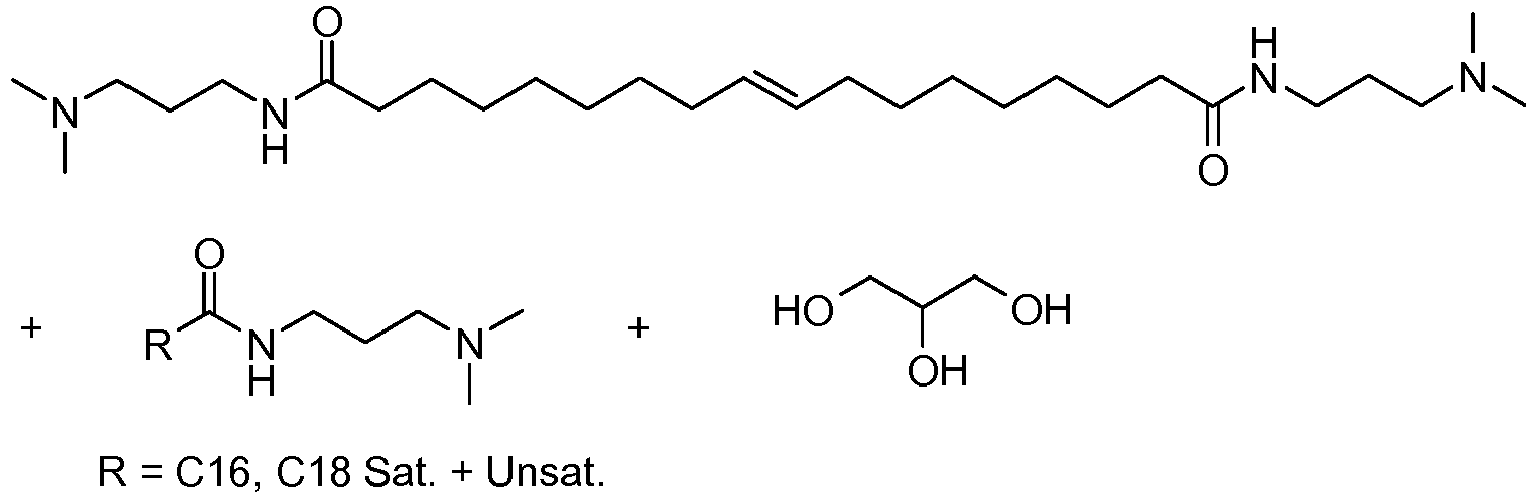
- In another aspect, the surfactant is selected from C10 amine oxide, C10 or C12 quat, C12 or C16 amidoamine, C10 imidazoline quat, C10 or C12 amidoamine quats, C10, C12, or C16 betaine, C16 amidoamine betaine, C18 diamidoamine diquat, C18 diamidoamine monobetaine quat, amidoamine surfactants and their oxidized or quaternized derivatives made from self-metathesized palm or soybean oil, as defined in claim 1, and amidoamine surfactants and their oxidized or quaternized derivatives made from cross-metathesized palm or soybean oil, as defined in claim 1.
- As shown in Table 5A, compositions from these classes of surfactants demonstrate good ability to stabilize highly concentrated glyphosate formulations at room temperature, -10°C, and 54°C.
- Preferred surfactants include the C10 amine oxide, C10 or C12 quat, C12 or C16 amidoamine, C10 imidazoline quat, C10 or C12 amidoamine quat, C10, C12, or C16 betaine, and C16 amidoamine betaine surfactants having the structure:


- Preferred surfactants include C18 diamidoamine diquat and C18 diamidoamine monobetaine quat surfactants having the structure:


- The surfactants also include amidoamine surfactants and their oxidized or quaternized derivatives made from self-metathesized palm or soybean oil, and amidoamine surfactants, as defined in claim 1, and their oxidized or quaternized derivatives made from cross-metathesized palm or soybean oil, as defined claim 1.
- One example of this type of complex mixture is "UTG-6," the amidoamine betaine made by reacting cross-metathesized (with 1-butene) soybean oil with DMAPA, followed by conversion to the betaine with sodium monochloroacetate:

- The glyphosate formulation can include additional conventional components or adjuvants that do not detract from formulation stability or herbicidal activity. Commonly, the formulations might include a solvent, one or more auxiliary surfactants, herbicides, pesticides, or other agricultural actives, buffers, coupling agents, chelating agents, compatibilizers, corrosion inhibitors, dyes, odorants, penetration aids, wetting agents, spreading agents, dispersants, thickeners, antimicrobial agents, or freezing point depressants.
- Among auxiliary surfactants, anionic, cationic (e.g., quaternary ammonium surfactants), nonionic, amphoteric, or zwitterionic surfactants might be included. Preferably, the auxiliary surfactant is a nonionic or amphoteric surfactant. Suitable nonionic surfactants include, for example, fatty alcohols, alcohol fatty esters, fatty alcohol ethoxylates, ethoxylated alkylphenols, ethoxylated castor oils, ethoxylated fatty acids, ethoxylated fatty amines, fatty amides, amidoamines, tallow amine ethoxylates, alkylpolyglucosides, and glycerol esters. Suitable amphoteric surfactants include, for example, fatty amine oxides, betaines, and sulfobetaines. Other suitable nonionic and amphoteric surfactants are disclosed in
U.S. Pat. Nos. 7,049,270 and7,135,437 , andU.S. Pat. Appl. Publ. No. 2010/0331182 . - The following examples merely illustrate the invention.
-

- The procedures of
U.S. Pat. Appl. Publ. No. 2011/0113679 are used to generate feedstocks C10-0 and C12-0 as follows: - Example 1A: Cross-Metathesis of Soybean Oil and 1-Butene. A clean, dry, stainless-steel jacketed 18.9-liter (5-gallon) Parr reactor equipped with a dip tube, overhead stirrer, internal cooling/heating coils, temperature probe, sampling valve, and relief valve is purged with argon to 103 kPa (15 psig). Soybean oil (SBO, 2.5 kg, 2.9 mol, Costco, Mn = 864.4 g/mol, 85 weight % unsaturation, sparged with argon in a 18.9-liter (5-gal) container for 1 h) is added to the Parr reactor. The reactor is sealed, and the SBO is purged with argon for 2 h while cooling to 10°C. After 2 h, the reactor is vented to 69 kPa (10 psig). The dip tube valve is connected to a 1-butene cylinder (Airgas, CP grade, 228 kPa (33 psig) headspace pressure, >99 wt.%) and re-pressurized to 103 kPa (15 psig) with 1-butene. The reactor is again vented to 69 kPa (10 psig) to remove residual argon. The SBO is stirred at 350 rpm and 9-15°C under 124-193 kPa (18-28 psig) 1-butene until 3 mol 1-butene per SBO olefin bond are transferred into the reactor (∼ 2.2 kg 1-butene over 4-5 h).
A toluene solution of [1,3-bis-(2,4,6-trimethylphenyl)-2-imidazolidinylidene]-dichlororuthenium(3-methyl-2-butenylidene)(tricyclohexylphosphine) (C827, Materia) is prepared in a Fischer-Porter pressure vessel by dissolving 130 mg catalyst in 30 g of toluene (10 mol ppm per mol olefin bond of SBO). The catalyst mixture is added to the reactor via the reactor dip tube by pressurizing the headspace inside the Fischer-Porter vessel with argon to 345-414 kPa (50-60 psig). The Fischer-Porter vessel and dip tube are rinsed with additional toluene (30 g). The reaction mixture is stirred for 2.0 h at 60°C and is then allowed to cool to ambient temperature while the gases in the headspace are vented.
After the pressure is released, the reaction mixture is transferred to a round-bottom flask containing bleaching clay (Pure-Flo® B80 CG clay, product of Oil-Dri Corporation of America, 2 % w/w SBO, 58 g) and a magnetic stir bar. The reaction mixture is stirred at 85°C under argon. After 2 h, during which time any remaining 1-butene is allowed to vent, the reaction mixture cools to 40°C and is filtered through a glass frit. An aliquot of the product mixture is transesterified with 1 % w/w NaOMe in methanol at 60°C. By gas chromatography (GC), it contains: methyl 9-decenoate (22 wt.%), methyl 9-dodecenoate (16 wt.%), dimethyl 9-octadecenedioate (3 wt.%), and methyl 9-octadecenoate (3 wt.%).
The results compare favorably with calculated yields for a hypothetical equilibrium mixture: methyl 9-decenoate (23.4 wt.%), methyl 9-dodecenoate (17.9 wt/%), dimethyl 9-octadecenedioate (3.7 wt.%), and methyl 9-octadecenoate (1.8 wt.%). - Example 1B. The procedure of Example 1A is generally followed with 1.73 kg SBO and 3 mol 1-butene/SBO double bond. An aliquot of the product mixture is transesterified with sodium methoxide in methanol as described above. The products (by GC) are: methyl 9-decenoate (24 wt.%), methyl 9-dodecenoate (18 wt.%), dimethyl 9-octadecenedioate (2 wt.%), and methyl 9-octadecenoate (2 wt.%).
- Example 1C. The procedure of Example 1A is generally followed with 1.75 kg SBO and 3 mol 1-butene/SBO double bond. An aliquot of the product mixture is transesterified with sodium methoxide in methanol as described above. The products (by GC) are: methyl 9-decenoate (24 wt.%), methyl 9-dodecenoate (17 wt.%), dimethyl 9-octadecenedioate (3 wt.%), and methyl 9-octadecenoate (2 wt.%).
- Example 1D. The procedure of Example 1A is generally followed with 2.2 kg SBO and 3 mol 1-butene/SBO double bond. Additionally, the toluene used to transfer the catalyst (60 g) is replaced with SBO. An aliquot of the product mixture is transesterified with sodium methoxide in methanol as described above. The products (by GC) are: methyl 9-decenoate (25 wt.%), methyl 9-dodecenoate (18 wt.%), dimethyl 9-octadecenedioate (3 wt.%), and methyl 9-octadecenoate (1 wt.%).
- Example 1E. Separation of Olefins from Modified Triglyceride. A 12-L round-bottom flask equipped with a magnetic stir bar, heating mantle, and temperature controller is charged with the combined reaction products from Examples 1A-1D (8.42 kg). A cooling condenser with a vacuum inlet is attached to the middle neck of the flask and a receiving flask is connected to the condenser. Volatile hydrocarbons (olefins) are removed from the reaction product by vacuum distillation. Pot temperature: 22°C-130°C; distillation head temperature: 19°C-70°C; pressure: 0.27-0.02 Pa (2000-160 µtorr). After removing the volatile hydrocarbons, 5.34 kg of non-volatile residue remains. An aliquot of the non-volatile product mixture is transesterified with sodium methoxide in methanol as described above. The products (by GC) are: methyl 9-decenoate (32 wt.%), methyl 9-dodecenoate (23 wt.%), dimethyl 9-octadecenedioate (4 wt.%), and methyl 9-octadecenoate (5 wt.%). This mixture is also called "UTG-0." (An analogous product made from palm oil is called "PUTG-0.")
- Example 1F. Methanolysis of Modified Triglyceride. A 12-L round-bottom flask fitted with a magnetic stir bar, condenser, heating mantle, temperature probe, and gas adapter is charged with sodium methoxide in methanol (1% w/w, 4.0 L) and the non-volatile product mixture produced in Example 1E (5.34 kg). The resulting light-yellow heterogeneous mixture is stirred at 60°C. After 1 h, the mixture turns homogeneous and has an orange color (pH = 11). After 2 h of reaction, the mixture is cooled to ambient temperature and two layers form. The organic phase is washed with aqueous methanol (50% v/v, 2 x 3 L), separated, and neutralized by washing with glacial acetic acid in methanol (1 mol HOAc/mol NaOMe) to pH = 6.5. Yield: 5.03 kg.
- Example 1G. Isolation of Methyl Ester Feedstocks. A 12-L round-bottom flask fitted with a magnetic stirrer, packed column, and temperature controller is charged with the methyl ester mixture produced in example 1F (5.03 kg), and the flask is placed in a heating mantle. The glass column is 5.08 cm x 91.4 cm (2" x 36") and contains 0.41 cm (0.16") Pro-Pak™ stainless-steel saddles (Cannon Instrument Co.). The column is attached to a fractional distillation head to which a 1-L pre-weighed flask is fitted for collecting fractions. Distillation is performed under vacuum (13.3-16.0 mPa (100-120 µtorr)). A reflux ratio of 1:3 is used to isolate methyl 9-decenoate ("C10-0") and methyl 9-dodecenoate ("C12-0"). Samples collected during the distillation, distillation conditions, and the composition of the fractions (by GC) are shown in Table 1. A reflux ratio of 1:3 refers to 1 drop collected for every 3 drops sent back to the distillation column. Combining appropriate fractions yields methyl 9-decenoate (1.46 kg, 99.7% pure) and methyl 9-dodecenoate (0.55 kg, >98 % pure).
-

- The procedures of Example 1A is generally followed except that 1-octene is cross-metathesized with soybean oil instead of 1-butene. Combined reaction products are then stripped as described in Example 1E to remove the more volatile unsaturated hydrocarbon fraction from the modified oil fraction. The procedure of Example 1F is used to convert the modified oil fraction to a methyl ester mixture that includes methyl 9-hexadecenoate. Fractional distillation at reduced pressure is used to isolate the desired product, methyl 9-hexadecenoate from other methyl esters.
- A tertiary alkanolamine (e.g. triethanolamine, N-methyldiethanolamine, N,N-dimethylethanolamine) or an alkoxylated derivative thereof is combined in the same reaction vessel with an ester derivative of 9-decylenic acid, 9-dodecylenic acid, or 9-octadecene-1,18-dioic acid and potassium carbonate. This mixture is heated with agitation at a temperature within the range of 150°C to 200°C. The relative amounts of amine and ester (or acid) are balanced to provide the desired stoichiometry taking into account the ester/acid content determined by saponification number. The reaction is performed under nitrogen sparge or under vacuum to remove liberated alcohol. When glyceride esters of decylenic acid or dodecylenic acid are used, the liberated glycerin is not removed. The reaction is deemed complete when the desired residual amount of starting amine remains.
- Tertiary amines are converted to methyl quats, betaines, or sulfobetaines by reaction with a quaternizing agent. The quaternization is performed at temperature within the range of 65°C to 100°C. The quaternizing agent used is dimethyl sulfate for methyl quats, sodium monochloroacetate for betaines, or epichlorohydrin for sulfobetaines. The amount of quaternizing agent used is from 0.8 to 1.0 molar equivalents based on the amount of tertiary amine. The reaction is deemed complete when the free amine value is in the desired range as determined by perchloric acid titration.
- A tertiary amine is diluted with water to form a 10-40 wt.% mixture, which is warmed to 50°C to 75°C under nitrogen. Hydrogen peroxide solution (35% solution, 1 to 2.2 molar eq.) is added dropwise while keeping the temperature below 75°C. The mixture is held at the reaction temperature for 4 to 12 h or until the free peroxide level is below 0.2% as determined by starch iodide paper.
- Unsaturated methyl ester (C10, C12, or C16 monoester or C18 diester) is combined with 1-6 molar equivalents of a primary or secondary amine (e.g., DMA, DEA, MEA, DMAPA). A base catalyst (e.g., NaOMe or other alkoxide) is added if desired. The reaction mixture is heated at a temperature within the range of 50°C to 150°C until the starting ester is substantially consumed. The amide product is purified by distillation, water washing, or other normal means. Alternatively, the product is used "as is" and converted to other derivatives.
- Lithium aluminum hydride (or a similar reducing agent) is dissolved in a solvent (e.g., diethyl ether, THF, dioxane, diglyme) under a nitrogen blanket. A suitable fatty amide is dissolved in the same solvent and is added dropwise, keeping the reaction temperature within the range of 25°C to 50°C. After the addition, the mixture is stirred overnight at room temperature. Water is carefully added to quench the reaction, and aqueous sodium hydroxide is added. The solids are filtered off, and the solvent is removed. The amine product is purified by distillation.
- Methyl 9-decenoate or methyl 9-dodecenoate is combined with diethylenetriamine (DETA) or 2-(2-aminoethylamino)ethanol (AEEA), with or without a catalyst, in the desired molar ratio of ester groups to primary amino and/or hydroxyl groups. Usually, two moles of ester are used for each mole of DETA or AEEA. The mixture is heated with agitation to a temperature within the range of 140°C and 200°C under a mild vacuum that prevents or minimizes evaporation of DETA or AEEA from the reaction mixture. The reaction proceeds until analysis (IR or 1H NMR spectroscopy) indicates reasonably complete conversion. The contents are then heated at a temperature within the range of 175°C to 300°C with a lower vacuum (0.67-13.3 kPa (5-100 mm Hg)) to effect ring closure to the imidazoline. Reaction end point is determined by titration.
- A sulfitating agent (sodium sulfite, sodium bisulfite, or sodium metabisulfite) is dissolved in water and combined with at least a molar equivalent of an olefin. Optionally, a catalyst (peroxides, iron, or other free-radical initiators) is included. The mixture is heated to 50°C-100°C for 3-15 h until sulfitation is reasonably complete.
- The procedure used to convert methyl ester C10-0 to its respective fatty acid C10-36 is generally followed as described below.
- Sulfonation is carried out in a batch reactor maintained at 20°C under a nitrogen flow (2 L/min.). The unsaturated fatty acid or an unsaturated fatty acid and saturated fatty acid mixture is added to methylene chloride. Sulfur trioxide is evaporated over 30 min. via a 140°C flash-pot and is bubbled through the reactor using the nitrogen stream at a molar ratio of SO3 to alkene functionality of about 1:1. The addition rate of SO3 is adjusted to keep the reaction temperature at or below 35°C. At the end of the addition, the reaction mixture is maintained for an additional 5 min. and the mixture is then concentrated under vacuum. The acid product is digested for 1-2 h at 50-85 °C. Neutralization is performed using an appropriate base and hydrolysis occurs at 85°C with the pH maintained with additional base. 1H NMR is used to determine complete hydrolysis.
Table 2 summarizes the general procedures used to prepare the following compositions: Table 2. General Methods Used to Synthesize Compositions Composition Methods Composition Methods Composition Methods Composition Methods C10-7 B, C C12-17* E Mix-27 E, C Mix-38 E, C C10-13 H, C C12-18 E, C C18-29* E, D Mix-44* E, C C10-17* E C12-20* E, D Mix-29* E, D Mix-48* E, C C10-18 E, C C12-22 E, C C18-31 E, C MTG-7 B, C C10-20* E, D C12-28* E, G, D Mix-31 E, C MTG-12* E, D C10-21 E, D, J C12-40 E, G, C C18-32 E, C MTG-13* E, C C10-22 E, C C12-45 E, G, C Mix-32 E, C PMTG-5 E C10-24 E, C C16-9 E C18-34 E, C PMTG-12 E, D C10-31 E, C C16-10 E, C Mix-34 E, C PMTG-13 E, C C10-32* K C16-13 E, C C18-35* E, C, D UTG-6 E, C C10-39 E, G, D C16-16 E, G, C Mix-35* E, C, D UTG-12 E, D C10-41 E, G, C Mix-16 B, C C18-36* E, C UTG-13 E, C C10-42 E, G, C C18-26* E Mix-36* E, C PUTG-13 E, C C12-7 B, C Mix-26 E C18-37* E, C, D C12-16 H, C C18-27 E, C Mix-37 E, C, D Methods: B: alkanolamine transesterification; C: quaternization to methyl quat, betaine, or sulfobetaine; D: oxidation of amine to amine oxide; E: amide from unsaturated ester and primary or secondary amine; G: amine from amide by reduction; H: imidazoline preparation from unsaturated ester + DETA or AEEA; J: sulfitation of olefins; K: estolide preparation * A detailed procedure for synthesizing this composition is included herein below. - Each of the following compositions is tested as a surfactant in a highly concentrated aqueous glyphosate formulation. Unless otherwise indicated below, the compositions are prepared using the general methods summarized in Table 2:
-

-

-
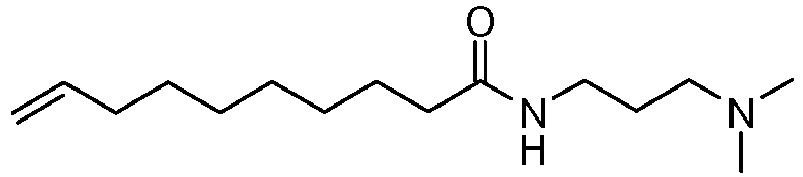
- A round-bottom flask equipped with nitrogen sparge tube, mechanical stirrer, and Dean-Stark trap is charged with methyl ester C10-0 (500 g, 2.7 mol), 3-(dimethyl-amino)propylamine ("DMAPA," 331 g, 3.24 mol), and sodium methoxide (8.3 g of a 30% solution of in methanol). The reaction mixture is heated to 100°C and methanol is collected. The reaction temperature is increased in 5°C increments until the temperature reaches 130°C. The mixture is held at 130°C for 1 h, and then a sub-surface nitrogen sparge is applied for 2.5 h. The temperature is elevated to 140°C for an additional 3.5 h. Collected distillate (122 mL) includes methanol and some DMAPA. The reaction mixture is cooled to 110°C, the nitrogen sparge is discontinued, and vacuum was applied. The mixture is stripped of excess DMAPA (150°C, 2.7 kPa (20 mm Hg), 30 min.). The product, amidoamine C10-17, has an amine value of 224.14 (eq. wt.: 250.28). 1H NMR (CDCl3) confirms formation of the amide, based on disappearance of the methyl ester peak at 3.61 ppm and appearance of the DMAPA CH 2 signals at 3.27, 2.09, and 1.60 ppm and the N(CH 3)2 at 2.18 ppm.
-

-

- A round-bottom flask is charged with amidoamine C10-17 (162.6 g), water (267 g), and Hamp-Ex 80 (0.5 g). The mixture is heated to 50°C under nitrogen and several small pieces of dry ice are added. Hydrogen peroxide (35 wt.% aqueous solution, 64.5 g) is added dropwise while keeping the temperature less than 75°C. After completing the H2O2 addition, the mixture is maintained at 70°C for 7 h. Peroxide paper test indicates < 0.5% residual H2O2. The mixture is heated for 3 h at 75°C and then cooled to room temperature to give amine oxide C10-20 in water. The product comprises (by titration): 35.2% amine oxide; 0.85% free amine.
-

-
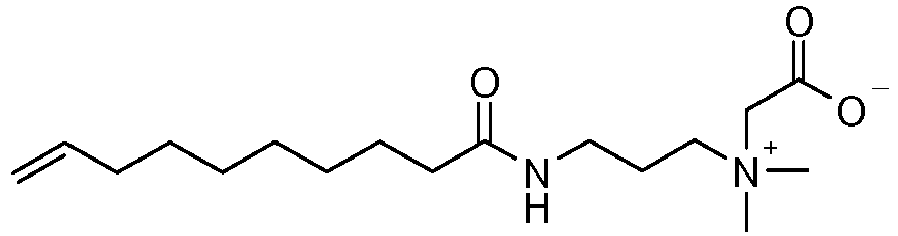
-

-

-

- Methyl ester C10-0 (390.2 g) is charged to a round-bottom flask equipped with an overhead stirrer, and the contents are warmed to 70°C. Potassium hydroxide (16% solution in glycerin, 523 g) is added. The mixture is heated to 100°C and additional KOH pellets (35.10 g) are added. After stirring 17 h, gas chromatography indicates -94% conversion to the fatty acid. Additional KOH (10 g) is added, and stirring continues at 100°C for 4 h. Conversion by GC is >97%. The mixture stirs at 100°C for another 4 h, and is then cooled to 80°C. Water (400 mL) and 30% sulfuric acid solution (500 mL) are added, and the mixture stirs for 1 h. The aqueous phase is then removed. Water (500 mL) is added, and heating/stirring resumes (to 80°C) for 0.5 h. The aqueous phase is again removed. The water washing process is repeated two more times (2 x 500 mL). The crude fatty acid product is stripped under vacuum at 80°C for 2 h to remove water and is used without further purification. Yield: 357 g.
-

- In a sulfonation batch reactor maintained at 20°C under a nitrogen flow (2 L/min.), C10-36 (109.6 g, 0.64 mol) is added to methylene chloride (100 mL). Sulfur trioxide (51.6 g, 0.64 mol) is evaporated over 30 min. via a 140°C flash-pot and is bubbled through the reactor using the nitrogen stream. The addition rate of SO3 is adjusted to keep the reaction temperature at or below 35°C. At the end of the addition, the reaction mixture is maintained for an additional 5 min. and the mixture is then concentrated under vacuum. The acid product is then digested for 1 h at 50°C. The acid is neutralized using water (151.0 g) followed by 50% aq. NaOH (41.7 g). Hydrolysis is carried out at 85°C and pH is maintained with additional 50% aq. NaOH additions. 1H NMR analysis supports the proposed composition for sulfo-estolide C10-32. Analytical results: pH: 5.25 (as is); moisture: 51.6 wt.%; sodium sulfate: 0.51 wt.%; unsulfonated matter: 0.79 wt.%.
-
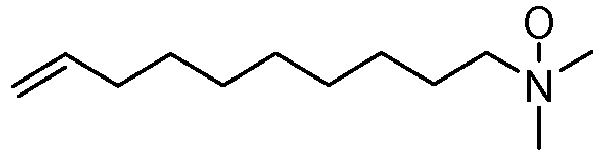
-
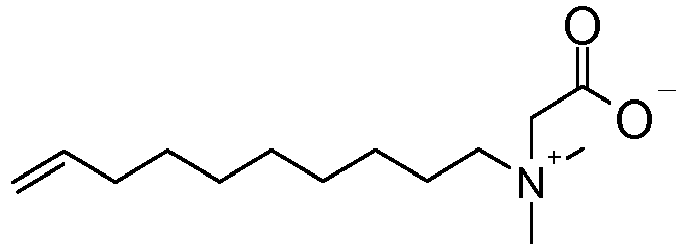
-

-

-

-

- The procedure used to make C10-17 is generally followed with methyl ester C12-0 (670 g), DMAPA (387 g), and sodium methoxide (11.2 g of 30 wt.% solution in methanol). The resulting product, amidoamine C12-17, has an amine value of 196.39 (eq. wt.: 281.3). 1H NMR (CDCl3) confirms formation of the amide, based on disappearance of the methyl ester peak at 3.61 ppm and appearance of the DMAPA CH 2 signals at 3.30, 2.11, and 1.62 ppm and the N(CH 3)2 at 2.20 ppm.
-

-

- A round-bottom flask is charged with amidoamine C12-17 (250 g), water (400 g), and Hamp-Ex 80 (0.7g). Dry ice is added until the pH is 8-9. The mixture is heated to 50°C under nitrogen. Hydrogen peroxide (35 wt.% solution, 88 g) is added dropwise while maintaining the temperature at less than 75°C. The mixture is maintained at 70°C for 3 h, then cooled to room temperature overnight. The mixture is reheated to 75°C and water (50 g) is added to help dissolve solids. The mixture is held at 75°C for 4 h. Analysis with peroxide test strips indicates trace residual peroxide. The mixture is cooled to recover amine oxide C12-20 as an aqueous solution. The product comprises (by titration): 33.4% amine oxide; 0.06% free amine.
-

-

- A round-bottom flask is charged with methyl ester feedstock C12-0 (900.0 g, 4.22 mol) and the material is heated to 60°C. The reactor is sealed and vacuum is applied for 0.5 h to dry/degas the feedstock. The reactor is backfilled with nitrogen, and then sodium methoxide (30 g of 30% solution in methanol) is added via syringe. A static vacuum (-102 kPa (-30" Hg)) is established, and then dimethylamine (190.3 g, 4.22 mol) is slowly added via sub-surface dip tube. When the pressure equalizes, the reactor is opened to nitrogen overhead and the temperature is increased 70°C for 1.0 h. The reactor is then cooled to room temperature. Heating resumes to 80°C and DMA is slowly introduced via sub-surface sparge and held for 2.0 h. The temperature is then increased to 90°C and held for 1.0 h. 1H NMR spectroscopy indicates > 98% conversion. The mixture is cooled to 75°C and full vacuum is applied to strip excess methanol and DMA. The catalyst is quenched by adding 50% aqueous sulfuric acid (16.3 g) and the mixture is stirred vigorously for 10 min. Deionized water (200 mL) is added and all of the contents are transferred to a bottom-draining vessel. The aqueous layer is removed. The wash is repeated with 300 mL and then 150 mL of deionized water. Approximately 50 mL of 20% NaCl solution is added and the mixture settles overnight. The lower layer is removed and the product is transferred back to the reactor. The product is heated to 75°C and vacuum is applied to remove residual water. The amide, C12-25, is recovered by distillation at 120°C. The amide fraction is placed under full vacuum at 135°C until the ester content is below 1%. Final ester content: 0.7%. Yield: 875 g (91.9%).
- A nitrogen-blanketed 5-L round-bottom flask is charged with tetrahydrofuran ("THF," 1.5 L) and lithium aluminum hydride pellets ("LAH," 67.8 g, 1.79 mol) and is then cooled in an ice bath. Amide C12-25 (620 g, 2.75 mol) is dissolved in THF (250 mL) and charged to an addition funnel. The amide solution is added dropwise over 3 h to the LAH mixture, keeping the reaction temperature below 15°C. The mixture warms to room temperature and stirs for 16 h. The mixture is cooled with an ice bath and deionized water (68 g) is added dropwise to quench residual LAH. Sodium hydroxide (15%, 68 g) and deionized water (204 g) are added, the reaction mixture warms to room temperature. The mixture is filtered, and solvent is stripped from the resulting filtrate. Phthalic anhydride (50 g) is added to convert a by-product fatty alcohol impurity into its corresponding nonvolatile phthalate ester. The desired amine is isolated from the crude mixture by vacuum distillation, collecting overhead liquid at a pot temperature of 115-120°C. Yield of C12-26: 430.7 g (74%). 1H NMR (CDCl3) confirms the product as pure amine, based on the integration of the N(CH 3)2 peak at 2.18 ppm, the olefinic proton signals at 5.2-5.5 ppm, and the terminal methyl group at 0.93 ppm.
- A round-bottom flask equipped with an overhead mechanical stirrer and addition funnel is charged with deionized water (93.5 g) and Hamp-Ex 80 (0.3 g). The mixture is heated to 50°C while amine C12-26 (137 g, 0.65 mol) and dry ice (∼5 g) are added. Hydrogen peroxide (35% solution, 64.3 g, 0.66 mol) is added dropwise to the reaction mixture, allowing the mixture to exotherm to 80°C and then controlling the reaction at this temperature using a water bath for cooling. The mixture thickens after two-thirds of the H2O2 has been added, and more deonized water (73.7 g) is added. After completing the peroxide addition, the mixture stirs at 80°C for 24 h until a peroxide test strip indicates low residual peroxide. The -40% solids reaction mixture is diluted with water to -37.5% solids to afford a homogenous solution. Titration shows 37.2% C12 amine oxide and 0.009% free amine. Analysis by 1H NMR (CDCl3) confirms the formation of the amine oxide, based on shift of the N(CH 3)2 peak from 2.18 ppm (for the amine) to 3.12 ppm.
-

-

-

-

-

-
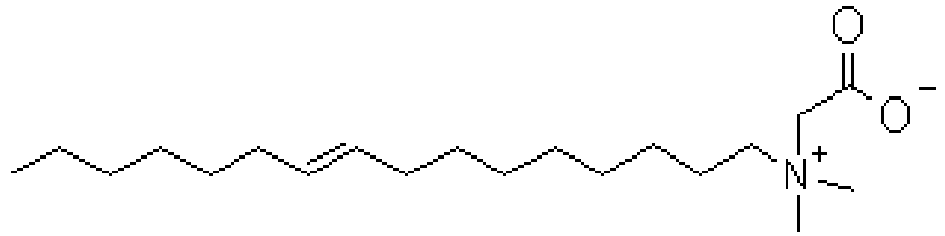
-

- Eight samples of methyl 9-dodecenoate (10.6 g each, see Table 3) are warmed to 50°C and degassed with argon for 30 min. A metathesis catalyst ([1,3-bis-(2,4,6-trimethylphenyl)-2-imidazolidinylidene]dichlororuthenium(3-methyl-2-butenylidene)-(tricyclohexylphosphine), product of Materia) is added to the methyl 9-dodecenoate (amount indicated in Table 3) and vacuum is applied to provide a pressure of <0.13 kPa (1 mm Hg). The reaction mixture is allowed to self-metathesize for the time reported. Analysis by gas chromatography indicates that dimethyl 9-octadecene-1,18-dioate is produced in the yields reported in Table 3. "Mix-0" is an 80:20 trans-lcis-isomer mixture obtained from the reaction mixture. Crystallization provides the all-trans-isomer feed, "C18-0."
Table 3. Self-Metathesis of Methyl 9-Dodecanoate Sample Catalyst Loading (ppm mol/mol)* Reaction Time (h) C18-0 (GC Area %) A 100 3 83.5 B 50 3 82.5 C 25 3 83.0 D 10 3 66.2 E 15 4 90.0 F 13 4 89.9 G 10 4 81.1 H 5 4 50.9 * ppm mol catalyst/mol methyl 9-dodecenoate - The tested compounds based on C18 feedstock have the following structures:
-

-

- A round-bottom flask equipped with a mechanical stirrer is charged with diester C18-0 (545.6 g) and DMAPA (343.3 g). A Dean-Stark trap is attached, and sodium methoxide (20 g of 30 wt% solution in MeOH) is added. The temperature is raised to 110°C over 1.5 h, and methanol is collected. The temperature is increased to 150°C in increments as the distillation slows. The mixture is held at 150°C for 6.5 hours and then cooled to room temperature. 1H NMR analysis indicates a minor amount of unreacted methyl ester. The mixture is heated to 180°C for several hours and additional DMAPA and sodium methoxide are added. The mixture is cooled and neutralized with concentrated hydrochloric acid. When the mixture has cooled to 90°C, deionized water is added slowly with vigorous agitation, resulting in precipitation of the amide to afford a slurry. Solids are isolated by vacuum filtration and washed with water. The solid product, all-trans amide C18-26, is dried under vacuum. Yield: 92.2%. 1H NMR (CDCl3) confirms formation of the amide, based on disappearance of the methyl ester peak at 3.65 ppm and appearance of the DMAPA CH 2 signals at 3.31, 2.12, and 1.62 ppm and the N(CH 3)2 at 2.20 ppm.
-

-

-

- A round-bottom flask is charged with amine C18-26 (141.0 g), water (231.2 g), and Hamp-Ex 80 (0.4 g). The mixture is heated to 50°C and dry ice is added to pH 8.8. When the pH stabilizes, aqueous H2O2 (35%, 57.8 g) is added dropwise without heating, keeping the temperature below 75°C. After the peroxide addition is complete, the mixture is warmed at 85°C for 18 h. The mixture is cooled to room temperature. Titrations reveal: amine oxide: 1.32 meq/g; free amine: 0.027 meq/g; free peroxide: 0.0019%; water: 66.4%.
-

- The procedure used to make C18-29 is generally followed with amine Mix-26 (140.0 g), water (230 g), Hamp-Ex 80 (0.4 g), and 35% hydrogen peroxide (57.2 g). Thereafter, titrations indicate: amine oxide: 1.33 meq/g; free amine: 0.046 meq/g; free peroxide: 0.10%; and water: 64.24%.
-

-

-

-

- A round-bottom flask is charged with diamine C18-26 (225.8 g), which is purged with nitrogen and heated to 70°C. Isopropyl alcohol (105.26 g) is added. Dimethyl sulfate (DMS) (58.8 g) is then added slowly via addition funnel so that the temperature is maintained around 70°C. After the DMS addition is complete, the mixture is held at 70°C for 3 h and then at 85°C for 1 h to give amine monoquat C18-34.
- Amine monoquat C18-34 (75% solids, 192.3 g), deionized water (205.0 g), and Hamp-Ex 80 (0.5 g) are charged to a round-bottom flask. The mixture is heated to 70°C, adjusting pH to >8 with citric acid. Aqueous H2O2 (35%, 22.86 g) is added dropwise, maintaining temperature below 70°C. After peroxide addition is complete, the mixture is maintained at 70°C for 20 h. 1H NMR indicates complete conversion of tertiary amine to amine oxide. The mixture is cooled to room temperature. Titration shows: amine oxide: 0.50 meq/g; free amine: 0.042 meq/g; cationic actives: 0.62 meq/g; free peroxide: 0.08%; and water: 55.8%.
-

- The procedure used to make C18-34 is generally followed with diamine Mix-26 (241.6 g), isopropyl alcohol (98.4 g), and dimethyl sulfate (60 g). After the DMS addition is complete, the reaction was held at 70°C for 3 h and then at 85°C for 3 h. Perchloric acid titration shows 1.317 meq/g of free amine. 1H NMR analysis (CD3OD) shows 49% free amine and 51% quaternized amine, based on the integration of the methyl group signals at 2.25 and 3.11 ppm, respectively. The product is Mix-34.
- Mix-34 (186.9 g) is dissolved in deionized water (200 g) and stripped of isopropyl alcohol at 75°C. The concentrate (321.6 g) is transferred to a round-bottom flask and Hamp-Ex 80 (0.53 g) is added. The mixture is heated to 50°C and a few pieces of dry ice are added until the mixture pH is 8-9. Aqueous H2O2 (35%, 18.23 g) is then added dropwise, maintaining temperature below 70°C. After peroxide addition is complete, the mixture is maintained at 85°C for 16 h. Deionized water (75 g) is added. The mixture cools to room temperature. 1H NMR analysis is consistent with the proposed structure and shows no detectable free amine. Other analyses show: free peroxide: 0.002%; water: 59.2%.
-

- Amidoamine C18-26 (348 g) and deionized water (500 g) are charged to a round-bottom flask. The mixture is heated to 80°C and citric acid (2.5 g) is added. A solution made from sodium monochloroacetate (SMCA, 88.5 g) and deionized water (300 g) is added dropwise to the amidoamine solution over 1 h. After the addition is complete, the mixture is heated to 85°C for 3 h and then 95°C for 0.5 h. The mixture is then cooled to room temperature. Analysis by silver nitrate titration indicates 3.49% NaCl. Additional SMCA (1.5 g) is added and the mixture is reheated to 95°C for 6 h. After 6 h, the NaCl content is 3.53%. 1H NMR analysis of a dried aliquot of product shows 45.7% free amine and 54.3% quaternized amine, based on the integration of the methyl group signals at 2.28 and 3.22 ppm, respectively.
-

- The procedure used to make C18-36 is generally followed with amidoamine Mix-26 (224.5 g), deionized water (322 g), citric acid (1.5 g), and aqueous sodium monochloroacetate (57 g of SMCA in 200 g of DI water). After the SMCA addition is complete, the mixture is heated to 90°C for 2 h. Additional SMCA (3.5 g) is added and the mixture is maintained at 90°C for 2 h. NaCl content: 3.82%. 1H NMR analysis of a dried aliquot shows 44% free amine and 56% quaternized amine.
-

- Molten monobetaine C18-36 (35% solids, 415.2 g) is charged to a flask and heated to 70°C. Aqueous H2O2 (35%, 23.6 g) is added dropwise over 0.5 h, maintaining the reaction temperature below 78°C. After the peroxide addition is complete, the mixture is stirred at 70°C for 9 h. 1H NMR (CD3OD) of a dried aliquot indicates complete conversion of the monobetaine to the expected amine oxide. Evidence is the disappearance of the N(CH 3)2 peak at 2.28 ppm for the amine and appearance of a peak at 3.15 ppm for the amine oxide N(CH 3)2.
-

-

-

- The half-acid/ester Mix-69 is prepared from the dibasic ester Mix-0 (used as received) as described in Organic Syntheses: Col. Vol. IV (1963) 635. Thus, Mix-0 (1 kg) is added to methanol (∼9 L) and the mixture is stirred mechanically. In a separate vessel, Ba(OH)2 (274.4 g) is dissolved in methanol (∼4 L), and the solution is added in portions over 2 h to the stirred diester solution, resulting in the formation of a white precipitate. The solid is isolated by filtration, washed several times with methanol, and dried in air. The solid is then transferred to a 12-L reaction vessel and slurried in ethyl acetate (-3.5 L). Aqueous HCI (32%, Aldrich, 1248.6 g), is added in portions to the stirred slurry, resulting in dissolution of the solid and formation of a clear solution. The solution is washed three times with water, and the aqueous layers are removed and collected in a separate vessel. The combined aqueous layers are extracted once with ethyl acetate, and the organic phase is combined with the washed product solution. The mixture is dried (Na2SO4), filtered, and concentrated via rotary evaporator. Thorough drying under high vacuum gives a waxy, crystalline solid upon cooling (655 g, ∼ 70% yield). Analysis of the product (following derivatization) by gas chromatography shows that it contains 94% acid/ester and 6% diacid. Quantitative 13C NMR shows an 86:14 trans:cis isomer ratio.
- The mixed acid/ester Mix-69 is converted to the acid chloride/ester by reaction with a slight excess of thionyl chloride (SOCl2) in methylene chloride solution and the product is isolated by removal of the solvent and excess SOCl2 under reduced pressure. 1H NMR analysis of the isolated product shows essentially quantitative conversion to the acid chloride/ester, and the material is used without further purification.
- A 3-L reaction vessel equipped with mechanical stirrer, nitrogen inlet, and thermocouple is charged with methylene chloride (200 mL), DMAPA (172.1 g), and pyridine (133.3 g). The previously prepared acid chloride/ester is added dropwise to the stirred DMAPA-pyridine solution. During the addition, the temperature is maintained at 25-40°C by cooling with an ice bath as required, and the addition is completed in 1.5 h. A precipitate forms, and after stirring overnight at room temperature, the mixture has become a thick slurry. The mixture is diluted with methylene chloride (500 mL), and water (500 mL) is added, giving a clear homogeneous solution. Addition of ethyl acetate fails to induce phase separation. However, addition of saturated NaCl solution causes slow separation of a lower aqueous phase, which is drained and discarded. Concentration of the organic phase via rotary evaporation gives a viscous brown oil. 1H NMR analysis shows free pyridine and indicates that the terminal tertiary amine of the DMAPA moiety is protonated. The material is taken up in acetone and the mixture is filtered to remove a small quantity of precipitated solid. The pH of the solution is adjusted to -8.5 (measured on as-is material) with 50% aq. NaOH, resulting in the formation of a solid precipitate. The mixture is filtered again and the clear filtrate is concentrated and then dried under high vacuum. On cooling, the material solidifies. 1H NMR analysis is consistent with the target structure and shows the presence of free pyridine. The product is heated to 60°C, stirred, and sparged with sub-surface nitrogen under reduced pressure for 5 h, then at 105°C for 30 min. After stripping, 1H NMR analysis of the product showed no residual pyridine.
-

- Ester-amidoamine Mix-43 (162.7 g) is charged to a flask equipped with mechanical stirring, thermocouple, and nitrogen inlet. Isopropanol (IPA; 47.8 g) is added, and the mixture is heated to 70°C. Perchloric acid titration of the ester/amide starting material is used to calculate the required amount of dimethyl sulfate (DMS). The DMS (28.6 g) is added dropwise while maintaining the reaction temperature at 70°C with external cooling. After the DMS addition is complete, the mixture is stirred at 70°C for 3 h, then for 1 h at 85°C. Perchloric acid titration shows nearly complete consumption of the tertiary amine. The quat product, Mix-44, cools to give a waxy solid. Analysis for residual DMS via Drager apparatus is negative.
-

- A round-bottom flask fitted with a thermocouple, nitrogen inlet, and mechanical stirring is charged with ester-amidoamine Mix-43 (134.2 g, 0.327 mol). Water (250 mL) and sodium monochloroacetate (38.9 g, 0.334 mol) are added. The mixture is warmed to 70°C and after approximately 1 h, it becomes clear. During the reaction, the pH of the mixture is maintained at ∼8 with 50% aq. NaOH. Heating continues for 5 h at 70°C. The 1H NMR spectrum is consistent with the proposed structure and shows no residual tertiary amine. The product, ester-betaine Mix-48, is cooled and analyzed: water: 59.9%; NaCl: 4.29%.
-

- The procedures of Examples 1A and 1E are generally followed except that 1-butene is omitted.
-

- The procedures of Examples 1A and 1E are generally followed to produce UTG-0 from soybean oil and 1-butene.
-
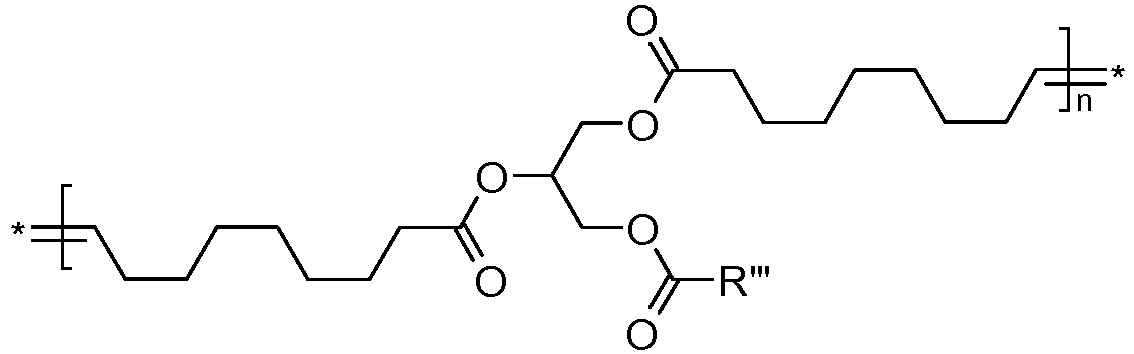
- The procedure used to make MTG-0 is followed, except that palm oil is used instead of soybean oil.
-

- The procedure used to make UTG-0 is followed, except that palm oil is used instead of soybean oil.
-

- A round-bottom flask is charged with MTG-0 (180 g, saponification value = 226.5 mg KOH/g, 0.73 mol), and the contents are heated to 50°C. The mixture is purged with nitrogen for 1 h and dimethylaminopropylamine (DMAPA, 78 g, 0.76 mol) and NaBH4 (0.1 g) are added. The mixture is heated to 160°C for 18 h. Excess amine is removed by short-path distillation (135°C, 4.0 kPa (30 mm Hg)), and the product is cooled to room temperature to afford amidoamine mixture MTG-5. Amine value: 172.9 mg KOH/g (eq. wt.: 324.45 g/mol). Free DMAPA: 1.80%; iodine value: 71.9 g I2/100 g sample.
-

-
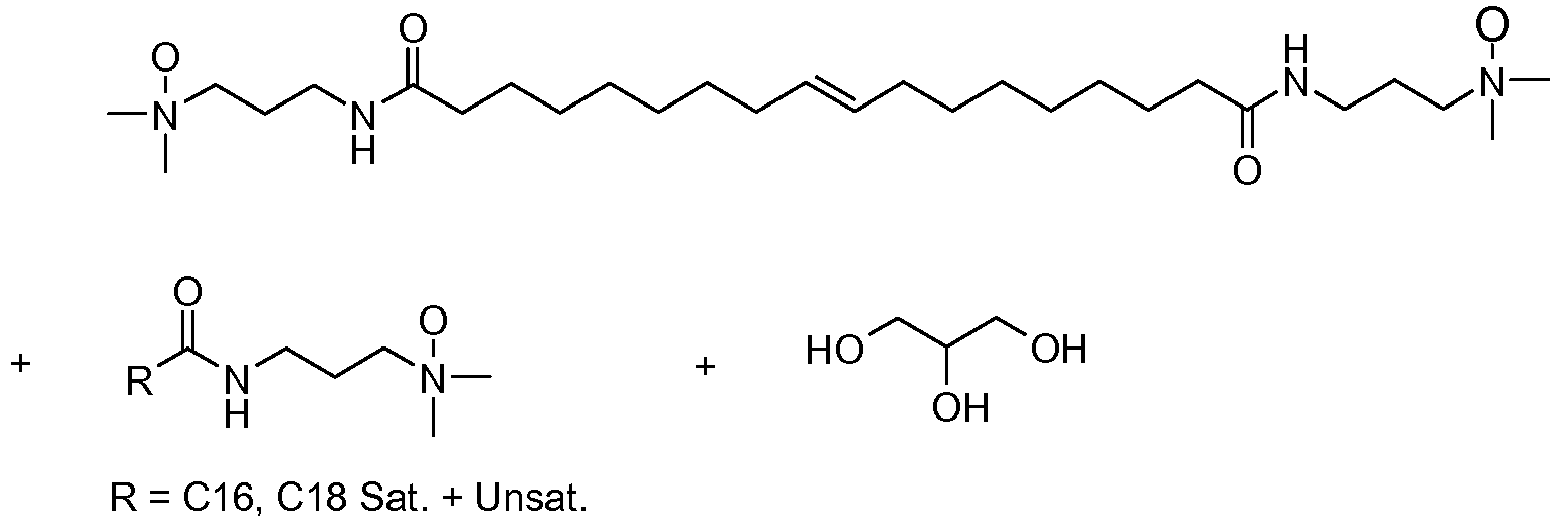
- Molten MTG-5 (145.5 g, 0.42 mol) and deionized water (303.7 g) are charged to a reaction flask equipped with reflux condenser, addition funnel, thermocouple, mechanical stirrer, and nitrogen inlet. The reactor contents are heated to 40°C with stirring. Dry ice is added in small pieces resulting in a homogeneous solution. Thereafter, 35% H2O2 (43.4 g, 0.47 mol) is added over 15 min., and the reaction temperature increases to 69°C. The initially viscous solution becomes thinner as more peroxide is added. When peroxide addition is complete, the mixture is cooled to 65°C and allowed to stir for 4 h. Free peroxide: < 2 mg/L. The reaction mixture cools to room temperature and stands overnight under a nitrogen purge. The product mixture shows no measurable peroxide. Additional 35% H2O2 solution (2.15 g) is added, and the mixture is heated to 65°C for 4 h. Upon cooling, analysis of the MTG-12 product shows: pH (10% aqueous): 7.44; water: 69.5%; free amine: 1.52%; amine oxide actives: 29.1%; hydrogen peroxide: 0.01%.
-

- A nitrogen-purged flask is charged with MTG-5 (159.9 g) and the contents are warmed to 80°C. Dimethyl sulfate (56.86 g) is added. The mixture is warmed to 95°C, but viscosity remains high, so temperature is reduced to 70°C and isopropyl alcohol (25.5 g) is added. The reaction stirs for 3 h at 70°C and is allowed to cool. Analysis of the quat product, MTG-13, shows: free amine: 0.055 meq/g; moisture: 0.13 wt.%; active quat: 1.80 meq/g.
-

- Analogous procedures are used to make the corresponding products starting from PMTG-0, UTG-0, and PUTG-0. The products from modified triglycerides are summarized below in Table 4.
- The other PMTG products (PMTG-12 and PMTG-13) have analogous structures to the MTG products. The UTG and PUTG products have structures as shown below.
-

-

Table 4. Summary of Modified Triglyceride Products Soybean Oil Palm Oil Self-met. MTG-0 X-met. UTG-0 Self-met. PMTG-0 X-met. PUTG-0 DMAPA Amide Mix MTG-5 PMTG-5 DMAPA Betaine Mix UTG-6 TEA Ester (1:1) Quat MTG-7 DMAPA AO MTG-12 UTG-12 PMTG-12 DMAPA DMS Quat MTG-13 UTG-13 PMTG-13 PUTG-13 - A 44.0% acid equivalent (a.e.) formulation is prepared by first charging glyphosate acid (486.19 g, 90.5% a.e., product of Monsanto) to an ice-cooled 1-L reaction vessel equipped with a mixer and temperature probe. Deionized water (337.23 g) is added with mixing to generate a glyphosate acid slurry. Potassium hydroxide pellets (176.58 g, 86.6% KOH, Fisher) are slowly added such that the temperature of the solution does not exceed 50°C. The mixture is then allowed to cool to room temperature and is mixed until a clear glyphosate concentrate of 44% a.e. results. The pH of the concentrate is measured by preparing a 10% solution of the concentrate in deionized water and measuring it with a pH electrode. If the pH of the concentrate is between 4.2 and 4.4 the concentrate is used as is. If the pH needs to be adjusted, then glyphosate acid, KOH, and water are added in appropriate quantities to yield the correct pH while maintaining the 44% a.e. level of the concentrate required.
- A test surfactant (5.0 g) is added to 45.0 g of the glyphosate concentrate above (44% a.e.) to yield a glyphosate formulation concentrate, -39.6% a.e. (-540 g/L a.e. K salt). This concentrate is mixed until a clear solution results. If no clear solution results, an aliquot of lauryl dimethyl amine oxide (LDMAO) (-55-60% actives, product of Stepan) is added to the surfactant to make a 90:10 surfactant:LDMAO blend. This is then tested for stability as above. If that does not pass, the procedure of adding LDMAO to the surfactant continues until a ratio is found that gives a stable glyphosate formulation. If no stable formulation can be made, the surfactant is deemed incompatible with glyphosate. If a clear homogeneous solution results, the sample is split in two and placed both in a 54°C oven and a -10°C freezer for two weeks. If there is no haziness or separation, the formulation is considered stable at that temperature.
- The control surfactant is a C12-C14 DMEA esterquat. This is prepared by reacting a mixture of lauric (C12) and myristic (C14) acids with N,N-dimethylethanolamine (DMEA) at 140°C for 5 h, then heating to 175°C to complete the reaction. Quaternization with methyl chloride in propylene glycol at 80°C at 276 kPa (40 psig) in the usual way provides the desired esterquat. The control surfactant gives a clear formulation at room temperature but the formulation separates at -10°C. Addition of amine oxide in a 9:1 to 1:1 ratio (control surfactant to amine oxide) is needed to give a desirable stability with the control.
- As shown in Tables 5A and 5B, eighteen samples outperform the control, and twenty-two samples perform as well as the control, while eighteen samples show inferior performance in the stability testing.
- The results demonstrate that it is not easy to predict which classes of compounds will provide superior performance when glyphosate formulation stability is evaluated at room temperature, 54°C and -10°C. For instance, C10-17, a C10 DMAPA amide earns a superior rating, but C12-17, the C12 analog performs equal to the control in the test. In another example, the C10 and C12 betaines (C10-41 and C12-40) perform equal to the control, but the C10 and C12 DMAPA betaines (C10-22 and C12-22) are inferior in the test.
- As further evidence of unpredictability, we sometimes noted advantages of selecting 100% trans-C18 compositions when compared with their very similar 80:20 trans-/cis-analogs (see Tables 5A and 5B, C18-26 versus Mix-26). However, other 80:20 trans-/cis-compositions performed as well as their all-trans counterparts (see C18-29 versus Mix-29 or C18-35 versus Mix-35).
Table 5A. Glyphosate Formulation Stability: 540 g.a.e./L K salts Inventive Examples Sample AO Stable at: Comment Rating added RT -10°C 54°C C10-17 N Y Y Y low viscosity at -10°C superior C10-20 N Y Y Y superior C12-20 N Y Y Y low viscosity at -10°C superior C12-28 N Y Y Y superior C18-26 N Y Y Y good results at 5% sample superior C18-29 N Y Y Y superior Mix-29 N Y Y Y superior C18-35 N Y Y Y superior Mix-35 N Y Y Y superior C18-36 N Y Y Y superior Mix-36 N Y Y Y superior C18-37 N Y Y Y superior Mix-44 N Y Y Y 5% sample superior MTG-12 N Y Y Y superior MTG-13 Y Y Y Y 6% sample, 2.5% PG, 1.5% AO superior PMTG-5 N Y Y Y superior UTG-12 N Y Y Y superior UTG-13 N Y Y Y 5% sample superior C10-13 Y Y Y Y 5% sample good C10-18 Y Y Y Y 5% sample good C10-39 N Y Y Y comparable to decylamine oxide good C10-41 Y Y Y Y 5% sample good C10-42 Y Y Y Y 5% sample good C12-17 Y Y Y Y 5% sample; + AO for low viscosity good C12-18 Y Y Y Y 6% sample good C12-40 Y Y Y Y 5% sample good C12-45 Y Y Y Y 5% sample good C16-9 Y Y Y Y 5% sample; + AO for low viscosity good C16-13 Y Y Y Y 5% sample + propylene glycol good C16-16 Y Y Y Y 5% sample + propylene glycol good Mix-26 Y Y Y Y good C18-27 Y Y Y Y 5% sample good Mix-27 Y Y Y Y good C18-34 N Y Y Y 6% sample good Mix-37 N Y Y Y 5% sample good Mix-38 Y Y Y Y 5% sample good PMTG-12 N Y Y Y 5% sample; + water for low viscosity good PMTG-13 N Y Y Y 60% sol. in propylene glycol passes good PUTG-13 Y Y Y Y good UTG-6 Y Y Y Y 5% sample good Table 5B. Glyphosate Formulation Stability: 540 g.a.e./L K salts Comparative Examples Sample AO added Stable at: Comment Rating RT -10°C 54°C C10-7 Y Y Y N inferior C10-21 N N -- N inferior C10-22 N N -- N inferior C10-24 N N -- N inferior C10-31 Y Y N Y inferior C10-32 N N -- N inferior C12-7 Y Y Y N inferior C12-16 Y N -- -- inferior C12-22 N N -- N inferior C16-10 Y N N N inferior Mix-16 Y Y Y N inferior C18-31 Y Y N Y inferior Mix-31 Y Y N Y inferior C18-32 Y Y N Y inferior Mix-32 Y Y N Y inferior Mix-34 Y Y N Y inferior Mix-48 Y N N N inferior MTG-7 N N -- N inferior
| Table 1. Isolation of C10-0 and C12-0 by Distillation | ||||||
| Distillation Fractions # | Head temp. (°C) | Pot temp. (°C) | Vacuum (mPa (µtorr)) | Weight (g) | C10-0 (wt %) | C12-0 (wt %) |
| 1 | 40-47 | 104-106 | 14.7 (110) | 6.8 | 80 | 0 |
| 2 | 45-46 | 106 | 14.7 (110) | 32.4 | 99 | 0 |
| 3 | 47-48 | 105-110 | 16.0 (120) | 223.6 | 99 | 0 |
| 4 | 49-50 | 110-112 | 16.0 (120) | 283 | 99 | 0 |
| 5 | 50 | 106 | 14.7 (110) | 555 | 99 | 0 |
| 6 | 50 | 108 | 14.7 (110) | 264 | 99 | 0 |
| 7 | 50 | 112 | 14.7 (110) | 171 | 99 | 0 |
| 8 | 51 | 114 | 14.7 (110) | 76 | 97 | 1 |
| 9 | 65-70 | 126-128 | 14.7 (110) | 87 | 47 | 23 |
| 10 | 74 | 130-131 | 14.7 (110) | 64 | 0 | 75 |
| 11 | 75 | 133 | 14.7 (110) | 52.3 | 0 | 74 |
| 12 | 76 | 135-136 | 14.7 (110) | 38 | 0 | 79 |
| 13 | 76 | 136-138 | 13.3 (100) | 52.4 | 0 | 90 |
| 14 | 76 | 138-139 | 13.3 (100) | 25.5 | 0 | 85 |
| 15 | 76-77 | 140 | 14.7 (110) | 123 | 0 | 98 |
| 16 | 78 | 140 | 13.3 (100) | 426 | 0 | 100 |
Claims (15)
- A glyphosate formulation comprising a glyphosate salt, water, and a surfactant derived from a metathesis-derived C10-C17 monounsaturated acid, octadecene-1,18-dioic acid, or their ester derivatives and selected from the group consisting of:(a) C10 or C12 amine oxides having the structure:
 (b) C10 or C12 quats having the structure:
 (c) C10, C12, or C16 amidoamines having the structure:
 (d) C10 or C12 amidoamine oxides having the structure:
 (e) a C10 imidazoline quat having the structure:
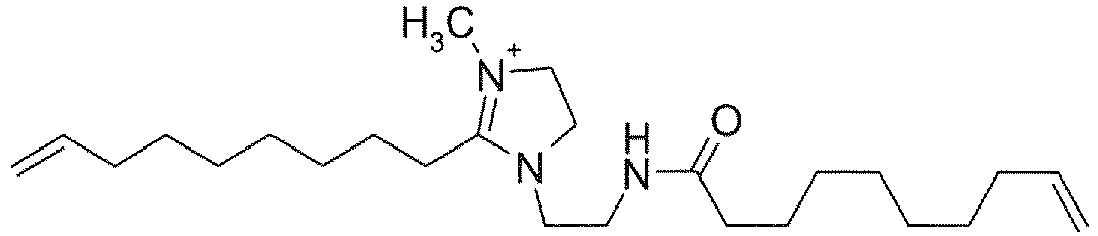 (f) C10 or C12 amidoamine quats having the structure:
 (g) C10, C12, or C16 betaines having the structure:
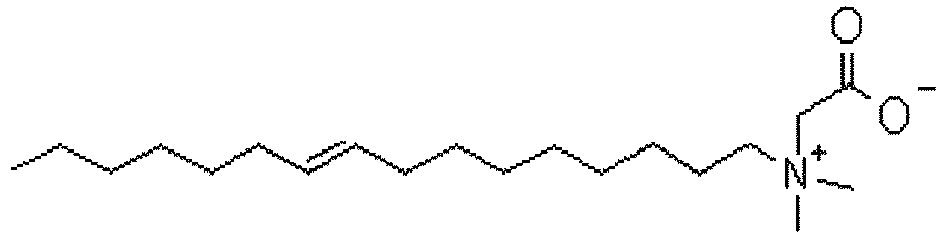 (h) a C16 amidoamine betaine having the structure:
 (i) a C18 diamidoamine having the structure:
 (j) a C18 diamidoamine oxide having the structure:
 (k) a C18 diamidoamine diquat having the structure:
 (l) a C18 diamidoamine oxide quat having the structure:
 (m) a C18 diamidoamine oxide betaine having the structure:
 (n) a C18 diamidoamine monobetaine having the structure:
 (o) a C18 diamidoamine monobetaine quat having the structure:
 (p) a C18 ester amidoamine quat having the structure:
 (q) amidoamines and their oxidized or quaternized derivatives made from self-metathesized palm or soybean oil having the structure:

 (r) amidoamines and their oxidized or quaternized derivatives made from cross-metathesized palm or soybean oil having the structure:


- The formulation of claim 1 wherein the surfactant is selected from the group consisting of(a) C10 or C12 amine oxides having the structure:
 (b) C10 or C12 quats having the structure:
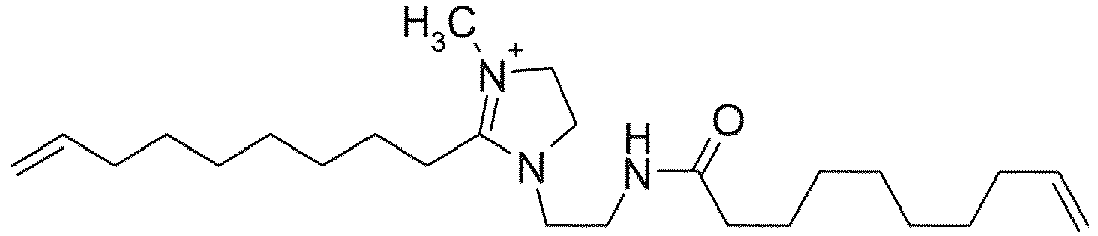 (g) C10, C12, or C16 betaines having the structure:
 (i) a C18 diamidoamine having the structure:
 (j) a C18 diamidoamine oxide having the structure:
 (k) a C18 diamidoamine diquat having the structure:
 (I) a C18 diamidoamine oxide quat having the structure:
 (m) a C18 diamidoamine oxide betaine having the structure:
 (n) a C18 diamidoamine monobetaine having the structure:
 (o) a C18 diamidoamine monobetaine quat having the structure:
 (p) a C18 ester amidoamine quat having the structure:
 (q) amidoamines and their oxidized or quaternized derivatives made from self-metathesized palm or soybean oil having the structure:
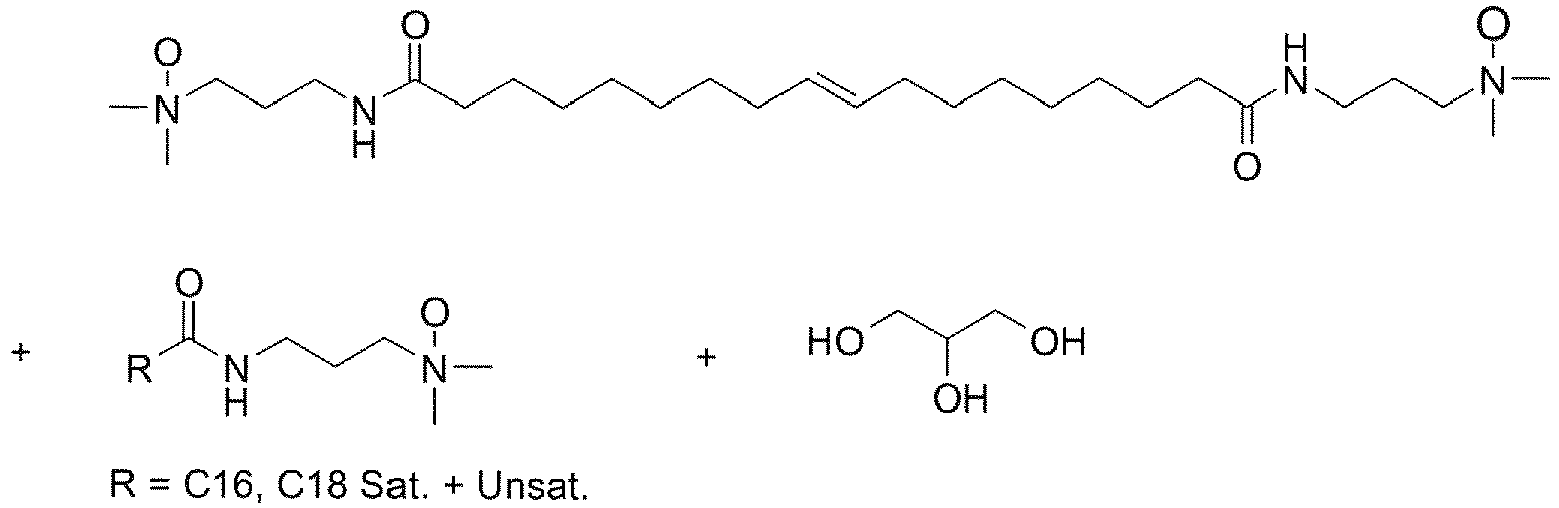
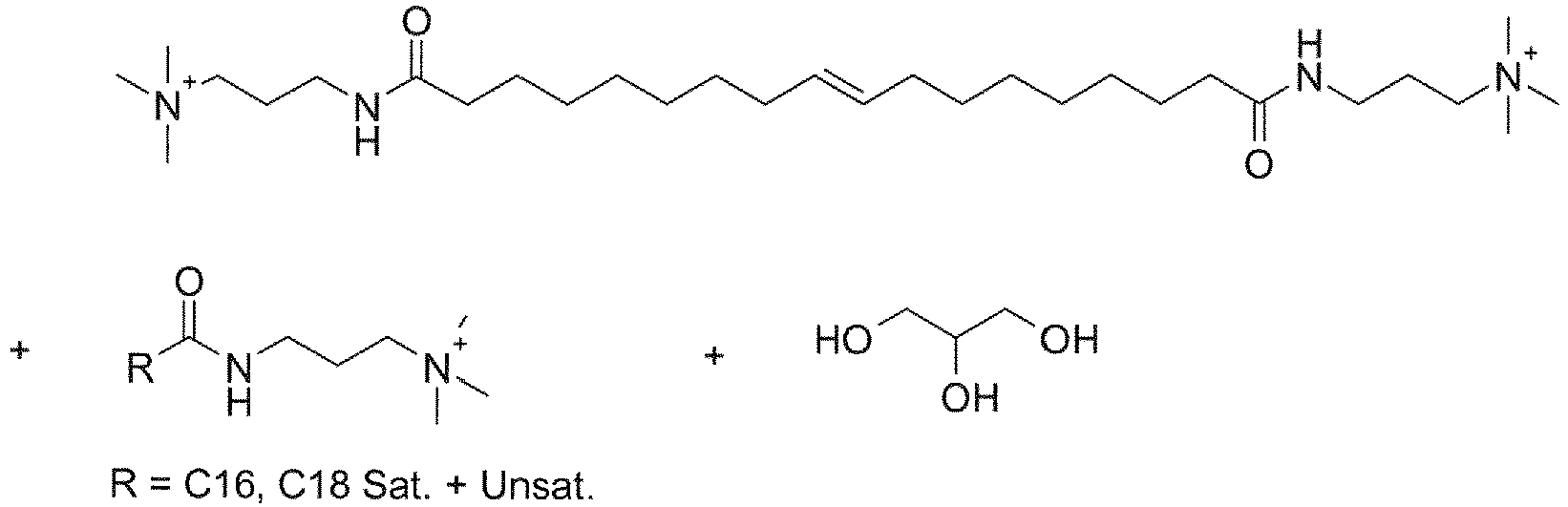 (r) amidoamines and their oxidized or quaternized derivatives made from cross-metathesized palm or soybean oil having the structure:


- The formulation of claim 1 wherein the surfactant is selected from the group consisting of:(a) a C12 amine oxide having the structure:
 (c) a C10 amidoamine having the structure:
 (d) C10 or C12 amidoamine oxides having the structure:
 (i) a C18 diamidoamine having the structure:
 (j) a C18 diamidoamine oxide having the structure:

 (I) a C18 diamidoamine oxide quat having the structure:
 (p) a C18 ester amidoamine quat having the structure:
 (q) amidoamines and their oxidized or quaternized derivatives made from self-metathesized palm or soybean oil having the structure: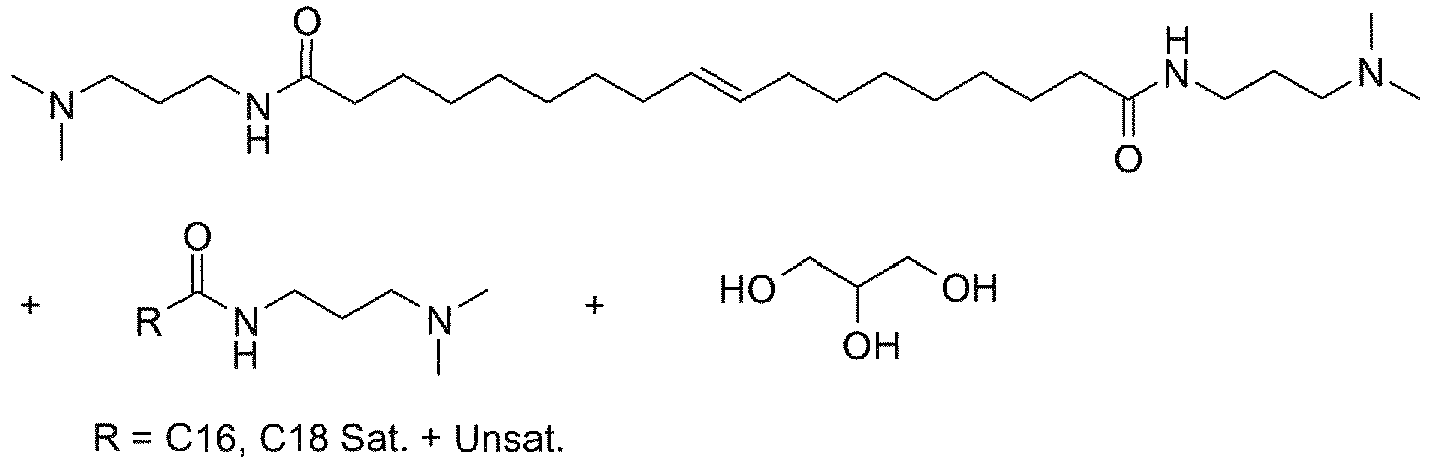

 (r) amidoamines and their oxidized or quaternized derivatives made from cross-metathesized palm or soybean oil having the structure:

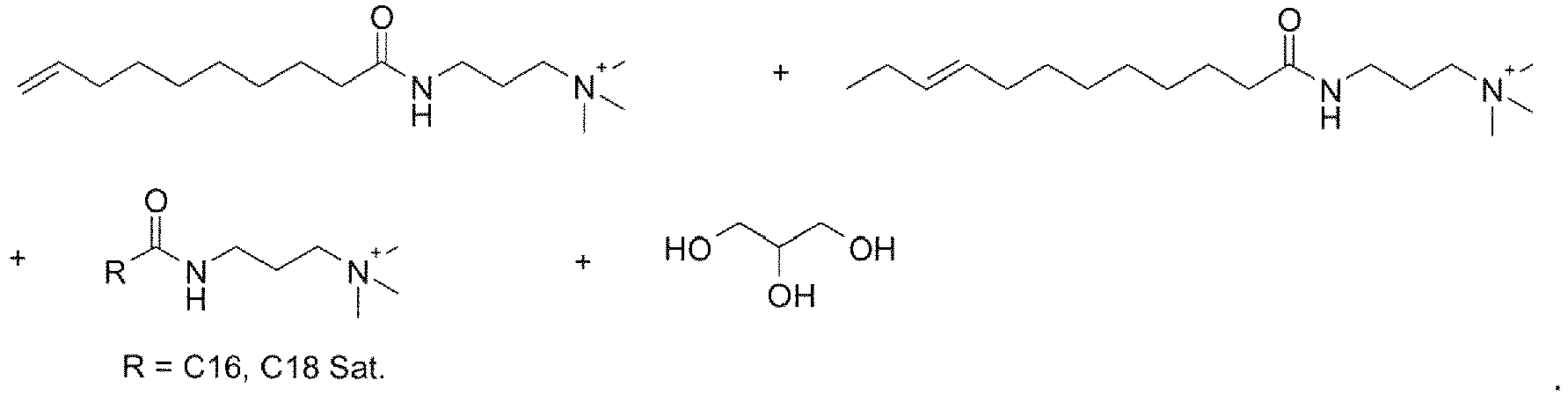
- The formulation of claim 3 wherein the surfactant is selected from the group consisting of:(a) a C12 amine oxide having the structure:
 (c) a C10 amidoamine having the structure:
 (d) C10 or C12 amidoamine oxides having the structure:
- The formulation of claim 3 wherein the surfactant is selected from the group consisting of:(i) a C18 diamidoamine having the structure:
 (j) a C18 diamidoamine oxide having the structure:
 (n) a C18 diamidoamine monobetaine having the structure:
 (m) a C18 diamidoamine oxide betaine having the structure:
 (I) a C18 diamidoamine oxide quat having the structure:
 (p) a C18 ester amidoamine quat having the structure:
- The formulation of claim 3 wherein the surfactant is selected from the group consisting of:(q) amidoamines and their oxidized derivatives made from self-metathesized palm or soybean oil having the structure:

 (r) amidoamines and their oxidized or quaternized derivatives made from cross-metathesized palm or soybean oil having the structure:
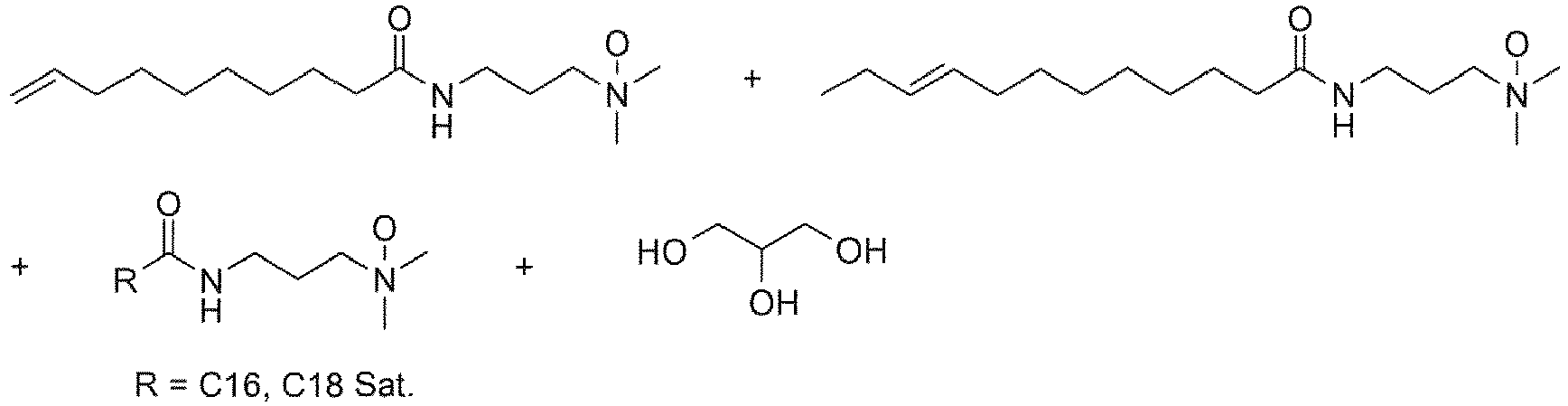

- The formulation of claim 1 wherein the surfactant is selected from the group consisting of:(a) a C10 amine oxide having the structure:
 (b) C10 or C12 quats having the structure:
 (c) C12 or C16 amidoamines having the structure:
 (e) a C10 imidazoline quat having the structure:
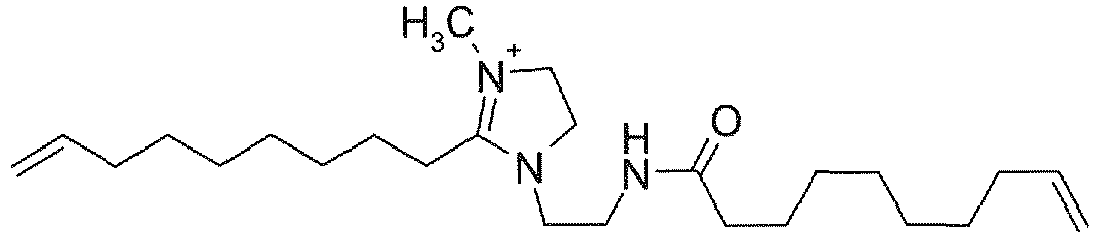 (f) C10 or C12 amidoamine quats having the structure:
 (g) C10, C12, or C16 betaines having the structure:
 (h) a C16 amidoamine betaine having the structure:
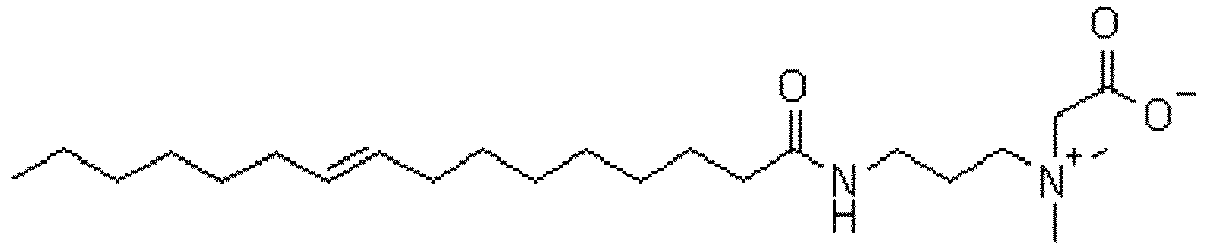 (i) a C18 diamidoamine diquat having the structure:
 (o) a C18 diamidoamine monobetaine quat having the structure:
 (q) amidoamines and their oxidized or quaternized derivatives made from self-metathesized palm or soybean oil having the structure:

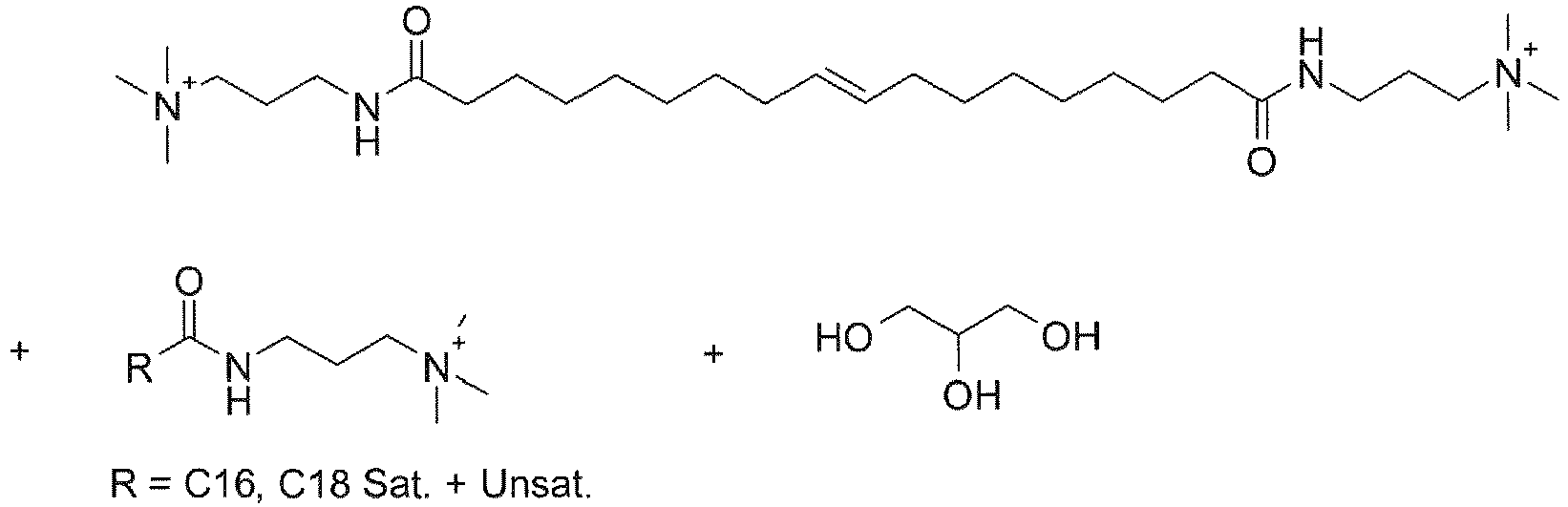 (r) amidoamines and their oxidized or quaternized derivatives made from cross-metathesized palm or soybean oil having the structure:


- The formulation of claim 7 wherein the surfactant is selected from the group consisting of:(a) a C10 amine oxide having the structure:
 (b) C10 or C12 quats having the structure:
 (c) C12 or C16 amidoamines having the structure:
 (e) a C10 imidazoline quat having the structure:
 (f) C10 or C12 amidoamine quats having the structure:
 (g) C10, C12, or C16 betaines having the structure:
 (h) a C16 amidoamine betaine having the structure: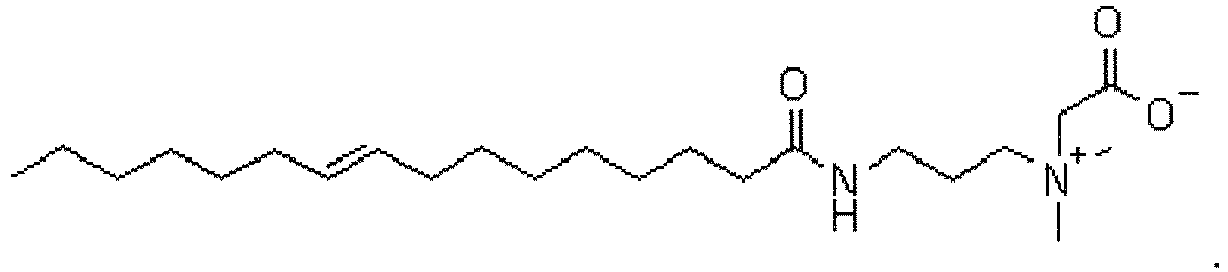
- The formulation of claim 7 wherein the surfactant is selected from the group consisting of:(k) a C18 diamidoamine diquat having the structure:
 (o) a C18 diamidoamine monobetaine quat having the structure:
- The formulation of claim 7 wherein the surfactant is selected from the group consisting of:(q) amidoamines and their oxidized or quaternized derivatives made from self-metathesized palm or soybean oil having the structure:
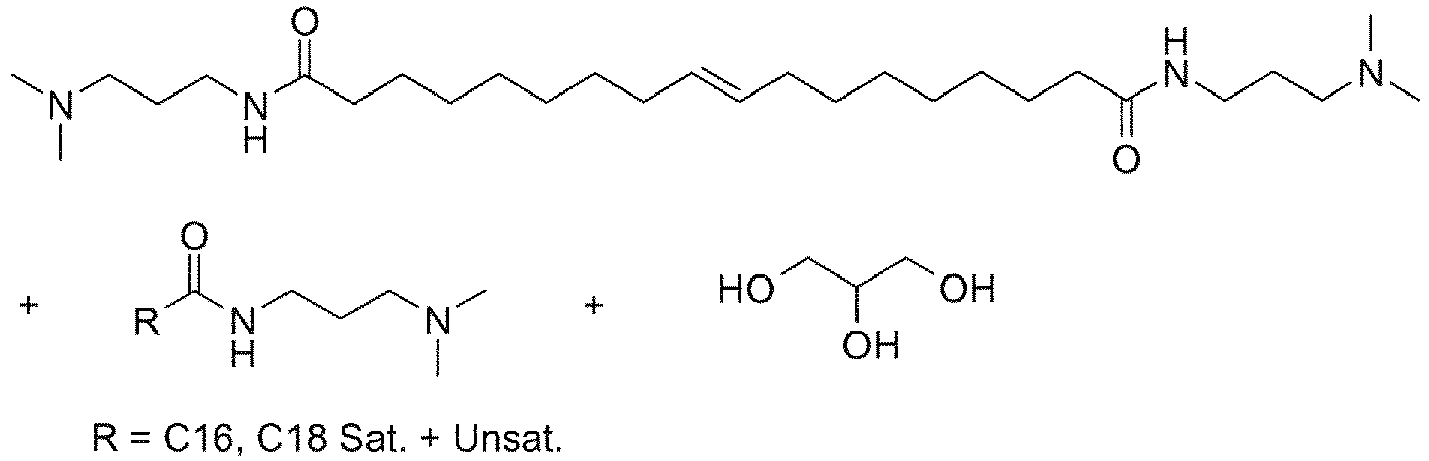

 (r) amidoamines and their oxidized or quaternized derivatives made from cross-metathesized palm or soybean oil having the structure:

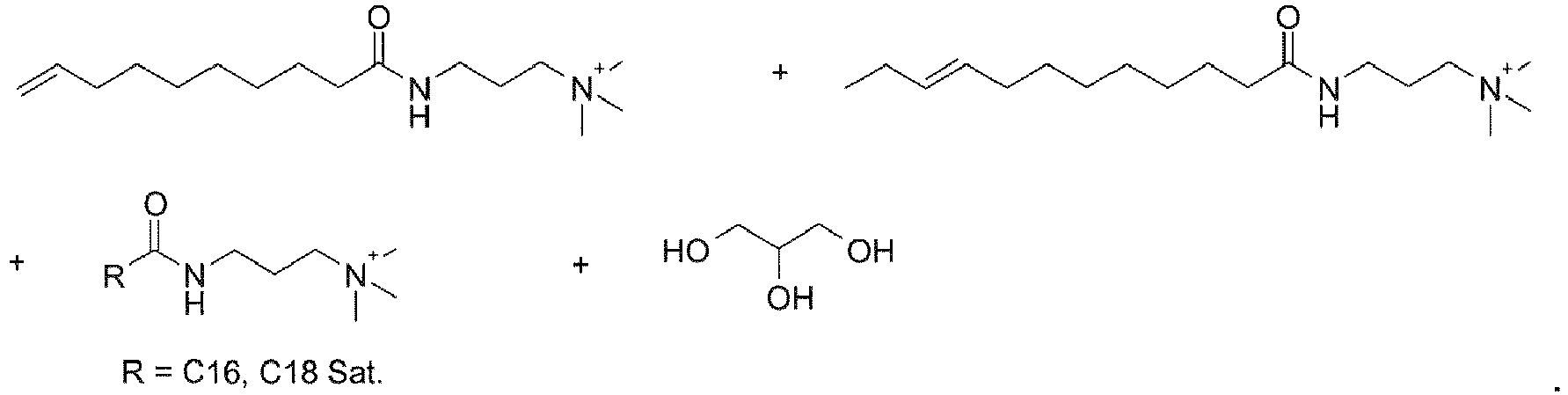
- The formulation of claim 1 or 7 comprising at least 30 wt.% acid equivalents of the glyphosate salt.
- The formulation of claim 1 or 7 in which the metathesis-derived surfactant is the only surfactant.
- The formulation of claim 1 or 7 wherein the metathesis-derived C10-C17 monounsaturated acid, octadecene-1,18-dioic acid, or its ester derivative has at least 1 mole % of trans-Δ9 unsaturation.
- The formulation of claim 1 or 7 comprising from 0.1 to 15 wt.% of the surfactant.
- The formulation of claim 1 or 7 further comprising an auxiliary surfactant selected from the group consisting of amine oxides and betaines.
Applications Claiming Priority (4)
| Application Number | Priority Date | Filing Date | Title |
|---|---|---|---|
| US40655610P | 2010-10-25 | 2010-10-25 | |
| US40654710P | 2010-10-25 | 2010-10-25 | |
| US40657010P | 2010-10-25 | 2010-10-25 | |
| PCT/US2011/057616 WO2012061106A1 (en) | 2010-10-25 | 2011-10-25 | Glyphosate formulations based on compositions derived from natural oil metathesis |
Publications (3)
| Publication Number | Publication Date |
|---|---|
| EP2632271A1 EP2632271A1 (en) | 2013-09-04 |
| EP2632271A4 EP2632271A4 (en) | 2014-10-01 |
| EP2632271B1 true EP2632271B1 (en) | 2018-12-05 |
Family
ID=51354729
Family Applications (1)
| Application Number | Title | Priority Date | Filing Date |
|---|---|---|---|
| EP11838510.3A Active EP2632271B1 (en) | 2010-10-25 | 2011-10-25 | Glyphosate formulations based on compositions derived from natural oil metathesis |
Country Status (11)
| Country | Link |
|---|---|
| US (1) | US9006144B2 (en) |
| EP (1) | EP2632271B1 (en) |
| CN (1) | CN103327817B (en) |
| AR (1) | AR083654A1 (en) |
| AU (1) | AU2011323770B2 (en) |
| BR (1) | BR112013009948B1 (en) |
| CA (1) | CA2815668C (en) |
| ES (1) | ES2702807T3 (en) |
| MX (1) | MX342906B (en) |
| PH (1) | PH12013500779A1 (en) |
| WO (1) | WO2012061106A1 (en) |
Cited By (1)
| Publication number | Priority date | Publication date | Assignee | Title |
|---|---|---|---|---|
| CN111100330A (en) * | 2019-12-24 | 2020-05-05 | 宿迁联盛科技股份有限公司 | Preparation method of plastic processing lubricant |
Families Citing this family (9)
| Publication number | Priority date | Publication date | Assignee | Title |
|---|---|---|---|---|
| PH12013500764A1 (en) * | 2010-10-25 | 2015-09-23 | Stepan Co | Quaternized fatty amines, amidoamines, and their derivatives from natural oil metathesis |
| EP2841540B1 (en) | 2012-04-24 | 2017-10-18 | Stepan Company | Aqueous hard surface cleaners based on terpenes and fatty acid derivatives |
| WO2013162924A1 (en) | 2012-04-24 | 2013-10-31 | Stepan Company | Synergistic surfactant blends |
| EP3004204B1 (en) | 2013-05-31 | 2017-04-26 | Elevance Renewable Sciences, Inc. | Polyesters containing metathesized natural oil derivatives and methods of making |
| CA2980721C (en) | 2015-03-24 | 2023-10-24 | Kyowa Hakko Kirin Co., Ltd. | Nucleic acid-containing lipid nanoparticles |
| EP3415007A1 (en) * | 2017-06-12 | 2018-12-19 | Bayer AG | Ptz formulations with low content of desthio |
| IT201700095717A1 (en) * | 2017-08-24 | 2019-02-24 | Lamberti Spa | HERBICIDE COMPOSITION |
| BR102018004761B1 (en) * | 2018-03-09 | 2023-03-07 | Ouro Fino Química S.A. | HIGH LOAD GLYPHOSATE HERBITIC COMPOSITION, READY TO USE FORMULATION OBTAINED FROM THE COMPOSITION AND METHOD TO CONTROL VARIOUS WEED SPECIES IN AGRICULTURAL CROPS |
| CN108794355A (en) * | 2018-06-22 | 2018-11-13 | 苏州市贝克生物科技有限公司 | The method for preparing oxynitrides |
Family Cites Families (70)
| Publication number | Priority date | Publication date | Assignee | Title |
|---|---|---|---|---|
| US2653970A (en) | 1950-01-12 | 1953-09-29 | Allied Chem & Dye Corp | Olefin sulfitation process |
| US3169142A (en) | 1960-05-25 | 1965-02-09 | Stepan Chemical Co | Method for sulfonation and sulfation of organic compounds |
| US3544613A (en) | 1965-08-09 | 1970-12-01 | Stepan Chemical Co | Alcohol sulfation |
| US4148821A (en) | 1974-10-16 | 1979-04-10 | Stepan Chemical Company | Process for sulfonation |
| US4275013A (en) | 1974-12-23 | 1981-06-23 | Lever Brothers Company | Novel process for the preparation of salts of alkanesulfonic acids |
| US4405531A (en) | 1975-11-10 | 1983-09-20 | Monsanto Company | Salts of N-phosphonomethylglycine |
| US4087457A (en) | 1976-11-22 | 1978-05-02 | Continental Oil Company | Air initiation for detergent range pendant or internal olefin sulfitation |
| US4140513A (en) | 1978-01-03 | 1979-02-20 | Monsanto Company | Sodium sesquiglyphosate |
| US4545941A (en) | 1983-06-20 | 1985-10-08 | A. E. Staley Manufacturing Company | Co-metathesis of triglycerides and ethylene |
| US5226943A (en) | 1986-08-20 | 1993-07-13 | Akzo N.V. | Herbicides and fungicides containing activity promoting additives |
| US4965403A (en) | 1988-11-07 | 1990-10-23 | Monsanto Company | Oxidation/dealkylation process |
| MY111077A (en) | 1992-11-13 | 1999-08-30 | Kao Corp | Agricultural chemical composition |
| US5849663A (en) | 1994-06-02 | 1998-12-15 | Kao Corporation | Enhancer for agricultural chemicals, enhancer composition for agricultural chemicals and method for enhancing the efficacy of agricultural chemical |
| US5482908A (en) | 1994-09-08 | 1996-01-09 | Arco Chemical Technology, L.P. | Highly active double metal cyanide catalysts |
| FR2737390B1 (en) | 1995-08-04 | 1997-09-19 | Rhone Poulenc Chimie | WATER-SOLUBLE PHYTOSANITARY COMPOSITION COMPRISING AT LEAST POLYACOXYLATED AMIDOAMINES |
| US5750468A (en) | 1995-04-10 | 1998-05-12 | Monsanto Company | Glyphosate formulations containing etheramine surfactants |
| US5700760A (en) | 1996-04-03 | 1997-12-23 | Albemarle Corporation | Herbicidal and plant growth regulant compositions and their use |
| US5710103A (en) | 1996-04-03 | 1998-01-20 | Albemarle Corporation | Glyphosate compositions comprising hydrocarbyl dimethyl amine oxide and quaternary ammonium halide |
| US5703016A (en) | 1996-09-30 | 1997-12-30 | Albemarle Corporation | Surfactant composition for use with glyphosate comprising dimethyl amine oxide, polyethoxylated alcohol, and pyridinium halide |
| US6130186A (en) | 1996-10-25 | 2000-10-10 | Monsanto Company | Composition and method for treating plants with exogenous chemicals |
| CA2269726A1 (en) | 1996-10-25 | 1998-04-30 | Monsanto Company | Composition and method for treating plants with exogenous chemicals |
| GB9819693D0 (en) | 1998-09-10 | 1998-11-04 | Zeneca Ltd | Glyphosate formulation |
| KR20010104684A (en) | 1998-11-23 | 2001-11-26 | 죤 에이치. 뷰센 | Highly concentrated aqueous glyphosate compositions |
| ES2200589T3 (en) | 1998-12-23 | 2004-03-01 | Huntsman International Llc | HERBICIDE AND CONCENTRATED COMPOSITIONS OF TENSIOACTIVE AGENTS. |
| US6448434B1 (en) | 1999-07-29 | 2002-09-10 | Monsanto Technology Llc | Process for making ammonium glyphosate powder |
| GB9917976D0 (en) | 1999-07-31 | 1999-09-29 | Albright & Wilson Uk Ltd | Herbicidal compositions |
| US6908882B1 (en) | 1999-09-09 | 2005-06-21 | Monsanto Company | Enhanced method of killing weeds with glyphosate herbicide |
| DE19953274A1 (en) * | 1999-11-05 | 2001-05-10 | Cognis Deutschland Gmbh | Emulsions |
| MY158895A (en) | 2000-05-19 | 2016-11-30 | Monsanto Technology Llc | Potassium glyphosate formulations |
| US7135437B2 (en) | 2000-05-19 | 2006-11-14 | Monsanto Technology Llc | Stable liquid pesticide compositions |
| SE522195C2 (en) | 2000-06-15 | 2004-01-20 | Akzo Nobel Nv | Use of amine compounds with improved biodegradability as effect-enhancing auxiliary chemicals for pesticides and fertilizers |
| US8236730B2 (en) | 2002-01-29 | 2012-08-07 | Rhodia Chimie | Aqueous herbicidal concentrate comprising a betaine type surfactant |
| US20030158042A1 (en) | 2002-01-29 | 2003-08-21 | Valerio Bramati | Concentrated aqueous phytopathological formulation comprising a herbicide and a betaine type surfactant |
| US7576227B2 (en) | 2002-04-29 | 2009-08-18 | Union Carbide Chemicals & Plastics Technology Corporation | Integrate chemical processes for industrial utilization of seed oils |
| DE60306715T2 (en) | 2002-05-31 | 2007-07-12 | Kao Corp. | Enhancer for agricultural chemicals |
| CA2512815A1 (en) | 2003-01-13 | 2004-07-29 | Cargill, Incorporated | Method for making industrial chemicals |
| MXPA06001389A (en) | 2003-08-04 | 2006-05-15 | Dow Agrosciences Llc | High-strength, low viscosity herbicidal formulations of glyphosate. |
| WO2005110953A1 (en) * | 2004-04-30 | 2005-11-24 | Shell Internationale Research Maatschappij B.V. | Derivatives of alcohols and olefins |
| WO2006034459A1 (en) | 2004-09-23 | 2006-03-30 | Akzo Nobel N.V. | Alkoxylated alkylamines / alkyl ether amines with peaked distribution |
| AU2005321478B2 (en) | 2004-12-30 | 2009-11-05 | Specialty Operations France | Herbicidal composition comprising an aminophosphate or aminophosphonate salt and a betaine |
| AU2006219823A1 (en) * | 2005-03-02 | 2006-09-08 | Metanomics Gmbh | Process for the production of fine chemicals |
| US8163675B2 (en) * | 2005-10-20 | 2012-04-24 | Akzo Nobel N.V. | Emulsifier based on polyamines and fatty acid/maleic anhydride |
| US20090018018A1 (en) | 2005-11-10 | 2009-01-15 | Rhodia Operations | Herbicidal composition comprising aminophosphate or aminophosphonate potassium salt |
| WO2007081987A2 (en) * | 2006-01-10 | 2007-07-19 | Elevance Renewable Sciences, Inc. | Method of making hydrogenated metathesis products |
| CN101969771A (en) | 2006-02-09 | 2011-02-09 | 埃莱文斯可更新科学公司 | Antimicrobial compositions, methods and systems |
| WO2007140332A2 (en) | 2006-05-26 | 2007-12-06 | Huntsman Petrochemical Corporation | Low odor, low volatility solvent for agricultural chemicals |
| BRPI0713149B1 (en) * | 2006-06-14 | 2019-07-30 | Eureka Agresearch Pty Ltd. | HERBICIDE COMPOSITION AND METHOD FOR REMOVING UNWANTED LEAF |
| WO2008010961A2 (en) | 2006-07-13 | 2008-01-24 | Elevance Renewable Sciences, Inc. | Synthesis of terminal alkenes from internal alkenes and ethylene via olefin metathesis |
| CN101558027B (en) | 2006-10-13 | 2013-10-16 | 埃莱文斯可更新科学公司 | Methods of making alpha, omega-dicarboxylic acid alkene derivatives by double decomposition |
| WO2008048522A1 (en) | 2006-10-13 | 2008-04-24 | Elevance Renewable Sciences, Inc. | Methods of making monounsaturated functionalized alkene compounds by metathesis |
| CN106083579A (en) | 2006-10-13 | 2016-11-09 | 埃莱文斯可更新科学公司 | By olefin metathesis by the method for internal olefin synthesis terminal olefin |
| WO2008068214A2 (en) | 2006-12-06 | 2008-06-12 | Akzo Nobel N.V. | Alkylamidopropyl dialkylamine surfactants as adjuvants |
| US9416065B2 (en) * | 2007-02-12 | 2016-08-16 | Archer Daniels Midland Company | Adjuvants and methods of using them |
| BRPI0814997A2 (en) * | 2007-08-09 | 2015-02-03 | Elevance Renewable Sciences | THERMAL METHODS FOR TREATMENT OF A METHODESIC RAW MATERIAL |
| HRP20160477T1 (en) | 2008-06-18 | 2016-06-17 | Stepan Company | Ultra-high loading glyphosate concentrate |
| CN106879623A (en) | 2008-08-19 | 2017-06-23 | 阿克佐诺贝尔股份有限公司 | Zhu shawn |
| ES2648201T3 (en) * | 2008-09-29 | 2017-12-29 | Monsanto Technology Llc | Glyphosate formulations containing almidoalkylamine surfactants |
| AU2010245265B2 (en) | 2009-05-05 | 2014-07-31 | Stepan Company | Sulfonated internal olefin surfactant for enhanced oil recovery |
| NZ597054A (en) | 2009-06-25 | 2012-12-21 | Dow Agrosciences Llc | Herbicidal concentrate compositions containing glyphosate and dicamba salts |
| US9137988B2 (en) | 2009-09-02 | 2015-09-22 | Akzo Nobel Chemicals International B.V. | Nitrogen containing surfactants for agricultural use |
| US9175231B2 (en) | 2009-10-12 | 2015-11-03 | Elevance Renewable Sciences, Inc. | Methods of refining natural oils and methods of producing fuel compositions |
| MX2012004257A (en) | 2009-10-12 | 2012-05-22 | Elevance Renewable Sciences | Methods of refining and producing fuel from natural oil feedstocks. |
| US8735640B2 (en) | 2009-10-12 | 2014-05-27 | Elevance Renewable Sciences, Inc. | Methods of refining and producing fuel and specialty chemicals from natural oil feedstocks |
| BR112012011625B1 (en) | 2009-11-16 | 2018-10-02 | Imtrade Australia Pty Ltd | high-load glyphosate formulations and process for preparing them |
| SG189989A1 (en) | 2010-10-25 | 2013-06-28 | Stepan Co | Fatty amines, amidoamines, and their derivatives from natural oil metathesis |
| AU2011323840B2 (en) | 2010-10-25 | 2015-09-24 | Stepan Company | Fatty amides and derivatives from natural oil metathesis |
| PH12013500764A1 (en) | 2010-10-25 | 2015-09-23 | Stepan Co | Quaternized fatty amines, amidoamines, and their derivatives from natural oil metathesis |
| BR112013009964B1 (en) | 2010-10-25 | 2018-10-16 | Stepan Co | amine ester, derivative, water-soluble herbicide composition or agricultural dispersant, rough surface cleaner, shampoo or conditioner, or personal cleaner or soap and corrosion inhibitor for use in oilfield applications. |
| PL2633018T3 (en) | 2010-10-25 | 2021-11-22 | Stepan Company | Sulfonates from natural oil metathesis |
| MX341182B (en) | 2010-10-25 | 2016-08-09 | Stepan Co | Alkoxylated fatty esters and derivatives from natural oil metathesis. |
-
2011
- 2011-10-25 EP EP11838510.3A patent/EP2632271B1/en active Active
- 2011-10-25 CN CN201180051743.6A patent/CN103327817B/en active Active
- 2011-10-25 ES ES11838510T patent/ES2702807T3/en active Active
- 2011-10-25 US US13/880,017 patent/US9006144B2/en active Active
- 2011-10-25 CA CA2815668A patent/CA2815668C/en active Active
- 2011-10-25 AR ARP110103937A patent/AR083654A1/en active IP Right Grant
- 2011-10-25 AU AU2011323770A patent/AU2011323770B2/en active Active
- 2011-10-25 WO PCT/US2011/057616 patent/WO2012061106A1/en not_active Ceased
- 2011-10-25 BR BR112013009948-8A patent/BR112013009948B1/en active IP Right Grant
- 2011-10-25 PH PH1/2013/500779A patent/PH12013500779A1/en unknown
- 2011-10-25 MX MX2013004619A patent/MX342906B/en active IP Right Grant
Cited By (2)
| Publication number | Priority date | Publication date | Assignee | Title |
|---|---|---|---|---|
| CN111100330A (en) * | 2019-12-24 | 2020-05-05 | 宿迁联盛科技股份有限公司 | Preparation method of plastic processing lubricant |
| CN111100330B (en) * | 2019-12-24 | 2021-10-19 | 宿迁联盛科技股份有限公司 | Preparation method of plastic processing lubricant |
Also Published As
| Publication number | Publication date |
|---|---|
| US9006144B2 (en) | 2015-04-14 |
| CN103327817B (en) | 2016-03-02 |
| MX2013004619A (en) | 2013-07-15 |
| MX342906B (en) | 2016-10-17 |
| ES2702807T3 (en) | 2019-03-05 |
| AU2011323770A1 (en) | 2013-05-02 |
| WO2012061106A8 (en) | 2012-07-05 |
| AR083654A1 (en) | 2013-03-13 |
| BR112013009948B1 (en) | 2018-08-14 |
| BR112013009948A8 (en) | 2018-01-02 |
| CN103327817A (en) | 2013-09-25 |
| US20130237421A1 (en) | 2013-09-12 |
| AU2011323770B2 (en) | 2015-07-16 |
| CA2815668C (en) | 2018-02-27 |
| WO2012061106A1 (en) | 2012-05-10 |
| EP2632271A4 (en) | 2014-10-01 |
| CA2815668A1 (en) | 2012-05-10 |
| BR112013009948A2 (en) | 2016-07-05 |
| PH12013500779A1 (en) | 2013-06-17 |
| EP2632271A1 (en) | 2013-09-04 |
Similar Documents
| Publication | Publication Date | Title |
|---|---|---|
| EP2632271B1 (en) | Glyphosate formulations based on compositions derived from natural oil metathesis | |
| EP2632891B1 (en) | Quaternized fatty amines, amidoamines, and their derivatives from natural oil metathesis | |
| US9493727B2 (en) | Fatty amines, amidoamines, and their derivatives from natural oil metathesis | |
| US9187711B2 (en) | Esteramines and derivatives from natural oil metathesis | |
| EP2633020B1 (en) | Laundry detergents based on compositions derived from natural oil metathesis | |
| EP2633021B1 (en) | Light-duty liquid detergents based on compositions derived from natural oil metathesis |
Legal Events
| Date | Code | Title | Description |
|---|---|---|---|
| PUAI | Public reference made under article 153(3) epc to a published international application that has entered the european phase |
Free format text: ORIGINAL CODE: 0009012 |
|
| 17P | Request for examination filed |
Effective date: 20130424 |
|
| AK | Designated contracting states |
Kind code of ref document: A1 Designated state(s): AL AT BE BG CH CY CZ DE DK EE ES FI FR GB GR HR HU IE IS IT LI LT LU LV MC MK MT NL NO PL PT RO RS SE SI SK SM TR |
|
| DAX | Request for extension of the european patent (deleted) | ||
| A4 | Supplementary search report drawn up and despatched |
Effective date: 20140828 |
|
| RIC1 | Information provided on ipc code assigned before grant |
Ipc: A01P 13/00 20060101ALI20140822BHEP Ipc: A01N 57/20 20060101ALI20140822BHEP Ipc: A01N 25/30 20060101AFI20140822BHEP |
|
| 17Q | First examination report despatched |
Effective date: 20160825 |
|
| STAA | Information on the status of an ep patent application or granted ep patent |
Free format text: STATUS: EXAMINATION IS IN PROGRESS |
|
| REG | Reference to a national code |
Ref country code: DE Ref legal event code: R079 Ref document number: 602011054632 Country of ref document: DE Free format text: PREVIOUS MAIN CLASS: A01N0057180000 Ipc: A01N0025300000 |
|
| GRAP | Despatch of communication of intention to grant a patent |
Free format text: ORIGINAL CODE: EPIDOSNIGR1 |
|
| STAA | Information on the status of an ep patent application or granted ep patent |
Free format text: STATUS: GRANT OF PATENT IS INTENDED |
|
| RIC1 | Information provided on ipc code assigned before grant |
Ipc: C07C 303/18 20060101ALI20180511BHEP Ipc: B01F 17/00 20060101ALI20180511BHEP Ipc: C07C 209/12 20060101ALI20180511BHEP Ipc: C11D 1/74 20060101ALI20180511BHEP Ipc: A01N 25/02 20060101ALI20180511BHEP Ipc: C07C 231/12 20060101ALI20180511BHEP Ipc: C07C 69/533 20060101ALI20180511BHEP Ipc: A01N 25/30 20060101AFI20180511BHEP Ipc: A62D 1/02 20060101ALI20180511BHEP Ipc: C09K 8/00 20060101ALI20180511BHEP Ipc: A01P 13/00 20060101ALI20180511BHEP Ipc: C07C 69/593 20060101ALI20180511BHEP Ipc: A01N 57/20 20060101ALI20180511BHEP Ipc: C11D 1/28 20060101ALI20180511BHEP Ipc: C08G 65/26 20060101ALI20180511BHEP |
|
| INTG | Intention to grant announced |
Effective date: 20180607 |
|
| GRAS | Grant fee paid |
Free format text: ORIGINAL CODE: EPIDOSNIGR3 |
|
| GRAA | (expected) grant |
Free format text: ORIGINAL CODE: 0009210 |
|
| GRAA | (expected) grant |
Free format text: ORIGINAL CODE: 0009210 |
|
| STAA | Information on the status of an ep patent application or granted ep patent |
Free format text: STATUS: THE PATENT HAS BEEN GRANTED |
|
| AK | Designated contracting states |
Kind code of ref document: B1 Designated state(s): AL AT BE BG CH CY CZ DE DK EE ES FI FR GB GR HR HU IE IS IT LI LT LU LV MC MK MT NL NO PL PT RO RS SE SI SK SM TR |
|
| REG | Reference to a national code |
Ref country code: GB Ref legal event code: FG4D |
|
| REG | Reference to a national code |
Ref country code: CH Ref legal event code: EP |
|
| REG | Reference to a national code |
Ref country code: AT Ref legal event code: REF Ref document number: 1071886 Country of ref document: AT Kind code of ref document: T Effective date: 20181215 |
|
| REG | Reference to a national code |
Ref country code: IE Ref legal event code: FG4D |
|
| REG | Reference to a national code |
Ref country code: DE Ref legal event code: R096 Ref document number: 602011054632 Country of ref document: DE |
|
| REG | Reference to a national code |
Ref country code: ES Ref legal event code: FG2A Ref document number: 2702807 Country of ref document: ES Kind code of ref document: T3 Effective date: 20190305 |
|
| REG | Reference to a national code |
Ref country code: NL Ref legal event code: MP Effective date: 20181205 |
|
| REG | Reference to a national code |
Ref country code: AT Ref legal event code: MK05 Ref document number: 1071886 Country of ref document: AT Kind code of ref document: T Effective date: 20181205 |
|
| REG | Reference to a national code |
Ref country code: LT Ref legal event code: MG4D |
|
| PG25 | Lapsed in a contracting state [announced via postgrant information from national office to epo] |
Ref country code: BG Free format text: LAPSE BECAUSE OF FAILURE TO SUBMIT A TRANSLATION OF THE DESCRIPTION OR TO PAY THE FEE WITHIN THE PRESCRIBED TIME-LIMIT Effective date: 20190305 Ref country code: NO Free format text: LAPSE BECAUSE OF FAILURE TO SUBMIT A TRANSLATION OF THE DESCRIPTION OR TO PAY THE FEE WITHIN THE PRESCRIBED TIME-LIMIT Effective date: 20190305 Ref country code: LT Free format text: LAPSE BECAUSE OF FAILURE TO SUBMIT A TRANSLATION OF THE DESCRIPTION OR TO PAY THE FEE WITHIN THE PRESCRIBED TIME-LIMIT Effective date: 20181205 Ref country code: LV Free format text: LAPSE BECAUSE OF FAILURE TO SUBMIT A TRANSLATION OF THE DESCRIPTION OR TO PAY THE FEE WITHIN THE PRESCRIBED TIME-LIMIT Effective date: 20181205 Ref country code: AT Free format text: LAPSE BECAUSE OF FAILURE TO SUBMIT A TRANSLATION OF THE DESCRIPTION OR TO PAY THE FEE WITHIN THE PRESCRIBED TIME-LIMIT Effective date: 20181205 Ref country code: HR Free format text: LAPSE BECAUSE OF FAILURE TO SUBMIT A TRANSLATION OF THE DESCRIPTION OR TO PAY THE FEE WITHIN THE PRESCRIBED TIME-LIMIT Effective date: 20181205 Ref country code: FI Free format text: LAPSE BECAUSE OF FAILURE TO SUBMIT A TRANSLATION OF THE DESCRIPTION OR TO PAY THE FEE WITHIN THE PRESCRIBED TIME-LIMIT Effective date: 20181205 |
|
| PG25 | Lapsed in a contracting state [announced via postgrant information from national office to epo] |
Ref country code: AL Free format text: LAPSE BECAUSE OF FAILURE TO SUBMIT A TRANSLATION OF THE DESCRIPTION OR TO PAY THE FEE WITHIN THE PRESCRIBED TIME-LIMIT Effective date: 20181205 Ref country code: SE Free format text: LAPSE BECAUSE OF FAILURE TO SUBMIT A TRANSLATION OF THE DESCRIPTION OR TO PAY THE FEE WITHIN THE PRESCRIBED TIME-LIMIT Effective date: 20181205 Ref country code: RS Free format text: LAPSE BECAUSE OF FAILURE TO SUBMIT A TRANSLATION OF THE DESCRIPTION OR TO PAY THE FEE WITHIN THE PRESCRIBED TIME-LIMIT Effective date: 20181205 Ref country code: GR Free format text: LAPSE BECAUSE OF FAILURE TO SUBMIT A TRANSLATION OF THE DESCRIPTION OR TO PAY THE FEE WITHIN THE PRESCRIBED TIME-LIMIT Effective date: 20190306 |
|
| PG25 | Lapsed in a contracting state [announced via postgrant information from national office to epo] |
Ref country code: NL Free format text: LAPSE BECAUSE OF FAILURE TO SUBMIT A TRANSLATION OF THE DESCRIPTION OR TO PAY THE FEE WITHIN THE PRESCRIBED TIME-LIMIT Effective date: 20181205 |
|
| PG25 | Lapsed in a contracting state [announced via postgrant information from national office to epo] |
Ref country code: CZ Free format text: LAPSE BECAUSE OF FAILURE TO SUBMIT A TRANSLATION OF THE DESCRIPTION OR TO PAY THE FEE WITHIN THE PRESCRIBED TIME-LIMIT Effective date: 20181205 Ref country code: PL Free format text: LAPSE BECAUSE OF FAILURE TO SUBMIT A TRANSLATION OF THE DESCRIPTION OR TO PAY THE FEE WITHIN THE PRESCRIBED TIME-LIMIT Effective date: 20181205 Ref country code: PT Free format text: LAPSE BECAUSE OF FAILURE TO SUBMIT A TRANSLATION OF THE DESCRIPTION OR TO PAY THE FEE WITHIN THE PRESCRIBED TIME-LIMIT Effective date: 20190405 |
|
| PG25 | Lapsed in a contracting state [announced via postgrant information from national office to epo] |
Ref country code: EE Free format text: LAPSE BECAUSE OF FAILURE TO SUBMIT A TRANSLATION OF THE DESCRIPTION OR TO PAY THE FEE WITHIN THE PRESCRIBED TIME-LIMIT Effective date: 20181205 Ref country code: IS Free format text: LAPSE BECAUSE OF FAILURE TO SUBMIT A TRANSLATION OF THE DESCRIPTION OR TO PAY THE FEE WITHIN THE PRESCRIBED TIME-LIMIT Effective date: 20190405 Ref country code: RO Free format text: LAPSE BECAUSE OF FAILURE TO SUBMIT A TRANSLATION OF THE DESCRIPTION OR TO PAY THE FEE WITHIN THE PRESCRIBED TIME-LIMIT Effective date: 20181205 Ref country code: SK Free format text: LAPSE BECAUSE OF FAILURE TO SUBMIT A TRANSLATION OF THE DESCRIPTION OR TO PAY THE FEE WITHIN THE PRESCRIBED TIME-LIMIT Effective date: 20181205 Ref country code: SM Free format text: LAPSE BECAUSE OF FAILURE TO SUBMIT A TRANSLATION OF THE DESCRIPTION OR TO PAY THE FEE WITHIN THE PRESCRIBED TIME-LIMIT Effective date: 20181205 |
|
| REG | Reference to a national code |
Ref country code: DE Ref legal event code: R097 Ref document number: 602011054632 Country of ref document: DE |
|
| PLBE | No opposition filed within time limit |
Free format text: ORIGINAL CODE: 0009261 |
|
| STAA | Information on the status of an ep patent application or granted ep patent |
Free format text: STATUS: NO OPPOSITION FILED WITHIN TIME LIMIT |
|
| PG25 | Lapsed in a contracting state [announced via postgrant information from national office to epo] |
Ref country code: DK Free format text: LAPSE BECAUSE OF FAILURE TO SUBMIT A TRANSLATION OF THE DESCRIPTION OR TO PAY THE FEE WITHIN THE PRESCRIBED TIME-LIMIT Effective date: 20181205 Ref country code: SI Free format text: LAPSE BECAUSE OF FAILURE TO SUBMIT A TRANSLATION OF THE DESCRIPTION OR TO PAY THE FEE WITHIN THE PRESCRIBED TIME-LIMIT Effective date: 20181205 |
|
| 26N | No opposition filed |
Effective date: 20190906 |
|
| REG | Reference to a national code |
Ref country code: DE Ref legal event code: R082 Ref document number: 602011054632 Country of ref document: DE Representative=s name: ZWICKER SCHNAPPAUF & PARTNER PATENTANWAELTE PA, DE |
|
| PG25 | Lapsed in a contracting state [announced via postgrant information from national office to epo] |
Ref country code: TR Free format text: LAPSE BECAUSE OF FAILURE TO SUBMIT A TRANSLATION OF THE DESCRIPTION OR TO PAY THE FEE WITHIN THE PRESCRIBED TIME-LIMIT Effective date: 20181205 |
|
| PG25 | Lapsed in a contracting state [announced via postgrant information from national office to epo] |
Ref country code: MC Free format text: LAPSE BECAUSE OF FAILURE TO SUBMIT A TRANSLATION OF THE DESCRIPTION OR TO PAY THE FEE WITHIN THE PRESCRIBED TIME-LIMIT Effective date: 20181205 |
|
| REG | Reference to a national code |
Ref country code: CH Ref legal event code: PL |
|
| PG25 | Lapsed in a contracting state [announced via postgrant information from national office to epo] |
Ref country code: CH Free format text: LAPSE BECAUSE OF NON-PAYMENT OF DUE FEES Effective date: 20191031 Ref country code: LI Free format text: LAPSE BECAUSE OF NON-PAYMENT OF DUE FEES Effective date: 20191031 Ref country code: LU Free format text: LAPSE BECAUSE OF NON-PAYMENT OF DUE FEES Effective date: 20191025 |
|
| REG | Reference to a national code |
Ref country code: BE Ref legal event code: MM Effective date: 20191031 |
|
| PG25 | Lapsed in a contracting state [announced via postgrant information from national office to epo] |
Ref country code: BE Free format text: LAPSE BECAUSE OF NON-PAYMENT OF DUE FEES Effective date: 20191031 |
|
| PG25 | Lapsed in a contracting state [announced via postgrant information from national office to epo] |
Ref country code: IE Free format text: LAPSE BECAUSE OF NON-PAYMENT OF DUE FEES Effective date: 20191025 |
|
| PG25 | Lapsed in a contracting state [announced via postgrant information from national office to epo] |
Ref country code: CY Free format text: LAPSE BECAUSE OF FAILURE TO SUBMIT A TRANSLATION OF THE DESCRIPTION OR TO PAY THE FEE WITHIN THE PRESCRIBED TIME-LIMIT Effective date: 20181205 |
|
| PG25 | Lapsed in a contracting state [announced via postgrant information from national office to epo] |
Ref country code: MT Free format text: LAPSE BECAUSE OF FAILURE TO SUBMIT A TRANSLATION OF THE DESCRIPTION OR TO PAY THE FEE WITHIN THE PRESCRIBED TIME-LIMIT Effective date: 20181205 Ref country code: HU Free format text: LAPSE BECAUSE OF FAILURE TO SUBMIT A TRANSLATION OF THE DESCRIPTION OR TO PAY THE FEE WITHIN THE PRESCRIBED TIME-LIMIT; INVALID AB INITIO Effective date: 20111025 |
|
| PG25 | Lapsed in a contracting state [announced via postgrant information from national office to epo] |
Ref country code: MK Free format text: LAPSE BECAUSE OF FAILURE TO SUBMIT A TRANSLATION OF THE DESCRIPTION OR TO PAY THE FEE WITHIN THE PRESCRIBED TIME-LIMIT Effective date: 20181205 |
|
| PGFP | Annual fee paid to national office [announced via postgrant information from national office to epo] |
Ref country code: DE Payment date: 20241021 Year of fee payment: 14 |
|
| PGFP | Annual fee paid to national office [announced via postgrant information from national office to epo] |
Ref country code: GB Payment date: 20241022 Year of fee payment: 14 |
|
| PGFP | Annual fee paid to national office [announced via postgrant information from national office to epo] |
Ref country code: FR Payment date: 20241021 Year of fee payment: 14 |
|
| PGFP | Annual fee paid to national office [announced via postgrant information from national office to epo] |
Ref country code: ES Payment date: 20241127 Year of fee payment: 14 Ref country code: IT Payment date: 20241025 Year of fee payment: 14 |