EP2619182B1 - Pharmaceutical composition - Google Patents
Pharmaceutical composition Download PDFInfo
- Publication number
- EP2619182B1 EP2619182B1 EP11760631.9A EP11760631A EP2619182B1 EP 2619182 B1 EP2619182 B1 EP 2619182B1 EP 11760631 A EP11760631 A EP 11760631A EP 2619182 B1 EP2619182 B1 EP 2619182B1
- Authority
- EP
- European Patent Office
- Prior art keywords
- methyl
- compound
- hydrogen
- pharmaceutically acceptable
- cancer
- Prior art date
- Legal status (The legal status is an assumption and is not a legal conclusion. Google has not performed a legal analysis and makes no representation as to the accuracy of the status listed.)
- Active
Links
- 0 C[C@@](c(cc1)ccc1C(O)=O)NC(*(c(C)n[n]1C)*1Oc1cc(C)cc(C)c1)=O Chemical compound C[C@@](c(cc1)ccc1C(O)=O)NC(*(c(C)n[n]1C)*1Oc1cc(C)cc(C)c1)=O 0.000 description 7
- FQWAIOYNRZLUKT-UHFFFAOYSA-N C[n]1nc(C(F)(F)F)c(C(NC2(CC2)c(cc2)ccc2C(O)=O)=O)c1Oc(cc1Cl)ccc1Cl Chemical compound C[n]1nc(C(F)(F)F)c(C(NC2(CC2)c(cc2)ccc2C(O)=O)=O)c1Oc(cc1Cl)ccc1Cl FQWAIOYNRZLUKT-UHFFFAOYSA-N 0.000 description 4
- MKLKAQMPKHNQPR-NSHDSACASA-N C[C@@H](c(cc1)ccc1C(O)=O)NC(c(c(C(F)F)n[n]1C)c1Oc1cc(C(F)(F)F)ccc1)=O Chemical compound C[C@@H](c(cc1)ccc1C(O)=O)NC(c(c(C(F)F)n[n]1C)c1Oc1cc(C(F)(F)F)ccc1)=O MKLKAQMPKHNQPR-NSHDSACASA-N 0.000 description 2
- QUHMFZSLHRSAPJ-NSHDSACASA-N C[C@@H](c(cc1)ccc1C(O)=O)NC(c(c(C(F)F)n[n]1C)c1Oc1cc(OC(F)F)ccc1)=O Chemical compound C[C@@H](c(cc1)ccc1C(O)=O)NC(c(c(C(F)F)n[n]1C)c1Oc1cc(OC(F)F)ccc1)=O QUHMFZSLHRSAPJ-NSHDSACASA-N 0.000 description 2
- VJNRFVMSVDFJLL-AWEZNQCLSA-N C[C@@H](c(cc1)ccc1C(O)=O)NC(c(c(C)n[n]1C)c1Oc1ccc(C)cc1)=O Chemical compound C[C@@H](c(cc1)ccc1C(O)=O)NC(c(c(C)n[n]1C)c1Oc1ccc(C)cc1)=O VJNRFVMSVDFJLL-AWEZNQCLSA-N 0.000 description 2
- GMJBSBHJGUJAOA-UHFFFAOYSA-N CC(c(cc1)ccc1C(O)=O)NC(c(c(C)n[n]1C)c1Oc1cccc(C(F)F)c1)=O Chemical compound CC(c(cc1)ccc1C(O)=O)NC(c(c(C)n[n]1C)c1Oc1cccc(C(F)F)c1)=O GMJBSBHJGUJAOA-UHFFFAOYSA-N 0.000 description 1
- IDZHMJXCQWZTBQ-UHFFFAOYSA-N CN(C(C1)=O)N=C1C(F)F Chemical compound CN(C(C1)=O)N=C1C(F)F IDZHMJXCQWZTBQ-UHFFFAOYSA-N 0.000 description 1
- VCWFEMUUQOABFX-NBFOIZRFSA-N C[C@@H](C1C=CC(C(O)=O)=CC1)NC(c(c(C)n[n]1C)c1Oc1cc(OC(F)(F)F)ccc1)=O Chemical compound C[C@@H](C1C=CC(C(O)=O)=CC1)NC(c(c(C)n[n]1C)c1Oc1cc(OC(F)(F)F)ccc1)=O VCWFEMUUQOABFX-NBFOIZRFSA-N 0.000 description 1
- UYNXAAGIINHTDK-NSHDSACASA-N C[C@@H](c(cc1)ccc1C(O)=O)NC(c(c(C(F)(F)F)n[n]1C)c1Oc(cc1)ccc1Cl)=O Chemical compound C[C@@H](c(cc1)ccc1C(O)=O)NC(c(c(C(F)(F)F)n[n]1C)c1Oc(cc1)ccc1Cl)=O UYNXAAGIINHTDK-NSHDSACASA-N 0.000 description 1
- GERMPUUZPRUCPA-NSHDSACASA-N C[C@@H](c(cc1)ccc1C(O)=O)NC(c(c(C(F)(F)F)n[n]1C)c1Oc1ccc(C(F)(F)F)cc1)=O Chemical compound C[C@@H](c(cc1)ccc1C(O)=O)NC(c(c(C(F)(F)F)n[n]1C)c1Oc1ccc(C(F)(F)F)cc1)=O GERMPUUZPRUCPA-NSHDSACASA-N 0.000 description 1
- GLPNPYYWVODTKX-JTQLQIEISA-N C[C@@H](c(cc1)ccc1C(O)=O)NC(c(c(C(F)F)n[n]1C)c1Oc(cc1Cl)ccc1Cl)=O Chemical compound C[C@@H](c(cc1)ccc1C(O)=O)NC(c(c(C(F)F)n[n]1C)c1Oc(cc1Cl)ccc1Cl)=O GLPNPYYWVODTKX-JTQLQIEISA-N 0.000 description 1
- RMXNYLYIBGRUNH-NSHDSACASA-N C[C@@H](c(cc1)ccc1C(O)=O)NC(c(c(C(F)F)n[n]1C)c1Oc1cc(C(F)F)ccc1)=O Chemical compound C[C@@H](c(cc1)ccc1C(O)=O)NC(c(c(C(F)F)n[n]1C)c1Oc1cc(C(F)F)ccc1)=O RMXNYLYIBGRUNH-NSHDSACASA-N 0.000 description 1
- VBCVSWOEMPKQKD-NSHDSACASA-N C[C@@H](c(cc1)ccc1C(O)=O)NC(c(c(C(F)F)n[n]1C)c1Oc1cc(Cl)ccc1)=O Chemical compound C[C@@H](c(cc1)ccc1C(O)=O)NC(c(c(C(F)F)n[n]1C)c1Oc1cc(Cl)ccc1)=O VBCVSWOEMPKQKD-NSHDSACASA-N 0.000 description 1
- RJSYNBPFMJYPNG-HNNXBMFYSA-N C[C@@H](c(cc1)ccc1C(O)=O)NC(c(c(C)n[n]1C)c1Oc1cc(C)cc(C)c1)=O Chemical compound C[C@@H](c(cc1)ccc1C(O)=O)NC(c(c(C)n[n]1C)c1Oc1cc(C)cc(C)c1)=O RJSYNBPFMJYPNG-HNNXBMFYSA-N 0.000 description 1
- JYZZLBLREREBLQ-NSHDSACASA-N C[C@@H](c(cc1)ccc1C(O)=O)NC(c(c(C)n[n]1C)c1Oc1cc(Cl)cc(Cl)c1)=O Chemical compound C[C@@H](c(cc1)ccc1C(O)=O)NC(c(c(C)n[n]1C)c1Oc1cc(Cl)cc(Cl)c1)=O JYZZLBLREREBLQ-NSHDSACASA-N 0.000 description 1
- ZMINXVIMIQVVQC-ZDUSSCGKSA-N C[C@@H](c(cc1)ccc1C(O)=O)NC(c(c(C)n[n]1C)c1Oc1cc(OC)cc(OC)c1)=O Chemical compound C[C@@H](c(cc1)ccc1C(O)=O)NC(c(c(C)n[n]1C)c1Oc1cc(OC)cc(OC)c1)=O ZMINXVIMIQVVQC-ZDUSSCGKSA-N 0.000 description 1
- OOCFEKIDCCMEMI-ZDUSSCGKSA-N C[C@@H](c1ccc(COCO)cc1)NC(c(c(C)n[n]1C)c1Oc1cccc(F)c1F)=O Chemical compound C[C@@H](c1ccc(COCO)cc1)NC(c(c(C)n[n]1C)c1Oc1cccc(F)c1F)=O OOCFEKIDCCMEMI-ZDUSSCGKSA-N 0.000 description 1
- WVNYBDUJWUSHPY-UHFFFAOYSA-N C[n]1nc(C(F)F)c(C(NC2(CC2)c(cc2)ccc2C(O)=O)=O)c1Oc(cc1)ccc1Cl Chemical compound C[n]1nc(C(F)F)c(C(NC2(CC2)c(cc2)ccc2C(O)=O)=O)c1Oc(cc1)ccc1Cl WVNYBDUJWUSHPY-UHFFFAOYSA-N 0.000 description 1
- AVEXBXHSMNCOOX-KRWDZBQOSA-N C[n]1nc(C(F)F)c(C(N[C@@H](c(cc2)ccc2C(O)=O)N)=O)c1Oc1cc(C(F)(F)F)ccc1 Chemical compound C[n]1nc(C(F)F)c(C(N[C@@H](c(cc2)ccc2C(O)=O)N)=O)c1Oc1cc(C(F)(F)F)ccc1 AVEXBXHSMNCOOX-KRWDZBQOSA-N 0.000 description 1
- NMYPMEAFQUDCSC-UHFFFAOYSA-N C[n]1nc(C(F)F)c(C=O)c1Cl Chemical compound C[n]1nc(C(F)F)c(C=O)c1Cl NMYPMEAFQUDCSC-UHFFFAOYSA-N 0.000 description 1
- ACJRSMRKSCCEFP-UHFFFAOYSA-N Cc1n[n](C)c(Oc(c(Cl)c2)ccc2F)c1C(NC(c(cc1)ccc1C(O)=O)=C)=O Chemical compound Cc1n[n](C)c(Oc(c(Cl)c2)ccc2F)c1C(NC(c(cc1)ccc1C(O)=O)=C)=O ACJRSMRKSCCEFP-UHFFFAOYSA-N 0.000 description 1
- XCJDJVFPPOKBIU-UHFFFAOYSA-N Cc1n[n](C)c(Oc2cc(C(F)(F)F)ccc2)c1C(NC1(CC1)c(cc1)ccc1C(O)=O)=O Chemical compound Cc1n[n](C)c(Oc2cc(C(F)(F)F)ccc2)c1C(NC1(CC1)c(cc1)ccc1C(O)=O)=O XCJDJVFPPOKBIU-UHFFFAOYSA-N 0.000 description 1
- IHXDAKRNEZNWFM-UHFFFAOYSA-N Cc1n[n](C)c(Oc2cc(Cl)cc(F)c2)c1C(NC(c(cc1)ccc1C(O)=O)=C)=O Chemical compound Cc1n[n](C)c(Oc2cc(Cl)cc(F)c2)c1C(NC(c(cc1)ccc1C(O)=O)=C)=O IHXDAKRNEZNWFM-UHFFFAOYSA-N 0.000 description 1
Images

Classifications
-
- C—CHEMISTRY; METALLURGY
- C07—ORGANIC CHEMISTRY
- C07D—HETEROCYCLIC COMPOUNDS
- C07D231/00—Heterocyclic compounds containing 1,2-diazole or hydrogenated 1,2-diazole rings
- C07D231/02—Heterocyclic compounds containing 1,2-diazole or hydrogenated 1,2-diazole rings not condensed with other rings
- C07D231/10—Heterocyclic compounds containing 1,2-diazole or hydrogenated 1,2-diazole rings not condensed with other rings having two or three double bonds between ring members or between ring members and non-ring members
- C07D231/14—Heterocyclic compounds containing 1,2-diazole or hydrogenated 1,2-diazole rings not condensed with other rings having two or three double bonds between ring members or between ring members and non-ring members with hetero atoms or with carbon atoms having three bonds to hetero atoms with at the most one bond to halogen, e.g. ester or nitrile radicals, directly attached to ring carbon atoms
- C07D231/18—One oxygen or sulfur atom
- C07D231/20—One oxygen atom attached in position 3 or 5
- C07D231/22—One oxygen atom attached in position 3 or 5 with aryl radicals attached to ring nitrogen atoms
-
- C—CHEMISTRY; METALLURGY
- C07—ORGANIC CHEMISTRY
- C07D—HETEROCYCLIC COMPOUNDS
- C07D231/00—Heterocyclic compounds containing 1,2-diazole or hydrogenated 1,2-diazole rings
- C07D231/02—Heterocyclic compounds containing 1,2-diazole or hydrogenated 1,2-diazole rings not condensed with other rings
- C07D231/10—Heterocyclic compounds containing 1,2-diazole or hydrogenated 1,2-diazole rings not condensed with other rings having two or three double bonds between ring members or between ring members and non-ring members
- C07D231/14—Heterocyclic compounds containing 1,2-diazole or hydrogenated 1,2-diazole rings not condensed with other rings having two or three double bonds between ring members or between ring members and non-ring members with hetero atoms or with carbon atoms having three bonds to hetero atoms with at the most one bond to halogen, e.g. ester or nitrile radicals, directly attached to ring carbon atoms
- C07D231/18—One oxygen or sulfur atom
- C07D231/20—One oxygen atom attached in position 3 or 5
-
- A—HUMAN NECESSITIES
- A61—MEDICAL OR VETERINARY SCIENCE; HYGIENE
- A61K—PREPARATIONS FOR MEDICAL, DENTAL OR TOILETRY PURPOSES
- A61K31/00—Medicinal preparations containing organic active ingredients
- A61K31/33—Heterocyclic compounds
- A61K31/395—Heterocyclic compounds having nitrogen as a ring hetero atom, e.g. guanethidine or rifamycins
- A61K31/41—Heterocyclic compounds having nitrogen as a ring hetero atom, e.g. guanethidine or rifamycins having five-membered rings with two or more ring hetero atoms, at least one of which being nitrogen, e.g. tetrazole
- A61K31/415—1,2-Diazoles
-
- A—HUMAN NECESSITIES
- A61—MEDICAL OR VETERINARY SCIENCE; HYGIENE
- A61K—PREPARATIONS FOR MEDICAL, DENTAL OR TOILETRY PURPOSES
- A61K31/00—Medicinal preparations containing organic active ingredients
- A61K31/33—Heterocyclic compounds
- A61K31/395—Heterocyclic compounds having nitrogen as a ring hetero atom, e.g. guanethidine or rifamycins
- A61K31/41—Heterocyclic compounds having nitrogen as a ring hetero atom, e.g. guanethidine or rifamycins having five-membered rings with two or more ring hetero atoms, at least one of which being nitrogen, e.g. tetrazole
- A61K31/415—1,2-Diazoles
- A61K31/4152—1,2-Diazoles having oxo groups directly attached to the heterocyclic ring, e.g. antipyrine, phenylbutazone, sulfinpyrazone
-
- A—HUMAN NECESSITIES
- A61—MEDICAL OR VETERINARY SCIENCE; HYGIENE
- A61P—SPECIFIC THERAPEUTIC ACTIVITY OF CHEMICAL COMPOUNDS OR MEDICINAL PREPARATIONS
- A61P19/00—Drugs for skeletal disorders
- A61P19/02—Drugs for skeletal disorders for joint disorders, e.g. arthritis, arthrosis
-
- A—HUMAN NECESSITIES
- A61—MEDICAL OR VETERINARY SCIENCE; HYGIENE
- A61P—SPECIFIC THERAPEUTIC ACTIVITY OF CHEMICAL COMPOUNDS OR MEDICINAL PREPARATIONS
- A61P25/00—Drugs for disorders of the nervous system
-
- A—HUMAN NECESSITIES
- A61—MEDICAL OR VETERINARY SCIENCE; HYGIENE
- A61P—SPECIFIC THERAPEUTIC ACTIVITY OF CHEMICAL COMPOUNDS OR MEDICINAL PREPARATIONS
- A61P25/00—Drugs for disorders of the nervous system
- A61P25/28—Drugs for disorders of the nervous system for treating neurodegenerative disorders of the central nervous system, e.g. nootropic agents, cognition enhancers, drugs for treating Alzheimer's disease or other forms of dementia
-
- A—HUMAN NECESSITIES
- A61—MEDICAL OR VETERINARY SCIENCE; HYGIENE
- A61P—SPECIFIC THERAPEUTIC ACTIVITY OF CHEMICAL COMPOUNDS OR MEDICINAL PREPARATIONS
- A61P29/00—Non-central analgesic, antipyretic or antiinflammatory agents, e.g. antirheumatic agents; Non-steroidal antiinflammatory drugs [NSAID]
-
- A—HUMAN NECESSITIES
- A61—MEDICAL OR VETERINARY SCIENCE; HYGIENE
- A61P—SPECIFIC THERAPEUTIC ACTIVITY OF CHEMICAL COMPOUNDS OR MEDICINAL PREPARATIONS
- A61P35/00—Antineoplastic agents
Definitions
- Thp naive CD4+ T helper precursor
- Th1 Type I T helper
- Th2 Type 2 T helper
- Th17 a novel T cell subset, the Th17 cells
- Th1 cells produce interferon-gamma, interleukin (IL)-2, and tumor necrosis factor (TNF)-beta, which activate macrophages and are responsible for cell-mediated immunity and phagocyte-dependent protective responses.
- IL interleukin
- TNF tumor necrosis factor
- Th2 cells are known to produce IL-4, IL-5, IL-6, IL-9, IL-10 and IL-13, which are responsible for strong antibody production, eosinophil activation, and inhibition of several macrophage functions, thus providing phagocyte-independent protective responses.
- Th17 cells mainly produce IL-17A, IL-17F, IL-21, IL-22 & TNF and are required for host defense against extracellular pathogens and are critical mediators. of autoimmunity. Accordingly, Th1, Th2, and Th17 cells are associated with different immunopathological responses.
- Th cell development is mediated by a different cytokine pathway. Specifically, it has been shown that IL-4 promotes Th2 differentiation and simultaneously blocks Th1 development. In contrast, IL-12, I-18 and IFN-gamma are the cytokines critical for the development of Th1 cells. In murine, TGF- ⁇ & IL-6 are critical for the induction of Th17 cell differentiation, while in human, IL-1, IL-6 & IL-23 are important drivers of Th17 cell development. Accordingly, effective immunologic homeostasis relies on a continual balance between helper T cell activation and regulatory T cell (Treg) suppression.
- Treg helper T cell activation and regulatory T cell
- Th1 cells are involved in the pathogenesis of a variety of organ-specific autoimmune disorders, Crohn's disease, Helicobacter pylori-induced peptic ulcer, acute kidney allograft rejection, and unexplained recurrent abortions.
- allergen-specific Th2 responses are responsible for atopic disorders in genetically susceptible individuals.
- Th2 responses against still unknown antigens predominate in Omenn's syndrome, idiopathic pulmonary fibrosis, and progressive systemic sclerosis.
- Th17 cells cause immunopathology in different models of autoimmunity, such as rheumatoid arthritis, multiple sclerosis, Crohn's disease and psoriasis.
- IL-17 (the signature Th-17 cytokine) knock-out mice show marked resistance to inflammatory arthritis development. Joint destruction in the CIA model can be ameliorated by the administration of a neutralizing anti-IL-17 antibody.
- Th1/Th2 and Th17 paradigm provides a rationale for the development of strategies for the therapy of allergic and autoimmune disorders.
- Prostaglandins have been shown to modulate various phases of the immune response.
- the lipid mediator prostaglandin E2 (PGE2) is an eicasanoid that is well known to suppress CD4 + T cell activation through elevation of intracellular cAMP and inactivation of Ick.
- PGE2 has been also shown to play a role in regulating Th1 responses by suppression of interferon gamma (IFN-gamma) production and T cell proliferation.
- IFN-gamma interferon gamma
- PGE2 stimulation via the EP4 subtype of PGE2 receptor can also have the opposite effect, namely to promote Th1 differentiation ( Prostaglandin E receptor subtypes EP2 and EP4 promote differentiation and expansion of Th1 and Th17 lymphocytes through different signaling modules, Nature Medicine, 2009, 15, 633-640 ) and IL-17 production in activated CD4+ cells.
- Prostaglandin E2 synergistically with interleukin-23 favors human Th17 expansion, Blood, 2008, 112, 3696-3703 ;
- Prostaglandin E2 regulates Th17 cell differentiation and function through cyclic AMP and EP2/EP4 receptor signaling, J. Exp. Med.
- Prostaglandin E2 enhances Th17 response via modulation of IL-17 and IFN- ⁇ production by memory CD4+ T cells, Eur. J. Immunol. 2009, 39, 1301-1312 .
- antagonism of EP4 with either a novel selective EP4 antagonist or a PGE2-neutralizing antibody suppresses Th1 differentiation, Th17 expansion, as well as IL-23 secretion by activated dendritic cells.
- Induction of Th1 differentiation by PGE2 is mediated by PI3K signaling whereas stimulation of IL-17 production requires cAMP signaling.
- one of R 1a and R 1b is hydrogen, and the other is methyl,, and the carbon marked with a * is a stereogenic center. In some embodiments, one of R 1a and R 1b is hydrogen, and the other is methyl and the carbon marked with a * has the S-configuration. In some embodiments, one of R 1a and R 1b is hydrogen, and the other is methyl and the carbon marked with a * has the R-configuration.
- the present invention provides a pharmaceutical composition comprising a compound of Formula I or a subset or example thereof.
- a method of treating rheumatoid arthritis in a subject comprising the step of administering to the subject a composition comprising a compound of Formula I or a subset or example thereof.
- Examples of such methods include a method of treating multiple sclerosis in a subject, comprising the step of administering to the subject a composition comprising a compound of Formula I or a subset or example thereof.
- a further aspect of the invention is a compound of Formula I or a subset or example thereof for use in the treatment of rheumatoid arthritis.
- Another aspect of the invention is a compound of formula I or a subset or example thereof for use in the treatment of multiple sclerosis.
- compounds of the invention may optionally be substituted with one or more substituents, such as are illustrated generally above, or as exemplified by particular classes, subclasses, and species of the invention.
- substituted refers to the replacement of hydrogen radicals in a given structure with the radical of a specified substituent.
- a substituted group may have a substituent at each substitutable position of the group, and when more than one position in any given structure may be substituted with more than one substituent selected from a specified group, the substituent may be either the same or different at every position.
- Combinations of substituents envisioned by this invention are preferably those that result in the formation of stable or chemically feasible compounds.
- the term “modulator of Th1 differentiation or Th17 expansion” or “modulator compound of Th1 differentiation or Th17 expansion” or “modulator compound” as used herein refers to a compound which suppresses, reduces or inhibits, differentiation of naive CD4+ T cells into Th1 cells.
- the term “modulator of Th1 differentiation or Th17 expansion” or “modulator compound of Th1 differentiation or Th17 expansion” as used herein refers to a compound which suppresses, reduces or inhibits, the number of IL-17 producing CD4+ T cells or IL-17 production in activated CD4+ T cells.
- “Isomers” refer to compounds having the same number and kind of atoms and hence the same molecular weight, but differing with respect to the arrangement or configuration of the atoms.
- Stepoisomers refer to isomers that differ only in the arrangement of the atoms in space.
- Stereoisomers refer to stereoisomers that are not mirror images of each other.
- Enantiomers refers to stereoisomers that are non-superimposable mirror images of one another.
- Enantiomers include "enantiomerically pure” isomers that comprise substantially a single enantiomer, for example, greater than or equal to 90%, 92%, 95%, 98%, or 99%, or equal to 100% of a single enantiomer.
- Enantiomerically pure as used herein means a compound, or composition of a compound, that comprises substantially a single enantiomer, for example, greater than or equal to 90%, 92%, 95%, 98%, or 99%, or equal to 100% of a single enantiomer.
- Stepomerically pure as used herein means a compound or composition thereof that comprises one stereoisomer of a compound and is substantially free of other stereoisomers of that compound.
- a stereomerically pure composition of a compound having one chiral center will be substantially free of the opposite enantiomer of the compound.
- a stereomerically pure composition of a compound having two chiral centers will be substantially free of diastereomers, and substantially free of the enantiomer, of the compound.
- a typical stereomerically pure compound comprises greater than about 80% by weight of one stereoisomer of the compound and less than about 20% by weight of other stereoisomers of the compound, more preferably greater than about 90% by weight of one stereoisomer of the compound and less than about 10% by weight of the other stereoisomers of the compound, even more preferably greater than about 95% by weight of one stereoisomer of the compound and less than about 5% by weight of the other stereoisomers of the compound, and most preferably greater than about 97% by weight of one stereoisomer of the compound and less than about 3% by weight of the other stereoisomers of the compound. See, e.g., US Patent No. 7,189,715 .
- R and S as terms describing isomers are descriptors of the stereochemical configuration at an asymmetrically substituted carbon atom.
- the designation of an asymmetrically substituted carbon atom as “R” or “S” is done by application of the Cahn-Ingold-Prelog priority rules, as are well known to those skilled in the art, and described in the International Union of Pure and Applied Chemistry (IUPAC) Rules for the Nomenclature of Organic Chemistry. Section E, Stereochemistry.
- Enantiomeric excess (ee) of an enantiomer is [(the mole fraction of the major enantiomer) minus (the mole fraction of the minor enantiomer)] x 100.
- “Stable”, as used herein, refers to compounds that are not substantially altered when subjected to conditions to allow for their production, detection, and preferably their recovery, purification, and use for one or more of the purposes disclosed herein.
- a stable compound or chemically feasible compound is one that is not substantially altered when kept at a temperature of 40°C or less, in the absence of moisture or other chemically reactive conditions, for at least a week.
- Ar or aryl refer to an aromatic carbocyclic moiety having one or more closed rings. Examples include, without limitation, phenyl, naphthyl, anthracenyl, phenanthracenyl, biphenyl, and pyrenyl.
- Heteroaryl refers to a cyclic moiety having one or more closed rings, with one or more heteroatoms (for example, oxygen, nitrogen or sulfur) in at least one of the rings, wherein at least one of the rings is aromatic, and wherein the ring or rings may independently be fused, and/or bridged.
- Examples include without limitation quinolinyl, isoquinolinyl, indolyl, furyl, thienyl, pyrazolyl, quinoxalinyl, pyrrolyl, indazolyl, thieno[2,3-c]pyrazolyl, benzofuryl, pyrazolo[1,5-a]pyridyl, thiophenylpyrazolyl, benzothienyl, benzothiazolyl, thiazolyl, 2-phenylthiazolyl, and isoxazolyl.
- Alkyl or "alkyl group,” as used herein, means a straight-chain (i.e., unbranched), branched, or cyclic hydrocarbon chain that is completely saturated.
- alkyl groups contain 1-6 carbon atoms.
- alkyl groups contain 1-4 carbon atoms.
- alkyl groups contain 1-3 carbon atoms.
- alkyl groups contain 2-3 carbon atoms, and in yet other embodiments alkyl groups contain 1-2 carbon atoms.
- the term "alkyl” or “alkyl group” refers to a cycloalkyl group, also known as carbocycle.
- Non-limiting examples of exemplary alkyl groups include methyl, ethyl, propyl, isopropyl, butyl, cyclopropyl and cyclohexyl.
- alkenyl or “alkenyl group,” as used herein, refers to a straight-chain (i.e., unbranched), branched, or cyclic hydrocarbon chain that has one or more double bonds.
- alkenyl groups contain 2-6 carbon atoms
- alkenyl groups contain 2-4 carbon atoms.
- alkenyl groups contain 3-4 carbon atoms, and in yet other embodiments alkenyl groups contain 2-3 carbon atoms.
- alkenyl refers to a straight chain hydrocarbon having two double bonds, also referred to as "diene.”
- alkenyl or “alkenyl group” refers to a cycloalkenyl group.
- Alkoxy or “alkylthio”, as used herein, refers to an alkyl group, as previously defined, attached to the principal carbon chain through an oxygen (“alkoxy”) or sulfur (“alkylthio”) atom.
- Methylene ethylene
- ethylene ethylene
- propylene as used herein refer to the bivalent moieties -CH 2 -, -CH 2 CH 2 -, and -CH 2 CH 2 CH 2 -, respectively.
- Alkylidene refers to a bivalent hydrocarbon group formed by mono or dialkyl substitution of methylene.
- an alkylidene group has 1-6 carbon atoms.
- an alkylidene group has 2-6, 1-5, 2-4, or 1-3 carbon atoms.
- Alkenylidene refers to a bivalent hydrocarbon group having one or more double bonds formed by mono or dialkenyl substitution of methylene.
- an alkenylidene group has 2-6 carbon atoms.
- an alkenylidene group has 2-6, 2-5, 2-4, or 2-3 carbon atoms.
- an alkenylidene has two double bonds.
- C 1-6 alkyl ester or amide refers to a C 1-6 alkyl ester or a C 1-6 alkyl amide where each C 1-6 alkyl group is as defined above.
- C 2-6 alkenyl ester or amide refers to a C 2-6 alkenyl ester or a C 2-6 alkenyl amide where each C 2-6 alkenyl group is as defined above.
- Fluoromethyl refers to a methyl group substituted with one or more fluoro atoms (e.g., monofluoromethyl, difluoromethyl, trifluoromethyl).
- Fluoromethoxy refers to an fluoromethyl group, as previously defined, attached to the principal carbon chain through an oxygen atom.
- Treatment refers to reversing, alleviating, delaying the onset of, inhibiting the progress of, or preventing a disease or disorder as described herein.
- treatment may be administered after one or more symptoms have developed.
- treatment may be administered in the absence of symptoms.
- treatment may be administered to a susceptible individual prior to the onset of symptoms (e.g., in light of a history of symptoms and/or in light of genetic or other susceptibility factors). Treatment may also be continued after symptoms have resolved, for example to prevent or delay their recurrence.
- Patient or “subject”, as used herein, means an animal subject, preferably a mammalian subject (e.g., dog, cat, horse, cow, sheep, goat, monkey, etc.), and particularly human subjects (including both male and female subjects, and including neonatal, infant, juvenile, adolescent, adult and geriatric subjects).
- mammalian subject e.g., dog, cat, horse, cow, sheep, goat, monkey, etc.
- human subjects including both male and female subjects, and including neonatal, infant, juvenile, adolescent, adult and geriatric subjects.
- “Pharmaceutically acceptable carrier” refers to a nontoxic carrier, adjuvant, or vehicle that does not destroy the pharmacological activity of the compound with which it is formulated.
- Pharmaceutically acceptable carriers, adjuvants or vehicles that may be used in the compositions of this invention include, but are not limited to, ion exchangers, alumina, aluminum stearate, lecithin, serum proteins, such as human serum albumin, buffer substances such as phosphates, glycine, sorbic acid, potassium sorbate, partial glyceride mixtures of saturated vegetable fatty acids, water, salts or electrolytes, such as protamine sulfate, disodium hydrogen phosphate, potassium hydrogen phosphate, sodium chloride, zinc salts, colloidal silica, magnesium trisilicate, polyvinyl pyrrolidone, cellulose-based substances, polyethylene glycol, cyclodextrins, sodium carboxymethylcellulose, polyacrylates, waxes, polyethylene-polyoxyprop
- “Pharmaceutically acceptable salt” refers to an acid or base salt of a compound of the invention, which salt possesses the desired pharmacological activity and is neither biologically nor otherwise undesirable.
- the salt can be formed with acids that include without limitation acetate, adipate, alginate, aspartate, benzoate, benzenesulfonate, bisulfate butyrate, citrate, camphorate, camphorsulfonate, cyclopentanepropionate, digluconate, dodecylsulfate, ethanesulfonate, fumarate, glucoheptanoate, glycerophosphate, hemisulfate, heptanoate, hexanoate, hydrochloride hydrobromide, hydroiodide, 2-hydroxyethane-sulfonate, lactate, maleate, methanesulfonate, 2-naphthalenesulfonate, nicotinate, oxalate
- Examples of a base salt include without limitation ammonium salts, alkali metal salts such as sodium and potassium salts, alkaline earth metal salts such as calcium and magnesium salts, salts with organic bases such as dicyclohexylamine salts, N-methyl-D-glucamine, and salts with amino acids such as arginine and lysine.
- the basic nitrogen-containing groups can be quarternized with agents including lower alkyl halides such as methyl, ethyl, propyl and butyl chlorides, bromides and iodides; dialkyl sulfates such as dimethyl, diethyl, dibutyl and diamyl sulfates; long chain halides such as decyl, lauryl, myristyl and stearyl chlorides, bromides and iodides; and aralkyl halides such as phenethyl bromides.
- lower alkyl halides such as methyl, ethyl, propyl and butyl chlorides, bromides and iodides
- dialkyl sulfates such as dimethyl, diethyl, dibutyl and diamyl sulfates
- long chain halides such as decyl, lauryl, myristyl and stearyl chlorides, bromides and
- structures depicted herein are also meant to include all enantiomeric, diastereomeric, and geometric (or conformational)) forms of the structure; for example, the R and S configurations for each asymmetric center, (Z) and (E) double bond isomers, and (Z) and (E) conformational isomers. Therefore, single stereochemical isomers as well as enantiomeric, diastereomeric, and geometric (or conformational) mixtures of the present compounds are within the scope of the invention. Unless otherwise stated, all tautomeric forms of the compounds of the invention are within the scope of the invention.
- structures depicted herein are also meant to include compounds that differ only in the presence of one or more isotopically enriched atoms.
- compounds having the present structures except for the replacement of hydrogen by deuterium or tritium, or the replacement of a carbon by a 13 C- or 14 C-enriched carbon are within the scope of this invention.
- Such compounds are useful, for example, as analytical tools or probes in biological assays.
- the present invention provides a compound of Formula I: wherein:
- one of R 1a and R 1b is hydrogen, and the other is methyl;
- R 2 is methyl, difluoromethyl, or trifluoromethyl;
- R 3 is methyl;
- R 4 is chloro, fluoro, trifluoromethyl, difluoromethyl, methyl, methoxy, difluoromethoxy, or trifluoromethoxy;
- R 5 is hydrogen, chloro, fluoro, methyl, or methoxy.
- R 5 is hydrogen
- R 6 and R 7 are both hydrogen.
- one of R 1a and R 1b is hydrogen, and the other is methyl, and R 4 is selected from chloro, trifluoromethyl, difluoromethyl, difluoromethoxy, and trifluoromethoxy.
- R 1a and R 1b are taken together to form a cyclopropyl ring;
- R 2 is methyl, trifluoromethyl, or difluoromethyl;
- R 3 is methyl;
- R 4 is trifluoromethyl, difluoromethyl, chloro, or fluoro.
- one of R 1a and R 1b is hydrogen, and the other is methyl,, and the compound of Formula I consists of a mixture of stereoisomers. In some embodiments, one of R 1a and R 1b is hydrogen, and the other is methyl,,, and the compound of Formula I consists of a substantially pure stereoisomer. In some embodiments, one of R 1a and R 1b is hydrogen, and the other is methyl, and the carbon of Formula I marked with a * has substantially the S-configuration. In some embodiments, one of R 1a and R 1b is hydrogen, and the other is methyl,, and the carbon of Formula I marked with a * has substantially the R-configuration.
- Active compounds of the present invention can be combined with a pharmaceutically acceptable carrier to provide pharmaceutical formulations thereof.
- a pharmaceutically acceptable carrier to provide pharmaceutical formulations thereof.
- the particular choice of carrier and formulation will depend upon the particular route of administration for which the composition is intended.
- compositions of the present invention may be suitable for oral, parenteral, inhalation spray, topical, rectal, nasal, buccal, vaginal or implanted reservoir administration, etc.
- the compositions are administered orally, intraperitoneally or intravenously.
- Sterile injectable forms of the compositions of this invention may be aqueous or oleaginous suspension. These suspensions may be formulated according to techniques known in the art using suitable dispersing or wetting agents and suspending agents.
- the sterile injectable preparation may also be a sterile injectable solution or suspension in a nontoxic parenterally acceptable diluent or solvent, for example as a solution in 1,3-butanediol.
- the acceptable vehicles and solvents that may be employed are water, Ringer's solution and isotonic sodium chloride solution.
- sterile, fixed oils are conventionally employed as a solvent or suspending medium.
- any bland fixed oil may be employed including synthetic mono- or di-glycerides.
- Fatty acids such as oleic acid and its glyceride derivatives are useful in the preparation of injectables, as are natural pharmaceutically acceptable oils, such as olive oil or castor oil, especially in their polyoxyethylated versions.
- These oil solutions or suspensions may also contain a long-chain alcohol diluent or dispersant, such as carboxymethyl cellulose or similar dispersing agents that are commonly used in the formulation of pharmaceutically acceptable dosage forms including emulsions and suspensions.
- Other commonly used surfactants such as Tweens, Spans and other emulsifying agents or bioavailability enhancers which are commonly used in the manufacture of pharmaceutically acceptable solid, liquid, or other dosage forms may also be used for the purposes of formulation.
- compositions of this invention may be orally administered in any orally acceptable dosage form including, but not limited to, capsules, tablets, aqueous suspensions or solutions.
- carriers commonly used include lactose and corn starch.
- Lubricating agents such as magnesium stearate, are also typically added.
- useful diluents include lactose and dried cornstarch.
- aqueous suspensions are required for oral use, the active ingredient is combined with emulsifying and suspending agents. If desired, certain sweetening, flavoring or coloring agents may also be added.
- compositions of this invention may be administered in the form of suppositories for rectal administration.
- suppositories for rectal administration.
- suppositories can be prepared by mixing the agent with a suitable non-irritating excipient that is solid at room temperature but liquid at rectal temperature and therefore will melt in the rectum to release the drug.
- suitable non-irritating excipient include cocoa butter, beeswax and polyethylene glycols.
- compositions of this invention may also be administered topically, especially when the target of treatment includes areas or organs readily accessible by topical application, including diseases of the eye, the skin, or the lower intestinal tract. Suitable topical formulations are readily prepared for each of these areas or organs.
- Topical application for the lower intestinal tract can be effected in a rectal suppository formulation (see above) or in a suitable enema formulation. Topically transdermal patches may also be used.
- the pharmaceutically acceptable compositions may be formulated in a suitable ointment containing the active component suspended or dissolved in one or more carriers.
- Carriers for topical administration of the compounds of this invention include, but are not limited to, mineral oil, liquid petrolatum, white petrolatum, propylene glycol, polyoxyethylene, polyoxypropylene compound, emulsifying wax and water.
- the pharmaceutically acceptable compositions can be formulated in a suitable lotion or cream containing the active components suspended or dissolved in one or more pharmaceutically acceptable carriers.
- Suitable carriers include, but are not limited to, mineral oil, sorbitan monostearate, polysorbate 60, cetyl esters wax, cetearyl alcohol, 2 octyldodecanol, benzyl alcohol and water.
- the pharmaceutically acceptable compositions may be formulated as micronized suspensions in isotonic, pH adjusted sterile saline, or, preferably, as solutions in isotonic, pH adjusted sterile saline, either with or without a preservative such as benzylalkonium chloride.
- the pharmaceutically acceptable compositions may be formulated in an ointment such as petrolatum.
- compositions of this invention may also be administered by nasal aerosol or inhalation.
- Such compositions are prepared according to techniques well-known in the art of pharmaceutical formulation and may be prepared as solutions in saline, employing benzyl alcohol or other suitable preservatives, absorption promoters to enhance bioavailability, fluorocarbons, and/or other conventional solubilizing or dispersing agents.
- compositions of this invention are formulated for oral administration.
- Prostaglandins have been shown to modulate various phases of the immune response.
- the lipid mediator prostaglandin E2 (PGE2) is an eicasanoid that is well known to suppress CD4 + T cell activation through elevation of intracellular cAMP and inactivation of Ick.
- PGE2 has been also shown to play a role in regulating Th1 responses by suppression of interferon gamma (IFN-gamma) production and T cell proliferation.
- IFN-gamma interferon gamma
- PGE2 stimulation via the EP4 subtype of PGE2 receptor can also have the opposite effect, namely to promote Th1 differentiation ( Prostaglandin E receptor subtypes EP2 and EP4 promote differentiation and expansion of Th1 and Th17 lymphocytes through different signaling modules, Nature Medicine, 2009, in press ) and IL-17 production in activated CD4+ cells ( Prostaglandin E2 synergistically with interleukin-23 favors human Th17 expansion, Blood, 2008, 112, 3696-3703 , Prostaglandin E2 regulates Th17 cell differentiation and function through cyclic AMP and EP2/EP4 receptor signaling, J. Exp. Med.
- Prostaglandin E2 enhances Th17 response via modulation of IL-17 and IFN- ⁇ production by memory CD4+ T cells, Eur. J. Immunol. 2009, 39, 1301-1312 ). Consistent with this, antagonism of EP4 with either a novel selective EP4 antagonist or a PGE2-neutralizing antibody suppresses Th1 differentiation, Th17 expansion, as well as IL-23 secretion by activated dendritic cells. Induction of Th1 differentiation by PGE2 is mediated by PI3K signaling whereas stimulation of IL-17 production requires cAMP signaling.
- Active compounds of the present invention may be administered to patients or subjects to treat a variety of different condition, particularly patients or subjects afflicted with:
- PGE2 has been implicated as an important consituent in the immunosuppressive environment created by many solid tumors: Inhibiting the inhibitors: evaluating agents targeting cancer immunosuppression. Expert Opinion in Biological Therapy. 2010. 10, 1019-35 .
- EP4 receptor antagonism has been shown to reduce tumor metastasis: Host and direct antitumor effects and profound reduction in tumor metastasis with selective EP4 receptor antagonism. Cancer Res. 2006, 66, 9665 -9672 .
- Active compounds may be administered to subjects by any suitable route, including orally, parenterally, by inhalation spray, topically, rectally, nasally, buccally, vaginally or via an implanted reservoir.
- parenteral as used herein includes subcutaneous, intravenous, intramuscular, intra-articular, intra-synovial, intrasternal, intrathecal, intrahepatic, intralesional and intracranial injection or infusion techniques.
- the compositions are administered orally, intraperitoneally or intravenously.
- the active compounds are administered to the subjects in a treatment effective, or therapeutically effective, amount.
- the amount of the compounds of the present invention that may be combined with the carrier materials to produce a composition in a single dosage form will vary depending upon the host treated, and the particular route of administration.
- the compositions should be formulated so that a dosage of between 0.01 - 100 mg/kg body weight/day of the inhibitor can be administered to a patient receiving these compositions.
- the compositions of the present invention provide a dosage of between 0.01 mg and 50 mg is provided. In other embodiments, a dosage of between 0.1 and 25 mg or between 5 mg and 40 mg is provided.
- a specific dosage and treatment regimen for any particular patient will depend upon a variety of factors, including the activity of the specific compound employed, the age, body weight, general health, sex, diet, time of administration, rate of excretion, drug combination, and the judgment of the treating physician and the severity of the particular disease being treated.
- the amount of a compound of the present invention in the composition will also depend upon the particular compound in the composition.
- Microwave heating was done using Biotage Emrys Liberator or Initiator microwave.
- Column chromatography was carried out using Biotage SP4.
- Solvent removal was carried out using either a Büchii rotary evaporator or a Genevac centrifugal evaporator.
- Preparative LC/MS was conducted using a Waters autopurifier and 19 x 100mm XTerra 5 micron MS C18 column under acidic mobile phase condition. NMR spectra were recorded using Varian 400MHz spectrometer.
- inerted e.g., a reaction vessel, flask, glass reactor, and the like
- inert gas such as nitrogen, argon, and the like
- the title compound was prepared using 5-chloro-1,3-dimethyl-1H-pyrazole-4-carbaldehyde and 3-fluorophenol in the manner similar to the method in Production Example 1 above.
- the title compound was prepared using 5-chloro-1,3-dimethyl-1H-pyrazole-4-carbaldehyde and 3,5-difluorophenol in the manner similar to the method in Production Example 1 above.
- the title compound was prepared using 5-chloro-1,3-dimethyl-1H-pyrazole-4-carbaldehyde and 2,3-difluorophenol in the manner similar to the method in Production Example 1 above.
- the title compound was prepared using 5-chloro-1,3-dimethyl-1H-pyrazole-4-carbaldehyde and 2,5-difluorophenol in the manner similar to the method in Production Example 1 above.
- the title compound was prepared using 5-chloro-1,3-dimethyl-1H-pyrazole-4-carbaldehyde and 3,5-dichlorophenol in the manner similar to the method in Production Example 1 above.
- the title compound was prepared using 5-chloro-1,3-dimethyl-1H-pyrazole-4-carbaldehyde and 3-chlorophenol in the manner similar to the method in Production Example 1 above.
- the title compound was prepared using 5-chloro-1,3-dimethyl-1H-pyrazole-4-carbaldehyde and 2,3-dichlorophenol in the manner similar to the method in Production Example 1 above.
- the title compound was prepared using 5-chloro-1,3-dimethyl-1H-pyrazole-4-carbaldehyde and 3-chloro-5-fluorophenol in the manner similar to the method in Production Example 1 above.
- the title compound was prepared using 5-chloro-1,3-dimethyl-1H-pyrazole-4-carbaldehyde and 2-chloro-5-fluorophenol in the manner similar to the method in Production Example 1 above.
- the title compound was prepared using 5-chloro-1,3-dimethyl-1H-pyrazole-4-carbaldehyde and m-cresol in the manner similar to the method in Production Example 1 above.
- the title compound was prepared using 5-chloro-1,3-dimethyl-1H-pyrazole-4-carbaldehyde and 3,5-dimethylphenol in the manner similar to the method in Production Example 1 above.
- the title compound was prepared using 5-chloro-1,3-dimethyl-1H-pyrazole-4-carbaldehyde and 3,5-dimethoxyphenol in the manner similar to the method in Production Example 1 above.
- the title compound was prepared using 5-chloro-3-(difluoromethyl)-1-methyl-1H-pyrazole-4-carbaldehyde and 3-chlorophenol in the manner similar to the method in Production Example 1 above except potassium carbonate was used instead of potassium hydroxide.
- the title compound was prepared using 5-chloro-3-(difluoromethyl)-1-methyl-1H-pyrazole-4-carbaldehyde and 3-trifluoromethylphenol in the manner similar to the method in Production Example 1 above except potassium carbonate was used instead of potassium hydroxide.
- the title compound was prepared using 5-chloro-1,3-dimethyl-1H-pyrazole-4-carbaldehyde and 3-trifluoromethoxylphenol in the manner similar to the method in Production Example 1 above.
- the title compound was prepared using 5-chloro-1-methyl-3-(trifluoromethyl)-1H-pyrazole-4-carbaldehyde and 3-fluorophenol in the manner similar to the method in Production Example 1 above except potassium carbonate was used instead of potassium hydroxide.
- the title compound was prepared using 5-chioro-1-methyl-3-(trifluoromethyl)-1H-pyrazole-4-carbaldehyde and 3,4-difluorophenol in the manner similar to the method in Production Example 1 above except potassium carbonate was used instead of potassium hydroxide.
- the title compound was prepared using 5-chloro-1-methyl-3-(triftuoromethyl)-1H-pyrazole-4-carbaldehyde and 3,4-dichlorophenol in the manner similar to the method in Production Example 1 above except potassium carbonate was used instead of potassium hydroxide.
- the title compound was prepared using 5-chloro-1,3-dimetbyl-1H-pyrazole-4-carbaldehyde and 3-difluoromethoxyphenol in the manner similar to the method in Production Example 1 above.
- the title compound was prepared using 5-chloro-1-methyl-3-(trifluoromethyl)-1H-pyrazole-4-carbaldehyde and 3-difluoromethoxyphenol in the manner similar to the method in Production Example 1 above except potassium carbonate was used instead of potassium hydroxide.
- the title compound was prepared using 5-chloro-3-(difluoromethyl)-1-methyl-1H-pyrazole-4-carbaldehyde and 3-difluoromethoxyphenol in the manner similar to the method in Production Example 1 above except potassium carbonate was used instead of potassium hydroxide.
- the title compound was prepared using 5-chloro-3-(difluoromethyl)-1-methyl-1H-pyrazole-4-carbaldehyde and 3-difluoromethylphenol in the manner similar to the method in Production Example 1 above except potassium carbonate was used instead of potassium hydroxide.
- the title compound was prepared using 5-chloro-1,3-dimethyl-1H-pyrazole-4-carbaldehyde and 3-difluoromethylphenol in the manner similar to the method in Production Example 1 above.
- the title compound was prepared using 5-chloro-1-methyl-3-(trifluoromethyl)-1H-pyrazole-4-carbaldehyde and 3-difluoromethylphenol in the manner similar to the method in Production Example 1 above except potassium carbonate was used instead of potassium hydroxide.
- the title compound was prepared using 5-chloro-3-(difluoromethyl)-1-methyl-1H-pyrazole-4-carbaldehyde and 3,4-dichlorophenol in the manner similar to the method in Production Example 1 above except potassium carbonate was used instead of potassium hydroxide.
- the title compound was prepared using 5-chloro-1,3-dimethyl-1H-pyrazole-4-carbaldehyde and 4-fluorophenol in the manner similar to the method in Production Example 1 above.
- the title compound was prepared using 5-chloro-1,3-dimethyl-1H-pyrazole-4-carbaldehyde and 4-(trifluoromethyl)phenol in the manner similar to the method in Production Example 1 above except cesium carbonate was used instead of potassium hydroxide.
- the title compound was prepared using 5-chloro-1,3-dimethyl-1H-pyrazole-4-carbaldehyde and 2-chloro-4-fluorophenol in the manner similar to the method in Production Example 1.
- the title compound was prepared using 5-chloro-1,3-dimethyl-1H-pyrazole-4-carbaldehyde and p-cresol in the manner similar to the method in Production Example 1 above.
- the title compound was prepared using 5-chloro-1-methyl-3-(trifluoromethyl)-1H-pyrazole-4-carbaldehyde and 4-(trifluoromethyl)phenol in the manner similar to the method in Production Example 1 above except potassium carbonate was used instead of potassium hydroxide.
- the title compound was prepared using 5-chloro-3-(difluoromethyl)-1-methyl-1H-pyrazole-4-carbaldehyde and 4-(trifluoromethyl)phenol in the manner similar to the method in Production Example 1 above except potassium carbonate was used instead of potassium hydroxide.
- the title compound was prepared using 5-chloro-1-methyl-3-(trifluoromethyl)-1H-pyrazole-4-carbaldehyde and 4-chlorophenol in the manner similar to the method in Production Example 1 above except potassium carbonate was used instead of potassium hydroxide.
- the title compound was prepared using 5-chloro-3-(difluoromethyl)-1-methyl-1H-pyrazole-4-carbaldehyde and 4-chlorophenol in the manner similar to the method in Production Example 1 above except potassium carbonate was used instead of potassium hydroxide.
- Example 2 was prepared using 1,3-dimethyl-5-(3-(trifluoromethyl)phenoxy)-1H-pyrazole-4-carboxylic acid and (S)-methyl 4-(1-aminoethyl)benzoate hydrochloride in a manner similar to the Example 1 above.
- Example 3 was prepared using 1-methyl-3-(triftuoromethyl)-5-(3-(trifluoromethyl)phenoxy)-1H-pyrazole-4-carboxylic acid and (S)-methyl 4-(1-aminoethyl)benzoate hydrochloride in a manner similar to the Example 1 above.
- Example 4 was prepared using 5-(3,4-dichlorophenoxy)-1,3-dimethyl-1H-pyrazole-4-carboxylic acid and (S)-methyl 4-(1-aminoethyl)benzoate hydrochloride in a manner similar to the Example 1 above except hydrolysis was carried out in THF and 1,4-dioxane at 140°C for 10min using microwave and product was obtained as a solid after neutralization.
- Example 5 was prepared using 5-(3-fluorophenoxy)-1,3-dimethyl-1H-pyrazole-4-carboxylic acid and (S)-methyl 4-(1-aminoethyl)benzoate hydrochloride in a manner similar to the Example 4 above.
- Example 6 was prepared using 5-(3,4-difluorophenoxy)-1,3-dimethyl-1H-pyrazole-4-carboxylic acid and (S)-methyl 4-(1-aminoethyl)benzoate hydrochloride in a manner similar to the Example 4 above.
- Example 7 was prepared using 5-(2,3-difluorophenoxy)-1,3-dimethyl-1H-pyrazole-4-carboxylic acid and (S)-methyl 4-(1-aminoethyl)benzoate hydrochloride in a manner similar to the Example 4 above.
- Compound 8 was prepared using 5-(2,5-difluorophenoxy)-1,3-dimethyl-1H-pyrazole-4-carboxylic acid and (S)-methyl 4-(1-aminoethyl)benzoate hydrochloride in a manner similar to the Example 4 above.
- Example 9 was prepared using 5-(3,5-dichlorophenoxy)-1,3-dimethyl-1H-pyrazole-4-carboxylic acid and (S)-methyl 4-(1-aminoethyl)benzoate hydrochloride in a manner similar to the Example 4 above.
- Example 13 was prepared using 5-(3-chlorophenoxy)-1,3-dimethyl-1H-pyrazole-4-carboxylic acid and (S)-methyl 4-(1-aminoethyl)benzoate hydrochloride in a manner similar to the Example 4 above.
- Example 14 was prepared using 5-(2,3-dichlorophenoxy)-1,3-dimethyl-1H-pyrazole-4-carboxylic acid and (S)-methyl 4-(1-aminoethyl)benzoate hydrochloride in a manner similar to the Example 4 above.
- Example 15 (ER-886024).
- Example 15 was prepared using 5-(3-chloro-5-fluorophenoxy)-1,3-dimethyl-1H-pyrazole-4-carboxylic acid and (S)-methyl 4-(1-aminoethyl)benzoate hydrochloride in a manner similar to the Example 4 above.
- Compound 16 was prepared using 5-(2-chloro-5-fluorophenoxy)-1,3-dimethyl-1H-pyrazole-4-carboxylic acid and (S)-methyl 4-(1-aminoethyl)benzoate hydrochloride in a manner similar to the Example 4 above.
- Example 17 was prepared using 1,3-dimethyl-5-(m-tolyloxy)-1H-pyrazole-4-carboxylic acid and (S)-methyl 4-(1-aminoethyl)benzoate hydrochloride in a manner similar to the Example 4 above.
- Example 18 was prepared using 5-(3,5-dimethylphenoxy)-1,3-dimethyl-1H-pyrazole-4-carboxylic acid and (S)-methyl 4-(1-aminoethyl)benzoate hydrochloride in a manner similar to the Example 4 above.
- Example 19 was prepared using 5-(3,5-dimethoxyphenoxy)-1,3-dimethyl-1H-pyrazole-4-carboxylic acid and (S)-methyl 4-(1-aminoethyl)benzoate hydrochloride in a manner similar to the Example 4 above.
- Example 20 was prepared using 5-(3-chlorophenoxy)-3-(difluoromethyl)-1-methyl-1H-pyrazole-4-carboxylic acid and (S)-methyl 4-(1-aminoethyl)benzoate hydrochloride in a manner similar to the Example 4 above.
- Example 21 was prepared using 3-(difluoromethyl)-1-methyl-5-(3-(trifluoromethyl)phenoxy)-1H-pyrazole-4-carboxylic acid and (S)-methyl 4-(1-aminoethyl)benzoate hydrochloride in a manner similar to the Example 4 above.
- Example 22 was prepared using 1,3-dimethyl-5-(3-(trifluoromethoxy)phenoxy)-1H-pyrazole-4-carboxylic acid and (S)-methyl 4-(1-aminoethyl)benzoate hydrochloride in a manner similar to the Example 4 above.
- Example 23 was prepared using 5-(3-fluorophenoxy)-1-methyl-3-(trifluoromethyl)-1H-pyrazole-4-carboxylic acid and (S)-methyl 4-(1-aminoethyl)benzoate hydrochloride in a manner similar to the Example 1 above except COMU, TEA and NMP was used instead of HATU, DIEA and DMF, and the product was obtained as solid after neutralization.
- Example 24 was prepared using 5-(3,4-difluorophenoxy)-1-methyl-3-(trifluoromethyl)-1H-pyrazole-4-carboxylic acid and (S)-methyl 4-(1-aminoethyl)benzoate hydrochloride in a manner similar to the Example 23 above.
- Example 25 was prepared using 5-(3,4-dichlorophenoxy)-1-methyl-3-(trifluoromethyl)-1H-pyrazole-4-carboxylic acid and (S)-methyl 4-(1-aminoethyl)benzoate hydrochloride in a manner similar to the Example 23 above.
- Example 26 was prepared using 5-(3-chlorophenoxy)-1,3-dimethyl-1H-pyrazole-4-carboxylic acid and methyl 4-(1-aminocyclopropyl)benzoate hydrochloride in a manner similar to the Example 4 above.
- Example 27 was prepared using 3-(difluoromethyl)-1-methyl-5-(3-(trifluoromethyl)phenoxy)-1H-pyrazole-4-carboxylic acid and methyl 4-(1-aminocyclopropyl)benzoate hydrochloride in a manner similar to the Example 4 above.
- Example 28 was prepared using 5-(3-(difluoromethoxy)phenoxy)-1,3-dimethyl-1H-pyrazole-4-carboxylic acid and (S)-methyl 4-(1-aminoethyl)benzoate hydrochloride in a manner similar to the Example 23 above.
- Example 29 was prepared using 5-(3-(difluoromethoxy)phenoxy)-1-methyl-3-(trifluoromethyl)-1H-pyrazole-4-carboxylic acid and (S)-methyl 4-(1-aminoethyl)benzoate hydrochloride in a manner similar to the Example 23 above.
- Example 30 was prepared using 3-(difluoromethyl)-1-methyl-5-(3-(trifluoromethyl)phenoxy)-1H-pyrazole-4-carboxylic acid and (R)-methyl 4-(1-aminoethyl)benzoate hydrochloride in a manner similar to the Example 4 above.
- Example 31 was prepared using 5-(3-(difluoromethoxy)phenoxy)-3-(difluoromethyl)-1-methyl-1H-pyrazole-4-carboxylic acid and (S)-methyl 4-(1-aminoethyl)benzoate hydrochloride in a manner similar to the Example 23 above.
- Example 32 was prepared using 3-(difluoromethyl)-5-(3-(difluoromethyl)phenaxy)-1-methyl-1H-pyrazole-4-carboxylic acid and (S)-methyl 4-(1-aminoethyl)benzoate hydrochloride in a manner similar to the Example 4 above except product was obtained after LC/MS purification.
- Example 33 was prepared using 5-(3-(difluoromethyl)phenoxy)-1,3-dimethyl-1H-pyrazole-4-carboxylic acid and (S)-methyl 4-(1-aminoethyl)benzoate hydrochloride in a manner similar to the Example 4 above except HBTU, TEA and NMP was used instead of HATU, DIEA and DMF.
- Example 34 was prepared using 5-(3-(difluoromethyl)phenoxy)-1-methyl-3-(trifluoromethyl)-1H-pyrazole-4-carboxylic acid and (S)-methyl 4-(1-aminoethyl)benzoate hydrochloride in a manner similar to the Example 33 above except product was obtained after LC/MS purification.
- Example 35 was prepared using 5-(3,4-dichlorophenoxy)-3-(difluoromethyl)-1-methyl-1H-pyrazole-4-carboxylic acid and (S)-methyl 4-(1-aminoethyl)benzoate hydrochloride in a manner similar to the Example 4 above.
- Example 36 was prepared using 5-(3,4-dichlorophenoxy)-3-(difluoromethyl)-1-methyl-1H-pyrazole-4-carboxylic acid and methyl 4-(1-aminocyclopropyl)benzoate hydrochloride in a manner similar to the Example 4 above.
- Example 37 was prepared using 5-(3-chlorophenoxy)-3-(difluoromethyl)-1-methyl-1H-pyrazole-4-carboxylic acid and methyl 4-(1-aminocyclopropyl)benzoate hydrochloride in a manner similar to the Example 4 above.
- the resin was then washed sequentially with DCM (3 ml), DMF (3 mL), DCM (3 ml), THF (3 ml), and then again with DCM (3 ml), and dried under vacuume.
- This resin was stirred in 20% DMF in DCM (4:1,DCM:DMF, 5.00 mL) and solution of methyl 4-(1-aminocyclopropyl)benzoate hydrochloride (27 mg, 0.000118 mol) in 20% DMF in DCM (5.00 mL) and DIEA (20 uL, 0.000115 mol) were added.
- the mixture was shaken at 40 °C for 12hours.
- the resin was filtered and was washed with DCM.
- Example 39 was prepared using 5-(4-chlorophenoxy)-1,3-dimethyl-1H-pyrazole-4-carboxylic acid and (S)-methyl 4-(1-aminoethyl)benzoate hydrochloride in a manner similar to the Example 4 above.
- Example 40 was prepared using 5-(4-fluorophenoxy)-1,3-dimethyl-1H-pyrazole-4-carboxylic acid and (S)-methyl 4-(1-aminoethyl)benzoate hydrochloride in a manner similar to the Example 4 above.
- Example 41 was prepared using 1,3-dimethyl-5-(4-(trifluoromethyl)phenoxy)-1H-pyrazole-4-carboxylic acid and (S)-methyl 4-(1-aminoethyl)benzoate hydrochloride in a manner similar to the Example 4 above.
- Compound 42 was prepared using 5-(2-chloro-4-fluorophenoxy)-1,3-dimethyl-1H-pyrazole-4-carboxylic acid and (S)-methyl 4-(1-aminoethyl)benzoate hydrochloride in a manner similar to the Example 4 above.
- Example 43 was prepared using 1,3-dimethyl-5-(p-tolyloxy)-lH-pyrazole-4-carboxylic acid and (S)-methyl 4-(1-aminoethyl)benzoate hydrochloride in a manner similar to the Example 4 above.
- Example 44 was prepared using 1-methyl-3-(trifluoromethyl)-5-(4-(trifluoromethyl)phenoxy)-1H-pyrazole-4-carboxylic acid and (S)-methyl 4-(1-aminoethyl)benzoate hydrochloride in a manner similar to the Example 38.
- Compound 45 was prepared using 3-(difluoromethyl)-1-methyl-5-(4-(trifluoromethyl)phenoxy)-1H-pyrazole-4-carboxylic acid and (S)-methyl 4-(1-aminoethyl)benzoate hydrochloride in a manner similar to the Example 38 above except hydrolysis was carried out at 60°C for 12 hours.
- Example 46 was prepared using 5-(4-chlorophenoxy)-1-methyl-3-(trifluoromethyl)-lH-pyrazole-4-carboxylic acid and (S)-methyl 4-(1-aminoethyl)benzoate hydrochloride in a manner similar to the Example 38 above except the product was obtained after purification using heptane/ethyl acetate/formic acid as mobile phase.
- Example 47 was prepared using 5-(4-chlorophenoxy)-3-(difluoromethyl)-1-methyl-1H-pyrazole-4-carboxylic acid and (S)-methyl 4-(1-aminoethyl)benzoate hydrochloride in a manner similar to the Example 38 above.
- Example 48 was prepared using 1-methyl-3-(trifluoromethyl)-5-(4-(trifluoromethyl)phenoxy)-1H-pyrazole-4-carboxylic acid and methyl 4-(1-aminocyclopropyl)benzoate hydrochloride in a manner similar to the Example 38 above.
- Example 49 was prepared using 3-(difluoromethyl)-1-methyl-5-(4-(trifluoromethyl)phenoxy)-1H-pyrazole-4-carboxylic acid and methyl 4-(1-aminocyclopropyl)benzoate hydrochloride in a manner similar to the Example 38 above.
- Example 50 was prepared using 5-(4-chlorophenoxy)-1-methyl-3-(trifluoromethyl)-1H-pyrazole-4-carboxylic acid and methyl 4-(1-aminocyclopropyl)benzoate hydrochloride in a manner similar to the Example 38 above.
- Example 51 was prepared using 5-(4-chlorophenoxy)-3-(difluoromethyl)-1-methyl-1H-pyrazole-4-carboxylic acid and methyl 4-(1-aminocyclopropyl)benzoate hydrochloride in a manner similar to the Example 38 above.
- Example 11 was prepared using 1-methyl-3-(trifluoromethyl)-5-(3-(trifluoromethyl)phenoxy)-1H-pyrazole-4-carboxylic acid and 4-(1-aminocyclopropyl)benzoic acid in a manner similar to the Example 10 above.
- Example 12 was prepared using 5-(3-chlorophenoxy)-1-methyl-3-(trifluoromethyl)-1H-pyrazole-4-carboxylic acid and 1 4-(1-aminocyclopropyl)benzoic acid in a manner similar to the Example 10 above.
- CRE-PLAP reporter assay SE302 is a clone of the HEK/293 cell line that harbors a reporter construct containing a promoter with cAMP response elements (CRE) driving secreted alkaline phosphatase (PLAP), constructed by T. Arai, Eisai Pharamceuticals, Japan. These cells express endogenous EP4 and show induction of PLAP in response to PGE2 and other agonists of EP4, but not of EP1, 2 or 3 (data not shown). Cells were maintained in DMEM/F12 (50:50) (MediaTech) supplemented with 10% FBS (Tissue Culture Biologicals) plus penicillin/streptomycin.
- CRE cAMP response elements driving secreted alkaline phosphatase
- cells When used for assays, cells were plated in a 96-well plate at 2x10 4 cells/100 ⁇ L/well in serum-free assay medium (DMEM/F12 supplemented with 0.1% BSA plus penicillin/streptomycin) and incubated for 4-6 h.
- serum-free assay medium DMEM/F12 supplemented with 0.1% BSA plus penicillin/streptomycin
- Exemplary compounds of the present invention were assayed according to the methods set forth above in the CRE-PLAP reporter assay described above.
- Table 2 below sets forth exemplary compounds of the present invention having an IC 50 of up to 5.0 ⁇ M as determined by the normalized CRE-PLAP assay described above. Table 2.
- IC 50 Values of Exemplary Compounds Example Structure ER number CRE-PLAP IC50 ( ⁇ M) 52 ER-885289-00 0.045 53 ER-885290-00 0.018 54 ER-885291-00 0.027 55 ER-885716-00 0.092 56 ER-885717-00 0.974 57 ER-885718-00 0.467 58 ER-885719-00 2.666 59* ER-885720-00 2.219 60 ER-885721-00 0.846 61 ER-885740-00 0.012 62 ER-885741-00 0.013 63 ER-885743-00 0.038 64 ER-885744-00 0.168 65 ER-886022-00 0.719 66 ER-886024-00 0.637 67* ER-886025-00 4.914 68 ER-886032-00 0.356 69 ER-886033-00 2.122 70
- Radioligand EP4 receptor binding assay was performed using ChemiScreen recombinant human EP 4 receptor membrane preparations from Millipore, according to manufacturer's instructions. Briefly, membranes prepared from Chem-1 cells overexpressing human EP 4 cDNA (Millipore) were mixed with 1.8 nmol.L -1 [ 3 H]- PGE 2 and 5 ⁇ mol.L -1 unlabelled PGE 2 in the presence or absence of various concentrations of testing compounds in binding buffer (50 mmol.L -1 HEPES, pH 7.4, 5 mmol.L -1 MgCl 2 , 1 mmol.L -1 CaCl 2 , 0.2% BSA) in a nonbinding 96-well plate, and incubated for 1-2 h at room temperature.
- binding buffer 50 mmol.L -1 HEPES, pH 7.4, 5 mmol.L -1 MgCl 2 , 1 mmol.L -1 CaCl 2 , 0.2% BSA
- a GF/C 96-well filter plate Prior to filtration, a GF/C 96-well filter plate was coated with 0.33% polyethyleneimine for 30 min, then washed with 50 mmol.L- 1 HEPES, pH 7.4, 0.5% BSA. Binding reactions were transferred to the filter plate, and washed 3 times with Wash Buffer (1 mL per well per wash). The plate was dried and radioactivity counted. Binding of testing compounds to other related prostanoid receptors was performed by MDS Pharma Services (Bothell, WA) using a similar radiolabeled ligand displacement method.
- Exemplary compounds of the present invention were assayed according to the methods set forth above in the radioligand EP4 receptor binding assay described above.
- Table 3 below sets forth exemplary compounds of the present invention having Ki values as determined by the radioligand EP4 receptor binding assay described above. Table 3 .
- Ki Values of Exemplary Compounds Example Structure ER-number EP4 binding Ki ( ⁇ M) 103 ER-885290-00 0.014 104 ER-885740-00 0.043 105 ER-885741-00 0.016 106 ER-886045-00 0.050 107 ER-886046-00 0.008 108 ER-886074-00 0.013 109 ER-886078-00 0.008 110 ER-886090-00 0.010 111 ER-887480-00 0.026
- Example 112 Suppression of arthritis development in CIA model:
- mice Male DBA/1 mice were immunized by injection at the base of the tail with 0.1 mL emulsion containing 150 ⁇ g bovine type II collagen (bCII) emulsified in CFA. Three weeks after the 1 st immunization, all mice were boosted with bovine type II collagen emulsified in Freund's incomplete adjuvant.
- ER-886046 was orally administered daily at a dose of 10, 30 or 100 mg.kg -1 from day 20 after primary immunization but before disease onset (prophylactic evaluation) or after the disease induction (therapeutic evaluation).
- mice Male DBA/1 mice were immunized by injecting at the base of the tail 0.15 mL of emulsion containing 300 ⁇ g recombinant human GPI-glutathione-S-transferase (GST) fusion protein (hGPI) in CFA.
- GST GPI-glutathione-S-transferase
- hGPI fusion protein
Landscapes
- Chemical & Material Sciences (AREA)
- Health & Medical Sciences (AREA)
- Organic Chemistry (AREA)
- Animal Behavior & Ethology (AREA)
- Medicinal Chemistry (AREA)
- Pharmacology & Pharmacy (AREA)
- Life Sciences & Earth Sciences (AREA)
- General Health & Medical Sciences (AREA)
- Public Health (AREA)
- Veterinary Medicine (AREA)
- Nuclear Medicine, Radiotherapy & Molecular Imaging (AREA)
- General Chemical & Material Sciences (AREA)
- Chemical Kinetics & Catalysis (AREA)
- Bioinformatics & Cheminformatics (AREA)
- Engineering & Computer Science (AREA)
- Biomedical Technology (AREA)
- Epidemiology (AREA)
- Neurology (AREA)
- Neurosurgery (AREA)
- Rheumatology (AREA)
- Immunology (AREA)
- Pain & Pain Management (AREA)
- Psychiatry (AREA)
- Orthopedic Medicine & Surgery (AREA)
- Physical Education & Sports Medicine (AREA)
- Hospice & Palliative Care (AREA)
- Pharmaceuticals Containing Other Organic And Inorganic Compounds (AREA)
- Acyclic And Carbocyclic Compounds In Medicinal Compositions (AREA)
- Nitrogen Condensed Heterocyclic Rings (AREA)
- Plural Heterocyclic Compounds (AREA)
Description
- Upon encountering antigen, naive CD4+ T helper precursor (Thp) cells are differentiated into two distinct subsets, Type I T helper (Th1) and Type 2 T helper (Th2). Recently, a novel T cell subset, the Th17 cells, has also been identified and characterized These differentiated Th cells are defined both by their distinct functional abilities and by unique cytokine profiles. Specifically, Th1 cells produce interferon-gamma, interleukin (IL)-2, and tumor necrosis factor (TNF)-beta, which activate macrophages and are responsible for cell-mediated immunity and phagocyte-dependent protective responses. In contrast, Th2 cells are known to produce IL-4, IL-5, IL-6, IL-9, IL-10 and IL-13, which are responsible for strong antibody production, eosinophil activation, and inhibition of several macrophage functions, thus providing phagocyte-independent protective responses. Th17 cells mainly produce IL-17A, IL-17F, IL-21, IL-22 & TNF and are required for host defense against extracellular pathogens and are critical mediators. of autoimmunity. Accordingly, Th1, Th2, and Th17 cells are associated with different immunopathological responses.
- In addition, the development of each type of Th cell is mediated by a different cytokine pathway. Specifically, it has been shown that IL-4 promotes Th2 differentiation and simultaneously blocks Th1 development. In contrast, IL-12, I-18 and IFN-gamma are the cytokines critical for the development of Th1 cells. In murine, TGF-β & IL-6 are critical for the induction of Th17 cell differentiation, while in human, IL-1, IL-6 & IL-23 are important drivers of Th17 cell development. Accordingly, effective immunologic homeostasis relies on a continual balance between helper T cell activation and regulatory T cell (Treg) suppression.
- Th1 cells are involved in the pathogenesis of a variety of organ-specific autoimmune disorders, Crohn's disease, Helicobacter pylori-induced peptic ulcer, acute kidney allograft rejection, and unexplained recurrent abortions. In contrast, allergen-specific Th2 responses are responsible for atopic disorders in genetically susceptible individuals. Moreover, Th2 responses against still unknown antigens predominate in Omenn's syndrome, idiopathic pulmonary fibrosis, and progressive systemic sclerosis. Th17 cells cause immunopathology in different models of autoimmunity, such as rheumatoid arthritis, multiple sclerosis, Crohn's disease and psoriasis. IL-17 (the signature Th-17 cytokine) knock-out mice show marked resistance to inflammatory arthritis development. Joint destruction in the CIA model can be ameliorated by the administration of a neutralizing anti-IL-17 antibody.
- There remains a high unmet medical need to develop new therapeutic treatments that are useful in treating the various conditions associated with imbalanced Th1/Th and Th17 cellular differentiation. For many of these conditions the currently available treatment options are inadequate. Accordingly, the Th1/Th2 and Th17 paradigm provides a rationale for the development of strategies for the therapy of allergic and autoimmune disorders.
- Prostaglandins have been shown to modulate various phases of the immune response. The lipid mediator prostaglandin E2 (PGE2) is an eicasanoid that is well known to suppress CD4+ T cell activation through elevation of intracellular cAMP and inactivation of Ick. PGE2 has been also shown to play a role in regulating Th1 responses by suppression of interferon gamma (IFN-gamma) production and T cell proliferation. However PGE2 stimulation via the EP4 subtype of PGE2 receptor can also have the opposite effect, namely to promote Th1 differentiation (Prostaglandin E receptor subtypes EP2 and EP4 promote differentiation and expansion of Th1 and Th17 lymphocytes through different signaling modules, Nature Medicine, 2009, 15, 633-640) and IL-17 production in activated CD4+ cells. Prostaglandin E2 synergistically with interleukin-23 favors human Th17 expansion, Blood, 2008, 112, 3696-3703; Prostaglandin E2 regulates Th17 cell differentiation and function through cyclic AMP and EP2/EP4 receptor signaling, J. Exp. Med. 2009, 206, 535-548; Prostaglandin E2 enhances Th17 response via modulation of IL-17 and IFN-γ production by memory CD4+ T cells, Eur. J. Immunol. 2009, 39, 1301-1312. Consistent with this, antagonism of EP4 with either a novel selective EP4 antagonist or a PGE2-neutralizing antibody suppresses Th1 differentiation, Th17 expansion, as well as IL-23 secretion by activated dendritic cells. Induction of Th1 differentiation by PGE2 is mediated by PI3K signaling whereas stimulation of IL-17 production requires cAMP signaling. In addition, administration of an EP4 antagonist to DBA/1 or C57BL/6 mice suppressed innate and adaptive immune responses, and suppressed disease in collagen induced arthritis (CIA) and experimental autoimmune encephalomyelitis (EAE) models, indicating that PGE2/EP4 signaling is critically involved in these autoimmune pathologies. These results suggest that suppression of PGE2/EP4 signaling may have therapeutic value in modifying inflammatory autoimmune diseases such as rheumatoid arthritis and multiple sclerosis.
- As described herein, the present invention provides compounds of Formula I:

- one of R1a and R1b is hydrogen, and the other is methyl; or R1a and R1b are taken together to form a cyclopropyl ring;
- R2 is methyl or fluoromethyl (e.g., monofluoromethyl, difluoromethyl, trifluoromethyl);
- R3 is methyl;
- R4 is hydrogen, halo, fluoromethyl, methyl, methoxy, or fluoromethoxy (e.g., monofluoromethoxy, difluoromethoxy, trifluoromethoxy);
- R5 is hydrogen, halo, fluoromethyl, methyl, methoxy, or fluoromethoxy;
- R6 is hydrogen, halo, methyl, or methoxy;
- R7 is hydrogen, halo, methyl, or methoxy; and
- X is oxygen;
- In some embodiments, one of R1a and R1b is hydrogen, and the other is methyl,, and the carbon marked with a * is a stereogenic center. In some embodiments, one of R1a and R1b is hydrogen, and the other is methyl and the carbon marked with a * has the S-configuration. In some embodiments, one of R1a and R1b is hydrogen, and the other is methyl and the carbon marked with a * has the R-configuration.
- In some embodiments, the present invention provides a pharmaceutical composition comprising a compound of Formula I or a subset or example thereof. There is also disclosed a method of treating rheumatoid arthritis in a subject, comprising the step of administering to the subject a composition comprising a compound of Formula I or a subset or example thereof. Examples of such methods include a method of treating multiple sclerosis in a subject, comprising the step of administering to the subject a composition comprising a compound of Formula I or a subset or example thereof.
- A further aspect of the invention is a compound of Formula I or a subset or example thereof for use in the treatment of rheumatoid arthritis. Another aspect of the invention is a compound of formula I or a subset or example thereof for use in the treatment of multiple sclerosis.
-
-
Figure 1 : Suppression of arthritis development in a CIA model with a compound of the present invention. -
Figure 2 : Suppression of arthritis development in a glucose-6-phosphate isomerase (G6PI) model with a compound of the present invention. - Compounds of this invention include those described generally above, and are further illustrated by the embodiments, sub-embodiments, and species disclosed herein. As used herein, the following definitions shall apply unless otherwise indicated.
- As described herein, compounds of the invention may optionally be substituted with one or more substituents, such as are illustrated generally above, or as exemplified by particular classes, subclasses, and species of the invention. In general, the term "substituted" refers to the replacement of hydrogen radicals in a given structure with the radical of a specified substituent. Unless otherwise indicated, a substituted group may have a substituent at each substitutable position of the group, and when more than one position in any given structure may be substituted with more than one substituent selected from a specified group, the substituent may be either the same or different at every position. Combinations of substituents envisioned by this invention are preferably those that result in the formation of stable or chemically feasible compounds.
- As used herein, the term "modulator of Th1 differentiation or Th17 expansion" or "modulator compound of Th1 differentiation or Th17 expansion" or "modulator compound" as used herein refers to a compound which suppresses, reduces or inhibits, differentiation of naive CD4+ T cells into Th1 cells. In some embodiments, the term "modulator of Th1 differentiation or Th17 expansion" or "modulator compound of Th1 differentiation or Th17 expansion" as used herein refers to a compound which suppresses, reduces or inhibits, the number of IL-17 producing CD4+ T cells or IL-17 production in activated CD4+ T cells.
- "Isomers" refer to compounds having the same number and kind of atoms and hence the same molecular weight, but differing with respect to the arrangement or configuration of the atoms.
- "Stereoisomers" refer to isomers that differ only in the arrangement of the atoms in space.
- "Diastereoisomers" refer to stereoisomers that are not mirror images of each other.
- "Enantiomers" refers to stereoisomers that are non-superimposable mirror images of one another.
- Enantiomers include "enantiomerically pure" isomers that comprise substantially a single enantiomer, for example, greater than or equal to 90%, 92%, 95%, 98%, or 99%, or equal to 100% of a single enantiomer.
- "Enantiomerically pure" as used herein means a compound, or composition of a compound, that comprises substantially a single enantiomer, for example, greater than or equal to 90%, 92%, 95%, 98%, or 99%, or equal to 100% of a single enantiomer.
- "Stereomerically pure" as used herein means a compound or composition thereof that comprises one stereoisomer of a compound and is substantially free of other stereoisomers of that compound. For example, a stereomerically pure composition of a compound having one chiral center will be substantially free of the opposite enantiomer of the compound. A stereomerically pure composition of a compound having two chiral centers will be substantially free of diastereomers, and substantially free of the enantiomer, of the compound. A typical stereomerically pure compound comprises greater than about 80% by weight of one stereoisomer of the compound and less than about 20% by weight of other stereoisomers of the compound, more preferably greater than about 90% by weight of one stereoisomer of the compound and less than about 10% by weight of the other stereoisomers of the compound, even more preferably greater than about 95% by weight of one stereoisomer of the compound and less than about 5% by weight of the other stereoisomers of the compound, and most preferably greater than about 97% by weight of one stereoisomer of the compound and less than about 3% by weight of the other stereoisomers of the compound. See, e.g.,
US Patent No. 7,189,715 . - "R" and "S" as terms describing isomers are descriptors of the stereochemical configuration at an asymmetrically substituted carbon atom. The designation of an asymmetrically substituted carbon atom as "R" or "S" is done by application of the Cahn-Ingold-Prelog priority rules, as are well known to those skilled in the art, and described in the International Union of Pure and Applied Chemistry (IUPAC) Rules for the Nomenclature of Organic Chemistry. Section E, Stereochemistry.
- "Enantiomeric excess" (ee) of an enantiomer is [(the mole fraction of the major enantiomer) minus (the mole fraction of the minor enantiomer)] x 100.
- "Stable", as used herein, refers to compounds that are not substantially altered when subjected to conditions to allow for their production, detection, and preferably their recovery, purification, and use for one or more of the purposes disclosed herein. In some embodiments, a stable compound or chemically feasible compound is one that is not substantially altered when kept at a temperature of 40°C or less, in the absence of moisture or other chemically reactive conditions, for at least a week.
- "Ar" or "aryl" refer to an aromatic carbocyclic moiety having one or more closed rings. Examples include, without limitation, phenyl, naphthyl, anthracenyl, phenanthracenyl, biphenyl, and pyrenyl.
- "Heteroaryl" refers to a cyclic moiety having one or more closed rings, with one or more heteroatoms (for example, oxygen, nitrogen or sulfur) in at least one of the rings, wherein at least one of the rings is aromatic, and wherein the ring or rings may independently be fused, and/or bridged. Examples include without limitation quinolinyl, isoquinolinyl, indolyl, furyl, thienyl, pyrazolyl, quinoxalinyl, pyrrolyl, indazolyl, thieno[2,3-c]pyrazolyl, benzofuryl, pyrazolo[1,5-a]pyridyl, thiophenylpyrazolyl, benzothienyl, benzothiazolyl, thiazolyl, 2-phenylthiazolyl, and isoxazolyl.
- "Alkyl" or "alkyl group," as used herein, means a straight-chain (i.e., unbranched), branched, or cyclic hydrocarbon chain that is completely saturated. In certain embodiments, alkyl groups contain 1-6 carbon atoms. In certain embodiments, alkyl groups contain 1-4 carbon atoms. In certain embodiments, alkyl groups contain 1-3 carbon atoms. In still other embodiments, alkyl groups contain 2-3 carbon atoms, and in yet other embodiments alkyl groups contain 1-2 carbon atoms. In certain embodiments, the term "alkyl" or "alkyl group" refers to a cycloalkyl group, also known as carbocycle. Non-limiting examples of exemplary alkyl groups include methyl, ethyl, propyl, isopropyl, butyl, cyclopropyl and cyclohexyl.
- "Alkenyl" or "alkenyl group," as used herein, refers to a straight-chain (i.e., unbranched), branched, or cyclic hydrocarbon chain that has one or more double bonds. In certain embodiments, alkenyl groups contain 2-6 carbon atoms In certain embodiments, alkenyl groups contain 2-4 carbon atoms. In still other embodiments, alkenyl groups contain 3-4 carbon atoms, and in yet other embodiments alkenyl groups contain 2-3 carbon atoms. According to another aspect, the term alkenyl refers to a straight chain hydrocarbon having two double bonds, also referred to as "diene." In other embodiments, the term "alkenyl" or "alkenyl group" refers to a cycloalkenyl group. Non-limiting examples of exemplary alkenyl groups include-CH=CH2, -CH2CH-CH2 (also referred to as allyl), -CH=CHCH3,-CH2CH2CH=CH2, -CH2CH=CHCH3, -CH=CH2CH2CH3, -CH=CH2CH=CH2, and cyclobutenyl.
- "Alkoxy", or "alkylthio", as used herein, refers to an alkyl group, as previously defined, attached to the principal carbon chain through an oxygen ("alkoxy") or sulfur ("alkylthio") atom.
- "Methylene", "ethylene", and "propylene" as used herein refer to the bivalent moieties -CH2-, -CH2CH2-, and -CH2CH2CH2-, respectively.
- "Ethenylene", "propenylene", and "butenylene" as used herein refer to the bivalent moieties -CH=CH-, -CH=CHCH2-, -CH2CH=CH-, -CH=CHCH2CH2-, -CH2CH=CH2CH2-, and -CH2CH2CH=CH-, where each ethenylene, propenylene, and butenylene group can be in the cis or trans configuration. In certain embodiments, an ethenylene, propenylene, or butenylene group can be in the trans configuration.
- "Alkylidene" refers to a bivalent hydrocarbon group formed by mono or dialkyl substitution of methylene. In certain embodiments, an alkylidene group has 1-6 carbon atoms. In other embodiments, an alkylidene group has 2-6, 1-5, 2-4, or 1-3 carbon atoms. Such groups include propylidene (CH3CH2CH=), ethylidene (CH3CH=), and isopropylidene (CH3(CH3)CH=), and the like.
- "Alkenylidene" refers to a bivalent hydrocarbon group having one or more double bonds formed by mono or dialkenyl substitution of methylene. In certain embodiments, an alkenylidene group has 2-6 carbon atoms. In other embodiments, an alkenylidene group has 2-6, 2-5, 2-4, or 2-3 carbon atoms. According to one aspect, an alkenylidene has two double bonds. Exemplary alkenylidene groups include CH3CH=C=, CH2=CHCH=, CH2=CHCH2CH=, and CH2=CHCH2CH=CHCH=.
- "C1-6 alkyl ester or amide" refers to a C1-6 alkyl ester or a C1-6 alkyl amide where each C1-6 alkyl group is as defined above. Such C1-6 alkyl ester groups are of the formula (C1-6. alkyl)OC(=O)- or (C1-6 alkyl)C(=O)O-. Such C1-6 alkyl amide groups are of the formula (C1-6 alkyl)NHC(=O)- or (C1-6 alkyl)C(=O)NH-.
- "C2-6 alkenyl ester or amide" refers to a C2-6 alkenyl ester or a C2-6 alkenyl amide where each C2-6 alkenyl group is as defined above. Such C2-6 alkenyl ester groups are of the formula (C2-6 alkenyl)OC(=O)- or (C2-6 alkenyl)C(=O)O-. Such C2-6 alkenyl amide groups are of the formula (C2-6 alkenyl)NHC(=O)- or (C2-6 alkenyl)C(=O)NH-.
- ""Fluoromethyl" as used herein refers to a methyl group substituted with one or more fluoro atoms (e.g., monofluoromethyl, difluoromethyl, trifluoromethyl).
- "Fluoromethoxy" as used herein, refers to an fluoromethyl group, as previously defined, attached to the principal carbon chain through an oxygen atom.
- "Treatment," "treat," and "treating" refer to reversing, alleviating, delaying the onset of, inhibiting the progress of, or preventing a disease or disorder as described herein. In some instances, treatment may be administered after one or more symptoms have developed. In other instances, treatment may be administered in the absence of symptoms. For example, treatment may be administered to a susceptible individual prior to the onset of symptoms (e.g., in light of a history of symptoms and/or in light of genetic or other susceptibility factors). Treatment may also be continued after symptoms have resolved, for example to prevent or delay their recurrence.
- "Patient" or "subject", as used herein, means an animal subject, preferably a mammalian subject (e.g., dog, cat, horse, cow, sheep, goat, monkey, etc.), and particularly human subjects (including both male and female subjects, and including neonatal, infant, juvenile, adolescent, adult and geriatric subjects).
- "Pharmaceutically acceptable carrier" as used herein refers to a nontoxic carrier, adjuvant, or vehicle that does not destroy the pharmacological activity of the compound with which it is formulated. Pharmaceutically acceptable carriers, adjuvants or vehicles that may be used in the compositions of this invention include, but are not limited to, ion exchangers, alumina, aluminum stearate, lecithin, serum proteins, such as human serum albumin, buffer substances such as phosphates, glycine, sorbic acid, potassium sorbate, partial glyceride mixtures of saturated vegetable fatty acids, water, salts or electrolytes, such as protamine sulfate, disodium hydrogen phosphate, potassium hydrogen phosphate, sodium chloride, zinc salts, colloidal silica, magnesium trisilicate, polyvinyl pyrrolidone, cellulose-based substances, polyethylene glycol, cyclodextrins, sodium carboxymethylcellulose, polyacrylates, waxes, polyethylene-polyoxypropylene-block polymers, polyethylene glycol and wool fat.
- "Pharmaceutically acceptable salt" refers to an acid or base salt of a compound of the invention, which salt possesses the desired pharmacological activity and is neither biologically nor otherwise undesirable. The salt can be formed with acids that include without limitation acetate, adipate, alginate, aspartate, benzoate, benzenesulfonate, bisulfate butyrate, citrate, camphorate, camphorsulfonate, cyclopentanepropionate, digluconate, dodecylsulfate, ethanesulfonate, fumarate, glucoheptanoate, glycerophosphate, hemisulfate, heptanoate, hexanoate, hydrochloride hydrobromide, hydroiodide, 2-hydroxyethane-sulfonate, lactate, maleate, methanesulfonate, 2-naphthalenesulfonate, nicotinate, oxalate, thiocyanate, tosylate and undecanoate. Examples of a base salt include without limitation ammonium salts, alkali metal salts such as sodium and potassium salts, alkaline earth metal salts such as calcium and magnesium salts, salts with organic bases such as dicyclohexylamine salts, N-methyl-D-glucamine, and salts with amino acids such as arginine and lysine. In some embodiments, the basic nitrogen-containing groups can be quarternized with agents including lower alkyl halides such as methyl, ethyl, propyl and butyl chlorides, bromides and iodides; dialkyl sulfates such as dimethyl, diethyl, dibutyl and diamyl sulfates; long chain halides such as decyl, lauryl, myristyl and stearyl chlorides, bromides and iodides; and aralkyl halides such as phenethyl bromides.
- Unless indicated otherwise, nomenclature used to describe chemical groups or moieties as used herein follow the convention where, reading the name from left to right, the point of attachment to the rest of the molecule is at the right-hand side of the name. For example, the group "(C1-3 alkoxy)C1-3 alkyl," is attached to the rest of the molecule at the alkyl end. Further examples include methoxyethyl, where the point of attachment is at the ethyl end, and methylamino, where the point of attachment is at the amine end.
- Unless indicated otherwise, where a bivalent group is described by its chemical formula, including two terminal bond moieties indicated by "-," it will be understood that the attachment is read from left to right.
- Unless otherwise stated, structures depicted herein are also meant to include all enantiomeric, diastereomeric, and geometric (or conformational)) forms of the structure; for example, the R and S configurations for each asymmetric center, (Z) and (E) double bond isomers, and (Z) and (E) conformational isomers. Therefore, single stereochemical isomers as well as enantiomeric, diastereomeric, and geometric (or conformational) mixtures of the present compounds are within the scope of the invention. Unless otherwise stated, all tautomeric forms of the compounds of the invention are within the scope of the invention. Additionally, unless otherwise stated, structures depicted herein are also meant to include compounds that differ only in the presence of one or more isotopically enriched atoms. For example, compounds having the present structures except for the replacement of hydrogen by deuterium or tritium, or the replacement of a carbon by a 13C- or 14C-enriched carbon are within the scope of this invention. Such compounds are useful, for example, as analytical tools or probes in biological assays.
- In one embodiment, the present invention provides a compound of Formula I:
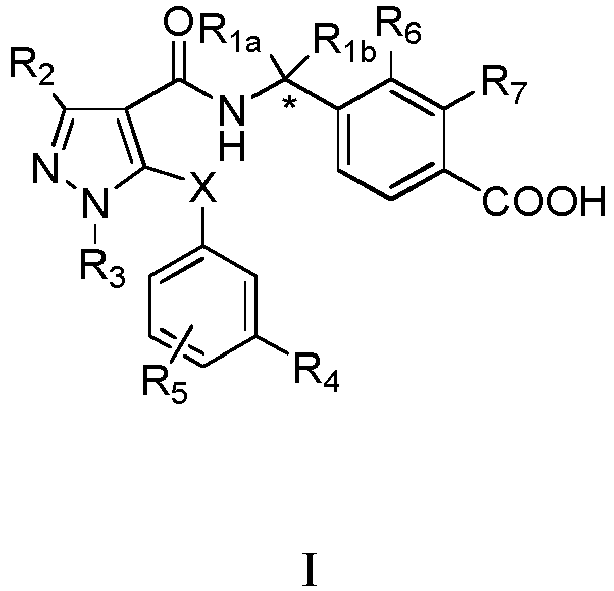
- one of R1a and R1b is hydrogen, and the other is methyl; or R1a and R1b are taken together to form a cyclopropyl ring;
- R2 is methyl or fluoromethyl (e.g., monofluoromethyl, difluoromethyl, trifluoromethyl);
- R3 is methyl;
- R4 is hydrogen, halo, fluoromethyl, methyl, methoxy, or fluoromethoxy (e.g., monofluoromethoxy, difluoromethoxy, trifluoromethoxy);
- R5 is hydrogen, halo, fluoromethyl, methyl, methoxy, or fluoromethoxy;
- R6 is hydrogen, halo, methyl, or methoxy;
- R7 is hydrogen, halo, methyl, or methoxy; and
- X is oxygen;
- In some embodiments, one of R1a and R1b is hydrogen, and the other is methyl; R2 is methyl, difluoromethyl, or trifluoromethyl; R3 is methyl; R4 is chloro, fluoro, trifluoromethyl, difluoromethyl, methyl, methoxy, difluoromethoxy, or trifluoromethoxy; and R5 is hydrogen, chloro, fluoro, methyl, or methoxy.
- In some embodiments, R5 is hydrogen.
- In some embodiments, R6 and R7 are both hydrogen.
- In some embodiments, one of R1a and R1b is hydrogen, and the other is methyl, and R4 is selected from chloro, trifluoromethyl, difluoromethyl, difluoromethoxy, and trifluoromethoxy.
- In some embodiments, R1a and R1b are taken together to form a cyclopropyl ring; R2 is methyl, trifluoromethyl, or difluoromethyl; R3 is methyl; and R4 is trifluoromethyl, difluoromethyl, chloro, or fluoro.
- In some embodiments, one of R1a and R1b is hydrogen, and the other is methyl,, and the compound of Formula I consists of a mixture of stereoisomers. In some embodiments, one of R1a and R1b is hydrogen, and the other is methyl,,, and the compound of Formula I consists of a substantially pure stereoisomer. In some embodiments, one of R1a and R1b is hydrogen, and the other is methyl, and the carbon of Formula I marked with a * has substantially the S-configuration. In some embodiments, one of R1a and R1b is hydrogen, and the other is methyl,, and the carbon of Formula I marked with a * has substantially the R-configuration.
- Active compounds of the present invention can be combined with a pharmaceutically acceptable carrier to provide pharmaceutical formulations thereof. The particular choice of carrier and formulation will depend upon the particular route of administration for which the composition is intended.
- The compositions of the present invention may be suitable for oral, parenteral, inhalation spray, topical, rectal, nasal, buccal, vaginal or implanted reservoir administration, etc. Preferably, the compositions are administered orally, intraperitoneally or intravenously. Sterile injectable forms of the compositions of this invention may be aqueous or oleaginous suspension. These suspensions may be formulated according to techniques known in the art using suitable dispersing or wetting agents and suspending agents. The sterile injectable preparation may also be a sterile injectable solution or suspension in a nontoxic parenterally acceptable diluent or solvent, for example as a solution in 1,3-butanediol. Among the acceptable vehicles and solvents that may be employed are water, Ringer's solution and isotonic sodium chloride solution. In addition, sterile, fixed oils are conventionally employed as a solvent or suspending medium.
- For this purpose, any bland fixed oil may be employed including synthetic mono- or di-glycerides. Fatty acids, such as oleic acid and its glyceride derivatives are useful in the preparation of injectables, as are natural pharmaceutically acceptable oils, such as olive oil or castor oil, especially in their polyoxyethylated versions. These oil solutions or suspensions may also contain a long-chain alcohol diluent or dispersant, such as carboxymethyl cellulose or similar dispersing agents that are commonly used in the formulation of pharmaceutically acceptable dosage forms including emulsions and suspensions. Other commonly used surfactants, such as Tweens, Spans and other emulsifying agents or bioavailability enhancers which are commonly used in the manufacture of pharmaceutically acceptable solid, liquid, or other dosage forms may also be used for the purposes of formulation.
- The pharmaceutically acceptable compositions of this invention may be orally administered in any orally acceptable dosage form including, but not limited to, capsules, tablets, aqueous suspensions or solutions. In the case of tablets for oral use, carriers commonly used include lactose and corn starch. Lubricating agents, such as magnesium stearate, are also typically added. For oral administration in a capsule form, useful diluents include lactose and dried cornstarch. When aqueous suspensions are required for oral use, the active ingredient is combined with emulsifying and suspending agents. If desired, certain sweetening, flavoring or coloring agents may also be added.
- Alternatively, the pharmaceutically acceptable compositions of this invention may be administered in the form of suppositories for rectal administration. These can be prepared by mixing the agent with a suitable non-irritating excipient that is solid at room temperature but liquid at rectal temperature and therefore will melt in the rectum to release the drug. Such materials include cocoa butter, beeswax and polyethylene glycols.
- The pharmaceutically acceptable compositions of this invention may also be administered topically, especially when the target of treatment includes areas or organs readily accessible by topical application, including diseases of the eye, the skin, or the lower intestinal tract. Suitable topical formulations are readily prepared for each of these areas or organs.
- Topical application for the lower intestinal tract can be effected in a rectal suppository formulation (see above) or in a suitable enema formulation. Topically transdermal patches may also be used.
- For topical applications, the pharmaceutically acceptable compositions may be formulated in a suitable ointment containing the active component suspended or dissolved in one or more carriers. Carriers for topical administration of the compounds of this invention include, but are not limited to, mineral oil, liquid petrolatum, white petrolatum, propylene glycol, polyoxyethylene, polyoxypropylene compound, emulsifying wax and water. Alternatively, the pharmaceutically acceptable compositions can be formulated in a suitable lotion or cream containing the active components suspended or dissolved in one or more pharmaceutically acceptable carriers. Suitable carriers include, but are not limited to, mineral oil, sorbitan monostearate, polysorbate 60, cetyl esters wax, cetearyl alcohol, 2 octyldodecanol, benzyl alcohol and water.
- For ophthalmic use, the pharmaceutically acceptable compositions may be formulated as micronized suspensions in isotonic, pH adjusted sterile saline, or, preferably, as solutions in isotonic, pH adjusted sterile saline, either with or without a preservative such as benzylalkonium chloride. Alternatively, for ophthalmic uses, the pharmaceutically acceptable compositions may be formulated in an ointment such as petrolatum.
- The pharmaceutically acceptable compositions of this invention may also be administered by nasal aerosol or inhalation. Such compositions are prepared according to techniques well-known in the art of pharmaceutical formulation and may be prepared as solutions in saline, employing benzyl alcohol or other suitable preservatives, absorption promoters to enhance bioavailability, fluorocarbons, and/or other conventional solubilizing or dispersing agents.
- Most preferably, the pharmaceutically acceptable compositions of this invention are formulated for oral administration.
- Prostaglandins have been shown to modulate various phases of the immune response. The lipid mediator prostaglandin E2 (PGE2) is an eicasanoid that is well known to suppress CD4+ T cell activation through elevation of intracellular cAMP and inactivation of Ick. PGE2 has been also shown to play a role in regulating Th1 responses by suppression of interferon gamma (IFN-gamma) production and T cell proliferation. However PGE2 stimulation via the EP4 subtype of PGE2 receptor can also have the opposite effect, namely to promote Th1 differentiation (Prostaglandin E receptor subtypes EP2 and EP4 promote differentiation and expansion of Th1 and Th17 lymphocytes through different signaling modules, Nature Medicine, 2009, in press) and IL-17 production in activated CD4+ cells (Prostaglandin E2 synergistically with interleukin-23 favors human Th17 expansion, Blood, 2008, 112, 3696-3703, Prostaglandin E2 regulates Th17 cell differentiation and function through cyclic AMP and EP2/EP4 receptor signaling, J. Exp. Med. 2009, 206, 535-548, Prostaglandin E2 enhances Th17 response via modulation of IL-17 and IFN-γ production by memory CD4+ T cells, Eur. J. Immunol. 2009, 39, 1301-1312). Consistent with this, antagonism of EP4 with either a novel selective EP4 antagonist or a PGE2-neutralizing antibody suppresses Th1 differentiation, Th17 expansion, as well as IL-23 secretion by activated dendritic cells. Induction of Th1 differentiation by PGE2 is mediated by PI3K signaling whereas stimulation of IL-17 production requires cAMP signaling. In addition, administration of an EP4 antagonist to DBA/1 or C57BL/6 mice suppressed innate and adaptive immune responses, and suppressed disease in collagen induced arthritis (CIA) and experimental autoimmune encephalomyelitis (EAE) models, indicating that PGE2/EP4 signaling is critically involved in these autoimmune pathologies. These results suggest that suppression of PGE2/EP4 signaling may have therapeutic value in modifying inflammatory autoimmune diseases such as rheumatoid arthritis and multiple sclerosis.
- Active compounds of the present invention may be administered to patients or subjects to treat a variety of different condition, particularly patients or subjects afflicted with:
- (a) rheumatoid arthritis (see, e.g., Targeting rheumatoid arthritis and joint inflammation in the mouse, J. Clin. Invest. 2002, 110, 651-658) ; Prostaglandin E2 exacerbates collagen-induced arthritis in mice through the inflammatory interleukin-23/interleukin-17 axis, Arthritis Rheum. 2007. 56:2608-2619);
- (b) multiple sclerosis (see, e.g., Narumiya, S. In The Prostanoid Receptors in Signaling Network of Claronic Inflammation - The Role of FP in Bleomycin-induced Pulmomary Fibrosis and The Role of EP4 in Experimental Autoimmune Encephalomyelitis in Mice, Eicosanoids and Chronic Inflammation, Montana, February, 2008), Keystone Symposia, Montana, February, 2008; Prostaglandin E receptor subtypes EP2 and EP4 promote differentiation and expansion of Th1 and Th17 lymphocytes through different signaling modules, Nature Medicine, 2009, in press);
- (c) systemic lupus erythematosus (see, e.g., T-bet regulates IgG class switching and pathogenic auto Ab production, Proc. Natl. Acad. Sci. USA 2002, 99, 5545-50; Imbalance of Th1/Th2 transcription factors in patients with lupus nephritis, Rheumatology (Oxford) 2006, 45, 951-7);
- (d)
type 1 diabetes (see, e.g., Identification of a ; T-bet controls auto aggressive CD8 lymphocyte response in type I diabetes, J. Exp. Med. 2004, 199, 1153-62); - (e) psoriasis (see, e.g., A molecule solves psoriasis? Systemic therapies for ); The IL-23/Th17 axis in the immunopathogenesis of psoriasis, J Invest Dermatol 2009, doi:10.1038/jid.2009.59;
- (f) atherosclerosis (see, e.g., T-bet deficiency reduces athersclerosis and alters plaque antigen-specific immune responses, Proc. Natl. Acad. Sci. USA 2005, 102, 1596-601);
- (g) Crohn's disease (see, e.g., IL-23/IL-17 immunity as a hallmark of Crohn's disease, Inflamm Bowl Dis. 2009, 14, 1175-1184, The proinflammatory effect of prostaglandin E2 in experimental inflammatory bowel disease is mediated through the IL-2,3-IL-17 axis, J. Immunol. 2007, 178, 8138-8147);
- h) inflammatory pain (see, e.g., Prostaglandin E2 receptor EP4 contributes to inflammatory pain hypersensitivity, J. Pharmacol. Exp. Ther. 2006, 319, 1096-1103);
- (i) neuropathic pain (see, e.g., Localisation and modulation of prostanoid receptors EP1 and EP4 in the rat chronic constriction injury model of neuropathic pain, Eur. J. Pain 2007, 11, 605-613);
- (j) migraine-associated pain (see, e.g., BGC20-1531, a novel, potent, and selective EP4 receptor antagonist: a putative new treatment for migraine headache, Br. J. Pharmacol. 2009, 156, 316-327).
- (k) Spondyloarthropathies (see, e.g.,Nonsteroidal Antiinflammatory Drugs reduce radiographic progression in patients withankylosing spondylitis, Arthritis Rhuem. 2005, 52, 1756-1765; Efficacy of celecoxib, a cyclooxygenase 2-specific inhibitor, in the treatment of ankylosing spondylitis: a six-week controlled study with comparison against placebo and against a conventional nonsteroidal antiinflammatory drug. Arthritis Rheum. 2001, 44, 180-185, Increased numbers of circulating polyfunctional Th17 memory cells in patients with seronegative spondylarthritides, Arthritis Rheum, 2008, 58, 2307-2317,);
- (/) Skin cancer (see, e.g., Chemoprevention of nonmelanoma skin cancer with Celecoxib: A randomized, double-blind, placebo-controlled trial, J Natl Cancer Inst, 2010, 102, 1-10);
- (m) Breast cancer (see, e.g., Potential new drug targets against hormone-dependent breast cancer identified, Exp. Rev. Anticancer Ther. 2008, 8, 507-509; Antagonism of the prostaglandin E receptor EP4 inhibits metastasis and enhances NK function, Breast Cancer Res. Treat. 2009, 117, 235-242; Prostaglandin E receptor EP4 antagonism inhibits breast cancer metastasis, Cancer Res. 2006, 66, 2923-2927);
- (n) Colorectal cancer (see, e.g., Increased EP4 receptor expression in colorectal cancer progession promotes cell growth and anchorage independence, Cancer Res. 2006, 66, 3106-3113);
- (o) Prostate cancer (see, e.g., Identification of EP4 as a potential target for the treatment of castration-resistant prostate cancer using a novel xenograft model, Cancer Res. 2010, 70, 1606-1615).
- (p)Kidney cancer (see, e.g., Prostaglandin E2 regulates renal cell carcinoma invasion through a EP4-Rap signal transduction pathway, J. Bio. Chem. Aug. 10, 2011 (epub)).
- (q) Cervical cancer (see, e.g., COX-2 expression is correlated with VEGF-C, lymphangiogenesis and lymph node metastasis in human cervical cancer, Microvasc Res. 2011, 82,131-40}.
- (r) Ovarian cancer (see, e.g.,Ovarian epithelial cancer: a role for PGE2 synthesis and signaling in malignant transformation and progression, Mol Cancer, 2006, 5, 62.)
- (s) Endometrial cancer (see, e.g., Prostaglandin E2 induces proliferation of Glandular epithelial cells of human endometrium via extracellular ).
- (t) Glioblastoma (see, e.g. Microsomal prostaglandin E synthase-1 regulates human glioma cell growth via prostaglandin E2-dependent activation of type II protein kinase A.Mol. Cancer Ther. 2006, 5, 1817-1826).
- (u) Head and neck cancer (see, e.g. Expression of prostaglandin E2 receptors in oral squamous cell carcinomas and growth inhibitory effects of a selective EP3 antagonist, ONO-AE3-240. Int. J. Oncology 2009, 34, 847-852).
- (v) Medulloblastoma (see, e.g. Tumor-growth-promoting cyclooxygenase-2 prostaglandin E2 pathway provides medulloblastoma therapeutic targets. Neuro-Oncol. 2008, 661-674).
- (w) Lung cancer (see, e.g. Tumor cyclooxygenase-2/prostaglandin E2-dependent promotion of FOXP3 expression and CD4+CD25+ T regulatory cell activities in lung cancer. Cancer Res. 2005, 65, 5211 - 5220).
- (x) Urinary tract cancers (see, e.g. Pathological function of prostaglandin E2 receptors in transitional cell carcinoma of the upper urinary tract. Virchows Archiv. 2006, 448, 822 - 829).
- In addition, PGE2 has been implicated as an important consituent in the immunosuppressive environment created by many solid tumors: Inhibiting the inhibitors: evaluating agents targeting cancer immunosuppression. Expert Opinion in Biological Therapy. 2010. 10, 1019-35.EP4 receptor antagonism has been shown to reduce tumor metastasis: Host and direct antitumor effects and profound reduction in tumor metastasis with selective EP4 receptor antagonism. Cancer Res. 2006, 66, 9665 -9672.
- Active compounds may be administered to subjects by any suitable route, including orally, parenterally, by inhalation spray, topically, rectally, nasally, buccally, vaginally or via an implanted reservoir. The term "parenteral" as used herein includes subcutaneous, intravenous, intramuscular, intra-articular, intra-synovial, intrasternal, intrathecal, intrahepatic, intralesional and intracranial injection or infusion techniques. Preferably, the compositions are administered orally, intraperitoneally or intravenously.
- The active compounds are administered to the subjects in a treatment effective, or therapeutically effective, amount. The amount of the compounds of the present invention that may be combined with the carrier materials to produce a composition in a single dosage form will vary depending upon the host treated, and the particular route of administration. Preferably, the compositions should be formulated so that a dosage of between 0.01 - 100 mg/kg body weight/day of the inhibitor can be administered to a patient receiving these compositions. In certain embodiments, the compositions of the present invention provide a dosage of between 0.01 mg and 50 mg is provided. In other embodiments, a dosage of between 0.1 and 25 mg or between 5 mg and 40 mg is provided.
- It should also be understood that a specific dosage and treatment regimen for any particular patient will depend upon a variety of factors, including the activity of the specific compound employed, the age, body weight, general health, sex, diet, time of administration, rate of excretion, drug combination, and the judgment of the treating physician and the severity of the particular disease being treated. The amount of a compound of the present invention in the composition will also depend upon the particular compound in the composition.
- In order that the invention described herein may be more fully understood, the following examples are set forth. It should be understood that these examples are for illustrative purposes only and are not to be construed as limiting this invention in any manner.
- Microwave heating was done using Biotage Emrys Liberator or Initiator microwave. Column chromatography was carried out using Biotage SP4. Solvent removal was carried out using either a Büchii rotary evaporator or a Genevac centrifugal evaporator. Preparative LC/MS was conducted using a Waters autopurifier and 19 x 100mm
XTerra 5 micron MS C18 column under acidic mobile phase condition. NMR spectra were recorded using Varian 400MHz spectrometer. - When the term "inerted" is used to describe a reactor (e.g., a reaction vessel, flask, glass reactor, and the like) it is meant that the air in the reactor has been replaced with an essentially moisture-free or dry, inert gas (such as nitrogen, argon, and the like).
- General methods and experimentals for preparing compounds of the present invention are set forth below. In certain cases, a particular compound is described by way of example. However, it will be appreciated that in each case a series of compounds of the present invention were prepared in accordance with the schemes and experimentals described below.
- The following abbreviations are used herein:
- The following abbreviations have the indicated meanings:
- HATU: N,N,N',N'-Tetramethyl-O-(7-azabenzotriazol-1-yl)uronium
- Hexafluorophosphate
- COMU: (1-Cyano-2-ethoxy-2-oxoethylidenaminooxy)dimethylamino-morpholino-carbenium hexafluorophosphate
- DPCI: N,N'-Diisopropylcarbodiimide
- DIEA: N,N-diisopropylethylamine
- TEA: triethylamine
- DMAP: 4-Dimethylaminopyridine
- DMF: N,N-dimethylformamide
- NMP: N-methylpyrrolidine
- THF: tetrahydrofuran
- DCM: dichloromethane
- TFA: trifluoroacetic acid
- The following compounds are commercially available:
- 5-chloro-1,3-dimethyl-1H-pyrazole-4-carbaldehyde (Maybridge Chemical Co., Ltd.)
- 5-chloro-1-methyl-3-(trifluoromethyl)-1H-pyrazole-4-carbaldehyde (Maybridge Chemical Co., Ltd.)
- 5-(3-chlorophenoxy)-1-methyl-3-(trifluoromethyl)-1H-pyrazole-4-carboxylic acid (Bionet Research)
- 1,3-dimethyl-5-(3-(trifluoromethyl)phenoxy)-1H-pyrazole-4-carboxylic acid (Bionet Research)
- 1-methyl-3-(trifluoromethyl)-5-(3-(trifluoromethyl)phenoxy)-1H-pyrazole-4 carboxylic acid (Bionet Research)
- 5-(4-chlorophenoxy)-1,3-dimethyl-1H-pyrazole-4-carboxylic acid (Bionet Research)
Ethyl 4,4-difluoroacetoacetate (Matrix Scientific) - (S)-methyl 4-(1-aminoethyl)benzoate hydrochloride (NetChem, Inc) 4-(1-aminocyclopropyl)benzoic acid (Allweys LLC)
- All phenols except for 3-difluoromethylphenol were commercially available.
- Compounds of the invention were made according to the general synthetic scheme shown in Scheme I:

- Preparation of representative non-limiting examples of the compounds of the invention are described below.
-

-
Ethyl 4,4-difluoroacetoacetate (30.12 g, 0.172 mol) was stirred in toluene (600 mL) over ice water. Solution of N-methylhydrazine (7.6 mL, 0.14 mol) in toluene (200 mL) was added slowly, dropwise over 20min. The reaction mixture was heated at 100 °C for 2 hours. The reaction mixture evaporated to dryness. The resulting material was triturated with methyl t-butylether/heptane to give 3-(difluoromethyl)-1-methyl-1H-pyrazol-5(4H)-one in three batches (total 10.7 g, 51%) as orange powder. This material was used without further purification for the next reaction. -

- DMF (9.5 mL, 0.12 mol) was stirred over ice bath and phosphoryl chloride (24.0 mL, 0.257 mol) was added dropwise. To the solution was added 3-(difluoromethyl)-1-methyl-1H-pyrazol-5(4H)-one (5.51 g, 0.0372 mol) portion wise and the mixture was heated at 120 °C for 40 minutes. The reaction mixture was cooled, and the phosphoryl chloride was quenched by adding small chunks of ice slowly with stirring. The mixture was then extracted with ethyl acetate three times and combined organic layer was washed with water and brine, dried over MgSO4 and evaporated to give 5-chloro-3-(difluoromethyl)-1-methyl-1H-pyrazole-4-carbaldehyde (5.66 g, 78.2%) as a dark orange/brown solid. This material was used without further purification for the next reaction.
- Preparation procedure for 3-difluoromethylphenol.
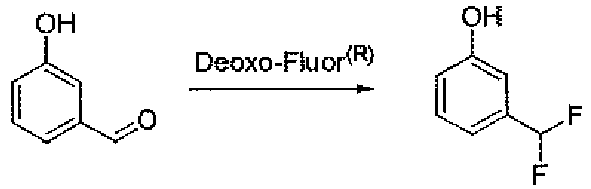
- To a solution of 3-hydroxybenzaldehyde (1.01g, 0.0083 mol) in methylene chloride (3.3 mL) was added a solution of bis(2-methoxyethyl)aminosulfur trifluoride (3.09 g, 0.0140 mol) in methylene chloride (3.3 mL) followed by ethanol (95.0 µL, 0.00163 mol). The reaction mixture was stirred at room temperature for 12 hours. The mixture was then quenched carefully adding saturated aqueous sodium bicarbonate solution. The organic layer separated, washed with brine, dried over MgSO4, and evaporated to give yellow oil. This oil was purified by column chromatography (0% to 50% ethyl acetate/heptane) to give the title compound (649 mg, 57%) as colorless oil.
-

- 5-chloro-1,3-dimethyl-1H-pyrazole-4-carbaldehyde (500.0 mg, 0.00315 mol), 3,4-dichlorophenol (565 mg, 0.00344 mol) and potassium hydroxide (265 mg, 0.00472 mol) were stirred in DMF (2.0 mL). Mixture was heated at 150 °C for 20min using microwave. Water was added and resulting mixture was extracted with ethyl acetate. Organic layer was washed with brine twice, dried over MgSO4 and evaporated. The resulting oil was purified by column chromatography (10% to 20% ethyl acetate/heptane) to give 5-(3,4-dichlorophenoxy)-1,3-dimethyl-1H-pyrazole-4-carbaldehyde (492 mg, 54.7%) as white solid.
-

- 5-(3,4-dichlorophenoxy)-1,3-dimethyl-1H-pyrazole-4-carbaldehyde from Step 1 (492 mg, 0.001726 mol) and 2-methyl-2-butene (300 µL, 0.002832 mol) were stirred in tert-butyl alcohol (2.0 mL). A solution of sodium chlorite (400 mg, 0.003538 mol) and sodium dihydrogenphosphate (450 mg, 0.003751 mol) in water (3.0 mL) was added and reaction mixture was stirred for 12 hours at room temperature. Solvent was evaporated and resulting residue was dissolved in ethyl acetate. The organic layer was washed with water, dried over MgSO4 and evaporated to give the title compound (340 mg, 65.5%) as white solid. This material was used in the next step without further purification.
- The title compound was prepared using 5-chloro-1,3-dimethyl-1H-pyrazole-4-carbaldehyde and 3-fluorophenol in the manner similar to the method in Production Example 1 above.
- The title compound was prepared using 5-chloro-1,3-dimethyl-1H-pyrazole-4-carbaldehyde and 3,5-difluorophenol in the manner similar to the method in Production Example 1 above.
- The title compound was prepared using 5-chloro-1,3-dimethyl-1H-pyrazole-4-carbaldehyde and 2,3-difluorophenol in the manner similar to the method in Production Example 1 above.
- The title compound was prepared using 5-chloro-1,3-dimethyl-1H-pyrazole-4-carbaldehyde and 2,5-difluorophenol in the manner similar to the method in Production Example 1 above.
- The title compound was prepared using 5-chloro-1,3-dimethyl-1H-pyrazole-4-carbaldehyde and 3,5-dichlorophenol in the manner similar to the method in Production Example 1 above.
- The title compound was prepared using 5-chloro-1,3-dimethyl-1H-pyrazole-4-carbaldehyde and 3-chlorophenol in the manner similar to the method in Production Example 1 above.
- The title compound was prepared using 5-chloro-1,3-dimethyl-1H-pyrazole-4-carbaldehyde and 2,3-dichlorophenol in the manner similar to the method in Production Example 1 above.
- The title compound was prepared using 5-chloro-1,3-dimethyl-1H-pyrazole-4-carbaldehyde and 3-chloro-5-fluorophenol in the manner similar to the method in Production Example 1 above.
- The title compound was prepared using 5-chloro-1,3-dimethyl-1H-pyrazole-4-carbaldehyde and 2-chloro-5-fluorophenol in the manner similar to the method in Production Example 1 above.
- The title compound was prepared using 5-chloro-1,3-dimethyl-1H-pyrazole-4-carbaldehyde and m-cresol in the manner similar to the method in Production Example 1 above.
- The title compound was prepared using 5-chloro-1,3-dimethyl-1H-pyrazole-4-carbaldehyde and 3,5-dimethylphenol in the manner similar to the method in Production Example 1 above.
- The title compound was prepared using 5-chloro-1,3-dimethyl-1H-pyrazole-4-carbaldehyde and 3,5-dimethoxyphenol in the manner similar to the method in Production Example 1 above.
- The title compound was prepared using 5-chloro-3-(difluoromethyl)-1-methyl-1H-pyrazole-4-carbaldehyde and 3-chlorophenol in the manner similar to the method in Production Example 1 above except potassium carbonate was used instead of potassium hydroxide.
- The title compound was prepared using 5-chloro-3-(difluoromethyl)-1-methyl-1H-pyrazole-4-carbaldehyde and 3-trifluoromethylphenol in the manner similar to the method in Production Example 1 above except potassium carbonate was used instead of potassium hydroxide.
- The title compound was prepared using 5-chloro-1,3-dimethyl-1H-pyrazole-4-carbaldehyde and 3-trifluoromethoxylphenol in the manner similar to the method in Production Example 1 above.
- The title compound was prepared using 5-chloro-1-methyl-3-(trifluoromethyl)-1H-pyrazole-4-carbaldehyde and 3-fluorophenol in the manner similar to the method in Production Example 1 above except potassium carbonate was used instead of potassium hydroxide.
- The title compound was prepared using 5-chioro-1-methyl-3-(trifluoromethyl)-1H-pyrazole-4-carbaldehyde and 3,4-difluorophenol in the manner similar to the method in Production Example 1 above except potassium carbonate was used instead of potassium hydroxide.
- The title compound was prepared using 5-chloro-1-methyl-3-(triftuoromethyl)-1H-pyrazole-4-carbaldehyde and 3,4-dichlorophenol in the manner similar to the method in Production Example 1 above except potassium carbonate was used instead of potassium hydroxide.
- The title compound was prepared using 5-chloro-1,3-dimetbyl-1H-pyrazole-4-carbaldehyde and 3-difluoromethoxyphenol in the manner similar to the method in Production Example 1 above.
- The title compound was prepared using 5-chloro-1-methyl-3-(trifluoromethyl)-1H-pyrazole-4-carbaldehyde and 3-difluoromethoxyphenol in the manner similar to the method in Production Example 1 above except potassium carbonate was used instead of potassium hydroxide.
- The title compound was prepared using 5-chloro-3-(difluoromethyl)-1-methyl-1H-pyrazole-4-carbaldehyde and 3-difluoromethoxyphenol in the manner similar to the method in Production Example 1 above except potassium carbonate was used instead of potassium hydroxide.
- The title compound was prepared using 5-chloro-3-(difluoromethyl)-1-methyl-1H-pyrazole-4-carbaldehyde and 3-difluoromethylphenol in the manner similar to the method in Production Example 1 above except potassium carbonate was used instead of potassium hydroxide.
- The title compound was prepared using 5-chloro-1,3-dimethyl-1H-pyrazole-4-carbaldehyde and 3-difluoromethylphenol in the manner similar to the method in Production Example 1 above.
- The title compound was prepared using 5-chloro-1-methyl-3-(trifluoromethyl)-1H-pyrazole-4-carbaldehyde and 3-difluoromethylphenol in the manner similar to the method in Production Example 1 above except potassium carbonate was used instead of potassium hydroxide.
- The title compound was prepared using 5-chloro-3-(difluoromethyl)-1-methyl-1H-pyrazole-4-carbaldehyde and 3,4-dichlorophenol in the manner similar to the method in Production Example 1 above except potassium carbonate was used instead of potassium hydroxide.
- The title compound was prepared using 5-chloro-1,3-dimethyl-1H-pyrazole-4-carbaldehyde and 4-fluorophenol in the manner similar to the method in Production Example 1 above.
- The title compound was prepared using 5-chloro-1,3-dimethyl-1H-pyrazole-4-carbaldehyde and 4-(trifluoromethyl)phenol in the manner similar to the method in Production Example 1 above except cesium carbonate was used instead of potassium hydroxide.
- The title compound was prepared using 5-chloro-1,3-dimethyl-1H-pyrazole-4-carbaldehyde and 2-chloro-4-fluorophenol in the manner similar to the method in Production Example 1.
- The title compound was prepared using 5-chloro-1,3-dimethyl-1H-pyrazole-4-carbaldehyde and p-cresol in the manner similar to the method in Production Example 1 above.
- The title compound was prepared using 5-chloro-1-methyl-3-(trifluoromethyl)-1H-pyrazole-4-carbaldehyde and 4-(trifluoromethyl)phenol in the manner similar to the method in Production Example 1 above except potassium carbonate was used instead of potassium hydroxide.
- The title compound was prepared using 5-chloro-3-(difluoromethyl)-1-methyl-1H-pyrazole-4-carbaldehyde and 4-(trifluoromethyl)phenol in the manner similar to the method in Production Example 1 above except potassium carbonate was used instead of potassium hydroxide.
- The title compound was prepared using 5-chloro-1-methyl-3-(trifluoromethyl)-1H-pyrazole-4-carbaldehyde and 4-chlorophenol in the manner similar to the method in Production Example 1 above except potassium carbonate was used instead of potassium hydroxide.
- The title compound was prepared using 5-chloro-3-(difluoromethyl)-1-methyl-1H-pyrazole-4-carbaldehyde and 4-chlorophenol in the manner similar to the method in Production Example 1 above except potassium carbonate was used instead of potassium hydroxide.
-

- 5-(3-chlorophenoxy)-1-methyl-3-(trifluoromethyl)-1H-pyrazole-4-carboxylic acid (50 mg, 0.0002 mol), HATU (65 mg, 0.00017 mol) and DIEA (30 µL, 0.00017 mol) were stirred in DMF (1.0 mL) for 20min at rt. Solution of (S)-methyl 4-(1-aminoethyl)benzoate hydrochloride (40 mg, 0.00019 mol) and DIEA (32 µL, 0.00019 mol) in DMF (1.0 mL) was added dropwise and the reaction mixture was stirred at room temperature for 12hours. Water was added and the resulting precipitate was collected, washed with water and dried under vacuum to give 59.2 mg of the methyl ester as white solid.
- This methyl ester was dissolved in methanol (1.0 mL) and THF (1.0 mL). 2.0 M lithium hydroxide solution (240 µL) was added and the mixture was stirred at room temperature for 12hours. The reaction mixture was neutralized with 1N hydrochloric acid solution (480 ul) and resulting emulsion was extracted with ethylacetate. The org. layer was separated and evaporated. The resulting material was dissolved in 3 mL of methanol and was purified by LC/MS (0.1% TFA acetonitrile/water mobile phase). The desired fractions were evaporated by Genevac to give the titled compound (27 mg, two steps 46%).
- Example 2 was prepared using 1,3-dimethyl-5-(3-(trifluoromethyl)phenoxy)-1H-pyrazole-4-carboxylic acid and (S)-methyl 4-(1-aminoethyl)benzoate hydrochloride in a manner similar to the Example 1 above.
- Example 3 was prepared using 1-methyl-3-(triftuoromethyl)-5-(3-(trifluoromethyl)phenoxy)-1H-pyrazole-4-carboxylic acid and (S)-methyl 4-(1-aminoethyl)benzoate hydrochloride in a manner similar to the Example 1 above.
- Example 4 was prepared using 5-(3,4-dichlorophenoxy)-1,3-dimethyl-1H-pyrazole-4-carboxylic acid and (S)-methyl 4-(1-aminoethyl)benzoate hydrochloride in a manner similar to the Example 1 above except hydrolysis was carried out in THF and 1,4-dioxane at 140°C for 10min using microwave and product was obtained as a solid after neutralization.
- Example 5 was prepared using 5-(3-fluorophenoxy)-1,3-dimethyl-1H-pyrazole-4-carboxylic acid and (S)-methyl 4-(1-aminoethyl)benzoate hydrochloride in a manner similar to the Example 4 above.
- Example 6 was prepared using 5-(3,4-difluorophenoxy)-1,3-dimethyl-1H-pyrazole-4-carboxylic acid and (S)-methyl 4-(1-aminoethyl)benzoate hydrochloride in a manner similar to the Example 4 above.
- Example 7 was prepared using 5-(2,3-difluorophenoxy)-1,3-dimethyl-1H-pyrazole-4-carboxylic acid and (S)-methyl 4-(1-aminoethyl)benzoate hydrochloride in a manner similar to the Example 4 above.
-
Compound 8 was prepared using 5-(2,5-difluorophenoxy)-1,3-dimethyl-1H-pyrazole-4-carboxylic acid and (S)-methyl 4-(1-aminoethyl)benzoate hydrochloride in a manner similar to the Example 4 above. - Example 9 was prepared using 5-(3,5-dichlorophenoxy)-1,3-dimethyl-1H-pyrazole-4-carboxylic acid and (S)-methyl 4-(1-aminoethyl)benzoate hydrochloride in a manner similar to the Example 4 above.
- Example 13 was prepared using 5-(3-chlorophenoxy)-1,3-dimethyl-1H-pyrazole-4-carboxylic acid and (S)-methyl 4-(1-aminoethyl)benzoate hydrochloride in a manner similar to the Example 4 above.
- Example 14 was prepared using 5-(2,3-dichlorophenoxy)-1,3-dimethyl-1H-pyrazole-4-carboxylic acid and (S)-methyl 4-(1-aminoethyl)benzoate hydrochloride in a manner similar to the Example 4 above. Example 15 (ER-886024). Example 15 was prepared using 5-(3-chloro-5-fluorophenoxy)-1,3-dimethyl-1H-pyrazole-4-carboxylic acid and (S)-methyl 4-(1-aminoethyl)benzoate hydrochloride in a manner similar to the Example 4 above.
- Compound 16 was prepared using 5-(2-chloro-5-fluorophenoxy)-1,3-dimethyl-1H-pyrazole-4-carboxylic acid and (S)-methyl 4-(1-aminoethyl)benzoate hydrochloride in a manner similar to the Example 4 above.
- Example 17 was prepared using 1,3-dimethyl-5-(m-tolyloxy)-1H-pyrazole-4-carboxylic acid and (S)-methyl 4-(1-aminoethyl)benzoate hydrochloride in a manner similar to the Example 4 above.
- Example 18 was prepared using 5-(3,5-dimethylphenoxy)-1,3-dimethyl-1H-pyrazole-4-carboxylic acid and (S)-methyl 4-(1-aminoethyl)benzoate hydrochloride in a manner similar to the Example 4 above.
- Example 19 was prepared using 5-(3,5-dimethoxyphenoxy)-1,3-dimethyl-1H-pyrazole-4-carboxylic acid and (S)-methyl 4-(1-aminoethyl)benzoate hydrochloride in a manner similar to the Example 4 above.
- Example 20 was prepared using 5-(3-chlorophenoxy)-3-(difluoromethyl)-1-methyl-1H-pyrazole-4-carboxylic acid and (S)-methyl 4-(1-aminoethyl)benzoate hydrochloride in a manner similar to the Example 4 above.
- Example 21 was prepared using 3-(difluoromethyl)-1-methyl-5-(3-(trifluoromethyl)phenoxy)-1H-pyrazole-4-carboxylic acid and (S)-methyl 4-(1-aminoethyl)benzoate hydrochloride in a manner similar to the Example 4 above.
- Example 22 was prepared using 1,3-dimethyl-5-(3-(trifluoromethoxy)phenoxy)-1H-pyrazole-4-carboxylic acid and (S)-methyl 4-(1-aminoethyl)benzoate hydrochloride in a manner similar to the Example 4 above.
- Example 23 was prepared using 5-(3-fluorophenoxy)-1-methyl-3-(trifluoromethyl)-1H-pyrazole-4-carboxylic acid and (S)-methyl 4-(1-aminoethyl)benzoate hydrochloride in a manner similar to the Example 1 above except COMU, TEA and NMP was used instead of HATU, DIEA and DMF, and the product was obtained as solid after neutralization.
- Example 24 was prepared using 5-(3,4-difluorophenoxy)-1-methyl-3-(trifluoromethyl)-1H-pyrazole-4-carboxylic acid and (S)-methyl 4-(1-aminoethyl)benzoate hydrochloride in a manner similar to the Example 23 above.
- Example 25 was prepared using 5-(3,4-dichlorophenoxy)-1-methyl-3-(trifluoromethyl)-1H-pyrazole-4-carboxylic acid and (S)-methyl 4-(1-aminoethyl)benzoate hydrochloride in a manner similar to the Example 23 above.
- Example 26 was prepared using 5-(3-chlorophenoxy)-1,3-dimethyl-1H-pyrazole-4-carboxylic acid and methyl 4-(1-aminocyclopropyl)benzoate hydrochloride in a manner similar to the Example 4 above.
- Example 27 was prepared using 3-(difluoromethyl)-1-methyl-5-(3-(trifluoromethyl)phenoxy)-1H-pyrazole-4-carboxylic acid and methyl 4-(1-aminocyclopropyl)benzoate hydrochloride in a manner similar to the Example 4 above.
- Example 28 was prepared using 5-(3-(difluoromethoxy)phenoxy)-1,3-dimethyl-1H-pyrazole-4-carboxylic acid and (S)-methyl 4-(1-aminoethyl)benzoate hydrochloride in a manner similar to the Example 23 above.
- Example 29 was prepared using 5-(3-(difluoromethoxy)phenoxy)-1-methyl-3-(trifluoromethyl)-1H-pyrazole-4-carboxylic acid and (S)-methyl 4-(1-aminoethyl)benzoate hydrochloride in a manner similar to the Example 23 above.
- Example 30 was prepared using 3-(difluoromethyl)-1-methyl-5-(3-(trifluoromethyl)phenoxy)-1H-pyrazole-4-carboxylic acid and (R)-methyl 4-(1-aminoethyl)benzoate hydrochloride in a manner similar to the Example 4 above.
- Example 31 was prepared using 5-(3-(difluoromethoxy)phenoxy)-3-(difluoromethyl)-1-methyl-1H-pyrazole-4-carboxylic acid and (S)-methyl 4-(1-aminoethyl)benzoate hydrochloride in a manner similar to the Example 23 above.
- Example 32 was prepared using 3-(difluoromethyl)-5-(3-(difluoromethyl)phenaxy)-1-methyl-1H-pyrazole-4-carboxylic acid and (S)-methyl 4-(1-aminoethyl)benzoate hydrochloride in a manner similar to the Example 4 above except product was obtained after LC/MS purification.
- Example 33 was prepared using 5-(3-(difluoromethyl)phenoxy)-1,3-dimethyl-1H-pyrazole-4-carboxylic acid and (S)-methyl 4-(1-aminoethyl)benzoate hydrochloride in a manner similar to the Example 4 above except HBTU, TEA and NMP was used instead of HATU, DIEA and DMF.
- Example 34 was prepared using 5-(3-(difluoromethyl)phenoxy)-1-methyl-3-(trifluoromethyl)-1H-pyrazole-4-carboxylic acid and (S)-methyl 4-(1-aminoethyl)benzoate hydrochloride in a manner similar to the Example 33 above except product was obtained after LC/MS purification.
- Example 35 was prepared using 5-(3,4-dichlorophenoxy)-3-(difluoromethyl)-1-methyl-1H-pyrazole-4-carboxylic acid and (S)-methyl 4-(1-aminoethyl)benzoate hydrochloride in a manner similar to the Example 4 above.
- Example 36 was prepared using 5-(3,4-dichlorophenoxy)-3-(difluoromethyl)-1-methyl-1H-pyrazole-4-carboxylic acid and methyl 4-(1-aminocyclopropyl)benzoate hydrochloride in a manner similar to the Example 4 above.
- Example 37 was prepared using 5-(3-chlorophenoxy)-3-(difluoromethyl)-1-methyl-1H-pyrazole-4-carboxylic acid and methyl 4-(1-aminocyclopropyl)benzoate hydrochloride in a manner similar to the Example 4 above.
- 5-(3,4-dichlorophenoxy)-1-methyl-3-(trifluoromethyl)-1H-pyrazole-4-carboxylic acid (104 mg, 0.0002929 mol), DMAP (17 mg, 0.000139 mol), PS-HOBT (1.00 mmol/g loading; 191 mg, 0.000191 mol), were stirred in 20% DMF in DCM (4:1,DCM:DMF, 5.00 mL). DPCI (140 uL, 0.0008941 mol) was added and the mixture was shaken at 40 °C 12hours. The resin was then washed sequentially with DCM (3 ml), DMF (3 mL), DCM (3 ml), THF (3 ml), and then again with DCM (3 ml), and dried under vacuume. This resin was stirred in 20% DMF in DCM (4:1,DCM:DMF, 5.00 mL) and solution of methyl 4-(1-aminocyclopropyl)benzoate hydrochloride (27 mg, 0.000118 mol) in 20% DMF in DCM (5.00 mL) and DIEA (20 uL, 0.000115 mol) were added. The mixture was shaken at 40 °C for 12hours. The resin was filtered and was washed with DCM. The combined filtrates were concentrated in vacuo to give a DMF solution. The solution was diluted with ethyl acetate washed with water and brine, dried over MgSO4 and evaporated to give a beige solid. The solid was purified by column chromatography (0 to 40%) to give methyl ester (18mg) as a white solid. This methyl ester was dissolved in 1,4-dioxane (1.0 mL). 2.0 M lithium hydroxide solution (200 µL) was added and the mixture was heated at 60°C for 12hours. The reaction mixture was further heated at 140°C for 20min using microwave. The reaction mixture was acidified with 1N hydrochloric acid solution (420 ul) and water was added. The resulting precipitate was collected, washed with water and air dried to give the title compound (15.9mg, two steps 26%) as white solid.
- Example 39 was prepared using 5-(4-chlorophenoxy)-1,3-dimethyl-1H-pyrazole-4-carboxylic acid and (S)-methyl 4-(1-aminoethyl)benzoate hydrochloride in a manner similar to the Example 4 above.
- Example 40 was prepared using 5-(4-fluorophenoxy)-1,3-dimethyl-1H-pyrazole-4-carboxylic acid and (S)-methyl 4-(1-aminoethyl)benzoate hydrochloride in a manner similar to the Example 4 above.
- Example 41 was prepared using 1,3-dimethyl-5-(4-(trifluoromethyl)phenoxy)-1H-pyrazole-4-carboxylic acid and (S)-methyl 4-(1-aminoethyl)benzoate hydrochloride in a manner similar to the Example 4 above.
- Compound 42 was prepared using 5-(2-chloro-4-fluorophenoxy)-1,3-dimethyl-1H-pyrazole-4-carboxylic acid and (S)-methyl 4-(1-aminoethyl)benzoate hydrochloride in a manner similar to the Example 4 above.
- Example 43 was prepared using 1,3-dimethyl-5-(p-tolyloxy)-lH-pyrazole-4-carboxylic acid and (S)-methyl 4-(1-aminoethyl)benzoate hydrochloride in a manner similar to the Example 4 above.
- Example 44 was prepared using 1-methyl-3-(trifluoromethyl)-5-(4-(trifluoromethyl)phenoxy)-1H-pyrazole-4-carboxylic acid and (S)-methyl 4-(1-aminoethyl)benzoate hydrochloride in a manner similar to the Example 38.
- Compound 45 was prepared using 3-(difluoromethyl)-1-methyl-5-(4-(trifluoromethyl)phenoxy)-1H-pyrazole-4-carboxylic acid and (S)-methyl 4-(1-aminoethyl)benzoate hydrochloride in a manner similar to the Example 38 above except hydrolysis was carried out at 60°C for 12 hours.
- Example 46 was prepared using 5-(4-chlorophenoxy)-1-methyl-3-(trifluoromethyl)-lH-pyrazole-4-carboxylic acid and (S)-methyl 4-(1-aminoethyl)benzoate hydrochloride in a manner similar to the Example 38 above except the product was obtained after purification using heptane/ethyl acetate/formic acid as mobile phase.
- Example 47 was prepared using 5-(4-chlorophenoxy)-3-(difluoromethyl)-1-methyl-1H-pyrazole-4-carboxylic acid and (S)-methyl 4-(1-aminoethyl)benzoate hydrochloride in a manner similar to the Example 38 above.
- Example 48 was prepared using 1-methyl-3-(trifluoromethyl)-5-(4-(trifluoromethyl)phenoxy)-1H-pyrazole-4-carboxylic acid and methyl 4-(1-aminocyclopropyl)benzoate hydrochloride in a manner similar to the Example 38 above.
- Example 49 was prepared using 3-(difluoromethyl)-1-methyl-5-(4-(trifluoromethyl)phenoxy)-1H-pyrazole-4-carboxylic acid and methyl 4-(1-aminocyclopropyl)benzoate hydrochloride in a manner similar to the Example 38 above.
- Example 50 was prepared using 5-(4-chlorophenoxy)-1-methyl-3-(trifluoromethyl)-1H-pyrazole-4-carboxylic acid and methyl 4-(1-aminocyclopropyl)benzoate hydrochloride in a manner similar to the Example 38 above.
- Example 51 was prepared using 5-(4-chlorophenoxy)-3-(difluoromethyl)-1-methyl-1H-pyrazole-4-carboxylic acid and methyl 4-(1-aminocyclopropyl)benzoate hydrochloride in a manner similar to the Example 38 above.
-

- 1,3-dimethyl-5-(3-(trifluoromethyl)phenoxy)-1H-pyrazole-4-carboxylic acid (20 mg, 0.00007 mol), HATU (28 mg, 0.000073 mol) and DIEA (13 µL, 0.000073 mol) were stirred in DMF (0.5 mL) for 20min at rt. Solution of 4-(1-aminocyclopropyl)benzoic acid (14 mg, 0.000080 mol) and DIEA (14 µL, 0.000080 mol) in DMF (0.5 mL) was added dropwise and the reaction mixture was stirred at room temperature for 12 hours. The reaction mixture was diluted to 3 mL with methanol and purified by LC/MS (0.1% TFA Acetonitrile/water mobile phase). The desired fractions were evaporated by Genevac to give the title compound (15 mg, 50%).
- Example 11 was prepared using 1-methyl-3-(trifluoromethyl)-5-(3-(trifluoromethyl)phenoxy)-1H-pyrazole-4-carboxylic acid and 4-(1-aminocyclopropyl)benzoic acid in a manner similar to the Example 10 above.
- Example 12 was prepared using 5-(3-chlorophenoxy)-1-methyl-3-(trifluoromethyl)-1H-pyrazole-4-carboxylic acid and 1 4-(1-aminocyclopropyl)benzoic acid in a manner similar to the Example 10 above.
-

- 4-(1-aminocyclopropyl)benzoic acid (1.75 g, 0.00988 mol) was stirred in THF (20 mL) and Methanol (10 mL) over ice/water bath. 2.00 M of trimethylsilyldiazomethane in hexane (9.9 mL, 0.020 mol) was added and the mixture was stirred at room temperature for 12 hours. The reaction mixture was concentrated down to viscous oil which solidified upon standing to give a crystalline solid. Crude material was dried on high vacuum line for 12 hours to give methyl 4-(1-aminocyclopropyl)benzoate (1.65 g, 87%) as pale brown solid.
-

- To a solution of ER-886774-00 (1.63 g, 0.0085 mol) in ethyl acetate (10 mL) was added 2.0 M of hydrogen chloride in Ether (6.0 mL, 0.012 mol). After stirring for several minutes, the reaction mixture was concentrated to give the title compound (quantitative yield) as pale brown solid.
Table 1. Analytical Data for Exemplary Compounds of Formula I Example Structure ER number 1H NMR assignment 1 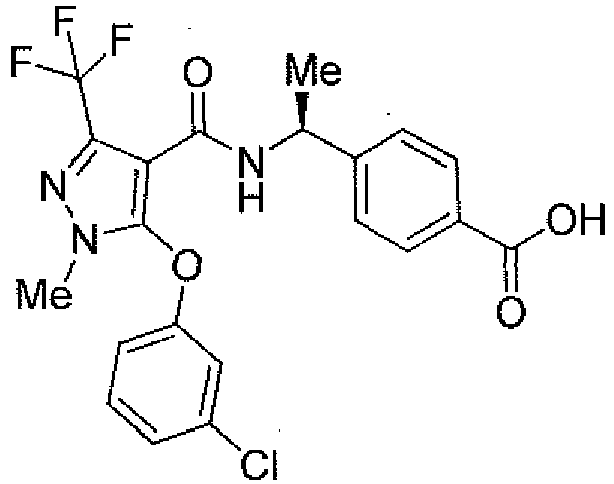
ER-885289-00 1H NMR (400 MHz, CD30D) δ ppm 8.56 (1H, d), 7.87 (2H, m), 7.30 (1H, m), 7.18 (2H, d), 7.08 (1H, t), 6.88 (1H, m), 4.96 (1H, m), 3.78 (3H, s), 1.34 (3H, d) 2 
ER-885290-00 1H NMR (400 MHz, CD3OD) δ ppm 7.88 (1H, d), 7.80 (2H, d), 7.49 (2H, m), 7.30 (1H, br. s.), 7.13 (2H, d), 4.99 (1H, m), 3.64 (3H, s), 2.37 (3H, m), 1.32 (3H, d) 3 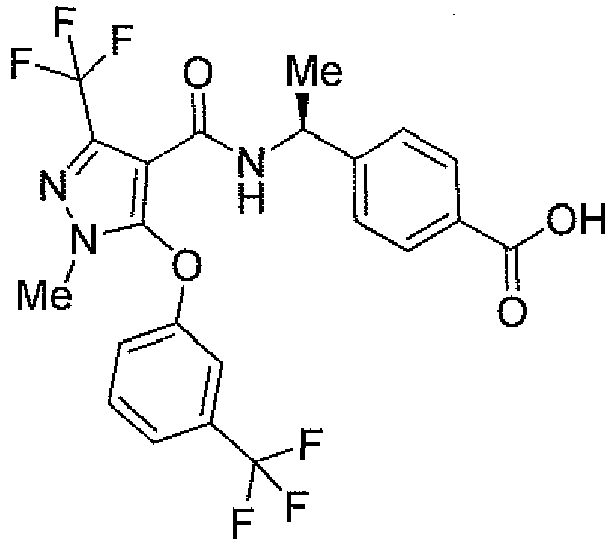
ER-885291-00 1H NMR (400 MHz, CD3OD) δ ppm 8.60 (1H, d), 7.81 (2H, d), 7.51 (2H, m), 7.39 (1H, s), 7.18 (3H, m), 4.92 (1H, m), 3.79 (3H, s), 1.30 (3H, d) 4 
ER-885716-00 1H NMR (400 MHz, CD3OD) δ ppm 7.84 (2H, d), 7.42 (1H, d), 7.15 (2H, d), 7.13 (1H, d), 6.83 (1R, dd), 5.01 (1H, q), 3.62 (3H, s), 2.35 (3H, s), 1.36 (3H, d) 5 
ER-885717-00 1H NMR (400 MHz, CD3OD) δ ppm 7.8 (3H, m), 7.34 (1H, m), 7.14 (2H, d), 6.91 (1H, m), 6.73 (2H, m), 5 (1H, q), 3.61 (3H, s), 2.35 (3H, s), 1.34 (3H, d) 6 
ER-885718-00 1H NMR (400 MHz, CD3OD) δ ppm 7.86 (3H, m), 7.19 (3H, m), 6.92 (1H, m), 6.68 (1H, m), 5.02 (1H, q), 3.61 (3H, s), 2.34 (3H, s), 1.37 (3H, d) 7 
ER-885719-00 1H NMR (400 MHz, CD3OD) δ ppm 8.01 (1H, d), 7.84 (2H, d), 7.19 (2H, d), 7.01 (2H, m), 6.58 (1H, m), 4.99 (1H, q), 3.66 (3H, s), 2.33 (3H, s), 1.37 (3H, d) 8* 
ER-885720-00 1H NMR (400 MHz, CD3OD) δ ppm 8.06 (1H, d), 7.85 (2H, d), 7.22 (3H, m), 6.87 (1H, m), 6.63 (1H, m), 5 (1H, q), 3.66 (3H, s), 2.32 (3H, s), 1.37 (3H, d) 9 
ER-885721-00 1H NMR (400 MHz, CD3OD) δ ppm 7.97 (1H, d), 7.85 (2H, d), 7.18 (3H, m), 6.89 (1H, d), 5.03 (1H, q), 3.62 (3H, s), 2.35 (3H, s), 1.38 (3H, d) 10 
ER-885740-00 1H NMR (400 MHz, CD3OD) δ ppm 8.45 (1H, s), 7.79 (2H, d), 7.59 (1H, m), 7.52 (1H, m), 7.36 (1H, s), 7.21 (1H, dd), 7.03 (2H, d), 3.67 (3H, s), 2.38 (3H, s), 1.22 (2H, m), 0.91 (2H, m) 11 
ER-885741-00 1H NMR (400 MHz, CD3OD) δ ppm 9.03 (1H, s), 7.77 (2H, d), 7.58 (2H, m), 7.46 (1H, s), 7.26 (1H, d), 7.03 (2H, d), 3.83 (3H, s), 1.20 (2H, m), 0.84 (2H, m) 12 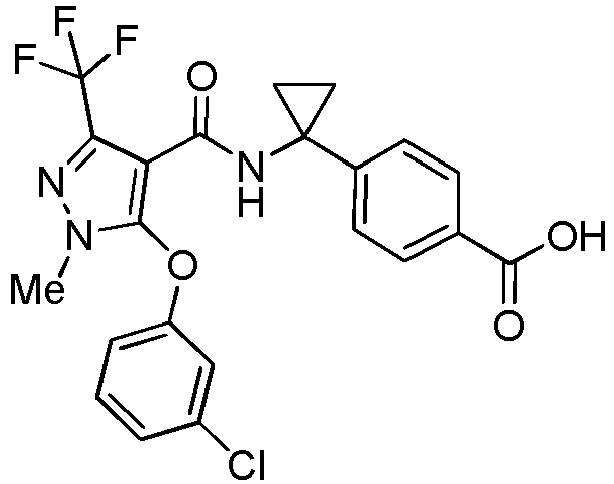
ER-885743-00 1H NMR (400 MHz, CD3OD) δ ppm 7.80 (2H, d), 7.39 (1H, m), 7.26 (1H, d), 7.17 (1H, t), 7.04 (2H, d), 6.97 (1H, dd), 3.82 (3H, s), 1.23 (2H, m), 0.92 (2H, m) 13 
ER-885744-00 1H NMR (400 MHz, CD3OD) δ ppm 7.83 (2H, d), 7.32 (1H, m), 7.19 (1H, m), 7.14 (2H, d), 7.00 (1H, t), 6.85 (1H, dd), 5.01 (1H, m), 3.63 (3H, s), 2.36 (3H, s), 1.35 (3H, d) 14 
ER-886022-00 1H NMR (400 MHz, CD3OD) δ ppm 7.81 (2H, d), 7.72 (1H, d), 7.31 (1H, d), 7.14 (3H, m), 6.64 (1H, d), 5 (1H, q), 3.63 (3H, s), 2.35 (3H, s), 1.37 (3H, d) 15 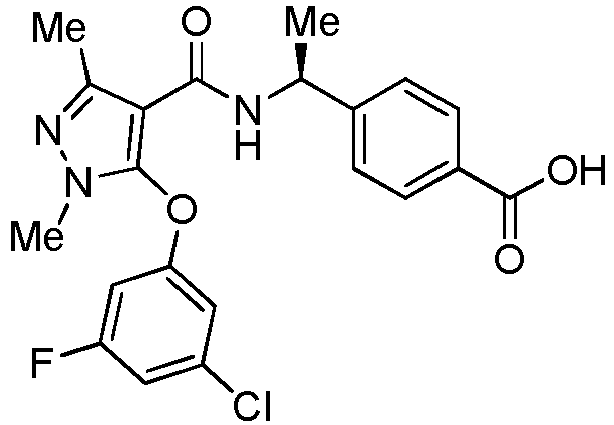
ER-886024-00 1H NMR (400 MHz, CD3OD) δ ppm 7.96 (1H, d), 7.85 (2H, d), 7.19 (2H, d), 6.98 (1H, dt), 6.79 (1H, m), 6.67 (1H, dt), 5.03 (1H, q), 3.62 (3H, s), 2.35 (3H, s), 1.38 (3H, d) 16* 
ER-886025-00 1H NMR (400 MHz, CD3OD) δ ppm 7.83 (3H, m), 7.49 (1H, dd), 7.18 (2H, m), 6.91 (1H, m), 6.53 (1H, dd), 5.01 (1H, q), 3.64 (3H, s), 2.34 (3H, s), 1.38 (3H, d) 17 
ER-886032-00 1H NMR (400 MHz, CD3OD) δ ppm 7.78 (2H,d), 7.53 (1H,d), 7.24 (1H,t), 7.07 (1H,m), 7.00 (1H,d), 6.72 (2H,m), 4.99 (1H,m), 3.59 (3H,s), 2.35 (3H,s), 2.29 (3H,s), 1.32 (3H,d) 18 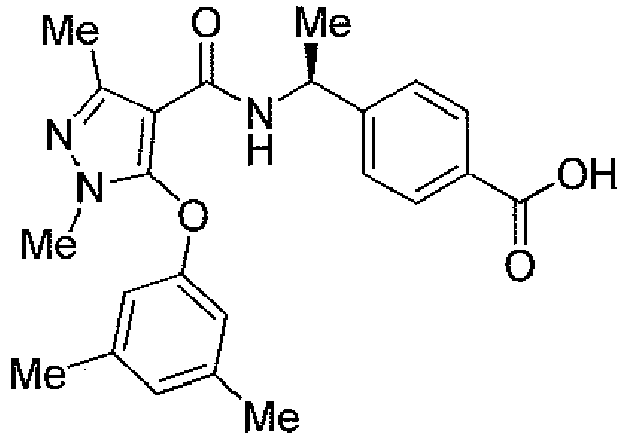
ER-886033-00 1H NMR (400 MHz, CD3OD) δ ppm 7.77 (2H,d), 7.47 (1H,d), 7.05 (2H,d), 6.83 (1H,s), 6.52 (2H,s), 5.00 (1H,m), 3.58 (3Hs), 2.35 (3H,s), 2.24 (3H,s), 1.33 (3H,d) 19 
ER-886035-00 1H NMR (400 MHz, CD3OD) δ ppm 7.79 (2H,d), 7.11 (2H,d), 6.29 (1H,t), 6.04 (2H,d), 5.00 (1H,m), 3.71(6H,s), 3.60 (3H,s), 2.35 (3H,s), 1.36 (3H,d) 20 
ER-886045-00 1H NMR (400 MHz, CD3OD) δ ppm 8.05 (1H, m), 7.84 (2H, d), 7.32 (1H, t), 7.20 (1H, m), 7.15 (2H, d), 6.96 (3H, m), 4.99 (1H, q), 3.75 (3H, s), 1.36 (3H, d) 21 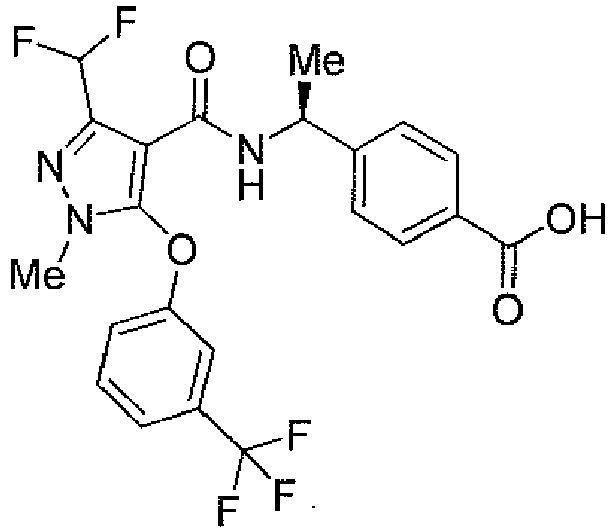
ER-886046-00 1H NMR (400 MHz, CD3OD) δ ppm 8.11 (1H, m), 7.81 (2H, d), 7.52 (2H, m), 7.37 (1H, s), 7.15 (3H, m), 6.96 (1H, m), 4.97 (1H, q), 3.76 (3H, s), 1.32 (3H, d) 22 
ER-886061-00 1H NMR (400 MHz, CD3OD) δ ppm 7.83 (3H, m), 7.43 (1H,t), 7.12 (3H, m), 6.95 (1H, s), 6.87 (1H, dd), 5.00 (1H, quin), 3.63 (3H, s), 2.36 (3H, s), 1.33 (3H, d) 23 
ER-886072-00 1H NMR (400 MHz, CD3OD) δ ppm 8.56 (1H,d), 7.82 (2H,d), 7.33 (1H,m), 7.18 (2H,d), 6.91 (1H,m), 6.79 (2H,m), 4.95 (1H,m), 3.77 (3H,s), 1.34 (3H,d) 24 
ER-886073-00 1H NMR (400 MHz, CD3OD) δ ppm 8.60 (1H,d), 7.86 (2H,d), 7.19 (3H,m), 6.99 (1H,m), 6.75 (1H,m), 4.97 (1H,m), 3.77 (3H,s), 1.35 (3H,d) 25 
ER-886074-00 1H NMR (400 MHz, CD3OD) δ ppm 8.61 (1H,d), 7.86 (2H,d), 7.40 (1H,d), 7.22 (1H,d), 7.18 (2H,d), 6.91 (1H,m), 6.89 (1H,dd), 4.96 (1H,m), 3.78 (3H,s), 1.35 (3H,d) 26 
- ER-886077-00 1H NMR (400 MHz, CD3OD) δ ppm 8.40 (1H, s), 7.81 (2H, d), 7.38 (1H, t), 7.24 (1H, m), 7.06 (3H, m), 6.92 (1H, dd), 3.66 (3H, s), 2.37 (3H, s), 1.24 (2H, m), 0.98 (2H, m) 27 
ER-886078-00 1H NMR (400 MHz, CD3OD) δ ppm 7.78 (2H, d), 7.59 (2H, m), 7.44 (1H, s), 7.24 (1H, m), 7.00 (3H, m), 3.80 (3H, s), 1.21 (2H, m), 0.89 (2H, m) 28 
ER-886080-00 1H NMR (400 MHz, CD3OD) δ ppm 7.81 (2H,d), 7.77 (1H,d), 7.35 (1H,t), 7.14 (2H,d), 6.95 (1H,m), 6.80 (1H,t), 6.78 (1H,m), 6.73 (1H,m), 5.00 (1H,m), 3.61 (3H,s), 2.35 (3H,s), 1.33 (3H,s) 29 
ER-886082-00 1H NMR (400 MHz, CD3OD) δ ppm 8.55 (1H,d), 7.82 (2H,d), 7.34 (1H,t), 7.17 (2H,d), 6.95 (1H,m), 6.83 (1H,t), 6.80 (1H,t), 6.78 (2H,dd), 4.94 (1H,m), 3.76 (3H,s), 3.65 (3H,s), 1.32 (3H,s) 30 
EP-886083-00 1H NMR (400 MHz, CD3OD) δ ppm 8.10 (1H, d), 7.81 (2H, d), 7.52 (2H, m), 7.37 (1H, m), 7.08 (4H, m), 4.97 (1H, q), 3.76 (3H, s), 1.32 (3H, d) 31 
ER-886090-00 1H NMR (400 MHz, CD3OD) δ ppm 8.02 (1H,d), 7.81 (2H,d), 7.36 (1H,t), 7.15 (2H,d), 6.98 (1H,m), 6.83 (1H,m), 6.81 (1H,t), 6.76 (2H,dd), 4.99 (1H,m), 3.73 (3H,s), 1.34 (3H,s) 32 
ER-887480-00 1H NMR (400 MHz, CD3OD) δ ppm 8.01 (1H,d), 7.79 (2H,d), 7.46 (1H,t), 7.36 (1H,d), 7.19 (1H,s), 7.11 (2H,d), 7.06 (1H,m), 6.96 (1H,t), 6.73 (1H,t), 4.95 (1H,m), 3.74 (3H,s), 1.31 (3H,s) 33 
ER-887495-00 1H NMR (400 MHz, CD3OD) δ ppm 7.77 (3H,m), 7.46 (1H,t), 7.34 (1H,d), 7.14 (1H,s), 7.10 (1H,d), 7.04 (1H,m), 6.73 (1H,t), 4.97 (1H,q), 3.62 (3H,s), 2.35 (3H,s), 1.31 (3H,d) 34 
ER-887995-00 1H NMR (400 MHz, CD3OD) δ ppm 8.53 (1H,d), 7.79 (2H, d), 7.43 (1H, t), 7.34 (1H, d), 7.20 (1H,s), 7.13 (2H,d), 7.06 (1H,m), 6.72 (1H,t), 4.91 (1H,m), 3.76 (3H,s), 1.28 (3H,d) 35 
ER-888024-00 1H NMR (400 MHz, CD3OD) δ ppm 8.12 (1 H, d), 7.86 (2 H, d), 7.44 (1 H, d), 7.17 (5 H, d), 5.00 (1 H, q), 3.76 (3 H, s), 1.38 (3 H, d) 36 
ER-888348-00 1H NMR (400 MHz, CD3OD) δ ppm 8.65 (1H,s), 7.81 (2H,d), 7.52 (1H,d), 7.30 (1H,d), 7.03 (2H,d), 6.97 (1H,m), 6.91 (1H, t), 3.77 (3H,s), 1.24 (2H,dd), 0.99 (2H,dd) 37 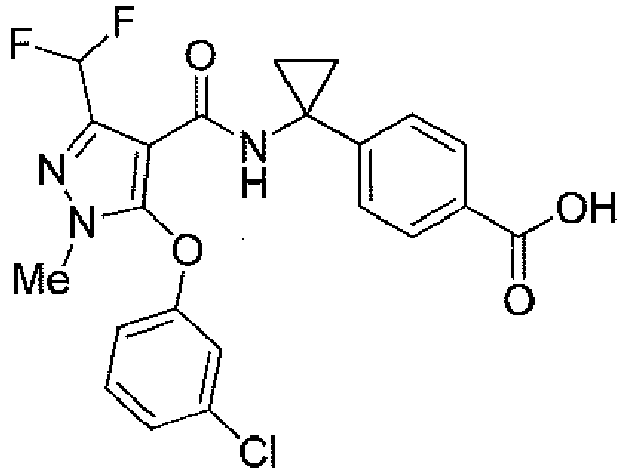
ER-888355-00 1H NMR (400 MHz, CD3OD) δ ppm 8.63 (1H,s), 7.79 (2H,d), 7.38 (1H,t), 7.25 (1H,m), 7.14 (1H,t), 7.03 (2H,d), 6.95 (1H,m), 6.93 (1H,t), 3.77 (3H,s), 1.23 (2H,dd), 0.96 (2H,dd) 38 
ER-888363-00 1H NMR (400 MHz, CD3OD) δ ppm 7.81 (2H,d), 7.52 (1H,d), 7.33 (1H,d), 7.06 (2H,d), 7.00 (1H,dd), 3.82 (3H,s), 1.24 (2H,m) ,0.95 (2H,m) 39 
ER-880663-00 1H NMR (400 MHz, CD3OD) δ ppm 7.83 (2 H, s), 7.74 (1 H, d), 7.33 (2 H, m), 7.13 (2 H, d), 6.93 (2 H, m), 5.01 (1 H, m), 3.62 (3 H, s), 2.35 (3 H, s), 1.35 (3 H, d 40 
ER-885302-00 1H NMR (400 MHz, CD3OD) δ ppm 7.78 (3 H, m) 7.05 (6 H, m) 5.01 (1 H, m) 3.62 (3 H, s) 2.35 (3 H, s) 1.35 (3 H, d) 41 
ER-885311-00 1H NMR (400 MHz, CD3OD) δ ppm 7.75 (5 H,m) 7.12 (4 H,m) 5.01 (1 H, m) 3.63 (3 H,s) 2.37 (3 H,s) 1.33 (3 H,d) 42* 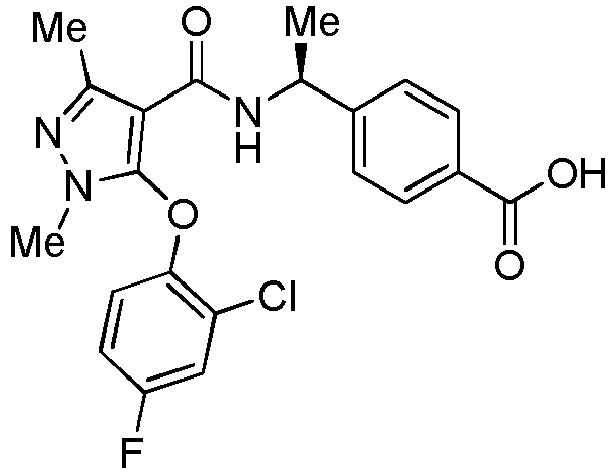
ER-886023-00 1H NMR (400 MHz, CD3OD) δ ppm 7.83 (2H,m), 7.30 (1H,m), 7.17 (2H,m), 6.95 (1H,m), 6.73 (1H,m), 5.00 (1H,m), 3.63 (3H,s), 2.33 (3H,s), 1.38(3H,d) 43 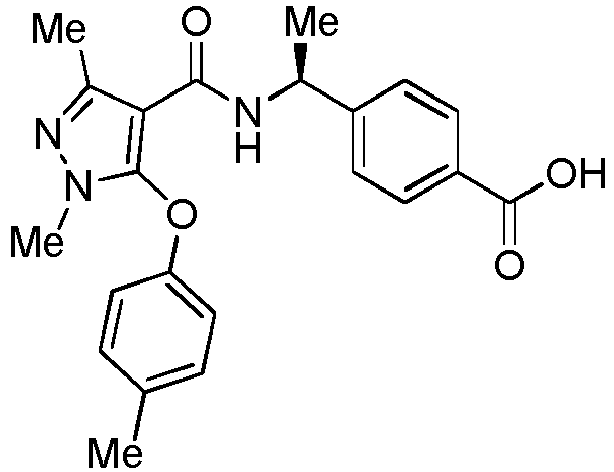
ER-885749-00 1H NMR (400 MHz, CD3OD) δ ppm 7.77 (2H,d), 7.54 (1H,d), 7.14 (2H,d), 7.06 (2H,d), 6.80 (2H,d), 4.99 (1H,p), 3.59 (3H,s), 2.34 (3H,s), 2.32 (3H,s), 1.32 (3H,d) 44 
ER-888365-00 1H NMR (400 MHz, CD3OD) δ ppm 8.60 (1H,d), 7.81 (2H,d), 7.64 (2H,d), 7.15 (4H,m), 4.94 (1H,m), 3.77 (3H,s), 1.31 (3H,d) 45* 
ER-888367-00 1H NMR (400 MHz, CD3OD) δ ppm 8.07 (1H,d), 7.81 (2H,d), 7.66 (2H,d), 7.14 (4H,m), 6.96 (1H,t), 4.99 (1H,m), 3.75 (3H,s), 1.34 (3H,d) 46 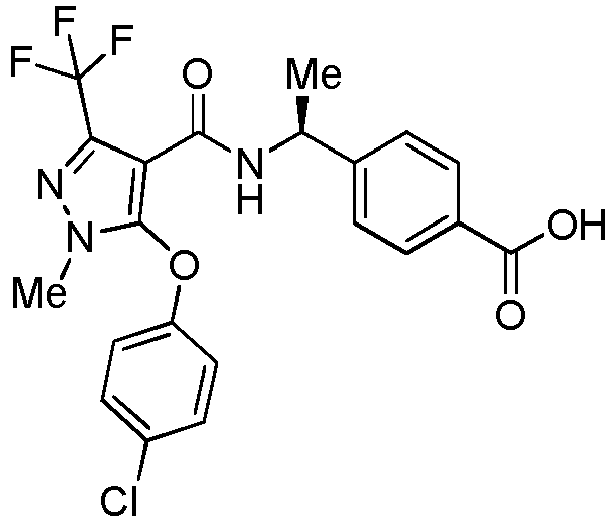
ER-888369-00 1H NMR (400 MHz, CD3OD) δ ppm 8.53 (1H,d), 7.85 (2H,d), 7.30 (2H,d), 7.17 (2H,d), 6.97 (2H,d), 4.95 (1H,m), 3.77 (3H,s), 1.34 (3H,d) 47 
ER-888371-00 1H NMR (400 MHz, CD3OD) δ ppm 7.99 (1H,d), 7.85 (2H,d), 7.33 (2H,d), 7.15 (2H,d), 6.96 (3H, m), 4.99 (1H,m), 3.74 (3H,s), 1.36 (3H,d) 48 
ER-888364-00 1H NMR (400 MHz, CD3OD) δ ppm 9.02 (1H,s), 7.76 (4H,m), 7.24 (2H,d), 7.03 (2H,d), 3.82 (3H,s), 1.21 (2H,m), 0.88 (2H,m) 49 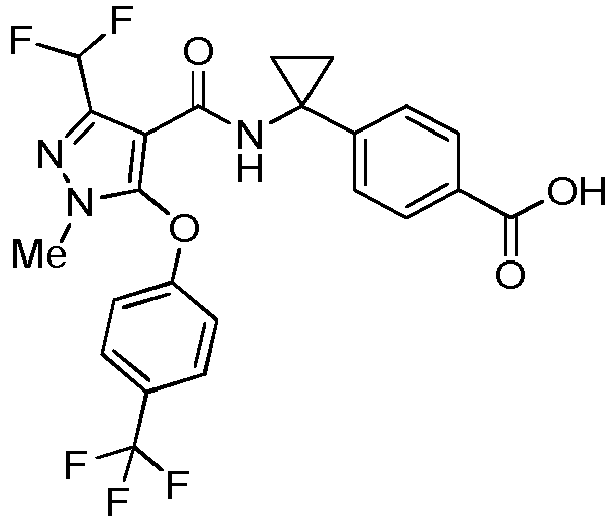
ER-888366-00 1H NMR (400 MHz, CD3OD) δ ppm 8.64 (1H,s), 7.76 (4H,m), 7.22 (2H,d), 7.04 (2H,d), 6.95 (1H,t), 3.78 (3H,s), 1.23 (2H,m), 0.94 (2H,m) 50 
ER-888368-00 1H NMR (400 MHz, CD3OD) δ ppm 7.81 (2H,d), 7.40 (2H,d), 7.04 (4H,m), 3.81 (3H,s), 1.23 (2H,m), 0.94 (2H,m) 51 
ER-888370-00 1H NMR (400 MHz, CD3OD) δ ppm 7.81 (2H,d), 7.41 (2H,d), 7.03 (4H,m), 6.94 (1H,t), 3.77 (3H,s), 1.24 (2H,m), 1.00 (2H,m) * Compounds 8, 16, 42 and 45 are not examples of the invention. - CRE-PLAP reporter assay: SE302 is a clone of the HEK/293 cell line that harbors a reporter construct containing a promoter with cAMP response elements (CRE) driving secreted alkaline phosphatase (PLAP), constructed by T. Arai, Eisai Pharamceuticals, Japan. These cells express endogenous EP4 and show induction of PLAP in response to PGE2 and other agonists of EP4, but not of EP1, 2 or 3 (data not shown). Cells were maintained in DMEM/F12 (50:50) (MediaTech) supplemented with 10% FBS (Tissue Culture Biologicals) plus penicillin/streptomycin. When used for assays, cells were plated in a 96-well plate at 2x10⁴ cells/100 µL/well in serum-free assay medium (DMEM/F12 supplemented with 0.1% BSA plus penicillin/streptomycin) and incubated for 4-6 h. Cells were then stimulated with 3 ng.mL-1 of PGE2 in the presence or absence of various concentrations of ER-819762 overnight, and PLAP activity was measured by mixing 15 µL of culture supernatants with 75 µL of Lumi-phos (Lumigen, Inc.) and 60 µL of assay buffer containing 8 mmol.L-1 MgSO4 in 0.1 mol.L-1 carbonate-bicarbonate buffer pH11 in a new 96-well black plate and incubated for 2h at room temperature. Luminescence was read with an Envision 2102 Multilabel reader.
- Exemplary compounds of the present invention were assayed according to the methods set forth above in the CRE-PLAP reporter assay described above. Table 2 below sets forth exemplary compounds of the present invention having an IC50 of up to 5.0 µM as determined by the normalized CRE-PLAP assay described above.
Table 2. IC 50 Values of Exemplary Compounds Example Structure ER number CRE-PLAP IC50 (µM) 52 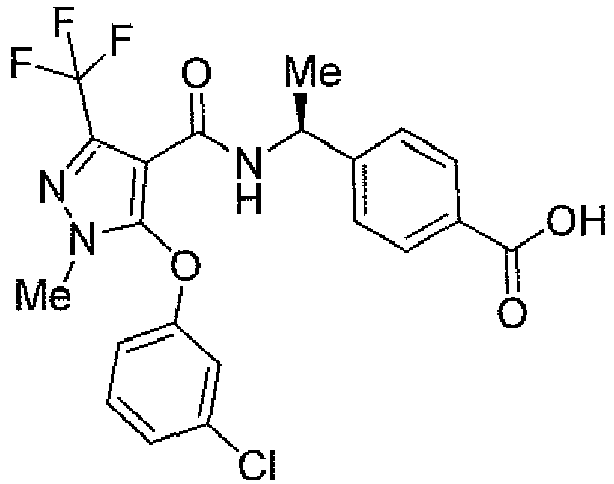
ER-885289-00 0.045 53 
ER-885290-00 0.018 54 
ER-885291-00 0.027 55 
ER-885716-00 0.092 56 
ER-885717-00 0.974 57 
ER-885718-00 0.467 58 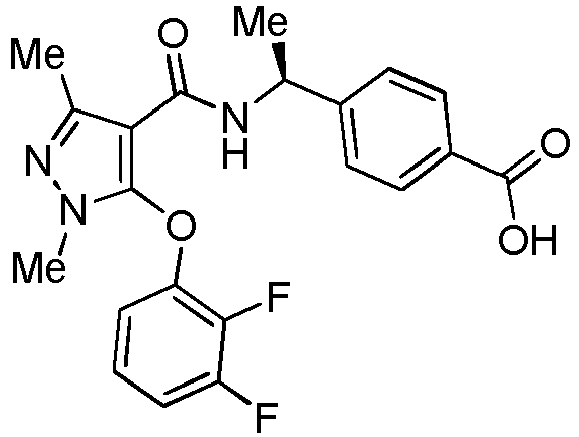
ER-885719-00 2.666 59* 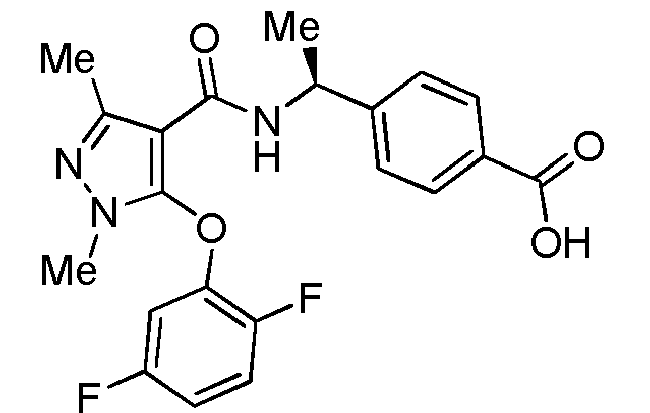
ER-885720-00 2.219 60 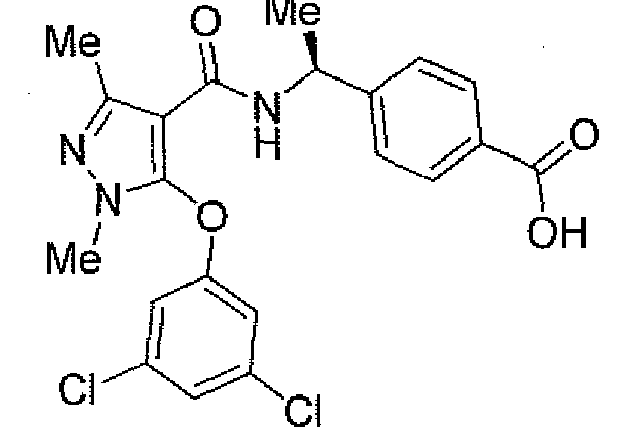
ER-885721-00 0.846 61 
ER-885740-00 0.012 62 
ER-885741-00 0.013 63 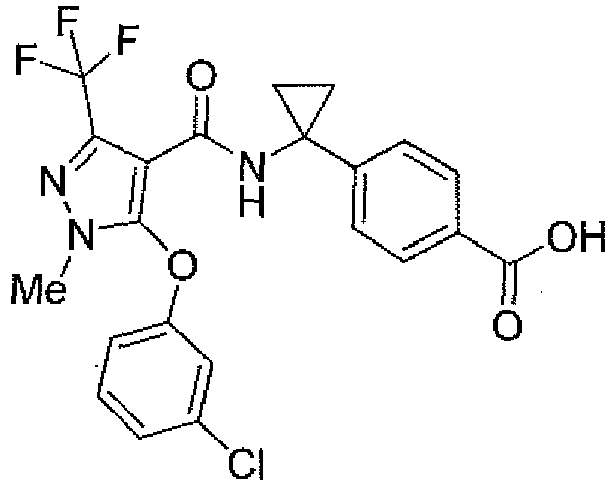
ER-885743-00 0.038 64 
ER-885744-00 0.168 65 
ER-886022-00 0.719 66 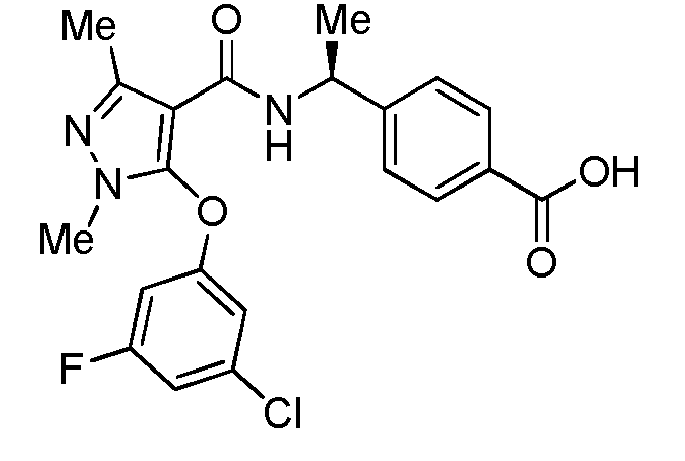
ER-886024-00 0.637 67* 
ER-886025-00 4.914 68 
ER-886032-00 0.356 69 
ER-886033-00 2.122 70 
ER-886035-00 3.665 71 
ER-886045-00 0.018 72 
ER-886046-00 0.011 73 
ER-886061-00 0.089 74 
ER-886072-00 0.132 75 
ER-886073-00 0.109 76 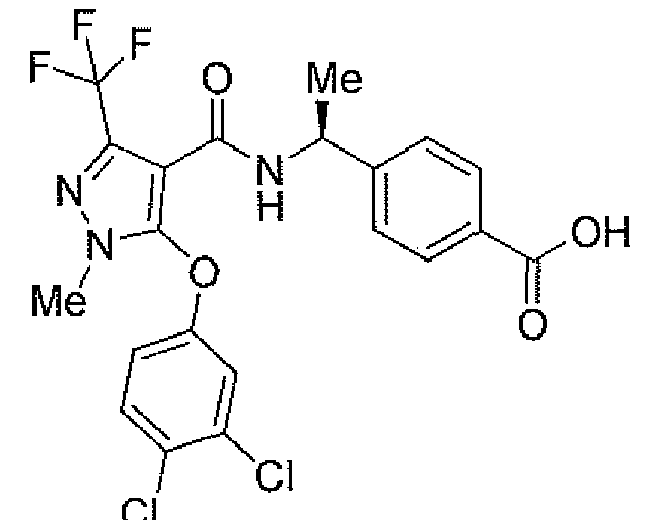
ER-886074-00 0.01 77 
ER-886077-00 0.085 78 
ER-886078-00 0.009 79 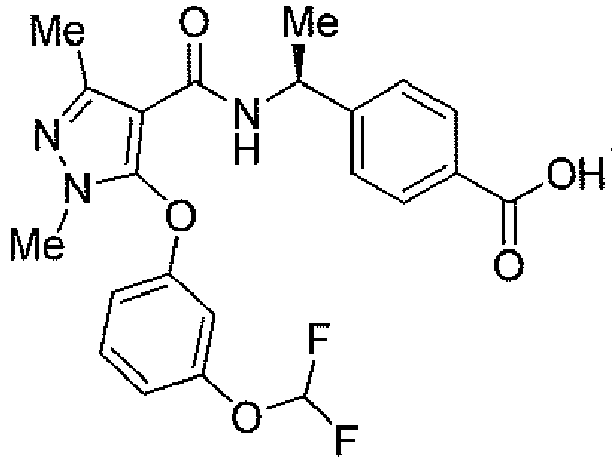
ER-886080-00 0.058 80 
ER-886082-00 0.088 81 
ER-886083-00 0.827 82 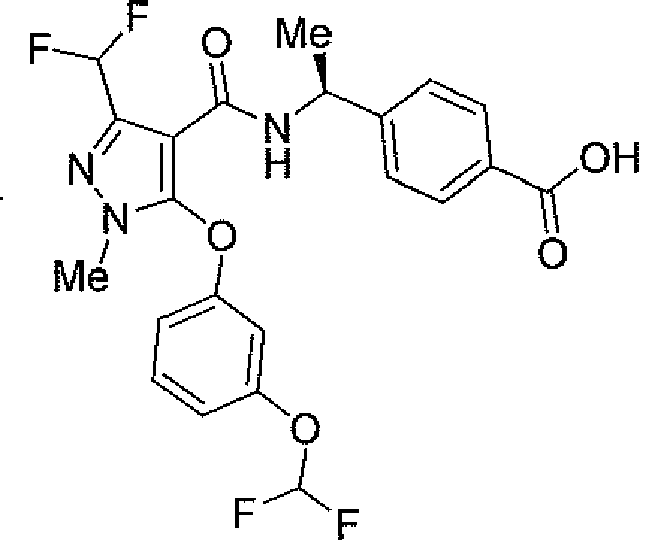
ER-886090-00 0.017 83 
ER-887480-00 0.051 84 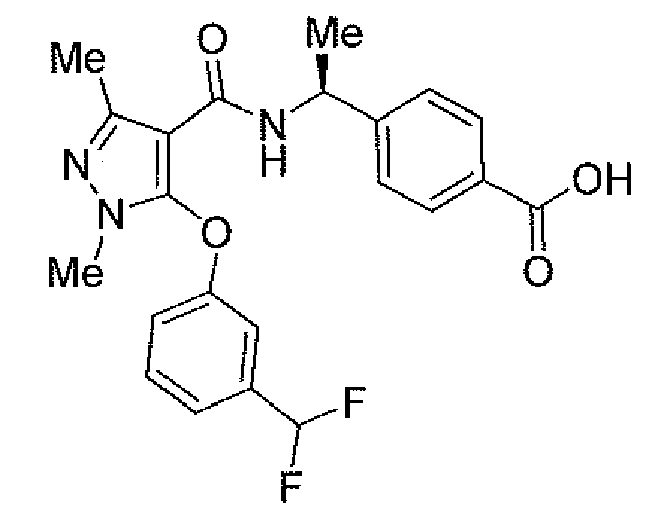
ER-887495-00 0.219 85 
ER-887995-00 0.187 86 
ER-888024-00 0.031 87 
ER-888348-00 0.017 88 
ER-888355-00 0.157 89 
ER-888363-00 0.008 90 
ER-880663-00 0619 91 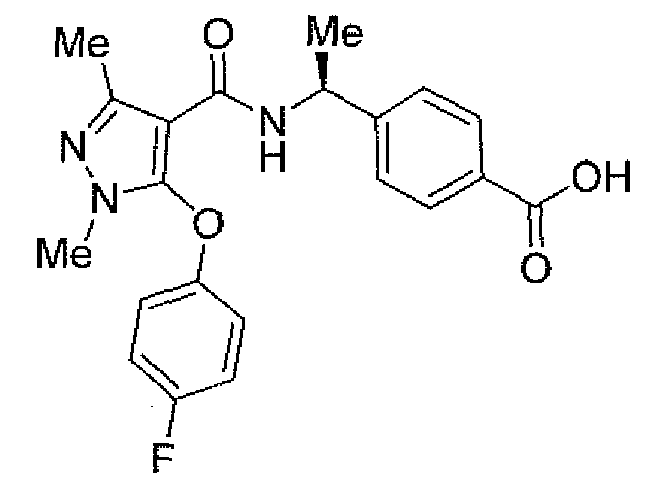
ER-885302-00 0.261 92 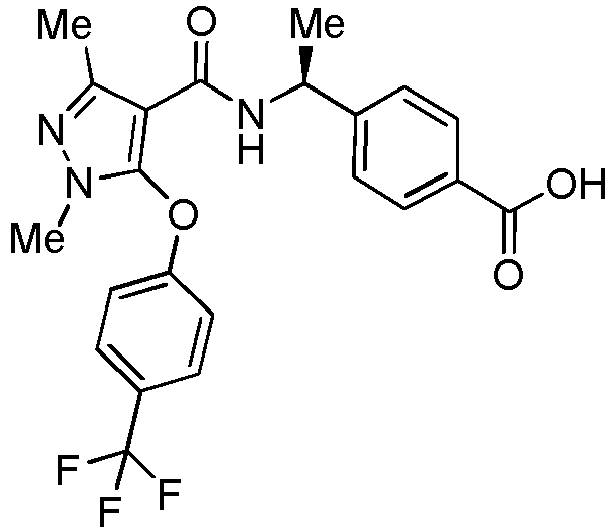
ER-885311-00 0.273 93* 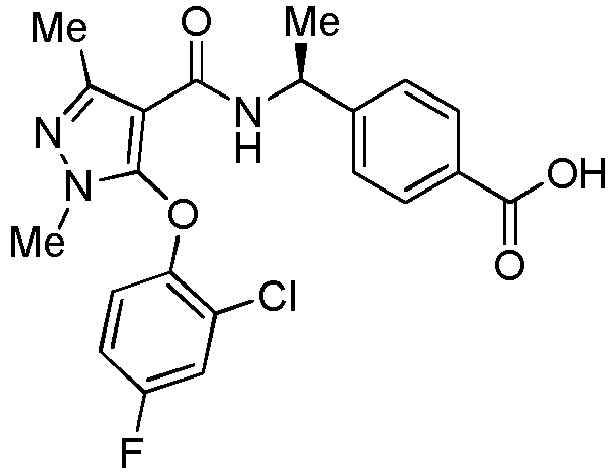
ER-886023-00 4.403 94 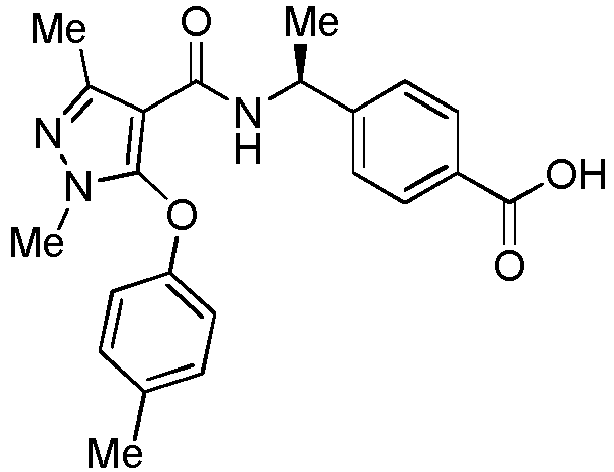
ER-885749-00 0.451 95 
ER-888365-00 0.028 96* 
ER-888367-00 0.023 97 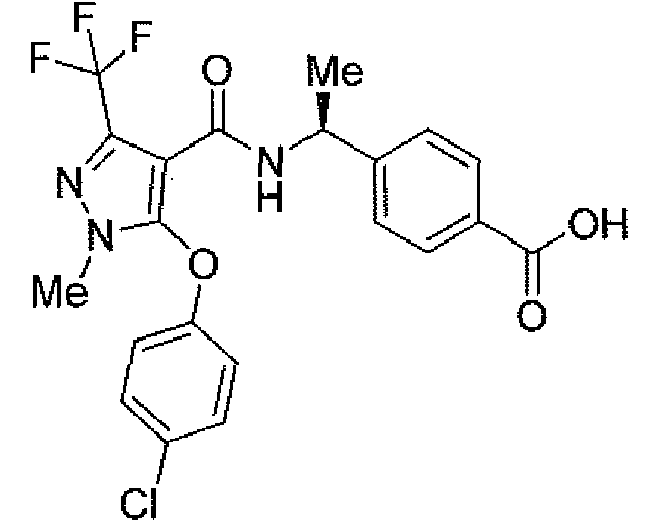
ER-888369-00 0.089 98 
ER-888371-00 0.089 99 
ER-888364-00 0.012 100 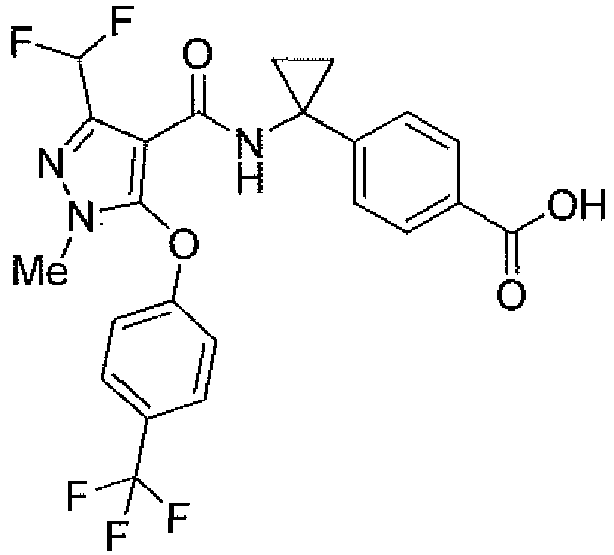
ER-888366-00 0.015 101 
ER-888368-00 0.018 102 
ER-888370-00 0.035 *Compounds 59, 67, 93 and 96 are not examples of the invention - Radioligand EP4 receptor binding assay: The radioligand EP4 binding assay was performed using ChemiScreen recombinant human EP4 receptor membrane preparations from Millipore, according to manufacturer's instructions. Briefly, membranes prepared from Chem-1 cells overexpressing human EP4 cDNA (Millipore) were mixed with 1.8 nmol.L-1 [3H]- PGE2 and 5 µmol.L-1 unlabelled PGE2 in the presence or absence of various concentrations of testing compounds in binding buffer (50 mmol.L-1 HEPES, pH 7.4, 5 mmol.L-1 MgCl2, 1 mmol.L-1 CaCl2, 0.2% BSA) in a nonbinding 96-well plate, and incubated for 1-2 h at room temperature. Prior to filtration, a GF/C 96-well filter plate was coated with 0.33% polyethyleneimine for 30 min, then washed with 50 mmol.L-1 HEPES, pH 7.4, 0.5% BSA. Binding reactions were transferred to the filter plate, and washed 3 times with Wash Buffer (1 mL per well per wash). The plate was dried and radioactivity counted. Binding of testing compounds to other related prostanoid receptors was performed by MDS Pharma Services (Bothell, WA) using a similar radiolabeled ligand displacement method.
- Exemplary compounds of the present invention were assayed according to the methods set forth above in the radioligand EP4 receptor binding assay described above. Table 3 below sets forth exemplary compounds of the present invention having Ki values as determined by the radioligand EP4 receptor binding assay described above.
Table 3. Ki Values of Exemplary Compounds Example Structure ER-number EP4 binding Ki (µM) 103 
ER-885290-00 0.014 104 
ER-885740-00 0.043 105 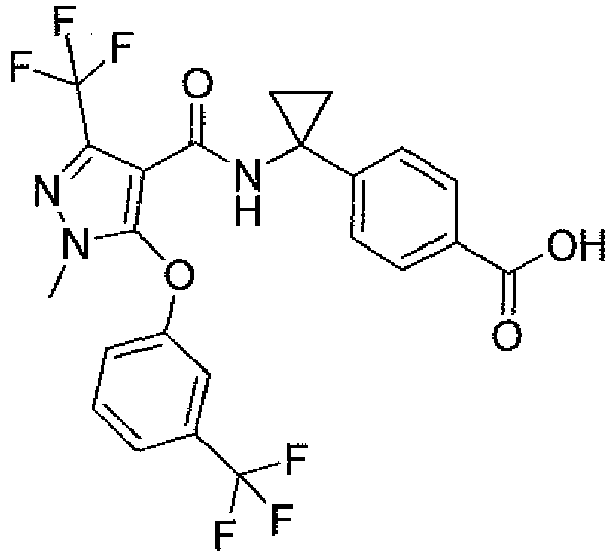
ER-885741-00 0.016 106 
ER-886045-00 0.050 107 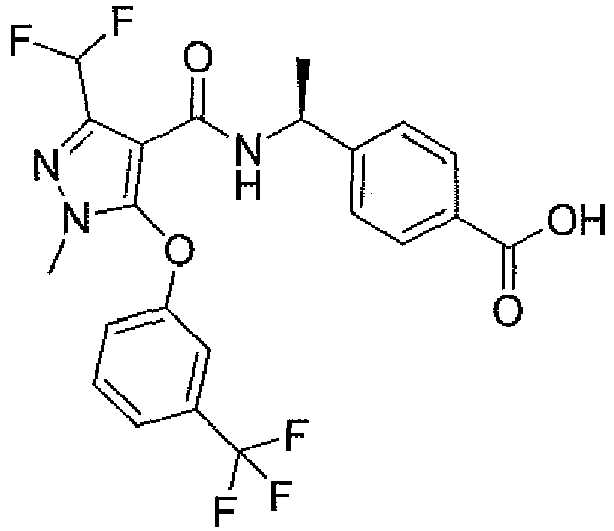
ER-886046-00 0.008 108 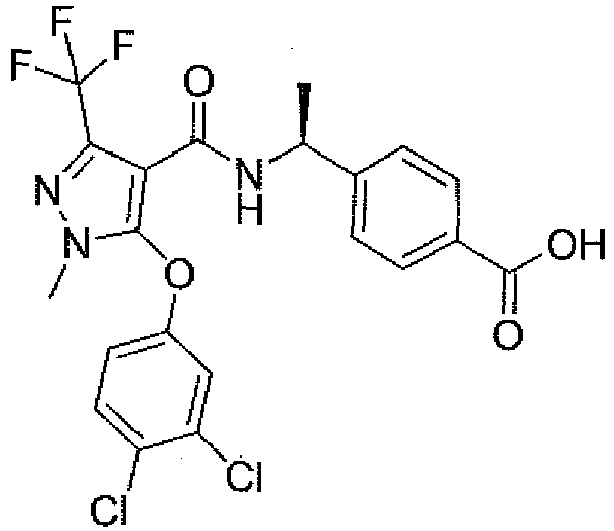
ER-886074-00 0.013 109 
ER-886078-00 0.008 110 
ER-886090-00 0.010 111 
ER-887480-00 0.026 - Male DBA/1 mice were immunized by injection at the base of the tail with 0.1 mL emulsion containing 150 µg bovine type II collagen (bCII) emulsified in CFA. Three weeks after the 1st immunization, all mice were boosted with bovine type II collagen emulsified in Freund's incomplete adjuvant. ER-886046 was orally administered daily at a dose of 10, 30 or 100 mg.kg-1 from day 20 after primary immunization but before disease onset (prophylactic evaluation) or after the disease induction (therapeutic evaluation). The severity of arthritic symptoms in the paws of each mouse was graded every other days, double-blind, according to Williams RO (Collagen-induced arthritis as a model for rheumatoid arthritis. Methods Mol Med 2004, 8:207-216). Results are given in
Figure 1 . - Male DBA/1 mice were immunized by injecting at the base of the tail 0.15 mL of emulsion containing 300 µg recombinant human GPI-glutathione-S-transferase (GST) fusion protein (hGPI) in CFA. ER-886046 was orally administered daily at a dose of 100 mg.kg-1 from
day 6 after primary immunization but before disease onset (prophylactic evaluation) or after the disease induction (therapeutic evaluation). Each treatment group consisted of 6-8 mice. Arthritic animals were clinically assessed every other day by an arthritis scoring system as follows (Iwanami K, Matsumoto I, Tanaka-Watanabe Y, Mihira M, Ohsugi Y, Mamura M et al. Crucial role of IL-6/IL-17 axis in the induction of arthritis by glucose-6-phosphate isomerase. Arthritis Rheum 2008, 58:754-763.): 0 = no evidence of inflammation, 1= subtle inflammation or localized edema, 2 = easily identified swelling but localized to dorsal or ventral surface of paws, and score 3 = swelling on all aspects of paws. Results are given inFigure 2 . -
- 1. A compound of formula I:

- one of R1a and R1b is hydrogen, and the other is methyl; or R1a and R1b are taken together to form a cyclopropyl ring;
- R2 is methyl or fluoromethyl (e.g., monofluoromethyl, difluoromethyl, or trifluoromethyl);
- R3 is methyl;
- R4 is hydrogen, halo, fluoromethyl, methyl, methoxy, or fluoromethoxy (e.g., monofluoromethoxy, difluoromethoxy, or trifluoromethoxy);
- R5 is hydrogen, halo, fluoromethyl, methyl, methoxy, or fluoromethoxy;
- R6 is hydrogen, halo, methyl, or methoxy;
- R7 is hydrogen, halo, methyl, or methoxy; and
- X is oxygen;
- 2. The compound of
embodiment 1, wherein
one of R1a and R1b is hydrogen, and the other is methyl; R2 is methyl, difluoromethyl, or trifluoromethyl;
R3 is methyl;
R4 is chloro, fluoro, trifluoromethyl, difluoromethyl, methyl, methoxy, difluoromethoxy, or trifluoromethoxy;
R5 is hydrogen, chloro, fluoro, methyl, or methoxy;
R6 and R7 are hydrogen;
or a pharmaceutically acceptable salt thereof. - 3. The compound of
embodiment 2, wherein R5 is hydrogen; or a pharmaceutically acceptable salt thereof - 4. The compound of
embodiment 3, wherein R4 is selected from chloro, trifluoromethyl, difluoromethyl, difluoromethoxy, and trifluoromethoxy;
or a pharmaceutically acceptable salt thereof. - 5. The compound of any one of embodiments 1 - 4, wherein,
one of R1a and R1b is hydrogen, and the other is methyl, and the compound of Formula I consists of a mixture of stereoisomers;
or a pharmaceutically acceptable salt thereof. - 6. The compound of any one of embodiments 1 - 4, wherein,
one of R1a and R1b is hydrogen, and the other is methyl, and the compound of Formula I consists of a substantially pure stereoisomer;
or a pharmaceutically acceptable salt thereof. - 7. The compound of
embodiment 6, wherein,
one of R1a and R1b is hydrogen, and the other is methyl, and the carbon of the compound of Formula I marked with a * has substantially the S-configuration;
or a pharmaceutically acceptable salt thereof. - 8. The compound of
embodiment 6, wherein,
one of R1a and R1b is hydrogen, and the other is methyl, and the carbon of the compound of Formula I marked with a * has substantially the R-configuration; or a pharmaceutically acceptable salt thereof. - 9. The compound of
embodiment 1, wherein
R1a, and R1b are taken together to form a cyclopropyl ring;
R2 is methyl, trifluoromethyl, or difluoromethyl;
R3 is methyl;
R4 is trifluoromethyl, difluoromethyl, chloro, or fluoro;
R6 and R7 are hydrogen;
or a pharmaceutically acceptable salt thereof. - 10. The compound of
embodiment 1, selected from the group consisting of: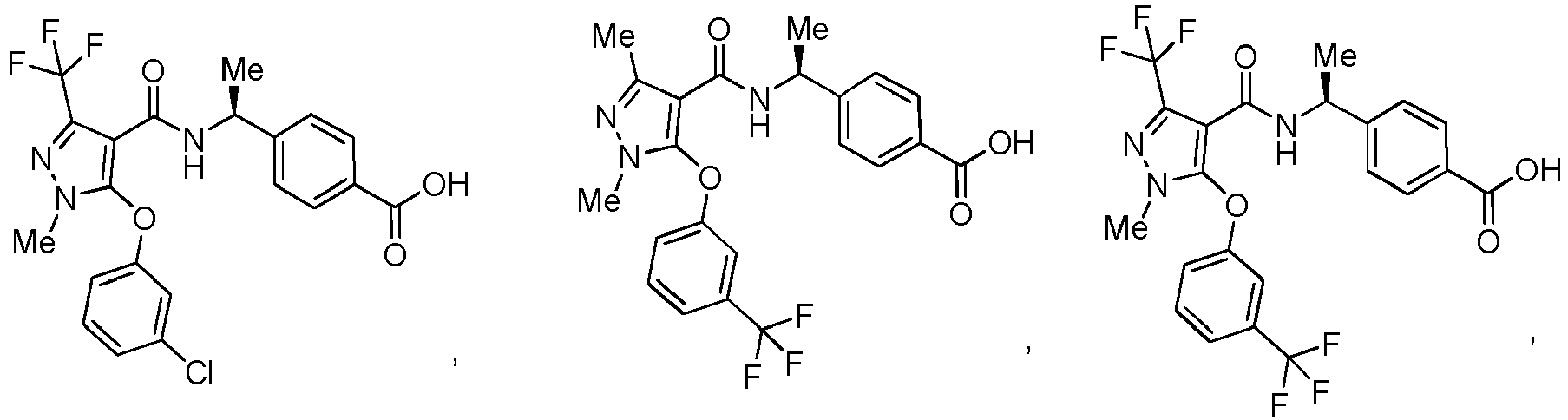
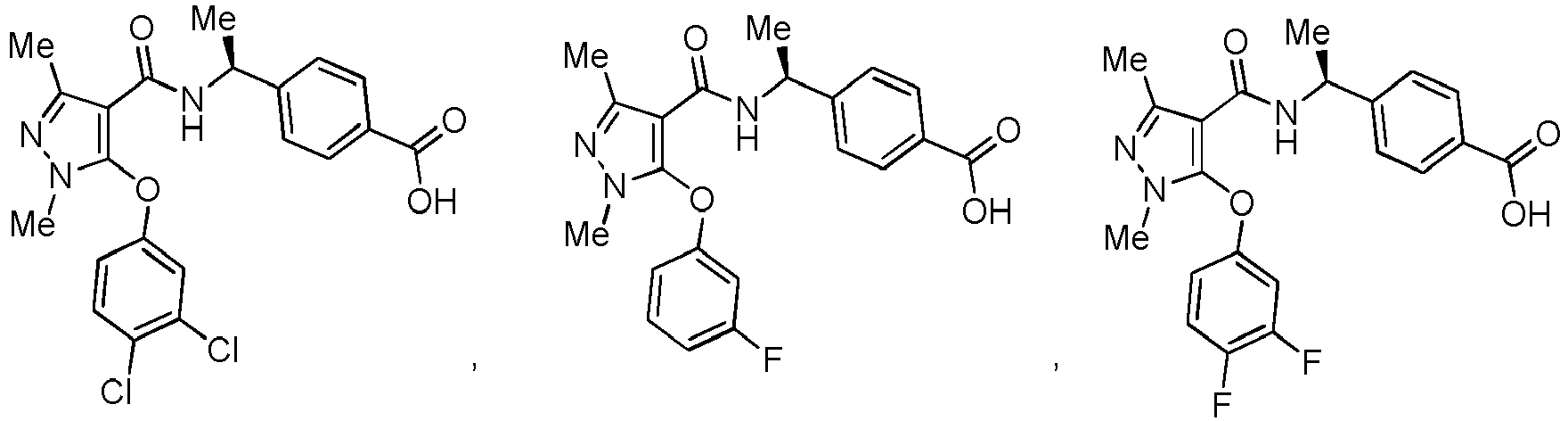


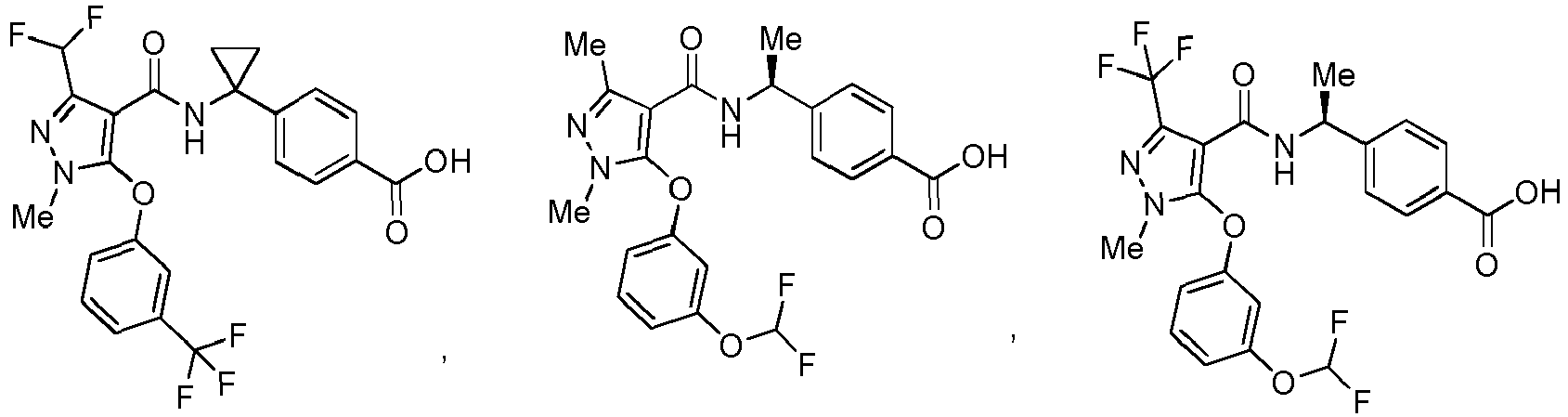
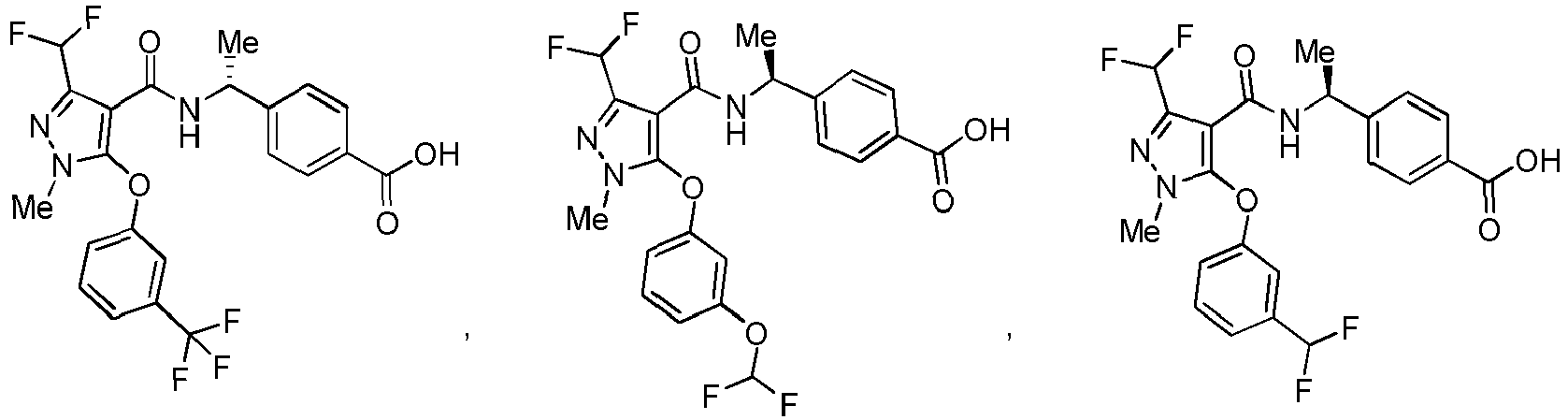


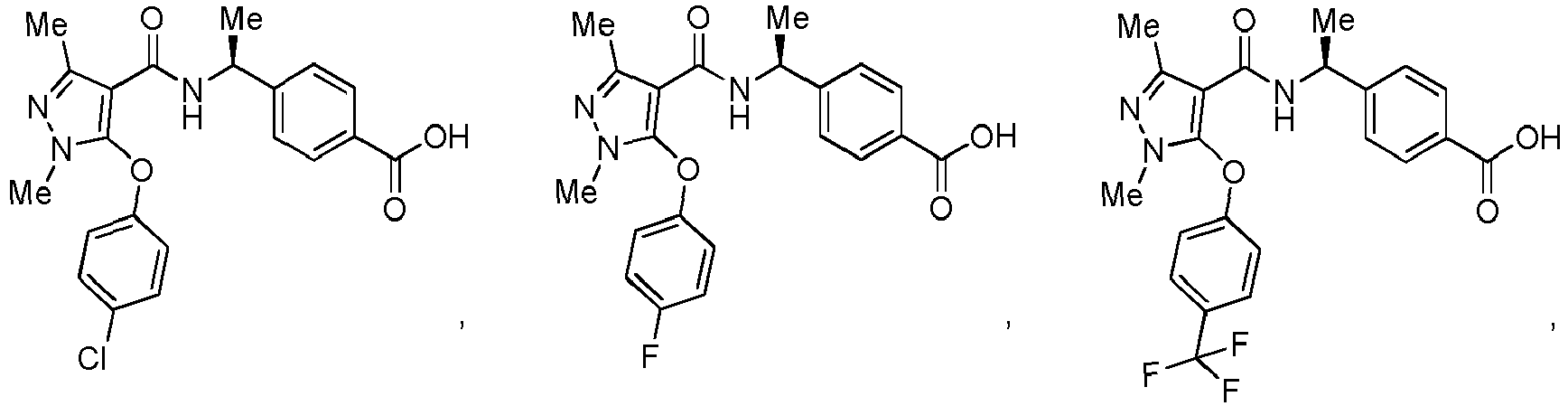
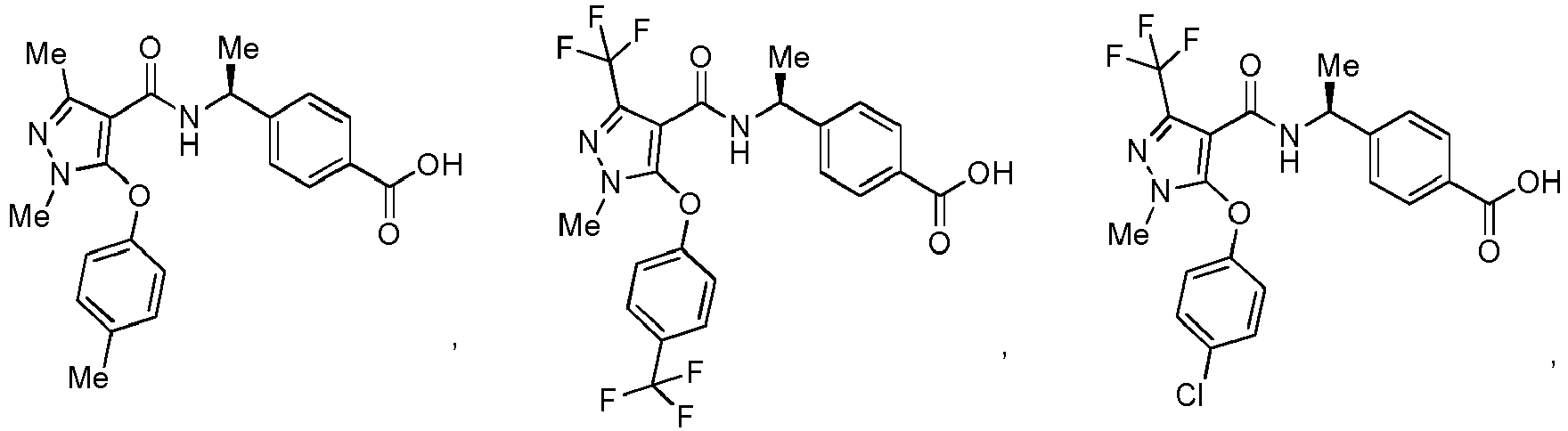


- 11. The compound of
embodiment 10, which is:
- 12. The compound of
embodiment 10, which is:
- 13. A pharmaceutical composition comprising a compound of formula I:
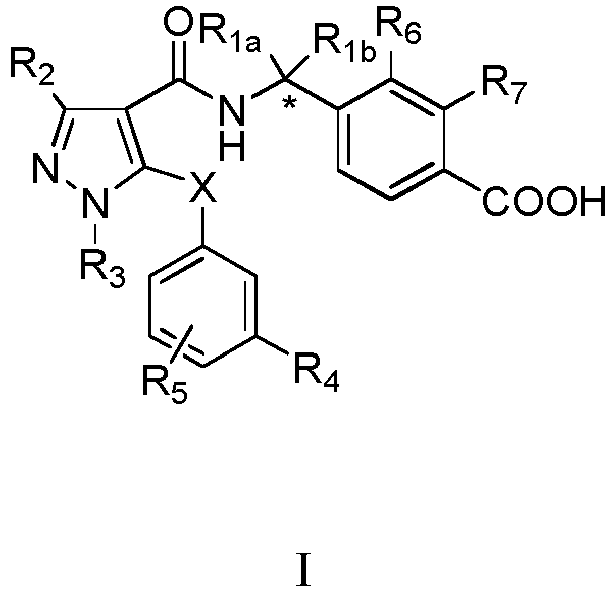
- one of R1a and R1b is hydrogen, and the other is methyl; or R1a and R1b are taken together to form a cyclopropyl ring;
- R2 is methyl or fluoromethyl;
- R3 is methyl;
- R4 is hydrogen, halo, fluoromethyl, methyl, methoxy, or fluoromethoxy;
- R5 is hydrogen, halo, fluoromethyl, methyl, methoxy, or fluoromethoxy;
- R6 is hydrogen, halo, methyl, or methoxy;
- R7 is hydrogen, halo, methyl, or methoxy; and
- X is oxygen;
and a pharmaceutically acceptable carrier. - 14. A pharmaceutical composition comprising a compound of
embodiment 10, or a pharmaceutically acceptable salt thereof;
and a pharmaceutically acceptable carrier. - 15. A pharmaceutical composition comprising the compound which is:

and a pharmaceutically acceptable carrier. - 16. A pharmaceutical composition comprising the compound which is:

and a pharmaceutically acceptable carrier. - 17. A pharmaceutical composition comprising a compound of formula I:

- one of R1a and R1b is hydrogen, and the other is methyl; or R1a and R1b are taken together to form a cyclopropyl ring;
- R2 is methyl or fluoromethyl;
- R3 is methyl;
- R4 is hydrogen, halo, fluoromethyl, methyl methoxy, or fluoromethoxy;
- R5 is hydrogen, halo, fluoromethyl, methyl, methoxy, or fluoromethoxy;
- R6 is hydrogen, halo, methyl, or methoxy;
- R7 is hydrogen, halo, methyl, or methoxy; and
- X is oxygen;
for use in a method of treating multiple sclerosis in a mammal. - 18. A pharmaceutical composition comprising a compound of
embodiment 10; or a pharmaceutically acceptable salt thereof,
for use in a method of treating multiple sclerosis in a mammal. - 19. A pharmaceutical composition comprising the compound of Formula I which is:

for use in a method of treating multiple sclerosis in a mammal. - 20. A pharmaceutical composition comprising the compound of Formula I which is:
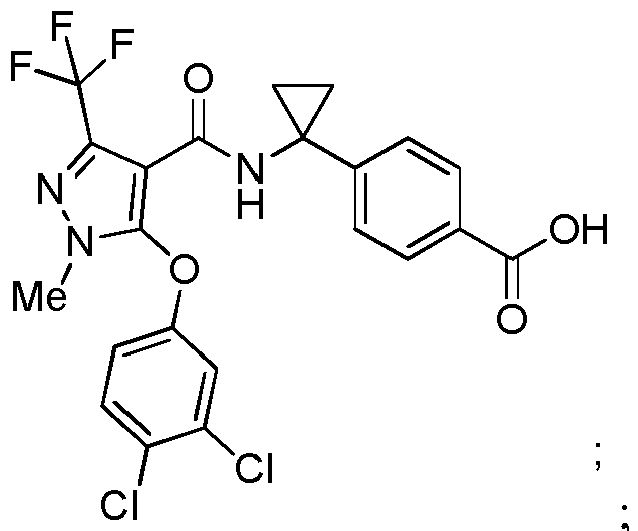
for use in a method of treating multiple sclerosis in a mammal. - 21. Use of a compound of
embodiment 1 in the treatment of multiple sclerosis. - 22. A pharmaceutical composition comprising a compound of formula I:

- one of R1a and R1b is hydrogen, and the other is methyl; or R1a and R1b are taken together to form a cyclopropyl ring;
- R2 is methyl or fluoromethyl;
- R3 is methyl;
- R4 is hydrogen, halo, fluoromethyl, methyl, methoxy, or fluoromethoxy;
- R5 is hydrogen, halo, fluoromethyl, methyl, methoxy, or fluoromethoxy;
- R6 is hydrogen, halo, methyl, or methoxy;
- R7 is hydrogen, halo, methyl, or methoxy; and
- X is oxygen;
for use in a method of treating rheumatoid arthritis in a mammal. - 23. A pharmaceutical composition comprising a compound of
embodiment 10; or a pharmaceutically acceptable salt thereof,
for use in a method of treating rheumatoid arthritis in a mammal. - 24. A pharmaceutical composition comprising the compound of Formula I which is:

for use in a method of treating rheumatoid arthritis in a mammal. - 25. A pharmaceutical composition comprising the compound of Formula I which is:

for use in a method of treating rheumatoid arthritis in a mammal. - 26. Use of a compound of
embodiment 1 in the treatment of rheumatoid arthritis. - 27. A pharmaceutical composition comprising a compound of formula I:

- one of R1a and R1b is hydrogen, and the other is methyl; or R1a and R1b are taken together to form a cyclopropyl ring;
- R2 is methyl or fluoromethyl;
- R3 is methyl;
- R4 is hydrogen, halo, fluoromethyl, methyl, methoxy, or fluoromethoxy;
- R5 is hydrogen, halo, fluoromethyl, methyl, methoxy, or fluoromethoxy;
- R6 is hydrogen, halo, methyl, or methoxy;
- R7 is hydrogen, halo, methyl, or methoxy; and
- X is oxygen;
for use in a method of treating systemic lupus erythematosus in a mammal. - 28. A pharmaceutical composition comprising a compound of
embodiment 10, or a pharmaceutically acceptable salt thereof,
for use in a method of treating systemic lupus erythematosus in a mammal. - 29. A pharmaceutical composition comprising the compound of Formula I which is:
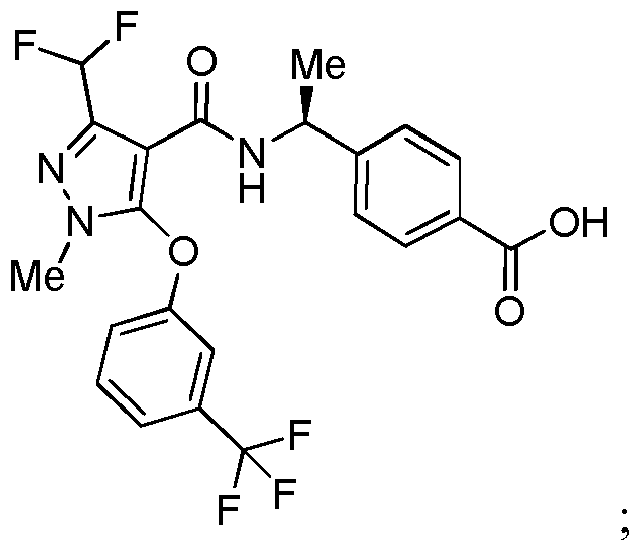
for use in a method of treating systemic lupus erythematosus in a mammal. - 30. A pharmaceutical composition comprising the compound of Formula I which is:
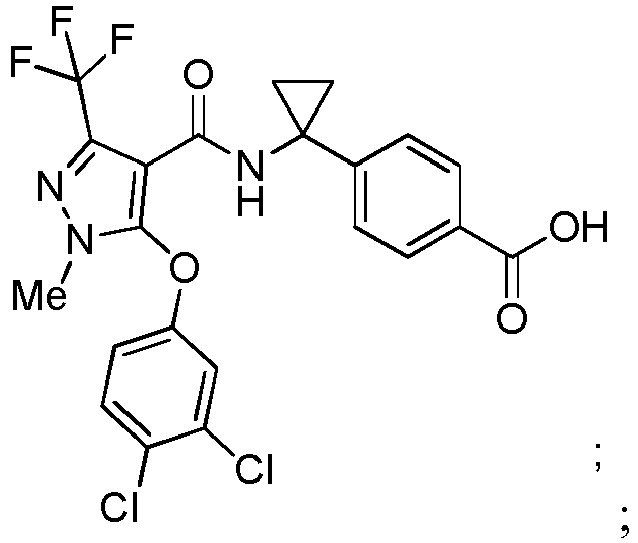
for use in a method of treating systemic lupus erythematosus in a mammal. - 31. Use of a compound of
embodiment 1 in the treatment of systemic lupus erythematosus. - 32. A pharmaceutical composition comprising a compound of formula I:

- one of R1a and R1b is hydrogen, and the other is methyl; or R1a and R1b are taken together to form a cyclopropyl ring;
- R2 is methyl or fluoromethyl;
- R3 is methyl;
- R4 is hydrogen, halo, fluoromethyl, methyl, methoxy, or fluoromethoxy;
- R5 is hydrogen, halo, fluoromethyl, methyl, methoxy, or fluoromethoxy;
- R6 is hydrogen, halo, methyl, or methoxy;
- R7 is hydrogen, halo, methyl, or methoxy; and
- X is oxygen;
method of treatingtype 1 diabetes in a mammal. - 33. A pharmaceutical composition comprising a compound of
embodiment 10; or a pharmaceutically acceptable salt thereof,
for use in a method of treatingtype 1 diabetes in a mammal. - 34. A pharmaceutical composition comprising the compound of Formula I which is:

for use in a method of treatingtype 1 diabetes in a mammal. - 35. A pharmaceutical composition comprising the compound of Formula I which is:

for use in a method of treatingtype 1 diabetes in a mammal. - 36. Use of a compound of
embodiment 1 in the treatment oftype 1 diabetes. - 37. A pharmaceutical composition comprising a compound of Formula I:

- one of R1a and R1b is hydrogen, and the other is methyl; or R1a and R1b are taken together to form a cyclopropyl ring;
- R2 is methyl or fluoromethyl;
- R3 is methyl;
- R4 is hydrogen, halo, fluoromethyl, methyl, methoxy, or fluoromethoxy;
- R5 is hydrogen, halo, fluoromethyl, methyl, methoxy, or fluoromethoxy;
- R6 is hydrogen, halo, methyl, or methoxy;
- R7 is hydrogen, halo, methyl, or methoxy; and
- X is oxygen;
for use in a method of treating psoriasis in a mammal. - 38. A pharmaceutical composition comprising a compound of
embodiment 10; or a pharmaceutically acceptable salt thereof,
for use in a method of treating psoriasis in a mammal. - 39. A pharmaceutical composition comprising the compound of Formula I which is:
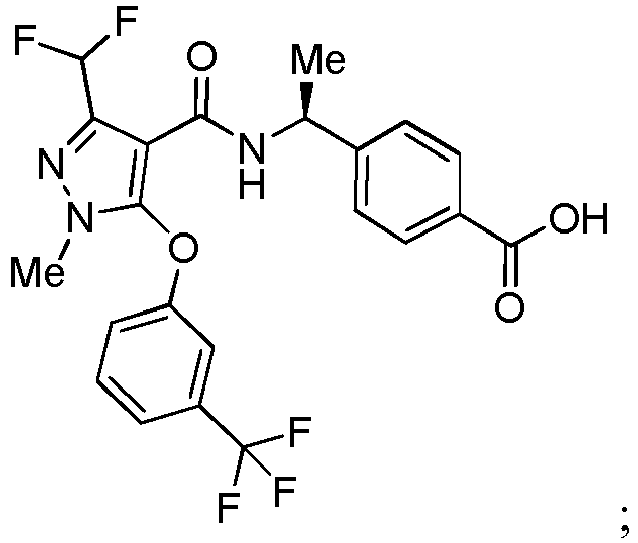
for use in a method of treating psoriasis in a mammal. - 40. A pharmaceutical composition comprising the compound of Formula I which is:

for use in a method of treating psoriasis in a mammal. - 41. Use of a compound of
embodiment 1 in the treatment of psoriasis. - 42. A pharmaceutical composition comprising a compound of Formula I:

- one of R1a and R1b is hydrogen, and the other is methyl; or R1a and R1b are taken together to form a cyclopropyl ring;
- R2 is methyl or fluoromethyl;
- R3 is methyl;
- R4 is hydrogen, halo, fluoromethyl, methyl, methoxy, or fluoromethoxy;
- R5 is hydrogen, halo, fluoromethyl, methyl, methoxy, or fluoromethoxy;
- R6 is hydrogen, halo, methyl, or methoxy;
- R7 is hydrogen, halo, methyl, or methoxy; and
- X is oxygen;
for use in a method of treating atherosclerosis in a mammal. - 43. A pharmaceutical composition comprising a compound of
embodiment 10; or a pharmaceutically acceptable salt thereof,
for use in a method of treating atherosclerosis in a mammal. - 44. A pharmaceutical composition comprising the compound of Formula I which is:

for use in a method of treating atherosclerosis in a mammal. - 45. A pharmaceutical composition comprising the compound of Formula I which is:

for use in a method of treating atherosclerosis in a mammal. - 46. Use of a compound of
embodiment 1 in the treatment of atherosclerosis. - 47. A pharmaceutical composition comprising a compound of Formula I:

- one of R1a and R1b is hydrogen, and the other is methyl; or R1a and R1b are taken together to form a cyclopropyl ring;
- R2 is methyl or fluoromethyl;
- R3 is methyl;
- R4 is hydrogen, halo, fluoromethyl, methyl, methoxy, or fluoromethoxy;
- R5 is hydrogen, halo, fluoromethyl, methyl, methoxy, or fluoromethoxy;
- R6 is hydrogen, halo, methyl, or methoxy;
- R7 is hydrogen, halo, methyl, or methoxy; and
- X is oxygen;
for use in a method of treating inflammatory pain in a mammal. - 48. A pharmaceutical composition comprising a compound of
embodiment 10; or a pharmaceutically acceptable salt thereof,
for use in a method of treating inflammatory pain in a mammal. - 49. A pharmaceutical composition comprising the compound of Formula I which is:

for use in a method of treating inflammatory pain in a mammal. - 50. A pharmaceutical composition comprising the compound of Formula I which is:

for use in a method of treating inflammatory pain in a mammal. - 51. Use of a compound of
embodiment 1 in the treatment of inflammatory pain. - 52. A pharmaceutical composition comprising a compound of Formula I:
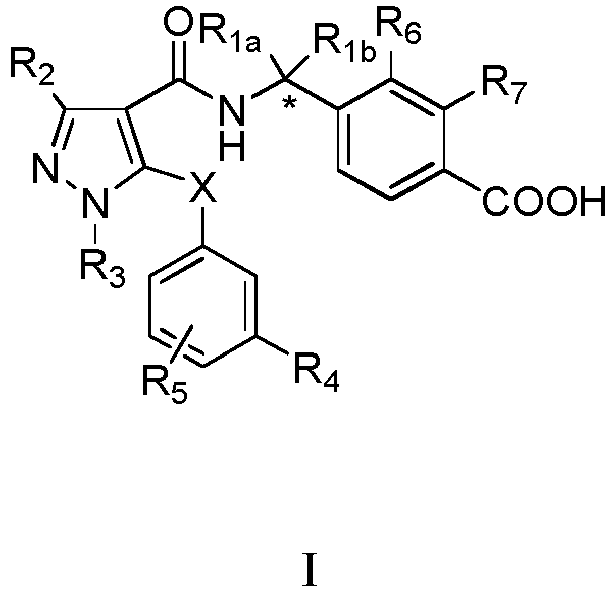
- one of R1a and R1b is hydrogen, and the other is methyl; or R1a and R1b are taken together to form a cyclopropyl ring;
- R2 is methyl or fluoromethyl;
- R3 is methyl;
- R4 is hydrogen, halo, fluoromethyl, methyl, methoxy, or fluoromethoxy;
- R5 is hydrogen, halo, fluoromethyl, methyl, methoxy, or fluoromethoxy;
- R6 is hydrogen, halo, methyl, or methoxy;
- R7 is hydrogen, halo, methyl, or methoxy; and
- X is oxygen;
for use in a method of treating neuropathic pain in a mammal. - 53. A pharmaceutical composition comprising a compound of
embodiment 10; or a pharmaceutically acceptable salt thereof,
for use in a method of treating neuropathic pain in a mammal. - 54. A pharmaceutical composition comprising the compound of Formula I which is:

for use in a method of treating neuropathic pain in a mammal. - 55. A pharmaceutical composition comprising the compound of Formula I which is:

for use in a method of treating neuropathic pain in a mammal. - 56. Use of a compound of
embodiment 1 in the treatment of neuropathic pain. - 57. A pharmaceutical composition comprising a compound of Formula I:
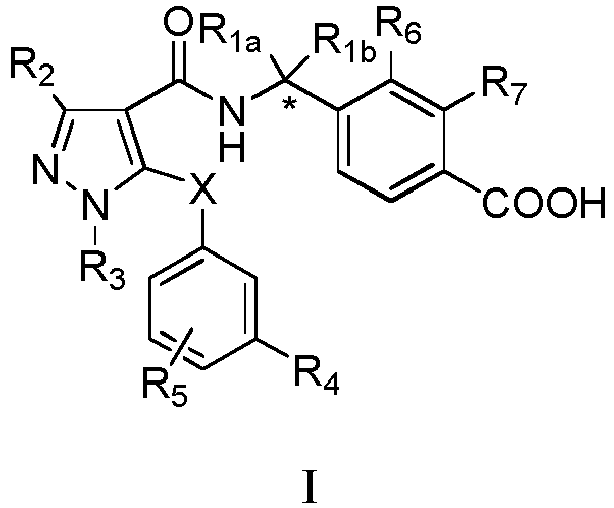
- one of R1a and R1b is hydrogen, and the other is methyl; or R1a and R1b are taken together to form a cyclopropyl ring;
- R2 is methyl or fluoromethyl;
- R3 is methyl;
- R4 is hydrogen, halo, fluoromethyl, methyl, methoxy, or fluoromethoxy;
- R5 is hydrogen, halo, fluoromethyl, methyl, methoxy, or fluoromethoxy;
- R6 is hydrogen, halo, methyl, or methoxy;
- R7 is hydrogen, halo, methyl, or methoxy; and
- X is oxygen;
for use in a method of treating migraine-associated pain in a mammal. - 58. A pharmaceutical composition comprising a compound of
embodiment 10; or a pharmaceutically acceptable salt thereof,
for use in a method of treating migraine-associated pain in a mammal. - 59. A pharmaceutical composition comprising the compound of Formula I which is:

for use in a method of treating migraine-associated pain in a mammal. - 60. A pharmaceutical composition comprising the compound of Formula I which is:
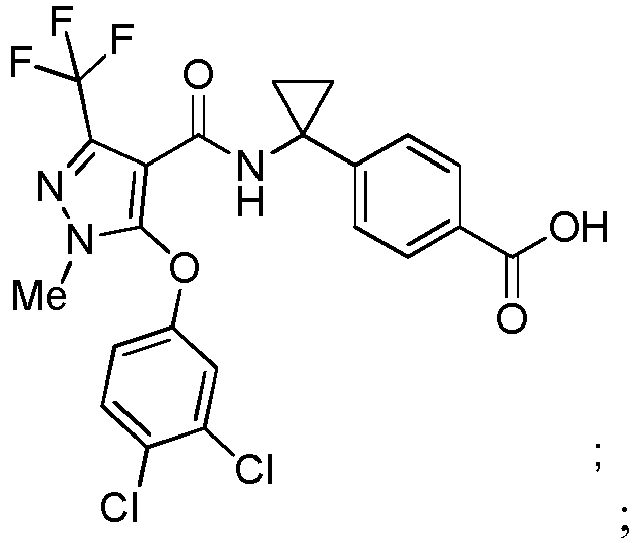
for use in a method of treating migraine-associated pain in a mammal. - 61. Use of a compound of
embodiment 1 in the treatment of migraine-associated pain. - 62. A pharmaceutical composition comprising a compound of formula I:
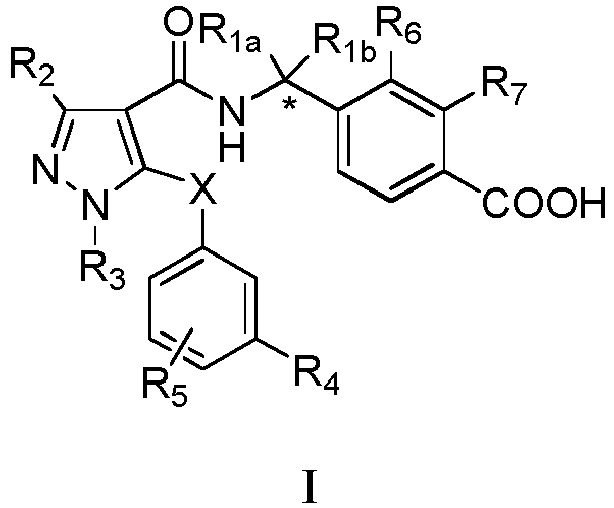
- one of R1a and R1b is hydrogen, and the other is methyl; or R1a and R1b are taken together to form a cyclopropyl ring;
- R2 is methyl or fluoromethyl;
- R3 is methyl;
- R4 is hydrogen, halo, fluoromethyl, methyl, methoxy, or fluoromethoxy;
- R5 is hydrogen, halo, fluoromethyl, methyl, methoxy, or fluoromethoxy;
- R6 is hydrogen, halo, methyl, or methoxy;
- R7 is hydrogen, halo, methyl, or methoxy; and
- X is oxygen;
for use in a method of treating spondyloarthropathies in a mammal. - 63. A pharmaceutical composition comprising a compound of
embodiment 10; or a pharmaceutically acceptable salt thereof,
for use in a method of treating spondyloarthropathies in a mammal. - 64. A pharmaceutical composition comprising the compound of Formula I which is:
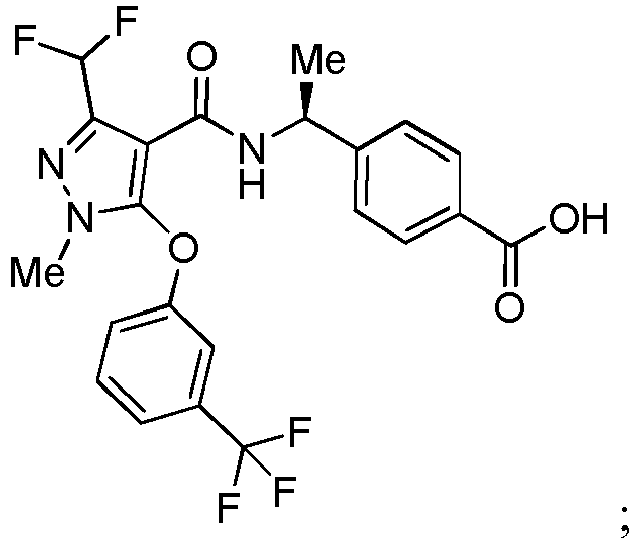
for use in a method of treating spondyloarthropathies in a mammal. - 65. A pharmaceutical composition comprising the compound of Formula I which is:

for use in a method of treating spondyloarthropathies in a mammal. - 66. Use of a compound of
embodiment 1 in the treatment of spondyloarthropathies. - 67. A pharmaceutical composition comprising a compound of formula I:
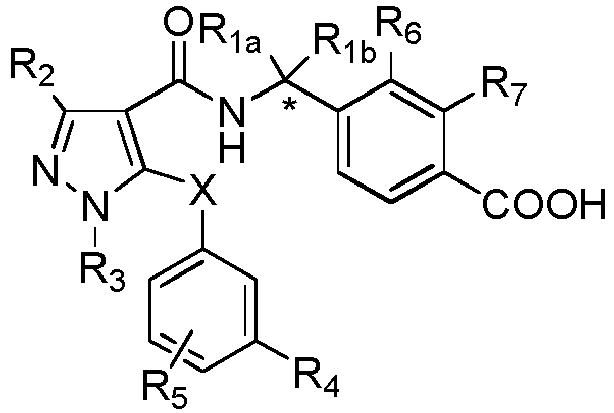
- one of R1a and R1b is hydrogen, and the other is methyl; or R1a and R1b are taken together to form a cyclopropyl ring;
- R2 is methyl or fluoromethyl;
- R3 is methyl;
- R4 is hydrogen, halo, fluoromethyl, methyl, methoxy, or fluoromethoxy;
- R5 is hydrogen, halo, fluoromethyl, methyl, methoxy, or fluoromethoxy;
- R6 is hydrogen, halo, methyl, or methoxy;
- R7 is hydrogen, halo, methyl, or methoxy; and
- X is oxygen;
for use in a method of treating cancer in a mammal. - 68. A pharmaceutical composition comprising a compound of
embodiment 10; or a pharmaceutically acceptable salt thereof,
for use in a method of treating cancer in a mammal. - 69. A pharmaceutical composition comprising the compound of Formula I which is:

for use in a method of treating cancer in a mammal. - 70. A pharmaceutical composition comprising the compound of Formula I which is:
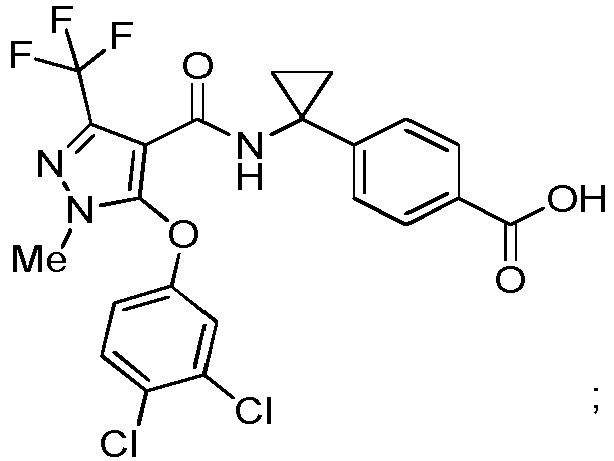
for use in a method of treating cancer in a mammal. - 71. Use of a compound of
embodiment 1 in the treatment of cancer. - 72. The composition of any of embodiments 67-70 or the use of embodiment 71, wherein the cancer is selected from the group consisting of skin cancer, breast cancer, colorectal cancer, prostate cancer, kidney cancer, ovarian cancer, cervical cancer, endometrial cancer, glioblastoma, lung cancer, head and neck cancer, medulloblastoma, and urinary tract cancer.
- 73. The composition or use of embodiment 72, wherein the cancer is skin cancer.
- 74. The composition or use of embodiment 72, wherein the cancer is breast cancer.
- 75. The composition or use of embodiment 72, wherein the cancer is colorectal cancer.
- 76. The composition or use of embodiment 72, wherein the cancer is prostate cancer.
- 77. The composition or use of embodiment 72, wherein the cancer is kidney cancer.
- 78. The composition or use of embodiment 72, wherein the cancer is ovarian cancer.
- 79. The composition or use of embodiment 72, wherein the cancer is cervical cancer.
- 80. The composition or use of embodiment 72, wherein the cancer is endometrial cancer.
- 81. The composition or use of embodiment 72, wherein the cancer is glioblastoma.
- 82. The composition or use of embodiment 72, wherein the cancer is lung cancer.
- 83. The composition or use of embodiment 72, wherein the cancer is head and neck cancer.
- 84. The composition or use of embodiment 72, wherein the cancer is medulloblastoma.
- 85. The composition or use of embodiment 72, wherein the cancer is urinary tract cancer.
- Other embodiments. While we have described a number of embodiments of this invention, it is apparent that our basic examples may be altered to provide other embodiments that utilize the compounds and methods of this invention. Therefore, it will be appreciated that the scope of this invention is to be defined by the appended claims rather than by the specific embodiments that have been represented by way of example.
Claims (20)
- A compound of formula I:
 one of R1a and R1b is hydrogen, and the other is methyl; or R1a and R1b are taken together to form a cyclopropyl ring;R2 is methyl or fluoromethyl;R3 is methyl;R4 is hydrogen, halo, fluoromethyl, methyl, methoxy, or fluoromethoxy;R5 is hydrogen, halo, fluoromethyl, methyl, methoxy, or fluoromethoxy;R6 is hydrogen, halo, methyl, or methoxy;R7 is hydrogen, halo, methyl, or methoxy; andX is oxygen;or a pharmaceutically acceptable salt thereof.
 - The compound of claim 1, wherein
one of R1a and R1b is hydrogen, and the other is methyl; R2 is methyl, difluoromethyl, or trifluoromethyl;
R3 is methyl;
R4 is chloro, fluoro, trifluoromethyl, difluoromethyl, methyl, methoxy, difluoromethoxy, or trifluoromethoxy;
R5 is hydrogen, chloro, fluoro, methyl, or methoxy;
R6 and R7 are hydrogen;
or a pharmaceutically acceptable salt thereof. - The compound of claim 2, wherein R5 is hydrogen; or a pharmaceutically acceptable salt thereof.
- The compound of claim 3, wherein R4 is selected from chloro, trifluoromethyl, difluoromethyl, difluoromethoxy, and trifluoromethoxy; or a pharmaceutically acceptable salt thereof.
- The compound of any one of claims 1 - 4, wherein,
one of R1a and R1b is hydrogen, and the other is methyl, and the compound of Formula I consists of a mixture of stereoisomers;
or a pharmaceutically acceptable salt thereof. - The compound of any one of claims 1 - 4, wherein,
one of R1a and R1b is hydrogen, and the other is methyl, and the compound of Formula I consists of a substantially pure stereoisomer;
or a pharmaceutically acceptable salt thereof. - The compound of claim 6, wherein,
one of R1a and R1b is hydrogen, and the other is methyl, and the carbon of the compound of Formula I marked with a * has substantially the S-configuration;
or a pharmaceutically acceptable salt thereof. - The compound of claim 6, wherein,
one of R1a and R1b is hydrogen, and the other is methyl, and the carbon of the compound of Formula I marked with a * has substantially the R-configuration;
or a pharmaceutically acceptable salt thereof. - The compound of claim 1, wherein
R1a and R1b are taken together to form a cyclopropyl ring;
R2 is methyl, trifluoromethyl, or difluoromethyl;
R3 is methyl;
R4 is trifluoromethyl, difluoromethyl, chloro, or fluoro;
R6 and R7 are hydrogen;
or a pharmaceutically acceptable salt thereof. - The compound of claim 1, selected from the group consisting of:

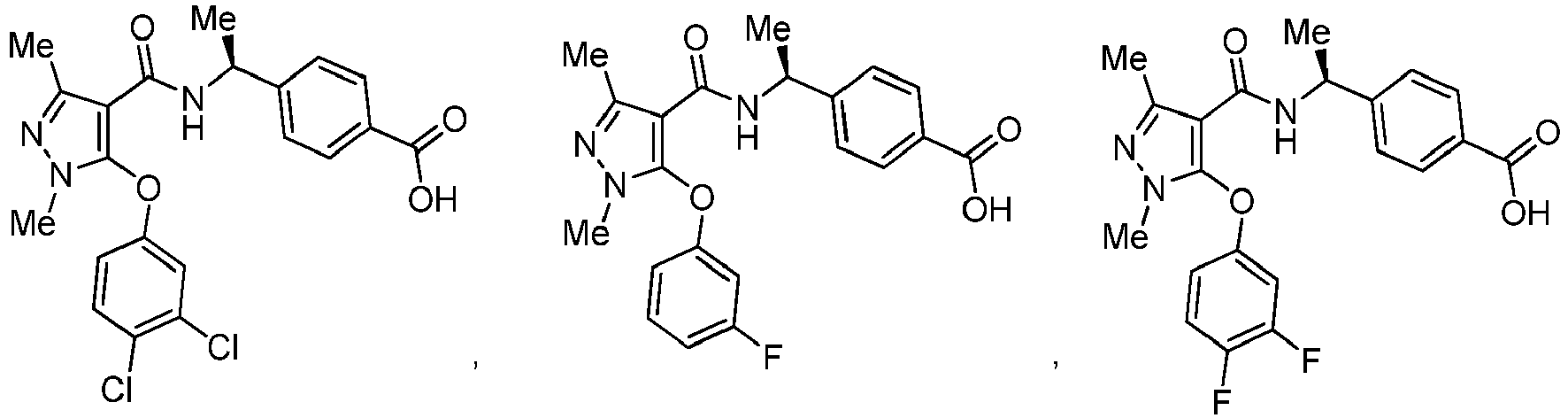


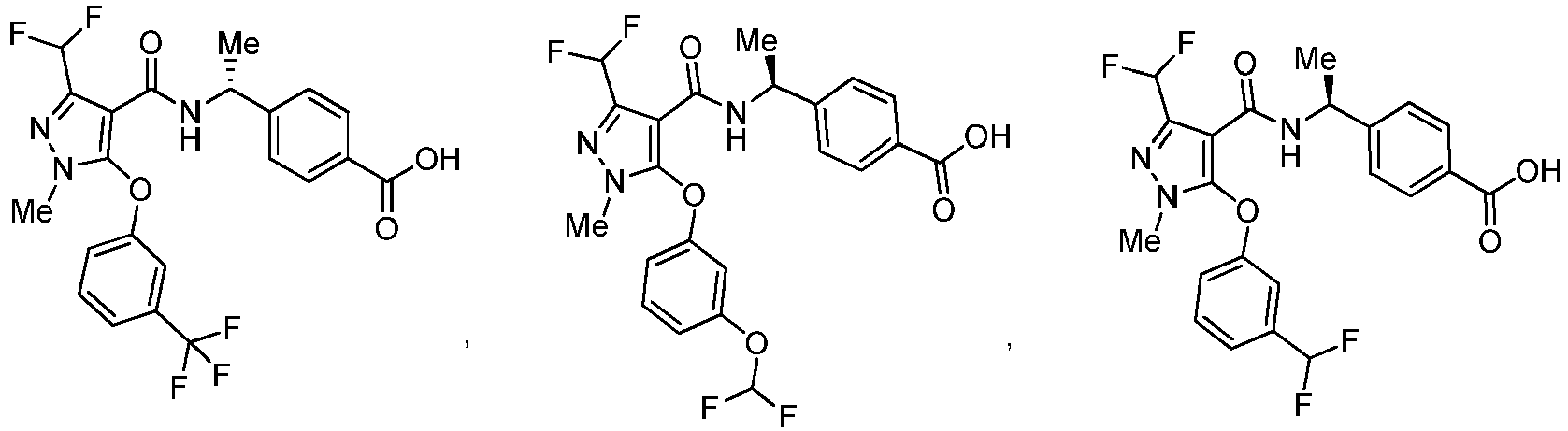


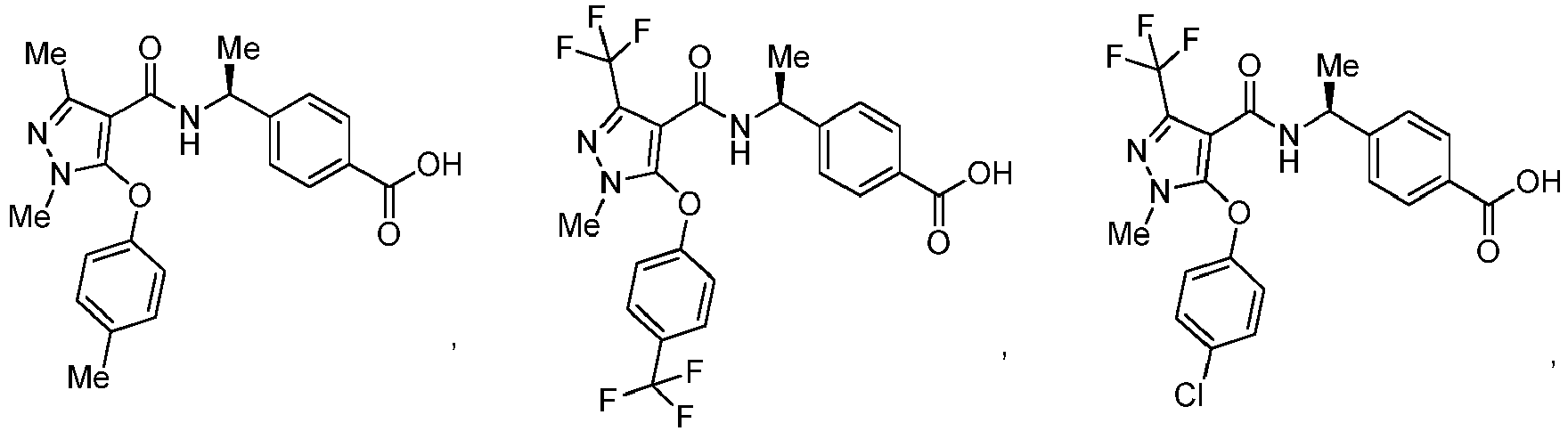


- The compound of claim 10, which is:
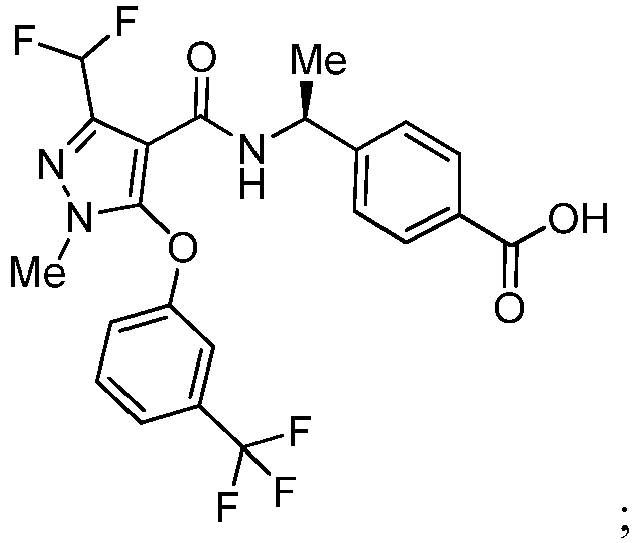
- The compound of claim 10, which is:

- A pharmaceutical composition comprising:(a) a compound of formula I:
 one of R1a and R1b is hydrogen, and the other is methyl; or R1a and R1b are taken together to form a cyclopropyl ring;R2 is methyl or fluoromethyl;R3 is methyl;R4 is hydrogen, halo, fluoromethyl, methyl, methoxy, or fluoromethoxy;R5 is hydrogen, halo, fluoromethyl, methyl, methoxy, or fluoromethoxy;R6 is hydrogen, halo, methyl, or methoxy;R7 is hydrogen, halo, methyl, or methoxy; andX is oxygen;or a pharmaceutically acceptable salt thereof;
and a pharmaceutically acceptable carrier, or(b) a compound of claim 10, or a pharmaceutically acceptable salt thereof; and a pharmaceutically acceptable carrier, or(c) the compound which is:
and a pharmaceutically acceptable carrier. - A pharmaceutical composition comprising the compound of claim 10 which is:
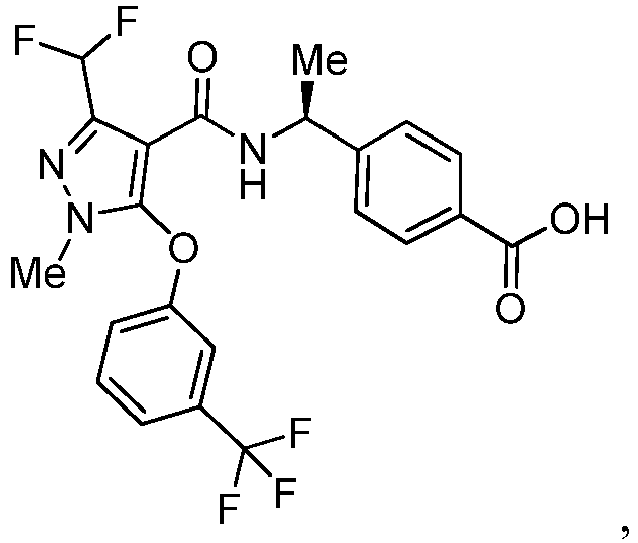
and a pharmaceutically acceptable carrier. - A pharmaceutical composition comprising:(a) a compound of formula I:
 one of R1a and R1b is hydrogen, and the other is methyl; or R1a and R1b are taken together to form a cyclopropyl ring;R2 is methyl or fluoromethyl;R3 is methyl;R4 is hydrogen, halo, fluoromethyl, methyl, methoxy, or fluoromethoxy;R5 is hydrogen, halo, fluoromethyl, methyl, methoxy, or fluoromethoxy;R6 is hydrogen, halo, methyl, or methoxy;R7 is hydrogen, halo, methyl, or methoxy; andX is oxygen;or a pharmaceutically acceptable salt thereof, or(b) a compound of claim 10;
or a pharmaceutically acceptable salt thereof, or(c) the compound of claim 10 which is: (d) the compound of claim 10 which is:
for use in the treatment of multiple sclerosis in a mammal. - A pharmaceutical composition comprising:(a) a compound of formula I:
 one of R1a and R1b is hydrogen, and the other is methyl; or R1a and R1b are taken together to form a cyclopropyl ring;R2 is methyl or fluoromethyl;R3 is methyl;R4 is hydrogen, halo, fluoromethyl, methyl, methoxy, or fluoromethoxy;R5 is hydrogen, halo, fluoromethyl, methyl, methoxy, or fluoromethoxy;R6 is hydrogen, halo, methyl, or methoxy;R7 is hydrogen, halo, methyl, or methoxy; andX is oxygen;or pharmaceutically acceptable salts thereof, or(b) a compound of claim 10;
or a pharmaceutically acceptable salt thereof, or(c) the compound of claim 10 which is: (d) the compound of claim 10 which is:
for use in the treatment of rheumatoid arthritis in a mammal. - A pharmaceutical composition comprising:(a) a compound of formula I:
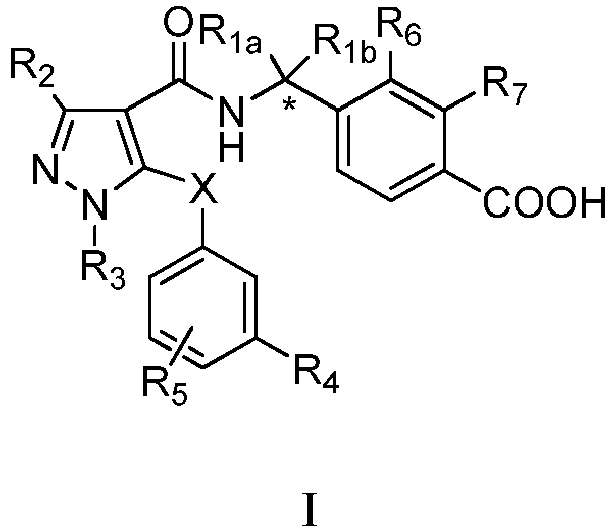 one of R1a and R1b is hydrogen, and the other is methyl; or R1a and R1b are taken together to form a cyclopropyl ring;R2 is methyl or fluoromethyl;R3 is methyl;R4 is hydrogen, halo, fluoromethyl, methyl, methoxy, or fluoromethoxy;R5 is hydrogen, halo, fluoromethyl, methyl, methoxy, or fluoromethoxy;R6 is hydrogen, halo, methyl, or methoxy;R7 is hydrogen, halo, methyl, or methoxy; andX is oxygen;or pharmaceutically acceptable salts thereof, or(b) a compound of claim 10;
or a pharmaceutically acceptable salt thereof,
for use in the treatment of cancer in a mammal,
wherein the cancer is optionally selected from the group consisting of skin cancer, breast cancer, colorectal cancer, prostate cancer, kidney cancer, ovarian cancer, cervical cancer, endometrial cancer, glioblastoma, lung cancer, head and neck cancer, medulloblastoma, and urinary tract cancer. - A pharmaceutical composition comprising the compound of claim 10 which is:

for use in the treatment of cancer in a mammal. - The pharmaceutical composition of claim 18 wherein the cancer is selected from the group consisting of skin cancer, breast cancer, colorectal cancer, prostate cancer, kidney cancer, ovarian cancer, cervical cancer, endometrial cancer, glioblastoma, lung cancer, head and neck cancer, medulloblastoma, and urinary tract cancer.
- A pharmaceutical composition comprising the compound of claim 10 which is:

for use in the treatment of cancer in a mammal,
wherein the cancer is optionally selected from the group consisting of skin cancer, breast cancer, colorectal cancer, prostate cancer, kidney cancer, ovarian cancer, cervical cancer, endometrial cancer, glioblastoma, lung cancer, head and neck cancer, medulloblastoma, and urinary tract cancer.
Priority Applications (5)
| Application Number | Priority Date | Filing Date | Title |
|---|---|---|---|
| HRP20170042TT HRP20170042T1 (en) | 2010-09-21 | 2011-09-12 | Pharmaceutical composition |
| MEP-2017-3A ME02575B (en) | 2010-09-21 | 2011-09-12 | Pharmaceutical composition |
| SI201131067A SI2619182T1 (en) | 2010-09-21 | 2011-09-12 | Pharmaceutical composition |
| SM20170008T SMT201700008T1 (en) | 2010-09-21 | 2011-09-12 | Pharmaceutical composition |
| EP16161460.7A EP3061751A1 (en) | 2010-09-21 | 2011-09-12 | Pharmaceutical composition |
Applications Claiming Priority (2)
| Application Number | Priority Date | Filing Date | Title |
|---|---|---|---|
| US38478110P | 2010-09-21 | 2010-09-21 | |
| PCT/US2011/051163 WO2012039972A1 (en) | 2010-09-21 | 2011-09-12 | Pharmaceutical composition |
Related Child Applications (2)
| Application Number | Title | Priority Date | Filing Date |
|---|---|---|---|
| EP16161460.7A Division-Into EP3061751A1 (en) | 2010-09-21 | 2011-09-12 | Pharmaceutical composition |
| EP16161460.7A Division EP3061751A1 (en) | 2010-09-21 | 2011-09-12 | Pharmaceutical composition |
Publications (2)
| Publication Number | Publication Date |
|---|---|
| EP2619182A1 EP2619182A1 (en) | 2013-07-31 |
| EP2619182B1 true EP2619182B1 (en) | 2016-11-09 |
Family
ID=44674894
Family Applications (2)
| Application Number | Title | Priority Date | Filing Date |
|---|---|---|---|
| EP11760631.9A Active EP2619182B1 (en) | 2010-09-21 | 2011-09-12 | Pharmaceutical composition |
| EP16161460.7A Withdrawn EP3061751A1 (en) | 2010-09-21 | 2011-09-12 | Pharmaceutical composition |
Family Applications After (1)
| Application Number | Title | Priority Date | Filing Date |
|---|---|---|---|
| EP16161460.7A Withdrawn EP3061751A1 (en) | 2010-09-21 | 2011-09-12 | Pharmaceutical composition |
Country Status (31)
| Country | Link |
|---|---|
| US (2) | US8686018B2 (en) |
| EP (2) | EP2619182B1 (en) |
| JP (1) | JP5956448B2 (en) |
| KR (1) | KR101911105B1 (en) |
| CN (1) | CN103097358B (en) |
| AU (1) | AU2011305872B2 (en) |
| BR (1) | BR112013002484B1 (en) |
| CA (1) | CA2806121C (en) |
| CL (1) | CL2013000675A1 (en) |
| CY (1) | CY1118680T1 (en) |
| DK (1) | DK2619182T3 (en) |
| ES (1) | ES2610185T3 (en) |
| HR (1) | HRP20170042T1 (en) |
| HU (1) | HUE031408T2 (en) |
| IL (1) | IL224288A (en) |
| LT (1) | LT2619182T (en) |
| ME (1) | ME02575B (en) |
| MX (1) | MX2013003162A (en) |
| MY (1) | MY162146A (en) |
| NZ (1) | NZ606629A (en) |
| PE (1) | PE20131343A1 (en) |
| PH (1) | PH12013500467A1 (en) |
| PL (1) | PL2619182T3 (en) |
| PT (1) | PT2619182T (en) |
| RS (1) | RS55566B1 (en) |
| RU (1) | RU2606510C2 (en) |
| SG (1) | SG188188A1 (en) |
| SI (1) | SI2619182T1 (en) |
| SM (2) | SMT201700008T1 (en) |
| UA (1) | UA113499C2 (en) |
| WO (1) | WO2012039972A1 (en) |
Families Citing this family (25)
| Publication number | Priority date | Publication date | Assignee | Title |
|---|---|---|---|---|
| AR091429A1 (en) * | 2012-06-29 | 2015-02-04 | Lilly Co Eli | PIPERIDINE PHENOXIETIL COMPOUNDS |
| CN105431416B (en) * | 2013-06-12 | 2019-01-08 | 科研制药株式会社 | 4- alkynyl imdazole derivatives and contain its drug as effective component |
| TW201623277A (en) | 2014-03-26 | 2016-07-01 | 安斯泰來製藥股份有限公司 | Amide compound |
| CN110354266A (en) * | 2014-05-23 | 2019-10-22 | 卫材 R&D 管理有限公司 | Combination Therapies Used to Treat Cancer |
| UY36680A (en) | 2015-05-19 | 2016-12-30 | Glaxosmithkline Ip Dev Ltd | HETEROCYCLIC AMIDES AS QUINASA INHIBITORS |
| CA2993312A1 (en) | 2015-07-23 | 2017-01-26 | Takeda Pharmaceutical Company Limited | 1-substituted 1,2,3,4-tetrahydro-1,7-naphthyridin-8-amine derivatives and their use as ep4 receptor antagonists |
| CN108473497B (en) * | 2015-10-16 | 2021-09-10 | 卫材R&D 管理有限公司 | EP4 antagonists |
| CR20180323A (en) | 2015-11-20 | 2018-08-06 | Idorsia Pharmaceuticals Ltd | DERIVATIVES OF INDOL N-SUBSTITUTES AS MODULATORS OF PGE2 RECEIVERS |
| MA49126B1 (en) | 2017-05-18 | 2021-10-29 | Idorsia Pharmaceuticals Ltd | Phenyl derivatives used as modulators of pge2 receptors |
| SI3625224T1 (en) | 2017-05-18 | 2021-11-30 | Idorsia Pharmaceuticals Ltd | N-substituted indole derivatives |
| JP7093791B2 (en) | 2017-05-18 | 2022-06-30 | イドーシア ファーマシューティカルズ リミテッド | Benzofuran and benzothiophene derivatives as PGE2 receptor regulators |
| WO2018210992A1 (en) | 2017-05-18 | 2018-11-22 | Idorsia Pharmaceuticals Ltd | Pyrimidine derivatives |
| WO2018210988A1 (en) | 2017-05-18 | 2018-11-22 | Idorsia Pharmaceuticals Ltd | Pyrimidine derivatives as pge2 receptor modulators |
| CN108929281B (en) * | 2017-05-27 | 2021-12-24 | 华东师范大学 | Triazole compound and synthesis method and application thereof |
| CA3090485C (en) * | 2018-02-05 | 2024-01-16 | Shenzhen Ionova Life Science Co., Ltd. | Heterobicyclic carboxylic acids for treating cancer or inflammatory diseases |
| AU2021229414B2 (en) * | 2020-03-04 | 2023-07-06 | Wuhan Humanwell Innovative Drug Research and Development Center Limited Company | Synthesis of novel EP4 antagonist and use in cancers and inflammations |
| CN114075140A (en) * | 2020-08-18 | 2022-02-22 | 武汉人福创新药物研发中心有限公司 | Pyrazole amide derivatives as EP4 receptor antagonists and their use in cancer and inflammation |
| TW202228674A (en) | 2020-11-13 | 2022-08-01 | 日商小野藥品工業股份有限公司 | Cancer treatment with combination of ep4 antagonist and immune checkpoint inhibitor |
| TWI877433B (en) | 2020-11-30 | 2025-03-21 | 大陸商杭州阿諾生物醫藥科技有限公司 | Combination therapy for the treatment of pik3ca mutant cancer |
| CN116801879B (en) * | 2021-01-28 | 2025-09-26 | 深圳众格生物科技有限公司 | Pyrazoleamide derivatives and their preparation methods and applications |
| TW202328073A (en) * | 2021-09-03 | 2023-07-16 | 大陸商武漢人福創新藥物研發中心有限公司 | Ep4 antagonis, salt and polymorphs thereof, method and application thereof |
| CN115364222A (en) * | 2021-09-09 | 2022-11-22 | 首都医科大学附属北京地坛医院 | Application of EP4 receptor inhibitor in the treatment of liver fibrosis |
| WO2023122289A1 (en) | 2021-12-23 | 2023-06-29 | Eisai R&D Management Co., Ltd. | Crystalline salt form of ep4 antagonist |
| US20250381143A1 (en) * | 2021-12-30 | 2025-12-18 | Adlai Nortye Biopharma Co., Ltd. | A solid pharmaceutical composition |
| WO2024027599A1 (en) * | 2022-08-04 | 2024-02-08 | 杭州阿诺生物医药科技有限公司 | Biomarker for predicting sensitivity of rectal cancer to treatment with an0025 in combination with radiotherapy/chemoradiotherapy (rt/crt) |
Family Cites Families (36)
| Publication number | Priority date | Publication date | Assignee | Title |
|---|---|---|---|---|
| JPH0421671A (en) * | 1990-05-16 | 1992-01-24 | Mitsubishi Kasei Corp | 4-pyrazole carboxamides and insecticides and acaricides containing them as active ingredients |
| IL104311A (en) * | 1992-02-05 | 1997-07-13 | Fujisawa Pharmaceutical Co | Pyrazole derivatives, processes for the preparation thereof and pharmaceutical compositions containing the same |
| US6211197B1 (en) * | 1998-10-07 | 2001-04-03 | Merck Frosst Canada & Co. | Prostaglandin receptor ligands |
| US7393842B2 (en) | 2001-08-31 | 2008-07-01 | University Of Connecticut | Pyrazole analogs acting on cannabinoid receptors |
| US7119108B1 (en) | 1999-10-18 | 2006-10-10 | University Of Connecticut | Pyrazole derivatives as cannabinoid receptor antagonists |
| HN2001000224A (en) | 2000-10-19 | 2002-06-13 | Pfizer | IMIDAZOL COMPOUNDS CONDENSED WITH ARILO OR HETEROARILO AS ANTI - INFLAMMATORY AND ANALGESIC AGENTS. |
| TW591020B (en) | 2001-06-20 | 2004-06-11 | Wyeth Corp | 6-(aryl-amido or aryl-amidomethyl)-naphthalen-2-yloxy-acidic derivatives as inhibitors of plasminogen activator inhibitor type-1 (PAI-1) |
| US20050113283A1 (en) | 2002-01-18 | 2005-05-26 | David Solow-Cordero | Methods of treating conditions associated with an EDG-4 receptor |
| WO2004037212A2 (en) | 2002-10-24 | 2004-05-06 | Sepracor, Inc. | Compositions comprising zopiclone derivatives and methods of making and using the same |
| FR2847160A1 (en) | 2002-11-20 | 2004-05-21 | Oreal | HAIR COMPOSITION CONTAINING A PYRASOL-CARBOXAMIDE COMPOUND, ITS USE FOR STIMULATING HAIR GROWTH AND / OR BRAKING FALLING |
| GB0302094D0 (en) | 2003-01-29 | 2003-02-26 | Pharmagene Lab Ltd | EP4 receptor antagonists |
| PL1641764T3 (en) * | 2003-06-26 | 2011-12-30 | Novartis Ag | 5-membered heterocycle-based p38 kinase inhibitors |
| ES2441206T3 (en) | 2003-09-03 | 2014-02-03 | Raqualia Pharma Inc. | Phenyl or pyridylamide compounds as prostaglandin E2 antagonists |
| WO2005070889A1 (en) | 2004-01-23 | 2005-08-04 | E.I. Dupont De Nemours And Company | Herbicidal amides |
| ATE435198T1 (en) * | 2004-05-04 | 2009-07-15 | Raqualia Pharma Inc | ORTHOSUBSTITUTED ARYL OR HETEROARYLAMIDE COMPOUNDS |
| CA2565813C (en) | 2004-05-04 | 2010-10-26 | Pfizer Inc. | Substituted methyl aryl or heteroaryl amide compounds |
| EP1894919B1 (en) | 2005-06-07 | 2012-03-28 | Shionogi & Co., Ltd. | Heterocyclic compound having type i 11 beta hydroxysteroid dehydrogenase inhibitory activity |
| JP2008545776A (en) * | 2005-06-11 | 2008-12-18 | ヴァーナリス アールアンドディー リミテッド | Pyrazole-substituted benzimidazole derivatives for use in the treatment of cancer and autoimmune diseases |
| CN101273013B (en) * | 2005-09-27 | 2013-06-12 | 盐野义制药株式会社 | Sulfonamide derivative having PGD2 receptor antagonistic activity |
| EP1953145B1 (en) | 2005-11-21 | 2015-11-04 | Shionogi & Co., Ltd. | Heterocyclic compound having inhibitory activity on 11-b-hydroxysteroid dehydrogenase type i |
| CN101415687B (en) * | 2006-02-06 | 2012-02-08 | 大正制药株式会社 | Binding inhibitor of sphingosine-1-phosphate |
| JP5183628B2 (en) | 2006-06-12 | 2013-04-17 | メルク カナダ インコーポレイテッド | Indoline amide derivatives as EP4 receptor ligands |
| CN101541778B (en) | 2006-08-11 | 2014-10-08 | 默克加拿大有限公司 | Thiophenecarboxamide derivatives as EP4 receptor ligands |
| AU2007331471C1 (en) | 2006-12-15 | 2013-07-25 | Glaxo Group Limited | Benzamide derivatives as EP4 receptor agonists |
| WO2008104055A1 (en) | 2007-02-26 | 2008-09-04 | Merck Frosst Canada Ltd. | Indole and indoline cyclopropyl amide derivatives as ep4 receptor antagonists |
| US7560936B1 (en) | 2007-04-24 | 2009-07-14 | Integrated Device Technology, Inc. | Method and apparatus for ground bounce and power supply bounce detection |
| BRPI0812958A2 (en) | 2007-06-15 | 2014-12-09 | Basf Se | PROCESS TO PREPARE COMPOUNDS, USE OF COMPOUNDS, AND COMPOUNDS |
| EP2460787A1 (en) | 2007-07-03 | 2012-06-06 | Astellas Pharma Inc. | Amide compounds and their use as PGE2 antagonists. |
| JP2010533736A (en) * | 2007-07-19 | 2010-10-28 | ハー・ルンドベック・アクチエゼルスカベット | 5-membered heterocyclic amides and related compounds |
| AR067744A1 (en) | 2007-07-31 | 2009-10-21 | Bayer Cropscience Sa | FUNGICIDE DERIVATIVES OF (HETERO) ARIL- METILEN -N- CONCENSED CARBOXAMIDE CYCLEALKYL OF 6 ELEMENTS WITH N |
| GB0721611D0 (en) | 2007-11-02 | 2007-12-12 | Glaxo Group Ltd | Novel compounds |
| CA2722811C (en) * | 2008-05-06 | 2016-07-05 | Boehringer Ingelheim International Gmbh | Pyrazole compounds as ccr1 antagonists |
| EP2565191B1 (en) * | 2008-05-14 | 2014-10-08 | Astellas Pharma Inc. | 4-(Indol-7-ylcarbonylaminomethyl)cyclohexanecarboxylic acid derivatives as EP4 receptor antagonists useful for the treatment of chronic renal failure or diabetic nephropathy |
| WO2010012794A1 (en) | 2008-08-01 | 2010-02-04 | Bayer Cropscience Sa | Fungicide n-cycloalkyl-n-biphenylmethyl-carboxamide derivatives |
| US8404736B2 (en) * | 2008-08-14 | 2013-03-26 | Beta Pharma Canada Inc. | Heterocyclic amide derivatives as EP4 receptor antagonists |
| US8685999B2 (en) | 2008-09-25 | 2014-04-01 | Merck Sharp & Dohme Corp. | Beta carboline sulphonylurea derivatives as EP4 receptor antagonists |
-
2011
- 2011-09-12 PT PT117606319T patent/PT2619182T/en unknown
- 2011-09-12 EP EP11760631.9A patent/EP2619182B1/en active Active
- 2011-09-12 DK DK11760631.9T patent/DK2619182T3/en active
- 2011-09-12 CN CN201180045222.XA patent/CN103097358B/en active Active
- 2011-09-12 HR HRP20170042TT patent/HRP20170042T1/en unknown
- 2011-09-12 PH PH1/2013/500467A patent/PH12013500467A1/en unknown
- 2011-09-12 UA UAA201304961A patent/UA113499C2/en unknown
- 2011-09-12 EP EP16161460.7A patent/EP3061751A1/en not_active Withdrawn
- 2011-09-12 WO PCT/US2011/051163 patent/WO2012039972A1/en not_active Ceased
- 2011-09-12 CA CA2806121A patent/CA2806121C/en active Active
- 2011-09-12 RU RU2013118209A patent/RU2606510C2/en active
- 2011-09-12 BR BR112013002484-4A patent/BR112013002484B1/en active IP Right Grant
- 2011-09-12 JP JP2013530177A patent/JP5956448B2/en active Active
- 2011-09-12 NZ NZ60662911A patent/NZ606629A/en unknown
- 2011-09-12 ES ES11760631.9T patent/ES2610185T3/en active Active
- 2011-09-12 MY MYPI2013700146A patent/MY162146A/en unknown
- 2011-09-12 PL PL11760631T patent/PL2619182T3/en unknown
- 2011-09-12 PE PE2013000320A patent/PE20131343A1/en active IP Right Grant
- 2011-09-12 ME MEP-2017-3A patent/ME02575B/en unknown
- 2011-09-12 RS RS20170008A patent/RS55566B1/en unknown
- 2011-09-12 SG SG2013007174A patent/SG188188A1/en unknown
- 2011-09-12 SM SM20170008T patent/SMT201700008T1/en unknown
- 2011-09-12 SI SI201131067A patent/SI2619182T1/en unknown
- 2011-09-12 AU AU2011305872A patent/AU2011305872B2/en active Active
- 2011-09-12 MX MX2013003162A patent/MX2013003162A/en active IP Right Grant
- 2011-09-12 HU HUE11760631A patent/HUE031408T2/en unknown
- 2011-09-12 KR KR1020137004494A patent/KR101911105B1/en active Active
- 2011-09-12 LT LTEP11760631.9T patent/LT2619182T/en unknown
-
2013
- 2013-01-17 IL IL224288A patent/IL224288A/en active IP Right Grant
- 2013-03-12 CL CL2013000675A patent/CL2013000675A1/en unknown
- 2013-03-12 US US13/795,768 patent/US8686018B2/en active Active
-
2014
- 2014-02-05 US US14/173,170 patent/US9000024B2/en active Active
-
2017
- 2017-01-09 SM SM201700008T patent/SMT201700008B/en unknown
- 2017-01-19 CY CY20171100079T patent/CY1118680T1/en unknown
Also Published As
Similar Documents
| Publication | Publication Date | Title |
|---|---|---|
| EP2619182B1 (en) | Pharmaceutical composition | |
| WO2012103071A2 (en) | Compounds and compositions | |
| ES2526981T3 (en) | N-sulfonylbenzamides as voltage dependent sodium channel inhibitors | |
| KR101593237B1 (en) | 5-membered heterocyclic amides and related compounds | |
| US8772343B2 (en) | Chemical compounds | |
| US9085517B2 (en) | Sulfonamide derivatives | |
| AU2007311591B2 (en) | Biaryl ether urea compounds | |
| WO2007037534A1 (en) | 2-heteroaryl-substituted indole derivative | |
| CN101356169A (en) | Pyrazine derivatives | |
| CN119053601A (en) | Small molecule inhibitors of ubiquitin-specific protease 1 (USP 1) and uses thereof | |
| JP7389238B2 (en) | Pyrimidine compounds and their preparation methods | |
| JP2025124882A (en) | Heteroaryl plasma kallikrein inhibitors | |
| KR20090016504A (en) | Sulfur-containing pyrazole derivatives as selective cannabinoid CX1 receptor antagonists | |
| US9163021B2 (en) | Pyrrolo[3,2-c]pyridine tropomyosin-related kinase inhibitors | |
| JP7263659B2 (en) | Nitrogen-containing benzoheterocyclic compound containing carboxylic acid group, method for preparation and use thereof | |
| HK1181765A (en) | Pharmaceutical composition | |
| HK1181765B (en) | Pharmaceutical composition | |
| RU2650678C2 (en) | Novel imidazolidine-2,4-dione derivatives | |
| JPH1160571A (en) | Heterocyclic compound, its production and use | |
| AU2024320585A1 (en) | Novel compound, and pharmaceutical composition for prevention or treatment of cancer or tumors comprising same | |
| JP2024528729A (en) | SRPK inhibitors |
Legal Events
| Date | Code | Title | Description |
|---|---|---|---|
| PUAI | Public reference made under article 153(3) epc to a published international application that has entered the european phase |
Free format text: ORIGINAL CODE: 0009012 |
|
| 17P | Request for examination filed |
Effective date: 20130418 |
|
| AK | Designated contracting states |
Kind code of ref document: A1 Designated state(s): AL AT BE BG CH CY CZ DE DK EE ES FI FR GB GR HR HU IE IS IT LI LT LU LV MC MK MT NL NO PL PT RO RS SE SI SK SM TR |
|
| AX | Request for extension of the european patent |
Extension state: BA ME |
|
| REG | Reference to a national code |
Ref country code: HK Ref legal event code: DE Ref document number: 1181765 Country of ref document: HK |
|
| 17Q | First examination report despatched |
Effective date: 20140718 |
|
| GRAP | Despatch of communication of intention to grant a patent |
Free format text: ORIGINAL CODE: EPIDOSNIGR1 |
|
| INTG | Intention to grant announced |
Effective date: 20150515 |
|
| GRAP | Despatch of communication of intention to grant a patent |
Free format text: ORIGINAL CODE: EPIDOSNIGR1 |
|
| INTG | Intention to grant announced |
Effective date: 20151112 |
|
| GRAS | Grant fee paid |
Free format text: ORIGINAL CODE: EPIDOSNIGR3 |
|
| GRAP | Despatch of communication of intention to grant a patent |
Free format text: ORIGINAL CODE: EPIDOSNIGR1 |
|
| INTG | Intention to grant announced |
Effective date: 20160511 |
|
| GRAS | Grant fee paid |
Free format text: ORIGINAL CODE: EPIDOSNIGR3 |
|
| GRAA | (expected) grant |
Free format text: ORIGINAL CODE: 0009210 |
|
| AK | Designated contracting states |
Kind code of ref document: B1 Designated state(s): AL AT BE BG CH CY CZ DE DK EE ES FI FR GB GR HR HU IE IS IT LI LT LU LV MC MK MT NL NO PL PT RO RS SE SI SK SM TR |
|
| AX | Request for extension of the european patent |
Extension state: BA ME |
|
| REG | Reference to a national code |
Ref country code: GB Ref legal event code: FG4D |
|
| REG | Reference to a national code |
Ref country code: AT Ref legal event code: REF Ref document number: 843777 Country of ref document: AT Kind code of ref document: T Effective date: 20161115 Ref country code: CH Ref legal event code: EP |
|
| REG | Reference to a national code |
Ref country code: IE Ref legal event code: FG4D |
|
| REG | Reference to a national code |
Ref country code: DE Ref legal event code: R096 Ref document number: 602011032224 Country of ref document: DE |
|
| REG | Reference to a national code |
Ref country code: HR Ref legal event code: TUEP Ref document number: P20170042 Country of ref document: HR |
|
| REG | Reference to a national code |
Ref country code: PT Ref legal event code: SC4A Ref document number: 2619182 Country of ref document: PT Date of ref document: 20170117 Kind code of ref document: T Free format text: AVAILABILITY OF NATIONAL TRANSLATION Effective date: 20170105 |
|
| REG | Reference to a national code |
Ref country code: NL Ref legal event code: FP |
|
| REG | Reference to a national code |
Ref country code: DK Ref legal event code: T3 Effective date: 20170126 |
|
| REG | Reference to a national code |
Ref country code: SE Ref legal event code: TRGR |
|
| REG | Reference to a national code |
Ref country code: RO Ref legal event code: EPE |
|
| REG | Reference to a national code |
Ref country code: EE Ref legal event code: FG4A Ref document number: E012992 Country of ref document: EE Effective date: 20170102 |
|
| REG | Reference to a national code |
Ref country code: HR Ref legal event code: T1PR Ref document number: P20170042 Country of ref document: HR |
|
| REG | Reference to a national code |
Ref country code: NO Ref legal event code: T2 Effective date: 20161109 |
|
| REG | Reference to a national code |
Ref country code: ES Ref legal event code: FG2A Ref document number: 2610185 Country of ref document: ES Kind code of ref document: T3 Effective date: 20170426 |
|
| REG | Reference to a national code |
Ref country code: SK Ref legal event code: T3 Ref document number: E 23088 Country of ref document: SK |
|
| REG | Reference to a national code |
Ref country code: HU Ref legal event code: AG4A Ref document number: E031408 Country of ref document: HU |
|
| REG | Reference to a national code |
Ref country code: DE Ref legal event code: R097 Ref document number: 602011032224 Country of ref document: DE |
|
| PLBE | No opposition filed within time limit |
Free format text: ORIGINAL CODE: 0009261 |
|
| REG | Reference to a national code |
Ref country code: HK Ref legal event code: GR Ref document number: 1181765 Country of ref document: HK |
|
| STAA | Information on the status of an ep patent application or granted ep patent |
Free format text: STATUS: NO OPPOSITION FILED WITHIN TIME LIMIT |
|
| REG | Reference to a national code |
Ref country code: FR Ref legal event code: PLFP Year of fee payment: 7 |
|
| 26N | No opposition filed |
Effective date: 20170810 |
|
| REG | Reference to a national code |
Ref country code: FR Ref legal event code: PLFP Year of fee payment: 8 |
|
| REG | Reference to a national code |
Ref country code: HR Ref legal event code: ODRP Ref document number: P20170042 Country of ref document: HR Payment date: 20190821 Year of fee payment: 9 |
|
| REG | Reference to a national code |
Ref country code: AT Ref legal event code: UEP Ref document number: 843777 Country of ref document: AT Kind code of ref document: T Effective date: 20161109 |
|
| REG | Reference to a national code |
Ref country code: HR Ref legal event code: ODRP Ref document number: P20170042 Country of ref document: HR Payment date: 20200820 Year of fee payment: 10 |
|
| REG | Reference to a national code |
Ref country code: HR Ref legal event code: ODRP Ref document number: P20170042 Country of ref document: HR Payment date: 20210819 Year of fee payment: 11 |
|
| REG | Reference to a national code |
Ref country code: HR Ref legal event code: ODRP Ref document number: P20170042 Country of ref document: HR Payment date: 20220824 Year of fee payment: 12 |
|
| P01 | Opt-out of the competence of the unified patent court (upc) registered |
Effective date: 20230511 |
|
| REG | Reference to a national code |
Ref country code: HR Ref legal event code: ODRP Ref document number: P20170042 Country of ref document: HR Payment date: 20230821 Year of fee payment: 13 |
|
| REG | Reference to a national code |
Ref country code: HR Ref legal event code: ODRP Ref document number: P20170042 Country of ref document: HR Payment date: 20240821 Year of fee payment: 14 |
|
| PGFP | Annual fee paid to national office [announced via postgrant information from national office to epo] |
Ref country code: FI Payment date: 20240925 Year of fee payment: 14 Ref country code: IE Payment date: 20240927 Year of fee payment: 14 |
|
| PGFP | Annual fee paid to national office [announced via postgrant information from national office to epo] |
Ref country code: GR Payment date: 20240926 Year of fee payment: 14 Ref country code: DK Payment date: 20240925 Year of fee payment: 14 |
|
| PGFP | Annual fee paid to national office [announced via postgrant information from national office to epo] |
Ref country code: BE Payment date: 20240927 Year of fee payment: 14 |
|
| PGFP | Annual fee paid to national office [announced via postgrant information from national office to epo] |
Ref country code: AT Payment date: 20240821 Year of fee payment: 14 |
|
| PGFP | Annual fee paid to national office [announced via postgrant information from national office to epo] |
Ref country code: NO Payment date: 20240927 Year of fee payment: 14 |
|
| PGFP | Annual fee paid to national office [announced via postgrant information from national office to epo] |
Ref country code: LU Payment date: 20240927 Year of fee payment: 14 |
|
| REG | Reference to a national code |
Ref country code: HR Ref legal event code: ODRP Ref document number: P20170042 Country of ref document: HR Payment date: 20250903 Year of fee payment: 15 |
|
| REG | Reference to a national code |
Ref country code: CH Ref legal event code: U11 Free format text: ST27 STATUS EVENT CODE: U-0-0-U10-U11 (AS PROVIDED BY THE NATIONAL OFFICE) Effective date: 20251001 |
|
| PGFP | Annual fee paid to national office [announced via postgrant information from national office to epo] |
Ref country code: SM Payment date: 20250825 Year of fee payment: 15 |
|
| PGFP | Annual fee paid to national office [announced via postgrant information from national office to epo] |
Ref country code: PT Payment date: 20250828 Year of fee payment: 15 |
|
| PGFP | Annual fee paid to national office [announced via postgrant information from national office to epo] |
Ref country code: LT Payment date: 20250819 Year of fee payment: 15 Ref country code: DE Payment date: 20250929 Year of fee payment: 15 |
|
| PGFP | Annual fee paid to national office [announced via postgrant information from national office to epo] |
Ref country code: MC Payment date: 20250821 Year of fee payment: 15 |
|
| PGFP | Annual fee paid to national office [announced via postgrant information from national office to epo] |
Ref country code: PL Payment date: 20250822 Year of fee payment: 15 Ref country code: IT Payment date: 20250919 Year of fee payment: 15 Ref country code: TR Payment date: 20250822 Year of fee payment: 15 Ref country code: NL Payment date: 20250926 Year of fee payment: 15 |
|
| PGFP | Annual fee paid to national office [announced via postgrant information from national office to epo] |
Ref country code: BG Payment date: 20250917 Year of fee payment: 15 Ref country code: HU Payment date: 20250822 Year of fee payment: 15 Ref country code: GB Payment date: 20250929 Year of fee payment: 15 |
|
| PGFP | Annual fee paid to national office [announced via postgrant information from national office to epo] |
Ref country code: HR Payment date: 20250903 Year of fee payment: 15 |
|
| PGFP | Annual fee paid to national office [announced via postgrant information from national office to epo] |
Ref country code: AL Payment date: 20250907 Year of fee payment: 15 Ref country code: FR Payment date: 20250925 Year of fee payment: 15 |
|
| PGFP | Annual fee paid to national office [announced via postgrant information from national office to epo] |
Ref country code: SE Payment date: 20250927 Year of fee payment: 15 Ref country code: MT Payment date: 20250820 Year of fee payment: 15 |
|
| PGFP | Annual fee paid to national office [announced via postgrant information from national office to epo] |
Ref country code: RS Payment date: 20250819 Year of fee payment: 15 Ref country code: EE Payment date: 20250918 Year of fee payment: 15 Ref country code: CZ Payment date: 20250826 Year of fee payment: 15 |
|
| PGFP | Annual fee paid to national office [announced via postgrant information from national office to epo] |
Ref country code: RO Payment date: 20250827 Year of fee payment: 15 |
|
| PGFP | Annual fee paid to national office [announced via postgrant information from national office to epo] |
Ref country code: SK Payment date: 20250819 Year of fee payment: 15 |
|
| PGFP | Annual fee paid to national office [announced via postgrant information from national office to epo] |
Ref country code: IS Payment date: 20250910 Year of fee payment: 15 |
|
| PGFP | Annual fee paid to national office [announced via postgrant information from national office to epo] |
Ref country code: LV Payment date: 20250819 Year of fee payment: 15 |
|
| PGFP | Annual fee paid to national office [announced via postgrant information from national office to epo] |
Ref country code: SI Payment date: 20250818 Year of fee payment: 15 |
|
| PGFP | Annual fee paid to national office [announced via postgrant information from national office to epo] |
Ref country code: MK Payment date: 20250820 Year of fee payment: 15 |
|
| PGFP | Annual fee paid to national office [announced via postgrant information from national office to epo] |
Ref country code: CH Payment date: 20251001 Year of fee payment: 15 |
|
| PGFP | Annual fee paid to national office [announced via postgrant information from national office to epo] |
Ref country code: CY Payment date: 20250821 Year of fee payment: 15 |
|
| PGFP | Annual fee paid to national office [announced via postgrant information from national office to epo] |
Ref country code: ES Payment date: 20251001 Year of fee payment: 15 |