EP2424904B1 - Bromination of low molecular weight aromatic polymer compositions - Google Patents
Bromination of low molecular weight aromatic polymer compositions Download PDFInfo
- Publication number
- EP2424904B1 EP2424904B1 EP10718369.1A EP10718369A EP2424904B1 EP 2424904 B1 EP2424904 B1 EP 2424904B1 EP 10718369 A EP10718369 A EP 10718369A EP 2424904 B1 EP2424904 B1 EP 2424904B1
- Authority
- EP
- European Patent Office
- Prior art keywords
- aromatic polymer
- bromination
- polymer composition
- range
- catalyst
- Prior art date
- Legal status (The legal status is an assumption and is not a legal conclusion. Google has not performed a legal analysis and makes no representation as to the accuracy of the status listed.)
- Active
Links
Images

Classifications
-
- C—CHEMISTRY; METALLURGY
- C08—ORGANIC MACROMOLECULAR COMPOUNDS; THEIR PREPARATION OR CHEMICAL WORKING-UP; COMPOSITIONS BASED THEREON
- C08F—MACROMOLECULAR COMPOUNDS OBTAINED BY REACTIONS ONLY INVOLVING CARBON-TO-CARBON UNSATURATED BONDS
- C08F8/00—Chemical modification by after-treatment
- C08F8/18—Introducing halogen atoms or halogen-containing groups
- C08F8/20—Halogenation
-
- C—CHEMISTRY; METALLURGY
- C08—ORGANIC MACROMOLECULAR COMPOUNDS; THEIR PREPARATION OR CHEMICAL WORKING-UP; COMPOSITIONS BASED THEREON
- C08F—MACROMOLECULAR COMPOUNDS OBTAINED BY REACTIONS ONLY INVOLVING CARBON-TO-CARBON UNSATURATED BONDS
- C08F8/00—Chemical modification by after-treatment
- C08F8/18—Introducing halogen atoms or halogen-containing groups
- C08F8/20—Halogenation
- C08F8/22—Halogenation by reaction with free halogens
-
- C—CHEMISTRY; METALLURGY
- C08—ORGANIC MACROMOLECULAR COMPOUNDS; THEIR PREPARATION OR CHEMICAL WORKING-UP; COMPOSITIONS BASED THEREON
- C08F—MACROMOLECULAR COMPOUNDS OBTAINED BY REACTIONS ONLY INVOLVING CARBON-TO-CARBON UNSATURATED BONDS
- C08F12/00—Homopolymers and copolymers of compounds having one or more unsaturated aliphatic radicals, each having only one carbon-to-carbon double bond, and at least one being terminated by an aromatic carbocyclic ring
- C08F12/02—Monomers containing only one unsaturated aliphatic radical
- C08F12/04—Monomers containing only one unsaturated aliphatic radical containing one ring
- C08F12/06—Hydrocarbons
- C08F12/08—Styrene
-
- C—CHEMISTRY; METALLURGY
- C08—ORGANIC MACROMOLECULAR COMPOUNDS; THEIR PREPARATION OR CHEMICAL WORKING-UP; COMPOSITIONS BASED THEREON
- C08F—MACROMOLECULAR COMPOUNDS OBTAINED BY REACTIONS ONLY INVOLVING CARBON-TO-CARBON UNSATURATED BONDS
- C08F12/00—Homopolymers and copolymers of compounds having one or more unsaturated aliphatic radicals, each having only one carbon-to-carbon double bond, and at least one being terminated by an aromatic carbocyclic ring
- C08F12/02—Monomers containing only one unsaturated aliphatic radical
- C08F12/04—Monomers containing only one unsaturated aliphatic radical containing one ring
- C08F12/14—Monomers containing only one unsaturated aliphatic radical containing one ring substituted by hetero atoms or groups containing heteroatoms
- C08F12/16—Halogens
- C08F12/21—Bromine
-
- C—CHEMISTRY; METALLURGY
- C08—ORGANIC MACROMOLECULAR COMPOUNDS; THEIR PREPARATION OR CHEMICAL WORKING-UP; COMPOSITIONS BASED THEREON
- C08F—MACROMOLECULAR COMPOUNDS OBTAINED BY REACTIONS ONLY INVOLVING CARBON-TO-CARBON UNSATURATED BONDS
- C08F4/00—Polymerisation catalysts
- C08F4/06—Metallic compounds other than hydrides and other than metallo-organic compounds; Boron halide or aluminium halide complexes with organic compounds containing oxygen
- C08F4/12—Metallic compounds other than hydrides and other than metallo-organic compounds; Boron halide or aluminium halide complexes with organic compounds containing oxygen of boron, aluminium, gallium, indium, thallium or rare earths
- C08F4/14—Boron halides or aluminium halides; Complexes thereof with organic compounds containing oxygen
-
- C—CHEMISTRY; METALLURGY
- C08—ORGANIC MACROMOLECULAR COMPOUNDS; THEIR PREPARATION OR CHEMICAL WORKING-UP; COMPOSITIONS BASED THEREON
- C08F—MACROMOLECULAR COMPOUNDS OBTAINED BY REACTIONS ONLY INVOLVING CARBON-TO-CARBON UNSATURATED BONDS
- C08F6/00—Post-polymerisation treatments
- C08F6/02—Neutralisation of the polymerisation mass, e.g. killing the catalyst also removal of catalyst residues
Definitions
- WO 2007/005233 A1 discloses a process of preparing brominated styrenic polymer, which process comprises maintaining a reaction mixture formed from (i) a brominating agent, (ii) a solution of styrenic polymer in a solvent, and (iii) aluminum halide catalyst in which the halogen atoms are bromine or chlorine with at least one such halogen atom being a bromine atom, at one or more temperatures in the range of -20 to +20°C so that bromination of polymer occurs, and termmating the bromination of polymer in such reaction mixture in a bromination time of 20 minutes or less.
- US 2007/142566 discloses a process of preparing brominated anionic styrenic polymer having a reduced volatile bromobenzene content, which process comprises: A) concurrently feeding into a reaction zone components comprised of (i) a brominating agent, (ii) aluminum halide catalyst in which the halide atoms are bromine or chlorine or both, and (iii) anionic styrenic polymer having a GPC number average molecular weight in the range of 2,000 to 30,000 in the form of a solution or slurry in a solvent to form a reaction mixture, wherein said components are fed (1) individually as at least three separate feeds or (2) as at least two separate feeds, one feed of which contains no more than two of (i), (ii), and (iii), and another feed of which contains the third of (i), (ii), (iii) either individually or in combination with no more than one other of (i), (ii), and (iii), to thereby form a reaction mixture
- This invention is deemed to have achieved most, if not all, of these objectives in a highly efficient and effective manner.
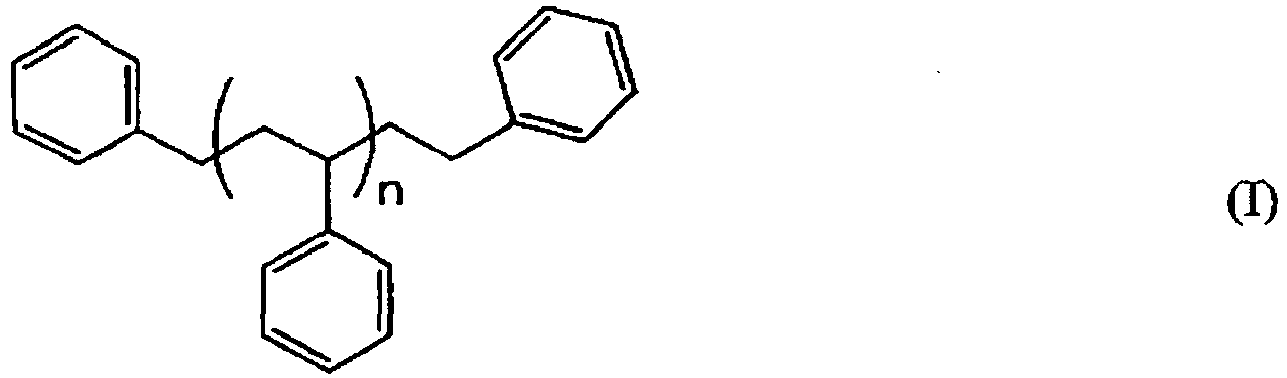
- This invention provides, among other things, a process which comprises brominating an aromatic polymer composition of the formula: wherein n is an average number in the range of 2.5 to 8 with the proviso that 1,3-diphenylpropane, a compound of formula (I) in which n is 0, optionally is present in this aromatic polymer composition in an amount of not more than 1 GPC area %, and with the further proviso that this aromatic polymer composition optionally further contains toluene in an amount of not more than 0.1 GPC area %, to form a brominated aromatic polymer composition having a bromine content as determined by XRF in the range of 70 to 76 weight percent, which process comprises brominating said aromatic polymer composition with liquid bromine in the presence of an aluminum halide bromination catalyst and in the absence of light, at a bromination temperature in the range of -10°C to +5°C, and in which the molar ratio of total amount of bromine fed:total amount of catalyst fed is in the range of 200:1 to 500:1,
- 1,3-diphenylpropane is present in the above aromatic polymer composition in an amount in the range of not more than 1 GPC area %, or toluene is present in the above aromatic polymer composition in an amount of not more than 0.1 GPC area %, or both of 1,3-diphenylpropane and toluene are present in the above aromatic polymer composition in the amounts specified
- FIG. 1 is a plot of two sets of thermal color measurements of brominated aromatic polymer compositions made using different aluminum catalyst concentrations, wherein these respective data sets were obtained at two different temperatures.
- the brominated aromatic polymer compositions formed by the processes of this invention can be represented by the following formula: wherein n is an average number in the range of 2.5 to 8 (desirably in the range of 2.9 to 3.9, and which when rounded off to whole numbers, becomes an average number in the range of 3 to 4), wherein each x is the same or different and is a whole number in the range of 3 to 5, the average number of all of the x's in the composition being in the range of 3.0 to 3.8 (desirably in the range of 3.5 to 3.8) and the weight percent of bromine as determined by X-Ray Fluorescence Spectroscopy (XRF) in the polymer being in the range of 70 to 76 (desirably in the range of 73.4 to 74.5).
- XRF X-Ray Fluorescence Spectroscopy
- brominated aromatic polymer compositions provide especially desirable results when produced by bromination, pursuant to this invention, of aromatic polymer compositions of formula (I) as described above, in which n is an average number in the range of 2.9 to 3.9, and which when rounded off to whole numbers, becomes an average number in the range of 3 to 4, and in which additionally, the aromatic polymer composition is further characterized by having an M w in the range of 650 to 750, an M n in the range of 500 to 600, an M z in the range of 830 to 1120, and a polydispersity in the range of 1.2 to 1.35, particularly when in the bromination process of this invention, the solution of the aromatic polymer composition in the bromination solvent is passed through a solid absorbent to remove polar amine impurities prior to being fed into the reaction mass in a manner described herein.
- the substrates used in the bromination processes of this invention namely, the aromatic polymer compositions
- APC aromatic polymer compositions
- BAPC brominated aromatic polymer compositions formed in the processes of this invention
- a key process parameter is the molar ratio of aluminum halide catalyst to the total amount of bromine charged during the bromination process. It has now been found, quite unexpectedly, that there are other key process parameters which can exert a profound influence upon the quality of the BAPC's formed in the practice of this invention. Unlike higher molecular weight styrene-derived polymers, which have high viscosities that limit the concentrations in which they can be fed to a reaction mass, the APC's used as substrates in the bromination processes of this invention do not suffer from these viscosity limitations. Consequently, in the development of this invention, it was surprisingly found that additional modes of operations exist that provide BAPC's of superior properties.
- a key feature of the bromination processes of this invention is the manner in which the three reagents involved in the bromination reaction (the APC, the bromine, and the bromination catalyst) are brought together and maintained throughout the course of the reaction.
- concentrations of the APC and the initial concentration of the bromination catalyst in the bromination solvent are both too high such that a relatively constant, high catalyst concentration exists throughout the course of most, if not all, of the bromination, then the result is undesired cleavage of the APC leading to undesirable impurity content.
- concentrations of the APC and the initial concentration of the bromination catalyst in the bromination solvent are both too low such that a relatively constant, low catalyst concentration exists throughout the course of most, if not all, of the bromination, then the result is formation of a BAPC having undesired initial color, thermal color, and thermal properties.
- FIG. 1 The data points shown in FIG. 1 were developed in two sets of thermal treatments of BAPC samples produced using samples of BAPC materials individually produced in 14 experimental pilot plant runs. These pilot plant runs were conducted under generally similar reaction conditions with minor variations which are the consequence of the different sizes of the volume of the APC feed relative to the volume of the initial reactor charge of catalyst and bromination solvent. As shown, these data points show the relationship between (i) the solution color of each of the thermally treated BAPC's and (ii) the average aluminum catalyst concentration utilized in each of the corresponding 14 runs.
- the upper trend line relates to the data obtained at 300°C thermal treatment of the BAPC samples.
- the lower trend line relates to the data obtained at 250°C thermal treatment of the BAPC samples.
- the details of this these thermal treatments are set forth hereinafter in connection with analytical methods used.
- the experimental results demonstrate that a functional dependence of increased thermal color stability with increased catalyst concentration used in the preparation of the BAPC. From the data presented in FIG. 1, it can be seen that to achieve superior color and superior thermal stability properties, it is best to operate the bromination process such that on average the catalyst weight percentage should be maintained above a threshold level. As one of skill in this art will now appreciate, one should not operate with a catalyst weight percentage that is high enough to cause undesirable degradation of the APC used and/or the BAPC formed.
- the initial weight percentage of the aluminum halide catalyst expressed as aluminum is in the range of 0.02 wt% to 0.04 wt%, and on completion of the feeds and an optional ride time of no greater than 60 minutes, the weight percentage of aluminum relative to the total of the mass of the bromination solvent and the brominated aromatic polymer composition in the reactor is greater than 0.015 wt%.
- the separate concurrent feeds of bromine and a solution of APC are initiated within 2 hours after completing the charge of the catalyst.
- this time period can be one hour or less.
- this time period can be as short as 30 minutes or less. It is important that the slurry of catalyst in bromination solvent has cooled to the desired initial bromination reaction temperature prior to initiating the feeds. Extended periods of contact of the catalyst in the bromination reaction, i.e., greater than 2 hours prior to initiation of bromination, has resulted in BAPC products having inferior properties.
- the catalysts used in the processes of this invention are typically aluminum halide catalysts. Of these, aluminum chloride is most desirable for use in the present processes because of its low cost and ready availability. One skilled in the art would understand that upon entering the reaction mass, the aluminum chloride will undergo halogen exchange reaction leading to complex mixtures of aluminum halides containing bromine atoms with and/or without chlorine atoms. Use of an aluminum tribromide is deemed suitable for the process of this invention. However as it is not an item of commerce, it is a less desirable catalyst.
- bromination solvents are available for use in the processes of this invention.
- Non-limiting examples of such solvents include methylene bromide, ethylene dibromide, methylene chloride, ethylene dichloride, propyl bromide, and similar halohydrocarbons.
- Bromochloromethane is a particularly desirable solvent for use in the processes of this invention.
- the bromination can be conducted with APC concentrations as low as 10 wt% and as high as 50 wt%, but it is desirable to utilize concentrations in the range of 20 wt% to 40 wt%.
- a feature of the invention is to limit contact between BAPC product and aluminum halide catalyst in the absence of bromine.
- the reaction is typically conducted and quenched as soon as practical, hence, ride times of less than 1 hour, preferably less than 10 minutes, are desirable. Longer ride times provide little benefit in terms of increasing bromine content of the BAPC product and are detrimental to the properties of the BAPC product.
- feeds of bromine and the solution of APC in bromination solvent enter the catalyst-containing reaction mixture in close proximity to each other. This is done to create locally high and balanced concentrations of APC, bromine, and the bromination catalyst.
- feeds can be impinging or non-impinging subsurface feeds.
- feeds can be feeds that are introduced above the surface of the reaction mixture, provided that these feeds remain spaced apart until they come in contact with the surface of the reaction mass. The trajectory should be such that the loci of reaction mass surface contact are in close proximity to each other without premature contact with each other. It is understood that in certain reactor configurations the feed can be initially above the surface, but finish below the surface, based on the lengths of the diplegs, injectors, or other liquid feeding means.
- Quenching of the reaction mass is typically conducted using water.
- use of aqueous solutions of hydrazine hydrate is more desirable because in addition to quenching the aluminum halide catalyst, the hydrazine hydrate reduces bromine to HBr.
- Such quenching shortens contact time of the BAPC with bromine and thereby provides a product with superior color and reduced thermal HBr content.
- dilute aqueous solutions of hydrazine hydrate in the range of 0.1 to 1 wt% are effective quenching media. Amounts outside this range can be used, if desired. In any given case, the amount used should be sufficient to ensure that all elemental bromine is consumed during the quenching operation.
- the quenched reaction mass Upon completion of the quenching, and after agitation of the reaction mass has been discontinued, the quenched reaction mass is isolated from the aqueous mixture by means of a phase separation. Suitable methods for effecting this phase separation include use of a simple phase cut, decantation, liquid/liquid centrifugation, or the like. After the phase separation, it is desirable to wash the resultant reaction mass one or more times with fresh water. Such operations can be conducted in a batch or continuous mode.
- alkaline borohydride solution to decompose polar bromoamine-derived impurities.
- This treatment is typically conducted at a temperature in the range of 25°C to 80°C and for a time period sufficient for the decomposition to be complete, as evidenced by decolorization of the reaction mass and breaking of any emulsion that may exist.
- this alkaline borohydride treatment is conducted at a temperature in the range of 25°C to 64°C using a 0.3 to 1.0 wt% solution of NaBH 4 in 5% aqueous NaOH solution. If desired, other alkaline borohydrides may be employed in this operation.
- NaBH 4 is particularly desirable because of its ready availability and proven effectiveness, which results in low treatment cost
- agitation is interrupted and the phases are separated, being careful to remove any rag or emulsion remnants that have migrated to the aqueous organic interface. Failure to do so has resulted in incorporation of impurities in the BAPC that have been shown to lead to poor thermal color performance.
- Example 1 illustrates the preparation of the APC used in the conducting a bromination process in accordance with this invention, in one case (Example 1) using fresh toluene and N,N,N,N' -tetramethylethylenediamine (TMEDA) and in a second case (Example 2) using a mixture of fresh toluene and TMEDA together with some recycled toluene which contains recovered and recycled TMEDA. Also shown (Example 3) is a blending operation in which wiped film evaporation is used for removing volatile components (toluene, TMEDA, and 1,3-diphenylpropane) from the APC. Bromination of the APC pursuant to the process technology of this invention is illustrated by Example 4. These Examples are presented for illustrative purposes and are not intended to limit, nor should they be interpreted as limiting, the scope of this invention to only the specific details set forth therein.
- the reactor is essentially free of all wetted PTFE parts or other polymeric fluorinated materials or elastomers.
- the reactor was maintained under an inert dry N 2 atmosphere during all operations.
- the reactor was charged with the chain transfer agent(s) through a dip leg by means of pressure transfer from a portable tank.
- Alkyl lithium, additional solvents and the amine promoter (TMEDA) were all fed subsurface to the stirred chain transfer agent(s) through the same dip leg.
- Styrene was pressure transferred from a portable, pressure vessel by means of a metering valve through a 60.96 cm (24") cylindrical column (7.62 cm (3") dia. ⁇ 2.72 kg (6 lbs.)) of 0.3 nm (3 ⁇ ) mol sieves (Zeochem) and delivered as a fine stream or spray above the surface of the reaction mixture through a slit feed nozzle.
- the solvent was heated to 78°C by applying tempered water to the vessel jacket.
- 2.09 kg (4.6 pounds) of TMEDA (18.0 mol) in 4.54 kg (10 pounds) of toluene (49.24 mol) was charged to the reactor through the dip leg below the surface of the agitated toluene reaction mixture.
- the feed line was then flushed with 9.07 kg (20 pounds) (98 mol) of anhydrous toluene.
- the styrene was added by means of pressure transfer from a nitrogen regulated portable tank through a metering valve at a constant feed rate of 1.29 kg (2.84 lb)/min.
- the reactor was allowed to ride for 5 minutes to make certain the reaction was complete.
- reaction mixture was quenched at 70°C with 37.85 1 (10 gallons) of 0.75 wt% ammonium chloride solution which had been deoxygenated overnight by sparging with nitrogen gas.
- the reaction mixture was washed two more times with 37.85 1 (10 gallons) of deoxygenated water. Phase cuts were rapid and required little settling time. Water and any rag or emulsion was removed through the bottom drain valve.
- a sample of the washed crude reaction mixture was analyzed by GPC (Mp: 312, M n : 466, M w : 673, M z : 934, polydispersity (PD): 1.44).
- the reactor was heated to atmospheric boiling point using tempered water on the vessel jacket. Steam was then applied to the reactor jacket to increase the temperature of the reactor jacket to 140°C. Cyclohexane, residual moisture and toluene boiled, condensed in the overhead condenser, and drained to a drum until a pot temperature of 135°C was observed. The reactor was cooled to 50°C. Vacuum was applied to the vessel and the reactor was heated to boiling point. Steam was then applied to the reactor jacket to increase the temperature of the reactor jacket to 140°C. Vacuum was used to decrease the reactor pressure to 4666 Pa (35 mm Hg).
- the styrene was added by means of pressure transfer from a nitrogen regulated portable tank through a metering valve at a constant feed rate of 1.31 kg (2.88 lb)/min.
- the reactor was allowed to ride for 5 minutes to make certain the reaction was complete.
- reaction mixture was quenched at 70°C with 37.85 1 (10 gallons) of 0.75 wt% ammonium chloride solution which had been deoxygenated overnight.
- the reaction mixture was washed with a second 37.85 1 (10 gallons) of deoxygenated water. Phase cuts were rapid and required little settling time. Water and any rag or emulsion was removed through the bottom drain valve.
- a sample of the washed crude reaction mixture was analyzed by GPC (Mp: 303, M n : 462, M w : 677, M z : 959, PD: 1.47).
- the reactor was heated to atmospheric boiling point using tempered water on the vessel jacket. Steam was then applied to the reactor jacket to increase the temperature of the reactor jacket to 140°C. Cyclohexane, residual moisture and toluene boiled, condensed in the overhead condenser, and drained to a drum until a pot temperature of 135°C was observed. The reactor was cooled to 50°C. Vacuum was applied to the vessel and the reactor was heated to boiling point. Steam was then applied to the reactor jacket to increase the temperature of the reactor jacket to 140°C. Vacuum was used to decrease the reactor pressure to 4666 Pa (35 mm Hg).
- the ratio of the APC to bromine was held constant and closely monitored throughout the reaction to create a final product with a specified bromine concentration. After feeding was complete, the reaction mass was held in the reactor for 45 minutes while the temperature was brought up to ⁇ 6°C. Any excess bromine in the reaction mass was quenched with water. This was followed by a water wash, and then another wash using a caustic and sodium borohydride solution at ⁇ 60°C to neutralize remaining HBr. The presence of sodium borohydride in the wash solution is deemed to break down aminic compounds present in the reaction mass that can form color bodies in the final isolated product. The reaction mass is finally washed again with water to a neutral pH.
- Bromine was fed via pressure transfer from a stainless steel 18.9 1 (5-gallon) milkcan lined with Teflon ® PFA resin (a perfluoroalkoxy copolymer resin; DuPont), the resin being hereinafter referred to as PFA.
- the milkcan used is 22.8 cm (9") ID, 35.4 cm (14") tall without the liner, with a 0.56 cm (0.22") thick lining around the entire internal surface area of the can. Including the lining, the actual fill volume of the can is ⁇ 17.4 1 ( ⁇ 4.6 gallons).
- the can is equipped with a 1 cm (3/8") PFA dipleg, and 3 additional 1.27 cm (1 ⁇ 2") ports that were used for nitrogen pressure, a PSD with holder, and venting down.
- a 5.06 cm (2") center port on the can had a PFA plug secured with a Nitronic 60 nut.
- the first dipleg is a solid pipe of Teflon ® fluoropolymer, with 2 x 0.63 cm (1 ⁇ 4") holes drilled through the entire length of the pipe.
- the other dipleg is similar in shape, but has 1 cm (3/8") drilled through fittings on the top flange, with 2 x 1 cm (3/8") tubing runs extending through the void space of a hollow pipe of Teflon ® fluoropolymer.
- the tubing connects ⁇ 50.6 cm ( ⁇ 20 inches) down via PFA fittings to the top of a solid mixing nozzle made of Teflon ® fluoropolymer.
- This nozzle is screwed into threads on the inside of the pipe of Teflon ® fluoropolymer, and impinges the two feeds before they enter the reactor through a 0.32 cm (1/8") hole at the bottom of the nozzle.
- Both diplegs are ⁇ 60.7 cm ( ⁇ 24") in length from the bottom flange of the dipleg, and extend into the reactor approximately 5.06 cm (2") above the tip of the agitator blades.
- Catalyst was introduced to the reactor through a charge bomb composed of a 2.53 cm (1") stainless steel (SS) block valve, a 1x3.8 cm (11 ⁇ 2") SS reducer, and a 3.8 cm
- Aqueous phase cuts were all conducted using a PFA dipleg. It was a length of 1.26 cm (1 ⁇ 2") PFA tubing that was straightened out, and grooved at the end to hold PFA ferrules in place. The ferrules allowed for the tubing to be pushed down and lowered into the reactor for decanting the aqueous phase, but prevented the tubing from coming out of the reactor beyond the drilled through PFA fitting and cap that held the tubing in place.
- the dipleg tubing ran from the reactor, straight to a box made from Plexiglas ® resin that was used for sampling the aqueous material during cuts. There were deliberately no fittings between the dipleg nozzle at the reactor and this sample point to lower the risk of aqueous exposure related to additional points of failure present in the line.
- Table 1 summarizes for each of batch bromination reactions 1-14 (BAPC 1-14), the components, the amounts thereof used, the catalyst weight percent loadings, and the color characteristics, thermal properties, and bromine levels of lab scale isolated smaller sample batches of the BAPC solids.
- Example 5 illustrates desirable precipitation procedures.
- the procedure used in forming Blend 4 also illustrates a novel treatment procedure of this invention that can be utilized during BAPC recovery to further improve its initial and thermal color properties.
- a 30-liter oil-jacketed glass reactor was fitted with for distillation, and was equipped for mechanical stirring using a Teflon ® fluoropolymer pitched-blade impeller (reversed pitch to pump against vortex) and a 0.32 cm (1/8") subsurface feed line made of Teflon ® fluoropolymer.
- the reactor is charged with 24 liters of water and heated to 98°C.
- a 10 liter stainless milk can was charged with 17 kg of an 18 wt% BAPC solution. The content of the milk can pressure transferred to precipitation medium through the 0.32 cm (1/8 inch) feed line over a period of 2.5 hours and at a pot temperature in the range of about 94-96°C.
- the reactor Upon completion of the feed the reactor is allowed to warm to 99°C and held at that temperature for 5 minutes. The content of the reactor is then cooled to about 60°C and the slurry is drained through a bottom drain valve into five 7.57 1 (2-gallon) polyethylene carboys.
- the solid BAPC was isolated using a Rousselet Robatel 30.36 cm (12-inch) basket centrifuge initially operating at 950 rpms. Upon completion of the initial centrifugation the speed is increased to 1700 rpms to ring out the cake.
- the solid (about 4 kgs of wetcake) is collected and placed in Pyrex ® borosilicate glass drying trays and dried in a nitrogen purged oven for 36 hours at 105°C, then further dried at 105°C under full vacuum for 6 hours. The procedure typically yields 3 kg of a dry free flowing white powder.
- Table 2 summarizes the complete analytical results on four Kilo Lab scale (30-liter reactor) precipitations of BAPC blends formed from selected batches made in Example 4. Comparison of improved thermal color for Blend 4 relative to Blend 3 demonstrates the benefits of having, pursuant to this invention, some level of NaBH 4 present in the precipitation solvent (water) during the isolation procedure. In addition, Table 2 shows the components used in making the selected batches. TABLE 2 Large Scale Precipitation 1 2 3 4 BAPC Blend 1 and 2 3 and 5 3, 5 and 9 3, 5 and 9 Approx.
- the material in the vials are heated for the specified time (15 minutes at 250°C or 20 minutes at 300°C). Upon completion of the heat treatment or thermal aging period, the samples are immediately removed from the block and cooled under nitrogen. The samples are dissolved to make a 10 wt% solution in chlorobenzene.
- the invention may comprise, consist, or consist essentially of the materials and/or procedures recited herein.
Landscapes
- Chemical & Material Sciences (AREA)
- Health & Medical Sciences (AREA)
- Chemical Kinetics & Catalysis (AREA)
- Medicinal Chemistry (AREA)
- Polymers & Plastics (AREA)
- Organic Chemistry (AREA)
- General Chemical & Material Sciences (AREA)
- Engineering & Computer Science (AREA)
- Materials Engineering (AREA)
- Organic Low-Molecular-Weight Compounds And Preparation Thereof (AREA)
- Addition Polymer Or Copolymer, Post-Treatments, Or Chemical Modifications (AREA)
- Low-Molecular Organic Synthesis Reactions Using Catalysts (AREA)
Description
- A new highly-effective class of low molecular weight brominated aromatic polymer compositions has recently been discovered in our laboratories. These compositions have the formula:
C6H(5-x)BrxCH2CH2(C6H(5-x)BrxCHCH2-)nCH2C6H(5-x)Brx
wherein n is an average number in the range of 2.9 to 3.9, wherein each x is the same or different and is a whole number in the range of 3 to 5, the average number of all of the x's in the composition being in the range of 3.50 to 3.80 and the weight percent of bromine as determined by X-Ray Fluorescence Spectroscopy (XRF) in the polymer being in the range of 73.4 to 74.5. A detailed description of these new brominated aromatic polymer compositions and their preparation and uses is presented in commonly-owned ProvisionalU.S. Patent Application No. 61/119,289, filed December 2, 2008 -
WO 2007/005233 A1 discloses a process of preparing brominated styrenic polymer, which process comprises maintaining a reaction mixture formed from (i) a brominating agent, (ii) a solution of styrenic polymer in a solvent, and (iii) aluminum halide catalyst in which the halogen atoms are bromine or chlorine with at least one such halogen atom being a bromine atom, at one or more temperatures in the range of -20 to +20°C so that bromination of polymer occurs, and termmating the bromination of polymer in such reaction mixture in a bromination time of 20 minutes or less. -
US 2007/142566 discloses a process of preparing brominated anionic styrenic polymer having a reduced volatile bromobenzene content, which process comprises: A) concurrently feeding into a reaction zone components comprised of (i) a brominating agent, (ii) aluminum halide catalyst in which the halide atoms are bromine or chlorine or both, and (iii) anionic styrenic polymer having a GPC number average molecular weight in the range of 2,000 to 30,000 in the form of a solution or slurry in a solvent to form a reaction mixture, wherein said components are fed (1) individually as at least three separate feeds or (2) as at least two separate feeds, one feed of which contains no more than two of (i), (ii), and (iii), and another feed of which contains the third of (i), (ii), (iii) either individually or in combination with no more than one other of (i), (ii), and (iii), to thereby form a reaction mixture containing a liquid phase, and maintaining said reaction mixture at 10°C or less whereby bromination of anionic styrenic polymer occurs, the components being proportioned such that the amount of aluminum halide being fed is at 0.8 mole percent or less in relation to the molar amount of aromatic monomer units in the anionic styrenic polymer being fed, and such that the dried brominated anionic styrenic polymer referred to in C) hereinafter will have a bromine content in the range of 60 to 71 wt%; B) deactivating the catalyst in, and washing away bromide ions and catalyst residues from 1) substantially the entire reaction mixture or 2) portions of the reaction mixture that have exited from the reaction zone; and C) recovering brominated anionic styrenic polymer product from the reaction mixture and drying such product whereby the dried brominated anionic styrenic polymer has a bromine content in the range of 60 to 71 wt% and a volatile bromobenzene content which is no more than 600 ppm (wt/wt). - The process technology described in the foregoing Provisional Patent Application yields products having a combination of desirable properties. Nevertheless, it would be of advantage if still further improvements in the process technology could be found whereby the process would be even more efficient in terms of utilization of articles of commerce and reduced product quality sensitivity to recycle streams, in particular recycled bromination solvents. Additionally, it would be of advantage if these process improvements could be achieved without sacrifice of key flame retardant characteristics such as initial solution color, Hunter Color Yellowness Index, thermal color stability, and minimal thermal HBr content. Indeed, it would be of considerable advantage if one or more of these properties could be enhanced while achieving the foregoing further improvements in process technology.
- This invention is deemed to have achieved most, if not all, of these objectives in a highly efficient and effective manner.
- This invention provides, among other things, a process which comprises brominating an aromatic polymer composition of the formula:
- a) the total amount of said catalyst is charged into a reactor which is at a temperature in the range of -25°C to 0°C, said reactor containing an inert atmosphere and a portion of bromination solvent such that the initial weight percentage of said catalyst expressed as aluminum is in the range of 0.02 wt% to 0.04 wt%;
- b) within 2 hours after completing the charge of the catalyst, separate concurrent feeds of (i) bromine, and (ii) a solution of said aromatic polymer composition in the bromination solvent are initiated, said feeds being conducted such that said solution and the liquid bromine are fed to maintain a substantially constant molar ratio of aromatic polymer composition to bromine entering the reactor; and
- c) wherein on completion of the feeds and an optional ride time of no greater than 60 minutes, the weight percentage of aluminum relative to the total of the mass of the bromination solvent and the brominated aromatic polymer composition in the reactor is greater than 0.015 wt%.
- Desirably, 1,3-diphenylpropane is present in the above aromatic polymer composition in an amount in the range of not more than 1 GPC area %, or toluene is present in the above aromatic polymer composition in an amount of not more than 0.1 GPC area %, or both of 1,3-diphenylpropane and toluene are present in the above aromatic polymer composition in the amounts specified
- Other important features and advantages of this invention will be still further apparent from the ensuing description, accompanying drawing, and appended claims.
- FIG. 1 is a plot of two sets of thermal color measurements of brominated aromatic polymer compositions made using different aluminum catalyst concentrations, wherein these respective data sets were obtained at two different temperatures.
- The brominated aromatic polymer compositions formed by the processes of this invention can be represented by the following formula:
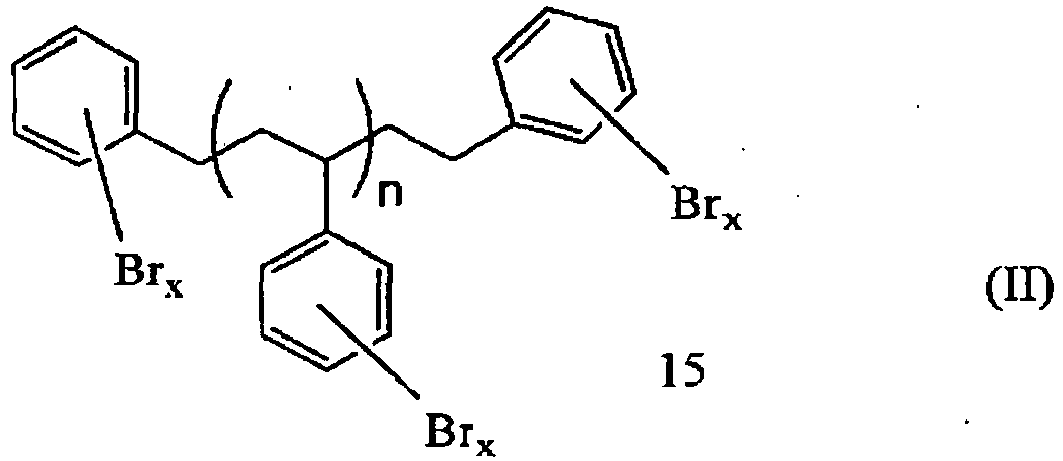
- Available experimental results indicate that these brominated aromatic polymer compositions provide especially desirable results when produced by bromination, pursuant to this invention, of aromatic polymer compositions of formula (I) as described above, in which n is an average number in the range of 2.9 to 3.9, and which when rounded off to whole numbers, becomes an average number in the range of 3 to 4, and in which additionally, the aromatic polymer composition is further characterized by having an Mw in the range of 650 to 750, an Mn in the range of 500 to 600, an Mz in the range of 830 to 1120, and a polydispersity in the range of 1.2 to 1.35, particularly when in the bromination process of this invention, the solution of the aromatic polymer composition in the bromination solvent is passed through a solid absorbent to remove polar amine impurities prior to being fed into the reaction mass in a manner described herein.
- For convenience, the substrates used in the bromination processes of this invention, namely, the aromatic polymer compositions, are often referred to in the singular as "APC" and in the plural as "APC's". Similarly, the brominated aromatic polymer compositions formed in the processes of this invention are often referred to in the singular as "BAPC" and in the plural as "BAPC's".
- As regards bromination of polymeric aromatic compounds derived from styrene, it is generally understood that a key process parameter is the molar ratio of aluminum halide catalyst to the total amount of bromine charged during the bromination process. It has now been found, quite unexpectedly, that there are other key process parameters which can exert a profound influence upon the quality of the BAPC's formed in the practice of this invention. Unlike higher molecular weight styrene-derived polymers, which have high viscosities that limit the concentrations in which they can be fed to a reaction mass, the APC's used as substrates in the bromination processes of this invention do not suffer from these viscosity limitations. Consequently, in the development of this invention, it was surprisingly found that additional modes of operations exist that provide BAPC's of superior properties.
- More particularly, it has been found that initial color of the BAPC as well as its thermal color performance and other thermal properties, including thermal HBr evolution, are greatly influenced by the catalyst concentration in the reaction mass throughout the course of the bromination reaction. An important trend that was unexpectedly discovered was that at higher catalyst concentrations significant improvements in these color properties were obtained.
- Thus, a key feature of the bromination processes of this invention is the manner in which the three reagents involved in the bromination reaction (the APC, the bromine, and the bromination catalyst) are brought together and maintained throughout the course of the reaction. By bringing those reagents together in balanced proportions discovered in the development of this invention, there is provided a kinetic regime that provides a superior BAPC product.
- By judicious, previously unchartered selection of the concentration of the APC in the bromination solvent, and the initial concentration of the bromination catalyst in the bromination solvent charged to the reactor, it was found that one can operate the bromination process such that the catalyst concentration varies little during the course of the bromination, despite the fact that the reaction mass is constantly increasing as a result of the substances being brought into the reactor. This has been proven to be a superior mode of operation for use in the practice of this invention.
- Hence, unless a suitable relationship among the concentrations of the APC and the catalyst in the bromination solvent is utilized during the process, a process condition can be reached in which catalyst concentration varies significantly over the course of the bromination. Such variations in catalyst concentrations lead to undesired side products when catalyst concentrations are high and can lead to undesired thermal and color properties when catalyst concentrations are low. If both of these conditions are experienced during the bromination, i.e., variance during the bromination from high to low catalyst concentrations during the bromination, a particularly deleterious impact on product purity, quality, and performance is experienced. An example of such would be a very dilute APC feed with a consequent very high initial catalyst concentration -- a condition commonly utilized in bromination reactions involving high molecular weight substrates -- whereby during the course of the bromination, the catalyst concentration is decreased significantly.
- Additionally, if concentrations of the APC and the initial concentration of the bromination catalyst in the bromination solvent are both too high such that a relatively constant, high catalyst concentration exists throughout the course of most, if not all, of the bromination, then the result is undesired cleavage of the APC leading to undesirable impurity content. Conversely, if concentrations of the APC and the initial concentration of the bromination catalyst in the bromination solvent are both too low such that a relatively constant, low catalyst concentration exists throughout the course of most, if not all, of the bromination, then the result is formation of a BAPC having undesired initial color, thermal color, and thermal properties.
- As noted above, one important feature of this invention was the unexpected discovery of a trend that at higher catalyst concentrations significant improvements in a number of color and stability properties were obtained. This trend is depicted in FIG. 1. The data points shown in FIG. 1 were developed in two sets of thermal treatments of BAPC samples produced using samples of BAPC materials individually produced in 14 experimental pilot plant runs. These pilot plant runs were conducted under generally similar reaction conditions with minor variations which are the consequence of the different sizes of the volume of the APC feed relative to the volume of the initial reactor charge of catalyst and bromination solvent. As shown, these data points show the relationship between (i) the solution color of each of the thermally treated BAPC's and (ii) the average aluminum catalyst concentration utilized in each of the corresponding 14 runs. The upper trend line relates to the data obtained at 300°C thermal treatment of the BAPC samples. The lower trend line relates to the data obtained at 250°C thermal treatment of the BAPC samples. The details of this these thermal treatments are set forth hereinafter in connection with analytical methods used. In both data sets the experimental results demonstrate that a functional dependence of increased thermal color stability with increased catalyst concentration used in the preparation of the BAPC. From the data presented in FIG. 1, it can be seen that to achieve superior color and superior thermal stability properties, it is best to operate the bromination process such that on average the catalyst weight percentage should be maintained above a threshold level. As one of skill in this art will now appreciate, one should not operate with a catalyst weight percentage that is high enough to cause undesirable degradation of the APC used and/or the BAPC formed. Such degradations have been experienced at aluminum halide catalyst levels in runs in which the initial catalyst loading was as low as 0.2 wt% aluminum chloride in bromochloromethane (BCM) which corresponds to initial 0.04 wt% charge of aluminum halide catalyst, expressed as aluminum. Therefore, pursuant to this invention, the initial weight percentage of the aluminum halide catalyst expressed as aluminum is in the range of 0.02 wt% to 0.04 wt%, and on completion of the feeds and an optional ride time of no greater than 60 minutes, the weight percentage of aluminum relative to the total of the mass of the bromination solvent and the brominated aromatic polymer composition in the reactor is greater than 0.015 wt%.
- In conducting the bromination processes of this invention, the separate concurrent feeds of bromine and a solution of APC are initiated within 2 hours after completing the charge of the catalyst. Typically, this time period can be one hour or less. On a laboratory scale, this time period can be as short as 30 minutes or less. It is important that the slurry of catalyst in bromination solvent has cooled to the desired initial bromination reaction temperature prior to initiating the feeds. Extended periods of contact of the catalyst in the bromination reaction, i.e., greater than 2 hours prior to initiation of bromination, has resulted in BAPC products having inferior properties.
- The catalysts used in the processes of this invention are typically aluminum halide catalysts. Of these, aluminum chloride is most desirable for use in the present processes because of its low cost and ready availability. One skilled in the art would understand that upon entering the reaction mass, the aluminum chloride will undergo halogen exchange reaction leading to complex mixtures of aluminum halides containing bromine atoms with and/or without chlorine atoms. Use of an aluminum tribromide is deemed suitable for the process of this invention. However as it is not an item of commerce, it is a less desirable catalyst.
- A variety of bromination solvents are available for use in the processes of this invention. Non-limiting examples of such solvents include methylene bromide, ethylene dibromide, methylene chloride, ethylene dichloride, propyl bromide, and similar halohydrocarbons. Bromochloromethane is a particularly desirable solvent for use in the processes of this invention. Typically, the bromination can be conducted with APC concentrations as low as 10 wt% and as high as 50 wt%, but it is desirable to utilize concentrations in the range of 20 wt% to 40 wt%.
- A feature of the invention is to limit contact between BAPC product and aluminum halide catalyst in the absence of bromine. Thus, the reaction is typically conducted and quenched as soon as practical, hence, ride times of less than 1 hour, preferably less than 10 minutes, are desirable. Longer ride times provide little benefit in terms of increasing bromine content of the BAPC product and are detrimental to the properties of the BAPC product.
- In conducting the bromination, it is highly desirable to ensure that the feeds of bromine and the solution of APC in bromination solvent enter the catalyst-containing reaction mixture in close proximity to each other. This is done to create locally high and balanced concentrations of APC, bromine, and the bromination catalyst. Such feeds can be impinging or non-impinging subsurface feeds. Alternatively, such feeds can be feeds that are introduced above the surface of the reaction mixture, provided that these feeds remain spaced apart until they come in contact with the surface of the reaction mass. The trajectory should be such that the loci of reaction mass surface contact are in close proximity to each other without premature contact with each other. It is understood that in certain reactor configurations the feed can be initially above the surface, but finish below the surface, based on the lengths of the diplegs, injectors, or other liquid feeding means.
- Quenching of the reaction mass is typically conducted using water. However, use of aqueous solutions of hydrazine hydrate is more desirable because in addition to quenching the aluminum halide catalyst, the hydrazine hydrate reduces bromine to HBr. Such quenching shortens contact time of the BAPC with bromine and thereby provides a product with superior color and reduced thermal HBr content. Typically, dilute aqueous solutions of hydrazine hydrate in the range of 0.1 to 1 wt% are effective quenching media. Amounts outside this range can be used, if desired. In any given case, the amount used should be sufficient to ensure that all elemental bromine is consumed during the quenching operation. In as much as the bromination reaction mixture is typically saturated with HBr which is recovered for recycle, it is desirable to form an aqueous quench mixture having an HBr concentration between 20 and 26 wt%. Therefore, it is desirable to use a charge of about 0.4 part by weight of quench solution per each part by weight of BAPC contained in the reaction mass.
- Upon completion of the quenching, and after agitation of the reaction mass has been discontinued, the quenched reaction mass is isolated from the aqueous mixture by means of a phase separation. Suitable methods for effecting this phase separation include use of a simple phase cut, decantation, liquid/liquid centrifugation, or the like. After the phase separation, it is desirable to wash the resultant reaction mass one or more times with fresh water. Such operations can be conducted in a batch or continuous mode.
- After the quenching and ensuing washing steps, it is beneficial to agitate the quenched bromination reaction mass with an alkaline borohydride solution to decompose polar bromoamine-derived impurities. This treatment is typically conducted at a temperature in the range of 25°C to 80°C and for a time period sufficient for the decomposition to be complete, as evidenced by decolorization of the reaction mass and breaking of any emulsion that may exist. Ordinarily, this alkaline borohydride treatment is conducted at a temperature in the range of 25°C to 64°C using a 0.3 to 1.0 wt% solution of NaBH4 in 5% aqueous NaOH solution. If desired, other alkaline borohydrides may be employed in this operation. However, NaBH4 is particularly desirable because of its ready availability and proven effectiveness, which results in low treatment cost Upon completion of the treatment, agitation is interrupted and the phases are separated, being careful to remove any rag or emulsion remnants that have migrated to the aqueous organic interface. Failure to do so has resulted in incorporation of impurities in the BAPC that have been shown to lead to poor thermal color performance.
- The following Examples illustrate the preparation of the APC used in the conducting a bromination process in accordance with this invention, in one case (Example 1) using fresh toluene and N,N,N,N'-tetramethylethylenediamine (TMEDA) and in a second case (Example 2) using a mixture of fresh toluene and TMEDA together with some recycled toluene which contains recovered and recycled TMEDA. Also shown (Example 3) is a blending operation in which wiped film evaporation is used for removing volatile components (toluene, TMEDA, and 1,3-diphenylpropane) from the APC. Bromination of the APC pursuant to the process technology of this invention is illustrated by Example 4. These Examples are presented for illustrative purposes and are not intended to limit, nor should they be interpreted as limiting, the scope of this invention to only the specific details set forth therein.
- In this operation, fresh toluene as well as other fresh reactants were used. A glass-lined, 378.5 1 (100-gallon) jacketed reactor equipped with an overhead condenser, submerged thermal well/thermal couple and a bottom drain valve. Temperature was maintained at a set point by controlling the temperature of the water flowing through the jacket using a steam control valve. Vigorous agitation was accomplished by means of a three-blade, retreat-curve agitator on a variable speed drive. The reactor is essentially free of all wetted PTFE parts or other polymeric fluorinated materials or elastomers.
- The reactor was maintained under an inert dry N2 atmosphere during all operations. The reactor was charged with the chain transfer agent(s) through a dip leg by means of pressure transfer from a portable tank. Alkyl lithium, additional solvents and the amine promoter (TMEDA) were all fed subsurface to the stirred chain transfer agent(s) through the same dip leg. Styrene was pressure transferred from a portable, pressure vessel by means of a metering valve through a 60.96 cm (24") cylindrical column (7.62 cm (3") dia. ≈ 2.72 kg (6 lbs.)) of 0.3 nm (3Å) mol sieves (Zeochem) and delivered as a fine stream or spray above the surface of the reaction mixture through a slit feed nozzle.
- Toluene 140 pounds, (689 mol) was charged to the reactor; Karl Fischer moisture analysis indicated 7 ppm residual H2O. Agitation began. The solvent was heated to 78°C by applying tempered water to the vessel jacket. Upon reaching the set point temperature, 2.09 kg (4.6 pounds) of TMEDA (18.0 mol), in 4.54 kg (10 pounds) of toluene (49.24 mol) was charged to the reactor through the dip leg below the surface of the agitated toluene reaction mixture. The feed line was then flushed with 9.07 kg (20 pounds) (98 mol) of anhydrous toluene. Next, 2.0 kg (4.4 lb) n-BuLi solution (23.5 wt% in cyclohexane) (7.32 mol n-BuLi) was charged through the subsurface feed line forming the characteristic bright red-orange color of TMEDA complexed benzyl lithium anion with concomitant off gassing of butane. The feed line was then flushed with 10.0 kg (22 pounds) (108 mol) of anhydrous toluene. 197.8 kg (436 lb) of styrene (99+%, 1899 mol, American Styrenics) were fed over 153 minutes. The styrene was added by means of pressure transfer from a nitrogen regulated portable tank through a metering valve at a constant feed rate of 1.29 kg (2.84 lb)/min. The reactor was allowed to ride for 5 minutes to make certain the reaction was complete.
- The reaction mixture was quenched at 70°C with 37.85 1 (10 gallons) of 0.75 wt% ammonium chloride solution which had been deoxygenated overnight by sparging with nitrogen gas. The reaction mixture was washed two more times with 37.85 1 (10 gallons) of deoxygenated water. Phase cuts were rapid and required little settling time. Water and any rag or emulsion was removed through the bottom drain valve. A sample of the washed crude reaction mixture was analyzed by GPC (Mp: 312, Mn: 466, Mw: 673, Mz: 934, polydispersity (PD): 1.44).
- The reactor was heated to atmospheric boiling point using tempered water on the vessel jacket. Steam was then applied to the reactor jacket to increase the temperature of the reactor jacket to 140°C. Cyclohexane, residual moisture and toluene boiled, condensed in the overhead condenser, and drained to a drum until a pot temperature of 135°C was observed. The reactor was cooled to 50°C. Vacuum was applied to the vessel and the reactor was heated to boiling point. Steam was then applied to the reactor jacket to increase the temperature of the reactor jacket to 140°C. Vacuum was used to decrease the reactor pressure to 4666 Pa (35 mm Hg). Cyclohexane, residual moisture and toluene boiled, condensed in the overhead condenser, and drained to a drum until a pot temperature of 135°C was observed. An aliquot was removed from the reactor for analysis via GPC (Mp: 314, Mn: 468, Mw: 676, Mz: 940, polydispersity (PD): 1.44). The reaction mass (252.7 kg (557 lbs)) was collected in a 1325 1 (350-gallon) tote bin.
- In this Example, a portion of a composite composed predominately of toluene, TMEDA, cyclohexane, and 1,3-diphenylpropane recovered from prior runs was used. Thus, this Example demonstrates use of recycled toluene as part of the total toluene charged.
- Fresh toluene 18.14 kg (40 pounds), (197 mol) and 44 kg (97 lb) of recycled toluene (containing 97.1%, 42.73 kg (94.2 lb), 464 mol toluene; 1.7%, 0.73 kg (1.6 lb), 6.2 mol TMEDA; 0.3%, 0.14 kg (0.3 lb), 0.7 mol, 1,3-diphenlypropane; 0.9%, 0.41 kg (0.9 lb), 4.9 mol cyclohexane) was charged to the reactor; Karl Fischer moisture analysis indicated 7 ppm residual H2O. Agitation began. The solvent was heated to 79° C by applying tempered water to the vessel jacket. Upon reaching the set point temperature, 1.63 kg (3.6 pounds) of fresh make-up TMEDA (12.8 mol), in 4.54 kg (10 pounds) of toluene (49.24 mol) was charged to the reactor through the dip leg below the surface of the agitated toluene reaction mixture. The feed line was then flushed with 9.07 kg (20 pounds) (99 mol) of anhydrous toluene. Next, 2 kg (4.4 lb) n-BuLi solution (23.6 wt% in cyclohexane) (7.4 mol n-BuLi) was charged through the subsurface feed line forming the characteristic bright red-orange color of TMEDA complexed benzyl lithium anion with concomitant off gassing of butane. The feed line was then flushed with 10 kg (22 pounds) (108 mol) of anhydrous toluene. 196 kg (432 lb) of styrene (99+%, 1881 mol, American Styrenics) were fed over 150 minutes. The styrene was added by means of pressure transfer from a nitrogen regulated portable tank through a metering valve at a constant feed rate of 1.31 kg (2.88 lb)/min. The reactor was allowed to ride for 5 minutes to make certain the reaction was complete.
- The reaction mixture was quenched at 70°C with 37.85 1 (10 gallons) of 0.75 wt% ammonium chloride solution which had been deoxygenated overnight. The reaction mixture was washed with a second 37.85 1 (10 gallons) of deoxygenated water. Phase cuts were rapid and required little settling time. Water and any rag or emulsion was removed through the bottom drain valve. A sample of the washed crude reaction mixture was analyzed by GPC (Mp: 303, Mn: 462, Mw: 677, Mz: 959, PD: 1.47).
- The reactor was heated to atmospheric boiling point using tempered water on the vessel jacket. Steam was then applied to the reactor jacket to increase the temperature of the reactor jacket to 140°C. Cyclohexane, residual moisture and toluene boiled, condensed in the overhead condenser, and drained to a drum until a pot temperature of 135°C was observed. The reactor was cooled to 50°C. Vacuum was applied to the vessel and the reactor was heated to boiling point. Steam was then applied to the reactor jacket to increase the temperature of the reactor jacket to 140°C. Vacuum was used to decrease the reactor pressure to 4666 Pa (35 mm Hg). Cyclohexane, residual moisture and toluene boiled, condensed in the overhead condenser, and drained to a drum until a pot temperature of 135°C was observed. An aliquot was removed from the reactor for analysis via GPC (Mp: 301, Mn: 459, Mw: 672, Mz: 950, PD: 1.46). The reaction mass (246.8 kg (544 lbs)) was collected in a 1325 1 (350-gallon) tote bin.
- A total of 12 all fresh runs were made following the general procedure of Example 1 above with the Mn after the vacuum strip ranging from 403 to 483 and an Mw ranging from 566 to 721. A total of 13 recycled toluene runs were made following the general procedure of Example 2 above with the Mn after the vacuum strip ranging from 404 to 463 and an Mw ranging from 568 to 688. Possible causes of these ranges are small variations in the temperature, stirring speed or feed rate. The 12 all fresh runs were combined with the 13 recycle runs and run through an industrial size wiped film evaporator (WFE), a sample was analyzed by GPC: (Mp: 413, Mn: 552, Mw: 693, Mz: 878, PD: 1.26). A 19.9 1 (five-gallon) sample of the composite was stripped in the laboratory giving a very similar result: (Mp: 418, Mn: 569, Mw: 729, Mz: 946, PD: 1.28).
- Fourteen batches of APC's formed as in Example 3 in the form of solutions in BCM were individually brominated in a 189 1 (50-gallon) glass-lined, jacketed vessel capable of using ethylene glycol for heat exchange (heating or cooling) or steam for heating. The reactor was equipped with a pitched-blade glass-lined agitator with a nitrogen seal. Both batch reactions had a target reaction feed time of about 3 hours, a target reaction temperature between -2 to 2°C with a targeted final bromine concentration of 74 ± 0.5 wt%. The bromination reaction involved separately and concurrently feeding bromine and the APC over a three hour period. The ratio of the APC to bromine was held constant and closely monitored throughout the reaction to create a final product with a specified bromine concentration. After feeding was complete, the reaction mass was held in the reactor for 45 minutes while the temperature was brought up to ∼6°C. Any excess bromine in the reaction mass was quenched with water. This was followed by a water wash, and then another wash using a caustic and sodium borohydride solution at ∼60°C to neutralize remaining HBr. The presence of sodium borohydride in the wash solution is deemed to break down aminic compounds present in the reaction mass that can form color bodies in the final isolated product. The reaction mass is finally washed again with water to a neutral pH.
- Bromine was fed via pressure transfer from a stainless steel 18.9 1 (5-gallon) milkcan lined with Teflon® PFA resin (a perfluoroalkoxy copolymer resin; DuPont), the resin being hereinafter referred to as PFA. The milkcan used is 22.8 cm (9") ID, 35.4 cm (14") tall without the liner, with a 0.56 cm (0.22") thick lining around the entire internal surface area of the can. Including the lining, the actual fill volume of the can is ~ 17.4 1 (∼ 4.6 gallons). The can is equipped with a 1 cm (3/8") PFA dipleg, and 3 additional 1.27 cm (½") ports that were used for nitrogen pressure, a PSD with holder, and venting down. A 5.06 cm (2") center port on the can had a PFA plug secured with a Nitronic 60 nut.
- There were two feed diplegs used in these reactions. The first dipleg is a solid pipe of Teflon® fluoropolymer, with 2 x 0.63 cm (¼") holes drilled through the entire length of the pipe. There is 0.63 cm (¼") PFA tubing run from top to bottom of each of the void spaces, which are spread 1.9 cm (3/4") apart. The tubing is secured in place at each end with drilled-through pipe-to-tubing male connectors and PFA nuts/ferrules. The other dipleg is similar in shape, but has 1 cm (3/8") drilled through fittings on the top flange, with 2 x 1 cm (3/8") tubing runs extending through the void space of a hollow pipe of Teflon® fluoropolymer. The tubing connects ~ 50.6 cm (∼ 20 inches) down via PFA fittings to the top of a solid mixing nozzle made of Teflon® fluoropolymer. This nozzle is screwed into threads on the inside of the pipe of Teflon® fluoropolymer, and impinges the two feeds before they enter the reactor through a 0.32 cm (1/8") hole at the bottom of the nozzle. Both diplegs are ~ 60.7 cm (∼ 24") in length from the bottom flange of the dipleg, and extend into the reactor approximately 5.06 cm (2") above the tip of the agitator blades.
- Catalyst was introduced to the reactor through a charge bomb composed of a 2.53 cm (1") stainless steel (SS) block valve, a 1x3.8 cm (1½") SS reducer, and a 3.8 cm
- (1½") full port SS-lined brass block valve. The catalyst charge to the bomb was performed in a N2 purged glove box, through the 3.8 cm (1.5") full port valve. Following the charge, a 1.26 cm (½") SS tee was fitted to the top of the 3.8 cm (1.5") valve to attach a pressure gauge and to charge N2 to the bomb. The entire setup screwed onto a reducing flange on a reactor nozzle via the 2.53 cm (1") block valve.
- Aqueous phase cuts were all conducted using a PFA dipleg. It was a length of 1.26 cm (½") PFA tubing that was straightened out, and grooved at the end to hold PFA ferrules in place. The ferrules allowed for the tubing to be pushed down and lowered into the reactor for decanting the aqueous phase, but prevented the tubing from coming out of the reactor beyond the drilled through PFA fitting and cap that held the tubing in place. The dipleg tubing ran from the reactor, straight to a box made from Plexiglas® resin that was used for sampling the aqueous material during cuts. There were deliberately no fittings between the dipleg nozzle at the reactor and this sample point to lower the risk of aqueous exposure related to additional points of failure present in the line.
- Table 1 summarizes for each of batch bromination reactions 1-14 (BAPC 1-14), the components, the amounts thereof used, the catalyst weight percent loadings, and the color characteristics, thermal properties, and bromine levels of lab scale isolated smaller sample batches of the BAPC solids.


- Example 5 illustrates desirable precipitation procedures. The procedure used in forming Blend 4 also illustrates a novel treatment procedure of this invention that can be utilized during BAPC recovery to further improve its initial and thermal color properties.
- A 30-liter oil-jacketed glass reactor was fitted with for distillation, and was equipped for mechanical stirring using a Teflon® fluoropolymer pitched-blade impeller (reversed pitch to pump against vortex) and a 0.32 cm (1/8") subsurface feed line made of Teflon® fluoropolymer. The reactor is charged with 24 liters of water and heated to 98°C. A 10 liter stainless milk can was charged with 17 kg of an 18 wt% BAPC solution. The content of the milk can pressure transferred to precipitation medium through the 0.32 cm (1/8 inch) feed line over a period of 2.5 hours and at a pot temperature in the range of about 94-96°C. Upon completion of the feed the reactor is allowed to warm to 99°C and held at that temperature for 5 minutes. The content of the reactor is then cooled to about 60°C and the slurry is drained through a bottom drain valve into five 7.57 1 (2-gallon) polyethylene carboys.
- The solid BAPC was isolated using a Rousselet Robatel 30.36 cm (12-inch) basket centrifuge initially operating at 950 rpms. Upon completion of the initial centrifugation the speed is increased to 1700 rpms to ring out the cake. The solid (about 4 kgs of wetcake) is collected and placed in Pyrex® borosilicate glass drying trays and dried in a nitrogen purged oven for 36 hours at 105°C, then further dried at 105°C under full vacuum for 6 hours. The procedure typically yields 3 kg of a dry free flowing white powder.
- Table 2 summarizes the complete analytical results on four Kilo Lab scale (30-liter reactor) precipitations of BAPC blends formed from selected batches made in Example 4. Comparison of improved thermal color for Blend 4 relative to Blend 3 demonstrates the benefits of having, pursuant to this invention, some level of NaBH4 present in the precipitation solvent (water) during the isolation procedure. In addition, Table 2 shows the components used in making the selected batches.
TABLE 2 Large Scale Precipitation 1 2 3 4 BAPC Blend 1 and 2 3 and 5 3, 5 and 9 3, 5 and 9 Approx. Blend Ratio 50:50 50:50 25:25:50 25:25:50 Residual BCM (ppm) 52 32 < 1 < 1 Sodium borohydride present in precipitator (ppm) 0 0 0 250 Residual DBM (ppm) 0 0 < 1 < 1 Residual H2O (ppm) 141 83 49 62 XRF wt% Br 74.2 74.8 74 74.4 Tg (°C) (DSC) 120.13 128.47 124.46 124.5 TGA 1% Wt. Loss (°C) 321.15 322.73 321.98 328.25 5% Wt. Loss (°C) 356.99 355.56 357.82 360.21 10% Wt. Loss (°C) 370.21 369.48 370.35 372.27 50% Wt. Loss (°C) 406.66 406.78 406.23 406.72 Thermal HBr 300°C (ppm) 152 116 126 10 GPC Mw 2637 2640 2569 2569 Mn 1951 1958 1907 1907 Mz 3903 3873 3808 3808 PD 1.352 1.348 1.347 1.347 Color (Solids) L 95.94 95.8 90.22 90.06 a -0.09 -0.31 -1.13 -1.11 b 2.18 2.02 2.48 2.35 YI 3.99 3.54 4.01 3.77 Color (Solution) L 99.53 99.81 99.65 99.59 a 0.03 -0.12 -0.13 -0.12 b 1.44 1.03 1.07 0.98 Delta E 1.65 1.17 1.29 1.25 Thermal Color 250°C/15min 10.19 10.48 8.46 6.32 300°C/20min 18.62 19.74 20.73 17.62 - Except for thermal color analysis, applicable analytical methods for assaying properties of APC's and BAPC's are set forth in International Publication Number
WO 2008/154453 A1 having an International Publication Date of 18 December 2008. The procedure for thermal color analysis is as follows: A custom made metal heating block from J-Kem Scientific (St. Louis, MO) featuring 12 heating ports with diameters to snuggly fit 20 ml flat bottom scintillation vials is used. The heating block is placed in a in a nitrogen-purged glove box and heated to the test temperature (either 250 or 300°C). Duplicate 5-gram samples of the BAPC powder are placed in 20 ml scintillation vials to be heat treated in the heating block. The material in the vials are heated for the specified time (15 minutes at 250°C or 20 minutes at 300°C). Upon completion of the heat treatment or thermal aging period, the samples are immediately removed from the block and cooled under nitrogen. The samples are dissolved to make a 10 wt% solution in chlorobenzene. The solution color is of the dissolved sample in terms of L, a, b and Delta E is measured and compared to a chlorobenzene blank standard (L=100, a=0, b=0) using a Hunter Lab ColorQuest XE Colorimeter (Reston, VA). - The invention may comprise, consist, or consist essentially of the materials and/or procedures recited herein.
- Except as may be expressly otherwise indicated, the article "a" or "an" if and as used herein is not intended to limit, and should not be construed as limiting, a claim to a single element to which the article refers. Rather, the article "a" or "an" if and as used herein is intended to cover one or more such elements, unless the text expressly indicates otherwise.
Claims (18)
- A process which comprises brominating an aromatic polymer composition of the formula:
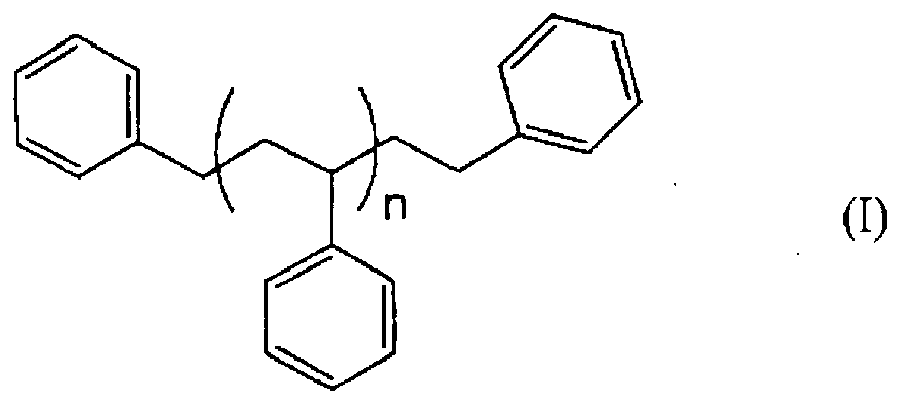 a) the total amount of said catalyst is charged into a reactor which is at a temperature in the range of -25°C to 0°C, said reactor containing an inert atmosphere and a portion of bromination solvent such that the initial weight percentage of said catalyst expressed as aluminum is in the range of 0.02 wt% to 0.04 wt%;b) within 2 hours after completing the charge of the catalyst, separate concurrent feeds of (i) bromine, and (ii) a solution of said aromatic polymer composition in the bromination solvent are initiated, said feeds being conducted such that said solution and the liquid bromine are fed to maintain a substantially constant molar ratio of aromatic polymer composition to bromine entering the reactor; andc) wherein on completion of the feeds and an optional ride time of no greater than 60 minutes, the weight percentage of aluminum relative to the total of the mass of the bromination solvent and the brominated aromatic polymer composition in the reactor is greater than 0.015 wt%.
 - A process as in Claim 1 further characterized in that said solution of said aromatic polymer composition in the bromination solvent is a solution containing 20 to 40 wt% of said aromatic polymer composition.
- A process as in Claim 2 further characterized in that said bromination solvent is at least predominately bromochloromethane.
- A process as in any of Claims 1-3 further characterized in that upon completion of the feed or of the optionally used ride time, the bromination reaction mass is transferred to a reaction vessel containing a dilute solution of hydrazine hydrate in water and the resultant mixture is agitated so that the catalyst and bromine are quenched.
- A process as in Claim 4 wherein said dilute solution is a 0.1 to 1.0 wt% solution of hydrazine hydrate in water.
- A process as in Claim 5 wherein the amount of said 0.1 to 1.0 wt% solution of hydrazine hydrate in water is 0.4 parts by weight of said solution per each 0,4536 kg (pound) by weight of brominated aromatic polymer composition present in the bromination reaction mass.
- A process as in any of Claims 4-6 further characterized in that upon completion of the quenching, the agitation is discontinued, the quenched reaction mass is isolated from the aqueous mixture by means of a phase separation, and optionally, the resultant reaction mass is washed with fresh water.
- A process as in any of Claims 4-7 further characterized in that the quenched bromination reaction mass is further treated by agitating the quenched bromination reaction mass with an alkaline borohydride solution to decompose polar bromoamine-derived impurities, said treatment being at a temperature in the range of 25°C to 80°C and for a time period sufficient for the decomposition to be complete, as evidenced by decolorization of the reaction mass and breaking of any emulsion that may exist.
- A process as in any of Claims 4-8 further characterized in that the brominated aromatic polymer composition is recovered from the reaction mass by precipitation from near boiling or boiling hot water in the presence of alkaline borohydride, and wherein optionally, prior to said precipitation the reaction mass is dried azeotropically and passed through a solid absorbent to remove polar impurities.
- A process as in any of Claims 1-9 wherein the aluminum halide bromination catalyst as charged into the reactor is aluminum chloride.
- A process as in any of Claims 1-10 wherein said feeding is further characterized in that the feeds of bromine and said solution of aromatic polymer composition are in close proximity to each other.
- A process as in Claim 11 wherein said feeds are impinging or non-impinging subsurface feeds.
- A process as in Claim 11 wherein said feeds are spaced apart and are non-impinging feeds to the surface of the reaction mass.
- A process as in Claim 1 wherein n is an average number in the range of 2.9 to 3.9 and wherein said bromine content as determined by XRF is in the range of 73.4 to 74.5 weight percent.
- A process as in Claim 14 wherein said aromatic polymer composition has an Mw in the range of 650 to 750, an Mn in the range of 500 to 600, an Mz in the range of 830 to 1120, and a polydispersity in the range of 1.2 to 1.35.
- A process as in any of Claims 1-15 wherein the solution of the aromatic polymer composition in the bromination solvent is passed through a solid absorbent to remove polar amine impurities prior to feeding.
- A process as in Claim 1 wherein (i) 1,3-diphenylpropane is present in said aromatic polymer composition in an amount in the range of not more than 1 GPC area %, or (ii) toluene is present in said aromatic polymer composition in an amount of not more than 0.1 GPC area %, or (iii) both of 1,3-diphenylpropane and toluene are present in said aromatic polymer composition in the amounts specified.
- A process as in any of Claims 1-13 wherein said bromine content as determined by XRF is in the range of 73.4 to 74.5 weight percent.
Priority Applications (1)
| Application Number | Priority Date | Filing Date | Title |
|---|---|---|---|
| PL10718369T PL2424904T3 (en) | 2009-05-01 | 2010-04-29 | Bromination of low molecular weight aromatic polymer compositions |
Applications Claiming Priority (2)
| Application Number | Priority Date | Filing Date | Title |
|---|---|---|---|
| US17490209P | 2009-05-01 | 2009-05-01 | |
| PCT/US2010/032937 WO2010127091A1 (en) | 2009-05-01 | 2010-04-29 | Bromination of low molecular weight aromatic polymer compositions |
Publications (2)
| Publication Number | Publication Date |
|---|---|
| EP2424904A1 EP2424904A1 (en) | 2012-03-07 |
| EP2424904B1 true EP2424904B1 (en) | 2015-01-07 |
Family
ID=42269527
Family Applications (1)
| Application Number | Title | Priority Date | Filing Date |
|---|---|---|---|
| EP10718369.1A Active EP2424904B1 (en) | 2009-05-01 | 2010-04-29 | Bromination of low molecular weight aromatic polymer compositions |
Country Status (15)
| Country | Link |
|---|---|
| US (1) | US8802787B2 (en) |
| EP (1) | EP2424904B1 (en) |
| JP (1) | JP5730857B2 (en) |
| KR (1) | KR20120060939A (en) |
| CN (1) | CN102439051B (en) |
| CA (1) | CA2758028A1 (en) |
| ES (1) | ES2534112T3 (en) |
| HU (1) | HUE025085T2 (en) |
| IL (1) | IL215724A0 (en) |
| JO (1) | JO3059B1 (en) |
| MX (1) | MX343178B (en) |
| PL (1) | PL2424904T3 (en) |
| SG (1) | SG175742A1 (en) |
| TW (1) | TWI485172B (en) |
| WO (1) | WO2010127091A1 (en) |
Families Citing this family (12)
| Publication number | Priority date | Publication date | Assignee | Title |
|---|---|---|---|---|
| PL2158233T3 (en) | 2007-06-07 | 2019-04-30 | Albemarle Corp | Adducts, adducts and oligomers, or adducts, oligomers and low molecular weight polymers, and their preparation |
| US8993684B2 (en) | 2008-06-06 | 2015-03-31 | Albemarle Corporation | Low molecular weight brominated polymers, processes for their manufacture and their use in thermoplastic formulations |
| SG171741A1 (en) | 2008-12-02 | 2011-07-28 | Albemarle Corp | Toluene and styrene derived telomer distributions and brominated flame retardants produced therefrom |
| JO3423B1 (en) | 2008-12-02 | 2019-10-20 | Albemarle Corp | Brominated Flame Retardants And Precursors Therefor |
| WO2010065464A1 (en) | 2008-12-02 | 2010-06-10 | Albemarle Corporation | Bromination of telomer mixtures derived from toluene and styrene |
| US8476373B2 (en) | 2008-12-02 | 2013-07-02 | Albemarle Corporation | Branched and star-branched styrene polymers, telomers, and adducts, their synthesis, their bromination, and their uses |
| JO3059B1 (en) | 2009-05-01 | 2017-03-15 | Albemarle Corp | Bromination of low molecular weight aromatic polymer compositions |
| JP2012525483A (en) | 2009-05-01 | 2012-10-22 | アルベマール・コーポレーシヨン | Pelletized low molecular weight brominated aromatic polymer composition |
| WO2012092338A2 (en) * | 2010-12-29 | 2012-07-05 | Albemarle Corporation | Removal of bromine from gaseous hydrogen bromide |
| US9475697B2 (en) * | 2012-06-05 | 2016-10-25 | Albemarle Corporation | Removal of bromine from gaseous hydrogen bromide |
| PL3440120T3 (en) | 2016-04-05 | 2024-04-22 | Albemarle Corporation | Process and hydrocarbon soluble saline hydride catalyst for hydrogen mediated saline hydride iniated anionic chain transfer polymerization and polymer distribution compositions produced therefrom |
| CN117321089A (en) | 2021-05-24 | 2023-12-29 | Ddp特种电子材料美国有限责任公司 | Method for recovering quaternary salt bromination catalyst |
Family Cites Families (126)
| Publication number | Priority date | Publication date | Assignee | Title |
|---|---|---|---|---|
| US2243543A (en) | 1938-10-14 | 1941-05-27 | Us Rubber Co | Parasiticide |
| US2757146A (en) | 1952-09-08 | 1956-07-31 | Du Pont | Pyrolysis polymers from p-methyl quaternary benzylammonium hydroxides |
| US2914489A (en) | 1956-01-10 | 1959-11-24 | Du Pont | Production of poly p-xylene polymers containing halogen |
| US2954412A (en) | 1957-01-10 | 1960-09-27 | Huels Chemische Werke Ag | Process for the preparation of dibenzylbenzenes |
| US3221068A (en) | 1962-03-01 | 1965-11-30 | Union Carbide Corp | Halogenated di-p-xylylenes |
| US3541149A (en) | 1963-03-13 | 1970-11-17 | Exxon Research Engineering Co | Crystalline organolithium-tertiary chelating polyamine complexes |
| US3751384A (en) | 1963-03-13 | 1973-08-07 | Exxon | Organolithium-polyamine compositions |
| US3594396A (en) | 1963-03-13 | 1971-07-20 | Arthur W Langer Jr | Crystalline organolithium complexes containing silicon |
| US3458586A (en) | 1964-04-13 | 1969-07-29 | Exxon Research Engineering Co | Linear alkyl aromatic compounds and their preparation |
| US3373135A (en) | 1964-12-01 | 1968-03-12 | Kalk Chemische Fabrik Gmbh | Shaped articles of self-extinguishing epoxy resins |
| NL126613C (en) | 1966-03-25 | |||
| US3372880A (en) | 1966-04-14 | 1968-03-12 | Rexall Drug Chemical | Process for the production of polymer powder |
| US3451988A (en) | 1966-10-25 | 1969-06-24 | Exxon Research Engineering Co | Polymerization catalyst and uses thereof |
| GB1174845A (en) | 1967-08-25 | 1969-12-17 | Shell Int Research | The Polymerisation of Vinyl-Aromatic Compounds, and the Resulting Polyvinyl-Aromatic Compounds |
| DE1589700A1 (en) | 1967-11-03 | 1970-07-23 | Delma Gmbh | High frequency generator for electrosurgery |
| DE1794072C3 (en) | 1968-09-03 | 1975-09-25 | Basf Ag, 6700 Ludwigshafen | Flame-resistant molding compounds based on propylene polymers |
| GB1051269A (en) | 1969-05-16 | |||
| US3634548A (en) | 1969-08-11 | 1972-01-11 | Gulf Research Development Co | Polystyrene-ethylene graft copolymer |
| BE757383A (en) | 1969-10-13 | 1971-04-13 | Phillips Petroleum Co | FLAME-RESISTANT COMPOSITIONS AND SYSTEMS OF ADDITIVES FOR THEM |
| US3751501A (en) | 1970-01-15 | 1973-08-07 | Lithium Corp | Telomerization reactions utilizing liquid hydrocarbon solutions of certain organometallic complexes |
| DE2063643A1 (en) | 1970-01-15 | 1971-07-29 | Lithium Corp Of Ameria | Telomination reactions using liquid hydrocarbon solutions of certain organometallic compounds |
| US3725368A (en) | 1970-01-19 | 1973-04-03 | Lithium Corp | Preparation of polymers |
| US3668263A (en) | 1970-01-19 | 1972-06-06 | Lithium Corp | Organolithium polymerization initiators and use thereof in polymerization processes |
| US3742077A (en) | 1970-07-23 | 1973-06-26 | Lithium Corp | Method of preparing telomers utilizing as catalysts hydrocarbon-soluble organometallic complexes of metals of groups i and iia of the periodic table |
| US3850882A (en) | 1971-12-01 | 1974-11-26 | Phillips Petroleum Co | Flame retarded compositions and additive systems therefor |
| US4078019A (en) | 1972-11-24 | 1978-03-07 | Exxon Research & Engineering Co. | Process for polymer lithiation in graft polymerization |
| IT1025744B (en) | 1973-11-26 | 1978-08-30 | Basf Ag | SELF-EXTINGLE THERMOPLASTIC FORMING MASS |
| US4129705A (en) | 1975-02-02 | 1978-12-12 | Compagnie Generale Des Etablissements Michelin | Polymerization process |
| US4108921A (en) | 1975-03-28 | 1978-08-22 | Exxon Research & Engineering Co. | Process for polymer lithiation in graft polymerization |
| DE2515473C3 (en) | 1975-04-09 | 1987-01-22 | Basf Ag, 6700 Ludwigshafen | Flame retardant linear polyester |
| CA1054161A (en) | 1975-08-22 | 1979-05-08 | Herbert Naarmann | Manufacture of heat-stable brominated oligomers of monovinyl-aromatic compounds |
| DE2547498A1 (en) | 1975-10-23 | 1977-04-28 | Huels Chemische Werke Ag | FLAME RESISTANT MOLDING COMPOUND |
| US4311818A (en) | 1976-06-17 | 1982-01-19 | Societe Chimique Des Charbonnages-Cdf. Chimie | Bi- and Trifunctional organolithium initiators and applications thereof |
| US4134938A (en) | 1976-08-12 | 1979-01-16 | Exxon Research & Engineering Co. | Process for polymer lithiation in graft polymerization |
| DE2645711C3 (en) | 1976-10-09 | 1979-06-07 | Basf Ag, 6700 Ludwigshafen | Fibers and threads made from linear, thermoplastic polyesters and containing halogen-containing flame retardants |
| US4041088A (en) | 1976-11-08 | 1977-08-09 | Lithium Corporation Of America | Recirculation telomerization process and its liquid telomers and liquid telomers produced thereby |
| DE2651435C3 (en) | 1976-11-11 | 1980-11-27 | Basf Ag, 6700 Ludwigshafen | Process for the preparation of brominated styrene polymerization products |
| DE2703419B1 (en) | 1977-01-28 | 1978-02-02 | Basf Ag | FLAME RESISTANT POLYAMIDE MOLDING COMPOUNDS |
| DE2727483A1 (en) | 1977-06-18 | 1979-01-11 | Basf Ag | SELF-EXTINGUISHING THERMOPLASTIC MOLDING COMPOUNDS |
| DE2756375A1 (en) | 1977-12-17 | 1979-07-05 | Basf Ag | FLAME RESISTANT CONCENTRATE FOR THERMOPLASTICS |
| DE2758781A1 (en) | 1977-12-29 | 1979-07-12 | Basf Ag | Halogenated poly-benzylene derivs. - useful as flameproofing agents for thermoplastics, e.g. polyamide, polyester, polystyrene and polyolefin |
| DE3006448A1 (en) | 1980-02-21 | 1981-08-27 | Basf Ag, 6700 Ludwigshafen | METHOD FOR PRODUCING MIXTURES FROM BROWNED POLYSTYRENE AND BROWNED AROMATIC COMPOUNDS |
| US4268705A (en) | 1980-03-21 | 1981-05-19 | Phillips Petroleum Company | Addition of monomer in production of liquid polymers |
| JPS5919577B2 (en) | 1980-08-25 | 1984-05-07 | 日本エラストマ−株式会社 | Method of manufacturing high-impact polystyrene |
| FR2498193B1 (en) | 1981-01-19 | 1986-03-21 | Poudres & Explosifs Ste Nale | NOVEL BASIC ASSOCIATIONS RESULTING FROM THE COMBINATION OF A LITHIAN ALKYL OR ARYL WITH AN AMIDIDE OR AN ALKALI HYDRIDE, POLYMERIZATION PROCESS USING THE SAME AND PRODUCT OBTAINED |
| IT1195303B (en) | 1981-12-22 | 1988-10-12 | Anic Spa | MULTIFUNCTIONAL ANIONIC INITIATORS AND THEIR USE |
| JPS58201809A (en) * | 1982-05-19 | 1983-11-24 | Daicel Chem Ind Ltd | Novel polystyrene |
| US4463135A (en) | 1982-10-25 | 1984-07-31 | The Goodyear Tire & Rubber Company | Process for the functionalization of polystyrene resins |
| IT1186743B (en) | 1985-07-01 | 1987-12-16 | Eniricerche Spa | METHOD FOR THE TERMINATION OF POLYMERS OBTAINED BY ANIONIC POLYMERIZATION OF DIENIC AND / OR VINYLAROMATIC MONOMERS AND COMPOUNDS SUITABLE FOR THE PURPOSE |
| IT1206738B (en) | 1985-07-01 | 1989-05-03 | Eniricerche Spa | METHOD FOR THE TERMINATION OF LIVING POLYMERS OBTAINED BY ANIONIC POLYMERIZATION OF DIENIC AND / OR VINYLAROMATIC MONOMERS AND COMPOUNDS SUITABLE FOR THE PURPOSE. |
| US4636540A (en) | 1985-07-08 | 1987-01-13 | Atlantic Richfield Company | Purification of polymer solutions |
| US4755573A (en) | 1985-11-15 | 1988-07-05 | General Electric Company | Cationic polymerization of bromoalkenyl aromatic compounds with aromatic chain transfer agent, and products |
| US4753745A (en) | 1985-12-30 | 1988-06-28 | The Lubrizol Corporation | Methylene linked aromatic pour point depressant |
| IT1213077B (en) | 1986-06-05 | 1989-12-07 | Eniricerche Spa | POLYMERIC STABILIZING COMPOUNDS AND PROCEDURE FOR THEIR PREPARATION. |
| EP0277429B1 (en) | 1987-01-28 | 1992-06-10 | Great Lakes Chemical Corporation | Aromatic bromination of polystyrene using bromine as the reaction solvent |
| US4883846A (en) | 1987-04-20 | 1989-11-28 | The Dow Chemical Company | Anionic polymerization of purified monovinylidene aromatic monomer feed stock |
| US4829135A (en) | 1987-12-29 | 1989-05-09 | Mobil Oil Corporation | Multi-stage anionic dispersion homopolymerization to form microparticles with narrow size distribution |
| FR2629085B1 (en) | 1988-03-24 | 1992-09-04 | Atochem | PROCESS FOR THE MANUFACTURE OF POLYBUTADIENE AND PREPARATION OF VINYLAROMATIC RESIN SHOCK FROM POLYBUTADIENE |
| US5112898A (en) | 1989-06-06 | 1992-05-12 | Ferro Corporation | High impact polystyrene containing low molecular weight brominated polystyrene |
| US5112897A (en) | 1989-06-06 | 1992-05-12 | Ferro Corporation | High impact polystyrene containing low molecular weight brominated polystyrene |
| JPH04500382A (en) | 1989-06-06 | 1992-01-23 | フェロ コーポレーション | High impact resistant polystyrene containing low molecular weight brominated polystyrene |
| US4975496A (en) | 1989-08-10 | 1990-12-04 | The Dow Chemical Company | Process for brominating aromatic resins |
| US4950721A (en) | 1989-10-03 | 1990-08-21 | Exxon Chemical Patents Inc. | Ion-exchange reactions for polymeric alkali metal carboxylates |
| CA2047256C (en) | 1990-07-30 | 2002-03-05 | Saadat Hussain | Process for decabromodiphenylalkane predominant product |
| KR940003782B1 (en) | 1991-09-03 | 1994-05-03 | 주식회사 럭키 | Method for manufacturing styrene flame retardant resin |
| US5196622A (en) | 1991-11-22 | 1993-03-23 | Phillips Petroleum Company | Alkene addition process |
| US5198594A (en) | 1991-11-27 | 1993-03-30 | Amoco Corporation | Alkylation of alkylaromatics promoted by sonicated alkali metal |
| EP0554675A1 (en) | 1992-01-31 | 1993-08-11 | Hoechst Aktiengesellschaft | Process for the preparation of para-xylylene polymers and derivatives thereof |
| US6025450A (en) | 1992-10-02 | 2000-02-15 | Bridgestone Corporation | Amine containing polymers and products therefrom |
| US5625017A (en) | 1992-10-19 | 1997-04-29 | Bridgestone Corporation | Process for preparing a polymer using lithium initiator prepared by in situ preparation |
| US5457248A (en) | 1993-04-07 | 1995-10-10 | Great Lakes Chemical Corp. | Brominated diphenylalkane products and processes |
| US5687090A (en) | 1994-09-01 | 1997-11-11 | Aspen Technology, Inc. | Polymer component characterization method and process simulation apparatus |
| JPH10506910A (en) | 1994-10-05 | 1998-07-07 | グレート・レークス・ケミカル・コーポレーション | Continuous bromination process and its products |
| DE19516563A1 (en) | 1995-05-05 | 1996-11-07 | Basf Ag | Process for the preparation of styrene oligomers and their use as lubricants in thermoplastics |
| US5534592A (en) | 1995-09-22 | 1996-07-09 | The Goodyear Tire & Rubber Company | High performance blend for tire treads |
| CA2190302A1 (en) | 1995-11-22 | 1997-05-23 | Gregory George Smith | Process for preparing vulcanizable elastomeric compounds from granular elastomer blends and elastomeric articles manufactured therefrom |
| DE19618678A1 (en) | 1996-05-09 | 1997-11-13 | Basf Ag | Process for the production of polystyrene by continuous anionic polymerization |
| US6518368B2 (en) | 1996-06-14 | 2003-02-11 | Albemarle Corporation | Brominated polystyrene having improved thermal stability and color and process for the preparation thereof |
| US5723549A (en) | 1996-06-14 | 1998-03-03 | Ferro Corporation | Process for the preparation of brominated polystyrene having improved color characteristics |
| US5637650A (en) | 1996-06-14 | 1997-06-10 | Ferro Corporation | Brominated polysytrene having improved thermal stability and color and process for the preparation thereof |
| US6235844B1 (en) | 1996-09-26 | 2001-05-22 | Albemarle Corporation | Brominated polystyrenic resins |
| US6326439B1 (en) | 1996-09-26 | 2001-12-04 | Albemarle Corporation | Process for brominating polystyrenic resins |
| US6232393B1 (en) | 1996-09-26 | 2001-05-15 | Albemarle Corporation | Polymers flame retarded with brominated polystyrenic resins |
| US5686538A (en) | 1996-09-26 | 1997-11-11 | Albemarle Corporation | Process for brominating polystyrenic resins |
| CA2265642C (en) | 1996-09-26 | 2006-03-14 | Albemarle Corporation | Process for brominated styrenic polymers |
| US6133381A (en) | 1996-09-26 | 2000-10-17 | Albelmarle Corporation | Brominated polystyrenic flame retardants |
| US6235831B1 (en) | 1996-09-26 | 2001-05-22 | Albemarle Corporation | Polymer compositions containing brominated polystyrenic resins |
| US6232408B1 (en) | 1996-09-26 | 2001-05-15 | Albemarle Corporation | Brominated polstyrenic resins |
| US6521714B2 (en) | 1996-09-26 | 2003-02-18 | Albemarle Corporation | Brominated polystyrenic resins |
| US5767203A (en) | 1996-09-26 | 1998-06-16 | Albemarle Corporation | Process for brominated styrenic polymers |
| US5677390A (en) | 1996-09-26 | 1997-10-14 | Albemarle Corporation | Process for brominating polystyrenic resins |
| US5728782A (en) | 1996-12-06 | 1998-03-17 | Union Carbide Chemicals & Plastics Technology Corporation | Gas phase anionic polymerization of dienes and vinyl-substituted aromatic compounds |
| US6310154B1 (en) | 1997-01-08 | 2001-10-30 | Eastman Chemical Company | Solid acids as catalysts for the preparation of hydrocarbon resins |
| US6008283A (en) | 1997-03-20 | 1999-12-28 | Great Lakes Chemical Corporation | Oligomeric flame retardant additive |
| DE19754504A1 (en) | 1997-12-09 | 1999-06-10 | Basf Ag | Process for the preparation of alkaline earth alkanyl compounds |
| DE69925594T2 (en) | 1998-04-07 | 2006-04-27 | Dow Global Technologies, Inc., Midland | SYNDIOTACTIC VINYLAROMATIC POLYMERIZATION PROCESS |
| US6093211A (en) | 1998-04-09 | 2000-07-25 | Aspen Technology, Inc. | Polymer property distribution functions methodology and simulators |
| KR20000019517A (en) | 1998-09-12 | 2000-04-15 | 이정국 | Highly pure polystyrene with low styrene dimer and styrene trimer content and method for preparing same and disposable food container using the same |
| US6821456B2 (en) | 1998-09-22 | 2004-11-23 | Albemarle Corporation | Granular polymer additives and their preparation |
| US6355194B1 (en) | 1999-03-22 | 2002-03-12 | Xerox Corporation | Carrier pelletizing processes |
| US6313230B1 (en) | 1999-09-21 | 2001-11-06 | Industrial Technology Research Institute | Catalyst composition for hydrogenation of conjugated diene based synthetic rubbers |
| WO2001085802A1 (en) | 2000-05-08 | 2001-11-15 | Asahi Kasei Kabushiki Kaisha | Process for producing styrene resin reduced in content of low-molecular ingredient |
| EP1288260A1 (en) | 2001-08-29 | 2003-03-05 | Albemarle Corporation | Flame retardant compositions |
| DE10218161A1 (en) | 2002-04-23 | 2003-11-13 | Basf Ag | Initiator composition and method for anionic polymerization |
| CN1290871C (en) | 2002-05-10 | 2006-12-20 | Ps日本株式会社 | Styrene-based polymer resins and compositions thereof |
| US6657028B1 (en) | 2002-08-01 | 2003-12-02 | Albemarle Corporation | Anionic polymerization process |
| KR100471716B1 (en) | 2002-08-03 | 2005-03-10 | 금호석유화학 주식회사 | Process for preparing high impact vinyl aromatic polymer by continuous anion polymerization method |
| JP2007524722A (en) | 2003-06-20 | 2007-08-30 | サイメッド ライフ システムズ インコーポレーティッド | End-capped polymer chains and their products |
| US20050209408A1 (en) | 2004-03-17 | 2005-09-22 | Lee Hyung-Jae | Star-shaped polymer, multiple star polymer and their preparation methods |
| KR101185755B1 (en) | 2004-05-20 | 2012-09-27 | 알베마를 코포레이션 | Pelletized brominated anionic styrenic polymers and their preparation and use |
| ATE453671T1 (en) | 2004-09-30 | 2010-01-15 | Chemtura Corp | IMPROVED BROMOSTYRENE POLYMERS WITH CONTROLLED MOLECULE WEIGHT |
| US7351777B2 (en) | 2005-03-30 | 2008-04-01 | Moore Eugene R | Retarded anionic polymerization of vinyl aromatic monomers using insoluble or heterogeneous retardants |
| CN100369941C (en) | 2005-05-17 | 2008-02-20 | 北京化工大学 | A kind of hydrogenated styrene thermoplastic elastomer and preparation method thereof |
| KR101419669B1 (en) * | 2005-06-30 | 2014-07-15 | 알베마를 코포레이션 | Brominated styrenic polymers and their preparation |
| KR100827335B1 (en) | 2005-10-06 | 2008-05-06 | 주식회사 엘지화학 | Graft copolymer and preparation method thereof |
| CN101341174B (en) | 2005-12-21 | 2011-08-31 | 雅宝公司 | Brominated anionic styrenic polymers and their preparation |
| CN101541495A (en) | 2006-11-28 | 2009-09-23 | 雅宝公司 | Converting brominated anionic styrenic polymer into harder and larger form for storage, shipment, and use |
| PL2158233T3 (en) | 2007-06-07 | 2019-04-30 | Albemarle Corp | Adducts, adducts and oligomers, or adducts, oligomers and low molecular weight polymers, and their preparation |
| JP5498486B2 (en) | 2008-06-06 | 2014-05-21 | アルベマール・コーポレーシヨン | Low molecular weight brominated polymers, their fabrication process, and their use in thermoplastic formulations |
| WO2010065464A1 (en) | 2008-12-02 | 2010-06-10 | Albemarle Corporation | Bromination of telomer mixtures derived from toluene and styrene |
| JO3423B1 (en) | 2008-12-02 | 2019-10-20 | Albemarle Corp | Brominated Flame Retardants And Precursors Therefor |
| US8476373B2 (en) | 2008-12-02 | 2013-07-02 | Albemarle Corporation | Branched and star-branched styrene polymers, telomers, and adducts, their synthesis, their bromination, and their uses |
| JO3059B1 (en) | 2009-05-01 | 2017-03-15 | Albemarle Corp | Bromination of low molecular weight aromatic polymer compositions |
| JP2012525483A (en) | 2009-05-01 | 2012-10-22 | アルベマール・コーポレーシヨン | Pelletized low molecular weight brominated aromatic polymer composition |
| MX2011011307A (en) | 2009-05-01 | 2011-11-18 | Albemarle Corp | Pelletized low molecular weight brominated aromatic polymer compositions. |
| JP2022072878A (en) | 2020-10-30 | 2022-05-17 | グローリー株式会社 | Medium processing device |
-
2010
- 2010-04-08 JO JOP/2010/0115A patent/JO3059B1/en active
- 2010-04-29 MX MX2011011304A patent/MX343178B/en active IP Right Grant
- 2010-04-29 CA CA2758028A patent/CA2758028A1/en not_active Abandoned
- 2010-04-29 EP EP10718369.1A patent/EP2424904B1/en active Active
- 2010-04-29 TW TW099113649A patent/TWI485172B/en active
- 2010-04-29 US US13/264,184 patent/US8802787B2/en active Active
- 2010-04-29 ES ES10718369.1T patent/ES2534112T3/en active Active
- 2010-04-29 WO PCT/US2010/032937 patent/WO2010127091A1/en not_active Ceased
- 2010-04-29 HU HUE10718369A patent/HUE025085T2/en unknown
- 2010-04-29 JP JP2012508718A patent/JP5730857B2/en active Active
- 2010-04-29 CN CN201080019122.5A patent/CN102439051B/en active Active
- 2010-04-29 KR KR1020117024484A patent/KR20120060939A/en not_active Abandoned
- 2010-04-29 SG SG2011076197A patent/SG175742A1/en unknown
- 2010-04-29 PL PL10718369T patent/PL2424904T3/en unknown
-
2011
- 2011-10-11 IL IL215724A patent/IL215724A0/en active IP Right Grant
Also Published As
| Publication number | Publication date |
|---|---|
| CA2758028A1 (en) | 2010-11-04 |
| CN102439051B (en) | 2014-06-25 |
| PL2424904T3 (en) | 2015-07-31 |
| KR20120060939A (en) | 2012-06-12 |
| CN102439051A (en) | 2012-05-02 |
| US8802787B2 (en) | 2014-08-12 |
| WO2010127091A1 (en) | 2010-11-04 |
| WO2010127091A8 (en) | 2011-10-27 |
| JP5730857B2 (en) | 2015-06-10 |
| SG175742A1 (en) | 2011-12-29 |
| JP2012525420A (en) | 2012-10-22 |
| ES2534112T3 (en) | 2015-04-17 |
| HUE025085T2 (en) | 2016-02-29 |
| TWI485172B (en) | 2015-05-21 |
| IL215724A0 (en) | 2012-01-31 |
| US20120053373A1 (en) | 2012-03-01 |
| TW201043644A (en) | 2010-12-16 |
| MX343178B (en) | 2016-10-27 |
| EP2424904A1 (en) | 2012-03-07 |
| JO3059B1 (en) | 2017-03-15 |
| MX2011011304A (en) | 2011-11-18 |
Similar Documents
| Publication | Publication Date | Title |
|---|---|---|
| EP2424904B1 (en) | Bromination of low molecular weight aromatic polymer compositions | |
| EP2424903B1 (en) | Pelletized low molecular weight brominated aromatic polymer compositions | |
| KR101536032B1 (en) | Low molecular weight brominated polymers, processes for their manufacture and their use in thermoplastic formulations | |
| EP2424930B1 (en) | Pelletized low molecular weight brominated aromatic polymer compositions | |
| KR101353883B1 (en) | Brominated anionic styrenic polymers and their preparation | |
| JP2002513060A (en) | Brominated polystyrene flame retardant | |
| JP2002524600A (en) | Polyester composition containing brominated polystyrene resin | |
| US8642821B2 (en) | Bromination of telomer mixtures derived from toluene and styrene | |
| US5883198A (en) | Polymer bromination process | |
| CN115925507A (en) | A kind of preparation method of highly stable chlorinated alkanes | |
| MX2008007633A (en) | Brominated anionic styrenic polymers and their preparation | |
| JP2014101299A (en) | Production method of diallyl resorcin |
Legal Events
| Date | Code | Title | Description |
|---|---|---|---|
| PUAI | Public reference made under article 153(3) epc to a published international application that has entered the european phase |
Free format text: ORIGINAL CODE: 0009012 |
|
| 17P | Request for examination filed |
Effective date: 20111104 |
|
| AK | Designated contracting states |
Kind code of ref document: A1 Designated state(s): AT BE BG CH CY CZ DE DK EE ES FI FR GB GR HR HU IE IS IT LI LT LU LV MC MK MT NL NO PL PT RO SE SI SK SM TR |
|
| RIN1 | Information on inventor provided before grant (corrected) |
Inventor name: CHENG, CHI, HUNG Inventor name: ANDERSON, STEVEN, A. Inventor name: COLONIUS, NEAL, J. Inventor name: LAYMAN, WILLIAM, J. JR. Inventor name: GE, ZHONGXIN Inventor name: JONES, SARAH, C. Inventor name: MACK, ARTHUR, G. |
|
| DAX | Request for extension of the european patent (deleted) | ||
| 17Q | First examination report despatched |
Effective date: 20120823 |
|
| RIC1 | Information provided on ipc code assigned before grant |
Ipc: C07C 17/12 20060101ALI20140122BHEP Ipc: C08F 112/08 20060101ALN20140122BHEP Ipc: C08F 8/22 20060101AFI20140122BHEP |
|
| RIC1 | Information provided on ipc code assigned before grant |
Ipc: C08F 8/22 20060101AFI20140124BHEP Ipc: C07C 17/12 20060101ALI20140124BHEP Ipc: C08F 112/08 20060101ALN20140124BHEP |
|
| GRAP | Despatch of communication of intention to grant a patent |
Free format text: ORIGINAL CODE: EPIDOSNIGR1 |
|
| INTG | Intention to grant announced |
Effective date: 20140512 |
|
| GRAS | Grant fee paid |
Free format text: ORIGINAL CODE: EPIDOSNIGR3 |
|
| GRAP | Despatch of communication of intention to grant a patent |
Free format text: ORIGINAL CODE: EPIDOSNIGR1 |
|
| INTG | Intention to grant announced |
Effective date: 20140925 |
|
| RIC1 | Information provided on ipc code assigned before grant |
Ipc: C08F 112/08 20060101ALN20140916BHEP Ipc: C08F 8/22 20060101AFI20140916BHEP Ipc: C07C 17/12 20060101ALI20140916BHEP |
|
| GRAA | (expected) grant |
Free format text: ORIGINAL CODE: 0009210 |
|
| AK | Designated contracting states |
Kind code of ref document: B1 Designated state(s): AT BE BG CH CY CZ DE DK EE ES FI FR GB GR HR HU IE IS IT LI LT LU LV MC MK MT NL NO PL PT RO SE SI SK SM TR |
|
| REG | Reference to a national code |
Ref country code: GB Ref legal event code: FG4D |
|
| REG | Reference to a national code |
Ref country code: CH Ref legal event code: EP |
|
| REG | Reference to a national code |
Ref country code: IE Ref legal event code: FG4D |
|
| REG | Reference to a national code |
Ref country code: CH Ref legal event code: NV Representative=s name: KASCHE AND PARTNER AG, CH |
|
| REG | Reference to a national code |
Ref country code: AT Ref legal event code: REF Ref document number: 705671 Country of ref document: AT Kind code of ref document: T Effective date: 20150215 |
|
| REG | Reference to a national code |
Ref country code: DE Ref legal event code: R096 Ref document number: 602010021600 Country of ref document: DE Effective date: 20150226 |
|
| REG | Reference to a national code |
Ref country code: NL Ref legal event code: T3 |
|
| REG | Reference to a national code |
Ref country code: ES Ref legal event code: FG2A Ref document number: 2534112 Country of ref document: ES Kind code of ref document: T3 Effective date: 20150417 |
|
| REG | Reference to a national code |
Ref country code: AT Ref legal event code: MK05 Ref document number: 705671 Country of ref document: AT Kind code of ref document: T Effective date: 20150107 |
|
| REG | Reference to a national code |
Ref country code: LT Ref legal event code: MG4D |
|
| PG25 | Lapsed in a contracting state [announced via postgrant information from national office to epo] |
Ref country code: HR Free format text: LAPSE BECAUSE OF FAILURE TO SUBMIT A TRANSLATION OF THE DESCRIPTION OR TO PAY THE FEE WITHIN THE PRESCRIBED TIME-LIMIT Effective date: 20150107 Ref country code: BG Free format text: LAPSE BECAUSE OF FAILURE TO SUBMIT A TRANSLATION OF THE DESCRIPTION OR TO PAY THE FEE WITHIN THE PRESCRIBED TIME-LIMIT Effective date: 20150407 Ref country code: FI Free format text: LAPSE BECAUSE OF FAILURE TO SUBMIT A TRANSLATION OF THE DESCRIPTION OR TO PAY THE FEE WITHIN THE PRESCRIBED TIME-LIMIT Effective date: 20150107 Ref country code: LT Free format text: LAPSE BECAUSE OF FAILURE TO SUBMIT A TRANSLATION OF THE DESCRIPTION OR TO PAY THE FEE WITHIN THE PRESCRIBED TIME-LIMIT Effective date: 20150107 Ref country code: NO Free format text: LAPSE BECAUSE OF FAILURE TO SUBMIT A TRANSLATION OF THE DESCRIPTION OR TO PAY THE FEE WITHIN THE PRESCRIBED TIME-LIMIT Effective date: 20150407 Ref country code: SE Free format text: LAPSE BECAUSE OF FAILURE TO SUBMIT A TRANSLATION OF THE DESCRIPTION OR TO PAY THE FEE WITHIN THE PRESCRIBED TIME-LIMIT Effective date: 20150107 |
|
| REG | Reference to a national code |
Ref country code: PL Ref legal event code: T3 |
|
| PG25 | Lapsed in a contracting state [announced via postgrant information from national office to epo] |
Ref country code: GR Free format text: LAPSE BECAUSE OF FAILURE TO SUBMIT A TRANSLATION OF THE DESCRIPTION OR TO PAY THE FEE WITHIN THE PRESCRIBED TIME-LIMIT Effective date: 20150408 Ref country code: LV Free format text: LAPSE BECAUSE OF FAILURE TO SUBMIT A TRANSLATION OF THE DESCRIPTION OR TO PAY THE FEE WITHIN THE PRESCRIBED TIME-LIMIT Effective date: 20150107 Ref country code: IS Free format text: LAPSE BECAUSE OF FAILURE TO SUBMIT A TRANSLATION OF THE DESCRIPTION OR TO PAY THE FEE WITHIN THE PRESCRIBED TIME-LIMIT Effective date: 20150507 Ref country code: AT Free format text: LAPSE BECAUSE OF FAILURE TO SUBMIT A TRANSLATION OF THE DESCRIPTION OR TO PAY THE FEE WITHIN THE PRESCRIBED TIME-LIMIT Effective date: 20150107 |
|
| REG | Reference to a national code |
Ref country code: DE Ref legal event code: R097 Ref document number: 602010021600 Country of ref document: DE |
|
| PG25 | Lapsed in a contracting state [announced via postgrant information from national office to epo] |
Ref country code: RO Free format text: LAPSE BECAUSE OF FAILURE TO SUBMIT A TRANSLATION OF THE DESCRIPTION OR TO PAY THE FEE WITHIN THE PRESCRIBED TIME-LIMIT Effective date: 20150107 Ref country code: DK Free format text: LAPSE BECAUSE OF FAILURE TO SUBMIT A TRANSLATION OF THE DESCRIPTION OR TO PAY THE FEE WITHIN THE PRESCRIBED TIME-LIMIT Effective date: 20150107 Ref country code: EE Free format text: LAPSE BECAUSE OF FAILURE TO SUBMIT A TRANSLATION OF THE DESCRIPTION OR TO PAY THE FEE WITHIN THE PRESCRIBED TIME-LIMIT Effective date: 20150107 Ref country code: SK Free format text: LAPSE BECAUSE OF FAILURE TO SUBMIT A TRANSLATION OF THE DESCRIPTION OR TO PAY THE FEE WITHIN THE PRESCRIBED TIME-LIMIT Effective date: 20150107 |
|
| PLBE | No opposition filed within time limit |
Free format text: ORIGINAL CODE: 0009261 |
|
| STAA | Information on the status of an ep patent application or granted ep patent |
Free format text: STATUS: NO OPPOSITION FILED WITHIN TIME LIMIT |
|
| PG25 | Lapsed in a contracting state [announced via postgrant information from national office to epo] |
Ref country code: MC Free format text: LAPSE BECAUSE OF FAILURE TO SUBMIT A TRANSLATION OF THE DESCRIPTION OR TO PAY THE FEE WITHIN THE PRESCRIBED TIME-LIMIT Effective date: 20150107 Ref country code: LU Free format text: LAPSE BECAUSE OF FAILURE TO SUBMIT A TRANSLATION OF THE DESCRIPTION OR TO PAY THE FEE WITHIN THE PRESCRIBED TIME-LIMIT Effective date: 20150429 |
|
| 26N | No opposition filed |
Effective date: 20151008 |
|
| REG | Reference to a national code |
Ref country code: IE Ref legal event code: MM4A |
|
| PG25 | Lapsed in a contracting state [announced via postgrant information from national office to epo] |
Ref country code: SI Free format text: LAPSE BECAUSE OF FAILURE TO SUBMIT A TRANSLATION OF THE DESCRIPTION OR TO PAY THE FEE WITHIN THE PRESCRIBED TIME-LIMIT Effective date: 20150107 |
|
| REG | Reference to a national code |
Ref country code: HU Ref legal event code: AG4A Ref document number: E025085 Country of ref document: HU |
|
| REG | Reference to a national code |
Ref country code: FR Ref legal event code: PLFP Year of fee payment: 7 |
|
| PG25 | Lapsed in a contracting state [announced via postgrant information from national office to epo] |
Ref country code: IE Free format text: LAPSE BECAUSE OF NON-PAYMENT OF DUE FEES Effective date: 20150429 |
|
| PG25 | Lapsed in a contracting state [announced via postgrant information from national office to epo] |
Ref country code: MT Free format text: LAPSE BECAUSE OF FAILURE TO SUBMIT A TRANSLATION OF THE DESCRIPTION OR TO PAY THE FEE WITHIN THE PRESCRIBED TIME-LIMIT Effective date: 20150107 |
|
| REG | Reference to a national code |
Ref country code: FR Ref legal event code: PLFP Year of fee payment: 8 |
|
| PG25 | Lapsed in a contracting state [announced via postgrant information from national office to epo] |
Ref country code: SM Free format text: LAPSE BECAUSE OF FAILURE TO SUBMIT A TRANSLATION OF THE DESCRIPTION OR TO PAY THE FEE WITHIN THE PRESCRIBED TIME-LIMIT Effective date: 20150107 |
|
| PG25 | Lapsed in a contracting state [announced via postgrant information from national office to epo] |
Ref country code: CY Free format text: LAPSE BECAUSE OF FAILURE TO SUBMIT A TRANSLATION OF THE DESCRIPTION OR TO PAY THE FEE WITHIN THE PRESCRIBED TIME-LIMIT Effective date: 20150107 |
|
| PG25 | Lapsed in a contracting state [announced via postgrant information from national office to epo] |
Ref country code: PT Free format text: LAPSE BECAUSE OF FAILURE TO SUBMIT A TRANSLATION OF THE DESCRIPTION OR TO PAY THE FEE WITHIN THE PRESCRIBED TIME-LIMIT Effective date: 20150507 |
|
| REG | Reference to a national code |
Ref country code: FR Ref legal event code: PLFP Year of fee payment: 9 |
|
| PG25 | Lapsed in a contracting state [announced via postgrant information from national office to epo] |
Ref country code: MK Free format text: LAPSE BECAUSE OF FAILURE TO SUBMIT A TRANSLATION OF THE DESCRIPTION OR TO PAY THE FEE WITHIN THE PRESCRIBED TIME-LIMIT Effective date: 20150107 |
|
| P01 | Opt-out of the competence of the unified patent court (upc) registered |
Effective date: 20230526 |
|
| PGFP | Annual fee paid to national office [announced via postgrant information from national office to epo] |
Ref country code: NL Payment date: 20250427 Year of fee payment: 16 |
|
| PGFP | Annual fee paid to national office [announced via postgrant information from national office to epo] |
Ref country code: PL Payment date: 20250408 Year of fee payment: 16 Ref country code: DE Payment date: 20250429 Year of fee payment: 16 |
|
| PGFP | Annual fee paid to national office [announced via postgrant information from national office to epo] |
Ref country code: GB Payment date: 20250428 Year of fee payment: 16 Ref country code: ES Payment date: 20250505 Year of fee payment: 16 |
|
| PGFP | Annual fee paid to national office [announced via postgrant information from national office to epo] |
Ref country code: HU Payment date: 20250422 Year of fee payment: 16 |
|
| PGFP | Annual fee paid to national office [announced via postgrant information from national office to epo] |
Ref country code: BE Payment date: 20250428 Year of fee payment: 16 Ref country code: IT Payment date: 20250422 Year of fee payment: 16 |
|
| PGFP | Annual fee paid to national office [announced via postgrant information from national office to epo] |
Ref country code: FR Payment date: 20250425 Year of fee payment: 16 |
|
| PGFP | Annual fee paid to national office [announced via postgrant information from national office to epo] |
Ref country code: CH Payment date: 20250501 Year of fee payment: 16 |
|
| PGFP | Annual fee paid to national office [announced via postgrant information from national office to epo] |
Ref country code: TR Payment date: 20250418 Year of fee payment: 16 |
|
| PGFP | Annual fee paid to national office [announced via postgrant information from national office to epo] |
Ref country code: CZ Payment date: 20250408 Year of fee payment: 16 |
|
| REG | Reference to a national code |
Ref country code: CH Ref legal event code: R17 Free format text: ST27 STATUS EVENT CODE: U-0-0-R10-R17 (AS PROVIDED BY THE NATIONAL OFFICE) Effective date: 20251212 |