EP2322141A2 - Cosmetic compositions based on elastomeric polymers - Google Patents
Cosmetic compositions based on elastomeric polymers Download PDFInfo
- Publication number
- EP2322141A2 EP2322141A2 EP10186651A EP10186651A EP2322141A2 EP 2322141 A2 EP2322141 A2 EP 2322141A2 EP 10186651 A EP10186651 A EP 10186651A EP 10186651 A EP10186651 A EP 10186651A EP 2322141 A2 EP2322141 A2 EP 2322141A2
- Authority
- EP
- European Patent Office
- Prior art keywords
- derivatives
- derivative
- composition
- agents
- polymers
- Prior art date
- Legal status (The legal status is an assumption and is not a legal conclusion. Google has not performed a legal analysis and makes no representation as to the accuracy of the status listed.)
- Withdrawn
Links
- 229920000642 polymer Polymers 0.000 title claims abstract description 134
- 239000000203 mixture Substances 0.000 title claims abstract description 125
- 239000002537 cosmetic Substances 0.000 title claims abstract description 66
- 238000000034 method Methods 0.000 claims abstract description 35
- 230000005923 long-lasting effect Effects 0.000 claims abstract description 9
- 239000003795 chemical substances by application Substances 0.000 claims description 50
- -1 heteroaryl radical Chemical class 0.000 claims description 36
- 239000003431 cross linking reagent Substances 0.000 claims description 24
- 239000001257 hydrogen Substances 0.000 claims description 15
- 229910052739 hydrogen Inorganic materials 0.000 claims description 15
- WHNWPMSKXPGLAX-UHFFFAOYSA-N N-Vinyl-2-pyrrolidone Chemical compound C=CN1CCCC1=O WHNWPMSKXPGLAX-UHFFFAOYSA-N 0.000 claims description 14
- 241000195940 Bryophyta Species 0.000 claims description 13
- 235000011929 mousse Nutrition 0.000 claims description 13
- 239000004480 active ingredient Substances 0.000 claims description 11
- 150000001412 amines Chemical class 0.000 claims description 11
- 125000003178 carboxy group Chemical group [H]OC(*)=O 0.000 claims description 11
- 125000002887 hydroxy group Chemical group [H]O* 0.000 claims description 11
- 150000003839 salts Chemical class 0.000 claims description 11
- HRPVXLWXLXDGHG-UHFFFAOYSA-N Acrylamide Chemical compound NC(=O)C=C HRPVXLWXLXDGHG-UHFFFAOYSA-N 0.000 claims description 9
- 238000010348 incorporation Methods 0.000 claims description 9
- NIXOWILDQLNWCW-UHFFFAOYSA-N 2-Propenoic acid Natural products OC(=O)C=C NIXOWILDQLNWCW-UHFFFAOYSA-N 0.000 claims description 8
- ABLZXFCXXLZCGV-UHFFFAOYSA-N Phosphorous acid Chemical class OP(O)=O ABLZXFCXXLZCGV-UHFFFAOYSA-N 0.000 claims description 8
- VYPSYNLAJGMNEJ-UHFFFAOYSA-N Silicium dioxide Chemical class O=[Si]=O VYPSYNLAJGMNEJ-UHFFFAOYSA-N 0.000 claims description 8
- ATJFFYVFTNAWJD-UHFFFAOYSA-N Tin Chemical class [Sn] ATJFFYVFTNAWJD-UHFFFAOYSA-N 0.000 claims description 8
- 150000001408 amides Chemical class 0.000 claims description 8
- 125000003118 aryl group Chemical group 0.000 claims description 8
- 229910052799 carbon Inorganic materials 0.000 claims description 8
- 230000003750 conditioning effect Effects 0.000 claims description 8
- 125000001072 heteroaryl group Chemical group 0.000 claims description 8
- 150000003949 imides Chemical class 0.000 claims description 8
- SMZOUWXMTYCWNB-UHFFFAOYSA-N 2-(2-methoxy-5-methylphenyl)ethanamine Chemical compound COC1=CC=C(C)C=C1CCN SMZOUWXMTYCWNB-UHFFFAOYSA-N 0.000 claims description 7
- 125000003545 alkoxy group Chemical group 0.000 claims description 7
- XTXRWKRVRITETP-UHFFFAOYSA-N Vinyl acetate Chemical compound CC(=O)OC=C XTXRWKRVRITETP-UHFFFAOYSA-N 0.000 claims description 6
- 125000002915 carbonyl group Chemical group [*:2]C([*:1])=O 0.000 claims description 6
- 125000000623 heterocyclic group Chemical group 0.000 claims description 6
- 150000002466 imines Chemical class 0.000 claims description 6
- 125000001424 substituent group Chemical group 0.000 claims description 6
- 125000002813 thiocarbonyl group Chemical group *C(*)=S 0.000 claims description 6
- 239000008406 cosmetic ingredient Substances 0.000 claims description 5
- 239000003205 fragrance Substances 0.000 claims description 5
- XJRBAMWJDBPFIM-UHFFFAOYSA-N methyl vinyl ether Chemical compound COC=C XJRBAMWJDBPFIM-UHFFFAOYSA-N 0.000 claims description 5
- JRKICGRDRMAZLK-UHFFFAOYSA-L persulfate group Chemical group S(=O)(=O)([O-])OOS(=O)(=O)[O-] JRKICGRDRMAZLK-UHFFFAOYSA-L 0.000 claims description 5
- OKTJSMMVPCPJKN-UHFFFAOYSA-N Carbon Chemical compound [C] OKTJSMMVPCPJKN-UHFFFAOYSA-N 0.000 claims description 4
- IMROMDMJAWUWLK-UHFFFAOYSA-N Ethenol Chemical compound OC=C IMROMDMJAWUWLK-UHFFFAOYSA-N 0.000 claims description 4
- OFOBLEOULBTSOW-UHFFFAOYSA-N Propanedioic acid Natural products OC(=O)CC(O)=O OFOBLEOULBTSOW-UHFFFAOYSA-N 0.000 claims description 4
- NINIDFKCEFEMDL-UHFFFAOYSA-N Sulfur Chemical class [S] NINIDFKCEFEMDL-UHFFFAOYSA-N 0.000 claims description 4
- 150000001345 alkine derivatives Chemical class 0.000 claims description 4
- 125000000304 alkynyl group Chemical group 0.000 claims description 4
- 125000004103 aminoalkyl group Chemical group 0.000 claims description 4
- ROOXNKNUYICQNP-UHFFFAOYSA-N ammonium persulfate Chemical compound [NH4+].[NH4+].[O-]S(=O)(=O)OOS([O-])(=O)=O ROOXNKNUYICQNP-UHFFFAOYSA-N 0.000 claims description 4
- 150000005840 aryl radicals Chemical class 0.000 claims description 4
- 125000004093 cyano group Chemical group *C#N 0.000 claims description 4
- 238000004043 dyeing Methods 0.000 claims description 4
- 239000000839 emulsion Substances 0.000 claims description 4
- 150000002431 hydrogen Chemical class 0.000 claims description 4
- VZCYOOQTPOCHFL-UPHRSURJSA-N maleic acid Chemical compound OC(=O)\C=C/C(O)=O VZCYOOQTPOCHFL-UPHRSURJSA-N 0.000 claims description 4
- 239000011976 maleic acid Substances 0.000 claims description 4
- 150000003017 phosphorus Chemical class 0.000 claims description 4
- 239000007787 solid Substances 0.000 claims description 4
- 150000003457 sulfones Chemical class 0.000 claims description 4
- 150000003462 sulfoxides Chemical class 0.000 claims description 4
- 125000005207 tetraalkylammonium group Chemical class 0.000 claims description 4
- 150000003568 thioethers Chemical class 0.000 claims description 4
- VZCYOOQTPOCHFL-UHFFFAOYSA-N trans-butenedioic acid Natural products OC(=O)C=CC(O)=O VZCYOOQTPOCHFL-UHFFFAOYSA-N 0.000 claims description 4
- ZQXSMRAEXCEDJD-UHFFFAOYSA-N n-ethenylformamide Chemical compound C=CNC=O ZQXSMRAEXCEDJD-UHFFFAOYSA-N 0.000 claims description 3
- LCPVQAHEFVXVKT-UHFFFAOYSA-N 2-(2,4-difluorophenoxy)pyridin-3-amine Chemical compound NC1=CC=CN=C1OC1=CC=C(F)C=C1F LCPVQAHEFVXVKT-UHFFFAOYSA-N 0.000 claims description 2
- 206010003694 Atrophy Diseases 0.000 claims description 2
- 208000035484 Cellulite Diseases 0.000 claims description 2
- 206010049752 Peau d'orange Diseases 0.000 claims description 2
- 206010040844 Skin exfoliation Diseases 0.000 claims description 2
- 125000003368 amide group Chemical group 0.000 claims description 2
- 229910001870 ammonium persulfate Inorganic materials 0.000 claims description 2
- 239000000058 anti acne agent Substances 0.000 claims description 2
- 230000000844 anti-bacterial effect Effects 0.000 claims description 2
- 230000000843 anti-fungal effect Effects 0.000 claims description 2
- 229940121363 anti-inflammatory agent Drugs 0.000 claims description 2
- 239000002260 anti-inflammatory agent Substances 0.000 claims description 2
- 230000000845 anti-microbial effect Effects 0.000 claims description 2
- 230000001153 anti-wrinkle effect Effects 0.000 claims description 2
- 229940124340 antiacne agent Drugs 0.000 claims description 2
- 229940121375 antifungal agent Drugs 0.000 claims description 2
- 239000003963 antioxidant agent Substances 0.000 claims description 2
- 235000006708 antioxidants Nutrition 0.000 claims description 2
- 239000002738 chelating agent Substances 0.000 claims description 2
- 239000003086 colorant Substances 0.000 claims description 2
- 239000007854 depigmenting agent Substances 0.000 claims description 2
- 230000035618 desquamation Effects 0.000 claims description 2
- 239000003599 detergent Substances 0.000 claims description 2
- 239000006185 dispersion Substances 0.000 claims description 2
- 239000003792 electrolyte Substances 0.000 claims description 2
- 239000003974 emollient agent Substances 0.000 claims description 2
- 239000003995 emulsifying agent Substances 0.000 claims description 2
- 230000002708 enhancing effect Effects 0.000 claims description 2
- 230000035876 healing Effects 0.000 claims description 2
- 239000003906 humectant Substances 0.000 claims description 2
- 239000003002 pH adjusting agent Substances 0.000 claims description 2
- 239000002304 perfume Substances 0.000 claims description 2
- USHAGKDGDHPEEY-UHFFFAOYSA-L potassium persulfate Chemical compound [K+].[K+].[O-]S(=O)(=O)OOS([O-])(=O)=O USHAGKDGDHPEEY-UHFFFAOYSA-L 0.000 claims description 2
- 239000003755 preservative agent Substances 0.000 claims description 2
- 102000004196 processed proteins & peptides Human genes 0.000 claims description 2
- 108090000765 processed proteins & peptides Proteins 0.000 claims description 2
- 239000003380 propellant Substances 0.000 claims description 2
- 239000002516 radical scavenger Substances 0.000 claims description 2
- 239000003352 sequestering agent Substances 0.000 claims description 2
- CHQMHPLRPQMAMX-UHFFFAOYSA-L sodium persulfate Substances [Na+].[Na+].[O-]S(=O)(=O)OOS([O-])(=O)=O CHQMHPLRPQMAMX-UHFFFAOYSA-L 0.000 claims description 2
- 239000000243 solution Substances 0.000 claims description 2
- 230000000475 sunscreen effect Effects 0.000 claims description 2
- 239000000516 sunscreening agent Substances 0.000 claims description 2
- 239000004094 surface-active agent Substances 0.000 claims description 2
- 239000000725 suspension Substances 0.000 claims description 2
- 239000002562 thickening agent Substances 0.000 claims description 2
- 239000011782 vitamin Substances 0.000 claims description 2
- 235000013343 vitamin Nutrition 0.000 claims description 2
- 229940088594 vitamin Drugs 0.000 claims description 2
- 229930003231 vitamin Natural products 0.000 claims description 2
- 239000000080 wetting agent Substances 0.000 claims description 2
- LFQSCWFLJHTTHZ-UHFFFAOYSA-N Ethanol Chemical compound CCO LFQSCWFLJHTTHZ-UHFFFAOYSA-N 0.000 description 56
- 229920001577 copolymer Polymers 0.000 description 53
- XLYOFNOQVPJJNP-UHFFFAOYSA-N water Substances O XLYOFNOQVPJJNP-UHFFFAOYSA-N 0.000 description 33
- 238000004132 cross linking Methods 0.000 description 29
- 239000000499 gel Substances 0.000 description 17
- KRKNYBCHXYNGOX-UHFFFAOYSA-N citric acid Chemical compound OC(=O)CC(O)(C(O)=O)CC(O)=O KRKNYBCHXYNGOX-UHFFFAOYSA-N 0.000 description 15
- 239000000178 monomer Substances 0.000 description 15
- CBTVGIZVANVGBH-UHFFFAOYSA-N aminomethyl propanol Chemical compound CC(C)(N)CO CBTVGIZVANVGBH-UHFFFAOYSA-N 0.000 description 13
- FQPSGWSUVKBHSU-UHFFFAOYSA-N methacrylamide Chemical compound CC(=C)C(N)=O FQPSGWSUVKBHSU-UHFFFAOYSA-N 0.000 description 13
- 229920006037 cross link polymer Polymers 0.000 description 12
- KWIUHFFTVRNATP-UHFFFAOYSA-N glycine betaine Chemical compound C[N+](C)(C)CC([O-])=O KWIUHFFTVRNATP-UHFFFAOYSA-N 0.000 description 12
- 239000000047 product Substances 0.000 description 12
- 229920002125 Sokalan® Polymers 0.000 description 11
- 230000008569 process Effects 0.000 description 11
- 150000001252 acrylic acid derivatives Chemical class 0.000 description 10
- 239000000443 aerosol Substances 0.000 description 10
- 230000014509 gene expression Effects 0.000 description 9
- 238000005259 measurement Methods 0.000 description 9
- LCGLNKUTAGEVQW-UHFFFAOYSA-N Dimethyl ether Chemical compound COC LCGLNKUTAGEVQW-UHFFFAOYSA-N 0.000 description 8
- ATUOYWHBWRKTHZ-UHFFFAOYSA-N Propane Chemical compound CCC ATUOYWHBWRKTHZ-UHFFFAOYSA-N 0.000 description 8
- 238000006116 polymerization reaction Methods 0.000 description 8
- 229920002451 polyvinyl alcohol Polymers 0.000 description 8
- IXOCGRPBILEGOX-UHFFFAOYSA-N 3-[3-(dodecanoylamino)propyl-dimethylazaniumyl]-2-hydroxypropane-1-sulfonate Chemical compound CCCCCCCCCCCC(=O)NCCC[N+](C)(C)CC(O)CS([O-])(=O)=O IXOCGRPBILEGOX-UHFFFAOYSA-N 0.000 description 7
- SNPLKNRPJHDVJA-ZETCQYMHSA-N D-panthenol Chemical compound OCC(C)(C)[C@@H](O)C(=O)NCCCO SNPLKNRPJHDVJA-ZETCQYMHSA-N 0.000 description 7
- 230000008901 benefit Effects 0.000 description 7
- 238000000295 emission spectrum Methods 0.000 description 7
- 239000006210 lotion Substances 0.000 description 7
- 229920000435 poly(dimethylsiloxane) Polymers 0.000 description 7
- ORWUQAQITKSSRZ-UHFFFAOYSA-N 2-hydroxyethyl 4-[bis[2-(2-hydroxyethoxy)ethyl]amino]benzoate Chemical compound OCCOCCN(CCOCCO)C1=CC=C(C(=O)OCCO)C=C1 ORWUQAQITKSSRZ-UHFFFAOYSA-N 0.000 description 6
- 229940008099 dimethicone Drugs 0.000 description 6
- 239000004205 dimethyl polysiloxane Substances 0.000 description 6
- 235000013870 dimethyl polysiloxane Nutrition 0.000 description 6
- 239000008266 hair spray Substances 0.000 description 6
- QSHDDOUJBYECFT-UHFFFAOYSA-N mercury Chemical compound [Hg] QSHDDOUJBYECFT-UHFFFAOYSA-N 0.000 description 6
- 229910052753 mercury Inorganic materials 0.000 description 6
- 239000004584 polyacrylic acid Substances 0.000 description 6
- 235000013855 polyvinylpyrrolidone Nutrition 0.000 description 6
- 238000000518 rheometry Methods 0.000 description 6
- 238000012360 testing method Methods 0.000 description 6
- ZKYCLDTVJCJYIB-UHFFFAOYSA-N 2-methylidenedecanamide Chemical compound CCCCCCCCC(=C)C(N)=O ZKYCLDTVJCJYIB-UHFFFAOYSA-N 0.000 description 5
- 229960003237 betaine Drugs 0.000 description 5
- 239000004359 castor oil Substances 0.000 description 5
- 235000019438 castor oil Nutrition 0.000 description 5
- 230000009477 glass transition Effects 0.000 description 5
- ZEMPKEQAKRGZGQ-XOQCFJPHSA-N glycerol triricinoleate Natural products CCCCCC[C@@H](O)CC=CCCCCCCCC(=O)OC[C@@H](COC(=O)CCCCCCCC=CC[C@@H](O)CCCCCC)OC(=O)CCCCCCCC=CC[C@H](O)CCCCCC ZEMPKEQAKRGZGQ-XOQCFJPHSA-N 0.000 description 5
- 229920001519 homopolymer Polymers 0.000 description 5
- 239000007788 liquid Substances 0.000 description 5
- 229920000036 polyvinylpyrrolidone Polymers 0.000 description 5
- 239000001267 polyvinylpyrrolidone Substances 0.000 description 5
- 150000003254 radicals Chemical class 0.000 description 5
- 238000003860 storage Methods 0.000 description 5
- 229940117958 vinyl acetate Drugs 0.000 description 5
- MXRGSJAOLKBZLU-UHFFFAOYSA-N 3-ethenylazepan-2-one Chemical compound C=CC1CCCCNC1=O MXRGSJAOLKBZLU-UHFFFAOYSA-N 0.000 description 4
- RTZKZFJDLAIYFH-UHFFFAOYSA-N Diethyl ether Chemical compound CCOCC RTZKZFJDLAIYFH-UHFFFAOYSA-N 0.000 description 4
- JIGUQPWFLRLWPJ-UHFFFAOYSA-N Ethyl acrylate Chemical compound CCOC(=O)C=C JIGUQPWFLRLWPJ-UHFFFAOYSA-N 0.000 description 4
- VQTUBCCKSQIDNK-UHFFFAOYSA-N Isobutene Chemical group CC(C)=C VQTUBCCKSQIDNK-UHFFFAOYSA-N 0.000 description 4
- HDFGOPSGAURCEO-UHFFFAOYSA-N N-ethylmaleimide Chemical compound CCN1C(=O)C=CC1=O HDFGOPSGAURCEO-UHFFFAOYSA-N 0.000 description 4
- 239000004372 Polyvinyl alcohol Substances 0.000 description 4
- 230000004913 activation Effects 0.000 description 4
- 239000001273 butane Substances 0.000 description 4
- WOWHHFRSBJGXCM-UHFFFAOYSA-M cetyltrimethylammonium chloride Chemical compound [Cl-].CCCCCCCCCCCCCCCC[N+](C)(C)C WOWHHFRSBJGXCM-UHFFFAOYSA-M 0.000 description 4
- 239000000463 material Substances 0.000 description 4
- IJDNQMDRQITEOD-UHFFFAOYSA-N n-butane Chemical compound CCCC IJDNQMDRQITEOD-UHFFFAOYSA-N 0.000 description 4
- OFBQJSOFQDEBGM-UHFFFAOYSA-N n-pentane Natural products CCCCC OFBQJSOFQDEBGM-UHFFFAOYSA-N 0.000 description 4
- PNJWIWWMYCMZRO-UHFFFAOYSA-N pent‐4‐en‐2‐one Natural products CC(=O)CC=C PNJWIWWMYCMZRO-UHFFFAOYSA-N 0.000 description 4
- 229920000191 poly(N-vinyl pyrrolidone) Polymers 0.000 description 4
- 229940068984 polyvinyl alcohol Drugs 0.000 description 4
- 235000019422 polyvinyl alcohol Nutrition 0.000 description 4
- 239000001294 propane Substances 0.000 description 4
- 229920002126 Acrylic acid copolymer Polymers 0.000 description 3
- LZZYPRNAOMGNLH-UHFFFAOYSA-M Cetrimonium bromide Chemical compound [Br-].CCCCCCCCCCCCCCCC[N+](C)(C)C LZZYPRNAOMGNLH-UHFFFAOYSA-M 0.000 description 3
- VEXZGXHMUGYJMC-UHFFFAOYSA-M Chloride anion Chemical compound [Cl-] VEXZGXHMUGYJMC-UHFFFAOYSA-M 0.000 description 3
- 229920002884 Laureth 4 Polymers 0.000 description 3
- 229920000688 Poly[(2-ethyldimethylammonioethyl methacrylate ethyl sulfate)-co-(1-vinylpyrrolidone)] Polymers 0.000 description 3
- DNIAPMSPPWPWGF-UHFFFAOYSA-N Propylene glycol Chemical compound CC(O)CO DNIAPMSPPWPWGF-UHFFFAOYSA-N 0.000 description 3
- 230000003213 activating effect Effects 0.000 description 3
- WSDISUOETYTPRL-UHFFFAOYSA-N dmdm hydantoin Chemical compound CC1(C)N(CO)C(=O)N(CO)C1=O WSDISUOETYTPRL-UHFFFAOYSA-N 0.000 description 3
- SFNALCNOMXIBKG-UHFFFAOYSA-N ethylene glycol monododecyl ether Chemical compound CCCCCCCCCCCCOCCO SFNALCNOMXIBKG-UHFFFAOYSA-N 0.000 description 3
- 230000001747 exhibiting effect Effects 0.000 description 3
- 239000000834 fixative Substances 0.000 description 3
- UPBDXRPQPOWRKR-UHFFFAOYSA-N furan-2,5-dione;methoxyethene Chemical compound COC=C.O=C1OC(=O)C=C1 UPBDXRPQPOWRKR-UHFFFAOYSA-N 0.000 description 3
- 230000007062 hydrolysis Effects 0.000 description 3
- 238000006460 hydrolysis reaction Methods 0.000 description 3
- 230000001965 increasing effect Effects 0.000 description 3
- 229940061515 laureth-4 Drugs 0.000 description 3
- 229940117841 methacrylic acid copolymer Drugs 0.000 description 3
- 229920003145 methacrylic acid copolymer Polymers 0.000 description 3
- 229940101267 panthenol Drugs 0.000 description 3
- 235000020957 pantothenol Nutrition 0.000 description 3
- 239000011619 pantothenol Substances 0.000 description 3
- 229940057874 phenyl trimethicone Drugs 0.000 description 3
- 229920006395 saturated elastomer Polymers 0.000 description 3
- FWFUWXVFYKCSQA-UHFFFAOYSA-M sodium;2-methyl-2-(prop-2-enoylamino)propane-1-sulfonate Chemical compound [Na+].[O-]S(=O)(=O)CC(C)(C)NC(=O)C=C FWFUWXVFYKCSQA-UHFFFAOYSA-M 0.000 description 3
- 239000007921 spray Substances 0.000 description 3
- 238000005507 spraying Methods 0.000 description 3
- 239000000126 substance Substances 0.000 description 3
- LDHQCZJRKDOVOX-UHFFFAOYSA-N trans-crotonic acid Natural products CC=CC(O)=O LDHQCZJRKDOVOX-UHFFFAOYSA-N 0.000 description 3
- LINXHFKHZLOLEI-UHFFFAOYSA-N trimethyl-[phenyl-bis(trimethylsilyloxy)silyl]oxysilane Chemical compound C[Si](C)(C)O[Si](O[Si](C)(C)C)(O[Si](C)(C)C)C1=CC=CC=C1 LINXHFKHZLOLEI-UHFFFAOYSA-N 0.000 description 3
- DNIAPMSPPWPWGF-GSVOUGTGSA-N (R)-(-)-Propylene glycol Chemical compound C[C@@H](O)CO DNIAPMSPPWPWGF-GSVOUGTGSA-N 0.000 description 2
- RPOTYPSPQZVIJY-UHFFFAOYSA-N 1-aminopentan-3-ol Chemical compound CCC(O)CCN RPOTYPSPQZVIJY-UHFFFAOYSA-N 0.000 description 2
- KUDUQBURMYMBIJ-UHFFFAOYSA-N 2-prop-2-enoyloxyethyl prop-2-enoate Chemical compound C=CC(=O)OCCOC(=O)C=C KUDUQBURMYMBIJ-UHFFFAOYSA-N 0.000 description 2
- NIXOWILDQLNWCW-UHFFFAOYSA-M Acrylate Chemical compound [O-]C(=O)C=C NIXOWILDQLNWCW-UHFFFAOYSA-M 0.000 description 2
- FBPFZTCFMRRESA-FSIIMWSLSA-N D-Glucitol Natural products OC[C@H](O)[C@H](O)[C@@H](O)[C@H](O)CO FBPFZTCFMRRESA-FSIIMWSLSA-N 0.000 description 2
- PEDCQBHIVMGVHV-UHFFFAOYSA-N Glycerine Chemical compound OCC(O)CO PEDCQBHIVMGVHV-UHFFFAOYSA-N 0.000 description 2
- UFHFLCQGNIYNRP-UHFFFAOYSA-N Hydrogen Chemical compound [H][H] UFHFLCQGNIYNRP-UHFFFAOYSA-N 0.000 description 2
- 244000042664 Matricaria chamomilla Species 0.000 description 2
- 235000007232 Matricaria chamomilla Nutrition 0.000 description 2
- 239000002250 absorbent Substances 0.000 description 2
- 230000002745 absorbent Effects 0.000 description 2
- 229920006318 anionic polymer Polymers 0.000 description 2
- 230000015572 biosynthetic process Effects 0.000 description 2
- 150000001721 carbon Chemical group 0.000 description 2
- 239000000969 carrier Substances 0.000 description 2
- 229920006317 cationic polymer Polymers 0.000 description 2
- 238000012512 characterization method Methods 0.000 description 2
- 238000003776 cleavage reaction Methods 0.000 description 2
- ZITKDVFRMRXIJQ-UHFFFAOYSA-N dodecane-1,2-diol Chemical compound CCCCCCCCCCC(O)CO ZITKDVFRMRXIJQ-UHFFFAOYSA-N 0.000 description 2
- 229920001971 elastomer Polymers 0.000 description 2
- 239000000806 elastomer Substances 0.000 description 2
- 125000006575 electron-withdrawing group Chemical group 0.000 description 2
- 150000002148 esters Chemical class 0.000 description 2
- 239000004615 ingredient Substances 0.000 description 2
- 239000002609 medium Substances 0.000 description 2
- 238000002156 mixing Methods 0.000 description 2
- 230000003020 moisturizing effect Effects 0.000 description 2
- ZIUHHBKFKCYYJD-UHFFFAOYSA-N n,n'-methylenebisacrylamide Chemical compound C=CC(=O)NCNC(=O)C=C ZIUHHBKFKCYYJD-UHFFFAOYSA-N 0.000 description 2
- YZUUTMGDONTGTN-UHFFFAOYSA-N nonaethylene glycol Chemical compound OCCOCCOCCOCCOCCOCCOCCOCCOCCO YZUUTMGDONTGTN-UHFFFAOYSA-N 0.000 description 2
- 229920001467 poly(styrenesulfonates) Polymers 0.000 description 2
- 229920002959 polymer blend Polymers 0.000 description 2
- 229920002689 polyvinyl acetate Polymers 0.000 description 2
- 239000011118 polyvinyl acetate Substances 0.000 description 2
- 238000002360 preparation method Methods 0.000 description 2
- 230000007017 scission Effects 0.000 description 2
- 229940006186 sodium polystyrene sulfonate Drugs 0.000 description 2
- 239000000600 sorbitol Substances 0.000 description 2
- 239000003381 stabilizer Substances 0.000 description 2
- 239000000375 suspending agent Substances 0.000 description 2
- ISXSCDLOGDJUNJ-UHFFFAOYSA-N tert-butyl prop-2-enoate Chemical compound CC(C)(C)OC(=O)C=C ISXSCDLOGDJUNJ-UHFFFAOYSA-N 0.000 description 2
- MRAMPOPITCOOIN-VIFPVBQESA-N (2r)-n-(3-ethoxypropyl)-2,4-dihydroxy-3,3-dimethylbutanamide Chemical compound CCOCCCNC(=O)[C@H](O)C(C)(C)CO MRAMPOPITCOOIN-VIFPVBQESA-N 0.000 description 1
- VSKCCZIUZNTICH-ZPYUXNTASA-N (e)-but-2-enoic acid;ethenyl acetate Chemical compound C\C=C\C(O)=O.CC(=O)OC=C VSKCCZIUZNTICH-ZPYUXNTASA-N 0.000 description 1
- LQIAZOCLNBBZQK-UHFFFAOYSA-N 1-(1,2-Diphosphanylethyl)pyrrolidin-2-one Chemical compound PCC(P)N1CCCC1=O LQIAZOCLNBBZQK-UHFFFAOYSA-N 0.000 description 1
- NMGPHUOPSWFUEB-UHFFFAOYSA-N 2-(butylamino)ethyl 2-methylprop-2-enoate Chemical compound CCCCNCCOC(=O)C(C)=C NMGPHUOPSWFUEB-UHFFFAOYSA-N 0.000 description 1
- NLMKTBGFQGKQEV-UHFFFAOYSA-N 2-[2-[2-[2-[2-[2-[2-[2-[2-[2-[2-[2-[2-[2-[2-[2-[2-[2-[2-(2-hexadecoxyethoxy)ethoxy]ethoxy]ethoxy]ethoxy]ethoxy]ethoxy]ethoxy]ethoxy]ethoxy]ethoxy]ethoxy]ethoxy]ethoxy]ethoxy]ethoxy]ethoxy]ethoxy]ethoxy]ethanol Chemical compound CCCCCCCCCCCCCCCCOCCOCCOCCOCCOCCOCCOCCOCCOCCOCCOCCOCCOCCOCCOCCOCCOCCOCCOCCOCCO NLMKTBGFQGKQEV-UHFFFAOYSA-N 0.000 description 1
- ALYNCZNDIQEVRV-UHFFFAOYSA-N 4-aminobenzoic acid Chemical compound NC1=CC=C(C(O)=O)C=C1 ALYNCZNDIQEVRV-UHFFFAOYSA-N 0.000 description 1
- DBCAQXHNJOFNGC-UHFFFAOYSA-N 4-bromo-1,1,1-trifluorobutane Chemical compound FC(F)(F)CCCBr DBCAQXHNJOFNGC-UHFFFAOYSA-N 0.000 description 1
- JTHZUSWLNCPZLX-UHFFFAOYSA-N 6-fluoro-3-methyl-2h-indazole Chemical compound FC1=CC=C2C(C)=NNC2=C1 JTHZUSWLNCPZLX-UHFFFAOYSA-N 0.000 description 1
- 229920013683 Celanese Polymers 0.000 description 1
- XMSXQFUHVRWGNA-UHFFFAOYSA-N Decamethylcyclopentasiloxane Chemical compound C[Si]1(C)O[Si](C)(C)O[Si](C)(C)O[Si](C)(C)O[Si](C)(C)O1 XMSXQFUHVRWGNA-UHFFFAOYSA-N 0.000 description 1
- WQZGKKKJIJFFOK-GASJEMHNSA-N Glucose Natural products OC[C@H]1OC(O)[C@H](O)[C@@H](O)[C@@H]1O WQZGKKKJIJFFOK-GASJEMHNSA-N 0.000 description 1
- 239000004354 Hydroxyethyl cellulose Substances 0.000 description 1
- 229920000663 Hydroxyethyl cellulose Polymers 0.000 description 1
- 229920002153 Hydroxypropyl cellulose Polymers 0.000 description 1
- 206010021639 Incontinence Diseases 0.000 description 1
- 102000011782 Keratins Human genes 0.000 description 1
- 108010076876 Keratins Proteins 0.000 description 1
- 235000017945 Matricaria Nutrition 0.000 description 1
- CERQOIWHTDAKMF-UHFFFAOYSA-N Methacrylic acid Chemical compound CC(=C)C(O)=O CERQOIWHTDAKMF-UHFFFAOYSA-N 0.000 description 1
- VVQNEPGJFQJSBK-UHFFFAOYSA-N Methyl methacrylate Chemical compound COC(=O)C(C)=C VVQNEPGJFQJSBK-UHFFFAOYSA-N 0.000 description 1
- YBGZDTIWKVFICR-JLHYYAGUSA-N Octyl 4-methoxycinnamic acid Chemical compound CCCCC(CC)COC(=O)\C=C\C1=CC=C(OC)C=C1 YBGZDTIWKVFICR-JLHYYAGUSA-N 0.000 description 1
- 229920001219 Polysorbate 40 Polymers 0.000 description 1
- YZCKVEUIGOORGS-IGMARMGPSA-N Protium Chemical compound [1H] YZCKVEUIGOORGS-IGMARMGPSA-N 0.000 description 1
- 241001529742 Rosmarinus Species 0.000 description 1
- 244000178231 Rosmarinus officinalis Species 0.000 description 1
- 229910000831 Steel Inorganic materials 0.000 description 1
- PPBRXRYQALVLMV-UHFFFAOYSA-N Styrene Chemical group C=CC1=CC=CC=C1 PPBRXRYQALVLMV-UHFFFAOYSA-N 0.000 description 1
- DAKWPKUUDNSNPN-UHFFFAOYSA-N Trimethylolpropane triacrylate Chemical compound C=CC(=O)OCC(CC)(COC(=O)C=C)COC(=O)C=C DAKWPKUUDNSNPN-UHFFFAOYSA-N 0.000 description 1
- 230000002378 acidificating effect Effects 0.000 description 1
- BAPJBEWLBFYGME-UHFFFAOYSA-N acrylic acid methyl ester Natural products COC(=O)C=C BAPJBEWLBFYGME-UHFFFAOYSA-N 0.000 description 1
- 125000005250 alkyl acrylate group Chemical group 0.000 description 1
- 238000004458 analytical method Methods 0.000 description 1
- 239000012736 aqueous medium Substances 0.000 description 1
- 125000004429 atom Chemical group 0.000 description 1
- 229940110830 beheneth-25 methacrylate Drugs 0.000 description 1
- 230000009286 beneficial effect Effects 0.000 description 1
- CQEYYJKEWSMYFG-UHFFFAOYSA-N butyl acrylate Chemical compound CCCCOC(=O)C=C CQEYYJKEWSMYFG-UHFFFAOYSA-N 0.000 description 1
- 125000000484 butyl group Chemical group [H]C([*])([H])C([H])([H])C([H])([H])C([H])([H])[H] 0.000 description 1
- 239000006227 byproduct Substances 0.000 description 1
- 229960001631 carbomer Drugs 0.000 description 1
- 125000004432 carbon atom Chemical group C* 0.000 description 1
- 229940056318 ceteth-20 Drugs 0.000 description 1
- 229960000800 cetrimonium bromide Drugs 0.000 description 1
- 125000003636 chemical group Chemical group 0.000 description 1
- 238000006243 chemical reaction Methods 0.000 description 1
- 230000002596 correlated effect Effects 0.000 description 1
- DDJSWKLBKSLAAZ-UHFFFAOYSA-N cyclotetrasiloxane Chemical compound O1[SiH2]O[SiH2]O[SiH2]O[SiH2]1 DDJSWKLBKSLAAZ-UHFFFAOYSA-N 0.000 description 1
- 230000001419 dependent effect Effects 0.000 description 1
- 238000001212 derivatisation Methods 0.000 description 1
- 150000004985 diamines Chemical class 0.000 description 1
- 239000000539 dimer Substances 0.000 description 1
- 150000002009 diols Chemical class 0.000 description 1
- 238000009826 distribution Methods 0.000 description 1
- 238000001035 drying Methods 0.000 description 1
- 238000005516 engineering process Methods 0.000 description 1
- FYUWIEKAVLOHSE-UHFFFAOYSA-N ethenyl acetate;1-ethenylpyrrolidin-2-one Chemical compound CC(=O)OC=C.C=CN1CCCC1=O FYUWIEKAVLOHSE-UHFFFAOYSA-N 0.000 description 1
- BLCTWBJQROOONQ-UHFFFAOYSA-N ethenyl prop-2-enoate Chemical compound C=COC(=O)C=C BLCTWBJQROOONQ-UHFFFAOYSA-N 0.000 description 1
- 125000001495 ethyl group Chemical group [H]C([H])([H])C([H])([H])* 0.000 description 1
- STVZJERGLQHEKB-UHFFFAOYSA-N ethylene glycol dimethacrylate Substances CC(=C)C(=O)OCCOC(=O)C(C)=C STVZJERGLQHEKB-UHFFFAOYSA-N 0.000 description 1
- 238000002474 experimental method Methods 0.000 description 1
- 230000001815 facial effect Effects 0.000 description 1
- 239000000835 fiber Substances 0.000 description 1
- 210000001061 forehead Anatomy 0.000 description 1
- 239000011521 glass Substances 0.000 description 1
- 239000008103 glucose Substances 0.000 description 1
- 235000011187 glycerol Nutrition 0.000 description 1
- 238000010505 homolytic fission reaction Methods 0.000 description 1
- 235000019447 hydroxyethyl cellulose Nutrition 0.000 description 1
- 239000001863 hydroxypropyl cellulose Substances 0.000 description 1
- 235000010977 hydroxypropyl cellulose Nutrition 0.000 description 1
- 229920000831 ionic polymer Polymers 0.000 description 1
- PBOSTUDLECTMNL-UHFFFAOYSA-N lauryl acrylate Chemical compound CCCCCCCCCCCCOC(=O)C=C PBOSTUDLECTMNL-UHFFFAOYSA-N 0.000 description 1
- 230000014759 maintenance of location Effects 0.000 description 1
- FPYJFEHAWHCUMM-UHFFFAOYSA-N maleic anhydride Chemical compound O=C1OC(=O)C=C1 FPYJFEHAWHCUMM-UHFFFAOYSA-N 0.000 description 1
- 238000002844 melting Methods 0.000 description 1
- 230000008018 melting Effects 0.000 description 1
- PFSMVSPKLRCNGS-UHFFFAOYSA-N methyl 2-methoxy-3-phenylprop-2-enoate Chemical compound COC(=O)C(OC)=CC1=CC=CC=C1 PFSMVSPKLRCNGS-UHFFFAOYSA-N 0.000 description 1
- 238000012544 monitoring process Methods 0.000 description 1
- XWQDTJROXGIDKW-UHFFFAOYSA-N n-(1-hydroxy-2,2-dimethoxyethyl)prop-2-enamide Chemical compound COC(OC)C(O)NC(=O)C=C XWQDTJROXGIDKW-UHFFFAOYSA-N 0.000 description 1
- 238000006386 neutralization reaction Methods 0.000 description 1
- 229960001679 octinoxate Drugs 0.000 description 1
- 230000003534 oscillatory effect Effects 0.000 description 1
- 229920002432 poly(vinyl methyl ether) polymer Polymers 0.000 description 1
- 239000000249 polyoxyethylene sorbitan monopalmitate Substances 0.000 description 1
- 235000010483 polyoxyethylene sorbitan monopalmitate Nutrition 0.000 description 1
- 229940101027 polysorbate 40 Drugs 0.000 description 1
- 229920006316 polyvinylpyrrolidine Polymers 0.000 description 1
- 239000000843 powder Substances 0.000 description 1
- FBCQUCJYYPMKRO-UHFFFAOYSA-N prop-2-enyl 2-methylprop-2-enoate Chemical compound CC(=C)C(=O)OCC=C FBCQUCJYYPMKRO-UHFFFAOYSA-N 0.000 description 1
- 125000001436 propyl group Chemical group [H]C([*])([H])C([H])([H])C([H])([H])[H] 0.000 description 1
- 239000002994 raw material Substances 0.000 description 1
- 239000000376 reactant Substances 0.000 description 1
- 235000015639 rosmarinus officinalis Nutrition 0.000 description 1
- 239000011343 solid material Substances 0.000 description 1
- 239000008247 solid mixture Substances 0.000 description 1
- 239000002904 solvent Substances 0.000 description 1
- 239000010959 steel Substances 0.000 description 1
- 238000003786 synthesis reaction Methods 0.000 description 1
- 229920001187 thermosetting polymer Polymers 0.000 description 1
- 238000012549 training Methods 0.000 description 1
- VPYJNCGUESNPMV-UHFFFAOYSA-N triallylamine Chemical compound C=CCN(CC=C)CC=C VPYJNCGUESNPMV-UHFFFAOYSA-N 0.000 description 1
- 238000009281 ultraviolet germicidal irradiation Methods 0.000 description 1
- 239000001993 wax Substances 0.000 description 1
- 229920001285 xanthan gum Polymers 0.000 description 1
Images


Classifications
-
- A—HUMAN NECESSITIES
- A61—MEDICAL OR VETERINARY SCIENCE; HYGIENE
- A61Q—SPECIFIC USE OF COSMETICS OR SIMILAR TOILETRY PREPARATIONS
- A61Q5/00—Preparations for care of the hair
- A61Q5/06—Preparations for styling the hair, e.g. by temporary shaping or colouring
-
- A—HUMAN NECESSITIES
- A61—MEDICAL OR VETERINARY SCIENCE; HYGIENE
- A61K—PREPARATIONS FOR MEDICAL, DENTAL OR TOILETRY PURPOSES
- A61K8/00—Cosmetics or similar toiletry preparations
- A61K8/18—Cosmetics or similar toiletry preparations characterised by the composition
- A61K8/72—Cosmetics or similar toiletry preparations characterised by the composition containing organic macromolecular compounds
- A61K8/91—Graft copolymers
-
- A—HUMAN NECESSITIES
- A61—MEDICAL OR VETERINARY SCIENCE; HYGIENE
- A61Q—SPECIFIC USE OF COSMETICS OR SIMILAR TOILETRY PREPARATIONS
- A61Q5/00—Preparations for care of the hair
- A61Q5/12—Preparations containing hair conditioners
-
- A—HUMAN NECESSITIES
- A61—MEDICAL OR VETERINARY SCIENCE; HYGIENE
- A61K—PREPARATIONS FOR MEDICAL, DENTAL OR TOILETRY PURPOSES
- A61K2800/00—Properties of cosmetic compositions or active ingredients thereof or formulation aids used therein and process related aspects
- A61K2800/40—Chemical, physico-chemical or functional or structural properties of particular ingredients
- A61K2800/54—Polymers characterized by specific structures/properties
-
- A—HUMAN NECESSITIES
- A61—MEDICAL OR VETERINARY SCIENCE; HYGIENE
- A61Q—SPECIFIC USE OF COSMETICS OR SIMILAR TOILETRY PREPARATIONS
- A61Q19/00—Preparations for care of the skin
- A61Q19/10—Washing or bathing preparations
-
- A—HUMAN NECESSITIES
- A61—MEDICAL OR VETERINARY SCIENCE; HYGIENE
- A61Q—SPECIFIC USE OF COSMETICS OR SIMILAR TOILETRY PREPARATIONS
- A61Q5/00—Preparations for care of the hair
- A61Q5/02—Preparations for cleaning the hair
Definitions
- the present invention relates to a cosmetic composition comprising elastomeric polymers comprising chain segments being bound to each other via direct covalent bonds, and a cosmetically acceptable carrier.
- the present invention also relates to the use of said elastomeric polymers for providing elastic properties to a cosmetic composition.
- the present invention relates to cosmetic compositions for providing long-lasting hold, high-setting properties, and elasticity to the hair style.
- the present invention relates to methods for preparing said cosmetic composition comprising said elastomeric polymers comprising chain segments being bound to each other via direct covalent bonds, and a cosmetically acceptable carrier, as well as a method for applying said cosmetic composition onto skin and/or hair.
- the cosmetic composition may be used as a skin care composition, a shave care composition and/or a hair care composition.
- Cosmetic compositions are commonly used for beautifying and/or treating the skin and/or keratinous materials, e.g. hair, of the users.
- various types of compositions are available on the market, e.g. skin and/or hair care compositions, as well as skin cleansing, hair cleansing, hair styling, hair conditioning, hair dyeing and/or shaving compositions.
- these compositions may be of various forms, e.g. liquid or solid compositions. They may also comprise various types of components.
- Polymers comprise a backbone - or chain - of polymerized units, said units being derived from monomers.
- Polymers may be obtained by polymerization of one type of monomers, i.e. homopolymers, or at least two different types of monomers, i.e. copolymers.
- Common monomers are acrylic acid monomer, acrylamide monomer, vinyl pyrrolidone monomer, styrene monomer, their salts, their derivatives, or mixtures thereof.
- polymers exhibit specific properties and provide specific benefits.
- these polymers may be modified further, e.g. by grafting chemical groups and/or by cross-linking the polymeric backbone using cross-linking agents.
- polymers having various properties and exhibiting various benefits, suitable for incorporation into cosmetic compositions. Extensive information about marketed polymers is listed in the International Cosmetic Ingredient Dictionary and Handbook, 12th edition (2008) from the Personal Care Products Council (formerly the Cosmetic, Toiletry and Fragrance Association or CTFA ).
- polymers may be emulsion stabilizers, suspending agents, viscosity increasing agents, opacifying agents, film-forming agents, hair-fixative agents, skin moisturizing agents and/or hair conditioning agents.
- a conventional cross-linking process usually consists of forming a cross-link between two cross-linkable units using a cross-linking agent.
- a cross-linking agent When two units comprised within two different polymeric backbones are cross-linked to each other, an inter-chain cross-link is obtained.
- an intra-chain cross-link is obtained.
- Cross-linking agents are at least bi-functional molecules which form, usually upon activation, two covalent bonds with two different units of the polymerized backbone. The cross-linking agent itself gets incorporated into the final cross-linked polymer and constitutes the cross-link.
- These cross-links are designated herewith as "indirect cross-links". As a result, these "indirect cross-links" comprise intermediary molecules - said molecules being of various chain lengths - coming from the cross-linking agents themselves.
- a first way is an in-situ-cross-linking during the polymerisation reaction. This can be done easily by adding to a certain percentage of cross-linking agents - being "dimers" - into the polymerisation batch.
- cross-linking agents are, for example, di(meth)acrylate, N-(1-hydroxy-2,2-dimethoxyethyl)acrylamide, ethyleneglycol dimethacrylate, ethyleneglycol diacrylate, allylmethacrylate, 1,1,1-trimethylolpropane triacrylate, triallylamine, and tetraallyloxethane.
- the second way is a cross-linking carried out after treatment via derivatisation of reactive groups of the polymer.
- reactive groups of the polymer For example, in case of the presence of acidic groups as present in poly(acrylic acid), it is possible to form diester-bridges by means of diol cross-linking agents or diamide-bridges by the help of diamine cross-linking agents.
- Cross-linking polymeric backbones using cross-linking agents modifies polymer properties, e.g. its water-solubility, molecular weight, glass transition temperature, consistency, melting behavior and/or porosity.
- cross-linking process usually alters elastic properties of polymers.
- higher cross-linking density increases elasticity of polymers.
- a too high cross-linking density may render the cross-linked polymer brittle.
- the provision of polymers exhibiting increased rigidity and/or reduced elasticity is however not preferred for incorporation into cosmetic compositions as it impacts on the composition properties, its ease of application onto skin and/or hair and on the benefits conferred to skin and/or hair. Instead, it is preferred to use elastomeric polymers, i.e. polymers having satisfactory elastic properties. There is a need therefore for improving the elastic properties of commercially available polymers.
- hair styling compositions - used in order to achieve a hairstyle - are expected to provide satisfactory hold and setting properties to the hairstyle as well as providing sufficient elasticity to said hairstyle.
- hair styling compositions comprising currently available marketed hair styling polymers confer long-lasting hold and high-setting properties to the hairstyle, but a limited elasticity, if not at all. There is a need therefore for improving the elastic properties of commercially available hair styling polymers.
- the present invention relates to a cosmetic composition
- a cosmetic composition comprising, in a cosmetically acceptable carrier, elastomeric polymers comprising from 1% to 100% of polymerized units (A),
- the present invention relates to the use of the elastomeric polymer, as defined in the first aspect of the invention, for providing elastic properties to a cosmetic composition.
- the present invention relates to the use of a composition, as defined in the first aspect of the invention, for providing long-lasting hold, high-setting properties, and elasticity to the hair style.
- the present invention relates to methods for preparing a cosmetic composition, as defined in the first aspect of the invention.
- the present invention relates to a method for applying a cosmetic composition, as defined in the first aspect of the invention, onto hair and/or skin.
- elastomeric means a group of polymers, which are cross-linked to only a certain degree in order to provide them with elasticity without making them too stiff. Said polymers usually are characterized with a glass transition temperature below room temperature. Said elastomers are classified as an intermediary category between non-cross-linked linear polymers and totally cross-linked polymers (e.g. thermosets).
- unit(s) (A) means a repeat unit of one of the monomers constituting the polymer and comprising at least one carbon atom and its substituents and being polymerized with other units in order to form a polymeric chain. Said unit(s) is(are) derived from monomeric molecule(s) (A) - or monomer(s) (A).
- R 3 means an electron-withdrawing group enabling the break of the alpha-hydrogen bond.
- photoreactant means a reactant which is activated by UV-rays so that to generate a pair of first radicals, said radicals abstracting then the hydrogen radical in alpha position relative to the electron-withdrawing group of the saturated polymeric backbone.
- direct covalent bond means that the alpha carbon atoms of two different units (A) are bond to each other with a covalent bond by break of the carbon-hydrogen bond relative to R 3 , i.e. said covalent bond comprises no intermediate molecules, wherein the expression "molecules” means at least one atom.
- Said “direct covalent bond”, in the context of the present invention is different from the covalent bond formed between two adjacent units during the polymerization process within one polymeric chain.
- said "direct covalent bond” is formed in a second step (cross-linking step) after the polymer has been formed (polymerization step).
- polymer means both homopolymers formed by polymerization of one type of monomers (A) and copolymers formed by polymerization of at least two types of monomers, a monomer (A) and a monomer (B). Copolymers can also comprise more than two comonomers.
- the expression "polymer” also means blends of at least one type of homopolymer with at least one other homopolymer, or copolymer, or blends of at least two copolymers.
- a polymer blend is characterized in that its glass transition temperature T g B equates to about the weighted average of the glass transition temperatures of its components. For example, the glass transition temperature of a polymer blend formed from 50% homopoylmer (A) and 50% homopolymer (B), T g A,B , will equate to about (T g A + T g B )/2.
- weight percentage and “percentage by weight” of a component mean the percentage of active component and not the percentage of the raw material comprising this active, unless otherwise specified (see examples).
- the present invention relates to a cosmetic composition
- a cosmetic composition comprising, in a cosmetically acceptable carrier, elastomeric polymers comprising from 1% to 100% of polymerized units (A), wherein said units (A), in their non-cross-linked form, comprise at least one carbon having an alpha-hydrogen relative to R 3 and have the general formula I
- elastomeric polymers - or elastomers - comprising some polymer segments bound to each other via direct covalent bonds exhibit satisfactory elastic properties.
- This differs from conventional cross-linking processes using cross-linking agents, which tend to alter/reduce the elastic properties of the cross-linked polymers.
- cross-linking technology as described herein may result in the obtaining of cross-linked polymers exhibiting a higher cross-linking density.
- the reaction undergoes via the radical hydrogen present in the saturated carbon-backbone of the polymer and therefore not only dependent upon the presence of a "functional" group within the polymer, the resulting cross-linking density would be therefore higher and the direct covalent bond would be distributed more evenly throughout the (co-)polymer than conventionally.
- cosmetic compositions e.g. skin and/or hair care compositions, skin and/or hair cleansing compositions, hair styling compositions, hair conditioning compositions, hair dyeing compositions and/or shaving compositions - incorporating such polymers show an improved performance, particularly vis-à-vis the compositional properties, the ease of application and the benefits conferred to the skin and/or hair.
- improved performance results from the higher cross-linking density and from a more homogeneous distribution of direct covalent bonds throughout those newly formed elastomeric polymers.
- such polymers are particularly suitable for incorporation into hair styling compositions. Said compositions confer long-lasting hold and high-setting properties, together with elasticity to the hair style.
- the polymeric chain comprises less than 100% of units (A)
- said chains further comprise units (B), said units (B) comprising no alpha-hydrogen and not being suitable for forming a direct covalent bond.
- Said units (B) may be, for example, methacrylic acid and derivatives.
- the elastomeric polymers may comprise from 1 to 100% of polymerized units (A) and from 0% to 99% of polymerized units (B).
- the elastomeric polymers comprise polymeric chains comprising from 1% to 100% of polymerized units (A). Said units (A) are derived from monomers (A), which are polymerized using conventional polymerization methods.
- the polymeric chains are preferably saturated chains.
- Said units (A) comprise at least one carbon atom having an alpha-hydrogen relative to R 3 and have the below general formula I.
- Units (A) comprise substituents R 3 being selected from the groups consisting of a carboxyl derivative, a thiocarboxyl derivative; carbonyl derivative, a thiocarbonyl derivative, an imine derivative; a hydroxyl derivative; an aryl radical, a heteroaryl radical; a saturated cyclic radical; an alkoxy derivative; an amino derivative, an amide derivative, an imide derivative; a phosphorus derivative; a sulphur derivative; a tin derivative; a silica derivative; a alkyne derivative; a heterocycle also incorporating R 2 ; or combinations thereof.
- units (A) comprise substituents R 3 being selected from the groups consisting of a carboxyl derivative, carbonyl derivative, a thiocarbonyl derivative, an imine derivative; a hydroxyl derivative; an alkoxy derivative; an amino derivative; an amido derivative; or combinations thereof. More preferably, units (A) are selected from the groups consisting of acrylic acid, acrylamide, maleic acid, vinyl alcohol, vinyl acetate, vinyl methyl ether, vinyl pyrrolidone, vinyl-formamide, their derivatives, their salts, or combinations thereof. Still more preferably, units (A) are selected from the groups consisting of acrylic acid, acrylamide, vinyl alcohol, vinyl acetate, vinyl pyrrolidone, their derivatives, their salts, or combinations thereof.
- units (A) may be selected from the group consisting of acrylic acid, acrylamide, their derivatives, their salts, or combinations thereof.
- units (A) may be selected from the group consisting of vinyl alcohol, its derivatives, their salts, or combinations thereof.
- R 3 is an alkoxy derivative, units (A) may be selected from the group consisting of vinyl acetate, vinyl methyl ether, their derivatives, their salts, or combinations thereof.
- R 3 is an amino derivative
- units (A) may be selected from the group consisting of vinyl pyrrolidone, vinyl-formamide, their derivatives, their salts, or combinations thereof.
- units (A) may be maleic acid, their derivatives, their salts, or combinations thereof.
- Substituents R 1 , R 2 , R 4 and R 5 are independent to each other.
- R 1 , R 2 , R 4 and R 5 may be the same or different substituents.
- R 1 , R 2 , R 4 and R 5 are selected from the groups consisting of hydrogen, C 1 -C 22 saturated alkyl derivatives, C 1 -C 22 unsaturated alkyl derivatives, hydroxyl derivatives, C1-C 22 alkoxy derivatives, carboxyl derivatives, thiocarboxyl derivatives, amino derivatives, aminoalkyl derivatives, aminodialkyl derivatives, aminotrialkyl derivatives, tetraalkylammonium derivatives, amide derivatives, imide derivatives, sulfide derivatives, sulfoxide derivatives, sulfone derivatives, phosphite derivatives, phosphone derivatives, phosphonate derivatives, tin derivatives and silica derivatives, aryl derivatives, C 1 -
- m, o, n are independent to each other with m ⁇ 0, n ⁇ 1 and o ⁇ 0.
- the elastomeric polymers are obtained using a cross-linking process, different from the conventional cross-linking process using cross-linking agents and forming indirect covalent bonds.
- Said process comprises the step of forming direct covalent bonds between the alpha carbons of two different units (A) by break of the alpha hydrogen.
- Said direct covalent bonds differ from indirect covalent bonds in that they comprise no intermediate molecule.
- Conventional polymers may be cross-linked via direct covalent bonds, in order to obtain elastomeric polymers, prior to their incorporation into a cosmetic composition.
- conventional polymers may be cross-linked via direct covalent bonds after their incorporation into a cosmetic composition.
- the direct covalent bonds may be formed between two units (A) within one polymeric chain - said bond being an intra-chain direct covalent bond.
- the direct covalent bonds may also be formed between two units (A) from two different polymeric chains - said bond being an inter-chain direct covalent bond.
- the direct covalent bonds are formed upon exposure of the polymers to ultraviolet irradiation at a wave length from 170 nm to 400 nm, from 0.001 sec to 22,000 sec, in the presence of a photoreactant agent in a ratio with units (A) from 0.01 to 1 and in the absence of a cross-linking agent. More preferably, the direct covalent bonds are formed at a temperature from 0°C to 95°C.
- the direct covalent bonds are formed in the presence of an activated photoreactant agent in a ratio with units (A) from 0.01 to 1 and in the absence of a cross-linking agent.
- the direct covalent bonds are formed at a temperature from 20°C to 70°C.
- the photoreactant agent may be activated upon exposure to ultraviolet irradiation at a wave length from 170 nm, from 0.001 sec to 22,000 sec.
- photoreactant means a substance, which forms free radicals when being irradiated by light, especially by UV-light.
- the inventors have surprisingly found that, in order to form direct covalent bonds, it is essential to use a photoreactant agent present in an activated form and in a specific ratio (by weight) with units (A).
- the activation of the photoreactant agents is achieved upon their exposure to ultraviolet irradiation at a wave length from 170 nm to 400 nm, from 0.001 sec to 22,000 sec.
- the activation of the photoreactant agents and the formation of the direct covalent bonds may be concomitant. Alternatively, the activation of the photoreactant may be conducted prior forming the direct covalent bonds.
- Activating the photoreactant prior forming the direct covalent bonds is preferred as it prevents the polymers from being damaged by the irradiations.
- Using ultraviolet irradiation at a wave length from 170 nm to 400 nm is essential because the preferred photoreactant absorbs only UV-light.
- Using the photoreactant agents in a ratio (by weight) with units (A) from 0.01 to 1 is also essential in order to form direct covalent bonds. When using a ratio (by weight) of less than 0.01, it is expected no direct covalent bonds to be formed. Said ratio ranges preferably from 0.01 to 0.4, more preferably from 0.03 to 0.3.
- the photoreactant agent may be a persulfate salt.
- the persulfate salts are selected from the group consisting of sodium persulfate, potassium persulfate, ammonium persulfate or mixtures thereof. Using persulfate salts is preferred because they are easy to handle, highly soluble in water and form with each homolytic cleavage two equal radicals at the same time.
- units (A) may be cross-linked via direct covalent bonds. Preferably, from 0.1% to 50% of units (A) are cross-linked. More preferably, from 1% to 5% of units (A) are cross-linked.
- the elastomeric polymers comprise units (A) in a cross-linked form and units (A) in an uncross-linked form. The degree of elasticity varies depending on the degree of cross-linking, i.e. the proportion of units (A) being cross-linked.
- Any polymers conventionally used in cosmetic compositions comprising from 1% to 100% of units (A) comprising at least one carbon having an alpha-hydrogen relative to R 3 , are suitable for cross-linking via direct covalent bonds and for incorporation into the cosmetic composition of the present invention.
- Said polymers may be uncross-linked polymers or cross-linked polymers using conventional cross-linking processes using cross-linking agents.
- cross-linked polymers they could be further cross-linked according to the present method in order to create direct covalent bonds and to obtain elastomeric polymers.
- these elastometic polymers would comprise "indirect covalent bonds” (i.e. conventional cross-links) and "direct covalent bonds”.
- Said polymers may be emulsion stabilizers, suspending agents, viscosity increasing agents, opacifying agents, film-forming agents, hair-fixative agents, skin moisturizing agents and/or hair conditioning agents.
- said polymers are hair-fixative agents - also called hair styling polymers.
- Said polymers may be selected from the group consisting of anionic polymers, cationic polymers, amphiphilic polymers, non-ionic polymers or combinations thereof. See polymers listed in the International Cosmetic Ingredient Dictionary and Handbook, 12 th edition (2008) from the Personal Care Products Council (formerly the Cosmetic, Toiletry and Fragrance Association or CTFA).
- Suitable anionic polymers may be polyacrylic acid, acrylate/t-butylacrylamide copolymer (commercially available under the tradename Ultrahold 8 from BASF corporation), AMP-acrylates copolymer (e.g. DynamX from AzkoNobel Surface Corporation), VA/crotonates copolymers (e.g. Luviset CA from Clariant International Ltd.), isobutylene/ethylmaleimide/hydroxyethylmaleimide copolymer (e.g. Aquaflex FX 64 from International Specialty Products), PVM/MA copolymers being copolymers of methyl vinyl ether and maleic anhydride or maleic acid (e.g.
- Gantrez AN-119/139/149/169, S-95/97 from International Specialties Products ethyl (or butyl, or propyl) ester of PVM/MA copolymers (e.g. Gantrez A-4259/ES 425/ES 435/V-425 from International Specialties Products), acrylamide/sodium acryloyldimethyltaurate/acrylic acid copolymer (e.g. Acudyne SCP from Rohms and Haas Company, Inc.), acrylates/hydroxyesters acrylates copolymer (e.g. Acudyne DHR from Rohms and Haas Company, Inc.).
- Suitable cationic polymers may be polyquaternium -11, polyquaternium-16, and polyquaternium-68.
- Suitable amphiphilic polymers may be octylacrylamide/acrylates/butylaminoethyl methylacrylate copolymer (e.g. Amphomer from AkzoNobel Surface Company), poly-vinyl alcohol (e.g. celvol from Celanese Chemicals), vinyl pyrrolidone/vinyl acetate copolymers (e.g. Luviskol VA-37E/73E/64 Powder/64W/73W from BASF Corporation), polyvinyl methyl ether (e.g. Gantrez M-154 from International Specialties Products), polyvinylpyrrolidine (e.g. Luviskol K30/K90/K17/K80/K90 from BASF Corporation), polyvinylformamide, sodium polystyrene sulfonate (e.g. Flexan II from AkzoNobel Company).
- cross-linking polymers conventionally used in cosmetic compositions - as those listed above - allows improving/conferring elastic properties of/to these polymers.
- polyacrylic acid, polyvinyl pyrrolidone, or polyvinyl acetate cross-linked via direct covalent bonds shows superior elastic properties versus conventional polyacrylic acid, polyvinyl pyrrolidone, or polyvinyl acetate - such conventional polymers being either not cross-linked or cross-linked via indirect covalent bond (i.e. using cross-linking agents).
- improved performances are achieved, particularly vis-à-vis the compositional properties, the ease of application and the benefits conferred to the skin and/or hair.
- hair-styling compositions it confers a satisfactory elasticity to the hair style.
- the elasticity of a hair style may be assessed using the curl retention test.
- compositions also comprise a cosmetically acceptable carrier.
- Said carrier may be selected from solutions, emulsion, solid carrier, dispersion, suspension, mousses, gels, waxes, polyphasic compositions.
- compositions may be applied onto the skin, including the forehead, the cheeks and neck, the arms and the legs, as well as onto keratinous fibers, including hair and facial hair.
- Said compositions may be applied as a leave-on composition or as a rinse-off composition.
- composition may further comprise a cosmetic ingredient, preferably, from 0,001% to 50% of at least one cosmetic ingredient.
- said cosmetic active ingredients are selected from the groups consisting of emulsifiers/surfactants; structuring agents; non-elastomeric thickening agents; anti-oxidants/radical scavengers; chelators and sequestrants; desquamation agents/exfoliants; skin lightening agents; skin and hair conditioning agents; hair-styling agents; anti-frizz agents; anti-wrinkle actives/anti-atrophy agents; anti-cellulite agents; tanning agents; anti-acne agents; skin freshening, skin soothing and skin healing actives; anti-inflammatory agents; cleansing agents; lathering agents; beard wetting agents; antimicrobial, antibacterial and antifungal actives; sunscreen actives and sunblocks agents; shine enhancing agents, viscosity modidiers; pH adjusting agents; solid particulates; humectants and e
- compositions may be selected from skin care composition or hair care compositions.
- the compositions are skin cleansing, hair cleansing, hair styling, hair conditioning, hair dyeing and/or shaving compositions, or combinations thereof. More preferably, said compositions are hair styling compositions.
- the inventors have surprisingly found that the incorporation of elastomeric hair styling polymers into hair styling compositions is particularly beneficial as said compositions exhibit improved performance when applied onto hair. Indeed, said compositions confer long-lasting, high setting properties as well as elasticity to the hair style. The elasticity confers to the hair style is superior to the elasticity conferred to hair when applying a hair styling composition incorporating conventional hair styling polymers, i.e. polymers not being cross-linked via direct covalent bond.
- the present invention relates to the use of the elastomeric polymer, as defined above for providing elastic properties to a cosmetic composition.
- the inventors have effectively surprisingly found that the use of such elastomeric polymers - versus commercially available polymers not comprising direct covalent bonds - improves the elasticity properties of cosmetic compositions.
- the present invention relates to the use of a composition, as defined above, for providing long-lasting hold, high-setting properties, and elasticity to the hair style.
- a composition as defined above, for providing long-lasting hold, high-setting properties, and elasticity to the hair style.
- the inventors have effectively surprisingly found that hair styling compositions comprising elastomeric polymers comprising direct covalent bond are useful for imparting a satisfactory elasticity to the hair style.
- the present invention relates to a method for preparing a cosmetic composition, as defined in the first aspect of the invention, said method comprising the steps of:
- Step (b) may be carried out by exposing said polymers to ultraviolet irradiation at a wavelength from 170 nm to 400 nm, from 0.001 sec to 22,000 sec, in the presence of a photoreactant agent in a ratio with units (A) from 0.01 to 1 and in the absence of a cross-linking agent, and optionally at a temperature from 0°C to 95°C.
- step (b) may comprise several sub-steps so that (b1) providing a photoreactant, then (b2) activating said photoreactant upon exposure to ultraviolet irradiation at a wavelength from 170 nm, from 0.001 sec to 22,000 sec, then (b3) mixing said polymers and said activated photoreactant in a ratio with units (A) from 0.01 to 1 and in the absence of a cross-linking agent in order to form direct covalent bonds.
- Suitable polymers comprising from 1% to 100% of polymerized units (A), photoreactants, cosmetically acceptable carriers, and optional cosmetic active ingredients are detailed hereinbefore.
- the present invention relates to a method for preparing a cosmetic composition, as defined in the first aspect of the invention, said method comprising the steps of:
- Step (c) may be carried out by exposing said composition - and therefore said polymers - to ultraviolet irradiation at a wavelength from 170 nm to 400 nm, from 0.001 sec to 22,000 sec, in the presence of a photoreactant agent in a ratio with units (A) from 0.01 to 1 and in the absence of a cross-linking agent, and optionally at a temperature from 0°C to 95°C.
- step (c) may comprise several sub-steps so that (c1) providing a photoreactant, then (c2) activating said photoreactant upon exposure to ultraviolet irradiation at a wavelength from 170 nm, from 0.001 sec to 22,000 sec, then (c3) mixing said polymers and said activated photoreactant in a ratio with units (A) from 0.01 to 1 and in the absence of a cross-linking agent in order to form direct covalent bonds.
- Suitable polymers, photoreactants, cosmetically acceptable carriers, and optional cosmetic active ingredients are detailed hereinbefore.
- the present invention relates to a method for applying a cosmetic composition onto hair and/or skin, said method comprising the steps of:
- composition may be obtained by any suitable methods, particularly with the methods according to the fourth and fifth aspects of the invention as detailed hereinbefore.
- weights provided in these examples are weights of the commercially available materials, including active(s) and/or solvent and/or by-products.
- Example 1 "direct cross-linking" of polymers - general instructions
- Luviset Clear VP/methacrylamide/vinyl imidazole copolymer
- Acudyne SCP acrylamide/sodium acryloyldimethyltaurate/acrylic acid copolymer
- Luviset CA66 VA/crotonates copolymer
- Aquaflex SF-40 VP/vinyl caprolactam/DMAPA acrylates copolymer
- Polyquaternium-11 Aquaflex FX 64 (isobutylene/ethylmaleimide/hydroxyethylmaleimide copolymer) from International Specialty Products
- Hair Gloss Polymer A octylacrylamide/acrylates/butylaminoethyl methacrylate copolymer
- Cosmetochem International AG Coplymer VC-173 (Vinyl Cap
- DMA General - Dynamic Mechanical Analysis
- Samples preparation It is provided a poly(vinylalcohol) from Merck. Each batch (20 ml of the polymer solution with photoreactant) is put into an open form with glass bottom and then irradiated with UV light using medium pressure UV-lamp TQ 150, Heraeus) placed at a distance of 20cm from the batch. After exposure to UV light, the batches are dried for five days in order to obtain a film. Samples of 10mm ⁇ 5,3mm ⁇ 0,3mm were cut out from said film in order to conduct DMA measurements.
- DMA test parameters DMA measurements were conducted isothermally using a TA Instruments DMA Q800 at 23°C and constant humidity (50%), with a frequency sweep from 1 to 100 Hz with 0,03% strain.
- UV-Rheology measurements are conducted using TA Instruments AR-2000ex in order to measure the rheological properties of batches of polymers (G', G", tan ⁇ ) during exposure to UV light (i.e. while the cross-linking occurs). This allows therefore a real-time monitoring of viscoelastic properties changes occurring before, during and after UV irradiation.
- Samples preparation Batches comprising 20% solution of PVP (Luviskol K 90, BASF) are prepared. Such batches comprise different proportions of photoreactant (from 0 to 40% of the polymer mass). Said photoreactant is added to the batches just before conducting the measurements in order to prevent early cleavage.
- PVP Liviskol K 90, BASF
- UV-Rheology test parameters Rheology experiments are conducted isothermally at two different temperatures (i.e. 25°C and 40°C), using a 20mm steel plate and setting the gap to 200 ⁇ m About 1 ml of polymer solution is used. Measurements were carried out as time sweep using strain control 5% with lower torque limit of 10 ⁇ N.m and a frequency of 0,3Hz. All along the measurements, the polymer solution was exposed to UV light using ProCure PLG-10, medium pressure UV-lamp ES270.
- compositions - according to the present invention comprising at least one elastomeric polymer (or directly cross-linked polymer - see symbol "*").
- Said compositions may also comprise further ingredients, such as from 0,1 to 0,3g fragrance:
Landscapes
- Health & Medical Sciences (AREA)
- Life Sciences & Earth Sciences (AREA)
- Animal Behavior & Ethology (AREA)
- General Health & Medical Sciences (AREA)
- Public Health (AREA)
- Veterinary Medicine (AREA)
- Dermatology (AREA)
- Birds (AREA)
- Epidemiology (AREA)
- Cosmetics (AREA)
- Addition Polymer Or Copolymer, Post-Treatments, Or Chemical Modifications (AREA)
- Processes Of Treating Macromolecular Substances (AREA)
Abstract
Description
- According to a first aspect, the present invention relates to a cosmetic composition comprising elastomeric polymers comprising chain segments being bound to each other via direct covalent bonds, and a cosmetically acceptable carrier. According to a second aspect, the present invention also relates to the use of said elastomeric polymers for providing elastic properties to a cosmetic composition. According to a third aspect, the present invention relates to cosmetic compositions for providing long-lasting hold, high-setting properties, and elasticity to the hair style. According to further aspects, the present invention relates to methods for preparing said cosmetic composition comprising said elastomeric polymers comprising chain segments being bound to each other via direct covalent bonds, and a cosmetically acceptable carrier, as well as a method for applying said cosmetic composition onto skin and/or hair. The cosmetic composition, according to the present invention, may be used as a skin care composition, a shave care composition and/or a hair care composition.
- Cosmetic compositions are commonly used for beautifying and/or treating the skin and/or keratinous materials, e.g. hair, of the users. Depending on the benefit expected, various types of compositions are available on the market, e.g. skin and/or hair care compositions, as well as skin cleansing, hair cleansing, hair styling, hair conditioning, hair dyeing and/or shaving compositions. Again, depending on the benefit expected, these compositions may be of various forms, e.g. liquid or solid compositions. They may also comprise various types of components.
- One of the most common types of components is polymer. Polymers comprise a backbone - or chain - of polymerized units, said units being derived from monomers. Polymers may be obtained by polymerization of one type of monomers, i.e. homopolymers, or at least two different types of monomers, i.e. copolymers. Common monomers are acrylic acid monomer, acrylamide monomer, vinyl pyrrolidone monomer, styrene monomer, their salts, their derivatives, or mixtures thereof. Depending on the class of monomers, their specific structure, their degree of insaturation, their degree of neutralisation, their proportions in the polymer, and/or the polymerization process, polymers exhibit specific properties and provide specific benefits. In order to customize further polymer properties and/or in order to render polymers more suitable for targeted applications, these polymers may be modified further, e.g. by grafting chemical groups and/or by cross-linking the polymeric backbone using cross-linking agents.
- It is known various polymers, having various properties and exhibiting various benefits, suitable for incorporation into cosmetic compositions. Extensive information about marketed polymers is listed in the International Cosmetic Ingredient Dictionary and Handbook, 12th edition (2008) from the Personal Care Products Council (formerly the Cosmetic, Toiletry and Fragrance Association or CTFA). For example, polymers may be emulsion stabilizers, suspending agents, viscosity increasing agents, opacifying agents, film-forming agents, hair-fixative agents, skin moisturizing agents and/or hair conditioning agents.
- A conventional cross-linking process usually consists of forming a cross-link between two cross-linkable units using a cross-linking agent. When two units comprised within two different polymeric backbones are cross-linked to each other, an inter-chain cross-link is obtained. When two units comprised within one polymeric backbone are cross-linked to each other, an intra-chain cross-link is obtained. Cross-linking agents are at least bi-functional molecules which form, usually upon activation, two covalent bonds with two different units of the polymerized backbone. The cross-linking agent itself gets incorporated into the final cross-linked polymer and constitutes the cross-link. These cross-links are designated herewith as "indirect cross-links". As a result, these "indirect cross-links" comprise intermediary molecules - said molecules being of various chain lengths - coming from the cross-linking agents themselves.
- Concerning the synthesis of these cross-links, there are two common ways to obtain cross-linked polymers.
- A first way is an in-situ-cross-linking during the polymerisation reaction. This can be done easily by adding to a certain percentage of cross-linking agents - being "dimers" - into the polymerisation batch. A conventional cross-linking agent for polymers suitable for cosmetic applications is methylene-bis-acrylamide, of formula (CH2=CHCONH)2CH2. Methylene-bis-acrylamide is particularly suitable for forming indirect cross-links, between two units derived from acrylamide monomers. Other conventional cross-linking agents are, for example, di(meth)acrylate, N-(1-hydroxy-2,2-dimethoxyethyl)acrylamide, ethyleneglycol dimethacrylate, ethyleneglycol diacrylate, allylmethacrylate, 1,1,1-trimethylolpropane triacrylate, triallylamine, and tetraallyloxethane.
- The second way is a cross-linking carried out after treatment via derivatisation of reactive groups of the polymer. For example, in case of the presence of acidic groups as present in poly(acrylic acid), it is possible to form diester-bridges by means of diol cross-linking agents or diamide-bridges by the help of diamine cross-linking agents.
- Both methods lead to cross-linked polymers with a more or less extensive space between the single polymer chains. Bridges which are based on ester, ether or amide bonds are usually prone to cleavage by hydrolysis which might lead to undesired drawbacks in terms of stability, especially in aqueous media.
- Cross-linking polymeric backbones using cross-linking agents modifies polymer properties, e.g. its water-solubility, molecular weight, glass transition temperature, consistency, melting behavior and/or porosity. In addition, such cross-linking process usually alters elastic properties of polymers. In general, higher cross-linking density increases elasticity of polymers. However, a too high cross-linking density may render the cross-linked polymer brittle. The provision of polymers exhibiting increased rigidity and/or reduced elasticity is however not preferred for incorporation into cosmetic compositions as it impacts on the composition properties, its ease of application onto skin and/or hair and on the benefits conferred to skin and/or hair. Instead, it is preferred to use elastomeric polymers, i.e. polymers having satisfactory elastic properties. There is a need therefore for improving the elastic properties of commercially available polymers.
- Particularly, hair styling compositions - used in order to achieve a hairstyle - are expected to provide satisfactory hold and setting properties to the hairstyle as well as providing sufficient elasticity to said hairstyle. However, hair styling compositions comprising currently available marketed hair styling polymers confer long-lasting hold and high-setting properties to the hairstyle, but a limited elasticity, if not at all. There is a need therefore for improving the elastic properties of commercially available hair styling polymers.
- Alternative cross-linking processes are already known in different technical fields, e.g. processes for making superabsorbant polymers comprising polymer chain segments, which are directly bound to each other through covalent bonds. These superabsorbant materials are commonly applied in absorbent articles, such as diapers, training pants, adult incontinence products and feminine care products to increase the absorbent capacity of such products while reducing their overall bulk. See
e.g. EP 1 568 385 A1 . - There is a constant need for providing cosmetic compositions having an improved elasticity. Particularly, there is a need for providing cosmetic compositions having improved water-solubility, consistency and/or porosity as well as improved elastic properties. There is also a need for providing cosmetic compositions comprising cross-linked polymers being obtained via an alternative process to conventional cross-linking using cross-linking agents. Specifically, there is a need for providing hair styling compositions conferring long-lasting, high setting properties as well as elasticity to the hair style.
- While the specification concludes with claims which particularly point out and distinctly claim the present invention, it is believed that the present invention will be better understood from the following description of preferred embodiments, taken in conjunction with the accompanying drawings, in which like reference numerals identify identical elements and wherein:
-
FIG. 1 is a graph showing the Loss modulus, the Storage modulus and the tan δ (loss modulus / storage modulus) function of the UV time (min) using DMA Test on poly(vinyl alcohol). -
FIG. 2 is a graph showing the behaviour of tan δ (= loss modulus / storage modulus) using UV-Rheology measurements on Poly(vinylpyrrolidone). - According to a first aspect, the present invention relates to a cosmetic composition comprising, in a cosmetically acceptable carrier, elastomeric polymers comprising from 1% to 100% of polymerized units (A),
- wherein said units (A), in their non-cross linked form, comprise at least one carbon having an alpha-hydrogen relative to R3 and have the general formula I
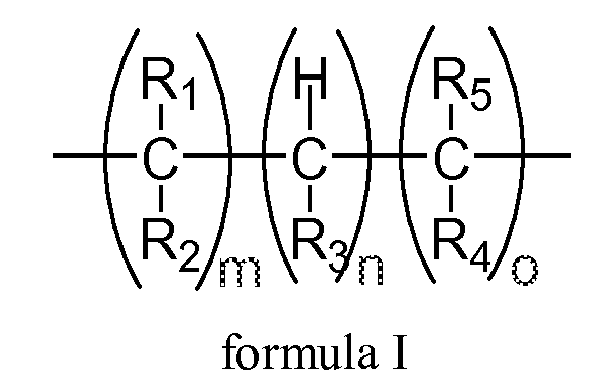
- (a) a carboxyl derivative, a thiocarboxyl derivative;
- (b) a carbonyl derivative, a thiocarbonyl derivative, an imine derivative;
- (c) a hydroxyl derivative
- (d) an aryl radical, a heteroaryl radical;
- (e) a saturated cyclic radical;
- (f) an alkoxy derivative;
- (g) an amino derivative, an amide derivative, an imide derivative;
- (h) a phosphorus derivative;
- (i) a sulphur derivative;
- (j) a tin derivative;
- (k) a silica derivative;
- (l) a alkyne derivative;
- (m)a heterocyclic also incorporating R2;
- wherein R1, R2, R4, and R5 are the same or different and are selected from the groups consisting of hydrogen, C1-C22 saturated alkyl derivatives, C1-C22 unsaturated alkyl derivatives, hydroxyl derivatives, C1-C22 alkoxy derivatives, carboxyl derivatives, thiocarboxyl derivatives, amino derivatives, aminoalkyl derivatives, aminodialkyl derivatives, aminotrialkyl derivatives, tetraalkylammonium derivatives, amide derivatives, an imide derivatives, sulfide derivatives, sulfoxide derivatives, sulfone derivatives, phosphite derivatives, phosphone derivatives, phosphonate derivatives, tin derivatives and silica derivatives, aryl derivatives, C1-C7 aryl derivatives, heteroaryl derivatives, C1-C7 heteroaryl derivatives, cyano derivatives, alkynyl derivatives;
- wherein indicia m, o, n are independent to each other with m ≥ 0, o ≥ 0 and n ≥ 1; and,
- wherein direct covalent bonds are formed between the alpha carbons of two different units (A) by break of the alpha-hydrogen-bond relative to R3 and wherein said bonds comprise no intermediate molecule.
- According to a second aspect, the present invention relates to the use of the elastomeric polymer, as defined in the first aspect of the invention, for providing elastic properties to a cosmetic composition.
- According to a third aspect, the present invention relates to the use of a composition, as defined in the first aspect of the invention, for providing long-lasting hold, high-setting properties, and elasticity to the hair style.
- According to fourth and fifth aspects, the present invention relates to methods for preparing a cosmetic composition, as defined in the first aspect of the invention.
- According to a sixth aspect, the present invention relates to a method for applying a cosmetic composition, as defined in the first aspect of the invention, onto hair and/or skin.
- As used herein, the term "elastomeric" means a group of polymers, which are cross-linked to only a certain degree in order to provide them with elasticity without making them too stiff. Said polymers usually are characterized with a glass transition temperature below room temperature. Said elastomers are classified as an intermediary category between non-cross-linked linear polymers and totally cross-linked polymers (e.g. thermosets).
- As used herein, the expression "unit(s) (A)" means a repeat unit of one of the monomers constituting the polymer and comprising at least one carbon atom and its substituents and being polymerized with other units in order to form a polymeric chain. Said unit(s) is(are) derived from monomeric molecule(s) (A) - or monomer(s) (A).
- As used herein, the expression "R3" means an electron-withdrawing group enabling the break of the alpha-hydrogen bond.
- As used herein, the expression "photoreactant" means a reactant which is activated by UV-rays so that to generate a pair of first radicals, said radicals abstracting then the hydrogen radical in alpha position relative to the electron-withdrawing group of the saturated polymeric backbone.
- As used herein, the expression "direct covalent bond" means that the alpha carbon atoms of two different units (A) are bond to each other with a covalent bond by break of the carbon-hydrogen bond relative to R3, i.e. said covalent bond comprises no intermediate molecules, wherein the expression "molecules" means at least one atom. Said "direct covalent bond", in the context of the present invention, is different from the covalent bond formed between two adjacent units during the polymerization process within one polymeric chain. In contrast, said "direct covalent bond" is formed in a second step (cross-linking step) after the polymer has been formed (polymerization step).
- As used herein, the expression "polymer" means both homopolymers formed by polymerization of one type of monomers (A) and copolymers formed by polymerization of at least two types of monomers, a monomer (A) and a monomer (B). Copolymers can also comprise more than two comonomers. The expression "polymer" also means blends of at least one type of homopolymer with at least one other homopolymer, or copolymer, or blends of at least two copolymers. A polymer blend is characterized in that its glass transition temperature Tg B equates to about the weighted average of the glass transition temperatures of its components. For example, the glass transition temperature of a polymer blend formed from 50% homopoylmer (A) and 50% homopolymer (B), Tg A,B, will equate to about (Tg A + Tg B)/2.
- As used herein, the expressions "weight percentage" and "percentage by weight" of a component mean the percentage of active component and not the percentage of the raw material comprising this active, unless otherwise specified (see examples).
- All percentages, ratios and proportions herein are by weight, unless otherwise specified.
- According to a first aspect, the present invention relates to a cosmetic composition comprising, in a cosmetically acceptable carrier, elastomeric polymers comprising from 1% to 100% of polymerized units (A),
wherein said units (A), in their non-cross-linked form, comprise at least one carbon having an alpha-hydrogen relative to R3 and have the general formula I
- wherein R3 is selected from the group consisting of a carboxyl derivative, a thiocarboxyl derivative a carbonyl derivative, a thiocarbonyl derivative, an imine derivative; a hydroxyl derivative; an aryl radical, a heteroaryl radical; a saturated cyclic radical; an alkoxy derivative; an amino derivative; an amide derivative; an imide derivative; a phosphorus derivative; a sulphur derivative; a tin derivative; a silica derivative; a alkyne derivative; a heterocyclic also incorporating R2;
- wherein R1, R2, R4 and R5 are the same or different and are selected from the groups consisting of hydrogen, C1- C22 saturated alkyl derivatives, C1-C22 unsaturated alkyl derivatives, hydroxyl derivatives, C1-C22 alkoxy derivatives, carboxyl derivatives, a thiocarboxyl derivatives, amino derivatives, aminoalkyl derivatives, aminodialkyl derivatives, aminotrialkyl derivatives, tetraalkylammonium derivatives, amide derivatives, imide derivatives, sulfide derivatives, sulfoxide derivatives, sulfone derivatives, phosphite derivatives, phosphone derivatives, phosphonate derivatives, tin derivatives and silica derivatives, aryl derivatives, C1-C7 aryl derivatives, heteroaryl derivatives, C1-C7 heteroaryl derivatives, cyano derivatives, alkynyl derivatives;
- wherein indicia m, o, n are independent to each other with m ≥ 0, o ≥ 0 and n ≥ 1; and,
- wherein direct covalent bonds are formed between the alpha carbons of two units (A) by homolytic break of the alpha-hydrogen and wherein said bonds comprise no intermediate molecule.
- The inventors have surprisingly found that elastomeric polymers - or elastomers - comprising some polymer segments bound to each other via direct covalent bonds (i.e. bonds not comprising intermediate molecule) exhibit satisfactory elastic properties. This differs from conventional cross-linking processes using cross-linking agents, which tend to alter/reduce the elastic properties of the cross-linked polymers. Without being bound by any theory, it is believed that the cross-linking technology as described herein may result in the obtaining of cross-linked polymers exhibiting a higher cross-linking density. Indeed, as the reaction undergoes via the radical hydrogen present in the saturated carbon-backbone of the polymer and therefore not only dependent upon the presence of a "functional" group within the polymer, the resulting cross-linking density would be therefore higher and the direct covalent bond would be distributed more evenly throughout the (co-)polymer than conventionally.
- The inventors have also surprisingly found that cosmetic compositions - e.g. skin and/or hair care compositions, skin and/or hair cleansing compositions, hair styling compositions, hair conditioning compositions, hair dyeing compositions and/or shaving compositions - incorporating such polymers show an improved performance, particularly vis-à-vis the compositional properties, the ease of application and the benefits conferred to the skin and/or hair. Without being bound by any theory, it is believed that such improved performance results from the higher cross-linking density and from a more homogeneous distribution of direct covalent bonds throughout those newly formed elastomeric polymers. Specifically, such polymers are particularly suitable for incorporation into hair styling compositions. Said compositions confer long-lasting hold and high-setting properties, together with elasticity to the hair style.
- When the polymeric chain comprises less than 100% of units (A), said chains further comprise units (B), said units (B) comprising no alpha-hydrogen and not being suitable for forming a direct covalent bond. Said units (B) may be, for example, methacrylic acid and derivatives. In one embodiment, the elastomeric polymers may comprise from 1 to 100% of polymerized units (A) and from 0% to 99% of polymerized units (B).
- The elastomeric polymers comprise polymeric chains comprising from 1% to 100% of polymerized units (A). Said units (A) are derived from monomers (A), which are polymerized using conventional polymerization methods. The polymeric chains are preferably saturated chains.
- Said units (A) comprise at least one carbon atom having an alpha-hydrogen relative to R3 and have the below general formula I.

- Units (A) comprise substituents R3 being selected from the groups consisting of a carboxyl derivative, a thiocarboxyl derivative; carbonyl derivative, a thiocarbonyl derivative, an imine derivative; a hydroxyl derivative; an aryl radical, a heteroaryl radical; a saturated cyclic radical; an alkoxy derivative; an amino derivative, an amide derivative, an imide derivative; a phosphorus derivative; a sulphur derivative; a tin derivative; a silica derivative; a alkyne derivative; a heterocycle also incorporating R2; or combinations thereof. Preferably, units (A) comprise substituents R3 being selected from the groups consisting of a carboxyl derivative, carbonyl derivative, a thiocarbonyl derivative, an imine derivative; a hydroxyl derivative; an alkoxy derivative; an amino derivative; an amido derivative; or combinations thereof. More preferably, units (A) are selected from the groups consisting of acrylic acid, acrylamide, maleic acid, vinyl alcohol, vinyl acetate, vinyl methyl ether, vinyl pyrrolidone, vinyl-formamide, their derivatives, their salts, or combinations thereof. Still more preferably, units (A) are selected from the groups consisting of acrylic acid, acrylamide, vinyl alcohol, vinyl acetate, vinyl pyrrolidone, their derivatives, their salts, or combinations thereof
- When R3 is a carboxyl derivative, units (A) may be selected from the group consisting of acrylic acid, acrylamide, their derivatives, their salts, or combinations thereof. When R3 is a hydroxyl derivative, units (A) may be selected from the group consisting of vinyl alcohol, its derivatives, their salts, or combinations thereof. When R3 is an alkoxy derivative, units (A) may be selected from the group consisting of vinyl acetate, vinyl methyl ether, their derivatives, their salts, or combinations thereof. When R3 is an amino derivative, units (A) may be selected from the group consisting of vinyl pyrrolidone, vinyl-formamide, their derivatives, their salts, or combinations thereof. When R3 is part of a heterocycle also incorporating R2, units (A) may be maleic acid, their derivatives, their salts, or combinations thereof.
- Substituents R1, R2, R4 and R5 are independent to each other. R1, R2, R4 and R5 may be the same or different substituents. R1, R2, R4 and R5 are selected from the groups consisting of hydrogen, C1-C22 saturated alkyl derivatives, C1-C22 unsaturated alkyl derivatives, hydroxyl derivatives, C1-C22 alkoxy derivatives, carboxyl derivatives, thiocarboxyl derivatives, amino derivatives, aminoalkyl derivatives, aminodialkyl derivatives, aminotrialkyl derivatives, tetraalkylammonium derivatives, amide derivatives, imide derivatives, sulfide derivatives, sulfoxide derivatives, sulfone derivatives, phosphite derivatives, phosphone derivatives, phosphonate derivatives, tin derivatives and silica derivatives, aryl derivatives, C1-C7 aryl derivatives, heteroaryl derivatives, C1-C7 heteroaryl derivatives, cyano derivatives, alkynyl derivatives. Alternatively, R4 may be part of a heterocycle also incorporating R2.
- Indicia m, o, n are independent to each other with m ≥ 0, n ≥ 1 and o ≥ 0. Preferably, m = 0, o = 1 0 and n = 1.
- The elastomeric polymers are obtained using a cross-linking process, different from the conventional cross-linking process using cross-linking agents and forming indirect covalent bonds. Said process comprises the step of forming direct covalent bonds between the alpha carbons of two different units (A) by break of the alpha hydrogen. Said direct covalent bonds differ from indirect covalent bonds in that they comprise no intermediate molecule. Conventional polymers may be cross-linked via direct covalent bonds, in order to obtain elastomeric polymers, prior to their incorporation into a cosmetic composition. Alternatively, conventional polymers may be cross-linked via direct covalent bonds after their incorporation into a cosmetic composition.
- The direct covalent bonds may be formed between two units (A) within one polymeric chain - said bond being an intra-chain direct covalent bond. The direct covalent bonds may also be formed between two units (A) from two different polymeric chains - said bond being an inter-chain direct covalent bond.
- Preferably, the direct covalent bonds are formed upon exposure of the polymers to ultraviolet irradiation at a wave length from 170 nm to 400 nm, from 0.001 sec to 22,000 sec, in the presence of a photoreactant agent in a ratio with units (A) from 0.01 to 1 and in the absence of a cross-linking agent. More preferably, the direct covalent bonds are formed at a temperature from 0°C to 95°C.
- Alternatively, the direct covalent bonds are formed in the presence of an activated photoreactant agent in a ratio with units (A) from 0.01 to 1 and in the absence of a cross-linking agent. Preferably, the direct covalent bonds are formed at a temperature from 20°C to 70°C. The photoreactant agent may be activated upon exposure to ultraviolet irradiation at a wave length from 170 nm, from 0.001 sec to 22,000 sec.
- As used herein, the expression "photoreactant" means a substance, which forms free radicals when being irradiated by light, especially by UV-light. The inventors have surprisingly found that, in order to form direct covalent bonds, it is essential to use a photoreactant agent present in an activated form and in a specific ratio (by weight) with units (A). The activation of the photoreactant agents is achieved upon their exposure to ultraviolet irradiation at a wave length from 170 nm to 400 nm, from 0.001 sec to 22,000 sec. The activation of the photoreactant agents and the formation of the direct covalent bonds may be concomitant. Alternatively, the activation of the photoreactant may be conducted prior forming the direct covalent bonds. Activating the photoreactant prior forming the direct covalent bonds is preferred as it prevents the polymers from being damaged by the irradiations. Using ultraviolet irradiation at a wave length from 170 nm to 400 nm is essential because the preferred photoreactant absorbs only UV-light. Using the photoreactant agents in a ratio (by weight) with units (A) from 0.01 to 1 is also essential in order to form direct covalent bonds. When using a ratio (by weight) of less than 0.01, it is expected no direct covalent bonds to be formed. Said ratio ranges preferably from 0.01 to 0.4, more preferably from 0.03 to 0.3.
- The photoreactant agent may be a persulfate salt. Preferably, the persulfate salts are selected from the group consisting of sodium persulfate, potassium persulfate, ammonium persulfate or mixtures thereof. Using persulfate salts is preferred because they are easy to handle, highly soluble in water and form with each homolytic cleavage two equal radicals at the same time.
- From 0.01% to 100% of units (A) may be cross-linked via direct covalent bonds. Preferably, from 0.1% to 50% of units (A) are cross-linked. More preferably, from 1% to 5% of units (A) are cross-linked. When only part of the units (A) are cross-linked via direct covalent bonds, the elastomeric polymers comprise units (A) in a cross-linked form and units (A) in an uncross-linked form. The degree of elasticity varies depending on the degree of cross-linking, i.e. the proportion of units (A) being cross-linked.
- Any polymers conventionally used in cosmetic compositions, comprising from 1% to 100% of units (A) comprising at least one carbon having an alpha-hydrogen relative to R3, are suitable for cross-linking via direct covalent bonds and for incorporation into the cosmetic composition of the present invention.
- Said polymers may be uncross-linked polymers or cross-linked polymers using conventional cross-linking processes using cross-linking agents. When said polymers are cross-linked polymers, they could be further cross-linked according to the present method in order to create direct covalent bonds and to obtain elastomeric polymers. In such case, these elastometic polymers would comprise "indirect covalent bonds" (i.e. conventional cross-links) and "direct covalent bonds".
- Said polymers may be emulsion stabilizers, suspending agents, viscosity increasing agents, opacifying agents, film-forming agents, hair-fixative agents, skin moisturizing agents and/or hair conditioning agents. Preferably, said polymers are hair-fixative agents - also called hair styling polymers. Said polymers may be selected from the group consisting of anionic polymers, cationic polymers, amphiphilic polymers, non-ionic polymers or combinations thereof. See polymers listed in the International Cosmetic Ingredient Dictionary and Handbook, 12th edition (2008) from the Personal Care Products Council (formerly the Cosmetic, Toiletry and Fragrance Association or CTFA). Suitable anionic polymers may be polyacrylic acid, acrylate/t-butylacrylamide copolymer (commercially available under the
tradename Ultrahold 8 from BASF corporation), AMP-acrylates copolymer (e.g. DynamX from AzkoNobel Surface Corporation), VA/crotonates copolymers (e.g. Luviset CA from Clariant International Ltd.), isobutylene/ethylmaleimide/hydroxyethylmaleimide copolymer (e.g. Aquaflex FX 64 from International Specialty Products), PVM/MA copolymers being copolymers of methyl vinyl ether and maleic anhydride or maleic acid (e.g. Gantrez AN-119/139/149/169, S-95/97 from International Specialties Products), ethyl (or butyl, or propyl) ester of PVM/MA copolymers (e.g. Gantrez A-4259/ES 425/ES 435/V-425 from International Specialties Products), acrylamide/sodium acryloyldimethyltaurate/acrylic acid copolymer (e.g. Acudyne SCP from Rohms and Haas Company, Inc.), acrylates/hydroxyesters acrylates copolymer (e.g. Acudyne DHR from Rohms and Haas Company, Inc.). Suitable cationic polymers may be polyquaternium -11, polyquaternium-16, and polyquaternium-68. Suitable amphiphilic polymers may be octylacrylamide/acrylates/butylaminoethyl methylacrylate copolymer (e.g. Amphomer from AkzoNobel Surface Company), poly-vinyl alcohol (e.g. celvol from Celanese Chemicals), vinyl pyrrolidone/vinyl acetate copolymers (e.g. Luviskol VA-37E/73E/64 Powder/64W/73W from BASF Corporation), polyvinyl methyl ether (e.g. Gantrez M-154 from International Specialties Products), polyvinylpyrrolidine (e.g. Luviskol K30/K90/K17/K80/K90 from BASF Corporation), polyvinylformamide, sodium polystyrene sulfonate (e.g. Flexan II from AkzoNobel Company). - The inventor has surprisingly found that cross-linking polymers conventionally used in cosmetic compositions - as those listed above - allows improving/conferring elastic properties of/to these polymers. For example, polyacrylic acid, polyvinyl pyrrolidone, or polyvinyl acetate cross-linked via direct covalent bonds shows superior elastic properties versus conventional polyacrylic acid, polyvinyl pyrrolidone, or polyvinyl acetate - such conventional polymers being either not cross-linked or cross-linked via indirect covalent bond (i.e. using cross-linking agents). By incorporating such polymers into cosmetic compositions, improved performances are achieved, particularly vis-à-vis the compositional properties, the ease of application and the benefits conferred to the skin and/or hair. Particularly, by incorporating such polymers into hair-styling compositions, it confers a satisfactory elasticity to the hair style. For example, the elasticity of a hair style may be assessed using the curl retention test.
- The compositions, according to the present invention, also comprise a cosmetically acceptable carrier. Said carrier may be selected from solutions, emulsion, solid carrier, dispersion, suspension, mousses, gels, waxes, polyphasic compositions.
- The compositions, according to the present invention, may be applied onto the skin, including the forehead, the cheeks and neck, the arms and the legs, as well as onto keratinous fibers, including hair and facial hair. Said compositions may be applied as a leave-on composition or as a rinse-off composition.
- The composition, according to the present invention, may further comprise a cosmetic ingredient, preferably, from 0,001% to 50% of at least one cosmetic ingredient. Preferably, said cosmetic active ingredients are selected from the groups consisting of emulsifiers/surfactants; structuring agents; non-elastomeric thickening agents; anti-oxidants/radical scavengers; chelators and sequestrants; desquamation agents/exfoliants; skin lightening agents; skin and hair conditioning agents; hair-styling agents; anti-frizz agents; anti-wrinkle actives/anti-atrophy agents; anti-cellulite agents; tanning agents; anti-acne agents; skin freshening, skin soothing and skin healing actives; anti-inflammatory agents; cleansing agents; lathering agents; beard wetting agents; antimicrobial, antibacterial and antifungal actives; sunscreen actives and sunblocks agents; shine enhancing agents, viscosity modidiers; pH adjusting agents; solid particulates; humectants and emollients; electrolytes; vitamins, their derivatives, and their salts thereof; natural extract and their derivative thereof; peptides; colorants; preservatives; fragrances and perfumes; propellants, or mixtures thereof. More preferably, said cosmetic active ingredients are ingredients suitable for incorporation into a hair styling composition.
- The compositions, according to the present invention, may be selected from skin care composition or hair care compositions. Preferably, the compositions are skin cleansing, hair cleansing, hair styling, hair conditioning, hair dyeing and/or shaving compositions, or combinations thereof. More preferably, said compositions are hair styling compositions.
- The inventors have surprisingly found that the incorporation of elastomeric hair styling polymers into hair styling compositions is particularly beneficial as said compositions exhibit improved performance when applied onto hair. Indeed, said compositions confer long-lasting, high setting properties as well as elasticity to the hair style. The elasticity confers to the hair style is superior to the elasticity conferred to hair when applying a hair styling composition incorporating conventional hair styling polymers, i.e. polymers not being cross-linked via direct covalent bond.
- According to a second aspect, the present invention relates to the use of the elastomeric polymer, as defined above for providing elastic properties to a cosmetic composition. The inventors have effectively surprisingly found that the use of such elastomeric polymers - versus commercially available polymers not comprising direct covalent bonds - improves the elasticity properties of cosmetic compositions.
- According to a third aspect, the present invention relates to the use of a composition, as defined above, for providing long-lasting hold, high-setting properties, and elasticity to the hair style. The inventors have effectively surprisingly found that hair styling compositions comprising elastomeric polymers comprising direct covalent bond are useful for imparting a satisfactory elasticity to the hair style.
- According to a fourth aspect, the present invention relates to a method for preparing a cosmetic composition, as defined in the first aspect of the invention, said method comprising the steps of:
- (a) providing a polymer comprising from 1% to 100% of polymerized units (A);
- (b) forming direct covalent bonds between the alpha carbons of two different units (A) of said polymers by break of the alpha-hydrogen-bond relative to R3, said bonds comprising no intermediate molecule, in order to obtain elastomeric polymers;
- (c) providing a cosmetic composition comprising a cosmetically acceptable carrier and optionally at least one cosmetic active ingredient;
- (d) incorporating said elastomeric polymers into said cosmetic composition.
- Step (b) may be carried out by exposing said polymers to ultraviolet irradiation at a wavelength from 170 nm to 400 nm, from 0.001 sec to 22,000 sec, in the presence of a photoreactant agent in a ratio with units (A) from 0.01 to 1 and in the absence of a cross-linking agent, and optionally at a temperature from 0°C to 95°C.
- Alternatively, step (b) may comprise several sub-steps so that (b1) providing a photoreactant, then (b2) activating said photoreactant upon exposure to ultraviolet irradiation at a wavelength from 170 nm, from 0.001 sec to 22,000 sec, then (b3) mixing said polymers and said activated photoreactant in a ratio with units (A) from 0.01 to 1 and in the absence of a cross-linking agent in order to form direct covalent bonds.
- Suitable polymers comprising from 1% to 100% of polymerized units (A), photoreactants, cosmetically acceptable carriers, and optional cosmetic active ingredients are detailed hereinbefore.
- According to a fifth aspect, the present invention relates to a method for preparing a cosmetic composition, as defined in the first aspect of the invention, said method comprising the steps of:
- (a) providing a cosmetic composition comprising a cosmetically acceptable carrier, and optionally at least one cosmetic active ingredient;
- (b) incorporating polymers comprising from 1% to 100% of polymerized units (A) into said cosmetic composition;
- (c) forming direct covalent bonds between the alpha carbons of two different units (A) of said polymers by break of the alpha-hydrogen-bond relative to R3, said bonds comprising no intermediate molecule, in order to obtain elastomeric polymers.
- Step (c) may be carried out by exposing said composition - and therefore said polymers - to ultraviolet irradiation at a wavelength from 170 nm to 400 nm, from 0.001 sec to 22,000 sec, in the presence of a photoreactant agent in a ratio with units (A) from 0.01 to 1 and in the absence of a cross-linking agent, and optionally at a temperature from 0°C to 95°C.
- Alternatively, step (c) may comprise several sub-steps so that (c1) providing a photoreactant, then (c2) activating said photoreactant upon exposure to ultraviolet irradiation at a wavelength from 170 nm, from 0.001 sec to 22,000 sec, then (c3) mixing said polymers and said activated photoreactant in a ratio with units (A) from 0.01 to 1 and in the absence of a cross-linking agent in order to form direct covalent bonds.
- Suitable polymers, photoreactants, cosmetically acceptable carriers, and optional cosmetic active ingredients are detailed hereinbefore.
- In a sixth aspect, the present invention relates to a method for applying a cosmetic composition onto hair and/or skin, said method comprising the steps of:
- (a) providing a cosmetic composition, as defined in the first aspect of the invention comprising, in a cosmetically acceptable carrier, elastomeric polymers comprising from 1% to 100% of polymerized units (A) wherein direct covalent bonds are formed between the alpha carbons of two different units (A) by break of the alpha-hydrogen-bond relative to R3 and wherein said bonds comprise no intermediary molecule, and optionally at least one cosmetic active ingredient;
- (b) applying said composition onto skin and/or hair
- Said composition may be obtained by any suitable methods, particularly with the methods according to the fourth and fifth aspects of the invention as detailed hereinbefore.
- The following examples further describe and demonstrate the preferred embodiments within the scope of the present invention. The examples are given solely for the purpose of illustration, and are not to be construed as limitations of the present invention since many variations thereof are possible without departing from its scope.
- All weights provided in these examples are weights of the commercially available materials, including active(s) and/or solvent and/or by-products.
- To 1000 ml of a 5% to 10% solution of said polymer (MW ≈ 50 000 to 200 000 g/mol), 10% to 15% by weight of polymer of ammoniaperoxodisulfate is added. The temperature is 25°C to 85°C. The sample is stirred and irradiated so that the emission spectrum comprises UV light between 220 nm and 300 nm. After 1 to 60 minutes of irradiation, "direct" cross-links are formed. In case the polymer comprises both units (A) and units (B), the ratio pertains to the ratio of photoreactant agents to units (A).
-
- a) To 1000 ml of a 5% solution of poly vinyl alcohol (MW ≈ 200 000 g/mol, degree of hydrolysis ≥ 85%), ammoniaperoxodisulfate (= 20 % of the amount of polymer) was added. The temperature was 50 °C. The sample was stirred and irradiated by a submerse middle-pressure mercury lamp. The emission spectrum comprises UV light between 220 nm and 300 nm. After 10 minutes of irradiation, the former thin solution changed into a thick, viscous gel.
- b) To 1000 ml of a 5% (by weight) solution of poly vinyl alcohol (MW ≈ 200 000 g/mol, degree of hydrolysis ≥ 85%), 10 g of ammoniaperoxodisulfate (= 20 % of the amount of polymer) was added. The temperature was 50°C. The sample was stirred and irradiated by a submerse low-pressure mercury lamp. The emission spectrum comprises monochromatic UV light of 253.7 nm. After 20 minutes of irradiation, the former thin solution changed into a thick, viscous gel.
-
- a) To 1000 ml of a 5% solution of poly vinyl pyrrolidone (Luviskol K 90), ammoniaperoxodisulfate (= 10 % by weight of the amount of polymer) was added. The temperature was 50°C. The sample was stirred and irradiated by a submerse middle-pressure mercury lamp. The emission spectrum comprises UV light between 220 nm and 300 nm. After 20 minutes of irradiation, the former thin solution changed into a thick, viscous gel.
- b) To 1000 ml of a 5% (by weight) solution of poly vinyl pyrrolidone (Luviskol K 90), 5 g of ammoniaperoxodisulfate (= 10 % of the amount of polymer) was added. The temperature was 50°C. The sample was stirred and irradiated by a submerse low-pressure mercury lamp. The emission spectrum comprises monochromatic UV light of 253.7 nm. After 30 minutes of irradiation, the former thin solution changed into a thick, viscous gel.
-
- a) To 1000 ml of a 15% (by weight) solution of poly acrylic acid (MW ≈ 100000 g/mol), ammoniaperoxodisulfate (= 10 % by weight of the amount of polymer) was added. The temperature was 50°C. The sample was stirred and irradiated by a submerse middle-pressure mercury lamp. The emission spectrum comprises UV light between 220 nm and 300 nm. After 50 minutes of irradiation, the former thin solution changed into a thick, viscous gel.
- b) To 1000 ml of a 15% (by weight) solution of poly acrylic acid from Aldrich (MW ≈ 100000 g/mol), 15 g of ammoniaperoxodisulfate (= 10 % (by weight) of the amount of polymer) was added. The temperature was 50°C. The sample was stirred and irradiated by a submerse low-pressure mercury lamp. The emission spectrum comprises monochromatic UV light of 253.7 nm. After 70 minutes of irradiation, the former thin solution changed into a thick, viscous gel.
- The "direct cross-linking" of further commercially available polymers - including Luviset Clear (VP/methacrylamide/vinyl imidazole copolymer) from BASF Corporation; Acudyne SCP (acrylamide/sodium acryloyldimethyltaurate/acrylic acid copolymer) from Rohm and Haas Company Inc.; Luviset CA66 (VA/crotonates copolymer) from BASF Corporation; Aquaflex SF-40 (VP/vinyl caprolactam/DMAPA acrylates copolymer) from International Specialty Products; polyquaternium-11; Aquaflex FX 64 (isobutylene/ethylmaleimide/hydroxyethylmaleimide copolymer) from International Specialty Products; Hair Gloss Polymer A (octylacrylamide/acrylates/butylaminoethyl methacrylate copolymer) from Cosmetochem International AG; Coplymer VC-173 (Vinyl Caprolactam/VP/dimethylaminoethyl methacrylate copolymer) from International Specialty Products; Luvimer 100P (acrylates copolymer) from BASF Corporation - was also successfully conducted using a similar methods as those of examples 1 to 3.
- General - Dynamic Mechanical Analysis (DMA herein) is a known method for mechanical material characterization of films. DMA is using oscillatory principle for characterization of mechanical properties of solid materials (e.g. films). The sample is fixed in clamps of the instrument and stress is applied in vertical direction. The ratio of the Loss Modulus G" and the Storage Modulus G' is called tan δ and is obtained with the equation tan δ = G"/ G'. tan δ is known as a measure of the elasticity of a sample - the lower tan δ is, the higher the elastic fraction of the system.
- Samples preparation - It is provided a poly(vinylalcohol) from Merck. Each batch (20 ml of the polymer solution with photoreactant) is put into an open form with glass bottom and then irradiated with UV light using medium pressure UV-
lamp TQ 150, Heraeus) placed at a distance of 20cm from the batch. After exposure to UV light, the batches are dried for five days in order to obtain a film. Samples of 10mm×5,3mm×0,3mm were cut out from said film in order to conduct DMA measurements. - DMA test parameters: DMA measurements were conducted isothermally using a TA Instruments DMA Q800 at 23°C and constant humidity (50%), with a frequency sweep from 1 to 100 Hz with 0,03% strain.
- Results: Data obtained are shown in
figure 1 , which shows tan δ value function of the UV time (min). As can be extrapolated fromfigure 1 , the decrease of tan δ value - and therefore the increase of the elasticity (elastic properties) of the elastomeric polymers - is directly correlated with the increase exposure of the batch to UV light. - General: UV-Rheology measurements are conducted using TA Instruments AR-2000ex in order to measure the rheological properties of batches of polymers (G', G", tan δ) during exposure to UV light (i.e. while the cross-linking occurs). This allows therefore a real-time monitoring of viscoelastic properties changes occurring before, during and after UV irradiation.
- Samples preparation: Batches comprising 20% solution of PVP (Luviskol K 90, BASF) are prepared. Such batches comprise different proportions of photoreactant (from 0 to 40% of the polymer mass). Said photoreactant is added to the batches just before conducting the measurements in order to prevent early cleavage.
- UV-Rheology test parameters: Rheology experiments are conducted isothermally at two different temperatures (i.e. 25°C and 40°C), using a 20mm steel plate and setting the gap to 200 µm About 1 ml of polymer solution is used. Measurements were carried out as time sweep using
strain control 5% with lower torque limit of 10 µN.m and a frequency of 0,3Hz. All along the measurements, the polymer solution was exposed to UV light using ProCure PLG-10, medium pressure UV-lamp ES270. - Results: data obtained are shown in
figure 2 output of UV-Rheology tests is the behaviour of tan δ (= loss modulus / storage modulus). Based on the results assumptions on physical and chemical nature of cross-linking process can be made. - The examples below disclose cosmetic compositions - according to the present invention - comprising at least one elastomeric polymer (or directly cross-linked polymer - see symbol "*"). Said compositions may also comprise further ingredients, such as from 0,1 to 0,3g fragrance:
- Example 8 (liquid gel): 0.3g elastomeric poly(acrylic acid) *; 1.5g PEG-12 dimethicone; 0.3g aminoethyl propanol 95 %; 0.2g PPG-1 / PEG-9 lauryl glycol ether; 0,4g hydroxyethylcellulose; 16,5g ethanol; qsp 100g with water.
- Example 9 (liquid gel): 1.0g elastomeric poly(vinylpyrrolidone) *; 1.0g PEG-12 dimethicone; 1,2g xantham gum; 0.1g citric acid; 6.5g ethanol; 0.3g DMDM hydantoin; qsp 100g with water.
- Example 10 (liquid gel): 0,5 g elastomeric poly(vinylalcohol) *; 7,0 g glucose; 3,8 g propylenglycol; 0,3 g hydroxypropylguar; 0,2 g aminomethyl propanol 95 %; 0,5 g PEG-25 PABA; 0,18 g PEG-40 hydrogenated castor oil; 0,18 g PPG-1 / PEG-9 lauryl glycol ether; 16,5 g ethanol; qsp 100g with water.
- Example 11 (spray gel): 3,0g elastomeric poly(vinylpyrrolidone) *; 18g ethanol; 0,1g aminomethyl propanol 95%; 0,2g PEG-40; 0,5g acrylates / beheneth-25 methacrylate copolymer; 70g water.
- Example 12 (Gel with short drying time): 2,8g elastomeric poly(acrylic acid) *; 1,5g PEG-12 dimethicone; 0,35g acrylates / C10-30 alkyl acrylate crosspolymer; 0,26g aminomethyl propanol 95 %; 0,30g methylmethoxycinnamate; 34,2g ethanol; qsp 100g with water.
- Example 13 (gel-spray): 0,23g elastomeric poly(acrylic acid) *; 1,0g PEG-12 dimethicone; 0,22g aminoethyl propanol 95 %; 6,5g ethanol; qsp 100g with water.
- Example 14 (blow dryer-gel): 1,0g elastomeric acrylamide / sodium acryloyldimethyltaurate / acrylic acid copolymer *; 1,0g PEG-12 dimethicone; 0,95g hydroxypropylcellulose; 0,1g citric acid; 6,5g ethanol; qsp 100g with water.
- Example 15 (gel): 1,8g elastomeric poly(vinylpyrrolidone) [Luviskol K 90] *; 1,5g PEG-12 dimethicone; 1,0g acrylates / palmeth-25 acrylate copolymer; 0,3g aminomethyl propanol 95%; 0,3g PEG-25 PABA; 0,15g d-panthenol; 34,2g ethanol; 0,1g hydrolyzed hair keratin; qsp 100g with water.
- Example 16 (gel): 2,5g elastomeric VA / crotonates copolymer *; 4,2g sorbitol; 0,8g carbomer; 0,3g aminomethyl propanol 95 %; 0,2g methylparabene; 0,2g PEG-40 hydrogenated castor oil; 0,1g d-panthenol; 5,0g ethanol; qsp 100g with water.
- Example 17 (gel): 1,5g elastomeric VP / vinyl caprolactam / DMAPA acrylates copolymer *; 1,2g vinyl acrylate / crotonic acid copolymer; 4,2g sorbitol; 0,12g acrylates / ceteth-20 itaconate copolymer; 0,35g aminomethyl propanol 95%; 0,5g PEG-25 PABA; 0,2g DMDM hydantoin; 0,2g PEG-40 hydrogenated castor oil; 0,1g d-panthenol; 5,0g ethanol; qsp 100g with water.
- Example 18 (gel): 5,2g glycerine; 4,0g propylene glycol; 0,35g elastomeric poly(acrylic acid) *; 0,26g aminomethyl propanol 95%; 1,
0g polysorbate 40; 0,2g methylparabene; 0,5g PEG-25 PABA; 4,5g ethanol; qsp 100g with water. - Example 19 (pump-setting mousse): 0,3g elastomeric vinylacetate / crotonic acid copolymer; 0,4g cocamidopropyl hydroxysultaine; 0,1g citric acid; 8,9g ethanol; 0,1g betaine; qsp 100g with water.
- Example 20 (pump-setting mousse): 0,4g elastomeric acrylic acid / ethylacrylate / N-tert-butylacrylamide copolymer *; 0,4g cocamidopropyl hydroxysultaine; 0,1g citric acid; 0,2g DMDM hydantoin; 0,1g Chamomilla Recutita (Matricaria) flower extract; qsp 100g with water.
- Example 21 (pump-setting mousse): 1,2g elastomeric VP / methacrylamide / vinyl imidazole copolymer *; 0,35g polyquaternium-6; 0,4g cocamidopropyl hydroxysultaine; 0,1g d-panthenol; 8,9g ethanol; 0,1g betaine; qsp 100g with water.
- Example 22 (pump-setting mousse): 2,5g elastomeric VP/methacrylamide/vinyl imidazole copolymer *; 8,9g ethanol; 0,2g cocamidopropyl hydroxysultaine; 0,2g cetyltrimethylammoniumchloride; 0,1g Silkpro Liquid; qsp 100g with water.
- Example 23 (pump-setting mousse): 2,0g elastomeric VP / methacrylamide / vinyl imidazole copolymer *; 0,3g polyquaternium-4; 8,9g ethanol; 0,2g cocamidopropyl hydroxysultaine; 0,2g cetyltrimethyl ammonium chloride; 0,1g citric acid; 0,1g betaine; qsp 100g with water.
- Example 24 (pump-setting mousse): 0,3g elastomeric polyquaternium-11 *; 0,4g cocamidopropyl hydroxysultaine; 1,0g propylenglycol; 0,2g methylparabene; qsp 100g with water.
- Example 25 (pump-setting mousse): 1,8g elastomeric VP / methacrylamide / vinylimidazole copolymer *; 0,4g cocamidopropyl hydroxysultaine; 0,1g Rosmarinus Officinalis (rosemary) leaf extract; 8,9g ethanol; 0,1g D-panthenyl ethylether; qsp 100g with water.
- Example 26 (aerosol setting mousse): 0,5g elastomeric isobutylene / ethylmaleimide / hydroxyethylmaleimide copolymer *; 4,0g butane; 4,0g propane; 8,9g ethanol; 0,
4g PEG 25 PABA; 0,15g betaine; 0,2g laureth-4; 0,05g cetrimonium bromide; 0,5g amodimethicone; qsp 100g with water. - Example 27 (aerosol setting mousse): 1,5g elastomeric VP / methacrylamide / vinyl imidazole copolymer *; 0,5g polyquaternium-47; 4,0g butane; 4,0g propane; 0,15g betaine; 0,25g mixture of cyclopentasiloxane, cyclotetrasiloxane, dimethiconol; 0,2g ethylhexyl methoxycinnamate; 0,2g laureth 4; 0,07g cetrimonuim chloride; qsp 100g with water.
- Example 28 (aerosol setting mousse): 2,1g elastomeric VP / methacrylamide / vinyl imidazole copolymer *; 2,5g VP / dimethylamino ethylmethacrylate copolymer; 1,0g polyquaternium-4; 4,0g butane; 4,0g propane; 0,2g panthenol; 0,7g quaternium-80; 0,07g cetrimonuim chloride; qsp 100g with water.
- Example 29 (aerosol setting mousse): 2,1g elastomeric VP / methacrylamide / vinyl imidazole copolymer *; 0,6g elastomeric vinylacetate / crotonic acid copolymer *; 0,5g polyquaternium-7; 4,0g butane; 4,0g propane; 8,9g ethanol; 0,4g PEG-25 PABA; 0,2g panthenol; 0,2g laureth 4; 0,07g C-11 pareth-8; qsp 100g with water.
- Example 30 (setting lotion for spraying): 1,5g elastomeric VP / methacrylamide / vinyl imidazole copolymer *; 1,0g isobutylene / ethylmaleimide / hydroxyethyl maleimide copolymer; 2,7g ethanol; 1,0g polyquaternium-35; 0,7g PEG-25 PABA; 0,35g panthenol; 0,2g cetrimonuim chloride; 0,21g PEG-40 hydrogenated castor oil; qsp 100g with water.
- Example 31 (setting lotion for spraying): 2,0g elastomeric octylacrylamide / acrylates / butylamino ethylmethacrylate copolymer *; 28,5g ethanol; 0,6g aminomethyl propanol 95%; 0,20% cetyltrimethyl ammonium bromide; qsp 60 water.
- Example 32 (setting lotion for spraying): 0,65g elastomeric octylacrylamide / acrylates / butylamino ethylmethacrylate copolymer *; 0,2g polyquaternium-4; 28,5g ethanol; 0,6g aminomethyl propanol 95%; 0,2g cetyltrimethylammonium chloride; qsp 60g water.
- Example 33 (non-aerosol air blower lotion): 2,0g elastomeric vinyl caprolactam / VP / dimethylamino ethylmethacrylate copolymer *; 28,5g ethanol; 0,20g cetyltrimethyl ammonium Chloride; qsp 60g water.
- Example 34: (non-aerosol air blower lotion): 3,1g elastomeric VP / methacrylamide / vinyl imidazole copolymer *, 0,05g polyquaternium-4, 0,5g acrylates / lauryl acrylate / stearyl acrylate / ethylamine oxide methacrylate copolymer, 27g ethanol, 0,1g betain, 0,
21g PEG 40 hydrogenated castor oil, 0,20g cetyltrimethyl ammonium Bromide, qsp 100g with water. - Example 35 (aerosol air blower lotion): 3,0g elastomeric VP / methacrylamide / vinyl imidazole copolymer *; 2,30g sodium polystyrene sulfonate; 0,02g phenyl trimethicone; 10,0g water; qsp 100g with ethanol. Said lotion is packaged together with Dimethylether in the ration 45%/55%.
- Example 36 (VOC 80 pump spray): 0,5g t-elastomeric butylacrylate / ethylacrylate / methacrylic acid copolymer *; 0,10g aminomethyl propanol; 0,05g betain; 55g ethanol; qsp 100g with water.
- Example 37 (aerosol hairspray): 10,0g water; 0,02g phenyl trimethicone; 1,5g elastomeric VP / methacrylamide / vinyl imidazole copolymer *; 3,00g octylacrylamide / acrylic acid / butyl amino ethyl methacrylate / methyl methacrylate / hydroxyl propyl methacrylate copolymer; 0,48g aminomethyl propanol 95%; qsp 100g with ethanol. Said hairspray is packaged together with dimethylether in the ration 45%/55%.
- Example 38 (aerosol hairspray): 10,0g water; 3,3g elastomeric t-butylacrylate / ethyl acrylate / methacrylic acid copolymer *; 0,84g aminomethyl propanol 95%; 1,0g VA / crotonates copolymer; qsp 100g with ethanol. Said hairspray is packaged together with dimethylether in the ration 45%/55%.
- Example 39 (aerosol hairspray): 2,50g elastomeric VP / methacrylamide / vinyl imidazole copolymer *; 3,30g t-butylacrylate / ethylacrylate / methacrylic acid copolymer; 0,85g amino methyl propanol 95%; 0,02g phenyl trimethicone; 10,0g water; qsp 100g with ethanol. Said hairspray is packaged together with dimethylether in the ration 45%/55%.
- The dimensions and values disclosed herein are not to be understood as being strictly limited to the exact numerical values recited. Instead, unless otherwise specified, each such dimension is intended to mean both the recited value and a functionally equivalent range surrounding that value. For example, a dimension disclosed as "40 mm" is intended to mean "about 40 mm."
Claims (17)
- A cosmetic composition comprising, in a cosmetically acceptable carrier, elastomeric polymers comprising from 1% to 100% of polymerized units (A),
wherein said units (A), in their non-cross linked form, comprise at least one carbon having an alpha-hydrogen relative to R3 and have the general formula I (a) a carboxyl derivative, a thiocarboxyl derivative;(b) a carbonyl derivative, a thiocarbonyl derivative, an imine derivative;(c) a hydroxyl derivative(d) an aryl radical, a heteroaryl radical;(e) a saturated cyclic radical;(f) an alkoxy derivative;(g) an amino derivative, an amide derivative, an imide derivative;(h) a phosphorus derivative;(i) a sulphur derivative;(j) a tin derivative;(k) a silica derivative;(l) a alkyne derivative;(m)a heterocyclic also incorporating R2;wherein R1, R2, R4, and R5 are the same or different and are selected from the groups consisting of hydrogen, C1-C22 saturated alkyl derivatives, C1-C22 unsaturated alkyl derivatives, hydroxyl derivatives, C1-C22 alkoxy derivatives, carboxyl derivatives, thiocarboxyl derivatives, amino derivatives, aminoalkyl derivatives, aminodialkyl derivatives, aminotrialkyl derivatives, tetraalkylammonium derivatives, amide derivatives, imide derivatives, sulfide derivatives, sulfoxide derivatives, sulfone derivatives, phosphite derivatives, phosphone derivatives, phosphonate derivatives, tin derivatives and silica derivatives, aryl derivatives, C1-C7 aryl derivatives, heteroaryl derivatives, C1-C7 heteroaryl derivatives, cyano derivatives, alkynyl derivatives;
wherein indicia m, o, n are independent to each other with m ≥ 0, o ≥ 0 and n ≥ 1; and,
wherein direct covalent bonds are formed between the alpha carbons of two different units (A) by break of the alpha-hydrogen-bond relative to R3 and wherein said bonds comprise no intermediate molecule. - A composition, according to claim 1, wherein said covalent bonds are formed upon exposure of said polymers to ultraviolet irradiation at a wave length from 170 nm to 400 nm, from 0.001 sec to 22,000 sec, preferably at a temperature from 0°C to 95°C, in the presence of a photoreactant agent in a ratio with units (A) from 0.01 to 1 and in the absence of a cross-linking agent.
- A composition, according to claim 1, wherein said covalent bonds are formed, preferably at a temperature from 0°C to 95°C, in the presence of an activated photoreactant agent in a ratio with units (A) from 0.01 to 1 and in the absence of a cross-linking agent.
- A composition, according to claim 3, wherein said photoreactant agent is activated upon exposure to ultraviolet irradiation at a wave length from 170 nm to 400 nm, from 0.001 sec to 22,000 sec.
- A composition, according to any of the preceding claims, wherein said covalent bonds are formed prior to the incorporation of the elastomeric polymers into said cosmetic composition.
- A composition, according to any of claims 2 to 5, wherein said photoreactant is a persulfate salt, preferably said persulfate salt is selected from the groups consisting of sodium persulfate, potassium persulfate, ammonium persulfate or mixtures thereof.
- A composition, according to any of the preceding claims, wherein said units (A) comprise substituents R3 being selected from the groups consisting of:(a) a carboxyl derivative, a carbonyl derivative, a thiocarbonyl derivative, an imine derivative;(b) a hydroxyl derivative(c) an alkoxy derivative;(d) an amino derivative or amido derivative; or combinations thereof.
- A composition, according to any of the preceding claims, wherein the indicia are m= 0, o = 0, n =1.
- A composition, according to claim 7, wherein said units (A) are selected from the groups consisting of acrylic acid, acrylamide, maleic acid, vinyl alcohol, vinyl acetate, vinyl methyl ether, vinyl pyrrolidone, vinyl-formamide, their derivatives, their salts, or combinations thereof.
- A composition, according to any of the preceding claims, wherein the cosmetically acceptable carrier is selected from the group consisting of solution, emulsion, solid carrier, suspension, dispersion, mousse, gel, wax or polyphasic composition
- A composition, according to any of the preceding claims, wherein said composition comprises a cosmetic ingredient, preferably a cosmetic active ingredient being selected from the group consisting of emulsifiers/surfactants; structuring agents; non-elastomeric thickening agents; anti-oxidants/radical scavengers; chelators and sequestrants; desquamation agents/exfoliants; skin lightening agents; skin and hair conditioning agents; hair-styling agents; anti-frizz agents; anti-wrinkle actives/anti-atrophy agents; anti-cellulite agents; tanning agents; anti-acne agents; skin freshening, skin soothing and skin healing actives; anti-inflammatory agents; cleansing agents; lathering agents; beard wetting agents; antimicrobial, antibacterial and antifungal actives; sunscreen actives and sunblocks agents; shine enhancing agents, viscosity modidiers; pH adjusting agents; solid particulates; humectants and emollients; electrolytes; vitamins, their derivatives, and their salts thereof; natural extract and their derivatives thereof; peptides; colorants; preservatives; fragrances and perfumes; propellants; or mixtures thereof.
- A composition, according to any of the preceding claims, wherein said composition is selected from the group consisting of skin cleansing, hair cleansing, hair styling, hair conditioning, hair dyeing and/or shaving compositions, or combinations thereof, preferably said composition is a hair styling composition.
- The use of the elastomeric polymer, as defined in any of the preceding claims for providing elastic properties to a cosmetic composition.
- The use of a composition, as defined in any of claims 1 to 11, for providing long-lasting hold, high-setting properties, and elasticity to the hair style.
- A method for preparing a cosmetic composition as defined in claims 1 to 12, said method comprising the steps of:(a) providing a polymer comprising from 1% to 100% of polymerized units (A);(b) forming direct covalent bonds between the alpha carbons of two different units (A) of said polymers by break of the alpha-hydrogen-bond relative to R3, said bonds comprising no intermediate molecule, in order to obtain elastomeric polymers;(c) providing a cosmetic composition comprising a cosmetically acceptable carrier and optionally at least one cosmetic active ingredient;(d) incorporating said elastomeric polymers into said cosmetic composition.
- A method for preparing a cosmetic composition as defined in claims 1 to 12, said method comprising the steps of:(a) providing a cosmetic composition comprising a cosmetically acceptable carrier, and optionally at least one cosmetic active ingredient;(b) incorporating a polymer comprising from 1% to 100% of polymerized units (A) into said cosmetic composition.(c) forming direct covalent bonds between the alpha carbons of two different units (A) of said polymers by break of the alpha-hydrogen-bond relative to R3, said bonds comprising no intermediate molecule, in order to obtain elastomeric polymers;
- A method for applying a cosmetic composition onto hair and/or skin, said method comprising the steps of:(a) providing a cosmetic composition as defined in claims 1 to 12 comprising, in a cosmetically acceptable carrier, elastomeric polymers comprising from 1% to 100% of polymerized units (A) wherein direct covalent bonds are formed between the alpha carbons of two different units (A) by break of the alpha-hydrogen-bond relative to R3 and wherein said bonds comprise no intermediary molecule, and optionally at least one cosmetic active ingredient;(b) applying said composition onto skin and/or hair
Priority Applications (5)
| Application Number | Priority Date | Filing Date | Title |
|---|---|---|---|
| EP10186651A EP2322141A3 (en) | 2009-10-07 | 2010-10-06 | Cosmetic compositions based on elastomeric polymers |
| PCT/US2010/051721 WO2011044306A1 (en) | 2009-10-07 | 2010-10-07 | Cosmetic composition based on direct cross-linked polymer |
| JP2012533301A JP2013507375A (en) | 2009-10-07 | 2010-10-07 | Cosmetic compositions based on directly crosslinked polymers |
| CN2010800453694A CN102573784A (en) | 2009-10-07 | 2010-10-07 | Cosmetic composition based on direct cross-linked polymer |
| MX2012003678A MX2012003678A (en) | 2009-10-07 | 2010-10-07 | Cosmetic composition based on direct cross-linked polymer. |
Applications Claiming Priority (2)
| Application Number | Priority Date | Filing Date | Title |
|---|---|---|---|
| EP09172426A EP2308461A1 (en) | 2009-10-07 | 2009-10-07 | Cosmetic composition based on direct cross-linked polymer |
| EP10186651A EP2322141A3 (en) | 2009-10-07 | 2010-10-06 | Cosmetic compositions based on elastomeric polymers |
Publications (2)
| Publication Number | Publication Date |
|---|---|
| EP2322141A2 true EP2322141A2 (en) | 2011-05-18 |
| EP2322141A3 EP2322141A3 (en) | 2011-07-27 |
Family
ID=43551623
Family Applications (1)
| Application Number | Title | Priority Date | Filing Date |
|---|---|---|---|
| EP10186651A Withdrawn EP2322141A3 (en) | 2009-10-07 | 2010-10-06 | Cosmetic compositions based on elastomeric polymers |
Country Status (5)
| Country | Link |
|---|---|
| EP (1) | EP2322141A3 (en) |
| JP (1) | JP2013507375A (en) |
| CN (1) | CN102573784A (en) |
| MX (1) | MX2012003678A (en) |
| WO (1) | WO2011044306A1 (en) |
Families Citing this family (3)
| Publication number | Priority date | Publication date | Assignee | Title |
|---|---|---|---|---|
| JP6213994B2 (en) * | 2014-03-28 | 2017-10-18 | 国立研究開発法人産業技術総合研究所 | Method for forming hydrophilic pattern for printing conductive film with photo-oxidant |
| JP6403209B2 (en) * | 2015-02-25 | 2018-10-10 | 株式会社マンダム | Hairdressing composition |
| DE102017217455A1 (en) * | 2017-09-29 | 2019-04-04 | Henkel Ag & Co. Kgaa | Means and methods for temporary deformation of keratinous fibers |
Citations (1)
| Publication number | Priority date | Publication date | Assignee | Title |
|---|---|---|---|---|
| EP1568385A1 (en) | 2004-02-24 | 2005-08-31 | The Procter & Gamble Company | Superabsorbent polymers comprising direct covalent bonds between polymer chain segments |
Family Cites Families (7)
| Publication number | Priority date | Publication date | Assignee | Title |
|---|---|---|---|---|
| US3957605A (en) * | 1973-09-10 | 1976-05-18 | Union Carbide Corporation | Process for radiation cocrosslinking water soluble polymers and products thereof |
| DE2942657A1 (en) * | 1979-10-22 | 1981-04-30 | Basf Ag, 6700 Ludwigshafen | METHOD FOR PRODUCING POLYVINYLPYRROLIDONE, WHOSE AQUEOUS SOLUTION HAS A HIGH VISCOSITY, THROUGH HEAT TREATMENT OF AQUEOUS SOLUTIONS OF COMMON POLYVINYLPYRROLIDONE |
| US4970267A (en) * | 1990-03-08 | 1990-11-13 | Nalco Chemical Company | Reconstitution of superabsorbent polymer fines using persulfate salts |
| WO1992007011A1 (en) * | 1990-10-18 | 1992-04-30 | Isp Investments Inc. | Swellable, crosslinked polyvinylpyrrolidone and cosmetic compositions therewith |
| EP1618900A1 (en) * | 2004-07-20 | 2006-01-25 | The Procter & Gamble Company | Superabsorbent polymers comprising direct covalent bonds between polymer chain segments and methods of making them |
| EP1693404A1 (en) * | 2005-02-08 | 2006-08-23 | The Procter & Gamble Company | Superabsorbent polymers comprising direct covalent bonds between polymer chain segments and method of making them |
| US7576138B2 (en) * | 2005-08-23 | 2009-08-18 | The Procter & Gamble Company | Absorbent articles comprising surface cross-linked superabsorbent polymer particles made by a method using vacuum ultraviolet radiation |
-
2010
- 2010-10-06 EP EP10186651A patent/EP2322141A3/en not_active Withdrawn
- 2010-10-07 CN CN2010800453694A patent/CN102573784A/en active Pending
- 2010-10-07 WO PCT/US2010/051721 patent/WO2011044306A1/en not_active Ceased
- 2010-10-07 JP JP2012533301A patent/JP2013507375A/en not_active Withdrawn
- 2010-10-07 MX MX2012003678A patent/MX2012003678A/en not_active Application Discontinuation
Patent Citations (1)
| Publication number | Priority date | Publication date | Assignee | Title |
|---|---|---|---|---|
| EP1568385A1 (en) | 2004-02-24 | 2005-08-31 | The Procter & Gamble Company | Superabsorbent polymers comprising direct covalent bonds between polymer chain segments |
Also Published As
| Publication number | Publication date |
|---|---|
| JP2013507375A (en) | 2013-03-04 |
| WO2011044306A1 (en) | 2011-04-14 |
| EP2322141A3 (en) | 2011-07-27 |
| MX2012003678A (en) | 2012-04-19 |
| CN102573784A (en) | 2012-07-11 |
Similar Documents
| Publication | Publication Date | Title |
|---|---|---|
| KR100622353B1 (en) | Branched / Blocked Copolymers to Treat Keratin | |
| RU2183449C2 (en) | Composition for hair styling containing polymer with special characteristics and film-forming ion polymer | |
| US8741274B2 (en) | Acrylic polymer | |
| EP0774952B1 (en) | Hair care compositions containing polymeric n-vinyl formamide and methods of treating hair | |
| DE60207671T2 (en) | Repeated hair styling composition containing (meth) acrylic copolymers | |
| AU2008316856B2 (en) | Hair care compositions and methods of treating hair | |
| CA2563705C (en) | Conditioning/styling tetrapolymers | |
| JP2004503626A (en) | Branched / block copolymers for the treatment of keratin substrates | |
| EP3110861B1 (en) | A polymer suitable for use in hair styling | |
| JP3711165B2 (en) | Quaternized copolymers suitable as active ingredients in cosmetics, hair cosmetics and skin cosmetics containing the polymers | |
| KR20070001132A (en) | Acrylate polymers based on butylethacrylate for use in spray formulations | |
| EP2322141A2 (en) | Cosmetic compositions based on elastomeric polymers | |
| RU2197222C2 (en) | Watery composition for taking care of hair, facial and body skin | |
| EP2308461A1 (en) | Cosmetic composition based on direct cross-linked polymer | |
| JP2002523532A (en) | Cationic polymers and their use | |
| US5609857A (en) | Methods of conditioning hair which utilize polymeric N-vinyl formamide | |
| CA2427922A1 (en) | Use of high solids solution of a cationic copolymer in personal care formulations and personal care formulations obtained therefrom | |
| KR20030017652A (en) | Reshapable hair styling composition comprising acrylic emulsions | |
| Rigoletto et al. | Polyquaternium-69: A New Fixative Polymer with Enhanced Styling Benefits | |
| DE10321373A1 (en) | Sprayable polymer-containing preparation for hair styling when the spray hits a hairstyle surface and forms an unstable and rapidly disintegrating foam |
Legal Events
| Date | Code | Title | Description |
|---|---|---|---|
| PUAI | Public reference made under article 153(3) epc to a published international application that has entered the european phase |
Free format text: ORIGINAL CODE: 0009012 |
|
| 17P | Request for examination filed |
Effective date: 20101006 |
|
| AK | Designated contracting states |
Kind code of ref document: A2 Designated state(s): AL AT BE BG CH CY CZ DE DK EE ES FI FR GB GR HR HU IE IS IT LI LT LU LV MC MK MT NL NO PL PT RO RS SE SI SK SM TR |
|
| AX | Request for extension of the european patent |
Extension state: BA ME |
|
| PUAL | Search report despatched |
Free format text: ORIGINAL CODE: 0009013 |
|
| AK | Designated contracting states |
Kind code of ref document: A3 Designated state(s): AL AT BE BG CH CY CZ DE DK EE ES FI FR GB GR HR HU IE IS IT LI LT LU LV MC MK MT NL NO PL PT RO RS SE SI SK SM TR |
|
| AX | Request for extension of the european patent |
Extension state: BA ME |
|
| 17Q | First examination report despatched |
Effective date: 20120717 |
|
| STAA | Information on the status of an ep patent application or granted ep patent |
Free format text: STATUS: THE APPLICATION IS DEEMED TO BE WITHDRAWN |
|
| 18D | Application deemed to be withdrawn |
Effective date: 20140501 |