EP2314577A1 - Process for manufacturing 2-[(3,5-difluoro-3'-methoxy-1,1'-biphenyl-4-yl)amino]nicotinic acid - Google Patents
Process for manufacturing 2-[(3,5-difluoro-3'-methoxy-1,1'-biphenyl-4-yl)amino]nicotinic acid Download PDFInfo
- Publication number
- EP2314577A1 EP2314577A1 EP09382212A EP09382212A EP2314577A1 EP 2314577 A1 EP2314577 A1 EP 2314577A1 EP 09382212 A EP09382212 A EP 09382212A EP 09382212 A EP09382212 A EP 09382212A EP 2314577 A1 EP2314577 A1 EP 2314577A1
- Authority
- EP
- European Patent Office
- Prior art keywords
- acid
- difluoro
- methoxybiphenyl
- amine
- mixtures
- Prior art date
- Legal status (The legal status is an assumption and is not a legal conclusion. Google has not performed a legal analysis and makes no representation as to the accuracy of the status listed.)
- Withdrawn
Links
- 238000000034 method Methods 0.000 title claims abstract description 40
- OMPATGZMNFWVOH-UHFFFAOYSA-N 2-[2,6-difluoro-4-(3-methoxyphenyl)anilino]pyridine-3-carboxylic acid Chemical compound COC1=CC=CC(C=2C=C(F)C(NC=3C(=CC=CN=3)C(O)=O)=C(F)C=2)=C1 OMPATGZMNFWVOH-UHFFFAOYSA-N 0.000 title claims abstract description 34
- 238000004519 manufacturing process Methods 0.000 title claims abstract description 12
- BFAMMODYWZEGDM-UHFFFAOYSA-N 2,6-difluoro-4-(3-methoxyphenyl)aniline Chemical compound COC1=CC=CC(C=2C=C(F)C(N)=C(F)C=2)=C1 BFAMMODYWZEGDM-UHFFFAOYSA-N 0.000 claims abstract description 65
- 150000003839 salts Chemical class 0.000 claims abstract description 36
- 239000000203 mixture Substances 0.000 claims description 75
- 239000002904 solvent Substances 0.000 claims description 60
- LFQSCWFLJHTTHZ-UHFFFAOYSA-N Ethanol Chemical compound CCO LFQSCWFLJHTTHZ-UHFFFAOYSA-N 0.000 claims description 51
- KDLHZDBZIXYQEI-UHFFFAOYSA-N Palladium Chemical compound [Pd] KDLHZDBZIXYQEI-UHFFFAOYSA-N 0.000 claims description 49
- LYCAIKOWRPUZTN-UHFFFAOYSA-N Ethylene glycol Chemical compound OCCO LYCAIKOWRPUZTN-UHFFFAOYSA-N 0.000 claims description 45
- DNIAPMSPPWPWGF-UHFFFAOYSA-N Propylene glycol Chemical compound CC(O)CO DNIAPMSPPWPWGF-UHFFFAOYSA-N 0.000 claims description 45
- YMWUJEATGCHHMB-UHFFFAOYSA-N Dichloromethane Chemical compound ClCCl YMWUJEATGCHHMB-UHFFFAOYSA-N 0.000 claims description 42
- MSXVEPNJUHWQHW-UHFFFAOYSA-N 2-methylbutan-2-ol Chemical compound CCC(C)(C)O MSXVEPNJUHWQHW-UHFFFAOYSA-N 0.000 claims description 40
- VEXZGXHMUGYJMC-UHFFFAOYSA-N Hydrochloric acid Chemical compound Cl VEXZGXHMUGYJMC-UHFFFAOYSA-N 0.000 claims description 40
- 239000002253 acid Substances 0.000 claims description 40
- VLKZOEOYAKHREP-UHFFFAOYSA-N n-Hexane Chemical compound CCCCCC VLKZOEOYAKHREP-UHFFFAOYSA-N 0.000 claims description 32
- JOXIMZWYDAKGHI-UHFFFAOYSA-N toluene-4-sulfonic acid Chemical compound CC1=CC=C(S(O)(=O)=O)C=C1 JOXIMZWYDAKGHI-UHFFFAOYSA-N 0.000 claims description 32
- NBIIXXVUZAFLBC-UHFFFAOYSA-N Phosphoric acid Chemical compound OP(O)(O)=O NBIIXXVUZAFLBC-UHFFFAOYSA-N 0.000 claims description 30
- QAOWNCQODCNURD-UHFFFAOYSA-N Sulfuric acid Chemical compound OS(O)(=O)=O QAOWNCQODCNURD-UHFFFAOYSA-N 0.000 claims description 30
- 239000007864 aqueous solution Substances 0.000 claims description 29
- YKYONYBAUNKHLG-UHFFFAOYSA-N propyl acetate Chemical compound CCCOC(C)=O YKYONYBAUNKHLG-UHFFFAOYSA-N 0.000 claims description 26
- JMMWKPVZQRWMSS-UHFFFAOYSA-N isopropanol acetate Natural products CC(C)OC(C)=O JMMWKPVZQRWMSS-UHFFFAOYSA-N 0.000 claims description 23
- 229940011051 isopropyl acetate Drugs 0.000 claims description 23
- PEDCQBHIVMGVHV-UHFFFAOYSA-N Glycerine Chemical compound OCC(O)CO PEDCQBHIVMGVHV-UHFFFAOYSA-N 0.000 claims description 21
- 239000003054 catalyst Substances 0.000 claims description 21
- XLYOFNOQVPJJNP-UHFFFAOYSA-N water Substances O XLYOFNOQVPJJNP-UHFFFAOYSA-N 0.000 claims description 20
- 229910052500 inorganic mineral Inorganic materials 0.000 claims description 19
- 239000011707 mineral Substances 0.000 claims description 18
- KFZMGEQAYNKOFK-UHFFFAOYSA-N Isopropanol Chemical compound CC(C)O KFZMGEQAYNKOFK-UHFFFAOYSA-N 0.000 claims description 16
- LRHPLDYGYMQRHN-UHFFFAOYSA-N N-Butanol Chemical compound CCCCO LRHPLDYGYMQRHN-UHFFFAOYSA-N 0.000 claims description 16
- DKGAVHZHDRPRBM-UHFFFAOYSA-N Tert-Butanol Chemical compound CC(C)(C)O DKGAVHZHDRPRBM-UHFFFAOYSA-N 0.000 claims description 16
- BTANRVKWQNVYAZ-UHFFFAOYSA-N butan-2-ol Chemical compound CCC(C)O BTANRVKWQNVYAZ-UHFFFAOYSA-N 0.000 claims description 16
- BDERNNFJNOPAEC-UHFFFAOYSA-N propan-1-ol Chemical compound CCCO BDERNNFJNOPAEC-UHFFFAOYSA-N 0.000 claims description 16
- BFQSQUAVMNHOEF-UHFFFAOYSA-N 4-bromo-2,6-difluoroaniline Chemical compound NC1=C(F)C=C(Br)C=C1F BFQSQUAVMNHOEF-UHFFFAOYSA-N 0.000 claims description 15
- IMNFDUFMRHMDMM-UHFFFAOYSA-N N-Heptane Chemical compound CCCCCCC IMNFDUFMRHMDMM-UHFFFAOYSA-N 0.000 claims description 15
- 229910000147 aluminium phosphate Inorganic materials 0.000 claims description 15
- 150000007524 organic acids Chemical class 0.000 claims description 15
- AMQJEAYHLZJPGS-UHFFFAOYSA-N N-Pentanol Chemical compound CCCCCO AMQJEAYHLZJPGS-UHFFFAOYSA-N 0.000 claims description 14
- ZXEKIIBDNHEJCQ-UHFFFAOYSA-N isobutanol Chemical compound CC(C)CO ZXEKIIBDNHEJCQ-UHFFFAOYSA-N 0.000 claims description 14
- IBRSSZOHCGUTHI-UHFFFAOYSA-N 2-chloropyridine-3-carboxylic acid Chemical compound OC(=O)C1=CC=CN=C1Cl IBRSSZOHCGUTHI-UHFFFAOYSA-N 0.000 claims description 13
- GRYLNZFGIOXLOG-UHFFFAOYSA-N Nitric acid Chemical compound O[N+]([O-])=O GRYLNZFGIOXLOG-UHFFFAOYSA-N 0.000 claims description 13
- 229910017604 nitric acid Inorganic materials 0.000 claims description 13
- QTBSBXVTEAMEQO-UHFFFAOYSA-N Acetic acid Chemical compound CC(O)=O QTBSBXVTEAMEQO-UHFFFAOYSA-N 0.000 claims description 12
- NLLGFYPSWCMUIV-UHFFFAOYSA-N (3-methoxyphenyl)boronic acid Chemical compound COC1=CC=CC(B(O)O)=C1 NLLGFYPSWCMUIV-UHFFFAOYSA-N 0.000 claims description 11
- OFBQJSOFQDEBGM-UHFFFAOYSA-N Pentane Chemical compound CCCCC OFBQJSOFQDEBGM-UHFFFAOYSA-N 0.000 claims description 10
- TVMXDCGIABBOFY-UHFFFAOYSA-N octane Chemical compound CCCCCCCC TVMXDCGIABBOFY-UHFFFAOYSA-N 0.000 claims description 10
- 239000000243 solution Substances 0.000 claims description 10
- KRHYYFGTRYWZRS-UHFFFAOYSA-N Fluorane Chemical compound F KRHYYFGTRYWZRS-UHFFFAOYSA-N 0.000 claims description 8
- AFVFQIVMOAPDHO-UHFFFAOYSA-N Methanesulfonic acid Chemical compound CS(O)(=O)=O AFVFQIVMOAPDHO-UHFFFAOYSA-N 0.000 claims description 8
- NEHMKBQYUWJMIP-UHFFFAOYSA-N chloromethane Chemical compound ClC NEHMKBQYUWJMIP-UHFFFAOYSA-N 0.000 claims description 8
- SZXQTJUDPRGNJN-UHFFFAOYSA-N dipropylene glycol Chemical compound OCCCOCCCO SZXQTJUDPRGNJN-UHFFFAOYSA-N 0.000 claims description 8
- BDAGIHXWWSANSR-UHFFFAOYSA-N methanoic acid Natural products OC=O BDAGIHXWWSANSR-UHFFFAOYSA-N 0.000 claims description 8
- 238000002156 mixing Methods 0.000 claims description 8
- XTEGVFVZDVNBPF-UHFFFAOYSA-N naphthalene-1,5-disulfonic acid Chemical compound C1=CC=C2C(S(=O)(=O)O)=CC=CC2=C1S(O)(=O)=O XTEGVFVZDVNBPF-UHFFFAOYSA-N 0.000 claims description 8
- ZMZDMBWJUHKJPS-UHFFFAOYSA-N thiocyanic acid Chemical compound SC#N ZMZDMBWJUHKJPS-UHFFFAOYSA-N 0.000 claims description 8
- 150000001875 compounds Chemical class 0.000 claims description 7
- 239000000725 suspension Substances 0.000 claims description 6
- XXJWXESWEXIICW-UHFFFAOYSA-N diethylene glycol monoethyl ether Chemical compound CCOCCOCCO XXJWXESWEXIICW-UHFFFAOYSA-N 0.000 claims description 5
- 229940075557 diethylene glycol monoethyl ether Drugs 0.000 claims description 5
- 239000011541 reaction mixture Substances 0.000 claims description 5
- RYHBNJHYFVUHQT-UHFFFAOYSA-N 1,4-Dioxane Chemical compound C1COCCO1 RYHBNJHYFVUHQT-UHFFFAOYSA-N 0.000 claims description 4
- NQBXSWAWVZHKBZ-UHFFFAOYSA-N 2-butoxyethyl acetate Chemical compound CCCCOCCOC(C)=O NQBXSWAWVZHKBZ-UHFFFAOYSA-N 0.000 claims description 4
- BMYNFMYTOJXKLE-UHFFFAOYSA-N 3-azaniumyl-2-hydroxypropanoate Chemical compound NCC(O)C(O)=O BMYNFMYTOJXKLE-UHFFFAOYSA-N 0.000 claims description 4
- OSWFIVFLDKOXQC-UHFFFAOYSA-N 4-(3-methoxyphenyl)aniline Chemical compound COC1=CC=CC(C=2C=CC(N)=CC=2)=C1 OSWFIVFLDKOXQC-UHFFFAOYSA-N 0.000 claims description 4
- PXACTUVBBMDKRW-UHFFFAOYSA-N 4-bromobenzenesulfonic acid Chemical compound OS(=O)(=O)C1=CC=C(Br)C=C1 PXACTUVBBMDKRW-UHFFFAOYSA-N 0.000 claims description 4
- RJWBTWIBUIGANW-UHFFFAOYSA-N 4-chlorobenzenesulfonic acid Chemical compound OS(=O)(=O)C1=CC=C(Cl)C=C1 RJWBTWIBUIGANW-UHFFFAOYSA-N 0.000 claims description 4
- 229950005499 carbon tetrachloride Drugs 0.000 claims description 4
- 239000000625 cyclamic acid and its Na and Ca salt Substances 0.000 claims description 4
- HCAJEUSONLESMK-UHFFFAOYSA-N cyclohexylsulfamic acid Chemical compound OS(=O)(=O)NC1CCCCC1 HCAJEUSONLESMK-UHFFFAOYSA-N 0.000 claims description 4
- AFAXGSQYZLGZPG-UHFFFAOYSA-N ethanedisulfonic acid Chemical compound OS(=O)(=O)CCS(O)(=O)=O AFAXGSQYZLGZPG-UHFFFAOYSA-N 0.000 claims description 4
- 235000019253 formic acid Nutrition 0.000 claims description 4
- 229940098779 methanesulfonic acid Drugs 0.000 claims description 4
- KVBGVZZKJNLNJU-UHFFFAOYSA-N naphthalene-2-sulfonic acid Chemical compound C1=CC=CC2=CC(S(=O)(=O)O)=CC=C21 KVBGVZZKJNLNJU-UHFFFAOYSA-N 0.000 claims description 4
- VZGDMQKNWNREIO-UHFFFAOYSA-N tetrachloromethane Chemical compound ClC(Cl)(Cl)Cl VZGDMQKNWNREIO-UHFFFAOYSA-N 0.000 claims description 4
- WYURNTSHIVDZCO-UHFFFAOYSA-N Tetrahydrofuran Chemical compound C1CCOC1 WYURNTSHIVDZCO-UHFFFAOYSA-N 0.000 claims description 3
- 150000001298 alcohols Chemical class 0.000 claims description 3
- 150000001335 aliphatic alkanes Chemical class 0.000 claims description 3
- 150000001450 anions Chemical class 0.000 claims description 3
- 150000002170 ethers Chemical class 0.000 claims description 3
- 230000003301 hydrolyzing effect Effects 0.000 claims description 3
- OIXUJRCCNNHWFI-UHFFFAOYSA-N 1,2-dioxane Chemical compound C1CCOOC1 OIXUJRCCNNHWFI-UHFFFAOYSA-N 0.000 claims description 2
- VDFVNEFVBPFDSB-UHFFFAOYSA-N 1,3-dioxane Chemical compound C1COCOC1 VDFVNEFVBPFDSB-UHFFFAOYSA-N 0.000 claims description 2
- 150000001350 alkyl halides Chemical class 0.000 claims description 2
- 150000002148 esters Chemical class 0.000 claims description 2
- GWYFCOCPABKNJV-UHFFFAOYSA-N isovaleric acid Chemical compound CC(C)CC(O)=O GWYFCOCPABKNJV-UHFFFAOYSA-N 0.000 claims 3
- CSCPPACGZOOCGX-UHFFFAOYSA-N Acetone Chemical compound CC(C)=O CSCPPACGZOOCGX-UHFFFAOYSA-N 0.000 description 24
- CDBYLPFSWZWCQE-UHFFFAOYSA-L Sodium Carbonate Chemical compound [Na+].[Na+].[O-]C([O-])=O CDBYLPFSWZWCQE-UHFFFAOYSA-L 0.000 description 24
- YXFVVABEGXRONW-UHFFFAOYSA-N Toluene Chemical compound CC1=CC=CC=C1 YXFVVABEGXRONW-UHFFFAOYSA-N 0.000 description 21
- GWYFCOCPABKNJV-UHFFFAOYSA-M isovalerate Chemical compound CC(C)CC([O-])=O GWYFCOCPABKNJV-UHFFFAOYSA-M 0.000 description 20
- HEMHJVSKTPXQMS-UHFFFAOYSA-M Sodium hydroxide Chemical compound [OH-].[Na+] HEMHJVSKTPXQMS-UHFFFAOYSA-M 0.000 description 18
- 238000006243 chemical reaction Methods 0.000 description 17
- 235000010755 mineral Nutrition 0.000 description 14
- 239000012535 impurity Substances 0.000 description 13
- OKKJLVBELUTLKV-UHFFFAOYSA-N Methanol Chemical compound OC OKKJLVBELUTLKV-UHFFFAOYSA-N 0.000 description 12
- 238000004821 distillation Methods 0.000 description 12
- 229910000029 sodium carbonate Inorganic materials 0.000 description 12
- QGZKDVFQNNGYKY-UHFFFAOYSA-N Ammonia Chemical compound N QGZKDVFQNNGYKY-UHFFFAOYSA-N 0.000 description 10
- 150000007513 acids Chemical class 0.000 description 10
- 239000012071 phase Substances 0.000 description 10
- XEKOWRVHYACXOJ-UHFFFAOYSA-N Ethyl acetate Chemical compound CCOC(C)=O XEKOWRVHYACXOJ-UHFFFAOYSA-N 0.000 description 9
- 238000000746 purification Methods 0.000 description 9
- 239000012074 organic phase Substances 0.000 description 8
- 239000007787 solid Substances 0.000 description 8
- 239000000126 substance Substances 0.000 description 8
- 239000008346 aqueous phase Substances 0.000 description 7
- 238000000605 extraction Methods 0.000 description 7
- 229910052751 metal Inorganic materials 0.000 description 7
- 239000002184 metal Substances 0.000 description 7
- 229910052763 palladium Inorganic materials 0.000 description 7
- 239000002002 slurry Substances 0.000 description 7
- 235000017550 sodium carbonate Nutrition 0.000 description 7
- ZWEHNKRNPOVVGH-UHFFFAOYSA-N 2-Butanone Chemical compound CCC(C)=O ZWEHNKRNPOVVGH-UHFFFAOYSA-N 0.000 description 6
- ZMXDDKWLCZADIW-UHFFFAOYSA-N N,N-Dimethylformamide Chemical compound CN(C)C=O ZMXDDKWLCZADIW-UHFFFAOYSA-N 0.000 description 6
- 238000001914 filtration Methods 0.000 description 6
- 230000001738 genotoxic effect Effects 0.000 description 6
- 238000002360 preparation method Methods 0.000 description 6
- 229910021529 ammonia Inorganic materials 0.000 description 5
- -1 ciclohexane Chemical compound 0.000 description 5
- 231100000024 genotoxic Toxicity 0.000 description 5
- OKTJSMMVPCPJKN-UHFFFAOYSA-N Carbon Chemical compound [C] OKTJSMMVPCPJKN-UHFFFAOYSA-N 0.000 description 4
- CTQNGGLPUBDAKN-UHFFFAOYSA-N O-Xylene Chemical group CC1=CC=CC=C1C CTQNGGLPUBDAKN-UHFFFAOYSA-N 0.000 description 4
- URLKBWYHVLBVBO-UHFFFAOYSA-N Para-Xylene Chemical group CC1=CC=C(C)C=C1 URLKBWYHVLBVBO-UHFFFAOYSA-N 0.000 description 4
- VYPSYNLAJGMNEJ-UHFFFAOYSA-N Silicium dioxide Chemical compound O=[Si]=O VYPSYNLAJGMNEJ-UHFFFAOYSA-N 0.000 description 4
- 229910052799 carbon Inorganic materials 0.000 description 4
- IVSZLXZYQVIEFR-UHFFFAOYSA-N m-xylene Chemical group CC1=CC=CC(C)=C1 IVSZLXZYQVIEFR-UHFFFAOYSA-N 0.000 description 4
- BWHMMNNQKKPAPP-UHFFFAOYSA-L potassium carbonate Chemical compound [K+].[K+].[O-]C([O-])=O BWHMMNNQKKPAPP-UHFFFAOYSA-L 0.000 description 4
- 239000011347 resin Substances 0.000 description 4
- 229920005989 resin Polymers 0.000 description 4
- RFFLAFLAYFXFSW-UHFFFAOYSA-N 1,2-dichlorobenzene Chemical compound ClC1=CC=CC=C1Cl RFFLAFLAYFXFSW-UHFFFAOYSA-N 0.000 description 3
- PLAZTCDQAHEYBI-UHFFFAOYSA-N 2-nitrotoluene Chemical compound CC1=CC=CC=C1[N+]([O-])=O PLAZTCDQAHEYBI-UHFFFAOYSA-N 0.000 description 3
- QZYHIOPPLUPUJF-UHFFFAOYSA-N 3-nitrotoluene Chemical compound CC1=CC=CC([N+]([O-])=O)=C1 QZYHIOPPLUPUJF-UHFFFAOYSA-N 0.000 description 3
- ZPTVNYMJQHSSEA-UHFFFAOYSA-N 4-nitrotoluene Chemical compound CC1=CC=C([N+]([O-])=O)C=C1 ZPTVNYMJQHSSEA-UHFFFAOYSA-N 0.000 description 3
- UHOVQNZJYSORNB-UHFFFAOYSA-N Benzene Chemical compound C1=CC=CC=C1 UHOVQNZJYSORNB-UHFFFAOYSA-N 0.000 description 3
- BHGOTVLROFGZDB-UHFFFAOYSA-N [2,6-difluoro-4-(3-methoxyphenyl)phenyl]azanium;chloride Chemical compound [Cl-].COC1=CC=CC(C=2C=C(F)C([NH3+])=C(F)C=2)=C1 BHGOTVLROFGZDB-UHFFFAOYSA-N 0.000 description 3
- 238000009835 boiling Methods 0.000 description 3
- 239000003153 chemical reaction reagent Substances 0.000 description 3
- KRKNYBCHXYNGOX-UHFFFAOYSA-N citric acid Chemical compound OC(=O)CC(O)(C(O)=O)CC(O)=O KRKNYBCHXYNGOX-UHFFFAOYSA-N 0.000 description 3
- 238000005859 coupling reaction Methods 0.000 description 3
- 235000005985 organic acids Nutrition 0.000 description 3
- NFHFRUOZVGFOOS-UHFFFAOYSA-N palladium;triphenylphosphane Chemical compound [Pd].C1=CC=CC=C1P(C=1C=CC=CC=1)C1=CC=CC=C1.C1=CC=CC=C1P(C=1C=CC=CC=1)C1=CC=CC=C1.C1=CC=CC=C1P(C=1C=CC=CC=1)C1=CC=CC=C1.C1=CC=CC=C1P(C=1C=CC=CC=1)C1=CC=CC=C1 NFHFRUOZVGFOOS-UHFFFAOYSA-N 0.000 description 3
- TYJJADVDDVDEDZ-UHFFFAOYSA-M potassium hydrogencarbonate Chemical compound [K+].OC([O-])=O TYJJADVDDVDEDZ-UHFFFAOYSA-M 0.000 description 3
- CYPYTURSJDMMMP-WVCUSYJESA-N (1e,4e)-1,5-diphenylpenta-1,4-dien-3-one;palladium Chemical compound [Pd].[Pd].C=1C=CC=CC=1\C=C\C(=O)\C=C\C1=CC=CC=C1.C=1C=CC=CC=1\C=C\C(=O)\C=C\C1=CC=CC=C1.C=1C=CC=CC=1\C=C\C(=O)\C=C\C1=CC=CC=C1 CYPYTURSJDMMMP-WVCUSYJESA-N 0.000 description 2
- IHMXVSZXHFTOFN-UHFFFAOYSA-N 2-ethyloxolane Chemical compound CCC1CCCO1 IHMXVSZXHFTOFN-UHFFFAOYSA-N 0.000 description 2
- NPDACUSDTOMAMK-UHFFFAOYSA-N 4-Chlorotoluene Chemical compound CC1=CC=C(Cl)C=C1 NPDACUSDTOMAMK-UHFFFAOYSA-N 0.000 description 2
- XTHFKEDIFFGKHM-UHFFFAOYSA-N Dimethoxyethane Chemical compound COCCOC XTHFKEDIFFGKHM-UHFFFAOYSA-N 0.000 description 2
- YNQLUTRBYVCPMQ-UHFFFAOYSA-N Ethylbenzene Chemical compound CCC1=CC=CC=C1 YNQLUTRBYVCPMQ-UHFFFAOYSA-N 0.000 description 2
- NTIZESTWPVYFNL-UHFFFAOYSA-N Methyl isobutyl ketone Chemical compound CC(C)CC(C)=O NTIZESTWPVYFNL-UHFFFAOYSA-N 0.000 description 2
- UIHCLUNTQKBZGK-UHFFFAOYSA-N Methyl isobutyl ketone Natural products CCC(C)C(C)=O UIHCLUNTQKBZGK-UHFFFAOYSA-N 0.000 description 2
- PPBRXRYQALVLMV-UHFFFAOYSA-N Styrene Chemical compound C=CC1=CC=CC=C1 PPBRXRYQALVLMV-UHFFFAOYSA-N 0.000 description 2
- 230000002378 acidificating effect Effects 0.000 description 2
- 150000001412 amines Chemical group 0.000 description 2
- OCKPCBLVNKHBMX-UHFFFAOYSA-N butylbenzene Chemical compound CCCCC1=CC=CC=C1 OCKPCBLVNKHBMX-UHFFFAOYSA-N 0.000 description 2
- 239000006227 byproduct Substances 0.000 description 2
- 238000005251 capillar electrophoresis Methods 0.000 description 2
- MVPPADPHJFYWMZ-UHFFFAOYSA-N chlorobenzene Chemical compound ClC1=CC=CC=C1 MVPPADPHJFYWMZ-UHFFFAOYSA-N 0.000 description 2
- 230000000052 comparative effect Effects 0.000 description 2
- RWGFKTVRMDUZSP-UHFFFAOYSA-N cumene Chemical compound CC(C)C1=CC=CC=C1 RWGFKTVRMDUZSP-UHFFFAOYSA-N 0.000 description 2
- NXQGGXCHGDYOHB-UHFFFAOYSA-L cyclopenta-1,4-dien-1-yl(diphenyl)phosphane;dichloropalladium;iron(2+) Chemical compound [Fe+2].Cl[Pd]Cl.[CH-]1C=CC(P(C=2C=CC=CC=2)C=2C=CC=CC=2)=C1.[CH-]1C=CC(P(C=2C=CC=CC=2)C=2C=CC=CC=2)=C1 NXQGGXCHGDYOHB-UHFFFAOYSA-L 0.000 description 2
- BGTOWKSIORTVQH-UHFFFAOYSA-N cyclopentanone Chemical compound O=C1CCCC1 BGTOWKSIORTVQH-UHFFFAOYSA-N 0.000 description 2
- 238000004090 dissolution Methods 0.000 description 2
- 229940079593 drug Drugs 0.000 description 2
- 239000003814 drug Substances 0.000 description 2
- 239000000543 intermediate Substances 0.000 description 2
- 239000007788 liquid Substances 0.000 description 2
- 239000012299 nitrogen atmosphere Substances 0.000 description 2
- 229940078552 o-xylene Drugs 0.000 description 2
- 239000002798 polar solvent Substances 0.000 description 2
- 229910000027 potassium carbonate Inorganic materials 0.000 description 2
- 235000011181 potassium carbonates Nutrition 0.000 description 2
- KRIOVPPHQSLHCZ-UHFFFAOYSA-N propiophenone Chemical compound CCC(=O)C1=CC=CC=C1 KRIOVPPHQSLHCZ-UHFFFAOYSA-N 0.000 description 2
- ODLMAHJVESYWTB-UHFFFAOYSA-N propylbenzene Chemical compound CCCC1=CC=CC=C1 ODLMAHJVESYWTB-UHFFFAOYSA-N 0.000 description 2
- 239000012429 reaction media Substances 0.000 description 2
- 239000000758 substrate Substances 0.000 description 2
- YTZKOQUCBOVLHL-UHFFFAOYSA-N tert-butylbenzene Chemical compound CC(C)(C)C1=CC=CC=C1 YTZKOQUCBOVLHL-UHFFFAOYSA-N 0.000 description 2
- LWIHDJKSTIGBAC-UHFFFAOYSA-K tripotassium phosphate Chemical compound [K+].[K+].[K+].[O-]P([O-])([O-])=O LWIHDJKSTIGBAC-UHFFFAOYSA-K 0.000 description 2
- UNEATYXSUBPPKP-UHFFFAOYSA-N 1,3-Diisopropylbenzene Chemical compound CC(C)C1=CC=CC(C(C)C)=C1 UNEATYXSUBPPKP-UHFFFAOYSA-N 0.000 description 1
- ZPQOPVIELGIULI-UHFFFAOYSA-N 1,3-dichlorobenzene Chemical compound ClC1=CC=CC(Cl)=C1 ZPQOPVIELGIULI-UHFFFAOYSA-N 0.000 description 1
- SPPWGCYEYAMHDT-UHFFFAOYSA-N 1,4-di(propan-2-yl)benzene Chemical compound CC(C)C1=CC=C(C(C)C)C=C1 SPPWGCYEYAMHDT-UHFFFAOYSA-N 0.000 description 1
- OCJBOOLMMGQPQU-UHFFFAOYSA-N 1,4-dichlorobenzene Chemical compound ClC1=CC=C(Cl)C=C1 OCJBOOLMMGQPQU-UHFFFAOYSA-N 0.000 description 1
- IBSQPLPBRSHTTG-UHFFFAOYSA-N 1-chloro-2-methylbenzene Chemical compound CC1=CC=CC=C1Cl IBSQPLPBRSHTTG-UHFFFAOYSA-N 0.000 description 1
- OSOUNOBYRMOXQQ-UHFFFAOYSA-N 1-chloro-3-methylbenzene Chemical compound CC1=CC=CC(Cl)=C1 OSOUNOBYRMOXQQ-UHFFFAOYSA-N 0.000 description 1
- GNENVASJJIUNER-UHFFFAOYSA-N 2,4,6-tricyclohexyloxy-1,3,5,2,4,6-trioxatriborinane Chemical compound C1CCCCC1OB1OB(OC2CCCCC2)OB(OC2CCCCC2)O1 GNENVASJJIUNER-UHFFFAOYSA-N 0.000 description 1
- VZSRBBMJRBPUNF-UHFFFAOYSA-N 2-(2,3-dihydro-1H-inden-2-ylamino)-N-[3-oxo-3-(2,4,6,7-tetrahydrotriazolo[4,5-c]pyridin-5-yl)propyl]pyrimidine-5-carboxamide Chemical compound C1C(CC2=CC=CC=C12)NC1=NC=C(C=N1)C(=O)NCCC(N1CC2=C(CC1)NN=N2)=O VZSRBBMJRBPUNF-UHFFFAOYSA-N 0.000 description 1
- 0 COc1cc(-c2cc(F)c(*)c(F)c2)ccc1 Chemical compound COc1cc(-c2cc(F)c(*)c(F)c2)ccc1 0.000 description 1
- KWYUFKZDYYNOTN-UHFFFAOYSA-M Potassium hydroxide Chemical compound [OH-].[K+] KWYUFKZDYYNOTN-UHFFFAOYSA-M 0.000 description 1
- UIIMBOGNXHQVGW-DEQYMQKBSA-M Sodium bicarbonate-14C Chemical compound [Na+].O[14C]([O-])=O UIIMBOGNXHQVGW-DEQYMQKBSA-M 0.000 description 1
- 238000006069 Suzuki reaction reaction Methods 0.000 description 1
- 239000002168 alkylating agent Substances 0.000 description 1
- 229940100198 alkylating agent Drugs 0.000 description 1
- 239000003849 aromatic solvent Substances 0.000 description 1
- 150000001543 aryl boronic acids Chemical class 0.000 description 1
- 150000001502 aryl halides Chemical class 0.000 description 1
- 230000015572 biosynthetic process Effects 0.000 description 1
- YNHIGQDRGKUECZ-UHFFFAOYSA-L bis(triphenylphosphine)palladium(ii) dichloride Chemical compound [Cl-].[Cl-].[Pd+2].C1=CC=CC=C1P(C=1C=CC=CC=1)C1=CC=CC=C1.C1=CC=CC=C1P(C=1C=CC=CC=1)C1=CC=CC=C1 YNHIGQDRGKUECZ-UHFFFAOYSA-L 0.000 description 1
- FJDQFPXHSGXQBY-UHFFFAOYSA-L caesium carbonate Chemical compound [Cs+].[Cs+].[O-]C([O-])=O FJDQFPXHSGXQBY-UHFFFAOYSA-L 0.000 description 1
- 229910000024 caesium carbonate Inorganic materials 0.000 description 1
- 230000000711 cancerogenic effect Effects 0.000 description 1
- 231100000315 carcinogenic Toxicity 0.000 description 1
- 238000005352 clarification Methods 0.000 description 1
- 230000008878 coupling Effects 0.000 description 1
- 238000010168 coupling process Methods 0.000 description 1
- 238000002425 crystallisation Methods 0.000 description 1
- 230000008025 crystallization Effects 0.000 description 1
- 150000004292 cyclic ethers Chemical class 0.000 description 1
- 229940088679 drug related substance Drugs 0.000 description 1
- 238000002474 experimental method Methods 0.000 description 1
- 239000000706 filtrate Substances 0.000 description 1
- 231100000025 genetic toxicology Toxicity 0.000 description 1
- 238000006460 hydrolysis reaction Methods 0.000 description 1
- KXUHSQYYJYAXGZ-UHFFFAOYSA-N isobutylbenzene Chemical compound CC(C)CC1=CC=CC=C1 KXUHSQYYJYAXGZ-UHFFFAOYSA-N 0.000 description 1
- 150000002576 ketones Chemical class 0.000 description 1
- 239000003041 laboratory chemical Substances 0.000 description 1
- 239000000463 material Substances 0.000 description 1
- 229940126601 medicinal product Drugs 0.000 description 1
- 150000002894 organic compounds Chemical class 0.000 description 1
- 239000003960 organic solvent Substances 0.000 description 1
- 238000005191 phase separation Methods 0.000 description 1
- 239000011736 potassium bicarbonate Substances 0.000 description 1
- 229910000028 potassium bicarbonate Inorganic materials 0.000 description 1
- 235000015497 potassium bicarbonate Nutrition 0.000 description 1
- 229910000160 potassium phosphate Inorganic materials 0.000 description 1
- 235000011009 potassium phosphates Nutrition 0.000 description 1
- 238000001556 precipitation Methods 0.000 description 1
- 239000000047 product Substances 0.000 description 1
- 150000003242 quaternary ammonium salts Chemical class 0.000 description 1
- 238000010992 reflux Methods 0.000 description 1
- 230000001105 regulatory effect Effects 0.000 description 1
- ZJMWRROPUADPEA-UHFFFAOYSA-N sec-butylbenzene Chemical compound CCC(C)C1=CC=CC=C1 ZJMWRROPUADPEA-UHFFFAOYSA-N 0.000 description 1
- 238000000926 separation method Methods 0.000 description 1
- 238000000638 solvent extraction Methods 0.000 description 1
- 238000003756 stirring Methods 0.000 description 1
Classifications
-
- C—CHEMISTRY; METALLURGY
- C07—ORGANIC CHEMISTRY
- C07D—HETEROCYCLIC COMPOUNDS
- C07D213/00—Heterocyclic compounds containing six-membered rings, not condensed with other rings, with one nitrogen atom as the only ring hetero atom and three or more double bonds between ring members or between ring members and non-ring members
- C07D213/02—Heterocyclic compounds containing six-membered rings, not condensed with other rings, with one nitrogen atom as the only ring hetero atom and three or more double bonds between ring members or between ring members and non-ring members having three double bonds between ring members or between ring members and non-ring members
- C07D213/04—Heterocyclic compounds containing six-membered rings, not condensed with other rings, with one nitrogen atom as the only ring hetero atom and three or more double bonds between ring members or between ring members and non-ring members having three double bonds between ring members or between ring members and non-ring members having no bond between the ring nitrogen atom and a non-ring member or having only hydrogen or carbon atoms directly attached to the ring nitrogen atom
- C07D213/60—Heterocyclic compounds containing six-membered rings, not condensed with other rings, with one nitrogen atom as the only ring hetero atom and three or more double bonds between ring members or between ring members and non-ring members having three double bonds between ring members or between ring members and non-ring members having no bond between the ring nitrogen atom and a non-ring member or having only hydrogen or carbon atoms directly attached to the ring nitrogen atom with hetero atoms or with carbon atoms having three bonds to hetero atoms with at the most one bond to halogen, e.g. ester or nitrile radicals, directly attached to ring carbon atoms
- C07D213/78—Carbon atoms having three bonds to hetero atoms, with at the most one bond to halogen, e.g. ester or nitrile radicals
- C07D213/79—Acids; Esters
- C07D213/80—Acids; Esters in position 3
-
- A—HUMAN NECESSITIES
- A61—MEDICAL OR VETERINARY SCIENCE; HYGIENE
- A61K—PREPARATIONS FOR MEDICAL, DENTAL OR TOILETRY PURPOSES
- A61K31/00—Medicinal preparations containing organic active ingredients
- A61K31/33—Heterocyclic compounds
- A61K31/395—Heterocyclic compounds having nitrogen as a ring hetero atom, e.g. guanethidine or rifamycins
- A61K31/435—Heterocyclic compounds having nitrogen as a ring hetero atom, e.g. guanethidine or rifamycins having six-membered rings with one nitrogen as the only ring hetero atom
- A61K31/44—Non condensed pyridines; Hydrogenated derivatives thereof
- A61K31/4406—Non condensed pyridines; Hydrogenated derivatives thereof only substituted in position 3, e.g. zimeldine
-
- C—CHEMISTRY; METALLURGY
- C07—ORGANIC CHEMISTRY
- C07C—ACYCLIC OR CARBOCYCLIC COMPOUNDS
- C07C217/00—Compounds containing amino and etherified hydroxy groups bound to the same carbon skeleton
- C07C217/78—Compounds containing amino and etherified hydroxy groups bound to the same carbon skeleton having amino groups and etherified hydroxy groups bound to carbon atoms of six-membered aromatic rings of the same carbon skeleton
- C07C217/80—Compounds containing amino and etherified hydroxy groups bound to the same carbon skeleton having amino groups and etherified hydroxy groups bound to carbon atoms of six-membered aromatic rings of the same carbon skeleton having amino groups and etherified hydroxy groups bound to carbon atoms of non-condensed six-membered aromatic rings
-
- C—CHEMISTRY; METALLURGY
- C07—ORGANIC CHEMISTRY
- C07D—HETEROCYCLIC COMPOUNDS
- C07D213/00—Heterocyclic compounds containing six-membered rings, not condensed with other rings, with one nitrogen atom as the only ring hetero atom and three or more double bonds between ring members or between ring members and non-ring members
- C07D213/02—Heterocyclic compounds containing six-membered rings, not condensed with other rings, with one nitrogen atom as the only ring hetero atom and three or more double bonds between ring members or between ring members and non-ring members having three double bonds between ring members or between ring members and non-ring members
- C07D213/04—Heterocyclic compounds containing six-membered rings, not condensed with other rings, with one nitrogen atom as the only ring hetero atom and three or more double bonds between ring members or between ring members and non-ring members having three double bonds between ring members or between ring members and non-ring members having no bond between the ring nitrogen atom and a non-ring member or having only hydrogen or carbon atoms directly attached to the ring nitrogen atom
- C07D213/60—Heterocyclic compounds containing six-membered rings, not condensed with other rings, with one nitrogen atom as the only ring hetero atom and three or more double bonds between ring members or between ring members and non-ring members having three double bonds between ring members or between ring members and non-ring members having no bond between the ring nitrogen atom and a non-ring member or having only hydrogen or carbon atoms directly attached to the ring nitrogen atom with hetero atoms or with carbon atoms having three bonds to hetero atoms with at the most one bond to halogen, e.g. ester or nitrile radicals, directly attached to ring carbon atoms
- C07D213/78—Carbon atoms having three bonds to hetero atoms, with at the most one bond to halogen, e.g. ester or nitrile radicals
- C07D213/79—Acids; Esters
- C07D213/803—Processes of preparation
Definitions
- the present invention relates to a process for the manufacture of 2-[(3,5-difluoro-3'-methoxy-1,1'-biphenyl-4-yl)amino]nicotinic acid.
- the Guideline on the Specification Limits for Residues of Metal Catalysts or Metal Reagents from the European Medicines Agency establishes a concentration limit for metal residues present in pharmaceutical substances due to the use of a specific metal catalyst or metal reagent in synthetic processes for the manufacture said pharmaceutical substances.
- CHMP Committee for Medicinal Products for Human Use
- EMEA European Medicines Agency
- WO 2008/077639 A1 describes a two steps process for the manufacture of 2-[(3,5-difluoro-3'-methoxy-1,1'-biphenyl-4-yl)amino]nicotinic acid:
- the inventors have now unexpectedly found that, by proper selection of the reaction conditions, particularly by forming and isolating an aminium salt of 3,5-difluoro-3'-methoxybiphenyl-4-amine, the process described in WO 2008/077639 A1 can be optimized to decrease the content of impurities, which can be metal residues from metal-based catalysts, by-products of the reaction process or non-reacted intermediates suspected to be genotoxic, while maintaining or increasing the reaction yield.
- impurities can be metal residues from metal-based catalysts, by-products of the reaction process or non-reacted intermediates suspected to be genotoxic, while maintaining or increasing the reaction yield.
- the inventors have also unexpectedly found that by using a Pd/C catalyst for the coupling reaction between 4-bromo-2,6-difluoroaniline and 3-methoxyphenylboronic acid, the yield of the overall reaction can be increased significantly compared with the process described in WO 2008/077639 .
- a first aspect of the invention therefore provides a process for manufacturing 2-[(3,5-difluoro-3'-methoxy-1,1'-biphenyl-4-yl)amino]nicotinic acid, which comprises the steps of:
- a further aspect of the invention provides a process for manufacturing 2-[(3,5-difluoro-3'-methoxy-1,1'-biphenyl-4-yl)amino]nicotinic acid, which comprises the steps of:
- a further aspect of the invention provides a compound of formula (1): wherein X - is the anion of a mineral acid or an organic acid.
- step a) 3,5-difluoro-3'-methoxybiphenyl-4-amine is obtained by reacting 4-bromo-2,6-difluoroaniline with 3-methoxyphenylboronic acid.
- Step a) of the process typically corresponds to a coupling reaction of an haloarene with an arylboronic acid and can be carried out under the conditions of the Suzuki reaction ( Miyaura, N.; Suzuki, A. Chem. Rev. 1995, 95, 2475 ) or as described in WO 2008/077639 A1 .
- said reaction is catalyzed by palladium catalysts such as [1,1'-bis(diphenylphosphino)-ferrocene] dichloropalladium (II) complex with dichloromethane (1:1), tetrakis(triphenylphosphine)-palladium(0), bis(triphenylphosphine)palladium(II) chloride or tris(dibenzylideneacetone)-dipalladium(0) in a aprotic organic solvent such as dioxane, toluene, dimethylformamide (DMF) or dimethoxyethane (DME) and in the presence of a base such as cesium carbonate, sodium carbonate, potassium carbonate or potassium phosphate at a temperature from 70 to 140°C.
- palladium catalysts such as [1,1'-bis(diphenylphosphino)-ferrocene] dichloropalladium (II) complex with dichloromethane (1:1),
- step a) i.e. reacting 4-bromo-2,6-difluoroaniline with 3-methoxyphenylboronic acid to obtain 3,5-difluoro-3'-methoxybiphenyl-4-amine is catalyzed by a heterogeneous palladium supported on carbon catalyst (Pd/C catalyst).
- Pd/C catalyst a heterogeneous palladium supported on carbon catalyst
- the molar ratio palladium to carbon ranges from 0.5 to 20%, preferably from 1 to 15%.
- Pd/C catalyst is applied suspended in aqueous sodium carbonate or potassium carbonate solution.
- the Pd/C catalyst is typically loaded in an amount which ranges from 1 to 20 wt. % of the substrate, preferably from 2 to 15 wt.
- step a) is catalyzed by a Pd/C catalyst
- a polar solvent such as water, methanol, ethanol, n-propanol, isopropanol, n-butanol, isobutanol, sec-butanol, tert-butanol, n-pentanol, tert-pentyl alcohol (tert-amyl alcohol), ethylene glycol, propylene glycol, dipropylene glycol or glycerol can be present in the reaction medium.
- a particularly preferred solvent is ethanol.
- step a) 3,5-difluoro-3'-methoxybiphenyl-4-amine obtained in step a) is isolated and purified using standard purification techniques before conducting step b), i.e. the formation of the aminium salt (i.e. non-quaternary ammonium salt).
- Standard purification techniques are described in Purification of Laboratory Chemicals, third edition, 1988, Ed. Pergamon Press , and include acid-base extraction in a solvent and subsequent distillation of said solvent.
- the aminium salt from step b) is typically formed by mixing a mineral acid or an organic acid with 3,5-difluoro-3'-methoxybiphenyl-4-amine, preferably by mixing said acid with a solution or suspension of 3,5-difluoro-3'-methoxybiphenyl-4-amine in a solvent or mixture of solvents selected from the group consisting of C 5 -C 8 alkanes, C 1 -C 8 haloalkanes, alcohols, esters, ethers, water and mixtures thereof.
- mineral acid refers to an acid derived by chemical reaction from inorganic minerals.
- Preferred mineral acids are selected from the group consisting of hydrobromic acid, hydrochloric acid, hydrofluoric acid, nitric acid, phosphoric acid, sulfuric acid and mixtures thereof.
- organic acid refers to an organic compound with acidic properties.
- Preferred organic acids are selected from the group consisting of cyclamic acid, ethane-1,2-disulfonic acid, methanesulfonic acid, naphthalene-1,5-disulfonic acid, naphthalene-2-sulfonic acid, thiocyanic acid, formic acid, acetic acid, p-toluenesulfonic acid, 4-chloro benzenesulfonic acid, 4-bromo benzenesulfonic acid and mixtures thereof.
- the acid is selected from the group consisting of hydrochloric acid, nitric acid, phosphoric acid, sulfuric acid, p-toluenesulfonic acid and mixtures thereof.
- Particularly preferred acids are hydrochloric acid, p-toluenesulfonic acid and mixtures thereof.
- the acid (mineral or organic) is in the form of an aqueous solution.
- concentration of said aqueous solution ranges from 5 to 50 wt. %, preferably from 10 to 40 wt. %.
- Preferred solvents are selected from the group consisting of pentane, n-hexane, n-heptane, n-octane, chloromethane, dichloromethane, tetrachloromethane, ethanol, n-propanol, isopropanol, n-butanol, isobutanol, sec-butanol, t-butanol, n-pentanol, tert-pentyl alcohol (tert-amyl alcohol), ethylene glycol, propylene glycol, dipropylene glycol, glycerol, diethylene glycol monoethyl ether, n-propyl acetate, isopropyl acetate, butyl glycol acetate, water and mixtures thereof.
- the solvent is selected from the group consisting of n-hexane, dichloromethane, ethylene glycol, propylene glycol, n-propyl acetate, isopropyl acetate, water and mixtures thereof.
- a particularly preferred solvent is isopropyl acetate.
- the aminium salt from step b) is formed by mixing an acid selected from the group consisting of hydrochloric acid, nitric acid, phosphoric acid, sulfuric acid, p-toluenesulfonic acid and mixtures thereof in the form of a 5 to 50 wt. %, preferably a 10 to 40 wt. % aqueous solution with 3,5-difluoro-3'-methoxybiphenyl-4-amine.
- the aminium salt from step b) is formed by mixing an acid selected from the group consisting of hydrochloric acid, nitric acid, phosphoric acid, sulfuric acid, p-toluenesulfonic acid and mixtures thereof in the form of a 5 to 50 wt. %, preferably a 10 to 40 wt. % aqueous solution with a solution or suspension of 3,5-difluoro-3'-methoxybiphenyl-4-amine in a solvent selected from the group consisting of n-hexane, dichloromethane, ethylene glycol, propylene glycol, n-propyl acetate, isopropyl acetate and mixtures thereof.
- an acid selected from the group consisting of hydrochloric acid, nitric acid, phosphoric acid, sulfuric acid, p-toluenesulfonic acid and mixtures thereof in the form of a 5 to 50 wt. %, preferably a 10 to 40
- the ratio of volume of the solvent from step b) (in L) to the mass of 4-bromo-2,6-difluoroaniline from step a) (in Kg) ranges from 2:1 to 50:1, preferably from 4:1 to 25:1, more preferably from 5:1 to 18:1, even more preferably from 6:1 to 9:1. This ratio represents an optimum between yield and impurities. A higher solvent content would reduce the crystallization yield while a lower solvent content would increase the amount of impurities, in particular the content of palladium.
- the aminium salt of 3,5-difluoro-3'-methoxybiphenyl-4-amine from step b) is isolated by filtration and washed with an appropriate solvent before conducting step c).
- said solvent corresponds to the solvent used in step b).
- step c) comprises either c1) reacting the aminium salt of 3,5-difluoro-3'-methoxybiphenyl-4-amine obtained in step b) with 2-chloronicotinic acid, or c2) hydrolysing the aminium salt of 3,5-difluoro-3'-methoxybiphenyl-4-amine obtained in step b) to obtain 3,5-difluoro-3'-methoxybiphenyl-4-amine and reacting the thus-obtained 3,5-difluoro-3'-methoxybiphenyl-4-amine with 2-chloronicotinic acid.
- step c1 the aminium salt of 3,5-difluoro-3'-methoxybiphenyl-4-amine from step b) is dried or semidried to remove or partially remove the solvent and then it is reacted with 2-chloronicotinic acid to obtain 2-[(3,5-difluoro-3'-methoxy-1,1'-biphenyl-4-yl)amino]nicotinic acid.
- step c2 the aminium salt of 3,5-difluoro-3'-methoxybiphenyl-4-amine from step b) is optionally, dried or semidried to remove or partially remove the solvent. Subsequently, said aminium salt is hydrolyzed in the presence of water under well-known reaction conditions to 3,5-difluoro-3'-methoxybiphenyl-4-amine and finally, 3,5-difluoro-3'-methoxybiphenyl-4-amine in the amine form is reacted with 2-chloronicotinic acid to obtain 2-[(3,5-difluoro-3'-methoxy-1,1'-biphenyl-4-yl)amino]nicotinic acid.
- step c1) or c2) takes place in a solvent or mixture of solvents.
- solvents are selected from the group consisting of ethanol, n-propanol, isopropanol, n-butanol, isobutanol, sec-butanol, t-butanol, n-pentanol, tert-pentyl alcohol (tert-amyl alcohol), ethylene glycol, propylene glycol, dipropylene glycol, glycerol, diethylene glycol monoethyl ether, tetrahydrofurane, 1,4-dioxane, 1,2-dioxane, 1,3-dioxane and mixtures thereof.
- solvents are selected from the group consisting of ethanol, ethylene glycol, propylene glycol, dipropylene glycol and mixtures thereof.
- a particularly preferred solvent is ethanol.
- step c2) can be carried out in water, preferably without isolating the 3,5-difluoro-3'-methoxybiphenyl-4-amine in the amine form obtained by hydrolysis reaction of the aminium salt.
- step c1) or c2) a mineral acid or an organic acid is added to the reaction mixture.
- step c2) takes place in water
- a mineral acid or an organic acid can optionally be added to the reaction mixture.
- Preferred mineral acids to be used in steps c1) or c2) are selected from the group consisting of hydrobromic acid, hydrochloric acid, hydrofluoric acid, nitric acid, phosphoric acid, sulfuric acid and mixtures thereof.
- Preferred organic acids are selected from the group consisting of cyclamic acid, ethane-1,2-disulfonic acid, methanesulfonic acid, naphthalene-1,5-disulfonic acid, naphthalene-2-sulfonic acid, thiocyanic acid, formic acid, acetic acid, p-toluenesulfonic acid, 4-chloro benzenesulfonic acid, 4-bromo benzenesulfonic acid and mixtures thereof.
- the acid is selected from the group consisting of hydrochloric acid, nitric acid, phosphoric acid, sulfuric acid, p-toluenesulfonic acid and mixtures thereof.
- Particularly preferred acids are hydrochloric acid, p-toluenesulfonic acid and mixtures thereof.
- the acid (mineral or organic) is in the form of an aqueous solution.
- concentration of said aqueous solution ranges from 5 to 50 wt. %, preferably from 7 to 40 wt. %, more preferably from 8 to 20 wt. %.
- the volume ratio of the solvent to the acid ranges from 1:5 to 1:15, preferably from 1:2 to 1:10, more preferably from 1:1 to 1:5.
- 2-[(3,5-difluoro-3'-methoxy-1,1'-biphenyl-4-yl)amino]nicotinic acid obtained in step c1) or c2) is further purified using standard purification techniques such as distillation of the solvent, filtration, extraction and/or lixiviation.
- the process of the invention comprises the steps of
- the process for the manufacture of 2-[(3,5-difluoro-3'-methoxy-1,1'-biphenyl-4-yl)amino]nicotinic acid comprises the steps of:
- step c1) a mineral acid or an organic acid is added to the reaction mixture.
- Preferred mineral acids are selected from the group consisting of hydrobromic acid, hydrochloric acid, hydrofluoric acid, nitric acid, phosphoric acid, sulfuric acid and mixtures thereof.
- Preferred organic acids are selected from the group consisting of cyclamic acid, ethane-1,2-disulfonic acid, methanesulfonic acid, naphthalene-1,5-disulfonic acid, naphthalene-2-sulfonic acid, thiocyanic acid, formic acid, acetic acid, p-toluenesulfonic acid, 4-chloro benzenesulfonic acid, 4-bromo benzenesulfonic acid and mixtures thereof.
- the acid is selected from the group consisting of hydrochloric acid, nitric acid, phosphoric acid, sulfuric acid, p-toluenesulfonic acid and mixtures thereof.
- Particularly preferred acids are hydrochloric acid, p-toluenesulfonic acid and mixtures thereof.
- the acid (mineral or organic) is in the form of an aqueous solution.
- concentration of said aqueous solution ranges from 5 to 50 wt. %, preferably from 7 to 40 wt. %, more preferably from 8 to 20 wt. %.
- step c1) takes place in a solvent or mixture of solvents.
- Preferred solvents are selected from the group consisting of pentane, n-hexane, n-heptane, n-octane, chloromethane, dichloromethane, tetrachloromethane, ethanol, n-propanol, isopropanol, n-butanol, isobutanol, sec-butanol, t-butanol, n-pentanol, tert-pentyl alcohol (tert-amyl alcohol), ethylene glycol, propylene glycol, dipropylene glycol, glycerol, diethylene glycol monoethyl ether, n-propyl acetate, isopropyl acetate, butyl glycol acetate and mixtures thereof.
- the solvent is selected from the group consisting of n-hexane, dichloromethane, ethylene glycol, propylene glycol, n-propyl acetate, isopropyl acetate, water and mixtures thereof.
- a particularly preferred solvent is isopropyl acetate.
- the process for the manufacture of 2-[(3,5-difluoro-3'-methoxy-1,1'-biphenyl-4-yl)amino]nicotinic acid comprises the steps of:
- step d 3,5-difluoro-3'-methoxybiphenyl-4-amine (step a2) and 2-[(3,5-difluoro-3'-methoxy-1,1'-biphenyl-4-yl)amino]nicotinic acid (step d) are purified using standard purification techniques such as acid-base extraction in a suitable solvent. Additionally, subsequent distillation of said solvent may be carried out if needed.
- distillation refers to method of separating mixtures based on differences in their volatilities in a boiling liquid mixture. Typically, distillation is used to eliminate the solvent.
- acid-base extraction refers to a procedure using sequential liquid-liquid extractions to purify acids and bases from mixtures based on their chemical properties. Usually, the mixture is dissolved in a suitable solvent and poured into a separating funnel. An aqueous solution of the acid or base is added, and the pH of the aqueous phase is adjusted to bring the compound of interest into its required form. After shaking and allowing for phase separation, the phase containing the compound of interest is collected. The procedure is then repeated with this phase at the opposite pH range. The order of the steps is not important and the process can be repeated to increase the separation.
- sodium carbonate, potassium carbonate, sodium hydroxide, potasium hydroxide, ammonia, sodium bicarbonate, potassium bicarbonate or mixtures thereof are used to adjust the pH to alkaline conditions.
- preferred bases are sodium carbonate, sodium hydroxide, ammonia or mixtures thereof. It is preferred that the base (or mixture of bases) is used in the form of aqueous solutions. Typically, the concentration of said aqueous solution ranges from 2 to 50 wt. %, preferably from 3 to 40 wt. %, more preferably from 3 to 30 wt. %.
- citric acid, phosphoric acid, hydrochloric acid, nitric acid, sulfuric acid or mixtures thereof are used to adjust the pH to acidic conditions.
- preferred acids are hydrochloric acid, phosphoric acid, sulfuric acid or mixtures thereof. It is preferred that the acid (or mixture of acids) is used in the form of aqueous solutions. Typically, the concentration of said aqueous solution ranges from 5 to 50 wt. %, preferably from 10 to 40 wt. %.
- suitable solvents to be used in the acid-base extraction are solvents non-miscible in water such as pentane, n-hexane, ciclohexane, n-heptane, n-octane, chloromethane, dichloromethane, tetrachloromethane, ethyl acetate, n-propyl acetate, isopropyl acetate, butyl glycol acetate and aromatic solvents such as benzene, toluene, ethylbenzene, chlorobenzene, p-xylene, m-xylene, o-xylene, styrene, isopropylbenzene, n-propylbenzene, 2-chlorotoluene, 3-chlorotoluene, 4-chlorotoluene, tert-butylbenzene, s-butylbenzene, isobutane
- Preferred solvents are selected from the group consisting of n-hexane, ciclohexane, dichloromethane, ethyl acetate, n-propyl acetate, isopropyl acetate, toluene, 2-nitrotoluene, 3-nitrotoluene, 4-nitrotoluene and mixtures thereof.
- 3,5-difluoro-3'-methoxybiphenyl-4-amine (step a2) is purified by acid-base extraction using 2 to 50 wt. %, preferably from 3 to 40 wt. %, more preferably from 3 to 30 wt. % of aqueous solutions of bases selected from sodium carbonate, sodium hydroxide, ammonia and mixtures thereof in a solvent selected from n-hexane, ciclohexane, dichloromethane, ethyl acetate, n-propyl acetate, isopropyl acetate and mixtures thereof, followed by a distillation of the solvent.
- bases selected from sodium carbonate, sodium hydroxide, ammonia and mixtures thereof
- a solvent selected from n-hexane, ciclohexane, dichloromethane, ethyl acetate, n-propyl acetate, isopropyl acetate and mixtures thereof, followed by a distillation of
- 2-[(3,5-difluoro-3'-methoxy-1,1'-biphenyl-4-yl)amino]nicotinic acid is purified by an acid-base extraction using 2 to 50 wt. %, preferably from 3 to 40 wt. %, more preferably from 3 to 30 wt.
- 2-[(3,5-difluoro-3'-methoxy-1,1'-biphenyl-4-yl)amino]nicotinic acid is further purified by subsequent lixiviation (step e) in a solvent or mixture of solvents having a boiling point of between 30 and 210°C.
- lixiviation refers to the process of separating soluble from insoluble substances by dissolving the former in water or some other solvent.
- the solvent or mixture of solvents having a boiling point of between 30 and 210°C are selected from the group consisting of ketones, ethers including cyclic ethers, C 5 -C 8 alkanes including C 5 -C 8 cicloalkanes and alcohols.
- solvents that can be used for carrying out the lixiviation: acetone, methyl ethyl ketone (MEK), methyl isobutyl ketone (MIK), phenyl ethyl ketone, cyclopentanone, dioxane, tetrahydrofurane, ethyltetrahydrofurane, ethyltetrahydrofurane, n-pentane, n-hexane, n-heptane, n-octane, ciclopentane, ciclohexane, methanol, ethanol, n-propanol, isopropanol, n-butanol, sec-butanol, tert-butanol and tert-pentyl alcohol (tert-amyl alcohol).
- Preferred solvents are selected from the group consisting of acetone, n-hexane or ethanol.
- Step (i) of the process of the invention is catalyzed by a heterogeneous palladium supported on carbon catalyst (Pd/C catalyst).
- Pd/C catalyst a heterogeneous palladium supported on carbon catalyst
- the molar ratio palladium to carbon ranges from 0.5 to 20%, preferably from 1 to 15%.
- Pd/C catalyst is applied suspended in aqueous sodium carbonate or potassium carbonate solution.
- the Pd/C catalyst is typically loaded in an amount which ranges from 1 to 20 wt. % of the substrate, preferably from 2 to 15 wt. %.
- a polar solvent such as water, methanol, ethanol, n-propanol, isopropanol, n-butanol, isobutanol, sec-butanol, tert-butanol, n-pentanol, tert-pentyl alcohol (tert-amyl alcohol), ethylene glycol, propylene glycol, dipropylene glycol or glycerol is typically present in the reaction medium.
- a particularly preferred solvent is ethanol.
- Step (ii) of the process of the invention typically comprises steps b) and c) as defined above.
- step (ii) of the process of the invention typically compises the steps of:
- steps b) and c) are defined above.
- X - is typically the anion of a mineral acid or organic acid described above.
- X - is preferably CI - .
- step a 1) Preparation of 3,5-difluoro-3'-methoxybiphenyl-4-amine (step a)
- a solution of 123 L of a 10% aqueous solution of Na 2 CO 3 , 1.5 L of a 25 wt. % aqueous solution of ammonia and 2.0 kg of a filtration resin (Dicalite) were charged to the reactor and the mixture stirred for 5 minutes.
- the mixture was recirculated through a filter until clarification of the liquors (35 min) and charged into a reactor.
- 60 L of isopropyl acetate were added and the mixture was stirred for 10 minutes and the phases (A1+O1) were allowed to separate.
- the aqueous phase (A1) was transferred to a different reactor and 60 L of isopropyl acetate were charged.
- the mixture was stirred and the phases (A2 + 02) were allowed to separate.
- Both organic phases (O1+O2) were charged into a reactor and 108 L of a 10 wt. % aqueous solution of Na 2 CO 3 were added. The mixture was stirred and the phases (A3+O3) were allowed to separate. The organic phase (03) was stirred with 108 L of a 10 wt. % aqueous solution of Na 2 CO 3 and the phases (A4+O4) were allowed to separate. The organic phase (04) was stirred with 100 L demineralised water and the phases (A5+O5) were allowed to separate. The organic phase (05) was filtered over a filtration resin (Dicalite) in a filter and charged in to a reactor.
- a filtration resin Dicalite
- the distillation residue was dissolved in 100 L of isopropyl acetate, the mixture was cooled to 0-5 °C and 4.2 L of a 35 wt. % aqueous solution of HCl were added drop-wise until the pH was lower than 2.
- the aminium salt precipitated as a white solid from the dark brown coloured solution.
- the slurry was stirred for 2 hours at 0-5 °C, filtered and the cake washed twice with 50 L of previously cooled isopropyl acetate. The cake was pulled dry under reduced pressure. 3,5-difluoro-3'-methoxybiphenyl-4-aminium chloride was isolated as beige solid.
- the weight of the wet-cake was 13.83 kg, equivalent to 10.25 kg of dry product (37.73 mol) which corresponds to a yield of 78.5 %.
- aqueous phase A2 was cooled to 0-5 °C and a HCl in the form of a 35 wt. % aqueous solution was added keeping the reaction temperature below 15°C until the pH of the mixture was 1.
- the slurry was stirred for 1 hour, filtered and the cake washed three times with previously cooled demineralised water (3 x 100 L).
- step a 1) Preparation of 3,5-difluoro-3'-methoxybiphenyl-4-amine (step a) using a Pd/C catalyst
- the total impurities' content and the palladium content of 2-[(3,5-difluoro-3'-methoxy-1,1'-biphenyl-4-yl)amino]nicotinic acid obtained in Examples 1 and 2 (according to the invention) and Comparative Example 1 (C1) are indicated in Table 1. Said impurities were determined by High Performance Liquid Chromatograph (HPLC) and/or Capillary electrophoresis (CE). Additionally, the reaction yield is also indicated.
- HPLC High Performance Liquid Chromatograph
- CE Capillary electrophoresis
- the process according to the invention allows a reduction in the content of impurities in 2-[(3,5-difluoro-3'-methoxy-1,1'-biphenyl-4-yl)amino]nicotinic acid, while increasing the reaction yield. This reduction of impurities is particularly evident in the case of the Pd content.
Landscapes
- Chemical & Material Sciences (AREA)
- Organic Chemistry (AREA)
- Health & Medical Sciences (AREA)
- Medicinal Chemistry (AREA)
- Pharmacology & Pharmacy (AREA)
- Epidemiology (AREA)
- Life Sciences & Earth Sciences (AREA)
- Animal Behavior & Ethology (AREA)
- General Health & Medical Sciences (AREA)
- Public Health (AREA)
- Veterinary Medicine (AREA)
- Pyridine Compounds (AREA)
- Organic Low-Molecular-Weight Compounds And Preparation Thereof (AREA)
- Low-Molecular Organic Synthesis Reactions Using Catalysts (AREA)
Abstract
This invention is directed to a process for manufacturing 2-[(3,5-difluoro-3'-methoxy-1,1'-biphenyl-4-yl)amino]nicotinic acid, which comprises the steps of:
a) providing 3,5-difluoro-3'-methoxybiphenyl-4-amine,
b) preparing and isolating an aminium salt of the 3,5-difluoro-3'-methoxybiphenyl-4-amine, and
c) further reacting the aminium salt of 3,5-difluoro-3'-methoxybiphenyl-4-amine obtained in b) to obtain 2-[(3,5-difluoro-3'-methoxy-1,1'-biphenyl-4-yl)amino]nicotinic acid.
a) providing 3,5-difluoro-3'-methoxybiphenyl-4-amine,
b) preparing and isolating an aminium salt of the 3,5-difluoro-3'-methoxybiphenyl-4-amine, and
c) further reacting the aminium salt of 3,5-difluoro-3'-methoxybiphenyl-4-amine obtained in b) to obtain 2-[(3,5-difluoro-3'-methoxy-1,1'-biphenyl-4-yl)amino]nicotinic acid.
Description
- The present invention relates to a process for the manufacture of 2-[(3,5-difluoro-3'-methoxy-1,1'-biphenyl-4-yl)amino]nicotinic acid.
- This compound, which has the structure of formula (I), as well as a process for its manufacture, is described in the international patent application
WO 2008/077639 A1 .
- It is generally known that impurities present in pharmaceutical substances should, due to the regulatory restrictions associated to the pharmaceutical substances, be reduced or, if possible, eliminated.
- In particular, the Guideline on the Specification Limits for Residues of Metal Catalysts or Metal Reagents from the European Medicines Agency (EMEA), establishes a concentration limit for metal residues present in pharmaceutical substances due to the use of a specific metal catalyst or metal reagent in synthetic processes for the manufacture said pharmaceutical substances.
- Additionally, the Guideline on the Limits of Genotoxic Impurities of the Committee for Medicinal Products for Human Use (CHMP) from the European Medicines Agency (EMEA) sets concentration limits of genotoxic impurities in drug substances. Some of the impurities which often reside in pharmaceutical substances are potentially genotoxic (reagents, intermediates or by-products) either because they are known as genotoxic and/or carcinogenic (e.g. alkylating agents) or because they are substances which show "alerting structure" in terms of genotoxicity (Judson P, J Toxicol Sci, 2002, 27(4), 278)
-
WO 2008/077639 A1 describes a two steps process for the manufacture of 2-[(3,5-difluoro-3'-methoxy-1,1'-biphenyl-4-yl)amino]nicotinic acid: -
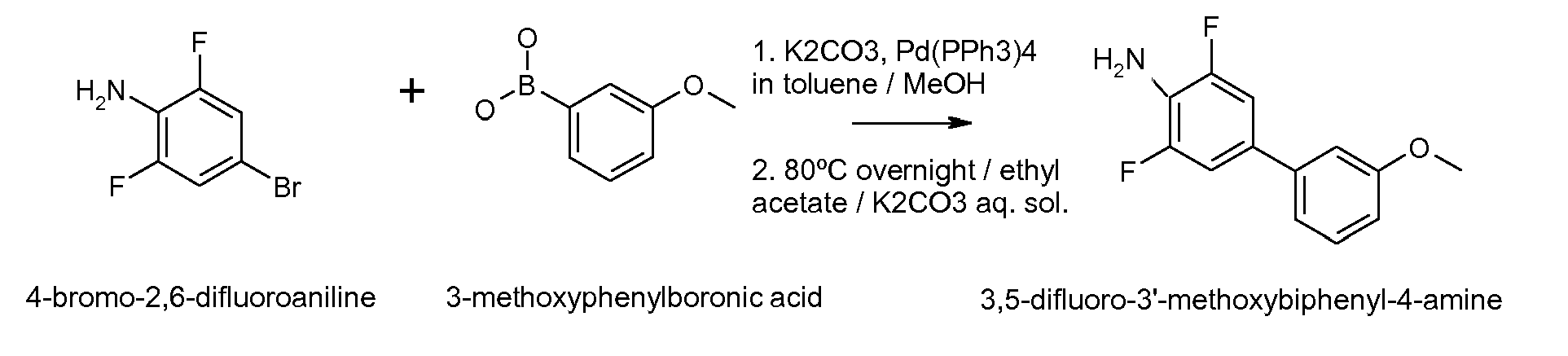
-

- The inventors have now unexpectedly found that, by proper selection of the reaction conditions, particularly by forming and isolating an aminium salt of 3,5-difluoro-3'-methoxybiphenyl-4-amine, the process described in
WO 2008/077639 A1 can be optimized to decrease the content of impurities, which can be metal residues from metal-based catalysts, by-products of the reaction process or non-reacted intermediates suspected to be genotoxic, while maintaining or increasing the reaction yield. - The inventors have also unexpectedly found that by using a Pd/C catalyst for the coupling reaction between 4-bromo-2,6-difluoroaniline and 3-methoxyphenylboronic acid, the yield of the overall reaction can be increased significantly compared with the process described in
WO 2008/077639 . - A first aspect of the invention therefore provides a process for manufacturing 2-[(3,5-difluoro-3'-methoxy-1,1'-biphenyl-4-yl)amino]nicotinic acid, which comprises the steps of:
- a) providing 3,5-difluoro-3'-methoxybiphenyl-4-amine,
- b) preparing and isolating an aminium salt of the 3,5-difluoro-3'-methoxybiphenyl-4-amine, and
- c) further reacting the aminium salt of 3,5-difluoro-3'-methoxybiphenyl-4-amine obtained in b) to obtain 2-[(3,5-difluoro-3'-methoxy-1,1'-biphenyl-4-yl)amino]nicotinic acid.
- A further aspect of the invention provides a process for manufacturing 2-[(3,5-difluoro-3'-methoxy-1,1'-biphenyl-4-yl)amino]nicotinic acid, which comprises the steps of:
- i) reacting 4-bromo-2,6-difluoroaniline with 3-methoxyphenylboronic acid in the presence of a Pd/C catalyst to obtain 3,5-difluoro-3'-methoxybiphenyl-4-amine, and
- ii) further reacting the 3,5-difluoro-3'-methoxybiphenyl-4-amine obtained in step i) to obtain 2-[(3,5-difluoro-3'-methoxy-1,1'-biphenyl-4-yl)amino]nicotinic acid.
- A further aspect of the invention provides a compound of formula (1):

- Typically, in step a), 3,5-difluoro-3'-methoxybiphenyl-4-amine is obtained by reacting 4-bromo-2,6-difluoroaniline with 3-methoxyphenylboronic acid. Step a) of the process typically corresponds to a coupling reaction of an haloarene with an arylboronic acid and can be carried out under the conditions of the Suzuki reaction (Miyaura, N.; Suzuki, A. Chem. Rev. 1995, 95, 2475) or as described in
WO 2008/077639 A1 . Typically said reaction is catalyzed by palladium catalysts such as [1,1'-bis(diphenylphosphino)-ferrocene] dichloropalladium (II) complex with dichloromethane (1:1), tetrakis(triphenylphosphine)-palladium(0), bis(triphenylphosphine)palladium(II) chloride or tris(dibenzylideneacetone)-dipalladium(0) in a aprotic organic solvent such as dioxane, toluene, dimethylformamide (DMF) or dimethoxyethane (DME) and in the presence of a base such as cesium carbonate, sodium carbonate, potassium carbonate or potassium phosphate at a temperature from 70 to 140°C. - In a preferred embodiment, step a), i.e. reacting 4-bromo-2,6-difluoroaniline with 3-methoxyphenylboronic acid to obtain 3,5-difluoro-3'-methoxybiphenyl-4-amine is catalyzed by a heterogeneous palladium supported on carbon catalyst (Pd/C catalyst). Typically in said Pd/C catalyst the molar ratio palladium to carbon ranges from 0.5 to 20%, preferably from 1 to 15%. Typically, Pd/C catalyst is applied suspended in aqueous sodium carbonate or potassium carbonate solution. The Pd/C catalyst is typically loaded in an amount which ranges from 1 to 20 wt. % of the substrate, preferably from 2 to 15 wt. %. If step a) is catalyzed by a Pd/C catalyst a polar solvent such as water, methanol, ethanol, n-propanol, isopropanol, n-butanol, isobutanol, sec-butanol, tert-butanol, n-pentanol, tert-pentyl alcohol (tert-amyl alcohol), ethylene glycol, propylene glycol, dipropylene glycol or glycerol can be present in the reaction medium. A particularly preferred solvent is ethanol.
- Typically, 3,5-difluoro-3'-methoxybiphenyl-4-amine obtained in step a) is isolated and purified using standard purification techniques before conducting step b), i.e. the formation of the aminium salt (i.e. non-quaternary ammonium salt). Standard purification techniques are described in Purification of Laboratory Chemicals, third edition, 1988, Ed. Pergamon Press, and include acid-base extraction in a solvent and subsequent distillation of said solvent.
- The aminium salt from step b) is typically formed by mixing a mineral acid or an organic acid with 3,5-difluoro-3'-methoxybiphenyl-4-amine, preferably by mixing said acid with a solution or suspension of 3,5-difluoro-3'-methoxybiphenyl-4-amine in a solvent or mixture of solvents selected from the group consisting of C5-C8 alkanes, C1-C8 haloalkanes, alcohols, esters, ethers, water and mixtures thereof.
- According to the invention the term mineral acid refers to an acid derived by chemical reaction from inorganic minerals. Preferred mineral acids are selected from the group consisting of hydrobromic acid, hydrochloric acid, hydrofluoric acid, nitric acid, phosphoric acid, sulfuric acid and mixtures thereof.
- According to the invention the term organic acid refers to an organic compound with acidic properties. Preferred organic acids are selected from the group consisting of cyclamic acid, ethane-1,2-disulfonic acid, methanesulfonic acid, naphthalene-1,5-disulfonic acid, naphthalene-2-sulfonic acid, thiocyanic acid, formic acid, acetic acid, p-toluenesulfonic acid, 4-chloro benzenesulfonic acid, 4-bromo benzenesulfonic acid and mixtures thereof.
- Preferably, the acid is selected from the group consisting of hydrochloric acid, nitric acid, phosphoric acid, sulfuric acid, p-toluenesulfonic acid and mixtures thereof. Particularly preferred acids are hydrochloric acid, p-toluenesulfonic acid and mixtures thereof.
- In a preferred embodiment, the acid (mineral or organic) is in the form of an aqueous solution. Typically, the concentration of said aqueous solution ranges from 5 to 50 wt. %, preferably from 10 to 40 wt. %.
- Preferred solvents are selected from the group consisting of pentane, n-hexane, n-heptane, n-octane, chloromethane, dichloromethane, tetrachloromethane, ethanol, n-propanol, isopropanol, n-butanol, isobutanol, sec-butanol, t-butanol, n-pentanol, tert-pentyl alcohol (tert-amyl alcohol), ethylene glycol, propylene glycol, dipropylene glycol, glycerol, diethylene glycol monoethyl ether, n-propyl acetate, isopropyl acetate, butyl glycol acetate, water and mixtures thereof. Preferably, the solvent is selected from the group consisting of n-hexane, dichloromethane, ethylene glycol, propylene glycol, n-propyl acetate, isopropyl acetate, water and mixtures thereof. A particularly preferred solvent is isopropyl acetate.
- In one embodiment the aminium salt from step b) is formed by mixing an acid selected from the group consisting of hydrochloric acid, nitric acid, phosphoric acid, sulfuric acid, p-toluenesulfonic acid and mixtures thereof in the form of a 5 to 50 wt. %, preferably a 10 to 40 wt. % aqueous solution with 3,5-difluoro-3'-methoxybiphenyl-4-amine.
- In another embodiment the aminium salt from step b) is formed by mixing an acid selected from the group consisting of hydrochloric acid, nitric acid, phosphoric acid, sulfuric acid, p-toluenesulfonic acid and mixtures thereof in the form of a 5 to 50 wt. %, preferably a 10 to 40 wt. % aqueous solution with a solution or suspension of 3,5-difluoro-3'-methoxybiphenyl-4-amine in a solvent selected from the group consisting of n-hexane, dichloromethane, ethylene glycol, propylene glycol, n-propyl acetate, isopropyl acetate and mixtures thereof.
- In a preferred embodiment, the ratio of volume of the solvent from step b) (in L) to the mass of 4-bromo-2,6-difluoroaniline from step a) (in Kg) ranges from 2:1 to 50:1, preferably from 4:1 to 25:1, more preferably from 5:1 to 18:1, even more preferably from 6:1 to 9:1. This ratio represents an optimum between yield and impurities. A higher solvent content would reduce the crystallization yield while a lower solvent content would increase the amount of impurities, in particular the content of palladium.
- Typically, the aminium salt of 3,5-difluoro-3'-methoxybiphenyl-4-amine from step b) is isolated by filtration and washed with an appropriate solvent before conducting step c). Preferably said solvent corresponds to the solvent used in step b).
- Typically, step c) comprises either c1) reacting the aminium salt of 3,5-difluoro-3'-methoxybiphenyl-4-amine obtained in step b) with 2-chloronicotinic acid, or c2) hydrolysing the aminium salt of 3,5-difluoro-3'-methoxybiphenyl-4-amine obtained in step b) to obtain 3,5-difluoro-3'-methoxybiphenyl-4-amine and reacting the thus-obtained 3,5-difluoro-3'-methoxybiphenyl-4-amine with 2-chloronicotinic acid.
- In one embodiment (step c1), the aminium salt of 3,5-difluoro-3'-methoxybiphenyl-4-amine from step b) is dried or semidried to remove or partially remove the solvent and then it is reacted with 2-chloronicotinic acid to obtain 2-[(3,5-difluoro-3'-methoxy-1,1'-biphenyl-4-yl)amino]nicotinic acid.
- In another embodiment (step c2), the aminium salt of 3,5-difluoro-3'-methoxybiphenyl-4-amine from step b) is optionally, dried or semidried to remove or partially remove the solvent. Subsequently, said aminium salt is hydrolyzed in the presence of water under well-known reaction conditions to 3,5-difluoro-3'-methoxybiphenyl-4-amine and finally, 3,5-difluoro-3'-methoxybiphenyl-4-amine in the amine form is reacted with 2-chloronicotinic acid to obtain 2-[(3,5-difluoro-3'-methoxy-1,1'-biphenyl-4-yl)amino]nicotinic acid.
- According to the invention, it is preferred that step c1) or c2) takes place in a solvent or mixture of solvents. Typically, solvents are selected from the group consisting of ethanol, n-propanol, isopropanol, n-butanol, isobutanol, sec-butanol, t-butanol, n-pentanol, tert-pentyl alcohol (tert-amyl alcohol), ethylene glycol, propylene glycol, dipropylene glycol, glycerol, diethylene glycol monoethyl ether, tetrahydrofurane, 1,4-dioxane, 1,2-dioxane, 1,3-dioxane and mixtures thereof. Preferably solvents are selected from the group consisting of ethanol, ethylene glycol, propylene glycol, dipropylene glycol and mixtures thereof. A particularly preferred solvent is ethanol.
- In one embodiment, step c2) can be carried out in water, preferably without isolating the 3,5-difluoro-3'-methoxybiphenyl-4-amine in the amine form obtained by hydrolysis reaction of the aminium salt.
- According to the invention, it is preferred that in step c1) or c2) a mineral acid or an organic acid is added to the reaction mixture.
- However, when step c2) takes place in water, a mineral acid or an organic acid can optionally be added to the reaction mixture.
- Preferred mineral acids to be used in steps c1) or c2) are selected from the group consisting of hydrobromic acid, hydrochloric acid, hydrofluoric acid, nitric acid, phosphoric acid, sulfuric acid and mixtures thereof.
- Preferred organic acids are selected from the group consisting of cyclamic acid, ethane-1,2-disulfonic acid, methanesulfonic acid, naphthalene-1,5-disulfonic acid, naphthalene-2-sulfonic acid, thiocyanic acid, formic acid, acetic acid, p-toluenesulfonic acid, 4-chloro benzenesulfonic acid, 4-bromo benzenesulfonic acid and mixtures thereof.
- Preferably, the acid is selected from the group consisting of hydrochloric acid, nitric acid, phosphoric acid, sulfuric acid, p-toluenesulfonic acid and mixtures thereof. Particularly preferred acids are hydrochloric acid, p-toluenesulfonic acid and mixtures thereof.
- In a preferred embodiment, the acid (mineral or organic) is in the form of an aqueous solution. Typically, the concentration of said aqueous solution ranges from 5 to 50 wt. %, preferably from 7 to 40 wt. %, more preferably from 8 to 20 wt. %.
- In a preferred embodiment, the volume ratio of the solvent to the acid ranges from 1:5 to 1:15, preferably from 1:2 to 1:10, more preferably from 1:1 to 1:5.
- Typically, 2-[(3,5-difluoro-3'-methoxy-1,1'-biphenyl-4-yl)amino]nicotinic acid obtained in step c1) or c2) is further purified using standard purification techniques such as distillation of the solvent, filtration, extraction and/or lixiviation.
- In one embodiment, the process of the invention comprises the steps of
- a) reacting 4-bromo-2,6-difluoroaniline with 3-methoxyphenylboronic acid to obtain 3,5-difluoro-3'-methoxybiphenyl-4-amine,
- b) forming and isolating an aminium salt of 3,5-difluoro-3'-methoxybiphenyl-4-amine obtained in step a), and
- c1) reacting the aminium salt of 3,5-difluoro-3'-methoxybiphenyl-4-amine from step b) with 2-chloronicotinic acid, or
- c2) hydrolysing the aminium salt of 3,5-difluoro-3'-methoxybiphenyl-4-amine from step b) to obtain 3,5-difluoro-3'-methoxybiphenyl-4-amine and reacting the thus-obtained 3,5-difluoro-3'-methoxybiphenyl-4-amine with 2-chloronicotinic acid.
- In a preferred embodiment, the process for the manufacture of 2-[(3,5-difluoro-3'-methoxy-1,1'-biphenyl-4-yl)amino]nicotinic acid comprises the steps of:
- a) reacting 4-bromo-2,6-difluoroaniline with 3-methoxyphenylboronic acid to obtain 3,5-difluoro-3'-methoxybiphenyl-4-amine,
- b) forming and isolating an aminium salt of 3,5-difluoro-3'-methoxybiphenyl-4-amine obtained in step a) by mixing an acid selected from the group consisting of hydrochloric acid, nitric acid, phosphoric acid, sulfuric acid, p-toluenesulfonic acid and mixtures thereof with a solution or suspension of 3,5-difluoro-3'-methoxybiphenyl-4-amine in a solvent selected from the group consisting of n-hexane, dichloromethane, ethylene glycol, propylene glycol, n-propyl acetate, isopropyl acetate and mixtures thereof,
- c1) reacting the aminium salt of 3,5-difluoro-3'-methoxybiphenyl-4-amine from step b) with 2-chloronicotinic acid.
- According to the invention, it is preferred that in step c1) a mineral acid or an organic acid is added to the reaction mixture.
- Preferred mineral acids are selected from the group consisting of hydrobromic acid, hydrochloric acid, hydrofluoric acid, nitric acid, phosphoric acid, sulfuric acid and mixtures thereof.
- Preferred organic acids are selected from the group consisting of cyclamic acid, ethane-1,2-disulfonic acid, methanesulfonic acid, naphthalene-1,5-disulfonic acid, naphthalene-2-sulfonic acid, thiocyanic acid, formic acid, acetic acid, p-toluenesulfonic acid, 4-chloro benzenesulfonic acid, 4-bromo benzenesulfonic acid and mixtures thereof.
- Preferably, the acid is selected from the group consisting of hydrochloric acid, nitric acid, phosphoric acid, sulfuric acid, p-toluenesulfonic acid and mixtures thereof. Particularly preferred acids are hydrochloric acid, p-toluenesulfonic acid and mixtures thereof.
- In a preferred embodiment, the acid (mineral or organic) is in the form of an aqueous solution. Typically, the concentration of said aqueous solution ranges from 5 to 50 wt. %, preferably from 7 to 40 wt. %, more preferably from 8 to 20 wt. %.
- According to the invention, it is preferred that step c1) takes place in a solvent or mixture of solvents.
- Preferred solvents are selected from the group consisting of pentane, n-hexane, n-heptane, n-octane, chloromethane, dichloromethane, tetrachloromethane, ethanol, n-propanol, isopropanol, n-butanol, isobutanol, sec-butanol, t-butanol, n-pentanol, tert-pentyl alcohol (tert-amyl alcohol), ethylene glycol, propylene glycol, dipropylene glycol, glycerol, diethylene glycol monoethyl ether, n-propyl acetate, isopropyl acetate, butyl glycol acetate and mixtures thereof. Preferably, the solvent is selected from the group consisting of n-hexane, dichloromethane, ethylene glycol, propylene glycol, n-propyl acetate, isopropyl acetate, water and mixtures thereof. A particularly preferred solvent is isopropyl acetate.
- In another preferred embodiment, the process for the manufacture of 2-[(3,5-difluoro-3'-methoxy-1,1'-biphenyl-4-yl)amino]nicotinic acid comprises the steps of:
- a1) reacting 4-bromo-2,6-difluoroaniline with 3-methoxyphenylboronic acid to obtain 3,5-difluoro-3'-methoxybiphenyl-4-amine,
- a2) purifying 3,5-difluoro-3'-methoxybiphenyl-4-amine,
- b) forming and isolating an aminium salt of 3,5-difluoro-3'-methoxybiphenyl-4-amine obtained in step a2) by mixing an acid selected from the group consisting of hydrochloric acid, nitric acid, phosphoric acid, sulfuric acid, p-toluenesulfonic acid and mixtures thereof with a solution or suspension of 3,5-difluoro-3'-methoxybiphenyl-4-amine in a solvent selected from the group consisting of n-hexane, dichloromethane, ethylene glycol, propylene glycol, n-propyl acetate, isopropyl acetate and mixtures thereof,
- c1) reacting the aminium salt of 3,5-difluoro-3'-methoxybiphenyl-4-amine from step b) with 2-chloronicotinic acid to obtain 2-[(3,5-difluoro-3'-methoxy-1,1'-biphenyl-4-yl)amino]nicotinic acid in a solvent or mixture of solvents and adding a mineral acid or organic acid to the reaction mixture,
- d) purifying 2-[(3,5-difluoro-3'-methoxy-1,1'-biphenyl-4-yl)amino]nicotinic acid.
- Typically, 3,5-difluoro-3'-methoxybiphenyl-4-amine (step a2) and 2-[(3,5-difluoro-3'-methoxy-1,1'-biphenyl-4-yl)amino]nicotinic acid (step d) are purified using standard purification techniques such as acid-base extraction in a suitable solvent. Additionally, subsequent distillation of said solvent may be carried out if needed.
- The term distillation refers to method of separating mixtures based on differences in their volatilities in a boiling liquid mixture. Typically, distillation is used to eliminate the solvent.
- The term acid-base extraction refers to a procedure using sequential liquid-liquid extractions to purify acids and bases from mixtures based on their chemical properties. Usually, the mixture is dissolved in a suitable solvent and poured into a separating funnel. An aqueous solution of the acid or base is added, and the pH of the aqueous phase is adjusted to bring the compound of interest into its required form. After shaking and allowing for phase separation, the phase containing the compound of interest is collected. The procedure is then repeated with this phase at the opposite pH range. The order of the steps is not important and the process can be repeated to increase the separation.
- Typically, sodium carbonate, potassium carbonate, sodium hydroxide, potasium hydroxide, ammonia, sodium bicarbonate, potassium bicarbonate or mixtures thereof are used to adjust the pH to alkaline conditions. According to the invention, preferred bases are sodium carbonate, sodium hydroxide, ammonia or mixtures thereof. It is preferred that the base (or mixture of bases) is used in the form of aqueous solutions. Typically, the concentration of said aqueous solution ranges from 2 to 50 wt. %, preferably from 3 to 40 wt. %, more preferably from 3 to 30 wt. %.
- Typically, citric acid, phosphoric acid, hydrochloric acid, nitric acid, sulfuric acid or mixtures thereof are used to adjust the pH to acidic conditions. According to the invention, preferred acids are hydrochloric acid, phosphoric acid, sulfuric acid or mixtures thereof. It is preferred that the acid (or mixture of acids) is used in the form of aqueous solutions. Typically, the concentration of said aqueous solution ranges from 5 to 50 wt. %, preferably from 10 to 40 wt. %.
- Typically, suitable solvents to be used in the acid-base extraction are solvents non-miscible in water such as pentane, n-hexane, ciclohexane, n-heptane, n-octane, chloromethane, dichloromethane, tetrachloromethane, ethyl acetate, n-propyl acetate, isopropyl acetate, butyl glycol acetate and aromatic solvents such as benzene, toluene, ethylbenzene, chlorobenzene, p-xylene, m-xylene, o-xylene, styrene, isopropylbenzene, n-propylbenzene, 2-chlorotoluene, 3-chlorotoluene, 4-chlorotoluene, tert-butylbenzene, s-butylbenzene, isobutylbenzene, 1,3-dichlorobenzene, 1,4-dichlorobenzene, n-butylbenzene, 1,2-dichlorobenzene, 1,3-diisopropylbenzene, 1,4-diisopropylbenzene, 2-nitrotoluene, 3-nitrotoluene, 4-nitrotoluene and mixtures thereof. Preferred solvents are selected from the group consisting of n-hexane, ciclohexane, dichloromethane, ethyl acetate, n-propyl acetate, isopropyl acetate, toluene, 2-nitrotoluene, 3-nitrotoluene, 4-nitrotoluene and mixtures thereof.
- In a preferred embodiment, 3,5-difluoro-3'-methoxybiphenyl-4-amine (step a2) is purified by acid-base extraction using 2 to 50 wt. %, preferably from 3 to 40 wt. %, more preferably from 3 to 30 wt. % of aqueous solutions of bases selected from sodium carbonate, sodium hydroxide, ammonia and mixtures thereof in a solvent selected from n-hexane, ciclohexane, dichloromethane, ethyl acetate, n-propyl acetate, isopropyl acetate and mixtures thereof, followed by a distillation of the solvent.
- In a preferred embodiment, 2-[(3,5-difluoro-3'-methoxy-1,1'-biphenyl-4-yl)amino]nicotinic acid (step d) is purified by an acid-base extraction using 2 to 50 wt. %, preferably from 3 to 40 wt. %, more preferably from 3 to 30 wt. % of aqueous solutions of bases selected from sodium carbonate, sodium hydroxide, ammonia and mixtures thereof in a solvent selected from n-hexane, ciclohexane, p-xylene, m-xylene, o-xylene, toluene, 2-nitrotoluene, 3-nitrotoluene, 4-nitrotoluene and mixtures thereof; followed by precipitation using 5 to 50 wt.%, preferably 10 to 40 wt.% of aqueous solutions of acids selected from hydrochloric acid, phosphoric acid, sulfuric acid and mixtures thereof.
- In another preferred embodiment, 2-[(3,5-difluoro-3'-methoxy-1,1'-biphenyl-4-yl)amino]nicotinic acid is further purified by subsequent lixiviation (step e) in a solvent or mixture of solvents having a boiling point of between 30 and 210°C.
- The term lixiviation refers to the process of separating soluble from insoluble substances by dissolving the former in water or some other solvent.
- In a preferred embodiment, in the lixiviation step (e) the solvent or mixture of solvents having a boiling point of between 30 and 210°C are selected from the group consisting of ketones, ethers including cyclic ethers, C5-C8 alkanes including C5-C8 cicloalkanes and alcohols.
- The following are some examples of solvents that can be used for carrying out the lixiviation: acetone, methyl ethyl ketone (MEK), methyl isobutyl ketone (MIK), phenyl ethyl ketone, cyclopentanone, dioxane, tetrahydrofurane, ethyltetrahydrofurane, ethyltetrahydrofurane, n-pentane, n-hexane, n-heptane, n-octane, ciclopentane, ciclohexane, methanol, ethanol, n-propanol, isopropanol, n-butanol, sec-butanol, tert-butanol and tert-pentyl alcohol (tert-amyl alcohol). Preferred solvents are selected from the group consisting of acetone, n-hexane or ethanol. A particularly preferred solvent is acetone.
- Step (i) of the process of the invention is catalyzed by a heterogeneous palladium supported on carbon catalyst (Pd/C catalyst). Typically in said Pd/C catalyst the molar ratio palladium to carbon ranges from 0.5 to 20%, preferably from 1 to 15%. Typically, Pd/C catalyst is applied suspended in aqueous sodium carbonate or potassium carbonate solution. The Pd/C catalyst is typically loaded in an amount which ranges from 1 to 20 wt. % of the substrate, preferably from 2 to 15 wt. %. A polar solvent such as water, methanol, ethanol, n-propanol, isopropanol, n-butanol, isobutanol, sec-butanol, tert-butanol, n-pentanol, tert-pentyl alcohol (tert-amyl alcohol), ethylene glycol, propylene glycol, dipropylene glycol or glycerol is typically present in the reaction medium. A particularly preferred solvent is ethanol.
- Step (ii) of the process of the invention typically comprises steps b) and c) as defined above. Thus, step (ii) of the process of the invention typically compises the steps of:
- b) forming and isolating an aminium salt of 3,5-difluoro-3'-methoxybiphenyl-4-amine provided in step a), and
- c) further reacting the aminium salt of 3,5-difluoro-3'-methoxybiphenyl-4-amine obtained in b) to obtain 2-[(3,5-difluoro-3'-methoxy-1,1'-biphenyl-4-yl)amino]nicotinic acid.
- Preferred embodiments of steps b) and c) are defined above.
- In the compound of the present invention, X- is typically the anion of a mineral acid or organic acid described above. X- is preferably CI-.
- The following examples show illustrative methods for preparing compounds according to the present invention, and are not intended to limit the scope of the invention.
- 10 kg of 4-bromo-2,6-difluoroaniline (48.08 mol) and 67 L of toluene were charged into a reactor under nitrogen atmosphere and stirred at 20°C until complete dissolution. 1.67 kg of Pd(PPh3)4 (1.44 mol) were charged and stirred for 10 min. 48 L of a 20 wt. % aqueous solution of Na2CO3 were then charged, followed by the addition of a solution of 3-methoxyboronic acid (8.77 kg, 57.7 mol) in methanol (32 L) over 20 minutes. The mixture was heated at 72°C for 4 hours and then cooled to 20 °C.
- 2.1. A solution of 123 L of a 10% aqueous solution of Na2CO3, 1.5 L of a 25 wt. % aqueous solution of ammonia and 2.0 kg of a filtration resin (Dicalite) were charged to the reactor and the mixture stirred for 5 minutes. The mixture was recirculated through a filter until clarification of the liquors (35 min) and charged into a reactor. 60 L of isopropyl acetate were added and the mixture was stirred for 10 minutes and the phases (A1+O1) were allowed to separate. The aqueous phase (A1) was transferred to a different reactor and 60 L of isopropyl acetate were charged. The mixture was stirred and the phases (A2 + 02) were allowed to separate. Both organic phases (O1+O2) were charged into a reactor and 108 L of a 10 wt. % aqueous solution of Na2CO3 were added. The mixture was stirred and the phases (A3+O3) were allowed to separate. The organic phase (03) was stirred with 108 L of a 10 wt. % aqueous solution of Na2CO3 and the phases (A4+O4) were allowed to separate. The organic phase (04) was stirred with 100 L demineralised water and the phases (A5+O5) were allowed to separate. The organic phase (05) was filtered over a filtration resin (Dicalite) in a filter and charged in to a reactor.
- 2.2. Distillation: The organic phase (05) was distilled during 2 hours under reduced pressure (approx. 750 mm Hg) keeping the distilled mixture at temperature below 65°C.
- The distillation residue was dissolved in 100 L of isopropyl acetate, the mixture was cooled to 0-5 °C and 4.2 L of a 35 wt. % aqueous solution of HCl were added drop-wise until the pH was lower than 2. The aminium salt precipitated as a white solid from the dark brown coloured solution. The slurry was stirred for 2 hours at 0-5 °C, filtered and the cake washed twice with 50 L of previously cooled isopropyl acetate. The cake was pulled dry under reduced pressure. 3,5-difluoro-3'-methoxybiphenyl-4-aminium chloride was isolated as beige solid. The weight of the wet-cake was 13.83 kg, equivalent to 10.25 kg of dry product (37.73 mol) which corresponds to a yield of 78.5 %.
- 3,5-difluoro-3'-methoxybiphenyl-4-aminium chloride as wet cake (equivalent to 10.25 kg dry, 37.73 mol) and 30 L of ethanol 96% were charged into a reactor and stirred vigorously (150 rpm) at 20°C. Then, the following materials were charged: 100 L of a 10 wt. % aqueous solution of HCl, 3.5 kg of p-toluenesulfonic acid (18.4 mol) and 11.6 kg of 2-chloronicotinic acid (73.6 mol). The slurry was heated to reflux (90-95 °C) under vigorous stirring. After 8 hours of reaction, 2.9 kg of 2-chloronicotinic acid (18.4 mol) were charged and the mixture was stirred for a further 8 hours.
The reaction was distilled until a distillation temperature of 100°C was reached, ensuring that all the ethanol had been removed. After complete distillation of ethanol, 150 L of demineralised water were added, the mixture was heated to 95°C and the hot slurry was filtered at 95 °C in a closed filter. The cake was washed twice with hot water (2 x 100 L). - 5.1. A mixture of 80 L of a 4 wt. % aqueous solution of NaOH and 50 L of toluene previously cooled to 15°C were recirculated through the filter until complete dissolution of the cake and charged into a reactor. The layers were allowed to separate (A1+O1). The aqueous phase (A1) was stirred with 50 L of toluene and the layers were allowed to separate (A2+O2), and the aqueous phase (A2) was filtered over a filtration resin (Dicalite) and charged into a reactor. The filter was washed with 10 L of a 4 wt. % aqueous solution of NaOH, and 15 L of demineralised water, and both filtrates were charged to the reactor which contained the aqueous phase A2.
The aqueous phase A2 was cooled to 0-5 °C and a HCl in the form of a 35 wt. % aqueous solution was added keeping the reaction temperature below 15°C until the pH of the mixture was 1. The slurry was stirred for 1 hour, filtered and the cake washed three times with previously cooled demineralised water (3 x 100 L). - 5.2. The solid was suspended in 80 L acetone, refluxed for 30 min and the mixture allowed to cool to 0-5 °C. After 1 hour, the slurry was filtered and the cake washed twice with previously cooled acetone (2 x 10 L).
The cake was dried at 60°C under reduced pressure until constant weight and was milled at 1600 rpm using a 0.8 mm sieve.
2-[(3,5-difluoro-3'-methoxy-1,1'-biphenyl-4-yl)amino]nicotinic acid was isolated as a white solid yielding 8.9 kg (24.98 mol) which corresponds to a yield of 66.2%. - 100 g of 4-bromo-2,6-difluoroaniline (0.481 mol) were dissolved in 750 mL of ethanol 96 % under nitrogen atmosphere and stirred at 20°C for 15 minutes. Then, 38.85 g (18 mmol, 3.75% molar) of Pd/C 50 wt. % wet were added followed by the addition of 1.25 L of a 20 wt. % aqueous solution of Na2CO3 keeping the reaction temperature below 30°C. Finally, 87.67 g (0.577 mmol, 1.2 eq) of 3-methoxyboronic acid were added and the reaction heated to 60°C for 8 hours and then cooled to 20 °C.
- 2.1. 600 mL of isopropyl acetate were added and the mixture was stirred for 10 minutes and the phases (A1 +O1) were allowed to separate. The aqueous phase (A1) was stirred with 600 mL of isopropyl acetate for 10 minutes and the phases (A2 + 02) were allowed to separate. Both organic phases (O1+O2) were stirred with 600 mL demineralised water and the phases (A3+O3) were allowed to separate. The organic phase (03) was filtered over a filtration resin (Dicalite) in a filter.
- 2.2. Distillation: The organic phase (03) was distilled under reduced pressure (approx. 750 mm Hg) keeping the distilled mixture at temperature below 65°C to yield a dark coloured oil residue.
- The distillation residue was dissolved in 800 L of isopropyl acetate (8 vol/w) , the mixture was cooled to 0-5 °C and 50 mL of a 35 wt. % aqueous solution of HCl were added drop-wise until the pH was lower than 2. The aminium salt precipitated as a white solid from the dark brown coloured solution. The slurry was stirred for 2 hours at 0-5 °C, filtered and the cake washed twice with 50 mL of previously cooled isopropyl acetate. The cake was pulled dry under reduced pressure and dried at 60 °C under reduced pressure (approx. 750 mm Hg) to constant weight. A total of 117 g (0.431 mmol, 89 % yield) of 3,5-difluoro-3'-methoxybiphenyl-4-aminium chloride were isolated as beige solid.
- The experimental procedure described in Example 1 was followed.
- The cake was suspended in acetone. The solid was suspended in 650 mL acetone, refluxed for 30 min and the mixture allowed to cool to 0-5 °C. After 1 hour, the slurry was filtered and the cake washed twice with previously cooled acetone (2 x 65 mL).
2-[(3,5-difluoro-3'-methoxy-1,1'-biphenyl-4-yl)amino]nicotinic acid was isolated as a white solid yielding 129 g (0.362 mol, 84 % yield) which corresponds to an overall yield of 75 %. - 33.44 g of 2-[(3,5-difluoro-3'-methoxy-1,1'-biphenyl-4-yl)amino]nicotinic acid, which corresponds to a yield of 53.4%, were obtained and purified following the process described in
WO 2008/077639 A1 . - The total impurities' content and the palladium content of 2-[(3,5-difluoro-3'-methoxy-1,1'-biphenyl-4-yl)amino]nicotinic acid obtained in Examples 1 and 2 (according to the invention) and Comparative Example 1 (C1) are indicated in Table 1. Said impurities were determined by High Performance Liquid Chromatograph (HPLC) and/or Capillary electrophoresis (CE). Additionally, the reaction yield is also indicated.
Table 1 - Impurities' content and reaction yield of the different processes Example Pd content (ppm) Total impurities' content (excluding Pd)1 (%) Overall Reaction yield (%) 1 < 2 0.10 66.2 2 < 10 0.20 75.0 C1 100 0.46 53.4 1wt.% with respect to the total weight of 2-[(3,5-difluoro-3'-methoxy-1,1'-biphenyl-4-yl)amino]nicotinic acid - From the experimental results it can be concluded that the process according to the invention allows a reduction in the content of impurities in 2-[(3,5-difluoro-3'-methoxy-1,1'-biphenyl-4-yl)amino]nicotinic acid, while increasing the reaction yield. This reduction of impurities is particularly evident in the case of the Pd content.
- Additionally, when the coupling step between 4-bromo-2,6-difluoroaniline and 3-methoxyphenylboronic acid to obtain 3,5-difluoro-3'-methoxybiphenyl-4-amine is catalyzed by a Pd/C catalyst the reaction yield is further increased.
Claims (15)
- A process for manufacturing 2-[(3,5-difluoro-3'-methoxy-1,1'-biphenyl-4-yl)amino]nicotinic acid, which comprises the steps of:a) providing 3,5-difluoro-3'-methoxybiphenyl-4-amine,b) preparing and isolating an aminium salt of the 3,5-difluoro-3'-methoxybiphenyl-4-amine, andc) further reacting the aminium salt of 3,5-difluoro-3'-methoxybiphenyl-4-amine obtained in b) to obtain 2-[(3,5-difluoro-3'-methoxy-1,1'-biphenyl-4-yl)amino]nicotinic acid.
- A process according to claim 1, wherein in step a) 3,5-difluoro-3'-methoxybiphenyl-4-amine is obtained by reacting 4-bromo-2,6-difluoroaniline with 3-methoxyphenylboronic acid.
- A process according to claim 1 or 2, wherein step c) comprises the step of c1) reacting the aminium salt of 3,5-difluoro-3'-methoxybiphenyl-4-amine obtained in step b) with 2-chloronicotinic acid, or c2) hydrolysing the aminium salt of 3,5-difluoro-3'-methoxybiphenyl-4-amine obtained in step b) to obtain 3,5-difluoro-3'-methoxybiphenyl-4-amine and reacting the thus-obtained 3,5-difluoro-3'-methoxybiphenyl-4-amine with 2-chloronicotinic acid.
- A process according to any one of the preceding claims, wherein the aminium salt in step b) is formed by mixing a mineral acid or an organic acid with a solution or suspension of the 3,5-difluoro-3'-methoxybiphenyl-4-amine, in a solvent selected from the group consisting of C5-C8 alkanes, C1-C8 haloalkanes, alcohols, esters and ethers, water and mixtures thereof.
- A process according to claim 4, wherein:- the mineral acid is selected from the group consisting of hydrobromic acid, hydrochloric acid, hydrofluoric acid, nitric acid, phosphoric acid, sulfuric acid and mixtures thereof; and/or- the organic acid is selected from the group consisting of cyclamic acid, ethane-1,2-disulfonic acid, methanesulfonic acid, naphthalene-1,5-disulfonic acid, naphthalene-2-sulfonic acid, thiocyanic acid, formic acid, acetic acid, p-toluenesulfonic acid, 4-chloro benzenesulfonic acid, 4-bromo benzenesulfonic acid and mixtures thereof; and/or- the solvent is selected from the group consisting of pentane, n-hexane, n-heptane, n-octane, chloromethane, dichloromethane, tetrachloromethane, ethanol, n-propanol, isopropanol, n-butanol, isobutanol, sec-butanol, t-butanol, n-pentanol, tert-pentyl alcohol (tert-amyl alcohol), ethylene glycol, propylene glycol, dipropylene glycol, glycerol, diethylene glycol monoethyl ether, n-propyl acetate, isopropyl acetate, butyl glycol acetate, water and mixtures thereof, preferably n-hexane, dichloromethane, ethylene glycol, propylene glycol, n-propyl acetate, isopropyl acetate, water and mixtures thereof.
- A process according to any one of claims 2 to 5, wherein the ratio of the volume of the solvent in step b) to the mass of 4-bromo-2,6-difluoroaniline from step a) ranges from 2:1 to 50:1, preferably from 5:1 to 25:1.
- A process according to any one of claims 3 to 6, wherein step c1) or c2) takes place in a solvent or mixture of solvents.
- A process according to claim 7, wherein the solvent is selected from the group consisting of ethanol, n-propanol, isopropanol, n-butanol, isobutanol, sec-butanol, t-butanol, n-pentanol, tert-pentyl alcohol (tert-amyl alcohol), ethylene glycol, propylene glycol, dipropylene glycol, glycerol, diethylene glycol monoethyl ether, tetrahydrofurane, 1,4-dioxane, 1,2-dioxane, 1,3-dioxane and mixtures thereof.
- A process according to any one of claims 3 to 8, wherein in step c1) or c2) a mineral acid as defined in claim 4 or 5 or an organic acid as defined in claim 4 or 5 is added to the reaction mixture.
- A process according to claim 9, wherein the acid is added in the form of an aqueous solution; and/or wherein the volume ratio of the solvent to the acid ranges from 1:5 to 1:15, preferably from 1:2 to 1:10.
- A process according to claim 1, which comprises the steps of:a) reacting 4-bromo-2,6-difluoroaniline with 3-methoxyphenylboronic acid to obtain 3,5-difluoro-3'-methoxybiphenyl-4-amine,b) forming and isolating an aminium salt of 3,5-difluoro-3'-methoxybiphenyl-4-amine obtained in step a) by mixing an acid selected from the group consisting of hydrochloric acid, nitric acid, phosphoric acid, sulfuric acid, p-toluenesulfonic acid and mixtures thereof with a solution or suspension of 3,5-difluoro-3'-methoxybiphenyl-4-amine in a solvent selected from the group consisting of n-hexane, dichloromethane, ethylene glycol, propylene glycol, n-propyl acetate, isopropyl acetate and mixtures thereof, andc1) reacting the aminium salt of 3,5-difluoro-3'-methoxybiphenyl-4-amine from step b) with 2-chloronicotinic acid.
- A process according to any one of claims 2 to 11, wherein step a) is catalyzed by a Pd/C catalyst.
- A process for manufacturing 2-[(3,5-difluoro-3'-methoxy-1,1'-biphenyl-4-yl)amino]nicotinic acid, which comprises the steps of:i) reacting 4-bromo-2,6-difluoroaniline with 3-methoxyphenylboronic acid in the presence of a Pd/C catalyst to obtain 3,5-difluoro-3'-methoxybiphenyl-4-amine, andii) further reacting the 3,5-difluoro-3'-methoxybiphenyl-4-amine obtained in step i) to obtain 2-[(3,5-difluoro-3'-methoxy-1,1'-biphenyl-4-yl)amino]nicotinic acid.
- A process according to claim 21, wherein step ii) comprises steps b) and c) as defined in any one of claims 1 and 3 to 12.
- A compound of formula (I):

Priority Applications (35)
| Application Number | Priority Date | Filing Date | Title |
|---|---|---|---|
| EP09382212A EP2314577A1 (en) | 2009-10-16 | 2009-10-16 | Process for manufacturing 2-[(3,5-difluoro-3'-methoxy-1,1'-biphenyl-4-yl)amino]nicotinic acid |
| PT107655862T PT2488497E (en) | 2009-10-16 | 2010-10-14 | Process for manufacturing 2-[(3,5-difluoro-3'-methoxy-1,1'-biphenyl-4-yl)amino]nicotinic acid |
| US13/501,847 US8598363B2 (en) | 2009-10-16 | 2010-10-14 | Process for manufacturing 2-[(3,5-difluoro-3′-methoxy-1,1′biphenyl-4-yl)amino]nicotinic acid |
| PH1/2012/500548A PH12012500548A1 (en) | 2009-10-16 | 2010-10-14 | Process for manufacturing 2-[(3,5-difluoro-3'-methoxy-1, 1'-biphenyl-4-yl)amino]nicotinic acid |
| HK12108881.1A HK1168101B (en) | 2009-10-16 | 2010-10-14 | Process for manufacturing 2-[(3,5-difluoro-3'-methoxy-1,1'-biphenyl-4-yl)amino]nicotinic acid |
| JP2012533527A JP5809630B2 (en) | 2009-10-16 | 2010-10-14 | Process for producing 2-[(3,5-difluoro-3'-methoxy-1,1'-biphenyl-4-yl) amino] nicotinic acid |
| MX2012004033A MX2012004033A (en) | 2009-10-16 | 2010-10-14 | Process for manufacturing 2-[(3,5-difluoro-3'-methoxy-1,1'-biphen yl-4-yl)amino]nicotinic acid. |
| EP10765586.2A EP2488497B1 (en) | 2009-10-16 | 2010-10-14 | Process for manufacturing 2-[(3,5-difluoro-3'-methoxy-1,1'-biphenyl-4-yl)amino]nicotinic acid |
| PE2012000491A PE20121173A1 (en) | 2009-10-16 | 2010-10-14 | PROCEDURE FOR MANUFACTURING 2 - [(3,5-DIFLUORO-3'-METOXY-1,1'-BIPHENYL-4-IL) AMINO] NICOTINIC ACID |
| HRP20140523AT HRP20140523T1 (en) | 2009-10-16 | 2010-10-14 | PRODUCTION PROCEDURE 2 - [(3,5-DIFLUORO-3â € “ METHOXY-1,1â € “ BIPHENYL-4-IL) AMINO] NICOTINIC ACIDS |
| NZ598429A NZ598429A (en) | 2009-10-16 | 2010-10-14 | Process for manufacturing 2-[(3,5-difluoro-3’-methoxy-1,1’-biphenyl-4-yl)amino]nicotinic acid |
| EA201200594A EA022805B1 (en) | 2009-10-16 | 2010-10-14 | Process for manufacturing 2-[(3,5-difluoro-3'-methoxy-1,1'-biphenyl-4-yl)amino]nicotinic acid |
| CA2776328A CA2776328C (en) | 2009-10-16 | 2010-10-14 | Process for manufacturing 2-[(3,5-difluoro-3'-methoxy-1,1'-biphenyl-4-yl)amino]nicotinic acid |
| PL10765586T PL2488497T3 (en) | 2009-10-16 | 2010-10-14 | Process for manufacturing 2-[(3,5-difluoro-3'-methoxy-1,1'-biphenyl-4-yl)amino]nicotinic acid |
| CN201080046816.8A CN102574800B (en) | 2009-10-16 | 2010-10-14 | Process for producing 2-[(3,5-difluoro-3'-methoxy-1,1'-biphenyl-4-yl)amino]nicotinic acid |
| SI201030632T SI2488497T1 (en) | 2009-10-16 | 2010-10-14 | Process for manufacturing 2-š(3,5-difluoro-3'-methoxy-1,1'-biphenyl-4-yl)aminoćnicotinic acid |
| MYPI2012001685A MY160308A (en) | 2009-10-16 | 2010-10-14 | Process for manufacturing 2-[(3,5-difluoro-3'-methoxy-1,1'-biphenyl-4-yl)amino]nicotinic acid |
| CN201410085756.0A CN103936668A (en) | 2009-10-16 | 2010-10-14 | Process for manufacturing 2-[(3,5-difluoro-3'-methoxy-1,1'-biphenyl-4-yl)amino]nicotinic acid |
| PCT/EP2010/006283 WO2011045059A1 (en) | 2009-10-16 | 2010-10-14 | Process for manufacturing 2-[(3,5-difluoro-3'-methoxy-1,1'-biphenyl-4-yl)amino]nicotinic acid |
| KR1020127009609A KR101699999B1 (en) | 2009-10-16 | 2010-10-14 | Process for manufacturing 2-[(3,5-difluoro-3'-methoxy-1,1'-biphenyl-4-yl)amino]nicotinic acid |
| BR112012008464-0A BR112012008464B1 (en) | 2009-10-16 | 2010-10-14 | PROCESS FOR THE MANUFACTURING OF 2-[(3,5-DIFLUORO-3-METOXY-1,1-BIPHENYL-4-YL)AMINO] NICOTINIUM AND COMPOUND ACID |
| RS20140253A RS53319B (en) | 2009-10-16 | 2010-10-14 | PROCEDURE FOR OBTAINING 2 - [(3,5-DIFLUORO-3'-METHOXY-1,1'-BIPHENYL-4-IL) AMINO] NICOTINIC ACIDS |
| AU2010306098A AU2010306098B2 (en) | 2009-10-16 | 2010-10-14 | Process for manufacturing 2-[(3,5-difluoro-3'-methoxy-1,1'-biphenyl-4-yl) amino]nicotinic acid |
| MEP-2014-50A ME01812B (en) | 2009-10-16 | 2010-10-14 | PROCEDURE FOR OBTAINING 2 - [(3,5-DIFLUOR0-3'-METHOXY-1, 1'-BIPHENYL-4-IL) AMINO] NICOTINIC ACIDS |
| DK10765586.2T DK2488497T3 (en) | 2009-10-16 | 2010-10-14 | METHOD FOR PREPARING 2 - [(3,5-DIFLUOR-3'-METHOXY-1,1'-BIPHENYL-4-YL) AMINO] NICOTIC ACID |
| UAA201205649A UA107811C2 (en) | 2009-10-16 | 2010-10-14 | Method of receiving 2-[(3,5-difluoro-3'-methoxy-1,1' biphenyl-4-yl)amino]nicotinic acid |
| ES10765586.2T ES2467165T3 (en) | 2009-10-16 | 2010-10-14 | Process for manufacturing 2 - [(3,5-difluoro-3'-methoxy-1,1'-biphenyl-4-yl) amino] nicotinic acid |
| ZA2012/01563A ZA201201563B (en) | 2009-10-16 | 2012-03-01 | Process for manufacturing 2-[(3,5-difluoro-3'-methoxy-1,1'-biphenyl-4-yl)amino]nicotinic acid |
| IL218446A IL218446A (en) | 2009-10-16 | 2012-03-01 | Process for manufacturing 2-[(3,5-difluoro-3'-methoxy-1,1'-biphenyl-4-yl)amino]nicotinic acid |
| IN1938DEN2012 IN2012DN01938A (en) | 2009-10-16 | 2012-03-05 | |
| CL2012000739A CL2012000739A1 (en) | 2009-10-16 | 2012-03-23 | Methods for the preparation of 2 - [(3,5-Difluoro-3'-methoxy-1,1'-biphenyl-4-yl) amino] nicotinic acid; and one of the intermediate compounds considered. |
| CO12061780A CO6430508A2 (en) | 2009-10-16 | 2012-04-16 | PROCEDURE FOR MANUFACTURING ACID 2- [3.5-DIFLORIDE -3`-METOXI-1,1`-BIFENIL-4-IL) AMINO] NICOTINIC |
| CR20120185A CR20120185A (en) | 2009-10-16 | 2012-04-16 | PROCEDURE FOR MANUFACTURING ACID 2 - [(3,5-DIFLUORO-3'-METOXI-1,1'-BIFENIL-4-IL) AMINO] NICOTINIC |
| SM201400064T SMT201400064B (en) | 2009-10-16 | 2014-06-03 | Process for the production of 2 - [(3,5-difluoro-3'-methoxy-1,1'-biphenyl-4-yl) amino] nicotinic acid |
| CY20141100405T CY1115161T1 (en) | 2009-10-16 | 2014-06-06 | PROCEDURE FOR PRODUCTION 2 - [(3,5-Bifluoro-3'-methoxy-1,1'-biphenyl-4-yl) amino] nicotinic acid |
Applications Claiming Priority (1)
| Application Number | Priority Date | Filing Date | Title |
|---|---|---|---|
| EP09382212A EP2314577A1 (en) | 2009-10-16 | 2009-10-16 | Process for manufacturing 2-[(3,5-difluoro-3'-methoxy-1,1'-biphenyl-4-yl)amino]nicotinic acid |
Publications (1)
| Publication Number | Publication Date |
|---|---|
| EP2314577A1 true EP2314577A1 (en) | 2011-04-27 |
Family
ID=41402565
Family Applications (2)
| Application Number | Title | Priority Date | Filing Date |
|---|---|---|---|
| EP09382212A Withdrawn EP2314577A1 (en) | 2009-10-16 | 2009-10-16 | Process for manufacturing 2-[(3,5-difluoro-3'-methoxy-1,1'-biphenyl-4-yl)amino]nicotinic acid |
| EP10765586.2A Active EP2488497B1 (en) | 2009-10-16 | 2010-10-14 | Process for manufacturing 2-[(3,5-difluoro-3'-methoxy-1,1'-biphenyl-4-yl)amino]nicotinic acid |
Family Applications After (1)
| Application Number | Title | Priority Date | Filing Date |
|---|---|---|---|
| EP10765586.2A Active EP2488497B1 (en) | 2009-10-16 | 2010-10-14 | Process for manufacturing 2-[(3,5-difluoro-3'-methoxy-1,1'-biphenyl-4-yl)amino]nicotinic acid |
Country Status (32)
| Country | Link |
|---|---|
| US (1) | US8598363B2 (en) |
| EP (2) | EP2314577A1 (en) |
| JP (1) | JP5809630B2 (en) |
| KR (1) | KR101699999B1 (en) |
| CN (2) | CN102574800B (en) |
| AU (1) | AU2010306098B2 (en) |
| BR (1) | BR112012008464B1 (en) |
| CA (1) | CA2776328C (en) |
| CL (1) | CL2012000739A1 (en) |
| CO (1) | CO6430508A2 (en) |
| CR (1) | CR20120185A (en) |
| CY (1) | CY1115161T1 (en) |
| DK (1) | DK2488497T3 (en) |
| EA (1) | EA022805B1 (en) |
| ES (1) | ES2467165T3 (en) |
| HR (1) | HRP20140523T1 (en) |
| IL (1) | IL218446A (en) |
| IN (1) | IN2012DN01938A (en) |
| ME (1) | ME01812B (en) |
| MX (1) | MX2012004033A (en) |
| MY (1) | MY160308A (en) |
| NZ (1) | NZ598429A (en) |
| PE (1) | PE20121173A1 (en) |
| PH (1) | PH12012500548A1 (en) |
| PL (1) | PL2488497T3 (en) |
| PT (1) | PT2488497E (en) |
| RS (1) | RS53319B (en) |
| SI (1) | SI2488497T1 (en) |
| SM (1) | SMT201400064B (en) |
| UA (1) | UA107811C2 (en) |
| WO (1) | WO2011045059A1 (en) |
| ZA (1) | ZA201201563B (en) |
Families Citing this family (5)
| Publication number | Priority date | Publication date | Assignee | Title |
|---|---|---|---|---|
| ES2319596B1 (en) | 2006-12-22 | 2010-02-08 | Laboratorios Almirall S.A. | NEW DERIVATIVES OF THE AMINO-NICOTINIC AND AMINO-ISONICOTINIC ACIDS. |
| UY31272A1 (en) | 2007-08-10 | 2009-01-30 | Almirall Lab | NEW DERIVATIVES OF AZABIFENILAMINOBENZOIC ACID |
| EP2135610A1 (en) | 2008-06-20 | 2009-12-23 | Laboratorios Almirall, S.A. | Combination comprising DHODH inhibitors and methotrexate |
| EP2239256A1 (en) | 2009-03-13 | 2010-10-13 | Almirall, S.A. | Sodium salt of 5-cyclopropyl-2-{[2-(2,6-difluorophenyl)pyrimidin-5-yl]amino}benzoic acid as DHODH inhibitor |
| JP7343373B2 (en) * | 2019-12-02 | 2023-09-12 | 花王株式会社 | fragrance composition |
Citations (2)
| Publication number | Priority date | Publication date | Assignee | Title |
|---|---|---|---|---|
| WO2004048314A1 (en) * | 2002-11-26 | 2004-06-10 | Novartis Ag | Substituted amino phenylacetic acids, derivatives thereof, their preparation and their use as cyclooxygenase 2 (cox-2) inhibitors |
| WO2008077639A1 (en) | 2006-12-22 | 2008-07-03 | Laboratorios Almirall, S.A. | Amino nicotinic and isonicotinic acid derivatives as dhodh inhibitors |
Family Cites Families (28)
| Publication number | Priority date | Publication date | Assignee | Title |
|---|---|---|---|---|
| ATE209518T1 (en) | 1995-06-21 | 2001-12-15 | Asta Medica Ag | MEDICINAL POWDER CARTRIDGE WITH INTEGRATED DOSING DEVICE AND POWDER INHALER |
| DE19547648A1 (en) | 1995-12-20 | 1997-06-26 | Hoechst Ag | Preparation containing high density lipoproteins and crotonic acid amide derivatives |
| DE19610955A1 (en) | 1996-03-20 | 1997-09-25 | Hoechst Ag | Combination preparation containing 5-methylisoxazole-4-carboxylic acid- (4-trifluoromethyl) -anilide and N- (4-trifluoromethylphenyl) -2-cyano-3-hydroxycrotonic acid amide |
| GB9804343D0 (en) | 1998-02-27 | 1998-04-22 | Univ Cardiff | Chemical compounds |
| SK17632001A3 (en) | 1999-06-10 | 2003-03-04 | Warner-Lambert Company | A drug for the treatment of Alzheimer's disease, method of inhibiting amyloid protein aggregation and imaging amyloid deposits |
| PT1381356E (en) | 2001-04-05 | 2008-07-24 | Aventis Pharma Inc | Use of (z)-2-cyano-3-hydroxy-but-2-enoic acid-(4`-trifluoromethylphenyl)-amide for treating multiple sclerosis |
| PE20030120A1 (en) | 2001-06-19 | 2003-02-12 | Merck & Co Inc | AMINE SALT FROM AN INTEGRIN RECEPTOR ANTAGONIST |
| DE10129703A1 (en) | 2001-06-22 | 2003-01-02 | Sofotec Gmbh & Co Kg | Atomizing system for a powder mixture and method for dry powder inhalers |
| MXPA04000224A (en) | 2001-07-10 | 2005-07-25 | 4Sc Ag | Novel compounds as anti-inflammatory, immunomodulatory and anti-proliferatory agents. |
| DE10202940A1 (en) | 2002-01-24 | 2003-07-31 | Sofotec Gmbh & Co Kg | Cartridge for a powder inhaler |
| US7258118B2 (en) | 2002-01-24 | 2007-08-21 | Sofotec Gmbh & Co, Kg | Pharmaceutical powder cartridge, and inhaler equipped with same |
| CN1630642A (en) * | 2002-02-13 | 2005-06-22 | 葛兰素集团有限公司 | Benzenesulfonamide derivatives |
| EP1499592A4 (en) * | 2002-04-13 | 2010-01-13 | Hanlim Pharmaceutical Co Ltd | AMLODIPINE NICOTINATE AND PROCESS FOR PREPARING THE SAME |
| WO2004056747A1 (en) | 2002-12-23 | 2004-07-08 | 4Sc Ag | Dhodh-inhibitors and method for their identification |
| US7071355B2 (en) | 2002-12-23 | 2006-07-04 | 4 Sc Ag | Compounds as anti-inflammatory, immunomodulatory and anti-proliferatory agents |
| SE0400234D0 (en) | 2004-02-06 | 2004-02-06 | Active Biotech Ab | New compounds, methods for their preparation and use thereof |
| BRPI0511290A (en) | 2004-05-21 | 2007-12-18 | Uab Research Foundation | compositions and methods relating to pyrimidine synthesis inhibitors |
| WO2006022442A1 (en) | 2004-08-24 | 2006-03-02 | Santen Pharmaceutical Co., Ltd. | Novel heterocyclic amide derivatives having dihydroorotate dehydrogenase inhibiting activity |
| WO2006044741A1 (en) | 2004-10-19 | 2006-04-27 | Aventis Pharmaceuticals Inc. | Use of (z)-2-cyano-3-hydroxy-but-2-enoic acid-(4'-trifluoromethylphenyl)-amide for treating inflammatory bowel disease |
| ES2265276B1 (en) | 2005-05-20 | 2008-02-01 | Laboratorios Almirall S.A. | DERIVATIVES OF 4- (2-AMINO-1-HYDROXYETHYL) Phenol as agonists of the BETA2 ADRENERGIC RECEIVER. |
| CN1696100B (en) * | 2005-06-01 | 2010-11-24 | 黑龙江福和华星制药集团股份有限公司 | A novel and simple synthesis method of adapalene, an acne treatment drug |
| NZ579040A (en) | 2007-02-06 | 2011-01-28 | Chelsea Therapeutics Inc | New compounds, methods for their preparation and use thereof |
| UY31272A1 (en) | 2007-08-10 | 2009-01-30 | Almirall Lab | NEW DERIVATIVES OF AZABIFENILAMINOBENZOIC ACID |
| EP2135610A1 (en) | 2008-06-20 | 2009-12-23 | Laboratorios Almirall, S.A. | Combination comprising DHODH inhibitors and methotrexate |
| EP2210615A1 (en) | 2009-01-21 | 2010-07-28 | Almirall, S.A. | Combinations comprising methotrexate and DHODH inhibitors |
| EP2228367A1 (en) | 2009-03-13 | 2010-09-15 | Almirall, S.A. | Addition salts of amines containing hydroxyl and/or carboxylic groups with amino nicotinic acid derivatives as DHODH inhibitors |
| EP2239256A1 (en) | 2009-03-13 | 2010-10-13 | Almirall, S.A. | Sodium salt of 5-cyclopropyl-2-{[2-(2,6-difluorophenyl)pyrimidin-5-yl]amino}benzoic acid as DHODH inhibitor |
| EP2230232A1 (en) | 2009-03-13 | 2010-09-22 | Almirall, S.A. | Addition salts of tromethamine with azabiphenylaminobenzoic acid derivatives as DHODH inhibitors |
-
2009
- 2009-10-16 EP EP09382212A patent/EP2314577A1/en not_active Withdrawn
-
2010
- 2010-10-14 WO PCT/EP2010/006283 patent/WO2011045059A1/en not_active Ceased
- 2010-10-14 UA UAA201205649A patent/UA107811C2/en unknown
- 2010-10-14 RS RS20140253A patent/RS53319B/en unknown
- 2010-10-14 DK DK10765586.2T patent/DK2488497T3/en active
- 2010-10-14 NZ NZ598429A patent/NZ598429A/en unknown
- 2010-10-14 SI SI201030632T patent/SI2488497T1/en unknown
- 2010-10-14 PL PL10765586T patent/PL2488497T3/en unknown
- 2010-10-14 CN CN201080046816.8A patent/CN102574800B/en active Active
- 2010-10-14 CA CA2776328A patent/CA2776328C/en active Active
- 2010-10-14 MY MYPI2012001685A patent/MY160308A/en unknown
- 2010-10-14 PE PE2012000491A patent/PE20121173A1/en active IP Right Grant
- 2010-10-14 JP JP2012533527A patent/JP5809630B2/en active Active
- 2010-10-14 ME MEP-2014-50A patent/ME01812B/en unknown
- 2010-10-14 KR KR1020127009609A patent/KR101699999B1/en active Active
- 2010-10-14 BR BR112012008464-0A patent/BR112012008464B1/en active IP Right Grant
- 2010-10-14 HR HRP20140523AT patent/HRP20140523T1/en unknown
- 2010-10-14 EA EA201200594A patent/EA022805B1/en unknown
- 2010-10-14 AU AU2010306098A patent/AU2010306098B2/en active Active
- 2010-10-14 ES ES10765586.2T patent/ES2467165T3/en active Active
- 2010-10-14 MX MX2012004033A patent/MX2012004033A/en active IP Right Grant
- 2010-10-14 PH PH1/2012/500548A patent/PH12012500548A1/en unknown
- 2010-10-14 EP EP10765586.2A patent/EP2488497B1/en active Active
- 2010-10-14 US US13/501,847 patent/US8598363B2/en active Active
- 2010-10-14 PT PT107655862T patent/PT2488497E/en unknown
- 2010-10-14 CN CN201410085756.0A patent/CN103936668A/en active Pending
-
2012
- 2012-03-01 IL IL218446A patent/IL218446A/en active IP Right Grant
- 2012-03-01 ZA ZA2012/01563A patent/ZA201201563B/en unknown
- 2012-03-05 IN IN1938DEN2012 patent/IN2012DN01938A/en unknown
- 2012-03-23 CL CL2012000739A patent/CL2012000739A1/en unknown
- 2012-04-16 CO CO12061780A patent/CO6430508A2/en active IP Right Grant
- 2012-04-16 CR CR20120185A patent/CR20120185A/en unknown
-
2014
- 2014-06-03 SM SM201400064T patent/SMT201400064B/en unknown
- 2014-06-06 CY CY20141100405T patent/CY1115161T1/en unknown
Patent Citations (2)
| Publication number | Priority date | Publication date | Assignee | Title |
|---|---|---|---|---|
| WO2004048314A1 (en) * | 2002-11-26 | 2004-06-10 | Novartis Ag | Substituted amino phenylacetic acids, derivatives thereof, their preparation and their use as cyclooxygenase 2 (cox-2) inhibitors |
| WO2008077639A1 (en) | 2006-12-22 | 2008-07-03 | Laboratorios Almirall, S.A. | Amino nicotinic and isonicotinic acid derivatives as dhodh inhibitors |
Non-Patent Citations (3)
| Title |
|---|
| "Purification of Laboratory Chemicals", 1988, PERGAMON PRESS |
| JUDSON P, J TOXICOL SCI, vol. 27, no. 4, 2002, pages 278 |
| MIYAURA, N.; SUZUKI, A., CHEM. REV., vol. 95, 1995, pages 2475 |
Also Published As
Similar Documents
| Publication | Publication Date | Title |
|---|---|---|
| EP2488497B1 (en) | Process for manufacturing 2-[(3,5-difluoro-3'-methoxy-1,1'-biphenyl-4-yl)amino]nicotinic acid | |
| CN115667222B (en) | A method of preparing GLP-1 receptor agonist | |
| EP2598499A2 (en) | Process for the preparation of imatinib mesylate | |
| CN107573330A (en) | A kind of preparation method of Topiroxostat | |
| CN1203059C (en) | Novel method for preparing torasemide intermediate | |
| CN102675393A (en) | Method for preparing 19-demethyl-4-androstenedione | |
| HK1168101B (en) | Process for manufacturing 2-[(3,5-difluoro-3'-methoxy-1,1'-biphenyl-4-yl)amino]nicotinic acid | |
| CN115260092B (en) | Synthesis method of 2-chloronicotinamide and N-substituted derivative thereof | |
| CN102212060A (en) | Method for preparing lafutidine by virtue of aminolysis | |
| CN111349045A (en) | Synthetic method of lenvatinib and novel intermediate | |
| JP6943560B2 (en) | Method for Producing 2-Amino-6-Methylnicotinic Acid Ester or Protonate thereof | |
| CN109810052B (en) | Simple and convenient preparation method of high-selectivity apatinib | |
| CN107434774A (en) | By the method for phenyl urethan synthesizing diphenyl methane diamino formic ether | |
| US8692036B2 (en) | Method for preparing 2,3-dimethyl-2,3-dinitrobutane | |
| JP4408634B2 (en) | Method for separating isomers of nitroisoquinoline | |
| CN105481863B (en) | The synthetic method of 2- methyl -6- (4- Methyl benzenesulfonyls base) -1,4,5,6- imidazolidines simultaneously [4,5-d] [1] benzo-aza * | |
| CN101544635B (en) | Improved method for preparing 10-halo-benzo[b][1,5]naphthyridine | |
| JP2005170848A (en) | Method for producing 2,3-diaminopyridines | |
| JP2590206B2 (en) | Method for producing 8-hydroxyquinoline-7-carboxylic acid | |
| KR20200009001A (en) | Process for preparing diamino benzene compound | |
| CN119874611A (en) | Process for preparing benzyl 4-amino-3-chloro-5-fluoro-6- (4-chloro-2-fluoro-3-methoxyphenyl) picolinate | |
| JP2018087178A (en) | Method for producing azilsartan | |
| CN1430606A (en) | new method | |
| JP2001002657A (en) | Method for producing 2-alkyl-4-chloro-5-hydroxymethylimidazole derivative |
Legal Events
| Date | Code | Title | Description |
|---|---|---|---|
| PUAI | Public reference made under article 153(3) epc to a published international application that has entered the european phase |
Free format text: ORIGINAL CODE: 0009012 |
|
| AK | Designated contracting states |
Kind code of ref document: A1 Designated state(s): AT BE BG CH CY CZ DE DK EE ES FI FR GB GR HR HU IE IS IT LI LT LU LV MC MK MT NL NO PL PT RO SE SI SK SM TR |
|
| AX | Request for extension of the european patent |
Extension state: AL BA RS |
|
| STAA | Information on the status of an ep patent application or granted ep patent |
Free format text: STATUS: THE APPLICATION IS DEEMED TO BE WITHDRAWN |
|
| 18D | Application deemed to be withdrawn |
Effective date: 20111028 |