EP2280022A1 - Cripto blocking molecules and therapeutic uses thereof - Google Patents
Cripto blocking molecules and therapeutic uses thereof Download PDFInfo
- Publication number
- EP2280022A1 EP2280022A1 EP09166967A EP09166967A EP2280022A1 EP 2280022 A1 EP2280022 A1 EP 2280022A1 EP 09166967 A EP09166967 A EP 09166967A EP 09166967 A EP09166967 A EP 09166967A EP 2280022 A1 EP2280022 A1 EP 2280022A1
- Authority
- EP
- European Patent Office
- Prior art keywords
- cripto
- molecule according
- tripeptide
- met
- tfaa
- Prior art date
- Legal status (The legal status is an assumption and is not a legal conclusion. Google has not performed a legal analysis and makes no representation as to the accuracy of the status listed.)
- Withdrawn
Links
- 101100369076 Mus musculus Tdgf1 gene Proteins 0.000 title claims abstract description 167
- 230000001225 therapeutic effect Effects 0.000 title claims description 8
- 230000000903 blocking effect Effects 0.000 title description 11
- 230000004069 differentiation Effects 0.000 claims abstract description 38
- 230000005740 tumor formation Effects 0.000 claims abstract description 17
- 208000018737 Parkinson disease Diseases 0.000 claims abstract description 15
- 230000002401 inhibitory effect Effects 0.000 claims abstract description 7
- 108090000765 processed proteins & peptides Proteins 0.000 claims description 110
- 210000002569 neuron Anatomy 0.000 claims description 46
- XUJNEKJLAYXESH-REOHCLBHSA-N L-Cysteine Chemical compound SC[C@H](N)C(O)=O XUJNEKJLAYXESH-REOHCLBHSA-N 0.000 claims description 32
- 230000001537 neural effect Effects 0.000 claims description 26
- 210000000130 stem cell Anatomy 0.000 claims description 24
- 229940024606 amino acid Drugs 0.000 claims description 22
- 235000001014 amino acid Nutrition 0.000 claims description 22
- 150000001413 amino acids Chemical class 0.000 claims description 22
- 101710143123 Mothers against decapentaplegic homolog 2 Proteins 0.000 claims description 16
- QEFRNWWLZKMPFJ-UHFFFAOYSA-N L-methionine sulphoxide Natural products CS(=O)CCC(N)C(O)=O QEFRNWWLZKMPFJ-UHFFFAOYSA-N 0.000 claims description 12
- 230000026731 phosphorylation Effects 0.000 claims description 11
- 238000006366 phosphorylation reaction Methods 0.000 claims description 11
- 230000000694 effects Effects 0.000 claims description 10
- DHMQDGOQFOQNFH-UHFFFAOYSA-N Glycine Chemical compound NCC(O)=O DHMQDGOQFOQNFH-UHFFFAOYSA-N 0.000 claims description 9
- 230000001419 dependent effect Effects 0.000 claims description 9
- 230000006698 induction Effects 0.000 claims description 9
- 235000013878 L-cysteine Nutrition 0.000 claims description 8
- 239000004201 L-cysteine Substances 0.000 claims description 8
- 150000001875 compounds Chemical class 0.000 claims description 8
- 125000001360 methionine group Chemical group N[C@@H](CCSC)C(=O)* 0.000 claims description 8
- ODKSFYDXXFIFQN-SCSAIBSYSA-N D-arginine Chemical compound OC(=O)[C@H](N)CCCNC(N)=N ODKSFYDXXFIFQN-SCSAIBSYSA-N 0.000 claims description 6
- WHUUTDBJXJRKMK-VKHMYHEASA-N L-glutamic acid Chemical compound OC(=O)[C@@H](N)CCC(O)=O WHUUTDBJXJRKMK-VKHMYHEASA-N 0.000 claims description 6
- AHLPHDHHMVZTML-UHFFFAOYSA-N Orn-delta-NH2 Natural products NCCCC(N)C(O)=O AHLPHDHHMVZTML-UHFFFAOYSA-N 0.000 claims description 6
- 125000003277 amino group Chemical group 0.000 claims description 6
- PECYZEOJVXMISF-UHFFFAOYSA-N 3-aminoalanine Chemical compound [NH3+]CC(N)C([O-])=O PECYZEOJVXMISF-UHFFFAOYSA-N 0.000 claims description 4
- KDXKERNSBIXSRK-RXMQYKEDSA-N D-lysine Chemical compound NCCCC[C@@H](N)C(O)=O KDXKERNSBIXSRK-RXMQYKEDSA-N 0.000 claims description 4
- WHUUTDBJXJRKMK-UHFFFAOYSA-N Glutamic acid Natural products OC(=O)C(N)CCC(O)=O WHUUTDBJXJRKMK-UHFFFAOYSA-N 0.000 claims description 4
- 239000004471 Glycine Substances 0.000 claims description 4
- 239000004472 Lysine Substances 0.000 claims description 4
- XUJNEKJLAYXESH-UHFFFAOYSA-N cysteine Natural products SCC(N)C(O)=O XUJNEKJLAYXESH-UHFFFAOYSA-N 0.000 claims description 4
- 235000018417 cysteine Nutrition 0.000 claims description 4
- 229930182817 methionine Natural products 0.000 claims description 4
- 208000015122 neurodegenerative disease Diseases 0.000 claims description 4
- OGNSCSPNOLGXSM-UHFFFAOYSA-N 2,4-diaminobutyric acid Chemical compound NCCC(N)C(O)=O OGNSCSPNOLGXSM-UHFFFAOYSA-N 0.000 claims description 3
- 239000002253 acid Substances 0.000 claims description 3
- 239000002671 adjuvant Substances 0.000 claims description 3
- 125000003118 aryl group Chemical group 0.000 claims description 3
- 230000024245 cell differentiation Effects 0.000 claims description 3
- 239000003085 diluting agent Substances 0.000 claims description 3
- 239000003112 inhibitor Substances 0.000 claims description 3
- 230000004770 neurodegeneration Effects 0.000 claims description 3
- 239000008194 pharmaceutical composition Substances 0.000 claims description 3
- 239000000546 pharmaceutical excipient Substances 0.000 claims description 3
- 239000004475 Arginine Substances 0.000 claims description 2
- AHLPHDHHMVZTML-BYPYZUCNSA-N L-Ornithine Chemical compound NCCC[C@H](N)C(O)=O AHLPHDHHMVZTML-BYPYZUCNSA-N 0.000 claims description 2
- QNAYBMKLOCPYGJ-REOHCLBHSA-N L-alanine Chemical compound C[C@H](N)C(O)=O QNAYBMKLOCPYGJ-REOHCLBHSA-N 0.000 claims description 2
- QEFRNWWLZKMPFJ-YGVKFDHGSA-N L-methionine S-oxide Chemical compound CS(=O)CC[C@H](N)C(O)=O QEFRNWWLZKMPFJ-YGVKFDHGSA-N 0.000 claims description 2
- KDXKERNSBIXSRK-UHFFFAOYSA-N Lysine Natural products NCCCCC(N)C(O)=O KDXKERNSBIXSRK-UHFFFAOYSA-N 0.000 claims description 2
- UTJLXEIPEHZYQJ-UHFFFAOYSA-N Ornithine Natural products OC(=O)C(C)CCCN UTJLXEIPEHZYQJ-UHFFFAOYSA-N 0.000 claims description 2
- GHBAYRBVXCRIHT-VIFPVBQESA-N S-benzyl-L-cysteine zwitterion Chemical compound OC(=O)[C@@H](N)CSCC1=CC=CC=C1 GHBAYRBVXCRIHT-VIFPVBQESA-N 0.000 claims description 2
- 235000004279 alanine Nutrition 0.000 claims description 2
- 125000002915 carbonyl group Chemical group [*:2]C([*:1])=O 0.000 claims description 2
- 125000003178 carboxy group Chemical group [H]OC(*)=O 0.000 claims description 2
- 125000000524 functional group Chemical group 0.000 claims description 2
- 235000013922 glutamic acid Nutrition 0.000 claims description 2
- 239000004220 glutamic acid Substances 0.000 claims description 2
- 125000000291 glutamic acid group Chemical group N[C@@H](CCC(O)=O)C(=O)* 0.000 claims description 2
- 125000002887 hydroxy group Chemical group [H]O* 0.000 claims description 2
- 229960003104 ornithine Drugs 0.000 claims description 2
- 125000003396 thiol group Chemical group [H]S* 0.000 claims description 2
- 102000057208 Smad2 Human genes 0.000 claims 1
- 210000001671 embryonic stem cell Anatomy 0.000 abstract description 95
- VYFYYTLLBUKUHU-UHFFFAOYSA-N dopamine Chemical compound NCCC1=CC=C(O)C(O)=C1 VYFYYTLLBUKUHU-UHFFFAOYSA-N 0.000 abstract description 22
- 238000002054 transplantation Methods 0.000 abstract description 15
- 229960003638 dopamine Drugs 0.000 abstract description 9
- 230000011664 signaling Effects 0.000 abstract description 8
- 238000010171 animal model Methods 0.000 abstract description 3
- 230000002708 enhancing effect Effects 0.000 abstract description 2
- 230000003291 dopaminomimetic effect Effects 0.000 description 55
- 210000004027 cell Anatomy 0.000 description 52
- 102000004196 processed proteins & peptides Human genes 0.000 description 36
- SFLSHLFXELFNJZ-QMMMGPOBSA-N (-)-norepinephrine Chemical compound NC[C@H](O)C1=CC=C(O)C(O)=C1 SFLSHLFXELFNJZ-QMMMGPOBSA-N 0.000 description 30
- 210000002242 embryoid body Anatomy 0.000 description 28
- IAZDPXIOMUYVGZ-UHFFFAOYSA-N Dimethylsulphoxide Chemical compound CS(C)=O IAZDPXIOMUYVGZ-UHFFFAOYSA-N 0.000 description 27
- 102100034134 Activin receptor type-1B Human genes 0.000 description 25
- 101710173011 Activin receptor type-1B Proteins 0.000 description 24
- 241001465754 Metazoa Species 0.000 description 24
- 238000001802 infusion Methods 0.000 description 22
- 206010028980 Neoplasm Diseases 0.000 description 21
- 238000012216 screening Methods 0.000 description 21
- 241000700159 Rattus Species 0.000 description 19
- 238000000338 in vitro Methods 0.000 description 18
- 102100025751 Mothers against decapentaplegic homolog 2 Human genes 0.000 description 15
- 238000003556 assay Methods 0.000 description 15
- 108020003175 receptors Proteins 0.000 description 15
- 102000005962 receptors Human genes 0.000 description 15
- 210000001259 mesencephalon Anatomy 0.000 description 14
- 238000000034 method Methods 0.000 description 14
- 230000001965 increasing effect Effects 0.000 description 13
- -1 2,3-dimethylphenyl Chemical group 0.000 description 12
- 238000001727 in vivo Methods 0.000 description 10
- 210000001577 neostriatum Anatomy 0.000 description 10
- 230000004031 neuronal differentiation Effects 0.000 description 10
- 241000283973 Oryctolagus cuniculus Species 0.000 description 9
- QZAYGJVTTNCVMB-UHFFFAOYSA-N serotonin Chemical compound C1=C(O)C=C2C(CCN)=CNC2=C1 QZAYGJVTTNCVMB-UHFFFAOYSA-N 0.000 description 9
- CIWBSHSKHKDKBQ-JLAZNSOCSA-N Ascorbic acid Chemical compound OC[C@H](O)[C@H]1OC(=O)C(O)=C1O CIWBSHSKHKDKBQ-JLAZNSOCSA-N 0.000 description 8
- 101100203200 Danio rerio shha gene Proteins 0.000 description 8
- 101150109862 WNT-5A gene Proteins 0.000 description 8
- 102000043366 Wnt-5a Human genes 0.000 description 8
- 108700020483 Wnt-5a Proteins 0.000 description 8
- 231100000673 dose–response relationship Toxicity 0.000 description 8
- 230000014509 gene expression Effects 0.000 description 8
- 230000006872 improvement Effects 0.000 description 8
- 101150093695 pitx3 gene Proteins 0.000 description 8
- 238000011084 recovery Methods 0.000 description 8
- 101150088976 shh gene Proteins 0.000 description 8
- KWTSXDURSIMDCE-QMMMGPOBSA-N (S)-amphetamine Chemical compound C[C@H](N)CC1=CC=CC=C1 KWTSXDURSIMDCE-QMMMGPOBSA-N 0.000 description 7
- 229940025084 amphetamine Drugs 0.000 description 7
- 230000003993 interaction Effects 0.000 description 7
- 230000009467 reduction Effects 0.000 description 7
- 230000002829 reductive effect Effects 0.000 description 7
- 102100037680 Fibroblast growth factor 8 Human genes 0.000 description 6
- 241000699666 Mus <mouse, genus> Species 0.000 description 6
- 238000004458 analytical method Methods 0.000 description 6
- 238000011161 development Methods 0.000 description 6
- 230000018109 developmental process Effects 0.000 description 6
- 238000004128 high performance liquid chromatography Methods 0.000 description 6
- 210000004263 induced pluripotent stem cell Anatomy 0.000 description 6
- 230000005764 inhibitory process Effects 0.000 description 6
- 239000003550 marker Substances 0.000 description 6
- 210000001778 pluripotent stem cell Anatomy 0.000 description 6
- 230000002062 proliferating effect Effects 0.000 description 6
- 102100021239 G protein-activated inward rectifier potassium channel 2 Human genes 0.000 description 5
- 101001027382 Homo sapiens Fibroblast growth factor 8 Proteins 0.000 description 5
- 101000614714 Homo sapiens G protein-activated inward rectifier potassium channel 2 Proteins 0.000 description 5
- 101150026563 NR4A2 gene Proteins 0.000 description 5
- 230000015572 biosynthetic process Effects 0.000 description 5
- 230000000747 cardiac effect Effects 0.000 description 5
- 210000005064 dopaminergic neuron Anatomy 0.000 description 5
- 229960003692 gamma aminobutyric acid Drugs 0.000 description 5
- BTCSSZJGUNDROE-UHFFFAOYSA-N gamma-aminobutyric acid Chemical compound NCCCC(O)=O BTCSSZJGUNDROE-UHFFFAOYSA-N 0.000 description 5
- 238000002347 injection Methods 0.000 description 5
- 239000007924 injection Substances 0.000 description 5
- 239000000203 mixture Substances 0.000 description 5
- 102000045246 noggin Human genes 0.000 description 5
- 108700007229 noggin Proteins 0.000 description 5
- 238000002203 pretreatment Methods 0.000 description 5
- 230000008672 reprogramming Effects 0.000 description 5
- WHUUTDBJXJRKMK-GSVOUGTGSA-N D-glutamic acid Chemical compound OC(=O)[C@H](N)CCC(O)=O WHUUTDBJXJRKMK-GSVOUGTGSA-N 0.000 description 4
- 229930182847 D-glutamic acid Natural products 0.000 description 4
- 102000004243 Tubulin Human genes 0.000 description 4
- 108090000704 Tubulin Proteins 0.000 description 4
- 229960005070 ascorbic acid Drugs 0.000 description 4
- 235000010323 ascorbic acid Nutrition 0.000 description 4
- 239000011668 ascorbic acid Substances 0.000 description 4
- 230000003542 behavioural effect Effects 0.000 description 4
- 210000002950 fibroblast Anatomy 0.000 description 4
- 210000002966 serum Anatomy 0.000 description 4
- 238000001262 western blot Methods 0.000 description 4
- 125000003088 (fluoren-9-ylmethoxy)carbonyl group Chemical group 0.000 description 3
- 108010059616 Activins Proteins 0.000 description 3
- 108091003079 Bovine Serum Albumin Proteins 0.000 description 3
- 102000004219 Brain-derived neurotrophic factor Human genes 0.000 description 3
- 108090000715 Brain-derived neurotrophic factor Proteins 0.000 description 3
- 241000283707 Capra Species 0.000 description 3
- 102000004190 Enzymes Human genes 0.000 description 3
- 108090000790 Enzymes Proteins 0.000 description 3
- 108090000379 Fibroblast growth factor 2 Proteins 0.000 description 3
- 102000034615 Glial cell line-derived neurotrophic factor Human genes 0.000 description 3
- 108091010837 Glial cell line-derived neurotrophic factor Proteins 0.000 description 3
- 102100026818 Inhibin beta E chain Human genes 0.000 description 3
- OKKJLVBELUTLKV-UHFFFAOYSA-N Methanol Chemical compound OC OKKJLVBELUTLKV-UHFFFAOYSA-N 0.000 description 3
- 125000000729 N-terminal amino-acid group Chemical group 0.000 description 3
- 108700020987 Wnt-1 Proteins 0.000 description 3
- 102000052547 Wnt-1 Human genes 0.000 description 3
- 239000000488 activin Substances 0.000 description 3
- UCMIRNVEIXFBKS-UHFFFAOYSA-N beta-alanine Chemical compound NCCC(O)=O UCMIRNVEIXFBKS-UHFFFAOYSA-N 0.000 description 3
- 229940098773 bovine serum albumin Drugs 0.000 description 3
- 210000004556 brain Anatomy 0.000 description 3
- 238000005516 engineering process Methods 0.000 description 3
- 229940088598 enzyme Drugs 0.000 description 3
- 238000002474 experimental method Methods 0.000 description 3
- 238000010185 immunofluorescence analysis Methods 0.000 description 3
- 230000003902 lesion Effects 0.000 description 3
- 230000000670 limiting effect Effects 0.000 description 3
- 230000004766 neurogenesis Effects 0.000 description 3
- 230000003472 neutralizing effect Effects 0.000 description 3
- 229960002748 norepinephrine Drugs 0.000 description 3
- SFLSHLFXELFNJZ-UHFFFAOYSA-N norepinephrine Natural products NCC(O)C1=CC=C(O)C(O)=C1 SFLSHLFXELFNJZ-UHFFFAOYSA-N 0.000 description 3
- 210000004940 nucleus Anatomy 0.000 description 3
- 239000002243 precursor Substances 0.000 description 3
- 108090000623 proteins and genes Proteins 0.000 description 3
- 229940076279 serotonin Drugs 0.000 description 3
- 150000003384 small molecules Chemical class 0.000 description 3
- 210000001082 somatic cell Anatomy 0.000 description 3
- 238000003786 synthesis reaction Methods 0.000 description 3
- 230000007306 turnover Effects 0.000 description 3
- DCXYFEDJOCDNAF-UWTATZPHSA-N D-Asparagine Chemical compound OC(=O)[C@H](N)CC(N)=O DCXYFEDJOCDNAF-UWTATZPHSA-N 0.000 description 2
- XUJNEKJLAYXESH-UWTATZPHSA-N D-Cysteine Chemical compound SC[C@@H](N)C(O)=O XUJNEKJLAYXESH-UWTATZPHSA-N 0.000 description 2
- ONIBWKKTOPOVIA-SCSAIBSYSA-N D-Proline Chemical compound OC(=O)[C@H]1CCCN1 ONIBWKKTOPOVIA-SCSAIBSYSA-N 0.000 description 2
- MTCFGRXMJLQNBG-UWTATZPHSA-N D-Serine Chemical compound OC[C@@H](N)C(O)=O MTCFGRXMJLQNBG-UWTATZPHSA-N 0.000 description 2
- QNAYBMKLOCPYGJ-UWTATZPHSA-N D-alanine Chemical compound C[C@@H](N)C(O)=O QNAYBMKLOCPYGJ-UWTATZPHSA-N 0.000 description 2
- QNAYBMKLOCPYGJ-UHFFFAOYSA-N D-alpha-Ala Natural products CC([NH3+])C([O-])=O QNAYBMKLOCPYGJ-UHFFFAOYSA-N 0.000 description 2
- 229930028154 D-arginine Natural products 0.000 description 2
- CKLJMWTZIZZHCS-UWTATZPHSA-N D-aspartic acid Chemical compound OC(=O)[C@H](N)CC(O)=O CKLJMWTZIZZHCS-UWTATZPHSA-N 0.000 description 2
- ZDXPYRJPNDTMRX-GSVOUGTGSA-N D-glutamine Chemical compound OC(=O)[C@H](N)CCC(N)=O ZDXPYRJPNDTMRX-GSVOUGTGSA-N 0.000 description 2
- HNDVDQJCIGZPNO-RXMQYKEDSA-N D-histidine Chemical compound OC(=O)[C@H](N)CC1=CN=CN1 HNDVDQJCIGZPNO-RXMQYKEDSA-N 0.000 description 2
- ROHFNLRQFUQHCH-RXMQYKEDSA-N D-leucine Chemical compound CC(C)C[C@@H](N)C(O)=O ROHFNLRQFUQHCH-RXMQYKEDSA-N 0.000 description 2
- COLNVLDHVKWLRT-MRVPVSSYSA-N D-phenylalanine Chemical compound OC(=O)[C@H](N)CC1=CC=CC=C1 COLNVLDHVKWLRT-MRVPVSSYSA-N 0.000 description 2
- AYFVYJQAPQTCCC-STHAYSLISA-N D-threonine Chemical compound C[C@H](O)[C@@H](N)C(O)=O AYFVYJQAPQTCCC-STHAYSLISA-N 0.000 description 2
- KZSNJWFQEVHDMF-SCSAIBSYSA-N D-valine Chemical compound CC(C)[C@@H](N)C(O)=O KZSNJWFQEVHDMF-SCSAIBSYSA-N 0.000 description 2
- 239000006144 Dulbecco’s modified Eagle's medium Substances 0.000 description 2
- KCXVZYZYPLLWCC-UHFFFAOYSA-N EDTA Chemical compound OC(=O)CN(CC(O)=O)CCN(CC(O)=O)CC(O)=O KCXVZYZYPLLWCC-UHFFFAOYSA-N 0.000 description 2
- 102000003974 Fibroblast growth factor 2 Human genes 0.000 description 2
- 108090000368 Fibroblast growth factor 8 Proteins 0.000 description 2
- ZDXPYRJPNDTMRX-VKHMYHEASA-N L-glutamine Chemical compound OC(=O)[C@@H](N)CCC(N)=O ZDXPYRJPNDTMRX-VKHMYHEASA-N 0.000 description 2
- NWIBSHFKIJFRCO-WUDYKRTCSA-N Mytomycin Chemical compound C1N2C(C(C(C)=C(N)C3=O)=O)=C3[C@@H](COC(N)=O)[C@@]2(OC)[C@@H]2[C@H]1N2 NWIBSHFKIJFRCO-WUDYKRTCSA-N 0.000 description 2
- 102000008730 Nestin Human genes 0.000 description 2
- 108010088225 Nestin Proteins 0.000 description 2
- 108010049586 Norepinephrine Plasma Membrane Transport Proteins Proteins 0.000 description 2
- 108010067902 Peptide Library Proteins 0.000 description 2
- 108010039918 Polylysine Proteins 0.000 description 2
- 230000010799 Receptor Interactions Effects 0.000 description 2
- 102100033929 Sodium-dependent noradrenaline transporter Human genes 0.000 description 2
- 102000040945 Transcription factor Human genes 0.000 description 2
- 108091023040 Transcription factor Proteins 0.000 description 2
- 238000010162 Tukey test Methods 0.000 description 2
- 230000009471 action Effects 0.000 description 2
- 238000000540 analysis of variance Methods 0.000 description 2
- 238000010009 beating Methods 0.000 description 2
- 210000004413 cardiac myocyte Anatomy 0.000 description 2
- 230000001276 controlling effect Effects 0.000 description 2
- 230000007423 decrease Effects 0.000 description 2
- 230000003247 decreasing effect Effects 0.000 description 2
- 230000000763 evoking effect Effects 0.000 description 2
- 238000003364 immunohistochemistry Methods 0.000 description 2
- 238000002513 implantation Methods 0.000 description 2
- 210000004283 incisor Anatomy 0.000 description 2
- 230000010354 integration Effects 0.000 description 2
- 238000002372 labelling Methods 0.000 description 2
- 210000003140 lateral ventricle Anatomy 0.000 description 2
- 239000010410 layer Substances 0.000 description 2
- 239000003446 ligand Substances 0.000 description 2
- 238000004895 liquid chromatography mass spectrometry Methods 0.000 description 2
- 239000000463 material Substances 0.000 description 2
- 230000004048 modification Effects 0.000 description 2
- 238000012986 modification Methods 0.000 description 2
- 230000000877 morphologic effect Effects 0.000 description 2
- 210000005055 nestin Anatomy 0.000 description 2
- 210000000287 oocyte Anatomy 0.000 description 2
- 230000003204 osmotic effect Effects 0.000 description 2
- DIVDFFZHCJEHGG-UHFFFAOYSA-N oxidopamine Chemical compound NCCC1=CC(O)=C(O)C=C1O DIVDFFZHCJEHGG-UHFFFAOYSA-N 0.000 description 2
- VLTRZXGMWDSKGL-UHFFFAOYSA-N perchloric acid Chemical compound OCl(=O)(=O)=O VLTRZXGMWDSKGL-UHFFFAOYSA-N 0.000 description 2
- 229920000656 polylysine Polymers 0.000 description 2
- 238000002360 preparation method Methods 0.000 description 2
- 230000008569 process Effects 0.000 description 2
- 239000000047 product Substances 0.000 description 2
- 230000000750 progressive effect Effects 0.000 description 2
- 230000001737 promoting effect Effects 0.000 description 2
- 230000004224 protection Effects 0.000 description 2
- 230000001105 regulatory effect Effects 0.000 description 2
- 238000011160 research Methods 0.000 description 2
- 239000011347 resin Substances 0.000 description 2
- 229920005989 resin Polymers 0.000 description 2
- 238000004007 reversed phase HPLC Methods 0.000 description 2
- 239000000523 sample Substances 0.000 description 2
- 238000010186 staining Methods 0.000 description 2
- 238000007619 statistical method Methods 0.000 description 2
- 210000002536 stromal cell Anatomy 0.000 description 2
- 239000000126 substance Substances 0.000 description 2
- 210000003523 substantia nigra Anatomy 0.000 description 2
- 230000004083 survival effect Effects 0.000 description 2
- 125000000999 tert-butyl group Chemical group [H]C([H])([H])C(*)(C([H])([H])[H])C([H])([H])[H] 0.000 description 2
- 238000012360 testing method Methods 0.000 description 2
- 238000012546 transfer Methods 0.000 description 2
- 238000012800 visualization Methods 0.000 description 2
- 238000005406 washing Methods 0.000 description 2
- 102000040650 (ribonucleotides)n+m Human genes 0.000 description 1
- 125000004343 1-phenylethyl group Chemical group [H]C1=C([H])C([H])=C(C([H])=C1[H])C([H])(*)C([H])([H])[H] 0.000 description 1
- 125000006183 2,4-dimethyl benzyl group Chemical group [H]C1=C(C([H])=C(C(=C1[H])C([H])([H])*)C([H])([H])[H])C([H])([H])[H] 0.000 description 1
- 125000006184 2,5-dimethyl benzyl group Chemical group [H]C1=C(C([H])=C(C(=C1[H])C([H])([H])[H])C([H])([H])*)C([H])([H])[H] 0.000 description 1
- JKMHFZQWWAIEOD-UHFFFAOYSA-N 2-[4-(2-hydroxyethyl)piperazin-1-yl]ethanesulfonic acid Chemical compound OCC[NH+]1CCN(CCS([O-])(=O)=O)CC1 JKMHFZQWWAIEOD-UHFFFAOYSA-N 0.000 description 1
- 125000006179 2-methyl benzyl group Chemical group [H]C1=C([H])C(=C(C([H])=C1[H])C([H])([H])*)C([H])([H])[H] 0.000 description 1
- 125000000094 2-phenylethyl group Chemical group [H]C1=C([H])C([H])=C(C([H])=C1[H])C([H])([H])C([H])([H])* 0.000 description 1
- 125000006180 3-methyl benzyl group Chemical group [H]C1=C([H])C(=C([H])C(=C1[H])C([H])([H])[H])C([H])([H])* 0.000 description 1
- FWBHETKCLVMNFS-UHFFFAOYSA-N 4',6-Diamino-2-phenylindol Chemical compound C1=CC(C(=N)N)=CC=C1C1=CC2=CC=C(C(N)=N)C=C2N1 FWBHETKCLVMNFS-UHFFFAOYSA-N 0.000 description 1
- 125000006181 4-methyl benzyl group Chemical group [H]C1=C([H])C(=C([H])C([H])=C1C([H])([H])[H])C([H])([H])* 0.000 description 1
- LSNNMFCWUKXFEE-UHFFFAOYSA-M Bisulfite Chemical compound OS([O-])=O LSNNMFCWUKXFEE-UHFFFAOYSA-M 0.000 description 1
- 108010077544 Chromatin Proteins 0.000 description 1
- 102000029816 Collagenase Human genes 0.000 description 1
- 108060005980 Collagenase Proteins 0.000 description 1
- 241001573498 Compacta Species 0.000 description 1
- PMATZTZNYRCHOR-CGLBZJNRSA-N Cyclosporin A Chemical compound CC[C@@H]1NC(=O)[C@H]([C@H](O)[C@H](C)C\C=C\C)N(C)C(=O)[C@H](C(C)C)N(C)C(=O)[C@H](CC(C)C)N(C)C(=O)[C@H](CC(C)C)N(C)C(=O)[C@@H](C)NC(=O)[C@H](C)NC(=O)[C@H](CC(C)C)N(C)C(=O)[C@H](C(C)C)NC(=O)[C@H](CC(C)C)N(C)C(=O)CN(C)C1=O PMATZTZNYRCHOR-CGLBZJNRSA-N 0.000 description 1
- 229930105110 Cyclosporin A Natural products 0.000 description 1
- 108010036949 Cyclosporine Proteins 0.000 description 1
- AGPKZVBTJJNPAG-RFZPGFLSSA-N D-Isoleucine Chemical compound CC[C@@H](C)[C@@H](N)C(O)=O AGPKZVBTJJNPAG-RFZPGFLSSA-N 0.000 description 1
- CKLJMWTZIZZHCS-UHFFFAOYSA-N D-OH-Asp Natural products OC(=O)C(N)CC(O)=O CKLJMWTZIZZHCS-UHFFFAOYSA-N 0.000 description 1
- 229930195711 D-Serine Natural products 0.000 description 1
- 229930182846 D-asparagine Natural products 0.000 description 1
- 229930195715 D-glutamine Natural products 0.000 description 1
- 229930195721 D-histidine Natural products 0.000 description 1
- 229930182819 D-leucine Natural products 0.000 description 1
- FFEARJCKVFRZRR-SCSAIBSYSA-N D-methionine Chemical compound CSCC[C@@H](N)C(O)=O FFEARJCKVFRZRR-SCSAIBSYSA-N 0.000 description 1
- 229930182832 D-phenylalanine Natural products 0.000 description 1
- 229930182820 D-proline Natural products 0.000 description 1
- 229930182822 D-threonine Natural products 0.000 description 1
- QIVBCDIJIAJPQS-SECBINFHSA-N D-tryptophane Chemical compound C1=CC=C2C(C[C@@H](N)C(O)=O)=CNC2=C1 QIVBCDIJIAJPQS-SECBINFHSA-N 0.000 description 1
- OUYCCCASQSFEME-MRVPVSSYSA-N D-tyrosine Chemical compound OC(=O)[C@H](N)CC1=CC=C(O)C=C1 OUYCCCASQSFEME-MRVPVSSYSA-N 0.000 description 1
- 229930182831 D-valine Natural products 0.000 description 1
- 239000003109 Disodium ethylene diamine tetraacetate Substances 0.000 description 1
- 108010044266 Dopamine Plasma Membrane Transport Proteins Proteins 0.000 description 1
- 229930195710 D‐cysteine Natural products 0.000 description 1
- 238000012286 ELISA Assay Methods 0.000 description 1
- 102100024785 Fibroblast growth factor 2 Human genes 0.000 description 1
- 102000003956 Fibroblast growth factor 8 Human genes 0.000 description 1
- 101150057663 Foxa2 gene Proteins 0.000 description 1
- WQZGKKKJIJFFOK-GASJEMHNSA-N Glucose Natural products OC[C@H]1OC(O)[C@H](O)[C@@H](O)[C@@H]1O WQZGKKKJIJFFOK-GASJEMHNSA-N 0.000 description 1
- 239000007995 HEPES buffer Substances 0.000 description 1
- 102000003693 Hedgehog Proteins Human genes 0.000 description 1
- 108090000031 Hedgehog Proteins Proteins 0.000 description 1
- 101000799189 Homo sapiens Activin receptor type-1B Proteins 0.000 description 1
- 101001139134 Homo sapiens Krueppel-like factor 4 Proteins 0.000 description 1
- 101001059454 Homo sapiens Serine/threonine-protein kinase MARK2 Proteins 0.000 description 1
- 101000713575 Homo sapiens Tubulin beta-3 chain Proteins 0.000 description 1
- 101000610640 Homo sapiens U4/U6 small nuclear ribonucleoprotein Prp3 Proteins 0.000 description 1
- 208000006083 Hypokinesia Diseases 0.000 description 1
- 108010091358 Hypoxanthine Phosphoribosyltransferase Proteins 0.000 description 1
- 102100029098 Hypoxanthine-guanine phosphoribosyltransferase Human genes 0.000 description 1
- DGAQECJNVWCQMB-PUAWFVPOSA-M Ilexoside XXIX Chemical compound C[C@@H]1CC[C@@]2(CC[C@@]3(C(=CC[C@H]4[C@]3(CC[C@@H]5[C@@]4(CC[C@@H](C5(C)C)OS(=O)(=O)[O-])C)C)[C@@H]2[C@]1(C)O)C)C(=O)O[C@H]6[C@@H]([C@H]([C@@H]([C@H](O6)CO)O)O)O.[Na+] DGAQECJNVWCQMB-PUAWFVPOSA-M 0.000 description 1
- 102100034343 Integrase Human genes 0.000 description 1
- PIWKPBJCKXDKJR-UHFFFAOYSA-N Isoflurane Chemical compound FC(F)OC(Cl)C(F)(F)F PIWKPBJCKXDKJR-UHFFFAOYSA-N 0.000 description 1
- 239000007836 KH2PO4 Substances 0.000 description 1
- 102100020677 Krueppel-like factor 4 Human genes 0.000 description 1
- WTDRDQBEARUVNC-LURJTMIESA-N L-DOPA Chemical compound OC(=O)[C@@H](N)CC1=CC=C(O)C(O)=C1 WTDRDQBEARUVNC-LURJTMIESA-N 0.000 description 1
- WTDRDQBEARUVNC-UHFFFAOYSA-N L-Dopa Natural products OC(=O)C(N)CC1=CC=C(O)C(O)=C1 WTDRDQBEARUVNC-UHFFFAOYSA-N 0.000 description 1
- 229930182816 L-glutamine Natural products 0.000 description 1
- KDXKERNSBIXSRK-YFKPBYRVSA-N L-lysine Chemical compound NCCCC[C@H](N)C(O)=O KDXKERNSBIXSRK-YFKPBYRVSA-N 0.000 description 1
- UCUNFLYVYCGDHP-BYPYZUCNSA-N L-methionine sulfone Chemical compound CS(=O)(=O)CC[C@H](N)C(O)=O UCUNFLYVYCGDHP-BYPYZUCNSA-N 0.000 description 1
- 102000008109 Mixed Function Oxygenases Human genes 0.000 description 1
- 108010074633 Mixed Function Oxygenases Proteins 0.000 description 1
- 102100025748 Mothers against decapentaplegic homolog 3 Human genes 0.000 description 1
- 101710143111 Mothers against decapentaplegic homolog 3 Proteins 0.000 description 1
- 102100025725 Mothers against decapentaplegic homolog 4 Human genes 0.000 description 1
- 101710143112 Mothers against decapentaplegic homolog 4 Proteins 0.000 description 1
- 101100392292 Mus musculus Gdf1 gene Proteins 0.000 description 1
- 241000699670 Mus sp. Species 0.000 description 1
- 208000002740 Muscle Rigidity Diseases 0.000 description 1
- 102100038895 Myc proto-oncogene protein Human genes 0.000 description 1
- 101710135898 Myc proto-oncogene protein Proteins 0.000 description 1
- 102100026057 Myosin regulatory light chain 2, atrial isoform Human genes 0.000 description 1
- 101710098224 Myosin regulatory light chain 2, atrial isoform Proteins 0.000 description 1
- 239000012580 N-2 Supplement Substances 0.000 description 1
- 102100038554 Neurogenin-2 Human genes 0.000 description 1
- 101150092239 OTX2 gene Proteins 0.000 description 1
- 238000010222 PCR analysis Methods 0.000 description 1
- 108091005804 Peptidases Proteins 0.000 description 1
- 102000035195 Peptidases Human genes 0.000 description 1
- 239000004365 Protease Substances 0.000 description 1
- 108010092799 RNA-directed DNA polymerase Proteins 0.000 description 1
- 238000011529 RT qPCR Methods 0.000 description 1
- 101100247004 Rattus norvegicus Qsox1 gene Proteins 0.000 description 1
- 238000010818 SYBR green PCR Master Mix Methods 0.000 description 1
- 101001110823 Saccharomyces cerevisiae (strain ATCC 204508 / S288c) 60S ribosomal protein L6-A Proteins 0.000 description 1
- 101000712176 Saccharomyces cerevisiae (strain ATCC 204508 / S288c) 60S ribosomal protein L6-B Proteins 0.000 description 1
- 102100028904 Serine/threonine-protein kinase MARK2 Human genes 0.000 description 1
- 102100033928 Sodium-dependent dopamine transporter Human genes 0.000 description 1
- 238000000692 Student's t-test Methods 0.000 description 1
- 229930006000 Sucrose Natural products 0.000 description 1
- CZMRCDWAGMRECN-UGDNZRGBSA-N Sucrose Chemical compound O[C@H]1[C@H](O)[C@@H](CO)O[C@@]1(CO)O[C@@H]1[C@H](O)[C@@H](O)[C@H](O)[C@@H](CO)O1 CZMRCDWAGMRECN-UGDNZRGBSA-N 0.000 description 1
- 101710150448 Transcriptional regulator Myc Proteins 0.000 description 1
- 108090001012 Transforming Growth Factor beta Proteins 0.000 description 1
- 102100030742 Transforming growth factor beta-1 proprotein Human genes 0.000 description 1
- 206010044565 Tremor Diseases 0.000 description 1
- 102100036790 Tubulin beta-3 chain Human genes 0.000 description 1
- 102100040374 U4/U6 small nuclear ribonucleoprotein Prp3 Human genes 0.000 description 1
- 238000002835 absorbance Methods 0.000 description 1
- 230000035508 accumulation Effects 0.000 description 1
- 238000009825 accumulation Methods 0.000 description 1
- 230000003213 activating effect Effects 0.000 description 1
- 230000004913 activation Effects 0.000 description 1
- 230000001464 adherent effect Effects 0.000 description 1
- 238000013019 agitation Methods 0.000 description 1
- 230000003042 antagnostic effect Effects 0.000 description 1
- 239000005557 antagonist Substances 0.000 description 1
- 230000000692 anti-sense effect Effects 0.000 description 1
- 238000013459 approach Methods 0.000 description 1
- 125000001797 benzyl group Chemical group [H]C1=C([H])C([H])=C(C([H])=C1[H])C([H])([H])* 0.000 description 1
- 208000036815 beta tubulin Diseases 0.000 description 1
- 229940000635 beta-alanine Drugs 0.000 description 1
- 230000008436 biogenesis Effects 0.000 description 1
- 210000002798 bone marrow cell Anatomy 0.000 description 1
- 229940077737 brain-derived neurotrophic factor Drugs 0.000 description 1
- 239000000872 buffer Substances 0.000 description 1
- 238000010804 cDNA synthesis Methods 0.000 description 1
- 230000015556 catabolic process Effects 0.000 description 1
- 210000005056 cell body Anatomy 0.000 description 1
- 230000006727 cell loss Effects 0.000 description 1
- 230000004663 cell proliferation Effects 0.000 description 1
- 239000006285 cell suspension Substances 0.000 description 1
- 238000002659 cell therapy Methods 0.000 description 1
- 230000005754 cellular signaling Effects 0.000 description 1
- 230000008859 change Effects 0.000 description 1
- 238000012512 characterization method Methods 0.000 description 1
- 238000007385 chemical modification Methods 0.000 description 1
- 108700010039 chimeric receptor Proteins 0.000 description 1
- 210000003483 chromatin Anatomy 0.000 description 1
- OIDPCXKPHYRNKH-UHFFFAOYSA-J chrome alum Chemical compound [K]OS(=O)(=O)O[Cr]1OS(=O)(=O)O1 OIDPCXKPHYRNKH-UHFFFAOYSA-J 0.000 description 1
- 238000003776 cleavage reaction Methods 0.000 description 1
- 238000010367 cloning Methods 0.000 description 1
- 229960002424 collagenase Drugs 0.000 description 1
- 230000002596 correlated effect Effects 0.000 description 1
- 230000000875 corresponding effect Effects 0.000 description 1
- 239000012043 crude product Substances 0.000 description 1
- 238000012258 culturing Methods 0.000 description 1
- 230000006378 damage Effects 0.000 description 1
- WHHGLZMJPXIBIX-UHFFFAOYSA-N decabromodiphenyl ether Chemical compound BrC1=C(Br)C(Br)=C(Br)C(Br)=C1OC1=C(Br)C(Br)=C(Br)C(Br)=C1Br WHHGLZMJPXIBIX-UHFFFAOYSA-N 0.000 description 1
- 230000002950 deficient Effects 0.000 description 1
- 230000007850 degeneration Effects 0.000 description 1
- 238000006731 degradation reaction Methods 0.000 description 1
- 239000008367 deionised water Substances 0.000 description 1
- 229910021641 deionized water Inorganic materials 0.000 description 1
- 238000012217 deletion Methods 0.000 description 1
- 230000037430 deletion Effects 0.000 description 1
- 238000001514 detection method Methods 0.000 description 1
- 239000000539 dimer Substances 0.000 description 1
- 238000006471 dimerization reaction Methods 0.000 description 1
- 201000010099 disease Diseases 0.000 description 1
- 208000037265 diseases, disorders, signs and symptoms Diseases 0.000 description 1
- 235000019301 disodium ethylene diamine tetraacetate Nutrition 0.000 description 1
- 108010007093 dispase Proteins 0.000 description 1
- 238000006073 displacement reaction Methods 0.000 description 1
- 238000004090 dissolution Methods 0.000 description 1
- RMGVZKRVHHSUIM-UHFFFAOYSA-L dithionate(2-) Chemical compound [O-]S(=O)(=O)S([O-])(=O)=O RMGVZKRVHHSUIM-UHFFFAOYSA-L 0.000 description 1
- 230000007783 downstream signaling Effects 0.000 description 1
- 229940079593 drug Drugs 0.000 description 1
- 239000003814 drug Substances 0.000 description 1
- 238000009509 drug development Methods 0.000 description 1
- 238000007876 drug discovery Methods 0.000 description 1
- 230000008406 drug-drug interaction Effects 0.000 description 1
- 239000012636 effector Substances 0.000 description 1
- 210000002257 embryonic structure Anatomy 0.000 description 1
- 210000002304 esc Anatomy 0.000 description 1
- 238000010195 expression analysis Methods 0.000 description 1
- 230000002349 favourable effect Effects 0.000 description 1
- 210000003754 fetus Anatomy 0.000 description 1
- 238000004108 freeze drying Methods 0.000 description 1
- 238000002825 functional assay Methods 0.000 description 1
- 230000004927 fusion Effects 0.000 description 1
- 108020001507 fusion proteins Proteins 0.000 description 1
- 102000037865 fusion proteins Human genes 0.000 description 1
- 238000012239 gene modification Methods 0.000 description 1
- 230000005017 genetic modification Effects 0.000 description 1
- 235000013617 genetically modified food Nutrition 0.000 description 1
- 210000004602 germ cell Anatomy 0.000 description 1
- 229910021397 glassy carbon Inorganic materials 0.000 description 1
- 239000008103 glucose Substances 0.000 description 1
- ZDXPYRJPNDTMRX-UHFFFAOYSA-N glutamine Natural products OC(=O)C(N)CCC(N)=O ZDXPYRJPNDTMRX-UHFFFAOYSA-N 0.000 description 1
- 238000010562 histological examination Methods 0.000 description 1
- 235000003642 hunger Nutrition 0.000 description 1
- 210000004408 hybridoma Anatomy 0.000 description 1
- 230000003483 hypokinetic effect Effects 0.000 description 1
- 238000005286 illumination Methods 0.000 description 1
- 230000008629 immune suppression Effects 0.000 description 1
- 239000003547 immunosorbent Substances 0.000 description 1
- 238000011534 incubation Methods 0.000 description 1
- 238000003780 insertion Methods 0.000 description 1
- 230000037431 insertion Effects 0.000 description 1
- 230000003834 intracellular effect Effects 0.000 description 1
- 229960002725 isoflurane Drugs 0.000 description 1
- 238000012804 iterative process Methods 0.000 description 1
- 231100000053 low toxicity Toxicity 0.000 description 1
- 239000012139 lysis buffer Substances 0.000 description 1
- 125000000040 m-tolyl group Chemical group [H]C1=C([H])C(*)=C([H])C(=C1[H])C([H])([H])[H] 0.000 description 1
- 230000035800 maturation Effects 0.000 description 1
- 230000007246 mechanism Effects 0.000 description 1
- 108020004084 membrane receptors Proteins 0.000 description 1
- 102000006240 membrane receptors Human genes 0.000 description 1
- 210000003716 mesoderm Anatomy 0.000 description 1
- 230000003278 mimic effect Effects 0.000 description 1
- 239000003226 mitogen Substances 0.000 description 1
- 229960004857 mitomycin Drugs 0.000 description 1
- 239000003068 molecular probe Substances 0.000 description 1
- 229910000402 monopotassium phosphate Inorganic materials 0.000 description 1
- 235000019796 monopotassium phosphate Nutrition 0.000 description 1
- 125000001624 naphthyl group Chemical group 0.000 description 1
- 210000003061 neural cell Anatomy 0.000 description 1
- 210000001020 neural plate Anatomy 0.000 description 1
- 210000001178 neural stem cell Anatomy 0.000 description 1
- 210000002241 neurite Anatomy 0.000 description 1
- 239000002858 neurotransmitter agent Substances 0.000 description 1
- PGSADBUBUOPOJS-UHFFFAOYSA-N neutral red Chemical compound Cl.C1=C(C)C(N)=CC2=NC3=CC(N(C)C)=CC=C3N=C21 PGSADBUBUOPOJS-UHFFFAOYSA-N 0.000 description 1
- 125000003261 o-tolyl group Chemical group [H]C1=C([H])C(*)=C(C([H])=C1[H])C([H])([H])[H] 0.000 description 1
- 125000001037 p-tolyl group Chemical group [H]C1=C([H])C(=C([H])C([H])=C1*)C([H])([H])[H] 0.000 description 1
- 230000037361 pathway Effects 0.000 description 1
- 238000000059 patterning Methods 0.000 description 1
- WEXRUCMBJFQVBZ-UHFFFAOYSA-N pentobarbital Chemical compound CCCC(C)C1(CC)C(=O)NC(=O)NC1=O WEXRUCMBJFQVBZ-UHFFFAOYSA-N 0.000 description 1
- 229960001412 pentobarbital Drugs 0.000 description 1
- 102000013415 peroxidase activity proteins Human genes 0.000 description 1
- 108040007629 peroxidase activity proteins Proteins 0.000 description 1
- 125000001997 phenyl group Chemical group [H]C1=C([H])C([H])=C(*)C([H])=C1[H] 0.000 description 1
- 238000003566 phosphorylation assay Methods 0.000 description 1
- 229920000136 polysorbate Polymers 0.000 description 1
- GNSKLFRGEWLPPA-UHFFFAOYSA-M potassium dihydrogen phosphate Chemical compound [K+].OP(O)([O-])=O GNSKLFRGEWLPPA-UHFFFAOYSA-M 0.000 description 1
- 238000001556 precipitation Methods 0.000 description 1
- 235000018102 proteins Nutrition 0.000 description 1
- 102000004169 proteins and genes Human genes 0.000 description 1
- 238000000746 purification Methods 0.000 description 1
- 210000002637 putamen Anatomy 0.000 description 1
- 238000011552 rat model Methods 0.000 description 1
- 238000007634 remodeling Methods 0.000 description 1
- 230000003252 repetitive effect Effects 0.000 description 1
- 238000009256 replacement therapy Methods 0.000 description 1
- 230000004044 response Effects 0.000 description 1
- 238000003757 reverse transcription PCR Methods 0.000 description 1
- 230000002441 reversible effect Effects 0.000 description 1
- 230000007017 scission Effects 0.000 description 1
- 238000007423 screening assay Methods 0.000 description 1
- 239000002356 single layer Substances 0.000 description 1
- 229910052708 sodium Inorganic materials 0.000 description 1
- 239000011734 sodium Substances 0.000 description 1
- 238000010374 somatic cell nuclear transfer Methods 0.000 description 1
- 230000002269 spontaneous effect Effects 0.000 description 1
- 238000013222 sprague-dawley male rat Methods 0.000 description 1
- 230000037351 starvation Effects 0.000 description 1
- 238000011476 stem cell transplantation Methods 0.000 description 1
- 239000000758 substrate Substances 0.000 description 1
- 239000005720 sucrose Substances 0.000 description 1
- 239000006228 supernatant Substances 0.000 description 1
- 208000024891 symptom Diseases 0.000 description 1
- 230000008685 targeting Effects 0.000 description 1
- 238000002560 therapeutic procedure Methods 0.000 description 1
- 210000001519 tissue Anatomy 0.000 description 1
- JOXIMZWYDAKGHI-UHFFFAOYSA-N toluene-4-sulfonic acid Chemical compound CC1=CC=C(S(O)(=O)=O)C=C1 JOXIMZWYDAKGHI-UHFFFAOYSA-N 0.000 description 1
- 125000002088 tosyl group Chemical group [H]C1=C([H])C(=C([H])C([H])=C1C([H])([H])[H])S(*)(=O)=O 0.000 description 1
- 238000013519 translation Methods 0.000 description 1
- 231100000588 tumorigenic Toxicity 0.000 description 1
- 230000000381 tumorigenic effect Effects 0.000 description 1
- 230000035899 viability Effects 0.000 description 1
- XLYOFNOQVPJJNP-UHFFFAOYSA-N water Chemical compound O XLYOFNOQVPJJNP-UHFFFAOYSA-N 0.000 description 1
- 239000002023 wood Substances 0.000 description 1
- DGVVWUTYPXICAM-UHFFFAOYSA-N β‐Mercaptoethanol Chemical compound OCCS DGVVWUTYPXICAM-UHFFFAOYSA-N 0.000 description 1
Images


Classifications
-
- C—CHEMISTRY; METALLURGY
- C07—ORGANIC CHEMISTRY
- C07K—PEPTIDES
- C07K5/00—Peptides containing up to four amino acids in a fully defined sequence; Derivatives thereof
- C07K5/04—Peptides containing up to four amino acids in a fully defined sequence; Derivatives thereof containing only normal peptide links
- C07K5/08—Tripeptides
- C07K5/0802—Tripeptides with the first amino acid being neutral
- C07K5/0804—Tripeptides with the first amino acid being neutral and aliphatic
- C07K5/081—Tripeptides with the first amino acid being neutral and aliphatic the side chain containing O or S as heteroatoms, e.g. Cys, Ser
-
- A—HUMAN NECESSITIES
- A61—MEDICAL OR VETERINARY SCIENCE; HYGIENE
- A61P—SPECIFIC THERAPEUTIC ACTIVITY OF CHEMICAL COMPOUNDS OR MEDICINAL PREPARATIONS
- A61P25/00—Drugs for disorders of the nervous system
-
- A—HUMAN NECESSITIES
- A61—MEDICAL OR VETERINARY SCIENCE; HYGIENE
- A61P—SPECIFIC THERAPEUTIC ACTIVITY OF CHEMICAL COMPOUNDS OR MEDICINAL PREPARATIONS
- A61P25/00—Drugs for disorders of the nervous system
- A61P25/14—Drugs for disorders of the nervous system for treating abnormal movements, e.g. chorea, dyskinesia
- A61P25/16—Anti-Parkinson drugs
-
- A—HUMAN NECESSITIES
- A61—MEDICAL OR VETERINARY SCIENCE; HYGIENE
- A61P—SPECIFIC THERAPEUTIC ACTIVITY OF CHEMICAL COMPOUNDS OR MEDICINAL PREPARATIONS
- A61P25/00—Drugs for disorders of the nervous system
- A61P25/28—Drugs for disorders of the nervous system for treating neurodegenerative disorders of the central nervous system, e.g. nootropic agents, cognition enhancers, drugs for treating Alzheimer's disease or other forms of dementia
-
- A—HUMAN NECESSITIES
- A61—MEDICAL OR VETERINARY SCIENCE; HYGIENE
- A61P—SPECIFIC THERAPEUTIC ACTIVITY OF CHEMICAL COMPOUNDS OR MEDICINAL PREPARATIONS
- A61P35/00—Antineoplastic agents
-
- C—CHEMISTRY; METALLURGY
- C07—ORGANIC CHEMISTRY
- C07K—PEPTIDES
- C07K5/00—Peptides containing up to four amino acids in a fully defined sequence; Derivatives thereof
- C07K5/04—Peptides containing up to four amino acids in a fully defined sequence; Derivatives thereof containing only normal peptide links
- C07K5/08—Tripeptides
- C07K5/0819—Tripeptides with the first amino acid being acidic
-
- C—CHEMISTRY; METALLURGY
- C07—ORGANIC CHEMISTRY
- C07K—PEPTIDES
- C07K7/00—Peptides having 5 to 20 amino acids in a fully defined sequence; Derivatives thereof
- C07K7/04—Linear peptides containing only normal peptide links
- C07K7/06—Linear peptides containing only normal peptide links having 5 to 11 amino acids
-
- A—HUMAN NECESSITIES
- A61—MEDICAL OR VETERINARY SCIENCE; HYGIENE
- A61K—PREPARATIONS FOR MEDICAL, DENTAL OR TOILETRY PURPOSES
- A61K38/00—Medicinal preparations containing peptides
Definitions
- ESC embryonic stem cells
- CRT cell replacement therapy
- Pluripotent stem cells have become an attractive cell source for CRT because of their capacity to generate large numbers of DA neurons and induce functional recovery in Parkinsonian mice 12-14 .
- several challenges need to be overcome in order to allow ESCs as tools for CRT. Amongst them, it is important to underscore the need to: (i) achieve homogenous populations of correctly specified, functional midbrain DA neurons, and (ii) improve the safety of ESC transplantation by eliminating tumor formation.
- a major challenge in the field of stem cell transplantation is to reduce the risk of tumor formation by undifferentiated ESCs or progenitors after transplantation 27, 45, 46 .
- This challenge has lead to the development of cell sorting strategies to eliminate unwanted cells and/or select the desired cell types 47-49 .
- Cripto is a GPI-anchored receptor that belongs to the EGF-CFC protein family and acts as modulator of TGF-b family signalling 30-32, 36, 37 .
- Cripto binds the TGF-b ligand Nodal, or related Gdf1 or -3, and the Activin type I receptor ALK-4, thereby activating a complex formed with Activin type IIB serine/threonine kinase (ActRIIB) receptor 30-32 .
- ActRIIB Activin type IIB serine/threonine kinase
- the intracellular effectors Smad2/Smad3 become phosphorylated and together with Smad4 translocate into the nucleus to regulate gene expression 33, 34 .
- Cripto acts through the Nodal/ALK-4 (activin type IB receptor) pathway to negatively regulate neural differentiation and permit the entry of ESCs into cardiac lineage 35 .
- cripto-l- ESCs suppress tumor formation and promote functional recovery in parkinsonian rats 29 .
- ESC deficient in selected genes such as cripto are valuable tools in a research setting and provide pivotal information about development and cell therapies, the use of genetically modified cell lines in a clinical setting remains a less favourable option.
- WO 2004/083375 describes a method to induce stem cell differentiation into neuronal cells by exposing the cells to an inhibitor of the Cripto protein.
- this application does not describe any peptide able to block the interaction between the EGF-CFC Cripto protein and the ALK-4 receptor for controlling ESC differentiation and decreasing tumor formation.
- Cripto BP prevented Cripto-dependent Smad2 phosphorylation, blocked cardiomyogenesis and favoured neurogenesis in ESCs, mimicking the phenotype of cripto- / - ESCs 29, 35 .
- our in vitro results support the idea that, despite the function of ALK-4 as a receptor for multiple TGF ⁇ -related ligands 52 , the neutralizing activities that the authors detect are the result of specific targeting of the Cripto protein.
- peptides are extremely flexible molecules, have a high recognition surface, and are highly resistant to proteases, it has been suggested that they can be applied in functional assays and in a broad range of applications both in vitro and in vivo.
- Cripto BP improved the effects of a combination of developmental factors, including Shh, FGF8, bFGF and Wnt5a, and increased the number of ESC-derived DA neurons both in vitro and in vivo, compared to CP.
- pre-treatment of ESC with Cripto BP prior to grafting consistently and efficiently increased the generation of midbrain-like DA neurons in vivo and reduced tumor formation.
- these findings could be further enhanced by additional infusion of Cripto BP into the brain parenchyma.
- Cripto BP treatment resulted in an enhanced behavioural recovery in the amphetamine-induced rotation test.
- Cripto BP reliably improves both the functional outcome and the safety of ESC grafting in Parkinsonian rats.
- further chemical modifications of Cripto BP and improvements in the differentiation protocols for human ESCs may lead to the successful translation of human ESCs in a clinical setting and to improvements in the treatment of PD.
- a small peptide capable of antagonizing Cripto signalling in an ESC screening assay, can contribute to fulfil functional (increased neural induction and DA differentiation) and safety (reduction of tumor formation) requirements for ESCs to be a viable option for CRT.
- the authors screened a combinatorial tripeptide library built with non-natural amino acids on a multimeric scaffold, which ensured enhanced recognition capabilities deriving from the large recognition surface and the high flexibility of the final compounds 38, 39 .
- Cripto Blocking Peptide Cripto BP
- Cripto Blocking Peptide Cripto BP
- the action/activity of this peptide was further tested on DA differentiation of ESCs in vitro.
- Cripto BP treated ESCs were transplanted in Parkinsonian rats, to examine their ability to promote safe and functional recovery, thereby improving ESC-based strategies for CRT.
- ESCs embryonic stem cells
- Cripto BP Cripto blocking peptide
- Cripto BP was identified by virtue of its ability to prevent Cripto/ALK-4 receptor interaction and interfere with Cripto-dependent Smad2 phosphorylation in ESCs.
- Cripto BP prevented cardiomyogenesis and favoured neuroectoderm formation by ESCs, promoting the specification and differentiation of midbrain dopaminergic neurons.
- Cripto BP -treated ESCs when transplanted into the striatum of PD rats, reduced tumor prevalence and size and enhanced DA neurons integration and functional recovery. Screening and ESC-based assays can be used to identify novel molecules such as Cripto BP which improve both safety and efficiency of ESC in CRT models for PD.
- aryl groups are as follows: phenyl, benzyl, 2-phenyl-ethyl, 1-phenyl-ethyl, 2-methyl-phenyl, 3-methyl-phenyl, 4-methyl-phenyl, 2,3-dimethylphenyl, 2,4-dimethylphenyl, 2,5-dimethylphenyl, 2,6-dimethylphenyl, 2-benzyl-ethyl, 1-benzyl-ethyl, 2-methyl-benzyl, 3-methyl-benzyl, 4-methyl-benzyl, 2,3-dimethyl-benzyl, 2,4-dimethyl-benzyl, 2,5-dimethyl-benzyl, 2,6-dimethyl-benzyl, naphtyl and alkyl-substituted derivatives, di-phenyls and alkyl-substituted di-phenyls.
- X1 is S-Met[O]
- X2 and X3 are S-Cys(Bzl) (S-benzylcysteine).
- the tripeptide molecule of the invention is comprised in a multimeric branched tripeptide of formula I wherein each tripeptide is attached to a branching scaffold, preferably comprising from 2 to 8 of said tripeptides.
- the branching scaffold has the formula (II): Z-Y 2 (II) wherein
- the TFAA comprises as functional groups two amino groups and one carboxyl group.
- each tripeptide of formula (I) is linked to an amino group of said TFAA. More preferably said trifunctional amino acid (TFAA) has the formula (III): wherein
- Z consists of 3 or 7 TFAAs, forming a (TFAA) 2 -TFAA- or (TFAA) 4 -(TFAA) 2 -TFAA-branching scaffold, respectively.
- said TFAAs are R- or S-enantiomers of 2,3-diaminopropionic acid, of 2,4-diaminobutyric acid, of ornithine, of 2,5-diaminopentanoic acid, of lysine, or of 2,6-diaminoesanoic acid.
- Y 2 is a small or a non-bulky amino acid, such as glycine or alanine; or tripeptide formed of any combination of R-arginine, S-arginine, R-lysine, S-lysine.
- the multimeric tripeptide molecule has the formula wherein [L-Met(O)] is (S)-Methionine-sulphoxide and [Cys(Bzl)] is (S)-S-benzylated-Cysteine.
- the molecule or the neuronal induced stem cells for medical use, preferably for the treatment of a neurodegenerative disease, more preferably for the treatment of Parkinson disease; alternatively for the treatment of Cripto-dependent tumor formation.
- composition comprising the molecule as above disclosed or the neuronal induced stem cells as above disclosed, and proper excipients, adjuvants and/or diluents, also associated with other therapeutic compounds acting on Cripto, or to ameliorate side effects induced by other therapeutic compounds wherein said other therapeutic compounds may or may not act on Cripto.
- the present invention refers to stem cells. They can be of mammalian origin, preferably of mouse or human origin, as i.e. human embryonic stem cells and/or pluripotent human stem cells (iPS), not derived from destruction human embryos, i.e. by :
- Figure 1 (a) Schematic representation of the iterative screening strategy.
- NH2-D-Glu D-Glutamic acid, also denoted as "4", see Table S1
- B identifies the fixed residue, which denotes one out of 30 aminoacids (aa1-30, Table S1)
- X indicates random positions (4-B (1-30) -X).
- 4.23.X identifies the first active pool, where "23" indicates L-Cysteine(S-benzyl) [L-Cys(Bzl)].
- FIG. S1 Screening of the (D-Glu)-B-X library.
- the first residue of the library was fixed, i.e. the aminoacid D-Glutamic acid (D-Glu).
- the library was made from 30 pools, each of them composed by 30 peptides that differ for the second aminoacidic position. Pools were tested in the ELISA-based competition assay with a molar excess of 30000-fold (calculated for each single peptide) over Cripto (8.6 x10 -10 M).
- Figure S3 Screening of the (D-Glu)-[L-Cys(Bzl)]-B library. Thirty single peptides were synthesised and tested in the ELISA-based competition assay with a molar excess of 1000-fold over Cripto (8.6 x10 -10 M).
- Figure S4 (a) Screening of the B-[L-Cys(Bzl)]-[L-Cys(Bzl)] library. Thirty single peptides were synthesised and tested in the ELISA-based competition assay with a molar excess of 1000-fold over Cripto (8.6 x10 -10 M). (b) Dose-dependent inhibition of selected peptides. Peptides were tested in the ELISA-based competition assay with a molar excess of 500, 1000, 2000, 3000 and 4000 -fold. Molar excess was calculated for each single peptide over Cripto (8.6 x10 -10 M).
- Cripto BP prevents Smad2 phosphorylation and redirects the fate of ESCs.
- Cripto BP but not CP or DP inhibits Cripto -induced Smad2 phosphorylation, as shown by Western blot, using anti phospho-Smad2 antibodies. Levels of total Smad2 were also compared.
- Smad2 phosphorylation was expressed as ratio between arbitrary densitometric units (ADU) of P-Smad2 and Smad2.
- ADU arbitrary densitometric units
- Cripto BP but not CP, DP or DMSO
- Grades of neuronal differentiation of wild type EBs as arbitrarily defined.
- Grade 0 absence of neurons; Grade1: few, isolated neurons immunoreactive to ⁇ -III tubulin antibodies; Grade 2: small areas of ⁇ -III tubulin-ir cells; Grade 3: dense network of ⁇ -III tubulin-ir cells. Nuclei were visualized by DAPI counterstaining. Magnification 20x. (d) BP (but not CP or DP) promoted full neuronal differentiation in wild-type EBs (degree of neuronal differentiation scored according to panel c).
- (e) Expression analysis of cardiac and neuronal markers. Two-day old EBs were treated either with the indicated peptides at 25 ⁇ M (CP; BP) or vehicle (DMSO) and the expression profile was analysed on day 13, by QRT-PCR.
- NF-M neuronal marker
- DA Dopaminergic
- MIc2v cardiac marker
- FIG. 3 Cripto BP enhances neuronal induction and dopaminergic differentiation.
- CP Control Peptide
- BP Cripto blocking peptides
- Cripto BP reduces the incidence and size of tumors following mESC transplantation.
- Tumors or potential tumor-like cells could be identified by the presence of proliferating cells (Ki67) and (b) undifferentiated cells (Nestin) within the graft.
- (d-f) and (g-i) illustrate examples of Control peptide and Cripto BP grafts, respectively, showing no signs of these proliferating cell populations.
- Pre-treatment of ESC with Cripto BP (BP), as well as BP infusion markedly reduced tumor incidence upon transplantation compared to CP treatment.
- Cripto BP induces behavioural and anatomical improvements in ESC-grafted Parkinsonian rats.
- a tetrameric library composed of non-natural amino acids was prepared following methods reported in the recent literature.
- Commercially available 9-Fluorenylmethoxycarbonyl (Fmoc)-derivatized amino acids (purity >99%) and resins were purchased from Chem-Impex International (Wood Dale, IL, USA) and from Novabiochem (Laufelfingen, CH).
- Amino acids in the D configuration and others bearing TFA-stable side chain protections were chosen in order to increase the library chemical diversity and, at the same time, to introduce resistance to enzyme degradation for in vitro and in vivo applications (see Table S1 ).
- the tosyl group on building block 20 stands for p -toluenesulfonate.
- code 3-letters code building block 1 D-Ala D-Alanine 2 D-Asp D-Aspartic acid 3 D-Val D-Valine 4 D-Glu D-Glutamic acid 5 L-Cha L-Cyclahexylalanine 6 D-Phe D-Phenylalanine 7 D-Thr D-Threonine 8 D-Met D-Methlonine 9
- D-Cys(Acm) D-Cysteine(S-acetamydomethyl) 10 D-Lys D-Lysine 11 D-Tyr D-Tyrasine 12 D-Pro D-Proline 13 D-Leu D-Leucine 14 D-His D-Histidine 15 D-Gln D-Glutamine 16 D-
- the library was chemically synthesized following the Fmoc methodology 53 and sequence randomization was achieved as reported elsewhere 38, 54 .
- a multimeric library was devised and prepared utilizing as common scaffold a polylysine core 40 .
- Two subsequent levels of dimerization achieved by using Fmoc-L-Lys(Fmoc)-OH as branching unit, allowed the generation of tetrameric structures onto which tripeptidic libraries were assembled. After resin cleavage, the libraries were submitted to repetitive cycles of TFA dissolution, precipitation and lyophilization to improve the overall quality of the final products.
- D-Glutamic corresponding to building block 4 (Table S1) was initially chosen as the common, N-terminal residue.
- the peptide pools were tested with a molar excess of 30000-fold (calculated for each single peptide) over Cripto (8.6 x10 -10 M; Figure S1). Once identified an active pool(s), a dose-dependent inhibition using 200-, 500-, 1000-, 5000-, 12500 and 30000 fold excess was performed to confirm the inhibitory property (Figure S2).
- the first active pool selected was that labelled as 4-23-X (X indicated random positions), where "23" identified the amino acid L-Cysteine(S-benzyl) [L-Cys(Bzl)] ( Figure S2).
- This peptide pool was re-synthesized as 30 single peptides and submitted to the second screening using a molar excess of 1000-fold (calculated for each single peptide) over Cripto; the screening allowed the identification of the peptide 4-23-23 as the best performing in our test ( Figure S3).
- D-Glu was initially arbitrarily placed, 30 single peptides labelled as B-23-23 were synthesized and submitted to the final screening ( Figure S4, a).
- the screening was performed by an ELISA (Enzime-Linked Immunosorbent Assay) assay.
- Recombinant ALK-4-Fc chimeric protein R&D
- R&D Recombinant ALK-4-Fc chimeric protein
- RT Room Temperature
- the plate was incubated with in-house preparations of recombinant Cripto protein ( 55 ; 20ng/well) in the presence of the indicated molar excess of each peptide pool, for 1 hr at RT followed by 1 hr at 37°C.
- % of binding (OD 490 nm pool/ OD 490 nm Cripto100. Data were fitted using the software GraphPad Prism 4 (version 4.0, GraphPad software, Inc.) and the EC50 was derived using a nonlinear regression algorithm imposing a formula for one-site competition.
- BP or control peptides were coated on the surface of a 96-well microtiter plate and incubated over night at 4°C. Wells were washed five times with PBS Tween (PBT) and the aspecific sites blocked for 3 h at RT with 1 % Bovine Serum Albumin (BSA) in PBS, 180 ⁇ L/well. Wells were washed as above, and the recombinant form of either ALK-4-humanFc chimeric receptor or Cripto protein in PBT were added at the indicated concentrations and incubated for 1 h at 37°C followed by 1 hr at RT.
- PBSTween PBS Tween
- BSA Bovine Serum Albumin
- Undifferentiated ESCs were cultured as previously described 55 .
- ESCs were cultivated as embryoid bodies as described 35 .
- R1 ESC were plated on a confluent monolayer of mitomycin-C treated (2 hour, 20ug/ml, Sigma) stromal PA6 cells (Riken Cell Bank) at a density of 100cells/cm 2 and differentiated based on the methods of Barberi et al, 2003 with the following modifications, Fig. 3a 27 .
- Cells were initially cultured in serum-replacement media (Dulbecco's modified Eagle medium with 15% serum replacement, 2mM L-glutamine and 10uM ⁇ -mercaptoethanol, Gibco-Invitrogen) containing Noggin (300ng/ml, R&D Systems).
- serum-replacement media Dulbecco's modified Eagle medium with 15% serum replacement, 2mM L-glutamine and 10uM ⁇ -mercaptoethanol, Gibco-Invitrogen
- cultures were changed into N2 media (a 1:1 mixture of F12 and MEM with 15mM HEPES buffer, 1 mM glutamine, 6mg/ml glucose (Sigma-Aldrich), 3mg/ml Albumax and N2 supplement (all purchased from Invitrogen)) supplemented with FGF2 (20ng/ml), Shh, FGF8 and Wnt5a (previously shown to be important in the differentiation of dopaminergic precursors in vitro and in vivo 25, 56 .
- FGF2 (20ng/ml)
- Shh Shh
- FGF8 and Wnt5a previously shown to be important in the differentiation of dopaminergic precursors in vitro and in vivo 25, 56 .
- cultures were exposed to survival factors brain derived neurotrophic factor (BDNF, 30ng/ml), glial derived neurotrophic factor (GDNF, 30ng/ml) and ascorbic acid (AA, 100uM).
- BDNF brain derived neurotrophic factor
- peptides Control peptide, CP; Dimer peptide, DP or Cripto Blocking peptide, Cripto BP, 12.5uM
- Peptides were replenished in the media every second day.
- EBs Two day-old cripto -l- Embryoid Bodies (EBs) were serum starved for 3 hrs in DMEM (GIBCO) without LIF and in low serum (0.5% FBS). Following starvation, EBs were incubated for 20 min at 37°C with recombinant Cripto protein (0.5og/ml) either alone or in the presence of the indicated amount of peptides. Finally, EBs were dissolved in Laemmli lysis buffer and analyzed by Western blot using the Trans-Blot Semi-dry System (BIO-RAD), following manufacturer's instruction. Anti-Smad2 and anti-phospho-Smad2 (Ser465/467) Antibodies (Cell Signalling Technology) were used, following the manufacturer's instructions.
- RNAs from 13 day -old EBs was extracted with TRlzol kit (Life Technologies Inc.) according to manufacturer's instructions. One microgram of total RNA was used for cDNA synthesis with SuperScript II reverse transcriptase (Life Technologies Inc.) and random hexamers. Quantitative Real time PCR was performed using SYBR Green PCR master mix (EuroClone), according to manufacturer's instructions. The primers used are described in Table S2. Table S2. List of primers used for QRT-PCR analysis.
- the HPLC consisted of a LC-20AT pump (Shimadzu), SIL-20A Autosampler (Shimadzu) and C18 reverse phase column (Bio-Rad, Hercules, USA). Detection was via a 3mm VT-03 flow cell with glassy carbon working electrode (Antec Leyden) and Decade II Electrochemical Detector (Antec Leyden).
- the mobile phase consisted of 17% v/v methanol in purified deionized water containing 70mM KH2PO4, 0.5mM EDTA and 8.0mM sulfonic acid, pH 3.0 and was run at a flow rate of 0.5ml/min. DA turnover was expressed as the concentration of DOPAC to DA [DOPAC/DA]. Analysis was performed on triplicate wells on three independent differentiation experiments.
- ESC colonies were dissected away from the stromal feeder layer and dissociated using collagenase/dispase with agitation (700 ⁇ g/ml, Roche, for 20min, 80rpm). Cells were subsequently resuspended at a density of 3,000 cells/ ⁇ l ready for grafting.
- Five rats received Sham injections (4 ⁇ l N2 media,1 ⁇ l/site) 16 rats received a total of 12,000 ESCs (4x 1 ⁇ l grafts) pre-treated with the Control peptide (of which 9 of these animals also received infusion of the Control peptide) and a further 16 rats received grafts pretreated with the Cripto blocking peptide (9 animals receiving infusion of the Cripto BP).
- the peptide infusion was performed by implantation of a cannula into the striatum (Alzet brain infusion kit) connected to a subcutaneously placed osmotic minipump (Alzet) prefilled with either CP or Cripto BP. Implantation was performed at the same time as the cell grafting. Cannula coordinates: anterior 0.5mm, lateral 1.5mm, ventral 5.0mm; incisor bar 0mm 57 .
- the osmotic pump was capable of continuously delivering the peptide over a 3 weeks period (75 ⁇ M, 0.25 ⁇ l/hr) upon which time the animals were briefly anaesthetized with isoflurane and the pump removed through a small incision over the scapular region.
- mice Eight weeks post grafting, rats were killed by an overdose of sodium pentobarbital (100 mg kg -1 i.p.) and intracardially perfused as previously described 29 . Brains were removed, post fixed for 1 hour, and then left overnight at 4°C in 20% sucrose in PBS. The following day, 20 ⁇ m-thick coronal sections were cut serially through the striatum (12 series) and 50 ⁇ m through the SNpc and mounted directly onto chrome alum [K 2 Cr(SO 4 ) 2 ⁇ 12H 2 O] gelatinized slides.
- mice anti- ⁇ III-tubulin Tetra- ⁇ III tubulin
- anti- ⁇ III tubulin Sigma; 1:400
- rabbit anti-tyrosine hydroxylase TH, 1:200, PelFreez
- mouse anti-TH 1:500, Chemicon
- Nurr-1 (1:250, Santa Cruz
- rabbit anti-Pitx3 (1:200, InVitrogen
- rabbit anti-GIRK-2 (1:100, Chemicon
- rat anti-DAT (1:1000, Chemicon
- rabbit anti-5HT (1:200, Biogenesis
- rabbit anti-NET :20, Chemicon
- rabbit anti-GABA 1:500, Sigma
- rabbit anti-Ki67 (1:1000, Neomarkers
- rat anti-Nestin 1:100, Developmental Studies Hybridoma Bank
- fluorophore conjugated secondary antibodies were used for visualization: (Cyanin-2, Cy3 and Cy5, 1:500, Jackson Immunoresearch or Alexa-488, Alexa-594 and Alexa-633, 1:200, Molecular Probes).
- Hoescht counterstaining was used for visualization of all cells within the cultures.
- the proportion of neuron containing colonies (labeled for using the immature neuronal marker ⁇ III-tubulin (Tuj1)) and the number of dopaminergic neurons/ ⁇ m 2 colony (identified using a marker for the precursor enzyme in DA synthesis,TH) were counted. Differentiation experiments were performed in triplicate.
- the library was arranged in 30 pools, each of them composed by 30 tetrameric tripeptides, which differ for the amino acid (denoted B) on the second position ( Fig. 1a ), while the residue in the third position (denoted X) was randomly added.
- the screening was carried out by an ELISA-based competition assay whereby the displacement of soluble recombinant Cripto from coated ALK-4 by the peptide pools was evaluated.
- the iterative procedure consisted of three screening rounds, which led to the selection of the 26-23-23 tetramer formed by L-Methionine-sulphoxide [L-Met(O)] (denoted as 26) in position 1, and S-benzylated L-Cysteine [Cys(Bzl)] (denoted as 23) in positions 2 and 3 of the tripeptide ( Fig. 1a ), (for details see Material and methods and Figs S1-S4 ).
- the selected tetrameric tripeptide (26-23-23) was thereafter named Cripto B locking Peptide (BP).
- This peptide blocked the interaction of Cripto and ALK-4 with an estimated IC 50 of 400nM, while the C ontrol tetrameric P eptide D-Ser-Ala-Cha (CP) and a D imeric P eptide variant (DP) of the 26-23-23 peptide had no effect ( Fig. 1b ).
- the authors thus performed ELISA assays to evaluate whether Cripto BP- or CP-coated to microtiter plates could bind recombinant Cripto and/or ALK-4 receptor.
- Cripto but not ALK-4 specifically recognized the immobilized Cripto BP, in a dose-dependent manner ( Fig. 1c ) .
- Cripto nor ALK-4 recognized the control peptide, confirming the specificity of Cripto BP for Cripto binding.
- Cripto BP antagonizes Cripto signalling and impairs cardiomyogenesis in ESC cultures
- Cripto BP was able to block ALK-4/Smad2 -dependent Cripto signalling in ESCs and thereby mimic the absence of cripto in an ESC differentiation assay.
- the authors first evaluated whether Cripto BP was able to prevent Cripto-induced Smad2 phosphorylation of serum starved 2 day-old cripto -l- Embryoid Bodies (EBs), as assessed by Western blot analysis. Recombinant soluble Cripto protein stimulated Smad2 phosphorylation 35 . This effect was not modified by the presence of increasing amounts of either Cripto DP or CP (2.5 ⁇ M and 25 ⁇ M) ( Fig. 2a ).
- Cripto-induced Smad2 phosphorylation was inhibited by Cripto BP and completely blocked at 25 ⁇ M (125x molar excess; Fig. 2a ).
- the authors thus asked whether the neutralizing activity of Cripto BP on endogenous Cripto signalling was also able to block cardiomyogenesis in wild-type ESCs.
- Cripto BP promotes neuronal differentiation of wild-type ESCs
- Cripto 35 The authors previously showed that cripto-l- ESCs spontaneously differentiate into neurons during the time window when wild-type ESCs are primed for cardiomyogenesis by Cripto 35 . Thus, if specific and effective, Cripto BP should be able to re-direct ESC fate and promote neural induction and neurogenesis.
- 2 day-old wild-type EBs were treated as described above, with either control (CP), dimeric (DP) or blocking (BP) peptides and both morphological and immunofluorescence analysis were performed on 13 day-old EBs.
- Anti- ⁇ III tubulin antibodies were used to recognize the neuron-specific form of class III ⁇ -tubulin.
- Lmx1a 21 and Wnt1 22,33 comprise the expression of factors important for early stages of dopaminergic neuron development including Lmx1a 21 and Wnt1 22,33 (data not shown), as well as late markers of DA differentiation such as Pitx3 41 , Wnt5a 25,34 , Shh 16,42 , TH (the rate limiting enzyme in DA synthesis) and DAT (dopamine transporter; Fig. 2e ).
- DA differentiation protocol involving co-culturing on stromal cells 27 , to which additional modifications were incorporated ( Fig. 3a ).
- ESCs were plated at low density onto stromal cells (PA6) for a period of 5 days, to promote neural induction. From day 0-8, cultures were treated with noggin to enhance neuronal induction. From day 8-11, cultures where changed into neuronal (N2) media in the presence of Shh and FGF-8 (for ventral midbrain patterning) and basic FGF (to expand the pool of DA precursors), as well as Wnt5a (involved in DA neuron differentiation in vitro and in vivo 25,43 ).
- P6 stromal cells
- Control peptide (CP) or Cripto BP (BP) were added to the differentiating ESCs from day 1 to day 11. Finally (days 11-14), the cells were exposed to the survival factors BDNF, GDNF and ascorbic acid (AA) ( Fig. 3a ). Following differentiation in the presence of the Cripto BP, the majority of colonies within the cultures were immunoreactive for ⁇ III-tubulin (91% compared to 66% in control peptide, Fig. 3b ). Furthermore, Cripto BP was capable of significantly increasing the proportion of colonies containing TH-ir DA neurons compared to CP (62% and 34%, respectively, Fig. 3c ).
- TH-ir colonies contained significantly more DA neurons (TH+ cells/om colony, 286% greater than control, Fig. 3d -f ).
- the yield of DA neurons derived from wildtype ESCs was enhanced further by differentiation in the presence of Noggin and Wnt5a, in conjunction with Cripto BP ( Fig. 3c -d) .
- Many of the TH labelled neurons showed bipolar morphology ( arrow, Fig. 3f " ), a characteristic feature of the A9 ventral midbrain DA neurons that are lost in PD.
- Cripto BP and CP treated cultures were able to utilize DA (as reflected by dopamine turnover, ratio of DOPAC to DA, Fig3l"' )
- Cripto BP treatment of ESCs significantly increases the KCI-evoked release of dopamine ( Fig3l' ) and DOPAC ( Fig3l" ) within the cultures, compared to Control peptide treatment - reflective of the enhanced DA differentiation.
- ESC grafts pre-treated in vitro with Cripto BP or CP, or pre-treated and infused with the same peptides were examined in Parkinsonian rats.
- the validity of the model was assessed by amphetamine-induced rotational behaviour and histological examination, which confirmed that all animals had near or complete unilateral lesions of SNpc DA neurons (cell loss >90% and >6 rotations/min; data not shown). Additionally, the viability of the grafts was also examined; 97% of the animals transplanted with 12,000 ESC-derived cells showed viable grafts at 8 weeks.
- the authors first examined the presence of tumors within the grafts, as assessed by the presence of cell masses containing proliferating (Ki67+) and undifferentiated neural stem/progenitor cells (Nestin+) within the striatum ( Fig. 4a -c) .
- a substantial decline in tumor formation was detected in rats receiving ESCs pre-treated with Cripto BP (42%) compared to CP (71%; Fig. 4j ).
- additional manipulations that tend to decrease tumor formation such as high-density cultivation prior to transplantation, were not performed.
- the authors did examine whether continual Cripto BP infusion into the striatum would affect tumor incidence, and found a further 9% reduction ( Fig. 4j ).
- Cripto BP infusion following transplantation significantly reduced the volume of tumors generated by Cripto BP-pretreated ESCs (0.79um 3 X 10 10 ⁇ 0.16 X 10 10 ), as assessed in neural red stained sections compared to Control peptide (*p ⁇ 0.05, Fig. 4k-1 , Table 1 ) .
- Table1 Volume of tumors following transplantation of ESC pre-treated with peptides, as well as transplantation of ESC pre-treatment peptides + peptide infusion. ANOVA with Tukey post-hoc test, *p ⁇ 0.05.
- Results show that a synthetic peptide, Cripto BP, reliably reduces tumor formation, improves the generation of midbrain DA neurons from ESCs and results in a net behavioural improvement in Parkinsonian rats.
Landscapes
- Chemical & Material Sciences (AREA)
- Health & Medical Sciences (AREA)
- Organic Chemistry (AREA)
- Medicinal Chemistry (AREA)
- Life Sciences & Earth Sciences (AREA)
- General Health & Medical Sciences (AREA)
- Proteomics, Peptides & Aminoacids (AREA)
- Molecular Biology (AREA)
- Genetics & Genomics (AREA)
- Biophysics (AREA)
- Biochemistry (AREA)
- Bioinformatics & Cheminformatics (AREA)
- Neurology (AREA)
- Engineering & Computer Science (AREA)
- Neurosurgery (AREA)
- Biomedical Technology (AREA)
- Nuclear Medicine, Radiotherapy & Molecular Imaging (AREA)
- Public Health (AREA)
- Animal Behavior & Ethology (AREA)
- Pharmacology & Pharmacy (AREA)
- Veterinary Medicine (AREA)
- General Chemical & Material Sciences (AREA)
- Chemical Kinetics & Catalysis (AREA)
- Hospice & Palliative Care (AREA)
- Psychiatry (AREA)
- Psychology (AREA)
- Peptides Or Proteins (AREA)
- Medicines That Contain Protein Lipid Enzymes And Other Medicines (AREA)
Abstract
The present invention concerns a monomeric or multimeric tripeptide molecule able of inhibiting Cripto signalling in embryonic stem cells, thereby enhancing dopamine specification and differentiation, after transplantation in animal models of Parkinson's disease, as well as reducing tumor formation, and uses thereof.
Description
- Recent breakthroughs in stem cell research have identified embryonic stem cells (ESC) as unique tools for drug/small molecule development 1, 2-3, 4 and cell replacement therapy (CRT) in neurodegenerative disorders, including Parkinson's disease (PD) 5-8. PD has been identified as a priority target for drug development and CRT because the classical signs of the disease (tremor, rigidity, and hypokinesia) are caused by the progressive degeneration of a circumscribed cell population, substantia nigra dopaminergic (DA) neurons. The idea of using stem cells for CRT in PD patients has been fuelled by the finding that human ventral midbrain fetal tissue grafts, under specific conditions, improve the symptoms and reduce the need of L-DOPA in this patients 9-11. Pluripotent stem cells have become an attractive cell source for CRT because of their capacity to generate large numbers of DA neurons and induce functional recovery in Parkinsonian mice 12-14. However, several challenges need to be overcome in order to allow ESCs as tools for CRT. Amongst them, it is important to underscore the need to: (i) achieve homogenous populations of correctly specified, functional midbrain DA neurons, and (ii) improve the safety of ESC transplantation by eliminating tumor formation. Efforts to elucidate the molecular programs that direct DA specification and differentiation have lead to the identification of several factors including engrailed-1 15, Shh and FGF8 16, Nurr1 17, Lmx1b 18, Pitx3 19, Ngn2 20, Lmx1a 21, Otx2 22, Wnt1 15, 23, Foxa2 24; and Wnt5a 25, 26. While several of these factors have been implemented in ESC cultures 13,14,27,28, the identification of molecules capable of promoting or allowing controlled DA specification and differentiation of ESCs in the absence of tumors, remain to be identified.
- A major challenge in the field of stem cell transplantation is to reduce the risk of tumor formation by undifferentiated ESCs or progenitors after transplantation27, 45, 46. This challenge has lead to the development of cell sorting strategies to eliminate unwanted cells and/or select the desired cell types 47-49. However, the quest to identify a strategy to provide additional safety measures and intrinsically prevent tumor formation, eliminate proliferating and/or non-neuronal cells, as well as increase neuronal differentiation without genetic modification of ESCs, still remains. In this study the authors report an innovative strategy to improve ESC CRT by: (i) restricting the fate of ESCs and preventing mesoderm formation, (ii) limiting the tumorigenic potential and, (iii) improving the engraftment and DA differentiation of ESC-derived neural cells and their functional outcome in Parkinsonian rats. This strategy was based on the identification (by a combinatorial screening) of a novel peptide that antagonizes Cripto signalling, which favours the acquisition of cardiomyocytes versus neural fate of ESCs 29, 35. Although, combinatorial screenings have been successfully used in the last two decades to identify small molecules/peptides for use in drug discovery and cell biology 1, the value of such approaches in the stem cell field is just emerging. Recently, cell-based screenings identified synthetic molecules that regulate stem cell differentiation/proliferation, which have been used as probes to study the underlying biology of stem cells 1, 2, 50. Whilst many basic questions regarding identification of targets and mechanisms of action still remain to be answered, it has become evident that such synthetic molecules can lead to significant advances in stem cell biology and therapy. In particular, peptides are known to be optimal probes to target the extracellular domains of membrane receptors because of their typical high affinity and selectivity, minimal drug-drug interactions, low accumulation capacity and low toxicity 46.
- Authors previously found that deletion of cripto in ESCs increased their DA differentiation in vivo, in the absence of tumors 29. Cripto is a GPI-anchored receptor that belongs to the EGF-CFC protein family and acts as modulator of TGF-b family signalling 30-32, 36, 37.
- Cripto binds the TGF-b ligand Nodal, or related Gdf1 or -3, and the Activin type I receptor ALK-4, thereby activating a complex formed with Activin type IIB serine/threonine kinase (ActRIIB) receptor 30-32. Upon receptor activation, the intracellular effectors Smad2/Smad3 become phosphorylated and together with Smad4 translocate into the nucleus to regulate gene expression 33, 34. Consistent with that, Cripto acts through the Nodal/ALK-4 (activin type IB receptor) pathway to negatively regulate neural differentiation and permit the entry of ESCs into cardiac lineage 35. In support of these findings, disruption of cripto in ESCs enhanced neurogenesis and DA differentiation in vitro, and when grafted at low density, cripto-l-ESCs suppress tumor formation and promote functional recovery in parkinsonian rats 29. Whilst ESC deficient in selected genes such as cripto are valuable tools in a research setting and provide pivotal information about development and cell therapies, the use of genetically modified cell lines in a clinical setting remains a less favourable option.
-
WO 2004/083375 describes a method to induce stem cell differentiation into neuronal cells by exposing the cells to an inhibitor of the Cripto protein. However this application does not describe any peptide able to block the interaction between the EGF-CFC Cripto protein and the ALK-4 receptor for controlling ESC differentiation and decreasing tumor formation. - Then by blocking the interaction between the EGF-CFC Cripto protein and the ALK-4 receptor using small molecules/peptides represent an ideal target for controlling ESC differentiation and decreasing tumor formation 29, 51. In the present study, the authors screened a combinatorial peptide library made of non-natural amino acids, to identify competitors of Cripto/ALK-4 interaction, in an ELISA -based assay. Following library deconvolution by an iterative process, Cripto BP was identified and found to selectively bind Cripto and prevent its in vitro binding to ALK-4 receptor. Moreover, Cripto BP prevented Cripto-dependent Smad2 phosphorylation, blocked cardiomyogenesis and favoured neurogenesis in ESCs, mimicking the phenotype of cripto-/- ESCs 29, 35. Thus, our in vitro results support the idea that, despite the function of ALK-4 as a receptor for multiple TGFβ-related ligands 52, the neutralizing activities that the authors detect are the result of specific targeting of the Cripto protein. Moreover, since peptides are extremely flexible molecules, have a high recognition surface, and are highly resistant to proteases, it has been suggested that they can be applied in functional assays and in a broad range of applications both in vitro and in vivo.
- In agreement with this, the authors hereby show that the administration of Cripto BP improved the effects of a combination of developmental factors, including Shh, FGF8, bFGF and Wnt5a, and increased the number of ESC-derived DA neurons both in vitro and in vivo, compared to CP. Indeed, pre-treatment of ESC with Cripto BP prior to grafting consistently and efficiently increased the generation of midbrain-like DA neurons in vivo and reduced tumor formation. Moreover, these findings could be further enhanced by additional infusion of Cripto BP into the brain parenchyma. Cripto BP treatment resulted in an enhanced behavioural recovery in the amphetamine-induced rotation test. Thus, our results collectively indicate that Cripto BP reliably improves both the functional outcome and the safety of ESC grafting in Parkinsonian rats. In the future, further chemical modifications of Cripto BP and improvements in the differentiation protocols for human ESCs may lead to the successful translation of human ESCs in a clinical setting and to improvements in the treatment of PD.
- All together the present invention provides the first in vivo evidence that a small peptide, capable of antagonizing Cripto signalling in an ESC screening assay, can contribute to fulfil functional (increased neural induction and DA differentiation) and safety (reduction of tumor formation) requirements for ESCs to be a viable option for CRT.
- Authors therefore endeavoured to develop novel compounds capable of inhibiting Cripto signalling in ESCs, thereby enhancing DA specification and differentiation, as well as reducing tumor formation after transplantation in animal models of neurodegenerative disease.
- The authors screened a combinatorial tripeptide library built with non-natural amino acids on a multimeric scaffold, which ensured enhanced recognition capabilities deriving from the large recognition surface and the high flexibility of the final compounds 38, 39.
- Peptide mixtures were utilized as competitors of Cripto/ALK-4 interaction in an ELISA-based competition assay. Selected peptides were evaluated for their ability to inhibit Cripto-induced Smad2 phosphorylation in ESCs and promote neuronal differentiation. These assays allowed to identify a tetrameric tripeptide, named Cripto Blocking Peptide (Cripto BP). The action/activity of this peptide was further tested on DA differentiation of ESCs in vitro. Moreover, Cripto BP treated ESCs were transplanted in Parkinsonian rats, to examine their ability to promote safe and functional recovery, thereby improving ESC-based strategies for CRT.
- Then embryonic stem cells (ESCs) can be combined with a high throughput screen to identify a Cripto blocking peptide (Cripto BP or BP) that improves ESC CRT in a rat model of Parkinson's disease (PD). Cripto BP was identified by virtue of its ability to prevent Cripto/ALK-4 receptor interaction and interfere with Cripto-dependent Smad2 phosphorylation in ESCs. Moreover, Cripto BP prevented cardiomyogenesis and favoured neuroectoderm formation by ESCs, promoting the specification and differentiation of midbrain dopaminergic neurons. Cripto BP -treated ESCs, when transplanted into the striatum of PD rats, reduced tumor prevalence and size and enhanced DA neurons integration and functional recovery. Screening and ESC-based assays can be used to identify novel molecules such as Cripto BP which improve both safety and efficiency of ESC in CRT models for PD.
- It is therefore an object of the present invention a tripeptide molecule of formula (I):
Y1-(X1)-(X2)- (X3) (I)
wherein - Y1 is an amino-terminal group or an acetylated amino-terminal group;
- X1 belongs to the group of (R)- or (S)-Glu, (R)- or (S)-Met, (R)- or (S)-Met[O], (R)- or (S)-Met[O]2, where Glu is glutamic acid, Met is methionine, Met[O] is methionine sulphoxide, Met[O]2 is methionine sulphone, (R)- or (S)- refer to the R or S absolute configuration;
- X2 and X3 are an (R)- or (S)-(S-aryl)-Cysteine, where S-aryl means any aryl group directly linked to the thiol group of the cysteine; (R)- or (S)- indicates the absolute configuration on the chiral center of the cysteine; and are equal or different;
- Examples of aryl groups are as follows: phenyl, benzyl, 2-phenyl-ethyl, 1-phenyl-ethyl, 2-methyl-phenyl, 3-methyl-phenyl, 4-methyl-phenyl, 2,3-dimethylphenyl, 2,4-dimethylphenyl, 2,5-dimethylphenyl, 2,6-dimethylphenyl, 2-benzyl-ethyl, 1-benzyl-ethyl, 2-methyl-benzyl, 3-methyl-benzyl, 4-methyl-benzyl, 2,3-dimethyl-benzyl, 2,4-dimethyl-benzyl, 2,5-dimethyl-benzyl, 2,6-dimethyl-benzyl, naphtyl and alkyl-substituted derivatives, di-phenyls and alkyl-substituted di-phenyls.
- In a preferred aspect X1 is S-Met[O], R-Glu or S-Met[O]2, X2 and X3 are S-Cys(Bzl) (S-benzylcysteine).
- In a preferred embodiment the tripeptide molecule of the invention is comprised in a multimeric branched tripeptide of formula I wherein each tripeptide is attached to a branching scaffold, preferably comprising from 2 to 8 of said tripeptides.
- In a preferred embodiment the branching scaffold has the formula (II):
Z-Y2 (II)
wherein - Z consists of one or more trifunctional amino acids (TFAA), being equal or different each other;
- Y2 is a hydroxyl- or amino group, an amino acid, or a peptide linked via an amide bond to the terminal carbonyl group of Z;
- Y2 is equal or different from the tripeptide of formula (I).
- Preferably the TFAA comprises as functional groups two amino groups and one carboxyl group.
- Preferably each tripeptide of formula (I) is linked to an amino group of said TFAA. More preferably said trifunctional amino acid (TFAA) has the formula (III):

- m is an integer from 1 to 4; the amino acid is a R- or S-enantiomer.
- In a preferred embodiment Z consists of 3 or 7 TFAAs, forming a (TFAA)2-TFAA- or (TFAA)4-(TFAA)2-TFAA-branching scaffold, respectively.
- In a preferred embodiment said TFAAs are R- or S-enantiomers of 2,3-diaminopropionic acid, of 2,4-diaminobutyric acid, of ornithine, of 2,5-diaminopentanoic acid, of lysine, or of 2,6-diaminoesanoic acid.
- In a preferred embodiment Y2 is a small or a non-bulky amino acid, such as glycine or alanine; or tripeptide formed of any combination of R-arginine, S-arginine, R-lysine, S-lysine.
- In a most preferred embodiment the multimeric tripeptide molecule has the formula
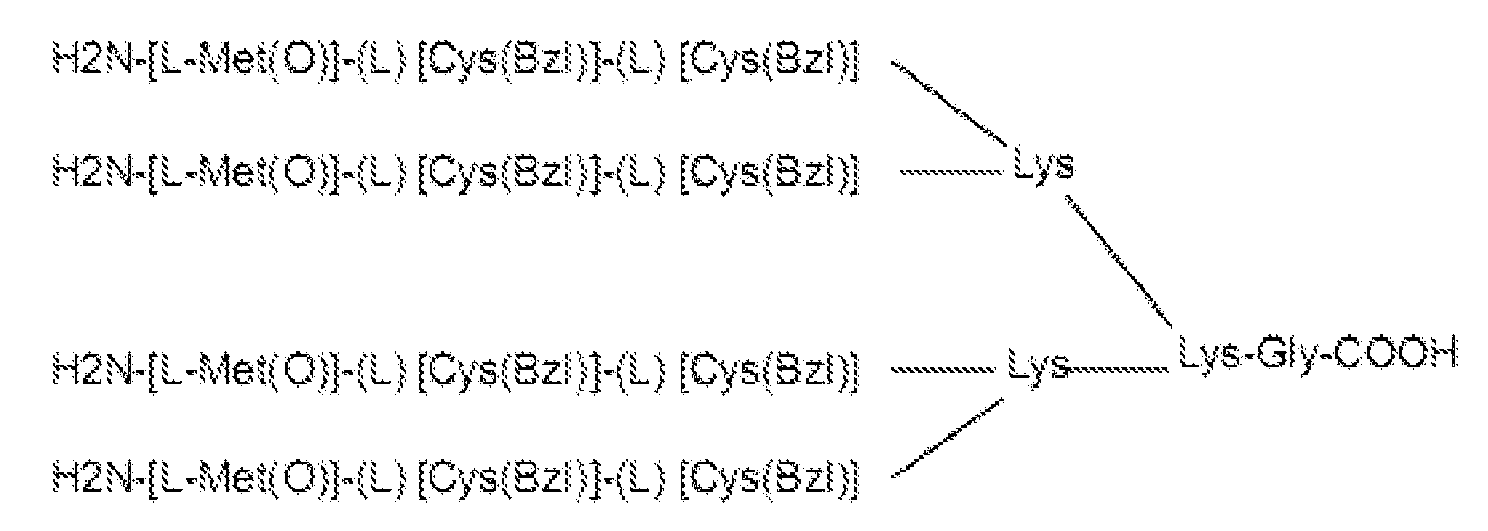
- It is an object of the invention the use of the molecule as above disclosed for specifically and selectively binding to Cripto protein and acting as a competitor for the binding of Cripto protein to the Alk-4 receptor and as inhibitor of Cripto-dependent Smad2 phosphorylation.
- It is an object of the invention the use of the molecule as above disclosed for selectively inhibiting the Cripto-dependent differentiation process of stem cells and induce their differentiation to neuronal cells, and said neuronal induced stem cells as above treated.
- It is an object of the invention the molecule or the neuronal induced stem cells for medical use, preferably for the treatment of a neurodegenerative disease, more preferably for the treatment of Parkinson disease; alternatively for the treatment of Cripto-dependent tumor formation.
- It is an object of the invention a pharmaceutical composition comprising the molecule as above disclosed or the neuronal induced stem cells as above disclosed, and proper excipients, adjuvants and/or diluents, also associated with other therapeutic compounds acting on Cripto, or to ameliorate side effects induced by other therapeutic compounds wherein said other therapeutic compounds may or may not act on Cripto.
- The present invention refers to stem cells. They can be of mammalian origin, preferably of mouse or human origin, as i.e. human embryonic stem cells and/or pluripotent human stem cells (iPS), not derived from destruction human embryos, i.e. by :
- i) Therapeutic Cloning/ Somatic Cell Nuclear Transfer, i.e. insertion of somatic cell nucleus into a donor oocyte;
- ii) Nuclear Reprogramming of adult cells to iPS (induced Pluripotent Stem Cells).
- Examples of methods for obtaining such cells are disclosed in :
- Yamanaka S. Strategies and new developments in the generation of patient-specific pluripotent stem cells. Cell Stem Cell. 2007 . Two "reprogramming" strategies for the generation of pluripotent stem cells from somatic cells have been studied extensively: nuclear transfer to oocytes and fusion with ES cells. Patient-specific pluripotent cells could potentially also be generated by the spontaneous reprogramming of bone marrow cells, spermatogonial cells. A third overall type of strategy arose from the demonstration that pluripotent stem (iPS) cells can be generated from mouse fibroblasts by the introduction of four transcription factors (Oct-3/4, Sox2, c-Myc, and KLF4). Recent work has underlined the potential of this strategy by improving the efficiency of the process and demonstrating that iPS cells can contribute to many different tissues in vivo, including the germline. Taken together, these studies underscore the crucial roles of transcription factors and chromatin remodeling in nuclear reprogramming.
- Takahashi K, Yamanaka S. Induction of pluripotent stem cells from mouse embryonic and adult fibroblast cultures by defined factors. Cell. 2006 . This manuscript report the first evidence of iPS generation from adult somatic cells.
- Takahashi K, Okita K, Nakagawa M, Yamanaka S. Induction of pluripotent stem cells from fibroblast cultures. Nat Protoc. 2007;2(12):3081-9.
- Takahashi K, Tanabe K, Ohnuki M, Narita M, Ichisaka T, Tomoda K, Yamanaka S. Induction of pluripotent stem cells from adult human fibroblasts by defined factors. Cell. 2007 .
- Masui S, Nakatake Y, Toyooka Y, Shimosato D, Yagi R, Takahashi K, Okochi H, Okuda A, Matoba R, Sharov AA, Ko MS, Niwa H. Pluripotency governed by Sox2 via regulation of Oct3/4 expression in mouse embryonic stem cells. Nat Cell Biol. 2007 Jun;9(6):625-35.
- Saito S, Sawai K, Murayama Y, Fukuda K, Yokoyama K. Nuclear transfer to study the nuclear reprogramming of human stem cells. Methods Mol Biol. 2008;438:151-69.
- Aoi T, Yae K, Nakagawa M, Ichisaka T, Okita K, Takahashi K, Chiba T, Yamanaka S. Generation of Pluripotent Stem Cells from Adult Mouse Liver and Stomach Cells. Science. 2008 Feb 14 [E pub ahead of print].
- Nakagawa M, Koyanagi M, Tanabe K, Takahashi K, Ichisaka T, Aoi T, Okita K, Mochiduki Y, Takizawa N, Yamanaka S. Generation of induced pluripotent stem cells without Myc from mouse and human fibroblasts. Nat Biotechnol. 2008 Jan;26(1):101-6. E pub 2007
Nov 30. - The present invention will be now described by means of non limiting examples as illustrated in the following figures. In this document D can be used interchangeably with (R) and L can be used interchangeably with (S).
-
Figure 1 (a) Schematic representation of the iterative screening strategy. (1) NH2-D-Glu (D-Glutamic acid, also denoted as "4", see Table S1) is the common N-terminal residue, B identifies the fixed residue, which denotes one out of 30 aminoacids (aa1-30, Table S1) and X indicates random positions (4-B(1-30)-X). The total complexity of the first library was therefore of 302= 900 different peptides. In the first screening round (1), 4.23.X identifies the first active pool, where "23" indicates L-Cysteine(S-benzyl) [L-Cys(Bzl)]. In the second round of screening (2) the pool 4-23-X was re-synthesized in 30 single peptides (4-23-B(1-30)), and the residue "23" was identified in the third position (4-23-23). Finally, thirty single peptides (B(1-30)-23-23) were submitted to the third screening round (3), which identified the residue "26", where "26" indicates L-Methionine-sulphoxide [L-Met(O)]. The 26-23-23 peptide is also referred to as Cripto Blocking Peptide (BP) (b) Dose dependent inhibition of Cripto/ALK-4 interaction exerted by Cripto BP, Control Peptide (CP; i.e. tetrameric tripeptide D-Ser-Ala-Cha) and Dimeric Peptide (DP; i.e. dimeric tripeptide 26-23-23) in ELISA-based competition assays (n=3). (c) Dose dependent interaction of Cripto or ALK-4 to Cripto BP. The indicated peptides (BP and CP) were coated (50µM) on the plates and increasing amounts of either Cripto or ALK-4 receptor were used in binding, ranging from 50 to 200ng/ml. Cripto but not ALK-4 bound Cripto BP; whereas, both Cripto and ALK-4 failed to bind the control peptide (CP). Mean ± SD, *P< 0.0005. - Figure S1. Screening of the (D-Glu)-B-X library. In the first round of screening, to reduce the library complexity, the first residue of the library was fixed, i.e. the aminoacid D-Glutamic acid (D-Glu). The library was made from 30 pools, each of them composed by 30 peptides that differ for the second aminoacidic position. Pools were tested in the ELISA-based competition assay with a molar excess of 30000-fold (calculated for each single peptide) over Cripto (8.6 x10⁻¹⁰ M).
- Figure S2. Dose-dependent inhibition of selected pools. Pools identified in the first screening were tested in the ELISA-based competition assay with a molar excess of 5000, 12500 and 30000-fold (a) and 200, 1000 and 5000-fold (b). Molar excess was calculated for each single peptide over Cripto (8.6 x10⁻¹⁰ M).
- Figure S3. Screening of the (D-Glu)-[L-Cys(Bzl)]-B library. Thirty single peptides were synthesised and tested in the ELISA-based competition assay with a molar excess of 1000-fold over Cripto (8.6 x10⁻¹⁰ M).
- Figure S4. (a) Screening of the B-[L-Cys(Bzl)]-[L-Cys(Bzl)] library. Thirty single peptides were synthesised and tested in the ELISA-based competition assay with a molar excess of 1000-fold over Cripto (8.6 x10⁻¹⁰ M). (b) Dose-dependent inhibition of selected peptides. Peptides were tested in the ELISA-based competition assay with a molar excess of 500, 1000, 2000, 3000 and 4000 -fold. Molar excess was calculated for each single peptide over Cripto (8.6 x10⁻¹⁰ M).
-
Figure 2 . Cripto BP prevents Smad2 phosphorylation and redirects the fate of ESCs. (a) Two day old cripto-l- EBs were stimulated with recombinant Cripto protein (0.5µg/ml) in the presence of either 2.5µM or 25µM of the peptides: DP (dimeric 26-23-23), CP (control tetrameric D-Ser-Ala-Cha) and BP (tetrameric 26-23-23). Cripto BP, but not CP or DP inhibits Cripto -induced Smad2 phosphorylation, as shown by Western blot, using anti phospho-Smad2 antibodies. Levels of total Smad2 were also compared. Smad2 phosphorylation was expressed as ratio between arbitrary densitometric units (ADU) of P-Smad2 and Smad2. The data show a representative experiment, n=3. (b) Cripto BP (but not CP, DP or DMSO) prevented cardiomyogenesis in differentiated EBs. Morphological analysis was performed on day 13 (n=∼60EBs/group; data are mean ± SD; *P<0.001, versus DMSO and CP; **P<0.0001, versus CP). (c) Grades of neuronal differentiation of wild type EBs, as arbitrarily defined. Grade 0: absence of neurons; Grade1: few, isolated neurons immunoreactive to β-III tubulin antibodies; Grade 2: small areas of β-III tubulin-ir cells; Grade 3: dense network of β-III tubulin-ir cells. Nuclei were visualized by DAPI counterstaining. Magnification 20x. (d) BP (but not CP or DP) promoted full neuronal differentiation in wild-type EBs (degree of neuronal differentiation scored according to panel c). Two -days old wild-type EBs were treated with 25µM of the indicated peptides and immunofluorescence analysis was performed on day 13 [n=∼60EBs/group, data are mean ± SD; *P<0.05 (Grade 0 compared tograde 2 or 3)]. (e). Expression analysis of cardiac and neuronal markers. Two-day old EBs were treated either with the indicated peptides at 25µM (CP; BP) or vehicle (DMSO) and the expression profile was analysed onday 13, by QRT-PCR. The neuronal marker (NF-M) and markers involved in Dopaminergic (DA) maturation (Wnt5a, Shh, Pitx3, TH, DAT) were up regulated; whereas the cardiac marker (MIc2v) was down regulated. Data are mean ± SEM, n≥3; fold change in gene expression was relative to (DMSO) control; *P is versus CP-treated group. -
Figure 3 . Cripto BP enhances neuronal induction and dopaminergic differentiation. (a) In vitro differentiation scheme. ESCs were seeded at low density onto a stromal feeder layer for 14 days in the presence of sequential morphogens and mitogens (Shh, FGF2, FGF8, Noggin; N, Wnt5a; W5) as well as the presence or absence of the Control Peptide (CP) or Cripto blocking peptides (BP). (b) In vitro differentiation of ESCs in the presence of BP significantly increased the percentage of colonies containing neurons (TUJ1). (c) Cripto BP significantly increased the proportion of colonies containing dopaminergic neurons (TH), and (d) the number of DA neurons/colony. Mean ± SD, *p<0.05, **p<0.01, ***p<0.0001 versus CTRL. Photomicrographs illustrating TH+ neurons within neuronal enriched ESC colonies following (e) CP administration, and (f) Cripto BP treatment. (g) TH/Pitx3, and (h) TH/GIRK2 and (i) TH/Nurr1 co-localized staining within the cultures confirmed the midbrain dopaminergic phenotype of the TH neurons. The differentiation protocol was selective for DA neurons with few cells of other neuronal subpopulations present, and these cells did not colocalize with TH (j) TH/GABA and (k) 5HT/Tuj1. Cripto BP treated ESC cultures showed significantly increased dopamine (l) and DOPAC (l") release in vitro following KCI evoked release. Data represents mean ± SEM, n=3, * p<0.05). -
Figure 4 . Cripto BP reduces the incidence and size of tumors following mESC transplantation. (a) Tumors or potential tumor-like cells could be identified by the presence of proliferating cells (Ki67) and (b) undifferentiated cells (Nestin) within the graft. (c) Merged image. (ci) High power magnification of proliferative cells within the tumor illustrated in c. (d-f) and (g-i) illustrate examples of Control peptide and Cripto BP grafts, respectively, showing no signs of these proliferating cell populations. (j) Pre-treatment of ESC with Cripto BP (BP), as well as BP infusion, markedly reduced tumor incidence upon transplantation compared to CP treatment. (k) Neural red stained sections showed that upon tumor occurrence, animals receiving Cripto BP pre-treated ESCs + BP infusion showed significantly reduced tumor volume by comparison to (l) Control Peptide. Ctx, cortex; CPu, caudate putamen; Lv, lateral ventricle. -
Figure 5 . Cripto BP induces behavioural and anatomical improvements in ESC-grafted Parkinsonian rats. (a) Pre-treatment of ESCs with Cripto BP or (b) Cripto BP pre-treated + BP peptide infusion (red line) significantly improves amphetamine-induced rotational behaviour of animals grafted, compared to sham grafting (green). (c) Number of TH-ir cells seen within the striatum following transplantation of ESCs treated with CP or Cripto BP (+ respective peptide infusion). *p<0.05 versus no peptide infusion. (d) Photomicrographs illustrating TH-ir neurons within the striatum following grafting of ESCs treated with CP + CP infusion, and (e) Cripto BP + BP infusion. (f) Numerous hypertrophied TH+ fibres seen outside the graft site, indicative of good graft integration. (g) High power image of a TH cell within the graft showing the bi-polar morphology characteristic of midbrain A9 DA neurons. (h) TH+/Nurr1+, (l) TH+/DAT+, (j) TH+/Pitx3+, (k) TH+/GIRK2 staining within the graft, confirming the midbrain dopaminergic phenotype of the TH neurons. (l) Norepinephrine (labelled with norepinephrine transporter, NET) fibres could be seen throughout the graft but did not co-localize with TH. TH neurons within the grafts did not co-localize with (m) GABA or, serotonin (5-HT, not shown). Data are mean ± SD. *p<0.05, **p<0.01, ***p<0.001, versus sham group. - A tetrameric library composed of non-natural amino acids was prepared following methods reported in the recent literature. Commercially available 9-Fluorenylmethoxycarbonyl (Fmoc)-derivatized amino acids (purity >99%) and resins were purchased from Chem-Impex International (Wood Dale, IL, USA) and from Novabiochem (Laufelfingen, CH). Amino acids in the D configuration and others bearing TFA-stable side chain protections were chosen in order to increase the library chemical diversity and, at the same time, to introduce resistance to enzyme degradation for in vitro and in vivo applications (see Table S1).
Table S1. List of building blocks used to assemble the peptide library. Building blocks block 20 stands for p-toluenesulfonate.code 3-letters code building block 1 D-Ala D-Alanine 2 D-Asp D-Aspartic acid 3 D-Val D-Valine 4 D-Glu D-Glutamic acid 5 L-Cha L-Cyclahexylalanine 6 D-Phe D-Phenylalanine 7 D-Thr D-Threonine 8 D-Met D-Methlonine 9 D-Cys(Acm) D-Cysteine(S-acetamydomethyl) 10 D-Lys D-Lysine 11 D-Tyr D-Tyrasine 12 D-Pro D-Proline 13 D-Leu D-Leucine 14 D-His D-Histidine 15 D-Gln D-Glutamine 16 D-Trp D-Triptophan 17 D-Arg D-Arginine 18 D-Asn D-Asparagine 19 D-Ile D-Isoleudne 20 D-Arg(Tos) D-Arginine(Nr-Tosyl) 21 D-Ser D-serine 22 L-Cys(Acm) L-Cysteine(S-acetamydomethyl) 23 L-Cys(Bzl) L-Cysteine(S-benzyl) 24 L-Cys(p-MeBzl) L-Cysteine(S-pmethyl-benzyl) 25 L-Cys(tBu) L-Cysteine(S-tert-butyl) 26 L-Met(O) L-Methionine-sulphone 27 L-Met(O)2 L-Methionine-sulphoxide 28 L-Glu(β-OAII) L-Glutamic acid-(β-allyl) 29 β-Ala β-Alanine 30 Gly Glycine - The library was chemically synthesized following the Fmoc methodology 53 and sequence randomization was achieved as reported elsewhere 38, 54. In order to increase the molecular surface of the resulting peptides, a multimeric library was devised and prepared utilizing as common scaffold a polylysine core 40. Two subsequent levels of dimerization achieved by using Fmoc-L-Lys(Fmoc)-OH as branching unit, allowed the generation of tetrameric structures onto which tripeptidic libraries were assembled. After resin cleavage, the libraries were submitted to repetitive cycles of TFA dissolution, precipitation and lyophilization to improve the overall quality of the final products. 30-components mixtures as well as single molecules were analyzed by LC-MS using an LCQ DECA XP mass spectrometer connected to a fully equipped Surveyor quaternary HPLC system (ThermoFisher, Milan, Italy). Biobasic C18 columns 50x2 mm ID RP18 were used for these analyses. Single molecules were prepared following the same Fmoc methodology and initially assayed as crude products. Purification to homogeneity was carried out by RP-HPLC on semi-preparative columns (LUNA 5x2,2 cm ID,
RP 18, Phenomenex). Purity and identity of the purified peptides were assessed by LC-MS analysis. The dimeric 26-23-23 peptide was prepared in the same way, by performing one step of branching with Fmoc-L-Lys(Fmoc)-OH. - To improve the overall solubility of the resulting mixtures, D-Glutamic (D-Glu), corresponding to building block 4 (Table S1) was initially chosen as the common, N-terminal residue. The total complexity of the library was therefore of 302 = 900 different peptides. In the first step of the deconvolution process, the peptide pools were tested with a molar excess of 30000-fold (calculated for each single peptide) over Cripto (8.6 x10⁻¹⁰ M; Figure S1). Once identified an active pool(s), a dose-dependent inhibition using 200-, 500-, 1000-, 5000-, 12500 and 30000 fold excess was performed to confirm the inhibitory property (Figure S2). The first active pool selected was that labelled as 4-23-X (X indicated random positions), where "23" identified the amino acid L-Cysteine(S-benzyl) [L-Cys(Bzl)] (Figure S2). This peptide pool was re-synthesized as 30 single peptides and submitted to the second screening using a molar excess of 1000-fold (calculated for each single peptide) over Cripto; the screening allowed the identification of the peptide 4-23-23 as the best performing in our test (Figure S3). To finally investigate the N-terminal position, where D-Glu was initially arbitrarily placed, 30 single peptides labelled as B-23-23 were synthesized and submitted to the final screening (Figure S4, a). Finally, a dose-dependent inhibition using 500-, 1000-, 2000-, 3000 and 4000 fold excess of the active pools was performed to confirm the inhibitory ability (Figure S4, b). The peptide indicated as 26-23-23, where "26" identified the amino acid L-Methionine-sulphoxide [L-Met(O)], was the molecule showing the optimal inhibitory activity. The activity of this peptide was further confirmed using the HPLC purified molecule.
- The screening was performed by an ELISA (Enzime-Linked Immunosorbent Assay) assay. Recombinant ALK-4-Fc chimeric protein (R&D) was coated on the surface of 96-well microtiter plates (100ng/well) and incubated over-night at Room Temperature (RT). After blocking with 1% BSA in PBS (180 µl/wells), the plate was incubated with in-house preparations of recombinant Cripto protein (55; 20ng/well) in the presence of the indicated molar excess of each peptide pool, for 1 hr at RT followed by 1 hr at 37°C. Since the peptides were dissolved in DMSO, equimolar amounts of DMSO were added also to the control. Subsequently, the plate was incubated with rabbit polyclonal anti-Cripto antibodies (total IgG; 6µg/ml) for 1 hr at RT followed by 1 hr at 37°C. Following incubation with primary antibodies, Goat anti-rabbit HRP-conjugated IgG (Sigma Aldrich) were added diluted at 1:1000 to the plate and incubated for 1 hr at RT. Finally, the plate was developed with o-phenylendiammine peroxidase substrate (Sigma-Aldrich) and the absorbance was read at 490 nm on a microplate reader (Biorad Benchmark). The percentage of binding showed in presence of each pool, was evaluated by the following formula: % of binding = (OD490 nm pool/ OD490 nm Cripto100. Data were fitted using the software GraphPad Prism 4 (version 4.0, GraphPad software, Inc.) and the EC50 was derived using a nonlinear regression algorithm imposing a formula for one-site competition.
- To evaluate the binding of Cripto BP to either Cripto or ALK-4 receptor, BP or control peptides (CP; 50µM) were coated on the surface of a 96-well microtiter plate and incubated over night at 4°C. Wells were washed five times with PBS Tween (PBT) and the aspecific sites blocked for 3 h at RT with 1 % Bovine Serum Albumin (BSA) in PBS, 180 µL/well. Wells were washed as above, and the recombinant form of either ALK-4-humanFc chimeric receptor or Cripto protein in PBT were added at the indicated concentrations and incubated for 1 h at 37°C followed by 1 hr at RT. After washing with PBT, to evaluate the binding of Cripto to 26-23-23, rabbit anti-Cripto IgG (6µg/ml) were added to the plates and incubated 1 h at 37°C and 1 hr at RT. After washing in PBT, a goat anti-rabbit HPRT (Santa Crutz) was added to the plate (0.3µg/ml) and incubated 1 h at RT. Finally, the plate was developed as reported above. To evaluate the binding of ALK4 to 26-23-23, the extracellular domain of ALK-4 receptor fused to human Fc (R&D Systems) was added at the indicated concentrations and a goat anti-human Fc (Jackson ImmunoResearch; 1:1000) was used.
- Undifferentiated ESCs were cultured as previously described 55. For in vitro differentiation as shown in
Figure 2 , ESCs were cultivated as embryoid bodies as described 35 . - For more specific dopaminergic differentiation, R1 ESC were plated on a confluent monolayer of mitomycin-C treated (2 hour, 20ug/ml, Sigma) stromal PA6 cells (Riken Cell Bank) at a density of 100cells/cm2 and differentiated based on the methods of Barberi et al, 2003 with the following modifications,
Fig. 3a 27. Cells were initially cultured in serum-replacement media (Dulbecco's modified Eagle medium with 15% serum replacement, 2mM L-glutamine and 10uM β-mercaptoethanol, Gibco-Invitrogen) containing Noggin (300ng/ml, R&D Systems). After 5 days the media was replenished and supplemented with Noggin plus morphogens fibroblast growth factor-8 (FGF8, 100ng/ml) and Sonic Hedgehog (Shh, 500ng/ml), previously shown to be important in midbrain DA neuron development. Atday 8, cultures were changed into N2 media (a 1:1 mixture of F12 and MEM with 15mM HEPES buffer, 1 mM glutamine, 6mg/ml glucose (Sigma-Aldrich), 3mg/ml Albumax and N2 supplement (all purchased from Invitrogen)) supplemented with FGF2 (20ng/ml), Shh, FGF8 and Wnt5a (previously shown to be important in the differentiation of dopaminergic precursors in vitro and in vivo 25, 56. Finally atday 11, cultures were exposed to survival factors brain derived neurotrophic factor (BDNF, 30ng/ml), glial derived neurotrophic factor (GDNF, 30ng/ml) and ascorbic acid (AA, 100uM). In addition, peptides (Control peptide, CP; Dimer peptide, DP or Cripto Blocking peptide, Cripto BP, 12.5uM) were added to the cultures from day 1-11. Peptides were replenished in the media every second day. - Two day-old cripto-l- Embryoid Bodies (EBs) were serum starved for 3 hrs in DMEM (GIBCO) without LIF and in low serum (0.5% FBS). Following starvation, EBs were incubated for 20 min at 37°C with recombinant Cripto protein (0.5og/ml) either alone or in the presence of the indicated amount of peptides. Finally, EBs were dissolved in Laemmli lysis buffer and analyzed by Western blot using the Trans-Blot Semi-dry System (BIO-RAD), following manufacturer's instruction. Anti-Smad2 and anti-phospho-Smad2 (Ser465/467) Antibodies (Cell Signalling Technology) were used, following the manufacturer's instructions.
- Total RNAs from 13 day -old EBs was extracted with TRlzol kit (Life Technologies Inc.) according to manufacturer's instructions. One microgram of total RNA was used for cDNA synthesis with SuperScript II reverse transcriptase (Life Technologies Inc.) and random hexamers. Quantitative Real time PCR was performed using SYBR Green PCR master mix (EuroClone), according to manufacturer's instructions. The primers used are described in Table S2.
Table S2. List of primers used for QRT-PCR analysis. Gene Cycles Primer (sense) Primer (antisense) Product size (bp) MLC2a 28 cagacctgaaggagcctattccc gtcagcgtaaacagttgctctacc 300 α- foetoprotein 30 ccacgttagattcclcccagtgcgt catacttgttagagagttccgtctc 200 NFM 32 gaaatggaagaaaccctcaca ccggccttggcctctggttttgg 474 TH 30 tgtcacgtccccaaggttcat gggcaggccgggtctctaagt 276 DAT 30 gtgggcttcactgtcatcctca cccaggtcatcaatgccacga 514 Wnt1 30 acctgttgacggattccaag tcatgaggaagcgtaggtcc 462 β- tubulin 28 gggaggtgataagcgatgaa cccaggttctagatccacca 150 - Dopamine release and turnover was determined in vitro using reverse phase high performance liquid chromatography (HPLC). Mouse ESC were differentiated in a 12 well plate according to the methodology depicted in
figure 3A , in the presence of either the Control peptide of Cripto BP. After 14days in vitro, media was replaced with 200ul of N2 media supplemented with 56mM KCI for 30min. The media was then collected and stabilized with 20ul of buffer containing 0.4 M perchloric acid containing 7.9mM sodium metabisulphate and 1.34mM disodium EDTA. On the day of analysis the samples were centrifuged and the supernatant transferred to HPLC vials and placed in an autosampler for injection onto the HPLC. The HPLC consisted of a LC-20AT pump (Shimadzu), SIL-20A Autosampler (Shimadzu) and C18 reverse phase column (Bio-Rad, Hercules, USA). Detection was via a 3mm VT-03 flow cell with glassy carbon working electrode (Antec Leyden) and Decade II Electrochemical Detector (Antec Leyden). The mobile phase consisted of 17% v/v methanol in purified deionized water containing 70mM KH2PO4, 0.5mM EDTA and 8.0mM sulfonic acid, pH 3.0 and was run at a flow rate of 0.5ml/min. DA turnover was expressed as the concentration of DOPAC to DA [DOPAC/DA]. Analysis was performed on triplicate wells on three independent differentiation experiments. - Thirty-seven adult male Sprague Dawley rats (250-350g; from ARC, Australia) were housed and treated according to the guidelines of the Australian and Howard Florey Institute animal ethics committee (07-030). Animals received unilateral stereotaxic injections of 6-OHDA into the substantia nigra pars compacta (SNpc) to create a complete lesion of the midbrain DA neurons, as previously described 29. Lesioned animals were selected for transplantation based on their response to amphetamine induced rotational behaviour as previously described 29. Animals making greater than 6 rotations/min (lesion greater than 80%) were selected for grafting.
- Two days prior to grafting animals began cyclosporine-A immune suppression (10mg/kg). Fourteen days post-lesioning selected animals (determined by behavioural rotations) were again anesthetized and stereotaxically injected with 1µl of cell suspension at each of the 4 sites as previously described 29. Stereotaxic coordinates of 1st & 2nd Injection (from bregma): anterior 0.2mm, lateral 3.0mm, ventral 4.5 and 5.0mm; 3rd & 4th Injection, anterior 1.0mm, lateral 2.5mm, ventral 4.5 and 5.0mm; incisor bar 0mm 57). ESCs were differentiated as outlined in
Fig. 3a . In brief, ESC colonies were dissected away from the stromal feeder layer and dissociated using collagenase/dispase with agitation (700µg/ml, Roche, for 20min, 80rpm). Cells were subsequently resuspended at a density of 3,000 cells/µl ready for grafting. Five rats received Sham injections (4µl N2 media,1µl/site), 16 rats received a total of 12,000 ESCs (4x 1µl grafts) pre-treated with the Control peptide (of which 9 of these animals also received infusion of the Control peptide) and a further 16 rats received grafts pretreated with the Cripto blocking peptide (9 animals receiving infusion of the Cripto BP). - The peptide infusion was performed by implantation of a cannula into the striatum (Alzet brain infusion kit) connected to a subcutaneously placed osmotic minipump (Alzet) prefilled with either CP or Cripto BP. Implantation was performed at the same time as the cell grafting. Cannula coordinates: anterior 0.5mm, lateral 1.5mm, ventral 5.0mm; incisor bar 0mm 57. The osmotic pump was capable of continuously delivering the peptide over a 3 weeks period (75µM, 0.25µl/hr) upon which time the animals were briefly anaesthetized with isoflurane and the pump removed through a small incision over the scapular region.
- Eight weeks post grafting, rats were killed by an overdose of sodium pentobarbital (100 mg kg-1 i.p.) and intracardially perfused as previously described 29. Brains were removed, post fixed for 1 hour, and then left overnight at 4°C in 20% sucrose in PBS. The following day, 20µm-thick coronal sections were cut serially through the striatum (12 series) and 50µm through the SNpc and mounted directly onto chrome alum [K2Cr(SO4)2·12H2O] gelatinized slides.
- Immunofluorescence analysis on adherent EBs, dopaminergic differentiated ESC and striatal grafts were performed as previously described 29, 35.. The following primary antibodies were used: mouse anti-βIII-tubulin (Tuj1, 1:1000, Promega); anti-βIII tubulin (Sigma; 1:400), rabbit anti-tyrosine hydroxylase (TH, 1:200, PelFreez); mouse anti-TH (1:500, Chemicon); Nurr-1 (1:250, Santa Cruz); rabbit anti-Pitx3 (1:200, InVitrogen), rabbit anti-GIRK-2 (1:100, Chemicon); rat anti-DAT (1:1000, Chemicon); rabbit anti-5HT (1:200, Biogenesis); rabbit anti-NET (1:20, Chemicon), rabbit anti-GABA (1:500, Sigma); rabbit anti-Ki67 (1:1000, Neomarkers); and rat anti-Nestin (1:100, Developmental Studies Hybridoma Bank). Appropriate fluorophore conjugated secondary antibodies were used for visualization: (Cyanin-2, Cy3 and Cy5, 1:500, Jackson Immunoresearch or Alexa-488, Alexa-594 and Alexa-633, 1:200, Molecular Probes).
- Hoescht counterstaining was used for visualization of all cells within the cultures. The proportion of neuron containing colonies (labeled for using the immature neuronal marker βIII-tubulin (Tuj1)) and the number of dopaminergic neurons/µm2 colony (identified using a marker for the precursor enzyme in DA synthesis,TH) were counted. Differentiation experiments were performed in triplicate.
- One series of slides containing grafted striata was counterstained using 1% Neutral red to visualise the graft/tumor size and the gross morphology of the striatum. Labeling was visualized by light or fluorescent illumination using an inverted microscope (DMIRB, Leica Microsystems, Wetzelar, DE, http://www.leicamicrosystems.com) or upright microscope (Leica DMLB2). Images were acquired on a DC 350 FX camera (Leica). Area of grafts and tumors was calculated using Stereo Investigator software (MicroBrightField, VT, USA).
- Values are expressed as means SEM or SD. The statistical significance of difference was determined by ANOVA followed by Tukey's test; except for data in
Figure 5 (Student's t-test). - In order to identify Cripto/ALK-4 antagonists capable of disrupting downstream signalling, the authors screened a tetrameric tripeptide library synthesized using 29 non-natural amino acids to increase peptide stability, plus Glycine, (see Table S1). To increase the molecular surface, the library was assembled as previously described 38 on a peptide scaffold composed by a poly-lysine core 40. In order to facilitate the characterization of the peptide mixtures, and at the same time to expedite the screening procedure, the first residue was arbitrarily fixed. A negatively charged amino acid, the D-Glutamic acid (D-Glu, denoted 4;
Fig. 1a and Table S1), was thus initially chosen as the common, N-terminal residue, to favour peptide solubilisation. The library was arranged in 30 pools, each of them composed by 30 tetrameric tripeptides, which differ for the amino acid (denoted B) on the second position (Fig. 1a ), while the residue in the third position (denoted X) was randomly added. The total complexity of the library was therefore of 302=900 different peptides. The screening was carried out by an ELISA-based competition assay whereby the displacement of soluble recombinant Cripto from coated ALK-4 by the peptide pools was evaluated. The iterative procedure consisted of three screening rounds, which led to the selection of the 26-23-23 tetramer formed by L-Methionine-sulphoxide [L-Met(O)] (denoted as 26) inposition 1, and S-benzylated L-Cysteine [Cys(Bzl)] (denoted as 23) inpositions Fig. 1a ), (for details see Material and methods and Figs S1-S4). The selected tetrameric tripeptide (26-23-23) was thereafter named Cripto Blocking Peptide (BP). - Below is the schematic representation and chemical structure of the 26-23-23 tetrameric tripeptide (Cripto BP) that has a calculated MW of 2536.5 amu (atomic mass unit, average value).
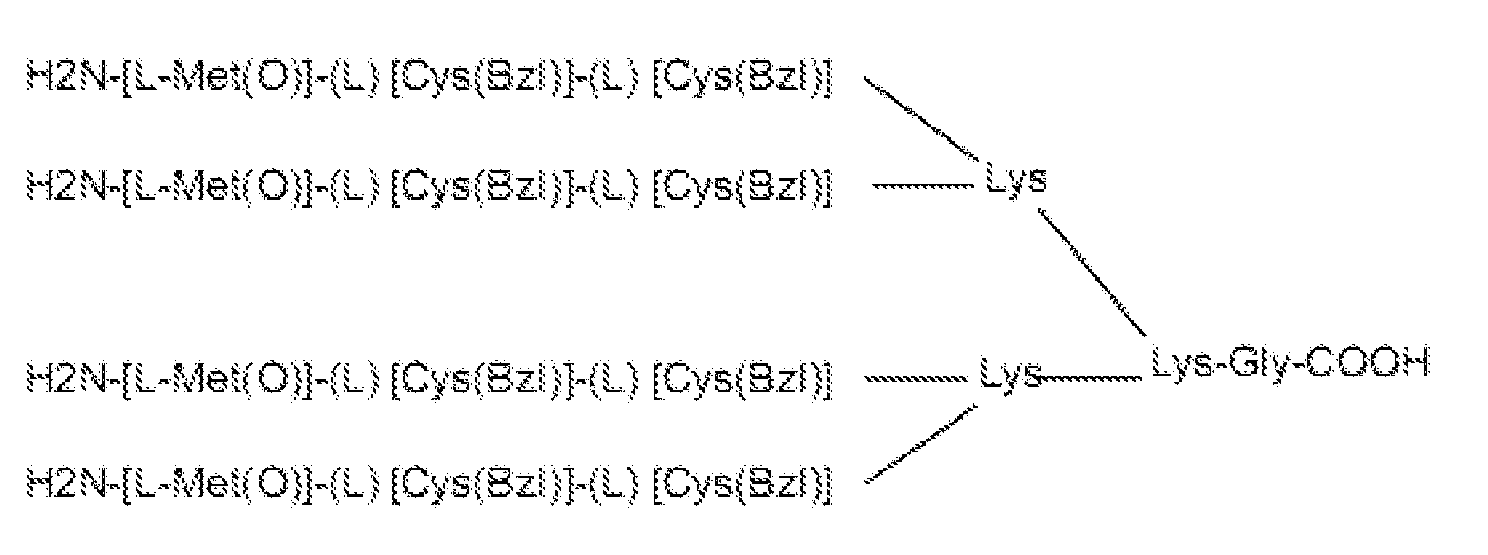

- This peptide blocked the interaction of Cripto and ALK-4 with an estimated IC50 of 400nM, while the Control tetrameric Peptide D-Ser-Ala-Cha (CP) and a Dimeric Peptide variant (DP) of the 26-23-23 peptide had no effect (
Fig. 1b ). The authors thus performed ELISA assays to evaluate whether Cripto BP- or CP-coated to microtiter plates could bind recombinant Cripto and/or ALK-4 receptor. Cripto but not ALK-4 specifically recognized the immobilized Cripto BP, in a dose-dependent manner (Fig. 1c ). Neither Cripto nor ALK-4 recognized the control peptide, confirming the specificity of Cripto BP for Cripto binding. - Given the neutralizing activity of the peptide, the authors then asked whether Cripto BP was able to block ALK-4/Smad2 -dependent Cripto signalling in ESCs and thereby mimic the absence of cripto in an ESC differentiation assay. The authors first evaluated whether Cripto BP was able to prevent Cripto-induced Smad2 phosphorylation of serum starved 2 day-old cripto-l- Embryoid Bodies (EBs), as assessed by Western blot analysis. Recombinant soluble Cripto protein stimulated Smad2 phosphorylation35. This effect was not modified by the presence of increasing amounts of either Cripto DP or CP (2.5µM and 25µM) (
Fig. 2a ). On the contrary, Cripto-induced Smad2 phosphorylation was inhibited by Cripto BP and completely blocked at 25µM (125x molar excess;Fig. 2a ). The authors thus asked whether the neutralizing activity of Cripto BP on endogenous Cripto signalling was also able to block cardiomyogenesis in wild-type ESCs. To this end, 2 day-old wild-type EBs were treated with increasing amounts of either CP or Cripto BP, ranging from 5.0 to 25□M, and the percentage of EBs containing beating areas was scored fromdays 8 to 12 of the differentiation (n=∼60 EBs/group;Fig. 2b ). Given that the peptides were dissolved in DMSO, control untreated EBs were compared with DMSO treated EBs. Interestingly, neither DMSO, the tetrameric CP (Fig. 2b ), nor the Dimeric Peptide (DP, data not shown) affected the percentage of beating EBs. Instead, treatment of wild-type EBs with Cripto BP, induced a dose-dependent inhibition of cardiomyogenesis, as shown by the progressive reduction of rhythmically contracting EBs (at 25□M, BP 3.7% ± 3.5 vs. CP 82.9% ± 11.17, **p<0.0001) (Fig. 2b ). - The authors previously showed that cripto-l- ESCs spontaneously differentiate into neurons during the time window when wild-type ESCs are primed for cardiomyogenesis by Cripto 35. Thus, if specific and effective, Cripto BP should be able to re-direct ESC fate and promote neural induction and neurogenesis. To address this issue, 2 day-old wild-type EBs were treated as described above, with either control (CP), dimeric (DP) or blocking (BP) peptides and both morphological and immunofluorescence analysis were performed on 13 day-old EBs. Anti-βIII tubulin antibodies were used to recognize the neuron-specific form of class III β-tubulin. To better define the activity of the peptides, the authors arbitrarily defined 4 grades of neuronal differentiation ranging from the absence of neurons (Grade 0) to full neuronal differentiation (Grade 3), i.e. presence of a dense network of βIII-tubulin -positive cells. The presence of either few isolated neurons or small areas of βIII-tubulin positive cells defined intermediate phenotypes,
Grade 1 andGrade 2, respectively (Fig. 2c ). Our data clearly indicated that Cripto BP but not CP was able to efficiently induce neuronal differentiation, characterised by a high percentage ofGrade 3 phenotype (BP 45.6% ± 5.2 p<0.001 vs CP 6.9% ± 1.15 p<0.005) (Fig. 2d ). Accordingly, upon treatment with control peptides (CP or DP), the majority of the EBs scored showed aGrade 0 phenotype (CP 75.9% ± 7.02 p<0.003; DP 77.2% ± 6.9 p<0.001; BP 17.4% ± 1.15 p<0.001;Fig. 2d ); thus confirming the specific effect of Cripto BP. To support these findings, the authors examined the expression profile of both cardiac and neuronal differentiation markers in the same experimental settings by QRT-PCR. Similar to our previous findings in cripto -l- ESCs29, expression of the pan neuronal marker NFM was induced in 13 day -old EBs upon treatment with Cripto BP, but not by the control peptide. Concomitantly, expression of the cardiac specific marker MLc2v was reduced (Fig. 2e ). Thus, our results suggest a fate switch in ESCs from cardiomyocytes to neurons. Moreover, similar to cripto -l- ESCs 37, Cripto BP -treated wild-type EBs also showed expression of markers characteristic of developing midbrain dopaminergic neurons. These comprise the expression of factors important for early stages of dopaminergic neuron development including Lmx1a 21 and Wnt1 22,33 (data not shown), as well as late markers of DA differentiation such as Pitx3 41, Wnt5a 25,34, Shh 16,42, TH (the rate limiting enzyme in DA synthesis) and DAT (dopamine transporter;Fig. 2e ). - The authors next examined whether DA differentiation could be promoted. To this end, the authors used a DA differentiation protocol involving co-culturing on stromal cells 27, to which additional modifications were incorporated (
Fig. 3a ). In brief, ESCs were plated at low density onto stromal cells (PA6) for a period of 5 days, to promote neural induction. From day 0-8, cultures were treated with noggin to enhance neuronal induction. From day 8-11, cultures where changed into neuronal (N2) media in the presence of Shh and FGF-8 (for ventral midbrain patterning) and basic FGF (to expand the pool of DA precursors), as well as Wnt5a (involved in DA neuron differentiation in vitro and in vivo 25,43). Control peptide (CP) or Cripto BP (BP) were added to the differentiating ESCs fromday 1 today 11. Finally (days 11-14), the cells were exposed to the survival factors BDNF, GDNF and ascorbic acid (AA) (Fig. 3a ). Following differentiation in the presence of the Cripto BP, the majority of colonies within the cultures were immunoreactive for βIII-tubulin (91% compared to 66% in control peptide,Fig. 3b ). Furthermore, Cripto BP was capable of significantly increasing the proportion of colonies containing TH-ir DA neurons compared to CP (62% and 34%, respectively,Fig. 3c ). Additionally, these TH-ir colonies contained significantly more DA neurons (TH+ cells/om colony, 286% greater than control,Fig. 3d -f). The yield of DA neurons derived from wildtype ESCs was enhanced further by differentiation in the presence of Noggin and Wnt5a, in conjunction with Cripto BP (Fig. 3c -d). Many of the TH labelled neurons showed bipolar morphology (arrow,Fig. 3f "), a characteristic feature of the A9 ventral midbrain DA neurons that are lost in PD. - Immunohistochemistry for GIRK2, preferentially expressed in SNpc DA neurons 44, Nurr1 and Pitx3 confirmed that TH-ir cells within the Cripto BP cultures were of a midbrain DA phenotype (
Fig. 3g -i). Interestingly, DA differentiation increased at the expense of other neuronal subpopulations; as observed by the low numbers of γ-aminobutyric acid (GABA-ir) and serotonin (5HT-ir) neurons present in the culture (Fig. 3j -k). Furthermore, the authors analysed the ability of the dopamine cells generated in vitro to synthesise, release and utilize dopamine. Whilst both Cripto BP and CP treated cultures were able to utilize DA (as reflected by dopamine turnover, ratio of DOPAC to DA,Fig3l"' ), the authors noted that Cripto BP treatment of ESCs significantly increases the KCI-evoked release of dopamine (Fig3l' ) and DOPAC (Fig3l" ) within the cultures, compared to Control peptide treatment - reflective of the enhanced DA differentiation. - The authors next examined the ability of ES-derived DA neurons to survive, integrate and induce functional recovery in vivo, after transplantation in animal models of Parkinson's disease.
- The effects of ESC grafts pre-treated in vitro with Cripto BP or CP, or pre-treated and infused with the same peptides, were examined in Parkinsonian rats. The validity of the model was assessed by amphetamine-induced rotational behaviour and histological examination, which confirmed that all animals had near or complete unilateral lesions of SNpc DA neurons (cell loss >90% and >6 rotations/min; data not shown). Additionally, the viability of the grafts was also examined; 97% of the animals transplanted with 12,000 ESC-derived cells showed viable grafts at 8 weeks. The authors first examined the presence of tumors within the grafts, as assessed by the presence of cell masses containing proliferating (Ki67+) and undifferentiated neural stem/progenitor cells (Nestin+) within the striatum (
Fig. 4a -c). A substantial decline in tumor formation was detected in rats receiving ESCs pre-treated with Cripto BP (42%) compared to CP (71%;Fig. 4j ). Please note that additional manipulations that tend to decrease tumor formation, such as high-density cultivation prior to transplantation, were not performed. However, the authors did examine whether continual Cripto BP infusion into the striatum would affect tumor incidence, and found a further 9% reduction (Fig. 4j ). Examples of grafts, which did not show proliferating or undifferentiated cells are shown inFigure 4d -f and 4g-i. These represented 25%-29% of the CP-treated and 58-67% of the Cripto BP-treated animals. Thus, the authors' results illustrate that Cripto BP reduces tumor formation by more than 50% compared to control peptide. Interestingly, when tumor volume was examined, animals receiving ESCs pre-treated with Cripto BP showed a marked reduction (1.09um3X 1010 ± 0.58 X 10¹⁰) compared to Control peptide (2.34um3X 1010 ± 0.60 X 10¹⁰, Mean ± SEM). Furthermore, Cripto BP infusion following transplantation significantly reduced the volume of tumors generated by Cripto BP-pretreated ESCs (0.79um3X 1010 ± 0.16 X 10¹⁰), as assessed in neural red stained sections compared to Control peptide (*p<0.05,Fig. 4k-1 , Table 1).Table1: Volume of tumors following transplantation of ESC pre-treated with peptides, as well as transplantation of ESC pre-treatment peptides + peptide infusion. ANOVA with Tukey post-hoc test, *p<0.05. Total Striatal Volume: 3.17 x 10¹⁰ + 0.06 x 10¹⁰ Tumor Area (um3) Control Peptide 2.34 x 10¹⁰ + 0.60 x 10¹⁰ Cripto BP 1.09 x 10¹⁰ + 0.58 x 10¹⁰ Control Peptide (+ CP infusion) 2.05 x 10¹⁰ + 0.76 x 10¹⁰ Cripto BP (+ BP infusion) 0.79 x 10 10 + 0.16 x 10¹⁰ - The authors next examined the impact of ESC transplantation on amphetamine-induced circling behaviour and dopamine neuron engraftment in rats that did not present any tumor. Note that due to the high incidence of tumors (more than 70%) in the Control peptide conditions, only 2 animals remained in the Control peptide treatment and control peptide treatment+ infusion, precluding thus statistical analysis. Functionally, the motor behaviour of Parkinsonian rats receiving ESCs grafts pre-treated with Cripto BP, without infusion (
Fig. 5a ), or with infusion (Fig. 5b ), significantly improved compared to Sham treated animals. Grafting of 12,000 ESCs pre-treated with Control peptide showed modest levels of functional improvement compared to shams. However, animals receiving the same number of ESCs pre-treated with the Cripto BP showed significant reductions in amphetamine induced rotational behaviour as early asweek 2 post-grafting. Moreover, the reduction in motor asymmetry progressively improved until 8 weeks postgrafting (Cripto BP: 66.2 ±8.4% reduction, compared to sham: 7+11%, mean + SD,Fig. 5a ). While Control peptide treated and infused grafts induced a modest improvement in amphetamine-induced rotations, treatment of ESCs with Cripto BP + infusion significantly improved functional recovery in PD rats compared to sham grafted animals (sham: 7± 8% improvement, Cripto BP: 69.6 ± 8.4%, mean ± SD,Fig. 5b ). - The authors next confirmed that the functional improvement observed in Cripto BP treated animals correlated with TH-ir neuron counts within the grafts in tumor-free animals. No TH neurons were noted within the striatum of animals receiving sham grafts. Animals grafted with Cripto BP treated ESCs showed more TH+ cells compared to Control peptide treated ESCs (7491 ± 1488, n=5; and 4688 ± 3047, n=2, respectively). Similarly, animals receiving ESC grafts pre-treated and infused with Control peptide showed less TH+ cell counts (8045 ± 4095, n=2) than Cripto BP treated and infused grafts. Interestingly, this condition showed a consistent and significant increase in TH-ir cell counts (10815 ± 887) compared to BP pre-treatment alone, illustrating that the infusion of Cripto BP further improves the engraftment of ESC-derived DA neurons pre-treated with Cripto BP (
Fig. 5c -e). Many of the cells within the grafts displayed classical bipolar morphology (Fig. 5g ) as well as extensive hypertrophied neurites throughout the striatum (Fig. 5f ). Immunohistochemistry revealed that the many of the TH-ir cells within the graft also co-expressed Nurr1, DAT, Pitx3 and GIRK2, verifying their midbrain DA identity (Fig. 5h -k). Interestingly, Pitx3/TH and GIRK2/TH co-labeling illustrated that the majority of TH neurons within the graft were in fact SNpc midbrain-like DA neurons (white arrowheads inFig. 5k ). Whilst a number of norepinephrine fibres (labelled with norepinephrine transporter, NET) could be see within the grafts (Fig. 5l ), no TH-ir cell bodies within the graft co-localised with other neurotransmitters, including norepinephrine (Fig. 5l ), GABA (Fig. 5m ) and serotonin (not shown). - Results show that a synthetic peptide, Cripto BP, reliably reduces tumor formation, improves the generation of midbrain DA neurons from ESCs and results in a net behavioural improvement in Parkinsonian rats.
-
- 1. Ding, S. & Schultz, P.G. ).
- 2. Chen, S. et al. Proc Natl Acad Sci U S A 103, 17266-17271 (2006).
- 3. Huangfu, D. et al. Nat Biotechnol 26, 1269-1275 (2008).
- 4. Desbordes, S.C. et al. ).
- 5. Lindvall, O. & Kokaia, Z. Nature 441, 1094-1096 (2006).
- 6. Parish, C.L. & Arenas, ).
- 7. McKay, R. & Kittappa, R. Neuron 58, 659-661 (2008).
- 8. Ho, H.Y. & Li, ).
- 9. Lindvall, O. & Hagell, P. Prog Brain Res 127, 299-320 (2000).
- 10. Mendez, I. et al. ).
- 11. Winkler, C., Kirik, D. & Bjorklund, ).
- 12. Lee, S.H., et al., ).
- 13. Kim, J.H. et al. Nature 418, 50-56 (2002).
- 14. Sanchez-Pernaute, R. et al. Brain 131, 2127-2139 (2008).
- 15. Danielian, P.S. & McMahon, A.P. Nature 383, 332-334 (1996).
- 16. Ye, W., et al., Cell 93, 755-766 (1998).
- 17. Zetterstrom, R.H. et al. Science 276, 248-250 (1997).
- 18. Smidt, M.P. et al. ).
- 19. Nunes, I., et al., Proc Natl ).
- 20. Kele, J. et al. Development 133, 495-505 (2006).
- 21. Andersson, E. et al. Cell 124, 393-405 (2006).
- 22. Puelles, E. et al. Development 131, 2037-2048 (2004).
- 23. Joksimovic, M. et al. ).
- 24. Kittappa, R., et al., ).
- 25. Castelo-Branco, G. et al. Proc Natl ).
- 26. Andersson, E.R. et al. PLoS ONE 3, e3517 (2008).
- 27. Barberi, T. et al. ).
- 28. Perrier, A.L. et al. Proc Natl Acad Sci U S A 101, 12543-12548 (2004).
- 29. Parish, C.L., et al., ).
- 30. Reissmann, E. et al. Genes Dev 15, 2010-2022 (2001).
- 31. Cheng, S.K., et al ).
- 32. Schier, A.F. ).
- 33. Massague, J. & Chen, Y.G. ).
- 34. Gray, P.C., Proc Natl ).
- 35. Parisi, S. et al. J Cell Biol 163, 303-314 (2003).
- 36. Gray, P.C., et al., Mol Cell Biol 26, 9268-9278 (2006).
- 37. Shani, G. et al. ).
- 38. Marino, M., et al., ).
- 39. Ponticelli, S. et al. J Biol Chem 283, 34250-34259 (2008).
- 40. Tam, J.P. Proc Natl Acad Sci U S A 85, 5409-5413 (1988).
- 41. Smidt, M.P., Smits, S.M. & Burbach, J.P. Cell Tissue Res 318, 35-43 (2004).
- 42. Roussa, E., Farkas, L.M. & Krieglstein, ).
- 43. Parish, C.L. et al. J Clin Invest 118, 149-160 (2008).
- 44. Schein, J.C., Hunter, D.D. & Roffler-Tarlov, S. Dev Biol 204, 432-450 (1998).
- 45. Bjorklund, L.M. et al. Proc Natl Acad Sci U S A 99, 2344-2349 (2002).
- 46. Snyder, B.J. & Olanow, C.W. ).
- 47. Yoshizaki, T. et al. Neurosci Lett 363, 33-37 (2004).
- 48. Chung, S. et al. J Neurochem 97, 1467-1480 (2006).
- 49. Hedlund, E. et al. Stem Cells 26, 1526-1536 (2008).
- 50. Huangfu, D. et al. Nat Biotechnol (2008).
- 51. Minchiotti, ).
- 52. Schmierer, B. & Hill, C.S. Nat Rev ).
- 53. Fields, G.B. & Noble, R.L. Int J Pept Protein Res 35, 161-214 (1990).
- 54. Furka, A., et al., Int J Pept Protein Res 37, 487-493 (1991).
- 55. Minchiotti, G. et al. Development 128, 4501-4510 (2001).
- 56. Parish, C.L. et al. J Clin Invest 118, 149-160 (2008).
- 57. Paxinos, G. & Watson, C. The rat brain in stereotaxic co-ordinates, Edn. 3rd. (Academic Press, Sydney; 1998).


Claims (21)
- A tripeptide molecule of formula (I):
Y1-(X1)-(X2)- (X3) (I)
whereinY1 is an amino-terminal group or an acetylated amino-terminal group;X1 belongs to the group of (R)- or (S)-Glu, (R)- or (S)-Met, (R)- or (S)-Met[O], (R)- or (S)-Met[O]2, where Glu is glutamic acid, Met is methionine, Met[O] is methionine sulphoxide, Met[O]2 is methionine sulphone, (R)- or (S)- refer to the R or S absolute configuration;X2 and X3 are an (R)- or (S)-(S-aryl)-Cysteine, where S-aryl means any aryl group directly linked to the thiol group of the cysteine; (R)- or (S)- indicates the absolute configuration on the chiral center of the cysteine; and are equal or different;or any combination thereof. - A tripeptide molecule of formula (I) according to claim 1 wherein X1 is S-Met[O], R-Glu or S-Met[O]2, X2 and X3 are S-Cys(Bzl) (S-benzylcysteine), or any combination thereof.
- A multimeric branched tripeptide molecule of formula I according to any of previous claims wherein each tripeptide is attached to a branching scaffold.
- The multimeric branched tripeptide molecule according to claim 3 comprising from 2 to 8 of said tripeptides.
- The multimeric branched tripeptide molecule according to claims 3 or 4, wherein the branching scaffold has the formula (II):
Z-Y2 (II)
whereinZ consists of one or more trifunctional amino acids (TFAA), being equal or different each other;Y2 is a hydroxyl- or amino group, an amino acid, or a peptide linked via an amide bond to the terminal carbonyl group of Z;Y2 is equal or different from the tripeptide of formula (I). - The multimeric branched tripeptide molecule according to claim 5 wherein the TFAA comprises as functional groups two amino groups and one carboxyl group.
- The multimeric branched tripeptide molecule according to any of claims 3 to 6 wherein each tripeptide of formula (I) is linked to an amino group of said TFAA.
- The multimeric branched tripeptide molecule according to any of claims 5 to 7 wherein said trifunctional amino acid (TFAA) has the formula (III):
 m is an integer from 1 to 4; the amino acid is a R- or S-enantiomer.
 - The multimeric branched tripeptide molecule according to any of claims 5 to 8 wherein Z consists of 3 or 7 TFAAs, forming a (TFAA)2-TFAA- or (TFAA)4-(TFAA)2-TFAA-branching scaffold, respectively.
- The multimeric branched tripeptide molecule according to any of claims 5 to 9 wherein said said TFAAs are R- or S-enantiomers of 2,3-diaminopropionic acid, of 2,4-diaminobutyric acid, of ornithine, of 2,5-diaminopentanoic acid, of lysine, or of 2,6-diaminoesanoic acid.
- The multimeric branched tripeptide molecule according to any of claims 5 to 10 wherein Y2 is a small or a non-bulky amino acid, such as glycine or alanine; or tripeptide formed of any combination of R-arginine, S-arginine, R-lysine, S-lysine.
- The multimeric tripeptide molecule according to claims 5 to 11 of formula

- Use of the molecule according to any of previous claims for specifically and selectively binding to Cripto protein and acting as a competitor for the binding of Cripto protein to the Alk-4 receptor and as inhibitor of Cripto-dependent Smad2 phosphorylation.
- Use of the molecule according to claims 1 to 12 for selectively inhibiting the Cripto-dependent differentiation process of stem cells, determining the induction of stem cell differentiation into neuronal cells.
- Neuronal induced stem cells treated with the molecule according to claim 14.
- The molecule according to claims 1 to 12 or the neuronal induced stem cells according to claim 14 for medical use.
- The molecule according to claims 1 to 12 or the neuronal induced stem cells according to claim 15 for the treatment of a neurodegenerative disease.
- The molecule according to claims 1 to 12 or the neuronal induced stem cells according to claim 15 for the treatment of Parkinson disease.
- The molecule according to claims 1 to 12 for the treatment of Cripto-dependent tumor formation.
- A pharmaceutical composition comprising the molecule according to claims 1 to 12 or the neuronal induced stem cells according to claim 15 and proper excipients, adjuvants and/or diluents, also associated with other therapeutic compounds wherein said other therapeutic compounds may or may not act on Cripto.
- A pharmaceutical composition comprising the molecule according to claims 1 to 12 or the neuronal induced stem cells according to claim 15 and proper excipients, adjuvants and/or diluents to ameliorate side effects induced by other therapeutic compounds acting on Cripto.
Priority Applications (2)
| Application Number | Priority Date | Filing Date | Title |
|---|---|---|---|
| EP09166967A EP2280022A1 (en) | 2009-07-31 | 2009-07-31 | Cripto blocking molecules and therapeutic uses thereof |
| US12/845,460 US20110028401A1 (en) | 2009-07-31 | 2010-07-28 | Cripto blocking molecules and therapeutic uses thereof |
Applications Claiming Priority (1)
| Application Number | Priority Date | Filing Date | Title |
|---|---|---|---|
| EP09166967A EP2280022A1 (en) | 2009-07-31 | 2009-07-31 | Cripto blocking molecules and therapeutic uses thereof |
Publications (1)
| Publication Number | Publication Date |
|---|---|
| EP2280022A1 true EP2280022A1 (en) | 2011-02-02 |
Family
ID=41259897
Family Applications (1)
| Application Number | Title | Priority Date | Filing Date |
|---|---|---|---|
| EP09166967A Withdrawn EP2280022A1 (en) | 2009-07-31 | 2009-07-31 | Cripto blocking molecules and therapeutic uses thereof |
Country Status (2)
| Country | Link |
|---|---|
| US (1) | US20110028401A1 (en) |
| EP (1) | EP2280022A1 (en) |
Cited By (1)
| Publication number | Priority date | Publication date | Assignee | Title |
|---|---|---|---|---|
| IT202100001463A1 (en) * | 2021-01-26 | 2022-07-26 | Consiglio Nazionale Ricerche | PEPTIDES FOR THE INHIBITION OF ANGIOGENESIS |
Families Citing this family (3)
| Publication number | Priority date | Publication date | Assignee | Title |
|---|---|---|---|---|
| CA2944181C (en) | 2014-03-27 | 2019-09-17 | Salk Institute For Biological Studies | Compositions and methods for treating type 1 and type 2 diabetes and related disorders |
| KR102015205B1 (en) | 2015-02-27 | 2019-08-27 | 더 솔크 인스티튜트 포 바이올로지칼 스터디즈 | Reprogramming Precursor Compositions and Methods of Use thereof |
| US11760977B2 (en) | 2016-05-25 | 2023-09-19 | Salk Institute For Biological Studies | Compositions and methods for organoid generation and disease modeling |
Citations (2)
| Publication number | Priority date | Publication date | Assignee | Title |
|---|---|---|---|---|
| WO2004083375A2 (en) | 2003-03-21 | 2004-09-30 | Gabriella Minchiotti | Methods of promoting the differentiation of stem cells |
| WO2006074397A2 (en) * | 2005-01-05 | 2006-07-13 | Biogen Idec Ma Inc. | Cripto binding molecules |
-
2009
- 2009-07-31 EP EP09166967A patent/EP2280022A1/en not_active Withdrawn
-
2010
- 2010-07-28 US US12/845,460 patent/US20110028401A1/en not_active Abandoned
Patent Citations (2)
| Publication number | Priority date | Publication date | Assignee | Title |
|---|---|---|---|---|
| WO2004083375A2 (en) | 2003-03-21 | 2004-09-30 | Gabriella Minchiotti | Methods of promoting the differentiation of stem cells |
| WO2006074397A2 (en) * | 2005-01-05 | 2006-07-13 | Biogen Idec Ma Inc. | Cripto binding molecules |
Non-Patent Citations (68)
| Title |
|---|
| ANDERSSON, E. ET AL., CELL, vol. 124, 2006, pages 393 - 405 |
| ANDERSSON, E.R. ET AL., PLOS ONE, vol. 3, 2008, pages E3517 |
| AOI T ET AL.: "Generation of Pluripotent Stem Cells from Adult Mouse Liver and Stomach Cells", SCIENCE, 14 February 2008 (2008-02-14) |
| BARBERI, T. ET AL., NAT BIOTECHNOL, vol. 21, 2003, pages 1200 - 1207 |
| BJORKLUND, L.M. ET AL., PROC NATL ACAD SCI USA, vol. 99, 2002, pages 2344 - 2349 |
| CASTELO-BRANCO, G. ET AL., PROC NATL ACAD SCI USA, vol. 100, 2003, pages 12747 - 12752 |
| CHEN, S. ET AL., PROC NATL ACAD SCI USA, vol. 103, 2006, pages 17266 - 17271 |
| CHENG, S.K. ET AL., GENES DEV, vol. 17, 2003, pages 31 - 36 |
| CHUNG, S. ET AL., J NEUROCHEM, vol. 97, 2006, pages 1467 - 1480 |
| CLARE L. PARISH, SILVIA PARISI, MARIA G. PERSICO, ERNEST ARENAS, GABRIELLA MINCHIOTTI: "Cripto as a Target for Improving Embryonic Stem Cell-Based Therapy in Parkinson's Disease", STEM CELLS, vol. 23, 1 April 2005 (2005-04-01), pages 471 - 476, XP002556279 * |
| DANIELIAN, P.S.; MCMAHON, A.P., NATURE, vol. 383, 1996, pages 332 - 334 |
| DESBORDES, S.C. ET AL., CELL STEM CELL, vol. 2, 2008, pages 602 - 612 |
| DING, S.; SCHULTZ, P.G., NAT BIOTECHNOL, vol. 22, 2004, pages 833 - 840 |
| FIELDS, G.B.; NOBLE, R.L., INT J PEPT PROTEIN RES, vol. 35, 1990, pages 161 - 214 |
| FURKA, A. ET AL., INT J PEPT PROTEIN RES, vol. 37, 1991, pages 487 - 493 |
| GRAY, P.C. ET AL., MOL CELL BIOL, vol. 26, 2006, pages 9268 - 9278 |
| GRAY, P.C., PROC NATL ACAD SCI USA, vol. 100, 2003, pages 5193 - 5198 |
| HEDLUND, E. ET AL., STEM CELLS, vol. 26, 2008, pages 1526 - 1536 |
| HO, H.Y.; LI, M., REGEN MED, vol. 1, 2006, pages 175 - 182 |
| HUANGFU, D ET AL., NAT BIOTECHNOL, vol. 26, 2008, pages 1269 - 1275 |
| HUANGFU, D. ET AL., NAT BIOTECHNOL, 2008 |
| JOKSIMOVIC, M. ET AL., NAT NEUROSCI, vol. 12, 2009, pages 125 - 131 |
| KELE, J. ET AL., DEVELOPMENT, vol. 133, 2006, pages 495 - 505 |
| KIM, J.H. ET AL., NATURE, vol. 418, 2002, pages 50 - 56 |
| KITTAPPA, R. ET AL., PLOS BIOL, vol. 5, 2007, pages E325 |
| LEE, S.H. ET AL., NAT BIOTECHNOL, vol. 18, 2000, pages 675 - 679 |
| LINDVALL, O.; HAGELL, P., PROG BRAIN RES, vol. 127, 2000, pages 299 - 320 |
| LINDVALL, O.; KOKAIA, Z., NATURE, vol. 441, 2006, pages 1094 - 1096 |
| MARINO M ET AL: "Prevention of systemic lupus erythematosus in MRL/lpr mice by administration of an immunoglobulin-binding peptide", NATURE BIOTECHNOLOGY, NATURE PUBLISHING GROUP, NEW YORK, NY, US, vol. 18, no. 7, 1 July 2000 (2000-07-01), pages 735 - 739, XP002278139, ISSN: 1087-0156 * |
| MARINO, M. ET AL., NAT BIOTECHNOL, vol. 18, 2000, pages 735 - 739 |
| MASSAGUE, J.; CHEN, Y.G., GENES DEV, vol. 14, 2000, pages 627 - 644 |
| MASUI S ET AL.: "Pluripotency governed by Sox2 via regulation of Oct3/4 expression in mouse embryonic stem cells", NAT CELL BIOL., vol. 9, no. 6, June 2007 (2007-06-01), pages 625 - 35 |
| MCKAY, R.; KITTAPPA, R., NEURON, vol. 58, 2008, pages 659 - 661 |
| MENDEZ ET AL., NAT MED, vol. 14, 2008, pages 507 - 509 |
| MINCHIOTTI, G. ET AL., DEVELOPMENT, vol. 128, 2001, pages 4501 - 4510 |
| MINCHIOTTI, G., ONCOGENE, vol. 24, 2005, pages 5668 - 5675 |
| NAKAGAWA M ET AL.: "Generation of induced pluripotent stem cells without Myc from mouse and human fibroblasts", NAT BIOTECHNOL., vol. 26, no. 1, January 2008 (2008-01-01), pages 101 - 6 |
| NAT BIOTECHNOL., 30 November 2007 (2007-11-30) |
| NUNES, I. ET AL., PROC NATL ACAD SCI USA, vol. 100, 2003, pages 4245 - 4250 |
| PARISH, C.L. ET AL., J CLIN INVEST, vol. 118, 2008, pages 149 - 160 |
| PARISH, C.L. ET AL., STEM CELLS, vol. 23, 2005, pages 471 - 476 |
| PARISH, C.L.; ARENAS, E., NEURODEGENER DIS, vol. 4, 2007, pages 339 - 347 |
| PARISI, S. ET AL., J CELL BIOL, vol. 163, 2003, pages 303 - 314 |
| PAXINOS, G.; WATSON, C.: "The rat brain in stereotaxic co-ordinates", 1998, ACADEMIC PRESS |
| PERRIER, A.L. ET AL., PROC NATL ACAD SCI USA, vol. 101, 2004, pages 12543 - 12548 |
| PONTICELLI, S. ET AL., J BIOL CHEM, vol. 283, 2008, pages 34250 - 34259 |
| PUELLES, E. ET AL., DEVELOPMENT, vol. 131, 2004, pages 2037 - 2048 |
| REISSMANN, E. ET AL., GENES DEV, vol. 15, 2001, pages 2010 - 2022 |
| ROUSSA, E.; FARKAS, L.M.; KRIEGLSTEIN, K., NEUROBIOL DIS, vol. 16, 2004, pages 300 - 310 |
| SAITO S ET AL.: "Nuclear transfer to study the nuclear reprogramming of human stem cells", METHODS MOL BIOL., vol. 438, 2008, pages 151 - 69 |
| SALVATORE PONTICELLI ET AL.: "Modulation of angiogenesis by a tetrameric tripeptide that antagonizes vascular endothelial growth factor receptor 1", THE JOURNAL OF BIOLOGICAL CHEMISTRY, vol. 283, no. 49, 15 October 2008 (2008-10-15), pages 34250 - 34259, XP002556278 * |
| SANCHEZ-PERNAUTE, R. ET AL., BRAIN, vol. 131, 2008, pages 2127 - 2139 |
| SCHEIN, J.C.; HUNTER, D.D.; ROFFLER-TARLOV, S, DEV BIOL, vol. 204, 1998, pages 432 - 450 |
| SCHIER, A.F., CURR BIOL, vol. 13, 2003, pages R192 - 194 |
| SCHMIERER, B.; HILL, C.S., NAT REV MOL CELL BIOL, vol. 8, 2007, pages 970 - 982 |
| SHANI, G. ET AL., MOL CELL BIOL, vol. 28, 2008, pages 666 - 677 |
| SMIDT, M.P. ET AL., NAT NEUROSCI, vol. 3, 2000, pages 337 - 341 |
| SMIDT, M.P.; SMITS, S.M.; BURBACH, J.P, CELL TISSUE RES, vol. 318, 2004, pages 35 - 43 |
| SNYDER, B.J.; OLANOW, C.W., CURR OPIN NEUROL, vol. 18, 2005, pages 376 - 385 |
| TAKAHASHI K ET AL.: "Induction of pluripotent stem cells from adult human fibroblasts by defined factors", CELL, vol. 131, no. 5, 30 November 2007 (2007-11-30), pages 861 - 72 |
| TAKAHASHI K ET AL.: "Induction of pluripotent stem cells from fibroblast cultures", NAT PROTOC., vol. 2, no. 12, 2007, pages 3081 - 9 |
| TAKAHASHI K; YAMANAKA S: "Induction of pluripotent stem cells from mouse embryonic and adult fibroblast cultures by defined factors", CELL, vol. 126, no. 4, 25 August 2006 (2006-08-25), pages 652 - 5 |
| TAM, J.P, PROC NATL ACAD SCI USA, vol. 85, 1988, pages 5409 - 5413 |
| WINKLER, C.; KIRIK, D.; BJORKLUND, A., TRENDS NEUROSCI, vol. 28, 2005, pages 86 - 92 |
| YAMANAKA S.: "Strategies and new developments in the generation of patient-specific pluripotent stem cells", CELL STEM CELL., vol. 1, no. 1, 7 June 2007 (2007-06-07), pages 39 - 49 |
| YE, W. ET AL., CELL, vol. 93, 1998, pages 755 - 766 |
| YOSHIZAKI, T. ET AL., NEUROSCI LETT, vol. 363, 2004, pages 33 - 37 |
| ZETTERSTROM, R.H. ET AL., SCIENCE, vol. 276, 1997, pages 248 - 250 |
Cited By (2)
| Publication number | Priority date | Publication date | Assignee | Title |
|---|---|---|---|---|
| IT202100001463A1 (en) * | 2021-01-26 | 2022-07-26 | Consiglio Nazionale Ricerche | PEPTIDES FOR THE INHIBITION OF ANGIOGENESIS |
| WO2022162030A1 (en) * | 2021-01-26 | 2022-08-04 | Consiglio Nazionale Delle Ricerche | Peptides for inhibiting angiogenesis |
Also Published As
| Publication number | Publication date |
|---|---|
| US20110028401A1 (en) | 2011-02-03 |
Similar Documents
| Publication | Publication Date | Title |
|---|---|---|
| US8354374B2 (en) | Peptides having pharmacological activity for treating disorders associated with altered cell migration, such as cancer | |
| CA2835369C (en) | Peptide fragments for inducing synthesis of extracellular matrix proteins | |
| Llinares et al. | Syntheses and biological activities of potent bombesin receptor antagonists | |
| CA2698766A1 (en) | Use of gip for the treatment of disorders associated with dysfunctional synaptic transmission | |
| JP5744844B2 (en) | Short peptides as parathyroid hormone (PTH) receptor agonists | |
| Dahiya et al. | Natural bridged bicyclic peptide macrobiomolecules from celosia argentea and amanita phalloides | |
| EP2280022A1 (en) | Cripto blocking molecules and therapeutic uses thereof | |
| US20180030093A1 (en) | Self-assembling ultrashort aliphatic cyclic peptides for biomedical applications | |
| JPH07507330A (en) | Polypeptide bombesin antagonist | |
| US20070213276A1 (en) | Epithelial Cell Growth Promoter | |
| RU2559880C1 (en) | Substituted bisdipeptide with neuroprotective and antidepressant effect | |
| US8853164B2 (en) | Oligopeptide improving differentiation of osteoblasts | |
| WO2013002311A1 (en) | Substrate for stem cell culture, and culture method using same | |
| US8889723B2 (en) | Aminoalkyloxazole and aminoalkylthiazolecarboxylic acid amides as regeneration-promoting substances for sensory organs and post-mitotic tissues | |
| US20260008815A1 (en) | Cyclic peptide or salt thereof, and uses thereof | |
| US20260008818A1 (en) | Cyclic peptide or salt thereof, and uses thereof | |
| US20260008817A1 (en) | Cyclic peptide or salt thereof, and uses thereof | |
| US20240294570A1 (en) | Enzymatically forming intranuclear peptide assemblies for selectively killing induced pluripotent stem cells | |
| Frączak et al. | The Biological Consequences of Replacing d‐Ala in Biphalin with Amphiphilic α‐Alkylserines | |
| AU2022243260A1 (en) | C-met protein-binding peptide complex | |
| WO2025197823A1 (en) | Peptide, peptide complex, pharmaceutical composition, composition for cell culture, and composition for medical use, diagnostic use, or research use | |
| WO2021013999A1 (en) | Receptor-targeting peptide-drug conjugates | |
| JP2003221400A (en) | New peptide and therapeutic agent for bone disease containing the peptide as active ingredient |
Legal Events
| Date | Code | Title | Description |
|---|---|---|---|
| PUAI | Public reference made under article 153(3) epc to a published international application that has entered the european phase |
Free format text: ORIGINAL CODE: 0009012 |
|
| AK | Designated contracting states |
Kind code of ref document: A1 Designated state(s): AT BE BG CH CY CZ DE DK EE ES FI FR GB GR HR HU IE IS IT LI LT LU LV MC MK MT NL NO PL PT RO SE SI SK SM TR |
|
| 17P | Request for examination filed |
Effective date: 20110503 |
|
| 17Q | First examination report despatched |
Effective date: 20110922 |
|
| STAA | Information on the status of an ep patent application or granted ep patent |
Free format text: STATUS: THE APPLICATION IS DEEMED TO BE WITHDRAWN |
|
| 18D | Application deemed to be withdrawn |
Effective date: 20150203 |