EP2207548B1 - Breast cancer therapy - Google Patents
Breast cancer therapy Download PDFInfo
- Publication number
- EP2207548B1 EP2207548B1 EP08789751.8A EP08789751A EP2207548B1 EP 2207548 B1 EP2207548 B1 EP 2207548B1 EP 08789751 A EP08789751 A EP 08789751A EP 2207548 B1 EP2207548 B1 EP 2207548B1
- Authority
- EP
- European Patent Office
- Prior art keywords
- treatment
- breast cancer
- pharmaceutical composition
- prevention
- mcf
- Prior art date
- Legal status (The legal status is an assumption and is not a legal conclusion. Google has not performed a legal analysis and makes no representation as to the accuracy of the status listed.)
- Active
Links
Images


Classifications
-
- A—HUMAN NECESSITIES
- A61—MEDICAL OR VETERINARY SCIENCE; HYGIENE
- A61K—PREPARATIONS FOR MEDICAL, DENTAL OR TOILETRY PURPOSES
- A61K31/00—Medicinal preparations containing organic active ingredients
- A61K31/33—Heterocyclic compounds
- A61K31/395—Heterocyclic compounds having nitrogen as a ring hetero atom, e.g. guanethidine or rifamycins
- A61K31/435—Heterocyclic compounds having nitrogen as a ring hetero atom, e.g. guanethidine or rifamycins having six-membered rings with one nitrogen as the only ring hetero atom
- A61K31/4353—Heterocyclic compounds having nitrogen as a ring hetero atom, e.g. guanethidine or rifamycins having six-membered rings with one nitrogen as the only ring hetero atom ortho- or peri-condensed with heterocyclic ring systems
- A61K31/4365—Heterocyclic compounds having nitrogen as a ring hetero atom, e.g. guanethidine or rifamycins having six-membered rings with one nitrogen as the only ring hetero atom ortho- or peri-condensed with heterocyclic ring systems the heterocyclic ring system having sulfur as a ring hetero atom, e.g. ticlopidine
-
- A—HUMAN NECESSITIES
- A61—MEDICAL OR VETERINARY SCIENCE; HYGIENE
- A61K—PREPARATIONS FOR MEDICAL, DENTAL OR TOILETRY PURPOSES
- A61K31/00—Medicinal preparations containing organic active ingredients
- A61K31/33—Heterocyclic compounds
- A61K31/395—Heterocyclic compounds having nitrogen as a ring hetero atom, e.g. guanethidine or rifamycins
- A61K31/435—Heterocyclic compounds having nitrogen as a ring hetero atom, e.g. guanethidine or rifamycins having six-membered rings with one nitrogen as the only ring hetero atom
- A61K31/47—Quinolines; Isoquinolines
- A61K31/473—Quinolines; Isoquinolines ortho- or peri-condensed with carbocyclic ring systems, e.g. acridines, phenanthridines
-
- A—HUMAN NECESSITIES
- A61—MEDICAL OR VETERINARY SCIENCE; HYGIENE
- A61P—SPECIFIC THERAPEUTIC ACTIVITY OF CHEMICAL COMPOUNDS OR MEDICINAL PREPARATIONS
- A61P35/00—Antineoplastic agents
Definitions
- This invention relates to the field of cancer.
- PARP poly (ADP-ribose) polymerase
- WO 01/42219 describes the PARP inhibitor PJ-34 (N-(6-Oxo-5,6-dihydro-phenanthridin-2-yl)-N,N-dimethylacetamide, HCl) and describe its use for the treatment of inflammation, e.g. inflammation associated with cancer.
- the compound PJ-34 (N-(6-Oxo-5,6-dihydro-phenanthridin-2-yl)-N,N-dimethylacetamide, HCl) has a lethal effect on breast cancer cells, both in vitro and in vivo, in particular on breast cancer MCF-7.
- MCF-7 breast cancer cells are not deficient, depleted or mutated with respect to brca1 or brca2.
- each of the compounds Tiq-A (4H-Thieno[2,3-c]isoquinolin-5-one) and Phen (6(5H)-phenanthridinone) also have a lethal effect on breast cancer cells, in particular on breast cancer MCF-7.
- the present invention thus provides a use of a compound of the general formula (I) wherein R 1 and R 2 together with the carbon atoms to which they are bonded form a 5 or 6 membered aromatic or hetero-aromatic ring, optionally substituted by at least one group selected from amino, formamido, alkyl substituted amido, amine substituted amido, alkyl amino substituted amido or any salts thereof for the preparation of a medicament to treat or prevent breast cancer, wherein said breast cancer not being associated with deficiency or mutation in brca1 and/or brca2.
- the subject invention further provides a use of a compound selected from the group consisting of N-(6-Oxo-5,6-dihydro-phenanthridin-2-yl)-N,N-dimethylacetamide, HCl (PJ-34), 4H-Thieno[2,3-c]isoquinolin-5-one (Tiq-A), and 6(5H)-phenanthridinone (Phen) or combinations thereof for the preparation of a medicament to treat or prevent breast cancer, wherein said breast cancer not being associated with deficiency or mutation in brca1 and/or brca2.
- the invention provides a pharmaceutical composition
- a pharmaceutical composition comprising a compound of the general formula (I) wherein R 1 and R 2 together with the carbon atoms to which they are bonded form a 5 or 6 membered aromatic or hetero-aromatic ring, optionally substituted by at least one group selected from amino, formamido, alkyl substituted amido, amine substituted amido, alkyl amino substituted amido or any salts thereof and a pharmaceutically acceptable carrier for use in the treatment or prevention of breast cancer, wherein said breast cancer not being associated with deficiency or mutation in brca1 and/or brca2.
- the subject invention further provides a pharmaceutical composition
- a pharmaceutical composition comprising a compound selected from the group consisting of N-(6-Oxo-5,6-dihydro-phenanthridin-2-yl)-N,N-dimethylacetamide, HCl (PJ-34), 4H-Thieno[2,3-c]isoquinolin-5-one (Tiq-A) and 6(5H)-phenanthridinone (Phen) or combinations thereof, and a pharmaceutically acceptable carrier for use in the treatment or prevention of breast cancer, wherein said breast cancer not being associated with deficiency or mutation in brca1 and/or brca2.
- the invention provides a method for the treatment or prevention of cancer comprising administering a therapeutically effective amount of a compound of the general formula (I) wherein R 1 and R 2 together with the carbon atoms to which they are bonded form a 5 or 6 membered aromatic or hetero-aromatic ring, optionally substituted by at least one group selected from amino, formamido, alkyl substituted amido, amine substituted amido, alkyl amino substituted amido or any salts thereof to a subject suffering from breast cancer, wherein said breast cancer not being associated with deficiency or mutation in brca1 and/or brca2.
- a compound of the general formula (I) wherein R 1 and R 2 together with the carbon atoms to which they are bonded form a 5 or 6 membered aromatic or hetero-aromatic ring, optionally substituted by at least one group selected from amino, formamido, alkyl substituted amido, amine substituted amido, alkyl amino substituted amido or any salts thereof to a subject suffering from
- the subject invention further envisages a method for the treatment or prevention of cancer comprising administering a therapeutically effective amount of a compound selected from the group consisting of N-(6-Oxo-5,6-dihydro-phenanthridin-2-yl)-N,N-dimethylacetamide, HCl (PJ-34), 4H-Thieno[2,3-c]isoquinolin-5-one(Tiq-A) and 6(5H)-phenanthridinone (Phen) or combinations thereof and a pharmaceutically acceptable carrier to a subject suffering from breast cancer, wherein said breast cancer not being associated with deficiency or mutation in brca1 and/or brca2.
- a compound selected from the group consisting of N-(6-Oxo-5,6-dihydro-phenanthridin-2-yl)-N,N-dimethylacetamide, HCl (PJ-34), 4H-Thieno[2,3-c]isoquinolin-5-one(
- MCF-7 is the most abundantly occurring human breast cancer.
- the subject invention shows a very efficient and rapid killing of MCF-7 breast cancer cells by PJ-34, both in vitro and in vivo, without killing non-dividing cells (brain neurons and cardiomyocytes) or fibroblasts, and with only slowing down fibroblasts proliferation.
- the subject invention also shows efficient killing of MCF-7 breast cancer cells by each of Tiq-A and Phen.
- a subject can be a male or a female subject; A subject can be a human or any other mammal.
- cancer should be understood to encompass any neoplastic disease which is characterized by abnormal and uncontrolled cell division causing malignant growth or tumor. Cancer cells, unlike benign tumor cells, exhibit the properties of invasion and metastasis and are highly anaplastic. Cancer as used herein may refer to either a solid tumor or tumor metastasis.
- Non-limiting examples of cancer are breast cancer, cervical cancer, ovary cancer, endometrial cancer, melanoma, prostate cancer and pancreatic cancer. In a specific embodiment, the cancer is breast cancer.
- treating cancer should be understood to e.g. encompass treatment resulting in a decrease in tumor size; a decrease in rate of tumor growth; stasis of tumor size; a decrease in the number of metastasis; a decrease in the number of additional metastasis; a decrease in invasiveness of the cancer; a decrease in the rate of progression of the tumor from one stage to the next; inhibition of tumor growth in a tissue of a mammal having a malignant cancer; control of establishment of metastases; inhibition of tumor metastases formation; regression of established tumors as well as decrease in the angiogenesis induced by the cancer, inhibition of growth and proliferation of cancer cells and so forth.
- treating cancer should also be understood to encompass prophylaxis such as prevention as cancer reoccurs after previous treatment (including surgical removal) and prevention of cancer in an individual prone (genetically, due to life style, chronic inflammation and so forth) to develop cancer.
- prevention of cancer is thus to be understood to include prevention of metastases, for example after surgical procedures or after chemotherapy.
- the breast cancer can be a luminal breast cancer or a basal like breast cancer.
- Luminal tumors generally express estrogen receptors (ER) with or without co-expression of the progesterone receptor (PR).
- Basal-like tumors are defined by lack of ER, PR and the human epidermal growth factor receptor (HER2); they express cytokeratins.
- BLBC basal like breast cancers
- Brca2 deficient breast cancer cells have been shown to be mainly luminal cancers.
- breast cancer can be female breast cancer or male breast cancer.
- the breast cancer can be any breast cancer such as, but not limited to the luminal breast cancers MCF-7, modified MCF-7, DoxR-MCF7, T47D, and MDA-MB-231 and the BLBC cancers SUM149, HCC1937, and SUM1315MO2.
- the breast cancer is not associated with a deficiency or mutation in brca 1 and brca 2, i.e. the breast cancer is brca1 (+ / +) and brca2(+ / +) .
- the homozygous breast cancer is MCF-7.
- the breast cancer MCF-7 is also known as MCF-7/ADR, MCF-7 TH and NCI/ADR. ( Mehta K. et al., (2002) J. Natl. Canc. Inst. 94, 1652-1654 ).
- the breast cancer is associated with a deficiency or mutation in brca1 but not associated with a deficiency or mutation in brca2 (i.e. normal homozygous for brca2 ), i.e. is brca1 (- / -) , brca1 ( -/+ ) or brca1 ( +/- ) and brca2 +/+.
- Examples of breast cancer associated with brca1(-l-) are HCC1937 and SUM1315MO2.
- the breast cancer is associated with a deficiency or mutation in brca2 but not associated with a deficiency or mutation in brca1, i.e. is brca1+ / + and brca2- / - or brca2- / + or brca2+ / -.
- Compounds used in the invention e.g. PJ-34, Phen and Tiq-A
- compositions thereof are thus specifically useful for the treatment and prevention of breast cancer, wherein said breast cancer not being associated with deficiency or mutation in brca1 and/or brca2.
- Compounds used in the invention e.g. PJ-34, Tiq-A, and Phen
- compositions thereof are further useful for the prevention of metastases after surgical procedures or after chemotherapy.
- Suitable routes of administration of compounds used in the invention are oral, rectal, nasal, topical (including transdermal, buccal and sublingual), vaginal or parenteral (including subcutaneous, intramuscular, intravenous and intradermal) administration or administration via an implant, such as, but not limited to, an osmotic pump, which may for example be implanted within a tumor.
- an implant such as, but not limited to, an osmotic pump, which may for example be implanted within a tumor.
- the compounds or compositions thereof can be administered orally.
- a dosage for humans is likely to contain 0.0001 - 25 mg per kg body weight per day.
- the desired dose may be presented as one dose or as multiple sub-doses administered at appropriate intervals.
- the dose is from about 1 to about 20 mg per kg body weight.
- the dose is from about 5 to about 18 mg per kg body weight.
- the dose is from about 7 to about 16 mg per kg body weight.
- the dose is from about 10 to about 15 mg per kg body weight.
- the dose is from about 0.1 to about 0.9 mg/kg body weight. In another embodiment, the dose is from about 0.2 to about 0.8 mg/kg body weight. In another embodiment, the dose is from about 0.3 to about 0.7 mg/kg body weight. In another embodiment, the dose is from about 0.4 to about 0.6 mg/kg body weight. In another embodiment, the dose is from about 0.5 mg/kg body weight. In a specific embodiment, the dose is about 0.135 mg/kg body weight.
- the present invention thus also relates to pharmaceutical compositions comprising compounds in admixture with pharmaceutically acceptable carriers (auxiliaries), and optionally other therapeutic agents.
- auxiliaries must be "acceptable” in the sense of being compatible with the other ingredients of the composition and not deleterious to the recipients thereof.
- compositions include those suitable for oral, rectal, nasal, topical (including transdermal, buccal and sublingual), vaginal or parenteral (including subcutaneous, intramuscular, intravenous and intradermal) administration or administration via an implant such as, but not limited to, an osmotic pump, which may for example be implanted within a tumor.
- an implant such as, but not limited to, an osmotic pump, which may for example be implanted within a tumor.
- the compositions may be prepared by any method well known in the art of pharmacy.
- Such methods include the step of bringing in association compounds used in the invention or combinations thereof with any auxiliary agent.
- auxiliary agent(s) also named accessory ingredient(s) include those conventional in the art, such as carriers, fillers, binders, diluents, disintegrants, lubricants, colorants, flavouring agents, antioxidants, and wetting agents.
- compositions suitable for oral administration may be presented as discrete dosage units such as pills, tablets, dragées or capsules, or as a powder or granules, or as a solution or suspension.
- the active ingredient may also be presented as a bolus or paste.
- the compositions can further be processed into a suppository or enema for rectal administration.
- the invention further includes a pharmaceutical composition, as hereinbefore described, in combination with packaging material, including instructions for the use of the composition for a use as hereinbefore described.
- compositions include aqueous and non-aqueous sterile injection.
- the compositions may be presented in unit-dose or multi-dose containers, for example sealed vials and ampoules, and may be stored in a freeze-dried (lyophilised) condition requiring only the addition of sterile liquid carrier, for example water, prior to use.
- sterile liquid carrier for example water
- transdermal administration e.g. gels, patches or sprays can be contemplated.
- Compositions or formulations suitable for pulmonary administration e.g. by nasal inhalation include fine dusts or mists which may be generated by means of metered dose pressurized aerosols, nebulisers or insufflators.
- the compounds of the invention or compositions thereof may be administered in conjunction with other compounds, including, but not limited to, chemotherapeutic agents such as cytotoxic and cytostatic agents, immunological modifiers such as interferons and interleukins, MEK inhibitors, anti-progestogens, cytokines, folic acid, vitamins, minerals and so forth, and/or in combination with surgery and/or radiation therapy.
- chemotherapeutic agents such as cytotoxic and cytostatic agents
- immunological modifiers such as interferons and interleukins, MEK inhibitors, anti-progestogens, cytokines, folic acid, vitamins, minerals and so forth, and/or in combination with surgery and/or radiation therapy.
- the MEK inhibitor can be any MEK inhibitor, such as, but not limited to PD184325 (CI-1040), PD0325901, PD98059 and U0126.
- cytotoxic agent as used herein should be understood to encompass any agent used for the treatment of abnormal and uncontrolled progressive cellular growth.
- Non limiting examples of cytotoxic agents include the alkylating agents cyclophosphamide (CTX) (Bristol-Meyers Squibb), ifosfamide (Bristol-Meyers Squibb), chlorambucil (Glaxo Wellcome), and carmustine (Bristol-Meyers Squibb); the anti-metabolites cytarabine (Pharmacia & Upjohn), 6-mercaptopurine (Glaxo Wellcome), 6-thioguanine (Glaxo Wellcome), and methotrexate (Immunex); the antibiotics doxorubicin (Pharmacia & Upjohn), daunorubicin (NeXstar), and mitoxantrone (Immunex); and miscellaneous agents such as vincristine (Lilly), vinblastine (CT
- the present invention provides a use of a compound of the general formula (I) wherein R 1 and R 2 together with the carbon atoms to which they are bonded form a 5 or 6 membered aromatic or hetero-aromatic ring, optionally substituted by at least one group selected from amino, formamido, alkyl substituted amido, amine substituted amido, alkyl amino substituted amido or any salts thereof for the preparation of a medicament to treat or prevent breast cancer, wherein said breast cancer not being associated with deficiency or mutation in brca1 and/or brca2.
- 5 or 6 membered aromatic ring as used herein is understood to encompass an aromatic ring having 5 or 6 carbon atoms together with the two carbon atoms to which R 1 and R 2 are bonded, thus forming a fused 5 or 6 membered aromatic ring on the 3,4-substituted -isoquinolin-1-one ring system.
- 5 or 6 membered hetero-aromatic ring as used herein is understood to encompass any heterocyclic aromatic ring having 5 or 6 atoms, containing one or more independent hetero-atoms selected from nitrogen, oxygen and sulfur, which is fused to the 3,4-substituted-isoquinolin-1-one ring system of the compound of formula (I), through the two carbon atoms to which R 1 and R 2 are bonded. It should be noted that a hetero-atom may be positioned on any position on the fused 5 to 6 membered hetero-aromatic ring formed.
- Non-limiting examples of 5-membered hetero-aromatic rings include: furylene, thienylene, pyrrolylene, oxazolylene, thiazolylene, imidazolylene, isoxazolylene, isothiazolylene, 1,2,3-triazolylene, 1,2,4-triazolylene, 1,2,3-oxadiazolylene, 1,2,4-oxadiazolylene, 1,2,5-oxadiazolylene, 1,3,4-oxadiazolylene, 1,2,3-thiadiazolylene, 1,2,4-thiadiazolylene, 1,2,5-thiadiazolylene, 1,3,4-thiadiazolylene and the like.
- Non-limiting examples of 6-membered hetero-aromatic rings include pyridyl, pyridazinyl, pyrimidinyl, pyrazinyl, 1,2,3-triazinyl, 1,2,4-triazinyl, 1,3,5-triazinyl and the like.
- optionally substituted means that the 5 or 6 membered aromatic or hetero-aromatic ring is either unsubstituted or substituted with one or more of the substituents specified on any position of the ring relative to the fused ring system.
- substituents may be the same or different.
- amino as used herein is meant to encompass primary, secondary or tertiary amines where the point of attachment is through the nitrogen atom which is substituted with C 1 -C 6 straight or branched alkyl. In case of a tertiary amine, the substituent is the same or different.
- formamido as used herein is meant to encompass a NH-C(O)-H group.
- alkyl substituted amido as used herein is meant to encompass a -NH-C(O)-C 1 -C 6 alkyl group.
- alkyl amino substituted amido as used herein is meant to encompass a -NH-C(O)-C 1 -C 6 alkyl-amino group.
- alkyl substituted amino as used herein is meant to encompass a -C 1 -C 6 alkyl-amino group.
- C 1 -C 6 alkyl should be understood to encompass any straight or branched alkyl moiety having 1, 2, 3, 4, 5 or 6 carbon atoms.
- R 1 and R 2 together with the carbon atoms to which they are bonded form a 6-membered aromatic or hetero-aromatic ring.
- the 6-membered aromatic ring formed is a phenylene ring.
- the phenylene ring is substituted by an amido group having the formula: -NHCOR 3 , wherein R 3 is selected from a group consisting of amino and alkyl substituted amino.
- R 3 is an alkyl substituted amino.
- the alkyl substituted amino is -CH 2 N(CH 3 ) 2 .
- R 1 and R 2 together with the carbon atoms to which they are bonded form a 5-membered aromatic or hetero-aromatic ring.
- the hetero-aromatic ring formed is a thienylene ring.
- the subject invention further provides a use of a compound selected from the group consisting of N-(6-Oxo-5,6-dihydro-phenanthridin-2-yl)-N,N-dimethylacetamide, HCl (PJ-34), 4H-Thieno[2,3-c]isoquinolin-5-one (Tiq-A), and 6(5H)-phenanthridinone (Phen) or combinations thereof for the preparation of a medicament to treat or prevent breast cancer, wherein said breast cancer not being associated with deficiency or mutation in brca1 and/or brca2.
- the compound is N-(6-Oxo-5,6-dihydro-phenanthridin-2-yl)-N,N-dimethylacetamide, HCl (PJ-34).
- the invention provides a pharmaceutical composition
- a pharmaceutical composition comprising a compound of the general formula (I) wherein R 1 and R 2 together with the carbon atoms to which they are bonded form a 5 or 6 membered aromatic or hetero-aromatic ring, optionally substituted by at least one group selected from amino, formamido, alkyl substituted amido, amine substituted amido, alkyl amino substituted amido or any salts thereof and a pharmaceutically acceptable carrier for use in the treatment or prevention of breast cancer, wherein said breast cancer not being associated with deficiency or mutation in brca1 and/or brca2.
- the subject invention further provides a pharmaceutical composition
- a pharmaceutical composition comprising a compound selected from the group consisting of N-(6-Oxo-5,6-dihydro-phenanthridin-2-yl)-N,N-dimethylacetamide, HCl (PJ-34), 4H-Thieno[2,3-c]isoquinolin-5-one(Tiq-A) and 6(5H)-phenanthridinone (Phen) or combinations thereof, and a pharmaceutically acceptable carrier for use in the treatment or prevention of breast cancer, wherein said breast cancer not being associated with deficiency or mutation in brca1 and/or brca2.
- the compound is N-(6-Oxo-5,6-dihydro-phenanthridin-2-yl)-N,N-dimethylacetamide, HCl (PJ-34).
- the invention provides the claimed compounds for use in a method for the treatment or prevention of breast cancer, wherein said breast cancer not being associated with deficiency or mutation in brca1 and/or brca2.
- administering a therapeutically effective amount of a compound of the general formula (I) wherein R 1 and R 2 together with the carbon atoms to which they are bonded form a 5 or 6 membered aromatic or hetero-aromatic ring, optionally substituted by at least one group selected from amino, formamido, alkyl substituted amido, amine substituted amido, alkyl amino substituted amido or any salts thereof to a subject suffering from said cancer.
- the subject invention further envisages the claimed compounds for use in a method for the treatment or prevention of breast cancer, wherein said breast cancer not being associated with deficiency or mutation in brca1 and/or brca2.
- administering a therapeutically effective amount of a compound selected from the group consisting of N-(6-Oxo-5,6-dihydro-phenanthridin-2-yl)-N,N-dimethylacetamide, HCl (PJ-34), 4H-Thieno[2,3-c]isoquinolin-5-one(Tiq-A) and 6(5H)-phenanthridinone (Phen) or combinations thereof and a pharmaceutically acceptable carrier to a subject suffering from breast cancer, wherein said breast cancer not being associated with deficiency or mutation is brca1 and/or brca2.
- the compound is N-(6-Oxo-5,6-dihydro-phenanthridin-2-yl)-N,N-dimethylacetamide,
- the cancer is breast cancer.
- the breast cancer is brca1(+ / +) and brca2(+ / +).
- the breast cancer is MCF-7.
- the breast cancer is brca1(- / -) or brca1(- / +) or brca1(+ / -). In yet another embodiment, the breast cancer is brca2(- / -) or brca2(- / +) or brca2(+ / ).
- Compounds of the invention e.g. PJ-34, Tiq-A and Phen
- compositions thereof are further useful to test whether cancer cells taken from a biopsy are sensitive to such compounds (e.g. PJ-34, Tiq-A and/or Phen).
- Figure 1 shows MCF-7 cells photographed before treatment (control) and shows that the MCF-7 cancer cells were destroyed within 48 hours after a single application of 5, 7.5, 10 and 20 ⁇ M PJ-34, 24 hours after seeding.
- MCF-7 cells were seeded (about 50,000/well) in 6-well plates. Cultured cells were exposed to PJ-34, 24 hours after seeding by single application of concentrations of 1, 2, 5, 7.5, 10 and 20 ⁇ M and incubated for 48 hours (in the medium containing the PJ-34). Cells were counted and pictured under microscope 48 hours after application of PJ-34. Figure 2 shows that more than 99.5% cell death was measured forty eight hours after the single application of 10-20 ⁇ M PJ-34.
- MCF-7 cells were seeded (around 50,000/well) in 6-well plates. Cultured cells were exposed to PJ-34 24 hours after seeding at concentrations of 1, 5, and 10 ⁇ M. Cells treated by single application with 1, 5 and 10 ⁇ M PJ-34 were incubated for 48 hours (in the medium containing the PJ-34) and were re-seeded after the 48 hours at a density of 5-7 ⁇ 10 4 in 10 cm plates for colony formation, in PJ-34 free medium. After 2 weeks incubation in PJ-34 free medium without application of PJ-34, cells were fixed (methanol:acetic acid 3:1), stained with crystal violet and counted to determine cells survival.
- Figure 3 shows that MCF-7 breast cancer cells treated with 10-20 ⁇ M PJ-34 and incubated for 48 hours in PJ-34 containing medium did not recover after two additional weeks of incubation in PJ-34 free medium without any additional application of PJ-34.
- Mouse fetal fibroblasts (which are not maliganant) were seeded at a density of 5-7x10 4 in 3 cm plates. Cultured cells were exposed to a single application of 10 ⁇ M PJ-34, 24 hours after seeding and incubated for 48 hours. PJ-34 (10 ⁇ M) was applied again 72 hours after seeding and incubated for an additional 100 hours.
- the proliferation of the fibroblasts was retarded (about two-to three fold) in the presence of a total of 20 ⁇ M PJ-34. However, within 100 hours in the presence of 20 ⁇ M PJ-34 in the medium, cell counts were similar to those of untreated fibroblasts.
- Figure 5 shows that proliferation of mouse fetal fibroblasts was slowed down by repeated applications of 10 ⁇ M PJ-34 but also shows that fibroblasts survived the treatment with PJ-34.
- Figures 4A, 4B and 4C show control fibroblast cell cultures after 12, 72 and 170 hours after seeding respectively;
- Figure 4D shows the fibroblasts exposed (24 hours after seeding) to 10 ⁇ M PJ-34 after 48 hours of incubation (i.e. photographed 72 hours after seeding).
- Figure 4E shows the fully recovered fibroblast proliferation in the presence of a total of 20 ⁇ M PJ-34 (an additional 10 ⁇ M PJ-34 was added to the medium 72 hours after seeding) in the medium after approximately 100 hours incubation with 20 ⁇ M PJ-34 (photographed 170 hours after seeding).
- MCF-7 cells were seeded (around 50,000/well) in 6-well plates. Cultured cells were exposed to PJ-34 24 hours after seeding at a concentration of 30 ⁇ M. Cells treated by single application with 30 ⁇ M PJ-34 were incubated for 48 hours (in the medium containing the PJ-34) and were re-seeded after the 48 hours at a density of 5-7x10 4 in 6-well dishes, in PJ-34 free medium. After 2 weeks and after 3 weeks incubation in PJ-34 free medium without application of PJ-34, cells were fixed (methanol:acetic acid 3:1), stained with crystal violet and counted to determine cells survival. MCF-7 cells did not recover after two and three weeks in the PJ-34 free medium.
- Xenotransplants of MCF-7 were established in six (6) female CD-1 nu / nu 5-6 weeks old mice.
- mice were injected subcutaneously with 10 7 MCF-7 cells (injected in 150 ⁇ l of MEM and 150 ⁇ l of Matrigel Basement Membrane Matrix (Becton Dickinson, Bedford, MA, USA; In Israel, Bactolab Diagnostics)) to develop xenotransplants.
- the treatment with PJ-34 did not affect viability, growth or behavior of the mice for 3 months after the treatment. Mice were sacrificed after 3 months.
- PJ-34 prevented the development of MCF-7 xenotransplants in nude female mice injected with MCF-7 cells.
- Figure 7 shows MCF-7 breast cancer control cells 96 hours after seeding, both as is ( Figure 7A ) and in medium containing a maximal amount of 0.1% DMSO ( Figure 7B ).
- Figures 8A, 8B and 8C shows photographed MCF-7 breast cancer cells 72 hours after treatment with a single application of 50 ⁇ M Tiq-A 24 hours after seeding.
- Figures 8D, 8E and 8F show photographed MCF-7 breast cancer cells 72 hours after treatment with a single application of 100 ⁇ M Tiq-A 24 hours after seeding.
- Figure 9A shows MCF-7 cells photographed 48 hours after treatment with a single application of 25 ⁇ M Phen 24 hours after seeding.
- Figures 9B and 9C show MCF-7 cells photographed 72 hours after treatment with a single application of 50 ⁇ M Phen 24 hours after seeding.
- Figure 10 shows MCF-7 cells photographed 72 hours after treatment with a single application of 1 mM 3-AB 1, 24 hours after seeding
- PJ-34 All of PJ-34, Tiq-A and Phen were efficient in killing MCF-7 cells. PJ-34 was more efficient than Tiq-A (4H-Thieno[2,3-c]isoquinolin-5-one), which was more efficient than Phen (6(5H)-phenanthridinone)). 3-AB (3-aminobenzamide) only scarcely affected the MCF-7 cells.
- mice Female CD-1 nu / nu mice are injected subcutaneously with GFP (green fluorescent protein) transfected MCF-7 cells, which can be traced in the animal under UV light.
- GFP green fluorescent protein
- MCF-7 cells are injected in 150 ⁇ l of MEM (Gibco, Rhenium, Jerusalem Israel) and 150 ⁇ l of Matrigel Basement Membrane Matrix (Becton Dickinson, Bedford, MA, USA; In Israel, Bactolab Diagnostics). Transfection with GFP will enable tracing of the subcutaneous implants under UV light even before tumors are developed. Transfection of MCF-7 cells with GFP is carried out as described in Caceres et al., 2003 Luminescence 18, 218-223 .
- mice each containing 6 nude female mice (6 weeks old) are implanted with osmotic pumps containing PJ-34 at different periods of time as follows: Group 1: pump implanted 1 hour after injection with GFP transfected MCF-7 cells
- Group 2 pump implanted 12 hours after injection with GFP transfected MCF-7 cells
- Group 3 pump implanted 24 hours after injection with GFP transfected MCF-7 cells
- Group 4 pump implanted 48 hours after injection with GFP transfected MCF-7 cells
- Group 5 pump implanted 72 hours after injection with GFP transfected MCF-7 cells
- Group 6 pump implanted 7 days after injection with GFP transfected MCF-7 cells
- Group 8 pump implanted 21 days after injection with GFP transfected MCF-7 cells
- Group 9 pump implanted 30 days after injection with GFP transfected MCF-7 cells
- PJ-34 (2 mM dissolved in 200 ⁇ l PBS) is inserted in the subcutaneously implanted Alzet osmotic pump, designed to constantly release PJ-34 (at about 10 ⁇ M concentration) during 14 days.
- tumors at a size of about 0.7-1 cm developed in female nude mice that were not treated with PJ-34.
- mice receive treatment as follows:
Landscapes
- Health & Medical Sciences (AREA)
- Animal Behavior & Ethology (AREA)
- Public Health (AREA)
- Pharmacology & Pharmacy (AREA)
- Veterinary Medicine (AREA)
- Life Sciences & Earth Sciences (AREA)
- Chemical & Material Sciences (AREA)
- General Health & Medical Sciences (AREA)
- Medicinal Chemistry (AREA)
- Epidemiology (AREA)
- Chemical Kinetics & Catalysis (AREA)
- General Chemical & Material Sciences (AREA)
- Nuclear Medicine, Radiotherapy & Molecular Imaging (AREA)
- Organic Chemistry (AREA)
- Pharmaceuticals Containing Other Organic And Inorganic Compounds (AREA)
Description
- This invention relates to the field of cancer.
- Breast cancer is the leading cause of cancer in women and the second cause for women's mortality.
- Only 5 -10 % of the most abundantly occurring human breast cancer are familial breast cancers induced by deficiencies and mutations of the tumor suppressor genes brca1 and brca2.
- All other human breast cancers are not induced by mutations of the tumor suppressor genes brca1 and brca2.
- Tentori et al., Pharmacological research 52: 25-33 (2005 ) and Graziani et al. Pharmacological research 52: 109-118 (2005 ) review the use of several poly (ADP-ribose) polymerase (PARP) inhibitors (also named poly (ADP-ribose) synthetases and poly (ADP-ribose) transferases) - in contributing to the treatment of cancer.
- Bryant et al., Nature 434, 913-917 (2005 ) and Farmer et al. Nature 434, 917-921 (2005 ) show that certain PARP inhibitors (such as AG14361) kill brca1 and brca2 deficient malignant cancer cells without affecting wild-type MCF-7 breast cancer cells. According to Bryant et al.(supra), the sensitivity to the PARP inhibitor appears to be a direct consequence of the brca2 defect. Bryant et al. (supra) further show that the survival of MCF7 cancer cells was reduced with PARP inhibitors only when brca2 was depleted from these cells.
- On the other hand, De Soto et al., Int. J. Med. Sci, 3, 117-123 (2006 ) show, opposed to the findings in Bryant et al. (supra) and Farmer et al., (supra) that CAPANI cells (which are deficient in brca2) were not inhibited by certain PARP inhibitors (such as NU1025), but were inhibited by other PARP inhibitors (such as KU0058684). DeSoto et al. (supra) also showed that 50% MCF-7 brca1 ++ cells were inhibited by exposure for 10 consecutive days to the PARP inhibitor AG14361 (10 µM) which is unexpected in view of Bryant et al. (supra) and Farmer et al. (supra).
- Pellicciari et al. (2003), Farmaco 58, 851 and Chiarugi et al. (203), J. Pharmacol. Exp. Ther. 305, 943 describe the PARP-1 inhibitor Tiq-A (4H-Thieno[2,3-c]isoquinolin-5-one) and its potential as neuroprotective agent.
- M. Banasik et al., J. Biol. Chem. 267, 1569 (1992 ) describe the PARP inhibitor Phen (6(5H)-phenanthridinone). D. Weltin, et al., Int. J. Immunopharmacol. 17, 265 (1995 ) describe immunological properties of Phen; D. Weltin, et al., Int. J. Radiat. Biol. 72, 685 (1997 ) describe the ability of Phen to increase radiation induced inhibition of cell proliferation. M.R. Cookson, et al, J. Neurochem. 70, 501 (1998 ) describe that Phen prevented cell death induced by hydrogen peroxide or peroxynitrite. D.S. Richardson, et al.; Adv. Exp. Med. Biol. 457, 267 (1999 ) describe that pretreatment with Phen and 3-aminobenzamide (3AB) in HL-60 myeloid leukemia cell lines resulted in resistance to apoptotic death rather than potentiation thereof.
- F. Bernges & W.J. Zeller, J. Cancer Res. Clin. Oncol. 122, 665 (1996 ) describe that the PARP inhibitor 3-AB had no effect on the cytotoxicity of cisplatin.
-
WO 01/42219 - Tentori et al (supra) describes PJ-34 and its protective effects against cardiac dysfunction.
- Pacher et al., (2002) J. Am. Coll. Cardiol. 40, 1006-1009 injected PJ-34 in rodents for a 10 week period to diminish cardiomyocytes cell death after cardiac stroke, and to avoid chronic heart disease.
- Cohen-Armon M. et al. (2007) Mol Cell 25, 297-308 ; Hamburg et al. (2000) J. Cell Biol. 150: 293-308 ; Visochek et al. (2005) J. Neurosci. 25: 7420-742 describe that the survival of non-dividing cells, such as brain cortical neurons or cardiomyocytes is not affected following treatment with PJ-34.
- It has now been found that the compound PJ-34 (N-(6-Oxo-5,6-dihydro-phenanthridin-2-yl)-N,N-dimethylacetamide, HCl) has a lethal effect on breast cancer cells, both in vitro and in vivo, in particular on breast cancer MCF-7. MCF-7 breast cancer cells are not deficient, depleted or mutated with respect to brca1 or brca2.

- It has further been found that each of the compounds Tiq-A (4H-Thieno[2,3-c]isoquinolin-5-one) and Phen (6(5H)-phenanthridinone) also have a lethal effect on breast cancer cells, in particular on breast cancer MCF-7.

- In one aspect, the present invention thus provides a use of a compound of the general formula (I)

- The subject invention further provides a use of a compound selected from the group consisting of N-(6-Oxo-5,6-dihydro-phenanthridin-2-yl)-N,N-dimethylacetamide, HCl (PJ-34), 4H-Thieno[2,3-c]isoquinolin-5-one (Tiq-A), and 6(5H)-phenanthridinone (Phen) or combinations thereof for the preparation of a medicament to treat or prevent breast cancer, wherein said breast cancer not being associated with deficiency or mutation in brca1 and/or brca2.
- In another aspect the invention provides a pharmaceutical composition comprising a compound of the general formula (I)
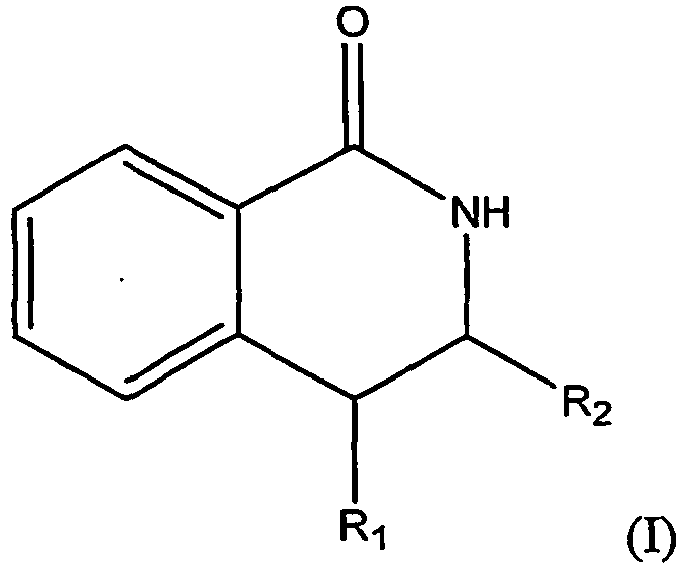
- The subject invention further provides a pharmaceutical composition comprising a compound selected from the group consisting of N-(6-Oxo-5,6-dihydro-phenanthridin-2-yl)-N,N-dimethylacetamide, HCl (PJ-34), 4H-Thieno[2,3-c]isoquinolin-5-one (Tiq-A) and 6(5H)-phenanthridinone (Phen) or combinations thereof, and a pharmaceutically acceptable carrier for use in the treatment or prevention of breast cancer, wherein said breast cancer not being associated with deficiency or mutation in brca1 and/or brca2.
- In another aspect the invention provides a method for the treatment or prevention of cancer comprising administering a therapeutically effective amount of a compound of the general formula (I)
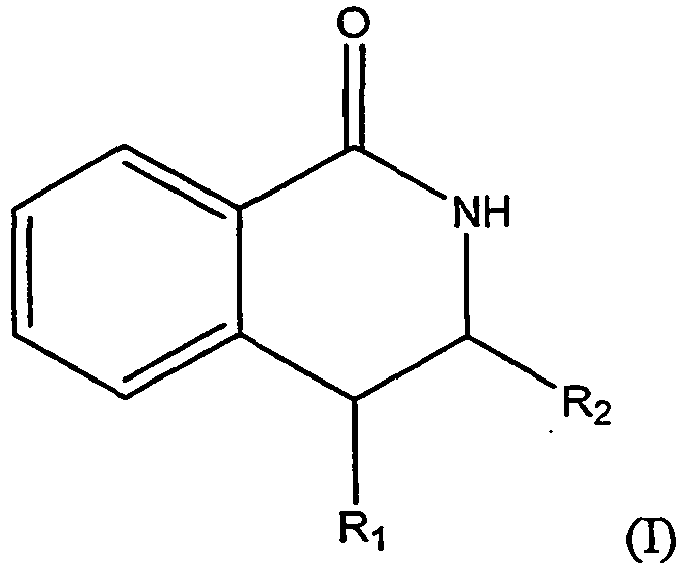
- The subject invention further envisages a method for the treatment or prevention of cancer comprising administering a therapeutically effective amount of a compound selected from the group consisting of N-(6-Oxo-5,6-dihydro-phenanthridin-2-yl)-N,N-dimethylacetamide, HCl (PJ-34), 4H-Thieno[2,3-c]isoquinolin-5-one(Tiq-A) and 6(5H)-phenanthridinone (Phen) or combinations thereof and a pharmaceutically acceptable carrier to a subject suffering from breast cancer, wherein said breast cancer not being associated with deficiency or mutation in brca1 and/or brca2.
-
-
Figure 1 -
Figures 1A, 1C and1E : MCF-7 breast cancer cells (control); -
Figures 1B, 1D and1I : MCF-7 breast cancer cells incubated for 48 hours after single application of PJ-34 (20 µM) 24 hours after seeding. -
Figure 1F : MCF-7 breast cancer cells incubated for 48 hours after single application of PJ-34 (5 µM) 24 hours after seeding. -
Figure 1G : MCF-7 breast cancer cells incubated for 48 hours after single application of PJ-34 (7.5 µM) 24 hours after seeding. -
Figure 1H : MCF-7 breast cancer cells incubated for 48 hours after single application of PJ-34 (10 µM) 24 hours after seeding.
-
-
Figure 2
Survival rate (%) of MCF-7 breast cancer cells after incubation for 48 hours upon exposure to several concentrations of PJ-34 24 hours after seeding. -
Figure 3
Survival rate (%) of MCF-7 breast cancer cells reseeded and incubated for two weeks in PJ-34-free medium, after 48 hours exposure to a single application of several concentrations of PJ-34 applied 24 hours after initial seeding. -
Figure 4 -
Figure 4A : Fibroblast cell proliferation (control) after 12 hours; -
Figure 4B : Fibroblast cell proliferation (control) after 72 hours; -
Figure 4C : Fibroblast cell proliferation (control) after 170 hours; -
Figure 4D : Fibroblast cell proliferation in the presence of 10 µM PJ-34 after 72 hours -
Figure 4E : Fibroblast cell proliferation in the presence of 20µM PJ-34 after 170 hours.
-
-
Figure 5
Survival rate (cells per field) of fibroblasts after repeated exposure to PJ-34 as indicated by the arrows. -
Figure 6
Xenotransplants of MCF-7 established in female CD-1 nu/nu mice (n=6).-
Figure 6A : Three mice not treated with PJ-34 developed tumors (labeled by arrows). -
Figure 6B : Three mice treated with PJ-34 did not develop tumors.
-
-
Figure 7 -
Figure 7A : MCF-7 breast cancer cells (control); -
Figure 7B : MCF-7 breast cancer cells in medium containing 0.1% DMSO (control).
-
-
Figure 8 -
Figures 8A, 8B and 8C : MCF-7 breast cancer cells incubated for 72 hours after a single application of Tiq-A at a concentrations of 50 microM 24 hours after seeding. -
Figures 8D, 8E and 8F : MCF-7 breast cancer cells incubated for 72 hours after a single application of Tiq-A at a concentrations of 100 microM 24 hours after seeding.
-
-
Figure 9 -
Figure 9A : MCF-7 breast cancer cells incubated for 48 hours after a single application of Phen at a concentration of 25 microM 24 hours after seeding. -
Figure 9B and 9C : MCF-7 breast cancer cells incubated for 72 hours after a single application of Phen at a concentration of 50 microM 24 hours after seeding.
-
-
Figure 10
MCF-7 breast cancer cells incubated for 72 hours after single application of 3-AB 1 mM 24 hours after seeding. - MCF-7 is the most abundantly occurring human breast cancer. The subject invention shows a very efficient and rapid killing of MCF-7 breast cancer cells by PJ-34, both in vitro and in vivo, without killing non-dividing cells (brain neurons and cardiomyocytes) or fibroblasts, and with only slowing down fibroblasts proliferation.
- The subject invention also shows efficient killing of MCF-7 breast cancer cells by each of Tiq-A and Phen.
- As used herein, a subject can be a male or a female subject; A subject can be a human or any other mammal.
- The term "cancer" as used herein should be understood to encompass any neoplastic disease which is characterized by abnormal and uncontrolled cell division causing malignant growth or tumor. Cancer cells, unlike benign tumor cells, exhibit the properties of invasion and metastasis and are highly anaplastic. Cancer as used herein may refer to either a solid tumor or tumor metastasis. Non-limiting examples of cancer are breast cancer, cervical cancer, ovary cancer, endometrial cancer, melanoma, prostate cancer and pancreatic cancer. In a specific embodiment, the cancer is breast cancer.
- The term "treating cancer" as used herein should be understood to e.g. encompass treatment resulting in a decrease in tumor size; a decrease in rate of tumor growth; stasis of tumor size; a decrease in the number of metastasis; a decrease in the number of additional metastasis; a decrease in invasiveness of the cancer; a decrease in the rate of progression of the tumor from one stage to the next; inhibition of tumor growth in a tissue of a mammal having a malignant cancer; control of establishment of metastases; inhibition of tumor metastases formation; regression of established tumors as well as decrease in the angiogenesis induced by the cancer, inhibition of growth and proliferation of cancer cells and so forth. The term "treating cancer" as used herein should also be understood to encompass prophylaxis such as prevention as cancer reoccurs after previous treatment (including surgical removal) and prevention of cancer in an individual prone (genetically, due to life style, chronic inflammation and so forth) to develop cancer. As used herein, "prevention of cancer" is thus to be understood to include prevention of metastases, for example after surgical procedures or after chemotherapy.
- As used herein, the breast cancer can be a luminal breast cancer or a basal like breast cancer. Luminal tumors generally express estrogen receptors (ER) with or without co-expression of the progesterone receptor (PR). Basal-like tumors are defined by lack of ER, PR and the human epidermal growth factor receptor (HER2); they express cytokeratins.
- Tumors from Brca1 genetic mutation carriers are often basal like breast cancers (BLBC), whereas Brca2 deficient breast cancer cells have been shown to be mainly luminal cancers.
- As used herein, breast cancer can be female breast cancer or male breast cancer.
- As used herein, the breast cancer can be any breast cancer such as, but not limited to the luminal breast cancers MCF-7, modified MCF-7, DoxR-MCF7, T47D, and MDA-MB-231 and the BLBC cancers SUM149, HCC1937, and SUM1315MO2.
- In one embodiment, the breast cancer is not associated with a deficiency or mutation in brca 1 and
brca 2, i.e. the breast cancer is brca1 (+/+) and brca2(+/+). - In a specific embodiment, the homozygous breast cancer is MCF-7. The breast cancer MCF-7 is also known as MCF-7/ADR, MCF-7 TH and NCI/ADR. (Mehta K. et al., (2002) J. Natl. Canc. Inst. 94, 1652-1654 ).
- In another embodiment, the breast cancer is associated with a deficiency or mutation in brca1 but not associated with a deficiency or mutation in brca2 (i.e. normal homozygous for brca2), i.e. is brca1 (-/-), brca1 (-/+) or brca1 (+/-) and brca2+/+.
- Examples of breast cancer associated with brca1(-l-) are HCC1937 and SUM1315MO2.
- In yet another embodiment, the breast cancer is associated with a deficiency or mutation in brca2 but not associated with a deficiency or mutation in brca1, i.e. is brca1+/+ and brca2-/- or brca2-/+ or brca2+/-.
- Compounds used in the invention (e.g. PJ-34, Phen and Tiq-A) and compositions thereof are thus specifically useful for the treatment and prevention of breast cancer, wherein said breast cancer not being associated with deficiency or mutation in brca1 and/or brca2. Compounds used in the invention (e.g. PJ-34, Tiq-A, and Phen) and compositions thereof are further useful for the prevention of metastases after surgical procedures or after chemotherapy.
- Suitable routes of administration of compounds used in the invention (e.g. PJ-34, Phen and Tiq-A) and compositions thereof are oral, rectal, nasal, topical (including transdermal, buccal and sublingual), vaginal or parenteral (including subcutaneous, intramuscular, intravenous and intradermal) administration or administration via an implant, such as, but not limited to, an osmotic pump, which may for example be implanted within a tumor. In a specific embodiment, the compounds or compositions thereof can be administered orally.
- The exact dose and regimen of administration of compounds used in the invention (e.g. PJ-34, Phen and Tiq-A) or pharmaceutical compositions thereof, will necessarily be dependent upon the therapeutic effect to be achieved (e.g. treatment of breast cancer) and may vary with the route of administration, and the age and condition of the individual subject to whom the medicament is to be administered.
- A dosage for humans is likely to contain 0.0001 - 25 mg per kg body weight per day. The desired dose may be presented as one dose or as multiple sub-doses administered at appropriate intervals. In one embodiment, the dose is from about 1 to about 20 mg per kg body weight. In another embodiment, the dose is from about 5 to about 18 mg per kg body weight. In yet another embodiment, the dose is from about 7 to about 16 mg per kg body weight. In yet another embodiment, the dose is from about 10 to about 15 mg per kg body weight.
- In another embodiment, the dose is from about 0.1 to about 0.9 mg/kg body weight. In another embodiment, the dose is from about 0.2 to about 0.8 mg/kg body weight. In another embodiment, the dose is from about 0.3 to about 0.7 mg/kg body weight. In another embodiment, the dose is from about 0.4 to about 0.6 mg/kg body weight. In another embodiment, the dose is from about 0.5 mg/kg body weight. In a specific embodiment, the dose is about 0.135 mg/kg body weight.
- The present invention thus also relates to pharmaceutical compositions comprising compounds in admixture with pharmaceutically acceptable carriers (auxiliaries), and optionally other therapeutic agents. The auxiliaries must be "acceptable" in the sense of being compatible with the other ingredients of the composition and not deleterious to the recipients thereof.
- Pharmaceutical compositions include those suitable for oral, rectal, nasal, topical (including transdermal, buccal and sublingual), vaginal or parenteral (including subcutaneous, intramuscular, intravenous and intradermal) administration or administration via an implant such as, but not limited to, an osmotic pump, which may for example be implanted within a tumor. The compositions may be prepared by any method well known in the art of pharmacy.
- Such methods include the step of bringing in association compounds used in the invention or combinations thereof with any auxiliary agent. The auxiliary agent(s), also named accessory ingredient(s), include those conventional in the art, such as carriers, fillers, binders, diluents, disintegrants, lubricants, colorants, flavouring agents, antioxidants, and wetting agents.
- Pharmaceutical compositions suitable for oral administration may be presented as discrete dosage units such as pills, tablets, dragées or capsules, or as a powder or granules, or as a solution or suspension. The active ingredient may also be presented as a bolus or paste. The compositions can further be processed into a suppository or enema for rectal administration.
- The invention further includes a pharmaceutical composition, as hereinbefore described, in combination with packaging material, including instructions for the use of the composition for a use as hereinbefore described.
- For parenteral administration, suitable compositions include aqueous and non-aqueous sterile injection. The compositions may be presented in unit-dose or multi-dose containers, for example sealed vials and ampoules, and may be stored in a freeze-dried (lyophilised) condition requiring only the addition of sterile liquid carrier, for example water, prior to use. For transdermal administration, e.g. gels, patches or sprays can be contemplated. Compositions or formulations suitable for pulmonary administration e.g. by nasal inhalation include fine dusts or mists which may be generated by means of metered dose pressurized aerosols, nebulisers or insufflators.
- The compounds of the invention or compositions thereof may be administered in conjunction with other compounds, including, but not limited to, chemotherapeutic agents such as cytotoxic and cytostatic agents, immunological modifiers such as interferons and interleukins, MEK inhibitors, anti-progestogens, cytokines, folic acid, vitamins, minerals and so forth, and/or in combination with surgery and/or radiation therapy.
- The MEK inhibitor can be any MEK inhibitor, such as, but not limited to PD184325 (CI-1040), PD0325901, PD98059 and U0126.
- The term "cytotoxic agent" as used herein should be understood to encompass any agent used for the treatment of abnormal and uncontrolled progressive cellular growth. Non limiting examples of cytotoxic agents include the alkylating agents cyclophosphamide (CTX) (Bristol-Meyers Squibb), ifosfamide (Bristol-Meyers Squibb), chlorambucil (Glaxo Wellcome), and carmustine (Bristol-Meyers Squibb); the anti-metabolites cytarabine (Pharmacia & Upjohn), 6-mercaptopurine (Glaxo Wellcome), 6-thioguanine (Glaxo Wellcome), and methotrexate (Immunex); the antibiotics doxorubicin (Pharmacia & Upjohn), daunorubicin (NeXstar), and mitoxantrone (Immunex); and miscellaneous agents such as vincristine (Lilly), vinblastine (Lilly), and paclitaxel (Bristol-Meyers Squibb) or their pharmaceutically acceptable salts.
- In one aspect the present invention provides a use of a compound of the general formula (I)
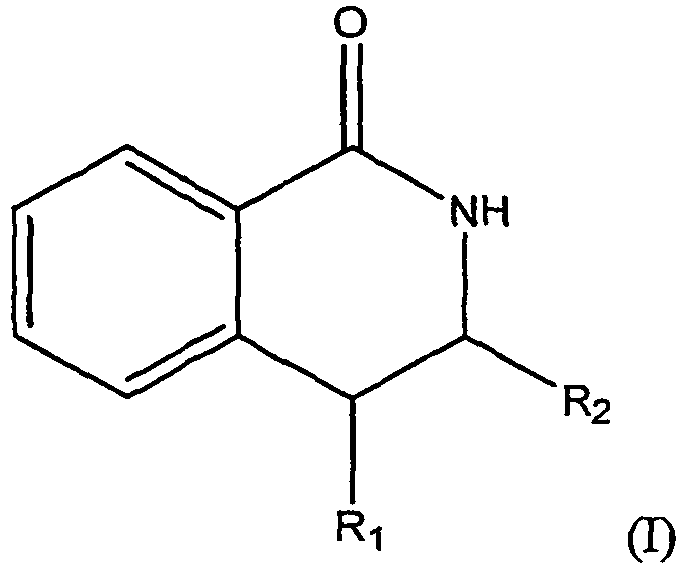
- The term "5 or 6 membered aromatic ring" as used herein is understood to encompass an aromatic ring having 5 or 6 carbon atoms together with the two carbon atoms to which R1 and R2 are bonded, thus forming a fused 5 or 6 membered aromatic ring on the 3,4-substituted -isoquinolin-1-one ring system.
- The term "5 or 6 membered hetero-aromatic ring" as used herein is understood to encompass any heterocyclic aromatic ring having 5 or 6 atoms, containing one or more independent hetero-atoms selected from nitrogen, oxygen and sulfur, which is fused to the 3,4-substituted-isoquinolin-1-one ring system of the compound of formula (I), through the two carbon atoms to which R1 and R2 are bonded. It should be noted that a hetero-atom may be positioned on any position on the fused 5 to 6 membered hetero-aromatic ring formed.
- Non-limiting examples of 5-membered hetero-aromatic rings include: furylene, thienylene, pyrrolylene, oxazolylene, thiazolylene, imidazolylene, isoxazolylene, isothiazolylene, 1,2,3-triazolylene, 1,2,4-triazolylene, 1,2,3-oxadiazolylene, 1,2,4-oxadiazolylene, 1,2,5-oxadiazolylene, 1,3,4-oxadiazolylene, 1,2,3-thiadiazolylene, 1,2,4-thiadiazolylene, 1,2,5-thiadiazolylene, 1,3,4-thiadiazolylene and the like.
- Non-limiting examples of 6-membered hetero-aromatic rings include pyridyl, pyridazinyl, pyrimidinyl, pyrazinyl, 1,2,3-triazinyl, 1,2,4-triazinyl, 1,3,5-triazinyl and the like.
- The term "optionally substituted" as used herein means that the 5 or 6 membered aromatic or hetero-aromatic ring is either unsubstituted or substituted with one or more of the substituents specified on any position of the ring relative to the fused ring system. When the 5 or 6 membered aromatic or hetero-aromatic ring is substituted with more than one substituent the substituents may be the same or different.
- The term "amino" as used herein is meant to encompass primary, secondary or tertiary amines where the point of attachment is through the nitrogen atom which is substituted with C1-C6 straight or branched alkyl. In case of a tertiary amine, the substituent is the same or different.
- The term "formamido" as used herein is meant to encompass a NH-C(O)-H group.
- The term "alkyl substituted amido" as used herein is meant to encompass a -NH-C(O)-C1-C6 alkyl group.
- The term "alkyl amino substituted amido" as used herein is meant to encompass a -NH-C(O)-C1-C6 alkyl-amino group.
- The term "alkyl substituted amino" as used herein is meant to encompass a -C1-C6 alkyl-amino group.
- The term "C1-C6 alkyl" should be understood to encompass any straight or branched alkyl moiety having 1, 2, 3, 4, 5 or 6 carbon atoms.
- In one embodiment R1 and R2 together with the carbon atoms to which they are bonded form a 6-membered aromatic or hetero-aromatic ring. In another embodiment the 6-membered aromatic ring formed is a phenylene ring. In a further embodiment the phenylene ring is substituted by an amido group having the formula: -NHCOR3, wherein R3 is selected from a group consisting of amino and alkyl substituted amino. In one embodiment R3 is an alkyl substituted amino. In a further embodiment the alkyl substituted amino is -CH2N(CH3)2.
- In another embodiment R1 and R2 together with the carbon atoms to which they are bonded form a 5-membered aromatic or hetero-aromatic ring. In a further embodiment the hetero-aromatic ring formed is a thienylene ring.
- The subject invention further provides a use of a compound selected from the group consisting of N-(6-Oxo-5,6-dihydro-phenanthridin-2-yl)-N,N-dimethylacetamide, HCl (PJ-34), 4H-Thieno[2,3-c]isoquinolin-5-one (Tiq-A), and 6(5H)-phenanthridinone (Phen) or combinations thereof for the preparation of a medicament to treat or prevent breast cancer, wherein said breast cancer not being associated with deficiency or mutation in brca1 and/or brca2. In a specific embodiment, the compound is N-(6-Oxo-5,6-dihydro-phenanthridin-2-yl)-N,N-dimethylacetamide, HCl (PJ-34).
- In another aspect the invention provides a pharmaceutical composition comprising a compound of the general formula (I)

- The subject invention further provides a pharmaceutical composition comprising a compound selected from the group consisting of N-(6-Oxo-5,6-dihydro-phenanthridin-2-yl)-N,N-dimethylacetamide, HCl (PJ-34), 4H-Thieno[2,3-c]isoquinolin-5-one(Tiq-A) and 6(5H)-phenanthridinone (Phen) or combinations thereof, and a pharmaceutically acceptable carrier for use in the treatment or prevention of breast cancer, wherein said breast cancer not being associated with deficiency or mutation in brca1 and/or brca2. In a specific embodiment, the compound is N-(6-Oxo-5,6-dihydro-phenanthridin-2-yl)-N,N-dimethylacetamide, HCl (PJ-34).
- In a further aspect the invention provides the claimed compounds for use in a method for the treatment or prevention of breast cancer, wherein said breast cancer not being associated with deficiency or mutation in brca1 and/or brca2. comprising administering a therapeutically effective amount of a compound of the general formula (I)

- The subject invention further envisages the claimed compounds for use in a method for the treatment or prevention of breast cancer, wherein said breast cancer not being associated with deficiency or mutation in brca1 and/or brca2. comprising administering a therapeutically effective amount of a compound selected from the group consisting of N-(6-Oxo-5,6-dihydro-phenanthridin-2-yl)-N,N-dimethylacetamide, HCl (PJ-34), 4H-Thieno[2,3-c]isoquinolin-5-one(Tiq-A) and 6(5H)-phenanthridinone (Phen) or combinations thereof and a pharmaceutically acceptable carrier to a subject suffering from breast cancer, wherein said breast cancer not being associated with deficiency or mutation is brca1 and/or brca2. In a specific embodiment, the compound is N-(6-Oxo-5,6-dihydro-phenanthridin-2-yl)-N,N-dimethylacetamide, HCl (PJ-34).
- In one embodiment, the cancer is breast cancer. In a specific embodiment, the breast cancer is brca1(+/+) and brca2(+/+). In a very specific embodiment, the breast cancer is MCF-7.
- In another embodiment, the breast cancer is brca1(-/-) or brca1(-/+) or brca1(+/-). In yet another embodiment, the breast cancer is brca2(-/-) or brca2(-/+) or brca2(+/).
- Compounds of the invention (e.g. PJ-34, Tiq-A and Phen) or compositions thereof are further useful to test whether cancer cells taken from a biopsy are sensitive to such compounds (e.g. PJ-34, Tiq-A and/or Phen).
- The following materials were used in the below described examples:
- Breast cancer cell line MCF-7 was from ATCC Co. (American Type Culture Collection, P.O. Box 1549, Manassas, VA 20108, USA) - ATCC deposit number HTB-22™ obtained via Almog Diagnostic & Medical equipment Ltd. Industrial Area Bd 3 II-Shoham, 73142 Israel.
- PJ-34 and Phen were purchased from ALEXIS biochemicals, Cat # ALX-270-289. (Alexis Corporation, Industriestasse 17, CH-4415 Lausen, Switzerland). Tiq-A and 3-AB were purchased from Sigma.
- Cells were cultured in 6-wells multi-dish plates (Nunc Denmark). MCF-7 cells were maintained in a medium containing DMEM including 2 mM glutamine (Gibco, Invitrogen cat # 41965, purchased by Rhenium, Jerusalem 91035,Israel), 10% Donor Horse Serum (cat # 04-124-1A) and 1% Pen-Strep Ampho (cat # 03-033-1B). These two last reagents were purchased from Biological Industries Kibbutz Beit HaEmek, 25115 Israel. Fibroblasts were prepared from mouse embryos as described by Menssier de Murcia J., et al., (1997) Proc. Natl. Acad. Sci. USA. 94, 7303-7307 . The fibroblasts were cultured in the same medium as the MCF-7 cells, except for replacement of Horse serum by Fetal Bovine Serum (Biological Industries, Kibbutz Beit HaEmek 25115 Israel, cat # 04-121-1A).
- Microscope: Inverted fluorescent Olympus1x51 microscope.
- Mice: female CD-1 nu/nu 5-6 weeks old mice (Charles River Labs, Sulzfeld, Germany) were purchased in Israel from Harlan Labs, Jerusalem. The mice were maintained under pathogen-free conditions with access to mouse chow and water ad libitum.
-
Figure 1 shows MCF-7 cells photographed before treatment (control) and shows that the MCF-7 cancer cells were destroyed within 48 hours after a single application of 5, 7.5, 10 and 20 µM PJ-34, 24 hours after seeding. - MCF-7 cells were seeded (about 50,000/well) in 6-well plates. Cultured cells were exposed to PJ-34, 24 hours after seeding by single application of concentrations of 1, 2, 5, 7.5, 10 and 20 µM and incubated for 48 hours (in the medium containing the PJ-34). Cells were counted and pictured under microscope 48 hours after application of PJ-34.
Figure 2 shows that more than 99.5% cell death was measured forty eight hours after the single application of 10-20 µM PJ-34. - MCF-7 cells were seeded (around 50,000/well) in 6-well plates. Cultured cells were exposed to PJ-34 24 hours after seeding at concentrations of 1, 5, and 10µM. Cells treated by single application with 1, 5 and 10 µM PJ-34 were incubated for 48 hours (in the medium containing the PJ-34) and were re-seeded after the 48 hours at a density of 5-7×10⁴ in 10 cm plates for colony formation, in PJ-34 free medium. After 2 weeks incubation in PJ-34 free medium without application of PJ-34, cells were fixed (methanol:acetic acid 3:1), stained with crystal violet and counted to determine cells survival.
-
Figure 3 shows that MCF-7 breast cancer cells treated with 10-20 µM PJ-34 and incubated for 48 hours in PJ-34 containing medium did not recover after two additional weeks of incubation in PJ-34 free medium without any additional application of PJ-34. - Mouse fetal fibroblasts (which are not maliganant) were seeded at a density of 5-7x10⁴ in 3 cm plates. Cultured cells were exposed to a single application of 10 µM PJ-34, 24 hours after seeding and incubated for 48 hours. PJ-34 (10 µM) was applied again 72 hours after seeding and incubated for an additional 100 hours.
- The proliferation of the fibroblasts was retarded (about two-to three fold) in the presence of a total of 20 µM PJ-34. However, within 100 hours in the presence of 20 µM PJ-34 in the medium, cell counts were similar to those of untreated fibroblasts.
- Thus,
Figure 5 shows that proliferation of mouse fetal fibroblasts was slowed down by repeated applications of 10 µM PJ-34 but also shows that fibroblasts survived the treatment with PJ-34. -
Figures 4A, 4B and 4C show control fibroblast cell cultures after 12, 72 and 170 hours after seeding respectively;Figure 4D shows the fibroblasts exposed (24 hours after seeding) to 10 µM PJ-34 after 48 hours of incubation (i.e. photographed 72 hours after seeding).Figure 4E shows the fully recovered fibroblast proliferation in the presence of a total of 20 µM PJ-34 (an additional 10µM PJ-34 was added to the medium 72 hours after seeding) in the medium after approximately 100 hours incubation with 20µM PJ-34 (photographed 170 hours after seeding). - MCF-7 cells were seeded (around 50,000/well) in 6-well plates. Cultured cells were exposed to PJ-34 24 hours after seeding at a concentration of 30µM. Cells treated by single application with 30 µM PJ-34 were incubated for 48 hours (in the medium containing the PJ-34) and were re-seeded after the 48 hours at a density of 5-7x10⁴ in 6-well dishes, in PJ-34 free medium. After 2 weeks and after 3 weeks incubation in PJ-34 free medium without application of PJ-34, cells were fixed (methanol:acetic acid 3:1), stained with crystal violet and counted to determine cells survival. MCF-7 cells did not recover after two and three weeks in the PJ-34 free medium.
- Xenotransplants of MCF-7 were established in six (6) female CD-1 nu/nu 5-6 weeks old mice.
- The mice were injected subcutaneously with 107 MCF-7 cells (injected in 150 µl of MEM and 150 µl of Matrigel Basement Membrane Matrix (Becton Dickinson, Bedford, MA, USA; In Israel, Bactolab Diagnostics)) to develop xenotransplants.
- After 7 weeks, tumors at a size of about 0.7-1 cm were observed in the three mice not treated with PJ-34 (
Figure 6A ). - In the other three mice, wherein PJ-34 (2 mM dissolved in 200 µl PBS) was inserted in a subcutaneously implanted Alzet osmotic pump (Biotest. Ltd. P.O. Box 7042, Kfar Saba, Israel 44425) designed to constantly release PJ-34 (at about 10µM concentration) during 14 days, no visible MCF-7 tumors developed (
Figure 6B ). - The treatment with PJ-34 did not affect viability, growth or behavior of the mice for 3 months after the treatment. Mice were sacrificed after 3 months.
- Thus, PJ-34 prevented the development of MCF-7 xenotransplants in nude female mice injected with MCF-7 cells.
-
Figure 7 shows MCF-7 breast cancer control cells 96 hours after seeding, both as is (Figure 7A ) and in medium containing a maximal amount of 0.1% DMSO (Figure 7B ). -
Figures 8A, 8B and 8C shows photographed MCF-7 breast cancer cells 72 hours after treatment with a single application of 50µM Tiq-A 24 hours after seeding.Figures 8D, 8E and 8F show photographed MCF-7 breast cancer cells 72 hours after treatment with a single application of 100µM Tiq-A 24 hours after seeding. -
Figure 9A shows MCF-7 cells photographed 48 hours after treatment with a single application of 25µM Phen 24 hours after seeding.Figures 9B and 9C show MCF-7 cells photographed 72 hours after treatment with a single application of 50µM Phen 24 hours after seeding. -
Figure 10 shows MCF-7 cells photographed 72 hours after treatment with a single application of 1 mM 3-AB 1, 24 hours after seeding - All of PJ-34, Tiq-A and Phen were efficient in killing MCF-7 cells. PJ-34 was more efficient than Tiq-A (4H-Thieno[2,3-c]isoquinolin-5-one), which was more efficient than Phen (6(5H)-phenanthridinone)). 3-AB (3-aminobenzamide) only scarcely affected the MCF-7 cells.
- Female CD-1 nu/nu mice are injected subcutaneously with GFP (green fluorescent protein) transfected MCF-7 cells, which can be traced in the animal under UV light.
- About 1010 MCF-7 cells are injected in 150 µl of MEM (Gibco, Rhenium, Jerusalem Israel) and 150 µl of Matrigel Basement Membrane Matrix (Becton Dickinson, Bedford, MA, USA; In Israel, Bactolab Diagnostics). Transfection with GFP will enable tracing of the subcutaneous implants under UV light even before tumors are developed. Transfection of MCF-7 cells with GFP is carried out as described in Caceres et al., 2003 Luminescence 18, 218-223 .
- Nine (9) groups of mice each containing 6 nude female mice (6 weeks old) are implanted with osmotic pumps containing PJ-34 at different periods of time as follows: Group 1: pump implanted 1 hour after injection with GFP transfected MCF-7 cells Group 2: pump implanted 12 hours after injection with GFP transfected MCF-7 cells Group 3: pump implanted 24 hours after injection with GFP transfected MCF-7 cells Group 4: pump implanted 48 hours after injection with GFP transfected MCF-7 cells Group 5: pump implanted 72 hours after injection with GFP transfected MCF-7 cells Group 6: pump implanted 7 days after injection with GFP transfected MCF-7 cells Group 7: pump implanted 14 days after injection with GFP transfected MCF-7 cells Group 8: pump implanted 21 days after injection with GFP transfected MCF-7 cells Group 9: pump implanted 30 days after injection with GFP transfected MCF-7 cells
- PJ-34 (2 mM dissolved in 200 µl PBS) is inserted in the subcutaneously implanted Alzet osmotic pump, designed to constantly release PJ-34 (at about 10µM concentration) during 14 days.
- Changes in the amount of MCF-7 cells in the injected loci in PJ-34 treated mice are monitored.
- 7 weeks after injection with MCF-7 cells, tumors at a size of about 0.7-1 cm developed in female nude mice that were not treated with PJ-34.
- 5 groups of mice receive treatment as follows:
- a) Two control groups of mice which are not injected with MCF-7 cells, but are treated with PJ- 34 (per os, i.v. or by osmotic pump). These mice are tested for their tolerance to PJ-34 and are not sacrificed.
- b) Three groups of mice are injected with MCF-7
cells 1010 cells in 150 µl of MEM and 150 µl of matrigel as described above for Example 8. After development of MCF-7 tumors, the effect of PJ-34 on tumor growth is examined during treatment with PJ-34 applied either i.v. (group 2), per os (group 3) or by intra-tumoral implantation of osmotic pump (group 4). Changes in the size of the MCF-7 tumors are monitored.
Claims (15)
- A pharmaceutical composition comprising a compound of the general formula (I)
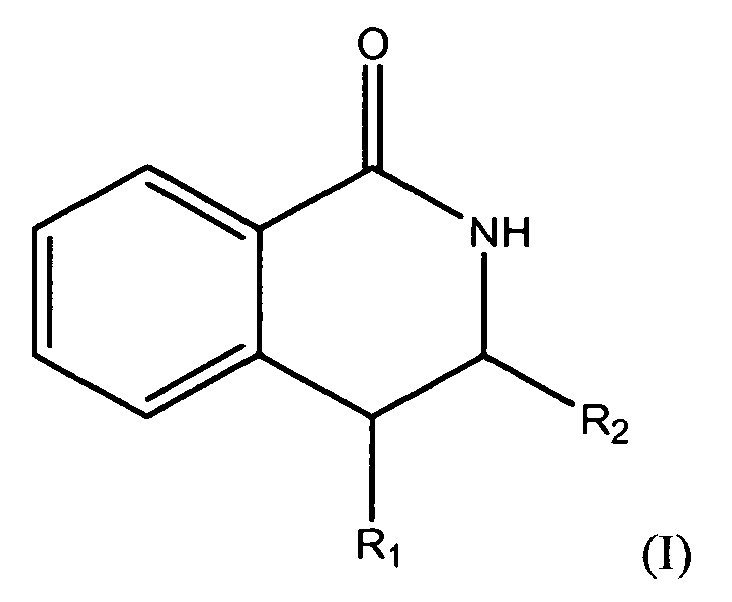
- A pharmaceutical composition for use in the treatment or prevention according to claim 1, wherein R1 and R2 together with the carbon atoms to which they are bonded form a 6-membered aromatic or hetero-aromatic ring.
- A pharmaceutical composition for use in the treatment or prevention according to claim 2, wherein the 6-membered aromatic ring formed is a phenylene ring.
- A pharmaceutical composition for use in the treatment or prevention according to claim 3, wherein the phenylene ring is substituted by -NHCOR3, wherein R3 is selected from a group consisting of amino and alkyl substituted amino.
- A pharmaceutical composition for use in the treatment or prevention according to claim 4, wherein R3 is an alkyl substituted amino.
- A pharmaceutical composition for use in the treatment or prevention according to claim 5, wherein the alkyl substituted amino is -CH2N(CH3)2.
- A pharmaceutical composition for use in the treatment or prevention according to claim 1, wherein R1 and R2 together with the carbon atoms to which they are bonded form a 5-membered aromatic or hetero-aromatic ring.
- A pharmaceutical composition for use in the treatment or prevention according to claim 7, wherein the hetero-aromatic ring formed is a thienylene ring.
- A pharmaceutical composition for use in the treatment or prevention according to claim 1, wherein said compound is selected from N-(6-Oxo-5,6-dihydro-phenanthridin-2-yl)-N,N-dimethylacetamide, HCl)(PJ-34), 4H-Thieno[2,3-c]isoquinolin-5-one(Tiq-A) and 6(5H)-phenanthridinone (Phen).
- A pharmaceutical composition for use in the treatment or prevention according to claim 1 wherein the compound is N-(6-Oxo-5,6-dihydro-phenanthridin-2-yl)-N,N-dimethylacetamide, HCl (PJ-34).
- A pharmaceutical composition for use in the treatment or prevention according to any one of claims 1-10, for use in a method for the treatment or prevention of breast cancer wherein the breast cancer is brca1 (+/+) and brca2(+/+).
- A pharmaceutical composition for use in the treatment or prevention according to any one of claims 1-10 for use in a method for the treatment or prevention of breast cancer, wherein the breast cancer is MCF-7 or MDA-MB-231.
- A pharmaceutical composition for use in the treatment or prevention according to any one of claims 1-10 for use in a method for the treatment or prevention of breast cancer, wherein said composition is administered in conjunction with other compounds.
- A pharmaceutical composition for use in the treatment or prevention according to claim 13 for use in a method for treatment or prevention of breast cancer, wherein said other compounds are selected from chemotherapeutic agents, immunological modifiers, MEK inhibitors, anti-progestogens, cytokines, folic acid and vitamins.
- A pharmaceutical composition for use in the treatment or prevention according to claim 14 for use in a method for the treatment or prevention of breast cancer, wherein said other compounds are MEK inhibitors.
Applications Claiming Priority (2)
| Application Number | Priority Date | Filing Date | Title |
|---|---|---|---|
| US96066607P | 2007-10-09 | 2007-10-09 | |
| PCT/IL2008/001075 WO2009047752A1 (en) | 2007-10-09 | 2008-08-05 | Breast cancer therapy |
Publications (2)
| Publication Number | Publication Date |
|---|---|
| EP2207548A1 EP2207548A1 (en) | 2010-07-21 |
| EP2207548B1 true EP2207548B1 (en) | 2013-05-22 |
Family
ID=39863058
Family Applications (1)
| Application Number | Title | Priority Date | Filing Date |
|---|---|---|---|
| EP08789751.8A Active EP2207548B1 (en) | 2007-10-09 | 2008-08-05 | Breast cancer therapy |
Country Status (3)
| Country | Link |
|---|---|
| US (1) | US8729080B2 (en) |
| EP (1) | EP2207548B1 (en) |
| WO (1) | WO2009047752A1 (en) |
Families Citing this family (4)
| Publication number | Priority date | Publication date | Assignee | Title |
|---|---|---|---|---|
| US9486449B2 (en) | 2007-10-09 | 2016-11-08 | Malka COHEN-ARMON | Cancer therapy |
| US20090170842A1 (en) * | 2007-11-14 | 2009-07-02 | University Of Kansas | Brca1-based breast or ovarian cancer prevention agents and methods of use |
| ES2384817B1 (en) * | 2010-12-14 | 2013-06-10 | Consejo Superior De Investigaciones Científicas (Csic) | SNAIL-1 PROMETASTASSIC FACTOR INHIBITORS. |
| US20180200261A1 (en) * | 2015-07-20 | 2018-07-19 | Mayo Foundation For Medical Education And Research | Methods and materials for treating cancer |
Family Cites Families (9)
| Publication number | Priority date | Publication date | Assignee | Title |
|---|---|---|---|---|
| US6121278A (en) * | 1997-09-03 | 2000-09-19 | Guilford Pharmaceuticals, Inc. | Di-n-heterocyclic compounds, methods, and compositions for inhibiting parp activity |
| US6277990B1 (en) * | 1999-12-07 | 2001-08-21 | Inotek Corporation | Substituted phenanthridinones and methods of use thereof |
| US6531464B1 (en) * | 1999-12-07 | 2003-03-11 | Inotek Pharmaceutical Corporation | Methods for the treatment of neurodegenerative disorders using substituted phenanthridinone derivatives |
| US6476048B1 (en) * | 1999-12-07 | 2002-11-05 | Inotek Pharamaceuticals Corporation | Substituted phenanthridinones and methods of use thereof |
| US6723733B2 (en) * | 2000-05-19 | 2004-04-20 | Guilford Pharmaceuticals, Inc. | Sulfonamide and carbamide derivatives of 6(5H)phenanthridinones and their uses |
| ITMI20002358A1 (en) * | 2000-10-31 | 2002-05-01 | Flavio Moroni | TIENO DERIVATIVES, 2, 3-C | ISOCHINOLIN-3-ONE AS INHIBITORS OF POLY (DP-RIBOSE) POLYMERASE |
| US7176188B2 (en) * | 2003-05-07 | 2007-02-13 | UniversitéLaval | Method of lethally sensitizing human and animal cells |
| US20060079510A1 (en) * | 2004-09-30 | 2006-04-13 | Kristoffer Hellstrand | Use of PARP-1 inhibitors for protecting tumorcidal lymphocytes from apoptosis |
| ATE499098T1 (en) * | 2005-11-25 | 2011-03-15 | Pharma Mar Sa | USE OF PARP-1 INHIBITORS |
-
2008
- 2008-08-05 EP EP08789751.8A patent/EP2207548B1/en active Active
- 2008-08-05 WO PCT/IL2008/001075 patent/WO2009047752A1/en not_active Ceased
-
2010
- 2010-04-08 US US12/756,714 patent/US8729080B2/en active Active
Also Published As
| Publication number | Publication date |
|---|---|
| WO2009047752A1 (en) | 2009-04-16 |
| US8729080B2 (en) | 2014-05-20 |
| EP2207548A1 (en) | 2010-07-21 |
| US20100284964A1 (en) | 2010-11-11 |
Similar Documents
| Publication | Publication Date | Title |
|---|---|---|
| ES2258566T3 (en) | PHARMACOS COMBINATIONS (FOR EXAMPLE, CHLORPROMACINE AND PENTAMIDINE) FOR THE TREATMENT OF NEOPLASIC DISORDERS. | |
| US6693125B2 (en) | Combinations of drugs (e.g., a benzimidazole and pentamidine) for the treatment of neoplastic disorders | |
| AU2008213576B2 (en) | Treatment of resistant or refractory cancers with multi-arm polymeric conjugates of 7-ethyl-10-hydroxycamptothecin | |
| AU2002246636A1 (en) | Combinations of drugs (e.g., chlorpromazine and pentamidine) for the treatment of neoplastic disorders | |
| JP2005536509A (en) | Drug combinations for the treatment of neoplasms | |
| CA3018145C (en) | Method of treating triple negative breast cancer | |
| US20250145617A1 (en) | Sigma-2 receptor ligand drug conjugates as antitumor compounds, methods of synthesis and uses thereof | |
| EP2979700A1 (en) | Low-dose antitumor agent including irinotecan hydrochloride hydrate | |
| KR20100137570A (en) | ON01910.NAA Enhances Chemotherapy Activity in Drug-Resistant Tumors | |
| EP2207548B1 (en) | Breast cancer therapy | |
| US20180169123A1 (en) | Combination therapy with a flavagline and 2-deoxyglucose | |
| KR20050026091A (en) | Compounds useful for the treatment of diseases responsive to antiangiogenetic therapy | |
| KR102127125B1 (en) | Anticancer compositions comprising immune checkpoint inhibitors | |
| KR101847252B1 (en) | Antitumor agent including irinotecan hydrochloride hydrate | |
| HRP20030382A2 (en) | A combination comprising camptothecin and a stilbene derivative for the treatment of cancer | |
| US9486449B2 (en) | Cancer therapy | |
| DE3874982T2 (en) | ANTIPSYCHOTIC COMPOSITIONS WITH DIOXOPIPERIDINE DERIVATIVES. | |
| NZ740252A (en) | Antitumor agent including low-dose irinotecan hydrochloride hydrate | |
| AU2006200697A1 (en) | Combinations of drugs (e.g., chlorpromazine and pentamidine) for the treatment of neoplastic disorders |
Legal Events
| Date | Code | Title | Description |
|---|---|---|---|
| PUAI | Public reference made under article 153(3) epc to a published international application that has entered the european phase |
Free format text: ORIGINAL CODE: 0009012 |
|
| 17P | Request for examination filed |
Effective date: 20100510 |
|
| AK | Designated contracting states |
Kind code of ref document: A1 Designated state(s): AT BE BG CH CY CZ DE DK EE ES FI FR GB GR HR HU IE IS IT LI LT LU LV MC MT NL NO PL PT RO SE SI SK TR |
|
| AX | Request for extension of the european patent |
Extension state: AL BA MK RS |
|
| DAX | Request for extension of the european patent (deleted) | ||
| 17Q | First examination report despatched |
Effective date: 20120502 |
|
| GRAP | Despatch of communication of intention to grant a patent |
Free format text: ORIGINAL CODE: EPIDOSNIGR1 |
|
| GRAS | Grant fee paid |
Free format text: ORIGINAL CODE: EPIDOSNIGR3 |
|
| GRAA | (expected) grant |
Free format text: ORIGINAL CODE: 0009210 |
|
| AK | Designated contracting states |
Kind code of ref document: B1 Designated state(s): AT BE BG CH CY CZ DE DK EE ES FI FR GB GR HR HU IE IS IT LI LT LU LV MC MT NL NO PL PT RO SE SI SK TR |
|
| REG | Reference to a national code |
Ref country code: GB Ref legal event code: FG4D |
|
| REG | Reference to a national code |
Ref country code: CH Ref legal event code: EP |
|
| REG | Reference to a national code |
Ref country code: AT Ref legal event code: REF Ref document number: 612816 Country of ref document: AT Kind code of ref document: T Effective date: 20130615 |
|
| REG | Reference to a national code |
Ref country code: IE Ref legal event code: FG4D |
|
| REG | Reference to a national code |
Ref country code: DE Ref legal event code: R096 Ref document number: 602008024831 Country of ref document: DE Effective date: 20130718 |
|
| REG | Reference to a national code |
Ref country code: AT Ref legal event code: MK05 Ref document number: 612816 Country of ref document: AT Kind code of ref document: T Effective date: 20130522 |
|
| REG | Reference to a national code |
Ref country code: LT Ref legal event code: MG4D |
|
| PG25 | Lapsed in a contracting state [announced via postgrant information from national office to epo] |
Ref country code: LT Free format text: LAPSE BECAUSE OF FAILURE TO SUBMIT A TRANSLATION OF THE DESCRIPTION OR TO PAY THE FEE WITHIN THE PRESCRIBED TIME-LIMIT Effective date: 20130522 Ref country code: FI Free format text: LAPSE BECAUSE OF FAILURE TO SUBMIT A TRANSLATION OF THE DESCRIPTION OR TO PAY THE FEE WITHIN THE PRESCRIBED TIME-LIMIT Effective date: 20130522 Ref country code: SI Free format text: LAPSE BECAUSE OF FAILURE TO SUBMIT A TRANSLATION OF THE DESCRIPTION OR TO PAY THE FEE WITHIN THE PRESCRIBED TIME-LIMIT Effective date: 20130522 Ref country code: SE Free format text: LAPSE BECAUSE OF FAILURE TO SUBMIT A TRANSLATION OF THE DESCRIPTION OR TO PAY THE FEE WITHIN THE PRESCRIBED TIME-LIMIT Effective date: 20130522 Ref country code: IS Free format text: LAPSE BECAUSE OF FAILURE TO SUBMIT A TRANSLATION OF THE DESCRIPTION OR TO PAY THE FEE WITHIN THE PRESCRIBED TIME-LIMIT Effective date: 20130922 Ref country code: NO Free format text: LAPSE BECAUSE OF FAILURE TO SUBMIT A TRANSLATION OF THE DESCRIPTION OR TO PAY THE FEE WITHIN THE PRESCRIBED TIME-LIMIT Effective date: 20130822 Ref country code: PT Free format text: LAPSE BECAUSE OF FAILURE TO SUBMIT A TRANSLATION OF THE DESCRIPTION OR TO PAY THE FEE WITHIN THE PRESCRIBED TIME-LIMIT Effective date: 20130923 Ref country code: ES Free format text: LAPSE BECAUSE OF FAILURE TO SUBMIT A TRANSLATION OF THE DESCRIPTION OR TO PAY THE FEE WITHIN THE PRESCRIBED TIME-LIMIT Effective date: 20130902 Ref country code: GR Free format text: LAPSE BECAUSE OF FAILURE TO SUBMIT A TRANSLATION OF THE DESCRIPTION OR TO PAY THE FEE WITHIN THE PRESCRIBED TIME-LIMIT Effective date: 20130823 Ref country code: AT Free format text: LAPSE BECAUSE OF FAILURE TO SUBMIT A TRANSLATION OF THE DESCRIPTION OR TO PAY THE FEE WITHIN THE PRESCRIBED TIME-LIMIT Effective date: 20130522 |
|
| REG | Reference to a national code |
Ref country code: NL Ref legal event code: VDEP Effective date: 20130522 |
|
| PG25 | Lapsed in a contracting state [announced via postgrant information from national office to epo] |
Ref country code: HR Free format text: LAPSE BECAUSE OF FAILURE TO SUBMIT A TRANSLATION OF THE DESCRIPTION OR TO PAY THE FEE WITHIN THE PRESCRIBED TIME-LIMIT Effective date: 20130522 Ref country code: BG Free format text: LAPSE BECAUSE OF FAILURE TO SUBMIT A TRANSLATION OF THE DESCRIPTION OR TO PAY THE FEE WITHIN THE PRESCRIBED TIME-LIMIT Effective date: 20130822 Ref country code: PL Free format text: LAPSE BECAUSE OF FAILURE TO SUBMIT A TRANSLATION OF THE DESCRIPTION OR TO PAY THE FEE WITHIN THE PRESCRIBED TIME-LIMIT Effective date: 20130522 |
|
| PG25 | Lapsed in a contracting state [announced via postgrant information from national office to epo] |
Ref country code: LV Free format text: LAPSE BECAUSE OF FAILURE TO SUBMIT A TRANSLATION OF THE DESCRIPTION OR TO PAY THE FEE WITHIN THE PRESCRIBED TIME-LIMIT Effective date: 20130522 |
|
| PG25 | Lapsed in a contracting state [announced via postgrant information from national office to epo] |
Ref country code: EE Free format text: LAPSE BECAUSE OF FAILURE TO SUBMIT A TRANSLATION OF THE DESCRIPTION OR TO PAY THE FEE WITHIN THE PRESCRIBED TIME-LIMIT Effective date: 20130522 Ref country code: BE Free format text: LAPSE BECAUSE OF FAILURE TO SUBMIT A TRANSLATION OF THE DESCRIPTION OR TO PAY THE FEE WITHIN THE PRESCRIBED TIME-LIMIT Effective date: 20130522 Ref country code: CZ Free format text: LAPSE BECAUSE OF FAILURE TO SUBMIT A TRANSLATION OF THE DESCRIPTION OR TO PAY THE FEE WITHIN THE PRESCRIBED TIME-LIMIT Effective date: 20130522 Ref country code: SK Free format text: LAPSE BECAUSE OF FAILURE TO SUBMIT A TRANSLATION OF THE DESCRIPTION OR TO PAY THE FEE WITHIN THE PRESCRIBED TIME-LIMIT Effective date: 20130522 Ref country code: DK Free format text: LAPSE BECAUSE OF FAILURE TO SUBMIT A TRANSLATION OF THE DESCRIPTION OR TO PAY THE FEE WITHIN THE PRESCRIBED TIME-LIMIT Effective date: 20130522 |
|
| PG25 | Lapsed in a contracting state [announced via postgrant information from national office to epo] |
Ref country code: IT Free format text: LAPSE BECAUSE OF FAILURE TO SUBMIT A TRANSLATION OF THE DESCRIPTION OR TO PAY THE FEE WITHIN THE PRESCRIBED TIME-LIMIT Effective date: 20130522 Ref country code: RO Free format text: LAPSE BECAUSE OF FAILURE TO SUBMIT A TRANSLATION OF THE DESCRIPTION OR TO PAY THE FEE WITHIN THE PRESCRIBED TIME-LIMIT Effective date: 20130522 Ref country code: NL Free format text: LAPSE BECAUSE OF FAILURE TO SUBMIT A TRANSLATION OF THE DESCRIPTION OR TO PAY THE FEE WITHIN THE PRESCRIBED TIME-LIMIT Effective date: 20130522 |
|
| PLBE | No opposition filed within time limit |
Free format text: ORIGINAL CODE: 0009261 |
|
| STAA | Information on the status of an ep patent application or granted ep patent |
Free format text: STATUS: NO OPPOSITION FILED WITHIN TIME LIMIT |
|
| REG | Reference to a national code |
Ref country code: CH Ref legal event code: PL |
|
| 26N | No opposition filed |
Effective date: 20140225 |
|
| PG25 | Lapsed in a contracting state [announced via postgrant information from national office to epo] |
Ref country code: CH Free format text: LAPSE BECAUSE OF NON-PAYMENT OF DUE FEES Effective date: 20130831 Ref country code: LI Free format text: LAPSE BECAUSE OF NON-PAYMENT OF DUE FEES Effective date: 20130831 Ref country code: MC Free format text: LAPSE BECAUSE OF FAILURE TO SUBMIT A TRANSLATION OF THE DESCRIPTION OR TO PAY THE FEE WITHIN THE PRESCRIBED TIME-LIMIT Effective date: 20130522 |
|
| REG | Reference to a national code |
Ref country code: IE Ref legal event code: MM4A |
|
| REG | Reference to a national code |
Ref country code: DE Ref legal event code: R097 Ref document number: 602008024831 Country of ref document: DE Effective date: 20140225 |
|
| PG25 | Lapsed in a contracting state [announced via postgrant information from national office to epo] |
Ref country code: IE Free format text: LAPSE BECAUSE OF NON-PAYMENT OF DUE FEES Effective date: 20130805 |
|
| PG25 | Lapsed in a contracting state [announced via postgrant information from national office to epo] |
Ref country code: TR Free format text: LAPSE BECAUSE OF FAILURE TO SUBMIT A TRANSLATION OF THE DESCRIPTION OR TO PAY THE FEE WITHIN THE PRESCRIBED TIME-LIMIT Effective date: 20130522 Ref country code: MT Free format text: LAPSE BECAUSE OF FAILURE TO SUBMIT A TRANSLATION OF THE DESCRIPTION OR TO PAY THE FEE WITHIN THE PRESCRIBED TIME-LIMIT Effective date: 20130522 Ref country code: CY Free format text: LAPSE BECAUSE OF FAILURE TO SUBMIT A TRANSLATION OF THE DESCRIPTION OR TO PAY THE FEE WITHIN THE PRESCRIBED TIME-LIMIT Effective date: 20130522 |
|
| PG25 | Lapsed in a contracting state [announced via postgrant information from national office to epo] |
Ref country code: HU Free format text: LAPSE BECAUSE OF FAILURE TO SUBMIT A TRANSLATION OF THE DESCRIPTION OR TO PAY THE FEE WITHIN THE PRESCRIBED TIME-LIMIT; INVALID AB INITIO Effective date: 20080805 Ref country code: LU Free format text: LAPSE BECAUSE OF NON-PAYMENT OF DUE FEES Effective date: 20130805 |
|
| REG | Reference to a national code |
Ref country code: FR Ref legal event code: PLFP Year of fee payment: 9 |
|
| REG | Reference to a national code |
Ref country code: FR Ref legal event code: PLFP Year of fee payment: 10 |
|
| REG | Reference to a national code |
Ref country code: FR Ref legal event code: PLFP Year of fee payment: 11 |
|
| P01 | Opt-out of the competence of the unified patent court (upc) registered |
Effective date: 20230627 |
|
| PGFP | Annual fee paid to national office [announced via postgrant information from national office to epo] |
Ref country code: DE Payment date: 20240828 Year of fee payment: 17 |
|
| PGFP | Annual fee paid to national office [announced via postgrant information from national office to epo] |
Ref country code: GB Payment date: 20250826 Year of fee payment: 18 |
|
| PGFP | Annual fee paid to national office [announced via postgrant information from national office to epo] |
Ref country code: FR Payment date: 20250825 Year of fee payment: 18 |