EP2205280B1 - Pharmazeutische formulierungen - Google Patents
Pharmazeutische formulierungen Download PDFInfo
- Publication number
- EP2205280B1 EP2205280B1 EP08833819.9A EP08833819A EP2205280B1 EP 2205280 B1 EP2205280 B1 EP 2205280B1 EP 08833819 A EP08833819 A EP 08833819A EP 2205280 B1 EP2205280 B1 EP 2205280B1
- Authority
- EP
- European Patent Office
- Prior art keywords
- antibody
- creatine
- protein
- creatinine
- proteins
- Prior art date
- Legal status (The legal status is an assumption and is not a legal conclusion. Google has not performed a legal analysis and makes no representation as to the accuracy of the status listed.)
- Active
Links
Images




Classifications
-
- A—HUMAN NECESSITIES
- A61—MEDICAL OR VETERINARY SCIENCE; HYGIENE
- A61K—PREPARATIONS FOR MEDICAL, DENTAL OR TOILETRY PURPOSES
- A61K47/00—Medicinal preparations characterised by the non-active ingredients used, e.g. carriers or inert additives; Targeting or modifying agents chemically bound to the active ingredient
- A61K47/06—Organic compounds, e.g. natural or synthetic hydrocarbons, polyolefins, mineral oil, petrolatum or ozokerite
- A61K47/24—Organic compounds, e.g. natural or synthetic hydrocarbons, polyolefins, mineral oil, petrolatum or ozokerite containing atoms other than carbon, hydrogen, oxygen, halogen, nitrogen or sulfur, e.g. cyclomethicone or phospholipids
-
- A—HUMAN NECESSITIES
- A61—MEDICAL OR VETERINARY SCIENCE; HYGIENE
- A61K—PREPARATIONS FOR MEDICAL, DENTAL OR TOILETRY PURPOSES
- A61K39/00—Medicinal preparations containing antigens or antibodies
- A61K39/395—Antibodies; Immunoglobulins; Immune serum, e.g. antilymphocytic serum
-
- A—HUMAN NECESSITIES
- A61—MEDICAL OR VETERINARY SCIENCE; HYGIENE
- A61K—PREPARATIONS FOR MEDICAL, DENTAL OR TOILETRY PURPOSES
- A61K47/00—Medicinal preparations characterised by the non-active ingredients used, e.g. carriers or inert additives; Targeting or modifying agents chemically bound to the active ingredient
- A61K47/06—Organic compounds, e.g. natural or synthetic hydrocarbons, polyolefins, mineral oil, petrolatum or ozokerite
- A61K47/16—Organic compounds, e.g. natural or synthetic hydrocarbons, polyolefins, mineral oil, petrolatum or ozokerite containing nitrogen, e.g. nitro-, nitroso-, azo-compounds, nitriles, cyanates
- A61K47/18—Amines; Amides; Ureas; Quaternary ammonium compounds; Amino acids; Oligopeptides having up to five amino acids
-
- A—HUMAN NECESSITIES
- A61—MEDICAL OR VETERINARY SCIENCE; HYGIENE
- A61K—PREPARATIONS FOR MEDICAL, DENTAL OR TOILETRY PURPOSES
- A61K47/00—Medicinal preparations characterised by the non-active ingredients used, e.g. carriers or inert additives; Targeting or modifying agents chemically bound to the active ingredient
- A61K47/06—Organic compounds, e.g. natural or synthetic hydrocarbons, polyolefins, mineral oil, petrolatum or ozokerite
- A61K47/16—Organic compounds, e.g. natural or synthetic hydrocarbons, polyolefins, mineral oil, petrolatum or ozokerite containing nitrogen, e.g. nitro-, nitroso-, azo-compounds, nitriles, cyanates
- A61K47/18—Amines; Amides; Ureas; Quaternary ammonium compounds; Amino acids; Oligopeptides having up to five amino acids
- A61K47/183—Amino acids, e.g. glycine, EDTA or aspartame
-
- A—HUMAN NECESSITIES
- A61—MEDICAL OR VETERINARY SCIENCE; HYGIENE
- A61K—PREPARATIONS FOR MEDICAL, DENTAL OR TOILETRY PURPOSES
- A61K47/00—Medicinal preparations characterised by the non-active ingredients used, e.g. carriers or inert additives; Targeting or modifying agents chemically bound to the active ingredient
- A61K47/06—Organic compounds, e.g. natural or synthetic hydrocarbons, polyolefins, mineral oil, petrolatum or ozokerite
- A61K47/16—Organic compounds, e.g. natural or synthetic hydrocarbons, polyolefins, mineral oil, petrolatum or ozokerite containing nitrogen, e.g. nitro-, nitroso-, azo-compounds, nitriles, cyanates
- A61K47/18—Amines; Amides; Ureas; Quaternary ammonium compounds; Amino acids; Oligopeptides having up to five amino acids
- A61K47/186—Quaternary ammonium compounds, e.g. benzalkonium chloride or cetrimide
-
- A—HUMAN NECESSITIES
- A61—MEDICAL OR VETERINARY SCIENCE; HYGIENE
- A61K—PREPARATIONS FOR MEDICAL, DENTAL OR TOILETRY PURPOSES
- A61K47/00—Medicinal preparations characterised by the non-active ingredients used, e.g. carriers or inert additives; Targeting or modifying agents chemically bound to the active ingredient
- A61K47/06—Organic compounds, e.g. natural or synthetic hydrocarbons, polyolefins, mineral oil, petrolatum or ozokerite
- A61K47/22—Heterocyclic compounds, e.g. ascorbic acid, tocopherol or pyrrolidones
-
- A—HUMAN NECESSITIES
- A61—MEDICAL OR VETERINARY SCIENCE; HYGIENE
- A61K—PREPARATIONS FOR MEDICAL, DENTAL OR TOILETRY PURPOSES
- A61K9/00—Medicinal preparations characterised by special physical form
- A61K9/14—Particulate form, e.g. powders, Processes for size reducing of pure drugs or the resulting products, Pure drug nanoparticles
- A61K9/19—Particulate form, e.g. powders, Processes for size reducing of pure drugs or the resulting products, Pure drug nanoparticles lyophilised, i.e. freeze-dried, solutions or dispersions
-
- A—HUMAN NECESSITIES
- A61—MEDICAL OR VETERINARY SCIENCE; HYGIENE
- A61P—SPECIFIC THERAPEUTIC ACTIVITY OF CHEMICAL COMPOUNDS OR MEDICINAL PREPARATIONS
- A61P29/00—Non-central analgesic, antipyretic or antiinflammatory agents, e.g. antirheumatic agents; Non-steroidal antiinflammatory drugs [NSAID]
-
- A—HUMAN NECESSITIES
- A61—MEDICAL OR VETERINARY SCIENCE; HYGIENE
- A61P—SPECIFIC THERAPEUTIC ACTIVITY OF CHEMICAL COMPOUNDS OR MEDICINAL PREPARATIONS
- A61P3/00—Drugs for disorders of the metabolism
- A61P3/04—Anorexiants; Antiobesity agents
-
- A—HUMAN NECESSITIES
- A61—MEDICAL OR VETERINARY SCIENCE; HYGIENE
- A61K—PREPARATIONS FOR MEDICAL, DENTAL OR TOILETRY PURPOSES
- A61K9/00—Medicinal preparations characterised by special physical form
- A61K9/0012—Galenical forms characterised by the site of application
- A61K9/0019—Injectable compositions; Intramuscular, intravenous, arterial, subcutaneous administration; Compositions to be administered through the skin in an invasive manner
Definitions
- the invention relates to liquid pharmaceutical solutions of proteins that contain creatine/creatinine or carnitine.
- compositions are frequently formulated in liquid solutions, particularly for parenteral injection.
- the pharmaceutical composition may be sold commercially in a ready-to-use solution form or may be provided in a lyophilized form that is reconstituted with a liquid solution. Additional agents are often included in the protein solution to minimize degradation, precipitation and/or aggregation of the protein.
- Highly concentrated protein formulations are desirable when delivery of a therapeutic protein in small amounts of volume is required, e.g. during subcutaneous injection.
- highly concentrated protein solutions often exhibit increased viscosity. There exists a need to develop methods of reducing the viscosity of a formulation containing high concentrations of protein, and a need for resulting reduced viscosity formulations.
- Creatine also known as N-amidinosarcosine or (alpha-methylguanido)acetic acid
- Creatine is a naturally occurring compound that is used by vertebrates for the purpose of energy storage in muscle cells. It is produced by the liver and kidneys and is present in meat and fish in high quantities. It is present in low amounts in blood and is converted in aqueous solutions to creatinine in a reversible reaction. The equilibrium ratio of creatine to creatinine (2-amino-1-methyl-2-imidazolin-4-one) depends on the pH of the solution and will be shifted towards creatinine formation at low pH.
- Carnitine also known as beta-hydroxy-gamma-(trimethylammonio)butyrate
- Carnitine is a metabolic co-factor that is essential for fatty acid metabolism in humans and other organisms. It is present in high amounts in meats and dairy products and in lower quantities in nuts, seeds, vegetables, fruits, and cereals.
- WO2007/057748 discloses oral liquid compositions comprising high amount of protein (such as colostrum) and excipients such as creatine and creatinine.
- WO 90/00397 discloses parenteral solution compositions comprising proteins (such as IL-2) with carnitine as excipient.
- the solutions are lyophilized and the powder is reconstituted.
- the present invention provides for the use of an excipient selected from the group consisting of creatine, creatinine, carnitine and mixtures thereof to reduce the viscosity of an aqueous liquid pharmaceutical solution suitable for parenteral administration, said solution comprising a therapeutic protein at a concentration of at least 70 mg/ml.
- a liquid pharmaceutical solution suitable for parenteral administration comprising a therapeutic protein at a concentration of at least 70 mg/mL, and an excipient selected from the group consisting of creatine, creatinine, carnitine and mixtures thereof.
- the liquid pharmaceutical solutions of the invention exhibit advantageous properties of reduced viscosity at high protein concentrations greater than 70 mg/ml, or greater than 100 mg/ml. They may also display reduced aggregation.
- the solutions of the present invention may be sterile and in a form suitable for parenteral administration, e.g. intravenous or subcutaneous administration.
- the methods of the invention use an excipient selected from the group consisting of creatinine, creatine or carnitine, or mixtures thereof, to reduce viscosity of a pharmaceutical formulation of a therapeutic protein.
- the methods involve combining viscosity-reducing amounts of an excipient selected from the group consisting of creatinine, creatine or carnitine, or mixtures thereof, with the therapeutic protein in an aqueous solution.
- a variety of therapeutic proteins are contemplated for use in the methods and liquid pharmaceutical solutions of the invention, including antibodies and other non-antibody proteins.
- the present invention therefore provides for the use of an excipient selected from the group consisting of creatine, creatinine, carnitine and mixtures thereof to reduce the viscosity of an aqueous liquid pharmaceutical solution suitable for parenteral administration, said solution comprising a therapeutic protein at a concentration of at least 70 mg/ml.
- the therapeutic protein is at a concentration of at least about 70 mg/ml, or at least about 100 mg/ml.
- the reduction in viscosity is at least 10%, 20%, or 30% compared to excipient-free controls.
- the present invention further provides for a liquid pharmaceutical solution suitable for parenteral administration comprising a therapeutic protein at a concentration of at least 70 mg/mL, and an excipient selected from the group consisting of creatine, creatinine, carnitine and mixtures thereof.
- the liquid pharmaceutical solutions exhibit reduced viscosity or improved stability relative to excipient-free controls.
- the excipient is present at a viscosity-reducing (weight:volume) concentration; the excipient may also be present at an aggregation-reducing concentration.
- the concentration of creatine/creatinine is 0.002 mM to 750 mM, or 0.01 to 50 mM.
- the concentration of carnitine is 1 mM to 3 M, or 5 to 300 mM.
- the pH of the composition is between 4 to 6, or 5.0-5.5.
- the invention provides a method of preparing a lyophilized powder comprising the step of lyophilizing any of the pharmaceutical solutions described herein.
- the invention provides a lyophilized powder obtainable by the method of preparing a lyophilized powder of the invention, comprising a therapeutic antibody and an excipient selected from the group consisting of creatine, creatinine, carnitine and mixtures thereof, wherein upon reconstitution with an aqueous diluent the resultant solution exhibits reduced viscosity relative to an excipient-free control and wherein said reconstituted aqueous solution is suitable for parenteral administration.
- the excipient is present at a viscosity-reducing (weight:weight) concentration.
- the concentration of creatine/creatinine is about 4 ng per mg therapeutic protein to about 1.25 mg per mg therapeutic protein. In other exemplary embodiments, the concentration of carnitine is about 2 ⁇ g to about 7 mg per mg therapeutic protein.
- the invention provides a method for reconstituting a lyophilized powder comprising the step of adding a sterile aqueous diluent to said powder, wherein said lyophilized powder comprises a therapeutic protein and an excipient selected from the group consisting of creatine, creatinine, carnitine and mixtures thereof, and wherein said method produces an aqueous liquid pharmaceutical solution comprising the therapeutic protein at a concentration of greater than 70 mg/ml said aqueous liquid pharmaceutical solution being suitable for parenteral administration.
- liquid or reconstituted formulations described herein for the administration to a human.
- the invention provides the liquid pharmaceutical solutions of the invention for use in a method for the treatment, prophylactic or therapeutic, of a disorder treatable by the therapeutic protein (e.g., antibody), wherein the solution is administered parenterally.
- Such liquid pharmaceutical solutions are particularly useful for subcutaneous administration where small volumes, e.g., 1 or 1.5 ml, are desired.
- kits comprising a liquid protein pharmaceutical solution of the invention, and instructions for its administration, optionally with a syringe or other administration device. Also disclosed is a kit comprising a lyophilized powder of the invention and instructions for its reconstitution and administration, optionally with a vial of sterile diluent, and optionally with a syringe or other administration device. Kits do not form part of the claims.
- a method for screening for a viscosity-reducing concentration of excipient selected from the group consisting of creatinine, creatine or carnitine, or mixtures thereof, comprising the steps of: (1) assessing the viscosity of a first solution comprising a first concentration of excipient(s) and a therapeutic protein, such as an antibody, (2) assessing the viscosity of a second solution comprising a different second concentration of excipient(s) and the therapeutic protein, and (3) determining that the first concentration of excipient(s) is more viscosity-reducing than the second concentration of excipient(s) if the first solution is less viscous.
- antibody is used in the broadest sense and includes fully assembled antibodies, monoclonal antibodies (including human, humanized or chimeric antibodies), polyclonal antibodies, multispecific antibodies (e.g., bispecific antibodies), and antibody fragments that can bind antigen (e.g., Fab', F'(ab)2, Fv, single chain antibodies, diabodies), comprising complementarity determining regions (CDRs) of the foregoing as long as they exhibit the desired biological activity. Multimers or aggregates of intact molecules and/or fragments, including chemically derivatized antibodies, are contemplated.
- Antibodies of any isotype class or subclass including IgG, IgM, IgD, IgA, and IgE, IgG1, IgG2, IgG3, IgG4, IgA1 and IgA2, or any allotype, are contemplated.
- Different isotypes have different effector functions; for example, IgG1 and IgG3 isotypes have antibody-dependent cellular cytotoxicity (ADCC) activity.
- An antibody that "specifically binds to" or is "specific for" a particular polypeptide or an epitope on a particular polypeptide is one that binds to that particular polypeptide or epitope on a particular polypeptide without substantially binding to other related polypeptides or polypeptide epitopes.
- carnitine as used herein includes any one of L-carnitine and/or acetyl-L-carnitine; D-carnitine and/or acetyl-D-carnitine; or mixtures of any of the foregoing such as racemic mixtures.
- the concentration of creatine/creatinine will be understood to be the concentration of creatine and creatinine added together. Creatine naturally undergoes a reversible cyclization/dehydration reaction to form creatinine (see, e.g., M. Wyss & R. Kaddurah-Daouk, Physiol. Rev., vol. 80, no. 3, pp. 1107-1213, 2000 ). This reaction is spontaneous and does not require the presence of an enzyme or catalyst. Conditions of high pH favor creatine, while conditions of low pH favor creatinine.
- concentration of creatine/creatinine refers to the concentrations of creatine and creatinine that would naturally be present under any particular conditions (e.g., pH, temperature) if the recited concentration of either creatine alone, creatinine alone, or a mixture of both, were initially added to the solution.
- concentration of 50 mM creatine and 50 mM creatinine would be considered to be 100 mM concentration of creatine/creatinine.
- Creatine and creatinine can be separated, identified, and quantitated using a variety of methods known in the art.
- a reverse-phase chromatography method can involve isocratic elution of the compounds in a mobile phase containing 0.045 M ammonium sulfate from a C18 reverse-phase column followed by detection of the compounds at 205 nM using a UV detector.
- the integration of the respective peaks allows for relative quantitation of creatine and creatinine as well as absolute quantitation using a standard curve of known injected quantities.
- the identities of suspected creatine and creatinine peaks can be confirmed with direct mass spectrometry detection (LC-MS).
- fractions corresponding to the suspected peaks can be collected and further analyzed by mass spectrometry, vibrational spectroscopy, or other chemical tests for identification of creatine and creatinine.
- Quantitation using RP-HPLC/LC-MS is expected to be better than other methods such as Fourier Transform Infrared (FTIR) or Raman spectroscopy.
- pharmaceutical formulation is a sterile composition of a pharmaceutically active drug, such as a biologically active protein, that is suitable for parenteral administration (including but not limited to intravenous, intramuscular, subcutaneous, aerosolized, intrapulmonary, intranasal or intrathecal) to a patient in need thereof and includes only pharmaceutically acceptable excipients, diluents, and other additives deemed safe by the Federal Drug Administration or other foreign national authorities.
- Pharmaceutical formulations include liquid, e.g. aqueous, solutions that may be directly administered, and lyophilized powders which may be reconstituted into solutions by adding a diluent before administration.
- compositions for topical administration to patients, compositions for oral ingestion, and compositions for parenteral feeding are compositions for topical administration to patients, compositions for oral ingestion, and compositions for parenteral feeding.
- shelf life means that the storage period during which an active ingredient such as a therapeutic protein in a pharmaceutical formulation has minimal degradation (e.g., not more than about 2-3% degradation) when the pharmaceutical formulation is stored under specified storage conditions, for example, 2-8 °C.
- Techniques for assessing degradation vary depending upon the identity of the protein in the pharmaceutical formulation. Exemplary techniques include size-exclusion chromatography (SEC)-HPLC to detect, e.g., aggregation, reverse phase (RP)-HPLC to detect, e.g.
- the liquid pharmaceutical solutions of the present invention preferably exhibit degradation (e.g., fragmentation, aggregation or unfolding) of not more than about 2 to about 3% over two years when stored at 2-8 °C.
- stable formulations of biologically active proteins are formulations that exhibit reduced aggregation and/or reduced loss of biological activity of at least 5% upon storage at 2-8 degrees Centigrade for at least 2 years compared with a control sample, or alternatively which exhibit reduced aggregation and/or reduced loss of biological activity under conditions of thermal stress, e.g. 52 degrees Centigrade for 7-8 days.
- a formulation containing an amount of excipient effective to "reduce viscosity" means that the viscosity of the formulation in its final form for administration (if a solution, or if a powder, upon reconstitution with the intended amount of diluent) is at least 5% less than the viscosity of a control formulation lacking such excipient ("excipient-free").
- a "reduced viscosity” formulation is a formulation that exhibits reduced viscosity compared to an excipient-free formulation.
- polypeptide and “protein” are used interchangeably herein, and refer to a polypeptide having a molecular weight of at least about 4 kilodaltons (kD).
- exemplary polypeptides may have a molecular weight of at least about 4 kD, 8 kD, 15 kD, 20 kD, 25 kD, 30 kD, 40 kD or 50 kD.
- the invention herein disclosed may be practiced with a variety of therapeutic proteins as herein described.
- exemplary proteins in this regard are pharmaceutical proteins for veterinary and/or human therapeutic use, particularly proteins for human therapeutic use.
- proteins that are soluble in aqueous solutions particularly those that are soluble at relatively high concentrations and those that are stable for long periods of time.
- pharmaceutically active proteins contemplated for use in the liquid pharmaceutical solutions and methods of the invention are antibodies, peptibodies, immunoglobulin-like proteins, non-antibody proteins, non-immunoglobulin-like proteins, fusion proteins such as peptibodies, Fc-fusion proteins, avimers, chimeric proteins, and/or multi-chain proteins, whether naturally occurring or non-naturally occurring.
- Nonlimiting examples include structural proteins, enzymes, hormones, hematopoietic factors, growth factors, cytokines, chemokines, antiobesity factors, trophic factors, anti-inflammatory factors and regulatory proteins, including but not limited to stem cell factor, leptin, insulin, gastrin, prolactin, adrenocorticotropic hormone (ACTH), thyroid stimulating hormone (TSH), luteinizing hormone (LH), follicle stimulating hormone (FSH), human chorionic gonadotropin (HCG), motilin, interferon (alpha, beta, gamma), interleukin (IL-1 to IL-12), tumor necrosis factor (TNF), tumor necrosis factor-binding protein (TNF-bp), brain derived neurotrophic factor (BDNF), glial derived neurotrophic factor (GDNF), neurotrophic factor 3 (NT3), fibroblast growth factors (FGF), neurotrophic growth factor (NGF), bone growth factor such as osteoprotegerin (OPG), insulin
- Analogs of naturally occurring proteins are contemplated for use in liquid pharmaceutical solutions and methods of the present invention, including polypeptides with modified glycosylation, or polypeptides without glycosylation (unglycosylated), and polypeptides with other post-translational modifications which may be made by cellular modification systems or via enzymatic and/or chemical methods.
- the therapeutic protein is an erythropoiesis stimulating protein.
- erythropoiesis stimulating protein means a protein that directly or indirectly causes activation of the erythropoietin receptor, for example, by binding to and causing dimerization of the receptor.
- Erythropoiesis stimulating proteins include erythropoietin and variants, analogs, or derivatives thereof that bind to and activate erythropoietin receptor; antibodies that bind to erythropoietin receptor and activate the receptor; or peptides that bind to and activate erythropoietin receptor.
- Erythropoiesis stimulating proteins include, but are not limited to, epoetin alfa, epoetin beta, epoetin delta, epoetin omega, epoetin iota, epoetin zeta, and analogs thereof, pegylated erythropoietin, carbamylated erythropoietin, mimetic peptides (including EMP1/hematide), and mimetic antibodies.
- Exemplary erythropoiesis stimulating proteins include erythropoietin, darbepoetin, erythropoietin agonist variants, and peptides or antibodies that bind and activate erythropoietin receptor (and include compounds reported in U.S. Patent Application Publication Nos. 2003/0215444 and 2006/0040858 ) as well as erythropoietin molecules or variants or analogs thereof as disclosed in the following patents or patent applications: U.S. Pat. Nos.
- analogs when used with reference to polypeptides, refers to an amino acid sequence that has insertions, deletions or substitutions relative to the parent sequence, while still substantially maintaining the biological activity of the parent sequence, as determined using biological assays known to one of skill in the art.
- the formulations and methods of the disclosure may also include "derivatives" of naturally occurring or analog polypeptides which have been chemically modified, for example, to attach water soluble polymers (e.g., pegylated), labels (e.g., radionuclides or various enzymes), or other diagnostic or targeting or therapeutic moieties, or by insertion or substitution of non-natural amino acids by chemical means. Such derivatives will retain the binding properties of underivatized molecules.
- polypeptides may be derived from a natural source, constructed by chemical de novo synthesis, or semi-synthesis, or recombinantly expressed, e.g., by expression of an exogenous expression construct, by activation of an endogenous gene (by homologous or non-homologous recombination, for instance), by expression of an exogenous gene under the control of an endogenous transcription control region, or any other techniques known in the art.
- proteins for use in the compositions and methods of the invention are proteins for liquid pharmaceutical solutions that do not induce a highly deleterious antigenic response following administration to a subject.
- proteins for veterinary and/or human medical use particularly, regarding the latter, humanized and human proteins.
- proteins that bind selectively to specific targets including ligand-binding proteins and protein ligands.
- Antigen-binding proteins, proteins derived therefrom, and proteins related thereto are among the particularly exemplary embodiments in this regard.
- antibody polypeptides include heavy or light chains, fully assembled antibodies, heavy, monoclonal antibodies (including human, humanized or chimeric antibodies), polyclonal antibodies, multispecific antibodies (e.g., bispecific antibodies), antibody fragments that can bind antigen (e.g., Fab', F'(ab)2, Fv, single chain antibodies, diabodies), and polypeptides comprising 1, 2, 3, 4, 5 or all 6 complementarity determining regions (CDRs) of the foregoing, and fusion proteins or variants or derivatives thereof, as long as they exhibit the desired binding or biological activity.
- CDRs complementarity determining regions
- Antibodies of any isotype class or subclass including IgG, IgM, IgD, IgA, and IgE, IgG1, IgG2, IgG3, IgG4, IgA1 and IgA2, or any allotype, may be used in the compositions or methods of the present invention.
- Antibodies may be made by any techniques known in the art, including hybridoma technologies, by activation of an endogenous gene (by homologous or non-homologous recombination, for instance), by expression of an exogenous gene under the control of an endogenous transcription control region, by expression of an exogenous expression construct, by semi-synthesis and by de novo synthesis.
- monoclonal antibody refers to an antibody obtained from a population of substantially homogeneous antibodies, i.e., the individual antibodies comprising the population are identical except for possible naturally occurring mutations or alternative post-translational modifications that may be present in minor amounts, whether produced from hybridomas or recombinant DNA techniques.
- Nonlimiting examples of monoclonal antibodies include murine, chimeric, humanized, or human antibodies, or variants or derivatives thereof. Humanizing or modifying antibody sequence to be more human-like is described in, e.g., Jones et al., Nature 321:522 525 (1986 ); Morrison et al., Proc. Natl. Acad.
- Phage display is described in e.g., Dower et al., WO 91/17271 , McCafferty et al., WO 92/01047 , and Caton and Koprowski, Proc. Natl. Acad. Sci. USA, 87:6450-6454 (1990 ).
- Another method for isolating human monoclonal antibodies uses transgenic animals that have no endogenous immunoglobulin production and are engineered to contain human immunoglobulin loci. See, e.g., Jakobovits et al., Proc. Natl. Acad. Sci.
- Antibody fragments may be produced by recombinant DNA techniques or by enzymatic or chemical cleavage of intact antibodies.
- Antibody fragments comprise a portion of an intact full length antibody, preferably the antigen binding or variable region of the intact antibody, and include multispecific (bispecific, trispecific, etc.) antibodies formed from antibody fragments.
- Nonlimiting examples of antibody fragments include Fab, Fab', F(ab')2, Fv (variable region), domain antibodies (dAb, containing a VH domain; Ward et al., Nature 341:544-546, 1989 ), complementarity determining region (CDR) fragments, single-chain antibodies (scFv, containing VH and VL domains on a single polypeptide chain; Bird et al., Science 242:423-426, 1988 , and Huston et al., Proc. Natl. Acad. Sci. USA 85:5879-5883, 1988 , optionally including a polypeptide linker; and optionally multispecific, Gruber et al., J. Immunol.
- linear antibodies tandem Fd segments (VH -CH1-VH-CH1; Zapata et al., Protein Eng.,8(10):1057-1062 (1995 )); chelating recombinant antibodies (crAb, which can bind to two adjacent epitopes on the same antigen; Neri et al., J Mol Biol. 246:367-73, 1995 ), bibodies (bispecific Fab-scFv) or tribodies (trispecific Fab-(scFv)(2); Schoonjans et al., J Immunol.
- transbodies cell-permeable antibodies containing a protein transduction domain (PTD) fused to scFv; Heng et al., Med Hypotheses. 64:1105-8, 2005 ) nanobodies (approximately 15kDa variable domain of the heavy chain; Cortez-Retamozo et al., Cancer Research 64:2853-57, 2004 , small modular immunopharmaceuticals (SMIPs; WO 03/041600 , U.S.
- PTD protein transduction domain
- Patent publication 2003/0133939 and US Patent Publication 2003/0118592 an antigen-binding-domain immunoglobulin fusion protein, a camelized antibody (in which VH recombines with a constant region that contains hinge, CH1, CH2 and CH3 domains; Desmyter et al., J. Biol. Chem. 276:26285-90, 2001 ; Ewert et al., Biochemistry 41:3628-36, 2002 ; U.S. Patent Publication Nos.
- VHH containing antibody a VHH containing antibody
- heavy chain antibodies HCAbs, homodimers of two heavy chains having the structure H2L2
- polypeptides that contain at least a portion of an immunoglobulin that is sufficient to confer specific antigen binding to the polypeptide, such as a CDR sequence, as long as the antibody retains the desired biological activity.
- CDR complementarity determining region
- variable when used in connection with antibodies refers to polypeptide sequence of an antibody that contains at least one amino acid substitution, deletion, or insertion in the variable region or the portion equivalent to the variable region, provided that the variant retains the desired binding affinity or biological activity.
- the antibodies for use in the invention may have amino acid modifications in the constant region to modify effector function of the antibody, including half-life or clearance, ADCC and/or CDC activity. Such modifications can enhance pharmacokinetics or enhance the effectiveness of the antibody in treating cancer, for example. See Shields et al., J. Biol. Chem., 276(9):6591-6604 (2001 ).
- derivative when used in connection with antibodies refers to antibodies covalently modified by conjugation to therapeutic or diagnostic agents, labeling (e.g., with radionuclides or various enzymes), covalent polymer attachment such as pegylation (derivatization with polyethylene glycol) and insertion or substitution by chemical synthesis of non-natural amino acids.
- Derivatives for use in the invention will retain the binding properties of underivatized molecules for use in the invention.
- Conjugation of cancer-targeting antibodies to cytotoxic agent for example, radioactive isotopes (e.g., 1131, 1125, Y90 and Re186), chemotherapeutic agents, or toxins, may enhance destruction of cancerous cells.
- bispecific or other multispecific antibodies include chemical cross-linking, use of leucine zippers ( Kostelny et al., J. Immunol. 148:1547-1553, 1992 )]; diabody technology ( Hollinger et al., Proc. Natl. Acad. Sci. USA 90:6444-48, 1993 ); scFv dimers ( Gruber et al., J. Immunol. 152: 5368, 1994 ), linear antibodies ( Zapata et al., Protein Eng. 8:1057-62, 1995 ); and chelating recombinant antibodies ( Neri et al., J Mol Biol. 246:367-73, 1995 ).
- exemplary proteins for use in the invention in this regard are other types of target binding proteins, and proteins relating thereto or derived therefrom, and protein ligands, and proteins derived therefrom or relating thereto, particularly those comprising an Fc region of an antibody or a variant or derivative of an Fc region.
- exemplary ligand-binding proteins in this regard are proteins that bind signal and effector proteins, and proteins relating thereto or derived therefrom.
- Peptibodies molecules comprising an antibody Fc domain attached to at least one antigen-binding peptide, are generally described in PCT publication WO 00/24782, published May 4, 2000 .
- Immunoglobulin-like proteins, members of the immunoglobulin superfamily contain one or more immunoglobulin-like domains which fold in structures similar to portions of the antibody variable region.
- compositions and methods of the invention are liquid pharmaceutical solutions containing protein scaffolds that may comprise a single protein chain or a multi-polypeptide complex.
- protein scaffolds are avimers, which are avidity multimers that contain a single protein chain made up of multiple domains, each of which represents a separate function ( Silverman et al., Nat Biotech 23(12): 1556-1561 (2005 ); U.S. Patent Publication No. US 2005/0089932 A1 ).
- Other protein scaffolds are reviewed in Razeghifard et al., Current Protein & Peptide Science. 8(1):3-18, 2007 .
- Target binding proteins including antibodies, peptibodies, Fc fusion proteins, avimers and other protein scaffolds, and analogs or variants or derivatives thereof, that can be used in the compositions and methods of the present invention include those that bind to one or more of the following, alone or in any combination:
- particularly exemplary are those that are effective therapeutic agents, particularly those that exert a therapeutic effect by binding a target, particularly a target among those listed above, including targets derived therefrom, targets related thereto, and modifications thereof.
- Exemplary therapeutic polypeptides suitable for use in the liquid pharmaceutical solutions and methods of the invention include human erythropoietin (SEQ ID NO: 1) or biologically active variants, derivatives, or analogs thereof, including chemically modified derivatives.
- One exemplary protein is darbepoetin (SEQ ID NO: 2).
- Darbepoetin is a hyperglycosylated erythropoietin analog having five changes in the amino acid sequence of recombinant human EPO which provide for two additional N-linked carbohydrate chains at amino acid residues 30 and 88.
- proteins are the specific proteins set forth below, including fusions, fragments, analogs, variants or derivatives thereof:
- OPGL specific antibodies, peptibodies, and related proteins, and the like also referred to as RANKL specific antibodies, peptibodies and the like
- fully humanized and human OPGL specific antibodies particularly fully humanized monoclonal antibodies, including but not limited to the antibodies described in International Publication Number WO 03/002713 , as to OPGL specific antibodies and antibody related proteins, particularly those having the sequences set forth therein, particularly, but not limited to, those denoted therein: 9H7; 18B2; 2D8; 2E11; 16E1; and 22B3, including the OPGL specific antibodies having either the light chain of SEQ ID NO: 2 as set forth therein in Figure 2 and/or the heavy chain of SEQ ID NO:4, as set forth therein in Figure 4 .
- IL-4 receptor specific antibodies particularly those that inhibit activities mediated by binding of IL-4 and/or IL-13 to the receptor, including those described in International Publication No. WO 2005/047331 of International Application Number PCT/US2004/03742 and in US patent application publication number 2005/112694 , particularly in parts pertinent to IL-4 receptor specific antibodies, particularly such antibodies as are described therein, particularly, and without limitation, those designated therein: L1H1; L1H2; L1H3; L1H4; L1H5; L1H6; L1H7; L1H8; L1H9; L1H10; L1H11; L2H1; L2H2; L2H3; L2H4; L2H5; L2H6; L2H7; L2H8; L2H9; L2H10; L2H11; L2H12; L2H13; L2H14; L3H1; L4H1; L5
- Interleukin 1-receptor 1 (“IL1-R1”) specific antibodies, peptibodies, and related proteins, and the like, including but not limited to those described in U.S. Application Publication Number US2004/097712A1 in parts pertinent to IL1-R1 specific binding proteins, monoclonal antibodies in particular, especially, without limitation, those designated therein: 15CA, 26F5, 27F2, 24E12, and 10H7.
- Ang2 specific antibodies, peptibodies, and related proteins, and the like including but not limited to those described in International Publication Number WO 03/057134 and U.S. Application Publication Number US2003/0229023 , particularly in parts pertinent to Ang2 specific antibodies and peptibodies and the like, especially those of sequences described therein and including but not limited to: L1(N); L1(N) WT; L1(N) 1K WT; 2xL1(N); 2xL1(N) WT; Con4 (N), Con4 (N) 1K WT, 2xCon4 (N) 1K; L1C; L1C 1K; 2xL1C; Con4C; Con4C 1K; 2xCon4C 1K; Con4-L1 (N); Con4-L1C; TN-12-9 (N); C17 (N); TN8-8(N); TN8-14 (N); Con 1 (N), also including anti-Ang 2 antibodies and formulations such as those described in International Public
- NGF specific antibodies, peptibodies, and related proteins, and the like including, in particular, but not limited to those described in US Application Publication Number US2005/0074821 and US Patent Number 6,919,426 particularly as to NGF-specific antibodies and related proteins in this regard, including in particular, but not limited to, the NGF-specific antibodies therein designated 4D4, 4G6, 6H9, 7H2, 14D10 and 14D11.
- IGF-1 receptor specific antibodies such as those described in International Patent Application Number PCT/US2005/046493 , as to IGF-1 receptor specific antibodies and related proteins, including but not limited to the IGF-1 specific antibodies therein designated L1H1, L2H2, L3H3, L4H4, L5H5, L6H6, L7H7, L8H8, L9H9, L10H10, L11H11, L12H12, L13H13, L14H14, L15H15, L16H16, L17H17, L18H18, L19H19, L20H20, L21H21, L22H22, L23H23, L24H24, L25H25, L26H26, L27H27, L28H28, L29H29, L30H30, L31H31, L32H32, L33H33, L34H34, L35H35, L36H36, L37H37, L38H38, L39H39,
- anti-IGF-1R antibodies for use in the methods and compositions of the present invention are each and all of those described in:
- B7RP-1 B-7 related protein 1 specific antibodies, peptibodies, related proteins and the like
- B7RP-1 also is referred to in the literature as B7H2, ICOSL, B7h, and CD275
- B7RP-specific fully human monoclonal IgG2 antibodies particularly fully human IgG2 monoclonal antibody that binds an epitope in the first immunoglobulin-like domain of B7RP-1, especially those that inhibit the interaction of B7RP-1 with its natural receptor, ICOS, on activated T cells in particular, especially, in all of the foregoing regards, those disclosed in U.S.
- IL-15 specific antibodies, peptibodies, and related proteins, and the like such as, in particular, humanized monoclonal antibodies, particularly antibodies such as those disclosed in U.S. Application Publication Numbers: US2003/0138421 ; US2003/023586 ; US2004/0071702 ; and US Patent Number 7,153,507 as to IL-15 specific antibodies and related proteins, including peptibodies, including particularly, for instance, but not limited to, HuMax IL-15 antibodies and related proteins, such as, for instance, 146B7.
- IFN gamma specific antibodies peptibodies, and related proteins and the like, especially human IFN gamma specific antibodies, particularly fully human anti-IFN gamma antibodies, such as, for instance, those described in US Application Publication Number US 2005/0004353 , as to IFN gamma specific antibodies, particularly, for example, the antibodies therein designated 1118; 1118*; 1119; 1121; and 1121*.
- the entire sequences of the heavy and light chains of each of these antibodies, as well as the sequences of their heavy and light chain variable regions and complementarity determining regions, are disclosed in the foregoing US Application Publication US 2005/0004353 and in Thakur et al., Mol. Immunol. 36:1107-1115 (1999 ).
- Specific antibodies include those having the heavy chain of SEQ ID NO: 17 and the light chain of SEQ ID NO:18; those having the heavy chain variable region of SEQ ID NO:6 and the light chain variable region of SEQ ID NO:8; those having the heavy chain of SEQ ID NO:19 and the light chain of SEQ ID NO:20; those having the heavy chain variable region of SEQ ID NO:10 and the light chain variable region of SEQ ID NO:12; those having the heavy chain of SEQ ID NO:32 and the light chain of SEQ ID NO:20; those having the heavy chain variable region of SEQ ID NO:30 and the light chain variable region of SEQ ID NO:12; those having the heavy chain sequence of SEQ ID NO:21 and the light chain sequence of SEQ ID NO:22; those having the heavy chain variable region of SEQ ID NO:14 and the light chain variable region of SEQ ID NO:16; those having the heavy chain of SEQ ID NO:21 and the
- a specific antibody contemplated is antibody 1119 as disclosed in US Patent Pub No. 2005/0004353 and having a complete heavy chain of SEQ ID NO:17 as disclosed therein and having a complete light chain of SEQ ID NO:18 as disclosed therein.
- TALL-1 specific antibodies peptibodies, and the related proteins, and the like, and other TALL specific binding proteins, such as those described in U.S. Application Publication Numbers 2003/0195156 and 2006/135431 as to TALL-1 binding proteins, particularly the molecules of Tables 4 and 5B, as disclosed in the foregoing US Application Publication.
- PTH Parathyroid hormone
- TPO-R Thrombopoietin receptor
- Hepatocyte growth factor (“HGF”) specific antibodies, peptibodies, and related proteins, and the like, including those that target the HGF/SF:cMet axis (HGF/SF:c-Met), such as the fully human monoclonal antibodies that neutralize hepatocyte growth factor/scatter (HGF/SF) described in US Patent Application Publication Number US2005/0118643 and International Publication Number WO2005/017107 , huL2G7 described in US Patent Number 7,220,410 and OA-5d5 described in US Patent Numbers 5,686,292 , 6,468,529 , and in International Publication Number WO 96/38557 , particularly in parts pertinent to proteins that bind HGF.
- HGF Hepatocyte growth factor
- TRAIL-R2 specific antibodies, peptibodies, related proteins and the like such as those described in US Provisional Applications 60/713,433 filed 31 August 2005 and 60/713,478 filed 31 August 2005 , particularly in parts pertinent to proteins that bind TRAIL-R2.
- Activin A specific antibodies, peptibodies, related proteins, and the like, including but not limited to those described in US Provisional Patent Application Number 60/843,430 filed 8 September 2006 , particularly in parts pertinent to proteins that bind Activin A.
- TGF-beta specific antibodies, peptibodies, related proteins, and the like including but not limited to those described in US Patent Number 6,803,453 and US Patent Application Publication Number 2007/110747 , particularly in parts pertinent to proteins that bind TGF-beta.
- Amyloid-beta protein specific antibodies, peptibodies, related proteins, and the like including but not limited to those described in International Publication Number WO 2006/081171 , particularly in parts pertinent to proteins that bind amyloid-beta proteins.
- One antibody contemplated is an antibody having a heavy chain variable region comprising SEQ ID NO: 8 and a light chain variable region having SEQ ID NO: 6 as disclosed in WO 2006/081171 .
- c-Kit specific antibodies including but not limited to those described in US Provisional Patent Application Number 60/794,771 , particularly in parts pertinent to proteins that bind c-Kit and/or other stem cell factor receptors.
- OX40L specific antibodies, peptibodies, related proteins, and the like including but not limited to those described in US Patent Application Number 11/068,289 , particularly in parts pertinent to proteins that bind OX40L and/or other ligands of the OXO40 receptor.
- exemplary proteins include Activase® (Alteplase, tPA); Aranesp® (Darbepoetin-alfa), Epogen® (Epoetin alfa, or erythropoietin); Avonex® (Interferon beta-la); Bexxar® (Tositumomab, anti-CD22 monoclonal antibody); Betaseron® (Interferon-beta); Campath® (Alemtuzumab, anti-CD52 monoclonal antibody); Dynepo® (Epoetin delta); Velcade® (bortezomib); MLN0002 (anti- ⁇ 4 ⁇ 7 mAb); MLN1202 (anti-CCR2 chemokine receptor mAb); Enbrel® (etanercept, TNF-receptor /Fc fusion protein, TNF blocker); Eprex® (Epoetin alfa); Erbitux® (
- Tysabri® (Natalizumab, anti- ⁇ 4integrin mAb); Valortim® (MDX-1303, anti-B. anthracis Protective Antigen mAb); ABthraxTM; Vectibix® (Panitumumab); Xolair® (Omalizumab), ETI211 (anti-MRSA mAb), IL-1 Trap (the Fc portion of human IgG1 and the extracellular domains of both IL-1 receptor components (the Type I receptor and receptor accessory protein)), VEGF Trap (Ig domains of VEGFR1 fused to IgG1 Fc), Zenapax® (Daclizumab); Zenapax® (Daclizumab, anti-IL-2R ⁇ mAb), Zevalin® (Ibritumomab tiuxetan), Zetia (ezetimibe), Atacicept (TACI-Ig), anti-CD80 monoclonal antibody (mAb)
- BR2-Fc huBR3 / huFc fusion protein, soluble BAFF antagonist
- CNTO 148 Golimumab, anti-TNF ⁇ mAb
- HGS-ETR1 Mapatumumab; human anti-TRAIL Receptor-1 mAb
- HuMax-CD20 Ocrelizumab, anti-CD20 human mAb
- HuMax-EGFR zalutumumab
- M200 Volociximab, anti- ⁇ 5 ⁇ 1 integrin mAb
- MDX-010 Ipilimumab, anti-CTLA-4 mAb and VEGFR-1 (IMC-18F1)
- anti-BR3 mAb anti-C.
- Particularly exemplary proteins in regard to all of the foregoing and the following, include those that comprise a region that is 70% or more, 80% or more, 90% or more, 95% or more, 97% or more, 98% or more, or 99% or more identical in amino acid sequence to a reference amino acid sequence of a binding protein, as illustrated above, particularly a pharmaceutical binding protein, such as a GenBank or other reference sequence of a reference protein.
- Identity in this regard can be determined using a variety of well-known and readily available amino acid sequence analysis software.
- Exemplary software includes those that implement the Smith-Waterman algorithms, considered a satisfactory solution to the problem of searching and aligning sequences. Other algorithms also may be employed, particularly where speed is an important consideration.
- Commonly employed programs for alignment and homology matching of DNAs, RNAs, and polypeptides that can be used in this regard include FASTA, TFASTA, BLASTN, BLASTP, BLASTX, TBLASTN, PROSRCH, BLAZE, and MPSRCH, the latter being an implementation of the Smith-Waterman algorithm for execution on massively parallel processors made by MasPar.
- the BLASTN, BLASTX, and BLASTP programs are among exemplary programs for such determinations, the former for polynucleotide sequence comparisons and the latter two for polypeptide sequence comparisons; particularly BLASTX for comparison of the polypeptide sequences from all three reading frames of polynucleotide sequence and BLASTP for a single polypeptide sequence.
- BLAST provides a variety of user definable parameters that are set before implementing a comparison. Some of them are more readily apparent than others on graphical user interfaces, such as those provided by NCBI BLAST and other sequence alignment programs that can be accessed on the internet. The settings and their values are set out and explained on the service web sites and are explained and set out in particular detail in a variety of readily available texts, including but not limited to BIOINFORMATICS: SEQUENCE AND GENOME ANALYSIS, 2nd Ed., David W.
- Stable pharmaceutical formulations of therapeutic protein with minimal degradation, precipitation and/or aggregation are commercially desirable.
- High viscosity formulations are difficult to handle during manufacturing, including at the bulk and filling stages.
- high viscosity formulations are difficult to draw into a syringe and inject, often necessitating use of lower gauge needles.
- Protein solutions also have the potential for particulate formulation and aggregation, which may impact activity, effectiveness and possibly immunogenicity of the therapeutic protein.
- the addition of creatinine/creatine or carnitine to solutions of biologically active protein unexpectedly reduces the viscosity of the protein solutions and also reduces the protein aggregation observed under conditions of thermal stress.
- an excipient selected from the group consisting of creatinine, creatine, carnitine, or mixtures thereof, permits a higher concentration of therapeutic proteins to be used in the formulation without a concomitant increase in viscosity and/or aggregation.
- the improved stability from the reduced aggregation results in a formulation with an increased shelf life, particularly at refrigerator temperature but also at higher temperatures as well, e.g., room temperature.
- the invention provides a method for reducing viscosity of protein liquid pharmaceutical solutions by adding an excipient selected from the group consisting of creatinine, creatine, carnitine, or mixtures thereof, in an amount effective to reduce viscosity.
- the invention also provides reduced-viscosity liquid pharmaceutical solutions of therapeutic protein, including antibody, containing effective amounts or concentrations of an excipient selected from the group consisting of creatinine, creatine, carnitine, or mixtures thereof.
- methods of preparing a lyophilized powder from reduced-viscosity liquid pharmaceutical solutions of the invention and methods of reconstituting the lyophilized powders of the invention via addition of a sterile diluent.
- the present invention provides liquid pharmaceutical solutions containing biologically active polypeptides and viscosity-reducing concentrations of excipients.
- the reduction in viscosity is at least 10-70% versus non-excipient controls. In one embodiment the reduction in viscosity ranges from 10-30%. In other exemplary embodiments, the reduction in viscosity is at least 5%, 10%, 15%, 20%, 25%, 30%, 35%, 40%, 45%, 50%, 55%, 60%, or 65%.
- Stable formulations may exhibit a longer shelf life at 2-8 °C (refrigerator temperature), for example, at least 1 month, 2 months, 3 months, 6 months, 9 months, 1 year, 18 months or 2 years, and also results in a longer shelf life at other temperatures, such as 25-30 °C (room temperature).
- 2-8 °C refrigerator temperature
- other temperatures such as 25-30 °C (room temperature).
- Liquid pharmaceutical solutions of the invention may optionally include pharmaceutically acceptable salts, buffers, surfactants, excipients, carriers, diluents, and/or other formulation agents.
- Exemplary pharmaceutically acceptable buffers include acetate (e.g. sodium acetate), succinate (such as sodium succinate), gluconate, histidine, citrate or other organic acid buffers.
- Exemplary buffer concentration can be from about 1 mM to about 200 mM, or from about 10 mM to about 60 mM, depending, for example, on the buffer and the desired tonicity (e.g. isotonic, hypertonic or hypotonic) of the solution.
- Exemplary pHs include from about 4.5 to about 6.5, or from about 4.8 to about 5.5, or from 4 to 6, or 5 to 5.5, or about 5, greater than about 5, greater than about 5.5, greater than about 6, or greater than about 6.5.
- Suitable diluents, excipients, or carriers and other agents include, but are not limited to, antioxidants, coloring, flavoring and diluting agents, emulsifying agents, suspending agents, solvents, fillers, bulking agents, buffers, vehicles, diluents, excipients and/or pharmaceutical adjuvants.
- a suitable vehicle may be, physiological saline solution, citrate buffered saline, or artificial CSF, possibly supplemented with other materials common in compositions for parenteral administration.
- Neutral buffered saline or saline mixed with serum albumin are further exemplary vehicles. Those skilled in the art would readily recognize a variety of buffers that could be used in the compositions, and dosage forms used in the invention.
- Typical buffers include, but are not limited to pharmaceutically acceptable weak acids, weak bases, or mixtures thereof.
- Exemplary buffer components are water soluble materials such as phosphoric acid, tartaric acids, lactic acid, succinic acid, citric acid, acetic acid, ascorbic acid, aspartic acid, glutamic acid, or salts thereof.
- Exemplary salts include inorganic and organic acids, or bases such as metals or amines, in exemplary concentrations such as about 50-200 mM, or 100-200 mM, or about 100 mM, or about 150 mM.
- excipients or stabilizers may also be included, for example, sugars (e.g., sucrose, glucose, trehalose, fructose, xylose, mannitose, fucose), polyols (e.g., glycerol, mannitol, sorbitol, glycol, inositol), amino acids or amino acid derivatives (e.g., glycine, glycine betaine, proline, valine, leucine, alanine, glutamine, taurine), or surfactants (e.g., polysorbate, including polysorbate 20, or polysorbate 80, or poloxamer, including poloxamer 188).
- sugars e.g., sucrose, glucose, trehalose, fructose, xylose, mannitose, fucose
- polyols e.g., glycerol, mannitol, sorbitol, glycol, in
- concentrations of surfactant may range from about 0.001% to about 0.5%, or from about 0.005% to about 0.2%.
- Preservatives may also be included, such as benzyl alcohol, phenol, m-cresol, chlorobutanol or benzethonium Cl, e.g. at concentrations ranging from about 0.1% to about 2%, or from about 0.5% to about 1%.
- One or more other pharmaceutically acceptable carriers, excipients or stabilizers such as those described in Remington's Pharmaceutical Sciences 16th edition, Osol, A. Ed. (1980 ) may be included in the formulation provided that they do not adversely affect the desired characteristics of the formulation.
- the concentration of therapeutic protein, such as antibody, in the liquid pharmaceutical solution will depend upon the end use of the liquid pharmaceutical solution and can be easily determined by a person of skill in the art. Therapeutic proteins that are antagonists are frequently administered at higher concentrations than those that are agonists.
- the concentrations of therapeutic proteins (without taking into account the weight of chemical modifications such as pegylation), including antibodies, are at least 70, 80, 90, 100, 110, 120, 130, 140, 150, 175, 200, 250, 300, 350, 400, 450, or 500 mg/ml, and/or less than about 250, 300, 350, 400, 450 or 500 mg/ml.
- Exemplary high concentrations of therapeutic protein, such as antibody, in the liquid pharmaceutical solution may range from at least about 100 mg/ml to about 500 mg/ml.
- protein concentrations are also contemplated, e.g., at least about 1, 5, 10, 20, 30, 35, 40, 45, 50, 55, 60, 65 or 70 mg/ml.
- the invention particularly contemplates liquid pharmaceutical solutions and methods in which the concentration of therapeutic protein results in a viscosity of at least 6, 8, 10, 12, 14, 16, 18, 20, 25, 30 cP or higher and the inclusion of creatine, creatinine, carnitine, or a combination thereof results in the reduction of the viscosity by 5% or greater.
- a solution with a viscosity of about 20 cP may be difficult to inject with a standard 27 gauge needle.
- concentrations of about 70 mg/ml or higher may be associated with such increased viscosity.
- concentrations of about 30 mg/ml or higher may be associated with such increased viscosity.
- Chemical modification of such smaller proteins may cause the viscosity of solutions containing the modified protein to increase relative to the non-modified protein. All references to mg/ml concentration of therapeutic protein, weight of therapeutic protein (mg) or molecular weight of therapeutic protein (kD) herein mean the respective weight of the proteinaceous part of the therapeutic protein, excluding any non-proteinaceous modifications.
- Also referred to is a method of reducing the viscosity of a liquid pharmaceutical formulation of a therapeutic protein, by combining the therapeutic protein and a viscosity-reducing amount of an excipient selected from the group consisting of creatinine, creatine or carnitine, or mixtures thereof.
- the therapeutic protein is at a high protein concentration as described above.
- the reduction in viscosity is at least 5%, 10%, 15%, 20%, 25%, 30%, 35%, 40%, 45%, 50%, 55%, 60%, 65% or 70% compared to excipient-free controls.
- the reduction in aggregation induced by thermal stress is at least about 5%, 10%, 15%, 20%, 25%, 30%, 35%, 40%, 45%, 50%, 55%, 60%, 65% or 70% compared to excipient-free controls.
- the liquid pharmaceutical solutions provided comprise a therapeutic protein and an excipient selected from the group consisting of creatinine, creatine or carnitine, or mixtures thereof, wherein the solutions exhibit reduced viscosity relative to excipient-free controls.
- the therapeutic protein is at a concentration of at least 70 mg/ml.
- the excipient is present at a viscosity-reducing (weight:volume) concentration. Any of these excipients can be used at concentrations up to their solubility limit.
- Such solutions may further comprise a sugar or other polyol such as sucrose or sorbitol, in an amount effective to further improve stability, reduce aggregation, and/or make the formulation isotonic, without significantly increasing viscosity.
- the concentration of creatine/creatinine is about 10 ⁇ M to about 300 mM, or about 10 ⁇ M to about 50 mM, or about 1 ⁇ M to about 750 mM. In exemplary embodiments the concentration of creatine/creatinine is at least about 1, 2, 3, 4, 5, 6, 7, 8, 9, 10, 25, 50, 75, 100, 250, 500, or 750 ⁇ M. In further exemplary embodiments the concentration of creatine/creatinine is at least about 1, 2, 3, 4, 5, 6, 8, 10, 15, 20, 25, 30, 35, 40, 45, 50, 60, 70, 75, or 100 mM. In any of the preceding embodiments the concentration of creatine/creatinine is up to about 50, 75, 100, 150, 200, 250, 300, 350, 400, 450, 500, 550, 600, 650, 700 or 750 mM.
- the concentration of carnitine is about 5 to about 300 mM, or about 25 to about 400 mM, or about 100 to about 300 mM. In further exemplary embodiments, the concentration of carnitine is at least about 5, 10, 15, 20, 25, 30, 35, 40, 45, 50, 75, or 100 mM, and/or up to about 100, 150, 200, 250, 300, 350, 400, 450, 500, 550, 600, 650, 700, 750, 800, 850, 900, or 950 mM, or 1, 1.5, 2, 2.5, or 3 M.
- the invention provides lyophilized protein formulations comprising a therapeutic protein and an excipient selected from the group consisting of creatinine, creatine or carnitine, or mixtures thereof, wherein upon reconstitution with the recommended amount of diluent, the formulations exhibit reduced viscosity relative to excipient-free controls.
- the therapeutic protein is at a high protein concentration as described above.
- the excipient is present at an amount effective to reduce viscosity upon reconstitution with diluent (weight:weight concentration); in other exemplary embodiments the excipient is present at an aggregation-reducing (weight:weight) concentration.
- Such formulations may further comprise a sugar or other polyol such as sucrose or sorbitol, in an amount effective to further improve stability, reduce aggregation, and/or make the formulation isotonic, without significantly increasing viscosity.
- the concentration of creatine/creatinine is at least 4 ng per mg therapeutic protein, up to 1.25 mg per mg therapeutic protein. In some embodiments, the concentration of creatine/creatinine is at least about 4, 10, 25, 50, 75, 100, 250, 500, or 750 ng per mg therapeutic protein. In yet other embodiments, the concentration of creatine/creatinine is at least about 1, 5, 10, 20, 30, 40, 50, 60, 70, 80, 90 or 100 ⁇ g per mg therapeutic protein.
- the concentration of creatine/creatinine is up to about 150, 200, 250, 300, 350, 400, 450, 500, 550, 600, 650, 700, 750, 800, 850, 900, 950, 1000 or 1250 ⁇ g per mg therapeutic protein.
- the concentration of carnitine is at least 2 ⁇ g per mg therapeutic protein, up to 7 mg per mg therapeutic protein. In some embodiments, the concentration of carnitine is at least about 5, 10, 15, 20, 25, 30, 35, 40, 45, or 50 ⁇ g per mg therapeutic protein. In any of the preceding embodiments, the concentration of carnitine can be up to about 400, 450, 500, 550, 600, 650, 700, 750, 800, 850, 900, or 950 ⁇ g or up to about 1, 2, 3, 4, 5, 6, or 7 mg per mg therapeutic protein.
- Also referred to is a method of preventing self-association of proteins in liquid formulations by using creatine/creatinine or carnitine as excipients in any of the amounts or concentrations described herein.
- Formulations with improved stability (e.g., reduced aggregation) and shelf-life are also referred to.
- kits comprising a liquid protein formulation of the invention, and instructions for its administration, optionally with a container, syringe and/or other administration device.
- a kit comprising a lyophilized protein formulation of the invention, optionally in a container, and instructions for its reconstitution and administration, optionally with a vial of sterile diluent, and optionally with a syringe or other administration device.
- Exemplary containers include vials, tubes, bottles, single or multi-chambered pre-filled syringes, or cartridges.
- Exemplary administration devices include syringes, with or without needles, infusion pumps, jet injectors, pen devices, transermal injectors, or other needle-free injector, or an aerosolization device for nasal or pulmonary delivery.
- a method for screening for a viscosity-reducing concentration of excipient comprising the steps of: (1) assessing the viscosity of a first solution comprising a first concentration of excipient(s) selected from the group consisting of creatinine, creatine, carnitine and mixtures thereof, and a therapeutic protein, such as an antibody, (2) assessing the viscosity of a second solution comprising a different second concentration of the excipient(s) and the therapeutic protein, and (3) determining that the first concentration of excipient(s) is more viscosity-reducing than the second concentration of excipient if the first solution is less viscous.
- Viscosity can be determined, e.g., using a Brookfield RV-DVIII Rheometer which is stabilized at 25°C with a circulating temperature bath. Five hundred microliters of sample is pipetted into the rheometer and the rpm adjusted for percentage torque values between 10-80%. The samples are allowed to stabilize at that range and data points are collected.
- Stability can be assessed in many ways, including monitoring conformational change over a range of temperatures (thermostability) and/or time periods (shelf-life) and/or after exposure to stressful handling situations (e.g. physical shaking).
- Stability of formulations containing varying concentrations of formulation components can be measured using a variety of methods.
- the amount of protein aggregation can be measured by visual observation of turbidity, by measuring absorbance at a specific wavelength, by size exclusion chromatography (in which aggregates of a protein will elute in different fractions compared to the protein in its native active state), HPLC, or other chromatographic methods.
- Other methods of measuring conformational change can be used, including using differential scanning calorimetry (DSC), e.g.
- Fluorescence can also be used to analyze the composition. Fluorescence encompasses the release or absorption of energy in the form of light or heat, and changes in the polar properties of light. Fluorescence emission can be intrinsic to a protein or can be due to a fluorescence reporter molecule.
- ANS is a fluorescent probe that binds to the hydrophobic pockets of partially unfolded proteins. As the concentration of unfolded protein increases, the number of hydrophobic pockets increases and subsequently the concentration of ANS that can bind increases. This increase in ANS binding can be monitored by detection of the fluorescence signal of a protein sample. Other means for measuring stability can be used and are well known to persons of skill in the art.
- the protein was collected from the filter into 15 ml Falcon tubes and mixed by inversion. Protein concentration was determined by spectrophotometry and the concentration was adjusted to 235 mg/ml. Samples were vortexed for 10 seconds and then allowed to sit for 1 hour at least (in order to equilibrate to room temperature and outgas bubbles). A Brookfield RV-DVIII Rheometer was turned on and the temperature stabilized at 25°C with a circulating temperature bath. Five hundred microliters of sample was pipetted into the rheometer and the rpm was adjusted to get percentage torque values between 10-80%. The samples were allowed to stabilize at that range and data points were collected.
- Example 1 The formulation of Example 1 was used to determine whether the concentrations of creatine and creatinine remain stable at equilibrium over time. As can be seen in Figure 1 , a 275mM creatine/creatinine formulation will contain 225mM creatinine + 50mM creatine at equilibrium at pH 5.20. Furthermore, these concentrations remain steady over the course of two weeks at a temperature of 80° C, indicating that the excipients are highly stable in solution.
- the protein was concentrated by subjecting to centrifugation with Amicon Ultra regenerated cellulose filter (100,000 MWCO) at 3500 rpm for 2-3 hours at 20°C.
- the protein was collected from the filter into 15 ml Falcon tubes and mixed by inversion. Protein concentration was determined by spectrophotometry and the concentration was adjusted to 235 mg/ml. Samples were vortexed for 10 seconds and then allowed to sit for 1 hour at least (in order to equilibrate to room temperature and outgas bubbles).
- a Brookfield RV-DVIII Rheometer was turned on and the temperature stabilized at 25°C with a circulating temperature bath. Five hundred microliters of sample was pipetted into the rheometer and the rpm was adjusted to get percentage torque values between 10-80%.
- the reduction in viscosity is seen to be directly proportional to the concentration of excipient used, with the viscosity being reduced by approximately 75% when a starting concentration of 275 mM creatinine (225 mM creatinine/50 mM creatine at equilibrium) was used.
- a titration analysis was done using concentrations ranging from 0-50 mM creatinine.
- 70 mg/ml Antibody A was formulated in 10mM Sodium Acetate 9% Sucrose pH 5.20 and was dialyzed against 4 liters of 10mM Na Acetate pH 5.20. Dialysis was carried out at 4°C overnight using 10,000 MWCO snakeskin pleated dialysis tubing.
- Antibody A was filtered through a 0.22 ⁇ m cellulose acetate filter. The protein was concentrated by subjecting to centrifugation with Amicon Ultra regenerated cellulose filter (100,000 MWCO) at 3500 rpm for 2-3 hours at 20°C.
- the protein was collected from the filter into 15 ml Falcon tubes and mixed by inversion.
- Nine hundred and fifty microliters of concentrated Antibody A was mixed with 50 ⁇ l of creatinine at varying concentrations. Final creatinine concentrations ranged from 50-1 mM creatinine.
- Mixture was vortexed for 10 seconds and then the samples were allowed to sit for 1 hour at least (in order to equilibrate to room temperature and outgas bubbles).
- a Brookfield RV-DVIII Rheometer was turned on and the temperature stabilized at 25°C with a circulating temperature bath.
- Five hundred microliters of sample was pipetted into the rheometer and the rpm was adjusted to get percentage torque values between 10-80%. The samples were allowed to stabilize at that range and data points were collected.
- the results from the experiment can be seen in Figure 4 . Again, the analysis confirms that formulation viscosity is reduced in a linear fashion with respect to increasing concentrations of excipient.
- Antibody A was formulated in 10mM Sodium Acetate 9% Sucrose pH 5.20 and was dialyzed against 4 liters of 10mM Na Acetate pH 5.20. Dialysis was carried out at 4°C overnight using 10,000 MWCO snakeskin pleated dialysis tubing.
- Antibody A was filtered through a 0.22 ⁇ m cellulose acetate filter. The protein was collected from the filter into 15 ml Falcon tubes and mixed by inversion.
- Nine-hundred fifty microliters of concentrated Antibody A was mixed with 50 ⁇ l of creatine at varying concentrations. Final creatine concentrations ranged from 0.001 - 0.1 mM creatine.
- a formulation at pH 5.0 containing 215 mg/ml of Antibody A with 275 mM carnitine was tested for its effects on viscosity.
- 70 mg/ml Antibody A was formulated in 10mM Sodium Acetate 9% Sucrose pH 5.20 and was dialyzed against 4 liters of 10mM Na Acetate pH 5.20. Dialysis was carried out at 4°C overnight using 10,000 MWCO snakeskin pleated dialysis tubing.
- Antibody A was filtered through a 0.22 ⁇ m cellulose acetate filter.
- the protein was concentrated by subjecting to centrifugation with Amicon Ultra regenerated cellulose filter (100,000 MWCO) at 3500 rpm for 2-3 hours at 20°C.
- the protein was collected from the filter into 15 ml Falcon tubes and mixed by inversion.
- One thousand microliters of concentrated Antibody A was mixed with solid L-Carnitine and sucrose.
- Final L-Carnitine and sucrose concentration was 275 mM L-Carnitine and 275 mM sucrose.
- the mixture was vortexed until the L-Carnitine and sucrose had completely gone into solution Mixture was vortexed for 10 seconds and then the samples were allowed to sit for 1 hour at least (in order to equilibrate to room temperature and outgas bubbles).
- the concentrated Antibody A (230mg/mL) was then diluted to 100mg/mL in 10mM sodium acetate, 10mM sodium acetate containing 10% sorbitol, or 10mM sodium acetate containing 100mM creatine to reach the final excipient concentrations.
- Samples were sterile filtered and filled in 3cc glass vials in a sterile hood. Samples were stored for 8 days in a 52°C incubator before analysis by Size-Exclusion Chromatography (SEC-HPLC).
- Figure 7 shows the effect of creatine on the reduction in antibody aggregation during incubation for eight days at 52°C. At 52°C, 55mM creatine is more effective at preventing Antibody A (100 mg/mL) aggregation than 5% sorbitol, another excipient.
- Samples were then diluted to 30mg/mL using different ratios of 20mM sodium acetate pH 5.00 and 20mM sodium acetate pH 5.00 containing 100mM creatine.
- Samples were sterile filtered and filled in 3cc glass vials in a sterile hood. Samples were stored for 1 week in a 52°C incubator before analysis by Size-Exclusion Chromatography (SEC-HPLC).
- SEC-HPLC Size-Exclusion Chromatography
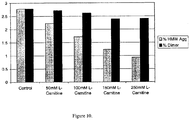
- Antibody A bulk (70mg/mL) in 10mM sodium acetate 9% sucrose pH 5.20 was dialyzed against 10mM sodium acetate pH 5.00 overnight at 4°C. Dialyzed protein was then concentrated by centrifugation using Amicon Ultra 10,000 MWCO centrifugal concentrators at 3,000rpm using a Beckman Coulter Allegra X12-R centrifuge. The concentrated Antibody A (230mg/mL) was then diluted to 100mg/mL varying ratios of 10mM sodium acetate pH 5.00 and 10mM sodium acetate pH 5.00 containing 500mM L-Carnitine.
- Figure 10 shows the effect of increasing concentrations of L-carnitine on aggregation of a solution of 100 mg/mL Antibody A, after maintaining the formulation at 52°C for four days.
- the data show that increasing concentrations of L-carnitine have a linear effect on the reduction in high molecular weight aggregates. There was also a reduction in dimer formation, but the effect on high molecular weight aggregates was much more pronounced.
- L-carnitine has an ionizable carboxylic acid group with a pKa of 3.8, it can function as a buffer in aqueous formulations between pH 2.8-4.8.
- the pH range from 4-4.8 may be useful for antibodies and other proteins that are more stable at lower pH.
- Results in Figure 11 show that L-carnitine buffered antibody formulations in this pH range are less prone to aggregation than acetate buffered formulations, as seen by an almost 4-fold reduction in aggregation.
Landscapes
- Health & Medical Sciences (AREA)
- Chemical & Material Sciences (AREA)
- Life Sciences & Earth Sciences (AREA)
- Medicinal Chemistry (AREA)
- Pharmacology & Pharmacy (AREA)
- Veterinary Medicine (AREA)
- Public Health (AREA)
- General Health & Medical Sciences (AREA)
- Animal Behavior & Ethology (AREA)
- Engineering & Computer Science (AREA)
- Epidemiology (AREA)
- Chemical Kinetics & Catalysis (AREA)
- General Chemical & Material Sciences (AREA)
- Oil, Petroleum & Natural Gas (AREA)
- Proteomics, Peptides & Aminoacids (AREA)
- Bioinformatics & Cheminformatics (AREA)
- Nuclear Medicine, Radiotherapy & Molecular Imaging (AREA)
- Organic Chemistry (AREA)
- Biophysics (AREA)
- Molecular Biology (AREA)
- Mycology (AREA)
- Microbiology (AREA)
- Immunology (AREA)
- Child & Adolescent Psychology (AREA)
- Hematology (AREA)
- Diabetes (AREA)
- Rheumatology (AREA)
- Obesity (AREA)
- Pain & Pain Management (AREA)
- Medicines Containing Antibodies Or Antigens For Use As Internal Diagnostic Agents (AREA)
- Peptides Or Proteins (AREA)
- Medicinal Preparation (AREA)
Claims (14)
- Gebrauch eines Hilfsstoffs, der ausgewählt ist aus der Gruppe bestehend aus Kreatin, Kreatinin, Carnitin und Mischungen davon, um die Viskosität einer wässrigen flüssigen pharmazeutischen Lösung, die für parenterale Verabreichung geeignet ist, zu reduzieren; wobei die Lösung ein therapeutisches Protein mit einer Konzentration von mindestens 70 mg/ml umfasst.
- Gebrauch nach Anspruch 1, wobei die Viskosität der Lösung um mindestens 10 % oder mindestens 30 % reduziert ist.
- Flüssige pharmazeutische Lösung, die für parenterale Verabreichung geeignet ist, umfassend ein therapeutisches Protein mit einer Konzentration von mindestens 70 mg/mL und einen Hilfsstoff, der ausgewählt ist aus der Gruppe bestehend aus Kreatin, Kreatinin, Carnitin und Mischungen davon.
- Flüssige pharmazeutische Lösung nach Anspruch 3, wobei(a) der Hilfsstoff Kreatin, Kreatinin oder eine Mischung davon ist und die Konzentration von Kreatin/Kreatinin von 0,002 mM bis 750 mM oder von 0,01 mM bis 50 mM beträgt; oder(b) der Hilfsstoff Carnitin mit einer Konzentration zwischen 1 mM und 3 M oder zwischen 5 mM und 300 mM ist.
- Flüssige pharmazeutische Lösung nach einem der Ansprüche 3 bis 4 mit einem pH-Wert zwischen 4,0 und 6,0 oder von 5,0 bis 5,5.
- Verfahren zum Herstellen von gefriergetrocknetem Pulver, umfassend den Schritt des Gefriertrocknens einer flüssigen pharmazeutischen Lösung nach einem der Ansprüche 3 bis 5.
- Verfahren zum Rekonstituieren von gefriergetrocknetem Pulver, umfassend den Schritt des Hinzufügens eines sterilen wässrigen Verdünnungsmittels zu dem Pulver, wobei das gefriergetrocknete Pulver ein therapeutisches Protein und einen Hilfsstoff umfasst, der ausgewählt ist aus der Gruppe bestehend aus Kreatin, Kreatinin, Carnitin und Mischungen davon, und wobei das Verfahren eine wässrige flüssige pharmazeutische Lösung nach einem der Ansprüche 3 bis 5 produziert.
- Verfahren nach Anspruch 7, wobei(a) der Hilfsstoff Kreatin, Kreatinin oder eine Mischung davon ist, die mit einer Konzentration von Kreatin/Kreatinin zwischen 4 ng pro mg therapeutischem Protein bis 1,25 mg pro mg therapeutischem Protein vorhanden ist; oder(b) der Hilfsstoff Carnitin mit einer Konzentration zwischen 2 µg bis 7 mg pro mg therapeutischem Protein ist.
- Gebrauch nach Anspruch 1 oder Anspruch 2, wobei das therapeutische Protein ein Antikörper ist.
- Verfahren nach einem der Ansprüche 6 bis 8, wobei das therapeutische Protein ein Antikörper ist.
- Flüssige pharmazeutische Lösung nach einem der Ansprüche 3 bis 5, wobei das therapeutische Protein ein Antikörper ist.
- Gefriergetrocknetes Pulver, das durch das Verfahren nach Anspruch 6 erhältlich ist, umfassend einen therapeutischen Antikörper und einen Hilfsstoff, der ausgewählt ist aus der Gruppe bestehend aus Kreatin, Kreatinin, Carnitin und Mischungen davon, wobei nach der Rekonstitution mit einem wässrigen Verdünnungsmittel die resultierende Lösung relativ zu einer Kontrolle ohne Hilfsstoffe eine reduzierte Viskosität aufweist, und wobei die rekonstituierte wässrige Lösung für parenterale Verabreichung geeignet ist.
- Flüssige pharmazeutische Lösung nach einem der Ansprüche 3 bis 5 und 11 zur Verwendung bei einem Therapie- oder Prophylaxeverfahren einer durch das therapeutische Protein therapierbaren Störung, wobei die Lösung parenteral verabreicht wird.
- Flüssige pharmazeutische Lösung zur Verwendung nach Anspruch 13, wobei die Lösung subkutan verabreicht wird.
Applications Claiming Priority (2)
| Application Number | Priority Date | Filing Date | Title |
|---|---|---|---|
| US97578007P | 2007-09-27 | 2007-09-27 | |
| PCT/US2008/078193 WO2009043049A2 (en) | 2007-09-27 | 2008-09-29 | Pharmaceutical formulations |
Publications (2)
| Publication Number | Publication Date |
|---|---|
| EP2205280A2 EP2205280A2 (de) | 2010-07-14 |
| EP2205280B1 true EP2205280B1 (de) | 2019-09-04 |
Family
ID=40139180
Family Applications (1)
| Application Number | Title | Priority Date | Filing Date |
|---|---|---|---|
| EP08833819.9A Active EP2205280B1 (de) | 2007-09-27 | 2008-09-29 | Pharmazeutische formulierungen |
Country Status (6)
| Country | Link |
|---|---|
| US (4) | US8383114B2 (de) |
| EP (1) | EP2205280B1 (de) |
| AU (1) | AU2008304111B2 (de) |
| CA (1) | CA2701032C (de) |
| ES (1) | ES2750254T3 (de) |
| WO (1) | WO2009043049A2 (de) |
Families Citing this family (27)
| Publication number | Priority date | Publication date | Assignee | Title |
|---|---|---|---|---|
| EP2205280B1 (de) * | 2007-09-27 | 2019-09-04 | Amgen Inc. | Pharmazeutische formulierungen |
| US8796206B2 (en) | 2007-11-15 | 2014-08-05 | Amgen Inc. | Aqueous formulation of erythropoiesis stimulating protein stabilised by antioxidants for parenteral administration |
| RU2563823C2 (ru) * | 2008-11-17 | 2015-09-20 | Дженентек, Инк. | Способ и композиция для уменьшения агрегации макромолекул при физиологических условиях |
| US20130171128A1 (en) * | 2010-03-02 | 2013-07-04 | Amgen Inc. | Reducing viscosity of pharmaceutical formulations |
| WO2012013980A1 (en) * | 2010-07-30 | 2012-02-02 | Arecor Limited | Stabilized aqueous antibody compositions |
| CA2828411A1 (en) | 2011-03-04 | 2012-09-13 | Intrexon Corporation | Vectors conditionally expressing protein |
| US20140023655A1 (en) * | 2011-04-07 | 2014-01-23 | Glaxosmithkline Llc | Formulations with reduced viscosity |
| US20140044727A1 (en) * | 2011-04-07 | 2014-02-13 | Glaxosmithkline Llc | Formulations with reduced viscosity |
| FR2994390B1 (fr) | 2012-08-10 | 2014-08-15 | Adocia | Procede d'abaissement de la viscosite de solutions de proteines a concentration elevee |
| US8883979B2 (en) | 2012-08-31 | 2014-11-11 | Bayer Healthcare Llc | Anti-prolactin receptor antibody formulations |
| US10376562B2 (en) | 2013-03-15 | 2019-08-13 | The Jackson Laboratory | Methods for promoting wound healing and hair growth comprising GDNF administration |
| IL312865B2 (en) | 2013-09-11 | 2025-06-01 | Eagle Biologics Inc | Liquid protein formulations containing viscosity-lowering agents |
| JP6526025B2 (ja) | 2013-10-16 | 2019-06-05 | オンコバイオロジクス,インコーポレイティド | 抗体安定性を増強する緩衝液製剤 |
| US20160074515A1 (en) | 2014-06-20 | 2016-03-17 | Reform Biologics, Llc | Viscosity-reducing excipient compounds for protein formulations |
| US10478498B2 (en) | 2014-06-20 | 2019-11-19 | Reform Biologics, Llc | Excipient compounds for biopolymer formulations |
| US11357857B2 (en) | 2014-06-20 | 2022-06-14 | Comera Life Sciences, Inc. | Excipient compounds for protein processing |
| KR102497368B1 (ko) * | 2014-10-01 | 2023-02-10 | 이글 바이올로직스 인코포레이티드 | 점도-저하제를 함유하는 폴리삭카라이드 및 핵산 제형 |
| WO2016118707A1 (en) | 2015-01-21 | 2016-07-28 | Oncobiologics, Inc. | Modulation of charge variants in a monoclonal antibody composition |
| ES3038408T3 (en) | 2015-12-30 | 2025-10-13 | Hoffmann La Roche | Formulations with reduced degradation of polysorbate |
| CA3013336A1 (en) | 2016-02-03 | 2017-08-10 | Oncobiologics, Inc. | Buffer formulations for enhanced antibody stability |
| SG11202003754YA (en) | 2017-05-16 | 2020-05-28 | Bhamis Research Laboratory Pvt Ltd | High concentration protein formulations with reduced viscosity |
| CN119909171A (zh) * | 2018-02-09 | 2025-05-02 | 健玛保 | 包含针对cd3和cd20的双特异性抗体的药物组合物及其用途 |
| US11207412B2 (en) * | 2018-04-16 | 2021-12-28 | Merck Patent Gmbh | Viscosity reduction of highly concentrated protein formulations |
| CA3105261A1 (en) | 2018-07-05 | 2020-01-09 | Bayer Aktiengesellschaft | Method for the production of freeze-dried pellets comprising an anti-coagulation factor xia (fxia) antibody |
| AU2019329686A1 (en) | 2018-08-27 | 2020-12-03 | Regeneron Pharmaceuticals, Inc. | Use of raman spectroscopy in downstream purification |
| WO2021061944A1 (en) * | 2019-09-25 | 2021-04-01 | The Regents Of The University Of California | Creatine for immunotherapy |
| MX2022013797A (es) | 2020-05-08 | 2022-11-30 | Genmab As | Anticuerpos biespecificos contra cd3 y cd20. |
Family Cites Families (140)
| Publication number | Priority date | Publication date | Assignee | Title |
|---|---|---|---|---|
| NZ210501A (en) * | 1983-12-13 | 1991-08-27 | Kirin Amgen Inc | Erythropoietin produced by procaryotic or eucaryotic expression of an exogenous dna sequence |
| US4703008A (en) * | 1983-12-13 | 1987-10-27 | Kiren-Amgen, Inc. | DNA sequences encoding erythropoietin |
| KR850004274A (ko) * | 1983-12-13 | 1985-07-11 | 원본미기재 | 에리트로포이에틴의 제조방법 |
| US5078997A (en) * | 1988-07-13 | 1992-01-07 | Cetus Corporation | Pharmaceutical composition for interleukin-2 containing physiologically compatible stabilizers |
| DE3920358A1 (de) | 1989-06-22 | 1991-01-17 | Behringwerke Ag | Bispezifische und oligospezifische, mono- und oligovalente antikoerperkonstrukte, ihre herstellung und verwendung |
| US5856298A (en) * | 1989-10-13 | 1999-01-05 | Amgen Inc. | Erythropoietin isoforms |
| KR100263845B1 (ko) | 1989-10-13 | 2000-08-16 | 스튜어트 엘.왓트 | 에리트로포이에틴 동형체와 그의 제조방법 및 그를 포함하는제약학적 조성물 |
| US7217689B1 (en) * | 1989-10-13 | 2007-05-15 | Amgen Inc. | Glycosylation analogs of erythropoietin |
| DK0463151T3 (da) | 1990-01-12 | 1996-07-01 | Cell Genesys Inc | Frembringelse af xenogene antistoffer |
| US5427908A (en) | 1990-05-01 | 1995-06-27 | Affymax Technologies N.V. | Recombinant library screening methods |
| GB9015198D0 (en) | 1990-07-10 | 1990-08-29 | Brien Caroline J O | Binding substance |
| WO1993011161A1 (en) | 1991-11-25 | 1993-06-10 | Enzon, Inc. | Multivalent antigen-binding proteins |
| IL110669A (en) | 1993-08-17 | 2008-11-26 | Kirin Amgen Inc | Erythropoietin analogs |
| US5773569A (en) * | 1993-11-19 | 1998-06-30 | Affymax Technologies N.V. | Compounds and peptides that bind to the erythropoietin receptor |
| US5830851A (en) | 1993-11-19 | 1998-11-03 | Affymax Technologies N.V. | Methods of administering peptides that bind to the erythropoietin receptor |
| US5885574A (en) * | 1994-07-26 | 1999-03-23 | Amgen Inc. | Antibodies which activate an erythropoietin receptor |
| JP3053873B2 (ja) * | 1994-08-12 | 2000-06-19 | イムノメディクス,インコーポレイテッド | B細胞リンパ腫細胞および白血病細胞に特異的な免疫結合体およびヒト化抗体 |
| AU2466895A (en) | 1995-04-28 | 1996-11-18 | Abgenix, Inc. | Human antibodies derived from immunized xenomice |
| US5686292A (en) * | 1995-06-02 | 1997-11-11 | Genentech, Inc. | Hepatocyte growth factor receptor antagonist antibodies and uses thereof |
| US5767078A (en) * | 1995-06-07 | 1998-06-16 | Johnson; Dana L. | Agonist peptide dimers |
| DE19715694B4 (de) * | 1996-04-17 | 2006-01-19 | Kansai Paint Co., Ltd., Amagasaki | Verfahren zur Bildung eines mehrschichtigen Überzugs und nach dem Verfahren beschichteter Gegenstand |
| JP4215172B2 (ja) | 1996-12-03 | 2009-01-28 | アムジェン フレモント インク. | 複数のV▲下H▼およびV▲下κ▼領域を含むヒトIg遺伝子座を有するトランスジェニック哺乳動物、ならびにそれから産生される抗体 |
| US6753165B1 (en) * | 1999-01-14 | 2004-06-22 | Bolder Biotechnology, Inc. | Methods for making proteins containing free cysteine residues |
| CA2296770A1 (en) * | 1997-07-14 | 1999-01-28 | Bolder Biotechnology, Inc. | Derivatives of growth hormone and related proteins |
| US6391633B1 (en) * | 1997-07-23 | 2002-05-21 | Roche Diagnostics Gmbh | Production of erythropoietin by endogenous gene activation |
| US6030086A (en) * | 1998-03-02 | 2000-02-29 | Becton, Dickinson And Company | Flash tube reflector with arc guide |
| US6310078B1 (en) * | 1998-04-20 | 2001-10-30 | Ortho-Mcneil Pharmaceutical, Inc. | Substituted amino acids as erythropoietin mimetics |
| US20050181482A1 (en) * | 2004-02-12 | 2005-08-18 | Meade Harry M. | Method for the production of an erythropoietin analog-human IgG fusion proteins in transgenic mammal milk |
| WO1999066054A2 (en) * | 1998-06-15 | 1999-12-23 | Genzyme Transgenics Corp. | Erythropoietin analog-human serum albumin fusion protein |
| US6660843B1 (en) | 1998-10-23 | 2003-12-09 | Amgen Inc. | Modified peptides as therapeutic agents |
| DK2319928T3 (da) | 1998-10-23 | 2013-06-24 | Kirin Amgen Inc | Dimere trombopoietiske peptidomimetika, der binder til MPL-receptor og har trombopoietisk aktivitet |
| AR020848A1 (es) | 1998-10-23 | 2002-05-29 | Amgen Inc | Metodos y composiciones para la prevencion y el tratamiento de anemia |
| PT1133558E (pt) * | 1998-11-27 | 2007-01-31 | Ucb Sa | Composições e métodos para aumentar a mineralização óssea |
| EP1006184A1 (de) * | 1998-12-03 | 2000-06-07 | F. Hoffmann-La Roche Ag | Mit dem IGF-1 Rezeptor wechselwirkende Proteine (IIPs), Gene, die für diese kodieren, und deren Verwendungen |
| WO2000061637A1 (en) | 1999-04-14 | 2000-10-19 | Smithkline Beecham Corporation | Erythropoietin receptor antibodies |
| US7297680B2 (en) * | 1999-04-15 | 2007-11-20 | Crucell Holland B.V. | Compositions of erythropoietin isoforms comprising Lewis-X structures and high sialic acid content |
| EP1188445B1 (de) * | 1999-06-24 | 2007-11-21 | LTT Bio-Pharma Co., Ltd. | Medikamentzusammensetzung die lecithin-modifizierte superoxiddismutase enthält |
| CZ299516B6 (cs) * | 1999-07-02 | 2008-08-20 | F. Hoffmann-La Roche Ag | Konjugát erythropoetinového glykoproteinu, zpusobjeho výroby a použití a farmaceutická kompozice sjeho obsahem |
| US6475220B1 (en) | 1999-10-15 | 2002-11-05 | Whiteside Biomechanics, Inc. | Spinal cable system |
| GB9924650D0 (en) * | 1999-10-19 | 1999-12-22 | Marathade Ltd | Energy bar |
| EP1228214A2 (de) | 1999-11-12 | 2002-08-07 | MERCK PATENT GmbH | Erythropoietinformen mit verbesserten eigenschaften |
| US20050202538A1 (en) * | 1999-11-12 | 2005-09-15 | Merck Patent Gmbh | Fc-erythropoietin fusion protein with improved pharmacokinetics |
| AUPQ599700A0 (en) * | 2000-03-03 | 2000-03-23 | Super Internet Site System Pty Ltd | On-line geographical directory |
| US6586398B1 (en) * | 2000-04-07 | 2003-07-01 | Amgen, Inc. | Chemically modified novel erythropoietin stimulating protein compositions and methods |
| CA2690018A1 (en) | 2000-04-21 | 2001-11-01 | Amgen Inc. | Methods and compositions for the prevention and treatment of anemia |
| US6756480B2 (en) * | 2000-04-27 | 2004-06-29 | Amgen Inc. | Modulators of receptors for parathyroid hormone and parathyroid hormone-related protein |
| US7560534B2 (en) * | 2000-05-08 | 2009-07-14 | Celldex Research Corporation | Molecular conjugates comprising human monoclonal antibodies to dendritic cells |
| US7078376B1 (en) | 2000-08-11 | 2006-07-18 | Baxter Healthcare S.A. | Therapeutic methods for treating subjects with a recombinant erythropoietin having high activity and reduced side effects |
| JP2004508338A (ja) | 2000-09-08 | 2004-03-18 | グリフォン セラピューティクス,インコーポレーテッド | ポリマー修飾合成タンパク質 |
| IL155977A0 (en) * | 2000-11-30 | 2003-12-23 | Medarex Inc | Transgenic transchromosomal rodents for making human antibodies |
| ATE505204T1 (de) | 2000-12-20 | 2011-04-15 | Hoffmann La Roche | Konjugate von erythropoietin (epo) mit polyethylenglykol (peg) |
| EA012079B3 (ru) * | 2001-01-05 | 2018-07-31 | Пфайзер Инк. | Моноклональное антитело к рецептору инсулиноподобного фактора роста i (igf-i) и способы его применения |
| US7829084B2 (en) * | 2001-01-17 | 2010-11-09 | Trubion Pharmaceuticals, Inc. | Binding constructs and methods for use thereof |
| US7754208B2 (en) * | 2001-01-17 | 2010-07-13 | Trubion Pharmaceuticals, Inc. | Binding domain-immunoglobulin fusion proteins |
| US20030133939A1 (en) * | 2001-01-17 | 2003-07-17 | Genecraft, Inc. | Binding domain-immunoglobulin fusion proteins |
| AU2002319142B2 (en) | 2001-04-04 | 2008-02-21 | Genodyssee | New polynucleotides and polypeptides of the erythropoietin gene |
| US20050089932A1 (en) * | 2001-04-26 | 2005-04-28 | Avidia Research Institute | Novel proteins with targeted binding |
| SK288175B6 (sk) * | 2001-05-11 | 2014-04-02 | Amgen Inc. | Látková kompozícia viažuca polypeptid TALL-1, kódujúca DNA, expresný vektor a hostiteľská bunka |
| JP4212470B2 (ja) | 2001-06-26 | 2009-01-21 | アムジェン フレモント インク. | Opglへの抗体 |
| US6900292B2 (en) * | 2001-08-17 | 2005-05-31 | Lee-Hwei K. Sun | Fc fusion proteins of human erythropoietin with increased biological activities |
| US7247304B2 (en) * | 2001-08-23 | 2007-07-24 | Genmab A/S | Methods of treating using anti-IL-15 antibodies |
| RS51829B (sr) * | 2001-08-23 | 2012-02-29 | Genmab A/S. | Ljudska antitela specifična za interleukin 15 (il-15) |
| JP4213586B2 (ja) * | 2001-09-13 | 2009-01-21 | 株式会社抗体研究所 | ラクダ抗体ライブラリーの作製方法 |
| US6930086B2 (en) * | 2001-09-25 | 2005-08-16 | Hoffmann-La Roche Inc. | Diglycosylated erythropoietin |
| US7214660B2 (en) | 2001-10-10 | 2007-05-08 | Neose Technologies, Inc. | Erythropoietin: remodeling and glycoconjugation of erythropoietin |
| US7521053B2 (en) | 2001-10-11 | 2009-04-21 | Amgen Inc. | Angiopoietin-2 specific binding agents |
| US7138370B2 (en) * | 2001-10-11 | 2006-11-21 | Amgen Inc. | Specific binding agents of human angiopoietin-2 |
| AU2002351746A1 (en) | 2001-12-21 | 2003-07-15 | Maxygen Aps | Erythropoietin conjugates |
| WO2003059951A2 (fr) | 2002-01-18 | 2003-07-24 | Pierre Fabre Medicament | Anticorps anti-igf-ir et leurs applications |
| US7241444B2 (en) * | 2002-01-18 | 2007-07-10 | Pierre Fabre Medicament | Anti-IGF-IR antibodies and uses thereof |
| WO2003064664A1 (en) * | 2002-01-31 | 2003-08-07 | Oxford Biomedica (Uk) Limited | Physiologically regulated erythropoietin- exprressing vector for the treatment of anaemia |
| GB0202252D0 (en) * | 2002-01-31 | 2002-03-20 | Oxford Biomedica Ltd | Anemia |
| ATE363541T1 (de) * | 2002-03-26 | 2007-06-15 | Lek Tovarna Farmacevtskih | Verfahren für die herstellung eines gewünschten profils von erythropoietin glyko-isoformen |
| DE60328195D1 (de) * | 2002-03-29 | 2009-08-13 | Schering Corp | Menschliche monoklonale antikörper gegen interleukin-5 sowie diese umfassende verfahren und zusammensetzungen |
| EP1572079A4 (de) | 2002-03-29 | 2006-09-06 | Centocor Inc | Säugetier-cdr-mimetikörper, zusammensetzungen, verfahren und anwendungszwecke |
| CA2485365A1 (en) * | 2002-05-13 | 2003-11-20 | Modigenetech Ltd. | Ctp-extended erythropoietin |
| CA2484000A1 (en) * | 2002-05-24 | 2003-12-04 | Schering Corporation | Neutralizing human anti-igfr antibody |
| US7538195B2 (en) | 2002-06-14 | 2009-05-26 | Immunogen Inc. | Anti-IGF-I receptor antibody |
| US8034904B2 (en) | 2002-06-14 | 2011-10-11 | Immunogen Inc. | Anti-IGF-I receptor antibody |
| BR0312276A (pt) | 2002-06-28 | 2005-04-26 | Centocor Inc | Mimeticorpos ch1-removidos miméticos de epo de mamìfero, composições, métodos e usos |
| CA2490409A1 (en) | 2002-06-28 | 2004-01-08 | Centocor, Inc. | Mammalian ch1 deleted mimetibodies, compositions, methods and uses |
| AU2003246486A1 (en) | 2002-07-19 | 2004-02-09 | Cangene Corporation | Pegylated erythropoietic compounds |
| JP4406607B2 (ja) | 2002-08-26 | 2010-02-03 | オンコセラピー・サイエンス株式会社 | ペプチド及びこれを含む医薬 |
| KR101317045B1 (ko) * | 2002-09-06 | 2013-10-16 | 암젠 인코포레이티드 | 치료학적 인체 항-il-1r1 모노클로날 항체 |
| WO2005025606A1 (en) | 2003-09-09 | 2005-03-24 | Warren Pharmaceuticals, Inc. | Long acting erythropoietins that maintain tissue protective activity of endogenous erythropoietin |
| CN100348618C (zh) | 2002-09-11 | 2007-11-14 | 弗雷泽纽斯卡比德国有限公司 | 生产羟烷基淀粉衍生物的方法 |
| US6919426B2 (en) * | 2002-09-19 | 2005-07-19 | Amgen Inc. | Peptides and related molecules that modulate nerve growth factor activity |
| US20040071694A1 (en) * | 2002-10-14 | 2004-04-15 | Devries Peter J. | Erythropoietin receptor binding antibodies |
| TWI320716B (en) | 2002-10-14 | 2010-02-21 | Abbott Lab | Erythropoietin receptor binding antibodies |
| US7396913B2 (en) * | 2002-10-14 | 2008-07-08 | Abbott Laboratories | Erythropoietin receptor binding antibodies |
| WO2004034988A2 (en) * | 2002-10-16 | 2004-04-29 | Amgen Inc. | Human anti-ifn-ϝ neutralizing antibodies as selective ifn-ϝ pathway inhibitors |
| US20040091961A1 (en) * | 2002-11-08 | 2004-05-13 | Evans Glen A. | Enhanced variants of erythropoietin and methods of use |
| EA009056B1 (ru) * | 2002-12-20 | 2007-10-26 | Амген, Инк. | Связывающие агенты, ингибирующие миостатин |
| US7195839B2 (en) | 2003-02-11 | 2007-03-27 | Eveready Battery Company, Inc. | Battery cell with improved pressure relief vent |
| JP2007528201A (ja) * | 2003-03-14 | 2007-10-11 | ファルマシア・コーポレーション | 癌治療のためのigf−i受容体に対する抗体 |
| EP1613658B1 (de) * | 2003-04-02 | 2012-03-14 | F. Hoffmann-La Roche AG | Antikörper gegen den insulinähnlichen wachstumsfaktor i-rezeptor und deren verwendungen |
| SI2335725T1 (sl) * | 2003-04-04 | 2017-01-31 | Genentech, Inc. | Visokokoncentrirane formulacije protiteles in proteinov |
| US7220410B2 (en) * | 2003-04-18 | 2007-05-22 | Galaxy Biotech, Llc | Monoclonal antibodies to hepatocyte growth factor |
| ES2527871T3 (es) | 2003-05-01 | 2015-02-02 | Imclone Llc | Anticuerpos completamente humanos dirigidos contra el receptor del factor de crecimiento 1 similar a la insulina humana |
| TWI353991B (en) | 2003-05-06 | 2011-12-11 | Syntonix Pharmaceuticals Inc | Immunoglobulin chimeric monomer-dimer hybrids |
| CA2525497A1 (en) | 2003-05-12 | 2004-11-25 | Affymax, Inc. | Peptides that bind to the erythropoietin receptor |
| AU2004238870B8 (en) * | 2003-05-12 | 2010-04-15 | Affymax, Inc. | Novel peptides that bind to the erythropoietin receptor |
| BRPI0411160A (pt) | 2003-05-12 | 2006-07-11 | Affymax Inc | novos compostos modificados com poli(glicol etilênico) e usos dos mesmos |
| US7074755B2 (en) | 2003-05-17 | 2006-07-11 | Centocor, Inc. | Erythropoietin conjugate compounds with extended half-lives |
| CA2527665A1 (en) | 2003-05-30 | 2004-12-16 | Centocor, Inc. | Formation of novel erythropoietin conjugates using transglutaminase |
| WO2005001136A1 (en) | 2003-06-04 | 2005-01-06 | Irm Llc | Methods and compositions for modulating erythropoietin expression |
| AR046071A1 (es) * | 2003-07-10 | 2005-11-23 | Hoffmann La Roche | Anticuerpos contra el receptor i del factor de crecimiento de tipo insulinico y los usos de los mismos |
| TWI635096B (zh) * | 2003-07-15 | 2018-09-11 | 安美基公司 | 作為選擇性神經生長因子(ngf)通道抑制劑之人類抗-ngf中和抗體 |
| BRPI0412885A (pt) * | 2003-07-18 | 2006-10-03 | Amgen Inc | polipeptìdios, agentes de ligação especìficos, moléculas de ácido nucleico e linhas de células isoladas, células hospedeiras, composições e anticorpo ou domìnio de ligação de antìgeno e métodos de tratamento de cáncer e de tumor sólido num paciente, de detecção do nìvel do fator de crescimento hepatócito (hgf) numa amostra, de obtenção de anticorpo e de inibição da ligação de hgf a met e de diminuição ou prevenção da ligação de qualquer um dos agentes de ligação especìficos ao fator de crescimento hepatócito (hgf) |
| US20050019914A1 (en) * | 2003-07-24 | 2005-01-27 | Aventis Pharma Deutschland Gmbh | Perfusion process for producing erythropoietin |
| US20070275871A1 (en) | 2003-08-28 | 2007-11-29 | Biorexis Technology, Inc. | Epo Mimetic Peptides and Fusion Proteins |
| CN1890383A (zh) | 2003-09-30 | 2007-01-03 | 森托科尔公司 | 人铰链核心模拟体、组合物、方法和用途 |
| UA89481C2 (uk) | 2003-09-30 | 2010-02-10 | Центокор, Инк. | Еритропоетинові міметичні шарнірно-серцевинні міметитіла людини, композиції, способи та застосування |
| US20050112694A1 (en) * | 2003-11-07 | 2005-05-26 | Carter Paul J. | Antibodies that bind interleukin-4 receptor |
| PE20050928A1 (es) * | 2003-11-21 | 2005-11-08 | Schering Corp | Combinaciones terapeuticas de anticuerpo anti-igfr1 |
| US8633157B2 (en) * | 2003-11-24 | 2014-01-21 | Novo Nordisk A/S | Glycopegylated erythropoietin |
| MXPA06005732A (es) * | 2003-11-24 | 2006-08-17 | Neose Technologies Inc | Eritropoyetina glucopegilada. |
| WO2005058967A2 (en) | 2003-12-16 | 2005-06-30 | Pierre Fabre Medicament | Novel anti-insulin/igf-i hybrid receptor or anti-insulin/igf-i hybrid receptor and igf-ir antibodies and uses thereof |
| EP1548031A1 (de) | 2003-12-22 | 2005-06-29 | Dubai Genetics FZ-LLC | Naturidentischer Erythropoietin |
| EP1699821B1 (de) | 2003-12-31 | 2012-06-20 | Merck Patent GmbH | Fc-ERYTHROPOIETIN-FUSIONSPROTEIN MIT VERBESSERTER PHARMAKOKINETIK |
| CN1902311A (zh) * | 2003-12-31 | 2007-01-24 | 森托科尔公司 | 具有n-末端游离硫羟基的新的重组蛋白 |
| US7423139B2 (en) * | 2004-01-20 | 2008-09-09 | Insight Biopharmaceuticals Ltd. | High level expression of recombinant human erythropoietin having a modified 5′-UTR |
| WO2005070451A1 (en) | 2004-01-22 | 2005-08-04 | Zafena Aktiebolag | Pharmaceutical composition comprising non-glycosylated erythropoietin |
| WO2005084711A1 (en) | 2004-03-02 | 2005-09-15 | Chengdu Institute Of Biological Products | A pegylated recombinant erythropoietin that has in vivo activity |
| WO2005092369A2 (en) | 2004-03-11 | 2005-10-06 | Fresenius Kabi Deutschland Gmbh | Conjugates of hydroxyethyl starch and erythropoietin |
| US20050227289A1 (en) * | 2004-04-09 | 2005-10-13 | Reilly Edward B | Antibodies to erythropoietin receptor and uses thereof |
| JP2008508854A (ja) | 2004-04-23 | 2008-03-27 | ケンブリッジ アンティボディー テクノロジー リミテッド | エリスロポイエチンタンパク質変異体 |
| AU2005259689B2 (en) | 2004-07-07 | 2011-10-06 | H. Lundbeck A/S | Novel carbamylated EPO and method for its production |
| FR2873699B1 (fr) | 2004-07-29 | 2009-08-21 | Pierre Fabre Medicament Sa | Nouveaux anticorps anti igf ir rt leurs utilisations |
| WO2006029094A2 (en) | 2004-09-02 | 2006-03-16 | Xencor, Inc. | Erythropoietin derivatives with altered immunogenicity |
| KR20070092706A (ko) | 2004-11-10 | 2007-09-13 | 아플라겐 게엠베하 | 조혈을 촉진하는 분자 |
| MY146381A (en) | 2004-12-22 | 2012-08-15 | Amgen Inc | Compositions and methods relating relating to anti-igf-1 receptor antibodies |
| CA2589860A1 (en) | 2005-01-24 | 2006-08-03 | Amgen Inc. | Humanized anti-amyloid antibody |
| US7592429B2 (en) * | 2005-05-03 | 2009-09-22 | Ucb Sa | Sclerostin-binding antibody |
| PL2100618T3 (pl) | 2005-06-17 | 2014-07-31 | Imclone Llc | Przeciwciało anty-PDGFR alfa do zastosowania w leczeniu przerzutowego raka kości |
| WO2007000328A1 (en) | 2005-06-27 | 2007-01-04 | Istituto Di Ricerche Di Biologia Molecolare P Angeletti Spa | Antibodies that bind to an epitope on insulin-like growth factor 1 receptor and uses thereof |
| EP2397497A3 (de) | 2005-07-18 | 2013-11-27 | Amgen, Inc | Humane Anti-B7RP1-neutralisierende Antikörper |
| FR2888850B1 (fr) | 2005-07-22 | 2013-01-11 | Pf Medicament | Nouveaux anticorps anti-igf-ir et leurs applications |
| ITMI20052204A1 (it) * | 2005-11-18 | 2007-05-19 | Umberto Cornelli | Uso di colostro per la profilassi delle sindroni influenzali |
| EP2205280B1 (de) * | 2007-09-27 | 2019-09-04 | Amgen Inc. | Pharmazeutische formulierungen |
-
2008
- 2008-09-29 EP EP08833819.9A patent/EP2205280B1/de active Active
- 2008-09-29 AU AU2008304111A patent/AU2008304111B2/en active Active
- 2008-09-29 ES ES08833819T patent/ES2750254T3/es active Active
- 2008-09-29 US US12/680,128 patent/US8383114B2/en active Active
- 2008-09-29 WO PCT/US2008/078193 patent/WO2009043049A2/en not_active Ceased
- 2008-09-29 CA CA2701032A patent/CA2701032C/en active Active
-
2013
- 2013-01-16 US US13/742,818 patent/US9320797B2/en active Active
-
2016
- 2016-04-01 US US15/089,036 patent/US10653781B2/en active Active
-
2020
- 2020-05-19 US US16/878,385 patent/US20200276313A1/en not_active Abandoned
Non-Patent Citations (1)
| Title |
|---|
| None * |
Also Published As
| Publication number | Publication date |
|---|---|
| US20170049895A1 (en) | 2017-02-23 |
| US20200276313A1 (en) | 2020-09-03 |
| CA2701032A1 (en) | 2009-04-02 |
| US9320797B2 (en) | 2016-04-26 |
| WO2009043049A2 (en) | 2009-04-02 |
| AU2008304111B2 (en) | 2014-04-24 |
| ES2750254T3 (es) | 2020-03-25 |
| US8383114B2 (en) | 2013-02-26 |
| US10653781B2 (en) | 2020-05-19 |
| WO2009043049A3 (en) | 2010-03-04 |
| CA2701032C (en) | 2021-01-26 |
| EP2205280A2 (de) | 2010-07-14 |
| AU2008304111A1 (en) | 2009-04-02 |
| US20130121990A1 (en) | 2013-05-16 |
| US20100297106A1 (en) | 2010-11-25 |
Similar Documents
| Publication | Publication Date | Title |
|---|---|---|
| US20200276313A1 (en) | Pharmaceutical Formulations | |
| US12318447B2 (en) | Lyophilized powder configured for reconstitution as a liquid pharmaceutical formulation with reduced viscosity and method of preparing thereof | |
| US12440567B2 (en) | Aqueous antibody formulation stabilized by antioxidants for parenteral administration | |
| US20130171128A1 (en) | Reducing viscosity of pharmaceutical formulations | |
| HK1242572B (en) | Reducing viscosity of pharmaceutical formulations |
Legal Events
| Date | Code | Title | Description |
|---|---|---|---|
| PUAI | Public reference made under article 153(3) epc to a published international application that has entered the european phase |
Free format text: ORIGINAL CODE: 0009012 |
|
| 17P | Request for examination filed |
Effective date: 20100330 |
|
| AK | Designated contracting states |
Kind code of ref document: A2 Designated state(s): AT BE BG CH CY CZ DE DK EE ES FI FR GB GR HR HU IE IS IT LI LT LU LV MC MT NL NO PL PT RO SE SI SK TR |
|
| AX | Request for extension of the european patent |
Extension state: AL BA MK RS |
|
| RIN1 | Information on inventor provided before grant (corrected) |
Inventor name: KO, JASON Inventor name: SLOEY, CHRISTOPHER, JAMES Inventor name: LI, TIANSHENG Inventor name: VERGARA, CAMILLE |
|
| DAX | Request for extension of the european patent (deleted) | ||
| 17Q | First examination report despatched |
Effective date: 20111115 |
|
| RAP1 | Party data changed (applicant data changed or rights of an application transferred) |
Owner name: AMGEN, INC |
|
| STAA | Information on the status of an ep patent application or granted ep patent |
Free format text: STATUS: EXAMINATION IS IN PROGRESS |
|
| REG | Reference to a national code |
Ref country code: DE Ref legal event code: R079 Ref document number: 602008061126 Country of ref document: DE Free format text: PREVIOUS MAIN CLASS: A61K0047180000 Ipc: A61K0009000000 |
|
| GRAP | Despatch of communication of intention to grant a patent |
Free format text: ORIGINAL CODE: EPIDOSNIGR1 |
|
| STAA | Information on the status of an ep patent application or granted ep patent |
Free format text: STATUS: GRANT OF PATENT IS INTENDED |
|
| RIC1 | Information provided on ipc code assigned before grant |
Ipc: A61K 9/00 20060101AFI20190109BHEP Ipc: A61K 39/395 20060101ALI20190109BHEP Ipc: A61K 47/18 20170101ALI20190109BHEP Ipc: A61K 47/22 20060101ALI20190109BHEP Ipc: A61K 9/19 20060101ALI20190109BHEP Ipc: A61K 47/24 20060101ALI20190109BHEP |
|
| INTG | Intention to grant announced |
Effective date: 20190213 |
|
| GRAS | Grant fee paid |
Free format text: ORIGINAL CODE: EPIDOSNIGR3 |
|
| GRAA | (expected) grant |
Free format text: ORIGINAL CODE: 0009210 |
|
| STAA | Information on the status of an ep patent application or granted ep patent |
Free format text: STATUS: THE PATENT HAS BEEN GRANTED |
|
| RAP1 | Party data changed (applicant data changed or rights of an application transferred) |
Owner name: AMGEN INC. |
|
| AK | Designated contracting states |
Kind code of ref document: B1 Designated state(s): AT BE BG CH CY CZ DE DK EE ES FI FR GB GR HR HU IE IS IT LI LT LU LV MC MT NL NO PL PT RO SE SI SK TR |
|
| REG | Reference to a national code |
Ref country code: GB Ref legal event code: FG4D |
|
| REG | Reference to a national code |
Ref country code: CH Ref legal event code: EP |
|
| REG | Reference to a national code |
Ref country code: AT Ref legal event code: REF Ref document number: 1174343 Country of ref document: AT Kind code of ref document: T Effective date: 20190915 |
|
| REG | Reference to a national code |
Ref country code: DE Ref legal event code: R096 Ref document number: 602008061126 Country of ref document: DE |
|
| REG | Reference to a national code |
Ref country code: IE Ref legal event code: FG4D |
|
| REG | Reference to a national code |
Ref country code: NL Ref legal event code: MP Effective date: 20190904 |
|
| REG | Reference to a national code |
Ref country code: LT Ref legal event code: MG4D |
|
| PG25 | Lapsed in a contracting state [announced via postgrant information from national office to epo] |
Ref country code: LT Free format text: LAPSE BECAUSE OF FAILURE TO SUBMIT A TRANSLATION OF THE DESCRIPTION OR TO PAY THE FEE WITHIN THE PRESCRIBED TIME-LIMIT Effective date: 20190904 Ref country code: HR Free format text: LAPSE BECAUSE OF FAILURE TO SUBMIT A TRANSLATION OF THE DESCRIPTION OR TO PAY THE FEE WITHIN THE PRESCRIBED TIME-LIMIT Effective date: 20190904 Ref country code: FI Free format text: LAPSE BECAUSE OF FAILURE TO SUBMIT A TRANSLATION OF THE DESCRIPTION OR TO PAY THE FEE WITHIN THE PRESCRIBED TIME-LIMIT Effective date: 20190904 Ref country code: SE Free format text: LAPSE BECAUSE OF FAILURE TO SUBMIT A TRANSLATION OF THE DESCRIPTION OR TO PAY THE FEE WITHIN THE PRESCRIBED TIME-LIMIT Effective date: 20190904 Ref country code: NO Free format text: LAPSE BECAUSE OF FAILURE TO SUBMIT A TRANSLATION OF THE DESCRIPTION OR TO PAY THE FEE WITHIN THE PRESCRIBED TIME-LIMIT Effective date: 20191204 Ref country code: BG Free format text: LAPSE BECAUSE OF FAILURE TO SUBMIT A TRANSLATION OF THE DESCRIPTION OR TO PAY THE FEE WITHIN THE PRESCRIBED TIME-LIMIT Effective date: 20191204 |
|
| PG25 | Lapsed in a contracting state [announced via postgrant information from national office to epo] |
Ref country code: LV Free format text: LAPSE BECAUSE OF FAILURE TO SUBMIT A TRANSLATION OF THE DESCRIPTION OR TO PAY THE FEE WITHIN THE PRESCRIBED TIME-LIMIT Effective date: 20190904 Ref country code: GR Free format text: LAPSE BECAUSE OF FAILURE TO SUBMIT A TRANSLATION OF THE DESCRIPTION OR TO PAY THE FEE WITHIN THE PRESCRIBED TIME-LIMIT Effective date: 20191205 |
|
| REG | Reference to a national code |
Ref country code: AT Ref legal event code: MK05 Ref document number: 1174343 Country of ref document: AT Kind code of ref document: T Effective date: 20190904 |
|
| REG | Reference to a national code |
Ref country code: ES Ref legal event code: FG2A Ref document number: 2750254 Country of ref document: ES Kind code of ref document: T3 Effective date: 20200325 |
|
| PG25 | Lapsed in a contracting state [announced via postgrant information from national office to epo] |
Ref country code: AT Free format text: LAPSE BECAUSE OF FAILURE TO SUBMIT A TRANSLATION OF THE DESCRIPTION OR TO PAY THE FEE WITHIN THE PRESCRIBED TIME-LIMIT Effective date: 20190904 Ref country code: NL Free format text: LAPSE BECAUSE OF FAILURE TO SUBMIT A TRANSLATION OF THE DESCRIPTION OR TO PAY THE FEE WITHIN THE PRESCRIBED TIME-LIMIT Effective date: 20190904 Ref country code: PL Free format text: LAPSE BECAUSE OF FAILURE TO SUBMIT A TRANSLATION OF THE DESCRIPTION OR TO PAY THE FEE WITHIN THE PRESCRIBED TIME-LIMIT Effective date: 20190904 Ref country code: EE Free format text: LAPSE BECAUSE OF FAILURE TO SUBMIT A TRANSLATION OF THE DESCRIPTION OR TO PAY THE FEE WITHIN THE PRESCRIBED TIME-LIMIT Effective date: 20190904 Ref country code: PT Free format text: LAPSE BECAUSE OF FAILURE TO SUBMIT A TRANSLATION OF THE DESCRIPTION OR TO PAY THE FEE WITHIN THE PRESCRIBED TIME-LIMIT Effective date: 20200106 Ref country code: RO Free format text: LAPSE BECAUSE OF FAILURE TO SUBMIT A TRANSLATION OF THE DESCRIPTION OR TO PAY THE FEE WITHIN THE PRESCRIBED TIME-LIMIT Effective date: 20190904 |
|
| PG25 | Lapsed in a contracting state [announced via postgrant information from national office to epo] |
Ref country code: SK Free format text: LAPSE BECAUSE OF FAILURE TO SUBMIT A TRANSLATION OF THE DESCRIPTION OR TO PAY THE FEE WITHIN THE PRESCRIBED TIME-LIMIT Effective date: 20190904 Ref country code: IS Free format text: LAPSE BECAUSE OF FAILURE TO SUBMIT A TRANSLATION OF THE DESCRIPTION OR TO PAY THE FEE WITHIN THE PRESCRIBED TIME-LIMIT Effective date: 20200224 Ref country code: CZ Free format text: LAPSE BECAUSE OF FAILURE TO SUBMIT A TRANSLATION OF THE DESCRIPTION OR TO PAY THE FEE WITHIN THE PRESCRIBED TIME-LIMIT Effective date: 20190904 |
|
| REG | Reference to a national code |
Ref country code: DE Ref legal event code: R097 Ref document number: 602008061126 Country of ref document: DE |
|
| PLBE | No opposition filed within time limit |
Free format text: ORIGINAL CODE: 0009261 |
|
| STAA | Information on the status of an ep patent application or granted ep patent |
Free format text: STATUS: NO OPPOSITION FILED WITHIN TIME LIMIT |
|
| PG2D | Information on lapse in contracting state deleted |
Ref country code: IS |
|
| PG25 | Lapsed in a contracting state [announced via postgrant information from national office to epo] |
Ref country code: IE Free format text: LAPSE BECAUSE OF NON-PAYMENT OF DUE FEES Effective date: 20190929 Ref country code: LU Free format text: LAPSE BECAUSE OF NON-PAYMENT OF DUE FEES Effective date: 20190929 Ref country code: DK Free format text: LAPSE BECAUSE OF FAILURE TO SUBMIT A TRANSLATION OF THE DESCRIPTION OR TO PAY THE FEE WITHIN THE PRESCRIBED TIME-LIMIT Effective date: 20190904 Ref country code: IS Free format text: LAPSE BECAUSE OF FAILURE TO SUBMIT A TRANSLATION OF THE DESCRIPTION OR TO PAY THE FEE WITHIN THE PRESCRIBED TIME-LIMIT Effective date: 20200105 |
|
| REG | Reference to a national code |
Ref country code: BE Ref legal event code: MM Effective date: 20190930 |
|
| 26N | No opposition filed |
Effective date: 20200605 |
|
| PG25 | Lapsed in a contracting state [announced via postgrant information from national office to epo] |
Ref country code: SI Free format text: LAPSE BECAUSE OF FAILURE TO SUBMIT A TRANSLATION OF THE DESCRIPTION OR TO PAY THE FEE WITHIN THE PRESCRIBED TIME-LIMIT Effective date: 20190904 Ref country code: MC Free format text: LAPSE BECAUSE OF FAILURE TO SUBMIT A TRANSLATION OF THE DESCRIPTION OR TO PAY THE FEE WITHIN THE PRESCRIBED TIME-LIMIT Effective date: 20190904 Ref country code: BE Free format text: LAPSE BECAUSE OF NON-PAYMENT OF DUE FEES Effective date: 20190930 |
|
| GBPC | Gb: european patent ceased through non-payment of renewal fee |
Effective date: 20191204 |
|
| PG25 | Lapsed in a contracting state [announced via postgrant information from national office to epo] |
Ref country code: GB Free format text: LAPSE BECAUSE OF NON-PAYMENT OF DUE FEES Effective date: 20191204 |
|
| PG25 | Lapsed in a contracting state [announced via postgrant information from national office to epo] |
Ref country code: CY Free format text: LAPSE BECAUSE OF FAILURE TO SUBMIT A TRANSLATION OF THE DESCRIPTION OR TO PAY THE FEE WITHIN THE PRESCRIBED TIME-LIMIT Effective date: 20190904 |
|
| PG25 | Lapsed in a contracting state [announced via postgrant information from national office to epo] |
Ref country code: HU Free format text: LAPSE BECAUSE OF FAILURE TO SUBMIT A TRANSLATION OF THE DESCRIPTION OR TO PAY THE FEE WITHIN THE PRESCRIBED TIME-LIMIT; INVALID AB INITIO Effective date: 20080929 Ref country code: MT Free format text: LAPSE BECAUSE OF FAILURE TO SUBMIT A TRANSLATION OF THE DESCRIPTION OR TO PAY THE FEE WITHIN THE PRESCRIBED TIME-LIMIT Effective date: 20190904 |
|
| PG25 | Lapsed in a contracting state [announced via postgrant information from national office to epo] |
Ref country code: TR Free format text: LAPSE BECAUSE OF FAILURE TO SUBMIT A TRANSLATION OF THE DESCRIPTION OR TO PAY THE FEE WITHIN THE PRESCRIBED TIME-LIMIT Effective date: 20190904 |
|
| P01 | Opt-out of the competence of the unified patent court (upc) registered |
Effective date: 20230509 |
|
| REG | Reference to a national code |
Ref country code: CH Ref legal event code: U11 Free format text: ST27 STATUS EVENT CODE: U-0-0-U10-U11 (AS PROVIDED BY THE NATIONAL OFFICE) Effective date: 20251001 |
|
| PGFP | Annual fee paid to national office [announced via postgrant information from national office to epo] |
Ref country code: DE Payment date: 20250820 Year of fee payment: 18 |
|
| PGFP | Annual fee paid to national office [announced via postgrant information from national office to epo] |
Ref country code: IT Payment date: 20250820 Year of fee payment: 18 |
|
| PGFP | Annual fee paid to national office [announced via postgrant information from national office to epo] |
Ref country code: FR Payment date: 20250820 Year of fee payment: 18 |
|
| PGFP | Annual fee paid to national office [announced via postgrant information from national office to epo] |
Ref country code: CH Payment date: 20251001 Year of fee payment: 18 |
|
| PGFP | Annual fee paid to national office [announced via postgrant information from national office to epo] |
Ref country code: ES Payment date: 20251001 Year of fee payment: 18 |