EP2202228B1 - Amide compounds and use of the same - Google Patents
Amide compounds and use of the same Download PDFInfo
- Publication number
- EP2202228B1 EP2202228B1 EP08839108.1A EP08839108A EP2202228B1 EP 2202228 B1 EP2202228 B1 EP 2202228B1 EP 08839108 A EP08839108 A EP 08839108A EP 2202228 B1 EP2202228 B1 EP 2202228B1
- Authority
- EP
- European Patent Office
- Prior art keywords
- optionally
- alkyl
- alkoxy
- ring
- atom
- Prior art date
- Legal status (The legal status is an assumption and is not a legal conclusion. Google has not performed a legal analysis and makes no representation as to the accuracy of the status listed.)
- Not-in-force
Links
- -1 Amide compounds Chemical class 0.000 title claims description 294
- 125000001424 substituent group Chemical group 0.000 claims description 607
- 150000001875 compounds Chemical class 0.000 claims description 433
- 125000004169 (C1-C6) alkyl group Chemical group 0.000 claims description 255
- 125000004433 nitrogen atom Chemical group N* 0.000 claims description 210
- 229910052757 nitrogen Inorganic materials 0.000 claims description 209
- 125000002887 hydroxy group Chemical group [H]O* 0.000 claims description 195
- 125000000623 heterocyclic group Chemical group 0.000 claims description 152
- RWRDLPDLKQPQOW-UHFFFAOYSA-N Pyrrolidine Chemical compound C1CCNC1 RWRDLPDLKQPQOW-UHFFFAOYSA-N 0.000 claims description 126
- 229910052799 carbon Inorganic materials 0.000 claims description 124
- 125000005843 halogen group Chemical group 0.000 claims description 123
- 125000004191 (C1-C6) alkoxy group Chemical group 0.000 claims description 122
- 125000005915 C6-C14 aryl group Chemical group 0.000 claims description 101
- 150000003839 salts Chemical class 0.000 claims description 95
- GLUUGHFHXGJENI-UHFFFAOYSA-N Piperazine Chemical compound C1CNCCN1 GLUUGHFHXGJENI-UHFFFAOYSA-N 0.000 claims description 94
- NQRYJNQNLNOLGT-UHFFFAOYSA-N Piperidine Chemical compound C1CCNCC1 NQRYJNQNLNOLGT-UHFFFAOYSA-N 0.000 claims description 94
- 125000004435 hydrogen atom Chemical group [H]* 0.000 claims description 91
- 125000006376 (C3-C10) cycloalkyl group Chemical group 0.000 claims description 87
- 125000001997 phenyl group Chemical group [H]C1=C([H])C([H])=C(*)C([H])=C1[H] 0.000 claims description 86
- YNAVUWVOSKDBBP-UHFFFAOYSA-N Morpholine Chemical compound C1COCCN1 YNAVUWVOSKDBBP-UHFFFAOYSA-N 0.000 claims description 82
- 125000004454 (C1-C6) alkoxycarbonyl group Chemical group 0.000 claims description 81
- 125000003710 aryl alkyl group Chemical group 0.000 claims description 60
- 125000004076 pyridyl group Chemical group 0.000 claims description 57
- 125000002924 primary amino group Chemical group [H]N([H])* 0.000 claims description 52
- 125000006700 (C1-C6) alkylthio group Chemical group 0.000 claims description 49
- 125000002373 5 membered heterocyclic group Chemical group 0.000 claims description 46
- 125000004070 6 membered heterocyclic group Chemical group 0.000 claims description 46
- 125000001544 thienyl group Chemical group 0.000 claims description 46
- 125000000113 cyclohexyl group Chemical group [H]C1([H])C([H])([H])C([H])([H])C([H])(*)C([H])([H])C1([H])[H] 0.000 claims description 45
- 125000006615 aromatic heterocyclic group Chemical group 0.000 claims description 44
- 125000003917 carbamoyl group Chemical group [H]N([H])C(*)=O 0.000 claims description 44
- 125000002971 oxazolyl group Chemical group 0.000 claims description 44
- 125000004916 (C1-C6) alkylcarbonyl group Chemical group 0.000 claims description 43
- 125000004739 (C1-C6) alkylsulfonyl group Chemical group 0.000 claims description 43
- 125000003118 aryl group Chemical group 0.000 claims description 41
- 125000002541 furyl group Chemical group 0.000 claims description 41
- BRNULMACUQOKMR-UHFFFAOYSA-N thiomorpholine Chemical compound C1CSCCN1 BRNULMACUQOKMR-UHFFFAOYSA-N 0.000 claims description 41
- 239000003814 drug Substances 0.000 claims description 39
- 125000006624 (C1-C6) alkoxycarbonylamino group Chemical group 0.000 claims description 38
- 125000004093 cyano group Chemical group *C#N 0.000 claims description 38
- 125000001691 aryl alkyl amino group Chemical group 0.000 claims description 33
- 125000003178 carboxy group Chemical group [H]OC(*)=O 0.000 claims description 30
- 125000002757 morpholinyl group Chemical group 0.000 claims description 30
- 125000003386 piperidinyl group Chemical group 0.000 claims description 24
- 125000003718 tetrahydrofuranyl group Chemical group 0.000 claims description 23
- 206010020772 Hypertension Diseases 0.000 claims description 22
- 125000003806 alkyl carbonyl amino group Chemical group 0.000 claims description 22
- 125000002883 imidazolyl group Chemical group 0.000 claims description 20
- HONIICLYMWZJFZ-UHFFFAOYSA-N azetidine Chemical compound C1CNC1 HONIICLYMWZJFZ-UHFFFAOYSA-N 0.000 claims description 19
- 125000004432 carbon atom Chemical group C* 0.000 claims description 19
- QJGQUHMNIGDVPM-UHFFFAOYSA-N nitrogen group Chemical group [N] QJGQUHMNIGDVPM-UHFFFAOYSA-N 0.000 claims description 19
- 125000000335 thiazolyl group Chemical group 0.000 claims description 18
- 125000003003 spiro group Chemical group 0.000 claims description 17
- 125000003831 tetrazolyl group Chemical group 0.000 claims description 17
- UWYZHKAOTLEWKK-UHFFFAOYSA-N 1,2,3,4-tetrahydroisoquinoline Chemical compound C1=CC=C2CNCCC2=C1 UWYZHKAOTLEWKK-UHFFFAOYSA-N 0.000 claims description 16
- LBUJPTNKIBCYBY-UHFFFAOYSA-N 1,2,3,4-tetrahydroquinoline Chemical compound C1=CC=C2CCCNC2=C1 LBUJPTNKIBCYBY-UHFFFAOYSA-N 0.000 claims description 16
- 125000005196 alkyl carbonyloxy group Chemical group 0.000 claims description 16
- 125000005169 cycloalkylcarbonylamino group Chemical group 0.000 claims description 16
- 125000004738 (C1-C6) alkyl sulfinyl group Chemical group 0.000 claims description 15
- 125000003226 pyrazolyl group Chemical group 0.000 claims description 15
- 125000001412 tetrahydropyranyl group Chemical group 0.000 claims description 15
- 125000004504 1,2,4-oxadiazolyl group Chemical group 0.000 claims description 14
- 125000001376 1,2,4-triazolyl group Chemical group N1N=C(N=C1)* 0.000 claims description 14
- 125000001781 1,3,4-oxadiazolyl group Chemical group 0.000 claims description 14
- 125000005115 alkyl carbamoyl group Chemical group 0.000 claims description 14
- 125000002632 imidazolidinyl group Chemical group 0.000 claims description 14
- FQUYSHZXSKYCSY-UHFFFAOYSA-N 1,4-diazepane Chemical compound C1CNCCNC1 FQUYSHZXSKYCSY-UHFFFAOYSA-N 0.000 claims description 13
- ZSIQJIWKELUFRJ-UHFFFAOYSA-N azepane Chemical compound C1CCCNCC1 ZSIQJIWKELUFRJ-UHFFFAOYSA-N 0.000 claims description 13
- QXNDZONIWRINJR-UHFFFAOYSA-N azocane Chemical compound C1CCCNCCC1 QXNDZONIWRINJR-UHFFFAOYSA-N 0.000 claims description 13
- NRHDCQLCSOWVTF-UHFFFAOYSA-N azonane Chemical compound C1CCCCNCCC1 NRHDCQLCSOWVTF-UHFFFAOYSA-N 0.000 claims description 13
- 125000005974 C6-C14 arylcarbonyl group Chemical group 0.000 claims description 12
- 125000005914 C6-C14 aryloxy group Chemical group 0.000 claims description 12
- 125000005153 alkyl sulfamoyl group Chemical group 0.000 claims description 12
- 125000002102 aryl alkyloxo group Chemical group 0.000 claims description 12
- 125000004845 (C1-C6) alkylsulfonylamino group Chemical group 0.000 claims description 11
- ZNGWEEUXTBNKFR-UHFFFAOYSA-N 1,4-oxazepane Chemical compound C1CNCCOC1 ZNGWEEUXTBNKFR-UHFFFAOYSA-N 0.000 claims description 11
- 125000004949 alkyl amino carbonyl amino group Chemical group 0.000 claims description 11
- 125000004657 aryl sulfonyl amino group Chemical group 0.000 claims description 11
- 125000006254 cycloalkyl carbonyl group Chemical group 0.000 claims description 11
- 239000003795 chemical substances by application Substances 0.000 claims description 10
- 238000011282 treatment Methods 0.000 claims description 9
- POTIYWUALSJREP-UHFFFAOYSA-N 1,2,3,4,4a,5,6,7,8,8a-decahydroquinoline Chemical compound N1CCCC2CCCCC21 POTIYWUALSJREP-UHFFFAOYSA-N 0.000 claims description 8
- 125000006091 1,3-dioxolane group Chemical group 0.000 claims description 8
- KPKNTUUIEVXMOH-UHFFFAOYSA-N 1,4-dioxa-8-azaspiro[4.5]decane Chemical compound O1CCOC11CCNCC1 KPKNTUUIEVXMOH-UHFFFAOYSA-N 0.000 claims description 8
- MVYDUUWLASFVPA-UHFFFAOYSA-N 4,5,6,7-tetrahydro-[1,3]oxazolo[5,4-b]pyridine Chemical compound C1CCNC2=C1N=CO2 MVYDUUWLASFVPA-UHFFFAOYSA-N 0.000 claims description 8
- LPAGFVYQRIESJQ-UHFFFAOYSA-N indoline Chemical compound C1=CC=C2NCCC2=C1 LPAGFVYQRIESJQ-UHFFFAOYSA-N 0.000 claims description 8
- GWVMLCQWXVFZCN-UHFFFAOYSA-N isoindoline Chemical compound C1=CC=C2CNCC2=C1 GWVMLCQWXVFZCN-UHFFFAOYSA-N 0.000 claims description 8
- 125000002496 methyl group Chemical group [H]C([H])([H])* 0.000 claims description 8
- 230000008816 organ damage Effects 0.000 claims description 8
- 238000011321 prophylaxis Methods 0.000 claims description 8
- FTAHXMZRJCZXDL-UHFFFAOYSA-N 3-piperideine Chemical compound C1CC=CCN1 FTAHXMZRJCZXDL-UHFFFAOYSA-N 0.000 claims description 7
- 239000002461 renin inhibitor Substances 0.000 claims description 7
- 229940086526 renin-inhibitors Drugs 0.000 claims description 7
- 125000002915 carbonyl group Chemical group [*:2]C([*:1])=O 0.000 claims description 4
- 125000004483 piperidin-3-yl group Chemical group N1CC(CCC1)* 0.000 claims description 4
- ISBMTDVOSWIALV-RTWAWAEBSA-N 2-tert-butyl-4-(3-methoxypropylamino)-n-(2-methylpropyl)-n-[(3s,5r)-5-(morpholine-4-carbonyl)piperidin-3-yl]pyrimidine-5-carboxamide Chemical compound COCCCNC1=NC(C(C)(C)C)=NC=C1C(=O)N(CC(C)C)[C@H]1C[C@@H](C(=O)N2CCOCC2)CNC1 ISBMTDVOSWIALV-RTWAWAEBSA-N 0.000 claims description 3
- UUMZXMCEABJKTC-UXHICEINSA-N 2-tert-butyl-n-(2-methylpropyl)-n-[(3s,5r)-5-(morpholine-4-carbonyl)piperidin-3-yl]-4-(1,3-oxazol-2-ylmethylamino)pyrimidine-5-carboxamide Chemical compound O=C([C@H]1CNC[C@H](C1)N(CC(C)C)C(=O)C=1C(=NC(=NC=1)C(C)(C)C)NCC=1OC=CN=1)N1CCOCC1 UUMZXMCEABJKTC-UXHICEINSA-N 0.000 claims description 3
- YWUUGVKCMUDYIH-SJORKVTESA-N 2-tert-butyl-n-[(3s,5r)-5-carbamoylpiperidin-3-yl]-4-(furan-2-ylmethylamino)-n-(2-methylpropyl)pyrimidine-5-carboxamide Chemical compound C=1N=C(C(C)(C)C)N=C(NCC=2OC=CC=2)C=1C(=O)N(CC(C)C)[C@@H]1CNC[C@H](C(N)=O)C1 YWUUGVKCMUDYIH-SJORKVTESA-N 0.000 claims description 3
- 125000000959 isobutyl group Chemical group [H]C([H])([H])C([H])(C([H])([H])[H])C([H])([H])* 0.000 claims description 3
- 125000003545 alkoxy group Chemical group 0.000 claims description 2
- NERNRLFKKNDCTH-UHFFFAOYSA-N [2-tert-butyl-4-(furan-2-ylmethylamino)pyrimidin-5-yl]-(2-ethylpiperidin-1-yl)methanone Chemical compound CCC1CCCCN1C(=O)C1=CN=C(C(C)(C)C)N=C1NCC1=CC=CO1 NERNRLFKKNDCTH-UHFFFAOYSA-N 0.000 claims 1
- BKRZZFNDWCWOEN-UHFFFAOYSA-N [2-tert-butyl-4-(furan-2-ylmethylamino)pyrimidin-5-yl]-[4-(methylaminomethyl)piperidin-1-yl]methanone Chemical compound C1CC(CNC)CCN1C(=O)C1=CN=C(C(C)(C)C)N=C1NCC1=CC=CO1 BKRZZFNDWCWOEN-UHFFFAOYSA-N 0.000 claims 1
- OYIBABHBMFZWQH-UHFFFAOYSA-N [4-(aminomethyl)piperidin-1-yl]-[2-tert-butyl-4-(furan-2-ylmethylamino)pyrimidin-5-yl]methanone Chemical compound C=1C=COC=1CNC1=NC(C(C)(C)C)=NC=C1C(=O)N1CCC(CN)CC1 OYIBABHBMFZWQH-UHFFFAOYSA-N 0.000 claims 1
- BVMSTXVAZWKIOZ-UHFFFAOYSA-N [4-(furan-2-ylmethylamino)-2-propan-2-ylpyrimidin-5-yl]-[4-(methylaminomethyl)piperidin-1-yl]methanone Chemical compound C1CC(CNC)CCN1C(=O)C1=CN=C(C(C)C)N=C1NCC1=CC=CO1 BVMSTXVAZWKIOZ-UHFFFAOYSA-N 0.000 claims 1
- NRMWBVITDRMGMC-MSOLQXFVSA-N methyl (3r,5s)-5-[[2-tert-butyl-4-(3-methoxypropylamino)pyrimidine-5-carbonyl]-(2-methylpropyl)amino]piperidine-3-carboxylate Chemical compound COCCCNC1=NC(C(C)(C)C)=NC=C1C(=O)N(CC(C)C)[C@H]1C[C@@H](C(=O)OC)CNC1 NRMWBVITDRMGMC-MSOLQXFVSA-N 0.000 claims 1
- JSROFEXNNKVRNU-MSOLQXFVSA-N methyl (3r,5s)-5-[[2-tert-butyl-4-(3-methylsulfanylpropylamino)pyrimidine-5-carbonyl]-(2-methylpropyl)amino]piperidine-3-carboxylate Chemical compound C1[C@@H](C(=O)OC)CNC[C@H]1N(CC(C)C)C(=O)C1=CN=C(C(C)(C)C)N=C1NCCCSC JSROFEXNNKVRNU-MSOLQXFVSA-N 0.000 claims 1
- XJLSEXAGTJCILF-UHFFFAOYSA-N nipecotic acid Chemical compound OC(=O)C1CCCNC1 XJLSEXAGTJCILF-UHFFFAOYSA-N 0.000 claims 1
- 238000000034 method Methods 0.000 description 207
- 125000004429 atom Chemical group 0.000 description 121
- 150000001721 carbon Chemical group 0.000 description 119
- 229910052717 sulfur Inorganic materials 0.000 description 119
- 125000004434 sulfur atom Chemical group 0.000 description 119
- 125000005842 heteroatom Chemical group 0.000 description 117
- 125000004430 oxygen atom Chemical group O* 0.000 description 117
- 238000006243 chemical reaction Methods 0.000 description 91
- 150000002430 hydrocarbons Chemical group 0.000 description 77
- 239000002904 solvent Substances 0.000 description 39
- 125000001797 benzyl group Chemical group [H]C1=C([H])C([H])=C(C([H])=C1[H])C([H])([H])* 0.000 description 37
- UHOVQNZJYSORNB-UHFFFAOYSA-N Benzene Chemical compound C1=CC=CC=C1 UHOVQNZJYSORNB-UHFFFAOYSA-N 0.000 description 33
- 238000004519 manufacturing process Methods 0.000 description 32
- PXQLVRUNWNTZOS-UHFFFAOYSA-N sulfanyl Chemical class [SH] PXQLVRUNWNTZOS-UHFFFAOYSA-N 0.000 description 31
- 230000002401 inhibitory effect Effects 0.000 description 29
- 229930195733 hydrocarbon Natural products 0.000 description 26
- 125000006239 protecting group Chemical group 0.000 description 26
- RTZKZFJDLAIYFH-UHFFFAOYSA-N Diethyl ether Chemical compound CCOCC RTZKZFJDLAIYFH-UHFFFAOYSA-N 0.000 description 24
- JUJWROOIHBZHMG-UHFFFAOYSA-N Pyridine Chemical compound C1=CC=NC=C1 JUJWROOIHBZHMG-UHFFFAOYSA-N 0.000 description 24
- 125000002252 acyl group Chemical group 0.000 description 24
- 125000001559 cyclopropyl group Chemical group [H]C1([H])C([H])([H])C1([H])* 0.000 description 24
- 208000037265 diseases, disorders, signs and symptoms Diseases 0.000 description 24
- 238000002360 preparation method Methods 0.000 description 23
- VEXZGXHMUGYJMC-UHFFFAOYSA-N Hydrochloric acid Chemical compound Cl VEXZGXHMUGYJMC-UHFFFAOYSA-N 0.000 description 22
- 238000006460 hydrolysis reaction Methods 0.000 description 22
- YXFVVABEGXRONW-UHFFFAOYSA-N Toluene Chemical compound CC1=CC=CC=C1 YXFVVABEGXRONW-UHFFFAOYSA-N 0.000 description 21
- VLKZOEOYAKHREP-UHFFFAOYSA-N n-Hexane Chemical compound CCCCCC VLKZOEOYAKHREP-UHFFFAOYSA-N 0.000 description 21
- 239000004215 Carbon black (E152) Substances 0.000 description 19
- 238000006482 condensation reaction Methods 0.000 description 19
- 229940079593 drug Drugs 0.000 description 19
- QTBSBXVTEAMEQO-UHFFFAOYSA-N Acetic acid Chemical compound CC(O)=O QTBSBXVTEAMEQO-UHFFFAOYSA-N 0.000 description 18
- 102400000345 Angiotensin-2 Human genes 0.000 description 18
- 101800000733 Angiotensin-2 Proteins 0.000 description 18
- ZMXDDKWLCZADIW-UHFFFAOYSA-N N,N-Dimethylformamide Chemical compound CN(C)C=O ZMXDDKWLCZADIW-UHFFFAOYSA-N 0.000 description 18
- WYURNTSHIVDZCO-UHFFFAOYSA-N Tetrahydrofuran Chemical compound C1CCOC1 WYURNTSHIVDZCO-UHFFFAOYSA-N 0.000 description 18
- 125000000217 alkyl group Chemical group 0.000 description 18
- 229950006323 angiotensin ii Drugs 0.000 description 18
- 125000005931 tert-butyloxycarbonyl group Chemical group [H]C([H])([H])C(OC(*)=O)(C([H])([H])[H])C([H])([H])[H] 0.000 description 18
- 239000003153 chemical reaction reagent Substances 0.000 description 17
- 230000007062 hydrolysis Effects 0.000 description 17
- YMWUJEATGCHHMB-UHFFFAOYSA-N Dichloromethane Chemical compound ClCCl YMWUJEATGCHHMB-UHFFFAOYSA-N 0.000 description 15
- ZMANZCXQSJIPKH-UHFFFAOYSA-N Triethylamine Chemical compound CCN(CC)CC ZMANZCXQSJIPKH-UHFFFAOYSA-N 0.000 description 15
- 125000000753 cycloalkyl group Chemical group 0.000 description 15
- 125000000449 nitro group Chemical group [O-][N+](*)=O 0.000 description 15
- 239000000047 product Substances 0.000 description 15
- CZGUSIXMZVURDU-JZXHSEFVSA-N Ile(5)-angiotensin II Chemical compound C([C@@H](C(=O)N[C@@H]([C@@H](C)CC)C(=O)N[C@@H](CC=1NC=NC=1)C(=O)N1[C@@H](CCC1)C(=O)N[C@@H](CC=1C=CC=CC=1)C([O-])=O)NC(=O)[C@@H](NC(=O)[C@H](CCCNC(N)=[NH2+])NC(=O)[C@@H]([NH3+])CC([O-])=O)C(C)C)C1=CC=C(O)C=C1 CZGUSIXMZVURDU-JZXHSEFVSA-N 0.000 description 14
- 125000003236 benzoyl group Chemical group [H]C1=C([H])C([H])=C(C([H])=C1[H])C(*)=O 0.000 description 13
- 125000006717 (C3-C10) cycloalkenyl group Chemical group 0.000 description 12
- 125000000094 2-phenylethyl group Chemical group [H]C1=C([H])C([H])=C(C([H])=C1[H])C([H])([H])C([H])([H])* 0.000 description 12
- FPQQSJJWHUJYPU-UHFFFAOYSA-N 3-(dimethylamino)propyliminomethylidene-ethylazanium;chloride Chemical compound Cl.CCN=C=NCCCN(C)C FPQQSJJWHUJYPU-UHFFFAOYSA-N 0.000 description 12
- QOSSAOTZNIDXMA-UHFFFAOYSA-N Dicylcohexylcarbodiimide Chemical compound C1CCCCC1N=C=NC1CCCCC1 QOSSAOTZNIDXMA-UHFFFAOYSA-N 0.000 description 12
- 108090000783 Renin Proteins 0.000 description 12
- 102100028255 Renin Human genes 0.000 description 12
- HEMHJVSKTPXQMS-UHFFFAOYSA-M Sodium hydroxide Chemical compound [OH-].[Na+] HEMHJVSKTPXQMS-UHFFFAOYSA-M 0.000 description 12
- 208000035475 disorder Diseases 0.000 description 12
- UMJSCPRVCHMLSP-UHFFFAOYSA-N pyridine Natural products COC1=CC=CN=C1 UMJSCPRVCHMLSP-UHFFFAOYSA-N 0.000 description 12
- 125000000714 pyrimidinyl group Chemical group 0.000 description 12
- YLQBMQCUIZJEEH-UHFFFAOYSA-N Furan Chemical compound C=1C=COC=1 YLQBMQCUIZJEEH-UHFFFAOYSA-N 0.000 description 11
- 102000004270 Peptidyl-Dipeptidase A Human genes 0.000 description 11
- 108090000882 Peptidyl-Dipeptidase A Proteins 0.000 description 11
- 125000000440 benzylamino group Chemical group [H]N(*)C([H])([H])C1=C([H])C([H])=C([H])C([H])=C1[H] 0.000 description 11
- 201000010099 disease Diseases 0.000 description 11
- 125000002485 formyl group Chemical group [H]C(*)=O 0.000 description 11
- 239000001257 hydrogen Substances 0.000 description 11
- 229910052739 hydrogen Inorganic materials 0.000 description 11
- 125000006633 tert-butoxycarbonylamino group Chemical group 0.000 description 11
- UUUHXMGGBIUAPW-UHFFFAOYSA-N 1-[1-[2-[[5-amino-2-[[1-[5-(diaminomethylideneamino)-2-[[1-[3-(1h-indol-3-yl)-2-[(5-oxopyrrolidine-2-carbonyl)amino]propanoyl]pyrrolidine-2-carbonyl]amino]pentanoyl]pyrrolidine-2-carbonyl]amino]-5-oxopentanoyl]amino]-3-methylpentanoyl]pyrrolidine-2-carbon Chemical compound C1CCC(C(=O)N2C(CCC2)C(O)=O)N1C(=O)C(C(C)CC)NC(=O)C(CCC(N)=O)NC(=O)C1CCCN1C(=O)C(CCCN=C(N)N)NC(=O)C1CCCN1C(=O)C(CC=1C2=CC=CC=C2NC=1)NC(=O)C1CCC(=O)N1 UUUHXMGGBIUAPW-UHFFFAOYSA-N 0.000 description 10
- HEDRZPFGACZZDS-UHFFFAOYSA-N Chloroform Chemical compound ClC(Cl)Cl HEDRZPFGACZZDS-UHFFFAOYSA-N 0.000 description 10
- IAZDPXIOMUYVGZ-UHFFFAOYSA-N Dimethylsulphoxide Chemical compound CS(C)=O IAZDPXIOMUYVGZ-UHFFFAOYSA-N 0.000 description 10
- LFQSCWFLJHTTHZ-UHFFFAOYSA-N Ethanol Chemical compound CCO LFQSCWFLJHTTHZ-UHFFFAOYSA-N 0.000 description 10
- 229910052783 alkali metal Inorganic materials 0.000 description 10
- 125000002947 alkylene group Chemical group 0.000 description 10
- 125000003277 amino group Chemical group 0.000 description 10
- 150000002170 ethers Chemical class 0.000 description 10
- 239000012046 mixed solvent Substances 0.000 description 10
- 230000035484 reaction time Effects 0.000 description 10
- 239000007858 starting material Substances 0.000 description 10
- VZGDMQKNWNREIO-UHFFFAOYSA-N tetrachloromethane Chemical compound ClC(Cl)(Cl)Cl VZGDMQKNWNREIO-UHFFFAOYSA-N 0.000 description 10
- ASOKPJOREAFHNY-UHFFFAOYSA-N 1-Hydroxybenzotriazole Chemical compound C1=CC=C2N(O)N=NC2=C1 ASOKPJOREAFHNY-UHFFFAOYSA-N 0.000 description 9
- WEVYAHXRMPXWCK-UHFFFAOYSA-N Acetonitrile Chemical compound CC#N WEVYAHXRMPXWCK-UHFFFAOYSA-N 0.000 description 9
- WRYCSMQKUKOKBP-UHFFFAOYSA-N Imidazolidine Chemical compound C1CNCN1 WRYCSMQKUKOKBP-UHFFFAOYSA-N 0.000 description 9
- OKKJLVBELUTLKV-UHFFFAOYSA-N Methanol Chemical compound OC OKKJLVBELUTLKV-UHFFFAOYSA-N 0.000 description 9
- 238000005903 acid hydrolysis reaction Methods 0.000 description 9
- 238000005904 alkaline hydrolysis reaction Methods 0.000 description 9
- 125000000051 benzyloxy group Chemical group [H]C1=C([H])C([H])=C(C([H])=C1[H])C([H])([H])O* 0.000 description 9
- 230000036772 blood pressure Effects 0.000 description 9
- NPZTUJOABDZTLV-UHFFFAOYSA-N hydroxybenzotriazole Substances O=C1C=CC=C2NNN=C12 NPZTUJOABDZTLV-UHFFFAOYSA-N 0.000 description 9
- 125000000951 phenoxy group Chemical group [H]C1=C([H])C([H])=C(O*)C([H])=C1[H] 0.000 description 9
- 125000004193 piperazinyl group Chemical group 0.000 description 9
- USPWKWBDZOARPV-UHFFFAOYSA-N pyrazolidine Chemical compound C1CNNC1 USPWKWBDZOARPV-UHFFFAOYSA-N 0.000 description 9
- 125000000719 pyrrolidinyl group Chemical group 0.000 description 9
- 239000011541 reaction mixture Substances 0.000 description 9
- 125000004568 thiomorpholinyl group Chemical group 0.000 description 9
- RYHBNJHYFVUHQT-UHFFFAOYSA-N 1,4-Dioxane Chemical compound C1COCCO1 RYHBNJHYFVUHQT-UHFFFAOYSA-N 0.000 description 8
- XDTMQSROBMDMFD-UHFFFAOYSA-N Cyclohexane Chemical compound C1CCCCC1 XDTMQSROBMDMFD-UHFFFAOYSA-N 0.000 description 8
- CZPWVGJYEJSRLH-UHFFFAOYSA-N Pyrimidine Chemical compound C1=CN=CN=C1 CZPWVGJYEJSRLH-UHFFFAOYSA-N 0.000 description 8
- QAOWNCQODCNURD-UHFFFAOYSA-N Sulfuric acid Chemical compound OS(O)(=O)=O QAOWNCQODCNURD-UHFFFAOYSA-N 0.000 description 8
- 229940000425 combination drug Drugs 0.000 description 8
- 230000000694 effects Effects 0.000 description 8
- 229940002612 prodrug Drugs 0.000 description 8
- 239000000651 prodrug Substances 0.000 description 8
- 238000006722 reduction reaction Methods 0.000 description 8
- 125000000547 substituted alkyl group Chemical group 0.000 description 8
- 125000003107 substituted aryl group Chemical group 0.000 description 8
- 125000005018 aryl alkenyl group Chemical group 0.000 description 7
- 125000006255 cyclopropyl carbonyl group Chemical group [H]C1([H])C([H])([H])C1([H])C(*)=O 0.000 description 7
- 150000008282 halocarbons Chemical class 0.000 description 7
- 210000000056 organ Anatomy 0.000 description 7
- 150000007524 organic acids Chemical class 0.000 description 7
- 125000000008 (C1-C10) alkyl group Chemical group 0.000 description 6
- 125000006590 (C2-C6) alkenylene group Chemical group 0.000 description 6
- 125000006591 (C2-C6) alkynylene group Chemical group 0.000 description 6
- 125000006374 C2-C10 alkenyl group Chemical group 0.000 description 6
- 102000004190 Enzymes Human genes 0.000 description 6
- 108090000790 Enzymes Proteins 0.000 description 6
- UFHFLCQGNIYNRP-UHFFFAOYSA-N Hydrogen Chemical compound [H][H] UFHFLCQGNIYNRP-UHFFFAOYSA-N 0.000 description 6
- KFZMGEQAYNKOFK-UHFFFAOYSA-N Isopropanol Chemical compound CC(C)O KFZMGEQAYNKOFK-UHFFFAOYSA-N 0.000 description 6
- WMFOQBRAJBCJND-UHFFFAOYSA-M Lithium hydroxide Chemical compound [Li+].[OH-] WMFOQBRAJBCJND-UHFFFAOYSA-M 0.000 description 6
- 206010028980 Neoplasm Diseases 0.000 description 6
- MUBZPKHOEPUJKR-UHFFFAOYSA-N Oxalic acid Chemical compound OC(=O)C(O)=O MUBZPKHOEPUJKR-UHFFFAOYSA-N 0.000 description 6
- KWYUFKZDYYNOTN-UHFFFAOYSA-M Potassium hydroxide Chemical compound [OH-].[K+] KWYUFKZDYYNOTN-UHFFFAOYSA-M 0.000 description 6
- 239000002253 acid Substances 0.000 description 6
- 150000001340 alkali metals Chemical group 0.000 description 6
- 239000002585 base Substances 0.000 description 6
- 230000015572 biosynthetic process Effects 0.000 description 6
- 208000026106 cerebrovascular disease Diseases 0.000 description 6
- KRKNYBCHXYNGOX-UHFFFAOYSA-N citric acid Chemical compound OC(=O)CC(O)(C(O)=O)CC(O)=O KRKNYBCHXYNGOX-UHFFFAOYSA-N 0.000 description 6
- 125000004186 cyclopropylmethyl group Chemical group [H]C([H])(*)C1([H])C([H])([H])C1([H])[H] 0.000 description 6
- ZWWWLCMDTZFSOO-UHFFFAOYSA-N diethoxyphosphorylformonitrile Chemical compound CCOP(=O)(C#N)OCC ZWWWLCMDTZFSOO-UHFFFAOYSA-N 0.000 description 6
- 229940088598 enzyme Drugs 0.000 description 6
- 125000003754 ethoxycarbonyl group Chemical group C(=O)(OCC)* 0.000 description 6
- 125000001786 isothiazolyl group Chemical group 0.000 description 6
- 125000000842 isoxazolyl group Chemical group 0.000 description 6
- 125000001160 methoxycarbonyl group Chemical group [H]C([H])([H])OC(*)=O 0.000 description 6
- 239000000203 mixture Substances 0.000 description 6
- 125000002950 monocyclic group Chemical group 0.000 description 6
- 108090000765 processed proteins & peptides Proteins 0.000 description 6
- 125000004742 propyloxycarbonyl group Chemical group 0.000 description 6
- 125000003373 pyrazinyl group Chemical group 0.000 description 6
- 125000002098 pyridazinyl group Chemical group 0.000 description 6
- 125000000168 pyrrolyl group Chemical group 0.000 description 6
- 108020003175 receptors Proteins 0.000 description 6
- 102000005962 receptors Human genes 0.000 description 6
- 125000005017 substituted alkenyl group Chemical group 0.000 description 6
- 125000004426 substituted alkynyl group Chemical group 0.000 description 6
- 125000005346 substituted cycloalkyl group Chemical group 0.000 description 6
- 125000002221 trityl group Chemical group [H]C1=C([H])C([H])=C([H])C([H])=C1C([*])(C1=C(C(=C(C(=C1[H])[H])[H])[H])[H])C1=C([H])C([H])=C([H])C([H])=C1[H] 0.000 description 6
- WSLDOOZREJYCGB-UHFFFAOYSA-N 1,2-Dichloroethane Chemical compound ClCCCl WSLDOOZREJYCGB-UHFFFAOYSA-N 0.000 description 5
- 125000000882 C2-C6 alkenyl group Chemical group 0.000 description 5
- OKTJSMMVPCPJKN-UHFFFAOYSA-N Carbon Chemical group [C] OKTJSMMVPCPJKN-UHFFFAOYSA-N 0.000 description 5
- 230000009471 action Effects 0.000 description 5
- 238000005917 acylation reaction Methods 0.000 description 5
- 150000001298 alcohols Chemical class 0.000 description 5
- 239000003513 alkali Substances 0.000 description 5
- 238000005804 alkylation reaction Methods 0.000 description 5
- 238000005576 amination reaction Methods 0.000 description 5
- 230000003197 catalytic effect Effects 0.000 description 5
- 125000001485 cycloalkadienyl group Chemical group 0.000 description 5
- 150000001924 cycloalkanes Chemical class 0.000 description 5
- 150000002431 hydrogen Chemical group 0.000 description 5
- 125000003072 pyrazolidinyl group Chemical group 0.000 description 5
- 238000006479 redox reaction Methods 0.000 description 5
- 238000007363 ring formation reaction Methods 0.000 description 5
- 208000024891 symptom Diseases 0.000 description 5
- 101800004538 Bradykinin Proteins 0.000 description 4
- 102400000967 Bradykinin Human genes 0.000 description 4
- 208000035473 Communicable disease Diseases 0.000 description 4
- FBPFZTCFMRRESA-KVTDHHQDSA-N D-Mannitol Chemical compound OC[C@@H](O)[C@@H](O)[C@H](O)[C@H](O)CO FBPFZTCFMRRESA-KVTDHHQDSA-N 0.000 description 4
- VZCYOOQTPOCHFL-OWOJBTEDSA-N Fumaric acid Chemical compound OC(=O)\C=C\C(O)=O VZCYOOQTPOCHFL-OWOJBTEDSA-N 0.000 description 4
- QXZGBUJJYSLZLT-UHFFFAOYSA-N H-Arg-Pro-Pro-Gly-Phe-Ser-Pro-Phe-Arg-OH Natural products NC(N)=NCCCC(N)C(=O)N1CCCC1C(=O)N1C(C(=O)NCC(=O)NC(CC=2C=CC=CC=2)C(=O)NC(CO)C(=O)N2C(CCC2)C(=O)NC(CC=2C=CC=CC=2)C(=O)NC(CCCN=C(N)N)C(O)=O)CCC1 QXZGBUJJYSLZLT-UHFFFAOYSA-N 0.000 description 4
- 206010019280 Heart failures Diseases 0.000 description 4
- AFVFQIVMOAPDHO-UHFFFAOYSA-N Methanesulfonic acid Chemical compound CS(O)(=O)=O AFVFQIVMOAPDHO-UHFFFAOYSA-N 0.000 description 4
- JGFZNNIVVJXRND-UHFFFAOYSA-N N,N-Diisopropylethylamine (DIPEA) Chemical compound CCN(C(C)C)C(C)C JGFZNNIVVJXRND-UHFFFAOYSA-N 0.000 description 4
- FXHOOIRPVKKKFG-UHFFFAOYSA-N N,N-Dimethylacetamide Chemical compound CN(C)C(C)=O FXHOOIRPVKKKFG-UHFFFAOYSA-N 0.000 description 4
- SECXISVLQFMRJM-UHFFFAOYSA-N N-Methylpyrrolidone Chemical compound CN1CCCC1=O SECXISVLQFMRJM-UHFFFAOYSA-N 0.000 description 4
- 102000004861 Phosphoric Diester Hydrolases Human genes 0.000 description 4
- 108090001050 Phosphoric Diester Hydrolases Proteins 0.000 description 4
- NBIIXXVUZAFLBC-UHFFFAOYSA-N Phosphoric acid Chemical compound OP(O)(O)=O NBIIXXVUZAFLBC-UHFFFAOYSA-N 0.000 description 4
- 206010035664 Pneumonia Diseases 0.000 description 4
- WTKZEGDFNFYCGP-UHFFFAOYSA-N Pyrazole Chemical compound C=1C=NNC=1 WTKZEGDFNFYCGP-UHFFFAOYSA-N 0.000 description 4
- UIIMBOGNXHQVGW-UHFFFAOYSA-M Sodium bicarbonate Chemical compound [Na+].OC([O-])=O UIIMBOGNXHQVGW-UHFFFAOYSA-M 0.000 description 4
- YTPLMLYBLZKORZ-UHFFFAOYSA-N Thiophene Chemical compound C=1C=CSC=1 YTPLMLYBLZKORZ-UHFFFAOYSA-N 0.000 description 4
- 230000002378 acidificating effect Effects 0.000 description 4
- MBMBGCFOFBJSGT-KUBAVDMBSA-N all-cis-docosa-4,7,10,13,16,19-hexaenoic acid Chemical compound CC\C=C/C\C=C/C\C=C/C\C=C/C\C=C/C\C=C/CCC(O)=O MBMBGCFOFBJSGT-KUBAVDMBSA-N 0.000 description 4
- 150000001408 amides Chemical class 0.000 description 4
- 125000005099 aryl alkyl carbonyl group Chemical group 0.000 description 4
- QXZGBUJJYSLZLT-FDISYFBBSA-N bradykinin Chemical compound NC(=N)NCCC[C@H](N)C(=O)N1CCC[C@H]1C(=O)N1[C@H](C(=O)NCC(=O)N[C@@H](CC=2C=CC=CC=2)C(=O)N[C@@H](CO)C(=O)N2[C@@H](CCC2)C(=O)N[C@@H](CC=2C=CC=CC=2)C(=O)N[C@@H](CCCNC(N)=N)C(O)=O)CCC1 QXZGBUJJYSLZLT-FDISYFBBSA-N 0.000 description 4
- 201000011510 cancer Diseases 0.000 description 4
- 150000001732 carboxylic acid derivatives Chemical class 0.000 description 4
- 239000013078 crystal Substances 0.000 description 4
- 150000001925 cycloalkenes Chemical class 0.000 description 4
- HGCIXCUEYOPUTN-UHFFFAOYSA-N cyclohexene Chemical compound C1CCC=CC1 HGCIXCUEYOPUTN-UHFFFAOYSA-N 0.000 description 4
- LPIQUOYDBNQMRZ-UHFFFAOYSA-N cyclopentene Chemical compound C1CC=CC1 LPIQUOYDBNQMRZ-UHFFFAOYSA-N 0.000 description 4
- 150000002148 esters Chemical class 0.000 description 4
- 150000007529 inorganic bases Chemical class 0.000 description 4
- 229910052500 inorganic mineral Inorganic materials 0.000 description 4
- 229910052751 metal Inorganic materials 0.000 description 4
- 239000002184 metal Substances 0.000 description 4
- 125000000325 methylidene group Chemical group [H]C([H])=* 0.000 description 4
- 235000010755 mineral Nutrition 0.000 description 4
- 239000011707 mineral Substances 0.000 description 4
- 230000003287 optical effect Effects 0.000 description 4
- 150000007530 organic bases Chemical class 0.000 description 4
- RGSFGYAAUTVSQA-UHFFFAOYSA-N pentamethylene Natural products C1CCCC1 RGSFGYAAUTVSQA-UHFFFAOYSA-N 0.000 description 4
- XHXFXVLFKHQFAL-UHFFFAOYSA-N phosphoryl trichloride Chemical compound ClP(Cl)(Cl)=O XHXFXVLFKHQFAL-UHFFFAOYSA-N 0.000 description 4
- XNGIFLGASWRNHJ-UHFFFAOYSA-N phthalic acid Chemical compound OC(=O)C1=CC=CC=C1C(O)=O XNGIFLGASWRNHJ-UHFFFAOYSA-N 0.000 description 4
- BWHMMNNQKKPAPP-UHFFFAOYSA-L potassium carbonate Chemical compound [K+].[K+].[O-]C([O-])=O BWHMMNNQKKPAPP-UHFFFAOYSA-L 0.000 description 4
- 229920006395 saturated elastomer Polymers 0.000 description 4
- 239000011734 sodium Substances 0.000 description 4
- 238000003786 synthesis reaction Methods 0.000 description 4
- FYSNRJHAOHDILO-UHFFFAOYSA-N thionyl chloride Chemical compound ClS(Cl)=O FYSNRJHAOHDILO-UHFFFAOYSA-N 0.000 description 4
- JOXIMZWYDAKGHI-UHFFFAOYSA-N toluene-4-sulfonic acid Chemical compound CC1=CC=C(S(O)(=O)=O)C=C1 JOXIMZWYDAKGHI-UHFFFAOYSA-N 0.000 description 4
- VZCYOOQTPOCHFL-UHFFFAOYSA-N trans-butenedioic acid Natural products OC(=O)C=CC(O)=O VZCYOOQTPOCHFL-UHFFFAOYSA-N 0.000 description 4
- 125000004665 trialkylsilyl group Chemical group 0.000 description 4
- 125000000876 trifluoromethoxy group Chemical group FC(F)(F)O* 0.000 description 4
- OISVCGZHLKNMSJ-UHFFFAOYSA-N 2,6-dimethylpyridine Chemical compound CC1=CC=CC(C)=N1 OISVCGZHLKNMSJ-UHFFFAOYSA-N 0.000 description 3
- NGNBDVOYPDDBFK-UHFFFAOYSA-N 2-[2,4-di(pentan-2-yl)phenoxy]acetyl chloride Chemical compound CCCC(C)C1=CC=C(OCC(Cl)=O)C(C(C)CCC)=C1 NGNBDVOYPDDBFK-UHFFFAOYSA-N 0.000 description 3
- 125000003903 2-propenyl group Chemical group [H]C([*])([H])C([H])=C([H])[H] 0.000 description 3
- XEKOWRVHYACXOJ-UHFFFAOYSA-N Ethyl acetate Chemical compound CCOC(C)=O XEKOWRVHYACXOJ-UHFFFAOYSA-N 0.000 description 3
- DGAQECJNVWCQMB-PUAWFVPOSA-M Ilexoside XXIX Chemical compound C[C@@H]1CC[C@@]2(CC[C@@]3(C(=CC[C@H]4[C@]3(CC[C@@H]5[C@@]4(CC[C@@H](C5(C)C)OS(=O)(=O)[O-])C)C)[C@@H]2[C@]1(C)O)C)C(=O)O[C@H]6[C@@H]([C@H]([C@@H]([C@H](O6)CO)O)O)O.[Na+] DGAQECJNVWCQMB-PUAWFVPOSA-M 0.000 description 3
- 206010040070 Septic Shock Diseases 0.000 description 3
- 229920002472 Starch Polymers 0.000 description 3
- 229930006000 Sucrose Natural products 0.000 description 3
- CZMRCDWAGMRECN-UGDNZRGBSA-N Sucrose Chemical compound O[C@H]1[C@H](O)[C@@H](CO)O[C@@]1(CO)O[C@@H]1[C@H](O)[C@@H](O)[C@H](O)[C@@H](CO)O1 CZMRCDWAGMRECN-UGDNZRGBSA-N 0.000 description 3
- 206010072810 Vascular wall hypertrophy Diseases 0.000 description 3
- 150000008065 acid anhydrides Chemical class 0.000 description 3
- 125000005530 alkylenedioxy group Chemical group 0.000 description 3
- 125000001118 alkylidene group Chemical group 0.000 description 3
- 125000000304 alkynyl group Chemical group 0.000 description 3
- 229940024606 amino acid Drugs 0.000 description 3
- 235000001014 amino acid Nutrition 0.000 description 3
- 150000001413 amino acids Chemical class 0.000 description 3
- 150000008064 anhydrides Chemical class 0.000 description 3
- 208000011775 arteriosclerosis disease Diseases 0.000 description 3
- 230000037396 body weight Effects 0.000 description 3
- PFKFTWBEEFSNDU-UHFFFAOYSA-N carbonyldiimidazole Chemical compound C1=CN=CN1C(=O)N1C=CN=C1 PFKFTWBEEFSNDU-UHFFFAOYSA-N 0.000 description 3
- 239000003054 catalyst Substances 0.000 description 3
- 206010008118 cerebral infarction Diseases 0.000 description 3
- 238000002425 crystallisation Methods 0.000 description 3
- 239000003405 delayed action preparation Substances 0.000 description 3
- 125000001495 ethyl group Chemical group [H]C([H])([H])C([H])([H])* 0.000 description 3
- ZNNLBTZKUZBEKO-UHFFFAOYSA-N glyburide Chemical compound COC1=CC=C(Cl)C=C1C(=O)NCCC1=CC=C(S(=O)(=O)NC(=O)NC2CCCCC2)C=C1 ZNNLBTZKUZBEKO-UHFFFAOYSA-N 0.000 description 3
- 229940093915 gynecological organic acid Drugs 0.000 description 3
- DMEGYFMYUHOHGS-UHFFFAOYSA-N heptamethylene Natural products C1CCCCCC1 DMEGYFMYUHOHGS-UHFFFAOYSA-N 0.000 description 3
- RAXXELZNTBOGNW-UHFFFAOYSA-N imidazole Natural products C1=CNC=N1 RAXXELZNTBOGNW-UHFFFAOYSA-N 0.000 description 3
- 208000015181 infectious disease Diseases 0.000 description 3
- 230000002757 inflammatory effect Effects 0.000 description 3
- 150000007522 mineralic acids Chemical class 0.000 description 3
- 235000005985 organic acids Nutrition 0.000 description 3
- 125000001715 oxadiazolyl group Chemical group 0.000 description 3
- 238000010647 peptide synthesis reaction Methods 0.000 description 3
- 230000002093 peripheral effect Effects 0.000 description 3
- BDERNNFJNOPAEC-UHFFFAOYSA-N propan-1-ol Chemical compound CCCO BDERNNFJNOPAEC-UHFFFAOYSA-N 0.000 description 3
- 230000002633 protecting effect Effects 0.000 description 3
- 238000001953 recrystallisation Methods 0.000 description 3
- 229910052708 sodium Inorganic materials 0.000 description 3
- 235000019698 starch Nutrition 0.000 description 3
- 239000008107 starch Substances 0.000 description 3
- 239000003826 tablet Substances 0.000 description 3
- 229940126585 therapeutic drug Drugs 0.000 description 3
- 238000002560 therapeutic procedure Methods 0.000 description 3
- 125000001113 thiadiazolyl group Chemical group 0.000 description 3
- 125000001425 triazolyl group Chemical group 0.000 description 3
- XUFXOAAUWZOOIT-SXARVLRPSA-N (2R,3R,4R,5S,6R)-5-[[(2R,3R,4R,5S,6R)-5-[[(2R,3R,4S,5S,6R)-3,4-dihydroxy-6-methyl-5-[[(1S,4R,5S,6S)-4,5,6-trihydroxy-3-(hydroxymethyl)-1-cyclohex-2-enyl]amino]-2-oxanyl]oxy]-3,4-dihydroxy-6-(hydroxymethyl)-2-oxanyl]oxy]-6-(hydroxymethyl)oxane-2,3,4-triol Chemical compound O([C@H]1O[C@H](CO)[C@H]([C@@H]([C@H]1O)O)O[C@H]1O[C@@H]([C@H]([C@H](O)[C@H]1O)N[C@@H]1[C@@H]([C@@H](O)[C@H](O)C(CO)=C1)O)C)[C@@H]1[C@@H](CO)O[C@@H](O)[C@H](O)[C@H]1O XUFXOAAUWZOOIT-SXARVLRPSA-N 0.000 description 2
- 125000003088 (fluoren-9-ylmethoxy)carbonyl group Chemical group 0.000 description 2
- 125000001607 1,2,3-triazol-1-yl group Chemical group [*]N1N=NC([H])=C1[H] 0.000 description 2
- 125000001359 1,2,3-triazol-4-yl group Chemical group [H]N1N=NC([*])=C1[H] 0.000 description 2
- 125000004505 1,2,4-oxadiazol-5-yl group Chemical group O1N=CN=C1* 0.000 description 2
- 125000004516 1,2,4-thiadiazol-5-yl group Chemical group S1N=CN=C1* 0.000 description 2
- 125000003626 1,2,4-triazol-1-yl group Chemical group [*]N1N=C([H])N=C1[H] 0.000 description 2
- 125000001305 1,2,4-triazol-3-yl group Chemical group [H]N1N=C([*])N=C1[H] 0.000 description 2
- NWUYHJFMYQTDRP-UHFFFAOYSA-N 1,2-bis(ethenyl)benzene;1-ethenyl-2-ethylbenzene;styrene Chemical compound C=CC1=CC=CC=C1.CCC1=CC=CC=C1C=C.C=CC1=CC=CC=C1C=C NWUYHJFMYQTDRP-UHFFFAOYSA-N 0.000 description 2
- 125000004509 1,3,4-oxadiazol-2-yl group Chemical group O1C(=NN=C1)* 0.000 description 2
- 125000004521 1,3,4-thiadiazol-2-yl group Chemical group S1C(=NN=C1)* 0.000 description 2
- 125000004317 1,3,5-triazin-2-yl group Chemical group [H]C1=NC(*)=NC([H])=N1 0.000 description 2
- BOVGTQGAOIONJV-BETUJISGSA-N 1-[(3ar,6as)-3,3a,4,5,6,6a-hexahydro-1h-cyclopenta[c]pyrrol-2-yl]-3-(4-methylphenyl)sulfonylurea Chemical compound C1=CC(C)=CC=C1S(=O)(=O)NC(=O)NN1C[C@H]2CCC[C@H]2C1 BOVGTQGAOIONJV-BETUJISGSA-N 0.000 description 2
- 125000001462 1-pyrrolyl group Chemical group [*]N1C([H])=C([H])C([H])=C1[H] 0.000 description 2
- HZAXFHJVJLSVMW-UHFFFAOYSA-N 2-Aminoethan-1-ol Chemical compound NCCO HZAXFHJVJLSVMW-UHFFFAOYSA-N 0.000 description 2
- 125000006176 2-ethylbutyl group Chemical group [H]C([H])([H])C([H])([H])C([H])(C([H])([H])*)C([H])([H])C([H])([H])[H] 0.000 description 2
- 125000002941 2-furyl group Chemical group O1C([*])=C([H])C([H])=C1[H] 0.000 description 2
- 125000004105 2-pyridyl group Chemical group N1=C([*])C([H])=C([H])C([H])=C1[H] 0.000 description 2
- 125000000389 2-pyrrolyl group Chemical group [H]N1C([*])=C([H])C([H])=C1[H] 0.000 description 2
- 125000000175 2-thienyl group Chemical group S1C([*])=C([H])C([H])=C1[H] 0.000 description 2
- BMYNFMYTOJXKLE-UHFFFAOYSA-N 3-azaniumyl-2-hydroxypropanoate Chemical compound NCC(O)C(O)=O BMYNFMYTOJXKLE-UHFFFAOYSA-N 0.000 description 2
- 125000003682 3-furyl group Chemical group O1C([H])=C([*])C([H])=C1[H] 0.000 description 2
- 102100029077 3-hydroxy-3-methylglutaryl-coenzyme A reductase Human genes 0.000 description 2
- 125000003349 3-pyridyl group Chemical group N1=C([H])C([*])=C([H])C([H])=C1[H] 0.000 description 2
- 125000001397 3-pyrrolyl group Chemical group [H]N1C([H])=C([*])C([H])=C1[H] 0.000 description 2
- 125000001541 3-thienyl group Chemical group S1C([H])=C([*])C([H])=C1[H] 0.000 description 2
- 125000000339 4-pyridyl group Chemical group N1=C([H])C([H])=C([*])C([H])=C1[H] 0.000 description 2
- KDDQRKBRJSGMQE-UHFFFAOYSA-N 4-thiazolyl Chemical group [C]1=CSC=N1 KDDQRKBRJSGMQE-UHFFFAOYSA-N 0.000 description 2
- CWDWFSXUQODZGW-UHFFFAOYSA-N 5-thiazolyl Chemical group [C]1=CN=CS1 CWDWFSXUQODZGW-UHFFFAOYSA-N 0.000 description 2
- 239000005541 ACE inhibitor Substances 0.000 description 2
- 206010002383 Angina Pectoris Diseases 0.000 description 2
- 206010003210 Arteriosclerosis Diseases 0.000 description 2
- 208000020084 Bone disease Diseases 0.000 description 2
- 206010048962 Brain oedema Diseases 0.000 description 2
- 206010008111 Cerebral haemorrhage Diseases 0.000 description 2
- 206010011224 Cough Diseases 0.000 description 2
- 238000006969 Curtius rearrangement reaction Methods 0.000 description 2
- FEWJPZIEWOKRBE-JCYAYHJZSA-N Dextrotartaric acid Chemical compound OC(=O)[C@H](O)[C@@H](O)C(O)=O FEWJPZIEWOKRBE-JCYAYHJZSA-N 0.000 description 2
- 229920002153 Hydroxypropyl cellulose Polymers 0.000 description 2
- 102000004877 Insulin Human genes 0.000 description 2
- 108090001061 Insulin Proteins 0.000 description 2
- WHXSMMKQMYFTQS-UHFFFAOYSA-N Lithium Chemical compound [Li] WHXSMMKQMYFTQS-UHFFFAOYSA-N 0.000 description 2
- 208000003926 Myelitis Diseases 0.000 description 2
- 206010029164 Nephrotic syndrome Diseases 0.000 description 2
- PVNIIMVLHYAWGP-UHFFFAOYSA-N Niacin Chemical compound OC(=O)C1=CC=CN=C1 PVNIIMVLHYAWGP-UHFFFAOYSA-N 0.000 description 2
- GRYLNZFGIOXLOG-UHFFFAOYSA-N Nitric acid Chemical compound O[N+]([O-])=O GRYLNZFGIOXLOG-UHFFFAOYSA-N 0.000 description 2
- 208000022873 Ocular disease Diseases 0.000 description 2
- 208000008601 Polycythemia Diseases 0.000 description 2
- ZLMJMSJWJFRBEC-UHFFFAOYSA-N Potassium Chemical compound [K] ZLMJMSJWJFRBEC-UHFFFAOYSA-N 0.000 description 2
- OFOBLEOULBTSOW-UHFFFAOYSA-N Propanedioic acid Natural products OC(=O)CC(O)=O OFOBLEOULBTSOW-UHFFFAOYSA-N 0.000 description 2
- KYQCOXFCLRTKLS-UHFFFAOYSA-N Pyrazine Chemical compound C1=CN=CC=N1 KYQCOXFCLRTKLS-UHFFFAOYSA-N 0.000 description 2
- KAESVJOAVNADME-UHFFFAOYSA-N Pyrrole Chemical compound C=1C=CNC=1 KAESVJOAVNADME-UHFFFAOYSA-N 0.000 description 2
- 208000001647 Renal Insufficiency Diseases 0.000 description 2
- YASAKCUCGLMORW-UHFFFAOYSA-N Rosiglitazone Chemical compound C=1C=CC=NC=1N(C)CCOC(C=C1)=CC=C1CC1SC(=O)NC1=O YASAKCUCGLMORW-UHFFFAOYSA-N 0.000 description 2
- 206010040047 Sepsis Diseases 0.000 description 2
- KDYFGRWQOYBRFD-UHFFFAOYSA-N Succinic acid Natural products OC(=O)CCC(O)=O KDYFGRWQOYBRFD-UHFFFAOYSA-N 0.000 description 2
- FEWJPZIEWOKRBE-UHFFFAOYSA-N Tartaric acid Natural products [H+].[H+].[O-]C(=O)C(O)C(O)C([O-])=O FEWJPZIEWOKRBE-UHFFFAOYSA-N 0.000 description 2
- 206010043540 Thromboangiitis obliterans Diseases 0.000 description 2
- 208000009205 Tinnitus Diseases 0.000 description 2
- JLRGJRBPOGGCBT-UHFFFAOYSA-N Tolbutamide Chemical compound CCCCNC(=O)NS(=O)(=O)C1=CC=C(C)C=C1 JLRGJRBPOGGCBT-UHFFFAOYSA-N 0.000 description 2
- DTQVDTLACAAQTR-UHFFFAOYSA-N Trifluoroacetic acid Chemical compound OC(=O)C(F)(F)F DTQVDTLACAAQTR-UHFFFAOYSA-N 0.000 description 2
- 229960002632 acarbose Drugs 0.000 description 2
- 150000008044 alkali metal hydroxides Chemical class 0.000 description 2
- 229910052784 alkaline earth metal Inorganic materials 0.000 description 2
- JAZBEHYOTPTENJ-JLNKQSITSA-N all-cis-5,8,11,14,17-icosapentaenoic acid Chemical compound CC\C=C/C\C=C/C\C=C/C\C=C/C\C=C/CCCC(O)=O JAZBEHYOTPTENJ-JLNKQSITSA-N 0.000 description 2
- 229910000147 aluminium phosphate Inorganic materials 0.000 description 2
- 150000003863 ammonium salts Chemical class 0.000 description 2
- 229940044094 angiotensin-converting-enzyme inhibitor Drugs 0.000 description 2
- 239000005557 antagonist Substances 0.000 description 2
- 239000003146 anticoagulant agent Substances 0.000 description 2
- 125000005098 aryl alkoxy carbonyl group Chemical group 0.000 description 2
- 159000000009 barium salts Chemical class 0.000 description 2
- 239000011230 binding agent Substances 0.000 description 2
- 125000000319 biphenyl-4-yl group Chemical group [H]C1=C([H])C([H])=C([H])C([H])=C1C1=C([H])C([H])=C([*])C([H])=C1[H] 0.000 description 2
- 208000006752 brain edema Diseases 0.000 description 2
- KDYFGRWQOYBRFD-NUQCWPJISA-N butanedioic acid Chemical compound O[14C](=O)CC[14C](O)=O KDYFGRWQOYBRFD-NUQCWPJISA-N 0.000 description 2
- 125000000484 butyl group Chemical group [H]C([*])([H])C([H])([H])C([H])([H])C([H])([H])[H] 0.000 description 2
- 159000000007 calcium salts Chemical class 0.000 description 2
- 239000002775 capsule Substances 0.000 description 2
- 230000000747 cardiac effect Effects 0.000 description 2
- 230000001413 cellular effect Effects 0.000 description 2
- 229920002678 cellulose Polymers 0.000 description 2
- 239000001913 cellulose Substances 0.000 description 2
- 208000015114 central nervous system disease Diseases 0.000 description 2
- 230000002490 cerebral effect Effects 0.000 description 2
- RRGUKTPIGVIEKM-UHFFFAOYSA-N cilostazol Chemical compound C=1C=C2NC(=O)CCC2=CC=1OCCCCC1=NN=NN1C1CCCCC1 RRGUKTPIGVIEKM-UHFFFAOYSA-N 0.000 description 2
- 238000004440 column chromatography Methods 0.000 description 2
- 230000008025 crystallization Effects 0.000 description 2
- 125000001316 cycloalkyl alkyl group Chemical group 0.000 description 2
- ZXIJMRYMVAMXQP-UHFFFAOYSA-N cycloheptene Chemical compound C1CCC=CCC1 ZXIJMRYMVAMXQP-UHFFFAOYSA-N 0.000 description 2
- PAFZNILMFXTMIY-UHFFFAOYSA-N cyclohexylamine Chemical compound NC1CCCCC1 PAFZNILMFXTMIY-UHFFFAOYSA-N 0.000 description 2
- 201000003146 cystitis Diseases 0.000 description 2
- 230000006378 damage Effects 0.000 description 2
- 238000011161 development Methods 0.000 description 2
- 206010012601 diabetes mellitus Diseases 0.000 description 2
- IZEKFCXSFNUWAM-UHFFFAOYSA-N dipyridamole Chemical compound C=12N=C(N(CCO)CCO)N=C(N3CCCCC3)C2=NC(N(CCO)CCO)=NC=1N1CCCCC1 IZEKFCXSFNUWAM-UHFFFAOYSA-N 0.000 description 2
- 239000007884 disintegrant Substances 0.000 description 2
- 235000020669 docosahexaenoic acid Nutrition 0.000 description 2
- 229940090949 docosahexaenoic acid Drugs 0.000 description 2
- 239000003937 drug carrier Substances 0.000 description 2
- 208000017574 dry cough Diseases 0.000 description 2
- 235000020673 eicosapentaenoic acid Nutrition 0.000 description 2
- 229960005135 eicosapentaenoic acid Drugs 0.000 description 2
- JAZBEHYOTPTENJ-UHFFFAOYSA-N eicosapentaenoic acid Natural products CCC=CCC=CCC=CCC=CCC=CCCCC(O)=O JAZBEHYOTPTENJ-UHFFFAOYSA-N 0.000 description 2
- 239000000839 emulsion Substances 0.000 description 2
- 125000005519 fluorenylmethyloxycarbonyl group Chemical group 0.000 description 2
- 239000001530 fumaric acid Substances 0.000 description 2
- 235000011087 fumaric acid Nutrition 0.000 description 2
- 125000000524 functional group Chemical group 0.000 description 2
- 210000004211 gastric acid Anatomy 0.000 description 2
- 229960000346 gliclazide Drugs 0.000 description 2
- 239000008187 granular material Substances 0.000 description 2
- 208000006454 hepatitis Diseases 0.000 description 2
- 125000004051 hexyl group Chemical group [H]C([H])([H])C([H])([H])C([H])([H])C([H])([H])C([H])([H])C([H])([H])* 0.000 description 2
- 239000001863 hydroxypropyl cellulose Substances 0.000 description 2
- 125000003392 indanyl group Chemical group C1(CCC2=CC=CC=C12)* 0.000 description 2
- 239000003112 inhibitor Substances 0.000 description 2
- NOESYZHRGYRDHS-UHFFFAOYSA-N insulin Chemical compound N1C(=O)C(NC(=O)C(CCC(N)=O)NC(=O)C(CCC(O)=O)NC(=O)C(C(C)C)NC(=O)C(NC(=O)CN)C(C)CC)CSSCC(C(NC(CO)C(=O)NC(CC(C)C)C(=O)NC(CC=2C=CC(O)=CC=2)C(=O)NC(CCC(N)=O)C(=O)NC(CC(C)C)C(=O)NC(CCC(O)=O)C(=O)NC(CC(N)=O)C(=O)NC(CC=2C=CC(O)=CC=2)C(=O)NC(CSSCC(NC(=O)C(C(C)C)NC(=O)C(CC(C)C)NC(=O)C(CC=2C=CC(O)=CC=2)NC(=O)C(CC(C)C)NC(=O)C(C)NC(=O)C(CCC(O)=O)NC(=O)C(C(C)C)NC(=O)C(CC(C)C)NC(=O)C(CC=2NC=NC=2)NC(=O)C(CO)NC(=O)CNC2=O)C(=O)NCC(=O)NC(CCC(O)=O)C(=O)NC(CCCNC(N)=N)C(=O)NCC(=O)NC(CC=3C=CC=CC=3)C(=O)NC(CC=3C=CC=CC=3)C(=O)NC(CC=3C=CC(O)=CC=3)C(=O)NC(C(C)O)C(=O)N3C(CCC3)C(=O)NC(CCCCN)C(=O)NC(C)C(O)=O)C(=O)NC(CC(N)=O)C(O)=O)=O)NC(=O)C(C(C)CC)NC(=O)C(CO)NC(=O)C(C(C)O)NC(=O)C1CSSCC2NC(=O)C(CC(C)C)NC(=O)C(NC(=O)C(CCC(N)=O)NC(=O)C(CC(N)=O)NC(=O)C(NC(=O)C(N)CC=1C=CC=CC=1)C(C)C)CC1=CN=CN1 NOESYZHRGYRDHS-UHFFFAOYSA-N 0.000 description 2
- PBGKTOXHQIOBKM-FHFVDXKLSA-N insulin (human) Chemical compound C([C@@H](C(=O)N[C@@H](CC(C)C)C(=O)N[C@H]1CSSC[C@H]2C(=O)N[C@H](C(=O)N[C@@H](CO)C(=O)N[C@H](C(=O)N[C@H](C(N[C@@H](CO)C(=O)N[C@@H](CC(C)C)C(=O)N[C@@H](CC=3C=CC(O)=CC=3)C(=O)N[C@@H](CCC(N)=O)C(=O)N[C@@H](CC(C)C)C(=O)N[C@@H](CCC(O)=O)C(=O)N[C@@H](CC(N)=O)C(=O)N[C@@H](CC=3C=CC(O)=CC=3)C(=O)N[C@@H](CSSC[C@H](NC(=O)[C@H](C(C)C)NC(=O)[C@H](CC(C)C)NC(=O)[C@H](CC=3C=CC(O)=CC=3)NC(=O)[C@H](CC(C)C)NC(=O)[C@H](C)NC(=O)[C@H](CCC(O)=O)NC(=O)[C@H](C(C)C)NC(=O)[C@H](CC(C)C)NC(=O)[C@H](CC=3NC=NC=3)NC(=O)[C@H](CO)NC(=O)CNC1=O)C(=O)NCC(=O)N[C@@H](CCC(O)=O)C(=O)N[C@@H](CCCNC(N)=N)C(=O)NCC(=O)N[C@@H](CC=1C=CC=CC=1)C(=O)N[C@@H](CC=1C=CC=CC=1)C(=O)N[C@@H](CC=1C=CC(O)=CC=1)C(=O)N[C@@H]([C@@H](C)O)C(=O)N1[C@@H](CCC1)C(=O)N[C@@H](CCCCN)C(=O)N[C@@H]([C@@H](C)O)C(O)=O)C(=O)N[C@@H](CC(N)=O)C(O)=O)=O)CSSC[C@@H](C(N2)=O)NC(=O)[C@H](CCC(N)=O)NC(=O)[C@H](CCC(O)=O)NC(=O)[C@H](C(C)C)NC(=O)[C@@H](NC(=O)CN)[C@@H](C)CC)[C@@H](C)CC)[C@@H](C)O)NC(=O)[C@H](CCC(N)=O)NC(=O)[C@H](CC(N)=O)NC(=O)[C@@H](NC(=O)[C@@H](N)CC=1C=CC=CC=1)C(C)C)C1=CN=CN1 PBGKTOXHQIOBKM-FHFVDXKLSA-N 0.000 description 2
- 238000001990 intravenous administration Methods 0.000 description 2
- 239000003456 ion exchange resin Substances 0.000 description 2
- 229920003303 ion-exchange polymer Polymers 0.000 description 2
- 230000000302 ischemic effect Effects 0.000 description 2
- 125000004491 isohexyl group Chemical group C(CCC(C)C)* 0.000 description 2
- 125000001972 isopentyl group Chemical group [H]C([H])([H])C([H])(C([H])([H])[H])C([H])([H])C([H])([H])* 0.000 description 2
- 125000001449 isopropyl group Chemical group [H]C([H])([H])C([H])(*)C([H])([H])[H] 0.000 description 2
- 208000017169 kidney disease Diseases 0.000 description 2
- 201000006370 kidney failure Diseases 0.000 description 2
- 239000007788 liquid Substances 0.000 description 2
- 229910052744 lithium Inorganic materials 0.000 description 2
- 239000000314 lubricant Substances 0.000 description 2
- 159000000003 magnesium salts Chemical class 0.000 description 2
- HQKMJHAJHXVSDF-UHFFFAOYSA-L magnesium stearate Chemical compound [Mg+2].CCCCCCCCCCCCCCCCCC([O-])=O.CCCCCCCCCCCCCCCCCC([O-])=O HQKMJHAJHXVSDF-UHFFFAOYSA-L 0.000 description 2
- VZCYOOQTPOCHFL-UPHRSURJSA-N maleic acid Chemical compound OC(=O)\C=C/C(O)=O VZCYOOQTPOCHFL-UPHRSURJSA-N 0.000 description 2
- 239000011976 maleic acid Substances 0.000 description 2
- 230000007257 malfunction Effects 0.000 description 2
- 235000010355 mannitol Nutrition 0.000 description 2
- 230000004060 metabolic process Effects 0.000 description 2
- 229940098779 methanesulfonic acid Drugs 0.000 description 2
- BDAGIHXWWSANSR-UHFFFAOYSA-N methanoic acid Natural products OC=O BDAGIHXWWSANSR-UHFFFAOYSA-N 0.000 description 2
- 239000003094 microcapsule Substances 0.000 description 2
- 208000010125 myocardial infarction Diseases 0.000 description 2
- 125000001971 neopentyl group Chemical group [H]C([*])([H])C(C([H])([H])[H])(C([H])([H])[H])C([H])([H])[H] 0.000 description 2
- 229910017604 nitric acid Inorganic materials 0.000 description 2
- 235000006408 oxalic acid Nutrition 0.000 description 2
- 125000003538 pentan-3-yl group Chemical group [H]C([H])([H])C([H])([H])C([H])(*)C([H])([H])C([H])([H])[H] 0.000 description 2
- 125000001147 pentyl group Chemical group C(CCCC)* 0.000 description 2
- 239000008194 pharmaceutical composition Substances 0.000 description 2
- 239000000546 pharmaceutical excipient Substances 0.000 description 2
- UXCDUFKZSUBXGM-UHFFFAOYSA-N phosphoric tribromide Chemical compound BrP(Br)(Br)=O UXCDUFKZSUBXGM-UHFFFAOYSA-N 0.000 description 2
- 125000000612 phthaloyl group Chemical group C(C=1C(C(=O)*)=CC=CC1)(=O)* 0.000 description 2
- 230000004962 physiological condition Effects 0.000 description 2
- 239000002798 polar solvent Substances 0.000 description 2
- 239000011591 potassium Substances 0.000 description 2
- 229910052700 potassium Inorganic materials 0.000 description 2
- 229960003975 potassium Drugs 0.000 description 2
- XAEFZNCEHLXOMS-UHFFFAOYSA-M potassium benzoate Chemical compound [K+].[O-]C(=O)C1=CC=CC=C1 XAEFZNCEHLXOMS-UHFFFAOYSA-M 0.000 description 2
- 235000015497 potassium bicarbonate Nutrition 0.000 description 2
- 229910000028 potassium bicarbonate Inorganic materials 0.000 description 2
- 239000011736 potassium bicarbonate Substances 0.000 description 2
- 229910000027 potassium carbonate Inorganic materials 0.000 description 2
- 235000011181 potassium carbonates Nutrition 0.000 description 2
- TYJJADVDDVDEDZ-UHFFFAOYSA-M potassium hydrogencarbonate Chemical compound [K+].OC([O-])=O TYJJADVDDVDEDZ-UHFFFAOYSA-M 0.000 description 2
- 229940086066 potassium hydrogencarbonate Drugs 0.000 description 2
- 239000000843 powder Substances 0.000 description 2
- 125000001436 propyl group Chemical group [H]C([*])([H])C([H])([H])C([H])([H])[H] 0.000 description 2
- 238000000746 purification Methods 0.000 description 2
- 125000004307 pyrazin-2-yl group Chemical group [H]C1=C([H])N=C(*)C([H])=N1 0.000 description 2
- 125000002206 pyridazin-3-yl group Chemical group [H]C1=C([H])C([H])=C(*)N=N1 0.000 description 2
- 125000004940 pyridazin-4-yl group Chemical group N1=NC=C(C=C1)* 0.000 description 2
- 125000000246 pyrimidin-2-yl group Chemical group [H]C1=NC(*)=NC([H])=C1[H] 0.000 description 2
- 125000004527 pyrimidin-4-yl group Chemical group N1=CN=C(C=C1)* 0.000 description 2
- 125000004528 pyrimidin-5-yl group Chemical group N1=CN=CC(=C1)* 0.000 description 2
- 230000005855 radiation Effects 0.000 description 2
- 238000006462 rearrangement reaction Methods 0.000 description 2
- 239000002464 receptor antagonist Substances 0.000 description 2
- 229940044551 receptor antagonist Drugs 0.000 description 2
- 238000005932 reductive alkylation reaction Methods 0.000 description 2
- 206010039073 rheumatoid arthritis Diseases 0.000 description 2
- 229930195734 saturated hydrocarbon Natural products 0.000 description 2
- QGJUIPDUBHWZPV-SGTAVMJGSA-N saxagliptin Chemical compound C1C(C2)CC(C3)CC2(O)CC13[C@H](N)C(=O)N1[C@H](C#N)C[C@@H]2C[C@@H]21 QGJUIPDUBHWZPV-SGTAVMJGSA-N 0.000 description 2
- 108010033693 saxagliptin Proteins 0.000 description 2
- 229960004937 saxagliptin Drugs 0.000 description 2
- 125000002914 sec-butyl group Chemical group [H]C([H])([H])C([H])([H])C([H])(*)C([H])([H])[H] 0.000 description 2
- 230000001953 sensory effect Effects 0.000 description 2
- 229910000030 sodium bicarbonate Inorganic materials 0.000 description 2
- 235000017557 sodium bicarbonate Nutrition 0.000 description 2
- 159000000000 sodium salts Chemical class 0.000 description 2
- 239000012453 solvate Substances 0.000 description 2
- 238000000638 solvent extraction Methods 0.000 description 2
- 210000002784 stomach Anatomy 0.000 description 2
- MBGGBVCUIVRRBF-UHFFFAOYSA-N sulfinpyrazone Chemical compound O=C1N(C=2C=CC=CC=2)N(C=2C=CC=CC=2)C(=O)C1CCS(=O)C1=CC=CC=C1 MBGGBVCUIVRRBF-UHFFFAOYSA-N 0.000 description 2
- 239000000829 suppository Substances 0.000 description 2
- 239000000725 suspension Substances 0.000 description 2
- 208000011580 syndromic disease Diseases 0.000 description 2
- 230000009885 systemic effect Effects 0.000 description 2
- 239000011975 tartaric acid Substances 0.000 description 2
- 235000002906 tartaric acid Nutrition 0.000 description 2
- RMMXLENWKUUMAY-UHFFFAOYSA-N telmisartan Chemical compound CCCC1=NC2=C(C)C=C(C=3N(C4=CC=CC=C4N=3)C)C=C2N1CC(C=C1)=CC=C1C1=CC=CC=C1C(O)=O RMMXLENWKUUMAY-UHFFFAOYSA-N 0.000 description 2
- 125000000999 tert-butyl group Chemical group [H]C([H])([H])C(*)(C([H])([H])[H])C([H])([H])[H] 0.000 description 2
- 125000001981 tert-butyldimethylsilyl group Chemical group [H]C([H])([H])[Si]([H])(C([H])([H])[H])[*]C(C([H])([H])[H])(C([H])([H])[H])C([H])([H])[H] 0.000 description 2
- 150000003512 tertiary amines Chemical class 0.000 description 2
- 125000001712 tetrahydronaphthyl group Chemical group C1(CCCC2=CC=CC=C12)* 0.000 description 2
- 125000004523 tetrazol-1-yl group Chemical group N1(N=NN=C1)* 0.000 description 2
- 125000004299 tetrazol-5-yl group Chemical group [H]N1N=NC(*)=N1 0.000 description 2
- 229930192474 thiophene Natural products 0.000 description 2
- MTKNGOHFNXIVOS-UHFFFAOYSA-N ticlopidine hydrochloride Chemical compound [H+].[Cl-].ClC1=CC=CC=C1CN1CC(C=CS2)=C2CC1 MTKNGOHFNXIVOS-UHFFFAOYSA-N 0.000 description 2
- 231100000886 tinnitus Toxicity 0.000 description 2
- 238000002054 transplantation Methods 0.000 description 2
- 125000004306 triazinyl group Chemical group 0.000 description 2
- GETQZCLCWQTVFV-UHFFFAOYSA-N trimethylamine Chemical compound CN(C)C GETQZCLCWQTVFV-UHFFFAOYSA-N 0.000 description 2
- 125000000026 trimethylsilyl group Chemical group [H]C([H])([H])[Si]([*])(C([H])([H])[H])C([H])([H])[H] 0.000 description 2
- 230000002792 vascular Effects 0.000 description 2
- 229960005080 warfarin Drugs 0.000 description 2
- PJVWKTKQMONHTI-UHFFFAOYSA-N warfarin Chemical compound OC=1C2=CC=CC=C2OC(=O)C=1C(CC(=O)C)C1=CC=CC=C1 PJVWKTKQMONHTI-UHFFFAOYSA-N 0.000 description 2
- KZJWDPNRJALLNS-VPUBHVLGSA-N (-)-beta-Sitosterol Natural products O[C@@H]1CC=2[C@@](C)([C@@H]3[C@H]([C@H]4[C@@](C)([C@H]([C@H](CC[C@@H](C(C)C)CC)C)CC4)CC3)CC=2)CC1 KZJWDPNRJALLNS-VPUBHVLGSA-N 0.000 description 1
- CSVWWLUMXNHWSU-UHFFFAOYSA-N (22E)-(24xi)-24-ethyl-5alpha-cholest-22-en-3beta-ol Natural products C1CC2CC(O)CCC2(C)C2C1C1CCC(C(C)C=CC(CC)C(C)C)C1(C)CC2 CSVWWLUMXNHWSU-UHFFFAOYSA-N 0.000 description 1
- PGOHTUIFYSHAQG-LJSDBVFPSA-N (2S)-6-amino-2-[[(2S)-5-amino-2-[[(2S)-2-[[(2S)-2-[[(2S)-2-[[(2S)-4-amino-2-[[(2S)-2-[[(2S)-2-[[(2S)-2-[[(2S)-2-[[(2S)-5-amino-2-[[(2S)-5-amino-2-[[(2S)-2-[[(2S)-2-[[(2S)-2-[[(2S,3R)-2-[[(2S)-5-amino-2-[[(2S)-2-[[(2S)-2-[[(2S,3R)-2-[[(2S)-2-[[(2S)-2-[[(2S)-2-[[(2S)-2-[[(2S)-5-amino-2-[[(2S)-1-[(2S,3R)-2-[[(2S)-2-[[(2S)-2-[[(2R)-2-[[(2S)-2-[[(2S)-2-[[2-[[(2S)-2-[[(2S)-2-[[(2S)-2-[[(2S)-1-[(2S)-2-[[(2S)-2-[[(2S)-2-[[(2S)-2-amino-4-methylsulfanylbutanoyl]amino]-3-(1H-indol-3-yl)propanoyl]amino]-5-carbamimidamidopentanoyl]amino]propanoyl]pyrrolidine-2-carbonyl]amino]-3-methylbutanoyl]amino]-4-methylpentanoyl]amino]-4-methylpentanoyl]amino]acetyl]amino]-3-hydroxypropanoyl]amino]-4-methylpentanoyl]amino]-3-sulfanylpropanoyl]amino]-4-methylsulfanylbutanoyl]amino]-5-carbamimidamidopentanoyl]amino]-3-hydroxybutanoyl]pyrrolidine-2-carbonyl]amino]-5-oxopentanoyl]amino]-3-hydroxypropanoyl]amino]-3-hydroxypropanoyl]amino]-3-(1H-imidazol-5-yl)propanoyl]amino]-4-methylpentanoyl]amino]-3-hydroxybutanoyl]amino]-3-(1H-indol-3-yl)propanoyl]amino]-5-carbamimidamidopentanoyl]amino]-5-oxopentanoyl]amino]-3-hydroxybutanoyl]amino]-3-hydroxypropanoyl]amino]-3-carboxypropanoyl]amino]-3-hydroxypropanoyl]amino]-5-oxopentanoyl]amino]-5-oxopentanoyl]amino]-3-phenylpropanoyl]amino]-5-carbamimidamidopentanoyl]amino]-3-methylbutanoyl]amino]-4-methylpentanoyl]amino]-4-oxobutanoyl]amino]-5-carbamimidamidopentanoyl]amino]-3-(1H-indol-3-yl)propanoyl]amino]-4-carboxybutanoyl]amino]-5-oxopentanoyl]amino]hexanoic acid Chemical compound CSCC[C@H](N)C(=O)N[C@@H](Cc1c[nH]c2ccccc12)C(=O)N[C@@H](CCCNC(N)=N)C(=O)N[C@@H](C)C(=O)N1CCC[C@H]1C(=O)N[C@@H](C(C)C)C(=O)N[C@@H](CC(C)C)C(=O)N[C@@H](CC(C)C)C(=O)NCC(=O)N[C@@H](CO)C(=O)N[C@@H](CC(C)C)C(=O)N[C@@H](CS)C(=O)N[C@@H](CCSC)C(=O)N[C@@H](CCCNC(N)=N)C(=O)N[C@@H]([C@@H](C)O)C(=O)N1CCC[C@H]1C(=O)N[C@@H](CCC(N)=O)C(=O)N[C@@H](CO)C(=O)N[C@@H](CO)C(=O)N[C@@H](Cc1cnc[nH]1)C(=O)N[C@@H](CC(C)C)C(=O)N[C@@H]([C@@H](C)O)C(=O)N[C@@H](Cc1c[nH]c2ccccc12)C(=O)N[C@@H](CCCNC(N)=N)C(=O)N[C@@H](CCC(N)=O)C(=O)N[C@@H]([C@@H](C)O)C(=O)N[C@@H](CO)C(=O)N[C@@H](CC(O)=O)C(=O)N[C@@H](CO)C(=O)N[C@@H](CCC(N)=O)C(=O)N[C@@H](CCC(N)=O)C(=O)N[C@@H](Cc1ccccc1)C(=O)N[C@@H](CCCNC(N)=N)C(=O)N[C@@H](C(C)C)C(=O)N[C@@H](CC(C)C)C(=O)N[C@@H](CC(N)=O)C(=O)N[C@@H](CCCNC(N)=N)C(=O)N[C@@H](Cc1c[nH]c2ccccc12)C(=O)N[C@@H](CCC(O)=O)C(=O)N[C@@H](CCC(N)=O)C(=O)N[C@@H](CCCCN)C(O)=O PGOHTUIFYSHAQG-LJSDBVFPSA-N 0.000 description 1
- ZGGHKIMDNBDHJB-NRFPMOEYSA-M (3R,5S)-fluvastatin sodium Chemical compound [Na+].C12=CC=CC=C2N(C(C)C)C(\C=C\[C@@H](O)C[C@@H](O)CC([O-])=O)=C1C1=CC=C(F)C=C1 ZGGHKIMDNBDHJB-NRFPMOEYSA-M 0.000 description 1
- 125000004178 (C1-C4) alkyl group Chemical group 0.000 description 1
- 125000005913 (C3-C6) cycloalkyl group Chemical group 0.000 description 1
- METKIMKYRPQLGS-GFCCVEGCSA-N (R)-atenolol Chemical compound CC(C)NC[C@@H](O)COC1=CC=C(CC(N)=O)C=C1 METKIMKYRPQLGS-GFCCVEGCSA-N 0.000 description 1
- BJEPYKJPYRNKOW-REOHCLBHSA-N (S)-malic acid Chemical compound OC(=O)[C@@H](O)CC(O)=O BJEPYKJPYRNKOW-REOHCLBHSA-N 0.000 description 1
- PVHUJELLJLJGLN-INIZCTEOSA-N (S)-nitrendipine Chemical compound CCOC(=O)C1=C(C)NC(C)=C(C(=O)OC)[C@@H]1C1=CC=CC([N+]([O-])=O)=C1 PVHUJELLJLJGLN-INIZCTEOSA-N 0.000 description 1
- RZPZLFIUFMNCLY-WLHGVMLRSA-N (e)-but-2-enedioic acid;1-(propan-2-ylamino)-3-[4-(2-propan-2-yloxyethoxymethyl)phenoxy]propan-2-ol Chemical compound OC(=O)\C=C\C(O)=O.CC(C)NCC(O)COC1=CC=C(COCCOC(C)C)C=C1 RZPZLFIUFMNCLY-WLHGVMLRSA-N 0.000 description 1
- KIRGLCXNEVICOG-SOFGYWHQSA-N (e)-n-ethyl-6,6-dimethyl-n-[[3-[(4-thiophen-3-ylthiophen-2-yl)methoxy]phenyl]methyl]hept-2-en-4-yn-1-amine Chemical compound CC(C)(C)C#C/C=C/CN(CC)CC1=CC=CC(OCC=2SC=C(C=2)C2=CSC=C2)=C1 KIRGLCXNEVICOG-SOFGYWHQSA-N 0.000 description 1
- OQJVXNHMUWQQEW-UHFFFAOYSA-N 1,2,3,4-tetrahydropyrazine Chemical compound C1CNC=CN1 OQJVXNHMUWQQEW-UHFFFAOYSA-N 0.000 description 1
- JQIZHNLEFQMDCQ-UHFFFAOYSA-N 1,2,3,4-tetrahydropyridazine Chemical compound C1CC=CNN1 JQIZHNLEFQMDCQ-UHFFFAOYSA-N 0.000 description 1
- OTPDWCMLUKMQNO-UHFFFAOYSA-N 1,2,3,4-tetrahydropyrimidine Chemical compound C1NCC=CN1 OTPDWCMLUKMQNO-UHFFFAOYSA-N 0.000 description 1
- DKYBVKMIZODYKL-UHFFFAOYSA-N 1,3-diazinane Chemical compound C1CNCNC1 DKYBVKMIZODYKL-UHFFFAOYSA-N 0.000 description 1
- OGYGFUAIIOPWQD-UHFFFAOYSA-N 1,3-thiazolidine Chemical compound C1CSCN1 OGYGFUAIIOPWQD-UHFFFAOYSA-N 0.000 description 1
- YNGDWRXWKFWCJY-UHFFFAOYSA-N 1,4-Dihydropyridine Chemical compound C1C=CNC=C1 YNGDWRXWKFWCJY-UHFFFAOYSA-N 0.000 description 1
- 125000004173 1-benzimidazolyl group Chemical group [H]C1=NC2=C([H])C([H])=C([H])C([H])=C2N1* 0.000 description 1
- 125000004973 1-butenyl group Chemical group C(=CCC)* 0.000 description 1
- 125000004972 1-butynyl group Chemical group [H]C([H])([H])C([H])([H])C#C* 0.000 description 1
- 125000006039 1-hexenyl group Chemical group 0.000 description 1
- 125000001637 1-naphthyl group Chemical group [H]C1=C([H])C([H])=C2C(*)=C([H])C([H])=C([H])C2=C1[H] 0.000 description 1
- 125000006023 1-pentenyl group Chemical group 0.000 description 1
- 125000006017 1-propenyl group Chemical group 0.000 description 1
- 125000000530 1-propynyl group Chemical group [H]C([H])([H])C#C* 0.000 description 1
- 125000004214 1-pyrrolidinyl group Chemical group [H]C1([H])N(*)C([H])([H])C([H])([H])C1([H])[H] 0.000 description 1
- YBYIRNPNPLQARY-UHFFFAOYSA-N 1H-indene Natural products C1=CC=C2CC=CC2=C1 YBYIRNPNPLQARY-UHFFFAOYSA-N 0.000 description 1
- OXBLVCZKDOZZOJ-UHFFFAOYSA-N 2,3-Dihydrothiophene Chemical compound C1CC=CS1 OXBLVCZKDOZZOJ-UHFFFAOYSA-N 0.000 description 1
- JKTCBAGSMQIFNL-UHFFFAOYSA-N 2,3-dihydrofuran Chemical compound C1CC=CO1 JKTCBAGSMQIFNL-UHFFFAOYSA-N 0.000 description 1
- IMSODMZESSGVBE-UHFFFAOYSA-N 2-Oxazoline Chemical compound C1CN=CO1 IMSODMZESSGVBE-UHFFFAOYSA-N 0.000 description 1
- FEDJGPQLLNQAIY-UHFFFAOYSA-N 2-[(6-oxo-1h-pyridazin-3-yl)oxy]acetic acid Chemical compound OC(=O)COC=1C=CC(=O)NN=1 FEDJGPQLLNQAIY-UHFFFAOYSA-N 0.000 description 1
- CMLUGNQVANVZHY-POURPWNDSA-N 2-[1-[2-[(3r,5s)-1-(3-acetyloxy-2,2-dimethylpropyl)-7-chloro-5-(2,3-dimethoxyphenyl)-2-oxo-5h-4,1-benzoxazepin-3-yl]acetyl]piperidin-4-yl]acetic acid Chemical compound COC1=CC=CC([C@@H]2C3=CC(Cl)=CC=C3N(CC(C)(C)COC(C)=O)C(=O)[C@@H](CC(=O)N3CCC(CC(O)=O)CC3)O2)=C1OC CMLUGNQVANVZHY-POURPWNDSA-N 0.000 description 1
- 125000004174 2-benzimidazolyl group Chemical group [H]N1C(*)=NC2=C([H])C([H])=C([H])C([H])=C12 0.000 description 1
- 125000004974 2-butenyl group Chemical group C(C=CC)* 0.000 description 1
- 125000000069 2-butynyl group Chemical group [H]C([H])([H])C#CC([H])([H])* 0.000 description 1
- JIVPVXMEBJLZRO-CQSZACIVSA-N 2-chloro-5-[(1r)-1-hydroxy-3-oxo-2h-isoindol-1-yl]benzenesulfonamide Chemical compound C1=C(Cl)C(S(=O)(=O)N)=CC([C@@]2(O)C3=CC=CC=C3C(=O)N2)=C1 JIVPVXMEBJLZRO-CQSZACIVSA-N 0.000 description 1
- 125000006020 2-methyl-1-propenyl group Chemical group 0.000 description 1
- XWKFPIODWVPXLX-UHFFFAOYSA-N 2-methyl-5-methylpyridine Natural products CC1=CC=C(C)N=C1 XWKFPIODWVPXLX-UHFFFAOYSA-N 0.000 description 1
- BSKHPKMHTQYZBB-UHFFFAOYSA-N 2-methylpyridine Chemical compound CC1=CC=CC=N1 BSKHPKMHTQYZBB-UHFFFAOYSA-N 0.000 description 1
- 125000001622 2-naphthyl group Chemical group [H]C1=C([H])C([H])=C2C([H])=C(*)C([H])=C([H])C2=C1[H] 0.000 description 1
- 125000006024 2-pentenyl group Chemical group 0.000 description 1
- VSWICNJIUPRZIK-UHFFFAOYSA-N 2-piperideine Chemical compound C1CNC=CC1 VSWICNJIUPRZIK-UHFFFAOYSA-N 0.000 description 1
- 125000001494 2-propynyl group Chemical group [H]C#CC([H])([H])* 0.000 description 1
- 125000004485 2-pyrrolidinyl group Chemical group [H]N1C([H])([H])C([H])([H])C([H])([H])C1([H])* 0.000 description 1
- RSEBUVRVKCANEP-UHFFFAOYSA-N 2-pyrroline Chemical compound C1CC=CN1 RSEBUVRVKCANEP-UHFFFAOYSA-N 0.000 description 1
- KLEXDBGYSOIREE-UHFFFAOYSA-N 24xi-n-propylcholesterol Natural products C1C=C2CC(O)CCC2(C)C2C1C1CCC(C(C)CCC(CCC)C(C)C)C1(C)CC2 KLEXDBGYSOIREE-UHFFFAOYSA-N 0.000 description 1
- ZOOGRGPOEVQQDX-UUOKFMHZSA-N 3',5'-cyclic GMP Chemical compound C([C@H]1O2)OP(O)(=O)O[C@H]1[C@@H](O)[C@@H]2N1C(N=C(NC2=O)N)=C2N=C1 ZOOGRGPOEVQQDX-UUOKFMHZSA-N 0.000 description 1
- 125000004975 3-butenyl group Chemical group C(CC=C)* 0.000 description 1
- 125000000474 3-butynyl group Chemical group [H]C#CC([H])([H])C([H])([H])* 0.000 description 1
- MEAPRSDUXBHXGD-UHFFFAOYSA-N 3-chloro-n-(4-propan-2-ylphenyl)propanamide Chemical compound CC(C)C1=CC=C(NC(=O)CCCl)C=C1 MEAPRSDUXBHXGD-UHFFFAOYSA-N 0.000 description 1
- 125000006041 3-hexenyl group Chemical group 0.000 description 1
- 101710158485 3-hydroxy-3-methylglutaryl-coenzyme A reductase Proteins 0.000 description 1
- WEQPBCSPRXFQQS-UHFFFAOYSA-N 4,5-dihydro-1,2-oxazole Chemical compound C1CC=NO1 WEQPBCSPRXFQQS-UHFFFAOYSA-N 0.000 description 1
- GUUULVAMQJLDSY-UHFFFAOYSA-N 4,5-dihydro-1,2-thiazole Chemical compound C1CC=NS1 GUUULVAMQJLDSY-UHFFFAOYSA-N 0.000 description 1
- OSWFIVFLDKOXQC-UHFFFAOYSA-N 4-(3-methoxyphenyl)aniline Chemical compound COC1=CC=CC(C=2C=CC(N)=CC=2)=C1 OSWFIVFLDKOXQC-UHFFFAOYSA-N 0.000 description 1
- WIGYUTBKGWRVJA-UHFFFAOYSA-N 4-[(3-chloro-4-methoxyphenyl)methylamino]-6-cyano-n-ethyl-n-(1-ethylpyrrolidin-3-yl)quinoline-3-carboxamide Chemical compound C=1N=C2C=CC(C#N)=CC2=C(NCC=2C=C(Cl)C(OC)=CC=2)C=1C(=O)N(CC)C1CCN(CC)C1 WIGYUTBKGWRVJA-UHFFFAOYSA-N 0.000 description 1
- UGKIXQWPNJTDBL-UHFFFAOYSA-N 4-[(3-chloro-4-methoxyphenyl)methylamino]-6-cyano-n-methyl-n-(1-methylpiperidin-4-yl)quinoline-3-carboxamide Chemical compound C1=C(Cl)C(OC)=CC=C1CNC1=C(C(=O)N(C)C2CCN(C)CC2)C=NC2=CC=C(C#N)C=C12 UGKIXQWPNJTDBL-UHFFFAOYSA-N 0.000 description 1
- JZVZZBFBZVDUGV-QGZVFWFLSA-N 4-[[(1r)-1-cyclohexylethyl]amino]-1-ethyl-n-methyl-n-(1-methylpiperidin-4-yl)pyrazolo[3,4-b]pyridine-5-carboxamide Chemical compound C1([C@@H](C)NC2=C3C=NN(C3=NC=C2C(=O)N(C)C2CCN(C)CC2)CC)CCCCC1 JZVZZBFBZVDUGV-QGZVFWFLSA-N 0.000 description 1
- OLVHBDFFNJMDCL-QSVWIEALSA-N 4-[[(1r)-1-cyclohexylethyl]amino]-n,1-diethyl-n-(1-ethylpyrrolidin-3-yl)pyrazolo[3,4-b]pyridine-5-carboxamide Chemical compound C=1N=C2N(CC)N=CC2=C(N[C@H](C)C2CCCCC2)C=1C(=O)N(CC)C1CCN(CC)C1 OLVHBDFFNJMDCL-QSVWIEALSA-N 0.000 description 1
- 125000003119 4-methyl-3-pentenyl group Chemical group [H]\C(=C(/C([H])([H])[H])C([H])([H])[H])C([H])([H])C([H])([H])* 0.000 description 1
- 125000004487 4-tetrahydropyranyl group Chemical group [H]C1([H])OC([H])([H])C([H])([H])C([H])(*)C1([H])[H] 0.000 description 1
- 125000004229 4H-chromen-2-yl group Chemical group [H]C1=C([H])C([H])=C2C(OC(*)=C([H])C2([H])[H])=C1[H] 0.000 description 1
- 125000004539 5-benzimidazolyl group Chemical group N1=CNC2=C1C=CC(=C2)* 0.000 description 1
- 125000006043 5-hexenyl group Chemical group 0.000 description 1
- RZTAMFZIAATZDJ-HNNXBMFYSA-N 5-o-ethyl 3-o-methyl (4s)-4-(2,3-dichlorophenyl)-2,6-dimethyl-1,4-dihydropyridine-3,5-dicarboxylate Chemical compound CCOC(=O)C1=C(C)NC(C)=C(C(=O)OC)[C@@H]1C1=CC=CC(Cl)=C1Cl RZTAMFZIAATZDJ-HNNXBMFYSA-N 0.000 description 1
- ZCYVEMRRCGMTRW-UHFFFAOYSA-N 7553-56-2 Chemical compound [I] ZCYVEMRRCGMTRW-UHFFFAOYSA-N 0.000 description 1
- 208000030507 AIDS Diseases 0.000 description 1
- DJQOOSBJCLSSEY-UHFFFAOYSA-N Acipimox Chemical compound CC1=CN=C(C(O)=O)C=[N+]1[O-] DJQOOSBJCLSSEY-UHFFFAOYSA-N 0.000 description 1
- 208000026872 Addison Disease Diseases 0.000 description 1
- FHHHOYXPRDYHEZ-COXVUDFISA-N Alacepril Chemical compound CC(=O)SC[C@@H](C)C(=O)N1CCC[C@H]1C(=O)N[C@H](C(O)=O)CC1=CC=CC=C1 FHHHOYXPRDYHEZ-COXVUDFISA-N 0.000 description 1
- 208000007848 Alcoholism Diseases 0.000 description 1
- UXOWGYHJODZGMF-QORCZRPOSA-N Aliskiren Chemical compound COCCCOC1=CC(C[C@@H](C[C@H](N)[C@@H](O)C[C@@H](C(C)C)C(=O)NCC(C)(C)C(N)=O)C(C)C)=CC=C1OC UXOWGYHJODZGMF-QORCZRPOSA-N 0.000 description 1
- 208000035285 Allergic Seasonal Rhinitis Diseases 0.000 description 1
- 229940077274 Alpha glucosidase inhibitor Drugs 0.000 description 1
- GUBGYTABKSRVRQ-XLOQQCSPSA-N Alpha-Lactose Chemical compound O[C@@H]1[C@@H](O)[C@@H](O)[C@@H](CO)O[C@H]1O[C@@H]1[C@@H](CO)O[C@H](O)[C@H](O)[C@H]1O GUBGYTABKSRVRQ-XLOQQCSPSA-N 0.000 description 1
- 208000024827 Alzheimer disease Diseases 0.000 description 1
- 208000000044 Amnesia Diseases 0.000 description 1
- 208000031091 Amnestic disease Diseases 0.000 description 1
- 206010002198 Anaphylactic reaction Diseases 0.000 description 1
- 206010002329 Aneurysm Diseases 0.000 description 1
- 208000028185 Angioedema Diseases 0.000 description 1
- 102400000344 Angiotensin-1 Human genes 0.000 description 1
- 101800000734 Angiotensin-1 Proteins 0.000 description 1
- 102000004881 Angiotensinogen Human genes 0.000 description 1
- 108090001067 Angiotensinogen Proteins 0.000 description 1
- 206010002869 Anxiety symptoms Diseases 0.000 description 1
- NCUCGYYHUFIYNU-UHFFFAOYSA-N Aranidipine Chemical compound COC(=O)C1=C(C)NC(C)=C(C(=O)OCC(C)=O)C1C1=CC=CC=C1[N+]([O-])=O NCUCGYYHUFIYNU-UHFFFAOYSA-N 0.000 description 1
- 239000004475 Arginine Substances 0.000 description 1
- 208000000575 Arteriosclerosis Obliterans Diseases 0.000 description 1
- 206010003211 Arteriosclerosis coronary artery Diseases 0.000 description 1
- BSYNRYMUTXBXSQ-UHFFFAOYSA-N Aspirin Chemical compound CC(=O)OC1=CC=CC=C1C(O)=O BSYNRYMUTXBXSQ-UHFFFAOYSA-N 0.000 description 1
- 201000001320 Atherosclerosis Diseases 0.000 description 1
- XUKUURHRXDUEBC-KAYWLYCHSA-N Atorvastatin Chemical compound C=1C=CC=CC=1C1=C(C=2C=CC(F)=CC=2)N(CC[C@@H](O)C[C@@H](O)CC(O)=O)C(C(C)C)=C1C(=O)NC1=CC=CC=C1 XUKUURHRXDUEBC-KAYWLYCHSA-N 0.000 description 1
- 206010003658 Atrial Fibrillation Diseases 0.000 description 1
- 208000012219 Autonomic Nervous System disease Diseases 0.000 description 1
- ZKFQEACEUNWPMT-UHFFFAOYSA-N Azelnidipine Chemical compound CC(C)OC(=O)C1=C(C)NC(N)=C(C(=O)OC2CN(C2)C(C=2C=CC=CC=2)C=2C=CC=CC=2)C1C1=CC=CC([N+]([O-])=O)=C1 ZKFQEACEUNWPMT-UHFFFAOYSA-N 0.000 description 1
- 239000005552 B01AC04 - Clopidogrel Substances 0.000 description 1
- XEMPUKIZUCIZEY-YSCHMLPRSA-N Barnidipine hydrochloride Chemical compound Cl.C1([C@@H]2C(=C(C)NC(C)=C2C(=O)OC)C(=O)O[C@@H]2CN(CC=3C=CC=CC=3)CC2)=CC=CC([N+]([O-])=O)=C1 XEMPUKIZUCIZEY-YSCHMLPRSA-N 0.000 description 1
- 206010004446 Benign prostatic hyperplasia Diseases 0.000 description 1
- BWSSMIJUDVUASQ-UHFFFAOYSA-N Benzylhydrochlorothiazide Chemical compound C1=C(Cl)C(S(=O)(=O)N)=CC(S(N2)(=O)=O)=C1NC2CC1=CC=CC=C1 BWSSMIJUDVUASQ-UHFFFAOYSA-N 0.000 description 1
- 229940123208 Biguanide Drugs 0.000 description 1
- XNCOSPRUTUOJCJ-UHFFFAOYSA-N Biguanide Chemical compound NC(N)=NC(N)=N XNCOSPRUTUOJCJ-UHFFFAOYSA-N 0.000 description 1
- 241000283690 Bos taurus Species 0.000 description 1
- 208000014644 Brain disease Diseases 0.000 description 1
- WKBOTKDWSSQWDR-UHFFFAOYSA-N Bromine atom Chemical compound [Br] WKBOTKDWSSQWDR-UHFFFAOYSA-N 0.000 description 1
- 208000033386 Buerger disease Diseases 0.000 description 1
- 239000002083 C09CA01 - Losartan Substances 0.000 description 1
- 239000002080 C09CA02 - Eprosartan Substances 0.000 description 1
- 239000004072 C09CA03 - Valsartan Substances 0.000 description 1
- 239000002947 C09CA04 - Irbesartan Substances 0.000 description 1
- 239000005537 C09CA07 - Telmisartan Substances 0.000 description 1
- 239000002051 C09CA08 - Olmesartan medoxomil Substances 0.000 description 1
- 239000003861 C09CA09 - Azilsartan medoxomil Substances 0.000 description 1
- 125000003601 C2-C6 alkynyl group Chemical group 0.000 description 1
- 125000000041 C6-C10 aryl group Chemical group 0.000 description 1
- 206010006895 Cachexia Diseases 0.000 description 1
- OYPRJOBELJOOCE-UHFFFAOYSA-N Calcium Chemical compound [Ca] OYPRJOBELJOOCE-UHFFFAOYSA-N 0.000 description 1
- GHOSNRCGJFBJIB-UHFFFAOYSA-N Candesartan cilexetil Chemical compound C=12N(CC=3C=CC(=CC=3)C=3C(=CC=CC=3)C3=NNN=N3)C(OCC)=NC2=CC=CC=1C(=O)OC(C)OC(=O)OC1CCCCC1 GHOSNRCGJFBJIB-UHFFFAOYSA-N 0.000 description 1
- 229920002134 Carboxymethyl cellulose Polymers 0.000 description 1
- 206010007269 Carcinogenicity Diseases 0.000 description 1
- 206010007556 Cardiac failure acute Diseases 0.000 description 1
- 206010007558 Cardiac failure chronic Diseases 0.000 description 1
- 206010007559 Cardiac failure congestive Diseases 0.000 description 1
- 206010007572 Cardiac hypertrophy Diseases 0.000 description 1
- 208000006029 Cardiomegaly Diseases 0.000 description 1
- 206010048610 Cardiotoxicity Diseases 0.000 description 1
- 208000024172 Cardiovascular disease Diseases 0.000 description 1
- 229940122805 Cathepsin S inhibitor Drugs 0.000 description 1
- 241000282693 Cercopithecidae Species 0.000 description 1
- 206010065559 Cerebral arteriosclerosis Diseases 0.000 description 1
- 206010008190 Cerebrovascular accident Diseases 0.000 description 1
- ZAMOUSCENKQFHK-UHFFFAOYSA-N Chlorine atom Chemical compound [Cl] ZAMOUSCENKQFHK-UHFFFAOYSA-N 0.000 description 1
- JZUFKLXOESDKRF-UHFFFAOYSA-N Chlorothiazide Chemical compound C1=C(Cl)C(S(=O)(=O)N)=CC2=C1NCNS2(=O)=O JZUFKLXOESDKRF-UHFFFAOYSA-N 0.000 description 1
- 229920001268 Cholestyramine Polymers 0.000 description 1
- 206010008874 Chronic Fatigue Syndrome Diseases 0.000 description 1
- 206010008909 Chronic Hepatitis Diseases 0.000 description 1
- 208000006545 Chronic Obstructive Pulmonary Disease Diseases 0.000 description 1
- 108090000227 Chymases Proteins 0.000 description 1
- 102000003858 Chymases Human genes 0.000 description 1
- KJEBULYHNRNJTE-DHZHZOJOSA-N Cinalong Chemical compound COCCOC(=O)C1=C(C)NC(C)=C(C(=O)OC\C=C\C=2C=CC=CC=2)C1C1=CC=CC([N+]([O-])=O)=C1 KJEBULYHNRNJTE-DHZHZOJOSA-N 0.000 description 1
- LPZCCMIISIBREI-MTFRKTCUSA-N Citrostadienol Natural products CC=C(CC[C@@H](C)[C@H]1CC[C@H]2C3=CC[C@H]4[C@H](C)[C@@H](O)CC[C@]4(C)[C@H]3CC[C@]12C)C(C)C LPZCCMIISIBREI-MTFRKTCUSA-N 0.000 description 1
- 229920002911 Colestipol Polymers 0.000 description 1
- 206010009900 Colitis ulcerative Diseases 0.000 description 1
- 208000027932 Collagen disease Diseases 0.000 description 1
- 206010010741 Conjunctivitis Diseases 0.000 description 1
- 208000016998 Conn syndrome Diseases 0.000 description 1
- 229920002261 Corn starch Polymers 0.000 description 1
- 102000034534 Cotransporters Human genes 0.000 description 1
- 108020003264 Cotransporters Proteins 0.000 description 1
- 208000020406 Creutzfeldt Jacob disease Diseases 0.000 description 1
- 208000003407 Creutzfeldt-Jakob Syndrome Diseases 0.000 description 1
- 208000010859 Creutzfeldt-Jakob disease Diseases 0.000 description 1
- 241000699800 Cricetinae Species 0.000 description 1
- 208000011231 Crohn disease Diseases 0.000 description 1
- 208000014311 Cushing syndrome Diseases 0.000 description 1
- 241000701022 Cytomegalovirus Species 0.000 description 1
- 206010051055 Deep vein thrombosis Diseases 0.000 description 1
- 208000019505 Deglutition disease Diseases 0.000 description 1
- ARVGMISWLZPBCH-UHFFFAOYSA-N Dehydro-beta-sitosterol Natural products C1C(O)CCC2(C)C(CCC3(C(C(C)CCC(CC)C(C)C)CCC33)C)C3=CC=C21 ARVGMISWLZPBCH-UHFFFAOYSA-N 0.000 description 1
- FDJCVHVKXFIEPJ-JCNFZFLDSA-N Delapril hydrochloride Chemical compound Cl.C([C@@H](C(=O)OCC)N[C@@H](C)C(=O)N(CC(O)=O)C1CC2=CC=CC=C2C1)CC1=CC=CC=C1 FDJCVHVKXFIEPJ-JCNFZFLDSA-N 0.000 description 1
- 206010012289 Dementia Diseases 0.000 description 1
- 206010012438 Dermatitis atopic Diseases 0.000 description 1
- 229920001353 Dextrin Polymers 0.000 description 1
- 239000004375 Dextrin Substances 0.000 description 1
- 208000002249 Diabetes Complications Diseases 0.000 description 1
- 208000007342 Diabetic Nephropathies Diseases 0.000 description 1
- 208000032131 Diabetic Neuropathies Diseases 0.000 description 1
- 206010012655 Diabetic complications Diseases 0.000 description 1
- 206010012689 Diabetic retinopathy Diseases 0.000 description 1
- XBPCUCUWBYBCDP-UHFFFAOYSA-N Dicyclohexylamine Chemical compound C1CCCCC1NC1CCCCC1 XBPCUCUWBYBCDP-UHFFFAOYSA-N 0.000 description 1
- BUDQDWGNQVEFAC-UHFFFAOYSA-N Dihydropyran Chemical compound C1COC=CC1 BUDQDWGNQVEFAC-UHFFFAOYSA-N 0.000 description 1
- 229940124213 Dipeptidyl peptidase 4 (DPP IV) inhibitor Drugs 0.000 description 1
- 206010013710 Drug interaction Diseases 0.000 description 1
- 206010013911 Dysgeusia Diseases 0.000 description 1
- 108010061435 Enalapril Proteins 0.000 description 1
- 208000032274 Encephalopathy Diseases 0.000 description 1
- 201000009273 Endometriosis Diseases 0.000 description 1
- 206010048554 Endothelial dysfunction Diseases 0.000 description 1
- 208000007530 Essential hypertension Diseases 0.000 description 1
- 108010037362 Extracellular Matrix Proteins Proteins 0.000 description 1
- 102000010834 Extracellular Matrix Proteins Human genes 0.000 description 1
- 241000282326 Felis catus Species 0.000 description 1
- PXGOKWXKJXAPGV-UHFFFAOYSA-N Fluorine Chemical compound FF PXGOKWXKJXAPGV-UHFFFAOYSA-N 0.000 description 1
- 208000012895 Gastric disease Diseases 0.000 description 1
- 208000007882 Gastritis Diseases 0.000 description 1
- 108010010803 Gelatin Proteins 0.000 description 1
- HEMJJKBWTPKOJG-UHFFFAOYSA-N Gemfibrozil Chemical compound CC1=CC=C(C)C(OCCCC(C)(C)C(O)=O)=C1 HEMJJKBWTPKOJG-UHFFFAOYSA-N 0.000 description 1
- 208000010412 Glaucoma Diseases 0.000 description 1
- 206010018364 Glomerulonephritis Diseases 0.000 description 1
- 208000002705 Glucose Intolerance Diseases 0.000 description 1
- WHUUTDBJXJRKMK-UHFFFAOYSA-N Glutamic acid Natural products OC(=O)C(N)CCC(O)=O WHUUTDBJXJRKMK-UHFFFAOYSA-N 0.000 description 1
- 229940123355 Glycine uptake inhibitor Drugs 0.000 description 1
- HNSCCNJWTJUGNQ-UHFFFAOYSA-N Glyclopyramide Chemical compound C1=CC(Cl)=CC=C1S(=O)(=O)NC(=O)NN1CCCC1 HNSCCNJWTJUGNQ-UHFFFAOYSA-N 0.000 description 1
- 206010019196 Head injury Diseases 0.000 description 1
- 208000035186 Hemolytic Autoimmune Anemia Diseases 0.000 description 1
- 241000282414 Homo sapiens Species 0.000 description 1
- 102000013266 Human Regular Insulin Human genes 0.000 description 1
- 108010090613 Human Regular Insulin Proteins 0.000 description 1
- 101900297506 Human immunodeficiency virus type 1 group M subtype B Reverse transcriptase/ribonuclease H Proteins 0.000 description 1
- 108090000895 Hydroxymethylglutaryl CoA Reductases Proteins 0.000 description 1
- 208000035150 Hypercholesterolemia Diseases 0.000 description 1
- 206010060378 Hyperinsulinaemia Diseases 0.000 description 1
- 208000002682 Hyperkalemia Diseases 0.000 description 1
- 208000031226 Hyperlipidaemia Diseases 0.000 description 1
- 208000029422 Hypernatremia Diseases 0.000 description 1
- 208000001953 Hypotension Diseases 0.000 description 1
- 206010061218 Inflammation Diseases 0.000 description 1
- 206010022489 Insulin Resistance Diseases 0.000 description 1
- 229940122199 Insulin secretagogue Drugs 0.000 description 1
- 229940122355 Insulin sensitizer Drugs 0.000 description 1
- 102100025306 Integrin alpha-IIb Human genes 0.000 description 1
- 101710149643 Integrin alpha-IIb Proteins 0.000 description 1
- 208000029523 Interstitial Lung disease Diseases 0.000 description 1
- 208000002260 Keloid Diseases 0.000 description 1
- 206010023330 Keloid scar Diseases 0.000 description 1
- 208000003947 Knee Osteoarthritis Diseases 0.000 description 1
- AHLPHDHHMVZTML-BYPYZUCNSA-N L-Ornithine Chemical compound NCCC[C@H](N)C(O)=O AHLPHDHHMVZTML-BYPYZUCNSA-N 0.000 description 1
- ODKSFYDXXFIFQN-BYPYZUCNSA-P L-argininium(2+) Chemical compound NC(=[NH2+])NCCC[C@H]([NH3+])C(O)=O ODKSFYDXXFIFQN-BYPYZUCNSA-P 0.000 description 1
- CKLJMWTZIZZHCS-REOHCLBHSA-N L-aspartic acid Chemical compound OC(=O)[C@@H](N)CC(O)=O CKLJMWTZIZZHCS-REOHCLBHSA-N 0.000 description 1
- WHUUTDBJXJRKMK-VKHMYHEASA-N L-glutamic acid Chemical compound OC(=O)[C@@H](N)CCC(O)=O WHUUTDBJXJRKMK-VKHMYHEASA-N 0.000 description 1
- KDXKERNSBIXSRK-YFKPBYRVSA-N L-lysine Chemical compound NCCCC[C@H](N)C(O)=O KDXKERNSBIXSRK-YFKPBYRVSA-N 0.000 description 1
- GUBGYTABKSRVRQ-QKKXKWKRSA-N Lactose Natural products OC[C@H]1O[C@@H](O[C@H]2[C@H](O)[C@@H](O)C(O)O[C@@H]2CO)[C@H](O)[C@@H](O)[C@H]1O GUBGYTABKSRVRQ-QKKXKWKRSA-N 0.000 description 1
- 102100032011 Lanosterol synthase Human genes 0.000 description 1
- 108010059597 Lanosterol synthase Proteins 0.000 description 1
- 108010007859 Lisinopril Proteins 0.000 description 1
- 208000019693 Lung disease Diseases 0.000 description 1
- 206010025323 Lymphomas Diseases 0.000 description 1
- KDXKERNSBIXSRK-UHFFFAOYSA-N Lysine Natural products NCCCCC(N)C(O)=O KDXKERNSBIXSRK-UHFFFAOYSA-N 0.000 description 1
- 239000004472 Lysine Substances 0.000 description 1
- 208000016207 Male Genital disease Diseases 0.000 description 1
- 241000124008 Mammalia Species 0.000 description 1
- SMNOERSLNYGGOU-UHFFFAOYSA-N Mefruside Chemical compound C=1C=C(Cl)C(S(N)(=O)=O)=CC=1S(=O)(=O)N(C)CC1(C)CCCO1 SMNOERSLNYGGOU-UHFFFAOYSA-N 0.000 description 1
- 208000027530 Meniere disease Diseases 0.000 description 1
- 201000009906 Meningitis Diseases 0.000 description 1
- 208000001145 Metabolic Syndrome Diseases 0.000 description 1
- 206010027476 Metastases Diseases 0.000 description 1
- FNQQBFNIYODEMB-UHFFFAOYSA-N Meticrane Chemical compound C1CCS(=O)(=O)C2=C1C=C(C)C(S(N)(=O)=O)=C2 FNQQBFNIYODEMB-UHFFFAOYSA-N 0.000 description 1
- IBAQFPQHRJAVAV-ULAWRXDQSA-N Miglitol Chemical compound OCCN1C[C@H](O)[C@@H](O)[C@H](O)[C@H]1CO IBAQFPQHRJAVAV-ULAWRXDQSA-N 0.000 description 1
- 208000019695 Migraine disease Diseases 0.000 description 1
- 102000003979 Mineralocorticoid Receptors Human genes 0.000 description 1
- 108090000375 Mineralocorticoid Receptors Proteins 0.000 description 1
- PCZOHLXUXFIOCF-UHFFFAOYSA-N Monacolin X Natural products C12C(OC(=O)C(C)CC)CC(C)C=C2C=CC(C)C1CCC1CC(O)CC(=O)O1 PCZOHLXUXFIOCF-UHFFFAOYSA-N 0.000 description 1
- 241000699666 Mus <mouse, genus> Species 0.000 description 1
- 208000021642 Muscular disease Diseases 0.000 description 1
- 206010028570 Myelopathy Diseases 0.000 description 1
- 208000009525 Myocarditis Diseases 0.000 description 1
- 201000009623 Myopathy Diseases 0.000 description 1
- 229930193140 Neomycin Natural products 0.000 description 1
- 206010056677 Nerve degeneration Diseases 0.000 description 1
- FAIIFDPAEUKBEP-UHFFFAOYSA-N Nilvadipine Chemical compound COC(=O)C1=C(C#N)NC(C)=C(C(=O)OC(C)C)C1C1=CC=CC([N+]([O-])=O)=C1 FAIIFDPAEUKBEP-UHFFFAOYSA-N 0.000 description 1
- 208000008589 Obesity Diseases 0.000 description 1
- 206010030043 Ocular hypertension Diseases 0.000 description 1
- 206010030201 Oesophageal ulcer Diseases 0.000 description 1
- UQGKUQLKSCSZGY-UHFFFAOYSA-N Olmesartan medoxomil Chemical compound C=1C=C(C=2C(=CC=CC=2)C2=NNN=N2)C=CC=1CN1C(CCC)=NC(C(C)(C)O)=C1C(=O)OCC=1OC(=O)OC=1C UQGKUQLKSCSZGY-UHFFFAOYSA-N 0.000 description 1
- AHLPHDHHMVZTML-UHFFFAOYSA-N Orn-delta-NH2 Natural products NCCCC(N)C(O)=O AHLPHDHHMVZTML-UHFFFAOYSA-N 0.000 description 1
- UTJLXEIPEHZYQJ-UHFFFAOYSA-N Ornithine Natural products OC(=O)C(C)CCCN UTJLXEIPEHZYQJ-UHFFFAOYSA-N 0.000 description 1
- 241000283973 Oryctolagus cuniculus Species 0.000 description 1
- 208000010191 Osteitis Deformans Diseases 0.000 description 1
- 208000001132 Osteoporosis Diseases 0.000 description 1
- ZCQWOFVYLHDMMC-UHFFFAOYSA-N Oxazole Chemical compound C1=COC=N1 ZCQWOFVYLHDMMC-UHFFFAOYSA-N 0.000 description 1
- WYNCHZVNFNFDNH-UHFFFAOYSA-N Oxazolidine Chemical compound C1COCN1 WYNCHZVNFNFDNH-UHFFFAOYSA-N 0.000 description 1
- 208000027067 Paget disease of bone Diseases 0.000 description 1
- 206010033645 Pancreatitis Diseases 0.000 description 1
- 208000018737 Parkinson disease Diseases 0.000 description 1
- 241001494479 Pecora Species 0.000 description 1
- 208000006735 Periostitis Diseases 0.000 description 1
- 208000030831 Peripheral arterial occlusive disease Diseases 0.000 description 1
- 241000009328 Perro Species 0.000 description 1
- 201000007100 Pharyngitis Diseases 0.000 description 1
- PCNDJXKNXGMECE-UHFFFAOYSA-N Phenazine Natural products C1=CC=CC2=NC3=CC=CC=C3N=C21 PCNDJXKNXGMECE-UHFFFAOYSA-N 0.000 description 1
- GHUUBYQTCDQWRA-UHFFFAOYSA-N Pioglitazone hydrochloride Chemical compound Cl.N1=CC(CC)=CC=C1CCOC(C=C1)=CC=C1CC1C(=O)NC(=O)S1 GHUUBYQTCDQWRA-UHFFFAOYSA-N 0.000 description 1
- 241000233870 Pneumocystis Species 0.000 description 1
- 206010060862 Prostate cancer Diseases 0.000 description 1
- 208000004403 Prostatic Hyperplasia Diseases 0.000 description 1
- 208000000236 Prostatic Neoplasms Diseases 0.000 description 1
- 201000004681 Psoriasis Diseases 0.000 description 1
- 208000010378 Pulmonary Embolism Diseases 0.000 description 1
- 206010037437 Pulmonary thrombosis Diseases 0.000 description 1
- 241000700159 Rattus Species 0.000 description 1
- 208000003782 Raynaud disease Diseases 0.000 description 1
- 208000012322 Raynaud phenomenon Diseases 0.000 description 1
- 206010074268 Reproductive toxicity Diseases 0.000 description 1
- 206010039085 Rhinitis allergic Diseases 0.000 description 1
- 208000034712 Rickettsia Infections Diseases 0.000 description 1
- 206010061495 Rickettsiosis Diseases 0.000 description 1
- RYMZZMVNJRMUDD-UHFFFAOYSA-N SJ000286063 Natural products C12C(OC(=O)C(C)(C)CC)CC(C)C=C2C=CC(C)C1CCC1CC(O)CC(=O)O1 RYMZZMVNJRMUDD-UHFFFAOYSA-N 0.000 description 1
- 206010039710 Scleroderma Diseases 0.000 description 1
- 206010048908 Seasonal allergy Diseases 0.000 description 1
- VYPSYNLAJGMNEJ-UHFFFAOYSA-N Silicium dioxide Chemical compound O=[Si]=O VYPSYNLAJGMNEJ-UHFFFAOYSA-N 0.000 description 1
- 201000010001 Silicosis Diseases 0.000 description 1
- 208000013738 Sleep Initiation and Maintenance disease Diseases 0.000 description 1
- 208000020339 Spinal injury Diseases 0.000 description 1
- 229940123185 Squalene epoxidase inhibitor Drugs 0.000 description 1
- 208000005718 Stomach Neoplasms Diseases 0.000 description 1
- 208000007107 Stomach Ulcer Diseases 0.000 description 1
- 208000006011 Stroke Diseases 0.000 description 1
- 208000001871 Tachycardia Diseases 0.000 description 1
- DHXVGJBLRPWPCS-UHFFFAOYSA-N Tetrahydropyran Chemical compound C1CCOCC1 DHXVGJBLRPWPCS-UHFFFAOYSA-N 0.000 description 1
- 101000712605 Theromyzon tessulatum Theromin Proteins 0.000 description 1
- FZWLAAWBMGSTSO-UHFFFAOYSA-N Thiazole Chemical compound C1=CSC=N1 FZWLAAWBMGSTSO-UHFFFAOYSA-N 0.000 description 1
- 229940122388 Thrombin inhibitor Drugs 0.000 description 1
- 208000007536 Thrombosis Diseases 0.000 description 1
- 208000013222 Toxemia Diseases 0.000 description 1
- 206010044248 Toxic shock syndrome Diseases 0.000 description 1
- 231100000650 Toxic shock syndrome Toxicity 0.000 description 1
- VXFJYXUZANRPDJ-WTNASJBWSA-N Trandopril Chemical compound C([C@@H](C(=O)OCC)N[C@@H](C)C(=O)N1[C@@H](C[C@H]2CCCC[C@@H]21)C(O)=O)CC1=CC=CC=C1 VXFJYXUZANRPDJ-WTNASJBWSA-N 0.000 description 1
- 208000032109 Transient ischaemic attack Diseases 0.000 description 1
- FNYLWPVRPXGIIP-UHFFFAOYSA-N Triamterene Chemical compound NC1=NC2=NC(N)=NC(N)=C2N=C1C1=CC=CC=C1 FNYLWPVRPXGIIP-UHFFFAOYSA-N 0.000 description 1
- GSEJCLTVZPLZKY-UHFFFAOYSA-N Triethanolamine Chemical compound OCCN(CCO)CCO GSEJCLTVZPLZKY-UHFFFAOYSA-N 0.000 description 1
- 108060008682 Tumor Necrosis Factor Proteins 0.000 description 1
- 102000000852 Tumor Necrosis Factor-alpha Human genes 0.000 description 1
- 201000006704 Ulcerative Colitis Diseases 0.000 description 1
- 102000003990 Urokinase-type plasminogen activator Human genes 0.000 description 1
- 108090000435 Urokinase-type plasminogen activator Proteins 0.000 description 1
- 206010046798 Uterine leiomyoma Diseases 0.000 description 1
- 206010046996 Varicose vein Diseases 0.000 description 1
- 102000005789 Vascular Endothelial Growth Factors Human genes 0.000 description 1
- 108010019530 Vascular Endothelial Growth Factors Proteins 0.000 description 1
- 206010047097 Vascular purpura Diseases 0.000 description 1
- 206010047249 Venous thrombosis Diseases 0.000 description 1
- 208000012886 Vertigo Diseases 0.000 description 1
- FZNCGRZWXLXZSZ-CIQUZCHMSA-N Voglibose Chemical compound OCC(CO)N[C@H]1C[C@](O)(CO)[C@@H](O)[C@H](O)[C@H]1O FZNCGRZWXLXZSZ-CIQUZCHMSA-N 0.000 description 1
- 208000027418 Wounds and injury Diseases 0.000 description 1
- DOQPXTMNIUCOSY-UHFFFAOYSA-N [4-cyano-4-(3,4-dimethoxyphenyl)-5-methylhexyl]-[2-(3,4-dimethoxyphenyl)ethyl]-methylazanium;chloride Chemical compound [H+].[Cl-].C1=C(OC)C(OC)=CC=C1CCN(C)CCCC(C#N)(C(C)C)C1=CC=C(OC)C(OC)=C1 DOQPXTMNIUCOSY-UHFFFAOYSA-N 0.000 description 1
- 201000000690 abdominal obesity-metabolic syndrome Diseases 0.000 description 1
- 230000005856 abnormality Effects 0.000 description 1
- 238000010521 absorption reaction Methods 0.000 description 1
- XUFXOAAUWZOOIT-UHFFFAOYSA-N acarviostatin I01 Natural products OC1C(O)C(NC2C(C(O)C(O)C(CO)=C2)O)C(C)OC1OC(C(C1O)O)C(CO)OC1OC1C(CO)OC(O)C(O)C1O XUFXOAAUWZOOIT-UHFFFAOYSA-N 0.000 description 1
- 238000009825 accumulation Methods 0.000 description 1
- DPXJVFZANSGRMM-UHFFFAOYSA-N acetic acid;2,3,4,5,6-pentahydroxyhexanal;sodium Chemical compound [Na].CC(O)=O.OCC(O)C(O)C(O)C(O)C=O DPXJVFZANSGRMM-UHFFFAOYSA-N 0.000 description 1
- 125000002777 acetyl group Chemical group [H]C([H])([H])C(*)=O 0.000 description 1
- 229960001138 acetylsalicylic acid Drugs 0.000 description 1
- 150000007513 acids Chemical class 0.000 description 1
- 229960003526 acipimox Drugs 0.000 description 1
- 239000004480 active ingredient Substances 0.000 description 1
- YAJCHEVQCOHZDC-QMMNLEPNSA-N actrapid Chemical compound C([C@@H](C(=O)N[C@@H](CC(C)C)C(=O)N[C@H]1CSSC[C@H]2C(=O)N[C@H](C(=O)N[C@@H](CO)C(=O)N[C@H](C(=O)N[C@@H](C(N[C@@H](CO)C(=O)N[C@@H](CC(C)C)C(=O)N[C@@H](CC=3C=CC(O)=CC=3)C(=O)N[C@@H](CCC(N)=O)C(=O)N[C@@H](CC(C)C)C(=O)N[C@@H](CCC(O)=O)C(=O)N[C@@H](CC(N)=O)C(=O)N[C@@H](CC=3C=CC(O)=CC=3)C(=O)N[C@@H](CSSC[C@H](NC(=O)[C@H](C(C)C)NC(=O)[C@H](CC(C)C)NC(=O)[C@H](CC=3C=CC(O)=CC=3)NC(=O)[C@H](CC(C)C)NC(=O)[C@H](C)NC(=O)[C@H](CCC(O)=O)NC(=O)[C@H](C(C)C)NC(=O)[C@H](CC(C)C)NC(=O)[C@H](CC=3N=CNC=3)NC(=O)[C@H](CO)NC(=O)CNC1=O)C(=O)NCC(=O)N[C@@H](CCC(O)=O)C(=O)N[C@@H](CCCNC(N)=N)C(=O)NCC(=O)N[C@@H](CC=1C=CC=CC=1)C(=O)N[C@@H](CC=1C=CC=CC=1)C(=O)N[C@@H](CC=1C=CC(O)=CC=1)C(=O)N[C@@H]([C@H](C)O)C(=O)N1[C@@H](CCC1)C(=O)N[C@@H](CCCCN)C(=O)N[C@@H]([C@H](C)O)C(O)=O)C(=O)N[C@@H](CC(N)=O)C(O)=O)=O)CSSC[C@@H](C(N2)=O)NC(=O)[C@H](CCC(N)=O)NC(=O)[C@H](CCC(O)=O)NC(=O)[C@H](C(C)C)NC(=O)[C@@H](NC(=O)CN)[C@H](C)CC)[C@H](C)CC)[C@H](C)O)NC(=O)[C@H](CCC(N)=O)NC(=O)[C@@H](NC(=O)[C@@H](NC(=O)[C@@H](N)CC=1C=CC=CC=1)C(C)C)C(N)=O)C1=CNC=N1 YAJCHEVQCOHZDC-QMMNLEPNSA-N 0.000 description 1
- 230000007059 acute toxicity Effects 0.000 description 1
- 231100000403 acute toxicity Toxicity 0.000 description 1
- 125000005073 adamantyl group Chemical group C12(CC3CC(CC(C1)C3)C2)* 0.000 description 1
- 239000000654 additive Substances 0.000 description 1
- 239000000951 adrenergic alpha-1 receptor antagonist Substances 0.000 description 1
- 229950007884 alacepril Drugs 0.000 description 1
- 201000007930 alcohol dependence Diseases 0.000 description 1
- 229960004601 aliskiren Drugs 0.000 description 1
- 125000003342 alkenyl group Chemical group 0.000 description 1
- 125000004453 alkoxycarbonyl group Chemical group 0.000 description 1
- 125000003282 alkyl amino group Chemical group 0.000 description 1
- 208000026935 allergic disease Diseases 0.000 description 1
- 201000010105 allergic rhinitis Diseases 0.000 description 1
- 229910045601 alloy Inorganic materials 0.000 description 1
- 239000000956 alloy Substances 0.000 description 1
- 229960000447 alogliptin benzoate Drugs 0.000 description 1
- KEJICOXJTRHYAK-XFULWGLBSA-N alogliptin benzoate Chemical compound OC(=O)C1=CC=CC=C1.C=1C=CC=C(C#N)C=1CN1C(=O)N(C)C(=O)C=C1N1CCC[C@@H](N)C1 KEJICOXJTRHYAK-XFULWGLBSA-N 0.000 description 1
- 239000002160 alpha blocker Substances 0.000 description 1
- 239000003888 alpha glucosidase inhibitor Substances 0.000 description 1
- HSFWRNGVRCDJHI-UHFFFAOYSA-N alpha-acetylene Natural products C#C HSFWRNGVRCDJHI-UHFFFAOYSA-N 0.000 description 1
- BJEPYKJPYRNKOW-UHFFFAOYSA-N alpha-hydroxysuccinic acid Natural products OC(=O)C(O)CC(O)=O BJEPYKJPYRNKOW-UHFFFAOYSA-N 0.000 description 1
- 208000008445 altitude sickness Diseases 0.000 description 1
- AZDRQVAHHNSJOQ-UHFFFAOYSA-N alumane Chemical class [AlH3] AZDRQVAHHNSJOQ-UHFFFAOYSA-N 0.000 description 1
- 229960000528 amlodipine Drugs 0.000 description 1
- HTIQEAQVCYTUBX-UHFFFAOYSA-N amlodipine Chemical compound CCOC(=O)C1=C(COCCN)NC(C)=C(C(=O)OC)C1C1=CC=CC=C1Cl HTIQEAQVCYTUBX-UHFFFAOYSA-N 0.000 description 1
- 230000006986 amnesia Effects 0.000 description 1
- 206010002026 amyotrophic lateral sclerosis Diseases 0.000 description 1
- 230000036783 anaphylactic response Effects 0.000 description 1
- 208000003455 anaphylaxis Diseases 0.000 description 1
- ORWYRWWVDCYOMK-HBZPZAIKSA-N angiotensin I Chemical compound C([C@@H](C(=O)N[C@@H]([C@@H](C)CC)C(=O)N[C@@H](CC=1NC=NC=1)C(=O)N1[C@@H](CCC1)C(=O)N[C@@H](CC=1C=CC=CC=1)C(=O)N[C@@H](CC=1NC=NC=1)C(=O)N[C@@H](CC(C)C)C(O)=O)NC(=O)[C@@H](NC(=O)[C@H](CCCN=C(N)N)NC(=O)[C@@H](N)CC(O)=O)C(C)C)C1=CC=C(O)C=C1 ORWYRWWVDCYOMK-HBZPZAIKSA-N 0.000 description 1
- 125000000748 anthracen-2-yl group Chemical group [H]C1=C([H])C([H])=C2C([H])=C3C([H])=C([*])C([H])=C([H])C3=C([H])C2=C1[H] 0.000 description 1
- 239000003529 anticholesteremic agent Substances 0.000 description 1
- 229940124572 antihypotensive agent Drugs 0.000 description 1
- 239000003524 antilipemic agent Substances 0.000 description 1
- 239000003963 antioxidant agent Substances 0.000 description 1
- 230000003078 antioxidant effect Effects 0.000 description 1
- 235000006708 antioxidants Nutrition 0.000 description 1
- 229940127218 antiplatelet drug Drugs 0.000 description 1
- 208000024823 antisocial personality disease Diseases 0.000 description 1
- 229940127217 antithrombotic drug Drugs 0.000 description 1
- 229950007556 aranidipine Drugs 0.000 description 1
- ODKSFYDXXFIFQN-UHFFFAOYSA-N arginine Natural products OC(=O)C(N)CCCNC(N)=N ODKSFYDXXFIFQN-UHFFFAOYSA-N 0.000 description 1
- 206010003119 arrhythmia Diseases 0.000 description 1
- 230000006793 arrhythmia Effects 0.000 description 1
- 206010003246 arthritis Diseases 0.000 description 1
- 235000003704 aspartic acid Nutrition 0.000 description 1
- 208000006673 asthma Diseases 0.000 description 1
- 229960002274 atenolol Drugs 0.000 description 1
- 201000008937 atopic dermatitis Diseases 0.000 description 1
- 229960005370 atorvastatin Drugs 0.000 description 1
- 201000000448 autoimmune hemolytic anemia Diseases 0.000 description 1
- 210000003403 autonomic nervous system Anatomy 0.000 description 1
- 229950004646 azelnidipine Drugs 0.000 description 1
- KGSXMPPBFPAXLY-UHFFFAOYSA-N azilsartan Chemical compound CCOC1=NC2=CC=CC(C(O)=O)=C2N1CC(C=C1)=CC=C1C1=CC=CC=C1C1=NOC(=O)N1 KGSXMPPBFPAXLY-UHFFFAOYSA-N 0.000 description 1
- 229960001211 azilsartan medoxomil Drugs 0.000 description 1
- QJFSABGVXDWMIW-UHFFFAOYSA-N azilsartan medoxomil Chemical compound C=12N(CC=3C=CC(=CC=3)C=3C(=CC=CC=3)C=3NC(=O)ON=3)C(OCC)=NC2=CC=CC=1C(=O)OCC=1OC(=O)OC=1C QJFSABGVXDWMIW-UHFFFAOYSA-N 0.000 description 1
- 208000022362 bacterial infectious disease Diseases 0.000 description 1
- 229960003619 benazepril hydrochloride Drugs 0.000 description 1
- VPSRQEHTHIMDQM-FKLPMGAJSA-N benazepril hydrochloride Chemical compound Cl.C([C@@H](C(=O)OCC)N[C@@H]1C(N(CC(O)=O)C2=CC=CC=C2CC1)=O)CC1=CC=CC=C1 VPSRQEHTHIMDQM-FKLPMGAJSA-N 0.000 description 1
- 229960004916 benidipine Drugs 0.000 description 1
- QZVNQOLPLYWLHQ-ZEQKJWHPSA-N benidipine Chemical compound C1([C@H]2C(=C(C)NC(C)=C2C(=O)OC)C(=O)O[C@H]2CN(CC=3C=CC=CC=3)CCC2)=CC=CC([N+]([O-])=O)=C1 QZVNQOLPLYWLHQ-ZEQKJWHPSA-N 0.000 description 1
- SRSXLGNVWSONIS-UHFFFAOYSA-N benzenesulfonic acid Chemical compound OS(=O)(=O)C1=CC=CC=C1 SRSXLGNVWSONIS-UHFFFAOYSA-N 0.000 description 1
- 229940092714 benzenesulfonic acid Drugs 0.000 description 1
- 125000003785 benzimidazolyl group Chemical group N1=C(NC2=C1C=CC=C2)* 0.000 description 1
- 125000004603 benzisoxazolyl group Chemical group O1N=C(C2=C1C=CC=C2)* 0.000 description 1
- 125000000499 benzofuranyl group Chemical group O1C(=CC2=C1C=CC=C2)* 0.000 description 1
- 125000001164 benzothiazolyl group Chemical group S1C(=NC2=C1C=CC=C2)* 0.000 description 1
- 125000004196 benzothienyl group Chemical group S1C(=CC2=C1C=CC=C2)* 0.000 description 1
- 125000003354 benzotriazolyl group Chemical group N1N=NC2=C1C=CC=C2* 0.000 description 1
- 125000004541 benzoxazolyl group Chemical group O1C(=NC2=C1C=CC=C2)* 0.000 description 1
- 229950007003 benzylhydrochlorothiazide Drugs 0.000 description 1
- 125000001584 benzyloxycarbonyl group Chemical group C(=O)(OCC1=CC=CC=C1)* 0.000 description 1
- 239000002876 beta blocker Substances 0.000 description 1
- 229940097320 beta blocking agent Drugs 0.000 description 1
- MJVXAPPOFPTTCA-UHFFFAOYSA-N beta-Sistosterol Natural products CCC(CCC(C)C1CCC2C3CC=C4C(C)C(O)CCC4(C)C3CCC12C)C(C)C MJVXAPPOFPTTCA-UHFFFAOYSA-N 0.000 description 1
- LGJMUZUPVCAVPU-UHFFFAOYSA-N beta-Sitostanol Natural products C1CC2CC(O)CCC2(C)C2C1C1CCC(C(C)CCC(CC)C(C)C)C1(C)CC2 LGJMUZUPVCAVPU-UHFFFAOYSA-N 0.000 description 1
- OQFSQFPPLPISGP-UHFFFAOYSA-N beta-carboxyaspartic acid Natural products OC(=O)C(N)C(C(O)=O)C(O)=O OQFSQFPPLPISGP-UHFFFAOYSA-N 0.000 description 1
- NJKOMDUNNDKEAI-UHFFFAOYSA-N beta-sitosterol Natural products CCC(CCC(C)C1CCC2(C)C3CC=C4CC(O)CCC4C3CCC12C)C(C)C NJKOMDUNNDKEAI-UHFFFAOYSA-N 0.000 description 1
- 229920000080 bile acid sequestrant Polymers 0.000 description 1
- 229960005400 bisoprolol fumarate Drugs 0.000 description 1
- 239000008280 blood Substances 0.000 description 1
- 210000004369 blood Anatomy 0.000 description 1
- 210000001124 body fluid Anatomy 0.000 description 1
- 239000010839 body fluid Substances 0.000 description 1
- 208000016738 bone Paget disease Diseases 0.000 description 1
- 210000004556 brain Anatomy 0.000 description 1
- 208000030270 breast disease Diseases 0.000 description 1
- GDTBXPJZTBHREO-UHFFFAOYSA-N bromine Substances BrBr GDTBXPJZTBHREO-UHFFFAOYSA-N 0.000 description 1
- 229910052794 bromium Inorganic materials 0.000 description 1
- 125000001246 bromo group Chemical group Br* 0.000 description 1
- 239000006172 buffering agent Substances 0.000 description 1
- 229960004111 buformin Drugs 0.000 description 1
- XSEUMFJMFFMCIU-UHFFFAOYSA-N buformin Chemical compound CCCC\N=C(/N)N=C(N)N XSEUMFJMFFMCIU-UHFFFAOYSA-N 0.000 description 1
- 125000004063 butyryl group Chemical group O=C([*])C([H])([H])C([H])([H])C([H])([H])[H] 0.000 description 1
- 239000011575 calcium Substances 0.000 description 1
- 229910052791 calcium Inorganic materials 0.000 description 1
- 229910001424 calcium ion Inorganic materials 0.000 description 1
- CJZGTCYPCWQAJB-UHFFFAOYSA-L calcium stearate Chemical compound [Ca+2].CCCCCCCCCCCCCCCCCC([O-])=O.CCCCCCCCCCCCCCCCCC([O-])=O CJZGTCYPCWQAJB-UHFFFAOYSA-L 0.000 description 1
- 239000008116 calcium stearate Substances 0.000 description 1
- 235000013539 calcium stearate Nutrition 0.000 description 1
- 229960004349 candesartan cilexetil Drugs 0.000 description 1
- LEMUFSYUPGXXCM-JNEQYSBXSA-N caninsulin Chemical compound [Zn].C([C@@H](C(=O)N[C@@H](CC(C)C)C(=O)N[C@H]1CSSC[C@H]2C(=O)N[C@H](C(=O)N[C@@H](CO)C(=O)N[C@H](C(=O)N[C@H](C(N[C@@H](CO)C(=O)N[C@@H](CC(C)C)C(=O)N[C@@H](CC=3C=CC(O)=CC=3)C(=O)N[C@@H](CCC(N)=O)C(=O)N[C@@H](CC(C)C)C(=O)N[C@@H](CCC(O)=O)C(=O)N[C@@H](CC(N)=O)C(=O)N[C@@H](CC=3C=CC(O)=CC=3)C(=O)N[C@@H](CSSC[C@H](NC(=O)[C@H](C(C)C)NC(=O)[C@H](CC(C)C)NC(=O)[C@H](CC=3C=CC(O)=CC=3)NC(=O)[C@H](CC(C)C)NC(=O)[C@H](C)NC(=O)[C@H](CCC(O)=O)NC(=O)[C@H](C(C)C)NC(=O)[C@H](CC(C)C)NC(=O)[C@H](CC3N=CN=C3)NC(=O)[C@H](CO)NC(=O)CNC1=O)C(=O)NCC(=O)N[C@@H](CCC(O)=O)C(=O)N[C@@H](CCCNC(N)=N)C(=O)NCC(=O)N[C@@H](CC=1C=CC=CC=1)C(=O)N[C@@H](CC=1C=CC=CC=1)C(=O)N[C@@H](CC=1C=CC(O)=CC=1)C(=O)N[C@@H]([C@@H](C)O)C(=O)N1[C@@H](CCC1)C(=O)N[C@@H](CCCCN)C(=O)N[C@@H](C(C)O)C(O)=O)C(=O)N[C@@H](CC(N)=O)C(O)=O)=O)CSSC[C@@H](C(N2)=O)NC(=O)[C@H](CCC(N)=O)NC(=O)[C@H](CCC(O)=O)NC(=O)[C@H](C(C)C)NC(=O)[C@@H](NC(=O)CN)[C@@H](C)CC)[C@@H](C)CC)[C@@H](C)O)NC(=O)[C@H](CCC(N)=O)NC(=O)[C@H](CC(N)=O)NC(=O)[C@@H](NC(=O)[C@@H](N)CC=1C=CC=CC=1)C(C)C)C1C=NC=N1 LEMUFSYUPGXXCM-JNEQYSBXSA-N 0.000 description 1
- 229960000830 captopril Drugs 0.000 description 1
- FAKRSMQSSFJEIM-RQJHMYQMSA-N captopril Chemical compound SC[C@@H](C)C(=O)N1CCC[C@H]1C(O)=O FAKRSMQSSFJEIM-RQJHMYQMSA-N 0.000 description 1
- 239000001768 carboxy methyl cellulose Substances 0.000 description 1
- 235000010948 carboxy methyl cellulose Nutrition 0.000 description 1
- 229920003123 carboxymethyl cellulose sodium Polymers 0.000 description 1
- 125000002057 carboxymethyl group Chemical group [H]OC(=O)C([H])([H])[*] 0.000 description 1
- 239000008112 carboxymethyl-cellulose Substances 0.000 description 1
- 229940105329 carboxymethylcellulose Drugs 0.000 description 1
- 229940084030 carboxymethylcellulose calcium Drugs 0.000 description 1
- 229940063834 carboxymethylcellulose sodium Drugs 0.000 description 1
- 230000007670 carcinogenicity Effects 0.000 description 1
- 231100000260 carcinogenicity Toxicity 0.000 description 1
- 231100000259 cardiotoxicity Toxicity 0.000 description 1
- 210000000748 cardiovascular system Anatomy 0.000 description 1
- 230000007681 cardiovascular toxicity Effects 0.000 description 1
- 239000012876 carrier material Substances 0.000 description 1
- 229960004195 carvedilol Drugs 0.000 description 1
- NPAKNKYSJIDKMW-UHFFFAOYSA-N carvedilol Chemical compound COC1=CC=CC=C1OCCNCC(O)COC1=CC=CC2=NC3=CC=C[CH]C3=C12 NPAKNKYSJIDKMW-UHFFFAOYSA-N 0.000 description 1
- 230000015556 catabolic process Effects 0.000 description 1
- 206010007776 catatonia Diseases 0.000 description 1
- 210000004027 cell Anatomy 0.000 description 1
- 208000013677 cerebrovascular dementia Diseases 0.000 description 1
- 239000003067 chemokine receptor CCR5 antagonist Substances 0.000 description 1
- 239000000460 chlorine Substances 0.000 description 1
- 229910052801 chlorine Inorganic materials 0.000 description 1
- 125000001309 chloro group Chemical group Cl* 0.000 description 1
- 229960001523 chlortalidone Drugs 0.000 description 1
- 201000001883 cholelithiasis Diseases 0.000 description 1
- 230000001906 cholesterol absorption Effects 0.000 description 1
- 238000004587 chromatography analysis Methods 0.000 description 1
- 125000004230 chromenyl group Chemical group O1C(C=CC2=CC=CC=C12)* 0.000 description 1
- 230000001684 chronic effect Effects 0.000 description 1
- 208000020832 chronic kidney disease Diseases 0.000 description 1
- 208000025302 chronic primary adrenal insufficiency Diseases 0.000 description 1
- 208000022831 chronic renal failure syndrome Diseases 0.000 description 1
- 230000007665 chronic toxicity Effects 0.000 description 1
- 231100000160 chronic toxicity Toxicity 0.000 description 1
- 229960005025 cilazapril Drugs 0.000 description 1
- HHHKFGXWKKUNCY-FHWLQOOXSA-N cilazapril Chemical compound C([C@@H](C(=O)OCC)N[C@@H]1C(N2[C@@H](CCCN2CCC1)C(O)=O)=O)CC1=CC=CC=C1 HHHKFGXWKKUNCY-FHWLQOOXSA-N 0.000 description 1
- 229960003020 cilnidipine Drugs 0.000 description 1
- 229960004588 cilostazol Drugs 0.000 description 1
- 230000027288 circadian rhythm Effects 0.000 description 1
- 208000019425 cirrhosis of liver Diseases 0.000 description 1
- 229960001214 clofibrate Drugs 0.000 description 1
- KNHUKKLJHYUCFP-UHFFFAOYSA-N clofibrate Chemical compound CCOC(=O)C(C)(C)OC1=CC=C(Cl)C=C1 KNHUKKLJHYUCFP-UHFFFAOYSA-N 0.000 description 1
- GKTWGGQPFAXNFI-HNNXBMFYSA-N clopidogrel Chemical compound C1([C@H](N2CC=3C=CSC=3CC2)C(=O)OC)=CC=CC=C1Cl GKTWGGQPFAXNFI-HNNXBMFYSA-N 0.000 description 1
- 229960003009 clopidogrel Drugs 0.000 description 1
- GMRWGQCZJGVHKL-UHFFFAOYSA-N colestipol Chemical compound ClCC1CO1.NCCNCCNCCNCCN GMRWGQCZJGVHKL-UHFFFAOYSA-N 0.000 description 1
- 229960002604 colestipol Drugs 0.000 description 1
- 239000008119 colloidal silica Substances 0.000 description 1
- 239000003086 colorant Substances 0.000 description 1
- 230000001447 compensatory effect Effects 0.000 description 1
- 239000000306 component Substances 0.000 description 1
- 239000012141 concentrate Substances 0.000 description 1
- 235000008504 concentrate Nutrition 0.000 description 1
- 238000007796 conventional method Methods 0.000 description 1
- 239000008120 corn starch Substances 0.000 description 1
- 229940099112 cornstarch Drugs 0.000 description 1
- 238000007887 coronary angioplasty Methods 0.000 description 1
- 208000029078 coronary artery disease Diseases 0.000 description 1
- 238000012937 correction Methods 0.000 description 1
- 239000012043 crude product Substances 0.000 description 1
- 208000035250 cutaneous malignant susceptibility to 1 melanoma Diseases 0.000 description 1
- 125000000392 cycloalkenyl group Chemical group 0.000 description 1
- 125000001995 cyclobutyl group Chemical group [H]C1([H])C([H])([H])C([H])(*)C1([H])[H] 0.000 description 1
- 125000000582 cycloheptyl group Chemical group [H]C1([H])C([H])([H])C([H])([H])C([H])([H])C([H])(*)C([H])([H])C1([H])[H] 0.000 description 1
- 125000004210 cyclohexylmethyl group Chemical group [H]C([H])(*)C1([H])C([H])([H])C([H])([H])C([H])([H])C([H])([H])C1([H])[H] 0.000 description 1
- 125000000640 cyclooctyl group Chemical group [H]C1([H])C([H])([H])C([H])([H])C([H])([H])C([H])(*)C([H])([H])C([H])([H])C1([H])[H] 0.000 description 1
- 125000001511 cyclopentyl group Chemical group [H]C1([H])C([H])([H])C([H])([H])C([H])(*)C1([H])[H] 0.000 description 1
- 125000004855 decalinyl group Chemical class C1(CCCC2CCCCC12)* 0.000 description 1
- 125000002704 decyl group Chemical group [H]C([H])([H])C([H])([H])C([H])([H])C([H])([H])C([H])([H])C([H])([H])C([H])([H])C([H])([H])C([H])([H])C([H])([H])* 0.000 description 1
- 230000007547 defect Effects 0.000 description 1
- 238000006731 degradation reaction Methods 0.000 description 1
- 230000000593 degrading effect Effects 0.000 description 1
- 238000013461 design Methods 0.000 description 1
- 235000019425 dextrin Nutrition 0.000 description 1
- 208000033679 diabetic kidney disease Diseases 0.000 description 1
- 238000000502 dialysis Methods 0.000 description 1
- HTFFABIIOAKIBH-UHFFFAOYSA-N diazinane Chemical compound C1CCNNC1 HTFFABIIOAKIBH-UHFFFAOYSA-N 0.000 description 1
- 235000005911 diet Nutrition 0.000 description 1
- 230000000378 dietary effect Effects 0.000 description 1
- ZBCBWPMODOFKDW-UHFFFAOYSA-N diethanolamine Chemical compound OCCNCCO ZBCBWPMODOFKDW-UHFFFAOYSA-N 0.000 description 1
- 208000010643 digestive system disease Diseases 0.000 description 1
- 125000005433 dihydrobenzodioxinyl group Chemical group O1C(COC2=C1C=CC=C2)* 0.000 description 1
- 125000000723 dihydrobenzofuranyl group Chemical group O1C(CC2=C1C=CC=C2)* 0.000 description 1
- 125000001070 dihydroindolyl group Chemical group N1(CCC2=CC=CC=C12)* 0.000 description 1
- 125000004611 dihydroisoindolyl group Chemical group C1(NCC2=CC=CC=C12)* 0.000 description 1
- 125000005045 dihydroisoquinolinyl group Chemical group C1(NC=CC2=CC=CC=C12)* 0.000 description 1
- 125000005049 dihydrooxadiazolyl group Chemical group O1N(NC=C1)* 0.000 description 1
- 125000005044 dihydroquinolinyl group Chemical group N1(CC=CC2=CC=CC=C12)* 0.000 description 1
- 125000005058 dihydrotriazolyl group Chemical group N1(NNC=C1)* 0.000 description 1
- 229960005316 diltiazem hydrochloride Drugs 0.000 description 1
- 125000006222 dimethylaminomethyl group Chemical group [H]C([H])([H])N(C([H])([H])[H])C([H])([H])* 0.000 description 1
- 125000005879 dioxolanyl group Chemical group 0.000 description 1
- 239000003603 dipeptidyl peptidase IV inhibitor Substances 0.000 description 1
- 229960002768 dipyridamole Drugs 0.000 description 1
- 208000009190 disseminated intravascular coagulation Diseases 0.000 description 1
- 238000009826 distribution Methods 0.000 description 1
- 239000002934 diuretic Substances 0.000 description 1
- 230000001882 diuretic effect Effects 0.000 description 1
- 239000002552 dosage form Substances 0.000 description 1
- 239000008298 dragée Substances 0.000 description 1
- 235000019564 dysgeusia Nutrition 0.000 description 1
- 201000006549 dyspepsia Diseases 0.000 description 1
- 229950003102 efonidipine Drugs 0.000 description 1
- IKBJGZQVVVXCEQ-UHFFFAOYSA-N efonidipine hydrochloride Chemical compound Cl.CCO.CC=1NC(C)=C(C(=O)OCCN(CC=2C=CC=CC=2)C=2C=CC=CC=2)C(C=2C=C(C=CC=2)[N+]([O-])=O)C=1P1(=O)OCC(C)(C)CO1 IKBJGZQVVVXCEQ-UHFFFAOYSA-N 0.000 description 1
- 229950000269 emiglitate Drugs 0.000 description 1
- OYFJQPXVCSSHAI-QFPUQLAESA-N enalapril maleate Chemical compound OC(=O)\C=C/C(O)=O.C([C@@H](C(=O)OCC)N[C@@H](C)C(=O)N1[C@@H](CCC1)C(O)=O)CC1=CC=CC=C1 OYFJQPXVCSSHAI-QFPUQLAESA-N 0.000 description 1
- 229960000309 enalapril maleate Drugs 0.000 description 1
- 208000030172 endocrine system disease Diseases 0.000 description 1
- 230000008694 endothelial dysfunction Effects 0.000 description 1
- CHNUOJQWGUIOLD-NFZZJPOKSA-N epalrestat Chemical compound C=1C=CC=CC=1\C=C(/C)\C=C1/SC(=S)N(CC(O)=O)C1=O CHNUOJQWGUIOLD-NFZZJPOKSA-N 0.000 description 1
- 229950010170 epalrestat Drugs 0.000 description 1
- 206010015037 epilepsy Diseases 0.000 description 1
- 229960001208 eplerenone Drugs 0.000 description 1
- JUKPWJGBANNWMW-VWBFHTRKSA-N eplerenone Chemical compound C([C@@H]1[C@]2(C)C[C@H]3O[C@]33[C@@]4(C)CCC(=O)C=C4C[C@H]([C@@H]13)C(=O)OC)C[C@@]21CCC(=O)O1 JUKPWJGBANNWMW-VWBFHTRKSA-N 0.000 description 1
- 229960004563 eprosartan Drugs 0.000 description 1
- OROAFUQRIXKEMV-LDADJPATSA-N eprosartan Chemical compound C=1C=C(C(O)=O)C=CC=1CN1C(CCCC)=NC=C1\C=C(C(O)=O)/CC1=CC=CS1 OROAFUQRIXKEMV-LDADJPATSA-N 0.000 description 1
- 208000028299 esophageal disease Diseases 0.000 description 1
- 208000019064 esophageal ulcer Diseases 0.000 description 1
- 210000003238 esophagus Anatomy 0.000 description 1
- 238000005886 esterification reaction Methods 0.000 description 1
- NWWORXYTJRPSMC-QKPAOTATSA-N ethyl 4-[2-[(2r,3r,4r,5s)-3,4,5-trihydroxy-2-(hydroxymethyl)piperidin-1-yl]ethoxy]benzoate Chemical compound C1=CC(C(=O)OCC)=CC=C1OCCN1[C@H](CO)[C@@H](O)[C@H](O)[C@@H](O)C1 NWWORXYTJRPSMC-QKPAOTATSA-N 0.000 description 1
- 125000002534 ethynyl group Chemical group [H]C#C* 0.000 description 1
- 230000029142 excretion Effects 0.000 description 1
- 238000009207 exercise therapy Methods 0.000 description 1
- 210000002744 extracellular matrix Anatomy 0.000 description 1
- 239000003889 eye drop Substances 0.000 description 1
- 229960003580 felodipine Drugs 0.000 description 1
- 229940125753 fibrate Drugs 0.000 description 1
- 239000003527 fibrinolytic agent Substances 0.000 description 1
- 239000007941 film coated tablet Substances 0.000 description 1
- 125000003983 fluorenyl group Chemical group C1(=CC=CC=2C3=CC=CC=C3CC12)* 0.000 description 1
- 229910052731 fluorine Inorganic materials 0.000 description 1
- 239000011737 fluorine Substances 0.000 description 1
- 229960003765 fluvastatin Drugs 0.000 description 1
- 235000003599 food sweetener Nutrition 0.000 description 1
- 235000019253 formic acid Nutrition 0.000 description 1
- 238000004508 fractional distillation Methods 0.000 description 1
- 238000010575 fractional recrystallization Methods 0.000 description 1
- 230000006870 function Effects 0.000 description 1
- ZZUFCTLCJUWOSV-UHFFFAOYSA-N furosemide Chemical compound C1=C(Cl)C(S(=O)(=O)N)=CC(C(O)=O)=C1NCC1=CC=CO1 ZZUFCTLCJUWOSV-UHFFFAOYSA-N 0.000 description 1
- 229960003883 furosemide Drugs 0.000 description 1
- 206010017758 gastric cancer Diseases 0.000 description 1
- 201000005917 gastric ulcer Diseases 0.000 description 1
- 201000005298 gastrointestinal allergy Diseases 0.000 description 1
- 239000008273 gelatin Substances 0.000 description 1
- 229920000159 gelatin Polymers 0.000 description 1
- 235000019322 gelatine Nutrition 0.000 description 1
- 235000011852 gelatine desserts Nutrition 0.000 description 1
- 229960003627 gemfibrozil Drugs 0.000 description 1
- 238000001415 gene therapy Methods 0.000 description 1
- 230000007674 genetic toxicity Effects 0.000 description 1
- 231100000025 genetic toxicology Toxicity 0.000 description 1
- 229960004580 glibenclamide Drugs 0.000 description 1
- 229960004346 glimepiride Drugs 0.000 description 1
- WIGIZIANZCJQQY-RUCARUNLSA-N glimepiride Chemical compound O=C1C(CC)=C(C)CN1C(=O)NCCC1=CC=C(S(=O)(=O)NC(=O)N[C@@H]2CC[C@@H](C)CC2)C=C1 WIGIZIANZCJQQY-RUCARUNLSA-N 0.000 description 1
- 206010061989 glomerulosclerosis Diseases 0.000 description 1
- 239000004220 glutamic acid Substances 0.000 description 1
- 235000013922 glutamic acid Nutrition 0.000 description 1
- 210000002216 heart Anatomy 0.000 description 1
- 210000002064 heart cell Anatomy 0.000 description 1
- 208000019622 heart disease Diseases 0.000 description 1
- 201000011066 hemangioma Diseases 0.000 description 1
- 208000014617 hemorrhoid Diseases 0.000 description 1
- ZFGMDIBRIDKWMY-PASTXAENSA-N heparin Chemical compound CC(O)=N[C@@H]1[C@@H](O)[C@H](O)[C@@H](COS(O)(=O)=O)O[C@@H]1O[C@@H]1[C@@H](C(O)=O)O[C@@H](O[C@H]2[C@@H]([C@@H](OS(O)(=O)=O)[C@@H](O[C@@H]3[C@@H](OC(O)[C@H](OS(O)(=O)=O)[C@H]3O)C(O)=O)O[C@@H]2O)CS(O)(=O)=O)[C@H](O)[C@H]1O ZFGMDIBRIDKWMY-PASTXAENSA-N 0.000 description 1
- 229920000669 heparin Polymers 0.000 description 1
- 229940095529 heparin calcium Drugs 0.000 description 1
- 229960001008 heparin sodium Drugs 0.000 description 1
- 231100000283 hepatitis Toxicity 0.000 description 1
- 125000003187 heptyl group Chemical group [H]C([*])([H])C([H])([H])C([H])([H])C([H])([H])C([H])([H])C([H])([H])C([H])([H])[H] 0.000 description 1
- 125000003104 hexanoyl group Chemical group O=C([*])C([H])([H])C([H])([H])C([H])([H])C([H])([H])C([H])([H])[H] 0.000 description 1
- 238000004128 high performance liquid chromatography Methods 0.000 description 1
- 229940103471 humulin Drugs 0.000 description 1
- 229960002003 hydrochlorothiazide Drugs 0.000 description 1
- 235000010977 hydroxypropyl cellulose Nutrition 0.000 description 1
- 239000001866 hydroxypropyl methyl cellulose Substances 0.000 description 1
- 235000010979 hydroxypropyl methyl cellulose Nutrition 0.000 description 1
- 229920003088 hydroxypropyl methyl cellulose Polymers 0.000 description 1
- UFVKGYZPFZQRLF-UHFFFAOYSA-N hydroxypropyl methyl cellulose Chemical compound OC1C(O)C(OC)OC(CO)C1OC1C(O)C(O)C(OC2C(C(O)C(OC3C(C(O)C(O)C(CO)O3)O)C(CO)O2)O)C(CO)O1 UFVKGYZPFZQRLF-UHFFFAOYSA-N 0.000 description 1
- 230000003451 hyperinsulinaemic effect Effects 0.000 description 1
- 201000008980 hyperinsulinism Diseases 0.000 description 1
- 230000001631 hypertensive effect Effects 0.000 description 1
- 201000009939 hypertensive encephalopathy Diseases 0.000 description 1
- 230000036543 hypotension Effects 0.000 description 1
- 208000003532 hypothyroidism Diseases 0.000 description 1
- 230000002989 hypothyroidism Effects 0.000 description 1
- KLZWOWYOHUKJIG-BPUTZDHNSA-N imidapril Chemical compound C([C@@H](C(=O)OCC)N[C@@H](C)C(=O)N1C(N(C)C[C@H]1C(O)=O)=O)CC1=CC=CC=C1 KLZWOWYOHUKJIG-BPUTZDHNSA-N 0.000 description 1
- 229960003409 imidapril hydrochloride Drugs 0.000 description 1
- 125000004282 imidazolidin-2-yl group Chemical group [H]N1C([H])([H])C([H])([H])N([H])C1([H])* 0.000 description 1
- 125000004283 imidazolin-2-yl group Chemical group [H]N1C(*)=NC([H])([H])C1([H])[H] 0.000 description 1
- 125000002636 imidazolinyl group Chemical group 0.000 description 1
- 125000004857 imidazopyridinyl group Chemical group N1C(=NC2=C1C=CC=N2)* 0.000 description 1
- 230000006872 improvement Effects 0.000 description 1
- NDDAHWYSQHTHNT-UHFFFAOYSA-N indapamide Chemical compound CC1CC2=CC=CC=C2N1NC(=O)C1=CC=C(Cl)C(S(N)(=O)=O)=C1 NDDAHWYSQHTHNT-UHFFFAOYSA-N 0.000 description 1
- 229960004569 indapamide Drugs 0.000 description 1
- 125000003453 indazolyl group Chemical group N1N=C(C2=C1C=CC=C2)* 0.000 description 1
- 125000003454 indenyl group Chemical group C1(C=CC2=CC=CC=C12)* 0.000 description 1
- 125000000593 indol-1-yl group Chemical group [H]C1=C([H])C([H])=C2N([*])C([H])=C([H])C2=C1[H] 0.000 description 1
- 125000002249 indol-2-yl group Chemical group [H]C1=C([H])C([H])=C2N([H])C([*])=C([H])C2=C1[H] 0.000 description 1
- 125000000814 indol-3-yl group Chemical group [H]C1=C([H])C([H])=C2N([H])C([H])=C([*])C2=C1[H] 0.000 description 1
- 125000004531 indol-5-yl group Chemical group [H]N1C([H])=C([H])C2=C([H])C(*)=C([H])C([H])=C12 0.000 description 1
- 125000001041 indolyl group Chemical group 0.000 description 1
- 208000027866 inflammatory disease Diseases 0.000 description 1
- 230000004054 inflammatory process Effects 0.000 description 1
- 238000001802 infusion Methods 0.000 description 1
- 208000014674 injury Diseases 0.000 description 1
- 206010022437 insomnia Diseases 0.000 description 1
- 229940125396 insulin Drugs 0.000 description 1
- 208000028774 intestinal disease Diseases 0.000 description 1
- 210000000936 intestine Anatomy 0.000 description 1
- 201000005851 intracranial arteriosclerosis Diseases 0.000 description 1
- 238000007918 intramuscular administration Methods 0.000 description 1
- 238000007912 intraperitoneal administration Methods 0.000 description 1
- 238000002608 intravascular ultrasound Methods 0.000 description 1
- 239000011630 iodine Substances 0.000 description 1
- 229910052740 iodine Inorganic materials 0.000 description 1
- 125000002346 iodo group Chemical group I* 0.000 description 1
- 229940126181 ion channel inhibitor Drugs 0.000 description 1
- 229960002198 irbesartan Drugs 0.000 description 1
- YCPOHTHPUREGFM-UHFFFAOYSA-N irbesartan Chemical compound O=C1N(CC=2C=CC(=CC=2)C=2C(=CC=CC=2)C=2[N]N=NN=2)C(CCCC)=NC21CCCC2 YCPOHTHPUREGFM-UHFFFAOYSA-N 0.000 description 1
- 125000005956 isoquinolyl group Chemical group 0.000 description 1
- ZLTPDFXIESTBQG-UHFFFAOYSA-N isothiazole Chemical compound C=1C=NSC=1 ZLTPDFXIESTBQG-UHFFFAOYSA-N 0.000 description 1
- 239000007951 isotonicity adjuster Substances 0.000 description 1
- CTAPFRYPJLPFDF-UHFFFAOYSA-N isoxazole Chemical compound C=1C=NOC=1 CTAPFRYPJLPFDF-UHFFFAOYSA-N 0.000 description 1
- 210000005067 joint tissue Anatomy 0.000 description 1
- 210000001117 keloid Anatomy 0.000 description 1
- 210000003734 kidney Anatomy 0.000 description 1
- 229940043355 kinase inhibitor Drugs 0.000 description 1
- 239000008101 lactose Substances 0.000 description 1
- 229960002394 lisinopril Drugs 0.000 description 1
- RLAWWYSOJDYHDC-BZSNNMDCSA-N lisinopril Chemical compound C([C@H](N[C@@H](CCCCN)C(=O)N1[C@@H](CCC1)C(O)=O)C(O)=O)CC1=CC=CC=C1 RLAWWYSOJDYHDC-BZSNNMDCSA-N 0.000 description 1
- 208000019423 liver disease Diseases 0.000 description 1
- 229960000519 losartan potassium Drugs 0.000 description 1
- 229960004844 lovastatin Drugs 0.000 description 1
- PCZOHLXUXFIOCF-BXMDZJJMSA-N lovastatin Chemical compound C([C@H]1[C@@H](C)C=CC2=C[C@H](C)C[C@@H]([C@H]12)OC(=O)[C@@H](C)CC)C[C@@H]1C[C@@H](O)CC(=O)O1 PCZOHLXUXFIOCF-BXMDZJJMSA-N 0.000 description 1
- QLJODMDSTUBWDW-UHFFFAOYSA-N lovastatin hydroxy acid Natural products C1=CC(C)C(CCC(O)CC(O)CC(O)=O)C2C(OC(=O)C(C)CC)CC(C)C=C21 QLJODMDSTUBWDW-UHFFFAOYSA-N 0.000 description 1
- 231100000053 low toxicity Toxicity 0.000 description 1
- 206010025135 lupus erythematosus Diseases 0.000 description 1
- 235000019359 magnesium stearate Nutrition 0.000 description 1
- 239000001630 malic acid Substances 0.000 description 1
- 235000011090 malic acid Nutrition 0.000 description 1
- 229960003963 manidipine Drugs 0.000 description 1
- ANEBWFXPVPTEET-UHFFFAOYSA-N manidipine Chemical compound COC(=O)C1=C(C)NC(C)=C(C(=O)OCCN2CCN(CC2)C(C=2C=CC=CC=2)C=2C=CC=CC=2)C1C1=CC=CC([N+]([O-])=O)=C1 ANEBWFXPVPTEET-UHFFFAOYSA-N 0.000 description 1
- 239000000463 material Substances 0.000 description 1
- 229960004678 mefruside Drugs 0.000 description 1
- 201000001441 melanoma Diseases 0.000 description 1
- 239000012528 membrane Substances 0.000 description 1
- 230000006996 mental state Effects 0.000 description 1
- 208000030159 metabolic disease Diseases 0.000 description 1
- 230000002503 metabolic effect Effects 0.000 description 1
- 230000009401 metastasis Effects 0.000 description 1
- 229960003105 metformin Drugs 0.000 description 1
- XZWYZXLIPXDOLR-UHFFFAOYSA-N metformin Chemical compound CN(C)C(=N)NC(N)=N XZWYZXLIPXDOLR-UHFFFAOYSA-N 0.000 description 1
- UKVIEHSSVKSQBA-UHFFFAOYSA-N methane;palladium Chemical compound C.[Pd] UKVIEHSSVKSQBA-UHFFFAOYSA-N 0.000 description 1
- RPNNPZHFJPXFQS-UHFFFAOYSA-N methane;rhodium Chemical compound C.[Rh] RPNNPZHFJPXFQS-UHFFFAOYSA-N 0.000 description 1
- VKQFCGNPDRICFG-UHFFFAOYSA-N methyl 2-methylpropyl 2,6-dimethyl-4-(2-nitrophenyl)-1,4-dihydropyridine-3,5-dicarboxylate Chemical compound COC(=O)C1=C(C)NC(C)=C(C(=O)OCC(C)C)C1C1=CC=CC=C1[N+]([O-])=O VKQFCGNPDRICFG-UHFFFAOYSA-N 0.000 description 1
- 229920000609 methyl cellulose Polymers 0.000 description 1
- 239000001923 methylcellulose Substances 0.000 description 1
- 235000010981 methylcellulose Nutrition 0.000 description 1
- 229960003738 meticrane Drugs 0.000 description 1
- 229960001300 metoprolol tartrate Drugs 0.000 description 1
- 229960001110 miglitol Drugs 0.000 description 1
- 206010027599 migraine Diseases 0.000 description 1
- WPGGHFDDFPHPOB-BBWFWOEESA-N mitiglinide Chemical compound C([C@@H](CC(=O)N1C[C@@H]2CCCC[C@@H]2C1)C(=O)O)C1=CC=CC=C1 WPGGHFDDFPHPOB-BBWFWOEESA-N 0.000 description 1
- 229960003365 mitiglinide Drugs 0.000 description 1
- 238000002156 mixing Methods 0.000 description 1
- 125000004573 morpholin-4-yl group Chemical group N1(CCOCC1)* 0.000 description 1
- 201000006417 multiple sclerosis Diseases 0.000 description 1
- 208000029766 myalgic encephalomeyelitis/chronic fatigue syndrome Diseases 0.000 description 1
- 206010028417 myasthenia gravis Diseases 0.000 description 1
- 230000003525 myelopoietic effect Effects 0.000 description 1
- 230000002107 myocardial effect Effects 0.000 description 1
- 208000031225 myocardial ischemia Diseases 0.000 description 1
- ACTNHJDHMQSOGL-UHFFFAOYSA-N n',n'-dibenzylethane-1,2-diamine Chemical compound C=1C=CC=CC=1CN(CCN)CC1=CC=CC=C1 ACTNHJDHMQSOGL-UHFFFAOYSA-N 0.000 description 1
- XIEKKWLBDLZWED-CILPGNKCSA-N n-(1-benzylpyrrolidin-3-yl)-4-[[(1r)-1-cyclohexylethyl]amino]-1-ethyl-n-methylpyrazolo[3,4-b]pyridine-5-carboxamide Chemical compound C1([C@@H](C)NC2=C3C=NN(C3=NC=C2C(=O)N(C)C2CN(CC=3C=CC=CC=3)CC2)CC)CCCCC1 XIEKKWLBDLZWED-CILPGNKCSA-N 0.000 description 1
- MDMBFTBAVSTOEL-UHFFFAOYSA-N n-(2-chloropyridin-3-yl)-2-(ethylamino)-n,6-dimethylpyridine-3-carboxamide Chemical compound CCNC1=NC(C)=CC=C1C(=O)N(C)C1=CC=CN=C1Cl MDMBFTBAVSTOEL-UHFFFAOYSA-N 0.000 description 1
- 125000004923 naphthylmethyl group Chemical group C1(=CC=CC2=CC=CC=C12)C* 0.000 description 1
- OELFLUMRDSZNSF-BRWVUGGUSA-N nateglinide Chemical compound C1C[C@@H](C(C)C)CC[C@@H]1C(=O)N[C@@H](C(O)=O)CC1=CC=CC=C1 OELFLUMRDSZNSF-BRWVUGGUSA-N 0.000 description 1
- 229960000698 nateglinide Drugs 0.000 description 1
- 229960004927 neomycin Drugs 0.000 description 1
- 201000008383 nephritis Diseases 0.000 description 1
- AIKVCUNQWYTVTO-UHFFFAOYSA-N nicardipine hydrochloride Chemical compound Cl.COC(=O)C1=C(C)NC(C)=C(C(=O)OCCN(C)CC=2C=CC=CC=2)C1C1=CC=CC([N+]([O-])=O)=C1 AIKVCUNQWYTVTO-UHFFFAOYSA-N 0.000 description 1
- 229960002289 nicardipine hydrochloride Drugs 0.000 description 1
- 235000001968 nicotinic acid Nutrition 0.000 description 1
- 239000011664 nicotinic acid Substances 0.000 description 1
- 229960003512 nicotinic acid Drugs 0.000 description 1
- 229960001597 nifedipine Drugs 0.000 description 1
- HYIMSNHJOBLJNT-UHFFFAOYSA-N nifedipine Chemical compound COC(=O)C1=C(C)NC(C)=C(C(=O)OC)C1C1=CC=CC=C1[N+]([O-])=O HYIMSNHJOBLJNT-UHFFFAOYSA-N 0.000 description 1
- 229960005366 nilvadipine Drugs 0.000 description 1
- 229960000227 nisoldipine Drugs 0.000 description 1
- 229960005425 nitrendipine Drugs 0.000 description 1
- 125000001400 nonyl group Chemical group [H]C([*])([H])C([H])([H])C([H])([H])C([H])([H])C([H])([H])C([H])([H])C([H])([H])C([H])([H])C([H])([H])[H] 0.000 description 1
- 229940103453 novolin Drugs 0.000 description 1
- 208000030212 nutrition disease Diseases 0.000 description 1
- 235000020824 obesity Nutrition 0.000 description 1
- 230000000414 obstructive effect Effects 0.000 description 1
- 125000002347 octyl group Chemical group [H]C([*])([H])C([H])([H])C([H])([H])C([H])([H])C([H])([H])C([H])([H])C([H])([H])C([H])([H])[H] 0.000 description 1
- 239000002674 ointment Substances 0.000 description 1
- 229960001199 olmesartan medoxomil Drugs 0.000 description 1
- 235000020660 omega-3 fatty acid Nutrition 0.000 description 1
- 210000004798 organs belonging to the digestive system Anatomy 0.000 description 1
- 229960003104 ornithine Drugs 0.000 description 1
- 201000008482 osteoarthritis Diseases 0.000 description 1
- 208000005368 osteomalacia Diseases 0.000 description 1
- 208000015124 ovarian disease Diseases 0.000 description 1
- 125000004288 oxazolidin-2-yl group Chemical group [H]N1C([H])([H])C([H])([H])OC1([H])* 0.000 description 1
- 125000000160 oxazolidinyl group Chemical group 0.000 description 1
- 125000005968 oxazolinyl group Chemical group 0.000 description 1
- 230000003647 oxidation Effects 0.000 description 1
- 238000007254 oxidation reaction Methods 0.000 description 1
- MUMZUERVLWJKNR-UHFFFAOYSA-N oxoplatinum Chemical compound [Pt]=O MUMZUERVLWJKNR-UHFFFAOYSA-N 0.000 description 1
- UXVUXLQXLAHKAB-UHFFFAOYSA-N oxoplatinum;rhodium Chemical compound [Rh].[Pt]=O UXVUXLQXLAHKAB-UHFFFAOYSA-N 0.000 description 1
- 239000008188 pellet Substances 0.000 description 1
- 229960002582 perindopril Drugs 0.000 description 1
- IPVQLZZIHOAWMC-QXKUPLGCSA-N perindopril Chemical compound C1CCC[C@H]2C[C@@H](C(O)=O)N(C(=O)[C@H](C)N[C@@H](CCC)C(=O)OCC)[C@H]21 IPVQLZZIHOAWMC-QXKUPLGCSA-N 0.000 description 1
- 230000003836 peripheral circulation Effects 0.000 description 1
- 229940090007 persantine Drugs 0.000 description 1
- 239000005426 pharmaceutical component Substances 0.000 description 1
- 239000000825 pharmaceutical preparation Substances 0.000 description 1
- 229960003243 phenformin Drugs 0.000 description 1
- ICFJFFQQTFMIBG-UHFFFAOYSA-N phenformin Chemical compound NC(=N)NC(=N)NCCC1=CC=CC=C1 ICFJFFQQTFMIBG-UHFFFAOYSA-N 0.000 description 1
- UYWQUFXKFGHYNT-UHFFFAOYSA-N phenylmethyl ester of formic acid Natural products O=COCC1=CC=CC=C1 UYWQUFXKFGHYNT-UHFFFAOYSA-N 0.000 description 1
- 208000028591 pheochromocytoma Diseases 0.000 description 1
- 239000003757 phosphotransferase inhibitor Substances 0.000 description 1
- 125000005633 phthalidyl group Chemical group 0.000 description 1
- 229960002827 pioglitazone hydrochloride Drugs 0.000 description 1
- 125000004482 piperidin-4-yl group Chemical group N1CCC(CC1)* 0.000 description 1
- 229960002797 pitavastatin Drugs 0.000 description 1
- VGYFMXBACGZSIL-MCBHFWOFSA-N pitavastatin Chemical compound OC(=O)C[C@H](O)C[C@H](O)\C=C\C1=C(C2CC2)N=C2C=CC=CC2=C1C1=CC=C(F)C=C1 VGYFMXBACGZSIL-MCBHFWOFSA-N 0.000 description 1
- 229910003446 platinum oxide Inorganic materials 0.000 description 1
- 229940095638 pletal Drugs 0.000 description 1
- 201000000317 pneumocystosis Diseases 0.000 description 1
- 208000014081 polyp of colon Diseases 0.000 description 1
- 239000001267 polyvinylpyrrolidone Substances 0.000 description 1
- 229920000036 polyvinylpyrrolidone Polymers 0.000 description 1
- 235000013855 polyvinylpyrrolidone Nutrition 0.000 description 1
- 208000007232 portal hypertension Diseases 0.000 description 1
- OXCMYAYHXIHQOA-UHFFFAOYSA-N potassium;[2-butyl-5-chloro-3-[[4-[2-(1,2,4-triaza-3-azanidacyclopenta-1,4-dien-5-yl)phenyl]phenyl]methyl]imidazol-4-yl]methanol Chemical compound [K+].CCCCC1=NC(Cl)=C(CO)N1CC1=CC=C(C=2C(=CC=CC=2)C2=N[N-]N=N2)C=C1 OXCMYAYHXIHQOA-UHFFFAOYSA-N 0.000 description 1
- 229960001495 pravastatin sodium Drugs 0.000 description 1
- VWBQYTRBTXKKOG-IYNICTALSA-M pravastatin sodium Chemical compound [Na+].C1=C[C@H](C)[C@H](CC[C@@H](O)C[C@@H](O)CC([O-])=O)[C@H]2[C@@H](OC(=O)[C@@H](C)CC)C[C@H](O)C=C21 VWBQYTRBTXKKOG-IYNICTALSA-M 0.000 description 1
- 201000011461 pre-eclampsia Diseases 0.000 description 1
- 201000009104 prediabetes syndrome Diseases 0.000 description 1
- 125000001844 prenyl group Chemical group [H]C([*])([H])C([H])=C(C([H])([H])[H])C([H])([H])[H] 0.000 description 1
- 239000003755 preservative agent Substances 0.000 description 1
- 230000002335 preservative effect Effects 0.000 description 1
- 208000013846 primary aldosteronism Diseases 0.000 description 1
- 201000009395 primary hyperaldosteronism Diseases 0.000 description 1
- FYPMFJGVHOHGLL-UHFFFAOYSA-N probucol Chemical compound C=1C(C(C)(C)C)=C(O)C(C(C)(C)C)=CC=1SC(C)(C)SC1=CC(C(C)(C)C)=C(O)C(C(C)(C)C)=C1 FYPMFJGVHOHGLL-UHFFFAOYSA-N 0.000 description 1
- 229960003912 probucol Drugs 0.000 description 1
- 125000001325 propanoyl group Chemical group O=C([*])C([H])([H])C([H])([H])[H] 0.000 description 1
- 229960004604 propranolol hydrochloride Drugs 0.000 description 1
- AQHHHDLHHXJYJD-UHFFFAOYSA-N propranolol hydrochloride Natural products C1=CC=C2C(OCC(O)CNC(C)C)=CC=CC2=C1 AQHHHDLHHXJYJD-UHFFFAOYSA-N 0.000 description 1
- 239000011251 protective drug Substances 0.000 description 1
- 230000003236 psychic effect Effects 0.000 description 1
- 230000002685 pulmonary effect Effects 0.000 description 1
- 208000002815 pulmonary hypertension Diseases 0.000 description 1
- 201000003651 pulmonary sarcoidosis Diseases 0.000 description 1
- 208000008128 pulmonary tuberculosis Diseases 0.000 description 1
- 125000004309 pyranyl group Chemical group O1C(C=CC=C1)* 0.000 description 1
- 125000004290 pyrazolidin-3-yl group Chemical group [H]N1N([H])C([H])(*)C([H])([H])C1([H])[H] 0.000 description 1
- DNXIASIHZYFFRO-UHFFFAOYSA-N pyrazoline Chemical compound C1CN=NC1 DNXIASIHZYFFRO-UHFFFAOYSA-N 0.000 description 1
- 125000002755 pyrazolinyl group Chemical group 0.000 description 1
- PBMFSQRYOILNGV-UHFFFAOYSA-N pyridazine Chemical compound C1=CC=NN=C1 PBMFSQRYOILNGV-UHFFFAOYSA-N 0.000 description 1
- 229960003042 quinapril hydrochloride Drugs 0.000 description 1
- IBBLRJGOOANPTQ-JKVLGAQCSA-N quinapril hydrochloride Chemical compound Cl.C([C@@H](C(=O)OCC)N[C@@H](C)C(=O)N1[C@@H](CC2=CC=CC=C2C1)C(O)=O)CC1=CC=CC=C1 IBBLRJGOOANPTQ-JKVLGAQCSA-N 0.000 description 1
- 125000002294 quinazolinyl group Chemical group N1=C(N=CC2=CC=CC=C12)* 0.000 description 1
- 125000005493 quinolyl group Chemical group 0.000 description 1
- 125000001567 quinoxalinyl group Chemical group N1=C(C=NC2=CC=CC=C12)* 0.000 description 1
- 239000006215 rectal suppository Substances 0.000 description 1
- 229940100618 rectal suppository Drugs 0.000 description 1
- 230000009467 reduction Effects 0.000 description 1
- 229940107685 reopro Drugs 0.000 description 1
- 231100000372 reproductive toxicity Toxicity 0.000 description 1
- 230000007696 reproductive toxicity Effects 0.000 description 1
- 238000011160 research Methods 0.000 description 1
- 208000023504 respiratory system disease Diseases 0.000 description 1
- 208000037803 restenosis Diseases 0.000 description 1
- 230000002441 reversible effect Effects 0.000 description 1
- 239000003419 rna directed dna polymerase inhibitor Substances 0.000 description 1
- 229960004586 rosiglitazone Drugs 0.000 description 1
- 238000000926 separation method Methods 0.000 description 1
- 230000036303 septic shock Effects 0.000 description 1
- 238000010898 silica gel chromatography Methods 0.000 description 1
- RMAQACBXLXPBSY-UHFFFAOYSA-N silicic acid Chemical compound O[Si](O)(O)O RMAQACBXLXPBSY-UHFFFAOYSA-N 0.000 description 1
- 235000012239 silicon dioxide Nutrition 0.000 description 1
- 229960002855 simvastatin Drugs 0.000 description 1
- RYMZZMVNJRMUDD-HGQWONQESA-N simvastatin Chemical compound C([C@H]1[C@@H](C)C=CC2=C[C@H](C)C[C@@H]([C@H]12)OC(=O)C(C)(C)CC)C[C@@H]1C[C@@H](O)CC(=O)O1 RYMZZMVNJRMUDD-HGQWONQESA-N 0.000 description 1
- KZJWDPNRJALLNS-VJSFXXLFSA-N sitosterol Chemical compound C1C=C2C[C@@H](O)CC[C@]2(C)[C@@H]2[C@@H]1[C@@H]1CC[C@H]([C@H](C)CC[C@@H](CC)C(C)C)[C@@]1(C)CC2 KZJWDPNRJALLNS-VJSFXXLFSA-N 0.000 description 1
- 229950005143 sitosterol Drugs 0.000 description 1
- NLQLSVXGSXCXFE-UHFFFAOYSA-N sitosterol Natural products CC=C(/CCC(C)C1CC2C3=CCC4C(C)C(O)CCC4(C)C3CCC2(C)C1)C(C)C NLQLSVXGSXCXFE-UHFFFAOYSA-N 0.000 description 1
- 235000015500 sitosterol Nutrition 0.000 description 1
- 208000017520 skin disease Diseases 0.000 description 1
- 208000019116 sleep disease Diseases 0.000 description 1
- 208000020685 sleep-wake disease Diseases 0.000 description 1
- 239000007901 soft capsule Substances 0.000 description 1
- 239000007787 solid Substances 0.000 description 1
- LXMSZDCAJNLERA-ZHYRCANASA-N spironolactone Chemical compound C([C@@H]1[C@]2(C)CC[C@@H]3[C@@]4(C)CCC(=O)C=C4C[C@H]([C@@H]13)SC(=O)C)C[C@@]21CCC(=O)O1 LXMSZDCAJNLERA-ZHYRCANASA-N 0.000 description 1
- 229960002256 spironolactone Drugs 0.000 description 1
- 239000004059 squalene synthase inhibitor Substances 0.000 description 1
- 229940032147 starch Drugs 0.000 description 1
- 201000011549 stomach cancer Diseases 0.000 description 1
- 125000005504 styryl group Chemical group 0.000 description 1
- 239000006190 sub-lingual tablet Substances 0.000 description 1
- 238000007920 subcutaneous administration Methods 0.000 description 1
- 229940098466 sublingual tablet Drugs 0.000 description 1
- 239000005720 sucrose Substances 0.000 description 1
- 239000007940 sugar coated tablet Substances 0.000 description 1
- 229960003329 sulfinpyrazone Drugs 0.000 description 1
- 238000001356 surgical procedure Methods 0.000 description 1
- 239000000375 suspending agent Substances 0.000 description 1
- 238000013268 sustained release Methods 0.000 description 1
- 239000012730 sustained-release form Substances 0.000 description 1
- 239000003765 sweetening agent Substances 0.000 description 1
- 230000008961 swelling Effects 0.000 description 1
- 238000001308 synthesis method Methods 0.000 description 1
- 239000006188 syrup Substances 0.000 description 1
- 235000020357 syrup Nutrition 0.000 description 1
- 230000006794 tachycardia Effects 0.000 description 1
- 239000000454 talc Substances 0.000 description 1
- 229910052623 talc Inorganic materials 0.000 description 1
- 235000012222 talc Nutrition 0.000 description 1
- 229960005187 telmisartan Drugs 0.000 description 1
- 229960004084 temocapril Drugs 0.000 description 1
- FIQOFIRCTOWDOW-BJLQDIEVSA-N temocapril Chemical compound C([C@@H](C(=O)OCC)N[C@@H]1C(N(CC(O)=O)C[C@H](SC1)C=1SC=CC=1)=O)CC1=CC=CC=C1 FIQOFIRCTOWDOW-BJLQDIEVSA-N 0.000 description 1
- WUBVEMGCQRSBBT-UHFFFAOYSA-N tert-butyl 4-(trifluoromethylsulfonyloxy)-3,6-dihydro-2h-pyridine-1-carboxylate Chemical compound CC(C)(C)OC(=O)N1CCC(OS(=O)(=O)C(F)(F)F)=CC1 WUBVEMGCQRSBBT-UHFFFAOYSA-N 0.000 description 1
- 125000005887 tetrahydrobenzofuranyl group Chemical group 0.000 description 1
- 125000004192 tetrahydrofuran-2-yl group Chemical group [H]C1([H])OC([H])(*)C([H])([H])C1([H])[H] 0.000 description 1
- 125000003039 tetrahydroisoquinolinyl group Chemical group C1(NCCC2=CC=CC=C12)* 0.000 description 1
- 125000000147 tetrahydroquinolinyl group Chemical group N1(CCCC2=CC=CC=C12)* 0.000 description 1
- RAOIDOHSFRTOEL-UHFFFAOYSA-N tetrahydrothiophene Chemical compound C1CCSC1 RAOIDOHSFRTOEL-UHFFFAOYSA-N 0.000 description 1
- 125000004632 tetrahydrothiopyranyl group Chemical group S1C(CCCC1)* 0.000 description 1
- 125000004300 thiazolidin-2-yl group Chemical group [H]N1C([H])([H])C([H])([H])SC1([H])* 0.000 description 1
- 125000001984 thiazolidinyl group Chemical group 0.000 description 1
- 125000004301 thiazolin-2-yl group Chemical group [H]C1([H])SC(*)=NC1([H])[H] 0.000 description 1
- CBDKQYKMCICBOF-UHFFFAOYSA-N thiazoline Chemical compound C1CN=CS1 CBDKQYKMCICBOF-UHFFFAOYSA-N 0.000 description 1
- 125000002769 thiazolinyl group Chemical group 0.000 description 1
- 125000005505 thiomorpholino group Chemical group 0.000 description 1
- 239000003868 thrombin inhibitor Substances 0.000 description 1
- 230000002537 thrombolytic effect Effects 0.000 description 1
- 230000001732 thrombotic effect Effects 0.000 description 1
- 229960002961 ticlopidine hydrochloride Drugs 0.000 description 1
- 230000009092 tissue dysfunction Effects 0.000 description 1
- 229960005371 tolbutamide Drugs 0.000 description 1
- 230000000699 topical effect Effects 0.000 description 1
- 229960002051 trandolapril Drugs 0.000 description 1
- 238000012546 transfer Methods 0.000 description 1
- 201000010875 transient cerebral ischemia Diseases 0.000 description 1
- 229960001288 triamterene Drugs 0.000 description 1
- 150000003852 triazoles Chemical class 0.000 description 1
- LMJSLTNSBFUCMU-UHFFFAOYSA-N trichlormethiazide Chemical compound C1=C(Cl)C(S(=O)(=O)N)=CC2=C1NC(C(Cl)Cl)NS2(=O)=O LMJSLTNSBFUCMU-UHFFFAOYSA-N 0.000 description 1
- 229960004813 trichlormethiazide Drugs 0.000 description 1
- UZOHFHFMSPULPR-UHFFFAOYSA-L trimethyl-[2-(1,1,6-trimethylpiperidin-1-ium-2-carbonyl)oxyethyl]azanium;diiodide Chemical compound [I-].[I-].CC1CCCC(C(=O)OCC[N+](C)(C)C)[N+]1(C)C UZOHFHFMSPULPR-UHFFFAOYSA-L 0.000 description 1
- UHLOVGKIEARANS-QZHINBJYSA-N tripamide Chemical compound C1=C(Cl)C(S(=O)(=O)N)=CC(C(=O)NN2C[C@@H]3[C@H]4CC[C@H](C4)[C@@H]3C2)=C1 UHLOVGKIEARANS-QZHINBJYSA-N 0.000 description 1
- 229950004678 tripamide Drugs 0.000 description 1
- 208000001072 type 2 diabetes mellitus Diseases 0.000 description 1
- 241001529453 unidentified herpesvirus Species 0.000 description 1
- 241000712461 unidentified influenza virus Species 0.000 description 1
- 230000002485 urinary effect Effects 0.000 description 1
- 229960005356 urokinase Drugs 0.000 description 1
- 239000006216 vaginal suppository Substances 0.000 description 1
- 229940120293 vaginal suppository Drugs 0.000 description 1
- 125000003774 valeryl group Chemical group O=C([*])C([H])([H])C([H])([H])C([H])([H])C([H])([H])[H] 0.000 description 1
- 229960004699 valsartan Drugs 0.000 description 1
- SJSNUMAYCRRIOM-QFIPXVFZSA-N valsartan Chemical compound C1=CC(CN(C(=O)CCCC)[C@@H](C(C)C)C(O)=O)=CC=C1C1=CC=CC=C1C1=NN=N[N]1 SJSNUMAYCRRIOM-QFIPXVFZSA-N 0.000 description 1
- 208000027185 varicose disease Diseases 0.000 description 1
- 230000003639 vasoconstrictive effect Effects 0.000 description 1
- 239000005526 vasoconstrictor agent Substances 0.000 description 1
- 201000002282 venous insufficiency Diseases 0.000 description 1
- 229960000881 verapamil hydrochloride Drugs 0.000 description 1
- 231100000889 vertigo Toxicity 0.000 description 1
- SYOKIDBDQMKNDQ-XWTIBIIYSA-N vildagliptin Chemical compound C1C(O)(C2)CC(C3)CC1CC32NCC(=O)N1CCC[C@H]1C#N SYOKIDBDQMKNDQ-XWTIBIIYSA-N 0.000 description 1
- 125000000391 vinyl group Chemical group [H]C([*])=C([H])[H] 0.000 description 1
- 230000003612 virological effect Effects 0.000 description 1
- 229960001729 voglibose Drugs 0.000 description 1
- XLYOFNOQVPJJNP-UHFFFAOYSA-N water Chemical compound O XLYOFNOQVPJJNP-UHFFFAOYSA-N 0.000 description 1
- 239000008215 water for injection Substances 0.000 description 1
- 239000000080 wetting agent Substances 0.000 description 1
Classifications
-
- C—CHEMISTRY; METALLURGY
- C07—ORGANIC CHEMISTRY
- C07D—HETEROCYCLIC COMPOUNDS
- C07D401/00—Heterocyclic compounds containing two or more hetero rings, having nitrogen atoms as the only ring hetero atoms, at least one ring being a six-membered ring with only one nitrogen atom
- C07D401/02—Heterocyclic compounds containing two or more hetero rings, having nitrogen atoms as the only ring hetero atoms, at least one ring being a six-membered ring with only one nitrogen atom containing two hetero rings
- C07D401/12—Heterocyclic compounds containing two or more hetero rings, having nitrogen atoms as the only ring hetero atoms, at least one ring being a six-membered ring with only one nitrogen atom containing two hetero rings linked by a chain containing hetero atoms as chain links
-
- A—HUMAN NECESSITIES
- A61—MEDICAL OR VETERINARY SCIENCE; HYGIENE
- A61P—SPECIFIC THERAPEUTIC ACTIVITY OF CHEMICAL COMPOUNDS OR MEDICINAL PREPARATIONS
- A61P43/00—Drugs for specific purposes, not provided for in groups A61P1/00-A61P41/00
-
- A—HUMAN NECESSITIES
- A61—MEDICAL OR VETERINARY SCIENCE; HYGIENE
- A61P—SPECIFIC THERAPEUTIC ACTIVITY OF CHEMICAL COMPOUNDS OR MEDICINAL PREPARATIONS
- A61P9/00—Drugs for disorders of the cardiovascular system
- A61P9/12—Antihypertensives
-
- C—CHEMISTRY; METALLURGY
- C07—ORGANIC CHEMISTRY
- C07D—HETEROCYCLIC COMPOUNDS
- C07D239/00—Heterocyclic compounds containing 1,3-diazine or hydrogenated 1,3-diazine rings
- C07D239/02—Heterocyclic compounds containing 1,3-diazine or hydrogenated 1,3-diazine rings not condensed with other rings
- C07D239/24—Heterocyclic compounds containing 1,3-diazine or hydrogenated 1,3-diazine rings not condensed with other rings having three or more double bonds between ring members or between ring members and non-ring members
- C07D239/28—Heterocyclic compounds containing 1,3-diazine or hydrogenated 1,3-diazine rings not condensed with other rings having three or more double bonds between ring members or between ring members and non-ring members with hetero atoms or with carbon atoms having three bonds to hetero atoms with at the most one bond to halogen, directly attached to ring carbon atoms
- C07D239/32—One oxygen, sulfur or nitrogen atom
- C07D239/42—One nitrogen atom
-
- C—CHEMISTRY; METALLURGY
- C07—ORGANIC CHEMISTRY
- C07D—HETEROCYCLIC COMPOUNDS
- C07D401/00—Heterocyclic compounds containing two or more hetero rings, having nitrogen atoms as the only ring hetero atoms, at least one ring being a six-membered ring with only one nitrogen atom
- C07D401/02—Heterocyclic compounds containing two or more hetero rings, having nitrogen atoms as the only ring hetero atoms, at least one ring being a six-membered ring with only one nitrogen atom containing two hetero rings
- C07D401/06—Heterocyclic compounds containing two or more hetero rings, having nitrogen atoms as the only ring hetero atoms, at least one ring being a six-membered ring with only one nitrogen atom containing two hetero rings linked by a carbon chain containing only aliphatic carbon atoms
-
- C—CHEMISTRY; METALLURGY
- C07—ORGANIC CHEMISTRY
- C07D—HETEROCYCLIC COMPOUNDS
- C07D401/00—Heterocyclic compounds containing two or more hetero rings, having nitrogen atoms as the only ring hetero atoms, at least one ring being a six-membered ring with only one nitrogen atom
- C07D401/14—Heterocyclic compounds containing two or more hetero rings, having nitrogen atoms as the only ring hetero atoms, at least one ring being a six-membered ring with only one nitrogen atom containing three or more hetero rings
-
- C—CHEMISTRY; METALLURGY
- C07—ORGANIC CHEMISTRY
- C07D—HETEROCYCLIC COMPOUNDS
- C07D403/00—Heterocyclic compounds containing two or more hetero rings, having nitrogen atoms as the only ring hetero atoms, not provided for by group C07D401/00
- C07D403/02—Heterocyclic compounds containing two or more hetero rings, having nitrogen atoms as the only ring hetero atoms, not provided for by group C07D401/00 containing two hetero rings
- C07D403/06—Heterocyclic compounds containing two or more hetero rings, having nitrogen atoms as the only ring hetero atoms, not provided for by group C07D401/00 containing two hetero rings linked by a carbon chain containing only aliphatic carbon atoms
-
- C—CHEMISTRY; METALLURGY
- C07—ORGANIC CHEMISTRY
- C07D—HETEROCYCLIC COMPOUNDS
- C07D405/00—Heterocyclic compounds containing both one or more hetero rings having oxygen atoms as the only ring hetero atoms, and one or more rings having nitrogen as the only ring hetero atom
- C07D405/02—Heterocyclic compounds containing both one or more hetero rings having oxygen atoms as the only ring hetero atoms, and one or more rings having nitrogen as the only ring hetero atom containing two hetero rings
- C07D405/12—Heterocyclic compounds containing both one or more hetero rings having oxygen atoms as the only ring hetero atoms, and one or more rings having nitrogen as the only ring hetero atom containing two hetero rings linked by a chain containing hetero atoms as chain links
-
- C—CHEMISTRY; METALLURGY
- C07—ORGANIC CHEMISTRY
- C07D—HETEROCYCLIC COMPOUNDS
- C07D405/00—Heterocyclic compounds containing both one or more hetero rings having oxygen atoms as the only ring hetero atoms, and one or more rings having nitrogen as the only ring hetero atom
- C07D405/14—Heterocyclic compounds containing both one or more hetero rings having oxygen atoms as the only ring hetero atoms, and one or more rings having nitrogen as the only ring hetero atom containing three or more hetero rings
-
- C—CHEMISTRY; METALLURGY
- C07—ORGANIC CHEMISTRY
- C07D—HETEROCYCLIC COMPOUNDS
- C07D409/00—Heterocyclic compounds containing two or more hetero rings, at least one ring having sulfur atoms as the only ring hetero atoms
- C07D409/14—Heterocyclic compounds containing two or more hetero rings, at least one ring having sulfur atoms as the only ring hetero atoms containing three or more hetero rings
-
- C—CHEMISTRY; METALLURGY
- C07—ORGANIC CHEMISTRY
- C07D—HETEROCYCLIC COMPOUNDS
- C07D413/00—Heterocyclic compounds containing two or more hetero rings, at least one ring having nitrogen and oxygen atoms as the only ring hetero atoms
- C07D413/14—Heterocyclic compounds containing two or more hetero rings, at least one ring having nitrogen and oxygen atoms as the only ring hetero atoms containing three or more hetero rings
-
- C—CHEMISTRY; METALLURGY
- C07—ORGANIC CHEMISTRY
- C07D—HETEROCYCLIC COMPOUNDS
- C07D417/00—Heterocyclic compounds containing two or more hetero rings, at least one ring having nitrogen and sulfur atoms as the only ring hetero atoms, not provided for by group C07D415/00
- C07D417/14—Heterocyclic compounds containing two or more hetero rings, at least one ring having nitrogen and sulfur atoms as the only ring hetero atoms, not provided for by group C07D415/00 containing three or more hetero rings
-
- C—CHEMISTRY; METALLURGY
- C07—ORGANIC CHEMISTRY
- C07D—HETEROCYCLIC COMPOUNDS
- C07D495/00—Heterocyclic compounds containing in the condensed system at least one hetero ring having sulfur atoms as the only ring hetero atoms
- C07D495/02—Heterocyclic compounds containing in the condensed system at least one hetero ring having sulfur atoms as the only ring hetero atoms in which the condensed system contains two hetero rings
- C07D495/04—Ortho-condensed systems
Definitions
- the present invention relates to an amide compound and the like, which has a superior renin inhibitory activity and is useful as an agent for the prophylaxis or treatment of hypertension, various organ damages attributable to hypertension, and the like.
- Hypertension is one of representative lifestyle-related diseases. Hypertension which is left untreated for long time lays a heavy burden on the cardiovascular system and results in arteriosclerosis to progress, thus causing various disorders in important organs, such as cerebral hemorrhage, cerebral infarction, cardiac failure, angina pectoris, myocardial infarction, renal failure and the like. Accordingly, the purpose of treating hypertension lies not only in lowering the blood pressure, but also in improving and/or preventing disorders in important organs including brain, heart and kidney, by controlling the blood pressure. As a method of treating hypertension, there are available fundamental treatments based on improvement in the lifestyle, such as dietetic therapy, exercise therapy and the like, as well as an attempt to control the blood pressure by positive pharmaceutical intervention.
- the renin-angiotensin (RA) system is a system of biosynthesis of angiotensin II (AII), which is a major vasopressor factor, and takes an important role in the control of the blood pressure and the amount of body fluid.
- AII exhibits a strong vasoconstrictive effect brought by the intervention of AII receptors on the cellular membrane, thus raising the blood pressure, and also promotes cellular propagation or production of extracellular matrix by directly acting on the AII receptors in the cardiac cells or renal cells. Therefore, drugs inhibiting increase in the activity of the RA system can be expected to have a blood pressure lowering action as well as a powerful organ protecting action, and thus active researches on such drugs have been conducted so far.
- the method of inhibiting the AII action is broadly classified into methods of inhibiting the biosynthesis of AII and methods of inhibiting the binding of AII to AII receptors.
- angiotensin converting enzyme (ACE) inhibitory drugs have been already put to practical use and are being confirmed to have a blood pressure lowering action as well as an effect for protecting various organs.
- ACE angiotensin converting enzyme
- ACE inhibitory drug inhibits the biosynthesis of AII as well as the degradation of bradykinin.
- ACE inhibitory drugs are believed to induce side effects such as dry cough, angioedema and the like, which are considered to be caused by accumulation of bradykinin.
- AII type 1 receptor blockers As the drugs inhibiting the binding of AII to AII receptors, AII type 1 receptor blockers (ARB) have been developed.
- ARB has a merit in that it can inhibit, at the receptor level, the action of AII that is biosynthesized by not only ACE but also an enzyme other than ACE, such as chymase and the like. It is known that administration of ACE inhibitors and ARB increases the plasma renin activity (PRA) as a compensatory feedback effect, since these drugs act on a more peripheral region of the RA system.
- PRA plasma renin activity
- Renin is an enzyme occupying a position at the uppermost stream of the RA system, and converts angiotensinogen to angiotensin I.
- a renin inhibitory drug inhibits the RA system by inhibiting the biosynthesis of AII in the same manner as the ACE inhibitory drugs do, and thus can be expected to have a blood pressure lowering action or an effect of protecting various organs. Since the renin inhibitory drug does not have influence on the metabolism of bradykinin, it is believed to have no risk of side effects such as dry cough and the like, that are observed with the ACE inhibitory drugs. Furthermore, while the ACE inhibitory drugs or ARB increase the PRA level, the renin inhibitory drugs are the only drugs that can reduce PRA.
- amide compounds having particular structures are disclosed as a cathepsin S inhibitor in WO2006/018284 , as a kinase inhibitor in WO2004/080463 , as a CNS disorder regulator in WO2007/047447 , as a Na + -K + -2Cl - cotransporter antagonist in US2006/0089350 , as a CCR5 antagonist in WO2004/054974 , and as a glycine uptake inhibitor in WO2005/023260 .
- the present inventors have conducted various studies and found that a compound represented by the following formula (I) and a salt thereof have a superior renin inhibitory activity and are useful as renin inhibitors.
- a compound represented by the following formula (I) and salts thereof compounds represented by the following formulas (A) and (B) and salts thereof are described in particular.
- the present specification relates to
- the present specification also relates to a compound represented by the formula wherein R 1c is alkyl optionally having substituent(s), R 3c is a substituent, Z is C 2-6 alkylene optionally having substituent(s), C 2-6 alkenylene optionally having substituent(s) or C 2-6 alkynylene optionally having substituent(s), ring Ac is a homocycle or heterocycle optionally having substituent(s), ring Bc is a nitrogen-containing 5- to 7-membered ring optionally having substituent(s), and n and m are each an integer of 0 to 2, and the total of n and m is 1 to 3, or a salt thereof, excluding 4- ⁇ [(1R)-1-cyclohexylethyl]amino ⁇ -1-ethyl-N-methyl-N-(1-methylpiperidin-4-yl)-1H-pyrazolo[3,4-b]pyridine-5-carboxamide, 4- ⁇ [(1R)-1-cyclohexyl
- Compound (I), compound (A), compound (B) and compound (C) have a superior renin inhibitory activity, and thus they are useful as agents for the prophylaxis or treatment of hypertension, various organ damages attributable to hypertension, and the like.
- halogen atom examples include fluorine, chlorine, bromine and iodine.
- C 1-4 alkylenedioxy examples include methylenedioxy, ethylenedioxy, trimethylenedioxy and the like.
- C 1-6 alkyl examples include methyl, ethyl, propyl, isopropyl, butyl, isobutyl, sec-butyl, tert-butyl, pentyl, isopentyl, neopentyl, 1-ethylpropyl, hexyl, isohexyl, 1,1-dimethylbutyl, 2,2-dimethylbutyl, 3,3-dimethylbutyl, 2-ethylbutyl and the like.
- C 1-6 alkoxy examples include methoxy, ethoxy, propoxy, isopropoxy, butoxy, isobutoxy, sec-butoxy, tert-butoxy and the like.
- C 1-6 alkoxy-carbonyl examples include methoxycarbonyl, ethoxycarbonyl, propoxycarbonyl, tert-butoxycarbonyl and the like.
- C 1-6 alkyl-carbonyl examples include acetyl, propanoyl, butanoyl, isobutanoyl, pentanoyl, isopentanoyl, hexanoyl and the like.
- halogenated in the present specification means being optionally substituted by 1 to 5, preferably 1 to 3, halogen atoms.
- C 1-10 alkyl C 2-10 alkenyl, C 2-10 alkynyl, C 1-3 alkylidene, C 3-10 cycloalkyl, C 3-10 cycloalkenyl, C 4-10 cycloalkadienyl, C 6-14 aryl, C 7-16 aralkyl, C 8-13 arylalkenyl, C 3-10 cycloalkyl -C 1-6 alkyl and the like.
- the above-mentioned C 3-10 cycloalkyl, C 3-10 cycloalkenyl and C 4-10 cycloalkadienyl are each optionally condensed with a benzene ring.
- C 1-10 alkyl examples include methyl, ethyl, propyl, isopropyl, butyl, isobutyl, sec-butyl, tert-butyl, pentyl, isopentyl, neopentyl, 1-ethylpropyl, hexyl, isohexyl, 1,1-dimethylbutyl, 2,2-dimethylbutyl, 3,3-dimethylbutyl, 2-ethylbutyl, heptyl, octyl, nonyl, decyl and the like.
- C 1-6 alkyl is preferable.
- C 2-10 alkenyl examples include ethenyl, 1-propenyl, 2-propenyl, 2-methyl-1-propenyl, 1-butenyl, 2-butenyl, 3-butenyl, 3-methyl-2-butenyl, 1-pentenyl, 2-pentenyl, 3-pentenyl, 4-pentenyl, 4-methyl-3-pentenyl, 1-hexenyl, 3-hexenyl, 5-hexenyl, 1-heptenyl, 1-octenyl and the like.
- C 2-6 alkenyl is preferable.
- C 2-10 alkynyl examples include ethynyl, 1-propynyl, 2-propynyl, 1-butynyl, 2-butynyl, 3-butynyl, 1-pentynyl, 2-pentynyl, 3-pentynyl, 4-pentynyl, 1-hexynyl, 2-hexynyl, 3-hexynyl, 4-hexynyl, 5-hexynyl, 1-heptynyl, 1-octynyl and the like.
- C 2-6 alkynyl is preferable.
- C 1-3 alkylidene examples include methylene, ethylidene, propylidene, isopropylidene and the like.
- C 3-10 cycloalkyl examples include cyclopropyl, cyclobutyl, cyclopentyl, cyclohexyl, cycloheptyl, cyclooctyl, bicyclo[2.2.1]heptyl, bicyclo[2.2.2]octyl, bicyclo[3.2.1]octyl, bicyclo[3.2.2]nonyl, bicyclo[3.3.1]nonyl, bicyclo[4.2.1]nonyl, bicyclo[4.3.1]decyl, adamantyl and the like.
- C 3-6 cycloalkyl is preferable.
- the above-mentioned C 3-10 cycloalkyl is optionally condensed with a benzene ring.
- Examples of the condensed group include indanyl, tetrahydronaphthyl, fluorenyl and the like.
- C 3-10 cycloalkenyl examples include 2-cyclopenten-1-yl, 3-cyclopenten-1-yl, 2-cyclohexen-1-yl, 3-cyclohexen-1-yl and the like.
- the above-mentioned C 3-10 cycloalkenyl is optionally condensed with a benzene ring.
- Examples of the condensed group include indenyl and the like.
- C 4-10 cycloalkadienyl examples include 2,4-cyclopentadien-1-yl, 2,4-cyclohexadien-1-yl, 2,5-cyclohexadien-1-yl and the like.
- the above-mentioned C 4-10 cycloalkadienyl is optionally condensed with a benzene ring.
- C 6-14 aryl examples include phenyl, 1-naphthyl, 2-naphthyl, biphenylyl, 2-anthryl and the like. Among these, C 6-10 aryl is preferable, and phenyl is more preferable.
- the above-mentioned C 6-14 aryl is optionally condensed with C 3-10 cycloalkane (examples of the C 3-10 cycloalkane include rings corresponding to the above-mentioned C 3-10 cycloalkyl). Examples of the condensed group include tetrahydronaphthyl and the like.
- C 7-16 aralkyl examples include benzyl, phenethyl, naphthylmethyl, biphenylylmethyl and the like.
- C 8-13 arylalkenyl examples include styryl and the like.
- C 3-10 cycloalkyl-C 1-6 alkyl examples include cyclopropylmethyl, cyclohexylmethyl and the like.
- hydrocarbon group of the "hydrocarbon group optionally having substituent(s)” optionally have substituent(s) (e.g., 1 to 5, preferably 1 to 3, substituents) at substitutable position(s).
- substituent(s) e.g., 1 to 5, preferably 1 to 3, substituents
- respective substituents may be the same or different.
- heterocyclic group of the “heterocyclic group optionally having substituent(s)" in the present specification include an aromatic heterocyclic group and a nonaromatic heterocyclic group.
- aromatic heterocyclic group examples include a 4- to 7-membered (preferably 5- or 6-membered) monocyclic aromatic heterocyclic group containing, as a ring-constituting atom besides carbon atoms, 1 to 4 heteroatoms selected from an oxygen atom, a sulfur atom and a nitrogen atom, and a fused aromatic heterocyclic group.
- fused aromatic heterocyclic group examples include a group derived from a fused ring wherein a ring corresponding to such 4- to 7-membered monocyclic aromatic heterocyclic group, and 1 or 2 rings selected from a 5- or 6-membered aromatic heterocycle containing 1 or 2 nitrogen atoms, a 5-membered aromatic heterocycle containing one sulfur atom and a benzene ring are condensed, and the like.
- aromatic heterocyclic group examples include 4- to 7-membered (preferably 5- or 6-membered) monocyclic aromatic heterocyclic groups such as furyl (e.g., 2-furyl, 3-furyl), thienyl (e.g., 2-thienyl, 3-thienyl), pyridyl (e.g., 2-pyridyl, 3-pyridyl, 4-pyridyl), pyrimidinyl (e.g., 2-pyrimidinyl, 4-pyrimidinyl, 5-pyrimidinyl), pyridazinyl (e.g., 3-pyridazinyl, 4-pyridazinyl), pyrazinyl (e.g., 2-pyrazinyl), pyrrolyl (e.g., 1-pyrrolyl, 2-pyrrolyl, 3-pyrrolyl), imidazolyl (e.g., 1-imidazolyl, 2-imidazolyl, 4-imidazo
- nonaromatic heterocyclic group examples include a 4- to 7-membered (preferably 5- or 6-membered) monocyclic nonaromatic heterocyclic group containing, as a ring-constituting atom besides carbon atoms, 1 to 4 heteroatoms selected from an oxygen atom, a sulfur atom and a nitrogen atom, and a fused nonaromatic heterocyclic group.
- fused nonaromatic heterocyclic group examples include a group derived from a fused ring wherein a ring corresponding to such 4- to 7-membered monocyclic nonaromatic heterocyclic group, and 1 or 2 rings selected from a 5- or 6-membered heterocycle containing 1 or 2 nitrogen atoms, a 5-membered heterocycle containing one sulfur atom and a benzene ring are condensed, and the like.
- nonaromatic heterocyclic group examples include 4- to 7-membered (preferably 5- or 6-membered) monocyclic nonaromatic heterocyclic groups such as pyrrolidinyl (e.g., 1-pyrrolidinyl, 2-pyrrolidinyl), piperidinyl (e.g., piperidino, 2-piperidinyl, 3-piperidinyl, 4-piperidinyl), morpholinyl (e.g., morpholino), thiomorpholinyl (e.g., thiomorpholino), piperazinyl (e.g., 1-piperazinyl, 2-piperazinyl, 3-piperazinyl), hexamethyleniminyl (e.g., hexamethylenimin-1-yl), oxazolidinyl (e.g., oxazolidin-2-yl), thiazolidinyl (e.g., thiazolidin-2-yl),
- heterocyclic group optionally has substituent(s) (e.g., 1 to 5, preferably 1 to 3, substituents) at substitutable position(s).
- substituents e.g., 1 to 5, preferably 1 to 3, substituents
- respective substituents may be the same or different.
- nitrogen-containing heterocycle of the "nitrogen-containing heterocycle optionally having substituent(s)" formed by R 5 and R 6 together with the nitrogen atom bonded thereto
- nitrogen-containing heterocycle examples include a 4- to 7-membered (preferably 5-to 7-membered) nonaromatic nitrogen-containing heterocycle containing, as a ring-constituting atom besides carbon atom, one nitrogen atom, and optionally further containing 1 or 2 heteroatoms selected from an oxygen atom, a sulfur atom and a nitrogen atom.
- nitrogen-containing heterocycle include azetidine, pyrrolidine, imidazolidine, pyrazolidine, piperidine, piperazine, morpholine, thiomorpholine and the like.
- the "nitrogen-containing heterocycle” optionally forms a fused ring with a benzene ring, a cyclohexane ring or an oxazole ring, or optionally forms a spiro ring with a 1,3-dioxolane ring.
- the fused ring include 1,2,3,4-tetrahydroquinoline, 1,2,3,4-tetrahydroisoquinoline, 2,3-dihydro-1H-isoindole, 2,3-dihydro-1H-indole, decahydroquinoline, 4,5,6,7-tetrahydro[1,3]oxazolo[5,4-b]pyridine and the like.
- the spiro ring include 1,4-dioxa-8-azaspiro[4.5]decane and the like.
- the "nitrogen-containing heterocycle", a fused ring thereof and a spiro ring thereof optionally have preferably 1 to 3, more preferably 1 or 2 substituents at substitutable position(s).
- substituents include the aforementioned groups exemplified as the substituents that the "hydrocarbon group” optionally has and the like.
- substituents include a halogen atom; hydroxy; C 1-6 alkoxy optionally having 1 to 3 halogen atoms; C 1-6 alkyl-carbonyl; C 1-6 alkoxy-carbonyl; C 1-6 alkyl optionally having 1 to 3 substituents selected from halogen atom, hydroxy and C 1-6 alkoxy; oxo; C 6-14 aryl (e.g., phenyl) optionally having 1 to 3 C 1-6 alkoxy; C 7-16 aralkyl (e.g., benzyl); C 6-14 aryloxy (e.g., phenoxy); C 7-16 aralkyloxy (e.g., benzyloxy); C 6-14 aryl-carbonyl (e.g., benzoyl); mono- or di-C 1-6 alkylsulfamoyl; C 1-6 alkylsulfonyl; a 5- or 6-membered heterocyclic group containing, as
- examples of the "homocycle or heterocycle” of the “homocycle or heterocycle optionally having substituent(s)” include (i) an aromatic heterocycle or a nonaromatic heterocycle containing, as a ring-constituting atom besides carbon atom, 1 to 3 heteroatoms selected from an oxygen atom, a sulfur atom and a nitrogen atom, (ii) cyclic hydrocarbon (homocycle) and the like.
- aromatic heterocycle examples include a 5- or 6-membered aromatic heterocycle containing, as a ring-constituting atom besides carbon atom, 1 to 3 heteroatoms selected from an oxygen atom, a sulfur atom and a nitrogen atom (e.g., pyrazole, pyridine, pyrimidine etc.) and the like.
- a 6-membered aromatic heterocycle containing, as a ring-constituting atom besides carbon atom, 1 or 2 nitrogen atoms (e.g., pyridine, pyrimidine etc.) and the like.
- nonaromatic heterocycle examples include a 5- to 9-membered (preferably 5- or 6-membered) nonaromatic heterocycle containing, as a ring-constituting atom besides carbon atom, 1 to 3 heteroatoms selected from an oxygen atom, a sulfur atom and a nitrogen atom and the like.
- cyclic hydrocarbon examples include 3- to 10-membered (preferably 5- to 9-membered, more preferably 5- or 6-membered) cyclic hydrocarbon and the like, with preference given to benzene, C 3-10 cycloalkene, C 3-10 cycloalkane and the like.
- the above-mentioned "homocycle or heterocycle” optionally has substituent(s) (e.g., 1 to 5, preferably 1 to 3, substituents) at substitutable position(s).
- substituent(s) include groups exemplified as the substituents that the "hydrocarbon group” optionally has and the like. When the number of substituents is two or more, the respective substituents may be the same or different.
- C 2-6 alkylene examples include ethylene, trimethylene, tetramethylene, pentamethylene, hexamethylene, -CH(CH 3 )-, -C(CH 3 ) 2 -, - CH(CH 2 CH 3 )-, -C(CH 2 CH 3 ) 2 -, -CH(CH 3 )-CH 2 -, -CH 2 -CH(CH 3 )-, -C(CH 3 ) 2 -CH 2 -, -CH 2 -C(CH 3 ) 2 -, -CH(CH 3 )-(CH 2 ) 2 -, -CH 2 -CH(CH 3 )-CH 2 -, -(CH 2 ) 2 -CH(CH 3 )-, -C(CH 3 ) 2 -(CH 2 ) 2 -, -CH 2 -C(CH 3 ) 2 -(CH 2 ) 2 -, -CH 2 -C(CH 3 ) 2 -(
- C 2-6 alkynylene examples include -C ⁇ C-, -C ⁇ C-CH 2 -, -CH 2 -C ⁇ C-, -C ⁇ C-(CH 2 ) 2 -, -CH 2 -C ⁇ C-CH 2 -, -(CH 2 ) 2 -C ⁇ C-, -C ⁇ C-(CH 2 ) 3 -, -CH 2 -C ⁇ C-(CH 3 ) 2 -, - (CH 3 ) 2 -C ⁇ C-CH 2 -, -(CH 2 ) 3 -C ⁇ C-, -C ⁇ C-(CH 2 ) 4 -, -CH 2 -C ⁇ C-(CH 2 ) 3 -, -(CH 2 ) 2 -C ⁇ C-(CH 2 ) 2 -, -(CH 2 ) 3 -C ⁇ C-CH 2 -, -(CH 2 ) 4 -C ⁇ C-, -CH(CH 2 ) 3 -
- C 2-6 alkylene, “C 2-6 alkenylene” and “C 2-6 alkynylene” of the "C 2-6 alkylene optionally having substituent(s)", “C 2-6 alkenylene optionally having substituent(s)” and “C 2-6 alkynylene optionally having substituent(s)” in the present specification optionally have substituent(s) (e.g., 1 to 3, preferably 1 or 2 substituents) at substitutable position(s).
- substituent(s) e.g., 1 to 3, preferably 1 or 2 substituents
- respective substituents may be the same or different. Examples thereof include the following substituents.
- hydroxy optionally having a substituent examples include (1) hydroxy, or (2) hydroxy having, instead of the hydrogen atom of hydroxy, one group selected from, for example, the aforementioned "hydrocarbon group optionally having substituent(s)", the aforementioned “heterocyclic group optionally having substituent(s)", the groups exemplified as the substituents that the aforementioned "hydrocarbon group optionally having substituent(s)” may have and the like.
- hydroxy optionally having a substituent examples include hydroxy optionally having a substituent selected from C 1-10 alkyl optionally having substituent(s), C 2-10 alkenyl optionally having substituent(s), C 3-10 cycloalkyl optionally having substituent(s), C 3-10 cycloalkenyl optionally having substituent(s), C 6-14 aryl optionally having substituent (s), C 7-16 aralkyl optionally having substituent(s), C 8-13 arylalkenyl optionally having substituent(s), a heterocyclic group optionally having substituent(s), acyl and the like.
- C 1-10 alkyl, C 2-10 alkenyl, C 3-10 cycloalkyl, C 3-10 cycloalkenyl, C 6-14 aryl, C 7-16 aralkyl and C 8-13 arylalkenyl each optionally have substituent(s) (preferably 1 to 3 substituents) at substitutable position(s).
- substituents include groups similar to the substituents that the aforementioned "hydrocarbon group" optionally has. When the number of substituents is two or more, the respective substituents may be the same or different.
- Examples of the "mercapto optionally having a substituent” in the present specification include (1) mercapto or (2) mercapto having, instead of the hydrogen atom of mercapto, one group selected from, for example, the aforementioned "hydrocarbon group optionally having substituent(s)", the aforementioned “heterocyclic group optionally having substituent(s)", the groups exemplified as the substituents that the aforementioned "hydrocarbon group optionally having substituent(s)” may have and the like.
- Examples of the "mercapto optionally having a substituent” include mercapto optionally having a substituent selected from C 1-10 alkyl optionally having substituent(s), C 2-10 alkenyl optionally having substituent(s), C 3-10 cycloalkyl optionally having substituent(s), C 3-10 cycloalkenyl optionally having substituent(s), C 6-14 aryl optionally having substituent(s), C 7-16 aralkyl optionally having substituent(s), C 8-13 arylalkenyl optionally having substituent(s), a heterocyclic group optionally having substituent(s), acyl and the like.
- C 1-10 alkyl, C 2-10 alkenyl, C 3-10 cycloalkyl, C 3-10 cycloalkenyl, C 6-14 aryl, C 7-16 aralkyl and C 8-13 arylalkenyl each optionally have substituent(s) (preferably 1 to 3 substituents) at substitutable position(s).
- substituents include groups similar to the substituents that the aforementioned "hydrocarbon group" optionally has. When the number of substituents is two or more, the respective substituents may be the same or different.
- acyl in the present specification include a group represented by the formula: -COR A , -CO-OR A , - SO 2 R A , -SOR A , -CO-NR A 'R 5 ' or -CS-NR A 'R B ' wherein R A is a hydrogen atom, a hydrocarbon group optionally having substituent(s) or a heterocyclic group optionally having substituent(s), and R A ' and R B ' are each a hydrogen atom, a hydrocarbon group optionally having substituent(s) or a heterocyclic group optionally having substituent(s), or R A ' and R B ' optionally form, together with the nitrogen atom bonded thereto, a nitrogen-containing heterocycle optionally having substituent(s) and the like.
- Examples of the "nitrogen-containing heterocycle" of the "nitrogen-containing heterocycle optionally having substituent(s)" formed by R A ' and R B ' together with the nitrogen atom bonded thereto include a 5- to 7-membered nonaromatic nitrogen-containing heterocycle containing, as a ring-constituting atom besides carbon atom, one nitrogen atom, and optionally further containing 1 or 2 heteroatoms selected from an oxygen atom, a sulfur atom and a nitrogen atom.
- Examples of the nitrogen-containing heterocycle include pyrrolidine, imidazolidine, pyrazolidine, piperidine, piperazine, morpholine, thiomorpholine and the like.
- the "nitrogen-containing heterocycle” optionally has substituent(s) (preferably 1 to 3, more preferably 1 or 2 substituents) at substitutable position(s).
- substituents include groups exemplified as the substituents that the aforementioned "hydrocarbon group” optionally has and the like. When the number of substituents is two or more, the respective substituents may be the same or different.
- acyl examples include
- R 1 and R 2 are each a hydrocarbon group optionally having substituent(s) or a heterocyclic group optionally having substituent(s), or R 1 and R 2 optionally form, together with the nitrogen atom bonded thereto, a nitrogen-containing heterocycle optionally having substituent(s).
- Examples of the "hydrocarbon group" of the “hydrocarbon group optionally having substituent(s)" for R 1 or R 2 include alkyl, cycloalkyl, aralkyl, cycloalkylalkyl and the like. Preferable examples thereof include C 1-6 alkyl, C 3-10 cycloalkyl, C 7-16 aralkyl, C 3-10 cycloalkyl-C 1-6 alkyl and the like.
- Examples of the "substituent" of the "hydrocarbon group optionally having substituent(s)" for R 1 or R 2 include 1 to 3 substituents selected from a halogen atom, cyano, hydroxy; amino; C 1-6 alkoxy-carbonyl; carbamoyl; C 1-6 alkylcarbamoyl optionally having 1 to 3 substituents selected from hydroxy and a heterocyclic group (preferably, 5- or 6-membered heterocyclic group containing, as a ring-constituting atom besides carbon atom, 1 to 4 heteroatoms selected from an oxygen atom, a sulfur atom and a nitrogen atom, e.g., pyridyl, morpholinyl); C 7-16 aralkylcarbamoyl (e.g., benzylcarbamoyl) and the like.
- substituents selected from a halogen atom, cyano, hydroxy; amino; C 1-6 alkoxy-carbony
- Preferable examples thereof include a 5- to 7-membered nonaromatic heterocyclic group containing, as a ring-constituting atom besides carbon atom, 1 or 2 heteroatoms selected from an oxygen atom, a sulfur atom and a nitrogen atom (e.g., pyrrolidinyl, imidazolidinyl, pyrazolidinyl, piperidinyl, piperazinyl, morpholinyl, thiomorpholinyl) and the like. More preferably is piperidinyl.
- heterocyclic group optionally has substituent(s) (e.g., 1 to 5, preferably 1 to 3, substituents) at substitutable position(s).
- substituents e.g., 1 to 5, preferably 1 to 3, substituents
- the respective substituents may be the same or different.
- substituents include groups exemplified as the substituents of the aforementioned “heterocyclic group optionally having substituent(s)" and the like.
- Examples of the "nitrogen-containing heterocycle" of the “nitrogen-containing heterocycle optionally having substituent(s)" formed by R 1 and R 2 together with the nitrogen atom bonded thereto include a 5- to 9-membered (preferably 5-to 7-membered, more preferably 5- or 6-membered) nonaromatic nitrogen-containing heterocycle containing, as a ring-constituting atom besides carbon atom, one nitrogen atom, and optionally further containing 1 or 2 heteroatoms selected from an oxygen atom, a sulfur atom and a nitrogen atom.
- nitrogen-containing heterocycle examples include pyrrolidine, imidazolidine, pyrazolidine, piperidine, piperazine, morpholine, thiomorpholine, azepane, azocane, azonane, 1,4-diazepane and the like.
- the "nitrogen-containing heterocycle” optionally has substituent(s) (e.g., 1 to 5, preferably 1 to 3, substituents) at substitutable position(s).
- substituents e.g., 1 to 5, preferably 1 to 3, substituents
- the respective substituents may be the same or different.
- substituents include groups exemplified as the substituents that the aforementioned "hydrocarbon group” optionally has and the like.
- substituent include 1 to 3 substituents selected from
- R 1 and R 2 are preferably each
- R 1a is alkyl optionally having substituent(s).
- Examples of the "alkyl” of the “alkyl optionally having substituent(s)" for R 1a include C 1-6 alkyl.
- Examples of the "substituent" of the "alkyl optionally having substituent(s)" for R 1a include 1 to 3 substituents selected from a halogen atom, cyano, hydroxy, C 3-10 cycloalkyl and the like.
- R 1a preferred is C 1-6 alkyl optionally having C 3-10 cycloalkyl, more preferably, C 1-6 alkyl.
- ring B is a nitrogen-containing saturated or unsaturated 5- to 7-membered ring optionally having substituent(s).
- Preferred is a nitrogen-containing saturated 5- to 7-membered ring optionally having substituent(s).
- n and m are each an integer of 0 to 2, and the total of n and m is 1 to 3.
- n and m examples include (n,m) of (0,1), (0,2), (1,0), (1,1), (1,2), (2,0) and (2,1). Among these, both n and m are preferably 1.
- the "nitrogen-containing 5- to 7-membered ring" for ring B optionally has substituent(s) (preferably 1 to 3, more preferably 1 or 2 substituents) at substitutable position(s).
- substituents preferably 1 to 3, more preferably 1 or 2 substituents
- the respective substituents may be the same or different.
- substituents include groups exemplified as the substituents of the aforementioned "heterocyclic group optionally having substituent(s)" and the like.
- R b1 or R b2 examples include a halogen atom, cyano, a hydrocarbon group optionally having substituent(s), a heterocyclic group optionally having substituent(s), acyl, amino optionally having substituent(s) and the like.
- Examples of the "hydrocarbon group" of the “hydrocarbon group optionally having substituent(s)" for R b1 or R b2 include C 1-6 alkyl.
- the "hydrocarbon group” optionally has substituent(s) (e.g., 1 to 5, preferably 1 to 3, substituents) at substitutable position(s). When the number of substituents is two or more, the respective substituents may be the same or different. Examples of the substituent include groups exemplified as the substituents that the aforementioned "hydrocarbon group” optionally has and the like.
- Examples of the "substituent" of the "hydrocarbon group optionally having substituent(s)" for R b1 or R b2 include 1 to 3 substituents selected from (1) a halogen atom; (2) nitro; (3) cyano; (4) hydroxy; (5) C 1-6 alkoxy optionally having 1 to 3 halogen atoms; (6) amino; (7) mono- or di-C 1-6 alkylamino; (8) C 7-16 aralkylamino; (9) C 1-6 alkoxy-carbonylamino; (10) C 1-6 alkyl-carbonylamino; (11) C 1-6 alkyl-carbonyl; (12) carboxy; (13) C 1-6 alkoxy-carbonyl; (14) carbamoyl; (15) mono- or di-C 1-6 alkylcarbamoyl; (16) mercapto; (17) C 1-6 alkylthio; (18) C 1-6 alkylsulfinyl; (19) C 1-6 alkylsul
- Preferable examples of the "hydrocarbon group optionally having substituent (s)" for R b1 or R b2 include C 1-6 alkyl optionally having 1 to 3 substituents selected from (a) hydroxy, (b) C 1-6 alkyl-carbonyloxy, (c) C 1-6 alkylthio and (d) C 1-6 alkylsulfonyl.
- aromatic heterocyclic group examples include a 5- or 6-membered aromatic heterocyclic group containing, as a ring-constituting atom besides carbon atom, 1 to 4 heteroatoms selected from an oxygen atom, a sulfur atom and a nitrogen atom (e.g., furyl, thienyl, pyridyl, pyrimidinyl, pyridazinyl, pyrazinyl, pyrrolyl, imidazolyl, pyrazolyl, thiazolyl, isothiazolyl, oxazolyl, isoxazolyl, tetrazolyl, triazolyl, oxadiazolyl, thiadiazolyl) and the like.
- furyl thienyl
- pyridyl pyrimidinyl
- pyridazinyl pyrazinyl
- pyrrolyl imidazolyl
- pyrazolyl, thiazolyl iso
- nonaromatic heterocyclic group examples include a 5- to 7-membered nonaromatic heterocyclic group containing, as a ring-constituting atom besides carbon atom, 1 to 3 heteroatoms selected from an oxygen atom, a sulfur atom and a nitrogen atom (e.g., pyrrolidinyl, piperidinyl, morpholinyl, thiomorpholinyl, piperazinyl, tetrahydrofuryl, 4,5-dihydro-1,2,4-oxadiazolyl) and the like.
- pyrrolidinyl piperidinyl, morpholinyl, thiomorpholinyl, piperazinyl, tetrahydrofuryl, 4,5-dihydro-1,2,4-oxadiazolyl
- the "heterocyclic group” optionally has substituent(s) (e.g., 1 to 5, preferably 1 to 3, substituents) at substitutable position(s). When the number of substituents is two or more, the respective substituents may be the same or different. Examples of the substituent include the groups exemplified as the substituents of the aforementioned "heterocyclic group optionally having substituent(s)” and the like. For example, 1 to 3 substituents selected from (a) oxo, (b) C 1-6 alkyl optionally having 1 to 3 hydroxy, (c) C 6-14 aryl and (d) carbamoyl can be mentioned.
- R b1 or R b2 also include a group represented by the formula: -W 2 -R 8 wherein W 2 is a bond, -CH 2 -, -CH 2 O- or -NHCO-, and R 8 is a 5- or 6-membered heterocyclic group containing, as a ring-constituting atom besides carbon atom, 1 to 4 heteroatoms selected from an oxygen atom, a sulfur atom and a nitrogen atom (e.g., imidazolyl, morpholinyl, pyridyl, tetrahydropyranyl, piperidinyl, tetrazolyl, 4,5-dihydro-1,2,4-oxadiazolyl, 1,2,4-triazolyl, 1,3,4-oxadiazolyl, 1,2,4-oxadiazolyl), the 5- or 6-membered heterocyclic group optionally has 1 to 3 substituents selected from
- Examples of the "5- to 7-membered ring" of the "5- to 7-membered ring optionally having substituent(s)" formed by R b1 and R b2 together with the carbon atoms bonded thereto include (i) a 5- to 7-membered aromatic heterocycle or nonaromatic heterocycle containing, as a ring-constituting atom besides carbon atom, 1 to 3 heteroatoms selected from an oxygen atom, a sulfur atom and a nitrogen atom, (ii) 5- to 7-membered cyclic hydrocarbon and the like.
- aromatic heterocycle examples include a 5- or 6-membered aromatic heterocycle containing, as a ring-constituting atom besides carbon atom, 1 to 3 heteroatoms selected from an oxygen atom, a sulfur atom and a nitrogen atom (e.g., pyridine, pyrazine, pyrimidine, pyridazine, pyrrole, imidazole, pyrazole, triazole, thiophene, furan, thiazole, isothiazole, oxazole, isoxazole) and the like.
- pyridine, pyrazine, pyrimidine, pyridazine, pyrrole, imidazole, pyrazole, triazole, thiophene, furan, thiazole, isothiazole, oxazole, isoxazole and the like.
- nonaromatic heterocycle examples include a 5- to 7-membered (preferably 5- or 6-membered) nonaromatic heterocycle containing, as a ring-constituting atom besides carbon atom, 1 to 3 (preferably 1 or 2) heteroatoms selected from an oxygen atom, a sulfur atom and a nitrogen atom (e.g., tetrahydropyridine, dihydropyridine, tetrahydropyrazine, tetrahydropyrimidine, tetrahydropyridazine, dihydropyran, dihydropyrrole, dihydrothiophene, dihydrofuran, piperidine, piperazine, hexahydropyrimidine, hexahydropyridazine, tetrahydropyran, morpholine, pyrrolidine, pyrazoline, imidazolidine, thiazoline, isothiazoline, oxazoline, isoxazoline,
- Examples of the "5- to 7-membered cyclic hydrocarbon” include benzene, C 5-7 cycloalkene (e.g., cyclopentene, cyclohexene, cycloheptene), C 5-7 cycloalkane (e.g., cyclopentane, cyclohexane, cycloheptane) and the like.
- C 5-7 cycloalkene e.g., cyclopentene, cyclohexene, cycloheptene
- C 5-7 cycloalkane e.g., cyclopentane, cyclohexane, cycloheptane
- the above-mentioned "5- to 7-membered ring” optionally has substituent(s) (e.g., 1 to 5, preferably 1 to 3, substituents) at substitutable position(s).
- substituents e.g., 1 to 5, preferably 1 to 3, substituents
- the respective substituents may be the same or different.
- substituents include groups exemplified as the substituents that the aforementioned "hydrocarbon group” optionally has and the like.
- R b1 and R b2 are each preferably a hydrogen atom, a hydrocarbon group optionally having substituent(s) or acyl.
- R b1 and R b2 are each more preferably a hydrogen atom, C 1-6 alkyl optionally having substituent(s) or acyl.
- R b1 and R b2 are each still more preferably
- R b2 is a hydrogen atom
- R b1 is
- R b1 is
- R 1b and R 2b are each a hydrocarbon group optionally having substituent(s) or a heterocyclic group optionally having substituent(s), or
- R 1b and R 2b optionally form, together with the nitrogen atom bonded thereto, a nitrogen-containing heterocycle optionally having substituent(s).
- Examples of the "hydrocarbon group" of the “hydrocarbon group optionally having substituent(s)" for R 1b or R 2b include alkyl, cycloalkyl, aralkyl, cycloalkyl and the like. Preferable examples thereof include C 1-6 alkyl, C 3-10 cycloalkyl, C 7-16 aralkyl, C 3-10 cycloalkyl-C 1-6 alkyl and the like.
- Examples of the "substituent" of the "hydrocarbon group optionally having substituent(s)" for R 1b or R 2b include 1 to 3 substituents selected from (a) a halogen atom, (b) cyano, (c) hydroxy, (d) amino, (e) C 1-6 alkoxy-carbonyl, (f) carbamoyl, (g) C 1-6 alkylcarbamoyl optionally having 1 to 3 substituents selected from hydroxy and a heterocyclic group (preferably, a 5- or 6-membered heterocyclic group containing, as a ring-constituting atom besides carbon atom, 1 to 4 heteroatoms selected from an oxygen atom, a sulfur atom and a nitrogen atom, e.g., pyridyl, morpholinyl) and (h) C 7-16 aralkylcarbamoyl (e.g., benzylcarbamoyl).
- substituents selected from (
- Preferable examples thereof include a 5- to 7-membered nonaromatic heterocyclic group containing, as a ring-constituting atom besides carbon atom, 1 or 2 heteroatoms selected from an oxygen atom, a sulfur atom and a nitrogen atom (e.g., pyrrolidinyl, imidazolidinyl, pyrazolidinyl, piperidinyl, piperazinyl, morpholinyl, thiomorpholinyl) and the like.
- a 5- to 7-membered nonaromatic heterocyclic group containing, as a ring-constituting atom besides carbon atom, 1 or 2 heteroatoms selected from an oxygen atom, a sulfur atom and a nitrogen atom (e.g., pyrrolidinyl, imidazolidinyl, pyrazolidinyl, piperidinyl, piperazinyl, morpholinyl, thiomorpholinyl) and the like.
- heterocyclic group optionally has substituent(s) (e.g., 1 to 5, preferably 1 to 3, substituents) at substitutable position(s).
- substituents include groups exemplified as the substituents of the aforementioned "heterocyclic group optionally having substituent(s)" and the like. When the number of substituents is two or more, the respective substituents may be the same or different.
- heterocyclic group optionally having substituent(s) for R 1b or R 2b include
- Examples of the "nitrogen-containing heterocycle" of the “nitrogen-containing heterocycle optionally having substituent(s)" formed by R 1b and R 2b together with the nitrogen atom bonded thereto include a 5- to 9-membered (preferably 5-to 7-membered, more preferably 5- or 6-membered) nonaromatic nitrogen-containing heterocycle containing, as a ring-constituting atom besides carbon atom, one nitrogen atom, and optionally further containing 1 or 2 heteroatoms selected from an oxygen atom, a sulfur atom and a nitrogen atom.
- nitrogen-containing heterocycle examples include pyrrolidine, imidazolidine, pyrazolidine, piperidine, piperazine, morpholine, thiomorpholine, azepane, azocane, azonane, 1,4-diazepane and the like. Preferred are piperidine and piperazine.
- the "nitrogen-containing heterocycle” optionally has substituent(s) (e.g., 1 to 3, preferably 1 to 3 substituents) at substitutable position(s).
- substituents e.g., 1 to 3, preferably 1 to 3 substituents
- the respective substituents may be the same or different.
- substituents include groups similar to the substituents that the aforementioned "hydrocarbon group” optionally has.
- substituent include 1 to 3 substituents selected from
- R 1b and R 2b form, together with the nitrogen atom bonded thereto, piperidine optionally having substituent(s) or piperazine optionally having substituent(s).
- substituents that piperidine or piperazine optionally has include 1 to 3 substituents selected from
- R 1b and R 2b are each
- R 1b and R 2b are each
- R 1c is alkyl optionally having substituent(s).
- Examples of the "alkyl” of the “alkyl optionally having substituent(s)" for R 1c include C 1-6 alkyl.
- Examples of the "substituent" of the "alkyl optionally having substituent(s)" for R 1c include 1 to 3 substituents selected from a halogen atom, cyano, hydroxy and the like.
- R 1c preferred is C 1-6 alkyl.
- ring Bc is a nitrogen-containing saturated or unsaturated 5- to 7-membered ring optionally having substituent(s).
- Preferred is a nitrogen-containing saturated 5- to 7-membered ring optionally having substituent(s).
- n and m are each an integer of 0 to 2, and the total of n and m is 1 to 3.
- n and m examples include (n,m) of (0,1), (0,2), (1,0), (1,1), (1,2), (2,0) and (2,1). Among these, both n and m are preferably 1.
- the "nitrogen-containing 5- to 7-membered ring" for ring Bc optionally has substituent(s) (preferably 1 to 3, more preferably 1 or 2 substituents) at substitutable position(s). When the number of substituents is two or more, the respective substituents may be the same or different. Examples of the substituent include groups exemplified as the substituents of the aforementioned "heterocyclic group optionally having substituent(s)" and the like.
- ring Bc a ring represented by the formula wherein R b1 and R b2 are each a hydrogen atom or a substituent, or R b1 and R b2 optionally form, together with the carbon atoms bonded thereto, a 5- to 7-membered ring optionally having substituent(s) is preferable.
- R b1 and R b2 in ring Bc include those similar to the preferable examples of R b1 and R b2 in the aforementioned ring B.
- R b1 and R b2 are each preferably a hydrogen atom, a hydrocarbon group optionally having substituent(s) or acyl.
- R b1 and R b2 are each more preferably a hydrogen atom, C 1-6 alkyl optionally having substituent(s) or acyl.
- R b1 and R b2 are each further preferably
- R b1 is
- R 3 is a substituent.
- Examples of the "substituent" of the "hydrocarbon group optionally having substituent(s)" for R 3 include 1 to 3 substituents selected from a halogen atom; cyano; hydroxy; C 1-6 alkoxy optionally having 1 to 3 halogen atoms; mercapto; C 1-6 alkylthio; C 1-6 alkylsulfinyl; C 1-6 alkylsulfonyl and the like.
- aromatic heterocyclic group examples include a 5- or 6-membered aromatic heterocyclic group containing, as a ring-constituting atom besides carbon atom, 1 to 4 heteroatoms selected from an oxygen atom, a sulfur atom and a nitrogen atom (e.g., furyl, thienyl, pyridyl, pyrimidinyl, pyridazinyl, pyrazinyl, pyrrolyl, imidazolyl, pyrazolyl, thiazolyl, isothiazolyl, oxazolyl, isoxazolyl) and the like.
- nonaromatic heterocyclic group examples include a 5- to 7-membered nonaromatic heterocyclic group containing, as a ring-constituting atom besides carbon atom, 1 to 4 heteroatoms selected from an oxygen atom, a sulfur atom and a nitrogen atom (e.g., pyrrolidinyl, piperidinyl, morpholinyl, thiomorpholinyl, piperazinyl, tetrahydrofuryl) and the like.
- a nitrogen atom e.g., pyrrolidinyl, piperidinyl, morpholinyl, thiomorpholinyl, piperazinyl, tetrahydrofuryl
- heterocyclic group optionally has substituent(s) (e.g., 1 to 5, preferably 1 to 3, substituents) at substitutable position(s).
- substituents e.g., 1 to 5, preferably 1 to 3, substituents
- the respective substituents may be the same or different.
- substituents include groups exemplified as the substituents of the aforementioned “heterocyclic group optionally having substituent(s)" and the like.
- substituents of the "heterocyclic group optionally having substituent(s)" for R 3 include 1 to 3 substituents selected from (1) a halogen atom; (2) nitro; (3) cyano; (4) hydroxy; (5) C 1-6 alkoxy; (6) amino; (7) mono- or di-C 1-5 alkylamino; (8) C 7-16 aralkylamino; (9) C 1-6 alkoxy-carbonylamino; (10) C 1-6 alkyl-carbonylamino; (11) C 1-6 alkyl-carbonyl; (12) carboxy; (13) C 1-6 alkoxy-carbonyl; (14) carbamoyl; (15) mono- or di-C 1-6 alkylcarbamoyl; (16) mercapto; (17) C 1-6 alkylthio; (18) C 1-6 alkylsulfinyl; (19) C 1-6 alkylsulfonyl; (20) C 1-6 alkyl optionally
- R 3 is preferably
- R 3 is more preferably
- R 3a is a 5- or 6-membered aromatic group optionally having substituent(s).
- Examples of the "5- or 6-membered aromatic group" of the “5- or 6-membered aromatic group optionally having substituent(s)" for R 3a include (i) a 5- or 6-membered aromatic heterocyclic group containing, as a ring-constituting atom besides carbon atom, 1 to 4 heteroatoms selected from an oxygen atom, a sulfur atom and a nitrogen atom, (ii) phenyl and the like.
- Examples of the "5- or 6-membered aromatic group” include a 5-membered aromatic heterocyclic group such as furyl (e.g., 2-furyl, 3-furyl), thienyl (e.g., 2-thienyl, 3-thienyl), pyrrolyl (e.g., 1-pyrrolyl, 2-pyrrolyl, 3-pyrrolyl), imidazolyl (e.g., 1-imidazolyl, 2-imidazolyl, 4-imidazolyl, 5-imidazolyl), pyrazolyl (e.g., 1-pyrazolyl, 3-pyrazolyl, 4-pyrazolyl), thiazolyl (e.g., 2-thiazolyl, 4-thiazolyl, 5-thiazolyl), isothiazolyl (e.g., 3-isothiazolyl, 4-isothiazolyl, 5-isothiazolyl), oxazolyl (e.g., 2-oxazolyl, 4-oxazo
- Examples of the "substituent" of the "5- or 6-membered aromatic group optionally having substituent(s)" for R 3a include 1 to 3 substituents selected from (1) a halogen atom; (2) nitro; (3) cyano; (4) hydroxy; (5) C 1-6 alkoxy; (6) amino; (7) mono- or di-C 1-6 alkylamino; (8) C 7-16 aralkylamino; (9) C 1-6 alkoxy-carbonylamino; (10) C 1-6 alkyl-carbonylamino; (11) C 1-6 alkyl-carbonyl; (12) carboxy; (13) C 1-6 alkoxy-carbonyl; (14) carbamoyl; (15) mono- or di-C 1-6 alkylcarbamoyl; (16) mercapto; (17) C 1-6 alkylthio; (18) C 1-6 alkylsulfinyl; (19) C 1-6 alkylsulfonyl; (20) C 1-6 alkyl
- R 3a preferred is a 5- or 6-membered aromatic heterocyclic group containing, as a ring-constituting atom besides carbon atom, 1 to 4 heteroatoms selected from an oxygen atom, a sulfur atom and a nitrogen atom (e.g., furyl, oxazolyl, thienyl, pyridyl), or phenyl.
- R 3a more preferred is a 5-membered aromatic heterocyclic group containing, as a ring-constituting atom besides carbon atom, 1 to 4 heteroatoms selected from an oxygen atom, a sulfur atom and a nitrogen atom (e.g., furyl, oxazolyl, thienyl).
- R 3a is furyl, thienyl or oxazolyl, each of which optionally has substituent(s), more preferred is furyl, thienyl or oxazolyl optionally having 1 to 3 C 1-6 alkyl, further preferred is furyl optionally having 1 to 3 C 1-6 alkyl, and particularly preferred is unsubstituted furyl.
- R 3b is a substituent excluding 2-(4-phenylpiperazin-1-yl)ethyl optionally having substituent(s) and biphenyl-4-yl having substituent(s).
- R 3b examples include a hydrocarbon group optionally having substituent(s), a heterocyclic group optionally having substituent(s), acyl and the like.
- Examples of the "substituent" of the "hydrocarbon group optionally having substituent(s)" for R 3b include 1 to 3 substituents selected from a halogen atom; cyano; hydroxy; C 1-6 alkoxy optionally having 1 to 3 halogen atoms; mercapto; C 1-6 alkylthio; C 1-6 alkylsulfinyl; C 1-6 alkylsulfonyl and the like.
- aromatic heterocyclic group examples include a 5- or 6-membered aromatic heterocyclic group containing, as a ring-constituting atom besides carbon atom, 1 to 4 heteroatoms selected from an oxygen atom, a sulfur atom and a nitrogen atom (e.g., furyl, thienyl, pyridyl, pyrimidinyl, pyridazinyl, pyrazinyl, pyrrolyl, imidazolyl, pyrazolyl, thiazolyl, isothiazolyl, oxazolyl, isoxazolyl) and the like.
- nonaromatic heterocyclic group examples include a 5- to 7-membered nonaromatic heterocyclic group containing, as a ring-constituting atom besides carbon atom, 1 to 4 heteroatoms selected from an oxygen atom, a sulfur atom and a nitrogen atom (e.g., pyrrolidinyl, piperidinyl, morpholinyl, thiomorpholinyl, piperazinyl, tetrahydrofuryl) and the like.
- a nitrogen atom e.g., pyrrolidinyl, piperidinyl, morpholinyl, thiomorpholinyl, piperazinyl, tetrahydrofuryl
- heterocyclic group optionally has substituent(s) (e.g., 1 to 5, preferably 1 to 3, substituents) at substitutable position(s).
- substituents e.g., 1 to 5, preferably 1 to 3, substituents
- the respective substituents may be the same or different.
- substituents include groups exemplified as the substituents of the aforementioned “heterocyclic group optionally having substituent(s)" and the like.
- substituents of the "heterocyclic group optionally having substituent(s)" for R 3b include 1 to 3 substituents selected from (1) a halogen atom; (2) nitro; (3) cyano; (4) hydroxy; (5) C 1-6 alkoxy; (6) amino; (7) mono- or di-C 1-6 alkylamino; (8) C 7-16 aralkylamino; (9) C 1-6 alkoxy-carbonylamino; (10) C 1-6 alkyl-carbonylamino; (11) C 1-6 alkyl-carbonyl; (12) carboxy; (13) C 1-6 alkoxy-carbonyl; (14) carbamoyl; (15) mono- or di-C 1-6 alkylcarbamoyl; (16) mercapto; (17) C 1-6 alkylthio; (18) C 1-6 alkylsulfinyl; (19) C 1-6 alkylsulfonyl; (20) C 1-6 alkyl optional
- R 3b preferred is
- R 3b more preferred is
- R 3b more preferred is a 5-membered aromatic group optionally having substituent(s).
- Examples of the "5-membered aromatic group optionally having substituent(s)" for R 3b include groups exemplified as the "5-membered aromatic group optionally having substituent(s)" for R 3a and the like.
- R 3b is furyl, thienyl or oxazolyl, each of which optionally has substituent(s), more preferred is furyl, thienyl or oxazolyl optionally having 1 to 3 C 1-6 alkyl, further preferred is furyl optionally having 1 to 3 C 1-6 alkyl, and particularly preferred is unsubstituted furyl.
- R 3c is a substituent.
- substituted substituent examples include a hydrocarbon group optionally having substituent(s), a heterocyclic group optionally having substituent(s), hydroxy optionally having a substituent, mercapto optionally having a substituent, acyl and the like.
- Examples of the "substituent" of the "hydrocarbon group optionally having substituent(s)" for R 3c include 1 to 3 substituents selected from a halogen atom; cyano; hydroxy; C 1-6 alkoxy optionally having 1 to 3 halogen atoms; mercapto; C 1-6 alkylthio and the like.
- heterocyclic group of the “heterocyclic group optionally having substituent(s)" for R 3c include a 5- to 7-membered aromatic heterocyclic group or nonaromatic heterocyclic group containing, as a ring-constituting atom besides carbon atom, 1 to 4 heteroatoms selected from an oxygen atom, a sulfur atom and a nitrogen atom and the like.
- aromatic heterocyclic group examples include a 5- or 6-membered aromatic heterocyclic group containing, as a ring-constituting atom besides carbon atom, 1 to 4 heteroatoms selected from an oxygen atom, a sulfur atom and a nitrogen atom (e.g., furyl, thienyl, pyridyl, pyrimidinyl, pyridazinyl, pyrazinyl, pyrrolyl, imidazolyl, pyrazolyl, thiazolyl, isothiazolyl, oxazolyl, isoxazolyl) and the like.
- nonaromatic heterocyclic group examples include a 5- to 7-membered nonaromatic heterocyclic group containing, as a ring-constituting atom besides carbon atom, 1 to 4 heteroatoms selected from an oxygen atom, a sulfur atom and a nitrogen atom (e.g., pyrrolidinyl, piperidinyl, morpholinyl, thiomorpholinyl, piperazinyl, tetrahydrofuryl) and the like.
- a nitrogen atom e.g., pyrrolidinyl, piperidinyl, morpholinyl, thiomorpholinyl, piperazinyl, tetrahydrofuryl
- heterocyclic group optionally has substituent(s) (e.g., 1 to 5, preferably 1 to 3, substituents) at substitutable position(s).
- substituents e.g., 1 to 5, preferably 1 to 3, substituents
- the respective substituents may be the same or different.
- substituents include groups exemplified as the substituents of the aforementioned “heterocyclic group optionally having substituent(s)" and the like.
- substituents of the "heterocyclic group optionally having substituent(s)" for R 3c include 1 to 3 substituents selected from (1) a halogen atom; (2) nitro; (3) cyano; (4) hydroxy; (5) C 1-6 alkoxy; (6) amino; (7) mono- or di-C 1-6 alkylamino; (8) C 7-16 aralkylamino; (9) C 1-6 alkoxy-carbonylamino; (10) C 1-6 alkyl-carbonylamino; (11) C 1-6 alkyl-carbonyl; (12) carboxy; (13) C 1-6 alkoxy-carbonyl; (14) carbamoyl; (15) mono- or di-C 1-6 alkylcarbamoyl; (16) mercapto; (17) C 1-6 alkylthio; (18) C 1-6 alkylsulfinyl; (19) C 1-6 alkylsulfonyl; (20) C 1-6 alkyl optional
- hydroxy optionally having a substituent examples include hydroxy optionally having a substituent selected from C 1-6 alkyl optionally having substituent(s), C 2-6 alkenyl optionally having substituent(s), C 3-10 cycloalkyl optionally having substituent(s), C 3-10 cycloalkenyl optionally having substituent(s), C 6-14 aryl optionally having substituent(s), C 7-16 aralkyl optionally having substituent(s) and the like.
- C 1-6 alkyl, C 2-6 alkenyl, C 3-10 cycloalkyl, C 3-10 cycloalkenyl, C 6-14 aryl and C 7-16 aralkyl optionally have 1 to 3 substituents selected from a halogen atom; cyano; hydroxy; C 1-6 alkoxy optionally having 1 to 3 halogen atoms; mercapto; C 1-6 alkylthio and the like.
- substituents selected from a halogen atom; cyano; hydroxy; C 1-6 alkoxy optionally having 1 to 3 halogen atoms; mercapto; C 1-6 alkylthio and the like.
- Preferable examples of the "hydroxy optionally having a substituent" for R 3c include C 1-6 alkoxy.
- Examples of the "mercapto optionally having a substituent" for R 3c include mercapto optionally having a substituent selected from C 1-6 alkyl optionally having substituent(s), C 2-6 alkenyl optionally having substituent(s), C 3-10 cycloalkyl optionally having substituent(s), C 3-10 cycloalkenyl optionally having substituent(s), C 6-14 aryl optionally having substituent(s), C 7-16 aralkyl optionally having substituent(s) and the like.
- C 1-6 alkyl, C 2-6 alkenyl, C 3-10 cycloalkyl, C 3-10 cycloalkenyl, C 6-14 aryl and C 7-16 aralkyl optionally have 1 to 3 substituents selected from a halogen atom; cyano; hydroxy; C 1-6 alkoxy optionally having 1 to 3 halogen atoms; mercapto; C 1-6 alkylthio and the like.
- substituents selected from a halogen atom; cyano; hydroxy; C 1-6 alkoxy optionally having 1 to 3 halogen atoms; mercapto; C 1-6 alkylthio and the like.
- Preferable examples of the "mercapto optionally having a substituent" for R 3c include C 1-6 alkylthio.
- R 3c more preferred is
- Z is C 2-6 alkylene optionally having substituent(s), C 2-6 alkenylene optionally having substituent(s) or C 2-6 alkynylene optionally having substituent(s).
- Examples of the "substituent" of the "C 2-6 alkylene optionally having substituent(s)", "C 2-6 alkenylene optionally having substituent(s)” or “C 2-6 alkynylene optionally having substituent(s)” for Z include 1 to 3 (preferably 1 or 2) substituents selected from oxo; a halogen atom; nitro; cyano; hydroxy; C 1-6 alkoxy optionally having 1 to 3 halogen atoms; amino and the like.
- C 2-6 alkylene optionally having substituent(s)
- C 2-6 alkylene e.g., ethylene, trimethylene
- 1 or 2 substituents selected from oxo and hydroxy e.g., ethylene, trimethylene
- C 2-6 alkylene e.g., ethylene, trimethylene
- ring A, ring Aa and ring Ac are each a homocycle or heterocycle optionally having substituent(s).
- Examples of the "homocycle or heterocycle” of the “homocycle or heterocycle optionally having substituent(s)" for ring A, ring Aa or ring Ac include (i) an aromatic heterocycle or nonaromatic heterocycle containing, as a ring-constituting atom besides carbon atom, 1 to 3 heteroatoms selected from an oxygen atom, a sulfur atom and a nitrogen atom, (ii) cyclic hydrocarbon (homocycle) and the like.
- aromatic heterocycle examples include a 5- or 6-membered aromatic heterocycle containing, as a ring-constituting atom besides carbon atom, 1 to 3 heteroatoms selected from an oxygen atom, a sulfur atom and a nitrogen atom (e.g., pyrazole, pyridine, pyrimidine) and the like.
- a 6-membered aromatic heterocycle containing, as a ring-constituting atom besides carbon atom, 1 or 2 nitrogen atoms (e.g., pyridine, pyrimidine) and the like.
- aromatic heterocycle is optionally fused with C 5-7 cycloalkene (e.g., cyclopentene, cyclohexene, cycloheptene) or heterocycle (e.g., thiophene).
- cycloalkene e.g., cyclopentene, cyclohexene, cycloheptene
- heterocycle e.g., thiophene
- nonaromatic heterocycle examples include a 5- to 9-membered (preferably 5- or 6-membered) nonaromatic heterocycle containing, as a ring-constituting atom besides carbon atom, 1 to 3 heteroatoms selected from an oxygen atom, a sulfur atom and a nitrogen atom and the like.
- cyclic hydrocarbon examples include 3- to 10-membered (preferably, 5- to 9-membered, more preferably 5- or 6-membered) cyclic hydrocarbon and the like, with preference given to benzene, C 3-10 cycloalkene, C 3-10 cycloalkane and the like.
- the above-mentioned "homocycle or heterocycle” optionally has substituent(s) (e.g., 1 to 3, preferably 1 or 2 substituents) at substitutable position(s).
- substituents e.g., 1 to 3, preferably 1 or 2 substituents
- the respective substituents may be the same or different.
- substituents include groups exemplified as the substituents that the aforementioned "hydrocarbon group” optionally has and the like.
- substituents include 1 to 3 (preferably 1 or 2) substituents selected from (1) a halogen atom, (2) hydroxy, (3) C 1-6 alkoxy, (4) C 1-6 alkyl optionally having 1 to 3 halogen atoms, (5) C 6-14 aryl (e.g., phenyl), (6) C 3-10 cycloalkyl (e.g., cyclopropyl), (7) a 5- or 6-membered aromatic heterocyclic group containing, as a ring-constituting atom besides carbon atom, 1 to 3 heteroatoms selected from an oxygen atom, a sulfur atom and a nitrogen atom (e.g., thienyl), (8) C 1-6 alkylthio and the like, more preferably 1 to 3 (preferably 1 or 2) C 1-6 alkyl optionally having 1 to 3 halogen atoms.
- substituents selected from (1) a halogen atom, (2) hydroxy, (3) C 1-6 alkoxy, (4) C 1-6 alky
- heterocycle of the “heterocycle optionally having substituent(s)" for ring A, ring Aa or ring Ac
- heterocycles represented by the formulas
- ring Aa preferred is a 5- or 6-membered aromatic heterocycle optionally having substituent(s).
- Examples of the "5- or 6-membered aromatic heterocycle" of the "5- or 6-membered aromatic heterocycle optionally having substituent(s)" for ring Aa include a 5- or 6-membered aromatic heterocycle containing, as a ring-constituting atom besides carbon atom, 1 to 3 heteroatoms selected from an oxygen atom, a sulfur atom and a nitrogen atom (e.g., pyrazole, pyridine, pyrimidine) and the like.
- Preferable examples thereof include a 6-membered aromatic heterocycle containing, as a ring-constituting atom besides carbon atom, 1 or 2 nitrogen atoms (e.g., pyridine, pyrimidine) and the like.
- ring Aa As ring Aa, more preferred is a heterocycle represented by the formula
- heterocycles optionally have 1 to 3 C 1-6 alkyl optionally having 1 to 3 halogen atoms.
- ring Aa As ring Aa, more preferred is a ring represented by the formula
- ring Aa particularly preferred is a ring represented by the formula
- R 4 in compound (A) further preferred is C 1-6 alkyl optionally having 1 to 3 halogen atoms, and particularly preferred is C 1-6 alkyl.
- X and Y are each C or N, and ring Ab is a nitrogen-containing 6-membered ring optionally having substituent(s) in addition to R 4 .
- X is preferably C.
- ring Ab optionally has substituent(s) (preferably 1 or 2 substituents) at substitutable position(s) in addition to R 4 .
- substituents include a halogen atom, hydroxy, C 1-6 alkoxy, C 1-6 alkyl and the like.
- substituents include 1 or 2 substituents selected from a halogen atom and C 1-6 alkyl, and more preferred is C 1-6 alkyl.
- R 4 is a hydrocarbon group optionally having substituent(s), a heterocyclic group optionally having substituent(s) excluding a cyclic amino optionally having substituent(s), mercapto optionally having a substituent or acyl.
- R 4 is preferably
- R 4 is more preferably
- Ring Ac is preferably a 5- or 6-membered aromatic ring optionally having substituent(s).
- Examples of the "5- or 6-membered aromatic ring" of the "5- or 6-membered aromatic ring optionally having substituent(s)" for ring Ac include (i) 5- or 6-membered aromatic heterocycle containing, as a ring-constituting atom besides carbon atom, 1 to 3 heteroatoms selected from an oxygen atom, a sulfur atom and a nitrogen atom, (ii) benzene and the like.
- Ring Ac is more preferably a ring represented by the formula
- Ring Ac is further preferably a ring represented by the formula
- R 4 in compound (C) is preferably
- R 4 in compound (C) is more preferably
- R 4 in compound (C) is further preferably C 1-6 alkyl optionally having 1 to 3 halogen atoms, and particularly preferably C 1-6 alkyl.
- R 1a is C 1-6 alkyl
- R 3a is a 5- or 6-membered aromatic group optionally having substituent(s)
- ring Aa is a 5- or 6-membered aromatic ring optionally having substituent(s)
- ring B is a ring represented by the formula wherein R b1 and R b2 are each a hydrogen atom or a substituent, or R b1 and R b2 optionally form, together with the carbon atoms bonded thereto, a 5- to 7-membered ring optionally having substituent(s), or a salt thereof.
- the present invention relates inter alia to the following compound:
- R 1a is C 1-6 alkyl optionally having C 3-10 cycloalkyl
- R 3a is a 5- or 6-membered aromatic heterocyclic group containing, as a ring-constituting atom besides carbon atom, 1 to 4 heteroatoms selected from an oxygen atom, a sulfur atom and a nitrogen atom (e.g., furyl, oxazolyl, thienyl, pyridyl), or phenyl
- ring Aa is a heterocycle represented by the formula said heterocycle optionally has 1 to 3 C 1-6 alkyl optionally having 1 to 3 halogen atoms
- ring B is
- the invention also relates to the following compound:
- the invention also provides the following compound:
- the invention also relates to the following compound:
- the invention also provides the following compound:
- the invention also relates to the compound below:
- R 1b is C 1-6 alkyl optionally having 1 to 3 halogen atoms
- R b2 is a hydrogen atom
- R b1 is
- R 1b is C 1-6 alkyl optionally having 1 to 3 halogen atoms
- R b2 is a hydrogen atom
- R b1 is a group represented by the formula: -CO-N(R 5 ) (R 6 ) wherein R 5 and R 6 are each a hydrogen atom, C 1-6 alkyl or C 1-6 alkoxy, or R 5 and R 6 optionally form, together with the nitrogen atom bonded thereto, a 4- to 7-membered nonaromatic nitrogen-containing heterocycle containing, as a ring-constituting atom besides carbon atom, one nitrogen atom, and optionally further containing 1 or 2 heteroatoms selected from an oxygen atom, a sulfur atom and a nitrogen atom (e.g., azetidine, pyrrolidine, piperidine, piperazine, morpholine, thiomorpholine, 1,4-oxazepane), said 4- to 7-membered nonaromatic nitrogen
- Examples of the salt of compound (I) include metal salts, ammonium salts, salts with organic bases, salts with inorganic acids, salts with organic acids, salts with basic or acidic amino acids, and the like.
- the metal salt include alkali metal salts such as sodium salt, potassium salt and the like; alkaline earth metal salts such as calcium salt, magnesium salt, barium salt and the like; aluminum salt and the like.
- the salt with organic base include a salt with trimethylamine, triethylamine, pyridine, picoline, 2,6-lutidine, ethanolamine, diethanolamine, triethanolamine, cyclohexylamine, dicyclohexylamine, N,N-dibenzylethylenediamine or the like.
- the salt with inorganic acid include a salt with hydrochloric acid, hydrobromic acid, nitric acid, sulfuric acid, phosphoric acid or the like.
- the salt with organic acid include a salt with formic acid, acetic acid, trifluoroacetic acid, phthalic acid, fumaric acid, oxalic acid, tartaric acid, maleic acid, citric acid, succinic acid, malic acid, methanesulfonic acid, benzenesulfonic acid, p-toluenesulfonic acid or the like.
- the salt with basic amino acid include a salt with arginine, lysine, ornithine or the like.
- the salt with acidic amino acid include a salt with aspartic acid, glutamic acid or the like.
- a pharmaceutically acceptable salt is preferable.
- examples thereof include inorganic salts such as alkali metal salts (e.g., sodium salt, potassium salt, etc.), alkaline earth metal salts (e.g., calcium salt, magnesium salt, barium salt, etc.) and the like, ammonium salts, and the like.
- examples thereof include salts with inorganic acids such as hydrochloric acid, hydrobromic acid, nitric acid, sulfuric acid, phosphoric acid and the like, and salts with organic acids such as acetic acid, phthalic acid, fumaric acid, oxalic acid, tartaric acid, maleic acid, citric acid, succinic acid, methanesulfonic acid, p-toluenesulfonic acid and the like.
- inorganic acids such as hydrochloric acid, hydrobromic acid, nitric acid, sulfuric acid, phosphoric acid and the like
- organic acids such as acetic acid, phthalic acid, fumaric acid, oxalic acid, tartaric acid, maleic acid, citric acid, succinic acid, methanesulfonic acid, p-toluenesulfonic acid and the like.
- Compound (I) is obtained by, for example, a method shown in the following reaction scheme or a method analogous thereto, or the like.
- Each of compounds (II)-(LI) shown in the reaction scheme may form a salt.
- Examples of the salt include salts similar to the salts of compound (I).
- the compound obtained in each step can also be used for the next reaction directly as the reaction mixture or as a crude product.
- it can also be isolated from the reaction mixture according to a conventional method, and can be isolated and purified by a known method such as phase transfer, concentration, solvent extraction, fractional distillation, pH conversion, crystallization, recrystallization, chromatography and the like.
- R is C 1-4 alkyl
- Q is a hydrogen atom or an alkali metal atom
- LG is a leaving group (e.g., chloro group, bromo group, iodo group etc.)
- PG is an N-protecting group (e.g., benzyl, tert-butoxycarbonyl, benzyloxycarbonyl etc.).
- Ring Bb is a nitrogen-containing 5- to 7-membered ring optionally having substituent(s).
- Compound (I) can be produced by a condensation reaction of compound (II) and compound (III).
- Compound (II) can be produced by a method known per se , for example, the method described in J. Med. Chem., 1993, vol. 36, pages 2676-2688 and the like, or a method analogous thereto.
- compound (III) a commercially available product may be used, or it can be produced by a method known per se, for example, the method described in J. Am. Chem. Soc., 1948, vol. 70, page 4009 and the like, or a method analogous thereto.
- the condensation reaction is performed according to a conventional peptide synthesis technique, for example, an acid chloride method, an acid anhydride method, a mixed anhydride method, a method of using N,N'-dicyclohexylcarbodiimide (DCC), an active ester method, a method of using N,N'-carbonyldiimidazole (CDI), a method of using diethyl phosphorocyanidate (DEPC), a method of using N-ethyl-N'-(3-dimethylaminopropyl)carbodiimide hydrochloride (WSC ⁇ HCl) and 1-hydroxybenzotriazole (HOBt), or the like.
- a conventional peptide synthesis technique for example, an acid chloride method, an acid anhydride method, a mixed anhydride method, a method of using N,N'-dicyclohexylcarbodiimide (DCC), an active ester method, a method of using N,N'-carbon
- Compound (III) is used in an amount of about 1 to 2 mol, preferably about 1.0 to 1.1 mol, per 1 mol of compound (II).
- the reagent for the aforementioned methods is used in an amount of about 1 mol to a large excess, preferably about 1.1 to 5 mol, per 1 mol of compound (II).
- the reaction temperature is generally -10°C to 80°C, preferably 0°C to 30°C.
- the condensation reaction is advantageously performed according to a method using WSC ⁇ HCl and HOBt.
- Compound (III) is used in an amount of about 1 to 2 mol, preferably about 1.0 to 1.1 mol, per 1 mol of compound (II).
- WSC ⁇ HCl is used in an amount of about 1 to 4 mol, preferably about 1.5 to 2.5 mol, per 1 mol of compound (II).
- HOBt is used in an amount of about 1 to 8 mol, preferably about 2.5 to 5.0 mol, per 1 mol of compound (II).
- the reaction temperature is generally -10°C to 100°C, preferably 40°C to 70°C.
- the condensation reaction is preferably performed in a solvent.
- the solvent to be used include halogenated hydrocarbons such as dichloromethane, chloroform, carbon tetrachloride, 1,2-dichloroethane and the like, ethers such as diethyl ether, tetrahydrofuran, dioxane and the like, amides such as N,N-dimethylformamide, N,N-dimethylacetamide and the like, dimethyl sulfoxide, pyridine, acetonitrile and a mixed solvent thereof.
- halogenated hydrocarbons such as dichloromethane, chloroform, carbon tetrachloride, 1,2-dichloroethane and the like
- ethers such as diethyl ether, tetrahydrofuran, dioxane and the like
- amides such as N,N-dimethylformamide, N,N-dimethylacetamide and the like, dimethyl sul
- reaction time varies depending on the reagent and solvent to be used, it is generally 30 min to 3 days, preferably 30 min to 15 hr.
- Compound (I) can also be produced by performing, when desired in addition to the above-mentioned reaction, known hydrolysis reaction, acylation reaction, alkylation reaction, amination reaction, oxidation-reduction reaction, cyclization reaction, carbon chain extension reaction, substituent exchange reaction and the like, each singly or in combination of multiple operations.
- compound (I) When compound (I) is obtained as a free compound, it can be converted to an object salt by a method known per se or a method analogous thereto. When compound (I) is obtained as a salt, it can be converted to a free form or other object salt by a method known per se or a method analogous thereto.
- Compound (VI) can be produced by reacting compound (IV) with compound (V).
- compound (IV) a commercially available product may be used, or it can be produced by a method known per se, for example, the method described in Bioorg. Med. Chem. Lett., 2000, vol. 10, pages 1645-1648 and the like, or a method analogous thereto.
- compound (V) a commercially available product may be used, or it can be produced by a method known per se, for example, the method described in Bioorg. Med. Chem. Lett., 2004, vol. 14, pages 2543-2546 and the like, or a method analogous thereto.
- Compound (VI) can be produced according to a method known per se, for example, the method described in J. Med. Chem., 1993, vol. 36, pages 2676-2688 and the like, or a method analogous thereto.
- This reaction is more advantageously performed in the presence of a base.
- a base As the base in this step, tertiary amine such as triethylamine, diisopropylethylamine and the like, or an inorganic base such as sodium hydrogen carbonate, potassium hydrogen carbonate and the like is preferable.
- the amount of the base to be used is about 1 mol to a large excess, preferably 1 to 5 mol, per 1 mol of compound (IV).
- This reaction is advantageously performed using a solvent inert to the reaction.
- the solvent is not particularly limited as long as the reaction proceeds, for example, solvents such as alcohols (e.g., 2-propanol and the like), highly polar solvents (e.g., N,N-dimethylformamide, dimethyl sulfoxide and the like), hydrocarbons (e.g., benzene, toluene, cyclohexane, hexane and the like), ethers (e.g., diethyl ether, tetrahydrofuran, dioxane and the like) and the like, a mixed solvent thereof and the like are preferable.
- solvents such as alcohols (e.g., 2-propanol and the like), highly polar solvents (e.g., N,N-dimethylformamide, dimethyl sulfoxide and the like), hydrocarbons (e.g., benzene, toluene, cyclohe
- reaction time varies depending on the reagent and solvent to be used, it is generally 30 min to 48 hr, preferably 30 min to 15 hr.
- the reaction temperature is generally 0°C to 200°C, preferably 20°C to 120°C.
- Compound (VII) can be produced by a known hydrolysis, for example, alkaline hydrolysis or acid hydrolysis to compound (VI).
- the reaction is more advantageously performed under alkali conditions.
- alkali metal hydroxide such as lithium hydroxide, sodium hydroxide, potassium hydroxide and the like is preferable.
- the amount of the alkali to be used is about 1 mol to a large excess, preferably 1 to 5 mol, per 1 mol of compound (VI).
- This reaction is advantageously performed using a solvent inert to the reaction.
- the solvent is not particularly limited as long as the reaction proceeds, for example, solvents such as alcohols (e.g., methanol, ethanol, propanol and the like), hydrocarbons (e.g., benzene, toluene, cyclohexane, hexane and the like), halogenated hydrocarbons (e.g., dichloromethane, chloroform, carbon tetrachloride, 1,2-dichloroethane and the like), ethers (e.g., diethyl ether, tetrahydrofuran, dioxane and the like) and the like, a mixed solvent thereof and the like are preferable.
- solvents such as alcohols (e.g., methanol, ethanol, propanol and the like), hydrocarbons (e.g., benzene, toluene, cyclohexane, hex
- reaction time varies depending on the reagent and solvent to be used, it is generally 30 min to 24 hr, preferably 30 min to 8 hr.
- the reaction temperature is generally 0°C to 150°C, preferably 20°C to 80°C.
- the reaction mixture is neutralized by the addition of a mineral acid (e.g., hydrochloric acid, sulfuric acid etc.), an organic acid (e.g., acetic acid etc.) or an ion exchange resin to give carboxylic acid (VII) in a free form (in this case, Q is hydrogen atom).
- a mineral acid e.g., hydrochloric acid, sulfuric acid etc.
- an organic acid e.g., acetic acid etc.
- an ion exchange resin e.g., Q is hydrogen atom
- the reaction mixture may be directly concentrated to give compound (VII) as an alkali metal salt of carboxylic acid (in this case, Q is alkali metal atom such as lithium, sodium, potassium and the like).
- Compound (IX) can be produced by a condensation reaction of compound (VII) and compound (VIII).
- compound (VIII) a commercially available product may be used, or it can be produced by a method known per se, for example, the method described in Bioorg. Med. Chem. Lett., 2005, vol. 15, pages 833-838 , or EP1757582 and the like, or a method analogous thereto.
- the condensation reaction is performed according to a conventional peptide synthesis technique, for example, an acid chloride method, an acid anhydride method, a mixed anhydride method, a method using N,N'-dicyclohexylcarbodiimide (DCC), an active ester method, a method using N,N'-carbonyldiimidazole (CDI), a method using diethyl phosphorocyanidate (DEPC), a method using N-ethyl-N'-(3-dimethylaminopropyl)carbodiimide hydrochloride (WSC ⁇ HCl) and 1-hydroxybenzotriazole (HOBt) and the like.
- a conventional peptide synthesis technique for example, an acid chloride method, an acid anhydride method, a mixed anhydride method, a method using N,N'-dicyclohexylcarbodiimide (DCC), an active ester method, a method using N,N'-carbonyldiimid
- Compound (VIII) is used in an amount of about 1 to 2 mol, preferably about 1.0 to 1.1 mol, per 1 mol of compound (VII).
- the reagent to be used in the above-mentioned method is used in an amount of about 1 mol to a large excess, preferably about 1.1 to 5 mol, per 1 mol of compound (VII).
- the reaction temperature is generally -10°C to 80°C, preferably 0°C to 30°C.
- the condensation reaction is advantageously performed by a method using WSC ⁇ HCl and HOBt.
- Compound (VIII) is used in an amount of about 1 to 2 mol, preferably about 1.0 to 1.1 mol, per 1 mol of compound (VII).
- WSC ⁇ HCl is used in an amount of about 1 to 4 mol, preferably about 1.5 to 2.5 mol, per 1 mol of compound (VII).
- HOBt is used in an amount of about 1 to 8 mol, preferably about 2.5 to 5.0 mol, per 1 mol of compound (VII).
- the reaction temperature is generally -10°C to 100°C, preferably 40°C to 70°C.
- the condensation reaction is preferably performed in a solvent.
- the solvent to be used include the above-mentioned halogenated hydrocarbons, the above-mentioned ethers, amides such as N,N-dimethylformamide, N,N-dimethylacetamide, N-methylpyrrolidone and the like, dimethyl sulfoxide, pyridine, acetonitrile and a mixed solvent thereof.
- reaction time varies depending on the reagent and solvent to be used, it is generally 30 min to 3 days, preferably 30 min to 15 hr.
- Compound (IX) can also be produced by performing, when desired in addition to the above-mentioned reaction, known hydrolysis reaction, acylation reaction, alkylation reaction, amination reaction, oxidation-reduction reaction, cyclization reaction, carbon chain extension reaction, substituent exchange reaction and the like, each singly or in combination of multiple operations.
- Compound (A) can be produced by removing the N-protecting group PG of compound (IX).
- a protecting group generally used in peptide chemistry and the like may be introduced into these groups. By removing the protecting group as necessary after the reaction, the objective compound can be obtained.
- Introduction or removal of these protective groups may be performed according to a method known per se, for example, the method disclosed in Theodora W. Greene and Peter G. M. Wuts, "Protective Groups in Organic Synthesis, 3rd Ed.”, Wiley-Interscience (1999 ), or the like.
- amino-protecting group examples include a formyl group; a C 1-6 alkyl-carbonyl group, a phenylcarbonyl group, a C l - 6 alkoxy-carbonyl group, an allyloxycarbonyl (Alloc) group, a phenyloxycarbonyl group, a fluorenylmethyloxycarbonyl (Fmoc) group, a C 7-10 aralkyl-carbonyl group (e.g., benzylcarbonyl and the like), a C 7-10 aralkyloxy-carbonyl group (e.g., benzyloxycarbonyl (Cbz) and the like), a C 7-10 aralkyl group (e.g., benzyl and the like), a trityl group, a phthaloyl group, a dithiasuccinoyl group, a N,N-dimethylaminomethylene group, each optionally having substituent(s),
- substituent(s) for example, a phenyl group, a halogen atom, a C 1-6 alkyl-carbonyl group, a C 1-6 alkoxy group optionally substituted by halogen atom(s) (e.g., methoxy, ethoxy, trifluoromethoxy and the like), a nitro group and the like can be used.
- the number of the substituent(s) is 1 to 3.
- Examples of the carboxyl-protecting group include a C 1-6 alkyl group, an allyl group, a benzyl group, a phenyl group, a trityl group, a trialkylsilyl group, each optionally having substituent(s), and the like.
- substituent(s) for example, a halogen atom, a formyl group, a C 1- 6 alkyl-carbonyl group, a C 1-6 alkoxy group optionally substituted by halogen atom(s) (e.g., methoxy, ethoxy, trifluoromethoxy and the like), a nitro group and the like can be used.
- the number of the substituent(s) is 1 to 3.
- hydroxy-protecting group examples include a C 1-6 alkyl group, a C 7-20 aralkyl group (e.g., benzyl, trityl and the like), a formyl group, a C 1-6 alkyl-carbonyl group, a benzoyl group, a C 7-10 aralkyl-carbonyl group (e.g., benzylcarbonyl and the like), a 2-tetrahydropyranyl group, a tetrahydrofuranyl group, a trialkylsilyl group (e.g., trimethylsilyl, tertbutyldimethylsilyl, diisopropylethylsilyl and the like), each optionally having substituent(s), and the like.
- a C 1-6 alkyl group e.g., benzyl, trityl and the like
- a formyl group e.g., benzyl, trityl and
- substituent(s) for example, a halogen atom, a C 1-6 alkyl group, a phenyl group, a C 7-10 aralkyl group (e.g., benzyl and the like), a C 1-6 alkoxy group, a nitro group and the like can be used.
- the number of the substituent(s) is 1 to 4.
- compound (A) When compound (A) is obtained as a free compound, it can be converted to an object salt by a method known per se or a method analogous thereto. When compound (A) is obtained as a salt, it can be converted to a free compound or other object salt by a method known per se or a method analogous thereto.
- This method is used for the production of compound (A) wherein ring Aa is a pyrimidine ring.
- compound (X) a commercially available product may be used, or it can be produced by a method known per se, for example, the method described in J. Med. Chem., 2000, vol. 43, pages 3995-4004 and the like, or a method analogous thereto.
- compound (XI) having a substitutable leaving group LG a commercially available product may be used, or it can be produced using compound (X) as a starting material by a method known per se, for example, the method described in Bioorg. Med. Chem. Lett., 2000, vol. 10, pages 1645-1648 and the like, or a method analogous thereto.
- the reagent in the step include phosphorus oxychloride, phosphorus oxybromide, thionyl chloride and the like.
- the amount of the reagent to be used is about 1 mol to a large excess, per 1 mol of compound (X).
- This reaction is advantageously performed using a solvent inert to the reaction or without solvent.
- the solvent is not particularly limited as long as the reaction proceeds, for example, solvents such as hydrocarbons (e.g., benzene, toluene, cyclohexane, hexane and the like), halogenated hydrocarbons (e.g., dichloromethane, chloroform, carbon tetrachloride, 1,2-dichloroethane and the like), ethers (e.g., diethyl ether, tetrahydrofuran, dioxane and the like) and the like, a mixed solvent thereof and the like are preferable.
- hydrocarbons e.g., benzene, toluene, cyclohexane, hexane and the like
- halogenated hydrocarbons e.g., dichloromethane, chloroform, carbon tetrachloride, 1,2-dichloroethan
- reaction time varies depending on the reagent to be used, it is generally 30 min to 24 hr, preferably 30 min to 8 hr.
- the reaction temperature is generally 0°C to 150°C, preferably 20°C to 130°C.
- Compound (XII) can be produced by reacting compound (XI) with compound (V).
- compound (V) a commercially available product may be used, or it can be produced by a method known per se, for example, the method described in Bioorg. Med. Chem. Lett., 2004, vol. 14, pages 2543-2546 and the like, or a method analogous thereto.
- Compound (XII) can be produced by a method known per se, for example, the method described in J. Med. Chem., 1993, vol. 36, pages 2676-2688 and the like, or a method analogous thereto.
- This reaction is more advantageously performed in the presence of a base.
- a base As the base in this step, tertiary amine such as triethylamine, diisopropylethylamine and the like, or an inorganic base such as sodium hydrogen carbonate, potassium hydrogen carbonate and the like is preferable.
- the amount of the base to be used is about 1 mol to a large excess, preferably 1 to 5 mol, per 1 mol of compound (XI).
- This reaction is advantageously performed using a solvent inert to the reaction.
- solvent is not particularly limited as long as the reaction proceeds, for example, solvents such as alcohols (e.g., 2-propanol and the like), amides (e.g., N,N-dimethylformamide, N,N-dimethylacetamide, N-methylpyrrolidone and the like), hydrocarbons (e.g., benzene, toluene, cyclohexane, hexane and the like), ethers (e.g., diethyl ether, tetrahydrofuran, dioxane and the like), dimethyl sulfoxide and the like, a mixed solvent thereof and the like are preferable.
- solvents such as alcohols (e.g., 2-propanol and the like), amides (e.g., N,N-dimethylformamide, N,N-dimethylacetamide, N-methylpyrrolidone and the
- reaction time varies depending on the reagent and solvent to be used, it is generally 30 min to 48 hr, preferably 30 min to 15 hr.
- the reaction temperature is generally 0°C to 200°C, preferably 20°C to 120°C.
- Compound (XIII) can be produced by known hydrolysis, for example, alkaline hydrolysis or acid hydrolysis to compound (XII).
- the reaction is more advantageously performed under the alkaline conditions.
- alkali metal hydroxide such as lithium hydroxide, sodium hydroxide, potassium hydroxide and the like is preferable.
- the amount of the alkali to be used is about 1 mol to a large excess, preferably 1 to 5 mol, per 1 mol of compound (XII).
- This reaction is advantageously performed using a solvent inert to the reaction.
- the solvent is not particularly limited as long as the reaction proceeds, for example, solvents such as alcohols (e.g., methanol, ethanol, propanol and the like), hydrocarbons (e.g., benzene, toluene, cyclohexane, hexane and the like), halogenated hydrocarbons (e.g., dichloromethane, chloroform, carbon tetrachloride, 1,2-dichloroethane and the like), ethers (e.g., diethyl ether, tetrahydrofuran, dioxane and the like) and the like, a mixed solvent thereof and the like are preferable.
- solvents such as alcohols (e.g., methanol, ethanol, propanol and the like), hydrocarbons (e.g., benzene, toluene, cyclohexane, hex
- reaction time varies depending on the reagent and solvent to be used, it is generally 30 min to 24 hr, preferably 30 min to 8 hr.
- the reaction temperature is generally 0°C to 150°C, preferably 20°C to 80°C.
- the reaction mixture is neutralized by the addition of a mineral acid (e.g., hydrochloric acid, sulfuric acid etc.), an organic acid (e.g., acetic acid etc.) or an ion exchange resin to give carboxylic acid (XIII) in a free form (in this case, Q is a hydrogen atom).
- a mineral acid e.g., hydrochloric acid, sulfuric acid etc.
- an organic acid e.g., acetic acid etc.
- an ion exchange resin e.g., a ion exchange resin
- the reaction mixture may be directly concentrated to give compound (XIII) as an alkali metal salt of carboxylic acid (in this case, Q is an alkali metal atom such as lithium, sodium, potassium and the like).
- Compound (XIV) can be produced by a condensation reaction of compound (XIII) and compound (VIII).
- compound (VIII) a commercially available product may be used, or it can be produced by a method known per se, for example, the method described in Bioorg. Med. Chem. Lett., 2005, vol. 15, pages 833-838 , or EP1757582 and the like, or a method analogous thereto.
- the condensation reaction is performed by a conventional peptide synthesis technique, for example, an acid chloride method, an acid anhydride method, a mixed anhydride method, a method using N,N'-dicyclohexylcarbodiimide (DCC), an active ester method, a method using N,N'-carbonyldiimidazole (CDI), a method using diethyl phosphorocyanidate (DEPC), a method using N-ethyl-N'-(3-dimethylaminopropyl)carbodiimide hydrochloride (WSC ⁇ HCl) and 1-hydroxybenzotriazole (HOBt) and the like.
- a conventional peptide synthesis technique for example, an acid chloride method, an acid anhydride method, a mixed anhydride method, a method using N,N'-dicyclohexylcarbodiimide (DCC), an active ester method, a method using N,N'-carbonyldiimidazo
- Compound (VIII) is used in an amount of about 1 to 2 mol, preferably about 1.0 to 1.1 mol, per 1 mol of compound (XIII).
- the reagent to be used in the above-mentioned method is used in an amount of about 1 mol to a large excess, preferably about 1.1 to 5 mol, per 1 mol of compound (XIII).
- the reaction temperature is generally -10°C to 80°C, preferably 0°C to 30°C.
- the condensation reaction is advantageously performed by a method using WSC ⁇ HCl and HOBt.
- Compound (VIII) is used in an amount of about 1 to 2 mol, preferably about 1.0 to 1.1 mol, per 1 mol of compound (XIII).
- WSC ⁇ HCl is used in an amount of about 1 to 4 mol, preferably about 1.5 to 2.5 mol, per 1 mol of compound (XIII).
- HOBt is used in an amount of about 1 to 8 mol, preferably about 2.5 to 5.0 mol, per 1 mol of compound (XIII).
- the reaction temperature is generally -10°C to 100°C, preferably 40°C to 70°C.
- the condensation reaction is preferably performed in a solvent.
- the solvent to be used include the above-mentioned halogenated hydrocarbons, the above-mentioned ethers, amides such as N,N-dimethylformamide, N,N-dimethylacetamide, N-methylpyrrolidone and the like, dimethyl sulfoxide, pyridine, acetonitrile and a mixed solvent thereof.
- reaction time varies depending on the reagent and solvent to be used, it is generally 30 min to 3 days, preferably 30 min to 15 hr.
- Compound (XIV) can also be produced by performing, when desired in addition to the above-mentioned reaction, known hydrolysis reaction, acylation reaction, alkylation reaction, amination reaction, oxidation-reduction reaction, cyclization reaction, carbon chain extension reaction, substituent exchange reaction and the like, each singly or in combination of multiple operations.
- Compound (A) is produced by removing the N-protecting group PG of compound (XIV). Moreover, when the starting material compound has an amino group, a carboxyl group or a hydroxyl group as a substituent in each of the above-mentioned reactions, these groups are optionally protected by a protecting group generally used in the peptide chemistry and the like. In this case, the object compound can be obtained by removing the protecting group as necessary after the reaction.
- These protecting groups can be introduced or removed by a method known per se, for example, the method described in Theodora W. Greene and Peter G. M. Wuts, "Protective Groups in Organic Synthesis, 3rd Ed.”, Wiley-Interscience (1999 ) and the like.
- amino-protecting group examples include a formyl group; a C 1-6 alkyl-carbonyl group, a phenylcarbonyl group, a C 1-6 alkoxy-carbonyl group, an allyloxycarbonyl (Alloc) group, a phenyloxycarbonyl group, a fluorenylmethyloxycarbonyl (Fmoc) group, a C 7-10 aralkyl-carbonyl group (e.g., benzylcarbonyl etc.), a C 7-10 aralkyloxy-carbonyl group (e.g., benzyloxycarbonyl (Cbz) etc.), a C 7-10 aralkyl group (e.g., benzyl etc.), a trityl group, a phthaloyl group, a dithiasuccinoyl group, a N,N-dimethylaminomethylene group, each of which optionally having substituent(s), and the like.
- substituent(s) a phenyl group, a halogen atom, a C 1-6 alkyl-carbonyl group, a C 1-6 alkoxy group optionally substituted by halogen atom(s) (e.g., methoxy, ethoxy, trifluoromethoxy etc.), a nitro group and the like can be used.
- the number of the substituent(s) is 1 to 3.
- Examples of the carboxyl-protecting group include a C 1-6 alkyl group, an allyl group, a benzyl group, a phenyl group, a trityl group, a trialkylsilyl group each of which optionally having substituent(s), and the like.
- substituent(s) a halogen atom, a formyl group, a C 1-6 alkyl-carbonyl group, a C 1-6 alkoxy group optionally substituted by halogen atom(s) (e.g., methoxy, ethoxy, trifluoromethoxy etc.), a nitro group and the like can be used.
- the number of the substituent(s) is 1 to 3.
- hydroxy-protecting group examples include a C 1-6 alkyl group, a C 7-20 aralkyl group (e.g., benzyl, trityl etc.), a formyl group, a C 1-6 alkyl-carbonyl group, a benzoyl group, a C 7-10 aralkyl-carbonyl group (e.g., benzylcarbonyl etc.), a 2-tetrahydropyranyl group, a tetrahydrofuranyl group, a trialkylsilyl group (e.g., trimethylsilyl, tertbutyldimethylsilyl, diisopropylethylsilyl etc.), each of which optionally having substituent(s), and the like.
- a C 1-6 alkyl group e.g., benzyl, trityl etc.
- a formyl group e.g., benzyl, trityl etc.
- a halogen atom a C 1-6 alkyl group, a phenyl group, a C 7-10 aralkyl group (e.g., benzyl etc.), a C 1-6 alkoxy group, a nitro group and the like can be used.
- the number of the substituent(s) is 1 to 4.
- compound (A) When compound (A) is obtained as a free compound, it can be converted to an object salt by a method known per se or a method analogous thereto. When compound (A) is obtained as a salt, it can be converted to a free form or other object salt by a method known per se or a method analogous thereto.
- Compound (XV) can be produced by a method known per se, for example, US6018046 and the like, or a method analogous thereto.
- Compounds (XVI), (XVII) and (XVIII) can be each produced by subjecting compound (XV) to a known reduction reaction, for example, catalytic hydrogen reduction reaction in the presence of a metal catalyst and the like, and successively introducing the PG group (protecting group) by a known reaction.
- a known reduction reaction for example, catalytic hydrogen reduction reaction in the presence of a metal catalyst and the like, and successively introducing the PG group (protecting group) by a known reaction.
- the catalytic hydrogen reduction reaction and the subsequent introduction of the protecting group (PG group) can be performed by a known method, for example, the method described in Tetrahedron Lett., 1994, vol. 35, pages 4515-4518 , or Tetrahedron: Asymmetry., 2003, vol. 14, pages 1541-1545 , or Tetrahedron Lett., 2003, vol. 44, pages 1611-1614 and the like, or a method analogous thereto.
- the catalytic hydrogen reduction reaction is more advantageously performed under the acidic conditions.
- a mineral acid such as hydrochloric acid and the like, an organic acid such as acetic acid etc., and the like are preferable.
- the amount of the acid to be used is about 1 mol to a large excess, per 1 mol of compound (XV).
- the metal catalyst to be used in the catalytic hydrogen reduction reaction for example, rhodium carbon, platinum oxide, palladium-carbon, rhodium-platinum oxide alloy and the like are preferable.
- the amount of the catalyst to be used is about 0.01 g to 1 g, preferably about 0.05 g to 0.3 g, per 1 g of compound (XV).
- the catalytic hydrogen reduction reaction is advantageously performed using a solvent inert to the reaction.
- the solvent is not particularly limited as long as the reaction proceeds, for example, organic acids such as acetic acid and the like, mineral acids such as hydrochloric acid and the like, alcohols such as methanol, ethanol, propanol and the like, hydrocarbons such as benzene, toluene, cyclohexane, hexane and the like, ethers such as diethyl ether, tetrahydrofuran, dioxane and the like, esters such as ethyl acetate and the like, highly polar solvent such as N,N-dimethylformamide, N-methylpyrrolidone and the like, a mixed solvent thereof and the like are preferable.
- reaction time varies depending on the reagent and solvent to be used, it is generally 30 min to 60 hr, preferably 30 min to 30 hr.
- the reaction temperature is generally 0°C to 150°C, preferably 20°C to 70°C.
- the reaction mixture is neutralized by the addition of an inorganic base (e.g., sodium hydroxide, potassium carbonate etc.), an organic base (e.g., triethylamine etc.) and the like and the reaction mixture is directly concentrated, or the reaction mixture is directly concentrated and the concentrate is neutralized by the addition of an inorganic base (e.g., sodium hydroxide, potassium carbonate etc.), an organic base (e.g., triethylamine etc.) and the like, and then a protecting group (PG group) is introduced, whereby compounds (XVI), (XVII) and (XVIII) can be respectively produced.
- an inorganic base e.g., sodium hydroxide, potassium carbonate etc.
- an organic base e.g., triethylamine etc.
- the protecting group may be introduced by a method known per se , for example, the method described in Theodora W. Greene and Peter G. M. Wuts, "Protective Groups in Organic Synthesis, 3rd Ed.”, Wiley-Interscience (1999 ) and the like.
- Compound (XVII) can be separated from a mixture of compounds (XVI), (XVII) and (XVIII) by a known purification method, for example, silica gel column chromatography, recrystallization, high pressure liquid chromatography and the like.
- Compound (XVII) can also be produced by a method known per se , for example, the method described in WO97/18813 and the like, or a method analogous thereto.
- Compound (XIX) is produced by a rearrangement reaction (e.g., Curtius rearrangement and the like) of compound (XVII) or compound (XVIII).
- a rearrangement reaction e.g., Curtius rearrangement and the like
- Compound (XIX) can be produced by a method known per se, for example, the method described in US5817678 and the like, or a method analogous thereto.
- Compound (XX) can be produced by a reaction to introduce substituent R 1a into the amino group of compound (XIX) (e.g., reductive alkylation).
- Compound (XX) can be produced by a known method, for example, Bioorg. Med. Chem. Lett., 2005, vol. 15, pages 833-838 , or a method analogous thereto.
- Compound (XXIII) can be produced by reacting compound (XXI) with compound (XXII).
- Compound (XXIII) can be produced under the conditions similar to those used for the production of compound (VI) and according to a method known per se, for example, the method described in J. Med. Chem., 1993, vol. 36, pages 2676-2688 and the like, or a method analogous thereto.
- Compound (XXIV) can be produced by subjecting compound (XXIII) to known hydrolysis, for example, alkaline hydrolysis or acid hydrolysis.
- Compound (XXIV) can be produced under the conditions similar to those used for the production of compound (XIII) and by performing known hydrolysis, for example, alkaline hydrolysis or acid hydrolysis.
- Compound (XXIV) can be produced by reacting compound (XXV) with compound (XXII).
- compound (XXV) a commercially available product may be used, or it can be produced by a method known per se, for example, the method described in US3928366 and the like, or a method analogous thereto.
- Compound (XXIV) can be produced by a known method, for example, the method described in Heterocycles, 1994, vol. 38, pages 529-540 and the like, or a method analogous thereto.
- Compound (B) can be produced by a condensation reaction of compound (XXIV) with compound (XXVI).
- compound (XXVI) a commercially available product may be used, or it can be produced by a method known per se, for example, the method described in J. Am. Chem. Soc., 1948, vol. 70, page 4009 and the like, or a method analogous thereto.
- the condensation reaction can be performed by a method according to the conditions used in compound (I).
- Compound (B) can also be produced by performing, when desired in addition to the above-mentioned reaction, known hydrolysis reaction, acylation reaction, alkylation reaction, amination reaction, oxidation-reduction reaction, cyclization reaction, carbon chain extension reaction, substituent exchange reaction and the like, each singly or in combination of multiple operations.
- compound (B) When compound (B) is obtained as a free compound, it can be converted to an object salt by a method known per se or a method analogous thereto. When compound (B) is obtained as a salt, it can be converted to a free form or other object salt by a method known per se or a method analogous thereto.
- Compound (XXVIII) can be produced by subjecting compound (XXVII) to known hydrolysis, for example, alkaline hydrolysis or acid hydrolysis.
- the reaction can be performed by a method according to hydrolysis conditions similar to those employed for compound (VI).
- Compound (XXIX) can be produced by a condensation reaction of compound (XXVIII) with compound (XXVI).
- the reaction can be performed by a method according to conditions similar to those employed for the production of compound (I).
- Compound (B) can be produced by reacting compound (XXIX) with (XXII) according to the method described in Org. Lett., 2006, vol. 11, pages 2425-2428 and the like, or a method analogous thereto.
- Compound (B) can also be produced by performing, when desired in addition to the above-mentioned reaction, known hydrolysis reaction, acylation reaction, alkylation reaction, amination reaction, oxidation-reduction reaction, cyclization reaction, carbon chain extension reaction, substituent exchange reaction and the like, each singly or in combination of multiple operations.
- compound (B) When compound (B) is obtained as a free compound, it can be converted to an object salt by a method known per se or a method analogous thereto. When compound (B) is obtained as a salt, it can be converted to a free form or other object salt by a method known per se or a method analogous thereto.
- Compound (XXX) can be separated from compound (XVII), which is a mixture of compounds (XXX) and (XXXI), according to a known purification method, for example, diastereomeric salt method, optically active column chromatography and the like.
- Compound (XXX) can also be produced by a method known per se , for example, the method described in Tetrahedron Lett., 2003, vol. 44, pages 1611-1614 and the like, or a method analogous thereto.
- Compound (XXXII) is produced by a rearrangement reaction (e.g., Curtius rearrangement and the like) of compound (XXX).
- Compound (XXXII) can be produced by a known method, for example, the method described in Tetrahedron Lett., 2003, vol. 44, pages 1611-1614 and the like, or a method analogous thereto.
- Compound (XXXIII) can be produced by a reaction to introduce substituent R 1a into the amino group of compound (XXXII) (e.g., reductive alkylation).
- Compound (XXXIII) can be produced by a known method, for example, Bioorg. Med. Chem. Lett., 2005, vol. 15, pages 833-838 , or a method analogous thereto.
- This method is used for the production of compound (A) wherein ring Aa is a pyrimidine ring.
- Compound (XXXIV) can be produced by subjecting compound (X) to known hydrolysis, for example, alkaline hydrolysis or acid hydrolysis.
- the reaction can be performed by a method according to hydrolysis conditions similar to those employed for hydrolysis of compound (XII).
- Compound (XXXV) having a substitutable leaving group LG can be produced by using compound (XXXIV) as a starting material and according to a method known per se, for example, the method described in J. Med. Chem., 2000, vol. 43, pages 3995-4004 and the like, or a method analogous thereto.
- a method known per se for example, the method described in J. Med. Chem., 2000, vol. 43, pages 3995-4004 and the like, or a method analogous thereto.
- phosphorus oxychloride, phosphorus oxybromide, thionyl chloride and the like are preferable.
- the amount of the reagent to be used is about 1 mol to a large excess, per 1 mol of compound (XXXIV).
- This reaction is advantageously performed using a solvent inert to the reaction or without solvent.
- the solvent is not particularly limited as long as the reaction proceeds, for example, solvents such as hydrocarbons (e.g., benzene, toluene, cyclohexane, hexane and the like), halogenated hydrocarbons (e.g., dichloromethane, chloroform, carbon tetrachloride, 1,2-dichloroethane and the like), ethers (e.g., diethyl ether, tetrahydrofuran, dioxane and the like) and the like, a mixed solvent thereof and the like are preferable.
- hydrocarbons e.g., benzene, toluene, cyclohexane, hexane and the like
- halogenated hydrocarbons e.g., dichloromethane, chloroform, carbon tetrachloride, 1,2-dichloroethan
- reaction time varies depending on the reagent to be used, it is generally 30 min to 24 hr, preferably 30 min to 8 hr.
- the reaction temperature is generally 0°C to 150°C, preferably 20°C to 130°C.
- Compound (XXXVI) can be produced by a condensation reaction of compound (XXXV) with compound (VIII).
- the reaction can be performed by a method according to conditions similar to those employed for the production of compound (IX).
- Compound (XIV) can be produced by reacting compound (XXXVI) with compound (V) and by a method according to conditions similar to those employed for the production of compound (XII).
- Compound (A) is produced by removing the N-protecting group PG of compound (XIV). Moreover, when the starting material compound has an amino group, a carboxyl group or a hydroxyl group as a substituent in each of the above-mentioned reactions, these groups are optionally protected by a protecting group generally used in the peptide chemistry and the like. In this case, the object compound can be obtained by removing the protecting group as necessary after the reaction.
- These protecting groups can be introduced or removed by a method known per se , for example, the method described in Theodora W. Greene and Peter G. M. Wuts, "Protective Groups in Organic Synthesis, 3rd Ed.”, Wiley-Interscience (1999 ) and the like.
- compound (A) When compound (A) is obtained as a free compound, it can be converted to an object salt by a method known per se or a method analogous thereto. When compound (A) is obtained as a salt, it can be converted to a free form or other object salt by a method known per se or a method analogous thereto.
- Compound (XXXIX) can be produced by reacting compound (XXXVII) with compound (XXXVIII) and by a method according to conditions similar to those employed for the production of compound (VI).
- XXXVII a commercially available product may be used, or it can be produced by a method known per se, for example, the method described in Bioorg. Med. Chem. Lett., 2000, vol. 10, pages 1645-1648 and the like, or a method analogous thereto.
- compound (XXXVIII) a commercially available product may be used, or it can be produced by a method known per se, for example, the method described in J. Org. Chem., 1970, vol. 35, pages 340-344 and the like, or a method analogous thereto.
- Compound (XL) can be produced by subjecting compound (XXXIX) to known hydrolysis, for example, alkaline hydrolysis or acid hydrolysis.
- the reaction can be performed by a method according to hydrolysis conditions similar to those employed for compound (VI).
- Compound (XLII) can be produced by a condensation reaction of compound (XL) with compound (XLI).
- the reaction can be performed by a method according to conditions similar to those employed for the production of compound (IX).
- compound (XLI) a commercially available product may be used, or it can produced by a method according to conditions similar to those employed for the production of compound (VIII).
- Compound (B) is produced by removing the N-protecting group PG of compound (XLII). Moreover, when the starting material compound has an amino group, a carboxyl group or a hydroxyl group as a substituent in each of the above-mentioned reactions, these groups are optionally protected by a protecting group generally used in the peptide chemistry and the like. In this case, the object compound can be obtained by removing the protecting group as necessary after the reaction. These protecting groups can be introduced or removed by a method according to conditions similar to those employed for the production of compound (A).
- compound (B) When compound (B) is obtained as a free compound, it can be converted to an object salt by a method known per se or a method analogous thereto. When compound (B) is obtained as a salt, it can be converted to a free form or other object salt by a method known per se or a method analogous thereto.
- This method is used for the production of compound (B) wherein ring Ab is a pyrimidine ring and R 2b is a nitrogen-containing 5- to 7-membered ring optionally having substituent(s).
- compound (XLIV) a commercially available product may be used, or it can be produced using compound (XLIII) as starting material and by a method according to conditions similar to those employed for the production of compound (XI).
- Compound (XLV) can be produced by reacting compound (XLIV) with compound (XXXVIII) and by a method according to conditions similar to those employed for the production of compound (XII).
- Compound (XLVI) can be produced by subjecting compound (XLV) to known hydrolysis, for example, alkaline hydrolysis or acid hydrolysis.
- the reaction can be performed by a method according to hydrolysis conditions similar to those employed for compound (XII).
- Compound (XLVII) can be produced by a condensation reaction of compound (XLVI) with compound (XLI).
- the reaction can be performed by a method according to conditions similar to those employed for the production of compound (IX).
- Compound (B) is produced by removing the N-protecting group PG of compound (XLVII). Moreover, when the starting material compound has an amino group, a carboxyl group or a hydroxyl group as a substituent in each of the above-mentioned reactions, these groups are optionally protected by a protecting group generally used in the peptide chemistry and the like. In this case, the object compound can be obtained by removing the protecting group as necessary after the reaction. These protecting groups can be introduced or removed by a method according to conditions similar to those employed for the production of compound (A).
- compound (B) When compound (B) is obtained as a free compound, it can be converted to an object salt by a method known per se or a method analogous thereto. When compound (B) is obtained as a salt, it can be converted to a free form or other object salt by a method known per se or a method analogous thereto.
- This method is used for the production of compound (B) wherein ring Ab is a pyrimidine ring and R 2b is a nitrogen-containing 5- to 7-membered ring optionally having substituent (s).
- Compound (XLVIII) can be produced by subjecting compound (XLIII) to known hydrolysis, for example, alkaline hydrolysis or acid hydrolysis.
- the reaction can be performed by a method according to hydrolysis conditions similar to those employed for compound (XII).
- Compound (XLIX) having a substitutable leaving group LG can be produced by using compound (XLVIII) as a starting material and by a method according to conditions similar to those employed for the production of compound (XXXV).
- Compound (L) can be produced by a condensation reaction of compound (XLIX) with compound (XLI).
- the reaction can be performed by a method according to conditions similar to those employed for the production of compound (IX).
- Compound (XLVII) can be produced by reacting compound (L) with compound (XXXVIII) and by a method according to conditions similar to those employed for the production of compound (XII).
- Compound (B) is produced by removing the N-protecting group PG of compound (XLVII). Moreover, when the starting material compound has an amino group, a carboxyl group or a ' hydroxyl group as a substituent in each of the above-mentioned reactions, these groups are optionally protected by a protecting group generally used in the peptide chemistry and the like. In this case, the object compound can be obtained by removing the protecting group as necessary after the reaction. These protecting groups can be introduced or removed by a method according to conditions similar to those employed for the production of compound (A).
- compound (B) When compound (B) is obtained as a free compound, it can be converted to an object salt by a method known per se or a method analogous thereto. When compound (B) is obtained as a salt, it can be converted to a free form or other object salt by a method known per se or a method analogous thereto.
- Compound (LI) can also be produced by a method known per se, for example, the method described in Tetrahedron Lett., 2003, vol. 44, pages 1611-1614 and the like, or a method analogous thereto.
- Compound (XXX) can be produced by a known asymmetric esterification reaction and using compound (LI).
- Compound (XXX) can also be produced by a known method, for example, the method described in J. Am. Chem. Soc., 2000, vol. 122, pages 9542-9543 and the like, or a method analogous thereto.
- This method is used for the production of compound (C).
- the reaction in each step can be performed according to conditions similar to those employed for the production of compound (B) in reaction 11.
- This method is used for the production of compound (C) wherein ring Ac is a pyrimidine ring.
- the reaction in each step can be performed according to conditions similar to those employed for the production of compound (B) in reaction 12.
- This method is used for the production of compound (C) wherein ring Ac is a pyrimidine ring.
- the reaction in each step can be performed according to conditions similar to those employed for the production of compound (B) in reaction 13.
- a prodrug of compound (I) means a compound which is converted to compound (I) with a reaction due to an enzyme, gastric acid, etc. under the physiological condition in the living body, that is, a compound which is converted to compound (I) with oxidation, reduction, hydrolysis, etc. according to an enzyme; a compound which is converted to compound (I) by hydrolysis etc. due to gastric acid, etc.
- Examples of a prodrug of compound (I) include a compound wherein an amino group of compound (I) is acylated, alkylated or phosphorylated (e.g., compound wherein amino group of compound (I) is eicosanoylated, alanylated, pentylaminocarbonylated, (5-methyl-2-oxo-1,3-dioxolen-4-yl)methoxycarbonylated, tetrahydrofuranylated, pyrrolidylmethylated, pivaloyloxymethylated or tert-butylated, and the like); a compound wherein a hydroxy group of compound (I) is acylated, alkylated, phosphorylated or borated (e.g., a compound wherein a hydroxy group of compound (I) is acetylated, palmitoylated, propanoylated, pivaloylated, succinylated, fumarylated, al
- a prodrug of compound (I) may also be one which is converted into compound (I) under a physiological condition, such as those described in IYAKUHIN no KAIHATSU (Development of Pharmaceuticals), Vol.7, Design of Molecules, p.163-198, Published by HIROKAWA SHOTEN (1990 ).
- compound (I) has an isomer such as optical isomer, stereoisomer, positional isomer, rotational isomer and the like
- any isomers and a mixture thereof are encompassed in compound (I).
- compound (I) has an optical isomer
- an optical isomer resolved from a racemate is also encompassed in compound (I).
- Such isomer can be obtained as a single product by a synthesis method, a separation method (e.g., concentration, solvent extraction, column chromatography, recrystallization etc.), optical resolution method (e.g., fractional recrystallization, chiral column method, diastereomer method etc.) and the like known per se .
- Compound (I) may be a crystal, and both a single crystal and crystal mixtures are encompassed in compound (I). Crystals can be produced by crystallization according to crystallization methods known per se.
- Compound (I) may be a solvate (e.g., hydrate etc.) or a non-solvate (e.g., non-hydrate etc.), both of which are encompassed in compound (I).
- a compound labeled with an isotope (e.g., 3 H, 14 C, 35 S, 125 I and the like) and the like is also encompassed in compound (I).
- Compound (I) or its prodrug, or salts thereof exhibit superior renin inhibitory activity. They have low toxicity (e.g., acute toxicity, chronic toxicity, genetic toxicity, reproductive toxicity, cardiac toxicity, drug interaction, carcinogenicity, etc.) and high water-solubility, and are excellent in the aspects of stability, pharmacokinetics (absorption, distribution, metabolism, excretion, etc.) and efficacy, thus being useful as medicine.
- the compound of the present specification acts as a renin inhibitory drug in mammals (e.g., mouse, rat, hamster, rabbit, cat, dog, cattle, sheep, monkey, human, etc.), and is useful as a drug inhibiting the RA system by inhibiting the biosynthesis of AII, and is useful as an agent for the prophylaxis or treatment of various diseases caused by the RA system.
- mammals e.g., mouse, rat, hamster, rabbit, cat, dog, cattle, sheep, monkey, human, etc.
- disorders include hypertension (e.g., essential hypertension, renal vascular hypertension, renoparenchymal hypertension, primary aldosteronism, Cushing's syndrome etc.), blood pressure circadian rhythm abnormality, heart diseases (e.g., cardiac hypertrophy, acute heart failure, chronic heart failure including congestive heart failure, failure of expansion, cardiac myopathy, angina pectoris, myocarditis, atrial fibrillation, arrhythmia, tachycardia, cardiac infraction etc.), cerebrovascular disorders (e.g., asymptomatic cerebrovascular disorder, transient ischemic attack, apoplexy, cerebrovascular dementia, hypertensive encephalopathy, cerebral infarction etc.), cerebral edema, cerebral circulatory disorder, recurrence and sequela of cerebrovascular disorders (e.g., neurotic symptom, psychic symptom, subjective symptom, disorder in daily living activities etc.), ischemic peripheral circulation disorder, myocardial ischemia, venous insufficiency,
- the compound of the present specification can be used in combination with an existing hypertension therapeutic drug such as an ACE inhibitor (captopril, enalapril maleate, alacepril, delapril hydrochloride, imidapril hydrochloride, quinapril hydrochloride, cilazapril, temocapril hydrochloride, trandolapril, benazepril hydrochloride, perindopril, lisinopril, etc.), ARB (losartan potassium, candesartan cilexetil, valsartan, TAK-536, TAK-491, irbesartan, telmisartan, eprosartan, olmesartan medoxomil, etc.), an aldosterone receptor antagonist (spironolactone, eplerenone, etc.), a Ca-ion channel inhibitor (verapamil hydrochloride, diltiazem hydrochlor
- the compound of the present specification can be also used in combination with an antithrombotic drug such as heparin sodium, heparin calcium, warfarin calcium (Warfarin), a blood coagulation factor Xa inhibitor, drug having a function of balance correction in the coagulation-fibrinolysis system, an oral thrombin inhibitor, a thrombolytic drug (tPA, urokinase, etc.), an antiplatelet drug [aspirin, sulfinpyrazone (Anturane), dipyridamol (Persantine), ticlopidine hydrochloride (Panaldine), clopidogrel, cilostazol (Pletal), GPIIb/IIIa antagonist (ReoPro, etc.)], and the like.
- an antithrombotic drug such as heparin sodium, heparin calcium, warfarin calcium (Warfarin), a blood coagulation factor Xa inhibitor, drug having a function of balance correction in the coagulation-
- the compound can be used in combination with a lipid lowering drug or a cholesterol lowering drug.
- a lipid lowering drug or a cholesterol lowering drug examples thereof include a squalene synthase inhibitor (lapaquistat acetate etc.), fibrates (clofibrate, benzafibrate, gemfibrozil, etc.), nicotinic acid, its derivatives and analogs (acipimox, probucol, etc.), a bile acid binding resin (cholestyramine, colestipol, etc.), an omega-3 polyunsaturated fatty acid (EPA (eicosapentaenoic acid), DHA (docosahexaenoic acid), or a mixture thereof etc.), a compound inhibiting cholesterol absorption (sitosterol, neomycin, etc.), and a squalene epoxidase inhibitor (NB-598 and its analogs, etc.).
- oxidosqualene-lanosterol cyclase for example, a decalin derivative, an azadecalin derivative, an indane derivative and the like.
- a HMG-CoA reductase (3-hydroxy-3-methylglutaryl coenzyme A reductase) inhibitor atorvastatin calcium hydrate, pravastatin sodium, simvastatin, itavastatin, lovastatin, fluvastatin, etc.
- the compound of the present specification can also be used in combination with a therapeutic drug for diabetes or a therapeutic drug for diabetic complications.
- the compound of the present specification can be used in combination with an insulin preparation, an insulin sensitizer [pioglitazone hydrochloride, rosiglitazone, etc.], an ⁇ -glucosidase inhibitor [voglibose, acarbose, miglitol, emiglitate etc.], biguanide [phenformin, metformin, buformine etc.], insulin secretagogue [tolbutamide, glibenclamide, gliclazide, nateglinide, mitiglinide, glimepiride etc.], a dipeptidylpeptidase IV inhibitor [Alogliptin benzoate, Vidagliptin (LAF237), P32/98, Saxagliptin (BMS-477118) etc.], Kinedak, Penfill, Humulin, Euglucon, Glimi
- the compound can be also used together with other pharmaceutical components, including a bone disease medicine, a myocardial protective drug, a coronary artery disease medicine, a chronic cardiac failure medicine, a hypothyroidism medicine, a nephrotic syndrome medicine, a chronic renal failure medicine, a gynecological disease medicine, an infection medicine, or the like.
- the administration mode may be exemplified by (1) administration of a single preparation obtained by simultaneously formulating the compound of the present specification and the combination drug, (2) simultaneous administration through the same administration route of two preparations obtained by separately formulating the compound of the present specification and the combination drug, (3) administration with a time interval through the same administration route of two preparations obtained by separately formulating the compound of the present specification and the combination drug, (4) simultaneous administration through different administration routes of two preparations obtained by separately formulating the compound of the present specification and the combination drug, (5) administration with a time interval through different administration routes of two preparations obtained by separately formulating the compound of the present specification and the combination drug (e.g., administration in order of the compound of the present specification and then the combination drug, or administration in the reverse order), or the like.
- administration of a single preparation obtained by simultaneously formulating the compound of the present specification and the combination drug e.g., administration in order of the compound of the present specification and then the combination drug, or administration in the reverse order
- the amount of the combination drug to be administered can be appropriately selected with reference to the clinically used dosage.
- the mixing ratio of the compound of the present specification and the combination drug can be appropriately selected in accordance with the subject of administration, administration route, disease to be treated, symptoms, combination, and the like.
- the compound of the present specification can be also used in combination with, for example, gene therapy involving VEGF, TNF ⁇ or the like, or therapeutic methods
- the compound of the present specification can be safely involving various antibody medicines or the like.
- a pharmaceutical composition mixed with pharmaceutically acceptable carriers for example, a tablet (including a sugar-coated tablet and a film-coated tablet), a film, a powder, a granule, a capsule, a liquid, an emulsion, a suspension, an injectable preparation, a suppository, a sustained release preparation, a patch and the like, either orally or parenterally (e.g., topical, rectal, intravenous administration, etc.).
- the dosage form of the aforementioned pharmaceutical preparation may be exemplified by oral preparations such as a tablet (including a sublingual tablet and a buccal disintegration tablet), a film (including a buccal disintegration film), a capsule (including a soft capsule and a microcapsule), a granule, a powder, a troche, a syrup, an emulsion, a suspension and the like; and parenteral preparations such as an injectable preparation (e.g., a subcutaneous injectable preparation, an intravenous injectable preparation, intramuscular injectable preparation, intraperitoneal injectable preparation, a drip infusion), external preparation (e.g., a percutaneous preparation, an ointment), a suppository (e.g., a rectal suppository, a vaginal suppository), a pellet, a transnasal preparation, a transpulmonary preparation (inhalant), an eye drop and the like.
- oral preparations such as a tablet (
- These preparations may be controlled release preparations such as a rapid release preparation, a sustained release preparation and the like (e.g., a sustained release microcapsule).
- the content of the compound of the present specification in the pharmaceutical composition is about 0.01 to 100% by weight of the entire composition.
- the amount of administration of the compound of the present specification may vary depending on the subject of administration, administration route, subject disease or the like; however, in the case of administering orally to an adult as a hypertension medicine, the amount of administration is about 0.0005 to 2 mg/kg of body weight, preferably about 0.001 to 1 mg/kg of body weight, and more preferably about 0.001 to 0.5 mg/kg of body weight, in terms of compound (I), the active ingredient, possibly once to several times a day.
- the aforementioned pharmaceutically acceptable carrier may be exemplified by various organic or inorganic carrier materials that are conventionally used as preparation materials, for example, excipient, lubricant, binding agent and disintegrant for solid preparations; or solvent, solubilizing agent, suspending agent, isotonic agent, buffering agent, soothing agent and the like for liquid preparations. Further, if necessary, additives such as preservative, antioxidant, colorant, sweetening agent, adsorbing agent, wetting agent and the like can be also used.
- excipient examples include lactose, white sugar, D-mannitol, starch, corn starch, crystalline cellulose, light anhydrous silicic acid and the like.
- lubricant examples include magnesium stearate, calcium stearate, talc, colloidal silica and the like.
- binding agent examples include crystalline cellulose, white sugar, D-mannitol, dextrin, hydroxypropylcellulose, hydroxypropylmethylcellulose, polyvinylpyrrolidone, starch, sucrose, gelatin, methylcellulose, carboxymethylcellulose sodium and the like.
- disintegrant examples include starch, carboxymethylcellulose, carboxymethylcellulose calcium, carboxymethylstarch sodium, L-hydroxypropylcellulose and the like.
- solvent examples include water for injection, alcohol, propylene glycol, Macrogol, sesame oil, corn oil, alcohol, propylene glycol, Macrogol, sesame oil, corn oil, olive oil and the like.
- solubilizing agent examples include polyethylene glycol, propylene glycol, D-mannitol, benzyl benzoate, ethanol, trisaminomethane, cholesterol, triethanolamine, sodium carbonate, sodium citrate and the like.
- suspending agent examples include surfactants such as stearyl triethanolamine, sodium lauryl sulfate, laurylaminopropionic acid, lecithin, benzalkonium chloride, benzetonium chloride, glycerin monostearate and the like; hydrophilic polymers such as polyvinyl alcohol, polyvinylpyrrolidone, carboxymethylcellulose sodium, methylcellulose, hydroxymethylcellulose, hydroxyethylcellulose, hydroxypropylcellulose and the like; and the like.
- surfactants such as stearyl triethanolamine, sodium lauryl sulfate, laurylaminopropionic acid, lecithin, benzalkonium chloride, benzetonium chloride, glycerin monostearate and the like
- hydrophilic polymers such as polyvinyl alcohol, polyvinylpyrrolidone, carboxymethylcellulose sodium, methylcellulose, hydroxymethylcellulose, hydroxyethylcellulose, hydroxy
- isotonic agent examples include glucose, D-sorbitol, sodium chloride, glycerin, D-mannitol and the like.
- buffering agent examples include buffer solutions such as phosphates, acetates, carbonates, citrates and the like.
- Examples of the soothing agent include benzyl alcohol and the like.
- preservative examples include parahydroxybenzoic acid esters, chlorobutanol, benzyl alcohol, phenethyl alcohol, dehydroacetic acid, sorbic acid and the like.
- antioxidant examples include sulfites, ascorbic acid, ⁇ -tocopherol and the like.
- the colorant examples include water-soluble Food coal tar dyes (e.g., Food dyes such as Food Red No. 2 and No. 3, Food Yellow No. 4 and No. 5, Food Blue No. 1 and No. 2, and the like), water-insoluble lake dyes (e.g., aluminum salts of the aforementioned water-soluble Food coal tar dyes), natural dyes (e.g., ⁇ -carotene, chlorophyll, ferric oxide red) and the like.
- water-soluble Food coal tar dyes e.g., Food dyes such as Food Red No. 2 and No. 3, Food Yellow No. 4 and No. 5, Food Blue No. 1 and No. 2, and the like
- water-insoluble lake dyes e.g., aluminum salts of the aforementioned water-soluble Food coal tar dyes
- natural dyes e.g., ⁇ -carotene, chlorophyll, ferric oxide red
- sweetening agent examples include saccharin sodium, dipotassium glycyrrhizinate, aspartame, stevia and the like.
- Root temperature in the following Reference Examples and Examples represents a temperature of about 10°C to about 35°C, and "%” represents weight% unless otherwise stated. Provided that, yield represents mol/mol%.
- Reverse-phase preparative HPLC was performed on a YMC CombiPrep ODS-A (20 mmID x 50 mmL, S-5 ⁇ m) column using a Gilson UniPoint system, and eluted with 0.1% trifluoroacetic acid-containing acetonitrile/water (10:90 - 100:0) at a flow rate of 25 ml/min.
- the microwave reactor used was Discover of CEM.
- HOBt 1-hydroxybenzotriazole monohydrate
- WSC-HCl 1-ethyl-3-[3-(dimethylamino)propyl]carbodiimide hydrochloride
- BOP reagent benzotriazol-1-yloxytris(dimethylamino)phosphonium hexafluorophosphate
- Z-chloride benzyloxycarbonyl chloride
- TFA trifluoroacetic acid.
- Boc tert-butoxycarbonyl.
- Trifluoroacetamidine (2.47 g) and diethyl ethylidenemalonate (3.64 ml) were dissolved in ethanol (50 ml) and the mixture was stirred at 90°C overnight.
- the reaction mixture was concentrated under reduced pressure, and the residue was dissolved in water.
- the mixture was adjusted to pH 4 with 1 M hydrochloric acid, and extracted with ethyl acetate. The extract was washed with water and saturated brine, dried over anhydrous sodium sulfate, and concentrated under reduced pressure.
- the obtained residue was purified by silica gel column chromatography, and the obtained oil (570 mg) was dissolved in carbon tetrachloride (45 ml).
- Ethyl 2-tert-butyl-6-oxo-1,6-dihydropyrimidine-5-carboxylate (2.90 g) was suspended in phosphorus oxychloride (9.6 g), and the suspension was stirred at 100°C for 2 hr. Phosphorus oxychloride was evaporated under reduced pressure, and the mixture was cooled to 0°C and neutralized with saturated aqueous sodium hydrogen carbonate and water. The mixture was extracted with ethyl acetate. The extract was washed with saturated brine, dried over anhydrous sodium sulfate, and concentrated under reduced pressure.
- the obtained residue was dissolved in 2-propanol (10 ml), and furfurylamine (1.20 ml) and diisopropylethylamine (2.26 ml) were added. The mixture was stirred at 100°C for 15 hr and concentrated under reduced pressure. Saturated aqueous sodium hydrogen carbonate was added, and the mixture was extracted with ethyl acetate. The extract was washed with saturated brine, dried over anhydrous sodium sulfate, and concentrated under reduced pressure. The obtained residue was purified by silica gel chromatography, and the fraction eluted with ethyl acetate-hexane (1:5) was concentrated under reduced pressure.
- Dimethyl pyridine-3,5-dicarboxylate (55 g) was dissolved in methanol (500 ml) and 6 M hydrochloric acid (70 ml), and rhodium-carbon (5.5 g) was added.
- the reaction mixture was stirred under pressurized hydrogen atmosphere (5 atm) at room temperature for 3 hr and then at 50°C for 12 hr.
- the mixture was allowed to cool to room temperature, the rhodium catalyst was filtered off, and the filtrate was concentrated under reduced pressure.
- the residue was dissolved in ethanol (300 ml), and triethylamine (60 ml) and di-t-butyl dicarbonate (68 g) were successively added under ice-cooling.
- the reaction mixture was stirred at room temperature for 12 hr, and concentrated under reduced pressure.
- the residue was dissolved in 0.5 M hydrochloric acid, and the mixture was extracted with ethyl acetate.
- the extract was washed with saturated brine, and dried over anhydrous sodium sulfate.
- the solvent was evaporated under reduced pressure and the residue was purified by silica gel column chromatography. The fraction eluted with hexane-ethyl acetate (7:1 - 1:4) was concentrated under reduced pressure.
- the residue was diluted with ethyl acetate, and the precipitate was collected by filtration and washed with ethyl acetate to give the object compound (15.6 g) as a powder.
- the reaction mixture was washed with water, 5% aqueous citric acid solution, saturated aqueous sodium hydrogen carbonate and saturated brine in this order, and dried over anhydrous sodium sulfate, and the solvent was evaporated under reduced pressure.
- the residue was purified by silica gel column chromatography, and the fraction eluted with ethyl acetate-hexane (1:4) was concentrated under reduced pressure.
- the obtained residue was dissolved in methanol (5 ml), 10% palladium-carbon (50% containing water) (70 mg) was added, and the mixture was subjected to catalytic reduction at ambient temperature under normal pressure for 12 hr.
- the mixture was washed with water, 0.5 M hydrochloric acid, saturated aqueous sodium hydrogen carbonate and saturated brine in this order, and dried over anhydrous magnesium sulfate.
- the solvent was evaporated under reduced pressure and the residue was purified by silica gel column chromatography. The fraction eluted with ethyl acetate-hexane (1:3 - 3:1) was concentrated under reduced pressure.
- the obtained residue was dissolved in methanol (60 ml), 10% palladium-carbon (50% containing water) (150 mg) was added, and the mixture was subjected to catalytic reduction at ambient temperature under normal pressure for 5 hr.
- the extract was washed with water and saturated brine, and dried over anhydrous magnesium sulfate.
- the solvent was evaporated under reduced pressure and the residue was purified by silica gel column chromatography.
- the fraction eluted with ethyl acetate-hexane (1:1) to ethyl acetate 100% to ethyl acetate-methanol (9:1) was concentrated under reduced pressure to give the object compound (1.42 g) as an oil.
- Ethyl 2-tert-butyl-6-oxo-1,6-dihydropyrimidine-5-carboxylate (43.9 g) was dissolved in ethanol (200 ml), 2 M aqueous sodium hydroxide solution (330 ml) was added and the mixture was stirred at room temperature for 40 hr.
- the reaction mixture was concentrated under reduced pressure, and the aqueous layer was adjusted to pH 8 with 6 M hydrochloric acid.
- the mixture was concentrated under reduced pressure, and subjected to azeotropic distillation with 2-propanol.
- the residue was suspended in acetone, and insoluble powder was collected by filtration.
- the obtained powder was suspended in 1 M hydrochloric acid and the suspension was adjusted to pH 3.
- the suspension was concentrated under reduced pressure.
- Example 7 By a method similar to that of the above-mentioned Example 1 (Method A) to Example 6 (Method F), the compounds of Examples 7 to 92 below were obtained.
- the respective compounds were isolated and purified as necessary by a known means such as phase transfer, pH conversion, solvent extraction, silica gel column chromatography, reversed-phase preparative HPLC and the like.
- the final products were isolated as a free form as in Method A and the like, or as trifluoroacetate by concentrating the object fraction of reversed-phase preparative HPLC as in Method B and the like, or as hydrochloride by treating with 4 M hydrogen chloride-ethyl acetate solution as in Method D and the like.
Landscapes
- Chemical & Material Sciences (AREA)
- Organic Chemistry (AREA)
- Health & Medical Sciences (AREA)
- Life Sciences & Earth Sciences (AREA)
- General Health & Medical Sciences (AREA)
- General Chemical & Material Sciences (AREA)
- Medicinal Chemistry (AREA)
- Nuclear Medicine, Radiotherapy & Molecular Imaging (AREA)
- Bioinformatics & Cheminformatics (AREA)
- Pharmacology & Pharmacy (AREA)
- Engineering & Computer Science (AREA)
- Animal Behavior & Ethology (AREA)
- Chemical Kinetics & Catalysis (AREA)
- Public Health (AREA)
- Veterinary Medicine (AREA)
- Cardiology (AREA)
- Heart & Thoracic Surgery (AREA)
- Pharmaceuticals Containing Other Organic And Inorganic Compounds (AREA)
- Plural Heterocyclic Compounds (AREA)
- Heterocyclic Carbon Compounds Containing A Hetero Ring Having Oxygen Or Sulfur (AREA)
- Organic Low-Molecular-Weight Compounds And Preparation Thereof (AREA)
- Heterocyclic Carbon Compounds Containing A Hetero Ring Having Nitrogen And Oxygen As The Only Ring Hetero Atoms (AREA)
- Acyclic And Carbocyclic Compounds In Medicinal Compositions (AREA)
Description
- The present invention relates to an amide compound and the like, which has a superior renin inhibitory activity and is useful as an agent for the prophylaxis or treatment of hypertension, various organ damages attributable to hypertension, and the like.
- Hypertension is one of representative lifestyle-related diseases. Hypertension which is left untreated for long time lays a heavy burden on the cardiovascular system and results in arteriosclerosis to progress, thus causing various disorders in important organs, such as cerebral hemorrhage, cerebral infarction, cardiac failure, angina pectoris, myocardial infarction, renal failure and the like. Accordingly, the purpose of treating hypertension lies not only in lowering the blood pressure, but also in improving and/or preventing disorders in important organs including brain, heart and kidney, by controlling the blood pressure. As a method of treating hypertension, there are available fundamental treatments based on improvement in the lifestyle, such as dietetic therapy, exercise therapy and the like, as well as an attempt to control the blood pressure by positive pharmaceutical intervention.
- The renin-angiotensin (RA) system is a system of biosynthesis of angiotensin II (AII), which is a major vasopressor factor, and takes an important role in the control of the blood pressure and the amount of body fluid. AII exhibits a strong vasoconstrictive effect brought by the intervention of AII receptors on the cellular membrane, thus raising the blood pressure, and also promotes cellular propagation or production of extracellular matrix by directly acting on the AII receptors in the cardiac cells or renal cells. Therefore, drugs inhibiting increase in the activity of the RA system can be expected to have a blood pressure lowering action as well as a powerful organ protecting action, and thus active researches on such drugs have been conducted so far.
- The method of inhibiting the AII action is broadly classified into methods of inhibiting the biosynthesis of AII and methods of inhibiting the binding of AII to AII receptors. For the drugs inhibiting the biosynthesis of AII, angiotensin converting enzyme (ACE) inhibitory drugs have been already put to practical use and are being confirmed to have a blood pressure lowering action as well as an effect for protecting various organs. However, since ACE is an enzyme identical to kininase II, which is a bradykinin degrading enzyme, ACE inhibitory drug inhibits the biosynthesis of AII as well as the degradation of bradykinin. As a result, ACE inhibitory drugs are believed to induce side effects such as dry cough, angioedema and the like, which are considered to be caused by accumulation of bradykinin.
- As the drugs inhibiting the binding of AII to AII receptors, AII type 1 receptor blockers (ARB) have been developed. ARB has a merit in that it can inhibit, at the receptor level, the action of AII that is biosynthesized by not only ACE but also an enzyme other than ACE, such as chymase and the like. It is known that administration of ACE inhibitors and ARB increases the plasma renin activity (PRA) as a compensatory feedback effect, since these drugs act on a more peripheral region of the RA system.
- Renin is an enzyme occupying a position at the uppermost stream of the RA system, and converts angiotensinogen to angiotensin I. A renin inhibitory drug inhibits the RA system by inhibiting the biosynthesis of AII in the same manner as the ACE inhibitory drugs do, and thus can be expected to have a blood pressure lowering action or an effect of protecting various organs. Since the renin inhibitory drug does not have influence on the metabolism of bradykinin, it is believed to have no risk of side effects such as dry cough and the like, that are observed with the ACE inhibitory drugs. Furthermore, while the ACE inhibitory drugs or ARB increase the PRA level, the renin inhibitory drugs are the only drugs that can reduce PRA.
- As renin inhibitors, orally administrable Aliskiren has been reported (Chem. Biol., 2000, vol. 7, pages 493-504; Hypertension, 2003, vol. 42, pages 1137-1143; J. Hypertens., 2005, vol. 23, pages 417-426 etc.).
- Besides the above, the following compounds have been reported as renin inhibitors.
- (1) A compound represented by the formula

R2 is unsubstituted or substituted alkyl, unsubstituted or substituted alkenyl, unsubstituted or substituted alkynyl, unsubstituted or substituted aryl, unsubstituted or substituted heterocyclyl, unsubstituted or substituted cycloalkyl, or acyl;
R3 is hydrogen, unsubstituted or substituted aryl, or unsubstituted or substituted alkyl;
R4 is unsubstituted or substituted alkyl, unsubstituted or substituted alkenyl, unsubstituted or substituted alkynyl, unsubstituted or substituted aryl, unsubstituted or substituted heterocyclyl, unsubstituted or substituted cycloalkyl, or acyl; or
R3 and R4 may form together a 3- to 7-membered nitrogen containing saturated hydrocarbon ring which can be unsubstituted or substituted;
R6 is hydrogen, halo, unsubstituted alkyl or unsubstituted alkoxy;
R7 and R8 are independently of each other hydrogen or halo; and
T is methylene or carbonyl, or a salt thereof (seeWO2007/077005 ). - (2) A compound represented by the formula

R2 is unsubstituted or substituted alkyl, unsubstituted or substituted alkenyl, unsubstituted or substituted alkynyl, unsubstituted or substituted aryl, unsubstituted or substituted heterocyclyl, unsubstituted or substituted cycloalkyl, or acyl;
R3 is hydrogen, unsubstituted or substituted aryl, or unsubstituted or substituted alkyl;
R4 is unsubstituted or substituted alkyl, unsubstituted or substituted alkenyl, unsubstituted or substituted alkynyl, unsubstituted or substituted aryl, unsubstituted or substituted heterocyclyl, unsubstituted or substituted cycloalkyl, or acyl; or
R3 and R4 may form together a 3- to 7-membered nitrogen containing saturated hydrocarbon ring which can be unsubstituted or substituted; and
T is methylene or carbonyl, or a salt thereof (seeWO2007/006534 ). - (3) A compound represented by the formula

WO2008/093737 ).
On the other hand, as an amide compound, the following compounds have been reported. - (4) In
EP711757 
- (5) In
US5250548 , for example, a compound having the following formula has been reported as an AII receptor antagonist:
- (6) In Journal of Medicinal Chemistry, 1995, vol. 38, pages 1406-1410, a compound having the following formula has been reported as an intermediate for an HIV-1 reverse transcriptase inhibitor:

- (7) In
WO01/83460 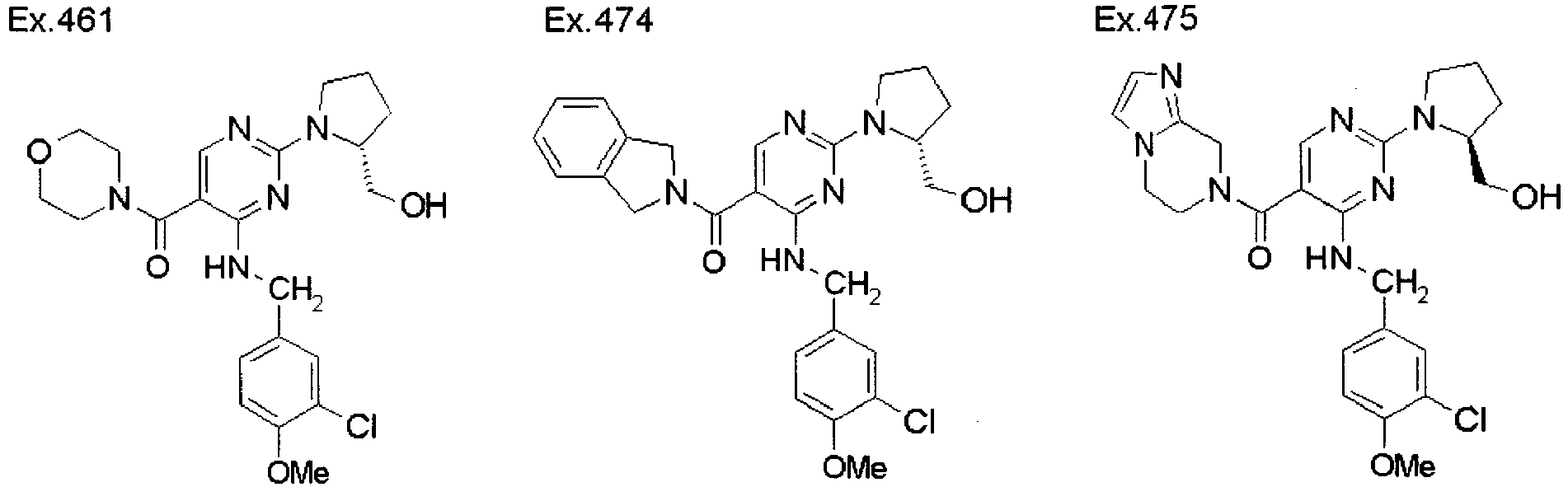
- (8) In
WO02/20489 
- However, these reports do not describe a renin inhibitory activity.
- Other than the above, amide compounds having particular structures are disclosed as a cathepsin S inhibitor in
WO2006/018284 , as a kinase inhibitor inWO2004/080463 , as a CNS disorder regulator inWO2007/047447 , as a Na+-K+-2Cl- cotransporter antagonist inUS2006/0089350 , as a CCR5 antagonist inWO2004/054974 , and as a glycine uptake inhibitor inWO2005/023260 . -
- patent document 1:
WO2007/077005 - patent document 2:
WO2007/006534 - patent document 3:
WO2008/093737 - patent document 4:
EP711757 - patent document 5:
US5250548 - patent document 6:
WO01/83460 - patent document 7:
WO02/20489 - patent document 8:
WO2006/018284 - patent document 9:
WO2004/080463 - patent document 10:
WO2007/047447 - patent document 11:
US2006/0089350 - patent document 12:
WO2004/054974 - patent document 13:
WO2005/023260 - non-patent document 1: Journal of Medicinal Chemistry, 1995, vol. 38, pages 1406-1410
- There is a demand on the development of a compound having a superior renin inhibitory activity, which is useful as a medicament (e.g., an agent for the prophylaxis or treatment of hypertension, various organ damages attributable to hypertension and the like, and the like), and a novel renin inhibitor.
- The present inventors have conducted various studies and found that a compound represented by the following formula (I) and a salt thereof have a superior renin inhibitory activity and are useful as renin inhibitors. Of the compounds represented by the following formula (I) and salts thereof, compounds represented by the following formulas (A) and (B) and salts thereof are described in particular.
- The present specification relates to
- [1] a renin inhibitor comprising a compound represented by the formula

R1 and R2 optionally form, together with the nitrogen atom bonded thereto, a nitrogen-containing heterocycle optionally having substituent(s),
R3 is a substituent, and
ring A is a homocycle or heterocycle optionally having substituent(s), or a salt thereof [hereinafter sometimes to be abbreviated as compound (I)] or a prodrug thereof; - [2] a compound represented by the formula

R3a is a 5- or 6-membered aromatic group optionally having substituent(s),
ring Aa is a homocycle or heterocycle optionally having substituent(s),
ring B is a nitrogen-containing 5- to 7-membered ring optionally having substituent(s), and
n and m are each an integer of 0 to 2, and the total of n and m is 1 to 3, or a salt thereof, excluding 4-[(3-chloro-4-methoxybenzyl)amino]-6-cyano-N-ethyl-N-(1-ethylpyrrolidin-3-yl)quinoline-3-carboxamide and 4-[(3-chloro-4-methoxybenzyl)amino]-6-cyano-N-methyl-N-(1-methylpiperidin-4-yl)quinoline-3-carboxamide [hereinafter sometimes to be abbreviated as compound (A)]; - [3] the compound of the aforementioned [2], wherein R1a is C1-6 alkyl;
- [4] the compound of the aforementioned [2], wherein R3a is a 5-membered aromatic group optionally having substituent(s);
- [5] the compound of the aforementioned [2], wherein ring Aa is a 5- or 6-membered aromatic heterocycle optionally having substituent(s);
- [6] the compound of the aforementioned [2], wherein ring B is a ring represented by the formula

- [7] the compound of the aforementioned [2], wherein R1a is C1-6 alkyl,
R3a is a 5-membered aromatic group optionally having substituent(s),
ring Aa is a 5- or 6-membered aromatic heterocycle optionally having substituent(s), and
ring B is a ring represented by the formula
- [8] a compound represented by the formula

R1b and R2b optionally form, together with the nitrogen atom bonded thereto, a nitrogen-containing heterocycle optionally having substituent(s),
R3b is a substituent, excluding 2-(4-phenylpiperazin-1-yl)ethyl optionally having substituent(s) and biphenyl-4-yl having substituent(s),
R4 is a hydrocarbon group optionally having substituent(s), a heterocyclic group optionally having substituent(s), excluding a cyclic amino optionally having substituent(s), mercapto optionally having a substituent or acyl,
X and Y are each C or N, and
ring Ab is a nitrogen-containing 6-membered ring optionally having substituent(s) in addition to R4, or a salt thereof, excluding N-(2-chloro-3-pyridinyl)-2-(ethylamino)-N,6-dimethyl-3-pyridinecarboxamide [hereinafter sometimes to be abbreviated as compound (B)]; - [9] the compound of the aforementioned [8], wherein R1b and R2b are each a hydrocarbon group optionally having substituent(s) or pyrrolidinyl, imidazolidinyl, pyrazolidinyl, piperidinyl, piperazinyl, morpholinyl or thiomorpholinyl optionally having substituent(s);
- [10] the compound of the aforementioned [8], wherein R1b and R2b form, together with the nitrogen atom bonded thereto, piperidine optionally having substituent(s) or piperazine optionally having substituent(s);
- [11] the compound of the aforementioned [8], wherein R3b is
- (1) a 5- or 6-membered aromatic or nonaromatic heterocyclic group containing, as a ring-constituting atom besides carbon atom, 1 to 4 heteroatoms selected from an oxygen atom, a sulfur atom and a nitrogen atom, and optionally having 1 to 3 C1-6 alkyl,
- (2) C6-14 aryl,
- (3) C3-10 cycloalkyl,
- (4) C1-6 alkyl optionally having 1 to 3 C1-6 alkoxy, or
- (5) C1-6 alkoxy-carbonyl;
- [12] the compound of the aforementioned [8], wherein R4 is a hydrocarbon group optionally having substituent(s) or a heterocyclic group optionally having substituent(s), excluding a cyclic amino optionally having substituent(s);
- [13] the compound of the aforementioned [8], wherein R4 is a hydrocarbon group optionally having substituent(s);
- [14] the compound of the aforementioned [8], wherein ring Ab is a ring represented by the formula
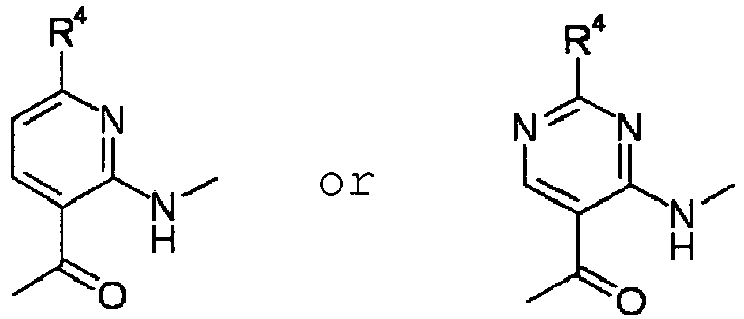
- [15] the compound of the aforementioned [8], wherein R1b and R2b are each a hydrocarbon group optionally having substituent(s) or pyrrolidinyl, imidazolidinyl, pyrazolidinyl, piperidinyl, piperazinyl, morpholinyl or thiomorpholinyl optionally having substituent(s),
R3b is- (1) a 5- or 6-membered aromatic or nonaromatic heterocyclic group containing, as a ring-constituting atom besides carbon atom, 1 to 4 heteroatoms selected from an oxygen atom, a sulfur atom and a nitrogen atom, and optionally having 1 to 3 C1-6 alkyl,
- (2) C6-14 aryl,
- (3) C3-10 cycloalkyl,
- (4) C1-6 alkyl optionally having 1 to 3 C1-6 alkoxy, or
- (5) C1-6 alkoxy-carbonyl,

- [16] 2-tert-butyl-N-[(3S,5R)-5-carbamoylpiperidin-3-yl]-4-[(furan-2-ylmethyl)amino]-N-(2-methylpropyl)pyrimidine-5-carboxamide or a salt thereof;
- [17] 2-tert-butyl-4-[(3-methoxypropyl)amino]-N-(2-methylpropyl)-N-[(3S,5R)-5-(morpholin-4-ylcarbonyl)piperidin-3-yl]pyrimidine-5-carboxamide or a salt thereof;
- [18] 2-tert-butyl-N-(2-methylpropyl)-N-[(3S,5R)-5-(morpholin-4-ylcarbonyl)piperidin-3-yl]-4-[(1,3-oxazol-2-ylmethyl)amino]pyrimidine-5-carboxamide or a salt thereof;
- [19] a prodrug of the compound of the aforementioned [2] or [8];
- [20] a medicament comprising the compound of the aforementioned [2] or [8] or a prodrug thereof;
- [21] the medicament of the aforementioned [20], which is a renin inhibitor;
- [22] the medicament of the aforementioned [20], which is an agent for the prophylaxis or treatment of hypertension; and
- [23] the medicament of the aforementioned [20], which is an agent for the prophylaxis or treatment of various organ damages attributable to hypertension.
- Furthermore, the present specification also relates to a compound represented by the formula

R3c is a substituent,
Z is C2-6 alkylene optionally having substituent(s), C2-6 alkenylene optionally having substituent(s) or C2-6 alkynylene optionally having substituent(s),
ring Ac is a homocycle or heterocycle optionally having substituent(s),
ring Bc is a nitrogen-containing 5- to 7-membered ring optionally having substituent(s), and
n and m are each an integer of 0 to 2, and the total of n and m is 1 to 3, or a salt thereof, excluding
4-{[(1R)-1-cyclohexylethyl]amino}-1-ethyl-N-methyl-N-(1-methylpiperidin-4-yl)-1H-pyrazolo[3,4-b]pyridine-5-carboxamide,
4-{[(1R)-1-cyclohexylethyl]amino}-N,1-diethyl-N-(1-ethylpyrrolidin-3-yl)-1H-pyrazolo[3,4-b]pyridine-5-carboxamide and
N-(1-benzylpyrrolidin-3-yl)-4-{[(1R)-1-cyclohexylethyl]amino}-1-ethyl-N-methyl-1H-pyrazolo[3,4-b]pyridine-5-carboxamide [hereinafter sometimes to be abbreviated as compound (C)] and the like. - Compound (I), compound (A), compound (B) and compound (C) have a superior renin inhibitory activity, and thus they are useful as agents for the prophylaxis or treatment of hypertension, various organ damages attributable to hypertension, and the like.
- Examples of the "halogen atom" in the present specification include fluorine, chlorine, bromine and iodine.
- Examples of the "C1-4 alkylenedioxy" in the present specification include methylenedioxy, ethylenedioxy, trimethylenedioxy and the like.
- Examples of the "C1-6 alkyl" in the present specification include methyl, ethyl, propyl, isopropyl, butyl, isobutyl, sec-butyl, tert-butyl, pentyl, isopentyl, neopentyl, 1-ethylpropyl, hexyl, isohexyl, 1,1-dimethylbutyl, 2,2-dimethylbutyl, 3,3-dimethylbutyl, 2-ethylbutyl and the like.
- Examples of the "C1-6 alkoxy" in the present specification include methoxy, ethoxy, propoxy, isopropoxy, butoxy, isobutoxy, sec-butoxy, tert-butoxy and the like.
- Examples of the "C1-6 alkoxy-carbonyl" in the present specification include methoxycarbonyl, ethoxycarbonyl, propoxycarbonyl, tert-butoxycarbonyl and the like.
- Examples of the "C1-6 alkyl-carbonyl" in the present specification include acetyl, propanoyl, butanoyl, isobutanoyl, pentanoyl, isopentanoyl, hexanoyl and the like.
- The "optionally halogenated" in the present specification means being optionally substituted by 1 to 5, preferably 1 to 3, halogen atoms.
- Examples of the "hydrocarbon group" of the "hydrocarbon group optionally having substituent(s)" in the present specification include alkyl, alkenyl, alkynyl, alkylidene, cycloalkyl, cycloalkenyl, cycloalkadienyl, aryl, aralkyl, arylalkenyl, cycloalkylalkyl and the like. Preferred are C1-10 alkyl, C2-10 alkenyl, C2-10 alkynyl, C1-3 alkylidene, C3-10 cycloalkyl, C3-10 cycloalkenyl, C4-10 cycloalkadienyl, C6-14 aryl, C7-16 aralkyl, C8-13 arylalkenyl, C3-10 cycloalkyl -C1-6 alkyl and the like. The above-mentioned C3-10 cycloalkyl, C3-10 cycloalkenyl and C4-10 cycloalkadienyl are each optionally condensed with a benzene ring.
- Examples of the "C1-10 alkyl" in the present specification include methyl, ethyl, propyl, isopropyl, butyl, isobutyl, sec-butyl, tert-butyl, pentyl, isopentyl, neopentyl, 1-ethylpropyl, hexyl, isohexyl, 1,1-dimethylbutyl, 2,2-dimethylbutyl, 3,3-dimethylbutyl, 2-ethylbutyl, heptyl, octyl, nonyl, decyl and the like. Among these, C1-6 alkyl is preferable.
- Examples of the "C2-10 alkenyl" in the present specification include ethenyl, 1-propenyl, 2-propenyl, 2-methyl-1-propenyl, 1-butenyl, 2-butenyl, 3-butenyl, 3-methyl-2-butenyl, 1-pentenyl, 2-pentenyl, 3-pentenyl, 4-pentenyl, 4-methyl-3-pentenyl, 1-hexenyl, 3-hexenyl, 5-hexenyl, 1-heptenyl, 1-octenyl and the like. Among these, C2-6 alkenyl is preferable.
- Examples of the "C2-10 alkynyl" in the present specification include ethynyl, 1-propynyl, 2-propynyl, 1-butynyl, 2-butynyl, 3-butynyl, 1-pentynyl, 2-pentynyl, 3-pentynyl, 4-pentynyl, 1-hexynyl, 2-hexynyl, 3-hexynyl, 4-hexynyl, 5-hexynyl, 1-heptynyl, 1-octynyl and the like. Among these, C2-6 alkynyl is preferable.
- Examples of the "C1-3 alkylidene" in the present specification include methylene, ethylidene, propylidene, isopropylidene and the like.
- Examples of the "C3-10 cycloalkyl" in the present specification include cyclopropyl, cyclobutyl, cyclopentyl, cyclohexyl, cycloheptyl, cyclooctyl, bicyclo[2.2.1]heptyl, bicyclo[2.2.2]octyl, bicyclo[3.2.1]octyl, bicyclo[3.2.2]nonyl, bicyclo[3.3.1]nonyl, bicyclo[4.2.1]nonyl, bicyclo[4.3.1]decyl, adamantyl and the like. Among these, C3-6 cycloalkyl is preferable. The above-mentioned C3-10 cycloalkyl is optionally condensed with a benzene ring. Examples of the condensed group include indanyl, tetrahydronaphthyl, fluorenyl and the like.
- Examples of the "C3-10 cycloalkenyl" in the present specification include 2-cyclopenten-1-yl, 3-cyclopenten-1-yl, 2-cyclohexen-1-yl, 3-cyclohexen-1-yl and the like. The above-mentioned C3-10 cycloalkenyl is optionally condensed with a benzene ring. Examples of the condensed group include indenyl and the like.
- Examples of the "C4-10 cycloalkadienyl" in the present specification include 2,4-cyclopentadien-1-yl, 2,4-cyclohexadien-1-yl, 2,5-cyclohexadien-1-yl and the like. The above-mentioned C4-10 cycloalkadienyl is optionally condensed with a benzene ring.
- Examples of the "C6-14 aryl" in the present specification include phenyl, 1-naphthyl, 2-naphthyl, biphenylyl, 2-anthryl and the like. Among these, C6-10 aryl is preferable, and phenyl is more preferable. The above-mentioned C6-14 aryl is optionally condensed with C3-10 cycloalkane (examples of the C3-10 cycloalkane include rings corresponding to the above-mentioned C3-10 cycloalkyl). Examples of the condensed group include tetrahydronaphthyl and the like.
- Examples of the "C7-16 aralkyl" in the present specification include benzyl, phenethyl, naphthylmethyl, biphenylylmethyl and the like.
- Examples of the "C8-13 arylalkenyl" in the present specification include styryl and the like.
- Examples of the "C3-10 cycloalkyl-C1-6 alkyl" in the present specification include cyclopropylmethyl, cyclohexylmethyl and the like.
- The "hydrocarbon group" of the "hydrocarbon group optionally having substituent(s)" optionally have substituent(s) (e.g., 1 to 5, preferably 1 to 3, substituents) at substitutable position(s). When the number of the substituents is two or more, respective substituents may be the same or different.
- Examples of the "substituent" of the "hydrocarbon group optionally having substituent(s)" include the following substituents.
- (1) halogen atom;
- (2) nitro;
- (3) cyano;
- (4) hydroxy;
- (5) C1-6 alkoxy optionally having 1 to 3 halogen atoms;
- (6) amino;
- (7) mono- or di-C1-6 alkylamino;
- (8) C7-16 aralkylamino;
- (9) C1-6 alkoxy-carbonylamino;
- (10) C7-16 aralkyloxy-carbonylamino;
- (11) C1-6 alkyl-carbonylamino;
- (12) C3-10 cycloalkyl-carbonylamino;
- (13) C1-6 alkylsulfonylamino;
- (14) C6-14 arylsulfonylamino;
- (15) C1-6 alkylaminocarbonylamino;
- (16) C6-14 arylaminocarbonylamino;
- (17) C1-6 alkyl-carbonyl;
- (18) C3-10 cycloalkyl-carbonyl;
- (19) carboxy;
- (20) C1-6 alkoxy-carbonyl;
- (21) carbamoyl;
- (22) mono- or di-C1-6 alkylcarbamoyl;
- (23) C7-16 aralkylcarbamoyl;
- (24) mercapto;
- (25) C1-6 alkylthio;
- (26) C1-6 alkylsulfinyl;
- (27) C1-6 alkylsulfonyl;
- (28) C1-4 alkylenedioxy;
- (29) C1-6 alkyl optionally having 1 to 3 substituents selected from
- (a) a halogen atom,
- (b) hydroxy,
- (c) C1-6 alkoxy,
- (d) C6-14 aryl,
- (e) amino,
- (f) mono- or di-C1-6 alkylamino,
- (g) C7-16 aralkylamino,
- (h) C1-6 alkoxy-carbonylamino,
- (i) C1-6 alkyl-carbonyloxy,
- (j) C1-6 alkylthio, and
- (k) C1-6 alkylsulfonyl;
- (30) C6-14 aryl optionally having 1 to 3 halogen atoms;
- (31) C7-16 aralkyl;
- (32) C3-10 cycloalkyl and the like.
- Examples of the "heterocyclic group" of the "heterocyclic group optionally having substituent(s)" in the present specification include an aromatic heterocyclic group and a nonaromatic heterocyclic group.
- Examples of the "aromatic heterocyclic group" include a 4- to 7-membered (preferably 5- or 6-membered) monocyclic aromatic heterocyclic group containing, as a ring-constituting atom besides carbon atoms, 1 to 4 heteroatoms selected from an oxygen atom, a sulfur atom and a nitrogen atom, and a fused aromatic heterocyclic group. Examples of the fused aromatic heterocyclic group include a group derived from a fused ring wherein a ring corresponding to such 4- to 7-membered monocyclic aromatic heterocyclic group, and 1 or 2 rings selected from a 5- or 6-membered aromatic heterocycle containing 1 or 2 nitrogen atoms, a 5-membered aromatic heterocycle containing one sulfur atom and a benzene ring are condensed, and the like.
- Examples of the "aromatic heterocyclic group" include 4- to 7-membered (preferably 5- or 6-membered) monocyclic aromatic heterocyclic groups such as furyl (e.g., 2-furyl, 3-furyl), thienyl (e.g., 2-thienyl, 3-thienyl), pyridyl (e.g., 2-pyridyl, 3-pyridyl, 4-pyridyl), pyrimidinyl (e.g., 2-pyrimidinyl, 4-pyrimidinyl, 5-pyrimidinyl), pyridazinyl (e.g., 3-pyridazinyl, 4-pyridazinyl), pyrazinyl (e.g., 2-pyrazinyl), pyrrolyl (e.g., 1-pyrrolyl, 2-pyrrolyl, 3-pyrrolyl), imidazolyl (e.g., 1-imidazolyl, 2-imidazolyl, 4-imidazolyl, 5-imidazolyl), pyrazolyl (e.g., 1-pyrazolyl, 3-pyrazolyl, 4-pyrazolyl), thiazolyl (e.g., 2-thiazolyl, 4-thiazolyl, 5-thiazolyl), isothiazolyl (e.g., 3-isothiazolyl, 4-isothiazolyl, 5-isothiazolyl), oxazolyl (e.g., 2-oxazolyl, 4-oxazolyl, 5-oxazolyl), isoxazolyl (e.g., 3-isoxazolyl, 4-isoxazolyl, 5-isoxazolyl), oxadiazolyl (e.g., 1,2,4-oxadiazol-5-yl, 1,3,4-oxadiazol-2-yl), thiadiazolyl (e.g., 1,2,4-thiadiazol-5-yl, 1,3,4-thiadiazol-2-yl), triazolyl (e.g., 1,2,4-triazol-1-yl, 1,2,4-triazol-3-yl, 1,2,3-triazol-1-yl, 1,2,3-triazol-2-yl, 1,2,3-triazol-4-yl), tetrazolyl (e.g., tetrazol-1-yl, tetrazol-5-yl), triazinyl (e.g., 1,3,5-triazin-2-yl, 1,3,5-triazin-4-yl, 1,2,3-triazin-4-yl, 1,2,4-triazin-3-yl) and the like;
fused aromatic heterocyclic groups such as quinolyl (e.g., 2-quinolyl, 3-quinolyl, 4-quinolyl, 6-quinolyl), isoquinolyl (e.g., 3-isoquinolyl), quinazolyl (e.g., 2-quinazolyl, 4-quinazolyl), quinoxalyl (e.g., 2-quinoxalyl, 6-quinoxalyl), benzofuranyl (e.g., 2-benzofuranyl, 3-benzofuranyl), benzothienyl (e.g., 2-benzothienyl, 3-benzothienyl), benzoxazolyl (e.g., 2-benzoxazolyl), benzisoxazolyl (e.g., 7-benzisoxazolyl), benzothiazolyl (e.g., 2-benzothiazolyl), benzimidazolyl (e.g., benzimidazol-1-yl, benzimidazol-2-yl, benzimidazol-5-yl), benzotriazolyl (e.g., 1H-1,2,3-benzotriazol-5-yl), indolyl (e.g., indol-1-yl, indol-2-yl, indol-3-yl, indol-5-yl), indazolyl (e.g., 1H-indazol-3-yl), pyrrolopyrazinyl (e.g., 1H-pyrrolo[2,3-b]pyrazin-2-yl, 1H-pyrrolo[2,3-b]pyrazin-6-yl), imidazopyridinyl (e.g., 1H-imidazo[4,5-b]pyridin-2-yl, 1H-imidazo[4,5-c]pyridin-2-yl, 2H-imidazo[1,2-a]pyridin-3-yl), imidazopyrazinyl (e.g., 1H-imidazo[4,5-b]pyrazin-2-yl), pyrazolopyridinyl (e.g., 1H-pyrazolo[4,3-c]pyridin-3-yl), pyrazolothienyl (e.g., 2H-pyrazolo[3,4-b]thiophen-2-yl), pyrazolotriazinyl (e.g., pyrazolo[5,1-c][1,2,4]triazin-3-yl) and the like;
and the like. - Examples of the "nonaromatic heterocyclic group" include a 4- to 7-membered (preferably 5- or 6-membered) monocyclic nonaromatic heterocyclic group containing, as a ring-constituting atom besides carbon atoms, 1 to 4 heteroatoms selected from an oxygen atom, a sulfur atom and a nitrogen atom, and a fused nonaromatic heterocyclic group. Examples of the fused nonaromatic heterocyclic group include a group derived from a fused ring wherein a ring corresponding to such 4- to 7-membered monocyclic nonaromatic heterocyclic group, and 1 or 2 rings selected from a 5- or 6-membered heterocycle containing 1 or 2 nitrogen atoms, a 5-membered heterocycle containing one sulfur atom and a benzene ring are condensed, and the like.
- Examples of the "nonaromatic heterocyclic group" include 4- to 7-membered (preferably 5- or 6-membered) monocyclic nonaromatic heterocyclic groups such as pyrrolidinyl (e.g., 1-pyrrolidinyl, 2-pyrrolidinyl), piperidinyl (e.g., piperidino, 2-piperidinyl, 3-piperidinyl, 4-piperidinyl), morpholinyl (e.g., morpholino), thiomorpholinyl (e.g., thiomorpholino), piperazinyl (e.g., 1-piperazinyl, 2-piperazinyl, 3-piperazinyl), hexamethyleniminyl (e.g., hexamethylenimin-1-yl), oxazolidinyl (e.g., oxazolidin-2-yl), thiazolidinyl (e.g., thiazolidin-2-yl), imidazolidinyl (e.g., imidazolidin-2-yl, imidazolidin-3-yl), oxazolinyl (e.g., oxazolin-2-yl), thiazolinyl (e.g., thiazolin-2-yl), imidazolinyl (e.g., imidazolin-2-yl, imidazolin-3-yl), dioxolyl (e.g., 1,3-dioxol-4-yl), dioxolanyl (e.g., 1,3-dioxolan-4-yl), dihydrooxadiazolyl (e.g., 4,5-dihydro-1,2,4-oxadiazol-3-yl), 2-thioxo-1,3-oxazolidin-5-yl, pyranyl (e.g., 4-pyranyl), tetrahydropyranyl (e.g., 2-tetrahydropyranyl, 3-tetrahydropyranyl, 4-tetrahydropyranyl), thiopyranyl (e.g., 4-thiopyranyl), tetrahydrothiopyranyl (e.g., 2-tetrahydrothiopyranyl, 3-tetrahydrothiopyranyl, 4-tetrahydrothiopyranyl), 1-oxidotetrahydrothiopyranyl (e.g., 1-oxidotetrahydrothiopyran-4-yl), 1,1-dioxidotetrahydrothiopyranyl (e.g., 1,1-dioxidotetrahydrothiopyran-4-yl), tetrahydrofuryl (e.g., tetrahydrofuran-3-yl, tetrahydrofuran-2-yl), pyrazolidinyl (e.g., pyrazolidin-1-yl, pyrazolidin-3-yl), pyrazolinyl (e.g., pyrazolin-1-yl), tetrahydropyrimidinyl (e.g., tetrahydropyrimidin-1-yl), dihydrotriazolyl (e.g., 2,3-dihydro-1H-1,2,3-triazol-1-yl), tetrahydrotriazolyl (e.g., 2,3,4,5-tetrahydro-1H-1,2,3-triazol-1-yl) and the like; fused nonaromatic heterocyclic groups such as dihydroindolyl (e.g., 2,3-dihydro-1H-indol-1-yl), dihydroisoindolyl (e.g., 1,3-dihydro-2H-isoindol-2-yl), dihydrobenzofuranyl (e.g., 2,3-dihydrobenzofuran-5-yl), dihydrobenzodioxinyl (e.g., 2,3-dihydro-1,4-benzodioxinyl), dihydrobenzodioxepinyl (e.g., 3,4-dihydro-2H-1,5-benzodioxepinyl), tetrahydrobenzofuranyl (e.g., 4,5,6,7-tetrahydrobenzofuran-3-yl), chromenyl (e.g., 4H-chromen-2-yl, 2H-chromen-3-yl), dihydroquinolinyl (e.g., 1,2-dihydroquinolin-4-yl), tetrahydroquinolinyl (e.g., 1,2,3,4-tetrahydroquinolin-4-yl), dihydroisoquinolinyl (e.g., 1,2-dihydroisoquinolin-4-yl), tetrahydroisoquinolinyl (e.g., 1,2,3,4-tetrahydroisoquinolin-4-yl), dihydrophthalazinyl (e.g., 1,4-dihydrophthalazin-4-yl) and the like;
and the like. - The "heterocyclic group" optionally has substituent(s) (e.g., 1 to 5, preferably 1 to 3, substituents) at substitutable position(s). When the number of the substituents is two or more, respective substituents may be the same or different.
- Examples of the "substituent" of the "heterocyclic group optionally having substituent(s)" include the following substituents.
- (1) a halogen atom;
- (2) nitro;
- (3) cyano;
- (4) hydroxy;
- (5) C1-6 alkoxy optionally having 1 to 3 halogen atoms;
- (6) amino;
- (7) mono- or di-C1-6 alkylamino;
- (8) C7-16 aralkylamino;
- (9) C1-6 alkoxy-carbonylamino;
- (10) C7-16 aralkyloxy-carbonylamino;
- (11) C1-6 alkyl-carbonylamino;
- (12) C3-10 cycloalkyl-carbonylamino;
- (13) C1-6 alkylsulfonylamino;
- (14) C6-14 arylsulfonylamino;
- (15) C1-6 alkylaminocarbonylamino;
- (16) C6-14 arylaminocarbonylamino;
- (17) C1-6 alkyl-carbonyl;
- (18) C3-10 cycloalkyl-carbonyl;
- (19) carboxy;
- (20) C1-6 alkoxy-carbonyl;
- (21) a group represented by the formula: -CO-N(R5) (R6) wherein R5 and R6 are each a hydrogen atom or C1-6 alkyl, or R5 and R6 optionally form, together with the nitrogen atom bonded thereto, a nitrogen-containing heterocycle optionally having substituent(s);
- (22) C7-16 aralkylcarbamoyl;
- (23) mercapto;
- (24) C1-6 alkylthio;
- (25) C1-6 alkylsulfinyl;
- (26) C1-6 alkylsulfonyl;
- (27) C1-4 alkylenedioxy;
- (28) C1-6 alkyl optionally having 1 to 3 substituents selected from
- (a) a halogen atom,
- (b) hydroxy,
- (c) C1-6 alkoxy,
- (d) C6-14 aryl,
- (e) amino,
- (f) mono- or di-C1-6 alkylamino,
- (g) C7-16 aralkylamino,
- (h) C1-6 alkoxy-carbonylamino,
- (i) C1-6 alkyl-carbonyloxy,
- (j) C1-6 alkylthio, and
- (k) C1-6 alkylsulfonyl;
- (29) C6-14 aryl optionally having 1 to 3 halogen atoms;
- (30) C7-16 aralkyl;
- (31) C3-10 cycloalkyl and the like.
- Examples of the "nitrogen-containing heterocycle" of the "nitrogen-containing heterocycle optionally having substituent(s)" formed by R5 and R6 together with the nitrogen atom bonded thereto include a 4- to 7-membered (preferably 5-to 7-membered) nonaromatic nitrogen-containing heterocycle containing, as a ring-constituting atom besides carbon atom, one nitrogen atom, and optionally further containing 1 or 2 heteroatoms selected from an oxygen atom, a sulfur atom and a nitrogen atom. Examples of the nitrogen-containing heterocycle include azetidine, pyrrolidine, imidazolidine, pyrazolidine, piperidine, piperazine, morpholine, thiomorpholine and the like.
- The "nitrogen-containing heterocycle" optionally forms a fused ring with a benzene ring, a cyclohexane ring or an oxazole ring, or optionally forms a spiro ring with a 1,3-dioxolane ring. Examples of the fused ring include 1,2,3,4-tetrahydroquinoline, 1,2,3,4-tetrahydroisoquinoline, 2,3-dihydro-1H-isoindole, 2,3-dihydro-1H-indole, decahydroquinoline, 4,5,6,7-tetrahydro[1,3]oxazolo[5,4-b]pyridine and the like. Examples of the spiro ring include 1,4-dioxa-8-azaspiro[4.5]decane and the like.
- The "nitrogen-containing heterocycle", a fused ring thereof and a spiro ring thereof optionally have preferably 1 to 3, more preferably 1 or 2 substituents at substitutable position(s). When the number of substituents is two or more, the respective substituents may be the same or different. Examples of the substituent include the aforementioned groups exemplified as the substituents that the "hydrocarbon group" optionally has and the like. Preferable examples of the substituent include a halogen atom; hydroxy; C1-6 alkoxy optionally having 1 to 3 halogen atoms; C1-6 alkyl-carbonyl; C1-6 alkoxy-carbonyl; C1-6 alkyl optionally having 1 to 3 substituents selected from halogen atom, hydroxy and C1-6 alkoxy; oxo; C6-14 aryl (e.g., phenyl) optionally having 1 to 3 C1-6 alkoxy; C7-16 aralkyl (e.g., benzyl); C6-14 aryloxy (e.g., phenoxy); C7-16 aralkyloxy (e.g., benzyloxy); C6-14 aryl-carbonyl (e.g., benzoyl); mono- or di-C1-6 alkylsulfamoyl; C1-6 alkylsulfonyl; a 5- or 6-membered heterocyclic group containing, as a ring-constituting atom besides carbon atom, 1 to 4 heteroatoms selected from an oxygen atom, a sulfur atom and a nitrogen atom (e.g., pyridyl, thiazolyl) and the like.
- In the present specification, examples of the "homocycle or heterocycle" of the "homocycle or heterocycle optionally having substituent(s)" include (i) an aromatic heterocycle or a nonaromatic heterocycle containing, as a ring-constituting atom besides carbon atom, 1 to 3 heteroatoms selected from an oxygen atom, a sulfur atom and a nitrogen atom, (ii) cyclic hydrocarbon (homocycle) and the like.
- Examples of the "aromatic heterocycle" include a 5- or 6-membered aromatic heterocycle containing, as a ring-constituting atom besides carbon atom, 1 to 3 heteroatoms selected from an oxygen atom, a sulfur atom and a nitrogen atom (e.g., pyrazole, pyridine, pyrimidine etc.) and the like. Preferable examples thereof include a 6-membered aromatic heterocycle containing, as a ring-constituting atom besides carbon atom, 1 or 2 nitrogen atoms (e.g., pyridine, pyrimidine etc.) and the like.
- Examples of the "nonaromatic heterocycle" include a 5- to 9-membered (preferably 5- or 6-membered) nonaromatic heterocycle containing, as a ring-constituting atom besides carbon atom, 1 to 3 heteroatoms selected from an oxygen atom, a sulfur atom and a nitrogen atom and the like.
- Examples of the "cyclic hydrocarbon" include 3- to 10-membered (preferably 5- to 9-membered, more preferably 5- or 6-membered) cyclic hydrocarbon and the like, with preference given to benzene, C3-10 cycloalkene, C3-10 cycloalkane and the like.
- The above-mentioned "homocycle or heterocycle" optionally has substituent(s) (e.g., 1 to 5, preferably 1 to 3, substituents) at substitutable position(s). Examples of the substituent(s) include groups exemplified as the substituents that the "hydrocarbon group" optionally has and the like. When the number of substituents is two or more, the respective substituents may be the same or different.
- Examples of the "C2-6 alkylene" in the present specification include ethylene, trimethylene, tetramethylene, pentamethylene, hexamethylene, -CH(CH3)-, -C(CH3)2-, - CH(CH2CH3)-, -C(CH2CH3)2-, -CH(CH3)-CH2-, -CH2-CH(CH3)-, -C(CH3)2-CH2-, -CH2-C(CH3)2-, -CH(CH3)-(CH2)2-, -CH2-CH(CH3)-CH2-, -(CH2)2-CH(CH3)-, -C(CH3)2-(CH2)2-, -CH2-C(CH3)2-CH2-, -(CH2)2-C(CH3)2- and the like.
- Examples of the "C2-6 alkenylene" in the present specification include -CH=CH-, -CH=CH-CH2-, -CH2-CH=CH-, - CH=CH-(CH2)2-, -CH2-CH=CH-CH2-, -(CH2)2-CH=CH-, -CH=CH-(CH2)3-, - CH2-CH=CH-(CH3)2-, -(CH3)2-CH=CH-CH2-, -(CH2)3-CH=CH-, -CH=CH-(CH2)4-, -CH2-CH=CH-(CH2)3-, -(CH2)2-CH=CH-(CH2)2-, -(CH2)3-CH=CH-CH2-, -(CH2)4-CH=CH-, -C(CH3)=CH-, -CH=C(CH3)-, -CH(CH3)-CH=CH-CH2-, -CH2-CH=CH-CH(CH3)-, -CH=CH-CH=CH- and the like.
- Examples of the "C2-6 alkynylene" in the present specification include -C≡C-, -C≡C-CH2-, -CH2-C≡C-, -C≡C-(CH2)2-, -CH2-C≡C-CH2-, -(CH2)2-C≡C-, -C≡C-(CH2)3-, -CH2-C≡C-(CH3)2-, -(CH3)2-C≡C-CH2-, -(CH2)3-C≡C-, -C≡C-(CH2)4-, -CH2-C≡ C-(CH2)3-, -(CH2)2-C≡C-(CH2)2-, -(CH2)3-C≡C-CH2-, -(CH2)4-C≡C-, -CH(CH3)-C≡C-CH2-, -CH2-C≡C-CH(CH3)- and the like.
- The "C2-6 alkylene", "C2-6 alkenylene" and "C2-6 alkynylene" of the "C2-6 alkylene optionally having substituent(s)", "C2-6 alkenylene optionally having substituent(s)" and "C2-6 alkynylene optionally having substituent(s)" in the present specification optionally have substituent(s) (e.g., 1 to 3, preferably 1 or 2 substituents) at substitutable position(s). When the number of substituents is two or more, respective substituents may be the same or different. Examples thereof include the following substituents.
- (1) oxo;
- (2) halogen atom;
- (3) nitro;
- (4) cyano;
- (5) hydroxy;
- (6) C1-6 alkoxy optionally having 1 to 3 halogen atoms;
- (7) amino;
- (8) mono- or di-C1-6 alkylamino;
- (9) C7-16 aralkylamino;
- (10) C1-6 alkoxy-carbonylamino;
- (11) C1-6 alkyl-carbonylamino;
- (12) C1-6 alkyl-carbonyl;
- (13) carboxy;
- (14) C1-6 alkoxy-carbonyl;
- (15) carbamoyl;
- (16) mono- or di-C1-6 alkylcarbamoyl;
- (17) mercapto;
- (18) C1-6 alkylthio;
- (19) C1-6 alkylsulfinyl;
- (20) C1-6 alkylsulfonyl and the like.
- Examples of the "hydroxy optionally having a substituent" in the present specification include (1) hydroxy, or (2) hydroxy having, instead of the hydrogen atom of hydroxy, one group selected from, for example, the aforementioned "hydrocarbon group optionally having substituent(s)", the aforementioned "heterocyclic group optionally having substituent(s)", the groups exemplified as the substituents that the aforementioned "hydrocarbon group optionally having substituent(s)" may have and the like.
- Examples of the "hydroxy optionally having a substituent" include hydroxy optionally having a substituent selected from C1-10 alkyl optionally having substituent(s), C2-10 alkenyl optionally having substituent(s), C3-10 cycloalkyl optionally having substituent(s), C3-10 cycloalkenyl optionally having substituent(s), C6-14 aryl optionally having substituent (s), C7-16 aralkyl optionally having substituent(s), C8-13 arylalkenyl optionally having substituent(s), a heterocyclic group optionally having substituent(s), acyl and the like.
- The aforementioned C1-10 alkyl, C2-10 alkenyl, C3-10 cycloalkyl, C3-10 cycloalkenyl, C6-14 aryl, C7-16 aralkyl and C8-13 arylalkenyl each optionally have substituent(s) (preferably 1 to 3 substituents) at substitutable position(s). Examples of the substituent include groups similar to the substituents that the aforementioned "hydrocarbon group" optionally has. When the number of substituents is two or more, the respective substituents may be the same or different.
- Examples of the "mercapto optionally having a substituent" in the present specification include (1) mercapto or (2) mercapto having, instead of the hydrogen atom of mercapto, one group selected from, for example, the aforementioned "hydrocarbon group optionally having substituent(s)", the aforementioned "heterocyclic group optionally having substituent(s)", the groups exemplified as the substituents that the aforementioned "hydrocarbon group optionally having substituent(s)" may have and the like.
- Examples of the "mercapto optionally having a substituent" include mercapto optionally having a substituent selected from C1-10 alkyl optionally having substituent(s), C2-10 alkenyl optionally having substituent(s), C3-10 cycloalkyl optionally having substituent(s), C3-10 cycloalkenyl optionally having substituent(s), C6-14 aryl optionally having substituent(s), C7-16 aralkyl optionally having substituent(s), C8-13 arylalkenyl optionally having substituent(s), a heterocyclic group optionally having substituent(s), acyl and the like.
- The aforementioned C1-10 alkyl, C2-10 alkenyl, C3-10 cycloalkyl, C3-10 cycloalkenyl, C6-14 aryl, C7-16 aralkyl and C8-13 arylalkenyl each optionally have substituent(s) (preferably 1 to 3 substituents) at substitutable position(s). Examples of the substituent include groups similar to the substituents that the aforementioned "hydrocarbon group" optionally has. When the number of substituents is two or more, the respective substituents may be the same or different.
- Examples of the "acyl" in the present specification include a group represented by the formula: -CORA, -CO-ORA, - SO2RA, -SORA, -CO-NRA'R5' or -CS-NRA'RB' wherein RA is a hydrogen atom, a hydrocarbon group optionally having substituent(s) or a heterocyclic group optionally having substituent(s), and RA' and RB' are each a hydrogen atom, a hydrocarbon group optionally having substituent(s) or a heterocyclic group optionally having substituent(s), or RA' and RB' optionally form, together with the nitrogen atom bonded thereto, a nitrogen-containing heterocycle optionally having substituent(s) and the like.
- Examples of the "nitrogen-containing heterocycle" of the "nitrogen-containing heterocycle optionally having substituent(s)" formed by RA' and RB' together with the nitrogen atom bonded thereto include a 5- to 7-membered nonaromatic nitrogen-containing heterocycle containing, as a ring-constituting atom besides carbon atom, one nitrogen atom, and optionally further containing 1 or 2 heteroatoms selected from an oxygen atom, a sulfur atom and a nitrogen atom. Examples of the nitrogen-containing heterocycle include pyrrolidine, imidazolidine, pyrazolidine, piperidine, piperazine, morpholine, thiomorpholine and the like.
- The "nitrogen-containing heterocycle" optionally has substituent(s) (preferably 1 to 3, more preferably 1 or 2 substituents) at substitutable position(s). Examples of the substituent include groups exemplified as the substituents that the aforementioned "hydrocarbon group" optionally has and the like. When the number of substituents is two or more, the respective substituents may be the same or different.
- Preferable examples of the "acyl" include
- (1) formyl;
- (2) carboxy;
- (3) C1-6 alkyl-carbonyl;
- (4) C1-6 alkoxy-carbonyl (e.g., methoxycarbonyl, ethoxycarbonyl, propoxycarbonyl, tert-butoxycarbonyl);
- (5) a group represented by the formula: -CO-NRA'RB'
- The definition of each symbol in the formulas (I), (A), (B) and (C) is explained in detail in the following.
- In the formula (I), R1 and R2 are each a hydrocarbon group optionally having substituent(s) or a heterocyclic group optionally having substituent(s), or R1 and R2 optionally form, together with the nitrogen atom bonded thereto, a nitrogen-containing heterocycle optionally having substituent(s).
- Examples of the "hydrocarbon group" of the "hydrocarbon group optionally having substituent(s)" for R1 or R2 include alkyl, cycloalkyl, aralkyl, cycloalkylalkyl and the like. Preferable examples thereof include C1-6 alkyl, C3-10 cycloalkyl, C7-16 aralkyl, C3-10 cycloalkyl-C1-6 alkyl and the like.
- Examples of the "substituent" of the "hydrocarbon group optionally having substituent(s)" for R1 or R2 include 1 to 3 substituents selected from a halogen atom, cyano, hydroxy; amino; C1-6 alkoxy-carbonyl; carbamoyl; C1-6 alkylcarbamoyl optionally having 1 to 3 substituents selected from hydroxy and a heterocyclic group (preferably, 5- or 6-membered heterocyclic group containing, as a ring-constituting atom besides carbon atom, 1 to 4 heteroatoms selected from an oxygen atom, a sulfur atom and a nitrogen atom, e.g., pyridyl, morpholinyl); C7-16 aralkylcarbamoyl (e.g., benzylcarbamoyl) and the like.
- Examples of the "heterocyclic group" of the "heterocyclic group optionally having substituent(s)" for R1 or R2 include a 4- to 7-membered nonaromatic heterocyclic group containing, as a ring-constituting atom besides carbon atom, 1 to 4 heteroatoms selected from an oxygen atom, a sulfur atom and a nitrogen atom, and the like. Preferable examples thereof include a 5- to 7-membered nonaromatic heterocyclic group containing, as a ring-constituting atom besides carbon atom, 1 or 2 heteroatoms selected from an oxygen atom, a sulfur atom and a nitrogen atom (e.g., pyrrolidinyl, imidazolidinyl, pyrazolidinyl, piperidinyl, piperazinyl, morpholinyl, thiomorpholinyl) and the like. More preferably is piperidinyl.
- The "heterocyclic group" optionally has substituent(s) (e.g., 1 to 5, preferably 1 to 3, substituents) at substitutable position(s). When the number of substituents is two or more, the respective substituents may be the same or different. Examples of the substituent include groups exemplified as the substituents of the aforementioned "heterocyclic group optionally having substituent(s)" and the like.
- Preferable examples of the "substituent" of the "heterocyclic group optionally having substituent(s)" for R1 or R2 include
- (1) C1-6 alkyl optionally having 1 to 3 hydroxy;
- (2) a group represented by the formula: -CO-N(R5) (R6) wherein R5 and R6 are each a hydrogen atom or C1-6 alkyl, or R5 and R6 optionally form, together with the nitrogen atom bonded thereto, a nitrogen-containing heterocycle (preferably, 5- to 7-membered nonaromatic nitrogen-containing heterocycle containing, as a ring-constituting atom besides carbon atom, one nitrogen atom, and optionally further containing 1 or 2 heteroatoms selected from an oxygen atom, a sulfur atom and a nitrogen atom, for example, pyrrolidine, imidazolidine, pyrazolidine, piperidine, piperazine, morpholine, thiomorpholine) optionally having substituent(s) (e.g., 1 to 3 substituents selected from hydroxy and C1-6 alkyl) and the like.
- Examples of the "nitrogen-containing heterocycle" of the "nitrogen-containing heterocycle optionally having substituent(s)" formed by R1 and R2 together with the nitrogen atom bonded thereto include a 5- to 9-membered (preferably 5-to 7-membered, more preferably 5- or 6-membered) nonaromatic nitrogen-containing heterocycle containing, as a ring-constituting atom besides carbon atom, one nitrogen atom, and optionally further containing 1 or 2 heteroatoms selected from an oxygen atom, a sulfur atom and a nitrogen atom.
- Examples of the "nitrogen-containing heterocycle" include pyrrolidine, imidazolidine, pyrazolidine, piperidine, piperazine, morpholine, thiomorpholine, azepane, azocane, azonane, 1,4-diazepane and the like.
- The "nitrogen-containing heterocycle" optionally has substituent(s) (e.g., 1 to 5, preferably 1 to 3, substituents) at substitutable position(s). When the number of substituents is two or more, the respective substituents may be the same or different. Examples of the substituent include groups exemplified as the substituents that the aforementioned "hydrocarbon group" optionally has and the like. Preferable examples of the substituent include 1 to 3 substituents selected from
- (1) C1-6 alkyl optionally having 1 to 3 substituents selected from
- (a) hydroxy,
- (b) C1-6 alkoxy,
- (c) C6-14 aryl (e.g., phenyl),
- (d) amino,
- (e) mono- or di-C1-6 alkylamino,
- (f) C7-16 aralkylamino (e.g., benzylamino), and
- (g) C1-6 alkoxy-carbonylamino (e.g., tert-butoxycarbonylamino),
- (2) C6-14 aryl (e.g., phenyl) optionally having 1 to 3 halogen atoms,
- (3) C7-16 aralkyl (e.g., benzyl, phenethyl),
- (4) C3-10 cycloalkyl (e.g., cyclohexyl),
- (5) amino,
- (6) hydroxy,
- (7) C1-6 alkoxy-carbonyl (e.g., tert-butoxycarbonyl),
- (8) carbamoyl
- R1 and R2 are preferably each
- (1) C1-6 alkyl optionally having 1 to 3 substituents selected from
- (a) a halogen atom,
- (b) cyano,
- (c) hydroxy,
- (d) amino,
- (e) C1-6 alkoxy-carbonyl,
- (f) carbamoyl,
- (g) C1-6 alkylcarbamoyl optionally having 1 to 3 substituents selected from hydroxy and a heterocyclic group (preferably, a 5- or 6-membered heterocyclic group containing, as a ring-constituting atom besides carbon atom, 1 to 4 heteroatoms selected from an oxygen atom, a sulfur atom and a nitrogen atom, e.g., pyridyl, morpholinyl), and
- (h) C7-16 aralkylcarbamoyl (e.g., benzylcarbamoyl),
- (2) C3-10 cycloalkyl (e.g., cyclopropyl, cyclohexyl),
- (3) C7-16 aralkyl (e.g., benzyl),
- (4) C3-10 cycloalkyl-C1-6 alkyl (e.g., cyclopropylmethyl),
- (5) a group represented by the formula
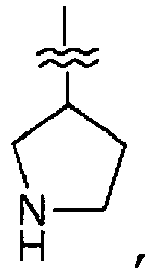
- (6) a group represented by the formula

- (1') a hydrogen atom,
- (2') cyano,
- (3') C1-6 alkyl optionally having 1 to 3 substituents selected from
- (a) hydroxy,
- (b) C1-6 alkyl-carbonyloxy,
- (c) C1-6 alkylthio, and
- (d) C1-6 alkylsulfonyl,
- (4') C3-10 cycloalkyl (e.g., cyclohexyl) optionally having 1 to 3 hydroxy,
- (5') C7-16 aralkylamino (e.g., phenethylamino) optionally having 1 to 3 hydroxy,
- (6') C1-6 alkoxy-carbonylamino,
- (7') C7-16 aralkyloxy-carbonylamino (e.g., benzyloxycarbonylamino),
- (8') C1-6 alkyl-carbonylamino,
- (9') C3-10 cycloalkyl-carbonylamino (e.g., cyclohexylcarbonylamino) optionally having 1 to 3 substituents selected from hydroxy and C1-6 alkoxy,
- (10') C1-6 alkylsulfonylamino,
- (11') C6-14 arylsulfonylamino (e.g., phenylsulfonylamino),
- (12') C1-6 alkylaminocarbonylamino,
- (13') C6-14 arylaminocarbonylamino (e.g., phenylaminocarbonylamino),
- (14') C1-6 alkyl-carbonyl,
- (15') C3-10 cycloalkyl-carbonyl (e.g., cyclopropylcarbonyl),
- (16') carboxy,
- (17') a group represented by the formula: -W1-R7 wherein W1 is a bond, -CH2-, -CH2O-, -NHCO- or -NHSO2-, and R7 is a 5- or 6-membered heterocyclic group containing, as a ring-constituting atom besides carbon atom, 1 to 4 heteroatoms selected from an oxygen atom, a sulfur atom and a nitrogen atom (e.g., imidazolyl, morpholinyl, pyridyl, tetrahydropyranyl, piperidinyl, tetrazolyl, 4,5-dihydro-1,2,4-oxadiazolyl, 1,2,4-triazolyl, 1,3,4-oxadiazolyl, 1,2,4-oxadiazolyl, imidazolidinyl, hexahydropyrimidinyl, pyrazolyl), the 5- or 6-membered heterocyclic group optionally has 1 to 3 substituents selected from
- (a) oxo,
- (b) C1-6 alkyl optionally having 1 to 3 hydroxy,
- (c) C6-14 aryl,
- (d) carbamoyl, and
- (e) C1-6 alkoxy-carbonyl,
- (18') C1-6 alkoxy-carbonyl, or
- (19') a group represented by the formula: -CO-N(R5) (R6) wherein R5 and R6 are each a hydrogen atom, C1-6 alkyl or C1-6 alkoxy, or
- (a) oxo,
- (b) a halogen atom,
- (c) C1-6 alkyl optionally having 1 to 3 substituents selected from hydroxy and C1-6 alkoxy,
- (d) C6-14 aryl (e.g., phenyl) optionally having 1 to 3 C1-6 alkoxy,
- (e) C7-16 aralkyl (e.g., benzyl),
- (f) hydroxy,
- (g) C1-6 alkoxy,
- (h) C6-14 aryloxy (e.g., phenoxy),
- (i) C7-16 aralkyloxy (e.g., benzyloxy),
- (j) C1-6 alkyl-carbonyl,
- (k) C6-14 aryl-carbonyl (e.g., benzoyl),
- (l) mono- or di-C1-6 alkylsulfamoyl,
- (m) C1-6 alkylsulfonyl, and
- (n) a 5- or 6-membered heterocyclic group containing, as a ring-constituting atom besides carbon atom, 1 to 4 heteroatoms selected from an oxygen atom, a sulfur atom and a nitrogen atom (e.g., pyridyl, thiazolyl), or
- (1) C1-6 alkyl optionally having 1 to 3 substituents selected from
- (a) hydroxy,
- (b) C1-6 alkoxy,
- (c) C6-14 aryl (e.g., phenyl),
- (d) amino,
- (e) mono- or di-C1-6 alkylamino,
- (f) C7-16 aralkylamino (e.g., benzylamino), and
- (g) C1-6 alkoxy-carbonylamino (e.g., tert-butoxycarbonylamino),
- (2) C6-14 aryl (e.g., phenyl) optionally having 1 to 3 halogen atoms,
- (3) C7-16 aralkyl (e.g., benzyl, phenethyl),
- (4) C3-10 cycloalkyl (e.g., cyclohexyl),
- (5) amino,
- (6) hydroxy,
- (7) C1-6 alkoxy-carbonyl (e.g., tert-butoxycarbonyl), and
- (8) carbamoyl.
- In the formula (A), R1a is alkyl optionally having substituent(s).
- Examples of the "alkyl" of the "alkyl optionally having substituent(s)" for R1a include C1-6 alkyl.
- Examples of the "substituent" of the "alkyl optionally having substituent(s)" for R1a include 1 to 3 substituents selected from a halogen atom, cyano, hydroxy, C3-10 cycloalkyl and the like.
- As R1a, preferred is C1-6 alkyl optionally having C3-10 cycloalkyl, more preferably, C1-6 alkyl.
- In the formula (A), ring B is a nitrogen-containing saturated or unsaturated 5- to 7-membered ring optionally having substituent(s). Preferred is a nitrogen-containing saturated 5- to 7-membered ring optionally having substituent(s). n and m are each an integer of 0 to 2, and the total of n and m is 1 to 3.
- Examples of the combination of n and m include (n,m) of (0,1), (0,2), (1,0), (1,1), (1,2), (2,0) and (2,1). Among these, both n and m are preferably 1.
- The "nitrogen-containing 5- to 7-membered ring" for ring B optionally has substituent(s) (preferably 1 to 3, more preferably 1 or 2 substituents) at substitutable position(s). When the number of substituents is two or more, the respective substituents may be the same or different. Examples of the substituent include groups exemplified as the substituents of the aforementioned "heterocyclic group optionally having substituent(s)" and the like.
- As ring B,
- (1) a ring represented by the formula

- (2) a ring represented by the formula
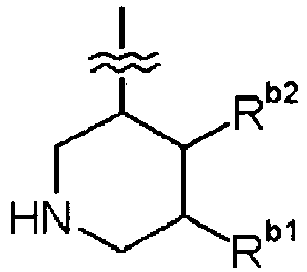
- Examples of the "substituent" for Rb1 or Rb2 include a halogen atom, cyano, a hydrocarbon group optionally having substituent(s), a heterocyclic group optionally having substituent(s), acyl, amino optionally having substituent(s) and the like.
- Examples of the "hydrocarbon group" of the "hydrocarbon group optionally having substituent(s)" for Rb1 or Rb2 include C1-6 alkyl.
- The "hydrocarbon group" optionally has substituent(s) (e.g., 1 to 5, preferably 1 to 3, substituents) at substitutable position(s). When the number of substituents is two or more, the respective substituents may be the same or different. Examples of the substituent include groups exemplified as the substituents that the aforementioned "hydrocarbon group" optionally has and the like.
- Examples of the "substituent" of the "hydrocarbon group optionally having substituent(s)" for Rb1 or Rb2 include 1 to 3 substituents selected from (1) a halogen atom; (2) nitro; (3) cyano; (4) hydroxy; (5) C1-6 alkoxy optionally having 1 to 3 halogen atoms; (6) amino; (7) mono- or di-C1-6 alkylamino; (8) C7-16 aralkylamino; (9) C1-6 alkoxy-carbonylamino; (10) C1-6 alkyl-carbonylamino; (11) C1-6 alkyl-carbonyl; (12) carboxy; (13) C1-6 alkoxy-carbonyl; (14) carbamoyl; (15) mono- or di-C1-6 alkylcarbamoyl; (16) mercapto; (17) C1-6 alkylthio; (18) C1-6 alkylsulfinyl; (19) C1-6 alkylsulfonyl and the like.
- Preferable examples of the "hydrocarbon group optionally having substituent (s)" for Rb1 or Rb2 include C1-6 alkyl optionally having 1 to 3 substituents selected from (a) hydroxy, (b) C1-6 alkyl-carbonyloxy, (c) C1-6 alkylthio and (d) C1-6 alkylsulfonyl.
- Examples of the "heterocyclic group" of the "heterocyclic group optionally having substituent(s)" for Rb1 or Rb2 include a 5- to 7-membered aromatic heterocyclic group or nonaromatic heterocyclic group containing, as a ring-constituting atom besides carbon atom, 1 to 4 heteroatoms selected from an oxygen atom, a sulfur atom and a nitrogen atom and the like.
- Examples of the "aromatic heterocyclic group" include a 5- or 6-membered aromatic heterocyclic group containing, as a ring-constituting atom besides carbon atom, 1 to 4 heteroatoms selected from an oxygen atom, a sulfur atom and a nitrogen atom (e.g., furyl, thienyl, pyridyl, pyrimidinyl, pyridazinyl, pyrazinyl, pyrrolyl, imidazolyl, pyrazolyl, thiazolyl, isothiazolyl, oxazolyl, isoxazolyl, tetrazolyl, triazolyl, oxadiazolyl, thiadiazolyl) and the like.
- Examples of the "nonaromatic heterocyclic group" include a 5- to 7-membered nonaromatic heterocyclic group containing, as a ring-constituting atom besides carbon atom, 1 to 3 heteroatoms selected from an oxygen atom, a sulfur atom and a nitrogen atom (e.g., pyrrolidinyl, piperidinyl, morpholinyl, thiomorpholinyl, piperazinyl, tetrahydrofuryl, 4,5-dihydro-1,2,4-oxadiazolyl) and the like.
- The "heterocyclic group" optionally has substituent(s) (e.g., 1 to 5, preferably 1 to 3, substituents) at substitutable position(s). When the number of substituents is two or more, the respective substituents may be the same or different. Examples of the substituent include the groups exemplified as the substituents of the aforementioned "heterocyclic group optionally having substituent(s)" and the like. For example, 1 to 3 substituents selected from (a) oxo, (b) C1-6 alkyl optionally having 1 to 3 hydroxy, (c) C6-14 aryl and (d) carbamoyl can be mentioned.
- Examples of the "acyl" for Rb1 or Rb2 include
- (1) formyl;
- (2) carboxy;
- (3) C1-6 alkyl-carbonyl;
- (4) C1-6 alkoxy-carbonyl (e.g., methoxycarbonyl, ethoxycarbonyl, propoxycarbonyl, tert-butoxycarbonyl);
- (5) a group represented by the formula: -CO-N(R5) (R6) wherein R5 and R6 are each a hydrogen atom or C1-6 alkyl, or R5 and R6 optionally form, together with the nitrogen atom bonded thereto, a 4- to 7-membered nonaromatic nitrogen-containing heterocycle containing, as a ring-constituting atom besides carbon atom, one nitrogen atom, and optionally further containing 1 or 2 heteroatoms selected from an oxygen atom, a sulfur atom and a nitrogen atom (e.g., azetidine, pyrrolidine, piperidine, piperazine, morpholine, thiomorpholine), and optionally having 1 to 3 substituents selected from hydroxy and C1-6 alkyl and the like.
- Examples of the "amino optionally having substituent(s)" for Rb1 or Rb2 include
- (1) C1-6 alkoxy-carbonylamino,
- (2) C7-16 aralkyloxy-carbonylamino (e.g., benzyloxycarbonylamino),
- (3) C1-6 alkyl-carbonylamino,
- (4) C3-10 cycloalkyl-carbonylamino (e.g., cyclohexylcarbonylamino) optionally having 1 to 3 substituents selected from hydroxy and C1-6 alkoxy and the like.
- Examples of the "substituent" for Rb1 or Rb2 also include a group represented by the formula: -W2-R8 wherein W2 is a bond, -CH2-, -CH2O- or -NHCO-, and R8 is a 5- or 6-membered heterocyclic group containing, as a ring-constituting atom besides carbon atom, 1 to 4 heteroatoms selected from an oxygen atom, a sulfur atom and a nitrogen atom (e.g., imidazolyl, morpholinyl, pyridyl, tetrahydropyranyl, piperidinyl, tetrazolyl, 4,5-dihydro-1,2,4-oxadiazolyl, 1,2,4-triazolyl, 1,3,4-oxadiazolyl, 1,2,4-oxadiazolyl), the 5- or 6-membered heterocyclic group optionally has 1 to 3 substituents selected from
- (a) oxo,
- (b) C1-6 alkyl optionally having 1 to 3 hydroxy,
- (c) C6-14 aryl, and
- (d) carbamoyl.
- Examples of the "5- to 7-membered ring" of the "5- to 7-membered ring optionally having substituent(s)" formed by Rb1 and Rb2 together with the carbon atoms bonded thereto include (i) a 5- to 7-membered aromatic heterocycle or nonaromatic heterocycle containing, as a ring-constituting atom besides carbon atom, 1 to 3 heteroatoms selected from an oxygen atom, a sulfur atom and a nitrogen atom, (ii) 5- to 7-membered cyclic hydrocarbon and the like.
- Examples of the "aromatic heterocycle" include a 5- or 6-membered aromatic heterocycle containing, as a ring-constituting atom besides carbon atom, 1 to 3 heteroatoms selected from an oxygen atom, a sulfur atom and a nitrogen atom (e.g., pyridine, pyrazine, pyrimidine, pyridazine, pyrrole, imidazole, pyrazole, triazole, thiophene, furan, thiazole, isothiazole, oxazole, isoxazole) and the like.
- Examples of the "nonaromatic heterocycle" include a 5- to 7-membered (preferably 5- or 6-membered) nonaromatic heterocycle containing, as a ring-constituting atom besides carbon atom, 1 to 3 (preferably 1 or 2) heteroatoms selected from an oxygen atom, a sulfur atom and a nitrogen atom (e.g., tetrahydropyridine, dihydropyridine, tetrahydropyrazine, tetrahydropyrimidine, tetrahydropyridazine, dihydropyran, dihydropyrrole, dihydrothiophene, dihydrofuran, piperidine, piperazine, hexahydropyrimidine, hexahydropyridazine, tetrahydropyran, morpholine, pyrrolidine, pyrazoline, imidazolidine, thiazoline, isothiazoline, oxazoline, isoxazoline, pyrazolidine, tetrahydrothiophene, tetrahydrofuran, thiazolidine, oxazolidine) and the like.
- Examples of the "5- to 7-membered cyclic hydrocarbon" include benzene, C5-7 cycloalkene (e.g., cyclopentene, cyclohexene, cycloheptene), C5-7 cycloalkane (e.g., cyclopentane, cyclohexane, cycloheptane) and the like.
- The above-mentioned "5- to 7-membered ring" optionally has substituent(s) (e.g., 1 to 5, preferably 1 to 3, substituents) at substitutable position(s). When the number of substituents is two or more, the respective substituents may be the same or different. Examples of the substituent include groups exemplified as the substituents that the aforementioned "hydrocarbon group" optionally has and the like.
- Rb1 and Rb2 are each preferably a hydrogen atom, a hydrocarbon group optionally having substituent(s) or acyl.
- Rb1 and Rb2 are each more preferably a hydrogen atom, C1-6 alkyl optionally having substituent(s) or acyl.
- Rb1 and Rb2 are each still more preferably
- (1) a hydrogen atom,
- (2) C1-6 alkyl optionally having 1 to 3 hydroxy,
- (3) C1-6 alkoxy-carbonyl, or
- (4) a group represented by the formula: -CO-N(R5)(R6) wherein R5 and R6 are each a hydrogen atom or C1-6 alkyl, or R5 and R6 optionally form, together with the nitrogen atom bonded thereto, a 5- to 7-membered nonaromatic nitrogen-containing heterocycle containing, as a ring-constituting atom besides carbon atom, one nitrogen atom, and optionally further containing 1 or 2 heteroatoms selected from an oxygen atom, a sulfur atom and a nitrogen atom (e.g., pyrrolidine, piperidine, piperazine, morpholine, thiomorpholine), and optionally having 1 to 3 substituents selected from hydroxy and C1-6 alkyl.
- Particularly preferably, Rb2 is a hydrogen atom, and Rb1 is
- (1) a hydrogen atom,
- (2) cyano,
- (3) C1-6 alkyl optionally having 1 to 3 substituents selected from
- (a) hydroxy,
- (b) C1-6 alkyl-carbonyloxy,
- (c) C1-6 alkylthio, and
- (d) C1-6 alkylsulfonyl,
- (4) C1-6 alkoxy-carbonylamino,
- (5) C7-16 aralkyloxy-carbonylamino (e.g., benzyloxycarbonylamino),
- (6) C1-6 alkyl-carbonylamino,
- (7) C3-10 cycloalkyl-carbonylamino (e.g., cyclohexylcarbonylamino) optionally having 1 to 3 substituents selected from hydroxy and C1-6 alkoxy,
- (8) a group represented by the formula: -W2-R8 wherein W2 is a bond, -CH2-, -CH2O- or -NHCO-, and R8 is a 5- or 6-membered heterocyclic group containing, as a ring-constituting atom besides carbon atom, 1 to 4 heteroatoms selected from an oxygen atom, a sulfur atom and a nitrogen atom (e.g., imidazolyl, morpholinyl, pyridyl, tetrahydropyranyl, piperidinyl, tetrazolyl, 4,5-dihydro-1,2,4-oxadiazolyl, 1,2,4-triazolyl, 1,3,4-oxadiazolyl, 1,2,4-oxadiazolyl), the 5- or 6-membered heterocyclic group optionally has 1 to 3 substituents selected from
- (a) oxo,
- (b) C1-6 alkyl optionally having 1 to 3 hydroxy,
- (c) C6-14 aryl, and
- (d) carbamoyl,
- (9) C1-6 alkoxy-carbonyl, or
- (10) a group represented by the formula: -CO-N(R5) (R6) wherein R5 and R6 are each a hydrogen atom or C1-6 alkyl, or R5 and R6 optionally form, together with the nitrogen atom bonded thereto, a 4- to 7-membered nonaromatic nitrogen-containing heterocycle containing, as a ring-constituting atom besides carbon atom, one nitrogen atom, and optionally further containing 1 or 2 heteroatoms selected from an oxygen atom, a sulfur atom and a nitrogen atom (e.g., azetidine, pyrrolidine, piperidine, piperazine, morpholine, thiomorpholine), and optionally having 1 to 3 substituents selected from hydroxy and C1-6 alkyl, or
- Of these, further more preferably,
Rb1 is - (1) C1-6 alkyl optionally having 1 to 3 hydroxy,
- (2) C1-6 alkoxy-carbonyl, or
- (3) a group represented by the formula: -CO-N(R5) (R6) wherein R5 and R6 are each a hydrogen atom or C1-6 alkyl, or R5 and R6 optionally form, together with the nitrogen atom bonded thereto, a 5- to 7-membered nonaromatic nitrogen-containing heterocycle containing, as a ring-constituting atom besides carbon atom, one nitrogen atom, and optionally further containing 1 or 2 heteroatoms selected from an oxygen atom, a sulfur atom and a nitrogen atom (e.g., pyrrolidine, piperidine, piperazine, morpholine, thiomorpholine), and optionally having 1 to 3 substituents selected from hydroxy and C1-6 alkyl, and Rb2 is a hydrogen atom.
- In the formula (B), R1b and R2b are each a hydrocarbon group optionally having substituent(s) or a heterocyclic group optionally having substituent(s), or
- R1b and R2b optionally form, together with the nitrogen atom bonded thereto, a nitrogen-containing heterocycle optionally having substituent(s).
- Examples of the "hydrocarbon group" of the "hydrocarbon group optionally having substituent(s)" for R1b or R2b include alkyl, cycloalkyl, aralkyl, cycloalkyl and the like. Preferable examples thereof include C1-6 alkyl, C3-10 cycloalkyl, C7-16 aralkyl, C3-10 cycloalkyl-C1-6 alkyl and the like.
- Examples of the "substituent" of the "hydrocarbon group optionally having substituent(s)" for R1b or R2b include 1 to 3 substituents selected from (a) a halogen atom, (b) cyano, (c) hydroxy, (d) amino, (e) C1-6 alkoxy-carbonyl, (f) carbamoyl, (g) C1-6 alkylcarbamoyl optionally having 1 to 3 substituents selected from hydroxy and a heterocyclic group (preferably, a 5- or 6-membered heterocyclic group containing, as a ring-constituting atom besides carbon atom, 1 to 4 heteroatoms selected from an oxygen atom, a sulfur atom and a nitrogen atom, e.g., pyridyl, morpholinyl) and (h) C7-16 aralkylcarbamoyl (e.g., benzylcarbamoyl).
- Examples of the "heterocyclic group" of the "heterocyclic group optionally having substituent(s)" for R1b or R2b include a 4- to 7-membered nonaromatic heterocyclic group containing, as a ring-constituting atom besides carbon atom, 1 to 4 heteroatoms selected from an oxygen atom, a sulfur atom and a nitrogen atom, and the like. Preferable examples thereof include a 5- to 7-membered nonaromatic heterocyclic group containing, as a ring-constituting atom besides carbon atom, 1 or 2 heteroatoms selected from an oxygen atom, a sulfur atom and a nitrogen atom (e.g., pyrrolidinyl, imidazolidinyl, pyrazolidinyl, piperidinyl, piperazinyl, morpholinyl, thiomorpholinyl) and the like.
- The "heterocyclic group" optionally has substituent(s) (e.g., 1 to 5, preferably 1 to 3, substituents) at substitutable position(s). Examples of the substituent include groups exemplified as the substituents of the aforementioned "heterocyclic group optionally having substituent(s)" and the like. When the number of substituents is two or more, the respective substituents may be the same or different.
- Examples of the "heterocyclic group optionally having substituent(s)" for R1b or R2b include
- (1) a group represented by the formula
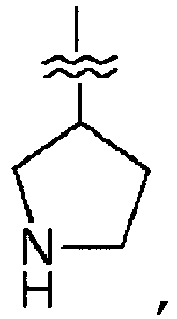
- (2) a group represented by the formula

- (1') a hydrogen atom,
- (2') cyano,
- (3') C1-6 alkyl optionally having 1 to 3 substituents selected from
- (a) hydroxy,
- (b) C1-6 alkyl-carbonyloxy,
- (c) C1-6 alkylthio, and
- (d) C1-6 alkylsulfonyl,
- (4') C3-10 cycloalkyl (e.g., cyclohexyl) optionally having 1 to 3 hydroxy,
- (5') C7-16 aralkylamino (e.g., phenethylamino) optionally having 1 to 3 hydroxy,
- (6') C1-6 alkoxy-carbonylamino,
- (7') C7-16 aralkyloxy-carbonylamino (e.g., benzyloxycarbonylamino),
- (8') C1-6 alkyl-carbonylamino,
- (9') C3-10 cycloalkyl-carbonylamino (e.g., cyclohexylcarbonylamino) optionally having 1 to 3 substituents selected from hydroxy and C1-6 alkoxy,
- (10') C1-6 alkylsulfonylamino,
- (11') C6-14 arylsulfonylamino (e.g., phenylsulfonylamino),
- (12') C1-6 alkylaminocarbonylamino,
- (13') C6-14 arylaminocarbonylamino (e.g., phenylaminocarbonylamino),
- (14') C1-6 alkyl-carbonyl,
- (15') C3-10 cycloalkyl-carbonyl (e.g., cyclopropylcarbonyl),
- (16') carboxy,
- (17') a group represented by the formula: -W1-R7 wherein W1 is a bond, -CH2-, -CH2O-, -NHCO- or -NHSO2-, and R7 is a 5- or 6-membered heterocyclic group containing, as a ring-constituting atom besides carbon atom, 1 to 4 heteroatoms selected from an oxygen atom, a sulfur atom and a nitrogen atom (e.g., imidazolyl, morpholinyl, pyridyl, tetrahydropyranyl, piperidinyl, tetrazolyl, 4,5-dihydro-1,2,4-oxadiazolyl, 1,2,4-triazolyl, 1,3,4-oxadiazolyl, 1,2,4-oxadiazolyl, imidazolidinyl, hexahydropyrimidinyl, pyrazolyl), the 5- or 6-membered heterocyclic group optionally has 1 to 3 substituents selected from
- (a) oxo,
- (b) C1-6 alkyl optionally having 1 to 3 hydroxy,
- (c) C6-14 aryl,
- (d) carbamoyl, and
- (e) C1-6 alkoxy-carbonyl,
- (18') C1-6 alkoxy-carbonyl, or
- (19') a group represented by the formula: -CO-N(R5)(R6) wherein R5 and R6 are each a hydrogen atom, C1-6 alkyl or C1-6 alkoxy, or
R5 and R6 optionally form, together with the nitrogen atom bonded thereto, a 4- to 7-membered nonaromatic nitrogen-containing heterocycle containing, as a ring-constituting atom besides carbon atom, one nitrogen atom, and optionally further containing 1 or 2 heteroatoms selected from an oxygen atom, a sulfur atom and a nitrogen atom, said 4- to 7-membered nonaromatic nitrogen-containing heterocycle optionally forms a fused ring with a benzene ring, a cyclohexane ring or an oxazole ring, or optionally forms a spiro ring with a 1,3-dioxolane ring (e.g., azetidine, pyrrolidine, piperidine, piperazine, morpholine, thiomorpholine, 1,4-oxazepane, 1,2,3,4-tetrahydroquinoline, 1,2,3,4-tetrahydroisoquinoline, 2,3-dihydro-1H-isoindole, 2,3-dihydro-1H-indole, decahydroquinoline, 4,5,6,7-tetrahydro[1,3]oxazolo[5,4-b]pyridine, 1,4-dioxa-8-azaspiro[4.5]decane, 1,2,3,6-tetrahydropyridine), the 4- to 7-membered nonaromatic nitrogen-containing heterocycle, a fused ring thereof and a spiro ring thereof optionally have 1 to 3 substituents selected from- (a) oxo,
- (b) a halogen atom,
- (c) C1-6 alkyl optionally having 1 to 3 substituents selected from hydroxy and C1-6 alkoxy,
- (d) C6-14 aryl (e.g., phenyl) optionally having 1 to 3 C1-6 alkoxy,
- (e) C7-16 aralkyl (e.g., benzyl),
- (f) hydroxy,
- (g) C1-6 alkoxy,
- (h) C6-14 aryloxy (e.g., phenoxy),
- (i) C7-16 aralkyloxy (e.g., benzyloxy),
- (j) C1-6 alkyl-carbonyl,
- (k) C6-14 aryl-carbonyl (e.g., benzoyl),
- (l) mono- or di-C1-6 alkylsulfamoyl,
- (m) C1-6 alkylsulfonyl, and
- (n) a 5- or 6-membered heterocyclic group containing, as a ring-constituting atom besides carbon atom, 1 to 4 heteroatoms selected from an oxygen atom, a sulfur atom and a nitrogen atom (e.g., pyridyl, thiazolyl), or
- Examples of the "nitrogen-containing heterocycle" of the "nitrogen-containing heterocycle optionally having substituent(s)" formed by R1b and R2b together with the nitrogen atom bonded thereto include a 5- to 9-membered (preferably 5-to 7-membered, more preferably 5- or 6-membered) nonaromatic nitrogen-containing heterocycle containing, as a ring-constituting atom besides carbon atom, one nitrogen atom, and optionally further containing 1 or 2 heteroatoms selected from an oxygen atom, a sulfur atom and a nitrogen atom.
- Examples of the "nitrogen-containing heterocycle" include pyrrolidine, imidazolidine, pyrazolidine, piperidine, piperazine, morpholine, thiomorpholine, azepane, azocane, azonane, 1,4-diazepane and the like. Preferred are piperidine and piperazine.
- The "nitrogen-containing heterocycle" optionally has substituent(s) (e.g., 1 to 3, preferably 1 to 3 substituents) at substitutable position(s). When the number of substituents is two or more, the respective substituents may be the same or different. Examples of the substituent include groups similar to the substituents that the aforementioned "hydrocarbon group" optionally has. Examples of the substituent include 1 to 3 substituents selected from
- (1) C1-6 alkyl optionally having 1 to 3 substituents selected from
- (a) hydroxy,
- (b) C1-6 alkoxy,
- (c) C6-14 aryl (e.g., phenyl),
- (d) amino,
- (e) mono- or di-C1-6 alkylamino,
- (f) C7-16 aralkylamino (e.g., benzylamino), and
- (g) C1-6 alkoxy-carbonylamino (e.g., tert-butoxycarbonylamino),
- (2) C6-14 aryl (e.g., phenyl) optionally having 1 to 3 halogen atoms,
- (3) C7-16 aralkyl (e.g., benzyl, phenethyl),
- (4) C3-10 cycloalkyl (e.g., cyclohexyl),
- (5) amino,
- (6) hydroxy,
- (7) C1-6 alkoxy-carbonyl (e.g., tert-butoxycarbonyl), and
- (8) carbamoyl.
- Preferably, R1b and R2b form, together with the nitrogen atom bonded thereto, piperidine optionally having substituent(s) or piperazine optionally having substituent(s). Examples of the substituents that piperidine or piperazine optionally has include 1 to 3 substituents selected from
- (1) C1-6 alkyl selected from optionally having 1 to 3 substituents
- (a) hydroxy,
- (b) C1-6 alkoxy,
- (c) C6-14 aryl (e.g., phenyl),
- (d) amino,
- (e) mono- or di-C1-6 alkylamino,
- (f) C7-16 aralkylamino (e.g., benzylamino), and
- (g) C1-6 alkoxy-carbonylamino (e.g., tert-butoxycarbonylamino),
- (2) C6-14 aryl (e.g., phenyl) optionally having 1 to 3 halogen atoms,
- (3) C7-16 aralkyl (e.g., benzyl, phenethyl),
- (4) C3-10 cycloalkyl (e.g., cyclohexyl),
- (5) amino,
- (6) hydroxy,
- (7) C1-6 alkoxy-carbonyl (e.g., tert-butoxycarbonyl), and
- (8) carbamoyl.
- Preferably, R1b and R2b are each
- (1) C1-6 alkyl optionally having 1 to 3 substituents selected from
- (a) a halogen atom,
- (b) cyano,
- (c) hydroxy,
- (d) amino,
- (e) C1-6 alkoxy-carbonyl,
- (f) carbamoyl,
- (g) C1-6 alkylcarbamoyl optionally having 1 to 3 substituents selected from hydroxy and a heterocyclic group (preferably, 5- or 6-membered heterocyclic group containing, as a ring-constituting atom besides carbon atom, 1 to 4 heteroatoms selected from an oxygen atom, a sulfur atom and a nitrogen atom, e.g., pyridyl, morpholinyl), and
- (h) C7-16 aralkylcarbamoyl (e.g., benzylcarbamoyl),
- (2) C3-10 cycloalkyl (e.g., cyclopropyl, cyclohexyl),
- (3) C7-16 aralkyl (e.g., benzyl),
- (4) C3-10 cycloalkyl-C1-6 alkyl (e.g., cyclopropylmethyl),
- (5) a group represented by the formula
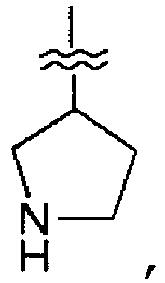
- (6) a group represented by the formula

Rb1 is- (1') a hydrogen atom,
- (2') cyano,
- (3') C1-6 alkyl optionally having 1 to 3 substituents selected from
- (a) hydroxy,
- (b) C1-6 alkyl-carbonyloxy,
- (c) C1-6 alkylthio, and
- (d) C1-6 alkylsulfonyl,
- (4') C3-10 cycloalkyl (e.g., cyclohexyl) optionally having 1 to 3 hydroxy,
- (5') C7-16 aralkylamino (e.g., phenethylamino) optionally having 1 to 3 hydroxy,
- (6') C1-6 alkoxy-carbonylamino,
- (7') C7-16 aralkyloxy-carbonylamino (e.g., benzyloxycarbonylamino),
- (8') C1-6 alkyl-carbonylamino,
- (9') C3-10 cycloalkyl-carbonylamino (e.g., cyclohexylcarbonylamino) optionally having 1 to 3 substituents selected from hydroxy and C1-6 alkoxy,
- (10') C1-6 alkylsulfonylamino,
- (11') C6-14 arylsulfonylamino (e.g., phenylsulfonylamino),
- (12') C1-6 alkylaminocarbonylamino,
- (13') C6-14 arylaminocarbonylamino (e.g., phenylaminocarbonylamino),
- (14') C1-6 alkyl-carbonyl,
- (15') C3-10 cycloalkyl-carbonyl (e.g., cyclopropylcarbonyl),
- (16') carboxy,
- (17') a group represented by the formula: -W1-R7 wherein W1 is a bond, -CH2-, -CH2O-, -NHCO- or -NHSO2-, and R7 is a 5- or 6-membered heterocyclic group containing, as a ring-constituting atom besides carbon atom, 1 to 4 heteroatoms selected from an oxygen atom, a sulfur atom and a nitrogen atom (e.g., imidazolyl, morpholinyl, pyridyl, tetrahydropyranyl, piperidinyl, tetrazolyl, 4,5-dihydro-1,2,4-oxadiazolyl, 1,2,4-triazolyl, 1,3,4-oxadiazolyl, 1,2,4-oxadiazolyl, imidazolidinyl, hexahydropyrimidinyl, pyrazolyl), the 5- or 6-membered heterocyclic group optionally has 1 to 3 substituents selected from
- (a) oxo,
- (b) C1-6 alkyl optionally having 1 to 3 hydroxy,
- (c) C6-14 aryl,
- (d) carbamoyl, and
- (e) C1-6 alkoxy-carbonyl,
- (18') C1-6 alkoxy-carbonyl, or
- (19') a group represented by the formula: -CO-N(R5) (R6) wherein R5 and R6 are each a hydrogen atom, C1-6 alkyl or C1-6 alkoxy, or
R5 and R6 optionally form, together with the nitrogen atom bonded thereto, a 4- to 7-membered nonaromatic nitrogen-containing heterocycle containing, as a ring-constituting atom besides carbon atom, one nitrogen atom, and optionally further containing 1 or 2 heteroatoms selected from an oxygen atom, a sulfur atom and a nitrogen atom, said 4- to 7-membered nonaromatic nitrogen-containing heterocycle optionally forms a fused ring with a benzene ring, a cyclohexane ring or an oxazole ring, or optionally forms a spiro ring with a 1,3-dioxolane ring (e.g., azetidine, pyrrolidine, piperidine, piperazine, morpholine, thiomorpholine, 1,4-oxazepane, 1,2,3,4-tetrahydroquinoline, 1,2,3,4-tetrahydroisoquinoline, 2,3-dihydro-1H-isoindole, 2,3-dihydro-1H-indole, decahydroquinoline, 4,5,6,7-tetrahydro[1,3]oxazolo[5,4-b]pyridine, 1,4-dioxa-8-azaspiro[4.5]decane, 1,2,3,6-tetrahydropyridine), said 4- to 7-membered nonaromatic nitrogen-containing heterocycle, a fused ring thereof and a spiro ring thereof optionally have 1 to 3 substituents selected from- (a) oxo,
- (b) a halogen atom,
- (c) C1-6 alkyl optionally having 1 to 3 substituents selected from hydroxy and C1-6 alkoxy,
- (d) C6-14 aryl (e.g., phenyl) optionally having 1 to 3 C1-6 alkoxy,
- (e) C7-16 aralkyl (e.g., benzyl),
- (f) hydroxy,
- (g) C1-6 alkoxy,
- (h) C6-14 aryloxy (e.g., phenoxy),
- (i) C7-16 aralkyloxy (e.g., benzyloxy),
- (j) C1-6 alkyl-carbonyl,
- (k) C6-14 aryl-carbonyl (e.g., benzoyl),
- (l) mono- or di-C1-6 alkylsulfamoyl,
- (m) C1-6 alkylsulfonyl, and
- (n) a 5- or 6-membered heterocyclic group containing, as a ring-constituting atom besides carbon atom, 1 to 4 heteroatoms selected from an oxygen atom, a sulfur atom and a nitrogen atom (e.g., pyridyl, thiazolyl), or
- (1) C1-6 alkyl optionally having 1 to 3 substituents selected from
- (a) hydroxy,
- (b) C1-6 alkoxy,
- (c) C6-14 aryl (e.g., phenyl),
- (d) amino,
- (e) mono- or di-C1-6 alkylamino,
- (f) C7-16 aralkylamino (e.g., benzylamino), and
- (g) C1-6 alkoxy-carbonylamino (e.g., tert-butoxycarbonylamino),
- (2) C6-14 aryl (e.g., phenyl) optionally having 1 to 3 halogen atoms,
- (3) C7-16 aralkyl (e.g., benzyl, phenethyl),
- (4) C3-10 cycloalkyl (e.g., cyclohexyl),
- (5) amino,
- (6) hydroxy,
- (7) C1-6 alkoxy-carbonyl (e.g., tert-butoxycarbonyl), and
- (8) carbamoyl.
- More preferably, R1b and R2b are each
- (1) C1-6 alkyl optionally having 1 to 3 substituents selected from cyano and hydroxy,
- (2) C3-10 cycloalkyl, or
- (3) C7-16 aralkyl, or
- (1) C1-6 alkyl optionally having 1 to 3 substituents selected from
- (a) hydroxy,
- (b) C1-6 alkoxy,
- (c) C6-14 aryl (e.g., phenyl),
- (d) amino,
- (e) mono- or di-C1-6 alkylamino,
- (f) C7-16 aralkylamino (e.g., benzylamino), and
- (g) C1-6 alkoxy-carbonylamino (e.g., tert-butoxycarbonylamino),
- (2) C6-14 aryl (e.g., phenyl) optionally having 1 to 3 halogen atoms,
- (3) C7-15 aralkyl (e.g., benzyl, phenethyl),
- (4) C3-10 cycloalkyl (e.g., cyclohexyl),
- (5) amino,
- (6) hydroxy,
- (7) C1-6 alkoxy-carbonyl (e.g., tert-butoxycarbonyl), and
- (8) carbamoyl.
- In the formula (C), R1c is alkyl optionally having substituent(s).
- Examples of the "alkyl" of the "alkyl optionally having substituent(s)" for R1c include C1-6 alkyl.
- Examples of the "substituent" of the "alkyl optionally having substituent(s)" for R1c include 1 to 3 substituents selected from a halogen atom, cyano, hydroxy and the like.
- As R1c, preferred is C1-6 alkyl.
- In the formula (C), ring Bc is a nitrogen-containing saturated or unsaturated 5- to 7-membered ring optionally having substituent(s). Preferred is a nitrogen-containing saturated 5- to 7-membered ring optionally having substituent(s). n and m are each an integer of 0 to 2, and the total of n and m is 1 to 3.
- Examples of the combination of n and m include (n,m) of (0,1), (0,2), (1,0), (1,1), (1,2), (2,0) and (2,1). Among these, both n and m are preferably 1.
- The "nitrogen-containing 5- to 7-membered ring" for ring Bc optionally has substituent(s) (preferably 1 to 3, more preferably 1 or 2 substituents) at substitutable position(s). When the number of substituents is two or more, the respective substituents may be the same or different. Examples of the substituent include groups exemplified as the substituents of the aforementioned "heterocyclic group optionally having substituent(s)" and the like.
- As ring Bc, a ring represented by the formula

- Preferable examples of Rb1 and Rb2 in ring Bc include those similar to the preferable examples of Rb1 and Rb2 in the aforementioned ring B.
- In ring Bc, Rb1 and Rb2 are each preferably a hydrogen atom, a hydrocarbon group optionally having substituent(s) or acyl.
- Rb1 and Rb2 are each more preferably a hydrogen atom, C1-6 alkyl optionally having substituent(s) or acyl.
- Rb1 and Rb2 are each further preferably
- (1) a hydrogen atom,
- (2) C1-6 alkyl optionally having 1 to 3 hydroxy,
- (3) C1-6 alkoxy-carbonyl, or
- (4) a group represented by the formula: -CO-N(R5) (R6)
- Particularly preferably,
Rb1 is - (1) C1-6 alkyl optionally having 1 to 3 hydroxy,
- (2) C1-6 alkoxy-carbonyl, or
- (3) a group represented by the formula: -CO-N(R5) (R6)
- In the formula (I), R3 is a substituent.
- Examples of the "substituent" for R3 include a hydrocarbon group optionally having substituent(s), a heterocyclic group optionally having substituent(s), acyl and the like.
- Examples of the "hydrocarbon group" of the "hydrocarbon group optionally having substituent(s)" for R3 include alkyl, cycloalkyl, aryl and the like. Preferable examples thereof include C1-6 alkyl, C3-10 cycloalkyl, C6-14 aryl and the like.
- Examples of the "substituent" of the "hydrocarbon group optionally having substituent(s)" for R3 include 1 to 3 substituents selected from a halogen atom; cyano; hydroxy; C1-6 alkoxy optionally having 1 to 3 halogen atoms; mercapto; C1-6 alkylthio; C1-6 alkylsulfinyl; C1-6 alkylsulfonyl and the like.
- Examples of the "heterocyclic group" of the "heterocyclic group optionally having substituent(s)" for R3 include a 5- to 7-membered aromatic heterocyclic group or nonaromatic heterocyclic group containing, as a ring-constituting atom besides carbon atom, 1 to 4 heteroatoms selected from an oxygen atom, a sulfur atom and a nitrogen atom and the like.
- Examples of the "aromatic heterocyclic group" include a 5- or 6-membered aromatic heterocyclic group containing, as a ring-constituting atom besides carbon atom, 1 to 4 heteroatoms selected from an oxygen atom, a sulfur atom and a nitrogen atom (e.g., furyl, thienyl, pyridyl, pyrimidinyl, pyridazinyl, pyrazinyl, pyrrolyl, imidazolyl, pyrazolyl, thiazolyl, isothiazolyl, oxazolyl, isoxazolyl) and the like.
- Examples of the "nonaromatic heterocyclic group" include a 5- to 7-membered nonaromatic heterocyclic group containing, as a ring-constituting atom besides carbon atom, 1 to 4 heteroatoms selected from an oxygen atom, a sulfur atom and a nitrogen atom (e.g., pyrrolidinyl, piperidinyl, morpholinyl, thiomorpholinyl, piperazinyl, tetrahydrofuryl) and the like.
- The "heterocyclic group" optionally has substituent(s) (e.g., 1 to 5, preferably 1 to 3, substituents) at substitutable position(s). When the number of substituents is two or more, the respective substituents may be the same or different. Examples of the substituent include groups exemplified as the substituents of the aforementioned "heterocyclic group optionally having substituent(s)" and the like.
- Preferable examples of the "substituent" of the "heterocyclic group optionally having substituent(s)" for R3 include 1 to 3 substituents selected from (1) a halogen atom; (2) nitro; (3) cyano; (4) hydroxy; (5) C1-6 alkoxy; (6) amino; (7) mono- or di-C1-5 alkylamino; (8) C7-16 aralkylamino; (9) C1-6 alkoxy-carbonylamino; (10) C1-6 alkyl-carbonylamino; (11) C1-6 alkyl-carbonyl; (12) carboxy; (13) C1-6 alkoxy-carbonyl; (14) carbamoyl; (15) mono- or di-C1-6 alkylcarbamoyl; (16) mercapto; (17) C1-6 alkylthio; (18) C1-6 alkylsulfinyl; (19) C1-6 alkylsulfonyl; (20) C1-6 alkyl optionally having 1 to 3 halogen atoms and the like.
- Examples of the "acyl" for R3 include
- (1) formyl;
- (2) carboxy;
- (3) C1-6 alkyl-carbonyl;
- (4) C1-6 alkoxy-carbonyl (e.g., methoxycarbonyl, ethoxycarbonyl, propoxycarbonyl, tert-butoxycarbonyl);
- (5) a group represented by the formula: -CO-NRA,RB,
- R3 is preferably
- (1) a heterocyclic group optionally having substituent(s),
- (2) C6-14 aryl optionally having substituent(s),
- (3) C3-10 cycloalkyl optionally having substituent(s),
- (4) C1-6 alkyl optionally having substituent(s),
- (5) C1-6 alkoxy-carbonyl and the like.
- R3 is more preferably
- (1) a 5- or 6-membered aromatic or nonaromatic heterocyclic group containing, as a ring-constituting atom besides carbon atom, 1 to 4 heteroatoms selected from an oxygen atom, a sulfur atom and a nitrogen atom (e.g., furyl, thienyl, oxazolyl, pyridyl, tetrahydrofuryl), and optionally having 1 to 3 C1-6 alkyl,
- (2) C5-14 aryl,
- (3) C3-10 cycloalkyl,
- (4) C1-6 alkyl optionally having 1 to 3 substituents selected from C1-6 alkoxy and C1-6 alkylthio, or
- (5) C1-6 alkoxy-carbonyl and the like.
- In the formula (A), R3a is a 5- or 6-membered aromatic group optionally having substituent(s).
- Examples of the "5- or 6-membered aromatic group" of the "5- or 6-membered aromatic group optionally having substituent(s)" for R3a include (i) a 5- or 6-membered aromatic heterocyclic group containing, as a ring-constituting atom besides carbon atom, 1 to 4 heteroatoms selected from an oxygen atom, a sulfur atom and a nitrogen atom, (ii) phenyl and the like.
- Examples of the "5- or 6-membered aromatic group" include a 5-membered aromatic heterocyclic group such as furyl (e.g., 2-furyl, 3-furyl), thienyl (e.g., 2-thienyl, 3-thienyl), pyrrolyl (e.g., 1-pyrrolyl, 2-pyrrolyl, 3-pyrrolyl), imidazolyl (e.g., 1-imidazolyl, 2-imidazolyl, 4-imidazolyl, 5-imidazolyl), pyrazolyl (e.g., 1-pyrazolyl, 3-pyrazolyl, 4-pyrazolyl), thiazolyl (e.g., 2-thiazolyl, 4-thiazolyl, 5-thiazolyl), isothiazolyl (e.g., 3-isothiazolyl, 4-isothiazolyl, 5-isothiazolyl), oxazolyl (e.g., 2-oxazolyl, 4-oxazolyl, 5-oxazolyl), isoxazolyl (e.g., 3-isoxazolyl, 4-isoxazolyl, 5-isoxazolyl), oxadiazolyl (e.g., 1,2,4-oxadiazol-5-yl, 1,3,4-oxadiazol-2-yl), thiadiazolyl (e.g., 1,2,4-thiadiazol-5-yl, 1,3,4-thiadiazol-2-yl), triazolyl (e.g., 1,2,4-triazol-1-yl, 1,2,4-triazol-3-yl, 1,2,3-triazol-1-yl, 1,2,3-triazol-2-yl, 1,2,3-triazol-4-yl), tetrazolyl (e.g., tetrazol-1-yl, tetrazol-5-yl) and the like; and a 6-membered aromatic heterocyclic group such as pyridyl (e.g., 2-pyridyl, 3-pyridyl, 4-pyridyl), pyrimidinyl (e.g., 2-pyrimidinyl, 4-pyrimidinyl, 5-pyrimidinyl), pyridazinyl (e.g., 3-pyridazinyl, 4-pyridazinyl), pyrazinyl (e.g., 2-pyrazinyl), triazinyl (e.g., 1,3,5-triazin-2-yl, 1,3,5-triazin-4-yl, 1,2,3-triazin-4-yl, 1,2,4-triazin-3-yl) and the like. Preferably is a 5-membered aromatic heterocyclic group, more preferably furyl, thienyl, oxazolyl and the like.
- Examples of the "substituent" of the "5- or 6-membered aromatic group optionally having substituent(s)" for R3a include 1 to 3 substituents selected from (1) a halogen atom; (2) nitro; (3) cyano; (4) hydroxy; (5) C1-6 alkoxy; (6) amino; (7) mono- or di-C1-6 alkylamino; (8) C7-16 aralkylamino; (9) C1-6 alkoxy-carbonylamino; (10) C1-6 alkyl-carbonylamino; (11) C1-6 alkyl-carbonyl; (12) carboxy; (13) C1-6 alkoxy-carbonyl; (14) carbamoyl; (15) mono- or di-C1-6 alkylcarbamoyl; (16) mercapto; (17) C1-6 alkylthio; (18) C1-6 alkylsulfinyl; (19) C1-6 alkylsulfonyl; (20) C1-6 alkyl optionally having 1 to 3 halogen atoms and the like.
- As R3a, preferred is a 5- or 6-membered aromatic heterocyclic group containing, as a ring-constituting atom besides carbon atom, 1 to 4 heteroatoms selected from an oxygen atom, a sulfur atom and a nitrogen atom (e.g., furyl, oxazolyl, thienyl, pyridyl), or phenyl.
- As R3a, more preferred is a 5-membered aromatic heterocyclic group containing, as a ring-constituting atom besides carbon atom, 1 to 4 heteroatoms selected from an oxygen atom, a sulfur atom and a nitrogen atom (e.g., furyl, oxazolyl, thienyl).
- Among these, preferred as R3a is furyl, thienyl or oxazolyl, each of which optionally has substituent(s), more preferred is furyl, thienyl or oxazolyl optionally having 1 to 3 C1-6 alkyl, further preferred is furyl optionally having 1 to 3 C1-6 alkyl, and particularly preferred is unsubstituted furyl.
- In the formula (B), R3b is a substituent excluding 2-(4-phenylpiperazin-1-yl)ethyl optionally having substituent(s) and biphenyl-4-yl having substituent(s).
- Examples of the "substituent" for R3b include a hydrocarbon group optionally having substituent(s), a heterocyclic group optionally having substituent(s), acyl and the like.
- Examples of the "hydrocarbon group" of the "hydrocarbon group optionally having substituent(s)" for R3b include alkyl, cycloalkyl, aryl and the like. Preferable examples thereof include C1-6 alkyl, C3-10 cycloalkyl, C6-14 aryl and the like.
- Examples of the "substituent" of the "hydrocarbon group optionally having substituent(s)" for R3b include 1 to 3 substituents selected from a halogen atom; cyano; hydroxy; C1-6 alkoxy optionally having 1 to 3 halogen atoms; mercapto; C1-6 alkylthio; C1-6 alkylsulfinyl; C1-6 alkylsulfonyl and the like.
- Examples of the "heterocyclic group" of the "heterocyclic group optionally having substituent(s)" for R3b include a 5- to 7-membered aromatic heterocyclic group or nonaromatic heterocyclic group containing, as a ring-constituting atom besides carbon atom, 1 to 4 heteroatoms selected from an oxygen atom, a sulfur atom and a nitrogen atom and the like.
- Examples of the "aromatic heterocyclic group" include a 5- or 6-membered aromatic heterocyclic group containing, as a ring-constituting atom besides carbon atom, 1 to 4 heteroatoms selected from an oxygen atom, a sulfur atom and a nitrogen atom (e.g., furyl, thienyl, pyridyl, pyrimidinyl, pyridazinyl, pyrazinyl, pyrrolyl, imidazolyl, pyrazolyl, thiazolyl, isothiazolyl, oxazolyl, isoxazolyl) and the like.
- Examples of the "nonaromatic heterocyclic group" include a 5- to 7-membered nonaromatic heterocyclic group containing, as a ring-constituting atom besides carbon atom, 1 to 4 heteroatoms selected from an oxygen atom, a sulfur atom and a nitrogen atom (e.g., pyrrolidinyl, piperidinyl, morpholinyl, thiomorpholinyl, piperazinyl, tetrahydrofuryl) and the like.
- The "heterocyclic group" optionally has substituent(s) (e.g., 1 to 5, preferably 1 to 3, substituents) at substitutable position(s). When the number of substituents is two or more, the respective substituents may be the same or different. Examples of the substituent include groups exemplified as the substituents of the aforementioned "heterocyclic group optionally having substituent(s)" and the like.
- Preferable examples of the "substituent" of the "heterocyclic group optionally having substituent(s)" for R3b include 1 to 3 substituents selected from (1) a halogen atom; (2) nitro; (3) cyano; (4) hydroxy; (5) C1-6 alkoxy; (6) amino; (7) mono- or di-C1-6 alkylamino; (8) C7-16 aralkylamino; (9) C1-6 alkoxy-carbonylamino; (10) C1-6 alkyl-carbonylamino; (11) C1-6 alkyl-carbonyl; (12) carboxy; (13) C1-6 alkoxy-carbonyl; (14) carbamoyl; (15) mono- or di-C1-6 alkylcarbamoyl; (16) mercapto; (17) C1-6 alkylthio; (18) C1-6 alkylsulfinyl; (19) C1-6 alkylsulfonyl; (20) C1-6 alkyl optionally having 1 to 3 halogen atoms and the like.
- Examples of the "acyl" for R3b include
- (1) formyl;
- (2) carboxy;
- (3) C1-6 alkyl-carbonyl;
- (4) C1-6 alkoxy-carbonyl (e.g., methoxycarbonyl, ethoxycarbonyl, propoxycarbonyl, tert-butoxycarbonyl);
- (5) a group represented by the formula: -CO-NRA'RB'
- As R3b, preferred is
- (1) a 5- or 6-membered aromatic or nonaromatic heterocyclic group containing, as a ring-constituting atom besides carbon atom, 1 to 4 heteroatoms selected from an oxygen atom, a sulfur atom and a nitrogen atom (e.g., furyl, thienyl, oxazolyl, pyridyl, tetrahydrofuryl), and optionally having 1 to 3 C1-6 alkyl,
- (2) C6-14 aryl (e.g., phenyl),
- (3) C3-10 cycloalkyl (e.g., cyclopropyl),
- (4) C1-6 alkyl optionally having 1 to 3 substituents selected from
- (a) hydroxy,
- (b) C1-6 alkoxy,
- (c) C1-6 alkylthio,
- (d) C1-6 alkylsulfinyl, and
- (e) C1-6 alkylsulfonyl, or
- (5) C1-6 alkoxy-carbonyl.
- As R3b, more preferred is
- (1) a 5- or 6-membered aromatic or nonaromatic heterocyclic group containing, as a ring-constituting atom besides carbon atom, 1 to 4 heteroatoms selected from an oxygen atom, a sulfur atom and a nitrogen atom (e.g., furyl, thienyl, oxazolyl, pyridyl, tetrahydrofuryl), and optionally having 1 to 3 C1-6 alkyl,
- (2) C6-14 aryl (e.g., phenyl),
- (3) C3-10 cycloalkyl (e.g., cyclopropyl),
- (4) C1-6 alkyl optionally having 1 to 3 C1-6 alkoxy,
- (5) C1-6 alkoxy-carbonyl and the like.
- As R3b, more preferred is a 5-membered aromatic group optionally having substituent(s). Examples of the "5-membered aromatic group optionally having substituent(s)" for R3b include groups exemplified as the "5-membered aromatic group optionally having substituent(s)" for R3a and the like.
- Among these, preferred as R3b is furyl, thienyl or oxazolyl, each of which optionally has substituent(s), more preferred is furyl, thienyl or oxazolyl optionally having 1 to 3 C1-6 alkyl, further preferred is furyl optionally having 1 to 3 C1-6 alkyl, and particularly preferred is unsubstituted furyl.
- In the formula (C), R3c is a substituent.
- Examples of the "substituent" for R3c include a hydrocarbon group optionally having substituent(s), a heterocyclic group optionally having substituent(s), hydroxy optionally having a substituent, mercapto optionally having a substituent, acyl and the like.
- Examples of the "hydrocarbon group" of the "hydrocarbon group optionally having substituent(s)" for R3c include alkyl, cycloalkyl, aryl and the like. Preferred are C1-6 alkyl, C3-10 cycloalkyl, C6-14 aryl and the like.
- Examples of the "substituent" of the "hydrocarbon group optionally having substituent(s)" for R3c include 1 to 3 substituents selected from a halogen atom; cyano; hydroxy; C1-6 alkoxy optionally having 1 to 3 halogen atoms; mercapto; C1-6 alkylthio and the like.
- Examples of the "heterocyclic group" of the "heterocyclic group optionally having substituent(s)" for R3c include a 5- to 7-membered aromatic heterocyclic group or nonaromatic heterocyclic group containing, as a ring-constituting atom besides carbon atom, 1 to 4 heteroatoms selected from an oxygen atom, a sulfur atom and a nitrogen atom and the like.
- Examples of the "aromatic heterocyclic group" include a 5- or 6-membered aromatic heterocyclic group containing, as a ring-constituting atom besides carbon atom, 1 to 4 heteroatoms selected from an oxygen atom, a sulfur atom and a nitrogen atom (e.g., furyl, thienyl, pyridyl, pyrimidinyl, pyridazinyl, pyrazinyl, pyrrolyl, imidazolyl, pyrazolyl, thiazolyl, isothiazolyl, oxazolyl, isoxazolyl) and the like.
- Examples of the "nonaromatic heterocyclic group" include a 5- to 7-membered nonaromatic heterocyclic group containing, as a ring-constituting atom besides carbon atom, 1 to 4 heteroatoms selected from an oxygen atom, a sulfur atom and a nitrogen atom (e.g., pyrrolidinyl, piperidinyl, morpholinyl, thiomorpholinyl, piperazinyl, tetrahydrofuryl) and the like.
- The "heterocyclic group" optionally has substituent(s) (e.g., 1 to 5, preferably 1 to 3, substituents) at substitutable position(s). When the number of substituents is two or more, the respective substituents may be the same or different. Examples of the substituent include groups exemplified as the substituents of the aforementioned "heterocyclic group optionally having substituent(s)" and the like.
- Preferable examples of the "substituent" of the "heterocyclic group optionally having substituent(s)" for R3c include 1 to 3 substituents selected from (1) a halogen atom; (2) nitro; (3) cyano; (4) hydroxy; (5) C1-6 alkoxy; (6) amino; (7) mono- or di-C1-6 alkylamino; (8) C7-16 aralkylamino; (9) C1-6 alkoxy-carbonylamino; (10) C1-6 alkyl-carbonylamino; (11) C1-6 alkyl-carbonyl; (12) carboxy; (13) C1-6 alkoxy-carbonyl; (14) carbamoyl; (15) mono- or di-C1-6 alkylcarbamoyl; (16) mercapto; (17) C1-6 alkylthio; (18) C1-6 alkylsulfinyl; (19) C1-6 alkylsulfonyl; (20) C1-6 alkyl optionally having 1 to 3 halogen atoms and the like.
- Examples of the "hydroxy optionally having a substituent" for R3c include hydroxy optionally having a substituent selected from C1-6 alkyl optionally having substituent(s), C2-6 alkenyl optionally having substituent(s), C3-10 cycloalkyl optionally having substituent(s), C3-10 cycloalkenyl optionally having substituent(s), C6-14 aryl optionally having substituent(s), C7-16 aralkyl optionally having substituent(s) and the like. The aforementioned C1-6 alkyl, C2-6 alkenyl, C3-10 cycloalkyl, C3-10 cycloalkenyl, C6-14 aryl and C7-16 aralkyl optionally have 1 to 3 substituents selected from a halogen atom; cyano; hydroxy; C1-6 alkoxy optionally having 1 to 3 halogen atoms; mercapto; C1-6 alkylthio and the like. Preferable examples of the "hydroxy optionally having a substituent" for R3c include C1-6 alkoxy.
- Examples of the "mercapto optionally having a substituent" for R3c include mercapto optionally having a substituent selected from C1-6 alkyl optionally having substituent(s), C2-6 alkenyl optionally having substituent(s), C3-10 cycloalkyl optionally having substituent(s), C3-10 cycloalkenyl optionally having substituent(s), C6-14 aryl optionally having substituent(s), C7-16 aralkyl optionally having substituent(s) and the like. The aforementioned C1-6 alkyl, C2-6 alkenyl, C3-10 cycloalkyl, C3-10 cycloalkenyl, C6-14 aryl and C7-16 aralkyl optionally have 1 to 3 substituents selected from a halogen atom; cyano; hydroxy; C1-6 alkoxy optionally having 1 to 3 halogen atoms; mercapto; C1-6 alkylthio and the like. Preferable examples of the "mercapto optionally having a substituent" for R3c include C1-6 alkylthio.
- Examples of the "acyl" for R3c include
- (1) formyl;
- (2) carboxy;
- (3) C1-6 alkyl-carbonyl;
- (4) C1-6 alkoxy-carbonyl (e.g., methoxycarbonyl, ethoxycarbonyl, propoxycarbonyl, tert-butoxycarbonyl);
- (5) a group represented by the formula: -CO-NRA'RB'
- As R3c, preferred is
- (1) hydroxy optionally having a substituent,
- (2) mercapto optionally having a substituent and the like.
- As R3c, more preferred is
- (1) C1-6 alkoxy,
- (2) C1-6 alkylthio and the like.
- In the formula (C), Z is C2-6 alkylene optionally having substituent(s), C2-6 alkenylene optionally having substituent(s) or C2-6 alkynylene optionally having substituent(s).
- Examples of the "substituent" of the "C2-6 alkylene optionally having substituent(s)", "C2-6 alkenylene optionally having substituent(s)" or "C2-6 alkynylene optionally having substituent(s)" for Z include 1 to 3 (preferably 1 or 2) substituents selected from oxo; a halogen atom; nitro; cyano; hydroxy; C1-6 alkoxy optionally having 1 to 3 halogen atoms; amino and the like.
- As Z, preferred is C2-6 alkylene optionally having substituent(s), more preferred is C2-6 alkylene (e.g., ethylene, trimethylene) optionally having 1 or 2 substituents selected from oxo and hydroxy, and further preferred is C2-6 alkylene (e.g., ethylene, trimethylene).
- In the formula (I), the formula (A) and the formula (C), ring A, ring Aa and ring Ac are each a homocycle or heterocycle optionally having substituent(s).
- Examples of the "homocycle or heterocycle" of the "homocycle or heterocycle optionally having substituent(s)" for ring A, ring Aa or ring Ac include (i) an aromatic heterocycle or nonaromatic heterocycle containing, as a ring-constituting atom besides carbon atom, 1 to 3 heteroatoms selected from an oxygen atom, a sulfur atom and a nitrogen atom, (ii) cyclic hydrocarbon (homocycle) and the like.
- Examples of the "aromatic heterocycle" include a 5- or 6-membered aromatic heterocycle containing, as a ring-constituting atom besides carbon atom, 1 to 3 heteroatoms selected from an oxygen atom, a sulfur atom and a nitrogen atom (e.g., pyrazole, pyridine, pyrimidine) and the like. Preferable examples thereof include a 6-membered aromatic heterocycle containing, as a ring-constituting atom besides carbon atom, 1 or 2 nitrogen atoms (e.g., pyridine, pyrimidine) and the like. The "aromatic heterocycle" is optionally fused with C5-7 cycloalkene (e.g., cyclopentene, cyclohexene, cycloheptene) or heterocycle (e.g., thiophene).
- Examples of the "nonaromatic heterocycle" include a 5- to 9-membered (preferably 5- or 6-membered) nonaromatic heterocycle containing, as a ring-constituting atom besides carbon atom, 1 to 3 heteroatoms selected from an oxygen atom, a sulfur atom and a nitrogen atom and the like.
- Examples of the "cyclic hydrocarbon" include 3- to 10-membered (preferably, 5- to 9-membered, more preferably 5- or 6-membered) cyclic hydrocarbon and the like, with preference given to benzene, C3-10 cycloalkene, C3-10 cycloalkane and the like.
- The above-mentioned "homocycle or heterocycle" optionally has substituent(s) (e.g., 1 to 3, preferably 1 or 2 substituents) at substitutable position(s). When the number of substituents is two or more, the respective substituents may be the same or different. Examples of the substituent include groups exemplified as the substituents that the aforementioned "hydrocarbon group" optionally has and the like. Preferable examples of the substituent include 1 to 3 (preferably 1 or 2) substituents selected from (1) a halogen atom, (2) hydroxy, (3) C1-6 alkoxy, (4) C1-6 alkyl optionally having 1 to 3 halogen atoms, (5) C6-14 aryl (e.g., phenyl), (6) C3-10 cycloalkyl (e.g., cyclopropyl), (7) a 5- or 6-membered aromatic heterocyclic group containing, as a ring-constituting atom besides carbon atom, 1 to 3 heteroatoms selected from an oxygen atom, a sulfur atom and a nitrogen atom (e.g., thienyl), (8) C1-6 alkylthio and the like, more preferably 1 to 3 (preferably 1 or 2) C1-6 alkyl optionally having 1 to 3 halogen atoms.
- Examples of the "heterocycle" of the "heterocycle optionally having substituent(s)" for ring A, ring Aa or ring Ac include heterocycles represented by the formulas
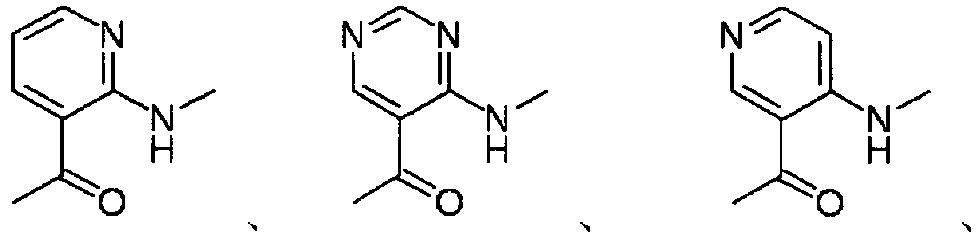
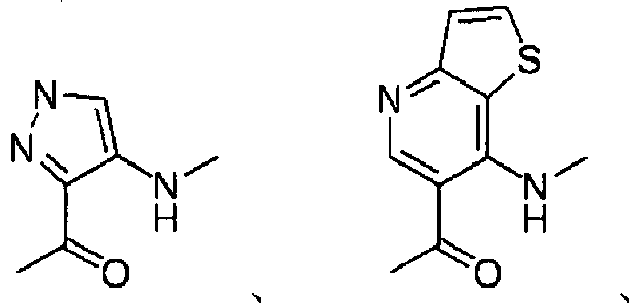

- These heterocycles optionally have 1 to 3 substituents selected from
- (1) a halogen atom,
- (2) C1-6 alkyl optionally having 1 to 3 halogen atoms,
- (3) C6-14 aryl (e.g., phenyl),
- (4) C3-10 cycloalkyl (e.g., cyclopropyl),
- (5) a 5- or 6-membered aromatic heterocyclic group containing, as a ring-constituting atom besides carbon atom, 1 to 3 heteroatoms selected from an oxygen atom, a sulfur atom and a nitrogen atom (e.g., thienyl), and
- (6) C1-6 alkylthio.
- As ring Aa, preferred is a 5- or 6-membered aromatic heterocycle optionally having substituent(s).
- Examples of the "5- or 6-membered aromatic heterocycle" of the "5- or 6-membered aromatic heterocycle optionally having substituent(s)" for ring Aa include a 5- or 6-membered aromatic heterocycle containing, as a ring-constituting atom besides carbon atom, 1 to 3 heteroatoms selected from an oxygen atom, a sulfur atom and a nitrogen atom (e.g., pyrazole, pyridine, pyrimidine) and the like. Preferable examples thereof include a 6-membered aromatic heterocycle containing, as a ring-constituting atom besides carbon atom, 1 or 2 nitrogen atoms (e.g., pyridine, pyrimidine) and the like.
- Examples of the "substituent" of the "5- or 6-membered aromatic heterocycle optionally having substituent(s)" for ring Aa include
- (1) a hydrocarbon group optionally having substituent(s),
- (2) a heterocyclic group optionally having substituent(s),
- (3) mercapto optionally having a substituent,
- (4) acyl and the like.
- As ring Aa, more preferred is a heterocycle represented by the formula
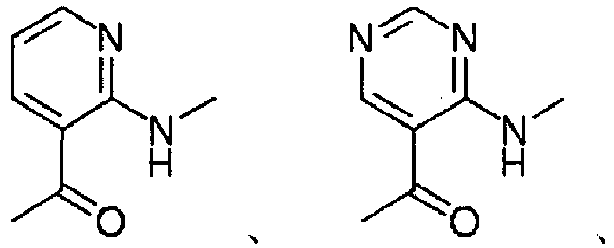

- These heterocycles optionally have 1 to 3 C1-6 alkyl optionally having 1 to 3 halogen atoms.
- As ring Aa, more preferred is a ring represented by the formula

- As ring Aa, particularly preferred is a ring represented by the formula

- As R4 in compound (A), preferred is
- (1) a hydrocarbon group optionally having substituent(s),
- (2) a heterocyclic group optionally having substituent(s),
- (3) mercapto optionally having a substituent and the like.
- As R4 in compound (A), more preferred is
- (1) Cl-6 alkyl optionally having 1 to 3 halogen atoms,
- (2) C6-14 aryl,
- (3) C3-10 cycloalkyl,
- (4) a 5- or 6-membered aromatic heterocyclic group containing, as a ring-constituting atom besides carbon atom, 1 to 3 heteroatoms selected from an oxygen atom, a sulfur atom and a nitrogen atom (e.g., thienyl),
- (5) C1-6 alkylthio and the like.
- As R4 in compound (A), further preferred is C1-6 alkyl optionally having 1 to 3 halogen atoms, and particularly preferred is C1-6 alkyl.
- In the formula (B), X and Y are each C or N, and ring Ab is a nitrogen-containing 6-membered ring optionally having substituent(s) in addition to R4.
- X is preferably C.
- ring Ab optionally has substituent(s) (preferably 1 or 2 substituents) at substitutable position(s) in addition to R4. Examples of the substituent include a halogen atom, hydroxy, C1-6 alkoxy, C1-6 alkyl and the like. Preferable examples of the substituent include 1 or 2 substituents selected from a halogen atom and C1-6 alkyl, and more preferred is C1-6 alkyl.
- As ring Ab, preferred is a ring represented by the formula

- In compound (B), R4 is preferably
- (1) a hydrocarbon group optionally having substituent(s),
- (2) an aromatic heterocyclic group optionally having substituent(s),
- (3) mercapto optionally having a substituent and the like.
- In compound (B), R4 is more preferably
- (1) C1-6 alkyl optionally having 1 to 3 halogen atoms,
- (2) C6-14 aryl,
- (3) C3-10 cycloalkyl,
- (4) a 5- or 6-membered aromatic heterocyclic group containing, as a ring-constituting atom besides carbon atom, 1 to 3 heteroatoms selected from an oxygen atom, a sulfur atom and a nitrogen atom (e.g., thienyl),
- (5) C1-6 alkylthio and the like.
- Ring Ac is preferably a 5- or 6-membered aromatic ring optionally having substituent(s).
- Examples of the "5- or 6-membered aromatic ring" of the "5- or 6-membered aromatic ring optionally having substituent(s)" for ring Ac include (i) 5- or 6-membered aromatic heterocycle containing, as a ring-constituting atom besides carbon atom, 1 to 3 heteroatoms selected from an oxygen atom, a sulfur atom and a nitrogen atom, (ii) benzene and the like. Preferred is a 6-membered aromatic ring containing, as a ring-constituting atom besides carbon atom, 1 or 2 nitrogen atoms (e.g., pyridine, pyrimidine) and the like.
- Examples of the "substituent" of the "5- or 6-membered aromatic ring optionally having substituent(s)" for ring Ac include
- (1) a hydrocarbon group optionally having substituent(s),
- (2) a heterocyclic group optionally having substituent(s),
- (3) mercapto optionally having a substituent,
- (4) acyl and the like.
- Ring Ac is more preferably a ring represented by the formula
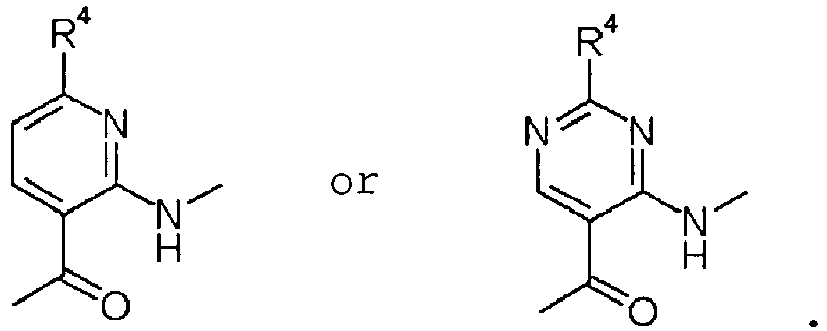
- Ring Ac is further preferably a ring represented by the formula
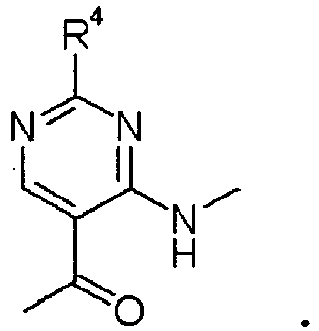
- R4 in compound (C) is preferably
- (1) a hydrocarbon group optionally having substituent(s),
- (2) a heterocyclic group optionally having substituent(s),
- (3) mercapto optionally having a substituent and the like.
- R4 in compound (C) is more preferably
- (1) C1-6 alkyl optionally having 1 to 3 halogen atoms,
- (2) C6-14 aryl,
- (3) C3-10 cycloalkyl,
- (4) a 5- or 6-membered aromatic heterocyclic group containing, as a ring-constituting atom besides carbon atom, 1 to 3 heteroatoms selected from an oxygen atom, a sulfur atom and a nitrogen atom (e.g., thienyl),
- (5) C1-6 alkylthio and the like.
- R4 in compound (C) is further preferably C1-6 alkyl optionally having 1 to 3 halogen atoms, and particularly preferably C1-6 alkyl.
- Preferable examples of compound (I) are as described below.
- A compound represented by the formula (I) wherein R1 and R2 are each
- (1) C1-6 alkyl optionally having 1 to 3 substituents selected from cyano and hydroxy,
- (2) C3-10 cycloalkyl (e.g., cyclopropyl, cyclohexyl),
- (3) C7-16 aralkyl (e.g., benzyl), or
- (4) a group represented by the formula
- (1) a hydrogen atom,
- (2) C1-6 alkyl optionally having 1 to 3 hydroxy,
- (3) C1-6 alkoxy-carbonyl, or
- (4) a group represented by the formula: -CO-N(R5) (R6) wherein R5 and R6 are each a hydrogen atom or C1-6 alkyl, or R5 and R6 optionally form, together with the nitrogen atom bonded thereto, a 5- to 7-membered nonaromatic nitrogen-containing heterocycle containing, as a ring-constituting atom besides carbon atom, one nitrogen atom, and optionally further containing 1 or 2 heteroatoms selected from an oxygen atom, a sulfur atom and a nitrogen atom (e.g., pyrrolidine, piperidine, piperazine, morpholine, thiomorpholine), and optionally having 1 to 3 substituents selected from hydroxy and C1-6 alkyl, or R1 and R2 optionally form, together with the nitrogen atom bonded thereto, a 5- to 9-membered (preferably 5- to 7-membered, more preferably 5- or 6-membered) nonaromatic nitrogen-containing heterocycle containing, as a ring-constituting atom besides carbon atom, one nitrogen atom, and optionally further containing 1 or 2 heteroatoms selected from an oxygen atom, a sulfur atom and a nitrogen atom (e.g., pyrrolidine, piperidine, piperazine, morpholine, thiomorpholine, azepane, azocane, azonane, 1,4-diazepane), and optionally having 1 to 3 substituents selected from
- (1) C1-6 alkyl optionally having 1 to 3 substituents selected from
- (a) hydroxy,
- (b) C1-6 alkoxy,
- (c) C6-14 aryl (e.g., phenyl),
- (d) amino,
- (e) mono- or di-C1-6 alkylamino,
- (f) C7-16 aralkylamino (e.g., benzylamino), and
- (g) C1-6 alkoxy-carbonylamino (e.g., tert-butoxycarbonylamino),
- (2) C6-14 aryl (e.g., phenyl) optionally having 1 to 3 halogen atoms,
- (3) C7-16 aralkyl (e.g., benzyl, phenethyl),
- (4) C3-10 cycloalkyl (e.g., cyclohexyl),
- (5) amino,
- (6) hydroxy,
- (7) C1-6 alkoxy-carbonyl (e.g., tert-butoxycarbonyl), and
- (8) carbamoyl;
- (1) C1-6 alkyl optionally having 1 to 3 substituents selected from
- (1) a 5- or 6-membered aromatic or nonaromatic heterocyclic group containing, as a ring-constituting atom besides carbon atom, 1 to 4 heteroatoms selected from an oxygen atom, a sulfur atom and a nitrogen atom (e.g., furyl, thienyl, oxazolyl, pyridyl, tetrahydrofuryl), and optionally having 1 to 3 C1-6 alkyl,
- (2) C6-14 aryl (e.g., phenyl),
- (3) C3-10 cycloalkyl (e.g., cyclopropyl),
- (4) C1-6 alkyl optionally having 1 to 3 substituents selected from C1-6 alkoxy and C1-6 alkylthio, or
- (5) C1-6 alkoxy-carbonyl; and
- (1) C1-6 alkyl optionally having 1 to 3 halogen atoms,
- (2) C6-14 aryl (e.g., phenyl),
- (3) C3-10 cycloalkyl (e.g., cyclopropyl),
- (4) a 5- or 6-membered aromatic heterocyclic group containing, as a ring-constituting atom besides carbon atom, 1 to 3 heteroatoms selected from an oxygen atom, a sulfur atom and a nitrogen atom (e.g., thienyl), or
- (5) C1-6 alkylthio, and ring A optionally further has 1 or 2 C1-6 alkyl in addition to R4, or a salt thereof.
- A compound represented by the formula (I) wherein R1 and R2 are each
- (1) C1-6 alkyl optionally having 1 to 3 substituents selected from
- (a) a halogen atom,
- (b) cyano,
- (c) hydroxy,
- (d) amino,
- (e) C1-6 alkoxy-carbonyl,
- (f) carbamoyl,
- (g) C1-6 alkylcarbamoyl optionally having 1 to 3 substituents selected from hydroxy and a heterocyclic group (preferably a 5- or 6-membered heterocyclic group containing, as a ring-constituting atom besides carbon atom, 1 to 4 heteroatoms selected from an oxygen atom, a sulfur atom and a nitrogen atom, e.g., pyridyl, morpholinyl), and
- (h) C7-16 aralkylcarbamoyl (e.g., benzylcarbamoyl),
- (2) C3-10 cycloalkyl (e.g., cyclopropyl, cyclohexyl),
- (3) C7-16 aralkyl (e.g., benzyl),
- (4) C3-10 cycloalkyl-C1-6 alkyl (e.g., cyclopropylmethyl),
- (5) a group represented by the formula

- (6) a group represented by the formula

- (1') a hydrogen atom,
- (2') cyano,
- (3') C1-6 alkyl optionally having 1 to 3 substituents selected from
- (a) hydroxy,
- (b) C1-6 alkyl-carbonyloxy,
- (c) C1-6 alkylthio, and
- (d) C1-6 alkylsulfonyl,
- (4') C3-10 cycloalkyl (e.g., cyclohexyl) optionally having 1 to 3 hydroxy,
- (5') C7-16 aralkylamino (e.g., phenethylamino) optionally having 1 to 3 hydroxy,
- (6') C1-6 alkoxy-carbonylamino,
- (7') C7-16 aralkyloxy-carbonylamino (e.g., benzyloxycarbonylamino),
- (8') C1-6 alkyl-carbonylamino,
- (9') C3-10 cycloalkyl-carbonylamino (e.g., cyclohexylcarbonylamino) optionally having 1 to 3 substituents selected from hydroxy and C1-6 alkoxy,
- (10') C1-6 alkylsulfonylamino,
- (11') C6-14 arylsulfonylamino (e.g., phenylsulfonylamino),
- (12') C1-6 alkylaminocarbonylamino,
- (13') C6-14 arylaminocarbonylamino (e.g., phenylaminocarbonylamino),
- (14') C1-6 alkyl-carbonyl,
- (15') C3-10 cycloalkyl-carbonyl (e.g., cyclopropylcarbonyl), (16') carboxy,
- (17') a group represented by the formula: -W1-R7 wherein W1 is a bond, -CH2-, -CH2O-, -NHCO- or -NHSO2-, and R7 is a 5- or 6-membered heterocyclic group containing, as a ring-constituting atom besides carbon atom, 1 to 4 heteroatoms selected from an oxygen atom, a sulfur atom and a nitrogen atom (e.g., imidazolyl, morpholinyl, pyridyl, tetrahydropyranyl, piperidinyl, tetrazolyl, 4,5-dihydro-1,2,4-oxadiazolyl, 1,2,4-triazolyl, 1,3,4-oxadiazolyl, 1,2,4-oxadiazolyl, imidazolidinyl, hexahydropyrimidinyl, pyrazolyl), said 5- or 6-membered heterocyclic group optionally has 1 to 3 substituents selected from
- (a) oxo,
- (b) C1-6 alkyl optionally having 1 to 3 hydroxy,
- (c) C6-14 aryl,
- (d) carbamoyl, and
- (e) C1-6 alkoxy-carbonyl,
- (18') C1-6 alkoxy-carbonyl, or
- (19') a group represented by the formula: -CO-N(R5)(R6) wherein R5 and R5 are each a hydrogen atom, C1-6 alkyl or C1-6 alkoxy, or
- (a) oxo,
- (b) a halogen atom,
- (c) C1-6 alkyl optionally having 1 to 3 substituents selected from hydroxy and C1-6 alkoxy,
- (d) C6-14 aryl (e.g., phenyl) optionally having 1 to 3 C1-6 alkoxy,
- (e) C7-16 aralkyl (e.g., benzyl),
- (f) hydroxy,
- (g) C1-6 alkoxy,
- (h) C6-14 aryloxy (e.g., phenoxy),
- (i) C7-16 aralkyloxy (e.g., benzyloxy),
- (j) C1-6 alkyl-carbonyl,
- (k) C6-14 aryl-carbonyl (e.g., benzoyl),
- (l) mono- or di-C1-6 alkylsulfamoyl,
- (m) C1-6 alkylsulfonyl, and
- (n) a 5- or 6-membered heterocyclic group containing, as a ring-constituting atom besides carbon atom, 1 to 4 heteroatoms selected from an oxygen atom, a sulfur atom and a nitrogen atom (e.g., pyridyl, thiazolyl), or
- (1) C1-6 alkyl optionally having 1 to 3 substituents selected from
- (a) hydroxy,
- (b) C1-6 alkoxy,
- (c) C6-14 aryl (e.g., phenyl),
- (d) amino,
- (e) mono- or di-C1-6 alkylamino,
- (f) C7-16 aralkylamino (e.g., benzylamino), and
- (g) C1-6 alkoxy-carbonylamino (e.g., tert-butoxycarbonylamino),
- (2) C6-14 aryl (e.g., phenyl) optionally having 1 to 3 halogen atoms,
- (3) C7-16 aralkyl (e.g., benzyl, phenethyl),
- (4) C3-10 cycloalkyl (e.g., cyclohexyl),
- (5) amino,
- (6) hydroxy,
- (7) C1-6 alkoxy-carbonyl (e.g., tert-butoxycarbonyl), and
- (8) carbamoyl;
- (1) a 5- or 6-membered aromatic or nonaromatic heterocyclic group containing, as a ring-constituting atom besides carbon atom, 1 to 4 heteroatoms selected from an oxygen atom, a sulfur atom and a nitrogen atom (e.g., furyl, thienyl, oxazolyl, pyridyl, tetrahydrofuryl), and optionally having 1 to 3 C1-6 alkyl,
- (2) C6-14 aryl (e.g., phenyl),
- (3) C3-10 cycloalkyl (e.g., cyclopropyl),
- (4) C1-6 alkyl optionally having 1 to 3 substituents selected from
- (a) hydroxy,
- (b) C1-6 alkoxy,
- (c) C1-6 alkylthio,
- (d) C1-6 alkylsulfinyl, and
- (e) C1-6 alkylsulfonyl, or
- (5) C1-6 alkoxy-carbonyl; and
- (1) a halogen atom,
- (2) C1-6 alkyl optionally having 1 to 3 halogen atoms,
- (3) C6-14 aryl (e.g., phenyl),
- (4) C3-10 cycloalkyl (e.g., cyclopropyl),
- (5) a 5- or 6-membered aromatic heterocyclic group containing, as a ring-constituting atom besides carbon atom, 1 to 3 heteroatoms selected from an oxygen atom, a sulfur atom and a nitrogen atom (e.g., thienyl), and
- (6) C1-6 alkylthio, or a salt thereof.
- Preferable examples of compound (A) are as described below.
- A compound of the formula (A)
wherein R1a is C1-6 alkyl;
R3a is a 5- or 6-membered aromatic group optionally having substituent(s);
ring Aa is a 5- or 6-membered aromatic ring optionally having substituent(s); and
ring B is a ring represented by the formula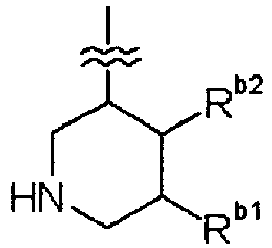
- A compound represented by the formula (A)
wherein R1a is C1-6 alkyl;
R3a is a 5-membered aromatic heterocyclic group containing, as a ring-constituting atom besides carbon atom, 1 to 4 heteroatoms selected from an oxygen atom, a sulfur atom and a nitrogen atom (e.g., furyl), or phenyl;
ring Aa is a ring represented by the formula
ring B is a ring represented by the formula
- (1) a hydrogen atom,
- (2) C1-6 alkyl optionally having 1 to 3 hydroxy,
- (3) C1-6 alkoxy-carbonyl, or
- (4) a group represented by the formula: -CO-N(R5) (R6)
- The present invention relates inter alia to the following compound:
- A compound represented by the formula (A) wherein R1a is C1-6 alkyl optionally having C3-10 cycloalkyl;
R3a is a 5- or 6-membered aromatic heterocyclic group containing, as a ring-constituting atom besides carbon atom, 1 to 4 heteroatoms selected from an oxygen atom, a sulfur atom and a nitrogen atom (e.g., furyl, oxazolyl, thienyl, pyridyl), or phenyl;
ring Aa is a heterocycle represented by the formula

ring B is - (1) a ring represented by the formula

- (2) a ring represented by the formula

- (1') a hydrogen atom,
- (2') cyano,
- (3') C1-6 alkyl optionally having 1 to 3 substituents selected from
- (a) hydroxy,
- (b) C1-6 alkyl-carbonyloxy,
- (c) C1-6 alkylthio, and
- (d) C1-6 alkylsulfonyl,
- (4') C1-6 alkoxy-carbonylamino,
- (5') C7-16 aralkyloxy-carbonylamino (e.g., benzyloxycarbonylamino),
- (6') C1-6 alkyl-carbonylamino,
- (7') C3-10 cycloalkyl-carbonylamino (e.g., cyclohexylcarbonylamino) optionally having 1 to 3 substituents selected from hydroxy and C1-6 alkoxy,
- (8') a group represented by the formula: -W2-R8 wherein W2 is a bond, -CH2-, -CH2O- or -NHCO-, and R8 is a 5- or 6-membered heterocyclic group containing, as a ring-constituting atom besides carbon atom, 1 to 4 heteroatoms selected from an oxygen atom, a sulfur atom and a nitrogen atom (e.g., imidazolyl, morpholinyl, pyridyl, tetrahydropyranyl, piperidinyl, tetrazolyl, 4,5-dihydro-1,2,4-oxadiazolyl, 1,2,4-triazolyl, 1,3,4-oxadiazolyl, 1,2,4-oxadiazolyl), said 5- or 6-membered heterocyclic group optionally has 1 to 3 substituents selected from
- (a) oxo,
- (b) C1-6 alkyl optionally having 1 to 3 hydroxy,
- (c) C6-14 aryl, and
- (d) carbamoyl,
- (9') C1-6 alkoxy-carbonyl, or
- (10') a group represented by the formula: -CO-N(R5)(R6) wherein R5 and R6 are each a hydrogen atom or C1-6 alkyl, or R5 and R6 optionally form, together with the nitrogen atom bonded thereto, a 4- to 7-membered nonaromatic nitrogen-containing heterocycle containing, as a ring-constituting atom besides carbon atom, one nitrogen atom, and optionally further containing 1 or 2 heteroatoms selected from an oxygen atom, a sulfur atom and a nitrogen atom (e.g., azetidine, pyrrolidine, piperidine, piperazine, morpholine, thiomorpholine), and optionally having 1 to 3 substituents selected from hydroxy and C1-6 alkyl, or
- The invention also relates to the following compound:
- A compound represented by the formula (A)
wherein R1a is C1-6 alkyl;
R3a is a 5-membered aromatic heterocyclic group containing, as a ring-constituting atom besides carbon atom, 1 to 4 heteroatoms selected from an oxygen atom, a sulfur atom and a nitrogen atom (e.g., furyl, oxazolyl, thienyl);
ring Aa is a ring represented by the formula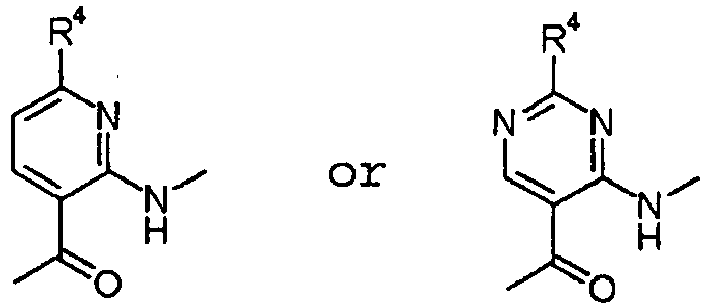
ring B is a ring represented by the formula
Rb1 is - (1) a hydrogen atom,
- (2) cyano,
- (3) C1-6 alkyl optionally having 1 to 3 substituents selected from
- (a) hydroxy,
- (b) C1-6 alkyl-carbonyloxy,
- (c) C1-6 alkylthio, and
- (d) C1-6 alkylsulfonyl,
- (4) C1-6 alkoxy-carbonylamino,
- (5) C7-16 aralkyloxy-carbonylamino (e.g., benzyloxycarbonylamino),
- (6) C1-6 alkyl-carbonylamino,
- (7) C3-10 cycloalkyl-carbonylamino (e.g., cyclohexylcarbonylamino) optionally having 1 to 3 substituents selected from hydroxy and C1-6 alkoxy,
- (8) a group represented by the formula: -W2-R8 wherein W2 is a bond, -CH2-, -CH2O- or -NHCO-, and R8 is a 5- or 6-membered heterocyclic group containing, as a ring-constituting atom besides carbon atom, 1 to 4 heteroatoms selected from an oxygen atom, a sulfur atom and a nitrogen atom (e.g., imidazolyl, morpholinyl, pyridyl, tetrahydropyranyl, piperidinyl, tetrazolyl, 4,5-dihydro-1,2,4-oxadiazolyl, 1,2,4-triazolyl, 1,3,4-oxadiazolyl, 1,2,4-oxadiazolyl), said 5- or 6-membered heterocyclic group optionally has 1 to 3 substituents selected from
- (a) oxo,
- (b) C1-6 alkyl optionally having 1 to 3 hydroxy,
- (c) C6-14 aryl, and
- (d) carbamoyl,
- (9) C1-6 alkoxy-carbonyl, or
- (10) a group represented by the formula: -CO-N(R5)(R6) wherein R5 and R6 are each a hydrogen atom or C1-6 alkyl, or R5 and R6 optionally form, together with the nitrogen atom bonded thereto, a 4- to 7-membered nonaromatic nitrogen-containing heterocycle containing, as a ring-constituting atom besides carbon atom, one nitrogen atom, and optionally further containing 1 or 2 heteroatoms selected from an oxygen atom, a sulfur atom and a nitrogen atom (e.g., azetidine, pyrrolidine, piperidine, piperazine, morpholine, thiomorpholine), and optionally having 1 to 3 substituents selected from hydroxy and C1-6 alkyl, or
- Moreover, the invention provides the compound below:
- A compound represented by the formula (A)
wherein R1a is C1-6 alkyl;
R3a is a 5-membered aromatic heterocyclic group containing, as a ring-constituting atom besides carbon atom, 1 to 4 heteroatoms selected from an oxygen atom, a sulfur atom and a nitrogen atom (e.g., furyl, oxazolyl, thienyl);
ring Aa is a ring represented by the formula
ring B is a ring represented by the formula
Rb1 is a group represented by the formula: -CO-N(R5)(R6) wherein R5 and R6 are each a hydrogen atom or C1-6 alkyl, or R5 and R6 optionally form, together with the nitrogen atom bonded thereto, a 4- to 7-membered nonaromatic nitrogen-containing heterocycle containing, as a ring-constituting atom besides carbon atom, one nitrogen atom, and optionally further containing 1 or 2 heteroatoms selected from an oxygen atom, a sulfur atom and a nitrogen atom (e.g., azetidine, pyrrolidine, piperidine, piperazine, morpholine, thiomorpholine), and optionally having 1 to 3 substituents selected from hydroxy and C1-6 alkyl, or a salt thereof. - Preferable examples of compound (B) are as described below.
- A compound represented by the formula (B) wherein R1b and R2b form, together with the nitrogen atom bonded thereto, piperidine optionally having substituent(s) or piperazine optionally having substituent(s);
R3b is furyl, thienyl or oxazolyl, each of which optionally has substituent(s); and
ring Ab is a ring represented by the formula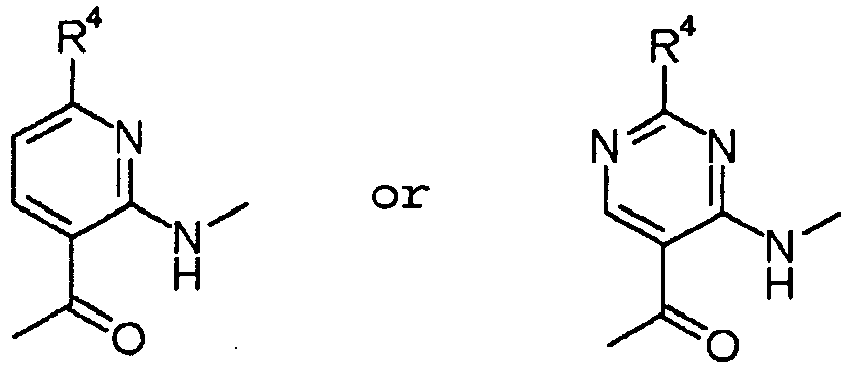
- The invention also provides the following compound:
- A compound represented by the formula (B) wherein R1b and R2b are each
- (1) C1-6 alkyl optionally having 1 to 3 substituents selected from cyano and hydroxy,
- (2) C3-10 cycloalkyl (e.g., cyclopropyl, cyclohexyl), or
- (3) C7-16 aralkyl (e.g., benzyl), or
- (1) C1-6 alkyl optionally having 1 to 3 substituents selected from
- (a) hydroxy,
- (b) C1-6 alkoxy,
- (c) C6-14 aryl (e.g., phenyl),
- (d) amino,
- (e) mono- or di-C1-6 alkylamino,
- (f) C7-16 aralkylamino (e.g., benzylamino), and
- (g) C1-6 alkoxy-carbonylamino (e.g., tert-butoxycarbonylamino),
- (2) C6-14 aryl (e.g., phenyl) optionally having 1 to 3 halogen atoms,
- (3) C7-16 aralkyl (e.g., benzyl, phenethyl),
- (4) C3-10 cycloalkyl (e.g., cyclohexyl),
- (5) amino,
- (6) hydroxy,
- (7) C1-6 alkoxy-carbonyl (e.g., tert-butoxycarbonyl), and
- (8) carbamoyl;
- (1) a 5- or 6-membered aromatic or nonaromatic heterocyclic group containing, as a ring-constituting atom besides carbon atom, 1 to 4 heteroatoms selected from an oxygen atom, a sulfur atom and a nitrogen atom (e.g., furyl, thienyl, oxazolyl, pyridyl, tetrahydrofuryl), and optionally having 1 to 3 C1-6 alkyl,
- (2) C6-14 aryl (e.g., phenyl),
- (3) C3-10 cycloalkyl (e.g., cyclopropyl),
- (4) C1-6 alkyl optionally having 1 to 3 C1-6 alkoxy, or
- (5) C1-6 alkoxy-carbonyl;
- (1) C1-6 alkyl optionally having 1 to 3 halogen atoms,
- (2) C6-14 aryl (e.g., phenyl),
- (3) C3-10 cycloalkyl (e.g., cyclopropyl),
- (4) a 5- or 6-membered aromatic heterocyclic group containing, as a ring-constituting atom besides carbon atom, 1 to 3 heteroatom selected from an oxygen atom, a sulfur atom and a nitrogen atom (e.g., thienyl), or
- (5) C1-6 alkylthio;
- Moreover, the invention relates to the compound below:
- A compound represented by the formula (B) wherein R1b and R2b are each
- (1) C1-6 alkyl optionally having 1 to 3 substituents selected from
- (a) a halogen atom,
- (b) cyano,
- (c) hydroxy,
- (d) amino,
- (e) C1-6 alkoxy-carbonyl,
- (f) carbamoyl,
- (g) C1-6 alkylcarbamoyl optionally having 1 to 3 substituents selected from hydroxy and a heterocyclic group (preferably a 5- or 6-membered heterocyclic group containing, as a ring-constituting atom besides carbon atom, 1 to 4 heteroatoms selected from an oxygen atom, a sulfur atom and a nitrogen atom, e.g., pyridyl, morpholinyl), and
- (h) C7-16 aralkylcarbamoyl (e.g., benzylcarbamoyl),
- (2) C3-10 cycloalkyl (e.g., cyclopropyl, cyclohexyl),
- (3) C7-16 aralkyl (e.g., benzyl),
- (4) C3-10 cycloalkyl-C1-6 alkyl (e.g., cyclopropylmethyl),
- (5) a group represented by the formula

- (6) a group represented by the formula
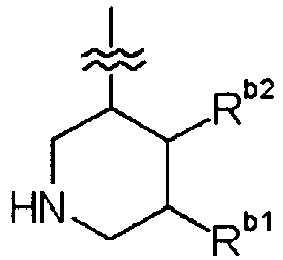
- (1') a hydrogen atom,
- (2') cyano,
- (3') C1-6 alkyl optionally having 1 to 3 substituents selected from
- (a) hydroxy,
- (b) C1-6 alkyl-carbonyloxy,
- (c) C1-6 alkylthio, and
- (d) C1-6 alkylsulfonyl,
- (4') C3-10 cycloalkyl (e.g., cyclohexyl) optionally having 1 to 3 hydroxy,
- (5') C7-16 aralkylamino (e.g., phenethylamino) optionally having 1 to 3 hydroxy,
- (6') C1-6 alkoxy-carbonylamino,
- (7') C7-16 aralkyloxy-carbonylamino (e.g., benzyloxycarbonylamino),
- (8') C1-6 alkyl-carbonylamino,
- (9') C3-10 cycloalkyl-carbonylamino (e.g., cyclohexylcarbonylamino) optionally having 1 to 3 substituents selected from hydroxy and C1-6 alkoxy,
- (10') C1-6 alkylsulfonylamino,
- (11') C6-14 arylsulfonylamino (e.g., phenylsulfonylamino),
- (12') C1-6 alkylaminocarbonylamino,
- (13') C6-14 arylaminocarbonylamino (e.g., phenylaminocarbonylamino),
- (14') C1-6 alkyl-carbonyl,
- (15') C3-10 cycloalkyl-carbonyl (e.g., cyclopropylcarbonyl),
- (16') carboxy,
- (17') a group represented by the formula: -W1-R7 wherein W1 is a bond, -CH2-, -CH2O-, -NHCO- or -NHSO2-, and R7 is a 5- or 6-membered heterocyclic group containing, as a ring-constituting atom besides carbon atom, 1 to 4 heteroatoms selected from an oxygen atom, a sulfur atom and a nitrogen atom (e.g., imidazolyl, morpholinyl, pyridyl, tetrahydropyranyl, piperidinyl, tetrazolyl, 4,5-dihydro-1,2,4-oxadiazolyl, 1,2,4-triazolyl, 1,3,4-oxadiazolyl, 1,2,4-oxadiazolyl, imidazolidinyl, hexahydropyrimidinyl, pyrazolyl), said 5- or 6-membered heterocyclic group optionally has 1 to 3 substituents selected from
- (a) oxo,
- (b) C1-6 alkyl optionally having 1 to 3 hydroxy,
- (c) C6-14 aryl,
- (d) carbamoyl, and
- (e) C1-6 alkoxy-carbonyl,
- (18') C1-6 alkoxy-carbonyl, or
- (19') a group represented by the formula: -CO-N(R5)(R6) wherein R5 and R6 are each a hydrogen atom, C1-6 alkyl or C1-6 alkoxy, or
- (a) oxo,
- (b) a halogen atom,
- (c) C1-6 alkyl optionally having 1 to 3 substituents selected from hydroxy and C1-6 alkoxy,
- (d) C6-14 aryl (e.g., phenyl) optionally having 1 to 3 C1-6 alkoxy,
- (e) C7-16 aralkyl (e.g., benzyl),
- (f) hydroxy,
- (g) C1-6 alkoxy,
- (h) C6-14 aryloxy (e.g., phenoxy),
- (i) C7-16 aralkyloxy (e.g., benzyloxy),
- (j) C1-6 alkyl-carbonyl,
- (k) C6-14 aryl-carbonyl (e.g., benzoyl),
- (l) mono- or di-C1-6 alkylsulfamoyl,
- (m) C1-6 alkylsulfonyl, and
- (n) a 5- or 6-membered heterocyclic group containing, as a ring-constituting atom besides carbon atom, 1 to 4 heteroatoms selected from an oxygen atom, a sulfur atom and a nitrogen atom (e.g., pyridyl, thiazolyl), or
- (1) C1-6 alkyl optionally having 1 to 3 substituents selected from
- (a) hydroxy,
- (b) C1-6 alkoxy,
- (c) C6-14 aryl (e.g., phenyl),
- (d) amino,
- (e) mono- or di-C1-6 alkylamino,
- (f) C7-16 aralkylamino (e.g., benzylamino), and
- (g) C1-6 alkoxy-carbonylamino (e.g., tert-butoxycarbonylamino),
- (2) C6-14 aryl (e.g., phenyl) optionally having 1 to 3 halogen atoms,
- (3) C7-16 aralkyl (e.g., benzyl, phenethyl),
- (4) C3-10 cycloalkyl (e.g., cyclohexyl),
- (5) amino,
- (6) hydroxy,
- (7) C1-6 alkoxy-carbonyl (e.g., tert-butoxycarbonyl), and
- (8) carbamoyl;
- (1) a 5- or 6-membered aromatic or nonaromatic heterocyclic group containing, as a ring-constituting atom besides carbon atom, 1 to 4 heteroatoms selected from an oxygen atom, a sulfur atom and a nitrogen atom (e.g., furyl, thienyl, oxazolyl, pyridyl, tetrahydrofuryl), and optionally having 1 to 3 C1-6 alkyl,
- (2) C6-14 aryl (e.g., phenyl),
- (3) C3-10 cycloalkyl (e.g., cyclopropyl),
- (4) C1-6 alkyl optionally having 1 to 3 substituents selected from
- (a) hydroxy,
- (b) C1-6 alkoxy,
- (c) C1-6 alkylthio,
- (d) C1-6 alkylsulfinyl, and
- (e) C1-6 alkylsulfonyl, or
- (5) C1-6 alkoxy-carbonyl;
- (1) C1-6 alkyl optionally having 1 to 3 halogen atoms,
- (2) C6-14 aryl (e.g., phenyl),
- (3) C3-10 cycloalkyl (e.g., cyclopropyl),
- (4) a 5- or 6-membered aromatic heterocyclic group containing, as a ring-constituting atom besides carbon atom, 1 to 3 heteroatoms selected from an oxygen atom, a sulfur atom and a nitrogen atom (e.g., thienyl), or
- (5) C1-6 alkylthio;
- The invention also relates to the following compound:
- A compound represented by the formula (B)
wherein R1b is - (1) C1-6 alkyl optionally having 1 to 3 halogen atoms,
- (2) C3-10 cycloalkyl (e.g., cyclopropyl, cyclohexyl),
- (3) C7-16 aralkyl (e.g., benzyl), or
- (4) C3-10 cycloalkyl-C1-6 alkyl (e.g., cyclopropylmethyl) ;
- (1') a hydrogen atom,
- (2') cyano,
- (3') C1-6 alkyl optionally having 1 to 3 substituents selected from
- (a) hydroxy,
- (b) C1-6 alkyl-carbonyloxy,
- (c) C1-6 alkylthio, and
- (d) C1-6 alkylsulfonyl,
- (4') C3-10 cycloalkyl (e.g., cyclohexyl) optionally having 1 to 3 hydroxy,
- (5') C7-16 aralkylamino (e.g., phenethylamino) optionally having 1 to 3 hydroxy,
- (6') C1-6 alkoxy-carbonylamino,
- (7') C7-16 aralkyloxy-carbonylamino (e.g., benzyloxycarbonylamino),
- (8') C1-6 alkyl-carbonylamino,
- (9') C3-10 cycloalkyl-carbonylamino (e.g., cyclohexylcarbonylamino) optionally having 1 to 3 substituents selected from hydroxy and C1-6 alkoxy,
- (10') C1-6 alkylsulfonylamino,
- (11') C6-14 arylsulfonylamino (e.g., phenylsulfonylamino),
- (12') C1-6 alkylaminocarbonylamino,
- (13') C6-14 arylaminocarbonylamino (e.g., phenylaminocarbonylamino),
- (14') C1-6 alkyl-carbonyl,
- (15') C3-10 cycloalkyl-carbonyl (e.g., cyclopropylcarbonyl),
- (16') carboxy,
- (17') a group represented by the formula: -W1-R7 wherein W1 is a bond, -CH2-, -CH2O-, -NHCO- or -NHSO2-, and R7 is a 5- or 6-membered heterocyclic group containing, as a ring-constituting atom besides carbon atom, 1 to 4 heteroatoms selected from an oxygen atom, a sulfur atom and a nitrogen atom (e.g., imidazolyl, morpholinyl, pyridyl, tetrahydropyranyl, piperidinyl, tetrazolyl, 4,5-dihydro-1,2,4-oxadiazolyl, 1,2,4-triazolyl, 1,3,4-oxadiazolyl, 1,2,4-oxadiazolyl, imidazolidinyl, hexahydropyrimidinyl, pyrazolyl), said 5- or 6-membered heterocyclic group optionally has 1 to 3 substituents selected from
- (a) oxo,
- (b) C1-6 alkyl optionally having 1 to 3 hydroxy,
- (c) C6-14 aryl,
- (d) carbamoyl, and
- (e) C1-6 alkoxy-carbonyl,
- (18') C1-6 alkoxy-carbonyl, or
- (19') a group represented by the formula: -CO-N(R5) (R6) wherein R5 and R6 are each a hydrogen atom, C1-6 alkyl or C1-6 alkoxy, or
- (a) oxo,
- (b) a halogen atom,
- (c) C1-6 alkyl optionally having 1 to 3 substituents selected from hydroxy and C1-6 alkoxy,
- (d) C6-14 aryl (e.g., phenyl) optionally having 1 to 3 C1-6 alkoxy,
- (e) C7-16 aralkyl (e.g., benzyl),
- (f) hydroxy,
- (g) C1-6 alkoxy,
- (h) C6-14 aryloxy (e.g., phenoxy),
- (i) C7-16 aralkyloxy (e.g., benzyloxy),
- (j) C1-6 alkyl-carbonyl,
- (k) C6-14 aryl-carbonyl (e.g., benzoyl),
- (l) mono- or di-C1-6 alkylsulfamoyl,
- (m) C1-6 alkylsulfonyl, and
- (n) a 5- or 6-membered heterocyclic group containing, as a ring-constituting atom besides carbon atom, 1 to 4 heteroatoms selected from an oxygen atom, a sulfur atom and a nitrogen atom (e.g., pyridyl, thiazolyl), or
- (1) a 5- or 6-membered aromatic or nonaromatic heterocyclic group containing, as a ring-constituting atom besides carbon atom, 1 to 4 heteroatoms selected from an oxygen atom, a sulfur atom and a nitrogen atom (e.g., furyl, thienyl, oxazolyl, pyridyl, tetrahydrofuryl), and optionally having 1 to 3 C1-6 alkyl,
- (2) C6-14 aryl (e.g., phenyl),
- (3) C3-10 cycloalkyl (e.g., cyclopropyl),
- (4) C1-6 alkyl optionally having 1 to 3 substituents selected from
- (a) hydroxy,
- (b) C1-6 alkoxy,
- (c) C1-6 alkylthio,
- (d) C1-6 alkylsulfinyl, and
- (e) C1-6 alkylsulfonyl, or
- (5) C1-6 alkoxy-carbonyl ;
- (1) C1-6 alkyl optionally having 1 to 3 halogen atoms,
- (2) C6-14 aryl (e.g., phenyl), or
- (3) C3-10 cycloalkyl (e.g., cyclopropyl); and
- The invention also provides the following compound:
- A compound represented by the formula (B) wherein R1b and R2b form, together with the nitrogen atom bonded thereto, a 5- to 9-membered (preferably 5- to 7-membered, more preferably 5- or 6-membered) nonaromatic nitrogen-containing heterocycle containing, as a ring-constituting atom besides carbon atom, one nitrogen atom, and optionally further containing 1 or 2 heteroatoms selected from an oxygen atom, a sulfur atom and a nitrogen atom (e.g., pyrrolidine, piperidine, piperazine, morpholine, thiomorpholine, azepane, azocane, azonane, 1,4-diazepane), and optionally having 1 to 3 substituents selected from
- (1) C1-6 alkyl optionally having 1 to 3 substituents selected from
- (a) hydroxy,
- (b) C1-6 alkoxy,
- (c) C6-14 aryl (e.g., phenyl),
- (d) amino,
- (e) mono- or di-C1-6 alkylamino,
- (f) C7-16 aralkylamino (e.g., benzylamino), and
- (g) C1-6 alkoxy-carbonylamino (e.g., tert-butoxycarbonylamino),
- (2) C6-14 aryl (e.g., phenyl) optionally having 1 to 3 halogen atoms,
- (3) C7-16 aralkyl (e.g., benzyl, phenethyl),
- (4) C3-10 cycloalkyl (e.g., cyclohexyl),
- (5) amino,
- (6) hydroxy,
- (7) C1-6 alkoxy-carbonyl (e.g., tert-butoxycarbonyl), and
- (8) carbamoyl;
- (1) a 5- or 6-membered aromatic or nonaromatic heterocyclic group containing, as a ring-constituting atom besides carbon atom, 1 to 4 heteroatoms selected from an oxygen atom, a sulfur atom and a nitrogen atom (e.g., furyl, thienyl, oxazolyl, pyridyl, tetrahydrofuryl), and optionally having 1 to 3 C1-6 alkyl,
- (2) C6-14 aryl (e.g., phenyl),
- (3) C3-10 cycloalkyl (e.g., cyclopropyl),
- (4) C1-6 alkyl optionally having 1 to 3 C1-6 alkoxy, or
- (5) C1-6 alkoxy-carbonyl ;
- (1) C1-6 alkyl optionally having 1 to 3 halogen atoms,
- (2) C6-14 aryl (e.g., phenyl), or
- (3) C3-10 cycloalkyl (e.g., cyclopropyl); and
- The invention also relates to the compound below:
- A compound represented by the formula

Rb2 is a hydrogen atom,
Rb1 is - (1) a hydrogen atom,
- (2) cyano,
- (3) C1-6 alkyl optionally having 1 to 3 substituents selected from
- (a) hydroxy,
- (b) C1-6 alkyl-carbonyloxy,
- (c) C1-6 alkylthio, and
- (d) C1-6 alkylsulfonyl,
- (4) C3-10 cycloalkyl (e.g., cyclohexyl) optionally having 1 to 3 hydroxy,
- (5) C7-16 aralkylamino (e.g., phenethylamino) optionally having 1 to 3 hydroxy,
- (6) C1-6 alkoxy-carbonylamino,
- (7) C7-16 aralkyloxy-carbonylamino (e.g., benzyloxycarbonylamino),
- (8) C1-6 alkyl-carbonylamino,
- (9) C3-10 cycloalkyl-carbonylamino (e.g., cyclohexylcarbonylamino) optionally having 1 to 3 substituents selected from hydroxy and C1-6 alkoxy,
- (10) C1-6 alkylsulfonylamino,
- (11) C6-14 arylsulfonylamino (e.g., phenylsulfonylamino),
- (12) C1-6 alkylaminocarbonylamino,
- (13) C6-14 arylaminocarbonylamino (e.g., phenylaminocarbonylamino),
- (14) C1-6 alkyl-carbonyl,
- (15) C3-10 cycloalkyl-carbonyl (e.g., cyclopropylcarbonyl),
- (16) carboxy,
- (17) a group represented by the formula: -W1-R7 wherein W1 is a bond, -CH2-, -CH2O-, -NHCO- or -NHSO2-, and R7 is a 5- or 6-membered heterocyclic group containing, as a ring-constituting atom besides carbon atom, 1 to 4 heteroatoms selected from an oxygen atom, a sulfur atom and a nitrogen atom (e.g., imidazolyl, morpholinyl, pyridyl, tetrahydropyranyl, piperidinyl, tetrazolyl, 4,5-dihydro-1,2,4-oxadiazolyl, 1,2,4-triazolyl, 1,3,4-oxadiazolyl, 1,2,4-oxadiazolyl, imidazolidinyl, hexahydropyrimidinyl, pyrazolyl), said 5- or 6-membered heterocyclic group optionally has 1 to 3 substituents selected from
- (a) oxo,
- (b) C1-6 alkyl optionally having 1 to 3 hydroxy,
- (c) C6-14 aryl,
- (d) carbamoyl, and
- (e) C1-6 alkoxy-carbonyl,
- (18) C1-6 alkoxy-carbonyl, or
- (19) a group represented by the formula: -CO-N(R5) (R6) wherein R5 and R6 are each a hydrogen atom, C1-6 alkyl or C1-6 alkoxy, or
- (a) oxo,
- (b) a halogen atom,
- (c) C1-6 alkyl optionally having 1 to 3 substituents selected from hydroxy and C1-6 alkoxy,
- (d) C6-14 aryl (e.g., phenyl) optionally having 1 to 3 C1-6 alkoxy,
- (e) C7-16 aralkyl (e.g., benzyl),
- (f) hydroxy,
- (g) C1-6 alkoxy,
- (h) C6-14 aryloxy (e.g., phenoxy),
- (i) C7-16 aralkyloxy (e.g., benzyloxy),
- (j) C1-6 alkyl-carbonyl,
- (k) C6-14 aryl-carbonyl (e.g., benzoyl),
- (l) mono- or di-C1-6 alkylsulfamoyl,
- (m) C1-6 alkylsulfonyl, and
- (n) a 5- or 6-membered heterocyclic group containing, as a ring-constituting atom besides carbon atom, 1 to 4 heteroatoms selected from an oxygen atom, a sulfur atom and a nitrogen atom (e.g., pyridyl, thiazolyl);
- (1) a 5- or 6-membered aromatic or nonaromatic heterocyclic group containing, as a ring-constituting atom besides carbon atom, 1 to 4 heteroatoms selected from an oxygen atom, a sulfur atom and a nitrogen atom (e.g., furyl, thienyl, oxazolyl, pyridyl, tetrahydrofuryl), and optionally having 1 to 3 C1-6 alkyl, or
- (2) C1-6 alkyl optionally having 1 to 3 C1-6 alkoxy; and
- Moreover, the invention provides the compound below:
- A compound represented by the formula

Rb2 is a hydrogen atom,
Rb1 is a group represented by the formula: -CO-N(R5) (R6) wherein R5 and R6 are each a hydrogen atom, C1-6 alkyl or C1-6 alkoxy, or
R5 and R6 optionally form, together with the nitrogen atom bonded thereto, a 4- to 7-membered nonaromatic nitrogen-containing heterocycle containing, as a ring-constituting atom besides carbon atom, one nitrogen atom, and optionally further containing 1 or 2 heteroatoms selected from an oxygen atom, a sulfur atom and a nitrogen atom (e.g., azetidine, pyrrolidine, piperidine, piperazine, morpholine, thiomorpholine, 1,4-oxazepane), said 4- to 7-membered nonaromatic nitrogen-containing heterocycle optionally has 1 to 3 substituents selected from - (a) oxo,
- (b) a halogen atom,
- (c) C1-6 alkyl optionally having 1 to 3 substituents selected from hydroxy and C1-6 alkoxy,
- (d) C6-14 aryl (e.g., phenyl) optionally having 1 to 3 C1-6 alkoxy,
- (e) C7-16 aralkyl (e.g., benzyl),
- (f) hydroxy,
- (g) C1-6 alkoxy,
- (h) C6-14 aryloxy (e.g., phenoxy),
- (i) C7-16 aralkyloxy (e.g., benzyloxy),
- (j) C1-6 alkyl-carbonyl,
- (k) C6-14 aryl-carbonyl (e.g., benzoyl),
- (l) mono- or di-C1-6 alkylsulfamoyl,
- (m) C1-6 alkylsulfonyl, and
- (n) a 5- or 6-membered heterocyclic group containing, as a ring-constituting atom besides carbon atom, 1 to 4 heteroatoms selected from an oxygen atom, a sulfur atom and a nitrogen atom (e.g., pyridyl, thiazolyl);
- (1) a 5- or 6-membered aromatic or nonaromatic heterocyclic group containing, as a ring-constituting atom besides carbon atom, 1 to 4 heteroatoms selected from an oxygen atom, a sulfur atom and a nitrogen atom (e.g., furyl, thienyl, oxazolyl, pyridyl, tetrahydrofuryl), and optionally having 1 to 3 C1-6 alkyl, or
- (2) C1-6 alkyl optionally having 1 to 3 C1-6 alkoxy; and
- Preferable examples of compound (C) are as described below.
- A compound represented by the formula (C)
wherein R1c is C1-6 alkyl;
R3c is C1-6 alkoxy or C1-6 alkylthio;
Z is C2-6 alkylene;
ring Ac is a ring represented by the formula
ring B is a ring represented by the formula
- (1) a hydrogen atom,
- (2) C1-6 alkyl optionally having 1 to 3 hydroxy,
- (3) C1-6 alkoxy-carbonyl, or
- (4) a group represented by the formula: -CO-N(R5) (R5) wherein R5 and R6 are each a hydrogen atom or C1-6 alkyl, or R5 and R6 optionally form, together with the nitrogen atom bonded thereto, a 5- to 7-membered nonaromatic nitrogen-containing heterocycle containing, as a ring-constituting atom besides carbon atom, one nitrogen atom, and optionally further containing 1 or 2 heteroatoms selected from an oxygen atom, a sulfur atom and a nitrogen atom (e.g., pyrrolidine, piperidine, piperazine, morpholine, thiomorpholine), and optionally having 1 to 3 substituents selected from hydroxy and C1-6 alkyl, or a salt thereof.
- Examples of the salt of compound (I) (including compound (A), compound (B) and compound (C), hereinafter the same) include metal salts, ammonium salts, salts with organic bases, salts with inorganic acids, salts with organic acids, salts with basic or acidic amino acids, and the like.
- Preferable examples of the metal salt include alkali metal salts such as sodium salt, potassium salt and the like; alkaline earth metal salts such as calcium salt, magnesium salt, barium salt and the like; aluminum salt and the like.
- Preferable examples of the salt with organic base include a salt with trimethylamine, triethylamine, pyridine, picoline, 2,6-lutidine, ethanolamine, diethanolamine, triethanolamine, cyclohexylamine, dicyclohexylamine, N,N-dibenzylethylenediamine or the like.
- Preferable examples of the salt with inorganic acid include a salt with hydrochloric acid, hydrobromic acid, nitric acid, sulfuric acid, phosphoric acid or the like.
- Preferable examples of the salt with organic acid include a salt with formic acid, acetic acid, trifluoroacetic acid, phthalic acid, fumaric acid, oxalic acid, tartaric acid, maleic acid, citric acid, succinic acid, malic acid, methanesulfonic acid, benzenesulfonic acid, p-toluenesulfonic acid or the like.
- Preferable examples of the salt with basic amino acid include a salt with arginine, lysine, ornithine or the like.
- Preferable examples of the salt with acidic amino acid include a salt with aspartic acid, glutamic acid or the like.
- Of these, a pharmaceutically acceptable salt is preferable. When the compound has an acidic functional group, examples thereof include inorganic salts such as alkali metal salts (e.g., sodium salt, potassium salt, etc.), alkaline earth metal salts (e.g., calcium salt, magnesium salt, barium salt, etc.) and the like, ammonium salts, and the like. When the compound has a basic functional group, examples thereof include salts with inorganic acids such as hydrochloric acid, hydrobromic acid, nitric acid, sulfuric acid, phosphoric acid and the like, and salts with organic acids such as acetic acid, phthalic acid, fumaric acid, oxalic acid, tartaric acid, maleic acid, citric acid, succinic acid, methanesulfonic acid, p-toluenesulfonic acid and the like.
- The production methods of compound (I) are shown in the following.
- Compound (I) is obtained by, for example, a method shown in the following reaction scheme or a method analogous thereto, or the like.
- Each of compounds (II)-(LI) shown in the reaction scheme may form a salt. Examples of the salt include salts similar to the salts of compound (I).
- The compound obtained in each step can also be used for the next reaction directly as the reaction mixture or as a crude product. In addition, it can also be isolated from the reaction mixture according to a conventional method, and can be isolated and purified by a known method such as phase transfer, concentration, solvent extraction, fractional distillation, pH conversion, crystallization, recrystallization, chromatography and the like.
- The schematic drawings of the reaction scheme are shown in the following.
- Each symbol of the compounds in the schemes is as defined above. R is C1-4 alkyl, Q is a hydrogen atom or an alkali metal atom, LG is a leaving group (e.g., chloro group, bromo group, iodo group etc.), and PG is an N-protecting group (e.g., benzyl, tert-butoxycarbonyl, benzyloxycarbonyl etc.). Ring Bb is a nitrogen-containing 5- to 7-membered ring optionally having substituent(s).

- Compound (I) can be produced by a condensation reaction of compound (II) and compound (III).
- Compound (II) can be produced by a method known per se, for example, the method described in J. Med. Chem., 1993, vol. 36, pages 2676-2688 and the like, or a method analogous thereto.
- As compound (III), a commercially available product may be used, or it can be produced by a method known per se, for example, the method described in J. Am. Chem. Soc., 1948, vol. 70, page 4009 and the like, or a method analogous thereto.
- When Q is a hydrogen atom, the condensation reaction is performed according to a conventional peptide synthesis technique, for example, an acid chloride method, an acid anhydride method, a mixed anhydride method, a method of using N,N'-dicyclohexylcarbodiimide (DCC), an active ester method, a method of using N,N'-carbonyldiimidazole (CDI), a method of using diethyl phosphorocyanidate (DEPC), a method of using N-ethyl-N'-(3-dimethylaminopropyl)carbodiimide hydrochloride (WSC·HCl) and 1-hydroxybenzotriazole (HOBt), or the like. Compound (III) is used in an amount of about 1 to 2 mol, preferably about 1.0 to 1.1 mol, per 1 mol of compound (II). The reagent for the aforementioned methods is used in an amount of about 1 mol to a large excess, preferably about 1.1 to 5 mol, per 1 mol of compound (II). The reaction temperature is generally -10°C to 80°C, preferably 0°C to 30°C.
- When Q is an alkali metal atom, the condensation reaction is advantageously performed according to a method using WSC·HCl and HOBt. Compound (III) is used in an amount of about 1 to 2 mol, preferably about 1.0 to 1.1 mol, per 1 mol of compound (II). WSC·HCl is used in an amount of about 1 to 4 mol, preferably about 1.5 to 2.5 mol, per 1 mol of compound (II). HOBt is used in an amount of about 1 to 8 mol, preferably about 2.5 to 5.0 mol, per 1 mol of compound (II). The reaction temperature is generally -10°C to 100°C, preferably 40°C to 70°C.
- In all cases, the condensation reaction is preferably performed in a solvent. Examples of the solvent to be used include halogenated hydrocarbons such as dichloromethane, chloroform, carbon tetrachloride, 1,2-dichloroethane and the like, ethers such as diethyl ether, tetrahydrofuran, dioxane and the like, amides such as N,N-dimethylformamide, N,N-dimethylacetamide and the like, dimethyl sulfoxide, pyridine, acetonitrile and a mixed solvent thereof.
- While the reaction time varies depending on the reagent and solvent to be used, it is generally 30 min to 3 days, preferably 30 min to 15 hr.
- Compound (I) can also be produced by performing, when desired in addition to the above-mentioned reaction, known hydrolysis reaction, acylation reaction, alkylation reaction, amination reaction, oxidation-reduction reaction, cyclization reaction, carbon chain extension reaction, substituent exchange reaction and the like, each singly or in combination of multiple operations.
- When compound (I) is obtained as a free compound, it can be converted to an object salt by a method known per se or a method analogous thereto. When compound (I) is obtained as a salt, it can be converted to a free form or other object salt by a method known per se or a method analogous thereto.

- Compound (VI) can be produced by reacting compound (IV) with compound (V).
- As compound (IV), a commercially available product may be used, or it can be produced by a method known per se, for example, the method described in Bioorg. Med. Chem. Lett., 2000, vol. 10, pages 1645-1648 and the like, or a method analogous thereto.
- As compound (V), a commercially available product may be used, or it can be produced by a method known per se, for example, the method described in Bioorg. Med. Chem. Lett., 2004, vol. 14, pages 2543-2546 and the like, or a method analogous thereto.
- Compound (VI) can be produced according to a method known per se, for example, the method described in J. Med. Chem., 1993, vol. 36, pages 2676-2688 and the like, or a method analogous thereto.
- This reaction is more advantageously performed in the presence of a base. As the base in this step, tertiary amine such as triethylamine, diisopropylethylamine and the like, or an inorganic base such as sodium hydrogen carbonate, potassium hydrogen carbonate and the like is preferable. The amount of the base to be used is about 1 mol to a large excess, preferably 1 to 5 mol, per 1 mol of compound (IV).
- This reaction is advantageously performed using a solvent inert to the reaction. While the solvent is not particularly limited as long as the reaction proceeds, for example, solvents such as alcohols (e.g., 2-propanol and the like), highly polar solvents (e.g., N,N-dimethylformamide, dimethyl sulfoxide and the like), hydrocarbons (e.g., benzene, toluene, cyclohexane, hexane and the like), ethers (e.g., diethyl ether, tetrahydrofuran, dioxane and the like) and the like, a mixed solvent thereof and the like are preferable.
- While the reaction time varies depending on the reagent and solvent to be used, it is generally 30 min to 48 hr, preferably 30 min to 15 hr.
- The reaction temperature is generally 0°C to 200°C, preferably 20°C to 120°C.
- Compound (VII) can be produced by a known hydrolysis, for example, alkaline hydrolysis or acid hydrolysis to compound (VI).
- The reaction is more advantageously performed under alkali conditions. As the alkali in this step, alkali metal hydroxide such as lithium hydroxide, sodium hydroxide, potassium hydroxide and the like is preferable. The amount of the alkali to be used is about 1 mol to a large excess, preferably 1 to 5 mol, per 1 mol of compound (VI).
- This reaction is advantageously performed using a solvent inert to the reaction. While the solvent is not particularly limited as long as the reaction proceeds, for example, solvents such as alcohols (e.g., methanol, ethanol, propanol and the like), hydrocarbons (e.g., benzene, toluene, cyclohexane, hexane and the like), halogenated hydrocarbons (e.g., dichloromethane, chloroform, carbon tetrachloride, 1,2-dichloroethane and the like), ethers (e.g., diethyl ether, tetrahydrofuran, dioxane and the like) and the like, a mixed solvent thereof and the like are preferable.
- While the reaction time varies depending on the reagent and solvent to be used, it is generally 30 min to 24 hr, preferably 30 min to 8 hr.
- The reaction temperature is generally 0°C to 150°C, preferably 20°C to 80°C.
- After the reaction, the reaction mixture is neutralized by the addition of a mineral acid (e.g., hydrochloric acid, sulfuric acid etc.), an organic acid (e.g., acetic acid etc.) or an ion exchange resin to give carboxylic acid (VII) in a free form (in this case, Q is hydrogen atom). Moreover, the reaction mixture may be directly concentrated to give compound (VII) as an alkali metal salt of carboxylic acid (in this case, Q is alkali metal atom such as lithium, sodium, potassium and the like).
- Compound (IX) can be produced by a condensation reaction of compound (VII) and compound (VIII).
- As compound (VIII), a commercially available product may be used, or it can be produced by a method known per se, for example, the method described in Bioorg. Med. Chem. Lett., 2005, vol. 15, pages 833-838, or
EP1757582 and the like, or a method analogous thereto. - When Q is a hydrogen atom, the condensation reaction is performed according to a conventional peptide synthesis technique, for example, an acid chloride method, an acid anhydride method, a mixed anhydride method, a method using N,N'-dicyclohexylcarbodiimide (DCC), an active ester method, a method using N,N'-carbonyldiimidazole (CDI), a method using diethyl phosphorocyanidate (DEPC), a method using N-ethyl-N'-(3-dimethylaminopropyl)carbodiimide hydrochloride (WSC·HCl) and 1-hydroxybenzotriazole (HOBt) and the like. Compound (VIII) is used in an amount of about 1 to 2 mol, preferably about 1.0 to 1.1 mol, per 1 mol of compound (VII). The reagent to be used in the above-mentioned method is used in an amount of about 1 mol to a large excess, preferably about 1.1 to 5 mol, per 1 mol of compound (VII). The reaction temperature is generally -10°C to 80°C, preferably 0°C to 30°C.
- When Q is an alkali metal atom, the condensation reaction is advantageously performed by a method using WSC·HCl and HOBt. Compound (VIII) is used in an amount of about 1 to 2 mol, preferably about 1.0 to 1.1 mol, per 1 mol of compound (VII). WSC·HCl is used in an amount of about 1 to 4 mol, preferably about 1.5 to 2.5 mol, per 1 mol of compound (VII). HOBt is used in an amount of about 1 to 8 mol, preferably about 2.5 to 5.0 mol, per 1 mol of compound (VII). The reaction temperature is generally -10°C to 100°C, preferably 40°C to 70°C.
- In all cases, the condensation reaction is preferably performed in a solvent. Examples of the solvent to be used include the above-mentioned halogenated hydrocarbons, the above-mentioned ethers, amides such as N,N-dimethylformamide, N,N-dimethylacetamide, N-methylpyrrolidone and the like, dimethyl sulfoxide, pyridine, acetonitrile and a mixed solvent thereof.
- While the reaction time varies depending on the reagent and solvent to be used, it is generally 30 min to 3 days, preferably 30 min to 15 hr.
- Compound (IX) can also be produced by performing, when desired in addition to the above-mentioned reaction, known hydrolysis reaction, acylation reaction, alkylation reaction, amination reaction, oxidation-reduction reaction, cyclization reaction, carbon chain extension reaction, substituent exchange reaction and the like, each singly or in combination of multiple operations.
- Compound (A) can be produced by removing the N-protecting group PG of compound (IX). In addition, in each of the aforementioned reactions, when the starting compound has an amino group, a carboxyl group or a hydroxyl group as a substituent, a protecting group generally used in peptide chemistry and the like may be introduced into these groups. By removing the protecting group as necessary after the reaction, the objective compound can be obtained. Introduction or removal of these protective groups may be performed according to a method known per se, for example, the method disclosed in Theodora W. Greene and Peter G. M. Wuts, "Protective Groups in Organic Synthesis, 3rd Ed.", Wiley-Interscience (1999), or the like.
- Examples of the amino-protecting group include a formyl group; a C1-6 alkyl-carbonyl group, a phenylcarbonyl group, a Cl-6 alkoxy-carbonyl group, an allyloxycarbonyl (Alloc) group, a phenyloxycarbonyl group, a fluorenylmethyloxycarbonyl (Fmoc) group, a C7-10 aralkyl-carbonyl group (e.g., benzylcarbonyl and the like), a C7-10 aralkyloxy-carbonyl group (e.g., benzyloxycarbonyl (Cbz) and the like), a C7-10 aralkyl group (e.g., benzyl and the like), a trityl group, a phthaloyl group, a dithiasuccinoyl group, a N,N-dimethylaminomethylene group, each optionally having substituent(s), and the like. As the substituent(s), for example, a phenyl group, a halogen atom, a C1-6 alkyl-carbonyl group, a C1-6 alkoxy group optionally substituted by halogen atom(s) (e.g., methoxy, ethoxy, trifluoromethoxy and the like), a nitro group and the like can be used. The number of the substituent(s) is 1 to 3.
- Examples of the carboxyl-protecting group include a C1-6 alkyl group, an allyl group, a benzyl group, a phenyl group, a trityl group, a trialkylsilyl group, each optionally having substituent(s), and the like. As the substituent(s), for example, a halogen atom, a formyl group, a C1-6 alkyl-carbonyl group, a C1-6 alkoxy group optionally substituted by halogen atom(s) (e.g., methoxy, ethoxy, trifluoromethoxy and the like), a nitro group and the like can be used. The number of the substituent(s) is 1 to 3.
- Examples of the hydroxy-protecting group include a C1-6 alkyl group, a C7-20 aralkyl group (e.g., benzyl, trityl and the like), a formyl group, a C1-6 alkyl-carbonyl group, a benzoyl group, a C7-10 aralkyl-carbonyl group (e.g., benzylcarbonyl and the like), a 2-tetrahydropyranyl group, a tetrahydrofuranyl group, a trialkylsilyl group (e.g., trimethylsilyl, tertbutyldimethylsilyl, diisopropylethylsilyl and the like), each optionally having substituent(s), and the like. As the substituent(s), for example, a halogen atom, a C1-6 alkyl group, a phenyl group, a C7-10 aralkyl group (e.g., benzyl and the like), a C1-6 alkoxy group, a nitro group and the like can be used. The number of the substituent(s) is 1 to 4.
- When compound (A) is obtained as a free compound, it can be converted to an object salt by a method known per se or a method analogous thereto. When compound (A) is obtained as a salt, it can be converted to a free compound or other object salt by a method known per se or a method analogous thereto.

- This method is used for the production of compound (A) wherein ring Aa is a pyrimidine ring.
- As compound (X), a commercially available product may be used, or it can be produced by a method known per se, for example, the method described in J. Med. Chem., 2000, vol. 43, pages 3995-4004 and the like, or a method analogous thereto.
- As compound (XI) having a substitutable leaving group LG, a commercially available product may be used, or it can be produced using compound (X) as a starting material by a method known per se, for example, the method described in Bioorg. Med. Chem. Lett., 2000, vol. 10, pages 1645-1648 and the like, or a method analogous thereto. Preferable examples of the reagent in the step include phosphorus oxychloride, phosphorus oxybromide, thionyl chloride and the like.
- The amount of the reagent to be used is about 1 mol to a large excess, per 1 mol of compound (X).
- This reaction is advantageously performed using a solvent inert to the reaction or without solvent. While the solvent is not particularly limited as long as the reaction proceeds, for example, solvents such as hydrocarbons (e.g., benzene, toluene, cyclohexane, hexane and the like), halogenated hydrocarbons (e.g., dichloromethane, chloroform, carbon tetrachloride, 1,2-dichloroethane and the like), ethers (e.g., diethyl ether, tetrahydrofuran, dioxane and the like) and the like, a mixed solvent thereof and the like are preferable.
- While the reaction time varies depending on the reagent to be used, it is generally 30 min to 24 hr, preferably 30 min to 8 hr.
- The reaction temperature is generally 0°C to 150°C, preferably 20°C to 130°C.
- Compound (XII) can be produced by reacting compound (XI) with compound (V).
- As compound (V), a commercially available product may be used, or it can be produced by a method known per se, for example, the method described in Bioorg. Med. Chem. Lett., 2004, vol. 14, pages 2543-2546 and the like, or a method analogous thereto.
- Compound (XII) can be produced by a method known per se, for example, the method described in J. Med. Chem., 1993, vol. 36, pages 2676-2688 and the like, or a method analogous thereto.
- This reaction is more advantageously performed in the presence of a base. As the base in this step, tertiary amine such as triethylamine, diisopropylethylamine and the like, or an inorganic base such as sodium hydrogen carbonate, potassium hydrogen carbonate and the like is preferable. The amount of the base to be used is about 1 mol to a large excess, preferably 1 to 5 mol, per 1 mol of compound (XI).
- This reaction is advantageously performed using a solvent inert to the reaction. While the solvent is not particularly limited as long as the reaction proceeds, for example, solvents such as alcohols (e.g., 2-propanol and the like), amides (e.g., N,N-dimethylformamide, N,N-dimethylacetamide, N-methylpyrrolidone and the like), hydrocarbons (e.g., benzene, toluene, cyclohexane, hexane and the like), ethers (e.g., diethyl ether, tetrahydrofuran, dioxane and the like), dimethyl sulfoxide and the like, a mixed solvent thereof and the like are preferable.
- While the reaction time varies depending on the reagent and solvent to be used, it is generally 30 min to 48 hr, preferably 30 min to 15 hr.
- The reaction temperature is generally 0°C to 200°C, preferably 20°C to 120°C.
- Compound (XIII) can be produced by known hydrolysis, for example, alkaline hydrolysis or acid hydrolysis to compound (XII).
- The reaction is more advantageously performed under the alkaline conditions. As the alkali in this step, alkali metal hydroxide such as lithium hydroxide, sodium hydroxide, potassium hydroxide and the like is preferable. The amount of the alkali to be used is about 1 mol to a large excess, preferably 1 to 5 mol, per 1 mol of compound (XII).
- This reaction is advantageously performed using a solvent inert to the reaction. While the solvent is not particularly limited as long as the reaction proceeds, for example, solvents such as alcohols (e.g., methanol, ethanol, propanol and the like), hydrocarbons (e.g., benzene, toluene, cyclohexane, hexane and the like), halogenated hydrocarbons (e.g., dichloromethane, chloroform, carbon tetrachloride, 1,2-dichloroethane and the like), ethers (e.g., diethyl ether, tetrahydrofuran, dioxane and the like) and the like, a mixed solvent thereof and the like are preferable.
- While the reaction time varies depending on the reagent and solvent to be used, it is generally 30 min to 24 hr, preferably 30 min to 8 hr.
- The reaction temperature is generally 0°C to 150°C, preferably 20°C to 80°C.
- After the reaction, the reaction mixture is neutralized by the addition of a mineral acid (e.g., hydrochloric acid, sulfuric acid etc.), an organic acid (e.g., acetic acid etc.) or an ion exchange resin to give carboxylic acid (XIII) in a free form (in this case, Q is a hydrogen atom). Moreover, the reaction mixture may be directly concentrated to give compound (XIII) as an alkali metal salt of carboxylic acid (in this case, Q is an alkali metal atom such as lithium, sodium, potassium and the like).
- Compound (XIV) can be produced by a condensation reaction of compound (XIII) and compound (VIII).
- As compound (VIII), a commercially available product may be used, or it can be produced by a method known per se, for example, the method described in Bioorg. Med. Chem. Lett., 2005, vol. 15, pages 833-838, or
EP1757582 and the like, or a method analogous thereto. - When Q is a hydrogen atom, the condensation reaction is performed by a conventional peptide synthesis technique, for example, an acid chloride method, an acid anhydride method, a mixed anhydride method, a method using N,N'-dicyclohexylcarbodiimide (DCC), an active ester method, a method using N,N'-carbonyldiimidazole (CDI), a method using diethyl phosphorocyanidate (DEPC), a method using N-ethyl-N'-(3-dimethylaminopropyl)carbodiimide hydrochloride (WSC·HCl) and 1-hydroxybenzotriazole (HOBt) and the like. Compound (VIII) is used in an amount of about 1 to 2 mol, preferably about 1.0 to 1.1 mol, per 1 mol of compound (XIII). The reagent to be used in the above-mentioned method is used in an amount of about 1 mol to a large excess, preferably about 1.1 to 5 mol, per 1 mol of compound (XIII). The reaction temperature is generally -10°C to 80°C, preferably 0°C to 30°C.
- When Q is an alkali metal atom, the condensation reaction is advantageously performed by a method using WSC·HCl and HOBt. Compound (VIII) is used in an amount of about 1 to 2 mol, preferably about 1.0 to 1.1 mol, per 1 mol of compound (XIII). WSC·HCl is used in an amount of about 1 to 4 mol, preferably about 1.5 to 2.5 mol, per 1 mol of compound (XIII). HOBt is used in an amount of about 1 to 8 mol, preferably about 2.5 to 5.0 mol, per 1 mol of compound (XIII). The reaction temperature is generally -10°C to 100°C, preferably 40°C to 70°C.
- In all cases, the condensation reaction is preferably performed in a solvent. Examples of the solvent to be used include the above-mentioned halogenated hydrocarbons, the above-mentioned ethers, amides such as N,N-dimethylformamide, N,N-dimethylacetamide, N-methylpyrrolidone and the like, dimethyl sulfoxide, pyridine, acetonitrile and a mixed solvent thereof.
- While the reaction time varies depending on the reagent and solvent to be used, it is generally 30 min to 3 days, preferably 30 min to 15 hr.
- Compound (XIV) can also be produced by performing, when desired in addition to the above-mentioned reaction, known hydrolysis reaction, acylation reaction, alkylation reaction, amination reaction, oxidation-reduction reaction, cyclization reaction, carbon chain extension reaction, substituent exchange reaction and the like, each singly or in combination of multiple operations.
- Compound (A) is produced by removing the N-protecting group PG of compound (XIV). Moreover, when the starting material compound has an amino group, a carboxyl group or a hydroxyl group as a substituent in each of the above-mentioned reactions, these groups are optionally protected by a protecting group generally used in the peptide chemistry and the like. In this case, the object compound can be obtained by removing the protecting group as necessary after the reaction. These protecting groups can be introduced or removed by a method known per se, for example, the method described in Theodora W. Greene and Peter G. M. Wuts, "Protective Groups in Organic Synthesis, 3rd Ed.", Wiley-Interscience (1999) and the like.
- Examples of the amino-protecting group include a formyl group; a C1-6 alkyl-carbonyl group, a phenylcarbonyl group, a C1-6 alkoxy-carbonyl group, an allyloxycarbonyl (Alloc) group, a phenyloxycarbonyl group, a fluorenylmethyloxycarbonyl (Fmoc) group, a C7-10 aralkyl-carbonyl group (e.g., benzylcarbonyl etc.), a C7-10 aralkyloxy-carbonyl group (e.g., benzyloxycarbonyl (Cbz) etc.), a C7-10 aralkyl group (e.g., benzyl etc.), a trityl group, a phthaloyl group, a dithiasuccinoyl group, a N,N-dimethylaminomethylene group, each of which optionally having substituent(s), and the like. Here, as the substituent(s), a phenyl group, a halogen atom, a C1-6 alkyl-carbonyl group, a C1-6 alkoxy group optionally substituted by halogen atom(s) (e.g., methoxy, ethoxy, trifluoromethoxy etc.), a nitro group and the like can be used. The number of the substituent(s) is 1 to 3.
- Examples of the carboxyl-protecting group include a C1-6 alkyl group, an allyl group, a benzyl group, a phenyl group, a trityl group, a trialkylsilyl group each of which optionally having substituent(s), and the like. Here, as the substituent(s), a halogen atom, a formyl group, a C1-6 alkyl-carbonyl group, a C1-6 alkoxy group optionally substituted by halogen atom(s) (e.g., methoxy, ethoxy, trifluoromethoxy etc.), a nitro group and the like can be used. The number of the substituent(s) is 1 to 3.
- Examples of the hydroxy-protecting group include a C1-6 alkyl group, a C7-20 aralkyl group (e.g., benzyl, trityl etc.), a formyl group, a C1-6 alkyl-carbonyl group, a benzoyl group, a C7-10 aralkyl-carbonyl group (e.g., benzylcarbonyl etc.), a 2-tetrahydropyranyl group, a tetrahydrofuranyl group, a trialkylsilyl group (e.g., trimethylsilyl, tertbutyldimethylsilyl, diisopropylethylsilyl etc.), each of which optionally having substituent(s), and the like. Here, as the substituent(s), a halogen atom, a C1-6 alkyl group, a phenyl group, a C7-10 aralkyl group (e.g., benzyl etc.), a C1-6 alkoxy group, a nitro group and the like can be used. The number of the substituent(s) is 1 to 4.
- When compound (A) is obtained as a free compound, it can be converted to an object salt by a method known per se or a method analogous thereto. When compound (A) is obtained as a salt, it can be converted to a free form or other object salt by a method known per se or a method analogous thereto.

- This method is used for the production of a compound wherein compound (VIII) has a structure shown by compound (XX).
- Compound (XV) can be produced by a method known per se, for example,
US6018046 and the like, or a method analogous thereto. - Compounds (XVI), (XVII) and (XVIII) can be each produced by subjecting compound (XV) to a known reduction reaction, for example, catalytic hydrogen reduction reaction in the presence of a metal catalyst and the like, and successively introducing the PG group (protecting group) by a known reaction.
- The catalytic hydrogen reduction reaction and the subsequent introduction of the protecting group (PG group) can be performed by a known method, for example, the method described in Tetrahedron Lett., 1994, vol. 35, pages 4515-4518, or Tetrahedron: Asymmetry., 2003, vol. 14, pages 1541-1545, or Tetrahedron Lett., 2003, vol. 44, pages 1611-1614 and the like, or a method analogous thereto.
- The catalytic hydrogen reduction reaction is more advantageously performed under the acidic conditions. As the acid in this step, a mineral acid such as hydrochloric acid and the like, an organic acid such as acetic acid etc., and the like are preferable. The amount of the acid to be used is about 1 mol to a large excess, per 1 mol of compound (XV).
- As the metal catalyst to be used in the catalytic hydrogen reduction reaction, for example, rhodium carbon, platinum oxide, palladium-carbon, rhodium-platinum oxide alloy and the like are preferable. The amount of the catalyst to be used is about 0.01 g to 1 g, preferably about 0.05 g to 0.3 g, per 1 g of compound (XV).
- The catalytic hydrogen reduction reaction is advantageously performed using a solvent inert to the reaction. While the solvent is not particularly limited as long as the reaction proceeds, for example, organic acids such as acetic acid and the like, mineral acids such as hydrochloric acid and the like, alcohols such as methanol, ethanol, propanol and the like, hydrocarbons such as benzene, toluene, cyclohexane, hexane and the like, ethers such as diethyl ether, tetrahydrofuran, dioxane and the like, esters such as ethyl acetate and the like, highly polar solvent such as N,N-dimethylformamide, N-methylpyrrolidone and the like, a mixed solvent thereof and the like are preferable.
- While the reaction time varies depending on the reagent and solvent to be used, it is generally 30 min to 60 hr, preferably 30 min to 30 hr.
- The reaction temperature is generally 0°C to 150°C, preferably 20°C to 70°C.
- After the reduction reaction, the reaction mixture is neutralized by the addition of an inorganic base (e.g., sodium hydroxide, potassium carbonate etc.), an organic base (e.g., triethylamine etc.) and the like and the reaction mixture is directly concentrated, or the reaction mixture is directly concentrated and the concentrate is neutralized by the addition of an inorganic base (e.g., sodium hydroxide, potassium carbonate etc.), an organic base (e.g., triethylamine etc.) and the like, and then a protecting group (PG group) is introduced, whereby compounds (XVI), (XVII) and (XVIII) can be respectively produced. The protecting group (PG group) may be introduced by a method known per se, for example, the method described in Theodora W. Greene and Peter G. M. Wuts, "Protective Groups in Organic Synthesis, 3rd Ed.", Wiley-Interscience (1999) and the like.
- Compound (XVII) can be separated from a mixture of compounds (XVI), (XVII) and (XVIII) by a known purification method, for example, silica gel column chromatography, recrystallization, high pressure liquid chromatography and the like.
- Compound (XVII) can also be produced by a method known per se, for example, the method described in
WO97/18813 - Compound (XIX) is produced by a rearrangement reaction (e.g., Curtius rearrangement and the like) of compound (XVII) or compound (XVIII).
- Compound (XIX) can be produced by a method known per se, for example, the method described in
US5817678 and the like, or a method analogous thereto. - Compound (XX) can be produced by a reaction to introduce substituent R1a into the amino group of compound (XIX) (e.g., reductive alkylation).
- Compound (XX) can be produced by a known method, for example, Bioorg. Med. Chem. Lett., 2005, vol. 15, pages 833-838, or a method analogous thereto.

- Compound (XXIII) can be produced by reacting compound (XXI) with compound (XXII).
- Compound (XXIII) can be produced under the conditions similar to those used for the production of compound (VI) and according to a method known per se, for example, the method described in J. Med. Chem., 1993, vol. 36, pages 2676-2688 and the like, or a method analogous thereto.
- Compound (XXIV) can be produced by subjecting compound (XXIII) to known hydrolysis, for example, alkaline hydrolysis or acid hydrolysis.
- Compound (XXIV) can be produced under the conditions similar to those used for the production of compound (XIII) and by performing known hydrolysis, for example, alkaline hydrolysis or acid hydrolysis.

- Compound (XXIV) can be produced by reacting compound (XXV) with compound (XXII).
- As compound (XXV), a commercially available product may be used, or it can be produced by a method known per se, for example, the method described in
US3928366 and the like, or a method analogous thereto. - Compound (XXIV) can be produced by a known method, for example, the method described in Heterocycles, 1994, vol. 38, pages 529-540 and the like, or a method analogous thereto.

- Compound (B) can be produced by a condensation reaction of compound (XXIV) with compound (XXVI).
- As compound (XXVI), a commercially available product may be used, or it can be produced by a method known per se, for example, the method described in J. Am. Chem. Soc., 1948, vol. 70, page 4009 and the like, or a method analogous thereto.
- The condensation reaction can be performed by a method according to the conditions used in compound (I).
- Compound (B) can also be produced by performing, when desired in addition to the above-mentioned reaction, known hydrolysis reaction, acylation reaction, alkylation reaction, amination reaction, oxidation-reduction reaction, cyclization reaction, carbon chain extension reaction, substituent exchange reaction and the like, each singly or in combination of multiple operations.
- When compound (B) is obtained as a free compound, it can be converted to an object salt by a method known per se or a method analogous thereto. When compound (B) is obtained as a salt, it can be converted to a free form or other object salt by a method known per se or a method analogous thereto.

- Compound (XXVIII) can be produced by subjecting compound (XXVII) to known hydrolysis, for example, alkaline hydrolysis or acid hydrolysis. For example, the reaction can be performed by a method according to hydrolysis conditions similar to those employed for compound (VI).
- Compound (XXIX) can be produced by a condensation reaction of compound (XXVIII) with compound (XXVI). For example, the reaction can be performed by a method according to conditions similar to those employed for the production of compound (I).
- Compound (B) can be produced by reacting compound (XXIX) with (XXII) according to the method described in Org. Lett., 2006, vol. 11, pages 2425-2428 and the like, or a method analogous thereto.
- Compound (B) can also be produced by performing, when desired in addition to the above-mentioned reaction, known hydrolysis reaction, acylation reaction, alkylation reaction, amination reaction, oxidation-reduction reaction, cyclization reaction, carbon chain extension reaction, substituent exchange reaction and the like, each singly or in combination of multiple operations.
- When compound (B) is obtained as a free compound, it can be converted to an object salt by a method known per se or a method analogous thereto. When compound (B) is obtained as a salt, it can be converted to a free form or other object salt by a method known per se or a method analogous thereto.

- This method is used for the production of a compound wherein compound (VIII) has a structure shown by compound (XXXIII).
- Compound (XXX) can be separated from compound (XVII), which is a mixture of compounds (XXX) and (XXXI), according to a known purification method, for example, diastereomeric salt method, optically active column chromatography and the like.
- Compound (XXX) can also be produced by a method known per se, for example, the method described in Tetrahedron Lett., 2003, vol. 44, pages 1611-1614 and the like, or a method analogous thereto.
- Compound (XXXII) is produced by a rearrangement reaction (e.g., Curtius rearrangement and the like) of compound (XXX).
- Compound (XXXII) can be produced by a known method, for example, the method described in Tetrahedron Lett., 2003, vol. 44, pages 1611-1614 and the like, or a method analogous thereto.
- Compound (XXXIII) can be produced by a reaction to introduce substituent R1a into the amino group of compound (XXXII) (e.g., reductive alkylation).
- Compound (XXXIII) can be produced by a known method, for example, Bioorg. Med. Chem. Lett., 2005, vol. 15, pages 833-838, or a method analogous thereto.
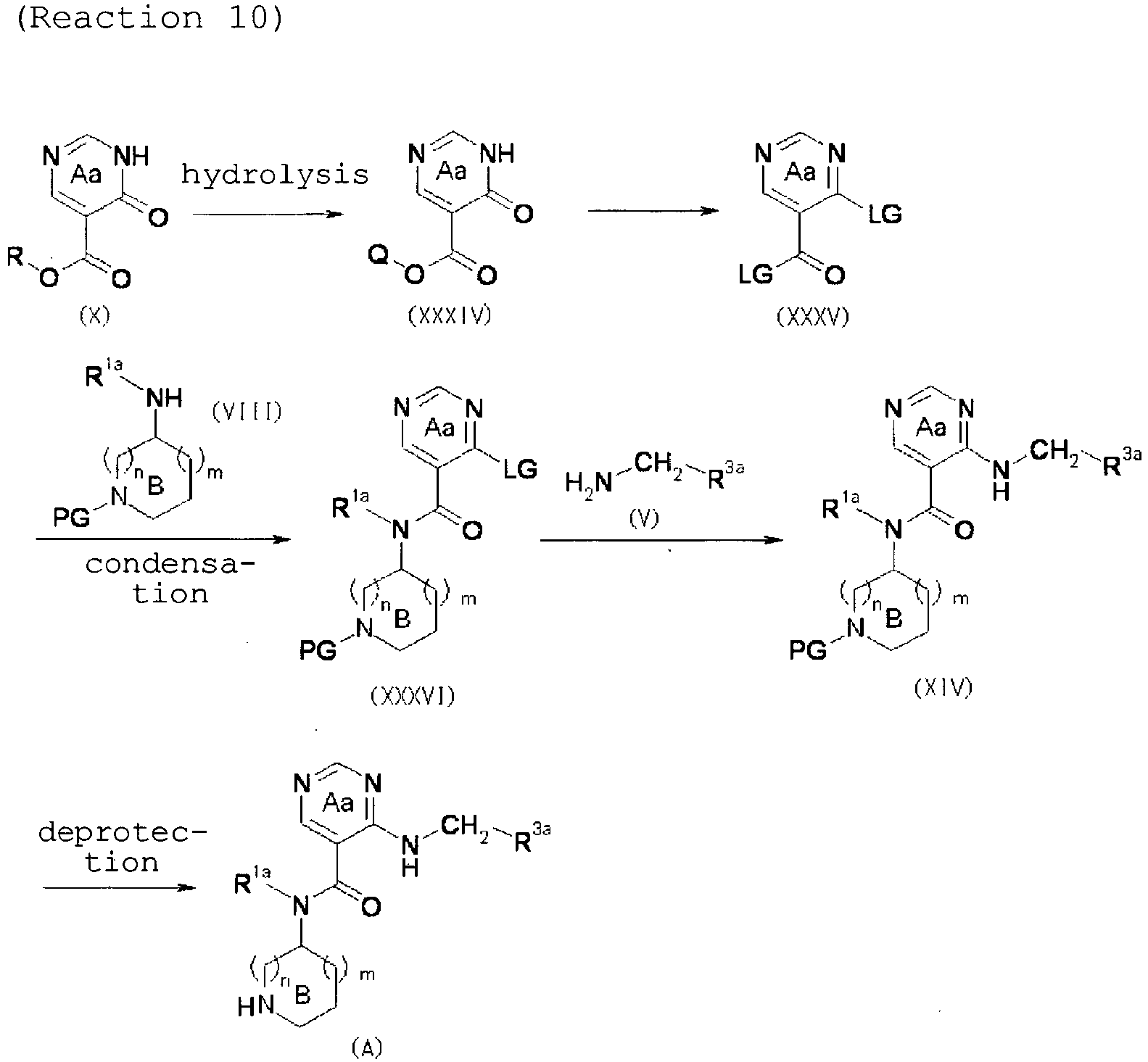
- This method is used for the production of compound (A) wherein ring Aa is a pyrimidine ring.
- Compound (XXXIV) can be produced by subjecting compound (X) to known hydrolysis, for example, alkaline hydrolysis or acid hydrolysis. For example, the reaction can be performed by a method according to hydrolysis conditions similar to those employed for hydrolysis of compound (XII).
- Compound (XXXV) having a substitutable leaving group LG can be produced by using compound (XXXIV) as a starting material and according to a method known per se, for example, the method described in J. Med. Chem., 2000, vol. 43, pages 3995-4004 and the like, or a method analogous thereto. As the reagent in this step, phosphorus oxychloride, phosphorus oxybromide, thionyl chloride and the like are preferable.
- The amount of the reagent to be used is about 1 mol to a large excess, per 1 mol of compound (XXXIV).
- This reaction is advantageously performed using a solvent inert to the reaction or without solvent. While the solvent is not particularly limited as long as the reaction proceeds, for example, solvents such as hydrocarbons (e.g., benzene, toluene, cyclohexane, hexane and the like), halogenated hydrocarbons (e.g., dichloromethane, chloroform, carbon tetrachloride, 1,2-dichloroethane and the like), ethers (e.g., diethyl ether, tetrahydrofuran, dioxane and the like) and the like, a mixed solvent thereof and the like are preferable.
- While the reaction time varies depending on the reagent to be used, it is generally 30 min to 24 hr, preferably 30 min to 8 hr.
- The reaction temperature is generally 0°C to 150°C, preferably 20°C to 130°C.
- Compound (XXXVI) can be produced by a condensation reaction of compound (XXXV) with compound (VIII). For example, the reaction can be performed by a method according to conditions similar to those employed for the production of compound (IX).
- Compound (XIV) can be produced by reacting compound (XXXVI) with compound (V) and by a method according to conditions similar to those employed for the production of compound (XII).
- Compound (A) is produced by removing the N-protecting group PG of compound (XIV). Moreover, when the starting material compound has an amino group, a carboxyl group or a hydroxyl group as a substituent in each of the above-mentioned reactions, these groups are optionally protected by a protecting group generally used in the peptide chemistry and the like. In this case, the object compound can be obtained by removing the protecting group as necessary after the reaction. These protecting groups can be introduced or removed by a method known per se, for example, the method described in Theodora W. Greene and Peter G. M. Wuts, "Protective Groups in Organic Synthesis, 3rd Ed.", Wiley-Interscience (1999) and the like.
- When compound (A) is obtained as a free compound, it can be converted to an object salt by a method known per se or a method analogous thereto. When compound (A) is obtained as a salt, it can be converted to a free form or other object salt by a method known per se or a method analogous thereto.


- This method is used for the production of compound (B) wherein R2b is a nitrogen-containing 5- to 7-membered ring optionally having substituent(s).
- Compound (XXXIX) can be produced by reacting compound (XXXVII) with compound (XXXVIII) and by a method according to conditions similar to those employed for the production of compound (VI).
- As compound (XXXVII), a commercially available product may be used, or it can be produced by a method known per se, for example, the method described in Bioorg. Med. Chem. Lett., 2000, vol. 10, pages 1645-1648 and the like, or a method analogous thereto.
- As compound (XXXVIII), a commercially available product may be used, or it can be produced by a method known per se, for example, the method described in J. Org. Chem., 1970, vol. 35, pages 340-344 and the like, or a method analogous thereto.
- Compound (XL) can be produced by subjecting compound (XXXIX) to known hydrolysis, for example, alkaline hydrolysis or acid hydrolysis. For example, the reaction can be performed by a method according to hydrolysis conditions similar to those employed for compound (VI).
- Compound (XLII) can be produced by a condensation reaction of compound (XL) with compound (XLI). For example, the reaction can be performed by a method according to conditions similar to those employed for the production of compound (IX).
- As compound (XLI), a commercially available product may be used, or it can produced by a method according to conditions similar to those employed for the production of compound (VIII).
- Compound (B) is produced by removing the N-protecting group PG of compound (XLII). Moreover, when the starting material compound has an amino group, a carboxyl group or a hydroxyl group as a substituent in each of the above-mentioned reactions, these groups are optionally protected by a protecting group generally used in the peptide chemistry and the like. In this case, the object compound can be obtained by removing the protecting group as necessary after the reaction. These protecting groups can be introduced or removed by a method according to conditions similar to those employed for the production of compound (A).
- When compound (B) is obtained as a free compound, it can be converted to an object salt by a method known per se or a method analogous thereto. When compound (B) is obtained as a salt, it can be converted to a free form or other object salt by a method known per se or a method analogous thereto.


- This method is used for the production of compound (B) wherein ring Ab is a pyrimidine ring and R2b is a nitrogen-containing 5- to 7-membered ring optionally having substituent(s).
- As compound (XLIV), a commercially available product may be used, or it can be produced using compound (XLIII) as starting material and by a method according to conditions similar to those employed for the production of compound (XI).
- Compound (XLV) can be produced by reacting compound (XLIV) with compound (XXXVIII) and by a method according to conditions similar to those employed for the production of compound (XII).
- Compound (XLVI) can be produced by subjecting compound (XLV) to known hydrolysis, for example, alkaline hydrolysis or acid hydrolysis. For example, the reaction can be performed by a method according to hydrolysis conditions similar to those employed for compound (XII).
- Compound (XLVII) can be produced by a condensation reaction of compound (XLVI) with compound (XLI). For example, the reaction can be performed by a method according to conditions similar to those employed for the production of compound (IX).
- Compound (B) is produced by removing the N-protecting group PG of compound (XLVII). Moreover, when the starting material compound has an amino group, a carboxyl group or a hydroxyl group as a substituent in each of the above-mentioned reactions, these groups are optionally protected by a protecting group generally used in the peptide chemistry and the like. In this case, the object compound can be obtained by removing the protecting group as necessary after the reaction. These protecting groups can be introduced or removed by a method according to conditions similar to those employed for the production of compound (A).
- When compound (B) is obtained as a free compound, it can be converted to an object salt by a method known per se or a method analogous thereto. When compound (B) is obtained as a salt, it can be converted to a free form or other object salt by a method known per se or a method analogous thereto.

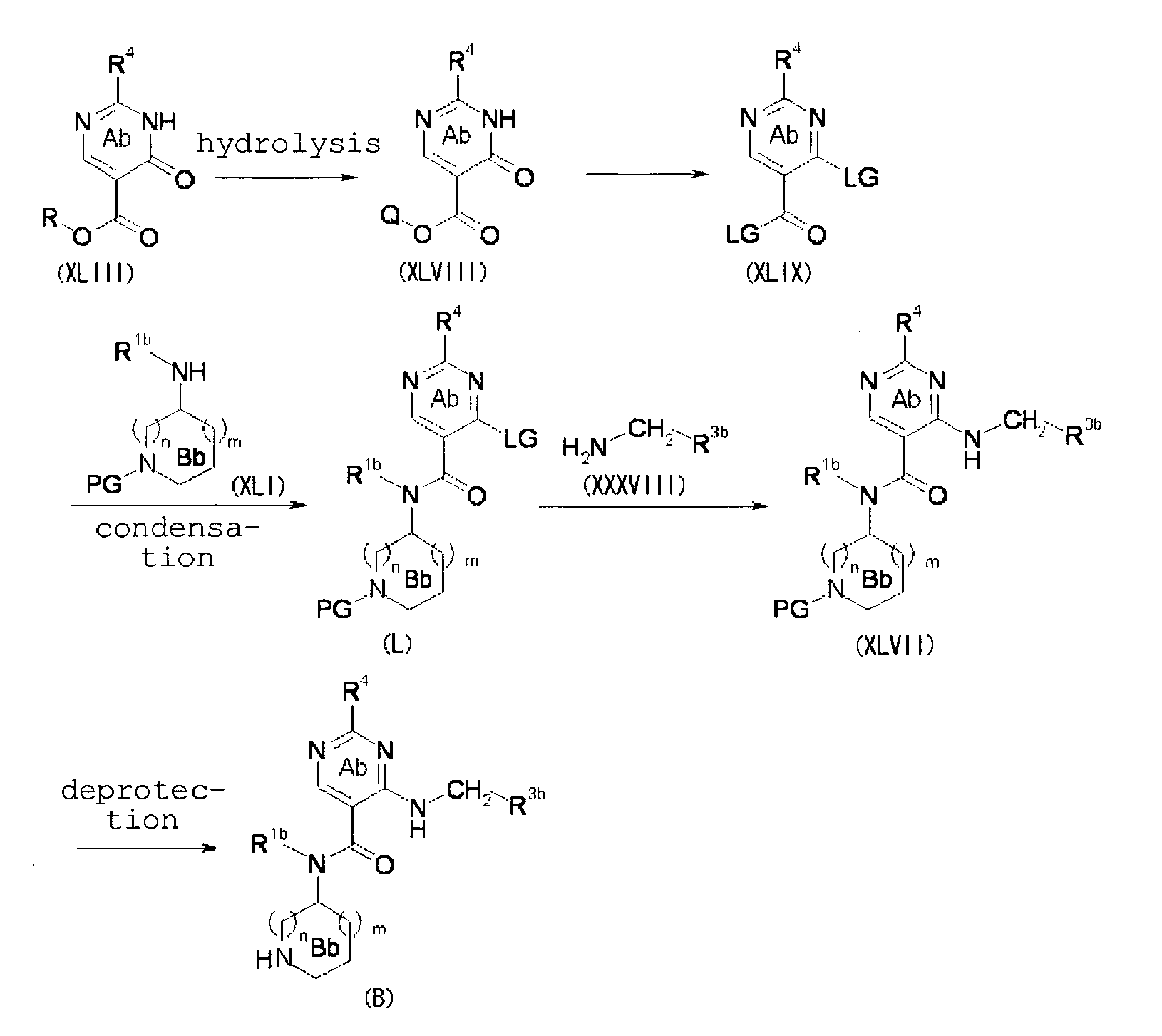
- This method is used for the production of compound (B) wherein ring Ab is a pyrimidine ring and R2b is a nitrogen-containing 5- to 7-membered ring optionally having substituent (s).
- Compound (XLVIII) can be produced by subjecting compound (XLIII) to known hydrolysis, for example, alkaline hydrolysis or acid hydrolysis. For example, the reaction can be performed by a method according to hydrolysis conditions similar to those employed for compound (XII).
- Compound (XLIX) having a substitutable leaving group LG can be produced by using compound (XLVIII) as a starting material and by a method according to conditions similar to those employed for the production of compound (XXXV).
- Compound (L) can be produced by a condensation reaction of compound (XLIX) with compound (XLI). For example, the reaction can be performed by a method according to conditions similar to those employed for the production of compound (IX).
- Compound (XLVII) can be produced by reacting compound (L) with compound (XXXVIII) and by a method according to conditions similar to those employed for the production of compound (XII).
- Compound (B) is produced by removing the N-protecting group PG of compound (XLVII). Moreover, when the starting material compound has an amino group, a carboxyl group or a ' hydroxyl group as a substituent in each of the above-mentioned reactions, these groups are optionally protected by a protecting group generally used in the peptide chemistry and the like. In this case, the object compound can be obtained by removing the protecting group as necessary after the reaction. These protecting groups can be introduced or removed by a method according to conditions similar to those employed for the production of compound (A).
- When compound (B) is obtained as a free compound, it can be converted to an object salt by a method known per se or a method analogous thereto. When compound (B) is obtained as a salt, it can be converted to a free form or other object salt by a method known per se or a method analogous thereto.

- Compound (LI) can also be produced by a method known per se, for example, the method described in Tetrahedron Lett., 2003, vol. 44, pages 1611-1614 and the like, or a method analogous thereto.
- Compound (XXX) can be produced by a known asymmetric esterification reaction and using compound (LI).
- Compound (XXX) can also be produced by a known method, for example, the method described in J. Am. Chem. Soc., 2000, vol. 122, pages 9542-9543 and the like, or a method analogous thereto.
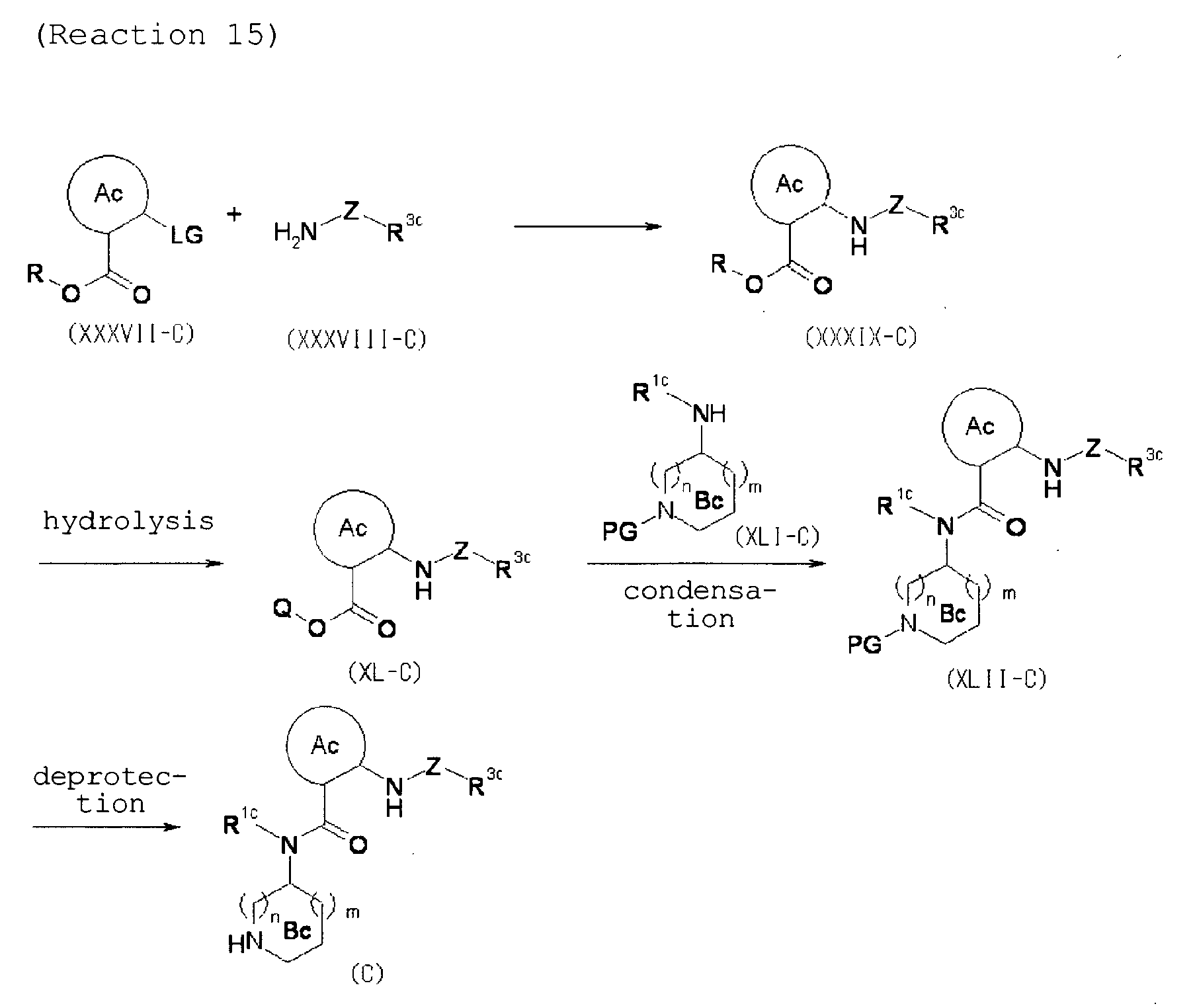
- This method is used for the production of compound (C). The reaction in each step can be performed according to conditions similar to those employed for the production of compound (B) in reaction 11.

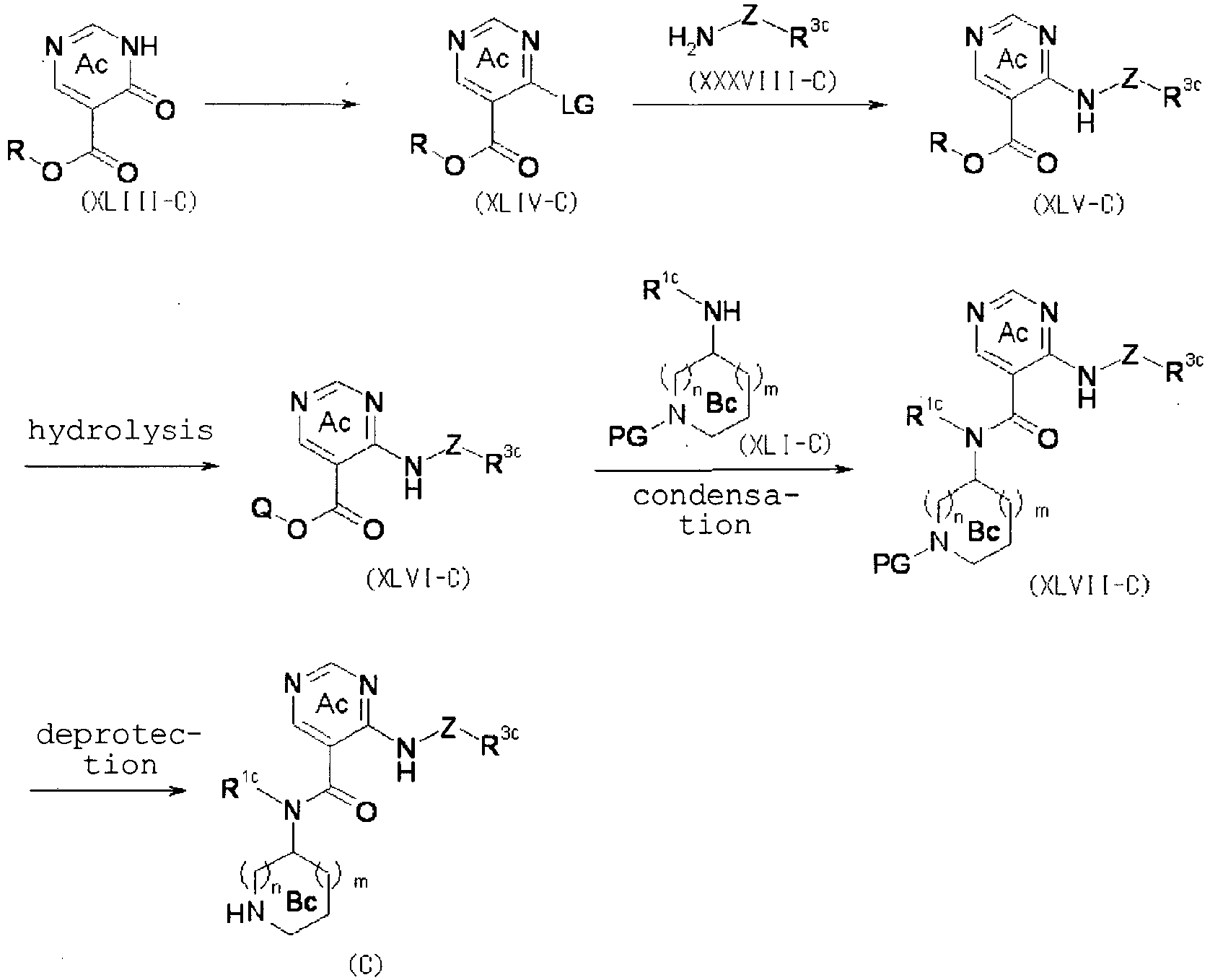
- This method is used for the production of compound (C) wherein ring Ac is a pyrimidine ring. The reaction in each step can be performed according to conditions similar to those employed for the production of compound (B) in reaction 12.

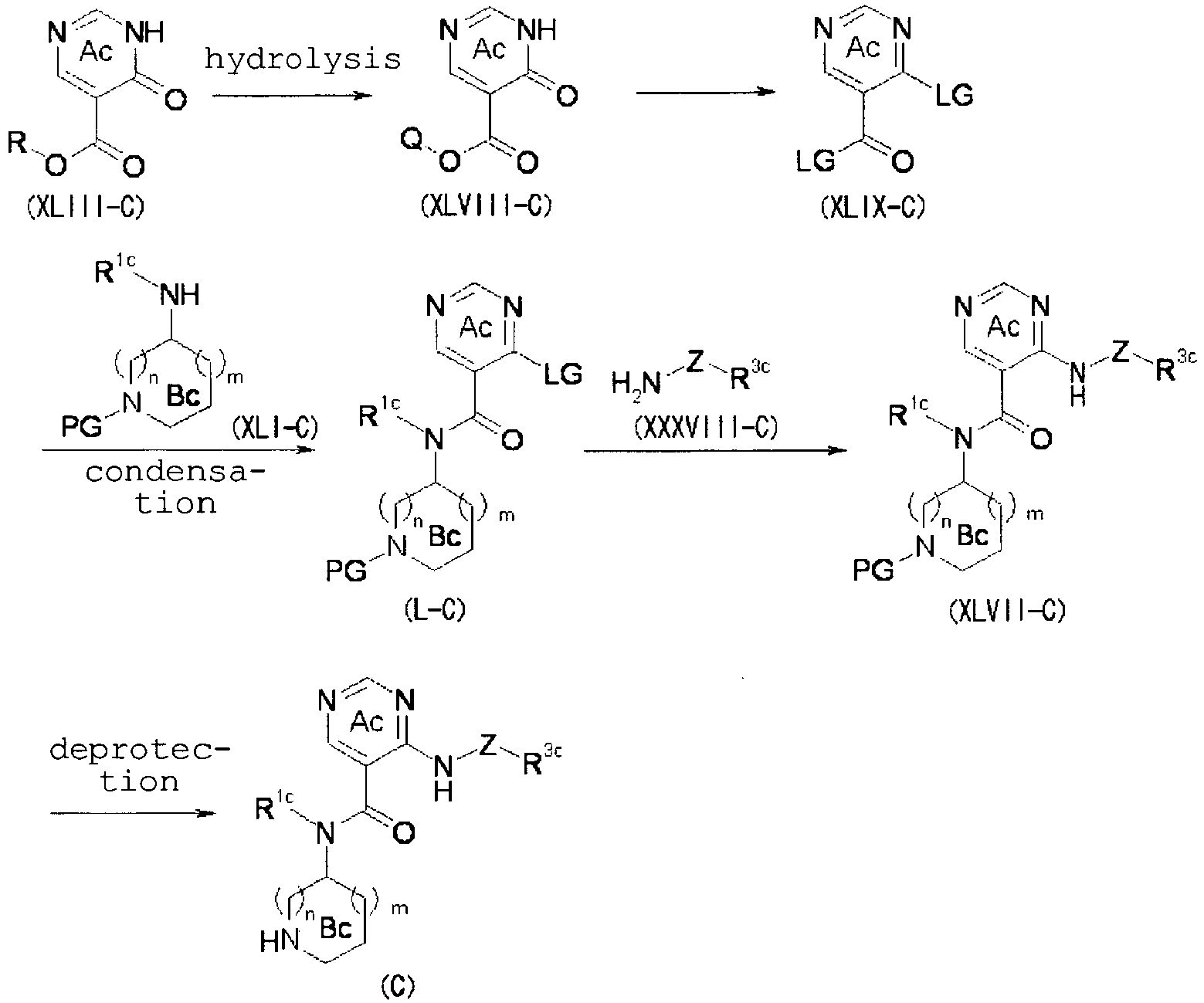
- This method is used for the production of compound (C) wherein ring Ac is a pyrimidine ring. The reaction in each step can be performed according to conditions similar to those employed for the production of compound (B) in reaction 13.
- Compound (I) (including compound (A), compound (B) and compound (C), hereinafter the same) may be used as a prodrug. A prodrug of compound (I) means a compound which is converted to compound (I) with a reaction due to an enzyme, gastric acid, etc. under the physiological condition in the living body, that is, a compound which is converted to compound (I) with oxidation, reduction, hydrolysis, etc. according to an enzyme; a compound which is converted to compound (I) by hydrolysis etc. due to gastric acid, etc.
- Examples of a prodrug of compound (I) include a compound wherein an amino group of compound (I) is acylated, alkylated or phosphorylated (e.g., compound wherein amino group of compound (I) is eicosanoylated, alanylated, pentylaminocarbonylated, (5-methyl-2-oxo-1,3-dioxolen-4-yl)methoxycarbonylated, tetrahydrofuranylated, pyrrolidylmethylated, pivaloyloxymethylated or tert-butylated, and the like); a compound wherein a hydroxy group of compound (I) is acylated, alkylated, phosphorylated or borated (e.g., a compound wherein a hydroxy group of compound (I) is acetylated, palmitoylated, propanoylated, pivaloylated, succinylated, fumarylated, alanylated or dimethylaminomethylcarbonylated, and the like); a compound wherein a carboxyl group of compound (I) is esterified or amidated (e.g., a compound wherein a carboxyl group of compound (I) is ethyl esterified, phenyl esterified, carboxymethyl esterified, dimethylaminomethyl esterified, pivaloyloxymethyl esterified, ethoxycarbonyloxyethyl esterified, phthalidyl esterified, (5-methyl-2-oxo-1,3-dioxolen-4-yl)methyl esterified, cyclohexyloxycarbonylethyl esterified or methylamidated, and the like) and the like. These compounds can be produced from compound (I) by a method known per se.
- A prodrug of compound (I) may also be one which is converted into compound (I) under a physiological condition, such as those described in IYAKUHIN no KAIHATSU (Development of Pharmaceuticals), Vol.7, Design of Molecules, p.163-198, Published by HIROKAWA SHOTEN (1990).
- When compound (I) has an isomer such as optical isomer, stereoisomer, positional isomer, rotational isomer and the like, any isomers and a mixture thereof are encompassed in compound (I). For example, when compound (I) has an optical isomer, an optical isomer resolved from a racemate is also encompassed in compound (I). Such isomer can be obtained as a single product by a synthesis method, a separation method (e.g., concentration, solvent extraction, column chromatography, recrystallization etc.), optical resolution method (e.g., fractional recrystallization, chiral column method, diastereomer method etc.) and the like known per se.
- Compound (I) may be a crystal, and both a single crystal and crystal mixtures are encompassed in compound (I). Crystals can be produced by crystallization according to crystallization methods known per se.
- Compound (I) may be a solvate (e.g., hydrate etc.) or a non-solvate (e.g., non-hydrate etc.), both of which are encompassed in compound (I).
- A compound labeled with an isotope (e.g., 3H, 14C, 35S, 125I and the like) and the like is also encompassed in compound (I).
- Deuterium-converted compound wherein 1H has been converted to 2H(D) are also encompassed in the compound (I).
- Compound (I) or its prodrug, or salts thereof (hereinafter, sometimes to be abbreviated to as a compound of the present specification, which includes the compounds of the present invention) exhibit superior renin inhibitory activity. They have low toxicity (e.g., acute toxicity, chronic toxicity, genetic toxicity, reproductive toxicity, cardiac toxicity, drug interaction, carcinogenicity, etc.) and high water-solubility, and are excellent in the aspects of stability, pharmacokinetics (absorption, distribution, metabolism, excretion, etc.) and efficacy, thus being useful as medicine.
- The compound of the present specification acts as a renin inhibitory drug in mammals (e.g., mouse, rat, hamster, rabbit, cat, dog, cattle, sheep, monkey, human, etc.), and is useful as a drug inhibiting the RA system by inhibiting the biosynthesis of AII, and is useful as an agent for the prophylaxis or treatment of various diseases caused by the RA system.
- Examples of such diseases include hypertension (e.g., essential hypertension, renal vascular hypertension, renoparenchymal hypertension, primary aldosteronism, Cushing's syndrome etc.), blood pressure circadian rhythm abnormality, heart diseases (e.g., cardiac hypertrophy, acute heart failure, chronic heart failure including congestive heart failure, failure of expansion, cardiac myopathy, angina pectoris, myocarditis, atrial fibrillation, arrhythmia, tachycardia, cardiac infraction etc.), cerebrovascular disorders (e.g., asymptomatic cerebrovascular disorder, transient ischemic attack, apoplexy, cerebrovascular dementia, hypertensive encephalopathy, cerebral infarction etc.), cerebral edema, cerebral circulatory disorder, recurrence and sequela of cerebrovascular disorders (e.g., neurotic symptom, psychic symptom, subjective symptom, disorder in daily living activities etc.), ischemic peripheral circulation disorder, myocardial ischemia, venous insufficiency, progression of cardiac insufficiency after myocardial infarction, renal diseases (e.g., nephritis, glomerulonephritis, glomerulosclerosis, renal failure, nephrotic syndrome, thrombotic vasculopathy, complication of dialysis, organ damage including nephropathy by radiation irradiation etc.), arteriosclerosis including atherosclerosis (e.g., aneurysm, coronary sclerosis, cerebral arteriosclerosis, peripheral arterial sclerosis etc.), vascular hypertrophy, vascular hypertrophy or obliteration and organ damages after intervention (e.g., percutaneous transluminal coronary angioplasty, stenting, coronary angioscopy, intravascular ultrasound, dounce thrombolytic therapy etc.), vascular reobliteration and restenosis after bypass surgery, polycythemia, hypertension, organ damage and vascular hypertrophy after transplantation, rejection after transplantation, ocular diseases (e.g., glaucoma, ocular hypertension etc.), thrombosis, multiple organ disorder, endothelial dysfunction, hypertensive tinnitus, other cardiovascular diseases (e.g., deep vein thrombosis, obstructive peripheral circulatory disorder, arteriosclerosis obliterans, thromboangiitis obliterans, ischemic cerebral circulatory disorder, Raynaud's disease, Buerger's disease etc.), metabolic and/or nutritional disorders (e.g., diabetes, impaired glucose tolerance, insulin resistance, hyperinsulinemia, diabetic nephropathy, diabetic retinopathy, diabetic neuropathy, obesity, hyperlipidemia, hypercholesterolemia, hyperuricacidemia, hyperkalemia, hypernatremia etc.), metabolic syndrome, nerve degeneration diseases (e.g., Alzheimer's disease, Parkinson's disease, Creutzfeldt-Jakob disease, multiple sclerosis, amyotrophic lateral sclerosis, AIDS encephalopathy etc.), central nervous system disorders (e.g., damages such as cerebral hemorrhage and cerebral infarction, and sequela and complication thereof, head injury, spinal injury, cerebral edema, sensory malfunction, sensory functional disorder, autonomic nervous system disorder, autonomic nervous system malfunction etc.), dementia, migraine, defects of memory, disorder of consciousness, amnesia, anxiety symptom, catatonic symptom, discomfort mental state, sleep disorder, insomnia, psychopathies (e.g., depression, epilepsy, alcoholism etc.), inflammatory diseases (e.g., arthritis such as rheumatoid arthritis, osteoarthritis, rheumatoid myelitis, periostitis etc.; inflammation after operation or injury; remission of swelling; pharyngitis; cystitis; pneumonia; atopic dermatitis; inflammatory intestinal diseases such as Crohn's disease, ulcerative colitis etc.; meningitis; inflammatory ocular disease; inflammatory pulmonary diseases such as pneumonia, pulmonary silicosis, pulmonary sarcoidosis, pulmonary tuberculosis etc.), allergic diseases (e.g., allergic rhinitis, conjunctivitis, gastrointestinal allergy, pollinosis, anaphylaxis etc.), chronic obstructive pulmonary disease, interstitial pneumonia, pneumocystis carinni pneumonia, collagen diseases (e.g., systemic lupus erythematodes, scleroderma, polyarteritis etc.), hepatic diseases (e.g., hepatitis including chronic hepatitis, hepatic cirrhosis etc.), portal hypertension, digestive system disorders (e.g., gastritis, gastric ulcer, gastric cancer, gastric disorder after operation, dyspepsia, esophageal ulcer, pancreatitis, colon polyp, cholelithiasis, hemorrhoidal disease, varices ruptures of esophagus and stomach etc.), blood and/or myelopoietic diseases (e.g., erythrocytosis, vascular purpura, autoimmune hemolytic anemia, disseminated intravascular coagulation syndrome, multiple myelopathy etc.), bone diseases (e.g., fracture, refracture, osteoporosis, osteomalacia, Paget's disease of bone, sclerosing myelitis, rheumatoid arthritis, joint tissue dysfunction and the like caused by osteoarthritis of the knee and diseases similar to these), solid tumor, tumors (e.g., malignant melanoma, malignant lymphoma, cancer of digestive organs (e.g., stomach, intestine etc.) etc.), cancer and cachexia following cancer, metastasis cancer, endocrinopathy (e.g., Addison's disease, pheochromocytoma etc.), urinary organ and/or male genital diseases (e.g., cystitis, benign prostatic hyperplasia, prostatic cancer, sex infectious disease etc.), female disorders (e.g., climacteric disorder, gestosis, endometriosis, hysteromyoma, ovarian disease, breast disease, sex infectious disease etc.), disease relating to environment and occupational factors (e.g., radiation hazard, hazard by ultraviolet, infrared or laser beam, altitude sickness etc.), respiratory diseases (e.g., cold syndrome, pneumonia, asthma, pulmonary hypertension, pulmonary thrombosis and pulmonary embolism etc.), infectious diseases (e.g., viral infectious diseases with cytomegalovirus, influenza virus, herpes virus etc., rickettsiosis, bacterial infectious disease etc.), toxemias (e.g., sepsis, septic shock, endotoxin shock, Gram-negative sepsis, toxic shock syndrome etc.), otorhinolaryngological diseases (e.g., Meniere's syndrome, tinnitus, dysgeusia, vertigo, disequilibrium, dysphagia etc.), skin diseases (e.g., keloid, hemangioma, psoriasis etc.), intradialytic hypotension, myasthenia gravis, systemic diseases such as chronic fatigue syndrome and the like.
- The compound of the present specification can be used in combination with an existing hypertension therapeutic drug such as an ACE inhibitor (captopril, enalapril maleate, alacepril, delapril hydrochloride, imidapril hydrochloride, quinapril hydrochloride, cilazapril, temocapril hydrochloride, trandolapril, benazepril hydrochloride, perindopril, lisinopril, etc.), ARB (losartan potassium, candesartan cilexetil, valsartan, TAK-536, TAK-491, irbesartan, telmisartan, eprosartan, olmesartan medoxomil, etc.), an aldosterone receptor antagonist (spironolactone, eplerenone, etc.), a Ca-ion channel inhibitor (verapamil hydrochloride, diltiazem hydrochloride, nifedipine, amlodipine hydrochloride, azelnidipine, aranidipine, efonidipine hydrochloride, cilnidipine, nicardipine hydrochloride, nisoldipine, nitrendipine, nilvadipine, barnidipine hydrochloride, felodipine, benidipine hydrochloride, manidipine hydrochloride, etc.), diuretic (trichlormethiazide, hydrochlorothiazide, benzylhydrochlorothiazide, indapamide, tripamide, meticrane, mefruside, furosemide, triamterene, chlorthalidone etc.), a β-blocker (propranolol hydrochloride, atenolol, metoprolol tartrate, bisoprolol fumarate, etc.), an α,α-blocker (carvedilol, etc.), and the like.
- Moreover, the compound of the present specification can be also used in combination with an antithrombotic drug such as heparin sodium, heparin calcium, warfarin calcium (Warfarin), a blood coagulation factor Xa inhibitor, drug having a function of balance correction in the coagulation-fibrinolysis system, an oral thrombin inhibitor, a thrombolytic drug (tPA, urokinase, etc.), an antiplatelet drug [aspirin, sulfinpyrazone (Anturane), dipyridamol (Persantine), ticlopidine hydrochloride (Panaldine), clopidogrel, cilostazol (Pletal), GPIIb/IIIa antagonist (ReoPro, etc.)], and the like. Also, the compound can be used in combination with a lipid lowering drug or a cholesterol lowering drug. Examples thereof include a squalene synthase inhibitor (lapaquistat acetate etc.), fibrates (clofibrate, benzafibrate, gemfibrozil, etc.), nicotinic acid, its derivatives and analogs (acipimox, probucol, etc.), a bile acid binding resin (cholestyramine, colestipol, etc.), an omega-3 polyunsaturated fatty acid (EPA (eicosapentaenoic acid), DHA (docosahexaenoic acid), or a mixture thereof etc.), a compound inhibiting cholesterol absorption (sitosterol, neomycin, etc.), and a squalene epoxidase inhibitor (NB-598 and its analogs, etc.). Furthermore, other possible combination components are an oxidosqualene-lanosterol cyclase, for example, a decalin derivative, an azadecalin derivative, an indane derivative and the like. Combination with a HMG-CoA reductase (3-hydroxy-3-methylglutaryl coenzyme A reductase) inhibitor (atorvastatin calcium hydrate, pravastatin sodium, simvastatin, itavastatin, lovastatin, fluvastatin, etc.) is also possible.
- The compound of the present specification can also be used in combination with a therapeutic drug for diabetes or a therapeutic drug for diabetic complications. For example, the compound of the present specification can be used in combination with an insulin preparation, an insulin sensitizer [pioglitazone hydrochloride, rosiglitazone, etc.], an α-glucosidase inhibitor [voglibose, acarbose, miglitol, emiglitate etc.], biguanide [phenformin, metformin, buformine etc.], insulin secretagogue [tolbutamide, glibenclamide, gliclazide, nateglinide, mitiglinide, glimepiride etc.], a dipeptidylpeptidase IV inhibitor [Alogliptin benzoate, Vidagliptin (LAF237), P32/98, Saxagliptin (BMS-477118) etc.], Kinedak, Penfill, Humulin, Euglucon, Glimicron, Daonil, Novolin, Monotard, Glucobay, Dimelin, Rastinon, Bacilcon, Deamelin S, Iszilin family, or the like.
- In addition, the compound can be also used together with other pharmaceutical components, including a bone disease medicine, a myocardial protective drug, a coronary artery disease medicine, a chronic cardiac failure medicine, a hypothyroidism medicine, a nephrotic syndrome medicine, a chronic renal failure medicine, a gynecological disease medicine, an infection medicine, or the like.
- The administration mode may be exemplified by (1) administration of a single preparation obtained by simultaneously formulating the compound of the present specification and the combination drug, (2) simultaneous administration through the same administration route of two preparations obtained by separately formulating the compound of the present specification and the combination drug, (3) administration with a time interval through the same administration route of two preparations obtained by separately formulating the compound of the present specification and the combination drug, (4) simultaneous administration through different administration routes of two preparations obtained by separately formulating the compound of the present specification and the combination drug, (5) administration with a time interval through different administration routes of two preparations obtained by separately formulating the compound of the present specification and the combination drug (e.g., administration in order of the compound of the present specification and then the combination drug, or administration in the reverse order), or the like. The amount of the combination drug to be administered can be appropriately selected with reference to the clinically used dosage. The mixing ratio of the compound of the present specification and the combination drug can be appropriately selected in accordance with the subject of administration, administration route, disease to be treated, symptoms, combination, and the like.
- The compound of the present specification can be also used in combination with, for example, gene therapy involving VEGF, TNFα or the like, or therapeutic methods
- The compound of the present specification can be safely involving various antibody medicines or the like.
- administered individually, or according to ordinary methods (e.g., methods described in the Japanese Pharmacopeia, etc.), as a pharmaceutical composition mixed with pharmaceutically acceptable carriers, for example, a tablet (including a sugar-coated tablet and a film-coated tablet), a film, a powder, a granule, a capsule, a liquid, an emulsion, a suspension, an injectable preparation, a suppository, a sustained release preparation, a patch and the like, either orally or parenterally (e.g., topical, rectal, intravenous administration, etc.).
- The dosage form of the aforementioned pharmaceutical preparation may be exemplified by oral preparations such as a tablet (including a sublingual tablet and a buccal disintegration tablet), a film (including a buccal disintegration film), a capsule (including a soft capsule and a microcapsule), a granule, a powder, a troche, a syrup, an emulsion, a suspension and the like; and parenteral preparations such as an injectable preparation (e.g., a subcutaneous injectable preparation, an intravenous injectable preparation, intramuscular injectable preparation, intraperitoneal injectable preparation, a drip infusion), external preparation (e.g., a percutaneous preparation, an ointment), a suppository (e.g., a rectal suppository, a vaginal suppository), a pellet, a transnasal preparation, a transpulmonary preparation (inhalant), an eye drop and the like.
- These preparations may be controlled release preparations such as a rapid release preparation, a sustained release preparation and the like (e.g., a sustained release microcapsule).
- The content of the compound of the present specification in the pharmaceutical composition is about 0.01 to 100% by weight of the entire composition.
- The amount of administration of the compound of the present specification may vary depending on the subject of administration, administration route, subject disease or the like; however, in the case of administering orally to an adult as a hypertension medicine, the amount of administration is about 0.0005 to 2 mg/kg of body weight, preferably about 0.001 to 1 mg/kg of body weight, and more preferably about 0.001 to 0.5 mg/kg of body weight, in terms of compound (I), the active ingredient, possibly once to several times a day.
- The aforementioned pharmaceutically acceptable carrier may be exemplified by various organic or inorganic carrier materials that are conventionally used as preparation materials, for example, excipient, lubricant, binding agent and disintegrant for solid preparations; or solvent, solubilizing agent, suspending agent, isotonic agent, buffering agent, soothing agent and the like for liquid preparations. Further, if necessary, additives such as preservative, antioxidant, colorant, sweetening agent, adsorbing agent, wetting agent and the like can be also used.
- Examples of the excipient include lactose, white sugar, D-mannitol, starch, corn starch, crystalline cellulose, light anhydrous silicic acid and the like.
- Examples of the lubricant include magnesium stearate, calcium stearate, talc, colloidal silica and the like.
- Examples of the binding agent include crystalline cellulose, white sugar, D-mannitol, dextrin, hydroxypropylcellulose, hydroxypropylmethylcellulose, polyvinylpyrrolidone, starch, sucrose, gelatin, methylcellulose, carboxymethylcellulose sodium and the like.
- Examples of the disintegrant include starch, carboxymethylcellulose, carboxymethylcellulose calcium, carboxymethylstarch sodium, L-hydroxypropylcellulose and the like.
- Examples of the solvent include water for injection, alcohol, propylene glycol, Macrogol, sesame oil, corn oil, alcohol, propylene glycol, Macrogol, sesame oil, corn oil, olive oil and the like.
- Examples of the solubilizing agent include polyethylene glycol, propylene glycol, D-mannitol, benzyl benzoate, ethanol, trisaminomethane, cholesterol, triethanolamine, sodium carbonate, sodium citrate and the like.
- Examples of the suspending agent include surfactants such as stearyl triethanolamine, sodium lauryl sulfate, laurylaminopropionic acid, lecithin, benzalkonium chloride, benzetonium chloride, glycerin monostearate and the like; hydrophilic polymers such as polyvinyl alcohol, polyvinylpyrrolidone, carboxymethylcellulose sodium, methylcellulose, hydroxymethylcellulose, hydroxyethylcellulose, hydroxypropylcellulose and the like; and the like.
- Examples of the isotonic agent include glucose, D-sorbitol, sodium chloride, glycerin, D-mannitol and the like.
- Examples of the buffering agent include buffer solutions such as phosphates, acetates, carbonates, citrates and the like.
- Examples of the soothing agent include benzyl alcohol and the like.
- Examples of the preservative include parahydroxybenzoic acid esters, chlorobutanol, benzyl alcohol, phenethyl alcohol, dehydroacetic acid, sorbic acid and the like.
- Examples of the antioxidant include sulfites, ascorbic acid, α-tocopherol and the like.
- Examples of the colorant include water-soluble Food coal tar dyes (e.g., Food dyes such as Food Red No. 2 and No. 3, Food Yellow No. 4 and No. 5, Food Blue No. 1 and No. 2, and the like), water-insoluble lake dyes (e.g., aluminum salts of the aforementioned water-soluble Food coal tar dyes), natural dyes (e.g., β-carotene, chlorophyll, ferric oxide red) and the like.
- Examples of the sweetening agent include saccharin sodium, dipotassium glycyrrhizinate, aspartame, stevia and the like.
- The present invention is explained in detail in the following by referring to Reference Examples, Examples, Preparation Examples and Experimental Examples, which are not to be construed as limitative. Of the synthesis starting materials used in Reference Examples and Examples, synthesis methods of known compounds are omitted.
- "Room temperature" in the following Reference Examples and Examples represents a temperature of about 10°C to about 35°C, and "%" represents weight% unless otherwise stated. Provided that, yield represents mol/mol%.
- 1H-NMR spectra were measured with a Varian MERCURY 300 (300 MHz) spectrometer or a BRUKER ADVANCE 300 (300 MHz) spectrometer using tetramethylsilane as an internal standard. All of the δ values are represented in ppm.
- LC/MS spectra were measured under the following conditions.
- Equipment: Agilent 1100 HPLC (Gilson 215 autosampler)/Waters ZQ, or Waters 2795/ZQ
- Column: Capcell Pak C18 UG120 (1.5 mmID x 35 mmL, S-3 µm), manufactured by Shiseido Co., Ltd.
- Solvent: Solution A (0.05% trifluoroacetic acid-containing water), Solution B (0.04% trifluoroacetic acid-containing water)
- Gradient cycle: 0.00 min (A/B = 90/10), 2.00 min (A/B = 5/95), 2.75 min (A/B = 5/95), 2.76 min (A/B = 90/10), 3.45 min (A/B = 90/10)
- Flow rate: 0.5 ml/min
- Detection: UV (220 nm)
- Mass spectrum: electrospray ionization (ESI)
- Reverse-phase preparative HPLC was performed on a YMC CombiPrep ODS-A (20 mmID x 50 mmL, S-5 µm) column using a Gilson UniPoint system, and eluted with 0.1% trifluoroacetic acid-containing acetonitrile/water (10:90 - 100:0) at a flow rate of 25 ml/min.
The microwave reactor used was Discover of CEM. - Other symbols used in the present text indicate the following meanings.
s: singlet, d: doublet, t: triplet, q: quartet, dd: double doublet, dt: double triplet, td: triple doublet, dq: double quartet, tq: triple quartet, ddd: double double doublet, dddd: double double double doublet, m: multiplet, br: broad. DMF: N,N-dimethylformamide, DMSO: dimethyl sulfoxide, THF: tetrahydrofuran, DMA: N,N-dimethylacetamide.
HOBt: 1-hydroxybenzotriazole monohydrate, WSC-HCl: 1-ethyl-3-[3-(dimethylamino)propyl]carbodiimide hydrochloride, BOP reagent: benzotriazol-1-yloxytris(dimethylamino)phosphonium hexafluorophosphate, Z-chloride: benzyloxycarbonyl chloride, TFA: trifluoroacetic acid.
Boc: tert-butoxycarbonyl. - When relative configuration is known but absolute configuration is not, the chiral atom is shown by R*, S*.
-

- To a solution of diethyl 2,2-dimethylpropanimidamide hydrochloride (1.36 g) and (ethoxymethylene)malonate (2.16 g) in ethanol (100 ml) was added 20% sodium ethoxide-ethanol solution (6.8 g) under ice-cooling, and the mixture was stirred at 80°C for 5 hr. The reaction mixture was concentrated under reduced pressure, 1 M hydrochloric acid (10 ml) was added under ice-cooling, and the mixture was extracted with ethyl acetate. The extract was concentrated under reduced pressure, hexane was added to the residue, and the precipitate was collected by filtration to give the object compound (1.65 g) as a powder.
MS (ESI+, m/e) 225 (M+1)
1H-NMR (CDCl3) δ 1.33-1.41 (3H, m), 1.43 (9H, s), 4.32-4.41 (2H, m), 8.72 (1H, s). - By a method similar to that of Reference Example 1, the following compounds (Reference Examples 2 to 7) were obtained.
-
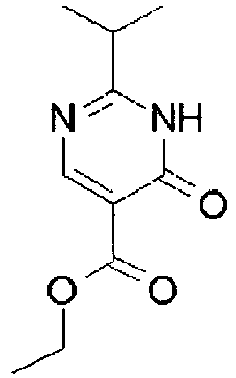
- MS (ESI+, m/e) 211 (M+1)
-

- MS (ESI+, m/e) 209 (M+1)
-

- 1H-NMR (DMSO-d6) δ 1.29 (3H, t), 4.26 (2H, q), 7.52-7.70 (3H, m), 8.17 (2H, d), 8.64 (1H, s), 13.20 (1H, br s).
-

- 1H-NMR (DMSO-d6) δ 1.25 (3H, t), 2.34 (3H, s), 4.21 (2H, q), 8.41 (1H, s), 12.94 (1H, br s).
-

- 1H-NMR (DMSO-d6) δ 1.18 (3H, t), 1.25 (3H, t), 2.60 (2H, q), 4.21 (2H, q), 8.45 (1H, s), 12.90 (1H, br s).
-

- MS (ESI+, m/e) 251 (M+1)
-

- Trifluoroacetamidine (2.47 g) and diethyl ethylidenemalonate (3.64 ml) were dissolved in ethanol (50 ml) and the mixture was stirred at 90°C overnight. The reaction mixture was concentrated under reduced pressure, and the residue was dissolved in water. The mixture was adjusted to pH 4 with 1 M hydrochloric acid, and extracted with ethyl acetate. The extract was washed with water and saturated brine, dried over anhydrous sodium sulfate, and concentrated under reduced pressure. The obtained residue was purified by silica gel column chromatography, and the obtained oil (570 mg) was dissolved in carbon tetrachloride (45 ml). N-Bromosuccinimide (381 mg), 2,2'-azobis(2-methylpropionitrile) (16 mg) and potassium carbonate (2.90 g) were added and the mixture was heated under reflux for 30 min. The reaction mixture was cooled to room temperature, and water was added. The aqueous layer was separated, adjusted to pH 3 with 1 M hydrochloric acid, and extracted with ethyl acetate. The extract was washed with saturated brine, dried over anhydrous sodium sulfate, and concentrated under reduced pressure. The obtained residue was purified by silica gel column chromatography to give the object compound (313 mg) as a powder.
1H-NMR (CDCl3) δ 1.49 (3H, t), 2.85 (3H, s), 4.22-4.42 (1H, m), 4.55 (2H, q). -

- 2-Chloro-6-methylnicotinic acid (1.72 g) and furfurylamine (1.94 g) were dissolved in 1-methylpyrrolidin-2-one (25 ml), and the mixture was stirred at 150°C overnight. The reaction mixture was concentrated under reduced pressure, and the residue was purified by silica gel column chromatography. The fraction eluted with ethyl acetate-hexane (1:4 - 1:0) was concentrated under reduced pressure, and the precipitate was collected by filtration to give the object compound (838 mg) as a powder.
1H-NMR (CDCl3) δ 2.45 (3H, s), 4.78 (2H, s), 6.26 (1H, d), 6.32 (1H, dd), 6.46 (1H, d), 7.33-7.40 (1H, m), 8.05-8.14 (2H, m). - By a method similar to that of Reference Example 9, the following compounds (Reference Examples 10 and 11) were obtained.
-

- 1H-NMR (CDCl3) δ 2.28 (3H, s), 2.44 (3H, s), 4.71 (2H, s), 5.89 (1H, d), 6.13 (1H, d), 6.45 (1H, d), 7.97-8.07 (2H, m).
-

- 1H-NMR (CDCl3) δ 2.47 (3H, s), 4.94 (2H, d), 6.47 (1H, d), 6.94 (1H, dd), 7.03 (1H, d), 7.19 (1H, d), 8.05 (1H, d), 8.13 (s, 1H).
-
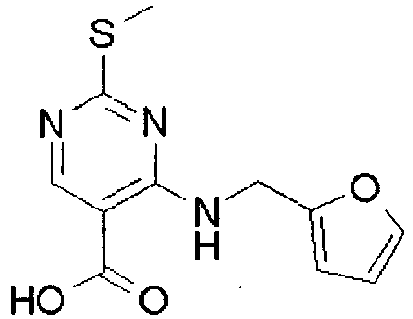
- To a solution of ethyl 4-chloro-2-(methylthio)pyrimidine-5-carboxylate (1.71 g) in 2-propanol (10 ml) were added furfurylamine (714 mg) and diisopropylethylamine (950 mg), and the mixture was stirred at room temperature for 10 min. The reaction mixture was poured into 2% aqueous sodium hydrogen carbonate, and the mixture was extracted with ethyl acetate. The extract was dried over anhydrous magnesium sulfate, and the solvent was evaporated under reduced pressure. Ethyl acetate was added to the residue, and the precipitate was collected by filtration. The precipitate was dissolved in ethanol (10 ml), 2 M aqueous sodium hydroxide solution (10 ml) was added and the mixture was stirred at room temperature for 5 hr. The reaction mixture was adjusted to pH 3 with 1 M hydrochloric acid, and the precipitated crystals were collected by filtration to give the object compound (1.75 g) as a powder.
1H-NMR (DMSO-d6) δ 2.48 (3H, s), 4.72 (2H, d), 6.30 (1H, d), 6.39-6.45 (1H, m), 7.60 (1H, d), 8.54 (1H, s), 8.74 (1H, t), 13.34 (1H, s). - By a method similar to that of Reference Example 12, the following compounds (Reference Examples 13 to 20) were obtained.
-

- 1H-NMR (DMSO-d6) δ 2.40 (3H, s), 4.71 (2H, d), 7.23-7.28 (1H, m), 7.30-7.35 (4H, m), 8.53 (1H, s), 8.90 (1H, t), 13.28 (1H, s) .
-

- MS (ESI+, m/e) 288 (M+1)
-

- 1H-NMR (CDCl3) δ 4.82 (2H, d), 7.28-7.41 (5H, m), 8.65 (1H, br s), 9.01 (1H, s).
-

- 1H-NMR (CDCl3) δ 4.95 (2H, s), 7.10 (1H, d), 7.66 (1H, d), 8.99 (1H, s).
-
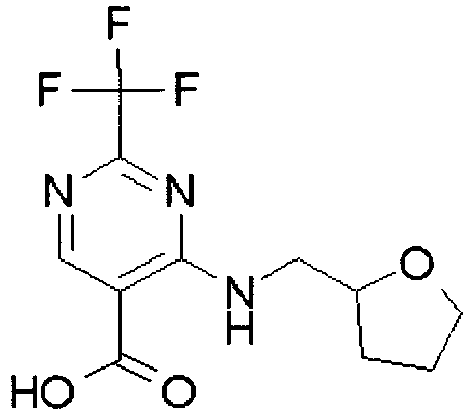
- 1H-NMR (DMSO-d6) δ 1.48-1.65 (1H, m), 1.77-2.00 (3H, m), 3.53 (1H, dd), 3.58-3.72 (2H, m), 3.78 (1H, t), 4.05 (1H, dd), 8.79-8.90 (2H, m), 13.99 (1H, br s).
-
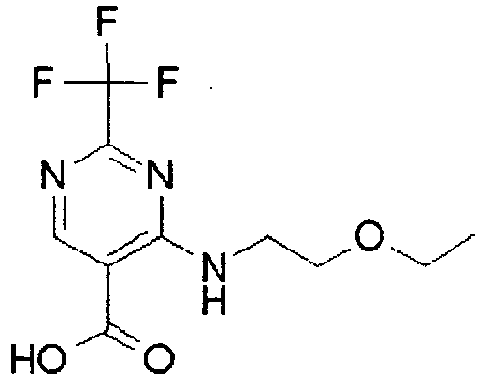
- 1H-NMR (DMSO-d5) δ 1.11 (3H, t), 3.48 (2H, q), 3.57 (2H, d), 3.67 (2H, q), 8.83 (1H, s), 8.84-8.91 (1H, m), 13.94 (1H, br s).
-

- 1H-NMR (DMSO-d6) δ 1.77-1.87 (2H, m), 3.24 (3H, s), 3.41 (2H, t), 3.57 (2H, q), 8.81 (1H, s), 8.88 (1H, t), 13.87 (1H, br s).
-

- 1H-NMR (DMSQ-d6) δ 0.86-0.94 (3H, m), 1.23-1.39 (2H, m), 1. 51-1.62 (2H, m), 3.51 (2H, q), 8.76 (1H, t), 8.81 (1H, s), 13.90 (1H, br s).
-

- Ethyl 2-tert-butyl-6-oxo-1,6-dihydropyrimidine-5-carboxylate (2.90 g) was suspended in phosphorus oxychloride (9.6 g), and the suspension was stirred at 100°C for 2 hr. Phosphorus oxychloride was evaporated under reduced pressure, and the mixture was cooled to 0°C and neutralized with saturated aqueous sodium hydrogen carbonate and water. The mixture was extracted with ethyl acetate. The extract was washed with saturated brine, dried over anhydrous sodium sulfate, and concentrated under reduced pressure. The obtained residue was dissolved in 2-propanol (10 ml), and furfurylamine (1.20 ml) and diisopropylethylamine (2.26 ml) were added. The mixture was stirred at 100°C for 15 hr and concentrated under reduced pressure. Saturated aqueous sodium hydrogen carbonate was added, and the mixture was extracted with ethyl acetate. The extract was washed with saturated brine, dried over anhydrous sodium sulfate, and concentrated under reduced pressure. The obtained residue was purified by silica gel chromatography, and the fraction eluted with ethyl acetate-hexane (1:5) was concentrated under reduced pressure. The obtained residue was dissolved in ethanol (15 ml) and THF (5 ml), 2 M aqueous sodium hydroxide solution (15 ml) was added and the mixture was stirred at room temperature for 15 hr. The reaction mixture was concentrated under reduced pressure and the aqueous layer was adjusted to pH 3 with 1 M hydrochloric acid. The precipitate was collected by filtration and washed with water to give the object compound (3.30 g) as a powder. 1H-NMR (DMSO-d6) δ 1.32 (9H, s), 4.77 (2H, d), 6.32 (1H, s), 6.40 (1H, s), 7.60 (1H, s), 8.68 (1H, s), 8.99 (1H, s).
- By a method similar to that of Reference Example 21, the following compounds (Reference Examples 22 to 32) were obtained.
-

- 1H-NMR (DMSO-d6) δ 1.23 (6H, d), 2.94-3.09 (1H, m), 4.78 (2H, d), 6.33 (1H, d), 6.41 (1H, s), 7.60 (1H, s), 8.70 (1H, s), 9.09 (1H, s).
-
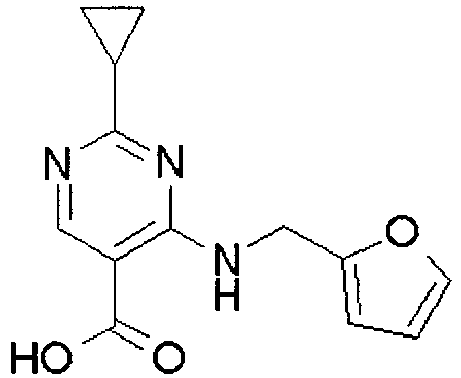
- 1H-NMR (DMSO-d6) δ 1.08-1.29 (4H, m), 2.16-2.29 (1H, m), 4.73 (2H, d), 6.31 (1H, d), 6.42 (1H, t), 7.60 (1H, t), 8.67 (1H, s), 9.40 (1H, s).
-
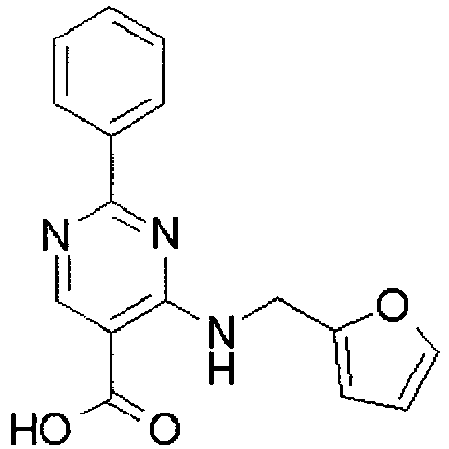
- 1H-NMR (CDCl3) δ 4.86 (2H, d), 6.36-6.42 (2H, m), 7.48-7.61 (4H, m), 8.42 (2H, dd), 8.72 (1H, s), 8.86 (1H, s).
-

- MS (ESI+, m/e) 234 (M+1)
-

- MS (ESI+, m/e) 248 (M+1)
-

- MS (ESI+, m/e) 302 (M+1)
-

- 1H-NMR (DMSO-d6) δ 1.25 (6H, d), 1.59 (1H, td), 1.78-2.00 (3H, m), 3.03 (1H, dt), 3.55-3.83 (4H, m), 3.99-4.13 (1H, m), 8.69 (1H, s), 9.10 (1H, br s).
-

- 1H-NMR (DMSO-d6) δ 1.12 (3H, t), 1.26 (6H, d), 2.98-3.17 (1H, m), 3.49 (2H, q), 3.59 (2H, t), 3.77 (2H, q), 8.70 (1H, s), 9.34 (1H, br s).
-

- 1H-NMR (DMSO-d6) δ 1.25 (6H, d), 1.78-1.88 (2H, m), 2.96-3.17 (1H, m), 3.16-3.31 (3H, m), 3.41 (2H, t), 3.63 (2H, q), 8.65 (1H, s), 9.09 (1H, br s).
-

- 1H-NMR (DMSO-d6) δ 0.91 (3H, t), 1.21 (6H, d), 1.26-1.41 (2H, m), 1.50-1.70 (2H, m), 2.85-2.98 (1H, m), 3.42-3.57 (2H, m), 8.42 (1H, br s), 8.62 (1H, s), 13.21 (1H, br s).
-

- MS (ESI+, m/e) 302 (M+1)
-

- Pyridine-3,5-dicarboxylic acid (100 g) was suspended in methanol (1000 ml), and thionyl chloride (130 ml) was added dropwise at room temperature. The reaction mixture was stirred with heating to reflux for 3 hr. The mixture was allowed to cool to room temperature, and concentrated under reduced pressure. The residue was diluted with water, and the mixture was extracted with ethyl acetate. The aqueous layer was neutralized with 8 M aqueous sodium hydroxide solution, and the mixture was extracted with ethyl acetate. The extract was washed successively with saturated aqueous sodium hydrogen carbonate solution and saturated brine, and dried over anhydrous sodium sulfate. The solvent was evaporated under reduced pressure to give the object compound (117 g) as a powder.
1H-NMR (CDCl3) δ 4.00 (6H, s), 8.88 (1H, t), 9.37 (2H, d). -

- Dimethyl pyridine-3,5-dicarboxylate (55 g) was dissolved in methanol (500 ml) and 6 M hydrochloric acid (70 ml), and rhodium-carbon (5.5 g) was added. The reaction mixture was stirred under pressurized hydrogen atmosphere (5 atm) at room temperature for 3 hr and then at 50°C for 12 hr. The mixture was allowed to cool to room temperature, the rhodium catalyst was filtered off, and the filtrate was concentrated under reduced pressure. The residue was dissolved in ethanol (300 ml), and triethylamine (60 ml) and di-t-butyl dicarbonate (68 g) were successively added under ice-cooling. The reaction mixture was stirred at room temperature for 12 hr, and concentrated under reduced pressure. The residue was dissolved in 0.5 M hydrochloric acid, and the mixture was extracted with ethyl acetate. The extract was washed with saturated brine, and dried over anhydrous sodium sulfate. The solvent was evaporated under reduced pressure and the residue was purified by silica gel column chromatography. The fraction eluted with hexane-ethyl acetate (7:1 - 1:4) was concentrated under reduced pressure. The residue was diluted with ethyl acetate, and the precipitate was collected by filtration and washed with ethyl acetate to give the object compound (15.6 g) as a powder.
1H-NMR (CDCl3) δ 1.47 (9H, s), 1.72 (1H, d), 2.41-2.63 (3H, m), 2.72 (2H, br s), 3.71 (3H, s), 4.38 (2H, d). -

- (3R*,5S*)-1-(tert-Butoxycarbonyl)-5-(methoxycarbonyl)piperidine-3-carboxylic acid (575 mg) was suspended in toluene (10 ml), diphenylphosphoryl azide (0.52 ml) and triethylamine (0.34 ml) were added and the mixture was stirred at 80°C for 2 hr. The reaction mixture was cooled to room temperature, benzyl alcohol (0.52 ml) and triethylamine (0.34 ml) were added and the mixture was stirred at 80°C for 2 hr. The reaction mixture was washed with water, 5% aqueous citric acid solution, saturated aqueous sodium hydrogen carbonate and saturated brine in this order, and dried over anhydrous sodium sulfate, and the solvent was evaporated under reduced pressure. The residue was purified by silica gel column chromatography, and the fraction eluted with ethyl acetate-hexane (1:4) was concentrated under reduced pressure. The obtained residue was dissolved in methanol (5 ml), 10% palladium-carbon (50% containing water) (70 mg) was added, and the mixture was subjected to catalytic reduction at ambient temperature under normal pressure for 12 hr. The catalyst was filtered off, and the filtrate was concentrated under reduced pressure to give the object compound (370 mg) as an oil. 1H-NMR (CDCl3) δ 1.22-1.43 (4H, m), 1.46 (9H, s), 2.27-2.79 (4H, m), 3.70 (3H, s), 4.13 (2H, br s).
-

- 1-tert-Butyl 3-methyl (3R*,5S*)-5-aminopiperidine-1,3-dicarboxylate (370 mg) was dissolved in methanol (10 ml), isobutyraldehyde (0.137 ml), acetic acid (85 µl) and sodium triacetoxyborohydride (759 mg) were added and the mixture was stirred at room temperature for 1 hr. The reaction mixture was concentrated under reduced pressure, and the concentrated solution was basified with aqueous sodium hydrogen carbonate and extracted with ethyl acetate. The extract was dried over anhydrous sodium sulfate, and the solvent was evaporated under reduced pressure to give the object compound (439 mg) as an oil.
1H-NMR (CDCl3) δ 0.90 (6H, d), 1.17-1.41 (3H, m), 1.46 (9H, s), 1.69 (1H, dt), 2.30 (2H, dd), 2.47 (2H, d), 2.52 (1H, dt), 2.74 (1H, br s), 3.69 (3H, s), 4.26 (2H, br s). -
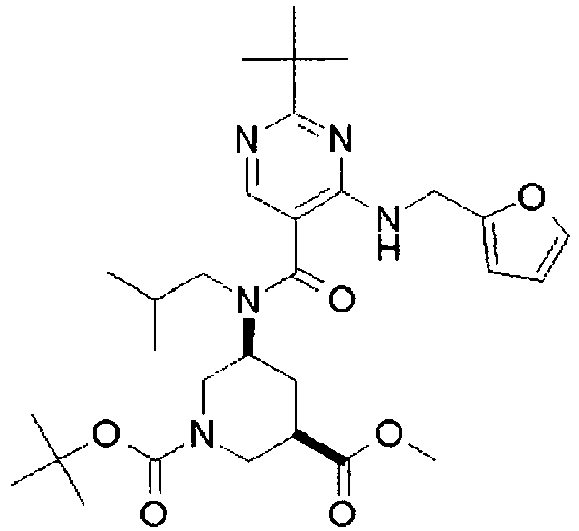
- 2-tert-Butyl-4-[(2-furylmethyl)amino]pyrimidine-5-carboxylic acid (385 mg) was suspended in toluene (10 ml), thionyl chloride (0.255 ml) and DMF (1 drop) were added and the mixture was stirred at 80°C for 2 hr. The reaction mixture was cooled to room temperature, and concentrated under reduced pressure, and the residue was subjected to azeotropic distillation with toluene. The obtained residue was dissolved in acetonitrile (5 ml), the mixture was added to a solution of 1-tert-butyl 3-methyl (3R*,5S*)-5-(isobutylamino)piperidine-1,3-dicarboxylate (440 mg) and triethylamine (0.488 ml) in acetonitrile (5 ml), and the mixture was stirred at room temperature for 1 hr. The reaction mixture was concentrated under reduced pressure and diluted with water, and the mixture was extracted with ethyl acetate. The extract was washed with saturated aqueous sodium hydrogen carbonate and saturated brine, and dried over anhydrous sodium sulfate. The solvent was evaporated under reduced pressure. The residue was purified by silica gel column chromatography, and the fraction eluted with ethyl acetate-hexane (1:20 - 1:4) was concentrated under reduced pressure to give the object compound (363 mg). MS (ESI+, m/e) 572 (M+1)
-
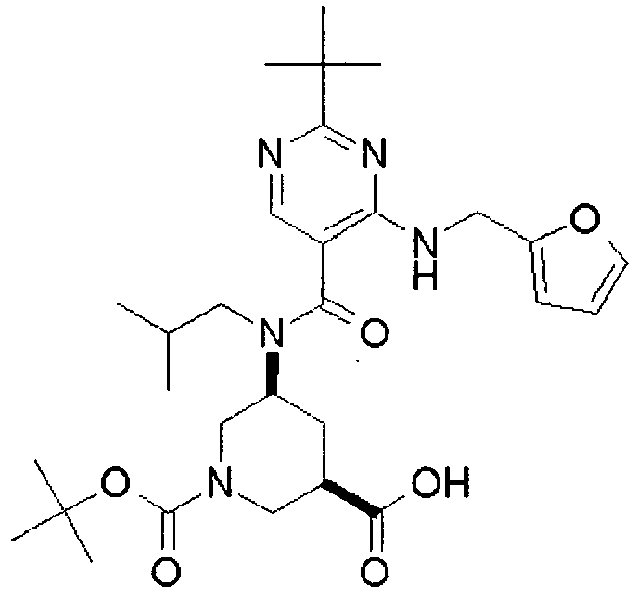
- 1-tert-Butyl 3-methyl (3R*,5S*)-5-[({2-tert-butyl-4-[(2-furylmethyl)amino]pyrimidin-5-yl}carbonyl)(isobutyl)amino]piperidine-1,3-dicarboxylate (250 mg) was dissolved in 2 M aqueous sodium hydroxide solution (1 ml) and methanol (2 ml), and the mixture was stirred at room temperature for 15 hr. The reaction mixture was concentrated under reduced pressure, and the residue was diluted with water. The mixture was adjusted to pH 3 with 1 M hydrochloric acid, and the precipitate was collected by filtration to give the object compound (205 mg) as a powder.
MS (ESI+, m/e) 558 (M+1) -
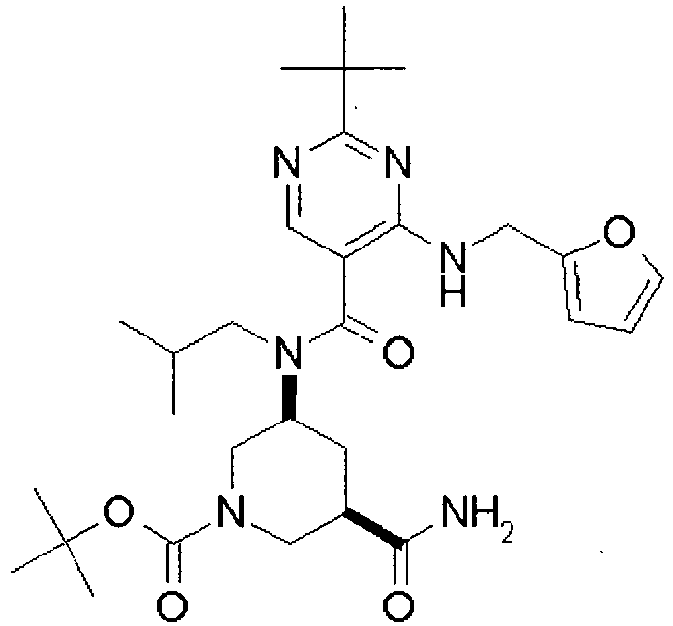
- A solution of (3R*,5S*)-1-(tert-butoxycarbonyl)-5-[({2-tert-butyl-4-[(2-furylmethyl)amino]pyrimidin-5-yl}carbonyl)(isobutyl)amino]piperidine-3-carboxylic acid (1.03 g), 1H-1,2,3-benzotriazol-1-ol ammoniate (420 mg), WSC·HCl (530 mg) and triethylamine (520 µl) in 1,2-dichloroethane (16 ml) was stirred at room temperature for 24 hr. The mixture was poured into water and the mixture was extracted with ethyl acetate. The extract was washed with saturated brine, and dried over anhydrous magnesium sulfate. The solvent was evaporated under reduced pressure and the residue was purified by silica gel column chromatography. The fraction eluted with ethyl acetate-hexane (1:9 - 1:0) was concentrated under reduced pressure to give the object compound (944 mg).
MS (ESI+, m/e) 557 (M+1) -

- (3R*,5S*)-1-(tert-Butoxycarbonyl)-5-[({2-tert-butyl-4-[(2-furylmethyl)amino]pyrimidin-5-yl}carbonyl)(isobutyl)amino]piperidine-3-carboxylic acid (100 mg), HOBt (41 mg) and WSC·HCl (52 mg) were dissolved in acetonitrile (3 ml), 4-methylpiperidin-4-ol monohydrochloride (27 mg) and triethylamine (75 µl) were added and the mixture was stirred at room temperature for 15 hr. The reaction mixture was concentrated, the residue was diluted with water, and the mixture was extracted with ethyl acetate. The extract was washed with saturated brine, and dried over anhydrous sodium sulfate. The solvent was evaporated under reduced pressure and the residue was purified by silica gel column chromatography. The fraction eluted with ethyl acetate-hexane (1:5 - 3:1) was concentrated under reduced pressure to give the object compound (110 mg).
MS (ESI+, m/e) 655 (M+1) -

- 1-tert-Butyl 3-methyl (3R*,5S*)-5-[({2-tert-butyl-4-[(2-furylmethyl)amino]pyrimidin-5-yl}carbonyl)(isobutyl)amino]piperidine-1,3-dicarboxylate (280 mg) was dissolved in THF (5 ml), 1 M methylmagnesium bromide in THF solution (2.45 ml) was added and the mixture was stirred at room temperature for 15 hr. Aqueous ammonium chloride solution was added to the reaction mixture, and the mixture was extracted with ethyl acetate. The extract was washed with saturated brine, dried over anhydrous sodium sulfate, and concentrated under reduced pressure. The residue was purified by silica gel column chromatography, and the fraction eluted with ethyl acetate-hexane (1:9 - 1:2) was concentrated under reduced pressure to give the object compound (280 mg).
MS (ESI+, m/e) 572 (M+1) -

- A mixture of (3R*,5S*)-1-(tert-butoxycarbonyl)-5-(methoxycarbonyl)piperidine-3-carboxylic acid (6.16 g), (S)-(-)-1-phenylethylamine (2.60 g) and ethanol (24 ml) was dissolved by heating to 70°C and recrystallization was conducted. The precipitated crystals were collected by filtration, dissolved again in ethanol (7 ml) and recrystallization was carried out. The precipitated crystals were collected by filtration, and suspended in water. The suspension was acidified with saturated aqueous potassium hydrogen sulfate solution, and the mixture was extracted three times with ethyl acetate. The extract was washed with saturated brine, and dried over anhydrous magnesium sulfate. The solvent was evaporated under reduced pressure to give the object compound (915 mg) as a powder. specific optical rotation [α]D 20:-6.2° (after drying, 20.12 mg, methanol, 2 ml, 100 mm)
1H-NMR (DMSO-d6) δ1.39 (9H, s), 1.52 (1H, q), 2.18-2.54 (3H, m), 2.55-2.78 (2H, m), 3.63 (3H, s), 4.03-4.23 (2H, m), 12.51 (1H, br s). -

- (3S,5R)-1-(tert-Butoxycarbonyl)-5-(methoxycarbonyl)piperidine-3-carboxylic acid (2.83 g) was suspended in toluene (36 ml), diphenylphosphoryl azide (2.60 ml) and triethylamine (1.70 ml) were added and the mixture was stirred at 100°C for 1 hr. The reaction mixture was cooled to room temperature, benzyl alcohol (1.53 ml) and triethylamine (7.00 ml) were added and the mixture was stirred at 80°C for 3 hr. The reaction mixture was concentrated, and the residue was dissolved in ethyl acetate. The mixture was washed with water, 0.5 M hydrochloric acid, saturated aqueous sodium hydrogen carbonate and saturated brine in this order, and dried over anhydrous magnesium sulfate. The solvent was evaporated under reduced pressure and the residue was purified by silica gel column chromatography. The fraction eluted with ethyl acetate-hexane (1:3 - 3:1) was concentrated under reduced pressure. The obtained residue was dissolved in methanol (60 ml), 10% palladium-carbon (50% containing water) (150 mg) was added, and the mixture was subjected to catalytic reduction at ambient temperature under normal pressure for 5 hr. The catalyst was filtered off, and the filtrate was concentrated under reduced pressure to give the object compound (1.83 g) as an oil.
1H-NMR (CDCl3) δ 1.22-1.43 (4H, m), 1.46 (9H, s), 2.27-2.79 (4H, m), 3.70 (3H, s), 4.13 (2H, br s). -
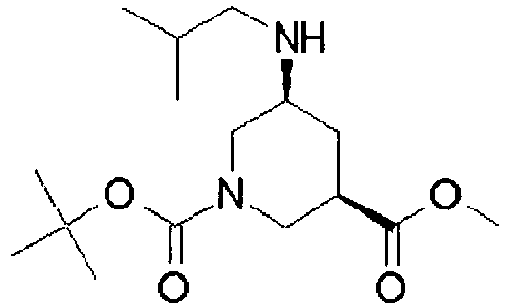
- 1-tert-Butyl 3-methyl (3R,5S)-5-aminopiperidine-1,3-dicarboxylate (1.83 g), isobutyraldehyde (0.78 ml) and acetic acid (0.49 ml) were dissolved in methanol (50 ml), and the mixture was stirred at room temperature for 30 min. Sodium triacetoxyborohydride (3.80 g) was added to the reaction mixture, and the mixture was stirred at room temperature for 7 hr. The reaction mixture was concentrated under reduced pressure, the concentrated solution was basified with aqueous sodium hydrogen carbonate, and the mixture was extracted with ethyl acetate. The extract was washed with water and saturated brine, and dried over anhydrous magnesium sulfate. The solvent was evaporated under reduced pressure and the residue was purified by silica gel column chromatography. The fraction eluted with ethyl acetate-hexane (1:1) to ethyl acetate 100% to ethyl acetate-methanol (9:1) was concentrated under reduced pressure to give the object compound (1.42 g) as an oil.
1H-NMR (CDCl3) δ 0.90 (6H, d), 1.22-1.38 (3H, m), 1.46 (9H, s), 1.69 (1H, dt), 2.23-2.39 (2H, m), 2.44-2.59 (1H, m), 2.47 (2H, d), 2.74 (1H, br s), 3.69 (3H, s), 4.18-4.34 (2H, m). -
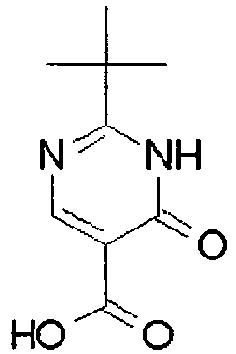
- Ethyl 2-tert-butyl-6-oxo-1,6-dihydropyrimidine-5-carboxylate (43.9 g) was dissolved in ethanol (200 ml), 2 M aqueous sodium hydroxide solution (330 ml) was added and the mixture was stirred at room temperature for 40 hr. The reaction mixture was concentrated under reduced pressure, and the aqueous layer was adjusted to pH 8 with 6 M hydrochloric acid. The mixture was concentrated under reduced pressure, and subjected to azeotropic distillation with 2-propanol. The residue was suspended in acetone, and insoluble powder was collected by filtration. The obtained powder was suspended in 1 M hydrochloric acid and the suspension was adjusted to pH 3. The suspension was concentrated under reduced pressure. The residue was subjected to azeotropic distillation with 2-propanol, and suspended in acetone. The insoluble material was filtered off and the filtrate was concentrated under reduced pressure to give the object compound (32.8 g) as a powder. 1H-NMR (DMSO-d6) δ 1.45 (9H, s), 8.99 (1H, s), 10.59 (1H, br s), 12.47 (1H, br s).
-

- 2-tert-Butyl-6-oxo-1,6-dihydropyrimidine-5-carboxylic acid (3.25 g) was dissolved in THF (60 ml), thionyl chloride (4.3 ml) and DMF (5 drops) were added and the mixture was stirred with heating to reflux for 2.5 hr. The reaction mixture was cooled to room temperature, and concentrated under reduced pressure, and the residue was subjected to azeotropic distillation with toluene. The obtained residue was suspended in THF (50 ml), a solution of 1-tert-butyl 3-methyl (3R,5S)-5-(isobutylamino)piperidine-1,3-dicarboxylate (4.13 g) and diisopropylethylamine (9.15 ml) in THF (50 ml) was added and the mixture was stirred at room temperature for 8 hr. The reaction mixture was concentrated under reduced pressure, and diluted with water, and the mixture was extracted with ethyl acetate. The extract was washed with saturated brine, and dried over anhydrous magnesium sulfate. The solvent was evaporated under reduced pressure and the residue was purified by silica gel column chromatography. The fraction eluted with ethyl acetate-hexane (1:19 - 2:3) was concentrated under reduced pressure to give the object compound (6.29 g).
MS (ESI+, m/e) 511 (M+1) - By a method similar to that of Reference Example 46, the following compound (Reference Example 47) was obtained.
-
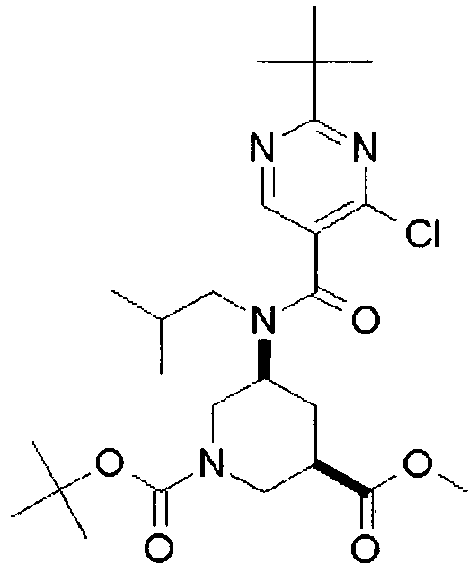
- MS (ESI+, m/e) 511 (M+1)
-

- To a solution of 1-tert-butyl 3-methyl (3R,5S)-5-{[(2-tert-butyl-4-chloropyrimidin-5-yl)carbonyl](isobutyl)amino}piperidine-1,3-dicarboxylate (2.98 g) and diisopropylethylamine (3.0 ml) in DMF (60 ml) was added 3-methoxypropylamine (1.19 ml), and the mixture was stirred at 80°C for 1.5 hr. The reaction mixture was concentrated under reduced pressure, saturated aqueous sodium hydrogen carbonate was added, and the mixture was extracted with ethyl acetate. The extract was dried over anhydrous magnesium sulfate, and concentrated under reduced pressure. The obtained residue was purified by silica gel chromatography, and the fraction eluted with hexane to ethyl acetate-hexane (1:2) was concentrated under reduced pressure to give the object compound (3.15 g).
MS (ESI+, m/e) 564 (M+1) -

- 1-tert-Butyl 3-methyl (3R,5S)-5-[({2-tert-butyl-4-[(3-methoxypropyl)amino]pyrimidin-5-yl}carbonyl)(isobutyl)amino]piperidine-1,3-dicarboxylate (1.08 g) was dissolved in methanol (25 ml) and THF (12 ml), 2 M aqueous sodium hydroxide solution (4.79 ml) was added and the mixture was stirred at room temperature for 2 hr. The reaction mixture was concentrated under reduced pressure, the residue was diluted with saturated aqueous ammonium chloride solution, and the mixture was extracted with ethyl acetate. The extract was dried over anhydrous magnesium sulfate, and concentrated under reduced pressure to give the object compound (1.05 g).
MS (ESI+, m/e) 550 (M+1) -
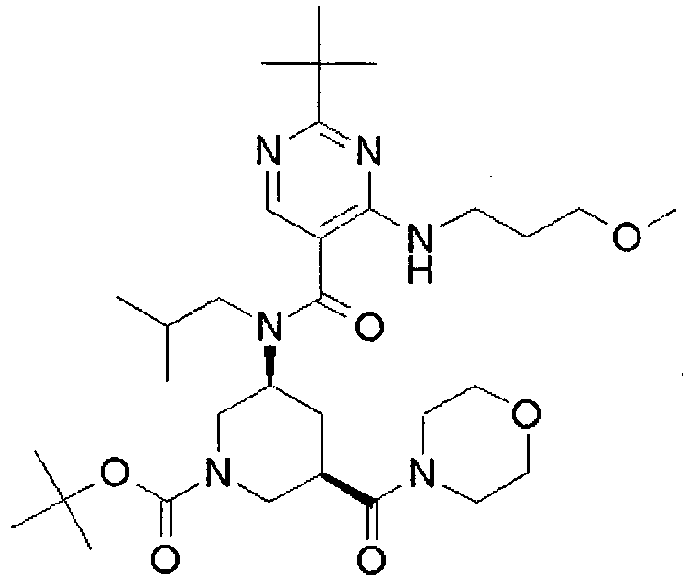
- (3R,5S)-1-(tert-Butoxycarbonyl)-5-[({2-tert-butyl-4-[(3-methoxypropyl)amino]pyrimidin-5-yl}carbonyl)(isobutyl)amino]piperidine-3-carboxylic acid (110 mg), morpholine (52 µl) and diisopropylethylamine (140 µl) were dissolved in DMF (8 ml), BOP reagent (265 mg) was added and the mixture was stirred at room temperature for 1.5 hr. The reaction mixture was diluted with saturated aqueous sodium hydrogen carbonate, and the mixture was extracted with ethyl acetate. The extract was dried over anhydrous magnesium sulfate, and the solvent was evaporated under reduced pressure. The residue was purified by silica gel column chromatography, and the fraction eluted with ethyl acetate-hexane (1:9) to ethyl acetate was concentrated under reduced pressure to give the object compound (105 mg).
MS (ESI+, m/e) 619 (M+1) -

- To a solution of 2-[(2-furylmethyl)amino]-6-methylnicotinic acid (65.0 mg) and 2-ethylpiperidine (47.5 mg) in DMF (2.8 ml) were added HOBt (45.9 mg) and WSC·HCl (65.2 mg), and the mixture was stirred at room temperature overnight. The reaction mixture was poured into 2% aqueous sodium hydrogen carbonate and the mixture was extracted with ethyl acetate. The extract was dried over anhydrous magnesium sulfate, and the solvent was evaporated under reduced pressure. The residue was subjected to silica gel column chromatography, and the fraction eluted with ethyl acetate-hexane (0:1 - 3:7) was concentrated under reduced pressure to give the object compound (81.8 mg).
1H-NMR (CDCl3) δ 0.81 (3H, s), 1.38-1.62 (4H, m), 1.65-1.80 (4H, m), 2.41 (3H, s), 2.83-2.97 (3H, m), 4.65 (2H, d), 5.80 (1H, s), 6.22 (1H, d), 6.26-6.34 (1H, m), 6.43 (1H, d), 7.19 (1H, d), 7.33 (1H, s). -

- To a solution of 2-[(2-furylmethyl)amino]-6-methylnicotinic acid (13.9 mg) and (2R)-2-(methoxymethyl)pyrrolidine (8.3 mg) in DMF (1.0 ml) was added a solution of HOBt (9.7 mg) and WSC·HCl (13.8 mg) in DMF (0.5 ml), and the mixture was stirred at room temperature overnight. The reaction mixture was poured into 2% aqueous sodium hydrogen carbonate, the mixture was extracted with ethyl acetate, and the extract was concentrated by a nitrogen gas blower. The residue was subjected to reversed-phase preparative HPLC, and the object fraction was concentrated by a nitrogen gas blower to give the object compound (12.2 mg).
MS (ESI+, m/e) 330 (M+1) -
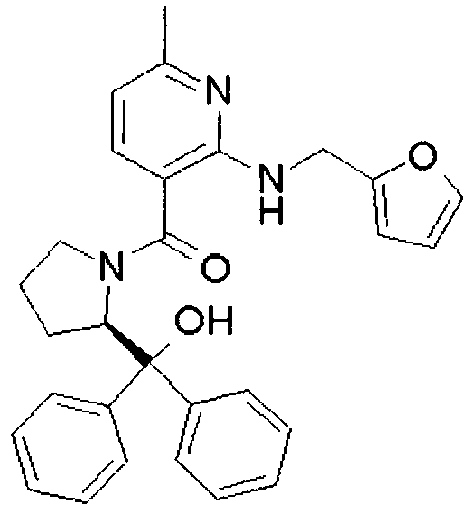
- To a solution of 2-[(2-furylmethyl)amino]-6-methylnicotinic acid (13.9 mg) and diphenyl(pyrrolidin-2-yl)methanol (18.2 mg) in DMF (1.0 ml) was added a solution of HOBt (9.7 mg) and WSC·HCl (13.8 mg) in DMF (0.5 ml), and the mixture was stirred at room temperature overnight. The reaction mixture was poured into 2% aqueous sodium hydrogen carbonate, the mixture was extracted with ethyl acetate, and the extract was concentrated by a nitrogen gas blower. The residue was subjected to reversed-phase preparative HPLC, and the object fraction was passed through MP-CO3 resin (manufactured by Polymer Laboratories) to remove trifluoroacetic acid. The obtained solution was concentrated by a nitrogen gas blower to give the object compound (10.6 mg).
MS (ESI+, m/e) 468 (M+1) -

- tert-Butyl 3-ethyl-4-({4-[(2-furylmethyl)amino]-2-isopropylpyrimidin-5-yl}carbonyl)piperazine-1-carboxylate (100 mg) was dissolved in 4 M hydrogen chloride-ethyl acetate solution (3 ml), and the mixture was stirred at room temperature for 15 hr. The reaction mixture was concentrated under reduced pressure, ethyl acetate was added and the precipitate was collected by filtration to give the object compound (74 mg).
MS (ESI+, m/e) 358 (M+1) -

- To a solution of 4-[(2-furylmethyl)amino]-2-(methylthio)pyrimidine-5-carboxylic acid (19.1 mg) and tert-butyl pyrrolidin-3-ylcarbamate (13.4 mg) in DMF (1.0 ml) was added a solution of HOBt (9.7 mg) and WSC·HCl (13.8 mg) in DMF (0.5 ml), and the mixture was stirred at room temperature overnight. The reaction mixture was poured into 2% aqueous sodium hydrogen carbonate, the mixture was extracted with ethyl acetate, and the extract was concentrated by a nitrogen gas blower. The residue was purified by reversed-phase preparative HPLC, and the object fraction was concentrated by a nitrogen gas blower. The residue was dissolved in trifluoroacetic acid/acetonitrile solution (20%(V/V), 1.0 ml), and the mixture was stirred at room temperature for 3 hr. The reaction mixture was passed through a column of MP-TsOH resin (manufactured by Argonaut) to fix the object compound on the resin, and the resin was washed with methanol (6 ml). 2 M Ammonia-methanol solution (6 ml) was passed through the column, and the eluate was concentrated by a nitrogen gas blower to give the object compound (6.3 mg).
MS (ESI+, m/e) 334 (M+1) -

- To ethyl 2-isopropyl-6-oxo-1,6-dihydropyrimidine-5-carboxylate (250 mg) was added 6 M hydrochloric acid (5 ml), and the mixture was stirred at room temperature for 3 hr. The reaction mixture was concentrated under reduced pressure and the obtained residue was dissolved in DMF (5 ml). Triethylamine (146 mg), 2-ethylpiperidine (163 mg), HOBt (194 mg) and WSC·HCl (275 mg) were added and the mixture was stirred at room temperature overnight. The reaction mixture was poured into 2% aqueous sodium hydrogen carbonate, the mixture was extracted with ethyl acetate, and the extract was concentrated by a nitrogen gas blower. The residue was subjected to silica gel column chromatography, and the fraction eluted with methanol-ethyl acetate (0:1 - 1:9) was concentrated under reduced pressure. The residue was dissolved in acetonitrile (10 ml). A solution of benzotriazol-1-yloxytris(dimethylamino)phosphonium hexafluorophosphate (35.0 mg) in acetonitrile (0.5 ml) and a solution of triethylamine (9.1 mg) in acetonitrile (0.5 ml) were added to the solution (0.5 ml), and the mixture was stirred at room temperature for 20 min. A solution of 1-cyclopropylmethanamine (6.4 mg) in acetonitrile (0.5 ml) was added and the mixture was stirred at 70°C overnight. The reaction mixture was poured into 2% aqueous sodium hydrogen carbonate, the mixture was extracted with ethyl acetate, and the extract was concentrated by a nitrogen gas blower. The residue was purified by reversed-phase preparative HPLC, and the object fraction was concentrated by a nitrogen gas blower to give the object compound (15.8 mg).
MS (ESI+, m/e) 331 (M+1) - By a method similar to that of the above-mentioned Example 1 (Method A) to Example 6 (Method F), the compounds of Examples 7 to 92 below were obtained. The respective compounds were isolated and purified as necessary by a known means such as phase transfer, pH conversion, solvent extraction, silica gel column chromatography, reversed-phase preparative HPLC and the like. The final products were isolated as a free form as in Method A and the like, or as trifluoroacetate by concentrating the object fraction of reversed-phase preparative HPLC as in Method B and the like, or as hydrochloride by treating with 4 M hydrogen chloride-ethyl acetate solution as in Method D and the like.
-
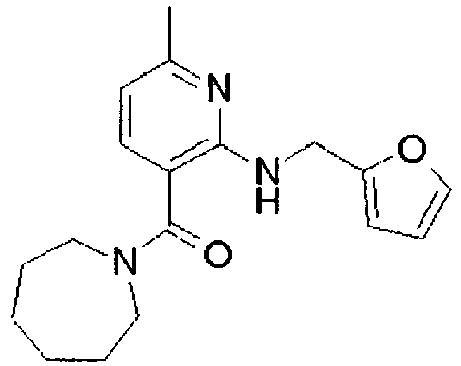
- 1H-NMR (CDCl3) δ 1.55-1.86 (8H, m), 2.41 (3H, s), 3.52 (4H, s), 4.65 (2H, d), 5.81 (1H, t), 6.23 (1H, d), 6.27-6.34 (1H, m), 6.43 (1H, d), 7.22 (1H, d), 7.34 (1H, d).
-

- MS (ESI+, m/e) 363 (M+1)
-

- MS (ESI+, m/e) 391 (M+1)
-

- MS (ESI+, m/e) 379 (M+1)
-
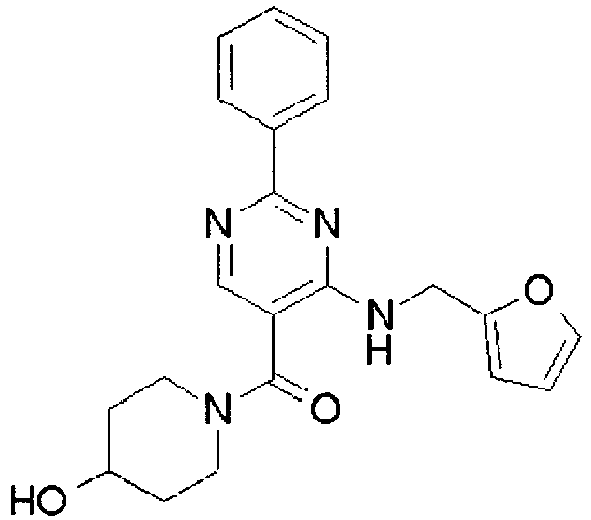
- MS (ESI+, m/e) 379 (M+1)
-

- MS (ESI+, m/e) 383 (M+1)
-

- MS (ESI+, m/e) 329 (M+1)
-

- MS (ESI+, m/e) 343 (M+1)
-

- MS (ESI+, m/e) 397 (M+1)
-

- MS (ESI+, m/e) 369 (M+1)
-
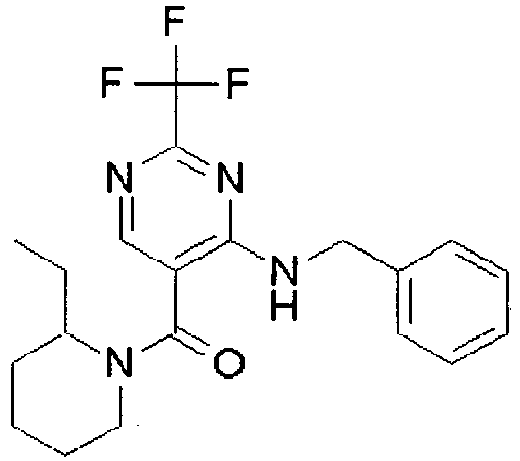
- MS (ESI+, m/e) 393 (M+1)
-

- MS (ESI+, m/e) 397 (M+1)
-

- MS (ESI+, m/e) 357 (M+1)
-
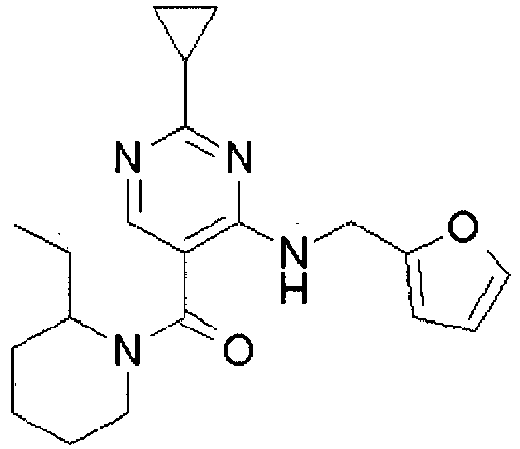
- MS (ESI+, m/e) 355 (M+1)
-

- MS (ESI+, m/e) 371 (M+1)
-
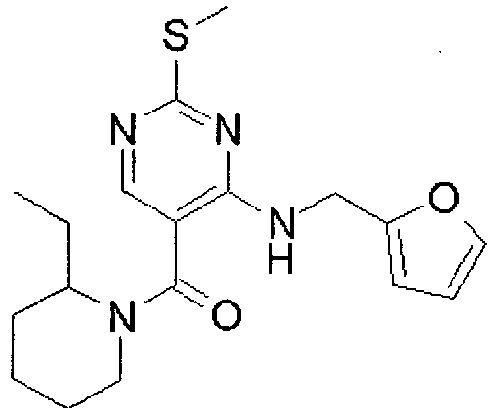
- MS (ESI+, m/e) 361 (M+1)
-

- MS (ESI+, m/e) 384 (M+1)
-

- MS (ESI+, m/e) 397 (M+1)
-
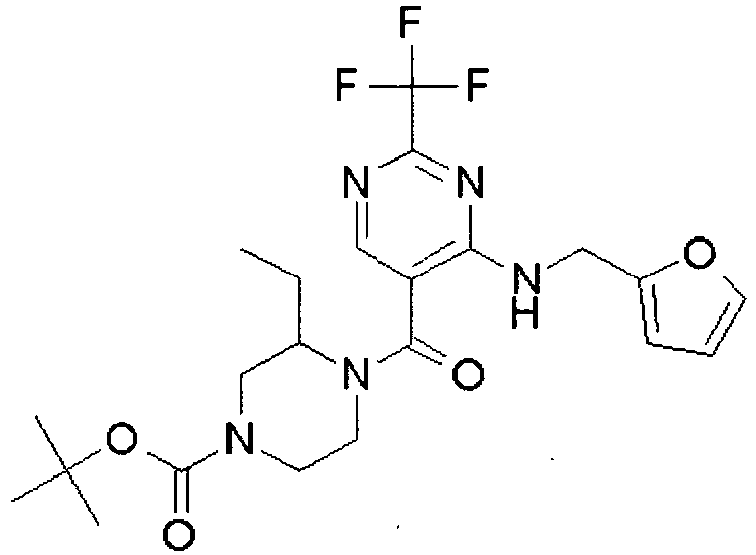
- MS (ESI+, m/e) 484 (M+1)
-

- MS (ESI+, m/e) 458 (M+1)
-
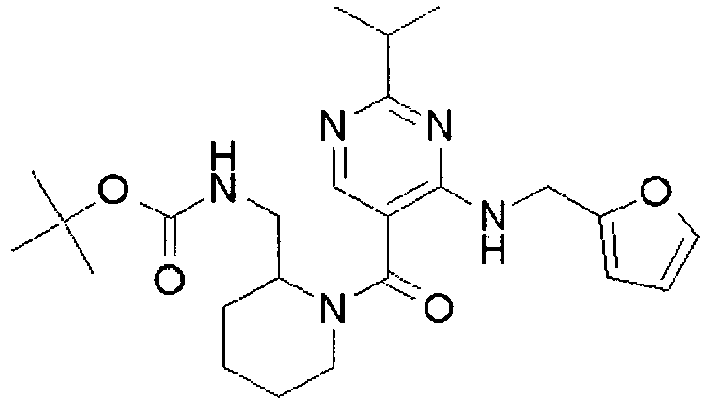
- MS (ESI+, m/e) 458 (M+1)
-

- MS (ESI+, m/e) 472 (M+1)
-
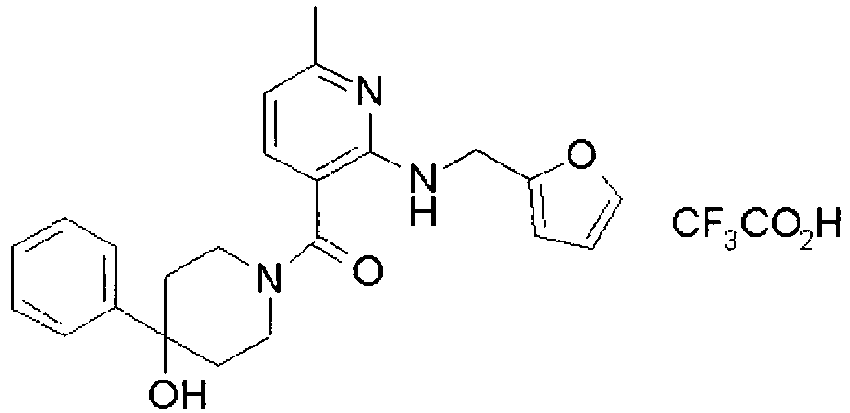
- MS (ESI+, m/e) 392 (M+1)
-

- MS (ESI+, m/e) 423 (M+1)
-

- MS (ESI+, m/e) 375 (M+1)
-

- MS (ESI+, m/e) 385 (M+1)
-

- MS (ESI+, m/e) 342 (M+1)
-

- MS (ESI+, m/e) 344 (M+1)
-

- MS (ESI+, m/e) 358 (M+1)
-

- MS (ESI+, m/e) 373 (M+1)
-
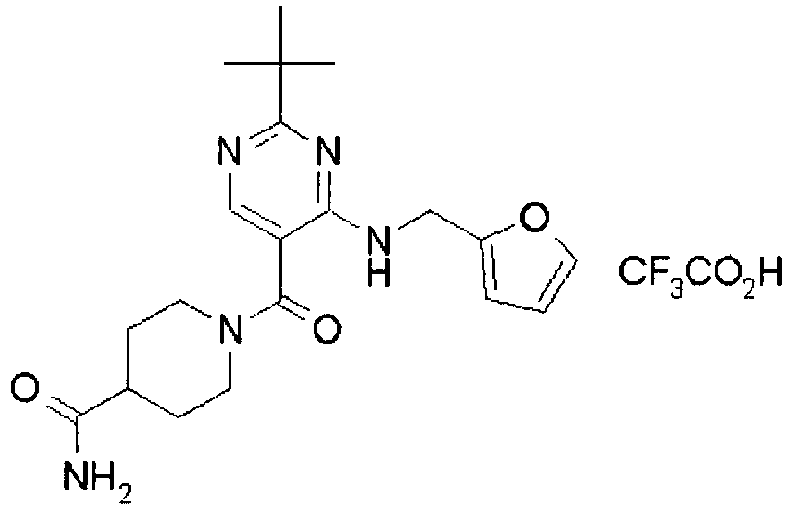
- MS (ESI+, m/e) 386 (M+1)
-

- MS (ESI+, m/e) 386 (M+1)
-

- MS (ESI+, m/e) 331 (M+1)
-

- MS (ESI+, m/e) 371 (M+1)
-

- MS (ESI+, m/e) 371 (M+1)
-

- MS (ESI+, m/e) 454 (M+1)
-

- MS (ESI+, m/e) 448 (M+1)
-

- MS (ESI+, m/e) 433 (M+1)
-

- MS (ESI+, m/e) 437 (M+1)
-
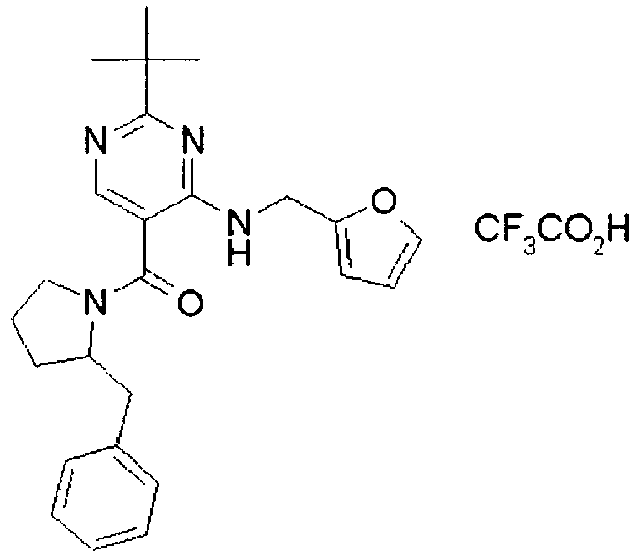
- MS (ESI+, m/e) 419 (M+1)
-

- MS (ESI+, m/e) 433 (M+1)
-

- MS (ESI+, m/e) 411 (M+1)
-

- MS (ESI+, m/e) 371 (M+1)
-
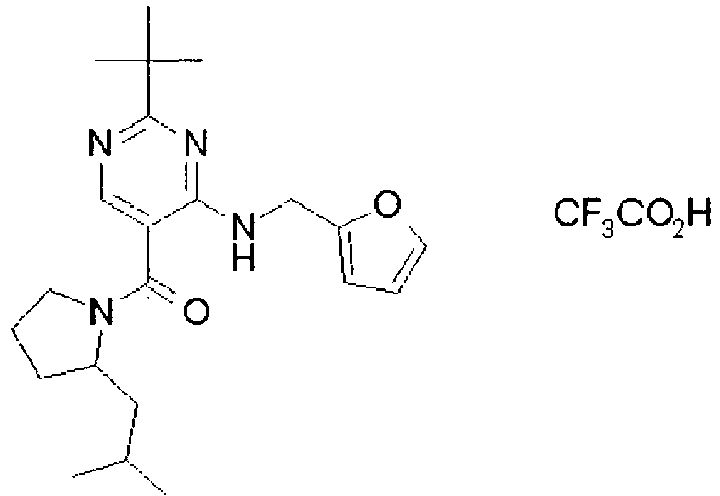
- MS (ESI+, m/e) 385 (M+1)
-

- MS (ESI+, m/e) 373 (M+1)
-

- MS (ESI+, m/e) 385 (M+1)
-

- MS (ESI+, m/e) 407 (M+1)
-
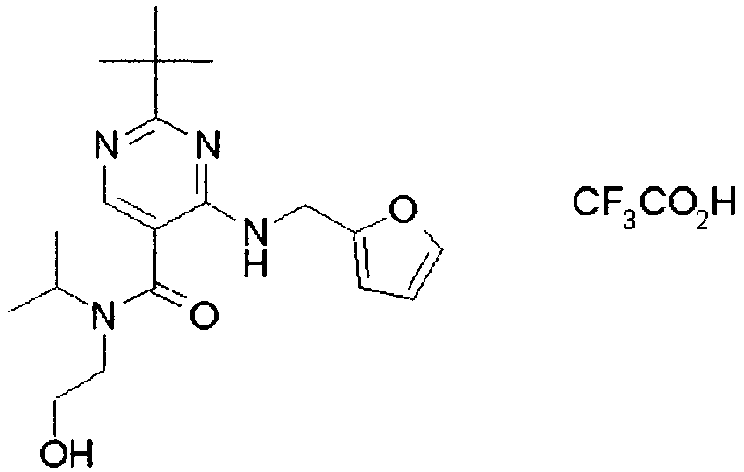
- MS (ESI+, m/e) 361 (M+1)
-

- MS (ESI+, m/e) 368 (M+1)
-

- MS (ESI+, m/e) 384 (M+1)
-

- MS (ESI+, m/e) 358 (M+1)
-
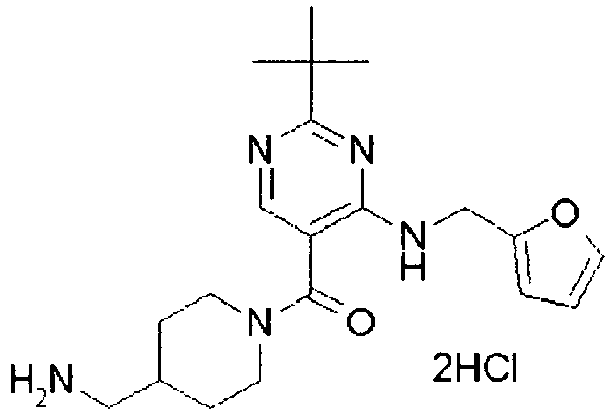
- MS (ESI+, m/e). 372 (M+1)
-

- MS (ESI+, m/e) 386 (M+1)
-

- MS (ESI+, m/e) 462 (M+1)
-

- MS (ESI+, m/e) 334 (M+1)
-

- MS (ESI+, m/e) 358 (M+1)
-

- MS (ESI+, m/e) 372 (M+1)
-

- MS (ESI+, m/e) 356 (M+1)
-

- MS (ESI+, m/e) 370 (M+1)
-

- MS (ESI+, m/e) 344 (M+1)
-
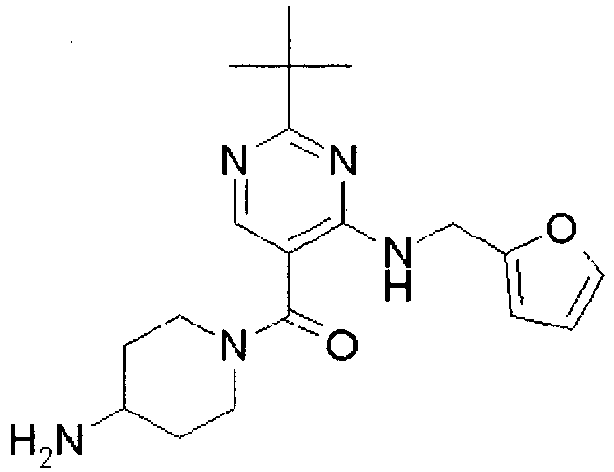
- MS (ESI+, m/e) 358 (M+1)
-

- MS (ESI+, m/e) 420 (M+1)
-

- MS (ESI+, m/e) 358 (M+1)
-

- MS (ESI+, m/e) 387 (M+1)
-

- MS (ESI+, m/e) 372 (M+1)
-

- MS (ESI+, m/e) 372 (M+1)
-

- MS (ESI+, m/e) 386 (M+1)
-

- MS (ESI+, m/e) 384 (M+1)
-

- MS (ESI+, m/e) 398 (M+1)
-
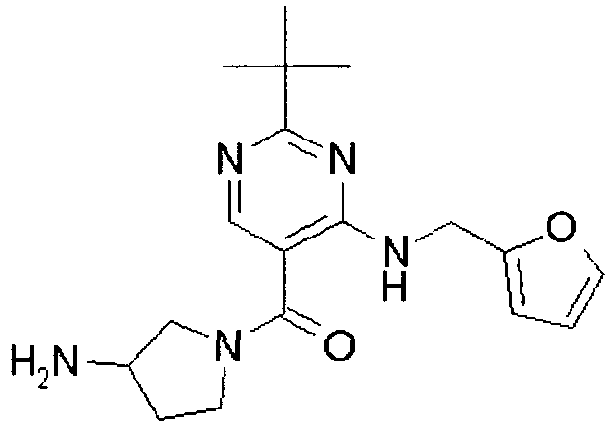
- MS (ESI+, m/e) 344 (M+1)
-
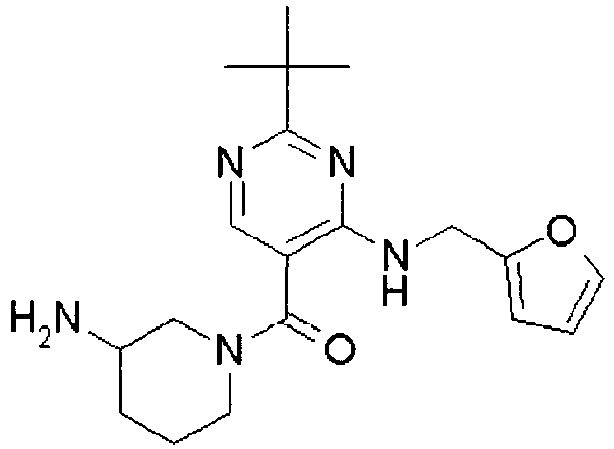
- MS (ESI+, m/e) 358 (M+1)
-

- MS (ESI+, m/e) 372 (M+1)
-
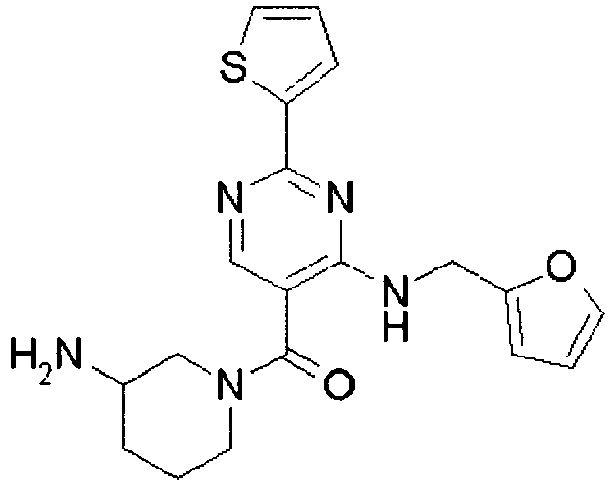
- MS (ESI+, m/e) 384 (M+1)
-

- MS (ESI+, m/e) 374 (M+1)
-

- MS (ESI+, m/e) 348 (M+1)
-

- MS (ESI+, m/e) 362 (M+1)
-

- MS (ESI+, m/e) 336 (M+1)
-

- MS (ESI+, m/e) 362 (M+1)
-

- MS (ESI+, m/e) 336 (M+1)
-

- MS (ESI+, m/e) 346 (M+1)
-

- MS (ESI+, m/e) 320 (M+1)
-

- MS (ESI+, m/e) 306 (M+1)
-

- MS (ESI+, m/e) 322 (M+1)
-
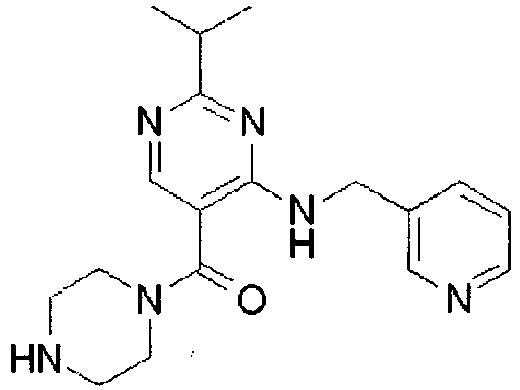
- MS (ESI+, m/e) 341 (M+1)
-

- MS (ESI+, m/e) 341 (M+1)
-

- MS (ESI+, m/e) 341 (M+1)
-

- tert-Butyl (3R*,5S*)-3-(aminocarbonyl)-5-[({2-tert-butyl-4-[(2-furylmethyl)amino]pyrimidin-5-yl}carbonyl)(isobutyl)amino]piperidine-1-carboxylate (230 mg) was dissolved in 1 M hydrogen chloride-ethyl acetate (4 ml), and the mixture was stirred at room temperature for 2 hr. The reaction mixture was concentrated, ethyl acetate was added and the precipitate was collected by filtration and washed with ethyl acetate to give the object compound (218 mg).
MS (ESI+, m/e) 457 (M+1) -

- tert-Butyl (3R*,5S*)-3-[({2-tert-butyl-4-[(2-furylmethyl)amino]pyrimidin-5-yl}carbonyl)(isobutyl)amino]-5-[(4-hydroxy-4-methylpiperidin-1-yl)carbonyl]piperidine-1-carboxylate (110 mg) was dissolved in 2 M hydrogen chloride-ethyl acetate (2 ml), and the mixture was stirred at room temperature for 2 hr. The reaction mixture was concentrated, ethyl acetate-hexane was added and the precipitate was collected by filtration and washed with ethyl acetate-hexane to give the object compound (104 mg).
MS (ESI+, m/e) 555 (M+1) - By a method similar to that of the above-mentioned Example 93 (Method G) and Example 94 (Method H), the compounds of Examples 95 and 96 below were obtained. The respective compounds were isolated and purified as necessary by a known means such as phase transfer, pH conversion, solvent extraction, silica gel column chromatography, reversed-phase preparative HPLC and the like. The final products were isolated as hydrochloride as in Method G and Method H by treating with a hydrogen chloride-ethyl acetate solution.
-

- MS (ESI+, m/e) 472 (M+1)
-

- MS (ESI+, m/e) 464 (M+1)
-

- tert-Butyl (3S,5R)-3-[({2-tert-butyl-4-[(3-methoxypropyl)amino]pyrimidin-5-yl}carbonyl)(isobutyl)amino]-5-(morpholin-4-ylcarbonyl)piperidine-1-carboxylate (105 mg) was dissolved in 1 M hydrogen chloride-ethyl acetate (6 ml), and the mixture was stirred at room temperature for 13 hr. The reaction mixture was concentrated to give the object compound (93 mg).
MS (ESI+, m/e) 519 (M+1) -

- To a solution of 1-tert-butyl 3-methyl (3R*,5S*)-5-{[(2-tert-butyl-4-chloropyrimidin-5-yl)carbonyl](isobutyl)amino}piperidine-1,3-dicarboxylate (51.1 mg) and diisopropylethylamine (38 mg) in DMF (0.5 ml) was added a solution of 3-methylthiopropylamine (21 mg) in DMF (0.5 ml), and the mixture was stirred at 80°C overnight. To the reaction mixture was added 2% aqueous sodium hydrogen carbonate and the mixture was extracted with ethyl acetate, and the extract was concentrated by a nitrogen gas blower. The residue was purified by reversed-phase preparative HPLC, and the object fraction was concentrated by a nitrogen gas blower. The residue was dissolved in trifluoroacetic acid/acetonitrile solution (20%(V/V), 1.0 ml), and the mixture was stirred at room temperature for 6 hr. The reaction mixture was concentrated by a nitrogen gas blower. The residue was neutralized with triethylamine (1 ml), saturated aqueous sodium hydrogen carbonate was added, and the mixture was extracted with ethyl acetate. The extract was concentrated by a nitrogen gas blower. The residue was purified by reversed-phase preparative HPLC, and the object fraction was concentrated by a nitrogen gas blower to give the object compound (6.4 mg).
MS (ESI+, m/e) 480 (M+1) - By a method similar to that of the above-mentioned Example 98 (Method I), the compound of Example 99 below was obtained. The compounds were isolated and purified as necessary by a known means such as phase transfer, pH conversion, solvent extraction, silica gel column chromatography, reversed-phase preparative HPLC and the like. The final products were isolated as a free form.
-

- MS (ESI+, m/e) 482 (M+1)
-
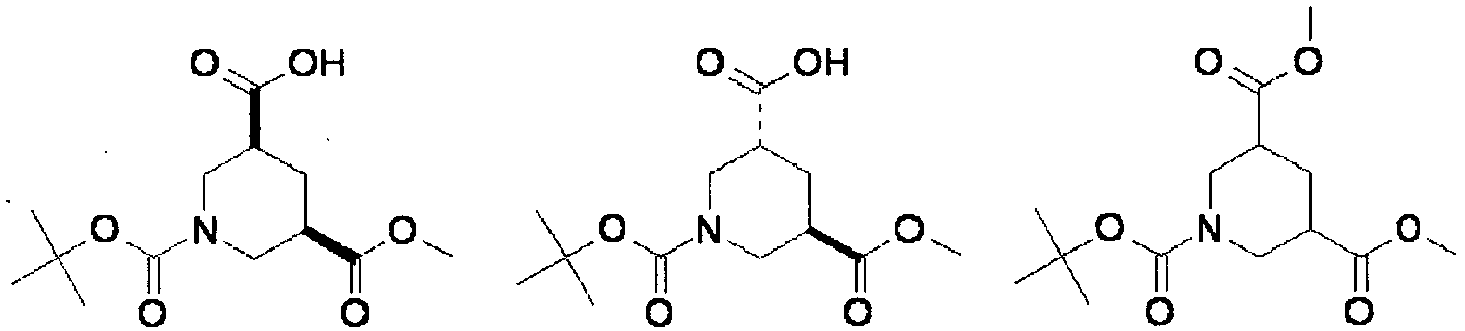
- Dimethyl pyridine-3,5-dicarboxylate (55 g) was dissolved in methanol (500 ml) and 6 M hydrochloric acid (70 ml), and rhodium-carbon (5.5 g) was added. The reaction mixture was stirred under pressurized hydrogen atmosphere (5 atm) at room temperature for 3 hr, and thereafter at 50°C for 12 hr. The mixture was allowed to cool to room temperature, the rhodium catalyst was filtered off, and the filtrate was concentrated under reduced pressure. The residue was dissolved in ethanol (300 ml) and, under ice-cooling, triethylamine (60 ml) and di-tert-butyl dicarbonate (68 g) were successively added. The reaction mixture was stirred at room temperature for 12 hr, and concentrated under reduced pressure. The residue was dissolved in 0.5 M hydrochloric acid, and the mixture was extracted with ethyl acetate. The extract was washed with saturated brine, and dried over anhydrous sodium sulfate. The solvent was evaporated under reduced pressure and the residue was purified by silica gel column chromatography. The fraction eluted with hexane-ethyl acetate (7:1 - 1:4) was obtained. The less polar fraction was concentrated under reduced pressure to give 1-tert-butyl 3,5-dimethyl piperidine-1,3,5-tricarboxylate (22.2 g). The more polar fraction was concentrated under reduced pressure, and the residue was diluted with ethyl acetate. The precipitate was collected by filtration and washed with ethyl acetate to give (3R*,5S*)-1-(tert-butoxycarbonyl)-5-(methoxycarbonyl)piperidine-3-carboxylic acid (15.6 g) as a powder. The filtrate was concentrated under reduced pressure to give a mixture (8.9 g) of (3R*,5S*)-1-(tert-butoxycarbonyl)-5-(methoxycarbonyl)piperidine-3-carboxylic acid and (3R*,5R*)-1-(tert-butoxycarbonyl)-5-(methoxycarbonyl)piperidine-3-carboxylic acid.
- 1H-NMR (CDCl3) δ 1.47 (9H, s), 1.72 (1H, d), 2.41-2.63 (3H, m), 2.72 (2H, br s), 3.71 (3H, s), 4.38 (2H, d).
- 1H-NMR (CDCl3) δ 1.33-1.50 (9H, m), 1.60-1.82 (1H, m), 1.96-2.22 (1H, m), 2.41-2.58 (2H, m), 2.62-2.91 (2H, m), 3.34-3.91 (1H, m), 3.71 (3H, s), 4.37 (1H, br s), 7.55-8.47 (1H, m).
- 1H-NMR (CDCl3) δ 1.36-1.50 (2H, m), 1.46 (7H, m), 1.62-1.76 (1H, m), 1.99-2.16 (1H, m), 2.38-2.55 (2H, m), 2.61-2.75 (1H, m), 2.81 (1H, t), 3.39-3.60 (1H, m), 3.64-3.81 (6H, m), 4.35 (1H, br s).
-

- Dimethyl pyridine-3,5-dicarboxylate (50 g) was dissolved in acetic acid (300 ml), 5% rhodium carbon (5 g) was added, and the mixture was stirred under pressurized hydrogen atmosphere (5 atm) at 50°C for 15 hr. The reaction mixture was allowed to cool to room temperature, the rhodium catalyst was filtered off, and the filtrate was concentrated under reduced pressure. The residue was dissolved in ethanol (300 ml) and, under ice-cooling, triethylamine (107 ml) and di-tert-butyl dicarbonate (67 g) were successively added. The reaction mixture was stirred at room temperature for 15 hr, and concentrated under reduced pressure. The residue was dissolved in water, and the mixture was adjusted to pH 3 with 6 M hydrochloric acid. The mixture was extracted with ethyl acetate. The ethyl acetate extract layer was washed with saturated brine, and dried over anhydrous sodium sulfate. The solvent was evaporated under reduced pressure. The residue was dissolved in methanol (250 ml), and 8 N aqueous sodium hydroxide solution (128 ml) was added dropwise at room temperature. The reaction mixture was stirred at room temperature for 24 hr, and methanol was evaporated under reduced pressure. The concentrated solution was diluted with saturated aqueous sodium hydrogen carbonate solution (100 ml) and washed twice with diethyl ether. The basic aqueous layer was acidified (pH 3) with 6 M hydrochloric acid. The precipitated powder was collected by filtration, washed with water, and air-dried. The obtained powder (55 g) was dissolved in methanol (200 ml) by heating and the mixture was concentrated under reduced pressure until the amount of methanol became half. Water (50 ml) was added, and the mixture was stood at room temperature overnight. The precipitated white powder was collected by filtration, washed with cold methanol/water=2/1 (200 ml) and air-dried to give the object compound (38 g) as a powder.
1H-NMR (CDCl3) δ 1.47 (9H, s), 1.72 (1H, d), 2.41-2.63 (3H, m), 2.72 (2H, br s), 3.71 (3H, s), 4.38 (2H, d). -

- (3R,5S)-1-(tert-Butoxycarbonyl)piperidine-3,5-dicarboxylic acid (222 g) was suspended in acetic anhydride (2 L), and the suspension was heated under reflux for 3 hr. The reaction mixture was concentrated under reduced pressure. Toluene (200 ml) was added and the mixture was concentrated under reduced pressure. This operation was repeated twice. The obtained residue and quinidine (142 g) were dissolved in THF (900 ml), and the mixture was cooled to -40°C. A solution of methanol (161 ml) in THF (100 ml) was added dropwise over 30 min, and the mixture was stirred at the same temperature for 7 hr. THF (about 700 ml) was evaporated under reduced pressure, ethyl acetate was added, and the mixture was washed with 2 N hydrochloric acid. The aqueous layer was extracted with ethyl acetate, the organic layer was combined and the mixture was washed successively with 2 N hydrochloric acid and saturated brine, and dried over anhydrous magnesium sulfate. The solvent was concentrated under reduced pressure and the obtained residue (106 g) was suspended in ethanol (410 ml). (R)-(+)-1-Phenylethylamine (45 g) was added, and the mixture was dissolved by heating to 75°C. The hot ethanol solution was rapidly filtered, and the filtrate was allowed to stand at room temperature for 12 hr. The resulting colorless crystals were collected by filtration, washed with ethyl acetate-hexane, and then with hexane and air-dried. The obtained solid was suspended in water (490 ml). Saturated aqueous potassium hydrogen sulfate solution (490 ml) was added and the mixture was extracted 3 times with ethyl acetate. The organic layer was washed with saturated brine, dried over anhydrous magnesium sulfate and concentrated to dryness to give the object compound (148 g) as a solid.
1H-NMR (DMSO-d6) δ1.39 (9H, s), 1.52 (1H, q), 2.18-2.54 (3H, m), 2.55-2.78 (2H, m), 3.63 (3H, s), 4.03-4.23 (2H, m), 12.51 (1H, br s). -

- 1-tert-Butyl 3,5-dimethyl piperidine-1,3,5-tricarboxylate (75 g) was dissolved in methanol (375 ml), and 2 M aqueous sodium hydroxide solution (125 ml) was added dropwise at room temperature. The reaction mixture was stirred at room temperature for 14 hr, and methanol was evaporated under reduced pressure. The concentrated solution was diluted with saturated aqueous sodium hydrogen carbonate solution (100 ml) and washed twice with ethyl acetate. The basic aqueous layer was acidified (pH 2) with 6 M hydrochloric acid, and the mixture was extracted with ethyl acetate. The extract was dried over anhydrous magnesium sulfate, and the solvent was evaporated under reduced pressure to give the object compound (71 g).
1H-NMR (CDCl3) δ 1.33-1.50 (9H, m), 1.60-1.82 (1H, m), 1. 96-2.22 (1H, m), 2.41-2.58 (2H, m), 2.62-2.91 (2H, m), 3.34-3.91 (1H, m), 3.71 (3H, s), 4.37 (1H, br s), 7.55-8.47 (1H, m). - By a method similar to that of Reference Example 43, the following compound (Reference Example 55) was obtained.
-

- 1H-NMR (CDCl3) δ 1.19-1.41 (3H, m), 1.46-1.50 (9H, m), 1.82-2.78 (4H, m), 3.49 (1H, m), 3.64-3.73 (3H, m), 4.15 (2H, br s).
- By a method similar to that of Reference Example 44, the following compound (Reference Example 56) was obtained.
-

- 1H-NMR (CDCl3) δ 0.93-1.09 (2H, m), 1.02 (4H, d), 1.45 (9H, d), 2.05 (3H, s), 2.65-2.79 (2H, m), 2.83-2.98 (1H, m), 3.25 (1H, dd), 3.49 (2H, s), 3.58-3.75 (3H, m), 3.94 (1H, d).
-

- (3S,5R)-1-(tert-Butoxycarbonyl)-5-(methoxycarbonyl)piperidine-3-carboxylic acid (2.83 g) was suspended in toluene (36 ml), diphenylphosphoryl azide (2.60 ml) and triethylamine (1.70 ml) were added, and the mixture was stirred at 100°C for 1 hr. The reaction mixture was cooled to room temperature, benzyl alcohol (1.53 ml) and triethylamine (7.00 ml) were added and the mixture was stirred at 80°C for 3 hr. The reaction mixture was concentrated, and the residue was dissolved in ethyl acetate, washed with water, 0.5 M hydrochloric acid, saturated aqueous sodium hydrogen carbonate and saturated brine in this order, and dried over anhydrous magnesium sulfate. The solvent was evaporated under reduced pressure. The residue was subjected to silica gel column chromatography, and the fraction eluted with ethyl acetate-hexane (1:3 - 3:1) was concentrated under reduced pressure to give the object compound (2.78 g) as an oil.
MS (ESI+, m/e) 393 (M+1) -
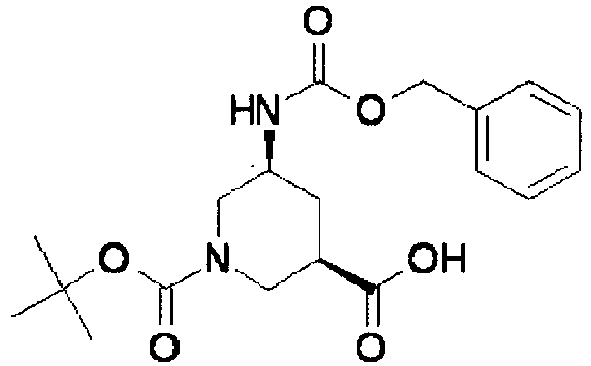
- To a solution of 1-tert-butyl 3-methyl (3R,5S)-5-{[(benzyloxy)carbonyl]amino}piperidine-1,3-dicarboxylate (115 g) in methanol (700 ml) was added 1 M aqueous sodium hydroxide solution (350 ml) under ice-cooling, and the mixture was stirred at room temperature for 12 hr. The reaction mixture was concentrated under reduced pressure to about 1/3 volume, and the residual aqueous solution was washed with ethyl acetate-hexane (1:1, 600 ml). The aqueous layer was neutralized with 1 M hydrochloric acid, and the mixture was extracted with ethyl acetate. The extract was washed with saturated brine, and dried over anhydrous magnesium sulfate. The solvent was evaporated under reduced pressure to give the object compound (98.5 g).
1H-NMR (DMSO-d6) δ 1.33 (1H, br s), 1.40 (9H, s), 2.09 (1H, d), 2.36-2.52 (3H, m), 3.93-4.09 (2H, m), 5.03 (2H, s), 7.28-7.43 (5H, m), 12.52 (1H, br s). -
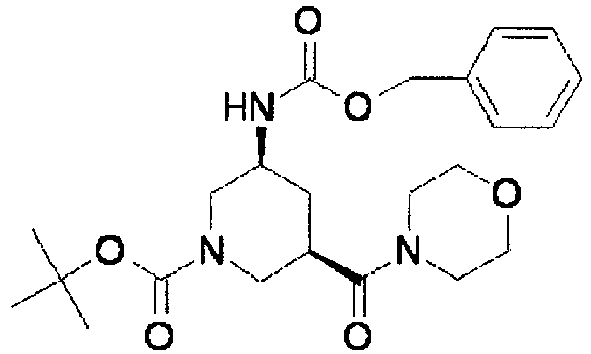
- (3R,5S)-5-{[(Benzyloxy)carbonyl]amino}-1-(tert-butoxycarbonyl)piperidine-3-carboxylic acid (49.2 g), morpholine (11.4 ml), 1H-benzotriazol-1-ol (10.0 g) and triethylamine (40 ml) were dissolved in DMF (250 ml), WSC·HCl (30.0 g) was added and the mixture was stirred at room temperature for 4 days. The reaction mixture was poured into water, and the mixture was extracted with ethyl acetate. The extract was washed successively with saturated aqueous sodium hydrogen carbonate solution and saturated brine, and dried over anhydrous magnesium sulfate. The solvent was evaporated under reduced pressure to give the object compound (62.9 g).
1H-NMR (CDCl3) δ 1.46 (9H, s), 1.69 (2H, br s), 2.04 (1H, s), 2.73 (2H, br s), 2.79-2.96 (1H, m), 3.52-3.65 (6H, m), 3.69 (2H, d), 3.67 (1H, br s), 4.04 (1H, d), 5.09 (2H, s), 5.40 (1H, br s), 7.25-7.41 (5H, m). -
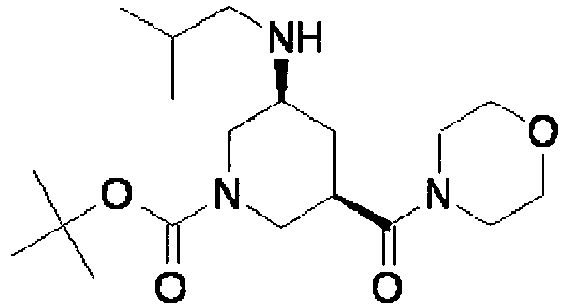
- tert-Butyl (3S,5R)-3-{[(benzyloxy)carbonyl]amino}-5-(morpholin-4-ylcarbonyl)piperidine-1-carboxylate (58 g) and palladium(II) hydroxide-carbon (5 g) were suspended in methanol (400 ml), and the suspension was stirred under a hydrogen atmosphere (1 atm) at room temperature for 16 hr. The palladium catalyst was filtered off, and the filtrate was concentrated under reduced pressure. The obtained residue and acetic acid (8.8 ml) were dissolved in methanol (400 ml), 2-methylpropanal (14.0 ml) was added and the mixture was stirred at room temperature for 1 hr. Sodium triacetoxyborohydride (40.4 g) was added to the reaction mixture, and the mixture was stirred at room temperature for 2 hr. The reaction mixture was concentrated under reduced pressure, the concentrated solution was basified with 3.5 M aqueous potassium carbonate solution, and the mixture was extracted with ethyl acetate. The extract was washed with water and saturated brine, and dried over anhydrous magnesium sulfate. The solvent was evaporated under reduced pressure. The residue was subjected to silica gel column chromatography, and the fraction eluted with ethyl acetate-hexane (1:5) to ethyl acetate 100% to ethyl acetate-methanol (9:1) was concentrated under reduced pressure to give the object compound (33.3 g).
1H-NMR (CDCl3) δ 0.90 (6H, d), 1.46 (9H, s), 1.54 (1H, d), 1.69 (1H, dt), 1.96-2.12 (2H, m), 2.23-2.37 (1H, m), 2.47 (3H, d), 2.66 (1H, d), 3.61 (1H, br s), 3.55 (2H, d), 3.69 (5H, ddd), 4.01-4.46 (2H, m). -
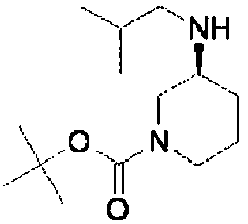
- tert-Butyl (3S)-3-aminopiperidine-1-carboxylate (5.0 g), isobutyraldehyde (2.66 ml) and acetic acid (1.72 ml) were dissolved in methanol (100 ml), and the mixture was stirred at room temperature for 10 min. To the reaction mixture was added sodium triacetoxyborohydride (13.2 g) and the mixture was stirred at room temperature for 30 min. The reaction mixture was basified with aqueous sodium hydrogen carbonate, and the mixture was extracted with ethyl acetate. The extract was washed with saturated brine, and dried over anhydrous magnesium sulfate. The solvent was evaporated under reduced pressure. A part of the residue was subjected to silica gel column chromatography, and the fraction eluted with ethyl acetate-hexane (35:65) was concentrated under reduced pressure to give the object compound (3.04 g) as an oil.
1H-NMR (CDCl3) δ 0.79-1.15 (8H, m), 1.16-1.36 (1H, m), 1.36-1.56 (11H, m), 1.58-1.80 (2H, m), 1.80-2.00 (1H, m), 2.35-2.60 (3H, m), 2.74-2.99 (1H, m), 3.68-3.91 (1H, m).
MS (ESI+, m/e) 257 (M+1) - By a method similar to that of Reference Example 61, the following compounds (Reference Examples 62 and 63) were obtained.
-
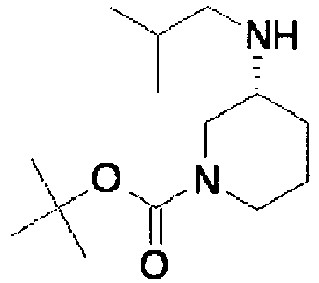
- 1H-NMR (CDCl3) δ 0.79-1.15 (8H, m), 1.16-1.36 (1H, m), 1.36-1.56 (11H, m), 1.58-1.80 (2H, m), 1.80-2.00 (1H, m), 2.35-2.60 (3H, m), 2.74-2.99 (1H, m), 3.68-3.91 (1H, m).
-

- 1H-NMR (CDCl3) δ 0.77-1.15 (8H, m), 1.16-1.37 (1H, m), 1.36-1.56 (9H, m), 1.61-1.81 (2H, m), 1.83-2.02 (1H, m), 2.34-2.59 (3H, m), 2.76-3.00 (1H, m), 3.70-3.95 (1H, m).
-

- tert-Butyl 3-piperidone-1-carboxylate (1.99 g), propylamine (0.82 ml) and acetic acid (0.57 ml) were dissolved in methanol (50 ml), and the mixture was stirred at room temperature for 1 hr. To the reaction mixture was added sodium triacetoxyborohydride (4.23 g) and the mixture was stirred at room temperature for 15 hr. The reaction mixture was basified with aqueous sodium hydrogen carbonate, and the mixture was extracted with ethyl acetate. The extract was washed with saturated brine, and dried over anhydrous sodium sulfate. The solvent was evaporated under reduced pressure. The residue was dissolved in THF (20 ml), 2 M aqueous sodium hydroxide solution (3 ml) was added, Z-chloride (2.86 ml) was added dropwise, and the mixture was stirred at room temperature for 15 hr. To the reaction mixture was added ethyl acetate, and the organic layer was separated, washed with water and saturated brine, and dried over anhydrous sodium sulfate. The solvent was evaporated under reduced pressure. The residue was subjected to silica gel column chromatography, the fraction eluted with ethyl acetate-hexane (1:9 - 1:4) was concentrated under reduced pressure and the obtained residue was dissolved in ethanol (30 ml). 10% Palladium carbon (50% containing water, 0.20 g) was added, and the mixture was stirred under a hydrogen atmosphere (1 atm) at room temperature for 16 hr. The palladium catalyst was filtered off, and the filtrate was concentrated under reduced pressure to give the object compound (2.42 g) as an oil.
1H-NMR (CDCl3) δ 0.92 (3H, t), 1.26 (1H, dd), 1.37-1.58 (2H, m), 1.46 (9H, s), 1.67 (1H, td), 1.78 (1H, br s), 1.91 (1H, dd), 2.44-2.76 (4H, m), 2.87 (1H, br s), 3.79 (2H, d). - By a method similar to that of Reference Example 64, the following compounds (Reference Examples 65 to 67) were obtained.
-

- 1H-NMR (CDCl3) δ 0.06-0.17 (2H, m), 0.41-0.54 (2H, m), 0.94 (1H, dddd), 1.28 (1H, dd), 1.46 (9H, s), 1.60-1.77 (3H, m), 1.91 (1H, dd), 2.45-2.78 (3H, m), 2.77-3.08 (1H, m), 3.78 (1H, dt), 4.00 (1H, br s).
-

- 1H-NMR (CDCl3) δ 0.90 (6H, d), 1.22-1.40 (3H, m), 1.46 (9H, s), 1.55-1.78 (2H, m), 1.90 (1H, d), 2.45 (3H, dd), 2.87 (1H, br s), 3.54-4.24 (2H, m).
-
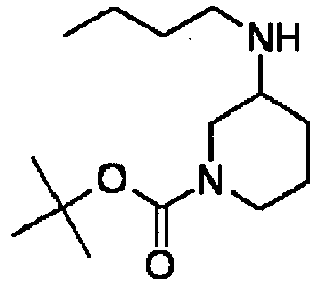
- 1H-NMR (CDCl3) δ 0.91 (3H, t), 1.20-1.42 (4H, m), 1.42-1.52 (3H, m), 1.46 (9H, s), 1.67 (1H, td), 1.78-2.04 (1H, m), 2.47-2.79 (3H, m), 2.87 (1H, br s), 3.79 (1H, d), 4.04 (1H, br s).
- By a method similar to that of Example 1, the following compounds (Reference Examples 68 and 69) were obtained.
-
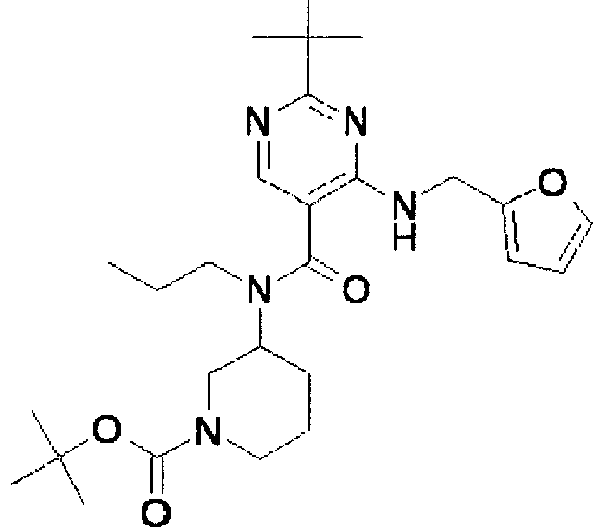
- MS (ESI+, m/e) 500 (M+1)
-

- MS (ESI+, m/e) 512 (M+1)
- By a method similar to that of Reference Example 37, the following compounds (Reference Examples 70 to 74) were obtained.
-

- MS (ESI+, m/e) 514 (M+1)
-

- MS (ESI+, m/e) 514 (M+1)
-

- MS (ESI+, m/e) 514 (M+1)
-

-
-
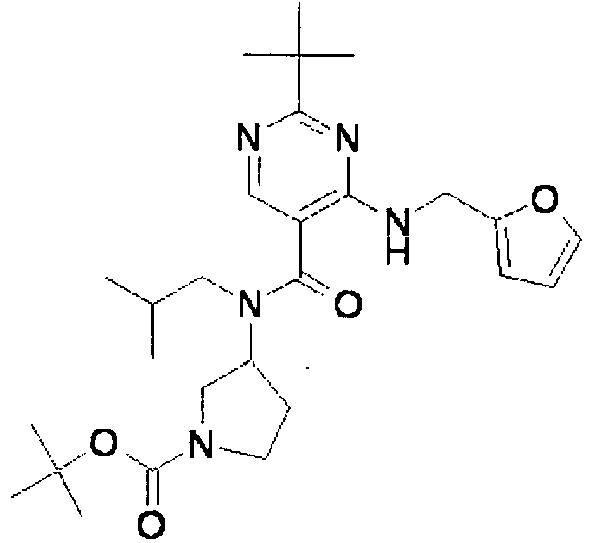
- MS (ESI+, m/e) 500 (M+1)
-

- To a solution of 1-tert-butyl 3-methyl (3R,5S)-5-{[(2-tert-butyl-4-chloropyrimidin-5-yl)carbonyl](isobutyl)amino}piperidine-1,3-dicarboxylate (0.55 g) and diisopropylethylamine (0.87 ml) in 2-propanol (5 ml) was added 2-oxazolylmethylamine hydrochloride (0.34 g), and the mixture was stirred at 80°C for 15 hr. The reaction mixture was concentrated under reduced pressure, saturated aqueous sodium hydrogen carbonate was added, and the mixture was extracted with ethyl acetate. The extract was dried over anhydrous sodium sulfate and concentrated under reduced pressure. The obtained residue was subjected to silica gel chromatography, and the fraction eluted with hexane to ethyl acetate-hexane (1:2) was concentrated under reduced pressure to give the object compound (525 mg).
MS (ESI+, m/e) 573 (M+1) -

- 1-tert-Butyl 3-methyl (3R,5S)-5-[({2-tert-butyl-4-[(1,3-oxazol-2-ylmethyl)amino]pyrimidin-5-yl}carbonyl)(2-methylpropyl)amino]piperidine-1,3-dicarboxylate (0.26 g) was dissolved in methanol (3 ml), 2 M aqueous sodium hydroxide solution (1.0 ml) was added and the mixture was stirred at room temperature for 2 hr. The reaction mixture was concentrated under reduced pressure, the residue was diluted with saturated aqueous ammonium chloride solution, and the mixture was extracted with ethyl acetate. The extract was dried over anhydrous sodium sulfate and concentrated under reduced pressure to give the object compound (0.25 g).
MS (ESI+, m/e) 559 (M+1) -

- (3R,5S)-1-(tert-Butoxycarbonyl)-5-[({2-tert-butyl-4-[(1,3-oxazol-2-ylmethyl)amino]pyrimidin-5-yl}carbonyl)(2-methylpropyl)amino]piperidine-3-carboxylic acid (125 mg), HOBt (52 mg) and WSC·HCl (64 mg) were dissolved in acetonitrile (3 ml), morpholine (20 µl) and triethylamine (94 µl) were added and the mixture was stirred at room temperature for 15 hr. The reaction mixture was diluted with saturated aqueous sodium hydrogen carbonate, and the mixture was extracted with ethyl acetate. The extract was washed with saturated brine, and dried over anhydrous sodium sulfate. The solvent was evaporated under reduced pressure and the residue was purified by silica gel column chromatography. The fraction eluted with ethyl acetate-hexane (1:9) to ethyl acetate was concentrated under reduced pressure to give the object compound (110 mg).
MS (ESI+, m/e) 628 (M+1) - By a method similar to that of Reference Example 75, the following compound (Reference Example 78) was obtained.
-
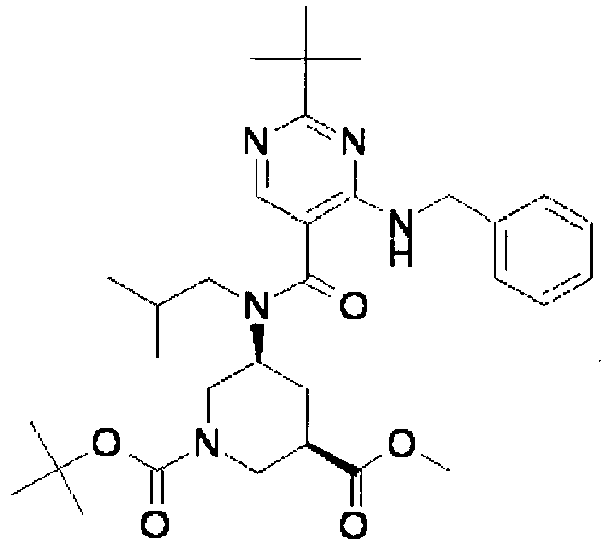
- MS (ESI+, m/e) 582 (M+1)
- By a method similar to that of Reference Example 76, the following compound (Reference Example 79) was obtained.
-
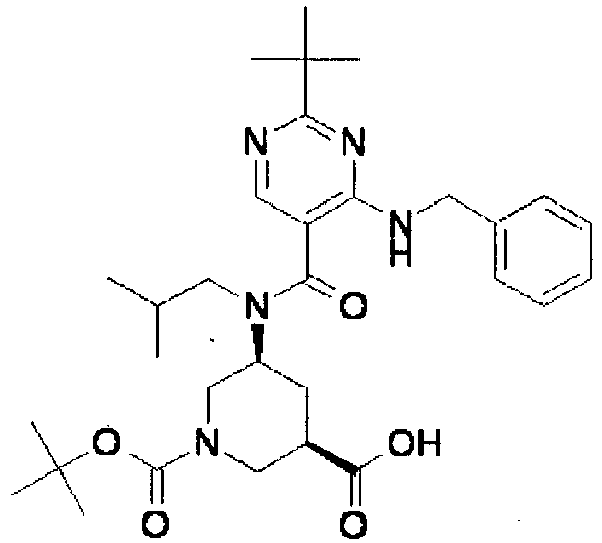
- MS (ESI+, m/e) 568 (M+1)
- By a method similar to that of Reference Example 77, the following compound (Reference Example 80) was obtained.
-

- MS (ESI+, m/e) 637 (M+1)
- By a method similar to that of the above-mentioned Example 93 (Method G) and Example 94 (Method H), the compounds of Examples 100 to 107 below were obtained. The respective compounds were isolated and purified as necessary by a known means such as phase transfer, pH conversion, solvent extraction, silica gel column chromatography, reversed-phase preparative HPLC and the like. The final products were isolated as hydrochloride as in Method G and Method H by treating with a hydrogen chloride-ethyl acetate solution.
-

- MS (ESI+, m/e) 473 (M+1)
-

- MS (ESI+, m/e) 485 (M+1)
-

- MS (ESI+, m/e) 487 (M+1)
-

- MS (ESI+, m/e) 487 (M+1)
-

- MS (ESI+, m/e) 487 (M+1)
-

- MS (ESI+, m/e) 487 (M+1)
-

- MS (ESI+, m/e) 473 (M+1)
-

- MS (ESI+, m/e) 610 (M+1)
-
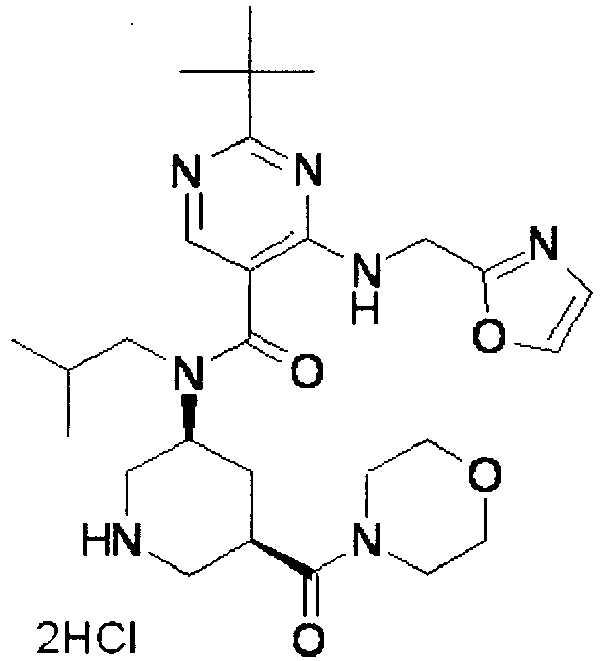
- tert-Butyl (3S,5R)-3-[({2-tert-butyl-4-[(1,3-oxazol-2-ylmethyl)amino]pyrimidin-5-yl}carbonyl)(2-methylpropyl)amino]-5-(morpholin-4-ylcarbonyl)piperidine-1-carboxylate (108 mg) was dissolved in 2 M hydrogen chloride-ethyl acetate (2 ml), and the mixture was stirred at room temperature for 16 hr. The reaction mixture was concentrated, ethyl acetate was added and the precipitate was collected by filtration and washed with ethyl acetate to give the object compound (85 mg).
MS (ESI+, m/e) 528 (M+1) -
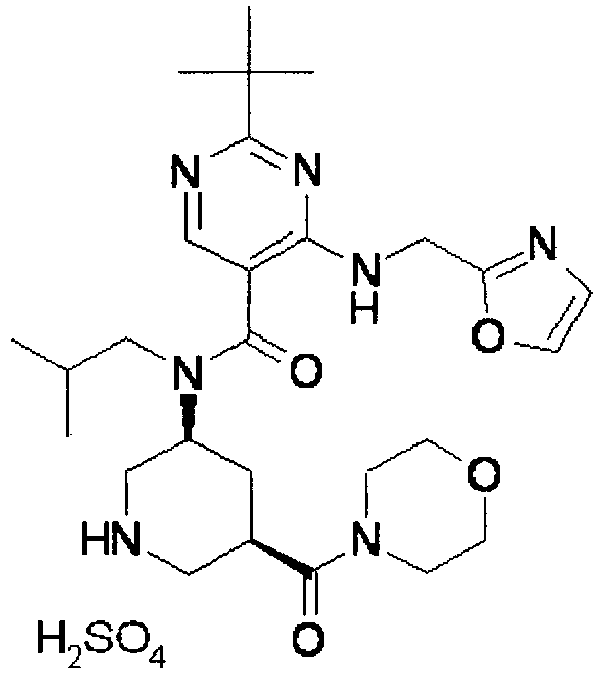
- tert-Butyl (3S,5R)-3-[({2-tert-butyl-4-[(1,3-oxazol-2-ylmethyl)amino]pyrimidin-5-yl}carbonyl)(2-methylpropyl)amino]-5-(morpholin-4-ylcarbonyl)piperidine-1-carboxylate (108 mg) was dissolved in 2 M hydrogen chloride-ethyl acetate (2 ml), and the mixture was stirred at room temperature for 16 hr. The reaction mixture was basified with saturated sodium hydrogen carbonate solution, and the mixture was extracted with ethyl acetate. The extract was dried over sodium sulfate and concentrated under reduced pressure. The residue was dissolved in ethanol (3 ml), concentrated sulfuric acid (10 µl) was added and the mixture was concentrated under reduced pressure. Ethyl acetate (5 ml) and ethanol (0.1 ml) were added to the residue and the mixture was heated to 90°C. Ethanol was added and a homogeneous solution was cooled to room temperature. The precipitate was collected by filtration to give the object compound (40 mg).
MS (ESI+, m/e) 528 (M+1) -
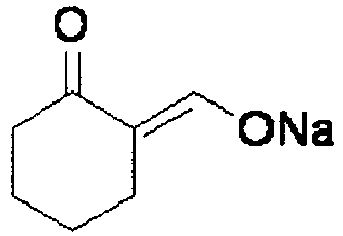
- Cyclohexanone (30 ml) and ethyl formate (24 ml) were dissolved in diethyl ether (150 ml), sodium ethoxide (21 g) was added under ice-cooling, and the reaction mixture was stirred at room temperature for 10 hr. Insoluble material was collected by filtration, and washed with diethyl ether to give the object compound (49.2 g) as a solid.
1H-NMR (D2O) δ 1.47-1.61 (4H, m), 2.06-2.16 (2H, m), 2.10 (2H, d), 8.98 (1H, s). - By a method similar to that of Reference Example 81, the following compound (Reference Example 82) was obtained.
-

- 1H-NMR (D2O) δ 0.91 (6H, s), 1.58 (2H, t), 2.25 (2H, t), 8.63 (1H, s).
-
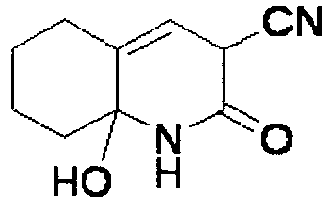
- Sodium 2-oxocyclohexylidenemethanolate (15 g), 2-cyanoacetamide (4.3 g) and piperidine (1.0 ml) were suspended in water (35 ml), and the mixture was stirred at 40°C for 4 days. Insoluble material was filtered off, and the filtrate was concentrated under reduced pressure. The residue was suspended in methanol, and insoluble material was filtered off. The filtrate was concentrated under reduced pressure to give the object compound (21.4 g).
MS (ESI+, m/e) 193 (M+1) - By a method similar to that of Reference Example 83, the following compound (Reference Example 84) was obtained.
-

- MS (ESI+, m/e) 207 (M+1)
-

- 8a-Hydroxy-2-oxo-1,2,3,5,6,7,8,8a-octahydroquinoline-3-carbonitrile (20.5 g) was suspended in concentrated hydrochloric acid (100 ml), and the mixture was stirred with heating to reflux for 12 hr. The reaction mixture was cooled to room temperature, and insoluble material was filtered off. The filtrate was applied to DIAION (registered trademark) HP-20 (manufactured by Mitsubishi Chemical Corporation), and washed with water and the fraction eluted with acetone was concentrated under reduced pressure to give the object compound (11.5 g).
MS (ESI+, m/e) 222 (M+1) - By a method similar to that of Reference Example 85, the following compound (Reference Example 86) was obtained.
-
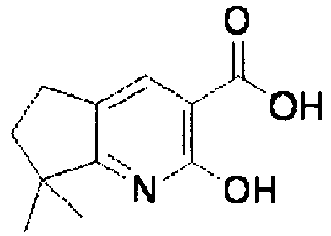
- MS (ESI+, m/e) 208 (M+1)
-
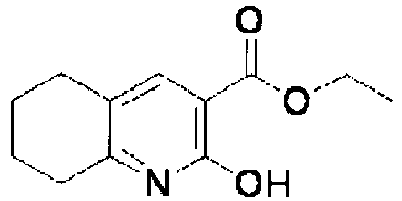
- 2-Hydroxy-7,7-dimethyl-6,7-dihydro-5H-cyclopenta[b]pyridine-3-carboxylic acid (11.0 g) was dissolved in ethanol (100 ml), sulfuric acid (3.4 ml) was added and the mixture was stirred with heating to reflux for 12 hr. The reaction mixture was concentrated under reduced pressure to a half volume, the residue was basified with 8 M aqueous sodium hydroxide solution, and the mixture was extracted with ethyl acetate. The extract was washed successively with 1 M aqueous sodium hydroxide solution and saturated brine, and dried over anhydrous magnesium sulfate. The solvent was evaporated under reduced pressure. The residue was subjected to silica gel column chromatography, and the fraction eluted with ethyl acetate-hexane (50:50 - 85:15) was concentrated under reduced pressure to give the object compound (3.45 g).
1H-NMR (CDCl3) δ 1.38 (3H, t), 1.79 (4H, dd), 2.55 (2H, t), 2.77 (2H, t,), 4.36 (2H, q), 7.99 (1H, s). - By a method similar to that of Reference Example 87, the following compound (Reference Example 88) was obtained.
-

- 1H-NMR (CDCl3) δ 1.30 (6H, s), 1.40 (3H, t), 1.98 (2H, t), 2.78 (1H, t), 4.12 (1H, d), 4.40 (2H, q), 8.01 (1H, s).
MS (ESI+, m/e) 236 (M+1) -

- Ethyl 2-hydroxy-5,6,7,8-tetrahydroquinoline-3-carboxylate (3.40 g) was dissolved in phosphorus oxychloride (30 ml), and the mixture was stirred with heating to reflux for 10 hr. The reaction mixture was concentrated under reduced pressure, saturated aqueous sodium hydrogen carbonate solution was added to the residue, and the mixture was extracted with ethyl acetate. The extract was washed with saturated brine, and dried over anhydrous magnesium sulfate. The solvent was evaporated under reduced pressure. The residue was subjected to silica gel column chromatography, and the fraction eluted with ethyl acetate-hexane (50:50 - 100:0) was concentrated under reduced pressure to give the object compound (3.68 g). MS (ESI+, m/e) 240 (M+1)
- By a method similar to that of Reference Example 89, the following compound (Reference Example 90) was obtained.
-

- MS (ESI+, m/e) 254 (M+1)
-

- A mixture of ethyl 2-chloro-5,6,7,8-tetrahydroquinoline-3-carboxylate (500 mg) and furfurylamine (3.0 ml) was stirred in a sealed tube at 130°C for 12 hr. The reaction mixture was subjected to silica gel column chromatography, and the fraction eluted with ethyl acetate-hexane (10:90 - 50:50) was concentrated under reduced pressure to give the object compound (683 mg).
MS (ESI+, m/e) 301 (M+1) - By a method similar to that of Reference Example 91, the following compound (Reference Example 92) was obtained.
-

- MS (ESI+, m/e) 315 (M+1)
-

- To a solution of ethyl 2-[(furan-2-ylmethyl)amino]-5,6,7,8-tetrahydroquinoline-3-carboxylate (600 mg) in ethanol (4 ml)-water (4 ml) was added 8 M aqueous sodium hydroxide solution (1.25 ml), and the mixture was stirred at 80°C for 10 hr. The reaction mixture was concentrated under reduced pressure to about 1/3 volume, and neutralized with 1 M hydrochloric acid, and the mixture was extracted with ethyl acetate. The extract was washed with saturated brine and dried over anhydrous magnesium sulfate. The solvent was evaporated under reduced pressure to give the object compound (522 mg).
MS (ESI+, m/e) 273 (M+1) - By a method similar to that of Reference Example 93, the following compound (Reference Example 94) was obtained.
-

- MS (ESI+, m/e) 287 (M+1)
-

- 2-[(Furan-2-ylmethyl)amino]-5,6,7,8-tetrahydroquinoline-3-carboxylic acid (520 mg) was suspended in toluene (5 ml), thionyl chloride (0.42 ml) and DMF (5 drops) were added and the mixture was stirred at 80°C for 30 min. The reaction mixture was cooled to room temperature, and concentrated under reduced pressure, and the residue was subjected to azeotropic distillation with toluene. The obtained residue was suspended in THF (5 ml), a solution of tert-butyl 3-[(2-methylpropyl)amino]piperidine-1-carboxylate (490 mg) and triethylamine (1.5 ml) in THF (2 ml) was added, and the mixture was stirred at room temperature for 12 hr. The reaction mixture was concentrated under reduced pressure, and diluted with 10% aqueous citric acid solution, and the mixture was extracted with ethyl acetate. The extract was washed with saturated brine, and dried over anhydrous magnesium sulfate. The solvent was evaporated under reduced pressure. The residue was subjected to silica gel column chromatography, and the fraction eluted with ethyl acetate-hexane (10:90 - 80:20) was concentrated under reduced pressure to give the object compound (29 mg).
MS (ESI+, m/e) 459 (M+1) -

- 2-[(Furan-2-ylmethyl)amino]-7,7-dimethyl-6,7-dihydro-5H-cyclopenta[b]pyridine-3-carboxylic acid (390 mg), tert-butyl 3-[(2-methylpropyl)amino]piperidine-1-carboxylate (350 mg) and N,N-diisopropylethylamine (1.2 ml) were dissolved in 1,2-dichloroethane (10 ml), chloro-N,N,N',N'-tetramethylformamidinium hexafluorophosphate (540 mg) was added and the mixture was stirred at room temperature for 18 hr. The reaction mixture was diluted with saturated aqueous sodium hydrogen carbonate solution and the mixture was extracted with ethyl acetate. The extract was washed with saturated brine and dried over anhydrous magnesium sulfate. The solvent was evaporated under reduced pressure. The residue was subjected to silica gel column chromatography, and the fraction eluted with ethyl acetate-hexane (5:95 - 100:10) was concentrated under reduced pressure to give the object compound (123 mg).
MS (ESI+, m/e) 525 (M+1) -

- 2,2-Dimethylcyclohexanone (3.0 g) and ethyl formate (24 ml) were dissolved in diethyl ether (20 ml), sodium ethoxide (1.75 g) was added under ice-cooling, and the reaction mixture was stirred at room temperature for 3 days, and concentrated under reduced pressure. The residue was dissolved in water (50 ml), 2-cyanoacetamide (1.80 g) and piperidine (0.20 ml) were added, and the mixture was stirred at 40°C for 16 hr. Insoluble material was filtered off, and the filtrate was concentrated under reduced pressure. The residue was suspended in 4 M aqueous sodium hydroxide solution (100 ml), and the suspension was stirred at 90°C for 14 hr. The reaction mixture was ice-cooled, neutralized with 6 M hydrochloric acid, and concentrated under reduced pressure. The residue was suspended in ethanol, insoluble material was filtered off, and the filtrate was concentrated under reduced pressure to give the object compound (2.47 g).
MS (ESI+, m/e) 222 (M+1) - By a method similar to that of Reference Example 97, the following compounds (Reference Examples 98 and 99) were obtained.
-

- MS (ESI+, m/e) 222 (M+1)
-
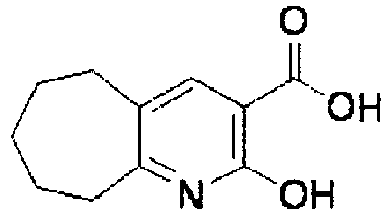
- MS (ESI+, m/e) 208 (M+1)
- By a method similar to that of Reference Example 87, the following compounds (Reference Examples 100 to 102) were obtained.
-

- MS (ESI+, m/e) 250 (M+1)
-

- MS (ESI+, m/e) 250 (M+1)
-

- MS (ESI+, m/e) 236 (M+1)
- By a method similar to that of Reference Example 89, the following compounds (Reference Examples 103 to 105) were obtained.
-
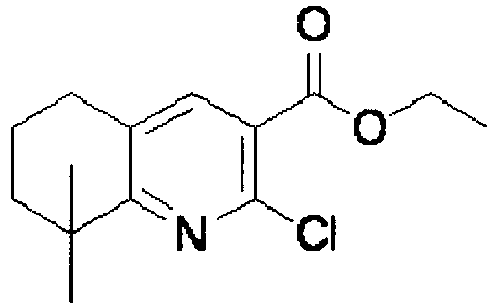
- MS (ESI+, m/e) 268 (M+1)
-

- MS (ESI+, m/e) 268 (M+1)
-
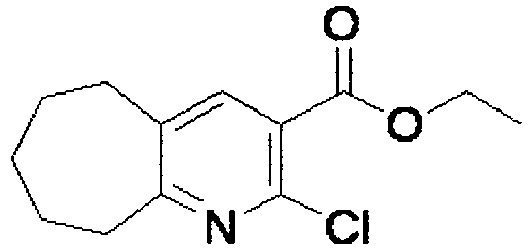
- MS (ESI+, m/e) 254 (M+1)
- By a method similar to that of Reference Example 91, the following compounds (Reference Examples 106 to 108) were obtained.
-

- MS (ESI+, m/e) 329 (M+1)
-

- MS (ESI+, m/e) 329 (M+1)
-

- MS (ESI+, m/e) 315 (M+1)
- By a method similar to that of Reference Example 93, the following compounds (Reference Examples 109 to 111) were obtained.
-
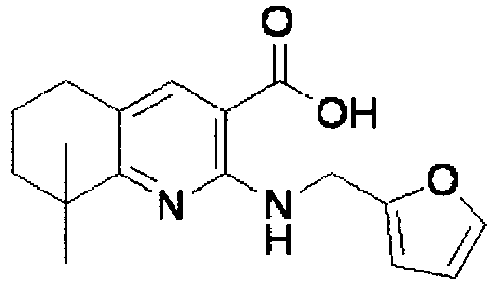
- MS (ESI+, m/e) 301 (M+1)
-
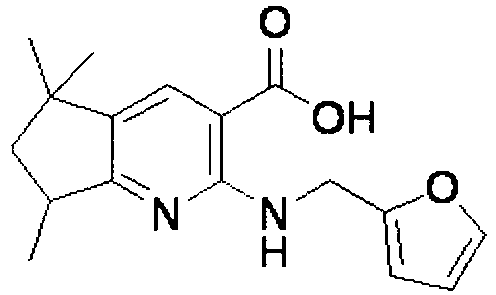
- MS (ESI+, m/e) 301 (M+1)
-

- MS (ESI+, m/e) 287 (M+1)
- By a method similar to that of Reference Example 96, the following compounds (Reference Examples 112 to 114) were obtained.
-
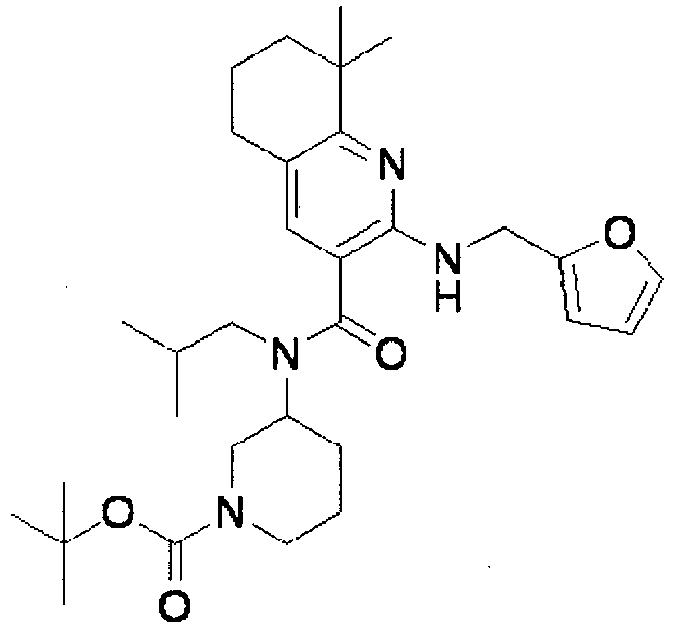
- MS (ESI+, m/e) 539 (M+1)
-

- MS (ESI+, m/e) 539 (M+1)
-

- MS (ESI+, m/e) 525 (M+1)
-
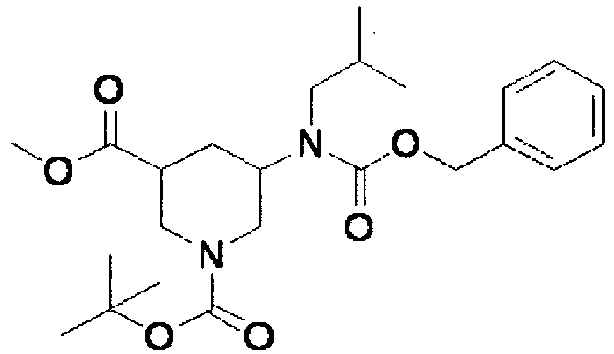
- 1-tert-Butyl 3-methyl 5-[(2-methylpropyl)amino]piperidine-1,3-dicarboxylate (13.7 g) was dissolved in ethyl acetate (250 ml)-1 M aqueous sodium hydroxide solution (55 ml)-water (200 ml), benzyl chlorocarbonate (7.5 ml) was added under ice-cooling, and the reaction mixture was stirred at room temperature for 3 days. The reaction mixture was diluted with water, and the mixture was extracted with ethyl acetate. The extract was washed with saturated brine, and dried over anhydrous magnesium sulfate. The solvent was evaporated under reduced pressure. The residue was subjected to silica gel column chromatography, and the fraction eluted with ethyl acetate-hexane (5:95 - 50:50) was concentrated under reduced pressure to give the object compound (9.87 g).
MS (ESI+, m/e) 449 (M+1) -

- A solution of 1-tert-butyl 3-methyl 5-{[(benzyloxy)carbonyl](2-methylpropyl)amino}piperidine-1,3-dicarboxylate (13.0 g) in THF (100 ml) was added to a solution of calcium chloride (6.5 g) and sodium borohydride (4.5 g) in ethanol (100 ml) under ice-cooling, and the mixture was stirred at room temperature for 2 hr. The reaction mixture was adjusted to pH 4 with 10% aqueous citric acid solution, and concentrated under reduced pressure to a half volume. The residue was extracted with ethyl acetate. The extract was washed with saturated brine, and dried over anhydrous magnesium sulfate. The solvent was evaporated under reduced pressure. The residue was subjected to silica gel column chromatography, and the fraction eluted with ethyl acetate-hexane (5:95 - 80:20) was concentrated under reduced pressure to give the object compound (8.04 g).
MS (ESI+, m/e) 421 (M+1) -

- To a solution of tert-butyl 3-{[(benzyloxy)carbonyl](2-methylpropyl)amino}-5-(hydroxymethyl)piperidine-1-carboxylate (4.6 g) and triethylamine (2.3 ml) in ethyl acetate (25 ml) was added acetyl chloride (0.94 ml) under ice-cooling, and the mixture was stirred at room temperature for 5 hr. The reaction mixture was diluted with saturated aqueous sodium hydrogen carbonate solution, and the mixture was extracted with ethyl acetate. The extract was washed with saturated brine and dried over anhydrous magnesium sulfate, and the solvent was evaporated under reduced pressure to give the object compound (5.09 g).
MS (ESI+, m/e) 463 (M+1) -

- tert-Butyl 3-[(acetyloxy)methyl]-5-{[(benzyloxy)carbonyl](2-methylpropyl)amino}piperidine-1-carboxylate (5.0 g) and palladium(II) hydroxide-carbon (500 mg) were suspended in methanol (100 ml), and the mixture was stirred under a hydrogen atmosphere (1 atm) at room temperature for 8 hr. The palladium catalyst was filtered off, and the filtrate was concentrated under reduced pressure to give the object compound (3.50 g).
1H-NMR (CDCl3) δ 0.91 (6H, d), 1.46 (9H, s), 1.69 (4H, dd,), 2.01-2.18 (4H, m), 2.25-2.42 (2H, m), 2.47 (1H, dd), 2.75 (1H, br s), 3.73 (1H, s), 3.86-4.02 (2H, m). -
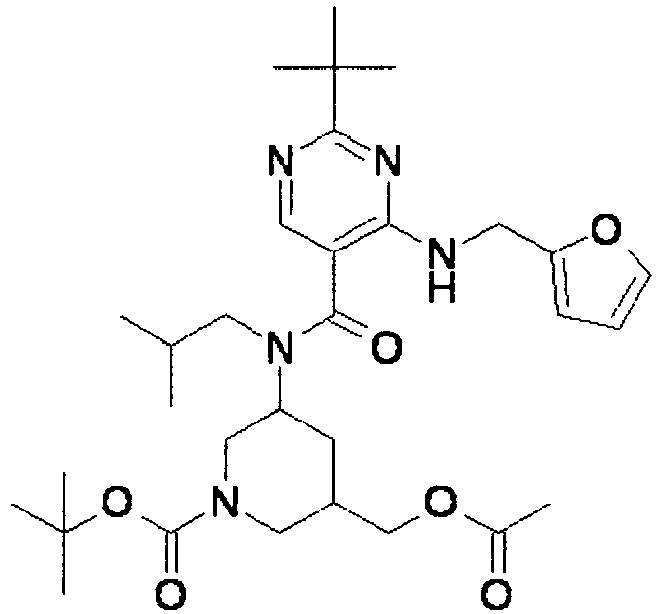
- 2-tert-Butyl-4-[(2-furylmethyl)amino]pyrimidine-5-carboxylic acid (1.00 g) was dissolved in toluene (20 ml), thionyl chloride (0.66 ml) and DMF (5 drops) were added and the mixture was stirred at 90°C for 2 hr. The reaction mixture was cooled to room temperature, and concentrated under reduced pressure, and the residue was subjected to azeotropic distillation with toluene. The obtained residue was suspended in THF (10 ml), a solution of tert-butyl 3-[(acetyloxy)methyl]-5-[(2-methylpropyl)amino]piperidine-1-carboxylate (1.00 g) and triethylamine (1.55 ml) in THF (10 ml)-1,2-dichloroethane (10 ml) was added and the mixture was stirred at room temperature for 3 hr. The reaction mixture was concentrated under reduced pressure, and diluted with water, and the mixture was extracted with ethyl acetate. The extract was washed successively with 1 M hydrochloric acid and saturated brine, and dried over anhydrous magnesium sulfate. The solvent was evaporated under reduced pressure. The residue was subjected to silica gel column chromatography, and the fraction eluted with ethyl acetate-hexane (5:95 - 70:30) was concentrated under reduced pressure to give the object compound (863 mg).
MS (ESI+, m/e) 586 (M+1) -

- To a solution of tert-butyl 3-[(acetyloxy)methyl]-5-[({2-tert-butyl-4-[(furan-2-ylmethyl)amino]pyrimidin-5-yl}carbonyl)(2-methylpropyl)amino]piperidine-1-carboxylate (780 mg) in methanol (10 ml)-water (9 ml) was added 8 M aqueous sodium hydroxide solution (0.83 ml), and the mixture was stirred at 70°C for 7 hr and extracted with ethyl acetate. The extract was washed with saturated brine, and dried over anhydrous magnesium sulfate. The solvent was evaporated under reduced pressure. The residue was subjected to silica gel column chromatography, and the fraction eluted with ethyl acetate-hexane (5:95 - 100:0) was concentrated under reduced pressure to give the object compound (709 mg).
MS (ESI+, m/e) 544 (M+1) -
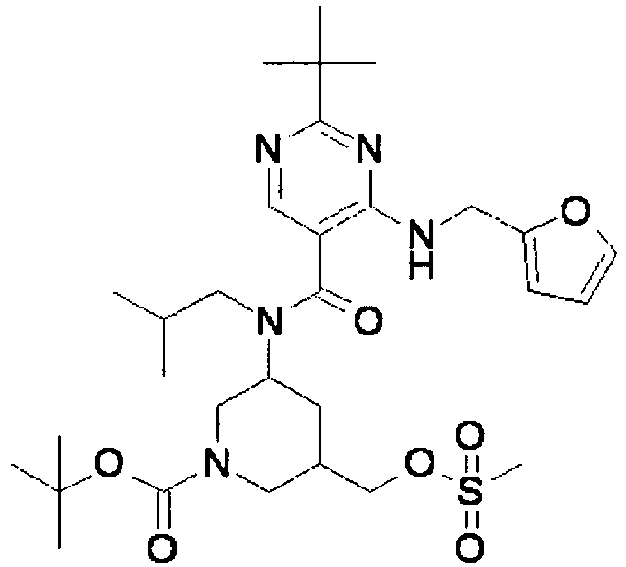
- To a solution of tert-butyl 3-[({2-tert-butyl-4-[(furan-2-ylmethyl)amino]pyrimidin-5-yl}carbonyl)(2-methylpropyl)amino]-5-(hydroxymethyl)piperidine-1-carboxylate (570 mg) and triethylamine (0.25 ml) in THF (10 ml) was added methanesulfonyl chloride (0.1 ml) under ice-cooling, and the mixture was stirred at room temperature 1 hr. Triethylamine (0.25 ml) and methanesulfonyl chloride (0.1 ml) were further added, and the mixture was stirred at room temperature for 30 min. The reaction mixture was diluted with water, and the mixture was extracted with ethyl acetate. The extract was washed with saturated brine, and dried over anhydrous magnesium sulfate and the solvent was evaporated under reduced pressure to give the object compound (624 mg).
MS (ESI+, m/e) 622 (M+1) -

- tert-Butyl 3-[({2-tert-butyl-4-[(furan-2-ylmethyl)amino]pyrimidin-5-yl}carbonyl)(2-methylpropyl)amino]-5-{[(methylsulfonyl)oxy]methyl}piperidine-1-carboxylate (100 mg) and imidazole (30 mg) were dissolved in N,N-dimethylacetamide (4 ml), cesium carbonate (130 mg) was added and the mixture was stirred at 60°C for 1 day. The reaction mixture was diluted with saturated aqueous sodium hydrogen carbonate solution, and the mixture was extracted with ethyl acetate. The extract was washed with saturated brine, and dried over anhydrous magnesium sulfate. The solvent was evaporated under reduced pressure. The residue was subjected to silica gel column chromatography, and the fraction eluted with ethyl acetate-hexane (10:90 - 100:0) was concentrated under reduced pressure to give the object compound (43.1 mg).
MS (ESI+, m/e) 594 (M+1) - By a method similar to that of Reference Example 122, the following compounds (Reference Examples 123 and 124) were obtained.
-

- MS (ESI+, m/e) 621 (M+1)
-

- MS (ESI+, m/e) 588 (M+1)
-

- tert-Butyl 3-[({2-tert-butyl-4-[(furan-2-ylmethyl)amino]pyrimidin-5-yl}carbonyl)(2-methylpropyl)amino]-5-[(ethylsulfanyl)methyl]piperidine-1-carboxylate (110 mg) was dissolved in dichloromethane (3 ml), 3-chloroperbenzoic acid (65% contained, 125 mg) was added, and the mixture was stirred at room temperature for 2 hr. The reaction mixture was diluted with saturated aqueous sodium hydrogen carbonate solution, and the mixture was extracted with ethyl acetate. The extract was washed with saturated brine, and dried over anhydrous magnesium sulfate. The solvent was evaporated under reduced pressure. The residue was subjected to silica gel column chromatography, and eluted with ethyl acetate-hexane (5:95 - 70:30). A more polar fraction was concentrated under reduced pressure to give tert-butyl (3S*,5R*)-3-[({2-tert-butyl-4-[(furan-2-ylmethyl)amino]pyrimidin-5-yl}carbonyl)(2-methylpropyl)amino]-5-[(ethylsulfonyl)methyl]piperidine-1-carboxylate (70.8 mg), and a less polar fraction was concentrated under reduced pressure to give tert-butyl (3S*,5S*)-3-[({2-tert-butyl-4-[(furan-2-ylmethyl)amino]pyrimidin-5-yl}carbonyl)(2-methylpropyl)amino]-5-[(ethylsulfonyl)methyl]piperidine-1-carboxylate (49.4 mg).
- MS (ESI+, m/e) 620 (M+1)
- MS (ESI+, m/e) 620 (M+1)
-

- To a solution of tert-butyl 3-[({2-tert-butyl-4-[(furan-2-ylmethyl)amino]pyrimidin-5-yl}carbonyl)(2-methylpropyl)amino]-5-(hydroxymethyl)piperidine-1-carboxylate (420 mg) and triethylamine (0.87 ml) in DMSO (6 ml) was added dropwise a solution of sulfur trioxide pyridine complex (500 mg) in DMSO (5 ml) at room temperature, and the mixture was stirred at room temperature for 10 hr. The reaction mixture was diluted with water, and the mixture was extracted with ethyl acetate. The extract was washed with saturated brine, and dried over anhydrous magnesium sulfate. The solvent was evaporated under reduced pressure. The residue was subjected to silica gel column chromatography, and the fraction eluted with ethyl acetate-hexane (5:95 - 70:30) was concentrated under reduced pressure to give the object compound (382 mg).
MS (ESI+, m/e) 542 (M+1) -

- tert-Butyl 3-[({2-tert-butyl-4-[(furan-2-ylmethyl)amino]pyrimidin-5-yl}carbonyl)(2-methylprop yl)amino]-5-formylpiperidine-1-carboxylate (90 mg) and acetic acid (0.5 ml) were dissolved in 1,2-dichloroethane (4 ml), sodium triacetoxyborohydride (90 mg) was added and the mixture was stirred at room temperature for 7 hr. The reaction mixture was concentrated under reduced pressure, and the concentrated solution was basified with aqueous sodium hydrogen carbonate, and the mixture was extracted with ethyl acetate. The extract was washed with water and saturated brine, and dried over anhydrous magnesium sulfate. The solvent was evaporated under reduced pressure. The residue was subjected to silica gel column chromatography, and eluted with ethyl acetate-hexane (10:90 - 100:0). A more polar fraction was concentrated under reduced pressure to give tert-butyl (3S*,5S*)-3-[({2-tert-butyl-4-[(furan-2-ylmethyl)amino]pyrimidin-5-yl}carbonyl)(2-methylpropyl)amino]-5-(morpholin-4-ylmethyl)piperidine-1-carboxylate (33.6 mg), and a less polar fraction was concentrated under reduced pressure to give tert-butyl (3S*,5R*)-3-[({2-tert-butyl-4-[(furan-2-ylmethyl)amino]pyrimidin-5-yl}carbonyl)(2-methylpropyl)amino]-5-(morpholin-4-ylmethyl)piperidine-1-carboxylate (45.5 mg).
- MS (ESI+, m/e) 613 (M+1)
- MS (ESI+, m/e) 613 (M+1)
- By a method similar to that of Reference Example 40, the following compound (Reference Example 128) was obtained.
-

- MS (ESI+, m/e) 613 (M+1)
-
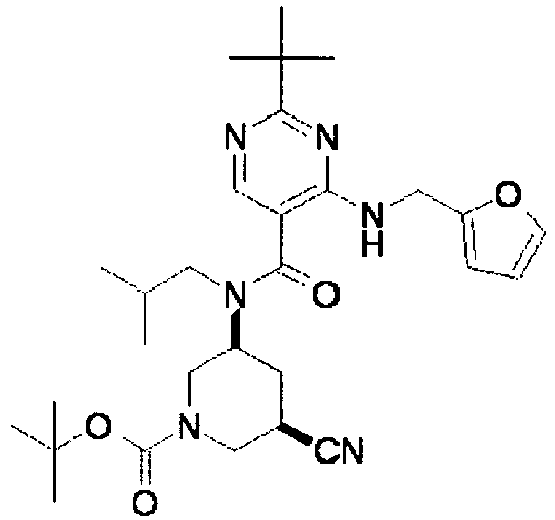
- tert-Butyl (3R*,5S*)-3-(aminocarbonyl)-5-[({2-tert-butyl-4-[(2-furylmethyl)amino]pyrimidin-5-yl}carbonyl)(isobutyl)amino]piperidine-1-carboxylate (469 mg) was dissolved in pyridine (5 ml), trifluoroacetic anhydride (0.25 ml) was added under ice-cooling, and the mixture was stirred at room temperature for 11 hr. The reaction mixture was concentrated under reduced pressure, and the residue was diluted with ethyl acetate. The solution was washed successively with 1 M hydrochloric acid and saturated brine, and dried over anhydrous magnesium sulfate. The solvent was evaporated under reduced pressure. The residue was subjected to silica gel column chromatography, and the fraction eluted with ethyl acetate-hexane (5:95 - 80:20) was concentrated under reduced pressure to give the object compound (402 mg).
MS (ESI+, m/e) 539 (M+1) -
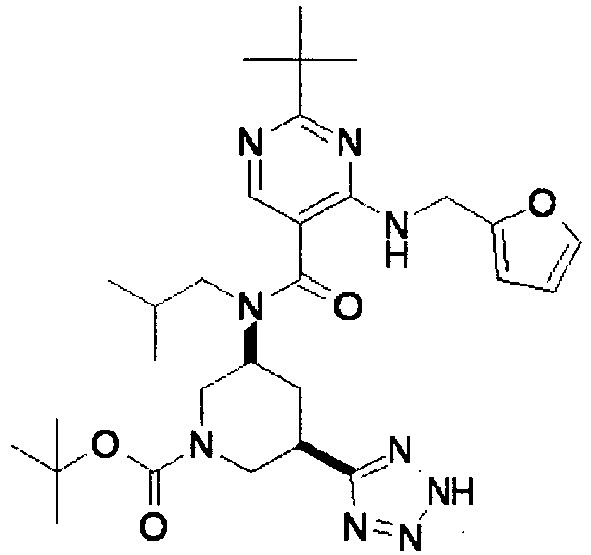
- To tert-butyl (3S*,5R*)-3-[({2-tert-butyl-4-[(furan-2-ylmethyl)amino]pyrimidin-5-yl}carbonyl)(2-methylpropyl)amino]-5-cyanopiperidine-1-carboxylate (120 mg) were added azido(trimethyl)silane (55 mg) and dibutyl(oxo)stannane (5 mg), and the mixture was stirred with heating to reflux for 1 day. The reaction mixture was concentrated under reduced pressure, and the residue was subjected to silica gel column chromatography, and the fraction eluted with ethyl acetate-hexane (10:90 - 100:0) was concentrated under reduced pressure to give the object compound (75.5 mg).
MS (ESI+, m/e) 582 (M+1) -

- Hydroxylamine hydrochloride (35 mg) was dissolved in THF (3 ml)-methanol (3 ml), triethylamine (0.07 ml) was added, and the mixture was stirred at room temperature for 1 hr. A solution of tert-butyl (3S*,5R*)-3-[({2-tert-butyl-4-[(furan-2-ylmethyl)amino]pyrimidin-5-yl}carbonyl)(2-methylpropyl)amino]-5-(2H-tetrazol-5-yl)piperidine-1-carboxylate (120 mg) in THF (3 ml) was further added, and the mixture was stirred at 60°C for 3 hr. The reaction mixture was allowed to cool to room temperature, and diluted with water, and the mixture was extracted with ethyl acetate. The extract was dried over anhydrous magnesium sulfate, and concentrated under reduced pressure, and the residue was dissolved in tetrahydrofuran (5 ml). 1,1'-Carbonylbis(1H-imidazole) (72 mg) and 1,8-diazabicyclo[5.4.0]undec-7-ene (0.066 ml) were added and the mixture was stirred at room temperature for 30 min. The reaction mixture was concentrated under reduced pressure, diluted with ethyl acetate, washed with 0.5 M hydrochloric acid and saturated brine, and dried over anhydrous magnesium sulfate. The solution was concentrated under reduced pressure, and the residue was subjected to silica gel chromatography. The fraction eluted with ethyl acetate-hexane (10:95) to ethyl acetate was concentrated under reduced pressure to give the object compound (26.1 mg).
MS (ESI+, m/e) 598 (M+1) -

- Hydroxylamine hydrochloride (35 mg) was dissolved in THF (3 ml)-methanol (3 ml), triethylamine (0.07 ml) was added, and the mixture was stirred at room temperature for 1 hr. A solution of tert-butyl (3S*,5R*)-3-[({2-tert-butyl-4-[(furan-2-ylmethyl)amino]pyrimidin-5-yl}carbonyl)(2-methylpropyl)amino]-5-(2H-tetrazol-5-yl)piperidine-1-carboxylate (120 mg) in THF (3 ml) was further added, and the mixture was stirred at 60°C for 3 hr. The reaction mixture was allowed to cool to room temperature, and diluted with water, and the mixture was extracted with ethyl acetate. The extract was dried over anhydrous magnesium sulfate, and concentrated under reduced pressure. The obtained residue was dissolved in trimethyl orthoformate (5 ml), 4-methylbenzenesulfonic acid (20 mg) was added and the mixture was stirred at 100°C for 10 hr. The reaction mixture was concentrated under reduced pressure, and the residue was subjected to silica gel chromatography. The fraction eluted with ethyl acetate-hexane (5:95 - 50:50) was concentrated under reduced pressure to give the object compound (72.6 mg).
MS (ESI+, m/e) 582 (M+1) -

- (3R*,5S*)-1-(tert-Butoxycarbonyl)-5-[({2-tert-butyl-4-[(2-furylmethyl)amino]pyrimidin-5-yl}carbonyl)(isobutyl)amino]piperidine-3-carboxylic acid (120 mg) and 5-methyl-1H-tetrazole (22 mg) were suspended in toluene (3 ml), DCC (60 mg) was added and the mixture was stirred at 100°C for 14 hr. The reaction mixture was cooled to room temperature, and concentrated under reduced pressure. The residue was subjected to silica gel column chromatography, and the fraction eluted with ethyl acetate-hexane (5:95 - 75:25) was concentrated under reduced pressure to give the object compound (74.7 mg).
MS (ESI+, m/e) 596 (M+1) - By a method similar to that of Reference Example 133, the following compound (Reference Example 134) was obtained.
-

- MS (ESI+, m/e) 658 (M+1)
-

- 1-tert-Butyl 3-methyl (3R*,5S*)-5-[({2-tert-butyl-4-[(2-furylmethyl)amino]pyrimidin-5-yl}carbonyl)(isobutyl)amino]piperidine-1,3-dicarboxylate (3.00 g) was optically resolved by normal phase chiral HPLC under the following conditions.
- Column: CHIRALPAK AD 50 mmID x 500 mmL
- Mobile phase: hexane-ethanol (97:3)
- Flow rate: 85 ml/min
- Temperature: 30°C
- Detection: UV (220 nm)
- Injection amount (concentration): 100 mg/load (5 mg/ml)
- By a method similar to that of Reference Example 38, the following compounds (Reference Examples 136 and 137) were obtained.
-

- MS (ESI+, m/e) 558 (M+1)
-

- MS (ESI+, m/e) 558 (M+1)
- By a method similar to that of Reference Example 39, the following compounds (Reference Examples 138 and 139) were obtained.
-

- MS (ESI+, m/e) 557 (M+1)
-

- MS (ESI+, m/e) 557 (M+1)
-
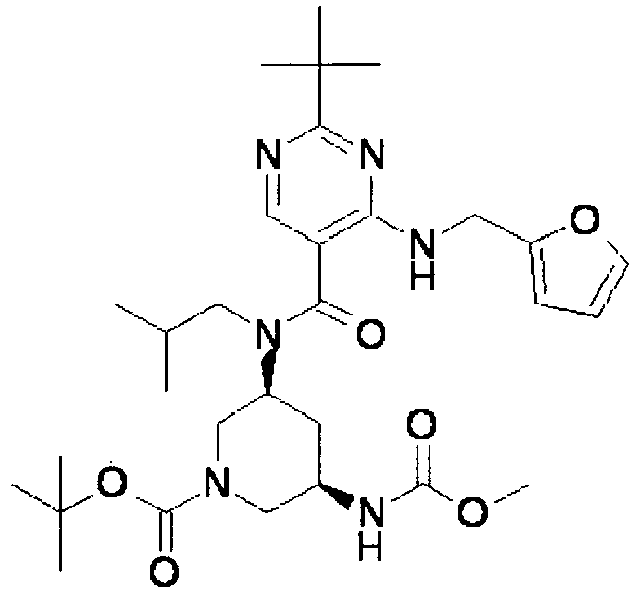
- (3R,5S)-1-(tert-Butoxycarbonyl)-5-[({2-tert-butyl-4-[(furan-2-ylmethyl)amino]pyrimidin-5-yl}carbonyl)(2-methylpropyl)amino]piperidine-3-carboxylic acid (100 mg) was suspended in toluene (5 ml), diphenylphosphoryl azide (60 µl) and triethylamine (40 µl) were added and the mixture was stirred at 100°C for 2 hr. The reaction mixture was cooled to room temperature, methanol (40 µl) and triethylamine (140 µl) were added and the mixture was stirred at 80°C for 4 hr. The reaction mixture was washed with water, 5% aqueous citric acid solution, saturated aqueous sodium hydrogen carbonate and saturated brine in this order, and dried over anhydrous sodium sulfate. The solvent was evaporated under reduced pressure. The residue was subjected to silica gel column chromatography, and the fraction eluted with ethyl acetate-hexane (5:95 - 65:35) was concentrated under reduced pressure to give the object compound (24.2 mg).
MS (ESI+, m/e) 587 (M+1) - By a method similar to that of Reference Example 140, the following compounds (Reference Examples 141 and 142) were obtained.
-

- MS (ESI+, m/e) 663 (M+1)
-

- MS (ESI+, m/e) 705 (M+1)
-

- tert-Butyl (3S,5R)-3-[({2-tert-butyl-4-[(furan-2-ylmethyl)amino]pyrimidin-5-yl}carbonyl)(2-methylpropyl)amino]-5-{[(2,2,2-trichloroethoxy)carbonyl]amino}piperidine-1-carboxylate (98.0 mg) and N,N-diisopropylethylamine (120 µl) were dissolved in N,N-dimethylacetamide (3 ml), morpholine (20 µl) was added, and the mixture was stirred at 80°C for 1 day. The reaction mixture was diluted with 1 M hydrochloric acid, and the mixture was extracted with ethyl acetate. The extract was washed with saturated brine, and dried over anhydrous magnesium sulfate. The solvent was evaporated under reduced pressure. The residue was subjected to silica gel column chromatography, and the fraction eluted with ethyl acetate-hexane (10:90 - 100:0) was concentrated under reduced pressure to give the object compound (12.7 mg).
MS (ESI+, m/e) 642 (M+1) -

- To a solution of tert-butyl (3S,5R)-3-[({2-tert-butyl-4-[(furan-2-ylmethyl)amino]pyrimidin-5-yl}carbonyl)(2-methylpropyl)amino]-5-{[(2,2,2-trichloroethoxy)carbonyl]amino}piperidine-1-carboxylate (312 mg) in ethanol (5 ml) was added 4 M aqueous sodium hydroxide solution (3 ml), and the mixture was stirred at 80°C for 1 day. The reaction mixture was diluted with water, and the mixture was extracted with ethyl acetate. The extract was washed with saturated brine, and dried over anhydrous magnesium sulfate, and the solvent was evaporated under reduced pressure to give the object compound (211 mg).
MS (ESI+, m/e) 529 (M+1) -

- To a solution of tert-butyl (3R,5S)-3-amino-5-[({2-tert-butyl-4-[(furan-2-ylmethyl)amino]pyrimidin-5-yl}carbonyl)(2-methylpropyl)amino]piperidine-1-carboxylate (70 mg) in 1,2-dichloroethane (3 ml) were successively added triethylamine (55 µl) and acetic anhydride (35 µl), and the mixture was stirred at room temperature for 3 hr. The reaction mixture was acidified with 1 M hydrochloric acid, and the mixture was extracted with ethyl acetate. The extract was washed with saturated brine, and dried over anhydrous magnesium sulfate. The solvent was evaporated under reduced pressure. The residue was subjected to silica gel column chromatography, and the fraction eluted with ethyl acetate-hexane-methanol (50:50:0 - 85:0:15) was concentrated under reduced pressure to give the object compound (28.5 mg).
MS (ESI+, m/e) 571 (M+1) - By a method similar to that of Reference Example 40, the following compounds (Reference Examples 146 and 147) were obtained.
-

- MS (ESI+, m/e) 641 (M+1)
-
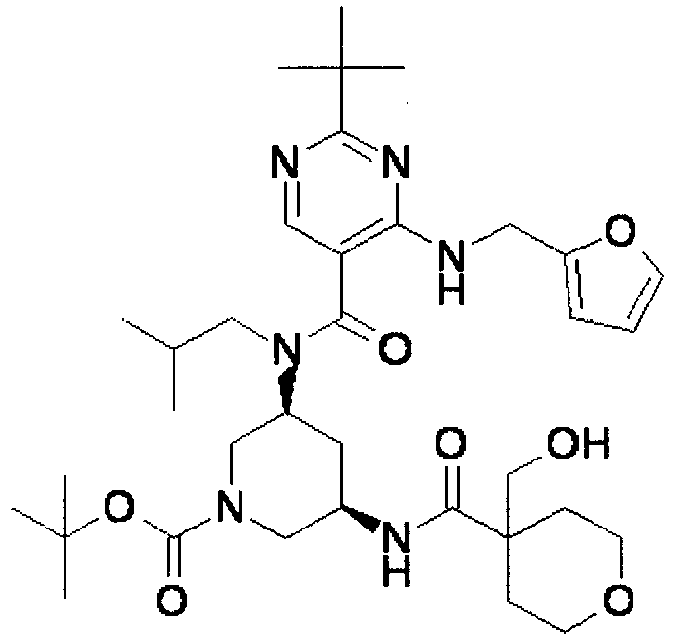
- MS (ESI+, m/e) 671 (M+1)
-

- tert-Butyl (3R,5S)-3-[({2-tert-butyl-4-[(furan-2-ylmethyl)amino]pyrimidin-5-yl}carbonyl)(2-methylpropyl)amino]-5-carbamoylpiperidine-1-carboxylate (83.0 mg) was dissolved in N,N-dimethylformamide dimethyl acetal (2.5 ml), and the mixture was stirred at 100°C for 4 hr. The reaction mixture was concentrated under reduced pressure, and the residue was dissolved in acetic acid (5 ml). Hydrazine monohydrate (20 µl) was added and the mixture was stirred at 80°C for 2 hr. The reaction mixture was concentrated under reduced pressure, the residue was diluted with 1 M aqueous sodium hydroxide solution, and the mixture was extracted with ethyl acetate. The extract was washed with saturated brine, and dried over anhydrous magnesium sulfate. The solvent was evaporated under reduced pressure. The residue was subjected to silica gel column chromatography, and the fraction eluted with ethyl acetate to ethyl acetate-methanol (9:1) was concentrated under reduced pressure to give the object compound (50.0 mg).
MS (ESI+, m/e) 581 (M+1) - By a method similar to that of Reference Example 48, the following compounds (Reference Examples 149 and 150) were obtained.
-

- MS (ESI+, m/e) 562 (M+1)
-

- MS (ESI+, m/e) 580 (M+1)
- By a method similar to that of Reference Example 38, the following compounds (Reference Examples 151 and 152) were obtained.
-
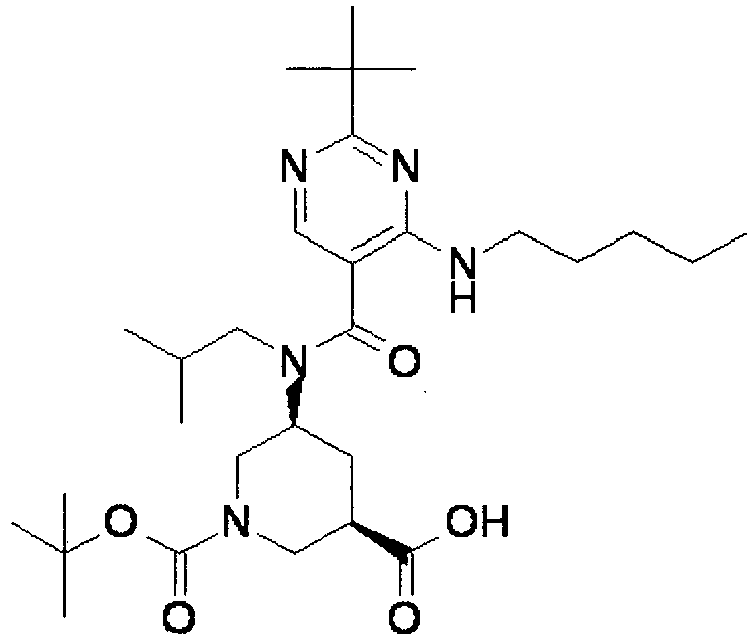
- MS (ESI+, m/e) 548 (M+1)
-

- MS (ESI+, m/e) 566 (M+1)
- By a method similar to that of Reference Example 50, the following compounds (Reference Examples 153 to 156) were obtained.
-

- MS (ESI+, m/e) 547 (M+1)
-

- MS (ESI+, m/e) 617 (M+1)
-
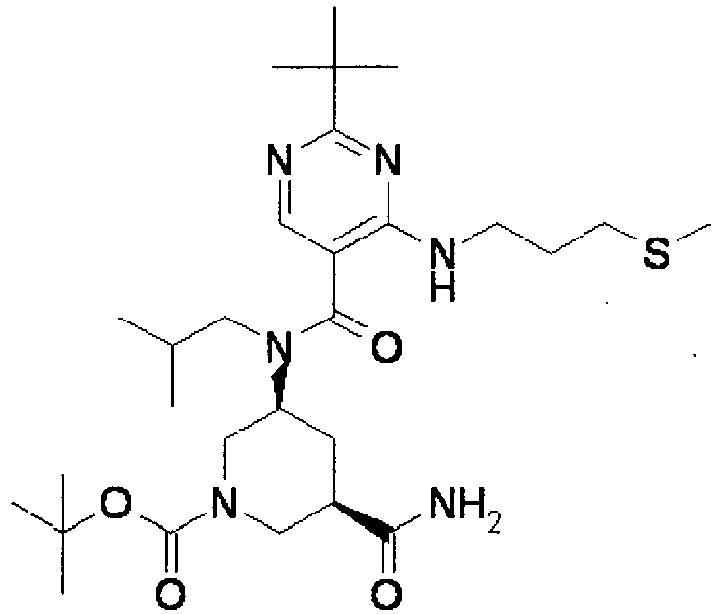
- MS (ESI+, m/e) 565 (M+1)
-
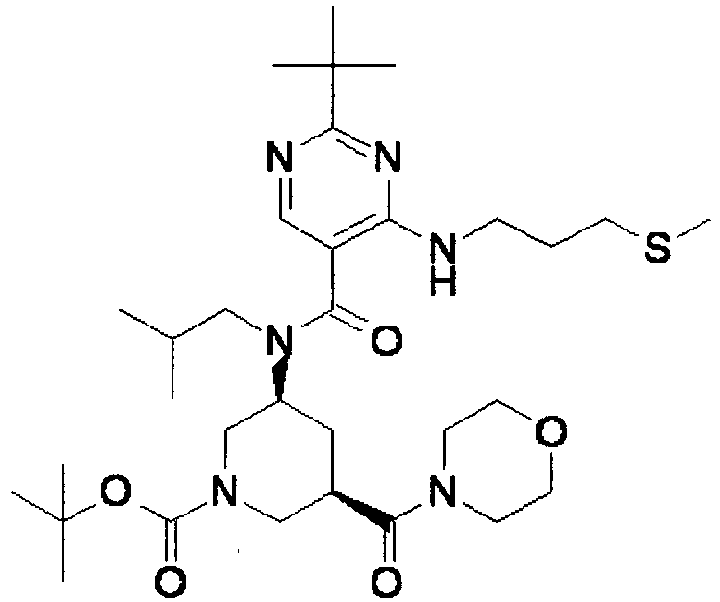
- MS (ESI+, m/e) 635 (M+1)
-

- 1-tert-Butyl 3-methyl (3R,5S)-5-{[(2-tert-butyl-4-{[3-(methylsulfanyl)propyl]amino}pyrimidin-5-yl)carbonyl](2-methylpropyl)aminolpiperidine-1,3-dicarboxylate (150 mg) was dissolved in 1,2-dichloroethane (3 ml), 3-chloroperbenzoic acid (65% contained, 70 mg) was added, and the mixture was stirred at room temperature for 2 hr. The reaction mixture was diluted with saturated aqueous sodium hydrogen carbonate solution, and the mixture was extracted with ethyl acetate. The extract was washed with saturated brine, and dried over anhydrous magnesium sulfate. The solvent was evaporated under reduced pressure. The residue was subjected to silica gel column chromatography, eluted with ethyl acetate-hexane (10:90 - 85:15) and concentrated under reduced pressure to give the object compound (113 mg).
MS (ESI+, m/e) 596 (M+1) - By a method similar to that of Reference Example 38, the following compound (Reference Example 158) was obtained.
-
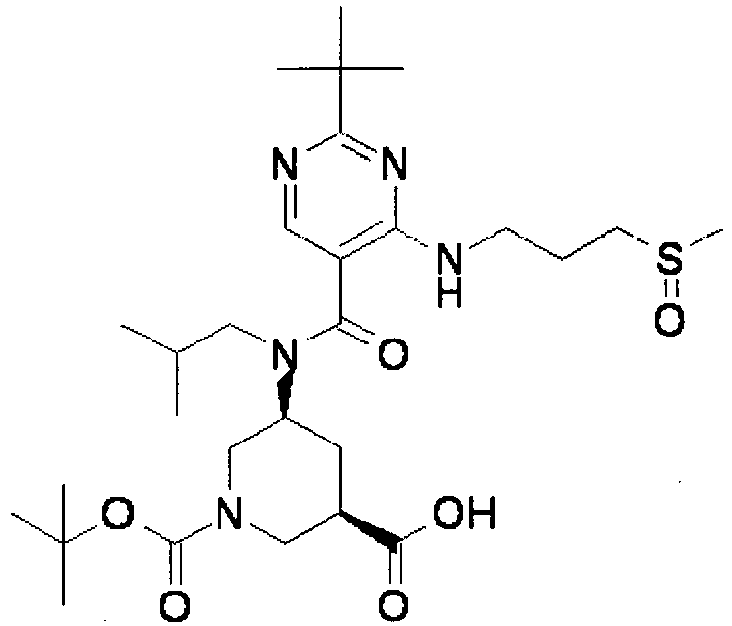
- MS (ESI+, m/e) 582 (M+1)
- By a method similar to that of Reference Example 50, the following compound (Reference Example 159) was obtained.
-

- MS (ESI+, m/e) 651 (M+1)
- By a method similar to that of Reference Example 148, the following compound (Reference Example 160) was obtained.
-
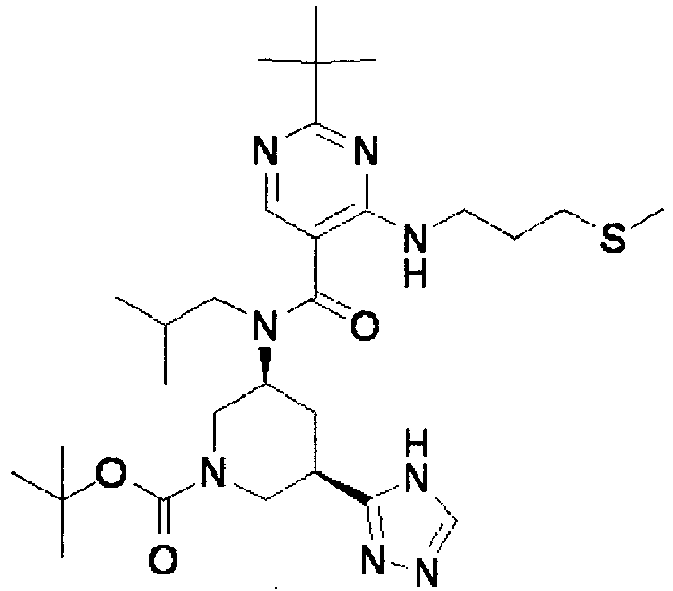
- MS (ESI+, m/e) 589 (M+1)
- By a method similar to that of Reference Example 40, the following compounds (Reference Examples 161 to 163) were obtained.
-
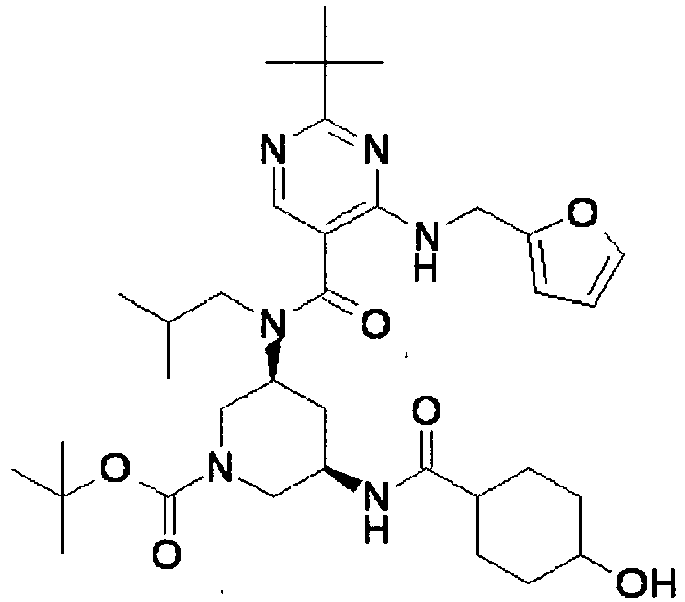
- MS (ESI+, m/e) 655 (M+1)
-
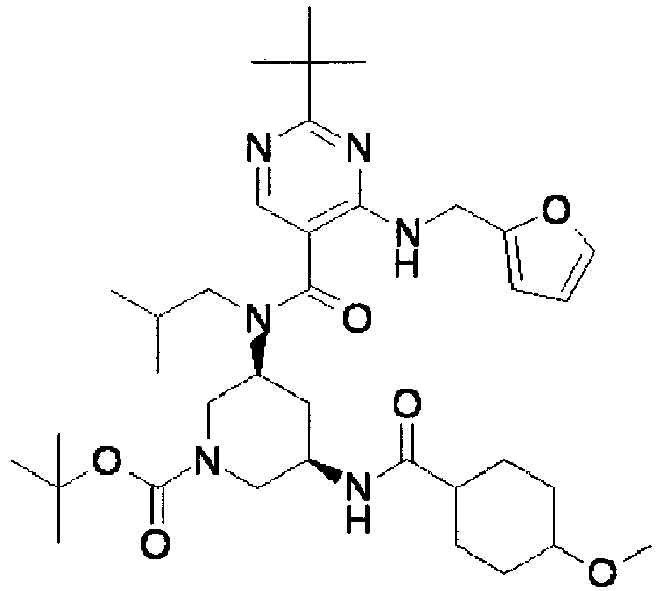
- MS (ESI+, m/e) 669 (M+1)
-

- MS (ESI+, m/e) 683 (M+1)
- By a method similar to that of Reference Example 140, the following compound (Reference Example 164) was obtained.
-
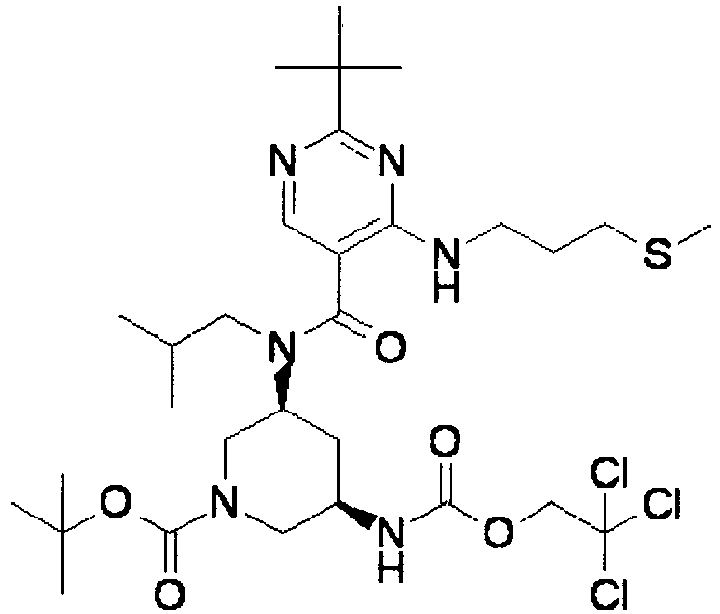
- MS (ESI+, m/e) 713 (M+1)
- By a method similar to that of Reference Example 144, the following compound (Reference Example 165) was obtained.
-

- MS (ESI+, m/e) 537 (M+1)
-

- tert-Butyl (3R,5S)-3-amino-5-{[(2-tert-butyl-4-{[3-(methylsulfanyl)propyl]amino}pyrimidin-5-yl)carbonyl](2-methylpropyl)amino}piperidine-1-carboxylate (124 mg) was dissolved in THF (4 ml), chloroethyl isocyanate (24 µl) was added, and the mixture was stirred at room temperature for 1 hr. Potassium tert-butoxide (40 mg) was added and the reaction mixture was stirred at room temperature for 7 hr and further at 60°C for 5 hr. The reaction mixture was diluted with water, and the mixture was extracted with ethyl acetate. The extract was washed with saturated brine, and dried over anhydrous magnesium sulfate. The solvent was evaporated under reduced pressure. The residue was subjected to silica gel column chromatography, eluted with ethyl acetate-hexane (10:90 - 100:0) and concentrated under reduced pressure to give the object compound (70.3 mg).
MS (ESI+, m/e) 606 (M+1) - By a method similar to that of Reference Example 48, the following compounds (Reference Examples 167 and 168) were obtained.
-
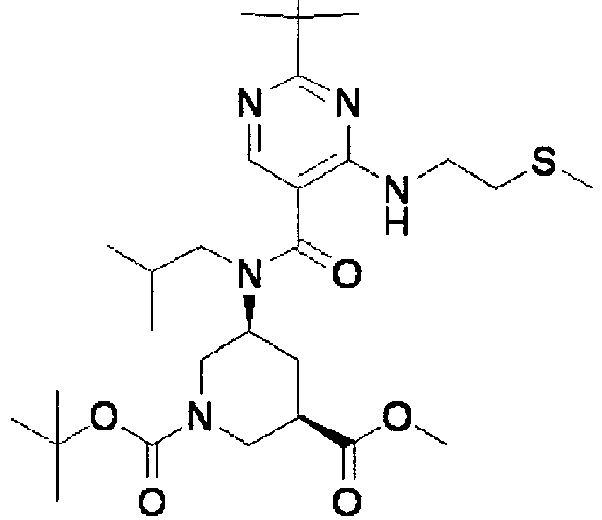
- MS (ESI+, m/e) 566 (M+1)
-

- MS (ESI+, m/e) 580 (M+1)
- By a method similar to that of Reference Example 125, the following compound (Reference Example 169) was obtained.
-

- MS (ESI+, m/e) 612 (M+1)
- By a method similar to that of Reference Example 38, the following compounds (Reference Examples 170 to 172) were obtained.
-
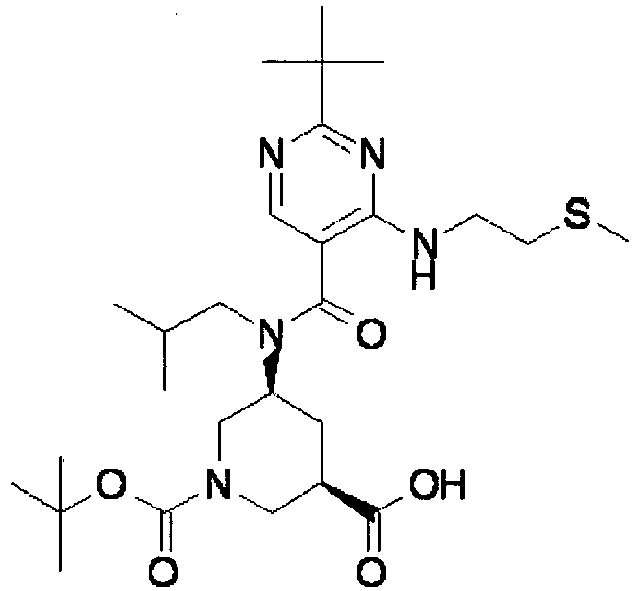
- MS (ESI+, m/e) 552 (M+1)
-

- MS (ESI+, m/e) 566 (M+1)
-

- MS (ESI+, m/e) 598 (M+1)
- By a method similar to that of Reference Example 50, the following compounds (Reference Examples 173 to 175) were obtained.
-

- MS (ESI+, m/e) 621 (M+1)
-

- MS (ESI+, m/e) 635 (M+1)
-
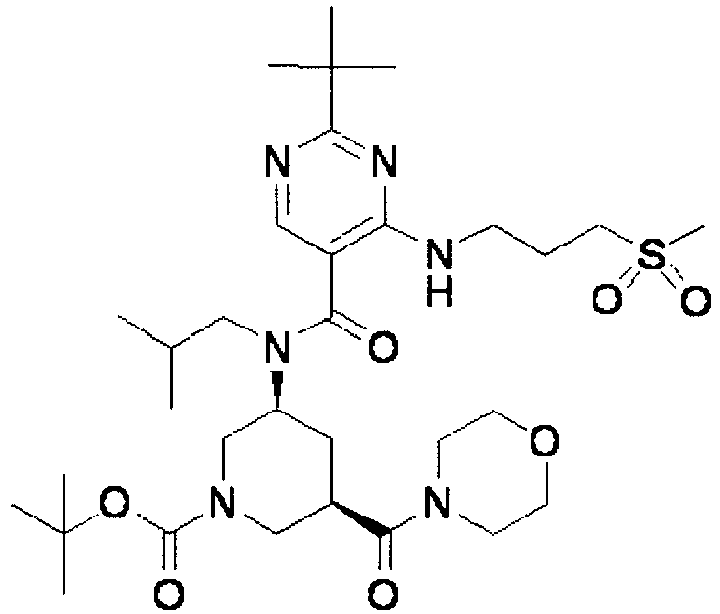
- MS (ESI+, m/e) 667 (M+1)
-

- To a solution of tert-butyl (3S,5R)-3-{[(2-tert-butyl-4-{[3-(methylsulfanyl)propyl]amino}pyrimidin-5-yl)carbonyl](2-methylpropyl)amino}-5-{[(2,2,2-trichloroethoxy)carbonyl]amino}piperidine-1-carboxylate (1.12 g) in ethanol (10 ml) was added 4 M aqueous sodium hydroxide solution (10 ml), and the mixture was stirred at 80°C for 12 hr. The reaction mixture was diluted with water, and the mixture was extracted with ethyl acetate. The extract was washed with saturated brine, and dried over anhydrous magnesium sulfate. The solvent was evaporated under reduced pressure. The residue was subjected to silica gel column chromatography, eluted with ethyl acetate-hexane (10:90 - 85:15) and concentrated under reduced pressure to give the object compound (119 mg).
MS (ESI+, m/e) 609 (M+1) -

- To a solution of tert-butyl (3R,5S)-3-amino-5-{[(2-tert-butyl-4-{[3-(methylsulfanyl)propyl]amino}pyrimidin-5-yl)carbonyl](2-methylpropyl)amino}piperidine-1-carboxylate (100 mg) in 1,2-dichloroethane (4 ml) were successively added triethylamine (40 µl) and methanesulfonyl chloride (18 µl), and the mixture was stirred at room temperature for 3 hr. The reaction mixture was diluted with water, and the mixture was extracted with ethyl acetate. The extract was washed with saturated brine, and dried over anhydrous magnesium sulfate. The solvent was evaporated under reduced pressure. The residue was subjected to silica gel column chromatography, and the fraction eluted with ethyl acetate-hexane (10:90 - 100:0) was concentrated under reduced pressure to give the object compound (51.7 mg).
MS (ESI+, m/e) 615 (M+1) - By a method similar to that of Reference Example 177, the following compounds (Reference Examples 178 and 179) were obtained.
-

- MS (ESI+, m/e) 677 (M+1)
-

- MS (ESI+, m/e) 686 (M+1)
-

- To a solution of tert-butyl (3R,5S)-3-amino-5-{[(2-tert-butyl-4-{[3-(methylsulfanyl)propyl]amino}pyrimidin-5-yl)carbonyl](2-methylpropyl)amino}piperidine-1-carboxylate (97 mg) and N,N-dimethylpyridin-4-amine (33 mg) in 1,2-dichloroethane (4 ml) was added a solution of 4-nitrophenyl chlorocarbonate (55 mg) in 1,2-dichloroethane (1 ml) under ice-cooling and the mixture was stirred at room temperature for 1 hr. Ethylamine (2 M solution in THF, 450 µl) was added, and the reaction mixture was stirred at room temperature for 2 hr. The reaction mixture was diluted with saturated aqueous sodium hydrogen carbonate solution, and the mixture was extracted with ethyl acetate. The extract was washed with saturated brine, and dried over anhydrous magnesium sulfate. The solvent was evaporated under reduced pressure. The residue was subjected to silica gel column chromatography, and the fraction eluted with ethyl acetate-hexane (10:90 - 100:0) was concentrated under reduced pressure to give the object compound (95.9 mg).
MS (ESI+, m/e) 608 (M+1) - By a method similar to that of Reference Example 180, the following compound (Reference Example 181) was obtained.
-

- MS (ESI+, m/e) 656 (M+1)
-

- tert-Butyl (3R,5S)-3-amino-5-{[(2-tert-butyl-4-{[3-(methylsulfanyl)propyl]amino}pyrimidin-5-yl)carbonyl](2-methylpropyl)amino}piperidine-1-carboxylate (97 mg) was dissolved in 1,2-dichloroethane (2 ml)-THF (2 ml), chloropropyl isocyanate (25 µl) was added, and the mixture was stirred at room temperature for 1 hr. Potassium tert-butoxide (30 mg) was added and the reaction mixture was stirred at room temperature for 8 hr, and further at 60°C for 12 hr. The reaction mixture was diluted with water, and the mixture was extracted with ethyl acetate. The extract was washed with saturated brine, and dried over anhydrous magnesium sulfate. The solvent was evaporated under reduced pressure. The residue was dissolved in THF (4 ml), sodium hydride (50% contained, 26 mg) was added under ice-cooling, and the mixture was stirred under ice-cooling for 4 hr. The reaction mixture was diluted with water, and the mixture was extracted with ethyl acetate. The extract was washed with saturated brine, and dried over anhydrous magnesium sulfate. The solvent was evaporated under reduced pressure. The residue was subjected to silica gel column chromatography, eluted with ethyl acetate-methanol (100:0 - 90:10) and concentrated under reduced pressure to give the object compound (103 mg).
MS (ESI+, m/e) 620 (M+1) - By a method similar to that of Reference Example 44, the following compound (Reference Example 183) was obtained.
-

- MS (ESI+, m/e) 355 (M+1)
- By a method similar to that of Reference Example 46, the following compound (Reference Example 184) was obtained.
-

- MS (ESI+, m/e) 551 (M+1)
- By a method similar to that of Reference Example 48, the following compound (Reference Example 185) was obtained.
-

- MS (ESI+, m/e) 604 (M+1)
- By a method similar to that of Reference Example 38, the following compound (Reference Example 186) was obtained.
-
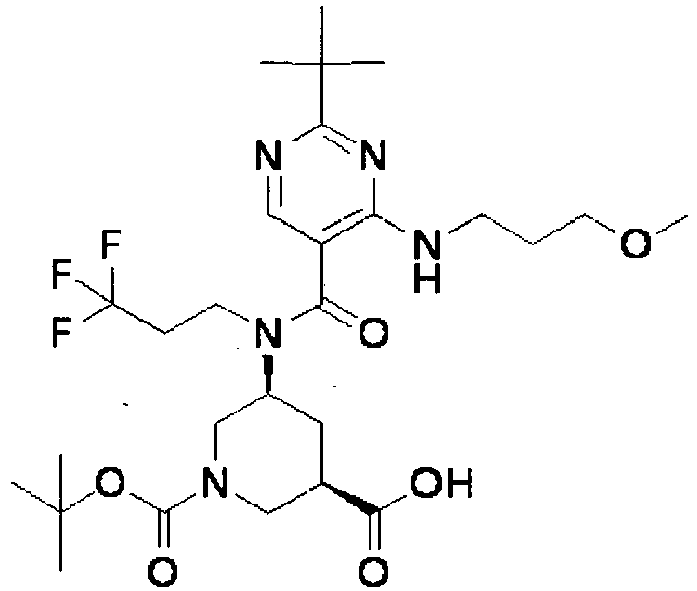
- MS (ESI+, m/e) 590 (M+1)
- By a method similar to that of Reference Example 50, the following compound (Reference Example 187) was obtained.
-
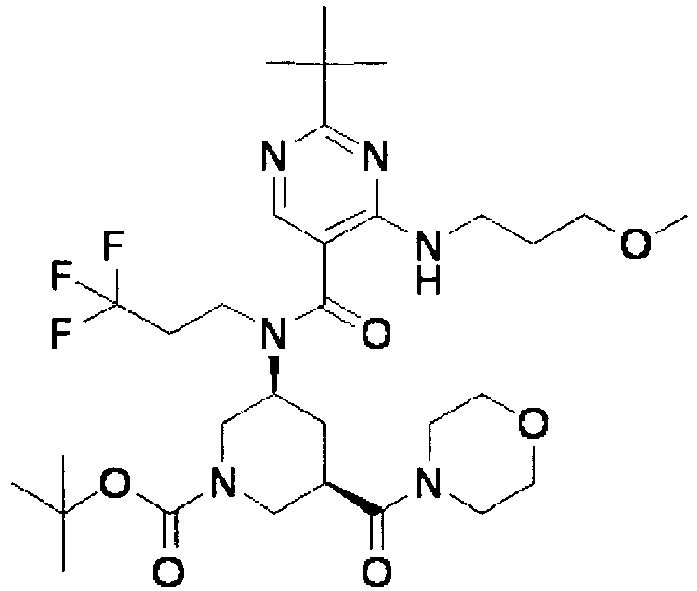
- MS (ESI+, m/e) 659 (M+1)
-
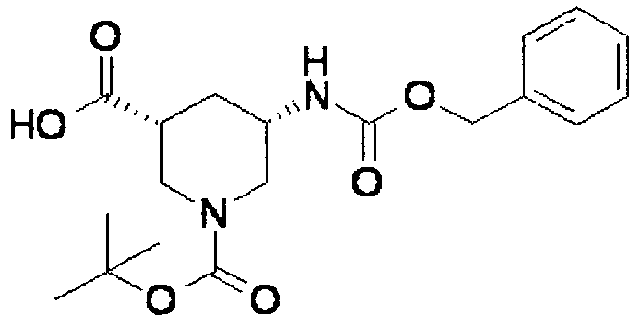
- To a solution of 1-tert-butyl 3-methyl (3R,5S)-5-{[(benzyloxy)carbonyl]amino}piperidine-1,3-dicarboxylate (115 g) in methanol (700 ml) was added 1 M aqueous sodium hydroxide solution (350 ml) under ice-cooling and the mixture was stirred at room temperature for 12 hr. The reaction mixture was concentrated under reduced pressure to about 1/3 volume, and the residual aqueous solution was washed with ethyl acetate-hexane (1:1, 600 ml). The aqueous layer was neutralized with 1 M hydrochloric acid, and the mixture was extracted with ethyl acetate. The extract was washed with saturated brine and dried over anhydrous magnesium sulfate. The solvent was evaporated under reduced pressure to give the object compound (98.5 g).
1H-NMR (DMSO-d6) δ 1.33 (1H, br s), 1.40 (9H, s), 2.09 (1H, d), 2.36-2.52 (3H, m), 3.93-4.09 (2H, m), 5.03 (2H, s), 7.28-7.43 (5H, m), 12.52 (1H, br s). -

- To a solution of (3R,5S)-5-{[(benzyloxy)carbonyl]amino}-1-(tert-butoxycarbonyl)piperidine-3-carboxylic acid (2.25 g) in THF (60 ml) was added 1,1'-carbonylbis(1H-imidazole) (1.20 g) and the mixture was stirred at room temperature for 2 hr. (3-Ethoxy-3-oxopropanoyl)potassium (1.26 g) and magnesium chloride (700 mg) were added and the reaction mixture was stirred with heating to reflux for 4 hr. After cooling to room temperature, the reaction mixture was diluted with 1 M hydrochloric acid, and the mixture was extracted with ethyl acetate. The extract was washed successively with 3.5 M aqueous potassium carbonate solution and saturated brine and dried over anhydrous magnesium sulfate. The solvent was evaporated under reduced pressure. The residue was subjected to silica gel column chromatography, eluted with ethyl acetate-hexane (10:90 - 80:20) and concentrated under reduced pressure to give the object compound (460 mg).
MS (ESI+, m/e) 449 (M+1) -
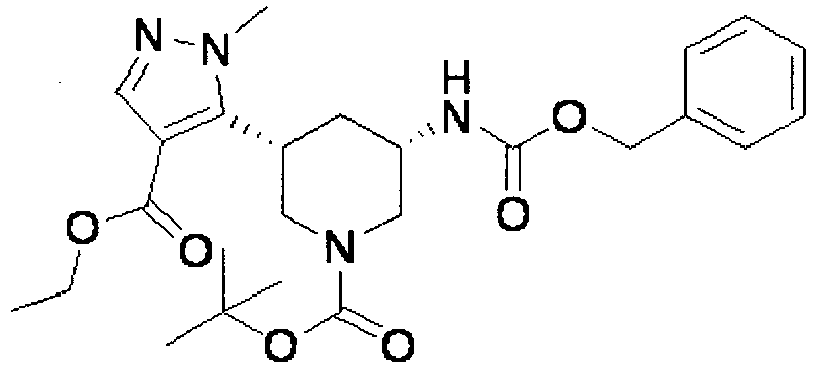
- A mixture of tert-butyl (3S,5R)-3-{[(benzyloxy)carbonyl]amino}-5-(3-ethoxy-3-oxopropanoyl)piperidine-1-carboxylate (2.25 g) obtained in Reference Example 189 and N,N-dimethylformamide dimethyl acetal (7 ml) was stirred at 100°C for 7 hr, and concentrated under reduced pressure. The residue was dissolved in ethanol (16 ml), methylhydrazine (250 mg) was added and the mixture was stirred at room temperature for 14 hr. The reaction mixture was concentrated under reduced pressure. Saturated brine was added and the mixture was extracted with ethyl acetate. The extract was dried over anhydrous magnesium sulfate. The solvent was evaporated under reduced pressure. The residue was subjected to silica gel column chromatography, eluted with ethyl acetate-hexane (10:90 - 100:0) and concentrated under reduced pressure to give the object compound (436 mg).
MS (ESI+, m/e) 487 (M+1) - By a method similar to that of Reference Example 43, the following compound (Reference Example 191) was obtained.
-

- MS (ESI+, m/e) 353 (M+1)
- By a method similar to that of Reference Example 44, the following compound (Reference Example 192) was obtained.
-

- MS (ESI+, m/e) 409 (M+1)
- By a method similar to that of Reference Example 46, the following compound (Reference Example 193) was obtained.
-
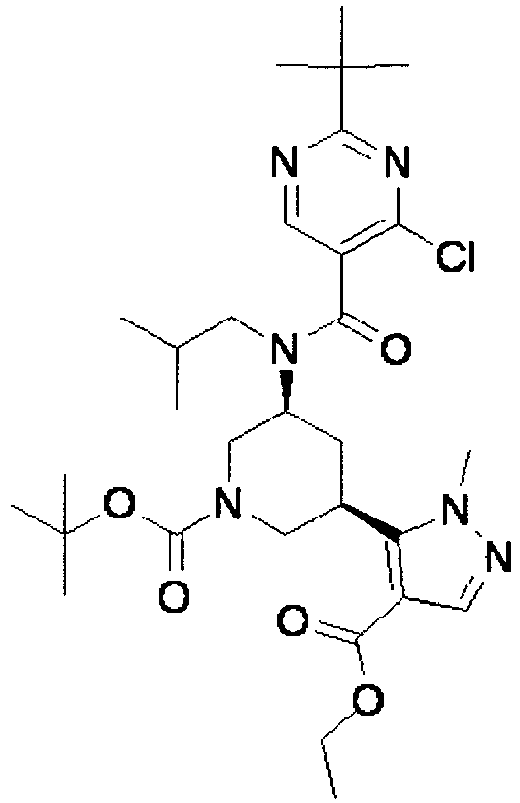
- MS (ESI+, m/e) 606 (M+1)
- By a method similar to that of Reference Example 48, the following compound (Reference Example 194) was obtained.
-

- MS (ESI+, m/e) 658 (M+1)
-

- A solution of tert-butyl (3S,5R)-3-[({2-tert-butyl-4-[(3-methoxypropyl)amino]pyrimidin-5-yl}carbonyl)(2-methylpropyl)amino]-5-{[(2,2,2-trichloroethoxy)carbonyl]amino}piperidine-1-carboxylate (1.00 g) in 1 M hydrogen chloride-ethyl acetate (30 ml) was stirred at room temperature for 1 day, and concentrated under reduced pressure. The residue was suspended in THF (20 ml), triethylamine (500 µl) and benzyl chlorocarbonate (250 µl) were successively added under ice-cooling, and the mixture was stirred at room temperature for 3 days. The reaction mixture was diluted with water, and the mixture was extracted with ethyl acetate. The extract was washed with saturated brine and dried over anhydrous magnesium sulfate. The solvent was evaporated under reduced pressure. The residue was subjected to silica gel column chromatography, eluted with ethyl acetate-hexane (10:90 - 80:20) and concentrated under reduced pressure to give the object compound (550 mg).
MS (ESI+, m/e) 731 (M+1) -

- To a solution of benzyl (3S,5R)-3-[({2-tert-butyl-4-[(3-methoxypropyl)amino]pyrimidin-5-yl}carbonyl)(2-methylpropyl)amino]-5-{[(2,2,2-trichloroethoxy)carbonyl]amino}piperidine-1-carboxylate (550 mg) in acetic acid (14 ml) was added zinc-copper couple (200 mg) and the mixture was stirred at room temperature for 3 hr. Insoluble material was filtered off through celite, and the filtrate was concentrated under reduced pressure. Toluene was added to the residue, and the mixture was concentrated under reduced pressure. The obtained residue was diluted with saturated aqueous sodium hydrogen carbonate solution and the mixture was extracted with ethyl acetate. The extract was washed with saturated brine and dried over anhydrous magnesium sulfate. The solvent was evaporated under reduced pressure to give the object compound (420 mg).
MS (ESI+, m/e) 555 (M+1) -

- Benzyl (3R,5S)-3-amino-5-[({2-tert-butyl-4-[(3-methoxypropyl)amino]pyrimidin-5-yl}carbonyl)(2-methylpropyl)amino]piperidine-1-carboxylate (100 mg) and 2-phenyloxirane (55 µl) were dissolved in acetonitrile (5 ml), and lithium perchlorate (55 mg) was added. The mixture was stirred at room temperature for 3 days and thereafter stirred at 80°C for 7 hr. The reaction mixture was concentrated under reduced pressure. The residue was subjected to silica gel column chromatography, eluted with ethyl acetate-hexane-methanol (10:90:0 - 100:0:0 - 85:0:15) and concentrated under reduced pressure to give the object compound (53.2 mg).
MS (ESI+, m/e) 675 (M+1) - By a method similar to that of Reference Example 115, the following compound (Reference Example 198) was obtained.
-

- MS (ESI+, m/e) 449 (M+1)
-

- 1-tert-Butyl 3-methyl (3R,5S)-5-{[(benzyloxy)carbonyl](2-methylpropyl)amino}piperidine-1,3-dicarboxylate (430 mg) and iodomethane (90 µl) were dissolved in DMF (5 ml), sodium hydride (50% contained, 70 mg) was added under ice-cooling, and the mixture was stirred at room temperature for 10 hr. The reaction mixture was diluted with saturated aqueous ammonium chloride solution, and the mixture was extracted with ethyl acetate. The extract was washed with saturated brine, and dried over anhydrous magnesium sulfate. The solvent was evaporated under reduced pressure to give the object compound (500 mg).
MS (ESI+, m/e) 463 (M+1) - By a method similar to that of Reference Example 118, the following compound (Reference Example 200) was obtained.
-

- MS (ESI+, m/e) 329 (M+1)
- By a method similar to that of Reference Example 46, the following compound (Reference Example 201) was obtained.
-

- MS (ESI+, m/e) 526 (M+1)
- By a method similar to that of Reference Example 48, the following compound (Reference Example 202) was obtained.
-

- MS (ESI+, m/e) 578 (M+1)
- By a method similar to that of Reference Example 38, the following compound (Reference Example 203) was obtained.
-

- MS (ESI+, m/e) 564 (M+1)
- By a method similar to that of Reference Example 50, the following compound (Reference Example 204) was obtained.
-

- MS (ESI+, m/e) 633 (M+1)
- By a method similar to that of Reference Example 91, the following compound (Reference Example 205) was obtained.
-
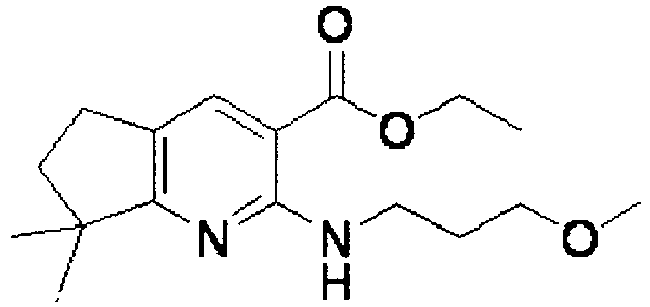
- MS (ESI+, m/e) 307 (M+1)
- By a method similar to that of Reference Example 93, the following compound (Reference Example 206) was obtained.
-

- MS (ESI+, m/e) 279 (M+1)
-

- To a solution of 1-tert-butyl 3-methyl (3R,5S)-5-{[(benzyloxy)carbonyl]amino}piperidine-1,3-dicarboxylate (115 g) in methanol (700 ml) was added 1 M aqueous sodium hydroxide solution (350 ml) under ice-cooling and the mixture was stirred at room temperature for 12 hr. The reaction mixture was concentrated under reduced pressure to about 1/3 volume, and the residual aqueous solution was washed with ethyl acetate-hexane (1:1, 600 ml). The aqueous layer was neutralized with 1 M hydrochloric acid and the mixture was extracted with ethyl acetate. The extract was washed with saturated brine and dried over anhydrous magnesium sulfate. The solvent was evaporated under reduced pressure to give the object compound (98.5 g).
1H-NMR (DMSO-d6) δ 1.33 (1H, br s), 1.40 (9H, s), 2.09 (1H, d), 2.36-2.52 (3H, m), 3.93-4.09 (2H, m), 5.03 (2H, s), 7.28-7.43 (5H, m), 12.52 (1H, brs). -
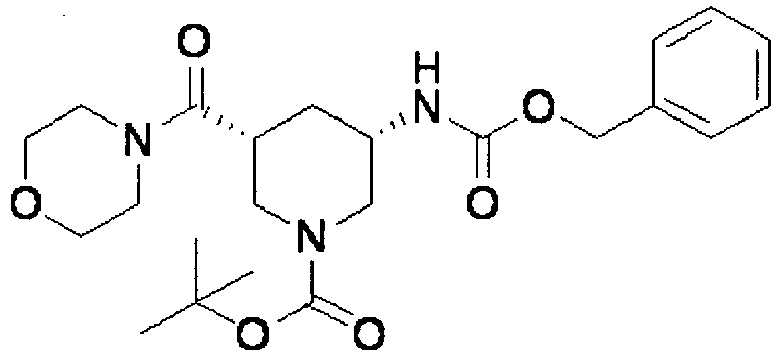
- (3R,5S)-5-{[(Benzyloxy)carbonyl]amino}-1-(tert-butoxycarbonyl)piperidine-3-carboxylic acid (49.2 g), morpholine (11.4 ml), 1H-benzotriazol-1-ol (10.0 g) and triethylamine (40 ml) were dissolved in DMF (250 ml), WSC·HCl (30.0 g) was added and the mixture was stirred at room temperature for 4 days. The reaction mixture was poured into water, and the mixture was extracted with ethyl acetate. The extract was washed successively with saturated aqueous sodium hydrogen carbonate solution and saturated brine, and dried over anhydrous magnesium sulfate. The solvent was evaporated under reduced pressure to give the object compound (62.9 g).
1H-NMR (CDCl3) δ 1.46 (9H, s), 1.69 (2H, br s), 2.04 (1H, s), 2.73 (2H, br s), 2.79-2.96 (1H, m), 3.52-3.65 (6H, m), 3.69 (2H, d), 3.67 (1H, br s), 4.04 (1H, d), 5.09 (2H, s), 5.40 (1H, br s), 7.25-7.41 (5H, m). -

- tert-Butyl (3S,5R)-3-{[(benzyloxy)carbonyl]amino}-5-(morpholin-4-ylcarbonyl)piperidine-1-carboxylate (58 g) and palladium(II) hydroxide-carbon (5 g) were suspended in methanol (400 ml), and the mixture was stirred at room temperature for 16 hr under a hydrogen atmosphere (1 atm). The palladium catalyst was filtered off, and the filtrate was concentrated under reduced pressure. The obtained residue and acetic acid (8.8 ml) were dissolved in methanol (400 ml), 2-methylpropanal (14.0 ml) was added and the mixture was stirred at room temperature for 1 hr. Sodium triacetoxyborohydride (40.4 g) was added to the reaction mixture and the mixture was stirred at room temperature for 2 hr. The reaction mixture was concentrated under reduced pressure, and the concentrated solution was basified with 3.5 M aqueous potassium carbonate solution, and the mixture was extracted with ethyl acetate. The extract was washed with water and saturated brine, and dried over anhydrous magnesium sulfate. The solvent was evaporated under reduced pressure. The residue was subjected to silica gel column chromatography, and the fraction eluted with ethyl acetate-hexane (1:5) to ethyl acetate 100% to ethyl acetate-methanol (9:1) was concentrated under reduced pressure to give the object compound (33.3 g).
1H-NMR (CDCl3) δ 0.90 (6H, d), 1.46 (9H, s), 1.54 (1H, d), 1.69 (1H, dt), 1.96-2.12 (2H, m), 2.23-2.37 (1H, m), 2.47 (3H, d), 2.66 (1H, d), 3.61 (1H, br s), 3.55 (2H, d), 3.69 (5H, ddd), 4.01-4.46 (2H, m). -

- 2-[(3-Methoxypropyl)amino]-7,7-dimethyl-6,7-dihydro-5H-cyclopenta[b]pyridine-3-carboxylic acid (190 mg), tert-butyl (3S,5R)-3-[(2-methylpropyl)amino]-5-(morpholin-4-ylcarbonyl)piperidine-1-carboxylate (255 mg) obtained in Reference Example 209 and N,N-diisopropylethylamine (180 µl) were dissolved in 1,2-dichloroethane (6 ml), chloro-N,N,N',N'-tetramethylformamidinium hexafluorophosphate (230 mg) was added and the mixture was stirred at room temperature for 3 days. The reaction mixture was diluted with saturated aqueous sodium hydrogen carbonate solution and the mixture was extracted with ethyl acetate. The extract was washed with saturated brine and dried over anhydrous magnesium sulfate. The solvent was evaporated under reduced pressure. The residue was subjected to silica gel column chromatography, and the fraction eluted with ethyl acetate-hexane (10:90 - 100:0) was concentrated under reduced pressure to give the object compound (210 mg).
MS (ESI+, m/e) 630 (M+1) -

- tert-Butyl 3-[({2-[(furan-2-ylmethyl)amino]-5,6,7,8-tetrahydroquinolin-3-yl}carbonyl)(2-methylpropyl)amino]piperidine-1-carboxylate (25.0 mg) was dissolved in 1 M hydrogen chloride-ethyl acetate (3 ml), and the mixture was stirred at room temperature for 1 hr. The reaction mixture was concentrated, and the obtained residue was subjected to reversed-phase preparative HPLC. The fraction containing the object compound was diluted with 3.5 M aqueous potassium carbonate solution, and the mixture was extracted with ethyl acetate. The extract was washed with saturated brine, and dried over anhydrous magnesium sulfate. The solvent was evaporated under reduced pressure. The residue was dissolved in 1 M hydrogen chloride-ethyl acetate (1 ml), and concentrated under reduced pressure to give the object compound (20.7 mg).
MS (ESI+, m/e) 411 (M+1) - By a method similar to that of the above-mentioned Example 110 (Method J), the compounds of Examples 111 to 156 below were obtained. The respective compounds were isolated and purified as necessary by a known means such as phase transfer, pH conversion, solvent extraction, silica gel column chromatography, reversed-phase preparative HPLC and the like. The final products were isolated as hydrochloride as in Method J by treating with a hydrogen chloride-ethyl acetate solution.
-

- MS (ESI+, m/e) 425 (M+1)
-

- MS (ESI+, m/e) 425 (M+1)
-

- MS (ESI+, m/e) 439 (M+1)
-

- MS (ESI+, m/e) 439 (M+1)
-

- MS (ESI+, m/e) 486 (M+1)
-

- MS (ESI+, m/e) 494 (M+1)
-

- MS (ESI+, m/e) 439 (M+1)
-

- MS (ESI+, m/e) 482 (M+1)
-
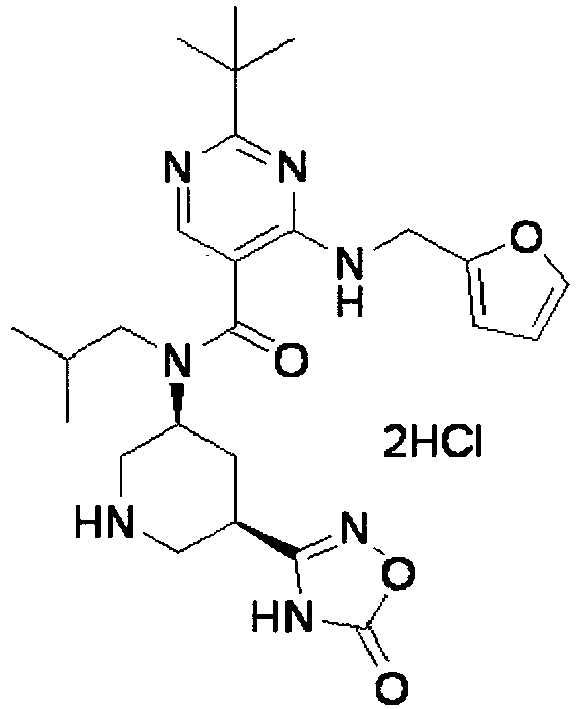
- MS (ESI+, m/e) 498 (M+1)
-

- MS (ESI+, m/e) 488 (M+1)
-

- MS (ESI+, m/e) 521 (M+1)
-

- MS (ESI+, m/e) 513 (M+1)
-

- MS (ESI+, m/e) 513 (M+1)
-

- MS (ESI+, m/e) 520 (M+1)
-

- MS (ESI+, m/e) 520 (M+1)
-
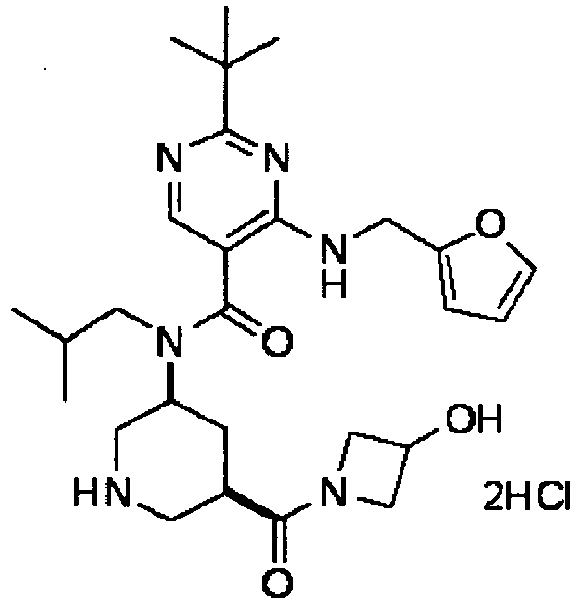
- MS (ESI+, m/e) 513 (M+1)
-

- MS (ESI+, m/e) 487 (M+1)
-

- MS (ESI+, m/e) 481 (M+1)
-

- MS (ESI+, m/e) 563 (M+1)
-

- MS (ESI+, m/e) 542 (M+1)
-

- MS (ESI+, m/e) 457 (M+1)
-
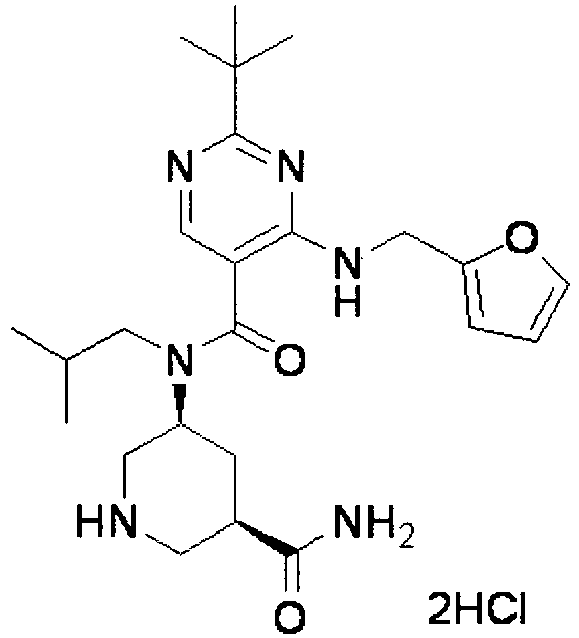
- MS (ESI+, m/e) 457 (M+1)
-

- MS (ESI+, m/e) 471 (M+1)
-

- MS (ESI+, m/e) 541 (M+1)
-

- MS (ESI+, m/e) 583 (M+1)
-

- MS (ESI+, m/e) 480 (M+1)
-

- MS (ESI+, m/e) 465 (M+1)
-
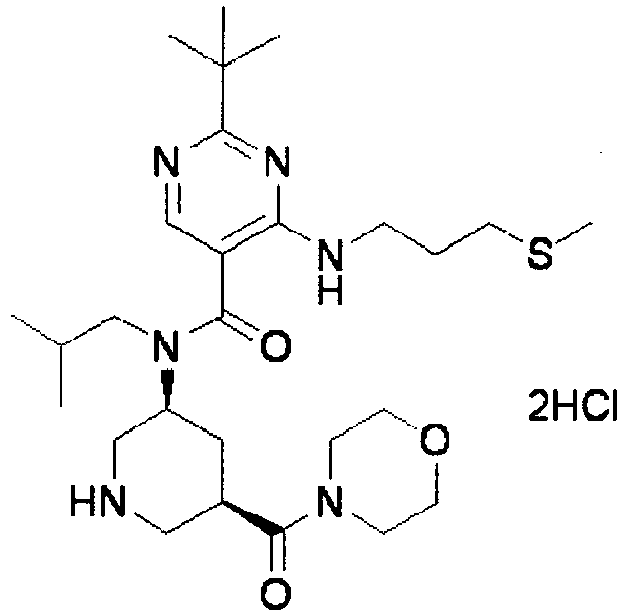
- MS (ESI+, m/e) 535 (M+1)
-

- MS (ESI+, m/e) 447 (M+1)
-

- MS (ESI+, m/e) 517 (M+1)
-
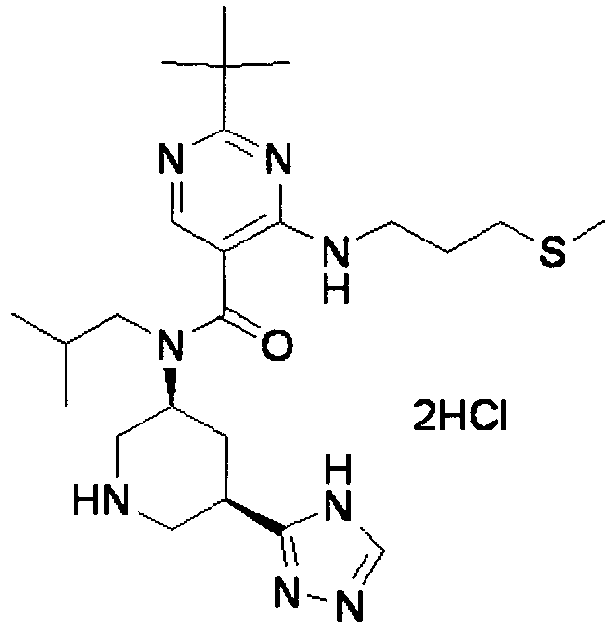
- MS (ESI+, m/e) 489 (M+1)
-

- MS (ESI+, m/e) 506 (M+1)
-

- MS (ESI+, m/e) 521 (M+1)
-

- MS (ESI+, m/e) 535 (M+1)
-

- MS (ESI+, m/e) 567 (M+1)
-

- MS (ESI+, m/e) 509 (M+1)
-

- MS (ESI+, m/e) 515 (M+1)
-

- MS (ESI+, m/e) 577 (M+1)
-

- MS (ESI+, m/e) 586 (M+1)
-

- MS (ESI+, m/e) 508 (M+1)
-

- MS (ESI+, m/e) 556 (M+1)
-

- MS (ESI+, m/e) 520 (M+1)
-

- MS (ESI+, m/e) 472 (M+1)
-

- MS (ESI+, m/e) 472 (M+1)
-
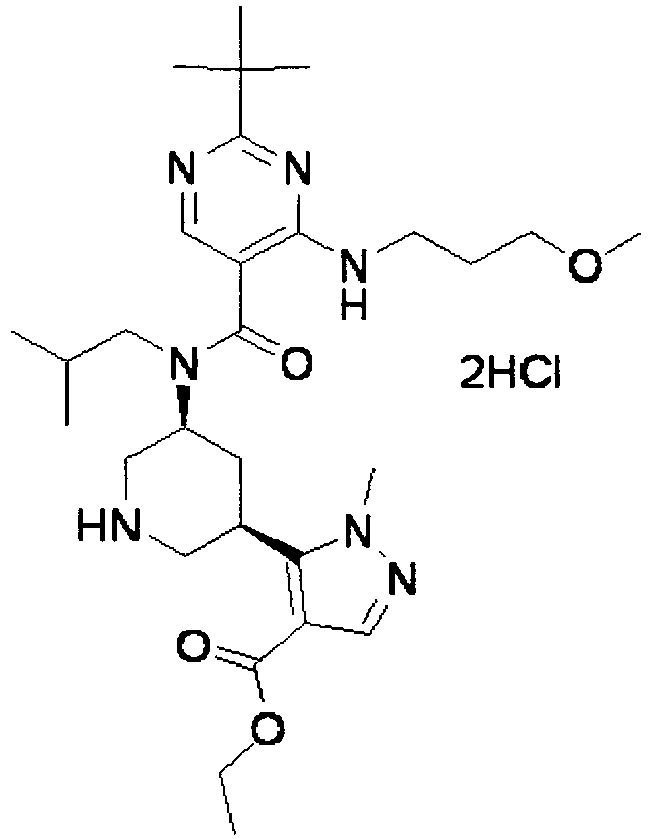
- MS (ESI+, m/e) 558 (M+1)
-

- MS (ESI+, m/e) 559 (M+1)
-

- MS (ESI+, m/e) 533 (M+1)
-

- MS (ESI+, m/e) 530 (M+1)
-
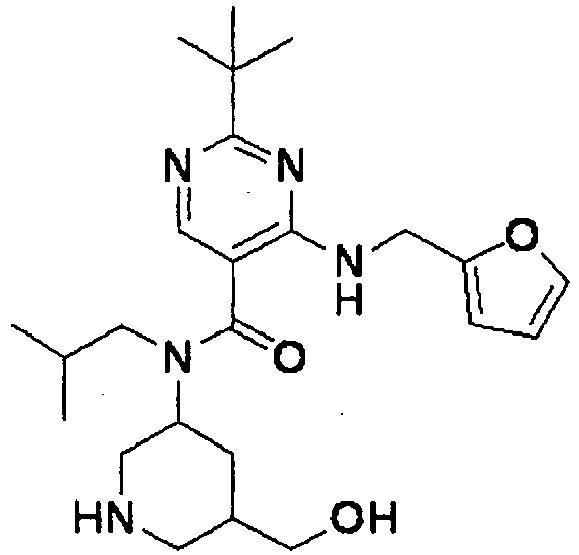
- tert-Butyl 3-[({2-tert-butyl-4-[(furan-2-ylmethyl) amino] pyrimidin-5-yl}carbonyl)(2-methylpropyl)amino]-5-(hydroxymethyl)piperidine-1-carboxylate (50.0 mg) was dissolved in trifluoroacetic acid (50% 1,2-dichloroethane solution, 4 ml), and the mixture was stirred at room temperature for 1 hr. The reaction mixture was basified with saturated aqueous potassium carbonate solution, and the mixture was extracted with ethyl acetate. The extract was washed with saturated brine and dried over anhydrous magnesium sulfate. The solvent was evaporated under reduced pressure. The residue was subjected to silica gel column chromatography, and the fraction eluted with ethyl acetate-hexane-methanol (50:50:0 - 100:0:0 - 85:0:15) was concentrated under reduced pressure to give the object compound (24.4 mg).
MS (ESI+, m/e) 444 (M+1) - By a method similar to that of the above-mentioned Example 157 (Method K), the compounds of Examples 158 to 164 below were obtained. The respective compounds were isolated and purified as necessary by a known means such as phase transfer, pH conversion, solvent extraction, silica gel column chromatography, reversed-phase preparative HPLC and the like.
-

- MS (ESI+, m/e) 496 (M+1)
-

- MS (ESI+, m/e) 558 (M+1)
-

- MS (ESI+, m/e) 482 (M+1)
-

- MS (ESI+, m/e) 571 (M+1)
-

- MS (ESI+, m/e) 555 (M+1)
-
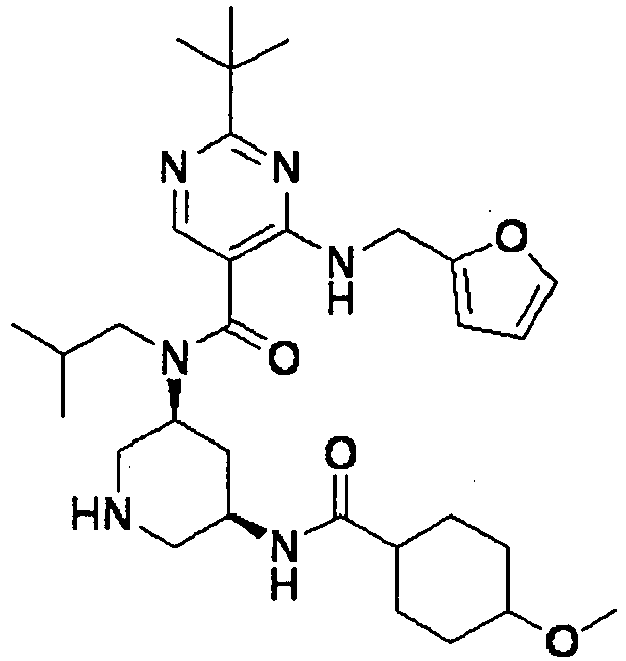
- MS (ESI+, m/e) 569 (M+1)
-

- MS (ESI+, m/e) 551 (M+1)
-
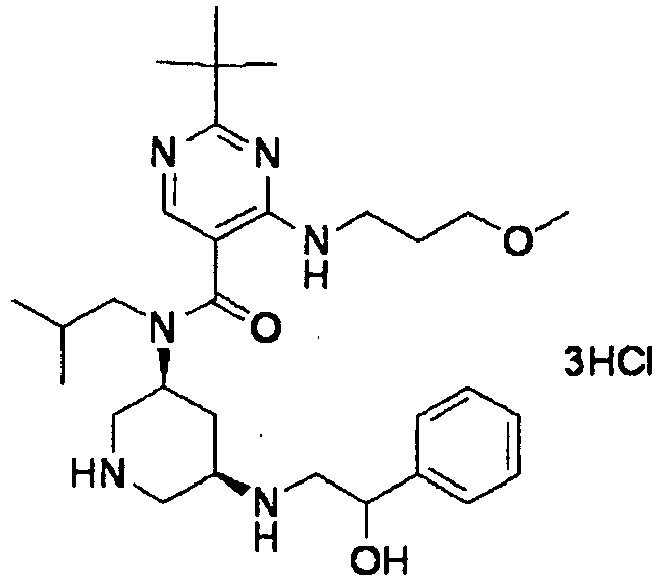
- Benzyl (3S,5R)-3-[({2-tert-butyl-4-[(3-methoxypropyl)amino]pyrimidin-5-yl}carbonyl)(2-methylpropyl)amino]-5-[(2-hydroxy-2-phenylethyl)amino]piperidine-1-carboxylate (53.2 mg) was dissolved in ethanol (3 ml), 4 M aqueous sodium hydroxide solution (3 ml) was added and the mixture was stirred at 70°C for 12 hr. After cooling to room temperature, the reaction mixture was diluted with water and the mixture was extracted with ethyl acetate. The extract was washed with saturated brine and dried over anhydrous magnesium sulfate. The solvent was evaporated under reduced pressure. The residue was dissolved in 1 M hydrogen chloride-ethyl acetate (3 ml), and concentrated under reduced pressure to give the object compound (46.7 mg).
MS (ESI+, m/e) 541 (M+1) - By a method similar to that of Reference Example 50, the following compounds (Reference Examples 213A and 213B) were obtained.
-

- MS (ESI+, m/e) 627 (M+1)
-

- MS (ESI+, m/e) 627 (M+1)
- By a method similar to that of the above-mentioned Example 93 (Method G) and Example 94 (Method H), the compounds of Examples 166 to 169 below were obtained. The respective compounds were isolated and purified as necessary by a known means such as phase transfer, pH conversion, solvent extraction, silica gel column chromatography, reversed-phase preparative HPLC and the like. The final products were isolated as hydrochloride as in Method G and Method H by treating with a hydrogen chloride-ethyl acetate solution.
-

- MS (ESI+, m/e) 472 (M+1)
-
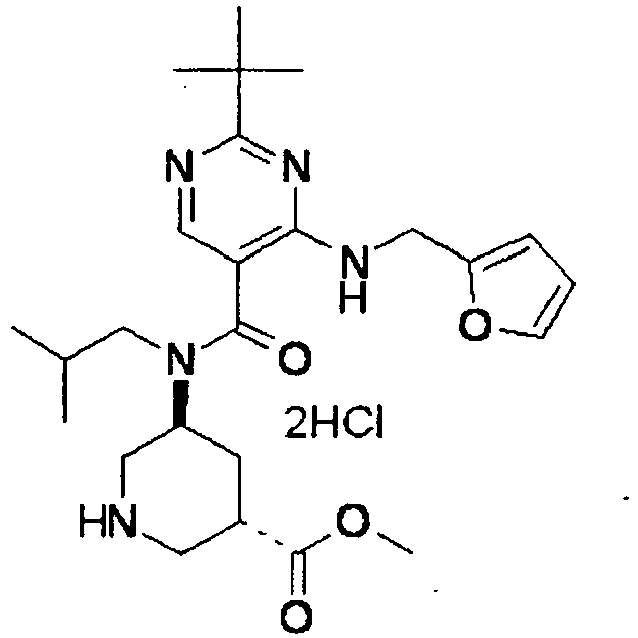
- MS (ESI+, m/e) 472 (M+1)
-

- MS (ESI+, m/e) 527 (M+1)
-

- MS (ESI+, m/e) 527 (M+1)
-

- 2-amino-4-(trifluoromethyl)benzoic acid (0.32 g) and tert-butyl 3-[(2-methylpropyl)amino]piperidine-1-carboxylate (0.4 g) were dissolved in 1,2-dichloroethane (20 ml), diethyl phosphorocyanidate (0.31 g) was added and the mixture was stirred at 70°C overnight. The reaction mixture was poured into water, and the mixture was extracted with ethyl acetate. The extract was washed with saturated brine, and dried over anhydrous magnesium sulfate. The solvent was evaporated under reduced pressure, and the residue was subjected to silica gel column chromatography, and the fraction eluted with ethyl acetate-hexane (0:10 - 1:1) was concentrated under reduced pressure to give the object compound (0.33 g).
MS (ESI+, m/e) 444 (M+1) -

- Ethyl 5-amino-1-phenyl-1H-pyrazole-4-carboxylate (1.26 g) was dissolved in DMF (10 ml), NaH (0.25 g) was added under ice-cooling, and the mixture was stirred at room temperature for 30 min. 1-Bromo-3-methoxypropane (0.83 g) was added to the reaction mixture under ice-cooling, and the mixture was stirred at 60°C for 1 hr. The reaction mixture was concentrated, and the residue was subjected to silica gel column chromatography, and the fraction eluted with ethyl acetate-hexane (0:10 - 4:6) was concentrated under reduced pressure to give the object compound (1.1 g).
MS (ESI+, m/e) 304 (M+1) -
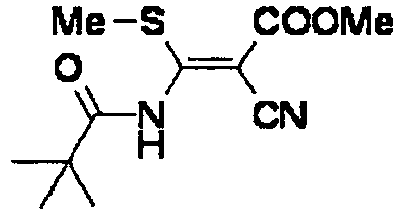
- Methyl 2-cyano-3,3-bis(methylsulfanyl)prop-2-enoate (4.06 g) and 2,2-dimethylpropanamide (2.02 g) were dissolved in DMA (200 ml), and sodium hydride (1.92 g) was added under ice-cooling. The mixture was stirred at room temperature overnight, and poured into ice. The mixture was acidified with 1 N aqueous hydrochloric acid solution. The precipitated crystals were collected by filtration, and dried to give the object compound (2.4 g).
MS (ESI+, m/e) 257 (M+1) -
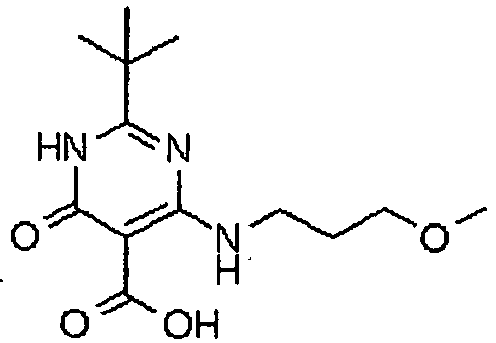
- Methyl 2-cyano-3-[(2,2-dimethylpropanoyl)amino]-3-(methylsulfanyl)prop-2-enoate (2.0 g) was dissolved in 3-methoxypropan-1-amine (1.4 g), and the mixture was stirred at 80°C for 1 hr. Methanol (10 ml) was added to the reaction mixture, and the mixture was refluxed overnight. The solvent was concentrated under reduced pressure, and the residue was subjected to silica gel column chromatography. The fraction eluted with ethyl acetate-hexane (0:10→6:4) was concentrated under reduced pressure, and the fraction eluted with ethyl acetate was concentrated under reduced pressure. The residue (1.0 g) was dissolved in methanol (10 ml), lithium hydroxide (0.42 g) and water (2 ml) were added, and the mixture was stirred at 70°C for 6 hr. The reaction mixture was allowed to cool to room temperature, acidified with 6 N aqueous hydrochloric acid solution, and extracted with ethyl acetate. The extract was washed with saturated brine, and dried over anhydrous magnesium sulfate. The solvent was evaporated under reduced pressure to give the object compound (0.51 g).
MS (ESI+, m/e) 284 (M+1) -

- 1-tert-Butyl 3-methyl (3R,5S)-5-[(2-methylpropyl)amino]piperidine-1,3-dicarboxylate (3.0 g) was dissolved in THF (30 ml), a solution (15.2 ml) of 3 M pentamethylenebis(magnesium bromide) in THF was added dropwise under ice-cooling, and the mixture was stirred at room temperature for 3 hr. 2 N Aqueous ammonium chloride solution (50 ml) was added to the reaction solution under ice-cooling, and the mixture was extracted with ethyl acetate, and dried over anhydrous magnesium sulfate. The solvent was evaporated under reduced pressure. The residue was subjected to basic silica gel column chromatography, and the fraction eluted with ethyl acetate-hexane (0:10→10:0) was concentrated under reduced pressure to give the object compound (1.3 mg).
MS (ESI+, m/e) 315 (M+1) -

- 2-Furaldehyde (0.20 g) and tert-butyl 3-[{[2-amino-4-(trifluoromethyl)phenyl]carbonyl}(2-methylpropyl)amino]piperidine-1-carboxylate (0.33 g) were dissolved in acetic acid (5.0 ml), sodium triacetoxyborohydride (0.31 g) was added and the mixture was stirred at room temperature overnight. The reaction mixture was basified with saturated aqueous sodium hydrogen carbonate, and the mixture was extracted with ethyl acetate. The extract was washed with saturated brine, and dried over anhydrous magnesium sulfate. The solvent was evaporated under reduced pressure. The residue was subjected to silica gel column chromatography, and the fraction eluted with ethyl acetate-hexane (0:10→10:0) was concentrated under reduced pressure. The residue was dissolved in trifluoroacetic acid (2 ml), and the mixture was stirred for 30 min. The reaction mixture was concentrated and purified by HPLC to give the object compound (12.2 mg).
MS (ESI+, m/e) 424 (M+1) -

- Ethyl 5-[(3-methoxypropyl)amino]-1-phenyl-1H-pyrazole-4-carboxylate (500 mg) was dissolved in methanol (10 ml), 4 N aqueous sodium hydroxide solution was added, and the mixture was stirred at 80°C for 3 hr. The reaction mixture was allowed to cool to room temperature, acidified with 6 N aqueous hydrochloric acid solution, and extracted with ethyl acetate. The extract was washed with saturated brine, and dried over anhydrous magnesium sulfate. The solvent was evaporated under reduced pressure. The residue was dissolved in dichloromethane (10 ml), tert-butyl (3S,5R)-3-[(2-methylpropyl)amino]-5-(morpholin-4-ylcarbonyl)piperidine-1-carboxylate (540 mg) and N,N-diisopropylethylamine (940 ml) were added, chloro-N,N,N',N'-tetramethylformamidinium hexafluorophosphate (610 mg) was added with stirring and the mixture was stirred at room temperature for 3 hr. The reaction mixture was concentrated, and the residue was subjected to silica gel column chromatography, and the fraction eluted with ethyl acetate-hexane (0:10 - 10:0) was concentrated under reduced pressure. The residue was dissolved in 4 N hydrogen chloride-ethyl acetate (1 ml), and the mixture was stirred at room temperature for 0.5 hr. The reaction mixture was concentrated to give the object compound (73.6 mg).
MS (ESI+, m/e) 527 (M+1) -

- 2-tert-Butyl-4-[(3-methoxypropyl)amino]-6-oxo-1,6-dihydropyrimidine-5-carboxylic acid (280 mg), tert-butyl (3S,5R)-3-[(2-methylpropyl)amino]-5-(morpholin-4-ylcarbonyl)piperidine-1-carboxylate (250 mg) and N,N-diisopropylethylamine (640 mg) were dissolved in 1,2-dichloroethane (10 ml), chloro-N,N,N',N'-tetramethylformamidinium hexafluorophosphate (420 mg) was added and the mixture was stirred at room temperature for 3 hr. The reaction mixture was concentrated, and diluted with aqueous calcium carbonate solution, and the mixture was extracted with ethyl acetate. The extract was washed with saturated brine, and dried over anhydrous magnesium sulfate. The solvent was evaporated under reduced pressure. The residue was dissolved in TFA (1 ml), and the mixture was stirred at room temperature for 0.5 hr. The reaction mixture was concentrated and purified by HPLC to give the object compound (15.8 mg).
MS (ESI+, m/e) 535 (M+1) -

- 2-tert-Butyl-4-[(3-methoxypropyl)amino]-6-oxo-1,6-dihydropyrimidine-5-carboxylic acid (230 mg) was dissolved in toluene (10 ml), thionyl chloride (0.12 ml) was added, and the mixture was refluxed for 2 hr. The solvent was evaporated under reduced pressure. The residue was dissolved in 1,2-dichloroethane (5 ml), and the solution was added under ice-cooling to a solution of tert-butyl (3S,5R)-3-[(2-methylpropyl)amino]-5-(morpholin-4-ylcarbonyl)piperidine-1-carboxylate (210 mg) and N,N-diisopropylethylamine (520 mg) in 1,2-dichloroethane (10 ml), and the reaction mixture was stirred at room temperature for 1 hr. The reaction mixture was concentrated, and diluted with aqueous calcium carbonate solution, and the mixture was extracted with ethyl acetate. The extract was washed with saturated brine, and dried over anhydrous magnesium sulfate. The solvent was evaporated under reduced pressure. The residue was subjected to silica gel column chromatography, ethyl acetate-hexane (0:10 - 10:0) was passed, and the fraction eluted with methanol-ethyl acetate (0:10 - 3:7) was concentrated under reduced pressure. The residue was dissolved in 4 N hydrogen chloride-ethyl acetate (1 ml), and the mixture was stirred at room temperature for 0.5 hr. The reaction mixture was concentrated to give the object compound (73.6 mg).
MS (ESI+, m/e) 553 (M+1) -

- tert-Butyl (3R,5S)-3-(1-hydroxycyclohexyl)-5-[(2-methylpropyl)amino]piperidine-1-carboxylate (0.92 g) and N,N-diisopropylethylamine (1.0 g) were dissolved in 1,2-dichloroethane (10 ml), 2-tert-butyl-4-[(3-methoxypropyl)amino]pyrimidine-5-carbonyl chloride (0.74 g) was added under ice-cooling, and the mixture was stirred at room temperature for 3 hr. The reaction mixture was concentrated, and diluted with aqueous calcium carbonate solution, and the mixture was extracted with ethyl acetate. The extract was washed with saturated brine, and dried over anhydrous magnesium sulfate. The solvent was evaporated under reduced pressure. The residue was dissolved in 4 N hydrogen chloride-ethyl acetate (1 ml), and the mixture was stirred at room temperature for 0.5 hr. The reaction mixture was concentrated and purified by HPLC. The concentrate was dissolved in 4 N hydrogen chloride-ethyl acetate (1 ml) and concentrated to give the object compound (5.9 mg).
MS (ESI+, m/e) 504 (M+1) -

- 1-tert-Butyl 3-methyl (3R*,5S*)-5-{[(2-tert-butyl-4-chloropyrimidin-5-yl)carbonyl](2-methylpropyl)amino}piperidine-1,3-dicarboxylate (2.46 g) and diisopropylethylamine (1.38 ml) were dissolved in N,N-dimethylformamide (50 ml), 3-methoxypropan-1-amine (990 µl) was added and the mixture was stirred at 80°C for 30 min. The reaction mixture was concentrated under reduced pressure, saturated aqueous sodium hydrogen carbonate was added, and the mixture was extracted with ethyl acetate. The extract was dried over anhydrous magnesium sulfate and the solvent was evaporated under reduced pressure. The residue was subjected to silica gel column chromatography, and the fraction eluted with hexane to ethyl acetate-hexane (35:65) was concentrated under reduced pressure to give the object compound (2.47 g).
MS (ESI+, m/e) 564 (M+1) -

- 1-tert-Butyl 3-methyl (3R*,5S*)-5-[({2-tert-butyl-4-[(3-methoxypropyl)amino]pyrimidin-5-yl}carbonyl)(2-methylpropyl)amino]piperidine-1,3-dicarboxylate (304 mg) was dissolved in tetrahydrofuran-methanol (1:2, 12 ml), 2 M aqueous sodium hydroxide solution (1.35 ml) was added and the mixture was stirred for 2 hr. The reaction mixture was concentrated under reduced pressure, and diluted with saturated aqueous ammonium chloride solution, and the mixture was extracted with ethyl acetate. The extract was dried over anhydrous magnesium sulfate, and the solvent was evaporated under reduced pressure to give the object compound (287 mg).
MS (ESI+, m/e) 550 (M+1) -

- (3R*,5S*) -1- (tert-Butoxycarbonyl)-5-[({2-tert-butyl-4-[(3-methoxypropyl)amino]pyrimidin-5-yl}carbonyl)(2-methylpropyl)amino]piperidine-3-carboxylic acid (125 mg), morpholine (59 µl) and diisopropylethylamine (160 µl) were dissolved in DMF (10 ml), BOP reagent (300 mg) was added and the mixture was stirred at room temperature for 1 hr. The reaction mixture was diluted with saturated aqueous sodium hydrogen carbonate, and the mixture was extracted with ethyl acetate. The extract was dried over anhydrous magnesium sulfate and the solvent was evaporated under reduced pressure. The residue was subjected to silica gel column chromatography, and the fraction eluted with ethyl acetate-hexane (1:9) to ethyl acetate was concentrated under reduced pressure to give the object compound (109 mg).
MS (ESI+, m/e) 619 (M+1) -

- A solution of (3R*,5S*)-1-(tert-butoxycarbonyl)-5-[({2-tert-butyl-4-[(3-methoxypropyl)amino]pyrimidin-5-yl}carbonyl)(2-methylpropyl)amino]piperidine-3-carboxylic acid (160 mg), 1H-1,2,3-benzotriazol-1-ol ammoniate (133 mg), WSC·HCl (167 mg) and triethylamine (165 µl) in 1,2-dichloroethane (8 ml) was stirred at room temperature for 14 hr. The reaction mixture was concentrated under reduced pressure, and diluted with saturated aqueous sodium hydrogen carbonate, and the mixture was extracted with ethyl acetate. The extract was washed with saturated brine, and dried over anhydrous magnesium sulfate. The solvent was evaporated under reduced pressure. The residue was subjected to silica gel column chromatography, and the fraction eluted with acetic acid was concentrated under reduced pressure to give the object compound (130 mg).
MS (ESI+, m/e) 549 (M+1) -

- 1-tert-Butyl 3-methyl (3R*,5S*)-5-[({2-tert-butyl-4-[(3-methoxypropyl)amino]pyrimidin-5-yl}carbonyl)(2-methylpropyl)amino]piperidine-1,3-dicarboxylate (144 mg) was dissolved in ethyl acetate (4.5 ml), 4 M hydrogen chloride-ethyl acetate solution (1.5 ml) was added, and the mixture was stirred at room temperature for 13 hr. The solvent was evaporated under reduced pressure, and the residue was dried under reduced pressure to give the object compound (129 mg).
MS (ESI+, m/e) 464 (M+1) - By a method similar to that of Example 172, the compounds of Examples 173 and 174 below were synthesized.
-
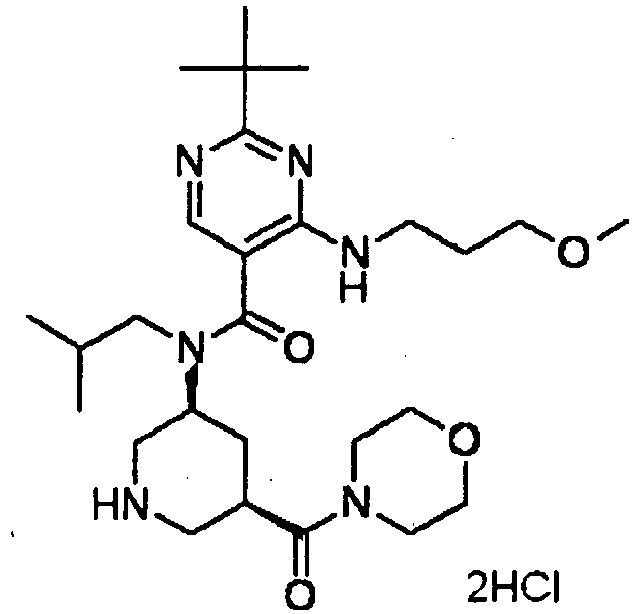
- MS (ESI+, m/e) 519 (M+1)
-
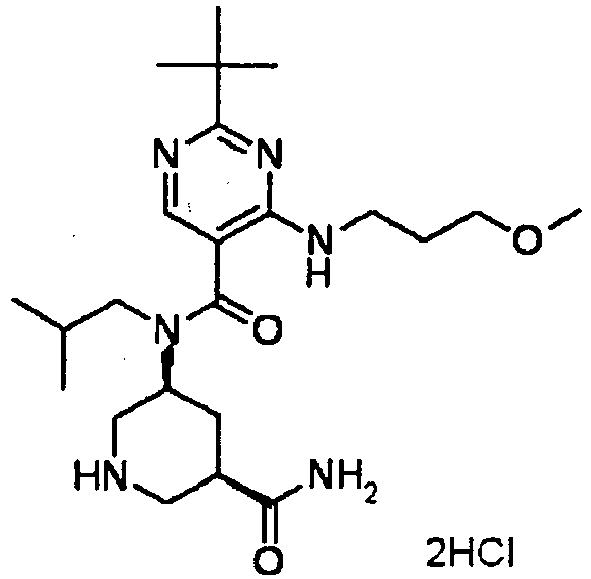
- MS (ESI+, m/e) 449 (M+1)
-

- To a solution of 1-tert-butyl 3-methyl (3R*,5S*)-5-{[(2-tert-butyl-4-chloropyrimidin-5-yl)carbonyl](isobutyl)amino}piperidine-1,3-dicarboxylate (51.1 mg) and diisopropylethylamine (38 mg) in DMF (0.5 ml) was added a solution of 1-thiophen-2-ylmethanamine (23 mg) in DMF (0.5 ml) and the mixture was stirred at 80°C overnight. 2% Aqueous sodium hydrogen carbonate was added to the reaction mixture and the mixture was extracted with ethyl acetate, and the extract was concentrated by a nitrogen gas blower. The residue was purified by reversed-phase preparative HPLC, and the object fraction was concentrated by a nitrogen gas blower. The residue was dissolved in trifluoroacetic acid/acetonitrile solution (20%(V/V), 1.0 ml), and the mixture was stirred at room temperature for 6 hr. The reaction mixture was concentrated by a nitrogen gas blower. The residue was neutralized with triethylamine (1 ml), and saturated aqueous sodium hydrogen carbonate was added. The mixture was extracted with ethyl acetate, and the extract was concentrated by a nitrogen gas blower. The residue was purified by reversed-phase preparative HPLC, and the object fraction was concentrated by a nitrogen gas blower to give the object compound (3.1 mg).
MS (ESI+, m/e) 488 (M+1) - By a method similar to that of the above-mentioned Example 175, the compounds of Examples 176 to 179 below were obtained. The compounds were isolated and purified as necessary by a known means such as phase transfer, pH conversion, solvent extraction, silica gel column chromatography, reversed-phase preparative HPLC and the like. The final products were isolated as a free form.
-

- MS (ESI+, m/e) 488 (M+1)
-
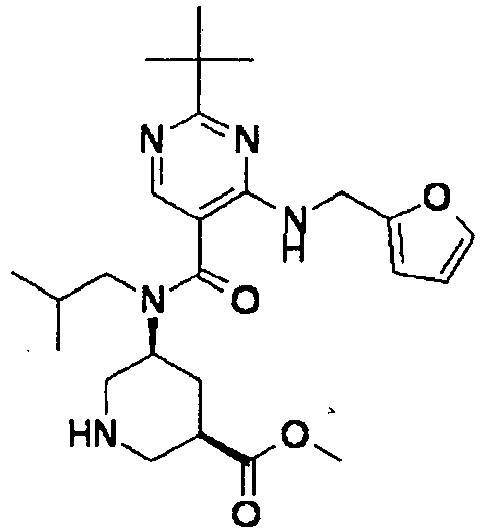
- MS (ESI+, m/e) 472 (M+1)
-

- MS (ESI+, m/e) 478 (M+1)
-

- MS (ESI+, m/e) 483 (M+1)
-
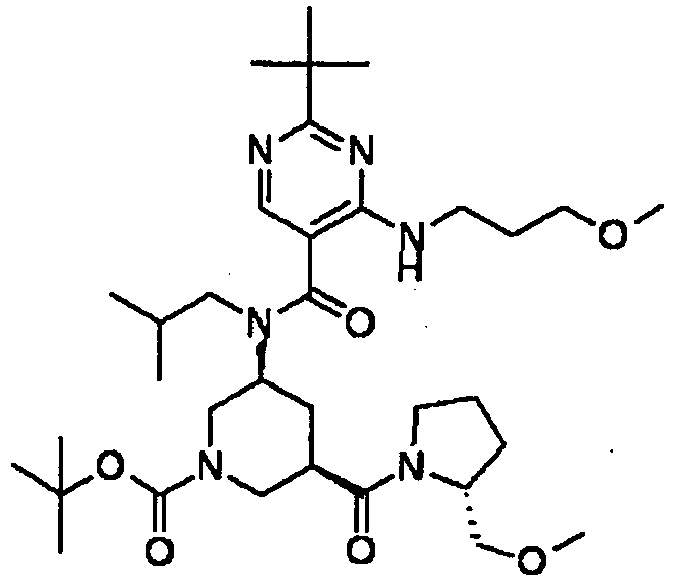
- (3R,5S)-1-(tert-Butoxycarbonyl)-5-[({2-tert-butyl-4-[(3-methoxypropyl)amino]pyrimidin-5-yl}carbonyl)(isobutyl)amino]piperidine-3-carboxylic acid (102 mg), (2R)-2-(methoxymethyl)pyrrolidine (64 mg), HOBt (20 mg) and triethylamine (104 µl) were dissolved in DMF (5 ml), WSC·HCl (107 mg) was added, and the mixture was stirred at room temperature for 18 hr. The reaction mixture was concentrated under reduced pressure, and diluted with saturated aqueous sodium hydrogen carbonate, and the mixture was extracted with ethyl acetate. The extract was washed with saturated brine, and dried over anhydrous magnesium sulfate. The solvent was evaporated under reduced pressure. The residue was subjected to silica gel column chromatography, and the fraction eluted with ethyl acetate-hexane (0:1 - 1:0) was concentrated under reduced pressure to give the object compound (91 mg).
MS (ESI+, m/e) 647 (M+1) - By a method similar to that of the above-mentioned Reference Example 226, the compounds of Reference Examples 227 to 230 below were obtained.
-

- MS (ESI+, m/e) 647 (M+1)
-

- MS (ESI+, m/e) 633 (M+1)
-

- MS (ESI+, m/e) 647 (M+1)
-

- MS (ESI+, m/e) 593 (M+1)
-
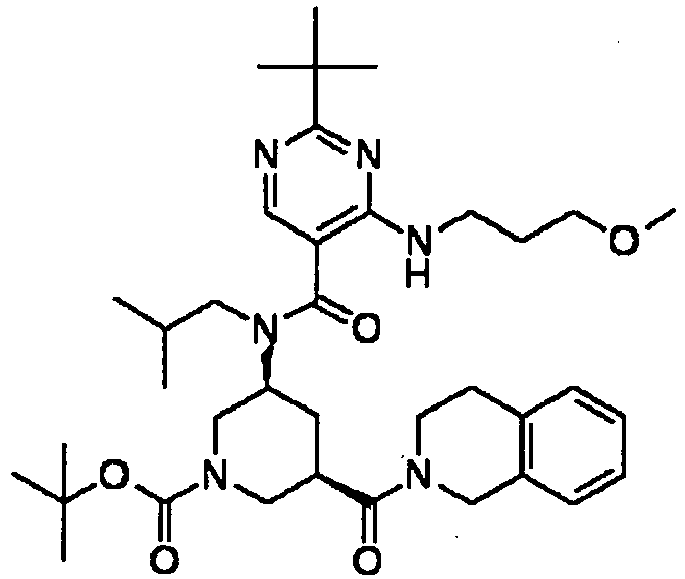
- (3R,5S)-1-(tert-Butoxycarbonyl)-5-[({2-tert-butyl-4-[(3-methoxypropyl)amino]pyrimidin-5-yl}carbonyl)(isobutyl)amino]piperidine-3-carboxylic acid (97 mg), 1,2,3,4-tetrahydroisoquinoline (67 µl), HOBt (19 mg) and triethylamine (104 µl) were dissolved in 1,2-dichloroethane (5 ml), WSC·HCl (107 mg) was added, and the mixture was stirred at room temperature for 24 hr. The reaction mixture was concentrated under reduced pressure, and diluted with saturated aqueous sodium hydrogen carbonate, and the mixture was extracted with ethyl acetate. The extract was washed with saturated brine, and dried over anhydrous magnesium sulfate. The solvent was evaporated under reduced pressure. The residue was subjected to silica gel column chromatography, and the fraction eluted with ethyl acetate-hexane (0:1 - 1:1) was concentrated under reduced pressure to give the object compound (102 mg).
MS (ESI+, m/e) 665 (M+1) - By a method similar to that of the above-mentioned Reference Example 231, the compounds of Reference Examples 232 to 236 below were obtained.
-

- MS (ESI+, m/e) 675 (M+1)
-

- MS (ESI+, m/e) 651 (M+1)
-

- MS (ESI+, m/e) 671 (M+1)
-

- MS (ESI+, m/e) 647 (M+1)
-

- MS (ESI+, m/e) 670 (M+1)
-

- (3R,5S)-1-(tert-Butoxycarbonyl)-5-[({2-tert-butyl-4-[(3-methoxypropyl)amino]pyrimidin-5-yl}carbonyl)(isobutyl)amino]piperidine-3-carboxylic acid (100 mg), 2,3-dihydro-1H-indole (62 µl) and diisopropylethylamine (96 µl) were dissolved in 1,2-dichloroethane (5 ml), chloro-N,N,N',N'-tetramethylformamidinium hexafluorophosphate (155 mg) was added, and the mixture was stirred at room temperature for 3.5 hr. The reaction mixture was concentrated under reduced pressure, and diluted with saturated aqueous sodium hydrogen carbonate, and the mixture was extracted with ethyl acetate. The extract was washed with saturated brine, and dried over anhydrous magnesium sulfate. The solvent was evaporated under reduced pressure. The residue was subjected to silica gel column chromatography, and the fraction eluted with ethyl acetate-hexane (0:1 - 1:1) was concentrated under reduced pressure to give the object compound (100 mg).
MS (ESI+, m/e) 651 (M+1) - By a method similar to that of the above-mentioned Reference Example 237, the compounds of Reference Examples 238 to 240 below were obtained.
-

- MS (ESI+, m/e) 665 (M+1)
-

- MS (ESI+, m/e) 669 (M+1)
-

- MS (ESI+, m/e) 669 (M+1)
-

- tert-Butyl (3S,5R)-3-[({2-tert-butyl-4-[(3-methoxypropyl)amino]pyrimidin-5-yl}carbonyl)(2-methylpropyl) amino] -5- [methoxy(methyl)carbamoyl]piperidine-1-carboxylate (75 mg) was dissolved in tetrahydrofuran (10 ml), 1 M methylmagnesium bromide in THF solution (1.3 ml) was added at 0°C, and the mixture was stirred at room temperature for 10 hr. Saturated aqueous ammonium chloride solution was added to the reaction mixture, and the mixture was extracted with ethyl acetate. The extract was washed with saturated brine, and dried over anhydrous magnesium sulfate. The solvent was evaporated under reduced pressure. The residue was subjected to silica gel column chromatography, and the fraction eluted with ethyl acetate-hexane (0:1 - 1:1) was concentrated under reduced pressure to give the object compound (38 mg).
MS (ESI+, m/e) 549 (M+1) - By a method similar to that of the above-mentioned Reference Example 241, the compounds of Reference Examples 242 and 243 below were obtained.
-
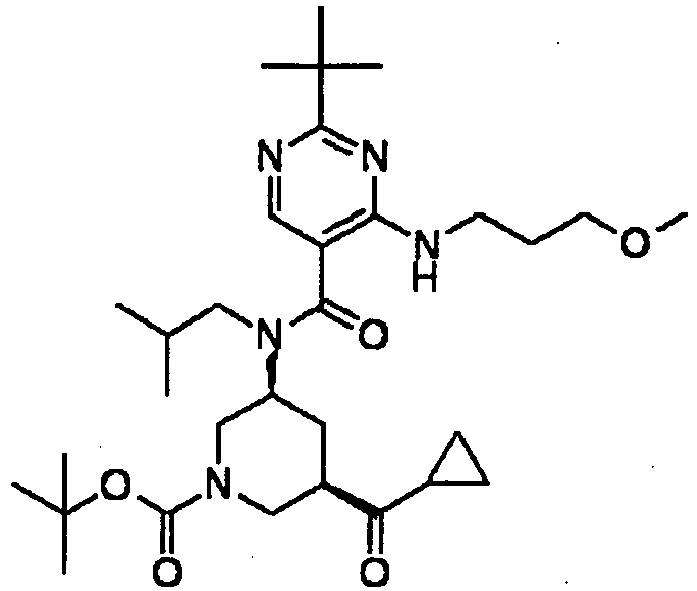
- MS (ESI+, m/e) 574(M+1)
-

- MS (ESI+, m/e) 576 (M+1)
-
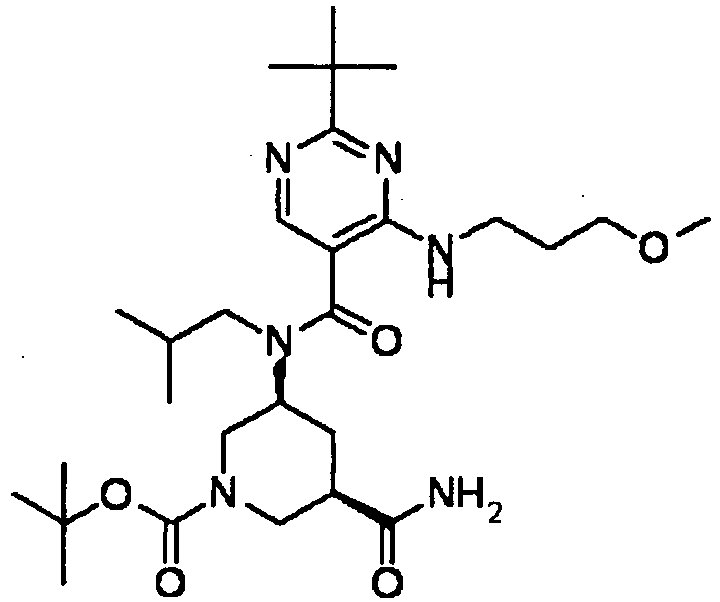
- (3R,5S)-1-(tert-Butoxycarbonyl)-5-[({2-tert-butyl-4-[(3-methoxypropyl)amino]pyrimidin-5-yl}carbonyl)(isobutyl)amino]piperidine-3-carboxylic acid (301 mg), 1H-1,2,3-benzotriazol-1-ol ammoniate (167 mg) and triethylamine (230 µl) were dissolved in 1,2-dichloroethane (10 ml), WSC·HCl (210 mg) was added and the mixture was stirred at room temperature for 2 hr. The reaction mixture was concentrated under reduced pressure, and diluted with saturated aqueous sodium hydrogen carbonate, and the mixture was extracted with ethyl acetate. The extract was dried over anhydrous magnesium sulfate and the solvent was evaporated under reduced pressure. The residue was subjected to silica gel column chromatography, and the fraction eluted with ethyl acetate-hexane (1:1) to ethyl acetate was concentrated under reduced pressure to give the object compound (210 mg).
MS (ESI+, m/e) 549 (M+1) -

- tert-Butyl (3S,5R)-3-[({2-tert-butyl-4-[(3-methoxypropyl)amino]pyrimidin-5-yl}carbonyl)(2-methylpropyl)amino]-5-carbamoylpiperidine-1-carboxylate (120 mg) was dissolved in N,N-dimethylformamide dimethyl acetal (4 ml), and the mixture was stirred at 100°C for 12 hr. The reaction mixture was concentrated under reduced pressure, and the residue was dissolved in acetic acid (7 ml). Hydrazine monohydrate (32 µl) was added and the mixture was stirred at 80°C for 3 hr. The reaction mixture was concentrated under reduced pressure, and diluted with 1 M aqueous sodium hydroxide solution, and the mixture was extracted with ethyl acetate. The extract was washed with saturated brine, and dried over anhydrous magnesium sulfate. The solvent was evaporated under reduced pressure. The residue was subjected to silica gel column chromatography, and the fraction eluted with ethyl acetate-hexane (1:1) to ethyl acetate was concentrated under reduced pressure to give the object compound (96 mg).
MS (ESI+, m/e) 573 (M+1) - By a method similar to that of Reference Examples 222 and 223, the compounds of Reference Examples 246 and 247 below were obtained.
-
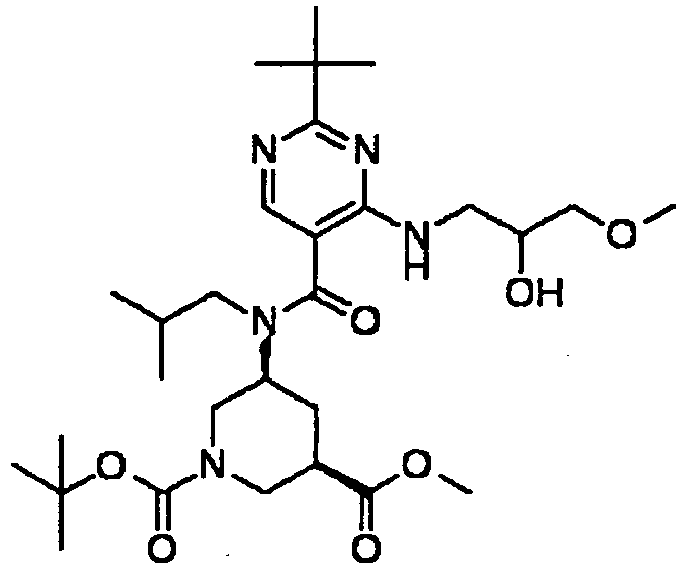
- MS (ESI+, m/e) 580 (M+1)
-
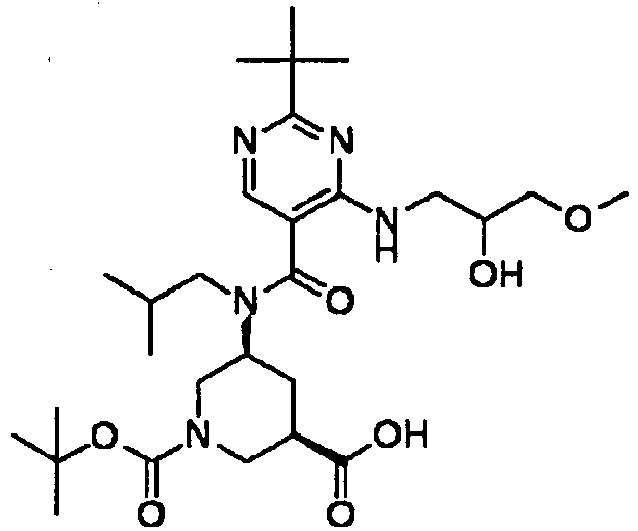
- MS (ESI+, m/e) 566 (M+1)
- By a method similar to that of Reference Example 231, the compound of Reference Example 248 below was obtained.
-

- MS (ESI+, m/e) 635 (M+1)
- By a method similar to that of Example 172, the compounds of Examples 180 to 196 below were synthesized.
-

- MS (ESI+, m/e) 547 (M+1)
-

- MS (ESI+, m/e) 547 (M+1)
-
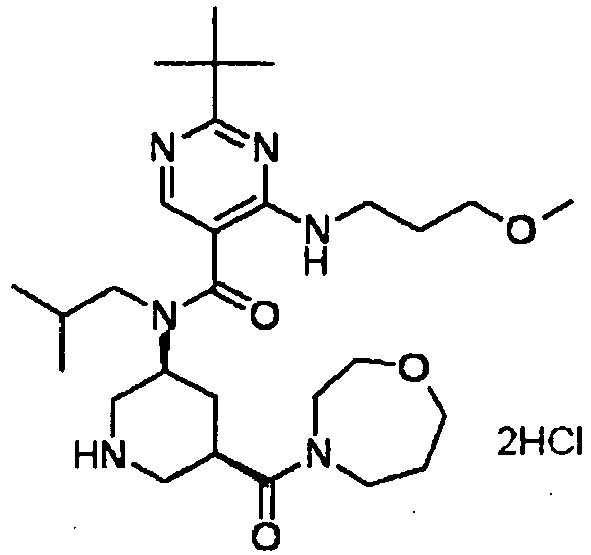
- MS (ESI+, m/e) 533 (M+1)
-

- MS (ESI+, m/e) 565 (M+1)
-
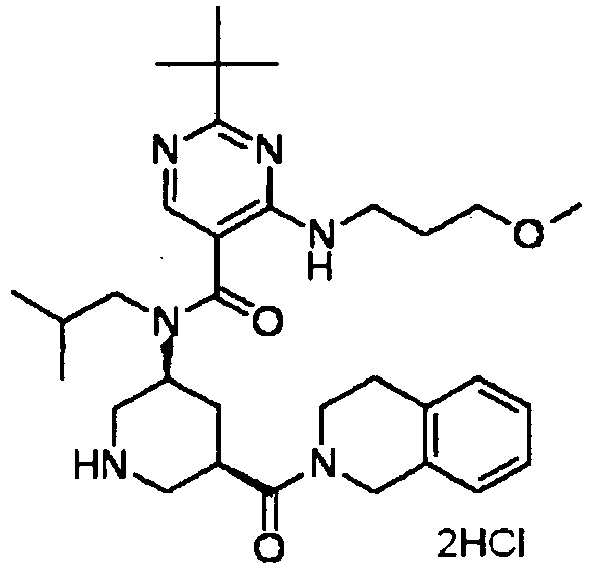
- MS (ESI+, m/e) 565 (M+1)
-

- MS (ESI+, m/e) 551 (M+1)
-

- MS (ESI+, m/e) 551 (M+1)
-
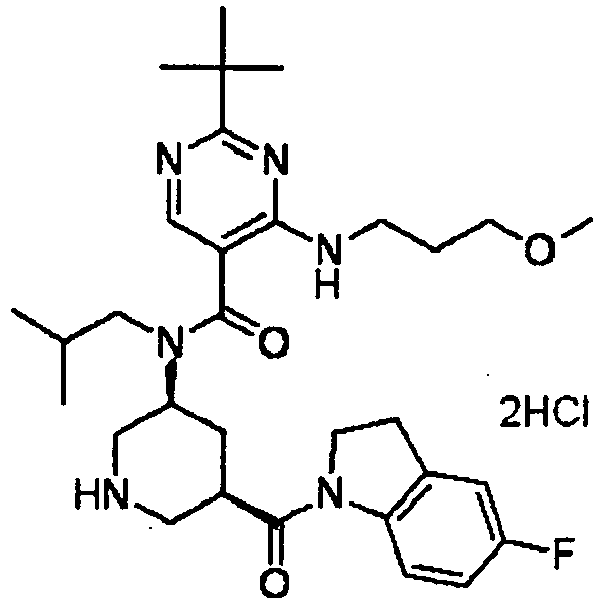
- MS (ESI+, m/e) 569 (M+1)
-

- MS (ESI+, m/e) 569 (M+1)
-
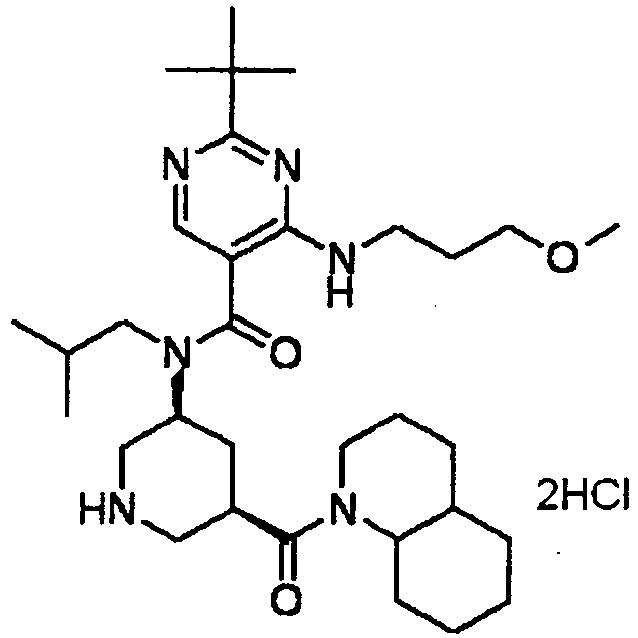
- MS (ESI+, m/e) 571 (M+1)
-
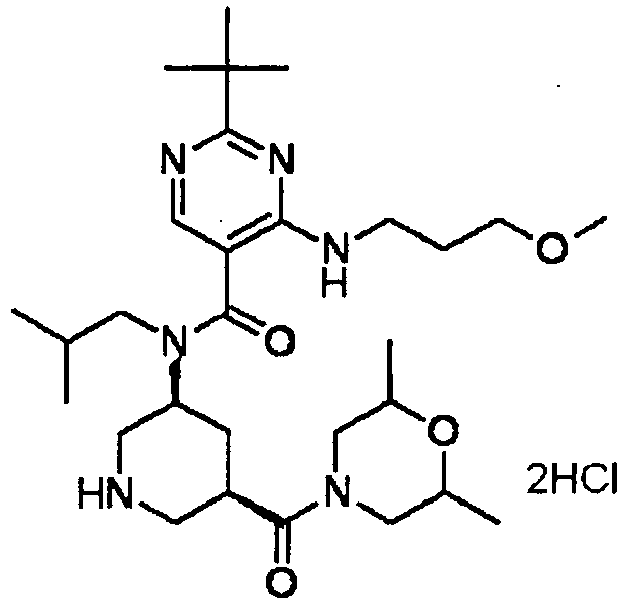
- MS (ESI+, m/e) 547 (M+1)
-

- MS (ESI+, m/e) 570 (M+1)
-
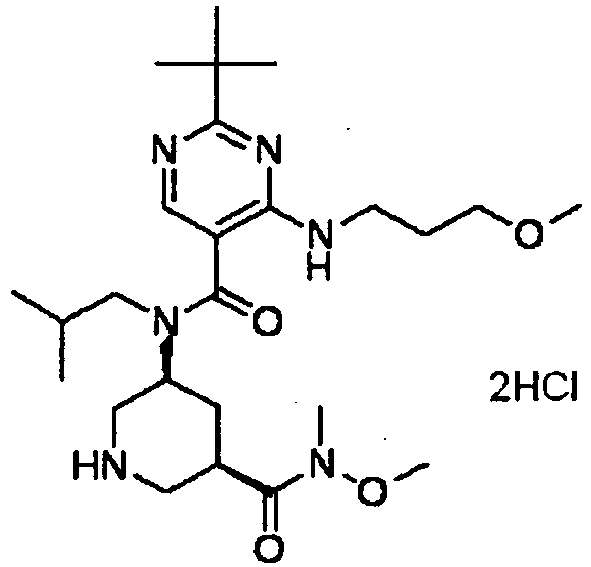
- MS (ESI+, m/e) 493 (M+1)
-

- MS (ESI+, m/e) 448 (M+1)
-

- MS (ESI+, m/e) 476 (M+1)
-

- MS (ESI+, m/e) 449 (M+1)
-

- MS (ESI+, m/e) 473 (M+1)
-

- tert-Butyl (3S,5R)-3-[({2-tert-butyl-4-[(3-methoxypropyl)amino]pyrimidin-5-yl)carbonyl)(2-methylpropyl)amino]-5-[(4-hydroxy-4-methylpiperidin-1-yl)carbonyl]piperidine-1-carboxylate (113 mg) was dissolved in 10% hydrogen chloride-methanol solution (4.5 ml), and the mixture was stirred at room temperature for 18 hr. The solvent was evaporated under reduced pressure, and the residue was dried under reduced pressure to give the object compound (82 mg).
MS (ESI+, m/e) 547 (M+1) - By a method similar to that of the above-mentioned Example 197, the compound of Example 198 below was synthesized.
-

- MS (ESI+, m/e) 535 (M+1)
-

- tert-Butyl (3S,5R)-3-[({2-tert-butyl-4-[(3-methoxypropyl)amino]pyrimidin-5-yl}carbonyl)(2-methylpropyl)amino]-5-(1,4-dioxa-8-azaspiro[4.5]dec-8-ylcarbonyl)piperidine-1-carboxylate (72 mg) was dissolved in acetonitrile (8 ml), TFA (2 ml) was added and the mixture was stirred at room temperature for 3 hr. The reaction mixture was poured into 25% aqueous potassium carbonate solution at 0°C, and the mixture was extracted with ethyl acetate. The extract was washed with saturated brine, dried over anhydrous magnesium sulfate, and concentrated under reduced pressure. The residue was subjected to reversed-phase preparative HPLC, and fractions eluted with water-acetonitrile (9:1) to acetonitrile were collected. The mixture was basified (pH 10) with saturated aqueous potassium carbonate solution, and the mixture was extracted with ethyl acetate. The extract was dried over anhydrous magnesium sulfate, and concentrated under reduced pressure to give the object compound (29 mg).
MS (ESI+, m/e) 575 (M+1) -

- tert-Butyl (3S,5R)-3-[({2-tert-butyl-4-[(3-methoxypropyl)amino]pyrimidin-5-yl}carbonyl)(2-methylpropyl)amino]-5-(cyclopropylcarbonyl)piperidine-1-carboxylate (95 mg) was dissolved in ethyl acetate (3.2 ml), 4 M hydrogen chloride-ethyl acetate solution (0.8 ml) was added, and the mixture was stirred at room temperature for 16 hr. The solvent was evaporated under reduced pressure. The residue was subjected to reversed-phase preparative HPLC, and fractions eluted with water-acetonitrile (9:1) to acetonitrile were collected. The mixture was basified (pH 10) with saturated aqueous potassium carbonate solution, and the mixture was extracted with ethyl acetate. The extract was dried over anhydrous magnesium sulfate, and concentrated under reduced pressure. The residue was dissolved in ethyl acetate (5 ml), 4 M hydrogen chloride-ethyl acetate solution (75 µl) was added and the mixture was stirred for 1 min and concentrated under reduced pressure to give the object compound (48 mg).
MS (ESI+, m/e) 474 (M+1) -

- (3R,5S)-1-(tert-Butoxycarbonyl)-5-[({2-tert-butyl-4-[(3-methoxypropyl)amino]pyrimidin-5-yl}carbonyl)(isobutyl)amino]piperidine-3-carboxylic acid (102 mg) was dissolved in 1,4-dioxane (3 ml), water (100 µl) and 6 N hydrochloric acid (3 ml) were added and the mixture was stirred at room temperature for 3.5 hr. The reaction mixture was concentrated under reduced pressure to give the object compound (99 mg).
MS (ESI+, m/e) 449 (M+1) -

- 2-tert-Butyl-4-[(3-methoxypropyl)amino]-N-(2-methylpropyl)-N-[(3S,5R)-5-(morpholin-4-ylcarbonyl)piperidin-3-yl]pyrimidine-5-carboxamide dihydrochloride (2.58 g) was suspended in water (100 ml), saturated aqueous sodium hydrogen carbonate was added, and the mixture was extracted with ethyl acetate. The extract was dried over anhydrous magnesium sulfate, and concentrated under reduced pressure to give the object compound (2.15 g).
MS (ESI+, m/e) 519 (M+1) -
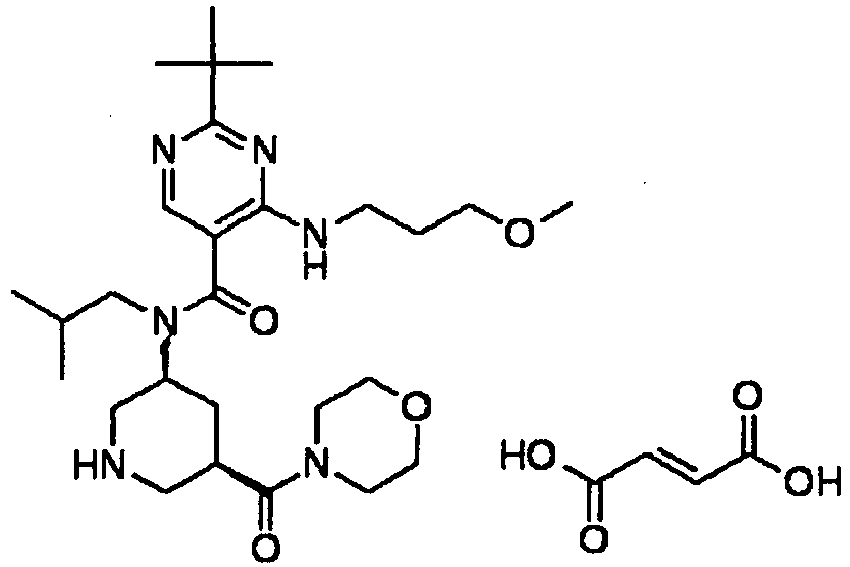
- 2-tert-Butyl-4-[(3-methoxypropyl)amino]-N-(2-methylpropyl)-N-[(3S,5R)-5-(morpholin-4-ylcarbonyl)piperidin-3-yl]pyrimidine-5-carboxamide (5.22 g) was dissolved in ethyl acetate (80 ml), and a solution of fumaric acid (1.17 g) in methanol (20 ml) was added. The mixture was heated to 70°C, stirred well and filtered. The filtrate was concentrated under reduced pressure, and the obtained white solid (6.40 g) was suspended in ethyl acetate (190 ml), and dissolved by heating to 70°C. Acetonitrile (190 ml) heated to 70°C was added, and the mixture was allowed to cool to 50°C. Seed crystals (10 mg) were added, and the mixture was allowed to cool to room temperature with stirring. The mixture was further stirred at 0°C for 2 hr, and the precipitated white solid was collected by filtration, and washed with ethyl acetate-acetonitrile (1:1). The obtained white crystals were dried under reduced pressure at 100°C for 12 hr to give the object compound (4.16 g).
MS (ESI+, m/e) 519 (M+1) -

- Methyl 3-[(tert-butoxycarbonyl)amino]-L-alaninate hydrochloride (2.00 g), 2-methylpropanal (860 µl) and acetic acid (450 µl) were dissolved in 1,2-dichloroethane-methanol (5:1, 60 ml), and the mixture was stirred at room temperature for 30 min. Sodium triacetoxyborohydride (4.00 g) was added and the mixture was stirred at room temperature for 2 hr. The reaction mixture was concentrated under reduced pressure, saturated aqueous sodium hydrogen carbonate was added, and the mixture was extracted with ethyl acetate. The extract was dried over anhydrous magnesium sulfate and the solvent was evaporated under reduced pressure. The residue was subjected to basic silica gel column chromatography, and the fraction eluted with ethyl acetate-hexane (0:1 - 1:0) was concentrated under reduced pressure to give the object compound (1.76 g). 1H-NMR (CDCl3) δ 0.90 (3H, d), 0.92 (3H, d), 1.44 (9H, s), 1.60-1.76 (1H, m), 2.28 (1H, dd), 2.44 (2H, dd), 3.24 (2H, dd), 3.29-3.36 (1H, m), 3.37-3.52 (1H, m), 3.74 (3H, s), 4.97 (1H, br s).
-

- 2-tert-Butyl-4-[(furan-2-ylmethyl)amino]pyrimidine-5-carboxylic acid (391 mg) was suspended in toluene (12 ml), thionyl chloride (260 µl) and DMF (1 drop) were added and the mixture was stirred at 90°C for 2.5 hr. The reaction mixture was cooled to room temperature, and concentrated under reduced pressure, and the residue was subjected to azeotropic distillation with toluene. The obtained residue was suspended in acetonitrile (15 ml), and a solution of methyl 3-[(tert-butoxycarbonyl)amino]-N-(2-methylpropyl)-L-alaninate (368 mg) and diisopropylethylamine (745 µl) in acetonitrile (10 ml) was added. The mixture was stirred at room temperature for 22 hr. The reaction mixture was concentrated under reduced pressure, and diluted with saturated aqueous sodium hydrogen carbonate, and the mixture was extracted with ethyl acetate. The extract was dried over anhydrous magnesium sulfate, and the solvent was evaporated under reduced pressure. The residue was subjected to silica gel column chromatography, and the fraction eluted with ethyl acetate-hexane (0:1 - 1:2) was concentrated under reduced pressure to give the object compound (330 mg).
MS (ESI+, m/e) 532 (M+1) - By a method similar to that of the above-mentioned Reference Examples 250 and 251, the compounds of Reference Examples 252 and 253 below were synthesized.
-

- 1H-NMR (CDCl3)δ 0.90 (3H, d), 0.92 (3H, d), 1.44 (9H, s), 1.60-1.75 (1H, m), 2.28 (1H, dd), 2.44 (1H, dd), 3.25 (1H, dd), 3.28-3.35 (1H, m), 3.36-3.51 (1H, m), 3.74 (3H, s), 4.99 (1H, br s).
-

- MS (ESI+, m/e) 532 (M+1)
-

- Methyl 3-[(tert-butoxycarbonyl)amino]-N-({2-tert-butyl-4-[(furan-2-ylmethyl)amino]pyrimidin-5-yl}carbonyl)-N-(2-methylpropyl)-L-alaninate (200 mg) was dissolved in tetrahydrofuran-methanol (1:2, 18 ml), 2 M aqueous sodium hydroxide solution (0.95 ml) was added and the mixture was stirred for 4 hr. The reaction mixture was concentrated under reduced pressure, and diluted with saturated aqueous ammonium chloride solution, and the mixture was extracted with ethyl acetate. The extract was dried over anhydrous magnesium sulfate, and solvent was evaporated under reduced pressure to give the object compound (240 mg).
MS (ESI+, m/e) 518 (M+1) -

- 3-[(tert-Butoxycarbonyl)amino]-N-({2-tert-butyl-4-[(furan-2-ylmethyl)amino]pyrimidin-5-yl}carbonyl)-N-(2-methylpropyl)-L-alanine (27 mg), benzylamine (200 µl) and diisopropylethylamine (300 µl) were dissolved in 1,2-dichloroethane (5 ml), chloro-N,N,N',N'-tetramethylformamidinium hexafluorophosphate (100 mg) was added, and the mixture was stirred at room temperature for 3.5 hr. The reaction mixture was diluted with saturated aqueous sodium hydrogen carbonate, and the mixture was extracted with ethyl acetate. The extract was dried over anhydrous magnesium sulfate and the solvent was evaporated under reduced pressure. The residue was subjected to reversed-phase preparative HPLC, and fractions eluted with water-acetonitrile (9:1) to acetonitrile were collected. The mixture was basified (pH 10) with saturated aqueous potassium carbonate solution, and the mixture was extracted with ethyl acetate. The extract was dried over anhydrous magnesium sulfate, and concentrated under reduced pressure to give the object compound (19 mg).
MS (ESI+, m/e) 607 (M+1) -

- 3-[(tert-Butoxycarbonyl)amino]-N-({2-tert-butyl-4-[(furan-2-ylmethyl)amino]pyrimidin-5-yl}carbonyl)-N-(2-methylpropyl)-L-alanine (40 mg), 1-pyridin-2-ylmethanamine (157 µl) and diisopropylethylamine (330 µl) were dissolved in 1,2-dichloroethane (5 ml), chloro-N,N,N',N'-tetramethylformamidinium hexafluorophosphate (200 mg) was added, and the mixture was stirred at room temperature for 2 hr. The reaction mixture was diluted with saturated aqueous sodium hydrogen carbonate, and the mixture was extracted with ethyl acetate. The extract was dried over anhydrous magnesium sulfate and the solvent was evaporated under reduced pressure. The residue was subjected to silica gel column chromatography, and the fraction eluted with ethyl acetate-hexane (1:9 - 1:0) was concentrated under reduced pressure to give the object compound (19 mg).
MS (ESI+, m/e) 608 (M+1) - By a method similar to that of the above-mentioned Reference Example 256, the compound of Reference Example 257 below was synthesized.
-

- MS (ESI+, m/e) 608(M+1)
-

- 3-[(tert-Butoxycarbonyl)amino]-N-({2-tert-butyl-4-[(furan-2-ylmethyl)amino]pyrimidin-5-yl}carbonyl)-N-(2-methylpropyl)-L-alanine (147 mg), 1H-1,2,3-benzotriazol-1-ol ammoniate (130 mg) and triethylamine (160 µl) were dissolved in 1,2-dichloroethane-DMF (3:1, 15 ml), WSC·HCl (163 mg) was added and the mixture was stirred at room temperature for 21 hr. The reaction mixture was concentrated under reduced pressure, and diluted with saturated aqueous sodium hydrogen carbonate, and the mixture was extracted with ethyl acetate. The extract was dried over anhydrous magnesium sulfate and the solvent was evaporated under reduced pressure. The residue was subjected to silica gel column chromatography, and the fraction eluted with ethyl acetate-hexane (1:9) to ethyl acetate was concentrated under reduced pressure to give the object compound (90 mg). MS (ESI+, m/e) 517 (M+1)
-

- 3-[(tert-Butoxycarbonyl)amino]-N-({2-tert-butyl-4-[(furan-2-ylmethyl)amino]pyrimidin-5-yl}carbonyl)-N-(2-methylpropyl)-L-alanine (125 mg), 2-aminoethanol (60 mg) and diisopropylethylamine (250 µl) were dissolved in DMF (10 ml), BOP reagent (500 mg) was added and the mixture was stirred at room temperature for 1.5 hr. The reaction mixture was diluted with saturated aqueous sodium hydrogen carbonate, and the mixture was extracted with ethyl acetate. The extract was dried over anhydrous magnesium sulfate and the solvent was evaporated under reduced pressure. The residue was subjected to silica gel column chromatography, and the fraction eluted with ethyl acetate-hexane (0:1 - 1:0) was concentrated under reduced pressure to give the object compound (110 mg).
MS (ESI+, m/e) 561 (M+1) - By a method similar to that of the above-mentioned Reference Example 259, the compounds of Reference Examples 260 and 261 below were synthesized.
-

- MS (ESI+, m/e) 603 (M+1)
-

- MS (ESI+, m/e) 630 (M+1)
-

- Calcium chloride (420 mg) was suspended in ethanol (5 ml), and sodium borohydride (286 mg) was added at 0°C. The mixture was stirred at 0°C for 15 min, and a solution of methyl 3-[(tert-butoxycarbonyl)amino]-N-({2-tert-butyl-4-[(furan-2-ylmethyl)amino]pyrimidin-5-yl}carbonyl)-N-(2-methylpropyl)-L-alaninate (105 mg) in THF (5 ml) was added dropwise. The mixture was stirred at room temperature for 1.5 hr, the reaction mixture was diluted with 10% aqueous citric acid solution, and the mixture was extracted with ethyl acetate. The extract was washed with saturated aqueous sodium hydrogen carbonate, and dried over anhydrous magnesium sulfate. The solvent was evaporated under reduced pressure. The residue was subjected to reversed-phase preparative HPLC, and fractions eluted with water-acetonitrile (9:1) to acetonitrile were collected. The mixture was basified (pH 10) with saturated aqueous potassium carbonate solution, and the mixture was extracted with ethyl acetate. The extract was dried over anhydrous magnesium sulfate, and concentrated under reduced pressure to give the object compound (65 mg).
MS (ESI+, m/e) 504 (M+1) - By a method similar to that of Example 172, the compounds of Examples 203 to 206 below were synthesized.
-

- MS (ESI+, m/e) 432 (M+1)
-

- MS (ESI+, m/e) 432 (M+1)
-

- MS (ESI+, m/e) 507 (M+1)
-
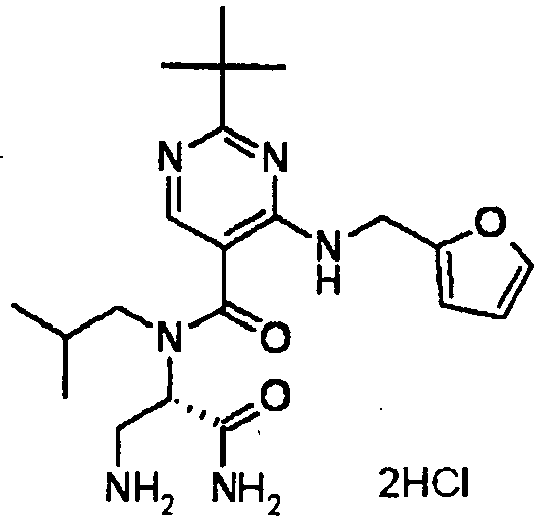
- MS (ESI+, m/e) 417 (M+1)
- By a method similar to that of Example 197, the compounds of Examples 207 to 209 below were synthesized.
-

- MS (ESI+, m/e) 404 (M+1)
-

- MS (ESI+, m/e) 461 (M+1)
-

- MS (ESI+, m/e) 503 (M+1)
-

- tert-Butyl {(2S)-2-[({2-tert-butyl-4-[(furan-2-ylmethyl)amino]pyrimidin-5-yl}carbonyl)(2-methylpropyl)amino]-3-oxo-3-[(pyridin-2-ylmethyl)amino]propyl}carbamate (19 mg) was dissolved in ethyl acetate (3 ml), 4 M hydrogen chloride-ethyl acetate solution (1.5 ml) was added, and the mixture was stirred at room temperature for 14 hr. The solvent was evaporated under reduced pressure. The residue was subjected to reversed-phase preparative HPLC, and fractions eluted with water-acetonitrile (9:1) to acetonitrile were collected. The mixture was basified (pH 10) with saturated aqueous potassium carbonate solution, and the mixture was extracted with ethyl acetate. The extract was dried over anhydrous magnesium sulfate, and concentrated under reduced pressure. The residue was dissolved in ethyl acetate (3 ml), 4 M hydrogen chloride-ethyl acetate solution (1.5 ml) was added and the mixture was stirred for 1 min and concentrated under reduced pressure to give the object compound (17 mg).
MS (ESI+, m/e) 508 (M+1) - By a method similar to that of the above-mentioned Example 210, the compounds of Examples 211 and 212 below were synthesized.
-

- MS (ESI+, m/e) 508 (M+1)
-

- MS (ESI+, m/e) 530 (M+1)
-

- A solution of (3R,5S)-1-(tert-butoxycarbonyl)-5-[({2-tert-butyl-4-[(3-methoxypropyl)amino]pyrimidin-5-yl}carbonyl)(isobutyl)amino]piperidine-3-carboxylic acid (95 mg), WSC·HCl (50 mg), HOBt (34 g) and diisopropylethylamine (0.088 ml) in DMF (5 ml) was stirred at room temperature for 12 hr. The reaction mixture was poured into saturated aqueous sodium hydrogen carbonate, and the mixture was extracted with ethyl acetate. The extract was washed successively with 10% aqueous citric acid solution and saturated brine, and dried over anhydrous sodium sulfate. The solvent was evaporated under reduced pressure. The residue was subjected to silica gel column chromatography, and the fraction eluted with ethyl acetate-hexane (1:1 - 1:0) was concentrated under reduced pressure to give an amorphous solid (65 mg).
MS (ESI+, m/e) 647 (M+1) - By a method similar to that of Reference Example 263, the following compounds (Reference Examples 264 to 275) were obtained.
-
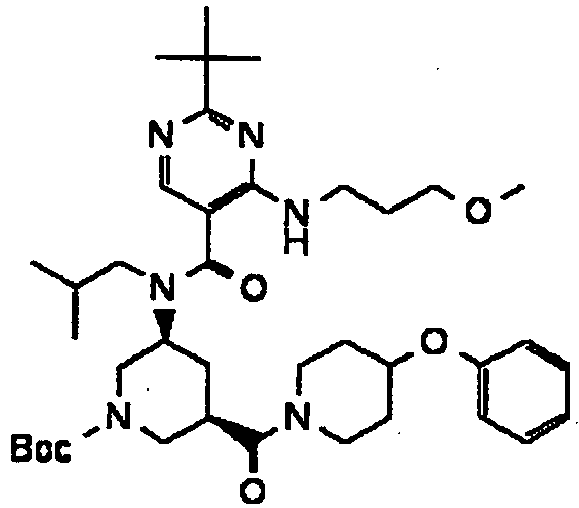
- MS (ESI+, m/e) 709 (M+1)
-

- MS (ESI+, m/e) 723 (M+1)
-

- MS (ESI+, m/e) 617 (M+1)
-
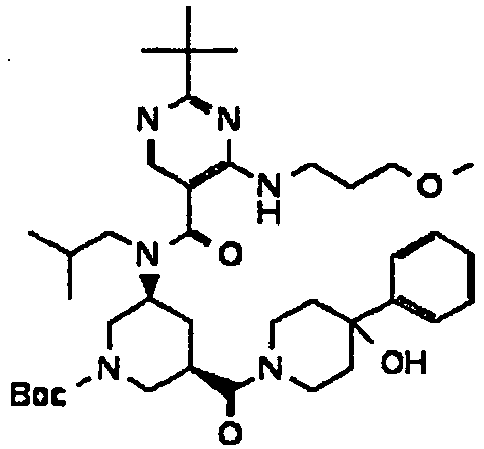
- MS (ESI+, m/e) 709 (M+1)
-

- MS (ESI+, m/e) 693 (M+1)
-

- MS (ESI+, m/e) 635 (M+1)
-

- MS (ESI+, m/e) 667 (M+1)
-

- MS (ESI+, m/e) 651 (M+1)
-

- MS (ESI+, m/e) 694 (M+1)
-
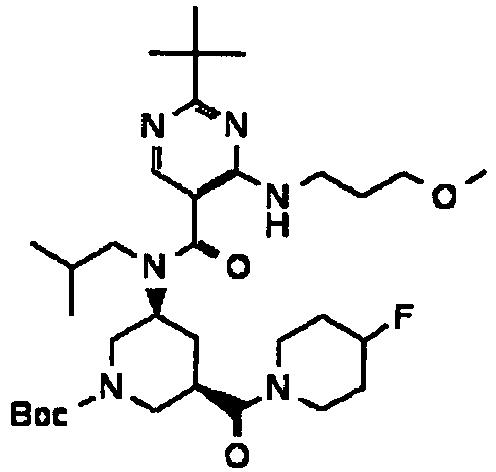
- MS (ESI+, m/e) 635 (M+1)
-
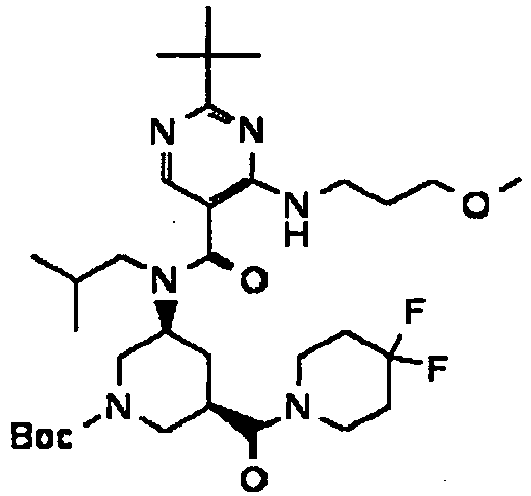
- MS (ESI+, m/e) 653 (M+1)
-

- MS (ESI+, m/e) 675 (M+1)
-

- tert-Butyl (3S,5R)-3-[(2-methylpropyl)amino]-5-(morpholin-4-ylcarbonyl)piperidine-1-carboxylate (100 mg) and diisopropylethylamine (0.095 ml) were dissolved in dichloromethane (3 ml), a solution of 7-chlorothieno[3,2-b]pyridine-6-carbonyl chloride (70 mg) in dichloromethane (2 ml) was added dropwise, and the mixture was stirred at room temperature for 1 hr. The reaction mixture was poured into water, and the mixture was extracted with ethyl acetate. The extract was dried over anhydrous sodium sulfate and the solvent was evaporated under reduced pressure. The residue was subjected to silica gel column chromatography, and the fraction eluted with ethyl acetate was concentrated under reduced pressure to give the object compound (120 mg).
MS (ESI+, m/e) 565 (M+1) -

- tert-Butyl (3S,5R)-3-{[(7-chlorothieno[3,2-b]pyridin-6-yl)carbonyl](2-methylpropyl)amino}-5-(morpholin-4-ylcarbonyl)piperidine-1-carboxylate (120 mg), 3-methoxypropan-1-amine (113 mg) and diisopropylethylamine (0.22 ml) were dissolved in 2-propanol (5 ml), and the mixture was stirred at 60°C for 12 hr. The reaction mixture was poured into water, and the mixture was extracted with ethyl acetate. The extract was washed with brine, and dried over anhydrous sodium sulfate. The solvent was evaporated under reduced pressure. The residue was subjected to silica gel column chromatography, and the fraction eluted with ethyl acetate-methanol (1:0 - 9:1) was concentrated under reduced pressure to give the object compound (90 mg).
MS (ESI+, m/e) 618 (M+1) -

- tert-Butyl (3S,5R)-3-[({2-tert-butyl-4-[(3-methoxypropyl)amino]pyrimidin-5-yl}carbonyl)(2-methylpropyl)amino]-5-[(4-methoxypiperidin-1-yl)carbonyl]piperidine-1-carboxylate (65 mg) was dissolved in ethyl acetate (5 ml), 4 N hydrogen chloride-ethyl acetate solution (7 ml) was added, and the mixture was stirred at room temperature for 1 hr. The solvent was evaporated under reduced pressure, and the residue was dried under reduced pressure to give the object compound (57 mg).
MS (ESI+, m/e) 547 (M+1) - By a method similar to that of Example 213, the following compounds (Examples 214 to 224) were obtained.
-

- MS (ESI+, m/e) 609 (M+1)
-

- MS (ESI+, m/e) 623 (M+1)
-

- MS (ESI+, m/e) 517 (M+1)
-

- MS (ESI+, m/e) 593 (M+1)
-

- MS (ESI+, m/e) 535 (M+1)
-
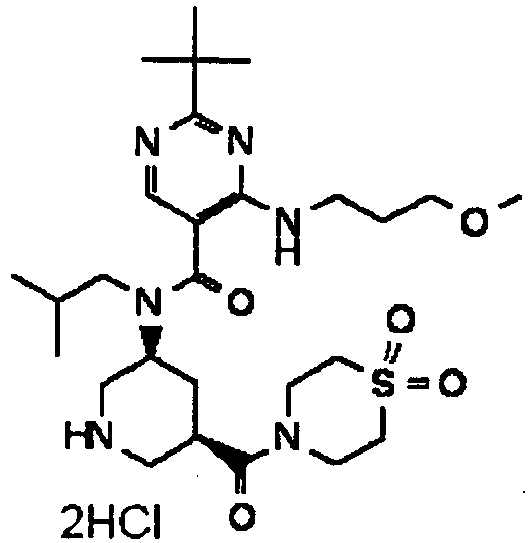
- MS (ESI+, m/e) 567 (M+1)
-

- MS (ESI+, m/e) 694 (M+1)
-
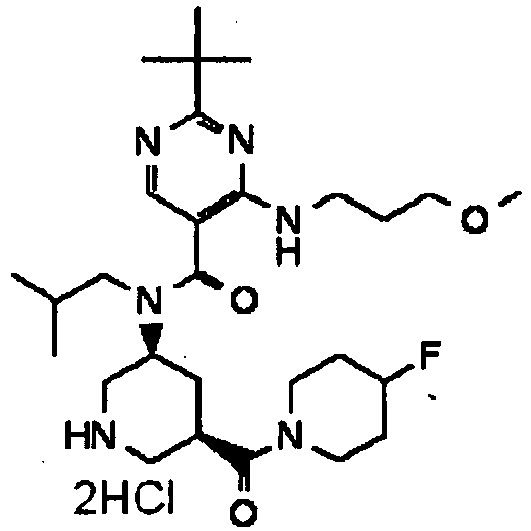
- MS (ESI+, m/e) 535 (M+1)
-
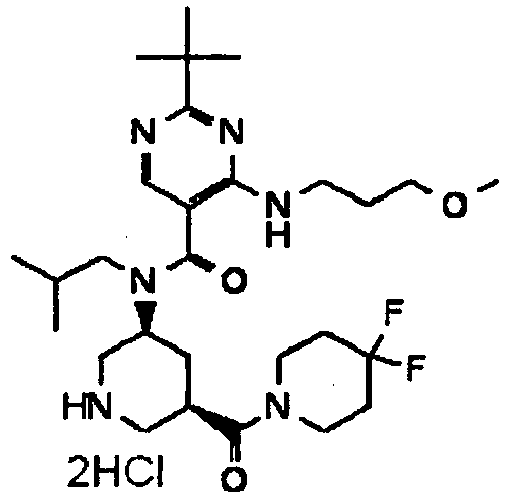
- MS (ESI+, m/e) 553 (M+1)
-

- MS (ESI+, m/e) 507 (M+1)
-

- tert-Butyl (3S,5R)-3-[({2-tert-butyl-4-[(3-methoxypropyl)amino]pyrimidin-5-yl}carbonyl)(2-methylpropyl)amino]-5-[(4-hydroxy-4-phenylpiperidin-1-yl)carbonyl]piperidine-1-carboxylate (100 mg) was dissolved in ethyl acetate (5 ml), 4 N hydrogen chloride-ethyl acetate solution (7 ml) was added, and the mixture was stirred at room temperature for 1 hr. The solvent was evaporated under reduced pressure, and the residue was dried under reduced pressure to give the object compound (80 mg).
MS (ESI+, m/e) 591 (M+1) -
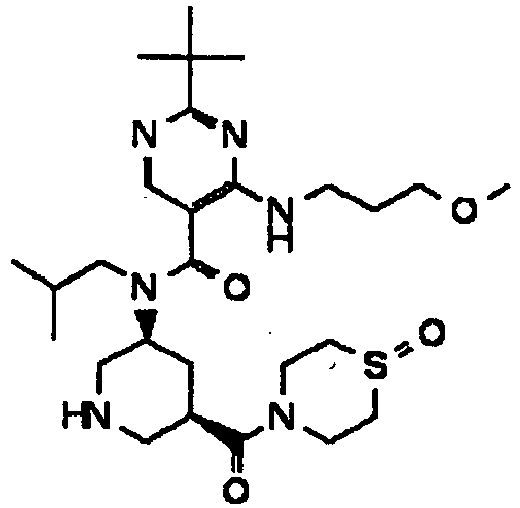
- tert-Butyl (3S,5R)-3-[({2-tert-butyl-4-[(3-methoxypropyl)amino]pyrimidin-5-yl}carbonyl)(2-methylpropyl)amino]-5-[(1-oxidothiomorpholin-4-yl)carbonyl]piperidine-1-carboxylate (120 mg) was dissolved in chloroform (3 ml), TFA (1 ml) was added and the mixture was stirred for 1 hr. The reaction mixture was concentrated, and the residue was dissolved in ethyl acetate, washed successively with saturated aqueous sodium hydrogen carbonate and saturated brine, and dried over anhydrous sodium sulfate. The solvent was evaporated under reduced pressure to give the object compound (100 mg).
MS (ESI+, m/e) 551 (M+1) -
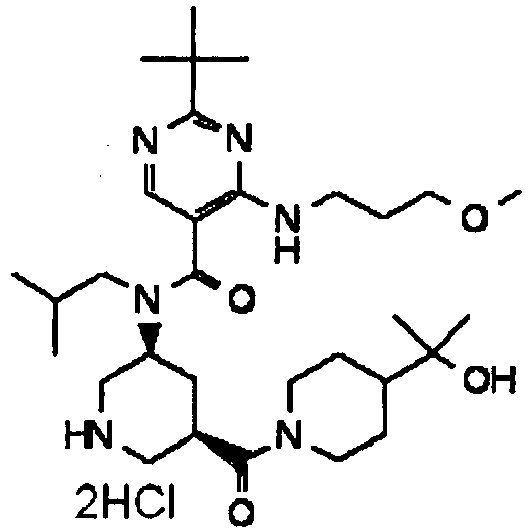
- tert-Butyl (3S,5R)-3-[({2-tert-butyl-4-[(3-methoxypropyl)amino]pyrimidin-5-yl}carbonyl)(2-methylpropyl)amino]-5-{[4-(1-hydroxy-1-methylethyl)piperidin-1-yl]carbonyl}piperidine-1-carboxylate (120 mg) was dissolved in chloroform (3 ml), TFA (1 ml) was added and the mixture was stirred for 1 hr. The reaction mixture was concentrated, and the residue was dissolved in ethyl acetate, washed successively with saturated aqueous sodium hydrogen carbonate and saturated brine, and dried over anhydrous sodium sulfate. The solvent was evaporated under reduced pressure. The residue was dissolved in methanol (2 ml), hydrochloric acid-methanol (2 ml) was added, and the solvent was evaporated under reduced pressure to give the object compound (66 mg).
MS (ESI+, m/e) 575 (M+1) -
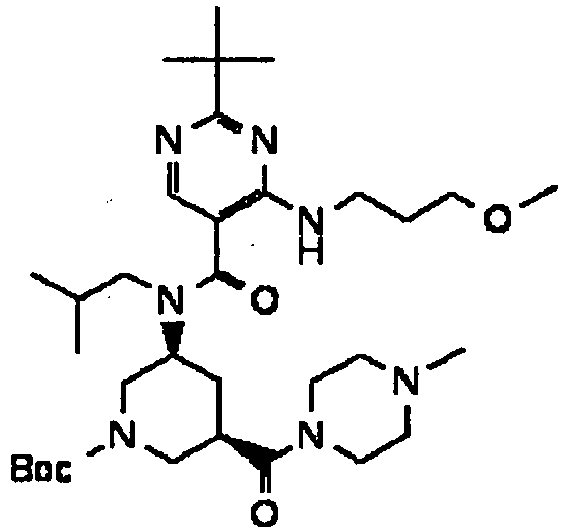
- A solution of (3R,5S)-1-(tert-butoxycarbonyl)-5-[({2-tert-butyl-4-[(3-methoxypropyl)amino]pyrimidin-5-yl}carbonyl)(isobutyl)amino]piperidine-3-carboxylic acid (100 mg), WSC·HCl (52 mg), HOBt (36 g), diisopropylethylamine (0.094 ml) and 1-methylpiperazine (20 mg) in DMF (3 ml) was stirred at room temperature for 12 hr. The reaction mixture was poured into saturated aqueous sodium hydrogen carbonate, and the mixture was extracted with ethyl acetate. The extract was washed successively with 10% aqueous citric acid solution and saturated brine, and dried over anhydrous sodium sulfate. The solvent was evaporated under reduced pressure. The residue was subjected to silica gel column chromatography, and the fraction eluted with ethyl acetate-hexane (1:1 - 1:0) was concentrated under reduced pressure to give the object compound (87 mg).
MS (ESI+, m/e) 632 (M+1) - By a method similar to that of Reference Example 279, the compounds of Reference Examples 280 to 288 below were obtained.
-

- MS (ESI+, m/e) 694 (M+1)
-

- MS (ESI+, m/e) 660 (M+1)
-

- MS (ESI+, m/e) 722 (M+1)
-
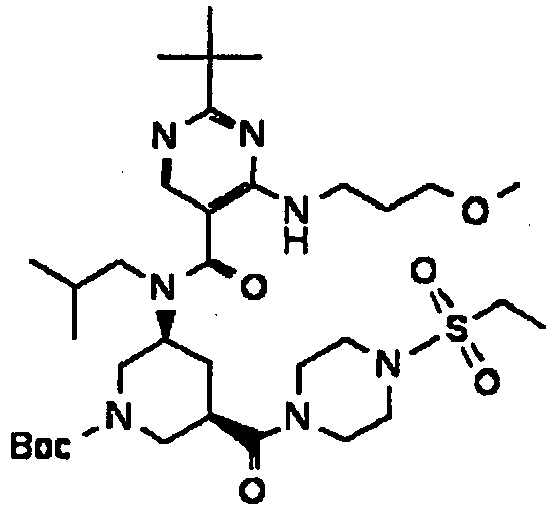
- MS (ESI+, m/e) 710 (M+1)
-

- MS (ESI+, m/e) 695 (M+1)
-

- MS (ESI+, m/e) 708 (M+1)
-

- MS (ESI+, m/e) 724 (M+1)
-

- MS (ESI+, m/e) 701 (M+1)
-
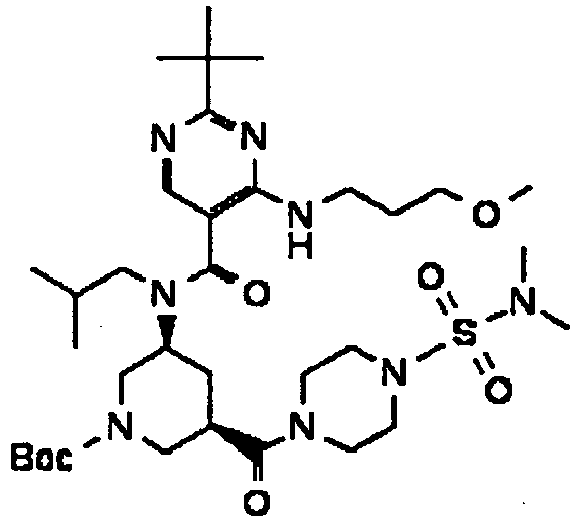
- MS (ESI+, m/e) 725 (M+1)
-
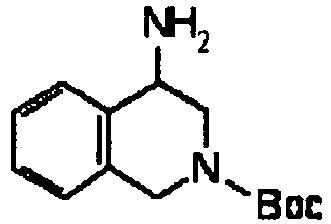
- A solution of 2,2,2-trifluoro-N-(1,2,3,4-tetrahydroisoquinolin-4-yl)acetamide (1.34 g) and diisopropylethylamine (1.14 ml) in THF (20 ml) was cooled to 0 to 5°C, di-tert-butyl dicarbonate (1.2 g) was added and the mixture was stirred at room temperature for 1 hr. The solvent was evaporated under reduced pressure, methanol (25 ml) was added to the residue, and 20% aqueous potassium carbonate solution (10 ml) was added. The mixture was stirred at 60°C for 5 hr. The solvent was evaporated under reduced pressure, saturated brine (20 ml) was added to the residue, and the mixture was extracted with chloroform (30 mlx2). The extract was dried over anhydrous sodium sulfate and the solvent was evaporated under reduced pressure. The residue was subjected to silica gel column chromatography, and the fraction eluted with ethyl acetate was concentrated under reduced pressure to give the object compound (840 mg) as a white powder.
MS (ESI+, m/e) 249 (M+1) -

- A solution of 2,2,2-trifluoro-N-isoquinolin-4-ylacetamide (1.57 g) and platinum oxide (150 mg) in acetic acid (25 ml) was subjected to hydrogenation (5 atm) at 60°C for 8 hr. The catalyst was filtered off, and the filtrate was evaporated under reduced pressure. The residue was neutralized with saturated aqueous sodium hydrogen carbonate, and evaporated under reduced pressure. The residue was extracted with THF (30 mlx2), and the extract was dried over anhydrous sodium sulfate. The solvent was evaporated under reduced pressure. THF (25 ml) and diisopropylethylamine (1 g) were added to the residue, and the mixture was cooled to 0 to 5°C. Di-tert-butyl dicarbonate (1.42 g) was added and the mixture was stirred at room temperature for 15 hr. The solvent was evaporated under reduced pressure, and ethyl acetate (50 ml) was added to the residue. Insoluble material was filtered off, and the filtrate was concentrated under reduced pressure. The residue was subjected to silica gel column chromatography, and the fraction eluted with hexane-ethyl acetate (9:1 - 7:3) was concentrated under reduced pressure to give the object compound (1.8 g) as an oil.
MS (ESI+, m/e) 351 (M+1) -

- A solution of tert-butyl 4-[(trifluoroacetyl)amino]octahydroisoquinoline-2(1H)-carboxylate (1.75 g) and 20% aqueous potassium carbonate solution (10 ml) in methanol (25 ml) was stirred at 60°C for 15 hr. The solvent was evaporated under reduced pressure, saturated brine (20 ml) was added to the residue, and the mixture was extracted with chloroform (30 mlx2). The extract was dried over anhydrous sodium sulfate and the solvent was evaporated under reduced pressure. The residue was subjected to silica gel column chromatography, and the fraction eluted with ethyl acetate-methanol (1:0 - 9:1) was concentrated under reduced pressure to give the object compound (1.12 g) as an oil.
MS (ESI+, m/e) 255 (M+1) -

- To a solution of tert-butyl 4-amino-3,4-dihydroisoquinoline-2(1H)-carboxylate (840 mg) and 2-methylpropanal (256 mg) in dichloroethane (10 ml) were added acetic acid (203 mg) and sodium triacetoxyborohydride (931 mg). The mixture was stirred at room temperature for 1 hr. The mixture was neutralized with 6% aqueous sodium hydrogen carbonate. After partitioning, the organic layer was dried over anhydrous magnesium sulfate. The solvent was evaporated under reduced pressure. The residue was subjected to silica gel column chromatography, and the fraction eluted with ethyl acetate-hexane (1:1) was concentrated under reduced pressure to give the object compound (940 mg) as an oil.
MS (ESI+, m/e) 305 (M+1) - By a method similar to that of Reference Example 292, the compound of Reference Example 293 below was obtained.
-

- MS (ESI+, m/e) 311 (M+1)
-

- To a solution of 2-tert-butyl-6-oxo-1,6-dihydropyrimidine-5-carboxylic acid (245 mg) and DMF (1 to 2 drops) in THF (10 ml) was added thionyl chloride (520 mg) and the mixture was stirred at 65°C for 3 hr. The solvent was evaporated under reduced pressure. The residue was dissolved in THF (1 ml). A solution of tert-butyl 4-[(2-methylpropyl)amino]-3,4-dihydroisoquinoline-2(1H)-carboxylate (304 mg) and diisopropylethylamine (0.7 ml) in THF (10 ml) was cooled to 0 to 5°C, and 2-tert-butyl-4-chloropyrimidine-5-carbonyl chloride/THF solution obtained in the above was added. The mixture was stirred at room temperature for 2 hr. The reaction mixture was poured into water, and the mixture was extracted with ethyl acetate. The extract was dried over anhydrous sodium sulfate and the solvent was evaporated under reduced pressure. The residue was subjected to silica gel column chromatography, and the fraction eluted with hexane-ethyl acetate (3:1) was concentrated under reduced pressure to give the object compound (450 mg).
MS (ESI+, m/e) 502 (M+1) - By a method similar to that of Reference Example 294, the compound of Reference Example 295 below was obtained.
-

- MS (ESI+, m/e) 508 (M+1)
-

- tert-Butyl 4-{[(2-tert-butyl-4-chloropyrimidin-5-yl)carbonyl](2-methylpropyl)amino}-3,4-dihydroisoquinoline-2(1H)-carboxylate (100 mg), 1-(1,3-oxazol-2-yl)methanamine hydrochloride (54 mg) and diisopropylethylamine (0.14 ml) were dissolved in 2-propanol (2 ml), and the mixture was stirred at 80°C for 6 hr. The reaction mixture was poured into water, and the mixture was extracted with ethyl acetate. The extract was washed with brine, and dried over anhydrous sodium sulfate. The solvent was evaporated under reduced pressure. The residue was subjected to silica gel column chromatography, and the fraction eluted with hexane-ethyl acetate (3:1) was concentrated under reduced pressure to give the object compound (85 mg).
MS (ESI+, m/e) 563 (M+1) - By a method similar to that of Reference Example 296, the compound of Reference Example 297 below was obtained.
-

- MS (ESI+, m/e) 569 (M+1)
-

- tert-Butyl (3S,5R)-3-[({2-tert-butyl-4-[(3-methoxypropyl)amino]pyrimidin-5-yl}carbonyl)(2-methylpropyl)amino]-5-[(4-methylpiperazin-1-yl)carbonyl]piperidine-1-carboxylate (87 mg) was dissolved in ethyl acetate (1 ml), 4 N hydrogen chloride-ethyl acetate solution (1 ml) was added, and the mixture was stirred at room temperature for 1 hr. The solvent was evaporated under reduced pressure, and the residue was dried under reduced pressure to give the object compound (87 mg).
MS (ESI+, m/e) 532 (M+1) - By a method similar to that of Example 226, the compounds of 227 to 237 below were obtained.
-

- MS (ESI+, m/e) 594 (M+1)
-

- MS (ESI+, m/e) 560 (M+1)
-
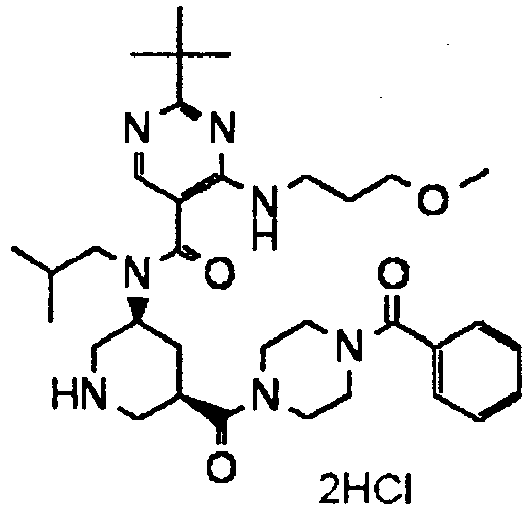
- MS (ESI+, m/e) 622 (M+1)
-

- MS (ESI+, m/e) 610 (M+1)
-

- MS (ESI+, m/e) 595 (M+1)
-

- MS (ESI+, m/e) 608 (M+1)
-

- MS (ESI+, m/e) 624 (M+1)
-

- MS (ESI+, m/e) 601 (M+1)
-

- MS (ESI+, m/e) 625 (M+1)
-

- MS (ESI+, m/e) 463 (M+1)
-

- MS (ESI+, m/e) 469 (M+1)
- By a method similar to that of Reference Example 46, the compound of Reference Example 298 below was obtained.
-

- MS (ESI+, m/e) 577 (M+1)
-

- To a solution of tert-butyl (3S,5R)-3-[{[2-chloro-6-(trifluoromethyl)pyridin-3-yl]carbonyl}(2-methylpropyl)amino]-5-(morpholin-4-ylcarbonyl)piperidine-1-carboxylate (40 mg) and diisopropylethylamine (37 µl) in 2-propanol (3 ml) was added 3-methoxypropylamine (23 µl) and the mixture was stirred at 80°C for 15 hr. The reaction mixture was concentrated under reduced pressure, saturated aqueous sodium hydrogen carbonate was added, and the mixture was extracted with ethyl acetate. The extract was dried over anhydrous magnesium sulfate, and concentrated under reduced pressure. The obtained residue was dissolved in methanol (2 ml), 4 M hydrogen chloride-ethyl acetate (2 ml) was added, and the mixture was stirred at room temperature for 15 hr. The reaction mixture was concentrated under reduced pressure, and the residue was subjected to reversed-phase preparative HPLC. Aqueous sodium hydrogen carbonate was added to the object fraction, and the mixture was extracted with ethyl acetate. The extract was washed with saturated brine, and dried over anhydrous sodium sulfate. The solvent was evaporated under reduced pressure to give the object compound (8.8 mg).
MS (ESI+, m/e) 530 (M+1) -

- Ethyl 6-(1-methylethyl)-4-oxo-1,4-dihydropyridine-3-carboxylate (209 mg) was suspended in phosphorus oxychloride (2 ml), and the mixture was stirred at 120°C for 3 hr. Phosphorus oxychloride was evaporated under reduced pressure, and the mixture was cooled to 0°C. The mixture was neutralized with saturated aqueous sodium hydrogen carbonate and water, and the mixture was extracted with ethyl acetate. The extract was washed with saturated brine, dried over anhydrous sodium sulfate and concentrated under reduced pressure. The obtained residue was dissolved in 2-propanol (5 ml), 3-methoxypropylamine (307 µl) and triethylamine (517 µl) were added, and the mixture was stirred with heating to reflux for 15 hr. The reaction mixture was concentrated under reduced pressure, saturated aqueous sodium hydrogen carbonate was added, and the mixture was extracted with ethyl acetate. The extract was washed with saturated brine, dried over anhydrous sodium sulfate and concentrated under reduced pressure. The obtained residue was subjected to silica gel chromatography, and the fraction eluted with acetic acid was concentrated under reduced pressure to give the object compound (263 mg). MS (ESI+, m/e) 281 (M+1)
-
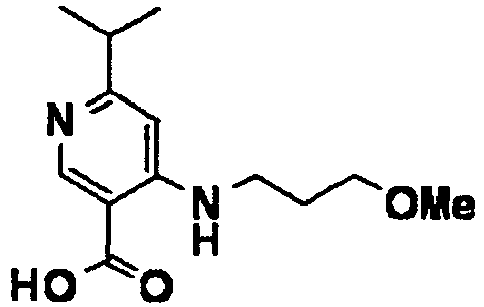
- To a solution of ethyl 4-[(3-methoxypropyl)amino]-6-(1-methylethyl)pyridine-3-carboxylate (263 mg) in ethanol (5 ml) was added 2 M aqueous sodium hydroxide solution (0.94 ml) and the mixture was stirred at room temperature for 15 hr. The reaction mixture was adjusted to pH 7 with 1 M hydrochloric acid, and the solvent was evaporated under reduced pressure. The residue was suspended in ethanol, and the precipitated inorganic salt was filtered off. The filtrate was concentrated under reduced pressure to give the object compound (300 mg) as a mixture of inorganic salts.
MS (ESI+, m/e) 253 (M+1) -
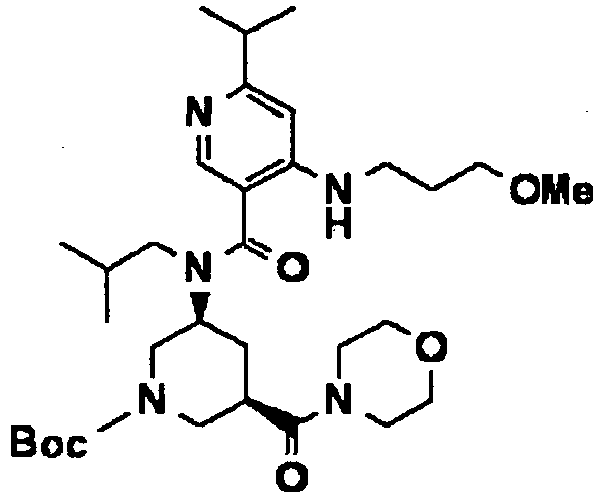
- 4-[(3-Methoxypropyl)amino]-6-(1-methylethyl)pyridine-3-carboxylic acid (160 mg), tert-butyl (3S,5R)-3-[(2-methylpropyl)amino]-5-(morpholin-4-ylcarbonyl)piperidine-1-carboxylate (185 mg) and diisopropylethylamine (431 µl) were dissolved in methylene chloride (10 ml), chloro-N,N,N',N'-tetramethylformamidinium hexafluorophosphate (168 mg) was added and the mixture was stirred at room temperature for 15 hr. Aqueous sodium hydrogen carbonate was added to the reaction mixture, and the mixture was extracted with ethyl acetate. The extract was washed with saturated brine, and dried over anhydrous sodium sulfate. The solvent was evaporated under reduced pressure. The residue was subjected to basic silica gel column chromatography, and the fraction eluted with ethyl acetate-hexane (7:3) was concentrated under reduced pressure to give the object compound (268 mg).
MS (ESI+, m/e) 604 (M+1) -
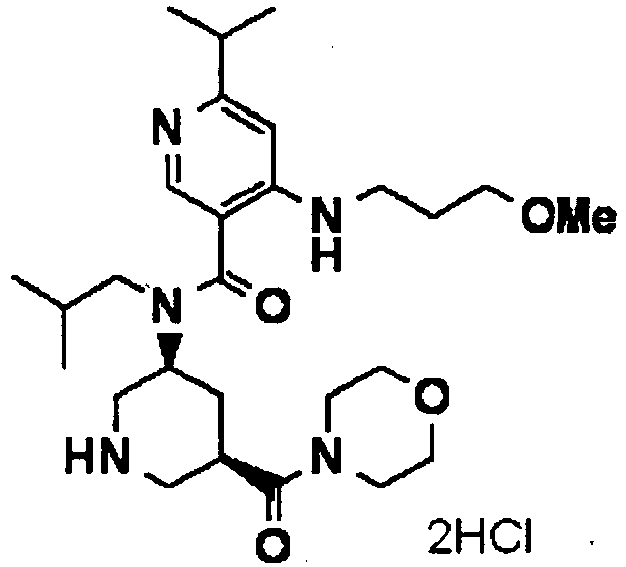
- tert-Butyl (3S,5R)-3-[({4-[(3-methoxypropyl)amino]-6-(1-methylethyl)pyridin-3-yl}carbonyl)(2-methylpropyl)amino]-5-(morpholin-4-ylcarbonyl)piperidine-1-carboxylate (268 mg) was dissolved in 4 M hydrogen chloride-ethyl acetate (5 ml), and the mixture was stirred at room temperature for 15 hr. The reaction mixture was concentrated, the residue was purified by reversed-phase preparative HPLC, and the object fraction was concentrated under reduced pressure. Aqueous sodium hydrogen carbonate was added to the residue, and the mixture was extracted with ethyl acetate. The extract was washed with saturated brine, dried over anhydrous magnesium sulfate and concentrated under reduced pressure. 4 M Hydrogen chloride-ethyl acetate (1 ml) was added to the residue, and the mixture was stirred for 5 min and concentrated under reduced pressure to give the object compound (163 mg).
MS (ESI+, m/e) 504 (M+1) - By a method similar to that of Reference Example 263, the compounds of Reference Examples 303 to 310 below were obtained.
-

- MS (ESI+, m/e) 503 (M+1)
-

- MS (ESI+, m/e) 589 (M+1)
-
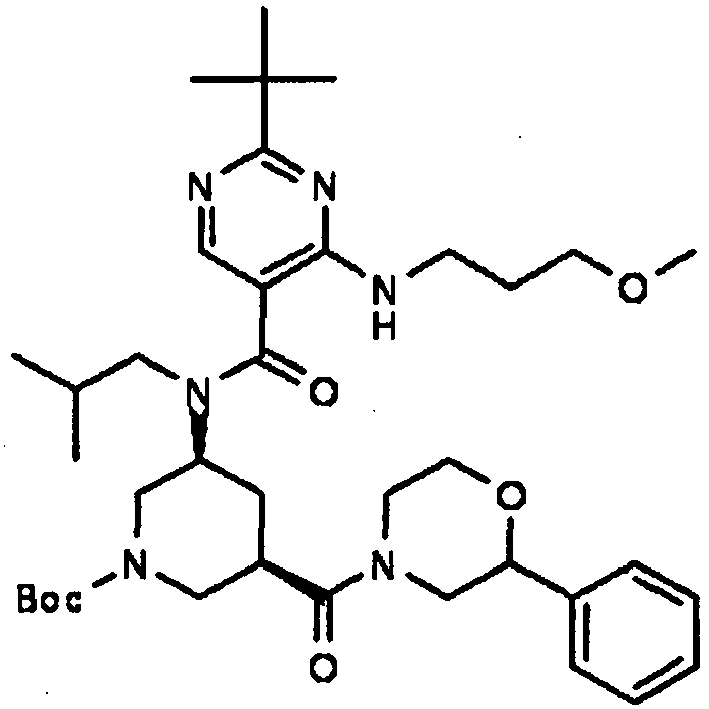
- MS (ESI+, m/e) 695 (M+1)
-

- MS (ESI+, m/e) 709 (M+1)
-

- MS (ESI+, m/e) 695 (M+1)
-

- MS (ESI+, m/e) 709 (M+1)
-

- MS (ESI+, m/e) 696 (M+1)
-

- MS (ESI+, m/e) 696 (M+1)
- By a method similar to that of Example 213, the compounds of Examples 239 to 244 below were obtained.
-

- MS (ESI+, m/e) 503 (M+1)
-
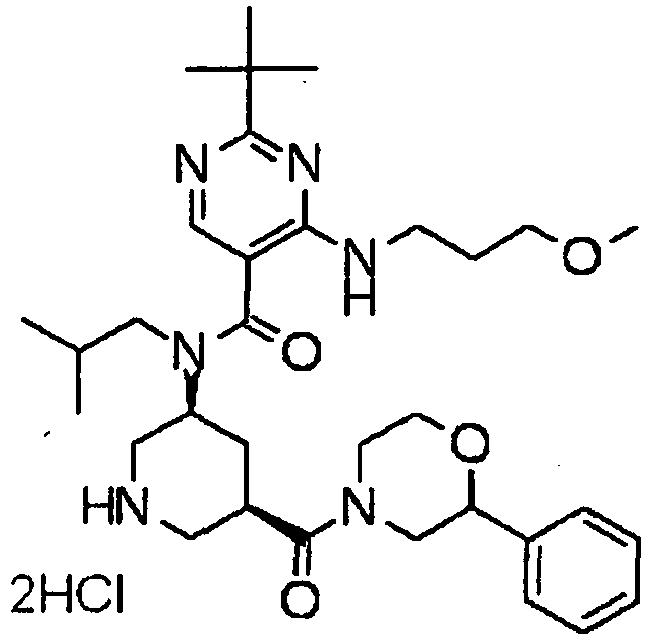
- MS (ESI+, m/e) 595 (M+1)
-

- MS (ESI+, m/e) 609 (M+1)
-

- MS (ESI+, m/e) 595 (M+1)
-

- MS (ESI+, m/e) 609 (M+1)
-

- MS (ESI+, m/e) 596 (M+1)
-

- MS (ESI+, m/e) 596 (M+1)
-

- tert-Butyl (3R,5S)-3-(azetidin-1-ylcarbonyl)-5-[({2-tert-butyl-4-[(3-methoxypropyl)amino]pyrimidin-5-yl}carbonyl(2-methylpropyl)amino]piperidine-1-carboxylate (94 mg) was dissolved in 4 M hydrogen chloride-ethyl acetate (3 ml), and the mixture was stirred at room temperature for 3 hr. The reaction mixture was concentrated under reduced pressure, and the residue was subjected to reversed-phase preparative HPLC. Aqueous sodium hydrogen carbonate was added to the object fraction, and the mixture was extracted with ethyl acetate. The extract was washed with saturated brine, and dried over anhydrous sodium sulfate. The solvent was evaporated under reduced pressure to give the object compound (33 mg).
MS (ESI+, m/e) 489 (M+1) - By a method similar to that of Reference Example 1, the compound of Reference Example 311 below was obtained.
-

- MS (ESI+, m/e) 239 (M+1)
- By a method similar to that of Reference Example 299, the compound of Reference Example 312 below was obtained.
-

- MS (ESI+, m/e) 310 (M+1)
- By a method similar to that of Reference Example 300, the compound of Reference Example 313 below was obtained.
-

- MS (ESI+, m/e) 282 (M+1)
- By a method similar to that of Reference Example 301, the compound of Reference Example 314 below was obtained.
-

- MS (ESI+, m/e) 633 (M+1)
- By a method similar to that of Reference Example 302, the compound of Example 247 below was obtained.
-

- MS (ESI+, m/e) 533 (M+1)
-
(1) Compound of Example 1 10.0 g (2) Lactose 70.0 g (3) Cornstarch 50.0 g (4) Soluble starch 7.0 g (5) Magnesium stearate 3.0 g - 10.0 g of the compound of Example 1 and 3.0 g of magnesium stearate are granulated with 70 ml of an aqueous solution of soluble starch (7.0 g as soluble starch), and the granules are dried and mixed with 70.0 g of lactose and 50.0 g of corn starch (all of lactose, corn starch, soluble starch and magnesium stearate are products in conformity to the 14th revision of the Japanese Pharmacopoeia). The mixture is compressed to give tablets.
- Human renin was obtained by expressing preprorenin (1-406) in an animal cell, treating the prorenin (24-406) contained in the culture supernatant with trypsin, and taking the active type (67-406).
- A plasmid DNA to express human renin in HEK293 cells was prepared as follows. PCR was carried out using human renal cDNA (Clontech Laboratories, Inc., Marathon Ready cDNA) as the template and using two synthetic DNAs (5'-AAGCTTATGGATGGATGGAGA-3'; SEQ ID NO:1, and 5'-GGATCCTCAGCGGGCCAAGGC-3'; SEQ ID NO:2), and the obtained fragments were cloned using a TOPO TA Cloning Kit (Invitrogen Corp.). The obtained fragments were subcloned into pcDNA3.1(+) that had been cleaved by HindIII and BamHI, thus to obtain a plasmid DNA for human preprorenin expression (pcDNA3.1 (+) /hREN).
- A plasmid DNA to express human angiotensinogen in HEK293 cells was prepared as follows. PCR was carried out using human liver cDNA (Clontech Laboratories, Inc., Marathon Ready cDNA) as the template and using two synthetic DNAs (5'-AAGCTTATGCGGAAGCGAGCACCCCAGTCT-3'; SEQ ID NO:3, and 5'-GGATCCTCACTTGTCATCGTCGTCCTTGTAGTCTGCTGTGCTCAGCGGGTTGGCCACGC-3'; SEQ ID NO:4), and the obtained fragments were cloned using a TOPO TA Cloning Kit (Invitrogen Corp.). The obtained fragments were subcloned into pcDNA3.1(+) that had been cleaved by HindIII and BamHI, thereby to give a plasmid DNA for expression of human angiotensinogen having a FLAG tag on the C-terminal (pcDNA3.1(+)/hAngiotensinogen-FLAG). Then, PCR was carried out using the pcDNA3.1(+)/hAngiotensinogen-FLAG as the template and using two synthetic DNAs (5'-CCTTAAGCTTCCACCATGCGGAAGCGAGCACCCCAGTCT-3'; SEQ ID NO:5, and 5'-TTGGATCCTCATGCTGTGCTCAGCGGGTTGGCCACGCGG-3'; SEQ ID NO:6), and the obtained fragments were cloned using a TOPO TA Cloning Kit (Invitrogen Corp.). The obtained fragments were subcloned into pcDNA3.1(+) that had been cleaved by HindIII and BamHI, thus to obtain a plasmid DNA for human angiotensinogen expression (pcDNA3.1(+)/hAngiotensinogen).
- Expression of human preprorenin was conducted using FreeStyle 293 Expression System (Invitrogen Corp.). According to the manual accompanying the FreeStyle 293 Expression System, the plasmid DNA for human preprorenin expression (pcDNA3.1(+)/hREN) constructed in the above-mentioned (1) was used to conduct transient expression by FreeStyle 293-F cells. After transfection of the plasmid DNA, the cells were subjected to shaking culture under the conditions of 37°C, 8% CO2 and 125 rpm for 3 days. A 600-ml aliquot of the culture medium was centrifuged at 2,000 rpm for 10 min to recover the culture supernatant containing prorenin (24-406). The culture supernatant was concentrated by ultrafiltration using a PM10 membrane (Millipore, Inc.) to a volume of about 50 ml, and then was dialyzed against 20 mM Tris-hydrochloric acid (pH 8.0). The dialysate was fed to a 6-ml RESOURCE Q column (GE Healthcare) equilibrated with 20 mM Tris-hydrochloric acid (pH 8.0) at a flow rate of 3 ml/min to adsorb the prorenin (24-406). After washing the column with the buffer solution used in the equilibration, elution was carried out by means of a linear concentration gradient of sodium chloride from 0 M to 0.4 M. The fraction containing prorenin (24-406) was collected and concentrated using Vivaspin 20 (molecular weight cut off 10,000; Vivascience, Inc.) to a volume of about 2 ml.
- The concentrated liquid was subjected to gel filtration chromatography using HiLoad 16/60 Superdex 200 pg (GE Healthcare) equilibrated with 20 mM Tris-hydrochloric acid (pH 8.0) containing 0.15 M sodium chloride, at a flow rate of 1.4 ml/min, thus to obtain 3.6 mg of purified prorenin (24-406).
- To 3.6 mg of prorenin (24-406) dissolved in 5.2 ml of 0.1 M Tris-hydrochloric acid (pH 8.0), 12 µg of trypsin (Roche Diagnostics Corp.) was added, and the mixture was allowed to react at 28°C for 55 min to carry out activation of renin. After the reaction, 0.4 ml of immobilized trypsin inhibitor (Pierce Biotechnology, Inc.) was added to remove the trypsin used in the activation by adsorption. The reaction liquid containing the active type renin was concentrated using Vivaspin 20 (molecular weight cut off 10,000, Vivascience, Inc.), and was diluted with 20 mM Tris-hydrochloric acid (pH 8.0). The diluted liquid was fed to a TSKgel DEAE-5PW column (7.5 mm I.D. × 75 mm, Tosoh Corp.) equilibrated with 20 mM Tris-hydrochloric acid (pH 8.0) at a flow rate of 1 ml/min to adsorb the active type renin (67-406). The column was washed with the buffer solution used for the equilibration, and then elution was carried out by means of a sodium chloride linear concentration gradient from 0 M to 0.3 M, thus to obtain 1.5 mg of a purified product of active type renin (67-406).
- Expression of human angiotensinogen was conducted using FreeStyle 293 Expression System (Invitrogen Corp.). According to the manual accompanying the FreeStyle 293 Expression System, the plasmid DNA for human angiotensinogen expression (pcDNA3.1(+)/hAngiotensinogen) constructed in the above-mentioned (2) was used to conduct transient expression by FreeStyle 293-F cells. After transfection of the plasmid DNA, the cells were subjected to shaking culture under the conditions of 37°C, 8% CO2 and 125 rpm for 3 days. A 600-ml aliquot of the culture medium was centrifuged at 2,000 rpm for 10 min to recover the culture supernatant containing angiotensinogen. To the culture supernatant was added ammonium sulfate (30% saturated concentration), and the mixture was thoroughly stirred and centrifuged at 8,000 rpm for 20 min. The obtained supernatant was added to TOYO Pearl butyl 650M (2x5 cm, Tosoh Corporation) equilibrated with 50 mM tris-hydrochloric acid (pH 8.0) containing 30% saturated ammonium sulfate, at a flow rate of 25 ml/min to allow adsorption. After washing with equilibration buffer, angiotensinogen was eluted by linear concentration gradient from the buffer used for equilibration to 20 mM tris-hydrochloric acid (pH 8.0). The eluate containing angiotensinogen was applied to repeated concentration and dilution using Vivaspin 20 (molecular weight cut off 10,000, Vivascience, Inc.), and the buffer was changed to 20 mM tris-hydrochloric acid (pH 8.0). The eluate was fed to a 6-ml RESOURCE Q column (Amersham Biosciences, Inc.) equilibrated with 20 mM Tris-hydrochloric acid (pH 8.0) containing 50 mM sodium chloride at a flow rate of 6 ml/min to adsorb the angiotensinogen. After washing the column with the buffer solution used in the equilibration, elution was carried out by means of a linear concentration gradient of sodium chloride from 50 mM to 400 mM. The fractions containing angiotensinogen were collected and concentrated using Vivaspin 20 (molecular weight cut off 10,000, Vivascience, Inc.) to a volume of about 2 ml. The concentrated liquid was subjected to gel filtration chromatography using HiLoad 26/60 Superdex 200 pg (GE Healthcare) equilibrated with 20 mM Tris-hydrochloric acid (pH 8.0) containing 0.15 M sodium chloride, at a flow rate of 2.0 ml/min, thus to obtain 7.0 mg of purified angiotensinogen.
- As a substrate for renin activity measurement, a substrate peptide (FITC-Acp-Asp-Arg-Val-Tyr-Ile-His-Pro-Phe-His-Leu-Val-Ile-His-Gln-Arg-NH2; SEQ ID NO:8) wherein the N-terminal of a peptide prepared in reference to a partial sequence (Asp-Arg-Val-Tyr-Ile-His-Pro-Phe-His-Leu-Val-Ile-His-Asn-Glu-NH2; SEQ ID NO:7) of human angiotensinogen was bound with epsilon aminocaproic acid (Acp) as a linker and labeled with a fluorescence reagent Fluorescein isothiocyanate (FITC). 2 µl each of the test compound (containing 100% DMSO) was added to each well of a 384-well black plate (Nalge Nunc International Co., Ltd.). Renin was diluted with a buffer solution for reaction (20 mM citric acid-sodium citrate (pH 6.0)) to a concentration of 4.7 nM, and 30 µl each of the dilution was added to each well. The dilution was left to stand at 37°C for 10 min, and then 8 µl of each of a 25 µM solution of substrate peptide was added to each well to initiate the reaction. The reaction mixture was left to stand at 37°C for 30 min, and then 40 µl each of a reaction terminating solution [200 mM Tris-hydrochloric acid (pH 8.0), 0.04% Triton-X 100, 0.4% Coating 3 reagent (Caliper Life Sciences Corp.) and 1 µM CGP-29287 (Bachem Holding AG)] was added to each well to terminate the reaction.
- The substrate peptide and the product peptide were separated by a microchip type capillary electrophoresis system 250HTS (Caliper Life Sciences Co., Ltd.), and the rate of reaction [(peak height of product)/(peak height of product + peak height of substrate)×100(%)] was calculated from the ratio of the respective peak height of the peptides obtained by fluorimetric detection (excitation wavelength 457 nm, measurement wavelength 530 nm), and was used as an index of the renin activity.
- While the reaction rate of the well where 100% DMSO only was added was taken as 0% inhibition rate, and the reaction rate of the well where 10 µM of CGP-29287 was added was taken as 100% inhibition rate, the renin inhibitory activity of the wells where the test compound (containing 100% DMSO) was added was calculated.
- As a substrate for renin activity measurement, the angiotensinogen mentioned in (5) above was used. 1 µl each of the test compound (containing 100% DMSO) was added to each well of a 384-well plate (ABgene). Renin was diluted with a buffer solution for reaction (20 mM sodium phosphate (pH 7.4)) to a concentration of 57 pM, and 14 µl each of the dilution was added to each well. The dilution was left to stand at 37°C for 10 min, and then 5 µl of each of a 6 µM solution of substrate angiotensinogen was added to each well to initiate the reaction. The reaction mixture was left to stand at 37°C for 30 min, and then 20 µl each of a reaction terminating solution [20 mM Tris-hydrochloric acid (pH 7.4), 150 mM sodium chloride, 0.1% BSA, 0.05% Tween 20 and 1 µM CGP-29287] was added to each well to terminate the reaction, thus an enzyme reaction solution was obtained. The amount of angiotensin I produced by an enzyme reaction was quantified by Enzyme immunoassay (EIA) described below.
- Anti-angiotensin I antibody (Peninsula Laboratories Inc.) diluted 5,000-fold with PBS was added to each well of a 384 well black plate (Nalge Nunc International Co., Ltd.) by 25 µl, and left standing overnight at 4°C to immobilize the antibody in the plate. The antibody solution was removed, PBS solution (100 µl) containing 1% BSA was added to each well, and the mixture was left standing at room temperature for 2 hr for blocking. The blocking solution was removed, and each well was washed 5 times with 100 µl of 0.05% Tween20-PBS. An angiotensin I standard solution (Wako Pure Chemical Industries, Ltd.) prepared to 0.156 - 10 nM with an enzyme reaction solution or buffer [20 mM tris-hydrochloric acid (pH 7.4), 150 mM sodium chloride, 0.1% BSA, 0.05% Tween20] was dispensed to each well by 10 µl. Then, a biotinated angiotensin I solution (AnaSpec, 15 µl) prepared to 1.6 nM with a buffer [20 mM tris-hydrochloric acid (pH 7.4), 150 mM sodium chloride, 0.01% BSA, 0.05% Tween20] was added to each well, mixed with a plate mixer and left standing at room temperature for 1 hr. The solutions were removed from each well, and each well was washed 5 times with 100 µl of 0.05% Tween20-PBS. Horseradish peroxydase Streptavidin (PIERCE Biotecnology Inc., 25 µl) diluted to 100 ng/ml with a buffer [20 mM tris-hydrochloric acid (pH 7.4), 150 mM sodium chloride, 0.1% BSA, 0.05% Tween 20] was added to each well and the mixture was left standing at room temperature for 30 min. The solutions were removed from each well, and each well was washed 5 times with 100 µl of 0.05% Tween20-PBS. SuperSignal ELISA femto Maximum Sensitivity Substrate (PIERCE Biotecnology Inc.) was added by 25 µl and luminescence intensity was measured by EnVision (Perkin Elmer Inc.). An analytical curve was drawn from the luminescence intensity of a well containing an angiotensin I standard solution, and the amount of angiotensin I produced by an enzyme reaction was calculated and used as an index of renin activity.
- While the reaction rate of the well where 100% DMSO only was added was taken as 0% inhibition rate, and the reaction rate of the well where angiotensin I was not contained was taken as 100% inhibition rate, the renin inhibitory activity of the wells where the test compound (containing 100% DMSO) was added was calculated.
- The results of measurement by the method of the above-mentioned (7) are shown in Table 1.
Table 1 human renin inhibitory activity Example No. inhibitory activity (%) at 1 µM 21 58 58 82 59 86 63 54 93 97 94 97 95 97 96 97 97 97 98 97 99 97 109 98 132 98 202 98 - From the results of Table 1, it is clear that compound (I) of the present specification and the compounds of the present invention have a superior renin inhibitory activity.
- Compound (I) has superior renin inhibitory activity and thus is useful as an agent for the prophylaxis or treatment of hypertension, various organ damages attributable to hypertension, and the like.
- This application is based on patent application No.
268100/2007 -
- [SEQ ID NO: 1] primer
- [SEQ ID NO: 2] primer
- [SEQ ID NO: 3] primer
- [SEQ ID NO: 4] primer
- [SEQ ID NO: 5] primer
- [SEQ ID NO: 6] primer
- [SEQ ID NO: 7] partial sequence of human angiotensinogen
- [SEQ ID NO: 8] substrate peptide of renin

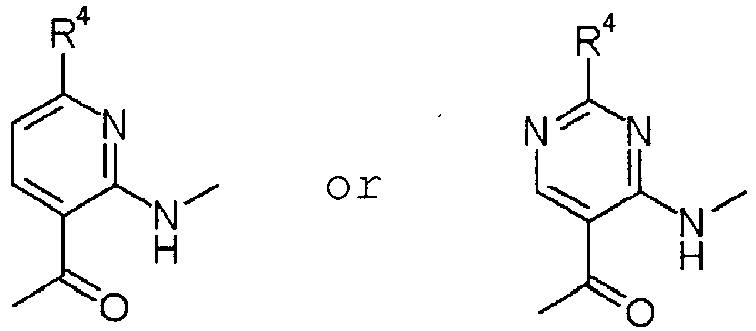
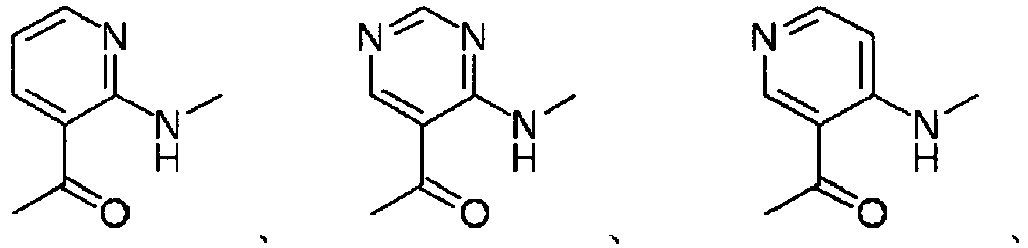
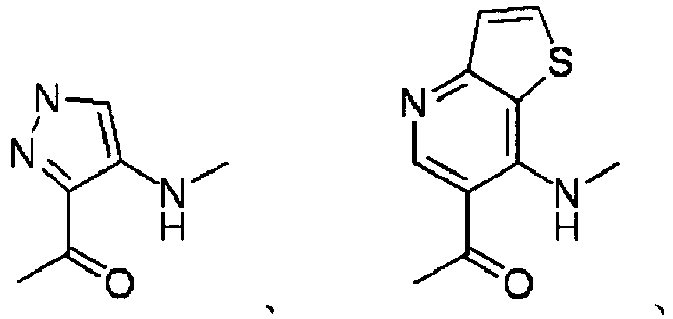

Y is C or N; and
ring Ab is a nitrogen-containing 6-membered ring optionally further having 1 or 2 C1-6 alkyl in addition to R4, or a salt thereof.
Y is C or N; and
ring Ab is a nitrogen-containing 6-membered ring optionally further having, in addition to R4, 1 or 2 substituents selected from a halogen atom and C1-6 alkyl, or a salt thereof.

Rb1 is
R3b is


Claims (17)
- A compound represented by the formula

R3a is a 5- or 6-membered aromatic heterocyclic group selected from furyl, oxazolyl, thienyl and pyridyl, or phenyl;
ring Aa is a heterocycle represented by the formula

ring B is(1) a ring represented by the formula (2) a ring represented by the formulaRb1 is
 (1') a hydrogen atom,(2') cyano,(3') C1-6 alkyl optionally having 1 to 3 substituents selected from(a) hydroxy,(b) C1-6 alkyl-carbonyloxy,(c) C1-6 alkylthio, and(d) C1-6 alkylsulfonyl,(4') C1-6 alkoxy-carbonylamino,(5') C7-16 aralkyloxy-carbonylamino,(6') C1-6 alkyl-carbonylamino,(7') C3-10 cycloalkyl-carbonylamino optionally having 1 to 3 substituents selected from hydroxy and C1-6 alkoxy,(8') a group represented by the formula: -W2-R8 wherein W2 is a bond, -CH2-, -CH2O- or -NHCO-, and R8 is a 5- or 6-membered heterocyclic group selected from imidazolyl, morpholinyl, pyridyl, tetrahydropyranyl, piperidinyl, tetrazolyl, 4,5-dihydro-1,2,4-oxadiazolyl, 1,2,4-triazolyl, 1,3,4-oxadiazolyl and 1,2,4-oxadiazolyl, said 5- or 6-membered heterocyclic group optionally has 1 to 3 substituents selected from(a) oxo,(b) C1-6 alkyl optionally having 1 to 3 hydroxy,(c) C6-14 aryl, and(d) carbamoyl,(9') C1-6 alkoxy-carbonyl, or(10') a group represented by the formula: -CO-N(R5) (R6) wherein R5 and R6 are each a hydrogen atom or C1-6 alkyl, or R5 and R6 optionally form, together with the nitrogen atom bonded thereto, a 4- to 7-membered nonaromatic nitrogen-containing heterocycle selected from azetidine, pyrrolidine, piperidine, piperazine, morpholine and thiomorpholine, and optionally having 1 to 3 substituents selected from hydroxy and C1-6 alkyl, orRb1 and Rb2 optionally form, together with the carbon atoms bonded thereto, a benzene ring or a cyclohexane ring, or a salt thereof.
 - The compound according to claim 1,
wherein R1a is C1-6 alkyl;
R3a is a 5-membered aromatic heterocyclic group selected from furyl, oxazolyl and thienyl;
ring Aa is a ring represented by the formula
ring B is a ring represented by the formula
- The compound according to claim 1,
wherein R1a is C1-6 alkyl;
R3a is a 5-membered aromatic heterocyclic group selected from furyl, oxazolyl and thienyl;
ring Aa is a ring represented by the formula
ring B is a ring represented by the formula
- A compound represented by the formula
 (1) C1-6 alkyl optionally having 1 to 3 substituents selected from(a) a halogen atom,(b) cyano,(c) hydroxy,(d) amino,(e) C1-6 alkoxy-carbonyl,(f) carbamoyl,(g) C1-6 alkylcarbamoyl optionally having 1 to 3 substituents selected from hydroxy, pyridyl and morpholinyl, and(h) C7-16 aralkylcarbamoyl,(2) C3-10 cycloalkyl,(3) C7-16 aralkyl,(4) C3-10 cycloalkyl-C1-6 alkyl,(5) a group represented by the formula
 (6) a group represented by the formulaRb1 is
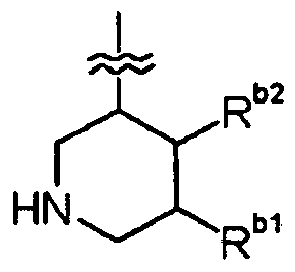 (1') a hydrogen atom,(2') cyano,(3') C1-6 alkyl optionally having 1 to 3 substituents selected from(a) hydroxy,(b) C1-6 alkyl-carbonyloxy,(c) C1-6 alkylthio, and(d) C1-6 alkylsulfonyl,(4') C3-10 cycloalkyl optionally having 1 to 3 hydroxy,(5') C7-16 aralkylamino optionally having 1 to 3 hydroxy,(6') C1-6 alkoxy-carbonylamino,(7') C7-16 aralkyloxy-carbonylamino,(8') C1-6 alkyl-carbonylamino,(9') C3-10 cycloalkyl-carbonylamino optionally having 1 to 3 substituents selected from hydroxy and C1-6 alkoxy,(10') C1-6 alkylsulfonylamino,(11') C6-14 arylsulfonylamino,(12') C1-6 alkylaminocarbonylamino,(13') C6-14 arylaminocarbonylamino,(14') C1-6 alkyl-carbonyl,(15') C3-10 cycloalkyl-carbonyl,(16') carboxy,(17') a group represented by the formula: -W1-R7 wherein W1 is a bond, -CH2-, -CH2O-, -NHCO- or -NHSO2-, and R7 is a 5- or 6-membered heterocyclic group selected from imidazolyl, morpholinyl, pyridyl, tetrahydropyranyl, piperidinyl, tetrazolyl, 4,5-dihydro-1,2,4-oxadiazolyl, 1,2,4-triazolyl, 1,3,4-oxadiazolyl, 1,2,4-oxadiazolyl, imidazolidinyl, hexahydropyrimidinyl and pyrazolyl, said 5- or 6-membered heterocyclic group optionally has 1 to 3 substituents selected from(a) oxo,(b) C1-6 alkyl optionally having 1 to 3 hydroxy,(c) C6-14 aryl,(d) carbamoyl, and(e) C1-6 alkoxy-carbonyl,(18') C1-6 alkoxy-carbonyl, or(19') a group represented by the formula: -CO-N(R5)(R6) wherein R5 and R6 are each a hydrogen atom, C1-6 alkyl or C1-6 alkoxy, orR5 and R6 optionally form, together with the nitrogen atom bonded thereto, a 4- to 7-membered nonaromatic nitrogen-containing heterocycle optionally forms a fused ring with a benzene ring, a cyclohexane ring or an oxazole ring, or optionally forms a spiro ring with a 1,3-dioxolane ring, which is selected from azetidine, pyrrolidine, piperidine, piperazine, morpholine, thiomorpholine, 1,4-oxazepane, 1,2,3,4-tetrahydroquinoline, 1,2,3,4-tetrahydroisoquinoline, 2,3-dihydro-1H-isoindole, 2,3-dihydro-1H-indole, decahydroquinoline, 4,5,6,7-tetrahydro[1,3]oxazolo[5,4-b]pyridine, 1,4-dioxa-8-azaspiro[4.5]decane and 1,2,3,6-tetrahydropyridine, said 4- to 7-membered nonaromatic nitrogen-containing heterocycle, a fused ring thereof and a spiro ring thereof optionally have 1 to 3 substituents selected from(a) oxo,(b) a halogen atom,(c) C1-6 alkyl optionally having 1 to 3 substituents selected from hydroxy and C1-6 alkoxy,(d) C6-14 aryl optionally having 1 to 3 C1-6 alkoxy,(e) C7-16 aralkyl,(f) hydroxy,(g) C1-6 alkoxy,(h) C6-14 aryloxy,(i) C7-16 aralkyloxy,(j) C1-6 alkyl-carbonyl,(k) C6-14 aryl-carbonyl,(l) mono- or di-C1-6 alkylsulfamoyl,(m) C1-6 alkylsulfonyl, and(n) a 5- or 6-membered heterocyclic group selected from pyridyl and thiazolyl, orRb1 and Rb2 optionally form, together with the carbon atoms bonded thereto, a benzene ring or a cyclohexane ring, or R3b and R2b optionally form, together with the nitrogen atom bonded thereto, a 5- to 9-membered nonaromatic nitrogen-containing heterocycle selected from pyrrolidine, piperidine, piperazine, morpholine, thiomorpholine, azepane, azocane, azonane and 1,4-diazepane, and optionally having 1 to 3 substituents selected from(1) C1-6 alkyl optionally having 1 to 3 substituents selected from(a) hydroxy,(b) C1-6 alkoxy,(c) C6-14 aryl,(d) amino,(e) mono- or di-C1-6 alkylamino,(f) C7-16 aralkylamino, and(g) C1-6 alkoxy-carbonylamino,(2) C6-14 aryl optionally having 1 to 3 halogen atoms,(3) C7-16 aralkyl,(4) C3-10 cycloalkyl,(5) amino,(6) hydroxy,(7) C1-6 alkoxy-carbonyl, and(8) carbamoyl;R3b is(1) a 5- or 6-membered aromatic or nonaromatic heterocyclic group selected from furyl, thienyl, oxazolyl, pyridyl and tetrahydrofuryl, and optionally having 1 to 3 C1-6 alkyl,(2) C6-14 aryl,(3) C3-10 cycloalkyl,(4) C1-6 alkyl optionally having 1 to 3 substituents selected from(a) hydroxy,(b) C1-6 alkoxy,(c) C1-6 alkylthio,(d) C1-6 alkylsulfinyl, and(e) C1-6 alkylsulfonyl, or(5) C1-6 alkoxy-carbonyl;R4 is(1) C1-6 alkyl optionally having 1 to 3 halogen atoms,(2) C6-14 aryl,(3) C3-10 cycloalkyl,(4) thienyl, or(5) C1-6 alkylthio;X is C;
Y is C or N; and
ring Ab is a nitrogen-containing 6-membered ring optionally further having, in addition to R4, 1 or 2 substituents selected from a halogen atom and C1-6 alkyl, or a salt thereof. - The compound according to claim 4,
wherein R1b is(1) C1-6 alkyl optionally having 1 to 3 halogen atoms,(2) C3-10 cycloalkyl,(3) C7-16 aralkyl, or(4) C3-10 cycloalkyl-C1-6 alkyl;R2b is a group represented by the formula
R3b is as defined in claim 4;
R4 is(1) C1-6 alkyl optionally having 1 to 3 halogen atoms,(2) C6-14 aryl, or(3) C3-10 cycloalkyl; andring Ab is a ring represented by the formula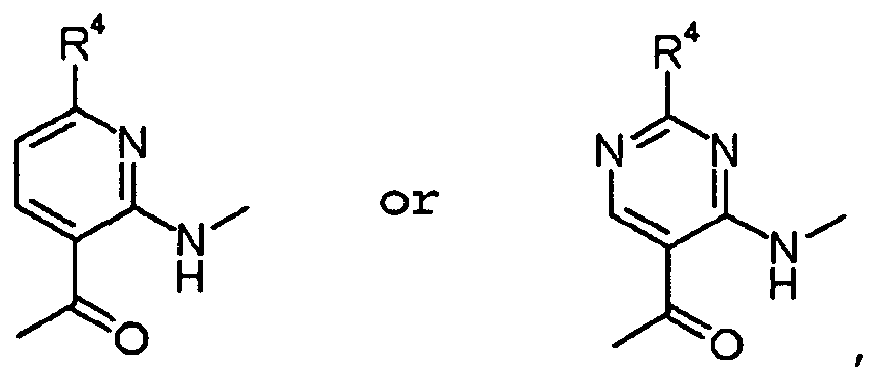
- The compound according to claim 4,
wherein R1b and R2b form, together with the nitrogen atom bonded thereto, a 5- to 9-membered nonaromatic nitrogen-containing heterocycle selected from pyrrolidine, piperidine, piperazine, morpholine, thiomorpholine, azepane, azocane, azonane and 1,4-diazepane, and optionally having 1 to 3 substituents selected from(1) C1-6 alkyl optionally having 1 to 3 substituents selected from(a) hydroxy,(b) C1-6 alkoxy,(c) C6-14 aryl,(d) amino,(e) mono- or di-C1-6 alkylamino,(f) C7-16 aralkylamino, and(g) C1-6 alkoxy-carbonylamino,(2) C6-14 aryl optionally having 1 to 3 halogen atoms,(3) C7-16 aralkyl,(4) C3-10 cycloalkyl,(5) amino,(6) hydroxy,(7) C1-6 alkoxy-carbonyl, and(8) carbamoyl;R3b is(1) a 5- or 6-membered aromatic or nonaromatic heterocyclic group selected from furyl, thienyl, oxazolyl, pyridyl and tetrahydrofuryl, and optionally having 1 to 3 C1-6 alkyl,(2) C6-14 aryl,(3) C3-10 cycloalkyl,(4) C1-6 alkyl optionally having 1 to 3 C3-6 alkoxy, or(5) C1-6 alkoxy-carbonyl;R4 is(1) C1-6 alkyl optionally having 1 to 3 halogen atoms,(2) C6-14 aryl, or(3) C3-10 cycloalkyl; andring Ab is a ring represented by the formula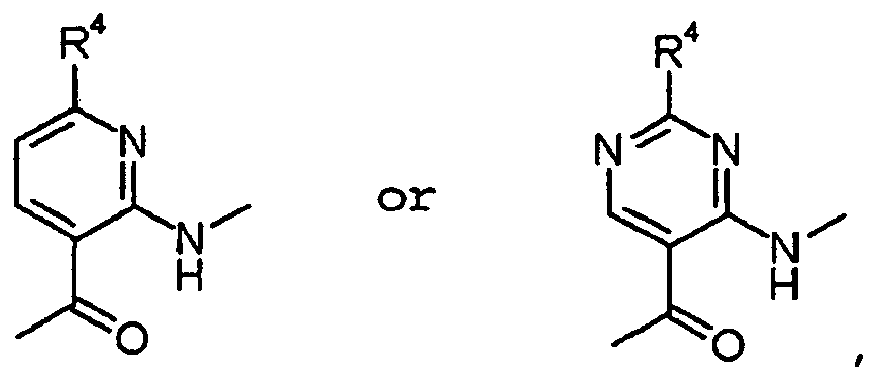
- The compound according to claim 4, which is represented by the formula
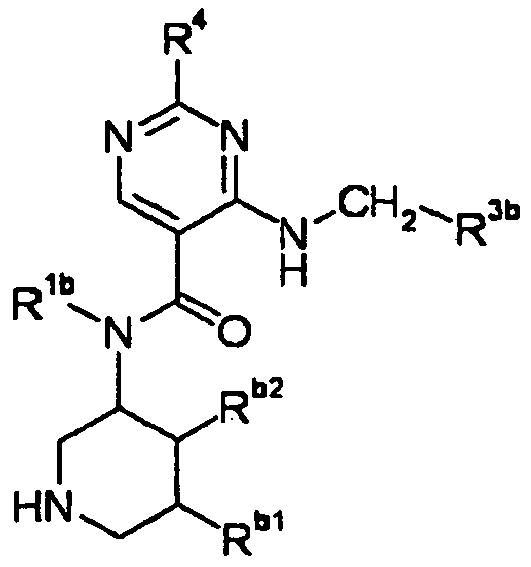
Rb2 is a hydrogen atom,
Rb1 is(1) a hydrogen atom,(2) cyano,(3) C1-6 alkyl optionally having 1 to 3 substituents selected from(a) hydroxy,(b) C1-6 alkyl-carbonyloxy,(c) C1-6 alkylthio, and(d) C1-6 alkylsulfonyl,(4) C3-10 cycloalkyl optionally having 1 to 3 hydroxy,(5) C7-16 aralkylamino optionally having 1 to 3 hydroxy,(6) C1-6 alkoxy-carbonylamino,(7) C7-16 aralkyloxy-carbonylamino,(8) C1-6 alkyl-carbonylamino,(9) C3-10 cycloalkyl-carbonylamino optionally having 1 to 3 substituents selected from hydroxy and C1-6 alkoxy,(10) C1-6 alkylsulfonylamino,(11) C6-14 arylsulfonylamino,(12) C1-6 alkylaminocarbonylamino,(13) C6-14 arylaminocarbonylamino,(14) C1-6 alkyl-carbonyl,(15) C3-10 cycloalkyl-carbonyl,(16) carboxy,(17) a group represented by the formula: -W1-R7 wherein W1 is a bond, -CH2-, -CH2O- -NHCO- or -NHSO2-, and R7 is a 5- or 6-membered heterocyclic group selected from imidazolyl, morpholinyl, pyridyl, tetrahydropyranyl, piperidinyl, tetrazolyl, 4,5-dihydro-1,2,4-oxadiazolyl, 1,2,4-triazolyl, 1,3,4-oxadiazolyl, 1,2,4-oxadiazolyl, imidazolidinyl, hexahydropyrimidinyl and pyrazolyl, said 5- or 6-membered heterocyclic group optionally has 1 to 3 substituents selected from(a) oxo,(b) C1-6 alkyl optionally having 1 to 3 hydroxy,(c) C6-14 aryl,(d) carbamoyl, and(e) C1-6 alkoxy-carbonyl,(18) C1-6 alkoxy-carbonyl, or(19) a group represented by the formula: -CO-N(R5)(R6) wherein R5 and R6 are each a hydrogen atom, C1-6 alkyl or C1-6 alkoxy, orR5 and R6 optionally form, together with the nitrogen atom bonded thereto, a 4- to 7-membered nonaromatic nitrogen-containing heterocycle selected from azetidine, pyrrolidine, piperidine, piperazine, morpholine, thiomorpholine and 1,4-oxazepane, said 4- to 7-membered nonaromatic nitrogen-containing heterocycle optionally has 1 to 3 substituents selected from,(a) oxo,(b) a halogen atom,(c) C1-6 alkyl optionally having 1 to 3 substituents selected from hydroxy and C1-6 alkoxy,(d) C6-14 aryl optionally having 1 to 3 C1-6 alkoxy,(e) C7-16 aralkyl,(f) hydroxy,(g) C1-6 alkoxy,(h) C6-14 aryloxy,(i) C7-16 aralkyloxy,(j) C1-6 alkyl-carbonyl,(k) C6-14 aryl-carbonyl,(l) mono- or di-C1-6 alkylsulfamoyl,(m) C1-6 alkylsulfonyl, and(n) a 5- or 6-membered heterocyclic group selectd from pyridyl and thiazolyl;R3b is(1) a 5- or 6-membered aromatic or nonaromatic heterocyclic group selected from furyl, thienyl, oxazolyl, pyridyl and tetrahydrofuryl, and optionally having 1 to 3 C1-6 alkyl, or(2) C1-6 alkyl optionally having 1 to 3 C1-6 alkoxy; andR4 is C1-6 alkyl optionally having 1 to 3 halogen atoms, or a salt thereof. - The compound according to claim 4, which is represented by the formula

Rb2 is a hydrogen atom,
Rb1 is a group represented by the formulas: -CO-N(R5) (R6) wherein R5 and R6 are each a hydrogen atom, C1-6 alkyl or C1-6 alkoxy, or
R5 and R6 optionally form, together with the nitrogen atom bonded thereto, a 4- to 7-membered nonaromatic nitrogen-containing heterocycle selected from azetidine, pyrrolidine, piperidine, piperazine, morpholine, thiomorpholine and 1,4-oxazepane, said 4- to 7-membered nonaromatic nitrogen-containing heterocycle optionally has 1 to 3 substituents selected from(a) oxo,(b) a halogen atom,(c) C1-6 alkyl optionally having 1 to 3 substituents selected from hydroxy and C1-6 alkoxy,(d) C6-14 aryl optionally having 1 to 3 C1-6 alkoxy,(e) C7-16 aralkyl,(f) hydroxy,(g) C1-6 alkoxy,(h) C6-14 aryloxy,(i) C7-16 aralkyloxy,(j) C1-6 alkyl-carbonyl,(k) C6-14 aryl-carbonyl,(l) mono- or di-C1-6 alkylsulfamoyl,(m) C1-6 alkylsulfonyl, and(n) a 5- or 6-membered heterocyclic group selected from pyridyl and thiazolyl;R3b is(1) a 5- or 6-membered aromatic or nonaromatic heterocyclic group selected from furyl, thienyl, oxazolyl, pyridyl and tetrahydrofuryl, and optionally having 1 to 3 C1-6 alkyl, or(2) C1-6 alkyl optionally having 1 to 3 C1-6 alkoxy; andR4 is C1-6 alkyl optionally having 1 to 3 halogen atoms, or a salt thereof. - The compound according to claim 4,
wherein R1b and R2b are each(1) C1-6 alkyl optionally having 1 to 3 substituents selected from cyano and hydroxy,(2) C3-10 cycloalkyl, or(3) C7-16 aralkyl, orR3b and R2b optionally form, together with the nitrogen atom bonded thereto, a 5- to 9-membered nonaromatic nitrogen-containing heterocycle selected from pyrrolidine, piperidine, piperazine, morpholine, thiomorpholine, azepane, azocane, azonane and 1,4-diazepane, and optionally having 1 to 3 substituents selected from(1) C1-6 alkyl optionally having 1 to 3 substituents selected from(a) hydroxy,(b) C1-6 alkoxy,(c) C6-14 aryl,(d) amino,(e) mono- or di-C1-6 alkylamino,(f) C7-16 aralkylamino, and(g) C1-6 alkoxy-carbonylamino,(2) C6-14 aryl optionally having 1 to 3 halogen atoms,(3) C7-16 aralkyl,(4) C3-10 cycloalkyl,(5) amino,(6) hydroxy,(7) C1-6 alkoxy-carbonyl, and(8) carbamoyl;R3b is(1) a 5- or 6-membered aromatic or nonaromatic heterocyclic group selected from furyl, thienyl, oxazolyl, pyridyl and tetrahydrofuryl, and optionally having 1 to 3 C1-6 alkyl,(2) C6-14 aryl,(3) C3-10 cycloalkyl,(4) C1-6 alkyl optionally having 1 to 3 C1-6 alkoxy, or(5) C1-6 alkoxy-carbonyl; andR4, X, Y and ring Ab are as defined in claim 4, or a salt thereof. - The compound according to claim 1 or 4, which is selected from
2-tert-butyl-5-[(2-ethylpiperidin-1-yl)carbonyl]-N-(2-furylmethyl)pyrimidin-4-amine,
5-{[4-(aminomethyl)piperidin-1-yl]carbonyl}-2-tert-butyl-N-(2-furylmethyl)pyrimidin-4-amine,
2-tert-butyl-N-(2-furylmethyl)-5-({4-[(methylamino)methyl]piperidin-1-yl}carbonyl)pyrimidin-4-amine,
N-(2-furylmethyl)-2-isopropyl-5-({4-[(methylamino)methyl]piperidin-1-yl}carbonyl)pyrimidin-4-amine,
N- [(3R*,5S*)-5- (aminocarbonyl)piperidin-3-yl] -2-tert-butyl-4-[(2-furylmethyl)amino]-N-isobutylpyrimidine-5-carboxamide,
2-tert-butyl-4-[(2-furylmethyl)amino]-N-{(3R*,5S*)-5-[(4-hydroxy-4-methylpiperidin-1-yl)carbonyl]piperidin-3-yl}-N-isobutylpyrimidine-5-carboxamide,
2-tert-butyl-4-[(2-furylmethyl)amino]-N-[(3R*,5S*)-5-(1-hydroxy-1-methylethyl)piperidin-3-yl]-N-isobutylpyrimidine-5-carboxamide,
methyl (3R,5S)-5-[({2-tert-butyl-4-[(3-methoxypropyl)amino]pyrimidin-5-yl}carbonyl)(isobutyl)amino]piperidine-3-carboxylate,
2-tert-butyl-4-[(3-methoxypropyl)amino]-N-(2-methylpropyl)-N-[(3S,5R)-5-(morpholin-4-ylcarbonyl)piperidin-3-yl]pyrimidine-5-carboxamide,
methyl (3R*,5S*)-5-[[(2-tert-butyl-4-{[3-(methylthio)propyl]amino}pyrimidin-5-yl)carbonyl](isobutyl)amino]piperidine-3-carboxylate,
methyl (3R*,5S*)-5-[{[4-(benzylamino)-2-tert-butylpyrimidin-5-yl]carbonyl}(isobutyl)amino]piperidine-3-carboxylate,
2-tert-butyl-N-(2-methylpropyl)-N-[(3S,5R)-5-(morpholin-4-ylcarbonyl)piperidin-3-yl]-4-[(1,3-oxazol-2-ylmethyl)amino]pyrimidine-5-carboxamide, and
2-tert-butyl-N-[(3S,5R)-5-carbamoylpiperidin-3-yl]-4-[(furan-2-ylmethyl)amino]-N-(2-methylpropyl)pyrimidine-5-carboxamide,
or a salt thereof. - The compound according to claim 1 or 4, which is 2-tert-butyl-N-[(3S,5R)-5-carbamoylpiperidin-3-yl]-4-[(furan-2-ylmethyl)amino]-N-(2-methylpropyl)pyrimidine-5-carboxamide or a salt thereof.
- The compound according to claim 4, which is 2-tert-butyl-4-[(3-methoxypropyl)amino]-N-(2-methylpropyl)-N-[(3S,5R)-5-(morpholin-4-ylcarbonyl)piperidin-3-yl]pyrimidine-5-carboxamide or a salt thereof.
- The compound according to claim 1 or 4, which is 2-tert-butyl-N-(2-methylpropyl)-N-[(3S,5R)-5-(morpholin-4-ylcarbonyl)piperidin-3-yl]-4-[(1,3-oxazol-2-ylmethyl)amino]pyrimidine-5-carboxamide or a salt thereof.
- A medicament comprising the compound according to any one of claims 1 to 13.
- The medicament according to claim 14, which is a renin inhibitor.
- The medicament according to claim 14, which is an agent for the prophylaxis or treatment of hypertension.
- The medicament according to claim 14, which is an agent for the prophylaxis or treatment of various organ damages attributable to hypertension.
Applications Claiming Priority (2)
| Application Number | Priority Date | Filing Date | Title |
|---|---|---|---|
| JP2007268100 | 2007-10-15 | ||
| PCT/JP2008/068595 WO2009051112A1 (en) | 2007-10-15 | 2008-10-14 | Amide compounds and use of the same |
Publications (3)
| Publication Number | Publication Date |
|---|---|
| EP2202228A1 EP2202228A1 (en) | 2010-06-30 |
| EP2202228A4 EP2202228A4 (en) | 2011-06-29 |
| EP2202228B1 true EP2202228B1 (en) | 2014-12-10 |
Family
ID=40567376
Family Applications (1)
| Application Number | Title | Priority Date | Filing Date |
|---|---|---|---|
| EP08839108.1A Not-in-force EP2202228B1 (en) | 2007-10-15 | 2008-10-14 | Amide compounds and use of the same |
Country Status (4)
| Country | Link |
|---|---|
| US (1) | US8329691B2 (en) |
| EP (1) | EP2202228B1 (en) |
| JP (1) | JP5441705B2 (en) |
| WO (1) | WO2009051112A1 (en) |
Cited By (1)
| Publication number | Priority date | Publication date | Assignee | Title |
|---|---|---|---|---|
| WO2018064441A1 (en) * | 2016-09-30 | 2018-04-05 | Intercept Pharmaceuticals, Inc | Crystalline forms of a bile acid derivative |
Families Citing this family (16)
| Publication number | Priority date | Publication date | Assignee | Title |
|---|---|---|---|---|
| US20100184816A1 (en) * | 2007-06-22 | 2010-07-22 | Isolde Hauser-Hahn | Method for Reducing the Phytotoxicity of Azoles on Dicotyledonous Plants by Adding Additives |
| WO2009078481A1 (en) | 2007-12-19 | 2009-06-25 | Dainippon Sumitomo Pharma Co., Ltd. | Bicyclic heterocyclic derivative |
| UY31774A (en) * | 2008-04-22 | 2009-12-14 | Astrazeneca Ab | 2-PYRIMIDIN-5- ILCARBOXAMIDE SUBSTITUTED COMPOUNDS |
| ES2676289T3 (en) * | 2008-06-19 | 2018-07-18 | Takeda Pharmaceutical Company Limited | Heterocyclic compound and its use |
| CN102482256B (en) | 2009-06-24 | 2014-11-26 | 大日本住友制药株式会社 | N-substituted cyclic amino derivatives |
| TW201107306A (en) * | 2009-07-28 | 2011-03-01 | Daiichi Sankyo Co Ltd | Substituted piperidine compounds |
| CN102372653A (en) * | 2010-08-10 | 2012-03-14 | 江苏恒瑞医药股份有限公司 | Diphenyl methanol derivative, preparation method thereof and application of diphenyl methanol derivative in medicine |
| US20120178813A1 (en) | 2011-01-12 | 2012-07-12 | Thetis Pharmaceuticals Llc | Lipid-lowering antidiabetic agent |
| WO2013142396A1 (en) * | 2012-03-23 | 2013-09-26 | Merck Sharp & Dohme Corp. | N3-substituted iminopyrimidinones as renin inhibitors, compositions, and their use |
| US9382187B2 (en) | 2012-07-10 | 2016-07-05 | Thetis Pharmaceuticals Llc | Tri-salt form of metformin |
| US8765811B2 (en) | 2012-07-10 | 2014-07-01 | Thetis Pharmaceuticals Llc | Tri-salt form of metformin |
| US9505709B2 (en) | 2014-05-05 | 2016-11-29 | Thetis Pharmaceuticals Llc | Compositions and methods relating to ionic salts of peptides |
| BR112016029476A2 (en) | 2014-06-18 | 2017-08-22 | Thetis Pharmaceuticals Llc | mineral amino acid complexes of active agents |
| US9242008B2 (en) | 2014-06-18 | 2016-01-26 | Thetis Pharmaceuticals Llc | Mineral amino-acid complexes of fatty acids |
| DK3454907T3 (en) | 2016-06-03 | 2020-10-19 | Thetis Pharmaceuticals Llc | COMPOSITIONS AND PROCEDURES RELATED TO SALTS OF SPECIALIZED PRO-SOLUTION MEDIATORS OF INFLAMMATION |
| US20240327385A1 (en) * | 2023-03-13 | 2024-10-03 | Guibai Liang | Substituted piperidine compounds as renin inhibitors |
Family Cites Families (37)
| Publication number | Priority date | Publication date | Assignee | Title |
|---|---|---|---|---|
| US4734418A (en) * | 1984-12-14 | 1988-03-29 | Mitsui Petrochemical Industries, Ltd. | Quinazoline compounds and antihypertensives |
| JPS61140568A (en) * | 1984-12-14 | 1986-06-27 | Mitsui Petrochem Ind Ltd | Quinazoline derivative, and hypotensor containing said derivative as active component |
| DK0382185T3 (en) | 1989-02-10 | 1994-07-04 | Otsuka Pharma Co Ltd | Carbostyril derivatives |
| US5225402A (en) | 1989-02-10 | 1993-07-06 | Otsuka Pharmaceutical Co., Ltd. | Carbostyril derivatives |
| US5250548A (en) * | 1990-09-10 | 1993-10-05 | Abbott Laboratories | Angiotensin II receptor antagonists |
| IL99246A0 (en) * | 1990-09-10 | 1992-07-15 | Abbott Lab | Angiotensin ii receptor antagonists and pharmaceutical compositions containing them |
| US5688795A (en) * | 1994-11-08 | 1997-11-18 | Syntex (U.S.A.) Inc. | 3-(4-phenylpiperazin-1-yl)propyl-amino, thio and oxy!-pyridine, pyrimidine and benzene derivatives as α1 -adrenoceptor antagonists |
| US8008283B2 (en) | 1998-12-23 | 2011-08-30 | Neurotherapeutics Pharma, Inc. | Methods and compositions for the treatment of neuropsychiatric disorders |
| JP3637961B2 (en) * | 1999-09-16 | 2005-04-13 | 田辺製薬株式会社 | Aromatic nitrogen-containing six-membered ring compounds |
| TR200200701T2 (en) | 1999-09-16 | 2002-06-21 | Tanabe Seiyaku Co., Ltd. | Six-element aromatic nitrogen ring compounds. |
| JP2001233875A (en) * | 1999-10-12 | 2001-08-28 | Takeda Chem Ind Ltd | Pyrimidine-5-carboxamide compound, method for producing the same and use thereof |
| US20080027037A1 (en) | 2000-04-28 | 2008-01-31 | Tanabe Seiyaku Co., Ltd. | Cyclic compounds |
| US7273868B2 (en) | 2000-04-28 | 2007-09-25 | Tanabe Seiyaku Co., Ltd. | Pyrazine derivatives |
| WO2001083460A1 (en) * | 2000-04-28 | 2001-11-08 | Tanabe Seiyaku Co., Ltd. | Cyclic compounds |
| US6576644B2 (en) * | 2000-09-06 | 2003-06-10 | Bristol-Myers Squibb Co. | Quinoline inhibitors of cGMP phosphodiesterase |
| JP4178816B2 (en) * | 2001-03-15 | 2008-11-12 | 田辺三菱製薬株式会社 | Pharmaceutical composition |
| US7645771B2 (en) | 2002-12-13 | 2010-01-12 | Smithkline Beecham Corp. | CCR5 antagonists as therapeutic agents |
| JP2006519846A (en) | 2003-03-10 | 2006-08-31 | シェーリング コーポレイション | Heterocyclic kinase inhibitors: methods of use and synthesis |
| BRPI0414209B8 (en) | 2003-09-09 | 2021-05-25 | Hoffmann La Roche | 1-(2-amino-benzol)-piperazine derivatives, their preparation processes and their use, and medicine |
| GB0418353D0 (en) * | 2004-08-17 | 2004-09-22 | Novartis Ag | Organic compounds |
| GB0514203D0 (en) | 2005-07-11 | 2005-08-17 | Novartis Ag | Organic compounds |
| JP2009511629A (en) | 2005-10-17 | 2009-03-19 | ニューロセラピューティクス ファーマ, インコーポレイテッド | Analogues of diuretic-like compounds useful in the regulation of central nervous system diseases |
| PT2420491E (en) | 2005-12-30 | 2013-10-14 | Novartis Ag | 3 , 5-substitued piperidine compounds as renin inhibitors |
| JP2009526747A (en) | 2006-02-16 | 2009-07-23 | 武田薬品工業株式会社 | Cyclic amine compounds and uses for prevention and treatment of hypertension |
| TW200812963A (en) * | 2006-04-13 | 2008-03-16 | Euro Celtique Sa | Benzenesulfonamide compounds and the use thereof |
| WO2008016643A2 (en) * | 2006-08-01 | 2008-02-07 | Cytokinetics, Incorporated | Certain chemical entities, compositions, and methods |
| US7939534B2 (en) | 2006-08-01 | 2011-05-10 | Cytokinetics, Inc. | Certain chemical entities, compositions, and methods |
| US7919511B2 (en) | 2006-08-01 | 2011-04-05 | Cytokinetics, Inc. | Certain chemical entities, compositions, and methods |
| US7932270B2 (en) | 2006-08-01 | 2011-04-26 | Cytokinetics, Inc. | Certain chemical entities, compositions, and methods |
| US7939548B2 (en) | 2006-08-02 | 2011-05-10 | Cytokinetics, Inc. | Certain chemical entities, compositions, and methods |
| TW200827346A (en) * | 2006-11-03 | 2008-07-01 | Astrazeneca Ab | Chemical compounds |
| US20100056497A1 (en) | 2007-01-31 | 2010-03-04 | Dainippon Sumitomo Pharma Co., Ltd | Amide derivative |
| WO2008123469A1 (en) | 2007-03-30 | 2008-10-16 | Japan Tobacco Inc. | Six-membered amide compound and use thereof |
| AR066268A1 (en) | 2007-04-27 | 2009-08-05 | Takeda Pharmaceutical | IMIDAZOL SUBSTITUTED COMPOSITE AND ITS USE |
| US20090227560A1 (en) | 2007-04-27 | 2009-09-10 | Takanobu Kuroita | Substituted imidazole compound and use thereof |
| WO2009001915A1 (en) | 2007-06-28 | 2008-12-31 | Takeda Pharmaceutical Company Limited | Substituted imidazole compound and use thereof |
| ES2676289T3 (en) | 2008-06-19 | 2018-07-18 | Takeda Pharmaceutical Company Limited | Heterocyclic compound and its use |
-
2008
- 2008-10-14 EP EP08839108.1A patent/EP2202228B1/en not_active Not-in-force
- 2008-10-14 WO PCT/JP2008/068595 patent/WO2009051112A1/en not_active Ceased
- 2008-10-14 JP JP2009538096A patent/JP5441705B2/en not_active Expired - Fee Related
- 2008-10-14 US US12/734,150 patent/US8329691B2/en not_active Expired - Fee Related
Cited By (1)
| Publication number | Priority date | Publication date | Assignee | Title |
|---|---|---|---|---|
| WO2018064441A1 (en) * | 2016-09-30 | 2018-04-05 | Intercept Pharmaceuticals, Inc | Crystalline forms of a bile acid derivative |
Also Published As
| Publication number | Publication date |
|---|---|
| EP2202228A4 (en) | 2011-06-29 |
| US20100324010A1 (en) | 2010-12-23 |
| EP2202228A1 (en) | 2010-06-30 |
| US8329691B2 (en) | 2012-12-11 |
| WO2009051112A1 (en) | 2009-04-23 |
| JPWO2009051112A1 (en) | 2011-03-03 |
| JP5441705B2 (en) | 2014-03-12 |
Similar Documents
| Publication | Publication Date | Title |
|---|---|---|
| EP2202228B1 (en) | Amide compounds and use of the same | |
| EP2297114B1 (en) | Heterocyclic compound and use thereof | |
| US20100121048A1 (en) | Cyclic Amine Compound and Use Thereof for the Prophylaxis or Treatment of Hypertension | |
| US20090227560A1 (en) | Substituted imidazole compound and use thereof | |
| US20090156612A1 (en) | Substituted imidazole compound and use thereof | |
| HK1155737A (en) | Heterocyclic compound and use thereof | |
| HK1155737B (en) | Heterocyclic compound and use thereof | |
| AU2014216020B2 (en) | Heterocyclic compound and use thereof |
Legal Events
| Date | Code | Title | Description |
|---|---|---|---|
| PUAI | Public reference made under article 153(3) epc to a published international application that has entered the european phase |
Free format text: ORIGINAL CODE: 0009012 |
|
| 17P | Request for examination filed |
Effective date: 20100415 |
|
| AK | Designated contracting states |
Kind code of ref document: A1 Designated state(s): AT BE BG CH CY CZ DE DK EE ES FI FR GB GR HR HU IE IS IT LI LT LU LV MC MT NL NO PL PT RO SE SI SK TR |
|
| AX | Request for extension of the european patent |
Extension state: AL BA MK RS |
|
| DAX | Request for extension of the european patent (deleted) | ||
| A4 | Supplementary search report drawn up and despatched |
Effective date: 20110527 |
|
| 17Q | First examination report despatched |
Effective date: 20130208 |
|
| GRAP | Despatch of communication of intention to grant a patent |
Free format text: ORIGINAL CODE: EPIDOSNIGR1 |
|
| INTG | Intention to grant announced |
Effective date: 20140603 |
|
| GRAS | Grant fee paid |
Free format text: ORIGINAL CODE: EPIDOSNIGR3 |
|
| GRAA | (expected) grant |
Free format text: ORIGINAL CODE: 0009210 |
|
| AK | Designated contracting states |
Kind code of ref document: B1 Designated state(s): AT BE BG CH CY CZ DE DK EE ES FI FR GB GR HR HU IE IS IT LI LT LU LV MC MT NL NO PL PT RO SE SI SK TR |
|
| REG | Reference to a national code |
Ref country code: GB Ref legal event code: FG4D |
|
| REG | Reference to a national code |
Ref country code: CH Ref legal event code: NV Representative=s name: BOHEST AG, CH Ref country code: CH Ref legal event code: EP |
|
| REG | Reference to a national code |
Ref country code: IE Ref legal event code: FG4D |
|
| REG | Reference to a national code |
Ref country code: AT Ref legal event code: REF Ref document number: 700579 Country of ref document: AT Kind code of ref document: T Effective date: 20150115 |
|
| REG | Reference to a national code |
Ref country code: DE Ref legal event code: R096 Ref document number: 602008035813 Country of ref document: DE Effective date: 20150122 |
|
| REG | Reference to a national code |
Ref country code: AT Ref legal event code: MK05 Ref document number: 700579 Country of ref document: AT Kind code of ref document: T Effective date: 20141210 Ref country code: NL Ref legal event code: VDEP Effective date: 20141210 |
|
| REG | Reference to a national code |
Ref country code: NL Ref legal event code: VDEP Effective date: 20141210 |
|
| PG25 | Lapsed in a contracting state [announced via postgrant information from national office to epo] |
Ref country code: NO Free format text: LAPSE BECAUSE OF FAILURE TO SUBMIT A TRANSLATION OF THE DESCRIPTION OR TO PAY THE FEE WITHIN THE PRESCRIBED TIME-LIMIT Effective date: 20150310 Ref country code: FI Free format text: LAPSE BECAUSE OF FAILURE TO SUBMIT A TRANSLATION OF THE DESCRIPTION OR TO PAY THE FEE WITHIN THE PRESCRIBED TIME-LIMIT Effective date: 20141210 Ref country code: LT Free format text: LAPSE BECAUSE OF FAILURE TO SUBMIT A TRANSLATION OF THE DESCRIPTION OR TO PAY THE FEE WITHIN THE PRESCRIBED TIME-LIMIT Effective date: 20141210 Ref country code: ES Free format text: LAPSE BECAUSE OF FAILURE TO SUBMIT A TRANSLATION OF THE DESCRIPTION OR TO PAY THE FEE WITHIN THE PRESCRIBED TIME-LIMIT Effective date: 20141210 |
|
| REG | Reference to a national code |
Ref country code: LT Ref legal event code: MG4D |
|
| PG25 | Lapsed in a contracting state [announced via postgrant information from national office to epo] |
Ref country code: GR Free format text: LAPSE BECAUSE OF FAILURE TO SUBMIT A TRANSLATION OF THE DESCRIPTION OR TO PAY THE FEE WITHIN THE PRESCRIBED TIME-LIMIT Effective date: 20150311 Ref country code: LV Free format text: LAPSE BECAUSE OF FAILURE TO SUBMIT A TRANSLATION OF THE DESCRIPTION OR TO PAY THE FEE WITHIN THE PRESCRIBED TIME-LIMIT Effective date: 20141210 Ref country code: AT Free format text: LAPSE BECAUSE OF FAILURE TO SUBMIT A TRANSLATION OF THE DESCRIPTION OR TO PAY THE FEE WITHIN THE PRESCRIBED TIME-LIMIT Effective date: 20141210 Ref country code: HR Free format text: LAPSE BECAUSE OF FAILURE TO SUBMIT A TRANSLATION OF THE DESCRIPTION OR TO PAY THE FEE WITHIN THE PRESCRIBED TIME-LIMIT Effective date: 20141210 Ref country code: SE Free format text: LAPSE BECAUSE OF FAILURE TO SUBMIT A TRANSLATION OF THE DESCRIPTION OR TO PAY THE FEE WITHIN THE PRESCRIBED TIME-LIMIT Effective date: 20141210 |
|
| PG25 | Lapsed in a contracting state [announced via postgrant information from national office to epo] |
Ref country code: NL Free format text: LAPSE BECAUSE OF FAILURE TO SUBMIT A TRANSLATION OF THE DESCRIPTION OR TO PAY THE FEE WITHIN THE PRESCRIBED TIME-LIMIT Effective date: 20141210 |
|
| PG25 | Lapsed in a contracting state [announced via postgrant information from national office to epo] |
Ref country code: PT Free format text: LAPSE BECAUSE OF FAILURE TO SUBMIT A TRANSLATION OF THE DESCRIPTION OR TO PAY THE FEE WITHIN THE PRESCRIBED TIME-LIMIT Effective date: 20150410 Ref country code: RO Free format text: LAPSE BECAUSE OF FAILURE TO SUBMIT A TRANSLATION OF THE DESCRIPTION OR TO PAY THE FEE WITHIN THE PRESCRIBED TIME-LIMIT Effective date: 20141210 Ref country code: EE Free format text: LAPSE BECAUSE OF FAILURE TO SUBMIT A TRANSLATION OF THE DESCRIPTION OR TO PAY THE FEE WITHIN THE PRESCRIBED TIME-LIMIT Effective date: 20141210 Ref country code: CZ Free format text: LAPSE BECAUSE OF FAILURE TO SUBMIT A TRANSLATION OF THE DESCRIPTION OR TO PAY THE FEE WITHIN THE PRESCRIBED TIME-LIMIT Effective date: 20141210 Ref country code: SK Free format text: LAPSE BECAUSE OF FAILURE TO SUBMIT A TRANSLATION OF THE DESCRIPTION OR TO PAY THE FEE WITHIN THE PRESCRIBED TIME-LIMIT Effective date: 20141210 |
|
| PG25 | Lapsed in a contracting state [announced via postgrant information from national office to epo] |
Ref country code: IS Free format text: LAPSE BECAUSE OF FAILURE TO SUBMIT A TRANSLATION OF THE DESCRIPTION OR TO PAY THE FEE WITHIN THE PRESCRIBED TIME-LIMIT Effective date: 20150410 Ref country code: PL Free format text: LAPSE BECAUSE OF FAILURE TO SUBMIT A TRANSLATION OF THE DESCRIPTION OR TO PAY THE FEE WITHIN THE PRESCRIBED TIME-LIMIT Effective date: 20141210 |
|
| REG | Reference to a national code |
Ref country code: DE Ref legal event code: R097 Ref document number: 602008035813 Country of ref document: DE |
|
| PLBE | No opposition filed within time limit |
Free format text: ORIGINAL CODE: 0009261 |
|
| STAA | Information on the status of an ep patent application or granted ep patent |
Free format text: STATUS: NO OPPOSITION FILED WITHIN TIME LIMIT |
|
| PG25 | Lapsed in a contracting state [announced via postgrant information from national office to epo] |
Ref country code: DK Free format text: LAPSE BECAUSE OF FAILURE TO SUBMIT A TRANSLATION OF THE DESCRIPTION OR TO PAY THE FEE WITHIN THE PRESCRIBED TIME-LIMIT Effective date: 20141210 |
|
| 26N | No opposition filed |
Effective date: 20150911 |
|
| PG25 | Lapsed in a contracting state [announced via postgrant information from national office to epo] |
Ref country code: IT Free format text: LAPSE BECAUSE OF FAILURE TO SUBMIT A TRANSLATION OF THE DESCRIPTION OR TO PAY THE FEE WITHIN THE PRESCRIBED TIME-LIMIT Effective date: 20141210 |
|
| PG25 | Lapsed in a contracting state [announced via postgrant information from national office to epo] |
Ref country code: SI Free format text: LAPSE BECAUSE OF FAILURE TO SUBMIT A TRANSLATION OF THE DESCRIPTION OR TO PAY THE FEE WITHIN THE PRESCRIBED TIME-LIMIT Effective date: 20141210 |
|
| PG25 | Lapsed in a contracting state [announced via postgrant information from national office to epo] |
Ref country code: LU Free format text: LAPSE BECAUSE OF FAILURE TO SUBMIT A TRANSLATION OF THE DESCRIPTION OR TO PAY THE FEE WITHIN THE PRESCRIBED TIME-LIMIT Effective date: 20151014 Ref country code: BE Free format text: LAPSE BECAUSE OF FAILURE TO SUBMIT A TRANSLATION OF THE DESCRIPTION OR TO PAY THE FEE WITHIN THE PRESCRIBED TIME-LIMIT Effective date: 20141210 |
|
| PG25 | Lapsed in a contracting state [announced via postgrant information from national office to epo] |
Ref country code: MC Free format text: LAPSE BECAUSE OF FAILURE TO SUBMIT A TRANSLATION OF THE DESCRIPTION OR TO PAY THE FEE WITHIN THE PRESCRIBED TIME-LIMIT Effective date: 20141210 |
|
| REG | Reference to a national code |
Ref country code: IE Ref legal event code: MM4A |
|
| REG | Reference to a national code |
Ref country code: FR Ref legal event code: PLFP Year of fee payment: 9 |
|
| PG25 | Lapsed in a contracting state [announced via postgrant information from national office to epo] |
Ref country code: IE Free format text: LAPSE BECAUSE OF NON-PAYMENT OF DUE FEES Effective date: 20151014 |
|
| PGFP | Annual fee paid to national office [announced via postgrant information from national office to epo] |
Ref country code: FR Payment date: 20160919 Year of fee payment: 9 |
|
| PGFP | Annual fee paid to national office [announced via postgrant information from national office to epo] |
Ref country code: DE Payment date: 20161011 Year of fee payment: 9 Ref country code: GB Payment date: 20161012 Year of fee payment: 9 Ref country code: CH Payment date: 20161013 Year of fee payment: 9 |
|
| PG25 | Lapsed in a contracting state [announced via postgrant information from national office to epo] |
Ref country code: BG Free format text: LAPSE BECAUSE OF FAILURE TO SUBMIT A TRANSLATION OF THE DESCRIPTION OR TO PAY THE FEE WITHIN THE PRESCRIBED TIME-LIMIT Effective date: 20141210 Ref country code: HU Free format text: LAPSE BECAUSE OF FAILURE TO SUBMIT A TRANSLATION OF THE DESCRIPTION OR TO PAY THE FEE WITHIN THE PRESCRIBED TIME-LIMIT; INVALID AB INITIO Effective date: 20081014 |
|
| PG25 | Lapsed in a contracting state [announced via postgrant information from national office to epo] |
Ref country code: CY Free format text: LAPSE BECAUSE OF FAILURE TO SUBMIT A TRANSLATION OF THE DESCRIPTION OR TO PAY THE FEE WITHIN THE PRESCRIBED TIME-LIMIT Effective date: 20141210 |
|
| PG25 | Lapsed in a contracting state [announced via postgrant information from national office to epo] |
Ref country code: MT Free format text: LAPSE BECAUSE OF FAILURE TO SUBMIT A TRANSLATION OF THE DESCRIPTION OR TO PAY THE FEE WITHIN THE PRESCRIBED TIME-LIMIT Effective date: 20141210 Ref country code: TR Free format text: LAPSE BECAUSE OF FAILURE TO SUBMIT A TRANSLATION OF THE DESCRIPTION OR TO PAY THE FEE WITHIN THE PRESCRIBED TIME-LIMIT Effective date: 20141210 |
|
| REG | Reference to a national code |
Ref country code: DE Ref legal event code: R119 Ref document number: 602008035813 Country of ref document: DE |
|
| REG | Reference to a national code |
Ref country code: CH Ref legal event code: PL |
|
| GBPC | Gb: european patent ceased through non-payment of renewal fee |
Effective date: 20171014 |
|
| REG | Reference to a national code |
Ref country code: FR Ref legal event code: ST Effective date: 20180629 |
|
| PG25 | Lapsed in a contracting state [announced via postgrant information from national office to epo] |
Ref country code: DE Free format text: LAPSE BECAUSE OF NON-PAYMENT OF DUE FEES Effective date: 20180501 Ref country code: GB Free format text: LAPSE BECAUSE OF NON-PAYMENT OF DUE FEES Effective date: 20171014 Ref country code: LI Free format text: LAPSE BECAUSE OF NON-PAYMENT OF DUE FEES Effective date: 20171031 Ref country code: CH Free format text: LAPSE BECAUSE OF NON-PAYMENT OF DUE FEES Effective date: 20171031 |
|
| PG25 | Lapsed in a contracting state [announced via postgrant information from national office to epo] |
Ref country code: FR Free format text: LAPSE BECAUSE OF NON-PAYMENT OF DUE FEES Effective date: 20171031 |