EP2102324B1 - Packaging solutions - Google Patents
Packaging solutions Download PDFInfo
- Publication number
- EP2102324B1 EP2102324B1 EP07854129A EP07854129A EP2102324B1 EP 2102324 B1 EP2102324 B1 EP 2102324B1 EP 07854129 A EP07854129 A EP 07854129A EP 07854129 A EP07854129 A EP 07854129A EP 2102324 B1 EP2102324 B1 EP 2102324B1
- Authority
- EP
- European Patent Office
- Prior art keywords
- nonionic
- solution
- lens
- conditioning agent
- ophthalmic device
- Prior art date
- Legal status (The legal status is an assumption and is not a legal conclusion. Google has not performed a legal analysis and makes no representation as to the accuracy of the status listed.)
- Revoked
Links
- 238000004806 packaging method and process Methods 0.000 title claims abstract description 47
- 230000003750 conditioning effect Effects 0.000 claims abstract description 30
- 229920005862 polyol Polymers 0.000 claims abstract description 23
- 150000003077 polyols Chemical class 0.000 claims abstract description 22
- 239000000017 hydrogel Substances 0.000 claims abstract description 14
- 238000003860 storage Methods 0.000 claims abstract description 6
- 239000000243 solution Substances 0.000 claims description 77
- 239000003795 chemical substances by application Substances 0.000 claims description 33
- 239000000178 monomer Substances 0.000 claims description 29
- 238000000034 method Methods 0.000 claims description 26
- 229920001296 polysiloxane Polymers 0.000 claims description 26
- -1 methylhydroxyethyl Chemical group 0.000 claims description 18
- PEDCQBHIVMGVHV-UHFFFAOYSA-N Glycerine Chemical compound OCC(O)CO PEDCQBHIVMGVHV-UHFFFAOYSA-N 0.000 claims description 17
- LYCAIKOWRPUZTN-UHFFFAOYSA-N Ethylene glycol Chemical compound OCCO LYCAIKOWRPUZTN-UHFFFAOYSA-N 0.000 claims description 13
- 239000000203 mixture Substances 0.000 claims description 13
- 125000004432 carbon atom Chemical group C* 0.000 claims description 11
- 235000011187 glycerol Nutrition 0.000 claims description 8
- 229920002451 polyvinyl alcohol Polymers 0.000 claims description 8
- 235000019422 polyvinyl alcohol Nutrition 0.000 claims description 8
- 230000001954 sterilising effect Effects 0.000 claims description 8
- 239000004372 Polyvinyl alcohol Substances 0.000 claims description 7
- SEQKRHFRPICQDD-UHFFFAOYSA-N N-tris(hydroxymethyl)methylglycine Chemical compound OCC(CO)(CO)[NH2+]CC([O-])=O SEQKRHFRPICQDD-UHFFFAOYSA-N 0.000 claims description 6
- DNIAPMSPPWPWGF-UHFFFAOYSA-N Propylene glycol Chemical compound CC(O)CO DNIAPMSPPWPWGF-UHFFFAOYSA-N 0.000 claims description 6
- FBPFZTCFMRRESA-FSIIMWSLSA-N D-Glucitol Natural products OC[C@H](O)[C@H](O)[C@@H](O)[C@H](O)CO FBPFZTCFMRRESA-FSIIMWSLSA-N 0.000 claims description 5
- FBPFZTCFMRRESA-KVTDHHQDSA-N D-Mannitol Chemical compound OC[C@@H](O)[C@@H](O)[C@H](O)[C@H](O)CO FBPFZTCFMRRESA-KVTDHHQDSA-N 0.000 claims description 5
- FBPFZTCFMRRESA-JGWLITMVSA-N D-glucitol Chemical compound OC[C@H](O)[C@@H](O)[C@H](O)[C@H](O)CO FBPFZTCFMRRESA-JGWLITMVSA-N 0.000 claims description 5
- 150000001875 compounds Chemical class 0.000 claims description 5
- 238000012856 packing Methods 0.000 claims description 5
- 239000000600 sorbitol Substances 0.000 claims description 5
- 229920000642 polymer Polymers 0.000 claims description 4
- BTBUEUYNUDRHOZ-UHFFFAOYSA-N Borate Chemical compound [O-]B([O-])[O-] BTBUEUYNUDRHOZ-UHFFFAOYSA-N 0.000 claims description 3
- 239000007993 MOPS buffer Substances 0.000 claims description 3
- 229920001400 block copolymer Polymers 0.000 claims description 3
- 239000006172 buffering agent Substances 0.000 claims description 3
- 239000000645 desinfectant Substances 0.000 claims description 3
- 230000000249 desinfective effect Effects 0.000 claims description 3
- 229920003088 hydroxypropyl methyl cellulose Polymers 0.000 claims description 3
- 235000010979 hydroxypropyl methyl cellulose Nutrition 0.000 claims description 3
- 238000007789 sealing Methods 0.000 claims description 3
- BVKZGUZCCUSVTD-UHFFFAOYSA-L Carbonate Chemical compound [O-]C([O-])=O BVKZGUZCCUSVTD-UHFFFAOYSA-L 0.000 claims description 2
- KRKNYBCHXYNGOX-UHFFFAOYSA-K Citrate Chemical compound [O-]C(=O)CC(O)(CC([O-])=O)C([O-])=O KRKNYBCHXYNGOX-UHFFFAOYSA-K 0.000 claims description 2
- 239000004354 Hydroxyethyl cellulose Substances 0.000 claims description 2
- 229920000663 Hydroxyethyl cellulose Polymers 0.000 claims description 2
- 229920002153 Hydroxypropyl cellulose Polymers 0.000 claims description 2
- 229910019142 PO4 Inorganic materials 0.000 claims description 2
- 229920002472 Starch Polymers 0.000 claims description 2
- UZMAPBJVXOGOFT-UHFFFAOYSA-N Syringetin Natural products COC1=C(O)C(OC)=CC(C2=C(C(=O)C3=C(O)C=C(O)C=C3O2)O)=C1 UZMAPBJVXOGOFT-UHFFFAOYSA-N 0.000 claims description 2
- 239000007997 Tricine buffer Substances 0.000 claims description 2
- 150000001413 amino acids Chemical class 0.000 claims description 2
- OWMVSZAMULFTJU-UHFFFAOYSA-N bis-tris Chemical compound OCCN(CCO)C(CO)(CO)CO OWMVSZAMULFTJU-UHFFFAOYSA-N 0.000 claims description 2
- 238000011109 contamination Methods 0.000 claims description 2
- KCFYHBSOLOXZIF-UHFFFAOYSA-N dihydrochrysin Natural products COC1=C(O)C(OC)=CC(C2OC3=CC(O)=CC(O)=C3C(=O)C2)=C1 KCFYHBSOLOXZIF-UHFFFAOYSA-N 0.000 claims description 2
- 150000002016 disaccharides Chemical class 0.000 claims description 2
- 150000004676 glycans Chemical class 0.000 claims description 2
- 125000002887 hydroxy group Chemical group [H]O* 0.000 claims description 2
- 235000019447 hydroxyethyl cellulose Nutrition 0.000 claims description 2
- 239000001863 hydroxypropyl cellulose Substances 0.000 claims description 2
- 235000010977 hydroxypropyl cellulose Nutrition 0.000 claims description 2
- 239000001866 hydroxypropyl methyl cellulose Substances 0.000 claims description 2
- UFVKGYZPFZQRLF-UHFFFAOYSA-N hydroxypropyl methyl cellulose Chemical compound OC1C(O)C(OC)OC(CO)C1OC1C(O)C(O)C(OC2C(C(O)C(OC3C(C(O)C(O)C(CO)O3)O)C(CO)O2)O)C(CO)O1 UFVKGYZPFZQRLF-UHFFFAOYSA-N 0.000 claims description 2
- 229920000609 methyl cellulose Polymers 0.000 claims description 2
- 239000001923 methylcellulose Substances 0.000 claims description 2
- 244000005700 microbiome Species 0.000 claims description 2
- NBIIXXVUZAFLBC-UHFFFAOYSA-K phosphate Chemical compound [O-]P([O-])([O-])=O NBIIXXVUZAFLBC-UHFFFAOYSA-K 0.000 claims description 2
- 239000010452 phosphate Substances 0.000 claims description 2
- 229920001282 polysaccharide Polymers 0.000 claims description 2
- 239000005017 polysaccharide Substances 0.000 claims description 2
- 229920000036 polyvinylpyrrolidone Polymers 0.000 claims description 2
- 235000013855 polyvinylpyrrolidone Nutrition 0.000 claims description 2
- 235000019698 starch Nutrition 0.000 claims description 2
- 239000007991 ACES buffer Substances 0.000 claims 1
- 239000007983 Tris buffer Substances 0.000 claims 1
- 230000002070 germicidal effect Effects 0.000 claims 1
- 238000006116 polymerization reaction Methods 0.000 claims 1
- 239000001267 polyvinylpyrrolidone Substances 0.000 claims 1
- 239000008107 starch Substances 0.000 claims 1
- 239000000463 material Substances 0.000 description 24
- FAPWRFPIFSIZLT-UHFFFAOYSA-M Sodium chloride Chemical compound [Na+].[Cl-] FAPWRFPIFSIZLT-UHFFFAOYSA-M 0.000 description 23
- XLYOFNOQVPJJNP-UHFFFAOYSA-N water Chemical compound O XLYOFNOQVPJJNP-UHFFFAOYSA-N 0.000 description 14
- 239000011780 sodium chloride Substances 0.000 description 12
- HEMHJVSKTPXQMS-UHFFFAOYSA-M Sodium hydroxide Chemical compound [OH-].[Na+] HEMHJVSKTPXQMS-UHFFFAOYSA-M 0.000 description 9
- QVGXLLKOCUKJST-UHFFFAOYSA-N atomic oxygen Chemical compound [O] QVGXLLKOCUKJST-UHFFFAOYSA-N 0.000 description 7
- 239000001301 oxygen Substances 0.000 description 7
- 229910052760 oxygen Inorganic materials 0.000 description 7
- 229920003171 Poly (ethylene oxide) Polymers 0.000 description 6
- 230000033001 locomotion Effects 0.000 description 6
- 230000003068 static effect Effects 0.000 description 6
- 210000004087 cornea Anatomy 0.000 description 5
- 230000000694 effects Effects 0.000 description 5
- 239000007788 liquid Substances 0.000 description 5
- 239000000758 substrate Substances 0.000 description 5
- RTZKZFJDLAIYFH-UHFFFAOYSA-N Diethyl ether Chemical compound CCOCC RTZKZFJDLAIYFH-UHFFFAOYSA-N 0.000 description 4
- WCUXLLCKKVVCTQ-UHFFFAOYSA-M Potassium chloride Chemical compound [Cl-].[K+] WCUXLLCKKVVCTQ-UHFFFAOYSA-M 0.000 description 4
- 125000000217 alkyl group Chemical group 0.000 description 4
- 239000000872 buffer Substances 0.000 description 4
- 239000001257 hydrogen Substances 0.000 description 4
- 229910052739 hydrogen Inorganic materials 0.000 description 4
- 239000004094 surface-active agent Substances 0.000 description 4
- VAYTZRYEBVHVLE-UHFFFAOYSA-N 1,3-dioxol-2-one Chemical compound O=C1OC=CO1 VAYTZRYEBVHVLE-UHFFFAOYSA-N 0.000 description 3
- JOYRKODLDBILNP-UHFFFAOYSA-N Ethyl urethane Chemical compound CCOC(N)=O JOYRKODLDBILNP-UHFFFAOYSA-N 0.000 description 3
- NIXOWILDQLNWCW-UHFFFAOYSA-N acrylic acid group Chemical group C(C=C)(=O)O NIXOWILDQLNWCW-UHFFFAOYSA-N 0.000 description 3
- 230000015572 biosynthetic process Effects 0.000 description 3
- 229910021538 borax Inorganic materials 0.000 description 3
- KGBXLFKZBHKPEV-UHFFFAOYSA-N boric acid Chemical compound OB(O)O KGBXLFKZBHKPEV-UHFFFAOYSA-N 0.000 description 3
- 239000004327 boric acid Substances 0.000 description 3
- 239000007975 buffered saline Substances 0.000 description 3
- 125000002091 cationic group Chemical group 0.000 description 3
- KRKNYBCHXYNGOX-UHFFFAOYSA-N citric acid Chemical compound OC(=O)CC(O)(C(O)=O)CC(O)=O KRKNYBCHXYNGOX-UHFFFAOYSA-N 0.000 description 3
- 230000000052 comparative effect Effects 0.000 description 3
- BNIILDVGGAEEIG-UHFFFAOYSA-L disodium hydrogen phosphate Chemical compound [Na+].[Na+].OP([O-])([O-])=O BNIILDVGGAEEIG-UHFFFAOYSA-L 0.000 description 3
- 229910000397 disodium phosphate Inorganic materials 0.000 description 3
- 238000004519 manufacturing process Methods 0.000 description 3
- 230000003287 optical effect Effects 0.000 description 3
- 229920001451 polypropylene glycol Polymers 0.000 description 3
- AJPJDKMHJJGVTQ-UHFFFAOYSA-M sodium dihydrogen phosphate Chemical compound [Na+].OP(O)([O-])=O AJPJDKMHJJGVTQ-UHFFFAOYSA-M 0.000 description 3
- 229910000162 sodium phosphate Inorganic materials 0.000 description 3
- 235000010339 sodium tetraborate Nutrition 0.000 description 3
- 238000004659 sterilization and disinfection Methods 0.000 description 3
- 239000012085 test solution Substances 0.000 description 3
- LENZDBCJOHFCAS-UHFFFAOYSA-N tris Chemical compound OCC(N)(CO)CO LENZDBCJOHFCAS-UHFFFAOYSA-N 0.000 description 3
- BSVBQGMMJUBVOD-UHFFFAOYSA-N trisodium borate Chemical compound [Na+].[Na+].[Na+].[O-]B([O-])[O-] BSVBQGMMJUBVOD-UHFFFAOYSA-N 0.000 description 3
- LVLANIHJQRZTPY-UHFFFAOYSA-N vinyl carbamate Chemical compound NC(=O)OC=C LVLANIHJQRZTPY-UHFFFAOYSA-N 0.000 description 3
- BESKSSIEODQWBP-UHFFFAOYSA-N 3-tris(trimethylsilyloxy)silylpropyl 2-methylprop-2-enoate Chemical compound CC(=C)C(=O)OCCC[Si](O[Si](C)(C)C)(O[Si](C)(C)C)O[Si](C)(C)C BESKSSIEODQWBP-UHFFFAOYSA-N 0.000 description 2
- 239000004971 Cross linker Substances 0.000 description 2
- 206010015946 Eye irritation Diseases 0.000 description 2
- TWRXJAOTZQYOKJ-UHFFFAOYSA-L Magnesium chloride Chemical compound [Mg+2].[Cl-].[Cl-] TWRXJAOTZQYOKJ-UHFFFAOYSA-L 0.000 description 2
- 229930195725 Mannitol Natural products 0.000 description 2
- DBXNUXBLKRLWFA-UHFFFAOYSA-N N-(2-acetamido)-2-aminoethanesulfonic acid Chemical compound NC(=O)CNCCS(O)(=O)=O DBXNUXBLKRLWFA-UHFFFAOYSA-N 0.000 description 2
- 229920002359 Tetronic® Polymers 0.000 description 2
- CIUQDSCDWFSTQR-UHFFFAOYSA-N [C]1=CC=CC=C1 Chemical compound [C]1=CC=CC=C1 CIUQDSCDWFSTQR-UHFFFAOYSA-N 0.000 description 2
- 230000002411 adverse Effects 0.000 description 2
- 150000001336 alkenes Chemical class 0.000 description 2
- 125000002877 alkyl aryl group Chemical group 0.000 description 2
- 125000005119 alkyl cycloalkyl group Chemical group 0.000 description 2
- 239000003963 antioxidant agent Substances 0.000 description 2
- 125000003118 aryl group Chemical group 0.000 description 2
- 230000009286 beneficial effect Effects 0.000 description 2
- 230000003139 buffering effect Effects 0.000 description 2
- 125000000753 cycloalkyl group Chemical group 0.000 description 2
- 230000001627 detrimental effect Effects 0.000 description 2
- 231100000013 eye irritation Toxicity 0.000 description 2
- 239000012530 fluid Substances 0.000 description 2
- WGCNASOHLSPBMP-UHFFFAOYSA-N hydroxyacetaldehyde Natural products OCC=O WGCNASOHLSPBMP-UHFFFAOYSA-N 0.000 description 2
- 230000001965 increasing effect Effects 0.000 description 2
- 230000007794 irritation Effects 0.000 description 2
- 230000000670 limiting effect Effects 0.000 description 2
- 239000000594 mannitol Substances 0.000 description 2
- 235000010355 mannitol Nutrition 0.000 description 2
- 239000011159 matrix material Substances 0.000 description 2
- 239000002609 medium Substances 0.000 description 2
- 125000002496 methyl group Chemical group [H]C([H])([H])* 0.000 description 2
- 238000012986 modification Methods 0.000 description 2
- 230000004048 modification Effects 0.000 description 2
- 230000003204 osmotic effect Effects 0.000 description 2
- 230000035699 permeability Effects 0.000 description 2
- 229920003023 plastic Polymers 0.000 description 2
- 239000004033 plastic Substances 0.000 description 2
- 229920001983 poloxamer Polymers 0.000 description 2
- 229920001987 poloxamine Polymers 0.000 description 2
- 229920000570 polyether Polymers 0.000 description 2
- 239000001103 potassium chloride Substances 0.000 description 2
- 235000011164 potassium chloride Nutrition 0.000 description 2
- 239000003352 sequestering agent Substances 0.000 description 2
- 239000001509 sodium citrate Substances 0.000 description 2
- NLJMYIDDQXHKNR-UHFFFAOYSA-K sodium citrate Chemical compound O.O.[Na+].[Na+].[Na+].[O-]C(=O)CC(O)(CC([O-])=O)C([O-])=O NLJMYIDDQXHKNR-UHFFFAOYSA-K 0.000 description 2
- 229910001220 stainless steel Inorganic materials 0.000 description 2
- 239000010935 stainless steel Substances 0.000 description 2
- 238000011282 treatment Methods 0.000 description 2
- 238000009736 wetting Methods 0.000 description 2
- HDTRYLNUVZCQOY-UHFFFAOYSA-N α-D-glucopyranosyl-α-D-glucopyranoside Natural products OC1C(O)C(O)C(CO)OC1OC1C(O)C(O)C(O)C(CO)O1 HDTRYLNUVZCQOY-UHFFFAOYSA-N 0.000 description 1
- SJHPCNCNNSSLPL-CSKARUKUSA-N (4e)-4-(ethoxymethylidene)-2-phenyl-1,3-oxazol-5-one Chemical compound O1C(=O)C(=C/OCC)\N=C1C1=CC=CC=C1 SJHPCNCNNSSLPL-CSKARUKUSA-N 0.000 description 1
- CWWYEELVMRNKHZ-UHFFFAOYSA-N 2,3-dimethylbut-2-enamide Chemical compound CC(C)=C(C)C(N)=O CWWYEELVMRNKHZ-UHFFFAOYSA-N 0.000 description 1
- NPPNUGUVBUJRAB-UHFFFAOYSA-N 2-[tert-butyl(dimethyl)silyl]oxyethyl ethenyl carbonate Chemical compound CC(C)(C)[Si](C)(C)OCCOC(=O)OC=C NPPNUGUVBUJRAB-UHFFFAOYSA-N 0.000 description 1
- 125000000954 2-hydroxyethyl group Chemical group [H]C([*])([H])C([H])([H])O[H] 0.000 description 1
- WHNPOQXWAMXPTA-UHFFFAOYSA-N 3-methylbut-2-enamide Chemical compound CC(C)=CC(N)=O WHNPOQXWAMXPTA-UHFFFAOYSA-N 0.000 description 1
- 206010067484 Adverse reaction Diseases 0.000 description 1
- 239000004255 Butylated hydroxyanisole Substances 0.000 description 1
- 239000004322 Butylated hydroxytoluene Substances 0.000 description 1
- NLZUEZXRPGMBCV-UHFFFAOYSA-N Butylhydroxytoluene Chemical compound CC1=CC(C(C)(C)C)=C(O)C(C(C)(C)C)=C1 NLZUEZXRPGMBCV-UHFFFAOYSA-N 0.000 description 1
- OYPRJOBELJOOCE-UHFFFAOYSA-N Calcium Chemical compound [Ca] OYPRJOBELJOOCE-UHFFFAOYSA-N 0.000 description 1
- 239000003109 Disodium ethylene diamine tetraacetate Substances 0.000 description 1
- ZGTMUACCHSMWAC-UHFFFAOYSA-L EDTA disodium salt (anhydrous) Chemical compound [Na+].[Na+].OC(=O)CN(CC([O-])=O)CCN(CC(O)=O)CC([O-])=O ZGTMUACCHSMWAC-UHFFFAOYSA-L 0.000 description 1
- VZCYOOQTPOCHFL-OWOJBTEDSA-N Fumaric acid Chemical compound OC(=O)\C=C\C(O)=O VZCYOOQTPOCHFL-OWOJBTEDSA-N 0.000 description 1
- WQZGKKKJIJFFOK-GASJEMHNSA-N Glucose Natural products OC[C@H]1OC(O)[C@H](O)[C@@H](O)[C@@H]1O WQZGKKKJIJFFOK-GASJEMHNSA-N 0.000 description 1
- UFHFLCQGNIYNRP-UHFFFAOYSA-N Hydrogen Chemical compound [H][H] UFHFLCQGNIYNRP-UHFFFAOYSA-N 0.000 description 1
- WOBHKFSMXKNTIM-UHFFFAOYSA-N Hydroxyethyl methacrylate Chemical compound CC(=C)C(=O)OCCO WOBHKFSMXKNTIM-UHFFFAOYSA-N 0.000 description 1
- DGAQECJNVWCQMB-PUAWFVPOSA-M Ilexoside XXIX Chemical compound C[C@@H]1CC[C@@]2(CC[C@@]3(C(=CC[C@H]4[C@]3(CC[C@@H]5[C@@]4(CC[C@@H](C5(C)C)OS(=O)(=O)[O-])C)C)[C@@H]2[C@]1(C)O)C)C(=O)O[C@H]6[C@@H]([C@H]([C@@H]([C@H](O6)CO)O)O)O.[Na+] DGAQECJNVWCQMB-PUAWFVPOSA-M 0.000 description 1
- 239000005058 Isophorone diisocyanate Substances 0.000 description 1
- PWKSKIMOESPYIA-BYPYZUCNSA-N L-N-acetyl-Cysteine Chemical compound CC(=O)N[C@@H](CS)C(O)=O PWKSKIMOESPYIA-BYPYZUCNSA-N 0.000 description 1
- CERQOIWHTDAKMF-UHFFFAOYSA-M Methacrylate Chemical compound CC(=C)C([O-])=O CERQOIWHTDAKMF-UHFFFAOYSA-M 0.000 description 1
- WHNWPMSKXPGLAX-UHFFFAOYSA-N N-Vinyl-2-pyrrolidone Chemical compound C=CN1CCCC1=O WHNWPMSKXPGLAX-UHFFFAOYSA-N 0.000 description 1
- 208000002193 Pain Diseases 0.000 description 1
- 239000004952 Polyamide Substances 0.000 description 1
- BLRPTPMANUNPDV-UHFFFAOYSA-N Silane Chemical compound [SiH4] BLRPTPMANUNPDV-UHFFFAOYSA-N 0.000 description 1
- HDTRYLNUVZCQOY-WSWWMNSNSA-N Trehalose Natural products O[C@@H]1[C@@H](O)[C@@H](O)[C@@H](CO)O[C@@H]1O[C@@H]1[C@H](O)[C@@H](O)[C@@H](O)[C@@H](CO)O1 HDTRYLNUVZCQOY-WSWWMNSNSA-N 0.000 description 1
- 229920006311 Urethane elastomer Polymers 0.000 description 1
- FZQSLXQPHPOTHG-UHFFFAOYSA-N [K+].[K+].O1B([O-])OB2OB([O-])OB1O2 Chemical compound [K+].[K+].O1B([O-])OB2OB([O-])OB1O2 FZQSLXQPHPOTHG-UHFFFAOYSA-N 0.000 description 1
- 238000010521 absorption reaction Methods 0.000 description 1
- 238000009825 accumulation Methods 0.000 description 1
- 229960004308 acetylcysteine Drugs 0.000 description 1
- 230000006838 adverse reaction Effects 0.000 description 1
- 229910052783 alkali metal Inorganic materials 0.000 description 1
- 150000001340 alkali metals Chemical class 0.000 description 1
- HDTRYLNUVZCQOY-LIZSDCNHSA-N alpha,alpha-trehalose Chemical compound O[C@@H]1[C@@H](O)[C@H](O)[C@@H](CO)O[C@@H]1O[C@@H]1[C@H](O)[C@@H](O)[C@H](O)[C@@H](CO)O1 HDTRYLNUVZCQOY-LIZSDCNHSA-N 0.000 description 1
- 150000001408 amides Chemical class 0.000 description 1
- 150000001412 amines Chemical class 0.000 description 1
- 150000003862 amino acid derivatives Chemical class 0.000 description 1
- 150000001414 amino alcohols Chemical class 0.000 description 1
- 230000000845 anti-microbial effect Effects 0.000 description 1
- 239000004599 antimicrobial Substances 0.000 description 1
- 239000012736 aqueous medium Substances 0.000 description 1
- WQZGKKKJIJFFOK-VFUOTHLCSA-N beta-D-glucose Chemical compound OC[C@H]1O[C@@H](O)[C@H](O)[C@@H](O)[C@@H]1O WQZGKKKJIJFFOK-VFUOTHLCSA-N 0.000 description 1
- 239000000560 biocompatible material Substances 0.000 description 1
- 230000033228 biological regulation Effects 0.000 description 1
- 210000001124 body fluid Anatomy 0.000 description 1
- 239000010839 body fluid Substances 0.000 description 1
- ZSJHIZJESFFXAU-UHFFFAOYSA-N boric acid;phosphoric acid Chemical compound OB(O)O.OP(O)(O)=O ZSJHIZJESFFXAU-UHFFFAOYSA-N 0.000 description 1
- 235000019282 butylated hydroxyanisole Nutrition 0.000 description 1
- CZBZUDVBLSSABA-UHFFFAOYSA-N butylated hydroxyanisole Chemical compound COC1=CC=C(O)C(C(C)(C)C)=C1.COC1=CC=C(O)C=C1C(C)(C)C CZBZUDVBLSSABA-UHFFFAOYSA-N 0.000 description 1
- 229940043253 butylated hydroxyanisole Drugs 0.000 description 1
- 235000010354 butylated hydroxytoluene Nutrition 0.000 description 1
- 229940095259 butylated hydroxytoluene Drugs 0.000 description 1
- 239000001110 calcium chloride Substances 0.000 description 1
- 229910001628 calcium chloride Inorganic materials 0.000 description 1
- 125000001951 carbamoylamino group Chemical group C(N)(=O)N* 0.000 description 1
- 238000005266 casting Methods 0.000 description 1
- 239000012459 cleaning agent Substances 0.000 description 1
- 239000011248 coating agent Substances 0.000 description 1
- 238000000576 coating method Methods 0.000 description 1
- 229920013750 conditioning polymer Polymers 0.000 description 1
- 239000000882 contact lens solution Substances 0.000 description 1
- 238000013270 controlled release Methods 0.000 description 1
- 230000001276 controlling effect Effects 0.000 description 1
- 238000007796 conventional method Methods 0.000 description 1
- 238000012937 correction Methods 0.000 description 1
- 239000002537 cosmetic Substances 0.000 description 1
- 239000003431 cross linking reagent Substances 0.000 description 1
- 230000003247 decreasing effect Effects 0.000 description 1
- 239000008367 deionised water Substances 0.000 description 1
- 229910021641 deionized water Inorganic materials 0.000 description 1
- 239000008121 dextrose Substances 0.000 description 1
- 125000005442 diisocyanate group Chemical group 0.000 description 1
- 235000013870 dimethyl polysiloxane Nutrition 0.000 description 1
- 235000019301 disodium ethylene diamine tetraacetate Nutrition 0.000 description 1
- 239000003814 drug Substances 0.000 description 1
- 229940079593 drug Drugs 0.000 description 1
- 238000001647 drug administration Methods 0.000 description 1
- 238000012377 drug delivery Methods 0.000 description 1
- 239000003974 emollient agent Substances 0.000 description 1
- KZJNAICCMJTRKF-UHFFFAOYSA-N ethenyl 2-trimethylsilylethyl carbonate Chemical compound C[Si](C)(C)CCOC(=O)OC=C KZJNAICCMJTRKF-UHFFFAOYSA-N 0.000 description 1
- RWEUKWCZWYHIQA-UHFFFAOYSA-N ethenyl 3-trimethylsilylpropyl carbonate Chemical compound C[Si](C)(C)CCCOC(=O)OC=C RWEUKWCZWYHIQA-UHFFFAOYSA-N 0.000 description 1
- JHMSQKYVVNCYPP-UHFFFAOYSA-N ethenyl 3-tris(dimethylsilyloxy)silylpropylsulfanylformate Chemical compound C[SiH](C)O[Si](CCCSC(=O)OC=C)(O[SiH](C)C)O[SiH](C)C JHMSQKYVVNCYPP-UHFFFAOYSA-N 0.000 description 1
- NDXTZJDCEOXFOP-UHFFFAOYSA-N ethenyl 3-tris(trimethylsilyloxy)silylpropyl carbonate Chemical compound C[Si](C)(C)O[Si](O[Si](C)(C)C)(O[Si](C)(C)C)CCCOC(=O)OC=C NDXTZJDCEOXFOP-UHFFFAOYSA-N 0.000 description 1
- ILHMPZFVDISGNP-UHFFFAOYSA-N ethenyl n-[3-tris(trimethylsilyloxy)silylpropyl]carbamate Chemical compound C[Si](C)(C)O[Si](O[Si](C)(C)C)(O[Si](C)(C)C)CCCNC(=O)OC=C ILHMPZFVDISGNP-UHFFFAOYSA-N 0.000 description 1
- KRAZQXAPJAYYJI-UHFFFAOYSA-N ethenyl trimethylsilylmethyl carbonate Chemical compound C[Si](C)(C)COC(=O)OC=C KRAZQXAPJAYYJI-UHFFFAOYSA-N 0.000 description 1
- 239000007789 gas Substances 0.000 description 1
- 239000011521 glass Substances 0.000 description 1
- 229940005740 hexametaphosphate Drugs 0.000 description 1
- 229920001903 high density polyethylene Polymers 0.000 description 1
- 239000004700 high-density polyethylene Substances 0.000 description 1
- 229920001519 homopolymer Polymers 0.000 description 1
- 239000003906 humectant Substances 0.000 description 1
- 150000002431 hydrogen Chemical group 0.000 description 1
- 125000004435 hydrogen atom Chemical group [H]* 0.000 description 1
- 239000000819 hypertonic solution Substances 0.000 description 1
- 229940021223 hypertonic solution Drugs 0.000 description 1
- 230000001939 inductive effect Effects 0.000 description 1
- 230000036512 infertility Effects 0.000 description 1
- 238000003780 insertion Methods 0.000 description 1
- 230000037431 insertion Effects 0.000 description 1
- IQPQWNKOIGAROB-UHFFFAOYSA-N isocyanate group Chemical group [N-]=C=O IQPQWNKOIGAROB-UHFFFAOYSA-N 0.000 description 1
- NIMLQBUJDJZYEJ-UHFFFAOYSA-N isophorone diisocyanate Chemical compound CC1(C)CC(N=C=O)CC(C)(CN=C=O)C1 NIMLQBUJDJZYEJ-UHFFFAOYSA-N 0.000 description 1
- 229910001629 magnesium chloride Inorganic materials 0.000 description 1
- 230000014759 maintenance of location Effects 0.000 description 1
- 238000005259 measurement Methods 0.000 description 1
- 150000002734 metacrylic acid derivatives Chemical class 0.000 description 1
- 229910052751 metal Inorganic materials 0.000 description 1
- 239000002184 metal Substances 0.000 description 1
- 239000012569 microbial contaminant Substances 0.000 description 1
- 150000002772 monosaccharides Chemical class 0.000 description 1
- 238000000465 moulding Methods 0.000 description 1
- 125000004108 n-butyl group Chemical group [H]C([H])([H])C([H])([H])C([H])([H])C([H])([H])* 0.000 description 1
- 231100000065 noncytotoxic Toxicity 0.000 description 1
- 230000002020 noncytotoxic effect Effects 0.000 description 1
- 239000002736 nonionic surfactant Substances 0.000 description 1
- 235000015097 nutrients Nutrition 0.000 description 1
- 229940054534 ophthalmic solution Drugs 0.000 description 1
- 239000002997 ophthalmic solution Substances 0.000 description 1
- 239000005022 packaging material Substances 0.000 description 1
- 239000002504 physiological saline solution Substances 0.000 description 1
- 239000002985 plastic film Substances 0.000 description 1
- 229920000435 poly(dimethylsiloxane) Polymers 0.000 description 1
- 229920001281 polyalkylene Polymers 0.000 description 1
- 229920002647 polyamide Polymers 0.000 description 1
- 229920000867 polyelectrolyte Polymers 0.000 description 1
- 230000000379 polymerizing effect Effects 0.000 description 1
- 229920001155 polypropylene Polymers 0.000 description 1
- 229920000915 polyvinyl chloride Polymers 0.000 description 1
- JVUYWILPYBCNNG-UHFFFAOYSA-N potassium;oxido(oxo)borane Chemical compound [K+].[O-]B=O JVUYWILPYBCNNG-UHFFFAOYSA-N 0.000 description 1
- 102000004169 proteins and genes Human genes 0.000 description 1
- 108090000623 proteins and genes Proteins 0.000 description 1
- 230000001105 regulatory effect Effects 0.000 description 1
- 230000002441 reversible effect Effects 0.000 description 1
- 229910000077 silane Inorganic materials 0.000 description 1
- HRZFUMHJMZEROT-UHFFFAOYSA-L sodium disulfite Chemical compound [Na+].[Na+].[O-]S(=O)S([O-])(=O)=O HRZFUMHJMZEROT-UHFFFAOYSA-L 0.000 description 1
- 229940001584 sodium metabisulfite Drugs 0.000 description 1
- 235000010262 sodium metabisulphite Nutrition 0.000 description 1
- AKHNMLFCWUSKQB-UHFFFAOYSA-L sodium thiosulfate Chemical compound [Na+].[Na+].[O-]S([O-])(=O)=S AKHNMLFCWUSKQB-UHFFFAOYSA-L 0.000 description 1
- 229940001474 sodium thiosulfate Drugs 0.000 description 1
- 235000019345 sodium thiosulphate Nutrition 0.000 description 1
- 238000004528 spin coating Methods 0.000 description 1
- 239000008223 sterile water Substances 0.000 description 1
- 239000000126 substance Substances 0.000 description 1
- 125000000446 sulfanediyl group Chemical group *S* 0.000 description 1
- 230000008961 swelling Effects 0.000 description 1
- 238000012360 testing method Methods 0.000 description 1
- 239000012929 tonicity agent Substances 0.000 description 1
- VZCYOOQTPOCHFL-UHFFFAOYSA-N trans-butenedioic acid Natural products OC(=O)C=CC(O)=O VZCYOOQTPOCHFL-UHFFFAOYSA-N 0.000 description 1
- UHUUYVZLXJHWDV-UHFFFAOYSA-N trimethyl(methylsilyloxy)silane Chemical compound C[SiH2]O[Si](C)(C)C UHUUYVZLXJHWDV-UHFFFAOYSA-N 0.000 description 1
- 150000003673 urethanes Chemical class 0.000 description 1
- 125000000391 vinyl group Chemical group [H]C([*])=C([H])[H] 0.000 description 1
- 229920002554 vinyl polymer Polymers 0.000 description 1
- 239000000080 wetting agent Substances 0.000 description 1
Classifications
-
- B—PERFORMING OPERATIONS; TRANSPORTING
- B65—CONVEYING; PACKING; STORING; HANDLING THIN OR FILAMENTARY MATERIAL
- B65B—MACHINES, APPARATUS OR DEVICES FOR, OR METHODS OF, PACKAGING ARTICLES OR MATERIALS; UNPACKING
- B65B25/00—Packaging other articles presenting special problems
- B65B25/008—Packaging other articles presenting special problems packaging of contact lenses
-
- A—HUMAN NECESSITIES
- A61—MEDICAL OR VETERINARY SCIENCE; HYGIENE
- A61L—METHODS OR APPARATUS FOR STERILISING MATERIALS OR OBJECTS IN GENERAL; DISINFECTION, STERILISATION OR DEODORISATION OF AIR; CHEMICAL ASPECTS OF BANDAGES, DRESSINGS, ABSORBENT PADS OR SURGICAL ARTICLES; MATERIALS FOR BANDAGES, DRESSINGS, ABSORBENT PADS OR SURGICAL ARTICLES
- A61L12/00—Methods or apparatus for disinfecting or sterilising contact lenses; Accessories therefor
- A61L12/02—Methods or apparatus for disinfecting or sterilising contact lenses; Accessories therefor using physical phenomena, e.g. electricity, ultrasonics or ultrafiltration
- A61L12/04—Heat
-
- B—PERFORMING OPERATIONS; TRANSPORTING
- B65—CONVEYING; PACKING; STORING; HANDLING THIN OR FILAMENTARY MATERIAL
- B65B—MACHINES, APPARATUS OR DEVICES FOR, OR METHODS OF, PACKAGING ARTICLES OR MATERIALS; UNPACKING
- B65B55/00—Preserving, protecting or purifying packages or package contents in association with packaging
- B65B55/02—Sterilising, e.g. of complete packages
Definitions
- the present invention generally relates to packaging solutions for ophthalmic devices such as contact lenses.
- Blister-packs and glass vials are typically used to individually package each soft contact lens for sale to a customer.
- Saline or deionized water is commonly used to store the lens in the blister-packs, as mentioned in various patents related to the packaging or manufacturing of contact lenses.
- packaging solutions for blister-packs have sometimes been formulated to reduce or eliminate lens folding and sticking.
- polyvinyl alcohol (PVA) has been used in contact lens packaging solutions.
- U.S. Patent No. 6,440,366 discloses contact lens packaging solutions comprising polyethylene oxide (PEO)/polypropylene oxide (PPO) block copolymers, especially poloxamers or poloxamines.
- US 2004/0186028 A1 discloses an ophthalmic solution for soft contact lenses for controlled release of polyethers into an eye's tear film. It further discloses the use of cationic polyelectrolytes for controlling the swelling of hydrogel contact lenses typically caused by the absorption of high concentrations of polyethers.
- US 2003/0109390 A1 discloses new and improved solutions for packaging contact lenses and to methods for treating contact lenses with such solutions to improve the comfort of the lenses during wear.
- packaging solutions comprising certain non-ionic surfactants containing a poly(oxyalkylene) copolymer and having a molecular weight of 4000 to 30,000.
- US 2006/0229219 A1 discloses a buffering system having a pKa which may be selected based on the environment in which the solution is designed to be used.
- Solutions containing such buffering systems may include borate-polyol complexes as the primary buffering agents, and may include one or more of the following: an aqueous liquid medium; an antimicrobial component; a surfactant component; a viscosity-inducing component; and/or a tonicity component.
- contact lenses be as comfortable as possible for wearers. Manufacturers of contact lenses are continually working to improve the comfort of the lenses. Nevertheless, many people who wear contact lenses still experience dryness or eye irritation throughout the day and particularly towards the end of the day. An insufficiently wetted lens at any point in time will cause significant discomfort to the lens wearer. Although wetting drops can be used as needed to alleviate such discomfort, it would certainly be desirable if such discomfort did not arise in the first place.
- a method of preparing a package comprising a storable, sterile ophthalmic device comprising:
- a method for packaging and storing a contact lens comprising, prior to delivery of the contact lens to the customer-wearer, immersing the contact lens in an aqueous contact lens packing solution inside a package and heat sterilizing the solution, wherein the contact lens packing solution comprising a nonionic, nonpolymeric polyol and a nonionic polymeric conditioning agent, wherein the solution has an osmolality of at least about 200 mOsm/kg and a pH of about 6 to about 8, and wherein the concentration of the nonionic, polymeric conditioning agent is about 0.01 to about 10% w/w.
- a packaging system for the storage of an ophthalmic device comprising a sealed container containing one or more unused ophthalmic devices immersed in an aqueous packaging solution comprising a nonionic, nonpolymeric polyol and a nonionic polymeric conditioning agent, wherein the solution has an osmolality of at least about 200 mOsm/kg, a pH of about 6 to about 8, and wherein the concentration of the nonionic, polymeric conditioning agent is about 0.01 to about 10% w/w and is heat sterilized.
- a packaging system for the storage of an ophthalmic device comprising:
- the combination lowers the surface friction of a contact lens over that of a lens stored in a buffered saline solution or a lens stored in a buffered saline solution containing a conditioning polymer, thus increasing the lubricity of the lens surface.
- the lens will be more comfortable to wear in actual use and would allow for the extended wear of the lens without irritation or other adverse effects to the cornea.
- the present invention provides a packaging system for the storage of ophthalmic devices intended for direct contact with body tissue or body fluid.
- ophthalmic device refers to devices that reside in or on the eye. These lenses can provide optical correction, wound care, drug delivery, diagnostic functionality or cosmetic enhancement or effect or a combination of these properties.
- Representative examples of such devices include, but are not limited to, soft contact lenses, e.g., a soft, hydrogel lens; soft, non-hydrogel lens and the like, hard contact lenses, e.g., a hard, gas permeable lens material and the like, intraocular lenses, overlay lenses, ocular inserts, optical inserts and the like.
- a lens is considered to be "soft” if it can be folded back upon itself without breaking. Any material known to produce an ophthalmic device including a contact lens can be used herein.
- the preferred substrates are hydrogel materials, including silicone hydrogel materials.
- Particularly preferred materials include vinyl functionalized polydimethylsiloxanes copolymerized with hydrophilic monomers as well as fluorinated methacrylates and methacrylate functionalized fluorinated polyethylene oxides copolymerized with hydrophilic monomers.
- Representative examples of substrate materials for use herein include those disclosed in U.S. Patent Nos.
- Hydrogels in general are a well-known class of materials that comprise hydrated, cross-linked polymeric systems containing water in an equilibrium state. Silicone hydrogels generally have a water content greater than about 5 weight percent and more commonly between about 10 to about 80 weight percent. Such materials are usually prepared by polymerizing a mixture containing at least one silicone-containing monomer and at least one hydrophilic monomer. Typically, either the silicone-containing monomer or the hydrophilic monomer functions as a crosslinking agent (a crosslinker being defined as a monomer having multiple polymerizable functionalities) or a separate crosslinker may be employed.
- a crosslinking agent a crosslinker being defined as a monomer having multiple polymerizable functionalities
- Representative examples of applicable silicone-containing monomeric units include bulky polysiloxanylalkyl(meth)acrylic monomers.
- An example of a bulky polysiloxanylalkyl(meth)acrylic monomer is represented by the structure of Formula I: wherein X denotes -O- or -nor-, each R 1 independently denotes hydrogen or methyl; each R 2 independently denotes a lower alkyl radical, phenyl radical or a group represented by wherein each R 2 independently denotes a lower alkyl or phenyl radical; and h is 1 to 10.
- Examples of bulky monomers are methacryloxypropyl tris(trimethyl-siloxy)silane or tris(trimethylsiloxy)silylpropyl methacrylate, sometimes referred to as TRIS and tris(trimethylsiloxy)silylpropyl vinyl carbamate, sometimes referred to as TRIS-VC and the like.
- Such bulky monomers may be copolymerized with a silicone macromonomer, which is a poly(organosiloxane) capped with an unsaturated group at two or more ends of the molecule.
- a silicone macromonomer which is a poly(organosiloxane) capped with an unsaturated group at two or more ends of the molecule.
- U.S. Patent No. 4,153,641 discloses, for example, various unsaturated groups such as acryloxy or methacryloxy groups.
- silicone-containing monomers includes, but is not limited to, silicone-containing vinyl carbonate or vinyl carbamate monomers such as, for example, 1,3-bis[4-vinyloxycarbonyloxy)but-1-yl]tetramethyl-disiloxane; 3-(trimethylsilyl)propyl vinyl carbonate; 3-(vinyloxycarbonylthio)propyl-[tris(dimethylsiloxy)silane]; 3-[tris(trimethylsiloxy)silyl]propyl vinyl carbamate; 3-[tris(trimethylsiloxy)silyl]propyl allyl carbamate; 3-[tris(trimethylsiloxy)silyl]propyl vinyl carbonate; t-butyldimethylsiloxyethyl vinyl carbonate; trimethylsilylethyl vinyl carbonate; trimethylsilylmethyl vinyl carbonate and the like and mixtures thereof.
- silicone-containing vinyl carbonate or vinyl carbamate monomers such as, for example, 1,
- silicone-containing monomers includes polyurethane-polysiloxane macromonomers (also sometimes referred to as prepolymers), which may have hard-soft-hard blocks like traditional urethane elastomers. They may be end-capped with a hydrophilic monomer such as 2-hydroxyethyl methacrylate (HEMA).
- HEMA 2-hydroxyethyl methacrylate
- silicone urethane monomers are represented by Formulae II and III: E(*D*A*D*G) 3 *D*A*D*E'; (II) or E(*D*G*D*A) a *D*A*D*E'; (III) or wherein:
- a specific example of a silicone-containing urethane monomer is represented by Formula VI: wherein m is at least 1 and is preferably 3 or 4, a is at least 1 and preferably is 1, p is a number which provides a moiety weight of about 400 to about 10,000 and is preferably at least about 30, R 7 is a diradical of a diisocyanate after removal of the isocyanate group, such as the diradical of isophorone diisocyanate, and each E" is a group represented by:
- a silicone hydrogel material comprises (in bulk, that is, in the monomer mixture that is copolymerized) about 5 to about 50 percent, and preferably about 10 to about 25, by weight of one or more silicone macromonomers, about 5 to about 75 percent, and preferably about 30 to about 60 percent, by weight of one or more polysiloxanylalkyl (meth)acrylic monomers, and about 10 to about 50 percent, and preferably about 20 to about 40 percent, by weight of a hydrophilic monomer.
- the silicone macromonomer is a poly(organosiloxane) capped with an unsaturated group at two or more ends of the molecule.
- the silane macromonomer is a silicone-containing vinyl carbonate or vinyl carbamate or a polyurethane-polysiloxane having one or more hard-soft-hard blocks and end-capped with a hydrophilic monomer.
- Suitable hydrophilic monomers include amides such as dimethylacrylamide and dimethylmethacrylamide, cyclic lactams such as n-vinyl-2-pyrrolidone and poly(alkene glycols) functionalized with polymerizable groups.
- useful functionalized poly(alkene glycols) include poly(diethylene glycols) of varying chain length containing monomethacrylate or dimethacrylate end caps.
- the poly(alkene glycol) polymer contains at least two alkene glycol monomeric units.
- Still further examples are the hydrophilic vinyl carbonate or vinyl carbamate monomers disclosed in U.S. Patent No. 5,070,215 , and the hydrophilic oxazolone monomers disclosed in U.S. Patent No. 4,910,277 .
- Other suitable hydrophilic monomers will be apparent to one skilled in the art.
- an ophthalmic lens for use herein can be a cationic lens such as a cationic contact lens or fluorinated silicone-containing monomers.
- Such monomers have been used in the formation of fluorosilicone hydrogels to reduce the accumulation of deposits on contact lenses made therefrom, as disclosed in, for example, U.S. Patent Nos. 4,954,587 ; 5,010,141 and 5,079,319 .
- silicone-containing monomers having certain fluorinated side groups i.e., -(CF 2 )-H
- -(CF 2 )-H silicone-containing monomers having certain fluorinated side groups
- Ophthalmic devices such as contact lenses for application of the present invention can be manufactured employing various conventional techniques, to yield a shaped article having the desired posterior and anterior lens surfaces.
- Spincasting methods are disclosed in U.S. Patent Nos. 3,408,429 and 3,660,545 ; static casting methods are disclosed in U.S. Patent Nos. 4,113,224 , 4,197 , 266 , and 5,271,875 .
- Extended lenses are lenses capable of being worn overnight, preferably capable of being worn for at least one week, most preferably capable of wear for a continuous period of one week to one month.
- “capable” is meant lenses approved by one or more governmental regulatory authorities for such consumer use, for example, the U.S. Food & Drug Administration (USFDA) in the U.S. or its equivalent in other countries.
- USFDA U.S. Food & Drug Administration
- Extended-wear lenses require relatively high oxygen permeability.
- the oxygen-permeability is the rate at which oxygen will pass through a material.
- the oxygen-permeability (Dk) of a lens material does not depend on lens thickness. Oxygen permeability is measured in terms of barrers.
- the oxygen transmissibility of a lens is the rate at which oxygen will pass through a specific lens.
- Oxygen transmissibility, Dk/t is conventionally expressed in units of barrers/mm, where t is the average thickness of the material (in units of mm) over the area being measured.
- a lens having a Dk of about 90 barrers (oxygen-permeability barrers) and a thickness of about 90 microns (about 0.090 mm) would have a Dk/t of about 100 barrers/mm (oxygen transmissibility barrers/mm).
- a packaging system for the storage of an ophthalmic lens according to the present invention includes at least a sealed container containing one or more unused ophthalmic lenses immersed in an aqueous lens packaging solution.
- the sealed container is a hermetically sealed blister-pack, in which a concave well containing a contact lens is covered by a metal or plastic sheet adapted for peeling in order to open the blister-pack.
- the sealed container may be any suitable generally inert packaging material providing a reasonable degree of protection to the lens, preferably a plastic material such as polyalkylene, PVC, polyamide, and the like.
- any suitable nonionic polymeric conditioning agent component may be employed in accordance with the present invention provided that it functions as described herein and has no substantial detrimental effect on the contact lens being stored or on the wearer of the contact lens.
- This component is ophthalmically acceptable at the concentrations used.
- Particularly useful components are those, which are water soluble, for example, soluble at the concentrations used in the presently useful liquid aqueous media.
- These compounds condition the lens by providing one or more of the following attributes: increased viscosity for increase retention time on the lens; enhanced wetting of the lens surface; decreased surface friction; or enhanced comfort of a contact lens by forming a cushioning film over the lens surface.
- a class of nonionic, polymeric conditioning agents includes nonionic polysaccharides.
- suitable components for use herein include, but are not limited to, methylcellulose; hydroxyethylcellulose; hydroxypropylcellulose; hydroxypropylmethylcellulose; and methylhydroxyethyl starches.
- nonionic, polymeric conditioning agents includes polyvinylalcohols and polyvinylpyrrolidones.
- nonionic, polymeric conditioning agents includes polymers of PEO, including PEO homopolymers, and block copolymers of PEO and PPO.
- This class includes poloxamers and poloxamines, including those disclosed in U.S. Patent No. 6,440,366 .
- nonionic, polymeric conditioning agents are intended for illustrative purposes only and not to limit the scope of the present invention.
- Such polymers are known to those of skill in the art.
- the average molecular weight of nonionic, polymeric conditioning agent is a minimum of about 1 kDa and a maximum of about 700 kDa, more preferably, about 5 kDa to 500 kDa.
- the amount of nonionic, polymeric conditioning agent employed is that amount effective to improve the surface properties of the ophthalmic device when combined with a nonionic, nonpolymeric polyol.
- the nonionic, polymeric conditioning agent is present in the packaging solution of the invention in an amount of at least 0.01% w/v.
- the specific amount of such component used can vary widely depending on a number of factors, for example, the specific polymeric component and nonionic polyol being employed.
- the concentration of the nonionic, polymeric conditioning agent is from about 0.01 to about 10 % w/w and preferably from about 0.5 to about 1.5 % w/w.
- the nonionic, nonpolymeric polyol for use herein can be a nonionic polyol containing 2 to about 12 carbon atoms and preferably 2 to 4 carbon atoms and from 2 to 8 hydroxyl groups.
- Representative examples of such nonionic polyols include glycerin, ethylene glycol, propylene glycol, sorbitol, manitol, monosaccarides, disaccharides such as trehalose, and the like and mixtures thereof.
- the nonionic polyol can be glycerin, ethylene glycol, sorbitol, mannitol, monosaccharides and mixtures thereof.
- the amount of the nonionic, nonpolymeric polyol in the packaging solution will generally be an amount sufficient to form a more uniform coating on the surface of the lens when packaged in a packaging solution according to the present invention.
- the concentration of the nonionic polyol will ordinarily range from about 0.01 to about 10 % w/w and preferably from about 0.1 to about 3.0 % w/w.
- nonionic, nonpolymeric polyol molecules are able to penetrate into the matrix of the lens material, especially a hydrogel lens material, thus attracting and binding water molecules into the lens matrix.
- the polymeric conditioning agent forms a film around the lens, thus trapping and retaining the moisture and leading to a slow release of the polyol throughout the duration of wear.
- preferred polyols are humectants, which are substances that attract and retain moisture because of their ability to form hydrogen bonds with water molecules, and preferred polymeric conditioning agents are demulcents.
- the packaging solutions according to the present invention are physiologically compatible.
- the solution must be "ophthalmically safe" for use with a lens such as a contact lens, meaning that a contact lens treated with the solution is generally suitable and safe for direct placement on the eye without rinsing, that is, the solution is safe and comfortable for daily contact with the eye via a contact lens that has been wetted with the solution.
- An ophthalmically safe solution has a tonicity and pH that is compatible with the eye and includes materials, and amounts thereof, that are non-cytotoxic according to ISO standards and U.S. Food & Drug Administration (FDA) regulations.
- the solution should be sterile in that the absence of microbial contaminants in the product prior to release must be statistically demonstrated to the degree necessary for such products.
- the liquid media useful in the present invention are selected to have no substantial detrimental effect on the lens being treated or cared for and to allow or even facilitate the present lens treatment or treatments.
- the liquid media are preferably aqueous-based.
- a particularly useful aqueous liquid medium is that derived from saline, for example, a conventional saline solution or a conventional buffered saline solution.
- Suitable buffers may be added, such as: phosphate; borate; citrate; carbonate; tris-(hydroxymethyl)aminomethane (TRIS); bis(2-hydroxyethyl)-imino-tris-(hydroxymethyl)aminoalcohol (bis-tris); zwitterionic buffers such as N-[2-Hydroxy-1,1-bis(hydroxymethyl)ethyl]glycine (Tricine)and N-[2-Hydroxy-1,1-bis(hydroxymethyl)ethyl]glycine, MOPS; N-(Carbamoylmethyl)taurine (ACES); amino acids and amino acid derivatives; and mixtures thereof.
- TriS tris-(hydroxymethyl)aminomethane
- bis-tris bis(2-hydroxyethyl)-imino-tris-(hydroxymethyl)aminoalcohol
- zwitterionic buffers such as N-[2-Hydroxy-1,1-bis(hydroxymethyl)eth
- buffers will be used in amounts ranging from about 0.05 to about 2.5 percent by weight, and preferably from about 0.1 to about 1.5 percent by weight of the solution.
- the packaging solutions of this invention preferably contain a borate buffer, containing one or more of boric acid, sodium borate, potassium tetraborate, potassium metaborate or mixtures of the same.
- the solutions of the present invention may be adjusted with tonicity agents, to approximate the osmotic pressure of normal lacrimal fluids, which is equivalent to a 0.9 percent solution of sodium chloride or 2.5 percent of glycerol solution.
- the solutions are made substantially isotonic with physiological saline used alone or in combination, otherwise if simply blended with sterile water and made hypotonic or made hypertonic the lenses will lose their desirable optical parameters.
- excess saline may result in the formation of a hypertonic solution, which will cause stinging, and eye irritation.
- Suitable tonicity adjusting agents include, but are not limited to, sodium and potassium chloride, dextrose, calcium and magnesium chloride and the like and mixtures thereof. These agents are typically used individually in amounts ranging from about 0.01 to about 2.5% w/v and preferably from about 0.2 to about 1.5% w/v.
- the tonicity agent will be employed in an amount to provide a final osmotic value of at least about 200 mOsm/kg, preferably from about 200 to about 450 mOsm/kg, more preferably from about 250 to about 400 mOsm/kg, and most preferably from about 280 to about 370 mOsm/kg.
- one or more additional components can be included in the packaging solution.
- Such additional component or components are chosen to impart or provide at least one beneficial or desired property to the packaging solution.
- Such additional components may be selected from components that are conventionally used in one or more ophthalmic device care compositions. Examples of such additional components include cleaning agents, wetting agents, nutrient agents, sequestering agents, viscosity builders, contact lens conditioning agents, antioxidants, and the like and mixtures thereof.
- These additional components may each be included in the packaging solutions in an amount effective to impart or provide the beneficial or desired property to the packaging solutions.
- such additional components may be included in the packaging solutions in amounts similar to the amounts of such components used in other, e.g., conventional, contact lens care products.
- Useful sequestering agents include, but are not limited to, disodium ethylene diamine tetraacetate, alkali metal hexametaphosphate, citric acid, sodium citrate and the like and mixtures thereof.
- Useful antioxidants include, but are not limited to, sodium metabisulfite, sodium thiosulfate, N-acetylcysteine, butylated hydroxyanisole, butylated hydroxytoluene and the like and mixtures thereof.
- the method of packaging and storing an ophthalmic lens according to the present invention includes at least packaging the ophthalmic lens immersed in the aqueous contact lens packaging solution described above.
- the method may include immersing the ophthalmic lens in an aqueous contact lens solution prior to delivery to the customer/wearer, directly following manufacture of the contact lens.
- the packaging and storing in the solution of the present invention may occur at an intermediate point before delivery to the ultimate customer (wearer) but following manufacture and transportation of the lens in a dry state, wherein the dry lens is hydrated by immersing the lens in the contact lens packaging solution. Consequently, a package for delivery to a customer may include a sealed container containing one or more unused contact lenses immersed in an aqueous contact lens packaging solution according to the present invention.
- the steps leading to the present ophthalmic device packaging system include (1) molding an ophthalmic device in a mold comprising at least a first and second mold portion, (2) removing the lens from the mold portions; (3) introducing the packing solution of this invention and the ophthalmic lens into the container, and (4) sealing the container.
- the method also includes the step of sterilizing the contents of the container. Sterilization may take place prior to, or most conveniently after, sealing of the container and may be effected by any suitable method known in the art, e.g., by balanced autoclaving of the sealed container at temperatures of about 120°C or higher.
- Preferred packages are plastic blister packages, including a recess for receiving a contact lens and the package solution, where the recess is sealed with lidstock prior to sterilization of the package contents.
- Tables 1 to 3 illustrate various solutions of this invention. Additionally, the pH of the solutions in Tables 2 and 3 was adjusted with NaOH/HCl Table 1
- Tables 4 and 5 list other solutions of this invention, as well as two comparative solutions.
- Table 4 Comparative A Invention B 0.90 %w/v Boric Acid 0.90 %w/v Boric Acid 0.10 %w/v Sodium Borate 0.10 %w/v Sodium Borate 0.60 %w/v NaCl 0.42 %w/v NaCl Q.S to 100% w/v with water 0.50 %w/v Glycerin 0.50 %w/v Tetronic 1107 Q.
- Tables 4 and 5 were tested as follows. Contact lenses were soaked in the respective solutions of Tables 4 and 5 for no fewer than 72 hours. Lenses were then removed from the test solution and were immediately mounted and tested in 1 mL phosphate borate saline (PBS). Tribological testing was performed on a CETR Model UMT-2 micro-tribometer. Each lens was clamped on an HDPE holder that initially mates with the posterior side of the lens. A poly(propylene) clamping ring was then used to hold the edge region of the lens. Once the lens was mounted in the holder the assembly was placed in a stationary clamping device within the micro-tribometer.
- PBS phosphate borate saline
- Tribology is the study of how two surfaces interact with each other when in relative motion.
- One aspect of tribology that may be of importance to contact lenses is friction.
- Friction is a measure of a material's resistance to lateral motion when placed against a specific substrate.
- the relative friction between two surfaces may be described in terms of a coefficient of friction (COF), which is defined as the ratio of the lateral force (F x ) that is required to initiate and then sustain movement to the normal force (F N ).
- COF coefficient of friction
- the static COF is a measure of how much F x is needed to initiate relative motion of two surfaces and is typically the larger of the two values.
- the static COF is related to the amount of force needed to start a blink cycle or for the lens to begin moving over the cornea.
- the kinetic COF is a measure of how much lateral force is needed to sustain movement at a particular velocity averaged over a finite period of time. This value is related to the amount of force required to sustain the blink over the course of the entire cycle and the ease of motion of the lens on the cornea (which may be further related to how much the lens moves on the cornea).
Landscapes
- Engineering & Computer Science (AREA)
- Mechanical Engineering (AREA)
- Health & Medical Sciences (AREA)
- Epidemiology (AREA)
- Life Sciences & Earth Sciences (AREA)
- Animal Behavior & Ethology (AREA)
- General Health & Medical Sciences (AREA)
- Public Health (AREA)
- Veterinary Medicine (AREA)
- Eyeglasses (AREA)
- Apparatus For Disinfection Or Sterilisation (AREA)
- Medicinal Preparation (AREA)
Abstract
Description
- The present invention generally relates to packaging solutions for ophthalmic devices such as contact lenses.
- Blister-packs and glass vials are typically used to individually package each soft contact lens for sale to a customer. Saline or deionized water is commonly used to store the lens in the blister-packs, as mentioned in various patents related to the packaging or manufacturing of contact lenses. Because lens material may tend to stick to itself and to the lens package, packaging solutions for blister-packs have sometimes been formulated to reduce or eliminate lens folding and sticking. For this reason, polyvinyl alcohol (PVA) has been used in contact lens packaging solutions. Additionally,
U.S. Patent No. 6,440,366 discloses contact lens packaging solutions comprising polyethylene oxide (PEO)/polypropylene oxide (PPO) block copolymers, especially poloxamers or poloxamines. -
US 2004/0186028 A1 discloses an ophthalmic solution for soft contact lenses for controlled release of polyethers into an eye's tear film. It further discloses the use of cationic polyelectrolytes for controlling the swelling of hydrogel contact lenses typically caused by the absorption of high concentrations of polyethers. -
US 2003/0109390 A1 discloses new and improved solutions for packaging contact lenses and to methods for treating contact lenses with such solutions to improve the comfort of the lenses during wear. In particular, it discloses packaging solutions comprising certain non-ionic surfactants containing a poly(oxyalkylene) copolymer and having a molecular weight of 4000 to 30,000. -
US 2006/0229219 A1 discloses a buffering system having a pKa which may be selected based on the environment in which the solution is designed to be used. Solutions containing such buffering systems may include borate-polyol complexes as the primary buffering agents, and may include one or more of the following: an aqueous liquid medium; an antimicrobial component; a surfactant component; a viscosity-inducing component; and/or a tonicity component. - It has been stated that if a lens is thoroughly cleaned before insertion, lacrimal fluid can adequately wet the lens. Furthermore, the difficulties of adding a surfactant to a packaging solution, including the possibility of lowering shelf-life and/or adverse reactions during heat sterilization, have further limited the use of surfactants in a packaging solution for the purpose of providing any possible or marginal effect on lens comfort. It is only after a lens has been worn, when proteins or other deposits have formed on the surface of the lens, that surfactants have been used in standard lens-care solutions.
- It is highly desirable that contact lenses be as comfortable as possible for wearers. Manufacturers of contact lenses are continually working to improve the comfort of the lenses. Nevertheless, many people who wear contact lenses still experience dryness or eye irritation throughout the day and particularly towards the end of the day. An insufficiently wetted lens at any point in time will cause significant discomfort to the lens wearer. Although wetting drops can be used as needed to alleviate such discomfort, it would certainly be desirable if such discomfort did not arise in the first place.
- Accordingly, it would be desirable to provide an improved packaging system for ophthalmic lenses such that the lenses would be comfortable to wear in actual use and allow for extended wear of the lenses without irritation or other adverse effects to the cornea.
- In accordance with one embodiment of the present invention, a method of preparing a package comprising a storable, sterile ophthalmic device is provided comprising:
- (a) immersing an ophthalmic device in a solution comprising a nonionic, nonpolymeric polyol and a nonionic, polymeric conditioning agent, wherein the solution has an osmolality of at least about 200 mOsm/kg and a pH in the range of about 6 to about 8, and wherein the concentration of the nonionic, polymeric conditioning agent is about 0.01 to about 10% w/w;
- (b) packaging the solution and the device in a manner preventing contamination of the device by microorganisms; and
- (c) sterilizing the packaged solution and device.
- In accordance with a second embodiment of the present invention, a method for packaging and storing a contact lens is provided comprising, prior to delivery of the contact lens to the customer-wearer, immersing the contact lens in an aqueous contact lens packing solution inside a package and heat sterilizing the solution, wherein the contact lens packing solution comprising a nonionic, nonpolymeric polyol and a nonionic polymeric conditioning agent, wherein the solution has an osmolality of at least about 200 mOsm/kg and a pH of about 6 to about 8, and wherein the concentration of the nonionic, polymeric conditioning agent is about 0.01 to about 10% w/w.
- In accordance with a third embodiment of the present invention, a packaging system for the storage of an ophthalmic device is provided comprising a sealed container containing one or more unused ophthalmic devices immersed in an aqueous packaging solution comprising a nonionic, nonpolymeric polyol and a nonionic polymeric conditioning agent, wherein the solution has an osmolality of at least about 200 mOsm/kg, a pH of about 6 to about 8, and wherein the concentration of the nonionic, polymeric conditioning agent is about 0.01 to about 10% w/w and is heat sterilized.
- In accordance with a fourth embodiment of the present invention, a packaging system for the storage of an ophthalmic device is provided comprising:
- (a) a solution comprising a nonionic, nonpolymeric polyol and a nonionic polymeric conditioning agent, wherein the solution has an osmolality of at least about 200 mOsm/kg and a pH in the range of about 6 to about 8, and wherein the concentration of the nonionic, polymeric conditioning agent is about 0.01 to about 10% w/w;
- (b) at least one ophthalmic device; and
- (c) a container for holding the solution and ophthalmic device sufficient to preserve the sterility of the solution and ophthalmic device, wherein the solution does not contain an effective disinfecting amount of a disinfecting agent.
- By combining a nonionic, nonpolymeric polyol and a nonionic polymeric conditioning agent to form a packaging solution, it has been discovered that the combination lowers the surface friction of a contact lens over that of a lens stored in a buffered saline solution or a lens stored in a buffered saline solution containing a conditioning polymer, thus increasing the lubricity of the lens surface. Thus, the lens will be more comfortable to wear in actual use and would allow for the extended wear of the lens without irritation or other adverse effects to the cornea.
- The present invention provides a packaging system for the storage of ophthalmic devices intended for direct contact with body tissue or body fluid. As used herein, the term "ophthalmic device" refers to devices that reside in or on the eye. These lenses can provide optical correction, wound care, drug delivery, diagnostic functionality or cosmetic enhancement or effect or a combination of these properties. Representative examples of such devices include, but are not limited to, soft contact lenses, e.g., a soft, hydrogel lens; soft, non-hydrogel lens and the like, hard contact lenses, e.g., a hard, gas permeable lens material and the like, intraocular lenses, overlay lenses, ocular inserts, optical inserts and the like. As is understood by one skilled in the art, a lens is considered to be "soft" if it can be folded back upon itself without breaking. Any material known to produce an ophthalmic device including a contact lens can be used herein.
- It is particularly useful to employ biocompatible materials herein including both soft and rigid materials commonly used for ophthalmic lenses, including contact lenses. The preferred substrates are hydrogel materials, including silicone hydrogel materials. Particularly preferred materials include vinyl functionalized polydimethylsiloxanes copolymerized with hydrophilic monomers as well as fluorinated methacrylates and methacrylate functionalized fluorinated polyethylene oxides copolymerized with hydrophilic monomers. Representative examples of substrate materials for use herein include those disclosed in
U.S. Patent Nos. 5,310,779 ;5,387,662 ;5,449,729 ;5,512,205 ;5,610,252 ;5,616,757 ;5,708,094 ;5,710,302 ;5,714,557 and5,908,906 , the contents of which are incorporated by reference herein. - A wide variety of materials can be used herein, and silicone hydrogel contact lens materials are particularly preferred. Hydrogels in general are a well-known class of materials that comprise hydrated, cross-linked polymeric systems containing water in an equilibrium state. Silicone hydrogels generally have a water content greater than about 5 weight percent and more commonly between about 10 to about 80 weight percent. Such materials are usually prepared by polymerizing a mixture containing at least one silicone-containing monomer and at least one hydrophilic monomer. Typically, either the silicone-containing monomer or the hydrophilic monomer functions as a crosslinking agent (a crosslinker being defined as a monomer having multiple polymerizable functionalities) or a separate crosslinker may be employed. Applicable silicone-containing monomeric units for use in the formation of silicone hydrogels are well known in the art and numerous examples are provided in
U.S. Patent Nos. 4,136,250 ;4,153,641 ;4,740,533 ;5,034,461 ;5,070,215 ;5,260,000 ;5,310,779 , and5,358,995 . - Representative examples of applicable silicone-containing monomeric units include bulky polysiloxanylalkyl(meth)acrylic monomers. An example of a bulky polysiloxanylalkyl(meth)acrylic monomer is represented by the structure of Formula I:

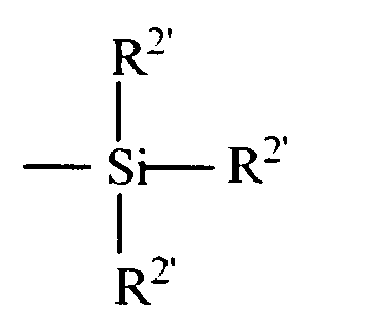
- Such bulky monomers may be copolymerized with a silicone macromonomer, which is a poly(organosiloxane) capped with an unsaturated group at two or more ends of the molecule.
U.S. Patent No. 4,153,641 discloses, for example, various unsaturated groups such as acryloxy or methacryloxy groups. - Another class of representative silicone-containing monomers includes, but is not limited to, silicone-containing vinyl carbonate or vinyl carbamate monomers such as, for example, 1,3-bis[4-vinyloxycarbonyloxy)but-1-yl]tetramethyl-disiloxane; 3-(trimethylsilyl)propyl vinyl carbonate; 3-(vinyloxycarbonylthio)propyl-[tris(dimethylsiloxy)silane]; 3-[tris(trimethylsiloxy)silyl]propyl vinyl carbamate; 3-[tris(trimethylsiloxy)silyl]propyl allyl carbamate; 3-[tris(trimethylsiloxy)silyl]propyl vinyl carbonate; t-butyldimethylsiloxyethyl vinyl carbonate; trimethylsilylethyl vinyl carbonate; trimethylsilylmethyl vinyl carbonate and the like and mixtures thereof.
- Another class of silicone-containing monomers includes polyurethane-polysiloxane macromonomers (also sometimes referred to as prepolymers), which may have hard-soft-hard blocks like traditional urethane elastomers. They may be end-capped with a hydrophilic monomer such as 2-hydroxyethyl methacrylate (HEMA). Examples of such silicone urethanes are disclosed in a variety or publications, including
U.S. Patent No. 6,858,218 andPCT Published Application No. WO 96/31792
E(*D*A*D*G)3 *D*A*D*E'; (II)
or
E(*D*G*D*A)a *D*A*D*E'; (III)
or
wherein: - D independently denotes an alkyl diradical, an alkyl cycloalkyl diradical, a cycloalkyl diradical, an aryl diradical or an alkylaryl diradical having 6 to about 30 carbon atoms;
- G independently denotes an alkyl diradical, a cycloalkyl diradical, an alkyl cycloalkyl diradical, an aryl diradical or an alkylaryl diradical having 1 to about 40 carbon atoms and which may contain ether, thio or amine linkages in the main chain;
- * denotes a urethane or ureido linkage;
- a is at least 1;
- A independently denotes a divalent polymeric radical of Formula IV:

- each of E and E' independently denotes a polymerizable unsaturated organic radical represented by Formula V:
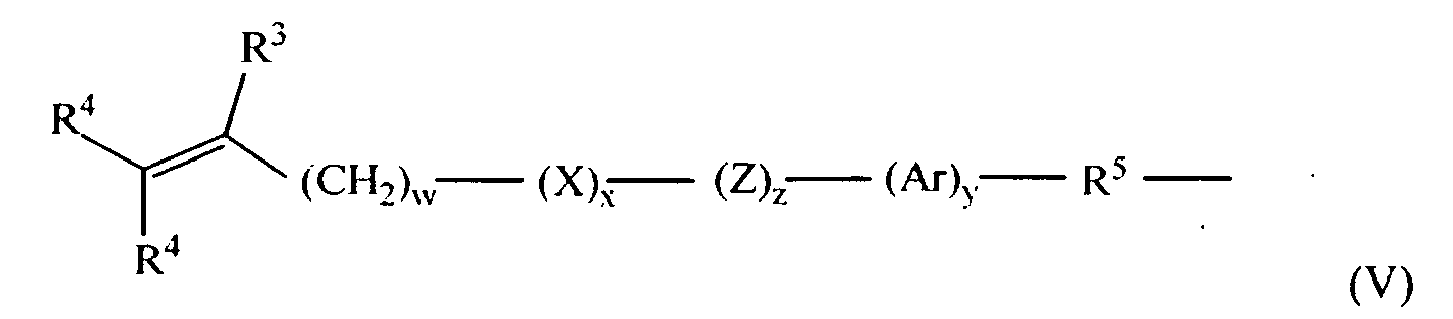
R4 is hydrogen, an alkyl radical having I to 6 carbon atoms, or a -CO-Y-R6 radical wherein Y is -O-, -S- or -NH-;
R5 is a divalent alkylene radical having 1 to about 10 carbon atoms;
R6 is a alkyl radical having 1 to about 12 carbon atoms;
X denotes -CO- or -OCO-;
Z denotes -O- or -NH-;
Ar denotes an aromatic radical having about 6 to about 30 carbon atoms;
w is 0 to 6; x is 0 or 1, y is 0 or 1, and z is 0 or 1. - A specific example of a silicone-containing urethane monomer is represented by Formula VI:
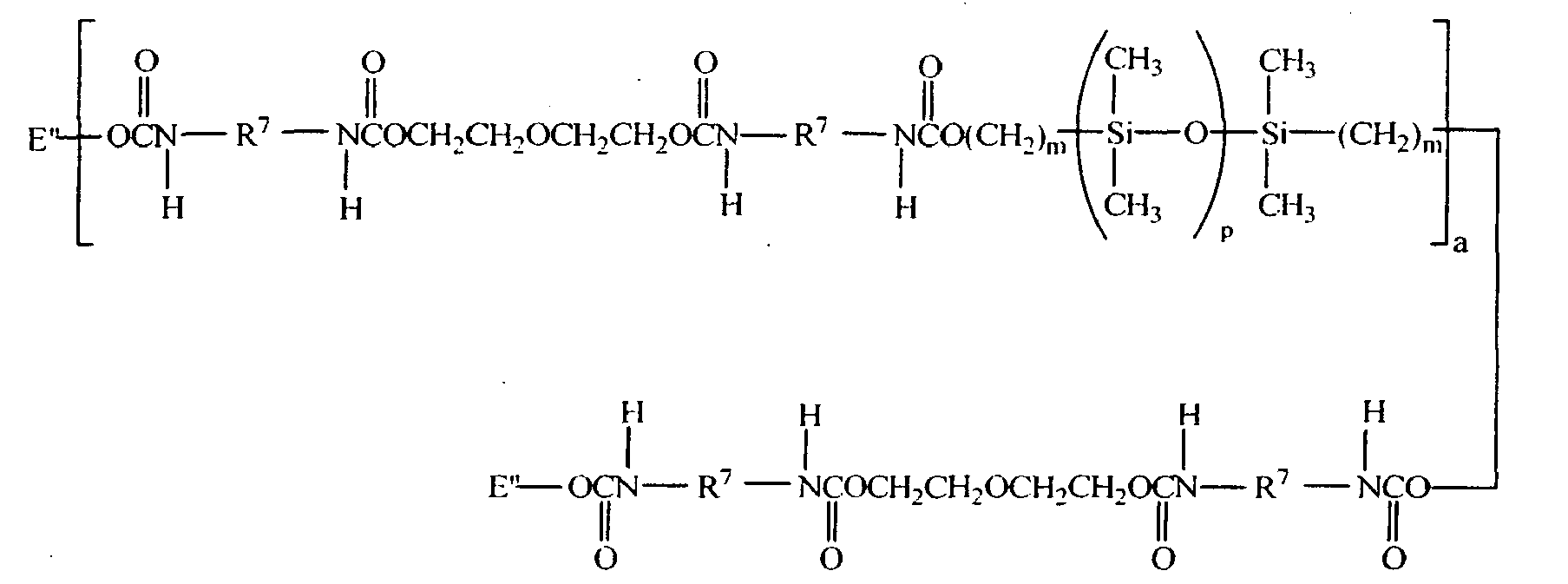
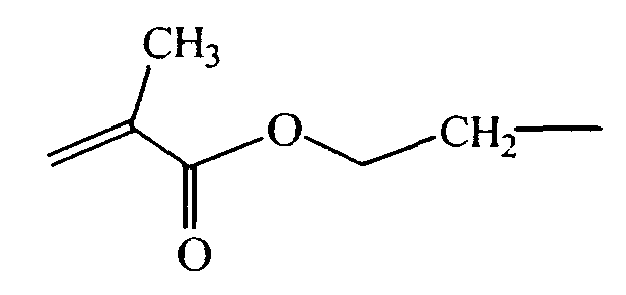
- In another embodiment of the present invention, a silicone hydrogel material comprises (in bulk, that is, in the monomer mixture that is copolymerized) about 5 to about 50 percent, and preferably about 10 to about 25, by weight of one or more silicone macromonomers, about 5 to about 75 percent, and preferably about 30 to about 60 percent, by weight of one or more polysiloxanylalkyl (meth)acrylic monomers, and about 10 to about 50 percent, and preferably about 20 to about 40 percent, by weight of a hydrophilic monomer. In general, the silicone macromonomer is a poly(organosiloxane) capped with an unsaturated group at two or more ends of the molecule. In addition to the end groups in the above structural formulas,
U.S. Patent No. 4,153,641 discloses additional unsaturated groups, including acryloxy or methacryloxy. Fumarate-containing materials such as those disclosed inU.S. Patent Nos. 5,310,779 ;5,449,729 and5,512,205 are also useful substrates in accordance with the invention. Preferably, the silane macromonomer is a silicone-containing vinyl carbonate or vinyl carbamate or a polyurethane-polysiloxane having one or more hard-soft-hard blocks and end-capped with a hydrophilic monomer. - Suitable hydrophilic monomers include amides such as dimethylacrylamide and dimethylmethacrylamide, cyclic lactams such as n-vinyl-2-pyrrolidone and poly(alkene glycols) functionalized with polymerizable groups. Examples of useful functionalized poly(alkene glycols) include poly(diethylene glycols) of varying chain length containing monomethacrylate or dimethacrylate end caps. In a preferred embodiment, the poly(alkene glycol) polymer contains at least two alkene glycol monomeric units. Still further examples are the hydrophilic vinyl carbonate or vinyl carbamate monomers disclosed in
U.S. Patent No. 5,070,215 , and the hydrophilic oxazolone monomers disclosed inU.S. Patent No. 4,910,277 . Other suitable hydrophilic monomers will be apparent to one skilled in the art. - The above silicone materials are merely exemplary, and other materials for use as substrates that can benefit by being packaged in the packaging solution according to the present invention and have been disclosed in various publications and are being continuously developed for use in contact lenses and other medical devices can also be used. For example, an ophthalmic lens for use herein can be a cationic lens such as a cationic contact lens or fluorinated silicone-containing monomers. Such monomers have been used in the formation of fluorosilicone hydrogels to reduce the accumulation of deposits on contact lenses made therefrom, as disclosed in, for example,
U.S. Patent Nos. 4,954,587 ;5,010,141 and5,079,319 . The use of silicone-containing monomers having certain fluorinated side groups, i.e., -(CF2)-H, have been found to improve compatibility between the hydrophilic and silicone-containing monomeric units. See, e.g.,U.S. Patent Nos. 5,321,108 and5,387,662 . - Ophthalmic devices such as contact lenses for application of the present invention can be manufactured employing various conventional techniques, to yield a shaped article having the desired posterior and anterior lens surfaces. Spincasting methods are disclosed in
U.S. Patent Nos. 3,408,429 and3,660,545 ; static casting methods are disclosed inU.S. Patent Nos. 4,113,224 ,4,197 ,266 , and5,271,875 . - The present invention is especially advantageous with respect to a contact lens for extended-wear or specialty uses. Extended lenses are lenses capable of being worn overnight, preferably capable of being worn for at least one week, most preferably capable of wear for a continuous period of one week to one month. By "capable" is meant lenses approved by one or more governmental regulatory authorities for such consumer use, for example, the U.S. Food & Drug Administration (USFDA) in the U.S. or its equivalent in other countries.
- Extended-wear lenses require relatively high oxygen permeability. The oxygen-permeability is the rate at which oxygen will pass through a material. The oxygen-permeability (Dk) of a lens material does not depend on lens thickness. Oxygen permeability is measured in terms of barrers.
- On the other hand, the oxygen transmissibility of a lens, as used herein, is the rate at which oxygen will pass through a specific lens. Oxygen transmissibility, Dk/t, is conventionally expressed in units of barrers/mm, where t is the average thickness of the material (in units of mm) over the area being measured. For example, a lens having a Dk of about 90 barrers (oxygen-permeability barrers) and a thickness of about 90 microns (about 0.090 mm) would have a Dk/t of about 100 barrers/mm (oxygen transmissibility barrers/mm).
- Next, the lens will be immersed in a packaging solution and stored in a packaging system according to the present invention. Generally, a packaging system for the storage of an ophthalmic lens according to the present invention includes at least a sealed container containing one or more unused ophthalmic lenses immersed in an aqueous lens packaging solution. Preferably, the sealed container is a hermetically sealed blister-pack, in which a concave well containing a contact lens is covered by a metal or plastic sheet adapted for peeling in order to open the blister-pack. The sealed container may be any suitable generally inert packaging material providing a reasonable degree of protection to the lens, preferably a plastic material such as polyalkylene, PVC, polyamide, and the like.
- Any suitable nonionic polymeric conditioning agent component may be employed in accordance with the present invention provided that it functions as described herein and has no substantial detrimental effect on the contact lens being stored or on the wearer of the contact lens. This component is ophthalmically acceptable at the concentrations used. Particularly useful components are those, which are water soluble, for example, soluble at the concentrations used in the presently useful liquid aqueous media.
- These compounds condition the lens by providing one or more of the following attributes: increased viscosity for increase retention time on the lens; enhanced wetting of the lens surface; decreased surface friction; or enhanced comfort of a contact lens by forming a cushioning film over the lens surface.
- A class of nonionic, polymeric conditioning agents includes nonionic polysaccharides. Representative examples of suitable components for use herein include, but are not limited to, methylcellulose; hydroxyethylcellulose; hydroxypropylcellulose; hydroxypropylmethylcellulose; and methylhydroxyethyl starches.
- Another class of nonionic, polymeric conditioning agents includes polyvinylalcohols and polyvinylpyrrolidones.
- Another class of nonionic, polymeric conditioning agents includes polymers of PEO, including PEO homopolymers, and block copolymers of PEO and PPO. This class includes poloxamers and poloxamines, including those disclosed in
U.S. Patent No. 6,440,366 . - The above classes of nonionic, polymeric conditioning agents are intended for illustrative purposes only and not to limit the scope of the present invention. Such polymers are known to those of skill in the art.
- Generally, the average molecular weight of nonionic, polymeric conditioning agent is a minimum of about 1 kDa and a maximum of about 700 kDa, more preferably, about 5 kDa to 500 kDa.
- The amount of nonionic, polymeric conditioning agent employed is that amount effective to improve the surface properties of the ophthalmic device when combined with a nonionic, nonpolymeric polyol. Preferably the nonionic, polymeric conditioning agent is present in the packaging solution of the invention in an amount of at least 0.01% w/v. The specific amount of such component used can vary widely depending on a number of factors, for example, the specific polymeric component and nonionic polyol being employed. The concentration of the nonionic, polymeric conditioning agent is from about 0.01 to about 10 % w/w and preferably from about 0.5 to about 1.5 % w/w.
- In one embodiment, the nonionic, nonpolymeric polyol for use herein can be a nonionic polyol containing 2 to about 12 carbon atoms and preferably 2 to 4 carbon atoms and from 2 to 8 hydroxyl groups. Representative examples of such nonionic polyols include glycerin, ethylene glycol, propylene glycol, sorbitol, manitol, monosaccarides, disaccharides such as trehalose, and the like and mixtures thereof. In one embodiment, the nonionic polyol can be glycerin, ethylene glycol, sorbitol, mannitol, monosaccharides and mixtures thereof.
- The amount of the nonionic, nonpolymeric polyol in the packaging solution will generally be an amount sufficient to form a more uniform coating on the surface of the lens when packaged in a packaging solution according to the present invention. In general, the concentration of the nonionic polyol will ordinarily range from about 0.01 to about 10 % w/w and preferably from about 0.1 to about 3.0 % w/w.
- Without being bound by any particular theory, it is believed that the nonionic, nonpolymeric polyol molecules are able to penetrate into the matrix of the lens material, especially a hydrogel lens material, thus attracting and binding water molecules into the lens matrix. The polymeric conditioning agent forms a film around the lens, thus trapping and retaining the moisture and leading to a slow release of the polyol throughout the duration of wear. Thus, these two components work in combination for a unique effect. Accordingly, preferred polyols are humectants, which are substances that attract and retain moisture because of their ability to form hydrogen bonds with water molecules, and preferred polymeric conditioning agents are demulcents.
- The packaging solutions according to the present invention are physiologically compatible. Specifically, the solution must be "ophthalmically safe" for use with a lens such as a contact lens, meaning that a contact lens treated with the solution is generally suitable and safe for direct placement on the eye without rinsing, that is, the solution is safe and comfortable for daily contact with the eye via a contact lens that has been wetted with the solution. An ophthalmically safe solution has a tonicity and pH that is compatible with the eye and includes materials, and amounts thereof, that are non-cytotoxic according to ISO standards and U.S. Food & Drug Administration (FDA) regulations. The solution should be sterile in that the absence of microbial contaminants in the product prior to release must be statistically demonstrated to the degree necessary for such products. The liquid media useful in the present invention are selected to have no substantial detrimental effect on the lens being treated or cared for and to allow or even facilitate the present lens treatment or treatments. The liquid media are preferably aqueous-based. A particularly useful aqueous liquid medium is that derived from saline, for example, a conventional saline solution or a conventional buffered saline solution.
- The pH of the present solutions should be maintained within the range of about 6.0 to about 8, and preferably about 6.5 to about 7.8. Suitable buffers may be added, such as: phosphate; borate; citrate; carbonate; tris-(hydroxymethyl)aminomethane (TRIS); bis(2-hydroxyethyl)-imino-tris-(hydroxymethyl)aminoalcohol (bis-tris); zwitterionic buffers such as N-[2-Hydroxy-1,1-bis(hydroxymethyl)ethyl]glycine (Tricine)and N-[2-Hydroxy-1,1-bis(hydroxymethyl)ethyl]glycine, MOPS; N-(Carbamoylmethyl)taurine (ACES); amino acids and amino acid derivatives; and mixtures thereof. Generally, buffers will be used in amounts ranging from about 0.05 to about 2.5 percent by weight, and preferably from about 0.1 to about 1.5 percent by weight of the solution. The packaging solutions of this invention preferably contain a borate buffer, containing one or more of boric acid, sodium borate, potassium tetraborate, potassium metaborate or mixtures of the same.
- If needed, the solutions of the present invention may be adjusted with tonicity agents, to approximate the osmotic pressure of normal lacrimal fluids, which is equivalent to a 0.9 percent solution of sodium chloride or 2.5 percent of glycerol solution. The solutions are made substantially isotonic with physiological saline used alone or in combination, otherwise if simply blended with sterile water and made hypotonic or made hypertonic the lenses will lose their desirable optical parameters. Correspondingly, excess saline may result in the formation of a hypertonic solution, which will cause stinging, and eye irritation.
- Examples of suitable tonicity adjusting agents include, but are not limited to, sodium and potassium chloride, dextrose, calcium and magnesium chloride and the like and mixtures thereof. These agents are typically used individually in amounts ranging from about 0.01 to about 2.5% w/v and preferably from about 0.2 to about 1.5% w/v. Preferably, the tonicity agent will be employed in an amount to provide a final osmotic value of at least about 200 mOsm/kg, preferably from about 200 to about 450 mOsm/kg, more preferably from about 250 to about 400 mOsm/kg, and most preferably from about 280 to about 370 mOsm/kg.
- If desired, one or more additional components can be included in the packaging solution. Such additional component or components are chosen to impart or provide at least one beneficial or desired property to the packaging solution. Such additional components may be selected from components that are conventionally used in one or more ophthalmic device care compositions. Examples of such additional components include cleaning agents, wetting agents, nutrient agents, sequestering agents, viscosity builders, contact lens conditioning agents, antioxidants, and the like and mixtures thereof. These additional components may each be included in the packaging solutions in an amount effective to impart or provide the beneficial or desired property to the packaging solutions. For example, such additional components may be included in the packaging solutions in amounts similar to the amounts of such components used in other, e.g., conventional, contact lens care products.
- Useful sequestering agents include, but are not limited to, disodium ethylene diamine tetraacetate, alkali metal hexametaphosphate, citric acid, sodium citrate and the like and mixtures thereof.
- Useful antioxidants include, but are not limited to, sodium metabisulfite, sodium thiosulfate, N-acetylcysteine, butylated hydroxyanisole, butylated hydroxytoluene and the like and mixtures thereof.
- The method of packaging and storing an ophthalmic lens according to the present invention includes at least packaging the ophthalmic lens immersed in the aqueous contact lens packaging solution described above. The method may include immersing the ophthalmic lens in an aqueous contact lens solution prior to delivery to the customer/wearer, directly following manufacture of the contact lens. Alternately, the packaging and storing in the solution of the present invention may occur at an intermediate point before delivery to the ultimate customer (wearer) but following manufacture and transportation of the lens in a dry state, wherein the dry lens is hydrated by immersing the lens in the contact lens packaging solution. Consequently, a package for delivery to a customer may include a sealed container containing one or more unused contact lenses immersed in an aqueous contact lens packaging solution according to the present invention.
- In one embodiment, the steps leading to the present ophthalmic device packaging system include (1) molding an ophthalmic device in a mold comprising at least a first and second mold portion, (2) removing the lens from the mold portions; (3) introducing the packing solution of this invention and the ophthalmic lens into the container, and (4) sealing the container. Preferably, the method also includes the step of sterilizing the contents of the container. Sterilization may take place prior to, or most conveniently after, sealing of the container and may be effected by any suitable method known in the art, e.g., by balanced autoclaving of the sealed container at temperatures of about 120°C or higher. Preferred packages are plastic blister packages, including a recess for receiving a contact lens and the package solution, where the recess is sealed with lidstock prior to sterilization of the package contents.
- The following examples are provided to enable one skilled in the art to practice the invention and are merely illustrative of the invention. The examples should not be read as limiting the scope of the invention as defined in the claims.
- Tables 1 to 3 illustrate various solutions of this invention. Additionally, the pH of the solutions in Tables 2 and 3 was adjusted with NaOH/HCl
Table 1 Compound Preferred
Concentration Range
%w/vConcentration
%w/vNaH2PO4 0.05-1.0 0.3 Na2HPO4 0.05-0.5 0.15 NaCl 0.01-1.0 0.6 Sorbitol 0.1-2.0 0.5 HPMC 0.05-2.0 0.15 water Q.S. to 100% w/v Q.S. to 100% w/v Table 2 Compound Preferred
Concentration Range
%w/vConcentration
%w/vMOPS 0.1-3.0 2.0 NaCl 0.01-1.0 0.5 Glycerin 0.1-2.0 0.5 Tetronic 1107 0.05-2.0 0.5 water Q.S. to 100% w/v Q. S. to 100% w/v * pH adjusted with NaOH/HCl Table 3 Compound Preferred
Concentration Range
%w/vConcentration %w/v Sodium citrate 0.1-3.0 0.65 KCl 0.01-1.0 0.10 Mannitol 0.1-2.0 1.0 PVA 0.05-2.0 0.5 water Q.S. to 100% w/v Q.S. to 100% w/v * pH adjusted with NaOH/HCl - Tables 4 and 5 list other solutions of this invention, as well as two comparative solutions.
Table 4 Comparative A Invention B 0.90 %w/v Boric Acid 0.90 %w/v Boric Acid 0.10 %w/v Sodium Borate 0.10 %w/v Sodium Borate 0.60 %w/v NaCl 0.42 %w/v NaCl Q.S to 100% w/v with water 0.50 %w/v Glycerin 0.50 %w/v Tetronic 1107 Q. S to 100% w/v with water Table 5 Invention C Comparative D 0.12 %w/v NaH2PO4 0.12 %w/v NaH2PO4 0.30 %w/v Na2HPO4 0.30 %w/v Na2HPO4 0.60 %w/v NaCl 0.88 %w/v NaCl 0.50 %w/v Glycerin 0.5 %w/v Polyvinyl alcohol 0.5 %w/v Polyvinyl alcohol Q.S to 100% w/v with water Q.S to 100% w/v with water - The solutions in Tables 4 and 5 were tested as follows. Contact lenses were soaked in the respective solutions of Tables 4 and 5 for no fewer than 72 hours. Lenses were then removed from the test solution and were immediately mounted and tested in 1 mL phosphate borate saline (PBS). Tribological testing was performed on a CETR Model UMT-2 micro-tribometer. Each lens was clamped on an HDPE holder that initially mates with the posterior side of the lens. A poly(propylene) clamping ring was then used to hold the edge region of the lens. Once the lens was mounted in the holder the assembly was placed in a stationary clamping device within the micro-tribometer. A polished stainless steel disc containing 1 mL of the test solution was then brought into contact with the lens and FN was adjusted to 2 grams over the course of the run for the frictional measurements. After the load equilibrated for 5 seconds the stainless steel disc was rotated at a velocity of 12cm/sec for a duration of 20 sec in both the forward and reverse directions and the peak (static) and average (kinetic) COF values were recorded. Each value represents the average of 9-10 lenses. Controls were run from the same lot of lenses that were not subjected to any test solution. All data was normalized to the average values obtained from the lens holder in the absence of a lens tested in PBS. The results are summarized in Table 6.
Table 6 Solution Mean static COF Standard error Mean kinetic COF Standard error A 2.657 0.157 0.2810 0.0109 B 1.737 0.157 0.1379 0.0109 C 1.265 0.157 0.2755 0.0109 D 1.867 0.157 0.2866 0.0115 - Tribology is the study of how two surfaces interact with each other when in relative motion. One aspect of tribology that may be of importance to contact lenses is friction. Friction is a measure of a material's resistance to lateral motion when placed against a specific substrate. The relative friction between two surfaces may be described in terms of a coefficient of friction (COF), which is defined as the ratio of the lateral force (Fx) that is required to initiate and then sustain movement to the normal force (FN). Further, there are two friction coefficients that may be considered, the peak (or static) and average (or kinetic). The static COF is a measure of how much Fx is needed to initiate relative motion of two surfaces and is typically the larger of the two values. Practically, for contact lenses, the static COF is related to the amount of force needed to start a blink cycle or for the lens to begin moving over the cornea. The kinetic COF is a measure of how much lateral force is needed to sustain movement at a particular velocity averaged over a finite period of time. This value is related to the amount of force required to sustain the blink over the course of the entire cycle and the ease of motion of the lens on the cornea (which may be further related to how much the lens moves on the cornea).
- It will be understood that various modifications may be made to the embodiments disclosed herein. Therefore the above description should not be construed as limiting, but merely as exemplifications of preferred embodiments. For example, the functions described above and implemented as the best mode for operating the present invention are for illustration purposes only. Other arrangements and methods may be implemented by those skilled in the art without departing from the scope and spirit of this invention. Moreover, those skilled in the art will envision other modifications within the scope of the claims appended hereto.
Claims (19)
- A method of preparing a package comprising a storable, sterile ophthalmic device, the method comprising:(a) immersing an ophthalmic device in a solution comprising a nonionic, nonpolymeric polyol and a nonionic, polymeric conditioning agent, wherein the solution has an osmolality of at least about 200 mOsm/kg and a pH in the range of about 6 to about 8, and wherein the concentration of the nonionic, polymeric conditioning agent is about 0.01 to about 10 % w/w;(b) packaging the solution and the device in a manner preventing contamination of the device by microorganisms; and(c) sterilizing the packaged solution and device.
- The method of Claim 1, wherein the ophthalmic device is a contact lens.
- The method of Claim 1, wherein the ophthalmic device comprises a polymerization product of a monomeric mixture comprising one or more silicone- containing monomers.
- The method of Claim 1, wherein the nonionic, polymeric conditioning agent comprises at least one member selected from the group consisting of nonionic polysaccharide, polyvinylalcohol, polyvinylpyrrolidone, and a polymer of PEO.
- The method of Claim 4, wherein the nonionic, polymeric conditioning agent comprises at least one member selected from the group consisting of methylcellulose; hydroxyethylcellulose; hydroxypropyl cellulose, hydroxypropylmethylcellulose; and methylhydroxyethyl starch.
- The method of Claim 4, wherein the nonionic, polymeric conditioning agent comprises a block copolymers of PEO and PPO.
- The method of Claim 4, wherein the nonionic, polymeric conditioning agent comprises polyvinylalcohol.
- The method of Claim 1, wherein the nonionic, nonpolymeric polyol contains 2 to 12 carbon atoms and 2 to 8 hydroxyl groups.
- The method of Claim 1, wherein the nonionic, nonpolymeric polyol includes at least one member selected from the group consisting of glycerin, ethylene glycol, propylene glycol, sorbitol, manitol, monosaccarides, and disaccharides.
- The method of Claim 9, wherein the wherein the nonionic, nonpolymeric polyol includes at least one member selected from the group consisting of glycerin, sorbitol and manitol.
- The method of Claim 1, wherein the solution further comprises a buffering agent.
- The method of Claim 11, wherein the buffering agent comprises at least one member selected from the group consisting of: phosphate; borate; citrate; carbonate; TRIS; bis-tris; Tricine; MOPS; ACES; and an amino acid.
- The method of Claim 1, including hermetically sealing the contact lens and the contact lens packing solution in the package and heat sterilizing the package contents.
- The method of Claim 1, wherein the solution does not contain an effective disinfecting amount of a disinfecting agent.
- The method of Claim 1, wherein the solution does not contain a germicide compound.
- A packaging system for the storage of an ophthalmic device comprising a sealed container containing an unused ophthalmic device immersed in an aqueous packing solution comprising a nonionic, nonpolymeric polyol and a nonionic, polymeric conditioning agent, wherein the solution has an osmolality of at least about 200 mOsm/kg and a pH in the range of about 6 to about 8, and wherein the concentration of the nonionic, polymeric conditioning agent is about 0.01 to about 10 % w/w.
- The packaging system of Claim 16, wherein the ophthalmic device is a contact lens.
- The packaging system of Claim 17, wherein the ophthalmic device comprises a silicone hydrogel contact lens.
- The packaging system of Claim 17, wherein the solution does not contain an effective disinfecting amount of a disinfecting agent.
Applications Claiming Priority (2)
| Application Number | Priority Date | Filing Date | Title |
|---|---|---|---|
| US11/595,616 US20080110770A1 (en) | 2006-11-10 | 2006-11-10 | Packaging solutions |
| PCT/US2007/081630 WO2008060798A1 (en) | 2006-11-10 | 2007-10-17 | Packaging solutions |
Publications (2)
| Publication Number | Publication Date |
|---|---|
| EP2102324A1 EP2102324A1 (en) | 2009-09-23 |
| EP2102324B1 true EP2102324B1 (en) | 2011-06-15 |
Family
ID=39185703
Family Applications (1)
| Application Number | Title | Priority Date | Filing Date |
|---|---|---|---|
| EP07854129A Revoked EP2102324B1 (en) | 2006-11-10 | 2007-10-17 | Packaging solutions |
Country Status (7)
| Country | Link |
|---|---|
| US (1) | US20080110770A1 (en) |
| EP (1) | EP2102324B1 (en) |
| JP (1) | JP2010508980A (en) |
| CN (1) | CN101535461A (en) |
| AT (1) | ATE513030T1 (en) |
| ES (1) | ES2364296T3 (en) |
| WO (1) | WO2008060798A1 (en) |
Cited By (1)
| Publication number | Priority date | Publication date | Assignee | Title |
|---|---|---|---|---|
| US11951219B2 (en) | 2017-01-20 | 2024-04-09 | Hollister Incorporated | Method for sterilizing a substrate having a hydrophilic coating and sterilized substrates |
Families Citing this family (18)
| Publication number | Priority date | Publication date | Assignee | Title |
|---|---|---|---|---|
| US8557868B2 (en) | 2000-11-04 | 2013-10-15 | Fxs Ventures, Llc | Ophthalmic and contact lens solutions using low molecular weight amines |
| US20080148689A1 (en) * | 2006-12-20 | 2008-06-26 | Bausch & Lomb Incorporated | Packaging solutions |
| US20080151181A1 (en) * | 2006-12-20 | 2008-06-26 | Bausch & Lomb Incorporated | Coatings and Solutions for Contact Lenses |
| US20090145086A1 (en) * | 2007-12-11 | 2009-06-11 | Reynolds Ger M | Method for treating ophthalmic lenses |
| US20090145091A1 (en) * | 2007-12-11 | 2009-06-11 | Richard Connolly | Method for treating ophthalmic lenses |
| US8534031B2 (en) * | 2008-12-30 | 2013-09-17 | Bausch & Lomb Incorporated | Packaging solutions |
| WO2010077708A1 (en) * | 2008-12-30 | 2010-07-08 | Bausch & Lomb Incorporated | Packaging solutions |
| TWI875491B (en) | 2010-07-30 | 2025-03-01 | 瑞士商愛爾康公司 | Hydrated contact lens |
| CA2851668C (en) | 2011-10-12 | 2016-08-16 | Novartis Ag | Method for making uv-absorbing ophthalmic lenses by coating |
| CN104871036B (en) | 2012-12-17 | 2019-12-10 | 诺华股份有限公司 | Method for making improved UV-absorbing ophthalmic lenses |
| US9248928B2 (en) * | 2012-12-21 | 2016-02-02 | Coopervision International Holding Company, Lp | Methods of manufacturing contact lenses for delivery of beneficial agents |
| MY180543A (en) | 2013-12-17 | 2020-12-01 | Novartis Ag | A silicone hydrogel lens with a crosslinked hydrophilic coating |
| CN106715101B (en) | 2014-08-26 | 2019-11-05 | 诺华股份有限公司 | Method for applying a stable coating on a silicone hydrogel contact lens |
| CN108369291B (en) | 2015-12-15 | 2021-07-20 | 爱尔康公司 | Method for applying a stable coating to a silicone hydrogel contact lens |
| GB2560483A (en) | 2016-02-22 | 2018-09-12 | Coopervision Int Holding Co Lp | Silicone hydrogel contact lenses having improved lubricity |
| EP3452805A4 (en) * | 2016-05-03 | 2020-04-01 | Rarecyte, Inc. | Solutions for sample processing |
| HUE057348T2 (en) | 2017-12-13 | 2022-05-28 | Alcon Inc | Method for producing mps-compatible water gradient contact lenses |
| TW202220706A (en) * | 2020-08-10 | 2022-06-01 | 愛爾蘭商博士倫愛爾蘭有限公司 | Packaging solutions |
Family Cites Families (35)
| Publication number | Priority date | Publication date | Assignee | Title |
|---|---|---|---|---|
| NL137711C (en) * | 1961-12-27 | |||
| NL128305C (en) * | 1963-09-11 | |||
| US4197266A (en) * | 1974-05-06 | 1980-04-08 | Bausch & Lomb Incorporated | Method for forming optical lenses |
| US4113224A (en) * | 1975-04-08 | 1978-09-12 | Bausch & Lomb Incorporated | Apparatus for forming optical lenses |
| US4136250A (en) * | 1977-07-20 | 1979-01-23 | Ciba-Geigy Corporation | Polysiloxane hydrogels |
| US4153641A (en) * | 1977-07-25 | 1979-05-08 | Bausch & Lomb Incorporated | Polysiloxane composition and contact lens |
| US4740533A (en) * | 1987-07-28 | 1988-04-26 | Ciba-Geigy Corporation | Wettable, flexible, oxygen permeable, substantially non-swellable contact lens containing block copolymer polysiloxane-polyoxyalkylene backbone units, and use thereof |
| US4910277A (en) * | 1988-02-09 | 1990-03-20 | Bambury Ronald E | Hydrophilic oxygen permeable polymers |
| US4954587A (en) * | 1988-07-05 | 1990-09-04 | Ciba-Geigy Corporation | Dimethylacrylamide-copolymer hydrogels with high oxygen permeability |
| US5298182A (en) * | 1989-01-31 | 1994-03-29 | Ciba-Geigy Corporation | Rapid ophthalmic glycol/lower alkanol cleaning and disinfecting solution and method |
| US5070215A (en) * | 1989-05-02 | 1991-12-03 | Bausch & Lomb Incorporated | Novel vinyl carbonate and vinyl carbamate contact lens material monomers |
| US5034461A (en) * | 1989-06-07 | 1991-07-23 | Bausch & Lomb Incorporated | Novel prepolymers useful in biomedical devices |
| US5010141A (en) * | 1989-10-25 | 1991-04-23 | Ciba-Geigy Corporation | Reactive silicone and/or fluorine containing hydrophilic prepolymers and polymers thereof |
| US5079319A (en) * | 1989-10-25 | 1992-01-07 | Ciba-Geigy Corporation | Reactive silicone and/or fluorine containing hydrophilic prepolymers and polymers thereof |
| US5209865A (en) * | 1990-01-25 | 1993-05-11 | Ciba-Geigy Corporation | Conditioning solution for contact lenses and a method of using the same |
| US5271875A (en) * | 1991-09-12 | 1993-12-21 | Bausch & Lomb Incorporated | Method for molding lenses |
| US5310779A (en) * | 1991-11-05 | 1994-05-10 | Bausch & Lomb Incorporated | UV curable crosslinking agents useful in copolymerization |
| EP0639070B2 (en) * | 1992-05-06 | 2010-09-08 | Alcon Laboratories, Inc. | Use of borate-polyol complexes in ophthalmic compositions |
| US5358995A (en) * | 1992-05-15 | 1994-10-25 | Bausch & Lomb Incorporated | Surface wettable silicone hydrogels |
| US5260000A (en) * | 1992-08-03 | 1993-11-09 | Bausch & Lomb Incorporated | Process for making silicone containing hydrogel lenses |
| US5321108A (en) * | 1993-02-12 | 1994-06-14 | Bausch & Lomb Incorporated | Fluorosilicone hydrogels |
| US5616757A (en) * | 1993-04-08 | 1997-04-01 | Bausch & Lomb Incorporated | Organosilicon-containing materials useful for biomedical devices |
| CN1084335C (en) * | 1995-12-07 | 2002-05-08 | 博士伦公司 | Monomeric units useful for reducing modulus of silicone hydrogels |
| US5714557A (en) * | 1995-12-07 | 1998-02-03 | Bausch & Lomb Incorporated | Monomeric units useful for reducing the modulus of low water polymeric silicone compositions |
| AU1856797A (en) * | 1996-01-30 | 1997-08-22 | Bausch & Lomb Incorporated | Treatment of contact lenses with an aqueous solution including sulfobetaine compounds |
| US5858937A (en) * | 1996-02-28 | 1999-01-12 | Bausch & Lomb Incorporated | Treatment of contact lenses with aqueous solution including phosphonic compounds |
| US6180093B1 (en) * | 1996-09-20 | 2001-01-30 | Bausch & Lomb Incorporated | Method and composition for rewetting contact lenses and relieving eye dryness |
| US5708094A (en) * | 1996-12-17 | 1998-01-13 | Bausch & Lomb Incorporated | Polybutadiene-based compositions for contact lenses |
| US5800807A (en) * | 1997-01-29 | 1998-09-01 | Bausch & Lomb Incorporated | Ophthalmic compositions including glycerin and propylene glycol |
| GB9711818D0 (en) * | 1997-06-06 | 1997-08-06 | Bausch & Lomb | Contact lens packing solutions and methods for improving the comfort of disposable contact lenses |
| US20030129083A1 (en) * | 1997-11-26 | 2003-07-10 | Advanced Medical Optics, Inc. | Multi purpose contact lens care compositions including propylene glycol or glycerin |
| US6531432B2 (en) * | 2000-12-07 | 2003-03-11 | Johnson & Johnson Vision Care, Inc. | Contact lens packaging solutions |
| US7037469B2 (en) * | 2003-03-19 | 2006-05-02 | Bausch & Lomb, Inc. | Method and composition for reducing contact lens swelling |
| JP4379794B2 (en) * | 2004-03-22 | 2009-12-09 | 株式会社シード | Preservative solution for drug sustained release soft contact lenses |
| US20060229219A1 (en) * | 2005-04-11 | 2006-10-12 | Advanced Medical Optics, Inc. | Borate-polyol mixtures as a buffering system |
-
2006
- 2006-11-10 US US11/595,616 patent/US20080110770A1/en not_active Abandoned
-
2007
- 2007-10-17 ES ES07854129T patent/ES2364296T3/en active Active
- 2007-10-17 CN CNA2007800416674A patent/CN101535461A/en active Pending
- 2007-10-17 WO PCT/US2007/081630 patent/WO2008060798A1/en not_active Ceased
- 2007-10-17 JP JP2009536374A patent/JP2010508980A/en active Pending
- 2007-10-17 AT AT07854129T patent/ATE513030T1/en not_active IP Right Cessation
- 2007-10-17 EP EP07854129A patent/EP2102324B1/en not_active Revoked
Cited By (1)
| Publication number | Priority date | Publication date | Assignee | Title |
|---|---|---|---|---|
| US11951219B2 (en) | 2017-01-20 | 2024-04-09 | Hollister Incorporated | Method for sterilizing a substrate having a hydrophilic coating and sterilized substrates |
Also Published As
| Publication number | Publication date |
|---|---|
| US20080110770A1 (en) | 2008-05-15 |
| CN101535461A (en) | 2009-09-16 |
| WO2008060798A1 (en) | 2008-05-22 |
| ES2364296T3 (en) | 2011-08-30 |
| ATE513030T1 (en) | 2011-07-15 |
| JP2010508980A (en) | 2010-03-25 |
| EP2102324A1 (en) | 2009-09-23 |
Similar Documents
| Publication | Publication Date | Title |
|---|---|---|
| EP2102324B1 (en) | Packaging solutions | |
| US9527617B2 (en) | Packaging solutions | |
| US8534031B2 (en) | Packaging solutions | |
| EP2094321B1 (en) | Packaging solutions | |
| WO2008076506A1 (en) | Packaging solutions | |
| US7837934B2 (en) | Packaging solutions | |
| ES2372010T3 (en) | PACKING SOLUTIONS. | |
| US20070149428A1 (en) | Method of Packaging a Lens | |
| US20090126318A1 (en) | Packaging Solutions | |
| WO2023094265A1 (en) | Method for making a preservative-free packaged ophthalmic device product | |
| JP2024510735A (en) | packaging solution |
Legal Events
| Date | Code | Title | Description |
|---|---|---|---|
| PUAI | Public reference made under article 153(3) epc to a published international application that has entered the european phase |
Free format text: ORIGINAL CODE: 0009012 |
|
| 17P | Request for examination filed |
Effective date: 20090505 |
|
| AK | Designated contracting states |
Kind code of ref document: A1 Designated state(s): AT BE BG CH CY CZ DE DK EE ES FI FR GB GR HU IE IS IT LI LT LU LV MC MT NL PL PT RO SE SI SK TR |
|
| 17Q | First examination report despatched |
Effective date: 20090925 |
|
| DAX | Request for extension of the european patent (deleted) | ||
| GRAP | Despatch of communication of intention to grant a patent |
Free format text: ORIGINAL CODE: EPIDOSNIGR1 |
|
| GRAS | Grant fee paid |
Free format text: ORIGINAL CODE: EPIDOSNIGR3 |
|
| GRAA | (expected) grant |
Free format text: ORIGINAL CODE: 0009210 |
|
| AK | Designated contracting states |
Kind code of ref document: B1 Designated state(s): AT BE BG CH CY CZ DE DK EE ES FI FR GB GR HU IE IS IT LI LT LU LV MC MT NL PL PT RO SE SI SK TR |
|
| REG | Reference to a national code |
Ref country code: GB Ref legal event code: FG4D Ref country code: CH Ref legal event code: EP |
|
| REG | Reference to a national code |
Ref country code: IE Ref legal event code: FG4D |
|
| REG | Reference to a national code |
Ref country code: DE Ref legal event code: R096 Ref document number: 602007015291 Country of ref document: DE Effective date: 20110804 |
|
| REG | Reference to a national code |
Ref country code: ES Ref legal event code: FG2A Ref document number: 2364296 Country of ref document: ES Kind code of ref document: T3 Effective date: 20110830 |
|
| REG | Reference to a national code |
Ref country code: NL Ref legal event code: VDEP Effective date: 20110615 |
|
| PG25 | Lapsed in a contracting state [announced via postgrant information from national office to epo] |
Ref country code: LT Free format text: LAPSE BECAUSE OF FAILURE TO SUBMIT A TRANSLATION OF THE DESCRIPTION OR TO PAY THE FEE WITHIN THE PRESCRIBED TIME-LIMIT Effective date: 20110615 Ref country code: SE Free format text: LAPSE BECAUSE OF FAILURE TO SUBMIT A TRANSLATION OF THE DESCRIPTION OR TO PAY THE FEE WITHIN THE PRESCRIBED TIME-LIMIT Effective date: 20110615 |
|
| PG25 | Lapsed in a contracting state [announced via postgrant information from national office to epo] |
Ref country code: AT Free format text: LAPSE BECAUSE OF FAILURE TO SUBMIT A TRANSLATION OF THE DESCRIPTION OR TO PAY THE FEE WITHIN THE PRESCRIBED TIME-LIMIT Effective date: 20110615 Ref country code: FI Free format text: LAPSE BECAUSE OF FAILURE TO SUBMIT A TRANSLATION OF THE DESCRIPTION OR TO PAY THE FEE WITHIN THE PRESCRIBED TIME-LIMIT Effective date: 20110615 Ref country code: CY Free format text: LAPSE BECAUSE OF FAILURE TO SUBMIT A TRANSLATION OF THE DESCRIPTION OR TO PAY THE FEE WITHIN THE PRESCRIBED TIME-LIMIT Effective date: 20110615 Ref country code: SI Free format text: LAPSE BECAUSE OF FAILURE TO SUBMIT A TRANSLATION OF THE DESCRIPTION OR TO PAY THE FEE WITHIN THE PRESCRIBED TIME-LIMIT Effective date: 20110615 Ref country code: GR Free format text: LAPSE BECAUSE OF FAILURE TO SUBMIT A TRANSLATION OF THE DESCRIPTION OR TO PAY THE FEE WITHIN THE PRESCRIBED TIME-LIMIT Effective date: 20110916 Ref country code: LV Free format text: LAPSE BECAUSE OF FAILURE TO SUBMIT A TRANSLATION OF THE DESCRIPTION OR TO PAY THE FEE WITHIN THE PRESCRIBED TIME-LIMIT Effective date: 20110615 |
|
| PG25 | Lapsed in a contracting state [announced via postgrant information from national office to epo] |
Ref country code: NL Free format text: LAPSE BECAUSE OF FAILURE TO SUBMIT A TRANSLATION OF THE DESCRIPTION OR TO PAY THE FEE WITHIN THE PRESCRIBED TIME-LIMIT Effective date: 20110615 Ref country code: BE Free format text: LAPSE BECAUSE OF FAILURE TO SUBMIT A TRANSLATION OF THE DESCRIPTION OR TO PAY THE FEE WITHIN THE PRESCRIBED TIME-LIMIT Effective date: 20110615 |
|
| PG25 | Lapsed in a contracting state [announced via postgrant information from national office to epo] |
Ref country code: EE Free format text: LAPSE BECAUSE OF FAILURE TO SUBMIT A TRANSLATION OF THE DESCRIPTION OR TO PAY THE FEE WITHIN THE PRESCRIBED TIME-LIMIT Effective date: 20110615 Ref country code: PT Free format text: LAPSE BECAUSE OF FAILURE TO SUBMIT A TRANSLATION OF THE DESCRIPTION OR TO PAY THE FEE WITHIN THE PRESCRIBED TIME-LIMIT Effective date: 20111017 Ref country code: CZ Free format text: LAPSE BECAUSE OF FAILURE TO SUBMIT A TRANSLATION OF THE DESCRIPTION OR TO PAY THE FEE WITHIN THE PRESCRIBED TIME-LIMIT Effective date: 20110615 Ref country code: IS Free format text: LAPSE BECAUSE OF FAILURE TO SUBMIT A TRANSLATION OF THE DESCRIPTION OR TO PAY THE FEE WITHIN THE PRESCRIBED TIME-LIMIT Effective date: 20111015 |
|
| PG25 | Lapsed in a contracting state [announced via postgrant information from national office to epo] |
Ref country code: RO Free format text: LAPSE BECAUSE OF FAILURE TO SUBMIT A TRANSLATION OF THE DESCRIPTION OR TO PAY THE FEE WITHIN THE PRESCRIBED TIME-LIMIT Effective date: 20110615 Ref country code: SK Free format text: LAPSE BECAUSE OF FAILURE TO SUBMIT A TRANSLATION OF THE DESCRIPTION OR TO PAY THE FEE WITHIN THE PRESCRIBED TIME-LIMIT Effective date: 20110615 Ref country code: PL Free format text: LAPSE BECAUSE OF FAILURE TO SUBMIT A TRANSLATION OF THE DESCRIPTION OR TO PAY THE FEE WITHIN THE PRESCRIBED TIME-LIMIT Effective date: 20110615 |
|
| PLBI | Opposition filed |
Free format text: ORIGINAL CODE: 0009260 |
|
| PLAX | Notice of opposition and request to file observation + time limit sent |
Free format text: ORIGINAL CODE: EPIDOSNOBS2 |
|
| 26 | Opposition filed |
Opponent name: DR. THORSTEN BAUSCH Effective date: 20120314 Opponent name: NOVARTIS AG Effective date: 20120315 |
|
| PLAB | Opposition data, opponent's data or that of the opponent's representative modified |
Free format text: ORIGINAL CODE: 0009299OPPO |
|
| PG25 | Lapsed in a contracting state [announced via postgrant information from national office to epo] |
Ref country code: MC Free format text: LAPSE BECAUSE OF NON-PAYMENT OF DUE FEES Effective date: 20111031 |
|
| REG | Reference to a national code |
Ref country code: CH Ref legal event code: PL |
|
| REG | Reference to a national code |
Ref country code: DE Ref legal event code: R026 Ref document number: 602007015291 Country of ref document: DE Effective date: 20120314 |
|
| R26 | Opposition filed (corrected) |
Opponent name: NOVARTIS AG Effective date: 20120315 Opponent name: DR. THORSTEN BAUSCH Effective date: 20120314 |
|
| PG25 | Lapsed in a contracting state [announced via postgrant information from national office to epo] |
Ref country code: DK Free format text: LAPSE BECAUSE OF FAILURE TO SUBMIT A TRANSLATION OF THE DESCRIPTION OR TO PAY THE FEE WITHIN THE PRESCRIBED TIME-LIMIT Effective date: 20110615 |
|
| PG25 | Lapsed in a contracting state [announced via postgrant information from national office to epo] |
Ref country code: CH Free format text: LAPSE BECAUSE OF NON-PAYMENT OF DUE FEES Effective date: 20111031 Ref country code: LI Free format text: LAPSE BECAUSE OF NON-PAYMENT OF DUE FEES Effective date: 20111031 |
|
| PLAF | Information modified related to communication of a notice of opposition and request to file observations + time limit |
Free format text: ORIGINAL CODE: EPIDOSCOBS2 |
|
| PLBB | Reply of patent proprietor to notice(s) of opposition received |
Free format text: ORIGINAL CODE: EPIDOSNOBS3 |
|
| PG25 | Lapsed in a contracting state [announced via postgrant information from national office to epo] |
Ref country code: MT Free format text: LAPSE BECAUSE OF FAILURE TO SUBMIT A TRANSLATION OF THE DESCRIPTION OR TO PAY THE FEE WITHIN THE PRESCRIBED TIME-LIMIT Effective date: 20110615 |
|
| PG25 | Lapsed in a contracting state [announced via postgrant information from national office to epo] |
Ref country code: LU Free format text: LAPSE BECAUSE OF NON-PAYMENT OF DUE FEES Effective date: 20111017 |
|
| PG25 | Lapsed in a contracting state [announced via postgrant information from national office to epo] |
Ref country code: BG Free format text: LAPSE BECAUSE OF FAILURE TO SUBMIT A TRANSLATION OF THE DESCRIPTION OR TO PAY THE FEE WITHIN THE PRESCRIBED TIME-LIMIT Effective date: 20110915 |
|
| PG25 | Lapsed in a contracting state [announced via postgrant information from national office to epo] |
Ref country code: TR Free format text: LAPSE BECAUSE OF FAILURE TO SUBMIT A TRANSLATION OF THE DESCRIPTION OR TO PAY THE FEE WITHIN THE PRESCRIBED TIME-LIMIT Effective date: 20110615 |
|
| PG25 | Lapsed in a contracting state [announced via postgrant information from national office to epo] |
Ref country code: HU Free format text: LAPSE BECAUSE OF FAILURE TO SUBMIT A TRANSLATION OF THE DESCRIPTION OR TO PAY THE FEE WITHIN THE PRESCRIBED TIME-LIMIT Effective date: 20110615 |
|
| PGFP | Annual fee paid to national office [announced via postgrant information from national office to epo] |
Ref country code: IE Payment date: 20130926 Year of fee payment: 7 |
|
| PGFP | Annual fee paid to national office [announced via postgrant information from national office to epo] |
Ref country code: GB Payment date: 20130925 Year of fee payment: 7 |
|
| PGFP | Annual fee paid to national office [announced via postgrant information from national office to epo] |
Ref country code: DE Payment date: 20131031 Year of fee payment: 7 Ref country code: FR Payment date: 20130924 Year of fee payment: 7 |
|
| PGFP | Annual fee paid to national office [announced via postgrant information from national office to epo] |
Ref country code: ES Payment date: 20131016 Year of fee payment: 7 |
|
| RAP2 | Party data changed (patent owner data changed or rights of a patent transferred) |
Owner name: BAUSCH & LOMB INCORPORATED |
|
| REG | Reference to a national code |
Ref country code: DE Ref legal event code: R064 Ref document number: 602007015291 Country of ref document: DE Ref country code: DE Ref legal event code: R103 Ref document number: 602007015291 Country of ref document: DE |
|
| RDAF | Communication despatched that patent is revoked |
Free format text: ORIGINAL CODE: EPIDOSNREV1 |
|
| RDAG | Patent revoked |
Free format text: ORIGINAL CODE: 0009271 |
|
| STAA | Information on the status of an ep patent application or granted ep patent |
Free format text: STATUS: PATENT REVOKED |
|
| 27W | Patent revoked |
Effective date: 20140327 |
|
| GBPR | Gb: patent revoked under art. 102 of the ep convention designating the uk as contracting state |
Effective date: 20140327 |
|
| REG | Reference to a national code |
Ref country code: DE Ref legal event code: R107 Ref document number: 602007015291 Country of ref document: DE Effective date: 20141030 |
|
| REG | Reference to a national code |
Ref country code: CH Ref legal event code: PK Free format text: DAS DATUM DES WIDERRUFS DURCH EPA IST NICHT KORREKT |
|
| PGFP | Annual fee paid to national office [announced via postgrant information from national office to epo] |
Ref country code: IT Payment date: 20141020 Year of fee payment: 8 |