EP2084124B9 - Positively charged water-soluble prodrugs of prostaglandins and related compounds with very high skin penetration rates - Google Patents
Positively charged water-soluble prodrugs of prostaglandins and related compounds with very high skin penetration rates Download PDFInfo
- Publication number
- EP2084124B9 EP2084124B9 EP06809471.3A EP06809471A EP2084124B9 EP 2084124 B9 EP2084124 B9 EP 2084124B9 EP 06809471 A EP06809471 A EP 06809471A EP 2084124 B9 EP2084124 B9 EP 2084124B9
- Authority
- EP
- European Patent Office
- Prior art keywords
- group
- ococ
- compound according
- composition
- compound
- Prior art date
- Legal status (The legal status is an assumption and is not a legal conclusion. Google has not performed a legal analysis and makes no representation as to the accuracy of the status listed.)
- Not-in-force
Links
- 150000001875 compounds Chemical class 0.000 title claims description 70
- 150000003180 prostaglandins Chemical class 0.000 title claims description 48
- 229940002612 prodrug Drugs 0.000 title description 47
- 239000000651 prodrug Substances 0.000 title description 47
- 229940094443 oxytocics prostaglandins Drugs 0.000 title description 41
- 230000035515 penetration Effects 0.000 title description 7
- -1 alkyloxyl Chemical group 0.000 claims description 55
- 239000000243 solution Substances 0.000 claims description 35
- 239000000203 mixture Substances 0.000 claims description 30
- 150000003815 prostacyclins Chemical class 0.000 claims description 27
- 125000003118 aryl group Chemical group 0.000 claims description 24
- 125000001072 heteroaryl group Chemical group 0.000 claims description 24
- 125000000217 alkyl group Chemical group 0.000 claims description 18
- 125000004432 carbon atom Chemical group C* 0.000 claims description 18
- 125000003342 alkenyl group Chemical group 0.000 claims description 17
- 125000000304 alkynyl group Chemical group 0.000 claims description 17
- 229910052739 hydrogen Inorganic materials 0.000 claims description 15
- 238000000034 method Methods 0.000 claims description 15
- 125000003545 alkoxy group Chemical group 0.000 claims description 14
- 229910052760 oxygen Inorganic materials 0.000 claims description 14
- 229910052731 fluorine Inorganic materials 0.000 claims description 13
- 241001465754 Metazoa Species 0.000 claims description 12
- 201000001881 impotence Diseases 0.000 claims description 12
- 208000010412 Glaucoma Diseases 0.000 claims description 11
- 229910052801 chlorine Inorganic materials 0.000 claims description 11
- 208000010228 Erectile Dysfunction Diseases 0.000 claims description 10
- 230000000694 effects Effects 0.000 claims description 10
- 238000002360 preparation method Methods 0.000 claims description 9
- 229910052717 sulfur Inorganic materials 0.000 claims description 9
- QOSSAOTZNIDXMA-UHFFFAOYSA-N Dicylcohexylcarbodiimide Chemical compound C1CCCCC1N=C=NC1CCCCC1 QOSSAOTZNIDXMA-UHFFFAOYSA-N 0.000 claims description 8
- 206010030043 Ocular hypertension Diseases 0.000 claims description 8
- 229910052794 bromium Inorganic materials 0.000 claims description 8
- 239000000839 emulsion Substances 0.000 claims description 8
- 229910052740 iodine Inorganic materials 0.000 claims description 8
- 239000006210 lotion Substances 0.000 claims description 8
- 125000002496 methyl group Chemical group [H]C([H])([H])* 0.000 claims description 8
- 239000002674 ointment Substances 0.000 claims description 8
- 239000007921 spray Substances 0.000 claims description 8
- QVGXLLKOCUKJST-UHFFFAOYSA-N atomic oxygen Chemical compound [O] QVGXLLKOCUKJST-UHFFFAOYSA-N 0.000 claims description 7
- 125000004435 hydrogen atom Chemical group [H]* 0.000 claims description 7
- 230000009885 systemic effect Effects 0.000 claims description 7
- 206010061218 Inflammation Diseases 0.000 claims description 6
- 239000000499 gel Substances 0.000 claims description 6
- 210000004392 genitalia Anatomy 0.000 claims description 6
- 125000004029 hydroxymethyl group Chemical group [H]OC([H])([H])* 0.000 claims description 6
- 230000004054 inflammatory process Effects 0.000 claims description 6
- 239000001301 oxygen Substances 0.000 claims description 6
- 230000001225 therapeutic effect Effects 0.000 claims description 6
- 206010000210 abortion Diseases 0.000 claims description 5
- 231100000176 abortion Toxicity 0.000 claims description 5
- 230000001077 hypotensive effect Effects 0.000 claims description 5
- 150000002500 ions Chemical class 0.000 claims description 5
- 150000003839 salts Chemical class 0.000 claims description 5
- YQTCQNIPQMJNTI-UHFFFAOYSA-N 2,2-dimethylpropan-1-one Chemical group CC(C)(C)[C]=O YQTCQNIPQMJNTI-UHFFFAOYSA-N 0.000 claims description 4
- 208000018522 Gastrointestinal disease Diseases 0.000 claims description 4
- 208000001953 Hypotension Diseases 0.000 claims description 4
- 208000019693 Lung disease Diseases 0.000 claims description 4
- 125000002777 acetyl group Chemical group [H]C([H])([H])C(*)=O 0.000 claims description 4
- 125000004063 butyryl group Chemical group O=C([*])C([H])([H])C([H])([H])C([H])([H])[H] 0.000 claims description 4
- 208000010643 digestive system disease Diseases 0.000 claims description 4
- 230000035558 fertility Effects 0.000 claims description 4
- 208000018685 gastrointestinal system disease Diseases 0.000 claims description 4
- 208000021822 hypotensive Diseases 0.000 claims description 4
- 230000005764 inhibitory process Effects 0.000 claims description 4
- 125000001501 propionyl group Chemical group O=C([*])C([H])([H])C([H])([H])[H] 0.000 claims description 4
- 230000033458 reproduction Effects 0.000 claims description 4
- 230000035939 shock Effects 0.000 claims description 4
- 208000010110 spontaneous platelet aggregation Diseases 0.000 claims description 4
- 125000003774 valeryl group Chemical group O=C([*])C([H])([H])C([H])([H])C([H])([H])C([H])([H])[H] 0.000 claims description 4
- 125000000956 methoxy group Chemical group [H]C([H])([H])O* 0.000 claims description 3
- JHJNPOSPVGRIAN-SFHVURJKSA-N n-[3-[(1s)-1-[[6-(3,4-dimethoxyphenyl)pyrazin-2-yl]amino]ethyl]phenyl]-5-methylpyridine-3-carboxamide Chemical compound C1=C(OC)C(OC)=CC=C1C1=CN=CC(N[C@@H](C)C=2C=C(NC(=O)C=3C=C(C)C=NC=3)C=CC=2)=N1 JHJNPOSPVGRIAN-SFHVURJKSA-N 0.000 claims description 3
- BDNKZNFMNDZQMI-UHFFFAOYSA-N 1,3-diisopropylcarbodiimide Chemical compound CC(C)N=C=NC(C)C BDNKZNFMNDZQMI-UHFFFAOYSA-N 0.000 claims description 2
- 206010018307 Glaucoma and ocular hypertension Diseases 0.000 claims description 2
- RMRFFCXPLWYOOY-UHFFFAOYSA-N allyl radical Chemical compound [CH2]C=C RMRFFCXPLWYOOY-UHFFFAOYSA-N 0.000 claims description 2
- 239000003153 chemical reaction reagent Substances 0.000 claims description 2
- 230000008878 coupling Effects 0.000 claims description 2
- 238000010168 coupling process Methods 0.000 claims description 2
- 238000005859 coupling reaction Methods 0.000 claims description 2
- QUPDWYMUPZLYJZ-UHFFFAOYSA-N ethyl Chemical compound C[CH2] QUPDWYMUPZLYJZ-UHFFFAOYSA-N 0.000 claims description 2
- 229910052736 halogen Inorganic materials 0.000 claims description 2
- 150000002367 halogens Chemical class 0.000 claims description 2
- CBOIHMRHGLHBPB-UHFFFAOYSA-N hydroxymethyl Chemical compound O[CH2] CBOIHMRHGLHBPB-UHFFFAOYSA-N 0.000 claims description 2
- 229910052751 metal Inorganic materials 0.000 claims description 2
- 239000002184 metal Substances 0.000 claims description 2
- 210000001215 vagina Anatomy 0.000 claims description 2
- 239000004480 active ingredient Substances 0.000 claims 9
- 206010020772 Hypertension Diseases 0.000 claims 4
- 230000004064 dysfunction Effects 0.000 claims 4
- 239000013543 active substance Substances 0.000 claims 2
- 206010061459 Gastrointestinal ulcer Diseases 0.000 claims 1
- 208000025865 Ulcer Diseases 0.000 claims 1
- 230000036765 blood level Effects 0.000 claims 1
- 239000011159 matrix material Substances 0.000 claims 1
- 230000036470 plasma concentration Effects 0.000 claims 1
- 231100000397 ulcer Toxicity 0.000 claims 1
- QTBSBXVTEAMEQO-UHFFFAOYSA-N Acetic acid Chemical compound CC(O)=O QTBSBXVTEAMEQO-UHFFFAOYSA-N 0.000 description 106
- 229940079593 drug Drugs 0.000 description 33
- 239000003814 drug Substances 0.000 description 33
- 239000012528 membrane Substances 0.000 description 26
- VLKZOEOYAKHREP-UHFFFAOYSA-N n-Hexane Chemical compound CCCCCC VLKZOEOYAKHREP-UHFFFAOYSA-N 0.000 description 18
- GMVPRGQOIOIIMI-DWKJAMRDSA-N prostaglandin E1 Chemical compound CCCCC[C@H](O)\C=C\[C@H]1[C@H](O)CC(=O)[C@@H]1CCCCCCC(O)=O GMVPRGQOIOIIMI-DWKJAMRDSA-N 0.000 description 18
- 239000000725 suspension Substances 0.000 description 18
- XEYBRNLFEZDVAW-ARSRFYASSA-N dinoprostone Chemical compound CCCCC[C@H](O)\C=C\[C@H]1[C@H](O)CC(=O)[C@@H]1C\C=C/CCCC(O)=O XEYBRNLFEZDVAW-ARSRFYASSA-N 0.000 description 14
- 239000011541 reaction mixture Substances 0.000 description 14
- 238000001914 filtration Methods 0.000 description 13
- HEDRZPFGACZZDS-UHFFFAOYSA-N Chloroform Chemical compound ClC(Cl)Cl HEDRZPFGACZZDS-UHFFFAOYSA-N 0.000 description 12
- 208000002193 Pain Diseases 0.000 description 11
- 229910052799 carbon Inorganic materials 0.000 description 11
- XLYOFNOQVPJJNP-UHFFFAOYSA-N water Substances O XLYOFNOQVPJJNP-UHFFFAOYSA-N 0.000 description 11
- 125000001511 cyclopentyl group Chemical group [H]C1([H])C([H])([H])C([H])([H])C([H])(*)C1([H])[H] 0.000 description 10
- 230000004410 intraocular pressure Effects 0.000 description 10
- 239000000047 product Substances 0.000 description 10
- XEKOWRVHYACXOJ-UHFFFAOYSA-N Ethyl acetate Chemical compound CCOC(C)=O XEKOWRVHYACXOJ-UHFFFAOYSA-N 0.000 description 9
- 241000700159 Rattus Species 0.000 description 9
- 230000036407 pain Effects 0.000 description 9
- TVHAZVBUYQMHBC-SNHXEXRGSA-N unoprostone Chemical compound CCCCCCCC(=O)CC[C@H]1[C@H](O)C[C@H](O)[C@@H]1C\C=C/CCCC(O)=O TVHAZVBUYQMHBC-SNHXEXRGSA-N 0.000 description 9
- PXGPLTODNUVGFL-BRIYLRKRSA-N (E,Z)-(1R,2R,3R,5S)-7-(3,5-Dihydroxy-2-((3S)-(3-hydroxy-1-octenyl))cyclopentyl)-5-heptenoic acid Chemical compound CCCCC[C@H](O)C=C[C@H]1[C@H](O)C[C@H](O)[C@@H]1CC=CCCCC(O)=O PXGPLTODNUVGFL-BRIYLRKRSA-N 0.000 description 8
- PMZURENOXWZQFD-UHFFFAOYSA-L Sodium Sulfate Chemical compound [Na+].[Na+].[O-]S([O-])(=O)=O PMZURENOXWZQFD-UHFFFAOYSA-L 0.000 description 8
- UIIMBOGNXHQVGW-UHFFFAOYSA-M Sodium bicarbonate Chemical compound [Na+].OC([O-])=O UIIMBOGNXHQVGW-UHFFFAOYSA-M 0.000 description 8
- 239000008363 phosphate buffer Substances 0.000 description 8
- AQOKCDNYWBIDND-FTOWTWDKSA-N bimatoprost Chemical compound CCNC(=O)CCC\C=C/C[C@H]1[C@@H](O)C[C@@H](O)[C@@H]1\C=C\[C@@H](O)CCC1=CC=CC=C1 AQOKCDNYWBIDND-FTOWTWDKSA-N 0.000 description 7
- 229960002470 bimatoprost Drugs 0.000 description 7
- GGXICVAJURFBLW-CEYXHVGTSA-N latanoprost Chemical compound CC(C)OC(=O)CCC\C=C/C[C@H]1[C@@H](O)C[C@@H](O)[C@@H]1CC[C@@H](O)CCC1=CC=CC=C1 GGXICVAJURFBLW-CEYXHVGTSA-N 0.000 description 7
- 229960001160 latanoprost Drugs 0.000 description 7
- 230000000699 topical effect Effects 0.000 description 7
- MKPLKVHSHYCHOC-AHTXBMBWSA-N travoprost Chemical compound CC(C)OC(=O)CCC\C=C/C[C@H]1[C@@H](O)C[C@@H](O)[C@@H]1\C=C\[C@@H](O)COC1=CC=CC(C(F)(F)F)=C1 MKPLKVHSHYCHOC-AHTXBMBWSA-N 0.000 description 7
- 229960002368 travoprost Drugs 0.000 description 7
- 229960004317 unoprostone Drugs 0.000 description 7
- WEVYAHXRMPXWCK-UHFFFAOYSA-N Acetonitrile Chemical compound CC#N WEVYAHXRMPXWCK-UHFFFAOYSA-N 0.000 description 6
- 208000003251 Pruritus Diseases 0.000 description 6
- 125000003277 amino group Chemical group 0.000 description 6
- 230000007803 itching Effects 0.000 description 6
- 238000003756 stirring Methods 0.000 description 6
- 238000005160 1H NMR spectroscopy Methods 0.000 description 5
- 230000009471 action Effects 0.000 description 5
- 238000004458 analytical method Methods 0.000 description 5
- 230000037007 arousal Effects 0.000 description 5
- 210000000172 cytosol Anatomy 0.000 description 5
- 238000001035 drying Methods 0.000 description 5
- 210000001035 gastrointestinal tract Anatomy 0.000 description 5
- 230000002209 hydrophobic effect Effects 0.000 description 5
- 210000004185 liver Anatomy 0.000 description 5
- 230000001568 sexual effect Effects 0.000 description 5
- 239000012265 solid product Substances 0.000 description 5
- 210000001519 tissue Anatomy 0.000 description 5
- GMVPRGQOIOIIMI-UHFFFAOYSA-N (8R,11R,12R,13E,15S)-11,15-Dihydroxy-9-oxo-13-prostenoic acid Natural products CCCCCC(O)C=CC1C(O)CC(=O)C1CCCCCCC(O)=O GMVPRGQOIOIIMI-UHFFFAOYSA-N 0.000 description 4
- 206010051625 Conjunctival hyperaemia Diseases 0.000 description 4
- 206010042674 Swelling Diseases 0.000 description 4
- 239000004015 abortifacient agent Substances 0.000 description 4
- 231100000641 abortifacient agent Toxicity 0.000 description 4
- 229960000711 alprostadil Drugs 0.000 description 4
- 229960003395 carboprost Drugs 0.000 description 4
- DLJKPYFALUEJCK-MRVZPHNRSA-N carboprost Chemical compound CCCCC[C@](C)(O)\C=C\[C@H]1[C@H](O)C[C@H](O)[C@@H]1C\C=C\CCCC(O)=O DLJKPYFALUEJCK-MRVZPHNRSA-N 0.000 description 4
- 210000004027 cell Anatomy 0.000 description 4
- 230000001186 cumulative effect Effects 0.000 description 4
- 230000002708 enhancing effect Effects 0.000 description 4
- 238000010579 first pass effect Methods 0.000 description 4
- 239000007924 injection Substances 0.000 description 4
- 238000002347 injection Methods 0.000 description 4
- 230000000622 irritating effect Effects 0.000 description 4
- 229910000030 sodium bicarbonate Inorganic materials 0.000 description 4
- 229910052938 sodium sulfate Inorganic materials 0.000 description 4
- 235000011152 sodium sulphate Nutrition 0.000 description 4
- 230000008961 swelling Effects 0.000 description 4
- BFEFDSVAWAHVDY-NCAGJTOLSA-N 2-(diethylamino)ethyl (z)-7-[(1r,2r,3r,5s)-3,5-dihydroxy-2-[(3r)-3-hydroxy-5-phenylpentyl]cyclopentyl]hept-5-enoate Chemical compound CCN(CC)CCOC(=O)CCC\C=C/C[C@H]1[C@@H](O)C[C@@H](O)[C@@H]1CC[C@@H](O)CCC1=CC=CC=C1 BFEFDSVAWAHVDY-NCAGJTOLSA-N 0.000 description 3
- RVUQEBGQVMGNAD-BINWOUKTSA-N 2-(diethylamino)ethyl 7-[(1r,2r)-3,5-dihydroxy-2-(3-oxodec-1-enyl)cyclopentyl]hept-5-enoate Chemical compound CCCCCCCC(=O)C=C[C@H]1C(O)CC(O)[C@@H]1CC=CCCCC(=O)OCCN(CC)CC RVUQEBGQVMGNAD-BINWOUKTSA-N 0.000 description 3
- WRYDGMWSKBGVHS-UHFFFAOYSA-N 2-bromo-n,n-diethylethanamine Chemical compound CCN(CC)CCBr WRYDGMWSKBGVHS-UHFFFAOYSA-N 0.000 description 3
- KRKNYBCHXYNGOX-UHFFFAOYSA-K Citrate Chemical compound [O-]C(=O)CC(O)(CC([O-])=O)C([O-])=O KRKNYBCHXYNGOX-UHFFFAOYSA-K 0.000 description 3
- ZMANZCXQSJIPKH-UHFFFAOYSA-N Triethylamine Chemical compound CCN(CC)CC ZMANZCXQSJIPKH-UHFFFAOYSA-N 0.000 description 3
- 239000002253 acid Substances 0.000 description 3
- 239000007864 aqueous solution Substances 0.000 description 3
- 230000008901 benefit Effects 0.000 description 3
- 239000008280 blood Substances 0.000 description 3
- 210000004369 blood Anatomy 0.000 description 3
- 230000036772 blood pressure Effects 0.000 description 3
- 230000008384 membrane barrier Effects 0.000 description 3
- 125000002467 phosphate group Chemical group [H]OP(=O)(O[H])O[*] 0.000 description 3
- DZUXGQBLFALXCR-CDIPTNKSSA-N prostaglandin F1alpha Chemical compound CCCCC[C@H](O)\C=C\[C@H]1[C@H](O)C[C@H](O)[C@@H]1CCCCCCC(O)=O DZUXGQBLFALXCR-CDIPTNKSSA-N 0.000 description 3
- 239000007787 solid Substances 0.000 description 3
- 238000011699 spontaneously hypertensive rat Methods 0.000 description 3
- YXPMNRMZOAKKIW-OBNOMPTESA-N 2-(diethylamino)ethyl 7-[(1r,2r)-3-hydroxy-2-(4-hydroxy-4-methyloct-1-enyl)-5-oxocyclopentyl]heptanoate Chemical compound CCCCC(C)(O)CC=C[C@H]1C(O)CC(=O)[C@@H]1CCCCCCC(=O)OCCN(CC)CC YXPMNRMZOAKKIW-OBNOMPTESA-N 0.000 description 2
- JGVUONDZUMLAKH-UHFFFAOYSA-N 2-(diethylamino)ethyl 7-[3,5-dihydroxy-2-(3-hydroxy-4-phenoxybut-1-enyl)cyclopentyl]hepta-4,5-dienoate Chemical compound CCN(CC)CCOC(=O)CCC=C=CCC1C(O)CC(O)C1C=CC(O)COC1=CC=CC=C1 JGVUONDZUMLAKH-UHFFFAOYSA-N 0.000 description 2
- WHMFBIIIHUQXOX-UHFFFAOYSA-N 4-[4-(3-chlorophenoxy)-3-hydroxybut-1-enyl]-5-[9-(diethylamino)non-2-enyl]cyclopentane-1,3-diol Chemical compound C(C)N(CC)CCCCCCC=CCC1C(C(CC1O)O)C=CC(COC1=CC(=CC=C1)Cl)O WHMFBIIIHUQXOX-UHFFFAOYSA-N 0.000 description 2
- 0 Cc1ccc(C2=**2CC[C@](C(*)=C2)N)c2c1 Chemical compound Cc1ccc(C2=**2CC[C@](C(*)=C2)N)c2c1 0.000 description 2
- 208000017667 Chronic Disease Diseases 0.000 description 2
- VJGGHXVGBSZVMZ-QIZQQNKQSA-N Cloprostenol Chemical compound C([C@H](O)\C=C\[C@@H]1[C@H]([C@@H](O)C[C@H]1O)C\C=C/CCCC(O)=O)OC1=CC=CC(Cl)=C1 VJGGHXVGBSZVMZ-QIZQQNKQSA-N 0.000 description 2
- 208000002330 Congenital Heart Defects Diseases 0.000 description 2
- 206010010726 Conjunctival oedema Diseases 0.000 description 2
- 241000282326 Felis catus Species 0.000 description 2
- 241000282412 Homo Species 0.000 description 2
- 206010020565 Hyperaemia Diseases 0.000 description 2
- DGAQECJNVWCQMB-PUAWFVPOSA-M Ilexoside XXIX Chemical compound C[C@@H]1CC[C@@]2(CC[C@@]3(C(=CC[C@H]4[C@]3(CC[C@@H]5[C@@]4(CC[C@@H](C5(C)C)OS(=O)(=O)[O-])C)C)[C@@H]2[C@]1(C)O)C)C(=O)O[C@H]6[C@@H]([C@H]([C@@H]([C@H](O6)CO)O)O)O.[Na+] DGAQECJNVWCQMB-PUAWFVPOSA-M 0.000 description 2
- SAEARUPFVNVBJI-UHFFFAOYSA-N OC1CC(=O)C(CC=CCCCC(=O)OCCN(CC)CC)C1C=CC(O)COC1=CC=CC=C1 Chemical compound OC1CC(=O)C(CC=CCCCC(=O)OCCN(CC)CC)C1C=CC(O)COC1=CC=CC=C1 SAEARUPFVNVBJI-UHFFFAOYSA-N 0.000 description 2
- 206010052143 Ocular discomfort Diseases 0.000 description 2
- 241000283973 Oryctolagus cuniculus Species 0.000 description 2
- WYURNTSHIVDZCO-UHFFFAOYSA-N Tetrahydrofuran Chemical compound C1CCOC1 WYURNTSHIVDZCO-UHFFFAOYSA-N 0.000 description 2
- 206010047513 Vision blurred Diseases 0.000 description 2
- 238000010521 absorption reaction Methods 0.000 description 2
- 210000001742 aqueous humor Anatomy 0.000 description 2
- 239000007900 aqueous suspension Substances 0.000 description 2
- 230000004872 arterial blood pressure Effects 0.000 description 2
- 230000004888 barrier function Effects 0.000 description 2
- 230000015556 catabolic process Effects 0.000 description 2
- 238000006243 chemical reaction Methods 0.000 description 2
- 229960004409 cloprostenol Drugs 0.000 description 2
- 208000028831 congenital heart disease Diseases 0.000 description 2
- 230000027326 copulation Effects 0.000 description 2
- PRLVHZDMICRVJF-UHFFFAOYSA-N cyclopentane;heptanoic acid Chemical compound C1CCCC1.CCCCCCC(O)=O PRLVHZDMICRVJF-UHFFFAOYSA-N 0.000 description 2
- 239000002552 dosage form Substances 0.000 description 2
- 210000003017 ductus arteriosus Anatomy 0.000 description 2
- 150000002148 esters Chemical class 0.000 description 2
- 229950003109 fenprostalene Drugs 0.000 description 2
- WWSWYXNVCBLWNZ-QIZQQNKQSA-N fluprostenol Chemical compound C([C@H](O)\C=C\[C@@H]1[C@H]([C@@H](O)C[C@H]1O)C\C=C/CCCC(O)=O)OC1=CC=CC(C(F)(F)F)=C1 WWSWYXNVCBLWNZ-QIZQQNKQSA-N 0.000 description 2
- 229950009951 fluprostenol Drugs 0.000 description 2
- 229960003480 gemeprost Drugs 0.000 description 2
- KYBOHGVERHWSSV-VNIVIJDLSA-N gemeprost Chemical compound CCCCC(C)(C)[C@H](O)\C=C\[C@H]1[C@H](O)CC(=O)[C@@H]1CCCC\C=C\C(=O)OC KYBOHGVERHWSSV-VNIVIJDLSA-N 0.000 description 2
- 230000001965 increasing effect Effects 0.000 description 2
- 208000014674 injury Diseases 0.000 description 2
- 230000007794 irritation Effects 0.000 description 2
- HNPFPERDNWXAGS-NFVOFSAMSA-N latanoprost free acid Chemical compound C([C@@H](O)CCC=1C=CC=CC=1)C[C@H]1[C@H](O)C[C@H](O)[C@@H]1C\C=C/CCCC(O)=O HNPFPERDNWXAGS-NFVOFSAMSA-N 0.000 description 2
- 239000007788 liquid Substances 0.000 description 2
- OJLOPKGSLYJEMD-URPKTTJQSA-N methyl 7-[(1r,2r,3r)-3-hydroxy-2-[(1e)-4-hydroxy-4-methyloct-1-en-1-yl]-5-oxocyclopentyl]heptanoate Chemical compound CCCCC(C)(O)C\C=C\[C@H]1[C@H](O)CC(=O)[C@@H]1CCCCCCC(=O)OC OJLOPKGSLYJEMD-URPKTTJQSA-N 0.000 description 2
- GNIYHUSSKSFYBD-MFZPGRHISA-N methyl 7-[(1r,2r,3r,5s)-3,5-dihydroxy-2-[(e,3r)-3-hydroxy-3-methyloct-1-enyl]cyclopentyl]hepta-4,5-dienoate Chemical compound CCCCC[C@@](C)(O)\C=C\[C@H]1[C@H](O)C[C@H](O)[C@@H]1CC=C=CCCC(=O)OC GNIYHUSSKSFYBD-MFZPGRHISA-N 0.000 description 2
- BYNHBQROLKAEDQ-CNDPCGPLSA-N methyl 7-[(1s,2s,3s,5r)-3,5-dihydroxy-2-[(e,3s)-3-hydroxy-4-phenoxybut-1-enyl]cyclopentyl]hepta-4,5-dienoate Chemical compound COC(=O)CCC=C=CC[C@@H]1[C@H](O)C[C@H](O)[C@H]1\C=C\[C@H](O)COC1=CC=CC=C1 BYNHBQROLKAEDQ-CNDPCGPLSA-N 0.000 description 2
- 229960005249 misoprostol Drugs 0.000 description 2
- 230000001590 oxidative effect Effects 0.000 description 2
- 229920000642 polymer Polymers 0.000 description 2
- 230000003389 potentiating effect Effects 0.000 description 2
- BHMBVRSPMRCCGG-OUTUXVNYSA-N prostaglandin D2 Chemical compound CCCCC[C@H](O)\C=C\[C@@H]1[C@@H](C\C=C/CCCC(O)=O)[C@@H](O)CC1=O BHMBVRSPMRCCGG-OUTUXVNYSA-N 0.000 description 2
- KAQKFAOMNZTLHT-OZUDYXHBSA-N prostaglandin I2 Chemical compound O1\C(=C/CCCC(O)=O)C[C@@H]2[C@@H](/C=C/[C@@H](O)CCCCC)[C@H](O)C[C@@H]21 KAQKFAOMNZTLHT-OZUDYXHBSA-N 0.000 description 2
- 229950005051 prostalene Drugs 0.000 description 2
- 230000009331 reductive pathway Effects 0.000 description 2
- 230000035807 sensation Effects 0.000 description 2
- 230000008591 skin barrier function Effects 0.000 description 2
- 229910052708 sodium Inorganic materials 0.000 description 2
- 239000011734 sodium Substances 0.000 description 2
- 235000017557 sodium bicarbonate Nutrition 0.000 description 2
- HJHVQCXHVMGZNC-JCJNLNMISA-M sodium;(2z)-2-[(3r,4s,5s,8s,9s,10s,11r,13r,14s,16s)-16-acetyloxy-3,11-dihydroxy-4,8,10,14-tetramethyl-2,3,4,5,6,7,9,11,12,13,15,16-dodecahydro-1h-cyclopenta[a]phenanthren-17-ylidene]-6-methylhept-5-enoate Chemical compound [Na+].O[C@@H]([C@@H]12)C[C@H]3\C(=C(/CCC=C(C)C)C([O-])=O)[C@@H](OC(C)=O)C[C@]3(C)[C@@]2(C)CC[C@@H]2[C@]1(C)CC[C@@H](O)[C@H]2C HJHVQCXHVMGZNC-JCJNLNMISA-M 0.000 description 2
- 239000002904 solvent Substances 0.000 description 2
- 239000000126 substance Substances 0.000 description 2
- 229960003400 sulprostone Drugs 0.000 description 2
- UQZVCDCIMBLVNR-TWYODKAFSA-N sulprostone Chemical compound O[C@@H]1CC(=O)[C@H](C\C=C/CCCC(=O)NS(=O)(=O)C)[C@H]1\C=C\[C@@H](O)COC1=CC=CC=C1 UQZVCDCIMBLVNR-TWYODKAFSA-N 0.000 description 2
- 238000001356 surgical procedure Methods 0.000 description 2
- 150000003512 tertiary amines Chemical group 0.000 description 2
- UNOPUGNFTOQUIZ-VTSYCQLTSA-N (8s,9s,10r,13s,14s,17s)-17-[4-(dimethylamino)butanoyl]-10,13-dimethyl-1,2,6,7,8,9,11,12,14,15,16,17-dodecahydrocyclopenta[a]phenanthren-3-one Chemical compound C1CC2=CC(=O)CC[C@]2(C)[C@@H]2[C@@H]1[C@@H]1CC[C@H](C(=O)CCCN(C)C)[C@@]1(C)CC2 UNOPUGNFTOQUIZ-VTSYCQLTSA-N 0.000 description 1
- UCQXGAZAAPIUSY-FPDBZUQBSA-N 2-(diethylamino)ethyl (z)-7-[(1r,2r,3r,5s)-3,5-dihydroxy-2-[(e,3s)-3-hydroxy-5-phenylpent-1-enyl]cyclopentyl]hept-2-enoate Chemical compound CCN(CC)CCOC(=O)\C=C/CCCC[C@H]1[C@@H](O)C[C@@H](O)[C@@H]1\C=C\[C@@H](O)CCC1=CC=CC=C1 UCQXGAZAAPIUSY-FPDBZUQBSA-N 0.000 description 1
- QPUBVXQPWOEYPH-UHFFFAOYSA-N 2-(diethylamino)ethyl 7-[3,5-dihydroxy-2-[3-hydroxy-4-[3-(trifluoromethyl)phenoxy]but-1-enyl]cyclopentyl]hept-5-enoate Chemical compound CCN(CC)CCOC(=O)CCCC=CCC1C(O)CC(O)C1C=CC(O)COC1=CC=CC(C(F)(F)F)=C1 QPUBVXQPWOEYPH-UHFFFAOYSA-N 0.000 description 1
- DENMGZODXQRYAR-UHFFFAOYSA-N 2-(dimethylamino)ethanethiol Chemical compound CN(C)CCS DENMGZODXQRYAR-UHFFFAOYSA-N 0.000 description 1
- ONIKNECPXCLUHT-UHFFFAOYSA-N 2-chlorobenzoyl chloride Chemical compound ClC(=O)C1=CC=CC=C1Cl ONIKNECPXCLUHT-UHFFFAOYSA-N 0.000 description 1
- PXGPLTODNUVGFL-NAPLMKITSA-N 8-epi-prostaglandin F2alpha Chemical compound CCCCC[C@H](O)\C=C\[C@H]1[C@H](O)C[C@H](O)[C@H]1C\C=C/CCCC(O)=O PXGPLTODNUVGFL-NAPLMKITSA-N 0.000 description 1
- 206010002091 Anaesthesia Diseases 0.000 description 1
- 108091003079 Bovine Serum Albumin Proteins 0.000 description 1
- LPWUVIHAXXFZML-SVNTXWOSSA-N CCCCC(O)(C=C)CC=C[C@H]1C(O)CC(=O)[C@@H]1CC=CCCCC(=O)OCCN(CC)CC Chemical compound CCCCC(O)(C=C)CC=C[C@H]1C(O)CC(=O)[C@@H]1CC=CCCCC(=O)OCCN(CC)CC LPWUVIHAXXFZML-SVNTXWOSSA-N 0.000 description 1
- 239000004215 Carbon black (E152) Substances 0.000 description 1
- 206010015958 Eye pain Diseases 0.000 description 1
- 206010016654 Fibrosis Diseases 0.000 description 1
- 229910019142 PO4 Inorganic materials 0.000 description 1
- 206010034310 Penile pain Diseases 0.000 description 1
- KCLANYCVBBTKTO-UHFFFAOYSA-N Proparacaine Chemical compound CCCOC1=CC=C(C(=O)OCCN(CC)CC)C=C1N KCLANYCVBBTKTO-UHFFFAOYSA-N 0.000 description 1
- VMHLLURERBWHNL-UHFFFAOYSA-M Sodium acetate Chemical compound [Na+].CC([O-])=O VMHLLURERBWHNL-UHFFFAOYSA-M 0.000 description 1
- FAPWRFPIFSIZLT-UHFFFAOYSA-M Sodium chloride Chemical compound [Na+].[Cl-] FAPWRFPIFSIZLT-UHFFFAOYSA-M 0.000 description 1
- 244000273618 Sphenoclea zeylanica Species 0.000 description 1
- 208000036029 Uterine contractions during pregnancy Diseases 0.000 description 1
- 206010047139 Vasoconstriction Diseases 0.000 description 1
- 208000027418 Wounds and injury Diseases 0.000 description 1
- 125000005907 alkyl ester group Chemical group 0.000 description 1
- 230000037005 anaesthesia Effects 0.000 description 1
- 239000002220 antihypertensive agent Substances 0.000 description 1
- 229960000074 biopharmaceutical Drugs 0.000 description 1
- 230000015572 biosynthetic process Effects 0.000 description 1
- 230000036760 body temperature Effects 0.000 description 1
- 229940098773 bovine serum albumin Drugs 0.000 description 1
- 125000003178 carboxy group Chemical group [H]OC(*)=O 0.000 description 1
- 210000000711 cavernous sinus Anatomy 0.000 description 1
- 239000000470 constituent Substances 0.000 description 1
- 230000002517 constrictor effect Effects 0.000 description 1
- 230000008602 contraction Effects 0.000 description 1
- 230000006378 damage Effects 0.000 description 1
- 235000005911 diet Nutrition 0.000 description 1
- 230000037213 diet Effects 0.000 description 1
- 229960002986 dinoprostone Drugs 0.000 description 1
- 238000002845 discoloration Methods 0.000 description 1
- 238000004090 dissolution Methods 0.000 description 1
- 238000012377 drug delivery Methods 0.000 description 1
- 150000002066 eicosanoids Chemical class 0.000 description 1
- 210000004696 endometrium Anatomy 0.000 description 1
- 238000002474 experimental method Methods 0.000 description 1
- 210000000744 eyelid Anatomy 0.000 description 1
- 230000004761 fibrosis Effects 0.000 description 1
- 239000012530 fluid Substances 0.000 description 1
- 230000004907 flux Effects 0.000 description 1
- 238000009472 formulation Methods 0.000 description 1
- 238000004128 high performance liquid chromatography Methods 0.000 description 1
- 229930195733 hydrocarbon Natural products 0.000 description 1
- 150000002430 hydrocarbons Chemical class 0.000 description 1
- 125000002887 hydroxy group Chemical group [H]O* 0.000 description 1
- 238000000338 in vitro Methods 0.000 description 1
- 230000002779 inactivation Effects 0.000 description 1
- 239000007926 intracavernous injection Substances 0.000 description 1
- 150000002632 lipids Chemical class 0.000 description 1
- 230000007774 longterm Effects 0.000 description 1
- 238000007726 management method Methods 0.000 description 1
- 229940028444 muse Drugs 0.000 description 1
- YPLIFKZBNCNJJN-UHFFFAOYSA-N n,n-bis(ethylamino)ethanamine Chemical compound CCNN(CC)NCC YPLIFKZBNCNJJN-UHFFFAOYSA-N 0.000 description 1
- 125000004433 nitrogen atom Chemical group N* 0.000 description 1
- 231100000957 no side effect Toxicity 0.000 description 1
- 229940126701 oral medication Drugs 0.000 description 1
- 125000004430 oxygen atom Chemical group O* 0.000 description 1
- 239000008188 pellet Substances 0.000 description 1
- 230000000149 penetrating effect Effects 0.000 description 1
- 239000003961 penetration enhancing agent Substances 0.000 description 1
- 239000012466 permeate Substances 0.000 description 1
- 125000000951 phenoxy group Chemical group [H]C1=C([H])C([H])=C(O*)C([H])=C1[H] 0.000 description 1
- 125000001997 phenyl group Chemical group [H]C1=C([H])C([H])=C(*)C([H])=C1[H] 0.000 description 1
- NBIIXXVUZAFLBC-UHFFFAOYSA-K phosphate Chemical compound [O-]P([O-])([O-])=O NBIIXXVUZAFLBC-UHFFFAOYSA-K 0.000 description 1
- 239000010452 phosphate Substances 0.000 description 1
- 150000003904 phospholipids Chemical class 0.000 description 1
- 125000002924 primary amino group Chemical group [H]N([H])* 0.000 description 1
- 229960003981 proparacaine Drugs 0.000 description 1
- XEYBRNLFEZDVAW-UHFFFAOYSA-N prostaglandin E2 Natural products CCCCCC(O)C=CC1C(O)CC(=O)C1CC=CCCCC(O)=O XEYBRNLFEZDVAW-UHFFFAOYSA-N 0.000 description 1
- 238000009790 rate-determining step (RDS) Methods 0.000 description 1
- 230000002829 reductive effect Effects 0.000 description 1
- 230000036573 scar formation Effects 0.000 description 1
- 150000003335 secondary amines Chemical class 0.000 description 1
- 210000002460 smooth muscle Anatomy 0.000 description 1
- 239000001632 sodium acetate Substances 0.000 description 1
- 235000017281 sodium acetate Nutrition 0.000 description 1
- 241000894007 species Species 0.000 description 1
- 125000004434 sulfur atom Chemical group 0.000 description 1
- YLQBMQCUIZJEEH-UHFFFAOYSA-N tetrahydrofuran Natural products C=1C=COC=1 YLQBMQCUIZJEEH-UHFFFAOYSA-N 0.000 description 1
- 210000005090 tracheal smooth muscle Anatomy 0.000 description 1
- 230000008733 trauma Effects 0.000 description 1
- WFKWXMTUELFFGS-UHFFFAOYSA-N tungsten Chemical compound [W] WFKWXMTUELFFGS-UHFFFAOYSA-N 0.000 description 1
- 229910052721 tungsten Inorganic materials 0.000 description 1
- 239000010937 tungsten Substances 0.000 description 1
- 210000000689 upper leg Anatomy 0.000 description 1
- 210000003708 urethra Anatomy 0.000 description 1
- 210000004291 uterus Anatomy 0.000 description 1
- 230000002792 vascular Effects 0.000 description 1
- 230000025033 vasoconstriction Effects 0.000 description 1
- 230000000304 vasodilatating effect Effects 0.000 description 1
- 230000024883 vasodilation Effects 0.000 description 1
Images


Classifications
-
- C—CHEMISTRY; METALLURGY
- C07—ORGANIC CHEMISTRY
- C07C—ACYCLIC OR CARBOCYCLIC COMPOUNDS
- C07C405/00—Compounds containing a five-membered ring having two side-chains in ortho position to each other, and having oxygen atoms directly attached to the ring in ortho position to one of the side-chains, one side-chain containing, not directly attached to the ring, a carbon atom having three bonds to hetero atoms with at the most one bond to halogen, and the other side-chain having oxygen atoms attached in gamma-position to the ring, e.g. prostaglandins ; Analogues or derivatives thereof
- C07C405/0008—Analogues having the carboxyl group in the side-chains replaced by other functional groups
- C07C405/0041—Analogues having the carboxyl group in the side-chains replaced by other functional groups containing nitrogen
-
- A—HUMAN NECESSITIES
- A61—MEDICAL OR VETERINARY SCIENCE; HYGIENE
- A61P—SPECIFIC THERAPEUTIC ACTIVITY OF CHEMICAL COMPOUNDS OR MEDICINAL PREPARATIONS
- A61P1/00—Drugs for disorders of the alimentary tract or the digestive system
- A61P1/06—Anti-spasmodics, e.g. drugs for colics, esophagic dyskinesia
-
- A—HUMAN NECESSITIES
- A61—MEDICAL OR VETERINARY SCIENCE; HYGIENE
- A61P—SPECIFIC THERAPEUTIC ACTIVITY OF CHEMICAL COMPOUNDS OR MEDICINAL PREPARATIONS
- A61P11/00—Drugs for disorders of the respiratory system
-
- A—HUMAN NECESSITIES
- A61—MEDICAL OR VETERINARY SCIENCE; HYGIENE
- A61P—SPECIFIC THERAPEUTIC ACTIVITY OF CHEMICAL COMPOUNDS OR MEDICINAL PREPARATIONS
- A61P15/00—Drugs for genital or sexual disorders; Contraceptives
-
- A—HUMAN NECESSITIES
- A61—MEDICAL OR VETERINARY SCIENCE; HYGIENE
- A61P—SPECIFIC THERAPEUTIC ACTIVITY OF CHEMICAL COMPOUNDS OR MEDICINAL PREPARATIONS
- A61P15/00—Drugs for genital or sexual disorders; Contraceptives
- A61P15/10—Drugs for genital or sexual disorders; Contraceptives for impotence
-
- A—HUMAN NECESSITIES
- A61—MEDICAL OR VETERINARY SCIENCE; HYGIENE
- A61P—SPECIFIC THERAPEUTIC ACTIVITY OF CHEMICAL COMPOUNDS OR MEDICINAL PREPARATIONS
- A61P27/00—Drugs for disorders of the senses
- A61P27/02—Ophthalmic agents
-
- A—HUMAN NECESSITIES
- A61—MEDICAL OR VETERINARY SCIENCE; HYGIENE
- A61P—SPECIFIC THERAPEUTIC ACTIVITY OF CHEMICAL COMPOUNDS OR MEDICINAL PREPARATIONS
- A61P27/00—Drugs for disorders of the senses
- A61P27/02—Ophthalmic agents
- A61P27/06—Antiglaucoma agents or miotics
-
- A—HUMAN NECESSITIES
- A61—MEDICAL OR VETERINARY SCIENCE; HYGIENE
- A61P—SPECIFIC THERAPEUTIC ACTIVITY OF CHEMICAL COMPOUNDS OR MEDICINAL PREPARATIONS
- A61P29/00—Non-central analgesic, antipyretic or antiinflammatory agents, e.g. antirheumatic agents; Non-steroidal antiinflammatory drugs [NSAID]
-
- A—HUMAN NECESSITIES
- A61—MEDICAL OR VETERINARY SCIENCE; HYGIENE
- A61P—SPECIFIC THERAPEUTIC ACTIVITY OF CHEMICAL COMPOUNDS OR MEDICINAL PREPARATIONS
- A61P43/00—Drugs for specific purposes, not provided for in groups A61P1/00-A61P41/00
-
- A—HUMAN NECESSITIES
- A61—MEDICAL OR VETERINARY SCIENCE; HYGIENE
- A61P—SPECIFIC THERAPEUTIC ACTIVITY OF CHEMICAL COMPOUNDS OR MEDICINAL PREPARATIONS
- A61P7/00—Drugs for disorders of the blood or the extracellular fluid
- A61P7/02—Antithrombotic agents; Anticoagulants; Platelet aggregation inhibitors
-
- A—HUMAN NECESSITIES
- A61—MEDICAL OR VETERINARY SCIENCE; HYGIENE
- A61P—SPECIFIC THERAPEUTIC ACTIVITY OF CHEMICAL COMPOUNDS OR MEDICINAL PREPARATIONS
- A61P9/00—Drugs for disorders of the cardiovascular system
- A61P9/12—Antihypertensives
Definitions
- the present invention relates to the preparations of positively charged and watersoluble pro-drugs of prostaglandins, prostacyclins, and related compounds and their medicinal use in treating any prostaglandins, prostacyclins, and related compounds-treatable conditions in humans or animals. More specifically, the present invention is to enable quick skin penetration of prostaglandins, prostacyclins, and related compounds.
- Natural prostaglandins and prostacyclins belong to the class of eicosanoids, a member of the group of autocoids derived from membrane phospholipids. They have been found in essentially every area of the body. The general structure of the prostaglandins is shown in Structure 1.
- PGE 2 When administered intravaginally, PGE 2 will stimulate the endometrium of the gravid uterus to contract in a manner similar to uterine contractions observed during labor.
- PGE 2 is therapeutically available as dinoprostone (prostin E 2 , Upjohn) for use as an abortifacient.
- PGE 2 is also a potent stimulator of smooth muscle of the gastrointestinal (GI) tract and can elevate body temperature in addition to possessing potent vasodilating properties in most vascular tissue and also possessing constrictor effects at certain sites.
- PGF 2 ⁇ shares many of PGEs' properties and is also therapeutically available as an abortifacient (Prostin F2 alpha, Upjohn).
- PGF 2 ⁇ The synthetic 15-methyl derivative of PGF 2 ⁇ , carboprost, is also therapeutically available as an abortifacient (Prostin 15/M, Upjohn).
- PGD 2 causes both vasodilation and vasoconstriction. Whereas the PGEs produce a relaxation of bronchial and tracheal smooth muscle, PGFs and PGD 2 cause contraction.
- PGE 1 is available as alprostadil to maintain potency of the ductus arteriosus in neonates until surgery can be performed to correct congenital heart defects.
- PGE 1 and its analogs may be used for the treatment of male erectile dysfunction ( Yeager, James L. U.S. Pat. No.
- Prostaglandin analogs are a leading class of glaucoma drugs with a proven safety and efficacy for controlling IOP.
- prostaglandins, prostacyclins, and related compounds are rapidly metabolized and inactivated by various oxidative and reductive pathways.
- the first pass metabolism which refers to the chemical breakdown of compounds in the liver and gastro-intestinal tract, can destroy and inactivate them in a few seconds .
- it is painful and in many cases requires frequent and costly office visits to treat chronic conditions, and the blood and liver can destroy and inactivate most of prostaglandins, prostacyclins, and related compounds before they reach the intended site of action.
- Topical drug delivery has several advantages. This method helps to avoid inactivation of a drug caused by first pass metabolism in the liver and gastro-intestinal tract. It can provide local delivery of appropriate concentrations of a drug to the intended site of action without systemic exposure .
- Fishman Fishman; Robert, U.S. Pat. No. 7,052,715
- an additional problem associated with oral medications is that the concentration levels which must be achieved in the bloodstream must be significant in order to effectively treat distal areas of pain or inflammation. These levels are often much higher than would be necessary if it were possible to accurately target the particular site of pain or injury.
- Yeager has tried to use penetration enhancer to deliver PGE for the treatment of male erectile dysfunction ( Yeager, James L.
- WO 2006/083841 discloses therapeutic esters that comprise a compound, wherein said compound comprising Formula (I) or a pharmaceutically acceptable salt or a prodrug thereof; wherein X and Y are described therein.
- PGE 2 and PGF 2 ⁇ are therapeutically available.
- the synthetic 15-methyl derivative of PGF 2 ⁇ , carboprost, is also therapeutically available as an abortifacient (Prostin 15/M, Upjohn).
- PGE 1 is available as alprostadil to maintain potency of the ductus arteriosus in neonates until surgery can be performed to correct congenital heart defects.
- PGE 1 and its analogs may be used for the treatment of male erectile dysfunction (Yeager, James L. U.S. Pat. No. 6,693,135 ) and enhancing female sexual arousal (Scott, Nathan Earl, U.S. Pat. No. 6,291,528 ).
- Prostaglandin analogs are a leading class of glaucoma drugs with a proven safety and efficacy for controlling IOP. They include bimatoprost ⁇ (Z)-7-[(1R,2R,3R,5S)-3,5-Dihydroxy-2-[1E,3S]-3-hydroxy-5-phenyl-1-pentenyl]cyclo pentyl ⁇ -5-N-ethylheptenamide ⁇ , latanoprost (13,14-dihydro-17-phenyl-18,19,20-trinor PGF 2 ⁇ isopropyl ester), travoprost ⁇ (Z)-7- [(1 R ,2 R ,3 R ,5 S)-3,5-dihydroxy-2-[(1 E ,3 R )-3-hydroxy-4-[( ⁇ , ⁇ , ⁇ -trifluoro- m -tolyl)oxy]-1-butenyl]cyclopentyl]-5-heptenoate ⁇
- prostaglandins, prostacyclins, and related compounds are rapidly metabolized and inactivated by various oxidative and reductive pathways.
- the first pass metabolism which refers to the chemical breakdown of compounds in the liver and gastro-intestinal tract, can destroy and inactivate them in a few seconds.
- administration of PGs is painful and in many cases requires frequent and costly office visits to treat chronic conditions and the blood and liver can destroy and inactivate most of the prostaglandins, prostacyclins, and related compounds before they reach the intended site of action.
- PGs When PGs is topically applied to eyes for treating glaucoma and ocular hypertension, they may cause blurred vision, inflamed or infected eyes or eyelids, burning, stinging, or discomfort due to their slow penetration through the eye membrane.
- This invention relates to the preparation of novel positively charged pro-drugs of prostaglandins, prostacyclins, and related compounds and their medicinal use according to the appended claims.
- pro-drugs of prostaglandins, prostacyclins, and related compounds that have the general formula (2) 'Structure 2'.
- R 5 represents H, OH, acetyl, propionyl, isobutyryl, butyryl, pivaloyl, valeryl, and isovaleryl;
- Y 3 and Y 4 taken alone are different and are H, OH, OR 5 , OOH, OCOCH 3 , OCOC 2 H 5 , OCOC 3 H 7 , OCOC 4 H 9 , OCOC 5 H 11 , OCOC H , CH , CH 2 OH, CH 2 OCOCH 3 , CH 2 OCOC 2 H 5 , CH 2 OCOC 3 H 7 , CH 2 OCOC 4 H 9 , Cl, F, Br, I, or taken together are oxygen or 2 hydrogens.
- Y 5 is CH 2
- Drug absorption requires the passage of the drug in a molecular form across the barrier membrane.
- the drug must first dissolve, and if the drug possesses the desirable biopharmaceutical properties, it will pass from a region of high concentration to a region of low concentration across the membrane into the blood or general circulation.
- All biological membranes contain lipids as major constituents. The molecules that play the dominant roles in membrane formation all have phosphate-containing highly polar head groups, and, in most cases, two highly hydrophobic hydrocarbon tails. Membranes are bilayers, with the hydrophilic head groups facing outward into the aqueous regions on either side. Very hydrophilic drugs cannot pass the hydrophobic layer of a membrane and very hydrophobic drugs will stay in the hydrophobic layer as part of the membrane due to their similarities and cannot efficiently enter the cytosol on the inside.
- the goal of this invention is to make prostaglandins, prostacyclins, and related compounds administrable transdermally (topical application) by increasing their solubility in the moisture available on the skin surface and their penetration rate through the membrane and skin barrier.
- These novel pro-drugs of prostaglandins, prostacyclins, and related compounds according to the appended claims have two structural features in common: they have a lipophilic portion and a primary, secondary, or tertiary amine group that exists in the protonated form (hydrophilic part) at physiological pH. Such a hydrophilic-lipophilic balance is required for efficient passage through the membrane barrier [ Susan Milosovich, et al., J. Pharm. Sci., 82, 227(1993 )].
- the positively charged amino groups largely increase the solubility of the drugs in water.
- the solubility of these pro-drugs of prostaglandins, prostacyclins, and related compounds is >100 mg/ml and the solubility of prostaglandins, prostacyclins, and related compounds is ⁇ 0.01 mg/ml.
- the lowest or rate-limiting step in the sequence is the dissolution of the drug.
- Prostaglandins, prostacyclins, and related compounds have a very low solubility in the moisture available on the skin surface, and they will not pass across the barrier of skin in a molecular form. They stay on the outside of the membranes of the eye or skin for a long time and thus, may cause pain, itching, or swelling of the eye or skin.
- these new pro-drugs When these new pro-drugs are administered transdermally in a dosage form such as a solution, spray, lotion, ointment, emulsion or gel, they will dissolve in the moisture available on the eye or skin surface immediately.
- the positive charge on the amino groups of these pro-drugs will bond to the negative charge on the phosphate head group of a membrane.
- the local concentration of the outside of the membrane will be very high and will facilitate the passage of these pro-drugs from a region of high concentration to a region of low concentration.
- the hydrophilic part will push the pro-drug into the cytosol, a semi-liquid concentrated aqueous solution or suspension.
- the pro-drugs will not cause burning, pain, itching, or swelling of the eye or skin.
- the penetration rates of these prodrugs through human skin were measured in vitro by using modified Franz cells, which were isolated from human skin tissue (360-400 ⁇ m thick) of the anterior and posterior thigh areas.
- the receiving fluid consisted of 2 ml of 2% bovine serum albumin in normal saline and was stirred at 600 rpm.
- the cumulative amounts of these prodrugs and their parent drugs penetrating the skin versus time were determined by a specific high-performance liquid chromatography method.
- Apparent flux values of 1.01 mg, 1.10 mg, 0.85 mg, 0.94 mg, 0.80 mg, 0.90 mg, 1.05 mg, 1.09 mg, 0.91 mg, 0.95 mg, 0.85 mg, 0.88 mg, 1.01 mg, 1.11 mg, 0.86 mg, 0.92 mg, 0.81 mg, 0.001 mg, 0.001 mg, 0.001 mg, 0.001 mg, 0.001 mg, 0.001 mg, 0.001 mg, 0.001 mg, 0.001 mg, 0.001 mg, 0.001 mg, 0.001 mg, 0.001 mg, 0.001 mg, 0.001 mg, 0.001 mg, 0.001 mg, 0.001 mg, and 0.001 mg/cm 2 /h were calculated for N,N-diethylaminoethyl 11,15-dihydroxy-9-oxoprost-13-en-1-oate.AcOH, N,N-diethylaminoethyl 11,15-dihydroxy-9-oxoprosta-5,13-dien-1-o
- pro-drugs diffuse through human skin ⁇ 1000 times faster than do prostaglandins, prostacyclins, and related compounds.
- Other prodrugs of the general formula (2) 'Structure 2a' according to the appended claims have very high penetration rates and are very close to that of N,N-diethylaminoethyl 11,15-dihydroxy-9-oxoprost-13-en-1-oate.AcOH.
- ProstagIandins are highly effective ocular hypotensive agents and are ideally suited for the long-term medical management of glaucoma ( Woodward, D.F. et al., U.S. Pat. No.5,688,819 ).
- Such prostaglandins include PGA, PGB, PGD, PGF 2 ⁇ , PGF 1 ⁇ , PGE 2 , PGE 1 and their alkyl esters were reported to possess ocular hypotensive activity, but generally cause inflammation, as well as surface irritation characterized by conjunctival hyperemia and edema.
- Certain phenyl and phenoxy mono, tri and tetra nor prostaglandins and their esters disclosed in European Patent Application 0,364,417 are useful in the treatment of glaucoma or ocular hypertension.
- Buchmann et al. Buchmann. et al., U.S. Pat. No. 5,756,818 ) disclosed certain species of cyclopentane heptanoic acid, 2-cycloalkyl, or aryalkyl compounds said to be suitable for lowering intraocular pressure.
- Woodward et al. Woodward, D.F. et al., U.S. Pat. No.
- cyclopentane heptanoic acid, 2-cycloalkyl, or aryalkyl compounds are useful in the treatment of glaucoma or ocular hypertension.
- unoprostone , travoprost , latanoprost, and bimatoprost are becoming a leading class of glaucoma drugs.
- These drugs all have side effects due to their very low penetration rates. These side effects included blurred vision, redness, a sensation of a foreign body, discoloration of the iris, itching, burning, stinging, dryness of the eyes, increased tearing, eye pain and other eye-related discomfort.
- IOP intraocular pressure
- Irritative effect or ocular discomfort in the cat eye of naturally occurring and modified prostaglandins and their novel prodrugs were evaluated during the first hours after the topical application of the respective test drug.
- the ocular discomfort was graded on a scale from 0 to 4, 0 indicating complete absence of any signs of discomfort, and 4 indicating maximal irritation as obvious from complete lid closure. The results are shown in table 2.
- Conjunctival hyperemia in the rabbit eye of naturally occurring and modified prostaglandins and their novel prodrugs was evaluated during the first 2 hours after topical application of the respective test drug.
- the conjunctival hyperemia was graded on a scale from 0 to 4, 0 indicating complete absence of any hyperemia, and 4 indicating marked hyperemia with conjunctive chemosis. The results are shown in table 3.
- Table 3 Conjunctival hyperemia in the rabbit eye of naturally occurring and modified prostaglandins and their novel prodrugs during the first 2 hours after the topical application of the respective test drug.
- prodrugs are superior to their parent drugs for the treatment of ocular hypertension and glaucoma. They exhibit excellent intraocular pressure lowering effects, and cause no side effects or very mild side effects.
- Prostaglandins and related compounds are very lipophilic. When PGs are topically applied to eyes, they do not dissolve in the aqueous humor of the eye. They stay outside of the eye membranes for a long time and thus, may cause pain, itching, or swelling of the eye. When prostaglandins enter eye membranes, they will stay in the hydrophobic layer as part of the membrane due to their similarities and cannot efficiently enter the cytosol on the inside.
- prodrugs of prostaglandins When the prodrugs of prostaglandins are topically applied to eyes, they will dissolve in the aqueous humor of eye immediately. The positive charge on the amino groups of these pro-drugs will bond to the negative charge on the phosphate head group of membrane of eye. Thus, the local concentration of the outside of the membrane will be very high and will facilitate the passage of these pro-drugs from a region of high concentration to a region of low concentration. When these pro-drugs enter the membrane, the hydrophilic part will push the pro-drug into the cytosol. Due to the short stay outside of the membranes of the eye or skin and thus, the pro-drugs will not cause burning, pain, itching, or swelling of the eye.
- Prostaglandins can be used for the treatment of male erectile dysfunction ( Yeager; J.L., et al. U.S. Pat. No. 6,693,135 ) and enhancing female sexual arousal ( Scott, N. E. U.S. Pat. No. 6291528 ).
- Prostaglandins formulations do not sufficiently permeate the skin to provide drug concentration levels .
- alprostadil in one commercially available form (MUSE.RTM, Vivus, Menlo Park Calif.), alprostadil (PGE 1 ) is administered in a pellet deposited in the urethra using an applicator with a hollow stem 3.2 cm in length and 3.5 mm in diameter ( Padma-Nathan, H., et al., N. Engl. J. Med., 336: 1-7 (1997 ) for treatment of impotence .
- the side effects of this treatment are penile pain and minor urethral trauma.
- Transurethral delivery of PGE 1 or PGE 2 is a highly effective means of treating impotence, but there are undesirable side effects that include a sensation of urethral burning or pain and cavernous sinus aching in the genital area.
- Transurethral delivery of PGs has another problem with removal to terminate delivery of the composition and can result in overdosing as well as the delivery of excess PGs to the vagina of the partner.
- PGE 1 is administered by intracavemosal injection.
- the principal side effect of intracavernosal injection of alprostadil (PGE 1 ) is pain, an incidence of fibrosis and scar formation at the site of injection.
- novel prodrugs in the invention can diffuse through human skin at a very high rate ( ⁇ 1 mg/h/cm 2 ) and can provide almost side-effects-free methods of treating erectile dysfunction or enhancing female sexual arousal.
- About 0.01 ml of 0.0005%[ ⁇ 0.05 ⁇ g (microgram)] N,N-diethylaminoethyl 11,15-dihydroxy-9-oxoprost-13-en-1-oate.AcOH in pH 7.0 phosphate buffer (0.1 M) was applied to genital area of male rats (30 rats) once per day for 5 days. The results showed a 6 fold increase in solicitation and a 4 fold increase in copulation in rats that were given the drug compared to those that were not given the drug.
- Prostaglandins selected from the group consisting of natural and synthetic analogs of the PGE, PGA, and PGF are useful for reducing systemic blood pressure.
- the compounds of the general formula (2) 'Structure 2' indicated above can be prepared from protected prostaglandins, prostacyclins, and related compounds , by reaction with compounds of the general formula (3) 'Structure 3' by using coupling reagents, such as N,N'-Dicyclohexylcarbodiimide, N, N'-Diisopropylcarbodiimide, O-(Benzotriazol-1-yl)-N,N,N',N'-tetramethyluronium tetrafluoroborate, O-(Benzotriazol-1-yl)-N,N,N',N'-tetramethyluronium hexafluorophosphate, Benzotriazol-1-yl-oxy-tris(dimethylamino)phosphonium hexafluorophosphate, et al.
- coupling reagents such as N,N'-Dicyclohexylcarbodiimide
- the compounds of the general formula (2) 'Structure 2' indicated above can be prepared from metal salts, organic base salts , or immobilized base salts of prostaglandins, prostacyclins and related compounds, by reaction with compounds of the general formula (4) 'Structure 4'.
- pro-drugs of prostaglandins, prostacyclins and related compounds according to the appended claims in the present invention have a lipophilic portion and a hydrophilic portion (the amine groups that exist in the protonated form at physiological pH).
- the positively charged amino groups of these pro-drugs have two major advantages. First, it largely increases the solubility of the drugs in water; when these new pro-drugs are administered transdermally in a dosage form such as a solution, spray, lotion, ointment, emulsion or gel, they will mix with moisture on the skin, eye, genital area, mouth, nose, or other part of the body immediately.
- the positive charge on the amino group of these pro-drugs will bond to the negative charge on the phosphate head group of the membrane.
- the local concentration outside of the membrane will be very high and will facilitate the passage of these pro-drugs from a region of high concentration to a region of low concentration.
- the hydrophilic part will push the pro-drugs into the cytosol, a semi-liquid concentrated aqueous solution or suspension. Due to the short stay on the skin, eye, genital area, mouth, nose, or other part of the body, the pro-drugs will not cause itching, burning or pain. Experiment results show that more than 90% of the pro-drugs were changed back to the parent drugs in a few minutes.
- the pro-drugs have a much better absorption rate and as transdermal administration avoids the first pass metabolism, the pro-drugs will be stronger than prostaglandins, prostacyclins and related compounds at the same dosage. Another great benefit of transdermal administration of these pro-drugs is that administering medication, especially to children, will be much easier.
- pro-drugs of the general formula (2) 'Structure 2a' are superior to prostaglandins, prostacyclins and related compounds. They can be used medicinally in treating any prostaglandins, prostacyclins and related compounds-treatable conditions in humans or animals. They may be used for the treatment of glaucoma or ocular hypertension, treatment of male erectile dysfunction and to enhance female sexual arousal, reducing systemic blood pressure, abortion, hypotensive control, inhibition of platelet aggregation, treatment of pulmonary diseases, gastrointestinal disease, shock, reproduction, fertility, etc.
Landscapes
- Health & Medical Sciences (AREA)
- Chemical & Material Sciences (AREA)
- Organic Chemistry (AREA)
- General Health & Medical Sciences (AREA)
- Animal Behavior & Ethology (AREA)
- Veterinary Medicine (AREA)
- Chemical Kinetics & Catalysis (AREA)
- General Chemical & Material Sciences (AREA)
- Medicinal Chemistry (AREA)
- Nuclear Medicine, Radiotherapy & Molecular Imaging (AREA)
- Public Health (AREA)
- Pharmacology & Pharmacy (AREA)
- Life Sciences & Earth Sciences (AREA)
- Bioinformatics & Cheminformatics (AREA)
- Engineering & Computer Science (AREA)
- Ophthalmology & Optometry (AREA)
- Reproductive Health (AREA)
- Endocrinology (AREA)
- Diabetes (AREA)
- Hematology (AREA)
- Pain & Pain Management (AREA)
- Rheumatology (AREA)
- Cardiology (AREA)
- Heart & Thoracic Surgery (AREA)
- Pulmonology (AREA)
- Gynecology & Obstetrics (AREA)
- Pharmaceuticals Containing Other Organic And Inorganic Compounds (AREA)
- Organic Low-Molecular-Weight Compounds And Preparation Thereof (AREA)
- Medicinal Preparation (AREA)
Description
- The present invention relates to the preparations of positively charged and watersoluble pro-drugs of prostaglandins, prostacyclins, and related compounds and their medicinal use in treating any prostaglandins, prostacyclins, and related compounds-treatable conditions in humans or animals. More specifically, the present invention is to enable quick skin penetration of prostaglandins, prostacyclins, and related compounds.
- Natural prostaglandins and prostacyclins belong to the class of eicosanoids, a member of the group of autocoids derived from membrane phospholipids. They have been found in essentially every area of the body. The general structure of the prostaglandins is shown in
Structure 1.
- All natural prostaglandins possess a 15α-hydroxy group and a trans double bond at C-13 (William O. Foye, et al. Principles of Medicinal Chemistry, fourth edition, Williams & Wilkins, 1995, pg 538). The carboxyl-bearing chain is termed the alpha-chain and the hydroxyl-bearing chain is termed the omega-chain. The PGs are classified by the capital letters A, B, C, D, E, F, G, H, and I depending on the nature and stereochemistry of oxygen substituents at the 9- and 11- positions. The actions of the various PGs are diverse. When administered intravaginally, PGE2 will stimulate the endometrium of the gravid uterus to contract in a manner similar to uterine contractions observed during labor. Thus, PGE2 is therapeutically available as dinoprostone (prostin E2, Upjohn) for use as an abortifacient. PGE2 is also a potent stimulator of smooth muscle of the gastrointestinal (GI) tract and can elevate body temperature in addition to possessing potent vasodilating properties in most vascular tissue and also possessing constrictor effects at certain sites. PGF2α shares many of PGEs' properties and is also therapeutically available as an abortifacient (Prostin F2 alpha, Upjohn). The synthetic 15-methyl derivative of PGF2α, carboprost, is also therapeutically available as an abortifacient (Prostin 15/M, Upjohn). PGD2 causes both vasodilation and vasoconstriction. Whereas the PGEs produce a relaxation of bronchial and tracheal smooth muscle, PGFs and PGD2 cause contraction. PGE1 is available as alprostadil to maintain potency of the ductus arteriosus in neonates until surgery can be performed to correct congenital heart defects. PGE1 and its analogs may be used for the treatment of male erectile dysfunction (
Yeager, James L. U.S. Pat. No. 6,693,135 ) and enhancing female sexual arousal (Scott, Nathan Earl, U.S. Pat. No. 6,291,528 ). Prostaglandin analogs are a leading class of glaucoma drugs with a proven safety and efficacy for controlling IOP. They include bimatoprost { (Z)-7-[(1R, 2R, 3R, 5S)-3,5-Dihydroxy-2- [1E, 3S]-3-hydroxy-5-phenyl-1-pentenyl] cyclopentyl}-5-N-ethylheptenamide}, latanoprost (13,14-dihydro-17-phenyl-18,19,20-trinor PGF2α isopropyl ester), travoprost {(Z)-7-[(1R, 2 R, 3 R, 5 S)-3,5-dihydroxy-2- [(1 E, 3 R)-3-hydroxy-4- [(α, α, α-trifluoro- m-tolyl)oxy]-1-butenyl]cyclopentyl]-5-heptenoate} , and unoprostone ( 13,14-dihydro-15-keto-20-ethyl PGF2α). - Unfortunately, prostaglandins, prostacyclins, and related compounds are rapidly metabolized and inactivated by various oxidative and reductive pathways. When PGs are taken orally, the first pass metabolism, which refers to the chemical breakdown of compounds in the liver and gastro-intestinal tract, can destroy and inactivate them in a few seconds . In the case of administrating PGs by injection, it is painful and in many cases requires frequent and costly office visits to treat chronic conditions, and the blood and liver can destroy and inactivate most of prostaglandins, prostacyclins, and related compounds before they reach the intended site of action.
- One alternative method of administering drugs is topical delivery. Topical drug delivery has several advantages. This method helps to avoid inactivation of a drug caused by first pass metabolism in the liver and gastro-intestinal tract. It can provide local delivery of appropriate concentrations of a drug to the intended site of action without systemic exposure . Fishman (
Fishman; Robert, U.S. Pat. No. 7,052,715 ) indicated that an additional problem associated with oral medications, is that the concentration levels which must be achieved in the bloodstream must be significant in order to effectively treat distal areas of pain or inflammation. These levels are often much higher than would be necessary if it were possible to accurately target the particular site of pain or injury. Yeager has tried to use penetration enhancer to deliver PGE for the treatment of male erectile dysfunction (Yeager, James L. U.S. Pat. No. 6,693,135 ) . Susan Milosovich, et al. designed and prepared testosteronyl-4-dimethylaminobutyrate.HCl (TSBH), which has a lipophilic portion and a tertiary amine group that exists in the protonated form at physiological pH. They found that the prodrug (TSBH) diffuses through human skin -60 times faster than does the drug (TS) itself [Susan Milosovich, et al., J. Pharm. Sci., 82, 227(1993). -
WO 2006/083841 discloses therapeutic esters that comprise a compound, wherein said compound comprising Formula (I) or a pharmaceutically acceptable salt or a prodrug thereof; wherein X and Y are described therein. - The actions of the various PGs are diverse. PGs have many medicinal uses. PGE2 and PGF2α are therapeutically available. The synthetic 15-methyl derivative of PGF2α, carboprost, is also therapeutically available as an abortifacient (Prostin 15/M, Upjohn). PGE1 is available as alprostadil to maintain potency of the ductus arteriosus in neonates until surgery can be performed to correct congenital heart defects. PGE1 and its analogs may be used for the treatment of male erectile dysfunction (Yeager, James L.
U.S. Pat. No. 6,693,135 ) and enhancing female sexual arousal (Scott, Nathan Earl,U.S. Pat. No. 6,291,528 ). Prostaglandin analogs are a leading class of glaucoma drugs with a proven safety and efficacy for controlling IOP. They include bimatoprost { (Z)-7-[(1R,2R,3R,5S)-3,5-Dihydroxy-2-[1E,3S]-3-hydroxy-5-phenyl-1-pentenyl]cyclo pentyl}-5-N-ethylheptenamide}, latanoprost (13,14-dihydro-17-phenyl-18,19,20-trinor PGF2α isopropyl ester), travoprost { (Z)-7- [(1 R ,2 R ,3 R ,5 S)-3,5-dihydroxy-2-[(1 E ,3 R)-3-hydroxy-4-[(α,α,α-trifluoro-m-tolyl)oxy]-1-butenyl]cyclopentyl]-5-heptenoate} , and unoprostone (13,14-dihydro-15-keto-20-ethyl Prostaglandin F2α). - Unfortunately, prostaglandins, prostacyclins, and related compounds are rapidly metabolized and inactivated by various oxidative and reductive pathways. When PGs are taken orally, the first pass metabolism, which refers to the chemical breakdown of compounds in the liver and gastro-intestinal tract, can destroy and inactivate them in a few seconds. In the case of injection, administration of PGs is painful and in many cases requires frequent and costly office visits to treat chronic conditions and the blood and liver can destroy and inactivate most of the prostaglandins, prostacyclins, and related compounds before they reach the intended site of action. When PGs is topically applied to eyes for treating glaucoma and ocular hypertension, they may cause blurred vision, inflamed or infected eyes or eyelids, burning, stinging, or discomfort due to their slow penetration through the eye membrane.
- This invention relates to the preparation of novel positively charged pro-drugs of prostaglandins, prostacyclins, and related compounds and their medicinal use according to the appended claims. Disclosed herein are pro-drugs of prostaglandins, prostacyclins, and related compounds that have the general formula (2) 'Structure 2'.

- Wherein, R1 represents H, one of any alkyl, alkyloxyl, alkenyl or alkynyl residues having 1 to 12 carbon atoms, aryl or heteroaryl residues; R2 represents H, one of any alkyl, alkyloxy, alkenyl or alkynyl residues having 1 to 12 carbon atoms, aryl or heteroaryl residues; R3 represents H, one of any alkyl, alkyloxy, alkenyl or alkynyl residues having 1 to 12 carbon atoms, aryl or heteroaryl residues; X represents O, S, or NH; A- represents Cl-, Br-, F-, I-, AcO-, citrate, or any negative ions; R represents a branched or straight chain, -(CH2)n-, wherein n=0, 1, 2, 3, 4, 5, 6, 7, 8, 9, 10 ......, an aryl or heteroaryl group; Z represents -(CH2)6-, -(CH2)n-, -(CH2)m-O-CH2-, -(CH2)m-S-CH2-, -CH2C≡C-(CH2)n-, -CH2C≡C-(CH2)n-O-CH2-, -CH2C≡C-(CH2)n-S-CH2-, -CH2 -CO-(CH2)n-, -CH2-CH=C=CH-(CH2)n-, -CH2-CH=C=CH-O-(CH2)n-, -CH2-CH=C=CH-S-(CH2)n-,

- Wherein X3 and X4 represent H, OH, Cl, F, OCH3, S-CH3, CH3, C2H5, CH=CH2, CH2 CH=CH2, and CF3; m and n have a value of 0 to 8 inclusive; Cx-Cy is -CH2-CH2-,-S-CH2-, -O-CH2-, -C≡C-, or -CH=CH-; R4 represents:




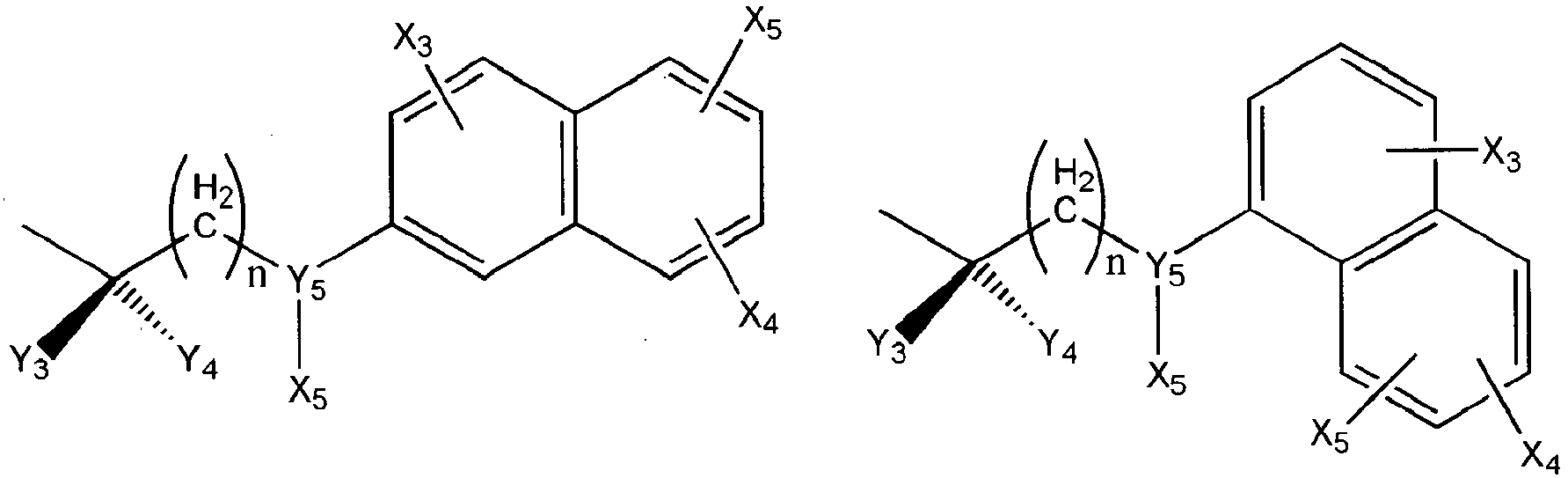
- Wherein R5 represents H, OH, acetyl, propionyl, isobutyryl, butyryl, pivaloyl, valeryl, and isovaleryl; X3, X4, and X5 represent H, OH, Cl, F, OCH3, S-CH3, CH3, C2H 5, CH=CH2, CH2CH=CH2, and CF3; Y3 and Y4 taken alone are different and are H, OH, OR5, OOH, OCOCH3, OCOC2H5, OCOC3H7, OCOC4H9, OCOC5H11, OCOC H , CH , CH2OH, CH2OCOCH3, CH2OCOC2H5, CH2OCOC3H7, CH2OCOC4H9, Cl, F, Br, I, or taken together are oxygen or 2 hydrogens. Y5 is CH2, NH, S, or O, m and n have a value of 0 to 6 inclusive.


- Wherein R5 represents H, OH, acetyl, propionyl, isobutyryl, butyryl, pivaloyl, valeryl, and isovaleryl; X1 and Y1 taken alone are different and are H, OH, OR5, OOH, OCOCH 3, OCOC2H5, OCOC3H7, OCOC4H9, OCOC5H11, OCOC6H13, CH2-OH, Cl, F, Br, I, or taken together are oxygen or 2 hydrogens; X2 and Y2 taken alone are different and are H, OH, OOH, OCOCH3, OCOC2H5, OCOC3H7, OCOC4H9, OCOC5H11, OCOC6H13, CH2-OH, Cl, F, Br, I, nothing (when the dashed bond is a double bond) or taken together are oxygen or 2 hydrogens; Z1 and Z2 represent H, OH, OR5, OOH, OCOCH3, OCOC2H5, OCOC3H7, OCOC4H9, OCOC5H11, OCOC6H13, CH2-OH, or Cl. W represents H, CH3, Cl, F, Br, I, or OH; the dashed bonds represent a single or double bond; All R, -(CH2)n- or -(CH2)m-groups are branched or straight chains and may include C, H, O, S, or N atoms and may have single, double, and triple bonds. Any CH2 groups may be replaced with O, S, or NH.
- Drug absorption, whether from the gastrointestinal tract or other sites, requires the passage of the drug in a molecular form across the barrier membrane. The drug must first dissolve, and if the drug possesses the desirable biopharmaceutical properties, it will pass from a region of high concentration to a region of low concentration across the membrane into the blood or general circulation. All biological membranes contain lipids as major constituents. The molecules that play the dominant roles in membrane formation all have phosphate-containing highly polar head groups, and, in most cases, two highly hydrophobic hydrocarbon tails. Membranes are bilayers, with the hydrophilic head groups facing outward into the aqueous regions on either side. Very hydrophilic drugs cannot pass the hydrophobic layer of a membrane and very hydrophobic drugs will stay in the hydrophobic layer as part of the membrane due to their similarities and cannot efficiently enter the cytosol on the inside.
- The goal of this invention is to make prostaglandins, prostacyclins, and related compounds administrable transdermally (topical application) by increasing their solubility in the moisture available on the skin surface and their penetration rate through the membrane and skin barrier. These novel pro-drugs of prostaglandins, prostacyclins, and related compounds according to the appended claims have two structural features in common: they have a lipophilic portion and a primary, secondary, or tertiary amine group that exists in the protonated form (hydrophilic part) at physiological pH. Such a hydrophilic-lipophilic balance is required for efficient passage through the membrane barrier [Susan Milosovich, et al., J. Pharm. Sci., 82, 227(1993)]. The positively charged amino groups largely increase the solubility of the drugs in water. The solubility of these pro-drugs of prostaglandins, prostacyclins, and related compounds is >100 mg/ml and the solubility of prostaglandins, prostacyclins, and related compounds is <0.01 mg/ml. In many instances, the lowest or rate-limiting step in the sequence is the dissolution of the drug. Prostaglandins, prostacyclins, and related compounds have a very low solubility in the moisture available on the skin surface, and they will not pass across the barrier of skin in a molecular form. They stay on the outside of the membranes of the eye or skin for a long time and thus, may cause pain, itching, or swelling of the eye or skin. When these new pro-drugs are administered transdermally in a dosage form such as a solution, spray, lotion, ointment, emulsion or gel, they will dissolve in the moisture available on the eye or skin surface immediately. The positive charge on the amino groups of these pro-drugs will bond to the negative charge on the phosphate head group of a membrane. Thus, the local concentration of the outside of the membrane will be very high and will facilitate the passage of these pro-drugs from a region of high concentration to a region of low concentration. When these pro-drugs enter the membrane, the hydrophilic part will push the pro-drug into the cytosol, a semi-liquid concentrated aqueous solution or suspension. Due to the short stay outside of the membranes of the eye or skin, the pro-drugs will not cause burning, pain, itching, or swelling of the eye or skin. The penetration rates of these prodrugs through human skin were measured in vitro by using modified Franz cells, which were isolated from human skin tissue (360-400 µm thick) of the anterior and posterior thigh areas. The receiving fluid consisted of 2 ml of 2% bovine serum albumin in normal saline and was stirred at 600 rpm. The cumulative amounts of these prodrugs and their parent drugs penetrating the skin versus time were determined by a specific high-performance liquid chromatography method. The results using a donor consisting of either a 10% solution of some of the prodrugs or a 10% suspension of some of prostaglandins, prostacyclins, and related compounds in 0.2mL of pH 7.4-phosphate buffer (0.2M) are shown in
Figure 1, Figure 2, and Figure 3 . Apparent flux values of 1.01 mg, 1.10 mg, 0.85 mg, 0.94 mg, 0.80 mg, 0.90 mg, 1.05 mg, 1.09 mg, 0.91 mg, 0.95 mg, 0.85 mg, 0.88 mg, 1.01 mg, 1.11 mg, 0.86 mg, 0.92 mg, 0.81 mg, 0.001 mg, 0.001 mg, 0.001 mg, 0.001 mg, 0.001 mg, 0.001 mg, 0.001 mg, 0.001 mg 0.001 mg, 0.001 mg, 0.001 mg, 0.001 mg, 0.001 mg, 0.001 mg, 0.001 mg, 0.001 mg, and 0.001 mg/cm2/h were calculated for N,N-diethylaminoethyl 11,15-dihydroxy-9-oxoprost-13-en-1-oate.AcOH, N,N-diethylaminoethyl 11,15-dihydroxy-9-oxoprosta-5,13-dien-1-oate.AcOH, N,N-diethylaminoethyl 9,11,15-trihydroxyprost-13-en-1-oate.AcOH, N,N-diethylaminoethyl 9,11,15-trihydroxyprosta-5,13-dien-1-oate.AcOH, N,N-diethylaminoethyl 9,11,15-trihydroxy-15-methylprosta-5,13-dien-1-oate.AcOH, N,N-diethylaminoethyl 9,11,15-trihydroxy-15-methylprosta-4,5,13-trien-1-oate.AcOH, N,N-diethylaminoethyl 9,11-dihydroxy-15-keto-20-ethylprost-5,13-dien-1-oate.AcOH (9,11-dihydroxy-15-keto-20-ethylprostaglandin F2α N,N-diethylaminoethyl ester), N,N-diethylaminoethyl 11,16-dihydroxy-9-oxo-16-methylprost-13-en-1-oate.AcOH, N,N-diethylaminoethyl (Z)-7- {(1 R, 2 R, 3 R, 5 S)-3,5-dihydroxy-2-[(1 E ,3 R )-3-hydroxy-4-[(α,α,α-trifluoro- m -tolyl)oxy]-1- butenyl]cyclopentyl}-5-heptenoate .AcOH, N,N-diethylaminoethyl (Z)-7{(1R, 2R, 3R, 5S)3, 5-dihydroxy-2-[(3R)-3-hydroxy-5-phenylpentyl]cyclopentyl}-5-heptenoate .AcOH, N,N-diethylaminoethyl (Z)-7-{(1R,2R,3R,5S)-3,5-Dihydroxy-2-[( 1E,3S)-3-hydroxy-5-phenyl-1-pentenyl]cyclopentyl}-hepteno ate.AcOH, N,N-diethylaminoethyl 11,15-dihydroxy-16,16-dimethyl-9-oxoprosta-2,13-dien-1-oate.AcOH, N,N-diethylaminoethyl 7-[3-hydroxy-2-(3-hydroxy-4-phenoxy-1-butenyl)-5-oxocyclopentyl]-5-heptenoate.Ac OH, N,N-diethylaminoethyl 6,9-epoxy-11,15-dihydroxyprosta-5,13-dien-1-oate.AcOH, N,N-diethylaminoethyl 7-{3,5-dihydroxy-2-[3-hydroxy-4-(3-trifluoromethylphenoxy)-1-butenyl]cyclopentyl}-5-heptenoate.AcOH, N,N-diethylaminoethyl 7-{2-[4-(3-chlorophenoxy)-3-hydroxy-1-butenyl]-3,5-dihydroxycyclopentyl}-5-hepten oate.AcOH, N,N-diethylaminoethyl 7-[3,5-dihydroxy-2-(3-hydroxy-4-phenoxy-1-butenyl)cyclopentyl]-4,5-heptadien-1-oat e.AcOH, PGE1, PGE2, PGF1α, PGF2α, carboprost, prostalene, unoprostone, misoprostol, travoprost , latanoprost, bimatoprost , gemeprost, sulprostone, PGI2, fluprostenol, cloprostenol, and fenprostalene respectively diffusing through human skin. The results suggest that the pro-drugs diffuse through human skin ∼1000 times faster than do prostaglandins, prostacyclins, and related compounds. The results suggest that the positive charge on the dialkyaminoethyl group has a very important role in the passage of the drug across the membrane and skin barrier. Other prodrugs of the general formula (2) 'Structure 2a' according to the appended claims have very high penetration rates and are very close to that of N,N-diethylaminoethyl 11,15-dihydroxy-9-oxoprost-13-en-1-oate.AcOH. - ProstagIandins are highly effective ocular hypotensive agents and are ideally suited for the long-term medical management of glaucoma (
Woodward, D.F. et al., U.S. Pat. No.5,688,819 ). Such prostaglandins include PGA, PGB, PGD, PGF2α, PGF1α, PGE2, PGE1 and their alkyl esters were reported to possess ocular hypotensive activity, but generally cause inflammation, as well as surface irritation characterized by conjunctival hyperemia and edema. Certain phenyl and phenoxy mono, tri and tetra nor prostaglandins and their esters disclosed in European Patent Application0,364,417 are useful in the treatment of glaucoma or ocular hypertension. Buchmann et al. (Buchmann. et al., U.S. Pat. No. 5,756,818 ) disclosed certain species of cyclopentane heptanoic acid, 2-cycloalkyl, or aryalkyl compounds said to be suitable for lowering intraocular pressure. Woodward et al. (Woodward, D.F. et al., U.S. Pat. No. 5688819 ) disclosed that cyclopentane heptanoic acid, 2-cycloalkyl, or aryalkyl compounds are useful in the treatment of glaucoma or ocular hypertension. Recently, unoprostone , travoprost , latanoprost, and bimatoprost are becoming a leading class of glaucoma drugs. These drugs all have side effects due to their very low penetration rates. These side effects included blurred vision, redness, a sensation of a foreign body, discoloration of the iris, itching, burning, stinging, dryness of the eyes, increased tearing, eye pain and other eye-related discomfort. - The ability of certain compounds of the present invention to reduce intraocular pressure (IOP) was evaluated in cats with ocular hypertension produced by previously done laser trabeculoplastry. IOP was determined with a pneumatonometer after light corneal anesthesia with dilute proparacaine. Baseline IOP (in
mm Hg 1 mmHg = 133,0 Pa) was determined prior to treatment with the test compound aqueous solution. 6 divided doses were administered over a period of 3 days (once every 12 hours). IOP was determined 24 hours after the initial dose and then once every 12 hours. The therapeutically efficient amount is typically between 0.001 and 0.01 % in pH 7.2 phosphate buffer (0.1 M). The treatment was carried out in that one drop (about 30 micro liter) of the composition. The results of N,N-diethylaminoethyl 11,15-dihydroxy-9-oxoprost-13-en-1-oate.AcOH (A), N,N-diethylaminoethyl 11,15-dihydroxy-9-oxoprosta-5,13-dien-1-oate.AcOH (B), N,N-diethylaminoethyl 9,11,15-trihydroxyprosta-5,13-dien-1-oate.AcOH (C), N,N-diethylaminoethyl 9,11-dihydroxy-15-keto-20-ethylprost-5,13-dien-1-oate.AcOH (9,11-dihydroxy-15-keto-20-ethylprostaglandin F2α N,N-diethylaminoethyl ester) (D), N,N-diethylaminoethyl (Z)-7- {(1 R ,2 R ,3 R ,5 S)-3,5-dihydroxy-2-[(1 E ,3 R )-3-hydroxy-4-[(α,α,α-trifluoro- m -tolyl)oxy]-1- butenyl]cyclopentyl}-5-heptenoate .AcOH (E), N,N-diethylaminoethyl (Z)-7{(1R, 2R, 3R, 5S) - 3, 5-dihydroxy-2-[(3R)-3-hydroxy-5-phenylpentyl]cyclopentyl}-5-heptenoate .AcOH (F), and N,N-diethylaminoethyl (Z)-7-{(1R,2R,3R,5S)-3,5-Dihydroxy-2-[ ( 1E,3S)-3-hydroxy-5-phenyl-1-pentenyl]cyclopentyl}-heptenoate.AcOH (G) are shown in table 1.Table 1: Intraocular pressure redution by the prodrugs of natural prostaglandin and modified analogs as determined in cat. Compound Baseline Dose% Time after administration (hours) 24 36 48 60 72 A 22.1±0.7 0.001 15.3±0.4 15.1±0.5 15.0±0.4 15.1±0.5 15.4±0.4 B 22.3±0.6 0.001 15.7±0.5 15.8±0.5 15.9±0.4 15.7±0.4 15.9±0.5 C 22.5±0.7 0.001 15.5±0.5 15.6±0.6 15.7±0.5 15.6±0.7 15.5±0.6 D 22.0±0.6 0.01 16.5±0.6 16.7±0.4 16.8±0.6 17.1±0.5 16.8±0.5 E 22.1±0.4 0.001 15.1±0.4 15.0±0.5 15.0±0.4 14.9±0.3 15.1±0.4 F 22.5±0.5 0.001 15.6±0.5 15.7±0.5 15.6±0.5 15.5±0.4 15.6±0.6 G 22.4±0.6 0.001 15.2±0.6 15.4±0.5 15.5±0.4 15.4±0.6 15.4±0.5 - Irritative effect or ocular discomfort in the cat eye of naturally occurring and modified prostaglandins and their novel prodrugs were evaluated during the first hours after the topical application of the respective test drug. The ocular discomfort was graded on a scale from 0 to 4, 0 indicating complete absence of any signs of discomfort, and 4 indicating maximal irritation as obvious from complete lid closure. The results are shown in table 2.
Table 2: Irritative effect of naturally occurring and modified prostaglandins and their novel prodrugs during the first 2 hours after topical application of the respective test drug Compound Dose % Degree of Irritative Effect PGE1 0.001 4 A 0.001 1 PGE2 0.001 3.5 B 0.001 1 PGF2α 0.001 3.5 C 0.001 1 Unoprostone 0.01 2.5 D 0.01 1 Travoprost 0.001 2.5 E 0.001 1 Latanoprost 0.001 2.5 F 0.001 1 Bimatoprost 0.001 2.5 G 0.001 1 - Conjunctival hyperemia in the rabbit eye of naturally occurring and modified prostaglandins and their novel prodrugs was evaluated during the first 2 hours after topical application of the respective test drug. The conjunctival hyperemia was graded on a scale from 0 to 4, 0 indicating complete absence of any hyperemia, and 4 indicating marked hyperemia with conjunctive chemosis. The results are shown in table 3.
Table 3: Conjunctival hyperemia in the rabbit eye of naturally occurring and modified prostaglandins and their novel prodrugs during the first 2 hours after the topical application of the respective test drug. Compound Dose % Degree of Irritative Effect PGE1 0.001 4 A 0.001 1 PGE2 0.001 4 B 0.001 1 PGF2α 0.001 4 C 0.001 1 Unoprostone 0.01 2.5 D 0.01 1 Travoprost 0.001 2.5 E 0.001 1 Latanoprost 0.001 2.5 F 0.001 1 Bimatoprost 0.001 2.5 G 0.001 1 - The results show that these prodrugs are superior to their parent drugs for the treatment of ocular hypertension and glaucoma. They exhibit excellent intraocular pressure lowering effects, and cause no side effects or very mild side effects. Prostaglandins and related compounds are very lipophilic. When PGs are topically applied to eyes, they do not dissolve in the aqueous humor of the eye. They stay outside of the eye membranes for a long time and thus, may cause pain, itching, or swelling of the eye. When prostaglandins enter eye membranes, they will stay in the hydrophobic layer as part of the membrane due to their similarities and cannot efficiently enter the cytosol on the inside. When the prodrugs of prostaglandins are topically applied to eyes, they will dissolve in the aqueous humor of eye immediately. The positive charge on the amino groups of these pro-drugs will bond to the negative charge on the phosphate head group of membrane of eye. Thus, the local concentration of the outside of the membrane will be very high and will facilitate the passage of these pro-drugs from a region of high concentration to a region of low concentration. When these pro-drugs enter the membrane, the hydrophilic part will push the pro-drug into the cytosol. Due to the short stay outside of the membranes of the eye or skin and thus, the pro-drugs will not cause burning, pain, itching, or swelling of the eye.
- Prostaglandins can be used for the treatment of male erectile dysfunction (
Yeager; J.L., et al. U.S. Pat. No. 6,693,135 ) and enhancing female sexual arousal (Scott, N. E. U.S. Pat. No. 6291528 ). However, working alone, prostaglandins formulations do not sufficiently permeate the skin to provide drug concentration levels . In one commercially available form (MUSE.RTM, Vivus, Menlo Park Calif.), alprostadil (PGE1) is administered in a pellet deposited in the urethra using an applicator with a hollow stem 3.2 cm in length and 3.5 mm in diameter (Padma-Nathan, H., et al., N. Engl. J. Med., 336: 1-7 (1997) for treatment of impotence . The side effects of this treatment are penile pain and minor urethral trauma. Transurethral delivery of PGE1 or PGE2 is a highly effective means of treating impotence, but there are undesirable side effects that include a sensation of urethral burning or pain and cavernous sinus aching in the genital area. Transurethral delivery of PGs has another problem with removal to terminate delivery of the composition and can result in overdosing as well as the delivery of excess PGs to the vagina of the partner. - In one commercially available form, PGE1 is administered by intracavemosal injection. The principal side effect of intracavernosal injection of alprostadil (PGE1) is pain, an incidence of fibrosis and scar formation at the site of injection.
- The novel prodrugs in the invention can diffuse through human skin at a very high rate (∼1 mg/h/cm2) and can provide almost side-effects-free methods of treating erectile dysfunction or enhancing female sexual arousal. About 0.01 ml of 0.0005%[∼0.05µg (microgram)] N,N-diethylaminoethyl 11,15-dihydroxy-9-oxoprost-13-en-1-oate.AcOH in pH 7.0 phosphate buffer (0.1 M) was applied to genital area of male rats (30 rats) once per day for 5 days. The results showed a 6 fold increase in solicitation and a 4 fold increase in copulation in rats that were given the drug compared to those that were not given the drug.
- Then same amount of N,N-diethylaminoethyl 11,15-dihydroxy-9-oxoprost-13-en-1-oate.AcOH in pH 7.0 phosphate buffer (0.1 M) was applied to genital area of both male rats (30 rats) and female rats (30 rates) once per day for 5 days. The results showed a 6 fold increase in solicitation and a 6 fold increase in copulation in rats that were given the drug compared to those that were not given the drug. The most important thing is that rats that were given the drug did not show any discomfort.
- Prostaglandins selected from the group consisting of natural and synthetic analogs of the PGE, PGA, and PGF are useful for reducing systemic blood pressure. 0.02 mg of N,N-diethylaminoethyl 11,15-dihydroxy-9-oxoprosta-5,13-dien-1-oate.ACOH (A) and N,N-diethylaminoethyl 11,16-dihydroxy-9-oxo-16-vinylprosta-5,13-dien-1-oate.AcOH (B) in 0.3 ml of pH 7.0 phosphate buffer (0.1 M) were applied to the back of spontaneously hypertensive rats (after intake of the tungsten-enriched diet. The blood pressure was recorded continuously on a multichannel physiograph. The results are shown in table 4.
Table 4: Effect of the prodrugs of prostaglandins on the mean arterial blood pressure in spontaneously hypertensive rats. All values are reported as mean± SD. Compound Baseline Time after administration (hours) 1 2 3 4 5 A 181.4±7.5 148.2±7.4 143.2±7.6 142.2±6.4 143.2±7.8 145.2±7.0 B 183.5±8.6 155.2±8.2 153.2±6.8 150.2±7.8 153.2±7.0 155.2±6.4 - The mean arterial blood pressure in spontaneously hypertensive rats was significantly reduced after the transdermal administration of the prodrugs of prostaglandins and rats that were given the drug did not show any discomfort
- The compounds of the general formula (2) 'Structure 2' indicated above can be prepared from protected prostaglandins, prostacyclins, and related compounds , by reaction with compounds of the general formula (3) 'Structure 3' by using coupling reagents, such as N,N'-Dicyclohexylcarbodiimide, N, N'-Diisopropylcarbodiimide, O-(Benzotriazol-1-yl)-N,N,N',N'-tetramethyluronium tetrafluoroborate, O-(Benzotriazol-1-yl)-N,N,N',N'-tetramethyluronium hexafluorophosphate, Benzotriazol-1-yl-oxy-tris(dimethylamino)phosphonium hexafluorophosphate, et al.
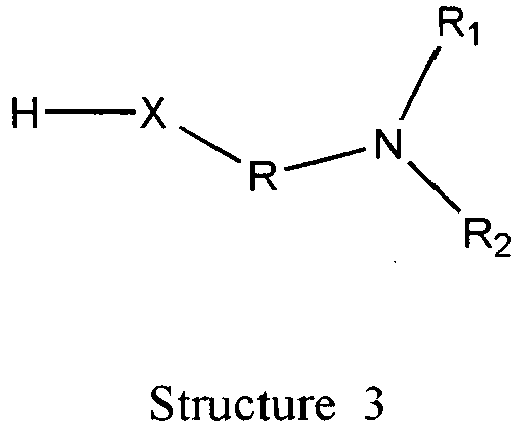
- Wherein , R1 represents H, one of any alkyl, alkyloxy, alkenyl, or alkynyl residues having 1 to 12 carbon atoms, aryl or heteroaryl residues; R2 represents H, one of any alkyl, alkyloxy, alkenyl, or alkynyl residues having 1 to 12 carbon atoms, aryl or heteroaryl residues; R represents a branched or straight chain, -(CH2)n-, wherein n=0, 1, 2, 3, 4, 5, 6, 7, 8, 9, 10 ......, an aryl or heteroaryl group; X represents O, S or NH; and n=0, 1, 2, 3, 4, 5, 6, 7, 8, 9, 10......
- When X represents O, the compounds of the general formula (2) 'Structure 2' indicated above can be prepared from metal salts, organic base salts , or immobilized base salts of prostaglandins, prostacyclins and related compounds, by reaction with compounds of the general formula (4) 'Structure 4'.

- Wherein , R1 represents H, one of any alkyl, alkyloxy, alkenyl, or alkynyl residues having 1 to 12 carbon atoms, aryl or heteroaryl residues; R2 represents H, one of any alkyl, alkyloxy, alkenyl, or alkynyl residues having 1 to 12 carbon atoms, aryl or heteroaryl residues; R3 represents H, one of any alkyl, alkyloxy, alkenyl, or alkynyl residues having 1 to 12 carbon atoms, aryl or heteroaryl residues; R represents a branched or straight chain, -(CH2)n-, wherein n=0, 1, 2, 3, 4, 5, 6, 7, 8, 9, 10 ......, an aryl or heteroaryl group; Z represents halogen, or p-toluenesulphonyl, A- represents Cl-, Br-, F, I-, AcO-, citrate, or any negative ions.
- These pro-drugs of prostaglandins, prostacyclins and related compounds according to the appended claims in the present invention have a lipophilic portion and a hydrophilic portion (the amine groups that exist in the protonated form at physiological pH). The positively charged amino groups of these pro-drugs have two major advantages. First, it largely increases the solubility of the drugs in water; when these new pro-drugs are administered transdermally in a dosage form such as a solution, spray, lotion, ointment, emulsion or gel, they will mix with moisture on the skin, eye, genital area, mouth, nose, or other part of the body immediately. Second, the positive charge on the amino group of these pro-drugs will bond to the negative charge on the phosphate head group of the membrane. Thus, the local concentration outside of the membrane will be very high and will facilitate the passage of these pro-drugs from a region of high concentration to a region of low concentration. When these pro-drugs enter the membrane, the hydrophilic part will push the pro-drugs into the cytosol, a semi-liquid concentrated aqueous solution or suspension. Due to the short stay on the skin, eye, genital area, mouth, nose, or other part of the body, the pro-drugs will not cause itching, burning or pain. Experiment results show that more than 90% of the pro-drugs were changed back to the parent drugs in a few minutes. The pro-drugs have a much better absorption rate and as transdermal administration avoids the first pass metabolism, the pro-drugs will be stronger than prostaglandins, prostacyclins and related compounds at the same dosage. Another great benefit of transdermal administration of these pro-drugs is that administering medication, especially to children, will be much easier.
-
-
Figure 1 : Cumulative amounts of N,N-diethylaminoethyl 11,15-dihydroxy-9-oxoprost-13-en-1-oate.AcOH (A, 10% solution), N,N-diethylaminoethyl 11,15-dihydroxyl-9-oxoprosta-5,13-dien-1-oate.AcOH (B, 10% solution), N,N-diethylaminoethyl 9,11,15-trihydroxyprost-13-en-1-oate.AcOH (C, 10% solution), N,N-diethylaminoethyl 9,11,15-trihydroxyprosta-5,13-dien-1-oate.AcOH (D, 10% solution), N,N-diethylaminoethyl 9,11,15-trihydroxy-15-methylprosta-5,13-dien-1-oate.AcOH (E, 10% solution), N,N-diethylaminoethyl 9,11,15-trihydroxy-15-methylprosta-4,5,13-trien-1-oate.AcOH (F, 10% solution), PGE 1 (G, 10% suspension), PGE2 (H, 10% suspension), PGF1α (I, 10% suspension), PGF2α (J, 10% suspension), carboprost (K, 10% suspension), prostalene (L, 10% suspension), crossing isolated human skin tissue in Franz cells (n=5). In each case, the vehicle was a pH 7.4 phosphate buffer (0.2 M). -
Figure 2 : Cumulative amounts of N,N-diethylaminoethyl 9,11-dihydroxy-15-keto-20-ethylprost-5,13-dien-1-oate.AcOH (A, 10% solution), N,N-diethylaminoethyl 11,16-dihydroxy-9-oxo-16-methylprost-13-en-1-oate.AcOH (B, 10% solution), N,N-diethylaminoethyl (Z)-7- {(1 R ,2 R ,3 R ,5 S )-3,5-dihydroxy-2-[(1 E ,3 R)-3-hydroxy-4-[(α,α,α-trifluoro- m -tolyl)oxy]-1- butenyl] cyclopentyl}-5-heptenoate .AcOH (C, 10% solution), N,N-diethylaminoethyl (Z)-7{(1R, 2R, 3R, 5S)3, 5-dihydroxy-2-[(3R)-3-hydroxy-5-phenylpentyl] cyclopentyl}-5-heptenoate .AcOH (D, 10% solution), N,N-diethylaminoethyl (Z)-7-{(1R,2R,3R,5S)-3,5-Dihydroxy-2-[(1E,3S)-3-hydroxy-5-phenyl-1-pentenyl]cy-clopentyl}-hepteno ate.AcOH (E, 10% solution), N,N-diethylaminoethyl 11,15-dihydroxy-16,16-dimethyl-9-oxoprosta-2,13-dien-1-oate.AcOH (F, 10% solution), unoprostone (G, 10% suspension), misoprostol (H, 10% suspension), travoprost (I, 10% suspension), latanoprost (J, 10% suspension), bimatoprost (K, 10% suspension), gemeprost, (L, 10% suspension), crossing isolated human skin tissue in Franz cells (n=5). In each case, the vehicle was a pH 7.4 phosphate buffer (0.2 M). -
Figure 3 : Cumulative amounts of N,N-diethylaminoethyl 7-[3-hydroxy-2-(3-hydroxy-4-phenoxy-1-butenyl)-5-oxocyclopentyl]-5-heptenoate.Ac OH (A, 10% solution), N,N-diethylaminoethyl 6,9-epoxy-11,15-dihydroxyprosta-5,13-dien-1-oate.AcOH (B, 10% solution), N,N-diethylaminoethyl 7-{3,5-dihydro xy-2-[3-hydroxy-4-(3-trifluoromethylphenoxy)-1-butenyl]cyclopentyl}-5-heptenoate.AcO H (C, 10% solution), N,N-diethylaminoethyl 7-{2-[4-(3-chlorophenoxy)-3-hydroxy-1-butenyl]-3,5-dihydroxycyclopentyl}-5-hepten oate.AcOH (D, 10% solution), N,N-diethylaminoethyl 7-[3,5-dihydroxy-2-(3-hydroxy-4-phenoxy-1-butenyl)cyclopentyl]-4,5-heptadien-1-oat e.AcOH (E, 10% solution), sulprostone (F, 10% suspension), PGI2 (G, 10% suspension), fluprostenol (H, 10% suspension), cloprostenol (I, 10% suspension), and fenprostalene (J, 10% suspension), crossing isolated human skin tissue in Franz cells (n=5). In each case, the vehicle was a pH 7.4 phosphate buffer (0.2 M). -
Figure 4 . Wherein, R1 represents H, one of any alkyl, alkyloxyl, alkenyl or alkynyl residues having 1 to 12 carbon atoms, aryl or heteroaryl residues; R2 represents H, one of any alkyl, alkyloxy, alkenyl or alkynyl residues having 1 to 12 carbon atoms, aryl or heteroaryl residues; R3 represents H, one of any alkyl, alkyloxy, alkenyl or alkynyl residues having 1 to 12 carbon atoms, aryl or heteroaryl residues; X represents O, S, or NH; A- represents Cl-, Br-, F, I-, AcO-, citrate, or any negative ions; R represents a branched or straight chain, -(CH2)n-, wherein n=0, 1, 2, 3, 4, 5, 6, 7, 8, 9, 10 ......, an aryl or heteroaryl group; Z represents the alpha-chain and Cx-Cy-R4 represents the omega-chain. Cy represents the cyclopentyl system of prostaglandins. - 37.7 g (0.1 mol) of sodium 11,15-dihydroxy-9-oxoprost-13-en-1-oate was dissolved in 100 ml of acetonitrile. 26.1 g (0.1 mol) of 2-Bromo-N,N-diethylethylamine.HBr and 8.6 g of sodium bicarbonate were added into the reaction mixture. The mixture was stirred for overnight at RT. The solvents were evaporated off. 250 ml of ethyl acetate was added into the reaction mixture and the mixture was washed with water (3 x 100 ml). The organic solution was dried over anhydrous sodium sulfate. Sodium sulfate was removed by filtration. 6 g of acetic acid was added into the reaction mixture with stirring. Hexane (200 ml) was added. The solid product was collected by filtration. After drying, it yielded 42 g of the desired product (81.8%). Hygroscopic product; Solubility in water: 100 mg/ml; Elementary analysis: C28H51NO7; MW: 513.37. Calculated % C: 65.47; H: 10.01; N: 2.73; O: 21.80; Found % C: 65.42; H: 10.03; N: 2.70; O: 21.85. 1H-NMR (400 MHz, D2O): δ: 0.96 (t, 3H), 1.25-1.33 (m, 12H), 1.48-1.53 (m, 4H) 1.55 (t, 6H), 1.68 (m, 2H), 2.08 (m, 1H), 2.18 (s, 3H), 2.21 (m, 2H), 2.25 (t, 2H), 2.77 (m, 1 H), 3.22 (m, 4H), 3.50 (m, 2H), 3.76 (m, 1H), 3.90 (m, 1 H), 4.52 (m, 2H), 5.65-5.69 (m, 2H).
- 43.7 g (0.1 mol) of 11,15-diacetoxy-9-oxoprosta-5,13-dien-1-oic acid was dissolved in 300 ml of chloroform. 20.6 g of N, N'-Dicyclohexylcarbodiimide was added into the reaction mixture. 11.7 g of N,N-diethylaminoethylamine was added into the reaction mixture. The mixture was stirred for 3 hours at RT. The solid was removed by filtration. The chloroform solution was washed with 5% NaHCO3 (2 x 100 ml) and water (3 x 100 ml). The organic solution was dried over anhydrous sodium sulfate. Sodium sulfate was removed by filtration. 6 g of acetic acid was added into the reaction mixture with stirring. Hexane (200 ml) was added. The solid product was collected by filtration. After drying, it yielded 45 g of the desired product (85.8%). Hygroscopic product; Solubility in water: 100 mg/ml; Elementary analysis: C34H59NO9S; MW: 657.90. Calculated % C: 62.07; H: 9.04; N: 2.13; O: 21.89; S: 4.87; Found % C: 62.02; H: 9.06; N: 2.11, O: 21.95; S: 4.86. 1H-NMR (400 MHz, D2O): δ: 0.95 (t, 3H), 1.25-1.33 (m, 14H), 1.54 (m, 2H) 1.56 (t, 6H), 1.62 (m, 2H), 1.99 (m, 2H), 2.01 (s, 3H), 2.02 (s, 3H), 2.05 (s, 3H), 2.10 (m, 1H), 2.18 (s, 3H), 2.35 (t, 2H), 2.77 (m, 1H), 3.22 (m, 4H), 3.35 (m, 2H), 3.89 (m, 2H), 3.97 (m, 1H), 4.02 (m, 1H), 4.60 (m, 1H), 5.45-5.69 (m, 2H).
- 49.9 g (0.1 mol) of 9,11,15-triacetoxyprost-13-en-1-oic acid was dissolved in 300 ml of chloroform. 20.6 g of N, N'-Dicyclohexylcarbodiimide was added into the reaction mixture. 13.1 g of dimethylaminoethyl mercaptan was added into the reaction mixture. The mixture was stirred for 3 hours at RT. The solid was removed by filtration. The chloroform solution was washed with 5% NaHCO3 (2 x 100 ml) and water (3 x 100 ml). The organic solution was dried over anhydrous sodium sulfate. Sodium sulfate was removed by filtration. 6 g of acetic acid was added into the reaction mixture with stirring. Hexane (200 ml) was added. The solid product was collected by filtration. After drying, it yielded 45 g of the desired product (85.8%). Hygroscopic product. Solubility in water: 100 mg/ml; Elementary analysis: C32H53NO9; MW: 657.9 Calculated % C: 64.51; H: 8.97; N: 2.35; O: 24.17; Found % C: 64.47; H: 8.99; N: 2.34, O: 24.20. 1H-NMR (400 MHz, D2O): δ: 0.95 (t, 3H), 1.25-1.31 (m, 6H), 1.54 (m, 2H) 1.56 (t, 6H), 1.72 (m, 2H), 1.95 (m, 2H), 2.01 (s, 3H), 2.02 (s, 3H), 2.10 (m, 1H), 2.18 (s, 3H), 2.20 (m, 2H), 2.25 (t, 2H), 2.30 (m, 2H), 3.18 (m, 1H), 3.22 (m, 4H), 3.50 (m, 2H), 4.50 (m, 1H), 4.52 (m, 2H), 4.58 (m, 1H), 5.45-5.69 (m, 4H).
- 37.7 g (0.1 mol) of sodium N,N-diethylaminoethyl 9,11,15-trihydroxyprosta-5,13-dien-1-oate was dissolved in 100 ml of acetonitrile. 39 g (0.15 mol) of 2-Bromo-N,N-diethylethylamine.HBr in ethyl acetate was added into the reaction mixture. The mixture was stirred for 3 h at RT. Then 8 g of sodium bicarbonate wass added into the reaction mixture. The mixture is stirred for another 2 h at RT. The solvents were evaporated off. 250 ml of ethyl acetate was added into the reaction mixture and the mixture was washed with water (3 x 100 ml). The organic solution was dried over anhydrous sodium sulfate. Sodium sulfate was removed by filtration. 6 g of acetic acid was added into the reaction mixture with stirring. Hexane (200 ml) was added. The solid product was collected by filtration. After drying, it yielded 45 g of the desired product (87.6%). Hygroscopic product; Solubility in water: 100 mg/ml; Elementary analysis: C28H51NO7; MW: 513.71. Calculated % C: 65.47; H: 10.01; N: 2.73; O: 21.80; Found % C: 65.42; H: 10.03; N: 2.70; O: 21.85. 1H-NMR (400 MHz, D2O): δ: 0.96 (t, 3H), 1.25-1.33 (m, 6H), 1.48 (m, 2H), 1.55 (t, 6H), 1.65 (m, 1H), 1.72 (m, 2H), 1.81 (m, 2 H), 1.92 (m, 2 H), 1.96 (m, 2 H), 2.26 (m, 1H), 2.18 (s, 3H), 2.25 (t, 2H), 3.21 (m, 1H), 3.23 (m, 1H), 3.25 (m, 4H), 3.52 (m, 2 H), 3.86 (m, 1H), 4.52 (m, 2 H), 5.65-5.69 (m, 4H).
- 60 g of Polymer-bound triethylamine (3 mol/g, 100-200 mesh) was suspended in 180 ml of chloroform. 29.6 g (0.1 mol) of N,N-diethylaminoethyl 9,11,15-trihydroxy-15-methylprosta-5,13-dien-1-oic acid was added into the mixture with stirring. 43 g (0.15ml) of N,N-diethylaminoethyl bromide.HBr was added into the mixture and the mixture was stirred for 5 hours at RT. The polymer was removed by filtration and washed with tetrahydrofuran (3 x 50 ml). 8.2 g (0.1 mol) of sodium acetate was added into the reaction mixture with stirring. The mixture was stirred for 2 h. The solid was removed by filtration and washed with chloroform (3 x 50 ml). The solution was concentrated in vacuo to 100 ml. Then 300 ml of hexane was added into the solution. The solid product was collected by filtration and washed with hexane (3 x 100 ml). After drying, it yielded 47 g of the desired product (87.8%). Hygroscopic product; Solubility in water: 100 mg/ml; Elementary analysis: C 28H51NO7; MW: 527.73. Calculated % C: 66.00; H: 10.12; N: 2.65; O: 21.22; Found % C: 65.96; H: 10.15; N: 2.64; O: 21.24. 1H-NMR (400 MHz, D2O): δ: 0.95 (t, 3H), 1.24-1.34 (m, 6H), 1.41 (s, 3 H), 1.47 (m, 2H), 1.56 (t, 6H), 1.65 (m, 1H), 1.72 (m, 2H), 1.82 (m, 2 H), 1.92 (m, 2 H), 1.97 (m, 2 H), 2.26 (m, 1H), 2.18 (s, 3H), 2.25 (t, 2H), 3.21 (m, 1H), 3.23 (m, 1H), 3.25 (m, 4H), 3.52 (m, 2 H), 4.52 (m, 2 H), 5.64-5.68 (m, 4H).
- The pro-drugs of the general formula (2) 'Structure 2a' according to the appended claims are superior to prostaglandins, prostacyclins and related compounds. They can be used medicinally in treating any prostaglandins, prostacyclins and related compounds-treatable conditions in humans or animals. They may be used for the treatment of glaucoma or ocular hypertension, treatment of male erectile dysfunction and to enhance female sexual arousal, reducing systemic blood pressure, abortion, hypotensive control, inhibition of platelet aggregation, treatment of pulmonary diseases, gastrointestinal disease, shock, reproduction, fertility, etc.
Claims (16)
- A compound having a general formula of Structure 2a
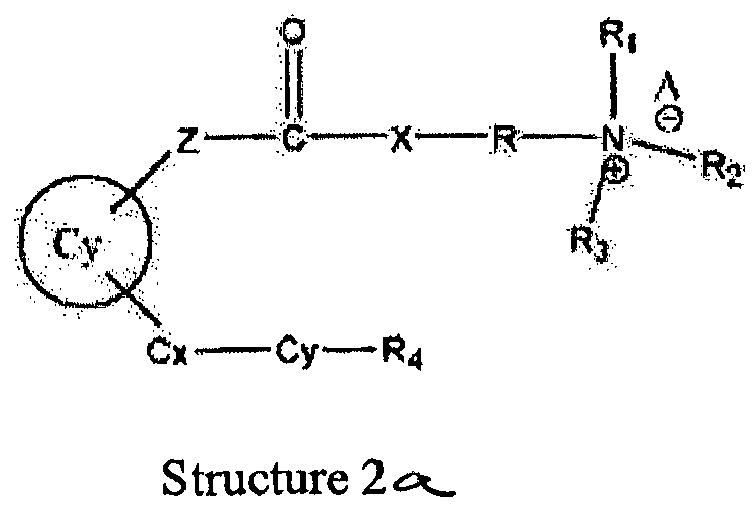 wherein R1 is selected from the group consisting of H, alkyl, alkyloxyl, alkenyl, and alkynyl residues having up to 12 carbon atoms, aryl, and heteroaryl residues;R2 is selected from the group consisting of H, alkyl, alkyloxy, alkenyl, and alkynyl residues having up to 12 carbon atoms, aryl, and heteroaryl residues;R3 is H;X is selected from the group consisting of O, S, and NH;A- is selected from any negative ions;R is selected from the group consisting of a branched or straight chain, -(CH2)n-, wherein n=0, 1, 2, 3, 4, 5, 6, 7, 8, 9, or 10, an aryl group, and a heteroaryl group;Cx-Cy is selected from the group consisting of -CH2- CH2-, -S-CH2-, -O-CH2-, -C≡C-, and - CH=CH-;Z is selected from the group consisting of -(CH2)6-, -(CH2)n- , -(CH2)m-O-CH2-, -(CH2)m-S-CH2-, -CH2C≡C-(CH2)n-, -CH2C=C-(CH2)n-O-CH2-, -CH2C≡C-(CH2)n-S-CH2-, -CH2-CO-(CH2)n-, -CH2-CHC=CH=(CH2)n-, -CH2-CH=C=CH-O-(CH2)n-, -CH2-CH=C=CH-S-(CH2)n-,

 wherein m and n have a value of 0 to 6 inclusive; R4 is selected from the group consisting of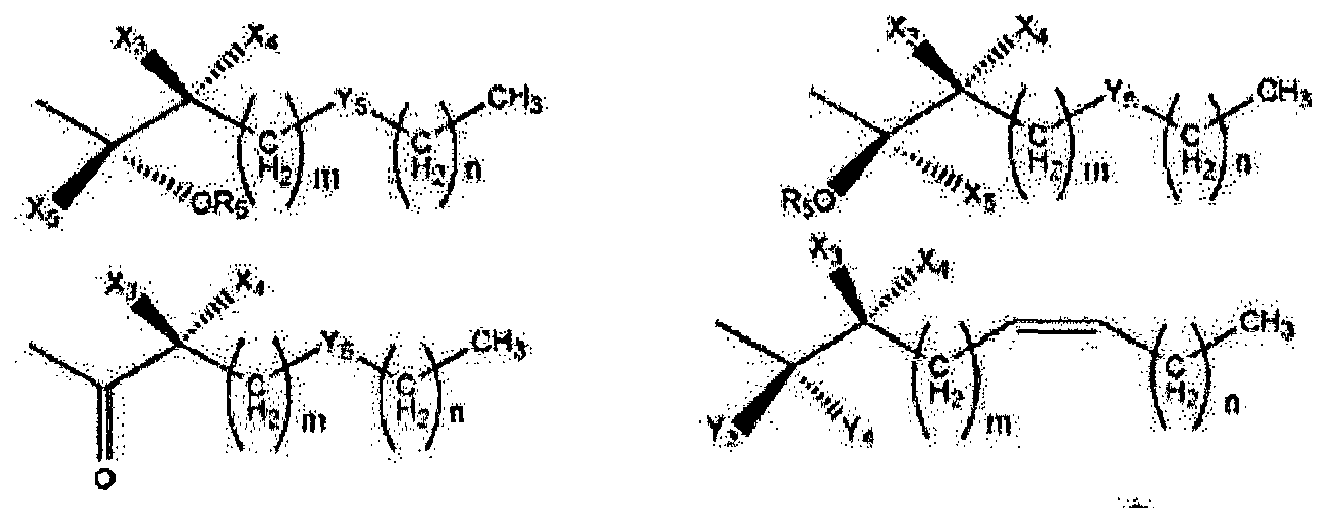


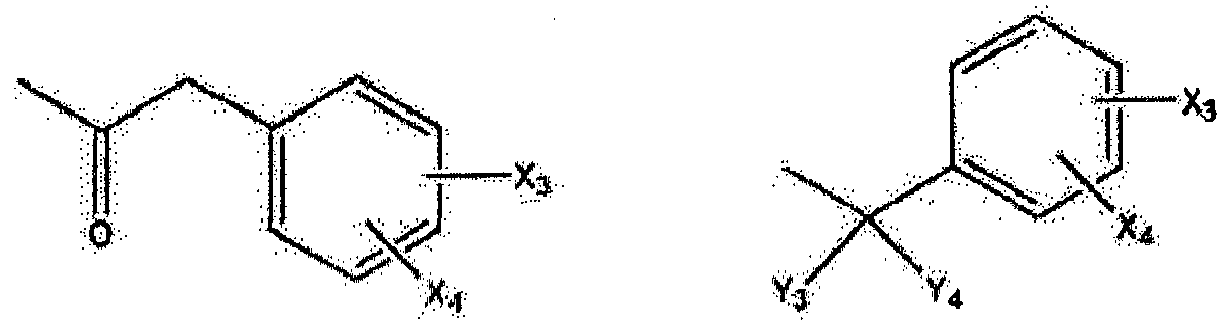
 wherein R5 is selected from the group consisting of H, OH, acetyl, propionyl, isobutyryl, butyryl, pivaloyl, valeryl, and isovaleryl;X3, X4, and X5 are independently selected from the group consisting of H, OH, Cl, F, OCH3, S-CH3, CH3, C2H5, CH=CH2, CH2CH=CH2, and CF3;Y3 and Y4 are not identical and independently selected from the group consisting of H, OH, OR5, OOH, OCOCH3, OCOC2H5, OCOC3H7, OCOC4H9, OCOC5H11, OCOC6H13, CH3, CH2OH CH2OCOCH3, CH2OCOC2H5, CH2OCOC3H7, CH2OCOC4H9, Cl, F, Br, and I, or taken together are oxygen or 2 hydrogens;Y5 is selected from the group consisting of CH2, NH, S, and O;m and n have a value of 0 to 8 inclusive;

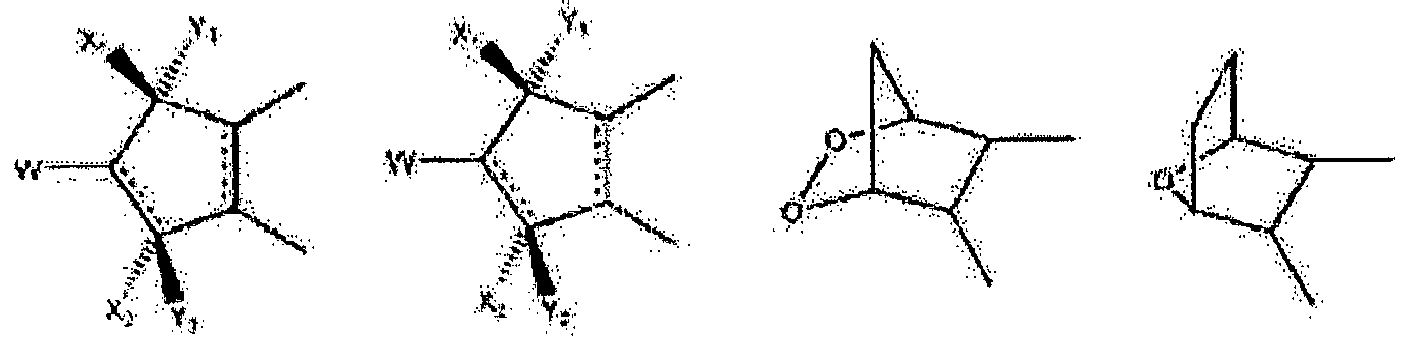
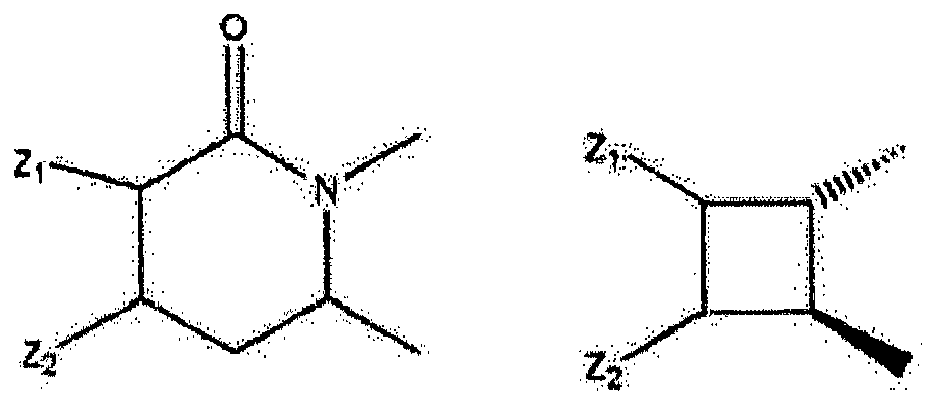 wherein R5 is selected from the group consisting of H, OH, acetyl, propionyl, isobutyryl, butyryl, pivaloyl, valeryl, and isovaleryl;X1 and Y1 are not identical and independently selected from the group consisting of H, OH, OR5, OOH, OCOCH3, OCOC2H5, OCOC3H7, OCOC4H9, OCOC5H11, OCOC6H13, CH2-OH, Cl, F, Br, and I, or taken together are oxygen or 2 hydrogens;X2 and Y2 are not identical and independently selected from the group consisting of H, OH, OOH, OCOCH3, OCOC2H5, OCOC3H7, OCOC4H9, OCOC5H11, OCOC6H13, CH2-OH, Cl, F, Br, I, and nothing (when the dashed bond is a double bond) or taken together are oxygen or 2 hydrogens;Z1 and Z2 are independently selected from the group consisting of H, OH, OR5, OOH, OCOCH3, OCOC2H5, OCOC3H7, OCOC4H9, OCOC5H11, OCOC6H13, CH2-OH, and Cl;W is selected from the group consisting of H, CH, Cl, F, Br, I, and OH;the dashed bonds represent a single or double bond.
 - Process for the preparation of a compound according to claim 1, wherein protected prostaglandin or prostacyclin compounds are reacted with compounds having a general formula of Structure 3a by use of a coupling reagent selected from the group consisting of N,N'-dicyclohexylcarbodiimide, N, N'-diisopropylcarbodiimide, O- (benzotriazol-1-yl)-N,N,N',N'-tetramethyluronium tetrafluoroborate, O- (benzotriazol-1-yl)-N,N,N',N'-tetramethyluronium hexafluorophosphate, benzotriazol-1-yl-oxy-tris(dimethylamino)phosphonium hexafluorophosphate
 wherein R1 is selected from the group consisting of H, alkyl, alkyloxy, alkenyl, and alkynyl residues having up to 12 carbon atoms, aryl and heteroaryl residues;R2 is selected from the group consisting of H, alkyl, alkyloxy, alkenyl, and alkynyl residues having up to 12 carbon atoms, aryl, and heteroaryl residues;R is selected from the group consisting of a branched or straight chain, - (CH2)n-, wherein n=0, 1, 2, 3, 4, 5, 6, 7, 8, 9, or 10, aryl, and heteroaryl groups;X is selected from the group consisting of O, S, and NH.
 - Process for the preparation of a compound according to claim 1 wherein X is O, wherein metal salts, organic base salts, or immobilized base salts of prostaglandin or prostacyclin compounds, are reacted with compounds having a general formula of Structure 4a
 wherein R1 is selected from the group consisting of H, alkyl, alkyloxy, alkenyl, and alkynyl residues having up to 12 carbon atoms, aryl, and heteroaryl residues;R2 is selected from the group consisting of H, alkyl, alkyloxy, alkenyl, and alkynyl residues having up to 12 carbon atoms, aryl, and heteroaryl residues;R3 is H;R is selected from the group consisting of a branched or straight chain, -(CH2)n-, wherein n=0, 1, 2, 3, 4, 5, 6, 7, 8, 9, or 10, aryl, and heteroaryl groups;Z is a halogen or p- toluenesulphonyl,A- is selected from any negative ions.
 - The compound according to claim 1 or a composition comprising at least one compound according to claim 1, as an active ingredient, for use in a method of treatment in human or animal, wherein the treated condition is selected from the group consisting of glaucoma, ocular hypertension, male erectile dysfunction, female sex dysfunction, systemic high blood pressure, abortion, hypotensive control, inhibition of platelet aggregation, pulmonary diseases, gastrointestinal disease, inflammation, shock, reproduction, and fertility.
- The compound for use according to claim 4, wherein the compound is administered orally or transdermally.
- The compound according to claim 1 or a composition comprising at least one compound according to claim 1, as an active ingredient, for use in a method of treatment in human or animal, wherein the treated condition is selected from the group consisting of glaucoma, ocular hypertension, male erectile dysfunction, female sex dysfunction, systemic high blood pressure, abortion, hypotensive control, inhibition of platelet aggregation, pulmonary diseases, gastrointestinal disease, inflammation, shock, reproduction, and fertility, wherein the compound or composition is in the form of a solution, spray, lotion, ointment, emulsion, or gel, is transdermally administered, and therapeutically effective plasma levels of the compound according to claim 1 are achieved.
- The compound according to claim 1 or a composition comprising at least one compound according to claim 1, as an active ingredient, for use in a method of treatment, wherein the treated condition is selected from the group consisting of human or animal male erectile dysfunction and female sex dysfunction, wherein the compound or composition is in the form of a solution, spray, lotion, ointment, emulsion, or gel and transdermally applied in a therapeutically effective amount on the genital area of the male or female human or animal.
- The compound according to claim 1 or a composition comprising at least one compound according to claim 1, as an active ingredient, for use in a method of treatment, wherein the treated condition is selected from the group consisting of human or animal glaucoma and ocular hypertension, wherein the compound or composition is in the form of a solution, spray, lotion, ointment, and emulsion, and transdermally applied in a therapeutically effective amount on the eye of the human or animal.
- The compound according to claim 1 or a composition comprising a compound according to claim 1, as an active ingredient, for use in a method of treatment, wherein the treated condition is selected from the group consisting of systemic high blood pressure of a human or animal, wherein the compound or composition is in the form of a solution, spray, lotion, ointment, emulsion, and transdermally applied in a therapeutically effective amount.
- The compound according to claim 1 or a composition comprising a compound according to claim 1, as an active ingredient, for use in a method of treatment, wherein the treatment comprises abortion, wherein the compound or composition is in the form of a solution, spray, lotion, ointment, emulsion, or gel and transdermally applied at the vagina of a female.
- The compound according to claim 1 or a composition comprising a compound according to claim 1, as an active ingredient, for use in a method of treatment, wherein the treated condition is selected from the group consisting of gastrointestinal ulcers and ulcers of the skin of a human or animal, wherein the compound or composition is in the form of a solution, spray, lotion, ointment, emulsion, or gel, and is transdermally applied in a therapeutically effective amount.
- The compound according to claim 1 or a composition comprising a compound according to claim 1, as an active ingredient, for use in a method of treatment, wherein the treated condition is selected from the group consisting of inflammation of the eye or other body part of a human or animal, and is transdermally applied in a therapeutically effective amount.
- Transdermal therapeutic application systems comprising a compound according to claim 1 or a composition comprising a compound according to claim 1, as an active ingredient, for use in a method of treatment in human or animal, wherein the treated condition is selected from the group consisting of glaucoma, ocular hypertension, male erectile dysfunction, female sex dysfunction, systemic high blood pressure, abortion, hypotensive control, inhibition of platelet aggregation, pulmonary diseases, gastrointestinal disease, inflammation, shock, reproduction, and fertility.
- The transdermal therapeutic application systems for use according to claim 13, characterized in that these systems are a bandage or a patch comprising of one active substance-containing matrix layer and an impermeable backing layer.
- The transdermal therapeutic application systems for use according to claim 13 or 14, characterized by having an active substance reservoir, which has a permeable bottom facing the skin.
- The transdermal therapeutic application systems for use according to one of claims 13-15, characterized by a controlling means for controlling the rate of release, enabling this system to reach constantly optimal therapeutic blood levels of the prostaglandin or prostacyclin compounds to increase effectiveness and reduce the side effects of prostaglandin or prostacyclin compounds.
Priority Applications (3)
| Application Number | Priority Date | Filing Date | Title |
|---|---|---|---|
| EP14156640.6A EP2781505A1 (en) | 2006-10-02 | 2006-10-02 | Positively charged water-soluble prodrugs of prostaglandins and related compounds with very high skin penetration rates |
| PL06809471T PL2084124T3 (en) | 2006-10-02 | 2006-10-02 | Positively charged water-soluble prodrugs of prostaglandins and related compounds with very high skin penetration rates |
| HK15102990.9A HK1202524A1 (en) | 2006-10-02 | 2015-03-24 | Positively charged water-soluble prodrugs of prostaglandins and related compounds with very high skin penetration rates |
Applications Claiming Priority (1)
| Application Number | Priority Date | Filing Date | Title |
|---|---|---|---|
| PCT/IB2006/053594 WO2008041054A1 (en) | 2006-10-02 | 2006-10-02 | Positively charged water-soluble prodrugs of prostaglandins and related compounds with very high skin penetration rates |
Related Child Applications (2)
| Application Number | Title | Priority Date | Filing Date |
|---|---|---|---|
| EP14156640.6A Division-Into EP2781505A1 (en) | 2006-10-02 | 2006-10-02 | Positively charged water-soluble prodrugs of prostaglandins and related compounds with very high skin penetration rates |
| EP14156640.6A Division EP2781505A1 (en) | 2006-10-02 | 2006-10-02 | Positively charged water-soluble prodrugs of prostaglandins and related compounds with very high skin penetration rates |
Publications (4)
| Publication Number | Publication Date |
|---|---|
| EP2084124A1 EP2084124A1 (en) | 2009-08-05 |
| EP2084124A4 EP2084124A4 (en) | 2011-11-09 |
| EP2084124B1 EP2084124B1 (en) | 2014-02-26 |
| EP2084124B9 true EP2084124B9 (en) | 2015-07-01 |
Family
ID=39268128
Family Applications (2)
| Application Number | Title | Priority Date | Filing Date |
|---|---|---|---|
| EP06809471.3A Not-in-force EP2084124B9 (en) | 2006-10-02 | 2006-10-02 | Positively charged water-soluble prodrugs of prostaglandins and related compounds with very high skin penetration rates |
| EP14156640.6A Pending EP2781505A1 (en) | 2006-10-02 | 2006-10-02 | Positively charged water-soluble prodrugs of prostaglandins and related compounds with very high skin penetration rates |
Family Applications After (1)
| Application Number | Title | Priority Date | Filing Date |
|---|---|---|---|
| EP14156640.6A Pending EP2781505A1 (en) | 2006-10-02 | 2006-10-02 | Positively charged water-soluble prodrugs of prostaglandins and related compounds with very high skin penetration rates |
Country Status (10)
| Country | Link |
|---|---|
| US (2) | US11555014B2 (en) |
| EP (2) | EP2084124B9 (en) |
| JP (1) | JP5378219B2 (en) |
| CN (1) | CN101535240B (en) |
| AU (1) | AU2006349143B2 (en) |
| CA (1) | CA2665081C (en) |
| ES (1) | ES2466346T3 (en) |
| HK (1) | HK1202524A1 (en) |
| PL (1) | PL2084124T3 (en) |
| WO (1) | WO2008041054A1 (en) |
Families Citing this family (18)
| Publication number | Priority date | Publication date | Assignee | Title |
|---|---|---|---|---|
| EP1608378A1 (en) | 2003-04-02 | 2005-12-28 | Nexmed (Holdings), Inc. | Prostaglandin compositions and their use for the treatment of vasospasm |
| US20090238763A1 (en) | 2006-07-09 | 2009-09-24 | Chongxi Yu | High penetration compositions and uses thereof |
| US20090221703A1 (en) | 2006-07-09 | 2009-09-03 | Chongxi Yu | High penetration composition and uses thereof |
| EP2170826B1 (en) | 2007-06-04 | 2022-04-27 | Techfields Inc | Pro-drugs of nsaias with very high skin and membranes penetration rates and their new medicinal uses |
| US7960378B2 (en) * | 2008-03-18 | 2011-06-14 | Allergan, Inc. | Therapeutic compounds |
| EP2297085B1 (en) * | 2008-04-24 | 2019-03-20 | Allergan, Inc. | Substituted arylcyclopentenes as therapeutic agents |
| WO2009131977A1 (en) * | 2008-04-24 | 2009-10-29 | Allergan, Inc. | Therapeutic compounds |
| US7981887B2 (en) | 2008-05-09 | 2011-07-19 | Allergan, Inc. | Therapeutic compounds |
| EP2303836A1 (en) * | 2008-05-09 | 2011-04-06 | Allergan, Inc. | Therapeutic cyclopentane derivatives |
| WO2009137412A1 (en) * | 2008-05-09 | 2009-11-12 | Allergan, Inc. | Therapeutic compounds |
| KR20210123406A (en) | 2008-12-04 | 2021-10-13 | 충시 위 | High Penetration Compositions and Their Applications |
| JP2014510156A (en) | 2011-04-07 | 2014-04-24 | ネクスメッド ホールディングス,インコーポレイテッド | Methods and compositions for treating Raynaud's disease |
| CN116898848A (en) | 2012-01-18 | 2023-10-20 | 苏州泰飞尔医药有限公司 | Highly penetrating prodrug compositions and pharmaceutical compositions for treating lung diseases |
| ITRM20120036A1 (en) * | 2012-02-02 | 2013-08-03 | Robert Davis Steigerwalt Jr | TRANSDERMAL APPLICATION OF PROSTAGLANDINE E1 FOR THE TREATMENT OF OCULAR ISCHEMIA. |
| JP5925158B2 (en) * | 2013-06-04 | 2016-05-25 | テックフィールズ バイオケム カンパニー リミテッド | Positively charged water-soluble prodrugs of prostaglandins and related compounds with very high skin permeability |
| JP6030168B2 (en) * | 2015-03-09 | 2016-11-24 | テックフィールズ バイオケム カンパニー リミテッド | Positively charged water-soluble prodrugs of prostaglandins and related compounds with very high skin permeability |
| HK1256721A1 (en) | 2015-09-22 | 2019-10-04 | 灰色视觉公司 | Compounds and compositions for the treatment of ocular disorders |
| JP6306067B2 (en) * | 2016-01-08 | 2018-04-04 | テックフィールズ バイオケム カンパニー リミテッド | Positively charged water-soluble prodrugs of prostaglandins and related compounds with very high skin permeability |
Family Cites Families (52)
| Publication number | Priority date | Publication date | Assignee | Title |
|---|---|---|---|---|
| GB1356581A (en) | 1970-10-09 | 1974-06-12 | Ici Ltd | Cyclopentane derivatives |
| JPS4920766B1 (en) * | 1970-11-10 | 1974-05-27 | ||
| JPS4924911B1 (en) * | 1970-12-07 | 1974-06-26 | ||
| FR2230620A1 (en) * | 1973-05-23 | 1974-12-20 | Aries Robert | Prepn. of prostanoic esters - by addition of an alcohol to a prostanoic acid mixed anhydride |
| US3981868A (en) | 1973-05-31 | 1976-09-21 | American Cyanamid Company | Derivatives of 9-oxo-13-trans-prostenoic acid amides |
| FR2235925A1 (en) * | 1973-06-25 | 1975-01-31 | Aries Robert | Esterification of prostaglandins - using acetals of dimethyl formamide as esterifying agent |
| JPS5446773A (en) * | 1977-09-22 | 1979-04-12 | Ono Pharmaceut Co Ltd | Prostaglandin i2 analog and its preparation |
| CH656877A5 (en) * | 1981-11-27 | 1986-07-31 | Erba Farmitalia | OPTICALLY ACTIVE OR RACEMIC PROSTAGLAND DERIVATIVES. |
| FR2542998B1 (en) | 1983-03-24 | 1986-01-31 | Rhone Poulenc Sante | NEW TRANSDERMAL FORM OF ISOSORBIDE DINITRATE |
| DE3347128A1 (en) * | 1983-12-22 | 1985-07-11 | Schering AG, 1000 Berlin und 4709 Bergkamen | 9-HALOGEN- (DELTA) (ARROW HIGH) 2 (ARROW HIGH) -PROSTAGLAND IN DERIVATIVES, METHOD FOR THE PRODUCTION THEREOF AND THEIR USE AS MEDICINAL PRODUCTS |
| ATE101342T1 (en) | 1988-09-06 | 1994-02-15 | Kabi Pharmacia Ab | PROSTAGLAND INDIVIDUALS FOR THE TREATMENT OF GREEN STAR OR OCULAR HYPERTENSION. |
| EP0386901A1 (en) * | 1989-02-20 | 1990-09-12 | Ono Pharmaceutical Co., Ltd. | Novel 5-hetero-6-oxo-PGE derivatives |
| US6291528B1 (en) | 1991-07-03 | 2001-09-18 | Nathan Earl Scott | Prostaglandin E1/F2 in combination with prostaglandin F2α for enhancing female sexual arousal |
| CZ85994A3 (en) | 1991-10-16 | 1994-12-15 | Richardson Vicks Inc | Pharmaceutical preparation for local use and exhibiting increased penetration through skin |
| US5288754A (en) * | 1992-02-04 | 1994-02-22 | Allergan, Inc. | Polar C-1 esters of prostaglandins |
| US5622944A (en) | 1992-06-12 | 1997-04-22 | Affymax Technologies N.V. | Testosterone prodrugs for improved drug delivery |
| JPH08500597A (en) * | 1992-08-31 | 1996-01-23 | シエーリング アクチエンゲゼルシヤフト | 9-Chloro-prostaglandin-ester and 9-chloro-prostaglandinamide and the use of said 9-chloro-prostaglandin-ester and 9-chloro-prostaglandinamide for the manufacture of a medicament |
| US5688819A (en) | 1992-09-21 | 1997-11-18 | Allergan | Cyclopentane heptanoic acid, 2-cycloalkyl or arylalkyl derivatives as therapeutic agents |
| US5385945A (en) | 1992-10-21 | 1995-01-31 | Allergan, Inc. | 7-(5-substituted cyclopentyl) and (5-substituted cyclopentenyl) heptyl alcohols, heptylamines and heptanoic acid amides, and method of lowering intraocular pressure in the eye of a mammal by administration of these novel compounds |
| DE4330177A1 (en) | 1993-08-31 | 1995-03-02 | Schering Ag | New 9-chloro prostaglandin derivatives |
| AUPN531195A0 (en) * | 1995-09-11 | 1995-10-05 | J.W. Broadbent Nominees Pty. Ltd. | Lipid extract having anti-inflamatory activity |
| US6011049A (en) | 1997-02-19 | 2000-01-04 | Warner-Lambert Company | Combinations for diabetes |
| US5885597A (en) * | 1997-10-01 | 1999-03-23 | Medical Research Industries,Inc. | Topical composition for the relief of pain |
| ES2310042T3 (en) * | 1998-07-07 | 2008-12-16 | Transdermal Technologies Inc. | COMPOSITIONS FOR THE QUICK AND NON-IRRITANT TRANSDERMAL ADMINISTRATION OF PHARMACEUTICALLY ACTIVE AGENTS AND PROCEDURES TO FORMULATE SUCH COMPOSITIONS AND ADMINISTRATION OF THEM. |
| RU2150203C1 (en) * | 1999-01-05 | 2000-06-10 | Научно-исследовательский институт пищеконцентратной промышленности и специальной пищевой технологии | Method of producing dried products from vegetable raw material |
| RU2148351C1 (en) * | 1999-01-05 | 2000-05-10 | Всероссийский научно-исследовательский институт консервной и овощесушильной промышленности | Method of producing mixed feed premix |
| US6417207B1 (en) | 1999-05-12 | 2002-07-09 | Nitromed, Inc. | Nitrosated and nitrosylated potassium channel activators, compositions and methods of use |
| RU2167586C2 (en) * | 1999-08-17 | 2001-05-27 | Кубанский государственный технологический университет | Method of preparing vegetable raw material for juice extraction |
| RU2170527C2 (en) * | 1999-09-20 | 2001-07-20 | Краснодарский научно-исследовательский институт хранения и переработки сельскохозяйственной продукции | Method of preparing banana base for turbid drinks |
| US6693135B2 (en) | 2000-01-10 | 2004-02-17 | Nexmed (Holdings) Incorporated | Prostaglandin compositions and methods of treatment for male erectile dysfunction |
| US6416772B1 (en) * | 2001-01-12 | 2002-07-09 | H. Wayne Van Engelen | Topical dermal anaesthetic |
| US6528040B1 (en) * | 2001-01-18 | 2003-03-04 | Maurine Pearson | EMU oil-based formulations for use as an analgesic, anesthetic and antipruritic |
| EP1358178A2 (en) * | 2001-01-30 | 2003-11-05 | Bristol-Myers Squibb Company | Sulfonamide lactam inhibitors of factor xa |
| WO2003022270A1 (en) | 2001-09-13 | 2003-03-20 | Noven Pharmaceuticals, Inc. | Transdermal administration of an enalapril ester |
| MXPA05008431A (en) * | 2003-02-11 | 2005-10-19 | Allergan Inc | 10,10-dialkyl prostanoic acid derivatives as agents for lowering intraocular pressure. |
| BRPI0408223A (en) | 2003-03-12 | 2006-03-01 | Celgene Corp | compound, isomers, pharmaceutical composition, and methods of inhibiting pde4 and mmp, modulating tnf-alpha production in a mammal, and treating, preventing or controlling a disease or condition |
| US7052715B2 (en) | 2003-04-11 | 2006-05-30 | All Natural Fmg, Inc. | Alcohol-free transdermal analgesic composition and processes for manufacture and use thereof |
| US7186744B2 (en) * | 2003-11-13 | 2007-03-06 | Allergan, Inc. | Prostamides for the treatment of glaucoma and related diseases |
| US7868035B2 (en) | 2005-02-01 | 2011-01-11 | Allergan, Inc. | Therapeutic esters |
| WO2008029199A1 (en) | 2006-09-03 | 2008-03-13 | Techfields Biochem Co. Ltd | Positively charged water-soluble prodrugs of n-arylanthranilic acids with very fast skin penetration rate |
| EP2038251A4 (en) | 2006-07-09 | 2010-04-21 | Techfields Biochem Co Ltd | WATER-SOLUBLE PRODRUGS WITH POSITIVE ASPIRIN LOAD |
| HUE033687T2 (en) | 2006-07-18 | 2017-12-28 | Techfields Biochem Co Ltd | Positively charged water-soluble prodrugs of ibuprofen with very fast skin penetration rate |
| ES2472545T3 (en) | 2006-07-25 | 2014-07-01 | Techfields Biochem Co. Ltd | Water soluble diclofenac prodrugs with positive charge and with a very fast skin penetration rate |
| CN101500983B (en) | 2006-07-26 | 2015-09-16 | 于崇曦 | Positively charged water-soluble prodrugs of diflunisal and related compounds with fast skin penetration rate |
| DK2049482T3 (en) | 2006-08-08 | 2016-02-01 | Techfields Biochem Co Ltd | Positively charged, water-soluble prodrugs of aryl and heteroaryl acetic acids with very fast skin penetration rate |
| US8458932B2 (en) | 2006-08-11 | 2013-06-11 | Alameda Technology, Llc | Optical illusion device |
| CN101506161B (en) | 2006-08-15 | 2013-11-13 | 于崇曦 | Positively charged water-soluble prodrugs of aryl and heteroaryl propionic acids with fast skin penetration rate |
| WO2008026776A1 (en) | 2006-08-31 | 2008-03-06 | Nanocarrier Co., Ltd. | Transdermal composition, transdermal pharmaceutical composition and transdermal cosmetic composition comprising polymer micelle encapsulating active ingredient |
| CN101506143B (en) | 2006-09-03 | 2013-06-05 | 于崇曦 | Positively charged water-soluble prodrugs of acetaminophen and related compounds with fast skin penetration rate |
| JP5378221B2 (en) | 2006-10-11 | 2013-12-25 | テックフィールズ バイオケム カンパニー リミテッド | Positively charged water-soluble prodrugs of oxicam and related compounds with very high skin permeability |
| EP2115140B8 (en) | 2007-01-31 | 2017-01-25 | Chongxi Yu | Positively charged water-soluble prodrugs of 1H-imidazo[4,5-c]quinolin-4-amines and related compounds with very high skin penetration rates |
| EP2170826B1 (en) | 2007-06-04 | 2022-04-27 | Techfields Inc | Pro-drugs of nsaias with very high skin and membranes penetration rates and their new medicinal uses |
-
2006
- 2006-10-02 EP EP06809471.3A patent/EP2084124B9/en not_active Not-in-force
- 2006-10-02 PL PL06809471T patent/PL2084124T3/en unknown
- 2006-10-02 WO PCT/IB2006/053594 patent/WO2008041054A1/en not_active Ceased
- 2006-10-02 EP EP14156640.6A patent/EP2781505A1/en active Pending
- 2006-10-02 CN CN200680055997.4A patent/CN101535240B/en not_active Expired - Fee Related
- 2006-10-02 JP JP2009530953A patent/JP5378219B2/en not_active Expired - Fee Related
- 2006-10-02 AU AU2006349143A patent/AU2006349143B2/en not_active Ceased
- 2006-10-02 ES ES06809471.3T patent/ES2466346T3/en active Active
- 2006-10-02 CA CA2665081A patent/CA2665081C/en active Active
-
2009
- 2009-04-02 US US12/417,621 patent/US11555014B2/en active Active
-
2015
- 2015-03-24 HK HK15102990.9A patent/HK1202524A1/en unknown
-
2023
- 2023-01-16 US US18/097,486 patent/US20230174476A1/en active Pending
Also Published As
| Publication number | Publication date |
|---|---|
| PL2084124T3 (en) | 2014-08-29 |
| US20230174476A1 (en) | 2023-06-08 |
| EP2084124A4 (en) | 2011-11-09 |
| CN101535240B (en) | 2015-07-22 |
| HK1202524A1 (en) | 2015-10-02 |
| WO2008041054A1 (en) | 2008-04-10 |
| CA2665081A1 (en) | 2008-04-10 |
| AU2006349143A1 (en) | 2008-04-10 |
| ES2466346T3 (en) | 2014-06-10 |
| JP5378219B2 (en) | 2013-12-25 |
| EP2781505A1 (en) | 2014-09-24 |
| US11555014B2 (en) | 2023-01-17 |
| EP2084124A1 (en) | 2009-08-05 |
| US20090252685A1 (en) | 2009-10-08 |
| CN101535240A (en) | 2009-09-16 |
| AU2006349143B2 (en) | 2013-07-18 |
| CA2665081C (en) | 2015-12-01 |
| HK1137411A1 (en) | 2010-07-30 |
| JP2010505808A (en) | 2010-02-25 |
| EP2084124B1 (en) | 2014-02-26 |
Similar Documents
| Publication | Publication Date | Title |
|---|---|---|
| US20230174476A1 (en) | High penetration prodrug compositions of prostaglandins and related compounds | |
| EP1920764B2 (en) | Fluprostenol isopropyl ester for use in the treatment of glaucoma and ocular hypertension | |
| US5194429A (en) | Ocular hypotensive agents | |
| EP0580268B1 (en) | Ocular hypotensive agents | |
| US6172109B1 (en) | 13-Thia prostaglandins for use in glaucoma therapy | |
| US6562868B1 (en) | Method for treatment of female sexual dysfunction | |
| AU623336B2 (en) | Method of treatment comprising transcutaneous administration of prostaglandin E1 derivatives | |
| JP6030168B2 (en) | Positively charged water-soluble prodrugs of prostaglandins and related compounds with very high skin permeability | |
| JP5925158B2 (en) | Positively charged water-soluble prodrugs of prostaglandins and related compounds with very high skin permeability | |
| JP6306067B2 (en) | Positively charged water-soluble prodrugs of prostaglandins and related compounds with very high skin permeability | |
| US5236907A (en) | Ocular hypotensive agents | |
| CN105566192B (en) | Positively charged water-soluble prodrugs of prostaglandins and related compounds with fast skin penetration rate | |
| JP2004525078A (en) | Cyclopentaneheptane (ten) acid, 2-thiocarbamoyloxy and 2-carbamoyloxy compounds as therapeutic agents | |
| CA2180010C (en) | 7-[carboxyalkyl or alkenyl]-6-[alkyl or alkenyl] 3-oxo-2,4-dioxobicyclo-[3.2.1] octane and derivatives thereof | |
| HK1137411B (en) | Positively charged water-soluble prodrugs of prostaglandins and related compounds with very high skin penetration rates | |
| US6420422B1 (en) | Ocular hypotensive agents | |
| MXPA99008203A (en) | 13-thia prostaglandins for use in glaucoma therapy |
Legal Events
| Date | Code | Title | Description |
|---|---|---|---|
| PUAI | Public reference made under article 153(3) epc to a published international application that has entered the european phase |
Free format text: ORIGINAL CODE: 0009012 |
|
| 17P | Request for examination filed |
Effective date: 20090427 |
|
| AK | Designated contracting states |
Kind code of ref document: A1 Designated state(s): AT BE BG CH CY CZ DE DK EE ES FI FR GB GR HU IE IS IT LI LT LU LV MC NL PL PT RO SE SI SK TR |
|
| RAP1 | Party data changed (applicant data changed or rights of an application transferred) |
Owner name: TECHFIELDS BIOCHEM CO. LTD Owner name: YU, CHONGXI |
|
| DAX | Request for extension of the european patent (deleted) | ||
| A4 | Supplementary search report drawn up and despatched |
Effective date: 20111012 |
|
| RIC1 | Information provided on ipc code assigned before grant |
Ipc: A61K 31/5575 20060101ALN20111006BHEP Ipc: A61P 9/12 20060101ALN20111006BHEP Ipc: C07C 215/42 20060101ALI20111006BHEP Ipc: A61P 15/00 20060101ALN20111006BHEP Ipc: C07C 405/00 20060101ALI20111006BHEP Ipc: C07C 215/40 20060101AFI20111006BHEP |
|
| 17Q | First examination report despatched |
Effective date: 20130417 |
|
| GRAP | Despatch of communication of intention to grant a patent |
Free format text: ORIGINAL CODE: EPIDOSNIGR1 |
|
| RIC1 | Information provided on ipc code assigned before grant |
Ipc: C07C 215/42 20060101ALI20130827BHEP Ipc: C07C 405/00 20060101ALI20130827BHEP Ipc: A61P 15/00 20060101ALN20130827BHEP Ipc: A61P 9/12 20060101ALN20130827BHEP Ipc: A61K 31/5575 20060101ALN20130827BHEP Ipc: C07C 215/40 20060101AFI20130827BHEP |
|
| INTG | Intention to grant announced |
Effective date: 20130913 |
|
| GRAS | Grant fee paid |
Free format text: ORIGINAL CODE: EPIDOSNIGR3 |
|
| GRAA | (expected) grant |
Free format text: ORIGINAL CODE: 0009210 |
|
| AK | Designated contracting states |
Kind code of ref document: B1 Designated state(s): AT BE BG CH CY CZ DE DK EE ES FI FR GB GR HU IE IS IT LI LT LU LV MC NL PL PT RO SE SI SK TR |
|
| REG | Reference to a national code |
Ref country code: GB Ref legal event code: FG4D |
|
| REG | Reference to a national code |
Ref country code: CH Ref legal event code: EP |
|
| REG | Reference to a national code |
Ref country code: AT Ref legal event code: REF Ref document number: 653495 Country of ref document: AT Kind code of ref document: T Effective date: 20140315 |
|
| REG | Reference to a national code |
Ref country code: IE Ref legal event code: FG4D |
|
| REG | Reference to a national code |
Ref country code: DE Ref legal event code: R096 Ref document number: 602006040417 Country of ref document: DE Effective date: 20140410 |
|
| REG | Reference to a national code |
Ref country code: CH Ref legal event code: NV Representative=s name: PATENTANWAELTE SCHAAD, BALASS, MENZL AND PARTN, CH |
|
| REG | Reference to a national code |
Ref country code: NL Ref legal event code: T3 |
|
| REG | Reference to a national code |
Ref country code: SE Ref legal event code: TRGR Ref country code: ES Ref legal event code: FG2A Ref document number: 2466346 Country of ref document: ES Kind code of ref document: T3 Effective date: 20140610 |
|
| REG | Reference to a national code |
Ref country code: AT Ref legal event code: MK05 Ref document number: 653495 Country of ref document: AT Kind code of ref document: T Effective date: 20140226 |
|
| REG | Reference to a national code |
Ref country code: LT Ref legal event code: MG4D |
|
| PG25 | Lapsed in a contracting state [announced via postgrant information from national office to epo] |
Ref country code: LT Free format text: LAPSE BECAUSE OF FAILURE TO SUBMIT A TRANSLATION OF THE DESCRIPTION OR TO PAY THE FEE WITHIN THE PRESCRIBED TIME-LIMIT Effective date: 20140226 Ref country code: IS Free format text: LAPSE BECAUSE OF FAILURE TO SUBMIT A TRANSLATION OF THE DESCRIPTION OR TO PAY THE FEE WITHIN THE PRESCRIBED TIME-LIMIT Effective date: 20140626 |
|
| REG | Reference to a national code |
Ref country code: GR Ref legal event code: EP Ref document number: 20140401001 Country of ref document: GR Effective date: 20140625 |
|
| PG25 | Lapsed in a contracting state [announced via postgrant information from national office to epo] |
Ref country code: PT Free format text: LAPSE BECAUSE OF FAILURE TO SUBMIT A TRANSLATION OF THE DESCRIPTION OR TO PAY THE FEE WITHIN THE PRESCRIBED TIME-LIMIT Effective date: 20140626 Ref country code: FI Free format text: LAPSE BECAUSE OF FAILURE TO SUBMIT A TRANSLATION OF THE DESCRIPTION OR TO PAY THE FEE WITHIN THE PRESCRIBED TIME-LIMIT Effective date: 20140226 Ref country code: AT Free format text: LAPSE BECAUSE OF FAILURE TO SUBMIT A TRANSLATION OF THE DESCRIPTION OR TO PAY THE FEE WITHIN THE PRESCRIBED TIME-LIMIT Effective date: 20140226 Ref country code: CY Free format text: LAPSE BECAUSE OF FAILURE TO SUBMIT A TRANSLATION OF THE DESCRIPTION OR TO PAY THE FEE WITHIN THE PRESCRIBED TIME-LIMIT Effective date: 20140226 |
|
| REG | Reference to a national code |
Ref country code: PL Ref legal event code: T3 |
|
| PG25 | Lapsed in a contracting state [announced via postgrant information from national office to epo] |
Ref country code: LV Free format text: LAPSE BECAUSE OF FAILURE TO SUBMIT A TRANSLATION OF THE DESCRIPTION OR TO PAY THE FEE WITHIN THE PRESCRIBED TIME-LIMIT Effective date: 20140226 |
|
| PG25 | Lapsed in a contracting state [announced via postgrant information from national office to epo] |
Ref country code: DK Free format text: LAPSE BECAUSE OF FAILURE TO SUBMIT A TRANSLATION OF THE DESCRIPTION OR TO PAY THE FEE WITHIN THE PRESCRIBED TIME-LIMIT Effective date: 20140226 Ref country code: CZ Free format text: LAPSE BECAUSE OF FAILURE TO SUBMIT A TRANSLATION OF THE DESCRIPTION OR TO PAY THE FEE WITHIN THE PRESCRIBED TIME-LIMIT Effective date: 20140226 Ref country code: RO Free format text: LAPSE BECAUSE OF FAILURE TO SUBMIT A TRANSLATION OF THE DESCRIPTION OR TO PAY THE FEE WITHIN THE PRESCRIBED TIME-LIMIT Effective date: 20140226 Ref country code: EE Free format text: LAPSE BECAUSE OF FAILURE TO SUBMIT A TRANSLATION OF THE DESCRIPTION OR TO PAY THE FEE WITHIN THE PRESCRIBED TIME-LIMIT Effective date: 20140226 |
|
| REG | Reference to a national code |
Ref country code: DE Ref legal event code: R097 Ref document number: 602006040417 Country of ref document: DE |
|
| PG25 | Lapsed in a contracting state [announced via postgrant information from national office to epo] |
Ref country code: SK Free format text: LAPSE BECAUSE OF FAILURE TO SUBMIT A TRANSLATION OF THE DESCRIPTION OR TO PAY THE FEE WITHIN THE PRESCRIBED TIME-LIMIT Effective date: 20140226 |
|
| PGFP | Annual fee paid to national office [announced via postgrant information from national office to epo] |
Ref country code: TR Payment date: 20140919 Year of fee payment: 9 |
|
| PLBE | No opposition filed within time limit |
Free format text: ORIGINAL CODE: 0009261 |
|
| STAA | Information on the status of an ep patent application or granted ep patent |
Free format text: STATUS: NO OPPOSITION FILED WITHIN TIME LIMIT |
|
| 26N | No opposition filed |
Effective date: 20141127 |
|
| REG | Reference to a national code |
Ref country code: DE Ref legal event code: R097 Ref document number: 602006040417 Country of ref document: DE Effective date: 20141127 |
|
| PG25 | Lapsed in a contracting state [announced via postgrant information from national office to epo] |
Ref country code: MC Free format text: LAPSE BECAUSE OF FAILURE TO SUBMIT A TRANSLATION OF THE DESCRIPTION OR TO PAY THE FEE WITHIN THE PRESCRIBED TIME-LIMIT Effective date: 20140226 Ref country code: LU Free format text: LAPSE BECAUSE OF FAILURE TO SUBMIT A TRANSLATION OF THE DESCRIPTION OR TO PAY THE FEE WITHIN THE PRESCRIBED TIME-LIMIT Effective date: 20141002 Ref country code: SI Free format text: LAPSE BECAUSE OF FAILURE TO SUBMIT A TRANSLATION OF THE DESCRIPTION OR TO PAY THE FEE WITHIN THE PRESCRIBED TIME-LIMIT Effective date: 20140226 |
|
| REG | Reference to a national code |
Ref country code: IE Ref legal event code: MM4A |
|
| PG25 | Lapsed in a contracting state [announced via postgrant information from national office to epo] |
Ref country code: GR Free format text: LAPSE BECAUSE OF FAILURE TO SUBMIT A TRANSLATION OF THE DESCRIPTION OR TO PAY THE FEE WITHIN THE PRESCRIBED TIME-LIMIT Effective date: 20150505 |
|
| PG25 | Lapsed in a contracting state [announced via postgrant information from national office to epo] |
Ref country code: IE Free format text: LAPSE BECAUSE OF NON-PAYMENT OF DUE FEES Effective date: 20141002 |
|
| PG25 | Lapsed in a contracting state [announced via postgrant information from national office to epo] |
Ref country code: BG Free format text: LAPSE BECAUSE OF FAILURE TO SUBMIT A TRANSLATION OF THE DESCRIPTION OR TO PAY THE FEE WITHIN THE PRESCRIBED TIME-LIMIT Effective date: 20140226 |
|
| PG25 | Lapsed in a contracting state [announced via postgrant information from national office to epo] |
Ref country code: HU Free format text: LAPSE BECAUSE OF FAILURE TO SUBMIT A TRANSLATION OF THE DESCRIPTION OR TO PAY THE FEE WITHIN THE PRESCRIBED TIME-LIMIT; INVALID AB INITIO Effective date: 20061002 |
|
| REG | Reference to a national code |
Ref country code: FR Ref legal event code: PLFP Year of fee payment: 11 |
|
| REG | Reference to a national code |
Ref country code: FR Ref legal event code: PLFP Year of fee payment: 12 |
|
| PGFP | Annual fee paid to national office [announced via postgrant information from national office to epo] |
Ref country code: FR Payment date: 20170831 Year of fee payment: 16 |
|
| PGFP | Annual fee paid to national office [announced via postgrant information from national office to epo] |
Ref country code: PL Payment date: 20170908 Year of fee payment: 12 Ref country code: NL Payment date: 20170919 Year of fee payment: 12 Ref country code: BE Payment date: 20170913 Year of fee payment: 12 |
|
| PGFP | Annual fee paid to national office [announced via postgrant information from national office to epo] |
Ref country code: DE Payment date: 20170927 Year of fee payment: 12 |
|
| PGFP | Annual fee paid to national office [announced via postgrant information from national office to epo] |
Ref country code: IT Payment date: 20171024 Year of fee payment: 12 Ref country code: SE Payment date: 20171011 Year of fee payment: 12 Ref country code: CH Payment date: 20171013 Year of fee payment: 12 Ref country code: ES Payment date: 20171102 Year of fee payment: 12 |
|
| REG | Reference to a national code |
Ref country code: DE Ref legal event code: R119 Ref document number: 602006040417 Country of ref document: DE |
|
| REG | Reference to a national code |
Ref country code: SE Ref legal event code: EUG |
|
| REG | Reference to a national code |
Ref country code: CH Ref legal event code: PL |
|
| REG | Reference to a national code |
Ref country code: NL Ref legal event code: MM Effective date: 20181101 |
|
| REG | Reference to a national code |
Ref country code: BE Ref legal event code: MM Effective date: 20181031 |
|
| PG25 | Lapsed in a contracting state [announced via postgrant information from national office to epo] |
Ref country code: SE Free format text: LAPSE BECAUSE OF NON-PAYMENT OF DUE FEES Effective date: 20181003 Ref country code: NL Free format text: LAPSE BECAUSE OF NON-PAYMENT OF DUE FEES Effective date: 20181101 Ref country code: DE Free format text: LAPSE BECAUSE OF NON-PAYMENT OF DUE FEES Effective date: 20190501 |
|
| PG25 | Lapsed in a contracting state [announced via postgrant information from national office to epo] |
Ref country code: CH Free format text: LAPSE BECAUSE OF NON-PAYMENT OF DUE FEES Effective date: 20181031 Ref country code: FR Free format text: LAPSE BECAUSE OF NON-PAYMENT OF DUE FEES Effective date: 20181031 Ref country code: BE Free format text: LAPSE BECAUSE OF NON-PAYMENT OF DUE FEES Effective date: 20181031 Ref country code: LI Free format text: LAPSE BECAUSE OF NON-PAYMENT OF DUE FEES Effective date: 20181031 Ref country code: GR Free format text: LAPSE BECAUSE OF FAILURE TO SUBMIT A TRANSLATION OF THE DESCRIPTION OR TO PAY THE FEE WITHIN THE PRESCRIBED TIME-LIMIT Effective date: 20190506 |
|
| PG25 | Lapsed in a contracting state [announced via postgrant information from national office to epo] |
Ref country code: IT Free format text: LAPSE BECAUSE OF NON-PAYMENT OF DUE FEES Effective date: 20181002 |
|
| PGFP | Annual fee paid to national office [announced via postgrant information from national office to epo] |
Ref country code: GB Payment date: 20190425 Year of fee payment: 13 |
|
| REG | Reference to a national code |
Ref country code: ES Ref legal event code: FD2A Effective date: 20191129 |
|
| PG25 | Lapsed in a contracting state [announced via postgrant information from national office to epo] |
Ref country code: PL Free format text: LAPSE BECAUSE OF NON-PAYMENT OF DUE FEES Effective date: 20181002 Ref country code: ES Free format text: LAPSE BECAUSE OF NON-PAYMENT OF DUE FEES Effective date: 20181003 |
|
| GBPC | Gb: european patent ceased through non-payment of renewal fee |
Effective date: 20191002 |
|
| PG25 | Lapsed in a contracting state [announced via postgrant information from national office to epo] |
Ref country code: GB Free format text: LAPSE BECAUSE OF NON-PAYMENT OF DUE FEES Effective date: 20191002 |
|
| PG25 | Lapsed in a contracting state [announced via postgrant information from national office to epo] |
Ref country code: TR Free format text: LAPSE BECAUSE OF NON-PAYMENT OF DUE FEES Effective date: 20181002 |
|
| P01 | Opt-out of the competence of the unified patent court (upc) registered |
Effective date: 20230619 |