EP2061864B1 - Solid textile care and/or skincare composition - Google Patents
Solid textile care and/or skincare composition Download PDFInfo
- Publication number
- EP2061864B1 EP2061864B1 EP07821179A EP07821179A EP2061864B1 EP 2061864 B1 EP2061864 B1 EP 2061864B1 EP 07821179 A EP07821179 A EP 07821179A EP 07821179 A EP07821179 A EP 07821179A EP 2061864 B1 EP2061864 B1 EP 2061864B1
- Authority
- EP
- European Patent Office
- Prior art keywords
- textile
- water
- skin care
- solid
- care
- Prior art date
- Legal status (The legal status is an assumption and is not a legal conclusion. Google has not performed a legal analysis and makes no representation as to the accuracy of the status listed.)
- Not-in-force
Links
- 239000000203 mixture Substances 0.000 title claims abstract description 129
- 239000007787 solid Substances 0.000 title claims abstract description 38
- 239000004753 textile Substances 0.000 title claims description 129
- 239000002245 particle Substances 0.000 claims abstract description 91
- 150000001875 compounds Chemical class 0.000 claims abstract description 63
- 239000012459 cleaning agent Substances 0.000 claims abstract description 53
- 238000005406 washing Methods 0.000 claims abstract description 53
- -1 germicides Substances 0.000 claims description 76
- 229920000642 polymer Polymers 0.000 claims description 44
- 239000002304 perfume Substances 0.000 claims description 27
- 239000003795 chemical substances by application Substances 0.000 claims description 24
- 239000003112 inhibitor Substances 0.000 claims description 21
- 229920001296 polysiloxane Polymers 0.000 claims description 20
- 238000000034 method Methods 0.000 claims description 17
- 150000001720 carbohydrates Chemical class 0.000 claims description 11
- 235000014633 carbohydrates Nutrition 0.000 claims description 11
- 239000002216 antistatic agent Substances 0.000 claims description 10
- 239000004615 ingredient Substances 0.000 claims description 10
- 230000003287 optical effect Effects 0.000 claims description 9
- WQZGKKKJIJFFOK-GASJEMHNSA-N Glucose Natural products OC[C@H]1OC(O)[C@H](O)[C@@H](O)[C@@H]1O WQZGKKKJIJFFOK-GASJEMHNSA-N 0.000 claims description 8
- 239000000440 bentonite Substances 0.000 claims description 8
- 229910000278 bentonite Inorganic materials 0.000 claims description 8
- SVPXDRXYRYOSEX-UHFFFAOYSA-N bentoquatam Chemical compound O.O=[Si]=O.O=[Al]O[Al]=O SVPXDRXYRYOSEX-UHFFFAOYSA-N 0.000 claims description 8
- WQZGKKKJIJFFOK-VFUOTHLCSA-N beta-D-glucose Chemical compound OC[C@H]1O[C@@H](O)[C@H](O)[C@@H](O)[C@@H]1O WQZGKKKJIJFFOK-VFUOTHLCSA-N 0.000 claims description 8
- 239000004927 clay Substances 0.000 claims description 8
- 229920006317 cationic polymer Polymers 0.000 claims description 7
- 239000000945 filler Substances 0.000 claims description 7
- 239000006096 absorbing agent Substances 0.000 claims description 6
- 239000003963 antioxidant agent Substances 0.000 claims description 6
- 235000006708 antioxidants Nutrition 0.000 claims description 6
- 239000000417 fungicide Substances 0.000 claims description 6
- 238000010409 ironing Methods 0.000 claims description 6
- 239000004599 antimicrobial Substances 0.000 claims description 5
- 230000002070 germicidal effect Effects 0.000 claims description 5
- 239000008103 glucose Substances 0.000 claims description 5
- 229930091371 Fructose Natural products 0.000 claims description 4
- 239000005715 Fructose Substances 0.000 claims description 4
- RFSUNEUAIZKAJO-ARQDHWQXSA-N Fructose Chemical compound OC[C@H]1O[C@](O)(CO)[C@@H](O)[C@@H]1O RFSUNEUAIZKAJO-ARQDHWQXSA-N 0.000 claims description 4
- CZMRCDWAGMRECN-UGDNZRGBSA-N Sucrose Chemical compound O[C@H]1[C@H](O)[C@@H](CO)O[C@@]1(CO)O[C@@H]1[C@H](O)[C@@H](O)[C@H](O)[C@@H](CO)O1 CZMRCDWAGMRECN-UGDNZRGBSA-N 0.000 claims description 4
- 229930006000 Sucrose Natural products 0.000 claims description 4
- WQZGKKKJIJFFOK-PHYPRBDBSA-N alpha-D-galactose Chemical compound OC[C@H]1O[C@H](O)[C@H](O)[C@@H](O)[C@H]1O WQZGKKKJIJFFOK-PHYPRBDBSA-N 0.000 claims description 4
- 229930182830 galactose Natural products 0.000 claims description 4
- MUPFEKGTMRGPLJ-RMMQSMQOSA-N Raffinose Natural products O(C[C@H]1[C@@H](O)[C@H](O)[C@@H](O)[C@@H](O[C@@]2(CO)[C@H](O)[C@@H](O)[C@@H](CO)O2)O1)[C@@H]1[C@H](O)[C@@H](O)[C@@H](O)[C@@H](CO)O1 MUPFEKGTMRGPLJ-RMMQSMQOSA-N 0.000 claims description 3
- MUPFEKGTMRGPLJ-UHFFFAOYSA-N UNPD196149 Natural products OC1C(O)C(CO)OC1(CO)OC1C(O)C(O)C(O)C(COC2C(C(O)C(O)C(CO)O2)O)O1 MUPFEKGTMRGPLJ-UHFFFAOYSA-N 0.000 claims description 3
- 230000000845 anti-microbial effect Effects 0.000 claims description 3
- 239000008121 dextrose Substances 0.000 claims description 3
- 235000019534 high fructose corn syrup Nutrition 0.000 claims description 3
- MUPFEKGTMRGPLJ-ZQSKZDJDSA-N raffinose Chemical compound O[C@H]1[C@H](O)[C@@H](CO)O[C@@]1(CO)O[C@@H]1[C@H](O)[C@@H](O)[C@H](O)[C@@H](CO[C@@H]2[C@@H]([C@@H](O)[C@@H](O)[C@@H](CO)O2)O)O1 MUPFEKGTMRGPLJ-ZQSKZDJDSA-N 0.000 claims description 3
- 239000013543 active substance Substances 0.000 claims 1
- 239000003086 colorant Substances 0.000 claims 1
- 235000013681 dietary sucrose Nutrition 0.000 claims 1
- 239000007850 fluorescent dye Substances 0.000 claims 1
- 235000001727 glucose Nutrition 0.000 claims 1
- 238000005470 impregnation Methods 0.000 claims 1
- 229960004793 sucrose Drugs 0.000 claims 1
- 239000003599 detergent Substances 0.000 abstract description 42
- 239000004744 fabric Substances 0.000 description 35
- IAYPIBMASNFSPL-UHFFFAOYSA-N Ethylene oxide Chemical compound C1CO1 IAYPIBMASNFSPL-UHFFFAOYSA-N 0.000 description 30
- 229920001577 copolymer Polymers 0.000 description 30
- 235000002639 sodium chloride Nutrition 0.000 description 28
- 235000014113 dietary fatty acids Nutrition 0.000 description 21
- 239000000194 fatty acid Substances 0.000 description 21
- 229930195729 fatty acid Natural products 0.000 description 21
- 150000002191 fatty alcohols Chemical class 0.000 description 19
- 125000004432 carbon atom Chemical group C* 0.000 description 17
- 102000004190 Enzymes Human genes 0.000 description 16
- 108090000790 Enzymes Proteins 0.000 description 16
- 229940088598 enzyme Drugs 0.000 description 16
- 239000000975 dye Substances 0.000 description 15
- 239000002736 nonionic surfactant Substances 0.000 description 15
- WHNWPMSKXPGLAX-UHFFFAOYSA-N N-Vinyl-2-pyrrolidone Chemical compound C=CN1CCCC1=O WHNWPMSKXPGLAX-UHFFFAOYSA-N 0.000 description 14
- 150000004665 fatty acids Chemical class 0.000 description 14
- 150000003242 quaternary ammonium salts Chemical class 0.000 description 14
- NXLOLUFNDSBYTP-UHFFFAOYSA-N retene Chemical compound C1=CC=C2C3=CC=C(C(C)C)C=C3C=CC2=C1C NXLOLUFNDSBYTP-UHFFFAOYSA-N 0.000 description 14
- 150000003839 salts Chemical class 0.000 description 14
- 239000000047 product Substances 0.000 description 13
- 239000010457 zeolite Substances 0.000 description 13
- 230000000694 effects Effects 0.000 description 12
- 230000008569 process Effects 0.000 description 12
- 239000000126 substance Substances 0.000 description 12
- XLYOFNOQVPJJNP-UHFFFAOYSA-N water Substances O XLYOFNOQVPJJNP-UHFFFAOYSA-N 0.000 description 12
- 229910021536 Zeolite Inorganic materials 0.000 description 11
- 239000003945 anionic surfactant Substances 0.000 description 11
- 238000004140 cleaning Methods 0.000 description 11
- HNPSIPDUKPIQMN-UHFFFAOYSA-N dioxosilane;oxo(oxoalumanyloxy)alumane Chemical compound O=[Si]=O.O=[Al]O[Al]=O HNPSIPDUKPIQMN-UHFFFAOYSA-N 0.000 description 11
- 229920000036 polyvinylpyrrolidone Polymers 0.000 description 11
- 235000013855 polyvinylpyrrolidone Nutrition 0.000 description 11
- 238000006243 chemical reaction Methods 0.000 description 10
- 125000002496 methyl group Chemical group [H]C([H])([H])* 0.000 description 10
- 239000001267 polyvinylpyrrolidone Substances 0.000 description 10
- 235000000346 sugar Nutrition 0.000 description 10
- HRPVXLWXLXDGHG-UHFFFAOYSA-N Acrylamide Chemical compound NC(=O)C=C HRPVXLWXLXDGHG-UHFFFAOYSA-N 0.000 description 9
- 108091005804 Peptidases Proteins 0.000 description 9
- 239000004365 Protease Substances 0.000 description 9
- 229920002472 Starch Polymers 0.000 description 9
- 125000000217 alkyl group Chemical group 0.000 description 9
- 235000012216 bentonite Nutrition 0.000 description 9
- 239000003205 fragrance Substances 0.000 description 9
- 235000019698 starch Nutrition 0.000 description 9
- 239000003760 tallow Substances 0.000 description 9
- 229910052783 alkali metal Inorganic materials 0.000 description 8
- 229920002006 poly(N-vinylimidazole) polymer Polymers 0.000 description 8
- 150000004760 silicates Chemical class 0.000 description 8
- 239000008107 starch Substances 0.000 description 8
- 150000001298 alcohols Chemical class 0.000 description 7
- 239000007844 bleaching agent Substances 0.000 description 7
- 239000000835 fiber Substances 0.000 description 7
- 230000002366 lipolytic effect Effects 0.000 description 7
- 238000002360 preparation method Methods 0.000 description 7
- 239000011734 sodium Substances 0.000 description 7
- OSSNTDFYBPYIEC-UHFFFAOYSA-N 1-ethenylimidazole Chemical compound C=CN1C=CN=C1 OSSNTDFYBPYIEC-UHFFFAOYSA-N 0.000 description 6
- OVSKIKFHRZPJSS-UHFFFAOYSA-N 2,4-D Chemical compound OC(=O)COC1=CC=C(Cl)C=C1Cl OVSKIKFHRZPJSS-UHFFFAOYSA-N 0.000 description 6
- 108010084185 Cellulases Proteins 0.000 description 6
- 102000005575 Cellulases Human genes 0.000 description 6
- 239000004354 Hydroxyethyl cellulose Substances 0.000 description 6
- 229920000663 Hydroxyethyl cellulose Polymers 0.000 description 6
- 108090001060 Lipase Proteins 0.000 description 6
- 102000004882 Lipase Human genes 0.000 description 6
- 239000004367 Lipase Substances 0.000 description 6
- 102100037486 Reverse transcriptase/ribonuclease H Human genes 0.000 description 6
- ULUAUXLGCMPNKK-UHFFFAOYSA-N Sulfobutanedioic acid Chemical class OC(=O)CC(C(O)=O)S(O)(=O)=O ULUAUXLGCMPNKK-UHFFFAOYSA-N 0.000 description 6
- 230000003750 conditioning effect Effects 0.000 description 6
- VAYGXNSJCAHWJZ-UHFFFAOYSA-N dimethyl sulfate Chemical compound COS(=O)(=O)OC VAYGXNSJCAHWJZ-UHFFFAOYSA-N 0.000 description 6
- UKMSUNONTOPOIO-UHFFFAOYSA-N docosanoic acid Chemical compound CCCCCCCCCCCCCCCCCCCCCC(O)=O UKMSUNONTOPOIO-UHFFFAOYSA-N 0.000 description 6
- POULHZVOKOAJMA-UHFFFAOYSA-N dodecanoic acid Chemical compound CCCCCCCCCCCC(O)=O POULHZVOKOAJMA-UHFFFAOYSA-N 0.000 description 6
- IPCSVZSSVZVIGE-UHFFFAOYSA-N hexadecanoic acid Chemical compound CCCCCCCCCCCCCCCC(O)=O IPCSVZSSVZVIGE-UHFFFAOYSA-N 0.000 description 6
- 235000019447 hydroxyethyl cellulose Nutrition 0.000 description 6
- 235000019421 lipase Nutrition 0.000 description 6
- 235000019419 proteases Nutrition 0.000 description 6
- 239000004094 surface-active agent Substances 0.000 description 6
- RRHXZLALVWBDKH-UHFFFAOYSA-M trimethyl-[2-(2-methylprop-2-enoyloxy)ethyl]azanium;chloride Chemical compound [Cl-].CC(=C)C(=O)OCC[N+](C)(C)C RRHXZLALVWBDKH-UHFFFAOYSA-M 0.000 description 6
- 108010059892 Cellulase Proteins 0.000 description 5
- RTZKZFJDLAIYFH-UHFFFAOYSA-N Diethyl ether Chemical compound CCOCC RTZKZFJDLAIYFH-UHFFFAOYSA-N 0.000 description 5
- LFQSCWFLJHTTHZ-UHFFFAOYSA-N Ethanol Chemical compound CCO LFQSCWFLJHTTHZ-UHFFFAOYSA-N 0.000 description 5
- KKEYFWRCBNTPAC-UHFFFAOYSA-N Terephthalic acid Chemical compound OC(=O)C1=CC=C(C(O)=O)C=C1 KKEYFWRCBNTPAC-UHFFFAOYSA-N 0.000 description 5
- 239000002253 acid Substances 0.000 description 5
- 238000007792 addition Methods 0.000 description 5
- 125000002091 cationic group Chemical group 0.000 description 5
- 235000013870 dimethyl polysiloxane Nutrition 0.000 description 5
- GQOKIYDTHHZSCJ-UHFFFAOYSA-M dimethyl-bis(prop-2-enyl)azanium;chloride Chemical compound [Cl-].C=CC[N+](C)(C)CC=C GQOKIYDTHHZSCJ-UHFFFAOYSA-M 0.000 description 5
- 150000002148 esters Chemical class 0.000 description 5
- 229910052757 nitrogen Inorganic materials 0.000 description 5
- GLDOVTGHNKAZLK-UHFFFAOYSA-N octadecan-1-ol Chemical compound CCCCCCCCCCCCCCCCCCO GLDOVTGHNKAZLK-UHFFFAOYSA-N 0.000 description 5
- 229920000435 poly(dimethylsiloxane) Polymers 0.000 description 5
- 239000000344 soap Substances 0.000 description 5
- 229910052708 sodium Inorganic materials 0.000 description 5
- 108010065511 Amylases Proteins 0.000 description 4
- 102000013142 Amylases Human genes 0.000 description 4
- 235000013162 Cocos nucifera Nutrition 0.000 description 4
- 244000060011 Cocos nucifera Species 0.000 description 4
- MHAJPDPJQMAIIY-UHFFFAOYSA-N Hydrogen peroxide Chemical compound OO MHAJPDPJQMAIIY-UHFFFAOYSA-N 0.000 description 4
- 102000004157 Hydrolases Human genes 0.000 description 4
- 108090000604 Hydrolases Proteins 0.000 description 4
- DGAQECJNVWCQMB-PUAWFVPOSA-M Ilexoside XXIX Chemical compound C[C@@H]1CC[C@@]2(CC[C@@]3(C(=CC[C@H]4[C@]3(CC[C@@H]5[C@@]4(CC[C@@H](C5(C)C)OS(=O)(=O)[O-])C)C)[C@@H]2[C@]1(C)O)C)C(=O)O[C@H]6[C@@H]([C@H]([C@@H]([C@H](O6)CO)O)O)O.[Na+] DGAQECJNVWCQMB-PUAWFVPOSA-M 0.000 description 4
- 102000003992 Peroxidases Human genes 0.000 description 4
- 229920000691 Poly[bis(2-chloroethyl) ether-alt-1,3-bis[3-(dimethylamino)propyl]urea] Polymers 0.000 description 4
- 229920002873 Polyethylenimine Polymers 0.000 description 4
- CDBYLPFSWZWCQE-UHFFFAOYSA-L Sodium Carbonate Chemical compound [Na+].[Na+].[O-]C([O-])=O CDBYLPFSWZWCQE-UHFFFAOYSA-L 0.000 description 4
- 239000004115 Sodium Silicate Substances 0.000 description 4
- FQOVCYRTDMQFLY-QZUVRZIUSA-M [3-[2-[(2r,3r,4s,5s,6r)-2,4-dihydroxy-5-[(3r,4r,5r,6r)-3-hydroxy-4,5-bis(2-hydroxyethoxy)-6-(hydroxymethyl)oxan-2-yl]oxy-6-(hydroxymethoxymethyl)oxan-3-yl]oxyethoxy]-2-hydroxypropyl]-trimethylazanium;chloride Chemical compound [Cl-].O[C@@H]1[C@@H](OCCOCC(O)C[N+](C)(C)C)[C@H](O)O[C@H](COCO)[C@H]1OC1[C@H](O)[C@@H](OCCO)[C@H](OCCO)[C@@H](CO)O1 FQOVCYRTDMQFLY-QZUVRZIUSA-M 0.000 description 4
- 239000012190 activator Substances 0.000 description 4
- 229910052784 alkaline earth metal Inorganic materials 0.000 description 4
- 235000019418 amylase Nutrition 0.000 description 4
- 239000012753 anti-shrinkage agent Substances 0.000 description 4
- 230000008901 benefit Effects 0.000 description 4
- 229940106157 cellulase Drugs 0.000 description 4
- IUNMPGNGSSIWFP-UHFFFAOYSA-N dimethylaminopropylamine Chemical compound CN(C)CCCN IUNMPGNGSSIWFP-UHFFFAOYSA-N 0.000 description 4
- 238000009826 distribution Methods 0.000 description 4
- SUPCQIBBMFXVTL-UHFFFAOYSA-N ethyl 2-methylprop-2-enoate Chemical compound CCOC(=O)C(C)=C SUPCQIBBMFXVTL-UHFFFAOYSA-N 0.000 description 4
- 239000002979 fabric softener Substances 0.000 description 4
- BXWNKGSJHAJOGX-UHFFFAOYSA-N hexadecan-1-ol Chemical compound CCCCCCCCCCCCCCCCO BXWNKGSJHAJOGX-UHFFFAOYSA-N 0.000 description 4
- FVDRFBGMOWJEOR-UHFFFAOYSA-N hexadecan-2-ol Chemical compound CCCCCCCCCCCCCCC(C)O FVDRFBGMOWJEOR-UHFFFAOYSA-N 0.000 description 4
- 239000007788 liquid Substances 0.000 description 4
- 239000003921 oil Substances 0.000 description 4
- 235000019198 oils Nutrition 0.000 description 4
- XNGIFLGASWRNHJ-UHFFFAOYSA-N phthalic acid Chemical compound OC(=O)C1=CC=CC=C1C(O)=O XNGIFLGASWRNHJ-UHFFFAOYSA-N 0.000 description 4
- 229920006316 polyvinylpyrrolidine Polymers 0.000 description 4
- QWMYWGHYRCRBFI-UHFFFAOYSA-M prop-2-enamide;trimethyl-[2-(2-methylprop-2-enoyloxy)ethyl]azanium;chloride Chemical compound [Cl-].NC(=O)C=C.CC(=C)C(=O)OCC[N+](C)(C)C QWMYWGHYRCRBFI-UHFFFAOYSA-M 0.000 description 4
- 150000003254 radicals Chemical class 0.000 description 4
- 239000005871 repellent Substances 0.000 description 4
- 230000002940 repellent Effects 0.000 description 4
- 229920002545 silicone oil Polymers 0.000 description 4
- 159000000000 sodium salts Chemical class 0.000 description 4
- PRAKJMSDJKAYCZ-UHFFFAOYSA-N squalane Chemical compound CC(C)CCCC(C)CCCC(C)CCCCC(C)CCCC(C)CCCC(C)C PRAKJMSDJKAYCZ-UHFFFAOYSA-N 0.000 description 4
- 125000000954 2-hydroxyethyl group Chemical group [H]C([*])([H])C([H])([H])O[H] 0.000 description 3
- 241001136792 Alle Species 0.000 description 3
- 235000021357 Behenic acid Nutrition 0.000 description 3
- LYCAIKOWRPUZTN-UHFFFAOYSA-N Ethylene glycol Chemical compound OCCO LYCAIKOWRPUZTN-UHFFFAOYSA-N 0.000 description 3
- PEDCQBHIVMGVHV-UHFFFAOYSA-N Glycerine Chemical compound OCC(O)CO PEDCQBHIVMGVHV-UHFFFAOYSA-N 0.000 description 3
- 239000005639 Lauric acid Substances 0.000 description 3
- CERQOIWHTDAKMF-UHFFFAOYSA-M Methacrylate Chemical compound CC(=C)C([O-])=O CERQOIWHTDAKMF-UHFFFAOYSA-M 0.000 description 3
- 235000021314 Palmitic acid Nutrition 0.000 description 3
- 102000035195 Peptidases Human genes 0.000 description 3
- 229920000289 Polyquaternium Polymers 0.000 description 3
- GOOHAUXETOMSMM-UHFFFAOYSA-N Propylene oxide Chemical compound CC1CO1 GOOHAUXETOMSMM-UHFFFAOYSA-N 0.000 description 3
- FAPWRFPIFSIZLT-UHFFFAOYSA-M Sodium chloride Chemical compound [Na+].[Cl-] FAPWRFPIFSIZLT-UHFFFAOYSA-M 0.000 description 3
- 229920002125 Sokalan® Polymers 0.000 description 3
- 235000021355 Stearic acid Nutrition 0.000 description 3
- WNLRTRBMVRJNCN-UHFFFAOYSA-N adipic acid Chemical compound OC(=O)CCCCC(O)=O WNLRTRBMVRJNCN-UHFFFAOYSA-N 0.000 description 3
- 150000003868 ammonium compounds Chemical class 0.000 description 3
- 125000000129 anionic group Chemical group 0.000 description 3
- 229940116226 behenic acid Drugs 0.000 description 3
- 238000004061 bleaching Methods 0.000 description 3
- 229920001400 block copolymer Polymers 0.000 description 3
- GZUXJHMPEANEGY-UHFFFAOYSA-N bromomethane Chemical compound BrC GZUXJHMPEANEGY-UHFFFAOYSA-N 0.000 description 3
- 239000003054 catalyst Substances 0.000 description 3
- 229920003086 cellulose ether Polymers 0.000 description 3
- KRKNYBCHXYNGOX-UHFFFAOYSA-N citric acid Chemical compound OC(=O)CC(O)(C(O)=O)CC(O)=O KRKNYBCHXYNGOX-UHFFFAOYSA-N 0.000 description 3
- 239000004205 dimethyl polysiloxane Substances 0.000 description 3
- NOPFSRXAKWQILS-UHFFFAOYSA-N docosan-1-ol Chemical compound CCCCCCCCCCCCCCCCCCCCCCO NOPFSRXAKWQILS-UHFFFAOYSA-N 0.000 description 3
- 238000001035 drying Methods 0.000 description 3
- 239000006260 foam Substances 0.000 description 3
- 229910001385 heavy metal Inorganic materials 0.000 description 3
- 230000002401 inhibitory effect Effects 0.000 description 3
- 229910052742 iron Inorganic materials 0.000 description 3
- 239000000463 material Substances 0.000 description 3
- 229910052901 montmorillonite Inorganic materials 0.000 description 3
- WQEPLUUGTLDZJY-UHFFFAOYSA-N n-Pentadecanoic acid Natural products CCCCCCCCCCCCCCC(O)=O WQEPLUUGTLDZJY-UHFFFAOYSA-N 0.000 description 3
- QIQXTHQIDYTFRH-UHFFFAOYSA-N octadecanoic acid Chemical compound CCCCCCCCCCCCCCCCCC(O)=O QIQXTHQIDYTFRH-UHFFFAOYSA-N 0.000 description 3
- OQCDKBAXFALNLD-UHFFFAOYSA-N octadecanoic acid Natural products CCCCCCCC(C)CCCCCCCCC(O)=O OQCDKBAXFALNLD-UHFFFAOYSA-N 0.000 description 3
- 235000019351 sodium silicates Nutrition 0.000 description 3
- 239000002689 soil Substances 0.000 description 3
- 239000013042 solid detergent Substances 0.000 description 3
- 239000008117 stearic acid Substances 0.000 description 3
- 239000005720 sucrose Substances 0.000 description 3
- 238000006277 sulfonation reaction Methods 0.000 description 3
- TUNFSRHWOTWDNC-HKGQFRNVSA-N tetradecanoic acid Chemical compound CCCCCCCCCCCCC[14C](O)=O TUNFSRHWOTWDNC-HKGQFRNVSA-N 0.000 description 3
- 239000011782 vitamin Substances 0.000 description 3
- ALSTYHKOOCGGFT-KTKRTIGZSA-N (9Z)-octadecen-1-ol Chemical compound CCCCCCCC\C=C/CCCCCCCCO ALSTYHKOOCGGFT-KTKRTIGZSA-N 0.000 description 2
- GVJHHUAWPYXKBD-UHFFFAOYSA-N (±)-α-Tocopherol Chemical compound OC1=C(C)C(C)=C2OC(CCCC(C)CCCC(C)CCCC(C)C)(C)CCC2=C1C GVJHHUAWPYXKBD-UHFFFAOYSA-N 0.000 description 2
- SXQXMKMHOFIAHT-UHFFFAOYSA-N 1,1-dichloro-2-(2,2-dichloroethoxy)ethane Chemical compound ClC(Cl)COCC(Cl)Cl SXQXMKMHOFIAHT-UHFFFAOYSA-N 0.000 description 2
- QLAJNZSPVITUCQ-UHFFFAOYSA-N 1,3,2-dioxathietane 2,2-dioxide Chemical compound O=S1(=O)OCO1 QLAJNZSPVITUCQ-UHFFFAOYSA-N 0.000 description 2
- WAROVFJVCBYVHY-UHFFFAOYSA-N 1-ethenylpyrrolidin-2-one;trimethyl-[3-(2-methylprop-2-enoylamino)propyl]azanium;chloride Chemical compound [Cl-].C=CN1CCCC1=O.CC(=C)C(=O)NCCC[N+](C)(C)C WAROVFJVCBYVHY-UHFFFAOYSA-N 0.000 description 2
- VBICKXHEKHSIBG-UHFFFAOYSA-N 1-monostearoylglycerol Chemical compound CCCCCCCCCCCCCCCCCC(=O)OCC(O)CO VBICKXHEKHSIBG-UHFFFAOYSA-N 0.000 description 2
- ZGZHWIAQICBGKN-UHFFFAOYSA-N 1-nonanoylpyrrolidine-2,5-dione Chemical compound CCCCCCCCC(=O)N1C(=O)CCC1=O ZGZHWIAQICBGKN-UHFFFAOYSA-N 0.000 description 2
- GGZKJFGVSZKFLD-UHFFFAOYSA-N 1-prop-1-enyl-1h-imidazol-1-ium;chloride Chemical compound [Cl-].CC=CN1C=C[NH+]=C1 GGZKJFGVSZKFLD-UHFFFAOYSA-N 0.000 description 2
- XDOFQFKRPWOURC-UHFFFAOYSA-N 16-methylheptadecanoic acid Chemical compound CC(C)CCCCCCCCCCCCCCC(O)=O XDOFQFKRPWOURC-UHFFFAOYSA-N 0.000 description 2
- GVNVAWHJIKLAGL-UHFFFAOYSA-N 2-(cyclohexen-1-yl)cyclohexan-1-one Chemical compound O=C1CCCCC1C1=CCCCC1 GVNVAWHJIKLAGL-UHFFFAOYSA-N 0.000 description 2
- JKNCOURZONDCGV-UHFFFAOYSA-N 2-(dimethylamino)ethyl 2-methylprop-2-enoate Chemical compound CN(C)CCOC(=O)C(C)=C JKNCOURZONDCGV-UHFFFAOYSA-N 0.000 description 2
- MLMGJTAJUDSUKA-UHFFFAOYSA-N 2-ethenyl-1h-imidazole Chemical compound C=CC1=NC=CN1 MLMGJTAJUDSUKA-UHFFFAOYSA-N 0.000 description 2
- IZHVBANLECCAGF-UHFFFAOYSA-N 2-hydroxy-3-(octadecanoyloxy)propyl octadecanoate Chemical compound CCCCCCCCCCCCCCCCCC(=O)OCC(O)COC(=O)CCCCCCCCCCCCCCCCC IZHVBANLECCAGF-UHFFFAOYSA-N 0.000 description 2
- KNUPSOXBESCJLY-UHFFFAOYSA-N 2-methoxy-1-phenylhexan-1-one Chemical compound CCCCC(OC)C(=O)C1=CC=CC=C1 KNUPSOXBESCJLY-UHFFFAOYSA-N 0.000 description 2
- 241001116389 Aloe Species 0.000 description 2
- QGZKDVFQNNGYKY-UHFFFAOYSA-N Ammonia Chemical compound N QGZKDVFQNNGYKY-UHFFFAOYSA-N 0.000 description 2
- 239000004382 Amylase Substances 0.000 description 2
- ZNSMNVMLTJELDZ-UHFFFAOYSA-N Bis(2-chloroethyl)ether Chemical compound ClCCOCCCl ZNSMNVMLTJELDZ-UHFFFAOYSA-N 0.000 description 2
- 229920001661 Chitosan Polymers 0.000 description 2
- VEXZGXHMUGYJMC-UHFFFAOYSA-M Chloride anion Chemical compound [Cl-] VEXZGXHMUGYJMC-UHFFFAOYSA-M 0.000 description 2
- 101150065749 Churc1 gene Proteins 0.000 description 2
- 235000010919 Copernicia prunifera Nutrition 0.000 description 2
- 244000180278 Copernicia prunifera Species 0.000 description 2
- 229920000742 Cotton Polymers 0.000 description 2
- SRBFZHDQGSBBOR-IOVATXLUSA-N D-xylopyranose Chemical compound O[C@@H]1COC(O)[C@H](O)[C@H]1O SRBFZHDQGSBBOR-IOVATXLUSA-N 0.000 description 2
- KCXVZYZYPLLWCC-UHFFFAOYSA-N EDTA Chemical compound OC(=O)CN(CC(O)=O)CCN(CC(O)=O)CC(O)=O KCXVZYZYPLLWCC-UHFFFAOYSA-N 0.000 description 2
- BRLQWZUYTZBJKN-UHFFFAOYSA-N Epichlorohydrin Chemical compound ClCC1CO1 BRLQWZUYTZBJKN-UHFFFAOYSA-N 0.000 description 2
- DBVJJBKOTRCVKF-UHFFFAOYSA-N Etidronic acid Chemical compound OP(=O)(O)C(O)(C)P(O)(O)=O DBVJJBKOTRCVKF-UHFFFAOYSA-N 0.000 description 2
- 206010020751 Hypersensitivity Diseases 0.000 description 2
- 239000004166 Lanolin Substances 0.000 description 2
- TWRXJAOTZQYOKJ-UHFFFAOYSA-L Magnesium chloride Chemical compound [Mg+2].[Cl-].[Cl-] TWRXJAOTZQYOKJ-UHFFFAOYSA-L 0.000 description 2
- 229910003849 O-Si Inorganic materials 0.000 description 2
- 102000004316 Oxidoreductases Human genes 0.000 description 2
- 108090000854 Oxidoreductases Proteins 0.000 description 2
- 229910003872 O—Si Inorganic materials 0.000 description 2
- 108700020962 Peroxidase Proteins 0.000 description 2
- ABLZXFCXXLZCGV-UHFFFAOYSA-N Phosphorous acid Chemical class OP(O)=O ABLZXFCXXLZCGV-UHFFFAOYSA-N 0.000 description 2
- 229920000688 Poly[(2-ethyldimethylammonioethyl methacrylate ethyl sulfate)-co-(1-vinylpyrrolidone)] Polymers 0.000 description 2
- WCUXLLCKKVVCTQ-UHFFFAOYSA-M Potassium chloride Chemical compound [Cl-].[K+] WCUXLLCKKVVCTQ-UHFFFAOYSA-M 0.000 description 2
- 102100038239 Protein Churchill Human genes 0.000 description 2
- 229920000297 Rayon Polymers 0.000 description 2
- 229910004298 SiO 2 Inorganic materials 0.000 description 2
- VYPSYNLAJGMNEJ-UHFFFAOYSA-N Silicium dioxide Chemical compound O=[Si]=O VYPSYNLAJGMNEJ-UHFFFAOYSA-N 0.000 description 2
- PMZURENOXWZQFD-UHFFFAOYSA-L Sodium Sulfate Chemical compound [Na+].[Na+].[O-]S([O-])(=O)=O PMZURENOXWZQFD-UHFFFAOYSA-L 0.000 description 2
- YDONNITUKPKTIG-UHFFFAOYSA-N [Nitrilotris(methylene)]trisphosphonic acid Chemical compound OP(O)(=O)CN(CP(O)(O)=O)CP(O)(O)=O YDONNITUKPKTIG-UHFFFAOYSA-N 0.000 description 2
- OJOBTAOGJIWAGB-UHFFFAOYSA-N acetosyringone Chemical compound COC1=CC(C(C)=O)=CC(OC)=C1O OJOBTAOGJIWAGB-UHFFFAOYSA-N 0.000 description 2
- 230000002378 acidificating effect Effects 0.000 description 2
- 150000007513 acids Chemical class 0.000 description 2
- 239000004480 active ingredient Substances 0.000 description 2
- 150000001299 aldehydes Chemical class 0.000 description 2
- 150000008051 alkyl sulfates Chemical class 0.000 description 2
- 230000007815 allergy Effects 0.000 description 2
- 235000011399 aloe vera Nutrition 0.000 description 2
- 108090000637 alpha-Amylases Proteins 0.000 description 2
- 150000001412 amines Chemical class 0.000 description 2
- 229940025131 amylases Drugs 0.000 description 2
- 229940027983 antiseptic and disinfectant quaternary ammonium compound Drugs 0.000 description 2
- 150000005840 aryl radicals Chemical class 0.000 description 2
- WPYMKLBDIGXBTP-UHFFFAOYSA-N benzoic acid Chemical compound OC(=O)C1=CC=CC=C1 WPYMKLBDIGXBTP-UHFFFAOYSA-N 0.000 description 2
- CADWTSSKOVRVJC-UHFFFAOYSA-N benzyl(dimethyl)azanium;chloride Chemical class [Cl-].C[NH+](C)CC1=CC=CC=C1 CADWTSSKOVRVJC-UHFFFAOYSA-N 0.000 description 2
- 239000000969 carrier Substances 0.000 description 2
- 230000015556 catabolic process Effects 0.000 description 2
- 229920002678 cellulose Chemical class 0.000 description 2
- 239000001913 cellulose Chemical class 0.000 description 2
- 229960000541 cetyl alcohol Drugs 0.000 description 2
- 238000005056 compaction Methods 0.000 description 2
- 239000008139 complexing agent Substances 0.000 description 2
- 229910052802 copper Inorganic materials 0.000 description 2
- 238000005260 corrosion Methods 0.000 description 2
- 230000007797 corrosion Effects 0.000 description 2
- 108010005400 cutinase Proteins 0.000 description 2
- GHVNFZFCNZKVNT-UHFFFAOYSA-N decanoic acid Chemical compound CCCCCCCCCC(O)=O GHVNFZFCNZKVNT-UHFFFAOYSA-N 0.000 description 2
- SASYSVUEVMOWPL-NXVVXOECSA-N decyl oleate Chemical compound CCCCCCCCCCOC(=O)CCCCCCC\C=C/CCCCCCCC SASYSVUEVMOWPL-NXVVXOECSA-N 0.000 description 2
- 238000006731 degradation reaction Methods 0.000 description 2
- 238000000280 densification Methods 0.000 description 2
- GUJOJGAPFQRJSV-UHFFFAOYSA-N dialuminum;dioxosilane;oxygen(2-);hydrate Chemical compound O.[O-2].[O-2].[O-2].[Al+3].[Al+3].O=[Si]=O.O=[Si]=O.O=[Si]=O.O=[Si]=O GUJOJGAPFQRJSV-UHFFFAOYSA-N 0.000 description 2
- 150000005690 diesters Chemical class 0.000 description 2
- DENRZWYUOJLTMF-UHFFFAOYSA-N diethyl sulfate Chemical compound CCOS(=O)(=O)OCC DENRZWYUOJLTMF-UHFFFAOYSA-N 0.000 description 2
- XXJPSODUGQZOHA-UHFFFAOYSA-N diethyl sulfate;2-(dimethylamino)ethyl 2-methylprop-2-enoate;1-ethenylpyrrolidin-2-one Chemical compound C=CN1CCCC1=O.CCOS(=O)(=O)OCC.CN(C)CCOC(=O)C(C)=C XXJPSODUGQZOHA-UHFFFAOYSA-N 0.000 description 2
- XFOSBZOUUACCCN-UHFFFAOYSA-M dimethyl-bis(prop-2-enyl)azanium;prop-2-enamide;chloride Chemical compound [Cl-].NC(=O)C=C.C=CC[N+](C)(C)CC=C XFOSBZOUUACCCN-UHFFFAOYSA-M 0.000 description 2
- LQZZUXJYWNFBMV-UHFFFAOYSA-N dodecan-1-ol Chemical compound CCCCCCCCCCCCO LQZZUXJYWNFBMV-UHFFFAOYSA-N 0.000 description 2
- 125000003438 dodecyl group Chemical group [H]C([H])([H])C([H])([H])C([H])([H])C([H])([H])C([H])([H])C([H])([H])C([H])([H])C([H])([H])C([H])([H])C([H])([H])C([H])([H])C([H])([H])* 0.000 description 2
- DUYCTCQXNHFCSJ-UHFFFAOYSA-N dtpmp Chemical compound OP(=O)(O)CN(CP(O)(O)=O)CCN(CP(O)(=O)O)CCN(CP(O)(O)=O)CP(O)(O)=O DUYCTCQXNHFCSJ-UHFFFAOYSA-N 0.000 description 2
- 230000002255 enzymatic effect Effects 0.000 description 2
- ZEBJFWYIPDQOIB-UHFFFAOYSA-N ethyl 5-[(1,5-dimethyl-3-oxo-2-phenylpyrazol-4-yl)carbamoyl]-2-hydroxybenzoate Chemical compound CCOC(=O)C1=C(C=CC(=C1)C(=O)NC2=C(N(N(C2=O)C3=CC=CC=C3)C)C)O ZEBJFWYIPDQOIB-UHFFFAOYSA-N 0.000 description 2
- 125000001495 ethyl group Chemical group [H]C([H])([H])C([H])([H])* 0.000 description 2
- 238000002474 experimental method Methods 0.000 description 2
- 235000019387 fatty acid methyl ester Nutrition 0.000 description 2
- 229930182470 glycoside Natural products 0.000 description 2
- 125000003147 glycosyl group Chemical group 0.000 description 2
- 239000008187 granular material Substances 0.000 description 2
- FUZZWVXGSFPDMH-UHFFFAOYSA-N hexanoic acid Chemical compound CCCCCC(O)=O FUZZWVXGSFPDMH-UHFFFAOYSA-N 0.000 description 2
- 229920001519 homopolymer Polymers 0.000 description 2
- 229930195733 hydrocarbon Natural products 0.000 description 2
- 150000002430 hydrocarbons Chemical class 0.000 description 2
- 239000001257 hydrogen Substances 0.000 description 2
- 229910052739 hydrogen Inorganic materials 0.000 description 2
- 125000004435 hydrogen atom Chemical class [H]* 0.000 description 2
- 230000002209 hydrophobic effect Effects 0.000 description 2
- 125000002887 hydroxy group Chemical group [H]O* 0.000 description 2
- MTNDZQHUAFNZQY-UHFFFAOYSA-N imidazoline Chemical compound C1CN=CN1 MTNDZQHUAFNZQY-UHFFFAOYSA-N 0.000 description 2
- XUGNVMKQXJXZCD-UHFFFAOYSA-N isopropyl palmitate Chemical compound CCCCCCCCCCCCCCCC(=O)OC(C)C XUGNVMKQXJXZCD-UHFFFAOYSA-N 0.000 description 2
- 235000019388 lanolin Nutrition 0.000 description 2
- 229940039717 lanolin Drugs 0.000 description 2
- 239000003446 ligand Substances 0.000 description 2
- 229910052748 manganese Inorganic materials 0.000 description 2
- FQPSGWSUVKBHSU-UHFFFAOYSA-N methacrylamide Chemical compound CC(=C)C(N)=O FQPSGWSUVKBHSU-UHFFFAOYSA-N 0.000 description 2
- 125000000956 methoxy group Chemical group [H]C([H])([H])O* 0.000 description 2
- 229920000609 methyl cellulose Polymers 0.000 description 2
- 239000001923 methylcellulose Substances 0.000 description 2
- 235000010981 methylcellulose Nutrition 0.000 description 2
- 238000002156 mixing Methods 0.000 description 2
- YWFWDNVOPHGWMX-UHFFFAOYSA-N n,n-dimethyldodecan-1-amine Chemical compound CCCCCCCCCCCCN(C)C YWFWDNVOPHGWMX-UHFFFAOYSA-N 0.000 description 2
- GOQYKNQRPGWPLP-UHFFFAOYSA-N n-heptadecyl alcohol Natural products CCCCCCCCCCCCCCCCCO GOQYKNQRPGWPLP-UHFFFAOYSA-N 0.000 description 2
- 230000007935 neutral effect Effects 0.000 description 2
- QJGQUHMNIGDVPM-UHFFFAOYSA-N nitrogen group Chemical group [N] QJGQUHMNIGDVPM-UHFFFAOYSA-N 0.000 description 2
- BDJRBEYXGGNYIS-UHFFFAOYSA-N nonanedioic acid Chemical compound OC(=O)CCCCCCCC(O)=O BDJRBEYXGGNYIS-UHFFFAOYSA-N 0.000 description 2
- WWZKQHOCKIZLMA-UHFFFAOYSA-N octanoic acid Chemical compound CCCCCCCC(O)=O WWZKQHOCKIZLMA-UHFFFAOYSA-N 0.000 description 2
- 229940055577 oleyl alcohol Drugs 0.000 description 2
- XMLQWXUVTXCDDL-UHFFFAOYSA-N oleyl alcohol Natural products CCCCCCC=CCCCCCCCCCCO XMLQWXUVTXCDDL-UHFFFAOYSA-N 0.000 description 2
- 239000004006 olive oil Substances 0.000 description 2
- 235000008390 olive oil Nutrition 0.000 description 2
- 150000007524 organic acids Chemical class 0.000 description 2
- 235000005985 organic acids Nutrition 0.000 description 2
- 150000002924 oxiranes Chemical class 0.000 description 2
- 108040007629 peroxidase activity proteins Proteins 0.000 description 2
- 150000002989 phenols Chemical class 0.000 description 2
- 150000003014 phosphoric acid esters Chemical class 0.000 description 2
- 229940104573 pigment red 5 Drugs 0.000 description 2
- 229920002553 poly(2-methacrylolyloxyethyltrimethylammonium chloride) polymer Polymers 0.000 description 2
- 229920000768 polyamine Polymers 0.000 description 2
- 229920005646 polycarboxylate Polymers 0.000 description 2
- 229920002451 polyvinyl alcohol Polymers 0.000 description 2
- SCVFZCLFOSHCOH-UHFFFAOYSA-M potassium acetate Chemical compound [K+].CC([O-])=O SCVFZCLFOSHCOH-UHFFFAOYSA-M 0.000 description 2
- BWHMMNNQKKPAPP-UHFFFAOYSA-L potassium carbonate Chemical compound [K+].[K+].[O-]C([O-])=O BWHMMNNQKKPAPP-UHFFFAOYSA-L 0.000 description 2
- 235000019353 potassium silicate Nutrition 0.000 description 2
- 239000000843 powder Substances 0.000 description 2
- 239000003755 preservative agent Substances 0.000 description 2
- 150000003856 quaternary ammonium compounds Chemical class 0.000 description 2
- 125000001453 quaternary ammonium group Chemical group 0.000 description 2
- 239000002994 raw material Substances 0.000 description 2
- 239000002964 rayon Substances 0.000 description 2
- 238000006268 reductive amination reaction Methods 0.000 description 2
- 229910052707 ruthenium Inorganic materials 0.000 description 2
- YGSDEFSMJLZEOE-UHFFFAOYSA-N salicylic acid Chemical compound OC(=O)C1=CC=CC=C1O YGSDEFSMJLZEOE-UHFFFAOYSA-N 0.000 description 2
- 150000004671 saturated fatty acids Chemical class 0.000 description 2
- 230000037307 sensitive skin Effects 0.000 description 2
- 238000007493 shaping process Methods 0.000 description 2
- 229910021647 smectite Inorganic materials 0.000 description 2
- 229910000029 sodium carbonate Inorganic materials 0.000 description 2
- 235000017550 sodium carbonate Nutrition 0.000 description 2
- NTHWMYGWWRZVTN-UHFFFAOYSA-N sodium silicate Chemical compound [Na+].[Na+].[O-][Si]([O-])=O NTHWMYGWWRZVTN-UHFFFAOYSA-N 0.000 description 2
- 229910052938 sodium sulfate Inorganic materials 0.000 description 2
- 235000011152 sodium sulphate Nutrition 0.000 description 2
- 239000012177 spermaceti Substances 0.000 description 2
- 229940084106 spermaceti Drugs 0.000 description 2
- TUHBEKDERLKLEC-UHFFFAOYSA-N squalene Natural products CC(=CCCC(=CCCC(=CCCC=C(/C)CCC=C(/C)CC=C(C)C)C)C)C TUHBEKDERLKLEC-UHFFFAOYSA-N 0.000 description 2
- 229940012831 stearyl alcohol Drugs 0.000 description 2
- 238000003860 storage Methods 0.000 description 2
- BDHFUVZGWQCTTF-UHFFFAOYSA-M sulfonate Chemical compound [O-]S(=O)=O BDHFUVZGWQCTTF-UHFFFAOYSA-M 0.000 description 2
- AKEJUJNQAAGONA-UHFFFAOYSA-N sulfur trioxide Chemical compound O=S(=O)=O AKEJUJNQAAGONA-UHFFFAOYSA-N 0.000 description 2
- 239000000725 suspension Substances 0.000 description 2
- FRPJTGXMTIIFIT-UHFFFAOYSA-N tetraacetylethylenediamine Chemical compound CC(=O)C(N)(C(C)=O)C(N)(C(C)=O)C(C)=O FRPJTGXMTIIFIT-UHFFFAOYSA-N 0.000 description 2
- DZKXJUASMGQEMA-UHFFFAOYSA-N tetradecyl tetradecanoate Chemical compound CCCCCCCCCCCCCCOC(=O)CCCCCCCCCCCCC DZKXJUASMGQEMA-UHFFFAOYSA-N 0.000 description 2
- 229910052723 transition metal Inorganic materials 0.000 description 2
- URAYPUMNDPQOKB-UHFFFAOYSA-N triacetin Chemical compound CC(=O)OCC(OC(C)=O)COC(C)=O URAYPUMNDPQOKB-UHFFFAOYSA-N 0.000 description 2
- DCXXMTOCNZCJGO-UHFFFAOYSA-N tristearoylglycerol Chemical compound CCCCCCCCCCCCCCCCCC(=O)OCC(OC(=O)CCCCCCCCCCCCCCCCC)COC(=O)CCCCCCCCCCCCCCCCC DCXXMTOCNZCJGO-UHFFFAOYSA-N 0.000 description 2
- 229940119423 ultracare Drugs 0.000 description 2
- 235000013343 vitamin Nutrition 0.000 description 2
- 229940088594 vitamin Drugs 0.000 description 2
- 229930003231 vitamin Natural products 0.000 description 2
- 235000019155 vitamin A Nutrition 0.000 description 2
- 239000011719 vitamin A Substances 0.000 description 2
- 235000019165 vitamin E Nutrition 0.000 description 2
- 239000011709 vitamin E Substances 0.000 description 2
- FFLHFURRPPIZTQ-UHFFFAOYSA-N (5-acetyloxy-2,5-dihydrofuran-2-yl) acetate Chemical compound CC(=O)OC1OC(OC(C)=O)C=C1 FFLHFURRPPIZTQ-UHFFFAOYSA-N 0.000 description 1
- YYGNTYWPHWGJRM-UHFFFAOYSA-N (6E,10E,14E,18E)-2,6,10,15,19,23-hexamethyltetracosa-2,6,10,14,18,22-hexaene Chemical compound CC(C)=CCCC(C)=CCCC(C)=CCCC=C(C)CCC=C(C)CCC=C(C)C YYGNTYWPHWGJRM-UHFFFAOYSA-N 0.000 description 1
- OYHQOLUKZRVURQ-NTGFUMLPSA-N (9Z,12Z)-9,10,12,13-tetratritiooctadeca-9,12-dienoic acid Chemical compound C(CCCCCCC\C(=C(/C\C(=C(/CCCCC)\[3H])\[3H])\[3H])\[3H])(=O)O OYHQOLUKZRVURQ-NTGFUMLPSA-N 0.000 description 1
- WRIDQFICGBMAFQ-UHFFFAOYSA-N (E)-8-Octadecenoic acid Natural products CCCCCCCCCC=CCCCCCCC(O)=O WRIDQFICGBMAFQ-UHFFFAOYSA-N 0.000 description 1
- QMMJWQMCMRUYTG-UHFFFAOYSA-N 1,2,4,5-tetrachloro-3-(trifluoromethyl)benzene Chemical compound FC(F)(F)C1=C(Cl)C(Cl)=CC(Cl)=C1Cl QMMJWQMCMRUYTG-UHFFFAOYSA-N 0.000 description 1
- KTZQTRPPVKQPFO-UHFFFAOYSA-N 1,2-benzoxazole Chemical compound C1=CC=C2C=NOC2=C1 KTZQTRPPVKQPFO-UHFFFAOYSA-N 0.000 description 1
- 150000005206 1,2-dihydroxybenzenes Chemical class 0.000 description 1
- BCMCBBGGLRIHSE-UHFFFAOYSA-N 1,3-benzoxazole Chemical compound C1=CC=C2OC=NC2=C1 BCMCBBGGLRIHSE-UHFFFAOYSA-N 0.000 description 1
- 150000005208 1,4-dihydroxybenzenes Chemical class 0.000 description 1
- LYPVKWMHGFMDPD-UHFFFAOYSA-N 1,5-diacetyl-1,3,5-triazinane-2,4-dione Chemical compound CC(=O)N1CN(C(C)=O)C(=O)NC1=O LYPVKWMHGFMDPD-UHFFFAOYSA-N 0.000 description 1
- HLZKNKRTKFSKGZ-UHFFFAOYSA-N 1-Tetradecanol Natural products CCCCCCCCCCCCCCO HLZKNKRTKFSKGZ-UHFFFAOYSA-N 0.000 description 1
- IIZPXYDJLKNOIY-JXPKJXOSSA-N 1-palmitoyl-2-arachidonoyl-sn-glycero-3-phosphocholine Chemical compound CCCCCCCCCCCCCCCC(=O)OC[C@H](COP([O-])(=O)OCC[N+](C)(C)C)OC(=O)CCC\C=C/C\C=C/C\C=C/C\C=C/CCCCC IIZPXYDJLKNOIY-JXPKJXOSSA-N 0.000 description 1
- OWEGMIWEEQEYGQ-UHFFFAOYSA-N 100676-05-9 Natural products OC1C(O)C(O)C(CO)OC1OCC1C(O)C(O)C(O)C(OC2C(OC(O)C(O)C2O)CO)O1 OWEGMIWEEQEYGQ-UHFFFAOYSA-N 0.000 description 1
- TZMSYXZUNZXBOL-UHFFFAOYSA-N 10H-phenoxazine Chemical compound C1=CC=C2NC3=CC=CC=C3OC2=C1 TZMSYXZUNZXBOL-UHFFFAOYSA-N 0.000 description 1
- XUJLWPFSUCHPQL-UHFFFAOYSA-N 11-methyldodecan-1-ol Chemical class CC(C)CCCCCCCCCCO XUJLWPFSUCHPQL-UHFFFAOYSA-N 0.000 description 1
- FPIPGXGPPPQFEQ-UHFFFAOYSA-N 13-cis retinol Natural products OCC=C(C)C=CC=C(C)C=CC1=C(C)CCCC1(C)C FPIPGXGPPPQFEQ-UHFFFAOYSA-N 0.000 description 1
- HYZJCKYKOHLVJF-UHFFFAOYSA-N 1H-benzimidazole Chemical compound C1=CC=C2NC=NC2=C1 HYZJCKYKOHLVJF-UHFFFAOYSA-N 0.000 description 1
- XFOQWQKDSMIPHT-UHFFFAOYSA-N 2,3-dichloro-6-(trifluoromethyl)pyridine Chemical compound FC(F)(F)C1=CC=C(Cl)C(Cl)=N1 XFOQWQKDSMIPHT-UHFFFAOYSA-N 0.000 description 1
- SMZOUWXMTYCWNB-UHFFFAOYSA-N 2-(2-methoxy-5-methylphenyl)ethanamine Chemical compound COC1=CC=C(C)C=C1CCN SMZOUWXMTYCWNB-UHFFFAOYSA-N 0.000 description 1
- VXXGNCSYTUUGFW-UHFFFAOYSA-N 2-(dimethylamino)icosyl 2-methylprop-2-enoate Chemical compound CCCCCCCCCCCCCCCCCCC(N(C)C)COC(=O)C(C)=C VXXGNCSYTUUGFW-UHFFFAOYSA-N 0.000 description 1
- NIXOWILDQLNWCW-UHFFFAOYSA-N 2-Propenoic acid Natural products OC(=O)C=C NIXOWILDQLNWCW-UHFFFAOYSA-N 0.000 description 1
- YBRJTUFWBLSLHY-UHFFFAOYSA-N 2-[2-(2-octadecanoyloxyethoxy)ethoxy]ethyl octadecanoate Chemical compound CCCCCCCCCCCCCCCCCC(=O)OCCOCCOCCOC(=O)CCCCCCCCCCCCCCCCC YBRJTUFWBLSLHY-UHFFFAOYSA-N 0.000 description 1
- JTXMVXSTHSMVQF-UHFFFAOYSA-N 2-acetyloxyethyl acetate Chemical compound CC(=O)OCCOC(C)=O JTXMVXSTHSMVQF-UHFFFAOYSA-N 0.000 description 1
- QCDWFXQBSFUVSP-UHFFFAOYSA-N 2-phenoxyethanol Chemical compound OCCOC1=CC=CC=C1 QCDWFXQBSFUVSP-UHFFFAOYSA-N 0.000 description 1
- LQJBNNIYVWPHFW-UHFFFAOYSA-N 20:1omega9c fatty acid Natural products CCCCCCCCCCC=CCCCCCCCC(O)=O LQJBNNIYVWPHFW-UHFFFAOYSA-N 0.000 description 1
- MMINFSMURORWKH-UHFFFAOYSA-N 3,6-dioxabicyclo[6.2.2]dodeca-1(10),8,11-triene-2,7-dione Chemical class O=C1OCCOC(=O)C2=CC=C1C=C2 MMINFSMURORWKH-UHFFFAOYSA-N 0.000 description 1
- YNJSNEKCXVFDKW-UHFFFAOYSA-N 3-(5-amino-1h-indol-3-yl)-2-azaniumylpropanoate Chemical class C1=C(N)C=C2C(CC(N)C(O)=O)=CNC2=C1 YNJSNEKCXVFDKW-UHFFFAOYSA-N 0.000 description 1
- IBVXDOGXNFSCES-UHFFFAOYSA-N 3-[2-(dimethylamino)ethyl]-2-methylhenicos-2-enoic acid Chemical compound CCCCCCCCCCCCCCCCCCC(=C(C)C(=O)O)CCN(C)C IBVXDOGXNFSCES-UHFFFAOYSA-N 0.000 description 1
- 229940099451 3-iodo-2-propynylbutylcarbamate Drugs 0.000 description 1
- WYVVKGNFXHOCQV-UHFFFAOYSA-N 3-iodoprop-2-yn-1-yl butylcarbamate Chemical compound CCCCNC(=O)OCC#CI WYVVKGNFXHOCQV-UHFFFAOYSA-N 0.000 description 1
- WIGIZIANZCJQQY-UHFFFAOYSA-N 4-ethyl-3-methyl-N-[2-[4-[[[(4-methylcyclohexyl)amino]-oxomethyl]sulfamoyl]phenyl]ethyl]-5-oxo-2H-pyrrole-1-carboxamide Chemical compound O=C1C(CC)=C(C)CN1C(=O)NCCC1=CC=C(S(=O)(=O)NC(=O)NC2CCC(C)CC2)C=C1 WIGIZIANZCJQQY-UHFFFAOYSA-N 0.000 description 1
- HIQIXEFWDLTDED-UHFFFAOYSA-N 4-hydroxy-1-piperidin-4-ylpyrrolidin-2-one Chemical compound O=C1CC(O)CN1C1CCNCC1 HIQIXEFWDLTDED-UHFFFAOYSA-N 0.000 description 1
- BLFGQHDZMHMURV-UHFFFAOYSA-N 4-oxo-2-phenylchromene-3-carboxylic acid Chemical class O1C2=CC=CC=C2C(=O)C(C(=O)O)=C1C1=CC=CC=C1 BLFGQHDZMHMURV-UHFFFAOYSA-N 0.000 description 1
- YGUMVDWOQQJBGA-VAWYXSNFSA-N 5-[(4-anilino-6-morpholin-4-yl-1,3,5-triazin-2-yl)amino]-2-[(e)-2-[4-[(4-anilino-6-morpholin-4-yl-1,3,5-triazin-2-yl)amino]-2-sulfophenyl]ethenyl]benzenesulfonic acid Chemical compound C=1C=C(\C=C\C=2C(=CC(NC=3N=C(N=C(NC=4C=CC=CC=4)N=3)N3CCOCC3)=CC=2)S(O)(=O)=O)C(S(=O)(=O)O)=CC=1NC(N=C(N=1)N2CCOCC2)=NC=1NC1=CC=CC=C1 YGUMVDWOQQJBGA-VAWYXSNFSA-N 0.000 description 1
- REJHVSOVQBJEBF-UHFFFAOYSA-N 5-azaniumyl-2-[2-(4-azaniumyl-2-sulfonatophenyl)ethenyl]benzenesulfonate Chemical class OS(=O)(=O)C1=CC(N)=CC=C1C=CC1=CC=C(N)C=C1S(O)(=O)=O REJHVSOVQBJEBF-UHFFFAOYSA-N 0.000 description 1
- XSVSPKKXQGNHMD-UHFFFAOYSA-N 5-bromo-3-methyl-1,2-thiazole Chemical compound CC=1C=C(Br)SN=1 XSVSPKKXQGNHMD-UHFFFAOYSA-N 0.000 description 1
- BRPCDOLEVHTTRE-UHFFFAOYSA-N 6-oxo-6-propan-2-yloxyhexanoic acid Chemical compound CC(C)OC(=O)CCCCC(O)=O BRPCDOLEVHTTRE-UHFFFAOYSA-N 0.000 description 1
- CJIJXIFQYOPWTF-UHFFFAOYSA-N 7-hydroxycoumarin Natural products O1C(=O)C=CC2=CC(O)=CC=C21 CJIJXIFQYOPWTF-UHFFFAOYSA-N 0.000 description 1
- QSBYPNXLFMSGKH-UHFFFAOYSA-N 9-Heptadecensaeure Natural products CCCCCCCC=CCCCCCCCC(O)=O QSBYPNXLFMSGKH-UHFFFAOYSA-N 0.000 description 1
- QTBSBXVTEAMEQO-UHFFFAOYSA-M Acetate Chemical compound CC([O-])=O QTBSBXVTEAMEQO-UHFFFAOYSA-M 0.000 description 1
- 229920002126 Acrylic acid copolymer Polymers 0.000 description 1
- 235000019489 Almond oil Nutrition 0.000 description 1
- GUBGYTABKSRVRQ-XLOQQCSPSA-N Alpha-Lactose Chemical compound O[C@@H]1[C@@H](O)[C@@H](O)[C@@H](CO)O[C@H]1O[C@@H]1[C@@H](CO)O[C@H](O)[C@H](O)[C@H]1O GUBGYTABKSRVRQ-XLOQQCSPSA-N 0.000 description 1
- QGZKDVFQNNGYKY-UHFFFAOYSA-O Ammonium Chemical compound [NH4+] QGZKDVFQNNGYKY-UHFFFAOYSA-O 0.000 description 1
- 241000193422 Bacillus lentus Species 0.000 description 1
- 241000194108 Bacillus licheniformis Species 0.000 description 1
- 244000063299 Bacillus subtilis Species 0.000 description 1
- 235000014469 Bacillus subtilis Nutrition 0.000 description 1
- 239000005711 Benzoic acid Substances 0.000 description 1
- 108700038091 Beta-glucanases Proteins 0.000 description 1
- 102100032487 Beta-mannosidase Human genes 0.000 description 1
- DPUOLQHDNGRHBS-UHFFFAOYSA-N Brassidinsaeure Natural products CCCCCCCCC=CCCCCCCCCCCCC(O)=O DPUOLQHDNGRHBS-UHFFFAOYSA-N 0.000 description 1
- UXVMQQNJUSDDNG-UHFFFAOYSA-L Calcium chloride Chemical compound [Cl-].[Cl-].[Ca+2] UXVMQQNJUSDDNG-UHFFFAOYSA-L 0.000 description 1
- 239000005632 Capric acid (CAS 334-48-5) Substances 0.000 description 1
- 239000005635 Caprylic acid (CAS 124-07-2) Substances 0.000 description 1
- 239000004215 Carbon black (E152) Substances 0.000 description 1
- 229920002134 Carboxymethyl cellulose Polymers 0.000 description 1
- 108010008885 Cellulose 1,4-beta-Cellobiosidase Proteins 0.000 description 1
- KRKNYBCHXYNGOX-UHFFFAOYSA-K Citrate Chemical compound [O-]C(=O)CC(O)(CC([O-])=O)C([O-])=O KRKNYBCHXYNGOX-UHFFFAOYSA-K 0.000 description 1
- 235000008733 Citrus aurantifolia Nutrition 0.000 description 1
- OCUCCJIRFHNWBP-IYEMJOQQSA-L Copper gluconate Chemical class [Cu+2].OC[C@@H](O)[C@@H](O)[C@H](O)[C@@H](O)C([O-])=O.OC[C@@H](O)[C@@H](O)[C@H](O)[C@@H](O)C([O-])=O OCUCCJIRFHNWBP-IYEMJOQQSA-L 0.000 description 1
- 241001440269 Cutina Species 0.000 description 1
- WQZGKKKJIJFFOK-QTVWNMPRSA-N D-mannopyranose Chemical compound OC[C@H]1OC(O)[C@@H](O)[C@@H](O)[C@@H]1O WQZGKKKJIJFFOK-QTVWNMPRSA-N 0.000 description 1
- FEWJPZIEWOKRBE-JCYAYHJZSA-N Dextrotartaric acid Chemical compound OC(=O)[C@H](O)[C@@H](O)C(O)=O FEWJPZIEWOKRBE-JCYAYHJZSA-N 0.000 description 1
- 239000004667 Diesterquat Substances 0.000 description 1
- ZDQWESQEGGJUCH-UHFFFAOYSA-N Diisopropyl adipate Chemical compound CC(C)OC(=O)CCCCC(=O)OC(C)C ZDQWESQEGGJUCH-UHFFFAOYSA-N 0.000 description 1
- 241000196324 Embryophyta Species 0.000 description 1
- URXZXNYJPAJJOQ-UHFFFAOYSA-N Erucic acid Natural products CCCCCCC=CCCCCCCCCCCCC(O)=O URXZXNYJPAJJOQ-UHFFFAOYSA-N 0.000 description 1
- 108090000371 Esterases Proteins 0.000 description 1
- VGGSQFUCUMXWEO-UHFFFAOYSA-N Ethene Chemical compound C=C VGGSQFUCUMXWEO-UHFFFAOYSA-N 0.000 description 1
- 239000005977 Ethylene Substances 0.000 description 1
- 241000233866 Fungi Species 0.000 description 1
- 239000001828 Gelatine Substances 0.000 description 1
- 235000019487 Hazelnut oil Nutrition 0.000 description 1
- 241001480714 Humicola insolens Species 0.000 description 1
- 229920001479 Hydroxyethyl methyl cellulose Polymers 0.000 description 1
- 229920002153 Hydroxypropyl cellulose Polymers 0.000 description 1
- 108010028688 Isoamylase Proteins 0.000 description 1
- AXISYYRBXTVTFY-UHFFFAOYSA-N Isopropyl tetradecanoate Chemical compound CCCCCCCCCCCCCC(=O)OC(C)C AXISYYRBXTVTFY-UHFFFAOYSA-N 0.000 description 1
- 108010029541 Laccase Proteins 0.000 description 1
- GUBGYTABKSRVRQ-QKKXKWKRSA-N Lactose Natural products OC[C@H]1O[C@@H](O[C@H]2[C@H](O)[C@@H](O)C(O)O[C@@H]2CO)[C@H](O)[C@@H](O)[C@H]1O GUBGYTABKSRVRQ-QKKXKWKRSA-N 0.000 description 1
- 235000018330 Macadamia integrifolia Nutrition 0.000 description 1
- 235000003800 Macadamia tetraphylla Nutrition 0.000 description 1
- 240000000912 Macadamia tetraphylla Species 0.000 description 1
- GUBGYTABKSRVRQ-PICCSMPSSA-N Maltose Natural products O[C@@H]1[C@@H](O)[C@H](O)[C@@H](CO)O[C@@H]1O[C@@H]1[C@@H](CO)OC(O)[C@H](O)[C@H]1O GUBGYTABKSRVRQ-PICCSMPSSA-N 0.000 description 1
- 244000042664 Matricaria chamomilla Species 0.000 description 1
- 239000005642 Oleic acid Substances 0.000 description 1
- ZQPPMHVWECSIRJ-UHFFFAOYSA-N Oleic acid Natural products CCCCCCCCC=CCCCCCCCC(O)=O ZQPPMHVWECSIRJ-UHFFFAOYSA-N 0.000 description 1
- BPQQTUXANYXVAA-UHFFFAOYSA-N Orthosilicate Chemical compound [O-][Si]([O-])([O-])[O-] BPQQTUXANYXVAA-UHFFFAOYSA-N 0.000 description 1
- 239000004435 Oxo alcohol Substances 0.000 description 1
- 229910019142 PO4 Inorganic materials 0.000 description 1
- 235000019482 Palm oil Nutrition 0.000 description 1
- 235000019483 Peanut oil Nutrition 0.000 description 1
- OAICVXFJPJFONN-UHFFFAOYSA-N Phosphorus Chemical compound [P] OAICVXFJPJFONN-UHFFFAOYSA-N 0.000 description 1
- LGRFSURHDFAFJT-UHFFFAOYSA-N Phthalic anhydride Natural products C1=CC=C2C(=O)OC(=O)C2=C1 LGRFSURHDFAFJT-UHFFFAOYSA-N 0.000 description 1
- 239000004952 Polyamide Substances 0.000 description 1
- 239000004698 Polyethylene Substances 0.000 description 1
- 108010059820 Polygalacturonase Proteins 0.000 description 1
- 239000004372 Polyvinyl alcohol Substances 0.000 description 1
- ZLMJMSJWJFRBEC-UHFFFAOYSA-N Potassium Chemical compound [K] ZLMJMSJWJFRBEC-UHFFFAOYSA-N 0.000 description 1
- 239000004111 Potassium silicate Substances 0.000 description 1
- OFOBLEOULBTSOW-UHFFFAOYSA-N Propanedioic acid Natural products OC(=O)CC(O)=O OFOBLEOULBTSOW-UHFFFAOYSA-N 0.000 description 1
- 235000019484 Rapeseed oil Nutrition 0.000 description 1
- 229910008051 Si-OH Inorganic materials 0.000 description 1
- 229910006358 Si—OH Inorganic materials 0.000 description 1
- VMHLLURERBWHNL-UHFFFAOYSA-M Sodium acetate Chemical compound [Na+].CC([O-])=O VMHLLURERBWHNL-UHFFFAOYSA-M 0.000 description 1
- UIIMBOGNXHQVGW-DEQYMQKBSA-M Sodium bicarbonate-14C Chemical compound [Na+].O[14C]([O-])=O UIIMBOGNXHQVGW-DEQYMQKBSA-M 0.000 description 1
- NINIDFKCEFEMDL-UHFFFAOYSA-N Sulfur Chemical compound [S] NINIDFKCEFEMDL-UHFFFAOYSA-N 0.000 description 1
- QAOWNCQODCNURD-UHFFFAOYSA-N Sulfuric acid Chemical class OS(O)(=O)=O QAOWNCQODCNURD-UHFFFAOYSA-N 0.000 description 1
- 235000019486 Sunflower oil Nutrition 0.000 description 1
- YSMRWXYRXBRSND-UHFFFAOYSA-N TOTP Chemical compound CC1=CC=CC=C1OP(=O)(OC=1C(=CC=CC=1)C)OC1=CC=CC=C1C YSMRWXYRXBRSND-UHFFFAOYSA-N 0.000 description 1
- FEWJPZIEWOKRBE-UHFFFAOYSA-N Tartaric acid Natural products [H+].[H+].[O-]C(=O)C(O)C(O)C([O-])=O FEWJPZIEWOKRBE-UHFFFAOYSA-N 0.000 description 1
- BHEOSNUKNHRBNM-UHFFFAOYSA-N Tetramethylsqualene Natural products CC(=C)C(C)CCC(=C)C(C)CCC(C)=CCCC=C(C)CCC(C)C(=C)CCC(C)C(C)=C BHEOSNUKNHRBNM-UHFFFAOYSA-N 0.000 description 1
- 244000269722 Thea sinensis Species 0.000 description 1
- 235000009470 Theobroma cacao Nutrition 0.000 description 1
- 244000299461 Theobroma cacao Species 0.000 description 1
- 235000011941 Tilia x europaea Nutrition 0.000 description 1
- GSEJCLTVZPLZKY-UHFFFAOYSA-N Triethanolamine Chemical compound OCCN(CCO)CCO GSEJCLTVZPLZKY-UHFFFAOYSA-N 0.000 description 1
- FPIPGXGPPPQFEQ-BOOMUCAASA-N Vitamin A Natural products OC/C=C(/C)\C=C\C=C(\C)/C=C/C1=C(C)CCCC1(C)C FPIPGXGPPPQFEQ-BOOMUCAASA-N 0.000 description 1
- 229930003427 Vitamin E Natural products 0.000 description 1
- 238000002441 X-ray diffraction Methods 0.000 description 1
- NJSSICCENMLTKO-HRCBOCMUSA-N [(1r,2s,4r,5r)-3-hydroxy-4-(4-methylphenyl)sulfonyloxy-6,8-dioxabicyclo[3.2.1]octan-2-yl] 4-methylbenzenesulfonate Chemical compound C1=CC(C)=CC=C1S(=O)(=O)O[C@H]1C(O)[C@@H](OS(=O)(=O)C=2C=CC(C)=CC=2)[C@@H]2OC[C@H]1O2 NJSSICCENMLTKO-HRCBOCMUSA-N 0.000 description 1
- JBBRZDLNVILTDL-XNTGVSEISA-N [(3s,8s,9s,10r,13r,14s,17r)-10,13-dimethyl-17-[(2r)-6-methylheptan-2-yl]-2,3,4,7,8,9,11,12,14,15,16,17-dodecahydro-1h-cyclopenta[a]phenanthren-3-yl] 16-methylheptadecanoate Chemical compound C([C@@H]12)C[C@]3(C)[C@@H]([C@H](C)CCCC(C)C)CC[C@H]3[C@@H]1CC=C1[C@]2(C)CC[C@H](OC(=O)CCCCCCCCCCCCCCC(C)C)C1 JBBRZDLNVILTDL-XNTGVSEISA-N 0.000 description 1
- BXOBFMUWVVHLFK-QXMHVHEDSA-N [(z)-octadec-9-enyl] 2-methylprop-2-enoate Chemical compound CCCCCCCC\C=C/CCCCCCCCOC(=O)C(C)=C BXOBFMUWVVHLFK-QXMHVHEDSA-N 0.000 description 1
- 238000005903 acid hydrolysis reaction Methods 0.000 description 1
- 150000001252 acrylic acid derivatives Chemical class 0.000 description 1
- 230000009471 action Effects 0.000 description 1
- 230000010933 acylation Effects 0.000 description 1
- 238000005917 acylation reaction Methods 0.000 description 1
- 239000000654 additive Substances 0.000 description 1
- 230000000996 additive effect Effects 0.000 description 1
- 239000001361 adipic acid Substances 0.000 description 1
- 235000011037 adipic acid Nutrition 0.000 description 1
- 150000001335 aliphatic alkanes Chemical class 0.000 description 1
- 125000001931 aliphatic group Chemical group 0.000 description 1
- 238000005904 alkaline hydrolysis reaction Methods 0.000 description 1
- 150000001336 alkenes Chemical class 0.000 description 1
- 150000004703 alkoxides Chemical class 0.000 description 1
- 150000003973 alkyl amines Chemical class 0.000 description 1
- 150000008055 alkyl aryl sulfonates Chemical class 0.000 description 1
- 229940045714 alkyl sulfonate alkylating agent Drugs 0.000 description 1
- 150000008052 alkyl sulfonates Chemical class 0.000 description 1
- 125000005263 alkylenediamine group Polymers 0.000 description 1
- FPIPGXGPPPQFEQ-OVSJKPMPSA-N all-trans-retinol Chemical compound OC\C=C(/C)\C=C\C=C(/C)\C=C\C1=C(C)CCCC1(C)C FPIPGXGPPPQFEQ-OVSJKPMPSA-N 0.000 description 1
- 239000008168 almond oil Substances 0.000 description 1
- 102000004139 alpha-Amylases Human genes 0.000 description 1
- DTOSIQBPPRVQHS-PDBXOOCHSA-N alpha-linolenic acid Chemical compound CC\C=C/C\C=C/C\C=C/CCCCCCCC(O)=O DTOSIQBPPRVQHS-PDBXOOCHSA-N 0.000 description 1
- 235000020661 alpha-linolenic acid Nutrition 0.000 description 1
- 229910052782 aluminium Inorganic materials 0.000 description 1
- 150000001408 amides Chemical class 0.000 description 1
- 125000003277 amino group Chemical group 0.000 description 1
- 229910021529 ammonia Inorganic materials 0.000 description 1
- 150000003863 ammonium salts Chemical class 0.000 description 1
- 239000002280 amphoteric surfactant Substances 0.000 description 1
- 238000004458 analytical method Methods 0.000 description 1
- 229920001448 anionic polyelectrolyte Polymers 0.000 description 1
- 230000000844 anti-bacterial effect Effects 0.000 description 1
- 239000013011 aqueous formulation Substances 0.000 description 1
- PYMYPHUHKUWMLA-UHFFFAOYSA-N arabinose Natural products OCC(O)C(O)C(O)C=O PYMYPHUHKUWMLA-UHFFFAOYSA-N 0.000 description 1
- 150000004982 aromatic amines Chemical class 0.000 description 1
- QVGXLLKOCUKJST-UHFFFAOYSA-N atomic oxygen Chemical compound [O] QVGXLLKOCUKJST-UHFFFAOYSA-N 0.000 description 1
- 235000021302 avocado oil Nutrition 0.000 description 1
- 239000008163 avocado oil Substances 0.000 description 1
- 230000001580 bacterial effect Effects 0.000 description 1
- 239000003899 bactericide agent Substances 0.000 description 1
- 239000000022 bacteriostatic agent Substances 0.000 description 1
- 235000013871 bee wax Nutrition 0.000 description 1
- 239000012166 beeswax Substances 0.000 description 1
- 229940092738 beeswax Drugs 0.000 description 1
- 238000005452 bending Methods 0.000 description 1
- 230000009286 beneficial effect Effects 0.000 description 1
- ZYGHJZDHTFUPRJ-UHFFFAOYSA-N benzo-alpha-pyrone Natural products C1=CC=C2OC(=O)C=CC2=C1 ZYGHJZDHTFUPRJ-UHFFFAOYSA-N 0.000 description 1
- XJHABGPPCLHLLV-UHFFFAOYSA-N benzo[de]isoquinoline-1,3-dione Chemical class C1=CC(C(=O)NC2=O)=C3C2=CC=CC3=C1 XJHABGPPCLHLLV-UHFFFAOYSA-N 0.000 description 1
- 235000010233 benzoic acid Nutrition 0.000 description 1
- 150000008366 benzophenones Chemical class 0.000 description 1
- 150000001565 benzotriazoles Chemical class 0.000 description 1
- 125000003236 benzoyl group Chemical group [H]C1=C([H])C([H])=C(C([H])=C1[H])C(*)=O 0.000 description 1
- SRBFZHDQGSBBOR-UHFFFAOYSA-N beta-D-Pyranose-Lyxose Natural products OC1COC(O)C(O)C1O SRBFZHDQGSBBOR-UHFFFAOYSA-N 0.000 description 1
- 108010047754 beta-Glucosidase Proteins 0.000 description 1
- 102000006995 beta-Glucosidase Human genes 0.000 description 1
- 108010055059 beta-Mannosidase Proteins 0.000 description 1
- GUBGYTABKSRVRQ-QUYVBRFLSA-N beta-maltose Chemical compound OC[C@H]1O[C@H](O[C@H]2[C@H](O)[C@@H](O)[C@H](O)O[C@@H]2CO)[C@H](O)[C@@H](O)[C@@H]1O GUBGYTABKSRVRQ-QUYVBRFLSA-N 0.000 description 1
- LLEMOWNGBBNAJR-UHFFFAOYSA-N biphenyl-2-ol Chemical compound OC1=CC=CC=C1C1=CC=CC=C1 LLEMOWNGBBNAJR-UHFFFAOYSA-N 0.000 description 1
- JHIWVOJDXOSYLW-UHFFFAOYSA-N butyl 2,2-difluorocyclopropane-1-carboxylate Chemical compound CCCCOC(=O)C1CC1(F)F JHIWVOJDXOSYLW-UHFFFAOYSA-N 0.000 description 1
- ULBTUVJTXULMLP-UHFFFAOYSA-N butyl octadecanoate Chemical compound CCCCCCCCCCCCCCCCCC(=O)OCCCC ULBTUVJTXULMLP-UHFFFAOYSA-N 0.000 description 1
- 239000001110 calcium chloride Substances 0.000 description 1
- 229910001628 calcium chloride Inorganic materials 0.000 description 1
- MKJXYGKVIBWPFZ-UHFFFAOYSA-L calcium lactate Chemical compound [Ca+2].CC(O)C([O-])=O.CC(O)C([O-])=O MKJXYGKVIBWPFZ-UHFFFAOYSA-L 0.000 description 1
- 239000001527 calcium lactate Substances 0.000 description 1
- 235000011086 calcium lactate Nutrition 0.000 description 1
- 229960002401 calcium lactate Drugs 0.000 description 1
- VNSBYDPZHCQWNB-UHFFFAOYSA-N calcium;aluminum;dioxido(oxo)silane;sodium;hydrate Chemical compound O.[Na].[Al].[Ca+2].[O-][Si]([O-])=O VNSBYDPZHCQWNB-UHFFFAOYSA-N 0.000 description 1
- 239000000828 canola oil Substances 0.000 description 1
- 235000019519 canola oil Nutrition 0.000 description 1
- 150000004649 carbonic acid derivatives Chemical class 0.000 description 1
- 125000002915 carbonyl group Chemical group [*:2]C([*:1])=O 0.000 description 1
- 239000001768 carboxy methyl cellulose Substances 0.000 description 1
- 235000010948 carboxy methyl cellulose Nutrition 0.000 description 1
- 150000001244 carboxylic acid anhydrides Chemical class 0.000 description 1
- 239000008112 carboxymethyl-cellulose Substances 0.000 description 1
- 108010085318 carboxymethylcellulase Proteins 0.000 description 1
- 239000004359 castor oil Substances 0.000 description 1
- 235000019438 castor oil Nutrition 0.000 description 1
- 229940114081 cinnamate Drugs 0.000 description 1
- 150000001851 cinnamic acid derivatives Chemical class 0.000 description 1
- 150000001860 citric acid derivatives Chemical class 0.000 description 1
- 239000003240 coconut oil Substances 0.000 description 1
- 235000019864 coconut oil Nutrition 0.000 description 1
- 239000000084 colloidal system Substances 0.000 description 1
- 238000004040 coloring Methods 0.000 description 1
- 239000013065 commercial product Substances 0.000 description 1
- 238000013329 compounding Methods 0.000 description 1
- 235000009508 confectionery Nutrition 0.000 description 1
- 239000000470 constituent Substances 0.000 description 1
- 239000010636 coriander oil Substances 0.000 description 1
- 239000002537 cosmetic Substances 0.000 description 1
- 239000008406 cosmetic ingredient Substances 0.000 description 1
- 235000001671 coumarin Nutrition 0.000 description 1
- 150000004775 coumarins Chemical class 0.000 description 1
- 239000013078 crystal Substances 0.000 description 1
- 125000004093 cyano group Chemical group *C#N 0.000 description 1
- 125000004122 cyclic group Chemical group 0.000 description 1
- 238000000354 decomposition reaction Methods 0.000 description 1
- 230000003111 delayed effect Effects 0.000 description 1
- 230000001419 dependent effect Effects 0.000 description 1
- 230000008021 deposition Effects 0.000 description 1
- 229940008406 diethyl sulfate Drugs 0.000 description 1
- 230000003292 diminished effect Effects 0.000 description 1
- 235000011180 diphosphates Nutrition 0.000 description 1
- VTIIJXUACCWYHX-UHFFFAOYSA-L disodium;carboxylatooxy carbonate Chemical compound [Na+].[Na+].[O-]C(=O)OOC([O-])=O VTIIJXUACCWYHX-UHFFFAOYSA-L 0.000 description 1
- 238000004090 dissolution Methods 0.000 description 1
- 239000012990 dithiocarbamate Substances 0.000 description 1
- 150000004659 dithiocarbamates Chemical class 0.000 description 1
- 229960000735 docosanol Drugs 0.000 description 1
- QQQMUBLXDAFBRH-UHFFFAOYSA-N dodecyl 2-hydroxypropanoate Chemical compound CCCCCCCCCCCCOC(=O)C(C)O QQQMUBLXDAFBRH-UHFFFAOYSA-N 0.000 description 1
- 238000002003 electron diffraction Methods 0.000 description 1
- 239000000839 emulsion Substances 0.000 description 1
- 238000005516 engineering process Methods 0.000 description 1
- 230000002708 enhancing effect Effects 0.000 description 1
- 230000007613 environmental effect Effects 0.000 description 1
- DPUOLQHDNGRHBS-KTKRTIGZSA-N erucic acid Chemical compound CCCCCCCC\C=C/CCCCCCCCCCCC(O)=O DPUOLQHDNGRHBS-KTKRTIGZSA-N 0.000 description 1
- 230000032050 esterification Effects 0.000 description 1
- 238000005886 esterification reaction Methods 0.000 description 1
- BEFDCLMNVWHSGT-UHFFFAOYSA-N ethenylcyclopentane Chemical compound C=CC1CCCC1 BEFDCLMNVWHSGT-UHFFFAOYSA-N 0.000 description 1
- 150000002170 ethers Chemical class 0.000 description 1
- 238000007046 ethoxylation reaction Methods 0.000 description 1
- 108010093305 exopolygalacturonase Proteins 0.000 description 1
- 238000005562 fading Methods 0.000 description 1
- 238000011010 flushing procedure Methods 0.000 description 1
- 238000005187 foaming Methods 0.000 description 1
- 238000009472 formulation Methods 0.000 description 1
- 230000001408 fungistatic effect Effects 0.000 description 1
- WIGCFUFOHFEKBI-UHFFFAOYSA-N gamma-tocopherol Natural products CC(C)CCCC(C)CCCC(C)CCCC1CCC2C(C)C(O)C(C)C(C)C2O1 WIGCFUFOHFEKBI-UHFFFAOYSA-N 0.000 description 1
- 229920000159 gelatin Polymers 0.000 description 1
- 235000019322 gelatine Nutrition 0.000 description 1
- 239000003292 glue Substances 0.000 description 1
- YQEMORVAKMFKLG-UHFFFAOYSA-N glycerine monostearate Natural products CCCCCCCCCCCCCCCCCC(=O)OC(CO)CO YQEMORVAKMFKLG-UHFFFAOYSA-N 0.000 description 1
- SVUQHVRAGMNPLW-UHFFFAOYSA-N glycerol monostearate Natural products CCCCCCCCCCCCCCCCC(=O)OCC(O)CO SVUQHVRAGMNPLW-UHFFFAOYSA-N 0.000 description 1
- ZEMPKEQAKRGZGQ-XOQCFJPHSA-N glycerol triricinoleate Natural products CCCCCC[C@@H](O)CC=CCCCCCCCC(=O)OC[C@@H](COC(=O)CCCCCCCC=CC[C@@H](O)CCCCCC)OC(=O)CCCCCCCC=CC[C@H](O)CCCCCC ZEMPKEQAKRGZGQ-XOQCFJPHSA-N 0.000 description 1
- 229940074045 glyceryl distearate Drugs 0.000 description 1
- 239000001087 glyceryl triacetate Substances 0.000 description 1
- 235000013773 glyceryl triacetate Nutrition 0.000 description 1
- 125000001046 glycoluril group Chemical group [H]C12N(*)C(=O)N(*)C1([H])N(*)C(=O)N2* 0.000 description 1
- 235000021552 granulated sugar Nutrition 0.000 description 1
- 239000010468 hazelnut oil Substances 0.000 description 1
- 229910000271 hectorite Inorganic materials 0.000 description 1
- KWLMIXQRALPRBC-UHFFFAOYSA-L hectorite Chemical compound [Li+].[OH-].[OH-].[Na+].[Mg+2].O1[Si]2([O-])O[Si]1([O-])O[Si]([O-])(O1)O[Si]1([O-])O2 KWLMIXQRALPRBC-UHFFFAOYSA-L 0.000 description 1
- 108010002430 hemicellulase Proteins 0.000 description 1
- 125000000623 heterocyclic group Chemical group 0.000 description 1
- DWMMZQMXUWUJME-UHFFFAOYSA-N hexadecyl octanoate Chemical compound CCCCCCCCCCCCCCCCOC(=O)CCCCCCC DWMMZQMXUWUJME-UHFFFAOYSA-N 0.000 description 1
- GBHRVZIGDIUCJB-UHFFFAOYSA-N hydrogenphosphite Chemical class OP([O-])[O-] GBHRVZIGDIUCJB-UHFFFAOYSA-N 0.000 description 1
- 230000007062 hydrolysis Effects 0.000 description 1
- 238000006460 hydrolysis reaction Methods 0.000 description 1
- 150000002433 hydrophilic molecules Chemical class 0.000 description 1
- 229920013821 hydroxy alkyl cellulose Polymers 0.000 description 1
- 239000001863 hydroxypropyl cellulose Substances 0.000 description 1
- 235000010977 hydroxypropyl cellulose Nutrition 0.000 description 1
- QXJSBBXBKPUZAA-UHFFFAOYSA-N isooleic acid Natural products CCCCCCCC=CCCCCCCCCC(O)=O QXJSBBXBKPUZAA-UHFFFAOYSA-N 0.000 description 1
- 229940119170 jojoba wax Drugs 0.000 description 1
- 150000002576 ketones Chemical class 0.000 description 1
- 239000008101 lactose Substances 0.000 description 1
- 229940094522 laponite Drugs 0.000 description 1
- 239000000787 lecithin Substances 0.000 description 1
- 235000010445 lecithin Nutrition 0.000 description 1
- 229940067606 lecithin Drugs 0.000 description 1
- 239000004571 lime Substances 0.000 description 1
- 229960004488 linolenic acid Drugs 0.000 description 1
- KQQKGWQCNNTQJW-UHFFFAOYSA-N linolenic acid Natural products CC=CCCC=CCC=CCCCCCCCC(O)=O KQQKGWQCNNTQJW-UHFFFAOYSA-N 0.000 description 1
- 239000000944 linseed oil Substances 0.000 description 1
- 235000021388 linseed oil Nutrition 0.000 description 1
- 150000002632 lipids Chemical class 0.000 description 1
- XCOBTUNSZUJCDH-UHFFFAOYSA-B lithium magnesium sodium silicate Chemical compound [Li+].[Li+].[OH-].[OH-].[OH-].[OH-].[OH-].[OH-].[OH-].[OH-].[OH-].[OH-].[OH-].[OH-].[Na+].[Na+].[Mg+2].[Mg+2].[Mg+2].[Mg+2].[Mg+2].[Mg+2].[Mg+2].[Mg+2].[Mg+2].[Mg+2].[Mg+2].[Mg+2].[Mg+2].[Mg+2].[Mg+2].[Mg+2].O1[Si](O2)([O-])O[Si]3([O-])O[Si]1([O-])O[Si]2([O-])O3.O1[Si](O2)([O-])O[Si]3([O-])O[Si]1([O-])O[Si]2([O-])O3.O1[Si](O2)([O-])O[Si]3([O-])O[Si]1([O-])O[Si]2([O-])O3.O1[Si](O2)([O-])O[Si]3([O-])O[Si]1([O-])O[Si]2([O-])O3.O1[Si](O2)([O-])O[Si]3([O-])O[Si]1([O-])O[Si]2([O-])O3.O1[Si](O2)([O-])O[Si]3([O-])O[Si]1([O-])O[Si]2([O-])O3 XCOBTUNSZUJCDH-UHFFFAOYSA-B 0.000 description 1
- 230000005923 long-lasting effect Effects 0.000 description 1
- 229910001629 magnesium chloride Inorganic materials 0.000 description 1
- 230000014759 maintenance of location Effects 0.000 description 1
- 239000011976 maleic acid Substances 0.000 description 1
- 150000002690 malonic acid derivatives Chemical class 0.000 description 1
- 230000010534 mechanism of action Effects 0.000 description 1
- 229940102396 methyl bromide Drugs 0.000 description 1
- 150000004702 methyl esters Chemical class 0.000 description 1
- JZMJDSHXVKJFKW-UHFFFAOYSA-M methyl sulfate(1-) Chemical compound COS([O-])(=O)=O JZMJDSHXVKJFKW-UHFFFAOYSA-M 0.000 description 1
- 244000005700 microbiome Species 0.000 description 1
- 210000001724 microfibril Anatomy 0.000 description 1
- 239000002480 mineral oil Substances 0.000 description 1
- 229910052750 molybdenum Inorganic materials 0.000 description 1
- 239000001788 mono and diglycerides of fatty acids Substances 0.000 description 1
- 239000000178 monomer Substances 0.000 description 1
- 229940043348 myristyl alcohol Drugs 0.000 description 1
- 125000001421 myristyl group Chemical group [H]C([*])([H])C([H])([H])C([H])([H])C([H])([H])C([H])([H])C([H])([H])C([H])([H])C([H])([H])C([H])([H])C([H])([H])C([H])([H])C([H])([H])C([H])([H])C([H])([H])[H] 0.000 description 1
- 229940078812 myristyl myristate Drugs 0.000 description 1
- JXTPJDDICSTXJX-UHFFFAOYSA-N n-Triacontane Natural products CCCCCCCCCCCCCCCCCCCCCCCCCCCCCC JXTPJDDICSTXJX-UHFFFAOYSA-N 0.000 description 1
- 239000005445 natural material Substances 0.000 description 1
- 238000006386 neutralization reaction Methods 0.000 description 1
- MGFYIUFZLHCRTH-UHFFFAOYSA-N nitrilotriacetic acid Chemical class OC(=O)CN(CC(O)=O)CC(O)=O MGFYIUFZLHCRTH-UHFFFAOYSA-N 0.000 description 1
- SXLLDUPXUVRMEE-UHFFFAOYSA-N nonanediperoxoic acid Chemical compound OOC(=O)CCCCCCCC(=O)OO SXLLDUPXUVRMEE-UHFFFAOYSA-N 0.000 description 1
- 229910000273 nontronite Inorganic materials 0.000 description 1
- 239000010466 nut oil Substances 0.000 description 1
- 229960002446 octanoic acid Drugs 0.000 description 1
- 230000009965 odorless effect Effects 0.000 description 1
- ZQPPMHVWECSIRJ-KTKRTIGZSA-N oleic acid Chemical compound CCCCCCCC\C=C/CCCCCCCC(O)=O ZQPPMHVWECSIRJ-KTKRTIGZSA-N 0.000 description 1
- 235000021313 oleic acid Nutrition 0.000 description 1
- 238000006384 oligomerization reaction Methods 0.000 description 1
- 150000007530 organic bases Chemical class 0.000 description 1
- 230000001590 oxidative effect Effects 0.000 description 1
- 239000001301 oxygen Substances 0.000 description 1
- 229910052760 oxygen Inorganic materials 0.000 description 1
- 239000003346 palm kernel oil Substances 0.000 description 1
- 235000019865 palm kernel oil Nutrition 0.000 description 1
- 239000002540 palm oil Substances 0.000 description 1
- 125000000913 palmityl group Chemical group [H]C([*])([H])C([H])([H])C([H])([H])C([H])([H])C([H])([H])C([H])([H])C([H])([H])C([H])([H])C([H])([H])C([H])([H])C([H])([H])C([H])([H])C([H])([H])C([H])([H])C([H])([H])C([H])([H])[H] 0.000 description 1
- FJKROLUGYXJWQN-UHFFFAOYSA-N papa-hydroxy-benzoic acid Natural products OC(=O)C1=CC=C(O)C=C1 FJKROLUGYXJWQN-UHFFFAOYSA-N 0.000 description 1
- 239000000312 peanut oil Substances 0.000 description 1
- 239000012437 perfumed product Substances 0.000 description 1
- 150000004965 peroxy acids Chemical class 0.000 description 1
- 229960005323 phenoxyethanol Drugs 0.000 description 1
- PATMLLNMTPIUSY-UHFFFAOYSA-N phenoxysulfonyl 7-methyloctanoate Chemical compound CC(C)CCCCCC(=O)OS(=O)(=O)OC1=CC=CC=C1 PATMLLNMTPIUSY-UHFFFAOYSA-N 0.000 description 1
- 235000021317 phosphate Nutrition 0.000 description 1
- AQSJGOWTSHOLKH-UHFFFAOYSA-N phosphite(3-) Chemical class [O-]P([O-])[O-] AQSJGOWTSHOLKH-UHFFFAOYSA-N 0.000 description 1
- 150000003904 phospholipids Chemical class 0.000 description 1
- 150000003013 phosphoric acid derivatives Chemical class 0.000 description 1
- 229910052698 phosphorus Inorganic materials 0.000 description 1
- 239000011574 phosphorus Substances 0.000 description 1
- 239000000049 pigment Substances 0.000 description 1
- 239000000419 plant extract Substances 0.000 description 1
- 229920000058 polyacrylate Polymers 0.000 description 1
- 229920002647 polyamide Polymers 0.000 description 1
- 229920001223 polyethylene glycol Polymers 0.000 description 1
- 229920001451 polypropylene glycol Polymers 0.000 description 1
- 239000005077 polysulfide Substances 0.000 description 1
- 229920001021 polysulfide Polymers 0.000 description 1
- 150000008117 polysulfides Polymers 0.000 description 1
- 235000020777 polyunsaturated fatty acids Nutrition 0.000 description 1
- 239000010491 poppyseed oil Substances 0.000 description 1
- 239000011591 potassium Substances 0.000 description 1
- 229910052700 potassium Inorganic materials 0.000 description 1
- 235000011056 potassium acetate Nutrition 0.000 description 1
- 229960004109 potassium acetate Drugs 0.000 description 1
- 239000011736 potassium bicarbonate Substances 0.000 description 1
- 235000015497 potassium bicarbonate Nutrition 0.000 description 1
- 229910000028 potassium bicarbonate Inorganic materials 0.000 description 1
- 229910000027 potassium carbonate Inorganic materials 0.000 description 1
- 235000011181 potassium carbonates Nutrition 0.000 description 1
- 239000001103 potassium chloride Substances 0.000 description 1
- 235000011164 potassium chloride Nutrition 0.000 description 1
- TYJJADVDDVDEDZ-UHFFFAOYSA-M potassium hydrogencarbonate Chemical compound [K+].OC([O-])=O TYJJADVDDVDEDZ-UHFFFAOYSA-M 0.000 description 1
- 159000000001 potassium salts Chemical class 0.000 description 1
- NNHHDJVEYQHLHG-UHFFFAOYSA-N potassium silicate Chemical compound [K+].[K+].[O-][Si]([O-])=O NNHHDJVEYQHLHG-UHFFFAOYSA-N 0.000 description 1
- 229910052913 potassium silicate Inorganic materials 0.000 description 1
- LJCNRYVRMXRIQR-OLXYHTOASA-L potassium sodium L-tartrate Chemical compound [Na+].[K+].[O-]C(=O)[C@H](O)[C@@H](O)C([O-])=O LJCNRYVRMXRIQR-OLXYHTOASA-L 0.000 description 1
- 229940074439 potassium sodium tartrate Drugs 0.000 description 1
- OTYBMLCTZGSZBG-UHFFFAOYSA-L potassium sulfate Chemical compound [K+].[K+].[O-]S([O-])(=O)=O OTYBMLCTZGSZBG-UHFFFAOYSA-L 0.000 description 1
- 229910052939 potassium sulfate Inorganic materials 0.000 description 1
- 235000011151 potassium sulphates Nutrition 0.000 description 1
- 230000002028 premature Effects 0.000 description 1
- 238000003825 pressing Methods 0.000 description 1
- 239000001944 prunus armeniaca kernel oil Substances 0.000 description 1
- 239000008171 pumpkin seed oil Substances 0.000 description 1
- 150000003220 pyrenes Chemical class 0.000 description 1
- 230000005855 radiation Effects 0.000 description 1
- 230000002829 reductive effect Effects 0.000 description 1
- 150000003873 salicylate salts Chemical class 0.000 description 1
- 229960004889 salicylic acid Drugs 0.000 description 1
- 229910000275 saponite Inorganic materials 0.000 description 1
- 229920006395 saturated elastomer Polymers 0.000 description 1
- 235000003441 saturated fatty acids Nutrition 0.000 description 1
- 229910000276 sauconite Inorganic materials 0.000 description 1
- 150000003333 secondary alcohols Chemical class 0.000 description 1
- 238000005204 segregation Methods 0.000 description 1
- 239000008159 sesame oil Substances 0.000 description 1
- 235000011803 sesame oil Nutrition 0.000 description 1
- 239000000377 silicon dioxide Substances 0.000 description 1
- 231100000940 skin sensitizing potential Toxicity 0.000 description 1
- 239000012748 slip agent Substances 0.000 description 1
- HELHAJAZNSDZJO-OLXYHTOASA-L sodium L-tartrate Chemical compound [Na+].[Na+].[O-]C(=O)[C@H](O)[C@@H](O)C([O-])=O HELHAJAZNSDZJO-OLXYHTOASA-L 0.000 description 1
- 239000001632 sodium acetate Substances 0.000 description 1
- 235000017281 sodium acetate Nutrition 0.000 description 1
- 229960004249 sodium acetate Drugs 0.000 description 1
- 239000011780 sodium chloride Substances 0.000 description 1
- 239000001509 sodium citrate Substances 0.000 description 1
- NLJMYIDDQXHKNR-UHFFFAOYSA-K sodium citrate Chemical compound O.O.[Na+].[Na+].[Na+].[O-]C(=O)CC(O)(CC([O-])=O)C([O-])=O NLJMYIDDQXHKNR-UHFFFAOYSA-K 0.000 description 1
- 229960001790 sodium citrate Drugs 0.000 description 1
- 235000011083 sodium citrates Nutrition 0.000 description 1
- 239000012418 sodium perborate tetrahydrate Substances 0.000 description 1
- 229940045872 sodium percarbonate Drugs 0.000 description 1
- 235000011006 sodium potassium tartrate Nutrition 0.000 description 1
- 229910052911 sodium silicate Inorganic materials 0.000 description 1
- 235000019794 sodium silicate Nutrition 0.000 description 1
- 239000001433 sodium tartrate Substances 0.000 description 1
- 229960002167 sodium tartrate Drugs 0.000 description 1
- 235000011004 sodium tartrates Nutrition 0.000 description 1
- 235000019832 sodium triphosphate Nutrition 0.000 description 1
- RPACBEVZENYWOL-XFULWGLBSA-M sodium;(2r)-2-[6-(4-chlorophenoxy)hexyl]oxirane-2-carboxylate Chemical compound [Na+].C=1C=C(Cl)C=CC=1OCCCCCC[C@]1(C(=O)[O-])CO1 RPACBEVZENYWOL-XFULWGLBSA-M 0.000 description 1
- CITBNDNUEPMTFC-UHFFFAOYSA-M sodium;2-(hydroxymethylamino)acetate Chemical compound [Na+].OCNCC([O-])=O CITBNDNUEPMTFC-UHFFFAOYSA-M 0.000 description 1
- IBDSNZLUHYKHQP-UHFFFAOYSA-N sodium;3-oxidodioxaborirane;tetrahydrate Chemical compound O.O.O.O.[Na+].[O-]B1OO1 IBDSNZLUHYKHQP-UHFFFAOYSA-N 0.000 description 1
- 239000000243 solution Substances 0.000 description 1
- 239000004334 sorbic acid Substances 0.000 description 1
- 235000010199 sorbic acid Nutrition 0.000 description 1
- 229940075582 sorbic acid Drugs 0.000 description 1
- 239000003549 soybean oil Substances 0.000 description 1
- 235000012424 soybean oil Nutrition 0.000 description 1
- 238000001228 spectrum Methods 0.000 description 1
- 238000005507 spraying Methods 0.000 description 1
- 229940032094 squalane Drugs 0.000 description 1
- YYGNTYWPHWGJRM-AAJYLUCBSA-N squalene Chemical compound CC(C)=CCC\C(C)=C\CC\C(C)=C\CC\C=C(/C)CC\C=C(/C)CCC=C(C)C YYGNTYWPHWGJRM-AAJYLUCBSA-N 0.000 description 1
- 229940031439 squalene Drugs 0.000 description 1
- 239000003381 stabilizer Substances 0.000 description 1
- 125000004079 stearyl group Chemical group [H]C([*])([H])C([H])([H])C([H])([H])C([H])([H])C([H])([H])C([H])([H])C([H])([H])C([H])([H])C([H])([H])C([H])([H])C([H])([H])C([H])([H])C([H])([H])C([H])([H])C([H])([H])C([H])([H])C([H])([H])C([H])([H])[H] 0.000 description 1
- 125000001424 substituent group Chemical group 0.000 description 1
- 150000003890 succinate salts Chemical class 0.000 description 1
- 150000005846 sugar alcohols Polymers 0.000 description 1
- 229910052717 sulfur Inorganic materials 0.000 description 1
- 239000011593 sulfur Substances 0.000 description 1
- 150000003467 sulfuric acid derivatives Chemical class 0.000 description 1
- 150000003470 sulfuric acid monoesters Chemical class 0.000 description 1
- 239000002600 sunflower oil Substances 0.000 description 1
- 230000000475 sunscreen effect Effects 0.000 description 1
- 239000000516 sunscreening agent Substances 0.000 description 1
- 238000004381 surface treatment Methods 0.000 description 1
- 230000008961 swelling Effects 0.000 description 1
- 239000011975 tartaric acid Substances 0.000 description 1
- 235000002906 tartaric acid Nutrition 0.000 description 1
- 229940095064 tartrate Drugs 0.000 description 1
- BORJONZPSTVSFP-UHFFFAOYSA-N tetradecyl 2-hydroxypropanoate Chemical compound CCCCCCCCCCCCCCOC(=O)C(C)O BORJONZPSTVSFP-UHFFFAOYSA-N 0.000 description 1
- 150000003568 thioethers Chemical class 0.000 description 1
- 210000001519 tissue Anatomy 0.000 description 1
- 229910052719 titanium Inorganic materials 0.000 description 1
- VZCYOOQTPOCHFL-UHFFFAOYSA-N trans-butenedioic acid Natural products OC(=O)C=CC(O)=O VZCYOOQTPOCHFL-UHFFFAOYSA-N 0.000 description 1
- LOIYMIARKYCTBW-OWOJBTEDSA-N trans-urocanic acid Chemical compound OC(=O)\C=C\C1=CNC=N1 LOIYMIARKYCTBW-OWOJBTEDSA-N 0.000 description 1
- LOIYMIARKYCTBW-UHFFFAOYSA-N trans-urocanic acid Natural products OC(=O)C=CC1=CNC=N1 LOIYMIARKYCTBW-UHFFFAOYSA-N 0.000 description 1
- 238000005809 transesterification reaction Methods 0.000 description 1
- 150000003624 transition metals Chemical class 0.000 description 1
- 229960002622 triacetin Drugs 0.000 description 1
- 150000003626 triacylglycerols Chemical class 0.000 description 1
- 150000003918 triazines Chemical class 0.000 description 1
- 150000005691 triesters Chemical class 0.000 description 1
- USFMMZYROHDWPJ-UHFFFAOYSA-N trimethyl-[2-(2-methylprop-2-enoyloxy)ethyl]azanium Chemical compound CC(=C)C(=O)OCC[N+](C)(C)C USFMMZYROHDWPJ-UHFFFAOYSA-N 0.000 description 1
- GETQZCLCWQTVFV-UHFFFAOYSA-N trimethylamine Chemical group CN(C)C GETQZCLCWQTVFV-UHFFFAOYSA-N 0.000 description 1
- ORHBXUUXSCNDEV-UHFFFAOYSA-N umbelliferone Chemical compound C1=CC(=O)OC2=CC(O)=CC=C21 ORHBXUUXSCNDEV-UHFFFAOYSA-N 0.000 description 1
- HFTAFOQKODTIJY-UHFFFAOYSA-N umbelliferone Natural products Cc1cc2C=CC(=O)Oc2cc1OCC=CC(C)(C)O HFTAFOQKODTIJY-UHFFFAOYSA-N 0.000 description 1
- 235000021122 unsaturated fatty acids Nutrition 0.000 description 1
- 150000004670 unsaturated fatty acids Chemical class 0.000 description 1
- 229910052720 vanadium Inorganic materials 0.000 description 1
- 235000015112 vegetable and seed oil Nutrition 0.000 description 1
- 239000008158 vegetable oil Substances 0.000 description 1
- 235000019154 vitamin C Nutrition 0.000 description 1
- 239000011718 vitamin C Substances 0.000 description 1
- 229940046009 vitamin E Drugs 0.000 description 1
- 229940045997 vitamin a Drugs 0.000 description 1
- 239000001993 wax Substances 0.000 description 1
- 239000010497 wheat germ oil Substances 0.000 description 1
- 230000037303 wrinkles Effects 0.000 description 1
- 238000004383 yellowing Methods 0.000 description 1
- 239000002888 zwitterionic surfactant Substances 0.000 description 1
Classifications
-
- C—CHEMISTRY; METALLURGY
- C11—ANIMAL OR VEGETABLE OILS, FATS, FATTY SUBSTANCES OR WAXES; FATTY ACIDS THEREFROM; DETERGENTS; CANDLES
- C11D—DETERGENT COMPOSITIONS; USE OF SINGLE SUBSTANCES AS DETERGENTS; SOAP OR SOAP-MAKING; RESIN SOAPS; RECOVERY OF GLYCEROL
- C11D17/00—Detergent materials or soaps characterised by their shape or physical properties
- C11D17/0034—Fixed on a solid conventional detergent ingredient
-
- A—HUMAN NECESSITIES
- A61—MEDICAL OR VETERINARY SCIENCE; HYGIENE
- A61K—PREPARATIONS FOR MEDICAL, DENTAL OR TOILETRY PURPOSES
- A61K8/00—Cosmetics or similar toiletry preparations
- A61K8/18—Cosmetics or similar toiletry preparations characterised by the composition
- A61K8/19—Cosmetics or similar toiletry preparations characterised by the composition containing inorganic ingredients
- A61K8/26—Aluminium; Compounds thereof
-
- A—HUMAN NECESSITIES
- A61—MEDICAL OR VETERINARY SCIENCE; HYGIENE
- A61K—PREPARATIONS FOR MEDICAL, DENTAL OR TOILETRY PURPOSES
- A61K8/00—Cosmetics or similar toiletry preparations
- A61K8/18—Cosmetics or similar toiletry preparations characterised by the composition
- A61K8/30—Cosmetics or similar toiletry preparations characterised by the composition containing organic compounds
- A61K8/60—Sugars; Derivatives thereof
-
- A—HUMAN NECESSITIES
- A61—MEDICAL OR VETERINARY SCIENCE; HYGIENE
- A61Q—SPECIFIC USE OF COSMETICS OR SIMILAR TOILETRY PREPARATIONS
- A61Q19/00—Preparations for care of the skin
-
- C—CHEMISTRY; METALLURGY
- C11—ANIMAL OR VEGETABLE OILS, FATS, FATTY SUBSTANCES OR WAXES; FATTY ACIDS THEREFROM; DETERGENTS; CANDLES
- C11D—DETERGENT COMPOSITIONS; USE OF SINGLE SUBSTANCES AS DETERGENTS; SOAP OR SOAP-MAKING; RESIN SOAPS; RECOVERY OF GLYCEROL
- C11D3/00—Other compounding ingredients of detergent compositions covered in group C11D1/00
- C11D3/0005—Other compounding ingredients characterised by their effect
- C11D3/001—Softening compositions
-
- C—CHEMISTRY; METALLURGY
- C11—ANIMAL OR VEGETABLE OILS, FATS, FATTY SUBSTANCES OR WAXES; FATTY ACIDS THEREFROM; DETERGENTS; CANDLES
- C11D—DETERGENT COMPOSITIONS; USE OF SINGLE SUBSTANCES AS DETERGENTS; SOAP OR SOAP-MAKING; RESIN SOAPS; RECOVERY OF GLYCEROL
- C11D3/00—Other compounding ingredients of detergent compositions covered in group C11D1/00
- C11D3/02—Inorganic compounds ; Elemental compounds
- C11D3/04—Water-soluble compounds
- C11D3/046—Salts
-
- C—CHEMISTRY; METALLURGY
- C11—ANIMAL OR VEGETABLE OILS, FATS, FATTY SUBSTANCES OR WAXES; FATTY ACIDS THEREFROM; DETERGENTS; CANDLES
- C11D—DETERGENT COMPOSITIONS; USE OF SINGLE SUBSTANCES AS DETERGENTS; SOAP OR SOAP-MAKING; RESIN SOAPS; RECOVERY OF GLYCEROL
- C11D3/00—Other compounding ingredients of detergent compositions covered in group C11D1/00
- C11D3/02—Inorganic compounds ; Elemental compounds
- C11D3/12—Water-insoluble compounds
- C11D3/124—Silicon containing, e.g. silica, silex, quartz or glass beads
- C11D3/1246—Silicates, e.g. diatomaceous earth
- C11D3/1253—Layer silicates, e.g. talcum, kaolin, clay, bentonite, smectite, montmorillonite, hectorite or attapulgite
- C11D3/126—Layer silicates, e.g. talcum, kaolin, clay, bentonite, smectite, montmorillonite, hectorite or attapulgite in solid compositions
-
- C—CHEMISTRY; METALLURGY
- C11—ANIMAL OR VEGETABLE OILS, FATS, FATTY SUBSTANCES OR WAXES; FATTY ACIDS THEREFROM; DETERGENTS; CANDLES
- C11D—DETERGENT COMPOSITIONS; USE OF SINGLE SUBSTANCES AS DETERGENTS; SOAP OR SOAP-MAKING; RESIN SOAPS; RECOVERY OF GLYCEROL
- C11D3/00—Other compounding ingredients of detergent compositions covered in group C11D1/00
- C11D3/16—Organic compounds
- C11D3/20—Organic compounds containing oxygen
- C11D3/2075—Carboxylic acids-salts thereof
-
- C—CHEMISTRY; METALLURGY
- C11—ANIMAL OR VEGETABLE OILS, FATS, FATTY SUBSTANCES OR WAXES; FATTY ACIDS THEREFROM; DETERGENTS; CANDLES
- C11D—DETERGENT COMPOSITIONS; USE OF SINGLE SUBSTANCES AS DETERGENTS; SOAP OR SOAP-MAKING; RESIN SOAPS; RECOVERY OF GLYCEROL
- C11D3/00—Other compounding ingredients of detergent compositions covered in group C11D1/00
- C11D3/16—Organic compounds
- C11D3/20—Organic compounds containing oxygen
- C11D3/22—Carbohydrates or derivatives thereof
- C11D3/221—Mono, di- or trisaccharides or derivatives thereof
-
- C—CHEMISTRY; METALLURGY
- C11—ANIMAL OR VEGETABLE OILS, FATS, FATTY SUBSTANCES OR WAXES; FATTY ACIDS THEREFROM; DETERGENTS; CANDLES
- C11D—DETERGENT COMPOSITIONS; USE OF SINGLE SUBSTANCES AS DETERGENTS; SOAP OR SOAP-MAKING; RESIN SOAPS; RECOVERY OF GLYCEROL
- C11D3/00—Other compounding ingredients of detergent compositions covered in group C11D1/00
- C11D3/16—Organic compounds
- C11D3/20—Organic compounds containing oxygen
- C11D3/22—Carbohydrates or derivatives thereof
- C11D3/222—Natural or synthetic polysaccharides, e.g. cellulose, starch, gum, alginic acid or cyclodextrin
- C11D3/227—Natural or synthetic polysaccharides, e.g. cellulose, starch, gum, alginic acid or cyclodextrin with nitrogen-containing groups
-
- C—CHEMISTRY; METALLURGY
- C11—ANIMAL OR VEGETABLE OILS, FATS, FATTY SUBSTANCES OR WAXES; FATTY ACIDS THEREFROM; DETERGENTS; CANDLES
- C11D—DETERGENT COMPOSITIONS; USE OF SINGLE SUBSTANCES AS DETERGENTS; SOAP OR SOAP-MAKING; RESIN SOAPS; RECOVERY OF GLYCEROL
- C11D3/00—Other compounding ingredients of detergent compositions covered in group C11D1/00
- C11D3/16—Organic compounds
- C11D3/37—Polymers
- C11D3/3703—Macromolecular compounds obtained otherwise than by reactions only involving carbon-to-carbon unsaturated bonds
- C11D3/373—Macromolecular compounds obtained otherwise than by reactions only involving carbon-to-carbon unsaturated bonds containing silicones
-
- C—CHEMISTRY; METALLURGY
- C11—ANIMAL OR VEGETABLE OILS, FATS, FATTY SUBSTANCES OR WAXES; FATTY ACIDS THEREFROM; DETERGENTS; CANDLES
- C11D—DETERGENT COMPOSITIONS; USE OF SINGLE SUBSTANCES AS DETERGENTS; SOAP OR SOAP-MAKING; RESIN SOAPS; RECOVERY OF GLYCEROL
- C11D3/00—Other compounding ingredients of detergent compositions covered in group C11D1/00
- C11D3/16—Organic compounds
- C11D3/37—Polymers
- C11D3/3703—Macromolecular compounds obtained otherwise than by reactions only involving carbon-to-carbon unsaturated bonds
- C11D3/373—Macromolecular compounds obtained otherwise than by reactions only involving carbon-to-carbon unsaturated bonds containing silicones
- C11D3/3742—Nitrogen containing silicones
-
- C—CHEMISTRY; METALLURGY
- C11—ANIMAL OR VEGETABLE OILS, FATS, FATTY SUBSTANCES OR WAXES; FATTY ACIDS THEREFROM; DETERGENTS; CANDLES
- C11D—DETERGENT COMPOSITIONS; USE OF SINGLE SUBSTANCES AS DETERGENTS; SOAP OR SOAP-MAKING; RESIN SOAPS; RECOVERY OF GLYCEROL
- C11D3/00—Other compounding ingredients of detergent compositions covered in group C11D1/00
- C11D3/16—Organic compounds
- C11D3/37—Polymers
- C11D3/3746—Macromolecular compounds obtained by reactions only involving carbon-to-carbon unsaturated bonds
- C11D3/3769—(Co)polymerised monomers containing nitrogen, e.g. carbonamides, nitriles or amines
-
- C—CHEMISTRY; METALLURGY
- C11—ANIMAL OR VEGETABLE OILS, FATS, FATTY SUBSTANCES OR WAXES; FATTY ACIDS THEREFROM; DETERGENTS; CANDLES
- C11D—DETERGENT COMPOSITIONS; USE OF SINGLE SUBSTANCES AS DETERGENTS; SOAP OR SOAP-MAKING; RESIN SOAPS; RECOVERY OF GLYCEROL
- C11D3/00—Other compounding ingredients of detergent compositions covered in group C11D1/00
- C11D3/16—Organic compounds
- C11D3/37—Polymers
- C11D3/3746—Macromolecular compounds obtained by reactions only involving carbon-to-carbon unsaturated bonds
- C11D3/3769—(Co)polymerised monomers containing nitrogen, e.g. carbonamides, nitriles or amines
- C11D3/3776—Heterocyclic compounds, e.g. lactam
-
- C—CHEMISTRY; METALLURGY
- C11—ANIMAL OR VEGETABLE OILS, FATS, FATTY SUBSTANCES OR WAXES; FATTY ACIDS THEREFROM; DETERGENTS; CANDLES
- C11D—DETERGENT COMPOSITIONS; USE OF SINGLE SUBSTANCES AS DETERGENTS; SOAP OR SOAP-MAKING; RESIN SOAPS; RECOVERY OF GLYCEROL
- C11D3/00—Other compounding ingredients of detergent compositions covered in group C11D1/00
- C11D3/50—Perfumes
- C11D3/502—Protected perfumes
- C11D3/505—Protected perfumes encapsulated or adsorbed on a carrier, e.g. zeolite or clay
-
- A—HUMAN NECESSITIES
- A61—MEDICAL OR VETERINARY SCIENCE; HYGIENE
- A61K—PREPARATIONS FOR MEDICAL, DENTAL OR TOILETRY PURPOSES
- A61K2800/00—Properties of cosmetic compositions or active ingredients thereof or formulation aids used therein and process related aspects
- A61K2800/20—Chemical, physico-chemical or functional or structural properties of the composition as a whole
- A61K2800/30—Characterized by the absence of a particular group of ingredients
- A61K2800/31—Anhydrous
Definitions
- the invention relates to a solid, textile and / or skin care composition and their use and preparation. Furthermore, the invention relates to a washing or cleaning agent containing the solid, textile and / or skin care composition.
- cationic fabric softening compounds include, for example, methyl N- (2-hydroxyethyl) -N, N-di (tallow acyloxyethyl) ammonium compounds, methyl N- (2-hydroxyethyl) -N, N-di (tallow acyloxyethyl ) ammonium compounds or N, N-dimethyl-N, N-di (tallow acyloxyethyl) ammonium compounds.
- a solid, textile and / or skin care composition comprising a water-soluble particle and a water-insoluble particle containing a water-insoluble carrier and 0.1 to 20 wt.% Of a textile and / or skin care compound, wherein the water-soluble particles comprises a carbohydrate, the textile and / or skin-care compound contains a perfume and the water-insoluble carrier is a textile-softening clay.
- Such a textile and / or skin care composition can be used in the main wash of an automatic washing or cleaning process.
- the textile and / or skin care composition can be added, for example, together with the detergent or cleaning agent in the drum or the dispenser of a washing machine. This has the advantage that no additional rinse is necessary and no unsightly deposits occur in the dispenser.
- the textile and / or skin care compound are already transported to the laundry directly at the beginning of the washing process and so can develop their full potential.
- the textile and / or skin care composition contains water-soluble particles as fillers ,
- the water-soluble particle contains a compound selected from the group consisting of inorganic alkali metal salts, organic alkali metal salts, inorganic alkaline earth metal salts, organic alkaline earth metal salts, organic acids, carbohydrates, silicates, and mixtures thereof.
- the water-soluble particle comprises a carbohydrate and is selected from the group consisting of dextrose, fructose, galactose, isoglucose, glucose, sucrose, raffinose and mixtures thereof.
- the solid, textile and / or skin care composition contains 10 to 90 wt .-%, preferably 40 to 60 wt .-% and most preferably 45 to 55 wt .-%, of water-soluble particles.
- the water-insoluble carrier is a fabric softening clay, especially a bentonite.
- Textile softening clays are particularly suitable as a carrier for other compounds, as clays can absorb or adsorb them well and thus treated textiles give a soft touch. They also have a water-softening effect, so that limescale deposits on the laundry are additionally prevented when they are used.
- an additional textile and / or skin care compound is included, which is selected from the group consisting of fabric softening compounds, fluorescers, anti redeposition agents, optical brighteners, grayness inhibitors, anti-shrinkage agents, anti-crease agents, color transfer inhibitors, antimicrobial agents, Germicides, fungicides, antioxidants, antistatic agents, ironing auxiliaries, UV absorbers, repellents, impregnating agents, skin care compounds, and mixtures thereof.
- the textiles treated with the textile and / or skin care composition according to the invention are given an advantageous effect by the addition of one or more of these textile and / or skin care compounds or harmful or negative effects on the textiles during cleaning and / or conditioning and / or wearing, such as fading, graying, etc. diminished.
- the water insoluble particle textile softening compound comprises a fabric softening polymer selected from the group consisting of polysiloxanes, cationic polymers and mixtures thereof.
- the textile and / or skin care composition can be given a particularly good textile softening effect.
- the water-insoluble particle contains as a textile and / or skin care compound a perfume.
- the amount of perfume is 0.1 to 20 wt .-%, preferably 1 to 10 wt .-% and particularly preferably 2 to 7 wt .-%.
- Textile and / or skin care compositions are usually intended to lend the laundry a pleasant and long-lasting fragrance and therefore preferably contain a perfume.
- the perfume impression of the laundry can be reinforced by polysiloxanes and / or cationic polymers optionally present in the textile and / or skin care composition.
- Another advantage of the textile and / or skin care composition according to the invention, which is used in the main wash, is that the perfume is already transported directly to the laundry at the beginning of the washing and cleaning process and can thus develop its full potential.
- the water-insoluble particle additionally contains ingredients selected from the group consisting of dyes, fillers, pearlescers and mixtures thereof.
- the water-soluble particle and / or the water-insoluble particle each have a particle size in the range of 0.6 to 30 mm, in particular 0.8 to 20 mm and particularly preferably 1 to 10 mm.
- Textile and / or skin care compositions with particle sizes in these ranges can be dosed particularly well and specifically.
- the invention also relates to the use of a solid, textile and / or skin care composition according to the invention for conditioning textile fabrics.
- the invention relates to a process for the preparation of a solid, textile and / or skin care composition according to claim 1, in which a water-soluble particle and a water-insoluble particle containing a water-insoluble carrier and a textile and / or skin-care compound are mixed.
- the invention relates to a washing or cleaning agent comprising a solid, textile and / or skin care composition according to the invention.
- washing or cleaning agents with different textile and / or skin care effects can be obtained in a simple and rapid manner, since only the composition of the textile and / or or skin care composition must be changed.
- the washing or cleaning agent and the textile and / or skin care composition need not be perfumed, but only one of the two agents, preferably the textile and / or skin care Composition. This not only leads to lower costs, a removal of the superimposition of the fragrance impression when using two different perfumed products, but is also beneficial for consumers with sensitive skin and / or allergies.
- the invention also relates to a process for the preparation of a washing or cleaning composition comprising a solid, textile and / or skin care composition according to the invention, in which a solid detergent or cleaning agent is mixed with a solid, textile and / or skin care composition according to the invention.
- the invention also provides the use of a washing or cleaning agent comprising a solid, textile and / or skin care composition according to the invention for cleaning and conditioning textile fabrics.
- the solid, textile and / or skin care composition contains as essential ingredients a water-soluble particle and a water-insoluble particle.
- the water-insoluble particle comprises a water-insoluble carrier and a textile and / or skin care compound.
- Water-insoluble particle in this context means that the particle is not completely water-soluble and has a certain proportion, preferably at least 10% by weight, of water-insoluble compounds.
- the water-insoluble carrier of the water-insoluble particle is a fabric-softening clay such as a smectite clay.
- a fabric-softening clay such as a smectite clay.
- Preferred smectite clays are beidellite clays, hectorite clays, laponite clays, montmorillonite clays, nontronite clays, saponite clays, sauconite clays, and mixtures thereof.
- Montmorillonite clays are the preferred softening clays. Bentonites contain mainly montmorillonites and can serve as a preferred source of fabric softening clay.
- Suitable bentonites are sold, for example, under the names Laundrosil® by Süd-Chemie or under the name Detercal by Laviosa.
- the water-insoluble carrier is particularly preferably a granulated bentonite.
- the amount of water-insoluble carrier in the water-insoluble particle is between 10 and 90% by weight and is preferably 40 to 50% by weight.
- the water-insoluble particles may contain another textile and / or skin care compound.
- This is preferably selected from the group consisting of fabric softening compounds, fluorescers, anti-redeposition agents, optical brighteners, grayness inhibitors, anti-shrinkage agents, anti-crease agents, color transfer inhibitors, antimicrobial Active ingredients, germicides, fungicides, antioxidants, antistatic agents, ironing auxiliaries, UV absorbers, repellents, impregnating agents, skin care compounds and mixtures thereof.
- the textile and / or skin care composition contains as textile-softening compound a textile-softening polymer, in particular a polysiloxane and / or a cationic polymer.
- Polydimethylpolysiloxanes are known as efficient fabric care compounds.
- Suitable polydimethysiloxanes include DC-200 (ex Dow Corning), Baysilone® M 50, Baysilone® M 100, Baysilone® M 350, Baysilone® M 500, Baysilone® M 1000, Baysilone® M 1500, Baysilone® M 2000 or Baysilone® M 5000 (all ex GE Bayer Silicones).
- the polysiloxane contains the structural units a) and b).
- a particularly preferred polysiloxane has the following structure: (CH 3 ) 3 Si [O-Si (CH 3 ) 2 ] n - [O-Si (CH 3 ) ⁇ (CH 2 ) 3 -NH- (CH 2 ) 2 -NH 2 ⁇ ] x -OSi ( CH 3 ) 3 where the sum n + x is a number between 2 and 10,000.
- Suitable polysiloxanes having the structural units a) and b) are commercially available, for example, under the trade names DC2-8663, DC2-8035, DC2-8203, DC05-7022 or DC2-8566 (all ex Dow Corning). According to the invention are also suitable for example the products commercially available Dow Corning ® 7224, Dow Corning ® 929 Cationic Emulsion or Formasil 410 (GE Silicones).
- the cationic polymers do not necessarily have only a textile softening effect, but may additionally have a further textile and / or skin care effect.
- a skin-care compound is understood to mean a compound or a mixture of compounds which, upon contact of a textile with the solid, textile and / or skin-care composition, draw on the textile and, on contact of the textile with skin, confer an advantage on the skin compared with a textile which has not been treated with the textile and / or skin care composition according to the invention.
- This benefit may include, for example, the transfer of the skin care compound from the textile to the skin, less water transfer from the skin to the textile, or less friction on the skin surface through the textile.
- the water-insoluble particle contains a perfume.
- perfume oils or fragrances individual fragrance compounds, e.g. the synthetic products of the ester, ether, aldehyde, ketone, alcohol and hydrocarbon type are used. Preferably, however, mixtures of different fragrances are used, which together produce an attractive fragrance.
- perfume oils may also contain natural fragrance mixtures as are available from plant sources.
- the amount of perfume in the textile and / or skin care composition is preferably between 0.1 and 20 wt .-%, particularly preferably between 1 and 10 wt .-%, and most preferably between 2 and 7 wt .-% ,
- Suitable textile-care compounds preferably comprise fluorescers, anti-redeposition agents, optical brighteners, grayness inhibitors, anti-shrinkage agents, anti-crease agents, color transfer inhibitors, antimicrobial agents, germicides, fungicides, antioxidants, antistatic agents, ironing auxiliaries, UV absorbers, repellents and / or impregnating agents.
- fluorescers anti-redeposition agents
- optical brighteners grayness inhibitors
- anti-shrinkage agents anti-crease agents
- color transfer inhibitors antimicrobial agents
- germicides fungicides
- antioxidants antioxidants
- antistatic agents antistatic agents
- ironing auxiliaries UV absorbers, repellents and / or impregnating agents.
- the solid, textile and / or skin care composition may also contain mixtures of said compounds.
- the amount of textile and / or skin care compound in the textile and / or skin care composition is 0.1 to 20 wt .-%.
- the water-soluble particle comprises a carbohydrate selected, for example, from the group consisting of dextrose, fructose, galactose, isoglucose, glucose, sucrose, raffinose and mixtures thereof.
- the carbohydrate used may be, for example, candy, tea sugar, granulated sugar or hail sugar. Due to its exceptional aesthetics and acoustics, a sugar is preferably used as the water-soluble particle or as the predominant constituent of a water-soluble particle.
- the water-soluble particle may also include mixtures of a carbohydrate and inorganic alkali metal salts such as sodium chloride, potassium chloride, sodium sulfate, sodium carbonate, potassium sulfate, potassium carbonate, sodium bicarbonate, potassium bicarbonate or mixtures thereof, organic alkali metal salts such as sodium acetate, potassium acetate, sodium citrate, sodium tartrate or potassium sodium tartrate, inorganic alkaline earth metal salts such as for example, calcium chloride or magnesium chloride, organic alkaline earth metal salts such as calcium lactate, organic acids such as citric acid or tartaric acid, silicates such as water glass, sodium silicate or potassium silicate.
- the water-soluble particle may also be composed, for example, of a water-soluble carrier particle and further compounds.
- the water-soluble particle and the water-insoluble particle each have particle sizes in the range of 0.6 to 30 mm, in particular 0.8 to 20 mm and particularly preferably 1 to 10 mm.
- the water-soluble particle comprises sucrose crystals having a particle size of 1 to 2 mm.
- the particle sizes of the water-soluble particles and the water-insoluble particles are in a similar range, that is of the same order of magnitude, in order to prevent segregation of the particles.
- the person skilled in suitable methods for determining the particle size of particles are well known.
- the particle sizes of the water-soluble particle, of the water-soluble carrier particle, of the water-insoluble particle and / or of the water-insoluble carrier particle were determined by sieve analyzes.
- the water-soluble particle and the water-insoluble particle may each optionally contain further ingredients.
- the particles can be colored with suitable dyes.
- Preferred dyes the selection of which presents no difficulty to the skilled person, have a high storage stability and insensitivity to the other ingredients of detergents or cleaning agents and to light and no pronounced substantivity to textile fibers so as not to stain them.
- the water-soluble particle and / or the water-insoluble particle may contain a filler such as silica.
- the amount of filler in the particles can be between 0.1 and 10% by weight and is preferably 1 to 5% by weight.
- the particles and in particular the water-insoluble particles may each contain a pearlescing agent to increase the gloss.
- suitable pearlescing agents are ethylene glycol mono- and distearate (for example Cutina AGS from Cognis) and PEG-3-distearate.
- the two particles are first prepared or provided in separate processes.
- the method of providing may consist merely in acquiring the water-soluble compound having the desired particle size and coloring the compounds.
- the water-insoluble carrier particles are treated / impregnated, for example by spraying with a liquid containing the textile and / or skin care compound.
- the textile and / or skin care composition is suitable in particular for conditioning textile fabrics and is brought into contact with the textile fabrics together with a conventional washing or cleaning agent in the (main) wash cycle of a conventional washing and cleaning process.
- the textile and / or skin care composition can be incorporated into a detergent or cleaning agent.
- a solid detergent or cleaning agent with 0.1 to 20 wt .-%, preferably 1 to 10 wt .-%, based on the total inventive detergent or cleaning agent, the textile and / or skin care composition according to the invention mixed.
- the washing or cleaning agents according to the invention contain, in addition to the textile and / or skin care composition, surfactant (s), it being possible to use anionic, nonionic, zwitterionic and / or amphoteric surfactants. From an application point of view, preference is given to mixtures of anionic and nonionic surfactants.
- the total surfactant content of a detergent is preferably below 40% by weight, and more preferably below 35% by weight, based on the total detergent.
- the nonionic surfactants used are preferably alkoxylated, advantageously ethoxylated, in particular primary, alcohols having preferably 8 to 18 carbon atoms and on average 1 to 12 moles of ethylene oxide (EO) per mole of alcohol, in which the alcohol radical can be linear or preferably methyl-branched in the 2-position or linear and methyl-branched radicals in the mixture can contain, as they are usually present in Oxoalkoholresten.
- alcohol ethoxylates with linear radicals of alcohols of native origin having 12 to 18 carbon atoms, for example of coconut, palm, tallow or oleyl alcohol, and on average 2 to 8 EO per mole of alcohol are preferred.
- the preferred ethoxylated alcohols include, for example, C 12-14 alcohols with 3 EO, 4 EO or 7 EO, C 9-11 alcohols with 7 EO, C 13-15 alcohols with 3 EO, 5 EO, 7 EO or 8 EO, C 12-18 -alcohols with 3 EO, 5 EO or 7 EO and mixtures of these, such as mixtures of C 12-14 -alcohol with 3 EO and C 12-18 -alcohol with 7 EO.
- the degrees of ethoxylation given represent statistical means which, for a particular product, may be an integer or a fractional number.
- Preferred alcohol ethoxylates have a narrow homolog distribution (narrow range ethoxylates, NRE).
- fatty alcohols with more than 12 EO can also be used. Examples include tallow fatty alcohol with 14 EO, 25 EO, 30 EO or 40 EO.
- Nonionic surfactants containing EO and PO groups together in the molecule can also be used according to the invention.
- block copolymers with EO-PO block units or PO-EO block units can be used, but also EO-PO-EO copolymers or PO-EO-PO copolymers.
- nonionic surfactants and alkyl glycosides of the general formula RO (G) x can be used in which R is a primary straight-chain or methyl-branched, especially in the 2-position methyl-branched aliphatic radical having 8 to 22, preferably 12 to 18 carbon atoms and G is the symbol which represents a glycose unit having 5 or 6 C atoms, preferably glucose.
- the degree of oligomerization x which indicates the distribution of monoglycosides and oligoglycosides, is any number between 1 and 10; preferably x is 1.2 to 1.4.
- Alkyl glycosides are known, mild surfactants.
- nonionic surfactants used either as the sole nonionic surfactant or in combination with other nonionic surfactants are alkoxylated, preferably ethoxylated or ethoxylated and propoxylated fatty acid alkyl esters, preferably having from 1 to 4 carbon atoms in the alkyl chain, especially fatty acid methyl esters.
- Nonionic surfactants of the amine oxide type for example N-cocoalkyl-N, N-dimethyl-amine oxide and N-tallow alkyl-N, N-dihydroxyethylamine oxide, and the fatty acid alkanolamides may also be suitable.
- the amount of these nonionic surfactants is preferably not more than that of the ethoxylated fatty alcohols, especially not more than half thereof.
- polyhydroxy fatty acid amides of the formula (VII) in which RCO is an aliphatic acyl radical having 6 to 22 carbon atoms, R 1 is hydrogen, an alkyl or hydroxyalkyl radical having 1 to 4 carbon atoms and [Z] is a linear or branched polyhydroxyalkyl radical having 3 to 10 carbon atoms and 3 to 10 hydroxyl groups.
- the polyhydroxy fatty acid amides are known substances which can usually be obtained by reductive amination of a reducing sugar with ammonia, an alkylamine or an alkanolamine and subsequent acylation with a fatty acid, a fatty acid alkyl ester or a fatty acid chloride.
- the group of polyhydroxy fatty acid amides also includes compounds of the formula (VIII) in the R is a linear or branched alkyl or alkenyl radical having 7 to 12 carbon atoms, R 1 is a linear, branched or cyclic alkyl radical or an aryl radical having 2 to 8 carbon atoms and R 2 is a linear, branched or cyclic alkyl radical or an aryl radical or an oxyalkyl radical having 1 to 8 carbon atoms, with C 1-4 alkyl or phenyl radicals being preferred and [Z] being a linear polyhydroxyalkyl radical whose alkyl chain is substituted by at least two hydroxyl groups, or alkoxylated, preferably ethoxylated or propoxylated Derivatives of this residue.
- R is a linear or branched alkyl or alkenyl radical having 7 to 12 carbon atoms
- R 1 is a linear, branched or cyclic alkyl radical or an aryl radical
- [Z] is preferably obtained by reductive amination of a sugar, for example glucose, fructose, maltose, lactose, galactose, mannose or xylose.
- a sugar for example glucose, fructose, maltose, lactose, galactose, mannose or xylose.
- the N-alkoxy- or N-aryloxy-substituted compounds can then be converted into the desired polyhydroxy fatty acid amides by reaction with fatty acid methyl esters in the presence of an alkoxide as catalyst.
- the content of nonionic surfactants in the detergents or cleaners is preferably 5 to 30 wt .-%, preferably 7 to 20 wt .-% and in particular 9 to 15 wt .-%, each based on the total detergent or cleaning agent.
- anionic surfactants for example, those of the sulfonate type and sulfates are used.
- the surfactants of the sulfonate type are preferably C 9-13 -alkylbenzenesulfonates, olefinsulfonates, ie mixtures of alkene and hydroxyalkanesulfonates and disulfonates, as are obtained, for example, from C 12-18 -monoolefins having terminal or internal double bonds by sulfonation with gaseous sulfur trioxide and subsequent alkaline or acid hydrolysis of the sulfonation products into consideration.
- alkanesulfonates which are obtained from C 12-18 alkanes, for example by sulfochlorination or sulfoxidation with subsequent hydrolysis or neutralization.
- esters of ⁇ -sulfo fatty acids for example the ⁇ -sulfonated methyl esters of hydrogenated coconut, palm kernel or tallow fatty acids.
- sulfated fatty acid glycerol esters are to be understood as meaning the mono-, di- and triesters and mixtures thereof, as obtained in the preparation by esterification of a monoglycerol with 1 to 3 moles of fatty acid or in the transesterification of triglycerides with 0.3 to 2 moles of glycerol.
- Preferred sulfated fatty acid glycerol esters are the sulfonation products of saturated fatty acids having 6 to 22 carbon atoms, for example caproic acid, caprylic acid, capric acid, myristic acid, lauric acid, palmitic acid, stearic acid or behenic acid.
- Alk (en) ylsulfates are the alkali metal salts and in particular the sodium salts of the sulfuric monoesters of C 12 -C 18 fatty alcohols, for example coconut fatty alcohol, tallow fatty alcohol, lauryl, myristyl, cetyl or stearyl alcohol or the C 10 -C 20 oxo alcohols and those half-esters of secondary alcohols of these chain lengths are preferred. Also preferred are alk (en) ylsulfates of said chain length, which contain a synthetic, produced on a petrochemical basis straight-chain alkyl radical, which have an analogous degradation behavior as the adequate compounds based on oleochemical raw materials.
- C 12 -C 16 alkyl sulfates and C 12 -C 15 alkyl sulfates and C 14 -C 15 alkyl sulfates are preferred.
- 2,3-alkyl sulfates which can be obtained as commercial products of Shell Oil Company under the name DAN ® , are suitable anionic surfactants.
- EO ethylene oxide
- Fatty alcohols with 1 to 4 EO are suitable. Due to their high foaming behavior, they are only used in detergents in relatively small amounts, for example in amounts of from 1 to 5% by weight.
- Suitable anionic surfactants are also the salts of alkylsulfosuccinic acid, which are also referred to as sulfosuccinates or as sulfosuccinic acid esters and the monoesters and / or diesters of sulfosuccinic acid with alcohols, preferably fatty alcohols and in particular ethoxylated fatty alcohols.
- alcohols preferably fatty alcohols and in particular ethoxylated fatty alcohols.
- Preferred sulfosuccinates contain C 8-18 fatty alcohol residues or mixtures of these.
- Particularly preferred sulfosuccinates contain a fatty alcohol residue; derived from ethoxylated fatty alcohols, which in themselves constitute nonionic surfactants.
- Sulfosuccinates whose fatty alcohol residues are derived from ethoxylated fatty alcohols with a narrow homolog distribution, are again particularly preferred.
- alk (en) ylsuccinic acid having preferably 8 to 18 carbon atoms in the alk (en) yl chain or salts thereof.
- Particularly preferred anionic surfactants are soaps.
- Suitable are saturated and unsaturated fatty acid soaps, such as the salts of lauric acid, myristic acid, palmitic acid, stearic acid, (hydrogenated) erucic acid and behenic acid and, in particular, soap mixtures derived from natural fatty acids, for example coconut, palm kernel, olive oil or tallow fatty acids.
- the anionic surfactants may be in the form of their sodium, potassium or ammonium salts and as soluble salts of organic bases, such as mono-, di- or triethanolamine.
- the anionic surfactants are preferably present in the form of their sodium or potassium salts, in particular in the form of the sodium salts.
- the content of preferred detergents or cleaning agents to anionic surfactants is 2 to 30 wt .-%, preferably 4 to 25 wt .-% and in particular 5 to 22 wt .-%, each based on the total washing or cleaning agent.
- washing or cleaning agents may contain other ingredients that further improve the performance and / or aesthetic properties of the detergent or cleaning agent.
- preferred washing or cleaning agents additionally contain one or more substances from the group of builders, bleaches, bleach activators, enzymes, perfumes, perfume carriers, fluorescers, dyes, foam inhibitors, silicone oils, anti redeposition agents, optical brighteners, grayness inhibitors, anti-shrinkage agents, anti-crease agents , Color transfer inhibitors, antimicrobial agents, germicides, fungicides, antioxidants, preservatives, corrosion inhibitors, antistatic agents, bittering agents, ironing aids, repellents and impregnating agents, swelling and anti-slip agents, neutral filler salts and UV absorbers.
- Suitable builders which may be present in the detergents or cleaners are in particular silicates, aluminum silicates (in particular zeolites), carbonates, salts of organic di- and polycarboxylic acids and mixtures of these substances.
- Suitable crystalline, layered sodium silicates have the general formula NaMSi x O 2x + 1 H 2 O, where M is sodium or hydrogen, x is a number from 1.9 to 4 and y is a number from 0 is up to 20 and preferred values for x are 2, 3 or 4.
- Preferred crystalline layered silicates of the formula given are those in which M is sodium and x assumes the values 2 or 3. In particular, both ⁇ - and ⁇ -sodium disilicates Na 2 Si 2 O 5 .yH 2 O are preferred.
- amorphous sodium silicates with a Na 2 O: SiO 2 modulus of from 1: 2 to 1: 3.3, preferably from 1: 2 to 1: 2.8 and in particular from 1: 2 to 1: 2.6, which Delayed and have secondary washing properties.
- the dissolution delay compared with conventional amorphous sodium silicates may have been caused in various ways, for example by surface treatment, compounding, compaction / densification or by overdrying.
- the term "amorphous” is also understood to mean "X-ray amorphous”.
- the silicates do not yield sharp X-ray reflections typical of crystalline substances in X-ray diffraction experiments, but at most one or more maxima of the scattered X-rays which have a width of several degrees of diffraction angle. However, it may well even lead to particularly good builder properties if the silicate particles provide blurred or even sharp diffraction maxima in electron diffraction experiments. This is to be interpreted as meaning that the products have microcrystalline regions of size 10 to a few hundred nm, with values of up to a maximum of 50 nm and in particular up to a maximum of 20 nm being preferred. Particularly preferred are compacted / compacted amorphous silicates, compounded amorphous silicates and overdried X-ray amorphous silicates.
- the finely crystalline, synthetic and bound water-containing zeolite used is preferably zeolite A and / or P.
- zeolite P zeolite MAP® (commercial product from Crosfield) is particularly preferred.
- zeolite X and mixtures of A, X and / or P are particularly preferred.
- the zeolite can be used as a spray-dried powder or else as undried, still moist, stabilized suspension of its preparation.
- the zeolite may contain minor additions of nonionic surfactants as stabilizers, for example 1 to 3% by weight, based on zeolite, of ethoxylated C 12 -C 18 fatty alcohols having 2 to 5 ethylene oxide groups, C 12 -C 14 fatty alcohols with 4 to 5 ethylene oxide groups or ethoxylated isotridecanols.
- Suitable zeolites have an average particle size of less than 10 ⁇ m (volume distribution, measuring method: Coulter Counter) and preferably contain 18 to 22% by weight, in particular 20 to 22% by weight, of bound water.
- phosphates as builders are possible, unless such use should not be avoided for environmental reasons.
- Organic builders that may be present in the detergent or cleaning agent include polycarboxylate polymers such as polyacrylates and acrylic acid / maleic acid copolymers, polyaspartates and monomeric polycarboxylates such as citrates, gluconates, succinates or malonates, which are preferably used as the sodium salts.
- sodium perborate tetrahydrate and sodium perborate monohydrate are of particular importance.
- Other useful bleaching agents are, for example, sodium percarbonate, peroxypyrophosphates, citrate perhydrates and H 2 O 2 -producing peracidic salts or peracids, such as perbenzoates, peroxophthalates, diperazelaic acid, phthaloiminoperacid or diperdodecanedioic acid.
- bleach activators can be incorporated into the detergents or cleaners.
- bleach activators it is possible to use compounds which, under perhydrolysis conditions, give aliphatic peroxycarboxylic acids having preferably 1 to 10 C atoms, in particular 2 to 4 C atoms, and / or optionally substituted perbenzoic acid.
- Suitable substances are those which carry O- and / or N-acyl groups of the stated C atom number and / or optionally substituted benzoyl groups.
- polyacylated alkylenediamines in particular tetraacetylethylenediamine (TAED), acylated triazine derivatives, in particular 1,5-diacetyl-2,4-dioxohexahydro-1,3,5-triazine (DADHT), acylated glycolurils, in particular tetraacetylglycoluril (TAGU), N- Acylimides, in particular N-nonanoylsuccinimide (NOSI), acylated phenolsulfonates, especially n-nonanoyl or isononanoyloxybenzenesulfonate (n- or iso-NOBS), carboxylic anhydrides, in particular phthalic anhydride, acylated polyhydric alcohols, in particular triacetin, ethylene glycol diacetate and 2,5-diacetoxy-2,5-dihydrofuran.
- TAED tetraacety
- bleach catalysts can be incorporated into the detergents or cleaning agents.
- These substances are bleach-enhancing transition metal salts or transition metal complexes such as Mn, Fe, Co, Ru or Mo saline complexes or carbonyl complexes.
- Mn, Fe, Co, Ru, Mo, Ti, V and Cu complexes with nitrogen-containing tripod ligands and Co, Fe, Cu and Ru ammine complexes can also be used as bleach catalysts.
- the washing or cleaning agent may contain enzymes in encapsulated form and / or directly in the washing or cleaning agent.
- Suitable enzymes include in particular those from the classes of hydrolases such as proteases, esterases, lipases or lipolytic enzymes, amylases, cellulases or other glycosyl hydrolases, hemicellulases, cutinases, ⁇ -glucanases, oxidases, peroxidases, mannanases, perhydrolases and / or laccases and mixtures of said enzymes in question. All of these hydrolases in the wash contribute to the removal of stains such as proteinaceous, greasy or starchy stains and graying.
- cellulases and other glycosyl hydrolases may contribute to color retention and to enhancing the softness of the fabric by removing pilling and microfibrils.
- Oxireductases can also be used for bleaching or inhibiting color transfer.
- Particularly suitable are bacterial strains or fungi such as Bacillus subtilis, Bacillus licheniformis, Streptomyceus griseus and Humicola insolens derived enzymatic agents.
- subtilisin-type proteases and in particular proteases derived from Bacillus lentus are used.
- enzyme mixtures for example from protease and amylase or protease and lipase or lipolytic enzymes or protease and cellulase or from cellulase and lipase or lipolytic enzymes or from protease, amylase and lipase or lipolytic enzymes or protease, lipase or lipolytic enzymes and cellulase, but in particular protease and / or lipase-containing mixtures or mixtures with lipolytic enzymes of particular interest.
- lipolytic enzymes are the known cutinases. Peroxidases or oxidases have also proved suitable in some cases.
- Suitable amylases include in particular ⁇ -amylases, iso-amylases, pullulanases and pectinases.
- As cellulases are preferably cellobiohydrolases, endoglucanases and ⁇ -glucosidases, which also cellobiases be called, or mixtures thereof used. Since different cellulase types differ by their CMCase and avicelase activities, the desired activities can be set by targeted mixtures of the cellulases.
- the enzymes may be adsorbed to carriers to protect against premature degradation.
- the proportion of enzymes or enzyme granules directly in the washing or cleaning agent may be, for example, about 0.01 to 5 wt .-%, preferably 0.12 to about 2.5 wt .-%.
- washing or cleaning agent contains no enzymes.
- the washing or cleaning agent optionally contains one or more perfumes in an amount of usually up to 10 wt .-%, preferably 0.5 to 7 wt .-%, in particular 1 to 3 wt .-%.
- the amount of perfume used is also dependent on the type of detergent or cleaning agent. However, it is particularly preferred that the perfume is introduced into the washing or cleaning agent via the textile and / or skin care composition. However, it is also possible for the washing or cleaning agent to contain perfume which is not introduced into the washing or cleaning agent via the textile and / or skin care composition.
- the detergents or cleaners may (optionally only partially) be colored with suitable dyes.
- Preferred dyes the selection of which presents no difficulty to the skilled person, have a high storage stability and insensitivity to the other ingredients of detergents or cleaning agents and to light and no pronounced substantivity to textile fibers so as not to stain them.
- Suitable foam inhibitors which can be used in the detergents or cleaners are, for example, soaps, paraffins or silicone oils, which may optionally be applied to support materials.
- Suitable soil release polymers also referred to as "anti-redeposition agents” include, for example, nonionic cellulose ethers such as methyl cellulose and methyl hydroxypropyl cellulose having a methoxy group content of 15 to 30 wt% and hydroxypropyl groups of 1 to 15 wt%, respectively based on the nonionic cellulose ether and the known from the prior art polymers of phthalic acid and / or terephthalic acid or derivatives thereof, in particular polymers of ethylene terephthalates and / or polyethylene and / or polypropylene glycol terephthalates or anionic and / or nonionic modified derivatives thereof.
- nonionic cellulose ethers such as methyl cellulose and methyl hydroxypropyl cellulose having a methoxy group content of 15 to 30 wt% and hydroxypropyl groups of 1 to 15 wt%, respectively based on the nonionic cellulose ether and the known from the prior art polymers of phthalic acid and
- Suitable derivatives include the sulfonated derivatives of the phthalic and terephthalic acid polymers.
- Another class of suitable soil-release polymers, in particular for cotton-containing textiles, are modified, for example alkoxylated and / or quaternized and / or oxidized, polyamines.
- the polyamines are, for example, polyalkyleneamines, such as polyethyleneamines, or polyalkylenimines, such as polyethylenimines.
- Preferred examples of this class of soil release polymers are ethoxylated polyethylenimines and ethoxylated polyethyleneamines.
- Optical brighteners can be added to the detergents or cleaners to eliminate graying and yellowing of the treated fabrics. These fabrics impinge on the fiber and cause lightening and fake bleaching by converting invisible ultraviolet radiation into visible longer wavelength light, emitting ultraviolet light absorbed from the sunlight as faint bluish fluorescence, and pure yellow with the yellowed or yellowed wash White results.
- Suitable compounds are derived, for example, from the substance classes of 4,4'-diamino-2,2'-stilbenedisulfonic acids (flavonic acids), 4,4'-distyrylbiphenyls, methylumbelliferones, coumarins, dihydroquinolinones, 1,3-diarylpyrazolines, naphthalimides, benzoxazole , Benzisoxazole and benzimidazole systems as well as heterocyclic substituted pyrene derivatives.
- the optical brighteners are usually used in amounts of between 0% and 0.3% by weight, based on the finished washing or cleaning agent.
- Grayness inhibitors have the task of keeping the dirt detached from the fiber suspended in the liquor and thus preventing the dirt from being rebuilt.
- Water-soluble colloids of mostly organic nature are suitable for this purpose, for example glue, gelatine, salts of ether sulfonic acids or cellulose or salts of acidic sulfuric acid esters of cellulose or starch.
- water-soluble polyamides containing acidic groups are suitable for this purpose.
- soluble starch preparations and other than the above starch products can be used, for example degraded starch, aldehyde starches, etc. Also Polyvinylpyrrolidone is useful.
- cellulose ethers such as carboxymethylcellulose (Na salt), methylcellulose, hydroxyalkylcellulose and mixed ethers such as methylhydroxyethylcellulose, methylhydroxypropylcellulose, methylcarboxymethylcellulose and mixtures thereof in amounts of from 0.1 to 5% by weight, based on the washing or cleaning agents.
- the washing or cleaning agent may contain a dye transfer inhibitor.
- the dye transfer inhibitor is a polymer or copolymer of cyclic amines such as vinylpyrrolidone and / or vinylimidazole.
- Suitable color transfer inhibiting polymers include polyvinylpyrrolidone (PVP), polyvinylimidazole (PVI), copolymers of vinylpyrrolidone and vinylimidazole (PVP / PVI), polyvinylpyridine-N-oxide, poly-N-carboxymethyl-4-vinylpyridium chloride, and mixtures thereof.
- polyvinylpyrrolidone PVP
- polyvinylimidazole PVI
- copolymers of vinylpyrrolidone and vinylimidazole PVP / PVI
- the polyvinylpyrrolidones (PVP) used preferably have an average molecular weight of 2,500 to 400,000 and are commercially available from ISP Chemicals as PVP K 15, PVP K 30, PVP K 60 or PVP K 90 or from BASF as Sokalan® HP 50 or Sokalan® HP 53 available.
- the copolymers of vinylpyrrolidone and vinylimidazole (PVP / PVI) used preferably have a molecular weight in the range from 5,000 to 100,000.
- a PVP / PVI copolymer for example from BASF under the name Sokalan® HP 56th
- the amount of dye transfer inhibitor based on the total amount of the detergent or cleaning agent is preferably from 0.01 to 2% by weight, preferably from 0.05 to 1% by weight, and more preferably from 0.1 to 0.5% by weight. -%.
- enzymatic systems comprising a peroxidase and hydrogen peroxide or a substance which produces hydrogen peroxide in water as a color transfer inhibitor.
- a mediator compound for the peroxidase for example an acetosyringone, a phenol derivative or a phenotiazine or phenoxazine, is preferred in this case, wherein additionally the above-mentioned polymeric dye transfer inhibitors can be used.
- the detergents or cleaning agents may contain synthetic crease inhibitors. These include, for example, synthetic products based on fatty acids, fatty acid esters, fatty acid amides, alkylol esters, -alkylolamides or fatty alcohols, which are usually reacted with ethylene oxide, or products based on lecithin or modified phosphoric acid ester.
- washing or cleaning agents may contain antimicrobial agents.
- antimicrobial agents Depending on the antimicrobial spectrum and mechanism of action, a distinction is made between bacteriostatic agents and bactericides, fungistatics and fungicides, etc.
- Important substances from these groups are, for example, benzalkonium chlorides, alkylarylsulfonates, halophenols and phenolmercuric acetate, and the compounds according to the invention can be completely dispensed with in these detergents or cleaners ,
- the detergents or cleaners according to the invention may contain preservatives, it being preferred to use only those which have no or only a low skin-sensitizing potential.
- preservatives examples are sorbic acid and its salts, benzoic acid and its salts, salicylic acid and its salts, phenoxyethanol, 3-iodo-2-propynyl butylcarbamate, sodium N- (hydroxymethyl) glycinate, biphenyl-2-ol and mixtures thereof.
- the detergents or cleaners may contain antioxidants.
- This class of compounds includes, for example, substituted phenols, hydroquinones, catechols and aromatic amines, as well as organic sulfides, polysulfides, dithiocarbamates, phosphites, phosphonates and vitamin E.
- Antistatic agents increase the surface conductivity and thus allow an improved drainage of formed charges.
- External antistatic agents are generally substances with at least one hydrophilic molecule ligand and give a more or less hygroscopic film on the surfaces. These mostly surface-active antistatic agents can be converted into nitrogen-containing (amines, amides, quaternary ammonium compounds), subdividing phosphorus-containing (phosphoric acid esters) and sulfur-containing (alkyl sulfonates, alkyl sulfates) antistatic agents.
- Lauryl (or stearyl) dimethylbenzylammonium chlorides are suitable as antistatic agents for textile fabrics or as an additive to detergents or cleaners, wherein additionally a softening effect is achieved.
- silicone derivatives can be used in the detergents or cleaners. These additionally improve the rinsing behavior of the washing or cleaning agents by their foam-inhibiting properties.
- Preferred silicone derivatives are, for example, polydialkyl or alkylaryl siloxanes in which the alkyl groups have one to five carbon atoms and are completely or partially fluorinated.
- Preferred silicones are polydimethylsiloxanes, which may optionally be derivatized and are then amino-functional or quaternized or have Si-OH, Si-H and / or Si-Cl bonds.
- the viscosities of the preferred silicones are in the range between 100 and 100,000 mPas at 25 ° C., wherein the silicones can be used in amounts of between 0.2 and 5% by weight, based on the total detergent or cleaning agent.
- the detergents or cleaners may also contain UV absorbers which are applied to the treated fabrics and improve the light fastness of the fibers.
- Compounds having these desired properties include, for example, the non-radiative deactivating compounds and derivatives of benzophenone having substituents in the 2- and / or 4-position. Also suitable are substituted benzotriazoles, phenyl-substituted acrylates (cinnamic acid derivatives) in the 3-position, optionally with cyano groups in the 2-position, salicylates, organic Ni complexes and natural substances such as umbelliferone and the body's own urocanic acid.
- Suitable heavy metal complexing agents are, for example, the alkali metal salts of ethylenediaminetetraacetic acid (EDTA) or nitrilotriacetic acid (NTA) and alkali metal salts of anionic polyelectrolytes such as polymaleates and polysulfonates.
- EDTA ethylenediaminetetraacetic acid
- NTA nitrilotriacetic acid
- anionic polyelectrolytes such as polymaleates and polysulfonates.
- a preferred class of complexing agents are the phosphonates, which in preferred detergents or cleaners in amounts of 0.01 to 2.5 wt .-%, preferably 0.02 to 2 wt .-% and in particular from 0.03 to 1.5 wt .-% are included.
- These preferred compounds include in particular organophosphonates such as 1-hydroxyethane-1,1-diphosphonic acid (HEDP), aminotri (methylenephosphonic acid) (ATMP), diethylenetriamine penta (methylenephosphonic acid) (DTPMP or DETPMP) and 2-phosphonobutane-1,2 , 4-tricarboxylic acid (PBS-AM), which are used mostly in the form of their ammonium or alkali metal salts.
- organophosphonates such as 1-hydroxyethane-1,1-diphosphonic acid (HEDP), aminotri (methylenephosphonic acid) (ATMP), diethylenetriamine penta (methylenephosphonic acid) (DTPMP or DETPMP) and 2-phosphonobutane
- neutral fillers such as sodium sulfate or sodium carbonate may be included in the solid detergents or cleaners.
- washing or cleaning agents according to the invention can be used in particular for cleaning and conditioning textile fabrics.
- the washing or cleaning agent without the textile and / or skin care composition is first prepared by known processes; which may, for example, comprise drying steps, mixing steps, densification steps, shaping steps and / or the subsequent addition of heat-sensitive ingredients ("post-addition"). Subsequently, the product obtained is mixed with a solid, textile and / or skin care composition.
- the mixing step may be followed by further compaction and / or shaping steps.
- the two particles were then mixed in such a ratio that the finished, textile and / or skin care composition according to the invention 52 wt .-% industrial sugar, 45 wt .-% bentonite, 2.9 wt .-% perfume and 0.1 wt % Of dye.
- the textile and / or skin care compositions according to the invention showed a textile softening effect in comparison with water.
- the textile and / or skin care compositions of the present invention are capable of reducing the hardness of water. This determination was carried out with analysis sticks "total hardness test” (Merck) according to the manufacturer's instructions.
- Another textile and / or skin care composition was obtained analogously as described above, in that the water-insoluble bentonite particles were additionally sprayed with a solution containing the optical brightener Tinopal® CBS-X (ex Ciba), and then with these water-insoluble particles were mixed with the water-soluble particles.
- the finished textile and / or skin care composition E5 according to the invention contained 52% by weight industrial sugar, 44.95% by weight bentonite, 2.9% by weight perfume, 0.05% by weight optical brightener and 0, 1 wt .-% dye. Textile fabrics treated with the textile and / or skin care composition E5 had an increased white appearance.
- a solid, unscented washing or cleaning agent was mixed with 10% by weight (based on the total amount of finished washing or cleaning agent) of the textile and / or skin care composition E1 .
- the washing or cleaning agent according to the invention showed good cleaning and conditioning properties.
Landscapes
- Chemical & Material Sciences (AREA)
- Life Sciences & Earth Sciences (AREA)
- Organic Chemistry (AREA)
- Engineering & Computer Science (AREA)
- Chemical Kinetics & Catalysis (AREA)
- Oil, Petroleum & Natural Gas (AREA)
- Wood Science & Technology (AREA)
- Health & Medical Sciences (AREA)
- Veterinary Medicine (AREA)
- Emergency Medicine (AREA)
- Inorganic Chemistry (AREA)
- Public Health (AREA)
- Animal Behavior & Ethology (AREA)
- General Health & Medical Sciences (AREA)
- Molecular Biology (AREA)
- Birds (AREA)
- Epidemiology (AREA)
- Dermatology (AREA)
- Dispersion Chemistry (AREA)
- Detergent Compositions (AREA)
- Undergarments, Swaddling Clothes, Handkerchiefs Or Underwear Materials (AREA)
- Woven Fabrics (AREA)
- Treatments For Attaching Organic Compounds To Fibrous Goods (AREA)
Abstract
Description
Die Erfindung betrifft eine feste, textil- und/oder hautpflegende Zusammensetzung sowie deren Verwendung und Herstellung. Desweiteren betrifft die Erfindung ein Wasch- oder Reinigungsmittel, das die feste, textil- und/oder hautpflegende Zusammensetzung enthält.The invention relates to a solid, textile and / or skin care composition and their use and preparation. Furthermore, the invention relates to a washing or cleaning agent containing the solid, textile and / or skin care composition.
Durch wiederholtes Waschen werden Textilien oft hart und verlieren ihre Weichheit. Um Textilien ihre Weichheit/Flexibilität wiederzugeben, um ihnen einen angenehmen Duft zu verleihen und/oder um ihre antistatischen Eigenschaften zu verbessern, werden die Textilien nach dem eigentlichen Wasch- und Reinigungsprozess in einem anschließenden Spülprozess mit einem Weichspüler behandelt.Repeated washing often causes textiles to harden and lose their softness. To give textiles their softness / flexibility to give them a pleasant fragrance and / or to improve their antistatic properties, the textiles are treated after the actual washing and cleaning process in a subsequent rinsing process with a fabric softener.
Die meisten, im Markt befindlichen Weichspüler sind wässrige Formulierungen, die als Hauptwirkungsbestandteil eine kationische Textil-weichmachende Verbindung, die eine oder zwei langkettige Alkylgruppen in einem Molekül aufweist, enthalten. Weit verbreitete kationische Textil-weichmachende Verbindungen umfassen beispielsweise Methyl-N-(2-hydroxyethyl)-N,N-di(talg-acyloxyethyl)ammonium-Verbindungen, Methyl-N-(2-hydroxyethyl)-N,N-di(talgacyloxyethyl)ammoniumverbindungen oder N,N-Dimethyl-N,N-di(talgacyloxyethyl)ammonium-Verbindungen.Most fabric softeners on the market are aqueous formulations containing as the main active ingredient a cationic fabric softening compound having one or two long-chain alkyl groups in one molecule. Commonly used cationic fabric softening compounds include, for example, methyl N- (2-hydroxyethyl) -N, N-di (tallow acyloxyethyl) ammonium compounds, methyl N- (2-hydroxyethyl) -N, N-di (tallow acyloxyethyl ) ammonium compounds or N, N-dimethyl-N, N-di (tallow acyloxyethyl) ammonium compounds.
Diese herkömmlichen Weichspülerformulierungen können wegen der kationischen, Textil-weichmachenden Verbindungen nicht gleichzeitig mit dem Wasch- oder Reinigungsmittel im eigentlichen Wasch- oder Reinigungsprozess verwendet werden, da die kationischen Textil-weichmachenden Verbindungen mit den anionischen Tensiden der Wasch- oder Reinigungsmittel unerwünscht wechselwirken. Deshalb ist ein zusätzlicher Spülvorgang notwendig, der aber zeit- und energieintensiv ist.These conventional softener formulations can not be used concurrently with the detergent or cleaning agent in the actual washing or cleaning process because of the cationic fabric softening compounds because the cationic fabric softening compounds undesirably interact with the anionic surfactants of the detergents or cleaners. Therefore, an additional flushing process is necessary, but which is time and energy intensive.
Ein weiterer Nachteil ist, dass herkömmliche Weichspüler nicht die Ablagerung von Kalkrückständen während des Spülvorgangs auf der Wäsche verhindern. Zusätzlich hinterlassen die herkömmlichen Weichspüler oft unschöne Ablagerung in der Einspülkammer der Waschmaschine.Another disadvantage is that conventional softeners do not prevent the deposition of limescale during the rinse on the laundry. In addition, the conventional softener often leave unsightly deposit in the Einspülkammer the washing machine.
Es ist deshalb eine Aufgabe der vorliegenden Erfindung, eine textil- und/oder hautpflegende Zusammensetzung bereitzustellen, die im Hauptwaschgang zusammen mit Wasch- oder Reinigungsmitteln eingesetzt werden kann.It is therefore an object of the present invention to provide a textile and / or skin care composition which can be used in the main wash together with detergents or cleaners.
Diese Aufgabe wird gelöst durch eine feste, textil- und/oder hautpflegende Zusammensetzung, umfassend einen wasserlöslichen Partikel und einen wasserunlöslichen Partikel, der einen wasserunlöslichen Träger und 0,1 bis 20 Gew. % einer textil- und/oder hautpflegenden Verbindung enthält, wobei der wasserlösliche Partikel ein kohlenhydrat umfasst, die textil- und/oder hautpflegende verbindung ein Parfüm enthält und der wasserunlösliche Träger ein textil- weichmachender Ton ist.This object is achieved by a solid, textile and / or skin care composition comprising a water-soluble particle and a water-insoluble particle containing a water-insoluble carrier and 0.1 to 20 wt.% Of a textile and / or skin care compound, wherein the water-soluble particles comprises a carbohydrate, the textile and / or skin-care compound contains a perfume and the water-insoluble carrier is a textile-softening clay.
Eine solche textil- und/oder hautpflegende Zusammensetzung kann im Hauptwaschgang eines automatischen Wasch- oder Reinigungsverfahrens eingesetzt werden. Die textil- und/oder hautpflegende Zusammensetzung kann beispielsweise zusammen mit dem Wasch- oder Reinigungsmittel in die Trommel oder die Einspülkammer einer Waschmaschine gegeben werden. Dies hat den Vorteil, dass kein zusätzlicher Spülgang notwendig ist und keine unschönen Ablagerungen in der Einspülkammer auftreten.Such a textile and / or skin care composition can be used in the main wash of an automatic washing or cleaning process. The textile and / or skin care composition can be added, for example, together with the detergent or cleaning agent in the drum or the dispenser of a washing machine. This has the advantage that no additional rinse is necessary and no unsightly deposits occur in the dispenser.
Weiterhin ist vorteilhaft, dass die textil- und/oder hautpflegende Verbindung bereits direkt zu Beginn des Waschverfahrens zur Wäsche transportiert werden und so ihr volles Potential entfalten kann.Furthermore, it is advantageous that the textile and / or skin care compound are already transported to the laundry directly at the beginning of the washing process and so can develop their full potential.
Da Konsumenten, insbesondere bei konzentrierten Produkten, dazu neigen überzudosieren und eine Überdosierung nicht nur zu unschönen Ablagerungen auf den Textilien, sondern auch zu Frustrationen beim Anwender bezüglich der Ergiebigkeit eines Produktes führen kann, enthält die textil- und/oder hautpflegende Zusammensetzung wasserlösliche Partikel als Füllstoffe.Since consumers tend to overdosage and overdosing can lead not only to unsightly deposits on the textiles, but also to user frustration with regard to the yield of a product, the textile and / or skin care composition contains water-soluble particles as fillers ,
Es ist bevorzugt, dass der wasserlösliche Partikel eine Verbindung ausgewählt aus der Gruppe bestehend aus anorganischen Alkalimetallsalzen, organischen Alkalimetallsalzen, anorganischen Erdalkalimetallsalzen, organischen Erdalkalimetallsalzen, organischen Säuren, Kohlenhydraten, Silikaten und Mischungen daraus enthält.It is preferable that the water-soluble particle contains a compound selected from the group consisting of inorganic alkali metal salts, organic alkali metal salts, inorganic alkaline earth metal salts, organic alkaline earth metal salts, organic acids, carbohydrates, silicates, and mixtures thereof.
Diese Materialien sind nicht nur preiswert, sondern lösen sich sehr gut in Wasser. Außerdem sind diese Materialien geruchsneutral.These materials are not only inexpensive, but dissolve very well in water. In addition, these materials are odorless.
Der wasserlösliche Partikel umfasst ein Kohlenhydrat und ist ausgewählt aus der Gruppe bestehend aus Dextrose, Fructose, Galactose, Isoglucose, Glucose, Saccharose, Raffinose und Mischungen daraus.The water-soluble particle comprises a carbohydrate and is selected from the group consisting of dextrose, fructose, galactose, isoglucose, glucose, sucrose, raffinose and mixtures thereof.
Bei Verwendung eines wasserlöslichen Partikels, der aus Kohlenhydraten bzw. zumindest überwiegend aus Kohlenhydraten besteht, wird das Problem der Korrosion in der Waschmaschine vermieden, welches insbesondere bei Verwendung von anorganischen Salzen als wasserlöslicher Partikel auftreten kann.When using a water-soluble particle consisting of carbohydrates or at least predominantly of carbohydrates, the problem of corrosion in the washing machine is avoided, which can occur in particular when using inorganic salts as water-soluble particles.
Es ist vorteilhaft, dass die feste, textil- und/oder hautpflegende Zusammensetzung 10 bis 90 Gew.-%, bevorzugt 40 bis 60 Gew.-% und ganz besonders bevorzugt 45 bis 55 Gew.-%, an wasserlöslichen Partikeln enthält.It is advantageous that the solid, textile and / or skin care composition contains 10 to 90 wt .-%, preferably 40 to 60 wt .-% and most preferably 45 to 55 wt .-%, of water-soluble particles.
Der wasserunlösliche Träger ist ein Textil-weichmachender Ton, insbesondere ein Bentonit.The water-insoluble carrier is a fabric softening clay, especially a bentonite.
Textil-weichmachende Tone eignen sich besonders gut als Träger für andere Verbindungen, da Tone diese gut absorbieren bzw. adsorbieren können und damit behandelten Textilien einen Weichgriff vermitteln. Sie weisen auch einen Wasser-enthärtenden Effekt aufweisen, so dass bei ihrer Verwendung zusätzlich Kalkablagerungen auf der Wäsche verhindert werden.Textile softening clays are particularly suitable as a carrier for other compounds, as clays can absorb or adsorb them well and thus treated textiles give a soft touch. They also have a water-softening effect, so that limescale deposits on the laundry are additionally prevented when they are used.
Es ist insbesondere bevorzugt, dass eine weitere textil- und/oder hautpflegende Verbindung enthalten ist, die ausgewählt ist aus der Gruppe, bestehend aus Textil-weichmachenden Verbindungen, Fluoreszenzmitteln, Antiredepositionsmitteln, optischen Aufhellern, Vergrauungsinhibitoren, Einlaufverhinderern, Knitterschutzmitteln, Farbübertragungsinhibitoren, antimikrobiellen Wirkstoffen, Germiziden, Fungiziden, Antioxidantien, Antistatika, Bügelhilfsmitteln, UV-Absorbern, Phobiermitteln, Imprägniermitteln, hautpflegenden Verbindungen, und Mischungen daraus.It is particularly preferred that an additional textile and / or skin care compound is included, which is selected from the group consisting of fabric softening compounds, fluorescers, anti redeposition agents, optical brighteners, grayness inhibitors, anti-shrinkage agents, anti-crease agents, color transfer inhibitors, antimicrobial agents, Germicides, fungicides, antioxidants, antistatic agents, ironing auxiliaries, UV absorbers, repellents, impregnating agents, skin care compounds, and mixtures thereof.
Den mit der erfindungsgemäßen textil- und/oder hautpflegenden Zusammensetzung behandelten Textilien wird durch die Zugabe einer oder mehr dieser textil- und/oder hautpflegenden Verbindungen ein vorteilhafter Effekt vermittelt bzw. werden für die Textilien schädliche oder negative Effekte, die beim Reinigen und/oder Konditionieren und/oder Tragen auftreten können, wie beispielsweise Verblassen, Vergrauung, usw. vermindert.The textiles treated with the textile and / or skin care composition according to the invention are given an advantageous effect by the addition of one or more of these textile and / or skin care compounds or harmful or negative effects on the textiles during cleaning and / or conditioning and / or wearing, such as fading, graying, etc. diminished.
Es ist ganz besonders bevorzugt, dass der wasserunlösliche Partikel als Textil-weichmachende Verbindung ein Textil-weichmachendes Polymer ausgewählt aus der Gruppe, bestehend aus Polysiloxanen, kationischen Polymeren und Mischungen daraus enthält.It is most preferred that the water insoluble particle textile softening compound comprises a fabric softening polymer selected from the group consisting of polysiloxanes, cationic polymers and mixtures thereof.
Durch die Zugabe eines Textil-weichmachenden Polymers, insbesondere eines Polysiloxans, eines kationischen Polymers oder einer Mischung daraus, kann der textil- und/oder hautpflegenden Zusammensetzung ein besonders guter Textil-weichmachender Effekt verliehen werden.By adding a textile softening polymer, in particular a polysiloxane, a cationic polymer or a mixture thereof, the textile and / or skin care composition can be given a particularly good textile softening effect.
Der wasserunlösliche Partikel enthält als textil- und/oder hautpflegende Verbindung ein Parfüm. Dabei ist es insbesondere bevorzugt, dass die Menge an Parfüm 0,1 bis 20 Gew.-%, bevorzugt 1 bis 10 Gew.-% und insbesondere bevorzugt 2 bis 7 Gew.-% beträgt.The water-insoluble particle contains as a textile and / or skin care compound a perfume. In this case, it is particularly preferred that the amount of perfume is 0.1 to 20 wt .-%, preferably 1 to 10 wt .-% and particularly preferably 2 to 7 wt .-%.
Textil- und/oder hautpflegende Zusammensetzungen sollen zumeist der Wäsche auch einen angenehmen und langanhaltenden Duft verleihen und enthalten aus diesem Grund bevorzugt ein Parfüm. Der Parfümeindruck der Wäsche kann, dabei durch, in der textil- und/oder hautpflegenden Zusammensetzung gegebenenfalls vorhandene, Polysiloxane und/oder kationischen Polymere verstärkt werden. Ein weiterer Vorteil der erfindungsgemäßen textil- und/oder hautpflegenden Zusammensetzung, die im Hauptwaschgang eingesetzt wird, ist, dass das Parfüm bereits direkt zu Beginn des Wasch- und Reinigungsverfahrens zur Wäsche transportiert wird und so sein volles Potential entfalten kann.Textile and / or skin care compositions are usually intended to lend the laundry a pleasant and long-lasting fragrance and therefore preferably contain a perfume. The perfume impression of the laundry can be reinforced by polysiloxanes and / or cationic polymers optionally present in the textile and / or skin care composition. Another advantage of the textile and / or skin care composition according to the invention, which is used in the main wash, is that the perfume is already transported directly to the laundry at the beginning of the washing and cleaning process and can thus develop its full potential.
Bei herkömmlichen flüssigen Weichspülerzusammensetzungen mit quaternären Ammoniumverbindungen als Textil-weichmachende Verbindung tritt zudem bei höheren Parfümkonzentrationen (> 0,4 Gew.-% Parfüm bei regulären Weichspülerzusammensetzungen und ≥ 1 Gew.-% bei konzentrierten Weichspülerzusammensetzungen) auch ein Problem mit der Stabilität der Zusammensetzung auf. Bei den erfindungsgemäßen textil- und/oder hautpflegenden Zusammensetzungen können problemlos größere Mengen (≥ 1 Gew.-%) an Parfüm eingearbeitet werden.Moreover, at conventional liquid fabric softener compositions containing quaternary ammonium compounds as a fabric softening compound, at higher perfume levels (> 0.4% by weight of perfume in regular softener compositions and ≥1% by weight in concentrated fabric softener compositions) there is also a problem with the stability of the composition , In the textile and / or skin care compositions according to the invention, relatively large amounts (≥1% by weight) of perfume can readily be incorporated.
Es ist weiterhin bevorzugt, dass der wasserunlösliche Partikel zusätzlich Inhaltsstoffe ausgewählt aus der Gruppe, bestehend aus Farbstoffen, Füllstoffen, Perlglanzmitteln und Mischungen daraus enthält.It is further preferred that the water-insoluble particle additionally contains ingredients selected from the group consisting of dyes, fillers, pearlescers and mixtures thereof.
Es ist insbesondere bevorzugt, dass der wasserlösliche Partikel und/oder der wasserunlösliche Partikel jeweils eine Partikelgröße im Bereich von 0,6 bis 30 mm, insbesondere 0,8 bis 20 mm und besonders bevorzugt 1 bis 10 mm, aufweisen.It is particularly preferred that the water-soluble particle and / or the water-insoluble particle each have a particle size in the range of 0.6 to 30 mm, in particular 0.8 to 20 mm and particularly preferably 1 to 10 mm.
Textil- und/oder hautpflegende Zusammensetzungen mit Partikelgrößen in diesen Bereichen lassen sich besonders gut und gezielt dosieren.Textile and / or skin care compositions with particle sizes in these ranges can be dosed particularly well and specifically.
Die Erfindung betrifft auch die Verwendung einer erfindungsgemäßen festen, textil- und/oder hautpflegenden Zusammensetzung zum Konditionieren von textilen Flächengebilden.The invention also relates to the use of a solid, textile and / or skin care composition according to the invention for conditioning textile fabrics.
Außerdem betrifft die Erfindung ein Verfahren zur Herstellung einer festen, textil- und/oder hautpflegenden Zusammensetzung, gemäss Anspruch 1 bei dem ein wasserlöslicher Partikel und ein wasserunlöslicher Partikel, der einen wasserunlöslichen Träger und eine textil- und/oder hautpflegenden Verbindung enthält, gemischt werden.In addition, the invention relates to a process for the preparation of a solid, textile and / or skin care composition according to claim 1, in which a water-soluble particle and a water-insoluble particle containing a water-insoluble carrier and a textile and / or skin-care compound are mixed.
Ferner betrifft die Erfindung ein Wasch- oder Reinigungsmittel, umfassend eine erfindungsgemäße feste, textil- und/oder hautpflegende Zusammensetzung.Furthermore, the invention relates to a washing or cleaning agent comprising a solid, textile and / or skin care composition according to the invention.
Durch das Einbringen der erfindungsgemäßen textil- und/oder hautpflegenden Zusammensetzung in ein Wasch- oder Reinigungsmittel können auf einfache und schnelle Weise, Wasch- oder Reinigungsmittel mit unterschiedlichen textil- und/oder hautpflegenden Effekten erhalten werden, da nur die Zusammensetzung der textil- und/oder hautpflegenden Zusammensetzung geändert werden muss. Weiterhin müssen beispielsweise bei Zugabe eines Parfüms zu der textil- und/oder hautpflegenden Zusammensetzung nicht das Wasch- oder Reinigungsmittel und die textil- und/oder hautpflegende Zusammensetzung parfümiert werden, sondern nur noch eines der beiden Mittel, vorzugsweise die textil- und/oder hautpflegende Zusammensetzung. Dies führt nicht nur zu geringeren Kosten, einem Wegfall der Überlagerung des Dufteindrucks bei Verwendung von zwei unterschiedlich parfümierten Produkten, sondern ist auch für Verbraucher mit empfindlicher Haut und/oder Allergien vorteilhaft.By introducing the textile and / or skin care composition according to the invention into a washing or cleaning agent, washing or cleaning agents with different textile and / or skin care effects can be obtained in a simple and rapid manner, since only the composition of the textile and / or or skin care composition must be changed. Furthermore, for example, when adding a perfume to the textile and / or skin care composition, the washing or cleaning agent and the textile and / or skin care composition need not be perfumed, but only one of the two agents, preferably the textile and / or skin care Composition. This not only leads to lower costs, a removal of the superimposition of the fragrance impression when using two different perfumed products, but is also beneficial for consumers with sensitive skin and / or allergies.
Die Erfindung betrifft auch ein Verfahren zur Herstellung eines Wasch- oder Reinigungsmittels, umfassend eine erfindungsgemäße feste, textil- und/oder hautpflegende Zusammensetzung, bei dem ein festes Wasch- oder Reinigungsmittel mit einer erfindungsgemäßen festen, textil- und/oder hautpflegenden Zusammensetzung gemischt wird.The invention also relates to a process for the preparation of a washing or cleaning composition comprising a solid, textile and / or skin care composition according to the invention, in which a solid detergent or cleaning agent is mixed with a solid, textile and / or skin care composition according to the invention.
Gegenstand der Erfindung ist auch die Verwendung eines Wasch- oder Reinigungsmittels, umfassend eine erfindungsgemäße feste, textil- und/oder hautpflegende Zusammensetzung zum Reinigen und Konditionieren von textilen Flächengebilden.The invention also provides the use of a washing or cleaning agent comprising a solid, textile and / or skin care composition according to the invention for cleaning and conditioning textile fabrics.
Im Folgenden soll die Erfindung unter anderem anhand von Beispielen eingehender beschrieben werden.In the following, the invention will be described in more detail, inter alia, by way of examples.
Die feste, textil- und/oder hautpflegende Zusammensetzung enthält als essentielle Bestandteile einen wasserlöslichen Partikel und einen wasserunlöslichen Partikel. Der wasserunlösliche Partikel umfasst einen wasserunlöslichen Träger und eine textil- und/oder hautpflegende Verbindung.The solid, textile and / or skin care composition contains as essential ingredients a water-soluble particle and a water-insoluble particle. The water-insoluble particle comprises a water-insoluble carrier and a textile and / or skin care compound.
"Wasserunlöslicher Partikel" bedeutet in diesem Zusammenhang, dass der Partikel nicht vollständig wasserlöslich ist und einen gewissen Anteil, vorzugsweise mindestens 10 Gew.-%, an wasserunlöslichen Verbindungen aufweist."Water-insoluble particle" in this context means that the particle is not completely water-soluble and has a certain proportion, preferably at least 10% by weight, of water-insoluble compounds.
Der wasserunlösliche Träger des wasserunlöslichen Partikels ist ein Textil-weichmachender Ton, wie beispielsweise einen Smectit-Ton. Bevorzugte Smectit-Tone sind Beidellit-Tone, Hectorit-Tone, Laponit-Tone, Montmorillonit-Tone, Nontronit-Tone, Saponit-Tone, Sauconit-Tone und Mischungen daraus. Montmorillonit-Tone sind die bevorzugten weichmachenden Tone. Bentonite enthalten hauptsächlich Montmorillonite und können als bevorzugte Quelle für den Textil-weichmachenden Ton dienen.The water-insoluble carrier of the water-insoluble particle is a fabric-softening clay such as a smectite clay. Preferred smectite clays are beidellite clays, hectorite clays, laponite clays, montmorillonite clays, nontronite clays, saponite clays, sauconite clays, and mixtures thereof. Montmorillonite clays are the preferred softening clays. Bentonites contain mainly montmorillonites and can serve as a preferred source of fabric softening clay.
Geeignete Bentonite werden beispielsweise unter den Bezeichnungen Laundrosil® von der Firma Süd-Chemie oder unter der Bezeichnung Detercal von der Firma Laviosa vertrieben.Suitable bentonites are sold, for example, under the names Laundrosil® by Süd-Chemie or under the name Detercal by Laviosa.
Besonders bevorzugt ist der wasserunlösliche Träger ein granulierter Bentonit.The water-insoluble carrier is particularly preferably a granulated bentonite.
Die Menge an wasserunlöslichem Träger in dem wasserunlöslichen Partikel beträgt zwischen 10 und 90 Gew.-% und beträgt bevorzugt 40 bis 50 Gew.-%.The amount of water-insoluble carrier in the water-insoluble particle is between 10 and 90% by weight and is preferably 40 to 50% by weight.
Neben dem wasserunlöslichen träger und dem Parfümkann der wasserunlösliche Partikel eine weitere textil- und/oder hautpflegende Verbindung enthalten Diese ist bevorzugt ausgewählt aus der Gruppe bestehend aus Textil-weichmachenden Verbindungen, Fluoreszenzmitteln, Antiredepositionsmittein, optischen Aufhellern, Vergrauungsinhibitoren, Einlaufverhinderern, Knitterschutzmitteln, Farbübertragungsinhibitoren, antimikrobiellen Wirkstoffen, Germiziden, Fungiziden, Antioxidantien, Antistatika, Bügelhilfsmitteln, UV-Absorbern, Phobiermitteln, Imprägniermitteln, hautpflegenden Verbindungen und Mischungen daraus.In addition to the water-insoluble carrier and the perfume, the water-insoluble particles may contain another textile and / or skin care compound. This is preferably selected from the group consisting of fabric softening compounds, fluorescers, anti-redeposition agents, optical brighteners, grayness inhibitors, anti-shrinkage agents, anti-crease agents, color transfer inhibitors, antimicrobial Active ingredients, germicides, fungicides, antioxidants, antistatic agents, ironing auxiliaries, UV absorbers, repellents, impregnating agents, skin care compounds and mixtures thereof.
Dabei ist es bevorzugt, dass die textil- und/oder hautpflegende Zusammensetzung als textil-weichmachende Verbindung ein Textil-weichmachendes Polymer, insbesondere ein Polysiloxan und/oder ein kationisches Polymer, enthält.It is preferred that the textile and / or skin care composition contains as textile-softening compound a textile-softening polymer, in particular a polysiloxane and / or a cationic polymer.
Ein bevorzugt einsetzbares Polysiloxan weist zumindest folgende Struktureinheit auf

R1= unabhängig von einander C1-C30-Alkyl, vorzugsweise C1-C4-Alkyl, insbesondere Methyl oder Ethyl,
n = 1 bis 5000, vorzugsweise 10 bis 2500, insbesondere 100 bis 1500.A preferably usable polysiloxane has at least the following structural unit
R 1 = independently of one another C 1 -C 30 -alkyl, preferably C 1 -C 4 -alkyl, in particular methyl or ethyl,
n = 1 to 5000, preferably 10 to 2500, in particular 100 to 1500.
Es kann bevorzugt sein, dass das Polysiloxan zusätzlich auch folgende Struktureinheit aufweist:
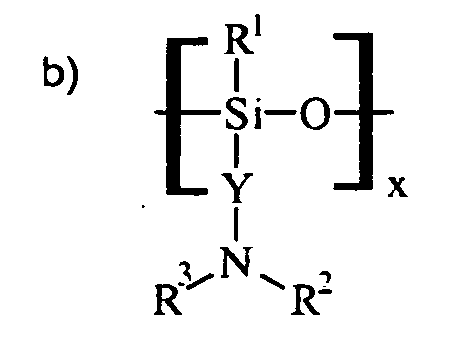
R'= C1-C30-Alkyl, vorzugsweise C1-C4-Alkyl, insbesondere Methyl oder Ethyl,
Y = ggf. substituiertes, lineares oder verzweigtes C1-C20-Alkylen, vorzugsweise -(CH2)m- mit m= 1 bis 16, vorzugsweise 1 bis 8, insbesondere 2 bis 4, im speziellen 3,
R2, R3 = unabhängig voneinander H oder gegebenenfalls substituiertes, lineares oder verzweigtes C1-C30-Alkyl, vorzugsweise mit Aminogruppen substituiertes C1-C30-Alkyl, besonders bevorzugt -(CH2)b-NH2 mit b = 1 bis 10, äußerst bevorzugt b = 2,
x = 1 bis 5000, vorzugsweise 10 bis 2500, insbesondere 100 bis 1500.It may be preferred that the polysiloxane additionally has the following structural unit:
R '= C 1 -C 30 -alkyl, preferably C 1 -C 4 -alkyl, in particular methyl or ethyl,
Y = optionally substituted, linear or branched C 1 -C 20 -alkylene, preferably - (CH 2 ) m - where m = 1 to 16, preferably 1 to 8, in particular 2 to 4, in particular 3,
R 2 , R 3 = independently of one another are H or optionally substituted, linear or branched C 1 -C 30 -alkyl, preferably C 1 -C 30 -alkyl substituted by amino groups, more preferably - (CH 2 ) b -NH 2 where b = 1 to 10, most preferably b = 2,
x = 1 to 5000, preferably 10 to 2500, in particular 100 to 1500.
Weist das Polysiloxan nur die Struktureinheit a) mit R1 = Methyl auf, handelt es sich um ein Polydimethylsiloxan. Polydimethylpolysiloxane sind als effiziente Textil-pflegende Verbindungen bekannt.If the polysiloxane has only the structural unit a) with R 1 = methyl, it is a polydimethylsiloxane. Polydimethylpolysiloxanes are known as efficient fabric care compounds.
Geeignete Polydimethysiloxane umfassen DC-200 (ex Dow Corning), Baysilone® M 50, Baysilone® M 100, Baysilone® M 350, Baysilone® M 500, Baysilone® M 1000, Baysilone® M 1500, Baysilone® M 2000 oder Baysilone® M 5000 (alle ex GE Bayer Silicones).Suitable polydimethysiloxanes include DC-200 (ex Dow Corning), Baysilone® M 50, Baysilone® M 100, Baysilone® M 350, Baysilone® M 500, Baysilone® M 1000, Baysilone® M 1500, Baysilone® M 2000 or Baysilone® M 5000 (all ex GE Bayer Silicones).
Es kann allerdings auch bevorzugt sein, dass das Polysiloxan die Struktureinheiten a) und b) enthält. Ein besonders bevorzugtes Polysiloxan weist die folgende Struktur auf:
(CH3)3Si-[O-Si(CH3)2]n-[O-Si(CH3){(CH2)3-NH-(CH2)2-NH2}]x-OSi(CH3)3
wobei die Summe n + x eine Zahl zwischen 2 und 10.000 ist.However, it may also be preferred that the polysiloxane contains the structural units a) and b). A particularly preferred polysiloxane has the following structure:
(CH 3 ) 3 Si [O-Si (CH 3 ) 2 ] n - [O-Si (CH 3 ) {(CH 2 ) 3 -NH- (CH 2 ) 2 -NH 2 }] x -OSi ( CH 3 ) 3
where the sum n + x is a number between 2 and 10,000.
Geeignete Polysiloxane mit den Struktureinheiten a) und b) sind beispielsweise kommerziell unter den Markennamen DC2-8663, DC2-8035, DC2-8203, DC05-7022 oder DC2-8566 (alle ex Dow Corning) erhältlich. Erfindungsgemäß ebenfalls geeignet sind beispielsweise die im Handel erhältlichen Produkte Dow Corning® 7224, Dow Corning® 929 Cationic Emulsion oder Formasil 410 (GE Silicones).Suitable polysiloxanes having the structural units a) and b) are commercially available, for example, under the trade names DC2-8663, DC2-8035, DC2-8203, DC05-7022 or DC2-8566 (all ex Dow Corning). According to the invention are also suitable for example the products commercially available Dow Corning ® 7224, Dow Corning ® 929 Cationic Emulsion or Formasil 410 (GE Silicones).
Geeignete kationische Polymere umfassen insbesondere solche, die in "
- POLYQUATERNIUM-1 (CAS-Nummer: 68518-54-7)
Definition: {(HOCH2CH2)3N+-CH2CH=CHCH2-[N+(CH3)2-CH2CH=CHCH2]x-N+(CH2CH2OH)3}[Cl-]x+2 - POLYQUATERNIUM-2 (CAS-Nummer: 63451-27-4)
Definition: [-N(CH3)2-CH2CH2CH2-NH-C(O)-NH-CH2CH2CH2-N(CH3)2-CH2CH2OCH2CH2-]2+ (Cl-)2
Beispielsweise erhältlich als Mirapol® A-15 (ex Rhodia) - POLYQUATERNIUM-3
Definition: Copolymer von Acrylamid und Trimethylammoniumethylmethacrylatmethosulfat - POLYQUATERNIUM-4 (CAS-Nummer: 92183-41-0)
Definition: Copolymer von Hydroxyethylcellulose und Diallyldimethylammoniumchlorid
Beispielsweise erhältlich als Celquat® H 100 oder Celquat® L200 (ex National Starch) - POLYQUATERNIUM-5 (CAS-Nummer: 26006-22-4)
Definition: Copolymer von Acrylamid und β-Methacrylyloxyethyltrimethylammoniummethosulfat.
Beispielsweise erhältlich als Nalco 7113 (ex Nalco) oder Reten® 210, Reten® 220, Reten® 230, Reten® 240, Reten® 1104, Reten® 1105 oder Reten® 1106 (alle ex Hercules) - POLYQUATERNIUM-6 (CAS-Nummer: 26062-79-3)
Definition: Polymer von Dimethyldiallylammoniumchlorid
Beispielsweise erhältlich als Merquat® 100 (ex Ondeo-Nalco) - POLYQUATERNIUM-7 (CAS-Nummer: 26590-05-6)
Definition: Polymeres quaternäres Ammoniumsalz bestehend aus Acrylamid- und Dimethyldiallylammoniumchlorid-Monomeren.
Beispielsweise erhältlich als Merquat® 550 oder Merquat® S (ex Ondeo-Nalco) - POLYQUATERNIUM-8
Definition: Polymeres quaternäres Ammoniumsalz von Methyl- und Stearyldimethylaminoethylmethacrylat, welches mit Dimethylsulfat quaternierte wurde. - POLYQUATERNIUM-9
Definition: Polymeres quaternäres Ammoniumsalz von Polydimethylaminoethylmethacrylat, welches mit Methylbromid quaternierte wurde. - POLYQUATERNIUM-10 (CAS-Numnern: 53568-66-4; 55353-19-0; 54351- 50-7; 81859-24-7; 68610-92-4; 81859-24-7)
Definition: Polymeres quaternäres Ammoniumsalz von Hydroxyethylcellulose, die mit einem Trimethylammonium-substitutierten Epoxid umgesetzt wurde.
Beispielsweise erhältlich als Celquat® SC-240 (ex National Starch), UCARE® Polymer JR-125, UCARE® Polymer JR-400, UCARE® Polymer JR-30M, UCARE® Polymer LR 400, UCARE® Polymer LR 30M, Ucare® Polymer SR-10 (alle ex Amerchol) - POLYQUATERNIUM-11 (CAS-Nummer: 53633-54-8)
Definition: Quaternäres Ammoniumpolymer, welches durch Umsetzung von Diethylsulfat mit dem Copolymer von Vinylpyrrolidon und Dimethylaminoethylmethacrylat gebildet wird. Beispielsweise erhältlich als Luviquat®PQ 11 PN (ex BASF), Gafquat® 734, Gafquat® 755 oder Gafquat® 755N (ex GAF) - POLYQUATERNIUM-12 (CAS-Nummer: 68877-50-9)
Definition: Quaternäres Ammoniumpolymersalz, welches durch Umsetzung des Ethylmethacrylat/- Abietylmethacrylat/Diethylaminoethylmethacrylat-Copolymers mit Dimethylsulfat erhältlich ist - POLYQUATERNIUM-13 (CAS Nummer: 68877-47-4)
Definition: Polymeres quaternäres Ammoniumsalz, welches durch Umsetzung des Ethylmethacrylat/Oleylmethacrylat/Diethylaminoethylmethacrylat-Copolymers mit Dimethylsulfat erhältlich ist - POLYQUATERNIUM-14 (CAS-Nummer: 27103-90-8)
Definition: Polymeres quaternäres Ammoniumsalz der Formel -{-CH2-C-(CH3)-[C(O)O-CH2CH2-N(CH3)3 -]}x + [CH3SO4]- x - POLYQUATERNIUM-15 (CAS-Nummer: 35429-19-7)
Definition: Copolymer von Acrylamid und β-Methacrylyloxyethyltrimethylammoniumchlorid - POLYQUATERNIUM-16 (CAS-Nummer: 95144-24-4)
Definition: Polymeres quaternäres Ammoniumsalz, gebildet aus Methylvinylimidazoliumchlorid und Vinylpyrrolidon
Beispielsweise erhältlich als Luviquat® FC 370, Luviquat® Style, Luviquat® FC 550 oder Luviquat® Excellence (alle ex BASF) - POLYQUATERNIUM-17 (CAS-Nummer: 90624-75-2)
Definition: Polymeres quaternäres Ammoniumsalz, welches durch Umsetzung von Adipinsäure und Dimethylaminopropylamin mit Dichlorethylether erhältlich ist.
Beispielsweise erhältlich als Mirapol® AD-1 (ex Rhodia) - POLYQUATERNIUM-18
Definition: Polymeres quaternäres Ammoniumsalz, welches durch Umsetzung von Azelainsäure und Dimethylaminopropylamin mit Dichlorethylether erhältlich ist.
Beispielsweise erhältlich als Mirapol® AZ-1 (ex Rhodia) - POLYQUATERNIUM-19
Definition: Polymeres quaternäres Ammoniumsalz, welches durch Umsetzung von Polyvinylalkohol mit 2,3-Epoxypropylamin erhältlich ist. - POLYQUATERNIUM-20
Definition: Polymeres quaternäres Ammoniumsalz, welches durch Umsetzung von Polyvinyloctadecylether mit 2,3-Epoxypropylamin erhältlich ist. - POLYQUATERNIUM-21 (CAS-Nummer: 102523-94-4)
Definition: Polysiloxan/Polydimethyldialkylammoniumacetat-Copolymer
Beispielsweise erhältlich als Abil® B 9905 (ex Goldschmidt-Degussa) - POLYQUATERNIUM-22 (CAS-Nummer: 53694-17-0)
Definition: Dimethyldiallylammoniumchlorid/Acrylsäure-Copolymer
Beispielsweise erhältlich als Merquat® 280 (ex Ondeo-Nalco) - POLYQUATERNIUM-24 (CAS-Nummer: 107987-23-5)
Definition: Polymeres quaternäres Ammoniumsalz aus der Umsetzung von Hydroxyethylcellulose mit einem mit Lauryldimethylammonium substituierten-Epoxid
Beispielsweise erhältlich als Quatrisoft - POLYQUATERNIUM-27
Definition: Blockcopolymer aus der Umsetzung von Polyquaternium-2 mit Polyquaternium-17. - POLYQUATERNIUM-28 (CAS-Nummer: 131954-48-8)
Definition: Vinylpyrrolidon/Methacrylamidopropyltrimethylammoniumchlorid-Copolymer
Beispielsweise erhältlich als Gafquat® HS-100 (ex GAF) - POLYQUATERNIUM-29
Definition: Chitosan, welches mit Propylenoxid umgesetzt und mit Epichlorhydrin quaternisiert wurde - POLYQUATERNIUM-30
Definition: Polymeres quaternäres Ammoniumsalz der Formel: -[CH2C(CH3)(C(O)OCH3)]x-[CH2C(CH3)(C(O) OCH2CH2N+(CH3)2CH2COO-)]y- - POLYQUATERNIUM-31 (CAS-Nummer. 136505-02-7)
- POLYQUATERNIUM-32 (CAS-Nummer: 35429-19-7)
Definition: Polymer von N,N,N-Trimethyl-2-[(2-methyl-1-oxo-2-propenyl)oxy]-ethanaminiumchlorid mit 2-Propenamid - POLYQUATERNIUM-37 (CAS-Nummer: 26161-33-1)
Definition: Homopolymer von Methacryloyltrimethylchlorid
Beispielsweise erhältlich als Synthalen® CR (ex 3V Sigma) - POLYQUATERNIUM-44 (CAS-Nummer: 150595-70-5)
Definition: Quaternäres Ammoniumsalz des Copolymers von Vinylpyrrolidon und quaternisiertem Imidazolin
Beispielsweise erhältlich als Luviquat® Ultracare (ex BASF) - POLYQUATERNIUM-68 (CAS-Nummer: 827346-45-2)
Definition: Quaternisiertes Copolymer von Vinylpyrrolidon, Methacrylamid, Vinylimidazol und quatemisiertem Vinylimidazol
Beispielsweise erhältlich als Luviquai® Supreme (ex BASF)
- POLYQUATERNIUM-1 (CAS number: 68518-54-7)
Definition: {(HOCH 2 CH 2 ) 3 N + -CH 2 CH = CHCH 2 - [N + (CH 3 ) 2 -CH 2 CH = CHCH 2 ] x -N + (CH 2 CH 2 OH) 3 } [Cl - ] x + 2 - POLYQUATERNIUM-2 (CAS number: 63451-27-4)
Definition: [-N (CH 3 ) 2 -CH 2 CH 2 CH 2 -NH-C (O) -NH-CH 2 CH 2 CH 2 -N (CH 3 ) 2 -CH 2 CH 2 OCH 2 CH 2 - ] 2+ (Cl - ) 2
For example, available as Mirapol® A-15 (ex Rhodia) - Polyquaternium-3
Definition: copolymer of acrylamide and trimethylammoniumethyl methacrylate methosulfate - POLYQUATERNIUM-4 (CAS number: 92183-41-0)
Definition: Copolymer of hydroxyethylcellulose and diallyldimethylammonium chloride
For example, available as Celquat® H 100 or Celquat® L200 (ex National Starch) - POLYQUATERNIUM-5 (CAS number: 26006-22-4)
Definition: Copolymer of acrylamide and β-methacrylyloxyethyltrimethylammonium methosulfate.
For example, available as Nalco 7113 (ex Nalco) or Reten® 210, Reten® 220, Reten® 230, Reten® 240, Reten® 1104, Reten® 1105 or Reten® 1106 (all ex Hercules) - POLYQUATERNIUM-6 (CAS number: 26062-79-3)
Definition: Polymer of dimethyldiallylammonium chloride
For example, available as Merquat® 100 (ex Ondeo-Nalco) - POLYQUATERNIUM-7 (CAS number: 26590-05-6)
Definition: Polymeric quaternary ammonium salt consisting of acrylamide and dimethyldiallylammonium chloride monomers.
For example, available as Merquat® 550 or Merquat® S (ex Ondeo-Nalco) - Polyquaternium-8
Definition: Polymeric quaternary ammonium salt of methyl and stearyldimethylaminoethyl methacrylate quaternized with dimethyl sulfate. - Polyquaternium-9
Definition: Polymeric quaternary ammonium salt of polydimethylaminoethyl methacrylate quaternized with methyl bromide. - POLYQUATERNIUM-10 (CAS Nouns: 53568-66-4; 55353-19-0; 54351-50-7; 81859-24-7; 68610-92-4; 81859-24-7)
Definition: Polymeric quaternary ammonium salt of hydroxyethylcellulose reacted with a trimethylammonium substituted epoxide.
For example, available as Celquat® SC-240 (ex National Starch), UCARE® Polymer JR-125, UCARE® Polymer JR-400, UCARE® Polymer JR-30M, UCARE® Polymer LR 400, UCARE® Polymer LR 30M, Ucare® Polymer SR-10 (all ex Amerchol) - POLYQUATERNIUM-11 (CAS number: 53633-54-8)
Definition: Quaternary ammonium polymer formed by reaction of diethyl sulfate with the copolymer of vinylpyrrolidone and dimethylaminoethyl methacrylate. For example, available as Luviquat®PQ 11 PN (ex BASF), Gafquat® 734, Gafquat® 755 or Gafquat® 755N (ex GAF) - POLYQUATERNIUM-12 (CAS number: 68877-50-9)
Definition: Quaternary ammonium polymer salt obtainable by reaction of the ethyl methacrylate / -abietyl methacrylate / diethylaminoethyl methacrylate copolymer with dimethyl sulfate - POLYQUATERNIUM-13 (CAS number: 68877-47-4)
Definition: Polymeric quaternary ammonium salt obtainable by reaction of the ethyl methacrylate / oleyl methacrylate / diethylaminoethyl methacrylate copolymer with dimethyl sulfate - POLYQUATERNIUM-14 (CAS number: 27103-90-8)
Definition: Polymeric quaternary ammonium salt of the formula - {- CH 2 -C- (CH 3 ) - [C (O) O-CH 2 CH 2 -N (CH 3 ) 3 - ]} x + [CH 3 SO 4 ] - x - POLYQUATERNIUM-15 (CAS number: 35429-19-7)
Definition: copolymer of acrylamide and β-methacrylyloxyethyltrimethylammonium chloride - POLYQUATERNIUM-16 (CAS number: 95144-24-4)
Definition: Polymeric quaternary ammonium salt formed from methylvinylimidazolium chloride and vinylpyrrolidone
For example, available as Luviquat® FC 370, Luviquat® Style, Luviquat® FC 550 or Luviquat® Excellence (all ex BASF) - POLYQUATERNIUM-17 (CAS number: 90624-75-2)
Definition: Polymeric quaternary ammonium salt obtainable by reaction of adipic acid and dimethylaminopropylamine with dichloroethyl ether.
For example, available as Mirapol® AD-1 (ex Rhodia) - Polyquaternium-18
Definition: Polymeric quaternary ammonium salt, which is obtainable by reaction of azelaic acid and dimethylaminopropylamine with dichloroethyl ether.
For example, available as Mirapol® AZ-1 (ex Rhodia) - Polyquaternium-19
Definition: Polymeric quaternary ammonium salt, which is obtainable by reaction of polyvinyl alcohol with 2,3-epoxypropylamine. - Polyquaternium-20
Definition: Polymeric quaternary ammonium salt, obtainable by reaction of polyvinyloctadecyl ether with 2,3-epoxypropylamine. - POLYQUATERNIUM-21 (CAS number: 102523-94-4)
Definition: polysiloxane / polydimethyldialkylammonium acetate copolymer
For example, available as Abil® B 9905 (ex Goldschmidt-Degussa) - POLYQUATERNIUM-22 (CAS number: 53694-17-0)
Definition: dimethyldiallylammonium chloride / acrylic acid copolymer
For example, available as Merquat® 280 (ex Ondeo-Nalco) - POLYQUATERNIUM-24 (CAS number: 107987-23-5)
Definition: Polymeric quaternary ammonium salt from the reaction of hydroxyethylcellulose with a lauryldimethylammonium substituted epoxide
For example, available as Quatrisoft - Polyquaternium-27
Definition: Block copolymer from the reaction of Polyquaternium-2 with Polyquaternium-17. - POLYQUATERNIUM-28 (CAS number: 131954-48-8)
Definition: Vinylpyrrolidone / methacrylamidopropyltrimethylammonium chloride copolymer
For example, available as Gafquat® HS-100 (ex GAF) - Polyquaternium-29
Definition: Chitosan, which was reacted with propylene oxide and quaternized with epichlorohydrin - Polyquaternium-30
Definition: Polymeric quaternary ammonium salt of the formula: - [CH 2 C (CH 3 ) (C (O) OCH 3 )] x - [CH 2 C (CH 3 ) (C (O) OCH 2 CH 2 N + (CH 3 ) 2 CH 2 COO - )] y - - POLYQUATERNIUM-31 (CAS number: 136505-02-7)
- POLYQUATERNIUM-32 (CAS number: 35429-19-7)
Definition: Polymer of N, N, N-trimethyl-2 - [(2-methyl-1-oxo-2-propenyl) oxy] -ethanaminium chloride with 2-propenamide - POLYQUATERNIUM-37 (CAS number: 26161-33-1)
Definition: homopolymer of methacryloyltrimethyl chloride
For example, available as Synthalen® CR (ex 3V Sigma) - POLYQUATERNIUM-44 (CAS number: 150595-70-5)
Definition: Quaternary ammonium salt of the copolymer of vinylpyrrolidone and quaternized imidazoline
For example, available as Luviquat® Ultracare (ex BASF) - POLYQUATERNIUM-68 (CAS-Number: 827346-45-2)
Definition: Quaternized copolymer of vinylpyrrolidone, methacrylamide, vinylimidazole and quaternized vinylimidazole
For example, available as Luviquai® Supreme (ex BASF)
Die kationischen Polymere weisen dabei nicht zwingend nur einen Textil-weichmachenden Effekt auf, sondern können zusätzlich einen weiteren textil- und/oder hautpflegenden Effekt aufweisen.The cationic polymers do not necessarily have only a textile softening effect, but may additionally have a further textile and / or skin care effect.
Unter einer hautpflegenden Verbindung wird eine Verbindung oder eine Mischung aus Verbindungen verstanden, die bei Kontakt eines Textils mit der festen, textil- und/oder hautpflegenden Zusammensetzung auf das Textil aufziehen und bei Kontakt des Textils mit Haut der Haut einen Vorteil verleihen verglichen mit einem Textil, welches nicht mit der erfindungemäßen textil- und/oder hautpflegenden Zusammensetzung behandelt wurde. Dieser Vorteil kann beispielsweise den Transfer der hautpflegenden Verbindung vom Textil auf die Haut, einen geringeren Wassertransfer von der Haut auf das Textil oder eine geringere Reibung auf der Hautoberfläche durch das Textil umfassen.A skin-care compound is understood to mean a compound or a mixture of compounds which, upon contact of a textile with the solid, textile and / or skin-care composition, draw on the textile and, on contact of the textile with skin, confer an advantage on the skin compared with a textile which has not been treated with the textile and / or skin care composition according to the invention. This benefit may include, for example, the transfer of the skin care compound from the textile to the skin, less water transfer from the skin to the textile, or less friction on the skin surface through the textile.
Eine hautpflegende Verbindung ist vorzugsweise hydrophob, kann flüssig oder fest sein und muss kompatibel mit den anderen Inhaltsstoffen der festen, textil- und oder hautpflegenden Zusammensetzung sein. Die hautpflegende Verbindung kann beispielsweise
- a) Wachse wie Carnauba, Spermaceti, Bienenwachs, Lanolin, Derivate davon sowie Mischungen daraus;
- b) hydrophobe Pflanzenextrakte, zum Beispiel pflanzliche Öle wie Avokadoöl, Olivenöl, Palmöl, Palmenkernöl, Rapsöl, Leinöl, Sojaöl, Erdnussöl, Korianderöl, Ricinusöl, Mohnöl, Kakaoöl, Kokosnüssöl, Kürbiskernöl, Weizenkeimöl, Sesamöl, Sonnenblumenöl, Mandelöl, Macadamianussöl, Aprikosenkernöl, Haselnussöl, Jojobaöl, Canolaöl sowie Mischungen daraus, Aloe oder Kamille;
- c) höhere Fettsäuren wie Laurinsäure, Myristinsäure, Palmitinsäure, Stearinsäure, Behensäure, Ölsäure, Linolsäure, Linolensäure, Isostearinsäure oder mehrfach ungesättigte Fettsäuren;
- d) höhere Fettalkohole wie Laurylalkohol, Cetylalkohol, Stearylalkohol, Oleylalkohol, Behenylalkohol oder 2-Hexadecanol,
- e) Ester wie Cetyloctanoat, Lauryllactat, Myristyllactat, Cetyllactat, Isopropylmyristat, Myristylmyristat, Isopropylpalmitat, Isopropyladipat, Butylstearat, Decyloleat, Cholesterolisostearat, Glycerolmonostearat, Glyceroldistearat, Glyceroltristearat, Alkyllactat, Alkylcitrat oder Alkyltartrat;
- f) Kohlenwasserstoffe wie Paraffine, Mineralöle, Squalan oder Squalen;
- g) Lipide;
- h) Vitamine wie Vitamin A, C und E oder Vitaminalkylester;
- i) Phospholipide;
- j) Sonnenschutzmittel wie Octylmethoxylcinnamat und Butylmethoxybenzoylmethan;
- k) Silikonöle wie lineare oder cyclische Polydimethylsiloxane, Amino-, Alkyl-, Alkylaryl- oder Arylsubstituierte Silikonöle und
- l) Mischungen daraus
- a) waxes such as carnauba, spermaceti, beeswax, lanolin, derivatives thereof and mixtures thereof;
- b) hydrophobic plant extracts, for example vegetable oils such as avocado oil, olive oil, palm oil, palm kernel oil, rapeseed oil, linseed oil, soybean oil, peanut oil, coriander oil, castor oil, poppy seed oil, cocoa oil, coconut oil, pumpkin seed oil, wheat germ oil, sesame oil, sunflower oil, almond oil, macadamia nut oil, apricot kernel oil, Hazelnut oil, jojoba oil, canola oil and mixtures thereof, aloe or camomile;
- c) higher fatty acids such as lauric acid, myristic acid, palmitic acid, stearic acid, behenic acid, oleic acid, linoleic acid, linolenic acid, isostearic acid or polyunsaturated fatty acids;
- d) higher fatty alcohols, such as lauryl alcohol, cetyl alcohol, stearyl alcohol, oleyl alcohol, behenyl alcohol or 2-hexadecanol,
- e) esters such as cetyloctanoate, lauryl lactate, myristyl lactate, cetyl lactate, isopropyl myristate, myristyl myristate, isopropyl palmitate, isopropyl adipate, butyl stearate, decyl oleate, cholesterol isostearate, glycerol monostearate, glyceryl distearate, glycerol tristearate, alkyl lactate, alkyl citrate or alkyl tartrate;
- f) hydrocarbons such as paraffins, mineral oils, squalane or squalene;
- g) lipids;
- h) vitamins such as vitamins A, C and E or vitamin alkyl esters;
- i) phospholipids;
- j) sunscreens such as octyl methoxyl cinnamate and butyl methoxybenzoyl methane;
- k) silicone oils such as linear or cyclic polydimethylsiloxanes, amino-, alkyl-, alkylaryl- or aryl-substituted silicone oils and
- l) mixtures thereof
Der wasserunlösliche Partikel enthält ein Parfüm.The water-insoluble particle contains a perfume.
Als Parfümöle bzw. Duftstoffe können einzelne Riechstoffverbindungen, z.B. die synthetischen Produkte vom Typ der Ester, Ether, Aldehyde, Ketone, Alkohole und Kohlenwasserstoffe verwendet werden. Bevorzugt werden jedoch Mischungen verschiedener Riechstoffe verwendet, die gemeinsam eine ansprechende Duftnote erzeugen. Solche Parfümöle können auch natürliche Riechstoffgemische enthalten, wie sie aus pflanzlichen Quellen zugänglich sind.As perfume oils or fragrances, individual fragrance compounds, e.g. the synthetic products of the ester, ether, aldehyde, ketone, alcohol and hydrocarbon type are used. Preferably, however, mixtures of different fragrances are used, which together produce an attractive fragrance. Such perfume oils may also contain natural fragrance mixtures as are available from plant sources.
Die Menge an Parfüm in der textil- und/oder hautpflegenden Zusammensetzung beträgt dabei vorzugsweise zwischen 0,1 und 20 Gew.-%, insbesondere bevorzugt zwischen 1 und 10 Gew.-%, und ganz besonders bevorzugt zwischen 2 und 7 Gew.-%.The amount of perfume in the textile and / or skin care composition is preferably between 0.1 and 20 wt .-%, particularly preferably between 1 and 10 wt .-%, and most preferably between 2 and 7 wt .-% ,
Weitere geeignete textilpflegende Verbindungen umfassen bevorzugt Fluoreszenzmittel, Antiredepositionsmittel, optischen Aufheller, Vergrauungsinhibitoren, Einlaufverhinderer, Knitterschutzmittel, Farbübertragungsinhibitoren, antimikrobiellen Wirkstoffe, Germizide, Fungizide, Antioxidantien, Antistatika, Bügelhilfsmittel, UV-Absorber, Phobiermittel und/oder Imprägniermittel. Konkrete Beispiele für diese textilpflegenden Verbindungen finden sich bei der Beschreibung des erfindungsgemäßen Wasch- oder Reinigungsmittels und können auch in der festen, textil- und/oder hautpflegenden Zusammensetzung verwendet werden.Other suitable textile-care compounds preferably comprise fluorescers, anti-redeposition agents, optical brighteners, grayness inhibitors, anti-shrinkage agents, anti-crease agents, color transfer inhibitors, antimicrobial agents, germicides, fungicides, antioxidants, antistatic agents, ironing auxiliaries, UV absorbers, repellents and / or impregnating agents. Concrete examples of these textile-care compounds can be found in the description of the washing or cleaning agent according to the invention and can also be used in the solid, textile and / or skin care composition.
Die feste, textil- und/oder hautpflegende Zusammensetzung kann auch Mischungen der genannten Verbindungen enthalten.The solid, textile and / or skin care composition may also contain mixtures of said compounds.
Die Menge an textil- und/oder hautpflegender Verbindung in der textil- und/oder hautpflegenden Zusammensetzung beträgt 0,1 bis 20 Gew.-%.The amount of textile and / or skin care compound in the textile and / or skin care composition is 0.1 to 20 wt .-%.
Ein weiterer essentieller Bestandteil der festen, textil- und/oder hautpflegenden Zusammensetzung ist der wasserlösliche Partikel. Der wasserlösliche Partikel umfasst ein Kohlenhydrat, welches beispielsweise ausgewählt ist aus der Gruppe bestehend aus Dextrose, Fructose, Galactose, Isoglucose, Glucose, Saccharose, Raffinose und Mischungen daraus. Das eingesetzte Kohlenhydrat kann beispielsweise Kandiszucker, Teezucker, Kristallzucker oder Hagelzucker sein. Aufgrund seiner außergewöhnlichen Ästhetik und Akustik wird bevorzugt ein Zucker als wasserlöslicher Partikel bzw. als überwiegender Bestandteil eines wasserlöslichen Partikels eingesetzt.Another essential component of the solid, textile and / or skin care composition is the water-soluble particle. The water-soluble particle comprises a carbohydrate selected, for example, from the group consisting of dextrose, fructose, galactose, isoglucose, glucose, sucrose, raffinose and mixtures thereof. The carbohydrate used may be, for example, candy, tea sugar, granulated sugar or hail sugar. Due to its exceptional aesthetics and acoustics, a sugar is preferably used as the water-soluble particle or as the predominant constituent of a water-soluble particle.
Der wasserlösliche Partikel kann auch Mischungen aus einem Kohlenhydrat und anorganischen Alkalimetallsalzen wie beispielsweise Natriumchlorid, Kaliumchlorid, Natriumsulfat, Natriumcarbonat, Kaliumsulfat, Kaliumcarbonat, Natriumhydrogencarbonat, Kaliumhydrogencarbonat oder deren Mischungen, organischer Alkalimetallsalzen wie beispielsweise Natriumacetat, Kaliumacetat, Natriumcitrat, Natriumtartrat oder Kaliumnatriumtartrat, anorganischen Erdalkalimetallsalzen wie beispielsweise Calciumchlorid oder Magnesiumchlorid, organischen Erdalkalimetallsalzen wie beispielsweise wie Calciumlactat, organischen Säuren wie beispielsweise Citronensäure oder Weinsäure, Silikaten wie beispielsweise Wasserglas, Natriumsilikat oder Kaliumsilikat enthalten. Der wasserlösliche Partikel kann sich beispielsweise auch aus einem wasserlöslichen Trägerpartikel und weiteren Verbindungen zusammensetzen.The water-soluble particle may also include mixtures of a carbohydrate and inorganic alkali metal salts such as sodium chloride, potassium chloride, sodium sulfate, sodium carbonate, potassium sulfate, potassium carbonate, sodium bicarbonate, potassium bicarbonate or mixtures thereof, organic alkali metal salts such as sodium acetate, potassium acetate, sodium citrate, sodium tartrate or potassium sodium tartrate, inorganic alkaline earth metal salts such as for example, calcium chloride or magnesium chloride, organic alkaline earth metal salts such as calcium lactate, organic acids such as citric acid or tartaric acid, silicates such as water glass, sodium silicate or potassium silicate. The water-soluble particle may also be composed, for example, of a water-soluble carrier particle and further compounds.
Es ist bevorzugt, dass der wasserlösliche Partikel und der wasserunlösliche Partikel jeweils Partikelgrößen im Bereich von 0,6 bis 30 mm, insbesondere 0,8 bis 20 mm und besonders bevorzugt 1 bis 10 mm, aufweist. Insbesondere bevorzugt umfasst der wasserlösliche Partikel Saccharose-Kristalle mit einer Partikelgröße von 1 bis 2 mm.It is preferred that the water-soluble particle and the water-insoluble particle each have particle sizes in the range of 0.6 to 30 mm, in particular 0.8 to 20 mm and particularly preferably 1 to 10 mm. Most preferably, the water-soluble particle comprises sucrose crystals having a particle size of 1 to 2 mm.
Es ist insbesondere bevorzugt, dass die Partikelgrößen der wasserlöslichen Partikel und der wasserunlöslichen Partikel in einem ähnlichen Bereich, dass heißt in der gleichen Größenordnung, liegen, um eine Entmischung der Partikel zu verhindern.It is particularly preferred that the particle sizes of the water-soluble particles and the water-insoluble particles are in a similar range, that is of the same order of magnitude, in order to prevent segregation of the particles.
Dem Fachmann sind geeignete Methoden zur Bestimmung der Partikelgröße von Partikeln (zum Beispiel Pulver, Granulate oder Agglomerate) hinlänglich bekannt. Im Rahmen dieser Erfindung wurden die Partikelgrößen des wasserlöslichen Partikels, des wasserlöslichen Trägerpartikels, des wasserunlöslichen Partikels und/oder des wasserunlöslichen Trägerpartikels mittels Siebanalysen bestimmt.The person skilled in suitable methods for determining the particle size of particles (for example, powder, granules or agglomerates) are well known. In the context of this invention, the particle sizes of the water-soluble particle, of the water-soluble carrier particle, of the water-insoluble particle and / or of the water-insoluble carrier particle were determined by sieve analyzes.
Der wasserlösliche Partikel und der wasserunlösliche Partikel können jeweils optional weitere Inhaltsstoffe enthalten.The water-soluble particle and the water-insoluble particle may each optionally contain further ingredients.
Um den ästhetischen Eindruck der textil- und/oder hautpflegenden Zusammensetzung zu verbessern, können die Partikel mit geeigneten Farbstoffen eingefärbt werden. Bevorzugte Farbstoffe, deren Auswahl dem Fachmann keinerlei Schwierigkeit bereitet, besitzen eine hohe Lagerstabilität und Unempfindlichkeit gegenüber den übrigen Inhaltsstoffen der Wasch- oder Reinigungsmittel und gegen Licht sowie keine ausgeprägte Substantivität gegenüber Textilfasern, um diese nicht anzufärben.In order to improve the aesthetic impression of the textile and / or skin care composition, the particles can be colored with suitable dyes. Preferred dyes, the selection of which presents no difficulty to the skilled person, have a high storage stability and insensitivity to the other ingredients of detergents or cleaning agents and to light and no pronounced substantivity to textile fibers so as not to stain them.
Weiterhin können der wasserlösliche Partikel und/oder der wasserunlösliche Partikel einen Füllstoff, wie Silica, enthalten. Die Menge an Füllstoff in den Partikeln kann jeweils zwischen 0.1 und 10 Gew.-% betragen und beträgt bevorzugt 1 bis 5 Gew.-%..Furthermore, the water-soluble particle and / or the water-insoluble particle may contain a filler such as silica. The amount of filler in the particles can be between 0.1 and 10% by weight and is preferably 1 to 5% by weight.
Die Partikel und insbesondere der wasserunlösliche Partikel können jeweils zur Erhöhung des Glanzes auch ein Perlglanzmittel enthalten. Beispiele für geeignete Perlglanzmittel sind Ethylenglykolmono- und -distearat (zum Beispiel Cutina® AGS von Cognis) sowie PEG-3-distearat.The particles and in particular the water-insoluble particles may each contain a pearlescing agent to increase the gloss. Examples of suitable pearlescing agents are ethylene glycol mono- and distearate (for example Cutina AGS from Cognis) and PEG-3-distearate.
Zur Herstellung der textil- und/oder hautpflegenden Zusammensetzung werden zunächst die beiden Partikel in separaten Verfahren hergestellt bzw. bereitgestellt. Im Fall der wasserlöslichen Partikel kann das Verfahren der Bereitstellung lediglich im Erwerb der wasserlöslichen Verbindung mit der gewünschten Partikelgröße und Einfärbung der Verbindungen bestehen.To produce the textile and / or skin care composition, the two particles are first prepared or provided in separate processes. In the case of the water-soluble particles, the method of providing may consist merely in acquiring the water-soluble compound having the desired particle size and coloring the compounds.
Zur Herstellung der wasserunlöslichen Partikel werden die wasserunlöslichen Trägerpartikel beispielsweise mittels Besprühen mit einer Flüssigkeit, die die textil- und/oder hautpflegende Verbindung enthält, behandelt/imprägniert.To prepare the water-insoluble particles, the water-insoluble carrier particles are treated / impregnated, for example by spraying with a liquid containing the textile and / or skin care compound.
Die textil- und/oder hautpflegende Zusammensetzung eignet sich insbesondere zum Konditionieren von textilen Flächengebilden und wird dazu zusammen mit einem herkömmlichen Wasch- oder Reinigungsmittel im (Haupt)Waschgang eines herkömmlichen Wasch- und Reinigungsprozesses mit den textilen Flächengebilden in Kontakt gebracht.The textile and / or skin care composition is suitable in particular for conditioning textile fabrics and is brought into contact with the textile fabrics together with a conventional washing or cleaning agent in the (main) wash cycle of a conventional washing and cleaning process.
Die textil- und/oder hautpflegende Zusammensetzung kann in ein Wasch- oder Reinigungsmittel eingebracht werden.The textile and / or skin care composition can be incorporated into a detergent or cleaning agent.
Dazu wird ein festes Wasch- oder Reinigungsmittel mit 0,1 bis 20 Gew.-%, vorzugsweise 1 bis 10 Gew.-%, bezogen auf das gesamte, erfindungsgemäße Wasch- oder Reinigungsmittel, der erfindungsgemäßen textil- und/oder hautpflegenden Zusammensetzung gemischt.For this purpose, a solid detergent or cleaning agent with 0.1 to 20 wt .-%, preferably 1 to 10 wt .-%, based on the total inventive detergent or cleaning agent, the textile and / or skin care composition according to the invention mixed.
Die erfindungsgemäßen Wasch- oder Reinigungsmittel enthalten neben der textil- und/oder hautpflegenden Zusammensetzung Tensid(e), wobei anionische, nichtionische, zwitterionische und/oder amphotere Tenside eingesetzt werden können. Bevorzugt sind aus anwendungstechnischer Sicht Mischungen aus anionischen und nichtionischen Tensiden. Der Gesamttensidgehalt eines Waschmittels liegt vorzugsweise unterhalb von 40 Gew.-% und besonders bevorzugt unterhalb von 35 Gew.-%, bezogen auf das gesamte Waschmittel.The washing or cleaning agents according to the invention contain, in addition to the textile and / or skin care composition, surfactant (s), it being possible to use anionic, nonionic, zwitterionic and / or amphoteric surfactants. From an application point of view, preference is given to mixtures of anionic and nonionic surfactants. The total surfactant content of a detergent is preferably below 40% by weight, and more preferably below 35% by weight, based on the total detergent.
Als nichtionische Tenside werden vorzugsweise alkoxylierte, vorteilhafterweise ethoxylierte, insbesondere primäre Alkohole mit vorzugsweise 8 bis 18 C-Atomen und durchschnittlich 1 bis 12 Mol Ethylenoxid (EO) pro Mol Alkohol eingesetzt, in denen der Alkoholrest linear oder bevorzugt in 2-Stellung methylverzweigt sein kann bzw. lineare und methylverzweigte Reste im Gemisch enthalten kann, so wie sie üblicherweise in Oxoalkoholresten vorliegen. Insbesondere sind jedoch Alkoholethoxylate mit linearen Resten aus Alkoholen nativen Ursprungs mit 12 bis 18 C-Atomen, zum Beispiel aus Kokos-, Palm-, Talgfett- oder Oleylalkohol, und durchschnittlich 2 bis 8 EO pro Mol Alkohol bevorzugt. Zu den bevorzugten ethoxylierten Alkoholen gehören beispielsweise C12-14-Alkohole mit 3 EO, 4 EO oder 7 EO, C9-11-Alkohol mit 7 EO, C13-15-Alkohole mit 3 EO, 5 EO, 7 EO oder 8 EO, C12-18-Alkohole mit 3 EO, 5 EO oder 7 EO und Mischungen aus diesen, wie Mischungen aus C12-14-Alkohol mit 3 EO und C12-18-Alkohol mit 7 EO. Die angegebenen Ethoxylierungsgrade stellen statistische Mittelwerte dar, die für ein spezielles Produkt eine ganze oder eine gebrochene Zahl sein können. Bevorzugte Alkoholethoxylate weisen eine eingeengte Homologenverteilung auf (narrow range ethoxylates, NRE). Zusätzlich zu diesen nichtionischen Tensiden können auch Fettalkohole mit mehr als 12 EO eingesetzt werden. Beispiele hierfür sind Talgfettalkohol mit 14 EO, 25 EO, 30 EO oder 40 EO. Auch nichtionische Tenside, die EO- und PO-Gruppen zusammen im Molekül enthalten, sind erfindungsgemäß einsetzbar. Hierbei können Blockcopolymere mit EO-PO-Blockeinheiten bzw. PO-EO-Blockeinheiten eingesetzt werden, aber auch EO-PO-EO-Copolymere bzw. PO-EO-PO-Copolymere. Selbstverständlich sind auch gemischt alkoxylierte Niotenside einsetzbar, in denen EO- und PO-Einheiten nicht blockweise, sondern statistisch verteilt sind. Solche Produkte sind durch gleichzeitige Einwirkung von Ethylen- und Propylenoxid auf Fettalkohole erhältlich.The nonionic surfactants used are preferably alkoxylated, advantageously ethoxylated, in particular primary, alcohols having preferably 8 to 18 carbon atoms and on average 1 to 12 moles of ethylene oxide (EO) per mole of alcohol, in which the alcohol radical can be linear or preferably methyl-branched in the 2-position or linear and methyl-branched radicals in the mixture can contain, as they are usually present in Oxoalkoholresten. In particular, however, alcohol ethoxylates with linear radicals of alcohols of native origin having 12 to 18 carbon atoms, for example of coconut, palm, tallow or oleyl alcohol, and on average 2 to 8 EO per mole of alcohol are preferred. The preferred ethoxylated alcohols include, for example, C 12-14 alcohols with 3 EO, 4 EO or 7 EO, C 9-11 alcohols with 7 EO, C 13-15 alcohols with 3 EO, 5 EO, 7 EO or 8 EO, C 12-18 -alcohols with 3 EO, 5 EO or 7 EO and mixtures of these, such as mixtures of C 12-14 -alcohol with 3 EO and C 12-18 -alcohol with 7 EO. The degrees of ethoxylation given represent statistical means which, for a particular product, may be an integer or a fractional number. Preferred alcohol ethoxylates have a narrow homolog distribution (narrow range ethoxylates, NRE). In addition to these nonionic surfactants, fatty alcohols with more than 12 EO can also be used. Examples include tallow fatty alcohol with 14 EO, 25 EO, 30 EO or 40 EO. Nonionic surfactants containing EO and PO groups together in the molecule can also be used according to the invention. Here, block copolymers with EO-PO block units or PO-EO block units can be used, but also EO-PO-EO copolymers or PO-EO-PO copolymers. Of course, it is also possible to use mixed alkoxylated nonionic surfactants in which EO and PO units are not distributed in blocks, but randomly. Such products are available by the simultaneous action of ethylene and propylene oxide on fatty alcohols.
Außerdem können als weitere nichtionische Tenside auch Alkylglykoside der allgemeinen Formel RO(G)x eingesetzt werden, in der R einen primären geradkettigen oder methylverzweigten, insbesondere in 2-Stellung methylverzweigten aliphatischen Rest mit 8 bis 22, vorzugsweise 12 bis 18 C-Atomen bedeutet und G das Symbol ist, das für eine Glykoseeinheit mit 5 oder 6 C-Atomen, vorzugsweise für Glucose, steht. Der Oligomerisierungsgrad x, der die Verteilung von Monoglykosiden und Oligoglykosiden angibt, ist eine beliebige Zahl zwischen 1 und 10; vorzugsweise liegt x bei 1,2 bis 1,4. Alkylglykoside sind bekannte, milde Tenside.In addition, as further nonionic surfactants and alkyl glycosides of the general formula RO (G) x can be used in which R is a primary straight-chain or methyl-branched, especially in the 2-position methyl-branched aliphatic radical having 8 to 22, preferably 12 to 18 carbon atoms and G is the symbol which represents a glycose unit having 5 or 6 C atoms, preferably glucose. The degree of oligomerization x, which indicates the distribution of monoglycosides and oligoglycosides, is any number between 1 and 10; preferably x is 1.2 to 1.4. Alkyl glycosides are known, mild surfactants.
Eine weitere Klasse bevorzugt eingesetzter nichtionischer Tenside, die entweder als alleiniges nichtionisches Tensid oder in Kombination mit anderen nichtionischen Tensiden eingesetzt werden, sind alkoxylierte, vorzugsweise ethoxylierte oder ethoxylierte und propoxylierte Fettsäurealkylester, vorzugsweise mit 1 bis 4 Kohlenstoffatomen in der Alkylkette, insbesondere Fettsäuremethylester.Another class of preferred nonionic surfactants used either as the sole nonionic surfactant or in combination with other nonionic surfactants are alkoxylated, preferably ethoxylated or ethoxylated and propoxylated fatty acid alkyl esters, preferably having from 1 to 4 carbon atoms in the alkyl chain, especially fatty acid methyl esters.
Auch nichtionische Tenside vom Typ der Aminoxide, beispielsweise N-Kokosalkyl-N,N-dimethyl-aminoxid und N-Talgalkyl-N,N-dihydroxyethylaminoxid, und der Fettsäurealkanolamide können geeignet sein. Die Menge dieser nichtionischen Tenside beträgt vorzugsweise nicht mehr als die der ethoxylierten Fettalkohole, insbesondere nicht mehr als die Hälfte davon.Nonionic surfactants of the amine oxide type, for example N-cocoalkyl-N, N-dimethyl-amine oxide and N-tallow alkyl-N, N-dihydroxyethylamine oxide, and the fatty acid alkanolamides may also be suitable. The amount of these nonionic surfactants is preferably not more than that of the ethoxylated fatty alcohols, especially not more than half thereof.
Weitere geeignete Tenside sind Polyhydroxyfettsäureamide der Formel (VII),
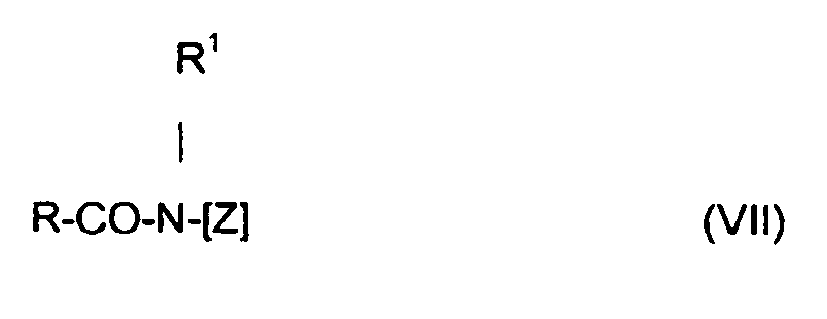
Zur Gruppe der Polyhydroxyfettsäureamide gehören auch Verbindungen der Formel (VIII),
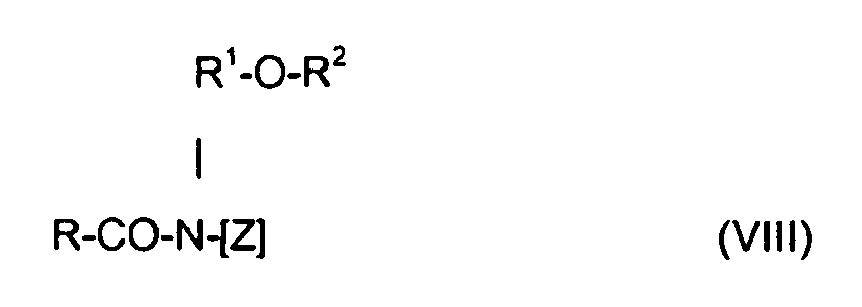
[Z] wird vorzugsweise durch reduktive Aminierung eines Zuckers erhalten, beispielsweise Glucose, Fructose, Maltose, Lactose, Galactose, Mannose oder Xylose. Die N-Alkoxy- oder N-Aryloxy-substituierten Verbindungen können dann durch Umsetzung mit Fettsäuremethylestem in Gegenwart eines Alkoxids als Katalysator in die gewünschten Polyhydroxyfettsäureamide überführt werden.[Z] is preferably obtained by reductive amination of a sugar, for example glucose, fructose, maltose, lactose, galactose, mannose or xylose. The N-alkoxy- or N-aryloxy-substituted compounds can then be converted into the desired polyhydroxy fatty acid amides by reaction with fatty acid methyl esters in the presence of an alkoxide as catalyst.
Der Gehalt an nichtionischen Tensiden beträgt in den Wasch- oder Reinigungsmitteln bevorzugt 5 bis 30 Gew.-%, vorzugsweise 7 bis 20 Gew.-% und insbesondere 9 bis 15 Gew.-%, jeweils bezogen auf das gesamte Wasch- oder Reinigungsmittel .The content of nonionic surfactants in the detergents or cleaners is preferably 5 to 30 wt .-%, preferably 7 to 20 wt .-% and in particular 9 to 15 wt .-%, each based on the total detergent or cleaning agent.
Als anionische Tenside werden beispielsweise solche vom Typ der Sulfonate und Sulfate eingesetzt. Als Tenside vom Sulfonat-Typ kommen dabei vorzugsweise C9-13-Alkylbenzolsulfonate, Olefinsulfonate, d.h. Gemische aus Alken- und Hydroxyalkansulfonaten sowie Disulfonaten, wie man sie beispielsweise aus C12-18-Monoolefinen mit end- oder innenständiger Doppelbindung durch Sulfonieren mit gasförmigem Schwefeltrioxid und anschließende alkalische oder saure Hydrolyse der Sulfonierungsprodukte erhält, in Betracht. Geeignet sind auch Alkansulfonate, die aus C12-18-Alkanen beispielsweise durch Sulfochlorierung oder Sulfoxidation mit anschließender Hydrolyse bzw. Neutralisation gewonnen werden. Ebenso sind auch die Ester von α-Sulfofettsäuren (Estersulfonate), zum Beispiel die α-sulfonierten Methylester der hydrierten Kokos-, Palmkern- oder Talgfettsäuren geeignet.As anionic surfactants, for example, those of the sulfonate type and sulfates are used. The surfactants of the sulfonate type are preferably C 9-13 -alkylbenzenesulfonates, olefinsulfonates, ie mixtures of alkene and hydroxyalkanesulfonates and disulfonates, as are obtained, for example, from C 12-18 -monoolefins having terminal or internal double bonds by sulfonation with gaseous sulfur trioxide and subsequent alkaline or acid hydrolysis of the sulfonation products into consideration. Also suitable are alkanesulfonates which are obtained from C 12-18 alkanes, for example by sulfochlorination or sulfoxidation with subsequent hydrolysis or neutralization. Likewise suitable are the esters of α-sulfo fatty acids (ester sulfonates), for example the α-sulfonated methyl esters of hydrogenated coconut, palm kernel or tallow fatty acids.
Weitere geeignete Aniontenside sind sulfierte Fettsäureglycerinester. Unter Fettsäureglycerinestern sind die Mono-, Di- und Triester sowie deren Gemische zu verstehen, wie sie bei der Herstellung durch Veresterung von einem Monoglycerin mit 1 bis 3 Mol Fettsäure oder bei der Umesterung von Triglyceriden mit 0,3 bis 2 Mol Glycerin erhalten werden. Bevorzugte sulfierte Fettsäureglycerinester sind dabei die Sulfierprodukte von gesättigten Fettsäuren mit 6 bis 22 Kohlenstoffatomen, beispielsweise der Capronsäure, Caprylsäure, Caprinsäure, Myristinsäure, Laurinsäure, Palmitinsäure, Stearinsäure oder Behensäure.Further suitable anionic surfactants are sulfated fatty acid glycerol esters. Fatty acid glycerol esters are to be understood as meaning the mono-, di- and triesters and mixtures thereof, as obtained in the preparation by esterification of a monoglycerol with 1 to 3 moles of fatty acid or in the transesterification of triglycerides with 0.3 to 2 moles of glycerol. Preferred sulfated fatty acid glycerol esters are the sulfonation products of saturated fatty acids having 6 to 22 carbon atoms, for example caproic acid, caprylic acid, capric acid, myristic acid, lauric acid, palmitic acid, stearic acid or behenic acid.
Als Alk(en)ylsulfate werden die Alkali- und insbesondere die Natriumsalze der Schwefelsäurehalbester der C12-C18-Fettalkohole, beispielsweise aus Kokosfettalkohol, Talgfettalkohol, Lauryl-, Myristyl-, Cetyl- oder Stearylalkohol oder der C10-C20-Oxoalkohole und diejenigen Halbester sekundärer Alkohole dieser Kettenlängen bevorzugt. Weiterhin bevorzugt sind Alk(en)ylsulfate der genannten Kettenlänge, welche einen synthetischen, auf petrochemischer Basis hergestellten geradkettigen Alkylrest enthalten, die ein analoges Abbauverhalten besitzen wie die adäquaten Verbindungen auf der Basis von fettchemischen Rohstoffen. Aus waschtechnischem Interesse sind die C12-C16-Alkylsulfate und C12-C15-Alkylsulfate sowie C14-C15-Alkylsulfate bevorzugt. Auch 2,3-Alkylsulfate, welche als Handelsprodukte der Shell Oil Company unter dem Namen DAN® erhalten werden können, sind geeignete Aniontenside.Alk (en) ylsulfates are the alkali metal salts and in particular the sodium salts of the sulfuric monoesters of C 12 -C 18 fatty alcohols, for example coconut fatty alcohol, tallow fatty alcohol, lauryl, myristyl, cetyl or stearyl alcohol or the C 10 -C 20 oxo alcohols and those half-esters of secondary alcohols of these chain lengths are preferred. Also preferred are alk (en) ylsulfates of said chain length, which contain a synthetic, produced on a petrochemical basis straight-chain alkyl radical, which have an analogous degradation behavior as the adequate compounds based on oleochemical raw materials. Of washing technology interest, the C 12 -C 16 alkyl sulfates and C 12 -C 15 alkyl sulfates and C 14 -C 15 alkyl sulfates are preferred. Also 2,3-alkyl sulfates, which can be obtained as commercial products of Shell Oil Company under the name DAN ® , are suitable anionic surfactants.
Auch die Schwefelsäuremonoester der mit 1 bis 6 Mol Ethylenoxid ethoxylierten geradkettigen oder verzweigten C7-21-Alkohole, wie 2-Methyl-verzweigte C9-11-Alkohole mit im Durchschnitt 3,5 Mol Ethylenoxid (EO) oder C12-18-Fettalkohole mit 1 bis 4 EO, sind geeignet. Sie werden in Reinigungsmitteln aufgrund ihres hohen Schaumverhaltens nur in relativ geringen Mengen, beispielsweise in Mengen von 1 bis 5 Gew.-%, eingesetzt.The sulfuric acid monoesters of straight-chain or branched C 7-21 -alcohols ethoxylated with from 1 to 6 mol of ethylene oxide, such as 2-methyl-branched C 9-11- alcohols having on average 3.5 mol of ethylene oxide (EO) or C 12-18 . Fatty alcohols with 1 to 4 EO are suitable. Due to their high foaming behavior, they are only used in detergents in relatively small amounts, for example in amounts of from 1 to 5% by weight.
Weitere geeignete Aniontenside sind auch die Salze der Alkylsulfobernsteinsäure, die auch als Sulfosuccinate oder als Sulfobernsteinsäureester bezeichnet werden und die Monoester und/oder Diester der Sulfobernsteinsäure mit Alkoholen, vorzugsweise Fettalkoholen und insbesondere ethoxylierten Fettalkoholen darstellen. Bevorzugte Sulfosuccinate enthalten C8-18-Fettalkoholreste oder Mischungen aus diesen. Insbesondere bevorzugte Sulfosuccinate enthalten einen Fettalkoholrest; der sich von ethoxylierten Fettalkoholen ableitet, die für sich betrachtet nichtionische Tenside darstellen. Dabei sind wiederum Sulfosuccinate, deren Fettalkohol-Reste sich von ethoxylierten Fettalkoholen mit eingeengter Homologenverteilung ableiten, besonders bevorzugt. Ebenso ist es auch möglich, Alk(en)ylbernsteinsäure mit vorzugsweise 8 bis 18 Kohlenstoffatomen in der Alk(en)ylkette oder deren Salze einzusetzen.Further suitable anionic surfactants are also the salts of alkylsulfosuccinic acid, which are also referred to as sulfosuccinates or as sulfosuccinic acid esters and the monoesters and / or diesters of sulfosuccinic acid with alcohols, preferably fatty alcohols and in particular ethoxylated fatty alcohols. Preferred sulfosuccinates contain C 8-18 fatty alcohol residues or mixtures of these. Particularly preferred sulfosuccinates contain a fatty alcohol residue; derived from ethoxylated fatty alcohols, which in themselves constitute nonionic surfactants. Sulfosuccinates, whose fatty alcohol residues are derived from ethoxylated fatty alcohols with a narrow homolog distribution, are again particularly preferred. As well it is also possible to use alk (en) ylsuccinic acid having preferably 8 to 18 carbon atoms in the alk (en) yl chain or salts thereof.
Insbesondere bevorzugte anionische Tenside sind Seifen. Geeignet sind gesättigte und ungesättigte Fettsäureseifen, wie die Salze der Laurinsäure, Myristinsäure, Palmitinsäure, Stearinsäure, (hydrierten) Erucasäure und Behensäure sowie insbesondere aus natürlichen Fettsäuren, zum Beispiel Kokos-, Palmkern-, Olivenöl-oder Talgfettsäuren, abgeleitete Seifengemische.Particularly preferred anionic surfactants are soaps. Suitable are saturated and unsaturated fatty acid soaps, such as the salts of lauric acid, myristic acid, palmitic acid, stearic acid, (hydrogenated) erucic acid and behenic acid and, in particular, soap mixtures derived from natural fatty acids, for example coconut, palm kernel, olive oil or tallow fatty acids.
Die anionischen Tenside einschließlich der Seifen können in Form ihrer Natrium-, Kalium- oder Ammoniumsalze sowie als lösliche Salze organischer Basen, wie Mono-, Di- oder Triethanolamin, vorliegen. Vorzugsweise liegen die anionischen Tenside in Form ihrer Natrium- oder Kaliumsalze, insbesondere in Form der Natriumsalze vor.The anionic surfactants, including the soaps, may be in the form of their sodium, potassium or ammonium salts and as soluble salts of organic bases, such as mono-, di- or triethanolamine. The anionic surfactants are preferably present in the form of their sodium or potassium salts, in particular in the form of the sodium salts.
Der Gehalt bevorzugter Wasch- oder Reinigungsmittel an anionischen Tensiden beträgt 2 bis 30 Gew.-%, vorzugsweise 4 bis 25 Gew.-% und insbesondere 5 bis 22 Gew.-%, jeweils bezogen auf das gesamte Wasch- oder Reinigungsmittel.The content of preferred detergents or cleaning agents to anionic surfactants is 2 to 30 wt .-%, preferably 4 to 25 wt .-% and in particular 5 to 22 wt .-%, each based on the total washing or cleaning agent.
Zusätzlich zu der textil- und/oder hautpflegenden Zusammensetzung und den Tensiden können die Wasch- oder Reinigungsmittel weitere Inhaltsstoffe enthalten, die die anwendungstechnischen und/oder ästhetischen Eigenschaften des Wasch- oder Reinigungsmittels weiter verbessern. Im Rahmen der vorliegenden Erfindung enthalten bevorzugte Wasch- oder Reinigungsmittel zusätzlich einen oder mehrere Stoffe aus der Gruppe der Gerüststoffe, Bleichmittel, Bleichaktivatoren, Enzyme, Parfüme, Parfümträger, Fluoreszenzmittel, Farbstoffe, Schauminhibitoren, Silikonöle, Antiredepositionsmittel, optischen Aufheller, Vergrauungsinhibitoren, Einlaufverhinderer, Knitterschutzmittel, Farbübertragungsinhibitoren, antimikrobiellen Wirkstoffe, Germizide, Fungizide, Antioxidantien, Konservierungsmittel, Korrosionsinhibitoren, Antistatika, Bittermittel, Bügelhilfsmittel, Phobier- und Imprägniermittel, Quell- und Schiebefestmittel, neutrale Füllsalze sowie UV-Absorber.In addition to the textile and / or skin care composition and the surfactants, the washing or cleaning agents may contain other ingredients that further improve the performance and / or aesthetic properties of the detergent or cleaning agent. In the context of the present invention, preferred washing or cleaning agents additionally contain one or more substances from the group of builders, bleaches, bleach activators, enzymes, perfumes, perfume carriers, fluorescers, dyes, foam inhibitors, silicone oils, anti redeposition agents, optical brighteners, grayness inhibitors, anti-shrinkage agents, anti-crease agents , Color transfer inhibitors, antimicrobial agents, germicides, fungicides, antioxidants, preservatives, corrosion inhibitors, antistatic agents, bittering agents, ironing aids, repellents and impregnating agents, swelling and anti-slip agents, neutral filler salts and UV absorbers.
Als Gerüststoffe, die in den Wasch- oder Reinigungsmitteln enthalten sein können, sind insbesondere Silikate, Aluminiumsilikate (insbesondere Zeolithe), Carbonate, Salze organischer Di- und Polycarbonsäuren sowie Mischungen dieser Stoffe zu nennen.Suitable builders which may be present in the detergents or cleaners are in particular silicates, aluminum silicates (in particular zeolites), carbonates, salts of organic di- and polycarboxylic acids and mixtures of these substances.
Geeignete kristalline, schichtförmige Natriumsilikate besitzen die allgemeine Formel NaMSixO2x+1 H2O, wobei M Natrium oder Wasserstoff bedeutet, x eine Zahl von 1,9 bis 4 und y eine Zahl von 0 bis 20 ist und bevorzugte Werte für x 2, 3 oder 4 sind. Bevorzugte kristalline Schichtsilikate der angegebenen Formel sind solche, in denen M für Natrium steht und x die Werte 2 oder 3 annimmt. Insbesondere sind sowohl ß- als auch δ-Natriumdisilikate Na2Si2O5•yH2O bevorzugt.Suitable crystalline, layered sodium silicates have the general formula NaMSi x O 2x + 1 H 2 O, where M is sodium or hydrogen, x is a number from 1.9 to 4 and y is a number from 0 is up to 20 and preferred values for x are 2, 3 or 4. Preferred crystalline layered silicates of the formula given are those in which M is sodium and x assumes the values 2 or 3. In particular, both β- and δ-sodium disilicates Na 2 Si 2 O 5 .yH 2 O are preferred.
Einsetzbar sind auch amorphe Natriumsilikate mit einem Modul Na2O : SiO2 von 1 : 2 bis 1 : 3,3, vorzugsweise von 1 : 2 bis 1 : 2,8 und insbesondere von 1 : 2 bis 1 : 2,6, welche löseverzögert sind und Sekundärwascheigenschaften aufweisen. Die Löseverzögerung gegenüber herkömmlichen amorphen Natriumsilikaten kann dabei auf verschiedene Weise, beispielsweise durch Oberflächenbehandlung, Compoundierung, Kompaktierung/ Verdichtung oder durch Übertrocknung hervorgerufen worden sein. Im Rahmen dieser Erfindung wird unter dem Begriff "amorph" auch "röntgenamorph" verstanden. Dies heißt, dass die Silikate bei Röntgenbeugungsexperimenten keine scharfen Röntgenreflexe liefern, wie sie für kristalline Substanzen typisch sind, sondern allenfalls ein oder mehrere Maxima der gestreuten Röntgenstrahlung, die eine Breite von mehreren Gradeinheiten des Beugungswinkels aufweisen. Es kann jedoch sehr wohl sogar zu besonders guten Buildereigenschaften führen, wenn die Silikatpartikel bei Elektronenbeugungsexperimenten verwaschene oder sogar scharfe Beugungsmaxima liefern. Dies ist so zu interpretieren, dass die Produkte mikrokristalline Bereiche der Größe 10 bis einige Hundert nm aufweisen, wobei Werte bis maximal 50 nm und insbesondere bis maximal 20 nm bevorzugt sind. Insbesondere bevorzugt sind verdichtete/kompaktierte amorphe Silikate, compoundierte amorphe Silikate und übertrocknete röntgenamorphe Silikate.It is also possible to use amorphous sodium silicates with a Na 2 O: SiO 2 modulus of from 1: 2 to 1: 3.3, preferably from 1: 2 to 1: 2.8 and in particular from 1: 2 to 1: 2.6, which Delayed and have secondary washing properties. The dissolution delay compared with conventional amorphous sodium silicates may have been caused in various ways, for example by surface treatment, compounding, compaction / densification or by overdrying. In the context of this invention, the term "amorphous" is also understood to mean "X-ray amorphous". This means that the silicates do not yield sharp X-ray reflections typical of crystalline substances in X-ray diffraction experiments, but at most one or more maxima of the scattered X-rays which have a width of several degrees of diffraction angle. However, it may well even lead to particularly good builder properties if the silicate particles provide blurred or even sharp diffraction maxima in electron diffraction experiments. This is to be interpreted as meaning that the products have microcrystalline regions of size 10 to a few hundred nm, with values of up to a maximum of 50 nm and in particular up to a maximum of 20 nm being preferred. Particularly preferred are compacted / compacted amorphous silicates, compounded amorphous silicates and overdried X-ray amorphous silicates.
Der eingesetzte feinkristalline, synthetische und gebundenes Wasser enthaltende Zeolith ist vorzugsweise Zeolith A und/oder P. Als Zeolith P wird Zeolith MAP® (Handelsprodukt der Firma Crosfield) besonders bevorzugt. Geeignet sind jedoch auch Zeolith X sowie Mischungen aus A, X und/oder P. Kommerziell erhältlich und im Rahmen der vorliegenden Erfindung bevorzugt einsetzbar ist beispielsweise auch ein Co-Kristallisat aus Zeolith X und Zeolith A (ca. 80 Gew.-% Zeolith X); das von der Firma SASOL unter dem Markennamen VEGOBOND AX® vertrieben wird und durch die Formel
nNa2O · (1-n)K2O˙ Al2O3 · (2 - 2,5)SiO2 · (3,5 - 5,5) H2O

beschrieben werden kann. Der Zeolith kann als sprühgetrocknetes Pulver oder auch als ungetrocknete, von ihrer Herstellung noch feuchte, stabilisierte Suspension zum Einsatz kommen. Für denThe finely crystalline, synthetic and bound water-containing zeolite used is preferably zeolite A and / or P. As zeolite P, zeolite MAP® (commercial product from Crosfield) is particularly preferred. Also suitable, however, are zeolite X and mixtures of A, X and / or P. Commercially available and preferably usable in the context of the present invention is, for example, a cocrystal of zeolite X and zeolite A (about 80% by weight of zeolite X) ); which is sold by SASOL under the brand name VEGOBOND AX ® and by the formula
nNa 2 O • (1-n) K 2 O˙Al 2 O 3 • (2 - 2.5) SiO 2 • (3.5-5.5) H 2 O
can be described. The zeolite can be used as a spray-dried powder or else as undried, still moist, stabilized suspension of its preparation. For the
Fall, dass der Zeolith als Suspension eingesetzt wird, kann diese geringe Zusätze an nichtionischen Tensiden als Stabilisatoren enthalten, beispielsweise 1 bis 3 Gew.-%, bezogen auf Zeolith, an ethoxylierten C12-C18-Fettalkoholen mit 2 bis 5 Ethylenoxidgruppen, C12-C14-Fettalkoholen mit 4 bis 5 Ethylenoxidgruppen oder ethoxylierten Isotridecanolen. Geeignete Zeolithe weisen eine mittlere Teilchengröße von weniger als 10 µm (Volumenverteilung; Meßmethode: Coulter Counter) auf und enthalten vorzugsweise 18 bis 22 Gew.-%, insbesondere 20 bis 22 Gew.-% an gebundenem Wasser.If the zeolite is used as a suspension, it may contain minor additions of nonionic surfactants as stabilizers, for example 1 to 3% by weight, based on zeolite, of ethoxylated C 12 -C 18 fatty alcohols having 2 to 5 ethylene oxide groups, C 12 -C 14 fatty alcohols with 4 to 5 ethylene oxide groups or ethoxylated isotridecanols. Suitable zeolites have an average particle size of less than 10 μm (volume distribution, measuring method: Coulter Counter) and preferably contain 18 to 22% by weight, in particular 20 to 22% by weight, of bound water.
Selbstverständlich ist auch ein Einsatz der allgemein bekannten Phosphate als Buildersubstanzen möglich, sofern ein derartiger Einsatz nicht aus ökologischen Gründen vermieden werden sollte. Geeignet sind insbesondere die Natriumsalze der Orthophosphate, der Pyrophosphate und insbesondere der Tripolyphosphate.Of course, a use of the well-known phosphates as builders is possible, unless such use should not be avoided for environmental reasons. Particularly suitable are the sodium salts of orthophosphates, pyrophosphates and in particular tripolyphosphates.
Organische Builder, welche in dem Wasch- oder Reinigungsmittel vorhanden sein können, umfassen Polycarboxylatpolymere wie Polyacrylate und Acrylsäure/Maleinsäure-Copolymere, Polyaspartate und monomere Polycarboxylate wie Citrate, Gluconate, Succinate oder Malonate, die bevorzugt als Natriumsalze eingesetzt werden.Organic builders that may be present in the detergent or cleaning agent include polycarboxylate polymers such as polyacrylates and acrylic acid / maleic acid copolymers, polyaspartates and monomeric polycarboxylates such as citrates, gluconates, succinates or malonates, which are preferably used as the sodium salts.
Unter den als Bleichmittel dienenden, in Wasser H2O2 liefernden Verbindungen haben das Natriumperborattetrahydrat und das Natriumperboratmonohydrat besondere Bedeutung. Weitere brauchbare Bleichmittel sind beispielsweise Natriumpercarbonat, Peroxypyrophosphate, Citratperhydrate sowie H2O2 liefernde persaure Salze oder Persäuren, wie Perbenzoate, Peroxophthalate, Diperazelainsäure, Phthaloiminopersäure oder Diperdodecandisäure.Among the compounds serving as bleaches in water H 2 O 2 , sodium perborate tetrahydrate and sodium perborate monohydrate are of particular importance. Other useful bleaching agents are, for example, sodium percarbonate, peroxypyrophosphates, citrate perhydrates and H 2 O 2 -producing peracidic salts or peracids, such as perbenzoates, peroxophthalates, diperazelaic acid, phthaloiminoperacid or diperdodecanedioic acid.
Um beim Waschen bei Temperaturen von 60 °C und darunter eine verbesserte Bleichwirkung zu erreichen, können Bleichaktivatoren in die Wasch- oder Reinigungsmittel eingearbeitet werden. Als Bleichaktivatoren können Verbindungen, die unter Perhydrolysebedingungen aliphatische Peroxocarbonsäuren mit vorzugsweise 1 bis 10 C-Atomen, insbesondere 2 bis 4 C-Atomen, und/oder gegebenenfalls substituierte Perbenzoesäure ergeben, eingesetzt werden. Geeignet sind Substanzen, die O- und/oder N-Acylgruppen der genannten C-Atomzahl und/oder gegebenenfalls substituierte Benzoylgruppen tragen. Bevorzugt sind mehrfach acylierte Alkylendiamine, insbesondere Tetraacetylethylendiamin (TAED), acylierte Triazinderivate, insbesondere 1,5-Diacetyl-2,4-dioxohexahydro-1,3,5-triazin (DADHT), acylierte Glykolurile, insbesondere Tetraacetylglykoluril (TAGU), N-Acylimide, insbesondere N-Nonanoylsuccinimid (NOSI), acylierte Phenolsulfonate, insbesondere n-Nonanoyl- oder Isononanoyloxybenzolsulfonat (n- bzw. iso-NOBS), Carbonsäureanhydride, insbesondere Phthalsäureanhydrid, acylierte mehrwertige Alkohole, insbesondere Triacetin, Ethylenglykoldiacetat und 2,5-Diacetoxy-2,5-dihydrofuran.In order to achieve an improved bleaching effect when washing at temperatures of 60 ° C and below, bleach activators can be incorporated into the detergents or cleaners. As bleach activators, it is possible to use compounds which, under perhydrolysis conditions, give aliphatic peroxycarboxylic acids having preferably 1 to 10 C atoms, in particular 2 to 4 C atoms, and / or optionally substituted perbenzoic acid. Suitable substances are those which carry O- and / or N-acyl groups of the stated C atom number and / or optionally substituted benzoyl groups. Preference is given to polyacylated alkylenediamines, in particular tetraacetylethylenediamine (TAED), acylated triazine derivatives, in particular 1,5-diacetyl-2,4-dioxohexahydro-1,3,5-triazine (DADHT), acylated glycolurils, in particular tetraacetylglycoluril (TAGU), N- Acylimides, in particular N-nonanoylsuccinimide (NOSI), acylated phenolsulfonates, especially n-nonanoyl or isononanoyloxybenzenesulfonate (n- or iso-NOBS), carboxylic anhydrides, in particular phthalic anhydride, acylated polyhydric alcohols, in particular triacetin, ethylene glycol diacetate and 2,5-diacetoxy-2,5-dihydrofuran.
Zusätzlich zu den konventionellen Bleichaktivatoren oder an deren Stelle können auch sogenannte Bleichkatalysatoren in die Wasch- oder Reinigungsmittel eingearbeitet werden. Bei diesen Stoffen handelt es sich um bleichverstärkende Übergangsmetallsalze bzw. Übergangsmetallkomplexe wie beispielsweise Mn-, Fe-, Co-, Ru- oder Mo-Salenkomplexe oder -carbonylkomplexe. Auch Mn-, Fe-, Co-, Ru-, Mo-, Ti-, V- und Cu-Komplexe mit stickstoffhaltigen Tripod-Liganden sowie Co-, Fe-, Cu- und Ru-Amminkomplexe sind als Bleichkatalysatoren verwendbar.In addition to the conventional bleach activators or in their place also so-called bleach catalysts can be incorporated into the detergents or cleaning agents. These substances are bleach-enhancing transition metal salts or transition metal complexes such as Mn, Fe, Co, Ru or Mo saline complexes or carbonyl complexes. Mn, Fe, Co, Ru, Mo, Ti, V and Cu complexes with nitrogen-containing tripod ligands and Co, Fe, Cu and Ru ammine complexes can also be used as bleach catalysts.
Das Wasch- oder Reinigungsmittel kann Enzyme in verkapselter Form und/oder direkt in dem Wasch- oder Reinigungsmittel enthalten. Als Enzyme kommen insbesondere solche aus der Klassen der Hydrolasen wie der Proteasen, Esterasen, Lipasen bzw. lipolytisch wirkende Enzyme, Amylasen, Cellulasen bzw. andere Glykosylhydrolasen, Hemicellulase, Cutinasen, β-Glucanasen, Oxidasen, Peroxidasen, Mannanasen, Perhydrolasen und/oder Laccasen und Gemische der genannten Enzyme in Frage. Alle diese Hydrolasen tragen in der Wäsche zur Entfernung von Verfleckungen wie protein-, fett- oder stärkehaltigen Verfleckungen und Vergrauungen bei. Cellulasen und andere Glykosylhydrolasen können darüber hinaus durch das Entfernen von Pilling und Mikrofibrillen zur Farberhaltung und zur Erhöhung der Weichheit des Textils beitragen. Zur Bleiche bzw. zur Hemmung der Farbübertragung können auch Oxireduktasen eingesetzt werden. Besonders gut geeignet sind aus Bakterienstämmen oder Pilzen wie Bacillus subtilis, Bacillus licheniformis, Streptomyceus griseus und Humicola insolens gewonnene enzymatische Wirkstoffe. Vorzugsweise werden Proteasen vom Subtilisin-Typ und insbesondere Proteasen, die aus Bacillus lentus gewonnen werden, eingesetzt. Dabei sind Enzymmischungen, beispielsweise aus Protease und Amylase oder Protease und Lipase bzw. lipolytisch wirkenden Enzymen oder Protease und Cellulase oder aus Cellulase und Lipase bzw. lipolytisch wirkenden Enzymen oder aus Protease, Amylase und Lipase bzw. lipolytisch wirkenden Enzymen oder Protease, Lipase bzw. lipolytisch wirkenden Enzymen und Cellulase, insbesondere jedoch Protease und/oder Lipase-haltige Mischungen bzw. Mischungen mit lipolytisch wirkenden Enzymen von besonderem Interesse. Beispiele für derartige lipolytisch wirkende Enzyme sind die bekannten Cutinasen. Auch Peroxidasen oder Oxidasen haben sich in einigen Fällen als geeignet erwiesen. Zu den geeigneten Amylasen zählen insbesondere α-Amylasen, Iso-Amylasen, Pullulanasen und Pektinasen. Als Cellulasen werden vorzugsweise Cellobiohydrolasen, Endoglucanasen und β-Glucosidasen, die auch Cellobiasen genannt werden, bzw. Mischungen aus diesen eingesetzt. Da sich verschiedene Cellulase-Typen durch ihre CMCase- und Avicelase-Aktivitäten unterscheiden, können durch gezielte Mischungen der Cellulasen die gewünschten Aktivitäten eingestellt werden.The washing or cleaning agent may contain enzymes in encapsulated form and / or directly in the washing or cleaning agent. Suitable enzymes include in particular those from the classes of hydrolases such as proteases, esterases, lipases or lipolytic enzymes, amylases, cellulases or other glycosyl hydrolases, hemicellulases, cutinases, β-glucanases, oxidases, peroxidases, mannanases, perhydrolases and / or laccases and mixtures of said enzymes in question. All of these hydrolases in the wash contribute to the removal of stains such as proteinaceous, greasy or starchy stains and graying. In addition, cellulases and other glycosyl hydrolases may contribute to color retention and to enhancing the softness of the fabric by removing pilling and microfibrils. Oxireductases can also be used for bleaching or inhibiting color transfer. Particularly suitable are bacterial strains or fungi such as Bacillus subtilis, Bacillus licheniformis, Streptomyceus griseus and Humicola insolens derived enzymatic agents. Preferably, subtilisin-type proteases and in particular proteases derived from Bacillus lentus are used. In this case, enzyme mixtures, for example from protease and amylase or protease and lipase or lipolytic enzymes or protease and cellulase or from cellulase and lipase or lipolytic enzymes or from protease, amylase and lipase or lipolytic enzymes or protease, lipase or lipolytic enzymes and cellulase, but in particular protease and / or lipase-containing mixtures or mixtures with lipolytic enzymes of particular interest. Examples of such lipolytic enzymes are the known cutinases. Peroxidases or oxidases have also proved suitable in some cases. Suitable amylases include in particular α-amylases, iso-amylases, pullulanases and pectinases. As cellulases are preferably cellobiohydrolases, endoglucanases and β-glucosidases, which also cellobiases be called, or mixtures thereof used. Since different cellulase types differ by their CMCase and avicelase activities, the desired activities can be set by targeted mixtures of the cellulases.
Die Enzyme können an Trägerstoffe adsorbiert sein, um sie gegen vorzeitige Zersetzung zu schützen. Der Anteil der Enzyme oder der Enzymgranulate direkt in dem Wasch- oder Reinigungsmittel kann beispielsweise etwa 0,01 bis 5 Gew.-%, vorzugsweise 0,12 bis etwa 2,5 Gew.-% betragen.The enzymes may be adsorbed to carriers to protect against premature degradation. The proportion of enzymes or enzyme granules directly in the washing or cleaning agent may be, for example, about 0.01 to 5 wt .-%, preferably 0.12 to about 2.5 wt .-%.
Es kann, beispielsweise bei speziellen Wasch- oder Reinigungsmitteln für Konsumenten mit Allergien und/oder sensibler Haut, aber auch bevorzugt sein, dass das Wasch- oder Reinigungsmittel keine Enzyme enthält.However, it may also be preferred, for example in the case of special detergents or cleaners for consumers with allergies and / or sensitive skin, that the washing or cleaning agent contains no enzymes.
In einer Ausführungsform enthält das Wasch- oder Reinigungsmittel gegebenenfalls ein oder mehrere Parfüms in einer Menge von üblicherweise bis 10 Gew.-%, vorzugsweise 0,5 bis 7 Gew.-%, insbesondere 1 bis 3 Gew.-%. Dabei ist die Menge an eingesetztem Parfüm auch von der Art des Wasch- oder Reinigungsmittels abhängig. Es ist aber insbesondere bevorzugt, dass das Parfüm über die textil- und/oder hautpflegende Zusammensetzung in das Wasch- oder Reinigungsmittel eingebracht wird. Es ist allerdings auch möglich, dass das Wasch- oder Reinigungsmittel Parfüm enthält, welches nicht über die textil- und/oder hautpflegende Zusammensetzung in das Wasch- oder Reinigungsmittel eingebracht wird.In one embodiment, the washing or cleaning agent optionally contains one or more perfumes in an amount of usually up to 10 wt .-%, preferably 0.5 to 7 wt .-%, in particular 1 to 3 wt .-%. The amount of perfume used is also dependent on the type of detergent or cleaning agent. However, it is particularly preferred that the perfume is introduced into the washing or cleaning agent via the textile and / or skin care composition. However, it is also possible for the washing or cleaning agent to contain perfume which is not introduced into the washing or cleaning agent via the textile and / or skin care composition.
Um den ästhetischen Eindruck der Wasch- oder Reinigungsmittel zu verbessern, können sie (gegebenenfalls auch nur teilweise) mit geeigneten Farbstoffen eingefärbt werden. Bevorzugte Farbstoffe, deren Auswahl dem Fachmann keinerlei Schwierigkeit bereitet, besitzen eine hohe Lagerstabilität und Unempfindlichkeit gegenüber den übrigen Inhaltsstoffen der Wasch- oder Reinigungsmittel und gegen Licht sowie keine ausgeprägte Substantivität gegenüber Textilfasern, um diese nicht anzufärben.In order to improve the aesthetic impression of the detergents or cleaners, they may (optionally only partially) be colored with suitable dyes. Preferred dyes, the selection of which presents no difficulty to the skilled person, have a high storage stability and insensitivity to the other ingredients of detergents or cleaning agents and to light and no pronounced substantivity to textile fibers so as not to stain them.
Als Schauminhibitoren, die in den Wasch- oder Reinigungsmitteln eingesetzt werden können, kommen beispielsweise Seifen, Paraffine oder Silikonöle in Betracht, die gegebenenfalls auf Trägermaterialien aufgebracht sein können.Suitable foam inhibitors which can be used in the detergents or cleaners are, for example, soaps, paraffins or silicone oils, which may optionally be applied to support materials.
Geeignete Soil-Release-Polymere, die auch als "Antiredepositionsmittel" bezeichnet werden, sind beispielsweise nichtionische Celluloseether wie Methylcellulose und Methylhydroxypropylcellulose mit einem Anteil an Methoxygruppen von 15 bis 30 Gew.-% und an Hydroxypropylgruppen von 1 bis 15 Gew.-%, jeweils bezogen auf den nichtionischen Celluloseether sowie die aus dem Stand der Technik bekannten Polymere der Phthalsäure und/oder Terephthalsäure bzw. von deren Derivaten, insbesondere Polymere aus Ethylenterephthalaten und/oder Polyethylen- und/oder Polypropylenglykolterephthalaten oder anionisch und/oder nichtionisch modifizierten Derivaten von diesen. Geeignete Derivate umfassen die sulfonierten Derivate der Phthalsäure- und Terephthalsäure-Polymere. Eine weitere Klasse an geeigneten Soil-Release-Polymeren, insbesondere für Baumwoll-haltige Textilien, stellen modifizierte, beispielsweise alkoxylierte und/oder quaternierte und/oder oxidierte, Polyamine dar. Die Polyamine sind beispielsweise Polyalkylenamine, wie Polyethylenamine, oder Polyalkylenimine, wie Polyethylenimine. Bevorzugte Beispiele für diese Klasse an Soil-Release-Polymeren sind ethoxylierte Polyethylenimine und ethoxylierte Polyethylenamine.Suitable soil release polymers, also referred to as "anti-redeposition agents", include, for example, nonionic cellulose ethers such as methyl cellulose and methyl hydroxypropyl cellulose having a methoxy group content of 15 to 30 wt% and hydroxypropyl groups of 1 to 15 wt%, respectively based on the nonionic cellulose ether and the known from the prior art polymers of phthalic acid and / or terephthalic acid or derivatives thereof, in particular polymers of ethylene terephthalates and / or polyethylene and / or polypropylene glycol terephthalates or anionic and / or nonionic modified derivatives thereof. Suitable derivatives include the sulfonated derivatives of the phthalic and terephthalic acid polymers. Another class of suitable soil-release polymers, in particular for cotton-containing textiles, are modified, for example alkoxylated and / or quaternized and / or oxidized, polyamines. The polyamines are, for example, polyalkyleneamines, such as polyethyleneamines, or polyalkylenimines, such as polyethylenimines. Preferred examples of this class of soil release polymers are ethoxylated polyethylenimines and ethoxylated polyethyleneamines.
Optische Aufheller (so genannte "Weißtöner") können den Wasch- oder Reinigungsmitteln zugesetzt werden, um Vergrauungen und Vergilbungen der behandelten textilen Flächengebilde zu beseitigen. Diese Stoffe ziehen auf die Faser auf und bewirken eine Aufhellung und vorgetäuschte Bleichwirkung, indem sie unsichtbare Ultraviolettstrahlung in sichtbares längerwelliges Licht umwandeln, wobei das aus dem Sonnenlicht absorbierte ultraviolette Licht als schwach bläuliche Fluoreszenz abgestrahlt wird und mit dem Gelbton der vergrauten bzw. vergilbten Wäsche reines Weiß ergibt. Geeignete Verbindungen stammen beispielsweise aus den Substanzklassen der 4,4'-Diamino-2,2'-stilbendisulfonsäuren (Flavonsäuren), 4,4'-Distyryl-biphenylen, Methylumbelliferone, Cumarine, Dihydrochinolinone, 1,3-Diarylpyrazoline, Naphthalsäureimide, Benzoxazol-, Benzisoxazol- und Benzimidazol-Systeme sowie der durch Heterocyclen substituierten Pyrenderivate. Die optischen Aufheller werden üblicherweise in Mengen zwischen 0% und 0,3 Gew.-%, bezogen auf das fertige Wasch- oder Reinigungsmittel, eingesetzt.Optical brighteners (so-called "whiteners") can be added to the detergents or cleaners to eliminate graying and yellowing of the treated fabrics. These fabrics impinge on the fiber and cause lightening and fake bleaching by converting invisible ultraviolet radiation into visible longer wavelength light, emitting ultraviolet light absorbed from the sunlight as faint bluish fluorescence, and pure yellow with the yellowed or yellowed wash White results. Suitable compounds are derived, for example, from the substance classes of 4,4'-diamino-2,2'-stilbenedisulfonic acids (flavonic acids), 4,4'-distyrylbiphenyls, methylumbelliferones, coumarins, dihydroquinolinones, 1,3-diarylpyrazolines, naphthalimides, benzoxazole , Benzisoxazole and benzimidazole systems as well as heterocyclic substituted pyrene derivatives. The optical brighteners are usually used in amounts of between 0% and 0.3% by weight, based on the finished washing or cleaning agent.
Vergrauungsinhibitoren haben die Aufgabe, den von der Faser abgelösten Schmutz in der Flotte suspendiert zu halten und so das Wiederaufziehen des Schmutzes zu verhindern. Hierzu sind wasserlösliche Kolloide meist organischer Natur geeignet, beispielsweise Leim, Gelatine, Salze von Ethersulfonsäuren der Stärke oder der Cellulose oder Salze von sauren Schwefelsäureestern der Cellulose oder der Stärke. Auch wasserlösliche, saure Gruppen enthaltende Polyamide sind für diesen Zweck geeignet. Weiterhin lassen sich lösliche Stärkepräparate und andere als die obengenannten Stärkeprodukte verwenden, zum Beispiel abgebaute Stärke, Aldehydstärken usw. Auch Polyvinylpyrrolidon ist brauchbar. Bevorzugt werden jedoch Celluloseether wie Carboxymethylcellulose (Na-Salz), Methylcellulose, Hydroxyalkylcellulose und Mischether wie Methylhydroxyethylcellulose, Methylhydroxypropylcellulose, Methylcarboxymethylcellulose und deren Gemische in Mengen von 0,1 bis 5 Gew.-%, bezogen auf die Wasch- oder Reinigungsmittel, eingesetzt.Grayness inhibitors have the task of keeping the dirt detached from the fiber suspended in the liquor and thus preventing the dirt from being rebuilt. Water-soluble colloids of mostly organic nature are suitable for this purpose, for example glue, gelatine, salts of ether sulfonic acids or cellulose or salts of acidic sulfuric acid esters of cellulose or starch. Also, water-soluble polyamides containing acidic groups are suitable for this purpose. Furthermore, soluble starch preparations and other than the above starch products can be used, for example degraded starch, aldehyde starches, etc. Also Polyvinylpyrrolidone is useful. However, preference is given to using cellulose ethers such as carboxymethylcellulose (Na salt), methylcellulose, hydroxyalkylcellulose and mixed ethers such as methylhydroxyethylcellulose, methylhydroxypropylcellulose, methylcarboxymethylcellulose and mixtures thereof in amounts of from 0.1 to 5% by weight, based on the washing or cleaning agents.
Um während des Waschens und/oder des Reinigens von gefärbten Textilien die Farbstoffablösung und/oder die Farbstoffübertragung auf andere Textilien wirksam zu unterdrücken, kann das Wasch- oder Reinigungsmittel einen Farbübertragungsinhibitor enthalten. Es ist bevorzugt, dass der Farbübertragungsinhibitor ein Polymer oder Copolymer von cyclischen Aminen wie beispielsweise Vinylpyrrolidon und/oder Vinylimidazol ist. Als Farbübertragungsinhibitor geeignete Polymere umfassen Polyvinylpyrrolidon (PVP), Polyvinylimidazol (PVI), Copolymere von Vinylpyrrolidon und Vinylimidazol (PVP/PVI), Polyvinylpyridin-N-oxid, Poly-N-carboxymethyl-4-vinylpyridiumchlorid sowie Mischungen daraus. Besonders bevorzugt werden Polyvinylpyrrolidon (PVP), Polyvinylimidazol (PVI) oder Copolymere von Vinylpyrrolidon und Vinylimidazol (PVP/PVI) als Farbübertragungsinhibitor eingesetzt. Die eingesetzten Polyvinylpyrrolidone (PVP) besitzen bevorzugt ein mittleres Molekular gewicht von 2.500 bis 400.000 und sind kommerziell von ISP Chemicals als PVP K 15, PVP K 30, PVP K 60 oder PVP K 90 oder von der BASF als Sokalan® HP 50 oder Sokalan® HP 53 erhältlich. Die eingesetzten Copolymere von Vinylpyrrolidon und Vinylimidazol (PVP/PVI) weisen vorzugsweise ein Molekulargewicht im Bereich von 5.000 bis 100.000 auf. Kommerziell erhältlich ist ein PVP/PVI-Copolymer beispielsweise von der BASF unter der Bezeichnung Sokalan® HP 56.In order to effectively suppress dye release and / or dye transfer to other fabrics during washing and / or cleaning of dyed fabrics, the washing or cleaning agent may contain a dye transfer inhibitor. It is preferred that the dye transfer inhibitor is a polymer or copolymer of cyclic amines such as vinylpyrrolidone and / or vinylimidazole. Suitable color transfer inhibiting polymers include polyvinylpyrrolidone (PVP), polyvinylimidazole (PVI), copolymers of vinylpyrrolidone and vinylimidazole (PVP / PVI), polyvinylpyridine-N-oxide, poly-N-carboxymethyl-4-vinylpyridium chloride, and mixtures thereof. Particular preference is given to using polyvinylpyrrolidone (PVP), polyvinylimidazole (PVI) or copolymers of vinylpyrrolidone and vinylimidazole (PVP / PVI) as color transfer inhibitor. The polyvinylpyrrolidones (PVP) used preferably have an average molecular weight of 2,500 to 400,000 and are commercially available from ISP Chemicals as PVP K 15, PVP K 30, PVP K 60 or PVP K 90 or from BASF as Sokalan® HP 50 or Sokalan® HP 53 available. The copolymers of vinylpyrrolidone and vinylimidazole (PVP / PVI) used preferably have a molecular weight in the range from 5,000 to 100,000. Commercially available is a PVP / PVI copolymer, for example from BASF under the name Sokalan® HP 56th
Die Menge an Farbübertragungsinhibitor bezogen auf die Gesamtmenge des Wasch- oder Reinigungsmittel liegt bevorzugt von 0,01 bis 2 Gew.-%, vorzugsweise von 0,05 bis 1 Gew.-% und mehr bevorzugt von 0,1 bis 0,5 Gew.-%.The amount of dye transfer inhibitor based on the total amount of the detergent or cleaning agent is preferably from 0.01 to 2% by weight, preferably from 0.05 to 1% by weight, and more preferably from 0.1 to 0.5% by weight. -%.
Alternativ können aber auch enzymatische Systeme, umfassend eine Peroxidase und Wasserstoffperoxid beziehungsweise eine in Wasser Wasserstoffperoxid-liefernde Substanz, als Farbübertragungsinhibitor eingesetzt werden. Der Zusatz einer Mediatorverbindung für die Peroxidase, zum Beispiel eines Acetosyringons, eines Phenolderivats oder eines Phenotiazins oder Phenoxazins, ist in diesem Fall bevorzugt, wobei auch zusätzlich die oben genannten polymeren Farbübertragungsinhibitoren eingesetzt werden können.Alternatively, however, it is also possible to use enzymatic systems comprising a peroxidase and hydrogen peroxide or a substance which produces hydrogen peroxide in water as a color transfer inhibitor. The addition of a mediator compound for the peroxidase, for example an acetosyringone, a phenol derivative or a phenotiazine or phenoxazine, is preferred in this case, wherein additionally the above-mentioned polymeric dye transfer inhibitors can be used.
Da textile Flächengebilde, insbesondere aus Reyon, Zellwolle, Baumwolle und deren Mischungen, zum Knittern neigen können, weil die Einzelfasern gegen Durchbiegen, Knicken, Pressen und Quetschen quer zur Faserrichtung empfindlich sind, können die Wasch- oder Reinigungsmittel synthetische Knitterschutzmittel enthalten. Hierzu zählen beispielsweise synthetische Produkte auf der Basis von Fettsäuren, Fettsäureestern, Fettsäureamiden, -alkylolestern, -alkylolamiden oder Fettalkoholen, die meist mit Ethylenoxid umgesetzt sind, oder Produkte auf der Basis von Lecithin oder modifizierter Phosphorsäureester.Since textile fabrics, in particular of rayon, rayon, cotton and their mixtures, can tend to wrinkle, because the individual fibers are sensitive to bending, buckling, pressing and squeezing transverse to the fiber direction, the detergents or cleaning agents may contain synthetic crease inhibitors. These include, for example, synthetic products based on fatty acids, fatty acid esters, fatty acid amides, alkylol esters, -alkylolamides or fatty alcohols, which are usually reacted with ethylene oxide, or products based on lecithin or modified phosphoric acid ester.
Zur Bekämpfung von Mikroorganismen können die Wasch- oder Reinigungsmittel antimikrobielle Wirkstoffe enthalten. Hierbei unterscheidet man je nach antimikrobiellem Spektrum und Wirkungsmechanismus zwischen Bakteriostatika und Bakteriziden, Fungistatika und Fungiziden usw. Wichtige Stoffe aus diesen Gruppen sind beispielsweise Benzalkoniumchloride, Alkylarylsulfonate, Halogenphenole und Phenolmercuriacetat, wobei bei den erfindungemäßen Wasch- oder Reinigungsmitteln auch gänzlich auf diese Verbindungen verzichtet werden kann.To combat microorganisms washing or cleaning agents may contain antimicrobial agents. Depending on the antimicrobial spectrum and mechanism of action, a distinction is made between bacteriostatic agents and bactericides, fungistatics and fungicides, etc. Important substances from these groups are, for example, benzalkonium chlorides, alkylarylsulfonates, halophenols and phenolmercuric acetate, and the compounds according to the invention can be completely dispensed with in these detergents or cleaners ,
Die erfindungsgemäßen Wasch- oder Reinigungsmittel können Konservierungsmittel enthalten, wobei vorzugsweise nur solche eingesetzt werden, die kein oder nur ein geringes hautsensibilisierendes Potential besitzen. Beispiele sind Sorbinsäure und seine Salze, Benzoesäure und seine Salze, Salicylsäure und seine Salze, Phenoxyethanol, 3-lod-2-propynylbutylcarbamat, Natrium N-(hydroxymethyl)glycinat, Biphenyl-2-ol sowie Mischungen davon.The detergents or cleaners according to the invention may contain preservatives, it being preferred to use only those which have no or only a low skin-sensitizing potential. Examples are sorbic acid and its salts, benzoic acid and its salts, salicylic acid and its salts, phenoxyethanol, 3-iodo-2-propynyl butylcarbamate, sodium N- (hydroxymethyl) glycinate, biphenyl-2-ol and mixtures thereof.
Um unerwünscht, durch Sauerstoffeinwirkung und andere oxidative Prozesse verursachte Veränderungen an den Wasch- oder Reinigungsmittel und/oder den behandelten textilen Flächengebilden zu verhindern, können die Wasch- oder Reinigungsmittel Antioxidantien enthalten. Zu dieser Verbindungsklasse gehören beispielsweise substituierte Phenole, Hydrochinone, Brenzcatechine und aromatische Amine sowie organische Sulfide, Polysulfide, Dithiocarbamate, Phosphite, Phosphonate und Vitamin E.To avoid undesirable changes to the detergents or cleaners and / or the treated fabrics caused by exposure to oxygen and other oxidative processes, the detergents or cleaners may contain antioxidants. This class of compounds includes, for example, substituted phenols, hydroquinones, catechols and aromatic amines, as well as organic sulfides, polysulfides, dithiocarbamates, phosphites, phosphonates and vitamin E.
Ein erhöhter Tragekornfort kann aus der zusätzlichen Verwendung von Antistatika resultieren, die den Wasch- oder Reinigungsmitteln beigefügt werden. Antistatika vergrößern die Oberflächenleitfähigkeit und ermöglichen damit ein verbessertes Abfließen gebildeter Ladungen. Äußere Antistatika sind in der Regel Substanzen mit wenigstens einem hydrophilen Molekülliganden und geben auf den Oberflächen einen mehr oder minder hygroskopischen Film. Diese zumeist grenzflächenaktiven Antistatika lassen sich in stickstoffhaltige (Amine, Amide, quartäre Ammoniumverbindungen), phosphorhaltige (Phosphorsäureester) und schwefelhaltige (Alkylsulfonate, Alkylsulfate) Antistatika unterteilen. Lauryl- (bzw. Stearyl-)dimethylbenzylammoniumchloride eignen sich als Antistatika für textile Flächengebilde bzw. als Zusatz zu Wasch- oder Reinigungsmitteln, wobei zusätzlich ein Avivageeffekt erzielt wird.Increased wearer comfort may result from the additional use of antistatics added to the detergents or cleansers. Antistatic agents increase the surface conductivity and thus allow an improved drainage of formed charges. External antistatic agents are generally substances with at least one hydrophilic molecule ligand and give a more or less hygroscopic film on the surfaces. These mostly surface-active antistatic agents can be converted into nitrogen-containing (amines, amides, quaternary ammonium compounds), subdividing phosphorus-containing (phosphoric acid esters) and sulfur-containing (alkyl sulfonates, alkyl sulfates) antistatic agents. Lauryl (or stearyl) dimethylbenzylammonium chlorides are suitable as antistatic agents for textile fabrics or as an additive to detergents or cleaners, wherein additionally a softening effect is achieved.
Zur Verbesserung des der Wiederbenetzbarkeit der behandelten textilen Flächengebilde und zur Erleichterung des Bügelns der behandelten textilen Flächengebilde können in den Wasch- oder Reinigungsmitteln beispielsweise Silikonderivate eingesetzt werden. Diese verbessern zusätzlich das Ausspülverhalten der Wasch- oder Reinigungsmittel durch ihre schauminhibierenden Eigenschaften. Bevorzugte Silikonderivate sind beispielsweise Polydialkyl- oder Alkylarylsiloxane, bei denen die Alkylgruppen ein bis fünf C-Atome aufweisen und ganz oder teilweise fluoriert sind. Bevorzugte Silikone sind Polydimethylsiloxane, die gegebenenfalls derivatisiert sein können und dann aminofunktionell oder quaterniert sind bzw. Si-OH-, Si-H- und/oder Si-Cl-Bindungen aufweisen. Die Viskositäten der bevorzugten Silikone liegen bei 25°C im Bereich zwischen 100 und 100.000 mPas, wobei die Silikone in Mengen zwischen 0,2 und 5 Gew.-%, bezogen auf das gesamte Wasch- oder Reinigungsmittel eingesetzt werden können.To improve the rewettability of the treated fabrics and to facilitate the ironing of the treated fabrics, for example, silicone derivatives can be used in the detergents or cleaners. These additionally improve the rinsing behavior of the washing or cleaning agents by their foam-inhibiting properties. Preferred silicone derivatives are, for example, polydialkyl or alkylaryl siloxanes in which the alkyl groups have one to five carbon atoms and are completely or partially fluorinated. Preferred silicones are polydimethylsiloxanes, which may optionally be derivatized and are then amino-functional or quaternized or have Si-OH, Si-H and / or Si-Cl bonds. The viscosities of the preferred silicones are in the range between 100 and 100,000 mPas at 25 ° C., wherein the silicones can be used in amounts of between 0.2 and 5% by weight, based on the total detergent or cleaning agent.
Schließlich können die Wasch- oder Reinigungsmittel auch UV-Absorber enthalten, die auf die behandelten textilen Flächengebilde aufziehen und die Lichtbeständigkeit der Fasern verbessern. Verbindungen, die diese gewünschten Eigenschaften aufweisen, sind beispielsweise die durch strahlungslose Desaktivierung wirksamen Verbindungen und Derivate des Benzophenons mit Substituenten in 2- und/oder 4-Stellung. Weiterhin sind auch substituierte Benzotriazole, in 3-Stellung Phenyl-substituierte Acrylate (Zimtsäurederivate), gegebenenfalls mit Cyanogruppen in 2-Stellung, Salicylate, organische Ni-Komplexe sowie Naturstoffe wie Umbelliferon und die körpereigene Urocansäure geeignet.Finally, the detergents or cleaners may also contain UV absorbers which are applied to the treated fabrics and improve the light fastness of the fibers. Compounds having these desired properties include, for example, the non-radiative deactivating compounds and derivatives of benzophenone having substituents in the 2- and / or 4-position. Also suitable are substituted benzotriazoles, phenyl-substituted acrylates (cinnamic acid derivatives) in the 3-position, optionally with cyano groups in the 2-position, salicylates, organic Ni complexes and natural substances such as umbelliferone and the body's own urocanic acid.
Um die durch Schwermetalle katalysierte Zersetzung bestimmter Waschmittel-Inhaltsstoffe zu vermeiden, können Stoffe eingesetzt werden, die Schwermetalle komplexieren. Geeignete Schwermetallkomplexbildner sind beispielsweise die Alkalisalze der Ethylendiamintetraessigsäure (EDTA) oder der Nitrilotriessigsäure (NTA) sowie Alkalimetallsalze von anionischen Polyelektrolyten wie Polymaleaten und Polysulfonaten.In order to avoid the catalyzed by heavy metals decomposition of certain detergent ingredients, substances that complex heavy metals can be used. Suitable heavy metal complexing agents are, for example, the alkali metal salts of ethylenediaminetetraacetic acid (EDTA) or nitrilotriacetic acid (NTA) and alkali metal salts of anionic polyelectrolytes such as polymaleates and polysulfonates.
Eine bevorzugte Klasse von Komplexbildnern sind die Phosphonate, die in bevorzugten Wasch- oder Reinigungsmittel in Mengen von 0,01 bis 2,5 Gew.-%, vorzugsweise 0,02 bis 2 Gew.-% und insbesondere von 0,03 bis 1,5 Gew.-% enthalten sind. Zu diesen bevorzugten Verbindungen zählen insbesondere Organophosphonate wie beispielsweise 1-Hydroxyethan-1,1-diphosphonsäure (HEDP), Aminotri(methylenphosphonsäure) (ATMP), Diethylentriamin-penta(methylenphosphonsäure) (DTPMP bzw. DETPMP) sowie 2-Phosphonobutan-1,2,4-tricarbonsäure (PBS-AM), die zumeist in Form ihrer Ammonium- oder Alkalimetallsalze eingesetzt werden.A preferred class of complexing agents are the phosphonates, which in preferred detergents or cleaners in amounts of 0.01 to 2.5 wt .-%, preferably 0.02 to 2 wt .-% and in particular from 0.03 to 1.5 wt .-% are included. These preferred compounds include in particular organophosphonates such as 1-hydroxyethane-1,1-diphosphonic acid (HEDP), aminotri (methylenephosphonic acid) (ATMP), diethylenetriamine penta (methylenephosphonic acid) (DTPMP or DETPMP) and 2-phosphonobutane-1,2 , 4-tricarboxylic acid (PBS-AM), which are used mostly in the form of their ammonium or alkali metal salts.
Zusätzlich können noch neutrale Füllsalze wie Natriumsulfat oder Natriumcarbonat in den festen Wasch- oder Reinigungsmitteln enthalten sein.In addition, neutral fillers such as sodium sulfate or sodium carbonate may be included in the solid detergents or cleaners.
Die erfindungsgemäßen Wasch- oder Reinigungsmittel können insbesondere zum Reinigen und Konditionieren von textilen Flächengebilden verwendet werden.The washing or cleaning agents according to the invention can be used in particular for cleaning and conditioning textile fabrics.
Zur Herstellung der erfindungsgemäßen Wasch- oder Reinigungsmittel wird zunächst das Wasch- oder Reinigungsmittel ohne die textil- und/oder hautpflegende Zusammensetzung nach bekannten Verfahren; welche beispielsweise Trocknungsschritte, Mischungsschritte, Verdichtungsschritte, Formgebungsschritte und/oder die nachträgliche Zugabe wärmeempfindlicher Inhaltsstoffe ("Post Addition") umfassen können, hergestellt. Anschließend wird das erhaltene Produkt mit einer festen, textil- und/oder hautpflegende Zusammensetzung vermischt. Zur Herstellung von Wasch- oder Reinigungsmittelformkörpern können sich dem Mischungsschritt weitere Verdichtungs- und/oder Formgebungsschritte anschließen.To prepare the detergents or cleaners according to the invention, the washing or cleaning agent without the textile and / or skin care composition is first prepared by known processes; which may, for example, comprise drying steps, mixing steps, densification steps, shaping steps and / or the subsequent addition of heat-sensitive ingredients ("post-addition"). Subsequently, the product obtained is mixed with a solid, textile and / or skin care composition. For the preparation of detergent tablets, the mixing step may be followed by further compaction and / or shaping steps.
Zur Herstellung einer erfindungsgemäßen textil- und/oder hautpflegenden Zusammensetzung E1 wurde Industriezucker mit einer Partikelgröße von 1 bis 3 mm mit dem Farbstoff Pigment Red 5 rot eingefärbt.To produce a textile and / or skin care composition E1 according to the invention, industrial sugar with a particle size of 1 to 3 mm was dyed red with the pigment Pigment Red 5.
Parallel wurden granulierte Betonit-Partikel (Laundrosil® DGA ex Südchemie) mit einer Partikelgröße von 1 bis 3 mm mit demselben Farbstoff (Pigment Red 5) wie der Industriezucker rot eingefärbt und anschließend mit einem Parfüm besprüht.Parallel granulated Betonit particles (Laundrosil® DGA ex Südchemie) with a particle size of 1 to 3 mm were dyed red with the same dye (Pigment Red 5) as the industrial sugar and then sprayed with a perfume.
Die beiden Partikel wurden anschließend in einem solchen Verhältnis gemischt, dass die fertige, erfindungsgemäße textil- und/oder hautpflegende Zusammensetzung 52 Gew.-% Industriezucker, 45 Gew.-% Bentonit, 2,9 Gew.-% Parfüm und 0,1 Gew.-% Farbstoff enthielt.The two particles were then mixed in such a ratio that the finished, textile and / or skin care composition according to the invention 52 wt .-% industrial sugar, 45 wt .-% bentonite, 2.9 wt .-% perfume and 0.1 wt % Of dye.
Zum Vergleich der Duftintensität eines herkömmlichen flüssigen Weichspülers (Gehalt an Textilweichmachendem Diesterquat: 15 Gew.-%) mit den festen, textil- und/oder hautpflegenden Zusammensetzungen wurde Frotteegewebe einerseits mit einem festen, im Handel erhältlichen Waschmittel und dem herkömmlichen Weichspüler sowie andererseits mit dem selben Waschmittel und der festen textil- und/oder hautpflegenden Zusammensetzungen E1 in einer Waschmaschine (Miele Novotronic W 985) behandelt. Nach hängender Trocknung wurde die Duftintensität bestimmt:
Anzahl der bewertenden Personen: 7
Number of evaluators: 7
Weiterhin zeigten die erfindungsgemäßen textil- und/oder hautpflegenden Zusammensetzungen im Vergleich mit Wasser einen Textil-weichmachenden Effekt. Die mit Wasser bzw. mit den textil- und/oder hautpflegenden Zusammensetzungen behandelten Gewebe wurden dazu nach der Behandlung und hängender Trocknung von einem Panel bestehend aus 5 Personen abgegriffen. Während sich für mit Wasser behandelte Gewebe ein Weichheitswert von 1,9 (0 = hart bis 6 = weich) ergab, ergaben mit E1 behandelte Gewebe einen Weichheitswert von 3,0.Furthermore, the textile and / or skin care compositions according to the invention showed a textile softening effect in comparison with water. The treated with water or with the textile and / or skin care compositions tissues were tapped after treatment and hanging drying of a panel consisting of 5 people. While a softness value of 1.9 (0 = hard to 6 = soft) was found for water treated fabrics, E1 treated fabrics had a softness value of 3.0.
Zusätzlich sind die erfindungsgemäßen textil- und/oder hautpflegenden Zusammensetzungen in der Lage, die Härte von Wasser zu reduzieren. Diese Bestimmung erfolgte mit Analysestäbchen "Gesamthärtetest" (Fa. Merck) gemäß den Vorschriften des Herstellers.In addition, the textile and / or skin care compositions of the present invention are capable of reducing the hardness of water. This determination was carried out with analysis sticks "total hardness test" (Merck) according to the manufacturer's instructions.
Bessere Ergebnisse für den Weichheitswert wurden für erfindungsgemäße textil- und/oder hautpflegende Zusammensetzungen erhalten, bei denen die wasserunlöslichen Bentonit-Partikel zusätzlich mit einer Textil-weichmachenden Verbindungen (E2: 4 Gew.-% Polydimethylsiloxan, E3: 5 Gew.-% Polyquaternium-7 und E4: 5 Gew.-% Polyquaternium-10) besprüht bzw. behandelt wurden. Die Gew.-% geben die Gewichtsmenge der Textil-weichmachenden Verbindungen in der fertigen textil- und/oder hautpflegenden Zusammensetzung an. Die Mengen an Industriezucker bzw. Bentonit in der fertigen textil- und/oder hautpflegenden Zusammensetzung wurden entsprechend jeweils um 2 Gew.-% bzw. 2,5 Gew.-% reduziert.Better results for the softness value were obtained for textile and / or skin care compositions according to the invention in which the water-insoluble bentonite particles were additionally treated with a fabric softening compound ( E2 : 4% by weight polydimethylsiloxane, E3 : 5% by weight polyquaternium). 7 and E4 : 5 wt .-% polyquaternium-10) were sprayed or treated. The weight percent indicates the amount by weight of fabric softening compounds in the finished fabric and / or skin care composition. The amounts of industrial sugar or bentonite in the finished textile and / or skin care composition were respectively reduced by 2% by weight and 2.5% by weight, respectively.
Eine weitere textil- und/oder hautpflegende Zusammensetzung wurde analog wie oben beschrieben erhalten, indem die wasserunlöslichen Bentonit-Partikel zusätzlich mit einer Lösung, die den optischen Aufheller Tinopal® CBS-X (ex Ciba) enthielt, besprüht wurden und anschließend diese wasserunlöslichen Partikel mit den wasserlöslichen Partikeln gemischt wurden. Die fertige, erfindungsgemäße textil- und/oder hautpflegende Zusammensetzung E5 enthielt 52 Gew.-% Industriezucker, 44,95 Gew.-% Bentonit, 2,9 Gew.-% Parfüm, 0,05 Gew.-% optischen Aufheller und 0,1 Gew.-% Farbstoff. Textile Flächengebilde, die mit der textil- und/oder hautpflegende Zusammensetzung E5 behandelt wurden, wiesen einen erhöhten Weißeindruck auf.Another textile and / or skin care composition was obtained analogously as described above, in that the water-insoluble bentonite particles were additionally sprayed with a solution containing the optical brightener Tinopal® CBS-X (ex Ciba), and then with these water-insoluble particles were mixed with the water-soluble particles. The finished textile and / or skin care composition E5 according to the invention contained 52% by weight industrial sugar, 44.95% by weight bentonite, 2.9% by weight perfume, 0.05% by weight optical brightener and 0, 1 wt .-% dye. Textile fabrics treated with the textile and / or skin care composition E5 had an increased white appearance.
Zur Herstellung eines erfindungsgemäßen Wasch- oder Reinigungsmittels wurde ein festes, unparfümiertes Wasch- oder Reinigungsmittel mit 10 Gew.-% (bezogen auf die Gesamtmenge an fertigem Wasch- oder Reinigungsmittel) der textil- und/oder hautpflegenden Zusammensetzung E1 gemischt.To prepare a washing or cleaning agent according to the invention, a solid, unscented washing or cleaning agent was mixed with 10% by weight (based on the total amount of finished washing or cleaning agent) of the textile and / or skin care composition E1 .
Das erfindungsgemäßen Wasch- oder Reinigungsmittel zeigte gute reinigende und konditionierende Eigenschaften.The washing or cleaning agent according to the invention showed good cleaning and conditioning properties.
Weder bei separater Anwendung der textil- und/oder hautpflegenden Zusammensetzung noch eingebracht in einem Wasch- oder Reinigungsmittel wurden Kalkablagerungen auf der Wäsche und/oder Ablagerungen/Rückstände in der Einspülkammer der Waschmaschinen beobachtet.Lime deposits on the laundry and / or deposits / residues in the dispensing compartment of the washing machines were not observed either when the textile and / or skin care composition was used separately or in a washing or cleaning agent.
Claims (12)
- A solid, textile care and/or skin care composition, comprising a water-soluble particle and a water-insoluble particle, which contains a water-insoluble carrier and 0.1 to 20% by weight of a textile care and/or skin care compound, wherein the water-soluble particle comprises a carbohydrate, the textile care and/or skin care compound contains a perfume and the water-insoluble carrier is a textile softener clay.
- The solid, textile care and/or skin care composition according to claim 1, characterized in that the carbohydrate is selected from the group consisting of dextrose, fructose, galactose, isoglucose, glucose, saccharose, raffinose and mixtures thereof.
- The solid, textile care and/or skin care composition according to any of claims 1 or 2, characterized in that the solid, textile care and/or skin care composition contains 10 to 90% by weight, preferably 40 to 60% by weight and most preferably 45 to 55% by weight of water-soluble particles.
- The solid, textile care and/or skin care composition according to claim 1, characterized in that the textile softener clay is a bentonite.
- The solid, textile care and/or skin care composition according to any of claims 1 to 4, characterized in that the composition contains a further textile care and/or skin care compound, which is selected from the group consisting of textile softening compounds, fluorescence agents, anti-redeposition agents, optical brighteners, greying inhibitors, shrinkage preventing agents, anti-crease agents, color transfer inhibitors, anti-microbial active substances, germicides, fungicides, anti-oxidants, antistatic agents, ironing aids, UV absorbers, proofing agents, impregnation agents, skin care compounds and mixtures thereof.
- The solid, textile care and/or skin care composition according to claim 1, characterized in that the amount of perfume is from 0.1 to 20% by weight, preferably 1 to 10% by weight and more preferably 2 to 7% by weight.
- The solid, textile care and/or skin care composition according to claim 5, characterized in that the water-insoluble particle contains a textile softening polymer selected from the group consisting of polysiloxanes, cationic polymers and mixtures thereof as a textile softening compound.
- The solid, textile care and/or skin care composition according to any of claims 1 to 7, characterized in that the water-insoluble particle further contains ingredients selected from the group consisting of coloring agents, fillers, pearlescent agents and mixtures thereof.
- The solid, textile care and/or skin care composition according to any of claims 1 to 8, characterized in that the water-soluble particle and/or the water-insoluble particle each have a particle size in the range from 0.6 to 30 mm, in particular 0.8 to 20 mm and more preferably 1 to 10 mm.
- A method for preparing a solid, textile care and/or skin care composition, comprising a water-soluble particle and a water-insoluble particle, which contains a water-insoluble carrier and 0.1 to 20% by weight of a textile care and/or skin care compound, wherein the water-soluble particle comprises a carbohydrate, the textile care and/or skin care compound contains a perfume and the water-insoluble carrier is a textile softening clay, in which the water-soluble particle and the water-insoluble particle are mixed.
- A washing or cleaning agent, comprising a solid, textile care and/or skin care composition according to any of claims 1 to 9.
- A method for preparing a washing or cleaning agent according to claim 11, in which a solid washing or cleaning agent is mixed with a solid, textile care and/or skin care composition according to any of claims 1 to 9.
Priority Applications (1)
| Application Number | Priority Date | Filing Date | Title |
|---|---|---|---|
| PL07821179T PL2061864T3 (en) | 2006-11-16 | 2007-10-11 | Solid textile care and/or skincare composition |
Applications Claiming Priority (2)
| Application Number | Priority Date | Filing Date | Title |
|---|---|---|---|
| DE102006054436A DE102006054436A1 (en) | 2006-11-16 | 2006-11-16 | Firm, textile and / or skin care composition |
| PCT/EP2007/060812 WO2008058819A1 (en) | 2006-11-16 | 2007-10-11 | Solid textile care and/or skincare composition |
Publications (2)
| Publication Number | Publication Date |
|---|---|
| EP2061864A1 EP2061864A1 (en) | 2009-05-27 |
| EP2061864B1 true EP2061864B1 (en) | 2011-05-11 |
Family
ID=38912358
Family Applications (1)
| Application Number | Title | Priority Date | Filing Date |
|---|---|---|---|
| EP07821179A Not-in-force EP2061864B1 (en) | 2006-11-16 | 2007-10-11 | Solid textile care and/or skincare composition |
Country Status (7)
| Country | Link |
|---|---|
| US (1) | US10030217B2 (en) |
| EP (1) | EP2061864B1 (en) |
| AT (1) | ATE509088T1 (en) |
| DE (1) | DE102006054436A1 (en) |
| ES (1) | ES2364438T3 (en) |
| PL (1) | PL2061864T3 (en) |
| WO (1) | WO2008058819A1 (en) |
Families Citing this family (8)
| Publication number | Priority date | Publication date | Assignee | Title |
|---|---|---|---|---|
| DE102008050360A1 (en) * | 2008-10-02 | 2010-04-08 | Süd-Chemie AG | Detergent additive based on clay minerals, as well as its use and process for its preparation |
| FR2961522B1 (en) * | 2010-06-18 | 2013-03-15 | Rhodia Operations | PROTECTION OF THE COLORING OF TEXTILE FIBERS BY CATIONIC POLYSACCHARIDES |
| US10273434B2 (en) | 2010-06-18 | 2019-04-30 | Rhodia Operations | Protection of the color of textile fibers by means of cationic polysacchrides |
| WO2016168224A1 (en) | 2015-04-14 | 2016-10-20 | The Procter & Gamble Company | Solid conditioning composition |
| US10329519B2 (en) | 2016-10-19 | 2019-06-25 | The Procter & Gamble Company | Consumer product composition comprising a polyethyleneglycol carrier, silicone conditioner, and particulate spacer material |
| CN110760395B (en) * | 2019-09-20 | 2021-06-22 | 广州立白企业集团有限公司 | Fabric care composition and method of making same |
| DE102020200041A1 (en) * | 2020-01-06 | 2021-07-08 | Henkel Ag & Co. Kgaa | Color transfer inhibition when washing |
| EP4553138A1 (en) | 2023-11-13 | 2025-05-14 | SkyLab AG | Biodegradable detergent composition based on malic acid and sucrose for the regeneration of cotton cellulose fiber structure and prevention of wrinkles |
Family Cites Families (26)
| Publication number | Priority date | Publication date | Assignee | Title |
|---|---|---|---|---|
| ATE1863T1 (en) * | 1978-11-20 | 1982-12-15 | The Procter & Gamble Company | DETERGENT COMPOSITION WITH TEXTILE SOFTENER PROPERTIES. |
| US4539135A (en) * | 1983-06-01 | 1985-09-03 | Colgate Palmolive Co. | Perfume-containing carrier for laundry compositions |
| GB8415302D0 (en) | 1984-06-15 | 1984-07-18 | Unilever Plc | Fabric washing process |
| DE3514364A1 (en) * | 1985-04-20 | 1986-10-23 | Henkel KGaA, 4000 Düsseldorf | GRINNY DETERGENT WITH IMPROVED CLEANING CAPACITY |
| GB8522621D0 (en) * | 1985-09-12 | 1985-10-16 | Unilever Plc | Detergent powder |
| DE69019973T2 (en) * | 1990-10-29 | 1995-11-16 | Procter & Gamble | Laundry treatment composition. |
| GB9114184D0 (en) * | 1991-07-01 | 1991-08-21 | Unilever Plc | Detergent composition |
| US5656584A (en) * | 1996-02-06 | 1997-08-12 | The Procter & Gamble Company | Process for producing a particulate laundry additive composition for perfume delivery |
| US6114289A (en) * | 1997-03-11 | 2000-09-05 | The Procter & Gamble Company | Encapsulated crystalline calcium carbonate builder for use in detergent compositions |
| GB9723810D0 (en) * | 1997-11-12 | 1998-01-07 | Mcbride Robert Ltd | Fabric softening co-granules |
| WO1999057258A1 (en) | 1998-05-01 | 1999-11-11 | The Procter & Gamble Company | Laundry detergent and/or fabric care compositions comprising a modified transferase |
| TR200100842T2 (en) * | 1998-09-23 | 2001-07-23 | Colgate-Palmolive Company | Fabric softening compositions containing pentaerythritol esters, bentonite and polyphosphonate |
| US6531433B1 (en) * | 2000-08-21 | 2003-03-11 | Abyssal Cosmetics, Inc. | Non-aqueous scrub comprising water soluble carbohydrates |
| EP1201741A1 (en) * | 2000-10-31 | 2002-05-02 | The Procter & Gamble Company | Detergent compositions |
| WO2002090479A1 (en) * | 2001-05-04 | 2002-11-14 | The Procter & Gamble Company | Perfumed particles and articles containing the same |
| GB0130498D0 (en) * | 2001-12-20 | 2002-02-06 | Unilever Plc | Process for production of detergent tablets |
| GB0200152D0 (en) * | 2002-01-04 | 2002-02-20 | Unilever Plc | Fabric care compositions |
| GB0315946D0 (en) | 2003-07-08 | 2003-08-13 | Quest Int | Fabric freshener compositions |
| ES2290660T3 (en) * | 2004-01-12 | 2008-02-16 | THE PROCTER & GAMBLE COMPANY | PADS WITH IMPROVED BREAK RESISTANCE. |
| ES2415870T3 (en) * | 2004-02-03 | 2013-07-29 | The Procter & Gamble Company | Composition for use in washing or tissue treatment |
| US7319032B2 (en) | 2004-04-22 | 2008-01-15 | Medtox | Non-sugar sweeteners for use in test devices |
| CN101068914A (en) * | 2004-11-22 | 2007-11-07 | 荷兰联合利华有限公司 | laundry treatment composition |
| EP1661977A1 (en) * | 2004-11-29 | 2006-05-31 | The Procter & Gamble Company | Detergent compositions |
| US7655612B2 (en) * | 2006-03-30 | 2010-02-02 | Arvotec Llc | Laundry wrinkle control composition |
| DE102006016578A1 (en) | 2006-04-06 | 2007-10-11 | Henkel Kgaa | Solid textile softening composition with a water-soluble polymer |
| DE102006016575A1 (en) | 2006-04-06 | 2007-10-11 | Henkel Kgaa | Firm, textile and / or skin care composition |
-
2006
- 2006-11-16 DE DE102006054436A patent/DE102006054436A1/en not_active Withdrawn
-
2007
- 2007-10-11 ES ES07821179T patent/ES2364438T3/en active Active
- 2007-10-11 PL PL07821179T patent/PL2061864T3/en unknown
- 2007-10-11 AT AT07821179T patent/ATE509088T1/en active
- 2007-10-11 WO PCT/EP2007/060812 patent/WO2008058819A1/en not_active Ceased
- 2007-10-11 EP EP07821179A patent/EP2061864B1/en not_active Not-in-force
-
2009
- 2009-05-14 US US12/465,759 patent/US10030217B2/en active Active
Also Published As
| Publication number | Publication date |
|---|---|
| US20090281011A1 (en) | 2009-11-12 |
| EP2061864A1 (en) | 2009-05-27 |
| WO2008058819A1 (en) | 2008-05-22 |
| US10030217B2 (en) | 2018-07-24 |
| ATE509088T1 (en) | 2011-05-15 |
| ES2364438T3 (en) | 2011-09-02 |
| PL2061864T3 (en) | 2011-10-31 |
| DE102006054436A1 (en) | 2008-05-21 |
Similar Documents
| Publication | Publication Date | Title |
|---|---|---|
| EP2001986B1 (en) | Solid textile care composition comprising a water-soluble polymer | |
| EP2291505B1 (en) | Solid fabric care composition with a polysaccharide | |
| EP2956534B1 (en) | Anti-greying detergent | |
| EP2001985A1 (en) | Solid, textile and/or skin care composition | |
| WO2008009521A1 (en) | Method for the production of a solid, fabric-softening composition | |
| EP1989282B1 (en) | Graying-inhibiting liquid washing composition | |
| DE102008031212A1 (en) | Detergent and detergent additive in particulate form | |
| EP1863895B1 (en) | Clear detergent or cleaning agent having a flow limit | |
| EP2061864B1 (en) | Solid textile care and/or skincare composition | |
| DE102004040849A1 (en) | Clear washing and cleaning agent with yield point | |
| EP2029716B1 (en) | Solid textile care composition based on soap | |
| EP2142630A1 (en) | Detergent or cleaning agent comprising polysaccharide | |
| DE102008047233A1 (en) | Solid textile care composition, useful for conditioning textile fabrics and in detergents and cleaning products, comprises water-soluble carrier, water-soluble polymer, textile care compound, polysaccharide and fragrance | |
| DE102015225429A1 (en) | Solid perfume-containing composition | |
| WO2008155160A1 (en) | Liquid, highly foaming detergent or cleaning agent with stable viscosity | |
| WO2007113326A1 (en) | Solid, textile care composition comprising a water-soluble polymer | |
| EP2906675A1 (en) | Solid textile care composition comprising a diol | |
| DE102008032206A1 (en) | Perfumed laundry softener | |
| WO2007115871A1 (en) | Solid textile-affinitive composition based on a meltable material | |
| WO2007033731A1 (en) | Detergents and cleaners with skincare ingredients | |
| EP2108038B1 (en) | Washing or cleaning agent with stable viscosity |
Legal Events
| Date | Code | Title | Description |
|---|---|---|---|
| PUAI | Public reference made under article 153(3) epc to a published international application that has entered the european phase |
Free format text: ORIGINAL CODE: 0009012 |
|
| 17P | Request for examination filed |
Effective date: 20090325 |
|
| AK | Designated contracting states |
Kind code of ref document: A1 Designated state(s): AT BE BG CH CY CZ DE DK EE ES FI FR GB GR HU IE IS IT LI LT LU LV MC MT NL PL PT RO SE SI SK TR |
|
| AX | Request for extension of the european patent |
Extension state: AL BA HR MK RS |
|
| 17Q | First examination report despatched |
Effective date: 20090623 |
|
| GRAP | Despatch of communication of intention to grant a patent |
Free format text: ORIGINAL CODE: EPIDOSNIGR1 |
|
| DAX | Request for extension of the european patent (deleted) | ||
| GRAS | Grant fee paid |
Free format text: ORIGINAL CODE: EPIDOSNIGR3 |
|
| GRAA | (expected) grant |
Free format text: ORIGINAL CODE: 0009210 |
|
| AK | Designated contracting states |
Kind code of ref document: B1 Designated state(s): AT BE BG CH CY CZ DE DK EE ES FI FR GB GR HU IE IS IT LI LT LU LV MC MT NL PL PT RO SE SI SK TR |
|
| REG | Reference to a national code |
Ref country code: GB Ref legal event code: FG4D Free format text: NOT ENGLISH |
|
| REG | Reference to a national code |
Ref country code: CH Ref legal event code: EP |
|
| REG | Reference to a national code |
Ref country code: IE Ref legal event code: FG4D |
|
| REG | Reference to a national code |
Ref country code: DE Ref legal event code: R096 Ref document number: 502007007191 Country of ref document: DE Effective date: 20110622 |
|
| REG | Reference to a national code |
Ref country code: ES Ref legal event code: FG2A Ref document number: 2364438 Country of ref document: ES Kind code of ref document: T3 Effective date: 20110902 |
|
| REG | Reference to a national code |
Ref country code: NL Ref legal event code: VDEP Effective date: 20110511 |
|
| PG25 | Lapsed in a contracting state [announced via postgrant information from national office to epo] |
Ref country code: LT Free format text: LAPSE BECAUSE OF FAILURE TO SUBMIT A TRANSLATION OF THE DESCRIPTION OR TO PAY THE FEE WITHIN THE PRESCRIBED TIME-LIMIT Effective date: 20110511 Ref country code: PT Free format text: LAPSE BECAUSE OF FAILURE TO SUBMIT A TRANSLATION OF THE DESCRIPTION OR TO PAY THE FEE WITHIN THE PRESCRIBED TIME-LIMIT Effective date: 20110912 Ref country code: SE Free format text: LAPSE BECAUSE OF FAILURE TO SUBMIT A TRANSLATION OF THE DESCRIPTION OR TO PAY THE FEE WITHIN THE PRESCRIBED TIME-LIMIT Effective date: 20110511 |
|
| REG | Reference to a national code |
Ref country code: PL Ref legal event code: T3 |
|
| PG25 | Lapsed in a contracting state [announced via postgrant information from national office to epo] |
Ref country code: IS Free format text: LAPSE BECAUSE OF FAILURE TO SUBMIT A TRANSLATION OF THE DESCRIPTION OR TO PAY THE FEE WITHIN THE PRESCRIBED TIME-LIMIT Effective date: 20110911 Ref country code: FI Free format text: LAPSE BECAUSE OF FAILURE TO SUBMIT A TRANSLATION OF THE DESCRIPTION OR TO PAY THE FEE WITHIN THE PRESCRIBED TIME-LIMIT Effective date: 20110511 Ref country code: LV Free format text: LAPSE BECAUSE OF FAILURE TO SUBMIT A TRANSLATION OF THE DESCRIPTION OR TO PAY THE FEE WITHIN THE PRESCRIBED TIME-LIMIT Effective date: 20110511 Ref country code: CY Free format text: LAPSE BECAUSE OF FAILURE TO SUBMIT A TRANSLATION OF THE DESCRIPTION OR TO PAY THE FEE WITHIN THE PRESCRIBED TIME-LIMIT Effective date: 20110511 Ref country code: GR Free format text: LAPSE BECAUSE OF FAILURE TO SUBMIT A TRANSLATION OF THE DESCRIPTION OR TO PAY THE FEE WITHIN THE PRESCRIBED TIME-LIMIT Effective date: 20110812 Ref country code: SI Free format text: LAPSE BECAUSE OF FAILURE TO SUBMIT A TRANSLATION OF THE DESCRIPTION OR TO PAY THE FEE WITHIN THE PRESCRIBED TIME-LIMIT Effective date: 20110511 |
|
| REG | Reference to a national code |
Ref country code: IE Ref legal event code: FD4D |
|
| PG25 | Lapsed in a contracting state [announced via postgrant information from national office to epo] |
Ref country code: NL Free format text: LAPSE BECAUSE OF FAILURE TO SUBMIT A TRANSLATION OF THE DESCRIPTION OR TO PAY THE FEE WITHIN THE PRESCRIBED TIME-LIMIT Effective date: 20110511 |
|
| PG25 | Lapsed in a contracting state [announced via postgrant information from national office to epo] |
Ref country code: IE Free format text: LAPSE BECAUSE OF FAILURE TO SUBMIT A TRANSLATION OF THE DESCRIPTION OR TO PAY THE FEE WITHIN THE PRESCRIBED TIME-LIMIT Effective date: 20110511 Ref country code: EE Free format text: LAPSE BECAUSE OF FAILURE TO SUBMIT A TRANSLATION OF THE DESCRIPTION OR TO PAY THE FEE WITHIN THE PRESCRIBED TIME-LIMIT Effective date: 20110511 |
|
| PLBI | Opposition filed |
Free format text: ORIGINAL CODE: 0009260 |
|
| PG25 | Lapsed in a contracting state [announced via postgrant information from national office to epo] |
Ref country code: SK Free format text: LAPSE BECAUSE OF FAILURE TO SUBMIT A TRANSLATION OF THE DESCRIPTION OR TO PAY THE FEE WITHIN THE PRESCRIBED TIME-LIMIT Effective date: 20110511 Ref country code: DK Free format text: LAPSE BECAUSE OF FAILURE TO SUBMIT A TRANSLATION OF THE DESCRIPTION OR TO PAY THE FEE WITHIN THE PRESCRIBED TIME-LIMIT Effective date: 20110511 Ref country code: RO Free format text: LAPSE BECAUSE OF FAILURE TO SUBMIT A TRANSLATION OF THE DESCRIPTION OR TO PAY THE FEE WITHIN THE PRESCRIBED TIME-LIMIT Effective date: 20110511 |
|
| 26 | Opposition filed |
Opponent name: UNILEVER PLC / UNILEVER NV Effective date: 20120120 |
|
| PLAX | Notice of opposition and request to file observation + time limit sent |
Free format text: ORIGINAL CODE: EPIDOSNOBS2 |
|
| BERE | Be: lapsed |
Owner name: HENKEL A.G. & CO. KGAA Effective date: 20111031 |
|
| REG | Reference to a national code |
Ref country code: DE Ref legal event code: R026 Ref document number: 502007007191 Country of ref document: DE Effective date: 20120120 |
|
| PG25 | Lapsed in a contracting state [announced via postgrant information from national office to epo] |
Ref country code: MC Free format text: LAPSE BECAUSE OF NON-PAYMENT OF DUE FEES Effective date: 20111031 |
|
| REG | Reference to a national code |
Ref country code: CH Ref legal event code: PL |
|
| PG25 | Lapsed in a contracting state [announced via postgrant information from national office to epo] |
Ref country code: LI Free format text: LAPSE BECAUSE OF NON-PAYMENT OF DUE FEES Effective date: 20111031 Ref country code: BE Free format text: LAPSE BECAUSE OF NON-PAYMENT OF DUE FEES Effective date: 20111031 Ref country code: CH Free format text: LAPSE BECAUSE OF NON-PAYMENT OF DUE FEES Effective date: 20111031 |
|
| PLBB | Reply of patent proprietor to notice(s) of opposition received |
Free format text: ORIGINAL CODE: EPIDOSNOBS3 |
|
| PG25 | Lapsed in a contracting state [announced via postgrant information from national office to epo] |
Ref country code: MT Free format text: LAPSE BECAUSE OF FAILURE TO SUBMIT A TRANSLATION OF THE DESCRIPTION OR TO PAY THE FEE WITHIN THE PRESCRIBED TIME-LIMIT Effective date: 20110511 |
|
| PG25 | Lapsed in a contracting state [announced via postgrant information from national office to epo] |
Ref country code: LU Free format text: LAPSE BECAUSE OF NON-PAYMENT OF DUE FEES Effective date: 20111011 |
|
| PG25 | Lapsed in a contracting state [announced via postgrant information from national office to epo] |
Ref country code: BG Free format text: LAPSE BECAUSE OF FAILURE TO SUBMIT A TRANSLATION OF THE DESCRIPTION OR TO PAY THE FEE WITHIN THE PRESCRIBED TIME-LIMIT Effective date: 20110811 |
|
| PLBP | Opposition withdrawn |
Free format text: ORIGINAL CODE: 0009264 |
|
| PLBD | Termination of opposition procedure: decision despatched |
Free format text: ORIGINAL CODE: EPIDOSNOPC1 |
|
| PG25 | Lapsed in a contracting state [announced via postgrant information from national office to epo] |
Ref country code: TR Free format text: LAPSE BECAUSE OF FAILURE TO SUBMIT A TRANSLATION OF THE DESCRIPTION OR TO PAY THE FEE WITHIN THE PRESCRIBED TIME-LIMIT Effective date: 20110511 |
|
| PG25 | Lapsed in a contracting state [announced via postgrant information from national office to epo] |
Ref country code: HU Free format text: LAPSE BECAUSE OF FAILURE TO SUBMIT A TRANSLATION OF THE DESCRIPTION OR TO PAY THE FEE WITHIN THE PRESCRIBED TIME-LIMIT Effective date: 20110511 |
|
| REG | Reference to a national code |
Ref country code: AT Ref legal event code: MM01 Ref document number: 509088 Country of ref document: AT Kind code of ref document: T Effective date: 20121031 |
|
| PLBM | Termination of opposition procedure: date of legal effect published |
Free format text: ORIGINAL CODE: 0009276 |
|
| STAA | Information on the status of an ep patent application or granted ep patent |
Free format text: STATUS: OPPOSITION PROCEDURE CLOSED |
|
| PG25 | Lapsed in a contracting state [announced via postgrant information from national office to epo] |
Ref country code: AT Free format text: LAPSE BECAUSE OF NON-PAYMENT OF DUE FEES Effective date: 20121031 |
|
| 27C | Opposition proceedings terminated |
Effective date: 20130923 |
|
| REG | Reference to a national code |
Ref country code: FR Ref legal event code: PLFP Year of fee payment: 9 |
|
| REG | Reference to a national code |
Ref country code: FR Ref legal event code: PLFP Year of fee payment: 10 |
|
| REG | Reference to a national code |
Ref country code: FR Ref legal event code: PLFP Year of fee payment: 11 |
|
| REG | Reference to a national code |
Ref country code: FR Ref legal event code: PLFP Year of fee payment: 12 |
|
| PGFP | Annual fee paid to national office [announced via postgrant information from national office to epo] |
Ref country code: PL Payment date: 20180925 Year of fee payment: 12 |
|
| PGFP | Annual fee paid to national office [announced via postgrant information from national office to epo] |
Ref country code: CZ Payment date: 20181008 Year of fee payment: 12 Ref country code: DE Payment date: 20181019 Year of fee payment: 12 |
|
| PGFP | Annual fee paid to national office [announced via postgrant information from national office to epo] |
Ref country code: IT Payment date: 20181024 Year of fee payment: 12 Ref country code: FR Payment date: 20181022 Year of fee payment: 12 Ref country code: ES Payment date: 20181123 Year of fee payment: 12 Ref country code: GB Payment date: 20181019 Year of fee payment: 12 |
|
| REG | Reference to a national code |
Ref country code: DE Ref legal event code: R119 Ref document number: 502007007191 Country of ref document: DE |
|
| PG25 | Lapsed in a contracting state [announced via postgrant information from national office to epo] |
Ref country code: DE Free format text: LAPSE BECAUSE OF NON-PAYMENT OF DUE FEES Effective date: 20200501 Ref country code: CZ Free format text: LAPSE BECAUSE OF NON-PAYMENT OF DUE FEES Effective date: 20191011 |
|
| GBPC | Gb: european patent ceased through non-payment of renewal fee |
Effective date: 20191011 |
|
| PG25 | Lapsed in a contracting state [announced via postgrant information from national office to epo] |
Ref country code: IT Free format text: LAPSE BECAUSE OF NON-PAYMENT OF DUE FEES Effective date: 20191011 Ref country code: FR Free format text: LAPSE BECAUSE OF NON-PAYMENT OF DUE FEES Effective date: 20191031 Ref country code: GB Free format text: LAPSE BECAUSE OF NON-PAYMENT OF DUE FEES Effective date: 20191011 |
|
| REG | Reference to a national code |
Ref country code: ES Ref legal event code: FD2A Effective date: 20210302 |
|
| PG25 | Lapsed in a contracting state [announced via postgrant information from national office to epo] |
Ref country code: ES Free format text: LAPSE BECAUSE OF NON-PAYMENT OF DUE FEES Effective date: 20191012 |
|
| PG25 | Lapsed in a contracting state [announced via postgrant information from national office to epo] |
Ref country code: PL Free format text: LAPSE BECAUSE OF NON-PAYMENT OF DUE FEES Effective date: 20191011 |