EP2025324B1 - Method of Quenching Electronic Excitation of Chromophore-Containing Organic Molecules in Photoactive Compositions - Google Patents
Method of Quenching Electronic Excitation of Chromophore-Containing Organic Molecules in Photoactive Compositions Download PDFInfo
- Publication number
- EP2025324B1 EP2025324B1 EP08103205.4A EP08103205A EP2025324B1 EP 2025324 B1 EP2025324 B1 EP 2025324B1 EP 08103205 A EP08103205 A EP 08103205A EP 2025324 B1 EP2025324 B1 EP 2025324B1
- Authority
- EP
- European Patent Office
- Prior art keywords
- derivatives
- acid
- salts
- composition
- compound
- Prior art date
- Legal status (The legal status is an assumption and is not a legal conclusion. Google has not performed a legal analysis and makes no representation as to the accuracy of the status listed.)
- Not-in-force
Links
- 239000000203 mixture Substances 0.000 title claims description 131
- 238000000034 method Methods 0.000 title claims description 21
- 238000010791 quenching Methods 0.000 title claims description 10
- 230000000171 quenching effect Effects 0.000 title claims description 6
- 230000005284 excitation Effects 0.000 title description 2
- 150000001875 compounds Chemical class 0.000 claims description 83
- -1 alkoxy radical Chemical class 0.000 claims description 56
- 150000003839 salts Chemical class 0.000 claims description 46
- FMJSMJQBSVNSBF-UHFFFAOYSA-N octocrylene Chemical group C=1C=CC=CC=1C(=C(C#N)C(=O)OCC(CC)CCCC)C1=CC=CC=C1 FMJSMJQBSVNSBF-UHFFFAOYSA-N 0.000 claims description 33
- 229960000601 octocrylene Drugs 0.000 claims description 33
- 229960005193 avobenzone Drugs 0.000 claims description 25
- YBGZDTIWKVFICR-JLHYYAGUSA-N Octyl 4-methoxycinnamic acid Chemical group CCCCC(CC)COC(=O)\C=C\C1=CC=C(OC)C=C1 YBGZDTIWKVFICR-JLHYYAGUSA-N 0.000 claims description 22
- 239000004904 UV filter Substances 0.000 claims description 21
- NZZIMKJIVMHWJC-UHFFFAOYSA-N dibenzoylmethane Chemical compound C=1C=CC=CC=1C(=O)CC(=O)C1=CC=CC=C1 NZZIMKJIVMHWJC-UHFFFAOYSA-N 0.000 claims description 21
- 230000005281 excited state Effects 0.000 claims description 21
- 239000000126 substance Substances 0.000 claims description 21
- 239000004480 active ingredient Substances 0.000 claims description 20
- 125000003545 alkoxy group Chemical group 0.000 claims description 19
- 125000001997 phenyl group Chemical group [H]C1=C([H])C([H])=C(*)C([H])=C1[H] 0.000 claims description 18
- ALYNCZNDIQEVRV-UHFFFAOYSA-N 4-aminobenzoic acid Chemical compound NC1=CC=C(C(O)=O)C=C1 ALYNCZNDIQEVRV-UHFFFAOYSA-N 0.000 claims description 17
- 239000002253 acid Substances 0.000 claims description 15
- 230000005855 radiation Effects 0.000 claims description 15
- GVJHHUAWPYXKBD-UHFFFAOYSA-N (±)-α-Tocopherol Chemical compound OC1=C(C)C(C)=C2OC(CCCC(C)CCCC(C)CCCC(C)C)(C)CCC2=C1C GVJHHUAWPYXKBD-UHFFFAOYSA-N 0.000 claims description 10
- UVCJGUGAGLDPAA-UHFFFAOYSA-N ensulizole Chemical compound N1C2=CC(S(=O)(=O)O)=CC=C2N=C1C1=CC=CC=C1 UVCJGUGAGLDPAA-UHFFFAOYSA-N 0.000 claims description 10
- 125000000956 methoxy group Chemical group [H]C([H])([H])O* 0.000 claims description 10
- 150000003722 vitamin derivatives Chemical class 0.000 claims description 10
- QIGBRXMKCJKVMJ-UHFFFAOYSA-N Hydroquinone Chemical compound OC1=CC=C(O)C=C1 QIGBRXMKCJKVMJ-UHFFFAOYSA-N 0.000 claims description 8
- FPIPGXGPPPQFEQ-OVSJKPMPSA-N all-trans-retinol Chemical compound OC\C=C(/C)\C=C\C=C(/C)\C=C\C1=C(C)CCCC1(C)C FPIPGXGPPPQFEQ-OVSJKPMPSA-N 0.000 claims description 8
- XVAMCHGMPYWHNL-UHFFFAOYSA-N bemotrizinol Chemical compound OC1=CC(OCC(CC)CCCC)=CC=C1C1=NC(C=2C=CC(OC)=CC=2)=NC(C=2C(=CC(OCC(CC)CCCC)=CC=2)O)=N1 XVAMCHGMPYWHNL-UHFFFAOYSA-N 0.000 claims description 8
- FQUNFJULCYSSOP-UHFFFAOYSA-N bisoctrizole Chemical compound N1=C2C=CC=CC2=NN1C1=CC(C(C)(C)CC(C)(C)C)=CC(CC=2C(=C(C=C(C=2)C(C)(C)CC(C)(C)C)N2N=C3C=CC=CC3=N2)O)=C1O FQUNFJULCYSSOP-UHFFFAOYSA-N 0.000 claims description 8
- 229910052739 hydrogen Inorganic materials 0.000 claims description 8
- 239000001257 hydrogen Substances 0.000 claims description 8
- 125000004435 hydrogen atom Chemical group [H]* 0.000 claims description 8
- 229910044991 metal oxide Inorganic materials 0.000 claims description 8
- 150000004706 metal oxides Chemical class 0.000 claims description 8
- 125000005487 naphthalate group Chemical class 0.000 claims description 8
- TYYHDKOVFSVWON-UHFFFAOYSA-N 2-butyl-2-methoxy-1,3-diphenylpropane-1,3-dione Chemical compound C=1C=CC=CC=1C(=O)C(OC)(CCCC)C(=O)C1=CC=CC=C1 TYYHDKOVFSVWON-UHFFFAOYSA-N 0.000 claims description 7
- 229960000846 camphor Drugs 0.000 claims description 7
- 238000006243 chemical reaction Methods 0.000 claims description 7
- 235000017471 coenzyme Q10 Nutrition 0.000 claims description 7
- FDATWRLUYRHCJE-UHFFFAOYSA-N diethylamino hydroxybenzoyl hexyl benzoate Chemical compound CCCCCCOC(=O)C1=CC=CC=C1C(=O)C1=CC=C(N(CC)CC)C=C1O FDATWRLUYRHCJE-UHFFFAOYSA-N 0.000 claims description 7
- 150000002148 esters Chemical class 0.000 claims description 7
- DSSYKIVIOFKYAU-XCBNKYQSSA-N (R)-camphor Chemical compound C1C[C@@]2(C)C(=O)C[C@@H]1C2(C)C DSSYKIVIOFKYAU-XCBNKYQSSA-N 0.000 claims description 6
- FPIPGXGPPPQFEQ-UHFFFAOYSA-N 13-cis retinol Natural products OCC=C(C)C=CC=C(C)C=CC1=C(C)CCCC1(C)C FPIPGXGPPPQFEQ-UHFFFAOYSA-N 0.000 claims description 6
- ZYGHJZDHTFUPRJ-UHFFFAOYSA-N coumarin Chemical compound C1=CC=C2OC(=O)C=CC2=C1 ZYGHJZDHTFUPRJ-UHFFFAOYSA-N 0.000 claims description 6
- 229960000655 ensulizole Drugs 0.000 claims description 6
- LSNNMFCWUKXFEE-UHFFFAOYSA-M Bisulfite Chemical compound OS([O-])=O LSNNMFCWUKXFEE-UHFFFAOYSA-M 0.000 claims description 5
- 241000723346 Cinnamomum camphora Species 0.000 claims description 5
- XEEYBQQBJWHFJM-UHFFFAOYSA-N Iron Chemical compound [Fe] XEEYBQQBJWHFJM-UHFFFAOYSA-N 0.000 claims description 5
- 229930003427 Vitamin E Natural products 0.000 claims description 5
- 229960004050 aminobenzoic acid Drugs 0.000 claims description 5
- RWZYAGGXGHYGMB-UHFFFAOYSA-N anthranilic acid Chemical compound NC1=CC=CC=C1C(O)=O RWZYAGGXGHYGMB-UHFFFAOYSA-N 0.000 claims description 5
- 229930008380 camphor Natural products 0.000 claims description 5
- WIGCFUFOHFEKBI-UHFFFAOYSA-N gamma-tocopherol Natural products CC(C)CCCC(C)CCCC(C)CCCC1CCC2C(C)C(O)C(C)C(C)C2O1 WIGCFUFOHFEKBI-UHFFFAOYSA-N 0.000 claims description 5
- 230000005283 ground state Effects 0.000 claims description 5
- 239000001023 inorganic pigment Substances 0.000 claims description 5
- 235000019165 vitamin E Nutrition 0.000 claims description 5
- 229940046009 vitamin E Drugs 0.000 claims description 5
- 239000011709 vitamin E Substances 0.000 claims description 5
- TUSDEZXZIZRFGC-UHFFFAOYSA-N 1-O-galloyl-3,6-(R)-HHDP-beta-D-glucose Natural products OC1C(O2)COC(=O)C3=CC(O)=C(O)C(O)=C3C3=C(O)C(O)=C(O)C=C3C(=O)OC1C(O)C2OC(=O)C1=CC(O)=C(O)C(O)=C1 TUSDEZXZIZRFGC-UHFFFAOYSA-N 0.000 claims description 4
- XPKVYKWWLONHDF-UHFFFAOYSA-N 2,3-dihydroxy-3-(2-hydroxyphenyl)prop-2-enoic acid Chemical compound OC(=O)C(O)=C(O)C1=CC=CC=C1O XPKVYKWWLONHDF-UHFFFAOYSA-N 0.000 claims description 4
- DRBARRGCABOUIE-UHFFFAOYSA-N 2,3-dihydroxy-3-phenylprop-2-enoic acid Chemical compound OC(=O)C(O)=C(O)C1=CC=CC=C1 DRBARRGCABOUIE-UHFFFAOYSA-N 0.000 claims description 4
- WZPLEIAOQJXZJX-UHFFFAOYSA-N 2,3-dihydroxynaphthalene-1-carboxylic acid Chemical compound C1=CC=C2C(C(=O)O)=C(O)C(O)=CC2=C1 WZPLEIAOQJXZJX-UHFFFAOYSA-N 0.000 claims description 4
- ACTIUHUUMQJHFO-UHFFFAOYSA-N Coenzym Q10 Natural products COC1=C(OC)C(=O)C(CC=C(C)CCC=C(C)CCC=C(C)CCC=C(C)CCC=C(C)CCC=C(C)CCC=C(C)CCC=C(C)CCC=C(C)CCC=C(C)C)=C(C)C1=O ACTIUHUUMQJHFO-UHFFFAOYSA-N 0.000 claims description 4
- 239000001263 FEMA 3042 Substances 0.000 claims description 4
- LRBQNJMCXXYXIU-PPKXGCFTSA-N Penta-digallate-beta-D-glucose Natural products OC1=C(O)C(O)=CC(C(=O)OC=2C(=C(O)C=C(C=2)C(=O)OC[C@@H]2[C@H]([C@H](OC(=O)C=3C=C(OC(=O)C=4C=C(O)C(O)=C(O)C=4)C(O)=C(O)C=3)[C@@H](OC(=O)C=3C=C(OC(=O)C=4C=C(O)C(O)=C(O)C=4)C(O)=C(O)C=3)[C@H](OC(=O)C=3C=C(OC(=O)C=4C=C(O)C(O)=C(O)C=4)C(O)=C(O)C=3)O2)OC(=O)C=2C=C(OC(=O)C=3C=C(O)C(O)=C(O)C=3)C(O)=C(O)C=2)O)=C1 LRBQNJMCXXYXIU-PPKXGCFTSA-N 0.000 claims description 4
- WTKZEGDFNFYCGP-UHFFFAOYSA-N Pyrazole Chemical class C=1C=NNC=1 WTKZEGDFNFYCGP-UHFFFAOYSA-N 0.000 claims description 4
- LOUPRKONTZGTKE-WZBLMQSHSA-N Quinine Chemical class C([C@H]([C@H](C1)C=C)C2)C[N@@]1[C@@H]2[C@H](O)C1=CC=NC2=CC=C(OC)C=C21 LOUPRKONTZGTKE-WZBLMQSHSA-N 0.000 claims description 4
- FPIPGXGPPPQFEQ-BOOMUCAASA-N Vitamin A Natural products OC/C=C(/C)\C=C\C=C(\C)/C=C/C1=C(C)CCCC1(C)C FPIPGXGPPPQFEQ-BOOMUCAASA-N 0.000 claims description 4
- 125000000217 alkyl group Chemical group 0.000 claims description 4
- 229940027991 antiseptic and disinfectant quinoline derivative Drugs 0.000 claims description 4
- TZCXTZWJZNENPQ-UHFFFAOYSA-L barium sulfate Chemical compound [Ba+2].[O-]S([O-])(=O)=O TZCXTZWJZNENPQ-UHFFFAOYSA-L 0.000 claims description 4
- 150000008366 benzophenones Chemical class 0.000 claims description 4
- 235000021466 carotenoid Nutrition 0.000 claims description 4
- 150000001747 carotenoids Chemical class 0.000 claims description 4
- 229940114081 cinnamate Drugs 0.000 claims description 4
- ACTIUHUUMQJHFO-UPTCCGCDSA-N coenzyme Q10 Chemical compound COC1=C(OC)C(=O)C(C\C=C(/C)CC\C=C(/C)CC\C=C(/C)CC\C=C(/C)CC\C=C(/C)CC\C=C(/C)CC\C=C(/C)CC\C=C(/C)CC\C=C(/C)CCC=C(C)C)=C(C)C1=O ACTIUHUUMQJHFO-UPTCCGCDSA-N 0.000 claims description 4
- WMKGGPCROCCUDY-PHEQNACWSA-N dibenzylideneacetone Chemical compound C=1C=CC=CC=1\C=C\C(=O)\C=C\C1=CC=CC=C1 WMKGGPCROCCUDY-PHEQNACWSA-N 0.000 claims description 4
- HEAHZSUCFKFERC-UHFFFAOYSA-N ecamsule Chemical compound CC1(C)C2CCC1(CS(O)(=O)=O)C(=O)C2=CC(C=C1)=CC=C1C=C1C(=O)C2(CS(O)(=O)=O)CCC1C2(C)C HEAHZSUCFKFERC-UHFFFAOYSA-N 0.000 claims description 4
- 229920000728 polyester Polymers 0.000 claims description 4
- 239000011164 primary particle Substances 0.000 claims description 4
- 150000003248 quinolines Chemical class 0.000 claims description 4
- YGSDEFSMJLZEOE-UHFFFAOYSA-M salicylate Chemical compound OC1=CC=CC=C1C([O-])=O YGSDEFSMJLZEOE-UHFFFAOYSA-M 0.000 claims description 4
- 229960001860 salicylate Drugs 0.000 claims description 4
- LRBQNJMCXXYXIU-NRMVVENXSA-N tannic acid Chemical compound OC1=C(O)C(O)=CC(C(=O)OC=2C(=C(O)C=C(C=2)C(=O)OC[C@@H]2[C@H]([C@H](OC(=O)C=3C=C(OC(=O)C=4C=C(O)C(O)=C(O)C=4)C(O)=C(O)C=3)[C@@H](OC(=O)C=3C=C(OC(=O)C=4C=C(O)C(O)=C(O)C=4)C(O)=C(O)C=3)[C@@H](OC(=O)C=3C=C(OC(=O)C=4C=C(O)C(O)=C(O)C=4)C(O)=C(O)C=3)O2)OC(=O)C=2C=C(OC(=O)C=3C=C(O)C(O)=C(O)C=3)C(O)=C(O)C=2)O)=C1 LRBQNJMCXXYXIU-NRMVVENXSA-N 0.000 claims description 4
- 229940033123 tannic acid Drugs 0.000 claims description 4
- 235000015523 tannic acid Nutrition 0.000 claims description 4
- 229920002258 tannic acid Polymers 0.000 claims description 4
- DQFBYFPFKXHELB-VAWYXSNFSA-N trans-chalcone Chemical compound C=1C=CC=CC=1C(=O)\C=C\C1=CC=CC=C1 DQFBYFPFKXHELB-VAWYXSNFSA-N 0.000 claims description 4
- 150000007968 uric acids Chemical class 0.000 claims description 4
- 235000019155 vitamin A Nutrition 0.000 claims description 4
- 239000011719 vitamin A Substances 0.000 claims description 4
- 229940045997 vitamin a Drugs 0.000 claims description 4
- WBYWAXJHAXSJNI-VOTSOKGWSA-M .beta-Phenylacrylic acid Natural products [O-]C(=O)\C=C\C1=CC=CC=C1 WBYWAXJHAXSJNI-VOTSOKGWSA-M 0.000 claims description 3
- WBYWAXJHAXSJNI-SREVYHEPSA-N Cinnamic acid Chemical compound OC(=O)\C=C/C1=CC=CC=C1 WBYWAXJHAXSJNI-SREVYHEPSA-N 0.000 claims description 3
- XUIMIQQOPSSXEZ-UHFFFAOYSA-N Silicon Chemical compound [Si] XUIMIQQOPSSXEZ-UHFFFAOYSA-N 0.000 claims description 3
- HCHKCACWOHOZIP-UHFFFAOYSA-N Zinc Chemical compound [Zn] HCHKCACWOHOZIP-UHFFFAOYSA-N 0.000 claims description 3
- QCWXUUIWCKQGHC-UHFFFAOYSA-N Zirconium Chemical compound [Zr] QCWXUUIWCKQGHC-UHFFFAOYSA-N 0.000 claims description 3
- 235000013985 cinnamic acid Nutrition 0.000 claims description 3
- 229930016911 cinnamic acid Natural products 0.000 claims description 3
- 229940110767 coenzyme Q10 Drugs 0.000 claims description 3
- 235000001671 coumarin Nutrition 0.000 claims description 3
- 229960000956 coumarin Drugs 0.000 claims description 3
- 229960001630 diethylamino hydroxybenzoyl hexyl benzoate Drugs 0.000 claims description 3
- SIUKXCMDYPYCLH-UHFFFAOYSA-N dihydroxycinnamic acid Natural products OC(=O)C=CC1=CC=CC(O)=C1O SIUKXCMDYPYCLH-UHFFFAOYSA-N 0.000 claims description 3
- 239000004615 ingredient Substances 0.000 claims description 3
- AGBQKNBQESQNJD-UHFFFAOYSA-M lipoate Chemical compound [O-]C(=O)CCCCC1CCSS1 AGBQKNBQESQNJD-UHFFFAOYSA-M 0.000 claims description 3
- 235000019136 lipoic acid Nutrition 0.000 claims description 3
- 229910052751 metal Inorganic materials 0.000 claims description 3
- 239000002184 metal Substances 0.000 claims description 3
- WBYWAXJHAXSJNI-UHFFFAOYSA-N methyl p-hydroxycinnamate Natural products OC(=O)C=CC1=CC=CC=C1 WBYWAXJHAXSJNI-UHFFFAOYSA-N 0.000 claims description 3
- 239000012860 organic pigment Substances 0.000 claims description 3
- 230000003647 oxidation Effects 0.000 claims description 3
- 238000007254 oxidation reaction Methods 0.000 claims description 3
- 229910052710 silicon Inorganic materials 0.000 claims description 3
- 239000010703 silicon Substances 0.000 claims description 3
- 229960002663 thioctic acid Drugs 0.000 claims description 3
- 150000003918 triazines Chemical class 0.000 claims description 3
- 239000011701 zinc Substances 0.000 claims description 3
- 229910052725 zinc Inorganic materials 0.000 claims description 3
- 229910052726 zirconium Inorganic materials 0.000 claims description 3
- 229910052684 Cerium Inorganic materials 0.000 claims description 2
- RTAQQCXQSZGOHL-UHFFFAOYSA-N Titanium Chemical compound [Ti] RTAQQCXQSZGOHL-UHFFFAOYSA-N 0.000 claims description 2
- 229910052782 aluminium Inorganic materials 0.000 claims description 2
- XAGFODPZIPBFFR-UHFFFAOYSA-N aluminium Chemical compound [Al] XAGFODPZIPBFFR-UHFFFAOYSA-N 0.000 claims description 2
- UBNYRXMKIIGMKK-RMKNXTFCSA-N amiloxate Chemical compound COC1=CC=C(\C=C\C(=O)OCCC(C)C)C=C1 UBNYRXMKIIGMKK-RMKNXTFCSA-N 0.000 claims description 2
- 239000012964 benzotriazole Substances 0.000 claims description 2
- UFVWHIGSVGIZRQ-UHFFFAOYSA-N bis(2-ethylhexyl) naphthalene-2,6-dicarboxylate Chemical compound C1=C(C(=O)OCC(CC)CCCC)C=CC2=CC(C(=O)OCC(CC)CCCC)=CC=C21 UFVWHIGSVGIZRQ-UHFFFAOYSA-N 0.000 claims description 2
- 150000001851 cinnamic acid derivatives Chemical class 0.000 claims description 2
- 150000005690 diesters Chemical class 0.000 claims description 2
- 229910052742 iron Inorganic materials 0.000 claims description 2
- 125000001436 propyl group Chemical group [H]C([*])([H])C([H])([H])C([H])([H])[H] 0.000 claims description 2
- 239000010936 titanium Substances 0.000 claims description 2
- 229910052719 titanium Inorganic materials 0.000 claims description 2
- 150000000182 1,3,5-triazines Chemical class 0.000 claims 3
- PPVDHXWQWABSBC-UHFFFAOYSA-N 2-(2,6-diethyl-4-hydroxy-3,5-dimethoxyphenyl)-2-hexyl-1,3-dioxane-4,6-dione Chemical compound CCC=1C(OC)=C(O)C(OC)=C(CC)C=1C1(CCCCCC)OC(=O)CC(=O)O1 PPVDHXWQWABSBC-UHFFFAOYSA-N 0.000 claims 2
- HRRVLSKRYVIEPR-UHFFFAOYSA-N 6-hydroxy-5-nitroso-1H-pyrimidine-2,4-dione Chemical class OC1=NC(O)=C(N=O)C(O)=N1 HRRVLSKRYVIEPR-UHFFFAOYSA-N 0.000 claims 2
- 150000001565 benzotriazoles Chemical class 0.000 claims 2
- 229940116365 diethylhexyl syringylidenemalonate Drugs 0.000 claims 2
- LSHGMOIQPURPAK-UHFFFAOYSA-N 2-benzylidene-1,4,7,7-tetramethylbicyclo[2.2.1]heptan-3-one Chemical compound CC1(C)C(C2=O)(C)CCC1(C)C2=CC1=CC=CC=C1 LSHGMOIQPURPAK-UHFFFAOYSA-N 0.000 claims 1
- NCIAZCLIFWUDPR-UHFFFAOYSA-N 2-butyl-3,4,5,6-tetramethylphenol Chemical compound CCCCC1=C(C)C(C)=C(C)C(C)=C1O NCIAZCLIFWUDPR-UHFFFAOYSA-N 0.000 claims 1
- VSXIZXFGQGKZQG-UHFFFAOYSA-N 2-cyano-3,3-diphenylprop-2-enoic acid Chemical compound C=1C=CC=CC=1C(=C(C#N)C(=O)O)C1=CC=CC=C1 VSXIZXFGQGKZQG-UHFFFAOYSA-N 0.000 claims 1
- UUGLJVMIFJNVFH-UHFFFAOYSA-N Benzoesaeure-n-hexylester Natural products CCCCCCOC(=O)C1=CC=CC=C1 UUGLJVMIFJNVFH-UHFFFAOYSA-N 0.000 claims 1
- QXNVGIXVLWOKEQ-UHFFFAOYSA-N Disodium Chemical compound [Na][Na] QXNVGIXVLWOKEQ-UHFFFAOYSA-N 0.000 claims 1
- OFOBLEOULBTSOW-UHFFFAOYSA-N Malonic acid Chemical compound OC(=O)CC(O)=O OFOBLEOULBTSOW-UHFFFAOYSA-N 0.000 claims 1
- ISWSIDIOOBJBQZ-UHFFFAOYSA-N Phenol Chemical compound OC1=CC=CC=C1 ISWSIDIOOBJBQZ-UHFFFAOYSA-N 0.000 claims 1
- 239000007983 Tris buffer Substances 0.000 claims 1
- 125000002490 anilino group Chemical group [H]N(*)C1=C([H])C([H])=C([H])C([H])=C1[H] 0.000 claims 1
- ZMIGMASIKSOYAM-UHFFFAOYSA-N cerium Chemical compound [Ce][Ce][Ce][Ce][Ce][Ce][Ce][Ce][Ce][Ce][Ce][Ce][Ce][Ce][Ce][Ce][Ce][Ce][Ce][Ce][Ce][Ce][Ce][Ce][Ce][Ce][Ce][Ce][Ce][Ce][Ce][Ce][Ce][Ce][Ce][Ce][Ce][Ce] ZMIGMASIKSOYAM-UHFFFAOYSA-N 0.000 claims 1
- 229940031765 diethylhexyl 2,6-naphthalate Drugs 0.000 claims 1
- 150000002009 diols Chemical class 0.000 claims 1
- 125000001303 disiloxanyl group Chemical group [H][Si]([*])([H])O[Si]([H])([H])[H] 0.000 claims 1
- WPBNNNQJVZRUHP-UHFFFAOYSA-L manganese(2+);methyl n-[[2-(methoxycarbonylcarbamothioylamino)phenyl]carbamothioyl]carbamate;n-[2-(sulfidocarbothioylamino)ethyl]carbamodithioate Chemical compound [Mn+2].[S-]C(=S)NCCNC([S-])=S.COC(=O)NC(=S)NC1=CC=CC=C1NC(=S)NC(=O)OC WPBNNNQJVZRUHP-UHFFFAOYSA-L 0.000 claims 1
- 125000000325 methylidene group Chemical group [H]C([H])=* 0.000 claims 1
- 239000010695 polyglycol Substances 0.000 claims 1
- 229920000151 polyglycol Polymers 0.000 claims 1
- 230000000475 sunscreen effect Effects 0.000 description 41
- 239000000516 sunscreening agent Substances 0.000 description 41
- VYPSYNLAJGMNEJ-UHFFFAOYSA-N Silicium dioxide Chemical compound O=[Si]=O VYPSYNLAJGMNEJ-UHFFFAOYSA-N 0.000 description 32
- 239000002537 cosmetic Substances 0.000 description 29
- GWEVSGVZZGPLCZ-UHFFFAOYSA-N Titan oxide Chemical compound O=[Ti]=O GWEVSGVZZGPLCZ-UHFFFAOYSA-N 0.000 description 24
- XLYOFNOQVPJJNP-UHFFFAOYSA-N water Substances O XLYOFNOQVPJJNP-UHFFFAOYSA-N 0.000 description 23
- XNEFYCZVKIDDMS-UHFFFAOYSA-N avobenzone Chemical compound C1=CC(OC)=CC=C1C(=O)CC(=O)C1=CC=C(C(C)(C)C)C=C1 XNEFYCZVKIDDMS-UHFFFAOYSA-N 0.000 description 21
- 238000002360 preparation method Methods 0.000 description 21
- XLOMVQKBTHCTTD-UHFFFAOYSA-N Zinc monoxide Chemical compound [Zn]=O XLOMVQKBTHCTTD-UHFFFAOYSA-N 0.000 description 20
- 229960001679 octinoxate Drugs 0.000 description 20
- PNEYBMLMFCGWSK-UHFFFAOYSA-N aluminium oxide Inorganic materials [O-2].[O-2].[O-2].[Al+3].[Al+3] PNEYBMLMFCGWSK-UHFFFAOYSA-N 0.000 description 19
- 238000009472 formulation Methods 0.000 description 19
- FMRHJJZUHUTGKE-UHFFFAOYSA-N Ethylhexyl salicylate Chemical compound CCCCC(CC)COC(=O)C1=CC=CC=C1O FMRHJJZUHUTGKE-UHFFFAOYSA-N 0.000 description 16
- QTBSBXVTEAMEQO-UHFFFAOYSA-N Acetic acid Chemical compound CC(O)=O QTBSBXVTEAMEQO-UHFFFAOYSA-N 0.000 description 15
- 239000003963 antioxidant agent Substances 0.000 description 15
- 235000006708 antioxidants Nutrition 0.000 description 15
- 239000000377 silicon dioxide Substances 0.000 description 15
- WSSJONWNBBTCMG-UHFFFAOYSA-N 2-hydroxybenzoic acid (3,3,5-trimethylcyclohexyl) ester Chemical compound C1C(C)(C)CC(C)CC1OC(=O)C1=CC=CC=C1O WSSJONWNBBTCMG-UHFFFAOYSA-N 0.000 description 14
- OKKJLVBELUTLKV-UHFFFAOYSA-N Methanol Chemical compound OC OKKJLVBELUTLKV-UHFFFAOYSA-N 0.000 description 12
- YXFVVABEGXRONW-UHFFFAOYSA-N Toluene Chemical compound CC1=CC=CC=C1 YXFVVABEGXRONW-UHFFFAOYSA-N 0.000 description 12
- 235000013870 dimethyl polysiloxane Nutrition 0.000 description 12
- 229920000435 poly(dimethylsiloxane) Polymers 0.000 description 12
- 239000000047 product Substances 0.000 description 12
- 235000014692 zinc oxide Nutrition 0.000 description 12
- 239000004205 dimethyl polysiloxane Substances 0.000 description 11
- 235000010215 titanium dioxide Nutrition 0.000 description 10
- 239000011787 zinc oxide Substances 0.000 description 10
- 238000000576 coating method Methods 0.000 description 9
- 229940008099 dimethicone Drugs 0.000 description 9
- IJGRMHOSHXDMSA-UHFFFAOYSA-N Atomic nitrogen Chemical compound N#N IJGRMHOSHXDMSA-UHFFFAOYSA-N 0.000 description 8
- CXVGEDCSTKKODG-UHFFFAOYSA-N sulisobenzone Chemical compound C1=C(S(O)(=O)=O)C(OC)=CC(O)=C1C(=O)C1=CC=CC=C1 CXVGEDCSTKKODG-UHFFFAOYSA-N 0.000 description 8
- 125000002496 methyl group Chemical group [H]C([H])([H])* 0.000 description 7
- 229960003921 octisalate Drugs 0.000 description 7
- 239000002245 particle Substances 0.000 description 7
- 239000011541 reaction mixture Substances 0.000 description 7
- 229960000368 sulisobenzone Drugs 0.000 description 7
- 239000004408 titanium dioxide Substances 0.000 description 7
- LALVCWMSKLEQMK-UHFFFAOYSA-N 1-phenyl-3-(4-propan-2-ylphenyl)propane-1,3-dione Chemical compound C1=CC(C(C)C)=CC=C1C(=O)CC(=O)C1=CC=CC=C1 LALVCWMSKLEQMK-UHFFFAOYSA-N 0.000 description 6
- 239000003921 oil Substances 0.000 description 6
- DXGLGDHPHMLXJC-UHFFFAOYSA-N oxybenzone Chemical compound OC1=CC(OC)=CC=C1C(=O)C1=CC=CC=C1 DXGLGDHPHMLXJC-UHFFFAOYSA-N 0.000 description 6
- 229960001173 oxybenzone Drugs 0.000 description 6
- HEOCBCNFKCOKBX-RELGSGGGSA-N (1s,2e,4r)-4,7,7-trimethyl-2-[(4-methylphenyl)methylidene]bicyclo[2.2.1]heptan-3-one Chemical compound C1=CC(C)=CC=C1\C=C/1C(=O)[C@]2(C)CC[C@H]\1C2(C)C HEOCBCNFKCOKBX-RELGSGGGSA-N 0.000 description 5
- MEZZCSHVIGVWFI-UHFFFAOYSA-N 2,2'-Dihydroxy-4-methoxybenzophenone Chemical compound OC1=CC(OC)=CC=C1C(=O)C1=CC=CC=C1O MEZZCSHVIGVWFI-UHFFFAOYSA-N 0.000 description 5
- OSCJHTSDLYVCQC-UHFFFAOYSA-N 2-ethylhexyl 4-[[4-[4-(tert-butylcarbamoyl)anilino]-6-[4-(2-ethylhexoxycarbonyl)anilino]-1,3,5-triazin-2-yl]amino]benzoate Chemical compound C1=CC(C(=O)OCC(CC)CCCC)=CC=C1NC1=NC(NC=2C=CC(=CC=2)C(=O)NC(C)(C)C)=NC(NC=2C=CC(=CC=2)C(=O)OCC(CC)CCCC)=N1 OSCJHTSDLYVCQC-UHFFFAOYSA-N 0.000 description 5
- 239000006096 absorbing agent Substances 0.000 description 5
- SHGAZHPCJJPHSC-YCNIQYBTSA-N all-trans-retinoic acid Chemical compound OC(=O)\C=C(/C)\C=C\C=C(/C)\C=C\C1=C(C)CCCC1(C)C SHGAZHPCJJPHSC-YCNIQYBTSA-N 0.000 description 5
- OZXBIZGSOUDEQE-UHFFFAOYSA-K aluminum octadecanoic acid trihydroxide Chemical compound [OH-].[OH-].[OH-].[Al+3].CCCCCCCCCCCCCCCCCC(O)=O OZXBIZGSOUDEQE-UHFFFAOYSA-K 0.000 description 5
- GLCJMPWWQKKJQZ-UHFFFAOYSA-L disodium;2-[4-(4,6-disulfonato-1h-benzimidazol-2-yl)phenyl]-1h-benzimidazole-4,6-disulfonate;hydron Chemical compound [Na+].[Na+].C1=C(S(O)(=O)=O)C=C2NC(C3=CC=C(C=C3)C3=NC4=C(C=C(C=C4N3)S(=O)(=O)O)S([O-])(=O)=O)=NC2=C1S([O-])(=O)=O GLCJMPWWQKKJQZ-UHFFFAOYSA-L 0.000 description 5
- 125000001495 ethyl group Chemical group [H]C([H])([H])C([H])([H])* 0.000 description 5
- 229940073668 ethylhexyl methoxycrylene Drugs 0.000 description 5
- 229960004881 homosalate Drugs 0.000 description 5
- 229910052757 nitrogen Inorganic materials 0.000 description 5
- QUAMTGJKVDWJEQ-UHFFFAOYSA-N octabenzone Chemical compound OC1=CC(OCCCCCCCC)=CC=C1C(=O)C1=CC=CC=C1 QUAMTGJKVDWJEQ-UHFFFAOYSA-N 0.000 description 5
- 239000002904 solvent Substances 0.000 description 5
- CIWBSHSKHKDKBQ-JLAZNSOCSA-N Ascorbic acid Chemical compound OC[C@H](O)[C@H]1OC(=O)C(O)=C1O CIWBSHSKHKDKBQ-JLAZNSOCSA-N 0.000 description 4
- WYWZRNAHINYAEF-UHFFFAOYSA-N Padimate O Chemical compound CCCCC(CC)COC(=O)C1=CC=C(N(C)C)C=C1 WYWZRNAHINYAEF-UHFFFAOYSA-N 0.000 description 4
- VYGQUTWHTHXGQB-FFHKNEKCSA-N Retinol Palmitate Chemical compound CCCCCCCCCCCCCCCC(=O)OC\C=C(/C)\C=C\C=C(/C)\C=C\C1=C(C)CCCC1(C)C VYGQUTWHTHXGQB-FFHKNEKCSA-N 0.000 description 4
- 235000021355 Stearic acid Nutrition 0.000 description 4
- 238000002835 absorbance Methods 0.000 description 4
- 239000000654 additive Substances 0.000 description 4
- 150000001345 alkine derivatives Chemical class 0.000 description 4
- 125000002947 alkylene group Chemical group 0.000 description 4
- 230000015572 biosynthetic process Effects 0.000 description 4
- 239000011248 coating agent Substances 0.000 description 4
- CVSVTCORWBXHQV-UHFFFAOYSA-N creatine Chemical compound NC(=[NH2+])N(C)CC([O-])=O CVSVTCORWBXHQV-UHFFFAOYSA-N 0.000 description 4
- QIQXTHQIDYTFRH-UHFFFAOYSA-N octadecanoic acid Chemical compound CCCCCCCCCCCCCCCCCC(O)=O QIQXTHQIDYTFRH-UHFFFAOYSA-N 0.000 description 4
- OQCDKBAXFALNLD-UHFFFAOYSA-N octadecanoic acid Natural products CCCCCCCC(C)CCCCCCCCC(O)=O OQCDKBAXFALNLD-UHFFFAOYSA-N 0.000 description 4
- 239000000049 pigment Substances 0.000 description 4
- 239000002798 polar solvent Substances 0.000 description 4
- 229920001296 polysiloxane Polymers 0.000 description 4
- 230000008569 process Effects 0.000 description 4
- 230000004224 protection Effects 0.000 description 4
- 229930002330 retinoic acid Natural products 0.000 description 4
- 229940083037 simethicone Drugs 0.000 description 4
- 239000008117 stearic acid Substances 0.000 description 4
- 238000011282 treatment Methods 0.000 description 4
- HJIAMFHSAAEUKR-UHFFFAOYSA-N (2-hydroxyphenyl)-phenylmethanone Chemical class OC1=CC=CC=C1C(=O)C1=CC=CC=C1 HJIAMFHSAAEUKR-UHFFFAOYSA-N 0.000 description 3
- ZXDDPOHVAMWLBH-UHFFFAOYSA-N 2,4-Dihydroxybenzophenone Chemical compound OC1=CC(O)=CC=C1C(=O)C1=CC=CC=C1 ZXDDPOHVAMWLBH-UHFFFAOYSA-N 0.000 description 3
- MOMKYJPSVWEWPM-UHFFFAOYSA-N 4-(chloromethyl)-2-(4-methylphenyl)-1,3-thiazole Chemical compound C1=CC(C)=CC=C1C1=NC(CCl)=CS1 MOMKYJPSVWEWPM-UHFFFAOYSA-N 0.000 description 3
- LFQSCWFLJHTTHZ-UHFFFAOYSA-N Ethanol Chemical compound CCO LFQSCWFLJHTTHZ-UHFFFAOYSA-N 0.000 description 3
- XEKOWRVHYACXOJ-UHFFFAOYSA-N Ethyl acetate Chemical compound CCOC(C)=O XEKOWRVHYACXOJ-UHFFFAOYSA-N 0.000 description 3
- PEDCQBHIVMGVHV-UHFFFAOYSA-N Glycerine Chemical compound OCC(O)CO PEDCQBHIVMGVHV-UHFFFAOYSA-N 0.000 description 3
- 125000001797 benzyl group Chemical group [H]C1=C([H])C([H])=C(C([H])=C1[H])C([H])([H])* 0.000 description 3
- KRKNYBCHXYNGOX-UHFFFAOYSA-N citric acid Chemical compound OC(=O)CC(O)(C(O)=O)CC(O)=O KRKNYBCHXYNGOX-UHFFFAOYSA-N 0.000 description 3
- 125000004093 cyano group Chemical group *C#N 0.000 description 3
- AMTWCFIAVKBGOD-UHFFFAOYSA-N dioxosilane;methoxy-dimethyl-trimethylsilyloxysilane Chemical compound O=[Si]=O.CO[Si](C)(C)O[Si](C)(C)C AMTWCFIAVKBGOD-UHFFFAOYSA-N 0.000 description 3
- 239000006185 dispersion Substances 0.000 description 3
- 229960004697 enzacamene Drugs 0.000 description 3
- CBZHHQOZZQEZNJ-UHFFFAOYSA-N ethyl 4-[bis(2-hydroxypropyl)amino]benzoate Chemical compound CCOC(=O)C1=CC=C(N(CC(C)O)CC(C)O)C=C1 CBZHHQOZZQEZNJ-UHFFFAOYSA-N 0.000 description 3
- 238000001914 filtration Methods 0.000 description 3
- 239000004816 latex Substances 0.000 description 3
- 229920000126 latex Polymers 0.000 description 3
- 239000000463 material Substances 0.000 description 3
- SOXAGEOHPCXXIO-DVOMOZLQSA-N menthyl anthranilate Chemical compound CC(C)[C@@H]1CC[C@@H](C)C[C@H]1OC(=O)C1=CC=CC=C1N SOXAGEOHPCXXIO-DVOMOZLQSA-N 0.000 description 3
- 229960002248 meradimate Drugs 0.000 description 3
- 125000002347 octyl group Chemical group [H]C([*])([H])C([H])([H])C([H])([H])C([H])([H])C([H])([H])C([H])([H])C([H])([H])C([H])([H])[H] 0.000 description 3
- 239000003960 organic solvent Substances 0.000 description 3
- SOQBVABWOPYFQZ-UHFFFAOYSA-N oxygen(2-);titanium(4+) Chemical class [O-2].[O-2].[Ti+4] SOQBVABWOPYFQZ-UHFFFAOYSA-N 0.000 description 3
- 230000037361 pathway Effects 0.000 description 3
- 230000000176 photostabilization Effects 0.000 description 3
- 108090000765 processed proteins & peptides Proteins 0.000 description 3
- 102000004196 processed proteins & peptides Human genes 0.000 description 3
- 235000019983 sodium metaphosphate Nutrition 0.000 description 3
- 230000006641 stabilisation Effects 0.000 description 3
- 239000003381 stabilizer Substances 0.000 description 3
- 229960001727 tretinoin Drugs 0.000 description 3
- 150000003669 ubiquinones Chemical class 0.000 description 3
- YBJHBAHKTGYVGT-ZKWXMUAHSA-N (+)-Biotin Chemical compound N1C(=O)N[C@@H]2[C@H](CCCCC(=O)O)SC[C@@H]21 YBJHBAHKTGYVGT-ZKWXMUAHSA-N 0.000 description 2
- PDHSAQOQVUXZGQ-JKSUJKDBSA-N (2r,3s)-2-(3,4-dihydroxyphenyl)-3-methoxy-3,4-dihydro-2h-chromene-5,7-diol Chemical compound C1([C@H]2OC3=CC(O)=CC(O)=C3C[C@@H]2OC)=CC=C(O)C(O)=C1 PDHSAQOQVUXZGQ-JKSUJKDBSA-N 0.000 description 2
- OIQXFRANQVWXJF-QBFSEMIESA-N (2z)-2-benzylidene-4,7,7-trimethylbicyclo[2.2.1]heptan-3-one Chemical compound CC1(C)C2CCC1(C)C(=O)\C2=C/C1=CC=CC=C1 OIQXFRANQVWXJF-QBFSEMIESA-N 0.000 description 2
- 125000000923 (C1-C30) alkyl group Chemical group 0.000 description 2
- 125000006552 (C3-C8) cycloalkyl group Chemical group 0.000 description 2
- QLAJNZSPVITUCQ-UHFFFAOYSA-N 1,3,2-dioxathietane 2,2-dioxide Chemical compound O=S1(=O)OCO1 QLAJNZSPVITUCQ-UHFFFAOYSA-N 0.000 description 2
- WAJCJDLRJVDSSD-UHFFFAOYSA-N 2-ethylhexyl 2-cyano-3-(4-methoxyphenyl)-3-phenylprop-2-enoate Chemical group C=1C=C(OC)C=CC=1C(=C(C#N)C(=O)OCC(CC)CCCC)C1=CC=CC=C1 WAJCJDLRJVDSSD-UHFFFAOYSA-N 0.000 description 2
- FSEXLNMNADBYJU-UHFFFAOYSA-N 2-phenylquinoline Chemical compound C1=CC=CC=C1C1=CC=C(C=CC=C2)C2=N1 FSEXLNMNADBYJU-UHFFFAOYSA-N 0.000 description 2
- KKJKXQYVUVWWJP-JLHYYAGUSA-N 4-[(e)-(4,7,7-trimethyl-3-oxo-2-bicyclo[2.2.1]heptanylidene)methyl]benzenesulfonic acid Chemical compound CC1(C)C2CCC1(C)C(=O)\C2=C\C1=CC=C(S(O)(=O)=O)C=C1 KKJKXQYVUVWWJP-JLHYYAGUSA-N 0.000 description 2
- BPYKTIZUTYGOLE-IFADSCNNSA-N Bilirubin Chemical compound N1C(=O)C(C)=C(C=C)\C1=C\C1=C(C)C(CCC(O)=O)=C(CC2=C(C(C)=C(\C=C/3C(=C(C=C)C(=O)N\3)C)N2)CCC(O)=O)N1 BPYKTIZUTYGOLE-IFADSCNNSA-N 0.000 description 2
- JMGZEFIQIZZSBH-UHFFFAOYSA-N Bioquercetin Natural products CC1OC(OCC(O)C2OC(OC3=C(Oc4cc(O)cc(O)c4C3=O)c5ccc(O)c(O)c5)C(O)C2O)C(O)C(O)C1O JMGZEFIQIZZSBH-UHFFFAOYSA-N 0.000 description 2
- 108010087806 Carnosine Proteins 0.000 description 2
- XMSXQFUHVRWGNA-UHFFFAOYSA-N Decamethylcyclopentasiloxane Chemical compound C[Si]1(C)O[Si](C)(C)O[Si](C)(C)O[Si](C)(C)O[Si](C)(C)O1 XMSXQFUHVRWGNA-UHFFFAOYSA-N 0.000 description 2
- DHMQDGOQFOQNFH-UHFFFAOYSA-N Glycine Chemical compound NCC(O)=O DHMQDGOQFOQNFH-UHFFFAOYSA-N 0.000 description 2
- DGAQECJNVWCQMB-PUAWFVPOSA-M Ilexoside XXIX Chemical compound C[C@@H]1CC[C@@]2(CC[C@@]3(C(=CC[C@H]4[C@]3(CC[C@@H]5[C@@]4(CC[C@@H](C5(C)C)OS(=O)(=O)[O-])C)C)[C@@H]2[C@]1(C)O)C)C(=O)O[C@H]6[C@@H]([C@H]([C@@H]([C@H](O6)CO)O)O)O.[Na+] DGAQECJNVWCQMB-PUAWFVPOSA-M 0.000 description 2
- UQSXHKLRYXJYBZ-UHFFFAOYSA-N Iron oxide Chemical compound [Fe]=O UQSXHKLRYXJYBZ-UHFFFAOYSA-N 0.000 description 2
- 241001465754 Metazoa Species 0.000 description 2
- CQOVPNPJLQNMDC-UHFFFAOYSA-N N-beta-alanyl-L-histidine Natural products NCCC(=O)NC(C(O)=O)CC1=CN=CN1 CQOVPNPJLQNMDC-UHFFFAOYSA-N 0.000 description 2
- 241001460678 Napo <wasp> Species 0.000 description 2
- ZLMJMSJWJFRBEC-UHFFFAOYSA-N Potassium Chemical compound [K] ZLMJMSJWJFRBEC-UHFFFAOYSA-N 0.000 description 2
- PPBRXRYQALVLMV-UHFFFAOYSA-N Styrene Chemical compound C=CC1=CC=CC=C1 PPBRXRYQALVLMV-UHFFFAOYSA-N 0.000 description 2
- QAOWNCQODCNURD-UHFFFAOYSA-L Sulfate Chemical compound [O-]S([O-])(=O)=O QAOWNCQODCNURD-UHFFFAOYSA-L 0.000 description 2
- RLZLDSDDRORMOV-DBQHITQZSA-M [Na+].Cl.COc1ccc2cc(ccc2c1)[C@H](C)C([O-])=O.CCN(CC)CCNC(=O)c1cc(Cl)c(N)cc1OC Chemical compound [Na+].Cl.COc1ccc2cc(ccc2c1)[C@H](C)C([O-])=O.CCN(CC)CCNC(=O)c1cc(Cl)c(N)cc1OC RLZLDSDDRORMOV-DBQHITQZSA-M 0.000 description 2
- 238000010521 absorption reaction Methods 0.000 description 2
- 239000000783 alginic acid Substances 0.000 description 2
- 229920000615 alginic acid Polymers 0.000 description 2
- 229960001126 alginic acid Drugs 0.000 description 2
- 235000010443 alginic acid Nutrition 0.000 description 2
- 125000005233 alkylalcohol group Chemical group 0.000 description 2
- 150000004347 all-trans-retinol derivatives Chemical class 0.000 description 2
- 229940024606 amino acid Drugs 0.000 description 2
- 235000001014 amino acid Nutrition 0.000 description 2
- 150000001413 amino acids Chemical class 0.000 description 2
- 230000003078 antioxidant effect Effects 0.000 description 2
- 229960004101 bemotrizinol Drugs 0.000 description 2
- 229960001716 benzalkonium Drugs 0.000 description 2
- CYDRXTMLKJDRQH-UHFFFAOYSA-N benzododecinium Chemical compound CCCCCCCCCCCC[N+](C)(C)CC1=CC=CC=C1 CYDRXTMLKJDRQH-UHFFFAOYSA-N 0.000 description 2
- YEAYGXLRPMKZBP-KQGICBIGSA-N bis(2-hydroxyethyl)azanium;(e)-3-(4-methoxyphenyl)prop-2-enoate Chemical compound OCCNCCO.COC1=CC=C(\C=C\C(O)=O)C=C1 YEAYGXLRPMKZBP-KQGICBIGSA-N 0.000 description 2
- 229960003055 bisoctrizole Drugs 0.000 description 2
- KBPLFHHGFOOTCA-UHFFFAOYSA-N caprylic alcohol Natural products CCCCCCCCO KBPLFHHGFOOTCA-UHFFFAOYSA-N 0.000 description 2
- 125000004432 carbon atom Chemical group C* 0.000 description 2
- CQOVPNPJLQNMDC-ZETCQYMHSA-N carnosine Chemical compound [NH3+]CCC(=O)N[C@H](C([O-])=O)CC1=CNC=N1 CQOVPNPJLQNMDC-ZETCQYMHSA-N 0.000 description 2
- 229940044199 carnosine Drugs 0.000 description 2
- 150000001746 carotenes Chemical class 0.000 description 2
- 235000005473 carotenes Nutrition 0.000 description 2
- 239000004359 castor oil Substances 0.000 description 2
- 235000019438 castor oil Nutrition 0.000 description 2
- 239000003795 chemical substances by application Substances 0.000 description 2
- CMDKPGRTAQVGFQ-RMKNXTFCSA-N cinoxate Chemical compound CCOCCOC(=O)\C=C\C1=CC=C(OC)C=C1 CMDKPGRTAQVGFQ-RMKNXTFCSA-N 0.000 description 2
- 229960003624 creatine Drugs 0.000 description 2
- 239000006046 creatine Substances 0.000 description 2
- 239000013078 crystal Substances 0.000 description 2
- 229940086555 cyclomethicone Drugs 0.000 description 2
- WMWXXXSCZVGQAR-UHFFFAOYSA-N dialuminum;oxygen(2-);hydrate Chemical compound O.[O-2].[O-2].[O-2].[Al+3].[Al+3] WMWXXXSCZVGQAR-UHFFFAOYSA-N 0.000 description 2
- 229960004960 dioxybenzone Drugs 0.000 description 2
- POULHZVOKOAJMA-UHFFFAOYSA-N dodecanoic acid Chemical compound CCCCCCCCCCCC(O)=O POULHZVOKOAJMA-UHFFFAOYSA-N 0.000 description 2
- 230000000694 effects Effects 0.000 description 2
- 239000000839 emulsion Substances 0.000 description 2
- 150000002170 ethers Chemical class 0.000 description 2
- DRCALCHUSYQDQL-UHFFFAOYSA-N ethyl 2-cyano-3-(4-methoxyphenyl)-3-phenylprop-2-enoate Chemical compound C=1C=C(OC)C=CC=1C(=C(C#N)C(=O)OCC)C1=CC=CC=C1 DRCALCHUSYQDQL-UHFFFAOYSA-N 0.000 description 2
- 230000002349 favourable effect Effects 0.000 description 2
- OVBPIULPVIDEAO-LBPRGKRZSA-N folic acid Chemical compound C=1N=C2NC(N)=NC(=O)C2=NC=1CNC1=CC=C(C(=O)N[C@@H](CCC(O)=O)C(O)=O)C=C1 OVBPIULPVIDEAO-LBPRGKRZSA-N 0.000 description 2
- ZZUFCTLCJUWOSV-UHFFFAOYSA-N furosemide Chemical compound C1=C(Cl)C(S(=O)(=O)N)=CC(C(O)=O)=C1NCC1=CC=CO1 ZZUFCTLCJUWOSV-UHFFFAOYSA-N 0.000 description 2
- RWSXRVCMGQZWBV-WDSKDSINSA-N glutathione Chemical compound OC(=O)[C@@H](N)CCC(=O)N[C@@H](CS)C(=O)NCC(O)=O RWSXRVCMGQZWBV-WDSKDSINSA-N 0.000 description 2
- ZEMPKEQAKRGZGQ-XOQCFJPHSA-N glycerol triricinoleate Natural products CCCCCC[C@@H](O)CC=CCCCCCCCC(=O)OC[C@@H](COC(=O)CCCCCCCC=CC[C@@H](O)CCCCCC)OC(=O)CCCCCCCC=CC[C@H](O)CCCCCC ZEMPKEQAKRGZGQ-XOQCFJPHSA-N 0.000 description 2
- 125000005908 glyceryl ester group Chemical group 0.000 description 2
- 125000001072 heteroaryl group Chemical class 0.000 description 2
- 125000000592 heterocycloalkyl group Chemical class 0.000 description 2
- IPCSVZSSVZVIGE-UHFFFAOYSA-N hexadecanoic acid Chemical compound CCCCCCCCCCCCCCCC(O)=O IPCSVZSSVZVIGE-UHFFFAOYSA-N 0.000 description 2
- 230000002209 hydrophobic effect Effects 0.000 description 2
- JVTAAEKCZFNVCJ-UHFFFAOYSA-N lactic acid Chemical compound CC(O)C(O)=O JVTAAEKCZFNVCJ-UHFFFAOYSA-N 0.000 description 2
- 150000002632 lipids Chemical class 0.000 description 2
- HCZKYJDFEPMADG-TXEJJXNPSA-N masoprocol Chemical compound C([C@H](C)[C@H](C)CC=1C=C(O)C(O)=CC=1)C1=CC=C(O)C(O)=C1 HCZKYJDFEPMADG-TXEJJXNPSA-N 0.000 description 2
- DNIAPMSPPWPWGF-UHFFFAOYSA-N monopropylene glycol Natural products CC(O)CO DNIAPMSPPWPWGF-UHFFFAOYSA-N 0.000 description 2
- 125000000740 n-pentyl group Chemical group [H]C([H])([H])C([H])([H])C([H])([H])C([H])([H])C([H])([H])* 0.000 description 2
- 239000002777 nucleoside Substances 0.000 description 2
- 125000003835 nucleoside group Chemical group 0.000 description 2
- 239000002773 nucleotide Substances 0.000 description 2
- 125000003729 nucleotide group Chemical group 0.000 description 2
- OQILCOQZDHPEAZ-UHFFFAOYSA-N octyl palmitate Chemical compound CCCCCCCCCCCCCCCC(=O)OCCCCCCCC OQILCOQZDHPEAZ-UHFFFAOYSA-N 0.000 description 2
- ZQPPMHVWECSIRJ-KTKRTIGZSA-N oleic acid Chemical compound CCCCCCCC\C=C/CCCCCCCC(O)=O ZQPPMHVWECSIRJ-KTKRTIGZSA-N 0.000 description 2
- 239000011591 potassium Substances 0.000 description 2
- 229910052700 potassium Inorganic materials 0.000 description 2
- LXNHXLLTXMVWPM-UHFFFAOYSA-N pyridoxine Chemical compound CC1=NC=C(CO)C(CO)=C1O LXNHXLLTXMVWPM-UHFFFAOYSA-N 0.000 description 2
- 150000003254 radicals Chemical class 0.000 description 2
- NPCOQXAVBJJZBQ-UHFFFAOYSA-N reduced coenzyme Q9 Natural products COC1=C(O)C(C)=C(CC=C(C)CCC=C(C)CCC=C(C)CCC=C(C)CCC=C(C)CCC=C(C)CCC=C(C)CCC=C(C)CCC=C(C)C)C(O)=C1OC NPCOQXAVBJJZBQ-UHFFFAOYSA-N 0.000 description 2
- 230000000717 retained effect Effects 0.000 description 2
- 229960003471 retinol Drugs 0.000 description 2
- 235000020944 retinol Nutrition 0.000 description 2
- 239000011607 retinol Substances 0.000 description 2
- 229940108325 retinyl palmitate Drugs 0.000 description 2
- 235000019172 retinyl palmitate Nutrition 0.000 description 2
- 239000011769 retinyl palmitate Substances 0.000 description 2
- 239000011734 sodium Substances 0.000 description 2
- 229910052708 sodium Inorganic materials 0.000 description 2
- 238000011105 stabilization Methods 0.000 description 2
- 235000021286 stilbenes Nutrition 0.000 description 2
- 238000003786 synthesis reaction Methods 0.000 description 2
- XOAAWQZATWQOTB-UHFFFAOYSA-N taurine Chemical compound NCCS(O)(=O)=O XOAAWQZATWQOTB-UHFFFAOYSA-N 0.000 description 2
- GSEJCLTVZPLZKY-UHFFFAOYSA-O triethanolammonium Chemical class OCC[NH+](CCO)CCO GSEJCLTVZPLZKY-UHFFFAOYSA-O 0.000 description 2
- UEVAMYPIMMOEFW-UHFFFAOYSA-N trolamine salicylate Chemical compound OCCN(CCO)CCO.OC(=O)C1=CC=CC=C1O UEVAMYPIMMOEFW-UHFFFAOYSA-N 0.000 description 2
- 238000009281 ultraviolet germicidal irradiation Methods 0.000 description 2
- 235000013311 vegetables Nutrition 0.000 description 2
- 229940088594 vitamin Drugs 0.000 description 2
- 229930003231 vitamin Natural products 0.000 description 2
- 235000013343 vitamin Nutrition 0.000 description 2
- 239000011782 vitamin Substances 0.000 description 2
- 239000001993 wax Substances 0.000 description 2
- 238000010626 work up procedure Methods 0.000 description 2
- 230000037303 wrinkles Effects 0.000 description 2
- RNWHGQJWIACOKP-UHFFFAOYSA-N zinc;oxygen(2-) Chemical class [O-2].[Zn+2] RNWHGQJWIACOKP-UHFFFAOYSA-N 0.000 description 2
- OENHQHLEOONYIE-JLTXGRSLSA-N β-Carotene Chemical compound CC=1CCCC(C)(C)C=1\C=C\C(\C)=C\C=C\C(\C)=C\C=C\C=C(/C)\C=C\C=C(/C)\C=C\C1=C(C)CCCC1(C)C OENHQHLEOONYIE-JLTXGRSLSA-N 0.000 description 2
- MAOBFOXLCJIFLV-UHFFFAOYSA-N (2-aminophenyl)-phenylmethanone Chemical compound NC1=CC=CC=C1C(=O)C1=CC=CC=C1 MAOBFOXLCJIFLV-UHFFFAOYSA-N 0.000 description 1
- DBSABEYSGXPBTA-RXSVEWSESA-N (2r)-2-[(1s)-1,2-dihydroxyethyl]-3,4-dihydroxy-2h-furan-5-one;phosphoric acid Chemical compound OP(O)(O)=O.OC[C@H](O)[C@H]1OC(=O)C(O)=C1O DBSABEYSGXPBTA-RXSVEWSESA-N 0.000 description 1
- HSINOMROUCMIEA-FGVHQWLLSA-N (2s,4r)-4-[(3r,5s,6r,7r,8s,9s,10s,13r,14s,17r)-6-ethyl-3,7-dihydroxy-10,13-dimethyl-2,3,4,5,6,7,8,9,11,12,14,15,16,17-tetradecahydro-1h-cyclopenta[a]phenanthren-17-yl]-2-methylpentanoic acid Chemical compound C([C@@]12C)C[C@@H](O)C[C@H]1[C@@H](CC)[C@@H](O)[C@@H]1[C@@H]2CC[C@]2(C)[C@@H]([C@H](C)C[C@H](C)C(O)=O)CC[C@H]21 HSINOMROUCMIEA-FGVHQWLLSA-N 0.000 description 1
- WFJNXICXEHGDLB-UHFFFAOYSA-N (4-methoxyphenyl) prop-2-enoate Chemical class COC1=CC=C(OC(=O)C=C)C=C1 WFJNXICXEHGDLB-UHFFFAOYSA-N 0.000 description 1
- SWFHGTMLYIBPPA-UHFFFAOYSA-N (4-methoxyphenyl)-phenylmethanone Chemical compound C1=CC(OC)=CC=C1C(=O)C1=CC=CC=C1 SWFHGTMLYIBPPA-UHFFFAOYSA-N 0.000 description 1
- ANVAOWXLWRTKGA-NTXLUARGSA-N (6'R)-beta,epsilon-carotene Chemical compound CC=1CCCC(C)(C)C=1\C=C\C(\C)=C\C=C\C(\C)=C\C=C\C=C(/C)\C=C\C=C(/C)\C=C\[C@H]1C(C)=CCCC1(C)C ANVAOWXLWRTKGA-NTXLUARGSA-N 0.000 description 1
- OYHQOLUKZRVURQ-NTGFUMLPSA-N (9Z,12Z)-9,10,12,13-tetratritiooctadeca-9,12-dienoic acid Chemical compound C(CCCCCCC\C(=C(/C\C(=C(/CCCCC)\[3H])\[3H])\[3H])\[3H])(=O)O OYHQOLUKZRVURQ-NTGFUMLPSA-N 0.000 description 1
- AFDXODALSZRGIH-QPJJXVBHSA-N (E)-3-(4-methoxyphenyl)prop-2-enoic acid Chemical compound COC1=CC=C(\C=C\C(O)=O)C=C1 AFDXODALSZRGIH-QPJJXVBHSA-N 0.000 description 1
- WRIDQFICGBMAFQ-UHFFFAOYSA-N (E)-8-Octadecenoic acid Natural products CCCCCCCCCC=CCCCCCCC(O)=O WRIDQFICGBMAFQ-UHFFFAOYSA-N 0.000 description 1
- KSEBMYQBYZTDHS-HWKANZROSA-M (E)-Ferulic acid Natural products COC1=CC(\C=C\C([O-])=O)=CC=C1O KSEBMYQBYZTDHS-HWKANZROSA-M 0.000 description 1
- PHIQHXFUZVPYII-ZCFIWIBFSA-O (R)-carnitinium Chemical compound C[N+](C)(C)C[C@H](O)CC(O)=O PHIQHXFUZVPYII-ZCFIWIBFSA-O 0.000 description 1
- IZFHEQBZOYJLPK-SSDOTTSWSA-N (R)-dihydrolipoic acid Chemical compound OC(=O)CCCC[C@@H](S)CCS IZFHEQBZOYJLPK-SSDOTTSWSA-N 0.000 description 1
- BJEPYKJPYRNKOW-REOHCLBHSA-N (S)-malic acid Chemical compound OC(=O)[C@@H](O)CC(O)=O BJEPYKJPYRNKOW-REOHCLBHSA-N 0.000 description 1
- VFOKYTYWXOYPOX-PTNGSMBKSA-N (e)-2,3-diphenylprop-2-enenitrile Chemical compound C=1C=CC=CC=1C(/C#N)=C\C1=CC=CC=C1 VFOKYTYWXOYPOX-PTNGSMBKSA-N 0.000 description 1
- KMHNRJDDHTZZDZ-RMKNXTFCSA-N (e)-2-cyano-3-(4-methoxyphenyl)prop-2-enoic acid Chemical class COC1=CC=C(\C=C(/C#N)C(O)=O)C=C1 KMHNRJDDHTZZDZ-RMKNXTFCSA-N 0.000 description 1
- SBLKVIQSIHEQOF-OWOJBTEDSA-N (e)-octadec-9-enedioic acid Chemical compound OC(=O)CCCCCCC\C=C\CCCCCCCC(O)=O SBLKVIQSIHEQOF-OWOJBTEDSA-N 0.000 description 1
- JIHQDMXYYFUGFV-UHFFFAOYSA-N 1,3,5-triazine Chemical compound C1=NC=NC=N1 JIHQDMXYYFUGFV-UHFFFAOYSA-N 0.000 description 1
- MMEXPSCGRYPZKY-UHFFFAOYSA-N 1-(3-bromoindazol-2-yl)ethanone Chemical compound C1=CC=CC2=C(Br)N(C(=O)C)N=C21 MMEXPSCGRYPZKY-UHFFFAOYSA-N 0.000 description 1
- KBKGPMDADJLBEM-UHFFFAOYSA-N 1-(4-pentylphenyl)ethanone Chemical compound CCCCCC1=CC=C(C(C)=O)C=C1 KBKGPMDADJLBEM-UHFFFAOYSA-N 0.000 description 1
- VBICKXHEKHSIBG-UHFFFAOYSA-N 1-monostearoylglycerol Chemical class CCCCCCCCCCCCCCCCCC(=O)OCC(O)CO VBICKXHEKHSIBG-UHFFFAOYSA-N 0.000 description 1
- GUPMCMZMDAGSPF-UHFFFAOYSA-N 1-phenylbuta-1,3-dienylbenzene Chemical compound C=1C=CC=CC=1[C](C=C[CH2])C1=CC=CC=C1 GUPMCMZMDAGSPF-UHFFFAOYSA-N 0.000 description 1
- VHWSRELATOUTAG-UHFFFAOYSA-N 2,3-dihydroxypropyl 2-aminobenzoate Chemical compound NC1=CC=CC=C1C(=O)OCC(O)CO VHWSRELATOUTAG-UHFFFAOYSA-N 0.000 description 1
- WHQOKFZWSDOTQP-UHFFFAOYSA-N 2,3-dihydroxypropyl 4-aminobenzoate Chemical compound NC1=CC=C(C(=O)OCC(O)CO)C=C1 WHQOKFZWSDOTQP-UHFFFAOYSA-N 0.000 description 1
- PFPQMWRASYNLMZ-LGIMBNBCSA-N 2-(3,4-dihydroxyphenyl)-3-[(2s,3r,4r,5s,6r)-3,4-dihydroxy-5-[(2r,3r,4s,5s,6r)-3,4,5-trihydroxy-6-(hydroxymethyl)oxan-2-yl]oxy-6-[[(2r,3r,4r,5r,6s)-3,4,5-trihydroxy-6-methyloxan-2-yl]oxymethyl]oxan-2-yl]oxy-5,7-dihydroxychromen-4-one Chemical compound O[C@@H]1[C@H](O)[C@@H](O)[C@H](C)O[C@H]1OC[C@@H]1[C@@H](O[C@@H]2[C@@H]([C@@H](O)[C@H](O)[C@@H](CO)O2)O)[C@H](O)[C@@H](O)[C@H](OC=2C(C3=C(O)C=C(O)C=C3OC=2C=2C=C(O)C(O)=CC=2)=O)O1 PFPQMWRASYNLMZ-LGIMBNBCSA-N 0.000 description 1
- IYAZLDLPUNDVAG-UHFFFAOYSA-N 2-(benzotriazol-2-yl)-4-(2,4,4-trimethylpentan-2-yl)phenol Chemical compound CC(C)(C)CC(C)(C)C1=CC=C(O)C(N2N=C3C=CC=CC3=N2)=C1 IYAZLDLPUNDVAG-UHFFFAOYSA-N 0.000 description 1
- TYRYZLMVZZMQDR-UHFFFAOYSA-N 2-[1,1-bis(2H-benzotriazol-4-yl)-2-methylidenebutyl]-3,4,5,6-tetramethylphenol Chemical compound C=C(C(C1=C(C(=C(C(=C1C)C)C)C)O)(C1=CC=CC=2NN=NC=21)C1=CC=CC=2NN=NC=21)CC TYRYZLMVZZMQDR-UHFFFAOYSA-N 0.000 description 1
- KADUZWUENITXTR-UHFFFAOYSA-N 2-cyano-3-(4-methoxyphenyl)-3-phenylprop-2-enoic acid Chemical compound C1=CC(OC)=CC=C1C(=C(C#N)C(O)=O)C1=CC=CC=C1 KADUZWUENITXTR-UHFFFAOYSA-N 0.000 description 1
- JGUMTYWKIBJSTN-UHFFFAOYSA-N 2-ethylhexyl 4-[[4,6-bis[4-(2-ethylhexoxycarbonyl)anilino]-1,3,5-triazin-2-yl]amino]benzoate Chemical compound C1=CC(C(=O)OCC(CC)CCCC)=CC=C1NC1=NC(NC=2C=CC(=CC=2)C(=O)OCC(CC)CCCC)=NC(NC=2C=CC(=CC=2)C(=O)OCC(CC)CCCC)=N1 JGUMTYWKIBJSTN-UHFFFAOYSA-N 0.000 description 1
- JCTNVNANPZAULC-UHFFFAOYSA-N 2-methylbenzo[e][1,3]benzoxazole Chemical compound C1=CC=C2C(N=C(O3)C)=C3C=CC2=C1 JCTNVNANPZAULC-UHFFFAOYSA-N 0.000 description 1
- FIISKTXZUZBTRC-UHFFFAOYSA-N 2-phenyl-1,3-benzoxazole Chemical compound C1=CC=CC=C1C1=NC2=CC=CC=C2O1 FIISKTXZUZBTRC-UHFFFAOYSA-N 0.000 description 1
- LQJBNNIYVWPHFW-UHFFFAOYSA-N 20:1omega9c fatty acid Natural products CCCCCCCCCCC=CCCCCCCCC(O)=O LQJBNNIYVWPHFW-UHFFFAOYSA-N 0.000 description 1
- ODJQKYXPKWQWNK-UHFFFAOYSA-N 3,3'-Thiobispropanoic acid Chemical compound OC(=O)CCSCCC(O)=O ODJQKYXPKWQWNK-UHFFFAOYSA-N 0.000 description 1
- WMJBVALTYVXGHW-UHFFFAOYSA-N 3,3-diphenylprop-2-enoic acid Chemical class C=1C=CC=CC=1C(=CC(=O)O)C1=CC=CC=C1 WMJBVALTYVXGHW-UHFFFAOYSA-N 0.000 description 1
- ZUYVPAKYYMBQBT-UHFFFAOYSA-N 3,4-diethyl-2-hexoxyphenol Chemical compound CCCCCCOC1=C(O)C=CC(CC)=C1CC ZUYVPAKYYMBQBT-UHFFFAOYSA-N 0.000 description 1
- HMKKFLSUPRUBOO-IUPFWZBJSA-N 3,4-dihydroxy-5-[3,4,5-tris[[(z)-octadec-9-enoyl]oxy]benzoyl]oxybenzoic acid Chemical compound CCCCCCCC\C=C/CCCCCCCC(=O)OC1=C(OC(=O)CCCCCCC\C=C/CCCCCCCC)C(OC(=O)CCCCCCC\C=C/CCCCCCCC)=CC(C(=O)OC=2C(=C(O)C=C(C=2)C(O)=O)O)=C1 HMKKFLSUPRUBOO-IUPFWZBJSA-N 0.000 description 1
- CWVRJTMFETXNAD-FWCWNIRPSA-N 3-O-Caffeoylquinic acid Natural products O[C@H]1[C@@H](O)C[C@@](O)(C(O)=O)C[C@H]1OC(=O)\C=C\C1=CC=C(O)C(O)=C1 CWVRJTMFETXNAD-FWCWNIRPSA-N 0.000 description 1
- QJZYHAIUNVAGQP-UHFFFAOYSA-N 3-nitrobicyclo[2.2.1]hept-5-ene-2,3-dicarboxylic acid Chemical compound C1C2C=CC1C(C(=O)O)C2(C(O)=O)[N+]([O-])=O QJZYHAIUNVAGQP-UHFFFAOYSA-N 0.000 description 1
- GWXXFGWOWOJEEX-UHFFFAOYSA-N 4,4,4-trihydroxy-1-phenylbutan-1-one Chemical compound OC(CCC(=O)C1=CC=CC=C1)(O)O GWXXFGWOWOJEEX-UHFFFAOYSA-N 0.000 description 1
- YKFCGFDCJNZOJV-UHFFFAOYSA-N 4,5-dioctyl-2h-triazole Chemical compound CCCCCCCCC=1N=NNC=1CCCCCCCC YKFCGFDCJNZOJV-UHFFFAOYSA-N 0.000 description 1
- YDIYEOMDOWUDTJ-UHFFFAOYSA-N 4-(dimethylamino)benzoic acid Chemical compound CN(C)C1=CC=C(C(O)=O)C=C1 YDIYEOMDOWUDTJ-UHFFFAOYSA-N 0.000 description 1
- KKJKXQYVUVWWJP-UHFFFAOYSA-N 4-[(4,7,7-trimethyl-3-oxo-2-bicyclo[2.2.1]heptanylidene)methyl]benzenesulfonic acid Chemical compound CC1(C)C2CCC1(C)C(=O)C2=CC1=CC=C(S(O)(=O)=O)C=C1 KKJKXQYVUVWWJP-UHFFFAOYSA-N 0.000 description 1
- ALYNCZNDIQEVRV-UHFFFAOYSA-M 4-aminobenzoate Chemical compound NC1=CC=C(C([O-])=O)C=C1 ALYNCZNDIQEVRV-UHFFFAOYSA-M 0.000 description 1
- HIQIXEFWDLTDED-UHFFFAOYSA-N 4-hydroxy-1-piperidin-4-ylpyrrolidin-2-one Chemical compound O=C1CC(O)CN1C1CCNCC1 HIQIXEFWDLTDED-UHFFFAOYSA-N 0.000 description 1
- KVOJTUXGYQVLAJ-UHFFFAOYSA-N 6,7-dihydroxy-4-methylcoumarin Chemical compound C1=C(O)C(O)=CC2=C1OC(=O)C=C2C KVOJTUXGYQVLAJ-UHFFFAOYSA-N 0.000 description 1
- ATEFPOUAMCWAQS-UHFFFAOYSA-N 7,8-dihydroxycoumarin Chemical compound C1=CC(=O)OC2=C(O)C(O)=CC=C21 ATEFPOUAMCWAQS-UHFFFAOYSA-N 0.000 description 1
- CJIJXIFQYOPWTF-UHFFFAOYSA-N 7-hydroxycoumarin Natural products O1C(=O)C=CC2=CC(O)=CC=C21 CJIJXIFQYOPWTF-UHFFFAOYSA-N 0.000 description 1
- 150000004325 8-hydroxyquinolines Chemical class 0.000 description 1
- QSBYPNXLFMSGKH-UHFFFAOYSA-N 9-Heptadecensaeure Natural products CCCCCCCC=CCCCCCCCC(O)=O QSBYPNXLFMSGKH-UHFFFAOYSA-N 0.000 description 1
- PLXMOAALOJOTIY-FPTXNFDTSA-N Aesculin Natural products OC[C@@H]1[C@@H](O)[C@H](O)[C@@H](O)[C@H](O)[C@H]1Oc2cc3C=CC(=O)Oc3cc2O PLXMOAALOJOTIY-FPTXNFDTSA-N 0.000 description 1
- 229910018626 Al(OH) Inorganic materials 0.000 description 1
- USFZMSVCRYTOJT-UHFFFAOYSA-N Ammonium acetate Chemical compound N.CC(O)=O USFZMSVCRYTOJT-UHFFFAOYSA-N 0.000 description 1
- 239000005695 Ammonium acetate Substances 0.000 description 1
- 108010085443 Anserine Proteins 0.000 description 1
- XHVAWZZCDCWGBK-WYRLRVFGSA-M Aurothioglucose Chemical compound OC[C@H]1O[C@H](S[Au])[C@H](O)[C@@H](O)[C@@H]1O XHVAWZZCDCWGBK-WYRLRVFGSA-M 0.000 description 1
- GWZYPXHJIZCRAJ-UHFFFAOYSA-N Biliverdin Natural products CC1=C(C=C)C(=C/C2=NC(=Cc3[nH]c(C=C/4NC(=O)C(=C4C)C=C)c(C)c3CCC(=O)O)C(=C2C)CCC(=O)O)NC1=O GWZYPXHJIZCRAJ-UHFFFAOYSA-N 0.000 description 1
- RCNSAJSGRJSBKK-NSQVQWHSSA-N Biliverdin IX Chemical compound N1C(=O)C(C)=C(C=C)\C1=C\C1=C(C)C(CCC(O)=O)=C(\C=C/2C(=C(C)C(=C/C=3C(=C(C=C)C(=O)N=3)C)/N\2)CCC(O)=O)N1 RCNSAJSGRJSBKK-NSQVQWHSSA-N 0.000 description 1
- NLZUEZXRPGMBCV-UHFFFAOYSA-N Butylhydroxytoluene Chemical compound CC1=CC(C(C)(C)C)=C(O)C(C(C)(C)C)=C1 NLZUEZXRPGMBCV-UHFFFAOYSA-N 0.000 description 1
- KJFLMZZHMZDBCO-UHFFFAOYSA-N C1(=CC=CC=C1)C=1NC(=C(N1)CC1=CC=CC=C1)CC1=CC=CC=C1.[Na].[Na] Chemical compound C1(=CC=CC=C1)C=1NC(=C(N1)CC1=CC=CC=C1)CC1=CC=CC=C1.[Na].[Na] KJFLMZZHMZDBCO-UHFFFAOYSA-N 0.000 description 1
- 0 CCc(cc1)cc([*+])c1C(c1c(C)cccc1)=Cl Chemical compound CCc(cc1)cc([*+])c1C(c1c(C)cccc1)=Cl 0.000 description 1
- PZIRUHCJZBGLDY-UHFFFAOYSA-N Caffeoylquinic acid Natural products CC(CCC(=O)C(C)C1C(=O)CC2C3CC(O)C4CC(O)CCC4(C)C3CCC12C)C(=O)O PZIRUHCJZBGLDY-UHFFFAOYSA-N 0.000 description 1
- OYPRJOBELJOOCE-UHFFFAOYSA-N Calcium Chemical compound [Ca] OYPRJOBELJOOCE-UHFFFAOYSA-N 0.000 description 1
- OKTJSMMVPCPJKN-UHFFFAOYSA-N Carbon Chemical compound [C] OKTJSMMVPCPJKN-UHFFFAOYSA-N 0.000 description 1
- QRYRORQUOLYVBU-VBKZILBWSA-N Carnosic acid Natural products CC([C@@H]1CC2)(C)CCC[C@]1(C(O)=O)C1=C2C=C(C(C)C)C(O)=C1O QRYRORQUOLYVBU-VBKZILBWSA-N 0.000 description 1
- VEXZGXHMUGYJMC-UHFFFAOYSA-M Chloride anion Chemical compound [Cl-] VEXZGXHMUGYJMC-UHFFFAOYSA-M 0.000 description 1
- WNBCMONIPIJTSB-BGNCJLHMSA-N Cichoriin Natural products O([C@H]1[C@H](O)[C@@H](O)[C@@H](O)[C@@H](CO)O1)c1c(O)cc2c(OC(=O)C=C2)c1 WNBCMONIPIJTSB-BGNCJLHMSA-N 0.000 description 1
- LAAPRQODJPXAHC-UHFFFAOYSA-N Coniferyl benzoate Natural products C1=C(O)C(OC)=CC(C=CCOC(=O)C=2C=CC=CC=2)=C1 LAAPRQODJPXAHC-UHFFFAOYSA-N 0.000 description 1
- XZMCDFZZKTWFGF-UHFFFAOYSA-N Cyanamide Chemical compound NC#N XZMCDFZZKTWFGF-UHFFFAOYSA-N 0.000 description 1
- ZAKOWWREFLAJOT-CEFNRUSXSA-N D-alpha-tocopherylacetate Chemical compound CC(=O)OC1=C(C)C(C)=C2O[C@@](CCC[C@H](C)CCC[C@H](C)CCCC(C)C)(C)CCC2=C1C ZAKOWWREFLAJOT-CEFNRUSXSA-N 0.000 description 1
- ZZZCUOFIHGPKAK-UHFFFAOYSA-N D-erythro-ascorbic acid Natural products OCC1OC(=O)C(O)=C1O ZZZCUOFIHGPKAK-UHFFFAOYSA-N 0.000 description 1
- WQZGKKKJIJFFOK-QTVWNMPRSA-N D-mannopyranose Chemical compound OC[C@H]1OC(O)[C@@H](O)[C@@H](O)[C@@H]1O WQZGKKKJIJFFOK-QTVWNMPRSA-N 0.000 description 1
- SNPLKNRPJHDVJA-ZETCQYMHSA-N D-panthenol Chemical compound OCC(C)(C)[C@@H](O)C(=O)NCCCO SNPLKNRPJHDVJA-ZETCQYMHSA-N 0.000 description 1
- GHKOFFNLGXMVNJ-UHFFFAOYSA-N Didodecyl thiobispropanoate Chemical compound CCCCCCCCCCCCOC(=O)CCSCCC(=O)OCCCCCCCCCCCC GHKOFFNLGXMVNJ-UHFFFAOYSA-N 0.000 description 1
- 239000003508 Dilauryl thiodipropionate Substances 0.000 description 1
- 239000002656 Distearyl thiodipropionate Substances 0.000 description 1
- KCXVZYZYPLLWCC-UHFFFAOYSA-N EDTA Chemical compound OC(=O)CN(CC(O)=O)CCN(CC(O)=O)CC(O)=O KCXVZYZYPLLWCC-UHFFFAOYSA-N 0.000 description 1
- 108010024636 Glutathione Proteins 0.000 description 1
- 239000004471 Glycine Substances 0.000 description 1
- 241000208690 Hamamelis Species 0.000 description 1
- SHBUUTHKGIVMJT-UHFFFAOYSA-N Hydroxystearate Chemical compound CCCCCCCCCCCCCCCCCC(=O)OO SHBUUTHKGIVMJT-UHFFFAOYSA-N 0.000 description 1
- 208000003367 Hypopigmentation Diseases 0.000 description 1
- 206010021118 Hypotonia Diseases 0.000 description 1
- IMQLKJBTEOYOSI-GPIVLXJGSA-N Inositol-hexakisphosphate Chemical compound OP(O)(=O)O[C@H]1[C@H](OP(O)(O)=O)[C@@H](OP(O)(O)=O)[C@H](OP(O)(O)=O)[C@H](OP(O)(O)=O)[C@@H]1OP(O)(O)=O IMQLKJBTEOYOSI-GPIVLXJGSA-N 0.000 description 1
- SHGAZHPCJJPHSC-NUEINMDLSA-N Isotretinoin Chemical compound OC(=O)C=C(C)/C=C/C=C(C)C=CC1=C(C)CCCC1(C)C SHGAZHPCJJPHSC-NUEINMDLSA-N 0.000 description 1
- XUJNEKJLAYXESH-REOHCLBHSA-N L-Cysteine Chemical compound SC[C@H](N)C(O)=O XUJNEKJLAYXESH-REOHCLBHSA-N 0.000 description 1
- SLRNWACWRVGMKD-UHFFFAOYSA-N L-anserine Natural products CN1C=NC(CC(NC(=O)CCN)C(O)=O)=C1 SLRNWACWRVGMKD-UHFFFAOYSA-N 0.000 description 1
- QAQJMLQRFWZOBN-LAUBAEHRSA-N L-ascorbyl-6-palmitate Chemical compound CCCCCCCCCCCCCCCC(=O)OC[C@H](O)[C@H]1OC(=O)C(O)=C1O QAQJMLQRFWZOBN-LAUBAEHRSA-N 0.000 description 1
- 239000011786 L-ascorbyl-6-palmitate Substances 0.000 description 1
- LEVWYRKDKASIDU-IMJSIDKUSA-N L-cystine Chemical compound [O-]C(=O)[C@@H]([NH3+])CSSC[C@H]([NH3+])C([O-])=O LEVWYRKDKASIDU-IMJSIDKUSA-N 0.000 description 1
- HNDVDQJCIGZPNO-YFKPBYRVSA-N L-histidine Chemical compound OC(=O)[C@@H](N)CC1=CN=CN1 HNDVDQJCIGZPNO-YFKPBYRVSA-N 0.000 description 1
- QIVBCDIJIAJPQS-VIFPVBQESA-N L-tryptophane Chemical compound C1=CC=C2C(C[C@H](N)C(O)=O)=CNC2=C1 QIVBCDIJIAJPQS-VIFPVBQESA-N 0.000 description 1
- OUYCCCASQSFEME-QMMMGPOBSA-N L-tyrosine Chemical compound OC(=O)[C@@H](N)CC1=CC=C(O)C=C1 OUYCCCASQSFEME-QMMMGPOBSA-N 0.000 description 1
- 102000010445 Lactoferrin Human genes 0.000 description 1
- 108010063045 Lactoferrin Proteins 0.000 description 1
- 239000005639 Lauric acid Substances 0.000 description 1
- UPYKUZBSLRQECL-UKMVMLAPSA-N Lycopene Natural products CC(=C/C=C/C=C(C)/C=C/C=C(C)/C=C/C1C(=C)CCCC1(C)C)C=CC=C(/C)C=CC2C(=C)CCCC2(C)C UPYKUZBSLRQECL-UKMVMLAPSA-N 0.000 description 1
- JEVVKJMRZMXFBT-XWDZUXABSA-N Lycophyll Natural products OC/C(=C/CC/C(=C\C=C\C(=C/C=C/C(=C\C=C\C=C(/C=C/C=C(\C=C\C=C(/CC/C=C(/CO)\C)\C)/C)\C)/C)\C)/C)/C JEVVKJMRZMXFBT-XWDZUXABSA-N 0.000 description 1
- PWHULOQIROXLJO-UHFFFAOYSA-N Manganese Chemical compound [Mn] PWHULOQIROXLJO-UHFFFAOYSA-N 0.000 description 1
- 239000004909 Moisturizer Substances 0.000 description 1
- OVBPIULPVIDEAO-UHFFFAOYSA-N N-Pteroyl-L-glutaminsaeure Natural products C=1N=C2NC(N)=NC(=O)C2=NC=1CNC1=CC=C(C(=O)NC(CCC(O)=O)C(O)=O)C=C1 OVBPIULPVIDEAO-UHFFFAOYSA-N 0.000 description 1
- 125000003047 N-acetyl group Chemical group 0.000 description 1
- ALSAJKAFDICJTP-UHFFFAOYSA-N N[NH+]([N-](c1ccccc1)c(cc1)ccc1O[IH]N)O Chemical compound N[NH+]([N-](c1ccccc1)c(cc1)ccc1O[IH]N)O ALSAJKAFDICJTP-UHFFFAOYSA-N 0.000 description 1
- CWVRJTMFETXNAD-KLZCAUPSSA-N Neochlorogenin-saeure Natural products O[C@H]1C[C@@](O)(C[C@@H](OC(=O)C=Cc2ccc(O)c(O)c2)[C@@H]1O)C(=O)O CWVRJTMFETXNAD-KLZCAUPSSA-N 0.000 description 1
- DFPAKSUCGFBDDF-UHFFFAOYSA-N Nicotinamide Chemical compound NC(=O)C1=CC=CN=C1 DFPAKSUCGFBDDF-UHFFFAOYSA-N 0.000 description 1
- 244000004005 Nypa fruticans Species 0.000 description 1
- 235000005305 Nypa fruticans Nutrition 0.000 description 1
- KOAHIEGCKAKFGA-UHFFFAOYSA-M O[AlH]C(O)CO Chemical compound O[AlH]C(O)CO KOAHIEGCKAKFGA-UHFFFAOYSA-M 0.000 description 1
- 239000005642 Oleic acid Substances 0.000 description 1
- ZQPPMHVWECSIRJ-UHFFFAOYSA-N Oleic acid Natural products CCCCCCCCC=CCCCCCCCC(O)=O ZQPPMHVWECSIRJ-UHFFFAOYSA-N 0.000 description 1
- 235000021314 Palmitic acid Nutrition 0.000 description 1
- IMQLKJBTEOYOSI-UHFFFAOYSA-N Phytic acid Natural products OP(O)(=O)OC1C(OP(O)(O)=O)C(OP(O)(O)=O)C(OP(O)(O)=O)C(OP(O)(O)=O)C1OP(O)(O)=O IMQLKJBTEOYOSI-UHFFFAOYSA-N 0.000 description 1
- 208000012641 Pigmentation disease Diseases 0.000 description 1
- 241000210053 Potentilla elegans Species 0.000 description 1
- XBDQKXXYIPTUBI-UHFFFAOYSA-M Propionate Chemical compound CCC([O-])=O XBDQKXXYIPTUBI-UHFFFAOYSA-M 0.000 description 1
- KNAHARQHSZJURB-UHFFFAOYSA-N Propylthiouracile Chemical compound CCCC1=CC(=O)NC(=S)N1 KNAHARQHSZJURB-UHFFFAOYSA-N 0.000 description 1
- 208000003251 Pruritus Diseases 0.000 description 1
- VYGQUTWHTHXGQB-UHFFFAOYSA-N Retinol hexadecanoate Natural products CCCCCCCCCCCCCCCC(=O)OCC=C(C)C=CC=C(C)C=CC1=C(C)CCCC1(C)C VYGQUTWHTHXGQB-UHFFFAOYSA-N 0.000 description 1
- ARCJQKUWGAZPFX-KBPBESRZSA-N S-trans-stilbene oxide Chemical compound C1([C@H]2[C@@H](O2)C=2C=CC=CC=2)=CC=CC=C1 ARCJQKUWGAZPFX-KBPBESRZSA-N 0.000 description 1
- BUGBHKTXTAQXES-UHFFFAOYSA-N Selenium Chemical compound [Se] BUGBHKTXTAQXES-UHFFFAOYSA-N 0.000 description 1
- RJFAYQIBOAGBLC-BYPYZUCNSA-N Selenium-L-methionine Chemical compound C[Se]CC[C@H](N)C(O)=O RJFAYQIBOAGBLC-BYPYZUCNSA-N 0.000 description 1
- RJFAYQIBOAGBLC-UHFFFAOYSA-N Selenomethionine Natural products C[Se]CCC(N)C(O)=O RJFAYQIBOAGBLC-UHFFFAOYSA-N 0.000 description 1
- NWGKJDSIEKMTRX-AAZCQSIUSA-N Sorbitan monooleate Chemical compound CCCCCCCC\C=C/CCCCCCCC(=O)OC[C@@H](O)[C@H]1OC[C@H](O)[C@H]1O NWGKJDSIEKMTRX-AAZCQSIUSA-N 0.000 description 1
- 229920002472 Starch Polymers 0.000 description 1
- PJANXHGTPQOBST-VAWYXSNFSA-N Stilbene Natural products C=1C=CC=CC=1/C=C/C1=CC=CC=C1 PJANXHGTPQOBST-VAWYXSNFSA-N 0.000 description 1
- NINIDFKCEFEMDL-UHFFFAOYSA-N Sulfur Chemical compound [S] NINIDFKCEFEMDL-UHFFFAOYSA-N 0.000 description 1
- 229920002253 Tannate Polymers 0.000 description 1
- GAMYVSCDDLXAQW-AOIWZFSPSA-N Thermopsosid Natural products O(C)c1c(O)ccc(C=2Oc3c(c(O)cc(O[C@H]4[C@H](O)[C@@H](O)[C@H](O)[C@H](CO)O4)c3)C(=O)C=2)c1 GAMYVSCDDLXAQW-AOIWZFSPSA-N 0.000 description 1
- 239000003490 Thiodipropionic acid Substances 0.000 description 1
- 102000002933 Thioredoxin Human genes 0.000 description 1
- ATJFFYVFTNAWJD-UHFFFAOYSA-N Tin Chemical compound [Sn] ATJFFYVFTNAWJD-UHFFFAOYSA-N 0.000 description 1
- QIVBCDIJIAJPQS-UHFFFAOYSA-N Tryptophan Natural products C1=CC=C2C(CC(N)C(O)=O)=CNC2=C1 QIVBCDIJIAJPQS-UHFFFAOYSA-N 0.000 description 1
- 230000006750 UV protection Effects 0.000 description 1
- 239000012963 UV stabilizer Substances 0.000 description 1
- LEHOTFFKMJEONL-UHFFFAOYSA-N Uric Acid Chemical compound N1C(=O)NC(=O)C2=C1NC(=O)N2 LEHOTFFKMJEONL-UHFFFAOYSA-N 0.000 description 1
- TVWHNULVHGKJHS-UHFFFAOYSA-N Uric acid Natural products N1C(=O)NC(=O)C2NC(=O)NC21 TVWHNULVHGKJHS-UHFFFAOYSA-N 0.000 description 1
- 229930003268 Vitamin C Natural products 0.000 description 1
- WYWZRNAHINYAEF-AWEZNQCLSA-N [(2s)-2-ethylhexyl] 4-(dimethylamino)benzoate Chemical compound CCCC[C@H](CC)COC(=O)C1=CC=C(N(C)C)C=C1 WYWZRNAHINYAEF-AWEZNQCLSA-N 0.000 description 1
- XRYMOUWTNRSZPQ-UHFFFAOYSA-N [Na].O(C1=CC=CC=C1)C(C)O Chemical compound [Na].O(C1=CC=CC=C1)C(C)O XRYMOUWTNRSZPQ-UHFFFAOYSA-N 0.000 description 1
- KXKVLQRXCPHEJC-UHFFFAOYSA-N acetic acid trimethyl ester Natural products COC(C)=O KXKVLQRXCPHEJC-UHFFFAOYSA-N 0.000 description 1
- 230000002378 acidificating effect Effects 0.000 description 1
- 150000007513 acids Chemical class 0.000 description 1
- NIXOWILDQLNWCW-UHFFFAOYSA-M acrylate group Chemical group C(C=C)(=O)[O-] NIXOWILDQLNWCW-UHFFFAOYSA-M 0.000 description 1
- 230000002411 adverse Effects 0.000 description 1
- QNHQEUFMIKRNTB-UHFFFAOYSA-N aesculetin Natural products C1CC(=O)OC2=C1C=C(O)C(O)=C2 QNHQEUFMIKRNTB-UHFFFAOYSA-N 0.000 description 1
- GUAFOGOEJLSQBT-UHFFFAOYSA-N aesculetin dimethyl ether Natural products C1=CC(=O)OC2=C1C=C(OC)C(OC)=C2 GUAFOGOEJLSQBT-UHFFFAOYSA-N 0.000 description 1
- 150000001298 alcohols Chemical class 0.000 description 1
- 150000004781 alginic acids Chemical class 0.000 description 1
- BJEPYKJPYRNKOW-UHFFFAOYSA-N alpha-hydroxysuccinic acid Natural products OC(=O)C(O)CC(O)=O BJEPYKJPYRNKOW-UHFFFAOYSA-N 0.000 description 1
- WNROFYMDJYEPJX-UHFFFAOYSA-K aluminium hydroxide Chemical compound [OH-].[OH-].[OH-].[Al+3] WNROFYMDJYEPJX-UHFFFAOYSA-K 0.000 description 1
- CEGOLXSVJUTHNZ-UHFFFAOYSA-K aluminium tristearate Chemical compound [Al+3].CCCCCCCCCCCCCCCCCC([O-])=O.CCCCCCCCCCCCCCCCCC([O-])=O.CCCCCCCCCCCCCCCCCC([O-])=O CEGOLXSVJUTHNZ-UHFFFAOYSA-K 0.000 description 1
- 229940063655 aluminum stearate Drugs 0.000 description 1
- 229940064734 aminobenzoate Drugs 0.000 description 1
- 235000019257 ammonium acetate Nutrition 0.000 description 1
- 229940043376 ammonium acetate Drugs 0.000 description 1
- MYYIAHXIVFADCU-QMMMGPOBSA-N anserine Chemical compound CN1C=NC=C1C[C@H](NC(=O)CC[NH3+])C([O-])=O MYYIAHXIVFADCU-QMMMGPOBSA-N 0.000 description 1
- 230000000844 anti-bacterial effect Effects 0.000 description 1
- 230000001153 anti-wrinkle effect Effects 0.000 description 1
- 125000003118 aryl group Chemical class 0.000 description 1
- 235000010323 ascorbic acid Nutrition 0.000 description 1
- 229960005070 ascorbic acid Drugs 0.000 description 1
- 239000011668 ascorbic acid Substances 0.000 description 1
- 235000010385 ascorbyl palmitate Nutrition 0.000 description 1
- 229940071097 ascorbyl phosphate Drugs 0.000 description 1
- QVGXLLKOCUKJST-UHFFFAOYSA-N atomic oxygen Chemical compound [O] QVGXLLKOCUKJST-UHFFFAOYSA-N 0.000 description 1
- 229960001799 aurothioglucose Drugs 0.000 description 1
- 239000003899 bactericide agent Substances 0.000 description 1
- 229910052788 barium Inorganic materials 0.000 description 1
- DSAJWYNOEDNPEQ-UHFFFAOYSA-N barium atom Chemical compound [Ba] DSAJWYNOEDNPEQ-UHFFFAOYSA-N 0.000 description 1
- 235000013871 bee wax Nutrition 0.000 description 1
- 239000012166 beeswax Substances 0.000 description 1
- 230000008901 benefit Effects 0.000 description 1
- KWJOVMRAIMHDJM-UHFFFAOYSA-N benzoic acid;2-hydroxyoctadecanoic acid Chemical compound OC(=O)C1=CC=CC=C1.CCCCCCCCCCCCCCCCC(O)C(O)=O KWJOVMRAIMHDJM-UHFFFAOYSA-N 0.000 description 1
- ISAOCJYIOMOJEB-UHFFFAOYSA-N benzoin Chemical compound C=1C=CC=CC=1C(O)C(=O)C1=CC=CC=C1 ISAOCJYIOMOJEB-UHFFFAOYSA-N 0.000 description 1
- 239000012965 benzophenone Substances 0.000 description 1
- 229940111759 benzophenone-2 Drugs 0.000 description 1
- 229940047187 benzoresorcinol Drugs 0.000 description 1
- QRUDEWIWKLJBPS-UHFFFAOYSA-N benzotriazole Chemical compound C1=CC=C2N[N][N]C2=C1 QRUDEWIWKLJBPS-UHFFFAOYSA-N 0.000 description 1
- 125000000649 benzylidene group Chemical group [H]C(=[*])C1=C([H])C([H])=C([H])C([H])=C1[H] 0.000 description 1
- UCMIRNVEIXFBKS-UHFFFAOYSA-N beta-alanine Chemical compound NCCC(O)=O UCMIRNVEIXFBKS-UHFFFAOYSA-N 0.000 description 1
- 210000000941 bile Anatomy 0.000 description 1
- 239000003613 bile acid Substances 0.000 description 1
- QBUVFDKTZJNUPP-UHFFFAOYSA-N biliverdin-IXalpha Natural products N1C(=O)C(C)=C(C=C)C1=CC1=C(C)C(CCC(O)=O)=C(C=C2C(=C(C)C(C=C3C(=C(C=C)C(=O)N3)C)=N2)CCC(O)=O)N1 QBUVFDKTZJNUPP-UHFFFAOYSA-N 0.000 description 1
- 229960002685 biotin Drugs 0.000 description 1
- 235000020958 biotin Nutrition 0.000 description 1
- 239000011616 biotin Substances 0.000 description 1
- 239000004305 biphenyl Substances 0.000 description 1
- WXNRYSGJLQFHBR-UHFFFAOYSA-N bis(2,4-dihydroxyphenyl)methanone Chemical compound OC1=CC(O)=CC=C1C(=O)C1=CC=C(O)C=C1O WXNRYSGJLQFHBR-UHFFFAOYSA-N 0.000 description 1
- SODJJEXAWOSSON-UHFFFAOYSA-N bis(2-hydroxy-4-methoxyphenyl)methanone Chemical compound OC1=CC(OC)=CC=C1C(=O)C1=CC=C(OC)C=C1O SODJJEXAWOSSON-UHFFFAOYSA-N 0.000 description 1
- HEIBHROOHCJHCD-MDZDMXLPSA-N butyl (e)-2,4-dioxo-6-phenylhex-5-enoate Chemical compound CCCCOC(=O)C(=O)CC(=O)\C=C\C1=CC=CC=C1 HEIBHROOHCJHCD-MDZDMXLPSA-N 0.000 description 1
- 125000000484 butyl group Chemical group [H]C([*])([H])C([H])([H])C([H])([H])C([H])([H])[H] 0.000 description 1
- CZBZUDVBLSSABA-UHFFFAOYSA-N butylated hydroxyanisole Chemical compound COC1=CC=C(O)C(C(C)(C)C)=C1.COC1=CC=C(O)C=C1C(C)(C)C CZBZUDVBLSSABA-UHFFFAOYSA-N 0.000 description 1
- 239000011575 calcium Substances 0.000 description 1
- 229910052791 calcium Inorganic materials 0.000 description 1
- 229910052799 carbon Inorganic materials 0.000 description 1
- 150000001721 carbon Chemical group 0.000 description 1
- 229960004203 carnitine Drugs 0.000 description 1
- 239000003054 catalyst Substances 0.000 description 1
- 239000001913 cellulose Substances 0.000 description 1
- 229920002678 cellulose Polymers 0.000 description 1
- GWXLDORMOJMVQZ-UHFFFAOYSA-N cerium Chemical compound [Ce] GWXLDORMOJMVQZ-UHFFFAOYSA-N 0.000 description 1
- 229910000421 cerium(III) oxide Inorganic materials 0.000 description 1
- 230000008859 change Effects 0.000 description 1
- 239000002738 chelating agent Substances 0.000 description 1
- 229940074393 chlorogenic acid Drugs 0.000 description 1
- CWVRJTMFETXNAD-JUHZACGLSA-N chlorogenic acid Chemical compound O[C@@H]1[C@H](O)C[C@@](O)(C(O)=O)C[C@H]1OC(=O)\C=C\C1=CC=C(O)C(O)=C1 CWVRJTMFETXNAD-JUHZACGLSA-N 0.000 description 1
- 235000001368 chlorogenic acid Nutrition 0.000 description 1
- FFQSDFBBSXGVKF-KHSQJDLVSA-N chlorogenic acid Natural products O[C@@H]1C[C@](O)(C[C@@H](CC(=O)C=Cc2ccc(O)c(O)c2)[C@@H]1O)C(=O)O FFQSDFBBSXGVKF-KHSQJDLVSA-N 0.000 description 1
- HVYWMOMLDIMFJA-DPAQBDIFSA-N cholesterol group Chemical group [C@@H]1(CC[C@H]2[C@@H]3CC=C4C[C@@H](O)CC[C@]4(C)[C@H]3CC[C@]12C)[C@H](C)CCCC(C)C HVYWMOMLDIMFJA-DPAQBDIFSA-N 0.000 description 1
- 229960001063 cinoxate Drugs 0.000 description 1
- BMRSEYFENKXDIS-KLZCAUPSSA-N cis-3-O-p-coumaroylquinic acid Natural products O[C@H]1C[C@@](O)(C[C@@H](OC(=O)C=Cc2ccc(O)cc2)[C@@H]1O)C(=O)O BMRSEYFENKXDIS-KLZCAUPSSA-N 0.000 description 1
- 235000015165 citric acid Nutrition 0.000 description 1
- 238000004040 coloring Methods 0.000 description 1
- LAAPRQODJPXAHC-AATRIKPKSA-N coniferyl benzoate Chemical compound C1=C(O)C(OC)=CC(\C=C\COC(=O)C=2C=CC=CC=2)=C1 LAAPRQODJPXAHC-AATRIKPKSA-N 0.000 description 1
- 239000000470 constituent Substances 0.000 description 1
- 238000001816 cooling Methods 0.000 description 1
- 239000013256 coordination polymer Substances 0.000 description 1
- 229920001577 copolymer Polymers 0.000 description 1
- 229910052593 corundum Inorganic materials 0.000 description 1
- 150000004775 coumarins Chemical class 0.000 description 1
- 238000005336 cracking Methods 0.000 description 1
- NLCKLZIHJQEMCU-UHFFFAOYSA-N cyano prop-2-enoate Chemical class C=CC(=O)OC#N NLCKLZIHJQEMCU-UHFFFAOYSA-N 0.000 description 1
- JEVCWSUVFOYBFI-UHFFFAOYSA-N cyanyl Chemical compound N#[C] JEVCWSUVFOYBFI-UHFFFAOYSA-N 0.000 description 1
- OOTFVKOQINZBBF-UHFFFAOYSA-N cystamine Chemical compound CCSSCCN OOTFVKOQINZBBF-UHFFFAOYSA-N 0.000 description 1
- 229940099500 cystamine Drugs 0.000 description 1
- 229960002433 cysteine Drugs 0.000 description 1
- XUJNEKJLAYXESH-UHFFFAOYSA-N cysteine Natural products SCC(N)C(O)=O XUJNEKJLAYXESH-UHFFFAOYSA-N 0.000 description 1
- 235000018417 cysteine Nutrition 0.000 description 1
- 229960003067 cystine Drugs 0.000 description 1
- ZAKOWWREFLAJOT-UHFFFAOYSA-N d-alpha-Tocopheryl acetate Natural products CC(=O)OC1=C(C)C(C)=C2OC(CCCC(C)CCCC(C)CCCC(C)C)(C)CCC2=C1C ZAKOWWREFLAJOT-UHFFFAOYSA-N 0.000 description 1
- YBGKGTOOPNQOKH-UHFFFAOYSA-N daphnetin Natural products OC1=CC=CC2=C1OC(=O)C=C2O YBGKGTOOPNQOKH-UHFFFAOYSA-N 0.000 description 1
- HOIXTKAYCMNVMY-PVOAASPHSA-N daphnin Chemical compound O[C@@H]1[C@@H](O)[C@H](O)[C@@H](CO)O[C@H]1OC1=CC=C(C=CC(=O)O2)C2=C1O HOIXTKAYCMNVMY-PVOAASPHSA-N 0.000 description 1
- HOIXTKAYCMNVMY-UHFFFAOYSA-N daphnin Natural products OC1C(O)C(O)C(CO)OC1OC1=CC=C(C=CC(=O)O2)C2=C1O HOIXTKAYCMNVMY-UHFFFAOYSA-N 0.000 description 1
- 230000001066 destructive effect Effects 0.000 description 1
- 235000014113 dietary fatty acids Nutrition 0.000 description 1
- 230000010339 dilation Effects 0.000 description 1
- 235000019304 dilauryl thiodipropionate Nutrition 0.000 description 1
- 229940113120 dipropylene glycol Drugs 0.000 description 1
- PWWSSIYVTQUJQQ-UHFFFAOYSA-N distearyl thiodipropionate Chemical compound CCCCCCCCCCCCCCCCCCOC(=O)CCSCCC(=O)OCCCCCCCCCCCCCCCCCC PWWSSIYVTQUJQQ-UHFFFAOYSA-N 0.000 description 1
- 235000019305 distearyl thiodipropionate Nutrition 0.000 description 1
- 238000004821 distillation Methods 0.000 description 1
- DLAHAXOYRFRPFQ-UHFFFAOYSA-N dodecyl benzoate Chemical compound CCCCCCCCCCCCOC(=O)C1=CC=CC=C1 DLAHAXOYRFRPFQ-UHFFFAOYSA-N 0.000 description 1
- 125000003438 dodecyl group Chemical group [H]C([H])([H])C([H])([H])C([H])([H])C([H])([H])C([H])([H])C([H])([H])C([H])([H])C([H])([H])C([H])([H])C([H])([H])C([H])([H])C([H])([H])* 0.000 description 1
- MCPKSFINULVDNX-UHFFFAOYSA-N drometrizole Chemical compound CC1=CC=C(O)C(N2N=C3C=CC=CC3=N2)=C1 MCPKSFINULVDNX-UHFFFAOYSA-N 0.000 description 1
- 229960000979 drometrizole Drugs 0.000 description 1
- 239000000975 dye Substances 0.000 description 1
- 239000003792 electrolyte Substances 0.000 description 1
- 239000003974 emollient agent Substances 0.000 description 1
- 239000003995 emulsifying agent Substances 0.000 description 1
- HCZKYJDFEPMADG-UHFFFAOYSA-N erythro-nordihydroguaiaretic acid Natural products C=1C=C(O)C(O)=CC=1CC(C)C(C)CC1=CC=C(O)C(O)=C1 HCZKYJDFEPMADG-UHFFFAOYSA-N 0.000 description 1
- ILEDWLMCKZNDJK-UHFFFAOYSA-N esculetin Chemical compound C1=CC(=O)OC2=C1C=C(O)C(O)=C2 ILEDWLMCKZNDJK-UHFFFAOYSA-N 0.000 description 1
- XHCADAYNFIFUHF-TVKJYDDYSA-N esculin Chemical compound O[C@@H]1[C@@H](O)[C@H](O)[C@@H](CO)O[C@H]1OC(C(=C1)O)=CC2=C1OC(=O)C=C2 XHCADAYNFIFUHF-TVKJYDDYSA-N 0.000 description 1
- 229940093496 esculin Drugs 0.000 description 1
- AWRMZKLXZLNBBK-UHFFFAOYSA-N esculin Natural products OC1OC(COc2cc3C=CC(=O)Oc3cc2O)C(O)C(O)C1O AWRMZKLXZLNBBK-UHFFFAOYSA-N 0.000 description 1
- IAJNXBNRYMEYAZ-UHFFFAOYSA-N ethyl 2-cyano-3,3-diphenylprop-2-enoate Chemical group C=1C=CC=CC=1C(=C(C#N)C(=O)OCC)C1=CC=CC=C1 IAJNXBNRYMEYAZ-UHFFFAOYSA-N 0.000 description 1
- 229940068171 ethyl hexyl salicylate Drugs 0.000 description 1
- DEFVIWRASFVYLL-UHFFFAOYSA-N ethylene glycol bis(2-aminoethyl)tetraacetic acid Chemical compound OC(=O)CN(CC(O)=O)CCOCCOCCN(CC(O)=O)CC(O)=O DEFVIWRASFVYLL-UHFFFAOYSA-N 0.000 description 1
- 239000000284 extract Substances 0.000 description 1
- 239000003925 fat Substances 0.000 description 1
- 235000019197 fats Nutrition 0.000 description 1
- 239000000194 fatty acid Substances 0.000 description 1
- 229930195729 fatty acid Natural products 0.000 description 1
- 235000001785 ferulic acid Nutrition 0.000 description 1
- KSEBMYQBYZTDHS-HWKANZROSA-N ferulic acid Chemical compound COC1=CC(\C=C\C(O)=O)=CC=C1O KSEBMYQBYZTDHS-HWKANZROSA-N 0.000 description 1
- 229940114124 ferulic acid Drugs 0.000 description 1
- KSEBMYQBYZTDHS-UHFFFAOYSA-N ferulic acid Natural products COC1=CC(C=CC(O)=O)=CC=C1O KSEBMYQBYZTDHS-UHFFFAOYSA-N 0.000 description 1
- 208000017561 flaccidity Diseases 0.000 description 1
- 229930003944 flavone Natural products 0.000 description 1
- 235000011949 flavones Nutrition 0.000 description 1
- 229930003935 flavonoid Natural products 0.000 description 1
- 150000002215 flavonoids Chemical class 0.000 description 1
- 235000017173 flavonoids Nutrition 0.000 description 1
- 239000004872 foam stabilizing agent Substances 0.000 description 1
- 229960000304 folic acid Drugs 0.000 description 1
- 235000019152 folic acid Nutrition 0.000 description 1
- 239000011724 folic acid Substances 0.000 description 1
- 229940020356 folic acid and derivative as antianemic Drugs 0.000 description 1
- VZCYOOQTPOCHFL-OWOJBTEDSA-L fumarate(2-) Chemical compound [O-]C(=O)\C=C\C([O-])=O VZCYOOQTPOCHFL-OWOJBTEDSA-L 0.000 description 1
- VZCCETWTMQHEPK-QNEBEIHSSA-N gamma-linolenic acid Chemical compound CCCCC\C=C/C\C=C/C\C=C/CCCCC(O)=O VZCCETWTMQHEPK-QNEBEIHSSA-N 0.000 description 1
- 229930182478 glucoside Natural products 0.000 description 1
- 150000008131 glucosides Chemical class 0.000 description 1
- 229960003180 glutathione Drugs 0.000 description 1
- 125000003976 glyceryl group Chemical group [H]C([*])([H])C(O[H])([H])C(O[H])([H])[H] 0.000 description 1
- 229930182470 glycoside Natural products 0.000 description 1
- 125000003147 glycosyl group Chemical group 0.000 description 1
- 239000003722 gum benzoin Substances 0.000 description 1
- 230000009931 harmful effect Effects 0.000 description 1
- LIIALPBMIOVAHH-UHFFFAOYSA-N herniarin Chemical compound C1=CC(=O)OC2=CC(OC)=CC=C21 LIIALPBMIOVAHH-UHFFFAOYSA-N 0.000 description 1
- JHGVLAHJJNKSAW-UHFFFAOYSA-N herniarin Natural products C1CC(=O)OC2=CC(OC)=CC=C21 JHGVLAHJJNKSAW-UHFFFAOYSA-N 0.000 description 1
- HNDVDQJCIGZPNO-UHFFFAOYSA-N histidine Natural products OC(=O)C(N)CC1=CN=CN1 HNDVDQJCIGZPNO-UHFFFAOYSA-N 0.000 description 1
- 239000003906 humectant Substances 0.000 description 1
- 239000004021 humic acid Substances 0.000 description 1
- 229930195733 hydrocarbon Natural products 0.000 description 1
- 150000002430 hydrocarbons Chemical class 0.000 description 1
- QAOWNCQODCNURD-UHFFFAOYSA-M hydrogensulfate Chemical compound OS([O-])(=O)=O QAOWNCQODCNURD-UHFFFAOYSA-M 0.000 description 1
- 229940072106 hydroxystearate Drugs 0.000 description 1
- 208000000069 hyperpigmentation Diseases 0.000 description 1
- 230000003810 hyperpigmentation Effects 0.000 description 1
- 230000003425 hypopigmentation Effects 0.000 description 1
- 150000002460 imidazoles Chemical class 0.000 description 1
- 230000003993 interaction Effects 0.000 description 1
- JEIPFZHSYJVQDO-UHFFFAOYSA-N iron(III) oxide Inorganic materials O=[Fe]O[Fe]=O JEIPFZHSYJVQDO-UHFFFAOYSA-N 0.000 description 1
- 125000000959 isobutyl group Chemical group [H]C([H])([H])C([H])(C([H])([H])[H])C([H])([H])* 0.000 description 1
- 238000006317 isomerization reaction Methods 0.000 description 1
- QXJSBBXBKPUZAA-UHFFFAOYSA-N isooleic acid Natural products CCCCCCCC=CCCCCCCCCC(O)=O QXJSBBXBKPUZAA-UHFFFAOYSA-N 0.000 description 1
- 229960005280 isotretinoin Drugs 0.000 description 1
- 230000007803 itching Effects 0.000 description 1
- CSSYQJWUGATIHM-IKGCZBKSSA-N l-phenylalanyl-l-lysyl-l-cysteinyl-l-arginyl-l-arginyl-l-tryptophyl-l-glutaminyl-l-tryptophyl-l-arginyl-l-methionyl-l-lysyl-l-lysyl-l-leucylglycyl-l-alanyl-l-prolyl-l-seryl-l-isoleucyl-l-threonyl-l-cysteinyl-l-valyl-l-arginyl-l-arginyl-l-alanyl-l-phenylal Chemical compound C([C@H](N)C(=O)N[C@@H](CCCCN)C(=O)N[C@@H](CS)C(=O)N[C@@H](CCCNC(N)=N)C(=O)N[C@@H](CCCNC(N)=N)C(=O)N[C@@H](CC=1C2=CC=CC=C2NC=1)C(=O)N[C@@H](CCC(N)=O)C(=O)N[C@@H](CC=1C2=CC=CC=C2NC=1)C(=O)N[C@@H](CCCNC(N)=N)C(=O)N[C@@H](CCSC)C(=O)N[C@@H](CCCCN)C(=O)N[C@@H](CCCCN)C(=O)N[C@@H](CC(C)C)C(=O)NCC(=O)N[C@@H](C)C(=O)N1CCC[C@H]1C(=O)N[C@@H](CO)C(=O)N[C@@H]([C@@H](C)CC)C(=O)N[C@@H]([C@@H](C)O)C(=O)N[C@@H](CS)C(=O)N[C@@H](C(C)C)C(=O)N[C@@H](CCCNC(N)=N)C(=O)N[C@@H](CCCNC(N)=N)C(=O)N[C@@H](C)C(=O)N[C@@H](CC=1C=CC=CC=1)C(O)=O)C1=CC=CC=C1 CSSYQJWUGATIHM-IKGCZBKSSA-N 0.000 description 1
- 235000014655 lactic acid Nutrition 0.000 description 1
- 239000004310 lactic acid Substances 0.000 description 1
- 235000021242 lactoferrin Nutrition 0.000 description 1
- 229940078795 lactoferrin Drugs 0.000 description 1
- 230000031700 light absorption Effects 0.000 description 1
- 238000011068 loading method Methods 0.000 description 1
- 229960004999 lycopene Drugs 0.000 description 1
- 235000012661 lycopene Nutrition 0.000 description 1
- OAIJSZIZWZSQBC-GYZMGTAESA-N lycopene Chemical compound CC(C)=CCC\C(C)=C\C=C\C(\C)=C\C=C\C(\C)=C\C=C\C=C(/C)\C=C\C=C(/C)\C=C\C=C(/C)CCC=C(C)C OAIJSZIZWZSQBC-GYZMGTAESA-N 0.000 description 1
- 239000001751 lycopene Substances 0.000 description 1
- 239000001630 malic acid Substances 0.000 description 1
- 235000011090 malic acid Nutrition 0.000 description 1
- 229910052748 manganese Inorganic materials 0.000 description 1
- 239000011572 manganese Substances 0.000 description 1
- 229960003951 masoprocol Drugs 0.000 description 1
- 150000002736 metal compounds Chemical class 0.000 description 1
- 150000002739 metals Chemical class 0.000 description 1
- FXAKCQKLXCOWOC-UHFFFAOYSA-N methyl 2-cyano-3-(4-methoxyphenyl)-3-phenylprop-2-enoate Chemical compound C=1C=C(OC)C=CC=1C(=C(C#N)C(=O)OC)C1=CC=CC=C1 FXAKCQKLXCOWOC-UHFFFAOYSA-N 0.000 description 1
- ANGDWNBGPBMQHW-UHFFFAOYSA-N methyl cyanoacetate Chemical compound COC(=O)CC#N ANGDWNBGPBMQHW-UHFFFAOYSA-N 0.000 description 1
- ZLQJVGSVJRBUNL-UHFFFAOYSA-N methylumbelliferone Natural products C1=C(O)C=C2OC(=O)C(C)=CC2=C1 ZLQJVGSVJRBUNL-UHFFFAOYSA-N 0.000 description 1
- 230000004048 modification Effects 0.000 description 1
- 238000012986 modification Methods 0.000 description 1
- 230000001333 moisturizer Effects 0.000 description 1
- 239000012452 mother liquor Substances 0.000 description 1
- TVMXDCGIABBOFY-UHFFFAOYSA-N n-Octanol Natural products CCCCCCCC TVMXDCGIABBOFY-UHFFFAOYSA-N 0.000 description 1
- WQEPLUUGTLDZJY-UHFFFAOYSA-N n-Pentadecanoic acid Natural products CCCCCCCCCCCCCCC(O)=O WQEPLUUGTLDZJY-UHFFFAOYSA-N 0.000 description 1
- QNILTEGFHQSKFF-UHFFFAOYSA-N n-propan-2-ylprop-2-enamide Chemical compound CC(C)NC(=O)C=C QNILTEGFHQSKFF-UHFFFAOYSA-N 0.000 description 1
- KYTZHLUVELPASH-UHFFFAOYSA-N naphthalene-1,2-dicarboxylic acid Chemical compound C1=CC=CC2=C(C(O)=O)C(C(=O)O)=CC=C21 KYTZHLUVELPASH-UHFFFAOYSA-N 0.000 description 1
- 230000007935 neutral effect Effects 0.000 description 1
- 229960003966 nicotinamide Drugs 0.000 description 1
- 235000005152 nicotinamide Nutrition 0.000 description 1
- 239000011570 nicotinamide Substances 0.000 description 1
- 125000004433 nitrogen atom Chemical group N* 0.000 description 1
- 239000007764 o/w emulsion Substances 0.000 description 1
- 229950002083 octabenzone Drugs 0.000 description 1
- CXQXSVUQTKDNFP-UHFFFAOYSA-N octamethyltrisiloxane Chemical class C[Si](C)(C)O[Si](C)(C)O[Si](C)(C)C CXQXSVUQTKDNFP-UHFFFAOYSA-N 0.000 description 1
- YBGZDTIWKVFICR-UHFFFAOYSA-N octinoxate Chemical compound CCCCC(CC)COC(=O)C=CC1=CC=C(OC)C=C1 YBGZDTIWKVFICR-UHFFFAOYSA-N 0.000 description 1
- YAGMLECKUBJRNO-UHFFFAOYSA-N octyl 4-(dimethylamino)benzoate Chemical compound CCCCCCCCOC(=O)C1=CC=C(N(C)C)C=C1 YAGMLECKUBJRNO-UHFFFAOYSA-N 0.000 description 1
- 229940049964 oleate Drugs 0.000 description 1
- 125000001117 oleyl group Chemical group [H]C([*])([H])C([H])([H])C([H])([H])C([H])([H])C([H])([H])C([H])([H])C([H])([H])C([H])([H])/C([H])=C([H])\C([H])([H])C([H])([H])C([H])([H])C([H])([H])C([H])([H])C([H])([H])C([H])([H])C([H])([H])[H] 0.000 description 1
- 239000012044 organic layer Substances 0.000 description 1
- 230000036542 oxidative stress Effects 0.000 description 1
- TWNQGVIAIRXVLR-UHFFFAOYSA-N oxo(oxoalumanyloxy)alumane Chemical compound O=[Al]O[Al]=O TWNQGVIAIRXVLR-UHFFFAOYSA-N 0.000 description 1
- 229910052760 oxygen Inorganic materials 0.000 description 1
- 239000001301 oxygen Substances 0.000 description 1
- 125000004430 oxygen atom Chemical group O* 0.000 description 1
- 229960002638 padimate o Drugs 0.000 description 1
- 229940098695 palmitic acid Drugs 0.000 description 1
- 125000001312 palmitoyl group Chemical group O=C([*])C([H])([H])C([H])([H])C([H])([H])C([H])([H])C([H])([H])C([H])([H])C([H])([H])C([H])([H])C([H])([H])C([H])([H])C([H])([H])C([H])([H])C([H])([H])C([H])([H])C([H])([H])[H] 0.000 description 1
- 229940101267 panthenol Drugs 0.000 description 1
- 235000020957 pantothenol Nutrition 0.000 description 1
- 239000011619 pantothenol Substances 0.000 description 1
- 238000005192 partition Methods 0.000 description 1
- 239000002304 perfume Substances 0.000 description 1
- 125000000286 phenylethyl group Chemical group [H]C1=C([H])C([H])=C(C([H])=C1[H])C([H])([H])C([H])([H])* 0.000 description 1
- 238000006552 photochemical reaction Methods 0.000 description 1
- 238000001782 photodegradation Methods 0.000 description 1
- 235000002949 phytic acid Nutrition 0.000 description 1
- 239000000467 phytic acid Substances 0.000 description 1
- 229940068041 phytic acid Drugs 0.000 description 1
- IWELDVXSEVIIGI-UHFFFAOYSA-N piperazin-2-one Chemical compound O=C1CNCCN1 IWELDVXSEVIIGI-UHFFFAOYSA-N 0.000 description 1
- 229920000642 polymer Polymers 0.000 description 1
- 229920005862 polyol Polymers 0.000 description 1
- 150000003077 polyols Chemical class 0.000 description 1
- 150000008442 polyphenolic compounds Chemical class 0.000 description 1
- 235000013824 polyphenols Nutrition 0.000 description 1
- 239000003755 preservative agent Substances 0.000 description 1
- 125000002924 primary amino group Chemical group [H]N([H])* 0.000 description 1
- 238000011321 prophylaxis Methods 0.000 description 1
- 229960002662 propylthiouracil Drugs 0.000 description 1
- 238000010926 purge Methods 0.000 description 1
- 235000008160 pyridoxine Nutrition 0.000 description 1
- 239000011677 pyridoxine Substances 0.000 description 1
- 230000035484 reaction time Effects 0.000 description 1
- 230000002829 reductive effect Effects 0.000 description 1
- 229920005989 resin Polymers 0.000 description 1
- 239000011347 resin Substances 0.000 description 1
- 239000011342 resin composition Substances 0.000 description 1
- 230000002207 retinal effect Effects 0.000 description 1
- WBHHMMIMDMUBKC-QJWNTBNXSA-M ricinoleate Chemical compound CCCCCC[C@@H](O)C\C=C/CCCCCCCC([O-])=O WBHHMMIMDMUBKC-QJWNTBNXSA-M 0.000 description 1
- 229940066675 ricinoleate Drugs 0.000 description 1
- IKGXIBQEEMLURG-BKUODXTLSA-N rutin Chemical compound O[C@H]1[C@H](O)[C@@H](O)[C@H](C)O[C@@H]1OC[C@H]1[C@H](O)[C@@H](O)[C@H](O)[C@@H](OC=2C(C3=C(O)C=C(O)C=C3OC=2C=2C=C(O)C(O)=CC=2)=O)O1 IKGXIBQEEMLURG-BKUODXTLSA-N 0.000 description 1
- 229960004555 rutoside Drugs 0.000 description 1
- 150000003902 salicylic acid esters Chemical class 0.000 description 1
- 229910052711 selenium Inorganic materials 0.000 description 1
- 239000011669 selenium Substances 0.000 description 1
- 229960002718 selenomethionine Drugs 0.000 description 1
- 230000037307 sensitive skin Effects 0.000 description 1
- 239000000741 silica gel Substances 0.000 description 1
- 229910002027 silica gel Inorganic materials 0.000 description 1
- 235000012239 silicon dioxide Nutrition 0.000 description 1
- 238000001577 simple distillation Methods 0.000 description 1
- 230000009759 skin aging Effects 0.000 description 1
- GCLGEJMYGQKIIW-UHFFFAOYSA-H sodium hexametaphosphate Chemical compound [Na]OP1(=O)OP(=O)(O[Na])OP(=O)(O[Na])OP(=O)(O[Na])OP(=O)(O[Na])OP(=O)(O[Na])O1 GCLGEJMYGQKIIW-UHFFFAOYSA-H 0.000 description 1
- 235000019982 sodium hexametaphosphate Nutrition 0.000 description 1
- 235000010268 sodium methyl p-hydroxybenzoate Nutrition 0.000 description 1
- 159000000000 sodium salts Chemical class 0.000 description 1
- 239000007787 solid Substances 0.000 description 1
- 239000012265 solid product Substances 0.000 description 1
- 238000005063 solubilization Methods 0.000 description 1
- 230000007928 solubilization Effects 0.000 description 1
- 229950004959 sorbitan oleate Drugs 0.000 description 1
- 230000000087 stabilizing effect Effects 0.000 description 1
- 235000019698 starch Nutrition 0.000 description 1
- 239000008107 starch Substances 0.000 description 1
- PJANXHGTPQOBST-UHFFFAOYSA-N stilbene Chemical compound C=1C=CC=CC=1C=CC1=CC=CC=C1 PJANXHGTPQOBST-UHFFFAOYSA-N 0.000 description 1
- ARCJQKUWGAZPFX-UHFFFAOYSA-N stilbene oxide Chemical compound O1C(C=2C=CC=CC=2)C1C1=CC=CC=C1 ARCJQKUWGAZPFX-UHFFFAOYSA-N 0.000 description 1
- 150000001629 stilbenes Chemical class 0.000 description 1
- 230000035882 stress Effects 0.000 description 1
- 125000001424 substituent group Chemical group 0.000 description 1
- 125000000547 substituted alkyl group Chemical group 0.000 description 1
- 125000003107 substituted aryl group Chemical class 0.000 description 1
- 125000005346 substituted cycloalkyl group Chemical group 0.000 description 1
- 239000000758 substrate Substances 0.000 description 1
- 235000000346 sugar Nutrition 0.000 description 1
- 150000008163 sugars Chemical class 0.000 description 1
- 150000003458 sulfonic acid derivatives Chemical class 0.000 description 1
- 125000005555 sulfoximide group Chemical group 0.000 description 1
- 229910052717 sulfur Inorganic materials 0.000 description 1
- 239000011593 sulfur Substances 0.000 description 1
- 238000004381 surface treatment Methods 0.000 description 1
- 229960003080 taurine Drugs 0.000 description 1
- 239000001577 tetrasodium phosphonato phosphate Substances 0.000 description 1
- 239000002562 thickening agent Substances 0.000 description 1
- 235000019303 thiodipropionic acid Nutrition 0.000 description 1
- 150000003573 thiols Chemical class 0.000 description 1
- 229940094937 thioredoxin Drugs 0.000 description 1
- 108060008226 thioredoxin Proteins 0.000 description 1
- 229930003799 tocopherol Natural products 0.000 description 1
- 239000011732 tocopherol Substances 0.000 description 1
- 229940042585 tocopherol acetate Drugs 0.000 description 1
- 125000002640 tocopherol group Chemical class 0.000 description 1
- 235000019149 tocopherols Nutrition 0.000 description 1
- QURCVMIEKCOAJU-UHFFFAOYSA-N trans-isoferulic acid Natural products COC1=CC=C(C=CC(O)=O)C=C1O QURCVMIEKCOAJU-UHFFFAOYSA-N 0.000 description 1
- ZCIHMQAPACOQHT-ZGMPDRQDSA-N trans-isorenieratene Natural products CC(=C/C=C/C=C(C)/C=C/C=C(C)/C=C/c1c(C)ccc(C)c1C)C=CC=C(/C)C=Cc2c(C)ccc(C)c2C ZCIHMQAPACOQHT-ZGMPDRQDSA-N 0.000 description 1
- LOIYMIARKYCTBW-OWOJBTEDSA-N trans-urocanic acid Chemical compound OC(=O)\C=C\C1=CNC=N1 LOIYMIARKYCTBW-OWOJBTEDSA-N 0.000 description 1
- LOIYMIARKYCTBW-UHFFFAOYSA-N trans-urocanic acid Natural products OC(=O)C=CC1=CNC=N1 LOIYMIARKYCTBW-UHFFFAOYSA-N 0.000 description 1
- OYOGCAUNFUJOMO-UHFFFAOYSA-N trimethyl(octyl)silane Chemical compound CCCCCCCC[Si](C)(C)C OYOGCAUNFUJOMO-UHFFFAOYSA-N 0.000 description 1
- 229940030300 trolamine salicylate Drugs 0.000 description 1
- OUYCCCASQSFEME-UHFFFAOYSA-N tyrosine Natural products OC(=O)C(N)CC1=CC=C(O)C=C1 OUYCCCASQSFEME-UHFFFAOYSA-N 0.000 description 1
- 229940040064 ubiquinol Drugs 0.000 description 1
- QNTNKSLOFHEFPK-UPTCCGCDSA-N ubiquinol-10 Chemical compound COC1=C(O)C(C)=C(C\C=C(/C)CC\C=C(/C)CC\C=C(/C)CC\C=C(/C)CC\C=C(/C)CC\C=C(/C)CC\C=C(/C)CC\C=C(/C)CC\C=C(/C)CCC=C(C)C)C(O)=C1OC QNTNKSLOFHEFPK-UPTCCGCDSA-N 0.000 description 1
- 229940035936 ubiquinone Drugs 0.000 description 1
- ORHBXUUXSCNDEV-UHFFFAOYSA-N umbelliferone Chemical compound C1=CC(=O)OC2=CC(O)=CC=C21 ORHBXUUXSCNDEV-UHFFFAOYSA-N 0.000 description 1
- HFTAFOQKODTIJY-UHFFFAOYSA-N umbelliferone Natural products Cc1cc2C=CC(=O)Oc2cc1OCC=CC(C)(C)O HFTAFOQKODTIJY-UHFFFAOYSA-N 0.000 description 1
- 235000021122 unsaturated fatty acids Nutrition 0.000 description 1
- 150000004670 unsaturated fatty acids Chemical class 0.000 description 1
- 229940116269 uric acid Drugs 0.000 description 1
- 238000005292 vacuum distillation Methods 0.000 description 1
- 230000002792 vascular Effects 0.000 description 1
- 235000019154 vitamin C Nutrition 0.000 description 1
- 239000011718 vitamin C Substances 0.000 description 1
- 229940011671 vitamin b6 Drugs 0.000 description 1
- VHBFFQKBGNRLFZ-UHFFFAOYSA-N vitamin p Natural products O1C2=CC=CC=C2C(=O)C=C1C1=CC=CC=C1 VHBFFQKBGNRLFZ-UHFFFAOYSA-N 0.000 description 1
- 238000005406 washing Methods 0.000 description 1
- 229910001845 yogo sapphire Inorganic materials 0.000 description 1
- NWONKYPBYAMBJT-UHFFFAOYSA-L zinc sulfate Chemical compound [Zn+2].[O-]S([O-])(=O)=O NWONKYPBYAMBJT-UHFFFAOYSA-L 0.000 description 1
- 229910000368 zinc sulfate Inorganic materials 0.000 description 1
- 239000011686 zinc sulphate Substances 0.000 description 1
Images


Classifications
-
- A—HUMAN NECESSITIES
- A61—MEDICAL OR VETERINARY SCIENCE; HYGIENE
- A61K—PREPARATIONS FOR MEDICAL, DENTAL OR TOILETRY PURPOSES
- A61K8/00—Cosmetics or similar toiletry preparations
- A61K8/18—Cosmetics or similar toiletry preparations characterised by the composition
- A61K8/30—Cosmetics or similar toiletry preparations characterised by the composition containing organic compounds
- A61K8/40—Cosmetics or similar toiletry preparations characterised by the composition containing organic compounds containing nitrogen
-
- A—HUMAN NECESSITIES
- A61—MEDICAL OR VETERINARY SCIENCE; HYGIENE
- A61Q—SPECIFIC USE OF COSMETICS OR SIMILAR TOILETRY PREPARATIONS
- A61Q17/00—Barrier preparations; Preparations brought into direct contact with the skin for affording protection against external influences, e.g. sunlight, X-rays or other harmful rays, corrosive materials, bacteria or insect stings
- A61Q17/04—Topical preparations for affording protection against sunlight or other radiation; Topical sun tanning preparations
-
- A—HUMAN NECESSITIES
- A61—MEDICAL OR VETERINARY SCIENCE; HYGIENE
- A61K—PREPARATIONS FOR MEDICAL, DENTAL OR TOILETRY PURPOSES
- A61K2800/00—Properties of cosmetic compositions or active ingredients thereof or formulation aids used therein and process related aspects
- A61K2800/40—Chemical, physico-chemical or functional or structural properties of particular ingredients
- A61K2800/52—Stabilizers
Definitions
- the present invention is directed to a method of quenching electronic excited state(s) of chromophore-containing UV-absorbing organic molecules in photoactive compositions. More particularly, it has been found that ⁇ -cyano- ⁇ , ⁇ diphenylacrylates (crylenes) having an alkoxy radical, preferably on one of the phenyl rings (alternatively on both phenyl rings), quenches the excited state of the chromophore by accepting the excited state energy ( singlet and sometimes also the triplet state), thereby returning the UV-absorbing molecule back to its ground state so that the chromophore can absorb more photons, e.g.
- UV light from ultraviolet (UV) light, thereby photostabilizing UV-absorbing chromophore-containing organic molecules, particularly butyl methoxydibenzoylmethane (Avobenzone), octyl methoxycinnamate (Octinoxate), and octyl salicylate (Octisalate) in photoactive compositions.
- chromophore-containing organic molecules particularly butyl methoxydibenzoylmethane (Avobenzone), octyl methoxycinnamate (Octinoxate), and octyl salicylate (Octisalate) in photoactive compositions.
- the absorption of ultraviolet light by a chromophore-containing organic molecule causes the excitation of an electron in the chromophore moiety from an initially occupied, low energy orbital to a higher energy, previously unoccupied orbital.
- the energy of the absorbed photon is used to energize an electron and cause it to "jump" to a higher energy orbital, see Turro, Modern Molecular Photochemistry, 1991 .
- Two excited electronic states derive from the electronic orbital configuration produced by UV light absorption. In one state, the electron spins are paired (antiparallel) and in the other state the electron spins are unpaired (parallel).
- the state with paired spins has no resultant spin magnetic moment, but the state with unpaired spins possesses a net spin magnetic moment.
- a state with paired spins remains a single state in the presence of a magnetic field, and is termed a singlet state.
- a state with unpaired spins interacts with a magnetic field and splits into three quantized states, and is termed a triplet state .
- the chromophore-containing organic molecule In the electronically excited state, the chromophore-containing organic molecule is prone to degrade via a number of known pathways and, therefore, can absorb little or no additional UV light.
- photostabilizing sunscreen additives such as Octocrylene, methylbenzilydene camphor, and the esters or polyesters of naphthalene dicarboxylic acid of this assignee's U.S. Patent Nos.
- alkoxy crylenes particularly methoxy crylenes, return chromophore-containing organic molecules, particularly butyl methoxydibenzoylmethane (Avobenzone), octyl methoxycinnamate (Octinoxate), and octyl salicylate (Octisalate), from both an electronically excited singlet state and excited triplet state back to their ground state, thereby photostabilizing the UV-absorbing organic molecules.
- DE 12 22 926 discloses the use of cyano- ⁇ , ⁇ -diphenylacrylate derivatives to stabilise uv-absorbing film-forming materials.
- EP-A-1 323 743 discloses the use of cyanoacrylate compounds such as ⁇ -cyano- ⁇ (-phenyl- ⁇ -(4-ethyloxyphenyl)-acrylic acid methyl ester as an uv-absorber together with a benzotriazole to stabilize a resin composition.
- US 2003/000130 discloses the stabilisation of candle wax with a combination of an uv-absorber and a piperazinone.
- JP 2005/139263 discloses aromatic-substituted acryonitriles which due to their uv-absorbing properties are useful to produce low retardation cellulose films.
- US 2006/002869 discloses sunscreen compositions stabilized by diesters comprising two crylene moieties.
- US-A-4 284 621 discloses agents for protecting the skin against uv-radiation, which are 4-methoxybenzylidenecyanoacetic acid esters.
- US-A-2 623 060 discloses processes for the preparation of alkylidenecyanoacetates, including ethyl phenyl(4-methoxyphenyl)methylenecyanoacetate.
- US 2004/247539 discloses the stabilization of compositions comprising both octocrylene and bisoctyltriazole with a dialkyl naphthalate.
- WO 00/27337 discloses the use of stabilizers such as octocrylene with 1,3,5-triazine sunscreens.
- Deflandre U.S. 5,576,354 generally discloses a cosmetic sunscreen composition containing at least 1 % by weight of an ⁇ -cyano- ⁇ , ⁇ - diphenylacrylate that will photostabilize a dibenzoylmethane derivative, e.g., Parsol 1789 (Avobenzone), so long as the composition contains a fatty phase, e.g., glycerol stearates, isopropyl myristate or the like, and so long as the mole ratio of the ⁇ -cyano- ⁇ , ⁇ -diphenylacrylate to the dibenzoylmethane derivative is at least 0.8.
- a dibenzoylmethane derivative e.g., Parsol 1789 (Avobenzone
- the compounds preferred in the '354 patent and disclosed in the examples are octocrylene, which contains no alkoxy radical(s) (UVINULN 539); ⁇ , ⁇ -bis (4-methoxyphenyl) acrylates (containing no cyano radical); and the ⁇ -eyano- ⁇ , ⁇ -diphenylacrylates, which contain no alkoxy radical(s).
- an ⁇ -cyano- ⁇ , ⁇ -diphenylacrylate compound e.g. , octocrylene
- octocrylene an ⁇ -cyano- ⁇ , ⁇ -diphenylacrylate compound
- ⁇ -cyano- ⁇ , ⁇ -diphenylacrylate compound octocrylene shown above as structure A
- This rotation occurs rapidly and efficiently to dissipate any excited triplet state energy accepted by the ⁇ -cyano- ⁇ , ⁇ -diphenylacrylate compound from the photoactive compound.
- octocrylene is able to quench (accept) the triplet excited state energy from a photoactive compound, thereby photostabilizing, to some degree, dibenzoylmethane derivatives, as shown in examples 1, 4, 6 and 8 of Deflandre et al. U.S. Patent No. 5,576,354 , there exists a need in the photoactive composition art to find one or more compounds that quench (accept) the singlet excited state energy and preferably also the triplet excited state energy from photoactive compounds, which octocrylene does not.
- alkoxy substituted ⁇ -cyano- ⁇ , ⁇ -diphenylacrylates will quench the electronically excited singlet state energy of UV-absorbing organic molecules, such as the dibenzoylmethane derivatives of U.S. Patent No. 5,576,354 , even at very low loadings compared to the quantity of UV-absorbing compounds.
- alkoxycrylenes ⁇ -cyanodiphenylaerylate compounds having an alkoxy radical in the four (para) position
- R 1 and R 2 is a straight or branched chain C 1 -C 30 alkoxy radical, preferably C 1 -C 8 , more preferably methoxy, and any non-alkoxy radical R 1 or R 2 is hydrogen
- R 3 is a straight or branched chain C 1 -C 30 alkyl radical, preferably C 2 -C 20 .
- Fig. 1 is a graph showing the photostability of the sunscreen compositions of Examples 1-3 (when irradiated with 35 MED of UV radiation) provided by 4.5% octyldocedyl methoxy crylene (C20MC); and 2.75% Octocrylene (OC) compared to the photostability prior to UV irradiation and compared to the composition with no photostabilizer;
- Fig. 2 is a graph showing the photostability of the sunscreen composition of Example 4 before and after irradiation with 35 MED of UV radiation;
- Fig. 3 is a graph showing the photostability of the sunscreen composition of Example 5 before and after irradiation with 35 MED of UV radiation;
- Fig. 4 is a graph showing the photostability of the sunscreen composition of Example 6 before and after irradiation with 35 MED of UV radiation;
- Fig. 5 is a graph showing the sunscreen composition of Example 7 before and after irradiation with 35 MED of UV radiation.
- Ranges may be expressed herein as from “about” or “approximately” one particular value and/or to “about” or “approximately” another particular value. When such a range is expressed, another embodiment includes from the one particular value and/or to the other particular value. Similarly, when values are expressed as approximations, by use of the antecedent "about,” it will be understood that the particular value forms another embodiment.
- the oxygen atom of the alkoxy radical is covalently bonded to the para carbon atom of one or both of the phenyl rings, preferably only one of the phenyls, preferably having the formula (II) or (III): or wherein R 3 is as previously defined.
- crylene refers to a chromophoric moiety that includes an ⁇ -cyano- ⁇ , ⁇ -diphenyl propanoic acid ester.
- cyano refers to a -C ⁇ N group, also designated "-CN.”
- Photoactive compositions e.g., sunscreen compositions
- sunscreen compositions generally include UV-A and UV-B photoactive compounds in a cosmetically acceptable carrier, optionally including additives, such as emollients, stabilizers, emulsifiers, and combinations thereof.
- additives can be used in preparing a UV filter composition in an emulsion (oil-in-water or water-in-oil) from a composition that includes one or more photoactive compounds and a solvent or a solvent combination that includes one or more organic solvents and water.
- the emulsion is an oil-in-water emulsion, wherein the oil phase is primarily formed from a mixture of the UV filter compound(s) and one or more organic solvents.
- a typical photoactive composition includes one or more photoactive compounds, wherein the photoactive compound(s) act to absorb UV radiation and thereby protect the substrate (e.g., human skin, resins, films, and the like) from the harmful effects of UV radiation.
- the absorption process causes a photoactive compound to reach an excited state, wherein the excited state is characterized by the presence of excited electronic energy (e.g., singlet state energy or triplet state energy), as compared to the ground state of the photoactive compound.
- excited electronic energy e.g., singlet state energy or triplet state energy
- the alkoxy crylene molecules described herein accept electronic singlet excited state energy from UV-absorbers, particularly Avobenzone, octyl methoxycinnamate (Octinoxate), and octyl salicylate (Octisalate).
- the alkoxy crylenes also are very effective UVA absorbers in addition to providing electronic singlet state energy quenching of other UV-absorbing compounds in sunscreen compositions.
- the alkoxy crylene molecules described herein are especially effective when combined with one or more additional electronic singlet excited state quenching compounds such as oxybenzone. Particularly surprising photostabilization is achieved in sunscreen compositions containing the alkoxy crylene molecules described herein together with octyl methoxycinnamate and Avobenzone.
- a photoactive compound is one that responds to light photoelectrically.
- a photoactive compound is one that responds to UV radiation photoelectrically.
- all photoactive compound-containing compositions that respond to UV radiation photoelectrically by photoactive compound photodegradation benefit highly by the inclusion of the alkoxy crylene molecules described herein.
- the alkoxy crylenes described herein are useful photostabilizers and/or photoactive compounds when combined with any single or combination photoactive compounds identified in Shaath, Nadim, Encyclopedia of UV filters, ⁇ 2007 . Photostability is a problem with all UV filters because they all reach an electronic singlet excited state upon exposure to UV radiation.
- UV filters are photostabilized by the alkoxy crylene molecules described herein, including all of the following, including combinations of any two or more, and include compounds selected from the following categories (with specific examples) including: p-aminobenzoic acid, its salts and its derivatives (ethyl, isobutyl, glyceryl esters; p-dimethylaminobenzoic acid); anthranilates (o-aminobenzoates; methyl, menthyl, phenyl, benzyl, phenylethyl, linalyl, terpinyl, and cyclohexenyl esters); salicylates (octyl, amyl, phenyl, benzyl, menthyl (homosalate), glyceryl, and dipropyleneglycol esters); cinnamic acid derivatives (menthyl and benzyl esters, alpha-phenyl cinnamonitrile
- UV filters should be particularly photostabilized by the alkoxy crylene molecules described herein: 2-ethylhexyl p-methoxycinnamate, 4,4'-t-butyl methoxydibenzoylmethane, octyldimethyl p-aminobenzoate, digalloyltrioleate, ethyl 4-[bis(hydroxypropyl)]aminobenzoate, 2-ethylhexylsalicylate, glycerol p-aminobenzoate, 3,3,5-trimethylcyclohexylsalicylate, and combinations thereof.
- Photoactive compositions disclosed herein can include a variety of photoactive compounds, preferably including one or more UV-A photoactive compounds and one or more UV-B photoactive compounds.
- a sunscreen composition includes a photoactive compound selected from the group consisting of p-aminobenzoic acid and salts and derivatives thereof; anthranilate and derivatives thereof; dibenzoylmethane and derivatives thereof; salicylate and derivatives thereof; cinnamic acid and derivatives thereof; dihydroxycinnamic acid and derivatives thereof; camphor and salts and derivatives thereof; trihydroxycinnamic acid and derivatives thereof; dibenzalacetone naphtholsulfonate and salts and derivatives thereof; benzalacetophenone naphtholsulfonate and salts and derivatives thereof; dihydroxy-naphthoic acid and salts thereof; o-hydroxydiphenyldisulfonate and salts and derivatives thereof; p-hydroxydiphenyldisulfon
- UV A radiation (about 320 nm to about 400 nm), is recognized as contributing to causing damage to skin, particularly to very lightly colored or sensitive skin.
- a sunscreen composition disclosed herein preferably includes a UV-A photoactive compound.
- a sunscreen composition disclosed herein includes a dibenzoylmethane derivative UV-A photoactive compound.
- Preferred dibenzoylmethane derivatives include, 2-methyldibenzoylmethane; 4-methyldibenzoylmethane; 4-isopropyldibenzoylmethane; 4-tert-butyldibenzoylmethane; 2,4-dimethyldibenzoylmethane; 2,5-dimethyldibenzoylmethane; 4,4'-diisopropyldibenzoylmethane; 4,4'-dimethoxydibenzoylmethane; 4-tert-butyl-4'-methoxydibenzoylmethane; 2-methyl-5-isopropyl-4'-methoxydibenzoylmethane; 2-methyl-5-tert-butyl-4'-methoxydibenzoylmethane; 2,4-dimethyl-4'-methoxydibenzoylmethane; 2,6-dimethyl-4-tert-butyl-4'
- preferred cosmetically acceptable photoactive compounds and concentrations include: aminobenzoic acid (also called para aminobenzoic acid and PABA; 15% or less), Avobenzone (also called butyl methoxy dibenzoylmethane; 3% or less), cinoxate (also called 2 ethoxyethyl p methoxycinnamate; 3% or less), dioxybenzone (also called benzophenone 8; 3% or less), homosalate ((also called 3,3,5-trimethylcyclohexyl salicylate, 15% or less), , menthyl anthranilate (also called menthyl 2 aminobenzoate; 5% or less), octocrylene (also called 2 ethylhexyl 2 cyano 3,3 diphenylacrylate; 10% or less), octyl methoxycinnamate (7.5% or less), octyl methoxycinnamate (7.5% or less), octyl methoxycinnam
- compositions include diethanolamine methoxycinnamate (10% or less), ethyl-[bis(hydroxypropyl)] aminobenzoate (5% or less), glyceryl aminobenzoate (3% or less), 4 isopropyl dibenzoylmethane (5% or less), 4 methylbenzylidene camphor (6% or less), terephthalylidene dicamphor sulfonic acid (10% or less), and sulisobenzone (also called benzophenone 4, 10% or less).
- preferred cosmetically acceptable photoactive compounds and preferred concentrations include: PABA (5% or less), camphor benzalkonium methosulfate (6% or less), homosalate (10% or less), benzophenone 3 (10% or less), phenylbenzimidazole sulfonic acid (8% or less, expressed as acid), terephthalidene dicamphor sulfonic acid (10% or less, expressed as acid), butyl methoxydibenzoylmethane (5% or less), benzylidene camphor sulfonic acid (6% or less, expressed as acid), octocrylene (10% or less, expressed as acid), polyacrylamidomethyl benzylidene camphor (6% or less), ethylhexyl methoxycinnamate (10% or less), PEG 25 PABA (10% or less), isoamyl p methoxycin
- UV filters are commercially available.
- suitable commercially available organic UV filters are identified by trade name and supplier in Table I below: TABLE I CTFA Name Trade Name Supplier benzophenone-3 UVINUL M-40 BASF Chemical Co. benzophenone-4 UVINUL MS-40 BASF Chemical Co. benzophenone-8 SPECTRA-SORB UV-24 American Cyanamid DEA-methoxycinnamate BERNEL HYDRO Bernel Chemical diethylamino hydroxybenzoyl hexyl benzoate UVINUL A-PLUS BASF Chemical Co.
- a sufficient amount of a polar solvent is present in the sunscreen composition to raise the dielectric constant of the oil-phase of the composition to a dielectric constant of at least about 7, preferably at least about 8.
- the methoxy crylene molecules described herein yield unexpected photostability in comparison to octocrylene.
- a photoactive compound can be considered stable when, for example, after 30 MED irradiation the photoactive compound has retained at least about 90% of its original absorbance at a wavelength, or over a range of wavelengths of interest (e.g., the wavelength at which a photoactive compound has a peak absorbance, such as 350-370 nm for Avobenzone).
- a sunscreen composition can include a plurality of photoactive compounds and a sunscreen composition, as a whole, can be considered stable when, for example, after 30 MED irradiation the sunscreen composition has retained at least about 90% of its original absorbance at one or more wavelengths of interest (e.g., at or near the peak absorbance wavelength of the primary photoactive compound).
- an alkoxycrylene of formula (I) is combined in a sunscreen or dermatological formulation with a water soluble UV filter compound and/or a broad-band filter compound and optionally, but preferably, together with a dibenzoylmethane derivative and/or a dialkyl naphthalate.
- Advantageous water-soluble UV filter substances for the purposes of the present invention are sulfonated UV filters, in particular:
- sulfonated UV filters for the purposes of the present invention are the salts of 2-phenylbenzimidazole-5-sulfonic acid, such as its sodium, potassium or its triethanolammonium salts, and the sulfonic acid itself
- phenylbenzimidazole sulfonic acid (CAS No. 27503-81-7), which is obtainable for example under the proprietary name Eusolex 232 from Merck or under Neo Heliopan Hydro from Haarmann & Reimer.
- water-soluble UV-B and/or broad-band filter substances for the purposes of the present invention are, for example, sulfonic acid derivatives of 3-benzylidenecamphor, such as, for example, 4-(2-oxo-3-bornylidenemethyl)benzene-sulfonic acid, 2-methyl-5-(2-oxo-3-bornylidenemethyl)sulfonic acid and the salts thereof.
- sulfonic acid derivatives of 3-benzylidenecamphor such as, for example, 4-(2-oxo-3-bornylidenemethyl)benzene-sulfonic acid, 2-methyl-5-(2-oxo-3-bornylidenemethyl)sulfonic acid and the salts thereof.
- the total amount of one or more water-soluble UV filter substances in the finished cosmetic or dermatological preparations is advantageously chosen from the range 0.01 % by weight to 20% by weight, preferably from 0.1 to 10% by weight, in each case based on the total weight of the preparations.
- an alkoxycrylene of formula (I) is combined in a sunscreen or dermatological formulation with a hydroxybenzophenone compound and/or a broad-band filter compound and optionally, but preferably, together with a dibenzoylmethane derivative and/or a dialkyl naphthalate.
- alkoxycrylene With an alkoxycrylene, it is possible to completely dispense with the use of other UV stabilizers, in particular the use of ethylhexyl-2-cyano-3,3-diphenylacrylate(octocrylene) or 4-methylbenzylidenecamphor.
- Hydroxybenzophenones are characterized by the following structural formula: where R 1 and R 2 independent of one another are hydrogen, C 1 C 20 -alkyl, C 3 -C 10 -cycloalkyl or C 3 -C 10 -cyloalkenyl, wherein the substituents R 1 and R 2 together with the nitrogen atom to which they are bound can form a 5- or 6-ring and R 3 is a C 1 -C 20 alkyl radical.
- a particularly advantageous hydroxybenzophenone is the 2-(4'-diethylamino-2'-hydroxybenzoyl)benzoic acid hexyl ester (also: aminobenzophenone) which is characterized by the following structure: and is available from BASF under the Uvinul A Plus.
- cosmetic or dermatological preparations contain 0.1 to 20% by weight, advantageously 0.1 to 15% by weight, very particularly preferred 0.1 to 10% by weight, of one or more hydroxybenzophenones.
- dialkyl naphthalates for which R 1 and/or R 2 represent branched alkyl groups with 6 to 10 carbon atoms are advantageous.
- diethylhexyl naphthalate is very particularly preferred which is available, e.g., under the trade name Hallbrite TQTM from CP Hall or Corapan TQTM from H&R.
- cosmetic or dermatological preparations advantageously contain 0.001 to 30% by weight, preferably 0.01 to 20% by weight, very particularly preferred 0.5 to 15% by weight, of one or more dialkyl naphthalates.
- the cosmetic or dermatological light-protection formulations according to the invention can be composed as usual and be used for cosmetic or dermatological light-protection, furthermore for the treatment, care and cleansing of the skin and/or hair and as a cosmetic product in decorative cosmetics.
- the cosmetic or dermatological light protection formulations of the invention may have conventional compositions and be used for cosmetic or dermatological light protection and for the treatment, care and cleansing of skin and/or the hair and as a make-up product in decorative cosmetics.
- the cosmetic and dermatological preparations are applied to the skin and/or the hair in a sufficient quantity in the manner customary for cosmetics.
- Cosmetic and dermatological preparations according to the invention can comprise cosmetic auxiliaries such as those conventionally used in such preparations, e.g. preservatives, bactericides, perfumes, antifoams, dyes, pigments which have a coloring effect, thickeners, moisturizers and/or humectants, fats, oils, waxes or other conventional constituents of a cosmetic or dermatological formulation, such as alcohols, polyols, polymers, foam stabilizers, electrolytes, organic solvents or silicone derivatives.
- cosmetic auxiliaries such as those conventionally used in such preparations, e.g. preservatives, bactericides, perfumes, antifoams, dyes, pigments which have a coloring effect, thickeners, moisturizers and/or humectants, fats, oils, waxes or other conventional constituents of a cosmetic or dermatological formulation, such as alcohols, polyols, polymers, foam stabilizers, electrolytes, organic solvents or silicone derivatives.
- antioxidants are generally preferred. According to the invention, favorable antioxidants which can be used are any antioxidants suitable or conventional for cosmetic and/or dermatological applications.
- the antioxidants are particularly advantageously chosen from the group consisting of amino acids (e.g. glycine, histidine, tyrosine, tryptophan) and derivatives thereof, imidazoles (e.g. urocanic acid) and derivatives thereof, peptides such as D,L-camosine, D-carnosine, L-carnosine and derivatives thereof (e.g. anserine), carotenoids, carotenes (e.g. .alpha.-carotene, .beta.-carotene, lycopene) and derivatives thereof, chlorogenic acid and derivatives thereof, lipoic acid and derivatives thereof (e.g.
- amino acids e.g. glycine, histidine, tyrosine, tryptophan
- imidazoles e.g. urocanic acid
- peptides such as D,L-camosine, D-carnosine, L-carnosine and derivatives thereof (e.g
- thiols e.g. thioredoxin, glutathione, cysteine, cystine, cystamine and the glycosyl, N-acetyl, methyl, ethyl, propyl, amyl, butyl and lauryl, palmitoyl, oleyl, .gamma.-linoleyl, cholesteryl and glyceryl esters thereof
- salts thereof dilauryl thiodipropionate, distearyl thiodipropionate, thiodipropionic acid and derivatives thereof (esters, ethers, peptides, lipids, nucleotides, nucleosides and salts) and sulfoximine compounds (e.g.
- buthionine sulfoximines in very low tolerated doses (e.g. pmol to .mu.mol/kg), and also (metal) chelating agents (e.g..alpha.-hydroxy fatty acids, palmitic acid, phytic acid, lactoferrin), .alpha.-hydroxy acids (e.g.
- citric acid citric acid, lactic acid, malic acid
- humic acid bile acid, bile extracts, bilirubin, biliverdin, EDTA, EGTA and derivatives thereof
- unsaturated fatty acids and derivatives thereof e.g..gamma.-linolenic acid, linoleic acid, oleic acid
- folic acid and derivatives thereof ubiquinone and ubiquinol and derivatives thereof
- vitamin C and derivatives e.g. ascorbyl palmitate, Mg ascorbyl phosphate, ascorbyl acetate
- tocopherols and derivatives e.g.
- vitamin E acetate
- vitamin A and derivatives vitamin A palmitate
- rutinic acid and derivatives thereof .
- an alkoxycrylene of formula (I) is combined in a sunscreen or dermatological formulation with hydrophilic skincare active ingredients and/or a broad-band filter compound and optionally, but preferably, together with a dibenzoylmethane derivative.
- hydrophilic active ingredients which (individually or in any combinations with one another) are stabilized by their use together with an alkoxycrylene according to the invention include those listed below:
- hydrophilic active ingredients for the purposes of the present invention are also water-soluble antioxidants, such as, for example, vitamins.
- the amount of hydrophilic active ingredients (one or more compounds) in the preparations is preferably 0.0001 to 10% by weight, particularly preferably 0.001 to 5% by weight, based on the total weight of the preparation.
- compositions are also obtained when antioxidants are used as additives or active ingredients.
- the preparations advantageously comprise one or more antioxidants.
- antioxidants which may be used are all antioxidants customary or suitable for cosmetic and/or dermatological applications.
- the amount of antioxidants (one or more compounds) in the preparations is preferably 0.001 to 30% by weight, particularly preferably 0.05 to 20% by weight, in particular 0.1 to 10% by weight, based on the total weight of the preparation.
- vitamin E and/or derivatives thereof are the antioxidant or antioxidants, it is advantageous to choose their respective concentrations from the range from 0.001 to 10% by weight, based on the total weight of the formulation.
- vitamin A or vitamin A derivatives, or carotenes or derivatives thereof are the antioxidant or antioxidants, it is advantageous to choose their respective concentrations from the range from 0.001 to 10% by weight, based on the total weight of the formulation.
- cosmetic preparations according to the present invention comprise further cosmetic or dermatological active ingredients, preferred active ingredients being antioxidants which can protect the skin against oxidative stress.
- compositions are natural active ingredients and/or derivatives thereof, such as e.g. ubiquinones, retinoids, carotenoids, creatine, taurine and/or .beta.-alanine.
- natural active ingredients and/or derivatives thereof such as e.g. ubiquinones, retinoids, carotenoids, creatine, taurine and/or .beta.-alanine.
- Formulations according to the invention which comprise e.g. known antiwrinkle active ingredients, such as flavone glycosides (in particular .alpha.-glycosylrutin), coenzyme Q10, vitamin E and/or derivatives and the like, are particularly advantageously suitable for the prophylaxis and treatment of cosmetic or dermatological changes in skin, as arise, for example, during skin aging (such as, for example, dryness, roughness and formation of dryness wrinkles, itching, reduced refatting (e.g. after washing), visible vascular dilations (teleangiectases, couperosis), flaccidity and formation of wrinkles and lines, local hyperpigmentation, hypopigmentation and abnormal pigmentation (e.g. age spots), increased susceptibility to mechanical stress (e.g. cracking) and the like).
- they are advantageously suitable against the appearance of dry or rough skin.
- an alkoxycrylene of formula (I) is combined in a sunscreen or dermatological formulation with particulate UV filter substances and/or a broad-band filter compound and optionally, but preferably, together with a dibenzoylmethane derivative and/or a dialkyl naphthalate.
- Preferred particulate UV filter substances for the purposes of the present invention are inorganic pigments, especially metal oxides and/or other metal compounds which are slightly soluble or insoluble in water, especially oxides of titanium (TiO 2 ), zinc (ZnO), iron (e.g. Fe 2 O 3 ), zirconium (ZrO 2 ), silicon (SiO 2 ), manganese (e.g. MnO), aluminum (Al 2 O 3 ), cerium (e.g. Ce 2 O 3 ), mixed oxides of the corresponding metals, and mixtures of such oxides, and the sulfate of barium (BaSO 4 ).
- Zinc oxides for the purposes of the present invention may also be used in the form of commercially available oily or aqueous predispersions.
- Zinc oxide particles and predispersions of zinc oxide particles which are suitable according to the invention are distinguished by a primary particle size of ⁇ 300 nm and can be obtained under the following proprietary names from the stated companies: Proprietary name Coating Manufacturer Z-Cote HP1 2% Dimethicone BASF Z-Cote / BASF ZnO NDM 5% Dimethicone H&R ZnO Neutral / H&R MZ-300 / Tayca Corporation MZ-500 / Tayca Corporation MZ-700 / Tayca Corporation MZ-303S 3% Methicone Tayca Corporation MZ-505S 5% Methicone Tayca Corporation MZ-707S 7% Methicone Tayca Corporation MZ-303M 3% Dimethicone Tayca Corporation MZ-505M 5% Dimethicone Tayca Corporation MZ-707
- Particularly preferred zinc oxides for the purposes of the invention are Z-Cote HP1 and Z-Cote from BASF and zinc oxide NDM from Haarmann & Reimer.
- Titanium dioxide pigments of the invention may be in the form of both the rutile and anatase crystal modification and may for the purposes of the present invention advantageously be surface-treated ("coated"), the intention being for example to form or retain a hydrophilic, amphiphilic or hydrophobic character.
- This surface treatment may consist of providing the pigments by processes known per se with a thin hydrophilic and/or hydrophobic inorganic and/or organic layer.
- the various surface coatings may for the purposes of the present invention also contain water.
- Inorganic surface coatings for the purposes of the present invention may consist of aluminum oxide (Al.sub.20.sub.3), aluminum hydroxide Al(OH).sub.3 or aluminum oxide hydrate (also: alumina, CAS No.: 1333-84-2), sodium hexametaphosphate (NaPO.sub.3).sub.6, sodium metaphosphate (NaPO.sub.3).sub.n, silicon dioxide (SiO.sub.2) (also: silica, CAS No.: 7631-86-9), or iron oxide (Fe.sub.20.sub.3).
- AlO.sub.3 aluminum hydroxide Al(OH).sub.3 or aluminum oxide hydrate
- NaPO.sub.3.sub.6 sodium metaphosphate
- SiO.sub.2 silicon dioxide
- iron oxide Fe.sub.20.sub.3
- Organic surface coatings for the purposes of the present invention may consist of vegetable or animal aluminum stearate, vegetable or animal stearic acid, lauric acid, dimethylpolysiloxane (also: dimethicones), methylpolysiloxane (methicones), simethicones (a mixture of dimethylpolysiloxane with an average chain length of from 200 to 350 dimethylsiloxane units and silica gel) or alginic acid. These organic surface coatings may occur alone, in combination and/or in combination with inorganic coating materials.
- Coated and uncoated titanium dioxides of the invention may be used in the form of commercially available oily or aqueous predispersions. It may be advantageous to add dispersion aids and/or solubilization mediators.
- Suitable titanium dioxide particles and predispersions of titanium dioxide particles for the purposes of the present invention are obtainable under the following proprietary names from the stated companies: Proprietary name Coating Additional ingredients of the predispersion Manufacturer MT-150W None -- Tayca Corporation MT-150A None -- Tayca Corporation MT-500B None -- Tayca Corporation MT-600B None -- Tayca Corporation TMT-100TV Aluminum hydroxide Stearic acid -- Tayca Corporation MT-100Z Aluminum hydroxide Stearic acid -- Tayca Corporation MT-100T Aluminum hydroxide Stearic acid -- Tayca Corporation MT-500T Aluminum hydroxide Stearic acid -- Tayca Corporation MT-100S Aluminum hydroxide Stearic acid -- Tayca Corporation MT-100F Lauric acid Stearic acid Iron oxide -- Tayca Corporation MT-100SA Alumina Silica -- Tayca Corporation MT-500SA Alumina Silica -- Tayca Corporation MT-600SA Alumina Silica -- Tayca Corporation MT-100SAS Alumina Sil
- the titanium dioxides of the invention are distinguished by a primary particle size between 10 nm to 150 nm.
- Titanium dioxides particularly preferred for the purposes of the present invention are MT-100 Z and MT-100 TV from Tayca Corporation, Eusolex T-2000 from Merck and titanium dioxide T 805 from Degussa.
- Latex particles which are advantageous according to the invention are described in the following publications: U.S. Pat. No. 5,663,213 and EP 0 761 201 .
- Particularly advantageous latex particles are those formed from water and styrene/acrylate copolymers and available for example under the proprietary name "Alliance SunSphere” from Rohm & Haas.
- An advantageous organic pigment for the purposes of the present invention is 2,2'-methylenebis(6-(2H-benzotriazol-2-yl)-4-(1,1,3,3-tetramethylbutyl- )phenol) (INCI: bis-octyltriazol), which is obtainable under the proprietary name Tinosorb ® M from CIBA-Chemikalien GmbH.
- particulate UV filter substances which are not already in the form of a predispersion first to be dispersed in one or more dialkyl naphthalates of the invention and for this basic dispersion then to be further processed.
- auxiliaries which may enter into unwanted interactions with other substances of the cosmetic or dermatological formulation are usually added for stabilization to commercially available predispersions, it is astonishingly possible to dispense with the addition of such stabilizers when preparing basic dispersions of the invention.
- the total amount of one or more water-soluble UV filter substances in the finished cosmetic or dermatological preparations is advantageously chosen from the range 0.01% by weight to 20% by weight, preferably from 0.1 to 10% by weight, in each case based on the total weight of the preparations.
- the cosmetic or dermatological light protection formulations of the invention may have conventional compositions when used for cosmetic or dermatological light protection and for the treatment, care and cleansing of skin and/or the hair and as a make-up product in decorative cosmetics.
- an alkoxycrylene of formula (I) is combined in a sunscreen or dermatological formulation with a lipophilic oxidation or UV-sensitive active ingredients, such as retinoic acid and its derivatives, e.g., tretinoin or isotretinoin and/or a broad-band filter compound and optionally, but preferably, together with a dibenzoylmethane derivative.
- a lipophilic oxidation or UV-sensitive active ingredients such as retinoic acid and its derivatives, e.g., tretinoin or isotretinoin and/or a broad-band filter compound and optionally, but preferably, together with a dibenzoylmethane derivative.
- Advantageous lipophilic active ingredients which are stabilized in an excellent manner by the use according to the invention are those whose log P value is greater than 3.5.
- lipophilic active ingredients from the group of ubiquinones and plastoquinones.
- coenzyme Q10 which has a log P value of about 15, is very particularly advantageous.
- retinoids vitamin A acid and/or derivatives thereof
- vitamin A and/or derivatives thereof are retinoids (vitamin A acid and/or derivatives thereof) or vitamin A and/or derivatives thereof.
- the group of retinoids advantageous according to the invention is defined as including all cosmetically and/or pharmaceutically acceptable retinoids, including retinol and its esters, retinal and also retinoic acid (vitamin A acid) and esters thereof.
- retinol with a log P value of about 7
- retinyl palmitate with a log P value of about 13
- lipophilic acid ingredients advantageous according to the invention are carotenoids.
- .beta.-carotene which has a log P value of 15. for example, is particularly advantageous.
- lipophilic active ingredients advantageous according to the invention are: lipoic acid and derivatives, vitamin E and derivatives, vitamin F, dioic acid [8-hexadecene-1,16-dicarboxylic acid (CAS number 20701-68-2)]
- the amount of lipophilic active ingredients (one or more compounds) in the preparations is preferably 0.0001 to 10% by weight, particularly preferably 0.001 to 5% by weight, based on the total weight of the preparation.
- the flask is then assembled with Dean-Stark receiver through which reaction water is being continuously removed.
- reaction mixture is cooled to room temperature and ethyl acetate is added to dissolve all solids before the crude mixture is washed several time with water, to remove acetic acid and salts.
- the solvents are then removed from the reaction mixture by distillation.
- the crude solid product is re-crystallized from hot methanol (or toluene/methanol mixture, if such is preferred).
- the finished product begins to crystallize out from the cooling reaction mixture and thus can be filtered off, but it still is very acidic, so the crystals ought to be washed with water/methanol mixture to wash out any acetic acid and salts residues.
- the product then can be re-crystallized and the mother liquor can be washed with water, dried, and second crop of the product can be obtained.
- alkyl alcohol (3.84 mole; 1.25 mole equivalence)
- Tegokat 250 (0.03 % of total batch weight) were placed in 2 L 3-neck round-bottom flask and heated to temperature set at 185 C (365 F), with nitrogen purging it well to remove forming methanol (or ethanol) via the simple distillation setup with packed column.
- compositions (Table I) were prepared according to the procedure indicated in order to show the surprisingly superior photostabilizing effect on avobenzone of the alkoxycrylenes (4.5 wt.%) described herein in comparison to an equimolar amount (2.75 wt.%) of octocrylene.
- the compound described as "methoxycrylene” had the following formula (IV):
- Fig. 1 is a graph of the data of Examples 1 through 3, above, and in the following SPF reports for Examples 4-6.
- SPF REPORT Sample Example 4 UV Photostability Comment: 0, 35 MED Wavelength Range: 290 - 400 nm Units: SPF T(UVA) T(UVB) # of Scans: 2 2 2 Mean: 24.67 4.52% 5.43% STD: 1.83 0.83% 0.35% COV: 7.43% 18.26% 6.46% UVA/UVB Ratio: 1.1 Boots Star Rating: N/A less than 5 Scans Scan # SPF Critical Wavelength 1 25.97 385 2 23.37 384 SPF REPORT Sample: Example 5 UV Photostability Comment: 0, 35 MED Wavelength Range: 290 - 400 nm Units: SPF T(UVA) T(UVB) # of Scans: 2 2 2 Mean: 16.76 23.10% 8.07% STD: 11.8 18.59% 4.20% COV: 70.42% 80.47% 52.0
- UVA avobenzone
- UVB octylmethoxycinnamate
- the alkoxycrylene of formula I photostabilize octyl methyoxycinnemate (OMC) much better than OMC, and also photostabilizes avobenzone.
- OMC octyl methyoxycinnemate
- the alkoxycrylenes therefore, can photostabilize sunscreen compositions. Accordingly, by adding an alkoxycrylene, both avobenzone and OMC can be photostabilized by the alkoxycrylene.
- Example 4 (7% alkoxycrylene and 1.8% octocrylene) loses only 18.26% UVA; 6.46% UVB; and 7.43% of its SPM when subjected to 35 MED irradiation.
- the same formulation containing no alkoxycrylene (Example 5) loses 80.47% UVA; 52.01% UVB; and 70.42% of its SPF.
- Example 6, containing 8.8% octocrylene and no alkoxycrylene loses 55.96% UVA; 4.51 % UVB (octocrylene photostabilizes OMC but not avobenzone); and 16% of its SPF, Examples 4,5 and 6 are shown graphically in Figures 2 , 3 and 4 .
- Example 7 having the most MOC (5%) and the least OC (5%) provided the best results.
- Example 8 Example 9
- More sunscreen compositions were prepared containing 0, 2, 4 and 6 wt.% 2-ethylhexyl methoxycrylene to test the photostabilizing capacity of the methoxycrylenes to photostabilize avobenzone and other photodegradable UV-absorbers, as shown in Examples 11-14 in Table 4:
- sunscreen formulations of Examples 11-14 contain no octyl methoxycinnemate or other photostabilizers. It is clear from the data of Examples 11-14 that the alkoxycrylene of formula I photostabilize avobenzone and other dibenzoylmethane derivatives with surprising efficacy.
- Tinsorb S of Examples 15 and 16 is a known UVA and UVB photostabilizer (more effective in the UVA range) for photostabilizing both avobenzone and octyl methoxycinnamate. Surprisingly, as shown in the data of Examples 15 and 16 (both Examples include 5% MOC) omitting the Tinsorb S from Example 16 makes very little difference in photostabilizing the combination of avobenzone and OMC.
- Example 22 and 23 Two more sunscreen formulations (Examples 22 and 23) were prepared each containing butyloctyl methoxycrylene, and Example 23 also containing Tinosorb ® S and Tinosorb ® M. As shown in the results, the combination of an alkoxycrylene, together with a dibenzoylmethane derivative, a cinnamate ester, Tinasorb ® S and Tinasorb ® M, avobenzone and octyl methoxycinnamate is particularly photostable:
- the alkoxy crylene moieties can be attached as one or more terminal moieties on a polyester molecule, such as the alkoxy derivatives of the Di (NPG Crylene) Fumerate polyesters disclosed in this assignee's U.S. Patent No.
- a and B are the same or different and are selected from the group consisting of oxygen, amino and sulfur
- R 1 and R 3 are the same or different and are selected from the group consisting of C 1 -C 30 alkyl, C 2 -C 30 alkylene, C 2 -C 30 alkyne, C 3 -C 8 cycloalkyl, C 1 -C 30 substituted alkylene, C 1 -C 30 substituted alkyne, aryl, substituted aryl, heteroaryl, heterocycloalkyl, substituted heteroaryl and substituted heterocycloalkyl;
- R 2 is selected from the group consisting of C 1 -C 30 alkyl, C 2 -C 30 alkylene, C 2 C 30 alkyne, C 3 -C 8 cycloalkyl, C 1 -C 30 substituted alkyl, C 3 -C 8 substituted cycloalkyl, C 1
Landscapes
- Health & Medical Sciences (AREA)
- Life Sciences & Earth Sciences (AREA)
- Animal Behavior & Ethology (AREA)
- General Health & Medical Sciences (AREA)
- Public Health (AREA)
- Veterinary Medicine (AREA)
- Dermatology (AREA)
- Birds (AREA)
- Epidemiology (AREA)
- Cosmetics (AREA)
Description
- The present invention is directed to a method of quenching electronic excited state(s) of chromophore-containing UV-absorbing organic molecules in photoactive compositions. More particularly, it has been found that α-cyano-β,β diphenylacrylates (crylenes) having an alkoxy radical, preferably on one of the phenyl rings (alternatively on both phenyl rings), quenches the excited state of the chromophore by accepting the excited state energy (singlet and sometimes also the triplet state), thereby returning the UV-absorbing molecule back to its ground state so that the chromophore can absorb more photons, e.g., from ultraviolet (UV) light, thereby photostabilizing UV-absorbing chromophore-containing organic molecules, particularly butyl methoxydibenzoylmethane (Avobenzone), octyl methoxycinnamate (Octinoxate), and octyl salicylate (Octisalate) in photoactive compositions.
- The absorption of ultraviolet light by a chromophore-containing organic molecule causes the excitation of an electron in the chromophore moiety from an initially occupied, low energy orbital to a higher energy, previously unoccupied orbital. The energy of the absorbed photon is used to energize an electron and cause it to "jump" to a higher energy orbital, see Turro, Modern Molecular Photochemistry, 1991. Two excited electronic states derive from the electronic orbital configuration produced by UV light absorption. In one state, the electron spins are paired (antiparallel) and in the other state the electron spins are unpaired (parallel). The state with paired spins has no resultant spin magnetic moment, but the state with unpaired spins possesses a net spin magnetic moment. A state with paired spins remains a single state in the presence of a magnetic field, and is termed a singlet state. A state with unpaired spins interacts with a magnetic field and splits into three quantized states, and is termed a triplet state.
- In the electronically excited state, the chromophore-containing organic molecule is prone to degrade via a number of known pathways and, therefore, can absorb little or no additional UV light. To photostabilize an electronically excited chromophore-containing organic molecule in order to provide sufficient UV protection, it must be returned to the ground state before it undergoes a photochemical reaction destructive to its UV absorbing capability. There are known photostabilizing sunscreen additives, such as Octocrylene, methylbenzilydene camphor, and the esters or polyesters of naphthalene dicarboxylic acid of this assignee's
U.S. Patent Nos. 6,113,931 ;6,284,916 ;6,518,451 ; and6,551,605 , that are capable of quenching excited triplet statue energy. Surprisingly, it has been found that alkoxy crylenes, particularly methoxy crylenes, return chromophore-containing organic molecules, particularly butyl methoxydibenzoylmethane (Avobenzone), octyl methoxycinnamate (Octinoxate), and octyl salicylate (Octisalate), from both an electronically excited singlet state and excited triplet state back to their ground state, thereby photostabilizing the UV-absorbing organic molecules. -
DE 12 22 926 discloses the use of cyano-β,β-diphenylacrylate derivatives to stabilise uv-absorbing film-forming materials.EP-A-1 323 743 discloses the use of cyanoacrylate compounds such as α-cyano-β(-phenyl-β-(4-ethyloxyphenyl)-acrylic acid methyl ester as an uv-absorber together with a benzotriazole to stabilize a resin composition.US 2003/000130 discloses the stabilisation of candle wax with a combination of an uv-absorber and a piperazinone.JP 2005/139263 US 2006/002869 discloses sunscreen compositions stabilized by diesters comprising two crylene moieties.US-A-4 284 621 discloses agents for protecting the skin against uv-radiation, which are 4-methoxybenzylidenecyanoacetic acid esters.US-A-2 623 060 discloses processes for the preparation of alkylidenecyanoacetates, including ethyl phenyl(4-methoxyphenyl)methylenecyanoacetate.US 2004/247539 discloses the stabilization of compositions comprising both octocrylene and bisoctyltriazole with a dialkyl naphthalate.WO 00/27337 - Deflandre
U.S. 5,576,354 generally discloses a cosmetic sunscreen composition containing at least 1 % by weight of an α-cyano-β, β-diphenylacrylate that will photostabilize a dibenzoylmethane derivative, e.g., Parsol 1789 (Avobenzone), so long as the composition contains a fatty phase, e.g., glycerol stearates, isopropyl myristate or the like, and so long as the mole ratio of the α-cyano-β, β-diphenylacrylate to the dibenzoylmethane derivative is at least 0.8. The compounds preferred in the '354 patent and disclosed in the examples are octocrylene, which contains no alkoxy radical(s) (UVINULN 539); β, β-bis (4-methoxyphenyl) acrylates (containing no cyano radical); and the α-eyano-β, β -diphenylacrylates, which contain no alkoxy radical(s). - As stated in this assignees pending applications, Serial Nos.
10/241,388 101361,223 10/7865,793 
- While octocrylene is able to quench (accept) the triplet excited state energy from a photoactive compound, thereby photostabilizing, to some degree, dibenzoylmethane derivatives, as shown in examples 1, 4, 6 and 8 of
Deflandre et al. U.S. Patent No. 5,576,354 , there exists a need in the photoactive composition art to find one or more compounds that quench (accept) the singlet excited state energy and preferably also the triplet excited state energy from photoactive compounds, which octocrylene does not. - Quite surprisingly, it has been found that the alkoxy substituted α-cyano-β, β -diphenylacrylates (alkoxy crylenes) will quench the electronically excited singlet state energy of UV-absorbing organic molecules, such as the dibenzoylmethane derivatives of
U.S. Patent No. 5,576,354 , even at very low loadings compared to the quantity of UV-absorbing compounds. - The photostabilizing electronic excited state energy - particularly singlet state energy from a UV-absorbing molecule - has been found to be readily transferred to (accepted by) α-cyanodiphenylaerylate compounds having an alkoxy radical in the four (para) position (hereinafter "alkoxycrylenes") on one or both of the phenyl rings having the formula (I):

-
Fig. 1 is a graph showing the photostability of the sunscreen compositions of Examples 1-3 (when irradiated with 35 MED of UV radiation) provided by 4.5% octyldocedyl methoxy crylene (C20MC); and 2.75% Octocrylene (OC) compared to the photostability prior to UV irradiation and compared to the composition with no photostabilizer; -
Fig. 2 is a graph showing the photostability of the sunscreen composition of Example 4 before and after irradiation with 35 MED of UV radiation; -
Fig. 3 is a graph showing the photostability of the sunscreen composition of Example 5 before and after irradiation with 35 MED of UV radiation; and -
Fig. 4 is a graph showing the photostability of the sunscreen composition of Example 6 before and after irradiation with 35 MED of UV radiation; and -
Fig. 5 is a graph showing the sunscreen composition of Example 7 before and after irradiation with 35 MED of UV radiation. - Ranges may be expressed herein as from "about" or "approximately" one particular value and/or to "about" or "approximately" another particular value. When such a range is expressed, another embodiment includes from the one particular value and/or to the other particular value. Similarly, when values are expressed as approximations, by use of the antecedent "about," it will be understood that the particular value forms another embodiment.
- The term "alkoxy" herein refers to a radical extending from the para position of one or both of the phenyl rings having the formula O-R, wherein R is an alkyl radical, straight chain or branched having 1 to 30 carbon atoms, preferably wherein R=C1 to C8, more preferably C2-C20, and most preferably -O-CH3 (methoxy). The oxygen atom of the alkoxy radical is covalently bonded to the para carbon atom of one or both of the phenyl rings, preferably only one of the phenyls, preferably having the formula (II) or (III):

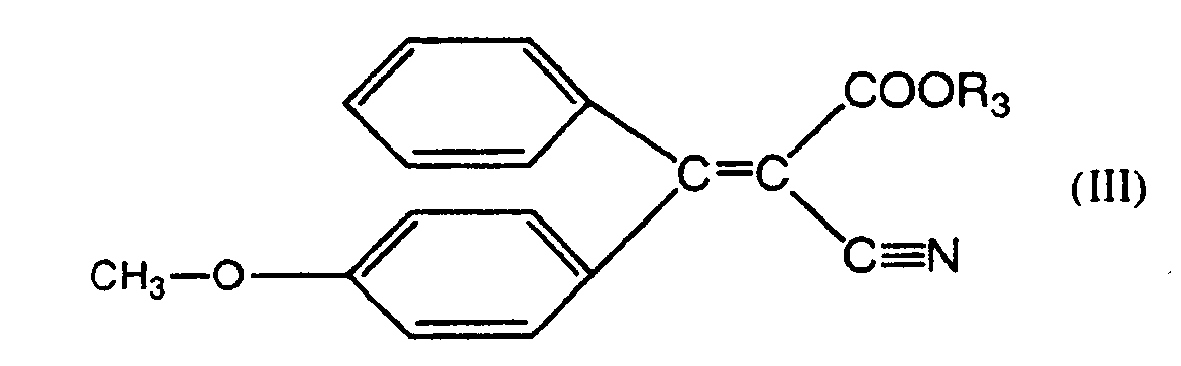
- The term "crylene" as used herein refers to a chromophoric moiety that includes an α -cyano-β,β-diphenyl propanoic acid ester.
- The term "cyano" as used herein refers to a -C≡N group, also designated "-CN."
- Photoactive compositions, e.g., sunscreen compositions, generally include UV-A and UV-B photoactive compounds in a cosmetically acceptable carrier, optionally including additives, such as emollients, stabilizers, emulsifiers, and combinations thereof. These additives can be used in preparing a UV filter composition in an emulsion (oil-in-water or water-in-oil) from a composition that includes one or more photoactive compounds and a solvent or a solvent combination that includes one or more organic solvents and water. When made, preferably the emulsion is an oil-in-water emulsion, wherein the oil phase is primarily formed from a mixture of the UV filter compound(s) and one or more organic solvents.
- A typical photoactive composition includes one or more photoactive compounds, wherein the photoactive compound(s) act to absorb UV radiation and thereby protect the substrate (e.g., human skin, resins, films, and the like) from the harmful effects of UV radiation. The absorption process causes a photoactive compound to reach an excited state, wherein the excited state is characterized by the presence of excited electronic energy (e.g., singlet state energy or triplet state energy), as compared to the ground state of the photoactive compound. Once a photoactive compound reaches an excited state there exists a number of pathways by which the excited photoactive compound can dissipate its excess energy (e.g., singlet and/or triplet energy), however, many of those pathways adversely affect the ability of the photoactive compound to further absorb UV radiation. The alkoxy crylene molecules described herein accept electronic singlet excited state energy from UV-absorbers, particularly Avobenzone, octyl methoxycinnamate (Octinoxate), and octyl salicylate (Octisalate). The alkoxy crylenes also are very effective UVA absorbers in addition to providing electronic singlet state energy quenching of other UV-absorbing compounds in sunscreen compositions. The alkoxy crylene molecules described herein are especially effective when combined with one or more additional electronic singlet excited state quenching compounds such as oxybenzone. Particularly surprising photostabilization is achieved in sunscreen compositions containing the alkoxy crylene molecules described herein together with octyl methoxycinnamate and Avobenzone.
- A photoactive compound is one that responds to light photoelectrically. In the compositions and methods of photostabilization disclosed herein, a photoactive compound is one that responds to UV radiation photoelectrically. For example, all photoactive compound-containing compositions that respond to UV radiation photoelectrically by photoactive compound photodegradation benefit highly by the inclusion of the alkoxy crylene molecules described herein. The alkoxy crylenes described herein are useful photostabilizers and/or photoactive compounds when combined with any single or combination photoactive compounds identified in Shaath, Nadim, Encyclopedia of UV filters, © 2007. Photostability is a problem with all UV filters because they all reach an electronic singlet excited state upon exposure to UV radiation.
- It is theorized that the following UV filters are photostabilized by the alkoxy crylene molecules described herein, including all of the following, including combinations of any two or more, and include compounds selected from the following categories (with specific examples) including: p-aminobenzoic acid, its salts and its derivatives (ethyl, isobutyl, glyceryl esters; p-dimethylaminobenzoic acid); anthranilates (o-aminobenzoates; methyl, menthyl, phenyl, benzyl, phenylethyl, linalyl, terpinyl, and cyclohexenyl esters); salicylates (octyl, amyl, phenyl, benzyl, menthyl (homosalate), glyceryl, and dipropyleneglycol esters); cinnamic acid derivatives (menthyl and benzyl esters, alpha-phenyl cinnamonitrile; butyl cinnamoyl pyruvate); dihydroxycinnamic acid derivatives (umbelliferone, methylumbelliferone, methylaceto-umbelliferone); camphor derivatives (3 benzylidene, 4 methylbenzylidene, polyacrylamidomethyl benzylidene, benzalkonium methosulfate, benzylidene camphor sulfonic acid, and terephthalylidene dicamphor sulfonic acid); trihydroxycinnamic acid derivatives (esculetin, methylesculetin, daphnetin, and the glucosides, esculin and daphnin); hydrocarbons (diphenylbutadiene, stilbene); dibenzalacetone; benzalacetophenone; naphtholsulfonates (sodium salts of 2-naphthal-3,6-disulfonic and of 2-naphthol-6,8-disulfonic acids); dihydroxy-naphthoic acid and its salts; O-and p-hydroxydiphenyldisulfonates; coumarin derivatives (7-hydroxy, 7-methyl, 3-phenyl); diazoles (2-acetyl-3-bromoindazole, phenyl benzoxazole, methyl naphthoxazole, various aryl benzothiazoles); quinine salts (bisulfate, sulfate, chloride, oleate, and tannate); quinoline derivatives (8-hydroxyquinoline salts, 2-phenylquinoline); hydroxy- or methoxy-substituted benzophenones; uric acid derivatives; vilouric acid derivatives; tannic acid and its derivatives; hydroquinone; and benzophenones (oxybenzone, sulisobenzone, dioxybenzone, benzoresorcinol, octabenzone, 4-isopropyldibenzoylmethane, butylmethoxydibenzoylmethane, etocrylene, and 4-isopropyl-dibenzoylmethane).
- The following UV filters should be particularly photostabilized by the alkoxy crylene molecules described herein: 2-ethylhexyl p-methoxycinnamate, 4,4'-t-butyl methoxydibenzoylmethane, octyldimethyl p-aminobenzoate, digalloyltrioleate, ethyl 4-[bis(hydroxypropyl)]aminobenzoate, 2-ethylhexylsalicylate, glycerol p-aminobenzoate, 3,3,5-trimethylcyclohexylsalicylate, and combinations thereof.
- Photoactive compositions disclosed herein can include a variety of photoactive compounds, preferably including one or more UV-A photoactive compounds and one or more UV-B photoactive compounds. Preferably, a sunscreen composition includes a photoactive compound selected from the group consisting of p-aminobenzoic acid and salts and derivatives thereof; anthranilate and derivatives thereof; dibenzoylmethane and derivatives thereof; salicylate and derivatives thereof; cinnamic acid and derivatives thereof; dihydroxycinnamic acid and derivatives thereof; camphor and salts and derivatives thereof; trihydroxycinnamic acid and derivatives thereof; dibenzalacetone naphtholsulfonate and salts and derivatives thereof; benzalacetophenone naphtholsulfonate and salts and derivatives thereof; dihydroxy-naphthoic acid and salts thereof; o-hydroxydiphenyldisulfonate and salts and derivatives thereof; p-hydroxydiphenyldisulfonate and salts and derivatives thereof; coumarin and derivatives thereof; diazole derivatives; quinine derivatives and salts thereof; quinoline derivatives; uric acid derivatives; vilouric acid derivatives; tannic acid and derivatives thereof; hydroquinone; diethylamino hydroxybenzoyl hexyl benzoate and salts and derivatives thereof; and combinations of the foregoing.
- UV A radiation (about 320 nm to about 400 nm), is recognized as contributing to causing damage to skin, particularly to very lightly colored or sensitive skin. A sunscreen composition disclosed herein preferably includes a UV-A photoactive compound. Preferably, a sunscreen composition disclosed herein includes a dibenzoylmethane derivative UV-A photoactive compound. Preferred dibenzoylmethane derivatives include, 2-methyldibenzoylmethane; 4-methyldibenzoylmethane; 4-isopropyldibenzoylmethane; 4-tert-butyldibenzoylmethane; 2,4-dimethyldibenzoylmethane; 2,5-dimethyldibenzoylmethane; 4,4'-diisopropyldibenzoylmethane; 4,4'-dimethoxydibenzoylmethane; 4-tert-butyl-4'-methoxydibenzoylmethane; 2-methyl-5-isopropyl-4'-methoxydibenzoylmethane; 2-methyl-5-tert-butyl-4'-methoxydibenzoylmethane; 2,4-dimethyl-4'-methoxydibenzoylmethane; 2,6-dimethyl-4-tert-butyl-4'-methoxydibenzoylmethane, and combinations thereof.
- For a product marketed in the United States, preferred cosmetically acceptable photoactive compounds and concentrations (reported as a percentage by weight of the total cosmetic sunscreen composition) include: aminobenzoic acid (also called para aminobenzoic acid and PABA; 15% or less), Avobenzone (also called butyl methoxy dibenzoylmethane; 3% or less), cinoxate (also called 2 ethoxyethyl p methoxycinnamate; 3% or less), dioxybenzone (also called benzophenone 8; 3% or less), homosalate ((also called 3,3,5-trimethylcyclohexyl salicylate, 15% or less), , menthyl anthranilate (also called menthyl 2 aminobenzoate; 5% or less), octocrylene (also called 2 ethylhexyl 2 cyano 3,3 diphenylacrylate; 10% or less), octyl methoxycinnamate (7.5% or less), octyl salicylate (also called 2 ethylhexyl salicylate; 5% or less), oxybenzone (also called benzophenone 3; 6% or less), padimate O (also called octyl dimethyl PABA; 8% or less), phenylbenzimidazole sulfonic acid (water soluble; 4% or less), sulisobenzone (also called benzophenone 4; 10% or less), titanium dioxide (25% or less), trolamine salicylate (also called triethanolamine salicylate; 12% or less), and zinc oxide (25% or less).
- Other preferred cosmetically acceptable photoactive compounds and preferred concentrations (percent by weight of the total cosmetic sunscreen composition) include diethanolamine methoxycinnamate (10% or less), ethyl-[bis(hydroxypropyl)] aminobenzoate (5% or less), glyceryl aminobenzoate (3% or less), 4 isopropyl dibenzoylmethane (5% or less), 4 methylbenzylidene camphor (6% or less), terephthalylidene dicamphor sulfonic acid (10% or less), and sulisobenzone (also called
benzophenone 4, 10% or less). - For a product marketed in the European Union, preferred cosmetically acceptable photoactive compounds and preferred concentrations (reported as a percentage by weight of the total cosmetic sunscreen composition) include: PABA (5% or less), camphor benzalkonium methosulfate (6% or less), homosalate (10% or less), benzophenone 3 (10% or less), phenylbenzimidazole sulfonic acid (8% or less, expressed as acid), terephthalidene dicamphor sulfonic acid (10% or less, expressed as acid), butyl methoxydibenzoylmethane (5% or less), benzylidene camphor sulfonic acid (6% or less, expressed as acid), octocrylene (10% or less, expressed as acid), polyacrylamidomethyl benzylidene camphor (6% or less), ethylhexyl methoxycinnamate (10% or less), PEG 25 PABA (10% or less), isoamyl p methoxycinnamate (10% or less), ethylhexyl triazone (5% or less), drometrizole trielloxane (15% or less), diethylhexyl butamido triazone (10% or less), 4 methylbenzylidene camphor (4% or less), 3 benzylidene camphor (2% or less), ethylhexyl salicylate (5% or less), ethylhexyl dimethyl PABA (8% or less), benzophenone 4 (5%, expressed as acid), methylene bis benztriazolyl tetramethylbutylphenol (10% or less), disodium phenyl dibenzimidazole tetrasulfonate (10% or less, expressed as acid), bis ethylhexyloxyphenol methoxyphenol triazine (10% or less), methylene bisbenzotriazolyl tetramethylbutylphenol (10% or less, also called TINOSORB M or Bisoctrizole), and bisethylhexyloxyphenol methoxyphenyl triazine.(10% or less, also called TINOSORB S or Bemotrizinol).
- All of the above described UV filters are commercially available. For example, suitable commercially available organic UV filters are identified by trade name and supplier in Table I below:
TABLE I CTFA Name Trade Name Supplier benzophenone-3 UVINUL M-40 BASF Chemical Co. benzophenone-4 UVINUL MS-40 BASF Chemical Co. benzophenone-8 SPECTRA-SORB UV-24 American Cyanamid DEA-methoxycinnamate BERNEL HYDRO Bernel Chemical diethylamino hydroxybenzoyl hexyl benzoate UVINUL A-PLUS BASF Chemical Co. diethylhexyl butamido triazone UVISORB HEB 3V-Sigma disodium phenyl dibenzylimidazole NEO HELIOPAN AP Symrise ethyl dihydroxypropyl- PABA AMERSCREEN P Amerchol Corp. glyceryl PABA NIPA G.M.P.A. Nipa Labs. homosalate KEMESTER HMS Humko Chemical menthyl anthranilate SUNAROME UVA Felton Worldwide octocrylene UVINUL N-539 BASF Chemical Co. octyl dimethyl PABA AMERSCOL Amerchol Corp. octyl methoxycinnamate PARSOL MCX Bernel Chemical PABA PABA National Starch 2-phenylbenzimidazole-5-sulphonic acid EUSOLEX 6300 EM Industries TEA salicylate SUNAROME W Felton Worldwide 2-(4-methylbenzildene)-camphor EUSOLEX 6300 EM Industries benzophenone-1 UVINUL 400BASF Chemical Co. benzophenone-2 UVINUL D-50 BASF Chemical Co. benzophenone-6 UVINUL D-49 BASF Chemical Co. benzophenone-12 UVINUL 408 BASF Chemical Co. 4-isopropyl dibenzoyl methane EUSOLEX 8020 EM Industries butyl methoxy dibenzoyl methane PARSOL 1789 Givaudan Corp. etocrylene UVINUL N-35 BASF Chemical Co. methylene bisbenzotriazolyl tetramethylbutylphenol TINOSORB M Ciba Specialty Chemicals bisethylhexyloxyphenol methoxyphenyl triazine. TINOSORB S Ciba Specialty Chemicals - Commonly-assigned
U.S. Patent Nos. 6,485,713 and6,537,529 describe compositions and methods for increasing the photostability of photoactive compounds in a sunscreen composition, e.g., by the addition of polar solvents to the oil phase of a composition. By increasing the polarity of the oil phase of a sunscreen composition including the alkoxy crylenes described herein, e.g., methoxy crylene, the stability of the sunscreen composition is surprisingly increased in comparison to octocrylene. In the sunscreen compositions described herein, preferably, one or more of a highly polar solvent is present in the oil-phase of the composition. Preferably, a sufficient amount of a polar solvent is present in the sunscreen composition to raise the dielectric constant of the oil-phase of the composition to a dielectric constant of at least about 7, preferably at least about 8. With or without the highly polar solvent in the oil phase, the methoxy crylene molecules described herein yield unexpected photostability in comparison to octocrylene. - A photoactive compound can be considered stable when, for example, after 30 MED irradiation the photoactive compound has retained at least about 90% of its original absorbance at a wavelength, or over a range of wavelengths of interest (e.g., the wavelength at which a photoactive compound has a peak absorbance, such as 350-370 nm for Avobenzone). Likewise, a sunscreen composition can include a plurality of photoactive compounds and a sunscreen composition, as a whole, can be considered stable when, for example, after 30 MED irradiation the sunscreen composition has retained at least about 90% of its original absorbance at one or more wavelengths of interest (e.g., at or near the peak absorbance wavelength of the primary photoactive compound).
- In accordance with one important embodiment, an alkoxycrylene of formula (I) is combined in a sunscreen or dermatological formulation with a water soluble UV filter compound and/or a broad-band filter compound and optionally, but preferably, together with a dibenzoylmethane derivative and/or a dialkyl naphthalate.
- Advantageous water-soluble UV filter substances for the purposes of the present invention are sulfonated UV filters, in particular:
- phenylene-1,4-bis(2-benzimidazyl)-3,3'-5,5'-tetrasulfonic acid, which has the following structure:

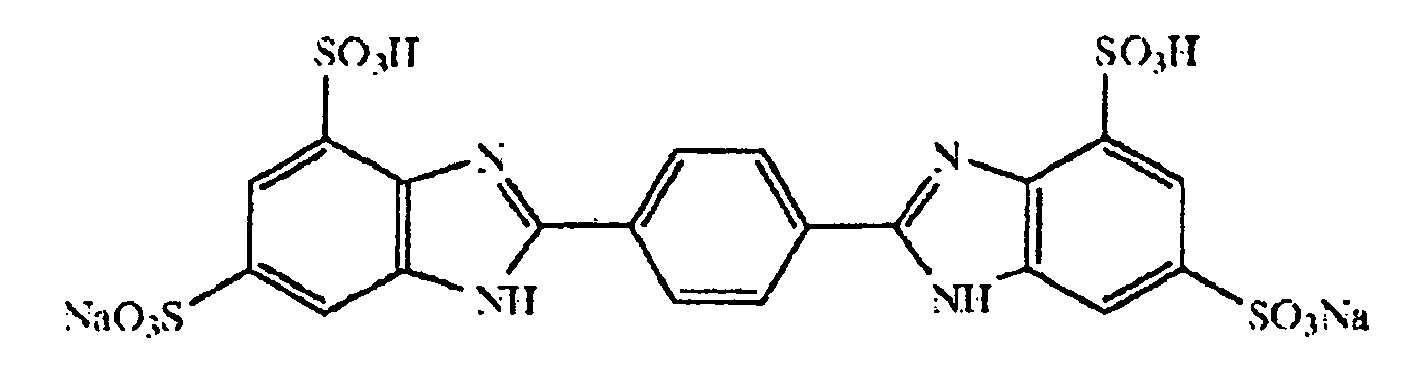
- Further advantageous sulfonated UV filters for the purposes of the present invention are the salts of 2-phenylbenzimidazole-5-sulfonic acid, such as its sodium, potassium or its triethanolammonium salts, and the sulfonic acid itself

- with the INCI name phenylbenzimidazole sulfonic acid (CAS No. 27503-81-7), which is obtainable for example under the proprietary name Eusolex 232 from Merck or under Neo Heliopan Hydro from Haarmann & Reimer.
- Further advantageous water-soluble UV-B and/or broad-band filter substances for the purposes of the present invention are, for example, sulfonic acid derivatives of 3-benzylidenecamphor, such as, for example, 4-(2-oxo-3-bornylidenemethyl)benzene-sulfonic acid, 2-methyl-5-(2-oxo-3-bornylidenemethyl)sulfonic acid and the salts thereof.
- The total amount of one or more water-soluble UV filter substances in the finished cosmetic or dermatological preparations is advantageously chosen from the range 0.01 % by weight to 20% by weight, preferably from 0.1 to 10% by weight, in each case based on the total weight of the preparations.
- In accordance with another important embodiment, an alkoxycrylene of formula (I) is combined in a sunscreen or dermatological formulation with a hydroxybenzophenone compound and/or a broad-band filter compound and optionally, but preferably, together with a dibenzoylmethane derivative and/or a dialkyl naphthalate.
- With an alkoxycrylene, it is possible to completely dispense with the use of other UV stabilizers, in particular the use of ethylhexyl-2-cyano-3,3-diphenylacrylate(octocrylene) or 4-methylbenzylidenecamphor.
- Hydroxybenzophenones are characterized by the following structural formula:

- A particularly advantageous hydroxybenzophenone is the 2-(4'-diethylamino-2'-hydroxybenzoyl)benzoic acid hexyl ester (also: aminobenzophenone) which is characterized by the following structure:

- According to the invention, cosmetic or dermatological preparations contain 0.1 to 20% by weight, advantageously 0.1 to 15% by weight, very particularly preferred 0.1 to 10% by weight, of one or more hydroxybenzophenones.
- Within the scope of the present invention, dialkyl naphthalates for which R1 and/or R2 represent branched alkyl groups with 6 to 10 carbon atoms are advantageous. Within the scope of the present invention diethylhexyl naphthalate is very particularly preferred which is available, e.g., under the trade name Hallbrite TQ™ from CP Hall or Corapan TQ™ from H&R.
- According to one embodiment of the invention cosmetic or dermatological preparations advantageously contain 0.001 to 30% by weight, preferably 0.01 to 20% by weight, very particularly preferred 0.5 to 15% by weight, of one or more dialkyl naphthalates.
- The cosmetic or dermatological light-protection formulations according to the invention can be composed as usual and be used for cosmetic or dermatological light-protection, furthermore for the treatment, care and cleansing of the skin and/or hair and as a cosmetic product in decorative cosmetics.
- The cosmetic or dermatological light protection formulations of the invention may have conventional compositions and be used for cosmetic or dermatological light protection and for the treatment, care and cleansing of skin and/or the hair and as a make-up product in decorative cosmetics.
- For use, the cosmetic and dermatological preparations are applied to the skin and/or the hair in a sufficient quantity in the manner customary for cosmetics.
- Cosmetic and dermatological preparations according to the invention can comprise cosmetic auxiliaries such as those conventionally used in such preparations, e.g. preservatives, bactericides, perfumes, antifoams, dyes, pigments which have a coloring effect, thickeners, moisturizers and/or humectants, fats, oils, waxes or other conventional constituents of a cosmetic or dermatological formulation, such as alcohols, polyols, polymers, foam stabilizers, electrolytes, organic solvents or silicone derivatives.
- An additional content of antioxidants is generally preferred. According to the invention, favorable antioxidants which can be used are any antioxidants suitable or conventional for cosmetic and/or dermatological applications.
- The antioxidants are particularly advantageously chosen from the group consisting of amino acids (e.g. glycine, histidine, tyrosine, tryptophan) and derivatives thereof, imidazoles (e.g. urocanic acid) and derivatives thereof, peptides such as D,L-camosine, D-carnosine, L-carnosine and derivatives thereof (e.g. anserine), carotenoids, carotenes (e.g. .alpha.-carotene, .beta.-carotene, lycopene) and derivatives thereof, chlorogenic acid and derivatives thereof, lipoic acid and derivatives thereof (e.g. dihydrolipoic acid), aurothioglucose, propylthiouracil and other thiols (e.g. thioredoxin, glutathione, cysteine, cystine, cystamine and the glycosyl, N-acetyl, methyl, ethyl, propyl, amyl, butyl and lauryl, palmitoyl, oleyl, .gamma.-linoleyl, cholesteryl and glyceryl esters thereof) and salts thereof, dilauryl thiodipropionate, distearyl thiodipropionate, thiodipropionic acid and derivatives thereof (esters, ethers, peptides, lipids, nucleotides, nucleosides and salts) and sulfoximine compounds (e.g. buthionine sulfoximines, homocysteine sulfoximine, buthionine sulfones, penta-, hexa-, heptathionine sulfoximine) in very low tolerated doses (e.g. pmol to .mu.mol/kg), and also (metal) chelating agents (e.g..alpha.-hydroxy fatty acids, palmitic acid, phytic acid, lactoferrin), .alpha.-hydroxy acids (e.g. citric acid, lactic acid, malic acid), humic acid, bile acid, bile extracts, bilirubin, biliverdin, EDTA, EGTA and derivatives thereof, unsaturated fatty acids and derivatives thereof (e.g..gamma.-linolenic acid, linoleic acid, oleic acid), folic acid and derivatives thereof, ubiquinone and ubiquinol and derivatives thereof, vitamin C and derivatives (e.g. ascorbyl palmitate, Mg ascorbyl phosphate, ascorbyl acetate), tocopherols and derivatives (e.g. vitamin E acetate), vitamin A and derivatives (vitamin A palmitate) and coniferyl benzoate of gum benzoin, rutinic acid and derivatives thereof, .alpha.-glycosylrutin, ferulic acid, furfurylideneglucitol, carnosine, butylhydroxytoluene, butylhydroxyanisole, nordihydroguaiaretic acid, trihydroxybutyrophenone, uric acid and derivatives thereof, mannose and derivatives thereof, zinc and derivatives thereof (e.g. ZnO, ZnSO4), selenium and derivatives thereof (e.g. selenomethionine), stilbenes and derivatives thereof (e.g. stilbene oxide, trans-stilbene oxide) and the derivatives (salts, esters, ethers, sugars, nucleotides, nucleosides, peptides and lipids) of said active ingredients which are suitable according to the invention.
- In accordance with another important embodiment, an alkoxycrylene of formula (I) is combined in a sunscreen or dermatological formulation with hydrophilic skincare active ingredients and/or a broad-band filter compound and optionally, but preferably, together with a dibenzoylmethane derivative.
- Advantageous hydrophilic active ingredients which (individually or in any combinations with one another) are stabilized by their use together with an alkoxycrylene according to the invention include those listed below:
- biotin ; carnitine and derivatives ; creatine and derivatives ; folic acid ; pyridoxine ; niacinamide ; polyphenols (in particular flavonoids, very particularly alpha-glucosylrutin) ; ascorbic acid and derivatives ; Hamamelis ; Aloe Vera ; panthenol ; amino acids.
- Particularly advantageous hydrophilic active ingredients for the purposes of the present invention are also water-soluble antioxidants, such as, for example, vitamins.
- The amount of hydrophilic active ingredients (one or more compounds) in the preparations is preferably 0.0001 to 10% by weight, particularly preferably 0.001 to 5% by weight, based on the total weight of the preparation.
- Particularly advantageous preparations are also obtained when antioxidants are used as additives or active ingredients. According to the invention, the preparations advantageously comprise one or more antioxidants. Favorable, but nevertheless optional antioxidants which may be used are all antioxidants customary or suitable for cosmetic and/or dermatological applications.
- The amount of antioxidants (one or more compounds) in the preparations is preferably 0.001 to 30% by weight, particularly preferably 0.05 to 20% by weight, in particular 0.1 to 10% by weight, based on the total weight of the preparation.
- If vitamin E and/or derivatives thereof are the antioxidant or antioxidants, it is advantageous to choose their respective concentrations from the range from 0.001 to 10% by weight, based on the total weight of the formulation.
- If vitamin A or vitamin A derivatives, or carotenes or derivatives thereof are the antioxidant or antioxidants, it is advantageous to choose their respective concentrations from the range from 0.001 to 10% by weight, based on the total weight of the formulation.
- It is particularly advantageous when the cosmetic preparations according to the present invention comprise further cosmetic or dermatological active ingredients, preferred active ingredients being antioxidants which can protect the skin against oxidative stress.
- Advantageous further active ingredients are natural active ingredients and/or derivatives thereof, such as e.g. ubiquinones, retinoids, carotenoids, creatine, taurine and/or .beta.-alanine.
- Formulations according to the invention, which comprise e.g. known antiwrinkle active ingredients, such as flavone glycosides (in particular .alpha.-glycosylrutin), coenzyme Q10, vitamin E and/or derivatives and the like, are particularly advantageously suitable for the prophylaxis and treatment of cosmetic or dermatological changes in skin, as arise, for example, during skin aging (such as, for example, dryness, roughness and formation of dryness wrinkles, itching, reduced refatting (e.g. after washing), visible vascular dilations (teleangiectases, couperosis), flaccidity and formation of wrinkles and lines, local hyperpigmentation, hypopigmentation and abnormal pigmentation (e.g. age spots), increased susceptibility to mechanical stress (e.g. cracking) and the like). In addition, they are advantageously suitable against the appearance of dry or rough skin.
- In accordance with still another important embodiment, an alkoxycrylene of formula (I) is combined in a sunscreen or dermatological formulation with particulate UV filter substances and/or a broad-band filter compound and optionally, but preferably, together with a dibenzoylmethane derivative and/or a dialkyl naphthalate.
- Preferred particulate UV filter substances for the purposes of the present invention are inorganic pigments, especially metal oxides and/or other metal compounds which are slightly soluble or insoluble in water, especially oxides of titanium (TiO2), zinc (ZnO), iron (e.g. Fe2O3), zirconium (ZrO2), silicon (SiO2), manganese (e.g. MnO), aluminum (Al2O3), cerium (e.g. Ce2O3), mixed oxides of the corresponding metals, and mixtures of such oxides, and the sulfate of barium (BaSO4).
- Zinc oxides for the purposes of the present invention may also be used in the form of commercially available oily or aqueous predispersions. Zinc oxide particles and predispersions of zinc oxide particles which are suitable according to the invention are distinguished by a primary particle size of <300 nm and can be obtained under the following proprietary names from the stated companies:
Proprietary name Coating Manufacturer Z- Cote HP1 2% Dimethicone BASF Z-Cote / BASF ZnO NDM 5% Dimethicone H&R ZnO Neutral / H&R MZ-300 / Tayca Corporation MZ-500 / Tayca Corporation MZ-700 / Tayca Corporation MZ-303S 3% Methicone Tayca Corporation MZ- 505S 5% Methicone Tayca Corporation MZ- 707S 7% Methicone Tayca Corporation MZ-303M 3% Dimethicone Tayca Corporation MZ- 505M 5% Dimethicone Tayca Corporation MZ- 707M 7% Dimethicone Tayca Corporation Z-Sperse Ultra ZnO (>=56%)/Ethythexyl Hydroxystearate Benzoate/ Dimethicone/ Cyclomethicone Collaborative Laboratories Samt-UFZO- 450/D5 (60%) ZnO (60%)/Cyclomethicone/ Dimethicone Miyoshi Kasei - Particularly preferred zinc oxides for the purposes of the invention are Z-Cote HP1 and Z-Cote from BASF and zinc oxide NDM from Haarmann & Reimer.
- Titanium dioxide pigments of the invention may be in the form of both the rutile and anatase crystal modification and may for the purposes of the present invention advantageously be surface-treated ("coated"), the intention being for example to form or retain a hydrophilic, amphiphilic or hydrophobic character. This surface treatment may consist of providing the pigments by processes known per se with a thin hydrophilic and/or hydrophobic inorganic and/or organic layer. The various surface coatings may for the purposes of the present invention also contain water.
- Inorganic surface coatings for the purposes of the present invention may consist of aluminum oxide (Al.sub.20.sub.3), aluminum hydroxide Al(OH).sub.3 or aluminum oxide hydrate (also: alumina, CAS No.: 1333-84-2), sodium hexametaphosphate (NaPO.sub.3).sub.6, sodium metaphosphate (NaPO.sub.3).sub.n, silicon dioxide (SiO.sub.2) (also: silica, CAS No.: 7631-86-9), or iron oxide (Fe.sub.20.sub.3). These inorganic surface coatings may occur alone, in combination and/or in combination with organic coating materials.
- Organic surface coatings for the purposes of the present invention may consist of vegetable or animal aluminum stearate, vegetable or animal stearic acid, lauric acid, dimethylpolysiloxane (also: dimethicones), methylpolysiloxane (methicones), simethicones (a mixture of dimethylpolysiloxane with an average chain length of from 200 to 350 dimethylsiloxane units and silica gel) or alginic acid. These organic surface coatings may occur alone, in combination and/or in combination with inorganic coating materials.
- Coated and uncoated titanium dioxides of the invention may be used in the form of commercially available oily or aqueous predispersions. It may be advantageous to add dispersion aids and/or solubilization mediators.
- Suitable titanium dioxide particles and predispersions of titanium dioxide particles for the purposes of the present invention are obtainable under the following proprietary names from the stated companies:
Proprietary name Coating Additional ingredients of the predispersion Manufacturer MT-150W None -- Tayca Corporation MT-150A None -- Tayca Corporation MT-500B None -- Tayca Corporation MT-600B None -- Tayca Corporation TMT-100TV Aluminum hydroxide Stearic acid -- Tayca Corporation MT-100Z Aluminum hydroxide Stearic acid -- Tayca Corporation MT-100T Aluminum hydroxide Stearic acid -- Tayca Corporation MT-500T Aluminum hydroxide Stearic acid -- Tayca Corporation MT-100S Aluminum hydroxide Stearic acid -- Tayca Corporation MT-100F Lauric acid Stearic acid Iron oxide -- Tayca Corporation MT-100SA Alumina Silica -- Tayca Corporation MT-500SA Alumina Silica -- Tayca Corporation MT-600SA Alumina Silica -- Tayca Corporation MT-100SAS Alumina Silica Silicone -- Tayca Corporation MT-500SAS Alumina Silica Silicone -- Tayca Corporation MT-500H Alumina Silica -- Tayca Corporation MT-100AQ Silica Aluminum hydroxide Alginic acid -- Tayca Corporation Eusolex T Water Simethicone -- Merck KgaA Eusolex T-2000 Alumina Simethicone -- Merck KgaA Eusolex T-Olio F Silica Dimethylsilate Water C12-15 Alkylbenzoate Calcium Poly- hydroxystearate Silica Dimethylsilate Merck KgaA Eusolex T-Olio P Water Simethicone Octyl Palmitate PEG-7 Hydrogenated Castor Oil Sorbitan Oleate Hydrogenated Castor Oil Beeswax Stearic acid Merck KgaA Eusolex T-Aqua Water Alumina Sodium metaphosphate Phenoxyethanol Sodium Methylparabens Sodium metaphosphate Merck KgaA Eusolex T-45D Alumina Simethicone Isononyl Isononanuate Polyglyceryl Ricinoleate Merck KgaA Kronos 1171 (Titanium dioxide 171) None -- Kronos Titanium dioxide P25 None -- Degussa Titanium dioxide T805 Octyltri-methylsilane (Uvinul TiO2) -- Degussa UV-Titan X610 Alumina Dimethicone -- Kemira UV-Titan X170 Alumina Dimethicone -- Kemira UV-Titan X161 Alumina Silica Stearic acid -- Kemira UV-Titan M210 Alumina -- Kemira UV-Titan M212 Alumina Glycerol Kemira UV-Titan M262 Alumina Silicone -- Kemira UV-Titan M160 Alumina Silica Stearic acid -- Kemira Tioveil AQ 10PG Alumina Silica Water Propylene glycol Solaveil Uniquema Mirasun TiW 60 Alumina Silica Water Rhone-Poulenc - The titanium dioxides of the invention are distinguished by a primary particle size between 10 nm to 150 nm.
- Titanium dioxides particularly preferred for the purposes of the present invention are MT-100 Z and MT-100 TV from Tayca Corporation, Eusolex T-2000 from Merck and titanium dioxide T 805 from Degussa.
- Further advantageous pigments are latex particles. Latex particles which are advantageous according to the invention are described in the following publications:
U.S. Pat. No. 5,663,213 andEP 0 761 201 - An advantageous organic pigment for the purposes of the present invention is 2,2'-methylenebis(6-(2H-benzotriazol-2-yl)-4-(1,1,3,3-tetramethylbutyl- )phenol) (INCI: bis-octyltriazol), which is obtainable under the proprietary name Tinosorb® M from CIBA-Chemikalien GmbH.
- It is particularly advantageous for the purposes of the present invention for particulate UV filter substances which are not already in the form of a predispersion first to be dispersed in one or more dialkyl naphthalates of the invention and for this basic dispersion then to be further processed. Whereas auxiliaries which may enter into unwanted interactions with other substances of the cosmetic or dermatological formulation are usually added for stabilization to commercially available predispersions, it is astonishingly possible to dispense with the addition of such stabilizers when preparing basic dispersions of the invention.
- The total amount of one or more water-soluble UV filter substances in the finished cosmetic or dermatological preparations is advantageously chosen from the range 0.01% by weight to 20% by weight, preferably from 0.1 to 10% by weight, in each case based on the total weight of the preparations.
- The cosmetic or dermatological light protection formulations of the invention may have conventional compositions when used for cosmetic or dermatological light protection and for the treatment, care and cleansing of skin and/or the hair and as a make-up product in decorative cosmetics.
- In accordance with one important embodiment, an alkoxycrylene of formula (I) is combined in a sunscreen or dermatological formulation with a lipophilic oxidation or UV-sensitive active ingredients, such as retinoic acid and its derivatives, e.g., tretinoin or isotretinoin and/or a broad-band filter compound and optionally, but preferably, together with a dibenzoylmethane derivative.
- Advantageous lipophilic active ingredients which are stabilized in an excellent manner by the use according to the invention are those whose log P value is greater than 3.5. P is the partition coefficient, which is defined as the ratio of the equilibrium concentration of a dissolved substance in a two-phase system which consists of two solvents which are essentially immiscible with one another. These two solvents are, in the present case, n-octanol and water, i.e.

- It is advantageous for the purposes of the present invention to choose the lipophilic active ingredients from the group of ubiquinones and plastoquinones. For the purposes of the present invention, coenzyme Q10, which has a log P value of about 15, is very particularly advantageous.
- It was particularly surprising that very advantageous preparations according to the present invention can be obtained when the active ingredient(s) is/are chosen only from the group of ubiquinones.
- Further lipophilic active ingredients which are advantageous according to the invention are retinoids (vitamin A acid and/or derivatives thereof) or vitamin A and/or derivatives thereof. The group of retinoids advantageous according to the invention is defined as including all cosmetically and/or pharmaceutically acceptable retinoids, including retinol and its esters, retinal and also retinoic acid (vitamin A acid) and esters thereof. For the purposes of the present invention, retinol (with a log P value of about 7) and retinyl palmitate (with a log P value of about 13) are particularly advantageous.
- It was also particularly surprising that very advantageous preparations can be obtained according to the present invention when the active ingredient(s) is/are chosen only from the group of retinoids.
- Further lipophilic acid ingredients advantageous according to the invention are carotenoids. For the purposes of the present invention, .beta.-carotene, which has a log P value of 15. for example, is particularly advantageous.
- Further lipophilic active ingredients advantageous according to the invention are: lipoic acid and derivatives, vitamin E and derivatives, vitamin F, dioic acid [8-hexadecene-1,16-dicarboxylic acid (CAS number 20701-68-2)]
- The amount of lipophilic active ingredients (one or more compounds) in the preparations is preferably 0.0001 to 10% by weight, particularly preferably 0.001 to 5% by weight, based on the total weight of the preparation.
- Synthesis of methyl or ethyl 2-cyano-3-(4'-methoxyphenyl)-3-phenylpropenoate (Methyl or Ethyl Methoxycrylene or Methyl or Ethyl MeOcrylene)

-
- 1. Aliquots of the reaction mixture are taken to check the rate of completion of the reaction.
- 2. The amount of water expected from this reaction is 49.5 ml. However, 1 collected about 120 ml of water phase. This is due to the fact that the water is distilled in form of a mixture, water/acetic acid/toluene.
- 3. To prevent from loosing the methyl acetate from the reaction mixture, it helps to put a short packed column between Dean-Stark receiver and the flask.
- The reaction mixture is cooled to room temperature and ethyl acetate is added to dissolve all solids before the crude mixture is washed several time with water, to remove acetic acid and salts. The solvents are then removed from the reaction mixture by distillation. The crude solid product is re-crystallized from hot methanol (or toluene/methanol mixture, if such is preferred).
- The finished product begins to crystallize out from the cooling reaction mixture and thus can be filtered off, but it still is very acidic, so the crystals ought to be washed with water/methanol mixture to wash out any acetic acid and salts residues. Thus obtained the product then can be re-crystallized and the mother liquor can be washed with water, dried, and second crop of the product can be obtained.
-

- Methyl (or ethyl) 2-cyano-3-(4'-methoxyphenyl)-3-phenylpropenoate (900g, 3.06 mole; MW = 293.32), alkyl alcohol (3.84 mole; 1.25 mole equivalence), and Tegokat 250 (0.03 % of total batch weight) were placed in 2 L 3-neck round-bottom flask and heated to temperature set at 185 C (365 F), with nitrogen purging it well to remove forming methanol (or ethanol) via the simple distillation setup with packed column.
- After 3 h, GC showed full conversion of methyl 2-cyano-3-(4'-methoxyphenyl)-3-phenylpropenoate to the desired product.
- The unreacted alkyl alcohol was completely removed by vacuum distillation. Temperature of the reaction was lowered to 110 C (230 F) and calculated amount (2% of total batch weight) of the SSP (tin removing agent) was added. The product was stirred at this temperature for 2 hours and then filtered hot. Small amount of celite was added right before filtration to enhance the filtration - with celite the filtration was more efficient and faster.
-
Yield of the product 94% of stoichiometric amount Purity of finished product 99.81% (area count, GC). - The following compositions (Table I) were prepared according to the procedure indicated in order to show the surprisingly superior photostabilizing effect on avobenzone of the alkoxycrylenes (4.5 wt.%) described herein in comparison to an equimolar amount (2.75 wt.%) of octocrylene. The compound described as "methoxycrylene" had the following formula (IV):


- The surprising photostability of the sunscreen composition of Example 1, Table I, including methoxycrylene, in comparison to the octocrylene of the prior art, is shown in
Fig. 1 , which is a graph of the data of Examples 1 through 3, above, and in the following SPF reports for Examples 4-6.
- Additional alkoxycrylene molecules were tested in accordance with the procedure indicated in Table 2, wherein radical R3 of the alkoxycrylene of formula (I) has an R3 = ethyl hexyl (formula IV):

Fig. 2 and the data for the composition of Example 5 is shown in the graph ofFig. 3 . For Examples 4-6, the data of Example 6 (shown in graph form asFig. 4 ) compares 7% ethylhexyl methoxycrylene (formula V) and 1.8% octocrylene (Example 4) to 8.8% octocrylene with no alkoxycrylene. As shown in the graph ofFig. 4 and the following SPF reports for Examples 4-6, the alkoxy crylenes described herein are unexpectedly better photostabilizers than octocrylene.SPF REPORT Sample: Example 4 UV Photostability Comment: 0, 35 MED Wavelength Range: 290 - 400 nm Units: SPF T(UVA) T(UVB) # of Scans: 2 2 2 Mean: 24.67 4.52% 5.43% STD: 1.83 0.83% 0.35% COV: 7.43% 18.26% 6.46% UVA/UVB Ratio: 1.1 Boots Star Rating: N/A less than 5 Scans Scan # SPF Critical Wavelength 1 25.97 385 2 23.37 384 SPF REPORT Sample: Example 5 UV Photostability Comment: 0, 35 MED Wavelength Range: 290 - 400 nm Units: SPF T(UVA) T(UVB) # of Scans: 2 2 2 Mean: 16.76 23.10% 8.07% STD: 11.8 18.59% 4.20% COV: 70.42% 80.47% 52.01% UVA/UVB Ratio: 0.72 Boots Star Rating: N/A less than 5 Scans Scan # SPF Critical Wavelength 1 25.11 380 2 8.41 372 SPF REPORT Sample: Example 6 UV Photostability Comment: 0, 35 MED Wavelength Range: 290 - 400 nm Units: SPF T(UVA) T(UVB) # of Scans: 2 2 2 Mean: 23.83 11.80% 5.27% STD: 3.81 6.61% 0.24% COV: 16.00% 55.96% 4.51% UVA/UVB Ratio: 0.88 Boots Star Rating: N/A less than 5 Scans Scan # SPF Critical Wavelength 1 26.52 382 2 21.13 375 - As shown in the above-referenced formulations and data of Examples 4-6, the combination of avobenzone (UVA) with octylmethoxycinnamate (UVB) has particularly surprising results when combined with a stabilizing amount of an alkoxycrylene of formula I. It is well know that octocrylene stabilizes octyl methoxycinnamate (OMC), a UVB filter, but does not photostabilizer avobenzone, a UVA filter. In accordance with the compositions and methods described herein, it has been found that the alkoxycrylene of formula I photostabilize octyl methyoxycinnemate (OMC) much better than OMC, and also photostabilizes avobenzone. The alkoxycrylenes, therefore, can photostabilize sunscreen compositions. Accordingly, by adding an alkoxycrylene, both avobenzone and OMC can be photostabilized by the alkoxycrylene.
- Example 4 (7% alkoxycrylene and 1.8% octocrylene) loses only 18.26% UVA; 6.46% UVB; and 7.43% of its SPM when subjected to 35 MED irradiation. The same formulation containing no alkoxycrylene (Example 5) loses 80.47% UVA; 52.01% UVB; and 70.42% of its SPF. Example 6, containing 8.8% octocrylene and no alkoxycrylene loses 55.96% UVA; 4.51 % UVB (octocrylene photostabilizes OMC but not avobenzone); and 16% of its SPF, Examples 4,5 and 6 are shown graphically in
Figures 2 ,3 and4 . - Additional sunscreen compositions were prepared containing 0 wt.%, 3 wt.% and 5 wt.% 2-ethylhexyl methoxycrylene, as shown in Examples 7-10 in Table 3:

- The results were as follows and clearly show that adding more alkoxycrylene to sunscreen formulation provides more Photostabilization of both UVA and UVB filters. Example 7, having the most MOC (5%) and the least OC (5%) provided the best results.
Example 7 Example 8 Example 9 Example 10 Results of Irradiation with 20 MED 5% OC/5 % MOC 7% OC/3% MOC 10% OC/0% MOC 10% OC/3% MOC UVA1/UV ratio before UV irradiation 0.84 0.83 0.79 0.83 UVA1/UV ratio after 20 MED 0.76 0.71 0.54 0.70 Difference after irradiation 0.09 0.12 0.25 0.13 % change 10.00% 15.00% 32.00% 16.00% OC=Octocrylene; MOC=Ethylhexyl Methoxycrylene; UVA1=total area under curve from 340 to 400nm; UV=total area under curve from 290 to 400nm - More sunscreen compositions were prepared containing 0, 2, 4 and 6 wt.% 2-ethylhexyl methoxycrylene to test the photostabilizing capacity of the methoxycrylenes to photostabilize avobenzone and other photodegradable UV-absorbers, as shown in Examples 11-14 in Table 4:


- The results were as follows:

- It should be noted that the sunscreen formulations of Examples 11-14 contain no octyl methoxycinnemate or other photostabilizers. It is clear from the data of Examples 11-14 that the alkoxycrylene of formula I photostabilize avobenzone and other dibenzoylmethane derivatives with surprising efficacy.
- Additional sunscreen compositions were prepared containing 5 wt.% 2-ethylhexyl methoxycrylene with and without 1.5 wt.% Tinosorb S or Tinosorb M, as shown in Examples 15 and 16 in Table 5:


- The results were as follows:

- Tinsorb S of Examples 15 and 16 is a known UVA and UVB photostabilizer (more effective in the UVA range) for photostabilizing both avobenzone and octyl methoxycinnamate. Surprisingly, as shown in the data of Examples 15 and 16 (both Examples include 5% MOC) omitting the Tinsorb S from Example 16 makes very little difference in photostabilizing the combination of avobenzone and OMC.
- Additional sunscreen formulations were tested containing 5 wt.% butyloctyl methoxycrylene and a triazine derivative (Uvinul T-150); a benzophenone derivative (Uvinul A Plus); and three water soluble UV filters (Mexonylsx; Neo Heliopan AP; and Neo Heliopan Hydro), as shown in examples 17-21 of table 6:

- Two more sunscreen formulations (Examples 22 and 23) were prepared each containing butyloctyl methoxycrylene, and Example 23 also containing Tinosorb® S and Tinosorb® M. As shown in the results, the combination of an alkoxycrylene, together with a dibenzoylmethane derivative, a cinnamate ester, Tinasorb® S and Tinasorb® M, avobenzone and octyl methoxycinnamate is particularly photostable:

- In addition to the simple ester alkoxy crylene compounds of formula (I)-(V), the alkoxy crylene moieties can be attached as one or more terminal moieties on a polyester molecule, such as the alkoxy derivatives of the Di (NPG Crylene) Fumerate polyesters disclosed in this assignee's
U.S. Patent No. 7,235,587 ('587), hereby incorporated by references, as shown in formula (VI):
Claims (49)
- A photostabilized photoactive composition comprising a mixture of a photoactive compound that develops a singlet excited State, or fluoresces when subjected to UV radiation and a singlet excited State quenching effective amount of a compound of formula (I):

- The photostabilized photoactive composition of claim 1, wherein R1 is methoxy and R2 is hydrogen.
- The photostabilized photoactive composition of claim 1, wherein R2 is methoxy and R1 is hydrogen.
- The photostabilized photoactive composition of claim 2, wherein R3 is a C12-C30 straight chain or branched alkyl.
- The photostabilized photoactive composition of claim 1, wherein the compound of formula (I) is present in an amount in the weight range of 0.1% to 30%, based on the total weight of the composition.
- The photostabilized photoactive composition of claim 1, wherein the photoactive compound is selected from the group consisting of p-aminobenzoic acid and salts and derivatives thereof; anthranilate and derivatives thereof; dibenzoylmethane and derivatives thereof; salicylate and derivatives thereof; cinnamic acid and derivatives thereof; dihydroxycinnamic acid and derivatives thereof; camphor and salts and derivatives thereof; trihydroxycinnamic acid and derivatives thereof; dibenzalacetone; benzalacetophenone; naphtholsulfonate and salts and derivatives thereof; dihydroxy-naphthoic acid and salts thereof; o-hydroxydiphenyldisulfonate and salts and derivatives thereof; p-hydroxdydiphenyldisulfonate and salts and derivatives thereof; coumarin and derivatives thereof; diazole derivatives; quinine derivatives and salts thereof; quinoline derivatives; hydroxyl-substituted benzophenone derivatives; naphthalate derivatives; methoxy-substituted benzophenone derivatives; uric acid derivatives; violuric acid derivatives; tannic acid and derivatives thereof; hydroquinone; benzophenone derivatives; 1,3, 5- triazine derivatives; disodium phenyl dibenzimidazole sulfonic acid and salts thereof; terephthalylidene dicamphor sulfonic acid and salts and derivatives thereof; methylene bis-benzotriazolyl tetramethylbutylphenol and salts and derivatives thereof; bis-ethylhexyloxyphenol methoxyphenyl triazine and salts, diethylamino hydroxyl benzoyl hexyl benzoate and derivatives thereof; phenylbenzimidazole sulfonic acid and salts thereof; and combinations of the foregoing.
- The photostabilized photoactive composition of claim 1, wherein the photoactive compound is selected from group consisting of a dibenzoylmethane derivative; a cinnamate ester; an ester of an alkoxycinnamate; and a combination thereof.
- The photostablized photoactive composition of claim 7, wherein the cinnamate ester is selected from the group consisting of 2-ethylhexyl p-methoxycinnamate; isoamyl p-methoxycinnamate; and a combination thereof.
- The photostabilized photoactive composition of claim 7, wherein the dibenzoylmethane derivative comprises butylmethoxy dibenzoylmethane.
- The photostabilized photoactive composition of claim 1, further including a naphthalene dicarboxylic acid ester in an amount of 0.1 to 10 wt%.
- The photostabilized photoactive composition of claim 1, further including a salicylate or a derivative thereof in an amount of 0.1 to 10 wt%.
- The photostabilized photoactive composition of claim 7, further including bis-ethylhexyloxyphenol methoxyphenyl triazine in an amount of 0.1 to 10 wt.%.
- The photostabilized photoactive composition of claim 7, further including diethylhexyl syringylidene malonate in an amount of 0.1 to 10 wt.%.
- The photostabilized photoactive composition of claim 1, wherein the photoactive compound comprises a 1,3,5-triazine derivative.
- The photostabilized photoactive composition of claim 7, further including methylene bis-benzotriazoyl tetramethylbutyl phenol in an amount of 0.1 to 10 wt.%.
- The photostabilized photoactive composition of claim 7, further including diethylamino hydroxybenzoyl hexylbenzoate in an amount of 0.1 to 10 wt.%.
- The photostabilized photoactive composition of claim 7, further including disodium phenyldibenzimidazole sulfonic acid in an amount of 0.1 to 10 wt. %.
- The photostabilized photoactive composition of claim 7, further including 2-(methylbenzilidene)-camphor.
- The photostabilized photoactive composition of claim 7, further including phenylbenzimidazole sulfonic acid or salt thereof in an amount of 0.1 to 10 wt.%.
- The photostabilized photoactive composition of claim 1 further including 0.1 to 10 wt.% % of a triplet quencher selected from the group consisting of octocrylene, methyl benzylidene camphor, diethylhexyl 2,6 naphthalate, diethylhexyl syringylidene malonate, and combinations thereof.
- The photostabilized photoactive composition of claim 1, which includes an ester of cyanodiphenyl propenoic acid.
- A method of increasing the UV absorbing life of a composition containing (a) a dibenzoylmethane derivative and (b) a cinnamate ester comprising adding a compound of formula (I) in an amount effective to prevent the reaction of.(a) with (b); or to photostabilize (a) and/or (b).
- The photostabilized photoactive composition of claim 1, wherein the photoactive compound is a water-soluble UV-absorbing compound.
- The photostabilized photoactive composition of claim 8, wherein the UV absorbing compound is a sulfonated compound selected from the group consisting of phenylene-1,4-bis(2-benzimidazolyl)-3,3'-5,5'-tetrasulfonic acid and its corresponding salts; 2-phenylbenzimidazole-5-sulfonic acid and its corresponding salts; and mixtures thereof.
- The photostabilized photoactive composition according to claim 1, comprising at least one further UVA filter substance and/or a broadband filter comprising at least one of dibenzoylmethane derivatives and 2,4-bis[4-(2-ethylhexyloxy)-2-hydroxyphenyl]-6-(4-methoxyphenyl)-1,3,5-triazine.
- The photostabilized photoactive composition according to claim 1, further comprising at least one UV filter substance selected from the group consisting of UV-A filters, UV-B filters, broad-band filters, triazines, benzotriazoles, organic pigments, inorganic pigments, and mixtures thereof.
- The photostabilized photoactive composition of claim 1, wherein the photoactive compound is a benzotriazole compound having the structure

- The photostabilized photoactive composition of claim 1, wherein the photoactive compound is a particulate UV absorbing substance.
- The photostabilized photoactive composition of claim 28, wherein at least one particulate UV filter substance is micronized inorganic pigment.
- The photostabilized photoactive composition as claimed in claim 29, wherein the micronized inorganic pigment is a micronized metal oxide.
- The photostabilized photoactive composition as claimed in claim 30, wherein the micronized metal oxide is an oxide of a metal selected from the group consisting of titanium, zinc, iron, zirconium, silicon, manganese, aluminum, cerium, and mixtures thereof.
- The photostabilized photoactive composition as claimed in claim 30, wherein the micronized metal oxide further comprises barium sulfate.
- The photostabilized photoactive composition as claimed in claim 30, wherein the micronized metal oxide has a primary particle size of less than 300 nm.
- The photostabilized photoactive composition as claimed in claim 33, wherein the micronized metal oxide has a primary particle size of 10 to 150 nm.
- The photostabilized photoactive composition as claimed in claim 30, wherein the micronized metal oxide is a surface treated metal oxide.
- The photostabilized photoactive composition as claimed in claim 28, wherein the particulate UV absorbing substance is present in an amount of 0.01 to 20 weight % based on the total weight of the composition.
- The photostabilized photoactive composition as claimed in claim 1 further comprising at least one additional UV filter substance selected from the group consisting of triazines, benzotriazoles, organic pigments, inorganic pigments, and mixtures thereof.
- The composition of claim 1, wherein the photoactive compound is an asymmetrically substituted triazine compound selected from the group consisting of: 2,4-bis{[4-(2-ethylhexyloxy)-2-hydroxy]phenyl}-6-(4-methoxyphenyl)-1,3,5-triazine; 2,4-bis {[4-(3-sulfonato-2-hydroxypropyloxy)-2-hydroxy]phenyl}-6-(4-methoxyphenyl)-1,3,5-triazine sodium salt; 2,4-bis {[4-(3-(2-propyloxy)-2-hydroxypropyloxy)-2-hydroxy]phenyl}-6-(4-methoxyphenyl)-1,3,5-triazine; 2,4-bis{[4-(2-ethylhexyloxy)-2-hydroxy]phenyl}-6-[4-(2-methoxyethoxycarbonyl)-phenylamino]-1,3,5-triazine; 2,4-bis {[4-(3-(2-propyloxy)-2-hydroxypropyl-oxy)-2-hydroxy]phenyl}-6-[(4-ethoxycarbonyl)phenylamino]-1,3,5-triazine; 2,4-bis{[4-(2-ethylhexyloxy)-2-hydroxy]-phenyl}-6-(1-methylpyrrol-2-yl)-1,3,5-triazine; 2,4-bis {[4-tris(trimethylsiloxysilylpropyloxy)-2-hydroxy]phenyl}-6-(4-methoxyphenyl)-1,3,5-triazine; 2,4-bis {[4-(2-methylpropenyloxy)-2-hydroxyl]phenyl}-6-(4-methoxyphenyl)-1,3,5-triazine; 2,4-bis{[4-(1',1',1',3',5',5',5'-heptamethylsiloxy-2-methylpropyloxy)-2-hydroxy]phenyl}-6-(4-methoxyphenyl)-1,3,5-triazine; and dioctylbutylamidotriazone.
- The photostabilized photoactive composition of claim 1, wherein the composition includes an oxidation-sensitive or UV-sensitive ingredient selected from the group consisting of coenzyme Q10, vitamin A and derivatives thereof, vitamin E and derivatives thereof, lipoic acid and derivatives thereof and carotenoids.
- The photostabilized photoactive composition as claimed in claim 39, wherein the at least one oxidation-sensitive or UV-sensitive active ingredient includes vitamin E or derivatives thereof.
- The photostabilized photoactive composition as claimed in claim 1, further comprising at least one UV-A filter substance or broadband filter selected from the group consisting of 2,4-bis{[4-(2-ethylhexyloxy)-2-hydroxy]phenyl}-6-(4-methoxy-phenyl)-1,3,5-triazine, phenylene-1,4-bis(2-benzimidazolyl)-3,3'-5,5'-tetrasulfonic acid bis-sodium salt, benzene-1,4-di(2-oxo-3-bornylidenemethyl-10-sulfonic acid, 2-(2H-benzotriazol-2-yl)-4-methyl-6-[2-methyl-3-[1,3,3,3-tetramethyl-1-(trimethylsilyl)oxy]disiloxanyl]propyl]phenol, and mixtures thereof.
- A method of accepting electronic singlet excited State energy from a photon-excited photoactive compound, by absorbing singlet excited State energy from, and thereby photostabilizing said photoactive compound, comprising mixing said photoactive compound with a compound of formula (I):
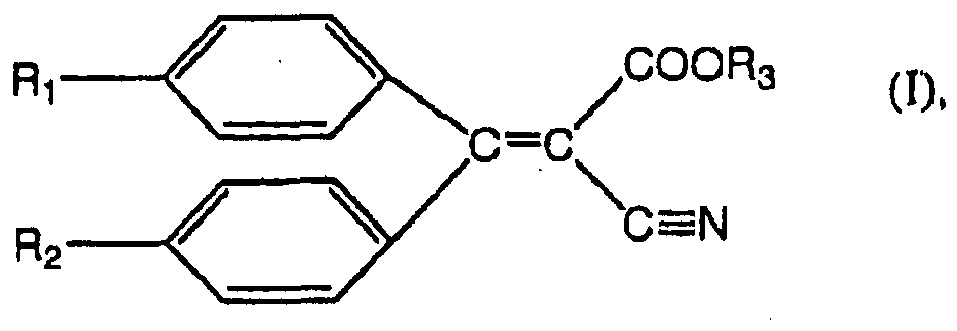
- The method of claim 42, wherein R1 is methoxy and R2 is hydrogen.
- The method of claim 42, wherein R2 is methoxy and R1 is hydrogen.
- The method of claim 44, wherein R3 is a C6-C24 straight chain or branched alkyl.
- The method of claim 42, wherein the compound of formula (I) is present in an amount in the weight range of 0.1% to 20%, based on the total weight of the composition.
- The method of claim 42, wherein the photoactive compound is selected from the group consisting of p-aminobenzoic acid and salts and derivatives thereof; anthranilate and derivatives thereof; dibenzoylmethane and derivatives thereof; salicylate and derivatives thereof; cinnamic acid and derivatives thereof; dihydroxycinnamic acid and derivatives thereof; camphor and salts and derivatives thereof; trihydroxycinnamic acid and derivatives thereof; dibenzalacetone benzalacetophenone; naphtholsulfonate and salts and derivatives thereof; dihydroxy-naphthoic acid and salts thereof; o-hydroxydiphenyldisulfonate and salts and derivatives thereof; p-hydroxydiphenyldisulfonate and salts and derivatives thereof; coumarin and derivatives thereof; diazole derivatives; quinine derivatives and salts thereof; quinoline derivatives; hydroxyl-substituted benzophenone derivatives; methoxy-substituted benzophenone derivatives; uric acid derivatives; violuric acid derivatives; tannic acid and derivatives thereof; hydroquinone; benzophenone derivatives; 1,3,5-triazine derivatives; phenyldibenzimidazole tetrasulfolnate and salts and derivatives thereof; terephthalylidene dicamphor sulfonic acid and salts and derivatives thereof; methylene bis-benzotriazolyl tetramethylbutylphenol and salts and derivatives thereof; bis-ethylhexyloxyphenol methoxyphenyl triazine and salts and derivatives thereof; and combinations of the foregoing.
- The method of claim 42, wherein the photoactive compound comprises a combination of a derivative of cinnamic acid and a dibenzoylmethane derivative.
- The method of claim 42, further comprising a diester or polyester of naphthaiene dicarboxylic acid selected from the group consisting of compounds of formula (II) and (III), and combinations thereof:


Applications Claiming Priority (2)
| Application Number | Priority Date | Filing Date | Title |
|---|---|---|---|
| US11/891,281 US7597825B2 (en) | 2007-08-09 | 2007-08-09 | Method of quenching electronic excitation of chromophore-containing organic molecules in photoactive compositions |
| US12/022,758 US7588702B2 (en) | 2007-08-09 | 2008-01-30 | Method of quenching electronic excitation of chromophore-containing organic molecules in photoactive compositions |
Publications (2)
| Publication Number | Publication Date |
|---|---|
| EP2025324A1 EP2025324A1 (en) | 2009-02-18 |
| EP2025324B1 true EP2025324B1 (en) | 2013-08-14 |
Family
ID=39596502
Family Applications (1)
| Application Number | Title | Priority Date | Filing Date |
|---|---|---|---|
| EP08103205.4A Not-in-force EP2025324B1 (en) | 2007-08-09 | 2008-03-31 | Method of Quenching Electronic Excitation of Chromophore-Containing Organic Molecules in Photoactive Compositions |
Country Status (6)
| Country | Link |
|---|---|
| US (7) | US7588702B2 (en) |
| EP (1) | EP2025324B1 (en) |
| JP (1) | JP2010535779A (en) |
| AU (1) | AU2008284217B2 (en) |
| BR (1) | BRPI0815103A2 (en) |
| WO (1) | WO2009020676A1 (en) |
Families Citing this family (40)
| Publication number | Priority date | Publication date | Assignee | Title |
|---|---|---|---|---|
| US8133477B2 (en) * | 2007-08-09 | 2012-03-13 | Hallstar Innovations Corp. | Dispersions of inorganic particulates containing alkoxycrylene |
| US8257687B2 (en) | 2007-08-09 | 2012-09-04 | Hallstar Innovations Corp. | Photostabilization of coenzyme Q compounds with alkoxycrylene compounds |
| US8263051B2 (en) | 2007-08-09 | 2012-09-11 | Hallstar Innovations Corp. | Photostabilization of resveratrol with alkoxycrylene compounds |
| US8329148B1 (en) | 2007-08-09 | 2012-12-11 | Hallstar Innovations Corp. | Photostabilization of coenzyme Q compounds with alkoxycrylene compounds |
| US7754191B2 (en) * | 2007-08-09 | 2010-07-13 | Hallstar Innovations Corp. | Method of quenching electronic excitation of chromophore-containing organic molecules photoactive compositions |
| US8431112B2 (en) | 2007-08-09 | 2013-04-30 | Hallstar Innocations Corp. | Photostabilization of cholecalciferol with alkoxycrylene compounds |
| US7597825B2 (en) * | 2007-08-09 | 2009-10-06 | Hallstar Innovations Corp. | Method of quenching electronic excitation of chromophore-containing organic molecules in photoactive compositions |
| US8070989B2 (en) | 2007-08-09 | 2011-12-06 | Hallstar Innovations Corp. | Photostabilization of retinoids with alkoxycrylene compounds |
| US7964245B2 (en) * | 2008-06-27 | 2011-06-21 | Hallstar Innovations Corp. | UV-absorbing and photostabilizing polymers |
| US8314154B2 (en) * | 2008-09-22 | 2012-11-20 | Louise Holyfield | Topical skin care formulations |
| EP2201927A3 (en) * | 2008-12-29 | 2013-05-22 | Henkel AG & Co. KGaA | Sun screen compounds |
| US20120201766A1 (en) * | 2009-05-04 | 2012-08-09 | Milanka Susak | Topical Compositions Comprising An Alkoxylated Diphenylacrylate Compound And An Organic Nonionic Emulsifier |
| WO2010129316A2 (en) * | 2009-05-04 | 2010-11-11 | Elc Management Llc | Cosmetic compositions comprising cyanodiphenylacrylates and film forming polymers |
| US8765156B2 (en) * | 2009-05-04 | 2014-07-01 | Elc Management Llc | Topical compositions comprising inorganic particulates and an alkoxylated diphenylacrylate compound |
| US9095543B2 (en) | 2009-05-04 | 2015-08-04 | Elc Management Llc | Cosmetic compositions comprising cyanodiphenylacrylates |
| WO2010129321A2 (en) * | 2009-05-08 | 2010-11-11 | Elc Management Llc | Topical compositions comprising an alkoxylated diphenylacrylate compound and an aryl carboxylic ester |
| US8206691B2 (en) * | 2009-11-04 | 2012-06-26 | Conopco, Inc. | Sunscreen composition with fatty acid alkanolamides |
| US8173108B2 (en) | 2009-11-04 | 2012-05-08 | Conopco, Inc. | Sunscreen composition |
| KR101767206B1 (en) * | 2010-11-22 | 2017-08-14 | (주)아모레퍼시픽 | Composition for screening light |
| KR101753655B1 (en) * | 2010-11-22 | 2017-07-06 | (주)아모레퍼시픽 | Composition for sunscreen |
| WO2012130606A1 (en) * | 2011-03-29 | 2012-10-04 | Unilever Nv | A sunscreen composition |
| MX2013011258A (en) * | 2011-03-29 | 2013-10-17 | Unilever Nv | A sunscreen composition. |
| WO2012145669A1 (en) * | 2011-04-21 | 2012-10-26 | Playtex Products, Llc. | Synergistic uvr absorbing adjuvant combination |
| US9005588B2 (en) | 2011-12-22 | 2015-04-14 | Mary Kay Inc. | Substantive sunscreen formulation |
| US8795640B2 (en) | 2011-12-22 | 2014-08-05 | Mary Kay Inc. | Lip formulation |
| DE102012205526A1 (en) * | 2012-04-04 | 2013-10-10 | Beiersdorf Ag | Stable cosmetic preparation with high pigment content |
| US9125829B2 (en) | 2012-08-17 | 2015-09-08 | Hallstar Innovations Corp. | Method of photostabilizing UV absorbers, particularly dibenzyolmethane derivatives, e.g., Avobenzone, with cyano-containing fused tricyclic compounds |
| AU2013299403A1 (en) * | 2012-08-10 | 2015-02-05 | HallStar Beauty and Personal Care Innovations Company | Compositions, apparatus, systems, and methods for resolving electronic excited states |
| US9145383B2 (en) | 2012-08-10 | 2015-09-29 | Hallstar Innovations Corp. | Compositions, apparatus, systems, and methods for resolving electronic excited states |
| WO2014025370A1 (en) | 2012-08-10 | 2014-02-13 | Hallstar Innovations Corp. | Tricyclic energy quencher compounds for reducing singlet oxygen generation |
| US20170189294A1 (en) * | 2013-04-01 | 2017-07-06 | Eveready Battery Company, Inc. | Non-Irritating, Non-Whitening Photoprotective Compositions |
| EP3024429A2 (en) * | 2013-07-22 | 2016-06-01 | The Procter & Gamble Company | Uv compositions having low active concentrations and high in vivo spf |
| EP2939710B1 (en) * | 2014-04-29 | 2020-06-17 | Symrise AG | Active Mixtures |
| FR3068354B1 (en) * | 2017-06-29 | 2020-07-31 | Oreal | PHOTOPROTECTOR COMPOSITIONS CONSISTING OF A DIBENZOYLMETHANE DERIVATIVE, A MEROCYANINE COMPOUND AND A COMPOUND LIKELY TO ACCEPT THE TRIPLET EXCITE LEVEL ENERGY OF THE DIBENZOYLMETHANE COMPOUND |
| US11655215B2 (en) | 2018-06-18 | 2023-05-23 | Elc Management Llc | Photostabilizing compounds, compositions, and methods |
| JP7150070B2 (en) | 2018-06-18 | 2022-10-07 | イーエルシー マネージメント エルエルシー | Photostabilizing compounds, compositions, and methods |
| JP7174079B2 (en) | 2018-06-18 | 2022-11-17 | イーエルシー マネージメント エルエルシー | Photostabilizing compounds, compositions, and methods |
| WO2019245879A1 (en) | 2018-06-18 | 2019-12-26 | Elc Management Llc | Photostabilizing compounds, compositions, and methods |
| BR112021017034A2 (en) * | 2019-03-15 | 2021-11-23 | Basf Se | Sunscreen or daily care composition, and, use of a sunscreen or daily care composition |
| US20230121157A1 (en) * | 2020-03-13 | 2023-04-20 | Basf Se | Anti-aging care composition comprising perfumes |
Family Cites Families (58)
| Publication number | Priority date | Publication date | Assignee | Title |
|---|---|---|---|---|
| US429542A (en) * | 1890-06-03 | Corset | ||
| US2623060A (en) | 1949-11-04 | 1952-12-23 | Sharp & Dohme Inc | Alkylidenecyanoacetates and improved process for preparation thereof |
| DE1222926C2 (en) | 1960-03-09 | 1976-07-15 | General Aniline & Filme Corporation, New York, N.Y. (V.St.A.) | PROTECT ORGANIC SUBSTANCES AGAINST UV RADIATION |
| NL262168A (en) | 1960-03-09 | |||
| US3215724A (en) | 1961-09-18 | 1965-11-02 | Gen Aniline & Film Corp | alpha-cyano-beta, beta-diphenyl acrylic acid esters |
| FR2350095A1 (en) | 1976-05-03 | 1977-12-02 | Oreal | COMPOSITIONS INTENDED FOR COLORING THE SKIN BASED ON PYRIDINE DERIVATIVES |
| DE2816819A1 (en) | 1978-04-18 | 1979-10-31 | Bayer Ag | LIGHT PROTECTION AGENTS |
| US4396240A (en) * | 1978-06-16 | 1983-08-02 | Henson Artel R | Storage system |
| US4307240A (en) | 1980-05-30 | 1981-12-22 | General Electric Company | Alkoxysilanes and method for making |
| US4562278A (en) | 1984-10-12 | 1985-12-31 | Dow Corning, Ltd. | Organosilicon compounds and preparation and use thereof |
| US4617374A (en) * | 1985-02-15 | 1986-10-14 | Eastman Kodak Company | UV-absorbing condensation polymeric compositions and products therefrom |
| SU1273360A1 (en) | 1985-05-21 | 1986-11-30 | Ордена Ленина институт элементоорганических соединений им.А.Н.Несмеянова | Alpha-furfurylidene-alpha-cyanoacetates as inhibitors of radical polymerization of unsaturated compounds in storage |
| US4707537A (en) | 1986-09-30 | 1987-11-17 | Eastman Kodak Company | UV-absorbing condensation polymeric compositions and products therefrom |
| FR2658075B1 (en) | 1990-02-14 | 1992-05-07 | Oreal | PHOTOSTABLE FILTERING COSMETIC COMPOSITION CONTAINING A UV-A FILTER AND A BETA, BETA-DIPHENYLACRYLATE OR ALPHA-CYANO-BETA, BETA-DIPHENYLACRYLATE. |
| IT1255729B (en) | 1992-05-19 | 1995-11-15 | Giuseppe Raspanti | s-triazine derivatives as photostabilising agents |
| US5393862A (en) | 1993-08-09 | 1995-02-28 | Eastman Chemical Company | Naphthalenedicarboxylic acid containing polymer compositions having reduced fluorescence |
| US5663213A (en) * | 1994-02-28 | 1997-09-02 | Rohm And Haas Company | Method of improving ultraviolet radiation absorption of a composition |
| EP0711803B1 (en) | 1994-11-08 | 2000-01-19 | Teijin Limited | Method for preventing emission of fluorescence from polyalkylenenaphthalene-2,6-dicarboxylate |
| JP3423827B2 (en) | 1994-12-09 | 2003-07-07 | 帝人株式会社 | Method for preventing fluorescence of polyethylene naphthalate molded article |
| US5783307A (en) * | 1996-11-04 | 1998-07-21 | Eastman Chemical Company | UV stabilized multi-layer structures with detectable UV protective layers and a method of detection |
| US5738842A (en) * | 1996-11-29 | 1998-04-14 | 3V Inc. | Sun protecting cosmetic compositions comprising derivatives of dibenzoylmethane, of diphenylcyanoacrylic acid and of triazine |
| US6117973A (en) * | 1997-02-24 | 2000-09-12 | Georgia Tech Research Corp. | PNA monomers with electron donor or acceptor |
| US6001952A (en) * | 1997-06-18 | 1999-12-14 | Eastman Chemical Company | Polyester containing benzylidene having reduced fluorescence |
| CA2241645A1 (en) * | 1997-07-14 | 1999-01-14 | F. Hoffmann-La Roche Ag | Light-screening agents |
| US5989528A (en) | 1998-07-30 | 1999-11-23 | The Procter & Gamble Company | Sunscreen compositions |
| FR2785540B1 (en) | 1998-11-10 | 2002-09-20 | Oreal | PROCESS FOR THE PHOTOSTABILIZATION OF SOLAR FILTERS DERIVED FROM 1,3,5-TRIAZINE |
| US7064114B2 (en) * | 1999-03-19 | 2006-06-20 | Parker Hughes Institute | Gel-microemulsion formulations |
| US6113931A (en) | 1999-03-25 | 2000-09-05 | The C.P. Hall Company | Clear formulations containing diesters or polyesters of naphthalene dicarboxylic acid |
| US5993789A (en) * | 1999-03-25 | 1999-11-30 | The C.P. Hall Company | Photostable sunscreen compositions containing dibenzoylmethane derivative, E.G., parsol® 1789, and diesters or polyesters of naphthalene dicarboxylic acid photostabilizers and enhancers of the sun protection factor (SPF) |
| DE10058290A1 (en) | 2000-11-23 | 2002-05-29 | Basf Ag | Process for stabilizing polyolefins |
| US20020127192A1 (en) * | 2001-01-04 | 2002-09-12 | John Murphy | Lipstick with translucent or transparent region |
| US6905525B2 (en) * | 2001-04-02 | 2005-06-14 | Ciba Specialty Chemicals Corporation | Candle wax stabilized with piperazinones |
| US6551605B2 (en) | 2001-04-06 | 2003-04-22 | Haarmann & Reimer | Diesters or polyesters of naphthalene dicarboxylic acid as solubilizer/stabilizer for retinoids |
| DE10117336A1 (en) * | 2001-04-06 | 2002-10-10 | Max Planck Gesellschaft | Novel light protection and skin care products through stabilized light protection components and reduction of damaging photo products |
| US6518451B2 (en) | 2001-04-26 | 2003-02-11 | Haarmann & Reimer | Diesters of naphthalene dicarboxylic acid |
| DE10141474A1 (en) | 2001-08-29 | 2003-03-20 | Beiersdorf Ag | Stabilization of UV-sensitive active ingredients |
| DE10162840A1 (en) * | 2001-12-20 | 2003-07-03 | Beiersdorf Ag | Cosmetic and dermatological light protection formulations containing water-soluble UV filter substances and benzoxazole derivatives |
| JP4152732B2 (en) * | 2001-12-27 | 2008-09-17 | 株式会社トクヤマ | Resin composition |
| US6485713B1 (en) | 2002-03-05 | 2002-11-26 | The C. P. Hall Company | Sunscreen compositions and methods and materials for producing the same |
| US6537529B1 (en) | 2002-03-05 | 2003-03-25 | The C.P. Hall Company | Sunscreen compositions and methods and materials for producing the same |
| US6890521B2 (en) | 2002-09-06 | 2005-05-10 | The C.P. Hall Company | Photostabilization of a sunscreen composition with low levels of an α-cyano-β, β-diphenylacrylate |
| US6899866B2 (en) * | 2002-09-06 | 2005-05-31 | Cph Innovations Corporation | Photostabilization of a sunscreen composition with a combination of an α-cyano-β, β-diphenylacrylate compound and a dialkyl naphithalate |
| US20040047817A1 (en) * | 2002-09-06 | 2004-03-11 | Bonda Craig A. | Photostabilization of a sunscreen composition with low levels of an alpha-cyano-beta,beta-diphenylacrylate compound |
| US6800274B2 (en) | 2002-09-17 | 2004-10-05 | The C.P. Hall Company | Photostabilizers, UV absorbers, and methods of photostabilizing a sunscreen composition |
| US6919473B2 (en) | 2002-09-17 | 2005-07-19 | Cph Innovations Corporation | Photostabilizers, UV absorbers, and methods of photostabilizing a sunscreen composition |
| DE10333675A1 (en) | 2003-07-24 | 2005-03-03 | Aventis Pharma Deutschland Gmbh | Perfusion method for the production of erythropoietin |
| US7292156B2 (en) * | 2003-10-07 | 2007-11-06 | Underground Solutions Technologies Group, Inc. | Remote tapping method and system for internally tapping a conduit |
| JP2005139263A (en) | 2003-11-05 | 2005-06-02 | Fuji Photo Film Co Ltd | Cellulose solution, cellulose film, polarizer, and liquid crystal display device |
| US7534420B2 (en) | 2004-02-25 | 2009-05-19 | Hallstar Innovations Corp. | Compounds derived from polyanhydride resins with film-forming, UV-absorbing, and photostablizing properties, compositions containing same, and methods of using the same |
| US7235587B2 (en) | 2004-07-01 | 2007-06-26 | Cph Innovations Corporation | Diesters containing two crylene or fluorene moieties, sunscreen compositions containing the same, and methods of photostabilizing a sunscreen compositions containing the same |
| DE602004014127D1 (en) * | 2004-07-02 | 2008-07-10 | Silicone-modified protein-containing sunscreen preparation | |
| AU2006214762B2 (en) * | 2005-02-18 | 2010-07-08 | American Dye Source Inc. | Method for encoding materials with a luminescent tag and apparatus for reading same |
| ATE541552T1 (en) * | 2005-03-23 | 2012-02-15 | Dsm Ip Assets Bv | POLYSILOXANE COATED METAL OXIDE PARTICLES |
| US8158678B2 (en) * | 2005-04-07 | 2012-04-17 | Cph Innovations Corp. | Photoabsorbing, highly conjugated compounds of cyanoacrylic esters, sunscreen compositions and methods of use |
| US20080286217A1 (en) * | 2007-05-14 | 2008-11-20 | Chaudhuri Ratan K | Sunscreen compositions and methods |
| WO2007128840A2 (en) | 2007-08-07 | 2007-11-15 | Symrise Gmbh & Co. Kg | Use of troxerutin to quench the fluorescence of disodium phenyl dibenzimidazole tetrasulfonate |
| US7754191B2 (en) * | 2007-08-09 | 2010-07-13 | Hallstar Innovations Corp. | Method of quenching electronic excitation of chromophore-containing organic molecules photoactive compositions |
| US7597825B2 (en) * | 2007-08-09 | 2009-10-06 | Hallstar Innovations Corp. | Method of quenching electronic excitation of chromophore-containing organic molecules in photoactive compositions |
-
2008
- 2008-01-30 US US12/022,758 patent/US7588702B2/en not_active Expired - Fee Related
- 2008-03-27 JP JP2010520005A patent/JP2010535779A/en active Pending
- 2008-03-27 BR BRPI0815103-2A2A patent/BRPI0815103A2/en not_active Application Discontinuation
- 2008-03-27 AU AU2008284217A patent/AU2008284217B2/en not_active Ceased
- 2008-03-27 WO PCT/US2008/058458 patent/WO2009020676A1/en not_active Ceased
- 2008-03-31 EP EP08103205.4A patent/EP2025324B1/en not_active Not-in-force
-
2009
- 2009-04-29 US US12/432,581 patent/US20090208435A1/en not_active Abandoned
- 2009-04-29 US US12/432,564 patent/US20090291055A1/en not_active Abandoned
- 2009-04-29 US US12/432,542 patent/US8075808B2/en active Active
- 2009-04-29 US US12/432,450 patent/US8263050B2/en active Active
- 2009-04-29 US US12/432,516 patent/US20090291141A1/en not_active Abandoned
-
2010
- 2010-07-20 US US12/840,158 patent/US7959834B2/en active Active
Non-Patent Citations (4)
| Title |
|---|
| BONDA ET AL: "Sunscreen photostability 101", HAPPI HOUSEHOLD AND PERSONAL PRODUCTS INDUSTRY, RODMAN PUBLISHING, RAMSEY, NJ, US, vol. 46, no. 10, 1 January 2009 (2009-01-01), pages 72 - 75, XP009158396, ISSN: 0090-8878 * |
| C.BONDA ET.AL.: "Photostabilisation of Retinol and Retinyl Palmitate by Ethylhexyl Methoxycrylene", COSMETICS AND TOILETRIES, vol. 126, no. 1, 1 February 2011 (2011-02-01) * |
| C.BONDA ET.AL.: "Singlet Quenching proves Faster is Better for Photostability", COSMETICS AND TOILETRIES, vol. 125, no. 2, 2 February 2010 (2010-02-02), pages 40 - 48 * |
| CRAIG BONDA: "Research Pathways to Photostable Sunscreens", vol. 123, no. 22, 1 February 2008 (2008-02-01), pages 49 - 60, XP002560024, ISSN: 0361-4387, Retrieved from the Internet <URL:http://www.hallstar.com/pdf/dexster.pdf> [retrieved on 20091210] * |
Also Published As
| Publication number | Publication date |
|---|---|
| AU2008284217B2 (en) | 2012-11-08 |
| US7588702B2 (en) | 2009-09-15 |
| US20090291054A1 (en) | 2009-11-26 |
| US20090291055A1 (en) | 2009-11-26 |
| US20090041847A1 (en) | 2009-02-12 |
| US8263050B2 (en) | 2012-09-11 |
| AU2008284217A1 (en) | 2009-02-12 |
| US20090246157A1 (en) | 2009-10-01 |
| US7959834B2 (en) | 2011-06-14 |
| US20100283015A1 (en) | 2010-11-11 |
| JP2010535779A (en) | 2010-11-25 |
| WO2009020676A1 (en) | 2009-02-12 |
| EP2025324A1 (en) | 2009-02-18 |
| US8075808B2 (en) | 2011-12-13 |
| US20090291141A1 (en) | 2009-11-26 |
| US20090208435A1 (en) | 2009-08-20 |
| BRPI0815103A2 (en) | 2014-09-30 |
Similar Documents
| Publication | Publication Date | Title |
|---|---|---|
| EP2025324B1 (en) | Method of Quenching Electronic Excitation of Chromophore-Containing Organic Molecules in Photoactive Compositions | |
| US9125829B2 (en) | Method of photostabilizing UV absorbers, particularly dibenzyolmethane derivatives, e.g., Avobenzone, with cyano-containing fused tricyclic compounds | |
| US8133477B2 (en) | Dispersions of inorganic particulates containing alkoxycrylene | |
| US8263051B2 (en) | Photostabilization of resveratrol with alkoxycrylene compounds | |
| US7713519B2 (en) | Method of quenching electronic excitation of chromophore-containing organic molecules in photoactive compositions | |
| US6899866B2 (en) | Photostabilization of a sunscreen composition with a combination of an α-cyano-β, β-diphenylacrylate compound and a dialkyl naphithalate | |
| US8278332B2 (en) | Photostabilization of retinoids with alkoxycrylene compounds | |
| EP2022779B1 (en) | Alkoxy Polyester Compounds, Compositions and Methods of Use Thereof |
Legal Events
| Date | Code | Title | Description |
|---|---|---|---|
| PUAI | Public reference made under article 153(3) epc to a published international application that has entered the european phase |
Free format text: ORIGINAL CODE: 0009012 |
|
| 17P | Request for examination filed |
Effective date: 20080331 |
|
| AK | Designated contracting states |
Kind code of ref document: A1 Designated state(s): AT BE BG CH CY CZ DE DK EE ES FI FR GB GR HR HU IE IS IT LI LT LU LV MC MT NL NO PL PT RO SE SI SK TR |
|
| AX | Request for extension of the european patent |
Extension state: AL BA MK RS |
|
| AKX | Designation fees paid |
Designated state(s): AT BE BG CH CY CZ DE DK EE ES FI FR GB GR HR HU IE IS IT LI LT LU LV MC MT NL NO PL PT RO SE SI SK TR |
|
| 17Q | First examination report despatched |
Effective date: 20100715 |
|
| GRAP | Despatch of communication of intention to grant a patent |
Free format text: ORIGINAL CODE: EPIDOSNIGR1 |
|
| GRAS | Grant fee paid |
Free format text: ORIGINAL CODE: EPIDOSNIGR3 |
|
| GRAP | Despatch of communication of intention to grant a patent |
Free format text: ORIGINAL CODE: EPIDOSNIGR1 |
|
| INTG | Intention to grant announced |
Effective date: 20130527 |
|
| GRAA | (expected) grant |
Free format text: ORIGINAL CODE: 0009210 |
|
| AK | Designated contracting states |
Kind code of ref document: B1 Designated state(s): AT BE BG CH CY CZ DE DK EE ES FI FR GB GR HR HU IE IS IT LI LT LU LV MC MT NL NO PL PT RO SE SI SK TR |
|
| REG | Reference to a national code |
Ref country code: GB Ref legal event code: FG4D |
|
| REG | Reference to a national code |
Ref country code: CH Ref legal event code: EP Ref country code: AT Ref legal event code: REF Ref document number: 626353 Country of ref document: AT Kind code of ref document: T Effective date: 20130815 |
|
| REG | Reference to a national code |
Ref country code: IE Ref legal event code: FG4D |
|
| REG | Reference to a national code |
Ref country code: DE Ref legal event code: R096 Ref document number: 602008026705 Country of ref document: DE Effective date: 20131010 |
|
| REG | Reference to a national code |
Ref country code: AT Ref legal event code: MK05 Ref document number: 626353 Country of ref document: AT Kind code of ref document: T Effective date: 20130814 Ref country code: NL Ref legal event code: VDEP Effective date: 20130814 |
|
| REG | Reference to a national code |
Ref country code: LT Ref legal event code: MG4D |
|
| PG25 | Lapsed in a contracting state [announced via postgrant information from national office to epo] |
Ref country code: HR Free format text: LAPSE BECAUSE OF FAILURE TO SUBMIT A TRANSLATION OF THE DESCRIPTION OR TO PAY THE FEE WITHIN THE PRESCRIBED TIME-LIMIT Effective date: 20130814 Ref country code: SE Free format text: LAPSE BECAUSE OF FAILURE TO SUBMIT A TRANSLATION OF THE DESCRIPTION OR TO PAY THE FEE WITHIN THE PRESCRIBED TIME-LIMIT Effective date: 20130814 Ref country code: IS Free format text: LAPSE BECAUSE OF FAILURE TO SUBMIT A TRANSLATION OF THE DESCRIPTION OR TO PAY THE FEE WITHIN THE PRESCRIBED TIME-LIMIT Effective date: 20131214 Ref country code: PT Free format text: LAPSE BECAUSE OF FAILURE TO SUBMIT A TRANSLATION OF THE DESCRIPTION OR TO PAY THE FEE WITHIN THE PRESCRIBED TIME-LIMIT Effective date: 20131216 Ref country code: NO Free format text: LAPSE BECAUSE OF FAILURE TO SUBMIT A TRANSLATION OF THE DESCRIPTION OR TO PAY THE FEE WITHIN THE PRESCRIBED TIME-LIMIT Effective date: 20131114 Ref country code: AT Free format text: LAPSE BECAUSE OF FAILURE TO SUBMIT A TRANSLATION OF THE DESCRIPTION OR TO PAY THE FEE WITHIN THE PRESCRIBED TIME-LIMIT Effective date: 20130814 Ref country code: LT Free format text: LAPSE BECAUSE OF FAILURE TO SUBMIT A TRANSLATION OF THE DESCRIPTION OR TO PAY THE FEE WITHIN THE PRESCRIBED TIME-LIMIT Effective date: 20130814 Ref country code: CY Free format text: LAPSE BECAUSE OF FAILURE TO SUBMIT A TRANSLATION OF THE DESCRIPTION OR TO PAY THE FEE WITHIN THE PRESCRIBED TIME-LIMIT Effective date: 20130724 |
|
| PG25 | Lapsed in a contracting state [announced via postgrant information from national office to epo] |
Ref country code: SI Free format text: LAPSE BECAUSE OF FAILURE TO SUBMIT A TRANSLATION OF THE DESCRIPTION OR TO PAY THE FEE WITHIN THE PRESCRIBED TIME-LIMIT Effective date: 20130814 Ref country code: BE Free format text: LAPSE BECAUSE OF FAILURE TO SUBMIT A TRANSLATION OF THE DESCRIPTION OR TO PAY THE FEE WITHIN THE PRESCRIBED TIME-LIMIT Effective date: 20130814 Ref country code: GR Free format text: LAPSE BECAUSE OF FAILURE TO SUBMIT A TRANSLATION OF THE DESCRIPTION OR TO PAY THE FEE WITHIN THE PRESCRIBED TIME-LIMIT Effective date: 20131115 Ref country code: FI Free format text: LAPSE BECAUSE OF FAILURE TO SUBMIT A TRANSLATION OF THE DESCRIPTION OR TO PAY THE FEE WITHIN THE PRESCRIBED TIME-LIMIT Effective date: 20130814 Ref country code: PL Free format text: LAPSE BECAUSE OF FAILURE TO SUBMIT A TRANSLATION OF THE DESCRIPTION OR TO PAY THE FEE WITHIN THE PRESCRIBED TIME-LIMIT Effective date: 20130814 Ref country code: LV Free format text: LAPSE BECAUSE OF FAILURE TO SUBMIT A TRANSLATION OF THE DESCRIPTION OR TO PAY THE FEE WITHIN THE PRESCRIBED TIME-LIMIT Effective date: 20130814 |
|
| PG25 | Lapsed in a contracting state [announced via postgrant information from national office to epo] |
Ref country code: CY Free format text: LAPSE BECAUSE OF FAILURE TO SUBMIT A TRANSLATION OF THE DESCRIPTION OR TO PAY THE FEE WITHIN THE PRESCRIBED TIME-LIMIT Effective date: 20130814 |
|
| PG25 | Lapsed in a contracting state [announced via postgrant information from national office to epo] |
Ref country code: CZ Free format text: LAPSE BECAUSE OF FAILURE TO SUBMIT A TRANSLATION OF THE DESCRIPTION OR TO PAY THE FEE WITHIN THE PRESCRIBED TIME-LIMIT Effective date: 20130814 Ref country code: NL Free format text: LAPSE BECAUSE OF FAILURE TO SUBMIT A TRANSLATION OF THE DESCRIPTION OR TO PAY THE FEE WITHIN THE PRESCRIBED TIME-LIMIT Effective date: 20130814 Ref country code: DK Free format text: LAPSE BECAUSE OF FAILURE TO SUBMIT A TRANSLATION OF THE DESCRIPTION OR TO PAY THE FEE WITHIN THE PRESCRIBED TIME-LIMIT Effective date: 20130814 Ref country code: EE Free format text: LAPSE BECAUSE OF FAILURE TO SUBMIT A TRANSLATION OF THE DESCRIPTION OR TO PAY THE FEE WITHIN THE PRESCRIBED TIME-LIMIT Effective date: 20130814 Ref country code: SK Free format text: LAPSE BECAUSE OF FAILURE TO SUBMIT A TRANSLATION OF THE DESCRIPTION OR TO PAY THE FEE WITHIN THE PRESCRIBED TIME-LIMIT Effective date: 20130814 Ref country code: RO Free format text: LAPSE BECAUSE OF FAILURE TO SUBMIT A TRANSLATION OF THE DESCRIPTION OR TO PAY THE FEE WITHIN THE PRESCRIBED TIME-LIMIT Effective date: 20130814 |
|
| PG25 | Lapsed in a contracting state [announced via postgrant information from national office to epo] |
Ref country code: IT Free format text: LAPSE BECAUSE OF FAILURE TO SUBMIT A TRANSLATION OF THE DESCRIPTION OR TO PAY THE FEE WITHIN THE PRESCRIBED TIME-LIMIT Effective date: 20130814 Ref country code: ES Free format text: LAPSE BECAUSE OF FAILURE TO SUBMIT A TRANSLATION OF THE DESCRIPTION OR TO PAY THE FEE WITHIN THE PRESCRIBED TIME-LIMIT Effective date: 20130814 |
|
| PLBE | No opposition filed within time limit |
Free format text: ORIGINAL CODE: 0009261 |
|
| STAA | Information on the status of an ep patent application or granted ep patent |
Free format text: STATUS: NO OPPOSITION FILED WITHIN TIME LIMIT |
|
| 26N | No opposition filed |
Effective date: 20140515 |
|
| REG | Reference to a national code |
Ref country code: DE Ref legal event code: R097 Ref document number: 602008026705 Country of ref document: DE Effective date: 20140515 |
|
| PG25 | Lapsed in a contracting state [announced via postgrant information from national office to epo] |
Ref country code: LU Free format text: LAPSE BECAUSE OF FAILURE TO SUBMIT A TRANSLATION OF THE DESCRIPTION OR TO PAY THE FEE WITHIN THE PRESCRIBED TIME-LIMIT Effective date: 20140331 |
|
| REG | Reference to a national code |
Ref country code: CH Ref legal event code: PL |
|
| GBPC | Gb: european patent ceased through non-payment of renewal fee |
Effective date: 20140331 |
|
| REG | Reference to a national code |
Ref country code: IE Ref legal event code: MM4A |
|
| PG25 | Lapsed in a contracting state [announced via postgrant information from national office to epo] |
Ref country code: IE Free format text: LAPSE BECAUSE OF NON-PAYMENT OF DUE FEES Effective date: 20140331 Ref country code: GB Free format text: LAPSE BECAUSE OF NON-PAYMENT OF DUE FEES Effective date: 20140331 Ref country code: CH Free format text: LAPSE BECAUSE OF NON-PAYMENT OF DUE FEES Effective date: 20140331 Ref country code: LI Free format text: LAPSE BECAUSE OF NON-PAYMENT OF DUE FEES Effective date: 20140331 |
|
| REG | Reference to a national code |
Ref country code: FR Ref legal event code: PLFP Year of fee payment: 9 |
|
| PG25 | Lapsed in a contracting state [announced via postgrant information from national office to epo] |
Ref country code: MT Free format text: LAPSE BECAUSE OF FAILURE TO SUBMIT A TRANSLATION OF THE DESCRIPTION OR TO PAY THE FEE WITHIN THE PRESCRIBED TIME-LIMIT Effective date: 20130814 |
|
| PG25 | Lapsed in a contracting state [announced via postgrant information from national office to epo] |
Ref country code: MC Free format text: LAPSE BECAUSE OF FAILURE TO SUBMIT A TRANSLATION OF THE DESCRIPTION OR TO PAY THE FEE WITHIN THE PRESCRIBED TIME-LIMIT Effective date: 20130814 Ref country code: BG Free format text: LAPSE BECAUSE OF FAILURE TO SUBMIT A TRANSLATION OF THE DESCRIPTION OR TO PAY THE FEE WITHIN THE PRESCRIBED TIME-LIMIT Effective date: 20130814 |
|
| PGFP | Annual fee paid to national office [announced via postgrant information from national office to epo] |
Ref country code: FR Payment date: 20160223 Year of fee payment: 9 |
|
| PG25 | Lapsed in a contracting state [announced via postgrant information from national office to epo] |
Ref country code: TR Free format text: LAPSE BECAUSE OF FAILURE TO SUBMIT A TRANSLATION OF THE DESCRIPTION OR TO PAY THE FEE WITHIN THE PRESCRIBED TIME-LIMIT Effective date: 20130814 Ref country code: HU Free format text: LAPSE BECAUSE OF FAILURE TO SUBMIT A TRANSLATION OF THE DESCRIPTION OR TO PAY THE FEE WITHIN THE PRESCRIBED TIME-LIMIT; INVALID AB INITIO Effective date: 20080331 |
|
| PGFP | Annual fee paid to national office [announced via postgrant information from national office to epo] |
Ref country code: DE Payment date: 20160324 Year of fee payment: 9 |
|
| REG | Reference to a national code |
Ref country code: DE Ref legal event code: R119 Ref document number: 602008026705 Country of ref document: DE |
|
| REG | Reference to a national code |
Ref country code: FR Ref legal event code: ST Effective date: 20171130 |
|
| PG25 | Lapsed in a contracting state [announced via postgrant information from national office to epo] |
Ref country code: DE Free format text: LAPSE BECAUSE OF NON-PAYMENT OF DUE FEES Effective date: 20171003 Ref country code: FR Free format text: LAPSE BECAUSE OF NON-PAYMENT OF DUE FEES Effective date: 20170331 |