EP2012415A2 - Method of controlling a step-up DC-DC converter and related converter - Google Patents
Method of controlling a step-up DC-DC converter and related converter Download PDFInfo
- Publication number
- EP2012415A2 EP2012415A2 EP08104601A EP08104601A EP2012415A2 EP 2012415 A2 EP2012415 A2 EP 2012415A2 EP 08104601 A EP08104601 A EP 08104601A EP 08104601 A EP08104601 A EP 08104601A EP 2012415 A2 EP2012415 A2 EP 2012415A2
- Authority
- EP
- European Patent Office
- Prior art keywords
- comp
- converter
- threshold
- ocp
- comparison flag
- Prior art date
- Legal status (The legal status is an assumption and is not a legal conclusion. Google has not performed a legal analysis and makes no representation as to the accuracy of the status listed.)
- Withdrawn
Links
- 238000000034 method Methods 0.000 title claims description 12
- 238000004146 energy storage Methods 0.000 claims abstract 2
- 238000006243 chemical reaction Methods 0.000 description 1
- 230000003247 decreasing effect Effects 0.000 description 1
- 238000011835 investigation Methods 0.000 description 1
- 238000009738 saturating Methods 0.000 description 1
- 230000003068 static effect Effects 0.000 description 1
Images


Classifications
-
- H—ELECTRICITY
- H02—GENERATION; CONVERSION OR DISTRIBUTION OF ELECTRIC POWER
- H02M—APPARATUS FOR CONVERSION BETWEEN AC AND AC, BETWEEN AC AND DC, OR BETWEEN DC AND DC, AND FOR USE WITH MAINS OR SIMILAR POWER SUPPLY SYSTEMS; CONVERSION OF DC OR AC INPUT POWER INTO SURGE OUTPUT POWER; CONTROL OR REGULATION THEREOF
- H02M3/00—Conversion of DC power input into DC power output
- H02M3/02—Conversion of DC power input into DC power output without intermediate conversion into AC
- H02M3/04—Conversion of DC power input into DC power output without intermediate conversion into AC by static converters
- H02M3/10—Conversion of DC power input into DC power output without intermediate conversion into AC by static converters using discharge tubes with control electrode or semiconductor devices with control electrode
- H02M3/145—Conversion of DC power input into DC power output without intermediate conversion into AC by static converters using discharge tubes with control electrode or semiconductor devices with control electrode using devices of a triode or transistor type requiring continuous application of a control signal
- H02M3/155—Conversion of DC power input into DC power output without intermediate conversion into AC by static converters using discharge tubes with control electrode or semiconductor devices with control electrode using devices of a triode or transistor type requiring continuous application of a control signal using semiconductor devices only
-
- H—ELECTRICITY
- H02—GENERATION; CONVERSION OR DISTRIBUTION OF ELECTRIC POWER
- H02M—APPARATUS FOR CONVERSION BETWEEN AC AND AC, BETWEEN AC AND DC, OR BETWEEN DC AND DC, AND FOR USE WITH MAINS OR SIMILAR POWER SUPPLY SYSTEMS; CONVERSION OF DC OR AC INPUT POWER INTO SURGE OUTPUT POWER; CONTROL OR REGULATION THEREOF
- H02M1/00—Details of apparatus for conversion
- H02M1/14—Arrangements for reducing ripples from DC input or output
- H02M1/15—Arrangements for reducing ripples from DC input or output using active elements
-
- H—ELECTRICITY
- H02—GENERATION; CONVERSION OR DISTRIBUTION OF ELECTRIC POWER
- H02M—APPARATUS FOR CONVERSION BETWEEN AC AND AC, BETWEEN AC AND DC, OR BETWEEN DC AND DC, AND FOR USE WITH MAINS OR SIMILAR POWER SUPPLY SYSTEMS; CONVERSION OF DC OR AC INPUT POWER INTO SURGE OUTPUT POWER; CONTROL OR REGULATION THEREOF
- H02M3/00—Conversion of DC power input into DC power output
- H02M3/02—Conversion of DC power input into DC power output without intermediate conversion into AC
- H02M3/04—Conversion of DC power input into DC power output without intermediate conversion into AC by static converters
- H02M3/10—Conversion of DC power input into DC power output without intermediate conversion into AC by static converters using discharge tubes with control electrode or semiconductor devices with control electrode
- H02M3/145—Conversion of DC power input into DC power output without intermediate conversion into AC by static converters using discharge tubes with control electrode or semiconductor devices with control electrode using devices of a triode or transistor type requiring continuous application of a control signal
- H02M3/155—Conversion of DC power input into DC power output without intermediate conversion into AC by static converters using discharge tubes with control electrode or semiconductor devices with control electrode using devices of a triode or transistor type requiring continuous application of a control signal using semiconductor devices only
- H02M3/156—Conversion of DC power input into DC power output without intermediate conversion into AC by static converters using discharge tubes with control electrode or semiconductor devices with control electrode using devices of a triode or transistor type requiring continuous application of a control signal using semiconductor devices only with automatic control of output voltage or current, e.g. switching regulators
Definitions
- This invention relates in general to voltage converters and more particularly to a method of controlling a step-up DC-DC converter and a related converter.
- FIG. 1 depicts a typical functioning scheme of a hysteretic step-up converter.
- the maximum duration of the charge phase T ON and the minimum duration of the discharge phase T OFF are pre-established.
- a feedback voltage FB representative of the output voltage (in the depicted case it is generated by a voltage divider), is compared with a reference value FB REF .
- FB FB REF
- the switch N 1 is turned off and energy stored up to that moment in the inductor is discharged on the load. After the inductor has discharged, the system remains in a stand-by state until FB ⁇ FB REF .
- the control block CONTROL turns the switch N 1 in function of a first comparison flag FB COMP and of a second comparison flag OCP COMP , generated by comparing the voltage LX on the inductor (that is proportional to the current that flows therethrough) with a second reference voltage OCP REF .
- the current through the inductor is constantly monitored such that during the phase it increases (T ON ) does not overcome a pre-established threshold (proportional to the voltage OCP REF ), such to limit the input current and preventing the inductor from saturating.
- the slope of the current through the inductor is proportional to the supply voltage V IN during the charge phase T ON and to V OUT -V IN during the discharge phase TOFF.
- energy stored in the inductor is proportional to the current, thus as soon as FB ⁇ FB REF , the inductor discharges completely on the output tank capacitance causing a relatively large voltage ripple, and the increase of the peak current through the inductor causes a larger mean square value of the input current, thus causing an abrupt increase of power losses in the power switch, with a consequent reduction of conversion efficiency.
- the value of the maximum current through the inductor is increased stepwise up to attain a maximum pre-established value.
- a relatively low current threshold is thus set in presence of a load that absorbs a relatively small current and a higher current threshold when the load absorbs a relatively large current.
- the output voltage of the converter and the inductor voltage are compared with respective thresholds, thus depending from the result of these distinct comparisons, the ripple of the output voltage of the converter is effectively limited by adjusting the comparison threshold of the inductor voltage.
- the number of occurrences of the output voltage of the converter reaching its respective threshold is down counted and the number of occurrences of the inductor voltage reaching its respective threshold is up-counted: when the resulting count attains a certain value, the comparison threshold of the inductor voltage is incremented and the counting is reset.
- the comparison threshold of the current through the inductor is adjusted in function of the comparison flags FB COMP and OCP COMP , as schematically depicted in Figure 4 .
- different levels of current limitation are established up to a maximum level I MAX .
- I MAX maximum level
- it is possible to set m 4 uniformly spaced current thresholds.
- the device When again FB ⁇ FB REF , the device will start switching again with a current limitation threshold set at the immediately smaller level than the level of the recorded last current limitation threshold.
- the device adjusts the control to the load being supplied. If the peak current through the inductor is excessively small, is increased for ensuring a sufficient output current or decreased if too large stepwise.
- the advantage is that the peak current through the inductor will be adjusted to the lowest possible value compatible to load conditions. Therefore, the ripple and the switching losses tied to the mean square of the current are reduced.
- the converter of this invention may be realized by adding an external digital counter (UP/DOWN) and few additional switches to a common step-up converter without introducing any static current dissipating circuits. This feature is important for realizing converters with reduced stand-by power consumptions.
- UP/DOWN external digital counter
- the invention is outstandingly effective for controlling the peak current through the inductor in function of the load current, without requiring any complex control loop and external compensation components.
Landscapes
- Engineering & Computer Science (AREA)
- Power Engineering (AREA)
- Dc-Dc Converters (AREA)
Abstract
Description
- This invention relates in general to voltage converters and more particularly to a method of controlling a step-up DC-DC converter and a related converter.
- The amplitude of the ripple of the output voltage of a DC-DC converter depends from the characteristics of the load supplied by the converter and from the maximum current that may flow through the step-up inductor.
Figure 1 depicts a typical functioning scheme of a hysteretic step-up converter. With this type of control, the switch N1 is turned on and off with a certain fixed duty-cycle 8 as long as FB<FBREF,
- Usually, the maximum duration of the charge phase TON and the minimum duration of the discharge phase TOFF are pre-established.
- A feedback voltage FB, representative of the output voltage (in the depicted case it is generated by a voltage divider), is compared with a reference value FBREF. When the feedback voltage increases and the condition FB=FBREF is met, the switch N1 is turned off and energy stored up to that moment in the inductor is discharged on the load. After the inductor has discharged, the system remains in a stand-by state until FB<FBREF.
- The control block CONTROL turns the switch N1 in function of a first comparison flag FBCOMP and of a second comparison flag OCPCOMP, generated by comparing the voltage LX on the inductor (that is proportional to the current that flows therethrough) with a second reference voltage OCPREF.
- The current through the inductor is constantly monitored such that during the phase it increases (TON) does not overcome a pre-established threshold (proportional to the voltage OCPREF), such to limit the input current and preventing the inductor from saturating.
- Should this happen, the conduction phase of the switch N1 is immediately stopped and the inductor discharges completely.
- Typical waveforms of the inductor current are depicted in
Figure 2 . - Usually, the duty-cycle 8 is a design parameter tied only to VIN and VOUT (and not to the load current) according to the formula:

- The value of δ as well as the maximum current that may flow through the inductor influence the amplitude of the ripple and the efficiency of the converter.
- The advantage of this type of hysteretic control is its simplicity, since it does not require error amplifiers nor accurate compensations.
- As shown in
Figure 3 , if the supply voltage VIN is significantly smaller than the output voltage VOUT, the inductor current increases slowly during the charge phase TON and discharges fast during the discharge phase TOFF (this time too is fixed). If by contrast the supply voltage VIN is almost equal to the voltage VOUT, the current increases fast during the TON phase and discharges slowly during the TOFF phase, causing an abrupt increase of the peak current through the inductor, upon reaching the maximum current IMAX that may flow through the inductor. - With the same output voltage VOUT, the slope of the current through the inductor is proportional to the supply voltage VIN during the charge phase TON and to VOUT-VIN during the discharge phase TOFF.
- It has been noticed that performance of the converter depends strongly on the external load and on the supply. In particular, there may be functioning conditions in which the output voltage ripple and the dissipated power become relatively large.
- Deep investigations carried out by the applicant lead to infer that both problems are due to, or worsened by the occurrence of large current peaks flowing through the inductor. The fact that the inductor is always charged as much as possible independently from the load being supplied could explain, at least partially, the observed decrement of performance.
- As a matter of fact, energy stored in the inductor is proportional to the current, thus as soon as FB≥FBREF, the inductor discharges completely on the output tank capacitance causing a relatively large voltage ripple, and the increase of the peak current through the inductor causes a larger mean square value of the input current, thus causing an abrupt increase of power losses in the power switch, with a consequent reduction of conversion efficiency.
- According to the method of this invention, in order to overcome these inconveniences, the value of the maximum current through the inductor is increased stepwise up to attain a maximum pre-established value. A relatively low current threshold is thus set in presence of a load that absorbs a relatively small current and a higher current threshold when the load absorbs a relatively large current.
- According to the method of this invention, implemented in a related converter, the output voltage of the converter and the inductor voltage are compared with respective thresholds, thus depending from the result of these distinct comparisons, the ripple of the output voltage of the converter is effectively limited by adjusting the comparison threshold of the inductor voltage.
- According to an embodiment of this invention, the number of occurrences of the output voltage of the converter reaching its respective threshold is down counted and the number of occurrences of the inductor voltage reaching its respective threshold is up-counted: when the resulting count attains a certain value, the comparison threshold of the inductor voltage is incremented and the counting is reset.
- This invention is defined in the annexed claims.
-
-
Figure 1 illustrates a basic scheme of a hysteretic controller with fixed duty-cycle; -
Figure 2 depicts waveforms of the main signal of the controller ofFigure 1 ; -
Figure 3 depicts waveforms of the current through the inductor of the controller ofFigure 1 for two different output voltages; -
Figure 4 is a basic scheme of a DC-DC step-up converter of this invention; -
Figure 5 depicts sample waveforms of the current through the inductor of a DC-DC step-up controller according to the method of this invention; -
Figure 6 shows a first embodiment of a controller of this invention; -
Figure 7 shows a second embodiment of a controller of this invention; -
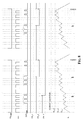
Figure 8 depicts waveforms of the main signal of the controllers ofFigures 6 and7 . - For sake of clarity, hereinafter reference will be made to a hysteretic step-up converter controlled in PFM mode, though the same considerations hold mutatis mutandis also for a different PWM-like type of control.
- In order to ensure a low ripple and high efficiency for a large range of input voltages, output voltages and load currents, according to the method of this invention, the comparison threshold of the current through the inductor is adjusted in function of the comparison flags FBCOMP and OCPCOMP, as schematically depicted in
Figure 4 . - Preferably, different levels of current limitation are established up to a maximum level IMAX. For example, it is possible to set m=4 uniformly spaced current thresholds.
- As shown in
Figure 5 , when FB<FBREF, the device starts switching with the fixed duty-cycle but with a current limitation determined by the first threshold IMAX01. A certain number of switching (for example n=3) are counted. If the condition FB<FBREF continues to be verified the next largercurrent threshold I MAX02 is chosen and so forth until FB=FBREF. - This significantly increases the switching frequency of the device, thus ensuring a higher energy transfer from the input to the output with current peaks through the inductor that remain significantly smaller than in prior art circuits.
- As soon as the condition FB=FBREF holds, the inductor is discharged on the load with a current smaller than the maximum threshold and the last current limitation threshold setting is recorded.
- When again FB<FBREF, the device will start switching again with a current limitation threshold set at the immediately smaller level than the level of the recorded last current limitation threshold.
- With such a control, the device adjusts the control to the load being supplied. If the peak current through the inductor is excessively small, is increased for ensuring a sufficient output current or decreased if too large stepwise. The advantage is that the peak current through the inductor will be adjusted to the lowest possible value compatible to load conditions. Therefore, the ripple and the switching losses tied to the mean square of the current are reduced.
- Two sample embodiments of the DC-DC step-up converter of this invention are depicted in
Figures 6 and7 and the graphs of the relative main signals of the converter are depicted inFigure 8 . - The converter of this invention may be realized by adding an external digital counter (UP/DOWN) and few additional switches to a common step-up converter without introducing any static current dissipating circuits. This feature is important for realizing converters with reduced stand-by power consumptions.
- The invention is outstandingly effective for controlling the peak current through the inductor in function of the load current, without requiring any complex control loop and external compensation components.
Claims (7)
- A method of controlling a DC-DC step-up converter including at least a power switch and an energy storage inductor, comprising the steps of:comparing a signal representing an output voltage of the converter with a first threshold (FBREF), generating a first comparison flag (FBCOMP) based on said comparison,comparing a signal representing the voltage on the inductor of the converter with a second threshold (OCPREF), generating a second comparison flag (OCPCOMP) based on said second comparison,controlling the power switch of the converter in function of the logic state of said first comparison flag (FBCOMP) and second comparison flag (OCPCOMP),characterized in that the method comprises the step of limiting the ripple on the output voltage of the converter by stepwise adjusting said second threshold in function of said first comparison flag (FBCOMP) and second comparison flag (OCPCOMP).
- The method of claim 1, wherein said limiting step includes:a) down-counting logically active edges of said first comparison flag (FBCOMP) and up-counting logically active edges of said second comparison flag (OCPCOMP);b) when said counting reaches a certain value, incrementing said second threshold by a pre-established step and resetting said counting.
- The method of claim 2, wherein said second threshold can be incremented up to a maximum pre-established value.
- The method of claim 2, comprising the steps of:when said first comparison flag (FBCOMP) switches becoming logically active, storing the value of said second threshold, leaving said inductor to discharge completely and repeating the steps a) and b) using the value of said second threshold that was used immediately before being incremented to the stored value.
- A hysteretic DC-DC step-up converter, comprising:a first comparator adapted to compare a signal representing an output voltage of the converter with a first threshold (FBREF), and to generate a first comparison flag (FBCOMP),a second comparator adapted to compare a signal representing the voltage on the inductor of the converter with a second threshold (OCPREF), and to generate a second comparison flag (OCPCOMP),a control circuit of the switch of the converter (FIXED DUTY CYCLE) input with said first comparison flag (FBCOMP) and second comparison flag (OCPCOMP) suitable for controlling the switch of the converter according to a PFM technique,circuit means for establishing said second threshold,characterized in thatsaid circuit means are input with said first comparison flag (FBCOMP) and second comparison flag (OCPCOMP) and are suitable for adjusting said second threshold in function of said comparison flags (FBCOMP, OCPCOMP).
- The DC-DC step-up converter of claim 5, wherein said circuit means comprise:an up-down counter that up-counts logically active edges of said comparison flag (OCPCOM) and down-counts logically active edges of said first comparison flag (FBCOMP);a circuit capable of incrementing said second threshold (OCPREF) when said counter counts a pre-established number of logically active edges.
- The DC-DC step-up converter of claim 6, wherein said circuit suitable for incrementing said second threshold (OCPREF) comprises:a current generator that forces a current through at least two resistors connected in series, at least a resistor of them being shuntable through a controlled switch;a control circuit of said switch, suitable for closing said switch when said up-down counter counted said pre-established number of active edges.
Applications Claiming Priority (1)
| Application Number | Priority Date | Filing Date | Title |
|---|---|---|---|
| IT000060A ITVA20070060A1 (en) | 2007-07-04 | 2007-07-04 | METHOD OF CONTROL OF A STEP-UP DC-DC AND RELATED CONVERTER CONVERTER |
Publications (2)
| Publication Number | Publication Date |
|---|---|
| EP2012415A2 true EP2012415A2 (en) | 2009-01-07 |
| EP2012415A3 EP2012415A3 (en) | 2010-05-26 |
Family
ID=39863075
Family Applications (1)
| Application Number | Title | Priority Date | Filing Date |
|---|---|---|---|
| EP08104601A Withdrawn EP2012415A3 (en) | 2007-07-04 | 2008-07-02 | Method of controlling a step-up DC-DC converter and related converter |
Country Status (3)
| Country | Link |
|---|---|
| US (1) | US7868596B2 (en) |
| EP (1) | EP2012415A3 (en) |
| IT (1) | ITVA20070060A1 (en) |
Cited By (2)
| Publication number | Priority date | Publication date | Assignee | Title |
|---|---|---|---|---|
| CN101997410B (en) * | 2009-08-20 | 2012-10-10 | 立锜科技股份有限公司 | Switching power supply circuit with instantaneous control function and its control circuit and method |
| CN107306080A (en) * | 2016-04-19 | 2017-10-31 | 联发科技(新加坡)私人有限公司 | DC-DC electric pressure converter and its control method |
Families Citing this family (7)
| Publication number | Priority date | Publication date | Assignee | Title |
|---|---|---|---|---|
| US9099919B2 (en) | 2011-05-09 | 2015-08-04 | The Hong Kong University Of Science And Technology | Single-inductor-multiple-output regulator with synchronized current mode hysteretic control |
| JP2012253953A (en) * | 2011-06-06 | 2012-12-20 | Mitsumi Electric Co Ltd | Step-up dc-dc converter |
| US9048728B2 (en) * | 2012-10-08 | 2015-06-02 | Texas Instruments Incorporated | Switch pairs between resistor network and high/low DC converter comparator input |
| KR101905586B1 (en) * | 2012-12-21 | 2018-10-10 | 한국전자통신연구원 | Apparatus of tracking maximum power |
| FR3083883B1 (en) | 2018-07-10 | 2020-06-12 | Continental Automotive France | METHOD FOR CONTROLLING A CONTINUOUS-CONTINUOUS VOLTAGE CONVERTER |
| US10511225B1 (en) | 2018-09-07 | 2019-12-17 | Dialog Semiconductor (Uk) Limited | Low IQ hysteretic-PWM automated hybrid control architecture for a switching converter |
| US10615694B2 (en) | 2018-09-07 | 2020-04-07 | Dialog Semiconductor (Uk) Limited | Circuit and method for suppressing audio noise in DC-DC converters |
Citations (2)
| Publication number | Priority date | Publication date | Assignee | Title |
|---|---|---|---|---|
| US20060125454A1 (en) | 2004-12-10 | 2006-06-15 | Tien-Tzu Chen | Switching voltage regulator operating without a discontinuous mode |
| US20060158168A1 (en) | 2002-06-07 | 2006-07-20 | Shinichi Yoshida | Switching power supply device and switching power supply system |
Family Cites Families (5)
| Publication number | Priority date | Publication date | Assignee | Title |
|---|---|---|---|---|
| US5481178A (en) * | 1993-03-23 | 1996-01-02 | Linear Technology Corporation | Control circuit and method for maintaining high efficiency over broad current ranges in a switching regulator circuit |
| JP3636321B2 (en) * | 2002-04-24 | 2005-04-06 | ローム株式会社 | Switching power supply |
| US6724174B1 (en) * | 2002-09-12 | 2004-04-20 | Linear Technology Corp. | Adjustable minimum peak inductor current level for burst mode in current-mode DC-DC regulators |
| JP4017490B2 (en) * | 2002-10-02 | 2007-12-05 | 株式会社デンソー | DC / DC converter |
| US7372238B1 (en) * | 2004-04-29 | 2008-05-13 | National Semiconductor Corporation | Apparatus and method for step-down switching voltage regulation |
-
2007
- 2007-07-04 IT IT000060A patent/ITVA20070060A1/en unknown
-
2008
- 2008-07-02 EP EP08104601A patent/EP2012415A3/en not_active Withdrawn
- 2008-07-03 US US12/167,772 patent/US7868596B2/en active Active
Patent Citations (2)
| Publication number | Priority date | Publication date | Assignee | Title |
|---|---|---|---|---|
| US20060158168A1 (en) | 2002-06-07 | 2006-07-20 | Shinichi Yoshida | Switching power supply device and switching power supply system |
| US20060125454A1 (en) | 2004-12-10 | 2006-06-15 | Tien-Tzu Chen | Switching voltage regulator operating without a discontinuous mode |
Cited By (6)
| Publication number | Priority date | Publication date | Assignee | Title |
|---|---|---|---|---|
| CN101997410B (en) * | 2009-08-20 | 2012-10-10 | 立锜科技股份有限公司 | Switching power supply circuit with instantaneous control function and its control circuit and method |
| CN107306080A (en) * | 2016-04-19 | 2017-10-31 | 联发科技(新加坡)私人有限公司 | DC-DC electric pressure converter and its control method |
| EP3240171A1 (en) * | 2016-04-19 | 2017-11-01 | MediaTek Singapore Pte Ltd. | Dc/dc converter with burst mode using dynamically adjustable peak current control |
| US10033279B2 (en) | 2016-04-19 | 2018-07-24 | Mediatek Singapore Pte. Ltd. | DC-DC voltage converter and associated control method capable of dynamically adjusting upper boundary of inductor current |
| TWI632764B (en) * | 2016-04-19 | 2018-08-11 | 新加坡商聯發科技(新加坡)私人有限公司 | DC to DC voltage converter and control method thereof |
| CN107306080B (en) * | 2016-04-19 | 2019-06-28 | 联发科技(新加坡)私人有限公司 | DC to DC voltage converter and control method thereof |
Also Published As
| Publication number | Publication date |
|---|---|
| US7868596B2 (en) | 2011-01-11 |
| ITVA20070060A1 (en) | 2009-01-05 |
| EP2012415A3 (en) | 2010-05-26 |
| US20090015230A1 (en) | 2009-01-15 |
Similar Documents
| Publication | Publication Date | Title |
|---|---|---|
| EP2012415A2 (en) | Method of controlling a step-up DC-DC converter and related converter | |
| US8519691B2 (en) | Current limiting for DC-DC converters | |
| US7957165B2 (en) | DC-DC converter with a plurality of soft-start control circuits | |
| JP6211916B2 (en) | Switching regulator | |
| US6600300B2 (en) | Digitally controlled DC/DC converter | |
| JP6161339B2 (en) | Boost switching regulator and semiconductor device | |
| US9825524B2 (en) | Dynamic control loop for switching regulators | |
| US20150311795A1 (en) | Current pulse count control in a voltage regulator | |
| US20120153919A1 (en) | Switching Mode Power Supply Control | |
| US20120091978A1 (en) | Dc-dc converter | |
| CN112787506B (en) | Voltage modulator with piecewise linear load line | |
| US9667144B2 (en) | DC-DC converter with reverse current detecting circuit | |
| US20220149737A1 (en) | Buck-Boost Converter and Hybrid Control Method | |
| US20080101102A1 (en) | Circuits and methods for controlling a converter | |
| US7035071B1 (en) | Current limit with adaptive cycle skipping for switching regulators | |
| US20240313638A1 (en) | Current limit control circuit for boost converter in ccm | |
| US8164319B2 (en) | System and method for adapting clocking pulse widths for DC-to-DC converters | |
| US6922346B2 (en) | System and method to limit maximum duty cycle and/or provide a maximum volt-second clamp | |
| CN222301615U (en) | Switch mode power supply SMPS and integrated circuit IC device | |
| US8120339B2 (en) | Switching power supply with switching circuits | |
| EP4243261B1 (en) | Module for controlling a switching buck-boost converter with overcurrent detection and method for controlling a switching buck-boost converter | |
| US11588408B2 (en) | Power supply circuit, corresponding device and method | |
| JP2010063231A (en) | Switching regulator | |
| KR20210103398A (en) | Extending on-time for power converter control | |
| JP4871022B2 (en) | Switching power supply control circuit |
Legal Events
| Date | Code | Title | Description |
|---|---|---|---|
| PUAI | Public reference made under article 153(3) epc to a published international application that has entered the european phase |
Free format text: ORIGINAL CODE: 0009012 |
|
| AK | Designated contracting states |
Kind code of ref document: A2 Designated state(s): AT BE BG CH CY CZ DE DK EE ES FI FR GB GR HR HU IE IS IT LI LT LU LV MC MT NL NO PL PT RO SE SI SK TR |
|
| AX | Request for extension of the european patent |
Extension state: AL BA MK RS |
|
| 17P | Request for examination filed |
Effective date: 20090320 |
|
| RAP1 | Party data changed (applicant data changed or rights of an application transferred) |
Owner name: STMICROELECTRONICS SRL |
|
| PUAL | Search report despatched |
Free format text: ORIGINAL CODE: 0009013 |
|
| AK | Designated contracting states |
Kind code of ref document: A3 Designated state(s): AT BE BG CH CY CZ DE DK EE ES FI FR GB GR HR HU IE IS IT LI LT LU LV MC MT NL NO PL PT RO SE SI SK TR |
|
| AX | Request for extension of the european patent |
Extension state: AL BA MK RS |
|
| AKX | Designation fees paid |
Designated state(s): DE FR GB IT |
|
| RAP1 | Party data changed (applicant data changed or rights of an application transferred) |
Owner name: STMICROELECTRONICS SRL |
|
| STAA | Information on the status of an ep patent application or granted ep patent |
Free format text: STATUS: THE APPLICATION HAS BEEN WITHDRAWN |
|
| 18W | Application withdrawn |
Effective date: 20120702 |