EP1987026B1 - Aminoacyl prodrug derivatives and medicaments for the treatment of thromboembolitic disorders - Google Patents
Aminoacyl prodrug derivatives and medicaments for the treatment of thromboembolitic disorders Download PDFInfo
- Publication number
- EP1987026B1 EP1987026B1 EP07703379A EP07703379A EP1987026B1 EP 1987026 B1 EP1987026 B1 EP 1987026B1 EP 07703379 A EP07703379 A EP 07703379A EP 07703379 A EP07703379 A EP 07703379A EP 1987026 B1 EP1987026 B1 EP 1987026B1
- Authority
- EP
- European Patent Office
- Prior art keywords
- compound
- formula
- methyl
- group
- hplc
- Prior art date
- Legal status (The legal status is an assumption and is not a legal conclusion. Google has not performed a legal analysis and makes no representation as to the accuracy of the status listed.)
- Active
Links
- 0 Nc1ccc(C(*C[C@@](C*2c3ccc(*(CC[O+]C4)C4O)cc3)OC2=O)=O)[n]1 Chemical compound Nc1ccc(C(*C[C@@](C*2c3ccc(*(CC[O+]C4)C4O)cc3)OC2=O)=O)[n]1 0.000 description 7
- GWIVGUKKLCJOPP-UHFFFAOYSA-N CCCCN(CCCC(Cl)=O)C(OCc1ccccc1)=O Chemical compound CCCCN(CCCC(Cl)=O)C(OCc1ccccc1)=O GWIVGUKKLCJOPP-UHFFFAOYSA-N 0.000 description 1
- JGYXPWONYQMEOZ-HNNXBMFYSA-N CCc1c(COC(N[C@@H](C(C)C)C(C)=O)=O)cccc1 Chemical compound CCc1c(COC(N[C@@H](C(C)C)C(C)=O)=O)cccc1 JGYXPWONYQMEOZ-HNNXBMFYSA-N 0.000 description 1
- WMAPNMSDARSSCI-QHCPKHFHSA-N CN(CCCC(NC[C@@H](CN1c(cc2)ccc2N(CCOC2)C2=O)OC1=O)=O)C(OCc1ccccc1)=O Chemical compound CN(CCCC(NC[C@@H](CN1c(cc2)ccc2N(CCOC2)C2=O)OC1=O)=O)C(OCc1ccccc1)=O WMAPNMSDARSSCI-QHCPKHFHSA-N 0.000 description 1
- DPLHSWLPYAJTJY-LJQANCHMSA-N CNCCCCC(N(C[C@@H](CN1c(cc2)ccc2N(CCOC2)C2=O)OC1=O)C(c([s]1)ccc1Cl)=O)=O Chemical compound CNCCCCC(N(C[C@@H](CN1c(cc2)ccc2N(CCOC2)C2=O)OC1=O)C(c([s]1)ccc1Cl)=O)=O DPLHSWLPYAJTJY-LJQANCHMSA-N 0.000 description 1
- DEXXSYVEWAYIGZ-UHFFFAOYSA-N NCC(CN1c(cc2)ccc2N(CCOC2)C2=O)OC1=O Chemical compound NCC(CN1c(cc2)ccc2N(CCOC2)C2=O)OC1=O DEXXSYVEWAYIGZ-UHFFFAOYSA-N 0.000 description 1
- SXSABAAANMJUTQ-OAHLLOKOSA-N N[IH]CC(N(C[C@@H](CN1c(cc2)ccc2N(CCOC2)C2=O)OC1=O)C(c([s]1)ccc1Cl)=O)=O Chemical compound N[IH]CC(N(C[C@@H](CN1c(cc2)ccc2N(CCOC2)C2=O)OC1=O)C(c([s]1)ccc1Cl)=O)=O SXSABAAANMJUTQ-OAHLLOKOSA-N 0.000 description 1
Classifications
-
- C—CHEMISTRY; METALLURGY
- C07—ORGANIC CHEMISTRY
- C07D—HETEROCYCLIC COMPOUNDS
- C07D413/00—Heterocyclic compounds containing two or more hetero rings, at least one ring having nitrogen and oxygen atoms as the only ring hetero atoms
- C07D413/14—Heterocyclic compounds containing two or more hetero rings, at least one ring having nitrogen and oxygen atoms as the only ring hetero atoms containing three or more hetero rings
-
- A—HUMAN NECESSITIES
- A61—MEDICAL OR VETERINARY SCIENCE; HYGIENE
- A61K—PREPARATIONS FOR MEDICAL, DENTAL OR TOILETRY PURPOSES
- A61K31/00—Medicinal preparations containing organic active ingredients
- A61K31/33—Heterocyclic compounds
- A61K31/395—Heterocyclic compounds having nitrogen as a ring hetero atom, e.g. guanethidine or rifamycins
- A61K31/41—Heterocyclic compounds having nitrogen as a ring hetero atom, e.g. guanethidine or rifamycins having five-membered rings with two or more ring hetero atoms, at least one of which being nitrogen, e.g. tetrazole
- A61K31/42—Oxazoles
- A61K31/422—Oxazoles not condensed and containing further heterocyclic rings
-
- A—HUMAN NECESSITIES
- A61—MEDICAL OR VETERINARY SCIENCE; HYGIENE
- A61P—SPECIFIC THERAPEUTIC ACTIVITY OF CHEMICAL COMPOUNDS OR MEDICINAL PREPARATIONS
- A61P7/00—Drugs for disorders of the blood or the extracellular fluid
-
- A—HUMAN NECESSITIES
- A61—MEDICAL OR VETERINARY SCIENCE; HYGIENE
- A61P—SPECIFIC THERAPEUTIC ACTIVITY OF CHEMICAL COMPOUNDS OR MEDICINAL PREPARATIONS
- A61P7/00—Drugs for disorders of the blood or the extracellular fluid
- A61P7/02—Antithrombotic agents; Anticoagulants; Platelet aggregation inhibitors
Definitions
- Chiral silica gel phase (670 mm x 40 mm) based on poly ( N- methacryloyl-L-leucine tert- butylamide); Eluent: isohexane / ethyl acetate 65:35 (v / v); Temperature: 24 ° C; Flow: 50 ml / min; UV detection: 260 nm.
- the title compound is prepared in analogy to intermediate 12A starting from 6-aminocaproic acid.
Landscapes
- Chemical & Material Sciences (AREA)
- Organic Chemistry (AREA)
- Health & Medical Sciences (AREA)
- Animal Behavior & Ethology (AREA)
- Veterinary Medicine (AREA)
- Public Health (AREA)
- General Health & Medical Sciences (AREA)
- Pharmacology & Pharmacy (AREA)
- Life Sciences & Earth Sciences (AREA)
- Medicinal Chemistry (AREA)
- Chemical Kinetics & Catalysis (AREA)
- Bioinformatics & Cheminformatics (AREA)
- General Chemical & Material Sciences (AREA)
- Nuclear Medicine, Radiotherapy & Molecular Imaging (AREA)
- Engineering & Computer Science (AREA)
- Hematology (AREA)
- Diabetes (AREA)
- Epidemiology (AREA)
- Pharmaceuticals Containing Other Organic And Inorganic Compounds (AREA)
- Medicines That Contain Protein Lipid Enzymes And Other Medicines (AREA)
- Plural Heterocyclic Compounds (AREA)
Abstract
Description
Die vorliegende Anmeldung betrifft Prodrug-Derivate von 5-Chlor-N-({(5S)-2-oxo-3-[4-(3-oxo-morpholin-4-yl)phenyl]-1,3-oxazolidin-5-yl}methyl)thiophen-2-carboxamid, Verfahren zu ihrer Herstellung, ihre Verwendung zur Behandlung und/oder Prophylaxe von Krankheiten sowie ihre Verwendung zur Herstellung von Arzneimitteln zur Behandlung und/oder Prophylaxe von Krankheiten, insbesondere von thromboembolischen Erkrankungen.The present application relates to prodrug derivatives of 5-chloro- N- ({(5S) -2-oxo-3- [4- (3-oxomorpholin-4-yl) phenyl] -1,3-oxazolidine-5 -yl} methyl) thiophene-2-carboxamide, process for their preparation, their use for the treatment and / or prophylaxis of diseases and their use for the preparation of medicaments for the treatment and / or prophylaxis of diseases, in particular thromboembolic diseases.
Prodrugs sind Derivate eines Wirkstoffs, die in vivo eine ein- oder mehrstufige Biotransformation enzymatischer und/oder chemischer Art durchlaufen, bevor der eigentliche Wirkstoff freigesetzt wird. Ein Prodrug-Rest wird in der Regel genutzt, um das Eigenschaftsprofil des zu Grunde liegenden Wirkstoffs zu verbessern [
5-Chlor-N-({(5S)-2-oxo-3-[4-(3-oxomorpholin-4-yl)phenyl]-1,3-oxazolidin-5-yl}methyl)thiophen-2-carboxamid [BAY 59-7939, Verbindung (A)] ist ein oral wirksamer, direkter Inhibitor der Serin-Protease Faktor Xa, welche eine essentielle Funktion bei der Regulation der Blutgerinnung ausübt. Die Verbindung, befindet sich gegenwärtig in vertiefter klinischer Prüfung als möglicher neuer Arzneimittelwirkstoff für die Prävention und Therapie thromboembolischer Erkrankungen [
Verbindung (A) weist jedoch nur eine begrenzte Löslichkeit in Wasser und physiologischen Medien auf, was beispielsweise eine intravenöse Applikation des Wirkstoffs erschwert. Aufgabe der vorliegenden Erfindung war daher die Identifizierung von Derivaten oder Prodrugs von Verbindung (A), die eine verbesserte Löslichkeit in den genannten Medien besitzen und gleichzeitig nach Applikation eine kontrollierte Freisetzung des Wirkstoffs (A) im Körper des Patienten erlauben.However, compound (A) has only a limited solubility in water and physiological media, which makes it difficult, for example, an intravenous administration of the drug. The object of the present invention was therefore the identification of derivatives or prodrugs of compound (A), which have an improved solubility in said media and at the same time after application allow a controlled release of the active ingredient (A) in the body of the patient.
In

- R1
- für Wasserstoff oder (C1-C4)-Alkyl, das mit Hydroxy oder (C1-C4)-Alkoxy substituiert sein kann, steht,
- R2
- für Wasserstoff oder (C1-C4)-Alkyl steht
- L
- für eine (C1-C4)-Alkandiyl-Gruppe, in welcher eine CH2-Gruppe gegen ein O-Atom ausgetauscht sein kann, oder für eine Gruppe der Formel


- *
- die Verknüpfungsstelle mit dem N-Atom bedeutet,
- R3
- die Seitengruppe einer natürlichen α-Aminosäure oder ihrer Homologe oder Isomere bedeutet
oder - R3
- mit R1 verknüpft ist und beide zusammen eine (CH2)3- oder (CH2)4-Gruppe bilden,
- R4
- Wasserstoff oder Methyl bedeutet,
- R5
- (C1-C4)-Alkyl bedeutet
und - R6
- Wasserstoff oder (C1-C4)-Alkyl bedeutet,
- R 1
- is hydrogen or (C 1 -C 4 ) -alkyl which may be substituted by hydroxyl or (C 1 -C 4 ) -alkoxy,
- R 2
- is hydrogen or (C 1 -C 4 ) -alkyl
- L
- for a (C 1 -C 4 ) -alkanediyl group in which a CH 2 group may be replaced by an O atom, or for a group of the formula
- *
- the point of attachment to the N atom means
- R 3
- the side group of a natural α-amino acid or its homologs or isomers
or - R 3
- is linked to R 1 and both together form a (CH 2 ) 3 or (CH 2 ) 4 group,
- R 4
- Hydrogen or methyl,
- R 5
- (C 1 -C 4 ) -alkyl
and - R 6
- Is hydrogen or (C 1 -C 4 ) -alkyl,
Erfindungsgemäße Verbindungen sind die Verbindungen der Formel (I) und deren Salze, Solvate und Solvate der Salze, die von Formel (I) umfassten Verbindungen der nachfolgend genannten Formeln und deren Salze, Solvate und Solvate der Salze sowie die von Formel (I) umfassten, nachfolgend als Ausführungsbeispiele genannten Verbindungen und deren Salze, Solvate und Solvate der Salze, soweit es sich bei den von Formel (I) umfassten, nachfolgend genannten Verbindungen nicht bereits um Salze, Solvate und Solvate der Salze handelt.Compounds according to the invention are the compounds of the formula (I) and their salts, solvates and solvates of the salts comprising the compounds of the formulas below and their salts, solvates and solvates of the salts and of the formula (I) encompassed by formula (I), hereinafter referred to as exemplary compounds and their salts, solvates and solvates of the salts, as far as the compounds of formula (I), the compounds mentioned below are not already salts, solvates and solvates of the salts.
Die erfindungsgemäßen Verbindungen können in Abhängigkeit von ihrer Struktur in stereoisomeren Formen (Enantiomere, Diastereomere) existieren. Die Erfindung umfasst deshalb die Enantiomeren oder Diastereomeren und ihre jeweiligen Mischungen. Aus solchen Mischungen von Enantiomeren und/oder Diastereomeren lassen sich die stereoisomer einheitlichen Bestandteile in bekannter Weise isolieren.Depending on their structure, the compounds of the invention may exist in stereoisomeric forms (enantiomers, diastereomers). The invention therefore includes the enantiomers or diastereomers and their respective mixtures. From such mixtures of Enantiomeric and / or diastereomers can be the stereoisomerically uniform components isolated in a known manner.
Sofern die erfindungsgemäßen Verbindungen in tautomeren Formen vorkommen können, umfasst die vorliegende Erfindung sämtliche tautomere Formen.If the compounds according to the invention can occur in tautomeric forms, the present invention encompasses all tautomeric forms.
Als Salze sind im Rahmen der vorliegenden Erfindung physiologisch unbedenkliche Salze der erfindungsgemäßen Verbindungen bevorzugt. Umfasst sind auch Salze, die für pharmazeutische Anwendungen selbst nicht geeignet sind, jedoch beispielsweise für die Isolierung oder Reinigung der erfindungsgemäßen Verbindungen verwendet werden können. Salts used in the context of the present invention are physiologically acceptable salts of the compounds according to the invention. Also included are salts which are themselves unsuitable for pharmaceutical applications but can be used, for example, for the isolation or purification of the compounds of the invention.
Physiologisch unbedenkliche Salze der erfindungsgemäßen Verbindungen umfassen Säureadditionssalze von Mineralsäuren, Carbonsäuren und Sulfonsäuren, z.B. Salze der Chlorwasserstoffsäure, Bromwasserstoffsäure, Schwefelsäure, Phosphorsäure, Methansulfonsäure, Ethansulfonsäure, Toluolsulfonsäure, Benzolsulfonsäure, Naphthalindisulfonsäure, Essigsäure, Trifluoressigsäure, Propionsäure, Milchsäure, Weinsäure, Äpfelsäure, Zitronensäure, Fumarsäure, Maleinsäure und Benzoesäure.Physiologically acceptable salts of the compounds of the invention include acid addition salts of mineral acids, carboxylic acids and sulfonic acids, e.g. Salts of hydrochloric, hydrobromic, sulfuric, phosphoric, methanesulfonic, ethanesulfonic, toluenesulfonic, benzenesulfonic, naphthalenedisulfonic, acetic, trifluoroacetic, propionic, lactic, tartaric, malic, citric, fumaric, maleic and benzoic acids.
Als Solvate werden im Rahmen der Erfindung solche Formen der erfindungsgemäßen Verbindungen bezeichnet, welche in festem oder flüssigem Zustand durch Koordination mit Lösungsmittelmolekülen einen Komplex bilden. Hydrate sind eine spezielle Form der Solvate, bei denen die Koordination mit Wasser erfolgt. Als Solvate sind im Rahmen der vorliegenden Erfindung Hydrate bevorzugt. Solvates in the context of the invention are those forms of the compounds according to the invention which form a complex in the solid or liquid state by coordination with solvent molecules. Hydrates are a special form of solvates that coordinate with water. As solvates, hydrates are preferred in the context of the present invention.
Im Rahmen der vorliegenden Erfindung haben die Substituenten, soweit nicht anders spezifiziert, die folgende Bedeutung:Unless otherwise specified, in the context of the present invention, the substituents have the following meaning:
C 1 -C 4 )-Alkyl und (C 1 -C 3 )-Alkyl stehen im Rahmen der Erfindung für einen geradkettigen oder verzweigten Alkylrest mit 1 bis 4 bzw. 1 bis 3 Kohlenstoffatomen. Bevorzugt ist ein geradkettiger Alkylrest mit 1 bis 3 Kohlenstoffatomen. Beispielhaft und vorzugsweise seien genannt: Methyl, Ethyl, n-Propyl, Isopropyl, n-Butyl, Isobutyl, sec.-Butyl, tert.-Butyl. C 1 -C 4 ) -Alkyl and (C 1 -C 3 ) -alkyl in the context of the invention are a straight-chain or branched alkyl radical having 1 to 4 or 1 to 3 carbon atoms. Preference is given to a straight-chain alkyl radical having 1 to 3 carbon atoms. Examples which may be mentioned by way of example include: methyl, ethyl, n-propyl, isopropyl, n-butyl, isobutyl, sec-butyl, tert. Butyl.
(C 1 -C 4 )-Alkoxy steht im Rahmen der Erfindung für einen geradkettigen oder verzweigten Alkoxyrest mit 1 bis 4 Kohlenstoffatomen. Beispielhaft und vorzugsweise seien genannt: Methoxy, Ethoxy, n-Propoxy, Isopropoxy, n-Butoxy, tert.-Butoxy. (C 1 -C 4 ) -Alkoxy in the context of the invention is a straight-chain or branched alkoxy radical having 1 to 4 carbon atoms. By way of example and by way of preference: methoxy, ethoxy, n-propoxy, isopropoxy, n-butoxy, tert -butoxy.
(C 1 -C 4 )-Alkandiyl steht im Rahmen der Erfindung für einen geradkettigen oder verzweigten divalenten Alkylrest mit 1 bis 4 Kohlenstoffatomen. Bevorzugt ist ein geradkettiger Alkandiylrest mit 2 bis 4 Kohlenstoffatomen. Beispielhaft und vorzugsweise seien genannt: Methylen, 1,2-Ethylen, Ethan-1,1-diyl, 1,3-Propylen, Propan-1,1-diyl, Propan-1,2-diyl, Propan-2,2-diyl, 1,4-Butylen, Butan-1,2-diyl, Butan-1,3-diyl, Butan-2,3-diyl. In the context of the invention, (C 1 -C 4 ) -alkanediyl represents a straight-chain or branched divalent alkyl radical having 1 to 4 carbon atoms. Preference is given to a straight-chain alkanediyl radical having 2 to 4 carbon atoms. By way of example and preferably mention may be made of: methylene, 1,2-ethylene, Ethane-1,1-diyl, 1,3-propylene, propane-1,1-diyl, propane-1,2-diyl, propane-2,2-diyl, 1,4-butylene, butane-1,2- diyl, butane-1,3-diyl, butane-2,3-diyl.
Die Seitengruppe einer α-Aminosäure in der Bedeutung von R3 umfasst sowohl die Seitengruppen der natürlich vorkommenden α-Aminosäuren als auch die Seitengruppen von Homologen und Isomeren dieser α-Aminosäuren. Die α-Aminosäure kann hierbei sowohl in der L- als auch in der D-Konfiguration oder auch als Gemisch der L- und D-Form vorliegen. Als Seitengruppen seien beispielhaft genannt: Wasserstoff (Glycin), Methyl (Alanin), Propan-2-yl (Valin), Propan-1-yl (Norvalin), 2-Methylpropan-1-yl (Leucin), 1-Methylpropan-1-yl (Isoleucin), Butan-1-yl (Norleucin), Phenyl (2-Phenylglycin), Benzyl (Phenylalanin), p-Hydroxybenzyl (Tyrosin), Indol-3-ylmethyl (Tryptophan), Imidazol-4-ylmethyl (Histidin), Hydroxymethyl (Serin), 2-Hydroxyethyl (Homoserin), 1-Hydroxyethyl (Threonin), Mercaptomethyl (Cystein), Methylthiomethyl (S-Methylcystein), 2-Mercaptoethyl (Homocystein), 2-Methylthioethyl (Methionin), Carbamoylmethyl (Asparagin), 2-Carbamoylethyl (Glutamin), Carboxymethyl (Asparaginsäure), 2-Carboxyethyl (Glutaminsäure), 4-Aminobutan-1-yl (Lysin), 4-Amino-3-hydroxybutan-1-yl (Hydroxylysin), 3-Aminopropan-1-yl (Omithin), 3-Guanidinopropan-1-yl (Arginin), 3-Ureidopropan-1-yl (Citrullin) Bevorzugte α-Aminosäure-Seitengruppen in der Bedeutung von R3 sind Wasserstoff (Glycin), Methyl (Alanin), Propan-2-yl (Valin), Propan-1-yl (Norvalin), Imidazol-4-ylmethyl (Histidin), Hydroxymethyl (Serin), 1-Hydroxyethyl (Threonin), Carbamoylmethyl (Asparagin), 2-Carbamoylethyl (Glutamin), 4-Aminobutan-1-yl (Lysin), 3-Aminopropan-1-yl (Ornithin), 3-Guanidino-propan-1-yl (Arginin). Bevorzugt ist jeweils die L-Konfiguration. The side group of an α-amino acid in the meaning of R 3 includes both the side groups of the naturally occurring α-amino acids and the side groups of homologues and isomers of these α-amino acids. The α-amino acid can be present both in the L and in the D configuration or else as a mixture of the L and D form. As side groups are exemplified: hydrogen (glycine), methyl (alanine), propan-2-yl (valine), propan-1-yl (norvaline), 2-methylpropan-1-yl (leucine), 1-methylpropane-1 -yl (isoleucine), butan-1-yl (norleucine), phenyl (2-phenylglycine), benzyl (phenylalanine), p-hydroxybenzyl (tyrosine), indol-3-ylmethyl (tryptophan), imidazol-4-ylmethyl (histidine ), Hydroxymethyl (serine), 2-hydroxyethyl (homoserine), 1-hydroxyethyl (threonine), mercaptomethyl (cysteine), methylthiomethyl (S-methylcysteine), 2-mercaptoethyl (homocysteine), 2-methylthioethyl (methionine), carbamoylmethyl (asparagine ), 2-carbamoylethyl (glutamine), carboxymethyl (aspartic acid), 2-carboxyethyl (glutamic acid), 4-aminobutan-1-yl (lysine), 4-amino-3-hydroxybutan-1-yl (hydroxylysine), 3-aminopropane -1-yl (omithine), 3-guanidinopropan-1-yl (arginine), 3-ureidopropan-1-yl (citrulline) Preferred α-amino acid side groups in the meaning of R 3 are hydrogen (glycine), methyl (alanine ), Propan-2-yl (valine), propan-1-yl (norvaline) , Imidazol-4-ylmethyl (histidine), hydroxymethyl (serine), 1-hydroxyethyl (threonine), carbamoylmethyl (asparagine), 2-carbamoylethyl (glutamine), 4-aminobutan-1-yl (lysine), 3-aminopropane-1 -yl (ornithine), 3-guanidino-propan-1-yl (arginine). The L configuration is preferred in each case.
Wenn Reste in den erfindungsgemäßen Verbindungen substituiert sind, können die Reste, soweit nicht anders spezifiziert, ein- oder mehrfach substituiert sein. Im Rahmen der vorliegenden Erfindung gilt, dass für alle Reste, die mehrfach auftreten, deren Bedeutung unabhängig voneinander ist. Eine Substitution mit einem oder zwei gleichen oder verschiedenen Substituenten ist bevorzugt. Ganz besonders bevorzugt ist die Substitution mit einem Substituenten.If radicals are substituted in the compounds according to the invention, the radicals can, unless otherwise specified, be monosubstituted or polysubstituted. In the context of the present invention, the meaning is independent of each other for all radicals which occur repeatedly. Substitution with one or two identical or different substituents is preferred. Very particular preference is given to the substitution with a substituent.
Bevorzugt sind Verbindungen der Formel (I), in welcher
- R1
- für Wasserstoff oder (C1-C4)-Alkyl steht,
- R2
- für Wasserstoff steht
und - L
- für eine (C2-C4)-Alkandiyl-Gruppe oder für eine Gruppe der Formel

- *
- die Verknüpfungsstelle mit dem N-Atom bedeutet,
- R3
- Wasserstoff, Methyl, Propan-2-yl, Propan-1-yl, Imidazol-4-ylmethyl, Hydroxymethyl, 1-Hydroxyethyl, Carbamoylmethyl, 2-Carbamoylethyl, 4-Aminobutan-1-yl, 3-Aminopropan-1-yl oder 3-Guanidinopropan-1-yl bedeutet
oder - R3
- mit R1 verknüpft ist und beide zusammen eine (CH2)3- oder (CH2)4-Gruppe bilden,
- R4
- Wasserstoff oder Methyl bedeutet,
- R5
- Methyl bedeutet
und - R6
- Wasserstoff oder Methyl bedeutet,
sowie ihre Salze, Solvate und Solvate der Salze.
- R 1
- is hydrogen or (C 1 -C 4 ) -alkyl,
- R 2
- stands for hydrogen
and - L
- for a (C 2 -C 4 ) alkanediyl group or for a group of the formula
- *
- the point of attachment to the N atom means
- R 3
- Hydrogen, methyl, propan-2-yl, propan-1-yl, imidazol-4-ylmethyl, hydroxymethyl, 1-hydroxyethyl, carbamoylmethyl, 2-carbamoylethyl, 4-aminobutan-1-yl, 3-aminopropan-1-yl or 3-guanidinopropan-1-yl
or - R 3
- is linked to R 1 and both together form a (CH 2 ) 3 or (CH 2 ) 4 group,
- R 4
- Hydrogen or methyl,
- R 5
- Methyl means
and - R 6
- Hydrogen or methyl,
and their salts, solvates and solvates of the salts.
Von besonderer Bedeutung hierbei sind Verbindungen der Formel (I), in welcher
- R1
- für Wasserstoff oder (C1-C3)-Alkyl steht. Von besonderer Bedeutung sind auch Verbindungen der Formel (I), in welcher
- L
- für eine geradkettige (C2-C4)-Alkandiyl-Gruppe steht. Besonders bevorzugt sind Verbindungen der Formel (I), in welcher
- R1
- für Wasserstoff, Methyl oder n-Butyl steht,
- R2
- für Wasserstoff steht
und - L
- für eine CH2CH2-Gruppe oder für eine Gruppe der Formel

- *
- die Verknüpfungsstelle mit dem N-Atom bedeutet,
- R3
- Wasserstoff, Methyl, Propan-2-yl, Propan-1-yl, Imidazol-4-ylmethyl, Hydroxymethyl, 1-Hydroxyethyl, Carbamoylmethyl, 2-Carbamoylethyl, 4-Aminobutan-1-yl, 3-Aminopropan-1-yl oder 3-Guanidinopropan-1-yl bedeutet
oder - R3
- mit R1 verknüpft ist und beide zusammen eine (CH2)3- oder (CH2)4-Gruppe bilden,
- R4
- Wasserstoff oder Methyl bedeutet
und - R6
- Wasserstoff oder Methyl bedeutet,
- R 1
- is hydrogen or (C 1 -C 3 ) -alkyl. Of particular importance are also compounds of the formula (I) in which
- L
- represents a straight-chain (C 2 -C 4 ) -alkanediyl group. Particular preference is given to compounds of the formula (I) in which
- R 1
- is hydrogen, methyl or n-butyl,
- R 2
- stands for hydrogen
and - L
- for a CH 2 CH 2 group or for a group of the formula
- *
- the point of attachment to the N atom means
- R 3
- Hydrogen, methyl, propan-2-yl, propan-1-yl, imidazol-4-ylmethyl, hydroxymethyl, 1-hydroxyethyl, carbamoylmethyl, 2-carbamoylethyl, 4-aminobutan-1-yl, 3-aminopropan-1-yl or 3-guanidinopropan-1-yl
or - R 3
- is linked to R 1 and both together form a (CH 2 ) 3 or (CH 2 ) 4 group,
- R 4
- Hydrogen or methyl
and - R 6
- Hydrogen or methyl,
Von besonderer Bedeutung hierbei sind Verbindungen der Formel (I), in welcher
- R1
- für Wasserstoff oder Methyl steht. Von besonderer Bedeutung sind auch Verbindungen der Formel (I), in welcher
L für eine CH2CH2-Gruppe steht.
- R 1
- is hydrogen or methyl. Of particular importance are also compounds of the formula (I) in which
L is a CH 2 CH 2 group.
Weiterer Gegenstand der Erfindung ist ein Verfahren zur Herstellung der erfindungsgemäßen Verbindungen der Formel (I), dadurch gekennzeichnet, dass man entwederAnother object of the invention is a process for the preparation of the compounds of formula (I) according to the invention, characterized in that either


und
Q für eine Abgangsgruppe wie beispielsweise Chlor, Brom oder Iod steht,
in eine Verbindung der Formel (III)

überführt, diese dann in einem inerten Lösungsmittel mit dem Caesiumsalz einer α-Aminocarbonsäure oder α-Aminothiocarbonsäure der Formel (IV)
PG für eine Amino-Schutzgruppe wie beispielsweise tert.-Butoxycarbonyl (Boc) oder Benzyloxycarbonyl (Z) steht
und
X für O oder S steht,
zu einer Verbindung der Formel (V)

umsetzt und nachfolgend die Schutzgruppe PG nach üblichen Methoden unter Erhalt einer Verbindung der Formel (I-A)
oder
and
Q is a leaving group such as chlorine, bromine or iodine,
into a compound of the formula (III)
these are then converted in an inert solvent with the cesium salt of an α-aminocarboxylic acid or α-aminothiocarboxylic acid of the formula (IV)
PG is an amino-protecting group such as tert -butoxycarbonyl (Boc) or benzyloxycarbonyl (Z)
and
X stands for O or S,
to a compound of formula (V)
and subsequently the protective group PG by customary methods to obtain a compound of the formula (IA)
or

R1A für (C1-C4)-Alkyl, das mit Hydroxy oder (C1-C4)-Alkoxy substituiert sein kann, steht
und
L1 für eine (C1-C4)-Alkandiyl-Gruppe, in welcher eine CH2-Gruppe gegen ein O-Atom ausgetauscht sein kann, steht,
zu einer Verbindung der Formel (VII)
umsetzt und anschließend die Schutzgruppe PG nach üblichen Methoden unter Erhalt einer Verbindung der Formel (I-B)

oder
R 1A is (C 1 -C 4 ) -alkyl which may be substituted by hydroxy or (C 1 -C 4 ) -alkoxy
and
L 1 is a (C 1 -C 4 ) -alkanediyl group in which a CH 2 group can be exchanged for an O atom,
to a compound of formula (VII)
and then the protective group PG by conventional methods to obtain a compound of formula (IB)
or


und
L2 für eine (CH2)2- oder CR3R4-Gruppe steht, worin R3 und R4 jeweils die oben angegebenen Bedeutungen haben,
überführt, diese dann in einem inerten Lösungsmittel in Gegenwart einer Base mit einer Verbindung der Formel (IX)


umsetzt und nachfolgend die Schutzgruppe PG nach üblichen Methoden unter Erhalt einer Verbindung der Formel (I-C)

oder
and
L 2 is a (CH 2 ) 2 - or CR 3 R 4 group, wherein R 3 and R 4 are each as defined above,
these then in an inert solvent in the presence of a base with a compound of formula (IX)
and subsequently the protective group PG by customary methods to obtain a compound of the formula (IC)
or

L1 für eine (C1-C4)-Alkandiyl-Gruppe, in welcher eine CH2-Gruppe gegen ein O-Atom ausgetauscht sein kann, steht
und
PG1 und PG2 unabhängig voneinander für eine Amino-Schutzgruppe wie beispielsweise tert-Butoxycarbonyl (Boc), Benzyloxycarbonyl (Z) oder p-Methoxybenzyl (PMB) stehen und gleich oder verschieden sein können,
zu einer Verbindung der Formel (XII)

umsetzt und anschließend die Schutzgruppen PG1 und PG2 nach üblichen Methoden, gleichzeitig oder sequentiell, unter Erhalt einer Verbindung der Formel (I-D)
und die jeweils resultierenden Verbindungen der Formel (I-A), (I-B), (I-C) bzw. (I-D) gegebenenfalls mit den entsprechenden (i) Lösungsmitteln und/oder (ii) Säuren in ihre Solvate, Salze und/oder Solvate der Salze überführt.
L 1 is a (C 1 -C 4 ) alkanediyl group in which a CH 2 group may be replaced by an O atom
and
PG 1 and PG 2 independently represent an amino-protecting group such as tert-butoxycarbonyl (Boc), benzyloxycarbonyl (Z) or p-methoxybenzyl (PMB) and may be the same or different,
to a compound of formula (XII)
and then the protective groups PG 1 and PG 2 by conventional methods, simultaneously or sequentially, to obtain a compound of formula (ID)
and the respectively resulting compounds of formula (IA), (IB), (IC) or (ID) optionally with the corresponding (i) solvents and / or (ii) acids in their solvates, salts and / or solvates of the salts ,
Die Verbindungen der Formeln (I-A), (I-B), (I-C) und (I-D) können bei der Herstellung nach den oben beschriebenen Verfahren auch direkt in Form ihrer Salze entstehen. Diese Salze können gegebenenfalls durch Behandlung mit einer Base in einem inerten Lösungsmittel, über chromatographische Methoden oder mittels Ionenaustauscherharzen in die jeweiligen freien Basen überführt werden.The compounds of the formulas (I-A), (I-B), (I-C) and (I-D) can also be produced directly in the form of their salts in the preparation according to the processes described above. If desired, these salts can be converted into the respective free bases by treatment with a base in an inert solvent, by chromatographic methods or by means of ion exchange resins.
In den Resten R1, R1A und/oder R3 gegebenenfalls vorhandene funktionelle Gruppen können bei den zuvor beschriebenen Reaktionssequenzen, falls zweckmäßig oder erforderlich, auch in temporär geschützter Form vorliegen. Die Einführung und Entfernung solcher Schutzgruppen wie auch der Schutzgruppen PG, PG1 und PG2 erfolgt hierbei nach üblichen, aus der Peptidchemie bekannten Methoden [siehe z.B.
Solche in R1, R1A und/oder R3 gegebenenfalls vorhandenen Schutzgruppen können hierbei gleichzeitig mit der Abspaltung von PG oder in einem separaten Reaktionsschritt vor oder nach der Abspaltung von PG entfernt werden.Such protective groups optionally present in R 1 , R 1A and / or R 3 can be removed simultaneously with the removal of PG or in a separate reaction step before or after the removal of PG.
Als Amino-Schutzgruppe PG, PG1 bzw. PG2 wird bei den obigen Verfahren bevorzugt tert.-Butoxycarbonyl (Boc), Benzyloxycarbonyl (Z) oder p-Methoxybenzyl (PMB) verwendet. Die Abspaltung dieser Schutzgruppen wird nach üblichen Methoden, vorzugsweise durch Reaktion mit einer starken Säure wie Chlorwasserstoff, Bromwasserstoff oder Trifluoressigsäure in einem inerten Lösungsmittel wie Dioxan, Dichlormethan oder Essigsäure durchgeführt; gegebenenfalls kann die Abspaltung auch ohne ein zusätzliches inertes Lösungsmittel durchgeführt werden.As the amino-protecting group PG, PG 1 or PG 2 , tert- butoxycarbonyl (Boc), benzyloxycarbonyl (Z) or p-methoxybenzyl (PMB) is preferably used in the above processes. The cleavage of these protecting groups is by conventional methods, preferably by reaction with a strong acid such as hydrogen chloride, hydrogen bromide or trifluoroacetic acid in an inert solvent such as dioxane, dichloromethane or acetic acid; if appropriate, the cleavage can also be carried out without an additional inert solvent.
Die Transformation (B) → (VIII) erfolgt nach Standardmethoden der Peptidchemie entweder durch Acylierung der Verbindung (B) mit einem geeignet geschützten Dipeptid-Derivat oder durch sequentielle Kupplung der einzelnen, gegebenenfalls geeignet geschützten Aminosäure-Komponenten [vgl. z.B.
Als inerte Lösungsmittel werden in den Verfahrensschritten (A) + (II) → (III), (A) + (VI) → (VII), (VIII) + (IX) → (X) und (A) + (XI) → (XII) vorzugsweise Tetrahydrofuran, N,N-Dimethylformamid oder Dimethylsulfoxid verwendet; besonders bevorzugt ist N,N-Dimethylformamid. Als Base ist bei diesen Reaktionen insbesondere Natriumhydrid geeignet. Die genannten Umsetzungen werden im Allgemeinen in einem Temperaturbereich von 0°C bis +40°C bei Normaldruck durchgeführt.As inert solvents, in the process steps (A) + (II) → (III), (A) + (VI) → (VII), (VIII) + (IX) → (X) and (A) + (XI) → (XII) preferably tetrahydrofuran, N , N- dimethylformamide or dimethylsulfoxide used; particularly preferred is N, N- dimethylformamide. In particular, sodium hydride is suitable as the base in these reactions. The reactions mentioned are generally carried out in a temperature range from 0 ° C to + 40 ° C at atmospheric pressure.
Der Verfahrensschritt (III) + (IV) → (V) erfolgt bevorzugt in N,N-Dimethylformamid als Lösungsmittel. Im Allgemeinen wird die Reaktion in einem Temperaturbereich von 0°C bis +50°C, bevorzugt bei +20°C bis +50°C, bei Normaldruck durchgeführt. Die Umsetzung kann auch vorteilhaft unter Ultraschall-Behandlung ausgeführt werden.Process step (III) + (IV) → (V) is preferably carried out in N, N- dimethylformamide as solvent. In general, the reaction is carried out in a temperature range from 0 ° C to + 50 ° C, preferably at + 20 ° C to + 50 ° C, at atmospheric pressure. The reaction can also be carried out advantageously under ultrasound treatment.
Die Verbindungen der Formeln (II), (IV), (VI), (IX) und (XI) sind kommerziell erhältlich, literaturbekannt oder können nach literaturüblichen Verfahren hergestellt werden. Die Herstellung der Verbindungen (A) und (B) ist in
Die Herstellung der erfindungsgemäßen Verbindungen kann durch die folgenden Syntheseschemata veranschaulicht werden:


Die erfindungsgemäßen Verbindungen und ihre Salze stellen nützliche Prodrugs der Wirkstoff-Verbindung (A) dar. Sie weisen einerseits eine gute Stabilität bei pH 4 auf und zeigen andererseits eine effiziente Konversion zur Wirkstoff-Verbindung (A) bei einem physiologischen pH-Wert und in vivo. Darüber hinaus besitzen die erfindungsgemäßen Verbindungen eine gute Löslichkeit in Wasser und anderen physiologisch verträglichen Medien, was sie für die therapeutische Anwendung insbesondere bei intravenöser Applikation geeignet macht.The compounds according to the invention and their salts are useful prodrugs of the active compound (A). On the one hand, they have good stability at pH 4 and, on the other hand, show efficient conversion to the active compound (A) at a physiological pH and in vivo , In addition, the compounds of the invention have a good solubility in water and other physiologically acceptable media, which makes them suitable for therapeutic use, especially in intravenous administration.
Weiterer Gegenstand der vorliegenden Erfindung ist der Einsatz der erfindungsgemäßen Verbindungen zur Behandlung und/oder Prophylaxe von Erkrankungen, vorzugsweise von thromboembolischen Erkrankungen und/oder thromboembolischen Komplikationen.Another object of the present invention is the use of the compounds of the invention for the treatment and / or prophylaxis of diseases, preferably thromboembolic disorders and / or thromboembolic complications.
Zu den "thromboembolischen Erkrankungen" im Sinne der vorliegenden Erfindung zählen insbesondere Erkrankungen wie Herzinfarkt mit ST-Segment-Erhöhung (STEMI) und ohne ST-Segment-Erhöhung (non-STEMI), stabile Angina Pectoris, instabile Angina Pectoris, Reokklusionen und Restenosen nach Koronarinterventionen wie Angioplastie oder aortokoronarem Bypass, periphere arterielle Verschlusskrankheiten, Lungenembolien, tiefe venöse Thrombosen und Nierenvenenthrombosen, transitorische ischämische Attacken sowie thrombotischer und thromboembolischer Hirnschlag.For the purposes of the present invention, "thromboembolic disorders" include, in particular, diseases such as myocardial infarction with ST segment elevation (STEMI) and without ST segment elevation (non-STEMI), stable angina pectoris, unstable angina pectoris, reocclusions and restenoses Coronary interventions such as angioplasty or aortocoronary bypass, peripheral arterial occlusive diseases, pulmonary embolism, deep venous thrombosis and Renal vein thrombosis, transient ischemic attacks as well as thrombotic and thromboembolic stroke.
Die Substanzen eignen sich daher auch zur Prävention und Behandlung von kardiogenen Thromboembolien, wie beispielsweise Hirn-Ischämien, Schlaganfall und systemischen Thromboembolien und Ischämien, bei Patienten mit akuten, intermittierenden oder persistierenden Herzarrhythmien, wie beispielsweise Vorhofflimmern, und solchen, die sich einer Kardioversion unterziehen, ferner bei Patienten mit Herzklappen-Erkrankungen oder mit künstlichen Herzklappen. Darüber hinaus sind die erfindungsgemäßen Verbindungen zur Behandlung der disseminierten intravasalen Gerinnung (DIC) geeignet.The substances are therefore also useful in the prevention and treatment of cardiogenic thromboembolism, such as brain ischemia, stroke and systemic thromboembolism and ischaemia, in patients with acute, intermittent or persistent cardiac arrhythmias, such as atrial fibrillation, and those undergoing cardioversion. in patients with valvular heart disease or with artificial heart valves. In addition, the compounds of the invention are suitable for the treatment of disseminated intravascular coagulation (DIC).
Thromboembolische Komplikationen treten ferner auf bei mikroangiopathischen hämolytischen Anämien, extrakorporalen Blutkreisläufen, wie Hämodialyse, sowie Herzklappenprothesen.Thromboembolic complications also occur in microangiopathic hemolytic anemias, extracorporeal blood circuits such as hemodialysis, and heart valve prostheses.
Außerdem kommen die erfindungsgemäßen Verbindungen auch für die Prophylaxe und/oder Behandlung von atherosklerotischen Gefäßerkrankungen und entzündlichen Erkrankungen wie rheumatische Erkrankungen des Bewegungsapparats in Betracht, darüber hinaus ebenso für die Prophylaxe und/oder Behandlung der Alzheimer'schen Erkrankung. Außerdem können die erfindungsgemäßen Verbindungen zur Inhibition des Tumorwachstums und der Metastasenbildung, bei Mikroangiopathien, altersbedingter Makula-Degeneration, diabetischer Retinopathie, diabetischer Nephropathie und anderen mikrovaskulären Erkrankungen sowie zur Prävention und Behandlung thromboembolischer Komplikationen, wie beispielsweise venöser Thromboembolien, bei Tumorpatienten, insbesondere solchen, die sich größeren chirurgischen Eingriffen oder einer Chemo- oder Radiotherapie unterziehen, eingesetzt werden.In addition, the compounds according to the invention are also suitable for the prophylaxis and / or treatment of atherosclerotic vascular diseases and inflammatory diseases such as rheumatic diseases of the musculoskeletal system, moreover also for the prophylaxis and / or treatment of Alzheimer's disease. In addition, the compounds of the present invention can inhibit tumor growth and metastasis, microangiopathies, age-related macular degeneration, diabetic retinopathy, diabetic nephropathy and other microvascular diseases and for the prevention and treatment of thromboembolic complications such as venous thromboembolism in tumor patients, especially those that undergo major surgery or chemo- or radiotherapy.
Weiterer Gegenstand der vorliegenden Erfindung ist die Verwendung der erfindungsgemäßen Verbindungen zur Behandlung und/oder Prophylaxe von Erkrankungen, insbesondere der zuvor genannten Erkrankungen.Another object of the present invention is the use of the compounds of the invention for the treatment and / or prophylaxis of diseases, in particular the aforementioned diseases.
Weiterer Gegenstand der vorliegenden .Erfindung ist die Verwendung der erfindungsgemäßen Verbindungen zur Herstellung eines Arzneimittels zur Behandlung und/oder Prophylaxe von Erkrankungen, insbesondere der zuvor genannten Erkrankungen.Another object of the present invention is the use of the compounds according to the invention for the preparation of a medicament for the treatment and / or prophylaxis of diseases, in particular the aforementioned diseases.
Weiterer Gegenstand der vorliegenden Erfindung sind Arzneimittel, enthaltend eine erfindungsgemäße Verbindung und einen oder mehrere weitere Wirkstoffe, insbesondere zur Behandlung und/oder Prophylaxe der zuvor genannten Erkrankungen. Als geeignete Kombinationswirkstoffe seien beispielhaft und vorzugsweise genannt:
- Lipidsenker, insbesondere HMG-CoA-(3-Hydroxy-3-methylglutaryl-Coenzym A)-Reduktase-Inhibitoren;
- Koronartherapeutika/Vasodilatatoren, insbesondere ACE-(Angiotensin-Converting-Enzyme)-Inhibitoren; AII-(Angiotensin II)-Rezeptor-Antagonisten; β-Adrenozeptor-Antagonisten; alpha-1-Adrenozeptor-Antagonisten; Diuretika; Calciumkanal-Blocker; Substanzen, die eine Erhöhung von cyclischem Guanosinmonophosphat (cGMP) bewirken, wie beispielsweise Stimulatoren der löslichen Guanylatcyclase;
- Plasminogen-Aktivatoren (Thrombolytika/Fibrinolytika) und die Thrombolyse/Fibrinolyse steigernde Verbindungen wie Inhibitoren des Plasminogen-Aktivator-Inhibitors (PAI-Inhibitoren) oder Inhibitoren des Thrombin-aktivierten Fibrinolyse-Inhibitors (TAFI-Inhibitoren);
- antikoagulatorisch wirksame Substanzen (Antikoagulantien),
- plättchenaggregationshemmende Substanzen (Plättchenaggregationshemmer, Thrombozytenaggregationshemmer);
- Fibrinogen-Rezeptor-Antagonisten (Glycoprotein-IIb/IIIa-Antagonisten);
- sowie Antiarrhythmika.
- Lipid-lowering agents, in particular HMG-CoA (3-hydroxy-3-methylglutaryl-coenzyme A) reductase inhibitors;
- Coronary / vasodilator drugs, in particular ACE (angiotensin converting enzyme) inhibitors; AII (angiotensin II) receptor antagonists; β-adrenoceptor antagonists; alpha-1-adrenoceptor antagonists; diuretics; Calcium channel blockers; Substances that cause an increase in cyclic guanosine monophosphate (cGMP), such as soluble guanylate cyclase stimulators;
- Plasminogen activators (thrombolytics / fibrinolytics) and thrombolysis / fibrinolysis enhancing compounds such as inhibitors of plasminogen activator inhibitor (PAI inhibitors) or inhibitors of thrombin-activated fibrinolysis inhibitor (TAFI inhibitors);
- anticoagulant substances (anticoagulants),
- antiplatelet agents (platelet aggregation inhibitors, platelet aggregation inhibitors);
- Fibrinogen receptor antagonists (glycoprotein IIb / IIIa antagonists);
- as well as antiarrhythmics.
Weiterer Gegenstand der vorliegenden Erfindung sind Arzneimittel, die mindestens eine erfindungsgemäße Verbindung, üblicherweise zusammen mit einem oder mehreren inerten, nicht-toxischen, pharmazeutisch geeigneten Hilfsstoffen enthalten, sowie deren Verwendung zu den zuvor genannten Zwecken.Another object of the present invention are pharmaceutical compositions containing at least one compound of the invention, usually together with one or more inert, non-toxic, pharmaceutically suitable excipients, and their use for the purposes mentioned above.
Die erfindungsgemäßen Verbindungen können systemisch und/oder lokal wirken. Zu diesem Zweck können sie auf geeignete Weise appliziert werden, wie z.B. oral, parenteral, pulmonal oder nasal. Für diese Applikationswege können die erfindungsgemäßen Verbindungen in geeigneten Applikationsformen verabreicht werden.The compounds according to the invention can act systemically and / or locally. For this purpose, they may be applied in a suitable manner, e.g. oral, parenteral, pulmonary or nasal. For these administration routes, the compounds according to the invention can be administered in suitable administration forms.
Für die orale Applikation eignen sich nach dem Stand der Technik funktionierende, die erfindungsgemäßen Verbindungen schnell und/oder modifiziert abgebende Applikationsformen, die die erfindungsgemäßen Verbindungen in kristalliner und/oder amorphisierter und/oder gelöster Form enthalten, wie z.B. Tabletten (nicht-überzogene oder überzogene Tabletten, beispielsweise mit magensaftresistenten oder sich verzögert auflösenden oder unlöslichen Überzügen, die die Freisetzung der erfindungsgemäßen Verbindung kontrollieren), in der Mundhöhle schnell zerfallende Tabletten oder Filme/Oblaten, Filme/Lyophylisate, Kapseln (beispielsweise Hart- oder Weichgelatinekapseln), Dragees, Granulate, Pellets, Pulver, Emulsionen, Suspensionen, Aerosole oder Lösungen.For oral administration are according to the prior art functioning, the compounds of the invention rapidly and / or modified donating application forms containing the compounds of the invention in crystalline and / or amorphized and / or dissolved form, such as tablets (uncoated or coated Tablets, for example, with enteric or delayed-dissolving or insoluble coatings, the release the compound of the invention), rapidly disintegrating tablets or films / wafers, films / lyophilisates, capsules (for example hard or soft gelatin capsules), dragees, granules, pellets, powders, emulsions, suspensions, aerosols or solutions.
Die parenterale Applikation kann unter Umgehung eines Resorptionsschrittes geschehen (z.B. intravenös, intraarteriell, intrakardial, intraspinal oder intralumbal) oder unter Einschaltung einer Resorption (z.B. intramuskulär, subcutan, intracutan, percutan oder intraperitoneal). Für die parenterale Applikation eignen sich als Applikationsformen u.a. Injektions- und Infusionszubereitungen in Form von Lösungen, Suspensionen, Emulsionen, Lyophilisaten oder sterilen Pulvern.Parenteral administration can be accomplished by bypassing a resorption step (e.g., intravenously, intraarterially, intracardially, intraspinal, or intralumbar) or by resorting to absorption (e.g., intramuscularly, subcutaneously, intracutaneously, percutaneously, or intraperitoneally). For parenteral administration are suitable as application forms u.a. Injection and infusion preparations in the form of solutions, suspensions, emulsions, lyophilisates or sterile powders.
Für die sonstigen Applikationswege eignen sich z.B. inhalative Arzneiformen wie Pulverinhalatoren oder Nebulizer, oder nasal applizierbare Arzneiformen wie Tropfen, Lösungen oder Sprays.For the other routes of administration are suitable, for example inhalative dosage forms such as powder inhalers or nebulizers, or nasally administrable dosage forms such as drops, solutions or sprays.
Bevorzugt ist die parenterale Applikation, insbesondere die intravenöse Applikation.Preference is given to parenteral administration, in particular intravenous administration.
Die erfindungsgemäß Verbindungen können in die angeführten Applikationsformen überführt werden. Dies kann in an sich bekannter Weise durch Mischen mit inerten, nichttoxischen, pharmazeutisch geeigneten Hilfsstoffen geschehen. Zu diesen Hilfsstoffen zählen u.a. Trägerstoffe (beispielsweise mikrokristalline Cellulose, Lactose, Mannitol), Lösungsmittel (z.B. flüssige Polyethylenglycole), Emulgatoren und Dispergier- oder Netzmittel (beispielsweise Natriumdodecylsulfat, Polyoxysorbitanoleat), Bindemittel (beispielsweise Polyvinylpyrrolidon), synthetische und natürliche Polymere (beispielsweise Albumin), Stabilisatoren (z.B. Antioxidantien wie beispielsweise Ascorbinsäure), Farbstoffe (z.B. anorganische Pigmente wie beispielsweise Eisenoxide) und Geschmacks- und/oder Geruchskorrigentien.The compounds according to the invention can be converted into the mentioned administration forms. This can be done in a conventional manner by mixing with inert, non-toxic, pharmaceutically suitable excipients. These adjuvants include, among others. Excipients (for example microcrystalline cellulose, lactose, mannitol), solvents (eg liquid polyethylene glycols), emulsifiers and dispersing or wetting agents (for example sodium dodecylsulfate, polyoxysorbitanoleate), binders (for example polyvinylpyrrolidone), synthetic and natural polymers (for example albumin), stabilizers (eg antioxidants such as ascorbic acid), dyes (eg, inorganic pigments such as iron oxides), and flavor and / or odor remedies.
Im Allgemeinen hat es sich als vorteilhaft erwiesen, bei parenteraler Applikation Mengen von etwa 0.001 bis 1 mg/kg, vorzugsweise etwa 0.01 bis 0.5 mg/kg Körpergewicht zur Erzielung wirksamer Ergebnisse zu verabreichen. Bei oraler Applikation beträgt die Dosierung etwa 0.01 bis 100 mg/kg, vorzugsweise etwa 0.01 bis 20 mg/kg und ganz besonders bevorzugt 0.1 bis 10 mg/kg Körpergewicht.In general, it has proven to be advantageous, when administered parenterally, to administer amounts of about 0.001 to 1 mg / kg, preferably about 0.01 to 0.5 mg / kg of body weight, in order to achieve effective results. When administered orally, the dosage is about 0.01 to 100 mg / kg, preferably about 0.01 to 20 mg / kg and most preferably 0.1 to 10 mg / kg of body weight.
Trotzdem kann es gegebenenfalls erforderlich sein, von den genannten Mengen abzuweichen, und zwar in Abhängigkeit von Körpergewicht, Applikationsweg, individuellem Verhalten gegenüber dem Wirkstoff, Art der Zubereitung und Zeitpunkt bzw. Intervall, zu welchem die Applikation erfolgt. So kann es in einigen Fällen ausreichend sein, mit weniger als der vorgenannten Mindestmenge auszukommen, während in anderen Fällen die genannte obere Grenze überschritten werden muss. Im Falle der Applikation größerer Mengen kann es empfehlenswert sein, diese in mehreren Einzelgaben über den Tag zu verteilen.Nevertheless, it may be necessary to deviate from the stated amounts, depending on body weight, route of administration, individual behavior towards the active ingredient, type of preparation and time or interval at which the application is carried out. Thus, in some cases, it may be sufficient to make do with less than the aforementioned minimum amount, while in other cases, the said upper limit is exceeded got to. In the case of the application of larger quantities, it may be advisable to distribute these in several single doses throughout the day.
Die nachfolgenden Ausführungsbeispiele erläutern die Erfindung. Die Erfindung ist nicht auf die Beispiele beschränkt.The following embodiments illustrate the invention. The invention is not limited to the examples.
Die Prozentangaben in den folgenden Tests und Beispielen sind, sofern nicht anders angegeben, Gewichtsprozente; Teile sind Gewichtsteile. Lösungsmittelverhältnisse, Verdünnungsverhältnisse und Konzentrationsangaben von flüssig/flüssig-Lösungen beziehen sich jeweils auf das Volumen.The percentages in the following tests and examples are by weight unless otherwise indicated; Parts are parts by weight. Solvent ratios, dilution ratios and concentration data of liquid / liquid solutions are based on volume.
- abs.Section.
- absolutabsolutely
- BocBoc
- tert.-Butoxycarbonyl tert -butoxycarbonyl
- DCDC
- DünnschichtchromatographieTLC
- DMFDMF
- N,N-Dimethylformamid N, N- dimethylformamide
- DMSODMSO
- Dimethylsulfoxiddimethyl sulfoxide
- d. Th.d. Th.
- der Theorie (bei Ausbeute)the theory (at yield)
- hH
- Stunde(n)Hour (s)
- HPLCHPLC
- Hochdruck-, HochleistungsflüssigchromatographieHigh pressure, high performance liquid chromatography
- LC-MSLC-MS
- Flüssigchromatographie-gekoppelte MassenspektrometrieLiquid chromatography-coupled mass spectrometry
- minmin
- Minute(n)Minute (s)
- MSMS
- MassenspektrometrieMass spectrometry
- NMRNMR
- Kernresonanzspektrometrienuclear magnetic resonance spectrometry
- pp
- parapara
- Pd/CPd / C
- Palladium auf AktivkohlePalladium on activated carbon
- PMBPMB
- p-Methoxybenzylp-methoxybenzyl
- quant.quant.
- quantitativ (bei Ausbeute)quantitative (at yield)
- Rf R f
- Retentionsindex (bei DC)Retention Index (at DC)
- RTRT
- Raumtemperaturroom temperature
- R,R
- Retentionszeit (bei HPLC)Retention time (by HPLC)
- UVUV
- Ultraviolett-SpektrometrieUltraviolet spectrometry
- v/vv / v
- Volumen-zu-Volumen-Verhältnis (einer Lösung)Volume-to-volume ratio (of a solution)
- ZZ
- Benzyloxycarbonylbenzyloxycarbonyl
Säule: VP 250/21 Nukleodur 100-5 C18 ec, Macherey & Nagel Nr. 762002; Eluent A: Wasser / 0.01% Trifluoressigsäure, Eluent B: Acetonitril / 0.01% Trifluoressigsäure; Gradient: 0 min 0% B → 20 min 20% B → 40 min 20% B → 60 min 30% B → 80 min 30% B → 90 min 100% B → 132 min 100% B; Fluss: 5 ml/min; Temperatur: RT; UV-Detektion: 210 nm.Column: VP 250/21 Nucleodur 100-5 C18 ec, Macherey & Nagel No. 762002; Eluent A: water / 0.01% trifluoroacetic acid, eluent B: acetonitrile / 0.01% trifluoroacetic acid; Gradient: 0 min 0% B → 20 min 20% B → 40 min 20% B → 60 min 30% B → 80 min 30% B → 90 min 100% B → 132 min 100% B; Flow: 5 ml / min; Temperature: RT; UV detection: 210 nm.
Säule: XTerra 3.9 x 150 WAT 186000478; Eluent A: 10 ml 70%-ige Perchlorsäure in 2.5 Liter Wasser, Eluent B: Acetonitril; Gradient: 0.0 min 20% B → 1 min 20% B → 4 min 90% B → 9 min 90% B; Temperatur: RT; Fluss: 1 ml/min.Column: XTerra 3.9 x 150 WAT 186000478; Eluent A: 10 ml of 70% perchloric acid in 2.5 liters of water, eluent B: acetonitrile; Gradient: 0.0 min 20% B → 1 min 20% B → 4 min 90% B → 9 min 90% B; Temperature: RT; Flow: 1 ml / min.
Instrument: Micromass LCT mit HPLC Agilent Serie 1100; Säule: Waters Symmetry C18, 3.5 µm, 50 mm x 2.1 mm; Eluent A: 1 l Wasser + 1 ml 98-100%-ige Ameisensäure, Eluent B: 1 1 Acetonitril + 1 ml 98-100%-ige Ameisensäure; Gradient: 0 min 100% A → 1 min 100% A → 6 min 10% A → 8 min 0% A → 10 min 0% A → 10.1 min 100% A → 12 min 100% A; Fluss: 0-10 min 0.5 ml/min → 10.1 min 1 ml/min → 12 min 0.5 ml/min; Temperatur: 40°C; UV-Detektion DAD: 208-500 nm.Instrument: Micromass LCT with HPLC Agilent Series 1100; Column: Waters Symmetry C18, 3.5 μm, 50 mm x 2.1 mm; Eluent A: 1 liter of water + 1 ml of 98-100% formic acid, eluent B: 1 liter of acetonitrile + 1 ml of 98-100% formic acid; Gradient: 0 min 100% A → 1 min 100% A → 6 min 10% A → 8 min 0% A → 10 min 0% A → 10.1 min 100% A → 12 min 100% A; Flow: 0-10 min 0.5 ml / min → 10.1 min 1 ml / min → 12 min 0.5 ml / min; Temperature: 40 ° C; UV detection DAD: 208-500 nm.
Instrument, Micromass ZQ mit HPLC HP 1100 Series; UV DAD; Säule: Phenomenex Synergi 2µ Hydro-RP Mercury 20 mm x 4 mm; Eluent A: 1 l Wasser + 0.5 ml 50%-ige Ameisensäure, Eluent B: 1 1 Acetonitril + 0.5 ml 50%-ige Ameisensäure; Gradient: 0.0 min 90% A → 2.5 min 30% A → 3.0 min 5% A → 4.5 min 5% A; Fluss: 0.0 min 1 ml/min → 2.5 min/3.0 min/4.5 min 2 ml/min; Temperatur: 50°C; UV-Detektion: 210 nm.Instrument, Micromass ZQ with HPLC HP 1100 Series; UV DAD; Column: Phenomenex Synergi 2μ Hydro-RP Mercury 20 mm x 4 mm; Eluent A: 1 l of water + 0.5 ml of 50% formic acid, eluent B: 1 l of acetonitrile + 0.5 ml of 50% formic acid; Gradient: 0.0 min 90% A → 2.5 min 30% A → 3.0 min 5% A → 4.5 min 5% A; Flow: 0.0 min 1 ml / min → 2.5 min / 3.0 min / 4.5 min 2 ml / min; Temperature: 50 ° C; UV detection: 210 nm.
Instrument: Micromass Quattro LCZ mit HPLC Agilent Series 1100; Säule: Phenomenex Synergi 2µ Hydro-RP Mercury 20 mm x 4 mm; Eluent A: 1 l Wasser + 0.5 ml 50%-ige Ameisensäure, Eluent B: 1 l Acetonitril + 0.5 ml 50%-ige Ameisensäure; Gradient: 0.0 min 90% A → 2.5 min 30% A → 3.0 min 5% A → 4.5 min 5% A; Fluss: 0.0 min 1 ml/min → 2.5 min/3.0 min/4.5 min 2 ml/min; Temperatur: 50°C; UV-Detektion: 208-400 nm.Instrument: Micromass Quattro LCZ with HPLC Agilent Series 1100; Column: Phenomenex Synergi 2μ Hydro-RP Mercury 20 mm x 4 mm; Eluent A: 1 l of water + 0.5 ml of 50% formic acid, eluent B: 1 l of acetonitrile + 0.5 ml of 50% formic acid; Gradient: 0.0 min 90% A → 2.5 min 30% A → 3.0 min 5% A → 4.5 min 5% A; Flow: 0.0 min 1 ml / min → 2.5 min / 3.0 min / 4.5 min 2 ml / min; Temperature: 50 ° C; UV detection: 208-400 nm.
Gerätetyp MS: Micromass ZQ; Gerätetyp HPLC: Waters Alliance 2795; Säule: Phenomenex Synergi 2µ Hydro-RP Mercury 20 mm x 4 mm; Eluent A: 1 l Wasser + 0.5 ml 50%-ige Ameisensäure, Eluent B: 1 l Acetonitril + 0.5 ml 50%-ige Ameisensäure; Gradient: 0.0 min 90% A → 2.5 min 30% A → 3.0 min 5% A → 4.5 min 5% A; Fluss: 0.0 min 1 ml/min → 2.5 min/3.0 min/4.5 min 2 ml/min; Temperatur: 50°C; UV-Detektion: 210 nm.Device type MS: Micromass ZQ; Device type HPLC: Waters Alliance 2795; Column: Phenomenex Synergi 2μ Hydro-RP Mercury 20 mm x 4 mm; Eluent A: 1 l of water + 0.5 ml of 50% formic acid, eluent B: 1 l of acetonitrile + 0.5 ml of 50% formic acid; Gradient: 0.0 min 90% A → 2.5 min 30% A → 3.0 min 5% A → 4.5 min 5% A; Flow: 0.0 min 1 ml / min → 2.5 min / 3.0 min / 4.5 min 2 ml / min; Temperature: 50 ° C; UV detection: 210 nm.
Chirale Silicagel-Phase (250 mm x 4.6 mm) basierend auf Poly(N-methacryloyl-L-leucin-dicyclo-propylmethylamid); Eluent: Isohexan/Essigsäureethylester 35:65 (v/v); Temperatur: 24°C; Fluss: 2 ml/min; UV-Detektion: 270 nm.Chiral silica gel phase (250 mm x 4.6 mm) based on poly ( N- methacryloyl-L-leucine-dicyclo-propylmethylamide); Eluent: isohexane / ethyl acetate 35:65 (v / v); Temperature: 24 ° C; Flow: 2 ml / min; UV detection: 270 nm.
Chirale Silicagel-Phase (250 mm x 4.6 mm) basierend auf Poly(N-methacryloyl-L-leucin-tert.-butylamid); Eluent: Isohexan/Essigsäureethylester 35:65 (v/v); Temperatur: 24°C; Fluss: 2 ml/min; UV-Detektion: 270 nm.Chiral silica gel phase (250 mm x 4.6 mm) based on poly ( N- methacryloyl-L-leucine tert- butylamide); Eluent: isohexane / ethyl acetate 35:65 (v / v); Temperature: 24 ° C; Flow: 2 ml / min; UV detection: 270 nm.
Chirale Silicagel-Phase (250 mm x 4.6 mm) basierend auf Poly(N-methacryloyl-L-leucin-tert.-butylamid); Eluent: Isohexan/Essigsäureethylester 65:35 (v/v); Temperatur: 24°C; Fluss: 2 ml/min; UV-Detektion: 270 nm.Chiral silica gel phase (250 mm x 4.6 mm) based on poly ( N- methacryloyl-L-leucine tert- butylamide); Eluent: isohexane / ethyl acetate 65:35 (v / v); Temperature: 24 ° C; Flow: 2 ml / min; UV detection: 270 nm.
Chirale Silicagel-Phase (670 mm x 40 mm) basierend auf Poly(N-methacryloyl-L-leucin-dicyclo-propylmethylamid); Eluent: Isohexan/Essigsäureethylester 25:75 (v/v); Temperatur: 24°C; Fluss: 80 ml/min; UV-Detektion: 270 nm.Chiral silica gel phase (670 mm x 40 mm) based on poly ( N- methacryloyl-L-leucine-dicyclo-propylmethylamide); Eluent: isohexane / ethyl acetate 25:75 (v / v); Temperature: 24 ° C; Flow: 80 ml / min; UV detection: 270 nm.
Chirale Silicagel-Phase (670 mm x 40 mm) basierend auf Poly(N-methacryloyl-L-leucin-tert.-butylamid); Eluent: Isohexan/Essigsäureethylester 65:35 (v/v); Temperatur: 24°C; Fluss: 50 ml/min; UV-Detektion: 260 nm.Chiral silica gel phase (670 mm x 40 mm) based on poly ( N- methacryloyl-L-leucine tert- butylamide); Eluent: isohexane / ethyl acetate 65:35 (v / v); Temperature: 24 ° C; Flow: 50 ml / min; UV detection: 260 nm.
Instrument: Micromass Quattro LCZ mit HPLC Agilent Serie 1100; Säule: Phenomenex Onyx Monolithic C18, 100 mm x 3 mm; Eluent A: 1 l Wasser+ 0.5 ml 50%-ige Ameisensäure, Eluent B: 1 l Acetonitril + 0.5 ml 50%-ige Ameisensäure; Gradient: 0.0 min 90% A → 2 min 65% A → 4.5 min 5% A → 6 min 5% A; Fluss: 2 ml/min; Ofen: 40°C; UV-Detektion: 208-400 nm.Instrument: Micromass Quattro LCZ with HPLC Agilent Series 1100; Column: Phenomenex Onyx Monolithic C18, 100 mm x 3 mm; Eluent A: 1 l of water + 0.5 ml of 50% formic acid, eluent B: 1 l of acetonitrile + 0.5 ml of 50% formic acid; Gradient: 0.0 min 90% A → 2 min 65% A → 4.5 min 5% A → 6 min 5% A; Flow: 2 ml / min; Oven: 40 ° C; UV detection: 208-400 nm.
Instrument: Micromass Platform LCZ mit HPLC Agilent Serie 1100; Säule: Thermo Hypersil GOLD 3µ, 20 mm x 4 mm; Eluent A: 1 l Wasser + 0.5 ml 50%-ige Ameisensäure, Eluent B: 1 l Acetonitril + 0.5 ml 50%-ige Ameisensäure; Gradient: 0.0 min 100% A → 0.2 min 100% A → 2.9 min 30% A → 3.1 min 10% A → 5.5 min 10% A; Ofen: 50°C; Fluss: 0.8 ml/min; UV-Detektion: 210 nm.Instrument: Micromass Platform LCZ with HPLC Agilent Series 1100; Column: Thermo Hypersil GOLD 3μ, 20 mm x 4 mm; Eluent A: 1 l of water + 0.5 ml of 50% formic acid, eluent B: 1 l Acetonitrile + 0.5 ml of 50% formic acid; Gradient: 0.0 min 100% A → 0.2 min 100% A → 2.9 min 30% A → 3.1 min 10% A → 5.5 min 10% A; Oven: 50 ° C; Flow: 0.8 ml / min; UV detection: 210 nm.
NMR-Messungen wurden bei einer Protonenfrequenz von 400.13 MHz durchgerührt. Die Proben wurden üblicherweise in DMSO-d6 gelöst; Temperatur: 302 K.NMR measurements were carried out at a proton frequency of 400.13 MHz. The samples were usually dissolved in DMSO-d 6 ; Temperature: 302 K.
Als Ausgangsmaterialien werden 5-Chlor-N-({(5S)-2-oxo-3-[4-(3-oxomorpholin-4-yl)phenyl]-1,3-oxazolidin-5-yl}methyl)thiophen-2-carboxamid [Verbindung (A)] und 4-{4-[(5S)-5-(Aminomethyl)-2-oxo-1,3-oxazolidin-3-yl]phenyl}morpholin-3-on [Verbindung (B)] verwendet, deren Herstellung an anderer Stelle beschrieben ist [

Die eingesetzten Carboxylkomponenten (in den meisten Fällen geeignet geschützte Aminosäure- oder Peptid-Derivate) sind entweder kommerziell erhältlich oder werden nach Standardmethoden hergestellt. Bevorzugt wird 4-{4-[(5S)-5-(Aminomethyl)-2-oxo-1,3-oxazolidin-3-yl]phenyl}morpholin-3-on [Verbindung (B)] direkt mit geeignet geschützten Peptid-Derivaten acyliert. Alternativ kann in einer sequentiellen Verfahrensweise auch zuerst mit einem Aminosäure-Derivat verknüpft, anschließend gegebenenfalls entschützt und dann mit weiteren geeignet geschützten Aminosäure- oder Peptid-Derivaten nach Standardmethoden umgesetzt werden.The carboxylic components used (in most cases suitably protected amino acid or peptide derivatives) are either commercially available or are prepared by standard methods. Preferred is 4- {4 - [(5 S) -5- (aminomethyl) -2-oxo-1,3-oxazolidin-3-yl] phenyl} morpholin-3-one [Compound (B)] acylated directly with suitably protected peptide derivatives. Alternatively, in a sequential procedure also first linked to an amino acid derivative, then optionally deprotected and then reacted with other suitably protected amino acid or peptide derivatives by standard methods.
2.3 mmol der entsprechenden Carboxylkomponente werden in 30 ml DMF gelöst und mit 2.3 mmol 1-Hydroxy-1H-benzotriazol, 2 mmol N-(3-Dimethylaminopropyl)-N'-ethylcarbodiimid-Hydrochlorid (EDC), 4.5 mmol NN-Diisopropylethylamin sowie anschließend mit 1.5 mmol der Amin-Komponente, 4-{4-[(5S)-5-(Aminomethyl)-2-oxo-1,3-oxazolidin-3-yl]phenyl}morpholin-3-on [Verbindung (B)], versetzt. Nach 3 h Rühren bei Raumtemperatur wird das Reaktionsgemisch eingeengt, der Rückstand in Dichlormethan aufgenommen und zweimal mit 5%-iger Zitronensäure, zweimal mit 5%-iger Natriumhydrogencarbonat-Lösung und zweimal mit Wasser ausgeschüttelt. Die organische Phase wird eingeengt und der Rückstand durch Flash-Chromatographie an Kieselgel mit Acetonitril/Wasser 30:1 als Eluent gereinigt. Die entsprechenden Fraktionen werden vereinigt und das Lösungsmittel entfernt. Der verbleibende Rückstand wird in Dichlormethan/Methanol gelöst und das Produkt mit Diethylether gefällt und im Hochvakuum getrocknet2.3 mmol of the appropriate carboxyl component are dissolved in 30 ml of DMF, and 2.3 mmol of 1-hydroxy-1 H -benzotriazole, 2 mmol of N- (3-dimethylaminopropyl) - N '-ethylcarbodiimid hydrochloride (EDC), 4.5 mmol NN- diisopropylethylamine and then with 1.5 mmol of the amine component, 4- {4 - [(5 S) -5- (aminomethyl) -2-oxo-1,3-oxazolidin-3-yl] phenyl} morpholin-3-one [compound ( B)], offset. After stirring for 3 h at room temperature, the reaction mixture is concentrated, the residue taken up in dichloromethane and extracted twice with 5% citric acid, twice with 5% sodium bicarbonate solution and shaken twice with water. The organic phase is concentrated and the residue is purified by flash chromatography on silica gel with acetonitrile / water 30: 1 as the eluent. The appropriate fractions are combined and the solvent removed. The remaining residue is dissolved in dichloromethane / methanol and the product is precipitated with diethyl ether and dried under high vacuum
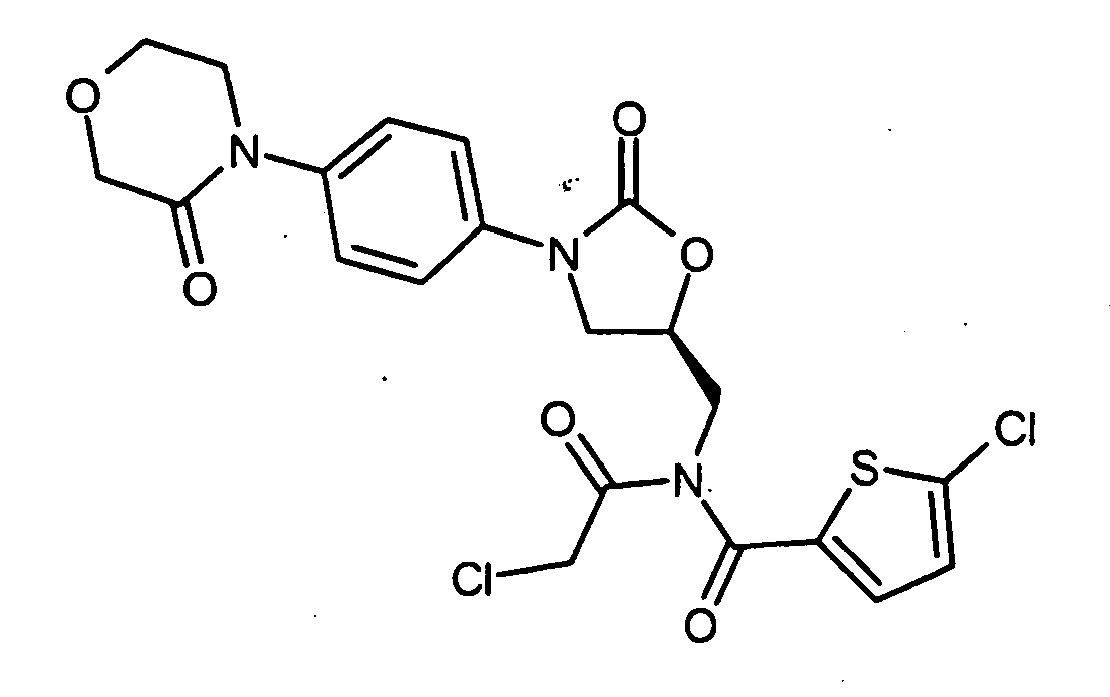
1 g (2.3 mmol) 5-Chlor-N-({(5S)-2-oxo-3-[4-(3-oxomorpholin-4-yl)phenyl]-1,3-oxazolidin-5-yl}-methyl)thiophen-2-carboxamid [Verbindung (A)] wird unter Argon in 170 ml abs. DMF gelöst. Man setzt 110 mg (4.6 mmol) Natriumhydrid zu und lässt 20 min bei RT rühren. Dann werden 3.5 g (31 mmol) Chloracetylchlorid zugesetzt, wobei die Reaktionstemperatur auf RT gehalten wird. Nach 30 min setzt man unter Kühlung 25 ml Wasser zu und lässt das Gemisch zwei Tage bei RT stehen. Dann wird das Lösungsmittel im Vakuum entfernt, wobei die Temperatur nicht über +25°C ansteigen sollte. Der Rückstand wird in 500 ml Dichlormethan aufgenommen und fünfmal mit 200 ml Wasser ausgeschüttelt. Die organische Phase wird über Magnesiumsulfat getrocknet, filtriert und auf ein Volumen von ca. 50 ml eingeengt. Unter Rühren werden 200 ml Diethylether zugesetzt und der Niederschlag (zum großen Teil nicht umgesetztes Ausgangsmaterial) anschließend abfiltriert. Die Mutterlauge wird eingeengt und der Rückstand durch Flash-Chromatographie an Kieselgel mit Toluol/Ethanol 10:1 1 als Eluent gereinigt. Die entsprechenden Fraktionen werden vereinigt und das Lösungsmittel entfernt. Der Rückstand wird aus Dioxan lyophilisiert.1 g (2.3 mmol) of 5-chloro-N- ({(5 S) -2-oxo-3- [4- (3-oxomorpholine-4-yl) phenyl] -1,3-oxazolidin-5-yl} -methyl) thiophene-2-carboxamide [compound (A)] is dissolved under argon in 170 ml of abs. DMF solved. 110 mg (4.6 mmol) of sodium hydride are added and the mixture is stirred at RT for 20 min. Then 3.5 g (31 mmol) of chloroacetyl chloride are added, keeping the reaction temperature at RT. After 30 minutes, 25 ml of water are added while cooling and the mixture is allowed to stand at RT for two days. Then the solvent is removed in vacuo and the temperature should not rise above + 25 ° C. The residue is taken up in 500 ml of dichloromethane and five times shaken with 200 ml of water. The organic phase is dried over magnesium sulfate, filtered and concentrated to a volume of about 50 ml. While stirring, 200 ml of diethyl ether are added and the precipitate (largely unreacted starting material) is then filtered off. The mother liquor is concentrated and the residue is purified by flash chromatography on silica gel with toluene / ethanol 10: 1 1 as eluent. The appropriate fractions are combined and the solvent removed. The residue is lyophilized from dioxane.
- HPLC (Methode 2): Rt = 5.09 min;HPLC (Method 2): R t = 5.09 min;
- LC-MS (Methode 4): Rt = 2.31 min; m/z = 512 (M+H)+.LC-MS (Method 4): R t = 2.31 min; m / z = 512 (M + H) + .

Im ersten Schritt werden 511 mg (1.5 mmol) Z-Sarcosin als Carboxylkomponente nach der Allgemeinen Vorschrift 1 mit Verbindung (B) umgesetzt (Ausbeute: 697 mg, 92% d. Th.).In the first step, 511 mg (1.5 mmol) of Z-sarcosine are reacted as carboxyl component according to General Procedure 1 with compound (B) (yield: 697 mg, 92% of theory).
Von 200 mg (0.4 mmol) dieser Zwischenstufe wird anschließend nach Standardmethoden die Benzyloxycarbonyl-Schutzgruppe hydrogenolytisch über Pd/C entfernt (Ausbeute: 130 mg, 89% d. Th.).From 200 mg (0.4 mmol) of this intermediate, the benzyloxycarbonyl protective group is subsequently removed by hydrogenolysis over Pd / C by standard methods (yield: 130 mg, 89% of theory).
Die so erhaltene Verbindung wird dann in einem dritten Schritt erneut mit 120 mg (0.54 mmol) Z-Sarcosin nach der Allgemeinen Vorschrift 1 verknüpft (Ausbeute: 201 mg, 98% d. Th.).The compound thus obtained is then combined again in a third step with 120 mg (0.54 mmol) of Z-sarcosine according to General Procedure 1 (Yield: 201 mg, 98% of theory).
HPLC (Methode 2): Rt = 4.21 min;HPLC (method 2): R t = 4.21 min;
LC-MS (Methode 6): Rt = 1.54 min; m/z = 568 (M+H)+.LC-MS (Method 6): R t = 1.54 min; m / z = 568 (M + H) + .

Im ersten Schritt werden 529 mg (2.3 mmol) Boc-N-Methylvalin als Carboxylkomponente nach der Allgemeinen Vorschrift 1 mit Verbindung (B) umgesetzt (Ausbeute: 750 mg, 97% d. Th.).In the first step, 529 mg (2.3 mmol) of Boc- N- methylvaline are reacted as carboxyl component according to General Method 1 with compound (B) (yield: 750 mg, 97% of theory).
Von 750 mg (1.5 mmol) dieser Zwischenstufe wird anschließend- nach Standardmethode mit Trifluoressigsäure in Dichlormethan die tert.-Butoxycarbonyl-Schutzgruppe entfernt (Ausbeute: 740 mg, 96% d. Th.).750 mg (1.5 mmol) of this intermediate are then used to remove the tert-butoxycarbonyl protective group by standard method with trifluoroacetic acid in dichloromethane (yield: 740 mg, 96% of theory).
200 mg (0.39 mmol) der so erhaltenen Verbindung werden dann in einem dritten Schritt mit 129 mg (0.58 mmol) Z-Sarcosin nach der Allgemeinen Vorschrift 1 verknüpft (Ausbeute: 206 mg, 88% d. Th.).
- HPLC (Methode 2): Rt = 4.68 min;
- LC-MS (Methode 5): Rt = 1.96 min; m/z = 610 (M+H)+.
- HPLC (Method 2): R t = 4.68 min;
- LC-MS (Method 5): R t = 1.96 min; m / z = 610 (M + H) + .

- Ausbeute: 45 mg (91% d. Th.)
- HPLC (Methode 2): Rt = 4.51 min;
- LC-MS (Methode 4): Rt = 2.02 min; m/z = 539 (M+H)+.
- Yield: 45 mg (91% of theory)
- HPLC (Method 2): R t = 4.51 min;
- LC-MS (Method 4): R t = 2.02 min; m / z = 539 (M + H) + .

- Ausbeute: 298 mg (71% d. Th.)
- HPLC (Methode 2): Rt = 4.42 min;
- LC-MS (Methode 4): Rt = 1.89 min; m/z = 525 (M+H)+.
- Yield: 298 mg (71% of theory)
- HPLC (Method 2): R t = 4.42 min;
- LC-MS (Method 4): R t = 1.89 min; m / z = 525 (M + H) + .

Im ersten Schritt werden 511 mg (1.5 mmol) Z-Sarcosin als Carboxylkomponente nach der Allgemeinen Vorschrift 1 mit Verbindung (B) umgesetzt (Ausbeute 697 mg 92% d. Th.).In the first step, 511 mg (1.5 mmol) of Z-sarcosine are reacted as a carboxyl component according to General Procedure 1 with compound (B) (yield 697 mg of 92% of theory).
Von 200 mg (0.4 mmol) dieser Zwischenstufe wird anschließend nach Standardmethoden die Benzyloxycarbonyl-Schutzgruppe hydrogenolytisch über Pd/C entfernt (Ausbeute: 130 mg, 89% d. Th.).From 200 mg (0.4 mmol) of this intermediate, the benzyloxycarbonyl protective group is subsequently removed by hydrogenolysis over Pd / C by standard methods (yield: 130 mg, 89% of theory).
100 mg der so erhaltenen Verbindung werden dann in einem dritten Schritt mit 98.2 mg (0.41 mmol) Z-N-Methyl-β-alanin nach der Allgemeinen Vorschrift 1 verknüpft (Ausbeute: 87 mg, 54% d. Th.).
- HPLC (Methode 2): Rt = 4.28 min;
- LC-MS (Methode 6): Rt = 1.60 min; m/z = 582 (M+H)+.
- HPLC (Method 2): R t = 4.28 min;
- LC-MS (Method 6): R t = 1.60 min; m / z = 582 (M + H) + .

Zunächst wird 4-[[(Benzyloxy)carbonyl](methyl)amino]buttersäure nach Literaturvorschrift [
1.74 g (6.92 mmol) 4-[[(Benzyloxy)carbonyl](methyl)amino]buttersäure werden in 35 ml Dichlormethan gelöst und mit 3.5 ml (48 mmol) Thionylchlorid versetzt. Man erhitzt die Mischung 1 h lang unter Rückfluss. Danach wird im Vakuum eingeengt, der Rückstand erneut mit Dichlormethan versetzt und abermals eingeengt. Zurück bleibt ein viskoses Öl, das im Hochvakuum getrocknet wird. Man erhält 1.8 g (96% d. Th.) der Zielverbindung, welche ohne weitere Aufreinigung und Charakterisierung weiter umgesetzt wird.1.74 g (6.92 mmol) of 4 - [[(benzyloxy) carbonyl] (methyl) amino] butyric acid are dissolved in 35 ml of dichloromethane and admixed with 3.5 ml (48 mmol) of thionyl chloride. The mixture is heated for 1 h under reflux. It is then concentrated under reduced pressure, the residue is again combined with dichloromethane and concentrated again. What remains is a viscous oil, which is dried in a high vacuum. This gives 1.8 g (96% of theory) of the target compound, which is reacted further without further purification and characterization.

Zunächst wird 5-[[(Benzyloxy)carbonyl](methyl)amino]valeriansäure nach bekannten Methoden analog zu Intermediat 7A hergestellt.First, 5 - [[(benzyloxy) carbonyl] (methyl) amino] valeric acid is prepared by known methods analogously to intermediate 7A.
1.97 g (7.43 mmol) 5-[[(Benzyloxy)carbonyl](methyl)amino]valeriansäure werden in 30 ml Dichlormethan gelöst und mit 4.9 ml (67.3 mmol) Thionylchlorid versetzt. Man erhitzt die Mischung 1 h lang unter Rückfluss. Danach wird im Vakuum eingeengt, der Rückstand erneut mit Dichlormethan versetzt und abermals eingeengt. Zurück bleibt ein viskoses Öl, das im Hochvakuum getrocknet wird. Man erhält 2 g (95% d. Th.) der Zielverbindung, welche ohne weitere Aufreinigung und Charakterisierung weiter umgesetzt wird.1.97 g (7.43 mmol) of 5 - [[(benzyloxy) carbonyl] (methyl) amino] valeric acid are dissolved in 30 ml of dichloromethane and admixed with 4.9 ml (67.3 mmol) of thionyl chloride. The mixture is heated for 1 h under reflux. It is then concentrated under reduced pressure, the residue is again combined with dichloromethane and concentrated again. What remains is a viscous oil, which is dried in a high vacuum. This gives 2 g (95% of theory) of the target compound, which is reacted further without further purification and characterization.

Zunächst wird 3-[[(Benzyloxy)carbonyl](methyl)amino]propionsäure nach Literaturvorschrift [
850 mg (3.58 mmol) 3-[[(Benzyloxy)carbonyl](methyl)amino]propionsäure werden in 15 ml Dichlormethan gelöst und mit 1.5 ml Oxalylchlorid versetzt. Man erhitzt die Mischung 3 h lang unter Rückfluss. Danach wird im Vakuum eingeengt, der Rückstand erneut mit Dichlormethan versetzt und abermals eingeengt. Zurück bleibt ein viskoses Öl, das im Hochvakuum getrocknet wird. Man erhält 915 mg (quant.) der Zielverbindung, welche ohne weitere Aufreinigung und Charakterisierung weiter umgesetzt wird.850 mg (3.58 mmol) of 3 - [[(benzyloxy) carbonyl] (methyl) amino] propionic acid are dissolved in 15 ml of dichloromethane and admixed with 1.5 ml of oxalyl chloride. The mixture is heated under reflux for 3 h. It is then concentrated under reduced pressure, the residue is again combined with dichloromethane and concentrated again. What remains is a viscous oil, which is dried in a high vacuum. This gives 915 mg (quant.) Of the target compound, which is reacted further without further purification and characterization.

Zunächst wird 6-[[(Benzyloxy)carbonyl](methyl)amino]capronsäure nach Literaturvorschrift [
3850 mg (13.8 mmol) 6-[[(Benzyloxy)carbonyl](methyl)amino]capronsäure werden in 60 ml Dichlormethan gelöst und mit 4 ml Oxalylchlorid versetzt. Man erhitzt die Mischung 3 h lang unter Rückfluss. Danach wird im Vakuum eingeengt, der Rückstand erneut mit Dichlormethan versetzt und abermals eingeengt. Zurück bleibt ein viskoses Öl, das im Hochvakuum getrocknet wird.3850 mg (13.8 mmol) of 6 - [[(benzyloxy) carbonyl] (methyl) amino] caproic acid are dissolved in 60 ml of dichloromethane and admixed with 4 ml of oxalyl chloride. The mixture is heated under reflux for 3 h. It is then concentrated under reduced pressure, the residue is again combined with dichloromethane and concentrated again. What remains is a viscous oil, which is dried in a high vacuum.
Man erhält 4.1 g (quant.) der Zielverbindung, welche ohne weitere Aufreinigung und Charakterisierung weiter umgesetzt wird.This gives 4.1 g (quant.) Of the target compound, which is further reacted without further purification and characterization.

480 mg (2.95 mmol) 5-Chlorthiophen-2-carbonsäure werden in 24 ml Dichlormethan gelöst und mit 2.4 ml (27.5 mmol) Oxalylchlorid versetzt. Man erhitzt die Mischung 16 h lang unter Rückfluss. Danach wird im Vakuum eingeengt, der Rückstand erneut mit Dichlormethan versetzt und abermals eingeengt. Zurück bleibt ein viskoses Öl, das im Hochvakuum getrocknet wird. Man erhält 534 mg (quant.) der Zielverbindung, welche ohne weitere Aufreinigung und Chärakterisierung weiter umgesetzt wird.480 mg (2.95 mmol) of 5-chlorothiophene-2-carboxylic acid are dissolved in 24 ml of dichloromethane and admixed with 2.4 ml (27.5 mmol) of oxalyl chloride. The mixture is heated under reflux for 16 h. It is then concentrated under reduced pressure, the residue is again combined with dichloromethane and concentrated again. What remains is a viscous oil, which is dried in a high vacuum. This gives 534 mg (quant.) Of the target compound, which is further reacted without further purification and Chärakterisierung.
Benzyl (5-chlor-5-oxopentyl)(4-methoxybenzyl)-carbamat

10 g (85.4 mmol) 5-Aminovaleriansäure, 17.4 g (128 mmol) p-Anisaldehyd und 10.3 g (85.4 mmol) Magnesiumsulfat werden in 330 ml Ethanol aufgenommen und 1 h unter Rückfluss erhitzt.
Man filtriert danach ab, wäscht mit Ethanol nach und versetzt anschließend das Filtrat portionsweise innerhalb von 15 min mit insgesamt 1.94 g (51.2 mmol) Natriumborhydrid. Man setzt zunächst 10 ml Wasser zu und dann 128 ml einer 2 M Natronlauge. Nach 5 min wird mit 300 ml Wasser verdünnt und anschließend dreimal mit je 200 ml Ethylacetat ausgeschüttelt. Die wässrige Phase wird mit 4 M Salzsäure auf pH 2 eingestellt und im Vakuum eingeengt. Der Rückstand wird durch Flash-Chromatographie an Kieselgel mit Acetonitril/Wasser/Essigsäure 5:1:0.1 als Eluent gereinigt. Die Produktfraktionen werden eingeengt und mit Ethylacetat und Diethylether verrührt. Der Rückstand wird dann abgesaugt und im Hochvakuum getrocknet. Man erhält 9.1 g (45% d. Th.) der p-Methoxybenzyl-geschützten 5-Aminovaleriansäure.10 g (85.4 mmol) of 5-aminovaleric acid, 17.4 g (128 mmol) of p-anisaldehyde and 10.3 g (85.4 mmol) of magnesium sulfate are taken up in 330 ml of ethanol and heated under reflux for 1 h.
It is then filtered off, washed with ethanol and then added to the filtrate in portions over 15 min with a total of 1.94 g (51.2 mmol) of sodium borohydride. It is first added to 10 ml of water and then 128 ml of a 2 M sodium hydroxide solution. After 5 min, it is diluted with 300 ml of water and then extracted by shaking three times with 200 ml of ethyl acetate each time. The aqueous phase is adjusted to pH 2 with 4 M hydrochloric acid and concentrated in vacuo. The residue is purified by flash chromatography on silica gel with acetonitrile / water / acetic acid 5: 1: 0.1 as eluent cleaned. The product fractions are concentrated and stirred with ethyl acetate and diethyl ether. The residue is then filtered off with suction and dried under high vacuum. 9.1 g (45% of theory) of p-methoxybenzyl-protected 5-aminovaleric acid are obtained.
Das so erhaltene 5-Aminovaleriansäure-Derivat wird in Dioxan/Wasser (1:1) aufgenommen, mit Natronlauge auf pH 10 eingestellt und anschließend tropfenweise mit 12.97 g (76 mmol) Benzylchlorcarbonat versetzt. Nach 1 min Rühren bei RT wird das Dioxan im Vakuum entfernt und die verbleibende Lösung mit 2 M Salzsäure auf pH 2 eingestellt. Man extrahiert mit Ethylacetat und wäscht die organische Phase anschließend zweimal mit Wasser. Die organische Phase wird dann eingeengt und der Rückstand im Hochvakuum getrocknet. Anschließend erfolgt eine Reinigung durch Flash-Chromatographie an Kieselgel mit Acetonitril als Eluent. Die Produktfraktionen werden eingeengt und der Rückstand im Hochvakuum getrocknet. Man erhält 5.6 g (38% d. Th.) der Z-geschützten Aminosäure.The 5-aminovaleric acid derivative thus obtained is taken up in dioxane / water (1: 1), adjusted to pH 10 with sodium hydroxide solution and then treated dropwise with 12.97 g (76 mmol) of benzyl chlorocarbonate. After stirring for 1 min at RT, the dioxane is removed in vacuo and the remaining solution is adjusted to pH 2 with 2 M hydrochloric acid. It is extracted with ethyl acetate and the organic phase is then washed twice with water. The organic phase is then concentrated and the residue is dried under high vacuum. This is followed by purification by flash chromatography on silica gel with acetonitrile as eluent. The product fractions are concentrated and the residue is dried under high vacuum. 5.6 g (38% of theory) of the Z-protected amino acid are obtained.
5.6 g (15 mmol) der so erhaltenen 5-{((Benzyloxy)carbonyl](4-methoxybenzyl)amino}valeriansäure werden in 60 ml Dichlormethan gelöst und mit 2.2 ml Thionylchlorid versetzt. Man erhitzt die Mischung 30 min lang unter Rückfluss. Danach wird im Vakuum eingeengt, der Rückstand erneut mit Dichlormethan versetzt und abermals eingeengt. Zurück bleibt ein viskoses Öl, das im Hochvakuum getrocknet wird. Man erhält 5.7 g (98% d. Th.) der Zielverbindung, welche ohne weitere Aufreinigung und Charakterisierung weiter umgesetzt wird.5.6 g (15 mmol) of the thus obtained 5 - {((benzyloxy) carbonyl] (4-methoxybenzyl) amino} valeric acid are dissolved in 60 ml of dichloromethane and 2.2 ml of thionyl chloride are added, the mixture is refluxed for 30 minutes is concentrated in vacuo, the residue is again combined with dichloromethane and again concentrated to leave behind a viscous oil, which is dried under high vacuum to give 5.7 g (98% of theory) of the target compound, which further reacted without further purification and characterization becomes.

Die Titelverbindung wird in Analogie zu Intermediat 12A ausgehend von 6-Aminocapronsäure hergestellt.The title compound is prepared in analogy to intermediate 12A starting from 6-aminocaproic acid.

Die Titelverbindung wird in Analogie zu Intermediat 12A ausgehend von 4-Aminobuttersäure hergestellt.The title compound is prepared analogously to intermediate 12A starting from 4-aminobutyric acid.

Zunächst wird 4-{[(Benzyloxy)carbonyl](butyl)amino}buttersäure nach Literaturvorschrift [

12 g (74.4 mmol) tert.-Butyl (2-hydroxyethyl)-carbamat werden mit 43.6 g (223.3 mmol) tert.-Butylbromacetat in einem Gemisch aus 400 ml Toluol und 20 g konzentrierter Natronlauge in Gegenwart von 200 mg (0.59 mmol) Tetrabutylammoniumhydrogensulfat 1 h lang bei RT gerührt. Danach werden nochmals 15 g tert.-Butylbromacetat zugesetzt und die Mischung eine weitere Stunde bei RT gerührt. Man verdünnt dann mit Toluol und Wasser und trennt die Phasen. Die organische Phase wird getrocknet und im Vakuum eingeengt. Der Rückstand wird mit 100 ml wasserfreier Trifluoressigsäure versetzt und 90 min bei RT gerührt. Man engt danach ein und behandelt den harzigen Rückstand mit Diethylether. Man dekantiert ab und trocknet das verbleibende Harz im Hochvakuum. Man erhält so 10.8 g (62% d. Th.) der Zwischenverbindung (2-Amino-ethoxy)essigsäure (als Trifluoracetat).
DC (Acetonitril/Wasser/Eisessig 5:1:0.2): Rf = 0.08.12 g (74.4 mmol) of tert -butyl (2-hydroxyethyl) carbamate are mixed with 43.6 g (223.3 mmol) of tert- butyl bromoacetate in a mixture of 400 ml of toluene and 20 g of concentrated sodium hydroxide in the presence of 200 mg (0.59 mmol). Tetrabutylammoniumhydrogensulfat stirred for 1 h at RT. Then another 15 g of tert -butyl bromoacetate are added and the mixture is stirred for a further hour at RT. It is then diluted with toluene and water and the phases are separated. The organic phase is dried and concentrated in vacuo. The residue is mixed with 100 ml of anhydrous trifluoroacetic acid and stirred at RT for 90 min. It is then concentrated and the resinous residue treated with diethyl ether. It is decanted off and the remaining resin is dried in a high vacuum. This gives 10.8 g (62% of theory) of the intermediate compound (2-aminoethoxy) acetic acid (as trifluoroacetate).
TLC (acetonitrile / water / glacial acetic acid 5: 1: 0.2): R f = 0.08.
Die oben erhaltene Aminosäure wird anschließend, wie für Intermediat 12A beschrieben, zu (2-{[(Benzyloxy)carbonyl](4-methoxybenzyl)amino}ethoxy)essigsäure umgesetzt.
- Ausbeute: 2.56 g (13% d. Th.)
- HPLC (Methode 2): Rt = 5.16 min;
- LC-MS (Methode 12): Rt = 3.1 min; m/z = 374 (M+H)+.
- Yield: 2.56 g (13% of theory)
- HPLC (Method 2): R t = 5.16 min;
- LC-MS (Method 12): R t = 3.1 min; m / z = 374 (M + H) + .
2.56 g (6.86 mmol) der erhaltenen (2-{[(Benzyloxy)carbonyl](4-methoxybenzyl)amino}ethoxy)-essigsäure werden dann, wie bei Intermediat 12A beschrieben, mit Thionylchlorid zur Titelverbindung umgesetzt.2.56 g (6.86 mmol) of the obtained (2 - {[(benzyloxy) carbonyl] (4-methoxybenzyl) amino} ethoxy) -acetic acid are then reacted with thionyl chloride to give the title compound as described for intermediate 12A.
Ausbeute: 2.65 g (99% d. Th.) HPLC (Methode 2): Rt = 5.11 min.Yield: 2.65 g (99% of theory) HPLC (Method 2): R t = 5.11 min.
1 mmol der entsprechenden Carbonsäure wird in einer Mischung aus 10 ml Dioxan und 10 ml Wasser gelöst und mit 0.5 mmol Caesiumcarbonat versetzt. Anschließend wird lyophilisiert.1 mmol of the corresponding carboxylic acid is dissolved in a mixture of 10 ml of dioxane and 10 ml of water and treated with 0.5 mmol of cesium carbonate. It is then lyophilized.

11 mg (21 µmol) von Intermediat 1A werden mit 7.9 mg (26 µmol) des Caesiumsalzes von Boc-Glycin (hergestellt aus Boc-Glycin nach der Allgemeinen Vorschrift 2) in 5 ml DMF gelöst. Nach 3 h Rühren bei RT wird durch präparative HPLC (Methode 1) aufgereinigt. Die entsprechenden Fraktionen werden eingeengt und im Hochvakuum getrocknet.
- Ausbeute: 7 mg (50% d. Th.)
- HPLC (Methode 2): Rt = 5.2 min;
- LC-MS (Methode 6): Rt = 2.11 min; m/z = 651 (M+H)+.
- Yield: 7 mg (50% of theory)
- HPLC (Method 2): R t = 5.2 min;
- LC-MS (Method 6): R t = 2.11 min; m / z = 651 (M + H) + .
7 mg (11 µmol) der oben erhaltenen geschützten Zwischenstufe werden mit 3 ml einer 22%-igen Lösung von Chlorwasserstoff in Dioxan versetzt. Nach 30 min wird das Gemisch im Vakuum bei ≤ 25°C eingeengt und der Rückstand aus Dioxan lyophilisiert.
- Ausbeute: 4.5 mg (72% d. Th.)
- HPLC (Methode 2): Rt = 4.2 min;
- LC-MS (Methode 5): Rt = 1.41 min; m/z = 551 (M+H)+.
- Yield: 4.5 mg (72% of theory)
- HPLC (Method 2): R t = 4.2 min;
- LC-MS (Method 5): R t = 1.41 min; m / z = 551 (M + H) + .

38 mg (74 µmol) von Intermediat 1A werden mit 32.3 mg (96 µmol) des Caesiumsalzes von N-Boc-2-methylalanin (hergestellt aus N-Boc-2-methylalanin nach der Allgemeinen Vorschrift 2) in 38 ml DMF gelöst. Nach 3 h Rühren bei RT unter Ultraschallbehandlung wird durch präparative HPLC (Methode 1) aufgereinigt. Die entsprechenden Fraktionen werden eingeengt und im Hochvakuum getrocknet.
- Ausbeute: 29 mg (58% d. Th.)
- HPLC (Methode 2): Rt = 5.38 min;
- LC-MS (Methode 6): Rt = 2.27 min; m/z = 679 (M+H)+.
- Yield: 29 mg (58% of theory)
- HPLC (Method 2): R t = 5.38 min;
- LC-MS (Method 6): R t = 2.27 min; m / z = 679 (M + H) + .
16.3 mg (24 µmol) der oben erhaltenen geschützten Zwischenstufe werden mit 3 ml einer 22%-igen Lösung von Chlorwasserstoff in Dioxan versetzt. Nach 30 min wird das Gemisch im Vakuum bei ≤ 25°C eingeengt und der Rückstand aus Dioxan lyophilisiert.
- Ausbeute: 13 mg (88% d. Th.)
- HPLC (Methode 2): Rt = 4.3 min;
- LC-MS (Methode 6): Rt =1.27 min; m/z = 579 (M+H)+.
- Yield: 13 mg (88% of theory)
- HPLC (Method 2): R t = 4.3 min;
- LC-MS (Method 6): R t = 1.27 min; m / z = 579 (M + H) + .

19 mg (37 µmol) von Intermediat 1A werden mit 16.8 mg (48 µmol) des Caesiumsalzes von N-Boc-Valin (hergestellt aus N-Boc-Valin nach der Allgemeinen Vorschrift 2) in 10 ml DMF gelöst. Nach 1.5 h Rühren bei RT unter Ultraschallbehandlung wird durch präparative HPLC (Methode 1) aufgereinigt. Die entsprechenden Fraktionen werden eingeengt und im Hochvakuum getrocknet.
- Ausbeute: 13.5 mg (53% d. Th.)
- HPLC (Methode 2): Rt = 5.45 min;
- LC-MS (Methode 4): Rt = 2.69 min; m/z = 693 (M+H)+.
- Yield: 13.5 mg (53% of theory)
- HPLC (method 2): R t = 5.45 min;
- LC-MS (Method 4): R t = 2.69 min; m / z = 693 (M + H) + .
13.5 mg (19 µmol) der oben erhaltenen geschützten Zwischenstufe werden mit 3 ml einer 22%-igen Lösung von Chlorwasserstoff in Dioxan versetzt. Nach 30 min wird das Gemisch im Vakuum bei ≤ 25°C eingeengt und der Rückstand aus Dioxan lyophilisiert.
- Ausbeute: 12 mg (98% d. Th.)
- HPLC (Methode 2): Rt = 4.43 min;
- LC-MS (Methode 5): Rt = 1.54 min; m/z = 593 (M+H)+.
- Yield: 12 mg (98% of theory)
- HPLC (Method 2): R t = 4.43 min;
- LC-MS (Method 5): R t = 1.54 min; m / z = 593 (M + H) + .

20 mg (39 µmol) von Intermediat 1A werden mit 17.6 mg (51 µmol) des Caesiumsalzes von N-Boc-Prolin (hergestellt aus N-Boc-Prolin nach der Allgemeinen Vorschrift 2) in 5 ml DMF gelöst. Nach 2 h Rühren bei RT unter Ultraschallbehandlung wird durch präparative HPLC (Methode 1) aufgereinigt. Die entsprechenden Fraktionen werden eingeengt und im Hochvakuum getrocknet.
- Ausbeute: 11.4 mg (42% d. Th.)
- HPLC (Methode 2): Rt = 5.44 min;
- LC-MS (Methode 4): Rt =2.61 min; m/z = 691 (M+H)+.
- Yield: 11.4 mg (42% of theory)
- HPLC (method 2): R t = 5.44 min;
- LC-MS (Method 4): R t = 2.61 min; m / z = 691 (M + H) + .
11.3 mg (16 µmol) der oben erhaltenen geschützten Zwischenstufe werden mit 2.5 ml einer 22%-igen Lösung von Chlorwasserstoff in Dioxan versetzt. Nach 30 min wird das Gemisch im Vakuum bei ≤ 25°C eingeengt und der Rückstand aus Dioxan lyophilisiert.
- Ausbeute: 10 mg (97% d. Th.)
- HPLC (Methode 2): Rt = 4.34 min;
- LC-MS (Methode 6): Rt = 1.26 min; m/z = 591 (M+H)+.
- Yield: 10 mg (97% of theory)
- HPLC (method 2): R t = 4.34 min;
- LC-MS (Method 6): R t = 1.26 min; m / z = 591 (M + H) + .

20 mg (39 µmol) von Intermediat 1A werden mit 17.5 mg (55 µmol) des Caesiumsalzes von N-Boc-Sarcosin (hergestellt aus N-Boc-Sarcosin nach der Allgemeinen Vorschrift 2) in 4 ml DMF gelöst. Nach 3 h Rühren bei RT unter Ultraschallbehandlung wird durch präparative HPLC (Methode 1) aufgereinigt. Die entsprechenden Fraktionen werden eingeengt und im Hochvakuum getrocknet.
- Ausbeute: 11 mg (42% d. Th.)
- HPLC (Methode 2): Rt = 5.35 min;
- LC-MS (Methode 5): Rt = 2.43 min; m/z =665 (M+H)+.
- Yield: 11 mg (42% of theory)
- HPLC (method 2): R t = 5.35 min;
- LC-MS (method 5): R t = 2.43 min; m / z = 665 (M + H) + .
11 mg (16 µmol) der oben erhaltenen geschützten Zwischenstufe werden mit 2 ml einer 22%-igen Lösung von Chlorwasserstoff in Dioxan versetzt. Nach 30 min wird das Gemisch im Vakuum bei ≤ 25°C eingeengt und der Rückstand aus Dioxan lyophilisiert.
- Ausbeute: 9.5 mg (96% d. Th.)
- HPLC (Methode 2): Rt = 4.24 min;
- LC-MS (Methode 4): Rt =1.57 min; m/z = 565 (M+H)+.
- Yield: 9.5 mg (96% of theory)
- HPLC (method 2): R t = 4.24 min;
- LC-MS (Method 4): R t = 1.57 min; m / z = 565 (M + H) + .

20 mg (40 µmol) von Intermediat 1 A werden mit 19 mg (55 µmol) des Caesiumsalzes von Boc-D-Valin (hergestellt aus Boc-D-Valin nach der Allgemeinen Vorschrift 2) in 4 ml DMF gelöst. Nach 2 h Rühren bei RT wird durch präparative HPLC (Methode 1) aufgereinigt. Die entsprechenden Fraktionen werden eingeengt und im Hochvakuum getrocknet.
- Ausbeute: 23 mg (85% d. Th.)
- HPLC (Methode 2): Rt = 5.6 min;
- LC-MS (Methode 4): Rt = 2.72 min; m/z =693 (M+H)+.
- Yield: 23 mg (85% of theory)
- HPLC (Method 2): R t = 5.6 min;
- LC-MS (Method 4): R t = 2.72 min; m / z = 693 (M + H) + .
23 mg (33 µmol) der oben erhaltenen geschützten Zwischenstufe werden mit 3 ml einer 22%-igen Lösung von Chlorwasserstoff in Dioxan versetzt. Nach 30 min wird das Gemisch im Vakuum bei ≤ 25°C eingeengt und der Rückstand aus Dioxan lyophilisiert.
- Ausbeute: 20 mg (96% d. Th.)
- HPLC (Methode 2): Rt = 4.5 min;
- LC-MS (Methode 6): Rt = 1.3 min; m/z =593 (M+H)+.
- Yield: 20 mg (96% of theory)
- HPLC (Method 2): R t = 4.5 min;
- LC-MS (Method 6): R t = 1.3 min; m / z = 593 (M + H) + .

20 mg (40 µmol) von Intermediat 1 A werden mit 26 mg (55 µmol) des Caesiumsalzes von N,N'-bis-Boc-Lysin (hergestellt aus N,N'-bis-Boc-Lysin nach der Allgemeinen Vorschrift 2) in 4 ml DMF gelöst. Nach 2 h Rühren bei RT wird durch präparative HPLC (Methode 1) aufgereinigt. Die entsprechenden Fraktionen werden eingeengt und im Hochvakuum getrocknet.
- Ausbeute: 14 mg (43% d. Th.)
- HPLC (Methode 2): Rt = 5.63 min;
- LC-MS (Methode 5): Rt =2.66 min; m/z =822 (M+H)+.
- Yield: 14 mg (43% of theory)
- HPLC (Method 2): R t = 5.63 min;
- LC-MS (Method 5): R t = 2.66 min; m / z = 822 (M + H) + .
14 mg (17 µmol) der oben erhaltenen geschützten Zwischenstufe werden mit 2.5 ml einer 22%-igen Lösung von Chlorwasserstoff in Dioxan versetzt. Nach 30 min wird das Gemisch im Vakuum bei ≤ 25°C eingeengt und der Rückstand aus Dioxan lyophilisiert.
- Ausbeute: 10 mg.(86% d. Th.)
- HPLC (Methode 2): Rt = 4.1 min;
- LC-MS (Methode 6): Rt = 0.92 min; m/z =622 (M+H)+.
- Yield: 10 mg (86% of theory)
- HPLC (Method 2): R t = 4.1 min;
- LC-MS (Method 6): R t = 0.92 min; m / z = 622 (M + H) + .

20 mg (40 µmol) von Intermediat 1A werden mit 21 mg (55 µmol) des Caesiumsalzes von Boc-L-Histidin (hergestellt aus Boc-L-Histidin nach der Allgemeinen Vorschrift 2) in 4 ml DMF gelöst. Nach 2.5 h Rühren bei RT wird das Lösungsmittel im Vakuum entfernt. Der Rückstand wird in Acetonitril/Wasser (1:1) aufgenommen und durch präparative HPLC (Methode 1) gereinigt. Die entsprechenden Fraktionen werden eingeengt und im Hochvakuum getrocknet.
- Ausbeute: 21.9 mg (77% d. Th.)
- HPLC (Methode 2): Rt = 4.64 min;
- LC-MS (Methode 5): Rt =1.67 min; m/z =731 (M+H)+.
- Yield: 21.9 mg (77% of theory)
- HPLC (Method 2): R t = 4.64 min;
- LC-MS (method 5): R t = 1.67 min; m / z = 731 (M + H) + .
21.9 mg (30 µmol) der oben erhaltenen geschützten Zwischenstufe werden mit 6 ml einer 22%-igen Lösung von Chlorwasserstoff in Dioxan versetzt. Nach 90 min wird das Gemisch im Vakuum bei ≤ 25°C eingeengt. Der Rückstand wird in Acetonitril/Wasser (1:1) aufgenommen und durch präparative HPLC (Methode 1) gereinigt. Die entsprechenden Fraktionen werden eingeengt und der Rückstand aus Dioxan lyophilisiert.
- Ausbeute: 7.2 mg (34% d. Th.)
- HPLC (Methode 2): Rt = 4.11 min;
- LC-MS (Methode 6): Rt = 2.56 min; m/z = 631 (M+H)+.
- Yield: 7.2 mg (34% of theory)
- HPLC (Method 2): R t = 4.11 min;
- LC-MS (Method 6): R t = 2.56 min; m / z = 631 (M + H) + .

25 mg (49 µmol) von Intermediat 1A werden mit 26 mg (68 µmol) des Caesiumsalzes von Boc-D-Histidin (hergestellt aus Boc-D-Histidin nach der Allgemeinen Vorschrift 2) in 5 ml DMF gelöst. Nach 16 h Rühren bei RT wird das Lösungsmittel im Vakuum entfernt. Der Rückstand wird in Acetonitril/Wasser (1:1) aufgenommen und durch präparative HPLC (Methode 1) gereinigt. Die entsprechenden Fraktionen werden eingeengt und im Hochvakuum getrocknet.
- Ausbeute: 18.3 mg (51% d. Th.)
- HPLC (Methode 2): Rt =4.62 min.
- Yield: 18.3 mg (51% of theory)
- HPLC (Method 2): R t = 4.62 min.
18 mg (25 µmol) der oben erhaltenen geschützten Zwischenstufe werden mit 2 ml einer 22%-igen Lösung von Chlorwasserstoff in Dioxan versetzt. Nach 4 h wird das Gemisch im Vakuum bei ≤ 25°C eingeengt. Der Rückstand wird in Acetonitril/Wasser (1:1) aufgenommen und durch präparative HPLC (Methode I) gereinigt. Die entsprechenden Fraktionen werden eingeengt und der Rückstand aus Dioxan lyophilisiert.
- Ausbeute: 6 mg (37% d. Th.)
- HPLC (Methode 2): Rt = 4.1 min;
- LC-MS (Methode 5): Rt = 1.15 min; m/z = 631 (M+H)+.
- Yield: 6 mg (37% of theory)
- HPLC (Method 2): R t = 4.1 min;
- LC-MS (Method 5): R t = 1.15 min; m / z = 631 (M + H) + .

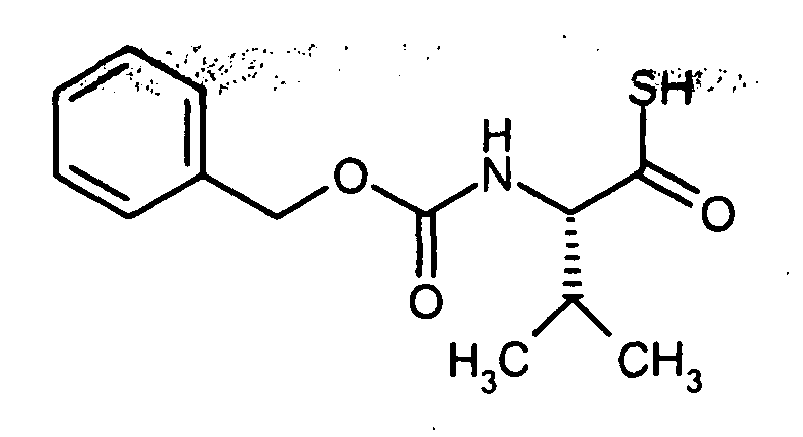
Die Titelverbindung wird aus Z-Valin analog literaturbekannter Vorschrift [
200 mg (748 µmol) (2S)-2-{[(Benzyloxy)carbonyl]amino}-3-methylbutanthio-S-säure werden in 10 ml Dioxan und 10 ml Wasser aufgenommen und mit 110 mg (337 µmol) Caesiumcarbonat versetzt. Sobald eine klare Lösung entstanden ist, wird lyophilisiert. Man erhält 300 mg des Caesiumsalzes in quantitativer Ausbeute.200 mg (748 .mu.mol) of ( 2S ) -2 - {[(benzyloxy) carbonyl] amino} -3-methylbutanthio-S-acid are taken up in 10 ml of dioxane and 10 ml of water and combined with 110 mg (337 .mu.mol) of cesium carbonate , Once a clear solution has been formed, lyophilize. 300 mg of the cesium salt are obtained in quantitative yield.
27 mg (68 µmol) dieses Caesiumsalzes sowie 25 mg (49 µmol) von Intermediat 1A werden in 5 ml DMF gelöst. Nach 2 h Rühren bei RT wird das Lösungsmittel im Vakuum entfernt. Der Rückstand wird in Acetonitril/Wasser (1:1) aufgenommen und durch präparative HPLC (Methode 1) gereinigt. Die entsprechenden Fraktionen werden eingeengt und im Hochvakuum getrocknet.
- Ausbeute: 24 mg (66% d. Th.)
- HPLC (Methode 2): Rt = 5.62 min;
- LC-MS (Methode 6): Rt = 2.47 min; m/z = 743 (M+H)+.
- Yield: 24 mg (66% of theory)
- HPLC (Method 2): R t = 5.62 min;
- LC-MS (Method 6): R t = 2.47 min; m / z = 743 (M + H) + .
24 mg (32.3 µmol) der oben erhaltenen geschützten Zwischenstufe werden mit 2 ml einer 33%-igen Lösung von Bromwasserstoff in Eisessig versetzt. Nach 1 h Rühren bei RT wird das Gemisch im Vakuum bei ≤ 25°C eingeengt und der Rückstand aus Dioxan/Wasser lyophilisiert.
- Ausbeute: 21 mg (94% d. Th.)
- HPLC (Methode 2): Rt = 4.43 min;
- LC-MS (Methode 4): Rt = 1.63 min; m/z = 609 (M+H)+.
- Yield: 21 mg (94% of theory)
- HPLC (Method 2): R t = 4.43 min;
- LC-MS (Method 4): R t = 1.63 min; m / z = 609 (M + H) + .


Die Titelverbindung wird aus Boc-Valin analog literaturbekannter Vorschrift [
200 mg (857 µmol) (2S)-2-[(tert.-Butoxycarbonyl)amino]-3-methylbutanthio-S-säure werden in 10 ml Dioxan und 10 ml Wasser aufgenommen und mit 126 mg (386 µmol) Caesiumcarbonat versetzt. Sobald eine klare Lösung entstanden ist, wird lyophilisiert. Man erhält 310 mg des Caesiumsalzes in quantitativer Ausbeute.200 mg (857 .mu.mol) (2 S) -2 - [(tert-butoxycarbonyl.) Amino] -3-methylbutanthio S-acid are taken up in 10 ml of dioxane and 10 ml of water and 126 mg (386 .mu.mol) of cesium carbonate , Once a clear solution has been formed, lyophilize. 310 mg of the cesium salt are obtained in quantitative yield.
25 mg (68 µmol) dieses Caesiumsalzes sowie 25 mg (49 µmol) von Intermediat 1 A werden in 4 ml DMF gelöst. Nach 1 h Rühren bei RT wird das Lösungsmittel im Vakuum entfernt. Der Rückstand wird in Acetonitril/Wasser (1:1) aufgenommen und durch präparative HPLC (Methode 1) gereinigt. Die entsprechenden Fraktionen werden eingeengt und im Hochvakuum getrocknet.
- Ausbeute: 23 mg (65% d. Th.)
- HPLC (Methode 2): Rt=5.64 min;
- LC-MS (Methode 4): Rt =2.76 min; m/z =709 (M+H)+.
- Yield: 23 mg (65% of theory)
- HPLC (Method 2): R t = 5.64 min;
- LC-MS (Method 4): R t = 2.76 min; m / z = 709 (M + H) + .
23 mg (32 µmol) der oben erhaltenen geschützten Zwischenstufe werden mit 4 ml einer 22%-igen Lösung von Chlorwasserstoff in Dioxan versetzt. Nach 1 h Rühren bei RT wird das Gemisch im Vakuum bei ≤ 25°C eingeengt und der Rückstand aus Dioxan lyophilisiert.
- Ausbeute: 20 mg (97% d. Th.)
- HPLC (Methode 2): Rt = 4.47 min;
- LC-MS (Methode 6): Rt = 1.35 min; m/z = 609 (M+H)+.
- Yield: 20 mg (97% of theory)
- HPLC (method 2): R t = 4.47 min;
- LC-MS (Method 6): R t = 1.35 min; m / z = 609 (M + H) + .

145.4 mg (0.334 mmol) der Verbindung (A) werden in 25 ml DMF gelöst, mit 24 mg (1 mmol) Natriumhydrid versetzt, und die Mischung 30 min bei RT gerührt. Dann gibt man 1.8 g (6.67 mmol) des Intermediats 7A hinzu. Man rührt weitere 15 min bei RT und versetzt den Ansatz dann mit einigen Tropfen Wasser. Danach wird eingeengt und der Rückstand in 300 ml Dichlormethan aufgenommen. Man schüttelt zunächst mit Wasser und dann dreimal mit 300 ml einer 5%-igen Natriumhydrogencarbonat-Lösung aus. Die Dichlormethan-Phase wird abgetrennt und eingeengt. Der Rückstand wird mit einer Mischung aus 15 ml Dichlormethan und 10 ml Diethylether verrührt. Man filtriert vom Ungelösten ab und engt die verbleibende Lösung ein. Der Rückstand wird durch präparative HPLC (Methode 1) gereinigt. Die entsprechenden Fraktionen, die ein bis-acyliertes Nebenprodukt, das nach Enolisierung der Mono-Acylverbindung entsteht, enthalten, werden eingeengt und im Hochvakuum getrocknet. Man erhält eine saubere Fraktion von 41 mg (13.6% d. Th.) sowie eine leicht verunreinigte Fraktion von 59 mg (19.6% d. Th.), die zusammen in der Folgestufe eingesetzt werden.
- HPLC (Methode 2): Rt = 6.06 min;
- LC-MS (Methode 5): Rt = 2.88 min; m/z =902 (M+H)+.
- HPLC (Method 2): R t = 6.06 min;
- LC-MS (Method 5): R t = 2.88 min; m / z = 902 (M + H) + .
100 mg (0.11 mmol) der oben erhaltenen Z-geschützten Zwischenstufe werden in 3.3 ml Eisessig aufgenommen und mit 17 ml einer 33%-igen Lösung von Bromwasserstoff in Eisessig versetzt. Unter diesen Bedingungen kommt es auch zur Spaltung des Enolesters. Nach 5 min Rühren bei RT ist die Umsetzung zur Zielverbindung abgeschlossen und der Ansatz wird im Hochvakuum eingeengt. Der Rückstand wird zweimal aus Acetonitril eingeengt und anschließend durch präparative HPLC gereinigt.
- Ausbeute: 29.6 mg (73.5% d. Th.)
- HPLC (Methode 2): Rt = 4.2 min;
- LC-MS (Methode 6): Rt = 1.19 min; m/z = 535 (M+H)+.
- Yield: 29.6 mg (73.5% of theory)
- HPLC (Method 2): R t = 4.2 min;
- LC-MS (Method 6): R t = 1.19 min; m / z = 535 (M + H) + .

59 mg (0.096 mmol) der Verbindung aus Beispiel 12 werden in 40 ml Acetonitril/Wasser (1:1) gelöst und mit 1 g (4.8 mmol) Pyrokohlensäure-di-tert.-butylester ("Boc-anhydrid") versetzt. Anschließend werden portionsweise 37 µl N,N-Diisopropylethylamin zugegeben, wobei ein pH-Wert von 7.8 nicht überschritten wird. Nach Beendigung der Reaktion nach etwa 15 min wird mit Essigsäure ein pH-Wert zwischen 3 und 4 eingestellt und im Vakuum eingeengt. Der Rückstand wird in Acetonitril aufgenommen und durch präparative HPLC (Methode 1) gereinigt. Die entsprechenden Fraktionen werden eingeengt und im Vakuum getrocknet. Man erhält 15.5 mg (26% d. Th.) der Boc-geschützten Zwischenstufe. 12.5 mg (0.02 mmol) hiervon werden sodann mit 5 ml einer 22%-igen Lösung von Chlorwasserstoff in Dioxan behandelt. Nach 10 min wird das Gemisch im Vakuum bei ≤ 25°C eingeengt. Der Rückstand wird in Wasser aufgenommen und mit Dichlormethan durchgeschüttelt. Die wässrige Phase wird mit Salzsäure auf pH 4 eingestellt und anschließend lyophilisiert.
- Ausbeute: 3.5 mg (31 % d. Th.)
- HPLC (Methode 2): Rt = 4.24 min;
- LC-MS (Methode 5): Rt = 1.43 min; m/z = 535 (M+H)+.
- Yield: 3.5 mg (31% of theory)
- HPLC (method 2): R t = 4.24 min;
- LC-MS (Method 5): R t = 1.43 min; m / z = 535 (M + H) + .
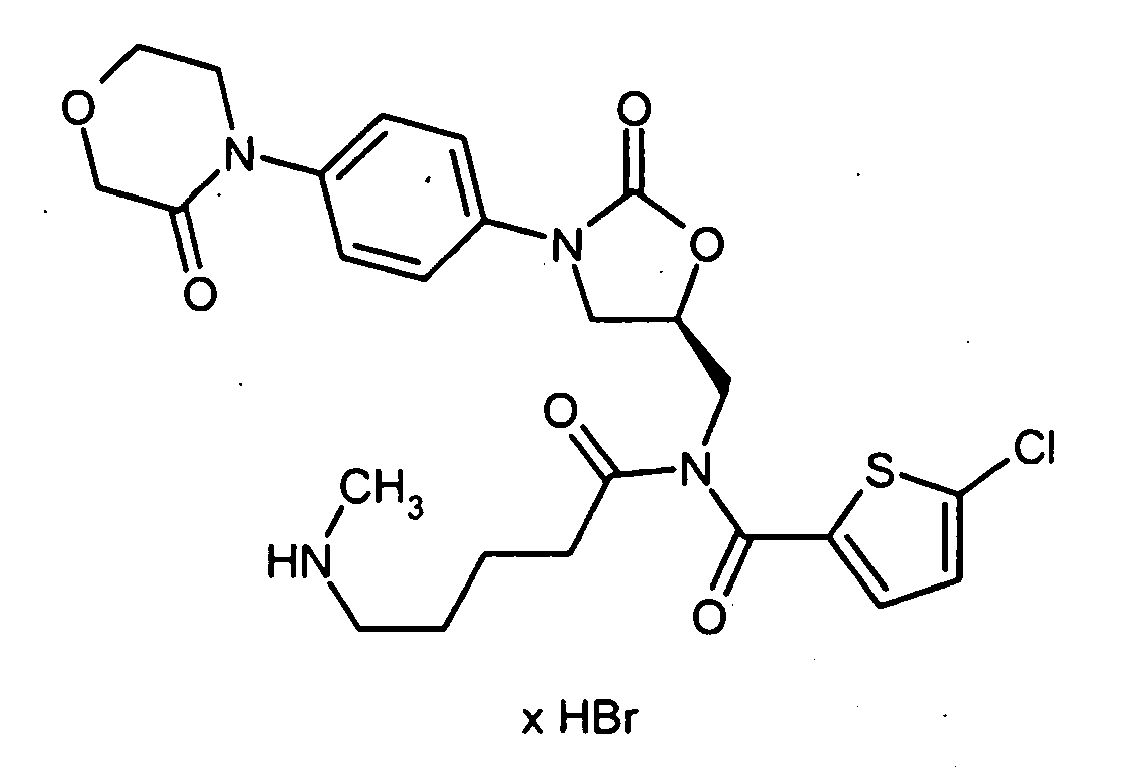
153.6 mg (0.352 mmol) der Verbindung (A) werden in 25 ml DMF gelöst, mit 25 mg (1 mmol) Natriumhydrid versetzt, und die Mischung 30 min bei RT gerührt. Dann gibt man 2 g (7.05 mmol) des Intermediats 8A, gelöst in 5 ml DMF, hinzu. Man rührt weitere 15 min bei RT und versetzt den Ansatz dann mit einigen Tropfen Wasser. Danach wird eingeengt und der Rückstand in 500 ml Dichlormethan aufgenommen. Man schüttelt zweimal mit 300 ml einer 5%-igen Natriumhydrogencarbonat-Lösung aus. Die Dichlormethan-Phase wird abgetrennt und eingeengt. Der Rückstand wird durch präparative HPLC (Methode 1) gereinigt. Die entsprechenden Fraktionen, die ein bis-acyliertes Nebenprodukt, das nach Enolisierung der Mono-Acylverbindung entsteht, enthalten, werden eingeengt und im Hochvakuum getrocknet. Man erhält 50 mg (15.2% d. Th.) einer leicht verunreinigten Fraktion, die als solche in der Folgestufe eingesetzt wird.
- HPLC (Methode 2): Rt =6.23 min.
- HPLC (Method 2): R t = 6.23 min.
50 mg (0.027 mmol) der oben erhaltenen Z-geschützten Zwischenstufe werden in 1 ml Eisessig aufgenommen und mit 5 ml einer 33%-igen Lösung von Bromwasserstoff in Eisessig versetzt. Unter diesen Bedingungen kommt es auch zur Spaltung des Enolesters. Nach 10 min Rühren bei RT ist die Umsetzung zur Zielverbindung abgeschlossen und der Ansatz wird im Hochvakuum eingeengt. Der Rückstand wird zweimal aus Acetonitril eingeengt und anschließend durch mehrmalige präparative HPLC gereinigt.
- Ausbeute: 0.5 mg (3% d. Th.)
- HPLC (Methode 2): Rt = 4.32 min;
- LC-MS (Methode 4): Rt = 1.31 min; m/z = 549 (M+H)+.
- Yield: 0.5 mg (3% of theory)
- HPLC (Method 2): R t = 4.32 min;
- LC-MS (Method 4): R t = 1.31 min; m / z = 549 (M + H) + .

108 mg (0.19 mmol) des Intermediats 2A werden in 25 ml DMF gelöst, mit 14 mg (0.57 mmol) Natriumhydrid versetzt, und die Mischung 15 min bei RT gerührt. Dann gibt man 534 mg (2.95 mmol) des Intermediats 11A, gelöst in 5 ml DMF, hinzu. Man rührt weitere 10 min bei RT und versetzt den Ansatz dann mit einigen Tropfen Wasser. Danach wird eingeengt und der Rückstand in 500 ml Dichlormethan aufgenommen. Man schüttelt dreimal mit 300 ml einer 5%-igen Natriumhydrogencarbonat-Lösung aus. Die Dichlormethan-Phase wird abgetrennt und eingeengt. Der Rückstand wird durch zweimalige präparative HPLC (Methode 1) gereinigt. Die entsprechenden Fraktionen werden eingeengt und im Hochvakuum getrocknet.
- Ausbeute: 31 mg (23% d. Th.)
- HPLC (Methode 2): Rt = 5.15 min;
- LC-MS (Methode 5): Rt =2.28 min; m/z = 712 (M+H)+.
- Yield: 31 mg (23% of theory)
- HPLC (method 2): R t = 5.15 min;
- LC-MS (method 5): R t = 2.28 min; m / z = 712 (M + H) + .
31 mg (0.044 mmol) der oben erhaltenen Z-geschützten Zwischenstufe werden in 1 ml Eisessig aufgenommen und mit 3 ml einer 33%-igen Lösung von Bromwasserstoff in Eisessig versetzt. Nach 45 min Rühren bei RT wird im Hochvakuum eingeengt. Der Rückstand wird durch mehrmalige präparative HPLC gereinigt.
- Ausbeute: 1 mg (3.3% d. Th.)
- HPLC (Methode 2): Rt = 4.23 min;
- LC-MS (Methode 4): Rt = 1.32 min; m/z = 578 (M+H)+.
- Yield: 1 mg (3.3% of theory)
- HPLC (Method 2): R t = 4.23 min;
- LC-MS (Method 4): R t = 1.32 min; m / z = 578 (M + H) + .

40 mg (0.069 mmol) des Intermediats 6A werden in 10 ml DMF gelöst, mit 5 mg (0.21 mmol) Natriumhydrid versetzt, und die Mischung 15 min bei RT gerührt. Dann gibt man 249 mg (1.38 mmol) des Intermediats 11 A, gelöst in 5 ml DMF, hinzu. Man rührt weitere 15 min bei RT und versetzt den Ansatz dann mit einigen Tropfen Wasser. Danach wird eingeengt und der Rückstand in 500 ml Dichlormethan aufgenommen. Man schüttelt zweimal mit 50 ml einer 5%-igen Natriumhydrogencarbonat-Lösung aus. Die Dichlormethan-Phase wird abgetrennt und eingeengt. Der Rückstand wird durch zweimalige präparative HPLC (Methode 1) gereinigt. Die entsprechenden Fraktionen werden eingeengt und im Hochvakuum getrocknet.
- Ausbeute: 4.6 mg (9.2% d. Th.)
- HPLC (Methode 2): Rt = 5.16 min;
- LC-MS (Methode 6): Rt = 2.17 min; m/z = 726 (M+H)+.
- Yield: 4.6 mg (9.2% of theory)
- HPLC (Method 2): R t = 5.16 min;
- LC-MS (Method 6): R t = 2.17 min; m / z = 726 (M + H) + .
4.2 mg (0.006 mmol) der oben erhaltenen Z-geschützten Zwischenstufe werden mit 1 ml einer 33%-igen Lösung von Bromwasserstoff in Eisessig versetzt. Nach 30 min Rühren bei RT wird im Hochvakuum eingeengt. Der Rückstand wird in Wasser aufgenommen, mit Dichlormethan ausgeschüttelt und die wässrige Phase anschließend lyophilisiert.
- Ausbeute: 2 mg (51% d. Th.)
- HPLC (Methode 2): Rt = 4.25 min;
- LC-MS (Methode 6): Rt = 1.16 min; m/z.= 592 (M+H)+.
- Yield: 2 mg (51% of theory)
- HPLC (Method 2): R t = 4.25 min;
- LC-MS (Method 6): R t = 1.16 min; m / z = 592 (M + H) + .

1.96 g (4.5 mmol) der Verbindung (A) werden in 70 ml DMF gelöst, mit 323 mg (13.5 mmol) Natriumhydrid versetzt, und die Mischung 30 min bei RT gerührt. Dann gibt man 5.1 g (18 mmol) des Intermediats 8A, gelöst in 10 ml DMF, hinzu. Man rührt weitere 15 min bei RT und versetzt den Ansatz dann mit 20 ml Wasser. Danach wird eingeengt und der Rückstand in 500 ml Ethylacetat aufgenommen. Man schüttelt dreimal mit 300 ml einer 5%-igen Natriumhydrogencarbonat-Lösung aus. Die Ethylacetat-Phase wird abgetrennt und eingeengt. Der Rückstand wird mit 40 ml einer Dichlormethan/Diethylether-Mischung (2:1) verrührt und anschließend filtriert. Die verbleibende Lösung wird im Vakuum eingeengt. Der Rückstand wird dann 2 h lang mit 100 ml einer gesättigten Lösung von Chlorwasserstoff in Dichlormethan verrührt, wobei der initial entstandene Enolester gespalten wird. Anschließend wird eingeengt und der verbleibende Rückstand durch Flash-Chromatographie an Kieselgel mit Ethylacetat/Toluol 5:1 als Eluent gereinigt. Die entsprechenden Fraktionen werden eingeengt, und man erhält 721 mg (23.5% d. Th.) der Z-geschützten Zwischenstufe.
- HPLC (Methode 2): Rt =5.54 min.
- HPLC (Method 2): R t = 5.54 min.
720 mg (1.05 mmol) des oben erhaltenen Z-geschützten Intermediats werden in 20 ml wasserfreier Trifluoressigsäure über Nacht gerührt. Der Ansatz wird danach im Hochvakuum eingeengt, wobei die Temperatur bei etwa 20°C gehalten wird. Der Rückstand wird in 100 ml auf pH 3 eingestellte Salzsäure aufgenommen und je zweimal mit 100 ml Dichlormethan und 100 ml Ethylacetat ausgeschüttelt. Die wässrige Phase wird eingeengt und der Rückstand über präparative HPLC gereinigt. Nach Einengen der entsprechenden Fraktionen und Lyophilisation aus Salzsäure (pH 3) wird die Zielverbindung erhalten.
- Ausbeute: 20 mg (3.3% d. Th.)
- HPLC (Methode 2): Rt = 4.29 min;
- LC-MS (Methode 5): Rt = 1.27 min; m/z =549 (M+H)+.
- Yield: 20 mg (3.3% of theory)
- HPLC (method 2): R t = 4.29 min;
- LC-MS (Method 5): R t = 1.27 min; m / z = 549 (M + H) + .

2 g (4.59 mmol) der Verbindung (A) werden in 70 ml DMF gelöst, mit 330 mg (13.8 mmol) Natriumhydrid versetzt, und die Mischung 30 min bei RT gerührt. Dann gibt man 5.1 g (18 mmol) des Intermediats 10A, gelöst in 10 ml DMF, hinzu. Man rührt weitere 15 min bei RT und versetzt den Ansatz dann mit 20 ml Wasser. Danach wird eingeengt und der Rückstand 2 h lang mit 100 ml einer gesättigten Lösung von Chlorwasserstoff in Dichlormethan verrührt, wobei der initial entstandene Enolester gespalten wird. Anschließend wird eingeengt und der Rückstand in 600 ml Ethylacetat aufgenommen. Man schüttelt dreimal mit einer 10%-igen Natriumcarbonat-Lösung aus. Die Ethylacetat-Phase wird abgetrennt und eingeengt. Der Rückstand wird mit 150 ml einer Dichlormethan/Diethylether-Mischung (2:1) verrührt und anschließend filtriert. Die verbleibende Lösung wird im Vakuum eingeengt und der Rückstand durch Flash-Chromatographie an Kieselgel mit Ethylacetat/Toluol 5:1 als Eluent gereinigt. Die entsprechenden Fraktionen werden eingeengt,
wobei das Produkt noch leicht verunreinigt erhalten wird. Eine erneute Reinigung durch Flash-Chromatographie an Kieselgel mit Acetonitril/Dichlormethan 1:1 als Eluent führt dann zu 572 mg (18% d. Th.) der sauberen Z-geschützten Zwischenstufe.
- HPLC (Methode 2): Rt = 5.68 min.
the product is still slightly contaminated. Re-purification by flash chromatography on silica gel with acetonitrile / dichloromethane 1: 1 as eluent then results in 572 mg (18% of theory) of the pure Z-protected intermediate.
- HPLC (Method 2): R t = 5.68 min.
572 mg (0.82 mmol) des oben erhaltenen Intermediats werden in 50 ml wasserfreier Trifluoressigsäure für 6 h im Ultraschallbad behandelt. Der Ansatz wird danach im Hochvakuum eingeengt, wobei die Temperatur bei etwa 20°C gehalten wird. Der Rückstand wird in 100 ml auf pH 3 eingestellte Salzsäure aufgenommen und filtriert. Die wässrige Phase wird eingeengt und der Rückstand über präparative HPLC gereinigt. Nach Einengen der entsprechenden Fraktionen und Lyophilisation aus Salzsäure (pH 3) werden 283 mg (58% d. Th.) der Zielverbindung erhalten.
- HPLC (Methode 2): Rt = 4.35 min;
- LC-MS (Methode 6): Rt = 1.24 min; m/z = 563 (M+H)+.
- HPLC (Method 2): R t = 4.35 min;
- LC-MS (Method 6): R t = 1.24 min; m / z = 563 (M + H) + .

1.33 g (3.06 mmol) der Verbindung (A) werden in 75 ml DMF gelöst, mit 220 mg (9.2 mmol) Natriumhydrid versetzt, und die Mischung 30 min bei RT gerührt. Dann gibt man 11.5 g (30.6 mmol) des Intermediats 14A, gelöst in 10 ml DMF, hinzu. Man rührt weitere 15 min bei RT und versetzt den Ansatz dann mit 20 ml Wasser. Danach wird eingeengt und der Rückstand in 300 ml Ethylacetat aufgenommen. Man schüttelt dreimal mit 300 ml einer 10%-igen Natriumcarbonat-Lösung aus. Die organische Phase wird abgetrennt, eingeengt und der Rückstand in 50 ml Dichlormethan aufgenommen. Nach kurzen Verrühren werden ungelöste Bestandteile abfiltriert und die Dichlormethan-Phase eingeengt. Der Rückstand wird durch Flash-Chromatographie an Kieselgel mit Ethylacetat/Toluol 5:1 als Eluent gereinigt. Die produkthaltigen Fraktionen, die ein bis-acyliertes Nebenprodukt (m/z = 1113) enthalten, werden eingeengt. Anschließend wird der Rückstand 2 h lang mit 10 ml einer gesättigten Lösung von Chlorwasserstoff in Dichlormethan verrührt, wobei der initial entstandene Enolester gespalten wird. Anschließend wird eingeengt und der verbleibende Rückstand erneut durch Flash-Chromatographie an Kieselgel mit Ethylacetat/Toluol 5:1 als Eluent gereinigt. Die entsprechenden Fraktionen werden eingeengt, und man erhält 151 mg (7% d. Th.) des zweifach geschützten Intermediats.
- HPLC (Methode 2): Rt = 5.83 min;
- LC-MS (Methode 6): Rt = 2.61 min; m/z = 775 (M+H)+.
- HPLC (Method 2): R t = 5.83 min;
- LC-MS (Method 6): R t = 2.61 min; m / z = 775 (M + H) + .
151 mg (0.2 mmol) der oben erhaltenen Zwischenstufe werden in 8 ml wasserfreier Trifluoressigsäure über Nacht bei RT gerührt. Der Ansatz wird danach im Hochvakuum eingeengt, wobei die Temperatur bei etwa 20°C gehalten wird. Der Rückstand wird in 100 ml auf pH 3 eingestellte Salzsäure aufgenommen und mit 75 ml Dichlormethan sowie anschließend zweimal mit Ethylacetat ausgeschüttelt. Die wässrige Phase wird eingeengt und der Rückstand aus Salzsäure (pH 3) lyophilisiert.
- Ausbeute: 70 mg (64% d. Th.)
- HPLC (Methode 2): Rt = 4.13 min;
- LC-MS (Methode 5): Rt =1.38 min; m/z = 521 (M+H)+.
- Yield: 70 mg (64% of theory)
- HPLC (Method 2): R t = 4.13 min;
- LC-MS (method 5): R t = 1.38 min; m / z = 521 (M + H) + .

2.83 g (6.5 mmol) der Verbindung (A) werden in 100 ml DMF gelöst, mit 468 mg (19.5 mmol) Natriumhydrid versetzt, und die Mischung 30 min bei RT gerührt. Dann gibt man 7.6 g (19.5 mmol) des Intermediats 12A, gelöst in 10 ml DMF, hinzu. Man rührt weitere 15 min bei RT und versetzt den Ansatz dann mit 20 ml Wasser. Danach wird eingeengt und der Rückstand 1 h lang mit 150 ml einer gesättigten Lösung von Chlorwasserstoff in Dichlormethan verrührt, wobei der initial entstandene Enolester gespalten wird. Anschließend wird eingeengt und der Rückstand in 700 ml Ethylacetat aufgenommen. Man schüttelt zweimal mit je 200 ml einer 10%-igen Natriumcarbonat-Lösung aus. Die organische Phase wird abgetrennt, eingeengt und der Rückstand in 30 ml Ethylacetat sowie 30 ml Diethylether aufgenommen. Nach kurzem Verrühren werden ungelöste Bestandteile abfiltriert und die organische Phase eingeengt. Der Rückstand wird durch Flash-Chromatographie an Kieselgel mit Ethylacetat/Toluol 4:1 als Eluent gereinigt. Die entsprechenden Fraktionen werden eingeengt und der Rückstand in 10 ml Ethylacetat aufgenommen. Man gibt 100 ml kalten Diethylether hinzu und lässt 30 min bei 0°C stehen. Man filtriert ab und behandelt den Rückstand nochmals mit 100 ml Diethylether. Nach erneutem Abfiltrieren wird der Rückstand gesammelt und getrocknet. Man erhält 1 g (20% d. Th.) des zweifach geschützten Intermediats.
- HPLC (Methode 2): Rt = 5.92 min;
- LC-MS (Methode 6): Rt = 2.68 min; m/z = 789 (M+H)+.
- HPLC (Method 2): R t = 5.92 min;
- LC-MS (Method 6): R t = 2.68 min; m / z = 789 (M + H) + .
1.g (1.3 mmol) der erhaltenen Zwischenstufe werden in 70 ml wasserfreier Trifluoressigsäure 6h lang im Ultraschallbad behandelt. Der Ansatz wird danach im Hochvakuum eingeengt, wobei die Temperatur bei etwa 20°C gehalten wird. Der Rückstand wird in 350 ml auf pH 3 eingestellte Salzsäure aufgenommen und nach 15-minütigem Verrühren bei RT mit 100 ml Dichlormethan ausgeschüttelt. Die wässrige Phase wird abgetrennt und anschließend nochmals mit 100 ml Ethylacetat ausgeschüttelt. Die wässrige Phase wird abgetrennt, dann zur Entfernung restlichen Ethylacetats kurz im Hochvakuum andestilliert und schließlich lyophilisiert.
- Ausbeute: 586 mg (81% d. Th.)
- HPLC (Methode 2): Rt = 4.2 min;
- LC-MS (Methode 6): Rt = 1.17 min; m/z =535 (M+H)+.
- Yield: 586 mg (81% of theory)
- HPLC (Method 2): R t = 4.2 min;
- LC-MS (Method 6): R t = 1.17 min; m / z = 535 (M + H) + .

1.6 g (3.7 mmol) der Verbindung (A) werden in 50 ml DMF gelöst, mit 263 mg (11 mmol) Natriumhydrid versetzt, und die Mischung 30 min bei RT gerührt. Dann gibt man 14.1 g (36.6 mmol) des Intermediats 13A, gelöst in 10 ml DMF, hinzu. Man rührt weitere 15 min bei RT und versetzt den Ansatz dann mit 20 ml Wasser. Man engt ein und nimmt den Rückstand in 500 ml Ethylacetat auf. Man schüttelt dreimal mit je 100 ml einer 10%-igen Natriumcarbonat-Losung aus. Die organische Phase wird abgetrennt, eingeengt und der Rückstand in 15 ml Dichlormethan/Diethylether (2:1) aufgenommen. Nach kurzen Verrühren werden ungelöste Bestandteile abfiltriert und die organische Phase eingeengt. Der Rückstand wird durch Flash-Chromatographie an Kieselgel mit Ethyläcetat/Toluol 5:1 als Eluent gereinigt. Man erhält 256 mg (9% d. Th.) des zweifach geschützten Intermediats.
- HPLC (Methode 2): Rt = 6.07 min;
- LC-MS (Methode 5): Rt = 2.92 min; m/z =803 (M+H)+.
- HPLC (Method 2): R t = 6.07 min;
- LC-MS (Method 5): R t = 2.92 min; m / z = 803 (M + H) + .
256 mg (0.32 mmol) der oben erhaltenen Zwischenstufe werden in 10 ml wasserfreier Trifluoressigsäure über Nacht bei Raumtemperatur gerührt. Der Ansatz wird danach im Hochvakuum eingeengt, wobei die Temperatur bei etwa 20°C gehalten wird. Der Rückstand wird in 100 ml auf pH 3 eingestellte Salzsäure aufgenommen und nach 15-minütigem Verrühren bei RT mit 100 ml Dichlormethan ausgeschüttelt. Die wässrige Phase wird abgetrennt und anschließend nochmals mit 100 ml Ethylacetat ausgeschüttelt. Die wässrige Phase wird eingeengt und der Rückstand durch präparative HPLC gereinigt. Die entsprechenden Fraktionen werden eingeengt und der Rückstand aus Salzsäure (pH 3) lyophilisiert.
- Ausbeute: 29 mg (16% d. Th.)
- HPLC (Methode 2): Rt = 4.28 min;
- LC-MS (Methode 6): Rt = 1.24 min; m/z = 549 (M+H)+.
- Yield: 29 mg (16% of theory)
- HPLC (Method 2): R t = 4.28 min;
- LC-MS (Method 6): R t = 1.24 min; m / z = 549 (M + H) + .

3.215 g (7.38 mmol) der Verbindung (A) werden in 60 ml DMF gelöst, mit 531 mg (22.1 mmol) Natriumhydrid versetzt, und die Mischung 30 min bei RT gerührt. Dann gibt man 6.9 g (22.1 mmol) des Intermediats 15A, gelöst in 10 ml DMF, hinzu. Man rührt weitere 10 min bei RT und versetzt den Ansatz dann mit 10 ml Wasser. Danach wird eingeengt und der Rückstand über Nacht mit 70 ml einer gesättigten Lösung von Chlorwasserstoff in Dichlornlethan verrührt, wobei der initial entstandene Enolester gespalten wird. Man filtriert und engt die verbleibende Lösung ein. Der Rückstand wird in 600 ml Ethylacetat aufgenommen und dreimal mit 100 ml einer 10%-igen Natriumcarbonat-Lösung sowie einmal mit Wasser ausgeschüttelt. Die Ethylacetat-Phase wird abgetrennt und eingeengt. Der Rückstand wird durch Flash-Chromatographie an Kieselgel mit Acetonitril/Dichlormethan 1:1 als Eluent gereinigt. Die entsprechenden Fraktionen werden eingeengt. Das verbleibende harzige Produkt wird in 20 ml Ethylacetat aufgenommen und mit 40 ml kaltem Diethylether versetzt. Man filtriert ab und wäscht den verbleibenden Rückstand mit Diethylether. Nach Trocknen im Hochvakuum erhält man 1.7 g (32.4% d. Th.) des Z-geschützten Intermediats.
- HPLC (Methode 2): Rt = 6.0 min;
- LC-MS (Methode 12): Rt = 3.9 min; m/z = 711 (M+H)+.
- HPLC (Method 2): R t = 6.0 min;
- LC-MS (Method 12): R t = 3.9 min; m / z = 711 (M + H) + .
1.7 g (2.39 mmol) des geschützten Intermediats werden in 50 ml wasserfreier Trifluoressigsäure aufgenommen und 5 h lang mit Ultraschall behandelt. Der Ansatz wird danach im Hochvakuum eingeengt, wobei die Temperatur bei etwa 20°C gehalten wird. Der Rückstand wird in 200 ml auf pH 3 eingestellte Salzsäure aufgenommen und dreimal mit 25 ml Ethylacetat ausgeschüttelt. Die wässrige Phase wird lyophilisiert, anschließend nochmals in Salzsäure (pH 3) aufgenommen, filtriert und erneut lyophilisiert.
- Ausbeute: 450 mg (31 % d. Th.)
- HPLC (Methode 2): Rt = 4.57 min;
- LC-MS (Methode 13): Rt = 2.81 min; m/z = 577 (M+H)+.
- Yield: 450 mg (31% of theory)
- HPLC (Method 2): R t = 4.57 min;
- LC-MS (Method 13): R t = 2.81 min; m / z = 577 (M + H) + .

589.6 mg (1.35 mmol) der Verbindung (A) werden in 25 ml DMF gelöst, mit 97 mg (4 mmol) Natriumhydrid versetzt, und die Mischung 30 min bei RT gerührt. Dann gibt man 2.65 g (6.76 mmol) des Intermediats 16A, gelöst in 4 ml DMF, hinzu. Man rührt weitere 10 min bei RT und versetzt den Ansatz dann mit 5 ml Wasser. Danach wird eingeengt und der Rückstand über Nacht mit 150 ml einer gesättigten Lösung von Chlorwasserstoff in Dichlormethan verrührt. Anschließend wird wieder eingeengt und der Rückstand in 200 ml Ethylacetat aufgenommen. Man schüttelt zweimal mit je 50 ml einer 10%-igen Natriumcarbonat-Lösung aus. Die organische Phase wird abgetrennt, eingeengt und der Rückstand mit 30 ml Ethylacetat verrührt. Ungelöste Bestandteile werden abfiltriert und die organische Phase eingeengt. Der Rückstand wird durch Flash-Chromatographie an Kieselgel mit Acetonitril/Dichlormethan 1:1 als Eluent gereinigt. Die produkthaltigen Fraktionen werden eingeengt und der Rückstand erneut durch präparative HPLC (Methode 1) gereinigt. Die entsprechenden Fraktionen werden eingeengt und getrocknet. Man erhält 30 mg (3% d. Th.) des zweifach geschützten lntermediats.
- HPLC (Methode 2): Rt = 5.71 min;
- LC-MS (Methode 12): Rt = 3.74 min; m/z =791 (M+H)+.
- HPLC (method 2): R t = 5.71 min;
- LC-MS (Method 12): R t = 3.74 min; m / z = 791 (M + H) + .
30 mg (0.038 mmol) der geschützten Zwischenstufe werden in 50 ml wasserfreier Trifluoressigsäure über Nacht gerührt. Der Ansatz wird danach im Hochvakuum eingeengt, wobei die Temperatur bei etwa 20°C gehalten wird. Der Rückstand wird in 30 ml auf pH 3 eingestellte Salzsäure aufgenommen und die Mischung mit 20 ml Dichlormethan versetzt. Man trennt die Phasen und schüttelt die wässrige Phase erneut mit 20 ml Dichlormethan sowie anschließend mit 20 ml Ethylacetat aus. Die wässrige Phase wird abgetrennt, dann zur Entfernung restlichen Ethylacetats kurz im Hochvakuum andestilliert und schließlich lyophilisiert.
- Ausbeute: 17 mg (78% d. Th.)
- HPLC (Methode 2): Rt = 4.14 min;
- LC-MS (Methode 12): Rt= 1.67 min; m/z =537 (M+H)+.
- Yield: 17 mg (78% of theory)
- HPLC (method 2): R t = 4.14 min;
- LC-MS (Method 12): R t = 1.67 min; m / z = 537 (M + H) + .
Die Prüfsubstanz wird in Wasser oder verdünnter Salzsäure (pH 4) suspendiert. Diese Suspension wird 24 h bei Raumtemperatur geschüttelt. Nach Ultra-Zentrifugation bei 224000g für 30 min wird der Überstand mit DMSO verdünnt und per HPLC analysiert. Quantifiziert wird über eine ZweiPunkt-Kalibrationskurve der Testverbindung in DMSO.The test substance is suspended in water or dilute hydrochloric acid (pH 4). This suspension is shaken for 24 h at room temperature. After ultra-centrifugation at 224000g for 30 min, the supernatant is diluted with DMSO and analyzed by HPLC. Quantification is via a two-point calibration curve of the test compound in DMSO.
Agilent 1100 mit DAD (G1315A), quat. Pumpe (G1311A), Autosampler CTC HTS PAL, Degaser (G1322A) und Säulenthermostat (G1316A); Säule: Zorbax Extend-C18 3.5 µ; Temperatur: 40°C; Eluent A: Wasser + 5 ml Perchlorsäure/Liter, Eluent B: Acetonitril; Flussrate: 0.7 ml/min; Gradient: 0-0.5 min 98% A, 2% B; Rampe 0.5-4.5 min 10% A, 90% B; 4.5-6 min 10% A, 90% B; Rampe 6.5-6.7 min 98% A, 2% B; 6.7-7.5 min 98% A, 2% B.Agilent 1100 with DAD (G1315A), quat. Pump (G1311A), autosampler CTC HTS PAL, degasser (G1322A) and column thermostat (G1316A); Column: Zorbax Extend-C18 3.5 μ; Temperature: 40 ° C; Eluent A: water + 5 ml perchloric acid / liter, eluent B: acetonitrile; Flow rate: 0.7 ml / min; Gradient: 0-0.5 min 98% A, 2% B; Ramp 0.5-4.5 min 10% A, 90% B; 4.5-6 min 10% A, 90% B; Ramp 6.5-6.7 min 98% A, 2% B; 6.7-7.5 min 98% A, 2% B.
in Tabelle 1 sind die Loslichkertswerte repräsentativer Ausführungsbeispiele in verdünnter Salzsäure (pH 4) dargestellt:
Eine Zersetzung der Beispielverbindungen in diesen Lösungen wird nicht beobachtet.
Die Löslichkeit der zu Grunde liegenden Wirksubstanz [Verbindung (A)] in verdünnter Salzsäure (pH 4) wird in diesem Test mit 8.1 mg/Liter bestimmt.A decomposition of the exemplified compounds in these solutions is not observed.
The solubility of the underlying active substance [compound (A)] in dilute hydrochloric acid (pH 4) is determined to be 8.1 mg / liter in this test.
In 5% Dextrose, die mit Salzsäure auf pH 4 eingestellt ist, wird für die Verbindung aus Beispiel 13 eine Löslichkeit von 2.70 g/Liter ermittelt; für die Verbindungen aus den Beispielen 20, 21 und 22 werden Löslichkeiten gemessen, die oberhalb von 3 g/Liter liegen.In 5% dextrose adjusted to pH 4 with hydrochloric acid, a solubility of 2.70 g / liter is determined for the compound of Example 13; for the compounds of Examples 20, 21 and 22 solubilities are measured which are above 3 g / liter.
0.3 mg der Testsubstanz werden in einem 2 ml-HPLC-Vial eingewogen und mit 0.5 ml Acetonitril versetzt. Zum Lösen der Substanz wird das Probengefäß für ca. 10 Sekunden ins Ultraschallbad gegeben. Anschließend werden 0.5 ml der jeweiligen Pufferlösung zugefügt und die Probe erneut im Ultraschallbad behandelt.0.3 mg of the test substance are weighed into a 2 ml HPLC vial and mixed with 0.5 ml of acetonitrile. To dissolve the substance, the sample vessel is placed in the ultrasonic bath for approx. 10 seconds. Subsequently, 0.5 ml of the respective buffer solution is added and the sample is again treated in an ultrasonic bath.
Eingesetzte Pufferlösungen:
- pH 4.0: 1 Liter Millipore-Wasser wird mit 1 N Salzsäure äuf pH 4.0 eingestellt;
- pH 7.4: 90 g Natriumchlorid, 13.61 g Kaliumdihydrogenphosphat und 83.35 g 1 M Natronlauge werden auf 1 Liter mit Millipore-Wasser aufgefiillt und dann 1:10 verdünnt.
- pH 4.0: 1 liter of Millipore water is adjusted to pH 4.0 with 1 N hydrochloric acid;
- pH 7.4: 90 g of sodium chloride, 13.61 g of potassium dihydrogen phosphate and 83.35 g of 1 M sodium hydroxide solution are made up to 1 liter with Millipore water and then diluted 1:10.
Über einen Zeitraum von 24 Stunden bei 37°C werden stündlich jeweils 5 µl der Probenlösung per HPLC auf ihren Gehalt an unveränderter Testsubstanz analysiert. Quantifiziert wird über die Flächenprozente der entsprechenden Peaks.Over a period of 24 hours at 37 ° C., 5 .mu.l each of the sample solution are analyzed by HPLC on their content of unchanged test substance every hour. Quantification is made by the area percent of the corresponding peaks.
Agilent 1100 mit DAD (G1314A), binärer Pumpe (G1312A), Autosampler (G1329A), Säulenofen (G1316A), Thermostat (G1330A); Säule: Kromasil 100 C18, 125 mm x 4.6 mm, 5 µm; Säulentemperatur: 30°C; Eluent A: Wasser + 5 ml Perchlorsäure/Liter, Eluent B: Acetonitril.Agilent 1100 with DAD (G1314A), binary pump (G1312A), autosampler (G1329A), column oven (G1316A), thermostat (G1330A); Column: Kromasil 100 C18, 125 mm x 4.6 mm, 5 μm; Column temperature: 30 ° C; Eluent A: water + 5 ml perchloric acid / liter, eluent B: acetonitrile.
0-1.0 min 98% A, 2% B → 1.0-13.0 min 50% A, 50% B→ 13.0-17.0 min 10% A, 90% B→17.0-18.0 min 10% A, 90% B → 18.0-19.5 98% A, 2% B→ 19.5-23.0 min 98% A, 2% B; Flussrate: 2.0 ml/min; UV-Detektion: 210 nm.0-1.0 min 98% A, 2% B → 1.0-13.0 min 50% A, 50% B → 13.0-17.0 min 10% A, 90% B → 17.0-18.0 min 10% A, 90% B → 18.0- 19.5 98% A, 2% B → 19.5-23.0 min 98% A, 2% B; Flow rate: 2.0 ml / min; UV detection: 210 nm.
0-3.0 min 78% A, 22% B → 3.0-15.0 min 78% A, 22% B → 15.0-17.0 min 10% A, 90% B→ 17.0-18.0 min 10% A, 90% B → 18.0-20.0 98% A, 2% B→ 20.0-23.0 min 98% A, 2% B; Flussrate: 2.0 ml/min; UV-Detektion: 210 nm.0-3.0 min 78% A, 22% B → 3.0-15.0 min 78% A, 22% B → 15.0-17.0 min 10% A, 90% B → 17.0-18.0 min 10% A, 90% B → 18.0 20.0 98% A, 2% B → 20.0-23.0 min 98% A, 2% B; Flow rate: 2.0 ml / min; UV detection: 210 nm.
0-3.0 min 70% A, 30% B → 3.0-15.0 min 70% A, 30% B→ 15.0-17.0 min 10% A, 90% B→ 17.0-18.0 min 10% A, 90% B → 18.0-20.0 98% A, 2% B→ 20.0-23.0 min 98% A, 2% B; Flussrate: 2.0 ml/min; UV-Detektion: 210 nm.0-3.0 min 70% A, 30% B → 3.0-15.0 min 70% A, 30% B → 15.0-17.0 min 10% A, 90% B → 17.0-18.0 min 10% A, 90% B → 18.0- 20.0 98% A, 2% B → 20.0-23.0 min 98% A, 2% B; Flow rate: 2.0 ml / min; UV detection: 210 nm.
In Tabelle 2 sind zu repräsentativen Ausführungsbeispielen die Verhältnisse der Peakflächen (F) zu den jeweiligen Zeitpunkten im Verhältnis zu den Peakflächen beim Startzeitpunkt dargestellt:
[F(t=4h) x 100 / F(t=0h)]
[F(t=24h) x 100 / F(t=0h)]
[F (t = 4h) x 100 / F (t = 0h)]
[F (t = 24h) x 100 / F (t = 0h)]
In diesem Test wird bei pH 7.4 gleichzeitig mit der Abnahme des Gehalts an Testsubstanz eine Zunahme der Wirkstoff-Verbindung (A) festgestellt.In this test, an increase in the active ingredient compound (A) is observed at pH 7.4 simultaneously with the decrease in the content of the test substance.
1 mg Substanz wird in 1.25 ml Dimethylsulfoxid gelöst. Anschließend werden 1.25 ml Wasser zugegeben. 500 µl dieser Probenlösung werden mit 500 µl 37°C warmem Rattenplasma versetzt und geschüttelt. Es wird sofort eine erste Probe (10 µl) für die HPLC-Analyse gezogen. Im Zeitraum bis zu 2 h nach Inkubationsbeginn werden nach 2, 5, 10, 30, 60 und 90 min weitere Aliquote entnommen und der Gehalt der jeweiligen Prüfsubstanz und der daraus freigesetzten Wirkstoff-Verbindung (A) bestimmt.1 mg of the substance is dissolved in 1.25 ml of dimethyl sulfoxide. Subsequently, 1.25 ml of water are added. 500 .mu.l of this sample solution are mixed with 500 .mu.l 37 ° C warm rat plasma and shaken. A first sample (10 μl) is immediately taken for HPLC analysis. In the period up to 2 h after the beginning of the incubation, further aliquots are taken after 2, 5, 10, 30, 60 and 90 min and the content of the respective test substance and the active substance compound (A) released therefrom is determined.
Agilent 1100 mit DAD (G1314A), binärer Pumpe (G1312A), Autosampler (G 1329A), Säulenofen (G1316A), Thermostat (G1330A); Säule: Kromasil 100 C18, 250 mm x 4.6 mm, 5 µm; Säulentemperatur: 30°C; ELuent A: Wasser + 5 ml Perchlorsäure/Liter, Eluent B: Acetonitril.Agilent 1100 with DAD (G1314A), binary pump (G1312A), autosampler (G 1329A), column oven (G1316A), thermostat (G1330A); Column: Kromasil 100 C18, 250 mm x 4.6 mm, 5 μm; Column temperature: 30 ° C; Eluent A: water + 5 ml perchloric acid / liter, eluent B: acetonitrile.
0-0.5 min 98% A, 2% B → 0.5-3.0 min 73% A, 27% B → 3.0-18.0 min 73% A, 27% B → 18.0-20.0 min 10% A, 90% B → 20.0-21.0 90% A, 10% B → 21.0-22.5.0 min 98% A, 2% B → 22.5-25.0 min 98% A, 2% B; Flussrate: 2.0 ml/min; UV-Detektion:248 nm.0-0.5 min 98% A, 2% B → 0.5-3.0 min 73% A, 27% B → 3.0-18.0 min 73% A, 27% B → 18.0-20.0 min 10% A, 90% B → 20.0 21.0 90% A, 10% B → 21.0-22.5.0 min 98% A, 2% B → 22.5-25.0 min 98% A, 2% B; Flow rate: 2.0 ml / min; UV detection: 248 nm.
Die Verbindungen aus den Beispielen 13, 17, 20, 22 und 23 werden in diesem Test mit einer Halbwertszeit von unter 2 min unter Freisetzung der Wirkstoff-Verbindung (A) abgebaut.The compounds of Examples 13, 17, 20, 22 and 23 are degraded in this test with a half-life of less than 2 min to release the active compound (A).
Ein definiertes Plasmavolumen (z.B. 2.0 ml) wird in einem geschlossenen Reagenzglas im Wasserbad auf 37°C erwärmt. Nach Erreichen der Soll-Temperatur wird eine definierte Menge der Prüfsubstanz als Lösung zugegeben (Volumen des Lösungsmittels max. 2% des Plasmavolumens). Das Plasma wird geschüttelt und eine erste Probe (50-100 µl) sofort entnommen. Im Zeitraum bis 2 h nach Inkubationsbeginn werden anschließend 4-6 weitere Aliquote entnommen.A defined volume of plasma (e.g., 2.0 ml) is heated to 37 ° C in a closed test tube in a water bath. After reaching the target temperature, a defined amount of the test substance is added as a solution (volume of the solvent max 2% of the plasma volume). The plasma is shaken and a first sample (50-100 μl) taken immediately. In the period up to 2 h after the start of incubation, 4-6 further aliquots are subsequently taken.
Die Plasmaproben werden zur Proteinfällung mit Acetonitril versetzt. Nach Zentrifugation werden Prüfsubstanz und gegebenenfalls bekannte Spaltprodukte der Prüfsubstanz im Überstand mit einer geeigneten LC/MS-MS-Methode quantitativ bestimmt.The plasma samples are added to protein precipitation with acetonitrile. After centrifugation, test substance and optionally known cleavage products of the test substance are quantitatively determined in the supernatant with a suitable LC / MS-MS method.
Stabilitätsbestimmungen in heparinisiertem Ratten- oder Humanblut werden wie für Plasma beschrieben durchgeführt.Stability determinations in heparinized rat or human blood are carried out as described for plasma.
In Tabelle 3 sind die zu verschiedenen Zeitpunkten bestimmten Konzentrationen c der Verbindung aus Beispiel 6 und der daraus freigesetzten Wirkstoff-Verbindung (A) im Plasma von Wistar-Ratten dargestellt:
[h]
Beispiel 6
Verbindung (A)
[H]
Example 6
Connection (A)
In Tabelle 4 sind die zu verschiedenen Zeitpunkten bestimmten Konzentrationen c der Verbindung aus Beispiel 13 und der daraus freigesetzten Wirkstoff-Verbindung (A) im Plasma von Wistar-Ratten dargestellt:
[h]
Beispiel 13
Verbindung (A)
[H]
Example 13
Connection (A)
Am Tag vor der Substanzgabe wird den Versuchstieren (männliche Wistar-Ratten, Körpergewicht 200-250 g) unter Isofluran®-Narkose ein Katheter für die Blutgewinnung in die Vena Jugularis implantiert.On the day before administration of the substance to the experimental animals (male Wistar rats, body weight 200-250 g) is implanted, a catheter for blood collection into the jugular vein under isoflurane ® narcosis.
Am Versuchstag wird eine definierte Dosis der Prüfsubstanz als Lösung mit einer Hamilton®-Glasspritze in die Schwanzvene appliziert (Bolusgabe, Applikationsdauer <10 s). Innerhalb von 24 h nach Substanzgabe werden sequentiell Blutproben (8-12 Zeitpunkte) über den Katheter entnommen. Zur Plasmagewinnung werden die Proben in heparinisierten Röhrchen zentrifugiert. Pro Zeitpunkt wird ein definiertes Plasmavolumen zur Proteinfällung mit Acetonitril versetzt. Nach Zentrifugation werden Prüfsubstanz und gegebenenfalls bekannte Spaltprodukte der Prüfsubstanz im Überstand mit einer geeigneten LC/MS-MS-Methode quantitativ bestimmt.On the day of the test, a defined dose of the test substance is administered as a solution with a Hamilton ® syringe into the tail vein (bolus administration, application time <10 s). Within 24 hours of substance administration, blood samples (8-12 times) are taken sequentially across the catheter. For plasma collection, the samples are centrifuged in heparinized tubes. At each point in time, a defined plasma volume for protein precipitation is mixed with acetonitrile. After centrifugation, test substance and optionally known cleavage products of the test substance are quantitatively determined in the supernatant with a suitable LC / MS-MS method.
Die Berechnung pharmakokinetischer Kenngrößen der Prüfsubstanz bzw. der daraus freigesetzten Wirkstoff-Verbindung (A) wie AUC, Cmax, T1/2 (Halbwertszeit) und CL (Clearance) erfolgt aus den gemessenen Plasmakonzentrationen.The calculation of pharmacokinetic parameters of the test substance or of the active substance compound (A) released therefrom, such as AUC, C max , T 1/2 (half-life) and CL (clearance), takes place from the measured plasma concentrations.
Die metabolische Stabilität der Testverbindungen gegenüber Hepatozyten wird bestimmt, indem die Verbindungen bei niedrigen Konzentrationen (bevorzugt unter 1 µM) und bei niedrigen Zellzahlen (bevorzugt bei 1 * 106 Zellen/ml) inkubiert werden, um möglichst lineare kinetische Bedingungen im Versuch sicherzustellen. Sieben Proben aus der Inkubationslösung werden in einem festgelegten Zeitraster für die LC-MS-Analytik entnommen, um die Halbwertszeit (d.h. den Abbau) der Verbindung zu bestimmen. Aus dieser Halbwertszeit werden unterschiedliche "Clearance"-Parameter (CL) und "Fmax"- Werte berechnet (s.u.).The metabolic stability of the test compounds to hepatocytes is determined by incubating the compounds at low concentrations (preferably below 1 μM) and at low cell counts (preferably at 1 × 10 6 cells / ml) in order to ensure the best possible linear kinetic conditions in the experiment. Seven samples from the incubation solution are taken at a fixed time interval for LC-MS analysis to determine the half life (ie degradation) of the compound. From this half-life different "clearance" parameters (CL) and "F max " values are calculated (see below).
Die CL- und Fmax-Werte stellen ein Maß für den Phase 1- und Phase 2-Metabolismus der Verbindung in den Hepatozyten dar. Um den Einfluss des organischen Lösungsmittels auf die Enzyme in den Inkubationsansätzen möglichst klein zu halten, wird dessen Konzentration im Allgemeinen auf 1% (Acetonitril) bzw. 0.1% (DM SO) begrenzt.The CL and F max values are a measure of the phase I and phase 2 metabolism of the compound in the hepatocytes. In order to minimize the influence of the organic solvent on the enzymes in the incubation approaches, its concentration generally becomes limited to 1% (acetonitrile) or 0.1% (DM SO).
Für alle Spezies und Rassen wird mit einer Hepatozyten-Zellzahl in der Leber von 1.1 * 108 Zellen/g Leber gerechnet. CL-Parameter, deren Berechnung auf Halbwertszeiten beruhen, die über die Inkubationszeit hinausgehen (üblicherweise 90 Minuten), können nur als grobe Richtwerte angesehen werden.For all species and breeds, a hepatocyte cell count in the liver of 1.1 * 10 8 cells / g liver is expected. CL parameters based on half-lives beyond the incubation period (typically 90 minutes) can only be considered as rough guidelines.
Die berechneten Parameter und deren Bedeutung sind:
- Fmax well-stirred [%]
- maximal mögliche Bioverfügbarkeit nach oraler Applikation
- Berechnung:
- (1-CLblood well-stirred/QH) *100
- CLblood well-stirred [L/(h*kg)]
- berechnete Blut-Clearance (well stirred-Modell)
- Berechnung:
- (QH * CL'intrinsic) / (QH + CL'intrinsic)
- CL'intrinsic [ml/(min*kg)]
- maximale Fähigkeit der Leber (der Hepatozyten), eine Verbindung zu metabolisieren (unter der Annahme, dass der Leberblutfluss nicht geschwindigkeitslimitierend ist)
- Berechnung
- CL'intrinsic.apparent * speziesspezifische Hepatozytenzahl [1.1 * 108/g Leber] * speziesspezifisches Lebergewicht [g/kg]
- CL'intrinsic,apparent [ml/(min*mg)]
- normiert die Eliminationskonstante, indem diese durch die eingesetzte Hepatozyten-Zellzahl x (x * 106/ml) dividiert wird
- Berechnung:
- kel [1/min] / (Zellzahl [x * 106] / Inkubationsvolumen [ml])
- F max well-stirred [%]
- maximum possible bioavailability after oral administration
- Calculation:
- (1-CL blood well-stirred / QH) * 100
- CL blood well-stirred [L / (h * kg)]
- calculated blood clearance (well-stirred model)
- Calculation:
- (QH * CL ' intrinsic ) / (QH + CL' intrinsic )
- CL ' intrinsic [ml / (min * kg)]
- maximum ability of the liver (the hepatocytes) to metabolize a compound (assuming that the liver blood flow is not rate-limiting)
- calculation
- CL ' intrinsic.apparent * species-specific hepatocyte count [1.1 * 10 8 / g liver] * species-specific liver weight [g / kg]
- CL ' intrinsic, apparent [ml / (min * mg)]
- normalizes the elimination constant by dividing it by the hepatocyte cell number x (x * 10 6 / ml) used
- Calculation:
- k el [1 / min] / (cell count [x * 10 6 ] / incubation volume [ml])
Nüchterne männliche Ratten (Stamm: HSD CPB:WU) werden durch intraperitoneale Gabe einer Rompun/Ketavet-Lösung narkotisiert (12 mg/kg / 50 mg/kg). Die Thrombusbildung wird in einem arteriovenösen Shunt in Anlehnung an die von P.C. Wong et al. beschriebene Methode [
Die erfindungsgemäßen Verbindungen können beispielsweise folgendermaßen in pharmazeutische Zubereitungen überführt werden:The compounds according to the invention can be converted, for example, into pharmaceutical preparations as follows:
Die erfindungsgemäße Verbindung wird in einer Konzentration unterhalb der Sättigungslöslichkeit in einem physiologisch verträglichen Lösungsmittel (z.B. isotonische Kochsalzlösung, Glucoselösung 5% und/oder PEG 400-Lösung 30%, die jeweils auf einen pH-Wert von 3-5 eingestellt sind) gelöst. Die Lösung wird gegebenenfalls steril filtriert und/oder in sterile und pyrogenfreie Injektionsbehältnisse abgefüllt.The compound of the invention is dissolved in a concentration below saturation solubility in a physiologically acceptable solvent (e.g., isotonic saline, 5% glucose solution and / or 30% PEG 400 solution, each adjusted to a pH of 3-5). The solution is optionally filtered sterile and / or filled into sterile and pyrogen-free injection containers.
Claims (11)
- Compound of the formula (I)

R1 is hydrogen or (C1-C4)-alkyl which may be substituted by hydroxy or (C1-C4)-alkoxy,
R2 is hydrogen or (C1-C4)-alkyl,
and
L is a (C1-C4)-alkanediyl group in which one CH2 group may be replaced by an O atom, or is a group of the formula
 * means the point of linkage to the N atom,
R3 is the side group of a natural α-amino acid or its homologues or isomers,
or
R3 is linked to R1 and the two together form a (CH2)3 or (CH2)4 group,
R4 is hydrogen or methyl,
R5 is (C1-C4)-alkyl,
and
R6 is hydrogen or (C1-C4)-alkyl,
and the salts, solvates and solvates of the salts thereof. - Compound of the formula (I) according to Claim 1, in which
R1 is hydrogen or (C1-C4)-alkyl,
R2 is hydrogen,
and
L is a (C2-C4)-alkanediyl group or is a group of the formula * means the point of linkage to the N atom,
R3 is hydrogen, methyl, propan-2-yl, propan-1-yl, imidazol-4-yl-methyl, hydroxymethyl, 1-hydroxyethyl, carbamoylmethyl, 2-carbamoylethyl, 4-aminobutan-1-yl, 3-aminopropan-1-yl or 3-guanidinopropan-1-yl,
or
R3 is linked to R1 and the two together form a (CH2)3 or (CH2)4 group,
R4 is hydrogen or methyl,
R5 is methyl,
and
R6 is hydrogen or methyl,
and the salts, solvates and solvates of the salts thereof. - Compound of the formula (I) according to Claim 1 or 2, in which
R1 is hydrogen, methyl or n-butyl,
R2 is hydrogen,
and
L is a CH2CH2 group or is a group of the formula * means the point of linkage to the N atom,
R3 is hydrogen, methyl, propan-2-yl, propan-1-yl, imidazol-4-yl-methyl, hydroxymethyl, 1-hydroxyethyl, carbamoylmethyl, 2-carbamoylethyl, 4-aminobutan-1-yl, 3-aminopropan-1-yl or 3-guanidinopropan-1-yl,
or
R3 is linked to R1 and the two together form a (CH2)3 or (CH2)4 group,
R4 is hydrogen or methyl,
and
R6 is hydrogen or methyl,
and the salts, solvates and solvates of the salts thereof. - Process for preparing compounds of the formula (I) as defined in Claims 1 to 3, characterized in that either[A] the compound (A)
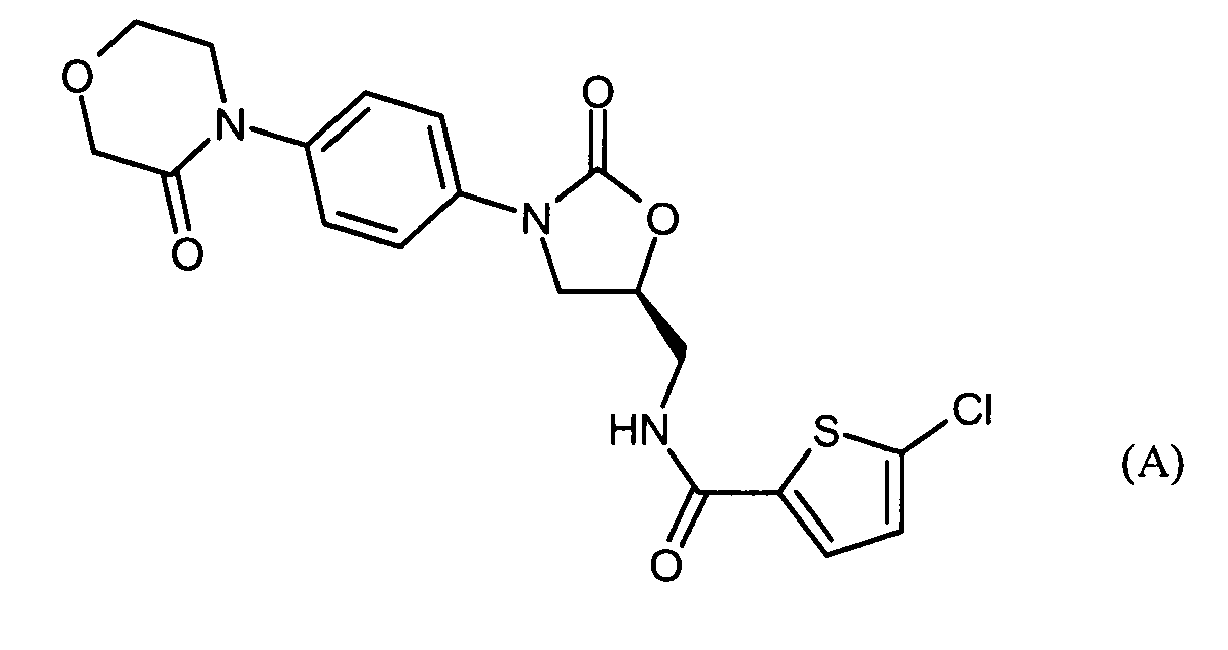

and
Q is a leaving group such as, for example, chlorine, bromine or iodine,
into a compound of the formula (III)
the latter is then reacted in an inert solvent with the caesium salt of an α-amino carboxylic acid or α-amino thiocarboxylic acid of the formula (IV)
and
X is O or S,
to give a compound of the formula (V)
and subsequently the protective group PG is removed to result in a compound of the formula (I-A)
or[B] compound (A) is reacted in an inert solvent in the presence of a base with a compound of the formula (VI)
R1A is (C1-C4)-alkyl which may be substituted by hydroxy or (C1-C4)-alkoxy,
and
L1 is a (C1-C4)-alkanediyl group in which one CH2 group may be replaced by an O atom,
to give a compound of the formula (VII)
and subsequently the protective group PG is removed to result in a compound of the formula (I-B)
or[C] the compound (B)

and
L2 is a (CH2)2 or CR3R4 group in which R3 and R4 each have the meanings indicated in Claims 1 to 3,
the latter is then reacted in an inert solvent in the presence of a base with a compound of the formula (IX)


or[D] compound (A) is reacted in an inert solvent in the presence of a base with a compound of the formula (XI)in which L1, PG1 and PG2 each have the meanings indicated above,
L1 is a (C1-C4)-alkanediyl group in which one CH2 group may be replaced by an O atom,
and
PG1 and PG2 are independently of one another an amino protective group such as, for example, tert-butoxycarbonyl (Boc), benzyloxycarbonyl (Z) or p-methoxybenzyl (PMB) and may be identical or different,
to give a compound of the formula (XII)
and subsequently the protective groups PG1 and PG2 are removed, simultaneously or sequentially, to result in a compound of the formula (I-D)
and the compounds of the formula (I-A), (I-B), (I-C) and (I-D) resulting in each case are converted where appropriate with the appropriate (i) solvents and/or (ii) acids into the solvates, salts and/or solvates of the salts thereof. - Compound of the formula (I) as defined in any of Claims 1 to 3 for the treatment and/or prophylaxis of diseases.
- Use of a compound of the formula (I) as defined in any of Claims 1 to 3 for the manufacture of a medicament for the treatment and/or prophylaxis of thromboembolic disorders.
- Medicament comprising a compound of the formula (I) as defined in any of Claims 1 to 3, where appropriate in combination with an inert, non-toxic, pharmaceutically suitable excipient.
- Medicament comprising a compound of the formula (I) as defined in any of Claims 1 to 3 in combination with a further active ingredient.
- Medicament according to Claim 7 or 8 for the treatment and/or prophylaxis of thromboembolic disorders.
- Medicament according to any of Claims 7 to 9 for intravenous use.
- Use of at least one compound of the formula (I) as defined in any of Claims 1 to 3, or a medicament as defined in any of Claims 7 to 10 for preparing a medicament for the treatment and/or prophylaxis of thromboembolic disorders in humans and animals.
Priority Applications (3)
| Application Number | Priority Date | Filing Date | Title |
|---|---|---|---|
| PL07703379T PL1987026T3 (en) | 2006-02-16 | 2007-02-06 | Aminoacyl prodrug derivatives and medicaments for the treatment of thromboembolitic disorders |
| SI200730099T SI1987026T1 (en) | 2006-02-16 | 2007-02-06 | Aminoacyl prodrug derivatives and medicaments for the treatment of thromboembolitic disorders |
| CY20091100964T CY1109375T1 (en) | 2006-02-16 | 2009-09-18 | AMINOCYLIC-PRODUCER PRODUCTS AND MEDICINES FOR THERMO-DISEASE TREATMENT |
Applications Claiming Priority (2)
| Application Number | Priority Date | Filing Date | Title |
|---|---|---|---|
| DE102006007146A DE102006007146A1 (en) | 2006-02-16 | 2006-02-16 | Aminoacyl prodrugs |
| PCT/EP2007/001135 WO2007093328A1 (en) | 2006-02-16 | 2007-02-06 | Aminoacyl prodrug derivatives and medicaments for the treatment of thromboembolitic disorders |
Publications (2)
| Publication Number | Publication Date |
|---|---|
| EP1987026A1 EP1987026A1 (en) | 2008-11-05 |
| EP1987026B1 true EP1987026B1 (en) | 2009-08-26 |
Family
ID=38179935
Family Applications (1)
| Application Number | Title | Priority Date | Filing Date |
|---|---|---|---|
| EP07703379A Active EP1987026B1 (en) | 2006-02-16 | 2007-02-06 | Aminoacyl prodrug derivatives and medicaments for the treatment of thromboembolitic disorders |
Country Status (22)
| Country | Link |
|---|---|
| US (2) | US8101601B2 (en) |
| EP (1) | EP1987026B1 (en) |
| JP (1) | JP5225864B2 (en) |
| KR (1) | KR20080094696A (en) |
| CN (1) | CN101384585B (en) |
| AT (1) | ATE440839T1 (en) |
| AU (1) | AU2007214766B2 (en) |
| BR (1) | BRPI0708064A2 (en) |
| CA (1) | CA2642376C (en) |
| CY (1) | CY1109375T1 (en) |
| DE (2) | DE102006007146A1 (en) |
| DK (1) | DK1987026T3 (en) |
| ES (1) | ES2330689T3 (en) |
| HR (1) | HRP20090629T1 (en) |
| IL (1) | IL192987A0 (en) |
| PL (1) | PL1987026T3 (en) |
| PT (1) | PT1987026E (en) |
| RS (1) | RS51190B (en) |
| RU (1) | RU2435768C2 (en) |
| SI (1) | SI1987026T1 (en) |
| WO (1) | WO2007093328A1 (en) |
| ZA (1) | ZA200806891B (en) |
Families Citing this family (10)
| Publication number | Priority date | Publication date | Assignee | Title |
|---|---|---|---|---|
| DE102006039589A1 (en) * | 2006-08-24 | 2008-03-06 | Bayer Healthcare Ag | Aminoacyl prodrugs II |
| DE102007032345A1 (en) * | 2007-07-11 | 2009-01-15 | Bayer Healthcare Ag | Aminoacyl prodrugs |
| DE102007032347A1 (en) * | 2007-07-11 | 2009-01-15 | Bayer Healthcare Ag | Aminoacyl prodrugs |
| US7816355B1 (en) | 2009-04-28 | 2010-10-19 | Apotex Pharmachem Inc | Processes for the preparation of rivaroxaban and intermediates thereof |
| CN101875655B (en) * | 2009-04-28 | 2012-05-09 | 天津药物研究院 | Aminobenzoic acid derivative and preparation method and application thereof |
| US8971019B2 (en) | 2012-03-16 | 2015-03-03 | Avx Corporation | Wet capacitor cathode containing an alkyl-substituted poly(3,4-ethylenedioxythiophene) |
| CN102746287B (en) * | 2012-06-21 | 2014-05-28 | 成都苑东药业有限公司 | Oxazolidinone compound and preparation method thereof |
| DK2895176T3 (en) | 2012-12-26 | 2017-01-30 | Wanbury Ltd | RIVAROXABAN INTERMEDIATE PRODUCTS AND MANUFACTURING THEREOF |
| IN2012MU03359A (en) * | 2012-12-26 | 2015-06-26 | Wanbury Ltd | |
| CN114384185A (en) * | 2022-01-20 | 2022-04-22 | 北京航空航天大学 | Application of reagent for detecting gamma-aminobutyric acid content in preparation of kit for diagnosing venous outflow obstruction diseases |
Family Cites Families (10)
| Publication number | Priority date | Publication date | Assignee | Title |
|---|---|---|---|---|
| AU780973B2 (en) * | 1999-06-25 | 2005-04-28 | Vertex Pharmaceuticals Incorporated | Prodrugs of carbamate inhibitors of IMPDH |
| DE19962924A1 (en) | 1999-12-24 | 2001-07-05 | Bayer Ag | Substituted oxazolidinones and their use |
| DE10129725A1 (en) * | 2001-06-20 | 2003-01-02 | Bayer Ag | Combination therapy of substituted oxazolidinones |
| EP1451164A2 (en) | 2001-07-12 | 2004-09-01 | PHARMACIA & UPJOHN COMPANY | Amide derivatives having improved solubility |
| US7265140B2 (en) | 2003-09-23 | 2007-09-04 | Pfizer Inc | Acyloxymethylcarbamate prodrugs of oxazolidinones |
| DE10355461A1 (en) | 2003-11-27 | 2005-06-23 | Bayer Healthcare Ag | Solid, high bioavailabilty oral formulations of N-substituted 5-chloro-2-thiophene-carboxamide derivative in hydrophilized form, useful for combating thrombo-embolic diseases |
| DE102004002044A1 (en) | 2004-01-15 | 2005-08-04 | Bayer Healthcare Ag | manufacturing |
| DE102004062475A1 (en) | 2004-12-24 | 2006-07-06 | Bayer Healthcare Ag | Solid, orally administrable, modified release pharmaceutical dosage forms |
| DE102005047558A1 (en) | 2005-10-04 | 2008-02-07 | Bayer Healthcare Ag | Combination therapy of substituted oxazolidinones for the prophylaxis and treatment of cerebral circulatory disorders |
| DE102006039589A1 (en) * | 2006-08-24 | 2008-03-06 | Bayer Healthcare Ag | Aminoacyl prodrugs II |
-
2006
- 2006-02-16 DE DE102006007146A patent/DE102006007146A1/en not_active Withdrawn
-
2007
- 2007-02-06 CA CA2642376A patent/CA2642376C/en not_active Expired - Fee Related
- 2007-02-06 EP EP07703379A patent/EP1987026B1/en active Active
- 2007-02-06 RU RU2008136769/04A patent/RU2435768C2/en not_active IP Right Cessation
- 2007-02-06 CN CN2007800055375A patent/CN101384585B/en not_active Expired - Fee Related
- 2007-02-06 AU AU2007214766A patent/AU2007214766B2/en not_active Ceased
- 2007-02-06 WO PCT/EP2007/001135 patent/WO2007093328A1/en not_active Ceased
- 2007-02-06 SI SI200730099T patent/SI1987026T1/en unknown
- 2007-02-06 HR HR20090629T patent/HRP20090629T1/en unknown
- 2007-02-06 ES ES07703379T patent/ES2330689T3/en active Active
- 2007-02-06 KR KR1020087020037A patent/KR20080094696A/en not_active Ceased
- 2007-02-06 US US12/224,007 patent/US8101601B2/en not_active Expired - Fee Related
- 2007-02-06 JP JP2008554638A patent/JP5225864B2/en not_active Expired - Fee Related
- 2007-02-06 PL PL07703379T patent/PL1987026T3/en unknown
- 2007-02-06 RS RSP-2009/0408A patent/RS51190B/en unknown
- 2007-02-06 DE DE502007001402T patent/DE502007001402D1/en active Active
- 2007-02-06 BR BRPI0708064-6A patent/BRPI0708064A2/en not_active IP Right Cessation
- 2007-02-06 PT PT07703379T patent/PT1987026E/en unknown
- 2007-02-06 AT AT07703379T patent/ATE440839T1/en active
- 2007-02-06 DK DK07703379T patent/DK1987026T3/en active
-
2008
- 2008-07-23 IL IL192987A patent/IL192987A0/en unknown
- 2008-08-11 ZA ZA200806891A patent/ZA200806891B/en unknown
-
2009
- 2009-09-18 CY CY20091100964T patent/CY1109375T1/en unknown
-
2011
- 2011-12-16 US US13/328,532 patent/US8334284B2/en not_active Expired - Fee Related
Also Published As
| Publication number | Publication date |
|---|---|
| PT1987026E (en) | 2009-10-30 |
| JP5225864B2 (en) | 2013-07-03 |
| CN101384585B (en) | 2012-09-26 |
| ZA200806891B (en) | 2010-02-24 |
| EP1987026A1 (en) | 2008-11-05 |
| HRP20090629T1 (en) | 2010-01-31 |
| IL192987A0 (en) | 2009-02-11 |
| DE102006007146A1 (en) | 2007-08-23 |
| AU2007214766B2 (en) | 2013-05-02 |
| ES2330689T3 (en) | 2009-12-14 |
| AU2007214766A1 (en) | 2007-08-23 |
| RU2435768C2 (en) | 2011-12-10 |
| CA2642376C (en) | 2014-08-12 |
| ATE440839T1 (en) | 2009-09-15 |
| CA2642376A1 (en) | 2007-08-23 |
| DK1987026T3 (en) | 2009-11-02 |
| WO2007093328A1 (en) | 2007-08-23 |
| US8334284B2 (en) | 2012-12-18 |
| KR20080094696A (en) | 2008-10-23 |
| US8101601B2 (en) | 2012-01-24 |
| US20120088761A1 (en) | 2012-04-12 |
| HK1130252A1 (en) | 2009-12-24 |
| CY1109375T1 (en) | 2014-07-02 |
| PL1987026T3 (en) | 2010-03-31 |
| US20110034453A1 (en) | 2011-02-10 |
| JP2009526788A (en) | 2009-07-23 |
| SI1987026T1 (en) | 2010-01-29 |
| DE502007001402D1 (en) | 2009-10-08 |
| CN101384585A (en) | 2009-03-11 |
| RS51190B (en) | 2010-10-31 |
| RU2008136769A (en) | 2010-03-27 |
| BRPI0708064A2 (en) | 2011-05-17 |
Similar Documents
| Publication | Publication Date | Title |
|---|---|---|
| EP1987026B1 (en) | Aminoacyl prodrug derivatives and medicaments for the treatment of thromboembolitic disorders | |
| DE102007036075A1 (en) | Prodrugs and their use | |
| DE102007036076A1 (en) | Dipeptoid Produgs and their use | |
| EP2084154B1 (en) | Aminoacyl prodrug derivatives and medicaments for treatment of thromboembolic disorders | |
| EP1928867B1 (en) | 2-aminoethoxyacetic acid derivatives and their use in treating thromboembolic disorders | |
| DE102007032345A1 (en) | Aminoacyl prodrugs | |
| EP2209776A1 (en) | Aminoacyl prodrugs as an active pharmaceutical ingredient for thromboembolic disorder | |
| DE102007032344A1 (en) | Prodrug derivatives of 1- (4-methoxyphenyl) -7-oxo-6- [4- (2-oxopiperidin-1-yl) phenyl] -4,5,6,7-tetrahydro-1H-pyrazolo [3,4 -c] pyridine-3-carboxamide | |
| EP1824844B1 (en) | Pyrazine dicarboxamides and the use thereof | |
| HK1130252B (en) | Aminoacyl prodrug derivatives and medicaments for the treatment of thromboembolitic disorders |
Legal Events
| Date | Code | Title | Description |
|---|---|---|---|
| PUAI | Public reference made under article 153(3) epc to a published international application that has entered the european phase |
Free format text: ORIGINAL CODE: 0009012 |
|
| 17P | Request for examination filed |
Effective date: 20080916 |
|
| AK | Designated contracting states |
Kind code of ref document: A1 Designated state(s): AT BE BG CH CY CZ DE DK EE ES FI FR GB GR HU IE IS IT LI LT LU LV MC NL PL PT RO SE SI SK TR |
|
| AX | Request for extension of the european patent |
Extension state: AL BA HR MK RS |
|
| GRAP | Despatch of communication of intention to grant a patent |
Free format text: ORIGINAL CODE: EPIDOSNIGR1 |
|
| GRAS | Grant fee paid |
Free format text: ORIGINAL CODE: EPIDOSNIGR3 |
|
| GRAA | (expected) grant |
Free format text: ORIGINAL CODE: 0009210 |
|
| AK | Designated contracting states |
Kind code of ref document: B1 Designated state(s): AT BE BG CH CY CZ DE DK EE ES FI FR GB GR HU IE IS IT LI LT LU LV MC NL PL PT RO SE SI SK TR |
|
| AX | Request for extension of the european patent |
Extension state: AL BA HR MK RS |
|
| REG | Reference to a national code |
Ref country code: GB Ref legal event code: FG4D Free format text: NOT ENGLISH |
|
| REG | Reference to a national code |
Ref country code: CH Ref legal event code: EP |
|
| RAP2 | Party data changed (patent owner data changed or rights of a patent transferred) |
Owner name: BAYER SCHERING PHARMA AG |
|
| REG | Reference to a national code |
Ref country code: CH Ref legal event code: NV Representative=s name: E. BLUM & CO. AG PATENT- UND MARKENANWAELTE VSP |
|
| RAP2 | Party data changed (patent owner data changed or rights of a patent transferred) |
Owner name: BAYER SCHERING PHARMA AKTIENGESELLSCHAFT |
|
| REG | Reference to a national code |
Ref country code: IE Ref legal event code: FG4D Free format text: LANGUAGE OF EP DOCUMENT: GERMAN |
|
| REF | Corresponds to: |
Ref document number: 502007001402 Country of ref document: DE Date of ref document: 20091008 Kind code of ref document: P |
|
| REG | Reference to a national code |
Ref country code: GR Ref legal event code: EP Ref document number: 20090402314 Country of ref document: GR |
|
| REG | Reference to a national code |
Ref country code: PT Ref legal event code: SC4A Free format text: AVAILABILITY OF NATIONAL TRANSLATION Effective date: 20091023 |
|
| NLT2 | Nl: modifications (of names), taken from the european patent patent bulletin |
Owner name: BAYER SCHERING PHARMA AG Effective date: 20090909 Owner name: BAYER SCHERING PHARMA AKTIENGESELLSCHAFT Effective date: 20090916 |
|
| REG | Reference to a national code |
Ref country code: DK Ref legal event code: T3 |
|
| REG | Reference to a national code |
Ref country code: RO Ref legal event code: EPE |
|
| REG | Reference to a national code |
Ref country code: HR Ref legal event code: TUEP Ref document number: P20090629 Country of ref document: HR |
|
| REG | Reference to a national code |
Ref country code: SE Ref legal event code: TRGR |
|
| REG | Reference to a national code |
Ref country code: ES Ref legal event code: FG2A Ref document number: 2330689 Country of ref document: ES Kind code of ref document: T3 |
|
| REG | Reference to a national code |
Ref country code: EE Ref legal event code: FG4A Ref document number: E003658 Country of ref document: EE Effective date: 20091104 |
|
| REG | Reference to a national code |
Ref country code: HR Ref legal event code: T1PR Ref document number: P20090629 Country of ref document: HR |
|
| REG | Reference to a national code |
Ref country code: SK Ref legal event code: T3 Ref document number: E 6371 Country of ref document: SK |
|
| REG | Reference to a national code |
Ref country code: HU Ref legal event code: AG4A Ref document number: E006869 Country of ref document: HU |
|
| REG | Reference to a national code |
Ref country code: PL Ref legal event code: T3 |
|
| PLBE | No opposition filed within time limit |
Free format text: ORIGINAL CODE: 0009261 |
|
| STAA | Information on the status of an ep patent application or granted ep patent |
Free format text: STATUS: NO OPPOSITION FILED WITHIN TIME LIMIT |
|
| 26N | No opposition filed |
Effective date: 20100527 |
|
| PGRI | Patent reinstated in contracting state [announced from national office to epo] |
Ref country code: IT Effective date: 20110501 |
|
| REG | Reference to a national code |
Ref country code: NL Ref legal event code: SD Effective date: 20110909 |
|
| PGFP | Annual fee paid to national office [announced via postgrant information from national office to epo] |
Ref country code: TR Payment date: 20120131 Year of fee payment: 6 |
|
| REG | Reference to a national code |
Ref country code: DE Ref legal event code: R081 Ref document number: 502007001402 Country of ref document: DE Owner name: BAYER INTELLECTUAL PROPERTY GMBH, DE Free format text: FORMER OWNER: BAYER SCHERING PHARMA AKTIENGESELLSCHAFT, 13353 BERLIN, DE Effective date: 20120613 |
|
| REG | Reference to a national code |
Ref country code: CH Ref legal event code: PUE Owner name: BAYER INTELLECTUAL PROPERTY GMBH, DE Free format text: FORMER OWNER: BAYER SCHERING PHARMA AG, DE |
|
| REG | Reference to a national code |
Ref country code: FR Ref legal event code: TP Owner name: BAYER INTELLECTUAL PROPERTY GMBH, DE Effective date: 20130130 Ref country code: FR Ref legal event code: CD Owner name: BAYER INTELLECTUAL PROPERTY GMBH, DE Effective date: 20130130 |
|
| REG | Reference to a national code |
Ref country code: HR Ref legal event code: ODRP Ref document number: P20090629 Country of ref document: HR Payment date: 20130201 Year of fee payment: 7 |
|
| REG | Reference to a national code |
Ref country code: PT Ref legal event code: PC4A Owner name: BAYER INTELLECTUAL PROPERTY GMBH, DE Effective date: 20130206 |
|
| REG | Reference to a national code |
Ref country code: EE Ref legal event code: GB1A Ref document number: E003658 Country of ref document: EE |
|
| BECH | Be: change of holder |
Owner name: BAYER INTELLECTUAL PROPERTY G.M.B.H. Effective date: 20130211 |
|
| PGFP | Annual fee paid to national office [announced via postgrant information from national office to epo] |
Ref country code: LU Payment date: 20130213 Year of fee payment: 7 |
|
| PGFP | Annual fee paid to national office [announced via postgrant information from national office to epo] |
Ref country code: IE Payment date: 20130219 Year of fee payment: 7 Ref country code: BG Payment date: 20130212 Year of fee payment: 7 Ref country code: RO Payment date: 20130129 Year of fee payment: 7 Ref country code: DK Payment date: 20130212 Year of fee payment: 7 Ref country code: SE Payment date: 20130212 Year of fee payment: 7 Ref country code: LT Payment date: 20130123 Year of fee payment: 7 Ref country code: MC Payment date: 20130128 Year of fee payment: 7 Ref country code: HU Payment date: 20130124 Year of fee payment: 7 Ref country code: CH Payment date: 20130212 Year of fee payment: 7 Ref country code: IS Payment date: 20130125 Year of fee payment: 7 Ref country code: EE Payment date: 20130123 Year of fee payment: 7 Ref country code: FI Payment date: 20130212 Year of fee payment: 7 Ref country code: CZ Payment date: 20130201 Year of fee payment: 7 |
|
| REG | Reference to a national code |
Ref country code: DE Ref legal event code: R081 Ref document number: 502007001402 Country of ref document: DE Owner name: BAYER INTELLECTUAL PROPERTY GMBH, DE Free format text: FORMER OWNER: BAYER PHARMA AKTIENGESELLSCHAFT, 13353 BERLIN, DE Effective date: 20130410 |
|
| PGFP | Annual fee paid to national office [announced via postgrant information from national office to epo] |
Ref country code: BE Payment date: 20130212 Year of fee payment: 7 Ref country code: GR Payment date: 20130118 Year of fee payment: 7 Ref country code: SI Payment date: 20130205 Year of fee payment: 7 Ref country code: CY Payment date: 20130201 Year of fee payment: 7 Ref country code: SK Payment date: 20130204 Year of fee payment: 7 Ref country code: PL Payment date: 20130204 Year of fee payment: 7 Ref country code: NL Payment date: 20130216 Year of fee payment: 7 Ref country code: LV Payment date: 20130125 Year of fee payment: 7 |
|
| REG | Reference to a national code |
Ref country code: ES Ref legal event code: PC2A Owner name: BAYER INTELLECTUAL PROPERTY GMBH Effective date: 20130604 |
|
| PGFP | Annual fee paid to national office [announced via postgrant information from national office to epo] |
Ref country code: PT Payment date: 20130123 Year of fee payment: 7 Ref country code: AT Payment date: 20130128 Year of fee payment: 7 |
|
| REG | Reference to a national code |
Ref country code: HU Ref legal event code: GB9C Owner name: BAYER INTELLECTUAL PROPERTY GMBH, DE Free format text: FORMER OWNER(S): BAYER SCHERING PHARMA AKTIENGESELLSCHAFT, DE Ref country code: HU Ref legal event code: FH1C Free format text: FORMER REPRESENTATIVE(S): MOLNAR IMRE, DANUBIA SZABADALMI ES JOGI IRODA KFT., HU Representative=s name: DANUBIA SZABADALMI ES JOGI IRODA KFT., HU |
|
| REG | Reference to a national code |
Ref country code: HR Ref legal event code: PNAN Ref document number: P20090629 Country of ref document: HR Owner name: BAYER PHARMA AG, DE |
|
| REG | Reference to a national code |
Ref country code: SK Ref legal event code: PC4A Ref document number: E 6371 Country of ref document: SK Owner name: BAYER INTELLECTUAL PROPERTY GMBH, MONHEIM AM R, DE Free format text: FORMER OWNER: BAYER PHARMA AKTIENGESELLSCHAFT, BERLIN, DE Effective date: 20130226 Ref country code: SK Ref legal event code: TC4A Ref document number: E 6371 Country of ref document: SK Owner name: BAYER PHARMA AKTIENGESELLSCHAFT, BERLIN, DE Effective date: 20130507 |
|
| REG | Reference to a national code |
Ref country code: NL Ref legal event code: TD Effective date: 20130625 Ref country code: NL Ref legal event code: SD Effective date: 20130625 |
|
| REG | Reference to a national code |
Ref country code: HR Ref legal event code: PPPP Ref document number: P20090629 Country of ref document: HR Owner name: BAYER INTELLECTUAL PROPERTY GMBH, DE |
|
| REG | Reference to a national code |
Ref country code: GB Ref legal event code: 732E Free format text: REGISTERED BETWEEN 20140109 AND 20140115 |
|
| REG | Reference to a national code |
Ref country code: AT Ref legal event code: PC Ref document number: 440839 Country of ref document: AT Kind code of ref document: T Owner name: BAYER INTELLECTUAL PROPERTY GMBH, DE Effective date: 20131218 |
|
| REG | Reference to a national code |
Ref country code: HR Ref legal event code: PBON Ref document number: P20090629 Country of ref document: HR Effective date: 20140206 |
|
| REG | Reference to a national code |
Ref country code: PT Ref legal event code: MM4A Free format text: LAPSE DUE TO NON-PAYMENT OF FEES Effective date: 20140806 |
|
| BERE | Be: lapsed |
Owner name: BAYER INTELLECTUAL PROPERTY G.M.B.H. Effective date: 20140228 |
|
| REG | Reference to a national code |
Ref country code: NL Ref legal event code: V1 Effective date: 20140901 |
|
| REG | Reference to a national code |
Ref country code: LT Ref legal event code: MM4D Effective date: 20140206 |
|
| REG | Reference to a national code |
Ref country code: DK Ref legal event code: EBP Effective date: 20140228 |
|
| PG25 | Lapsed in a contracting state [announced via postgrant information from national office to epo] |
Ref country code: LU Free format text: LAPSE BECAUSE OF NON-PAYMENT OF DUE FEES Effective date: 20140206 Ref country code: MC Free format text: LAPSE BECAUSE OF NON-PAYMENT OF DUE FEES Effective date: 20140228 |
|
| REG | Reference to a national code |
Ref country code: CH Ref legal event code: PL Ref country code: SE Ref legal event code: EUG |
|
| REG | Reference to a national code |
Ref country code: AT Ref legal event code: MM01 Ref document number: 440839 Country of ref document: AT Kind code of ref document: T Effective date: 20140206 Ref country code: EE Ref legal event code: MM4A Ref document number: E003658 Country of ref document: EE Effective date: 20140228 |
|
| REG | Reference to a national code |
Ref country code: GR Ref legal event code: ML Ref document number: 20090402314 Country of ref document: GR Effective date: 20140903 |
|
| PG25 | Lapsed in a contracting state [announced via postgrant information from national office to epo] |
Ref country code: BG Free format text: LAPSE BECAUSE OF NON-PAYMENT OF DUE FEES Effective date: 20140930 Ref country code: IS Free format text: LAPSE BECAUSE OF FAILURE TO SUBMIT A TRANSLATION OF THE DESCRIPTION OR TO PAY THE FEE WITHIN THE PRESCRIBED TIME-LIMIT Effective date: 20140829 Ref country code: CZ Free format text: LAPSE BECAUSE OF NON-PAYMENT OF DUE FEES Effective date: 20140206 Ref country code: RO Free format text: LAPSE BECAUSE OF NON-PAYMENT OF DUE FEES Effective date: 20140206 Ref country code: FI Free format text: LAPSE BECAUSE OF NON-PAYMENT OF DUE FEES Effective date: 20140206 Ref country code: CY Free format text: LAPSE BECAUSE OF NON-PAYMENT OF DUE FEES Effective date: 20140206 Ref country code: LI Free format text: LAPSE BECAUSE OF NON-PAYMENT OF DUE FEES Effective date: 20140228 Ref country code: CH Free format text: LAPSE BECAUSE OF NON-PAYMENT OF DUE FEES Effective date: 20140228 Ref country code: NL Free format text: LAPSE BECAUSE OF NON-PAYMENT OF DUE FEES Effective date: 20140901 Ref country code: GR Free format text: LAPSE BECAUSE OF NON-PAYMENT OF DUE FEES Effective date: 20140903 Ref country code: EE Free format text: LAPSE BECAUSE OF NON-PAYMENT OF DUE FEES Effective date: 20140228 Ref country code: LT Free format text: LAPSE BECAUSE OF NON-PAYMENT OF DUE FEES Effective date: 20140206 |
|
| REG | Reference to a national code |
Ref country code: SK Ref legal event code: MM4A Ref document number: E 6371 Country of ref document: SK Effective date: 20140206 |
|
| PG25 | Lapsed in a contracting state [announced via postgrant information from national office to epo] |
Ref country code: SK Free format text: LAPSE BECAUSE OF NON-PAYMENT OF DUE FEES Effective date: 20140206 Ref country code: HU Free format text: LAPSE BECAUSE OF NON-PAYMENT OF DUE FEES Effective date: 20140207 Ref country code: LV Free format text: LAPSE BECAUSE OF NON-PAYMENT OF DUE FEES Effective date: 20140206 Ref country code: SI Free format text: LAPSE BECAUSE OF NON-PAYMENT OF DUE FEES Effective date: 20140207 Ref country code: SE Free format text: LAPSE BECAUSE OF NON-PAYMENT OF DUE FEES Effective date: 20140207 Ref country code: AT Free format text: LAPSE BECAUSE OF NON-PAYMENT OF DUE FEES Effective date: 20140206 |
|
| REG | Reference to a national code |
Ref country code: SI Ref legal event code: KO00 Effective date: 20141007 |
|
| REG | Reference to a national code |
Ref country code: IE Ref legal event code: MM4A |
|
| PG25 | Lapsed in a contracting state [announced via postgrant information from national office to epo] |
Ref country code: PT Free format text: LAPSE BECAUSE OF NON-PAYMENT OF DUE FEES Effective date: 20140806 |
|
| PG25 | Lapsed in a contracting state [announced via postgrant information from national office to epo] |
Ref country code: BE Free format text: LAPSE BECAUSE OF NON-PAYMENT OF DUE FEES Effective date: 20140228 Ref country code: DK Free format text: LAPSE BECAUSE OF NON-PAYMENT OF DUE FEES Effective date: 20140228 Ref country code: IE Free format text: LAPSE BECAUSE OF NON-PAYMENT OF DUE FEES Effective date: 20140206 |
|
| PG25 | Lapsed in a contracting state [announced via postgrant information from national office to epo] |
Ref country code: PL Free format text: LAPSE BECAUSE OF NON-PAYMENT OF DUE FEES Effective date: 20140206 |
|
| REG | Reference to a national code |
Ref country code: PL Ref legal event code: LAPE |
|
| REG | Reference to a national code |
Ref country code: FR Ref legal event code: PLFP Year of fee payment: 10 |
|
| REG | Reference to a national code |
Ref country code: FR Ref legal event code: PLFP Year of fee payment: 11 |
|
| PGFP | Annual fee paid to national office [announced via postgrant information from national office to epo] |
Ref country code: FR Payment date: 20170126 Year of fee payment: 11 Ref country code: DE Payment date: 20170131 Year of fee payment: 11 |
|
| PGFP | Annual fee paid to national office [announced via postgrant information from national office to epo] |
Ref country code: GB Payment date: 20170201 Year of fee payment: 11 |
|
| PGFP | Annual fee paid to national office [announced via postgrant information from national office to epo] |
Ref country code: IT Payment date: 20170221 Year of fee payment: 11 Ref country code: ES Payment date: 20170127 Year of fee payment: 11 |
|
| PG25 | Lapsed in a contracting state [announced via postgrant information from national office to epo] |
Ref country code: TR Free format text: LAPSE BECAUSE OF NON-PAYMENT OF DUE FEES Effective date: 20140206 |
|
| REG | Reference to a national code |
Ref country code: DE Ref legal event code: R119 Ref document number: 502007001402 Country of ref document: DE |
|
| GBPC | Gb: european patent ceased through non-payment of renewal fee |
Effective date: 20180206 |
|
| REG | Reference to a national code |
Ref country code: FR Ref legal event code: ST Effective date: 20181031 |
|
| PG25 | Lapsed in a contracting state [announced via postgrant information from national office to epo] |
Ref country code: DE Free format text: LAPSE BECAUSE OF NON-PAYMENT OF DUE FEES Effective date: 20180901 |
|
| PG25 | Lapsed in a contracting state [announced via postgrant information from national office to epo] |
Ref country code: FR Free format text: LAPSE BECAUSE OF NON-PAYMENT OF DUE FEES Effective date: 20180228 Ref country code: IT Free format text: LAPSE BECAUSE OF NON-PAYMENT OF DUE FEES Effective date: 20180206 Ref country code: GB Free format text: LAPSE BECAUSE OF NON-PAYMENT OF DUE FEES Effective date: 20180206 |
|
| REG | Reference to a national code |
Ref country code: ES Ref legal event code: FD2A Effective date: 20190801 |
|
| PG25 | Lapsed in a contracting state [announced via postgrant information from national office to epo] |
Ref country code: ES Free format text: LAPSE BECAUSE OF NON-PAYMENT OF DUE FEES Effective date: 20180207 |