EP1947099A1 - Process for solvent removal from omeprazole salts - Google Patents
Process for solvent removal from omeprazole salts Download PDFInfo
- Publication number
- EP1947099A1 EP1947099A1 EP07100738A EP07100738A EP1947099A1 EP 1947099 A1 EP1947099 A1 EP 1947099A1 EP 07100738 A EP07100738 A EP 07100738A EP 07100738 A EP07100738 A EP 07100738A EP 1947099 A1 EP1947099 A1 EP 1947099A1
- Authority
- EP
- European Patent Office
- Prior art keywords
- omeprazole
- salt
- magnesium
- organic solvent
- less
- Prior art date
- Legal status (The legal status is an assumption and is not a legal conclusion. Google has not performed a legal analysis and makes no representation as to the accuracy of the status listed.)
- Withdrawn
Links
- SUBDBMMJDZJVOS-UHFFFAOYSA-N 5-methoxy-2-{[(4-methoxy-3,5-dimethylpyridin-2-yl)methyl]sulfinyl}-1H-benzimidazole Chemical class N=1C2=CC(OC)=CC=C2NC=1S(=O)CC1=NC=C(C)C(OC)=C1C SUBDBMMJDZJVOS-UHFFFAOYSA-N 0.000 title claims abstract description 301
- 238000000034 method Methods 0.000 title claims abstract description 131
- 239000002904 solvent Substances 0.000 title description 11
- 229960000381 omeprazole Drugs 0.000 claims abstract description 390
- 150000003839 salts Chemical class 0.000 claims abstract description 157
- 159000000003 magnesium salts Chemical class 0.000 claims abstract description 124
- 239000003960 organic solvent Substances 0.000 claims abstract description 121
- 239000000203 mixture Substances 0.000 claims abstract description 45
- 239000008194 pharmaceutical composition Substances 0.000 claims abstract description 11
- OKKJLVBELUTLKV-UHFFFAOYSA-N Methanol Chemical compound OC OKKJLVBELUTLKV-UHFFFAOYSA-N 0.000 claims description 102
- XLYOFNOQVPJJNP-UHFFFAOYSA-N water Substances O XLYOFNOQVPJJNP-UHFFFAOYSA-N 0.000 claims description 64
- 239000007789 gas Substances 0.000 claims description 45
- 239000011777 magnesium Substances 0.000 claims description 43
- 229960003117 omeprazole magnesium Drugs 0.000 claims description 40
- 239000007787 solid Substances 0.000 claims description 40
- FYYHWMGAXLPEAU-UHFFFAOYSA-N Magnesium Chemical compound [Mg] FYYHWMGAXLPEAU-UHFFFAOYSA-N 0.000 claims description 38
- 229910052749 magnesium Inorganic materials 0.000 claims description 37
- CSCPPACGZOOCGX-UHFFFAOYSA-N Acetone Chemical compound CC(C)=O CSCPPACGZOOCGX-UHFFFAOYSA-N 0.000 claims description 24
- IJGRMHOSHXDMSA-UHFFFAOYSA-N Atomic nitrogen Chemical compound N#N IJGRMHOSHXDMSA-UHFFFAOYSA-N 0.000 claims description 22
- LFQSCWFLJHTTHZ-UHFFFAOYSA-N Ethanol Chemical compound CCO LFQSCWFLJHTTHZ-UHFFFAOYSA-N 0.000 claims description 20
- 238000002360 preparation method Methods 0.000 claims description 14
- 229910052757 nitrogen Inorganic materials 0.000 claims description 11
- 239000000546 pharmaceutical excipient Substances 0.000 claims description 10
- MQEUGMWHWPYFDD-UHFFFAOYSA-N magnesium;6-methoxy-2-[(4-methoxy-3,5-dimethylpyridin-2-yl)methylsulfinyl]-1h-benzimidazole Chemical compound [Mg].N=1C2=CC(OC)=CC=C2NC=1S(=O)CC1=NC=C(C)C(OC)=C1C MQEUGMWHWPYFDD-UHFFFAOYSA-N 0.000 claims description 9
- 229920006395 saturated elastomer Polymers 0.000 claims description 9
- 208000017189 Gastrointestinal inflammatory disease Diseases 0.000 claims description 8
- 239000003814 drug Substances 0.000 claims description 7
- 206010017969 Gastrointestinal inflammatory conditions Diseases 0.000 claims description 6
- 238000007664 blowing Methods 0.000 claims description 4
- SUBDBMMJDZJVOS-XMMPIXPASA-N (R)-omeprazole Chemical compound C([S@@](=O)C=1NC2=CC=C(C=C2N=1)OC)C1=NC=C(C)C(OC)=C1C SUBDBMMJDZJVOS-XMMPIXPASA-N 0.000 claims description 3
- RTZKZFJDLAIYFH-UHFFFAOYSA-N Diethyl ether Chemical compound CCOCC RTZKZFJDLAIYFH-UHFFFAOYSA-N 0.000 description 40
- 229940091250 magnesium supplement Drugs 0.000 description 34
- 239000000047 product Substances 0.000 description 16
- 239000011541 reaction mixture Substances 0.000 description 13
- 229960004132 diethyl ether Drugs 0.000 description 12
- CRGZYKWWYNQGEC-UHFFFAOYSA-N magnesium;methanolate Chemical compound [Mg+2].[O-]C.[O-]C CRGZYKWWYNQGEC-UHFFFAOYSA-N 0.000 description 11
- 238000011282 treatment Methods 0.000 description 11
- VYPSYNLAJGMNEJ-UHFFFAOYSA-N Silicium dioxide Chemical compound O=[Si]=O VYPSYNLAJGMNEJ-UHFFFAOYSA-N 0.000 description 10
- 230000002829 reductive effect Effects 0.000 description 9
- 238000010568 chiral column chromatography Methods 0.000 description 8
- 238000001556 precipitation Methods 0.000 description 8
- 239000013557 residual solvent Substances 0.000 description 8
- 150000001875 compounds Chemical class 0.000 description 7
- 238000001704 evaporation Methods 0.000 description 7
- 230000008020 evaporation Effects 0.000 description 6
- 238000001914 filtration Methods 0.000 description 6
- HQKMJHAJHXVSDF-UHFFFAOYSA-L magnesium stearate Chemical compound [Mg+2].CCCCCCCCCCCCCCCCCC([O-])=O.CCCCCCCCCCCCCCCCCC([O-])=O HQKMJHAJHXVSDF-UHFFFAOYSA-L 0.000 description 6
- 239000000725 suspension Substances 0.000 description 6
- 241000124008 Mammalia Species 0.000 description 5
- 150000004683 dihydrates Chemical class 0.000 description 5
- 210000004211 gastric acid Anatomy 0.000 description 5
- 238000004128 high performance liquid chromatography Methods 0.000 description 5
- -1 magnesium omeprazole dihydrate Chemical class 0.000 description 5
- TWRXJAOTZQYOKJ-UHFFFAOYSA-L Magnesium chloride Chemical compound [Mg+2].[Cl-].[Cl-] TWRXJAOTZQYOKJ-UHFFFAOYSA-L 0.000 description 4
- CSNNHWWHGAXBCP-UHFFFAOYSA-L Magnesium sulfate Chemical compound [Mg+2].[O-][S+2]([O-])([O-])[O-] CSNNHWWHGAXBCP-UHFFFAOYSA-L 0.000 description 4
- 238000002441 X-ray diffraction Methods 0.000 description 4
- 239000012065 filter cake Substances 0.000 description 4
- 150000002576 ketones Chemical class 0.000 description 4
- KWORUUGOSLYAGD-UHFFFAOYSA-N magnesium 5-methoxy-2-[(4-methoxy-3,5-dimethyl-2-pyridinyl)methylsulfinyl]benzimidazol-1-ide Chemical compound [Mg+2].N=1C2=CC(OC)=CC=C2[N-]C=1S(=O)CC1=NC=C(C)C(OC)=C1C.N=1C2=CC(OC)=CC=C2[N-]C=1S(=O)CC1=NC=C(C)C(OC)=C1C KWORUUGOSLYAGD-UHFFFAOYSA-N 0.000 description 4
- YIXJRHPUWRPCBB-UHFFFAOYSA-N magnesium nitrate Chemical compound [Mg+2].[O-][N+]([O-])=O.[O-][N+]([O-])=O YIXJRHPUWRPCBB-UHFFFAOYSA-N 0.000 description 4
- YMWUJEATGCHHMB-UHFFFAOYSA-N Dichloromethane Chemical compound ClCCl YMWUJEATGCHHMB-UHFFFAOYSA-N 0.000 description 3
- 108010010803 Gelatin Proteins 0.000 description 3
- 239000012141 concentrate Substances 0.000 description 3
- 239000000706 filtrate Substances 0.000 description 3
- 239000008273 gelatin Substances 0.000 description 3
- 229920000159 gelatin Polymers 0.000 description 3
- 235000019322 gelatine Nutrition 0.000 description 3
- 235000011852 gelatine desserts Nutrition 0.000 description 3
- 235000019359 magnesium stearate Nutrition 0.000 description 3
- 238000004519 manufacturing process Methods 0.000 description 3
- 238000000926 separation method Methods 0.000 description 3
- 150000004684 trihydrates Chemical class 0.000 description 3
- XCTNDJAFNBCVOM-UHFFFAOYSA-N 1h-imidazo[4,5-b]pyridin-2-ylmethanamine Chemical compound C1=CC=C2NC(CN)=NC2=N1 XCTNDJAFNBCVOM-UHFFFAOYSA-N 0.000 description 2
- GUBGYTABKSRVRQ-XLOQQCSPSA-N Alpha-Lactose Chemical class O[C@@H]1[C@@H](O)[C@@H](O)[C@@H](CO)O[C@H]1O[C@@H]1[C@@H](CO)O[C@H](O)[C@H](O)[C@H]1O GUBGYTABKSRVRQ-XLOQQCSPSA-N 0.000 description 2
- 229920000945 Amylopectin Chemical class 0.000 description 2
- XKRFYHLGVUSROY-UHFFFAOYSA-N Argon Chemical compound [Ar] XKRFYHLGVUSROY-UHFFFAOYSA-N 0.000 description 2
- FBPFZTCFMRRESA-FSIIMWSLSA-N D-Glucitol Chemical class OC[C@H](O)[C@H](O)[C@@H](O)[C@H](O)CO FBPFZTCFMRRESA-FSIIMWSLSA-N 0.000 description 2
- FBPFZTCFMRRESA-KVTDHHQDSA-N D-Mannitol Chemical class OC[C@@H](O)[C@@H](O)[C@H](O)[C@H](O)CO FBPFZTCFMRRESA-KVTDHHQDSA-N 0.000 description 2
- FBPFZTCFMRRESA-JGWLITMVSA-N D-glucitol Chemical class OC[C@H](O)[C@@H](O)[C@H](O)[C@H](O)CO FBPFZTCFMRRESA-JGWLITMVSA-N 0.000 description 2
- 230000005526 G1 to G0 transition Effects 0.000 description 2
- GUBGYTABKSRVRQ-QKKXKWKRSA-N Lactose Natural products OC[C@H]1O[C@@H](O[C@H]2[C@H](O)[C@@H](O)C(O)O[C@@H]2CO)[C@H](O)[C@@H](O)[C@H]1O GUBGYTABKSRVRQ-QKKXKWKRSA-N 0.000 description 2
- 229930195725 Mannitol Chemical class 0.000 description 2
- 208000007107 Stomach Ulcer Diseases 0.000 description 2
- CZMRCDWAGMRECN-UGDNZRGBSA-N Sucrose Chemical class O[C@H]1[C@H](O)[C@@H](CO)O[C@@]1(CO)O[C@@H]1[C@H](O)[C@@H](O)[C@H](O)[C@@H](CO)O1 CZMRCDWAGMRECN-UGDNZRGBSA-N 0.000 description 2
- 229930006000 Sucrose Chemical class 0.000 description 2
- GWEVSGVZZGPLCZ-UHFFFAOYSA-N Titan oxide Chemical compound O=[Ti]=O GWEVSGVZZGPLCZ-UHFFFAOYSA-N 0.000 description 2
- 239000004480 active ingredient Substances 0.000 description 2
- 150000001298 alcohols Chemical class 0.000 description 2
- 238000004458 analytical method Methods 0.000 description 2
- 238000003556 assay Methods 0.000 description 2
- 230000015572 biosynthetic process Effects 0.000 description 2
- 239000001913 cellulose Chemical class 0.000 description 2
- 229920002678 cellulose Chemical class 0.000 description 2
- 238000006243 chemical reaction Methods 0.000 description 2
- 238000004296 chiral HPLC Methods 0.000 description 2
- 238000013375 chromatographic separation Methods 0.000 description 2
- 235000013681 dietary sucrose Nutrition 0.000 description 2
- HPNMFZURTQLUMO-UHFFFAOYSA-N diethylamine Chemical compound CCNCC HPNMFZURTQLUMO-UHFFFAOYSA-N 0.000 description 2
- 208000037265 diseases, disorders, signs and symptoms Diseases 0.000 description 2
- 238000001035 drying Methods 0.000 description 2
- 208000000718 duodenal ulcer Diseases 0.000 description 2
- 238000010828 elution Methods 0.000 description 2
- 230000027119 gastric acid secretion Effects 0.000 description 2
- 201000005917 gastric ulcer Diseases 0.000 description 2
- 239000007903 gelatin capsule Substances 0.000 description 2
- 230000002401 inhibitory effect Effects 0.000 description 2
- 239000008101 lactose Substances 0.000 description 2
- 235000001055 magnesium Nutrition 0.000 description 2
- UEGPKNKPLBYCNK-UHFFFAOYSA-L magnesium acetate Chemical compound [Mg+2].CC([O-])=O.CC([O-])=O UEGPKNKPLBYCNK-UHFFFAOYSA-L 0.000 description 2
- 229940069446 magnesium acetate Drugs 0.000 description 2
- 239000011654 magnesium acetate Substances 0.000 description 2
- 235000011285 magnesium acetate Nutrition 0.000 description 2
- 229940074358 magnesium ascorbate Drugs 0.000 description 2
- ZLNQQNXFFQJAID-UHFFFAOYSA-L magnesium carbonate Chemical compound [Mg+2].[O-]C([O-])=O ZLNQQNXFFQJAID-UHFFFAOYSA-L 0.000 description 2
- 239000001095 magnesium carbonate Substances 0.000 description 2
- 229910000021 magnesium carbonate Inorganic materials 0.000 description 2
- 229910001629 magnesium chloride Inorganic materials 0.000 description 2
- 239000004337 magnesium citrate Substances 0.000 description 2
- 229960005336 magnesium citrate Drugs 0.000 description 2
- 235000002538 magnesium citrate Nutrition 0.000 description 2
- VTHJTEIRLNZDEV-UHFFFAOYSA-L magnesium dihydroxide Chemical compound [OH-].[OH-].[Mg+2] VTHJTEIRLNZDEV-UHFFFAOYSA-L 0.000 description 2
- 239000000347 magnesium hydroxide Substances 0.000 description 2
- 229910001862 magnesium hydroxide Inorganic materials 0.000 description 2
- 229940057948 magnesium stearate Drugs 0.000 description 2
- 229910052943 magnesium sulfate Inorganic materials 0.000 description 2
- 235000019341 magnesium sulphate Nutrition 0.000 description 2
- AIOKQVJVNPDJKA-ZZMNMWMASA-L magnesium;(2r)-2-[(1s)-1,2-dihydroxyethyl]-4-hydroxy-5-oxo-2h-furan-3-olate Chemical compound [Mg+2].OC[C@H](O)[C@H]1OC(=O)C(O)=C1[O-].OC[C@H](O)[C@H]1OC(=O)C(O)=C1[O-] AIOKQVJVNPDJKA-ZZMNMWMASA-L 0.000 description 2
- XDKQUSKHRIUJEO-UHFFFAOYSA-N magnesium;ethanolate Chemical compound [Mg+2].CC[O-].CC[O-] XDKQUSKHRIUJEO-UHFFFAOYSA-N 0.000 description 2
- 239000000594 mannitol Chemical class 0.000 description 2
- 235000010355 mannitol Nutrition 0.000 description 2
- 239000000041 non-steroidal anti-inflammatory agent Substances 0.000 description 2
- 229940021182 non-steroidal anti-inflammatory drug Drugs 0.000 description 2
- 230000003287 optical effect Effects 0.000 description 2
- 238000000634 powder X-ray diffraction Methods 0.000 description 2
- 239000002244 precipitate Substances 0.000 description 2
- 239000012265 solid product Substances 0.000 description 2
- 239000000600 sorbitol Chemical class 0.000 description 2
- 235000010356 sorbitol Nutrition 0.000 description 2
- 229960004793 sucrose Drugs 0.000 description 2
- PLSARIKBYIPYPF-UHFFFAOYSA-H trimagnesium dicitrate Chemical compound [Mg+2].[Mg+2].[Mg+2].[O-]C(=O)CC(O)(CC([O-])=O)C([O-])=O.[O-]C(=O)CC(O)(CC([O-])=O)C([O-])=O PLSARIKBYIPYPF-UHFFFAOYSA-H 0.000 description 2
- XMNIXWIUMCBBBL-UHFFFAOYSA-N 2-(2-phenylpropan-2-ylperoxy)propan-2-ylbenzene Chemical compound C=1C=CC=CC=1C(C)(C)OOC(C)(C)C1=CC=CC=C1 XMNIXWIUMCBBBL-UHFFFAOYSA-N 0.000 description 1
- HBDKFZNDMVLSHM-UHFFFAOYSA-N 2-(pyridin-2-ylmethylsulfinyl)-1h-benzimidazole Chemical class N=1C2=CC=CC=C2NC=1S(=O)CC1=CC=CC=N1 HBDKFZNDMVLSHM-UHFFFAOYSA-N 0.000 description 1
- 244000215068 Acacia senegal Species 0.000 description 1
- OYPRJOBELJOOCE-UHFFFAOYSA-N Calcium Chemical compound [Ca] OYPRJOBELJOOCE-UHFFFAOYSA-N 0.000 description 1
- 229920002261 Corn starch Chemical class 0.000 description 1
- ZAFNJMIOTHYJRJ-UHFFFAOYSA-N Diisopropyl ether Chemical compound CC(C)OC(C)C ZAFNJMIOTHYJRJ-UHFFFAOYSA-N 0.000 description 1
- 102000004190 Enzymes Human genes 0.000 description 1
- 108090000790 Enzymes Proteins 0.000 description 1
- 208000007882 Gastritis Diseases 0.000 description 1
- 208000018522 Gastrointestinal disease Diseases 0.000 description 1
- 201000005569 Gout Diseases 0.000 description 1
- 229920000084 Gum arabic Polymers 0.000 description 1
- 206010019375 Helicobacter infections Diseases 0.000 description 1
- 208000028861 Helicobacter pylori infectious disease Diseases 0.000 description 1
- DGAQECJNVWCQMB-PUAWFVPOSA-M Ilexoside XXIX Chemical compound C[C@@H]1CC[C@@]2(CC[C@@]3(C(=CC[C@H]4[C@]3(CC[C@@H]5[C@@]4(CC[C@@H](C5(C)C)OS(=O)(=O)[O-])C)C)[C@@H]2[C@]1(C)O)C)C(=O)O[C@H]6[C@@H]([C@H]([C@@H]([C@H](O6)CO)O)O)O.[Na+] DGAQECJNVWCQMB-PUAWFVPOSA-M 0.000 description 1
- BZLVMXJERCGZMT-UHFFFAOYSA-N Methyl tert-butyl ether Chemical compound COC(C)(C)C BZLVMXJERCGZMT-UHFFFAOYSA-N 0.000 description 1
- 239000002202 Polyethylene glycol Substances 0.000 description 1
- ZLMJMSJWJFRBEC-UHFFFAOYSA-N Potassium Chemical compound [K] ZLMJMSJWJFRBEC-UHFFFAOYSA-N 0.000 description 1
- 201000004681 Psoriasis Diseases 0.000 description 1
- 206010057969 Reflux gastritis Diseases 0.000 description 1
- 229920002472 Starch Chemical class 0.000 description 1
- UCKMPCXJQFINFW-UHFFFAOYSA-N Sulphide Chemical compound [S-2] UCKMPCXJQFINFW-UHFFFAOYSA-N 0.000 description 1
- RTAQQCXQSZGOHL-UHFFFAOYSA-N Titanium Chemical compound [Ti] RTAQQCXQSZGOHL-UHFFFAOYSA-N 0.000 description 1
- 208000025865 Ulcer Diseases 0.000 description 1
- 206010046274 Upper gastrointestinal haemorrhage Diseases 0.000 description 1
- 239000000205 acacia gum Substances 0.000 description 1
- 235000010489 acacia gum Nutrition 0.000 description 1
- 239000002253 acid Substances 0.000 description 1
- 230000001154 acute effect Effects 0.000 description 1
- 235000010443 alginic acid Nutrition 0.000 description 1
- 229920000615 alginic acid Polymers 0.000 description 1
- 239000003159 antacid agent Substances 0.000 description 1
- 230000000844 anti-bacterial effect Effects 0.000 description 1
- 230000001262 anti-secretory effect Effects 0.000 description 1
- 239000003831 antifriction material Substances 0.000 description 1
- 229910052786 argon Inorganic materials 0.000 description 1
- 239000012298 atmosphere Substances 0.000 description 1
- 238000001479 atomic absorption spectroscopy Methods 0.000 description 1
- QVGXLLKOCUKJST-UHFFFAOYSA-N atomic oxygen Chemical compound [O] QVGXLLKOCUKJST-UHFFFAOYSA-N 0.000 description 1
- 239000011575 calcium Substances 0.000 description 1
- 229910052791 calcium Inorganic materials 0.000 description 1
- CJZGTCYPCWQAJB-UHFFFAOYSA-L calcium stearate Chemical compound [Ca+2].CCCCCCCCCCCCCCCCCC([O-])=O.CCCCCCCCCCCCCCCCCC([O-])=O CJZGTCYPCWQAJB-UHFFFAOYSA-L 0.000 description 1
- 235000013539 calcium stearate Nutrition 0.000 description 1
- 239000008116 calcium stearate Substances 0.000 description 1
- 239000002775 capsule Substances 0.000 description 1
- 239000003054 catalyst Substances 0.000 description 1
- 230000003197 catalytic effect Effects 0.000 description 1
- 238000005119 centrifugation Methods 0.000 description 1
- 238000004587 chromatography analysis Methods 0.000 description 1
- 239000011248 coating agent Substances 0.000 description 1
- 238000000576 coating method Methods 0.000 description 1
- 238000003926 complexometric titration Methods 0.000 description 1
- 239000008120 corn starch Chemical class 0.000 description 1
- 239000013078 crystal Substances 0.000 description 1
- 239000002178 crystalline material Substances 0.000 description 1
- 230000003247 decreasing effect Effects 0.000 description 1
- YSAVZVORKRDODB-WDSKDSINSA-N diethyl tartrate Chemical compound CCOC(=O)[C@@H](O)[C@H](O)C(=O)OCC YSAVZVORKRDODB-WDSKDSINSA-N 0.000 description 1
- 201000010099 disease Diseases 0.000 description 1
- 208000035475 disorder Diseases 0.000 description 1
- 239000006185 dispersion Substances 0.000 description 1
- 238000004821 distillation Methods 0.000 description 1
- 239000002552 dosage form Substances 0.000 description 1
- 239000000975 dye Substances 0.000 description 1
- 230000000694 effects Effects 0.000 description 1
- 230000002255 enzymatic effect Effects 0.000 description 1
- KWORUUGOSLYAGD-YPPDDXJESA-N esomeprazole magnesium Chemical compound [Mg+2].C([S@](=O)C=1[N-]C2=CC=C(C=C2N=1)OC)C1=NC=C(C)C(OC)=C1C.C([S@](=O)C=1[N-]C2=CC=C(C=C2N=1)OC)C1=NC=C(C)C(OC)=C1C KWORUUGOSLYAGD-YPPDDXJESA-N 0.000 description 1
- 239000004210 ether based solvent Substances 0.000 description 1
- 238000000605 extraction Methods 0.000 description 1
- 238000009472 formulation Methods 0.000 description 1
- 230000002496 gastric effect Effects 0.000 description 1
- 210000001156 gastric mucosa Anatomy 0.000 description 1
- 201000000052 gastrinoma Diseases 0.000 description 1
- 208000021302 gastroesophageal reflux disease Diseases 0.000 description 1
- 150000004676 glycans Chemical class 0.000 description 1
- 239000008187 granular material Substances 0.000 description 1
- 239000001307 helium Substances 0.000 description 1
- 229910052734 helium Inorganic materials 0.000 description 1
- SWQJXJOGLNCZEY-UHFFFAOYSA-N helium atom Chemical compound [He] SWQJXJOGLNCZEY-UHFFFAOYSA-N 0.000 description 1
- 150000004677 hydrates Chemical class 0.000 description 1
- 150000004679 hydroxides Chemical class 0.000 description 1
- 239000012535 impurity Substances 0.000 description 1
- 230000004968 inflammatory condition Effects 0.000 description 1
- 229910003480 inorganic solid Inorganic materials 0.000 description 1
- 238000002955 isolation Methods 0.000 description 1
- 239000004922 lacquer Substances 0.000 description 1
- 239000007788 liquid Substances 0.000 description 1
- 238000011068 loading method Methods 0.000 description 1
- FIIHNCOJFCXJSW-YPPDDXJESA-N magnesium;6-methoxy-2-[(s)-(4-methoxy-3,5-dimethylpyridin-2-yl)methylsulfinyl]-1h-benzimidazole Chemical compound [Mg].C([S@](=O)C1=NC2=CC=C(C=C2N1)OC)C1=NC=C(C)C(OC)=C1C.C([S@](=O)C1=NC2=CC=C(C=C2N1)OC)C1=NC=C(C)C(OC)=C1C FIIHNCOJFCXJSW-YPPDDXJESA-N 0.000 description 1
- 229910052754 neon Inorganic materials 0.000 description 1
- GKAOGPIIYCISHV-UHFFFAOYSA-N neon atom Chemical compound [Ne] GKAOGPIIYCISHV-UHFFFAOYSA-N 0.000 description 1
- 230000007935 neutral effect Effects 0.000 description 1
- 229940112641 nexium Drugs 0.000 description 1
- 239000012299 nitrogen atmosphere Substances 0.000 description 1
- 230000003647 oxidation Effects 0.000 description 1
- 238000007254 oxidation reaction Methods 0.000 description 1
- 239000001301 oxygen Substances 0.000 description 1
- 229910052760 oxygen Inorganic materials 0.000 description 1
- 230000036961 partial effect Effects 0.000 description 1
- 239000002245 particle Substances 0.000 description 1
- 208000000689 peptic esophagitis Diseases 0.000 description 1
- 229920001223 polyethylene glycol Polymers 0.000 description 1
- 229920001282 polysaccharide Polymers 0.000 description 1
- 239000005017 polysaccharide Substances 0.000 description 1
- 239000011591 potassium Substances 0.000 description 1
- 229910052700 potassium Inorganic materials 0.000 description 1
- XAEFZNCEHLXOMS-UHFFFAOYSA-M potassium benzoate Chemical compound [K+].[O-]C(=O)C1=CC=CC=C1 XAEFZNCEHLXOMS-UHFFFAOYSA-M 0.000 description 1
- 229920001592 potato starch Chemical class 0.000 description 1
- 230000001376 precipitating effect Effects 0.000 description 1
- 230000002265 prevention Effects 0.000 description 1
- 239000002325 prokinetic agent Substances 0.000 description 1
- 238000011321 prophylaxis Methods 0.000 description 1
- 230000001681 protective effect Effects 0.000 description 1
- 239000000612 proton pump inhibitor Substances 0.000 description 1
- 238000000746 purification Methods 0.000 description 1
- 206010039073 rheumatoid arthritis Diseases 0.000 description 1
- 239000000377 silicon dioxide Substances 0.000 description 1
- 239000011734 sodium Substances 0.000 description 1
- 229910052708 sodium Inorganic materials 0.000 description 1
- 239000008107 starch Chemical class 0.000 description 1
- 235000019698 starch Nutrition 0.000 description 1
- 238000003756 stirring Methods 0.000 description 1
- 239000000126 substance Substances 0.000 description 1
- 235000000346 sugar Nutrition 0.000 description 1
- 150000003457 sulfones Chemical class 0.000 description 1
- 239000003826 tablet Substances 0.000 description 1
- 239000000454 talc Substances 0.000 description 1
- 229910052623 talc Inorganic materials 0.000 description 1
- 235000012222 talc Nutrition 0.000 description 1
- 238000002560 therapeutic procedure Methods 0.000 description 1
- 229910052719 titanium Inorganic materials 0.000 description 1
- 239000010936 titanium Substances 0.000 description 1
- 239000004408 titanium dioxide Substances 0.000 description 1
- 235000010215 titanium dioxide Nutrition 0.000 description 1
- 230000009466 transformation Effects 0.000 description 1
- 230000036269 ulceration Effects 0.000 description 1
- 235000015112 vegetable and seed oil Nutrition 0.000 description 1
- 239000008158 vegetable oil Substances 0.000 description 1
- 238000005406 washing Methods 0.000 description 1
- 239000001993 wax Substances 0.000 description 1
Images


Classifications
-
- C—CHEMISTRY; METALLURGY
- C07—ORGANIC CHEMISTRY
- C07D—HETEROCYCLIC COMPOUNDS
- C07D401/00—Heterocyclic compounds containing two or more hetero rings, having nitrogen atoms as the only ring hetero atoms, at least one ring being a six-membered ring with only one nitrogen atom
- C07D401/02—Heterocyclic compounds containing two or more hetero rings, having nitrogen atoms as the only ring hetero atoms, at least one ring being a six-membered ring with only one nitrogen atom containing two hetero rings
- C07D401/12—Heterocyclic compounds containing two or more hetero rings, having nitrogen atoms as the only ring hetero atoms, at least one ring being a six-membered ring with only one nitrogen atom containing two hetero rings linked by a chain containing hetero atoms as chain links
-
- A—HUMAN NECESSITIES
- A61—MEDICAL OR VETERINARY SCIENCE; HYGIENE
- A61P—SPECIFIC THERAPEUTIC ACTIVITY OF CHEMICAL COMPOUNDS OR MEDICINAL PREPARATIONS
- A61P1/00—Drugs for disorders of the alimentary tract or the digestive system
Definitions
- the present invention relates in general to the field of pharmaceutical compositions and in particular to the preparation of a salt of omeprazole, in particular a magnesium salt of omeprazole, which may be used in a pharmaceutical composition.
- Omeprazole is useful for inhibiting gastric acid secretion and has gastric mucosa protective activity in mammals and man.
- Omeprazole may be used for prevention and treatment of gastric acid related disorders and gastrointestinal inflammatory diseases in mammals and man, including for example gastritis, gastric ulcer and duodenal ulcer.
- S -omeprazole magnesium the generic name for magnesium bis (5-methoxy-2-[( S )-[(4-methoxy-3,5-dimethyl-2-pyridinyl)methyl]sulfinyl]-1 H -benzimidazole), is a well-known gastric proton-pump inhibitor and has been commercially available from AstraZeneca under the brand name NEXIUM since 2001.
- Canadian patent application No. 2254572 discloses a process for the production of magnesium omeprazole crystalline dihydrate.
- WO 97/41114 describes a procedure for preparing omeprazole magnesium and S- omeprazole magnesium with a low content of inorganic impurities.
- EP 1 230 237 describes a procedure of removing residual solvents in omeprazole magnesium and EP 1 375 497 a procedure of removing residual solvents in S-omeprazole magnesium by flash evaporation but the products have unrepeatable low crystallinity between amorphous and a degree of crystallinity around 25% and still contain various amounts of residual solvents.
- One enantiomer of omeprazole was prepared by separation of diastereoisomeric mixtures of derivatized omeprazole with further conversion to an enantiomer isolated as a syrupous substance in WO 92/08716 .
- WO 97/02261 describes a method of further enrichment of S-enantiomer of omeprazole from already partially enriched mixtures by precipitating the racemate in selected solvents.
- WO 96/17077 describes enzymatic enantioresolution of omeprazole and an analytical HPLC procedure of enantiomer determination.
- WO 03/008406 describes a procedure of removing overoxidation products from S-enantiomer of omeprazole by extraction of S-enantiomer of omeprazole with water solution having selected pH values.
- WO 94/27988 describes a solid form of S-omeprazole magnesium.
- WO 95/01977 describes solid omeprazole magnesium with a degree of crystallinity over 70%.
- WO 98/54171 describes a magnesium salt of S-omeprazole trihydrate characterized by being highly crystalline and stable. It discloses also polymorphic forms (A and B) of S-omeprazole magnesium salt dihydrate and processes for their preparation using S-omeprazole potassium salt as an intermediate.
- WO 04/020436 discloses amorphous S-omeprazole magnesium salt in a hydrate form.
- WO 04/046134 describes a crystalline S-omeprazole magnesium salt trihydrate form II wherein the term trihydrate is used to define a crystalline material in which water molecules are bound in the crystalline lattice.
- WO 03/051867 describes separating omeprazole enantiomers by using simulated moving bed chromatography. Separation requires using technologically demanding procedures of chiral column chromatography to provide enantioresolution of 2-pyridinylmethylsulfinyl-1 H -benzimidazoles.
- the object of the present invention was to produce a salt of omeprazole or its S-enantiomer that has acceptably low levels of organic solvent and can be produced by a simple process.
- the present invention is directed to a process for preparing a salt of omeprazole, in particular a magnesium salt of omeprazole.
- the present invention provides a process for removing an organic solvent from a salt of omeprazole, comprising the step of
- the salt of omeprazole is a magnesium salt of omeprazole.
- the present invention provides a process for removing an organic solvent from a magnesium salt of omeprazole as described above, wherein the magnesium salt of omeprazole containing at least one organic solvent is obtained by a process comprising the steps:
- Step (b) may for certain embodiments be optional.
- the present invention also provides a process for removing an organic solvent from a salt of omeprazole, in particular a magnesium salt of omeprazole, as described above, wherein the organic solvent is a C1 to C4 alcohol or acetone, preferably methanol.
- the magnesium source preferably is a magnesium alcoholate of a C1 to C4 alcohol.
- the present invention also provides a process for removing an organic solvent from a salt of omeprazole, in particular a magnesium salt of omeprazole as described above, wherein the salt of omeprazole, in particular the magnesium salt of omeprazole, contains more than 95% of the respective salt of omeprazole and less than 5% of omeprazole.
- the salt of omeprazole, in particular the magnesium salt of omeprazole preferably is a solid salt of omeprazole, in particular a solid magnesium salt of omeprazole.
- the solid salt of omeprazole is crystalline or amorphous. It can be also in hydrated form, in particular dihydrate or trihydrate.
- omeprazol is S-omeprazole.
- the present invention provides a process for removing an organic solvent from a salt of omeprazole as described above, wherein the gas comprising water vapors is air or nitrogen comprising water vapors, preferably air or nitrogen saturated with water.
- Step (i) is preferably performed at room temperature.
- the present invention further provides a process for removing an organic solvent from a salt of omeprazole as described above, wherein step (i) comprises blowing a gas comprising water vapors through the salt of omeprazole containing at least one organic solvent.
- the gas is a gas stream.
- the present invention provides for a process for improving the degree of crystallinity of a solid salt of omeprazole by
- the degree of crystallinity is improved from below 25% to about 50 % or more, more preferably, the degree of crystallinity is improved from below 30 to 50 % to about 60 to 75%.
- the present invention also provides a composition comprising a salt of omeprazole, in particular a magnesium salt of omeprazole obtainable according to a process of the present invention, preferably a composition, wherein the salt of omeprazole comprises less than 1 wt.-% of an organic solvent.
- omeprazole is S-omeprazole.
- the organic solvent preferably is a C1 to C4 alcohol or acetone, more preferably methanol.
- the present invention provides the use of a gas comprising water vapors for removing an organic solvent from a salt of omeprazole, in particular from a magnesium salt of omeprazole.
- the present invention also provides a method of treating a gastrointestinal inflammatory disease or condition comprising orally administering to a patient in need of such treating a therapeutically effective amount of the composition according to the invention or a salt of omeprazole, in particular a magnesium salt of omeprazole, obtainable according to a process as described above and at least one pharmaceutically acceptable excipient.
- the present invention provides a pharmaceutical composition
- a pharmaceutical composition comprising the composition according to the invention or a salt of omeprazole, in particular a magnesium salt of omeprazole, obtainable according to a process as described above and at least one pharmaceutically acceptable excipient.
- the present invention provides the use of a therapeutically effective amount of the composition according to the invention or a salt of omeprazole, in particular a magnesium salt of omeprazole, obtainable according to a process as described above and at least one pharmaceutically acceptable excipient for the preparation of a medicament for treating a gastrointestinal inflammatory disease or condition, preferably wherein said medicament is to be administered to a patient in need thereof.
- Term about in this specification if not explicitly defined otherwise is meant to be within ⁇ 10% of the indicated value or, when expressed in % of purity or e.e. within 10% relative to (100 - indicated values) and may in the strictest embodiment be omitted.
- the present invention relates in general to the field of pharmaceutical compositions and in particular to the preparation of a salt of omeprazole, in particular a magnesium salt of omeprazole, which may be used in a pharmaceutical composition.
- a salt of omeprazole in particular a magnesium salt of omeprazole, which may be used in a pharmaceutical composition.
- the term omeprazole may encompass each specific enantiomer in the context of the present invention.
- the present invention provides a process for removing an organic solvent from a salt of omeprazole, comprising the step of
- a salt of omeprazole can be any pharmaceutically acceptable salt of omeprazole in the context of the present invention.
- Suitable salts are any pharmaceutically acceptable salts of omeprazole known to the person skilled in the art, e.g. a salt of magnesium, calcium, sodium, potassium or the like.
- the salt of omeprazole is a magnesium salt of omeprazole.
- the present invention according to another embodiment provides a process for removing an organic solvent from a magnesium salt of omeprazole, comprising the step of
- treating in the context of the present invention is to be understood as bringing into contact, in particular blowing through.
- Step (i) is also referred to as “drying” in the context of the present invention.
- a "magnesium salt of omeprazole” is also referred to as “magnesium omeprazole” or “omeprazole magnesium” in the context of the present invention.
- the process of the present invention surprisingly allows to reduce the amount of organic solvent in a salt of omeprazole, in particular a magnesium salt of omeprazole. It has been found that the amount of solvent which can remain in a salt of omeprazole, in particular a magnesium salt of omeprazole, can be significantly reduced by treating the salt of omeprazole, in particular the magnesium salt of omeprazole, containing at least one organic solvent with a gas comprising water vapors.
- the degree of crystallinity (e.g. amorphous or crystalline) remains substantially unchanged if a salt, in particular a magnesium salt of an enantiomer of omeprazole is subjected to the above described treatment comprising step (i), while the degree of crystallinity is improved if an omeprazole racemate is subjected to the above described treatment according to the present invention.
- a salt in particular a magnesium salt of an enantiomer of omeprazole
- step (i) the degree of crystallinity is improved if an omeprazole racemate is subjected to the above described treatment according to the present invention.
- treating of an amorphopus salt, in particular a magnesium salt of an omeprazole racemate yields crystalline dihydrate.
- the process of the invention can be easily combined with known processes to prepare a salt of omeprazole, in particular a magnesium salt of omeprazole, which may contain an unsuitably high amount of an organic solvent for certain applications.
- a salt of omeprazole in particular a magnesium salt of omeprazole
- this process is surprisingly applicable on racemic salts of omeprazole, in particular racemic magnesium salts of omeprazole as well as on salts of S-omeprazole, in particular S-omeprazole magnesium, and is efficient if said products are in amorphous or in highly crystalline state depending on preparation conditions.
- the salt of omeprazole in particular the magnesium salt of omeprazole, can contain up to 10 wt.-% of an organic solvent, in particular up to 5 wt.-%, preferably up to 3 wt.-% or up to 2 wt.-%, in each case based on the amount of the salt of omeprazole.
- the salt of omeprazole can be prepared according to any suitable process known, in particular by reacting omeprazole with a suitable compound, such as hydroxides, inorganic or organic salts.
- a suitable compound such as hydroxides, inorganic or organic salts.
- the magnesium salt of omeprazole can be prepared according to any suitable process known, in particular by reacting omeprazole with a suitable magnesium source.
- the present invention provides a process for removing an organic solvent from a magnesium salt of omeprazole as described above, wherein the magnesium salt of omeprazole containing at least one organic solvent is obtained by a process comprising the steps:
- Steps (a), (b), and (c) can be performed according to general procedures known to the person skilled in the art.
- Step (b) can for example comprise an evaporation and may in certain embodiments be optional.
- Step (c) can for example comprise a filtration.
- the present invention provides a process for removing an organic solvent from a magnesium salt of omeprazole as described above, wherein the magnesium salt of omeprazole containing at least one organic solvent is obtained by a process comprising the steps:
- the present invention provides a process for removing an organic solvent from a magnesium salt of omeprazole, comprising the steps:
- Step (b) may be optional in certain embodiments.
- other salts of omeprazole can be prepared in an analogous manner.
- the salt of omeprazole preferably contains more than 95% of the salt of omeprazole and less than 5% of omeprazole. Therefore, according to another embodiment, the present invention provides a process for removing an organic solvent from a salt of omeprazole as described above, wherein the salt of omeprazole contains more than 95% of the salt of omeprazole and less than 5% of omeprazole.
- the salt of omeprazole preferably contains more than 95% of omeprazole magnesium and less than 5% of omeprazole. Therefore, according to another embodiment, the present invention provides a process for removing an organic solvent from a magnesium salt of omeprazole as described above, wherein the salt of omeprazole contains more than 95% of omeprazole magnesium and less than 5% of omeprazole.
- the salt of omeprazole is a solid salt of omeprazole which can be crystalline or amorphous. It can be also in hydrated form, in particular dihydrate or trihydrate.
- omeprazol is S-omeprazole. Therefore, according to one embodiment, the present invention provides a process for removing an organic solvent from a salt of omeprazole as described above, wherein the salt of omeprazole is a solid salt of omeprazole.
- the salt of omeprazole is a solid magnesium salt of omeprazole which can be crystalline or amorphous.
- the present invention provides a process, wherein the solid salt of omeprazole, in particular the solid magnesium salt of omeprazole, is crystalline. According to another embodiment, the present invention provides a process, wherein the solid salt of omeprazole, in particular the solid magnesium salt of omeprazole, is amorphous.
- the present invention provides a process for removing an organic solvent from a salt of omeprazole as described above, wherein if omeprazole is S-omeprazole the obtained solid is form B.
- the solid salt of omeprazole in particular the solid magnesium salt of omeprazole, can have a crystallinity of more than 70%.
- the solid salt of omeprazole in particular the solid magnesium salt of omeprazole, can also have a crystallinity of less than 70%. Therefore, according to one embodiment, the present invention provides a process, wherein the solid salt of omeprazole has a crystallinity of more than 70%. According to another embodiment, the present invention provides a process, wherein the solid salt of omeprazole has a crystallinity of less than 70%, which can be measured as described in WO 95/01977 .
- Suitable magnesium sources for use in the present invention include magnesium hydroxide, magnesium inorganic salts such as magnesium sulphate, magnesium chloride, magnesium carbonate and magnesium nitrate; magnesium organic salts selected from a group consisting of magnesium 2-ethyl-hexanoate, magnesium citrate, magnesium stearate, magnesium ascorbate, magnesium acetate, magnesium alcoholate, and mixtures thereof.
- the magnesium source is a magnesium alcoholate of a C1 to C4 alcohol, such as magnesium ethanolate or magnesium methanolate. More preferably, magnesium methanolate in a methanol solution is used as magnesium source.
- the present invention provides a process for removing an organic solvent from a magnesium salt of omeprazole as described above, wherein the magnesium source is magnesium alcoholate of a C1 to C4 alcohol.
- the organic solvent can be any solvent which may remain in a salt of omeprazole, in particular in a magnesium salt of omeprazole, due to a preparation process and which can be removed by a treatment according to step (i).
- the organic solvent may be an ether, an alcohol, or a ketone, such as acetone, preferably a C1 to C4 alcohol, such as methanol or ethanol, more preferably methanol.
- the present invention provides a process for removing an organic solvent from a salt of omeprazole, in particular from a magnesium salt of omeprazole, as described above, wherein the organic solvent is a C1 to C4 alcohol or acetone.
- the present invention provides a process for removing an organic solvent from a salt of omeprazole, in particular a magnesium salt of omeprazole, as described above, wherein the C1 to C4 alcohol is methanol.
- the process can comprise further steps, for example purification steps or steps to reduce the amount of solvent in the magnesium salt between the steps, in particular between steps (c) and (i).
- the process can comprise a further evaporation, for example a flash-evaporation between steps (c) and (i).
- omeprazole is S-omeprazole.
- omeprazole is a mixture of S-omeprazole and R-omeprazole in e.e. of more than 90%, preferably more than 96%, more preferably more than 98%, most preferably more than 99.5%, according to the present invention.
- the salt of omeprazole in particular the magnesium salt of omeprazole, is treated with a gas comprising water vapors according to step (i).
- This gas can be any suitable gas as long as it comprises water vapors and does not react with the salt of omeprazole.
- the gas can be oxygen, nitrogen, a nobel gas like argon, helium or neon, or mixtures of these.
- the gas is nitrogen or air.
- the gas can comprise any suitable amount of water vapors.
- the gas is saturated with water.
- the present invention provides a process for removing an organic solvent from a salt of omeprazole, in particular a magnesium salt of omeprazole, as described above, wherein the gas comprising water vapors is air or nitrogen comprising water vapors, preferably air or nitrogen saturated with water.
- the treating according to step (i) is preferably carried out at a temperature of from about 10 °C to about 40 °C, preferably at about room temperature.
- the time for treating the salt of omeprazole, in particular the magnesium salt of omeprazole may range from about 1 hour to about 48 hours, preferably from about 5 hour to about 36 hours, most preferably from about 10 hour to about 24 hours, for example about 15 hours or about 20 hours.
- the treating according to step (i) is carried out at atmospheric pressure or at a reduced pressure, preferably at a reduced pressure of from about 50 mbar to about 500 mbar.
- the present invention provides a process for removing an organic solvent from a salt of omeprazole, in particular a magnesium salt of omeprazole, as described above, wherein step (i) is performed at room temperature.
- the present invention provides a process for removing an organic solvent from a salt of omeprazole, in particular a magnesium salt of omeprazole, as described above, wherein step (i) comprises blowing a gas comprising water vapors through the salt of omeprazole, in particular through the magnesium salt of omeprazole, containing at least one organic solvent.
- the gas comprising water vapors is used in form of a gas stream comprising water vapors according to the present invention. Therefore, according to a further embodiment, the present invention provides a process for removing an organic solvent from a salt of omeprazole, in particular a magnesium salt of omeprazole, as described above, wherein the gas comprising water vapors is a gas stream comprising water vapors.
- the present invention also provides the use of a gas comprising water vapors for removing an organic solvent from a salt of omeprazole.
- the present invention provides the use of a gas comprising water vapors for removing an organic solvent from a magnesium salt of omeprazole.
- the present invention provides for a process for improving the degree of crystallinity of a solid salt of omeprazole by
- the salt of omeprazole is a magnesium salt of omeprazole. Therefore, the present invention also provides a process for improving the degree of crystallinity of a solid magnesium salt of omeprazole by
- the degree of crystallinity is improved from below 25% to about 50 % or more, more preferably, the degree of crystallinity is improved from below 30 to 50 % to about 60 to 75 %.
- the present invention provides a process for improving the degree of crystallinity of a solid salt of omeprazole, in particular a solid magnesium salt of omeprazole, as disclosed above, wherein the degree of crystallinity is improved from below 25% to about 50 % or more, preferably wherein the degree of crystallinity is improved from below 30 to 50 % to about 60 to 75 %.
- omeprazole is S-omeprazole. Therefore, the present invention also provides a process for improving the degree of crystallinity of a solid salt of omeprazole, in particular a solid magnesium salt of omeprazole, as disclosed above, wherein omeprazole is S-omeprazole.
- the residual organic solvent content by weight of the salt of omeprazole obtained according to the present invention will be under 1 wt.-%, preferably under 0.99 wt.-%, more preferably under 0.98 wt.-%, for example under 0.95 wt.-%, under 0.90 wt.-%, under 0.85 wt.-%, under 0.80 wt.-%, under 0.75 wt.-%, under 0.70 wt.-%, under 0.65 wt.-%, under 0.60 wt.-%, under 0.55 wt.-%, under 0.50 wt.-%, under 0.45 wt.-%, under 0.40 wt.-%, under 0.35 wt.-%, under 0.30 wt.-%, or under 0.25 wt.-% based on the amount of the salt of omeprazole.
- the residual organic solvent content by weight of the magnesium omeprazole obtained according to the present invention will be under 1 wt.-%, preferably under 0.99 wt.-%, more preferably under 0.98 wt.-%, for example under 0.95 wt.-%, under 0.90 wt.-%, under 0.85 wt.-%, under 0.80 wt.-%, under 0.75 wt.-%, under 0.70 wt.-%, under 0.65 wt.-%, under 0.60 wt.-%, under 0.55 wt.-%, under 0.50 wt.-%, under 0.45 wt.-%, under 0.40 wt.-%, under 0.35 wt.-%, under 0.30 wt.-%, or under 0.25 wt.-% based on the amount of the magnesium salt of omeprazole.
- Salts of omeprazole in particular magnesium salts of omeprazole, comprising less than 1 wt.-% of an organic solvent based on the amount of the salt of omeprazole are particularly useful because organic solvents generally are not allowed in pharmaceutical compositions in higher amounts.
- the present invention also provides a composition comprising a salt of omeprazole, in particular a magnesium salt of omeprazole, obtainable by a process according to the present invention.
- the present invention provides a composition comprising a salt of omeprazole obtainable by a process for removing an organic solvent from a salt of omeprazole, comprising the step of
- the present invention also provides a composition comprising a magnesium salt of omeprazole obtainable by a process for removing an organic solvent from a magnesium salt of omeprazole, comprising the step of
- the present invention also provides a composition comprising a salt of omeprazole, wherein the salt of omeprazole comprises less than 1 wt.-% of an organic solvent, preferably less than 0.99 wt.-%, more preferably less than 0.98 wt.-%, for example less than 0.95 wt.-%, less than 0.90 wt.-%, less than 0.85 wt.-%, less than 0.80 wt.-%, less than 0.75 wt.-%, less than 0.70 wt.-%, less than 0.65 wt.-%, less than 0.60 wt.-%, less than 0.55 wt.-%, less than 0.50 wt.-%, less than 0.45 wt.-%, less than 0.40 wt.-%, less than 0.35 wt.-%, less than 0.30 wt.-%, or less than 0.25 wt.-% based on the amount of the salt of omeprazole
- the present invention also provides a composition comprising a magnesium salt of omeprazole, wherein the magnesium salt of omeprazole comprises less than 1 wt.-% of an organic solvent, preferably less than 0.99 wt.-%, more preferably less than 0.98 wt.-%, for example less than 0.95 wt.-%, less than 0.90 wt.-%, less than 0.85 wt.-%, less than 0.80 wt.-%, less than 0.75 wt.-%, less than 0.70 wt.-%, less than 0.65 wt.-%, less than 0.60 wt.-%, less than 0.55 wt.-%, less than 0.50 wt.-%, less than 0.45 wt.-%, less than 0.40 wt.-%, less than 0.35 wt.-%, less than 0.30 wt.-%, or less than 0.25 wt.-% based on the amount of the magnesium salt of omepra
- the present invention also provides a composition
- a composition comprising a salt of omeprazole, in particular a magnesium salt of omeprazole, wherein the salt of omeprazole, in particular the magnesium salt of omeprazole, comprises less than 1 wt.-% of an organic solvent as described above wherein the organic solvent is a C1 to C4 alcohol or acetone, preferably methanol.
- the present invention provides a process for removing an organic solvent from a salt of omeprazole, in particular a magnesium salt of omeprazole, as described above, wherein omeprazole is S-omeprazole.
- a salt in particular a magnesium salt of S -omeprazole is used in the process according to the present invention.
- amorphous or crystalline salts, in particular magnesium salts of S- omeprazole, or hydrates thereof can be used in the said process.
- the present invention also provides a composition
- a composition comprising a salt of omeprazole, in particular a magnesium salt of omeprazole, wherein the salt of omeprazole comprises less than 1 wt.-% of an organic solvent as described above wherein omeprazole is S-omeprazole.
- the S-omeprazole can be prepared according to any suitable process known and then be converted to the respective magnesium salt by:
- the present invention provides a process for removing an organic solvent from a magnesium salt of S -omeprazole, comprising the steps:
- the present invention provides a process for removing an organic solvent from a magnesium salt of S -omeprazole, comprising the steps:
- the organic solvent is a C1-C4 alcohol preferably methanol.
- the present invention provides a process for removing an organic solvent from a magnesium salt of S -omeprazole, comprising the steps:
- the organic solvent is selected from ketones, preferably from acetone, and the crystalline form obtained is a dihydrate form B which is described in WO 98/54171 .
- S -omeprazole by a two-step process for the industrial preparation of S -omeprazole magnesium starting from racemic omeprazole.
- the process comprises at least a separation step carried out by chiral column chromatography to yield S -omeprazole, and a subsequent step of making a magnesium salt of the S -omeprazole by addition of a source of magnesium, such as magnesium methanolate solution, to a concentrated column eluate, and precipitation of the salt in an organic solvent.
- a source of magnesium such as magnesium methanolate solution
- Scheme 1 preparation of S-omeprazole magnesium from omeprazole may be accomplished by:
- S-omeprazole magnesium having an optical purity of at least 85% e.e., preferably at least 89% e.e. may be obtained.
- the optical purity of the final S-omeprazole magnesium may range from about 85% e.e. to about 99% e.e..
- omeprazole preferably is a mixture of S-omeprazole and R-omeprazole in e.e. of more than 90%, preferably more than 96%, more preferably more than 98%, most preferably more than 99.5%.
- the collected eluates of S-omeprazole from the enantioresolution are concentrated to a smaller volume by partial distillation of the mobile phase solvent which is preferably an alcohol such as methanol.
- a magnesium source is then added to the concentrate of neutral S -omeprazole to produce the S-omeprazole magnesium salt.
- Suitable magnesium sources for use in the present invention include magnesium hydroxide, magnesium inorganic salts such as magnesium sulphate, magnesium chloride, magnesium carbonate and magnesium nitrate; magnesium organic salts selected from a group consisting of magnesium 2-ethyl-hexanoate, magnesium citrate, magnesium stearate, magnesium ascorbate, magnesium acetate, magnesium alcoholate, and mixtures thereof.
- the magnesium source is a magnesium alcoholate, such as magnesium ethanolate or magnesium methanolate. More preferably, magnesium methanolate in a methanol solution is used as magnesium source.
- the filtrate of the reaction mixture is then poured into a substantially nonpolar organic solvent such as an ether solvent in order to precipitate the S- omeprazole magnesium.
- a substantially nonpolar organic solvent such as an ether solvent
- Suitable ether solvents for use in the present invention may be selected from the group consisting of diethyl ether, methyl t -butyl ether, diisopropyl ether, and mixtures of one or more thereof. Most preferably, diethyl ether is used for precipitation of S -omeprazole magnesium.
- the temperature of precipitation medium may be in the range of from about 30 °C to about -30 °C, preferably from about 20 °C to about -10 °C.
- the formed S -omeprazole magnesium salt comprises less than 1 wt.-% of an organic solvent, preferably less than 0.99 wt.-%, more preferably less than 0.98 wt.-%, for example less than 0.95 wt.-%, less than 0.90 wt.-%, less than 0.85 wt.-%, less than 0.80 wt.-%, less than 0.75 wt.-%, less than 0.70 wt.-%, less than 0.65 wt.-%, less than 0.60 wt.-%, less than 0.55 wt.-%, less than 0.50 wt.-%, less than 0.45 wt.-%, less than 0.40 wt.-%, less than 0.35 wt.-%, less than 0.30 wt.-%, or less than 0.25 wt.-% based on the amount of the magnesium salt of S-omeprazole.
- an organic solvent preferably less than 0.99 wt.-%
- the amorphous solvent pure S-omeprazole magnesium can be additionally dried in vacuo bellow 40 °C to obtain a product having a water content bellow about 4.8 wt-%, preferably below about 3.2 wt-%, and most preferably below about 2.5 wt-%.
- organic solvent is partly removed from the filtrate of the reaction mixture forming a S-omeprazol magnesium solution having concentration 10 to 70 wt.-% , preferably 30 to 50 wt.-% .
- Addition of a mixture of a second organic solvent and water to the said solution results in formation of a solid S-omeprazole magnesium salt.
- the reaction mixture can be seeded with S-omeprazole magnesium salt crystals.
- the second organic solvent used for precipitation of the product is selected from a group of ketones or alcohols. From alcohols precipitates an amorphous solid, while ketones facilitate formation of crystalline form B. Thus in this second aspect acetone is most preferred.
- the aqueous second organic solvent comprises 2 to 20 % (V/V) of water, more preferably 5 to 10 % (V/V) of water.
- the temperature of precipitation medium may be in the range of from about 50 °C to about -10 °C, preferably from about 25 °C to about 0 °C.
- the solid product is separated by filtration or centrifugation and optionally washed with a small amount of the aqueous organic solvent.
- the isolated solid product is in the next step subjected to the step (i) disclosed in this invention, thus the magnesium salt of S-omeprazole containing up to 10 wt.-% of organic solvent is treated with a gas comprising water vapors at reduced pressure.
- the step is also referred to as drying and is performed by gas steam of either air or nitrogen saturated with water at the temperatures from about 50 °C to about 20 °C, at reduced pressure, preferably at pressure between 500 and 50 mbar.
- the obtained S-omeprazole magnesium salt is having a water content between 4.5 wt.-% and 6.7 wt.-%, comprising less than 1 wt.-% of an organic solvent, preferably less than 0.99 wt.-%, more preferably less than 0.98 wt.-%, for example less than 0.95 wt.-%, less than 0.90 wt.-%, less than 0.85 wt.-%, less than 0.80 wt.-%, less than 0.75 wt.-%, less than 0.70 wt.-%, less than 0.65 wt.-%, less than 0.60 wt.-%, less than 0.55 wt.-%, less than 0.50 wt.-%, less than 0.45 wt.-%, less than 0.40 wt.-%, less than 0.35 wt.-%, less than 0.30 wt.-%, or less than 0.25 wt.-% based on the amount of the magnesium salt
- S-omeprazole magnesium prepared by the processes described in the above embodiments exhibit improved characteristics which are believed to be due to low content or residual solvents and highly efficient enantiopurification.
- the salt of omeprazole or S -omeprazole, preferably the magnesium salt of omeprazole or S -omeprazole, of the present invention or the salt of omeprazole or S-omeprazole, preferably the magnesium salt of omeprazole or S -omeprazole, obtainable by a process according to the present invention can be further processed into pharmaceutical compositions such as, for example, tablets for oral administration.
- the tablets will preferably be enteric coated to protect the salt of omeprazole, in particular the magnesium omeprazole, from the effects of gastric acid.
- the present invention also provides a method of treating a gastrointestinal inflammatory disease or condition comprising orally administering to a patient in need of such treating a therapeutically effective amount of the composition according to the present invention or a salt of omeprazole or S -omeprazole, preferably the magnesium salt of omeprazole or S -omeprazole, obtainable according to a process as described above and at least one pharmaceutically acceptable excipient.
- the salt of omeprazole or S -omeprazole, preferably the magnesium salt of omeprazole or S-omeprazole, of the present invention or the salt of omeprazole or S -omeprazole, preferably the magnesium salt of omeprazole or S -omeprazole, obtainable by a process according to the present invention may be used for inhibiting gastric acid secretion in mammals and man.
- the compounds of the invention may be used for the treatment of gastric acid-related diseases and gastrointestinal inflammatory diseases in mammals and man, such as gastric ulcer, duodenal ulcer, reflux esophagitis and gastritis.
- the compounds may be used for treatment of other gastrointestinal disorders where gastric antisecretory effect is desirable, e.g., in patients on NSAID therapy, in patients with gastrinomas, and in patients with acute upper gastrointestinal bleeding. They may also be used in patients in intensive care situations, and pre- and post-operatively to prevent acid aspiration and stress ulceration.
- the salt of omeprazole or S -omeprazole, preferably the magnesium salt of omeprazole or S -omeprazole, of the present invention or the salt of omeprazole or S -omeprazole, preferably the magnesium salt of omeprazole or S -omeprazole, obtainable by a process according to the present invention may also be used for treatment or prophylaxis of inflammatory conditions in mammals, including man, especially those involving lysozymal enzymes. Conditions that may be specifically mentioned for treatment are rheumatoid arthritis and gout.
- the salt of omeprazole or S -omeprazole, preferably the magnesium salt of omeprazole or S -omeprazole, of the present invention or the salt of omeprazole or S- omeprazole, preferably the magnesium salt of omeprazole or S -omeprazole, obtainable by a process according to the present invention may also be useful in the treatment of psoriasis, as well as in the treatment of Helicobacter infections.
- the present invention also provides a pharmaceutical composition
- a pharmaceutical composition comprising the composition according to the present invention or a salt of omeprazole or S -omeprazole, preferably the magnesium salt of omeprazole or S- omeprazole, obtainable according to a process as described above and at least one pharmaceutically acceptable excipient.
- Any suitable form of administration may be employed providing the patient with an effective dosage of the salt of omeprazole or S -omeprazole, preferably the magnesium salt of omeprazole or S -omeprazole, according to the invention.
- the salt of omeprazole or S -omeprazole preferably the magnesium salt of omeprazole or S -omeprazole
- peroral or parental formulations and the like may be employed.
- Dosage forms include capsules, tablets, dispersions, suspensions and the like.
- the salt of omeprazole or S -omeprazole, preferably the magnesium salt of omeprazole or S -omeprazole, of the present invention or the salt of omeprazole or S -omeprazole, preferably the magnesium salt of omeprazole or S- omeprazole, obtainable by a process according to the present invention may be combined with one or more pharmaceutically acceptable excipients including a solid, pulverulent carrier, such as lactose, saccharose, sorbitol, mannitol, starch, amylopectin, cellulose derivatives or gelatin, as well as an antifriction agent such as magnesium stearate, calcium stearate and polyethyleneglycol waxes.
- a solid, pulverulent carrier such as lactose, saccharose, sorbitol, mannitol, starch, amylopectin, cellulose derivatives or gelatin
- an antifriction agent such as magnesium stearate
- the mixture is then pressed into tablets.
- coated tablets the above-prepared core may be coated with a concentrated solution of sugar, which may contain gum arabic, gelatin, talc, titanium dioxide, or with a pharmaceutically acceptable lacquer dissolved in volatile organic solvent or mixture of solvents.
- a pharmaceutically acceptable lacquer dissolved in volatile organic solvent or mixture of solvents.
- various pharmaceutically acceptable dyes may be added in order to distinguish among tablets with different amounts of active compound present.
- Soft gelatin capsules may be prepared which contain a mixture of the salt of omeprazole or S- omeprazole, preferably the magnesium salt of omeprazole or S -omeprazole, of the present invention or the salt of omeprazole or S -omeprazole, preferably the magnesium salt of omeprazole or S -omeprazole, obtainable by a process according to the present invention and vegetable oil.
- Hard gelatin capsules may contain granules of the active compound in combination with a solid, pulverulent carrier, such as lactose, saccharose, sorbitol, mannitol, potato starch, corn starch, amylopectin, cellulose derivatives, gelatin, and mixtures thereof.
- the invention also provides the use of the salt of omeprazole or S -omeprazole, preferably the magnesium salt of omeprazole or S -omeprazole, of the invention in the manufacture of a medicament for the use in the treatment of a gastric-acid related condition or a method of treating a gastric-acid related condition which method comprises administering to subjects suffering from said condition a therapeutically effective amount of the salt of omeprazole or S -omeprazole, preferably the magnesium salt of omeprazole or S -omeprazole, according to the invention.
- the invention also provides the use of a therapeutically effective amount of the composition according to the present invention or a salt of omeprazole or S -omeprazole, preferably the magnesium salt of omeprazole or S -omeprazole, obtainable according to a process as described above and at least one pharmaceutically acceptable excipient for the preparation of a medicament for treating a gastrointestinal inflammatory disease or condition, preferably wherein said medicament is to be administered to a patient in need thereof.
- Combination preparations comprising the salt of omeprazole or S -omeprazole, preferably the magnesium salt of omeprazole or S -omeprazole, according to the present invention and other active ingredients may also be used.
- active ingredients include, but are not limited to anti-bacterial compounds, non-steroidal anti-inflammatory agents, antacid agents, alginates and prokinetic agents.
- Figure 1 shows the XRD diffractogram of the amorphous S -omeprazole magnesium obtained according to example 3.
- Figure 2 shows the XRD diffractogram of S -omeprazole magnesium dihydrate form B obtained according to example 4.
- Omeprazole (10 g) is suspended in 33 mL of methanol. 17.4 mL of 8.8 % solution of magnesium methanolate in methanol (1.25 g Mg(OMe) 2 ) is added to the omeprazole suspension. The reaction mixture is stirred for half an hour at room temperature. After filtration through a layer of diatomite filter medium (Celite ® ) it is slowly poured into 0.5 L of cold diethyl ether (-10°C) under vigorous stirring. The formed suspension is kept at -10°C for an hour.
- diatomite filter medium Celite ®
- Racemic mixture of omeprazole is resolved and separated into S - and R -enantiomer using chiral column chromatography.
- Omeprazole is dissolved in methanol and diluted to a concentration of about 22 - 25 g / L.
- About 0.01 % (V/V) of diethylamine is also added to the solution.
- the chromatographic separation is carried out under the following conditions:
- the reaction mixture is stirred for 0.5 hour at room temperature under inert atmosphere. Then, it is slowly poured into 0.55 L of diethyl ether being vigorously stirred. The suspension is cooled -10 °C and kept at this temperature for 1 hour to complete precipitation the S -omeprazole magnesium product.
- the product is filtered off and washed with 50 mL of diethyl ether. The product is dried overnight at 40 °C in vacuum to reduce residual methanol content to approximately 4 wt.-%. Further, a stream of nitrogen saturated with water at room temperature is blown through the filter cake for 5h. Then, the product is re-dried for 24 h at 40 °C in vacuum. Amorphous S-omeprazole magnesium with residual methanol content below 0.5 wt.-% (determined by GC Headspace method) is obtained.
- omeprazole 7.2 kg of omeprazole is resolved and separated into S - and R -enantiomers using chiral column chromatography.
- Omeprazole is dissolved in methanol and diluted to a concentration of about 22 - 25 g / L.
- About 0.01 % (V/V) of diethylamine is also added to the solution.
- the chromatographic separation is carried out under the analogous conditions as described in Example 2 using a column of length 300 mm and of diameter 15 cm.
- the precipitation medium is vigorously stirred during the addition of the S-omeprazole magnesium solution.
- the formed suspension is stirred for another hour at -10 °C.
- the product is filtered off and washed with 10 kg of diethyl ether.
- 7 kg of wet S-omeprazole magnesium (containing 6 - 8 wt.-% of methanol and 35 - 60 wt.-% of diethyl ether) is dried for 16 hours at 40 °C in vacuum in order to reduce residual solvents content to approximately 2.5 wt.-% of methanol and less than 100 ppm (w / w) of diethyl ether.
- the product contains 2.2 wt.-% of water.
- a stoichiometric amount of 7.6 wt.-% methanolic solution of magnesium methanolate (18.1 mL) is added to the solution of 9.0 g of S-omeprazole (99.28 % e.e.) in 100 mL of methanol.
- the solution of S-omeprazole is prepared by concentration of the combined fractions produced by chiral column chromatography under the chromatographic conditions presented in Example 2.
- the obtained reaction mixture is stirred at room temperature for 1 hour allowing to form S-omeprazole magnesium salt in the meantime. After addition of 0.4 mL of water the reaction mixture is further stirred for 30 min.
- the formed inorganic solid salt is separated from the liquid by filtration through a layer of diatomite filter medium (Celite ® ). The volume of filtrate is then reduced by evaporation of methanol forming an S-omeprazole magnesium solution with concentration 40 - 45 wt.-%.
Landscapes
- Chemical & Material Sciences (AREA)
- Organic Chemistry (AREA)
- Health & Medical Sciences (AREA)
- Chemical Kinetics & Catalysis (AREA)
- Life Sciences & Earth Sciences (AREA)
- General Chemical & Material Sciences (AREA)
- Medicinal Chemistry (AREA)
- Nuclear Medicine, Radiotherapy & Molecular Imaging (AREA)
- Bioinformatics & Cheminformatics (AREA)
- Pharmacology & Pharmacy (AREA)
- Engineering & Computer Science (AREA)
- Animal Behavior & Ethology (AREA)
- General Health & Medical Sciences (AREA)
- Public Health (AREA)
- Veterinary Medicine (AREA)
- Pharmaceuticals Containing Other Organic And Inorganic Compounds (AREA)
- Plural Heterocyclic Compounds (AREA)
Abstract
The present invention relates to a process for removing an organic solvent from a salt of omeprazole, in particular a magnesium salt of omeprazole, a composition comprising a salt of omeprazole, in particular a magnesium salt of omeprazole obtainable by such a process, and pharmaceutical compositions comprising said composition or a salt of omeprazole, in particular a magnesium salt of omeprazole, in particular where omeprazole is S-omeprazole..
Description
- The present invention relates in general to the field of pharmaceutical compositions and in particular to the preparation of a salt of omeprazole, in particular a magnesium salt of omeprazole, which may be used in a pharmaceutical composition.
- The compound known under the generic name omeprazole is disclosed in
EP 0 005 129 . - Omeprazole is useful for inhibiting gastric acid secretion and has gastric mucosa protective activity in mammals and man. Omeprazole may be used for prevention and treatment of gastric acid related disorders and gastrointestinal inflammatory diseases in mammals and man, including for example gastritis, gastric ulcer and duodenal ulcer.
- S-omeprazole magnesium, the generic name for magnesium bis(5-methoxy-2-[(S)-[(4-methoxy-3,5-dimethyl-2-pyridinyl)methyl]sulfinyl]-1H-benzimidazole), is a well-known gastric proton-pump inhibitor and has been commercially available from AstraZeneca under the brand name NEXIUM since 2001.
- Certain salts of omeprazole are disclosed in
EP 0 124 495Canadian patent 2166794 disclosed a form of magnesium omeprazole dihydrate, which has a higher degree of crystallinity. This form has a methanol content of less than 0. 1%. -
Canadian patent application No. 2254572 discloses a process for the production of magnesium omeprazole crystalline dihydrate. -
WO 97/41114 -
EP 1 230 237 describes a procedure of removing residual solvents in omeprazole magnesium andEP 1 375 497 a procedure of removing residual solvents in S-omeprazole magnesium by flash evaporation but the products have unrepeatable low crystallinity between amorphous and a degree of crystallinity around 25% and still contain various amounts of residual solvents. - One enantiomer of omeprazole was prepared by separation of diastereoisomeric mixtures of derivatized omeprazole with further conversion to an enantiomer isolated as a syrupous substance in
WO 92/08716 - A more convenient procedure for preparation of single isomer was done by chiral oxidation of a starting sulphide by cumene peroxide in the presence of titanium catalyst, diethyl tartrate and a base. The process is disclosed in
WO 96/02535 -
WO 97/02261 -
WO 96/17077 -
WO 03/008406 -
WO 94/27988 -
WO 95/01977 -
WO 98/54171 -
WO 04/020436 -
WO 04/046134 -
WO 03/051867 - In light of the foregoing, the object of the present invention was to produce a salt of omeprazole or its S-enantiomer that has acceptably low levels of organic solvent and can be produced by a simple process.
- In general, the present invention is directed to a process for preparing a salt of omeprazole, in particular a magnesium salt of omeprazole.
- In one aspect, the present invention provides a process for removing an organic solvent from a salt of omeprazole, comprising the step of
- (i) treating a salt of omeprazole containing at least one organic solvent with a gas comprising water vapors.
- Preferably, the salt of omeprazole is a magnesium salt of omeprazole.
- According to another embodiment, the present invention provides a process for removing an organic solvent from a magnesium salt of omeprazole as described above, wherein the magnesium salt of omeprazole containing at least one organic solvent is obtained by a process comprising the steps:
- (a) reacting omeprazole with a magnesium source in a solution of an organic solvent,
- (b) partly removing said organic solvent,
- (c) isolating a magnesium salt of omeprazole containing up to 5 wt.-% of said organic solvent.
- Step (b) may for certain embodiments be optional.
- The present invention also provides a process for removing an organic solvent from a salt of omeprazole, in particular a magnesium salt of omeprazole, as described above, wherein the organic solvent is a C1 to C4 alcohol or acetone, preferably methanol. The magnesium source preferably is a magnesium alcoholate of a C1 to C4 alcohol.
- The present invention also provides a process for removing an organic solvent from a salt of omeprazole, in particular a magnesium salt of omeprazole as described above, wherein the salt of omeprazole, in particular the magnesium salt of omeprazole, contains more than 95% of the respective salt of omeprazole and less than 5% of omeprazole. The salt of omeprazole, in particular the magnesium salt of omeprazole, preferably is a solid salt of omeprazole, in particular a solid magnesium salt of omeprazole. In particular, the solid salt of omeprazole is crystalline or amorphous. It can be also in hydrated form, in particular dihydrate or trihydrate. In particular omeprazol is S-omeprazole.
- According to one embodiment, the present invention provides a process for removing an organic solvent from a salt of omeprazole as described above, wherein the gas comprising water vapors is air or nitrogen comprising water vapors, preferably air or nitrogen saturated with water. Step (i) is preferably performed at room temperature.
- The present invention further provides a process for removing an organic solvent from a salt of omeprazole as described above, wherein step (i) comprises blowing a gas comprising water vapors through the salt of omeprazole containing at least one organic solvent. Preferably, the gas is a gas stream.
- According to another embodiment, the present invention provides for a process for improving the degree of crystallinity of a solid salt of omeprazole by
- (i) treating a salt of omeprazole containing at least one organic solvent with a gas comprising water vapors.
- Preferably, the degree of crystallinity is improved from below 25% to about 50 % or more, more preferably, the degree of crystallinity is improved from below 30 to 50 % to about 60 to 75%.
- According to another embodiment, the present invention also provides a composition comprising a salt of omeprazole, in particular a magnesium salt of omeprazole obtainable according to a process of the present invention, preferably a composition, wherein the salt of omeprazole comprises less than 1 wt.-% of an organic solvent. Preferably, omeprazole is S-omeprazole. The organic solvent preferably is a C1 to C4 alcohol or acetone, more preferably methanol.
- Furthermore, the present invention provides the use of a gas comprising water vapors for removing an organic solvent from a salt of omeprazole, in particular from a magnesium salt of omeprazole.
- The present invention also provides a method of treating a gastrointestinal inflammatory disease or condition comprising orally administering to a patient in need of such treating a therapeutically effective amount of the composition according to the invention or a salt of omeprazole, in particular a magnesium salt of omeprazole, obtainable according to a process as described above and at least one pharmaceutically acceptable excipient.
- Additionally, the present invention provides a pharmaceutical composition comprising the composition according to the invention or a salt of omeprazole, in particular a magnesium salt of omeprazole, obtainable according to a process as described above and at least one pharmaceutically acceptable excipient.
- Finally, the present invention provides the use of a therapeutically effective amount of the composition according to the invention or a salt of omeprazole, in particular a magnesium salt of omeprazole, obtainable according to a process as described above and at least one pharmaceutically acceptable excipient for the preparation of a medicament for treating a gastrointestinal inflammatory disease or condition, preferably wherein said medicament is to be administered to a patient in need thereof.
- Term about in this specification if not explicitly defined otherwise is meant to be within ± 10% of the indicated value or, when expressed in % of purity or e.e. within 10% relative to (100 - indicated values) and may in the strictest embodiment be omitted.
- The present invention relates in general to the field of pharmaceutical compositions and in particular to the preparation of a salt of omeprazole, in particular a magnesium salt of omeprazole, which may be used in a pharmaceutical composition. The term omeprazole may encompass each specific enantiomer in the context of the present invention.
- The present invention provides a process for removing an organic solvent from a salt of omeprazole, comprising the step of
- (i) treating a salt of omeprazole containing at least one organic solvent with a gas comprising water vapors.
- A salt of omeprazole can be any pharmaceutically acceptable salt of omeprazole in the context of the present invention. Suitable salts are any pharmaceutically acceptable salts of omeprazole known to the person skilled in the art, e.g. a salt of magnesium, calcium, sodium, potassium or the like. Preferably, the salt of omeprazole is a magnesium salt of omeprazole.
- Therefore, the present invention according to another embodiment provides a process for removing an organic solvent from a magnesium salt of omeprazole, comprising the step of
- (i) treating a magnesium salt of omeprazole containing at least one organic solvent with a gas comprising water vapors.
- The term "treating" in the context of the present invention is to be understood as bringing into contact, in particular blowing through. Step (i) is also referred to as "drying" in the context of the present invention. A "magnesium salt of omeprazole" is also referred to as "magnesium omeprazole" or "omeprazole magnesium" in the context of the present invention.
- In the following, as far as specific reference is made to a magnesium salt of omeprazole, this disclosure is also applicable to other salts of omeprazole. Even though the disclosure of the present invention focuses on salts of omeprazole, the process of the present invention can be applied for the removing an organic solvent from omeprazole as such in the same manner as discloses. The person skilled in the art will adjust the process according to the present invention where necessary for that application.
- The process of the present invention surprisingly allows to reduce the amount of organic solvent in a salt of omeprazole, in particular a magnesium salt of omeprazole. It has been found that the amount of solvent which can remain in a salt of omeprazole, in particular a magnesium salt of omeprazole, can be significantly reduced by treating the salt of omeprazole, in particular the magnesium salt of omeprazole, containing at least one organic solvent with a gas comprising water vapors.
- The degree of crystallinity (e.g. amorphous or crystalline) remains substantially unchanged if a salt, in particular a magnesium salt of an enantiomer of omeprazole is subjected to the above described treatment comprising step (i), while the degree of crystallinity is improved if an omeprazole racemate is subjected to the above described treatment according to the present invention. Thus, treating of an amorphopus salt, in particular a magnesium salt of an omeprazole racemate yields crystalline dihydrate.
- The process of the invention can be easily combined with known processes to prepare a salt of omeprazole, in particular a magnesium salt of omeprazole, which may contain an unsuitably high amount of an organic solvent for certain applications. In contrary to prior art procedures of removal of solvents from omeprazole salts this process is surprisingly applicable on racemic salts of omeprazole, in particular racemic magnesium salts of omeprazole as well as on salts of S-omeprazole, in particular S-omeprazole magnesium, and is efficient if said products are in amorphous or in highly crystalline state depending on preparation conditions.
- According to the present invention, the salt of omeprazole, in particular the magnesium salt of omeprazole, can contain up to 10 wt.-% of an organic solvent, in particular up to 5 wt.-%, preferably up to 3 wt.-% or up to 2 wt.-%, in each case based on the amount of the salt of omeprazole.
- The salt of omeprazole can be prepared according to any suitable process known, in particular by reacting omeprazole with a suitable compound, such as hydroxides, inorganic or organic salts. In particular, the magnesium salt of omeprazole can be prepared according to any suitable process known, in particular by reacting omeprazole with a suitable magnesium source.
- Therefore, according to one embodiment, the present invention provides a process for removing an organic solvent from a magnesium salt of omeprazole as described above, wherein the magnesium salt of omeprazole containing at least one organic solvent is obtained by a process comprising the steps:
- (a) reacting omeprazole with a magnesium source in a solution of an organic solvent,
- (b) partly removing said organic solvent,
- (c) isolating a magnesium salt of omeprazole containing up to 5 wt.-% of said organic solvent.
- Steps (a), (b), and (c) can be performed according to general procedures known to the person skilled in the art. Step (b) can for example comprise an evaporation and may in certain embodiments be optional. Step (c) can for example comprise a filtration.
- Therefore, according to one embodiment, the present invention provides a process for removing an organic solvent from a magnesium salt of omeprazole as described above, wherein the magnesium salt of omeprazole containing at least one organic solvent is obtained by a process comprising the steps:
- (a) reacting omeprazole with a magnesium source in a solution of an organic solvent,
- (b) optionally removing said organic solvent,
- (c) isolating a magnesium salt of omeprazole containing up to 5 wt.-% of said organic solvent.
- Thus, the present invention provides a process for removing an organic solvent from a magnesium salt of omeprazole, comprising the steps:
- (a) reacting omeprazole with a magnesium source in a solution of an organic solvent,
- (b) partly removing said organic solvent,
- (c) isolating a magnesium salt of omeprazole containing up to 5 wt.-% of said organic solvent,
- (i) treating a magnesium salt of omeprazole containing at least one organic solvent with a gas comprising water vapors.
- Step (b) may be optional in certain embodiments. Generally, other salts of omeprazole can be prepared in an analogous manner.
- According to the present invention, the salt of omeprazole preferably contains more than 95% of the salt of omeprazole and less than 5% of omeprazole. Therefore, according to another embodiment, the present invention provides a process for removing an organic solvent from a salt of omeprazole as described above, wherein the salt of omeprazole contains more than 95% of the salt of omeprazole and less than 5% of omeprazole.
- According to a preferred embodiment, the salt of omeprazole preferably contains more than 95% of omeprazole magnesium and less than 5% of omeprazole. Therefore, according to another embodiment, the present invention provides a process for removing an organic solvent from a magnesium salt of omeprazole as described above, wherein the salt of omeprazole contains more than 95% of omeprazole magnesium and less than 5% of omeprazole.
- Preferably, the salt of omeprazole is a solid salt of omeprazole which can be crystalline or amorphous. It can be also in hydrated form, in particular dihydrate or trihydrate. In particular omeprazol is S-omeprazole. Therefore, according to one embodiment, the present invention provides a process for removing an organic solvent from a salt of omeprazole as described above, wherein the salt of omeprazole is a solid salt of omeprazole.
- In particular, the salt of omeprazole is a solid magnesium salt of omeprazole which can be crystalline or amorphous.
- According to one embodiment, the present invention provides a process, wherein the solid salt of omeprazole, in particular the solid magnesium salt of omeprazole, is crystalline. According to another embodiment, the present invention provides a process, wherein the solid salt of omeprazole, in particular the solid magnesium salt of omeprazole, is amorphous.
- Preferably, if omeprazole is S-omeprazole the obtained solid is form B. Therefore, according to one embodiment, the present invention provides a process for removing an organic solvent from a salt of omeprazole as described above, wherein if omeprazole is S-omeprazole the obtained solid is form B.
- The solid salt of omeprazole, in particular the solid magnesium salt of omeprazole, can have a crystallinity of more than 70%. According to the present invention, the solid salt of omeprazole, in particular the solid magnesium salt of omeprazole, can also have a crystallinity of less than 70%. Therefore, according to one embodiment, the present invention provides a process, wherein the solid salt of omeprazole has a crystallinity of more than 70%. According to another embodiment, the present invention provides a process, wherein the solid salt of omeprazole has a crystallinity of less than 70%, which can be measured as described in
WO 95/01977 - Suitable magnesium sources for use in the present invention include magnesium hydroxide, magnesium inorganic salts such as magnesium sulphate, magnesium chloride, magnesium carbonate and magnesium nitrate; magnesium organic salts selected from a group consisting of magnesium 2-ethyl-hexanoate, magnesium citrate, magnesium stearate, magnesium ascorbate, magnesium acetate, magnesium alcoholate, and mixtures thereof. Preferably, the magnesium source is a magnesium alcoholate of a C1 to C4 alcohol, such as magnesium ethanolate or magnesium methanolate. More preferably, magnesium methanolate in a methanol solution is used as magnesium source.
- According to one embodiment, the present invention provides a process for removing an organic solvent from a magnesium salt of omeprazole as described above, wherein the magnesium source is magnesium alcoholate of a C1 to C4 alcohol.
- According to the present invention, the organic solvent can be any solvent which may remain in a salt of omeprazole, in particular in a magnesium salt of omeprazole, due to a preparation process and which can be removed by a treatment according to step (i). In particular, the organic solvent may be an ether, an alcohol, or a ketone, such as acetone, preferably a C1 to C4 alcohol, such as methanol or ethanol, more preferably methanol.
- According to one embodiment, the present invention provides a process for removing an organic solvent from a salt of omeprazole, in particular from a magnesium salt of omeprazole, as described above, wherein the organic solvent is a C1 to C4 alcohol or acetone.
- According to one embodiment, the present invention provides a process for removing an organic solvent from a salt of omeprazole, in particular a magnesium salt of omeprazole, as described above, wherein the C1 to C4 alcohol is methanol.
- According to the present invention, the process can comprise further steps, for example purification steps or steps to reduce the amount of solvent in the magnesium salt between the steps, in particular between steps (c) and (i). For example, the process can comprise a further evaporation, for example a flash-evaporation between steps (c) and (i).
- According to a preferred embodiment, omeprazole is S-omeprazole. Preferably, omeprazole is a mixture of S-omeprazole and R-omeprazole in e.e. of more than 90%, preferably more than 96%, more preferably more than 98%, most preferably more than 99.5%, according to the present invention.
- According to the present invention, the salt of omeprazole, in particular the magnesium salt of omeprazole, is treated with a gas comprising water vapors according to step (i). This gas can be any suitable gas as long as it comprises water vapors and does not react with the salt of omeprazole. In particular, the gas can be oxygen, nitrogen, a nobel gas like argon, helium or neon, or mixtures of these. Preferably, the gas is nitrogen or air. The gas can comprise any suitable amount of water vapors. Preferably the gas is saturated with water.
- According to one embodiment, the present invention provides a process for removing an organic solvent from a salt of omeprazole, in particular a magnesium salt of omeprazole, as described above, wherein the gas comprising water vapors is air or nitrogen comprising water vapors, preferably air or nitrogen saturated with water.
- The treating according to step (i) is preferably carried out at a temperature of from about 10 °C to about 40 °C, preferably at about room temperature. The time for treating the salt of omeprazole, in particular the magnesium salt of omeprazole, may range from about 1 hour to about 48 hours, preferably from about 5 hour to about 36 hours, most preferably from about 10 hour to about 24 hours, for example about 15 hours or about 20 hours.
- The treating according to step (i) is carried out at atmospheric pressure or at a reduced pressure, preferably at a reduced pressure of from about 50 mbar to about 500 mbar.
- According to one embodiment, the present invention provides a process for removing an organic solvent from a salt of omeprazole, in particular a magnesium salt of omeprazole, as described above, wherein step (i) is performed at room temperature.
- According to one embodiment, the present invention provides a process for removing an organic solvent from a salt of omeprazole, in particular a magnesium salt of omeprazole, as described above, wherein step (i) comprises blowing a gas comprising water vapors through the salt of omeprazole, in particular through the magnesium salt of omeprazole, containing at least one organic solvent.
- Preferably, the gas comprising water vapors is used in form of a gas stream comprising water vapors according to the present invention. Therefore, according to a further embodiment, the present invention provides a process for removing an organic solvent from a salt of omeprazole, in particular a magnesium salt of omeprazole, as described above, wherein the gas comprising water vapors is a gas stream comprising water vapors.
- According to another embodiment, the present invention also provides the use of a gas comprising water vapors for removing an organic solvent from a salt of omeprazole. In particular, the present invention provides the use of a gas comprising water vapors for removing an organic solvent from a magnesium salt of omeprazole.
- According to another embodiment, the present invention provides for a process for improving the degree of crystallinity of a solid salt of omeprazole by
- (i) treating a salt of omeprazole containing at least one organic solvent with a gas comprising water vapors.
- Preferably, the salt of omeprazole is a magnesium salt of omeprazole. Therefore, the present invention also provides a process for improving the degree of crystallinity of a solid magnesium salt of omeprazole by
- (i) treating a magnesium salt of omeprazole containing at least one organic solvent with a gas comprising water vapors.
- Preferably, the degree of crystallinity is improved from below 25% to about 50 % or more, more preferably, the degree of crystallinity is improved from below 30 to 50 % to about 60 to 75 %.
- Therefore, according to another embodiment, the present invention provides a process for improving the degree of crystallinity of a solid salt of omeprazole, in particular a solid magnesium salt of omeprazole, as disclosed above, wherein the degree of crystallinity is improved from below 25% to about 50 % or more, preferably wherein the degree of crystallinity is improved from below 30 to 50 % to about 60 to 75 %.
- According to another embodiment of the present invention, omeprazole is S-omeprazole. Therefore, the present invention also provides a process for improving the degree of crystallinity of a solid salt of omeprazole, in particular a solid magnesium salt of omeprazole, as disclosed above, wherein omeprazole is S-omeprazole.
- The residual organic solvent content by weight of the salt of omeprazole obtained according to the present invention will be under 1 wt.-%, preferably under 0.99 wt.-%, more preferably under 0.98 wt.-%, for example under 0.95 wt.-%, under 0.90 wt.-%, under 0.85 wt.-%, under 0.80 wt.-%, under 0.75 wt.-%, under 0.70 wt.-%, under 0.65 wt.-%, under 0.60 wt.-%, under 0.55 wt.-%, under 0.50 wt.-%, under 0.45 wt.-%, under 0.40 wt.-%, under 0.35 wt.-%, under 0.30 wt.-%, or under 0.25 wt.-% based on the amount of the salt of omeprazole.
- In particular, the residual organic solvent content by weight of the magnesium omeprazole obtained according to the present invention will be under 1 wt.-%, preferably under 0.99 wt.-%, more preferably under 0.98 wt.-%, for example under 0.95 wt.-%, under 0.90 wt.-%, under 0.85 wt.-%, under 0.80 wt.-%, under 0.75 wt.-%, under 0.70 wt.-%, under 0.65 wt.-%, under 0.60 wt.-%, under 0.55 wt.-%, under 0.50 wt.-%, under 0.45 wt.-%, under 0.40 wt.-%, under 0.35 wt.-%, under 0.30 wt.-%, or under 0.25 wt.-% based on the amount of the magnesium salt of omeprazole.
- Salts of omeprazole, in particular magnesium salts of omeprazole, comprising less than 1 wt.-% of an organic solvent based on the amount of the salt of omeprazole are particularly useful because organic solvents generally are not allowed in pharmaceutical compositions in higher amounts.
- Therefore, the present invention also provides a composition comprising a salt of omeprazole, in particular a magnesium salt of omeprazole, obtainable by a process according to the present invention. The present invention provides a composition comprising a salt of omeprazole obtainable by a process for removing an organic solvent from a salt of omeprazole, comprising the step of
- (i) treating a salt of omeprazole containing at least one organic solvent with a gas comprising water vapors.
- The present invention also provides a composition comprising a magnesium salt of omeprazole obtainable by a process for removing an organic solvent from a magnesium salt of omeprazole, comprising the step of
- (i) treating a magnesium salt of omeprazole containing at least one organic solvent with a gas comprising water vapors.
- According to another embodiment, the present invention also provides a composition comprising a salt of omeprazole, wherein the salt of omeprazole comprises less than 1 wt.-% of an organic solvent, preferably less than 0.99 wt.-%, more preferably less than 0.98 wt.-%, for example less than 0.95 wt.-%, less than 0.90 wt.-%, less than 0.85 wt.-%, less than 0.80 wt.-%, less than 0.75 wt.-%, less than 0.70 wt.-%, less than 0.65 wt.-%, less than 0.60 wt.-%, less than 0.55 wt.-%, less than 0.50 wt.-%, less than 0.45 wt.-%, less than 0.40 wt.-%, less than 0.35 wt.-%, less than 0.30 wt.-%, or less than 0.25 wt.-% based on the amount of the salt of omeprazole.
- According to a preferred embodiment, the present invention also provides a composition comprising a magnesium salt of omeprazole, wherein the magnesium salt of omeprazole comprises less than 1 wt.-% of an organic solvent, preferably less than 0.99 wt.-%, more preferably less than 0.98 wt.-%, for example less than 0.95 wt.-%, less than 0.90 wt.-%, less than 0.85 wt.-%, less than 0.80 wt.-%, less than 0.75 wt.-%, less than 0.70 wt.-%, less than 0.65 wt.-%, less than 0.60 wt.-%, less than 0.55 wt.-%, less than 0.50 wt.-%, less than 0.45 wt.-%, less than 0.40 wt.-%, less than 0.35 wt.-%, less than 0.30 wt.-%, or less than 0.25 wt.-% based on the amount of the magnesium salt of omeprazole.
- In view of the organic solvent, reference is made to the above disclosure.
- Therefore, the present invention also provides a composition comprising a salt of omeprazole, in particular a magnesium salt of omeprazole, wherein the salt of omeprazole, in particular the magnesium salt of omeprazole, comprises less than 1 wt.-% of an organic solvent as described above wherein the organic solvent is a C1 to C4 alcohol or acetone, preferably methanol.
- According to one embodiment, the present invention provides a process for removing an organic solvent from a salt of omeprazole, in particular a magnesium salt of omeprazole, as described above, wherein omeprazole is S-omeprazole. In this case, a salt, in particular a magnesium salt of S-omeprazole is used in the process according to the present invention. In particular, amorphous or crystalline salts, in particular magnesium salts of S-omeprazole, or hydrates thereof can be used in the said process.
- Therefore, the present invention also provides a composition comprising a salt of omeprazole, in particular a magnesium salt of omeprazole, wherein the salt of omeprazole comprises less than 1 wt.-% of an organic solvent as described above wherein omeprazole is S-omeprazole.
- The S-omeprazole can be prepared according to any suitable process known and then be converted to the respective magnesium salt by:
- (a') reacting S-omeprazole with a magnesium source in a solution of an organic solvent,
- (b') optionally, partly removing said organic solvent,
- (c') isolating a magnesium salt of S-omeprazole containing up to 5 wt.-% of said organic solvent.
- Thus, the present invention provides a process for removing an organic solvent from a magnesium salt of S-omeprazole, comprising the steps:
- (a') reacting S-omeprazole with a magnesium source in a solution of an organic solvent,
- (b') optionally, partly removing said organic solvent,
- (c') isolating a magnesium salt of S-omeprazole containing up to 5 wt.-% of said organic solvent,
- (i') treating a magnesium salt of S-omeprazole containing at least one organic solvent with a gas comprising water vapors.
- In a more specific embodiment the present invention provides a process for removing an organic solvent from a magnesium salt of S-omeprazole, comprising the steps:
- (a') reacting S-omeprazole with a magnesium source in a solution of an organic solvent,
- (b') optionally, partly removing said organic solvent,
- (c') isolating an amorphous magnesium salt of S-omeprazole containing up to 5 wt.-% of said organic solvent,
- (i') treating a magnesium salt of S-omeprazole containing at least one organic solvent with a gas comprising water vapors,
- (e') optionally, redrying the product to reduce the water content.
- In a preferred example of the embodiment the organic solvent is a C1-C4 alcohol preferably methanol.
- In another more specific embodiment the present invention provides a process for removing an organic solvent from a magnesium salt of S-omeprazole, comprising the steps:
- (a') reacting S-omeprazole with a magnesium source in a solution of an organic solvent,
- (b') optionally, partly removing said organic solvent,
- (c') optionally, adding a new solvent,
- (d') isolating an crystalline magnesium salt of S-omeprazole containing up to 5 wt.-% of said organic solvent,
- (i') treating a magnesium salt of S-omeprazole containing at least one organic solvent with a gas comprising water vapors.
- In a preferred example of the embodiment the organic solvent is selected from ketones, preferably from acetone, and the crystalline form obtained is a dihydrate form B which is described in
WO 98/54171 - It is possible to prepare S-omeprazole by a two-step process for the industrial preparation of S-omeprazole magnesium starting from racemic omeprazole. The process comprises at least a separation step carried out by chiral column chromatography to yield S-omeprazole, and a subsequent step of making a magnesium salt of the S-omeprazole by addition of a source of magnesium, such as magnesium methanolate solution, to a concentrated column eluate, and precipitation of the salt in an organic solvent.
- In more detail, a suitable process is shown below as Scheme 1. According to Scheme 1, preparation of S-omeprazole magnesium from omeprazole may be accomplished by:
- (a) enantioresolution of omeprazole enatiomers by chiral column chromatography using a coated polysaccharide on silica support as a chiral stationary phase and using an alcohol as a mobile phase; and
- (b) concentration of the column eluates, followed by addition of magnesium methanolate solution as a source of magnesium to the concentrate of S-omeprazole, and final precipitation of S-omeprazole magnesium in an organic solvent and isolation of the separated solid mass by filtration.
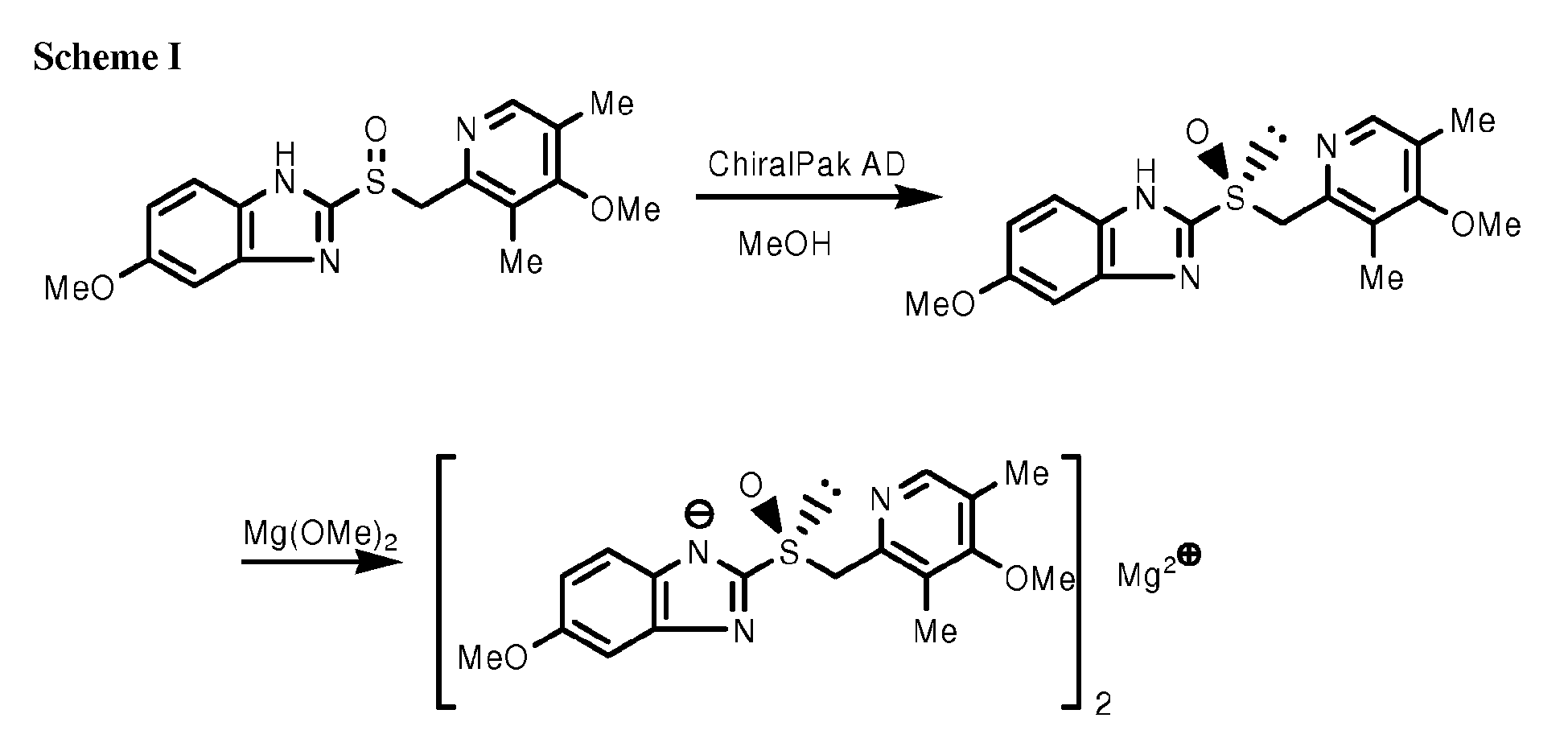
- Using such procedure, S-omeprazole magnesium having an optical purity of at least 85% e.e., preferably at least 89% e.e. may be obtained. In particular, the optical purity of the final S-omeprazole magnesium may range from about 85% e.e. to about 99% e.e..
- According to the present invention, omeprazole preferably is a mixture of S-omeprazole and R-omeprazole in e.e. of more than 90%, preferably more than 96%, more preferably more than 98%, most preferably more than 99.5%.
- Preferably, the collected eluates of S-omeprazole from the enantioresolution are concentrated to a smaller volume by partial distillation of the mobile phase solvent which is preferably an alcohol such as methanol. A magnesium source is then added to the concentrate of neutral S-omeprazole to produce the S-omeprazole magnesium salt. Suitable magnesium sources for use in the present invention include magnesium hydroxide, magnesium inorganic salts such as magnesium sulphate, magnesium chloride, magnesium carbonate and magnesium nitrate; magnesium organic salts selected from a group consisting of magnesium 2-ethyl-hexanoate, magnesium citrate, magnesium stearate, magnesium ascorbate, magnesium acetate, magnesium alcoholate, and mixtures thereof. Preferably, the magnesium source is a magnesium alcoholate, such as magnesium ethanolate or magnesium methanolate. More preferably, magnesium methanolate in a methanol solution is used as magnesium source.
- After the reaction with the magnesium source is substantially completed, solid inorganic magnesium salts residues are removed. Optionally, a small amount of water (up to 1 % (V/V) calculated on the volume (V) of reaction mixture) is added to the reaction mixture in order to precipitate surplus amount of magnesium source. Preferably, the obtained reaction mixture containing S-omeprazole magnesium is filtered through a layer of diatomite filter medium (Celite®). In the next step the S-omeprazole magnesium is precipitated from the reaction mixture. Depending on the preparation conditions either amorphous or crystalline S-omeprazole magnesium salt is obtained.
- According to the first embodiment, the filtrate of the reaction mixture is then poured into a substantially nonpolar organic solvent such as an ether solvent in order to precipitate the S-omeprazole magnesium. Suitable ether solvents for use in the present invention may be selected from the group consisting of diethyl ether, methyl t-butyl ether, diisopropyl ether, and mixtures of one or more thereof. Most preferably, diethyl ether is used for precipitation of S-omeprazole magnesium. The temperature of precipitation medium may be in the range of from about 30 °C to about -30 °C, preferably from about 20 °C to about -10 °C.
- By implementing the step (i) of this invention the formed S-omeprazole magnesium salt comprises less than 1 wt.-% of an organic solvent, preferably less than 0.99 wt.-%, more preferably less than 0.98 wt.-%, for example less than 0.95 wt.-%, less than 0.90 wt.-%, less than 0.85 wt.-%, less than 0.80 wt.-%, less than 0.75 wt.-%, less than 0.70 wt.-%, less than 0.65 wt.-%, less than 0.60 wt.-%, less than 0.55 wt.-%, less than 0.50 wt.-%, less than 0.45 wt.-%, less than 0.40 wt.-%, less than 0.35 wt.-%, less than 0.30 wt.-%, or less than 0.25 wt.-% based on the amount of the magnesium salt of S-omeprazole. According to X-ray powder diffraction analysis the S-omeprazole magnesium prepared according to this process is obtained in an amorphous form. The diffractogram of a respective sample is shown on the
Figure 1 . - Optionally the amorphous solvent pure S-omeprazole magnesium can be additionally dried in vacuo bellow 40 °C to obtain a product having a water content bellow about 4.8 wt-%, preferably below about 3.2 wt-%, and most preferably below about 2.5 wt-%.
- According to the second embodiment, organic solvent is partly removed from the filtrate of the reaction mixture forming a S-omeprazol magnesium
solution having concentration 10 to 70 wt.-% , preferably 30 to 50 wt.-% . Addition of a mixture of a second organic solvent and water to the said solution results in formation of a solid S-omeprazole magnesium salt. Optionally, the reaction mixture can be seeded with S-omeprazole magnesium salt crystals. The second organic solvent used for precipitation of the product is selected from a group of ketones or alcohols. From alcohols precipitates an amorphous solid, while ketones facilitate formation of crystalline form B. Thus in this second aspect acetone is most preferred. The aqueous second organic solvent comprises 2 to 20 % (V/V) of water, more preferably 5 to 10 % (V/V) of water. The temperature of precipitation medium may be in the range of from about 50 °C to about -10 °C, preferably from about 25 °C to about 0 °C. The solid product is separated by filtration or centrifugation and optionally washed with a small amount of the aqueous organic solvent. - The isolated solid product is in the next step subjected to the step (i) disclosed in this invention, thus the magnesium salt of S-omeprazole containing up to 10 wt.-% of organic solvent is treated with a gas comprising water vapors at reduced pressure. The step is also referred to as drying and is performed by gas steam of either air or nitrogen saturated with water at the temperatures from about 50 °C to about 20 °C, at reduced pressure, preferably at pressure between 500 and 50 mbar.
- The obtained S-omeprazole magnesium salt is having a water content between 4.5 wt.-% and 6.7 wt.-%, comprising less than 1 wt.-% of an organic solvent, preferably less than 0.99 wt.-%, more preferably less than 0.98 wt.-%, for example less than 0.95 wt.-%, less than 0.90 wt.-%, less than 0.85 wt.-%, less than 0.80 wt.-%, less than 0.75 wt.-%, less than 0.70 wt.-%, less than 0.65 wt.-%, less than 0.60 wt.-%, less than 0.55 wt.-%, less than 0.50 wt.-%, less than 0.45 wt.-%, less than 0.40 wt.-%, less than 0.35 wt.-%, less than 0.30 wt.-%, or less than 0.25 wt.-% based on the amount of the magnesium salt of S-omeprazole. X-ray powder diffraction analysis of a respective sample the S-omeprazole magnesium prepared according to the process of this embodiment gave the diffractogram depicted in the
Figure 2 . The diffraction pattern corresponds to the diffraction pattern of S-omeprazole magnesium dihydrate form B as described inWO 98/54171 - S-omeprazole magnesium prepared by the processes described in the above embodiments exhibit improved characteristics which are believed to be due to low content or residual solvents and highly efficient enantiopurification.
- The salt of omeprazole or S-omeprazole, preferably the magnesium salt of omeprazole or S-omeprazole, of the present invention or the salt of omeprazole or S-omeprazole, preferably the magnesium salt of omeprazole or S-omeprazole, obtainable by a process according to the present invention can be further processed into pharmaceutical compositions such as, for example, tablets for oral administration. The tablets will preferably be enteric coated to protect the salt of omeprazole, in particular the magnesium omeprazole, from the effects of gastric acid.
- According to another embodiment, the present invention also provides a method of treating a gastrointestinal inflammatory disease or condition comprising orally administering to a patient in need of such treating a therapeutically effective amount of the composition according to the present invention or a salt of omeprazole or S-omeprazole, preferably the magnesium salt of omeprazole or S-omeprazole, obtainable according to a process as described above and at least one pharmaceutically acceptable excipient.
- The salt of omeprazole or S-omeprazole, preferably the magnesium salt of omeprazole or S-omeprazole, of the present invention or the salt of omeprazole or S-omeprazole, preferably the magnesium salt of omeprazole or S-omeprazole, obtainable by a process according to the present invention may be used for inhibiting gastric acid secretion in mammals and man. In a more general sense, the compounds of the invention may be used for the treatment of gastric acid-related diseases and gastrointestinal inflammatory diseases in mammals and man, such as gastric ulcer, duodenal ulcer, reflux esophagitis and gastritis. Furthermore, the compounds may be used for treatment of other gastrointestinal disorders where gastric antisecretory effect is desirable, e.g., in patients on NSAID therapy, in patients with gastrinomas, and in patients with acute upper gastrointestinal bleeding. They may also be used in patients in intensive care situations, and pre- and post-operatively to prevent acid aspiration and stress ulceration.
- The salt of omeprazole or S-omeprazole, preferably the magnesium salt of omeprazole or S-omeprazole, of the present invention or the salt of omeprazole or S-omeprazole, preferably the magnesium salt of omeprazole or S-omeprazole, obtainable by a process according to the present invention may also be used for treatment or prophylaxis of inflammatory conditions in mammals, including man, especially those involving lysozymal enzymes. Conditions that may be specifically mentioned for treatment are rheumatoid arthritis and gout. The salt of omeprazole or S-omeprazole, preferably the magnesium salt of omeprazole or S-omeprazole, of the present invention or the salt of omeprazole or S-omeprazole, preferably the magnesium salt of omeprazole or S-omeprazole, obtainable by a process according to the present invention may also be useful in the treatment of psoriasis, as well as in the treatment of Helicobacter infections.
- According to another embodiment, the present invention also provides a pharmaceutical composition comprising the composition according to the present invention or a salt of omeprazole or S-omeprazole, preferably the magnesium salt of omeprazole or S-omeprazole, obtainable according to a process as described above and at least one pharmaceutically acceptable excipient.
- Any suitable form of administration may be employed providing the patient with an effective dosage of the salt of omeprazole or S-omeprazole, preferably the magnesium salt of omeprazole or S-omeprazole, according to the invention. For example, peroral or parental formulations and the like may be employed. Dosage forms include capsules, tablets, dispersions, suspensions and the like.
- For the preparation of pharmaceutical compositions in the form of dosage units for oral administration such as, for example, tablets, the salt of omeprazole or S-omeprazole, preferably the magnesium salt of omeprazole or S-omeprazole, of the present invention or the salt of omeprazole or S-omeprazole, preferably the magnesium salt of omeprazole or S-omeprazole, obtainable by a process according to the present invention may be combined with one or more pharmaceutically acceptable excipients including a solid, pulverulent carrier, such as lactose, saccharose, sorbitol, mannitol, starch, amylopectin, cellulose derivatives or gelatin, as well as an antifriction agent such as magnesium stearate, calcium stearate and polyethyleneglycol waxes. The mixture is then pressed into tablets. If coated tablets are desired, the above-prepared core may be coated with a concentrated solution of sugar, which may contain gum arabic, gelatin, talc, titanium dioxide, or with a pharmaceutically acceptable lacquer dissolved in volatile organic solvent or mixture of solvents. To this coating various pharmaceutically acceptable dyes may be added in order to distinguish among tablets with different amounts of active compound present. Soft gelatin capsules may be prepared which contain a mixture of the salt of omeprazole or S-omeprazole, preferably the magnesium salt of omeprazole or S-omeprazole, of the present invention or the salt of omeprazole or S-omeprazole, preferably the magnesium salt of omeprazole or S-omeprazole, obtainable by a process according to the present invention and vegetable oil. Hard gelatin capsules may contain granules of the active compound in combination with a solid, pulverulent carrier, such as lactose, saccharose, sorbitol, mannitol, potato starch, corn starch, amylopectin, cellulose derivatives, gelatin, and mixtures thereof.
- The invention also provides the use of the salt of omeprazole or S-omeprazole, preferably the magnesium salt of omeprazole or S-omeprazole, of the invention in the manufacture of a medicament for the use in the treatment of a gastric-acid related condition or a method of treating a gastric-acid related condition which method comprises administering to subjects suffering from said condition a therapeutically effective amount of the salt of omeprazole or S-omeprazole, preferably the magnesium salt of omeprazole or S-omeprazole, according to the invention.
- The invention also provides the use of a therapeutically effective amount of the composition according to the present invention or a salt of omeprazole or S-omeprazole, preferably the magnesium salt of omeprazole or S-omeprazole, obtainable according to a process as described above and at least one pharmaceutically acceptable excipient for the preparation of a medicament for treating a gastrointestinal inflammatory disease or condition, preferably wherein said medicament is to be administered to a patient in need thereof.
- Combination preparations comprising the salt of omeprazole or S-omeprazole, preferably the magnesium salt of omeprazole or S-omeprazole, according to the present invention and other active ingredients may also be used. Examples of such active ingredients include, but are not limited to anti-bacterial compounds, non-steroidal anti-inflammatory agents, antacid agents, alginates and prokinetic agents.
-
Figure 1 shows the XRD diffractogram of the amorphous S-omeprazole magnesium obtained according to example 3. -
Figure 2 shows the XRD diffractogram of S-omeprazole magnesium dihydrate form B obtained according to example 4. - The following examples illustrate the process of the present invention and are not intended to limit the scope of the invention set forth in the claims appended thereto.
- Omeprazole (10 g) is suspended in 33 mL of methanol. 17.4 mL of 8.8 % solution of magnesium methanolate in methanol (1.25 g Mg(OMe)2) is added to the omeprazole suspension. The reaction mixture is stirred for half an hour at room temperature. After filtration through a layer of diatomite filter medium (Celite®) it is slowly poured into 0.5 L of cold diethyl ether (-10°C) under vigorous stirring. The formed suspension is kept at -10°C for an hour. After filtration and washing with 100 mL of diethyl ether the wet filter cake is dried for 24 hours at reduced pressure (200 mbar) in the presence of air saturated with water at 40 °C. 8.23 g of crystalline omeprazole magnesium (omeprazole magnesium dihydrate) containing less than 0.5 wt.-% of residual solvents (methanol, diethylether) is obtained.
- Racemic mixture of omeprazole is resolved and separated into S- and R-enantiomer using chiral column chromatography. Omeprazole is dissolved in methanol and diluted to a concentration of about 22 - 25 g / L. About 0.01 % (V/V) of diethylamine is also added to the solution. The chromatographic separation is carried out under the following conditions:
- Stationary phase: CHIRALPAK AD, 20 µm particle size
- Column length: 250-350 mm
- Column diameter : 5 cm
- Mobile phase: methanol
- Loading: mLOAD/ SCOLUMN = 175-220 mg/cm2, Linear velocity = 3.8-4.2 cm/min.
- Temperature: room temperature
- Linear velocity during S-enantiomer elution: 5.7-6.2 cm/min.
- Linear velocity during R-enantiomer elution: 9.0-11.8 cm/min.
- UV detector: 325 nm
- Run time: 22-26 min
- Combined fractions of S-omeprazole (2130 mL of a solution containing 11.13 g of S-omeprazole) produced by chiral column chromatography are concentrated approximately 100-fold by evaporation to produce a solution containing about 500 g/L of S-omeprazole in methanol. A 6 wt.-% solution of magnesium methanolate in methanol is prepared by reacting 0.398 g of magnesium turnings in 29 mL of methanol with a catalytic amount of dichloromethane. 29 mL of the solution of magnesium methanolate (1.41 g Mg(OMe)2) is added to the concentrated solution of S-omeprazole. The reaction mixture is stirred for 0.5 hour at room temperature under inert atmosphere. Then, it is slowly poured into 0.55 L of diethyl ether being vigorously stirred. The suspension is cooled -10 °C and kept at this temperature for 1 hour to complete precipitation the S-omeprazole magnesium product. The product is filtered off and washed with 50 mL of diethyl ether. The product is dried overnight at 40 °C in vacuum to reduce residual methanol content to approximately 4 wt.-%. Further, a stream of nitrogen saturated with water at room temperature is blown through the filter cake for 5h. Then, the product is re-dried for 24 h at 40 °C in vacuum. Amorphous S-omeprazole magnesium with residual methanol content below 0.5 wt.-% (determined by GC Headspace method) is obtained.
- 7.2 kg of omeprazole is resolved and separated into S- and R-enantiomers using chiral column chromatography. Omeprazole is dissolved in methanol and diluted to a concentration of about 22 - 25 g / L. About 0.01 % (V/V) of diethylamine is also added to the solution. The chromatographic separation is carried out under the analogous conditions as described in Example 2 using a column of length 300 mm and of diameter 15 cm.
- Combined fractions of S-omeprazole produced by chiral column chromatography are concentrated by evaporation at reduced pressure to produce a solution containing about 600 g/L of S-omeprazole in methanol. 5.33 kg of 7.6 wt.-% solution of magnesium methanolate in methanol is added to the concentrated solution of S-omeprazole. The reaction mixture is stirred for 0.5 hour at 20 °C under N2 atmosphere. Then, the reaction mixture is filtered through a layer of diatomite filter medium (Celite®) and slowly pumped into a reactor containing 153 kg of diethyl ether cooled to -10 °C. The precipitation medium is vigorously stirred during the addition of the S-omeprazole magnesium solution. The formed suspension is stirred for another hour at -10 °C. The product is filtered off and washed with 10 kg of diethyl ether. 7 kg of wet S-omeprazole magnesium (containing 6 - 8 wt.-% of methanol and 35 - 60 wt.-% of diethyl ether) is dried for 16 hours at 40 °C in vacuum in order to reduce residual solvents content to approximately 2.5 wt.-% of methanol and less than 100 ppm (w / w) of diethyl ether. The product contains 2.2 wt.-% of water. Further, nitrogen saturated with water at room temperature is blown through the filter cake until water content in the product is increased to 6 - 7 wt.-%. The residual methanol content is decreased below 0.5 wt.-% . Finally, S-omeprazole magnesium is dried for some additional time (30 hours) in vacuum at 40 °C yielding 3.34 kg of amorphous S-omeprazole magnesium (92.4 % e.e. determined by chiral HPLC, 99.81 % purity determined by HPLC, 4.0 % of water content determined by Karl-Fisher, 3.8 % of Mg determined by atomic absorption spectroscopy (AAS), assay of C34H36N6O6S2Mg 99.3 % determined by HPLC, residual solvents content 2471 ppm (w / w) MeOH, <100ppm (w / w) diethyl ether determined by GC Headspace method). The XRD diffractogram of the amorphous S-omeprazole magnesium is shown in
Figure 1 . - A stoichiometric amount of 7.6 wt.-% methanolic solution of magnesium methanolate (18.1 mL) is added to the solution of 9.0 g of S-omeprazole (99.28 % e.e.) in 100 mL of methanol. The solution of S-omeprazole is prepared by concentration of the combined fractions produced by chiral column chromatography under the chromatographic conditions presented in Example 2. The obtained reaction mixture is stirred at room temperature for 1 hour allowing to form S-omeprazole magnesium salt in the meantime. After addition of 0.4 mL of water the reaction mixture is further stirred for 30 min. The formed inorganic solid salt is separated from the liquid by filtration through a layer of diatomite filter medium (Celite®). The volume of filtrate is then reduced by evaporation of methanol forming an S-omeprazole magnesium solution with concentration 40 - 45 wt.-%.
- A mixture of 51 mL of acetone and 2.9 mL of water is added to the concentrate. The mixture is seeded with a 0.05 g of S-omeprazole magnesium dihydrate form B. After a few minutes a precipitate is formed and the suspension is stirred for 4 hours. The product is filtered off, washed twice with 10 mL of a mixture of acetone and methanol (4 / 1 (V / V)). The wet filter cake is dried for 20 hours at reduced pressure (200 mbar) in the presence of air saturated with water at 35 °C. 8.00 g of S-omeprazole magnesium dihydrate form B is obtained (99.84 % e.e. determined by chiral HPLC, 100 % purity determined by HPLC, 5.31 % of water content determined by Karl-Fisher, 3.6 % of Mg determined by complexometric titration, assay of C34H36N6O6S2Mg 100.1 % determined by HPLC, residual solvents content 1106 ppm (w / w) MeOH, 4439 ppm (w / w) acetone determined by GC Headspace method). The XRD diffractogram of the sample of the product is shown in
Figure 2 .
Claims (37)
- A process for removing an organic solvent from a salt of omeprazole, comprising the step of(i) treating a salt of omeprazole containing at least one organic solvent with a gas comprising water vapors.
- The process of claim 1, wherein the salt of omeprazole is a magnesium salt of omeprazole.
- The process of claim 2, wherein the magnesium salt of omeprazole containing at least one organic solvent is obtained by a process comprising the steps:(a) reacting omeprazole with a magnesium source in a solution of an organic solvent,(b) partly removing said organic solvent,(c) isolating a magnesium salt of omeprazole containing up to 5 wt.-% of said organic solvent.
- The process of any of claims 1 to 3, wherein the salt of omeprazole contains more than 95% of a salt of omeprazole and less than 5% of omeprazole.
- The process of claim 4, wherein the salt of omeprazole contains more than 95% of omeprazole magnesium and less than 5% of omeprazole.
- The process of any of claims 1 to 5, wherein the salt of omeprazole is a solid salt of omeprazole.
- The process of claim 6, wherein the solid salt of omeprazole is crystalline.
- The process of claim 7, wherein if omeprazole is S-omeprazole the obtained solid is form B.
- The process of claim 7, wherein the solid salt of omeprazole has a crystallinity of more than 70%.
- The process of claim 7, wherein the solid salt of omeprazole has a crystallinity of less than 70%.
- The process of claim 6, wherein the solid salt of omeprazole is amorphous.
- The process of any of claims 1 to 11, wherein the organic solvent is a C1 to C4 alcohol or acetone.
- The process of any of claims 3 to 12 wherein the magnesium source is magnesium alcoholate of a C1 to C4 alcohol.
- The process of any of claims 12 or 13, wherein the C1 to C4 alcohol is methanol.
- The process of any of claims 1 to 14, wherein omeprazole is S-omeprazole.
- The process of any of claims 1 to 15, wherein omeprazole is a mixture of S-omeprazole and R-omeprazole in e.e. of more than 90%, preferably more than 96%, more preferably more than 98%, most preferably more than 99.5%.
- The process of any of claims 1 to 16, wherein the gas comprising water vapors is air or nitrogen comprising water vapors.
- The process of any of claims 1 to 17, wherein the gas comprising water vapors is air or nitrogen saturated with water.
- The process of any of claims 1 to 18, wherein step (i) is performed at room temperature.
- The process of any of claims 1 to 19, wherein step (i) comprises blowing a gas comprising water vapors through a salt of omeprazole containing at least one organic solvent.
- The process of any of claims 1 to 20, wherein the gas comprising water vapors is a gas stream comprising water vapors.
- A process for improving the degree of crystallinity of a solid salt of omeprazole by(i) treating a salt of omeprazole containing at least one organic solvent with a gas comprising water vapors.
- The process according to claim 22, wherein the degree of crystallinity is improved from below 25% to about 50 % or more.
- The process according to claim 24, wherein the degree of crystallinity is improved from below 30 to 50 % to about 60 to 75 %.
- The process according to any of claims 22 to 24, wherein the salt of omeprazole is a magnesium salt of omeprazole.
- The process according to any of claims 22 to 25, wherein omeprazole is S-omeprazole.
- A composition comprising a salt of omeprazole obtainable by a process according to any of claims 1 to 26.
- The composition of claim 27, wherein the salt of omeprazole is a magnesium salt of omeprazole.
- The composition of any of claims 27 or 28, wherein the salt of omeprazole comprises less than 1 wt.-% of an organic solvent.
- The composition of any of claims 27 to 29, wherein the organic solvent is a C1 to C4 alcohol or acetone.
- The composition of claim 30, wherein the C1 to C4 alcohol is methanol.
- The composition of any of claims 27 to 31, wherein omeprazole is S-omeprazole.
- Use of a gas comprising water vapors for removing an organic solvent from a salt of omeprazole.
- The use of a gas comprising water vapors according to claim 33, wherein the salt of omeprazole is a magnesium salt of omeprazole.
- A method of treating a gastrointestinal inflammatory disease or condition comprising orally administering to a patient in need of such treating a therapeutically effective amount of the composition according to any of claims 27 to 32 or a salt of omeprazole obtainable according to a process according to any of claims 1 to 26 and at least one pharmaceutically acceptable excipient.
- A pharmaceutical composition comprising the composition according to any of claims 27 to 32 or a salt of omeprazole obtainable according to a process according to any of claims 1 to 26 and at least one pharmaceutically acceptable excipient.
- Use of a therapeutically effective amount of the composition according to any of claims 27 to 32 or a salt of omeprazole obtainable according to a process according to any of claims 1 to 26 and at least one pharmaceutically acceptable excipient for the preparation of a medicament for treating a gastrointestinal inflammatory disease or condition, preferably wherein said medicament is to be administered to a patient in need thereof.
Priority Applications (6)
| Application Number | Priority Date | Filing Date | Title |
|---|---|---|---|
| EP07100738A EP1947099A1 (en) | 2007-01-18 | 2007-01-18 | Process for solvent removal from omeprazole salts |
| PCT/EP2008/050198 WO2008087081A1 (en) | 2007-01-18 | 2008-01-09 | Process for solvent removal from omeprazole salts |
| US12/523,025 US8247567B2 (en) | 2007-01-18 | 2008-01-09 | Process for solvent removal from omeprazole salts |
| ES08701361T ES2396992T3 (en) | 2007-01-18 | 2008-01-09 | Process for solvent removal of omeprazole salts |
| EP08701361A EP2114918B1 (en) | 2007-01-18 | 2008-01-09 | Process for solvent removal from omeprazole salts |
| SI200830864T SI2114918T1 (en) | 2007-01-18 | 2008-01-09 | Process for solvent removal from omeprazole salts |
Applications Claiming Priority (1)
| Application Number | Priority Date | Filing Date | Title |
|---|---|---|---|
| EP07100738A EP1947099A1 (en) | 2007-01-18 | 2007-01-18 | Process for solvent removal from omeprazole salts |
Publications (1)
| Publication Number | Publication Date |
|---|---|
| EP1947099A1 true EP1947099A1 (en) | 2008-07-23 |
Family
ID=37758766
Family Applications (2)
| Application Number | Title | Priority Date | Filing Date |
|---|---|---|---|
| EP07100738A Withdrawn EP1947099A1 (en) | 2007-01-18 | 2007-01-18 | Process for solvent removal from omeprazole salts |
| EP08701361A Active EP2114918B1 (en) | 2007-01-18 | 2008-01-09 | Process for solvent removal from omeprazole salts |
Family Applications After (1)
| Application Number | Title | Priority Date | Filing Date |
|---|---|---|---|
| EP08701361A Active EP2114918B1 (en) | 2007-01-18 | 2008-01-09 | Process for solvent removal from omeprazole salts |
Country Status (5)
| Country | Link |
|---|---|
| US (1) | US8247567B2 (en) |
| EP (2) | EP1947099A1 (en) |
| ES (1) | ES2396992T3 (en) |
| SI (1) | SI2114918T1 (en) |
| WO (1) | WO2008087081A1 (en) |
Families Citing this family (2)
| Publication number | Priority date | Publication date | Assignee | Title |
|---|---|---|---|---|
| CN105153117A (en) * | 2015-09-18 | 2015-12-16 | 山东省医学科学院药物研究所 | Method for preparing esomeprazole magnesium |
| CN111175391A (en) * | 2019-12-27 | 2020-05-19 | 深圳康泰生物制品股份有限公司 | Method for measuring residual amount of methanol in recombinant hand-foot-and-mouth disease vaccine stock solution and application of method in preparation of recombinant hand-foot-and-mouth disease vaccine |
Citations (4)
| Publication number | Priority date | Publication date | Assignee | Title |
|---|---|---|---|---|
| WO1997041114A1 (en) * | 1996-04-26 | 1997-11-06 | Astra Aktiebolag | Process for the preparation of a magnesium salt of a substituted sulphinyl heterocycle |
| WO1998054171A1 (en) * | 1997-05-30 | 1998-12-03 | Astra Aktiebolag | Novel form of s-omeprazole |
| WO2001036409A1 (en) * | 1999-11-16 | 2001-05-25 | Bernard Charles Sherman | Magnesium omeprazole |
| CA2386716A1 (en) * | 2002-05-17 | 2003-11-17 | Bernard Charles Sherman | Magnesium salt of s-omeprazole |
Family Cites Families (13)
| Publication number | Priority date | Publication date | Assignee | Title |
|---|---|---|---|---|
| SE7804231L (en) | 1978-04-14 | 1979-10-15 | Haessle Ab | Gastric acid secretion |
| NL7901028A (en) | 1979-02-09 | 1980-08-12 | Hollandse Signaalapparaten Bv | VIDEO EXTRACTOR. |
| DE4035455A1 (en) | 1990-11-08 | 1992-05-14 | Byk Gulden Lomberg Chem Fab | ENANTIOMER SEPARATION |
| SE9301830D0 (en) | 1993-05-28 | 1993-05-28 | Ab Astra | NEW COMPOUNDS |
| SE9302396D0 (en) | 1993-07-09 | 1993-07-09 | Ab Astra | A NOVEL COMPOUND FORM |
| SE504459C2 (en) | 1994-07-15 | 1997-02-17 | Astra Ab | Process for the preparation of substituted sulfoxides |
| GB9423968D0 (en) | 1994-11-28 | 1995-01-11 | Astra Ab | Resolution |
| HRP960232A2 (en) | 1995-07-03 | 1998-02-28 | Astra Ab | A process for the optical purification of compounds |
| US6048981A (en) | 1998-04-22 | 2000-04-11 | Torcan Chemical Ltd. | Magnesium omeprazole and process for its preparation |
| CA2450433C (en) | 2001-07-16 | 2010-05-25 | Janssen Pharmaceutica N.V. | Improved process for preparing benzimidazole-type compounds |
| SE0104295D0 (en) | 2001-12-18 | 2001-12-18 | Astrazeneca Ab | New process |
| AU2003262992A1 (en) | 2002-08-30 | 2004-03-19 | Reddy's Laboratories Limited | Amorphous hydrates of esomeprazole magnesium and process for the preparation thereof |
| WO2004046134A2 (en) | 2002-11-18 | 2004-06-03 | Dr. Reddy's Laboratories Limited | Crystalline form ii of esomeprazole magnesium trihydrate and process for its preparation |
-
2007
- 2007-01-18 EP EP07100738A patent/EP1947099A1/en not_active Withdrawn
-
2008
- 2008-01-09 EP EP08701361A patent/EP2114918B1/en active Active
- 2008-01-09 WO PCT/EP2008/050198 patent/WO2008087081A1/en not_active Ceased
- 2008-01-09 ES ES08701361T patent/ES2396992T3/en active Active
- 2008-01-09 SI SI200830864T patent/SI2114918T1/en unknown
- 2008-01-09 US US12/523,025 patent/US8247567B2/en not_active Expired - Fee Related
Patent Citations (4)
| Publication number | Priority date | Publication date | Assignee | Title |
|---|---|---|---|---|
| WO1997041114A1 (en) * | 1996-04-26 | 1997-11-06 | Astra Aktiebolag | Process for the preparation of a magnesium salt of a substituted sulphinyl heterocycle |
| WO1998054171A1 (en) * | 1997-05-30 | 1998-12-03 | Astra Aktiebolag | Novel form of s-omeprazole |
| WO2001036409A1 (en) * | 1999-11-16 | 2001-05-25 | Bernard Charles Sherman | Magnesium omeprazole |
| CA2386716A1 (en) * | 2002-05-17 | 2003-11-17 | Bernard Charles Sherman | Magnesium salt of s-omeprazole |
Also Published As
| Publication number | Publication date |
|---|---|
| SI2114918T1 (en) | 2013-02-28 |
| EP2114918B1 (en) | 2012-10-03 |
| EP2114918A1 (en) | 2009-11-11 |
| ES2396992T3 (en) | 2013-03-01 |
| US20100076025A1 (en) | 2010-03-25 |
| US8247567B2 (en) | 2012-08-21 |
| WO2008087081A1 (en) | 2008-07-24 |
Similar Documents
| Publication | Publication Date | Title |
|---|---|---|
| JP4002303B2 (en) | A novel form of S-omeprazole | |
| US6262085B1 (en) | Alkoxy substituted Benzimidazole compounds, pharmaceutical preparations containing the same, and methods of using the same | |
| RS60999B1 (en) | Aurora a kinase inhibitor | |
| EP2262790B1 (en) | Crystal of benzimidazole compound | |
| EP2114918B1 (en) | Process for solvent removal from omeprazole salts | |
| US7875723B2 (en) | S-omeprazole magnesium | |
| CN1976923B (en) | Solid form of (S)-omeprazole magnesium salt and preparation method thereof | |
| JP4160293B2 (en) | Crystal production method | |
| ME00197B (en) | New process for the preparation of trihydrate of magnesium salt of s-omeprasole | |
| MXPA99010945A (en) | Novel form of s | |
| HK1051681B (en) | New process for the preparation of the trihydrate of the magnesium salt of s-omeprazole | |
| HK1025962B (en) | Novel form of s-omeprazole | |
| CZ296154B6 (en) | Magnesium salt of S-omeprazole trihydrate, process for its preparation and pharmaceutical composition in which the trihydrate is comprised |
Legal Events
| Date | Code | Title | Description |
|---|---|---|---|
| PUAI | Public reference made under article 153(3) epc to a published international application that has entered the european phase |
Free format text: ORIGINAL CODE: 0009012 |
|
| AK | Designated contracting states |
Kind code of ref document: A1 Designated state(s): AT BE BG CH CY CZ DE DK EE ES FI FR GB GR HU IE IS IT LI LT LU LV MC NL PL PT RO SE SI SK TR |
|
| AX | Request for extension of the european patent |
Extension state: AL BA HR MK RS |
|
| AKX | Designation fees paid | ||
| REG | Reference to a national code |
Ref country code: DE Ref legal event code: 8566 |
|
| STAA | Information on the status of an ep patent application or granted ep patent |
Free format text: STATUS: THE APPLICATION IS DEEMED TO BE WITHDRAWN |
|
| 18D | Application deemed to be withdrawn |
Effective date: 20090124 |