EP1924302B1 - Injectable composite material suitable for use as a bone substitute - Google Patents
Injectable composite material suitable for use as a bone substitute Download PDFInfo
- Publication number
- EP1924302B1 EP1924302B1 EP06780262A EP06780262A EP1924302B1 EP 1924302 B1 EP1924302 B1 EP 1924302B1 EP 06780262 A EP06780262 A EP 06780262A EP 06780262 A EP06780262 A EP 06780262A EP 1924302 B1 EP1924302 B1 EP 1924302B1
- Authority
- EP
- European Patent Office
- Prior art keywords
- composite material
- polyvinyl alcohol
- material according
- injectable composite
- bone
- Prior art date
- Legal status (The legal status is an assumption and is not a legal conclusion. Google has not performed a legal analysis and makes no representation as to the accuracy of the status listed.)
- Active
Links
Classifications
-
- A—HUMAN NECESSITIES
- A61—MEDICAL OR VETERINARY SCIENCE; HYGIENE
- A61L—METHODS OR APPARATUS FOR STERILISING MATERIALS OR OBJECTS IN GENERAL; DISINFECTION, STERILISATION OR DEODORISATION OF AIR; CHEMICAL ASPECTS OF BANDAGES, DRESSINGS, ABSORBENT PADS OR SURGICAL ARTICLES; MATERIALS FOR BANDAGES, DRESSINGS, ABSORBENT PADS OR SURGICAL ARTICLES
- A61L27/00—Materials for grafts or prostheses or for coating grafts or prostheses
- A61L27/40—Composite materials, i.e. containing one material dispersed in a matrix of the same or different material
- A61L27/42—Composite materials, i.e. containing one material dispersed in a matrix of the same or different material having an inorganic matrix
-
- A—HUMAN NECESSITIES
- A61—MEDICAL OR VETERINARY SCIENCE; HYGIENE
- A61L—METHODS OR APPARATUS FOR STERILISING MATERIALS OR OBJECTS IN GENERAL; DISINFECTION, STERILISATION OR DEODORISATION OF AIR; CHEMICAL ASPECTS OF BANDAGES, DRESSINGS, ABSORBENT PADS OR SURGICAL ARTICLES; MATERIALS FOR BANDAGES, DRESSINGS, ABSORBENT PADS OR SURGICAL ARTICLES
- A61L27/00—Materials for grafts or prostheses or for coating grafts or prostheses
- A61L27/02—Inorganic materials
- A61L27/12—Phosphorus-containing materials, e.g. apatite
-
- A—HUMAN NECESSITIES
- A61—MEDICAL OR VETERINARY SCIENCE; HYGIENE
- A61L—METHODS OR APPARATUS FOR STERILISING MATERIALS OR OBJECTS IN GENERAL; DISINFECTION, STERILISATION OR DEODORISATION OF AIR; CHEMICAL ASPECTS OF BANDAGES, DRESSINGS, ABSORBENT PADS OR SURGICAL ARTICLES; MATERIALS FOR BANDAGES, DRESSINGS, ABSORBENT PADS OR SURGICAL ARTICLES
- A61L27/00—Materials for grafts or prostheses or for coating grafts or prostheses
- A61L27/40—Composite materials, i.e. containing one material dispersed in a matrix of the same or different material
- A61L27/44—Composite materials, i.e. containing one material dispersed in a matrix of the same or different material having a macromolecular matrix
- A61L27/46—Composite materials, i.e. containing one material dispersed in a matrix of the same or different material having a macromolecular matrix with phosphorus-containing inorganic fillers
-
- A—HUMAN NECESSITIES
- A61—MEDICAL OR VETERINARY SCIENCE; HYGIENE
- A61L—METHODS OR APPARATUS FOR STERILISING MATERIALS OR OBJECTS IN GENERAL; DISINFECTION, STERILISATION OR DEODORISATION OF AIR; CHEMICAL ASPECTS OF BANDAGES, DRESSINGS, ABSORBENT PADS OR SURGICAL ARTICLES; MATERIALS FOR BANDAGES, DRESSINGS, ABSORBENT PADS OR SURGICAL ARTICLES
- A61L27/00—Materials for grafts or prostheses or for coating grafts or prostheses
- A61L27/50—Materials characterised by their function or physical properties, e.g. injectable or lubricating compositions, shape-memory materials, surface modified materials
-
- A—HUMAN NECESSITIES
- A61—MEDICAL OR VETERINARY SCIENCE; HYGIENE
- A61L—METHODS OR APPARATUS FOR STERILISING MATERIALS OR OBJECTS IN GENERAL; DISINFECTION, STERILISATION OR DEODORISATION OF AIR; CHEMICAL ASPECTS OF BANDAGES, DRESSINGS, ABSORBENT PADS OR SURGICAL ARTICLES; MATERIALS FOR BANDAGES, DRESSINGS, ABSORBENT PADS OR SURGICAL ARTICLES
- A61L27/00—Materials for grafts or prostheses or for coating grafts or prostheses
- A61L27/50—Materials characterised by their function or physical properties, e.g. injectable or lubricating compositions, shape-memory materials, surface modified materials
- A61L27/52—Hydrogels or hydrocolloids
-
- A—HUMAN NECESSITIES
- A61—MEDICAL OR VETERINARY SCIENCE; HYGIENE
- A61P—SPECIFIC THERAPEUTIC ACTIVITY OF CHEMICAL COMPOUNDS OR MEDICINAL PREPARATIONS
- A61P19/00—Drugs for skeletal disorders
-
- A—HUMAN NECESSITIES
- A61—MEDICAL OR VETERINARY SCIENCE; HYGIENE
- A61P—SPECIFIC THERAPEUTIC ACTIVITY OF CHEMICAL COMPOUNDS OR MEDICINAL PREPARATIONS
- A61P19/00—Drugs for skeletal disorders
- A61P19/08—Drugs for skeletal disorders for bone diseases, e.g. rachitism, Paget's disease
-
- A—HUMAN NECESSITIES
- A61—MEDICAL OR VETERINARY SCIENCE; HYGIENE
- A61F—FILTERS IMPLANTABLE INTO BLOOD VESSELS; PROSTHESES; DEVICES PROVIDING PATENCY TO, OR PREVENTING COLLAPSING OF, TUBULAR STRUCTURES OF THE BODY, e.g. STENTS; ORTHOPAEDIC, NURSING OR CONTRACEPTIVE DEVICES; FOMENTATION; TREATMENT OR PROTECTION OF EYES OR EARS; BANDAGES, DRESSINGS OR ABSORBENT PADS; FIRST-AID KITS
- A61F2/00—Filters implantable into blood vessels; Prostheses, i.e. artificial substitutes or replacements for parts of the body; Appliances for connecting them with the body; Devices providing patency to, or preventing collapsing of, tubular structures of the body, e.g. stents
- A61F2/02—Prostheses implantable into the body
- A61F2/28—Bones
-
- A—HUMAN NECESSITIES
- A61—MEDICAL OR VETERINARY SCIENCE; HYGIENE
- A61F—FILTERS IMPLANTABLE INTO BLOOD VESSELS; PROSTHESES; DEVICES PROVIDING PATENCY TO, OR PREVENTING COLLAPSING OF, TUBULAR STRUCTURES OF THE BODY, e.g. STENTS; ORTHOPAEDIC, NURSING OR CONTRACEPTIVE DEVICES; FOMENTATION; TREATMENT OR PROTECTION OF EYES OR EARS; BANDAGES, DRESSINGS OR ABSORBENT PADS; FIRST-AID KITS
- A61F2/00—Filters implantable into blood vessels; Prostheses, i.e. artificial substitutes or replacements for parts of the body; Appliances for connecting them with the body; Devices providing patency to, or preventing collapsing of, tubular structures of the body, e.g. stents
- A61F2/02—Prostheses implantable into the body
- A61F2/30—Joints
- A61F2/46—Special tools for implanting artificial joints
- A61F2/4601—Special tools for implanting artificial joints for introducing bone substitute, for implanting bone graft implants or for compacting them in the bone cavity
-
- A—HUMAN NECESSITIES
- A61—MEDICAL OR VETERINARY SCIENCE; HYGIENE
- A61F—FILTERS IMPLANTABLE INTO BLOOD VESSELS; PROSTHESES; DEVICES PROVIDING PATENCY TO, OR PREVENTING COLLAPSING OF, TUBULAR STRUCTURES OF THE BODY, e.g. STENTS; ORTHOPAEDIC, NURSING OR CONTRACEPTIVE DEVICES; FOMENTATION; TREATMENT OR PROTECTION OF EYES OR EARS; BANDAGES, DRESSINGS OR ABSORBENT PADS; FIRST-AID KITS
- A61F2/00—Filters implantable into blood vessels; Prostheses, i.e. artificial substitutes or replacements for parts of the body; Appliances for connecting them with the body; Devices providing patency to, or preventing collapsing of, tubular structures of the body, e.g. stents
- A61F2/02—Prostheses implantable into the body
- A61F2/28—Bones
- A61F2002/2817—Bone stimulation by chemical reactions or by osteogenic or biological products for enhancing ossification, e.g. by bone morphogenetic or morphogenic proteins [BMP] or by transforming growth factors [TGF]
-
- A—HUMAN NECESSITIES
- A61—MEDICAL OR VETERINARY SCIENCE; HYGIENE
- A61F—FILTERS IMPLANTABLE INTO BLOOD VESSELS; PROSTHESES; DEVICES PROVIDING PATENCY TO, OR PREVENTING COLLAPSING OF, TUBULAR STRUCTURES OF THE BODY, e.g. STENTS; ORTHOPAEDIC, NURSING OR CONTRACEPTIVE DEVICES; FOMENTATION; TREATMENT OR PROTECTION OF EYES OR EARS; BANDAGES, DRESSINGS OR ABSORBENT PADS; FIRST-AID KITS
- A61F2/00—Filters implantable into blood vessels; Prostheses, i.e. artificial substitutes or replacements for parts of the body; Appliances for connecting them with the body; Devices providing patency to, or preventing collapsing of, tubular structures of the body, e.g. stents
- A61F2/02—Prostheses implantable into the body
- A61F2/30—Joints
- A61F2002/30001—Additional features of subject-matter classified in A61F2/28, A61F2/30 and subgroups thereof
- A61F2002/30667—Features concerning an interaction with the environment or a particular use of the prosthesis
- A61F2002/30677—Means for introducing or releasing pharmaceutical products, e.g. antibiotics, into the body
-
- A—HUMAN NECESSITIES
- A61—MEDICAL OR VETERINARY SCIENCE; HYGIENE
- A61F—FILTERS IMPLANTABLE INTO BLOOD VESSELS; PROSTHESES; DEVICES PROVIDING PATENCY TO, OR PREVENTING COLLAPSING OF, TUBULAR STRUCTURES OF THE BODY, e.g. STENTS; ORTHOPAEDIC, NURSING OR CONTRACEPTIVE DEVICES; FOMENTATION; TREATMENT OR PROTECTION OF EYES OR EARS; BANDAGES, DRESSINGS OR ABSORBENT PADS; FIRST-AID KITS
- A61F2310/00—Prostheses classified in A61F2/28 or A61F2/30 - A61F2/44 being constructed from or coated with a particular material
- A61F2310/00005—The prosthesis being constructed from a particular material
- A61F2310/00179—Ceramics or ceramic-like structures
- A61F2310/00293—Ceramics or ceramic-like structures containing a phosphorus-containing compound, e.g. apatite
-
- A—HUMAN NECESSITIES
- A61—MEDICAL OR VETERINARY SCIENCE; HYGIENE
- A61L—METHODS OR APPARATUS FOR STERILISING MATERIALS OR OBJECTS IN GENERAL; DISINFECTION, STERILISATION OR DEODORISATION OF AIR; CHEMICAL ASPECTS OF BANDAGES, DRESSINGS, ABSORBENT PADS OR SURGICAL ARTICLES; MATERIALS FOR BANDAGES, DRESSINGS, ABSORBENT PADS OR SURGICAL ARTICLES
- A61L2400/00—Materials characterised by their function or physical properties
- A61L2400/06—Flowable or injectable implant compositions
Definitions
- This invention relates to a new injectable composite material suitable for use as a bone substitute.
- the invention relates to an injectable composite material consisting of two phases: a ceramic phase and a hydrogel fluid phase.
- biomaterials can be applied to a number of diseases of the skeletal system where it is necessary to replace or supplement bone tissue, from the most common ones, related to age, such as osteoporosis, bone arthrosis, arthritis, to the most serious ones, such as sarcomas and bone cysts.
- Natural bone is a hard tissue of a composite nature, essentially consisting of an organic matrix (collagen fibres) and a ceramic reinforcement (apatite crystals), organised in a complex way to form a highly specialised structure with a targeted anisotropy in its mechanical properties.
- Bone tissue acts primarily as a supporting and protective framework for internal soft tissues and secondly engages in the exchange of valuable elements such as calcium and magnesium, for which bone constitutes the only reserve present in the body, with the blood and other surrounding fluids.
- bone tissue undergoes continuous replacement and remodelling. These processes are regulated by a large and complex set of hormonal substances, some of which are produced by bone cells themselves.
- the mechanical properties of bone are expressed through its elastic modulus and its maximum compression and tensile strengths. As a general rule, it is known that bone has greater compression strength than tensile strength, and that cortical bone has mechanical properties-superior to those of trabecular bone.
- the values for elastic modulus reported in the literature vary over a range from 50 MPa to 2 GPa for trabecular bone and from 10 GPa to 22 GPa for cortical bone. Compression strength values are comprised between 1 MPa and 50 MPa for trabecular bone, while for cortical bone they are comprised between 100 MPa and 220 MPa. These values constitute reference values for the mechanical behaviour of bone substitutes. In order to be able to ensure the functional compatibility which is essential for their full incorporation, bone substitutes must in fact have mechanical properties which are as similar as possible to those of the natural bone.
- the need for the use of a bone substitute may arise subsequent to fracture of the bone tissue, in cases where the normal processes of repair and re-growth do not take place in physiological time or do not take place at all, or following surgery for the removal of a tumoral mass or bone cyst, in which case there is a need to fill the cavity produced by surgery.
- Bone substitute must therefore ensure mechanical stability over clinically acceptable periods and have osteo-compatible properties which encourage the laying down of new tissue.
- One of the properties which is fundamental for a bone substitute is the possibility of remaining in contact with the natural tissue for an indefinite period of time without the need for surgical removal.
- PMMA polymethylmethacrylate
- Ceramic materials or cements based on phosphorus and calcium have given rise to appreciable interest in applications involving hard mineralised tissues. These materials are in fact non-toxic and non-immunogenic, in that they are essentially composed of calcium and phosphorus ions, which are the natural constituents of the ceramic phase of bone tissue.
- CPC phosphorus and calcium-based cements
- One of the most useful properties of phosphorus and calcium-based cements (CPC) is the fluid consistency they acquire when they are mixed with an aqueous liquid phase on preparation.
- a further useful property of these cements is their ability to harden in the presence of the water used for preparation.
- tricalcium phosphate is capable of binding directly to bone tissue, thus forming a very strong interface bond between the material and the tissue.
- Tricalcium phosphate like all calcium phosphate-based bone cements (CPBC), is a naturally porous material, but its mechanical behaviour is typical of a brittle material, which is therefore very different from the behaviour of natural bone tissue.
- the paste which is obtained during the preparation of TCP risks disintegration in contact with biological fluids if applied prematurely, while if applied too late it hardens and becomes rather unmanageable.
- the paste is extruded through a syringe it frequently occurs that the two phases separate, and as a consequence most of the liquid phase escapes while the solids remain trapped in the syringe.
- Patent application WO 02/070029 describes a workable mixture which is suitable for use as a bone substitute, comprising porous ⁇ -TCP and a binder selected from conventional emulsifying, suspension, thickening, gelling, binding, disintegrating or stabilising agents.
- a binder selected from conventional emulsifying, suspension, thickening, gelling, binding, disintegrating or stabilising agents.
- binding agents sodium alginate, hyaluronic acid, cellulose and cellulose derivatives, collagen, peptides, mucin, chondroitin sulphate and the like, are specifically mentioned.
- injectable composite material comprising 93% wt of cement phosphate powder designated as "H- Cem” and 7% wt of polyvinyl alcohol (PVA).
- H- Cem cement phosphate powder
- PVA polyvinyl alcohol
- the "H-Cem” cement consists of 98% wt of ⁇ - tricalcium phosphate ( ⁇ -TCP) and 2% wt of hydroxyapatite (HA).
- Hydrogels are materials known per se , which have been the subject-matter of particular interest in medical and scientific research during the last decade, in particular in the field of biomedical applications.
- Their typical network structure that is to say a structure of chemically or physically cross-linked polymer chains, in fact makes them capable of absorbing and retaining a substantial quantity of liquid, water or biological fluids without dissolving.
- their appreciable water content has the result that the interfacial tension which arises in contact with biological fluids is very low. This important property, associated with the permeability of hydrogels in comparison with small molecules such as metabolites or nutrients, renders them particularly similar to biological tissues.
- the inventors have found that the combination of a polyvinyl alcohol hydrogel and a tricalcium phosphate (TCP) ceramic phase makes it possible to obtain a composite material having optimum mechanical properties which are surprisingly similar to those of natural bone.
- the composite material obtained is also characterized by improved injectability compared to that of TCP alone.
- the inventors have also found that by varying the concentration of the two phases it is possible to modulate the mechanical and injectability properties of the composite material obtained, based on the specific requirements of the case.
- One aspect of the present invention is therefore an injectable composite material which is particularly suitable for use as a bone substitute, consisting of a tricalcium phosphate ceramic phase and a polyvinyl alcohol hydrogel fluid phase.
- the composite material according to the invention advantageously has mechanical properties which are very similar to those of the natural tissue. It is also characterized by improved injectability and consequently greater ease of application in comparison with conventional tricalcium phosphate-based cements.
- the injectable composite material of the invention is prepared as follows.
- An aqueous solution of polyvinyl alcohol (PVA) is prepared in a predetermined concentration, preferably within the range from 2% to 30% by weight, even more preferably between 10% and 20% by weight. Subsequently, the aqueous PVA solution is mixed with tricalcium phosphate powder, preferably ⁇ -tricalcium phosphate, so as to obtain a pasty material capable of being injected into bone cavities, where it can harden as a result of both the water present in the material and the water present in the surrounding environment.
- PVA polyvinyl alcohol
- the injectable composite material according to the invention has a polyvinyl alcohol polymer/tricalcium phosphate ratio by weight lying within the range 3/97 to 20/80 (w/w).
- Aqueous solutions were prepared with different concentrations by weight of PVA (10%, 17%, 20%) in order to investigate the mechanical and injectability properties of the composite material according to the invention. These solutions were prepared by mixing the polymer powder with water at a temperature of 100°C for 20 minutes. After cooling to ambient temperature, the polymer solutions were mixed with ⁇ -TCP powder in order to obtain three different compositions of ⁇ -TCP/PVA by weight (93/7, 88/12, 86/14 w/w).
- the pasty composite material so obtained was injected into Teflon discs having an appropriate geometry and immersed for 4 days in an aqueous solution of NaH 2 PO 4 (2.5% by weight) at 37°C to promote hardening.
- a slight,increase in the maximum deformation ⁇ max i.e., the value of the deformation recorded at the maximum compression strength, is also found (0.02 ⁇ 0.01 mm/mm for ⁇ -TCP alone, 0.03 ⁇ 0.01 mm/mm for the composite according to the invention), while an appreciable increase in the ultimate deformation ⁇ u, i.e., the deformation recorded at the breaking point of the material, is obtained, increasing from 0.06 ⁇ 0.01 mm/mm for ⁇ -TCP alone to 0.09 ⁇ 0.01 mm/mm for the composite according to the invention. From the practical point of view, this results in a greater deformability of the composite material prior to breaking compared to cement. This may also be expressed in terms of toughness, which can be calculated as the area subtended by the mechanical curve, which triples in value (2.1 MPa) in the case of the composite in comparison with ⁇ -TCP alone (0.7 MPa).
- the 88/12 composite has a value of 0.08 ⁇ 0.01 mm/mm, which is slightly different from the 93/7 composite, whilst the value for the 86/14 composite appreciably increases up to a value of 0.11 ⁇ 0.01 mm/mm.
- the experimental parameter of injectability was used, this being defined as the percentage by weight of the material which can be extruded from a syringe.
- Table 2 shows that, in connection with the practical application of the material, the addition of a PVA hydrogel produces various benefits.
- the first substantial positive effect is that the paste obtained has an optimum consistency for extrusion through a syringe and no further phenomena of separation between the two phases occurr, as, sometimes happens when ⁇ -TCP is used alone.
- the second important positive aspect is the appreciable length of time at the medical practitioner's disposal (1 hour) for applying the composite material before it hardens. The increase is significant (see Table 2) when compared with ⁇ -TCP alone, for which 91% of the loaded amount remains trapped and can no longer be injected after only 6 minutes.
- the advantage of associating a PVA hydrogel with tricalcium phosphate lies in the fact that the water retained in the hydrogel is slowly and completely released to the ceramic phase, providing for a uniform crystal precipitation and consequently final hardening of the composite even in the absence of an external aqueous solution. It has also been observed that no appreciable increase in the temperature occurs during hardening of the injectable composite material.
- the injectable composite material according to the invention may also contain a bioactive agent (i.e., a substance having biological activity) selected for example from drugs, cells, growth factors and the like, possibly in a form suitable for a controlled kinetics-release during application.
- a bioactive agent i.e., a substance having biological activity
Landscapes
- Health & Medical Sciences (AREA)
- Chemical & Material Sciences (AREA)
- Veterinary Medicine (AREA)
- Public Health (AREA)
- General Health & Medical Sciences (AREA)
- Animal Behavior & Ethology (AREA)
- Life Sciences & Earth Sciences (AREA)
- Medicinal Chemistry (AREA)
- Oral & Maxillofacial Surgery (AREA)
- Transplantation (AREA)
- Epidemiology (AREA)
- Dermatology (AREA)
- Engineering & Computer Science (AREA)
- Inorganic Chemistry (AREA)
- Materials Engineering (AREA)
- Composite Materials (AREA)
- Physical Education & Sports Medicine (AREA)
- Nuclear Medicine, Radiotherapy & Molecular Imaging (AREA)
- Bioinformatics & Cheminformatics (AREA)
- Orthopedic Medicine & Surgery (AREA)
- Pharmacology & Pharmacy (AREA)
- Organic Chemistry (AREA)
- General Chemical & Material Sciences (AREA)
- Dispersion Chemistry (AREA)
- Chemical Kinetics & Catalysis (AREA)
- Cardiology (AREA)
- Rheumatology (AREA)
- Biomedical Technology (AREA)
- Heart & Thoracic Surgery (AREA)
- Vascular Medicine (AREA)
- Materials For Medical Uses (AREA)
- Medicines Containing Material From Animals Or Micro-Organisms (AREA)
- Prostheses (AREA)
- Acyclic And Carbocyclic Compounds In Medicinal Compositions (AREA)
- Pharmaceuticals Containing Other Organic And Inorganic Compounds (AREA)
Abstract
Description
- This invention relates to a new injectable composite material suitable for use as a bone substitute. In particular, the invention relates to an injectable composite material consisting of two phases: a ceramic phase and a hydrogel fluid phase.
- In orthopaedic surgery, biomaterials can be applied to a number of diseases of the skeletal system where it is necessary to replace or supplement bone tissue, from the most common ones, related to age, such as osteoporosis, bone arthrosis, arthritis, to the most serious ones, such as sarcomas and bone cysts.
- In order to provide a bone substitute, it is essential to examine and analyse the natural tissue. Natural bone is a hard tissue of a composite nature, essentially consisting of an organic matrix (collagen fibres) and a ceramic reinforcement (apatite crystals), organised in a complex way to form a highly specialised structure with a targeted anisotropy in its mechanical properties. Bone tissue acts primarily as a supporting and protective framework for internal soft tissues and secondly engages in the exchange of valuable elements such as calcium and magnesium, for which bone constitutes the only reserve present in the body, with the blood and other surrounding fluids.
- In order to satisfy this dual function bone tissue undergoes continuous replacement and remodelling. These processes are regulated by a large and complex set of hormonal substances, some of which are produced by bone cells themselves.
- The mechanical properties of bone are expressed through its elastic modulus and its maximum compression and tensile strengths. As a general rule, it is known that bone has greater compression strength than tensile strength, and that cortical bone has mechanical properties-superior to those of trabecular bone.
- The values for elastic modulus reported in the literature vary over a range from 50 MPa to 2 GPa for trabecular bone and from 10 GPa to 22 GPa for cortical bone. Compression strength values are comprised between 1 MPa and 50 MPa for trabecular bone, while for cortical bone they are comprised between 100 MPa and 220 MPa. These values constitute reference values for the mechanical behaviour of bone substitutes. In order to be able to ensure the functional compatibility which is essential for their full incorporation, bone substitutes must in fact have mechanical properties which are as similar as possible to those of the natural bone.
- The need for the use of a bone substitute may arise subsequent to fracture of the bone tissue, in cases where the normal processes of repair and re-growth do not take place in physiological time or do not take place at all, or following surgery for the removal of a tumoral mass or bone cyst, in which case there is a need to fill the cavity produced by surgery.
- Bone substitute must therefore ensure mechanical stability over clinically acceptable periods and have osteo-compatible properties which encourage the laying down of new tissue. One of the properties which is fundamental for a bone substitute is the possibility of remaining in contact with the natural tissue for an indefinite period of time without the need for surgical removal.
- In addition to this, the increasingly wider use of the arthroscopy technique resulted in an increased interest for a search for injectable materials capable of being conveniently inoculated into bone cavities, allowing optimum filling without the need to know their shape and dimensions in advance, or even, when possible, eliminating the need for surgery.
- At the present time, the most widely used injectable material in orthopaedic surgery is polymethylmethacrylate (PMMA), which however develops appreciable quantities of heat on application and may result in the necrosis of the tissues with which it comes into contact.
- Ceramic materials or cements based on phosphorus and calcium (CPC) have given rise to appreciable interest in applications involving hard mineralised tissues. These materials are in fact non-toxic and non-immunogenic, in that they are essentially composed of calcium and phosphorus ions, which are the natural constituents of the ceramic phase of bone tissue. One of the most useful properties of phosphorus and calcium-based cements (CPC) is the fluid consistency they acquire when they are mixed with an aqueous liquid phase on preparation. A further useful property of these cements is their ability to harden in the presence of the water used for preparation.
- Among the CPC, tricalcium phosphate (TCP) is capable of binding directly to bone tissue, thus forming a very strong interface bond between the material and the tissue.
- Tricalcium phosphate, like all calcium phosphate-based bone cements (CPBC), is a naturally porous material, but its mechanical behaviour is typical of a brittle material, which is therefore very different from the behaviour of natural bone tissue.
- Furthermore, as it is often found in the literature, the paste which is obtained during the preparation of TCP risks disintegration in contact with biological fluids if applied prematurely, while if applied too late it hardens and becomes rather unmanageable. Finally, when the paste is extruded through a syringe it frequently occurs that the two phases separate, and as a consequence most of the liquid phase escapes while the solids remain trapped in the syringe.
- Patent application
WO 02/070029 - Key Engineering Materials 2004, 254-256, 485-488 and "Characterization of an injectable hydrogel composite for orthopedic Applications - BioMedical Materials and Engineering - Proceedings of the 2nd International Conference on New Biomedical Materials, 5-8 April 2003, Cardiff, UK", disclose injectable composite material comprising 93% wt of cement phosphate powder designated as "H- Cem" and 7% wt of polyvinyl alcohol (PVA). The "H-Cem" cement consists of 98% wt of α- tricalcium phosphate (α-TCP) and 2% wt of hydroxyapatite (HA).
- Hydrogels are materials known per se, which have been the subject-matter of particular interest in medical and scientific research during the last decade, in particular in the field of biomedical applications. Their typical network structure, that is to say a structure of chemically or physically cross-linked polymer chains, in fact makes them capable of absorbing and retaining a substantial quantity of liquid, water or biological fluids without dissolving. Specifically, their appreciable water content has the result that the interfacial tension which arises in contact with biological fluids is very low. This important property, associated with the permeability of hydrogels in comparison with small molecules such as metabolites or nutrients, renders them particularly similar to biological tissues.
- Disadvantageously, however, they have poor mechanical properties, which greatly reduce their possibility of application as such as materials for artificial implants.
- The inventors have found that the combination of a polyvinyl alcohol hydrogel and a tricalcium phosphate (TCP) ceramic phase makes it possible to obtain a composite material having optimum mechanical properties which are surprisingly similar to those of natural bone. The composite material obtained is also characterized by improved injectability compared to that of TCP alone.
- The inventors have also found that by varying the concentration of the two phases it is possible to modulate the mechanical and injectability properties of the composite material obtained, based on the specific requirements of the case.
- One aspect of the present invention is therefore an injectable composite material which is particularly suitable for use as a bone substitute, consisting of a tricalcium phosphate ceramic phase and a polyvinyl alcohol hydrogel fluid phase.
- The composite material according to the invention advantageously has mechanical properties which are very similar to those of the natural tissue. It is also characterized by improved injectability and consequently greater ease of application in comparison with conventional tricalcium phosphate-based cements.
- The injectable composite material of the invention is prepared as follows.
- An aqueous solution of polyvinyl alcohol (PVA) is prepared in a predetermined concentration, preferably within the range from 2% to 30% by weight, even more preferably between 10% and 20% by weight. Subsequently, the aqueous PVA solution is mixed with tricalcium phosphate powder, preferably α-tricalcium phosphate, so as to obtain a pasty material capable of being injected into bone cavities, where it can harden as a result of both the water present in the material and the water present in the surrounding environment.
- Preferably, the injectable composite material according to the invention has a polyvinyl alcohol polymer/tricalcium phosphate ratio by weight lying within the range 3/97 to 20/80 (w/w).
- Aqueous solutions were prepared with different concentrations by weight of PVA (10%, 17%, 20%) in order to investigate the mechanical and injectability properties of the composite material according to the invention. These solutions were prepared by mixing the polymer powder with water at a temperature of 100°C for 20 minutes. After cooling to ambient temperature, the polymer solutions were mixed with α-TCP powder in order to obtain three different compositions of α-TCP/PVA by weight (93/7, 88/12, 86/14 w/w).
- In order to examine its mechanical properties, the pasty composite material so obtained was injected into Teflon discs having an appropriate geometry and immersed for 4 days in an aqueous solution of NaH2PO4 (2.5% by weight) at 37°C to promote hardening.
- The compression test results (ASTM D695) shown in Table 1 demonstrate that it is possible to modulate the mechanical behaviour of the composite material (α-TCP/PVA) by using different percentages by weight of the polymer and inorganic phase. In particular, specific compositions of these composites exhibit mechanical properties which are even better than those of calcium phosphate alone. In fact, using a percentage of polymer phase up to 7% by weight, a composite (93/7) is obtained, having a maximum compression strength σmax increased from the value of 21 ± 3 MPa, recorded for α-TCP alone, to the value of 25 ± 5 MPa. Similarly, the elastic modulus E increases from a value of 0.8 GPa to a value of 1.2 GPa. A slight,increase in the maximum deformation εmax, i.e., the value of the deformation recorded at the maximum compression strength, is also found (0.02 ± 0.01 mm/mm for α-TCP alone, 0.03 ± 0.01 mm/mm for the composite according to the invention), while an appreciable increase in the ultimate deformation εu, i.e., the deformation recorded at the breaking point of the material, is obtained, increasing from 0.06 ± 0.01 mm/mm for α-TCP alone to 0.09 ± 0.01 mm/mm for the composite according to the invention. From the practical point of view, this results in a greater deformability of the composite material prior to breaking compared to cement. This may also be expressed in terms of toughness, which can be calculated as the area subtended by the mechanical curve, which triples in value (2.1 MPa) in the case of the composite in comparison with α-TCP alone (0.7 MPa).
- From Table 1 it also clearly appears that with percentages over 7% by weight, composite materials are obtained having a compression strength and an elastic modulus lower than or equal to those of the starting cement alone (α-TCP). The σmax value, in fact, decreases to 17 ± 1 MPa for the α-TCP/PVA 88/12 composite and even to 14 ± 3 MPa for the α-TCP/PVA 86/14 composite, whilst the elastic modulus values remain almost unchanged. However, the maximum deformation εmax increases up to values of 0.04 ± 0.01 mm/mm for the 88/12 composite and 0.05 ± 0.01 mm/mm for the 86/14 composite. As far as ultimate deformation εu is concerned, the 88/12 composite has a value of 0.08 ± 0.01 mm/mm, which is slightly different from the 93/7 composite, whilst the value for the 86/14 composite appreciably increases up to a value of 0.11 ± 0.01 mm/mm. Specifically, as a result of the increase in the two deformation values, the toughness values recorded for both the 88/12 composite (T = 1.1 MPa) and the 86/14 composite (T = 1.0 MPa) are greater than those for the cement alone (α-TCP).
- From a comparison between the values obtained from the mechanical tests and the ones previously reported in connection with natural bone tissue, it results that the mechanical properties of the injectable bone substitute according to the invention lie within the range of values of trabecular bone tissue.
- In order to evaluate the range of applicability of the composite material according to the invention and to compare it with the conventional cements based on calcium phosphate, the experimental parameter of injectability was used, this being defined as the percentage by weight of the material which can be extruded from a syringe.
- Injectability can be expressed by the following relationship:
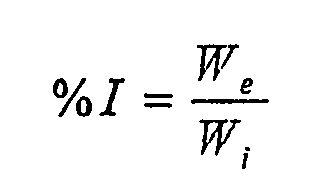
- In order to determine injectability, syringes filled with a known quantity of material (Wi) were used, and they were subjected to a compressive force by means of a dynamometric machine in which the rate of descent of the crossbrace was 15 mm/min and the applied load was approximately 100 N. Once the components had been weighed, they were mixed until a pasty consistency was achieved for the composite, which was then placed in the syringe, which was in turn mounted on a suitable support. These operations had to be carried out in 60-90 seconds. After the syringe was filled, the time count for the test could begin. When the test was complete, the extruded material was weighed (We) and the desired parameter was calculated.
- Table 2 shows that, in connection with the practical application of the material, the addition of a PVA hydrogel produces various benefits. The first substantial positive effect is that the paste obtained has an optimum consistency for extrusion through a syringe and no further phenomena of separation between the two phases occurr, as, sometimes happens when α-TCP is used alone. The second important positive aspect is the appreciable length of time at the medical practitioner's disposal (1 hour) for applying the composite material before it hardens. The increase is significant (see Table 2) when compared with α-TCP alone, for which 91% of the loaded amount remains trapped and can no longer be injected after only 6 minutes.
- From a more general point of view, the advantage of associating a PVA hydrogel with tricalcium phosphate lies in the fact that the water retained in the hydrogel is slowly and completely released to the ceramic phase, providing for a uniform crystal precipitation and consequently final hardening of the composite even in the absence of an external aqueous solution. It has also been observed that no appreciable increase in the temperature occurs during hardening of the injectable composite material.
- The injectable composite material according to the invention may also contain a bioactive agent (i.e., a substance having biological activity) selected for example from drugs, cells, growth factors and the like, possibly in a form suitable for a controlled kinetics-release during application.
Table 1. Mechanical properties under compression Material E (GPa) σmax (Mpa) εmax (mm/mm) εu (mm/mm) T (MPa) 100%α-TCP 0.8±0.2 21±3 0.02±0.01 0.06±0.01 0.7 PVA+93% α-TCP 1.2±0.1 25±5 0.03±0.01 0.09±0.01 2.1 PVA+88% α-TCP 0.7±0.3 17±1 0.04±0.01 0.08±0.02 1.1 PVA+86% α-TCP 0.9±0.1 14±3 0.05±0.01 0.11±0.02 1.0 Table 2. Injectability properties Solid phase Liquid phase Waiting time (min) %I α-TCP Water + 2.5% wt NaH2PO4 2 44.2% α-TCP Water + 2.5% wt NaH2PO4 3 30.9% α-TCP Water+ 2.5% wt NaH2PO4 5 18.8% α-TCP Water + 2.5% wt NaH2PO4 6 9% α-TCP 10% wt PVA Sol 7 100% α-TCP 10% wt PVA Sol 20 1000 α-TCP 10% wt PVA Sol 40 100% α-TCP 10% wt PVA Sol 60 95.6%
Claims (10)
- An injectable composite material consisting of a tricalcium phosphate ceramic phase and a polyvinyl alcohol hydrogel fluid phase.
- The injectable composite material according to claim 1, wherein the polyvinyl alcohol hydrogel fluid phase is an aqueous, solution of 2-30% by weight of polyvinyl alcohol.
- The injectable composite material according to claim 1 or 2, having a polyvinyl alcohol polymer/tricalcium phosphate ratio by weight within the range of 3/97 to 20/80 (w/w).
- The injectable composite material according to claim 3, having a polyvinyl alcohol polymer/tricalcium phosphate ratio by weight of 7/93 (w/w).
- The injectable composite material according to claim 3, having a polyvinyl alcohol polymer/tricalcium phosphate ratio by weight of 12/88 (w/w).
- The injectable composite material according to claim 3, having a polyvinyl alcohol polymer/tricalcium phosphate ratio by weight of 14/86 (w/w).
- The injectable composite material according to any of claims 1 to 6, further comprising a bioactive agent selected from a drug, a cell culture, a growth factor or combinations thereof.
- The injectable composite material according to any of claims 1 to 7, as a bone substitute.
- The use of an injectable composite material according to any of claims 1 to 7, for preparing a medicament suitable for use as a bone substitute.
- A method of preparing an injectable composite material according to any of claims 1 to 7, comprising preparing an aqueous solution of polyvinyl alcohol and subsequently mixing the said aqueous solution of polyvinyl alcohol with tricalcium phosphate powder.
Priority Applications (2)
| Application Number | Priority Date | Filing Date | Title |
|---|---|---|---|
| PL06780262T PL1924302T3 (en) | 2005-08-03 | 2006-08-01 | Injectable composite material suitable for use as a bone substitute |
| SI200630731T SI1924302T1 (en) | 2005-08-03 | 2006-08-01 | Injectable composite material suitable for use as a bone substitute |
Applications Claiming Priority (2)
| Application Number | Priority Date | Filing Date | Title |
|---|---|---|---|
| IT000549A ITTO20050549A1 (en) | 2005-08-03 | 2005-08-03 | COMPOSITE MATERIAL INJECTABLE TO BE USED AS A BONUS SUBSTITUTE |
| PCT/IB2006/052623 WO2007015208A2 (en) | 2005-08-03 | 2006-08-01 | Injectable composite material suitable for use as a bone substitute |
Publications (2)
| Publication Number | Publication Date |
|---|---|
| EP1924302A2 EP1924302A2 (en) | 2008-05-28 |
| EP1924302B1 true EP1924302B1 (en) | 2010-04-28 |
Family
ID=37667630
Family Applications (1)
| Application Number | Title | Priority Date | Filing Date |
|---|---|---|---|
| EP06780262A Active EP1924302B1 (en) | 2005-08-03 | 2006-08-01 | Injectable composite material suitable for use as a bone substitute |
Country Status (22)
| Country | Link |
|---|---|
| US (2) | US20080220086A1 (en) |
| EP (1) | EP1924302B1 (en) |
| JP (1) | JP5180075B2 (en) |
| KR (1) | KR101276632B1 (en) |
| CN (1) | CN101257937B (en) |
| AT (1) | ATE465762T1 (en) |
| AU (1) | AU2006274594B2 (en) |
| BR (1) | BRPI0615994A2 (en) |
| CA (1) | CA2617721A1 (en) |
| DE (1) | DE602006014004D1 (en) |
| DK (1) | DK1924302T3 (en) |
| ES (1) | ES2345399T3 (en) |
| IT (1) | ITTO20050549A1 (en) |
| NZ (1) | NZ566086A (en) |
| PL (1) | PL1924302T3 (en) |
| PT (1) | PT1924302E (en) |
| RU (1) | RU2407552C2 (en) |
| SI (1) | SI1924302T1 (en) |
| SM (1) | SMAP200800013A (en) |
| UA (1) | UA92027C2 (en) |
| WO (1) | WO2007015208A2 (en) |
| ZA (1) | ZA200801928B (en) |
Families Citing this family (11)
| Publication number | Priority date | Publication date | Assignee | Title |
|---|---|---|---|---|
| US7235592B2 (en) | 2004-10-12 | 2007-06-26 | Zimmer Gmbh | PVA hydrogel |
| US20070098799A1 (en) * | 2005-10-28 | 2007-05-03 | Zimmer, Inc. | Mineralized Hydrogels and Methods of Making and Using Hydrogels |
| AU2006321809A1 (en) | 2005-12-07 | 2007-06-14 | Zimmer, Inc. | Methods of bonding or modifying hydrogels using irradiation |
| US8110242B2 (en) | 2006-03-24 | 2012-02-07 | Zimmer, Inc. | Methods of preparing hydrogel coatings |
| US7731988B2 (en) | 2007-08-03 | 2010-06-08 | Zimmer, Inc. | Multi-polymer hydrogels |
| US8062739B2 (en) | 2007-08-31 | 2011-11-22 | Zimmer, Inc. | Hydrogels with gradient |
| US7947784B2 (en) | 2007-11-16 | 2011-05-24 | Zimmer, Inc. | Reactive compounding of hydrogels |
| US8034362B2 (en) | 2008-01-04 | 2011-10-11 | Zimmer, Inc. | Chemical composition of hydrogels for use as articulating surfaces |
| US20100226956A1 (en) | 2009-03-06 | 2010-09-09 | Per Kjellin | Production of moldable bone substitute |
| AU2016301103B9 (en) | 2015-07-24 | 2019-08-08 | Trimph Ip Pty Ltd | Antiseptic polymer and synthesis thereof |
| JP2020067494A (en) * | 2018-10-22 | 2020-04-30 | ウェトラブ株式会社 | Head model for neurosurgical operation |
Family Cites Families (5)
| Publication number | Priority date | Publication date | Assignee | Title |
|---|---|---|---|---|
| JP3635316B2 (en) * | 1996-11-25 | 2005-04-06 | 株式会社アドバンス | Method for producing spherical ceramic porous body |
| BR0109603A (en) * | 2000-03-27 | 2004-02-25 | Schott Glas | New cosmetic, personal care, cleaning agent and nutritional supplement compositions and methods for making and using them |
| US6949251B2 (en) | 2001-03-02 | 2005-09-27 | Stryker Corporation | Porous β-tricalcium phosphate granules for regeneration of bone tissue |
| EP1449818A4 (en) | 2001-10-21 | 2006-12-06 | Nat Inst Of Advanced Ind Scien | POROUS SUBJECT OF SINTERED CALCIUM PHOSPHATE, PRODUCTION PROCESS AND ARTIFICIAL BONE AND HISTOMORPHOLOGICAL SCAFFOLD USED THEREOF |
| EP1675608B1 (en) | 2003-09-12 | 2007-03-21 | Wyeth | Injectable calcium phosphate solid rods for delivery of osteogenic proteins |
-
2005
- 2005-08-03 IT IT000549A patent/ITTO20050549A1/en unknown
-
2006
- 2006-08-01 SM SM200800013T patent/SMAP200800013A/en unknown
- 2006-08-01 CA CA002617721A patent/CA2617721A1/en not_active Abandoned
- 2006-08-01 WO PCT/IB2006/052623 patent/WO2007015208A2/en not_active Ceased
- 2006-08-01 KR KR1020087005280A patent/KR101276632B1/en not_active Expired - Fee Related
- 2006-08-01 SI SI200630731T patent/SI1924302T1/en unknown
- 2006-08-01 AU AU2006274594A patent/AU2006274594B2/en not_active Ceased
- 2006-08-01 ES ES06780262T patent/ES2345399T3/en active Active
- 2006-08-01 PT PT06780262T patent/PT1924302E/en unknown
- 2006-08-01 DE DE602006014004T patent/DE602006014004D1/en active Active
- 2006-08-01 PL PL06780262T patent/PL1924302T3/en unknown
- 2006-08-01 DK DK06780262.9T patent/DK1924302T3/en active
- 2006-08-01 JP JP2008524655A patent/JP5180075B2/en not_active Expired - Fee Related
- 2006-08-01 RU RU2008108014/15A patent/RU2407552C2/en not_active IP Right Cessation
- 2006-08-01 US US11/997,211 patent/US20080220086A1/en not_active Abandoned
- 2006-08-01 NZ NZ566086A patent/NZ566086A/en not_active IP Right Cessation
- 2006-08-01 EP EP06780262A patent/EP1924302B1/en active Active
- 2006-08-01 BR BRPI0615994-0A patent/BRPI0615994A2/en not_active Application Discontinuation
- 2006-08-01 ZA ZA200801928A patent/ZA200801928B/en unknown
- 2006-08-01 CN CN2006800286341A patent/CN101257937B/en not_active Expired - Fee Related
- 2006-08-01 AT AT06780262T patent/ATE465762T1/en active
- 2006-08-01 UA UAA200802792A patent/UA92027C2/en unknown
-
2010
- 2010-12-28 US US12/979,818 patent/US8231909B2/en not_active Expired - Fee Related
Non-Patent Citations (1)
| Title |
|---|
| BORZACCHIELLO A ET AL: "Characterization of an injectable hydrogel composite for orthopedic Applications", BIO-MEDICAL MATERIALS AND ENGINEERING-. PROCEEDINGS OF THE 2ND INTERNATIONAL CONFERENCE ON NEW BIOMEDICAL MATERIALS, 5-8 APRIL 2003, CARDIFF, WALES, UNITED KINGDOM,, 5 April 2003 (2003-04-05), XP009104120 * |
Also Published As
| Publication number | Publication date |
|---|---|
| US8231909B2 (en) | 2012-07-31 |
| AU2006274594B2 (en) | 2011-12-22 |
| US20110091554A1 (en) | 2011-04-21 |
| UA92027C2 (en) | 2010-09-27 |
| SI1924302T1 (en) | 2010-09-30 |
| AU2006274594A1 (en) | 2007-02-08 |
| RU2008108014A (en) | 2009-09-10 |
| DK1924302T3 (en) | 2010-07-26 |
| WO2007015208A3 (en) | 2007-05-31 |
| NZ566086A (en) | 2011-03-31 |
| SMP200800013B (en) | 2008-02-27 |
| CN101257937B (en) | 2013-03-20 |
| ZA200801928B (en) | 2009-07-29 |
| US20080220086A1 (en) | 2008-09-11 |
| KR101276632B1 (en) | 2013-06-18 |
| ATE465762T1 (en) | 2010-05-15 |
| WO2007015208A2 (en) | 2007-02-08 |
| JP5180075B2 (en) | 2013-04-10 |
| CN101257937A (en) | 2008-09-03 |
| RU2407552C2 (en) | 2010-12-27 |
| ES2345399T3 (en) | 2010-09-22 |
| EP1924302A2 (en) | 2008-05-28 |
| KR20080041678A (en) | 2008-05-13 |
| DE602006014004D1 (en) | 2010-06-10 |
| ITTO20050549A1 (en) | 2007-02-04 |
| BRPI0615994A2 (en) | 2011-05-31 |
| PL1924302T3 (en) | 2010-10-29 |
| SMAP200800013A (en) | 2008-02-27 |
| JP2009502405A (en) | 2009-01-29 |
| CA2617721A1 (en) | 2007-02-08 |
| PT1924302E (en) | 2010-07-27 |
Similar Documents
| Publication | Publication Date | Title |
|---|---|---|
| US8231909B2 (en) | Injectable composite material suitable for use as a bone substitute | |
| Burguera et al. | Injectable calcium phosphate cement: Effects of powder‐to‐liquid ratio and needle size | |
| Bohner | Design of ceramic-based cements and putties for bone graft substitution | |
| Liu et al. | A novel injectable, cohesive and toughened Si-HPMC (silanized-hydroxypropyl methylcellulose) composite calcium phosphate cement for bone substitution | |
| Alves et al. | Injectability evaluation of tricalcium phosphate bone cement | |
| Ambrosio et al. | Injectable calcium-phosphate-based composites for skeletal bone treatments | |
| Alves Cardoso et al. | Gelation and biocompatibility of injectable Alginate–Calcium phosphate gels for bone regeneration | |
| Liu et al. | Reinforcement of injectable calcium phosphate cement by gelatinized starches | |
| de Lacerda Schickert et al. | Tough and injectable fiber reinforced calcium phosphate cement as an alternative to polymethylmethacrylate cement for vertebral augmentation: a biomechanical study | |
| CN110062635A (en) | The composition of α-TCP, silicate and phosphorylated amino acid | |
| dos Santos et al. | Fiber‐enriched double‐setting calcium phosphate bone cement | |
| CN119792634A (en) | A porous composite bone cement capable of increasing bone holding force and its preparation method and application | |
| Chen et al. | Preparation and characterization of injectable calcium phosphate cement paste modified by polyethylene glycol-6000 | |
| AU2010365643B2 (en) | Biomaterial and method for its realisation | |
| CN101716380A (en) | Injection moldable bone repair composite material and preparation method thereof | |
| Daglilar et al. | A study on bioceramic reinforced bone cements | |
| CN104645418A (en) | Injectable bone cement and preparation method thereof | |
| WO2023216069A1 (en) | Plastic orthopedic composition having erosion resistance | |
| CN115554468A (en) | Bone cement containing bioactive glass and preparation method and application thereof | |
| TWI805355B (en) | Moldable orthopedic composition with anti-washout property | |
| FR2937872A1 (en) | Product, useful as bone substitute, comprises biocompatible and extrudable filling biomaterial and biocompatible and injectable biomaterial in gel/paste form, as combined preparation for simultaneous/sequential use to fill bony defect | |
| JP5777141B2 (en) | Composition and method for producing bone or tooth filler using the same | |
| LORENC | Reologické vlastnosti termosenzitivních kostních cementů obohacených o bioaktivní látky | |
| Boschi | Fiber-enriched double-setting calcium phosphate bone cement | |
| CN117065088A (en) | Plastic orthopedic composition with erosion resistance |
Legal Events
| Date | Code | Title | Description |
|---|---|---|---|
| PUAI | Public reference made under article 153(3) epc to a published international application that has entered the european phase |
Free format text: ORIGINAL CODE: 0009012 |
|
| 17P | Request for examination filed |
Effective date: 20080228 |
|
| AK | Designated contracting states |
Kind code of ref document: A2 Designated state(s): AT BE BG CH CY CZ DE DK EE ES FI FR GB GR HU IE IS IT LI LT LU LV MC NL PL PT RO SE SI SK TR |
|
| 17Q | First examination report despatched |
Effective date: 20080805 |
|
| GRAP | Despatch of communication of intention to grant a patent |
Free format text: ORIGINAL CODE: EPIDOSNIGR1 |
|
| RIC1 | Information provided on ipc code assigned before grant |
Ipc: A61L 27/12 20060101AFI20091002BHEP Ipc: A61L 27/42 20060101ALI20091002BHEP Ipc: A61L 27/52 20060101ALI20091002BHEP Ipc: A61L 27/46 20060101ALI20091002BHEP Ipc: A61L 27/50 20060101ALI20091002BHEP Ipc: A61F 2/28 20060101ALI20091002BHEP |
|
| DAX | Request for extension of the european patent (deleted) | ||
| GRAS | Grant fee paid |
Free format text: ORIGINAL CODE: EPIDOSNIGR3 |
|
| GRAA | (expected) grant |
Free format text: ORIGINAL CODE: 0009210 |
|
| RIN1 | Information on inventor provided before grant (corrected) |
Inventor name: SANGINARIO, VALERIA Inventor name: PLANELL, JOSEP ANTON Inventor name: AMBROSIO, LUIGI Inventor name: GINEBRA, MARIA PAU |
|
| AK | Designated contracting states |
Kind code of ref document: B1 Designated state(s): AT BE BG CH CY CZ DE DK EE ES FI FR GB GR HU IE IS IT LI LT LU LV MC NL PL PT RO SE SI SK TR |
|
| REG | Reference to a national code |
Ref country code: GB Ref legal event code: FG4D |
|
| REG | Reference to a national code |
Ref country code: CH Ref legal event code: EP |
|
| REG | Reference to a national code |
Ref country code: IE Ref legal event code: FG4D |
|
| REF | Corresponds to: |
Ref document number: 602006014004 Country of ref document: DE Date of ref document: 20100610 Kind code of ref document: P |
|
| REG | Reference to a national code |
Ref country code: DK Ref legal event code: T3 |
|
| REG | Reference to a national code |
Ref country code: SE Ref legal event code: TRGR Ref country code: PT Ref legal event code: SC4A Free format text: AVAILABILITY OF NATIONAL TRANSLATION Effective date: 20100720 |
|
| REG | Reference to a national code |
Ref country code: CH Ref legal event code: NV Representative=s name: JACOBACCI & PARTNERS S.P.A. |
|
| REG | Reference to a national code |
Ref country code: NL Ref legal event code: T3 |
|
| REG | Reference to a national code |
Ref country code: GR Ref legal event code: EP Ref document number: 20100401584 Country of ref document: GR |
|
| REG | Reference to a national code |
Ref country code: ES Ref legal event code: FG2A Ref document number: 2345399 Country of ref document: ES Kind code of ref document: T3 |
|
| REG | Reference to a national code |
Ref country code: PL Ref legal event code: T3 |
|
| PG25 | Lapsed in a contracting state [announced via postgrant information from national office to epo] |
Ref country code: IS Free format text: LAPSE BECAUSE OF FAILURE TO SUBMIT A TRANSLATION OF THE DESCRIPTION OR TO PAY THE FEE WITHIN THE PRESCRIBED TIME-LIMIT Effective date: 20100828 |
|
| REG | Reference to a national code |
Ref country code: HU Ref legal event code: AG4A Ref document number: E008546 Country of ref document: HU |
|
| PG25 | Lapsed in a contracting state [announced via postgrant information from national office to epo] |
Ref country code: CY Free format text: LAPSE BECAUSE OF FAILURE TO SUBMIT A TRANSLATION OF THE DESCRIPTION OR TO PAY THE FEE WITHIN THE PRESCRIBED TIME-LIMIT Effective date: 20100526 |
|
| PG25 | Lapsed in a contracting state [announced via postgrant information from national office to epo] |
Ref country code: RO Free format text: LAPSE BECAUSE OF FAILURE TO SUBMIT A TRANSLATION OF THE DESCRIPTION OR TO PAY THE FEE WITHIN THE PRESCRIBED TIME-LIMIT Effective date: 20100428 Ref country code: SK Free format text: LAPSE BECAUSE OF FAILURE TO SUBMIT A TRANSLATION OF THE DESCRIPTION OR TO PAY THE FEE WITHIN THE PRESCRIBED TIME-LIMIT Effective date: 20100428 |
|
| PLBE | No opposition filed within time limit |
Free format text: ORIGINAL CODE: 0009261 |
|
| STAA | Information on the status of an ep patent application or granted ep patent |
Free format text: STATUS: NO OPPOSITION FILED WITHIN TIME LIMIT |
|
| PG25 | Lapsed in a contracting state [announced via postgrant information from national office to epo] |
Ref country code: MC Free format text: LAPSE BECAUSE OF NON-PAYMENT OF DUE FEES Effective date: 20100831 |
|
| 26N | No opposition filed |
Effective date: 20110131 |
|
| PG25 | Lapsed in a contracting state [announced via postgrant information from national office to epo] |
Ref country code: BG Free format text: LAPSE BECAUSE OF FAILURE TO SUBMIT A TRANSLATION OF THE DESCRIPTION OR TO PAY THE FEE WITHIN THE PRESCRIBED TIME-LIMIT Effective date: 20100428 |
|
| PGFP | Annual fee paid to national office [announced via postgrant information from national office to epo] |
Ref country code: EE Payment date: 20130625 Year of fee payment: 8 Ref country code: LT Payment date: 20130625 Year of fee payment: 8 |
|
| PGFP | Annual fee paid to national office [announced via postgrant information from national office to epo] |
Ref country code: PL Payment date: 20130625 Year of fee payment: 8 |
|
| PG25 | Lapsed in a contracting state [announced via postgrant information from national office to epo] |
Ref country code: BG Free format text: LAPSE BECAUSE OF FAILURE TO SUBMIT A TRANSLATION OF THE DESCRIPTION OR TO PAY THE FEE WITHIN THE PRESCRIBED TIME-LIMIT Effective date: 20100728 |
|
| PGFP | Annual fee paid to national office [announced via postgrant information from national office to epo] |
Ref country code: LU Payment date: 20130822 Year of fee payment: 8 |
|
| PGFP | Annual fee paid to national office [announced via postgrant information from national office to epo] |
Ref country code: DK Payment date: 20130821 Year of fee payment: 8 Ref country code: FI Payment date: 20130819 Year of fee payment: 8 Ref country code: CZ Payment date: 20130726 Year of fee payment: 8 Ref country code: AT Payment date: 20130828 Year of fee payment: 8 Ref country code: HU Payment date: 20130821 Year of fee payment: 8 Ref country code: SI Payment date: 20130723 Year of fee payment: 8 Ref country code: SE Payment date: 20130821 Year of fee payment: 8 Ref country code: NL Payment date: 20130822 Year of fee payment: 8 Ref country code: ES Payment date: 20130708 Year of fee payment: 8 Ref country code: IE Payment date: 20130829 Year of fee payment: 8 Ref country code: PT Payment date: 20130204 Year of fee payment: 8 Ref country code: GR Payment date: 20130822 Year of fee payment: 8 |
|
| PGFP | Annual fee paid to national office [announced via postgrant information from national office to epo] |
Ref country code: LV Payment date: 20130813 Year of fee payment: 8 Ref country code: TR Payment date: 20130727 Year of fee payment: 8 Ref country code: GB Payment date: 20130821 Year of fee payment: 8 |
|
| PGFP | Annual fee paid to national office [announced via postgrant information from national office to epo] |
Ref country code: BE Payment date: 20130823 Year of fee payment: 8 |
|
| REG | Reference to a national code |
Ref country code: PT Ref legal event code: MM4A Free format text: LAPSE DUE TO NON-PAYMENT OF FEES Effective date: 20150202 |
|
| REG | Reference to a national code |
Ref country code: CH Ref legal event code: PCAR Free format text: NEW ADDRESS: VIA LUGANETTO 3, 6962 LUGANO (CH) |
|
| REG | Reference to a national code |
Ref country code: NL Ref legal event code: V1 Effective date: 20150301 |
|
| REG | Reference to a national code |
Ref country code: LT Ref legal event code: MM4D Effective date: 20140801 |
|
| REG | Reference to a national code |
Ref country code: DK Ref legal event code: EBP Effective date: 20140831 |
|
| PG25 | Lapsed in a contracting state [announced via postgrant information from national office to epo] |
Ref country code: LU Free format text: LAPSE BECAUSE OF NON-PAYMENT OF DUE FEES Effective date: 20140801 |
|
| REG | Reference to a national code |
Ref country code: SE Ref legal event code: EUG |
|
| REG | Reference to a national code |
Ref country code: AT Ref legal event code: MM01 Ref document number: 465762 Country of ref document: AT Kind code of ref document: T Effective date: 20140801 Ref country code: EE Ref legal event code: MM4A Ref document number: E004494 Country of ref document: EE Effective date: 20140831 |
|
| REG | Reference to a national code |
Ref country code: GR Ref legal event code: ML Ref document number: 20100401584 Country of ref document: GR Effective date: 20150304 |
|
| GBPC | Gb: european patent ceased through non-payment of renewal fee |
Effective date: 20140801 |
|
| PG25 | Lapsed in a contracting state [announced via postgrant information from national office to epo] |
Ref country code: NL Free format text: LAPSE BECAUSE OF NON-PAYMENT OF DUE FEES Effective date: 20150301 Ref country code: HU Free format text: LAPSE BECAUSE OF NON-PAYMENT OF DUE FEES Effective date: 20140802 Ref country code: LT Free format text: LAPSE BECAUSE OF NON-PAYMENT OF DUE FEES Effective date: 20140801 Ref country code: CZ Free format text: LAPSE BECAUSE OF NON-PAYMENT OF DUE FEES Effective date: 20140801 Ref country code: BE Free format text: LAPSE BECAUSE OF NON-PAYMENT OF DUE FEES Effective date: 20140831 Ref country code: EE Free format text: LAPSE BECAUSE OF NON-PAYMENT OF DUE FEES Effective date: 20140831 Ref country code: PT Free format text: LAPSE BECAUSE OF NON-PAYMENT OF DUE FEES Effective date: 20150202 Ref country code: FI Free format text: LAPSE BECAUSE OF NON-PAYMENT OF DUE FEES Effective date: 20140801 |
|
| REG | Reference to a national code |
Ref country code: SI Ref legal event code: KO00 Effective date: 20150317 |
|
| REG | Reference to a national code |
Ref country code: IE Ref legal event code: MM4A |
|
| PG25 | Lapsed in a contracting state [announced via postgrant information from national office to epo] |
Ref country code: SI Free format text: LAPSE BECAUSE OF NON-PAYMENT OF DUE FEES Effective date: 20140802 Ref country code: GR Free format text: LAPSE BECAUSE OF NON-PAYMENT OF DUE FEES Effective date: 20150304 Ref country code: AT Free format text: LAPSE BECAUSE OF NON-PAYMENT OF DUE FEES Effective date: 20140801 Ref country code: SE Free format text: LAPSE BECAUSE OF NON-PAYMENT OF DUE FEES Effective date: 20140802 Ref country code: LV Free format text: LAPSE BECAUSE OF NON-PAYMENT OF DUE FEES Effective date: 20140801 |
|
| PG25 | Lapsed in a contracting state [announced via postgrant information from national office to epo] |
Ref country code: GB Free format text: LAPSE BECAUSE OF NON-PAYMENT OF DUE FEES Effective date: 20140801 Ref country code: DK Free format text: LAPSE BECAUSE OF NON-PAYMENT OF DUE FEES Effective date: 20140831 |
|
| PG25 | Lapsed in a contracting state [announced via postgrant information from national office to epo] |
Ref country code: IE Free format text: LAPSE BECAUSE OF NON-PAYMENT OF DUE FEES Effective date: 20140801 |
|
| REG | Reference to a national code |
Ref country code: ES Ref legal event code: FD2A Effective date: 20150925 |
|
| PG25 | Lapsed in a contracting state [announced via postgrant information from national office to epo] |
Ref country code: ES Free format text: LAPSE BECAUSE OF NON-PAYMENT OF DUE FEES Effective date: 20140802 |
|
| PG25 | Lapsed in a contracting state [announced via postgrant information from national office to epo] |
Ref country code: PL Free format text: LAPSE BECAUSE OF NON-PAYMENT OF DUE FEES Effective date: 20140801 |
|
| REG | Reference to a national code |
Ref country code: PL Ref legal event code: LAPE |
|
| REG | Reference to a national code |
Ref country code: FR Ref legal event code: PLFP Year of fee payment: 11 |
|
| PG25 | Lapsed in a contracting state [announced via postgrant information from national office to epo] |
Ref country code: TR Free format text: LAPSE BECAUSE OF NON-PAYMENT OF DUE FEES Effective date: 20140801 |
|
| REG | Reference to a national code |
Ref country code: FR Ref legal event code: PLFP Year of fee payment: 12 |
|
| REG | Reference to a national code |
Ref country code: FR Ref legal event code: PLFP Year of fee payment: 13 |
|
| PGFP | Annual fee paid to national office [announced via postgrant information from national office to epo] |
Ref country code: CH Payment date: 20180822 Year of fee payment: 13 |
|
| PGFP | Annual fee paid to national office [announced via postgrant information from national office to epo] |
Ref country code: DE Payment date: 20181031 Year of fee payment: 13 |
|
| REG | Reference to a national code |
Ref country code: DE Ref legal event code: R119 Ref document number: 602006014004 Country of ref document: DE |
|
| PG25 | Lapsed in a contracting state [announced via postgrant information from national office to epo] |
Ref country code: CH Free format text: LAPSE BECAUSE OF NON-PAYMENT OF DUE FEES Effective date: 20190831 Ref country code: LI Free format text: LAPSE BECAUSE OF NON-PAYMENT OF DUE FEES Effective date: 20190831 |
|
| PG25 | Lapsed in a contracting state [announced via postgrant information from national office to epo] |
Ref country code: FR Free format text: LAPSE BECAUSE OF NON-PAYMENT OF DUE FEES Effective date: 20190831 Ref country code: DE Free format text: LAPSE BECAUSE OF NON-PAYMENT OF DUE FEES Effective date: 20200303 |
|
| PGFP | Annual fee paid to national office [announced via postgrant information from national office to epo] |
Ref country code: IT Payment date: 20240809 Year of fee payment: 19 |