EP1914909A1 - Downlink scheduling method for MIMO/MISO cellular systems with limited feedback signalling - Google Patents
Downlink scheduling method for MIMO/MISO cellular systems with limited feedback signalling Download PDFInfo
- Publication number
- EP1914909A1 EP1914909A1 EP06425729A EP06425729A EP1914909A1 EP 1914909 A1 EP1914909 A1 EP 1914909A1 EP 06425729 A EP06425729 A EP 06425729A EP 06425729 A EP06425729 A EP 06425729A EP 1914909 A1 EP1914909 A1 EP 1914909A1
- Authority
- EP
- European Patent Office
- Prior art keywords
- user
- sum
- log
- base station
- rate
- Prior art date
- Legal status (The legal status is an assumption and is not a legal conclusion. Google has not performed a legal analysis and makes no representation as to the accuracy of the status listed.)
- Withdrawn
Links
Images


Classifications
-
- H—ELECTRICITY
- H04—ELECTRIC COMMUNICATION TECHNIQUE
- H04B—TRANSMISSION
- H04B7/00—Radio transmission systems, i.e. using radiation field
- H04B7/02—Diversity systems; Multi-antenna system, i.e. transmission or reception using multiple antennas
- H04B7/04—Diversity systems; Multi-antenna system, i.e. transmission or reception using multiple antennas using two or more spaced independent antennas
- H04B7/06—Diversity systems; Multi-antenna system, i.e. transmission or reception using multiple antennas using two or more spaced independent antennas at the transmitting station
- H04B7/0613—Diversity systems; Multi-antenna system, i.e. transmission or reception using multiple antennas using two or more spaced independent antennas at the transmitting station using simultaneous transmission
- H04B7/0615—Diversity systems; Multi-antenna system, i.e. transmission or reception using multiple antennas using two or more spaced independent antennas at the transmitting station using simultaneous transmission of weighted versions of same signal
-
- H—ELECTRICITY
- H04—ELECTRIC COMMUNICATION TECHNIQUE
- H04B—TRANSMISSION
- H04B17/00—Monitoring; Testing
- H04B17/20—Monitoring; Testing of receivers
- H04B17/24—Monitoring; Testing of receivers with feedback of measurements to the transmitter
-
- H—ELECTRICITY
- H04—ELECTRIC COMMUNICATION TECHNIQUE
- H04B—TRANSMISSION
- H04B7/00—Radio transmission systems, i.e. using radiation field
- H04B7/02—Diversity systems; Multi-antenna system, i.e. transmission or reception using multiple antennas
- H04B7/04—Diversity systems; Multi-antenna system, i.e. transmission or reception using multiple antennas using two or more spaced independent antennas
- H04B7/0413—MIMO systems
- H04B7/0417—Feedback systems
-
- H—ELECTRICITY
- H04—ELECTRIC COMMUNICATION TECHNIQUE
- H04B—TRANSMISSION
- H04B7/00—Radio transmission systems, i.e. using radiation field
- H04B7/02—Diversity systems; Multi-antenna system, i.e. transmission or reception using multiple antennas
- H04B7/04—Diversity systems; Multi-antenna system, i.e. transmission or reception using multiple antennas using two or more spaced independent antennas
- H04B7/0413—MIMO systems
- H04B7/0452—Multi-user MIMO systems
-
- H—ELECTRICITY
- H04—ELECTRIC COMMUNICATION TECHNIQUE
- H04B—TRANSMISSION
- H04B7/00—Radio transmission systems, i.e. using radiation field
- H04B7/02—Diversity systems; Multi-antenna system, i.e. transmission or reception using multiple antennas
- H04B7/04—Diversity systems; Multi-antenna system, i.e. transmission or reception using multiple antennas using two or more spaced independent antennas
- H04B7/06—Diversity systems; Multi-antenna system, i.e. transmission or reception using multiple antennas using two or more spaced independent antennas at the transmitting station
- H04B7/0613—Diversity systems; Multi-antenna system, i.e. transmission or reception using multiple antennas using two or more spaced independent antennas at the transmitting station using simultaneous transmission
- H04B7/0615—Diversity systems; Multi-antenna system, i.e. transmission or reception using multiple antennas using two or more spaced independent antennas at the transmitting station using simultaneous transmission of weighted versions of same signal
- H04B7/0619—Diversity systems; Multi-antenna system, i.e. transmission or reception using multiple antennas using two or more spaced independent antennas at the transmitting station using simultaneous transmission of weighted versions of same signal using feedback from receiving side
- H04B7/0621—Feedback content
- H04B7/0632—Channel quality parameters, e.g. channel quality indicator [CQI]
-
- H—ELECTRICITY
- H04—ELECTRIC COMMUNICATION TECHNIQUE
- H04B—TRANSMISSION
- H04B17/00—Monitoring; Testing
- H04B17/30—Monitoring; Testing of propagation channels
- H04B17/309—Measuring or estimating channel quality parameters
- H04B17/336—Signal-to-interference ratio [SIR] or carrier-to-interference ratio [CIR]
-
- H—ELECTRICITY
- H04—ELECTRIC COMMUNICATION TECHNIQUE
- H04B—TRANSMISSION
- H04B7/00—Radio transmission systems, i.e. using radiation field
- H04B7/02—Diversity systems; Multi-antenna system, i.e. transmission or reception using multiple antennas
- H04B7/04—Diversity systems; Multi-antenna system, i.e. transmission or reception using multiple antennas using two or more spaced independent antennas
- H04B7/06—Diversity systems; Multi-antenna system, i.e. transmission or reception using multiple antennas using two or more spaced independent antennas at the transmitting station
- H04B7/0613—Diversity systems; Multi-antenna system, i.e. transmission or reception using multiple antennas using two or more spaced independent antennas at the transmitting station using simultaneous transmission
- H04B7/0615—Diversity systems; Multi-antenna system, i.e. transmission or reception using multiple antennas using two or more spaced independent antennas at the transmitting station using simultaneous transmission of weighted versions of same signal
- H04B7/0617—Diversity systems; Multi-antenna system, i.e. transmission or reception using multiple antennas using two or more spaced independent antennas at the transmitting station using simultaneous transmission of weighted versions of same signal for beam forming
Definitions
- the present invention relates to the field of telecommunication networks, and more precisely to a downlink (DL) scheduling method for MIMO / MISO cellular systems with limited feedback signalling triggered by exceeding a SINR threshold independently estimated by the mobile stations.
- DL downlink
- SINR SINR threshold
- each receiver measures its received SNR on the beamforming vector currently employed by the BS, and feeds it back to the BS on an UL signalling channel. Scheduling is performed by the BS with a proportional fair scheduler (PFS), choosing the best user with regards to MSs' feedbacks and to fairness constraints.
- PFS proportional fair scheduler
- the feedback given by each user consists of its SNR (one real value per active user per channel/beamforming realization). This scheme allows high multi-user diversity and beamforming gains, but does not employ multiplexing gain.
- O-SDMA Opportunistic-SDMA
- each MS with an algorithm for estimating its own SINR threshold for the aim of triggering a limited feedback to the BS in support of the BS's activity of scheduling the transmissions on the broadcast channel (downlink).
- the estimating algorithm should take into account throughput and fairness requirements in a realistic scenario, where single and multiple antennas terminals coexist in the cell, and where channels are unbalanced for different users, and no signalling by the base station is requested.
- Another object of the present invention is that to provide the BS with a new scheduling algorithm exploiting the previous concepts developed for the distributed thresholds together with additional fairness constraints to share the sum-rate among active users.
- terms as mobile station MS and the respective user are considered to have an equivalent meaning.
- the invention achieves said objects by providing in a cellular communication system a method for scheduling downlink transmissions, subdivided in time slots, from M beamforming antennas connected to base station towards K mobile stations equipped with an arbitrary number N k of receiving antennas, including the following steps:
- Another object of invention is a method for scheduling downlink transmissions by which the whole set of reporting thresholds ⁇ k ⁇ is calculated by the base station and transmitted to the mobile stations, as described in an independent claim 2.
- the calculation of the whole set of thresholds ⁇ k ⁇ by both the base station and the mobile stations is another possibility.
- the method of the invention is shown to perform nearly optimally in terms of sum-rate when many users are in the cell, even if a very low feedback (signalling) rate is employed on the UL channel.
- the method in subject is able to accomplish fairness in terms of predefined sum-rate fractions. Conversely, realistic fairness constraints have been neglected in opportunistic-SDMA approaches so far.
- the subjected method can easily accommodate both MISO and MIMO MSs in the cell, in a totally transparent way; this is not so straightforward in some competitor algorithms.
- the subjected method is distributed, so no particular knowledge about the MS receiver performances is needed at the BS.
- the narrowband N k ⁇ M channel H k between the BS and the k-th MS is modelled as a Rayleigh i.i.d. matrix variable where each entry is [ H k ] i,j ⁇ CN (0, ⁇ k ) .
- the average channel power ⁇ k is related to path loss and shadowing and it can be considered as slowly varying.
- a new random set of beamforming vectors is generated regularly by the BS (say on every time slot).
- the objective of the EP (Equal Probability) algorithm is to let each user evaluate the SINR threshold ⁇ k in a distributed way in order to maximize sum-rate and satisfy fairness constraints.
- the event of a MS giving a positive feedback on a certain beam is independent from the event that another MS gives a feedback on the same beam because of channel incorrelation.
- the BS schedules for transmission on a certain beam one random user among those that give a positive feedback on that beam (RS), employing a conservative rate equal to log(1+ ⁇ k ).
- P S ( k,m ) is the probability of scheduling user k on beam m
- k ) is the probability that exactly j users exceed their threshold on beam m conditioned to the event that user k exceeds its threshold on beam m
- p ( ⁇ k,m ⁇ ⁇ k m ) is the probability that the SINR of user k on beam m exceeds the threshold ⁇ k m .
- the EP algorithm forces every user to give feedbacks with probability F .
- every user can locally evaluate its threshold ⁇ k according to a certain scheduling outage probability P out , so that all the users have the same feedback probability F regardless of their average channel power ⁇ k or their number of receiving antennas N k .
- P out the scheduling outage probability which maximizes the sum-rate.
- the main focus here is to have P out as a function of K and M only, to allow a fully distributed algorithm where both P out and ⁇ k are evaluated locally by every MS.
- DPC Dirty Paper Coding
- Every user can numerically maximize Eq.19 and find an estimate of the optimal outage probability P out .
- Eq.19 is shown to give a good estimate of the optimal P out even when the number of users is moderate.
- K ⁇ 50 the sum-rate penalty provided by the use of Eq.19 with regards to the optimal sum-rate is negligible.
- P out 1 K
- every user has the same probability of giving a feedback on a certain beam. If a random scheduler (RS) is used together with EP, the user selected for transmission is chosen randomly among those that reported a positive feedback, while the beam remains unscheduled if no user exceeds its SINR threshold on that beam.
- RS random scheduler
- the scheduler objective is to find the set ⁇ P S ( k ) ⁇ that maximizes the sum-rate still satisfying the constraints of Eq.22 and Eq.23:
- P s k arg max P s k
- Eq.24 is a non-linear maximization with non-linear constraints that requires an iterative numerical solution.
- the PRS algorithm works as follows:
- PRS is similar to the PFS proposed in [4].
- PRS is optimized to work in coordination with EP and enables fairness in terms of rate splitting among the active users while PFS, as it is proposed in [4], enables only scheduling probability constraints.
- Fig.3 shows the sum-rate performance of the aforementioned algorithms versus the number of active users K. Even if the scaling law of EP is similar to that of [iii], the reduced feedback causes an almost constant performance gap of about 3 b / s / Hz with regards to [iii]. As the number of users in the cell grows, EP outperforms [i]. and [ii]. In Fig.4 we take into account a more realistic model, where the channel power ⁇ k of every user is uniformly distributed (in dB) between 0dB and 20dB. Fig.4 shows Average Sum-Rate with heterogeneous channel gains. Fig.5 shows Normalized Rate Deviation (NRD) with heterogeneous channel gains.
- NTD Normalized Rate Deviation
- Fig.5 shows the Normalized Rate Deviation (NRD) as it was defined in Eq.29 for all the considered schemes, in the same scenario used to generate Fig.4.
- NTD Normalized Rate Deviation
- EP with the PRS algorithm is the only scheme that guarantees rate fairness in this scenario among the ones considered in this description.
- the rate gap paid by EP with regards to [iii] is thus partly due to the fairness constraints accomplished by the EP algorithm.
- the analysis of Fig.3 and Fig.4 confirms the small sum-rate penalty given by the use of Eq.20 instead of the near-optimal P out provided by Eq.19.
Landscapes
- Engineering & Computer Science (AREA)
- Computer Networks & Wireless Communication (AREA)
- Signal Processing (AREA)
- Physics & Mathematics (AREA)
- Electromagnetism (AREA)
- Mobile Radio Communication Systems (AREA)
- Radio Transmission System (AREA)
Abstract
The proposed scheduling algorithm improves the throughput on broadcast (downlink) channel in multi-user cellular systems, where both MISO and MIMO MSs can be accommodated in the cell in a totally transparent way. The method works as follows:
1. Every MS estimates a SINR threshold αk independently to each another, according to an Equal Probability criterion a report signalling is triggered by user k.
2. On every time slot the BS generates a random set of orthogonal beamforming vectors S=[s1...sM].
3. Every MS estimates its equivalent channels set {qk,m = Hksm} and its SINR γk,m on every beam sm during a downlink (DL) training phase.
4. Every MS finds its best beam index 
and compares 
with its threshold αk . If 
the k-th MS signals to the BS the best-beam index 
during the uplink (UL) phase, otherwise it signals beam-index 0, so the UL feedback per user is log2 (M + 1) bits long.
5. The BS schedules on each beam at most one user among those that report a feedback on that beam. The user may be chosen randomly among those that report a feedback on beam m or preferably according to a Proportional Rate metric. In the event that no user gives feedback on a certain beam, the BS does not schedule any data flow on that beam.
6. The BS transmits on every scheduled beam.
1. Every MS estimates a SINR threshold αk independently to each another, according to an Equal Probability criterion a report signalling is triggered by user k.
2. On every time slot the BS generates a random set of orthogonal beamforming vectors S=[s1...sM].
3. Every MS estimates its equivalent channels set {qk,m = Hksm} and its SINR γk,m on every beam sm during a downlink (DL) training phase.
4. Every MS finds its best beam index
5. The BS schedules on each beam at most one user among those that report a feedback on that beam. The user may be chosen randomly among those that report a feedback on beam m or preferably according to a Proportional Rate metric. In the event that no user gives feedback on a certain beam, the BS does not schedule any data flow on that beam.
6. The BS transmits on every scheduled beam.
Description
- The present invention relates to the field of telecommunication networks, and more precisely to a downlink (DL) scheduling method for MIMO / MISO cellular systems with limited feedback signalling triggered by exceeding a SINR threshold independently estimated by the mobile stations. The meaning of used acronyms are reported in APPENDIX D at the end of the description.
- Researchers have recently focused the attention on the improvement of throughput performances on broadcast (downlink) channel in multi-user cellular systems, where the Base Stations (BS), and eventually the Mobile Stations (MS), employ multiple antennas. References [1] to [9] to the most relevant background art are reported in APPENDIX C at the end of the description.
- In [Ref.1] the authors demonstrate that for a system with M transmitting antennas, N receiving antennas and K users the optimal performance is achieved by Dirty Paper Coding (DPC) described in [Ref.2], with a sum-rate scaling law of M loglog(NK) described in [Ref.3], Anyway DPC is not practical as it requires the instantaneous full Channel State Information (CSI) at the BS. The need for partial-CSI and computationally-effective transmission schemes led to several nearly-optimal algorithms.
- In [Ref.4] the authors proposed to use a random transmit beamforming beam in MISO systems, to leverage maximal diversity gain in a densely populated cell. The transmit beamforming is regularly updated, to improve multi-user diversity. During a training phase, each receiver measures its received SNR on the beamforming vector currently employed by the BS, and feeds it back to the BS on an UL signalling channel. Scheduling is performed by the BS with a proportional fair scheduler (PFS), choosing the best user with regards to MSs' feedbacks and to fairness constraints. The feedback given by each user consists of its SNR (one real value per active user per channel/beamforming realization). This scheme allows high multi-user diversity and beamforming gains, but does not employ multiplexing gain.
- In [Ref.5] the authors proposed to extend the [Ref.4] approach to spatial multiplexing in MISO and MIMO systems. The BS with M antennas transmits M random orthogonal beams. Every user measures its SINR on each beam, and reports the best value and the corresponding beam index to the BS (one real number + log2(M+1) bits of feedback per user). The model is analysed with regards to asymptotic capacity. Fairness in the resource assignment and scheduling are considered under very simplified conditions, which are unacceptable for real systems. An Opportunistic-SDMA (O-SDMA) scheme was proposed to asymptotically achieve for K → ∞ the sum-rate scaling law of DPC with low required feedback, for example, lower than that of full-CSI zero-forcing SDMA schemes of [Ref.6].
- In [Ref.7] and [Ref.8] the authors proposed to modify the [Ref.5] scheme, limiting the feedback to one bit per active user. Every user compares its SINR with a certain threshold, and reports
logic 1 if the received SINR exceeds that threshold or 0 if the SINR is below the threshold. The system model is exactly the same as in [Ref.5]. This leads to an unrealistic solution, which is by the way useful for analytical studies. The proposed threshold is a network parameter equal for all users, it is suboptimal and holds only when asymptotically infinite users are in the cell. The scheme at [Ref.7-8] becomes also less efficient when M is high, because the received SINR is evaluated on an arbitrary transmit beam only. - In [Ref.9] the authors analyze the performance of a scheme similar to that of [Ref.4], with a reduced feedback approach. Users give feedback (which consists of a real number) only when their SNR exceeds a certain threshold, which is evaluated in a distributed way. Anyway no explicit algorithms or closed-form are proposed in the article for the evaluation of the optimal threshold.
- In view of the presented state of the art, it is an object of the present invention to provide each MS with an algorithm for estimating its own SINR threshold for the aim of triggering a limited feedback to the BS in support of the BS's activity of scheduling the transmissions on the broadcast channel (downlink). The estimating algorithm should take into account throughput and fairness requirements in a realistic scenario, where single and multiple antennas terminals coexist in the cell, and where channels are unbalanced for different users, and no signalling by the base station is requested.
- Another object of the present invention is that to provide the BS with a new scheduling algorithm exploiting the previous concepts developed for the distributed thresholds together with additional fairness constraints to share the sum-rate among active users. In the following description terms as mobile station MS and the respective user are considered to have an equivalent meaning.
- The invention achieves said objects by providing in a cellular communication system a method for scheduling downlink transmissions, subdivided in time slots, from M beamforming antennas connected to base station towards K mobile stations equipped with an arbitrary number Nk of receiving antennas, including the following steps:
- a) under the assumption of a probability
F equal for every beam m and for every user k to transmit a feedback signalling, estimating, by every mobile station k independently to each another an individual SINR threshold α k using the following equation:
- b) generating on every time slot, by the base station, a random set of orthogonal beamforming signal vectors S = [s1 ... sM ];
- c) estimating, by every mobile station its relevant SINR value γ k,m on every beam sm during a downlink training step;
- d) calculating, by every mobile station, its best beam-index m̂k as

- e) comparing, by each mobile station, its best SINR value γ k, m̂ k with its own threshold α k;
- f) signalling to the base station, by every mobile station by which γ k, m̂ k ≥ α k is valid, the best beam-index m̂k during a feedback uplink transmission, otherwise signalling a beam-index null;
- g) selecting, by the base station, on each beam m at most one mobile station among those reporting a non-null signalling on that beam;
- h) transmitting, by the base station, to the selected users with conservative rates log(1 + α k
m * ) expressible in bit/s/Hz, where km * is the user eventually scheduled on beam m ; - i) repeating from step a) if a remarkable change in {ρ k } by user k or in the number of active users K is occurred within the last time slot, otherwise repeating from step b), as disclosed in
claim 1. - Moreover, considering that:
- the BS does not have any knowledge about the instantaneous user channel realizations {H k }, and
- the mean channel power ρ k can be obtained by the BS either using explicit feedback from the MS or estimated during the uplink if the system is TDD,
- So another object of invention is a method for scheduling downlink transmissions by which the whole set of reporting thresholds {α k } is calculated by the base station and transmitted to the mobile stations, as described in an
independent claim 2. The calculation of the whole set of thresholds {α k } by both the base station and the mobile stations is another possibility. - Additional features of the present invention which are believed to be novel are set forth with particularity in the appended claims.
- According to some other aspects of the invention:
- The threshold set {α k } depends on a long-term statistic, so there is no need to often update it.
- Since {ρ k } are slowly varying, their update rate can be low, so we can neglect the impact of their signalling on the overall uplink throughput.
- The first member of the equation for determining the threshold α k increases monotonically with α k .
- We assume that each MS knows the number K of active users in the cell and has perfect knowledge of all the equivalent channel vectors {qk,m = Hksm }, obtained, i.e. during DL preamble equalization.
- A closed-form lower-bound α̃ k for the SINR threshold α k valid for random scheduling can be calculated by the following expression:

- The user may be chosen randomly by the base station among those that report a feedback on beam m or preferably according to a scheduling metric. In the event that no user gives feedback on a certain beam, the BS does not schedule any data flow on that beam. Profitably, a Proportional Rate Scheduling (PRS) algorithm is used by which every user which report with equal probability (EP) is expected to receive on the average a given fraction
R k of the sum-rate RSUM (corresponding the overall throughput from the BS expressible in bit/s/Hz), so that the average rate of user k in bit/s/Hz is Rk =R kRSUM ∀k ∈ [1, K]. The PRS algorithm finds the set {PS (k)} that maximizes the sum-rate under the EP constraints, being Ps (k) the scheduling probability of user k. - The BS transmits to a scheduled user k with a conservative rate log(1+α km
* ) lower than Shannon's limit log(1+γ k,m̂k ), but this is not a limitation and a greater rate can be used especially in case the individual threshold α k is largely exceeded. - The transmission rate can be adjusted to meet the variability on the set of thresholds {α k } by selecting one among various possible Modulation and Coding Schemes (MCS). In particular, an MCS can be selected according to the threshold α km
* , - The method of the invention is shown to perform nearly optimally in terms of sum-rate when many users are in the cell, even if a very low feedback (signalling) rate is employed on the UL channel.
- The method in subject is able to accomplish fairness in terms of predefined sum-rate fractions. Conversely, realistic fairness constraints have been neglected in opportunistic-SDMA approaches so far.
- The subjected method can easily accommodate both MISO and MIMO MSs in the cell, in a totally transparent way; this is not so straightforward in some competitor algorithms.
- The subjected method is distributed, so no particular knowledge about the MS receiver performances is needed at the BS.
- The features of the present invention which are considered to be novel are set forth with particularity in the appended claims. The invention and its advantages may be understood with reference to the following detailed description of an embodiment thereof taken in conjunction with the accompanying drawings given for purely non-limiting explanatory purposes and wherein:
- fig.1 shows a MIMO system model suitable for implementing the downlink scheduling method of the present invention;
- figures 2 to 6 shows some comparative curves of simulation results achievable by the downlink scheduling method of the present invention.
- In order to better clarify the complex arguments of the description, it is subdivided in the following Sections:
- SYSTEM MODEL - to introduce the system model.
- EP ALGORITHM - to present the general solution of the Equal Probability algorithm. Includes a subsection A - THRESHOLD CALCULATION FOR MIMO NETWORKS.
- EVALUATION OF THE OUTAGE PROBABILITY - to show that EP achieves the asymptotical scaling law of DPC and we evaluate the optimal thresholds and nearly-optimal thresholds with a simplified closed-form solution for a finite users number. Includes subsection A - SCALING LAW OF THE SUM RATE and subsection B - OPTIMAL OUTAGE PROBABILITY.
- FAIRNESS CONSTRAINTS - to introduce fairness constraints.
- SCHEDULING ALGORITHM - to propose the PRS algorithm.
- NUMERICAL RESULTS - to numerically validate the analysis through simulations.
- CONCLUSIONS - to draw the conclusions.
- APPENDIX A - to calculate a lower-bound α̃ k in closed-form for the EP SINR threshold α k .
- APPENDIX B - to write a closed -form approximation of the outage probability F.
- APPENDIX C - Includes some Bibliographic references.
- APPENDIX D - Includes the used acronyms.
- With reference to fig.1, we consider the downlink (DL) of a heterogeneous MIMO / MISO cellular network where the Base Station (BS) employs M transmit antennas and each of the K mobile stations (MS) employs Nk antennas. Every user is expected to receive (on a long term average) a fraction
R k of the sum rate RSUM, so that the average rate of user k in bit/s/Hz is:
- The narrowband Nk × M channel H k between the BS and the k-th MS is modelled as a Rayleigh i.i.d. matrix variable where each entry is [H k ] i,j ~ CN(0, ρ k ). The average channel power ρ k is related to path loss and shadowing and it can be considered as slowly varying. The BS transmits M equal power independent data streams on M orthogonal beamforming vectors S = [s1 ... sM ], with total transmit power M. The beamforming vectors are generated randomly, still preserving the orthogonality condition SHS = I . A new random set of beamforming vectors is generated regularly by the BS (say on every time slot). Given the beamforming vectors set S, the signal received on the Nk antennas of the k-th MS is:

where dm ~ CN(0,1) are the incorrelated unit-power symbols transmitted on beam m taken from a Gaussian codebook, w k ~ CN(0 Nk ×1, INk ×Nk ) (Eq.B) is the ambient noise received by the k-th MS, and qk,m = Hksm (Eq.C) is the equivalent channel perceived by the k-th MS when the BS transmits on beam m. When the BS schedules user k* on a single beam sm* the received SINR γ k* ,m* is:
where bk* ,m* is the normalized receiver beamforming vector on beam sm* , such that
- We assume that the BS is aware of the average channel power set {ρ k }, but does not have any knowledge about the instantaneous user channel realizations {H k }. On the other side, we assume that each MS knows the number K of active users in the cell and has perfect knowledge of all the equivalent channel vectors {qk,m = Hksm }, obtained i.e. during DL preamble equalization. The proposed algorithm works as described in the SUMMARY OF THE INVENTION.
- The objective of the EP (Equal Probability) algorithm is to let each user evaluate the SINR threshold α k in a distributed way in order to maximize sum-rate and satisfy fairness constraints. The event of a MS giving a positive feedback on a certain beam is independent from the event that another MS gives a feedback on the same beam because of channel incorrelation. We assume that the BS schedules for transmission on a certain beam one random user among those that give a positive feedback on that beam (RS), employing a conservative rate equal to log(1+α k ). The sum-rate is:

where PS (k,m) is the probability of scheduling user k on beam m, Pm (j|k) is the probability that exactly j users exceed their threshold on beam m conditioned to the event that user k exceeds its threshold on beam m, and p(γ k,m ≥ α k m ) is the probability that the SINR of user k on beam m exceeds the threshold α k m. The considered system model implies that p(γ k,m ≥ α k ) = P(γ k,j ≥ α k ) ∀m,j for a wide range of receivers (e.g. antenna selection, maximum ratio combining and non-adaptive beamforming receivers). We can therefore omit the beam index m from γ k,m and α k m, and decouple the sum-rate formulation with regards to the beam indexes m:
- The Eq.4 is still difficult to be analytically treated, because P(j|k) does not have a straightforward expression. We can simplify Eq.4 by decoupling the optimization by forcing an equal feedback probability p(γ k ≥ α k ) =
F to all the MSs. User channels independence implies that if a random scheduler (RS) is used each user is scheduled on a given beam with the same probability:
where:
is the scheduling outage probability [9], i.e. the probability that no user exceeds its threshold on a given beam. The Eq.3 can now be written as:
- The sum rate maximization problem is thus reduced to finding the optimal value of Pout. We assume that every user knows its SINR CDF p(γ k < β) and its complementary CDF p(γ k ≥ β) ≡ 1- p(γ k < β). Given a target value of Pout, every user can evaluate the threshold

- In this subsection we show how to calculate the set of thresholds {α k } when heterogeneous MSs are active in the same cell (e.g. both single antenna and multiple antennas MSs). For simplicity reasons we consider multiple antenna receivers where each receiving antenna is processed independently and there is no adaptive beamforming at the receiver side. The considered Rayleigh channel model implies that each receiving antenna is subject to independent fading. We define


- The statistical independence of


- The EP algorithm forces every user to give feedbacks with probability
F . The equation that gives the threshold α k , to be solved by every MS, is
- Every user can compute its threshold by solving Eq.10 with regards to αk as:

the first member of Eq.11 is monotone in α k , so the single solution of Eq.11 can be easily computed. Eq.11 holds also for single-antenna MSs, since these users simply set Nk =1. - In the former section we showed that every user can locally evaluate its threshold α k according to a certain scheduling outage probability Pout, so that all the users have the same feedback probability
F regardless of their average channel power ρ k or their number of receiving antennas Nk. The problem is now reduced to finding the scheduling outage probability Pout which maximizes the sum-rate. The main focus here is to have Pout as a function of K and M only, to allow a fully distributed algorithm where both Pout and α k are evaluated locally by every MS. We will first find a simple condition on Pout that enables an optimal scaling law of the sum-rate when K → ∞ (Subsection A), and then we will evaluate the scheduling outage probability Pout (K,M) that maximizes the sum-rate when K is large, but finite (Subsection B). - Dirty Paper Coding (DPC) is known to achieve the optimal sum rate in a Gaussian broadcast channel [1]. For a high number of users with N receive antennas and random scheduling, the sum- rate of DPC scales as M log log(NK) [3]. We suppose to have K users, M > 1 beams and N ≥ 1 antennas per user.
- Property 1: The average sum-rate RSUM of the EP algorithm in conjunction with a random scheduler (RS) satisfies:

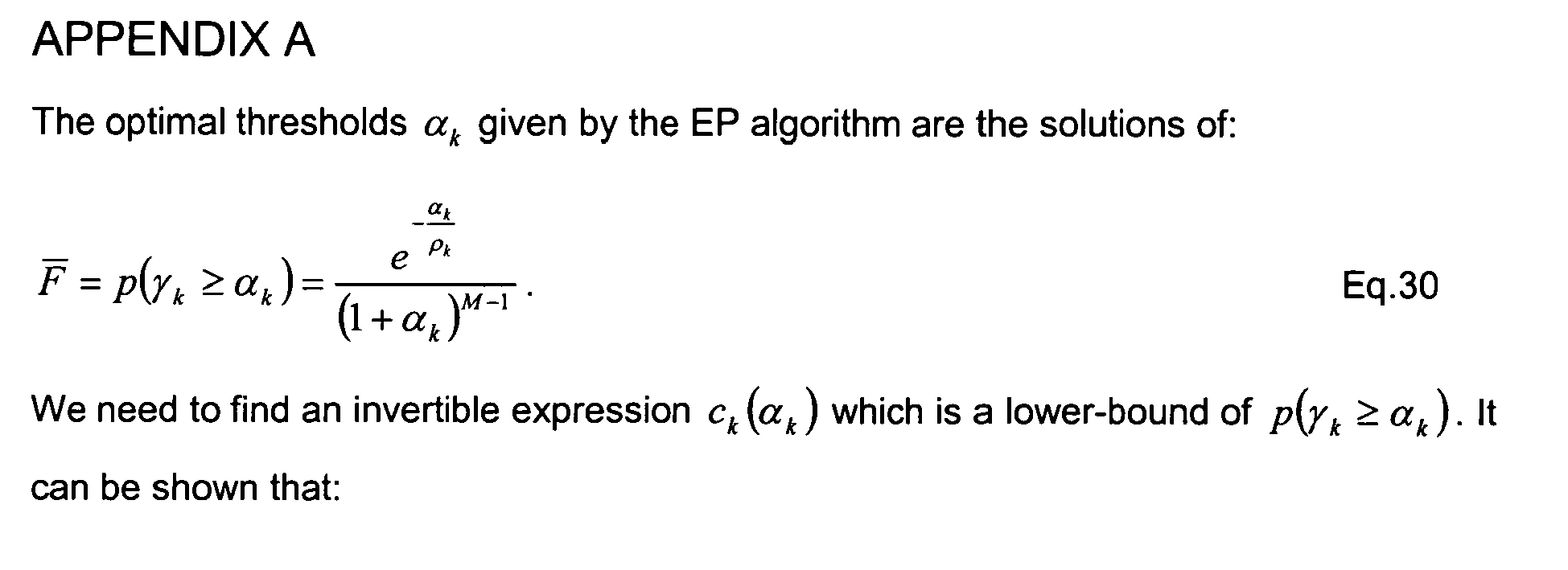
and is therefore asymptotically optimal. - Proof: The threshold of user k given by the EP algorithm is the solution of Eq.11, which cannot be expressed in closed form. We lower-bound p(γ k ≥ α k ) with the function ck (α k ) (see appendix A for details):

- It is easy to see that if

F and write the lower-bound α̃ k in closed-form:
- If we put Eq.14 into Eq.7 we obtain a lower-bound of the sum-rate:

- Let


and
- The asymptotic ratio between the sum-rate lower-bound and the scaling law of DPC sum-capacity with full channel information at the transmitter is:

- It is therefore shown that letting

- When K is large but finite, EP does not reach the optimal sum-rate of DPC. Anyway, from a practical standpoint, we are still interested in finding the value of Pout (K,M) which maximizes the sum-rate lower-bound given by Eq.15. Without loss of generality, for analytical convenience, we can still let


- Every user can numerically maximize Eq.19 and find an estimate of the optimal outage probability Pout.
- Fig.2 shows the average sum-rate in Eq.19 as a function of Pout for different values of K when the EP algorithm is employed with a random scheduler (RS), M = Nk = 4 and {ρ k } ~ U[0;20](dB). The optimal sum-rate is evaluated as


- The rate loss of Eq.20 with regards to the optimal sum-rate grows with K, but it is still lower than 0.7b/s/Hz when K=1000. When K=100 the rate loss of Eq.20 is equal to 0.36b/s/Hz (4.5% of the optimal sum-rate).
- According to the EP algorithm, every user has the same probability of giving a feedback on a certain beam. If a random scheduler (RS) is used together with EP, the user selected for transmission is chosen randomly among those that reported a positive feedback, while the beam remains unscheduled if no user exceeds its SINR threshold on that beam. We recall from section 3 that the probability of scheduling of user k is


which is an unfair split of rate that privileges users with higher thresholds {α k } (i.e. users with higher Nk or ρ k ). We instead want to split the sum rate according to the proportional rate constraintsR k, as stated in Eq.1. Joining Eq.21 and Eq.1 we obtain a set of K constraints on PS (k)
- The EP criterion provides other K+1 constraints on {PS (k)}:
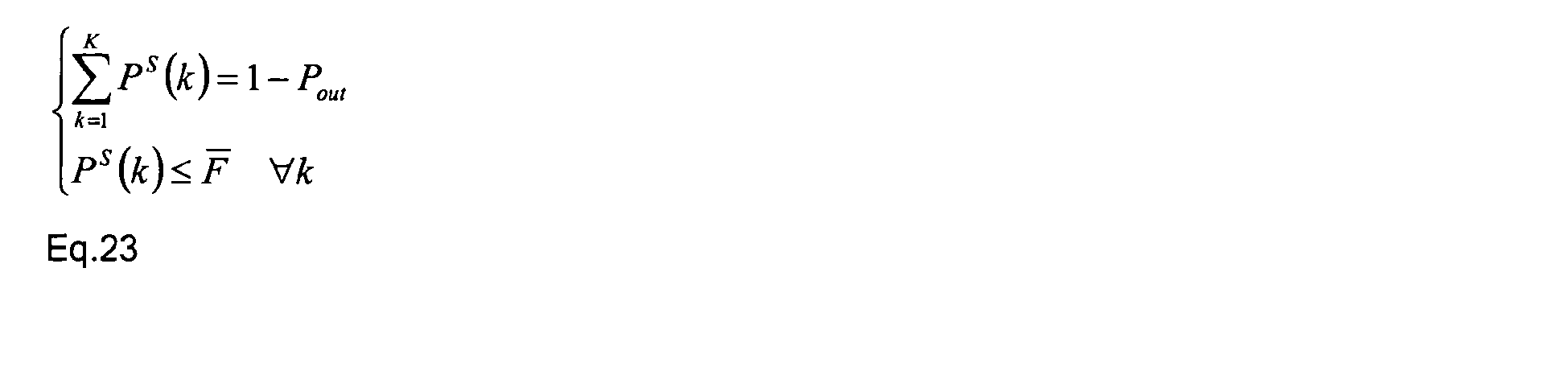
- The scheduler objective is to find the set {PS (k)} that maximizes the sum-rate still satisfying the constraints of Eq.22 and Eq.23:
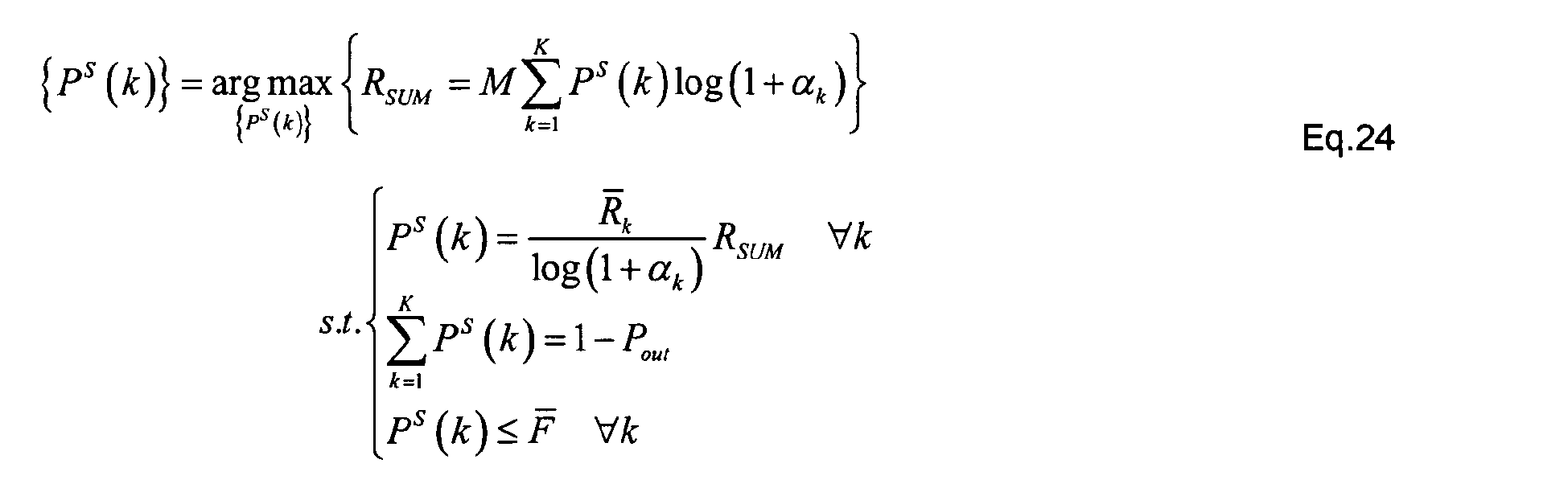
- Eq.24 is a non-linear maximization with non-linear constraints that requires an iterative numerical solution.
- Herein a suboptimal scheduler which evaluates the scheduling probabilities {PS (k)} in closed-form is presented. The difficulty of the numerical solution of Eq.24 is due to the non linear constraint PS (k) ≤
F . Anyway, if channel powers {ρ k } and rate coefficients {R k } are not excessively unbalanced, constraint PS (k) ≤F is implicitly satisfied, as the optimal scheduler tends to allocate homogeneous values of PS (k) to all the users andF > (1 - Pout )/K for the values of K of practical interest. Constraint PS (k) ≤F can thus be omitted from Eq.24 if a simplified scenario where {ρ k } and {R k } are moderately unbalanced is assumed, and a closed-form linear solution of Eq.24 with regards to {PS (k)} is obtained after some simple algebraic passages:
where P̂S (k) is the optimal scheduling probability of user k, and

where T is the time-index of the present time slot and sk (t) is a variable equal to 1 if user k is scheduled in time slot t, and equal to 0 if user k is not scheduled in time slot t. The scheduling probability can be iteratively updated:
- The objective of the PRS is to schedule users in time slot T according to:

where
- The PRS algorithm works as follows:
- 1. Evaluate the set of target scheduling probabilities

- 2. Schedule on each beam the user

- 3. Update the effective scheduling probabilities P̃k s (T) according to Eq.27.
- 4. Repeat from
step 2. on next time slot. If a significant change in {ρ k } occurred within last time slot, repeat fromstep 1. - Under an algorithmic point of view, PRS is similar to the PFS proposed in [4]. By the way PRS is optimized to work in coordination with EP and enables fairness in terms of rate splitting among the active users while PFS, as it is proposed in [4], enables only scheduling probability constraints.
- In this section we compare the performance of the proposed algorithms with other significant schemes taken from recent literature by numerical simulations. We consider a DL cellular system with an M-antennas BS and K active users with Nk antennas each, where the number of receiving antennas is an i.i.d. integer variable Nk ~ U[1;4]. Every user is assigned an equal share of the sum rate

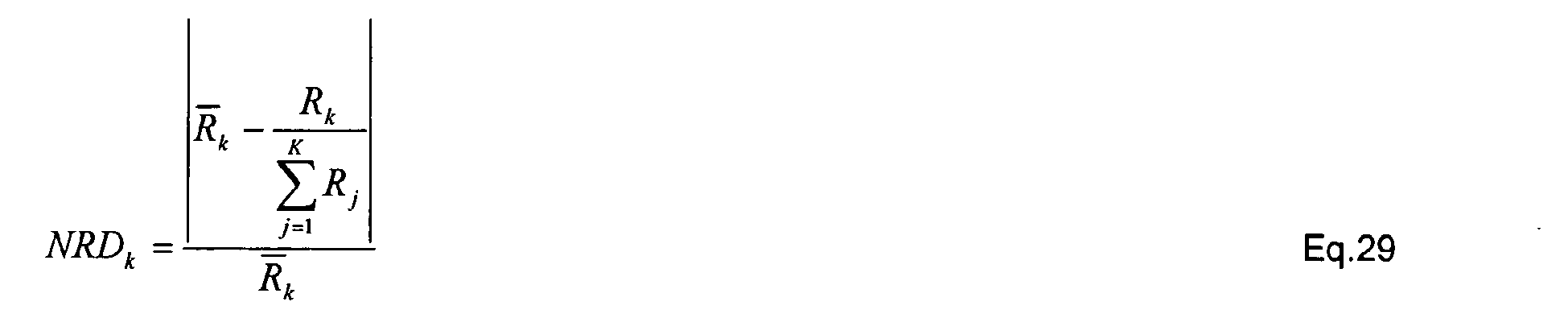
EP Single Antenna [i] OB [ii] O-SDMA [iii] Feedback per frame per active user: log2(M+1) bits 1 real number 1 real number log2(M+1)bits+1 real number - Performances are evaluated in terms of average sum-rate RSUM and average normalized rate deviation (NRD), which is measured as:
- The performance of the proposed EP algorithm is evaluated in conjunction with a random scheduler (RS) and with the PRS described in
Section 6, with a time window N w equal to the number of simulated time slots. We also consider the following schemes from current literature: - i. Single antenna opportunistic transmission.
- ii. Opportunistic beamforming with full CQI [4].
- iii. Opportunistic-SDMA with full CQI [5].
- Details about the implemented schemes can be found in Appendix C.
- Fig.3 shows the sum-rate performance of the aforementioned algorithms versus the number of active users K. Even if the scaling law of EP is similar to that of [iii], the reduced feedback causes an almost constant performance gap of about 3b/s/Hz with regards to [iii]. As the number of users in the cell grows, EP outperforms [i]. and [ii]. InFig.4 we take into account a more realistic model, where the channel power ρ k of every user is uniformly distributed (in dB) between 0dB and 20dB. Fig.4 shows Average Sum-Rate with heterogeneous channel gains. Fig.5 shows Normalized Rate Deviation (NRD) with heterogeneous channel gains.
- The Rate gap paid by EP with regards to [iii] is slightly greater than in Fig.3, even if the scaling laws of the sum-rate are still the same. Fig.5 shows the Normalized Rate Deviation (NRD) as it was defined in Eq.29 for all the considered schemes, in the same scenario used to generate Fig.4. EP with the PRS algorithm is the only scheme that guarantees rate fairness in this scenario among the ones considered in this description. The rate gap paid by EP with regards to [iii] is thus partly due to the fairness constraints accomplished by the EP algorithm. The analysis of Fig.3 and Fig.4 confirms the small sum-rate penalty given by the use of Eq.20 instead of the near-optimal Pout provided by Eq.19.
- A novel practical algorithm beyond the teaching of the DL SDMA scheduling algorithm considered in [7]-[8] for heterogeneous MIMO systems has been proposed in the present invention. A very low signalling overhead of log2(M+1) bits per user per scheduling slot is needed to allow asymptotically optimal sum-rate, since the parameters required to run the algorithm are locally available to every MS. A simplified version of the algorithm (Eq.20) is shown to achieve the nearly-optimal sum-rate. Fairness requirements are accomplished by the use of the PRS in conjunction with the EP algorithm.
- Although the invention has been described with particular reference to a preferred embodiment, it will be evident to those skilled in the art, that the present invention is not limited thereto, but further variations and modifications may be applied without departing from the scope of the claims.


Claims (23)
- In a cellular communication system a method for scheduling downlink transmissions, subdivided in time slots, from M beamforming antennas connected to a base station (BS) towards K mobile stations (MS1,....,MSK) each equipped with an arbitrary number Nk of receiving antennas, including the following steps cyclically executed on every time slot:a) generating, by the base station, a random set of orthogonal beamforming signal vectors S =[s1 ... sM ];b) estimating, by every mobile station its relevant signal to interference plus noise ratio SINR value γ k,m on every beam sm during a downlink training step;c) calculating, by every mobile station, its best beam-index m̂k as
 d) comparing, by every mobile station, its best SINR value γk, m̂ k with a threshold α k ;e) signalling to the base station, by each mobile station by which γk, m̂ k≥ α k is valid, the best beam-index m̂k during a feedback uplink transmission, otherwise signalling a beam-index null;f) selecting, by the base station, on each beam m at most one among those mobile stations that report a non-null signalling on that beam;g) transmitting, by the base station, to the selected users with a rate limited by the SINR threshold,characterized in that every mobile station (MS) performs the steps of:- assuming for every beam m an equal probability
F to transmit said feedback signalling and estimating independently to each other an individual SINR threshold using the following equation: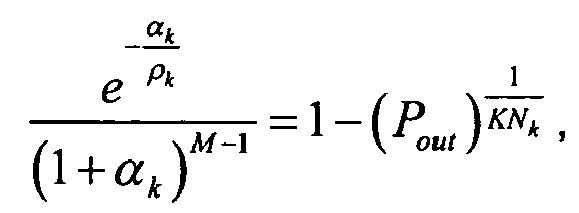
- In a cellular communication system a method for scheduling downlink transmissions, subdivided in time slots, from M beamforming antennas connected to a base station (BS) towards K mobile stations (MS1,....,MSK) each equipped with an arbitrary number Nk of receiving antennas, including the following steps cyclically executed on every time slot:h) generating, by the base station, a random set of orthogonal beamforming signal vectors S = [s1 ...sM];i) estimating, by every mobile station its relevant signal to interference plus noise ratio SINR value γk,m on every beam sm during a downlink training step;j) calculating, by every mobile station, its best beam-index m̂k as
 k) comparing, by every mobile station, its best SINR value γ k, m̂ k with a threshold α k ;l) signalling to the base station, by each mobile station by which γ k, m̂ k ≥ αk is valid, the best beam-index m̂k during a feedback uplink transmission, otherwise signalling a beam-index null;m)selecting, by the base station, on each beam m at most one among those mobile stations that report a non-null signalling on that beam;n) transmitting, by the base station, to the selected users with a rate limited by the SINR threshold,characterized in that the base station (BS) performs the steps of:- acquiring knowledge about the average power ρ k received by the user k;- assuming for every for every beam m and for every user k an equal probability
F of transmitting said feedback signalling and estimating a set of SINR threshold {αk } using the following equation: - transmitting the set of SINR threshold {α k } to the users downlink.
 - The method of claim 2, characterized in that the value of said average power ρ k is signalled by the mobile station k to the base station (BS).
- The method of claim 2, characterized in that the value of said average power ρk is estimated by the base station (BS) during uplink transmission from the mobile station k in time division duplexing.
- The method of any claim from 1 to 4, characterized in that said equal probability
F is defined as
- The method of claim 1, characterized in that the system parameter Pout is evaluated by the base station (BS) and broadcasted to all mobile stations (MS) regularly or during a set-up phase.
- The method of claim 1, characterized in that the system parameter Pout is evaluated by the mobile stations (MS).
- The method of claim 6 or 7, characterized in that the system parameter Pout is evaluated as Pout =β/K ϕ with β,ϕ > 0.
- The method of claim 6 or 7, characterized in that the system parameter Pout is evaluated as Pout =1/K.
- The method of any claim from 1 to 9, characterized in that said individual SINR threshold is updated if a remarkable change in {ρ k } by user k or in the number of active users K is occurred within the last time slot.
- The method of any claim from 1 to 10, characterized in that the transmission rate is adjusted to meet the variability on the set of thresholds {αk } by selecting one among various possible Modulation and Coding Schemes.
- The method of claim 11, characterized in that the transmission rate adopted by the base station (BS) for each scheduled user on each beam is further chosen according to the threshold α k
m * , where km * is the user eventually scheduled on beam m. - The method of any claim from 1 to 12, characterized in that the scheduled user k receives a fraction
R k of the sum-rate RSUM, corresponding to the overall throughput from the BS in bit/s/Hz, so that its average rate Rk is Rk=R kRSUM ∀k ∈ [1,K]. - The method of claim 13, characterized in that the set of scheduling outage probability {PS (k)} that maximizes the sum-rate RSUM is the solution of the following mathematical equation:

subjected to the following constraints:
- The method of claim 14, characterized in that under the hypothesis that both the channel power set {ρ k } and the rate coefficient set {
R k } are moderately unbalanced, a closed-form linear solution of said mathematical equation with regards to {PS (k)} is obtained by the following simplified equation: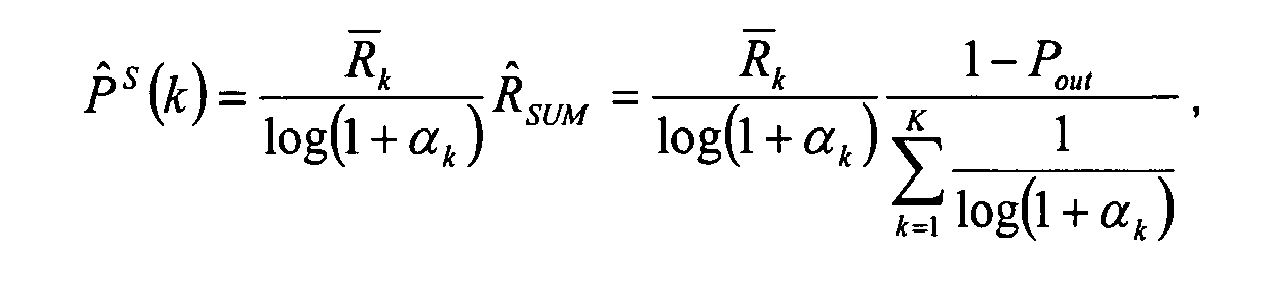
where P̂S (k) is the optimal scheduling probability of user k , and
is the optimal sum-rate. - The method of claim 15, characterized in that:- let
 - the scheduling probability

- The method of claim 16, characterized in that users are scheduled in time slot T according to


- The method of claim 17, characterized in that the base station performs the steps of:1. evaluating the set of said optimal scheduling probabilities
 2. scheduling on each beam said user
 3. updating said actual scheduling probability
 4. repeating from step 2 on next time slot excepting for repeating from step 1 if a significant change in {ρ k } is occurred within last time slot.
 - The method of claim 1, characterized in that every mobile stations (MS) can optionally compute a lower-bound α̃ k in closed-form for the SINR threshold αk, valid when a reporting user over the m-th beam is randomly selected by the base station (BS, using the following expression:

- The method of claim 1, characterized in that the base station (BS) can optionally compute a lower-bound α̃ k in closed-form for the SINR threshold α k , valid when it randomly selects a reporting user over the m-th beam, using the following expression:

- The method of claim 19 or 20, characterized in that that a lower-bound for the sum-rate is obtained by the following expression:

- The method of claim 21, characterized in that that said lower-bounded sum-rate


- The method of claim 21, characterized in that when the number of users K is large but finite said lower-bounded sum-rate


Priority Applications (2)
| Application Number | Priority Date | Filing Date | Title |
|---|---|---|---|
| EP06425729A EP1914909A1 (en) | 2006-10-20 | 2006-10-20 | Downlink scheduling method for MIMO/MISO cellular systems with limited feedback signalling |
| PCT/EP2007/061066 WO2008046845A2 (en) | 2006-10-20 | 2007-10-17 | Downlink scheduling method for mimo/miso cellular systems with limited feedback signalling |
Applications Claiming Priority (1)
| Application Number | Priority Date | Filing Date | Title |
|---|---|---|---|
| EP06425729A EP1914909A1 (en) | 2006-10-20 | 2006-10-20 | Downlink scheduling method for MIMO/MISO cellular systems with limited feedback signalling |
Publications (1)
| Publication Number | Publication Date |
|---|---|
| EP1914909A1 true EP1914909A1 (en) | 2008-04-23 |
Family
ID=37898644
Family Applications (1)
| Application Number | Title | Priority Date | Filing Date |
|---|---|---|---|
| EP06425729A Withdrawn EP1914909A1 (en) | 2006-10-20 | 2006-10-20 | Downlink scheduling method for MIMO/MISO cellular systems with limited feedback signalling |
Country Status (2)
| Country | Link |
|---|---|
| EP (1) | EP1914909A1 (en) |
| WO (1) | WO2008046845A2 (en) |
Cited By (8)
| Publication number | Priority date | Publication date | Assignee | Title |
|---|---|---|---|---|
| WO2009040678A3 (en) * | 2007-04-30 | 2009-05-14 | Univ Hong Kong Science & Techn | Multiuser scheduling for mimo broadcast channels with finite rate feedback |
| CN102545977A (en) * | 2010-12-14 | 2012-07-04 | 上海贝尔股份有限公司 | Process and equipment for user scheduling in MIMO (multiple input and multiple output) system |
| CN102571172A (en) * | 2010-12-09 | 2012-07-11 | 上海贝尔股份有限公司 | User scheduling method and equipment in MIMO wireless communication system |
| CN106255219A (en) * | 2016-08-10 | 2016-12-21 | 西安科技大学 | Dynamic mode changing method based on diversity with spatial multiplexing gain compromise in interference network |
| CN108418615A (en) * | 2018-01-04 | 2018-08-17 | 南京邮电大学 | A User Scheduling Method Based on MU-MIMO Limited Feedback System |
| CN112929064A (en) * | 2021-01-22 | 2021-06-08 | 上海交通大学 | Multicast beam forming parallel computing method based on user subset selection |
| CN115299126A (en) * | 2020-04-15 | 2022-11-04 | 高通股份有限公司 | Calculation of Downlink Positioning Reference Signal (PRS) symbol duration for PRS buffering purposes |
| CN116567645A (en) * | 2023-05-12 | 2023-08-08 | 郑州大学 | Safe energy efficiency robust design method in intelligent reflection surface-assisted cellular network |
Families Citing this family (2)
| Publication number | Priority date | Publication date | Assignee | Title |
|---|---|---|---|---|
| US8670717B2 (en) | 2008-11-27 | 2014-03-11 | Futurewei Technologies, Inc. | System and method for enabling coordinated beam switching and scheduling |
| KR102476108B1 (en) * | 2018-03-06 | 2022-12-12 | 삼성전자주식회사 | Apparatus and method for determining beam index of antenna array |
Citations (2)
| Publication number | Priority date | Publication date | Assignee | Title |
|---|---|---|---|---|
| US20050181833A1 (en) * | 2004-02-12 | 2005-08-18 | Yong Hwan Lee | Wireless communication method and apparatus using multiple antennas and multiple random beams |
| US20060221920A1 (en) * | 2005-04-05 | 2006-10-05 | Toshiba America Research, Inc. | Beamforming and distributed opportunistic scheduling in wireless networks |
-
2006
- 2006-10-20 EP EP06425729A patent/EP1914909A1/en not_active Withdrawn
-
2007
- 2007-10-17 WO PCT/EP2007/061066 patent/WO2008046845A2/en not_active Ceased
Patent Citations (2)
| Publication number | Priority date | Publication date | Assignee | Title |
|---|---|---|---|---|
| US20050181833A1 (en) * | 2004-02-12 | 2005-08-18 | Yong Hwan Lee | Wireless communication method and apparatus using multiple antennas and multiple random beams |
| US20060221920A1 (en) * | 2005-04-05 | 2006-10-05 | Toshiba America Research, Inc. | Beamforming and distributed opportunistic scheduling in wireless networks |
Non-Patent Citations (2)
| Title |
|---|
| GESBERT D ET AL: "How much feedback is multi-user diversity really worth?", COMMUNICATIONS, 2004 IEEE INTERNATIONAL CONFERENCE ON PARIS, FRANCE 20-24 JUNE 2004, PISCATAWAY, NJ, USA,IEEE, 20 June 2004 (2004-06-20), pages 234 - 238, XP010709995, ISBN: 0-7803-8533-0 * |
| SHARIF M ET AL INSTITUTE OF ELECTRICAL AND ELECTRONICS ENGINEERS: "On the capacity of MIMO broadcast channel with partial side infonnation", CONFERENCE RECORD OF THE 37TH. ASILOMAR CONFERENCE ON SIGNALS, SYSTEMS, & COMPUTERS. PACIFIC GROOVE, CA, NOV. 9 - 12, 2003, ASILOMAR CONFERENCE ON SIGNALS, SYSTEMS AND COMPUTERS, NEW YORK, NY : IEEE, US, vol. VOL. 1 OF 2. CONF. 37, 9 November 2003 (2003-11-09), pages 958 - 962, XP010702434, ISBN: 0-7803-8104-1 * |
Cited By (14)
| Publication number | Priority date | Publication date | Assignee | Title |
|---|---|---|---|---|
| US8054837B2 (en) | 2007-04-30 | 2011-11-08 | Yim Tu Investments Ltd., Llc | Multiuser scheduling for MIMO broadcast channels with finite rate feedback |
| WO2009040678A3 (en) * | 2007-04-30 | 2009-05-14 | Univ Hong Kong Science & Techn | Multiuser scheduling for mimo broadcast channels with finite rate feedback |
| US8792500B2 (en) | 2007-04-30 | 2014-07-29 | Yim Tu Investments Ltd., Llc | Multiuser scheduling for MIMO broadcast channels with finite rate feedback |
| CN102571172B (en) * | 2010-12-09 | 2015-03-25 | 上海贝尔股份有限公司 | User scheduling method and equipment in MIMO wireless communication system |
| CN102571172A (en) * | 2010-12-09 | 2012-07-11 | 上海贝尔股份有限公司 | User scheduling method and equipment in MIMO wireless communication system |
| CN102545977B (en) * | 2010-12-14 | 2015-04-22 | 上海贝尔股份有限公司 | Process and equipment for user scheduling in MIMO (multiple input and multiple output) system |
| CN102545977A (en) * | 2010-12-14 | 2012-07-04 | 上海贝尔股份有限公司 | Process and equipment for user scheduling in MIMO (multiple input and multiple output) system |
| CN106255219A (en) * | 2016-08-10 | 2016-12-21 | 西安科技大学 | Dynamic mode changing method based on diversity with spatial multiplexing gain compromise in interference network |
| CN108418615A (en) * | 2018-01-04 | 2018-08-17 | 南京邮电大学 | A User Scheduling Method Based on MU-MIMO Limited Feedback System |
| CN108418615B (en) * | 2018-01-04 | 2021-02-09 | 南京邮电大学 | A User Scheduling Method Based on MU-MIMO Limited Feedback System |
| CN115299126A (en) * | 2020-04-15 | 2022-11-04 | 高通股份有限公司 | Calculation of Downlink Positioning Reference Signal (PRS) symbol duration for PRS buffering purposes |
| CN112929064A (en) * | 2021-01-22 | 2021-06-08 | 上海交通大学 | Multicast beam forming parallel computing method based on user subset selection |
| CN112929064B (en) * | 2021-01-22 | 2022-05-10 | 上海交通大学 | Multicast beam forming parallel computing method based on user subset selection |
| CN116567645A (en) * | 2023-05-12 | 2023-08-08 | 郑州大学 | Safe energy efficiency robust design method in intelligent reflection surface-assisted cellular network |
Also Published As
| Publication number | Publication date |
|---|---|
| WO2008046845A2 (en) | 2008-04-24 |
| WO2008046845A3 (en) | 2008-08-07 |
Similar Documents
| Publication | Publication Date | Title |
|---|---|---|
| EP2227869B1 (en) | Method for reducing inter-cell interference | |
| US8233939B2 (en) | Multiuser sector micro diversity system | |
| US7907677B2 (en) | Open loop MU-MIMO | |
| EP2036216B1 (en) | Apparatus and method for transmitting/receiving data in a closed-loop multi-antenna system | |
| US8121079B2 (en) | Method for allocating transmission capacities during a signal transmission, base station, and mobile terminal | |
| US8488704B2 (en) | Method for selecting subchannel mode and MIMO communication system using the same | |
| US9124313B2 (en) | Multi-cell cooperative communication system and terminal device | |
| US20100002607A1 (en) | Collaborative mimo using sounding channel in multi-cell environment | |
| KR20060124401A (en) | Scheduling method using relay station and system in wireless communication system | |
| Hassibi et al. | Fundamental limits in MIMO broadcast channels | |
| WO2008046845A2 (en) | Downlink scheduling method for mimo/miso cellular systems with limited feedback signalling | |
| US8792373B2 (en) | Scheduling method and apparatus for control average transmission rate in multiple antenna system | |
| US20130022142A1 (en) | Base station and method for implementing an adaptive closed-loop mimo and open-loop mimo technique in a wireless communication system | |
| EP2517375B1 (en) | Telecommunication transmission method and system | |
| CN101908914B (en) | Space division multiple address (SDMA) relay transmission method, device and system | |
| CN101472298B (en) | User scheduling method and apparatus for TDD multi-input multi-output down emission system | |
| CN101783776A (en) | Precoding feedback method, system, user equipment and base station | |
| Diaz et al. | Sum-rate of MIMO broadcast channels with one bit feedback | |
| US20130016680A1 (en) | Systems and Methods for Multi-User MIMO | |
| US8792573B2 (en) | Method and apparatus for data transmission based on distributed discrete power control in cooperative multi-user multi-input multi-output system | |
| US20110085504A1 (en) | Adaptive beam-forming and space-frequency block coding transmission scheme for mimo-ofdma systems | |
| KR101428812B1 (en) | Method and apparatus for transmitting and receiving downlink data in a wireless communication network | |
| Qi et al. | Cross-layer design for multiuser MIMO MRC systems with feedback constraints | |
| So et al. | Multiuser diversity in a MIMO system with opportunistic feedback | |
| Mundarath et al. | A distributed downlink scheduling method for multi-user communication with zero-forcing beamforming |
Legal Events
| Date | Code | Title | Description |
|---|---|---|---|
| PUAI | Public reference made under article 153(3) epc to a published international application that has entered the european phase |
Free format text: ORIGINAL CODE: 0009012 |
|
| AK | Designated contracting states |
Kind code of ref document: A1 Designated state(s): AT BE BG CH CY CZ DE DK EE ES FI FR GB GR HU IE IS IT LI LT LU LV MC NL PL PT RO SE SI SK TR |
|
| AX | Request for extension of the european patent |
Extension state: AL BA HR MK RS |
|
| AKX | Designation fees paid | ||
| REG | Reference to a national code |
Ref country code: DE Ref legal event code: 8566 |
|
| STAA | Information on the status of an ep patent application or granted ep patent |
Free format text: STATUS: THE APPLICATION IS DEEMED TO BE WITHDRAWN |
|
| 18D | Application deemed to be withdrawn |
Effective date: 20081024 |