EP1906578A2 - Hierarchical channel adaptive packet scheduling apparatus and method for satellite networks - Google Patents
Hierarchical channel adaptive packet scheduling apparatus and method for satellite networks Download PDFInfo
- Publication number
- EP1906578A2 EP1906578A2 EP07117255A EP07117255A EP1906578A2 EP 1906578 A2 EP1906578 A2 EP 1906578A2 EP 07117255 A EP07117255 A EP 07117255A EP 07117255 A EP07117255 A EP 07117255A EP 1906578 A2 EP1906578 A2 EP 1906578A2
- Authority
- EP
- European Patent Office
- Prior art keywords
- packet
- queue
- region
- class
- service
- Prior art date
- Legal status (The legal status is an assumption and is not a legal conclusion. Google has not performed a legal analysis and makes no representation as to the accuracy of the status listed.)
- Withdrawn
Links
- 238000000034 method Methods 0.000 title claims abstract description 44
- 230000003044 adaptive effect Effects 0.000 title claims abstract description 20
- 230000005540 biological transmission Effects 0.000 claims description 26
- 230000003213 activating effect Effects 0.000 claims description 2
- 238000004891 communication Methods 0.000 description 9
- 238000005516 engineering process Methods 0.000 description 4
- 238000011112 process operation Methods 0.000 description 2
- 238000007796 conventional method Methods 0.000 description 1
- 238000011161 development Methods 0.000 description 1
- 238000012986 modification Methods 0.000 description 1
- 230000004048 modification Effects 0.000 description 1
- 238000007616 round robin method Methods 0.000 description 1
- 238000010187 selection method Methods 0.000 description 1
Images


Classifications
-
- H—ELECTRICITY
- H04—ELECTRIC COMMUNICATION TECHNIQUE
- H04L—TRANSMISSION OF DIGITAL INFORMATION, e.g. TELEGRAPHIC COMMUNICATION
- H04L47/00—Traffic control in data switching networks
- H04L47/50—Queue scheduling
- H04L47/62—Queue scheduling characterised by scheduling criteria
- H04L47/629—Ensuring fair share of resources, e.g. weighted fair queuing [WFQ]
-
- H—ELECTRICITY
- H04—ELECTRIC COMMUNICATION TECHNIQUE
- H04L—TRANSMISSION OF DIGITAL INFORMATION, e.g. TELEGRAPHIC COMMUNICATION
- H04L1/00—Arrangements for detecting or preventing errors in the information received
- H04L1/0001—Systems modifying transmission characteristics according to link quality, e.g. power backoff
- H04L1/0015—Systems modifying transmission characteristics according to link quality, e.g. power backoff characterised by the adaptation strategy
- H04L1/0017—Systems modifying transmission characteristics according to link quality, e.g. power backoff characterised by the adaptation strategy where the mode-switching is based on Quality of Service requirement
-
- H—ELECTRICITY
- H04—ELECTRIC COMMUNICATION TECHNIQUE
- H04B—TRANSMISSION
- H04B7/00—Radio transmission systems, i.e. using radiation field
- H04B7/14—Relay systems
- H04B7/15—Active relay systems
- H04B7/185—Space-based or airborne stations; Stations for satellite systems
- H04B7/1851—Systems using a satellite or space-based relay
- H04B7/18513—Transmission in a satellite or space-based system
-
- H—ELECTRICITY
- H04—ELECTRIC COMMUNICATION TECHNIQUE
- H04B—TRANSMISSION
- H04B7/00—Radio transmission systems, i.e. using radiation field
- H04B7/14—Relay systems
- H04B7/15—Active relay systems
- H04B7/185—Space-based or airborne stations; Stations for satellite systems
- H04B7/1853—Satellite systems for providing telephony service to a mobile station, i.e. mobile satellite service
- H04B7/18539—Arrangements for managing radio, resources, i.e. for establishing or releasing a connection
- H04B7/18543—Arrangements for managing radio, resources, i.e. for establishing or releasing a connection for adaptation of transmission parameters, e.g. power control
-
- H—ELECTRICITY
- H04—ELECTRIC COMMUNICATION TECHNIQUE
- H04B—TRANSMISSION
- H04B7/00—Radio transmission systems, i.e. using radiation field
- H04B7/14—Relay systems
- H04B7/15—Active relay systems
- H04B7/185—Space-based or airborne stations; Stations for satellite systems
- H04B7/18578—Satellite systems for providing broadband data service to individual earth stations
- H04B7/18584—Arrangements for data networking, i.e. for data packet routing, for congestion control
-
- H—ELECTRICITY
- H04—ELECTRIC COMMUNICATION TECHNIQUE
- H04H—BROADCAST COMMUNICATION
- H04H20/00—Arrangements for broadcast or for distribution combined with broadcast
- H04H20/65—Arrangements characterised by transmission systems for broadcast
- H04H20/71—Wireless systems
- H04H20/72—Wireless systems of terrestrial networks
-
- H—ELECTRICITY
- H04—ELECTRIC COMMUNICATION TECHNIQUE
- H04H—BROADCAST COMMUNICATION
- H04H60/00—Arrangements for broadcast applications with a direct linking to broadcast information or broadcast space-time; Broadcast-related systems
- H04H60/02—Arrangements for generating broadcast information; Arrangements for generating broadcast-related information with a direct linking to broadcast information or to broadcast space-time; Arrangements for simultaneous generation of broadcast information and broadcast-related information
- H04H60/06—Arrangements for scheduling broadcast services or broadcast-related services
-
- H—ELECTRICITY
- H04—ELECTRIC COMMUNICATION TECHNIQUE
- H04L—TRANSMISSION OF DIGITAL INFORMATION, e.g. TELEGRAPHIC COMMUNICATION
- H04L47/00—Traffic control in data switching networks
- H04L47/70—Admission control; Resource allocation
- H04L47/80—Actions related to the user profile or the type of traffic
- H04L47/801—Real time traffic
-
- H—ELECTRICITY
- H04—ELECTRIC COMMUNICATION TECHNIQUE
- H04N—PICTORIAL COMMUNICATION, e.g. TELEVISION
- H04N21/00—Selective content distribution, e.g. interactive television or video on demand [VOD]
- H04N21/20—Servers specifically adapted for the distribution of content, e.g. VOD servers; Operations thereof
- H04N21/23—Processing of content or additional data; Elementary server operations; Server middleware
- H04N21/238—Interfacing the downstream path of the transmission network, e.g. adapting the transmission rate of a video stream to network bandwidth; Processing of multiplex streams
-
- H—ELECTRICITY
- H04—ELECTRIC COMMUNICATION TECHNIQUE
- H04N—PICTORIAL COMMUNICATION, e.g. TELEVISION
- H04N21/00—Selective content distribution, e.g. interactive television or video on demand [VOD]
- H04N21/20—Servers specifically adapted for the distribution of content, e.g. VOD servers; Operations thereof
- H04N21/23—Processing of content or additional data; Elementary server operations; Server middleware
- H04N21/238—Interfacing the downstream path of the transmission network, e.g. adapting the transmission rate of a video stream to network bandwidth; Processing of multiplex streams
- H04N21/23805—Controlling the feeding rate to the network, e.g. by controlling the video pump
-
- H—ELECTRICITY
- H04—ELECTRIC COMMUNICATION TECHNIQUE
- H04N—PICTORIAL COMMUNICATION, e.g. TELEVISION
- H04N21/00—Selective content distribution, e.g. interactive television or video on demand [VOD]
- H04N21/20—Servers specifically adapted for the distribution of content, e.g. VOD servers; Operations thereof
- H04N21/25—Management operations performed by the server for facilitating the content distribution or administrating data related to end-users or client devices, e.g. end-user or client device authentication, learning user preferences for recommending movies
- H04N21/262—Content or additional data distribution scheduling, e.g. sending additional data at off-peak times, updating software modules, calculating the carousel transmission frequency, delaying a video stream transmission, generating play-lists
- H04N21/26208—Content or additional data distribution scheduling, e.g. sending additional data at off-peak times, updating software modules, calculating the carousel transmission frequency, delaying a video stream transmission, generating play-lists the scheduling operation being performed under constraints
-
- H—ELECTRICITY
- H04—ELECTRIC COMMUNICATION TECHNIQUE
- H04N—PICTORIAL COMMUNICATION, e.g. TELEVISION
- H04N21/00—Selective content distribution, e.g. interactive television or video on demand [VOD]
- H04N21/40—Client devices specifically adapted for the reception of or interaction with content, e.g. set-top-box [STB]; Operations thereof
- H04N21/43—Processing of content or additional data, e.g. demultiplexing additional data from a digital video stream; Elementary client operations, e.g. monitoring of home network or synchronising decoder's clock; Client middleware
- H04N21/442—Monitoring of processes or resources, e.g. detecting the failure of a recording device, monitoring the downstream bandwidth, the number of times a movie has been viewed, the storage space available from the internal hard disk
- H04N21/44209—Monitoring of downstream path of the transmission network originating from a server, e.g. bandwidth variations of a wireless network
-
- H—ELECTRICITY
- H04—ELECTRIC COMMUNICATION TECHNIQUE
- H04N—PICTORIAL COMMUNICATION, e.g. TELEVISION
- H04N21/00—Selective content distribution, e.g. interactive television or video on demand [VOD]
- H04N21/60—Network structure or processes for video distribution between server and client or between remote clients; Control signalling between clients, server and network components; Transmission of management data between server and client, e.g. sending from server to client commands for recording incoming content stream; Communication details between server and client
- H04N21/61—Network physical structure; Signal processing
- H04N21/6106—Network physical structure; Signal processing specially adapted to the downstream path of the transmission network
- H04N21/6143—Network physical structure; Signal processing specially adapted to the downstream path of the transmission network involving transmission via a satellite
-
- H—ELECTRICITY
- H04—ELECTRIC COMMUNICATION TECHNIQUE
- H04N—PICTORIAL COMMUNICATION, e.g. TELEVISION
- H04N21/00—Selective content distribution, e.g. interactive television or video on demand [VOD]
- H04N21/60—Network structure or processes for video distribution between server and client or between remote clients; Control signalling between clients, server and network components; Transmission of management data between server and client, e.g. sending from server to client commands for recording incoming content stream; Communication details between server and client
- H04N21/65—Transmission of management data between client and server
- H04N21/658—Transmission by the client directed to the server
- H04N21/6582—Data stored in the client, e.g. viewing habits, hardware capabilities, credit card number
-
- H—ELECTRICITY
- H04—ELECTRIC COMMUNICATION TECHNIQUE
- H04W—WIRELESS COMMUNICATION NETWORKS
- H04W72/00—Local resource management
- H04W72/50—Allocation or scheduling criteria for wireless resources
- H04W72/535—Allocation or scheduling criteria for wireless resources based on resource usage policies
-
- H—ELECTRICITY
- H04—ELECTRIC COMMUNICATION TECHNIQUE
- H04W—WIRELESS COMMUNICATION NETWORKS
- H04W72/00—Local resource management
- H04W72/50—Allocation or scheduling criteria for wireless resources
- H04W72/54—Allocation or scheduling criteria for wireless resources based on quality criteria
- H04W72/542—Allocation or scheduling criteria for wireless resources based on quality criteria using measured or perceived quality
-
- H—ELECTRICITY
- H04—ELECTRIC COMMUNICATION TECHNIQUE
- H04W—WIRELESS COMMUNICATION NETWORKS
- H04W84/00—Network topologies
- H04W84/02—Hierarchically pre-organised networks, e.g. paging networks, cellular networks, WLAN [Wireless Local Area Network] or WLL [Wireless Local Loop]
- H04W84/04—Large scale networks; Deep hierarchical networks
- H04W84/06—Airborne or Satellite Networks
-
- H—ELECTRICITY
- H04—ELECTRIC COMMUNICATION TECHNIQUE
- H04L—TRANSMISSION OF DIGITAL INFORMATION, e.g. TELEGRAPHIC COMMUNICATION
- H04L1/00—Arrangements for detecting or preventing errors in the information received
- H04L1/0001—Systems modifying transmission characteristics according to link quality, e.g. power backoff
- H04L1/0002—Systems modifying transmission characteristics according to link quality, e.g. power backoff by adapting the transmission rate
- H04L1/0003—Systems modifying transmission characteristics according to link quality, e.g. power backoff by adapting the transmission rate by switching between different modulation schemes
-
- H—ELECTRICITY
- H04—ELECTRIC COMMUNICATION TECHNIQUE
- H04L—TRANSMISSION OF DIGITAL INFORMATION, e.g. TELEGRAPHIC COMMUNICATION
- H04L1/00—Arrangements for detecting or preventing errors in the information received
- H04L1/0001—Systems modifying transmission characteristics according to link quality, e.g. power backoff
- H04L1/0009—Systems modifying transmission characteristics according to link quality, e.g. power backoff by adapting the channel coding
-
- H—ELECTRICITY
- H04—ELECTRIC COMMUNICATION TECHNIQUE
- H04L—TRANSMISSION OF DIGITAL INFORMATION, e.g. TELEGRAPHIC COMMUNICATION
- H04L5/00—Arrangements affording multiple use of the transmission path
- H04L5/003—Arrangements for allocating sub-channels of the transmission path
- H04L5/0058—Allocation criteria
- H04L5/006—Quality of the received signal, e.g. BER, SNR, water filling
Definitions
- the present invention relates to scheduling a packet to be transmitted from a transmitting device having an Adaptive Coding Modulation (ACM) function, which is called an ACM router, to a receiving device in a satellite network; and, more particularly, to a hierarchical channel adaptive packet scheduling apparatus and method which equally maintains the capacity of packets although weather conditions in the regions of respective receiving devices are different, and simultaneously support service classes of diverse levels such as an expedited forwarding (EF) service, a best-effort service (BE) service and an assured forwarding (AF) service.
- ACM Adaptive Coding Modulation
- a greater transmission capacity than a conventional method such as Digital Video Broadcasting-Satellite (DVB-S) and DVB-Digital Satellite News Gathering (DVB-DSNG) is required in a channel bandwidth and signal power in order to provide a new service such as high-volume multimedia communication service including high definition television (HDTV), a convergence service of communication and broadcasting, a broadband communication service, and a broadband broadcasting service.
- DVD-S Digital Video Broadcasting-Satellite
- DVD-DSNG DVB-Digital Satellite News Gathering
- DVB-S2 Digital Video Broadcasting System 2
- ACM Adaptive Coding Modulation
- a packet is transmitted by selecting an optimized channel coding technique and modulation technique according to the state of the satellite communication channel.
- a transmitting device transmits a packet to a receiving device through a satellite in the DVB-S2
- the transmitting device receives channel state information from each receiving device through a return channel, e.g., a repeater set up on the ground, senses a weather condition in the region of the receiving device based on the channel state information, modulates the weather condition according to a corresponding modulation technique and transmits the packet. Therefore, the DVB-S2 can acquire a desired transmission quality when the packet is transmitted to the receiving device in a rainy day.
- EP1408637 entitled “An adaptive coding and modulation system for the transmission of DVB/MPEG signals” discloses an ACM transmission method for providing the same service quality to all receiving devices having different channel environments in the DVB-S2.
- a packet scheduling method applied to the transmitting device of a conventional DVB-S2 system adopts a simple Round-Robin method.
- the prior art may be able to provide an optimal packet transmission quality in the DVB-S2 with its coding/modulation technique.
- simple packet scheduling is applied to receiving devices of different weather conditions, and receiving devices desiring a service class of a different level, there are problems that a transmission rate is changed according to a change in a channel state and effective transmission rate cannot be controlled. Also, it is difficult to provide equality between packet flows.
- optimized packet scheduling is essentially required according to region having different weather conditions and different service classes in the transmitting device with an ACM function.
- An embodiment of the present invention is directed to providing a hierarchical channel adaptive packet scheduling apparatus and method for satellite networks which can equally maintain the capacity of packets although weather conditions in the regions of receiving devices are different, and simultaneously support service classes of diverse levels such as an expedited forwarding (EF) service, a best-effort service (BE) service and an assured forwarding (AF) service in scheduling of a packet to be transmitted from a transmitting device having an Adaptive Coding Modulation (ACM) function, which is called an ACM router, to a receiving device in a satellite network.
- ACM Adaptive Coding Modulation
- a hierarchical channel-adaptive packet scheduling apparatus of a transmitting device having an Adaptive Coding Modulation (ACM) function in a satellite network including: at least one hierarchical queue according to class where packets to be transmitted with each service class of different service levels is queued; at least one queue according to region where packets to be transmitted to each region having different weather conditions are queued; and a queue controller for transmitting packets queued to the queues according to class and the queues according to region to a receiving device according to a predetermined packet scheduling policy.
- ACM Adaptive Coding Modulation
- a hierarchical channel-adaptive packet scheduling method in a packet scheduling apparatus hierarchically having at least one hierarchical queue according to class and at least one queue according to region in a satellite network, including the steps of: a) checking whether a queue is empty when a packet is transmitted from a specific terminal; b) when the queue is empty, calculating a service start time by activating the queue and storing a packet by selecting a queue according to region corresponding to a destination of a packet; c) in a state that the packet is stored in the queue, selecting a queue according to class corresponding to a child node through service competition between brother nodes up to a parent node at the highest level with respect to the queue; and d) transmitting the packet stored in the selected queue to a receiving device through a satellite channel.
- Fig. 1 shows a satellite network to which the present invention is applied.
- Fig. 2 shows a hierarchical channel adaptive packet scheduling apparatus in accordance with an embodiment of the present invention.
- Fig. 3 is a flowchart describing a hierarchical channel adaptive packet scheduling in accordance with an embodiment of the present invention.
- the present invention suggests a packet scheduling technique to be applied to a transmitting device having an Adaptive Coding Modulation (ACM) function in a satellite communication network based on Digital Video Broadcasting System 2 (DVB-S2).
- ACM Adaptive Coding Modulation
- the present invention provides equality among users in receiving parts of different weather conditions, and simultaneously supports service classes of diverse levels such as an expedited forwarding (EF) service, a best-effort service (BE) service and an assured forwarding (AF) service.
- EF expedited forwarding
- BE best-effort service
- AF assured forwarding
- the present invention suggests a queue management technique for providing equality according to user locations, which is called a region-based queue management technique, and a queue management technique according to graduated classification.
- the packet scheduling technique of the present invention is defined as a Hierarchical-Weather Adaptive Fair Queuing (H-WAFQ) packet scheduling technique.
- H-WAFQ Hierarchical-Weather Adaptive Fair Queuing
- Fig. 1 shows a satellite network to which the present invention is applied.
- the DVB-S2 based satellite network to which the present invention is applied includes a transmitting device 10 with an ACM function, which is called an ACM router, a plurality of users 20, 21, ..., N for transmitting packets to a receiving device through a satellite 40 by accessing to the transmitting device 10 through a terminal, a plurality of receiving devices 30, 31, ..., X receiving a packet from a satellite 40 through a satellite communication channel.
- ACM router an ACM function
- each of the receiving devices 30, 31, ..., Y transmits/receives a packet with the transmitting device 10 through the satellite 40
- each of the receiving devices 30, 31, ..., Y transmits state information on a satellite communication channel for receiving a packet, which is called channel state information hereinafter, through a return channel, e.g., a satellite communication return channel or a repeater set up on a ground, to the transmitting device 10.
- the transmitting device 10 senses a weather condition of a region, in which each receiving device is located, such as "clean", “cloudy”, and "rainy".
- FIG. 1 A hierarchical channel adaptive packet scheduling apparatus of the transmitting device 10 as shown in Fig. 1 of the present invention will be described in detail with reference to Fig. 2.
- Fig. 2 shows the hierarchical channel adaptive packet scheduling apparatus in accordance with an embodiment of the present invention.
- the hierarchical channel adaptive packet scheduling apparatus includes queues 50 according to hierarchical classes, which will be referred to as class queues, queues 60 according to regions, which will be referred to as region queues, and a scheduling apparatus 70.
- the class queues 50 queues a packet to be transmitted with each service class of levels such as an expedited forwarding (EF) service, an assured forwarding service(AF service) and a best-effort service (BE) service.
- EF expedited forwarding
- AF service assured forwarding service
- BE best-effort service
- the region queues 60 perform queuing on a packet to be transmitted to each region having different weather conditions.
- the queue controller 70 i.e., a scheduling apparatus, transmits a packet on which queuing is performed in the class queues 50 and the region queues 60 based on the packet scheduling policy.
- the class queues 50 are formed of hierarchical queues.
- a first queue stores a packet requiring the EF service, i.e., a packet with a priority, which is sensitive to packet delay.
- a second queue stores a packet requiring the AF service, i.e., a packet with a priority in transmission.
- a third queue stores a packet requiring the BE service, i.e., a packet with a general transmission order.
- the class queues 50 store channel state information according to region expressing a weather condition of a region corresponding to a packet destination.
- class queues 50 include hierarchical queues as many as the region queues 60 for storing a packet to be transmitted to the region.
- the region queues 60 are formed of a plurality of queues corresponding to each region, which is a region 1, a region 2, and a region 3.
- the regions have different weather conditions.
- the channel coding and modulation are performed on the packet stored in a corresponding region queue by an ACM technique according to a weather condition of each region and transmitted to a receiving device located in the corresponding region.
- a packet process operation in the transmitting device 10 having the hierarchical channel adaptive packet scheduling apparatus of the present invention will be described.
- the queue controller 70 selects any one region queue among the queues 60 according to region to transmit a packet, selects any one queue on the class queues 50, which are connected to the region queue, and controls such that the flow of the packet stored in the selected queue is transmitted to the receiving device.
- the packet When a packet is transmitted from the users 20, 21, ..., N, the packet is stored in the class queues 50 corresponding to a region to be transmitted to and a service class based on destination information of the packet.
- the queue selection method according to region of the present invention for transmitting a packet is operated according to channel state information, i.e., whether weather is fine or poor.
- channel state information i.e., whether weather is fine or poor.
- the region queue 60 for transmitting the packet is selected as shown in Equation 1.
- the CS denotes a start time of the packet which receives a service at present, i.e., where the packet is transmitted at present.
- the B(t) denotes a set of packet flow backlogged to the time t.
- the backlog means a waiting state that the packet is not completely transmitted in the queue.
- a service start time of the packet is a virtual time when the packet arrives at, i.e., "CS".
- a service start time of a newly arrived packet becomes a service end time of a former packet.
- a service start time "S(i, 1, t)" of the packet is calculated as "F(i, 1-1, t)" as shown in Equation 1.
- the region queues 60 for transmitting the packet are selected as shown in Equations 2 and 3.
- Equation 2 shows a case of selecting a region queue 60 where a service is provided to the packet flow when the channel error state is not sensed based on the channel state information returning from the receiving device.
- Equation 3 shows a case of selecting the region queue 60 where a service is provided to the packet flow when the channel error state is sensed based on the channel state information returned from the receiving device.
- the queues 50 according to class is selected by using Dynamic Start-time Fair Queueing (D-STFQ) in the present invention.
- D-STFQ Dynamic Start-time Fair Queueing
- the queues 50 according to class to be provided is selected according to the weather condition of the region corresponding to the region queues 60, which are connected to the queues 50 according to class, as shown in Equations 1 and 4.
- a channel state information sense result reveals that the queues 50 according to class to provide a service are selected as shown in Equation 1.
- the queues 50 according to class to be provided are selected as shown in Equation 4.
- S i ⁇ l ⁇ t ⁇ CS ⁇ 1 - S b k - S b i S b k , if i ⁇ B t F ⁇ i , l - 1 , t ⁇ 1 - S b k - S b i S b k , if i ⁇ B t
- Equation 4 when the class queues 50 are selected as Equation 4 in the present invention, Equation 4 is limitedly used only in a packet of an EF service level, which requires the EF service stored in the first queue on the queues according to class.
- An EF class quality of service QoS may be secured with respect to a change of the transmission rate according to the change of the weather condition in the DVB-S2.
- Fig. 3 is a flowchart describing a hierarchical channel adaptive packet scheduling in accordance with an embodiment of the present invention.
- the packet scheduling process is performed in the transmitting device having the ACM function, i.e., the ACM router.
- a packet scheduling process starts by calling on "ARRIVE function" at step S301, and it is checked at step S302 whether the queue is empty.
- the queue When it turns out at the step S302 that the queue is empty, i.e., that there is no data in the queue, the queue is activated by calling "RESTART_NODE function", and a service start time is calculated.
- a queue according to region corresponding to the packet destination is newly selected for a packet of a new user and an input packet is stored at step S303.
- a queue corresponding to a node is selected up to the parent node of the highest level through service competition between brother nodes.
- a queue according to region is selected through a queue selecting method according to region, a queue according to class corresponding to a child node is selected.
- the queue according to class is selected based on a D-STFQ technique to secure packet transmission of the EF class service level at steps S307, S308, S309, and S310.
- the queues according to all classes have different weight. Accordingly, the queue according to class to be allocated with the service authority is determined based on the weight.
- the weight of the child nodes is changed thereby to allow more service chances.
- the weight for the EF class is changed to maintain a specific transmission rate. Subsequently, the information on the current parent node receiving the service is stored, and the packet of the queue according to class is transmitted.
- the packet stored in the selected queue i.e., an HOL packet of the F1 flow
- the packet stored in the selected queue is transmitted to the receiving device through the satellite channel at step S311.
- a packet stored in the queue is transmitted without any change of the weight.
- the present invention described above provides equality among users according to the modulation technique, which is flexibly changed in a satellite network based on DVB-S2. Also, the present invention simultaneously supports diverse service classes such as an expedited forwarding (EF) service, a best-effort service (BE) service and an assured forwarding (AF) service.
- EF expedited forwarding
- BE best-effort service
- AF assured forwarding
- the technology of the present invention can be realized as a program and stored in a computer-readable recording medium, such as CD-ROM, RAM, ROM, floppy disk, hard disk and magneto-optical disk. Since the process can be easily implemented by those skilled in the art of the present invention, further description will not be provided herein.
Landscapes
- Engineering & Computer Science (AREA)
- Signal Processing (AREA)
- Computer Networks & Wireless Communication (AREA)
- General Physics & Mathematics (AREA)
- Astronomy & Astrophysics (AREA)
- Physics & Mathematics (AREA)
- Multimedia (AREA)
- Aviation & Aerospace Engineering (AREA)
- Quality & Reliability (AREA)
- Databases & Information Systems (AREA)
- Computing Systems (AREA)
- Data Exchanges In Wide-Area Networks (AREA)
- Radio Relay Systems (AREA)
Abstract
Provided are a hierarchical channel adaptive packet scheduling apparatus and method for satellite networks. The apparatus includes: at least one hierarchical queue according to class where a packet to be transmit with each service class of different service levels is queued; at least one queue according to region where a packet to be transmit to each region having different weather conditions is queued; and a queue controller for transmitting a packet queued to the queue according to class and the queue according to region to a receiving device according to a packet scheduling policy fixed in advance.
Description
- The present invention claims priority of
Korean Patent Application No. 10-2006-0096276, filed on September 29, 2006 - The present invention relates to scheduling a packet to be transmitted from a transmitting device having an Adaptive Coding Modulation (ACM) function, which is called an ACM router, to a receiving device in a satellite network; and, more particularly, to a hierarchical channel adaptive packet scheduling apparatus and method which equally maintains the capacity of packets although weather conditions in the regions of respective receiving devices are different, and simultaneously support service classes of diverse levels such as an expedited forwarding (EF) service, a best-effort service (BE) service and an assured forwarding (AF) service.
- This work was partly supported by the Information Technology (IT) research and development program of the Korean Ministry of Information and Communication (MIC) and/or the Korean Institute for Information Technology Advancement (IITA) [2006-S020-01, "Development of Satellite and Terrestrial Convergence Technology for Internet Service on High-speed Mobile Vehicles"].
- A greater transmission capacity than a conventional method such as Digital Video Broadcasting-Satellite (DVB-S) and DVB-Digital Satellite News Gathering (DVB-DSNG) is required in a channel bandwidth and signal power in order to provide a new service such as high-volume multimedia communication service including high definition television (HDTV), a convergence service of communication and broadcasting, a broadband communication service, and a broadband broadcasting service.
- Digital Video Broadcasting System 2 (DVB-S2) is suggested to solve the above problem. DVB-S2 suggests an Adaptive Coding Modulation (ACM) transmission method for maximum transmission efficiency.
- According to the ACM transmission method, a packet is transmitted by selecting an optimized channel coding technique and modulation technique according to the state of the satellite communication channel.
- For example, when a transmitting device transmits a packet to a receiving device through a satellite in the DVB-S2, the transmitting device receives channel state information from each receiving device through a return channel, e.g., a repeater set up on the ground, senses a weather condition in the region of the receiving device based on the channel state information, modulates the weather condition according to a corresponding modulation technique and transmits the packet. Therefore, the DVB-S2 can acquire a desired transmission quality when the packet is transmitted to the receiving device in a rainy day.
- Meanwhile,
European Patent Publication No. EP1408637 , entitled "An adaptive coding and modulation system for the transmission of DVB/MPEG signals" discloses an ACM transmission method for providing the same service quality to all receiving devices having different channel environments in the DVB-S2. - In the DVB-S2 system including the cited reference (see Fig. 6 at page 10), when a transmitting device transmits packets to the receiving device, packet scheduling is required to queue the packets in the transmitting device and sequentially transmit the packets.
- As shown in the prior art, a packet scheduling method applied to the transmitting device of a conventional DVB-S2 system adopts a simple Round-Robin method.
- The prior art may be able to provide an optimal packet transmission quality in the DVB-S2 with its coding/modulation technique. However, since simple packet scheduling is applied to receiving devices of different weather conditions, and receiving devices desiring a service class of a different level, there are problems that a transmission rate is changed according to a change in a channel state and effective transmission rate cannot be controlled. Also, it is difficult to provide equality between packet flows.
- Therefore, in DVB-S2 based satellite networks, optimized packet scheduling is essentially required according to region having different weather conditions and different service classes in the transmitting device with an ACM function.
- An embodiment of the present invention is directed to providing a hierarchical channel adaptive packet scheduling apparatus and method for satellite networks which can equally maintain the capacity of packets although weather conditions in the regions of receiving devices are different, and simultaneously support service classes of diverse levels such as an expedited forwarding (EF) service, a best-effort service (BE) service and an assured forwarding (AF) service in scheduling of a packet to be transmitted from a transmitting device having an Adaptive Coding Modulation (ACM) function, which is called an ACM router, to a receiving device in a satellite network.
- Other objects and advantages of the present invention can be understood by the following description, and become apparent with reference to the embodiments of the present invention. Also, it is obvious to those skilled in the art to which the present invention pertains that the objects and advantages of the present invention can be realized by the means as claimed and combinations thereof.
- In accordance with an aspect of the present invention, there is provided a hierarchical channel-adaptive packet scheduling apparatus of a transmitting device having an Adaptive Coding Modulation (ACM) function in a satellite network, including: at least one hierarchical queue according to class where packets to be transmitted with each service class of different service levels is queued; at least one queue according to region where packets to be transmitted to each region having different weather conditions are queued; and a queue controller for transmitting packets queued to the queues according to class and the queues according to region to a receiving device according to a predetermined packet scheduling policy.
- In accordance with another aspect of the present invention, there is a hierarchical channel-adaptive packet scheduling method in a packet scheduling apparatus hierarchically having at least one hierarchical queue according to class and at least one queue according to region in a satellite network, including the steps of: a) checking whether a queue is empty when a packet is transmitted from a specific terminal; b) when the queue is empty, calculating a service start time by activating the queue and storing a packet by selecting a queue according to region corresponding to a destination of a packet; c) in a state that the packet is stored in the queue, selecting a queue according to class corresponding to a child node through service competition between brother nodes up to a parent node at the highest level with respect to the queue; and d) transmitting the packet stored in the selected queue to a receiving device through a satellite channel.
- Fig. 1 shows a satellite network to which the present invention is applied.
- Fig. 2 shows a hierarchical channel adaptive packet scheduling apparatus in accordance with an embodiment of the present invention.
- Fig. 3 is a flowchart describing a hierarchical channel adaptive packet scheduling in accordance with an embodiment of the present invention.
- The advantages, features and aspects of the present invention will become apparent from the following description of the embodiments with reference to the accompanying drawings. Therefore, those skilled in the field of this art of the present invention can embody the technological concept and scope of the invention easily. In addition, if it is considered that detailed description on a related art may obscure the points of the present invention, the detailed description will not be provided herein. The preferred embodiments of the present invention will be described in detail hereinafter with reference to the attached drawings.
- The present invention suggests a packet scheduling technique to be applied to a transmitting device having an Adaptive Coding Modulation (ACM) function in a satellite communication network based on Digital Video Broadcasting System 2 (DVB-S2).
- For example, as the DVB-S2 changes a modulation method according to weather conditions, the present invention provides equality among users in receiving parts of different weather conditions, and simultaneously supports service classes of diverse levels such as an expedited forwarding (EF) service, a best-effort service (BE) service and an assured forwarding (AF) service.
- Accordingly, the present invention suggests a queue management technique for providing equality according to user locations, which is called a region-based queue management technique, and a queue management technique according to graduated classification. The packet scheduling technique of the present invention is defined as a Hierarchical-Weather Adaptive Fair Queuing (H-WAFQ) packet scheduling technique.
- The packet scheduling technique suggested in the present invention will be described in detail with reference to Figs. 1 to 3.
- Fig. 1 shows a satellite network to which the present invention is applied.
- Referring to Fig. 1, the DVB-S2 based satellite network to which the present invention is applied includes a
transmitting device 10 with an ACM function, which is called an ACM router, a plurality ofusers satellite 40 by accessing to the transmittingdevice 10 through a terminal, a plurality ofreceiving devices satellite 40 through a satellite communication channel. - When each of the
receiving devices device 10 through thesatellite 40, each of thereceiving devices device 10. The transmittingdevice 10 senses a weather condition of a region, in which each receiving device is located, such as "clean", "cloudy", and "rainy". - A hierarchical channel adaptive packet scheduling apparatus of the
transmitting device 10 as shown in Fig. 1 of the present invention will be described in detail with reference to Fig. 2. - Fig. 2 shows the hierarchical channel adaptive packet scheduling apparatus in accordance with an embodiment of the present invention.
- Referring to Fig. 2, the hierarchical channel adaptive packet scheduling apparatus according to the present invention includes
queues 50 according to hierarchical classes, which will be referred to as class queues,queues 60 according to regions, which will be referred to as region queues, and ascheduling apparatus 70. The class queues 50 queues a packet to be transmitted with each service class of levels such as an expedited forwarding (EF) service, an assured forwarding service(AF service) and a best-effort service (BE) service. Theregion queues 60 perform queuing on a packet to be transmitted to each region having different weather conditions. Thequeue controller 70, i.e., a scheduling apparatus, transmits a packet on which queuing is performed in theclass queues 50 and theregion queues 60 based on the packet scheduling policy. - The
class queues 50 are formed of hierarchical queues. A first queue stores a packet requiring the EF service, i.e., a packet with a priority, which is sensitive to packet delay. A second queue stores a packet requiring the AF service, i.e., a packet with a priority in transmission. A third queue stores a packet requiring the BE service, i.e., a packet with a general transmission order. Theclass queues 50 store channel state information according to region expressing a weather condition of a region corresponding to a packet destination. - Also, the
class queues 50 include hierarchical queues as many as the region queues 60 for storing a packet to be transmitted to the region. - The
region queues 60 are formed of a plurality of queues corresponding to each region, which is aregion 1, aregion 2, and aregion 3. The regions have different weather conditions. The channel coding and modulation are performed on the packet stored in a corresponding region queue by an ACM technique according to a weather condition of each region and transmitted to a receiving device located in the corresponding region. - A packet process operation in the transmitting
device 10 having the hierarchical channel adaptive packet scheduling apparatus of the present invention will be described. In a state that a packet transmitted from a user is stored in a queue corresponding to the service class on theclass queues 50 corresponding to the destination region, thequeue controller 70 selects any one region queue among thequeues 60 according to region to transmit a packet, selects any one queue on theclass queues 50, which are connected to the region queue, and controls such that the flow of the packet stored in the selected queue is transmitted to the receiving device. - The packet process operation of the hierarchical channel adaptive packet scheduling will be described in detail.
- When a packet is transmitted from the
users class queues 50 corresponding to a region to be transmitted to and a service class based on destination information of the packet. - In a state that the packet is stored in each queue on the
class queues 50 corresponding to theregion queues 60, the queue selection method according to region of the present invention for transmitting a packet is operated according to channel state information, i.e., whether weather is fine or poor. When a weather condition is fine, theregion queue 60 for transmitting the packet is selected as shown inEquation 1.
- The CS denotes a start time of the packet which receives a service at present, i.e., where the packet is transmitted at present. The B(t) denotes a set of packet flow backlogged to the time t. Herein, the backlog means a waiting state that the packet is not completely transmitted in the queue.
- In
Equation 1, when a packet on flow in the packet transmission waiting state arrives at the user, a service start time of the packet is a virtual time when the packet arrives at, i.e., "CS". - When the current packet flow is backlogged, a service start time of a newly arrived packet becomes a service end time of a former packet. For example, when a first packet of a packet flow i arrives at a time t, a service start time "S(i, 1, t)" of the packet is calculated as "F(i, 1-1, t)" as shown in
Equation 1. - When the weather condition is poor, in the queue selecting method according to region of the present invention, the
region queues 60 for transmitting the packet are selected as shown inEquations -
Equation 2 shows a case of selecting aregion queue 60 where a service is provided to the packet flow when the channel error state is not sensed based on the channel state information returning from the receiving device.Equation 3 shows a case of selecting theregion queue 60 where a service is provided to the packet flow when the channel error state is sensed based on the channel state information returned from the receiving device.

- In
Equations device 10, "Sb(k) = 5". - When the
region queues 60 to be provided are selected according to the weather condition of each region, thequeues 50 according to class is selected by using Dynamic Start-time Fair Queueing (D-STFQ) in the present invention. - In the selection of a queue according to class, which is suggested in the present invention, the
queues 50 according to class to be provided is selected according to the weather condition of the region corresponding to theregion queues 60, which are connected to thequeues 50 according to class, as shown inEquations 1 and 4. - For example, when the weather condition is fine, a channel state information sense result reveals that the
queues 50 according to class to provide a service are selected as shown inEquation 1. When the weather condition is poor as a channel state information sense result, thequeues 50 according to class to be provided are selected as shown in Equation 4.
- In particular, when the
class queues 50 are selected as Equation 4 in the present invention, Equation 4 is limitedly used only in a packet of an EF service level, which requires the EF service stored in the first queue on the queues according to class. An EF class quality of service (QoS) may be secured with respect to a change of the transmission rate according to the change of the weather condition in the DVB-S2. - Fig. 3 is a flowchart describing a hierarchical channel adaptive packet scheduling in accordance with an embodiment of the present invention. The packet scheduling process is performed in the transmitting device having the ACM function, i.e., the ACM router.
- When a packet is transmitted from a terminal of the user, a packet scheduling process starts by calling on "ARRIVE function" at step S301, and it is checked at step S302 whether the queue is empty.
- When it turns out at the step S302 that the queue is empty, i.e., that there is no data in the queue, the queue is activated by calling "RESTART_NODE function", and a service start time is calculated. A queue according to region corresponding to the packet destination is newly selected for a packet of a new user and an input packet is stored at step S303.
- At steps S304 and S305, a queue corresponding to a node is selected up to the parent node of the highest level through service competition between brother nodes. When a queue according to region is selected through a queue selecting method according to region, a queue according to class corresponding to a child node is selected.
- When a satellite channel F1 is in a bad state in selecting a queue according to class at step S306, the queue according to class is selected based on a D-STFQ technique to secure packet transmission of the EF class service level at steps S307, S308, S309, and S310.
- That is, when a queue according to class to be allocated with a service authority is determined based on an STFQ technique with respect to all the queues according to class, the queues according to all classes have different weight. Accordingly, the queue according to class to be allocated with the service authority is determined based on the weight.
- In particular, when the selected queue according to class corresponds to the queue according to region where a satellite channel error occurs, the weight of the child nodes is changed thereby to allow more service chances. When the EF class service level of the selected queue according to class needs to be secured, the weight for the EF class is changed to maintain a specific transmission rate. Subsequently, the information on the current parent node receiving the service is stored, and the packet of the queue according to class is transmitted.
- The packet stored in the selected queue, i.e., an HOL packet of the F1 flow, is transmitted to the receiving device through the satellite channel at step S311. When the selected queue according to class does not have a channel error, a packet stored in the queue is transmitted without any change of the weight.
- The present invention described above provides equality among users according to the modulation technique, which is flexibly changed in a satellite network based on DVB-S2. Also, the present invention simultaneously supports diverse service classes such as an expedited forwarding (EF) service, a best-effort service (BE) service and an assured forwarding (AF) service.
- As described above, the technology of the present invention can be realized as a program and stored in a computer-readable recording medium, such as CD-ROM, RAM, ROM, floppy disk, hard disk and magneto-optical disk. Since the process can be easily implemented by those skilled in the art of the present invention, further description will not be provided herein.
- While the present invention has been described with respect to the specific embodiments, it will be apparent to those skilled in the art that various changes and modifications may be made without departing from the spirit and scope of the invention as defined in the following claims.
Claims (15)
- A hierarchical channel-adaptive packet scheduling apparatus of a transmitting device having an Adaptive Coding Modulation (ACM) function in a satellite network, comprising:at least one hierarchical queue according to class where a packet to be transmitted with each service class of different service levels is queued;at least one queue according to region where packets to be transmitted to each region having different weather conditions are queued; anda queue controller for transmitting packets queued to the queues according to class and the queues according to region to a receiving device according to a predetermined packet scheduling policy.
- The apparatus of claim 1, wherein each of packets requiring an expedited forwarding (EF) service, a packet requiring an assured forwarding (AF) service and a packet requiring a best-effort service (BE) service is queued to each queue of the queues according to class.
- The apparatus of claim 1 or 2, wherein a packet of a corresponding service level and channel state information according to region showing a weather condition of a region corresponding to a packet destination are queued to each queue of the queue according to class.
- The apparatus of one of claims 1 to 3, wherein the queues according to class include hierarchical queues as many as queues according to region corresponding to each region.
- The apparatus of one of claims 1 to 4, wherein channel coding and modulation are performed on packets queued to the region queues by the ACM function according to the weather condition of the region, and the packets are transmitted to the receiving device located in the region.
- The apparatus of any one of claims 1 to 5, wherein in selecting of the queue according to region in the queue controller, when the weather condition of the region corresponding to the packet destination is fine, a queue according to region for transmitting the packet is selected based on Equation 1, expressed as

where "CS" denotes a start time of a received packet and "B(t)" denotes a set of packet flows backlogged to a time t. - The apparatus of any one of claims 1 to 6, wherein in selecting of the queue according to region in the queue controller, when a channel error state is not sensed in a state that the weather condition of the region corresponding to the packet destination is poor, a queue according to region for transmitting the packet is selected based on Equation 2, expressed as
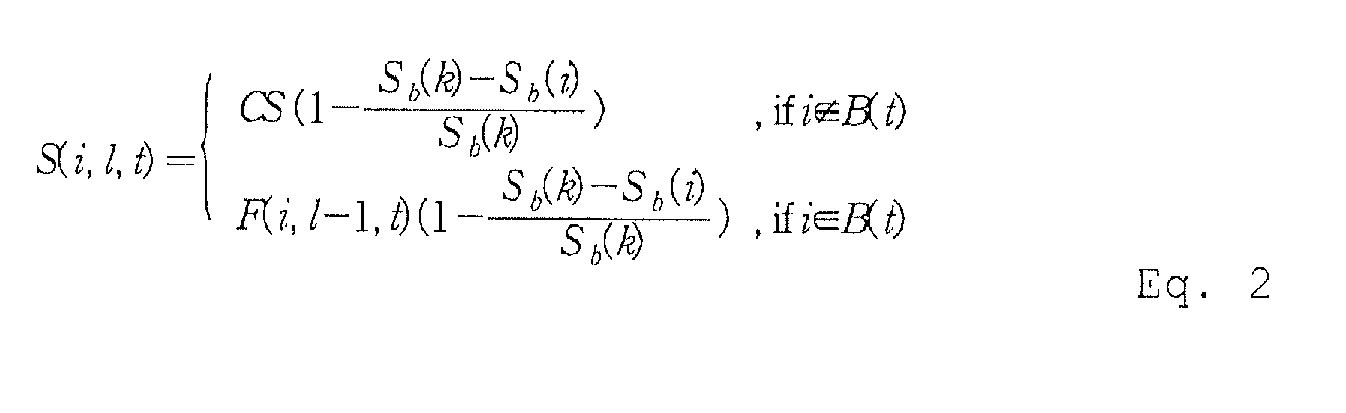
where, "CS" is a start time of a received packet; "B(t)" denotes a set of packet flows backlogged to a time t; "Sb(i)" denotes the number of transmission bits according to a modulation technique applied to an activated packet flow i; and "Sb(k)" denotes the largest number of the transmission bits among the modulation techniques. - The apparatus of any one of claims 1 to 7, wherein in selecting of the queue according to region in the queue controller, when a channel error state is sensed in a state that the weather condition of the region corresponding to the packet destination is poor, a queue according to region for transmitting the packet is selected based on Equation 3, expressed as

where, "CS" is a start time of a received packet; "B(t)" denotes a set of packet flows backlogged to a time t; "Sb(i)" denotes the number of transmission bits according to a modulation technique applied to an activated packet flow i; and "Sb(k)" denotes the largest number of the transmission bits among the modulation techniques. - The apparatus of any one of claims 1 to 8, wherein in selecting of the queue according to region and the queue according to class corresponding to the queue according to region in the queue controller, the queue according to class to be provided is selected based on Dynamic Start-time Fair Queueing (D-STFQ).
- The apparatus of one of claims 1 to 9, wherein in selection of the queue according to region in the queue controller, when the weather condition of the region corresponding to the queue according to region is poor, a queue according to class for transmitting the packet is selected based on Equation 4, expressed as

where, "CS" is a start time of a received packet; "B(t)" denotes a set of packet flows backlogged to a time t; "Sb(i)" denotes the number of transmission bits according to a modulation technique applied to an activated packet flow i; and "Sb(k)" denotes the largest number of the transmission bits among the modulation techniques. - The apparatus of claim 10, wherein in selection of the queue according to class in the queue controller, the Equation 4 is applied only to a packet requiring an expedited forwarding (EF) service level stored in the queue according to class.
- A hierarchical channel-adaptive packet scheduling method in a packet scheduling apparatus hierarchically having at least one hierarchical queue according to class and at least one queue according to region in a satellite network, comprising the steps of:a) checking whether a queue is empty when a packet is transmitted from a specific terminal;b) when the queue is empty, calculating a service start time by activating the queue and storing a packet by selecting a queue according to region corresponding to a destination of the packet;c) in a state that the packet is stored in the queue, selecting a queue according to class corresponding to a child node through service competition between brother nodes up to a parent node at the highest level with respect to the queue; andd) transmitting the packet stored in the selected queue to a receiving device through a satellite channel.
- The method of claim 12, wherein in the class queue selecting step c), when the satellite channel state is in a bad state, a queue according to class, which is a class queue, is selected based on Dynamic Start-time Fair Queueing (D-STFQ) to secure packet transmission requiring a level of an expedited forwarding (EF) service level.
- The method of claim 12 or 13, wherein in the class queue selecting step c), a queue according to class to be allocated with a service authority by using the STFQ is determined based on a weight, which is differently given to each class queue.
- The method of one of claims 12 to 14, wherein in the process for determining the queue class to be allocated with the service authority, when the class queue corresponds to the region queue where a satellite channel error occurs, a weight on an EF class is changed in order to limit a packet transmission rate requiring the EF service level.
Applications Claiming Priority (1)
| Application Number | Priority Date | Filing Date | Title |
|---|---|---|---|
| KR1020060096276A KR100826526B1 (en) | 2006-09-29 | 2006-09-29 | Hierarchical Channel Adaptive Packet Scheduler in Satellite Network and Its Method |
Publications (1)
| Publication Number | Publication Date |
|---|---|
| EP1906578A2 true EP1906578A2 (en) | 2008-04-02 |
Family
ID=38984471
Family Applications (1)
| Application Number | Title | Priority Date | Filing Date |
|---|---|---|---|
| EP07117255A Withdrawn EP1906578A2 (en) | 2006-09-29 | 2007-09-26 | Hierarchical channel adaptive packet scheduling apparatus and method for satellite networks |
Country Status (2)
| Country | Link |
|---|---|
| EP (1) | EP1906578A2 (en) |
| KR (1) | KR100826526B1 (en) |
Cited By (9)
| Publication number | Priority date | Publication date | Assignee | Title |
|---|---|---|---|---|
| WO2009130700A1 (en) * | 2008-04-22 | 2009-10-29 | Shiron Satellite Communications (1996) Ltd. | Method and apparatus for compensation for weather-based attenuation in a satellite link |
| WO2009130701A1 (en) * | 2008-04-22 | 2009-10-29 | Shiron Satellite Communications (1996) Ltd. | Method and apparatus for compensation for weather-based attenuation in a satellite link |
| US8131212B2 (en) | 2007-04-23 | 2012-03-06 | Elbit Systems Land and C41—Tadiran Ltd. | Method and apparatus for compensation for weather-based attenuation in a satellite link |
| US8726133B2 (en) | 2010-12-21 | 2014-05-13 | Electronics And Telecommunications Research Institute | Method for detecting return link packet error in hub which communicates with satellite terminal and apparatus thereof |
| US8787263B2 (en) | 2011-11-08 | 2014-07-22 | Electronics And Telecommunications Research Institute | Apparatus and method for estimating channel based on weather data |
| CN104219169A (en) * | 2014-09-30 | 2014-12-17 | 杭州华三通信技术有限公司 | CBQ (Class Based Queuing) scheduling method and device |
| WO2018067392A1 (en) * | 2016-10-06 | 2018-04-12 | Hughes Network Systems, Llc | Method and system in a satellite network for offering subscriber service levels based on signal fade by adaptive modulation and coding. |
| WO2018231215A1 (en) * | 2017-06-14 | 2018-12-20 | Higher Ground Llc | A spatial router with dynamic queues |
| US10742309B2 (en) | 2017-06-14 | 2020-08-11 | Higher Ground Llc | Spatial router with dynamic queues |
Families Citing this family (2)
| Publication number | Priority date | Publication date | Assignee | Title |
|---|---|---|---|---|
| KR101687047B1 (en) | 2012-08-22 | 2016-12-15 | 한국전자통신연구원 | Adaptive coding modulation apparatus and method of forward link in satellite communication |
| US10582262B2 (en) | 2016-06-30 | 2020-03-03 | At&T Intellectual Property I, L.P. | Satellite video content delivery system |
Family Cites Families (1)
| Publication number | Priority date | Publication date | Assignee | Title |
|---|---|---|---|---|
| ITTO20020858A1 (en) * | 2002-10-04 | 2004-04-05 | Rai Radiotelevisione Italiana | DVB / MPEG DIGITAL SIGNAL TRANSMISSION SYSTEM, ESPECIALLY FOR SATELLITE COMMUNICATIONS |
-
2006
- 2006-09-29 KR KR1020060096276A patent/KR100826526B1/en not_active Expired - Fee Related
-
2007
- 2007-09-26 EP EP07117255A patent/EP1906578A2/en not_active Withdrawn
Cited By (13)
| Publication number | Priority date | Publication date | Assignee | Title |
|---|---|---|---|---|
| US8131212B2 (en) | 2007-04-23 | 2012-03-06 | Elbit Systems Land and C41—Tadiran Ltd. | Method and apparatus for compensation for weather-based attenuation in a satellite link |
| WO2009130700A1 (en) * | 2008-04-22 | 2009-10-29 | Shiron Satellite Communications (1996) Ltd. | Method and apparatus for compensation for weather-based attenuation in a satellite link |
| WO2009130701A1 (en) * | 2008-04-22 | 2009-10-29 | Shiron Satellite Communications (1996) Ltd. | Method and apparatus for compensation for weather-based attenuation in a satellite link |
| US8655270B2 (en) | 2008-04-22 | 2014-02-18 | Elbit Systems Land and C41—Tadiran Ltd. | Method and apparatus for compensation for weather-based attenuation in a satellite link |
| US8693946B2 (en) | 2008-04-22 | 2014-04-08 | Elbit Systems Land and C41—Tadiran Ltd. | Method and apparatus for compensation for weather-based attenuation in a satellite link |
| US8726133B2 (en) | 2010-12-21 | 2014-05-13 | Electronics And Telecommunications Research Institute | Method for detecting return link packet error in hub which communicates with satellite terminal and apparatus thereof |
| US8787263B2 (en) | 2011-11-08 | 2014-07-22 | Electronics And Telecommunications Research Institute | Apparatus and method for estimating channel based on weather data |
| CN104219169A (en) * | 2014-09-30 | 2014-12-17 | 杭州华三通信技术有限公司 | CBQ (Class Based Queuing) scheduling method and device |
| CN104219169B (en) * | 2014-09-30 | 2017-11-10 | 新华三技术有限公司 | Class-based queue CBQ dispatching methods and equipment |
| WO2018067392A1 (en) * | 2016-10-06 | 2018-04-12 | Hughes Network Systems, Llc | Method and system in a satellite network for offering subscriber service levels based on signal fade by adaptive modulation and coding. |
| US10193764B2 (en) | 2016-10-06 | 2019-01-29 | Hughes Network Systems, Llc | Method and system for offering subscriber service plans by adaptive coding and modulation used |
| WO2018231215A1 (en) * | 2017-06-14 | 2018-12-20 | Higher Ground Llc | A spatial router with dynamic queues |
| US10742309B2 (en) | 2017-06-14 | 2020-08-11 | Higher Ground Llc | Spatial router with dynamic queues |
Also Published As
| Publication number | Publication date |
|---|---|
| KR100826526B1 (en) | 2008-04-30 |
| KR20080030331A (en) | 2008-04-04 |
Similar Documents
| Publication | Publication Date | Title |
|---|---|---|
| EP1906578A2 (en) | Hierarchical channel adaptive packet scheduling apparatus and method for satellite networks | |
| US6366761B1 (en) | Priority-based bandwidth allocation and bandwidth-on-demand in a low-earth-orbit satellite data communication network | |
| US6381228B1 (en) | Onboard control of demand assigned multiple access protocol for satellite ATM networks | |
| US6370117B1 (en) | Channel allocation methods in a communication network and corresponding system | |
| US20170099675A1 (en) | Method for transmitting data packets switched between a random access channel (rach) and a demand assigned multiple access (dama) channel | |
| CN111835394B (en) | Multi-ground-station cooperative satellite channel attenuation resisting system and method | |
| EP1037398B1 (en) | A hierarchical downlink scheduler for a processing satellite payload | |
| US20100058406A1 (en) | System and method for content communication | |
| Tropea et al. | Design of a two-stage scheduling scheme for dvb-s2/s2x satellite architecture | |
| CN113395100A (en) | Cross-layer design for closed loop feedback in wireless networks | |
| US7817643B2 (en) | System and method for varying the scheduling of real time protocol (RTP) packets | |
| US9560551B2 (en) | Quality of service packet scheduler design | |
| US20040202181A1 (en) | Burst reservation multiple access scheme with free abd demand bandwidth assignment (brma-fd) | |
| Chiti et al. | QoS provisioning in GEO satellite with onboard processing using predictor algorithms | |
| US9036468B1 (en) | Flow congestion management | |
| Iuoras et al. | An IP‐based satellite communication system architecture for interactive multimedia services | |
| Tropea et al. | Two step based QoS scheduler for DVB-S2 satellite system | |
| Eom et al. | Call admission control for QoS provisioning in multimedia wireless ATM networks | |
| Kota | Multimedia satellite networks: Issues and challenges | |
| Açar et al. | Performance study of end‐to‐end resource management in ATM geostationary satellite networks with on‐board processing | |
| Park et al. | Two-step scheduling scheme to support fairness and QoS in DVB-S2 system. | |
| Fadel et al. | Dedicated Bandwidth Approach for Channel Allocation in a Multi-Service Up/Down Link of a Low Earth Orbit Satellite Constellation | |
| Andreadis et al. | Proposal of a packet access scheme to integrate isochronous and data bursty traffic in low earth orbit-mobile satellite systems | |
| Blefari-Melazzi et al. | Improving the efficiency of circuit-switched satellite networks by means of dynamic bandwidth allocation capabilities | |
| Palade et al. | Requirements for a new resource reservation model in hybrid access wireless network |
Legal Events
| Date | Code | Title | Description |
|---|---|---|---|
| PUAI | Public reference made under article 153(3) epc to a published international application that has entered the european phase |
Free format text: ORIGINAL CODE: 0009012 |
|
| AK | Designated contracting states |
Kind code of ref document: A2 Designated state(s): AT BE BG CH CY CZ DE DK EE ES FI FR GB GR HU IE IS IT LI LT LU LV MC MT NL PL PT RO SE SI SK TR |
|
| AX | Request for extension of the european patent |
Extension state: AL BA HR MK YU |
|
| STAA | Information on the status of an ep patent application or granted ep patent |
Free format text: STATUS: THE APPLICATION HAS BEEN WITHDRAWN |
|
| 18W | Application withdrawn |
Effective date: 20140813 |