EP1886246B1 - Visual code method for camera-equipped mobile devices - Google Patents
Visual code method for camera-equipped mobile devices Download PDFInfo
- Publication number
- EP1886246B1 EP1886246B1 EP05756209A EP05756209A EP1886246B1 EP 1886246 B1 EP1886246 B1 EP 1886246B1 EP 05756209 A EP05756209 A EP 05756209A EP 05756209 A EP05756209 A EP 05756209A EP 1886246 B1 EP1886246 B1 EP 1886246B1
- Authority
- EP
- European Patent Office
- Prior art keywords
- image
- visual code
- code
- mobile device
- visual
- Prior art date
- Legal status (The legal status is an assumption and is not a legal conclusion. Google has not performed a legal analysis and makes no representation as to the accuracy of the status listed.)
- Revoked
Links
Images


Classifications
-
- G—PHYSICS
- G06—COMPUTING OR CALCULATING; COUNTING
- G06K—GRAPHICAL DATA READING; PRESENTATION OF DATA; RECORD CARRIERS; HANDLING RECORD CARRIERS
- G06K7/00—Methods or arrangements for sensing record carriers, e.g. for reading patterns
- G06K7/10—Methods or arrangements for sensing record carriers, e.g. for reading patterns by electromagnetic radiation, e.g. optical sensing; by corpuscular radiation
- G06K7/14—Methods or arrangements for sensing record carriers, e.g. for reading patterns by electromagnetic radiation, e.g. optical sensing; by corpuscular radiation using light without selection of wavelength, e.g. sensing reflected white light
-
- G—PHYSICS
- G06—COMPUTING OR CALCULATING; COUNTING
- G06K—GRAPHICAL DATA READING; PRESENTATION OF DATA; RECORD CARRIERS; HANDLING RECORD CARRIERS
- G06K19/00—Record carriers for use with machines and with at least a part designed to carry digital markings
- G06K19/06—Record carriers for use with machines and with at least a part designed to carry digital markings characterised by the kind of the digital marking, e.g. shape, nature, code
- G06K19/06009—Record carriers for use with machines and with at least a part designed to carry digital markings characterised by the kind of the digital marking, e.g. shape, nature, code with optically detectable marking
- G06K19/06037—Record carriers for use with machines and with at least a part designed to carry digital markings characterised by the kind of the digital marking, e.g. shape, nature, code with optically detectable marking multi-dimensional coding
-
- G—PHYSICS
- G06—COMPUTING OR CALCULATING; COUNTING
- G06K—GRAPHICAL DATA READING; PRESENTATION OF DATA; RECORD CARRIERS; HANDLING RECORD CARRIERS
- G06K7/00—Methods or arrangements for sensing record carriers, e.g. for reading patterns
- G06K7/10—Methods or arrangements for sensing record carriers, e.g. for reading patterns by electromagnetic radiation, e.g. optical sensing; by corpuscular radiation
- G06K7/14—Methods or arrangements for sensing record carriers, e.g. for reading patterns by electromagnetic radiation, e.g. optical sensing; by corpuscular radiation using light without selection of wavelength, e.g. sensing reflected white light
- G06K7/1404—Methods for optical code recognition
- G06K7/1408—Methods for optical code recognition the method being specifically adapted for the type of code
- G06K7/1417—2D bar codes
-
- G—PHYSICS
- G06—COMPUTING OR CALCULATING; COUNTING
- G06K—GRAPHICAL DATA READING; PRESENTATION OF DATA; RECORD CARRIERS; HANDLING RECORD CARRIERS
- G06K7/00—Methods or arrangements for sensing record carriers, e.g. for reading patterns
- G06K7/10—Methods or arrangements for sensing record carriers, e.g. for reading patterns by electromagnetic radiation, e.g. optical sensing; by corpuscular radiation
- G06K7/14—Methods or arrangements for sensing record carriers, e.g. for reading patterns by electromagnetic radiation, e.g. optical sensing; by corpuscular radiation using light without selection of wavelength, e.g. sensing reflected white light
- G06K7/1404—Methods for optical code recognition
- G06K7/1439—Methods for optical code recognition including a method step for retrieval of the optical code
- G06K7/1443—Methods for optical code recognition including a method step for retrieval of the optical code locating of the code in an image
-
- G—PHYSICS
- G06—COMPUTING OR CALCULATING; COUNTING
- G06K—GRAPHICAL DATA READING; PRESENTATION OF DATA; RECORD CARRIERS; HANDLING RECORD CARRIERS
- G06K7/00—Methods or arrangements for sensing record carriers, e.g. for reading patterns
- G06K7/10—Methods or arrangements for sensing record carriers, e.g. for reading patterns by electromagnetic radiation, e.g. optical sensing; by corpuscular radiation
- G06K7/14—Methods or arrangements for sensing record carriers, e.g. for reading patterns by electromagnetic radiation, e.g. optical sensing; by corpuscular radiation using light without selection of wavelength, e.g. sensing reflected white light
- G06K7/1404—Methods for optical code recognition
- G06K7/1439—Methods for optical code recognition including a method step for retrieval of the optical code
- G06K7/1456—Methods for optical code recognition including a method step for retrieval of the optical code determining the orientation of the optical code with respect to the reader and correcting therefore
Definitions
- the present invention relates to the field of decoding machine readable codes utilizing camera-equipped mobile devices. More specifically, the present invention discloses a proprietary visual code which is capable of being decoded and utilized by virtually any camera-equipped mobile device.
- Barcodes have been utilized for identifying and pricing objects for more than thirty years, Most typically, barcodes are used in retail to identify the item of merchandise. For example, a gallon of milk may contain a barcode that, when scanned, will notify the cashier of the price of the milk.
- the visual code system should be able to be decoded from a wide range of angles and distances for use in different applications.
- a method of decoding a visual code according to the precharacterising portion of claim 1 is disclosed in US-B2-6604682 .
- a method of decoding a visual code is characterised by those features set out in the characterising portion of claim 1.
- Enhancing mobile devices in this manner is promising, because they are in constant reach of their users and are thus available in many everyday situations. They provide continuous wireless connectivity, and models with integrated cameras are becoming more and more popular. The ability to detect objects in the user's immediate vicinity strengthens the role of mobile phones in m-commerce, education, and gaming scenarios. Additionally, it offers a natural way of interaction and makes data entry more convenient.
- the claimed method may provide a basis for superimposing textual or graphical information over the camera image in near real-time, providing the user with the sense of "augmented reality".
- This allows for a wide assortment of application possibilities in situations where information is to be closely linked to physical objects.
- An example is the maintenance of devices or apparatuses in the field.
- individual parts of an apparatus may be associated with different visual codes.
- graphical information By decoding different visual codes, graphical information, which is aligned with the items in the image, can be superimposed over the camera image. Further application possibilities include showing maintenance instructions, ordering spare parts, checking a maintenance schedule, etc.
- the method of the present invention preferably includes built-in orientation-independent coordinate system, rotation angle determination, tilting determination, and distance determination that enable a large number of applications, such as item selection and form entry.
- the recognition algorithm may precisely determine the coordinates of a targeted point relative to the coordinate system that is defined by the visual code.
- the coordinates may be independent of the orientation, tilting, or rotation of the visual code in the camera image. This allows the application to associate each point on the viewed image (and therefore arbitrarily shaped areas) with information and with specific operations. In this manner, a single visual code can be associated with multiple such areas (e.g., the individual cells of a table or elements and regions of an image).
- the recognition algorithm may provide a rotation angle of the visual code in the camera image as an additional input parameter. This can be employed to simplify the interaction with the mobile device. Simply by changing the orientation of the mobile device, different information is displaced, without requiring any interactions via the keypad. Horizontal and vertical tilting may be used was an additional input parameter in the same manner as described above (i.e., associating different information with different tilting angles).
- the mapping between the image coordinate system and the code coordinate system may also be used to un-warp projective distortion in the camera image, which allows the automatic capture of form elements. Individual fields of the printed form may be un-warped to remove the distortion and thus prepare them for further processing, such as transmitting them to an online server.
- the gap between the physical world surrounding the user and the virtual world is narrowed by offering a natural way of "picking up" data in everyday situations.
- Mobile phones are in an excellent position to contribute to this vision, because they are ubiquitously available devices, constantly within reach of the user.
- the short interaction time required for recognizing codes is crucial for usability in a mobile setting. It does not require much effort on behalf of the user and takes just a few seconds.
- the proposed 2-dimensional codes are also suitable for display on electronic screens, such as computer monitors, TV screens, public wall displays, and even on the tiny screens of handheld devices.
- Questionnaires, surveys, and polls on TV could be realized by overlaying visual codes over the screen image.
- This idea also has commercial implications.
- the music company Polydor used SMS as a mobile response channel in a TV spot advertising a CD. Viewers could order the CD via SMS prior to the official release date, which immediately increased sales figures. Again, using visual codes, the response ratio might be substantially increased.
- Camera-equipped mobile phones are not only capable of retrieving an object ID, but can also be used for more complex forms of interaction.
- Our code recognition system may also provide the phone's orientation, amount of rotation, and coordinates of the image center.
- the present invention preferably provides a visual code system which utilizes an orientation-independent coordinate system that is defined by a visual code and the associated recognition algorithm that determines the coordinates of a targeted point in the camera image relative to that coordinate system.
- the present invention also preferably provides a visual code system which associates multiple regions of an image with a single code, wherein each region is linked to different online information and operation associated with the different regions.
- the invention also preferably provides a visual code system which includes a rotation determination feature, a vertical and horizontal tilting determination feature, and a distance determination feature, which allows different rotation, tilting, and distance values to be associated with different information.
- the invention further preferably utilizes a visual code system for item selection, information display in textual, graphical (e.g. on the screen of the mobile device or on a nearby electronic display), auditory (e.g., via the mobile device's speaker, headset or earphone), or tactile form (e.g., via phone vibration), and triggering specific operations.
- a visual code system for item selection information display in textual, graphical (e.g. on the screen of the mobile device or on a nearby electronic display), auditory (e.g., via the mobile device's speaker, headset or earphone), or tactile form (e.g., via phone vibration), and triggering specific operations.
- textual or graphical feedback is superimposed on the camera image itself and correctly aligned ("registered") with the items present in the image, thereby giving the user a sense of "augmented reality.”
- a visual code system is used in conjunction with printed forms for convenient data entry.
- Visual code 101 consists of large guide bar 103 and small guide bar 105 for determining the location and orientation of visual code 101, three cornerstones 107, 109, and 111, for detecting distortion and the data area with the actual code bits.
- the displayed version of visual code 101 has a capacity of 83 bits, but its design is generic and suitable for extension to a larger number of bits. Visual code 101 can be reliably located even in a low quality image which is small and tilted.
- Visual code 101 may be printed utilizing either standard ink or infrared ink. If infrared ink is utilized to print visual code 101, the digital camera must be capable of identifying infrared images. Infrared ink has the advantage that visual code 101 would not be visible to the naked eye. Therefore, if the algorithm of the present invention were constantly running in the background whenever the digital camera of a mobile device was being used, the decoding of visual code 101 could be utilized to make certain information appear.
- the three cornerstones 107, 109, and 111 define the coordinate system induced by the code. Cornerstone 107 is located at the origin, or position (0,0). Similarly, cornerstone 109 is said to be located at position (10,0) while cornerstone 111 is located at position (0,10). In this coordinate system, the center of large guide bar 103 is located at position (10,5) while the center of small guide bar 105 is located at position (8,10).
- the code requires a white space of a single code element around the code (1 unit in the code coordinate system). Multiple visual codes may be printed next to each other, for example arranged in a grid. A white space of a single code element around two neighboring codes (1 unit in the code coordinate system) is required.
- step 201 the image captured by the digital camera is corrected for radial distortion in step 201.
- the image obtained from the digital camera typically shows some amount of barrel distortion.
- radial lens distortion is less an issue with newer phone cameras, especially if the code only occupies a small area of the image. It is corrected by shifting each pixel radially towards the center of the image. The displacement only depends on the distance of the pixel from the image center and not on the particular image to be corrected.
- Step 201 is optional, because a single visual code typically only covers a small area of the camera image. In this case, radial lens distortion is not significant. However, for some applications, like those involving precise selection of items in the camera image, this step may increase accuracy.
- An adaptive method is taken to produce a black-and-white version of the gray scaled image, because the brightness of the camera image is not constant and the printed code may be unevenly illuminated.
- the algorithm uses a (weighted) moving average of the gray values while traversing the image in a snake-like fashion.
- T n ⁇ 1 , if p n ⁇ g s n s ⁇ 100 - t 100 0 , otherwise
- the algorithm next attempts to identify and label the different regions of the image in step 205.
- This step consists of finding regions of neighboring black pixels, counting them, and assigning a number to each.
- the algorithm used is a well known two-phase method. In the first phase, the image is traversed row by row, assigning preliminary labels to the regions found. During this process, it may happen that two regions with different labels turn out to be in fact the same region. In this case, the equivalence of the two temporary labels is stored in a table. The second phase resolves the equivalences by merging the corresponding regions and assigns a final label to each region.
- the algorithm calculates the different regions' shapes and orientations in step 207.
- the notion of second-order moments is used.
- the algorithm performs the step of locating and evaluating the visual codes in step 209. Locating codes in the image is done by looking for guide bar candidates and by finding corresponding cornerstones. Guide bar candidates are found by simply selecting those regions which have a small enough axis ratio (e.g. below 0.05). For each of these candidates, the size and orientation of the region is used to estimate the expected positions of small guide bar 105 and the three cornerstones 107, 109, and 111. It is then checked whether these features are actually present at the estimated positions. Cornerstone candidates found are only accepted if their axis ratio is above a certain limit (as stated earlier, theoretically they should have a ratio equal to one). If any of the code features (cornerstones 107, 109, and 111, and small guide bar 105) is not present for some guide bar candidate, this particular candidate is abandoned and the next one is examined.
- a small enough axis ratio e.g. below 0.05
- the algorithm computes the projective mapping from code coordinates to image coordinates (and the inverse mapping from image coordinates to code coordinates) in step 303.
- the algorithm assumes that this is indeed a code in the image and starts to read the encoded bits. To that end, the bit positions in the image must be determined, i.e. one needs a function that maps each code bit to an image pixel. Since the code elements are coplanar, there exists a unique homography (projective transformation matrix) between the code plane and the image plane.
- the projective mapping can be calculated once four corresponding points are known. In the algorithm, the correspondences are the centers of the three cornerstones 107, 109, and 111 plus the center of the small guide bar 105. This induces a code coordinate system with its origin at the upper left corner of the code.
- the code coordinates of the upper left cornerstone 107, the upper right cornerstone 109, large guide bar 103, and the lower left cornerstone 111 are defined to be at (0,0), (10,0), (8,10), and (0,10). It is assumed that these elements have been found at image coordinates (X i , Y i ) , i ⁇ ⁇ 0, ..., 3 ⁇ , respectively.
- the algorithm next computes the rotation angle of the visual code in the image in step 305. It takes on values between 0° and 359°. A code that has the same orientation as the image has rotation angle 0°.
- the rotation is determined by mapping the points (0,0) and (100,0) from the code coordinate system to the image coordinate system, resulting in the image points (a x , a y ), and (b x , b y ).
- the algorithm next determines the horizontal and vertical tilting in step 307.
- tilt denotes the amount of inclination of the image plane relative to the code plane.
- Horizontal tilting is the amount of inclination of the image plane relative to the horizontal axis of the visual code.
- vertical tilting denotes the amount of inclination of the image plane relative to the vertical axis of the visual code. A tilting value of 1 means no tilting, a value less than 1 means tilting towards the left/top, and a value greater than 1 means tilting towards the right/bottom.
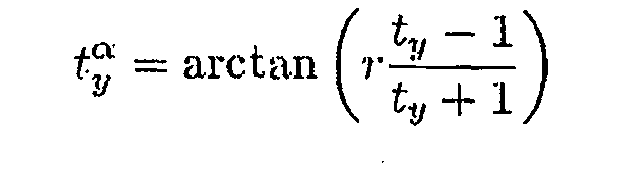
- the tilting parameters are computed as follows: Four image points with constant distance h (image height) from the image center point in the axis directions of the code coordinate system are computed. They are mapped to corresponding code coordinates and their distances to the center point are computed. The ratios of these distances determine the tilting parameters t x and t y . They are independent of the size of the code in the image. From these ratios the tilting angles t x ⁇ and St y ⁇ can be determined, if a constant r is known that depends on the camera parameters. It can be obtained experimentally.
- the metric distance can still be computed from d camera,code .
- steps 303, 305, 307, 308, and 309 can be performed in any order because each step is discrete and outputs a different parameter or result.
- the algorithm reads the encoded bits in step 309 by simply testing the appropriate pixels (x,y) of the black-and-white image, using code coordinates (u,v) with u, v ⁇ ⁇ 0, ..., 10 ⁇ and (x,y) - ImageCoordinates((u,v)).
- Error detection may optionally be performed in step 311.
- the (83,76,3) linear code employed encodes a 76-bit ID to an 83-bit codeword.
- the resulting hamming distance is three, which should be sufficient to identify wrong codes with a high probability.
- other error detecting or error correcting codes such as Reed-Solomon codes, might be used for increased reliability and robustness against bit errors. This might come at the expense of slightly higher processing times and a lower number of bits actually available for data storage.
- 15 bits of the raw 83 bits might be used for Reed-Solomon error correcting codes, leaving 68 bits for data storage.
- the recognition algorithm provides the orientation of the mobile device relative to the code.
- the algorithm provides the rotation of the code in the image, the viewing position (from left, from right, from top, from bottom), the amount of tilting of the image plane relative to the code plane, and the distance from the code to the camera.
- the projective mapping plane homography between the image plane and the code plane that the recognition algorithm implements, allows the mapping of arbitrary points given in image coordinates to corresponding points in code coordinates and vice versa.
- the code coordinate system and the orientation determination features enable a number of interesting application scenarios involving the selection of items in printed documents.
- An example is the selection of articles depicted in printed mail-order catalogs.
- a single code is sufficient as long as the code coordinates of the items are known. This can be achieved by content creation software that creates "image maps" for the code and its associated sensitive areas.
- Articles in mail-order catalogs can thus be scanned, stored in the mobile device, and current information concerning the articles can be retrieved. The order can then be placed using the wireless communication channel provided by the mobile device.
- FIG. 4 shown is an example of a printed document containing visual codes.
- the regions on the map and the entries in the table are individually mapped to different URLs and thus associated to online content.
- FIG. 4 shows a cut-out of a newspaper page containing a geographic map with the current weather data and a table containing the snow heights for various regions.
- the dotted lines drawn on the newspaper page indicate sensitive areas that are individually linked to online content.
- Such a mapping can be created with suitable content creation software.
- mapping tool which allows to draw the areas into the image and to specify the associated URL for each region.
- the tool computes the coordinates of these areas in the coordinate systems of the codes present in the image, and stores this data as an XML file.
- Multiple URLs can be specified for each region by taking into account further parameters that are provided by the code system, such as rotation and tilting. As shown in FIG. 4 , a single code suffices to select the area and table entries, respectively.
- rotation and tilting As shown in FIG. 4 , a single code suffices to select the area and table entries, respectively.
- visual codes can be used in mobile marketing to automate the input of coupon numbers into the mobile device.
- SMS campaigns of soft-drink producers The soft-drink bottles contain numbers (represented by visual codes), which can be sent as an SMS and thus allow the participation in lotteries.
- visual codes could be used for interactive input of answers to multiple choice questions in ad hoc surveys and quizzes or for the selection of candidates in a TV show.
- the code coordinates and the orientation of the device can serve as additional input parameters (in addition to the code value), for example to answer a multiple choice question.
- Telephone numbers for example, can be encoded as visual codes and printed on business cards or in phone books.
- the device either immediately calls the encoded phone number, stores the virtual business card in the device's memory, or - for mobile phone numbers - starts the device's SMS editing application.
- Parts of the device's user interface like deeply nested menus, can be externalized by associating them with a visual code and printing them on paper or showing them on a large screen.
- A. further possible application scenario of the presented invention is adding online content and operations to printed documents, like flyers, magazines, etc.
- An example online operation is selling tickets for events, theaters, or movies via the mobile phone.
- Fig. 5 shows a page of a printed television magazine, which is equipped with embedded visual codes.
- movie plot outlines can be shown, a list of the cast can be given, movie ratings can be displayed or submitted, movie trailers can be started, and tickets can be directly booked via the mobile phone.
- Visual codes can also be combined with printed forms for the simplification of form input, in which the mobile device provides a wireless communication channel for conveniently and cheaply sending back the entered data.
- the fields of these forms can be check boxes, rulers, and canvas fields for free-hand textual or graphical input.
- the individual form elements can be precisely localized. The projective mapping of the recognition algorithm allows to "unwarp" parts of the image as well as the image as a whole.
- Fig. 6 shows an example form for the entry of calendar events.
- the recognition algorithm first recognizes the code and locates the edges of the frame. Then the checkboxes located in the form are scanned for check marks. Finally, the canvas fields are "unwarped", i.e. their tilting is removed as shown in the lower part of Fig. 6 , and stored.
- a markup language which describes the structure of a form, including the positions and kinds of input elements it contains.
- the code is first used as a key to retrieve the form description from an online server. After interpreting the retrieved markup, user input can be categorized according to field type and sent back to the server.
Landscapes
- Physics & Mathematics (AREA)
- Engineering & Computer Science (AREA)
- Theoretical Computer Science (AREA)
- General Physics & Mathematics (AREA)
- Toxicology (AREA)
- Artificial Intelligence (AREA)
- Computer Vision & Pattern Recognition (AREA)
- Electromagnetism (AREA)
- Health & Medical Sciences (AREA)
- General Health & Medical Sciences (AREA)
- Image Processing (AREA)
- Image Analysis (AREA)
- User Interface Of Digital Computer (AREA)
- Fittings On The Vehicle Exterior For Carrying Loads, And Devices For Holding Or Mounting Articles (AREA)
- Studio Devices (AREA)
- Telephone Function (AREA)
- Closed-Circuit Television Systems (AREA)
- Air Bags (AREA)
Abstract
Description
- The present invention relates to the field of decoding machine readable codes utilizing camera-equipped mobile devices. More specifically, the present invention discloses a proprietary visual code which is capable of being decoded and utilized by virtually any camera-equipped mobile device.
- Barcodes have been utilized for identifying and pricing objects for more than thirty years, Most typically, barcodes are used in retail to identify the item of merchandise. For example, a gallon of milk may contain a barcode that, when scanned, will notify the cashier of the price of the milk.
- Yet in recent years, barcodes have acquired new purposes as computers and barcode scanners have become more portable. The circuitry required to scan a conventional one-dimensional barcode can now be housed in a device as small as a typical keychain. As a result, many mobile telephones, personal digital assistants ("PDAs"), and pagers can be retrofitted with or connected to a laser-based scanning device. This allows the mobile device to function as a scanner capable of storing hundreds or thousands of scanned barcodes.
- Mobile devices with attached scanners have allowed for the development of a new niche in the wireless electronics business. Some companies have developed software and hardware which allows a user to scan any barcode and be redirected to media information (e.g., a website, product description, price, etc.) about the scanned product. These programs provide a link between the physical and online world which previously, did not exist.
- However, mobile devices with attached scanners possess some drawbacks which have curtailed their expansion into the mobile marketplace. First, there are few mobile devices produced for the general public that contain integrated laser-based scanners. Therefore, for a user to acquire scanning capability for a mobile device, he/she must purchase additional equipment. The additional scanning equipment also adds size and weight to the mobile device, thereby reducing its mobility.
- Currently, many cell phones and mobile devices are available with built-in cameras. The explosion of the availability of affordable digital cameras and their inclusion into mobile devices is driven by several factors. One of the most important is the recent availability of inexpensive image sensors based on CMOS technology. The cameras on these devices provide a means for capturing the barcode information which was previously only accessible via a laser-based scanner. Decoding barcodes images from digital cameras included in mobile devices presents several difficult problems. These problems go well beyond the challenges addressed in commercial barcode readers.
- Therefore, there clearly exists a need for a visual code system which is capable of being decoded on a camera-equipped mobile device. The visual code system should be able to be decoded from a wide range of angles and distances for use in different applications.
- A method of decoding a visual code according to the precharacterising portion of
claim 1 is disclosed inUS-B2-6604682 . - According to the present invention a method of decoding a visual code is characterised by those features set out in the characterising portion of
claim 1. - Enhancing mobile devices in this manner is promising, because they are in constant reach of their users and are thus available in many everyday situations. They provide continuous wireless connectivity, and models with integrated cameras are becoming more and more popular. The ability to detect objects in the user's immediate vicinity strengthens the role of mobile phones in m-commerce, education, and gaming scenarios. Additionally, it offers a natural way of interaction and makes data entry more convenient.
- The claimed method may provide a basis for superimposing textual or graphical information over the camera image in near real-time, providing the user with the sense of "augmented reality". This allows for a wide assortment of application possibilities in situations where information is to be closely linked to physical objects.
An example is the maintenance of devices or apparatuses in the field. For example, individual parts of an apparatus may be associated with different visual codes. By decoding different visual codes, graphical information, which is aligned with the items in the image, can be superimposed over the camera image. Further application possibilities include showing maintenance instructions, ordering spare parts, checking a maintenance schedule, etc. Other closely related applications include convenient order placing in mail-order catalogs, entering reference numbers in online banking applications, linking up-to-date online content to newspapers, supporting mobile marketing advertising campaigns, integration with TV commercials, vote-now, or buy-now TV spots, booking tickets for events, and simplifying interaction with the mobile device itself. - The method of the present invention preferably includes built-in orientation-independent coordinate system, rotation angle determination, tilting determination, and distance determination that enable a large number of applications, such as item selection and form entry. The recognition algorithm may precisely determine the coordinates of a targeted point relative to the coordinate system that is defined by the visual code. The coordinates may be independent of the orientation, tilting, or rotation of the visual code in the camera image. This allows the application to associate each point on the viewed image (and therefore arbitrarily shaped areas) with information and with specific operations. In this manner, a single visual code can be associated with multiple such areas (e.g., the individual cells of a table or elements and regions of an image).
- The recognition algorithm may provide a rotation angle of the visual code in the camera image as an additional input parameter. This can be employed to simplify the interaction with the mobile device. Simply by changing the orientation of the mobile device, different information is displaced, without requiring any interactions via the keypad. Horizontal and vertical tilting may be used was an additional input parameter in the same manner as described above (i.e., associating different information with different tilting angles). The mapping between the image coordinate system and the code coordinate system may also be used to un-warp projective distortion in the camera image, which allows the automatic capture of form elements. Individual fields of the printed form may be un-warped to remove the distortion and thus prepare them for further processing, such as transmitting them to an online server.
- New interaction possibilities open up when mobile phones or PDAs are enhanced to act as sensors for real-world objects. The gap between the physical world surrounding the user and the virtual world is narrowed by offering a natural way of "picking up" data in everyday situations. Information becomes collocated with physical entities and is thus situated and grounded in the real-world context. Mobile phones are in an excellent position to contribute to this vision, because they are ubiquitously available devices, constantly within reach of the user. The short interaction time required for recognizing codes is crucial for usability in a mobile setting. It does not require much effort on behalf of the user and takes just a few seconds.
- There are many application scenarios which could take advantage of using visual codes: In mail-order catalogs, items could be selected by scanning visual codes to conveniently place orders. In online banking applications, long reference codes or transaction numbers often need to be manually copied from printed forms. Visual codes and mobile phones could replace expensive dedicated devices which perform this task. In newspapers, visual codes could be used to store or rate newspaper articles, to get background information related to an advertisement, or for updates on information which quickly gets obsolete, like stock quotes and weather forecasts. Using the code coordinate system, it is possible to define printed image maps with predefined sensitive areas that are associated with online content. In this way, a single code can be associated with multiple items: For example, areas on a geographic map could be linked to weather forecasts corresponding to those regions and each row in a printed table containing stock quotes could be linked to a chart which is displayed on the phone.
- In the emerging area of mobile marketing, visual codes could be used to simplify SMS campaigns and SMS lotteries. In an advertising campaign Coca Cola printed code numbers on the labels of 160 million soft-drink bottles. By sending a number via SMS, customers got logos, ring tones, and greeting cards, and could take part in a lottery. 5.9 million SMS messages were sent, which corresponds to a response ratio of 3.7 %. Using visual codes would make the process more convenient for the user and might result in even higher attendance in such campaigns, which would be commercially very interesting.
- The proposed 2-dimensional codes are also suitable for display on electronic screens, such as computer monitors, TV screens, public wall displays, and even on the tiny screens of handheld devices. Questionnaires, surveys, and polls on TV (like selecting the best candidate of a TV show) could be realized by overlaying visual codes over the screen image. This idea also has commercial implications. The music company Polydor used SMS as a mobile response channel in a TV spot advertising a CD. Viewers could order the CD via SMS prior to the official release date, which immediately increased sales figures. Again, using visual codes, the response ratio might be substantially increased.
Camera-equipped mobile phones are not only capable of retrieving an object ID, but can also be used for more complex forms of interaction. Our code recognition system may also provide the phone's orientation, amount of rotation, and coordinates of the image center. - The present invention preferably provides a visual code system which utilizes an orientation-independent coordinate system that is defined by a visual code and the associated recognition algorithm that determines the coordinates of a targeted point in the camera image relative to that coordinate system.
- The present invention also preferably provides a visual code system which associates multiple regions of an image with a single code, wherein each region is linked to different online information and operation associated with the different regions.
- The invention also preferably provides a visual code system which includes a rotation determination feature, a vertical and horizontal tilting determination feature, and a distance determination feature, which allows different rotation, tilting, and distance values to be associated with different information.
- The invention further preferably utilizes a visual code system for item selection, information display in textual, graphical (e.g. on the screen of the mobile device or on a nearby electronic display), auditory (e.g., via the mobile device's speaker, headset or earphone), or tactile form (e.g., via phone vibration), and triggering specific operations.
- In another application, textual or graphical feedback is superimposed on the camera image itself and correctly aligned ("registered") with the items present in the image, thereby giving the user a sense of "augmented reality."
- In yet another application, a visual code system is used in conjunction with printed forms for convenient data entry.
-
-
FIG. 1 depicts an example of the visual code and its novel features. -
FIG. 2 depicts a flowchart showing the steps utilized by a camera-equipped mobile device to decode a visual code. -
FIG. 3 depicts a flowchart showing the steps utilised by the code location step ofFIG. 2 . -
FIG. 4 depicts an example of a printed document containing visual codes. -
FIG. 5 depicts another example of a printed document containing visual codes. -
Fig. 6 depicts an example form for the entry of calendar events. - The following presents a detailed description of a preferred embodiment (as well as some alternative embodiments) of the present invention. However, it should be apparent to one skilled in the art that the described embodiment may be modified in form and content to be optimized for a wide variety of situations.
- With reference first to
FIG. 1 , shown is an example ofvisual code 101 utilized in the present invention.Visual code 101 consists oflarge guide bar 103 andsmall guide bar 105 for determining the location and orientation ofvisual code 101, threecornerstones visual code 101 has a capacity of 83 bits, but its design is generic and suitable for extension to a larger number of bits.Visual code 101 can be reliably located even in a low quality image which is small and tilted. -
Visual code 101 may be printed utilizing either standard ink or infrared ink. If infrared ink is utilized to printvisual code 101, the digital camera must be capable of identifying infrared images. Infrared ink has the advantage thatvisual code 101 would not be visible to the naked eye. Therefore, if the algorithm of the present invention were constantly running in the background whenever the digital camera of a mobile device was being used, the decoding ofvisual code 101 could be utilized to make certain information appear. - The three
cornerstones Cornerstone 107 is located at the origin, or position (0,0). Similarly,cornerstone 109 is said to be located at position (10,0) whilecornerstone 111 is located at position (0,10). In this coordinate system, the center oflarge guide bar 103 is located at position (10,5) while the center ofsmall guide bar 105 is located at position (8,10). The code requires a white space of a single code element around the code (1 unit in the code coordinate system). Multiple visual codes may be printed next to each other, for example arranged in a grid. A white space of a single code element around two neighboring codes (1 unit in the code coordinate system) is required. - Next, with reference to
FIG. 2 , shown is a flowchart depicting the steps utilized by a camera-equipped mobile device to decodevisual code 101. First, the image captured by the digital camera is corrected for radial distortion instep 201. The image obtained from the digital camera typically shows some amount of barrel distortion. However, radial lens distortion is less an issue with newer phone cameras, especially if the code only occupies a small area of the image. It is corrected by shifting each pixel radially towards the center of the image. The displacement only depends on the distance of the pixel from the image center and not on the particular image to be corrected. The following correction function produces adequate results (w and h are the pixel width and pixel height of the image, respectively, r is the distance from the image center, and κ is a constant that reflects the amount of radial distortion of the lens):


For the integrated camera of the Nokia 7650, κ = 6×10⁻⁷ was found acceptable by manual testing. For the newer Nokia 6600, 7610, and 6630, no correction was necessary. Even for the Nokia 7650, code recognition works without correction. - Step 201 is optional, because a single visual code typically only covers a small area of the camera image. In this case, radial lens distortion is not significant. However, for some applications, like those involving precise selection of items in the camera image, this step may increase accuracy.
- Next, the image undergoes grayscaling and adaptive thresholding in
step 203 because the three color channels in the image often differ in their sharpness and contrast quality. Therefore, the algorithm uses the formula gray = (red + green) / 2 instead of the more straightforward version gray = (red + green + blue) / 3 or the ITU-standardized formula for luminance Y = 0.2126 red + 0.7152 green + 0.0722 blue. This formula is computationally efficient and produces an adequate starting point for thresholding. - An adaptive method is taken to produce a black-and-white version of the gray scaled image, because the brightness of the camera image is not constant and the printed code may be unevenly illuminated. The algorithm uses a (weighted) moving average of the gray values while traversing the image in a snake-like fashion. The average gs(n) is updated according to the formula:

with Pn denoting the gray value of the current pixel and s the width of the moving average. gs is initialized with
The color of the thresholded pixel T(n) is then chosen based on the formula:
The recommended values for t and s are t=15 and
- After the image has undergone grayscaling in
step 203, the algorithm next attempts to identify and label the different regions of the image instep 205. This step consists of finding regions of neighboring black pixels, counting them, and assigning a number to each. The algorithm used is a well known two-phase method. In the first phase, the image is traversed row by row, assigning preliminary labels to the regions found. During this process, it may happen that two regions with different labels turn out to be in fact the same region. In this case, the equivalence of the two temporary labels is stored in a table. The second phase resolves the equivalences by merging the corresponding regions and assigns a final label to each region. - Next, the algorithm calculates the different regions' shapes and orientations in
step 207. In order to identify candidates for orientation bars among the regions found, the notion of second-order moments is used. The second-order moments of a region consisting of the set of pixels R and having the center of gravity (x̅,y̅) are defined as follows:


where,

From these moments, an ellipsis E = {(x,y) | dx2+2exy+fy2 ≤ 1} that has the same major and minor axis as the region can be defined by setting:
The ratio of the lengths of the major and the minor axis is a good measure for the "eccentricity" of the region: perfect circles and squares have a ratio equal to one whereas line segments have a ratio close to zero. This is very useful for identifying regions with a bar-like shape. Furthermore, the orientation vector of the major axis of the region can be calculated as:
where
- Once the shapes and orientations of the different regions have been identified, the algorithm performs the step of locating and evaluating the visual codes in
step 209. Locating codes in the image is done by looking for guide bar candidates and by finding corresponding cornerstones. Guide bar candidates are found by simply selecting those regions which have a small enough axis ratio (e.g. below 0.05). For each of these candidates, the size and orientation of the region is used to estimate the expected positions ofsmall guide bar 105 and the threecornerstones cornerstones - Now, with reference to
FIG. 3 , shown is a flowchart showing the steps utilized bycode location step 209 ofFIG. 2 . First, the algorithm computes the projective mapping from code coordinates to image coordinates (and the inverse mapping from image coordinates to code coordinates) instep 303. Once a guide bar candidate with all code features has been found, the algorithm assumes that this is indeed a code in the image and starts to read the encoded bits. To that end, the bit positions in the image must be determined, i.e. one needs a function that maps each code bit to an image pixel. Since the code elements are coplanar, there exists a unique homography (projective transformation matrix) between the code plane and the image plane. The projective mapping can be calculated once four corresponding points are known. In the algorithm, the correspondences are the centers of the threecornerstones small guide bar 105. This induces a code coordinate system with its origin at the upper left corner of the code. - The code coordinates of the upper
left cornerstone 107, the upperright cornerstone 109,large guide bar 103, and the lowerleft cornerstone 111 are defined to be at (0,0), (10,0), (8,10), and (0,10). It is assumed that these elements have been found at image coordinates (Xi, Yi) , i ∈ {0, ..., 3}, respectively. A code coordinate (u,v), u,v ∈ {0, ..., 10}, is mapped to image coordinate (x,y), where
The parameters a to h are calculated from the four reference points (xi, yi), i ∈ {0, ..., 3}, as follows:


The inverse mapping to the one described above is important for applications which select items visible in the image. Given a pixel coordinate, its corresponding coordinate in the coordinate system induced by the code can thus be obtained. An image coordinate (x,y) is mapped to a code coordinate (u,v) as follows:
with


- The algorithm next computes the rotation angle of the visual code in the image in
step 305. It takes on values between 0° and 359°. A code that has the same orientation as the image has rotation angle 0°. The rotation is determined by mapping the points (0,0) and (100,0) from the code coordinate system to the image coordinate system, resulting in the image points (ax, ay), and (bx, by). The rotation angle is then determined as:
though several special cases have to be considered. - After the rotation angle of the visual code has been computed, the algorithm next determines the horizontal and vertical tilting in
step 307. The term "tilting" denotes the amount of inclination of the image plane relative to the code plane. "Horizontal tilting" is the amount of inclination of the image plane relative to the horizontal axis of the visual code. Analogously, "vertical tilting" denotes the amount of inclination of the image plane relative to the vertical axis of the visual code. A tilting value of 1 means no tilting, a value less than 1 means tilting towards the left/top, and a value greater than 1 means tilting towards the right/bottom. The tilting parameters are computed as follows: Four image points with constant distance h (image height) from the image center point in the axis directions of the code coordinate system are computed. They are mapped to corresponding code coordinates and their distances to the center point are computed. The ratios of these distances determine the tilting parameters tx and ty. They are independent of the size of the code in the image. From these ratios the tilting angles tx α and Sty α can be determined, if a constant r is known that depends on the camera parameters. It can be obtained experimentally. - i = image coordinates of the image center point
- c = CodeCoordinates(i)


- Next, in
step 308, the algorithm computes the distance of the code from the camera. If the real code size sreal (the distance between the centers of the upper left and the upper right cornerstones of the printed code) and the camera's focal distance f are known, then the metric distance from the camera to the untilted visual code can be computed from simage (the pixel distance between the centers of the upper cornerstones in the camera image) using the pinhole model as (wimage is the pixel width of the image)
- Since sreal and f are typically not known and we want to use the code distance for interaction purposes rather than measuring its exact value, we define the distance in terms of the size of the visual code in the image. We set dcamera,code := 100 for the farthest distance at which a code is recognized in view finder mode. For typical devices this is the case when simage = 25 pixels, which amounts to 15.625% of the image width. Hence the distance is computed as

- Should sreal and f be known, the metric distance can still be computed from dcamera,code.
- It should be obvious to one skilled in the art that steps 303, 305, 307, 308, and 309 can be performed in any order because each step is discrete and outputs a different parameter or result.
- Once the positions of the guide bars 103 and 105 and
cornerstones step 309 by simply testing the appropriate pixels (x,y) of the black-and-white image, using code coordinates (u,v) with u, v ∈ {0, ..., 10} and (x,y) - ImageCoordinates((u,v)). - Error detection may optionally be performed in
step 311. The (83,76,3) linear code employed encodes a 76-bit ID to an 83-bit codeword. The resulting hamming distance is three, which should be sufficient to identify wrong codes with a high probability. Alternatively, other error detecting or error correcting codes, such as Reed-Solomon codes, might be used for increased reliability and robustness against bit errors. This might come at the expense of slightly higher processing times and a lower number of bits actually available for data storage. As an example, 15 bits of the raw 83 bits might be used for Reed-Solomon error correcting codes, leaving 68 bits for data storage. - In addition to the code coordinate of the image center, the recognition algorithm provides the orientation of the mobile device relative to the code. In particular, the algorithm provides the rotation of the code in the image, the viewing position (from left, from right, from top, from bottom), the amount of tilting of the image plane relative to the code plane, and the distance from the code to the camera. The projective mapping (planar homography) between the image plane and the code plane that the recognition algorithm implements, allows the mapping of arbitrary points given in image coordinates to corresponding points in code coordinates and vice versa.
- The code coordinate system and the orientation determination features enable a number of interesting application scenarios involving the selection of items in printed documents. An example is the selection of articles depicted in printed mail-order catalogs. A single code is sufficient as long as the code coordinates of the items are known. This can be achieved by content creation software that creates "image maps" for the code and its associated sensitive areas. Articles in mail-order catalogs can thus be scanned, stored in the mobile device, and current information concerning the articles can be retrieved. The order can then be placed using the wireless communication channel provided by the mobile device.
- For example, in
FIG. 4 , shown is an example of a printed document containing visual codes. The regions on the map and the entries in the table are individually mapped to different URLs and thus associated to online content. - In newspapers, online background information to articles, advertisements, or information which quickly gets obsolete, like weather forecasts or stock quotes, can be linked via visual codes. By using the code coordinate system, a single code located near several items of interest suffices. The exact area aimed at, like the local weather forecast, can be determined via the projective mapping by computing the vertical and horizontal distances to the visual code element. In a table of stock quotes, the row and column aimed at, and thus the desired information, can be obtained in the same manner.
FIG. 4 shows a cut-out of a newspaper page containing a geographic map with the current weather data and a table containing the snow heights for various regions. The dotted lines drawn on the newspaper page indicate sensitive areas that are individually linked to online content. Such a mapping can be created with suitable content creation software. As a prototype, we developed a mapping tool which allows to draw the areas into the image and to specify the associated URL for each region. The tool computes the coordinates of these areas in the coordinate systems of the codes present in the image, and stores this data as an XML file. Multiple URLs can be specified for each region by taking into account further parameters that are provided by the code system, such as rotation and tilting. As shown inFIG. 4 , a single code suffices to select the area and table entries, respectively. By rotating the mobile device, different aspects of the online information can be chosen: In the example, vertical orientation shows the snow depth for the selected area, while a slight rotation shows the current temperature. - As another application, visual codes can be used in mobile marketing to automate the input of coupon numbers into the mobile device. An example are SMS campaigns of soft-drink producers: The soft-drink bottles contain numbers (represented by visual codes), which can be sent as an SMS and thus allow the participation in lotteries. On TV, visual codes could be used for interactive input of answers to multiple choice questions in ad hoc surveys and quizzes or for the selection of candidates in a TV show. The code coordinates and the orientation of the device can serve as additional input parameters (in addition to the code value), for example to answer a multiple choice question.
- Further application possibilities concern simplifying the interaction with the mobile device itself. Telephone numbers, for example, can be encoded as visual codes and printed on business cards or in phone books. Depending on the orientation of the code in the image, the device either immediately calls the encoded phone number, stores the virtual business card in the device's memory, or - for mobile phone numbers - starts the device's SMS editing application. Parts of the device's user interface, like deeply nested menus, can be externalized by associating them with a visual code and printing them on paper or showing them on a large screen.
- A. further possible application scenario of the presented invention is adding online content and operations to printed documents, like flyers, magazines, etc. An example online operation is selling tickets for events, theaters, or movies via the mobile phone.
-
Fig. 5 . shows a page of a printed television magazine, which is equipped with embedded visual codes. By aiming at the printed visual codes, movie plot outlines can be shown, a list of the cast can be given, movie ratings can be displayed or submitted, movie trailers can be started, and tickets can be directly booked via the mobile phone. - Visual codes can also be combined with printed forms for the simplification of form input, in which the mobile device provides a wireless communication channel for conveniently and cheaply sending back the entered data. The fields of these forms can be check boxes, rulers, and canvas fields for free-hand textual or graphical input. Using the frame surrounding the form as a marker, the individual form elements can be precisely localized. The projective mapping of the recognition algorithm allows to "unwarp" parts of the image as well as the image as a whole.
-
Fig. 6 shows an example form for the entry of calendar events. The recognition algorithm first recognizes the code and locates the edges of the frame. Then the checkboxes located in the form are scanned for check marks. Finally, the canvas fields are "unwarped", i.e. their tilting is removed as shown in the lower part ofFig. 6 , and stored. - To define the forms, a markup language is used, which describes the structure of a form, including the positions and kinds of input elements it contains. The code is first used as a key to retrieve the form description from an online server. After interpreting the retrieved markup, user input can be categorized according to field type and sent back to the server.
Claims (24)
- A method of decoding a visual code (101) comprising:(a) capturing an image including a visual code which is associated with multiple regions of the image, each region having a shape ;(b) greyscaling the image;(c) thresholding the image;(d) locating and evaluating the visual code (101) within the image;(e) calculating the shapes of regions of interest within the image that are associated with the visual code (101);
the method being characterised in that:(f) the image is captured using a mobile device equipped with a digital camera;(g) each said region is associated with respective URL online information;
and further characterised by:(h) determining an orientation of the mobile device relative to the visual code and the regions when aiming to a selected region; and(i) displaying said information for the selected region on the mobile device in dependence upon the device orientation. - A method according to claim 1 further including correcting the image for radial lens distortion prior to greyscaling.
- A method according to claim 1 further including:computing a first projective mapping of the visual code (101) from an image coordinate system to a visual code coordinate system;computing a second projective mapping of the visual code (101) from the visual code coordinate system to the image coordinate system;computing a rotation angle of the visual code (101);computing horizontal and vertical tilting values of the visual code (101);computing a distance of the visual code (101) from the mobile device; andreading the encoded bits in the visual code (101).
- A method according to claim 3, further including performing error detection on the visual code (101).
- A method according to claim 3, wherein the visual code consists of three cornerstones (107,109,111), a small guide bar (105), and a large guide bar (103).
- A method according to claim 5, wherein an individual visual code is located by identifying the cornerstones (107,109,111), the small guide bar (105), and the large guide bar (103).
- A method according to claim 3, wherein the visual code consists of three cornerstones (107,109,111), a small guide bar (105), and a large guide bar (103), and wherein an orientation of the small guide bar and the large guide bar are used when computing the rotation angle of the visual code (101), computing the distance of the visual code, and computing the tilt of the visual code.
- A method according to claim 1, wherein, greyscaling the image is performed by calculating the value of each greyscale pixel by averaging the value of red and green pixels.
- A method according to claim 8, wherein the grayscale image is converted to a black and white image using a weight-moving average algorithm.
- A method according to claim 3, wherein the small guide bar (105) and the large guide bar (103) are identified by locating regions of the image which have an axis ratio within a predetermined range.
- A method according to claim 5, wherein the three cornerstones (107, 109, 111) and the large guide bar (103) are located at position (0, 0), (10, 0) and (0,10), and wherein the centre of the large guide bar is located at position (8,10) in the visual code coordinate system.
- A method according to claim 3, wherein at least one of the rotation angle, horizontal tilting value, vertical tilting angle, and distance of the visual code (101) is used to select options from a menu.
- A method according to claim 5, wherein multiple visual codes are arranged in a grid to store data across multiple visual codes, and further including identifying the grid of codes.
- A method according to claim 1, wherein the decoding occurs in real-time.
- A method according to claim 3, wherein the orientation of the mobile device is utilised as a parameter to select an entry from a database.
- A method according to claim 15, wherein the database associates different uniform resource locators with at least one orientation value.
- A method according to claim 15, wherein the database associates the orientation angles with form entries, thereby allowing a use of the mobile device to select entries from a form by altering the orientation of the mobile device.
- A method according to claim 15, wherein, the database associates the orientation angles with a move plot outline, a video clip, an audio file, or a movie review.
- A method according to claim 1, wherein the visual code (101) is printed using infrared ink and wherein the digital camera is an infrared camera which captures the visual code as an infrared visual code.
- A method according to claim 3, wherein a target point, expressed in the visual code coordinate systems of an image displayed on a screen of the camera, is used as a parameter to select an entry from a database.
- A method according to claim 14, further including a graphical overlay over an image displayed on a screen of the camera, wherein the overlayed graphic is geometrically aligned with objects in the displayed image as the mobile device moves and the orientation changes.
- A method according to claim 1, wherein pointing the digital camera at the visual code (101) is facilitated by a cross hair that is displayed on a screen of the mobile device.
- A method according to claim 22, wherein the screen of the mobile device is a touch screen, and wherein the position of the cross hair may be specified by using a stylus to specify a target point.
- A method according to claim 4, wherein the error detection is performed using Reed-Solomon error detection.
Applications Claiming Priority (2)
| Application Number | Priority Date | Filing Date | Title |
|---|---|---|---|
| US10517005A | 2005-04-13 | 2005-04-13 | |
| PCT/US2005/019178 WO2006112866A2 (en) | 2005-04-13 | 2005-05-28 | Visual code system for camera-equipped mobile devices and applications thereof |
Publications (3)
| Publication Number | Publication Date |
|---|---|
| EP1886246A2 EP1886246A2 (en) | 2008-02-13 |
| EP1886246A4 EP1886246A4 (en) | 2009-06-17 |
| EP1886246B1 true EP1886246B1 (en) | 2011-07-06 |
Family
ID=37115600
Family Applications (1)
| Application Number | Title | Priority Date | Filing Date |
|---|---|---|---|
| EP05756209A Revoked EP1886246B1 (en) | 2005-04-13 | 2005-05-28 | Visual code method for camera-equipped mobile devices |
Country Status (11)
| Country | Link |
|---|---|
| EP (1) | EP1886246B1 (en) |
| JP (1) | JP4764920B2 (en) |
| CN (1) | CN101099161B (en) |
| AT (1) | ATE515751T1 (en) |
| AU (1) | AU2005330700A1 (en) |
| BR (1) | BRPI0520326A2 (en) |
| CA (1) | CA2604476A1 (en) |
| DK (1) | DK1886246T3 (en) |
| ES (1) | ES2369143T3 (en) |
| MX (1) | MX2007012767A (en) |
| WO (1) | WO2006112866A2 (en) |
Cited By (2)
| Publication number | Priority date | Publication date | Assignee | Title |
|---|---|---|---|---|
| WO2014107681A1 (en) * | 2013-01-04 | 2014-07-10 | Awyse, Inc. | System and method for providing augmented reality on mobile devices |
| EP3770866A1 (en) | 2019-07-25 | 2021-01-27 | Spirtech | Method for identifying and linking a target terminal close to a rotating object from a plurality of terminals with wireless communication range with the portable object |
Families Citing this family (59)
| Publication number | Priority date | Publication date | Assignee | Title |
|---|---|---|---|---|
| US10319181B2 (en) * | 2006-11-10 | 2019-06-11 | Aristocrat Technologies Australia Pty, Ltd. | Systems and methods for verification using encoded glyphs |
| US20090240598A1 (en) * | 2008-03-24 | 2009-09-24 | Kargman James B | Method and apparatus for automated ordering and payment |
| US10757308B2 (en) | 2009-03-02 | 2020-08-25 | Flir Systems, Inc. | Techniques for device attachment with dual band imaging sensor |
| US10244190B2 (en) | 2009-03-02 | 2019-03-26 | Flir Systems, Inc. | Compact multi-spectrum imaging with fusion |
| US9756264B2 (en) | 2009-03-02 | 2017-09-05 | Flir Systems, Inc. | Anomalous pixel detection |
| US9843742B2 (en) | 2009-03-02 | 2017-12-12 | Flir Systems, Inc. | Thermal image frame capture using de-aligned sensor array |
| US9517679B2 (en) | 2009-03-02 | 2016-12-13 | Flir Systems, Inc. | Systems and methods for monitoring vehicle occupants |
| US9635285B2 (en) | 2009-03-02 | 2017-04-25 | Flir Systems, Inc. | Infrared imaging enhancement with fusion |
| US9948872B2 (en) | 2009-03-02 | 2018-04-17 | Flir Systems, Inc. | Monitor and control systems and methods for occupant safety and energy efficiency of structures |
| US9998697B2 (en) | 2009-03-02 | 2018-06-12 | Flir Systems, Inc. | Systems and methods for monitoring vehicle occupants |
| US9451183B2 (en) | 2009-03-02 | 2016-09-20 | Flir Systems, Inc. | Time spaced infrared image enhancement |
| US9986175B2 (en) | 2009-03-02 | 2018-05-29 | Flir Systems, Inc. | Device attachment with infrared imaging sensor |
| USD765081S1 (en) | 2012-05-25 | 2016-08-30 | Flir Systems, Inc. | Mobile communications device attachment with camera |
| US9473681B2 (en) | 2011-06-10 | 2016-10-18 | Flir Systems, Inc. | Infrared camera system housing with metalized surface |
| US9674458B2 (en) | 2009-06-03 | 2017-06-06 | Flir Systems, Inc. | Smart surveillance camera systems and methods |
| WO2012170946A2 (en) | 2011-06-10 | 2012-12-13 | Flir Systems, Inc. | Low power and small form factor infrared imaging |
| US9235876B2 (en) | 2009-03-02 | 2016-01-12 | Flir Systems, Inc. | Row and column noise reduction in thermal images |
| US9208542B2 (en) | 2009-03-02 | 2015-12-08 | Flir Systems, Inc. | Pixel-wise noise reduction in thermal images |
| US20100261454A1 (en) * | 2009-04-14 | 2010-10-14 | Research In Motion Limited | Retrieving additional content based on data within a mobile code |
| US8559929B2 (en) | 2009-04-14 | 2013-10-15 | Blackberry Limited | Resolved mobile code content tracking |
| US10091439B2 (en) | 2009-06-03 | 2018-10-02 | Flir Systems, Inc. | Imager with array of multiple infrared imaging modules |
| US9819880B2 (en) | 2009-06-03 | 2017-11-14 | Flir Systems, Inc. | Systems and methods of suppressing sky regions in images |
| US9756262B2 (en) | 2009-06-03 | 2017-09-05 | Flir Systems, Inc. | Systems and methods for monitoring power systems |
| US9292909B2 (en) | 2009-06-03 | 2016-03-22 | Flir Systems, Inc. | Selective image correction for infrared imaging devices |
| US9843743B2 (en) | 2009-06-03 | 2017-12-12 | Flir Systems, Inc. | Infant monitoring systems and methods using thermal imaging |
| US9716843B2 (en) | 2009-06-03 | 2017-07-25 | Flir Systems, Inc. | Measurement device for electrical installations and related methods |
| US8079524B2 (en) * | 2009-11-30 | 2011-12-20 | Symbol Technologies, Inc. | Imaging-based scanner including border searching for image acquisition |
| US9918023B2 (en) | 2010-04-23 | 2018-03-13 | Flir Systems, Inc. | Segmented focal plane array architecture |
| US9706138B2 (en) | 2010-04-23 | 2017-07-11 | Flir Systems, Inc. | Hybrid infrared sensor array having heterogeneous infrared sensors |
| US9848134B2 (en) | 2010-04-23 | 2017-12-19 | Flir Systems, Inc. | Infrared imager with integrated metal layers |
| US9207708B2 (en) | 2010-04-23 | 2015-12-08 | Flir Systems, Inc. | Abnormal clock rate detection in imaging sensor arrays |
| WO2011154709A2 (en) | 2010-06-11 | 2011-12-15 | Rnib | Coded information systems |
| US8910870B2 (en) | 2010-08-06 | 2014-12-16 | Hand Held Products, Inc. | System and method for document processing |
| US9961277B2 (en) | 2011-06-10 | 2018-05-01 | Flir Systems, Inc. | Infrared focal plane array heat spreaders |
| US9058653B1 (en) | 2011-06-10 | 2015-06-16 | Flir Systems, Inc. | Alignment of visible light sources based on thermal images |
| US9235023B2 (en) | 2011-06-10 | 2016-01-12 | Flir Systems, Inc. | Variable lens sleeve spacer |
| US10389953B2 (en) | 2011-06-10 | 2019-08-20 | Flir Systems, Inc. | Infrared imaging device having a shutter |
| US10051210B2 (en) | 2011-06-10 | 2018-08-14 | Flir Systems, Inc. | Infrared detector array with selectable pixel binning systems and methods |
| US9143703B2 (en) | 2011-06-10 | 2015-09-22 | Flir Systems, Inc. | Infrared camera calibration techniques |
| US10169666B2 (en) | 2011-06-10 | 2019-01-01 | Flir Systems, Inc. | Image-assisted remote control vehicle systems and methods |
| CN103828343B (en) | 2011-06-10 | 2017-07-11 | 菲力尔系统公司 | Based on capable image procossing and flexible storage system |
| US9706137B2 (en) | 2011-06-10 | 2017-07-11 | Flir Systems, Inc. | Electrical cabinet infrared monitor |
| CN103875235B (en) | 2011-06-10 | 2018-10-12 | 菲力尔系统公司 | Non-uniformity Correction Technique for Infrared Imaging Device |
| US9900526B2 (en) | 2011-06-10 | 2018-02-20 | Flir Systems, Inc. | Techniques to compensate for calibration drifts in infrared imaging devices |
| US10079982B2 (en) | 2011-06-10 | 2018-09-18 | Flir Systems, Inc. | Determination of an absolute radiometric value using blocked infrared sensors |
| US9509924B2 (en) | 2011-06-10 | 2016-11-29 | Flir Systems, Inc. | Wearable apparatus with integrated infrared imaging module |
| US10841508B2 (en) | 2011-06-10 | 2020-11-17 | Flir Systems, Inc. | Electrical cabinet infrared monitor systems and methods |
| KR101870773B1 (en) * | 2011-08-31 | 2018-06-26 | 삼성전자 주식회사 | Method and apparatus for managing schedule using optical character reader |
| US9635220B2 (en) | 2012-07-16 | 2017-04-25 | Flir Systems, Inc. | Methods and systems for suppressing noise in images |
| US9811884B2 (en) | 2012-07-16 | 2017-11-07 | Flir Systems, Inc. | Methods and systems for suppressing atmospheric turbulence in images |
| US8856044B1 (en) | 2013-03-23 | 2014-10-07 | Jeffrey Drazan | Segmented access of remotely stored biographical data to a client device |
| DE102013206825B4 (en) * | 2013-04-16 | 2016-10-06 | Siemens Aktiengesellschaft | Method and apparatus for providing an additional data structure in a request for a resource |
| US9973692B2 (en) | 2013-10-03 | 2018-05-15 | Flir Systems, Inc. | Situational awareness by compressed display of panoramic views |
| TWI552082B (en) * | 2013-12-26 | 2016-10-01 | 財團法人工業技術研究院 | Tour device, tour method, and structure-code-pattern generation device |
| US11297264B2 (en) | 2014-01-05 | 2022-04-05 | Teledyne Fur, Llc | Device attachment with dual band imaging sensor |
| JP6817937B2 (en) | 2014-07-21 | 2021-01-20 | エイヴェリー デニソン リテール インフォメーション サービシズ リミテッド ライアビリティ カンパニー | Systems, methods and devices that display sensitive information in Quick Response (QR) codes |
| EP3646242A4 (en) * | 2017-06-29 | 2021-02-17 | Hewlett-Packard Development Company, L.P. | Detection of whether mobile computing device is pointing to visual code |
| DE102019211984A1 (en) * | 2019-08-09 | 2021-02-11 | Fraunhofer-Gesellschaft zur Förderung der angewandten Forschung e.V. | Device, method for controlling the same and device network or swarm |
| CN111580902B (en) * | 2020-04-20 | 2024-01-26 | 微梦创科网络科技(中国)有限公司 | Mobile terminal element positioning method and system based on picture analysis |
Family Cites Families (12)
| Publication number | Priority date | Publication date | Assignee | Title |
|---|---|---|---|---|
| US6561428B2 (en) * | 1997-10-17 | 2003-05-13 | Hand Held Products, Inc. | Imaging device having indicia-controlled image parsing mode |
| JP2000057250A (en) * | 1998-08-11 | 2000-02-25 | Kyowa Hakko Kogyo Co Ltd | 2D code reading method |
| JP2000090187A (en) * | 1998-09-09 | 2000-03-31 | Pasukaru:Kk | Two-dimensional code generating device |
| JP2000200234A (en) * | 1998-12-29 | 2000-07-18 | Pasukaru:Kk | Information inquiry system for internet using two- dimensional code handy scanner |
| JP2000309154A (en) * | 1999-04-27 | 2000-11-07 | Toppan Printing Co Ltd | Identification card |
| ES2256106T3 (en) | 2000-04-06 | 2006-07-16 | Seiko Epson Corporation | METHOD AND APPLIANCE FOR READING A TWO-DIMENSIONAL BAR CODE SYMBOL AND DATA STORAGE MEDIA. |
| US6832729B1 (en) * | 2001-03-23 | 2004-12-21 | Zih Corp. | Portable data collection device for reading fluorescent indicia |
| JP3835207B2 (en) * | 2001-06-27 | 2006-10-18 | ソニー株式会社 | Try-on image providing system, try-on image providing method, try-on image generating apparatus, and try-on image generating method |
| JP2003335085A (en) * | 2002-05-22 | 2003-11-25 | National Printing Bureau | Securities printed matter printed with a group of small symbol characters consisting of a large number of small symbol characters |
| JP3516144B1 (en) * | 2002-06-18 | 2004-04-05 | オムロン株式会社 | Optical information code reading method and optical information code reader |
| JP2004054529A (en) * | 2002-07-18 | 2004-02-19 | Sharp Corp | Two-dimensional code reading method, two-dimensional code reading program, recording medium of the two-dimensional code reading program, and two-dimensional code reading device |
| JP4301775B2 (en) * | 2002-07-18 | 2009-07-22 | シャープ株式会社 | Two-dimensional code reading device, two-dimensional code reading method, two-dimensional code reading program, and recording medium for the program |
-
2005
- 2005-05-28 MX MX2007012767A patent/MX2007012767A/en active IP Right Grant
- 2005-05-28 ES ES05756209T patent/ES2369143T3/en not_active Expired - Lifetime
- 2005-05-28 EP EP05756209A patent/EP1886246B1/en not_active Revoked
- 2005-05-28 CA CA002604476A patent/CA2604476A1/en not_active Abandoned
- 2005-05-28 DK DK05756209.2T patent/DK1886246T3/en active
- 2005-05-28 BR BRPI0520326-0A patent/BRPI0520326A2/en not_active Application Discontinuation
- 2005-05-28 AU AU2005330700A patent/AU2005330700A1/en not_active Abandoned
- 2005-05-28 CN CN200580046131.2A patent/CN101099161B/en not_active Expired - Fee Related
- 2005-05-28 JP JP2008506434A patent/JP4764920B2/en not_active Expired - Fee Related
- 2005-05-28 WO PCT/US2005/019178 patent/WO2006112866A2/en not_active Ceased
- 2005-05-28 AT AT05756209T patent/ATE515751T1/en not_active IP Right Cessation
Cited By (2)
| Publication number | Priority date | Publication date | Assignee | Title |
|---|---|---|---|---|
| WO2014107681A1 (en) * | 2013-01-04 | 2014-07-10 | Awyse, Inc. | System and method for providing augmented reality on mobile devices |
| EP3770866A1 (en) | 2019-07-25 | 2021-01-27 | Spirtech | Method for identifying and linking a target terminal close to a rotating object from a plurality of terminals with wireless communication range with the portable object |
Also Published As
| Publication number | Publication date |
|---|---|
| WO2006112866A3 (en) | 2007-02-01 |
| JP4764920B2 (en) | 2011-09-07 |
| CN101099161B (en) | 2012-06-27 |
| MX2007012767A (en) | 2008-04-09 |
| WO2006112866A8 (en) | 2008-04-10 |
| ATE515751T1 (en) | 2011-07-15 |
| CA2604476A1 (en) | 2006-10-26 |
| WO2006112866A2 (en) | 2006-10-26 |
| BRPI0520326A2 (en) | 2009-05-05 |
| DK1886246T3 (en) | 2011-10-17 |
| CN101099161A (en) | 2008-01-02 |
| EP1886246A4 (en) | 2009-06-17 |
| JP2008544336A (en) | 2008-12-04 |
| HK1113950A1 (en) | 2008-10-17 |
| EP1886246A2 (en) | 2008-02-13 |
| AU2005330700A1 (en) | 2006-10-26 |
| ES2369143T3 (en) | 2011-11-25 |
Similar Documents
| Publication | Publication Date | Title |
|---|---|---|
| EP1886246B1 (en) | Visual code method for camera-equipped mobile devices | |
| US7296747B2 (en) | Visual code system for camera-equipped mobile devices and applications thereof | |
| Rohs et al. | Using camera-equipped mobile phones for interacting with real-world objects | |
| US8879859B2 (en) | Animated image code, apparatus for generating/decoding animated image code, and method thereof | |
| US7575171B2 (en) | System and method for reliable content access using a cellular/wireless device with imaging capabilities | |
| US10650264B2 (en) | Image recognition apparatus, processing method thereof, and program | |
| US10713528B2 (en) | System for determining alignment of a user-marked document and method thereof | |
| KR20200106510A (en) | Complex code pattern, generating device, reading device, method and program | |
| US20120142322A1 (en) | Providing Location Information Using Matrix Code | |
| US20130035081A1 (en) | Semantic magazine pages | |
| WO2002025575A9 (en) | Method and apparatus for portably recognizing text in an image sequence of scene imagery | |
| US20140019378A1 (en) | Evaluation system, method, and computer-readable recording medium | |
| JP6047939B2 (en) | Evaluation system, program | |
| US20190311545A1 (en) | Augmented Reality Advertising Systems and Methods | |
| JP2010231431A (en) | Article related information providing method, apparatus, program, and recording medium | |
| HK1113950B (en) | Visual code system for camera-equipped mobile devices and applications thereof | |
| JP5929573B2 (en) | Evaluation system, program | |
| JP6019888B2 (en) | Evaluation system, information processing device | |
| Chen et al. | Research and development of application of mobile barcode to mobile sightseeing guide on mobile phone | |
| JP2014026594A (en) | Evaluation system and server device | |
| CN110580640A (en) | Information pushing and receiving method, terminal, data processing server and system | |
| KR20120007727A (en) | Ss code and related services that are recognized by camera sensors or typed directly by the user | |
| GB2424109A (en) | Graphical code sets | |
| Maurya | Using quick response codes for consumer-initiated marketing communication strategy | |
| JP2014021771A (en) | Evaluation system, and program |
Legal Events
| Date | Code | Title | Description |
|---|---|---|---|
| PUAI | Public reference made under article 153(3) epc to a published international application that has entered the european phase |
Free format text: ORIGINAL CODE: 0009012 |
|
| 17P | Request for examination filed |
Effective date: 20071004 |
|
| AK | Designated contracting states |
Kind code of ref document: A2 Designated state(s): AT BE BG CH CY CZ DE DK EE ES FI FR GB GR HU IE IS IT LI LT LU MC NL PL PT RO SE SI SK TR |
|
| R17D | Deferred search report published (corrected) |
Effective date: 20080410 |
|
| DAX | Request for extension of the european patent (deleted) | ||
| A4 | Supplementary search report drawn up and despatched |
Effective date: 20090515 |
|
| 17Q | First examination report despatched |
Effective date: 20090814 |
|
| GRAJ | Information related to disapproval of communication of intention to grant by the applicant or resumption of examination proceedings by the epo deleted |
Free format text: ORIGINAL CODE: EPIDOSDIGR1 |
|
| GRAP | Despatch of communication of intention to grant a patent |
Free format text: ORIGINAL CODE: EPIDOSNIGR1 |
|
| GRAP | Despatch of communication of intention to grant a patent |
Free format text: ORIGINAL CODE: EPIDOSNIGR1 |
|
| RTI1 | Title (correction) |
Free format text: VISUAL CODE METHOD FOR CAMERA-EQUIPPED MOBILE DEVICES |
|
| RAP1 | Party data changed (applicant data changed or rights of an application transferred) |
Owner name: SCANBUY, INC. |
|
| RIN1 | Information on inventor provided before grant (corrected) |
Inventor name: ROHS, MICHAEL Inventor name: GFELLER, BEAT |
|
| GRAS | Grant fee paid |
Free format text: ORIGINAL CODE: EPIDOSNIGR3 |
|
| GRAA | (expected) grant |
Free format text: ORIGINAL CODE: 0009210 |
|
| AK | Designated contracting states |
Kind code of ref document: B1 Designated state(s): AT BE BG CH CY CZ DE DK EE ES FI FR GB GR HU IE IS IT LI LT LU MC NL PL PT RO SE SI SK TR |
|
| REG | Reference to a national code |
Ref country code: GB Ref legal event code: FG4D |
|
| REG | Reference to a national code |
Ref country code: CH Ref legal event code: EP |
|
| REG | Reference to a national code |
Ref country code: IE Ref legal event code: FG4D |
|
| REG | Reference to a national code |
Ref country code: DE Ref legal event code: R096 Ref document number: 602005028881 Country of ref document: DE Effective date: 20110901 |
|
| REG | Reference to a national code |
Ref country code: CH Ref legal event code: NV Representative=s name: KIRKER & CIE S.A. |
|
| REG | Reference to a national code |
Ref country code: DK Ref legal event code: T3 |
|
| REG | Reference to a national code |
Ref country code: SE Ref legal event code: TRGR |
|
| REG | Reference to a national code |
Ref country code: NL Ref legal event code: VDEP Effective date: 20110706 |
|
| REG | Reference to a national code |
Ref country code: ES Ref legal event code: FG2A Ref document number: 2369143 Country of ref document: ES Kind code of ref document: T3 Effective date: 20111125 |
|
| PG25 | Lapsed in a contracting state [announced via postgrant information from national office to epo] |
Ref country code: SI Free format text: LAPSE BECAUSE OF FAILURE TO SUBMIT A TRANSLATION OF THE DESCRIPTION OR TO PAY THE FEE WITHIN THE PRESCRIBED TIME-LIMIT Effective date: 20110706 |
|
| REG | Reference to a national code |
Ref country code: AT Ref legal event code: MK05 Ref document number: 515751 Country of ref document: AT Kind code of ref document: T Effective date: 20110706 |
|
| PG25 | Lapsed in a contracting state [announced via postgrant information from national office to epo] |
Ref country code: FI Free format text: LAPSE BECAUSE OF FAILURE TO SUBMIT A TRANSLATION OF THE DESCRIPTION OR TO PAY THE FEE WITHIN THE PRESCRIBED TIME-LIMIT Effective date: 20110706 Ref country code: BE Free format text: LAPSE BECAUSE OF FAILURE TO SUBMIT A TRANSLATION OF THE DESCRIPTION OR TO PAY THE FEE WITHIN THE PRESCRIBED TIME-LIMIT Effective date: 20110706 Ref country code: NL Free format text: LAPSE BECAUSE OF FAILURE TO SUBMIT A TRANSLATION OF THE DESCRIPTION OR TO PAY THE FEE WITHIN THE PRESCRIBED TIME-LIMIT Effective date: 20110706 Ref country code: PT Free format text: LAPSE BECAUSE OF FAILURE TO SUBMIT A TRANSLATION OF THE DESCRIPTION OR TO PAY THE FEE WITHIN THE PRESCRIBED TIME-LIMIT Effective date: 20111107 Ref country code: IS Free format text: LAPSE BECAUSE OF FAILURE TO SUBMIT A TRANSLATION OF THE DESCRIPTION OR TO PAY THE FEE WITHIN THE PRESCRIBED TIME-LIMIT Effective date: 20111106 Ref country code: LT Free format text: LAPSE BECAUSE OF FAILURE TO SUBMIT A TRANSLATION OF THE DESCRIPTION OR TO PAY THE FEE WITHIN THE PRESCRIBED TIME-LIMIT Effective date: 20110706 |
|
| PG25 | Lapsed in a contracting state [announced via postgrant information from national office to epo] |
Ref country code: GR Free format text: LAPSE BECAUSE OF FAILURE TO SUBMIT A TRANSLATION OF THE DESCRIPTION OR TO PAY THE FEE WITHIN THE PRESCRIBED TIME-LIMIT Effective date: 20111007 Ref country code: PL Free format text: LAPSE BECAUSE OF FAILURE TO SUBMIT A TRANSLATION OF THE DESCRIPTION OR TO PAY THE FEE WITHIN THE PRESCRIBED TIME-LIMIT Effective date: 20110706 Ref country code: CY Free format text: LAPSE BECAUSE OF FAILURE TO SUBMIT A TRANSLATION OF THE DESCRIPTION OR TO PAY THE FEE WITHIN THE PRESCRIBED TIME-LIMIT Effective date: 20110706 Ref country code: AT Free format text: LAPSE BECAUSE OF FAILURE TO SUBMIT A TRANSLATION OF THE DESCRIPTION OR TO PAY THE FEE WITHIN THE PRESCRIBED TIME-LIMIT Effective date: 20110706 |
|
| PLBI | Opposition filed |
Free format text: ORIGINAL CODE: 0009260 |
|
| 26 | Opposition filed |
Opponent name: BUNDESDRUCKEREI GMBH Effective date: 20120308 |
|
| PG25 | Lapsed in a contracting state [announced via postgrant information from national office to epo] |
Ref country code: CZ Free format text: LAPSE BECAUSE OF FAILURE TO SUBMIT A TRANSLATION OF THE DESCRIPTION OR TO PAY THE FEE WITHIN THE PRESCRIBED TIME-LIMIT Effective date: 20110706 Ref country code: SK Free format text: LAPSE BECAUSE OF FAILURE TO SUBMIT A TRANSLATION OF THE DESCRIPTION OR TO PAY THE FEE WITHIN THE PRESCRIBED TIME-LIMIT Effective date: 20110706 |
|
| PLAX | Notice of opposition and request to file observation + time limit sent |
Free format text: ORIGINAL CODE: EPIDOSNOBS2 |
|
| PG25 | Lapsed in a contracting state [announced via postgrant information from national office to epo] |
Ref country code: RO Free format text: LAPSE BECAUSE OF FAILURE TO SUBMIT A TRANSLATION OF THE DESCRIPTION OR TO PAY THE FEE WITHIN THE PRESCRIBED TIME-LIMIT Effective date: 20110706 Ref country code: EE Free format text: LAPSE BECAUSE OF FAILURE TO SUBMIT A TRANSLATION OF THE DESCRIPTION OR TO PAY THE FEE WITHIN THE PRESCRIBED TIME-LIMIT Effective date: 20110706 |
|
| REG | Reference to a national code |
Ref country code: DE Ref legal event code: R026 Ref document number: 602005028881 Country of ref document: DE Effective date: 20120308 |
|
| PG25 | Lapsed in a contracting state [announced via postgrant information from national office to epo] |
Ref country code: MC Free format text: LAPSE BECAUSE OF NON-PAYMENT OF DUE FEES Effective date: 20120531 |
|
| REG | Reference to a national code |
Ref country code: DE Ref legal event code: R119 Ref document number: 602005028881 Country of ref document: DE Effective date: 20121201 |
|
| PG25 | Lapsed in a contracting state [announced via postgrant information from national office to epo] |
Ref country code: DE Free format text: LAPSE BECAUSE OF NON-PAYMENT OF DUE FEES Effective date: 20121201 Ref country code: BG Free format text: LAPSE BECAUSE OF FAILURE TO SUBMIT A TRANSLATION OF THE DESCRIPTION OR TO PAY THE FEE WITHIN THE PRESCRIBED TIME-LIMIT Effective date: 20111006 |
|
| PGFP | Annual fee paid to national office [announced via postgrant information from national office to epo] |
Ref country code: IE Payment date: 20130528 Year of fee payment: 9 Ref country code: CH Payment date: 20130530 Year of fee payment: 9 Ref country code: DK Payment date: 20130528 Year of fee payment: 9 Ref country code: SE Payment date: 20130530 Year of fee payment: 9 |
|
| PG25 | Lapsed in a contracting state [announced via postgrant information from national office to epo] |
Ref country code: TR Free format text: LAPSE BECAUSE OF FAILURE TO SUBMIT A TRANSLATION OF THE DESCRIPTION OR TO PAY THE FEE WITHIN THE PRESCRIBED TIME-LIMIT Effective date: 20110706 |
|
| PG25 | Lapsed in a contracting state [announced via postgrant information from national office to epo] |
Ref country code: LU Free format text: LAPSE BECAUSE OF NON-PAYMENT OF DUE FEES Effective date: 20120528 |
|
| PG25 | Lapsed in a contracting state [announced via postgrant information from national office to epo] |
Ref country code: HU Free format text: LAPSE BECAUSE OF FAILURE TO SUBMIT A TRANSLATION OF THE DESCRIPTION OR TO PAY THE FEE WITHIN THE PRESCRIBED TIME-LIMIT Effective date: 20050528 |
|
| PGFP | Annual fee paid to national office [announced via postgrant information from national office to epo] |
Ref country code: GB Payment date: 20140626 Year of fee payment: 10 |
|
| RDAF | Communication despatched that patent is revoked |
Free format text: ORIGINAL CODE: EPIDOSNREV1 |
|
| PGFP | Annual fee paid to national office [announced via postgrant information from national office to epo] |
Ref country code: ES Payment date: 20140626 Year of fee payment: 10 |
|
| PGFP | Annual fee paid to national office [announced via postgrant information from national office to epo] |
Ref country code: FR Payment date: 20140630 Year of fee payment: 10 |
|
| RDAG | Patent revoked |
Free format text: ORIGINAL CODE: 0009271 |
|
| STAA | Information on the status of an ep patent application or granted ep patent |
Free format text: STATUS: PATENT REVOKED |
|
| REG | Reference to a national code |
Ref country code: CH Ref legal event code: PLX |
|
| PGFP | Annual fee paid to national office [announced via postgrant information from national office to epo] |
Ref country code: IT Payment date: 20140627 Year of fee payment: 10 |
|
| REG | Reference to a national code |
Ref country code: DK Ref legal event code: EBP Effective date: 20140531 |
|
| 27W | Patent revoked |
Effective date: 20140830 |
|
| GBPR | Gb: patent revoked under art. 102 of the ep convention designating the uk as contracting state |
Effective date: 20140830 |
|
| PG25 | Lapsed in a contracting state [announced via postgrant information from national office to epo] |
Ref country code: LI Free format text: LAPSE BECAUSE OF THE APPLICANT RENOUNCES Effective date: 20110706 Ref country code: CH Free format text: LAPSE BECAUSE OF THE APPLICANT RENOUNCES Effective date: 20110706 |
|
| REG | Reference to a national code |
Ref country code: SE Ref legal event code: ECNC |
|
| PG25 | Lapsed in a contracting state [announced via postgrant information from national office to epo] |
Ref country code: DK Free format text: LAPSE BECAUSE OF NON-PAYMENT OF DUE FEES Effective date: 20140531 |
|
| REG | Reference to a national code |
Ref country code: SE Ref legal event code: ECNC |