EP1829895A1 - Bispecific molecule binding TLR9 and CD32 and comprising a T cell epitope for treatment of allergies - Google Patents
Bispecific molecule binding TLR9 and CD32 and comprising a T cell epitope for treatment of allergies Download PDFInfo
- Publication number
- EP1829895A1 EP1829895A1 EP06110672A EP06110672A EP1829895A1 EP 1829895 A1 EP1829895 A1 EP 1829895A1 EP 06110672 A EP06110672 A EP 06110672A EP 06110672 A EP06110672 A EP 06110672A EP 1829895 A1 EP1829895 A1 EP 1829895A1
- Authority
- EP
- European Patent Office
- Prior art keywords
- molecule
- complex according
- tlr9
- binding
- molecule complex
- Prior art date
- Legal status (The legal status is an assumption and is not a legal conclusion. Google has not performed a legal analysis and makes no representation as to the accuracy of the status listed.)
- Withdrawn
Links
- 102000008235 Toll-Like Receptor 9 Human genes 0.000 title claims abstract description 97
- 108010060818 Toll-Like Receptor 9 Proteins 0.000 title claims abstract description 97
- 101000917826 Homo sapiens Low affinity immunoglobulin gamma Fc region receptor II-a Proteins 0.000 title claims abstract description 81
- 101000917824 Homo sapiens Low affinity immunoglobulin gamma Fc region receptor II-b Proteins 0.000 title claims abstract description 81
- 102100029204 Low affinity immunoglobulin gamma Fc region receptor II-a Human genes 0.000 title claims abstract description 81
- 206010020751 Hypersensitivity Diseases 0.000 title claims abstract description 22
- 230000007815 allergy Effects 0.000 title claims abstract description 18
- 238000011282 treatment Methods 0.000 title claims abstract description 17
- 210000001744 T-lymphocyte Anatomy 0.000 title claims description 56
- 230000009149 molecular binding Effects 0.000 title 1
- 230000027455 binding Effects 0.000 claims abstract description 95
- 239000000427 antigen Substances 0.000 claims abstract description 54
- 108091007433 antigens Proteins 0.000 claims abstract description 53
- 102000036639 antigens Human genes 0.000 claims abstract description 53
- 238000004519 manufacturing process Methods 0.000 claims abstract description 8
- 239000003814 drug Substances 0.000 claims abstract description 6
- 239000013566 allergen Substances 0.000 claims description 72
- 210000004027 cell Anatomy 0.000 claims description 58
- 108090000623 proteins and genes Proteins 0.000 claims description 39
- 108060003951 Immunoglobulin Proteins 0.000 claims description 27
- 102000018358 immunoglobulin Human genes 0.000 claims description 27
- 239000013598 vector Substances 0.000 claims description 24
- 238000000034 method Methods 0.000 claims description 23
- 102000004169 proteins and genes Human genes 0.000 claims description 20
- 230000003993 interaction Effects 0.000 claims description 15
- 241000282414 Homo sapiens Species 0.000 claims description 14
- 150000007523 nucleic acids Chemical class 0.000 claims description 14
- 239000003446 ligand Substances 0.000 claims description 12
- 108091028043 Nucleic acid sequence Proteins 0.000 claims description 11
- 239000012634 fragment Substances 0.000 claims description 10
- 238000009169 immunotherapy Methods 0.000 claims description 7
- 108020004707 nucleic acids Proteins 0.000 claims description 6
- 102000039446 nucleic acids Human genes 0.000 claims description 6
- 108010067306 Fibronectins Proteins 0.000 claims description 4
- 108050009459 C2 domains Proteins 0.000 claims description 3
- 102000002110 C2 domains Human genes 0.000 claims description 3
- 102000008203 CTLA-4 Antigen Human genes 0.000 claims description 3
- 108010021064 CTLA-4 Antigen Proteins 0.000 claims description 3
- 229940045513 CTLA4 antagonist Drugs 0.000 claims description 3
- 241000282836 Camelus dromedarius Species 0.000 claims description 3
- 206010012438 Dermatitis atopic Diseases 0.000 claims description 3
- 241001529936 Murinae Species 0.000 claims description 3
- 230000009833 antibody interaction Effects 0.000 claims description 3
- 208000006673 asthma Diseases 0.000 claims description 3
- 201000008937 atopic dermatitis Diseases 0.000 claims description 3
- 239000008194 pharmaceutical composition Substances 0.000 claims description 3
- 230000008569 process Effects 0.000 claims description 3
- 101710171801 Alpha-amylase inhibitor Proteins 0.000 claims description 2
- 102000008102 Ankyrins Human genes 0.000 claims description 2
- 108010049777 Ankyrins Proteins 0.000 claims description 2
- 206010010744 Conjunctivitis allergic Diseases 0.000 claims description 2
- 108050006654 Lipocalin Proteins 0.000 claims description 2
- 102000019298 Lipocalin Human genes 0.000 claims description 2
- 206010039085 Rhinitis allergic Diseases 0.000 claims description 2
- 201000009961 allergic asthma Diseases 0.000 claims description 2
- 208000002205 allergic conjunctivitis Diseases 0.000 claims description 2
- 201000010105 allergic rhinitis Diseases 0.000 claims description 2
- 239000003392 amylase inhibitor Substances 0.000 claims description 2
- 208000024998 atopic conjunctivitis Diseases 0.000 claims description 2
- 238000010382 chemical cross-linking Methods 0.000 claims description 2
- 239000003085 diluting agent Substances 0.000 claims description 2
- -1 domain Chemical compound 0.000 claims description 2
- 102000052116 epidermal growth factor receptor activity proteins Human genes 0.000 claims description 2
- 108700015053 epidermal growth factor receptor activity proteins Proteins 0.000 claims description 2
- YOHYSYJDKVYCJI-UHFFFAOYSA-N n-[3-[[6-[3-(trifluoromethyl)anilino]pyrimidin-4-yl]amino]phenyl]cyclopropanecarboxamide Chemical compound FC(F)(F)C1=CC=CC(NC=2N=CN=C(NC=3C=C(NC(=O)C4CC4)C=CC=3)C=2)=C1 YOHYSYJDKVYCJI-UHFFFAOYSA-N 0.000 claims description 2
- 125000003275 alpha amino acid group Chemical group 0.000 claims 2
- 239000003937 drug carrier Substances 0.000 claims 2
- 102000016359 Fibronectins Human genes 0.000 claims 1
- 108010091748 peptide A Proteins 0.000 claims 1
- 239000000825 pharmaceutical preparation Substances 0.000 claims 1
- 238000010188 recombinant method Methods 0.000 claims 1
- 108090000765 processed proteins & peptides Proteins 0.000 description 30
- 229960004784 allergens Drugs 0.000 description 29
- 102000037865 fusion proteins Human genes 0.000 description 24
- 108020001507 fusion proteins Proteins 0.000 description 24
- 150000001413 amino acids Chemical group 0.000 description 22
- 239000013604 expression vector Substances 0.000 description 19
- 102000004196 processed proteins & peptides Human genes 0.000 description 19
- 108010054477 Immunoglobulin Fab Fragments Proteins 0.000 description 18
- 102000001706 Immunoglobulin Fab Fragments Human genes 0.000 description 18
- 235000018102 proteins Nutrition 0.000 description 15
- 210000003719 b-lymphocyte Anatomy 0.000 description 13
- 210000004443 dendritic cell Anatomy 0.000 description 13
- 230000006698 induction Effects 0.000 description 13
- 208000026935 allergic disease Diseases 0.000 description 12
- 108020004414 DNA Proteins 0.000 description 11
- 241000235058 Komagataella pastoris Species 0.000 description 11
- 230000004913 activation Effects 0.000 description 11
- 235000001014 amino acid Nutrition 0.000 description 11
- 238000010367 cloning Methods 0.000 description 11
- 238000012216 screening Methods 0.000 description 11
- 229940024606 amino acid Drugs 0.000 description 10
- 238000005516 engineering process Methods 0.000 description 10
- 102000008394 Immunoglobulin Fragments Human genes 0.000 description 9
- 108010021625 Immunoglobulin Fragments Proteins 0.000 description 9
- 238000004091 panning Methods 0.000 description 9
- YBJHBAHKTGYVGT-ZKWXMUAHSA-N (+)-Biotin Chemical compound N1C(=O)N[C@@H]2[C@H](CCCCC(=O)O)SC[C@@H]21 YBJHBAHKTGYVGT-ZKWXMUAHSA-N 0.000 description 8
- 102000007056 Recombinant Fusion Proteins Human genes 0.000 description 8
- 108010008281 Recombinant Fusion Proteins Proteins 0.000 description 8
- 210000000612 antigen-presenting cell Anatomy 0.000 description 8
- 210000005134 plasmacytoid dendritic cell Anatomy 0.000 description 8
- 230000009870 specific binding Effects 0.000 description 8
- 210000004102 animal cell Anatomy 0.000 description 7
- 239000000428 dust Substances 0.000 description 7
- 210000004408 hybridoma Anatomy 0.000 description 7
- 239000000203 mixture Substances 0.000 description 7
- 238000002823 phage display Methods 0.000 description 7
- 102000005962 receptors Human genes 0.000 description 7
- 108020003175 receptors Proteins 0.000 description 7
- 229960005486 vaccine Drugs 0.000 description 7
- 241000894006 Bacteria Species 0.000 description 6
- 108020004705 Codon Proteins 0.000 description 6
- 238000002965 ELISA Methods 0.000 description 6
- 102000018713 Histocompatibility Antigens Class II Human genes 0.000 description 6
- 108091054438 MHC class II family Proteins 0.000 description 6
- OKKJLVBELUTLKV-UHFFFAOYSA-N Methanol Chemical compound OC OKKJLVBELUTLKV-UHFFFAOYSA-N 0.000 description 6
- 240000004808 Saccharomyces cerevisiae Species 0.000 description 6
- 210000000447 Th1 cell Anatomy 0.000 description 6
- 230000004927 fusion Effects 0.000 description 6
- 230000028993 immune response Effects 0.000 description 6
- 238000002360 preparation method Methods 0.000 description 6
- 239000000047 product Substances 0.000 description 6
- 108091008146 restriction endonucleases Proteins 0.000 description 6
- 238000012360 testing method Methods 0.000 description 6
- 235000018185 Betula X alpestris Nutrition 0.000 description 5
- 235000018212 Betula X uliginosa Nutrition 0.000 description 5
- 101000583086 Bunodosoma granuliferum Delta-actitoxin-Bgr2b Proteins 0.000 description 5
- 241000282326 Felis catus Species 0.000 description 5
- 239000011230 binding agent Substances 0.000 description 5
- 229960002685 biotin Drugs 0.000 description 5
- 239000011616 biotin Substances 0.000 description 5
- 239000000284 extract Substances 0.000 description 5
- 230000002068 genetic effect Effects 0.000 description 5
- 210000003630 histaminocyte Anatomy 0.000 description 5
- 238000001727 in vivo Methods 0.000 description 5
- 229920001184 polypeptide Polymers 0.000 description 5
- 108020001580 protein domains Proteins 0.000 description 5
- 239000000126 substance Substances 0.000 description 5
- 230000009466 transformation Effects 0.000 description 5
- 210000005253 yeast cell Anatomy 0.000 description 5
- 206010003645 Atopy Diseases 0.000 description 4
- 241000282693 Cercopithecidae Species 0.000 description 4
- 108091026890 Coding region Proteins 0.000 description 4
- 101000800479 Homo sapiens Toll-like receptor 9 Proteins 0.000 description 4
- 108091034117 Oligonucleotide Proteins 0.000 description 4
- 108700005078 Synthetic Genes Proteins 0.000 description 4
- 108091008874 T cell receptors Proteins 0.000 description 4
- 230000005867 T cell response Effects 0.000 description 4
- 102000016266 T-Cell Antigen Receptors Human genes 0.000 description 4
- JLCPHMBAVCMARE-UHFFFAOYSA-N [3-[[3-[[3-[[3-[[3-[[3-[[3-[[3-[[3-[[3-[[3-[[5-(2-amino-6-oxo-1H-purin-9-yl)-3-[[3-[[3-[[3-[[3-[[3-[[5-(2-amino-6-oxo-1H-purin-9-yl)-3-[[5-(2-amino-6-oxo-1H-purin-9-yl)-3-hydroxyoxolan-2-yl]methoxy-hydroxyphosphoryl]oxyoxolan-2-yl]methoxy-hydroxyphosphoryl]oxy-5-(5-methyl-2,4-dioxopyrimidin-1-yl)oxolan-2-yl]methoxy-hydroxyphosphoryl]oxy-5-(6-aminopurin-9-yl)oxolan-2-yl]methoxy-hydroxyphosphoryl]oxy-5-(6-aminopurin-9-yl)oxolan-2-yl]methoxy-hydroxyphosphoryl]oxy-5-(6-aminopurin-9-yl)oxolan-2-yl]methoxy-hydroxyphosphoryl]oxy-5-(6-aminopurin-9-yl)oxolan-2-yl]methoxy-hydroxyphosphoryl]oxyoxolan-2-yl]methoxy-hydroxyphosphoryl]oxy-5-(5-methyl-2,4-dioxopyrimidin-1-yl)oxolan-2-yl]methoxy-hydroxyphosphoryl]oxy-5-(4-amino-2-oxopyrimidin-1-yl)oxolan-2-yl]methoxy-hydroxyphosphoryl]oxy-5-(5-methyl-2,4-dioxopyrimidin-1-yl)oxolan-2-yl]methoxy-hydroxyphosphoryl]oxy-5-(5-methyl-2,4-dioxopyrimidin-1-yl)oxolan-2-yl]methoxy-hydroxyphosphoryl]oxy-5-(6-aminopurin-9-yl)oxolan-2-yl]methoxy-hydroxyphosphoryl]oxy-5-(6-aminopurin-9-yl)oxolan-2-yl]methoxy-hydroxyphosphoryl]oxy-5-(4-amino-2-oxopyrimidin-1-yl)oxolan-2-yl]methoxy-hydroxyphosphoryl]oxy-5-(4-amino-2-oxopyrimidin-1-yl)oxolan-2-yl]methoxy-hydroxyphosphoryl]oxy-5-(4-amino-2-oxopyrimidin-1-yl)oxolan-2-yl]methoxy-hydroxyphosphoryl]oxy-5-(6-aminopurin-9-yl)oxolan-2-yl]methoxy-hydroxyphosphoryl]oxy-5-(4-amino-2-oxopyrimidin-1-yl)oxolan-2-yl]methyl [5-(6-aminopurin-9-yl)-2-(hydroxymethyl)oxolan-3-yl] hydrogen phosphate Polymers Cc1cn(C2CC(OP(O)(=O)OCC3OC(CC3OP(O)(=O)OCC3OC(CC3O)n3cnc4c3nc(N)[nH]c4=O)n3cnc4c3nc(N)[nH]c4=O)C(COP(O)(=O)OC3CC(OC3COP(O)(=O)OC3CC(OC3COP(O)(=O)OC3CC(OC3COP(O)(=O)OC3CC(OC3COP(O)(=O)OC3CC(OC3COP(O)(=O)OC3CC(OC3COP(O)(=O)OC3CC(OC3COP(O)(=O)OC3CC(OC3COP(O)(=O)OC3CC(OC3COP(O)(=O)OC3CC(OC3COP(O)(=O)OC3CC(OC3COP(O)(=O)OC3CC(OC3COP(O)(=O)OC3CC(OC3COP(O)(=O)OC3CC(OC3COP(O)(=O)OC3CC(OC3COP(O)(=O)OC3CC(OC3COP(O)(=O)OC3CC(OC3CO)n3cnc4c(N)ncnc34)n3ccc(N)nc3=O)n3cnc4c(N)ncnc34)n3ccc(N)nc3=O)n3ccc(N)nc3=O)n3ccc(N)nc3=O)n3cnc4c(N)ncnc34)n3cnc4c(N)ncnc34)n3cc(C)c(=O)[nH]c3=O)n3cc(C)c(=O)[nH]c3=O)n3ccc(N)nc3=O)n3cc(C)c(=O)[nH]c3=O)n3cnc4c3nc(N)[nH]c4=O)n3cnc4c(N)ncnc34)n3cnc4c(N)ncnc34)n3cnc4c(N)ncnc34)n3cnc4c(N)ncnc34)O2)c(=O)[nH]c1=O JLCPHMBAVCMARE-UHFFFAOYSA-N 0.000 description 4
- 239000002671 adjuvant Substances 0.000 description 4
- 230000000172 allergic effect Effects 0.000 description 4
- 208000010668 atopic eczema Diseases 0.000 description 4
- 235000020958 biotin Nutrition 0.000 description 4
- 230000009260 cross reactivity Effects 0.000 description 4
- 238000009472 formulation Methods 0.000 description 4
- 229940046528 grass pollen Drugs 0.000 description 4
- 102000045710 human TLR9 Human genes 0.000 description 4
- 238000011534 incubation Methods 0.000 description 4
- 210000001616 monocyte Anatomy 0.000 description 4
- 238000012545 processing Methods 0.000 description 4
- 241001674044 Blattodea Species 0.000 description 3
- 241000588724 Escherichia coli Species 0.000 description 3
- 102100037362 Fibronectin Human genes 0.000 description 3
- 102000000588 Interleukin-2 Human genes 0.000 description 3
- 108010002350 Interleukin-2 Proteins 0.000 description 3
- 241000235648 Pichia Species 0.000 description 3
- 230000010799 Receptor Interactions Effects 0.000 description 3
- AVKUERGKIZMTKX-NJBDSQKTSA-N ampicillin Chemical compound C1([C@@H](N)C(=O)N[C@H]2[C@H]3SC([C@@H](N3C2=O)C(O)=O)(C)C)=CC=CC=C1 AVKUERGKIZMTKX-NJBDSQKTSA-N 0.000 description 3
- 229960000723 ampicillin Drugs 0.000 description 3
- 230000030741 antigen processing and presentation Effects 0.000 description 3
- 238000013459 approach Methods 0.000 description 3
- 239000000872 buffer Substances 0.000 description 3
- 238000010370 cell cloning Methods 0.000 description 3
- 239000002299 complementary DNA Substances 0.000 description 3
- 238000013461 design Methods 0.000 description 3
- 239000012636 effector Substances 0.000 description 3
- 238000004520 electroporation Methods 0.000 description 3
- 230000007613 environmental effect Effects 0.000 description 3
- 230000006870 function Effects 0.000 description 3
- 238000000338 in vitro Methods 0.000 description 3
- 238000003780 insertion Methods 0.000 description 3
- 230000037431 insertion Effects 0.000 description 3
- 238000005304 joining Methods 0.000 description 3
- 239000000178 monomer Substances 0.000 description 3
- 229940046166 oligodeoxynucleotide Drugs 0.000 description 3
- 238000000746 purification Methods 0.000 description 3
- 230000004044 response Effects 0.000 description 3
- 230000037432 silent mutation Effects 0.000 description 3
- 230000000638 stimulation Effects 0.000 description 3
- 238000002560 therapeutic procedure Methods 0.000 description 3
- 238000002255 vaccination Methods 0.000 description 3
- VWEWCZSUWOEEFM-WDSKDSINSA-N Ala-Gly-Ala-Gly Chemical compound C[C@H](N)C(=O)NCC(=O)N[C@@H](C)C(=O)NCC(O)=O VWEWCZSUWOEEFM-WDSKDSINSA-N 0.000 description 2
- 108010039627 Aprotinin Proteins 0.000 description 2
- 235000017060 Arachis glabrata Nutrition 0.000 description 2
- 244000105624 Arachis hypogaea Species 0.000 description 2
- 235000010777 Arachis hypogaea Nutrition 0.000 description 2
- 235000018262 Arachis monticola Nutrition 0.000 description 2
- 108090001008 Avidin Proteins 0.000 description 2
- 108091008875 B cell receptors Proteins 0.000 description 2
- 102000004594 DNA Polymerase I Human genes 0.000 description 2
- 108010017826 DNA Polymerase I Proteins 0.000 description 2
- 102000016928 DNA-directed DNA polymerase Human genes 0.000 description 2
- 108010014303 DNA-directed DNA polymerase Proteins 0.000 description 2
- 241000238557 Decapoda Species 0.000 description 2
- 241000238710 Dermatophagoides Species 0.000 description 2
- 241000238713 Dermatophagoides farinae Species 0.000 description 2
- 101000968532 Dictyocaulus viviparus DVA-1 polyprotein Proteins 0.000 description 2
- 102000012545 EGF-like domains Human genes 0.000 description 2
- 108050002150 EGF-like domains Proteins 0.000 description 2
- WQZGKKKJIJFFOK-GASJEMHNSA-N Glucose Natural products OC[C@H]1OC(O)[C@H](O)[C@@H](O)[C@@H]1O WQZGKKKJIJFFOK-GASJEMHNSA-N 0.000 description 2
- DHMQDGOQFOQNFH-UHFFFAOYSA-N Glycine Chemical compound NCC(O)=O DHMQDGOQFOQNFH-UHFFFAOYSA-N 0.000 description 2
- 244000068988 Glycine max Species 0.000 description 2
- 235000010469 Glycine max Nutrition 0.000 description 2
- 108010059234 HLA-DPw4 antigen Proteins 0.000 description 2
- 241000238631 Hexapoda Species 0.000 description 2
- 102000017727 Immunoglobulin Variable Region Human genes 0.000 description 2
- 108010067060 Immunoglobulin Variable Region Proteins 0.000 description 2
- 102000006992 Interferon-alpha Human genes 0.000 description 2
- 108010047761 Interferon-alpha Proteins 0.000 description 2
- 108010074328 Interferon-gamma Proteins 0.000 description 2
- 102000043129 MHC class I family Human genes 0.000 description 2
- 108091054437 MHC class I family Proteins 0.000 description 2
- 101100066431 Mus musculus Fcgr2 gene Proteins 0.000 description 2
- 101100260758 Mus musculus Tlr9 gene Proteins 0.000 description 2
- 241001467552 Mycobacterium bovis BCG Species 0.000 description 2
- 206010028980 Neoplasm Diseases 0.000 description 2
- 210000004241 Th2 cell Anatomy 0.000 description 2
- 108010084455 Zeocin Proteins 0.000 description 2
- WNROFYMDJYEPJX-UHFFFAOYSA-K aluminium hydroxide Chemical compound [OH-].[OH-].[OH-].[Al+3] WNROFYMDJYEPJX-UHFFFAOYSA-K 0.000 description 2
- 229910021502 aluminium hydroxide Inorganic materials 0.000 description 2
- 230000005875 antibody response Effects 0.000 description 2
- 238000003491 array Methods 0.000 description 2
- 229960000190 bacillus calmette–guérin vaccine Drugs 0.000 description 2
- 230000009286 beneficial effect Effects 0.000 description 2
- 230000000903 blocking effect Effects 0.000 description 2
- 150000001720 carbohydrates Chemical class 0.000 description 2
- 235000014633 carbohydrates Nutrition 0.000 description 2
- 125000003636 chemical group Chemical group 0.000 description 2
- 238000006243 chemical reaction Methods 0.000 description 2
- 239000011248 coating agent Substances 0.000 description 2
- 238000000576 coating method Methods 0.000 description 2
- 230000009918 complex formation Effects 0.000 description 2
- 238000004590 computer program Methods 0.000 description 2
- 235000020247 cow milk Nutrition 0.000 description 2
- 238000012258 culturing Methods 0.000 description 2
- 238000005520 cutting process Methods 0.000 description 2
- 201000010099 disease Diseases 0.000 description 2
- 208000037265 diseases, disorders, signs and symptoms Diseases 0.000 description 2
- 239000013568 food allergen Substances 0.000 description 2
- 239000008103 glucose Substances 0.000 description 2
- 230000002209 hydrophobic effect Effects 0.000 description 2
- 238000001597 immobilized metal affinity chromatography Methods 0.000 description 2
- 210000000987 immune system Anatomy 0.000 description 2
- 230000001976 improved effect Effects 0.000 description 2
- 238000010348 incorporation Methods 0.000 description 2
- 150000002632 lipids Chemical class 0.000 description 2
- 239000002502 liposome Substances 0.000 description 2
- 210000004962 mammalian cell Anatomy 0.000 description 2
- 235000013336 milk Nutrition 0.000 description 2
- 239000008267 milk Substances 0.000 description 2
- 210000004080 milk Anatomy 0.000 description 2
- 238000002156 mixing Methods 0.000 description 2
- OHDXDNUPVVYWOV-UHFFFAOYSA-N n-methyl-1-(2-naphthalen-1-ylsulfanylphenyl)methanamine Chemical compound CNCC1=CC=CC=C1SC1=CC=CC2=CC=CC=C12 OHDXDNUPVVYWOV-UHFFFAOYSA-N 0.000 description 2
- 239000002245 particle Substances 0.000 description 2
- 235000020232 peanut Nutrition 0.000 description 2
- CWCMIVBLVUHDHK-ZSNHEYEWSA-N phleomycin D1 Chemical compound N([C@H](C(=O)N[C@H](C)[C@@H](O)[C@H](C)C(=O)N[C@@H]([C@H](O)C)C(=O)NCCC=1SC[C@@H](N=1)C=1SC=C(N=1)C(=O)NCCCCNC(N)=N)[C@@H](O[C@H]1[C@H]([C@@H](O)[C@H](O)[C@H](CO)O1)O[C@@H]1[C@H]([C@@H](OC(N)=O)[C@H](O)[C@@H](CO)O1)O)C=1N=CNC=1)C(=O)C1=NC([C@H](CC(N)=O)NC[C@H](N)C(N)=O)=NC(N)=C1C CWCMIVBLVUHDHK-ZSNHEYEWSA-N 0.000 description 2
- 230000019491 signal transduction Effects 0.000 description 2
- 239000000243 solution Substances 0.000 description 2
- 230000004936 stimulating effect Effects 0.000 description 2
- 239000000725 suspension Substances 0.000 description 2
- 210000001519 tissue Anatomy 0.000 description 2
- 238000011144 upstream manufacturing Methods 0.000 description 2
- 108010047303 von Willebrand Factor Proteins 0.000 description 2
- 102100036537 von Willebrand factor Human genes 0.000 description 2
- 229960001134 von willebrand factor Drugs 0.000 description 2
- 108091032973 (ribonucleotides)n+m Proteins 0.000 description 1
- 102000040650 (ribonucleotides)n+m Human genes 0.000 description 1
- 241000251468 Actinopterygii Species 0.000 description 1
- 108010032595 Antibody Binding Sites Proteins 0.000 description 1
- 108091023037 Aptamer Proteins 0.000 description 1
- DCXYFEDJOCDNAF-UHFFFAOYSA-N Asparagine Natural products OC(=O)C(N)CC(N)=O DCXYFEDJOCDNAF-UHFFFAOYSA-N 0.000 description 1
- 241000271566 Aves Species 0.000 description 1
- 102000003930 C-Type Lectins Human genes 0.000 description 1
- 108090000342 C-Type Lectins Proteins 0.000 description 1
- 108010029697 CD40 Ligand Proteins 0.000 description 1
- 102100032937 CD40 ligand Human genes 0.000 description 1
- 241000283707 Capra Species 0.000 description 1
- 108010022366 Carcinoembryonic Antigen Proteins 0.000 description 1
- 102100025475 Carcinoembryonic antigen-related cell adhesion molecule 5 Human genes 0.000 description 1
- 102000003908 Cathepsin D Human genes 0.000 description 1
- 108090000258 Cathepsin D Proteins 0.000 description 1
- 108090000624 Cathepsin L Proteins 0.000 description 1
- 102000004172 Cathepsin L Human genes 0.000 description 1
- 108090000613 Cathepsin S Proteins 0.000 description 1
- 102100035654 Cathepsin S Human genes 0.000 description 1
- 206010010741 Conjunctivitis Diseases 0.000 description 1
- 235000004035 Cryptotaenia japonica Nutrition 0.000 description 1
- 102000001189 Cyclic Peptides Human genes 0.000 description 1
- 108010069514 Cyclic Peptides Proteins 0.000 description 1
- 238000000018 DNA microarray Methods 0.000 description 1
- 241000238740 Dermatophagoides pteronyssinus Species 0.000 description 1
- SHIBSTMRCDJXLN-UHFFFAOYSA-N Digoxigenin Natural products C1CC(C2C(C3(C)CCC(O)CC3CC2)CC2O)(O)C2(C)C1C1=CC(=O)OC1 SHIBSTMRCDJXLN-UHFFFAOYSA-N 0.000 description 1
- 241000196324 Embryophyta Species 0.000 description 1
- 108010059378 Endopeptidases Proteins 0.000 description 1
- 102000005593 Endopeptidases Human genes 0.000 description 1
- 102000004190 Enzymes Human genes 0.000 description 1
- 108090000790 Enzymes Proteins 0.000 description 1
- 102000002090 Fibronectin type III Human genes 0.000 description 1
- 108050009401 Fibronectin type III Proteins 0.000 description 1
- JXYMPBCYRKWJEE-BQBZGAKWSA-N Gly-Arg-Ala Chemical compound [H]NCC(=O)N[C@@H](CCCNC(N)=N)C(=O)N[C@@H](C)C(O)=O JXYMPBCYRKWJEE-BQBZGAKWSA-N 0.000 description 1
- 239000004471 Glycine Substances 0.000 description 1
- 102000013271 Hemopexin Human genes 0.000 description 1
- 108010026027 Hemopexin Proteins 0.000 description 1
- 101001057744 Human cytomegalovirus (strain AD169) Uncharacterized protein IRL9 Proteins 0.000 description 1
- 102000009438 IgE Receptors Human genes 0.000 description 1
- 108010073816 IgE Receptors Proteins 0.000 description 1
- 108010073807 IgG Receptors Proteins 0.000 description 1
- 102000009490 IgG Receptors Human genes 0.000 description 1
- 208000001718 Immediate Hypersensitivity Diseases 0.000 description 1
- 102000016844 Immunoglobulin-like domains Human genes 0.000 description 1
- 108050006430 Immunoglobulin-like domains Proteins 0.000 description 1
- 102100037850 Interferon gamma Human genes 0.000 description 1
- 102000008070 Interferon-gamma Human genes 0.000 description 1
- 102000013462 Interleukin-12 Human genes 0.000 description 1
- 108010065805 Interleukin-12 Proteins 0.000 description 1
- 102000004388 Interleukin-4 Human genes 0.000 description 1
- 108090000978 Interleukin-4 Proteins 0.000 description 1
- SRBFZHDQGSBBOR-HWQSCIPKSA-N L-arabinopyranose Chemical compound O[C@H]1COC(O)[C@H](O)[C@H]1O SRBFZHDQGSBBOR-HWQSCIPKSA-N 0.000 description 1
- DCXYFEDJOCDNAF-REOHCLBHSA-N L-asparagine Chemical compound OC(=O)[C@@H](N)CC(N)=O DCXYFEDJOCDNAF-REOHCLBHSA-N 0.000 description 1
- 108010001831 LDL receptors Proteins 0.000 description 1
- 108050001157 Link domains Proteins 0.000 description 1
- 102000010954 Link domains Human genes 0.000 description 1
- 102100024640 Low-density lipoprotein receptor Human genes 0.000 description 1
- 241000699666 Mus <mouse, genus> Species 0.000 description 1
- QPCDCPDFJACHGM-UHFFFAOYSA-N N,N-bis{2-[bis(carboxymethyl)amino]ethyl}glycine Chemical compound OC(=O)CN(CC(O)=O)CCN(CC(=O)O)CCN(CC(O)=O)CC(O)=O QPCDCPDFJACHGM-UHFFFAOYSA-N 0.000 description 1
- 108010057466 NF-kappa B Proteins 0.000 description 1
- 102000003945 NF-kappa B Human genes 0.000 description 1
- MXRIRQGCELJRSN-UHFFFAOYSA-N O.O.O.[Al] Chemical compound O.O.O.[Al] MXRIRQGCELJRSN-UHFFFAOYSA-N 0.000 description 1
- 108700026244 Open Reading Frames Proteins 0.000 description 1
- 108010067902 Peptide Library Proteins 0.000 description 1
- 241000009328 Perro Species 0.000 description 1
- 108010076504 Protein Sorting Signals Proteins 0.000 description 1
- 101000762949 Pseudomonas aeruginosa (strain ATCC 15692 / DSM 22644 / CIP 104116 / JCM 14847 / LMG 12228 / 1C / PRS 101 / PAO1) Exotoxin A Proteins 0.000 description 1
- 241000238711 Pyroglyphidae Species 0.000 description 1
- 101500027983 Rattus norvegicus Octadecaneuropeptide Proteins 0.000 description 1
- 108050003452 SH2 domains Proteins 0.000 description 1
- 102000014400 SH2 domains Human genes 0.000 description 1
- 108050008861 SH3 domains Proteins 0.000 description 1
- 102000000395 SH3 domains Human genes 0.000 description 1
- 108050008568 SRCR domains Proteins 0.000 description 1
- 102000000185 SRCR domains Human genes 0.000 description 1
- 229940122055 Serine protease inhibitor Drugs 0.000 description 1
- 101710102218 Serine protease inhibitor Proteins 0.000 description 1
- 108010003723 Single-Domain Antibodies Proteins 0.000 description 1
- 102000000890 Somatomedin B domains Human genes 0.000 description 1
- 108050007913 Somatomedin B domains Proteins 0.000 description 1
- QAOWNCQODCNURD-UHFFFAOYSA-N Sulfuric acid Chemical compound OS(O)(=O)=O QAOWNCQODCNURD-UHFFFAOYSA-N 0.000 description 1
- 102000002938 Thrombospondin Human genes 0.000 description 1
- 108060008245 Thrombospondin Proteins 0.000 description 1
- 108010034949 Thyroglobulin Proteins 0.000 description 1
- 102000009843 Thyroglobulin Human genes 0.000 description 1
- 102000007641 Trefoil Factors Human genes 0.000 description 1
- 235000015724 Trifolium pratense Nutrition 0.000 description 1
- 239000007983 Tris buffer Substances 0.000 description 1
- 101150117115 V gene Proteins 0.000 description 1
- 108020005202 Viral DNA Proteins 0.000 description 1
- IXKSXJFAGXLQOQ-XISFHERQSA-N WHWLQLKPGQPMY Chemical compound C([C@@H](C(=O)N[C@@H](CC=1C2=CC=CC=C2NC=1)C(=O)N[C@@H](CC(C)C)C(=O)N[C@@H](CCC(N)=O)C(=O)N[C@@H](CC(C)C)C(=O)N1CCC[C@H]1C(=O)NCC(=O)N[C@@H](CCC(N)=O)C(=O)N[C@@H](CC(O)=O)C(=O)N1CCC[C@H]1C(=O)N[C@@H](CCSC)C(=O)N[C@@H](CC=1C=CC(O)=CC=1)C(O)=O)NC(=O)[C@@H](N)CC=1C2=CC=CC=C2NC=1)C1=CNC=N1 IXKSXJFAGXLQOQ-XISFHERQSA-N 0.000 description 1
- 238000002835 absorbance Methods 0.000 description 1
- 230000009471 action Effects 0.000 description 1
- 230000037446 allergic sensitization Effects 0.000 description 1
- 230000003321 amplification Effects 0.000 description 1
- 238000004458 analytical method Methods 0.000 description 1
- 238000000137 annealing Methods 0.000 description 1
- 230000009831 antigen interaction Effects 0.000 description 1
- 230000000890 antigenic effect Effects 0.000 description 1
- 229960001230 asparagine Drugs 0.000 description 1
- 235000009582 asparagine Nutrition 0.000 description 1
- 230000001580 bacterial effect Effects 0.000 description 1
- 210000003651 basophil Anatomy 0.000 description 1
- 239000003659 bee venom Substances 0.000 description 1
- 230000008901 benefit Effects 0.000 description 1
- SRBFZHDQGSBBOR-UHFFFAOYSA-N beta-D-Pyranose-Lyxose Natural products OC1COC(O)C(O)C1O SRBFZHDQGSBBOR-UHFFFAOYSA-N 0.000 description 1
- WQZGKKKJIJFFOK-VFUOTHLCSA-N beta-D-glucose Chemical compound OC[C@H]1O[C@@H](O)[C@H](O)[C@@H](O)[C@@H]1O WQZGKKKJIJFFOK-VFUOTHLCSA-N 0.000 description 1
- 230000003115 biocidal effect Effects 0.000 description 1
- 230000033228 biological regulation Effects 0.000 description 1
- 239000013575 birch pollen allergen Substances 0.000 description 1
- 201000011510 cancer Diseases 0.000 description 1
- 239000000969 carrier Substances 0.000 description 1
- 230000011712 cell development Effects 0.000 description 1
- 230000001413 cellular effect Effects 0.000 description 1
- 230000030570 cellular localization Effects 0.000 description 1
- 238000005119 centrifugation Methods 0.000 description 1
- 230000008859 change Effects 0.000 description 1
- 150000005829 chemical entities Chemical class 0.000 description 1
- 239000003795 chemical substances by application Substances 0.000 description 1
- 210000004978 chinese hamster ovary cell Anatomy 0.000 description 1
- 238000004587 chromatography analysis Methods 0.000 description 1
- 239000007979 citrate buffer Substances 0.000 description 1
- 238000012411 cloning technique Methods 0.000 description 1
- 150000001875 compounds Chemical class 0.000 description 1
- 238000012790 confirmation Methods 0.000 description 1
- 239000000470 constituent Substances 0.000 description 1
- 238000010276 construction Methods 0.000 description 1
- 230000002596 correlated effect Effects 0.000 description 1
- 230000008878 coupling Effects 0.000 description 1
- 238000010168 coupling process Methods 0.000 description 1
- 238000005859 coupling reaction Methods 0.000 description 1
- 230000016396 cytokine production Effects 0.000 description 1
- 210000000805 cytoplasm Anatomy 0.000 description 1
- 210000005220 cytoplasmic tail Anatomy 0.000 description 1
- 230000001086 cytosolic effect Effects 0.000 description 1
- 238000012217 deletion Methods 0.000 description 1
- 230000037430 deletion Effects 0.000 description 1
- 238000001514 detection method Methods 0.000 description 1
- 238000011161 development Methods 0.000 description 1
- 230000018109 developmental process Effects 0.000 description 1
- QONQRTHLHBTMGP-UHFFFAOYSA-N digitoxigenin Natural products CC12CCC(C3(CCC(O)CC3CC3)C)C3C11OC1CC2C1=CC(=O)OC1 QONQRTHLHBTMGP-UHFFFAOYSA-N 0.000 description 1
- SHIBSTMRCDJXLN-KCZCNTNESA-N digoxigenin Chemical compound C1([C@@H]2[C@@]3([C@@](CC2)(O)[C@H]2[C@@H]([C@@]4(C)CC[C@H](O)C[C@H]4CC2)C[C@H]3O)C)=CC(=O)OC1 SHIBSTMRCDJXLN-KCZCNTNESA-N 0.000 description 1
- 239000000539 dimer Substances 0.000 description 1
- 125000002228 disulfide group Chemical group 0.000 description 1
- 230000000694 effects Effects 0.000 description 1
- 238000001962 electrophoresis Methods 0.000 description 1
- 238000010828 elution Methods 0.000 description 1
- 210000002472 endoplasmic reticulum Anatomy 0.000 description 1
- 239000002158 endotoxin Substances 0.000 description 1
- 229940088598 enzyme Drugs 0.000 description 1
- 210000003979 eosinophil Anatomy 0.000 description 1
- 125000001495 ethyl group Chemical group [H]C([H])([H])C([H])([H])* 0.000 description 1
- 235000013305 food Nutrition 0.000 description 1
- 230000002538 fungal effect Effects 0.000 description 1
- 229940044627 gamma-interferon Drugs 0.000 description 1
- 210000003714 granulocyte Anatomy 0.000 description 1
- 210000002443 helper t lymphocyte Anatomy 0.000 description 1
- 238000002744 homologous recombination Methods 0.000 description 1
- 230000006801 homologous recombination Effects 0.000 description 1
- 229940046533 house dust mites Drugs 0.000 description 1
- 210000005260 human cell Anatomy 0.000 description 1
- 230000001900 immune effect Effects 0.000 description 1
- 230000003053 immunization Effects 0.000 description 1
- 238000002649 immunization Methods 0.000 description 1
- 230000002998 immunogenetic effect Effects 0.000 description 1
- 230000016784 immunoglobulin production Effects 0.000 description 1
- 230000006872 improvement Effects 0.000 description 1
- 238000000126 in silico method Methods 0.000 description 1
- 229910052738 indium Inorganic materials 0.000 description 1
- 230000001939 inductive effect Effects 0.000 description 1
- 208000015181 infectious disease Diseases 0.000 description 1
- 230000010354 integration Effects 0.000 description 1
- 230000011488 interferon-alpha production Effects 0.000 description 1
- 230000019734 interleukin-12 production Effects 0.000 description 1
- 238000002955 isolation Methods 0.000 description 1
- 238000011031 large-scale manufacturing process Methods 0.000 description 1
- 210000000265 leukocyte Anatomy 0.000 description 1
- 229920006008 lipopolysaccharide Polymers 0.000 description 1
- 210000003712 lysosome Anatomy 0.000 description 1
- 230000001868 lysosomic effect Effects 0.000 description 1
- 210000002540 macrophage Anatomy 0.000 description 1
- 238000012423 maintenance Methods 0.000 description 1
- 238000013507 mapping Methods 0.000 description 1
- 230000007246 mechanism Effects 0.000 description 1
- 230000001404 mediated effect Effects 0.000 description 1
- 210000001806 memory b lymphocyte Anatomy 0.000 description 1
- 108020004999 messenger RNA Proteins 0.000 description 1
- 238000000302 molecular modelling Methods 0.000 description 1
- 230000035772 mutation Effects 0.000 description 1
- 210000000066 myeloid cell Anatomy 0.000 description 1
- 239000013642 negative control Substances 0.000 description 1
- 238000003199 nucleic acid amplification method Methods 0.000 description 1
- 210000000056 organ Anatomy 0.000 description 1
- 229960003330 pentetic acid Drugs 0.000 description 1
- 239000000137 peptide hydrolase inhibitor Substances 0.000 description 1
- 239000000546 pharmaceutical excipient Substances 0.000 description 1
- 239000008363 phosphate buffer Substances 0.000 description 1
- 210000004180 plasmocyte Anatomy 0.000 description 1
- 238000003752 polymerase chain reaction Methods 0.000 description 1
- 230000002265 prevention Effects 0.000 description 1
- 230000001737 promoting effect Effects 0.000 description 1
- 238000011321 prophylaxis Methods 0.000 description 1
- 108020001775 protein parts Proteins 0.000 description 1
- 230000020978 protein processing Effects 0.000 description 1
- 238000011160 research Methods 0.000 description 1
- 230000000717 retained effect Effects 0.000 description 1
- 230000002441 reversible effect Effects 0.000 description 1
- 206010039083 rhinitis Diseases 0.000 description 1
- 238000002702 ribosome display Methods 0.000 description 1
- 230000028327 secretion Effects 0.000 description 1
- 239000003001 serine protease inhibitor Substances 0.000 description 1
- 210000002966 serum Anatomy 0.000 description 1
- 230000035939 shock Effects 0.000 description 1
- 230000011664 signaling Effects 0.000 description 1
- 238000002741 site-directed mutagenesis Methods 0.000 description 1
- 125000006850 spacer group Chemical group 0.000 description 1
- 241000894007 species Species 0.000 description 1
- 238000010561 standard procedure Methods 0.000 description 1
- 210000000130 stem cell Anatomy 0.000 description 1
- 238000007920 subcutaneous administration Methods 0.000 description 1
- 238000006467 substitution reaction Methods 0.000 description 1
- 235000011149 sulphuric acid Nutrition 0.000 description 1
- 239000006228 supernatant Substances 0.000 description 1
- 230000008685 targeting Effects 0.000 description 1
- 229960000814 tetanus toxoid Drugs 0.000 description 1
- 230000001225 therapeutic effect Effects 0.000 description 1
- 229960002175 thyroglobulin Drugs 0.000 description 1
- 238000013518 transcription Methods 0.000 description 1
- 230000035897 transcription Effects 0.000 description 1
- 238000013519 translation Methods 0.000 description 1
- LENZDBCJOHFCAS-UHFFFAOYSA-N tris Chemical compound OCC(N)(CO)CO LENZDBCJOHFCAS-UHFFFAOYSA-N 0.000 description 1
- 241000712461 unidentified influenza virus Species 0.000 description 1
- 239000012646 vaccine adjuvant Substances 0.000 description 1
- 229940124931 vaccine adjuvant Drugs 0.000 description 1
- 208000034280 venom allergy Diseases 0.000 description 1
- 210000003501 vero cell Anatomy 0.000 description 1
- XLYOFNOQVPJJNP-UHFFFAOYSA-N water Substances O XLYOFNOQVPJJNP-UHFFFAOYSA-N 0.000 description 1
Classifications
-
- C—CHEMISTRY; METALLURGY
- C07—ORGANIC CHEMISTRY
- C07K—PEPTIDES
- C07K16/00—Immunoglobulins [IGs], e.g. monoclonal or polyclonal antibodies
- C07K16/46—Hybrid immunoglobulins
-
- C—CHEMISTRY; METALLURGY
- C07—ORGANIC CHEMISTRY
- C07K—PEPTIDES
- C07K16/00—Immunoglobulins [IGs], e.g. monoclonal or polyclonal antibodies
- C07K16/18—Immunoglobulins [IGs], e.g. monoclonal or polyclonal antibodies against material from animals or humans
- C07K16/28—Immunoglobulins [IGs], e.g. monoclonal or polyclonal antibodies against material from animals or humans against receptors, cell surface antigens or cell surface determinants
- C07K16/2803—Immunoglobulins [IGs], e.g. monoclonal or polyclonal antibodies against material from animals or humans against receptors, cell surface antigens or cell surface determinants against the immunoglobulin superfamily
- C07K16/283—Immunoglobulins [IGs], e.g. monoclonal or polyclonal antibodies against material from animals or humans against receptors, cell surface antigens or cell surface determinants against the immunoglobulin superfamily against Fc-receptors, e.g. CD16, CD32, CD64
-
- A—HUMAN NECESSITIES
- A61—MEDICAL OR VETERINARY SCIENCE; HYGIENE
- A61K—PREPARATIONS FOR MEDICAL, DENTAL OR TOILETRY PURPOSES
- A61K39/00—Medicinal preparations containing antigens or antibodies
- A61K39/395—Antibodies; Immunoglobulins; Immune serum, e.g. antilymphocytic serum
-
- A—HUMAN NECESSITIES
- A61—MEDICAL OR VETERINARY SCIENCE; HYGIENE
- A61P—SPECIFIC THERAPEUTIC ACTIVITY OF CHEMICAL COMPOUNDS OR MEDICINAL PREPARATIONS
- A61P11/00—Drugs for disorders of the respiratory system
- A61P11/02—Nasal agents, e.g. decongestants
-
- A—HUMAN NECESSITIES
- A61—MEDICAL OR VETERINARY SCIENCE; HYGIENE
- A61P—SPECIFIC THERAPEUTIC ACTIVITY OF CHEMICAL COMPOUNDS OR MEDICINAL PREPARATIONS
- A61P11/00—Drugs for disorders of the respiratory system
- A61P11/06—Antiasthmatics
-
- A—HUMAN NECESSITIES
- A61—MEDICAL OR VETERINARY SCIENCE; HYGIENE
- A61P—SPECIFIC THERAPEUTIC ACTIVITY OF CHEMICAL COMPOUNDS OR MEDICINAL PREPARATIONS
- A61P17/00—Drugs for dermatological disorders
- A61P17/04—Antipruritics
-
- A—HUMAN NECESSITIES
- A61—MEDICAL OR VETERINARY SCIENCE; HYGIENE
- A61P—SPECIFIC THERAPEUTIC ACTIVITY OF CHEMICAL COMPOUNDS OR MEDICINAL PREPARATIONS
- A61P27/00—Drugs for disorders of the senses
- A61P27/02—Ophthalmic agents
- A61P27/14—Decongestants or antiallergics
-
- A—HUMAN NECESSITIES
- A61—MEDICAL OR VETERINARY SCIENCE; HYGIENE
- A61P—SPECIFIC THERAPEUTIC ACTIVITY OF CHEMICAL COMPOUNDS OR MEDICINAL PREPARATIONS
- A61P37/00—Drugs for immunological or allergic disorders
- A61P37/08—Antiallergic agents
-
- C—CHEMISTRY; METALLURGY
- C07—ORGANIC CHEMISTRY
- C07K—PEPTIDES
- C07K14/00—Peptides having more than 20 amino acids; Gastrins; Somatostatins; Melanotropins; Derivatives thereof
- C07K14/435—Peptides having more than 20 amino acids; Gastrins; Somatostatins; Melanotropins; Derivatives thereof from animals; from humans
- C07K14/43504—Peptides having more than 20 amino acids; Gastrins; Somatostatins; Melanotropins; Derivatives thereof from animals; from humans from invertebrates
- C07K14/43513—Peptides having more than 20 amino acids; Gastrins; Somatostatins; Melanotropins; Derivatives thereof from animals; from humans from invertebrates from arachnidae
- C07K14/43531—Peptides having more than 20 amino acids; Gastrins; Somatostatins; Melanotropins; Derivatives thereof from animals; from humans from invertebrates from arachnidae from mites
-
- C—CHEMISTRY; METALLURGY
- C07—ORGANIC CHEMISTRY
- C07K—PEPTIDES
- C07K16/00—Immunoglobulins [IGs], e.g. monoclonal or polyclonal antibodies
- C07K16/18—Immunoglobulins [IGs], e.g. monoclonal or polyclonal antibodies against material from animals or humans
- C07K16/28—Immunoglobulins [IGs], e.g. monoclonal or polyclonal antibodies against material from animals or humans against receptors, cell surface antigens or cell surface determinants
-
- C—CHEMISTRY; METALLURGY
- C07—ORGANIC CHEMISTRY
- C07K—PEPTIDES
- C07K16/00—Immunoglobulins [IGs], e.g. monoclonal or polyclonal antibodies
- C07K16/18—Immunoglobulins [IGs], e.g. monoclonal or polyclonal antibodies against material from animals or humans
- C07K16/28—Immunoglobulins [IGs], e.g. monoclonal or polyclonal antibodies against material from animals or humans against receptors, cell surface antigens or cell surface determinants
- C07K16/2896—Immunoglobulins [IGs], e.g. monoclonal or polyclonal antibodies against material from animals or humans against receptors, cell surface antigens or cell surface determinants against molecules with a "CD"-designation, not provided for elsewhere
-
- A—HUMAN NECESSITIES
- A61—MEDICAL OR VETERINARY SCIENCE; HYGIENE
- A61K—PREPARATIONS FOR MEDICAL, DENTAL OR TOILETRY PURPOSES
- A61K39/00—Medicinal preparations containing antigens or antibodies
- A61K2039/57—Medicinal preparations containing antigens or antibodies characterised by the type of response, e.g. Th1, Th2
-
- A—HUMAN NECESSITIES
- A61—MEDICAL OR VETERINARY SCIENCE; HYGIENE
- A61K—PREPARATIONS FOR MEDICAL, DENTAL OR TOILETRY PURPOSES
- A61K39/00—Medicinal preparations containing antigens or antibodies
-
- C—CHEMISTRY; METALLURGY
- C07—ORGANIC CHEMISTRY
- C07K—PEPTIDES
- C07K2317/00—Immunoglobulins specific features
- C07K2317/30—Immunoglobulins specific features characterized by aspects of specificity or valency
- C07K2317/31—Immunoglobulins specific features characterized by aspects of specificity or valency multispecific
-
- C—CHEMISTRY; METALLURGY
- C07—ORGANIC CHEMISTRY
- C07K—PEPTIDES
- C07K2317/00—Immunoglobulins specific features
- C07K2317/30—Immunoglobulins specific features characterized by aspects of specificity or valency
- C07K2317/34—Identification of a linear epitope shorter than 20 amino acid residues or of a conformational epitope defined by amino acid residues
-
- C—CHEMISTRY; METALLURGY
- C07—ORGANIC CHEMISTRY
- C07K—PEPTIDES
- C07K2317/00—Immunoglobulins specific features
- C07K2317/50—Immunoglobulins specific features characterized by immunoglobulin fragments
- C07K2317/52—Constant or Fc region; Isotype
- C07K2317/526—CH3 domain
-
- C—CHEMISTRY; METALLURGY
- C07—ORGANIC CHEMISTRY
- C07K—PEPTIDES
- C07K2317/00—Immunoglobulins specific features
- C07K2317/50—Immunoglobulins specific features characterized by immunoglobulin fragments
- C07K2317/52—Constant or Fc region; Isotype
- C07K2317/53—Hinge
-
- C—CHEMISTRY; METALLURGY
- C07—ORGANIC CHEMISTRY
- C07K—PEPTIDES
- C07K2317/00—Immunoglobulins specific features
- C07K2317/60—Immunoglobulins specific features characterized by non-natural combinations of immunoglobulin fragments
- C07K2317/66—Immunoglobulins specific features characterized by non-natural combinations of immunoglobulin fragments comprising a swap of domains, e.g. CH3-CH2, VH-CL or VL-CH1
-
- C—CHEMISTRY; METALLURGY
- C07—ORGANIC CHEMISTRY
- C07K—PEPTIDES
- C07K2319/00—Fusion polypeptide
-
- C—CHEMISTRY; METALLURGY
- C07—ORGANIC CHEMISTRY
- C07K—PEPTIDES
- C07K2319/00—Fusion polypeptide
- C07K2319/40—Fusion polypeptide containing a tag for immunodetection, or an epitope for immunisation
-
- C—CHEMISTRY; METALLURGY
- C07—ORGANIC CHEMISTRY
- C07K—PEPTIDES
- C07K2319/00—Fusion polypeptide
- C07K2319/70—Fusion polypeptide containing domain for protein-protein interaction
- C07K2319/74—Fusion polypeptide containing domain for protein-protein interaction containing a fusion for binding to a cell surface receptor
Definitions
- the present invention relates to molecules with binding specificity to both, Toll-like Receptor 9 (TLR9) and CD32 containing one or more T cell antigen epitopes.
- TLR9 Toll-like Receptor 9
- CD32 CD32 containing one or more T cell antigen epitopes.
- the invention further relates to the production of these molecules and their use for the preparation of medicaments for the treatment of allergies.
- Allergy is considered to be a hypersensitive reaction to proteins in the environment (air/water/food). Allergens are antigens to which atopic patients respond with IgE antibody responses subsequently leading to allergic reactions. Antigens in the complexes or fusion proteins can be environmental allergens (e.g. house dust mite, birch pollen, grass pollen, cat antigens, cockroach antigens), or food allergens (e.g. cow milk, peanut, shrimp, soya), or a combination of both. IgE molecules are important because of their role in effector cell (mast cell, basophiles and eosinophiles) activation.
- environmental allergens e.g. house dust mite, birch pollen, grass pollen, cat antigens, cockroach antigens
- food allergens e.g. cow milk, peanut, shrimp, soya
- IgE also plays an important role in the induction phase of allergic diseases, by up-regulating the antigen capture potential of B cells and dendritic cells (DC), both through low affinity (CD23) and high affinity receptors (Fc ⁇ RI) [1].
- the negative functions of IgE antibodies can be counteracted by allergen specific IgG antibodies.e.g. because they direct the immune response away from B cells to monocytes and DC [2].
- they compete with IgE molecules for allergen binding sites. Allergies therefore can be treated, cured and prevented by the induction of allergen specific IgG molecules.
- IgG molecules have a serum half-life of approximately 3 weeks as compared to roughly 3 days for IgE molecules.
- IgE molecules are induced by the interaction between (naive) B cells and Th2 cells which provide the IL-4 and IL-13 together with CD40L expression necessary to induce a class switch to IgE in memory B cells and plasma cells [3].
- Th1 cells which produce IFN- ⁇ and IL-2, induce a class switch to IgG. Therefore, induction of Th1, rather than Th2 helper T cell responses against allergens, is beneficial for the prevention, treatment and cure of allergic diseases.
- the object of the invention is therefore to provide novel molecules with improved properties for the treatment of allergic diseases.
- CD32 is strongly expressed on monocytes/dendritic cells and B cells and thus the molecule of the present invention is designed to direct the immune response to these important immunological cells, with the intention to prevent allergen presentation by the B cells, while promoting allergen presentation by especially dendritic cells (DCs), the latter leads to induction of Th1 responses against the allergens in the molecule or molecule complex that can be formulated as vaccine.
- DCs dendritic cells
- mDC myeloid
- pDC plasmacytoid dendritic cells
- DC1 cells promote the induction of Th1 cell development after antigen specific stimulation and DC2 cells support the development of Th2 cells.
- Monocyte derived DC or mDC
- pDC are considered to be DC2 type [6]. Both types of DC express CD32a and will induce an allergen specific T cell response; however it is not guaranteed that the outcome will be of Th1 type. In fact, in allergic donors Th2 responses are more likely [8].
- the pDC express the TLR9 receptor, which binds CpG-ODNs (oligodeoxynucleotides [ODNs] containing unmethylated CpG motifs). Activation of this receptor in the pDC leads to a very strong production of IFN- ⁇ and IL-12 [9], which promotes Th1 induction and thus transforms the potential DC2 into DC1 cells.
- the molecule of the invention can combine the activation of the TLR9 receptor in pDC with the specific stimulation and induction of allergen specific Th1 cells and comprises therefore a significant improvement of earlier concepts.
- the invention comprises a molecule or a molecule complex having binding specificity for toll-like receptor 9 and CD32, wherein the molecule or molecule complex includes at least one epitope, preferably at least one T cell epitope, of at least one antigen.
- the molecule or molecule complex of the invention will also bypass the effector function of mast cells, which carry IgE, for the native allergen of which T cell epitopes have been selected to be part of the fusion protein.
- the CD32-binding part of the molecule or molecule complex of the invention selects the relevant cells, which should internalize the complete molecule or molecule complex.
- the molecule of the invention After internalization of the fusion protein according to the present invention by antigen presenting cells the molecule of the invention is degraded and various peptides, in cluding the incorporated T cell epitope(s) are presented on the MHC class II molecules of the antigen presenting cells, therefore stimulating allergen specific T cells.
- TLR9-binding structure(s) in the molecule or molecule complex of the invention are necessary for the induction of an allergen specific Th1 memory pool, by binding to the cytoplasmatic [10;11] TLR9 receptor. Activation of the TLR9 receptor leads to a strong induction of IFN- ⁇ and IL12 production [9].
- a molecule is a single entity made up of atoms and/or other molecules by covalent bonds.
- the molecule can be made up of one single class of substances or a combination thereof.
- Classes of substances are e.g. polypeptides, carbohydrates, lipids, nucleic acids etc.
- a molecule complex is an aggregate of molecules specifically and strongly interacting with each other.
- a complex of various molecules may be formed by hydrophobic interactions (such as e.g. the binding of antibody variable regions in an Fv) or by strong binding of one molecule to another via ligand/receptor interactions such as antibody-antigen binding or avidin-biotin or by complex formation via chelating chemical groups and the like.
- An Antigen can be a structure which can be recognized by an antibody, a B-cell-receptor or a T-cell-receptor when presented by MHC class I or II molecules.
- An epitope is the smallest structure to be specifically bound within by an antibody, a B-cell-receptor or a T-cell receptor when presented by MHC class I or II molecules. Specificity is defined as preferred binding to a certain molecular structure (in antibody/antigen interactions also called epitope) within a certain context.
- a domain is a discrete region found in a protein or polypeptide.
- a monomer domain forms a native three-dimensional structure in solution in the absence of flanking native amino acid sequences. Domains of the invention will specifically bind to CD32 and/or TLR9 and/or display or present epitopes. Domains may be used as single domains or monomer domains or combined to form dimers and multimeric domains. For example, a polypeptide that forms a three-dimensional structure that binds to a target molecule is a monomer domain.
- the term antibody includes antibodies or antibody derivatives or fragments thereof as well as related molecules of the immunoglobulin superfamily (such as soluble T-cell receptors).
- the antibody fragments are functional equivalents or homologues of antibodies including any polypeptide comprising an immunoglobulin binding domain or a small mutated immunoglobulin domain or peptides mimicking this binding domain together with an Fc region or a region homologous to an Fc region or at least part of it.
- Chimeric molecules comprising an immunoglobulin binding domain, or equivalents, fused to another polypeptide are included.
- Allergens are antigens to which atopic patients respond with allergic reactions.
- the invention provides a molecule or a molecule complex being capable of binding to toll-like receptor 9 (TLR9) and Fc gamma receptor RII (CD32) and including at least one epitope of at least one antigen.
- TLR9 toll-like receptor 9
- CD32 Fc gamma receptor RII
- the molecule or molecule complex comprises at least three parts, one part being a structure specifically binding to TLR9 (monovalently, bivalently or multivalently), another part being a structure specifically binding to CD32 (monovalently, bivalently or multivalently) and at least one other part being one or more T cells epitopes of an antigen and/or allergen.
- the parts may be independent structures which are linked together either by chemical linkages or by genetic fusion or by other (non-covalent) interactions such as ligandreceptor or antibody interactions.
- the linkages between the different parts may be different.
- the linkage between the parts binding to TLR9 and CD32 is by genetic fusion and the link to at least one of the T cell epitopes is via a receptor/ligand interaction (e.g. biotin-streptavidin).
- a receptor/ligand interaction e.g. biotin-streptavidin.
- the advantage of such a setup is the flexibility in production.
- the bispecific (anti-TLR9/anti-CD32), generic part of the molecule complex can be produced in the same way for all patients, selected T cell epitopes are linked to the generic part of the molecule complex according to the need. The selection can be based on disease prevalence or on results of individual specificity tests of patients (specific allergy).
- the complex formation may be performed centralized or at the bed side or at a physicians office.
- Chemical linkage of molecules of the various binding molecules of the same or different chemical class may be achieved by many different techniques yielding either a defined molecular ratio of the various parts of the molecule or molecule complex of the invention. It may also lead to a mixture of molecules with different molecular ratios of the various parts of the molecule or molecule complex of the invention.
- the ratio of the various parts of the invention may be an equimolar or non-equimolar.
- the molecule may be monovalent for binding to TLR9 and/or CD32 and/or T cell epitope(s). It may also be bi-, tri- and multivalent for at least one of the parts of the molecule or the molecule complex. If the binding to TLR9 and/or CD32 is bivalent or of higher valency, the binding specificity may be for one or for more epitopes on CD32 and/or TLR9 respectively.
- the binding specificities of the molecule are overlapping so that one part of the molecule or the molecule complex of the invention is binding to both, TLR9 and CD32.
- a part could be selected for by simultaneous screening of molecules for binding to both CD32 and TLR9 or by engineering of a molecule to bind both, CD32 and TLR9.
- a protein scaffold can be used for displaying loops to bind CD32 and other loops that bind to TLR9.
- a protein scaffold can be used to display structures that bind CD32, structures that bind TLR9 and to display T-cell epitopes.
- the specific binding molecules can be natural ligands for CD32 and TLR9 and derivatives thereof.
- the Fc-part of immunoglobulin is binding to CD32.
- CpG is a naturally occurring ligand for TLR9.
- the specific binding molecules can be peptides.
- CD32- and TLR9-specific peptides according to the invention can be selected by various methods such as phage display technology or by screening of combinatorial peptide libraries or peptide arrays.
- the peptides can be selected and used in various formats such as linear, constrained or cyclic peptides, the peptides can be chemically modified for stability and/or specificity.
- a specifically binding peptide may also be derived from analysis of interaction of a naturally occurring proteinaceous ligand to TLR9 and CD32 by isolation of the minimal binding site of the ligand.
- the specific binding peptides can be used as such in the molecule or the molecule complex of the invention or used to be incorporated into other structures such as by grafting into protein scaffolds, antibodies and protein domains or chemically coupled to carrier molecules which might be part of the molecule or molecule complex of the invention.
- the binding part of the molecules or molecule complex of the invention can be comprised of proteins such as antibodies or antibody fragments (such as Fab, Fv, scFv, dAb, F(ab) 2 , minibody, small mutated immunoglobulin domains, soluble T-cell receptor, etc).
- Antibodies and antibody fragments and derivatives may be generated and selected for binding to TLR9 and/or CD32 according to known methods such as hybridoma technology, B-cell cloning, phage display, ribosome display or cell surface display of antibody libraries, array screening of variant antibodies.
- the binding parts of the molecules or molecule complexes of the invention can be protein domains which occur naturally or domains which are artificially modified.
- Protein domains or domain derivatives e.g domains with mutations such as amino acid substitutions, deletions or insertions or chemically modified domains may be selected for binding to TLR9 and/or CD32 according to known methods (e.g. phage and cell surface display of libraries of domains or domain variants and screening, arrays of variant molecules and screening).
- the domains include but are not limited to molecules from the following classes:
- EGF-like domain a Kringle-domain, a fibronectin type I domain, a fibronectin type II domain, a fibronectin type III domain, a PAN domain, a Gla domain, a SRCR domain, a Kunitz/Bovine pancreatic trypsin Inhibitor domain, a Kazal-type serine protease inhibitor domain, a Trefoil (P-type) domain, a von Willebrand factor type C domain, an Anaphylatoxin-like domain, a CUB domain, a thyroglobulin type I repeat, a LDL-receptor class A domain, a Sushi domain, a Link domain, a Thrombospondin type I domain, an immunoglobulin domain, an Immunoglobulin-like domain, a C-type lectin domain, a MAM domain, a von Willebrand factor type A domain, an A-domain, a Somatomedin B domain, a WAP-type four disul
- the binding part of a molecule or molecule complex of the invention comprises a small mutated immunoglobulin domain (SMID) as described in PCT/EP2006/050059 .
- SMID small mutated immunoglobulin domain
- the binding part of the molecule or molecule complex of the invention can be nucleic acids such as RNAs or DNAs which can be selected for specific binding to TLR9 and/or CD32 according to known methods such as aptamer screening and in vitro evolution techniques.
- a preferred embodiment of the invention is a recombinant fusion protein consisting of at least one epitope of at least one antigen, at least one binding site interacting with TLR9 and at least one binding site interacting with CD32.
- the antigen can be as small as one T cell epitope from one antigen or can be a cocktail or mixture of one or more T cell epitopes from one or more different antigens fused or linked together in a way that allows proper processing and presentation by MHC molecules.
- the order of the epitopes can be selected according to different criteria such as product stability effective processing, (non-)recognition by preformed antibodies in the treated persons. Generally one will select for a stable molecule which can be efficiently presented by MHC and which will lead to minimal recognition by preformed antibodies.
- the invention further comprises the physical coupling of at least one molecule interacting with TLR9, at least one molecule interacting with CD32 and one or more T cell epitopes from one or more antigens linked together in a random form.
- the invention provides the preparation of a medicament containing the fusion protein according to the invention and its use for treatment of allergies.
- the medicament can be a vaccine formulation containing the molecule or molecule complex according to the invention, useful esp. for active immunotherapy.
- bispecific binding structures of the molecule or the molecule complex of the invention i.e. binding to CD32 and to TLR9
- binding to CD32 and to TLR9 can be accomplished in different ways, e.g. by
- the molecule or molecule complex of the invention consist of one or more epitopes and one or more binding structures, which interact with TLR9, preferably human TLR9 and one or more binding structures, which interact with CD32, preferably human CD32.
- TLR9 preferably human TLR9
- CD32 preferably human CD32.
- the binding structures that recognize human TLR9 and human CD32 may cross react with monkey or mouse TLR9 and monkey or mouse CD32.
- the selected antigens/allergens may be complete natural/native proteins or parts of these, as long as epitopes which can be presented on MHC class II molecules and which can be recognized by T cells are present on the sequences present in the molecule or molecule complex.
- the part(s) of the molecule or molecule complex, which interact with TLR9 and CD32 may be complete or incomplete (modified) antibodies or fragments or derivatives thereof, as long as binding to TLR9 and CD32 is retained.
- anti-TLR9 and anti-CD32 antibodies or derivatives or fragments thereof, which still specifically recognize and bind to human TLR9 and CD32 such as expressed by B cells, and dendritic cells can be used.
- the antibodies interacting with TLR9 or CD32 are improved antibodies with higher affinity than the original antibodies.
- Exemplary antibody molecules are intact immunoglobulin molecules and those portions of an immunoglobulin molecule that contains the paratope, including those portions known as Fab, Fab', F(ab') 2 , Fc and F(v), dAb.
- the antibodies can be IgG, IgM, IgE, IgA or IgD.
- the molecules interacting with TLR9 or CD32 can be of any origin, preferably of mammalian origin, preferably of human, mouse, camel, dog or cat origin or humanized.
- the molecules are antibodies, preferably human or humanized antibodies.
- the molecule or molecule complex of the invention can be expressed in host cells which cover any kind of cellular system which can be modified to express the fusion protein.
- the term "cells” means individual cells, tissues, organs, insect cells, avian cells, mammalian cells, hybridoma cells, primary cells, continuous cell lines, stem cells and/or genetically engineered cells, such as recombinant cells expressing an antibody according to the invention.
- Cells can be bacterial cells, fungal cells yeast cells, insect cells, fish cells and plant cells.
- the cells are animal cells, more preferably mammalian cells.
- animal cells can be for example BSC-1 cells, LLC-MK cells, CV-1 cells, CHO cells, COS cells, PerC6 cells, murine cells, human cells, HeLa cells, 293 cells, VERO cells, MDBK cells, MDCK cells, MDOK cells, CRFK cells, RAF cells, TCMK cells, LLC-PK cells, PK15 cells, WI-38 cells, MRC-5 cells, T-FLY cells, BHK cells, SP2/0, NS0 cells or derivatives thereof.
- the binding structures of the molecule or the molecule complex of the invention recognizing TLR9 and CD32 are small mutated immunoglobulin domains, being for example an Fab fragment in which one binding site (either specific for CD32 or for TLR9) is formed by VHNL, and is combined with a second binding site (either specific for TLR9 or for CD32 respectively) which can be an engineered CL or an engineered CH1, CH2, CH3, CH4, VL or VH domain according to PCT/EP/2006/050059 ; or a complete antibody in which one binding site is formed by VH/NL, and is combined with a second binding site which can be an engineered CL, CH1, CH2, CH3, CH4, VL or VH domain according to PCT/EP/2006/050059 .
- the molecule or molecule complex contains at least one structure that specifically binds to CD32.
- An anti-CD32 antibody can be derived by known methods (such as hybridoma technology, B-cell cloning and antibody library screening). For selection, cells displaying CD32 in a natural format can be used or a recombinant extracellular part of CD32 can be used or synthetic peptides selected from the CD32 amino acid sequence can be used. Selection criteria are that the binding structure recognizes CD32a. In case also CD32b is recognized it is preferred that the affinity for CD32a ⁇ CD32b
- the Fab fragment from the anti-CD32 IV.3 antibody derived from the cell line HB-217 can be used. Using the method e.g. described by Orlandi et al 16 , the Fab fragment is cloned from the cell line HB-217.
- other formats such as scFv can be constructed of the known V-gene sequences.
- scFv small mutated immunoglobulin domain libraries from CH1, CH2 CH3, CH4, CL, VL or VH.
- Selected CH1, CH2, CH3, CH4, CL, VL or VH domains can then be cloned into the existing sequence of an anti-TLR9 antibody or a Fab or an Fv fragment thereof thus generating a bi-specific antibody or Fab fragment.
- the selected CD32 binding entities should preferably have the following characteristics:
- TLR9 For obtaining a binding structure that specifically binds to TLR9, several procedures can be used (such as hybridoma technology, B-cell cloning and antibody library screening). For selection, cells expressing TLR9 in a natural format can be used to isolate natural TLR9 or a recombinant TLR9 can be used or synthetic peptides selected from the TLR9 amino acid sequence can be used. Alternatively , purified TLR9 or TLR9 expressed by cell lines can be used. Antibody genes coding for VL and VH respectively can be extracted after selection for binding to TLR9 and be used to design a recombinant antibody or Fab fragment specific for human TLR9.
- a single-chain Fv can also be made and fused with the anti-CD32 scFv mentioned above.
- specific binders using one or more of the small mutated immunoglobulin domain libraries from CH1, CH2 CH3, CH4" CL, VH or VL. Selected CH1, CH2, CH3, CH4, CL, VL or VH domains can then be cloned into the existing antibody or Fab fragment or scFv of anti-CD32 antibody thus generating a bi-specific Fab fragment.
- the selected TLR9 binding entities should preferably have the following characteristics:
- the fusion protein can similarly be made using the Fab part of an existing aTRL9 monoclonal antibody.
- the Fab fragment is cloned from e.g. clone 26C593 available from Imgenex Corp., as decribed above for the fab fragment of the aCD32 Ab IV.3.
- the anti-TLR9 Fab fragment it is best to select specific binders for CD32 using one or more of the small mutated immunoglobulin domain libraries from CH1, CH2, CH3, CH4, CL, VL or VH. Selected CH1, CH2, CH3, CH4, CL, VL or VH domains can then be cloned into the existing Fab fragment of anti-TLR9 antibody thus generating a bi-specific molecule.
- variable domain of the immunoglobulin superfamily may be selected for binding to TLR9 or CD32 with CDR-loops.
- the selected binder is then randomized at non-structural loop positions to generate a library of variable domains which is selected for the respective other antigen, ie. in case of a variable domain binding with CDR loops to TLR9 the selection is for binding to CD32 and vice versa.
- a library of a V-domain which contains variations in the CDR loops at the same time as variations in the non-CDR-loops for binding to TLR9 and CD32 sequentially or simultaneously.
- Such bispecific V-domains may also be part of antibodies or antibody fragments such as single-chain-Fvs, Fabs or complete antibodies.
- Sequence 244-256 (SEQ ID No 1) of the mature TLR9 protein in amino acid 1 letter code: will fulfill criterion 1 and 2 but not 3, whereas Sequence 176-191 (SEQ ID No 2) of the mature protein TLR9 in amino acid 1 letter code and Sequence 216-240 of the mature protein TLR9 (SEQ ID No 3) in amino acid 1 letter code will fulfill all three criteria and are thus preferred for use in this invention.
- the process for producing the molecule or molecule complex is carried out according to known methods, e.g. by using recombinant cloning techniques or by chemical cross linking.
- a product as described in this invention can be produced in the following way:
- VH and VL of the anti-CD32 antibody are fused to CH1 and CL respectively.
- the CL has previously been engineered using SMID technology ( PCT/EP2006/050059 ) and selected using phage display to bind to TLR9 as described below.
- CH1 is fused at its C-terminus to a sequence encoding the selected T cell epitopes.
- These two fusion-protein encoding genes are cloned into an expression vector allowing the expression of two independent genes (or into two independent expression vectors) and are co-expressed in bacteria, yeast or animal cells or any other suitable expression system.
- an Fab with the desired characteristics, i.e. binding to CD32, binding to TLR9 and carrying the relevant T-cell epitopes is produced.
- the antigens that are part of the molecule or molecule complex according to the invention can be complete allergens, denatured allergens or any antigens that are treated in any possible way to prevent binding to IgE.
- Such treatment may consist of epitope shielding of the antigenic protein using high affinity IgM, IgD, IgA or IgG antibodies directed to the same epitopes as the patient's IgE antibodies as described by Leroy et al [20].
- Such antibodies may also bind close to the IgE specific epitopes thus preventing binding of the IgE antibodies by sterical hindrance
- Allergens are generally defined as antigens to which atopic patients respond with IgE antibody responses subsequently leading to allergic reactions.
- Antigens used in the molecule or the molecule complex of the invention can be environmental allergens (e.g. house dust mite, birch pollen, grass pollen, cat antigens, cockroach antigens), or food allergens (e.g. cow milk, peanut, shrimp, soya), or a combination of both.
- non relevant antigens such as HSA can be part of the molecule or molecule complex according to the invention.
- the antigen can be a complete allergen, exemplary an allergen for which patients with atopic dermatitis, allergic asthma, allergic rhinitis or allergic conjunctivitis are allergic.
- the allergen use in the molecule or molecule complex according ot the invention does not bind to IgE from the patient in need of treatment
- the antigens and/or epitopes used in the invention can be from natural sources or be produced by recombinant technology or be produced synthetically.
- Antigens and/or epitopes of the invention may contain ligand structures which facilitate incorporation of antigens and/or epitopes into molecule complexes of the invention via ligand/receptor interactions or antibody binding.
- Antigens and/or epitopes of the invention may contain chemical groups which facilitate covalent linkage of the antigens and/or epitopes to the CD32- and/or TLR9-binding structures of the molecule of the invention.
- the antigens and epitopes of the molecule or molecule complex of the invention may be covalently linked to the CD32 binding structure and/or to the TLR9 binding structure.
- antigens and/or epitopes may also be linked by a ligand/receptor interaction such as biotin and avidin to the molecule or molecule complex of the invention.
- the antigens or epitopes to be used in the molecule of the invention may be produced with biotin or a biotin mimetic attached to it.
- the CD32 binding structure and/ or the TLR9 binding structure may be produced with avidin or another biotin-specific ligand attached to it. After mixing of these molecules with the different attachments, a stable molecule complex is formed according to the invention.
- an antibody/antigen binding can be used to form a molecule complex of the invention. High affinity interactions are preferred for these embodiments (e.g. high affinity anti-digoxigenin antibody and digoxigenin labeled antigens and/or epitopes).
- the antigens and/or epitopes are genetically fused to the CD32-binding structure and/or to the TLR9-binding structure.
- the antigen is preferably produced from at least one T-cell epitope-containing DNA-subsequence of an allergen.
- the T cell epitopes can alternatively be from one or more related and/or unrelated allergens.
- the T cell epitopes comprise a new protein, which is not as such a naturally existing protein and therefore is not recognized by existing IgE or IgG antibodies in the patient. Therefore, instead of selecting short T cell epitopes which are cut apart and fused together again in a different order, one could also select a larger stretch of T cell epitopes (> 28 AA) which are still in their natural order but which have been previously selected not to bind to allergen specific IgE [21].
- T cell epitopes should be designed in such a way that expression on HLA class II molecules of possibly all patients is guaranteed. Some HLA class II molecules are more frequently expressed than others. A good example for such a HLA class II molecule with wide expression is HLA DPw4, which is expressed on approximately 78% of the Caucasian population [22]. Therefore a selection of T cell epitopes could be included in the molecule or molecule complex for each allergen, thus reducing the size and molecular weight of the complex.
- overlapping cross-reactive epitopes between allergens from different genetically related organisms such as Dermatophagoides pteronyssinus (Der P1) and Dermatophagoides farinae, (Der F1), they are preferred.
- DNA coding for stretches slightly longer then the actual T cell epitope should be included in the molecule or molecule complex and/or the epitopes can be separated from each other by introducing stretches of spacer DNA preferably containing (hydrophobic) epitopes recognized by major protein processing enzymes in antigen presenting cells such the asparagine-specific endopeptidase (AEP) or cathepsin S, cathepsin D or cathepsin L [23] .
- AEP asparagine-specific endopeptidase
- short DNA sequences of major allergens are used such as house dust mite major allergen I (Der P1, Der F1), house dust mite major allergen II (Der P2, Der F2), or birch pollen allergen (Bet V1).
- These short DNA sequences contain the genetic code for one or more T cell epitopes, which after processing, appear on the surface of antigen presenting cells and therefore induce an immune response in the responding allergen specific T cells.
- T cell epitopes from Der P1 and Der P2 but also Der P3, Der P4, Der P5, Der P6, Der P7 etc.
- T cell epitopes from these allergens may be selected by classical epitope mapping using T cell clones [24] or by using modern HLA Class II predicting software such as the Tepitope program [25; 26].
- T cell epitopes For the molecule or molecule complexs, which can be formulated as vaccine, it is not necessary to combine T cell epitopes from a single allergen source only; to the contrary it is preferred to include as many T cell epitopes derived from different allergen sources produced by one or many different species, e.g a combination of allergens from house dust mites and of allergens from grass pollen, cats and/or birch pollen.
- amino acid sequence 101-131 contains at least 3 T cell epitopes 24 , which bind to a number of HLA class II molecules in amino acid 1 letter code (SEQ ID No 5):
- the sequence 107-119 contains an important T cell epitope that binds to HLA DPw4 as well as HLA DPw5 24 . These HLA Class II molecules are expressed by the majority of the population.
- T cells epitopes shared between Der P2 and Der F2 are found in the sequence 26-44, 89-107 and 102-123
- T cell epitope part may of course also contain the genetic codes for shorter peptides or longer peptides for more and for fewer peptides, as long as one or more T cell epitopes from one or more different allergens/antigens are included.
- the invention also concerns a method of treating diseases, especially allergies, which comprises administering to a subject in need of such treatment a prophylactically or therapeutically effective amount of a molecule or molecule complex according to the invention for use as a pharmaceutical, especially as an agent against allergies.
- the molecule or molecule complex may be admixed with conventional pharmaceutically acceptable diluents and carriers and, optionally, other excipients and administered parenterally intravenously or enterally, e.g. intramuscularly and subcutaneously.
- concentrations of the molecule or molecule complex will, of course, vary depending i.a. on the compound employed, the treatment desired and the nature of the form.
- the appropriate doses will, of course, vary depending upon, for example, the molecule or molecule complex used, the host, the mode of application and the intended indication. However, in general, satisfactory results are indicated to be obtained with 1 to 4 vaccinations in 1-2 years, but if necessary repeated additional vaccination can be done. It is indicated that for these treatments the molecule or molecule complex of the invention may be administered in 2-4 doses and with an application schedule similar as conventionally employed.
- the pharmaceutical composition prepared according to the present invention for use as vaccine formulation can (but does not have to) contain at least one adjuvant commonly used in the formulation of vaccines apart from the molecule or molecule complex. It is possible to enhance the immune response by such adjuvants.
- adjuvants for example, aluminium hydroxide (Alu gel), QS-21, Enhanzyn, derivatives of lipopolysaccharides, Bacillus Calmette Guerin (BCG), liposome preparations, formulations with additional antigens against which the immune system has already produced a strong immune response, such as for example tetanus toxoid, Pseudomonas exotoxin, or constituents of influenza viruses, optionally in a liposome preparation, biological adjuvants such as Granulocyte Macrophage Stimulating Factor (GM-CSF), interleukin 2 (IL-2) or gamma interferon (IFN ⁇ ).
- GM-CSF Granulocyte Macrophage Stimul
- the fusion protein according to the present invention can be formulated in any of the available acceptable pharmaceutical formulations, but is preferably formulated as a vaccine.
- the aCD32 binding portion of the fusion protein according to the invention selects the relevant cells. Triggering of CD32 on these cells will actively induce internalization of the receptor plus the attached fusion protein and by doing so facilitates the interaction of the TLR9 binding portion of the fusion protein with the TLR9, which is expressed within the cytoplasm of the relevant antigen presenting cells [10; 11].
- allergen specific T cells will be (re-)programmed to become Th1 memory cells.
- Th1 memory cells will induce allergen specific IgG production when encountering the same epitopes derived from the natural allergens presented by naturally exposed allergen specific B cells.
- Th1 cells thus are necessary for rebalancing the immune system from IgE to IgG dominated antibody production.
- TLR-9 peptide e.g. sequence 216-240 of the mature protein TLR9 (SEQ ID No 3) in amino acid 1 letter code 3 panning rounds shall be performed according to standard protocols. Briefly, the following method can be applied. Maxisorp 96-well plates (Nunc) are coated with the (synthetic) peptide representing part of the sequence of the TLR-9. For coating the peptides in the wells, 200 ⁇ l of the following solution are added per well: 0.1 M Na-carbonate buffer, pH 9.6, with the following concentrations of dissolved peptide:
- coli TG1 cells by mixing 10 ml exponentially growing culture with 0.5 ml eluted phage and incubation for 30 minutes at 37 °C. Finally, infected bacteria are plated on TYE medium with 1% glucose and 100 ⁇ g/ml Ampicillin, and incubated at 30 °C overnight.
- Phagemid DNA from the phage selected through the 3 panning rounds is isolated with a midi-prep.
- DNA encoding mutated CL-regions is batch-amplified by PCR and cloned Ncol-Notl into the vector pNOTBAD/Myc-His, which is the E. coli expression vector pBAD/Myc-His (Invitrogen) with an inserted Notl restriction site to facilitate cloning.
- Ligated constructs are transformed into E. coli LMG194 cells (Invitrogen) with electroporation, and grown at 30 °C on TYE medium with 1% glucose and ampicillin overnight.
- Selected clones are inoculated into 200 ⁇ l 2xYT medium with ampicillin, grown overnight at 30 °C, and induced by adding L-arabinose to an end concentration of 0.1 %. After expression at 16°C overnight, the cells are harvested by centrifugation and treated with 100 ⁇ l Na-borate buffer, pH 8.0, at 4 °C overnight for preparation of periplasmic extracts. 50 ⁇ l of the periplasmic extracts were used in ELISA (see below).
- Example 3 ELISA of human CL mutants selected against TLR-9
- Selected clones are assayed for specific binding to the TLR-9 peptide by ELISA.
- Coating Microtiter plate (NUNC, Maxisorp), 100 ⁇ l per well, 20 ⁇ g TLR-9 peptide /ml 0.1 M Na-carbonate buffer, pH 9.6, 1 h at 37 °C Wash:3 ⁇ 200 ⁇ l PBS Blocking: 1 % BSA-PBS, 1 h at RT Wash:3x 200 ⁇ l PBS Periplasmic extract binding: 50 ⁇ l periplasmic extract 50 ⁇ l 2% BSA-PBS, at room temperature overnight Wash:3x 200 ⁇ l PBS 1st antibody: anti-His4 (Qiagen), 1:1000 in 1% BSA-PBS, 90 min at RT, 100 ⁇ l per well Wash:3x 200 ⁇ l PBS
- 2nd antibody goat anti mouse*HRP (SIGMA), 1:1000 in 1% BSA-PBS, 90 min at RT, 100 ⁇ l per well Wash:3x 200 ⁇ l PBS Detection: 3mg/ml OPD in Na-citrate/phosphate buffer, pH 4.5, 0.4 ⁇ l 30%H2O2 Stopping: 100 ml 3M H2SO4 Absorbance read: 492/620 nm
- mRNA is isolated from the cell line HB-217 (ATCC, antiCD32 antibody IV.3) and is used to prepare cDNA according to established routine protocols.
- the cDNA is further used as a template to amplify the regions of the genes coding for the of the light and the heavy chain of the Fab fragment of antibody IV.3 respectively.
- Upstream PCR primers which prime from the 5' end of the variable regions, used for this amplification are derived from the published sequences of mouse variable regions (IMGT, the international ImMunoGeneTics information system® http://imgt.cines.fr). Degenerate primers and/or mixtures of different primers are used as upstream primers.
- Downstream primers are designed such as to prime from the 3' end of the CL or the CH1 domains respectively.
- the CL domain of the antibody IV.3 is removed and replaced by a selected CL domain modified by SMID technology which has binding affinity to TLR9, and which is selected as described above in examples 1-3.
- overlapping PCR can be used according to standard protocols.
- a uniquely cutting restriction site can be used which is either naturally occurring in the sequence or which is artificially introduced by site directed mutagenesis (as a silent mutation which does not change the amino acid sequence).
- a BstAPI site can be generated in the hinge region between VL and CL by changing the sequence from: K R A D A A P T V S I F (SEQ ID No 12) AAACGGGCTGATGCTGCACCAACTGTATCCATCTTC (SEQ ID No 13) to: K R A D A A P T V S I F (SEQ ID No 14) AAACGG GCAGATGCTGC ACCAACTGTATCCATCTTC (SEQ ID No 15) the newly created BstAPI site is highlighted in the above sequence.
- the new sequence is introduced in the coding regions by amplifying the VL part and the CL part respectively with appropriately designed PCR primers, cutting the PCR products with BstAPI, ligating them, and amplifying the complete resulting ligation product with PCR primers as used initially for amplifying the original light chain part of the Fab fragment.
- the genes coding for the heavy and the light chains are subsequently cloned in appropriate expression vectors, or together in one expression vector which allows the expression of two independent genes.
- appropriate expression vectors bacteria, yeast, animal cells or any other suitable expression system can be used.
- expression from one vector in the methylotrophic yeast Pichia pastoris will be shown:
- the light chain part of the modified PCR fragment is cloned EcoRI / Kpnl in the Pichia pastoris expression vector pPICZalphaA in the correct reading frame such as to fuse it functionally with the alpha-factor secretion signal sequence provided by the vector.
- the heavy chain part of the Fab fragment is cloned in pPICZalphaA.
- appropriately designed PCR primers are used which attach the needed restriction sites to the genes. At the 3' ends of both coding regions, a stop codon has to be inserted and provided by the PCR primers as well.
- the light chain expression cassette is then cut out from the vector with restriction enzymes BgIII and BamHI, and the ends of the DNA are made blunt by treatment with Klenow fragment of DNA polymerase.
- the vector containing the inserted heavy chain part of the Fab is opened by a partial digest with restriction enzyme BgIII, the DNA is made blunt by treatment with Klenow fragment of DNA polymerase, and the expression cassette coding for the light chain part is inserted.
- the partial digest of the heavy chain vector is necessary since the inserted heavy chain gene contains a BgIII site. For screening of the final construct, care has to be taken that this internal BgIII site has remained intact.
- the final construct has one Pmel site which is used for linearizing the construct prior to transformation into Pichia pastoris.
- Pichia pastoris is transformed with the linearized expression vector using electroporation, transformed clones are selected with the antibiotic Zeocin for which the vector confers resistance, and supernatants of randomly picked clones are screened for expression of the Fab construct after induction of expression with methanol.
- a Fab-specific ELISA can be used for screening.
- Production of the recombinant protein is achieved by culturing the transformed selected Pichia clone in a larger scale, preferable in shake flasks or in a fermenter, inducing expression by addition of methanol and purifying the recombinant protein by a chromatographic method. For these latter steps, routine protocols are used.
- this construct with the two additional restriction sites located at its 3' end is cloned EcoRI / KpnI in the Pichia pastoris expression vector pPICZaIphaA. The construct is then opened with the restriction enzymes AccIII and Spel and the insert coding the epitopes in inserted. This insert is generated as follows:
- the chosen amino acid sequence together with the chosen restriction sites, in this example AccIII at the 5' end and Spel at the 3' end are used as input in the publicly available computer program DNAWORKS.
- a stop codon is added between the end of the epitope sequence and the Spel site.
- AccIII tccgga Spel: actagt Pmel: gtttaac DNAWORKS generates a set of oligonucleotides which are overlapping and which represent both strands of the desired coding regions.
- the following set of 24 oligonucleotides is generated, from which the synthetic gene coding for the allergen epitopes is generated: 1 TCCGGATGCCAAATTTACCCGCCAAACG 28 (SEQ ID No 17) 2 AGCCTCTCTGATCTTGTTCGCGTTTGGCGGGTAAATTTGG 40 (SEQ ID No 18) 3 CGAACAAGATCAGAGAGGCTTTGCAATCTTGCAGGAGGCC 40 (SEQ ID No 19) 4 TATGCCGAATCTCTGCGCATTGGGCCTCCTGCAAGATTGC 40 (SEQ ID No 20) 5 GCGCAGAGATTCGGCATATCCAACTACTGCCAGATCTACC 40 (SEQ ID No 21) 6 GTACGCCCATCGTATGGGGGGTAGATCTGGCAGTAGTTGG 40 (SEQ ID No 22) 7 CCCATACGATGGGCGTACAATCATACAGCGTGATAACGGC 40 (SEQ ID No 23) 8 GCGTGGTAGTTAGGCTGATAGCCGTTATCACGCTGTATGA 40
- oligonucleotides are dissolved, mixed together, boiled for several minutes and then cooled down to room temperature slowly to allow annealing.
- the annealed gene is amplified, the PCR product is then cleaved with the chosen restriction enzymes (AccIII and Spel in this example), and cloned into the expression vector as described above, which contains as an insert the gene coding for the heavy chain part of the modified Fab.
- the final expression vector containing both chains transformation of Pichia pastoris, selection of clones and screening for producing clones is done as described above. Expression and purification of the recombinant protein is performed by following standard protocols.
- the structure file 2BRR.pdb from the Protein Data Bank (www.pdb.org) is used, and 10QO.pdb is used as a source for the structure of a human IgG CH3 domain.
- VH and VL of the IV.3 antibody are made with the "first approach mode" of Swissmodel http://swissmodel.expasy.org/SWISS-MODEL.html) using the amino acid sequences of VH and VL respectively.
- an AscI site (ggcgcgcc) is introduced just before the stop codon of the construct plus an extra base for maintenance of the reading frame: ggg cgc gcc Gly Arg Ala
- an EcoRI site (gaattc) is added to the 5'-end (N-terminus) and a KpnI site (ggtacc) to the 3'-end (C-terminus) of the construct.
- the CH3 domain to be fused to VH and VL respectively selected as part of the construct can be a wildtype human IgG CH3 domain which can serve as a negative control, or a CH3 domain previously engineered by SMID technology and selected to bind specifically to TLR9.
- the sequence of clone A23, which binds specificall to TLR9 and which was described in the patent application PCT/EP2006/050059 is fused to both, VH and VL.
- VL part is underlined
- SEQ ID No 43 amino acid sequence
- an EcoRI site (gaattc) is added to the 5'-end (N-terminus) and an Xbal site (tctaga) to the 3'-end (C-terminus) of the construct.
- tctaga Xbal site
- VH-CH3 fusion protein has the following amino acid sequence (VH part is underlined), (SEQ ID No 47):
- the VH region of antibody IV.3 is PCR-amplified with primers 4.3HupEco and 4.3HdownXho, and subsequently digested with EcoRI and Xhol.
- the CH3 SMID-engineered clone A23 is PCR-amplified with primers CH3upXhoA and CH3XBA2 and subsequently digested with Xhol and Xbal.
- the VH sequence and the CH3 sequence are ligated together via the Xhol site and then ligated into pPICZalphaA (Invitrogen), which was previously digested with EcoRI and Xbal.
- the resulting vector is named pPICHA23.
- the VL region of antibody IV.3 is PCR-amplified with primers 4.3LupEco and 4.3LdownXho, and subsequently digested with EcoRI and Xhol.
- the CH3 SMID-engineered clone A23 is PCR-amplified with primers CH3upXhoB and CH3StopKpn and subsequently digested with Xhol and Kpnl.
- the VL sequence and the CH3 sequence are ligated together via the Xhol site and then ligated into pPICZalphaA (Invitrogen), which was previously digested with EcoRI and Kpnl.
- the resulting vector is named pPICLA23.
- the light chain cassette is cut out with BgIII (pos.1) and BamHI (pos. 2319) from pPICLA23 (4235 bp), and the 2319 bp fragment is purified via preparative gele electrophoresis. The 1916 bp fragment is discarded.
- the vector pPICHA23 (4219 bp) is digested with BamHl, and the previously purified 2319 bp fragment from pPICLA23 is inserted.
- the resulting Pichia pastoris expression vector which carries two expression cassettes, one for the VL-CH3 fusion protein and on for the VH-CH3 fusion protein is screened so that both inserts that have same direction of transcription.
- the resulting vector pPICHLA23 (6537 bp) is then linearized before transformation into Pichia pastoris e.g. with BamHI or with BssSI, transformed into Pichia pastoris by electroporation, and positive transformants are selected with Zeocin.
- Several clones are screened for expression of the recombinant protein.
- a clone is then selected for large scale production, and the recombinant fusion protein is purified by immobilized-metal-affinity chromatography using standard procedures. All Pichia manipulation, culturing and expression is done by following standard protocols (Invitrogen).
- the vector is digested with Ascl (4174-4182) which leads to its linearization.
- Ascl 4174-4182
- the DNA sequence encoding the allergen epitopes is inserted.
- the sequence encoding the allergen epitopes is amplified with primers EpiTLR1 and EpiTLR2 in order to attach Ascl sites to both ends of the sequence.
- the resulting PCR product is digested with AscI and ligated into the previously digested vector.
- the resulting vector is named pHLA23EP (7046 bp).
- Pichia transformation, expression and purification of the recombinant fusion protein is performed as described above for the construct that has no epitopes inserted.
- VL of antibody IV.3 VL of antibody IV.3:
- Final expression vector pPICHCLA23.sep. (SEQ ID No 63) containg TLR9 and CD32 binding regions
Landscapes
- Health & Medical Sciences (AREA)
- Chemical & Material Sciences (AREA)
- Organic Chemistry (AREA)
- Life Sciences & Earth Sciences (AREA)
- Immunology (AREA)
- Medicinal Chemistry (AREA)
- General Health & Medical Sciences (AREA)
- Genetics & Genomics (AREA)
- Biophysics (AREA)
- Biochemistry (AREA)
- Proteomics, Peptides & Aminoacids (AREA)
- Molecular Biology (AREA)
- Animal Behavior & Ethology (AREA)
- Bioinformatics & Cheminformatics (AREA)
- Pharmacology & Pharmacy (AREA)
- Public Health (AREA)
- Veterinary Medicine (AREA)
- Engineering & Computer Science (AREA)
- Nuclear Medicine, Radiotherapy & Molecular Imaging (AREA)
- General Chemical & Material Sciences (AREA)
- Chemical Kinetics & Catalysis (AREA)
- Pulmonology (AREA)
- Insects & Arthropods (AREA)
- Toxicology (AREA)
- Zoology (AREA)
- Gastroenterology & Hepatology (AREA)
- Tropical Medicine & Parasitology (AREA)
- Microbiology (AREA)
- Ophthalmology & Optometry (AREA)
- Dermatology (AREA)
- Otolaryngology (AREA)
- Mycology (AREA)
- Epidemiology (AREA)
- Peptides Or Proteins (AREA)
- Medicines Containing Antibodies Or Antigens For Use As Internal Diagnostic Agents (AREA)
- Medicines That Contain Protein Lipid Enzymes And Other Medicines (AREA)
- Preparation Of Compounds By Using Micro-Organisms (AREA)
- Pharmaceuticals Containing Other Organic And Inorganic Compounds (AREA)
- Acyclic And Carbocyclic Compounds In Medicinal Compositions (AREA)
Abstract
Description
- The present invention relates to molecules with binding specificity to both, Toll-like Receptor 9 (TLR9) and CD32 containing one or more T cell antigen epitopes.
The invention further relates to the production of these molecules and their use for the preparation of medicaments for the treatment of allergies. - Allergy is considered to be a hypersensitive reaction to proteins in the environment (air/water/food). Allergens are antigens to which atopic patients respond with IgE antibody responses subsequently leading to allergic reactions. Antigens in the complexes or fusion proteins can be environmental allergens (e.g. house dust mite, birch pollen, grass pollen, cat antigens, cockroach antigens), or food allergens (e.g. cow milk, peanut, shrimp, soya), or a combination of both. IgE molecules are important because of their role in effector cell (mast cell, basophiles and eosinophiles) activation. More recently, it has been accepted that IgE also plays an important role in the induction phase of allergic diseases, by up-regulating the antigen capture potential of B cells and dendritic cells (DC), both through low affinity (CD23) and high affinity receptors (FcεRI) [1]. The negative functions of IgE antibodies can be counteracted by allergen specific IgG antibodies.e.g. because they direct the immune response away from B cells to monocytes and DC [2]. In addition, they compete with IgE molecules for allergen binding sites. Allergies therefore can be treated, cured and prevented by the induction of allergen specific IgG molecules.
- IgG molecules have a serum half-life of approximately 3 weeks as compared to roughly 3 days for IgE molecules. IgE molecules are induced by the interaction between (naive) B cells and Th2 cells which provide the IL-4 and IL-13 together with CD40L expression necessary to induce a class switch to IgE in memory B cells and plasma cells [3]. In contrast, Th1 cells, which produce IFN-γ and IL-2, induce a class switch to IgG. Therefore, induction of Th1, rather than Th2 helper T cell responses against allergens, is beneficial for the prevention, treatment and cure of allergic diseases.
- To date several forms of active vaccination using allergens are used. The most common is the so called "Immunotherapy", which depends on frequent immunizations with relatively high concentrations of allergens. This technique is only moderately effective in a minority of allergic diseases such as Bee venom allergy and in some cases of Rhinitis and Conjunctivitis, and recently some reports have shown effectiveness in asthma and atopic dermatitis. More recently rush immunotherapy, where increasing amounts of allergen are injected in a rather short time frame, has been proposed with slightly better results [4; 5]. Usually the subcutaneous route is used for administration of the allergens, but recently this route has been compared to oral application or even local application, the results are generally positive but not always consistent. A different technique for immunotherapy is the one described by Saint-Remy (
EP 0 178 085 and0 287 361 ), which makes use of autologous IgG antibodies which are in vitro complexed to the relevant allergens. This technique allows far smaller amounts of allergen to be applied with fewer side effects. - The mechanism behind these therapies is unclear. In the classical therapy there seems to be a beneficial effect if the therapy induces an increase in specific IgG antibodies, although not every significant increase of specific IgG is correlated with successful immunotherapy. A possible argument why this is the case is the relatively low affinity of IgG antibodies for CD32 on B cells, monocytes and mast cells. The Saint-Remy approach selects the specific IgG antibodies from the patient, which are subsequently mixed with relevant allergens in vitro. This way they assure that the allergen cannot react freely with cells or other antibody isotypes on cells such as IgE on mast cells. In addition they claim that anti-idiotypic antibodies are raised against the specific IgG molecules, which in the future will prevent allergy.
- In
WO 97/07218 - Even in view of the intensive research for therapeutic approaches to treat allergic diseases, there is still a great demand for providing medicaments for successful treatment of allergies.
- The object of the invention is therefore to provide novel molecules with improved properties for the treatment of allergic diseases.
- According to the invention this object is achieved by the subject matter of the claims.
- CD32 is strongly expressed on monocytes/dendritic cells and B cells and thus the molecule of the present invention is designed to direct the immune response to these important immunological cells, with the intention to prevent allergen presentation by the B cells, while promoting allergen presentation by especially dendritic cells (DCs), the latter leads to induction of Th1 responses against the allergens in the molecule or molecule complex that can be formulated as vaccine. More recent knowledge shows that two types of dendritic cells (DC) exist: myeloid (mDC) and plasmacytoid dendritic cells (pDC) [6], which has led to the new concept of DC1 and DC2 cells [7]. In this concept DC1 cells promote the induction of Th1 cell development after antigen specific stimulation and DC2 cells support the development of Th2 cells. Monocyte derived DC (or mDC) are generally considered to be of DC1 type, whereas pDC are considered to be DC2 type [6]. Both types of DC express CD32a and will induce an allergen specific T cell response; however it is not guaranteed that the outcome will be of Th1 type. In fact, in allergic donors Th2 responses are more likely [8]. Importantly, the pDC express the TLR9 receptor, which binds CpG-ODNs (oligodeoxynucleotides [ODNs] containing unmethylated CpG motifs). Activation of this receptor in the pDC leads to a very strong production of IFN-α and IL-12 [9], which promotes Th1 induction and thus transforms the potential DC2 into DC1 cells.
- Therefore, the molecule of the invention can combine the activation of the TLR9 receptor in pDC with the specific stimulation and induction of allergen specific Th1 cells and comprises therefore a significant improvement of earlier concepts.
- The invention comprises a molecule or a molecule complex having binding specificity for toll-like receptor 9 and CD32, wherein the molecule or molecule complex includes at least one epitope, preferably at least one T cell epitope, of at least one antigen.
- The molecule or molecule complex of the invention will also bypass the effector function of mast cells, which carry IgE, for the native allergen of which T cell epitopes have been selected to be part of the fusion protein.
- Preferably the molecule or molecule complex according to the invention can have one or more of the following unique characteristics:
- Activation and induction of allergen specific Th1 cells, without activation of allergen- specific B-cells.
- Activation and induction of allergen specific Th1 cells, without activation of mast cells or any other effector cell, which, by means of allergen specific IgE or IgG, may become activated by the natural allergens of which the selected T cell epitopes are represented in the molecule or molecule complex of the invention.
- The CD32-binding part of the molecule or molecule complex of the invention selects the relevant cells, which should internalize the complete molecule or molecule complex.
- After internalization of the fusion protein according to the present invention by antigen presenting cells the molecule of the invention is degraded and various peptides, in cluding the incorporated T cell epitope(s) are presented on the MHC class II molecules of the antigen presenting cells, therefore stimulating allergen specific T cells.
- The incorporated TLR9-binding structure(s) in the molecule or molecule complex of the invention are necessary for the induction of an allergen specific Th1 memory pool, by binding to the cytoplasmatic [10;11] TLR9 receptor. Activation of the TLR9 receptor leads to a strong induction of IFN-α and IL12 production [9].
- According to the present invention, a molecule is a single entity made up of atoms and/or other molecules by covalent bonds. The molecule can be made up of one single class of substances or a combination thereof. Classes of substances are e.g. polypeptides, carbohydrates, lipids, nucleic acids etc.
- A molecule complex is an aggregate of molecules specifically and strongly interacting with each other. A complex of various molecules may be formed by hydrophobic interactions (such as e.g. the binding of antibody variable regions in an Fv) or by strong binding of one molecule to another via ligand/receptor interactions such as antibody-antigen binding or avidin-biotin or by complex formation via chelating chemical groups and the like.
- An Antigen can be a structure which can be recognized by an antibody, a B-cell-receptor or a T-cell-receptor when presented by MHC class I or II molecules.
- An epitope is the smallest structure to be specifically bound within by an antibody, a B-cell-receptor or a T-cell receptor when presented by MHC class I or II molecules. Specificity is defined as preferred binding to a certain molecular structure (in antibody/antigen interactions also called epitope) within a certain context.
- A domain is a discrete region found in a protein or polypeptide. A monomer domain forms a native three-dimensional structure in solution in the absence of flanking native amino acid sequences. Domains of the invention will specifically bind to CD32 and/or TLR9 and/or display or present epitopes. Domains may be used as single domains or monomer domains or combined to form dimers and multimeric domains. For example, a polypeptide that forms a three-dimensional structure that binds to a target molecule is a monomer domain.
- According to the present invention the term antibody includes antibodies or antibody derivatives or fragments thereof as well as related molecules of the immunoglobulin superfamily (such as soluble T-cell receptors). Among the antibody fragments are functional equivalents or homologues of antibodies including any polypeptide comprising an immunoglobulin binding domain or a small mutated immunoglobulin domain or peptides mimicking this binding domain together with an Fc region or a region homologous to an Fc region or at least part of it. Chimeric molecules comprising an immunoglobulin binding domain, or equivalents, fused to another polypeptide are included.
- Allergens are antigens to which atopic patients respond with allergic reactions.
- The invention provides a molecule or a molecule complex being capable of binding to toll-like receptor 9 (TLR9) and Fc gamma receptor RII (CD32) and including at least one epitope of at least one antigen.
- In one embodiment of the invention the molecule or molecule complex comprises at least three parts, one part being a structure specifically binding to TLR9 (monovalently, bivalently or multivalently), another part being a structure specifically binding to CD32 (monovalently, bivalently or multivalently) and at least one other part being one or more T cells epitopes of an antigen and/or allergen. The parts may be independent structures which are linked together either by chemical linkages or by genetic fusion or by other (non-covalent) interactions such as ligandreceptor or antibody interactions.
- The linkages between the different parts may be different. For example, in one preferred embodiment, the linkage between the parts binding to TLR9 and CD32 is by genetic fusion and the link to at least one of the T cell epitopes is via a receptor/ligand interaction (e.g. biotin-streptavidin). The advantage of such a setup is the flexibility in production. The bispecific (anti-TLR9/anti-CD32), generic part of the molecule complex can be produced in the same way for all patients, selected T cell epitopes are linked to the generic part of the molecule complex according to the need. The selection can be based on disease prevalence or on results of individual specificity tests of patients (specific allergy). The complex formation may be performed centralized or at the bed side or at a physicians office.
- Chemical linkage of molecules of the various binding molecules of the same or different chemical class may be achieved by many different techniques yielding either a defined molecular ratio of the various parts of the molecule or molecule complex of the invention. It may also lead to a mixture of molecules with different molecular ratios of the various parts of the molecule or molecule complex of the invention.
- The ratio of the various parts of the invention may be an equimolar or non-equimolar. The molecule may be monovalent for binding to TLR9 and/or CD32 and/or T cell epitope(s). It may also be bi-, tri- and multivalent for at least one of the parts of the molecule or the molecule complex. If the binding to TLR9 and/or CD32 is bivalent or of higher valency, the binding specificity may be for one or for more epitopes on CD32 and/or TLR9 respectively.
- In another embodiment of the invention the binding specificities of the molecule are overlapping so that one part of the molecule or the molecule complex of the invention is binding to both, TLR9 and CD32. Such a part could be selected for by simultaneous screening of molecules for binding to both CD32 and TLR9 or by engineering of a molecule to bind both, CD32 and TLR9. For example, a protein scaffold can be used for displaying loops to bind CD32 and other loops that bind to TLR9.
- In a further embodiment of the invention, a protein scaffold can be used to display structures that bind CD32, structures that bind TLR9 and to display T-cell epitopes.
- The specific binding molecules can be natural ligands for CD32 and TLR9 and derivatives thereof. For example, the Fc-part of immunoglobulin is binding to CD32. CpG is a naturally occurring ligand for TLR9.
- The specific binding molecules can be peptides. CD32- and TLR9-specific peptides according to the invention can be selected by various methods such as phage display technology or by screening of combinatorial peptide libraries or peptide arrays. The peptides can be selected and used in various formats such as linear, constrained or cyclic peptides, the peptides can be chemically modified for stability and/or specificity.
- A specifically binding peptide may also be derived from analysis of interaction of a naturally occurring proteinaceous ligand to TLR9 and CD32 by isolation of the minimal binding site of the ligand.
- The specific binding peptides can be used as such in the molecule or the molecule complex of the invention or used to be incorporated into other structures such as by grafting into protein scaffolds, antibodies and protein domains or chemically coupled to carrier molecules which might be part of the molecule or molecule complex of the invention.
- The binding part of the molecules or molecule complex of the invention can be comprised of proteins such as antibodies or antibody fragments (such as Fab, Fv, scFv, dAb, F(ab)2, minibody, small mutated immunoglobulin domains, soluble T-cell receptor, etc). Antibodies and antibody fragments and derivatives may be generated and selected for binding to TLR9 and/or CD32 according to known methods such as hybridoma technology, B-cell cloning, phage display, ribosome display or cell surface display of antibody libraries, array screening of variant antibodies.
- The binding parts of the molecules or molecule complexes of the invention can be protein domains which occur naturally or domains which are artificially modified. Protein domains or domain derivatives, e.g domains with mutations such as amino acid substitutions, deletions or insertions or chemically modified domains may be selected for binding to TLR9 and/or CD32 according to known methods (e.g. phage and cell surface display of libraries of domains or domain variants and screening, arrays of variant molecules and screening). The domains include but are not limited to molecules from the following classes:
- EGF-like domain, a Kringle-domain, a fibronectin type I domain, a fibronectin type II domain, a fibronectin type III domain, a PAN domain, a Gla domain, a SRCR domain, a Kunitz/Bovine pancreatic trypsin Inhibitor domain, a Kazal-type serine protease inhibitor domain, a Trefoil (P-type) domain, a von Willebrand factor type C domain, an Anaphylatoxin-like domain, a CUB domain, a thyroglobulin type I repeat, a LDL-receptor class A domain, a Sushi domain, a Link domain, a Thrombospondin type I domain, an immunoglobulin domain, an Immunoglobulin-like domain, a C-type lectin domain, a MAM domain, a von Willebrand factor type A domain, an A-domain, a Somatomedin B domain, a WAP-type four disulfide core domain, an F5/8 type C domain, a Hemopexin domain, an SH2 domain, an SH3 domain, a Laminin-type EGF-like domain, a CTLA-4 domain, a C2 domain.
- In a preferred embodiment, the binding part of a molecule or molecule complex of the invention comprises a small mutated immunoglobulin domain (SMID) as described in
PCT/EP2006/050059 - The binding part of the molecule or molecule complex of the invention can be nucleic acids such as RNAs or DNAs which can be selected for specific binding to TLR9 and/or CD32 according to known methods such as aptamer screening and in vitro evolution techniques.
- It is contemplated that also other molecule classes will be able to show specific binding to TLR9 and or CD32. Libraries of other chemical entities than the ones mentioned above, including carbohydrates, lipids, and small organic molecules, may be screened for specific binding to TLR9 and/or CD32 and may be incorporated into the molecule or molecule complex of the invention.
- A preferred embodiment of the invention is a recombinant fusion protein consisting of at least one epitope of at least one antigen, at least one binding site interacting with TLR9 and at least one binding site interacting with CD32. The antigen can be as small as one T cell epitope from one antigen or can be a cocktail or mixture of one or more T cell epitopes from one or more different antigens fused or linked together in a way that allows proper processing and presentation by MHC molecules. The order of the epitopes can be selected according to different criteria such as product stability effective processing, (non-)recognition by preformed antibodies in the treated persons. Generally one will select for a stable molecule which can be efficiently presented by MHC and which will lead to minimal recognition by preformed antibodies.
- The invention further comprises the physical coupling of at least one molecule interacting with TLR9, at least one molecule interacting with CD32 and one or more T cell epitopes from one or more antigens linked together in a random form.
- Additionally, the invention provides the preparation of a medicament containing the fusion protein according to the invention and its use for treatment of allergies. The medicament can be a vaccine formulation containing the molecule or molecule complex according to the invention, useful esp. for active immunotherapy.
- The recombinant production of bispecific binding structures of the molecule or the molecule complex of the invention (i.e. binding to CD32 and to TLR9) can be accomplished in different ways, e.g. by
- Quadroma technology (fused hybridomas) [12;13]
- bispecific scFvs, either as "diabodies" or simply by genetic fusion of different scFvs [14]
- single-domain antibodies in which VH recognizes one antigen and VL another one
- chi-bAbs (as described in
EP0640130 ) - small mutated immunoglobulin domains, by including engineered immunoglobulin domains, specifically binding to CD32 and/or to TLR9 in constructs coding either for complete antibodies or for antibody fragments such as Fab (according to
PCT/EP2006/050059 - in the context of this invention, binding to CD32 can also be accomplished by monomeric or multimeric immunoglobulin Fc region(s) or a parts thereof especially when the affinity for CD32 of the Fc parts is enhanced, while TLR9 binding is achieved through the normal binding site (VH/VL) of the antibody
- Fc-region(s) of an immunoglobulin or parts thereof, binding to CD32, fused to any other TLR9 specific binding motif
- the Fc part of the above mentioned antibody may be "glyco-engineered " to increase the affinity for human FcγR's [15]
- The molecule or molecule complex of the invention consist of one or more epitopes and one or more binding structures, which interact with TLR9, preferably human TLR9 and one or more binding structures, which interact with CD32, preferably human CD32. For easy in vivo testing of the inventive protein the binding structures that recognize human TLR9 and human CD32 may cross react with monkey or mouse TLR9 and monkey or mouse CD32. The selected antigens/allergens may be complete natural/native proteins or parts of these, as long as epitopes which can be presented on MHC class II molecules and which can be recognized by T cells are present on the sequences present in the molecule or molecule complex. The part(s) of the molecule or molecule complex, which interact with TLR9 and CD32 may be complete or incomplete (modified) antibodies or fragments or derivatives thereof, as long as binding to TLR9 and CD32 is retained.
- Alternatively, anti-TLR9 and anti-CD32 antibodies or derivatives or fragments thereof, which still specifically recognize and bind to human TLR9 and CD32 such as expressed by B cells, and dendritic cells can be used.
- Alternatively, the antibodies interacting with TLR9 or CD32 are improved antibodies with higher affinity than the original antibodies.
- Exemplary antibody molecules are intact immunoglobulin molecules and those portions of an immunoglobulin molecule that contains the paratope, including those portions known as Fab, Fab', F(ab')2, Fc and F(v), dAb.
- The antibodies can be IgG, IgM, IgE, IgA or IgD. The molecules interacting with TLR9 or CD32 can be of any origin, preferably of mammalian origin, preferably of human, mouse, camel, dog or cat origin or humanized. Preferably the molecules are antibodies, preferably human or humanized antibodies.
- As used herein, if the molecule or molecule complex of the invention is a fusion protein, it can be expressed in host cells which cover any kind of cellular system which can be modified to express the fusion protein. Within the scope of the invention, the term "cells" means individual cells, tissues, organs, insect cells, avian cells, mammalian cells, hybridoma cells, primary cells, continuous cell lines, stem cells and/or genetically engineered cells, such as recombinant cells expressing an antibody according to the invention.
- Cells can be bacterial cells, fungal cells yeast cells, insect cells, fish cells and plant cells.
- Preferably the cells are animal cells, more preferably mammalian cells. These can be for example BSC-1 cells, LLC-MK cells, CV-1 cells, CHO cells, COS cells, PerC6 cells, murine cells, human cells, HeLa cells, 293 cells, VERO cells, MDBK cells, MDCK cells, MDOK cells, CRFK cells, RAF cells, TCMK cells, LLC-PK cells, PK15 cells, WI-38 cells, MRC-5 cells, T-FLY cells, BHK cells, SP2/0, NS0 cells or derivatives thereof.
- Preferably the binding structures of the molecule or the molecule complex of the invention recognizing TLR9 and CD32 are small mutated immunoglobulin domains, being for example an Fab fragment in which one binding site (either specific for CD32 or for TLR9) is formed by VHNL, and is combined with a second binding site (either specific for TLR9 or for CD32 respectively) which can be an engineered CL or an engineered CH1, CH2, CH3, CH4, VL or VH domain according to
PCT/EP/2006/050059 PCT/EP/2006/050059 - According to the invention, the molecule or molecule complex contains at least one structure that specifically binds to CD32.
- An anti-CD32 antibody can be derived by known methods (such as hybridoma technology, B-cell cloning and antibody library screening). For selection, cells displaying CD32 in a natural format can be used or a recombinant extracellular part of CD32 can be used or synthetic peptides selected from the CD32 amino acid sequence can be used. Selection criteria are that the binding structure recognizes CD32a. In case also CD32b is recognized it is preferred that the affinity for CD32a ≥ CD32b
- As an example, the Fab fragment from the anti-CD32 IV.3 antibody derived from the cell line HB-217 can be used. Using the method e.g. described by Orlandi et al16, the Fab fragment is cloned from the cell line HB-217. Alternatively, other formats such as scFv can be constructed of the known V-gene sequences. However, for optimal combination with an anti-TLR9 antibody or Fab fragment or Fv fragment it is preferred to select specific binders using one or more of the small mutated immunoglobulin domain libraries from CH1, CH2 CH3, CH4, CL, VL or VH. Selected CH1, CH2, CH3, CH4, CL, VL or VH domains can then be cloned into the existing sequence of an anti-TLR9 antibody or a Fab or an Fv fragment thereof thus generating a bi-specific antibody or Fab fragment.
- The selected CD32 binding entities should preferably have the following characteristics:
- 1. Interaction with CD32a leads to internalization of the receptor-binding-structure complex, activation of the antigen presenting cell through the ITAM motiv in the cytoplasmic tail of the receptor and antigen presentation of the linked/fused T cell epitopes
- 2. Interaction with CD32b leads to negative signaling of the receptor through the ITIM motiv
- 3. Interaction should show cross reactivity between human and monkey CD32 (for testing of efficacy in a relevant in vivo model)
- 4. Interaction should show cross reactivity with mouse CD32 (for testing in an established in vivo model for allergy)
- For obtaining a binding structure that specifically binds to TLR9, several procedures can be used (such as hybridoma technology, B-cell cloning and antibody library screening). For selection, cells expressing TLR9 in a natural format can be used to isolate natural TLR9 or a recombinant TLR9 can be used or synthetic peptides selected from the TLR9 amino acid sequence can be used. Alternatively , purified TLR9 or TLR9 expressed by cell lines can be used. Antibody genes coding for VL and VH respectively can be extracted after selection for binding to TLR9 and be used to design a recombinant antibody or Fab fragment specific for human TLR9. Alternatively, a single-chain Fv can also be made and fused with the anti-CD32 scFv mentioned above. However, for optimal combination with the anti-CD32 antibody or scFv or Fab fragment it is preferred to select specific binders using one or more of the small mutated immunoglobulin domain libraries from CH1, CH2 CH3, CH4" CL, VH or VL. Selected CH1, CH2, CH3, CH4, CL, VL or VH domains can then be cloned into the existing antibody or Fab fragment or scFv of anti-CD32 antibody thus generating a bi-specific Fab fragment. The selected TLR9 binding entities should preferably have the following characteristics:
- 1. Interaction with TLR9 leads to signal transduction and cytokine production
- 2. Interaction may show cross reactivity between human and monkey TLR9 (for testing of efficacy in a relevant in vivo model)
- 3. Interaction may show cross reactivity with mouse TLR9 (for testing in an established in vivo model for allergy) and CD32
- Of course the fusion protein can similarly be made using the Fab part of an existing aTRL9 monoclonal antibody. Using the method e.g. described by Orlandi et al16, the Fab fragment is cloned from e.g. clone 26C593 available from Imgenex Corp., as decribed above for the fab fragment of the aCD32 Ab IV.3. Again for optimal combination with the anti-TLR9 Fab fragment it is best to select specific binders for CD32 using one or more of the small mutated immunoglobulin domain libraries from CH1, CH2, CH3, CH4, CL, VL or VH. Selected CH1, CH2, CH3, CH4, CL, VL or VH domains can then be cloned into the existing Fab fragment of anti-TLR9 antibody thus generating a bi-specific molecule.
- Finally, e.g. in the absence of available suitable existing Ab's for both CD32 and TLR9, it is also possible to construct a bi-specific molecule using the small mutated immunoglobulin domain libraries from CH1, CH2 CH3 or CL to select specific binders for both CD32 and TLR9 which are subsequently combined to form new structures existing of at least 1 binding structure specific for CD32 and 1 binding structure specific for TLR9 derived from any of the possible libraries in any of the possible combinations (CH1-CH1 or CH1-CH2 or CH1 CH3 or CH2-CH4, or CH3-CH4, or CH1-CH4 or or CH2-CH3 etc).
- Alternatively, a single variable domain of the immunoglobulin superfamily may be selected for binding to TLR9 or CD32 with CDR-loops. The selected binder is then randomized at non-structural loop positions to generate a library of variable domains which is selected for the respective other antigen, ie. in case of a variable domain binding with CDR loops to TLR9 the selection is for binding to CD32 and vice versa.
It is also possible to select a library of a V-domain which contains variations in the CDR loops at the same time as variations in the non-CDR-loops for binding to TLR9 and CD32 sequentially or simultaneously. - Such bispecific V-domains may also be part of antibodies or antibody fragments such as single-chain-Fvs, Fabs or complete antibodies.
- Sequence 244-256 (SEQ ID No 1) of the mature TLR9 protein in amino acid 1 letter code:will fulfill criterion 1 and 2 but not 3, whereas

Sequence 176-191 (SEQ ID No 2) of the mature protein TLR9 in amino acid 1 letter codeand
Sequence 216-240 of the mature protein TLR9 (SEQ ID No 3) in amino acid 1 letter codewill fulfill all three criteria and are thus preferred for use in this invention.
- The process for producing the molecule or molecule complex is carried out according to known methods, e.g. by using recombinant cloning techniques or by chemical cross linking.
- A product as described in this invention can be produced in the following way:
- The obtained VH and VL of the anti-CD32 antibody are fused to CH1 and CL respectively. The CL has previously been engineered using SMID technology (
PCT/EP2006/050059 - Alternative examples applying SMID technology:
- An scFv against TLR9 is derived from a phage display library or from an existing hybridoma, and a CD32 binding molecule is derived from a CH2-CH4, or CH3-CH4, or CH1-CH4 or small mutated immunoglobulin domain library. These two coding sequences are ligated together and a sequence coding for T cell epitopes is attached. The fusion protein is then expressed in bacteria, yeast or animal cells or any other suitable expression system
- Alternatively, TLR9-specificity and CD32-specificity are swapped:
- An scFv against CD32 is derived e.g. from a phage display library or from an existing hybridoma, and a TLR9-binding molecule is derived from a CH2-CH4, or CH3-CH4, or CH1-CH4 or small mutated immunoglobulin domain library. These two coding sequences are ligated together and a sequence coding for T cell epitopes is attached. The fusion protein is then expressed in bacteria, yeast or animal cells or any other suitable expression system
- VH and VL of an anti-TLR9 antibody are fused to CH1 and CL respectively. CL has previously been engineered and selected using phage display to bind to CD32 (SMID). CH1 is fused at its C-terminus to a sequence encoding the T cell epitopes. These two fusion-protein encoding genes are cloned into an expression vector allowing the expression of two independant genes (or into two independent expression vectors) and are coexpressed in bacteria, yeast or animal cells or any other suitable expression system. (again, anti-TLR9 and anti-CD32 can be swapped. CH1 and CL can also be swapped)
- Heavy and light chain genes of an anti-TLR9 antibody are taken as a whole. In the heavy chain gene, the CH2 (or CH1 or CH3 or CH4) region is replaced by a CH2 (or CH1 or CH3 or CH4 or CL or VH or VL) region which has previously been engineered and selected using phage display to bind to CD32 (small mutated immunoglobulin domain). CH1, CH2, CH3 or CH4 is fused at its C-terminus to a sequence encoding the T cell epitopes. These two genes are again cloned in expression vectors and expressed in animal cells.
- 2 small mutated immunoglobulin domains, one specific for TLR9, the other specific for CD32 are fused and combined with T-cell epitopes
- 1 small mutated immunoglobulin domain with 2 different specificities (TLR9 and CD32) is combined with T-cell epitopes
- The antigens that are part of the molecule or molecule complex according to the invention can be complete allergens, denatured allergens or any antigens that are treated in any possible way to prevent binding to IgE. Such treatment may consist of epitope shielding of the antigenic protein using high affinity IgM, IgD, IgA or IgG antibodies directed to the same epitopes as the patient's IgE antibodies as described by Leroy et al [20]. Such antibodies may also bind close to the IgE specific epitopes thus preventing binding of the IgE antibodies by sterical hindrance
- Allergens are generally defined as antigens to which atopic patients respond with IgE antibody responses subsequently leading to allergic reactions. Antigens used in the molecule or the molecule complex of the invention can be environmental allergens (e.g. house dust mite, birch pollen, grass pollen, cat antigens, cockroach antigens), or food allergens (e.g. cow milk, peanut, shrimp, soya), or a combination of both. Also non relevant antigens such as HSA can be part of the molecule or molecule complex according to the invention. The antigen can be a complete allergen, exemplary an allergen for which patients with atopic dermatitis, allergic asthma, allergic rhinitis or allergic conjunctivitis are allergic. Preferably the allergen use in the molecule or molecule complex according ot the invention does not bind to IgE from the patient in need of treatment
- The antigens and/or epitopes used in the invention can be from natural sources or be produced by recombinant technology or be produced synthetically. Antigens and/or epitopes of the invention may contain ligand structures which facilitate incorporation of antigens and/or epitopes into molecule complexes of the invention via ligand/receptor interactions or antibody binding. Antigens and/or epitopes of the invention may contain chemical groups which facilitate covalent linkage of the antigens and/or epitopes to the CD32- and/or TLR9-binding structures of the molecule of the invention.
- In one embodiment of the invention the antigens and epitopes of the molecule or molecule complex of the invention may be covalently linked to the CD32 binding structure and/or to the TLR9 binding structure.
- In one embodiment antigens and/or epitopes may also be linked by a ligand/receptor interaction such as biotin and avidin to the molecule or molecule complex of the invention. For example, the antigens or epitopes to be used in the molecule of the invention may be produced with biotin or a biotin mimetic attached to it. The CD32 binding structure and/ or the TLR9 binding structure may be produced with avidin or another biotin-specific ligand attached to it. After mixing of these molecules with the different attachments, a stable molecule complex is formed according to the invention. Alternatively, an antibody/antigen binding can be used to form a molecule complex of the invention. High affinity interactions are preferred for these embodiments (e.g. high affinity anti-digoxigenin antibody and digoxigenin labeled antigens and/or epitopes).
- In one embodiment of the invention the antigens and/or epitopes are genetically fused to the CD32-binding structure and/or to the TLR9-binding structure.
- If the molecule of the invention is a fusion protein, the antigen is preferably produced from at least one T-cell epitope-containing DNA-subsequence of an allergen. The T cell epitopes can alternatively be from one or more related and/or unrelated allergens.
- Preferably, the T cell epitopes comprise a new protein, which is not as such a naturally existing protein and therefore is not recognized by existing IgE or IgG antibodies in the patient. Therefore, instead of selecting short T cell epitopes which are cut apart and fused together again in a different order, one could also select a larger stretch of T cell epitopes (> 28 AA) which are still in their natural order but which have been previously selected not to bind to allergen specific IgE [21].
- In principle all known antigens can be used for incorporation into the molecule or molecule complex of the invention to which allergic patients respond with IgE mediated hypersensitivity reactions. The most common environmental allergens in the developed countries are: House dust mite, birch pollen, grass pollen, cat, and cockroach. Each of these allergens has one or more "major allergens" (e.g. house dust mite: major allergen = Der P1; Der F1, birch pollen: major allergen = Bet V1). However, complete antigens, though possible, are not necessary, because the molecule or molecule complex should only induce T cell responses, and T cells respond to small (ca. 12-28 aminoacid long) peptides presented in MHC Class II molecules. The selection of T cell epitopes should be designed in such a way that expression on HLA class II molecules of possibly all patients is guaranteed. Some HLA class II molecules are more frequently expressed than others. A good example for such a HLA class II molecule with wide expression is HLA DPw4, which is expressed on approximately 78% of the Caucasian population [22]. Therefore a selection of T cell epitopes could be included in the molecule or molecule complex for each allergen, thus reducing the size and molecular weight of the complex. If overlapping cross-reactive epitopes between allergens from different genetically related organisms, such as Dermatophagoides pteronyssinus (Der P1) and Dermatophagoides farinae, (Der F1), are present, they are preferred.
- To allow for correct antigen processing, DNA coding for stretches slightly longer then the actual T cell epitope should be included in the molecule or molecule complex and/or the epitopes can be separated from each other by introducing stretches of spacer DNA preferably containing (hydrophobic) epitopes recognized by major protein processing enzymes in antigen presenting cells such the asparagine-specific endopeptidase (AEP) or cathepsin S, cathepsin D or cathepsin L [23] .
- For fusion to the genes coding for the binding structures specific for TLR9 and CD32, preferably short DNA sequences of major allergens are used such as house dust mite major allergen I (Der P1, Der F1), house dust mite major allergen II (Der P2, Der F2), or birch pollen allergen (Bet V1). These short DNA sequences contain the genetic code for one or more T cell epitopes, which after processing, appear on the surface of antigen presenting cells and therefore induce an immune response in the responding allergen specific T cells. Not only T cell epitopes from Der P1 and Der P2 but also Der P3, Der P4, Der P5, Der P6, Der P7 etc. and Der F3, Der F4, Der F5, Der F6, Der F7 etc can be used in a molecule or molecule complex of the invention. T cell epitopes from these allergens may be selected by classical epitope mapping using T cell clones [24] or by using modern HLA Class II predicting software such as the Tepitope program [25; 26]. For the molecule or molecule complexs, which can be formulated as vaccine, it is not necessary to combine T cell epitopes from a single allergen source only; to the contrary it is preferred to include as many T cell epitopes derived from different allergen sources produced by one or many different species, e.g a combination of allergens from house dust mites and of allergens from grass pollen, cats and/or birch pollen.
- As an example for Der P1 the majority of the T cell epitopes can be found in the following sequences 101-143 of the mature protein in amino acid 1 letter code (SEQ ID No 4):

- Especially the amino acid sequence 101-131 contains at least 3 T cell epitopes24, which bind to a number of HLA class II molecules in amino acid 1 letter code (SEQ ID No 5):

- The sequence 107-119 contains an important T cell epitope that binds to HLA DPw4 as well as HLA DPw5 24. These HLA Class II molecules are expressed by the majority of the population. The epitope in amino acid 1 letter code (SEQ ID No 6):

- Other important T cell epitopes which in addition are shared between Der P1 and Der F1 are found in the sequences 20-44 and 203-226 of the mature protein in amino acid 1 letter code:and


- Examples of T cells epitopes shared between Der P2 and Der F2 are found in the sequence 26-44, 89-107 and 102-123



- From the above mentioned T cell epitopes of Der P1/F1 and Der P2/F2 one can design several functional molecule or molecule complexes, e.g:
By taking from Der P1 the following sequences:


- And from Der P 2



- One can design a cDNA with the order B,A,E,H,G,C,F,D or H,A,D,C,F,G,E,B, but any possible combination of the selected sequences will do. The preferred order of the epitopes will largely be determined on the basis of expression efficiency of the complete recombinant molecule. Also duplications of sequences are allowed e.g. B,B,A,E,E,G,C,G,F,A,D etc. The T cell epitope part may of course also contain the genetic codes for shorter peptides or longer peptides for more and for fewer peptides, as long as one or more T cell epitopes from one or more different allergens/antigens are included.
- Epitopes from other allergens such as Bet V1, Lol P1, Fel d1 with similar characteristics will be preferred for inclusion in the molecule or molecule complex according to the invention.
- The invention also concerns a method of treating diseases, especially allergies, which comprises administering to a subject in need of such treatment a prophylactically or therapeutically effective amount of a molecule or molecule complex according to the invention for use as a pharmaceutical, especially as an agent against allergies.
- The molecule or molecule complex may be admixed with conventional pharmaceutically acceptable diluents and carriers and, optionally, other excipients and administered parenterally intravenously or enterally, e.g. intramuscularly and subcutaneously. The concentrations of the molecule or molecule complex will, of course, vary depending i.a. on the compound employed, the treatment desired and the nature of the form.
- For different indications the appropriate doses will, of course, vary depending upon, for example, the molecule or molecule complex used, the host, the mode of application and the intended indication. However, in general, satisfactory results are indicated to be obtained with 1 to 4 vaccinations in 1-2 years, but if necessary repeated additional vaccination can be done. It is indicated that for these treatments the molecule or molecule complex of the invention may be administered in 2-4 doses and with an application schedule similar as conventionally employed.
- It further concerns a molecule or molecule complex according to the invention for use as a pharmaceutical, particularly for use in the treatment and prophylaxis of allergies.
- The pharmaceutical composition prepared according to the present invention for use as vaccine formulation can (but does not have to) contain at least one adjuvant commonly used in the formulation of vaccines apart from the molecule or molecule complex. It is possible to enhance the immune response by such adjuvants. As examples of adjuvants, however not being limited to these, the following can be listed: aluminium hydroxide (Alu gel), QS-21, Enhanzyn, derivatives of lipopolysaccharides, Bacillus Calmette Guerin (BCG), liposome preparations, formulations with additional antigens against which the immune system has already produced a strong immune response, such as for example tetanus toxoid, Pseudomonas exotoxin, or constituents of influenza viruses, optionally in a liposome preparation, biological adjuvants such as Granulocyte Macrophage Stimulating Factor (GM-CSF), interleukin 2 (IL-2) or gamma interferon (IFNγ). Aluminium hydroxide is the most preferred vaccine adjuvant.
- Summary of a possible mode of action of the fusion protein according to the invention:
- The fusion protein according to the present invention, can be formulated in any of the available acceptable pharmaceutical formulations, but is preferably formulated as a vaccine. The aCD32 binding portion of the fusion protein according to the invention selects the relevant cells. Triggering of CD32 on these cells will actively induce internalization of the receptor plus the attached fusion protein and by doing so facilitates the interaction of the TLR9 binding portion of the fusion protein with the TLR9, which is expressed within the cytoplasm of the relevant antigen presenting cells [10; 11].
- As a consequence of the CD32 mediated internalization, the subsequent processing and presentation of the selected T cell epitopes on MHC Class II molecules, combined with the specific activation of cytoplasmic TRL9 in the antigen presenting cells, allergen specific T cells will be (re-)programmed to become Th1 memory cells. These allergen specific Th1 memory cells at a later time point will induce allergen specific IgG production when encountering the same epitopes derived from the natural allergens presented by naturally exposed allergen specific B cells. These Th1 cells thus are necessary for rebalancing the immune system from IgE to IgG dominated antibody production.
- The following examples shall explain the present invention in more detail, without, however, restricting it.
- Panning of the human CL - phage library on a TLR-9 peptide e.g. sequence 216-240 of the mature protein TLR9 (SEQ ID No 3) in amino acid 1 letter code3 panning rounds shall be performed according to standard protocols. Briefly, the following method can be applied. Maxisorp 96-well plates (Nunc) are coated with the (synthetic) peptide representing part of the sequence of the TLR-9. For coating the peptides in the wells, 200 µl of the following solution are added per well: 0.1 M Na-carbonate buffer, pH 9.6, with the following concentrations of dissolved peptide:

- 1st panning round: 1 mg/ml TLR-9 peptide
- 2nd panning round: 500 µg/ml TLR-9 peptide
- 3rd panning round: 100 µg/ml TLR-9 peptide
- Incubation is for 1 hour at 37 °C, followed by blocking with 2% dry milk (M-PBS) with 200 µl per well for 1 hour at room temperature. The surface display phage library is then allowed to react with the bound peptide by adding 100 µl phage suspension and 100 µl 4% dry milk (M-PBS), followed by incubation for 45 minutes with shaking and for 90 minutes without shaking at room temperature. Unbound phage particles are washed away as follows. After the 1 st panning round: 10 x 300 µl T-PBS, 5x 300 µl PBS; after the 2nd panning round: 15 x 300 µl T-PBS, 10x 300 µl PBS; after the 3rd panning round: 20 x 300 µl T-PBS, 20 x 300 µl PBS. Elution of bound phage particles is performed by adding 200 µl per well of 0.1 M glycine, pH 2.2, and incubation with shaking for 30 minutes at room temperature. Subsequently, the phage suspension is neutralized by addition of 60 µl 2M Tris-Base, followed by infection into E. coli TG1 cells by mixing 10 ml exponentially growing culture with 0.5 ml eluted phage and incubation for 30 minutes at 37 °C. Finally, infected bacteria are plated on TYE medium with 1% glucose and 100 µg/ml Ampicillin, and incubated at 30 °C overnight.
- Phagemid DNA from the phage selected through the 3 panning rounds is isolated with a midi-prep. DNA encoding mutated CL-regions is batch-amplified by PCR and cloned Ncol-Notl into the vector pNOTBAD/Myc-His, which is the E. coli expression vector pBAD/Myc-His (Invitrogen) with an inserted Notl restriction site to facilitate cloning. Ligated constructs are transformed into E. coli LMG194 cells (Invitrogen) with electroporation, and grown at 30 °C on TYE medium with 1% glucose and ampicillin overnight. Selected clones are inoculated into 200 µl 2xYT medium with ampicillin, grown overnight at 30 °C, and induced by adding L-arabinose to an end concentration of 0.1 %. After expression at 16°C overnight, the cells are harvested by centrifugation and treated with 100 µl Na-borate buffer, pH 8.0, at 4 °C overnight for preparation of periplasmic extracts. 50 µl of the periplasmic extracts were used in ELISA (see below).
- Selected clones are assayed for specific binding to the TLR-9 peptide by ELISA.
Coating: Microtiter plate (NUNC, Maxisorp), 100 µl per well, 20 µg TLR-9 peptide /ml 0.1 M Na-carbonate buffer, pH 9.6, 1 h at 37 °C
Wash:3×200 µl PBS
Blocking: 1 % BSA-PBS, 1 h at RT
Wash:3x 200 µl PBS
Periplasmic extract binding: 50 µl periplasmic extract
50 µl 2% BSA-PBS, at room temperature overnight
Wash:3x 200 µl PBS
1st antibody: anti-His4 (Qiagen), 1:1000 in 1% BSA-PBS, 90 min at RT, 100 µl per well
Wash:3x 200 µl PBS - 2nd antibody: goat anti mouse*HRP (SIGMA), 1:1000 in 1% BSA-PBS, 90 min at RT, 100 µl per well
Wash:3x 200 µl PBS
Detection: 3mg/ml OPD in Na-citrate/phosphate buffer, pH 4.5, 0.4 µl 30%H2O2
Stopping: 100 ml 3M H2SO4
Absorbance read: 492/620 nm - Clones that give a high signal in this first, preliminary ELISA are cultured in a 20-ml volume at the same conditions as described above. Their periplasmic extracts are isolated in 1/20 of the culture volume as described above and tested with ELISA (as described above) for confirmation.
- mRNA is isolated from the cell line HB-217 (ATCC, antiCD32 antibody IV.3) and is used to prepare cDNA according to established routine protocols. The cDNA is further used as a template to amplify the regions of the genes coding for the of the light and the heavy chain of the Fab fragment of antibody IV.3 respectively. Upstream PCR primers, which prime from the 5' end of the variable regions, used for this amplification are derived from the published sequences of mouse variable regions (IMGT, the international ImMunoGeneTics information system® http://imgt.cines.fr). Degenerate primers and/or mixtures of different primers are used as upstream primers. Downstream primers are designed such as to prime from the 3' end of the CL or the CH1 domains respectively.
- In a next step, the CL domain of the antibody IV.3 is removed and replaced by a selected CL domain modified by SMID technology which has binding affinity to TLR9, and which is selected as described above in examples 1-3. For this replacement, overlapping PCR can be used according to standard protocols. Alternatively, for joining VL to the SMID modified CL a uniquely cutting restriction site can be used which is either naturally occurring in the sequence or which is artificially introduced by site directed mutagenesis (as a silent mutation which does not change the amino acid sequence). For example, a BstAPI site can be generated in the hinge region between VL and CL by changing the sequence from:
K R A D A A P T V S I F (SEQ ID No 12)
AAACGGGCTGATGCTGCACCAACTGTATCCATCTTC (SEQ ID No 13)
to:
K R A D A A P T V S I F (SEQ ID No 14)
AAACGG GCAGATGCTGC ACCAACTGTATCCATCTTC (SEQ ID No 15)
the newly created BstAPI site is highlighted in the above sequence. The new sequence is introduced in the coding regions by amplifying the VL part and the CL part respectively with appropriately designed PCR primers, cutting the PCR products with BstAPI, ligating them, and amplifying the complete resulting ligation product with PCR primers as used initially for amplifying the original light chain part of the Fab fragment. - For expression of the modified Fab fragment, the genes coding for the heavy and the light chains are subsequently cloned in appropriate expression vectors, or together in one expression vector which allows the expression of two independent genes. As an expression system, bacteria, yeast, animal cells or any other suitable expression system can be used. For this example here, expression from one vector in the methylotrophic yeast Pichia pastoris will be shown:
- The light chain part of the modified PCR fragment is cloned EcoRI / Kpnl in the Pichia pastoris expression vector pPICZalphaA in the correct reading frame such as to fuse it functionally with the alpha-factor secretion signal sequence provided by the vector. Similarly, the heavy chain part of the Fab fragment is cloned in pPICZalphaA. In order to prepare the inserts for this cloning procedure, appropriately designed PCR primers are used which attach the needed restriction sites to the genes. At the 3' ends of both coding regions, a stop codon has to be inserted and provided by the PCR primers as well. The light chain expression cassette is then cut out from the vector with restriction enzymes BgIII and BamHI, and the ends of the DNA are made blunt by treatment with Klenow fragment of DNA polymerase. The vector containing the inserted heavy chain part of the Fab is opened by a partial digest with restriction enzyme BgIII, the DNA is made blunt by treatment with Klenow fragment of DNA polymerase, and the expression cassette coding for the light chain part is inserted. The partial digest of the heavy chain vector is necessary since the inserted heavy chain gene contains a BgIII site. For screening of the final construct, care has to be taken that this internal BgIII site has remained intact. The final construct has one Pmel site which is used for linearizing the construct prior to transformation into Pichia pastoris. This linearization is advantageous for efficient integration of the expression vector in the host genome by homologous recombination. Pichia pastoris is transformed with the linearized expression vector using electroporation, transformed clones are selected with the antibiotic Zeocin for which the vector confers resistance, and supernatants of randomly picked clones are screened for expression of the Fab construct after induction of expression with methanol. For screening, e.g. a Fab-specific ELISA can be used. Production of the recombinant protein is achieved by culturing the transformed selected Pichia clone in a larger scale, preferable in shake flasks or in a fermenter, inducing expression by addition of methanol and purifying the recombinant protein by a chromatographic method. For these latter steps, routine protocols are used.
- The combination of the selected T cell epitopes formed by sequences B,A,E,H,G,C,F,D looks a follows (SEQ ID No 16):

- In order to construct a synthetic gene coding for this amino acid sequence, in silico reverse translation can be used. Computer programs are available for this purpose, such as e.g. DNAWORKS (http://molbio.info.nih.gov/dnaworks/). In order to clone the synthetic gene coding for the epitopes in frame with the gene coding for the heavy chain part of the framework, two restriction sites are selected which cut neither on this coding region nor on the vector pPICZalphaA. For example, AccIII and Spel can be used for this purpose. These two restriction sites are attached to the gene coding for the heavy chain part of the Fab by using appropriately designed PCR primers for the cloning procedure as described above. Furthermore, care has to be taken not to have a stop codon at the end of the coding region of the heavy chain part of the Fab, as the stop codon will be provided at the 3' end of the synthetic gene coding for the epitopes. Again, this construct with the two additional restriction sites located at its 3' end is cloned EcoRI / KpnI in the Pichia pastoris expression vector pPICZaIphaA. The construct is then opened with the restriction enzymes AccIII and Spel and the insert coding the epitopes in inserted. This insert is generated as follows:
- The chosen amino acid sequencetogether with the chosen restriction sites, in this example AccIII at the 5' end and Spel at the 3' end are used as input in the publicly available computer program DNAWORKS. In addition, a stop codon is added between the end of the epitope sequence and the Spel site.

- The parameters which the program uses for designing the oligonucleotides are left at the proposed standard values, and the program is instructed to avoid the sequences of the restriction sites which are necessary for the cloning and transformation steps, such as AccIII, Spel and Pmel.
AccIII: tccgga
Spel: actagt
Pmel: gtttaaac
DNAWORKS generates a set of oligonucleotides which are overlapping and which represent both strands of the desired coding regions. - For example, the following set of 24 oligonucleotides is generated, from which the synthetic gene coding for the allergen epitopes is generated:
1 TCCGGATGCCAAATTTACCCGCCAAACG 28 (SEQ ID No 17)
2 AGCCTCTCTGATCTTGTTCGCGTTTGGCGGGTAAATTTGG 40 (SEQ ID No 18)
3 CGAACAAGATCAGAGAGGCTTTGCAATCTTGCAGGAGGCC 40 (SEQ ID No 19)
4 TATGCCGAATCTCTGCGCATTGGGCCTCCTGCAAGATTGC 40 (SEQ ID No 20)
5 GCGCAGAGATTCGGCATATCCAACTACTGCCAGATCTACC 40 (SEQ ID No 21)
6 GTACGCCCATCGTATGGGGGGTAGATCTGGCAGTAGTTGG 40 (SEQ ID No 22)
7 CCCATACGATGGGCGTACAATCATACAGCGTGATAACGGC 40 (SEQ ID No 23)
8 GCGTGGTAGTTAGGCTGATAGCCGTTATCACGCTGTATGA 40 (SEQ ID No 24)
9 TATCAGCCTAACTACCACGCCGTGAACATCGTCGGCTACG 40 (SEQ ID No 25)
10 TCACAGTAACCACGACATTCTCGTAGCCGACGATGTTCAC 40 (SEQ ID No 26)
11 AGAATGTCGTGGTTACTGTGAAGGTAATGGGCGATGACGG 40 (SEQ ID No 27)
12 AGCTATGGCGCAAGCTAGAACCCCGTCATCGCCCATTACC 40 (SEQ ID No 28)
13 TCTAGCTTGCGCCATAGCTACCAAGTACACTTGGAACGTA 40 (SEQ ID No 29)
14 TTTTCGGCGCAATTTTGGGTACGTTCCAAGTGTACTTGGT 40 (SEQ ID No 30)
15 CCCAAAATTGCGCCGAAAAGTGAAAACGTCGTAGTGACCA 40 (SEQ ID No 31)
16 TGAGCCAATGCCTCCCTTATGGTCACTACGACGTTTTCAC 40 (SEQ ID No 32)
17 AGGGAGGCATTGGCTCAACCTCAAAGATACTGCAGACACT 40 (SEQ ID No 33)
18 TTATGCAGGGCGTCCAGTAGTGTCTGCAGTATCTTTGAGG 40 (SEQ ID No 34)
19 ACTGGACGCCCTGCATAATCCACCGTGGTAAACCCTTTCA 40 (SEQ ID No 35)
20 CTTCGAACACTGCCTCAAGTTGAAAGGGTTTACCACGGTG 40 (SEQ ID No 36)
21 ACTTGAGGCAGTGTTCGAAGCTAACAGGACGGTAACGCCA 40 (SEQ ID No 37)
22 CCGCACCCACCTTGCATACGAATTGGCGTTACCGTCCTGT 40 (SEQ ID No 38)
23 TGCAAGGTGGGTGCGGGTCTTGTTGGGCTTTTTCTGGTGT 40 (SEQ ID No 39)
24 ACTAGTTTATTCAGTAGCAGCCACACCAGAAAAAGCCCAACA 42(SEQ ID No 40) - These 24 oligonucleotides are dissolved, mixed together, boiled for several minutes and then cooled down to room temperature slowly to allow annealing. In a subsequent PCR steps using large amounts of the two bordering primers (primers #1 and #24), the annealed gene is amplified, the PCR product is then cleaved with the chosen restriction enzymes (AccIII and Spel in this example), and cloned into the expression vector as described above, which contains as an insert the gene coding for the heavy chain part of the modified Fab. Preparation of the final expression vector containing both chains, transformation of Pichia pastoris, selection of clones and screening for producing clones is done as described above. Expression and purification of the recombinant protein is performed by following standard protocols.
- All molecular modeling was done with Swiss-PdbViewer 3.7 (http://swissmodel.expasy.org/spdbv/)
- As a homology model for a mouse Fab fragment, the structure file 2BRR.pdb from the Protein Data Bank (www.pdb.org) is used, and 10QO.pdb is used as a source for the structure of a human IgG CH3 domain.
- Molecular models of VH and VL of the IV.3 antibody are made with the "first approach mode" of Swissmodel http://swissmodel.expasy.org/SWISS-MODEL.html) using the amino acid sequences of VH and VL respectively.
- Using the "magic fit" function of the Swiss-PdbViewer, two copies of the CH3 domain structure from 1OQO.pdb are fitted onto the CH1 and the CL domain respectively of 2BRR.pdb. Subsequently, the molecular models of the IV.3 VH and VL respectively are fitted (again using "magic fit") onto VH and VL of 2BRR.pdb.
- For construction of an Fab-like protein in which CH1 and CL are both replaced by a CH3 domain, it is necessary to decide at which point the sequence of VH should be ended and connected to the sequence of CH3, and at which point the sequence of VL should be ended and connected to the sequence of CH3. For both constructs, a point is chosen at which the main chain of the superimposed structures and models (see above) shows an optimal overlap.
- For the light chain, it was found that the sequence up to Ala114 (numbering from 2BRR.pdb) will be used an connected to Pro343 (numbering from 1OQO.pdb) of the CH3 domain. The point of connection between these two sequences therefore reads as follows (VL part is underlined):
- - -Lys112 - Arg113-Ala114-Pro343-Arg344-Glu345 - - - - In order to allow joining of the two coding sequences using restriction enzyme sites and DNA ligation, the sequence near the point of connection is changed by silent mutation to introduce a unique Xhol site (ctcgag, underlined) as follows:
K R A P R E (SEQ ID No 41)
AAACGGGCTCCTCGAGAA (SEQ ID No 42) - For later insertion of the allergen epitopes, an AscI site (ggcgcgcc) is introduced just before the stop codon of the construct plus an extra base for maintenance of the reading frame:
ggg cgc gcc
Gly Arg Ala
Furthermore, for cloning into the expression vector pPICZaIphaA (Pichia pastoris expression system, Invitrogen), an EcoRI site (gaattc) is added to the 5'-end (N-terminus) and a KpnI site (ggtacc) to the 3'-end (C-terminus) of the construct. - The CH3 domain to be fused to VH and VL respectively selected as part of the construct can be a wildtype human IgG CH3 domain which can serve as a negative control, or a CH3 domain previously engineered by SMID technology and selected to bind specifically to TLR9. In this example here, the sequence of clone A23, which binds specificall to TLR9 and which was described in the patent application
PCT/EP2006/050059 - Therefore, the complete sequence of the VL-CH3 fusion protein has the following amino acid sequence (VL part is underlined), (SEQ ID No 43):
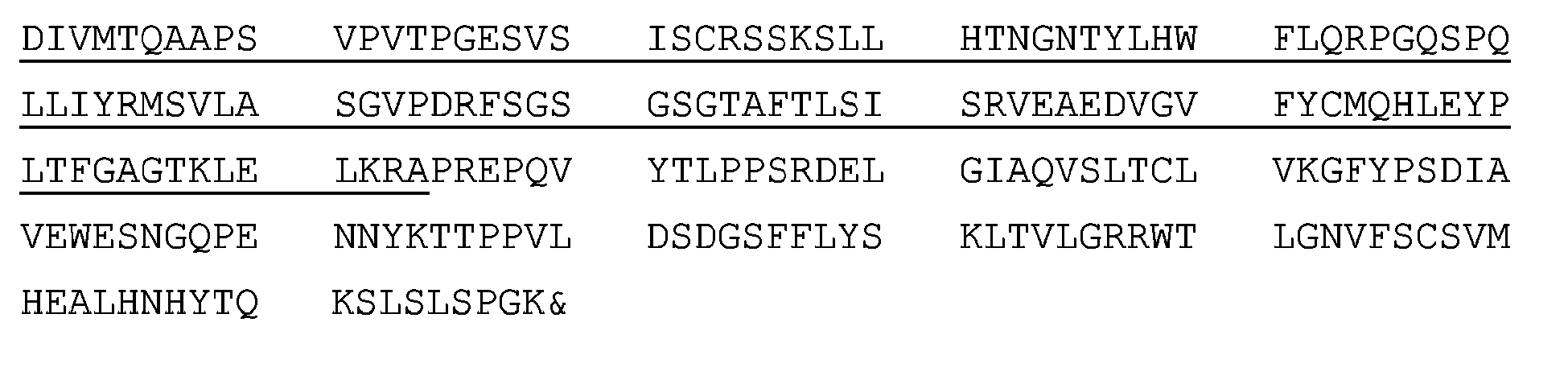
- Nucleic acid sequence of the VL-CH3 fusion protein (restriction sites are underlined), (SEQ ID No 44):

- For the heavy chain, it was found that the sequence up to Thr123 (numbering from 2BRR.pdb) should be used an connected to Arg344 (numbering from 1OQO.pdb) of the CH3 domain. The point of connection between these two sequences therefore reads as follows (VH part is underlined):
- - - Ala121 - Lys122 - Thr123 - Arg344 - Glu345 - Pro346 - - - - In order to allow joining of the two coding sequences using restriction enzyme sites and DNA ligation, the sequence near the point of connection was changed by silent mutation to introduce a unique Xhol site (ctcgag, underlined) as follows:
A K T R E P (SEQ ID No 45)
GCCAAAACTCGAGAACCA (SEQ ID No 46) - Furthermore, for cloning into the expression vector pPICZaIphaA (Pichia pastoris expression system, Invitrogen), an EcoRI site (gaattc) is added to the 5'-end (N-terminus) and an Xbal site (tctaga) to the 3'-end (C-terminus) of the construct. No stop codon is added to this sequence and the Xbal site is placed in the correct reading frame so as to fuse the construct to the Hexa-His-tag provided by the vector for later purification of the protein using immobilized metal affinity chromatography.
- Therefore, the complete sequence of the VH-CH3 fusion protein has the following amino acid sequence (VH part is underlined), (SEQ ID No 47):

- Nucleic acid sequence of the VH-CH3 fusion protein (restriction sites are underlined), (SEQ ID No 48):

- The VH region of antibody IV.3 is PCR-amplified with primers 4.3HupEco and 4.3HdownXho, and subsequently digested with EcoRI and Xhol. The CH3 SMID-engineered clone A23 is PCR-amplified with primers CH3upXhoA and CH3XBA2 and subsequently digested with Xhol and Xbal. The VH sequence and the CH3 sequence are ligated together via the Xhol site and then ligated into pPICZalphaA (Invitrogen), which was previously digested with EcoRI and Xbal. The resulting vector is named pPICHA23.
- 4.3HUPECO cagagaattc gaggttcagc ttcagcagtc (SEQ ID No 49)
4 . 3HDOWNXHO gatgctcgag ttttggctga ggagacggtg (SEQ ID NO 50)
CH3UPXHOA aaaactcgag aaccacaggt gtacaccctg cc (SEQ ID NO 51)
CH3XBA2 actgatctag acctttaccc ggagacaggg agag (SEQ ID No 52) - The VL region of antibody IV.3 is PCR-amplified with primers 4.3LupEco and 4.3LdownXho, and subsequently digested with EcoRI and Xhol. The CH3 SMID-engineered clone A23 is PCR-amplified with primers CH3upXhoB and CH3StopKpn and subsequently digested with Xhol and Kpnl. The VL sequence and the CH3 sequence are ligated together via the Xhol site and then ligated into pPICZalphaA (Invitrogen), which was previously digested with EcoRI and Kpnl. The resulting vector is named pPICLA23.
- 4 . 3LUPECO gatagaattc gacattgtga tgacccaggc tg (SEQ ID No 53)
4 . 3LDOWNXHO attactcgag gagcccgttt cagttccagc t (SEQ ID No 54)
CH3UPXHOB gctcctcgag aaccacaggt gtacaccctg cc (SEQ ID No 55)
CH3STOPKPN acgtggtacc tcaggcgcgc cctttacccg gagacaggga gag (SEQ ID No 56) - The light chain cassette is cut out with BgIII (pos.1) and BamHI (pos. 2319) from pPICLA23 (4235 bp), and the 2319 bp fragment is purified via preparative gele electrophoresis. The 1916 bp fragment is discarded. The vector pPICHA23 (4219 bp) is digested with BamHl, and the previously purified 2319 bp fragment from pPICLA23 is inserted. The resulting Pichia pastoris expression vector, which carries two expression cassettes, one for the VL-CH3 fusion protein and on for the VH-CH3 fusion protein is screened so that both inserts that have same direction of transcription. The resulting vector pPICHLA23 (6537 bp) is then linearized before transformation into Pichia pastoris e.g. with BamHI or with BssSI, transformed into Pichia pastoris by electroporation, and positive transformants are selected with Zeocin. Several clones are screened for expression of the recombinant protein. A clone is then selected for large scale production, and the recombinant fusion protein is purified by immobilized-metal-affinity chromatography using standard procedures. All Pichia manipulation, culturing and expression is done by following standard protocols (Invitrogen).
- The sequence encoding the allergen epitopes as described in example 5 is inserted into the vector pPICHLA23 as follows:
- The vector is digested with Ascl (4174-4182) which leads to its linearization. In this Ascl site, the DNA sequence encoding the allergen epitopes is inserted. The sequence encoding the allergen epitopes is amplified with primers EpiTLR1 and EpiTLR2 in order to attach Ascl sites to both ends of the sequence.
- EpiTLR1 TAAAGGGCGC GCCTCCGGAT GCCAAATTTA CC
- EpiTLR2 TACCTCAGGC GCGCCTTATT CAGTAGCAGC CACAC
- The resulting PCR product is digested with AscI and ligated into the previously digested vector. The resulting vector is named pHLA23EP (7046 bp). Pichia transformation, expression and purification of the recombinant fusion protein is performed as described above for the construct that has no epitopes inserted.
-

-
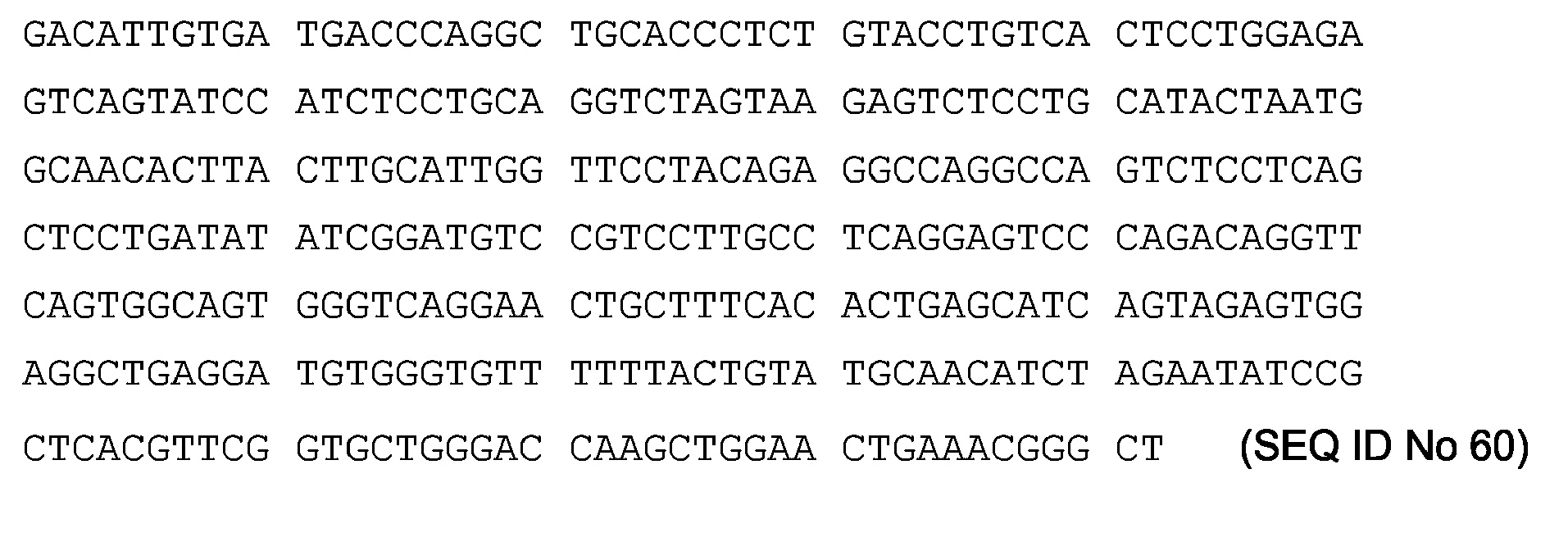
-

-

-


-


- All temperatures are in degrees Celsius. The following abbreviations are used:
- CD32 = FcγRII
- TLR9 = Toll like receptor 9
- Der P1 = Dermatophagoides pteronissyus major allergen 1
- Der P2 = Dermatophagoides pteronissyus major allergen 2
- Der F1 = Dermatophagoides farinae major allergen 1
-
- 1. Mudde,G.C., I.G.Reischl, N.Corvaïa, A.Hren, and E.-M.Pöllabauer. 1996. Antigen presentation in allergic sensitization. Immunol Cell Biol. 74:167-173.
- 2. Bheekha Escura,R., E.Wasserbauer, F.Hammerschmid, A.Pearce, P.Kidd, and G.C.Mudde. 1995. Regulation and targetting of T-cell immune responses by IgE and IgG antibodies. Immunology 86:343-350.
- 3. Pene,J., F.Rousset, F.Brière, I.Chrétien, J.-Y.Bonnefoy, H.Spits, T.Yokota, K.-I.Arai, J.Banchereau, and J.E.De Vries. 1988. IgE production by normal human lymphocytes is induced by interleukin 4 and suppressed by interferons gamma and alpha and prostaglandin E2. Proc. Natl. Acad. Sci. USA 85:6880-6884.
- 4. Ebner,C. 1999. Immunological mechanisms operative in allergen-specific immunotherapy. Int Arch Allergy Immunol 119:1-5.
- 5. Ferreira,F., C.Ebner, B.Kramer, G.Casari, P.Briza, A.J.Kungl, R.Grimm, B.Jahn-Schmid, H.Breiteneder, D.Kraft, M.Breitenbach, H.J.Rheinberger, and O.Scheiner. 1998. Modulation of IgE reactivity of allergens by site-directed mutagenesis: potential use of hypoallergenic variants for immunotherapy. FASEB Journal 12:231-242.
- 6. Rissoan,M.C., V.Soumelis, N.Kadowaki, G.Grouard, F.Briere, R.D.Malefyt, and Y.J.Liu. 1999. Reciprocal control of T helper cell and dendritic cell differentiation. Science 283:1183-1186.
- 7. Kapsenberg,M.L., C.M.Hilkens, E.A.Wierenga, and P.Kalinski. 1999. The paradigm of type 1 and type 2 antigen-presenting cells. Implications for atopic allergy. Clin. Exp. Allergy 29:33-36.
- 8. Charbonnier,A.S., H.Hammad, P.Gosset, G.A.Stewart, S.Alkan, A.B.Tonnel, and J.Pestel. 2003. Der p1-pulsed myeloid and plasmacytoid dendritic cells from house dust mite-sensitized allergic patients dysregulate the T cell response. J. Leukocyte Biol. 73:91-99.
- 9. Rothenfusser,S., E.Tuma, S.Endres, and G.Hartmann. 2002. Plasmacytoid dendritic cells: The key to CpG. Hum. Immunol. 63:1111-1119.
- 10. Latz,E., A.Schoenemeyer, A.Visintin, K.A.Fitzgerald, B.G.Monks, C.F.Knetter, E.Lien, N.J.Nilsen, T.Espevik, and D.T.Golenbock. 2004. TLR9 signals after translocating from the ER to CpG DNA in the lysosome. Nat. Immunol. 5:190-198.
- 11. Leifer,C.A., M.N.Kennedy, A.Mazzoni, C.W.Lee, M.J.Kruhlak, and D.A.Segal. 2004. TLR9 Is localized in the endoplasmic reticulum prior to stimulation. J. Immunol. 173:1179-1183.
- 12. Wang,W.W., D.Das, X.L.Tang, W.Budzynski, and M.R.Suresh. 2005. Antigen targeting to dendritic cells with bispecific antibodies. J. Immunol. Methods.
- 13. van Schaijk,F.G., E.Oosterwijk, A.C.Soede, M.Broekema, C.Frielink, W.J.McBride, D.M.Goldenberg, F.H.Corstens, and O.C.Boerman. 2005. Pretargeting of carcinoembryonic antigen-expressing tumors with a biologically produced bispecific anticarcinoembryonic antigen x anti-indium-labeled diethylenetriaminepentaacetic acid antibody. Clin. Cancer Res. 11:7130s-7136s.
- 14. Le,G.F., U.Reusch, G.Moldenhauer, M.Little, and S.M.Kipriyanov. 2004. Immunosuppressive properties of anti-CD3 single-chain Fv and diabody. J. Immunol. Methods 285:111-127.
- 15. Schuster,M., P.Umana, C.Ferrara, P.Brunker, C.Gerdes, G.Waxenecker, S.Wiederkum, C.Schwager, H.Loibner, G.Himmler, and G.C.Mudde. 2005. Improved effector functions of a therapeutic monoclonal Lewis Y-specific antibody by glycoform engineering. Cancer Res 65:7934-7941.
- 16. Orlandi,R., D.H.Gussow, P.T.Jones, and G.Winter. 1989. Cloning immunoglobulin variable domains for expression by the polymerase chain reaction. Proc. Natl. Acad. Sci. U. S. A. 86:3833-3837.
- 17. Barton,G.M., J.C.Kagan, and R.Medzhitov. 2005. Intracellular localization of Toll-like receptor 9 prevents recognition of self DNA but facilitates access to viral DNA. Nat. Immunol...
- 18. Chen,W.L., J.L.Wang, H.Z.An, J.Zhou, L.H.Zhang, and X.T.Cao. 2005. Heat shock up-regulates TLR9 expression in human B cells through activation of ERK and NF-kappaB signal pathways. Immunol. Lett. 98:153-159.
- 19. Eaton-Bassiri,A., S.B.Dillon, M.Cunningham, M.A.Rycyzyn, J.Mills, R.T.Sarisky, and M.L.Mbow. 2004. Toll-like receptor 9 can be expressed at the cell surface of distinct populations of tonsils and human peripheral blood mononuclear cells. Infect. Immun. 72:7202-7211.
- 20. Leroy,B.P., J.-M.Lachapelle, M.Jacquemin, and J.-M.Saint-Remy. 1992. Treatment of atopic dermatitis by allergen-antibody complexes: Long-term clinical results and evolution of IgE antibodies. Dermatologica 184:271-274.
- 21. Chua,K.Y., W.K.Greene, P.Kehal, and W.R.Thomas. 1991. IgE binding studies with large peptides expressed from Der p II cDNA constructs. Clin. Exp. Allergy. 21:161-166.
- 22. Baselmans,P.J., E.Pollabauer, F.C.Van Reijsen, H.C.Heystek, A.Hren, P.Stumptner, M.G.Tilanus, W.C.Vooijs, and G.C.Mudde. 2000. IgE production after antigen-specific and cognate activation of HLA- DPw4-restricted T-cell clones, by 78% of randomly selected B-cell donors. Hum. Immunol. 61:789-798.
- 23. Beck,H., G.Schwarz, C.J.Schroter, M.Deeg, D.Baier, S.Stevanovic, E.Weber, C.Driessen, and H.Kalbacher. 2001. Cathepsin S and an asparagine-specific endoprotease dominate the proteolytic processing of human myelin basic protein in vitro. Eur J Immunol 31:3726-3736.
- 24. Higgins,J.A., C.J.Thorpe, J.D.Hayball, R.E.O'Hehir, and J.R.Lamb. 1994. Overlapping T-cell epitopes in the group I allergen of Dermatophagoides species restricted by HLA-DP and HLA-DR class II molecules. J. Allergy Clin. Immunol. 93:891-899.
- 25. Bian,H., J.F.Reidhaar-Olson, and J.Hammer. 2003. The use of bioinformatics for identifying class II-restricted T-cell epitopes. Methods 29:299-309.
- 26. Sturniolo,T., E.Bono, J.Ding, L.Raddrizzani, O.Tuereci, U.Sahin, M.Braxenthaler, F.Gallazzi, M.P.Protti, F.Sinigaglia, and J.Hammer. 1999. Generation of tissue-specific and promiscuous HLA ligand databases using DNA microarrays and virtual HLA class II matrices. Nat Biotechnol. 17:555-561.
-
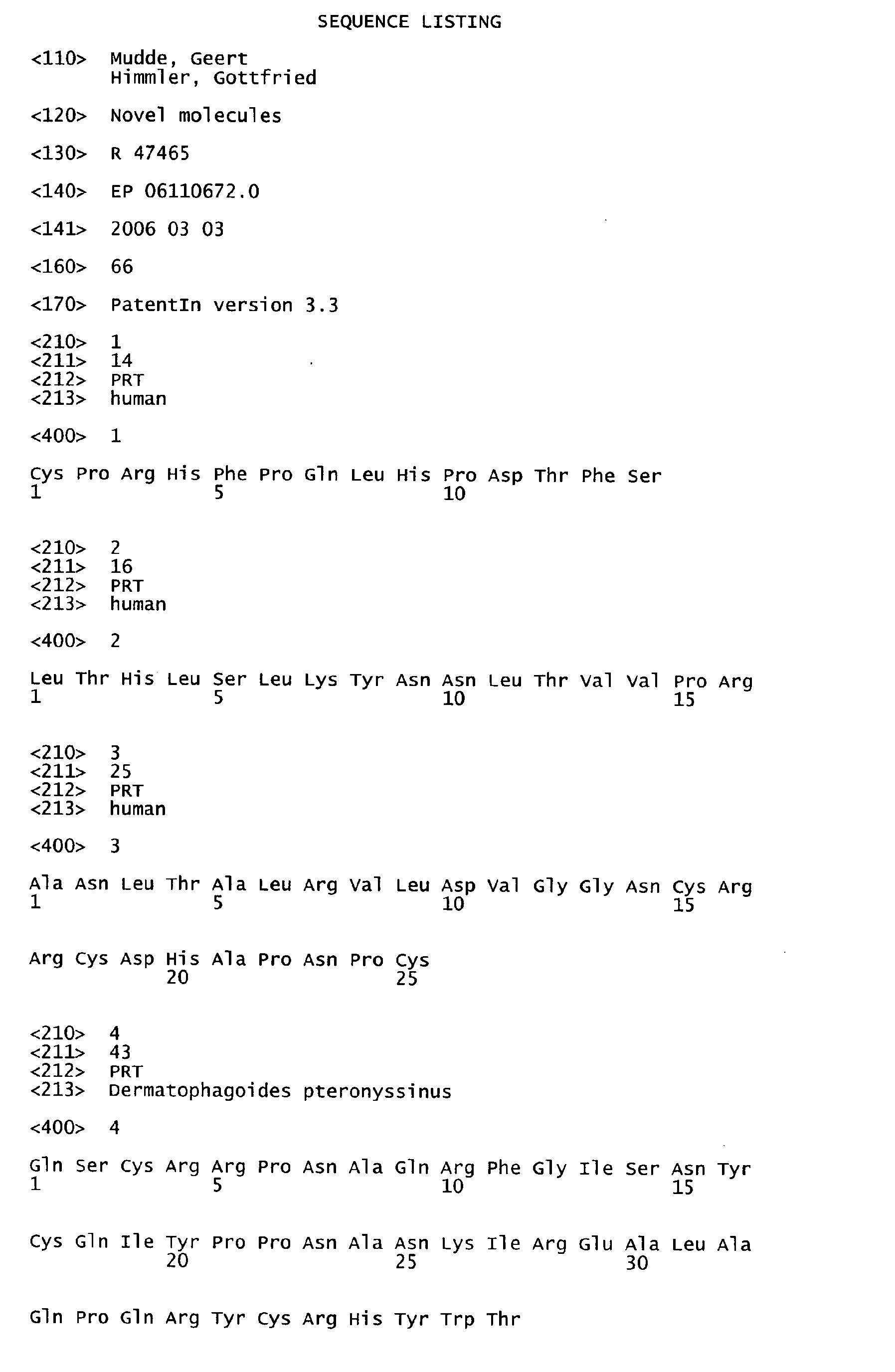


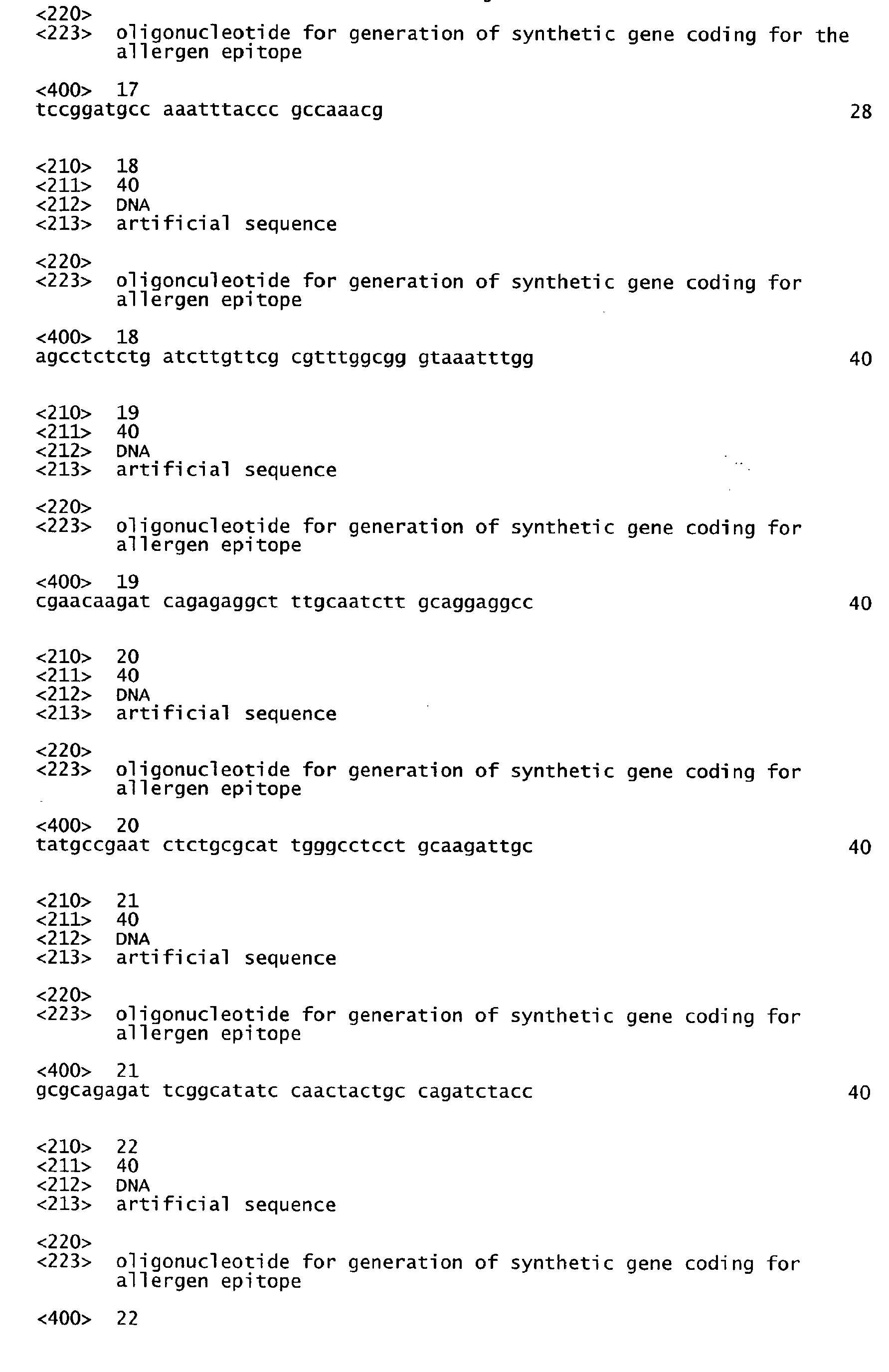


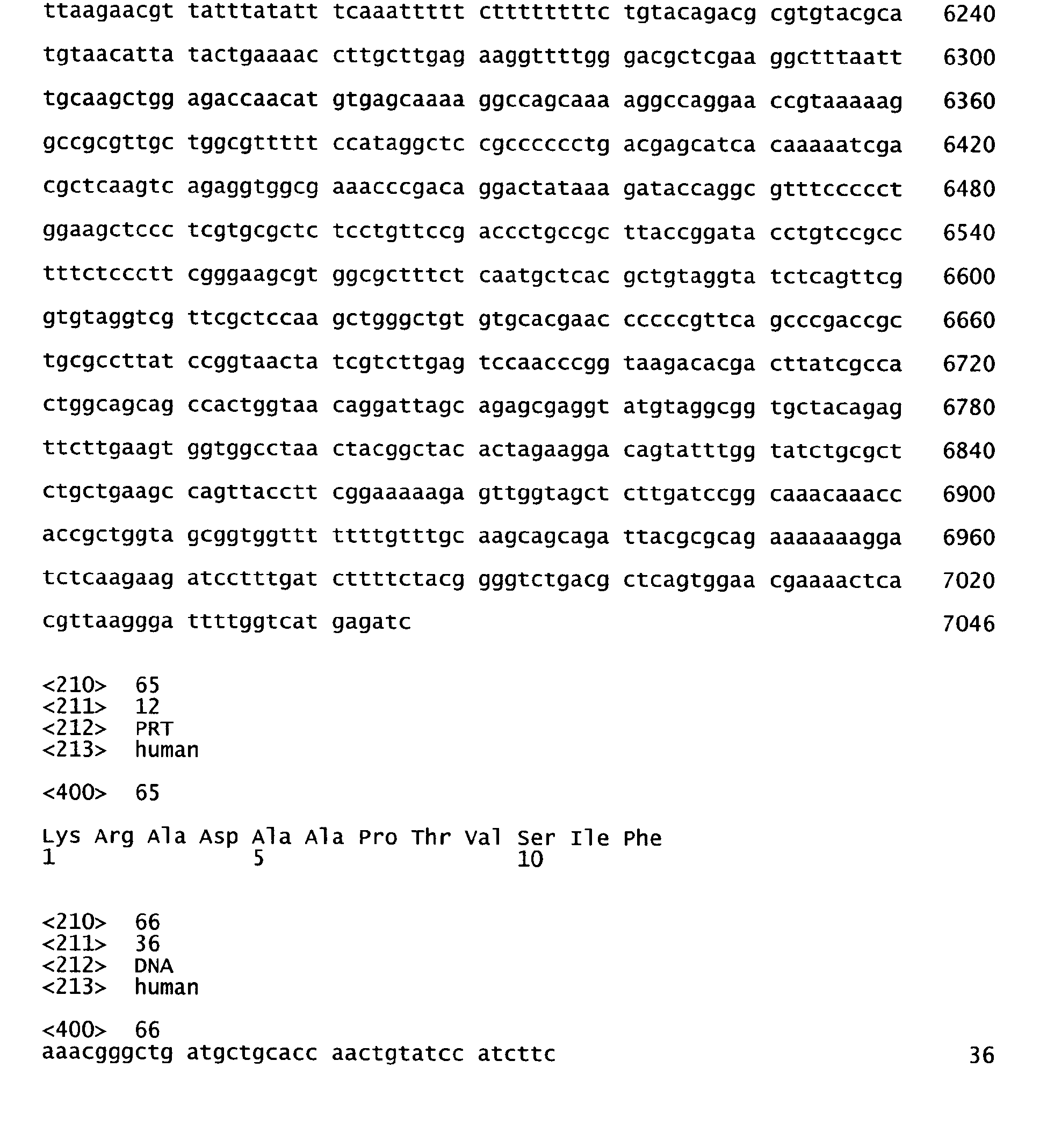
Claims (30)
- A molecule or molecule complex capable of binding to TLR9 and to CD32 comprising at least one epitope of at least one antigen.
- A molecule or molecule complex according to claim 1 characterized in that the epitope is a T cell epitope
- A molecule or molecule complex according to any one of claims 1 or 2 characterized in that the epitope is derived from an allergen.
- A molecule or molecule complex according to any one of claims 1 to 3 characterized in that at least one epitope is non-covalently linked to the molecule.
- A molecule or molecule complex according to any one of claims 1 to 4 characterized in that at least one epitope is non-covalently linked to the TLR9 and/or CD32 binding region.
- A molecule or molecule complex according to claim 5 characterized in that at least one epitope is linked to the TLR9 and/or CD32 binding region via antibody interaction and/or ligand interaction.
- A molecule or molecule complex according to any one of claims 1 to 6, characterized in that the epitope is produced from at least one T-cell epitope-containing-DNA-stretch of an antigen or a synthetic peptide
- A molecule or molecule complex according to any one of claims 1 to 7 characterized in that the epitope is selected from the group consisting of allergens in atopic dermatitis, allergic asthma, allergic rhinitis or allergic conjunctivitis.
- A molecule or molecule complex according to any one of claims 1 to 8, characterized in that the epitope is isolated from complete antigens, denatured antigens or antigens modified to prevent binding to IgE.
- A molecule or molecule complex according to any one of claims 1 to 9, characterized in that it comprises at least one antibody or derivative or fragment thereof.
- A molecule or molecule complex according to claim 10, characterized in that the antibody or fragment or derivative thereof is IgG, IgM, IgE, IgA or IgD.
- A molecule or molecule complex according to any one of claims 1 to 11, characterized in that it is of human or humanized structure.
- A molecule or molecule complex according to any one of claims 1 to 12, characterized in that it is of murine or partly murine structure.
- A molecule or molecule complex according to any one of claims 1 to 13, characterized in that it is of camel or partly camel structure.
- A molecule or molecule complex according to any one of claims 1 to 14, characterized in that it comprises at least one engineered binding scaffold
- A molecule or molecule complex according to claim 15, characterized in that the binding scaffold is selected from the group consisting of fibronectin III, lipocalins, Protein A, α-amylase inhibitor, Ankyrin Repeat Proteins, a C2 domain, an A-domain, an EGFR like domain, a dab, a chi-bAb, CTLA-4, gamma crystalline and any other protein.
- A molecule or molecule complex according to any one of claims 1 to 16, characterized in that it comprises at least one part of a small mutated immunoglobulin domain (SMID).
- A molecule or molecule complex according to any one of claims 1 to 17, characterized in that it comprises at least part of an anti-CD32 antibody or derivative or fragment thereof.
- A molecule or molecule complex according to any one of claims 1 to 18 comprising an amino acid sequence of SEQ ID No 59 or part thereof.
- A molecule or molecule complex according to any one of claims 1 to 19 comprising an amino acid sequence of SEQ ID No 61 or part thereof.
- Pharmaceutical composition comprising at least one molecule or molecule complex according to any one of claims 1 to 20 optionally together with at least one pharmaceutically acceptable carrier or diluent.
- Use of a pharmaceutical preparation according to claim 21 for active immunotherapy.
- Method of treating allergies wherein a prophylactically or therapeutically effective amount of at least one molecule or molecule complex according to any one of claims 1 to 20 is administered to a subject in need of such treatment optionally together with at least one pharmaceutically acceptable carrier.
- Use of at least one molecule or molecule complex according to any one of claims 1 to 20 for the manufacture of a medicament for the treatment of allergies.
- Process for producing a molecule or molecule complex according to any one of claims 1 to 20, using recombinant technique wherein the genes coding for the binding structures for TLR9, CD32 and the epitope are constructed in a vector and expressed in a host cell.
- Nucleic acid vector for expressing of a molecule according to any of claims 1 to 20 comprising the nucleic acid sequence of SEQ ID No 60.
- Nucleic acid vector for expressing of a molecule according to any of claims 1 to 20 comprising the nucleic acid sequence of SEQ ID No 62.
- Nucleic acid vector for expressing of a molecule according to any of claims 1 to 20 comprising the nucleic acid sequence of SEQ ID No 63.
- Nucleic acid vector for expressing of a molecule according to any of claims 1 to 20 comprising the nucleic acid sequence of SEQ ID No 64.
- Process for producing a molecule or molecule complex according to any one of claims 1 to 20, using chemical cross linking.
Priority Applications (20)
| Application Number | Priority Date | Filing Date | Title |
|---|---|---|---|
| EP06110672A EP1829895A1 (en) | 2006-03-03 | 2006-03-03 | Bispecific molecule binding TLR9 and CD32 and comprising a T cell epitope for treatment of allergies |
| PL07722975T PL1996230T3 (en) | 2006-03-03 | 2007-02-28 | Bispecific molecule binding tlr9 and cd32 and comprising a t cell epitope |
| PT77229755T PT1996230E (en) | 2006-03-03 | 2007-02-28 | Bispecific molecule binding tlr9 and cd32 and comprising a t cell epitope |
| JP2008557635A JP2009528071A (en) | 2006-03-03 | 2007-02-28 | A bispecific molecule that binds TLR9 and CD32 containing a T cell epitope for allergy treatment |
| AU2007220663A AU2007220663A1 (en) | 2006-03-03 | 2007-02-28 | Bispecific molecule binding TLR9 and CD32 and comprising a T cell epitope for treatment of allergies |
| KR1020087021350A KR20080099295A (en) | 2006-03-03 | 2007-02-28 | Bispecific molecule that binds to TLR9 and CD32 and contains T cell epitopes for the treatment of allergies |
| PCT/EP2007/001722 WO2007098934A1 (en) | 2006-03-03 | 2007-02-28 | Bispecific molecule binding tlr9 and cd32 and comprising a t cell epitope for treatment of allergies |
| ES07722975.5T ES2483615T3 (en) | 2006-03-03 | 2007-02-28 | Bispecific molecule that binds to TLR9 and CD32 and that comprises a T cell epitope |
| EP07722975.5A EP1996230B1 (en) | 2006-03-03 | 2007-02-28 | Bispecific molecule binding tlr9 and cd32 and comprising a t cell epitope |
| BRPI0708549-4A BRPI0708549A2 (en) | 2006-03-03 | 2007-02-28 | bispecifically binding molecule tlr9 and cd32 and comprising a t cell epitope for the treatment of allergies |
| US12/281,504 US20100143342A1 (en) | 2006-03-03 | 2007-02-28 | Bispecific molecule binding tlr9 and cd32 and comprising a t cell epitope for treatment of allergies |
| CA002644595A CA2644595A1 (en) | 2006-03-03 | 2007-02-28 | Bispecific molecule binding tlr9 and cd32 and comprising a t cell epitope for treatment of allergies |
| EA200801930A EA200801930A1 (en) | 2006-03-03 | 2007-02-28 | BISPECIFIC MOLECULE, BINDING TLR9 AND CD32 AND CONTAINING T-CELL EPITOPE FOR THE TREATMENT OF ALLERGIES |
| MX2008011200A MX2008011200A (en) | 2006-03-03 | 2007-02-28 | Bispecific molecule binding tlr9 and cd32 and comprising a t cell epitope for treatment of allergies. |
| CNA2007800155462A CN101432023A (en) | 2006-03-03 | 2007-02-28 | Bispecific molecule binding TLR9 and CD32 and comprising a T cell epitope for treatment of allergies |
| US13/791,824 US9636415B2 (en) | 2006-03-03 | 2013-03-08 | Bispecific molecule binding TLR9 and CD32 and comprising a T cell epitope for treatment of allergies |
| JP2013155366A JP5903409B2 (en) | 2006-03-03 | 2013-07-26 | A bispecific molecule that binds TLR9 and CD32 containing a T cell epitope for allergy treatment |
| US15/248,258 US20170334992A9 (en) | 2006-03-03 | 2016-08-26 | Bispecific molecule binding tlr9 and cd32 and comprising a t cell epitope for treatment of allergies |
| US15/607,675 US10189905B2 (en) | 2006-03-03 | 2017-05-29 | Bispecific molecule binding TLR9 and CD32 and comprising a T cell epitope for treatment of allergies |
| US15/607,661 US20170320942A1 (en) | 2006-03-03 | 2017-05-29 | Bispecific molecule binding tlr9 and cd32 and comprising a t cell epitope for treatment of allergies |
Applications Claiming Priority (1)
| Application Number | Priority Date | Filing Date | Title |
|---|---|---|---|
| EP06110672A EP1829895A1 (en) | 2006-03-03 | 2006-03-03 | Bispecific molecule binding TLR9 and CD32 and comprising a T cell epitope for treatment of allergies |
Publications (1)
| Publication Number | Publication Date |
|---|---|
| EP1829895A1 true EP1829895A1 (en) | 2007-09-05 |
Family
ID=36928231
Family Applications (2)
| Application Number | Title | Priority Date | Filing Date |
|---|---|---|---|
| EP06110672A Withdrawn EP1829895A1 (en) | 2006-03-03 | 2006-03-03 | Bispecific molecule binding TLR9 and CD32 and comprising a T cell epitope for treatment of allergies |
| EP07722975.5A Active EP1996230B1 (en) | 2006-03-03 | 2007-02-28 | Bispecific molecule binding tlr9 and cd32 and comprising a t cell epitope |
Family Applications After (1)
| Application Number | Title | Priority Date | Filing Date |
|---|---|---|---|
| EP07722975.5A Active EP1996230B1 (en) | 2006-03-03 | 2007-02-28 | Bispecific molecule binding tlr9 and cd32 and comprising a t cell epitope |
Country Status (14)
| Country | Link |
|---|---|
| US (2) | US20100143342A1 (en) |
| EP (2) | EP1829895A1 (en) |
| JP (2) | JP2009528071A (en) |
| KR (1) | KR20080099295A (en) |
| CN (1) | CN101432023A (en) |
| AU (1) | AU2007220663A1 (en) |
| BR (1) | BRPI0708549A2 (en) |
| CA (1) | CA2644595A1 (en) |
| EA (1) | EA200801930A1 (en) |
| ES (1) | ES2483615T3 (en) |
| MX (1) | MX2008011200A (en) |
| PL (1) | PL1996230T3 (en) |
| PT (1) | PT1996230E (en) |
| WO (1) | WO2007098934A1 (en) |
Cited By (41)
| Publication number | Priority date | Publication date | Assignee | Title |
|---|---|---|---|---|
| US20120121574A1 (en) * | 2010-11-15 | 2012-05-17 | Luciano Polonelli | Antimicrobial, antiviral, anticancer and immunomodulatory peptides and uses therefore |
| US9493578B2 (en) | 2009-09-02 | 2016-11-15 | Xencor, Inc. | Compositions and methods for simultaneous bivalent and monovalent co-engagement of antigens |
| US9605084B2 (en) | 2013-03-15 | 2017-03-28 | Xencor, Inc. | Heterodimeric proteins |
| US9605061B2 (en) | 2010-07-29 | 2017-03-28 | Xencor, Inc. | Antibodies with modified isoelectric points |
| US9650446B2 (en) | 2013-01-14 | 2017-05-16 | Xencor, Inc. | Heterodimeric proteins |
| US9701759B2 (en) | 2013-01-14 | 2017-07-11 | Xencor, Inc. | Heterodimeric proteins |
| US9738722B2 (en) | 2013-01-15 | 2017-08-22 | Xencor, Inc. | Rapid clearance of antigen complexes using novel antibodies |
| US9822186B2 (en) | 2014-03-28 | 2017-11-21 | Xencor, Inc. | Bispecific antibodies that bind to CD38 and CD3 |
| US9850320B2 (en) | 2014-11-26 | 2017-12-26 | Xencor, Inc. | Heterodimeric antibodies to CD3 X CD20 |
| US9856327B2 (en) | 2014-11-26 | 2018-01-02 | Xencor, Inc. | Heterodimeric antibodies to CD3 X CD123 |
| US10106624B2 (en) | 2013-03-15 | 2018-10-23 | Xencor, Inc. | Heterodimeric proteins |
| US10131710B2 (en) | 2013-01-14 | 2018-11-20 | Xencor, Inc. | Optimized antibody variable regions |
| US10227410B2 (en) | 2015-12-07 | 2019-03-12 | Xencor, Inc. | Heterodimeric antibodies that bind CD3 and PSMA |
| US10227411B2 (en) | 2015-03-05 | 2019-03-12 | Xencor, Inc. | Modulation of T cells with bispecific antibodies and FC fusions |
| US10316088B2 (en) | 2016-06-28 | 2019-06-11 | Xencor, Inc. | Heterodimeric antibodies that bind somatostatin receptor 2 |
| US10428155B2 (en) | 2014-12-22 | 2019-10-01 | Xencor, Inc. | Trispecific antibodies |
| US10487155B2 (en) | 2013-01-14 | 2019-11-26 | Xencor, Inc. | Heterodimeric proteins |
| US10501543B2 (en) | 2016-10-14 | 2019-12-10 | Xencor, Inc. | IL15/IL15Rα heterodimeric Fc-fusion proteins |
| US10519242B2 (en) | 2013-03-15 | 2019-12-31 | Xencor, Inc. | Targeting regulatory T cells with heterodimeric proteins |
| US10526417B2 (en) | 2014-11-26 | 2020-01-07 | Xencor, Inc. | Heterodimeric antibodies that bind CD3 and CD38 |
| US10544187B2 (en) | 2013-03-15 | 2020-01-28 | Xencor, Inc. | Targeting regulatory T cells with heterodimeric proteins |
| US10787518B2 (en) | 2016-06-14 | 2020-09-29 | Xencor, Inc. | Bispecific checkpoint inhibitor antibodies |
| US10793632B2 (en) | 2016-08-30 | 2020-10-06 | Xencor, Inc. | Bispecific immunomodulatory antibodies that bind costimulatory and checkpoint receptors |
| US10851178B2 (en) | 2011-10-10 | 2020-12-01 | Xencor, Inc. | Heterodimeric human IgG1 polypeptides with isoelectric point modifications |
| US10858417B2 (en) | 2013-03-15 | 2020-12-08 | Xencor, Inc. | Heterodimeric proteins |
| US10968276B2 (en) | 2013-03-12 | 2021-04-06 | Xencor, Inc. | Optimized anti-CD3 variable regions |
| US10982006B2 (en) | 2018-04-04 | 2021-04-20 | Xencor, Inc. | Heterodimeric antibodies that bind fibroblast activation protein |
| US10981992B2 (en) | 2017-11-08 | 2021-04-20 | Xencor, Inc. | Bispecific immunomodulatory antibodies that bind costimulatory and checkpoint receptors |
| US11053316B2 (en) | 2013-01-14 | 2021-07-06 | Xencor, Inc. | Optimized antibody variable regions |
| US11084863B2 (en) | 2017-06-30 | 2021-08-10 | Xencor, Inc. | Targeted heterodimeric Fc fusion proteins containing IL-15 IL-15alpha and antigen binding domains |
| US11312770B2 (en) | 2017-11-08 | 2022-04-26 | Xencor, Inc. | Bispecific and monospecific antibodies using novel anti-PD-1 sequences |
| US11319355B2 (en) | 2017-12-19 | 2022-05-03 | Xencor, Inc. | Engineered IL-2 Fc fusion proteins |
| US11358999B2 (en) | 2018-10-03 | 2022-06-14 | Xencor, Inc. | IL-12 heterodimeric Fc-fusion proteins |
| US11472890B2 (en) | 2019-03-01 | 2022-10-18 | Xencor, Inc. | Heterodimeric antibodies that bind ENPP3 and CD3 |
| US11505595B2 (en) | 2018-04-18 | 2022-11-22 | Xencor, Inc. | TIM-3 targeted heterodimeric fusion proteins containing IL-15/IL-15RA Fc-fusion proteins and TIM-3 antigen binding domains |
| US11524991B2 (en) | 2018-04-18 | 2022-12-13 | Xencor, Inc. | PD-1 targeted heterodimeric fusion proteins containing IL-15/IL-15Ra Fc-fusion proteins and PD-1 antigen binding domains and uses thereof |
| US11591401B2 (en) | 2020-08-19 | 2023-02-28 | Xencor, Inc. | Anti-CD28 compositions |
| US11739144B2 (en) | 2021-03-09 | 2023-08-29 | Xencor, Inc. | Heterodimeric antibodies that bind CD3 and CLDN6 |
| US11859012B2 (en) | 2021-03-10 | 2024-01-02 | Xencor, Inc. | Heterodimeric antibodies that bind CD3 and GPC3 |
| US11919956B2 (en) | 2020-05-14 | 2024-03-05 | Xencor, Inc. | Heterodimeric antibodies that bind prostate specific membrane antigen (PSMA) and CD3 |
| US12466897B2 (en) | 2011-10-10 | 2025-11-11 | Xencor, Inc. | Heterodimeric human IgG1 polypeptides with isoelectric point modifications |
Families Citing this family (40)
| Publication number | Priority date | Publication date | Assignee | Title |
|---|---|---|---|---|
| MX2010001779A (en) | 2007-08-15 | 2010-07-06 | Circassia Ltd | Peptides for desensibilization against allergens. |
| US9549991B2 (en) | 2008-04-14 | 2017-01-24 | Human Biomolecular Research Institute | Chemical and biochemical adducts as biomarkers for organophosphate exposure |
| CN107056951A (en) | 2008-10-02 | 2017-08-18 | 阿帕特夫研究和发展有限公司 | CD86 antagonist Mutiple Targets associated proteins |
| KR101108642B1 (en) * | 2009-09-29 | 2012-02-09 | 주식회사 녹십자 | Antibodies that specifically bind to epidermal growth factor receptor |
| WO2011079308A2 (en) | 2009-12-23 | 2011-06-30 | Emergent Product Development Seattle, Llc | Compositions comprising tnf-alpha and il-6 antagonists and methods of use thereof |
| HUE029257T2 (en) | 2009-12-29 | 2017-02-28 | Aptevo Res And Dev Llc | Heterodimer binding proteins and uses thereof |
| EP2460824A1 (en) * | 2010-12-01 | 2012-06-06 | Biomay Ag | Hypoallergenic polypeptides for the treatment of house dust mite allergy |
| JP6400470B2 (en) | 2011-05-16 | 2018-10-03 | ジェネロン(シャンハイ)コーポレイション リミテッド | Multispecific Fab fusion proteins and methods of use |
| BR112015000483B1 (en) * | 2012-07-13 | 2022-05-17 | S-Target Therapeutics Gmbh | IMMUNO REGULATORY OR SENSITIZING VACCINE, KIT TO PREPARE THE VACCINE AND METHOD USED TO PREPARE THE VACCINE TO TRIGGER AN IMMUNE RESPONSE FROM IGG |
| US9005630B2 (en) | 2012-11-01 | 2015-04-14 | Veterinaerinstituttet | Fusion proteins for the treatment of allergic diseases |
| WO2014067993A1 (en) * | 2012-11-01 | 2014-05-08 | Veterinærinstituttet | New fusion proteins for the treatment of allergic diseases |
| ES2786253T3 (en) | 2013-03-14 | 2020-10-09 | Immusoft Corp | Methods for the in vitro differentiation and transduction of memory b cells with pseudotyped viral vectors vsv-g |
| PL2999485T3 (en) | 2013-05-21 | 2018-07-31 | Tyg Oncology Ltd. | Gastrin peptide immunogenic composition |
| EP3925618A1 (en) | 2013-07-29 | 2021-12-22 | 2seventy bio, Inc. | Multipartite signaling proteins and uses thereof |
| RU2733652C2 (en) | 2013-10-31 | 2020-10-06 | Фред Хатчинсон Кэнсер Рисерч Сентер | Modified hematopoietic stem cells/progenitor cells and non-t effector cells, and use thereof |
| ES2837856T3 (en) | 2013-12-20 | 2021-07-01 | Hutchinson Fred Cancer Res | Labeled Chimeric Effector Molecules and Receptors |
| DK3234107T3 (en) | 2014-12-19 | 2022-10-17 | Immusoft Corp | B CELLS FOR IN VIVO DELIVERY OF THERAPEUTIC AGENTS |
| WO2016141357A1 (en) | 2015-03-05 | 2016-09-09 | Fred Hutchinson Cancer Research Center | Immunomodulatory fusion proteins and uses thereof |
| US11827904B2 (en) | 2015-04-29 | 2023-11-28 | Fred Hutchinson Cancer Center | Modified stem cells and uses thereof |
| EP3288569A4 (en) | 2015-04-29 | 2018-12-19 | Fred Hutchinson Cancer Research Center | Modified hematopoietic stem/progenitor and non-t effector cells, and uses thereof |
| EP3297658A1 (en) | 2015-05-18 | 2018-03-28 | OncoQR ML GmbH | Her2/neu immunogenic composition |
| US10982136B2 (en) | 2016-02-26 | 2021-04-20 | The Regents Of The University Of California | Ligand-sensitized lanthanide nanocrystals as ultraviolet downconverters |
| CA3017776A1 (en) | 2016-03-15 | 2017-09-21 | Generon (Shanghai) Corporation Ltd. | Multispecific fab fusion proteins and use thereof |
| CN109121413A (en) | 2016-04-14 | 2019-01-01 | 弗莱德哈钦森癌症研究中心 | Use the composition and method of targeting nucleic acid nano carrier programming therapeutic cells |
| CA3030841A1 (en) | 2016-07-14 | 2018-01-18 | Fred Hutchinson Cancer Research Center | Multiple bi-specific binding domain constructs with different epitope binding to treat cancer |
| WO2018044812A2 (en) | 2016-08-29 | 2018-03-08 | Fred Hutchinson Cancer Research Center | Chelating platform for delivery of radionuclides |
| WO2018048812A1 (en) | 2016-09-06 | 2018-03-15 | The Regents Of The University Of California | Formulations of hydroxypyridonate actinide/lanthanide decorporation agents |
| WO2018063638A1 (en) | 2016-09-29 | 2018-04-05 | The Regents Of The University Of California | Chelating molecules |
| CA3038723A1 (en) | 2016-09-29 | 2018-05-31 | The Regents Of The University Of California | Separation of metal ions by liquid-liquid extraction |
| BR112019017120A8 (en) | 2017-02-17 | 2023-05-02 | Hutchinson Fred Cancer Res | COMBINATION THERAPIES FOR TREATMENT OF CANCER AND BCMA-RELATED AUTOIMMUNE DISORDERS |
| JP2020511136A (en) | 2017-03-17 | 2020-04-16 | フレッド ハッチンソン キャンサー リサーチ センター | Immunomodulatory fusion proteins and uses thereof |
| WO2019118895A1 (en) | 2017-12-14 | 2019-06-20 | Bluebird Bio, Inc. | Daric interleukin receptors |
| CN112867735B (en) | 2018-09-07 | 2025-05-09 | 埃泰美德(香港)有限公司 | Bispecific antigen binding proteins and uses thereof |
| WO2020056170A1 (en) | 2018-09-12 | 2020-03-19 | Fred Hutchinson Cancer Research Center | Reducing cd33 expression to selectively protect therapeutic cells |
| CN113366479A (en) | 2018-12-14 | 2021-09-07 | 蓝鸟生物公司 | Dimerizer-modulated immunoreceptor complexes |
| US12291560B2 (en) | 2018-12-14 | 2025-05-06 | Regeneron Pharmaceuticals, Inc. | Dimerizing agent regulated immunoreceptor complexes |
| EP3966243A1 (en) | 2019-05-04 | 2022-03-16 | Inhibrx, Inc. | Clec12a-binding polypeptides and uses thereof |
| MX2021013590A (en) | 2019-05-08 | 2022-02-11 | Inhibrx Inc | Cll-1 targeted immunotherapies. |
| SG11202111943UA (en) | 2019-07-02 | 2021-11-29 | Hutchinson Fred Cancer Res | Recombinant ad35 vectors and related gene therapy improvements |
| AU2021267953A1 (en) | 2020-05-04 | 2022-11-17 | Immunorizon Ltd. | Precursor tri-specific antibody constructs and methods of use thereof |
Citations (2)
| Publication number | Priority date | Publication date | Assignee | Title |
|---|---|---|---|---|
| WO1997007218A1 (en) * | 1995-08-16 | 1997-02-27 | Novartis Ag | Allergen-xcd32 fusion proteins |
| WO2003035695A2 (en) * | 2001-07-26 | 2003-05-01 | Tanox, Inc. | Agents that activate or inhibit toll-like receptor 9 |
-
2006
- 2006-03-03 EP EP06110672A patent/EP1829895A1/en not_active Withdrawn
-
2007
- 2007-02-28 BR BRPI0708549-4A patent/BRPI0708549A2/en not_active Application Discontinuation
- 2007-02-28 KR KR1020087021350A patent/KR20080099295A/en not_active Withdrawn
- 2007-02-28 WO PCT/EP2007/001722 patent/WO2007098934A1/en not_active Ceased
- 2007-02-28 EP EP07722975.5A patent/EP1996230B1/en active Active
- 2007-02-28 US US12/281,504 patent/US20100143342A1/en not_active Abandoned
- 2007-02-28 PL PL07722975T patent/PL1996230T3/en unknown
- 2007-02-28 ES ES07722975.5T patent/ES2483615T3/en active Active
- 2007-02-28 CN CNA2007800155462A patent/CN101432023A/en active Pending
- 2007-02-28 PT PT77229755T patent/PT1996230E/en unknown
- 2007-02-28 MX MX2008011200A patent/MX2008011200A/en unknown
- 2007-02-28 AU AU2007220663A patent/AU2007220663A1/en not_active Abandoned
- 2007-02-28 JP JP2008557635A patent/JP2009528071A/en active Pending
- 2007-02-28 EA EA200801930A patent/EA200801930A1/en unknown
- 2007-02-28 CA CA002644595A patent/CA2644595A1/en not_active Abandoned
-
2013
- 2013-07-26 JP JP2013155366A patent/JP5903409B2/en not_active Expired - Fee Related
-
2016
- 2016-08-26 US US15/248,258 patent/US20170334992A9/en not_active Abandoned
Patent Citations (2)
| Publication number | Priority date | Publication date | Assignee | Title |
|---|---|---|---|---|
| WO1997007218A1 (en) * | 1995-08-16 | 1997-02-27 | Novartis Ag | Allergen-xcd32 fusion proteins |
| WO2003035695A2 (en) * | 2001-07-26 | 2003-05-01 | Tanox, Inc. | Agents that activate or inhibit toll-like receptor 9 |
Non-Patent Citations (5)
| Title |
|---|
| BHEEKHA ESCURA R ET AL: "REGULATION AND TARGETING OF T-CELL IMMUNE RESPONSES BY IGE AND IGG ANTIBODIES", IMMUNOLOGY, BLACKWELL PUBLISHING, OXFORD, GB, vol. 86, no. 3, 1995, pages 343 - 350, XP009030554, ISSN: 0019-2805 * |
| BJERSING J L ET AL: "Synergistic action of immunostimulatory DNA and Fcgamma receptor IIB-crosslinking on B-cell phenotype and function", IMMUNOBIOLOGY, FISCHER, STUTTGART, DE, vol. 210, no. 1, 6 July 2005 (2005-07-06), pages 23 - 32, XP004944310, ISSN: 0171-2985 * |
| HOREJS-HOECK J ET AL: "Inhibition of immunoglobulin E synthesis through Fc[gamma]RII (CD32) by a mechanism independent of B-cell receptor co-cross-linking", IMMUNOLOGY 2005 UNITED KINGDOM, vol. 115, no. 3, 2005, pages 407 - 415, XP009071924, ISSN: 0019-2805 * |
| ROTHENFUSSER S ET AL: "Plasmacytoid dendritic cells: The key to CpG", HUMAN IMMUNOLOGY 01 DEC 2002 UNITED STATES, vol. 63, no. 12, 1 December 2002 (2002-12-01), pages 1111 - 1119, XP009071925, ISSN: 0198-8859 * |
| WANG ET AL: "Antigen targeting to dendritic cells with bispecific antibodies", JOURNAL OF IMMUNOLOGICAL METHODS, ELSEVIER SCIENCE PUBLISHERS B.V.,AMSTERDAM, NL, vol. 306, no. 1-2, 30 November 2005 (2005-11-30), pages 80 - 92, XP005197266, ISSN: 0022-1759 * |
Cited By (75)
| Publication number | Priority date | Publication date | Assignee | Title |
|---|---|---|---|---|
| US9493578B2 (en) | 2009-09-02 | 2016-11-15 | Xencor, Inc. | Compositions and methods for simultaneous bivalent and monovalent co-engagement of antigens |
| US9605061B2 (en) | 2010-07-29 | 2017-03-28 | Xencor, Inc. | Antibodies with modified isoelectric points |
| US20120121574A1 (en) * | 2010-11-15 | 2012-05-17 | Luciano Polonelli | Antimicrobial, antiviral, anticancer and immunomodulatory peptides and uses therefore |
| US12466897B2 (en) | 2011-10-10 | 2025-11-11 | Xencor, Inc. | Heterodimeric human IgG1 polypeptides with isoelectric point modifications |
| US10851178B2 (en) | 2011-10-10 | 2020-12-01 | Xencor, Inc. | Heterodimeric human IgG1 polypeptides with isoelectric point modifications |
| US10738132B2 (en) | 2013-01-14 | 2020-08-11 | Xencor, Inc. | Heterodimeric proteins |
| US9650446B2 (en) | 2013-01-14 | 2017-05-16 | Xencor, Inc. | Heterodimeric proteins |
| US10738133B2 (en) | 2013-01-14 | 2020-08-11 | Xencor, Inc. | Heterodimeric proteins |
| US9701759B2 (en) | 2013-01-14 | 2017-07-11 | Xencor, Inc. | Heterodimeric proteins |
| US10131710B2 (en) | 2013-01-14 | 2018-11-20 | Xencor, Inc. | Optimized antibody variable regions |
| US11053316B2 (en) | 2013-01-14 | 2021-07-06 | Xencor, Inc. | Optimized antibody variable regions |
| US11634506B2 (en) | 2013-01-14 | 2023-04-25 | Xencor, Inc. | Heterodimeric proteins |
| US11718667B2 (en) | 2013-01-14 | 2023-08-08 | Xencor, Inc. | Optimized antibody variable regions |
| US10487155B2 (en) | 2013-01-14 | 2019-11-26 | Xencor, Inc. | Heterodimeric proteins |
| US10472427B2 (en) | 2013-01-14 | 2019-11-12 | Xencor, Inc. | Heterodimeric proteins |
| US9738722B2 (en) | 2013-01-15 | 2017-08-22 | Xencor, Inc. | Rapid clearance of antigen complexes using novel antibodies |
| US10968276B2 (en) | 2013-03-12 | 2021-04-06 | Xencor, Inc. | Optimized anti-CD3 variable regions |
| US10519242B2 (en) | 2013-03-15 | 2019-12-31 | Xencor, Inc. | Targeting regulatory T cells with heterodimeric proteins |
| US12415849B2 (en) | 2013-03-15 | 2025-09-16 | Xencor, Inc. | Heterodimeric proteins |
| US10287364B2 (en) | 2013-03-15 | 2019-05-14 | Xencor, Inc. | Heterodimeric proteins |
| US11814423B2 (en) | 2013-03-15 | 2023-11-14 | Xencor, Inc. | Heterodimeric proteins |
| US10106624B2 (en) | 2013-03-15 | 2018-10-23 | Xencor, Inc. | Heterodimeric proteins |
| US10544187B2 (en) | 2013-03-15 | 2020-01-28 | Xencor, Inc. | Targeting regulatory T cells with heterodimeric proteins |
| US11299554B2 (en) | 2013-03-15 | 2022-04-12 | Xencor, Inc. | Heterodimeric proteins |
| US9605084B2 (en) | 2013-03-15 | 2017-03-28 | Xencor, Inc. | Heterodimeric proteins |
| US10858417B2 (en) | 2013-03-15 | 2020-12-08 | Xencor, Inc. | Heterodimeric proteins |
| US11840579B2 (en) | 2014-03-28 | 2023-12-12 | Xencor, Inc. | Bispecific antibodies that bind to CD38 and CD3 |
| US9822186B2 (en) | 2014-03-28 | 2017-11-21 | Xencor, Inc. | Bispecific antibodies that bind to CD38 and CD3 |
| US10858451B2 (en) | 2014-03-28 | 2020-12-08 | Xencor, Inc. | Bispecific antibodies that bind to CD38 and CD3 |
| US10526417B2 (en) | 2014-11-26 | 2020-01-07 | Xencor, Inc. | Heterodimeric antibodies that bind CD3 and CD38 |
| US10259887B2 (en) | 2014-11-26 | 2019-04-16 | Xencor, Inc. | Heterodimeric antibodies that bind CD3 and tumor antigens |
| US11945880B2 (en) | 2014-11-26 | 2024-04-02 | Xencor, Inc. | Heterodimeric antibodies that bind CD3 and tumor antigens |
| US10889653B2 (en) | 2014-11-26 | 2021-01-12 | Xencor, Inc. | Heterodimeric antibodies that bind CD3 and tumor antigens |
| US10913803B2 (en) | 2014-11-26 | 2021-02-09 | Xencor, Inc. | Heterodimeric antibodies that bind CD3 and tumor antigens |
| US12129309B2 (en) | 2014-11-26 | 2024-10-29 | Xencor, Inc. | Heterodimeric antibodies that bind CD3 and CD38 |
| US11352442B2 (en) | 2014-11-26 | 2022-06-07 | Xencor, Inc. | Heterodimeric antibodies that bind CD3 and CD38 |
| US12359002B2 (en) | 2014-11-26 | 2025-07-15 | Xencor, Inc. | Heterodimeric antibodies that bind CD3 and tumor antigens |
| US9850320B2 (en) | 2014-11-26 | 2017-12-26 | Xencor, Inc. | Heterodimeric antibodies to CD3 X CD20 |
| US11859011B2 (en) | 2014-11-26 | 2024-01-02 | Xencor, Inc. | Heterodimeric antibodies that bind CD3 and tumor antigens |
| US9856327B2 (en) | 2014-11-26 | 2018-01-02 | Xencor, Inc. | Heterodimeric antibodies to CD3 X CD123 |
| US11111315B2 (en) | 2014-11-26 | 2021-09-07 | Xencor, Inc. | Heterodimeric antibodies that bind CD3 and tumor antigens |
| US11225528B2 (en) | 2014-11-26 | 2022-01-18 | Xencor, Inc. | Heterodimeric antibodies that bind CD3 and tumor antigens |
| US11673972B2 (en) | 2014-11-26 | 2023-06-13 | Xencor, Inc. | Heterodimeric antibodies that bind CD3 and tumor antigens |
| US10428155B2 (en) | 2014-12-22 | 2019-10-01 | Xencor, Inc. | Trispecific antibodies |
| US10227411B2 (en) | 2015-03-05 | 2019-03-12 | Xencor, Inc. | Modulation of T cells with bispecific antibodies and FC fusions |
| US11091548B2 (en) | 2015-03-05 | 2021-08-17 | Xencor, Inc. | Modulation of T cells with bispecific antibodies and Fc fusions |
| US11623957B2 (en) | 2015-12-07 | 2023-04-11 | Xencor, Inc. | Heterodimeric antibodies that bind CD3 and PSMA |
| US10227410B2 (en) | 2015-12-07 | 2019-03-12 | Xencor, Inc. | Heterodimeric antibodies that bind CD3 and PSMA |
| US11492407B2 (en) | 2016-06-14 | 2022-11-08 | Xencor, Inc. | Bispecific checkpoint inhibitor antibodies |
| US10787518B2 (en) | 2016-06-14 | 2020-09-29 | Xencor, Inc. | Bispecific checkpoint inhibitor antibodies |
| US11236170B2 (en) | 2016-06-14 | 2022-02-01 | Xencor, Inc. | Bispecific checkpoint inhibitor antibodies |
| US10316088B2 (en) | 2016-06-28 | 2019-06-11 | Xencor, Inc. | Heterodimeric antibodies that bind somatostatin receptor 2 |
| US12054545B2 (en) | 2016-06-28 | 2024-08-06 | Xencor, Inc. | Heterodimeric antibodies that bind somatostatin receptor 2 |
| US11225521B2 (en) | 2016-06-28 | 2022-01-18 | Xencor, Inc. | Heterodimeric antibodies that bind somatostatin receptor 2 |
| US10793632B2 (en) | 2016-08-30 | 2020-10-06 | Xencor, Inc. | Bispecific immunomodulatory antibodies that bind costimulatory and checkpoint receptors |
| US10501543B2 (en) | 2016-10-14 | 2019-12-10 | Xencor, Inc. | IL15/IL15Rα heterodimeric Fc-fusion proteins |
| US10550185B2 (en) | 2016-10-14 | 2020-02-04 | Xencor, Inc. | Bispecific heterodimeric fusion proteins containing IL-15-IL-15Rα Fc-fusion proteins and PD-1 antibody fragments |
| US11084863B2 (en) | 2017-06-30 | 2021-08-10 | Xencor, Inc. | Targeted heterodimeric Fc fusion proteins containing IL-15 IL-15alpha and antigen binding domains |
| US11312770B2 (en) | 2017-11-08 | 2022-04-26 | Xencor, Inc. | Bispecific and monospecific antibodies using novel anti-PD-1 sequences |
| US10981992B2 (en) | 2017-11-08 | 2021-04-20 | Xencor, Inc. | Bispecific immunomodulatory antibodies that bind costimulatory and checkpoint receptors |
| US12152076B2 (en) | 2017-11-08 | 2024-11-26 | Xencor, Inc. | Bispecific and monospecific antibodies using novel anti-PD-1 sequences |
| US11319355B2 (en) | 2017-12-19 | 2022-05-03 | Xencor, Inc. | Engineered IL-2 Fc fusion proteins |
| US10982006B2 (en) | 2018-04-04 | 2021-04-20 | Xencor, Inc. | Heterodimeric antibodies that bind fibroblast activation protein |
| US12180302B2 (en) | 2018-04-04 | 2024-12-31 | Xencor, Inc. | Heterodimeric antibodies that bind fibroblast activation protein |
| US11505595B2 (en) | 2018-04-18 | 2022-11-22 | Xencor, Inc. | TIM-3 targeted heterodimeric fusion proteins containing IL-15/IL-15RA Fc-fusion proteins and TIM-3 antigen binding domains |
| US11524991B2 (en) | 2018-04-18 | 2022-12-13 | Xencor, Inc. | PD-1 targeted heterodimeric fusion proteins containing IL-15/IL-15Ra Fc-fusion proteins and PD-1 antigen binding domains and uses thereof |
| US11358999B2 (en) | 2018-10-03 | 2022-06-14 | Xencor, Inc. | IL-12 heterodimeric Fc-fusion proteins |
| US11472890B2 (en) | 2019-03-01 | 2022-10-18 | Xencor, Inc. | Heterodimeric antibodies that bind ENPP3 and CD3 |
| US11919956B2 (en) | 2020-05-14 | 2024-03-05 | Xencor, Inc. | Heterodimeric antibodies that bind prostate specific membrane antigen (PSMA) and CD3 |
| US12404329B2 (en) | 2020-05-14 | 2025-09-02 | Xencor, Inc. | Heterodimeric antibodies that bind prostate specific membrane antigen (PSMA) and CD3 |
| US11919958B2 (en) | 2020-08-19 | 2024-03-05 | Xencor, Inc. | Anti-CD28 compositions |
| US11591401B2 (en) | 2020-08-19 | 2023-02-28 | Xencor, Inc. | Anti-CD28 compositions |
| US12398207B2 (en) | 2021-03-09 | 2025-08-26 | Xencor, Inc. | Heterodimeric antibodies that bind CD3 and CLDN6 |
| US11739144B2 (en) | 2021-03-09 | 2023-08-29 | Xencor, Inc. | Heterodimeric antibodies that bind CD3 and CLDN6 |
| US11859012B2 (en) | 2021-03-10 | 2024-01-02 | Xencor, Inc. | Heterodimeric antibodies that bind CD3 and GPC3 |
Also Published As
| Publication number | Publication date |
|---|---|
| ES2483615T3 (en) | 2014-08-06 |
| PT1996230E (en) | 2014-08-25 |
| WO2007098934A1 (en) | 2007-09-07 |
| CN101432023A (en) | 2009-05-13 |
| BRPI0708549A2 (en) | 2011-05-31 |
| US20100143342A1 (en) | 2010-06-10 |
| EP1996230A1 (en) | 2008-12-03 |
| JP2009528071A (en) | 2009-08-06 |
| JP5903409B2 (en) | 2016-04-13 |
| EA200801930A1 (en) | 2009-02-27 |
| EP1996230B1 (en) | 2014-04-30 |
| AU2007220663A1 (en) | 2007-09-07 |
| US20160362491A1 (en) | 2016-12-15 |
| CA2644595A1 (en) | 2007-09-07 |
| KR20080099295A (en) | 2008-11-12 |
| JP2013255501A (en) | 2013-12-26 |
| MX2008011200A (en) | 2008-09-11 |
| US20170334992A9 (en) | 2017-11-23 |
| PL1996230T3 (en) | 2014-10-31 |
Similar Documents
| Publication | Publication Date | Title |
|---|---|---|
| EP1996230B1 (en) | Bispecific molecule binding tlr9 and cd32 and comprising a t cell epitope | |
| US11780923B2 (en) | PD-L1 antibody, antigen-binding fragment thereof and medical application thereof | |
| CN112119097B (en) | Natural Killer Cell Conjugated Antibody Fusion Constructs | |
| JP6722189B2 (en) | Monomeric Fc domain | |
| AU2016336866B2 (en) | Multivalent Fv antibodies | |
| US20040101905A1 (en) | Product | |
| US20240343811A1 (en) | Cd16 antibody and use thereof | |
| CA3147291A1 (en) | Immunostimulatory multimeric binding molecules | |
| SG184185A1 (en) | Trail r2-specific multimeric scaffolds | |
| US20220218752A1 (en) | Lockr-mediated recruitment of car t cells | |
| JP2024507693A (en) | bispecific antibody | |
| EP4017533A1 (en) | Igm glycovariants | |
| KR101963230B1 (en) | Protein complex comprising multi-specific monoclonal antibodies | |
| KR20140036905A (en) | Protein complex comprising bi-specific antibody | |
| CN116457374A (en) | Modified soluble T cell receptor | |
| US9636415B2 (en) | Bispecific molecule binding TLR9 and CD32 and comprising a T cell epitope for treatment of allergies | |
| US10189905B2 (en) | Bispecific molecule binding TLR9 and CD32 and comprising a T cell epitope for treatment of allergies | |
| KR20230098335A (en) | Antigen binding domains with reduced clipping ratio | |
| CN116547006B (en) | Anti-PD-L1 nano antibody and application thereof | |
| Chen et al. | Artificial anti-tumor opsonizing proteins with fibronectin scaffolds engineered for specificity to each of the murine FcγR types | |
| KR20230129484A (en) | Antibodies and antigen-binding fragments that specifically bind to 4-1BB | |
| US20250312453A1 (en) | Antibody targeting ccr8 and its applications | |
| JPWO2022166728A5 (en) | ||
| US20170320942A1 (en) | Bispecific molecule binding tlr9 and cd32 and comprising a t cell epitope for treatment of allergies | |
| EP4438624A1 (en) | Antibodies that bind nectin-4 and gamma-delta t cell receptors |
Legal Events
| Date | Code | Title | Description |
|---|---|---|---|
| PUAI | Public reference made under article 153(3) epc to a published international application that has entered the european phase |
Free format text: ORIGINAL CODE: 0009012 |
|
| AK | Designated contracting states |
Kind code of ref document: A1 Designated state(s): AT BE BG CH CY CZ DE DK EE ES FI FR GB GR HU IE IS IT LI LT LU LV MC NL PL PT RO SE SI SK TR |
|
| AX | Request for extension of the european patent |
Extension state: AL BA HR MK YU |
|
| 17P | Request for examination filed |
Effective date: 20080305 |
|
| AKX | Designation fees paid |
Designated state(s): AT BE BG CH CY CZ DE DK EE ES FI FR GB GR HU IE IS IT LI LT LU LV MC NL PL PT RO SE SI SK TR |
|
| AXX | Extension fees paid |
Extension state: YU Payment date: 20080305 Extension state: MK Payment date: 20080305 Extension state: HR Payment date: 20080305 Extension state: BA Payment date: 20080305 Extension state: AL Payment date: 20080305 |
|
| 17Q | First examination report despatched |
Effective date: 20080515 |
|
| STAA | Information on the status of an ep patent application or granted ep patent |
Free format text: STATUS: THE APPLICATION IS DEEMED TO BE WITHDRAWN |
|
| 18D | Application deemed to be withdrawn |
Effective date: 20080926 |