EP1829879A1 - Amino pyrimidine compounds for the treatment of inflammatory disorders - Google Patents
Amino pyrimidine compounds for the treatment of inflammatory disorders Download PDFInfo
- Publication number
- EP1829879A1 EP1829879A1 EP06101510A EP06101510A EP1829879A1 EP 1829879 A1 EP1829879 A1 EP 1829879A1 EP 06101510 A EP06101510 A EP 06101510A EP 06101510 A EP06101510 A EP 06101510A EP 1829879 A1 EP1829879 A1 EP 1829879A1
- Authority
- EP
- European Patent Office
- Prior art keywords
- alkyl
- formula
- compound
- compound according
- cycloalkyl
- Prior art date
- Legal status (The legal status is an assumption and is not a legal conclusion. Google has not performed a legal analysis and makes no representation as to the accuracy of the status listed.)
- Withdrawn
Links
- 208000027866 inflammatory disease Diseases 0.000 title claims description 5
- 150000005005 aminopyrimidines Chemical class 0.000 title abstract 2
- 150000001875 compounds Chemical class 0.000 claims abstract description 110
- 102000004187 Histamine H4 receptors Human genes 0.000 claims abstract description 23
- 108090000796 Histamine H4 receptors Proteins 0.000 claims abstract description 23
- 238000002360 preparation method Methods 0.000 claims abstract description 21
- 230000001404 mediated effect Effects 0.000 claims abstract description 5
- 239000000203 mixture Substances 0.000 claims description 33
- 238000000034 method Methods 0.000 claims description 32
- 125000004178 (C1-C4) alkyl group Chemical group 0.000 claims description 27
- -1 cyclic amine Chemical class 0.000 claims description 27
- 239000003814 drug Substances 0.000 claims description 19
- 150000003839 salts Chemical class 0.000 claims description 19
- BAVYZALUXZFZLV-UHFFFAOYSA-N Methylamine Chemical compound NC BAVYZALUXZFZLV-UHFFFAOYSA-N 0.000 claims description 18
- 125000005913 (C3-C6) cycloalkyl group Chemical group 0.000 claims description 17
- RWRDLPDLKQPQOW-UHFFFAOYSA-N Pyrrolidine Chemical compound C1CCNC1 RWRDLPDLKQPQOW-UHFFFAOYSA-N 0.000 claims description 15
- 208000037265 diseases, disorders, signs and symptoms Diseases 0.000 claims description 15
- 229910052736 halogen Inorganic materials 0.000 claims description 12
- 125000005843 halogen group Chemical group 0.000 claims description 11
- 125000000217 alkyl group Chemical group 0.000 claims description 10
- 125000000623 heterocyclic group Chemical group 0.000 claims description 10
- 125000004575 3-pyrrolidinyl group Chemical group [H]N1C([H])([H])C([H])([H])C([H])(*)C1([H])[H] 0.000 claims description 9
- 208000035475 disorder Diseases 0.000 claims description 9
- IJGRMHOSHXDMSA-UHFFFAOYSA-N Atomic nitrogen Chemical compound N#N IJGRMHOSHXDMSA-UHFFFAOYSA-N 0.000 claims description 8
- QUSNBJAOOMFDIB-UHFFFAOYSA-N Ethylamine Chemical compound CCN QUSNBJAOOMFDIB-UHFFFAOYSA-N 0.000 claims description 8
- 229910052801 chlorine Inorganic materials 0.000 claims description 8
- 229910052739 hydrogen Inorganic materials 0.000 claims description 8
- 239000008194 pharmaceutical composition Substances 0.000 claims description 8
- 238000004519 manufacturing process Methods 0.000 claims description 7
- YNAVUWVOSKDBBP-UHFFFAOYSA-N Morpholine Chemical compound C1COCCN1 YNAVUWVOSKDBBP-UHFFFAOYSA-N 0.000 claims description 6
- GLUUGHFHXGJENI-UHFFFAOYSA-N Piperazine Chemical compound C1CNCCN1 GLUUGHFHXGJENI-UHFFFAOYSA-N 0.000 claims description 6
- JUJWROOIHBZHMG-UHFFFAOYSA-N Pyridine Chemical compound C1=CC=NC=C1 JUJWROOIHBZHMG-UHFFFAOYSA-N 0.000 claims description 6
- 229910052794 bromium Inorganic materials 0.000 claims description 6
- 201000010099 disease Diseases 0.000 claims description 6
- 229910052731 fluorine Inorganic materials 0.000 claims description 6
- 229910052757 nitrogen Inorganic materials 0.000 claims description 6
- 230000008569 process Effects 0.000 claims description 6
- 208000026935 allergic disease Diseases 0.000 claims description 5
- 239000002207 metabolite Substances 0.000 claims description 5
- 239000000651 prodrug Substances 0.000 claims description 5
- 229940002612 prodrug Drugs 0.000 claims description 5
- 125000001424 substituent group Chemical group 0.000 claims description 5
- 206010039085 Rhinitis allergic Diseases 0.000 claims description 4
- 201000010105 allergic rhinitis Diseases 0.000 claims description 4
- 208000006673 asthma Diseases 0.000 claims description 4
- 125000004567 azetidin-3-yl group Chemical group N1CC(C1)* 0.000 claims description 4
- 150000002148 esters Chemical class 0.000 claims description 4
- QJGQUHMNIGDVPM-UHFFFAOYSA-N nitrogen group Chemical group [N] QJGQUHMNIGDVPM-UHFFFAOYSA-N 0.000 claims description 4
- OGYGFUAIIOPWQD-UHFFFAOYSA-N 1,3-thiazolidine Chemical compound C1CSCN1 OGYGFUAIIOPWQD-UHFFFAOYSA-N 0.000 claims description 3
- 206010009900 Colitis ulcerative Diseases 0.000 claims description 3
- 208000011231 Crohn disease Diseases 0.000 claims description 3
- 206010012438 Dermatitis atopic Diseases 0.000 claims description 3
- 208000022559 Inflammatory bowel disease Diseases 0.000 claims description 3
- 239000002841 Lewis acid Substances 0.000 claims description 3
- WYNCHZVNFNFDNH-UHFFFAOYSA-N Oxazolidine Chemical compound C1COCN1 WYNCHZVNFNFDNH-UHFFFAOYSA-N 0.000 claims description 3
- 201000004681 Psoriasis Diseases 0.000 claims description 3
- 201000006704 Ulcerative Colitis Diseases 0.000 claims description 3
- 201000008937 atopic dermatitis Diseases 0.000 claims description 3
- 230000028709 inflammatory response Effects 0.000 claims description 3
- 150000007517 lewis acids Chemical class 0.000 claims description 3
- 125000002496 methyl group Chemical group [H]C([H])([H])* 0.000 claims description 3
- UMJSCPRVCHMLSP-UHFFFAOYSA-N pyridine Natural products COC1=CC=CN=C1 UMJSCPRVCHMLSP-UHFFFAOYSA-N 0.000 claims description 3
- 206010039073 rheumatoid arthritis Diseases 0.000 claims description 3
- ZADPBFCGQRWHPN-UHFFFAOYSA-N boronic acid Chemical compound OBO ZADPBFCGQRWHPN-UHFFFAOYSA-N 0.000 claims description 2
- 239000003054 catalyst Substances 0.000 claims description 2
- 125000000956 methoxy group Chemical group [H]C([H])([H])O* 0.000 claims description 2
- 125000000714 pyrimidinyl group Chemical group 0.000 claims description 2
- 125000000876 trifluoromethoxy group Chemical group FC(F)(F)O* 0.000 claims description 2
- 125000002023 trifluoromethyl group Chemical group FC(F)(F)* 0.000 claims description 2
- 125000005841 biaryl group Chemical group 0.000 claims 1
- ORTQZVOHEJQUHG-UHFFFAOYSA-L copper(II) chloride Chemical compound Cl[Cu]Cl ORTQZVOHEJQUHG-UHFFFAOYSA-L 0.000 claims 1
- 150000003230 pyrimidines Chemical class 0.000 claims 1
- 230000002265 prevention Effects 0.000 abstract description 3
- 239000000543 intermediate Substances 0.000 description 28
- NTYJJOPFIAHURM-UHFFFAOYSA-N Histamine Chemical compound NCCC1=CN=CN1 NTYJJOPFIAHURM-UHFFFAOYSA-N 0.000 description 23
- YMWUJEATGCHHMB-UHFFFAOYSA-N Dichloromethane Chemical compound ClCCl YMWUJEATGCHHMB-UHFFFAOYSA-N 0.000 description 21
- OKKJLVBELUTLKV-UHFFFAOYSA-N Methanol Chemical compound OC OKKJLVBELUTLKV-UHFFFAOYSA-N 0.000 description 18
- 239000000243 solution Substances 0.000 description 13
- 239000002904 solvent Substances 0.000 description 13
- 239000003826 tablet Substances 0.000 description 13
- IAZDPXIOMUYVGZ-UHFFFAOYSA-N Dimethylsulphoxide Chemical compound CS(C)=O IAZDPXIOMUYVGZ-UHFFFAOYSA-N 0.000 description 12
- 238000006243 chemical reaction Methods 0.000 description 12
- 239000004480 active ingredient Substances 0.000 description 11
- 229960001340 histamine Drugs 0.000 description 11
- 238000005160 1H NMR spectroscopy Methods 0.000 description 10
- RTZKZFJDLAIYFH-UHFFFAOYSA-N Diethyl ether Chemical compound CCOCC RTZKZFJDLAIYFH-UHFFFAOYSA-N 0.000 description 10
- VYPSYNLAJGMNEJ-UHFFFAOYSA-N Silicium dioxide Chemical compound O=[Si]=O VYPSYNLAJGMNEJ-UHFFFAOYSA-N 0.000 description 10
- HEDRZPFGACZZDS-MICDWDOJSA-N Trichloro(2H)methane Chemical compound [2H]C(Cl)(Cl)Cl HEDRZPFGACZZDS-MICDWDOJSA-N 0.000 description 10
- 239000000843 powder Substances 0.000 description 10
- 239000002253 acid Substances 0.000 description 9
- 239000007787 solid Substances 0.000 description 9
- 210000004027 cell Anatomy 0.000 description 8
- 239000007788 liquid Substances 0.000 description 8
- XLYOFNOQVPJJNP-UHFFFAOYSA-N water Substances O XLYOFNOQVPJJNP-UHFFFAOYSA-N 0.000 description 8
- 239000000443 aerosol Substances 0.000 description 7
- 102000005962 receptors Human genes 0.000 description 7
- 108020003175 receptors Proteins 0.000 description 7
- QTBSBXVTEAMEQO-UHFFFAOYSA-N Acetic acid Chemical compound CC(O)=O QTBSBXVTEAMEQO-UHFFFAOYSA-N 0.000 description 6
- WEVYAHXRMPXWCK-UHFFFAOYSA-N Acetonitrile Chemical compound CC#N WEVYAHXRMPXWCK-UHFFFAOYSA-N 0.000 description 6
- IAZDPXIOMUYVGZ-WFGJKAKNSA-N Dimethyl sulfoxide Chemical compound [2H]C([2H])([2H])S(=O)C([2H])([2H])[2H] IAZDPXIOMUYVGZ-WFGJKAKNSA-N 0.000 description 6
- TWRXJAOTZQYOKJ-UHFFFAOYSA-L Magnesium chloride Chemical compound [Mg+2].[Cl-].[Cl-] TWRXJAOTZQYOKJ-UHFFFAOYSA-L 0.000 description 6
- UIIMBOGNXHQVGW-UHFFFAOYSA-M Sodium bicarbonate Chemical compound [Na+].OC([O-])=O UIIMBOGNXHQVGW-UHFFFAOYSA-M 0.000 description 6
- 239000002775 capsule Substances 0.000 description 6
- 210000003630 histaminocyte Anatomy 0.000 description 6
- 239000004615 ingredient Substances 0.000 description 6
- BDAGIHXWWSANSR-UHFFFAOYSA-N methanoic acid Natural products OC=O BDAGIHXWWSANSR-UHFFFAOYSA-N 0.000 description 6
- KYEIZQOHPZWFER-UHFFFAOYSA-N 4,8-dichloro-[1]benzofuro[3,2-d]pyrimidin-2-amine Chemical compound C1=C(Cl)C=C2C3=NC(N)=NC(Cl)=C3OC2=C1 KYEIZQOHPZWFER-UHFFFAOYSA-N 0.000 description 5
- 241000699666 Mus <mouse, genus> Species 0.000 description 5
- 239000012131 assay buffer Substances 0.000 description 5
- 125000001309 chloro group Chemical group Cl* 0.000 description 5
- 238000004587 chromatography analysis Methods 0.000 description 5
- 239000000706 filtrate Substances 0.000 description 5
- 238000010348 incorporation Methods 0.000 description 5
- 230000004054 inflammatory process Effects 0.000 description 5
- 239000012528 membrane Substances 0.000 description 5
- 239000000047 product Substances 0.000 description 5
- 229920006395 saturated elastomer Polymers 0.000 description 5
- 239000000377 silicon dioxide Substances 0.000 description 5
- XKRFYHLGVUSROY-UHFFFAOYSA-N Argon Chemical compound [Ar] XKRFYHLGVUSROY-UHFFFAOYSA-N 0.000 description 4
- 206010061218 Inflammation Diseases 0.000 description 4
- PCLIMKBDDGJMGD-UHFFFAOYSA-N N-bromosuccinimide Chemical compound BrN1C(=O)CCC1=O PCLIMKBDDGJMGD-UHFFFAOYSA-N 0.000 description 4
- OFBQJSOFQDEBGM-UHFFFAOYSA-N Pentane Chemical compound CCCCC OFBQJSOFQDEBGM-UHFFFAOYSA-N 0.000 description 4
- FAPWRFPIFSIZLT-UHFFFAOYSA-M Sodium chloride Chemical compound [Na+].[Cl-] FAPWRFPIFSIZLT-UHFFFAOYSA-M 0.000 description 4
- WYURNTSHIVDZCO-UHFFFAOYSA-N Tetrahydrofuran Chemical compound C1CCOC1 WYURNTSHIVDZCO-UHFFFAOYSA-N 0.000 description 4
- 150000007513 acids Chemical class 0.000 description 4
- 125000001246 bromo group Chemical group Br* 0.000 description 4
- FJDQFPXHSGXQBY-UHFFFAOYSA-L caesium carbonate Chemical compound [Cs+].[Cs+].[O-]C([O-])=O FJDQFPXHSGXQBY-UHFFFAOYSA-L 0.000 description 4
- 229910052799 carbon Inorganic materials 0.000 description 4
- 239000002552 dosage form Substances 0.000 description 4
- 229940079593 drug Drugs 0.000 description 4
- 239000003937 drug carrier Substances 0.000 description 4
- 238000002474 experimental method Methods 0.000 description 4
- 238000004895 liquid chromatography mass spectrometry Methods 0.000 description 4
- HQKMJHAJHXVSDF-UHFFFAOYSA-L magnesium stearate Chemical compound [Mg+2].CCCCCCCCCCCCCCCCCC([O-])=O.CCCCCCCCCCCCCCCCCC([O-])=O HQKMJHAJHXVSDF-UHFFFAOYSA-L 0.000 description 4
- 230000014759 maintenance of location Effects 0.000 description 4
- 238000010992 reflux Methods 0.000 description 4
- 239000000725 suspension Substances 0.000 description 4
- HUQJRYMLJBBEDO-UHFFFAOYSA-N (5-chloro-1h-indol-2-yl)-(4-methylpiperazin-1-yl)methanone Chemical compound C1CN(C)CCN1C(=O)C1=CC2=CC(Cl)=CC=C2N1 HUQJRYMLJBBEDO-UHFFFAOYSA-N 0.000 description 3
- RDQKWTWLWWCCML-UHFFFAOYSA-N 2-(2-amino-5-bromo-6-chloropyrimidin-4-yl)-4-chlorophenol Chemical compound Nc1nc(Cl)c(Br)c(n1)-c1cc(Cl)ccc1O RDQKWTWLWWCCML-UHFFFAOYSA-N 0.000 description 3
- OSWFIVFLDKOXQC-UHFFFAOYSA-N 4-(3-methoxyphenyl)aniline Chemical compound COC1=CC=CC(C=2C=CC(N)=CC=2)=C1 OSWFIVFLDKOXQC-UHFFFAOYSA-N 0.000 description 3
- CDPHUTZQFWGINQ-UHFFFAOYSA-N 4-chloro-6-(5-chloro-2-methoxyphenyl)pyrimidin-2-amine Chemical compound COC1=CC=C(Cl)C=C1C1=CC(Cl)=NC(N)=N1 CDPHUTZQFWGINQ-UHFFFAOYSA-N 0.000 description 3
- FEKAECCHGIIJLD-UHFFFAOYSA-N 5-bromo-4-chloro-6-(5-chloro-2-methoxyphenyl)pyrimidin-2-amine Chemical compound COC1=CC=C(Cl)C=C1C1=NC(N)=NC(Cl)=C1Br FEKAECCHGIIJLD-UHFFFAOYSA-N 0.000 description 3
- WVDDGKGOMKODPV-UHFFFAOYSA-N Benzyl alcohol Chemical compound OCC1=CC=CC=C1 WVDDGKGOMKODPV-UHFFFAOYSA-N 0.000 description 3
- LFQSCWFLJHTTHZ-UHFFFAOYSA-N Ethanol Chemical compound CCO LFQSCWFLJHTTHZ-UHFFFAOYSA-N 0.000 description 3
- XEKOWRVHYACXOJ-UHFFFAOYSA-N Ethyl acetate Chemical compound CCOC(C)=O XEKOWRVHYACXOJ-UHFFFAOYSA-N 0.000 description 3
- YLQBMQCUIZJEEH-UHFFFAOYSA-N Furan Chemical compound C=1C=COC=1 YLQBMQCUIZJEEH-UHFFFAOYSA-N 0.000 description 3
- 102000004384 Histamine H3 receptors Human genes 0.000 description 3
- 108090000981 Histamine H3 receptors Proteins 0.000 description 3
- VEXZGXHMUGYJMC-UHFFFAOYSA-N Hydrochloric acid Chemical compound Cl VEXZGXHMUGYJMC-UHFFFAOYSA-N 0.000 description 3
- HNDVDQJCIGZPNO-YFKPBYRVSA-N L-histidine Chemical compound OC(=O)[C@@H](N)CC1=CN=CN1 HNDVDQJCIGZPNO-YFKPBYRVSA-N 0.000 description 3
- OFOBLEOULBTSOW-UHFFFAOYSA-N Malonic acid Chemical compound OC(=O)CC(O)=O OFOBLEOULBTSOW-UHFFFAOYSA-N 0.000 description 3
- 241000124008 Mammalia Species 0.000 description 3
- 239000007832 Na2SO4 Substances 0.000 description 3
- MUBZPKHOEPUJKR-UHFFFAOYSA-N Oxalic acid Chemical compound OC(=O)C(O)=O MUBZPKHOEPUJKR-UHFFFAOYSA-N 0.000 description 3
- PMZURENOXWZQFD-UHFFFAOYSA-L Sodium Sulfate Chemical compound [Na+].[Na+].[O-]S([O-])(=O)=O PMZURENOXWZQFD-UHFFFAOYSA-L 0.000 description 3
- YXFVVABEGXRONW-UHFFFAOYSA-N Toluene Chemical compound CC1=CC=CC=C1 YXFVVABEGXRONW-UHFFFAOYSA-N 0.000 description 3
- 230000027455 binding Effects 0.000 description 3
- 239000012267 brine Substances 0.000 description 3
- 229910000024 caesium carbonate Inorganic materials 0.000 description 3
- 239000000969 carrier Substances 0.000 description 3
- KRKNYBCHXYNGOX-UHFFFAOYSA-N citric acid Chemical compound OC(=O)CC(O)(C(O)=O)CC(O)=O KRKNYBCHXYNGOX-UHFFFAOYSA-N 0.000 description 3
- 230000000694 effects Effects 0.000 description 3
- 238000001704 evaporation Methods 0.000 description 3
- 230000008020 evaporation Effects 0.000 description 3
- 235000019253 formic acid Nutrition 0.000 description 3
- PPZMYIBUHIPZOS-UHFFFAOYSA-N histamine dihydrochloride Chemical compound Cl.Cl.NCCC1=CN=CN1 PPZMYIBUHIPZOS-UHFFFAOYSA-N 0.000 description 3
- 229960004931 histamine dihydrochloride Drugs 0.000 description 3
- RAXXELZNTBOGNW-UHFFFAOYSA-N imidazole Natural products C1=CNC=N1 RAXXELZNTBOGNW-UHFFFAOYSA-N 0.000 description 3
- 150000002500 ions Chemical class 0.000 description 3
- 229910001629 magnesium chloride Inorganic materials 0.000 description 3
- 125000006239 protecting group Chemical group 0.000 description 3
- 239000011369 resultant mixture Substances 0.000 description 3
- 229910000030 sodium bicarbonate Inorganic materials 0.000 description 3
- 235000017557 sodium bicarbonate Nutrition 0.000 description 3
- 229910052938 sodium sulfate Inorganic materials 0.000 description 3
- HPALAKNZSZLMCH-UHFFFAOYSA-M sodium;chloride;hydrate Chemical compound O.[Na+].[Cl-] HPALAKNZSZLMCH-UHFFFAOYSA-M 0.000 description 3
- 125000000999 tert-butyl group Chemical group [H]C([H])([H])C(*)(C([H])([H])[H])C([H])([H])[H] 0.000 description 3
- FAQYAMRNWDIXMY-UHFFFAOYSA-N trichloroborane Chemical compound ClB(Cl)Cl FAQYAMRNWDIXMY-UHFFFAOYSA-N 0.000 description 3
- HBAQYPYDRFILMT-UHFFFAOYSA-N 8-[3-(1-cyclopropylpyrazol-4-yl)-1H-pyrazolo[4,3-d]pyrimidin-5-yl]-3-methyl-3,8-diazabicyclo[3.2.1]octan-2-one Chemical class C1(CC1)N1N=CC(=C1)C1=NNC2=C1N=C(N=C2)N1C2C(N(CC1CC2)C)=O HBAQYPYDRFILMT-UHFFFAOYSA-N 0.000 description 2
- QGZKDVFQNNGYKY-UHFFFAOYSA-N Ammonia Chemical compound N QGZKDVFQNNGYKY-UHFFFAOYSA-N 0.000 description 2
- NLXLAEXVIDQMFP-UHFFFAOYSA-N Ammonia chloride Chemical compound [NH4+].[Cl-] NLXLAEXVIDQMFP-UHFFFAOYSA-N 0.000 description 2
- CIWBSHSKHKDKBQ-JLAZNSOCSA-N Ascorbic acid Chemical compound OC[C@H](O)[C@H]1OC(=O)C(O)=C1O CIWBSHSKHKDKBQ-JLAZNSOCSA-N 0.000 description 2
- KXDHJXZQYSOELW-UHFFFAOYSA-M Carbamate Chemical compound NC([O-])=O KXDHJXZQYSOELW-UHFFFAOYSA-M 0.000 description 2
- OKTJSMMVPCPJKN-UHFFFAOYSA-N Carbon Chemical group [C] OKTJSMMVPCPJKN-UHFFFAOYSA-N 0.000 description 2
- 241000700199 Cavia porcellus Species 0.000 description 2
- RGSFGYAAUTVSQA-UHFFFAOYSA-N Cyclopentane Chemical compound C1CCCC1 RGSFGYAAUTVSQA-UHFFFAOYSA-N 0.000 description 2
- RGHNJXZEOKUKBD-SQOUGZDYSA-N D-gluconic acid Chemical compound OC[C@@H](O)[C@@H](O)[C@H](O)[C@@H](O)C(O)=O RGHNJXZEOKUKBD-SQOUGZDYSA-N 0.000 description 2
- VZCYOOQTPOCHFL-OWOJBTEDSA-N Fumaric acid Chemical compound OC(=O)\C=C\C(O)=O VZCYOOQTPOCHFL-OWOJBTEDSA-N 0.000 description 2
- 102000003688 G-Protein-Coupled Receptors Human genes 0.000 description 2
- 108090000045 G-Protein-Coupled Receptors Proteins 0.000 description 2
- 108090000110 Histamine H1 Receptors Proteins 0.000 description 2
- 102000000543 Histamine Receptors Human genes 0.000 description 2
- 108010002059 Histamine Receptors Proteins 0.000 description 2
- 241000282412 Homo Species 0.000 description 2
- UFHFLCQGNIYNRP-UHFFFAOYSA-N Hydrogen Chemical compound [H][H] UFHFLCQGNIYNRP-UHFFFAOYSA-N 0.000 description 2
- CPELXLSAUQHCOX-UHFFFAOYSA-N Hydrogen bromide Chemical compound Br CPELXLSAUQHCOX-UHFFFAOYSA-N 0.000 description 2
- 206010020751 Hypersensitivity Diseases 0.000 description 2
- WRYCSMQKUKOKBP-UHFFFAOYSA-N Imidazolidine Chemical compound C1CNCN1 WRYCSMQKUKOKBP-UHFFFAOYSA-N 0.000 description 2
- CSNNHWWHGAXBCP-UHFFFAOYSA-L Magnesium sulfate Chemical compound [Mg+2].[O-][S+2]([O-])([O-])[O-] CSNNHWWHGAXBCP-UHFFFAOYSA-L 0.000 description 2
- 241001465754 Metazoa Species 0.000 description 2
- AFVFQIVMOAPDHO-UHFFFAOYSA-N Methanesulfonic acid Chemical compound CS(O)(=O)=O AFVFQIVMOAPDHO-UHFFFAOYSA-N 0.000 description 2
- 229920000168 Microcrystalline cellulose Polymers 0.000 description 2
- KDLHZDBZIXYQEI-UHFFFAOYSA-N Palladium Chemical compound [Pd] KDLHZDBZIXYQEI-UHFFFAOYSA-N 0.000 description 2
- NBIIXXVUZAFLBC-UHFFFAOYSA-N Phosphoric acid Chemical compound OP(O)(O)=O NBIIXXVUZAFLBC-UHFFFAOYSA-N 0.000 description 2
- NQRYJNQNLNOLGT-UHFFFAOYSA-N Piperidine Chemical compound C1CCNCC1 NQRYJNQNLNOLGT-UHFFFAOYSA-N 0.000 description 2
- KYQCOXFCLRTKLS-UHFFFAOYSA-N Pyrazine Chemical compound C1=CN=CC=N1 KYQCOXFCLRTKLS-UHFFFAOYSA-N 0.000 description 2
- KAESVJOAVNADME-UHFFFAOYSA-N Pyrrole Chemical compound C=1C=CNC=1 KAESVJOAVNADME-UHFFFAOYSA-N 0.000 description 2
- 241000700159 Rattus Species 0.000 description 2
- QAOWNCQODCNURD-UHFFFAOYSA-N Sulfuric acid Chemical compound OS(O)(=O)=O QAOWNCQODCNURD-UHFFFAOYSA-N 0.000 description 2
- YTPLMLYBLZKORZ-UHFFFAOYSA-N Thiophene Chemical compound C=1C=CSC=1 YTPLMLYBLZKORZ-UHFFFAOYSA-N 0.000 description 2
- DTQVDTLACAAQTR-UHFFFAOYSA-N Trifluoroacetic acid Chemical compound OC(=O)C(F)(F)F DTQVDTLACAAQTR-UHFFFAOYSA-N 0.000 description 2
- 239000007983 Tris buffer Substances 0.000 description 2
- 235000011054 acetic acid Nutrition 0.000 description 2
- 230000004913 activation Effects 0.000 description 2
- WNLRTRBMVRJNCN-UHFFFAOYSA-N adipic acid Chemical compound OC(=O)CCCCC(O)=O WNLRTRBMVRJNCN-UHFFFAOYSA-N 0.000 description 2
- 230000007815 allergy Effects 0.000 description 2
- 229910052786 argon Inorganic materials 0.000 description 2
- 239000012298 atmosphere Substances 0.000 description 2
- 210000003651 basophil Anatomy 0.000 description 2
- WPYMKLBDIGXBTP-UHFFFAOYSA-N benzoic acid Chemical compound OC(=O)C1=CC=CC=C1 WPYMKLBDIGXBTP-UHFFFAOYSA-N 0.000 description 2
- 239000011230 binding agent Substances 0.000 description 2
- 230000015572 biosynthetic process Effects 0.000 description 2
- 125000004432 carbon atom Chemical group C* 0.000 description 2
- 239000011203 carbon fibre reinforced carbon Substances 0.000 description 2
- 125000003178 carboxy group Chemical group [H]OC(*)=O 0.000 description 2
- 230000035605 chemotaxis Effects 0.000 description 2
- 239000006071 cream Substances 0.000 description 2
- 238000001514 detection method Methods 0.000 description 2
- 239000003085 diluting agent Substances 0.000 description 2
- XBDQKXXYIPTUBI-UHFFFAOYSA-N dimethylselenoniopropionate Natural products CCC(O)=O XBDQKXXYIPTUBI-UHFFFAOYSA-N 0.000 description 2
- 239000002270 dispersing agent Substances 0.000 description 2
- 125000001153 fluoro group Chemical group F* 0.000 description 2
- 239000008187 granular material Substances 0.000 description 2
- 150000002367 halogens Chemical class 0.000 description 2
- 239000003396 histamine H4 receptor antagonist Substances 0.000 description 2
- 229960002885 histidine Drugs 0.000 description 2
- 239000001257 hydrogen Substances 0.000 description 2
- 230000001900 immune effect Effects 0.000 description 2
- 238000001727 in vivo Methods 0.000 description 2
- 238000001990 intravenous administration Methods 0.000 description 2
- TWBYWOBDOCUKOW-UHFFFAOYSA-N isonicotinic acid Chemical compound OC(=O)C1=CC=NC=C1 TWBYWOBDOCUKOW-UHFFFAOYSA-N 0.000 description 2
- 125000001449 isopropyl group Chemical group [H]C([H])([H])C([H])(*)C([H])([H])[H] 0.000 description 2
- JVTAAEKCZFNVCJ-UHFFFAOYSA-N lactic acid Chemical compound CC(O)C(O)=O JVTAAEKCZFNVCJ-UHFFFAOYSA-N 0.000 description 2
- 239000003446 ligand Substances 0.000 description 2
- 239000000314 lubricant Substances 0.000 description 2
- 235000019359 magnesium stearate Nutrition 0.000 description 2
- 239000000463 material Substances 0.000 description 2
- 229940016286 microcrystalline cellulose Drugs 0.000 description 2
- 235000019813 microcrystalline cellulose Nutrition 0.000 description 2
- 239000008108 microcrystalline cellulose Substances 0.000 description 2
- 150000007522 mineralic acids Chemical class 0.000 description 2
- 238000000465 moulding Methods 0.000 description 2
- 210000002569 neuron Anatomy 0.000 description 2
- 230000009871 nonspecific binding Effects 0.000 description 2
- 239000003921 oil Substances 0.000 description 2
- 239000002674 ointment Substances 0.000 description 2
- 150000007524 organic acids Chemical class 0.000 description 2
- 239000003960 organic solvent Substances 0.000 description 2
- NFHFRUOZVGFOOS-UHFFFAOYSA-N palladium;triphenylphosphane Chemical compound [Pd].C1=CC=CC=C1P(C=1C=CC=CC=1)C1=CC=CC=C1.C1=CC=CC=C1P(C=1C=CC=CC=1)C1=CC=CC=C1.C1=CC=CC=C1P(C=1C=CC=CC=1)C1=CC=CC=C1.C1=CC=CC=C1P(C=1C=CC=CC=1)C1=CC=CC=C1 NFHFRUOZVGFOOS-UHFFFAOYSA-N 0.000 description 2
- 230000004962 physiological condition Effects 0.000 description 2
- WLJVNTCWHIRURA-UHFFFAOYSA-N pimelic acid Chemical compound OC(=O)CCCCCC(O)=O WLJVNTCWHIRURA-UHFFFAOYSA-N 0.000 description 2
- BWHMMNNQKKPAPP-UHFFFAOYSA-L potassium carbonate Chemical compound [K+].[K+].[O-]C([O-])=O BWHMMNNQKKPAPP-UHFFFAOYSA-L 0.000 description 2
- 230000002685 pulmonary effect Effects 0.000 description 2
- 239000002287 radioligand Substances 0.000 description 2
- 230000001105 regulatory effect Effects 0.000 description 2
- 230000004044 response Effects 0.000 description 2
- YGSDEFSMJLZEOE-UHFFFAOYSA-N salicylic acid Chemical compound OC(=O)C1=CC=CC=C1O YGSDEFSMJLZEOE-UHFFFAOYSA-N 0.000 description 2
- 239000011780 sodium chloride Substances 0.000 description 2
- 230000001225 therapeutic effect Effects 0.000 description 2
- JOXIMZWYDAKGHI-UHFFFAOYSA-N toluene-4-sulfonic acid Chemical compound CC1=CC=C(S(O)(=O)=O)C=C1 JOXIMZWYDAKGHI-UHFFFAOYSA-N 0.000 description 2
- 230000000699 topical effect Effects 0.000 description 2
- VZCYOOQTPOCHFL-UHFFFAOYSA-N trans-butenedioic acid Natural products OC(=O)C=CC(O)=O VZCYOOQTPOCHFL-UHFFFAOYSA-N 0.000 description 2
- LENZDBCJOHFCAS-UHFFFAOYSA-N tris Chemical compound OCC(N)(CO)CO LENZDBCJOHFCAS-UHFFFAOYSA-N 0.000 description 2
- XOFLBQFBSOEHOG-UUOKFMHZSA-N γS-GTP Chemical compound C1=2NC(N)=NC(=O)C=2N=CN1[C@@H]1O[C@H](COP(O)(=O)OP(O)(=O)OP(O)(O)=S)[C@@H](O)[C@H]1O XOFLBQFBSOEHOG-UUOKFMHZSA-N 0.000 description 2
- FMBVAOHFMSQDGT-UHFFFAOYSA-N (5-chloro-2-methoxyphenyl)boronic acid Chemical compound COC1=CC=C(Cl)C=C1B(O)O FMBVAOHFMSQDGT-UHFFFAOYSA-N 0.000 description 1
- BJEPYKJPYRNKOW-REOHCLBHSA-N (S)-malic acid Chemical compound OC(=O)[C@@H](O)CC(O)=O BJEPYKJPYRNKOW-REOHCLBHSA-N 0.000 description 1
- UUZJJNBYJDFQHL-UHFFFAOYSA-N 1,2,3-triazolidine Chemical compound C1CNNN1 UUZJJNBYJDFQHL-UHFFFAOYSA-N 0.000 description 1
- CIISBYKBBMFLEZ-UHFFFAOYSA-N 1,2-oxazolidine Chemical compound C1CNOC1 CIISBYKBBMFLEZ-UHFFFAOYSA-N 0.000 description 1
- CZSRXHJVZUBEGW-UHFFFAOYSA-N 1,2-thiazolidine Chemical compound C1CNSC1 CZSRXHJVZUBEGW-UHFFFAOYSA-N 0.000 description 1
- FQUYSHZXSKYCSY-UHFFFAOYSA-N 1,4-diazepane Chemical compound C1CNCCNC1 FQUYSHZXSKYCSY-UHFFFAOYSA-N 0.000 description 1
- 125000004973 1-butenyl group Chemical group C(=CCC)* 0.000 description 1
- IIZPXYDJLKNOIY-JXPKJXOSSA-N 1-palmitoyl-2-arachidonoyl-sn-glycero-3-phosphocholine Chemical compound CCCCCCCCCCCCCCCC(=O)OC[C@H](COP([O-])(=O)OCC[N+](C)(C)C)OC(=O)CCC\C=C/C\C=C/C\C=C/C\C=C/CCCCC IIZPXYDJLKNOIY-JXPKJXOSSA-N 0.000 description 1
- VFHUJFBEFDVZPJ-UHFFFAOYSA-N 1h-indole-2-carboxamide Chemical compound C1=CC=C2NC(C(=O)N)=CC2=C1 VFHUJFBEFDVZPJ-UHFFFAOYSA-N 0.000 description 1
- YRAJNWYBUCUFBD-UHFFFAOYSA-N 2,2,6,6-tetramethylheptane-3,5-dione Chemical compound CC(C)(C)C(=O)CC(=O)C(C)(C)C YRAJNWYBUCUFBD-UHFFFAOYSA-N 0.000 description 1
- OXQGTIUCKGYOAA-UHFFFAOYSA-N 2-Ethylbutanoic acid Chemical compound CCC(CC)C(O)=O OXQGTIUCKGYOAA-UHFFFAOYSA-N 0.000 description 1
- IMSODMZESSGVBE-UHFFFAOYSA-N 2-Oxazoline Chemical compound C1CN=CO1 IMSODMZESSGVBE-UHFFFAOYSA-N 0.000 description 1
- JKMHFZQWWAIEOD-UHFFFAOYSA-N 2-[4-(2-hydroxyethyl)piperazin-1-yl]ethanesulfonic acid Chemical compound OCC[NH+]1CCN(CCS([O-])(=O)=O)CC1 JKMHFZQWWAIEOD-UHFFFAOYSA-N 0.000 description 1
- 125000003903 2-propenyl group Chemical group [H]C([*])([H])C([H])=C([H])[H] 0.000 description 1
- RSEBUVRVKCANEP-UHFFFAOYSA-N 2-pyrroline Chemical compound C1CC=CN1 RSEBUVRVKCANEP-UHFFFAOYSA-N 0.000 description 1
- MGADZUXDNSDTHW-UHFFFAOYSA-N 2H-pyran Chemical compound C1OC=CC=C1 MGADZUXDNSDTHW-UHFFFAOYSA-N 0.000 description 1
- XMIIGOLPHOKFCH-UHFFFAOYSA-N 3-phenylpropionic acid Chemical compound OC(=O)CCC1=CC=CC=C1 XMIIGOLPHOKFCH-UHFFFAOYSA-N 0.000 description 1
- WEQPBCSPRXFQQS-UHFFFAOYSA-N 4,5-dihydro-1,2-oxazole Chemical compound C1CC=NO1 WEQPBCSPRXFQQS-UHFFFAOYSA-N 0.000 description 1
- GUUULVAMQJLDSY-UHFFFAOYSA-N 4,5-dihydro-1,2-thiazole Chemical compound C1CC=NS1 GUUULVAMQJLDSY-UHFFFAOYSA-N 0.000 description 1
- WEDKTMOIKOKBSH-UHFFFAOYSA-N 4,5-dihydrothiadiazole Chemical compound C1CN=NS1 WEDKTMOIKOKBSH-UHFFFAOYSA-N 0.000 description 1
- JPZOAVGMSDSWSW-UHFFFAOYSA-N 4,6-dichloropyrimidin-2-amine Chemical compound NC1=NC(Cl)=CC(Cl)=N1 JPZOAVGMSDSWSW-UHFFFAOYSA-N 0.000 description 1
- XJPZKYIHCLDXST-UHFFFAOYSA-N 4,6-dichloropyrimidine Chemical class ClC1=CC(Cl)=NC=N1 XJPZKYIHCLDXST-UHFFFAOYSA-N 0.000 description 1
- 239000005711 Benzoic acid Substances 0.000 description 1
- BTBUEUYNUDRHOZ-UHFFFAOYSA-N Borate Chemical compound [O-]B([O-])[O-] BTBUEUYNUDRHOZ-UHFFFAOYSA-N 0.000 description 1
- 210000001266 CD8-positive T-lymphocyte Anatomy 0.000 description 1
- PPZMYIBUHIPZOS-JCIHZLQASA-N Cl.Cl.NCCC1=C(NC(=N1)[3H])[3H] Chemical compound Cl.Cl.NCCC1=C(NC(=N1)[3H])[3H] PPZMYIBUHIPZOS-JCIHZLQASA-N 0.000 description 1
- RYGMFSIKBFXOCR-UHFFFAOYSA-N Copper Chemical compound [Cu] RYGMFSIKBFXOCR-UHFFFAOYSA-N 0.000 description 1
- 229910021591 Copper(I) chloride Inorganic materials 0.000 description 1
- XDTMQSROBMDMFD-UHFFFAOYSA-N Cyclohexane Chemical compound C1CCCCC1 XDTMQSROBMDMFD-UHFFFAOYSA-N 0.000 description 1
- RGHNJXZEOKUKBD-UHFFFAOYSA-N D-gluconic acid Natural products OCC(O)C(O)C(O)C(O)C(O)=O RGHNJXZEOKUKBD-UHFFFAOYSA-N 0.000 description 1
- FEWJPZIEWOKRBE-JCYAYHJZSA-N Dextrotartaric acid Chemical compound OC(=O)[C@H](O)[C@@H](O)C(O)=O FEWJPZIEWOKRBE-JCYAYHJZSA-N 0.000 description 1
- 239000004338 Dichlorodifluoromethane Substances 0.000 description 1
- BUDQDWGNQVEFAC-UHFFFAOYSA-N Dihydropyran Chemical compound C1COC=CC1 BUDQDWGNQVEFAC-UHFFFAOYSA-N 0.000 description 1
- XTHFKEDIFFGKHM-UHFFFAOYSA-N Dimethoxyethane Chemical compound COCCOC XTHFKEDIFFGKHM-UHFFFAOYSA-N 0.000 description 1
- 239000004150 EU approved colour Substances 0.000 description 1
- 241000854350 Enicospilus group Species 0.000 description 1
- 102000004190 Enzymes Human genes 0.000 description 1
- 108090000790 Enzymes Proteins 0.000 description 1
- 230000005526 G1 to G0 transition Effects 0.000 description 1
- 239000007995 HEPES buffer Substances 0.000 description 1
- 102000003834 Histamine H1 Receptors Human genes 0.000 description 1
- 102000003710 Histamine H2 Receptors Human genes 0.000 description 1
- 108090000050 Histamine H2 Receptors Proteins 0.000 description 1
- 229940119240 Histamine H4 receptor antagonist Drugs 0.000 description 1
- 101000777370 Homo sapiens Coiled-coil domain-containing protein 6 Proteins 0.000 description 1
- 101150056637 Hrh2 gene Proteins 0.000 description 1
- 102000049772 Interleukin-16 Human genes 0.000 description 1
- 101800003050 Interleukin-16 Proteins 0.000 description 1
- 208000022120 Jeavons syndrome Diseases 0.000 description 1
- GUBGYTABKSRVRQ-QKKXKWKRSA-N Lactose Natural products OC[C@H]1O[C@@H](O[C@H]2[C@H](O)[C@@H](O)C(O)O[C@@H]2CO)[C@H](O)[C@@H](O)[C@H]1O GUBGYTABKSRVRQ-QKKXKWKRSA-N 0.000 description 1
- 229920000881 Modified starch Polymers 0.000 description 1
- 241000699670 Mus sp. Species 0.000 description 1
- WHNWPMSKXPGLAX-UHFFFAOYSA-N N-Vinyl-2-pyrrolidone Chemical compound C=CN1CCCC1=O WHNWPMSKXPGLAX-UHFFFAOYSA-N 0.000 description 1
- GRYLNZFGIOXLOG-UHFFFAOYSA-N Nitric acid Chemical compound O[N+]([O-])=O GRYLNZFGIOXLOG-UHFFFAOYSA-N 0.000 description 1
- ZCQWOFVYLHDMMC-UHFFFAOYSA-N Oxazole Chemical compound C1=COC=N1 ZCQWOFVYLHDMMC-UHFFFAOYSA-N 0.000 description 1
- PCNDJXKNXGMECE-UHFFFAOYSA-N Phenazine Natural products C1=CC=CC2=NC3=CC=CC=C3N=C21 PCNDJXKNXGMECE-UHFFFAOYSA-N 0.000 description 1
- 239000004793 Polystyrene Substances 0.000 description 1
- WTKZEGDFNFYCGP-UHFFFAOYSA-N Pyrazole Chemical compound C=1C=NNC=1 WTKZEGDFNFYCGP-UHFFFAOYSA-N 0.000 description 1
- CZPWVGJYEJSRLH-UHFFFAOYSA-N Pyrimidine Chemical compound C1=CN=CN=C1 CZPWVGJYEJSRLH-UHFFFAOYSA-N 0.000 description 1
- KEAYESYHFKHZAL-UHFFFAOYSA-N Sodium Chemical compound [Na] KEAYESYHFKHZAL-UHFFFAOYSA-N 0.000 description 1
- 229920002472 Starch Polymers 0.000 description 1
- KDYFGRWQOYBRFD-UHFFFAOYSA-N Succinic acid Natural products OC(=O)CCC(O)=O KDYFGRWQOYBRFD-UHFFFAOYSA-N 0.000 description 1
- NINIDFKCEFEMDL-UHFFFAOYSA-N Sulfur Chemical group [S] NINIDFKCEFEMDL-UHFFFAOYSA-N 0.000 description 1
- FEWJPZIEWOKRBE-UHFFFAOYSA-N Tartaric acid Natural products [H+].[H+].[O-]C(=O)C(O)C(O)C([O-])=O FEWJPZIEWOKRBE-UHFFFAOYSA-N 0.000 description 1
- DHXVGJBLRPWPCS-UHFFFAOYSA-N Tetrahydropyran Chemical compound C1CCOCC1 DHXVGJBLRPWPCS-UHFFFAOYSA-N 0.000 description 1
- FZWLAAWBMGSTSO-UHFFFAOYSA-N Thiazole Chemical compound C1=CSC=N1 FZWLAAWBMGSTSO-UHFFFAOYSA-N 0.000 description 1
- 108010046516 Wheat Germ Agglutinins Proteins 0.000 description 1
- 229920000392 Zymosan Polymers 0.000 description 1
- CKUAXEQHGKSLHN-UHFFFAOYSA-N [C].[N] Chemical group [C].[N] CKUAXEQHGKSLHN-UHFFFAOYSA-N 0.000 description 1
- WEVYAHXRMPXWCK-FIBGUPNXSA-N acetonitrile-d3 Chemical compound [2H]C([2H])([2H])C#N WEVYAHXRMPXWCK-FIBGUPNXSA-N 0.000 description 1
- 230000006022 acute inflammation Effects 0.000 description 1
- 208000038016 acute inflammation Diseases 0.000 description 1
- 239000001361 adipic acid Substances 0.000 description 1
- 235000011037 adipic acid Nutrition 0.000 description 1
- 230000002776 aggregation Effects 0.000 description 1
- 238000004220 aggregation Methods 0.000 description 1
- 150000001298 alcohols Chemical class 0.000 description 1
- 125000004644 alkyl sulfinyl group Chemical group 0.000 description 1
- 125000004390 alkyl sulfonyl group Chemical group 0.000 description 1
- 201000009961 allergic asthma Diseases 0.000 description 1
- 230000009285 allergic inflammation Effects 0.000 description 1
- 125000002820 allylidene group Chemical group [H]C(=[*])C([H])=C([H])[H] 0.000 description 1
- BJEPYKJPYRNKOW-UHFFFAOYSA-N alpha-hydroxysuccinic acid Natural products OC(=O)C(O)CC(O)=O BJEPYKJPYRNKOW-UHFFFAOYSA-N 0.000 description 1
- 229910000147 aluminium phosphate Inorganic materials 0.000 description 1
- 150000001412 amines Chemical class 0.000 description 1
- 229940024606 amino acid Drugs 0.000 description 1
- 150000001413 amino acids Chemical class 0.000 description 1
- 125000003277 amino group Chemical group 0.000 description 1
- 229910021529 ammonia Inorganic materials 0.000 description 1
- 235000019270 ammonium chloride Nutrition 0.000 description 1
- 238000005349 anion exchange Methods 0.000 description 1
- 239000005557 antagonist Substances 0.000 description 1
- 125000003118 aryl group Chemical group 0.000 description 1
- 235000010323 ascorbic acid Nutrition 0.000 description 1
- 239000011668 ascorbic acid Substances 0.000 description 1
- 229960005070 ascorbic acid Drugs 0.000 description 1
- 238000003556 assay Methods 0.000 description 1
- QVGXLLKOCUKJST-UHFFFAOYSA-N atomic oxygen Chemical compound [O] QVGXLLKOCUKJST-UHFFFAOYSA-N 0.000 description 1
- XYOVOXDWRFGKEX-UHFFFAOYSA-N azepine Chemical compound N1C=CC=CC=C1 XYOVOXDWRFGKEX-UHFFFAOYSA-N 0.000 description 1
- HONIICLYMWZJFZ-UHFFFAOYSA-N azetidine Chemical compound C1CNC1 HONIICLYMWZJFZ-UHFFFAOYSA-N 0.000 description 1
- 239000011324 bead Substances 0.000 description 1
- 230000009286 beneficial effect Effects 0.000 description 1
- 229960000686 benzalkonium chloride Drugs 0.000 description 1
- 235000010233 benzoic acid Nutrition 0.000 description 1
- 125000003236 benzoyl group Chemical group [H]C1=C([H])C([H])=C(C([H])=C1[H])C(*)=O 0.000 description 1
- 235000019445 benzyl alcohol Nutrition 0.000 description 1
- 125000001797 benzyl group Chemical group [H]C1=C([H])C([H])=C(C([H])=C1[H])C([H])([H])* 0.000 description 1
- CADWTSSKOVRVJC-UHFFFAOYSA-N benzyl(dimethyl)azanium;chloride Chemical compound [Cl-].C[NH+](C)CC1=CC=CC=C1 CADWTSSKOVRVJC-UHFFFAOYSA-N 0.000 description 1
- 239000012148 binding buffer Substances 0.000 description 1
- 230000000035 biogenic effect Effects 0.000 description 1
- 230000033228 biological regulation Effects 0.000 description 1
- 230000031709 bromination Effects 0.000 description 1
- 238000005893 bromination reaction Methods 0.000 description 1
- KDYFGRWQOYBRFD-NUQCWPJISA-N butanedioic acid Chemical compound O[14C](=O)CC[14C](O)=O KDYFGRWQOYBRFD-NUQCWPJISA-N 0.000 description 1
- 239000006227 byproduct Substances 0.000 description 1
- 230000009460 calcium influx Effects 0.000 description 1
- 150000001721 carbon Chemical group 0.000 description 1
- CREMABGTGYGIQB-UHFFFAOYSA-N carbon carbon Chemical group C.C CREMABGTGYGIQB-UHFFFAOYSA-N 0.000 description 1
- 238000005341 cation exchange Methods 0.000 description 1
- 210000000170 cell membrane Anatomy 0.000 description 1
- 230000008859 change Effects 0.000 description 1
- 239000003795 chemical substances by application Substances 0.000 description 1
- 230000006020 chronic inflammation Effects 0.000 description 1
- 208000037976 chronic inflammation Diseases 0.000 description 1
- 238000003776 cleavage reaction Methods 0.000 description 1
- 239000002299 complementary DNA Substances 0.000 description 1
- 238000010668 complexation reaction Methods 0.000 description 1
- 238000013329 compounding Methods 0.000 description 1
- 239000007891 compressed tablet Substances 0.000 description 1
- 238000007906 compression Methods 0.000 description 1
- 230000006835 compression Effects 0.000 description 1
- 210000002808 connective tissue Anatomy 0.000 description 1
- 238000013270 controlled release Methods 0.000 description 1
- 230000001276 controlling effect Effects 0.000 description 1
- 238000001816 cooling Methods 0.000 description 1
- 229910052802 copper Inorganic materials 0.000 description 1
- 239000010949 copper Substances 0.000 description 1
- OXBLHERUFWYNTN-UHFFFAOYSA-M copper(I) chloride Chemical compound [Cu]Cl OXBLHERUFWYNTN-UHFFFAOYSA-M 0.000 description 1
- 230000008878 coupling Effects 0.000 description 1
- 238000010168 coupling process Methods 0.000 description 1
- 238000005859 coupling reaction Methods 0.000 description 1
- 239000012043 crude product Substances 0.000 description 1
- 238000002425 crystallisation Methods 0.000 description 1
- 125000001995 cyclobutyl group Chemical group [H]C1([H])C([H])([H])C([H])(*)C1([H])[H] 0.000 description 1
- 125000000582 cycloheptyl group Chemical group [H]C1([H])C([H])([H])C([H])([H])C([H])([H])C([H])(*)C([H])([H])C1([H])[H] 0.000 description 1
- 125000000113 cyclohexyl group Chemical group [H]C1([H])C([H])([H])C([H])([H])C([H])(*)C([H])([H])C1([H])[H] 0.000 description 1
- 125000001511 cyclopentyl group Chemical group [H]C1([H])C([H])([H])C([H])([H])C([H])(*)C1([H])[H] 0.000 description 1
- 125000001559 cyclopropyl group Chemical group [H]C1([H])C([H])([H])C1([H])* 0.000 description 1
- 238000006114 decarboxylation reaction Methods 0.000 description 1
- 230000001419 dependent effect Effects 0.000 description 1
- 238000010511 deprotection reaction Methods 0.000 description 1
- 238000011161 development Methods 0.000 description 1
- PXBRQCKWGAHEHS-UHFFFAOYSA-N dichlorodifluoromethane Chemical compound FC(F)(Cl)Cl PXBRQCKWGAHEHS-UHFFFAOYSA-N 0.000 description 1
- 235000019404 dichlorodifluoromethane Nutrition 0.000 description 1
- 125000006264 diethylaminomethyl group Chemical group [H]C([H])([H])C([H])([H])N(C([H])([H])*)C([H])([H])C([H])([H])[H] 0.000 description 1
- 238000010790 dilution Methods 0.000 description 1
- 239000012895 dilution Substances 0.000 description 1
- 239000006185 dispersion Substances 0.000 description 1
- 238000010494 dissociation reaction Methods 0.000 description 1
- 230000005593 dissociations Effects 0.000 description 1
- 238000004090 dissolution Methods 0.000 description 1
- 238000009826 distribution Methods 0.000 description 1
- 231100000673 dose–response relationship Toxicity 0.000 description 1
- 238000010410 dusting Methods 0.000 description 1
- 239000000839 emulsion Substances 0.000 description 1
- 210000003979 eosinophil Anatomy 0.000 description 1
- 230000013764 eosinophil chemotaxis Effects 0.000 description 1
- 210000000981 epithelium Anatomy 0.000 description 1
- 125000001495 ethyl group Chemical group [H]C([H])([H])C([H])([H])* 0.000 description 1
- 238000000605 extraction Methods 0.000 description 1
- 238000001914 filtration Methods 0.000 description 1
- 239000000796 flavoring agent Substances 0.000 description 1
- 235000013355 food flavoring agent Nutrition 0.000 description 1
- 238000009472 formulation Methods 0.000 description 1
- 239000001530 fumaric acid Substances 0.000 description 1
- 238000002825 functional assay Methods 0.000 description 1
- 125000000524 functional group Chemical group 0.000 description 1
- 210000004211 gastric acid Anatomy 0.000 description 1
- 230000027119 gastric acid secretion Effects 0.000 description 1
- 239000000174 gluconic acid Substances 0.000 description 1
- 235000012208 gluconic acid Nutrition 0.000 description 1
- 150000002334 glycols Chemical class 0.000 description 1
- 239000003979 granulating agent Substances 0.000 description 1
- 229940093915 gynecological organic acid Drugs 0.000 description 1
- 230000002607 hemopoietic effect Effects 0.000 description 1
- DMEGYFMYUHOHGS-UHFFFAOYSA-N heptamethylene Natural products C1CCCCCC1 DMEGYFMYUHOHGS-UHFFFAOYSA-N 0.000 description 1
- 125000005842 heteroatom Chemical group 0.000 description 1
- 150000002391 heterocyclic compounds Chemical class 0.000 description 1
- 238000004128 high performance liquid chromatography Methods 0.000 description 1
- HNDVDQJCIGZPNO-UHFFFAOYSA-N histidine Natural products OC(=O)C(N)CC1=CN=CN1 HNDVDQJCIGZPNO-UHFFFAOYSA-N 0.000 description 1
- 102000044579 human CCDC6 Human genes 0.000 description 1
- 229930195733 hydrocarbon Natural products 0.000 description 1
- 150000002430 hydrocarbons Chemical class 0.000 description 1
- 229910000042 hydrogen bromide Inorganic materials 0.000 description 1
- IXCSERBJSXMMFS-UHFFFAOYSA-N hydrogen chloride Substances Cl.Cl IXCSERBJSXMMFS-UHFFFAOYSA-N 0.000 description 1
- 229910000041 hydrogen chloride Inorganic materials 0.000 description 1
- 230000007062 hydrolysis Effects 0.000 description 1
- 238000006460 hydrolysis reaction Methods 0.000 description 1
- 125000002887 hydroxy group Chemical group [H]O* 0.000 description 1
- MTNDZQHUAFNZQY-UHFFFAOYSA-N imidazoline Chemical compound C1CN=CN1 MTNDZQHUAFNZQY-UHFFFAOYSA-N 0.000 description 1
- 238000000338 in vitro Methods 0.000 description 1
- 238000000099 in vitro assay Methods 0.000 description 1
- 239000003701 inert diluent Substances 0.000 description 1
- 229940060367 inert ingredients Drugs 0.000 description 1
- 239000012442 inert solvent Substances 0.000 description 1
- 230000008595 infiltration Effects 0.000 description 1
- 238000001764 infiltration Methods 0.000 description 1
- 230000004968 inflammatory condition Effects 0.000 description 1
- 229940102213 injectable suspension Drugs 0.000 description 1
- 150000007529 inorganic bases Chemical class 0.000 description 1
- 229940030980 inova Drugs 0.000 description 1
- 230000003993 interaction Effects 0.000 description 1
- 238000007918 intramuscular administration Methods 0.000 description 1
- 125000002346 iodo group Chemical group I* 0.000 description 1
- HVTICUPFWKNHNG-UHFFFAOYSA-N iodoethane Chemical compound CCI HVTICUPFWKNHNG-UHFFFAOYSA-N 0.000 description 1
- 125000000959 isobutyl group Chemical group [H]C([H])([H])C([H])(C([H])([H])[H])C([H])([H])* 0.000 description 1
- ZLTPDFXIESTBQG-UHFFFAOYSA-N isothiazole Chemical compound C=1C=NSC=1 ZLTPDFXIESTBQG-UHFFFAOYSA-N 0.000 description 1
- CTAPFRYPJLPFDF-UHFFFAOYSA-N isoxazole Chemical compound C=1C=NOC=1 CTAPFRYPJLPFDF-UHFFFAOYSA-N 0.000 description 1
- 239000004310 lactic acid Substances 0.000 description 1
- 235000014655 lactic acid Nutrition 0.000 description 1
- 239000008101 lactose Substances 0.000 description 1
- 239000000787 lecithin Substances 0.000 description 1
- 235000010445 lecithin Nutrition 0.000 description 1
- 229940067606 lecithin Drugs 0.000 description 1
- VNYSSYRCGWBHLG-AMOLWHMGSA-M leukotriene B4(1-) Chemical compound CCCCC\C=C/C[C@@H](O)\C=C\C=C\C=C/[C@@H](O)CCCC([O-])=O VNYSSYRCGWBHLG-AMOLWHMGSA-M 0.000 description 1
- 238000004811 liquid chromatography Methods 0.000 description 1
- 239000006210 lotion Substances 0.000 description 1
- 229910052943 magnesium sulfate Inorganic materials 0.000 description 1
- VZCYOOQTPOCHFL-UPHRSURJSA-N maleic acid Chemical compound OC(=O)\C=C/C(O)=O VZCYOOQTPOCHFL-UPHRSURJSA-N 0.000 description 1
- 239000011976 maleic acid Substances 0.000 description 1
- 239000001630 malic acid Substances 0.000 description 1
- 235000011090 malic acid Nutrition 0.000 description 1
- 238000004949 mass spectrometry Methods 0.000 description 1
- 102000006240 membrane receptors Human genes 0.000 description 1
- 108020004084 membrane receptors Proteins 0.000 description 1
- 229940098779 methanesulfonic acid Drugs 0.000 description 1
- 229920000609 methyl cellulose Polymers 0.000 description 1
- 239000001923 methylcellulose Substances 0.000 description 1
- 230000005012 migration Effects 0.000 description 1
- 238000013508 migration Methods 0.000 description 1
- 238000002156 mixing Methods 0.000 description 1
- 230000004048 modification Effects 0.000 description 1
- 238000012986 modification Methods 0.000 description 1
- LNOPIUAQISRISI-UHFFFAOYSA-N n'-hydroxy-2-propan-2-ylsulfonylethanimidamide Chemical compound CC(C)S(=O)(=O)CC(N)=NO LNOPIUAQISRISI-UHFFFAOYSA-N 0.000 description 1
- 125000004108 n-butyl group Chemical group [H]C([H])([H])C([H])([H])C([H])([H])C([H])([H])* 0.000 description 1
- 125000004123 n-propyl group Chemical group [H]C([H])([H])C([H])([H])C([H])([H])* 0.000 description 1
- 239000002858 neurotransmitter agent Substances 0.000 description 1
- 238000006386 neutralization reaction Methods 0.000 description 1
- 210000000440 neutrophil Anatomy 0.000 description 1
- 229910017604 nitric acid Inorganic materials 0.000 description 1
- 125000004433 nitrogen atom Chemical group N* 0.000 description 1
- 125000006574 non-aromatic ring group Chemical group 0.000 description 1
- 231100000252 nontoxic Toxicity 0.000 description 1
- 230000003000 nontoxic effect Effects 0.000 description 1
- 239000007764 o/w emulsion Substances 0.000 description 1
- 239000004533 oil dispersion Substances 0.000 description 1
- 229940006093 opthalmologic coloring agent diagnostic Drugs 0.000 description 1
- 239000006186 oral dosage form Substances 0.000 description 1
- 235000005985 organic acids Nutrition 0.000 description 1
- 150000007530 organic bases Chemical class 0.000 description 1
- 239000012044 organic layer Substances 0.000 description 1
- 239000012074 organic phase Substances 0.000 description 1
- 235000006408 oxalic acid Nutrition 0.000 description 1
- 230000003647 oxidation Effects 0.000 description 1
- 238000007254 oxidation reaction Methods 0.000 description 1
- 239000001301 oxygen Substances 0.000 description 1
- 229910052760 oxygen Inorganic materials 0.000 description 1
- 229910052763 palladium Inorganic materials 0.000 description 1
- PBDBXAQKXCXZCJ-UHFFFAOYSA-L palladium(2+);2,2,2-trifluoroacetate Chemical compound [Pd+2].[O-]C(=O)C(F)(F)F.[O-]C(=O)C(F)(F)F PBDBXAQKXCXZCJ-UHFFFAOYSA-L 0.000 description 1
- FJKROLUGYXJWQN-UHFFFAOYSA-N papa-hydroxy-benzoic acid Natural products OC(=O)C1=CC=C(O)C=C1 FJKROLUGYXJWQN-UHFFFAOYSA-N 0.000 description 1
- 206010034674 peritonitis Diseases 0.000 description 1
- 239000000546 pharmaceutical excipient Substances 0.000 description 1
- 230000035790 physiological processes and functions Effects 0.000 description 1
- IUGYQRQAERSCNH-UHFFFAOYSA-N pivalic acid Chemical compound CC(C)(C)C(O)=O IUGYQRQAERSCNH-UHFFFAOYSA-N 0.000 description 1
- 235000010482 polyoxyethylene sorbitan monooleate Nutrition 0.000 description 1
- 229920000053 polysorbate 80 Polymers 0.000 description 1
- 229920002223 polystyrene Polymers 0.000 description 1
- 229920000036 polyvinylpyrrolidone Polymers 0.000 description 1
- 235000013855 polyvinylpyrrolidone Nutrition 0.000 description 1
- 229910000027 potassium carbonate Inorganic materials 0.000 description 1
- 230000003389 potentiating effect Effects 0.000 description 1
- 229940069328 povidone Drugs 0.000 description 1
- 238000001556 precipitation Methods 0.000 description 1
- 239000003755 preservative agent Substances 0.000 description 1
- 125000006238 prop-1-en-1-yl group Chemical group [H]\C(*)=C(/[H])C([H])([H])[H] 0.000 description 1
- 239000003380 propellant Substances 0.000 description 1
- 230000000069 prophylactic effect Effects 0.000 description 1
- 235000019260 propionic acid Nutrition 0.000 description 1
- 238000000159 protein binding assay Methods 0.000 description 1
- 238000000425 proton nuclear magnetic resonance spectrum Methods 0.000 description 1
- 238000000746 purification Methods 0.000 description 1
- USPWKWBDZOARPV-UHFFFAOYSA-N pyrazolidine Chemical compound C1CNNC1 USPWKWBDZOARPV-UHFFFAOYSA-N 0.000 description 1
- DNXIASIHZYFFRO-UHFFFAOYSA-N pyrazoline Chemical compound C1CN=NC1 DNXIASIHZYFFRO-UHFFFAOYSA-N 0.000 description 1
- PBMFSQRYOILNGV-UHFFFAOYSA-N pyridazine Chemical compound C1=CC=NN=C1 PBMFSQRYOILNGV-UHFFFAOYSA-N 0.000 description 1
- ZVJHJDDKYZXRJI-UHFFFAOYSA-N pyrroline Natural products C1CC=NC1 ZVJHJDDKYZXRJI-UHFFFAOYSA-N 0.000 description 1
- 239000001397 quillaja saponaria molina bark Substances 0.000 description 1
- IUVKMZGDUIUOCP-BTNSXGMBSA-N quinbolone Chemical compound O([C@H]1CC[C@H]2[C@H]3[C@@H]([C@]4(C=CC(=O)C=C4CC3)C)CC[C@@]21C)C1=CCCC1 IUVKMZGDUIUOCP-BTNSXGMBSA-N 0.000 description 1
- 230000002285 radioactive effect Effects 0.000 description 1
- 238000003653 radioligand binding assay Methods 0.000 description 1
- 238000001525 receptor binding assay Methods 0.000 description 1
- 230000007115 recruitment Effects 0.000 description 1
- 230000009467 reduction Effects 0.000 description 1
- 238000006722 reduction reaction Methods 0.000 description 1
- 230000027425 release of sequestered calcium ion into cytosol Effects 0.000 description 1
- 238000012552 review Methods 0.000 description 1
- 229960004889 salicylic acid Drugs 0.000 description 1
- 239000000523 sample Substances 0.000 description 1
- 229930182490 saponin Natural products 0.000 description 1
- 150000007949 saponins Chemical class 0.000 description 1
- 230000007017 scission Effects 0.000 description 1
- 125000002914 sec-butyl group Chemical group [H]C([H])([H])C([H])([H])C([H])(*)C([H])([H])[H] 0.000 description 1
- 238000000926 separation method Methods 0.000 description 1
- 238000007493 shaping process Methods 0.000 description 1
- 230000019491 signal transduction Effects 0.000 description 1
- 239000002002 slurry Substances 0.000 description 1
- 230000016160 smooth muscle contraction Effects 0.000 description 1
- HRZFUMHJMZEROT-UHFFFAOYSA-L sodium disulfite Chemical compound [Na+].[Na+].[O-]S(=O)S([O-])(=O)=O HRZFUMHJMZEROT-UHFFFAOYSA-L 0.000 description 1
- 239000012312 sodium hydride Substances 0.000 description 1
- 229910000104 sodium hydride Inorganic materials 0.000 description 1
- 239000004296 sodium metabisulphite Substances 0.000 description 1
- 235000010262 sodium metabisulphite Nutrition 0.000 description 1
- 239000012453 solvate Substances 0.000 description 1
- 241000894007 species Species 0.000 description 1
- 239000007921 spray Substances 0.000 description 1
- 235000019698 starch Nutrition 0.000 description 1
- 239000007858 starting material Substances 0.000 description 1
- 230000000707 stereoselective effect Effects 0.000 description 1
- 210000002784 stomach Anatomy 0.000 description 1
- 238000007920 subcutaneous administration Methods 0.000 description 1
- 239000000126 substance Substances 0.000 description 1
- 235000000346 sugar Nutrition 0.000 description 1
- 150000008163 sugars Chemical class 0.000 description 1
- HXJUTPCZVOIRIF-UHFFFAOYSA-N sulfolane Chemical compound O=S1(=O)CCCC1 HXJUTPCZVOIRIF-UHFFFAOYSA-N 0.000 description 1
- 229910052717 sulfur Inorganic materials 0.000 description 1
- 239000011593 sulfur Substances 0.000 description 1
- 230000001629 suppression Effects 0.000 description 1
- 239000004094 surface-active agent Substances 0.000 description 1
- 238000003786 synthesis reaction Methods 0.000 description 1
- 239000011975 tartaric acid Substances 0.000 description 1
- 235000002906 tartaric acid Nutrition 0.000 description 1
- 125000005931 tert-butyloxycarbonyl group Chemical group [H]C([H])([H])C(OC(*)=O)(C([H])([H])[H])C([H])([H])[H] 0.000 description 1
- 238000010998 test method Methods 0.000 description 1
- 238000012360 testing method Methods 0.000 description 1
- RAOIDOHSFRTOEL-UHFFFAOYSA-N tetrahydrothiophene Chemical compound C1CCSC1 RAOIDOHSFRTOEL-UHFFFAOYSA-N 0.000 description 1
- CZDYPVPMEAXLPK-UHFFFAOYSA-N tetramethylsilane Chemical compound C[Si](C)(C)C CZDYPVPMEAXLPK-UHFFFAOYSA-N 0.000 description 1
- 150000003536 tetrazoles Chemical class 0.000 description 1
- ZYXWYDDFNXBTFO-UHFFFAOYSA-N tetrazolidine Chemical compound C1NNNN1 ZYXWYDDFNXBTFO-UHFFFAOYSA-N 0.000 description 1
- VLLMWSRANPNYQX-UHFFFAOYSA-N thiadiazole Chemical compound C1=CSN=N1.C1=CSN=N1 VLLMWSRANPNYQX-UHFFFAOYSA-N 0.000 description 1
- RLTPJVKHGBFGQA-UHFFFAOYSA-N thiadiazolidine Chemical compound C1CSNN1 RLTPJVKHGBFGQA-UHFFFAOYSA-N 0.000 description 1
- CBDKQYKMCICBOF-UHFFFAOYSA-N thiazoline Chemical compound C1CN=CS1 CBDKQYKMCICBOF-UHFFFAOYSA-N 0.000 description 1
- 229930192474 thiophene Natural products 0.000 description 1
- 210000001519 tissue Anatomy 0.000 description 1
- 239000012049 topical pharmaceutical composition Substances 0.000 description 1
- 230000009466 transformation Effects 0.000 description 1
- 150000003852 triazoles Chemical class 0.000 description 1
- CYRMSUTZVYGINF-UHFFFAOYSA-N trichlorofluoromethane Chemical compound FC(Cl)(Cl)Cl CYRMSUTZVYGINF-UHFFFAOYSA-N 0.000 description 1
- 229940029284 trichlorofluoromethane Drugs 0.000 description 1
- BWHDROKFUHTORW-UHFFFAOYSA-N tritert-butylphosphane Chemical compound CC(C)(C)P(C(C)(C)C)C(C)(C)C BWHDROKFUHTORW-UHFFFAOYSA-N 0.000 description 1
- 230000003827 upregulation Effects 0.000 description 1
- 125000000391 vinyl group Chemical group [H]C([*])=C([H])[H] 0.000 description 1
- 239000011534 wash buffer Substances 0.000 description 1
- 239000008215 water for injection Substances 0.000 description 1
Classifications
-
- C—CHEMISTRY; METALLURGY
- C07—ORGANIC CHEMISTRY
- C07D—HETEROCYCLIC COMPOUNDS
- C07D491/00—Heterocyclic compounds containing in the condensed ring system both one or more rings having oxygen atoms as the only ring hetero atoms and one or more rings having nitrogen atoms as the only ring hetero atoms, not provided for by groups C07D451/00 - C07D459/00, C07D463/00, C07D477/00 or C07D489/00
- C07D491/02—Heterocyclic compounds containing in the condensed ring system both one or more rings having oxygen atoms as the only ring hetero atoms and one or more rings having nitrogen atoms as the only ring hetero atoms, not provided for by groups C07D451/00 - C07D459/00, C07D463/00, C07D477/00 or C07D489/00 in which the condensed system contains two hetero rings
- C07D491/04—Ortho-condensed systems
-
- A—HUMAN NECESSITIES
- A61—MEDICAL OR VETERINARY SCIENCE; HYGIENE
- A61P—SPECIFIC THERAPEUTIC ACTIVITY OF CHEMICAL COMPOUNDS OR MEDICINAL PREPARATIONS
- A61P29/00—Non-central analgesic, antipyretic or antiinflammatory agents, e.g. antirheumatic agents; Non-steroidal antiinflammatory drugs [NSAID]
Definitions
- the present invention relates to novel fused heterocyclic compounds, for the modulation of the histamine H4 receptor and the treatment or prevention of conditions mediated by the histamine H4 receptor.
- the invention also relates to the preparation of such compounds.
- Histamine is a biogenic amine important in the regulation of different physiological processes in the body. Histamine is synthesized, by histidine decarboxylation, from L-histidine in specific cell types such as mast cells, basophils and neurons. Histamine binds to cell membrane receptors of the G-protein coupled receptors family (GPCRs). Three different histamine receptors have been first identified: H1, H2 and H3 (reviewed in S. J. Hill et al., International Union of Pharmacology. XIII. Pharmacol Rev 1997 49: 253-278 ). H1 receptors trigger smooth muscle contractions and play an important role in allergy. H2 receptors regulate gastric acid secretion in the stomach and H3 receptors control release of histamine and neurotransmitters by neurons.
- GPCRs G-protein coupled receptors
- H4 histamine receptor
- the H4 receptor is expressed mainly in cells of the hemopoietic lineage, especially mast cells, eosinophils and basophils ( Oda T et al., J Biol Chem. 2000 Nov 24;275(47):36781-6 , Zhu Y et al., Mol Pharmacol. 2001 Mar;59(3):434-41 , Morse KL et al., J Pharmacol Exp Ther. 2001 Mar;296(3):1058-66 , Liu C et al., Mol Pharmacol. 2001 Mar;59(3):420-6 ).
- the H4 receptor is also expressed in lower species (mouse, rat, guinea pig) and its tissue distribution is similar to human.
- H4 receptor sequence in mouse, rat, and guinea pig is significantly different from the human H4 sequence (69%, 68%, 65% similarity respectively) and this translates in differences in binding affinities to histamine and H3/H4 ligands, as well as differences in signal transduction response ( Liu C et al., J Pharmacol Exp Ther. 2001 Oct;299(1):121-30 ).
- H4 receptors have been shown to mediate chemotaxis and calcium mobilization in mast cells ( Hofstra CL et al., J Pharmacol Exp Ther. 2003 Jun;305(3):1212-21 ) and eosinophil chemotaxis with cell shape change and up regulation of adhesion molecules ( Ling P et al., Br J Pharmacol. 2004 May;142(1):161-71 . Erratum in: Br J Pharmacol. 2004 Jul;142(6):1052 , Buckland KF et al., Br J Pharmacol. 2003 Nov;140(6):1117-27 , O'Reilly M et al., J Recept Signal Transduct Res. 2002 Feb-Nov;22(1-4):431-48 ).
- H4 is also implicated in histamine-induced interleukin-16 release from human CD8+ T cells ( Gantner F et al., J Pharmacol Exp Ther. 2002 Oct;303(1):300-7 ), in leukotriene B4 production and mast cell dependent neutrophil recruitment ( Takeshita K et al., J Pharmacol Exp Ther. 2003 Dec;307(3):1072-8 ). All these data indicate that the histamine H4 receptor may play a role in the inflammatory response.
- JNJ7777120 An indole amide, JNJ7777120, has been recently described as a potent and selective Histamine H4 receptor antagonist, (Ki 4.5 nM. pA2 8.1. Equipotent against human, mouse and rat receptors. >1000-fold selectivity over H1, H2, or H3 receptor and no cross binding against 50 other targets) ( Thurmond RL et al., J Pharmacol Exp Ther. 2004 Apr;309(1):404-13 ).
- JNJ7777120 in vitro, blocks histamine-induced chemotaxis and calcium influx in mouse mast cells, and in vivo histamine induced migration of tracheal mast cells from the connective tissue to the epithelium in mice. JNJ7777120 reduces infiltration in a mouse zymosan-induced peritonitis model indicating a role of the histamine H4 receptor in an inflammatory process in vivo .
- modulators of the histamine H4 receptor have utility in a variety of inflammation disorders.
- Inflammation herein refers to the response that develops as a consequence of histamine release that can be caused by immunological and non-immunological stimuli. Inflammation can be due to any one or a plurality of conditions including, but not limited to, allergy, allergic rhinitis and asthma. In terms of the development of the disorder the inflammatory conditions include, but are not limited to, acute inflammation, allergic inflammation and chronic inflammation.
- the object of the present invention is to provide a new class of histamine H4 receptor modulators which may be effective, preferably in the treatment of inflammatory diseases.
- the present invention provides compounds of the formula (I) or a pharmaceutically acceptable salt, ester, prodrug or metabolite thereof, wherein
- Preferred compounds are those of formula (Ia) wherein n is 1 or 2; m is 0, 1 or 2 and R 1 to R 5 as defined above.
- preferred compounds of formula (I) and (Ia) are those compounds in which one or more of the residues contained therein have the meanings given below, with all combinations of preferred substituent definitions being a subject of the present invention.
- A represents a fully saturated heterocyclic ring, preferably selected from thec group consisting of azeditine, pyrrolidine, oxazolidine, thiazolidine, pyridine, piperazine, and morpholine, more preferred azeditine or pyrrolidine.
- R 1 , R 2 are independently H or C 1-4 alkyl.
- R 3 , R 4 are independently H or C 1-4 alkyl.
- R 5 , R 6 are independently H, Cl, OH, CH 3 , OCH 3 , CF 3 or OCF 3 .
- R 7 is H or C 1-4 alkyl.
- R 7 and R 3 form a -C 1-4 alkyl- group.
- Preferred specific compounds are those selected from the group consisting of
- isomers can be separated by methods well known in the art, e.g. by liquid chromatography. Same applies for enantiomers by using e.g. chiral stationary phases. Additionally, enantiomers may be isolated by converting them into diastereomers, i.e. coupling with an enantiomerically pure auxiliary compound, subsequent separation of the resulting diastereomers and cleavage of the auxiliary residue. Alternatively, any enantiomer of a compound of formula (I) or (Ia) may be obtained from stereoselective synthesis using optically pure starting materials.
- the invention relates to any of the compounds according to the invention and/or a pharmaceutically acceptable salt or ester thereof, especially for use as a medicament.
- Suitable salts include hydrogen chloride, hydrogen bromide, phosphoric acid, sulfuric acid, nitric acid, methanesulfonic acid, p-toluenesulfonic acid, napthalenedisulfonic acid, oxalic acid, acetic acid, tartaric acid, lactic acid, salicylic acid, benzoic acid, formic acid, propionic acid, pivalic acid, diethylacetic acid, malonic acid, succinic acid, pimelic acid, fumaric acid, maleic acid, malic acid, sulfamic acid, phenylpropionic acid, gluconic acid, ascorbic acid, isonicotinic acid, citric acid, adipic acid and other acids known to a person skilled in the art.
- pharmaceutically acceptable means approved by a regulatory agency such as the EMEA (Europe) and/or the FDA (US) and/or any other national regulatory agency for use in animals, preferably in humans.
- the respective salts of the compounds according to the invention can be obtained by customary methods which are known to the person skilled in the art, for example by contacting these with an organic or inorganic acid or base in a solvent or dispersant, or by anion exchange or cation exchange with other salts.
- the invention includes all salts of the compounds according to the invention which, owing to low physiological compatibility, are not directly suitable for use in pharmaceuticals but which can be used, for example, as intermediates for chemical reactions or for the preparation of pharmaceutically acceptable salts or which might be suitable for the H4 antagonist activity of a compound according of the invention in any suitable manner, such as any suitable in vitro assay.
- the present invention furthermore includes all solvates of the compounds according to the invention.
- the present invention furthermore includes derivatives/prodrugs (including the salts thereof) of the compounds according to the invention which contain physiologically tolerable and cleavable groups and which are metabolized in animals, preferably mammals, most preferably humans into a compound according to the invention.
- prodrug means a derivative that is converted into a compound according to the present invention by a reaction with an enzyme, gastric acid or the like under a physiological condition in the living body, e.g. by oxidation, reduction, hydrolysis or the like, each of which is carried out enzymatically.
- a prodrug are compounds, wherein the amino group in a compound of the present invention is acylated, alkylated or phosphorylated to form, e.g., eicosanoylamino, alanylamino, pivaloyloxymethylamino or wherein the hydroxyl group is acylated, alkylated, phosphorylated or converted into the borate, e.g.
- the present invention furthermore includes the metabolites of the compounds according to the invention.
- metabolites refers to all molecules derived from any of the compounds according to the invention in a cell or organism, preferably mammal.
- the term relates to molecules which differ from any molecule which is present in any such cell or organism under physiological conditions.
- Another object of the invention is a pharmaceutical composition
- a pharmaceutical composition comprising a compound according to the present invention in a mixture with an inert carrier.
- “Pharmaceutical composition” means one or more active ingredients, and one or more inert ingredients that make up the carrier, as well as any product which results, directly or indirectly, from combination, complexation or aggregation of any two or more of the ingredients, or from dissociation of one or more of the ingredients, or from other types of reactions or interactions of one or more of the ingredients. Accordingly, the pharmaceutical compositions of the present invention encompass any composition made by mixing a compound of the present invention and a pharmaceutically acceptable carrier.
- Any suitable route of administration may be employed for providing a mammal, especially a human, with an effective dosage of a compound of the present invention.
- oral, rectal, topical, parenteral, ocular, pulmonary, nasal, and the like may be employed.
- Dosage forms include tablets, troches, dispersions, suspensions, solutions, capsules, creams, ointments, aerosols, and the like.
- compositions of the present invention comprise a compound of formula (I) or (Ia) as an active ingredient or a pharmaceutically acceptable salt thereof, and may also contain a pharmaceutically acceptable carrier and optionally other therapeutic ingredients.
- pharmaceutically acceptable salts refers to salts prepared from pharmaceutically acceptable non-toxic bases or acids including inorganic bases or acids and organic bases or acids.
- the compounds of the present invention are conveniently delivered in the form of an aerosol spray presentation from pressurized packs or nebulizers.
- the compounds may also be delivered as powders which may be formulated and the power composition may be inhaled with the aid of insufflation powder inhaler device.
- the preferred delivery systems for inhalation are metered dose inhalation (MDI) aerosol, which may be formulated as a suspension or solution of a compound of formula (I) or (Ia) in suitable propellants, such as fluorocarbons or hydrocarbons and dry powder inhalation (DPI) aerosol, which can be formulated as a dry powder of a compound of formula (I) or (Ia) with or without additional excipients.
- MDI metered dose inhalation
- DPI dry powder inhalation
- Suitable topical formulations of a compound of formula (I) or (Ia) include transdermal devices, aerosols, creams, ointments, lotions, dusting powders and the like.
- the compounds of formula (I) or (Ia) can be combined as the active ingredient in intimate admixture with a pharmaceutical carrier according to conventional pharmaceutical compounding techniques.
- the carrier may take a wide variety of forms depending on the form of preparation desired for administration, e.g. oral or parenteral (including intravenous).
- any of the usual pharmaceutical media may be employed, such, as, for example, water, glycols, oils, alcohols, flavouring agents, preservatives, colouring agents and the like in the case of oral liquid preparations, such as, for example, suspensions, elixirs and solutions; or carriers such as starches, sugars, microcrystalline cellulose, diluents, granulating agents, lubricants, binders, disintegrating agents and the like in the case of oral solid preparations such as, for example, powders, capsules and tablets, with the solid oral preparations being preferred over the liquid preparations. Because of their ease of administration, tablets and capsules represent the most advantageous oral dosage unit form in which case solid pharmaceutical carriers are obviously employed. If desired, tablets may be coated by standard aqueous or nonaqueous techniques.
- the compounds of formula (I) or (Ia) may also be administered by controlled release means and/or delivery devices such as those described in U.S patents 3845770, 3916899, 3536809, 3598123, 3630200 and 4008719.
- compositions of the present invention suitable for oral administration may be presented as discrete units such as capsules, cachets or tablets each containing a predetermined amount of the active ingredient, as a powder or granules or as a solution or a suspension in an aqueous liquid, a non-aqueous liquid, an oil-in-water emulsion or a water-in-oil liquid emulsion.
- Such compositions may be prepared by any of the methods of pharmacy but all methods include the step of bringing into association the active ingredient with the carrier which constitutes one or more necessary ingredients.
- the compositions are prepared by uniformly and intimately admixing the active ingredient with liquid carriers or finely divided solid carriers or both, and then, if necessary, shaping the product into the desired presentation.
- a tablet may be prepared by compression or moulding, optionally with one or more accessory ingredients.
- Compressed tablets may be prepared by compressing in a suitable machine, the active ingredient in a free-flowing form such as powder or granules, optionally mixed with a binder, lubricant, inert diluent, surface active or dispersing agent.
- Moulded tablets may be made by moulding in a suitable machine, a mixture of the powdered compound moistened with an inert liquid diluent.
- each tablet contains from about 1 mg to about 500 mg of the active ingredient and each cachet or capsule contains from about 1 to about 500 mg of the active ingredient.
- Injectable Suspension (I.M.): Compound of formula (I) or (Ia) 10 mg / mL Methylcellulose 5,0 mg / mL Tween 80 0,5 mg / mL Benzyl alcohol 9,0 mg / mL Benzalkonium chloride 1,0 mg / mL Plus water for injection to a total volume of 1mL 500 mg Tablet: Compound of formula (I), (Ia) 25 mg / tablet Microcrystalline Cellulose 415 mg/mL Povidone 14,0 mg/mL Pregelatinized Starch 43,5 mg/mL Magnesium Stearate 2,5 mg/mL 600 mg Capsule: Compound of formula (I) or (Ia) 25 mg / tablet Lactose Powder 573,5 mg / tablet Magnesium Stearate 1,5 mg / tablet Aerosol: Compound of formula (I) or (Ia) 24 mg / / tablet
- Compounds of formula (I) or (Ia) may be used in combination with other drugs that are used in the treatment/prevention/suppression or amelioration of the diseases or conditions for which compounds of formula (I) are useful. Such other drugs may be administered, by a route and in an amount commonly used therefore, contemporaneously or sequentially with a compound of formula (I) or (Ia).
- a pharmaceutical composition containing such other drugs in addition to the compound of formula (I) or (Ia) is preferred.
- the pharmaceutical compositions of the present invention include those that also contain one or more other active ingredients, in addition to a compound of formula (I) or (Ia).
- Another object of the present invention is a compound according to the invention for use as a medicament.
- Yet another object of the present invention is the use of a compound of the present invention for the manufacture of a medicament for the treatment or prophylaxes of one or more diseases or disorders associated with the modulation of histamine H4 receptor, especially with the inflammatory response mediated by histamine H4 receptor.
- Yet another object of the present invention is the use of a compound according to the present invention for the manufacture of a medicament for the treatment or prophylaxes of inflammatory diseases.
- Yet another object of the present invention is the use of a compound according to the present invention for the manufacture of a medicament for the treatment or prophylaxes of one or more diseases or disorders selected from the group consisting of asthma, psoriasis, rheumatoid arthritis, Crohn's disease, inflammatory bowel disease, ulcerative colitis, allergic rhinitis and other allergic diseases, atopic dermatitis and other dermatological disorders.
- diseases or disorders selected from the group consisting of asthma, psoriasis, rheumatoid arthritis, Crohn's disease, inflammatory bowel disease, ulcerative colitis, allergic rhinitis and other allergic diseases, atopic dermatitis and other dermatological disorders.
- Yet another object of the present invention is a method for treating, controlling, delaying or preventing in a mammalian patient in need of treatment of one or more conditions associated with the modulation of histamine H4 receptor, wherein the method comprises the administration of said patient of a pharmaceutically effective amount of a compound according to the present invention.
- the present invention is also concerned with processes for preparing the compounds of this invention.
- the compounds of formula (I) or (Ia) of the present invention can be prepared according to the procedures of the following schemes and examples, using appropriate materials, and are further exemplified by the following specific examples. Moreover, by utilising the procedures described with the disclosure contained herein, one of ordinary skill in the art can readily prepare additional compounds of the present invention claimed herein. The compounds illustrated in the examples are not, however, to be construed as forming the only genus that is considered as the invention. The examples further illustrate details for the preparation of the compounds of the present invention. Those skilled in the art will readily understand that known variations of the conditions and processes of the following preparative procedures can be used to prepare these compounds.
- the compounds of the invention of formula (I) or (Ia) may be isolated in the form of their pharmaceutically acceptable salts, such as those described previously herein above.
- the free acid form corresponding to isolated salts can be generated by neutralisation with a suitable acid such as acetic acid and hydrochloric acid and extraction of the liberated free acid into an organic solvent followed by evaporation.
- the free acid form isolated in this manner can be further converted into another pharmaceutically acceptable salt by dissolution in an organic solvent followed by addition of the appropriate base and subsequent evaporation, precipitation, or crystallisation.
- Compounds of the invention of formula (I) may conveniently be prepared by the reaction in an inert solvent, usually under elevated temperatures, of a cyclic amine of formula (IV) and a compound of formula (V) in which R 8 represents a suitable leaving group; suitable leaving groups at R 8 include chloro, bromo, alkylsulphinyl, and alkylsulphonyl.
- reaction of intermediate (V), in which R 8 is a halo group such as chloro or bromo, with an cyclic amine intermediate of formula (IV) may be achieved in the presence of a palladium catalyst such as a mixture of palladium bis(trifluoroacetate) and tri( tert -butyl)phosphine.
- a palladium catalyst such as a mixture of palladium bis(trifluoroacetate) and tri( tert -butyl)phosphine.
- Intermediate compounds of formula (V) where R 8 is chloro or bromo may be prepared, for example, by the Copper catalysed cyclisation of a compound of formula (VI) with a suitable base, for example caesium carbonate or potassium carbonate.
- Intermediate compounds of formula (VI) may be prepared, for example, from compounds of formula (VII), by reaction with a suitable Lewis acid.
- a suitable Lewis acid includes boron trichloride.
- Intermediate compounds of formula (VII) may be prepared from an appropriately substituted dichloropyrimidine of formula (VIII) by reaction with a suitable boronic acid followed by bromination with N-bromosuccinimide.
- Another object of the present invention is a process for the preparation of a medicament comprising the steps of:
- the compounds of formula (I) and (Ia) are claimed as having activity as pharmaceuticals, in particular as modulators of histamine H4 receptor, and may be used in the treatment (therapeutic or prophylactic) of conditions/diseases in human and non-human animals, that are known to be at least partially mediated by the activation of the H4 receptor.
- These compounds could be beneficial for the treatment of inflammatory diseases including, but not limited to asthma, psoriasis, rheumatoid arthritis, Crohn's disease, inflammatory bowel disease, ulcerative colitis, allergic rhinitis and other allergic diseases, atopic dermatitis and other dermatological disorders.
- Radioligand binding assay using histamine H4 receptor transfected CHO K1 membranes Radioligand binding assay using histamine H4 receptor transfected CHO K1 membranes.
- the receptor binding assay is performed in a final volume of 150 ⁇ L binding buffer (50 mM Tris (pH 7.4), 5 mM MgCl 2 ) using 18nM [2,5-3H]-histamine dihydrochloride (Amersham Biosciences UK Ltd) as the radioligand.
- Ligands are added in assay buffer containing a constant volume of DMSO (1% v/v). Total binding is determined using 1% v/v of DMSO in assay buffer and non-specific binding is determined using 100 ⁇ M of unlabeled histamine dihydrochloride (Sigma).
- the reaction is initiated with 20 ⁇ g histamine H4 receptor membranes (Euroscreen, Belgium) and the mixture incubated for 90 minutes at 25°C.
- the reaction is terminated by rapid filtration through GF/B filters pre-blocked with PEI (1 % v/v) using a Packard Cell harvester and the filter washed with 2 x 500 ⁇ L / well of cold wash buffer (50 mM Tris (pH 7.4), 5 mM MgCl 2 , 0.5 M NaCl).
- the residual radioligand bound to the filter was determined using a Topcount liquid scintillation counter (Perkin Elmer).
- Compound IC 50 values can be determined using an 8-point dose response curve in duplicate with a semi-log compound dilution series. IC 50 calculations may be performed using Excel and XL fit (Microsoft) and this value can be used to determine a K i value for the test compound using the Cheng-Prusoff equation.
- the GTP ⁇ S binding assay is used as a measure of the functional activation of the histamine H4 receptor using membranes prepared from CHO K1 cells stably transfected with the cDNA for the histamine H4 receptor (Euroscreen, Belgium).
- the assay is performed in a 96 well Isoplate (Perkin Elmer) in a final volume of 200 ⁇ L assay buffer (20 mM HEPES (pH 7.4), 100 mM NaCl, 10 mM MgCl 2 , 10 ⁇ g/ml saponin and 10 ⁇ M GDP) using 0.1nM GTP ⁇ [35S] (Amersham Biosciences UK Ltd) to measure functional incorporation, and in the case of antagonist studies 150 nM histamine dihydrochloride (EC80 for histamine dihydrochloride) to determine maximal incorporation of GTP ⁇ [35S].
- Method B Experiments performed on a Micromass Platform LC spectrometer with positive and negative ion electrospray and ELS/Diode array detection using a Phenomenex Luna C18(2) 30 x 4.6mm column and a 2 ml / minute flow rate.
- the solvent system was 95% solvent A and 5% solvent B for the first 0.50 minutes followed by a gradient up to 5% solvent A and 95% solvent B over the next 4 minutes. The final solvent system was held constant for a further 1 minute.
- Microwave experiments were carried out using either a Personal Chemistry Smith Synthesizer TM or Emrys Optimizer TM which use a single-mode resonator and dynamic field tuning, both of which give reproducibility and control. Temperatures from 40-250°C can be achieved, and pressures of up to 20bar can be reached.
Landscapes
- Chemical & Material Sciences (AREA)
- Organic Chemistry (AREA)
- Health & Medical Sciences (AREA)
- Pain & Pain Management (AREA)
- Rheumatology (AREA)
- Chemical Kinetics & Catalysis (AREA)
- General Chemical & Material Sciences (AREA)
- Medicinal Chemistry (AREA)
- Nuclear Medicine, Radiotherapy & Molecular Imaging (AREA)
- Pharmacology & Pharmacy (AREA)
- Life Sciences & Earth Sciences (AREA)
- Animal Behavior & Ethology (AREA)
- General Health & Medical Sciences (AREA)
- Public Health (AREA)
- Veterinary Medicine (AREA)
- Pharmaceuticals Containing Other Organic And Inorganic Compounds (AREA)
Abstract
The present invention relates to novel amino pyrimidine compounds having the general formula (I) for the modulation of the histamine H4 receptor and the treatment or prevention of conditions mediated by the histamine H4 receptor. The invention also relates to the preparation of such compounds.
Description
- The present invention relates to novel fused heterocyclic compounds, for the modulation of the histamine H4 receptor and the treatment or prevention of conditions mediated by the histamine H4 receptor. The invention also relates to the preparation of such compounds.
- Histamine is a biogenic amine important in the regulation of different physiological processes in the body. Histamine is synthesized, by histidine decarboxylation, from L-histidine in specific cell types such as mast cells, basophils and neurons. Histamine binds to cell membrane receptors of the G-protein coupled receptors family (GPCRs). Three different histamine receptors have been first identified: H1, H2 and H3 (reviewed in S. J. Hill et al., International Union of Pharmacology. XIII. Pharmacol Rev 1997 49: 253-278). H1 receptors trigger smooth muscle contractions and play an important role in allergy. H2 receptors regulate gastric acid secretion in the stomach and H3 receptors control release of histamine and neurotransmitters by neurons. Recently a new histamine receptor (H4) has been identified and it has the highest similarity to the H3 receptor (35% overall amino acid similarity and 58% similarity in the transmembrane region) (Oda T et al., J Biol Chem. 2000 Nov 24;275(47):36781-6, Zhu Y et al., Mol Pharmacol. 2001 Mar;59(3):434-41, Morse KL et al., J Pharmacol Exp Ther. 2001 Mar;296(3):1058-66, Nguyen T et al., Mol Pharmacol. 2001 Mar;59(3):427-33., Liu C et al., Mol Pharmacol. 2001 Mar;59(3):420-6, Nakamura T et al., Biochem Biophys Res Commun. 2000 Dec 20;279(2):615-20).
- The H4 receptor is expressed mainly in cells of the hemopoietic lineage, especially mast cells, eosinophils and basophils (Oda T et al., J Biol Chem. 2000 Nov 24;275(47):36781-6, Zhu Y et al., Mol Pharmacol. 2001 Mar;59(3):434-41, Morse KL et al., J Pharmacol Exp Ther. 2001 Mar;296(3):1058-66, Liu C et al., Mol Pharmacol. 2001 Mar;59(3):420-6). The H4 receptor is also expressed in lower species (mouse, rat, guinea pig) and its tissue distribution is similar to human. However H4 receptor sequence in mouse, rat, and guinea pig is significantly different from the human H4 sequence (69%, 68%, 65% similarity respectively) and this translates in differences in binding affinities to histamine and H3/H4 ligands, as well as differences in signal transduction response (Liu C et al., J Pharmacol Exp Ther. 2001 Oct;299(1):121-30).
- H4 receptors have been shown to mediate chemotaxis and calcium mobilization in mast cells (Hofstra CL et al., J Pharmacol Exp Ther. 2003 Jun;305(3):1212-21) and eosinophil chemotaxis with cell shape change and up regulation of adhesion molecules (Ling P et al., Br J Pharmacol. 2004 May;142(1):161-71. Erratum in: Br J Pharmacol. 2004 Jul;142(6):1052, Buckland KF et al., Br J Pharmacol. 2003 Nov;140(6):1117-27, O'Reilly M et al., J Recept Signal Transduct Res. 2002 Feb-Nov;22(1-4):431-48). H4 is also implicated in histamine-induced interleukin-16 release from human CD8+ T cells (Gantner F et al., J Pharmacol Exp Ther. 2002 Oct;303(1):300-7), in leukotriene B4 production and mast cell dependent neutrophil recruitment (Takeshita K et al., J Pharmacol Exp Ther. 2003 Dec;307(3):1072-8). All these data indicate that the histamine H4 receptor may play a role in the inflammatory response.
- An indole amide, JNJ7777120, has been recently described as a potent and selective Histamine H4 receptor antagonist, (Ki 4.5 nM. pA2 8.1. Equipotent against human, mouse and rat receptors. >1000-fold selectivity over H1, H2, or H3 receptor and no cross binding against 50 other targets) (Thurmond RL et al., J Pharmacol Exp Ther. 2004 Apr;309(1):404-13). JNJ7777120, in vitro, blocks histamine-induced chemotaxis and calcium influx in mouse mast cells, and in vivo histamine induced migration of tracheal mast cells from the connective tissue to the epithelium in mice. JNJ7777120 reduces infiltration in a mouse zymosan-induced peritonitis model indicating a role of the histamine H4 receptor in an inflammatory process in vivo.
- Therefore it is believed that modulators of the histamine H4 receptor have utility in a variety of inflammation disorders.
- Background material about inflammation can be found in the following reviews: Tracey KJ., Nature. 2002 Dec 19-26; 420(6917):853-9, Nathan C., Nature. 2002 Dec 19-26; 420(6917):846-52.
- Inflammation herein refers to the response that develops as a consequence of histamine release that can be caused by immunological and non-immunological stimuli. Inflammation can be due to any one or a plurality of conditions including, but not limited to, allergy, allergic rhinitis and asthma. In terms of the development of the disorder the inflammatory conditions include, but are not limited to, acute inflammation, allergic inflammation and chronic inflammation.
- There is a need in the art for new effective modulators of the histamine H4 receptor.
- Thus, the object of the present invention is to provide a new class of histamine H4 receptor modulators which may be effective, preferably in the treatment of inflammatory diseases.
- Accordingly, the present invention provides compounds of the formula (I)

- A represents heterocyclyl, having at least one nitrogen ring atom, which nitrogen is attached to the pyrimidine ring in formula (I) and wherein A is substituted with -NR3R4, R7 and is optionally substituted with one or more other substituents independently selected from the group consisting of C1-4 alkyl; F, Cl, Br, C3-6 cycloalkyl, OH, and OC1-4 alkyl, wherein each C1-4 alkyl, C3-6 cycloalkyl is optionally substituted with one or more halogen;
- R1 and R2 are independently H, -C(O)CH3, -SO2CH3, C1-4 alkyl, C3-6 cycloalkyl, wherein each C1-4 alkyl, C3-6 cycloalkyl is optionally substituted with one or more halogen;
- R3 and R4 are independently H, C1-4 alkyl or C3-6 cycloalkyl; wherein each C1-4 alkyl, C3-6 cycloalkyl is optionally substituted with one or more halogen;
- Optionally R3, R4 jointly form together with the nitrogen to which they are attached to a heterocyclyl ring;
- R5 and R6 are independently H, F, Cl, Br, C1-4 alkyl, OH, OC1-4 alkyl, wherein each C1-4 alkyl is optionally substituted with one or more halogen;
- R7 is selected from the group consisting of H, C1-4 alkyl; F, Cl, Br, C3-6 cycloalkyl, OH, and OC1-4 alkyl, wherein each C1-4 alkyl, C3-6 cycloalkyl is optionally substituted with one or more halogen; or
- optionally R7 form together with R3 (-R7-R3-) a -C1-4 alkyl- group.
- Within the meaning of the present invention the terms are used as follows:
- "Alkyl" means a straight-chain or branched carbon chain that may contain double or triple bonds. It is generally preferred that alkyl doesn't contain double or triple bonds. Each hydrogen of an alkyl carbon may be replaced by a substituent.
- "C1-4 alkyl" means an alkyl chain having 1 - 4 carbon atoms, e.g. if present at the end of a molecule: methyl, ethyl, -CH=CH2, -C≡CH, n-propyl, isopropyl, -CH=CH-CH3, -CH2-CH=CH2, n-butyl, isobutyl, -CH=CH-CH2-CH3, -CH=CH-CH=CH2, sec-butyl, tert-butyl, or e.g. -CH2-, -CH2-CH2-, -CH=CH-, -CH(CH3)-, -C(CH2)2-, -CH2-CH2-CH2-, -CH2- CH2-CH2-CH2-, -CH(C2H5)-, -CH(CH3)2-, when two moieties of a molecule are linked by the alkyl group. Each hydrogen of a C1-4 alkyl carbon may be replaced by a substituent.
- "Heterocyclyl" or "heterocycle" means a cyclopentane, cyclohexane or cycloheptane ring that may contain up to the maximum number of double bonds (aromatic or non-aromatic ring which is fully, partially or un-saturated) wherein at least one carbon atom up to 4 carbon atoms are replaced by a heteroatom selected from the group consisting of sulfur (including -S(O)-, -S(O)2-), oxygen and nitrogen (including =N(O)-) and wherein the ring is linked to the rest of the molecule via a carbon or nitrogen atom. Examples for a heterocycle are furan, thiophene, pyrrole, pyrroline, imidazole, imidazoline, pyrazole, pyrazoline, oxazole, oxazoline, isoxazole, isoxazoline, thiazole, thiazoline, isothiazole, isothiazoline, thiadiazole, thiadiazoline, tetrahydrofuran, tetrahydrothiophene, pyrrolidine, imidazolidine, pyrazolidine, oxazolidine, isoxazolidine, thiazolidine, isothiazolidine, thiadiazolidine, sulfolane, pyran, dihydropyran, tetrahydropyran, imidazolidine, pyridine, pyridazine, pyrazine, pyrimidine, piperazine, piperidine, morpholine, tetrazole, triazole, triazolidine, tetrazolidine, azepine or homopiperazine. "Heterocycle" means also azetidine.
- "C3-6 Cycloalkyl" means cyclopropyl, cyclobutyl, cyclopentyl, and cyclohexyl.
- "Halogen" means fluoro, chloro, bromo or iodo. It is generally preferred that halogen is fluoro or chloro.
- "Fully saturated" pertains to compounds and/or groups which do not have any carbon-carbon, carbon-nitrogen, nitrogen-nitrogen double bonds or carbon-carbon triple bonds.
- Preferred compounds are those of formula (Ia)

- Also preferred compounds of formula (I) and (Ia) are those compounds in which one or more of the residues contained therein have the meanings given below, with all combinations of preferred substituent definitions being a subject of the present invention.
- Preferably A represents a fully saturated heterocyclic ring, preferably selected from thec group consisting of azeditine, pyrrolidine, oxazolidine, thiazolidine, pyridine, piperazine, and morpholine, more preferred azeditine or pyrrolidine.
- Furthermore, it is preferred that R1, R2 are independently H or C1-4 alkyl.
Preferably, R3, R4 are independently H or C1-4 alkyl.
Preferably R5, R6 are independently H, Cl, OH, CH3, OCH3, CF3 or OCF3.
Preferably, R7 is H or C1-4 alkyl. - In another preferred embodiment R7 and R3 form a -C1-4 alkyl- group.
- Preferred specific compounds are those selected from the group consisting of
- [(R)-1-(2-Amino-8-chlorobenzo[4,5]furo[3,2-d]-pyrimidin-4-yl)pyrrolidin-3-yl] N-methyl amine;
- [(S)-1-(2-Amino-8-chlorobenzo[4,5]furo[3,2-d]-pyrimidin-4-yl)pyrrolidin-3-yl] N-methyl amine;
- [1-(2-Ethylamino-8-chlorobenzo[4,5]furo[3,2-d]-pyrimidin-4-yl)azetidin-3-yl] N-ethyl amine.
- Some of the compounds of the inventions and/or salts or esters thereof, will exist in different stereoisomeric forms. All of these forms are subjects of the invention.
- If desired, isomers can be separated by methods well known in the art, e.g. by liquid chromatography. Same applies for enantiomers by using e.g. chiral stationary phases. Additionally, enantiomers may be isolated by converting them into diastereomers, i.e. coupling with an enantiomerically pure auxiliary compound, subsequent separation of the resulting diastereomers and cleavage of the auxiliary residue. Alternatively, any enantiomer of a compound of formula (I) or (Ia) may be obtained from stereoselective synthesis using optically pure starting materials.
- Furthermore, the invention relates to any of the compounds according to the invention and/or a pharmaceutically acceptable salt or ester thereof, especially for use as a medicament.
- Described below are exemplary salts of the compounds according to the invention which are included herein. The list of the different salts stated below is not meant to be complete and limiting.
- Compounds according to the invention which contain one or more basic groups, i.e. groups which can be protonated can be used according to the invention in the form of their addition salts with inorganic or organic acids.
- Examples for suitable salts include hydrogen chloride, hydrogen bromide, phosphoric acid, sulfuric acid, nitric acid, methanesulfonic acid, p-toluenesulfonic acid, napthalenedisulfonic acid, oxalic acid, acetic acid, tartaric acid, lactic acid, salicylic acid, benzoic acid, formic acid, propionic acid, pivalic acid, diethylacetic acid, malonic acid, succinic acid, pimelic acid, fumaric acid, maleic acid, malic acid, sulfamic acid, phenylpropionic acid, gluconic acid, ascorbic acid, isonicotinic acid, citric acid, adipic acid and other acids known to a person skilled in the art.
- The term "pharmaceutically acceptable" means approved by a regulatory agency such as the EMEA (Europe) and/or the FDA (US) and/or any other national regulatory agency for use in animals, preferably in humans.
- The respective salts of the compounds according to the invention can be obtained by customary methods which are known to the person skilled in the art, for example by contacting these with an organic or inorganic acid or base in a solvent or dispersant, or by anion exchange or cation exchange with other salts.
- Furthermore, the invention includes all salts of the compounds according to the invention which, owing to low physiological compatibility, are not directly suitable for use in pharmaceuticals but which can be used, for example, as intermediates for chemical reactions or for the preparation of pharmaceutically acceptable salts or which might be suitable for the H4 antagonist activity of a compound according of the invention in any suitable manner, such as any suitable in vitro assay.
- The present invention furthermore includes all solvates of the compounds according to the invention.
- The present invention furthermore includes derivatives/prodrugs (including the salts thereof) of the compounds according to the invention which contain physiologically tolerable and cleavable groups and which are metabolized in animals, preferably mammals, most preferably humans into a compound according to the invention.
- The term "prodrug" means a derivative that is converted into a compound according to the present invention by a reaction with an enzyme, gastric acid or the like under a physiological condition in the living body, e.g. by oxidation, reduction, hydrolysis or the like, each of which is carried out enzymatically. Examples of a prodrug are compounds, wherein the amino group in a compound of the present invention is acylated, alkylated or phosphorylated to form, e.g., eicosanoylamino, alanylamino, pivaloyloxymethylamino or wherein the hydroxyl group is acylated, alkylated, phosphorylated or converted into the borate, e.g. acetyloxy, palmitoyloxy, pivaloyloxy, succinyloxy, fumaryloxy, alanyloxy or wherein the carboxyl group is esterified or amidated. These compounds can be produced from compounds of the present invention according to well-known methods.
- The present invention furthermore includes the metabolites of the compounds according to the invention.
- The term "metabolites" refers to all molecules derived from any of the compounds according to the invention in a cell or organism, preferably mammal.
- Preferably the term relates to molecules which differ from any molecule which is present in any such cell or organism under physiological conditions.
- The structure of the metabolites of the compounds according to the invention will be obvious to any person skilled in the art, using the various appropriate methods
- Another object of the invention is a pharmaceutical composition comprising a compound according to the present invention in a mixture with an inert carrier.
- "Pharmaceutical composition" means one or more active ingredients, and one or more inert ingredients that make up the carrier, as well as any product which results, directly or indirectly, from combination, complexation or aggregation of any two or more of the ingredients, or from dissociation of one or more of the ingredients, or from other types of reactions or interactions of one or more of the ingredients. Accordingly, the pharmaceutical compositions of the present invention encompass any composition made by mixing a compound of the present invention and a pharmaceutically acceptable carrier.
- Any suitable route of administration may be employed for providing a mammal, especially a human, with an effective dosage of a compound of the present invention. For example, oral, rectal, topical, parenteral, ocular, pulmonary, nasal, and the like may be employed. Dosage forms include tablets, troches, dispersions, suspensions, solutions, capsules, creams, ointments, aerosols, and the like.
- The pharmaceutical compositions of the present invention comprise a compound of formula (I) or (Ia) as an active ingredient or a pharmaceutically acceptable salt thereof, and may also contain a pharmaceutically acceptable carrier and optionally other therapeutic ingredients. The term "pharmaceutically acceptable salts" refers to salts prepared from pharmaceutically acceptable non-toxic bases or acids including inorganic bases or acids and organic bases or acids.
- The compositions include compositions suitable for oral, rectal, topical, parenteral (including subcutaneous, intramuscular, and intravenous), ocular (ophthalmic), pulmonary (aerosol inhalation), or nasal administration, although the most suitable route in any case will depend on the nature and severity of the conditions being treated and on the nature of the active ingredient. They may be conveniently presented in unit dosage form and prepared by any of the methods well-known in the art of pharmacy.
- For administration by inhalation, the compounds of the present invention are conveniently delivered in the form of an aerosol spray presentation from pressurized packs or nebulizers. The compounds may also be delivered as powders which may be formulated and the power composition may be inhaled with the aid of insufflation powder inhaler device. The preferred delivery systems for inhalation are metered dose inhalation (MDI) aerosol, which may be formulated as a suspension or solution of a compound of formula (I) or (Ia) in suitable propellants, such as fluorocarbons or hydrocarbons and dry powder inhalation (DPI) aerosol, which can be formulated as a dry powder of a compound of formula (I) or (Ia) with or without additional excipients.
- Suitable topical formulations of a compound of formula (I) or (Ia) include transdermal devices, aerosols, creams, ointments, lotions, dusting powders and the like.
- In practical use, the compounds of formula (I) or (Ia) can be combined as the active ingredient in intimate admixture with a pharmaceutical carrier according to conventional pharmaceutical compounding techniques. The carrier may take a wide variety of forms depending on the form of preparation desired for administration, e.g. oral or parenteral (including intravenous). In preparing the compositions for oral dosage form, any of the usual pharmaceutical media may be employed, such, as, for example, water, glycols, oils, alcohols, flavouring agents, preservatives, colouring agents and the like in the case of oral liquid preparations, such as, for example, suspensions, elixirs and solutions; or carriers such as starches, sugars, microcrystalline cellulose, diluents, granulating agents, lubricants, binders, disintegrating agents and the like in the case of oral solid preparations such as, for example, powders, capsules and tablets, with the solid oral preparations being preferred over the liquid preparations. Because of their ease of administration, tablets and capsules represent the most advantageous oral dosage unit form in which case solid pharmaceutical carriers are obviously employed. If desired, tablets may be coated by standard aqueous or nonaqueous techniques.
- In addition to the common dosage forms set out above, the compounds of formula (I) or (Ia) may also be administered by controlled release means and/or delivery devices such as those described in U.S patents 3845770, 3916899, 3536809, 3598123, 3630200 and 4008719.
- Pharmaceutical compositions of the present invention suitable for oral administration may be presented as discrete units such as capsules, cachets or tablets each containing a predetermined amount of the active ingredient, as a powder or granules or as a solution or a suspension in an aqueous liquid, a non-aqueous liquid, an oil-in-water emulsion or a water-in-oil liquid emulsion. Such compositions may be prepared by any of the methods of pharmacy but all methods include the step of bringing into association the active ingredient with the carrier which constitutes one or more necessary ingredients. In general, the compositions are prepared by uniformly and intimately admixing the active ingredient with liquid carriers or finely divided solid carriers or both, and then, if necessary, shaping the product into the desired presentation. For example, a tablet may be prepared by compression or moulding, optionally with one or more accessory ingredients. Compressed tablets may be prepared by compressing in a suitable machine, the active ingredient in a free-flowing form such as powder or granules, optionally mixed with a binder, lubricant, inert diluent, surface active or dispersing agent. Moulded tablets may be made by moulding in a suitable machine, a mixture of the powdered compound moistened with an inert liquid diluent. Desirably, each tablet contains from about 1 mg to about 500 mg of the active ingredient and each cachet or capsule contains from about 1 to about 500 mg of the active ingredient.
- The following are examples of representative pharmaceutical dosage forms for the compounds of formula (I) or (Ia):
Injectable Suspension (I.M.): Compound of formula (I) or (Ia) 10 mg / mL Methylcellulose 5,0 mg / mL Tween 80 0,5 mg / mL Benzyl alcohol 9,0 mg / mL Benzalkonium chloride 1,0 mg / mL 500 mg Tablet: Compound of formula (I), (Ia) 25 mg / tablet Microcrystalline Cellulose 415 mg/mL Povidone 14,0 mg/mL Pregelatinized Starch 43,5 mg/mL Magnesium Stearate 2,5 mg/mL 600 mg Capsule: Compound of formula (I) or (Ia) 25 mg / tablet Lactose Powder 573,5 mg / tablet Magnesium Stearate 1,5 mg / tablet Aerosol: Compound of formula (I) or (Ia) 24 mg / canister Lecithin, NF Liq. Conc. 1,2 mg / canister Trichlorofluoromethane, NF 4,025 g / canister Dichlorodifluoromethane, NF 12,15 g / canister - Compounds of formula (I) or (Ia) may be used in combination with other drugs that are used in the treatment/prevention/suppression or amelioration of the diseases or conditions for which compounds of formula (I) are useful. Such other drugs may be administered, by a route and in an amount commonly used therefore, contemporaneously or sequentially with a compound of formula (I) or (Ia). When a compound of formula (I) or (Ia) is used contemporaneously with one or more other drugs, a pharmaceutical composition containing such other drugs in addition to the compound of formula (I) or (Ia) is preferred. Accordingly, the pharmaceutical compositions of the present invention include those that also contain one or more other active ingredients, in addition to a compound of formula (I) or (Ia).
- Another object of the present invention is a compound according to the invention for use as a medicament.
- Yet another object of the present invention is the use of a compound of the present invention for the manufacture of a medicament for the treatment or prophylaxes of one or more diseases or disorders associated with the modulation of histamine H4 receptor, especially with the inflammatory response mediated by histamine H4 receptor.
- Yet another object of the present invention is the use of a compound according to the present invention for the manufacture of a medicament for the treatment or prophylaxes of inflammatory diseases.
- Yet another object of the present invention is the use of a compound according to the present invention for the manufacture of a medicament for the treatment or prophylaxes of one or more diseases or disorders selected from the group consisting of asthma, psoriasis, rheumatoid arthritis, Crohn's disease, inflammatory bowel disease, ulcerative colitis, allergic rhinitis and other allergic diseases, atopic dermatitis and other dermatological disorders.
- Yet another object of the present invention is a method for treating, controlling, delaying or preventing in a mammalian patient in need of treatment of one or more conditions associated with the modulation of histamine H4 receptor, wherein the method comprises the administration of said patient of a pharmaceutically effective amount of a compound according to the present invention.
- The present invention is also concerned with processes for preparing the compounds of this invention.
- The compounds of formula (I) or (Ia) of the present invention can be prepared according to the procedures of the following schemes and examples, using appropriate materials, and are further exemplified by the following specific examples. Moreover, by utilising the procedures described with the disclosure contained herein, one of ordinary skill in the art can readily prepare additional compounds of the present invention claimed herein. The compounds illustrated in the examples are not, however, to be construed as forming the only genus that is considered as the invention. The examples further illustrate details for the preparation of the compounds of the present invention. Those skilled in the art will readily understand that known variations of the conditions and processes of the following preparative procedures can be used to prepare these compounds.
- The compounds of the invention of formula (I) or (Ia) may be isolated in the form of their pharmaceutically acceptable salts, such as those described previously herein above. The free acid form corresponding to isolated salts can be generated by neutralisation with a suitable acid such as acetic acid and hydrochloric acid and extraction of the liberated free acid into an organic solvent followed by evaporation. The free acid form isolated in this manner can be further converted into another pharmaceutically acceptable salt by dissolution in an organic solvent followed by addition of the appropriate base and subsequent evaporation, precipitation, or crystallisation.
- It may be necessary to protect reactive functional groups (e.g. hydroxy, amino, thio or carboxy) in intermediates used in the preparation of compounds of formula (I) or (Ia) to avoid their unwanted participation in a reaction leading to the formation of compounds of formula (I) or (Ia). Conventional protecting groups, for example those described by T. W. Greene and P. G. M. Wuts in "Protective groups in organic chemistry" John Wiley and Sons, 1999, may be used.
- Compounds of the invention of formula (I) (the same applies for compounds of formula (Ia)) may conveniently be prepared by the reaction in an inert solvent, usually under elevated temperatures, of a cyclic amine of formula (IV) and a compound of formula (V) in which R8 represents a suitable leaving group; suitable leaving groups at R8 include chloro, bromo, alkylsulphinyl, and alkylsulphonyl. Alternatively the reaction of intermediate (V), in which R8 is a halo group such as chloro or bromo, with an cyclic amine intermediate of formula (IV) may be achieved in the presence of a palladium catalyst such as a mixture of palladium bis(trifluoroacetate) and tri(tert-butyl)phosphine.

- It will be understood by those practiced in the art that the transformation of intermediate (V) to compound (I) by reaction with cyclic amine (IV) when R3 is H may require the presence of a suitable protecting group, for example benzyl, benzoyl or tert-butyloxycarbonyl, as may prove most convenient. It is to be understood that if the reaction is carried out on a protected form of cyclic amine (IV) an appropriate deprotection step will be required to obtain the desired compound (I) of the invention in which R3 is H.
- Intermediate compounds of formula (V) where R8 is chloro or bromo may be prepared, for example, by the Copper catalysed cyclisation of a compound of formula (VI) with a suitable base, for example caesium carbonate or potassium carbonate.

- Intermediate compounds of formula (VI) may be prepared, for example, from compounds of formula (VII), by reaction with a suitable Lewis acid. A suitable Lewis acid includes boron trichloride.

- Intermediate compounds of formula (VII) may be prepared from an appropriately substituted dichloropyrimidine of formula (VIII) by reaction with a suitable boronic acid followed by bromination with N-bromosuccinimide.

- This route can serve as a basis for the preparation of compounds according to the invention by a person skilled in the art.
- Another object of the present invention is a process for the preparation of a medicament comprising the steps of:
- a) preparing a compound according to a process as outlined above; and
- b) formulation of a medicament containing said compound.
- The compounds of formula (I) and (Ia) are claimed as having activity as pharmaceuticals, in particular as modulators of histamine H4 receptor, and may be used in the treatment (therapeutic or prophylactic) of conditions/diseases in human and non-human animals, that are known to be at least partially mediated by the activation of the H4 receptor. These compounds could be beneficial for the treatment of inflammatory diseases including, but not limited to asthma, psoriasis, rheumatoid arthritis, Crohn's disease, inflammatory bowel disease, ulcerative colitis, allergic rhinitis and other allergic diseases, atopic dermatitis and other dermatological disorders.
- Compounds of the invention of formula (I) and (Ia) can be tested using the following biological test methods to determine their ability to displace histamine from the H4 receptor and for their ability to antagonize the functional effects of histamine at the H4 receptor in a whole cell system.
- Radioligand binding assay using histamine H4 receptor transfected CHO K1 membranes.
- The receptor binding assay is performed in a final volume of 150 µL binding buffer (50 mM Tris (pH 7.4), 5 mM MgCl2) using 18nM [2,5-3H]-histamine dihydrochloride (Amersham Biosciences UK Ltd) as the radioligand. Ligands are added in assay buffer containing a constant volume of DMSO (1% v/v). Total binding is determined using 1% v/v of DMSO in assay buffer and non-specific binding is determined using 100 µM of unlabeled histamine dihydrochloride (Sigma). The reaction is initiated with 20 µg histamine H4 receptor membranes (Euroscreen, Belgium) and the mixture incubated for 90 minutes at 25°C. The reaction is terminated by rapid filtration through GF/B filters pre-blocked with PEI (1 % v/v) using a Packard Cell harvester and the filter washed with 2 x 500 µL / well of cold wash buffer (50 mM Tris (pH 7.4), 5 mM MgCl2, 0.5 M NaCl). The residual radioligand bound to the filter was determined using a Topcount liquid scintillation counter (Perkin Elmer). Compound IC50 values can be determined using an 8-point dose response curve in duplicate with a semi-log compound dilution series. IC50 calculations may be performed using Excel and XL fit (Microsoft) and this value can be used to determine a Ki value for the test compound using the Cheng-Prusoff equation.
- Functional assay using histamine H4 receptor transfected CHO K1 membranes.
- The GTPγS binding assay is used as a measure of the functional activation of the histamine H4 receptor using membranes prepared from CHO K1 cells stably transfected with the cDNA for the histamine H4 receptor (Euroscreen, Belgium). The assay is performed in a 96 well Isoplate (Perkin Elmer) in a final volume of 200 µL assay buffer (20 mM HEPES (pH 7.4), 100 mM NaCl, 10 mM MgCl2, 10 µg/ml saponin and 10 µM GDP) using 0.1nM GTPγ [35S] (Amersham Biosciences UK Ltd) to measure functional incorporation, and in the case of antagonist studies 150 nM histamine dihydrochloride (EC80 for histamine dihydrochloride) to determine maximal incorporation of GTPγ [35S]. Compounds are added in assay buffer containing a constant volume of DMSO (1 % v/v). Total incorporation is determined in the presence of 1 % v/v of DMSO in assay buffer and non-specific binding is determined using 10 µM of unlabeled GTPγS (Sigma). The incorporation is initiated with 15 µg histamine H4 receptor membranes (Euroscreen, Belgium) and the mixture incubated for 5 minutes at 30°C. Wheat-Germ agglutinin-coated SPA beads (0.75 mg, Amersham Biosciences UK Ltd) are added and the mixture and incubated for 30 minutes at 30°C. The plate is centrifuged at 1000 x g for 10 minutes at 30 °C and radioactive incorporation counted in a MicroBeta Counter (Wallac).
- The invention will now be described in detail with reference to the following examples. It will be appreciated that the invention is described by way of example only and modification of detail may be made without departing from the scope of the invention.
- 1H NMR spectra were recorded at ambient temperature using either a Varian Unity Inova (400MHz) spectrometer or a Bruker Advance DRX (400MHz) spectrometer, both with a triple resonance 5mm probe. Chemical shifts are expressed in ppm relative to tetramethylsilane. The following abbreviations have been used: br = broad signal, s = singlet, d = doublet, dd = double doublet, t = triplet, q = quartet, m = multiplet.
- High Pressure Liquid Chromatography - Mass Spectrometry (LCMS) experiments to determine retention times and associated mass ions were performed using the following methods:
- Method A: Experiments performed on a Micromass Platform LCT spectrometer with positive ion electrospray and single wavelength UV 254nm detection using a Higgins Clipeus C18 5µm 100 x 3.0mm column and a 1 mL / minute flow rate. The initial solvent system was 95% water containing 0.1% formic acid (solvent A) and 5% acetonitrile containing 0.1% formic acid (solvent B) for the first minute followed by a gradient up to 5% solvent A and 95% solvent B over the next 14 minutes. The final solvent system was held constant for a further 5 minutes.
- Method B: Experiments performed on a Micromass Platform LC spectrometer with positive and negative ion electrospray and ELS/Diode array detection using a Phenomenex Luna C18(2) 30 x 4.6mm column and a 2 ml / minute flow rate. The solvent system was 95% solvent A and 5% solvent B for the first 0.50 minutes followed by a gradient up to 5% solvent A and 95% solvent B over the next 4 minutes. The final solvent system was held constant for a further 1 minute.
- Microwave experiments were carried out using either a Personal Chemistry Smith Synthesizer™ or Emrys Optimizer™ which use a single-mode resonator and dynamic field tuning, both of which give reproducibility and control. Temperatures from 40-250°C can be achieved, and pressures of up to 20bar can be reached.
-

- A mixture of 5-chloro-2-methoxyphenylboronic acid (0.744g), 2-amino-4,6-dichloropyrimidine (0.656g), tetrakis-(triphenylphosphine)palladium (0.23g) and cesium carbonate (2.6g) in dimethoxy ethane (16mL) and water (4mL) was irradiated in the microwave at 120°C for 10 minutes. The mixture was diluted with ether and washed with water, saturated aqueous sodium bicarbonate solution and brine then dried (Na2SO4) and filtered. The filtrate was evaporated to dryness and the residue was purified by chromatography on silica eluting with a mixture of ether and pentane (1:4 increasing to 3:2) to give 2-amino-4-chloro-6-(5-chloro-2-methoxyphenyl)-pyrimidine (0.757g) as a white powder.
1H NMR (CDCl3): δ 3.9 (s, 3H), 5.2 (br s, 2H), 6.95 (d, 1H), 7.3 (s, 1H), 7.35 (dd, 1H), 7.9 (d, 1H). -

- A mixture of 2-amino-4-chloro-6-(5-chloro-2-methoxyphenyl)pyrimidine (intermediate A, 0.75g) and N-bromosuccinimide (1.0g) in acetonitrile (30mL) was stirred and heated at reflux for 1.5 hours. The mixture was evaporated to dryness and the residue was dissolved in ether and washed with water, saturated aqueous sodium bicarbonate solution, 10% aqueous sodium metabisulphite solution and brine then dried (Na2SO4 and filtered. The filtrate was evaporated to dryness and the residue was purified by chromatography on silica eluting with a mixture of ether and pentane (1:4 increasing to 2:3) to give 2-amino-5-bromo-4-chloro-6-(5-chloro-2-methoxyphenyl)pyrimidine (0.696g) as a tan coloured solid.
1H NMR (CDCl3): δ 3.8 (s, 3H), 5.3 (br s, 2H), 6.9 (d, 1H), 7.2 (d. 1H), 7.4 (dd, 1H). - Intermediate C: 2-Amino-5-bromo-4-chloro-6-(5-chloro-2-hydroxyphenyl)-pyrimidine

- A solution of boron trichloride in dichloromethane (1M, 8mL) was added dropwise to a stirred solution of 2-amino-5-bromo-4-chloro-6-(5-chloro-2-methoxyphenyl)-pyrimidine (intermediate B, 0.696g) in dichloromethane (25mL) under an atmosphere of argon. The resultant mixture was stirred and heated at reflux for 2 hours. Further boron trichloride solution in dichloromethane (1M, 2mL) was added and the mixture was stirred and heated at reflux overnight. The mixture was allowed to cool to room temperature and a mixture of ice and water was added. The resultant slurry was partially evaporated and then extracted with ether. The organic phase was washed with saturated aqueous sodium bicarbonate and brine then dried (Na2SO4) and filtered. The filtrate was evaporated to dryness to give 2-amino-5-bromo-4-chloro-6-(5-chloro-2-hydroxyphenyl)pyrimidine (0.657g) as a yellow solid.
1H NMR (CD3CN): δ 5.9 (br s, 2H), 6.95 (d, 1H), 7.35 (dd, 1H), 7.45 (d, 1H), 8.4 (br s, 1H). -

- A mixture of 2-amino-5-bromo-4-chloro-6-(5-chloro-2-hydroxyphenyl)pyrimidine (intermediate C, 0.388g), copper (I) chloride (0.058g), 2,2,6,6-tetramethylheptan-3,5-dione (0.024mL) and cesium carbonate (0.757g) in toluene (40mL) was stirred and heated at reflux for 24 hours. The resultant mixture was evaporated to dryness and the residue was purified by chromatography on silica eluting with a mixture of methanol and dichloromethane (1:49 gradually increasing to 1:9) to give 2-amino-4,8-dichlorobenzo[4,5]furo[3,2-d]pyrimidine (0.25g) as a beige solid.
1H NMR (DMSO-d6): δ 7.2 (s, 2H), 7.75 (dd, 1H), 7.85 (d, 1H), 8.0 (d, 1H). - Intermediate E: tert-Butyl [(S)-1-(2-amino-8-chlorobenzo[4,5]furo[3,2-d]pyrimidin-4-yl)pyrrolidin-3-yl] N-methyl carbamate

- A mixture of 2-amino-4,8-dichlorobenzo[4,5]furo[3,2-d]pyrimidine (intermediate D, 0.1g), tert-butyl N-methyl N-[(S)-pyrrolidin-3-yl] carbamate (0.158g) and diethylaminomethyl polystyrene (3.2mmol/g, 0.366g) in ethanol (4mL) was irradiated in a microwave at 120°C for 10 cycles of 30 seconds, cooling to 60°C between each cycle. The mixture was filtered and the filtrate was evaporated to dryness. The residue was purified by chromatography on silica eluting with a mixture of methanol and dichloromethane (1:99 increasing to 1:49) to give tert-butyl [(S)-1-(2-amino-8-chlorobenzo[4,5]furo[3,2-d]pyrimidin-4-yl)pyrrolidin-3-yl] N-methyl carbamate (0.09g) as a tan coloured solid.
1H NMR (CDCl3): δ 1.5 (s, 9H), 2.1 (m, 1H), 2.2 (m, 1H), 2.85 (s, 3H), 3.75 (br, 2H), 4.1 (br, 2H), 4.8-5.0 (br, 3H), 7.45 (d, 1H), 7.5 (dd, 1H), 8.0 (d, 1H). -
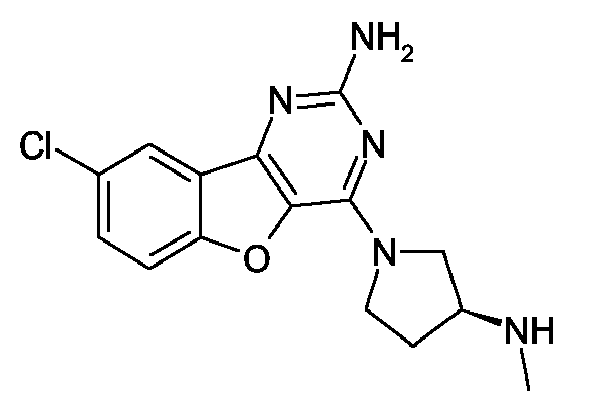
- A solution of tert-butyl [(S)-1-(2-amino-8-chlorobenzo[4,5]furo[3,2-d]pyrimidin-4-yl)pyrrolidin-3-yl] N-methyl carbamate (intermediate E, 0.09g) and trifluoroacetic acid (3mL) in dichloromethane (3mL) was stirred at room temperature overnight. The mixture was evaporated to dryness and the residue was dissolved in methanol and loaded onto an Isolute® SCX-2 column eluting with methanol to remove the unwanted by-products then with a solution of ammonia in methanol (2M) to give the crude product. After evaporation, the residue was purified by chromatography on silica eluting with a mixture of methanol and dichloromethane (1:99 increasing to 1:49) to give [(S)-1-(2-amino-8-chlorobenzo[4,5]furo[3,2-d]-pyrimidin-4-yl)pyrrolidin-3-yl] N-methyl amine (0.045g) as a white solid.
1H NMR (DNSO-d6 80°C): δ 1.8 (m, 1H), 2.1 (m, 1H), 2.35 (s, 3H), 3.3 (m, 1H), 3.6 (m, 1H), 3.8 (m, 1H), 3.9 (m, 2H), 5.7 (br s, 2H), 7.55 (dd, 1H), 7.65 (d, 1H), 7.85 (d, 1H).
LCMS (method A): retention time 3.92minutes (M+H+) 318. -

- This compound was prepared starting from 2-amino-4,8-dichlorobenzo[4,5]furo[3,2-d]pyrimidine (intermediate D) and tert-butyl N-methyl N-[(R)-pyrrolidin-3-yl] carbamate by following a similar procedure to that used for the preparation of intermediate E.
1H NMR (CDCl3): δ 1.5 (s, 9H), 2.1 (m, 1H), 2.2 (m, 1H), 2.85 (s, 3H), 3.75 (br, 2H), 4.1 (br, 2H), 4.8-5.0 (br, 3H), 7.45 (d, 1H), 7.5 (dd, 1H), 8.0 (d, 1H). - Product: [(R)-1-(2-Amino-8-chlorobenzo[4,5]furo[3,2-d]-pyrimidin-4-yl)pyrrolidin-3-yl] N-methyl amine

- This compound was prepared starting from tert-butyl [(R)-1-(2-amino-8-chlorobenzo[4,5]furo[3,2-d]pyrimidin-4-yl)pyrrolidin-3-yl] N-methyl carbamate (intermediate F) by following a similar procedure to that used for the preparation of example 1.
1H NMR (DMSO-d6 80°C): δ 1.85 (m, 1H), 2.1 (m, 1H), 2.35 (s, 3H), 3.3 (m, 1H), 3.6 (m, 1H), 3.8 (m, 1H), 3.9 (m, 2H), 5.7 (br s, 2H), 7.55 (dd, 1H), 7.65 (d, 1H), 7.8 (d, 1H).
LCMS (method A): retention time 3.94 minutes (M+H+) 318. -

- This compound was prepared starting from 2-amino-4,8-dichlorobenzo[4,5]furo[3,2-d]pyrimidine (intermediate D) and tert-butyl azetidin-3-yl carbamate by following a similar procedure to that used for the preparation of intermediate E.
1H NMR (CDCl3) δ 1.5 (s, 9H), 4.25 (br, 2H), 4.7 (br, 3H), 5.0 (br, 2H), 5.1 (br, 1H), 7.4 (d, 1H), 7345 (dd, 1H), 8.0 (d, 1H). -

- A mixture of tert-butyl [1-(2-amino-8-chlorobenzo[4,5]furo[3,2-d]pyrimidin-4-yl)azetidin-3-yl] N-methyl carbamate (intermediate G, 0.05g) and sodium hydride (60% oil dispersion, 0.05g), in THF (5mL) was sonicated under an atmosphere of argon for 10 minutes. Iodoethane (1mL) was added and the mixture was sonicated for 2 hours. The resultant mixture was treated with aqueous ammonium chloride solution and extracted with ethyl acetate. The organic layer was dried (MgSO4) and filtered and the filtrate was evaporated to dryness to give crude tert-butyl [1-(2-ethylamino-8-chlorobenzo[4,5]furo[3,2-d]-pyrimidin-4-yl)azetidin-3-yl] N-ethyl carbamate which was used without further purification.
-

- This compound was prepared starting from crude tert-butyl [1-(2-ethylamino-8-chlorobenzo[4,5]furo[3,2-d]-pyrimidin-4-yl)azetidin-3-yl] N-ethyl carbamate (intermediate H) by following a similar procedure to that used for the preparation of example 1.
1H NMR (DMSO-d6) δ 1.0 (t, 3H), 1.1 (t, 3H), 2.55 (q, 2H), 3.3 (q, 2H), 3.75 (m, 1H), 4.0 (br, 2H), 4.45 (br, 2H), 6.6 (t, 1H), 7.6 (dd, 1H), 7.7 (d, 1H), 7.9 (d, 1H).
LCMS (method A): retention time 4.57 minutes (M+H+) 346.
Claims (14)
- A compound having the general formula (I)
 A represents heterocyclyl, having at least one nitrogen ring atom, which nitrogen is attached to the pyrimidine ring in formula (I) and wherein A is substituted with -NR3R4, R7 and is optionally substituted with one or more other substituents independently selected from the group consisting of C1-4 alkyl; F, Cl, Br, C3-6 cycloalkyl, OH, and OC1-4 alkyl, wherein each C1-4 alkyl, C3-6 cycloalkyl is optionally substituted with one or more halogen;R1 and R2 are independently H, -C(O)CH3, -SO2CH3, C1-4 alkyl, C3-6 cycloalkyl, wherein each C1-4 alkyl, C3-6 cycloalkyl is optionally substituted with one or more halogen;R3 and R4 are independently H, C1-4 alkyl or C3-6 cycloalkyl; wherein each C1-4 alkyl, C3-6 cycloalkyl is optionally substituted with one or more halogen;Optionally R3, R4 jointly form together with the nitrogen to which they are attached to a heterocyclyl ring;R5 and R6 are independently H, F, Cl, Br, C1-4 alkyl, OH, OC1-4 alkyl, wherein each C1-4 alkyl is optionally substituted with one or more halogen;R7 is selected from the group consisting of H, C1-4 alkyl; F, Cl, Br, C3-6 cycloalkyl, OH, and OC1-4 alkyl, wherein each C1-4 alkyl, C3-6 cycloalkyl is optionally substituted with one or more halogen; oroptionally R7 form together with R3 (-R7-R3-) a -C1-4 alkyl- group.
 - A compound according to claim 1, wherein A represents a fully saturated heterocyclic ring, preferably selected from the group consisting of azeditine, pyrrolidine, oxazolidine, thiazolidine, pyridine, piperazine, and morpholine, more preferred azeditine or pyrrolidine.
- A compound according to claim lor 2, whereinR1, R2 are independently H or C1-4 alkyl;R3, R4 are independently H or C1-4 alkyl;R5, R6 are independently H, Cl, OH, CH3, OCH3, CF3 or OCF3;R7 is H or C1-4 alkyl;
- A compound according to any of claims 1 to 3, wherein R7 and R3 form a -C1-4 alkyl- group.
- A compound according to any of claims 1 to 4 having the general formula (Ia)

- A compound according to any of claims 1 to 5 selected from the group consisting of:[(R)-1-(2-Amino-8-chlorobenzo[4,5]furo[3,2-d]-pyrimidin-4-yl)pyrrolidin-3-yl] N-methyl amine;[(S)-1-(2-Amino-8-chlorobenzo[4,5]furo[3,2-d]-pyrimidin-4-yl)pyrrolidin-3-yl] N-methyl amine;[1-(2-Ethylamino-8-chlorobenzo[4,5]furo[3,2-d]-pyrimidin-4-yl)azetidin-3-yl] N-ethyl amine.
- A pharmaceutical composition comprising a compound of any of claims 1 to 6 in a mixture with an inert carrier.
- A compound according to any of claims 1 to 6 for use as a medicament.
- Use of a compound according to any of claims 1 to 6 for the manufacture of a medicament for the treatment or prophylaxes of one or more diseases or disorders associated with the modulation of histamine H4 receptor, especially with the inflammatory response mediated by histamine H4 receptor.
- Use of a compound according to any of claims 1 to 6 for the manufacture of a medicament for the treatment or prophylaxes of inflammatory diseases.
- Use of a compound according to any of claims 1 to 6 for the manufacture of a medicament for the treatment or prophylaxes of one or more diseases or disorders selected from the group consisting of asthma, psoriasis, rheumatoid arthritis, Crohn's disease, inflammatory bowel disease, ulcerative colitis, allergic rhinitis and other allergic diseases, atopic dermatitis and other dermatological disorders.
- A method for treating, controlling, delaying or preventing in a mammalian patient in need of treatment of one or more conditions associated with the modulation of histamine H4 receptor, wherein the method comprises the administration of said patient of a pharmaceutically effective amount of a compound according to any of claims 1 to 6.
- A process for the preparation of a compound according to any of the claims 1 to 6, comprising the steps of:• Reacting an appropriately substituted pyrimidine of formula (VIII) with the appropriate boronic acid under conditions to form a biaryl of formula (VII).
 • Reacting a compound of formula (VII), with a suitable Lewis acid to form a compound of formula (VI)
 • Treating a compound of formula (VI) with a suitable catalyst, for example copper chloride to form cyclised compounds of the formula (V).
 • Reacting a cyclic amine of formula (IV) with a compound of formula (V) under conditions to form a compound of general formula (I)
- A process for the preparation of a medicament comprising the steps of:a) preparing a compound according to claim 13; andb) formulating a medicament containing said compound.
Priority Applications (5)
| Application Number | Priority Date | Filing Date | Title |
|---|---|---|---|
| EP06101510A EP1829879A1 (en) | 2006-02-10 | 2006-02-10 | Amino pyrimidine compounds for the treatment of inflammatory disorders |
| EP07704436A EP1991550A1 (en) | 2006-02-10 | 2007-02-07 | Amino pyrimidine compounds for the treatment of inflammatory disorders |
| PCT/EP2007/051183 WO2007090853A1 (en) | 2006-02-10 | 2007-02-07 | Enantiomers of amino pyrimidine compounds for the treatment of inflammatory disorders |
| PCT/EP2007/051184 WO2007090854A1 (en) | 2006-02-10 | 2007-02-07 | Azetidine amino pyrimidine compounds for the treatment of inflammatory disorders |
| PCT/EP2007/051182 WO2007090852A1 (en) | 2006-02-10 | 2007-02-07 | Amino pyrimidine compounds for the treatment of inflammatory disorders |
Applications Claiming Priority (3)
| Application Number | Priority Date | Filing Date | Title |
|---|---|---|---|
| EP06101510A EP1829879A1 (en) | 2006-02-10 | 2006-02-10 | Amino pyrimidine compounds for the treatment of inflammatory disorders |
| EP06114490A EP1860108A1 (en) | 2006-05-24 | 2006-05-24 | Enantiomers of Amino Pyrimidine compounds for the treatment of inflammatory disorders |
| EP06114491A EP1860109A1 (en) | 2006-05-24 | 2006-05-24 | Azetidine amino pyrimidine compounds for the treatment of inflammatory disorders |
Publications (1)
| Publication Number | Publication Date |
|---|---|
| EP1829879A1 true EP1829879A1 (en) | 2007-09-05 |
Family
ID=37945831
Family Applications (2)
| Application Number | Title | Priority Date | Filing Date |
|---|---|---|---|
| EP06101510A Withdrawn EP1829879A1 (en) | 2006-02-10 | 2006-02-10 | Amino pyrimidine compounds for the treatment of inflammatory disorders |
| EP07704436A Withdrawn EP1991550A1 (en) | 2006-02-10 | 2007-02-07 | Amino pyrimidine compounds for the treatment of inflammatory disorders |
Family Applications After (1)
| Application Number | Title | Priority Date | Filing Date |
|---|---|---|---|
| EP07704436A Withdrawn EP1991550A1 (en) | 2006-02-10 | 2007-02-07 | Amino pyrimidine compounds for the treatment of inflammatory disorders |
Country Status (2)
| Country | Link |
|---|---|
| EP (2) | EP1829879A1 (en) |
| WO (1) | WO2007090852A1 (en) |
Cited By (3)
| Publication number | Priority date | Publication date | Assignee | Title |
|---|---|---|---|---|
| CN101998958B (en) * | 2007-09-14 | 2014-03-12 | 詹森药业有限公司 | Thienopyrimidine and furanopyrimidine modulators of histamine H4 receptors |
| AU2012336492B2 (en) * | 2011-11-09 | 2017-05-25 | Memic Europe B.V. | Apparatus with conductive strip for dust removal |
| US9905782B2 (en) | 2013-03-26 | 2018-02-27 | Semiconductor Energy Laboratory Co., Ltd. | Light-emitting element, compound, organic compound, display module, lighting module, light-emitting device, display device, lighting device, and electronic device |
Families Citing this family (16)
| Publication number | Priority date | Publication date | Assignee | Title |
|---|---|---|---|---|
| ES2441958T3 (en) * | 2006-07-11 | 2014-02-07 | Janssen Pharmaceutica Nv | Benzofuro- and benzothienopyrimidine H4 receptor receptor modulators |
| US7985745B2 (en) | 2006-10-02 | 2011-07-26 | Abbott Laboratories | Method for pain treatment |
| US8735411B2 (en) | 2006-10-02 | 2014-05-27 | Abbvie Inc. | Macrocyclic benzofused pyrimidine derivatives |
| CL2008000467A1 (en) | 2007-02-14 | 2008-08-22 | Janssen Pharmaceutica Nv | COMPOUNDS DERIVED FROM 2-AMINOPIRIMIDINE, HISTAMINE RECEIVER MODULATORS H4; YOUR PREPARATION PROCEDURE; PHARMACEUTICAL COMPOSITION THAT INCLUDES SUCH COMPOUNDS; AND ITS USE TO TREAT A SELECTED INFLAMMATORY DISORDER OF ALEGIA, ASMA |
| WO2009137492A1 (en) * | 2008-05-05 | 2009-11-12 | Abbott Laboratories | Heteroaryl-fused macrocyclic pyrimidine derivatives |
| EA018198B1 (en) | 2008-06-12 | 2013-06-28 | Янссен Фармацевтика Нв | Diamino-pyridine, pyrimidine, and pyridazine modulators of the histamine hreceptor |
| EP2201982A1 (en) | 2008-12-24 | 2010-06-30 | INSERM (Institut National de la Santé et de la Recherche Médicale) | Histamine H4 receptor antagonists for the treatment of vestibular disorders |
| US8349852B2 (en) | 2009-01-13 | 2013-01-08 | Novartis Ag | Quinazolinone derivatives useful as vanilloid antagonists |
| EP2531510B1 (en) | 2010-02-01 | 2014-07-23 | Novartis AG | Pyrazolo[5,1b]oxazole derivatives as crf-1 receptor antagonists |
| WO2011092293A2 (en) | 2010-02-01 | 2011-08-04 | Novartis Ag | Cyclohexyl amide derivatives as crf receptor antagonists |
| US8835444B2 (en) | 2010-02-02 | 2014-09-16 | Novartis Ag | Cyclohexyl amide derivatives as CRF receptor antagonists |
| CN104582703A (en) | 2012-06-08 | 2015-04-29 | 森索睿翁公司 | H4 receptor inhibitors for treating tinnitus |
| EP3409662A4 (en) * | 2016-01-29 | 2019-08-28 | Meiji Seika Pharma Co., Ltd. | NOVEL COMPOUND AND PHARMACEUTICALLY ACCEPTABLE SALT THEREOF |
| PH12022551623A1 (en) | 2020-01-13 | 2023-11-29 | Verge Analytics Inc | Substituted pyrazolo-pyrimidines and uses thereof |
| UY39276A (en) | 2020-06-19 | 2022-01-31 | Bayer Ag | USE OF 1,3,4-OXADIAZOL-2-ILPYRIMIDINE COMPOUNDS TO CONTROL PHYTOPATHOGENIC MICROORGANISMS, METHODS OF USE AND COMPOSITIONS. |
| CN116589472B (en) * | 2023-05-22 | 2024-09-13 | 郑州大学 | Benzofuran [3,2-d ] pyrimidine-2-amine compound and preparation method and application thereof |
Citations (6)
| Publication number | Priority date | Publication date | Assignee | Title |
|---|---|---|---|---|
| US3755583A (en) * | 1970-06-05 | 1973-08-28 | Chas0!nhx | |
| US4876252A (en) * | 1986-01-13 | 1989-10-24 | American Cyanamid Company | 4,5,6-substituted-N-(substituted-phenyl)-2-pyrimidinamines |
| JPH06220059A (en) * | 1993-01-28 | 1994-08-09 | Tanabe Seiyaku Co Ltd | Fused pyrimidine derivative and process for producing the same |
| US20030207893A1 (en) * | 2001-03-09 | 2003-11-06 | Carruthers Nicholas I. | Heterocyclic compounds |
| WO2005037825A2 (en) * | 2003-10-14 | 2005-04-28 | Arizona Board Of Regents On Behalf Of The University Of Arizona | Protein kinase inhibitors |
| WO2006002051A1 (en) * | 2004-06-15 | 2006-01-05 | Schering Corporation | Tricyclic compounds and their use as mglur1 antagonists |
-
2006
- 2006-02-10 EP EP06101510A patent/EP1829879A1/en not_active Withdrawn
-
2007
- 2007-02-07 EP EP07704436A patent/EP1991550A1/en not_active Withdrawn
- 2007-02-07 WO PCT/EP2007/051182 patent/WO2007090852A1/en not_active Ceased
Patent Citations (6)
| Publication number | Priority date | Publication date | Assignee | Title |
|---|---|---|---|---|
| US3755583A (en) * | 1970-06-05 | 1973-08-28 | Chas0!nhx | |
| US4876252A (en) * | 1986-01-13 | 1989-10-24 | American Cyanamid Company | 4,5,6-substituted-N-(substituted-phenyl)-2-pyrimidinamines |
| JPH06220059A (en) * | 1993-01-28 | 1994-08-09 | Tanabe Seiyaku Co Ltd | Fused pyrimidine derivative and process for producing the same |
| US20030207893A1 (en) * | 2001-03-09 | 2003-11-06 | Carruthers Nicholas I. | Heterocyclic compounds |
| WO2005037825A2 (en) * | 2003-10-14 | 2005-04-28 | Arizona Board Of Regents On Behalf Of The University Of Arizona | Protein kinase inhibitors |
| WO2006002051A1 (en) * | 2004-06-15 | 2006-01-05 | Schering Corporation | Tricyclic compounds and their use as mglur1 antagonists |
Non-Patent Citations (1)
| Title |
|---|
| PATENT ABSTRACTS OF JAPAN vol. 018, no. 588 (C - 1271) 10 November 1994 (1994-11-10) * |
Cited By (7)
| Publication number | Priority date | Publication date | Assignee | Title |
|---|---|---|---|---|
| CN101998958B (en) * | 2007-09-14 | 2014-03-12 | 詹森药业有限公司 | Thienopyrimidine and furanopyrimidine modulators of histamine H4 receptors |
| AU2012336492B2 (en) * | 2011-11-09 | 2017-05-25 | Memic Europe B.V. | Apparatus with conductive strip for dust removal |
| US9905782B2 (en) | 2013-03-26 | 2018-02-27 | Semiconductor Energy Laboratory Co., Ltd. | Light-emitting element, compound, organic compound, display module, lighting module, light-emitting device, display device, lighting device, and electronic device |
| US10193086B2 (en) | 2013-03-26 | 2019-01-29 | Semiconductor Energy Laboratory Co., Ltd. | Light-emitting element, compound, Organic compound, display module, lighting module, light-emitting device, display device, lighting device, and electronic device |
| US10700291B2 (en) | 2013-03-26 | 2020-06-30 | Semiconductor Energy Laboratory Co., Ltd. | Light-emitting element, compound, organic compound, display module, lighting module, light-emitting device, display device, lighting device, and electronic device |
| US11600789B2 (en) | 2013-03-26 | 2023-03-07 | Semiconductor Energy Laboratory Co., Ltd. | Light-emitting element, compound, organic compound, display module, lighting module, light-emitting device, display device, lighting device, and electronic device |
| US12069951B2 (en) | 2013-03-26 | 2024-08-20 | Semiconductor Energy Laboratory Co., Ltd. | Light-emitting element, compound, organic compound, display module, lighting module, light-emitting device, display device, lighting device, and electronic device |
Also Published As
| Publication number | Publication date |
|---|---|
| WO2007090852A1 (en) | 2007-08-16 |
| EP1991550A1 (en) | 2008-11-19 |
Similar Documents
| Publication | Publication Date | Title |
|---|---|---|
| EP1991550A1 (en) | Amino pyrimidine compounds for the treatment of inflammatory disorders | |
| WO2007090853A1 (en) | Enantiomers of amino pyrimidine compounds for the treatment of inflammatory disorders | |
| WO2007090854A1 (en) | Azetidine amino pyrimidine compounds for the treatment of inflammatory disorders | |
| CA2586316A1 (en) | Pyrimidine compounds as histamine modulators | |
| EP3939980A1 (en) | Fused pentacyclic imidazole derivatives as modulators of tnf activity | |
| WO2021161105A1 (en) | P2x3 modulators | |
| TW202237573A (en) | Aryl derivatives for treating trpm3 mediated disorders | |
| EP1767537A1 (en) | Pyrimidine compounds for the treatment of inflammatory disorders | |
| CN120247907A (en) | IAP antagonist compounds and intermediates and their synthesis methods | |
| AU2010212605A1 (en) | Crystalline polymorphic form 631 | |
| DE60318874T2 (en) | PYRAZOLE DERIVATIVES | |
| EP2020412A1 (en) | Sulphur containing amino pyrimidine compounds for the treatment of inflammatory disorders | |
| CN108137569B (en) | Substituted morpholine derivatives with antipain activity | |
| EP1860108A1 (en) | Enantiomers of Amino Pyrimidine compounds for the treatment of inflammatory disorders | |
| EP1860109A1 (en) | Azetidine amino pyrimidine compounds for the treatment of inflammatory disorders | |
| CN102731368A (en) | Preparation method of 5,5-difluoro-3-substituted piperidine derivative | |
| TW202300485A (en) | Plk4 inhibitors and use thereof | |
| AU2017371443B2 (en) | A substituted benzimidazole derivative as a modulator of TNF activity | |
| EP2986616B1 (en) | Tricyclic triazolic compounds as sigma receptors ligans | |
| EP1776982A1 (en) | Pyrimidine compounds as histamine modulators | |
| HK40058586A (en) | Process for preparing fused pentacyclic imidazole derivatives and uses thereof as modulators of tnf activity | |
| CN119365455A (en) | Compounds active against bromodomains | |
| HK1221226B (en) | Tricyclic triazolic compounds as sigma receptors ligans | |
| HK40024466A (en) | Fused pentacyclic imidazole derivatives as modulators of tnf activity | |
| HK40024466B (en) | Fused pentacyclic imidazole derivatives as modulators of tnf activity |
Legal Events
| Date | Code | Title | Description |
|---|---|---|---|
| PUAI | Public reference made under article 153(3) epc to a published international application that has entered the european phase |
Free format text: ORIGINAL CODE: 0009012 |
|
| AK | Designated contracting states |
Kind code of ref document: A1 Designated state(s): AT BE BG CH CY CZ DE DK EE ES FI FR GB GR HU IE IS IT LI LT LU LV MC NL PL PT RO SE SI SK TR |
|
| AX | Request for extension of the european patent |
Extension state: AL BA HR MK YU |
|
| AKX | Designation fees paid | ||
| STAA | Information on the status of an ep patent application or granted ep patent |
Free format text: STATUS: THE APPLICATION IS DEEMED TO BE WITHDRAWN |
|
| 18D | Application deemed to be withdrawn |
Effective date: 20080306 |
|
| REG | Reference to a national code |
Ref country code: DE Ref legal event code: 8566 |