EP1786486B1 - Radiopaque prosthetic intervertebral disc nucleus - Google Patents
Radiopaque prosthetic intervertebral disc nucleus Download PDFInfo
- Publication number
- EP1786486B1 EP1786486B1 EP05781070A EP05781070A EP1786486B1 EP 1786486 B1 EP1786486 B1 EP 1786486B1 EP 05781070 A EP05781070 A EP 05781070A EP 05781070 A EP05781070 A EP 05781070A EP 1786486 B1 EP1786486 B1 EP 1786486B1
- Authority
- EP
- European Patent Office
- Prior art keywords
- hydrogel
- monomer
- nucleus pulposus
- prosthetic nucleus
- nucleus
- Prior art date
- Legal status (The legal status is an assumption and is not a legal conclusion. Google has not performed a legal analysis and makes no representation as to the accuracy of the status listed.)
- Expired - Lifetime
Links
Images


Classifications
-
- A—HUMAN NECESSITIES
- A61—MEDICAL OR VETERINARY SCIENCE; HYGIENE
- A61L—METHODS OR APPARATUS FOR STERILISING MATERIALS OR OBJECTS IN GENERAL; DISINFECTION, STERILISATION OR DEODORISATION OF AIR; CHEMICAL ASPECTS OF BANDAGES, DRESSINGS, ABSORBENT PADS OR SURGICAL ARTICLES; MATERIALS FOR BANDAGES, DRESSINGS, ABSORBENT PADS OR SURGICAL ARTICLES
- A61L27/00—Materials for grafts or prostheses or for coating grafts or prostheses
- A61L27/50—Materials characterised by their function or physical properties, e.g. injectable or lubricating compositions, shape-memory materials, surface modified materials
- A61L27/52—Hydrogels or hydrocolloids
-
- A—HUMAN NECESSITIES
- A61—MEDICAL OR VETERINARY SCIENCE; HYGIENE
- A61L—METHODS OR APPARATUS FOR STERILISING MATERIALS OR OBJECTS IN GENERAL; DISINFECTION, STERILISATION OR DEODORISATION OF AIR; CHEMICAL ASPECTS OF BANDAGES, DRESSINGS, ABSORBENT PADS OR SURGICAL ARTICLES; MATERIALS FOR BANDAGES, DRESSINGS, ABSORBENT PADS OR SURGICAL ARTICLES
- A61L27/00—Materials for grafts or prostheses or for coating grafts or prostheses
- A61L27/50—Materials characterised by their function or physical properties, e.g. injectable or lubricating compositions, shape-memory materials, surface modified materials
Definitions
- This invention relates to a prosthetic nucleus for an intervertebral disc. More specifically, it relates to an artificial disc nucleus made of a hydrogel material.
- the intervertebral disc (IVD) in a human body is a complex joint both anatomically as functionally. It is composed of three component structures: the nucleus pulposus (the nucleus), the annulus fibrosus (the annulus) and the vertebral end plates. The biochemical composition and anatomical arrangements within these component structures are related to the biomechanical function of the disc.
- Discectomy usually is not desirable from a biomechanical point of view, since this causes increased compression load onto the annulus ring. This narrows the disc spaces in long term consequently increasing the load on the facet joints. Fusion restricts the motion of the fused segment(s), thereby restricting the mobility in the spine of the patient and increasing the risk of degeneration of the adjoining vertebral discs, since they have to make up for the loss in motion in the fused ones.
- Another option is to use a prosthetic joint device, which is not only able to replace the injured or degenerated intervertebral disc, but also can mimic the physiological and the biomechanical function of the disc to be replaced and prevent further degeneration of the surrounding tissue. Such replacement is however quite complex and it is it hard to match nature's design.
- the annulus of the IVD is degenerated or ruptured in such a way that herniation of the nucleus pulposus occurs. Then, adequate treatment may be to remove the herniated nucleus and replace it with a prosthetic nucleus, followed by mending of the annulus defect. This treatment can for example be suitable in case of a traumatic rupture of the annulus or in case of early-stage disc degeneration.
- WO94/23671 discloses a prosthetic nucleus for a vertebral disc made of a hydrogel material.
- a disadvantage of this prosthetic nucleus is that it is not possible to visualize the implanted prosthetic nucleus during and after surgery. The success of a nucleus replacement is largely dependent on the correct positioning of the implant. To assess adequately the location of the implant during and after surgery, it is convenient that it can be monitored real-time using X-ray fluoroscopy. That way the surgeon is able to perfectly position the implant in the nucleus cavity. Also, in case of complications arising at a later time, the implant can be easily traced.
- a prosthetic nucleus comprising radiopaque material used therein as a marker is disclosed in US 2004-0054413A1 .
- the radiopaque marker is a metal (such as gold, tungsten, titanium, tantalum or platinum) and is located within the hydrogel, without being bound thereto.
- radiopaque marker A disadvantage of the use of such radiopaque marker is that only the marker is visible, not the prosthesis itself. In case of layers of radiopaque marker, the circumference of the prosthesis is not visible, thereby not giving sufficient information of its exact whereabouts. In case the radiopaque marker is dispersed in powder form, risk of diffusion out of the hydrogel is increasing, thereby also not enabling to locate the exact position of the prosthesis.
- Another disadvantage of metallic radiopaque markers is that they can cause artifacts in nuclear magnetic resonance imaging (MRI) disrupting the image, especially at high field strengths.
- MRI nuclear magnetic resonance imaging
- the elastic modulus of these types of materials is in the range of GPa's, whilst the materials according to the present invention are at least a factor 10 lower.
- the polymers as disclosed in WO96/05872 are suitable as biomedical construction material or as radiopacifier for bone cement or for dental filling, but not for the replacement of the nucleus pulposus.
- the hydrogel according to the invention is intrinsically radiopaque, as a result of which the contours of the implant can be made visible with X-ray. Additionally, it has been found that the radiopacity of the hydrogel is stable in time. Furthermore, no leakage of material into the body takes place.
- a copolymer is a material created by polymerizing a mixture of at least two monomers. Suitable combinations can for example exist of two monomers, three monomers (a so-called terpolymer), four monomers, etcetera.
- hydrogel is here and hereafter used for a three-dimensional, hydrophilic, polymeric network capable of imbibing water or biological fluids.
- the networks are insoluble due to the presence of chemical or physical crosslinks, thus referring to such a polymeric network is regardless whether it has already imbibed fluids or not, unless explicitly stated otherwise (see also Peppas NA et al, Hydrogels in pharmaceutical formulations, Eur J Pharm Biopharm 2000 (50) p27-46 ).
- a hydrogel is sufficiently hydrated when the equilibrium water content (EWC) is reached.
- the EWC is reached once the mass of a wetted sample doesn't change significantly ( ⁇ 2%) within a week, measured at 20°C.
- Any monomer comprising a covalently bound iodine or bromine is suitable for use in the hydrogel according to the invention.
- Suitable monomers are vinylic, acrylic and methacrylic monomers.
- Monomers of this type include, but are not limited to the group of structures represented in formula 1.
- m or p are below 10.
- m is 2.
- p is 1 or 2.
- m is 2 and p is 1 or 2.
- Suitable monomers comprising covalently bound iodine or bromine are 2-[2'-iodobenzoyl]-oxo-ethylmethacrylate, 2-(4'-iodobenzoyl)-oxoethyl methacrylate (4IEMA) or 2-[2', 3', 5'-triiodobenzoyl]-oxo-ethyl methacrylate.
- a monomer comprising covalently bound iodine is used.
- 4IEMA is used since this crystalline material can be easily prepared in bulk-quantities in pure form via radical polymerization.
- 2-[2', 3', 5'-triiodobenzoyl]-oxo-ethyl methacrylate is used, which is useful to introduce a high level of X-ray contrast in the copolymer, since during polymerization three iodine atoms are introduced per monomer.
- Hydrophilic monomer is hereafter defined as any monomer having a strong affinity for water, tending to dissolve in, mix with, or be wetted by water.
- suitable hydrophilic monomers (b) are N-vinyl-2-pyrrolidinone (NVP), 2-hydroxy ethyl methacrylate (HEMA), methacrylic acid (MAA), polyethylene glycol methacrylate (PEG-MA), vinyl acetate as a precursor for vinyl alcohol (VA) or derivatives thereof.
- NDP N-vinyl-2-pyrrolidinone
- HEMA 2-hydroxy ethyl methacrylate
- MAA methacrylic acid
- PEG-MA polyethylene glycol methacrylate
- VA vinyl acetate
- the hydrophilic monomer (b) is HEMA and/or NVP.
- the amount of hydrophilic monomer (b) used to create the copolymer in the hydrogel according to the invention has to suffice to form a hydrogel.
- the characteristics of the hydrated hydrogel with respect to the equilibrium water content, swelling ratio and time to reach the equilibrium water content differs per hydrophilic monomer. In other words, in case of the same amount of hydrophilic monomer, these characteristics can differ substantially for different hydrophilic monomers.
- the person skilled in the art can however easily determine the desired amount of hydrophilic monomer in the hydrogel in order to obtain the right mechanical properties.
- a hydrogel according to the invention can imbibe water up to an EWC of at least 10 wt.% .
- the EWC of the hydrogel is at least 15 wt.%. Even more preferably the EWC of the hydrogel is at least 20 wt.% and most preferably at least 30 wt.%.
- the hydrogel In order to give the hydrogel the right mechanical properties the hydrogel generally has a maximal EWC of 95 wt.% .
- the hydrogel has an EWC between 20 and 90 wt.%.
- the copolymer also comprises a hydrophobic monomer (c).
- a hydrophobic monomer is hereafter defined as any monomer lacking affinity for water, tending to repel and not absorb water, tending not to dissolve in or mix with or be wetted by water.
- monomers (c) are: methylmethacrylate (MMA), butylmethylacrylate (BMA), vinylacetate as precursor for polyvinyl acetate (VAp).
- the suitable monomers in the copolymer of the present invention can have one or more reactive groups.
- at least one monomer is used having two or more reactive groups.
- a polymer network can be formed.
- monomers having two reactive groups, suitable for the present invention are dimethacrylates, divinylbenzene, or allylmethacrylate.
- the fully hydrated hydrogel according to the invention preferably has an elastic modulus (Young's Modulus) of 0.01 -100 MPa at 37°C.
- the elastic modulus of the hydrogel is at least 0.1 MPa, more preferably at least 0.2 MPa, and most preferably at least 0.3 MPa.
- the hydrogel generally has maximum elastic modulus of 100 MPa.
- the elastic modulus of the hydrogel is at most 50 MPa, more preferably at most 20 MPa, even more preferably at most 10 MPa and most preferably at most 5 MPa.
- the hydrogel has an elastic modulus between 0.1 and 10 MPa, more preferably between 0.3 and 5 MPa.
- the hydrogel according to the invention can be used in a prosthetic nucleus pulposus. It has been found that using the hydrogel according to the invention can yield a prosthesis matching the behavior of the native nucleus in the joint as close as possible.
- the advantage of the hydrogel according to the invention when used in the prosthetic nucleus pulposus is that the hydrogel is intrinsically radiopaque.
- An additional advantage of the prosthetic nucleus pulposus according to the invention is that the prosthesis can fill the entire cavity that is left after (complete) removal of the nucleus, thereby minimizing implant migration.
- a further advantage is that the prosthesis can be implanted in dehydrated form, which is relatively small, and is then allowed to hydrate and swell in situ. In dehydrated form the prosthesis can be between 1 and 5 times as small as in the swollen state.
- the swelling ratio of the prosthesis It is possible to determine the swelling ratio of the prosthesis by measuring the swelling ratio of the hydrogel used therein. A method for measurement of the swelling ratio is given in the experimental part. Swelling ratios can be used to calculate the size of the nucleus prosthesis before implantation, based on the dimensions of the nucleus cavity. The person skilled in the art can thereby optimize the dimensions of the prosthesis before implantation in order to obtain a prosthesis, which will fill up the cavity completely after swelling to its equilibrium.
- the prosthetic nucleus pulposus according to the invention can also comprise other components, for example anti-infectives and medicaments to improve healing of the annulus fibrosus after insertion of the prosthesis.
- the invention relates to a method for forming a prosthetic nucleus pulposus comprising the steps of shaping a mass of bonded radiopaque hydrogel material as described above to a shape generally conforming to a natural human disc nucleus.
- the prosthetic nucleus pulposus according to the invention is formed before implantation. It can be implanted in swollen or in (partly) dehydrated form. Preferably the prosthetic nucleus pulposus is implanted in dehydrated form, being relatively small in this form, and is then allowed to swell in situ.
- Figures 1 , 2 and 3 A non-limiting Example of this method is depicted in Figures 1 , 2 and 3 .
- Figure 1 shows the native spine, comprising the intervertebral disc (1), wherein the native nucleus pulposus (2) is surrounded by the annulus fibrosus (3) as located in the vertebra (4).
- Figure 2 the native pulposus is removed and replaced by a dehydrated prosthetic nucleus pulposus (5), which in Figure 3 is swollen (5) to fill the entire cavity between the end plates and the annulus.
- the prosthetic nucleus pulposus is formed and shaped in situ.
- This method comprising forming a mass of radiopaque hydrogel by injecting a mixture of at least
- the advantage of this method is that there is no need to make a large opening for insertion of the prosthesis.
- the natural nucleus generally can be removed by suction through a syringe, where after the mixture as described above can be injected.
- NVP and HEMA were purchased from Acros (Landsmeer, The Netherlands) and were distilled under reduced pressure to remove inhibiting additives.
- the monomer 4IEMA was synthesized from 4-iodobenzoyl chloride and purified HEMA. Purity and identity of all monomers was checked by 1 H-NMR spectroscopy. 2,2'-azobis(isobutyronitrile) (AIBN) was used as the source of free radicals; this compound was used as received from Acros.
- Monomers and 0.044 mol% (based on the total amount of monomers) of AIBN were mixed and transferred to Teflon tubes, which were then immersed in a thermostated oil bath. The temperature profile shown in Table 1 was run. Table 1 : Temperature profile t (h) 0 0.5 8.5 9.5 13.5 14.5 18.5 22.5 T (°C) 40 60 60 80 80 100 100 40
- compositions of the prepared copolymers are displayed in Table 2.
- Table 2 Molar ratios of hydrogel composition
- EWC 100 % ⁇ m s - m d m s m s is the mass of the swollen sample in equilibrium state and m d is the mass of the dry sample.
- the swelling ratio was determined, which is defined by the increase in volume: the volume of the swollen sample in equilibrium state, divided by the volume of the dry sample.
- X-ray visibility was checked by implanting swollen samples of Examples 3 and 4 into a nucleus cavity of the lumbar spine of a porcine cadaver by a certified orthopedic surgeon; subsequently X-ray photographs were taken of the materials in situ under standard hospital conditions, using a Philips BV Pulsera at 66kV and with automatic exposure.
- NVP-based hydrogels of Examples 1, 2, and 5 have a higher equilibrium water content than the HEMA-based hydrogels. It also is shown that the presence of the hydrophobic 4IEMA decreases the water uptake of the hydrogels. Also the rate at which the hydrogels imbibe water depends on the hydrophilic character of the hydrogel. Whereas for the more hydrophilic hydrogels (1, 2, 5), equilibrium water content (EWC) is reached in about 12 hours, the less hydrophilic hydrogels (3, 4) take 2 days or more to reach equilibrium swelling.
- EWC equilibrium water content
- Comparative experiment A clearly shows that the incorporation of the hydrophobic monomer MMA decreases the EWC and increases the elastic modulus too much for the material to be regarded as a hydrogel and is therefore not suitable for the purpose of the invention.
- Figure 4 shows the resulting X-ray image of the implantation whereby samples of Examples 3 (H95) and 4 (H90) were implanted between two adjacent vertebrae of a porcine cadaver. Three intervertebral structures are seen: the native disc (*) on the bottom, the sample of Example 4 in the middle and the sample of Example 3 on top. The native discus is seen as a non-absorbing (white) band, while samples of Experiments 3 and 4 are clearly visible as X-ray absorbing bands.
- Figures 5 and 6 show respectively a CT-scan and an MRI scan of the sample of Example 5 implanted in a porcine cadaver.
- the CT-scan was made on a Toshiba Aquilion (at 120 kV, 20 mAs), and the MRI-scan was made on a Philips Gyroscan NT Intera 1.5T.
- the implant is clearly visible in a kidney-shaped form, completely filling the cavity.
Landscapes
- Health & Medical Sciences (AREA)
- Chemical & Material Sciences (AREA)
- Transplantation (AREA)
- Dermatology (AREA)
- Medicinal Chemistry (AREA)
- Oral & Maxillofacial Surgery (AREA)
- Epidemiology (AREA)
- Life Sciences & Earth Sciences (AREA)
- Animal Behavior & Ethology (AREA)
- General Health & Medical Sciences (AREA)
- Public Health (AREA)
- Veterinary Medicine (AREA)
- Dispersion Chemistry (AREA)
- Materials For Medical Uses (AREA)
- Prostheses (AREA)
Abstract
Description
- This invention relates to a prosthetic nucleus for an intervertebral disc. More specifically, it relates to an artificial disc nucleus made of a hydrogel material.
- The intervertebral disc (IVD) in a human body, or more generic in vertebrates, is a complex joint both anatomically as functionally. It is composed of three component structures: the nucleus pulposus (the nucleus), the annulus fibrosus (the annulus) and the vertebral end plates. The biochemical composition and anatomical arrangements within these component structures are related to the biomechanical function of the disc.
- Degeneration or injury of the IVD is the most common cause of back pain. Back pain is the largest cause of lost workdays and activity limitation in western countries amongst people younger than 45 years.
- In case conservative treatment as painkillers and physiotherapy do not suffice, surgical intervention (such as discectomy and fusion) is an option to alleviate the pain. However, these methods have some disadvantages. Discectomy usually is not desirable from a biomechanical point of view, since this causes increased compression load onto the annulus ring. This narrows the disc spaces in long term consequently increasing the load on the facet joints. Fusion restricts the motion of the fused segment(s), thereby restricting the mobility in the spine of the patient and increasing the risk of degeneration of the adjoining vertebral discs, since they have to make up for the loss in motion in the fused ones.
- Another option is to use a prosthetic joint device, which is not only able to replace the injured or degenerated intervertebral disc, but also can mimic the physiological and the biomechanical function of the disc to be replaced and prevent further degeneration of the surrounding tissue. Such replacement is however quite complex and it is it hard to match nature's design.
- In some cases, the annulus of the IVD is degenerated or ruptured in such a way that herniation of the nucleus pulposus occurs. Then, adequate treatment may be to remove the herniated nucleus and replace it with a prosthetic nucleus, followed by mending of the annulus defect. This treatment can for example be suitable in case of a traumatic rupture of the annulus or in case of early-stage disc degeneration.
- Replacement of only the nucleus has several advantages over the interventions as mentioned above as it is less invasive and the remaining tissues, i.e, the annulus and the endplates, are preserved and so are their functions.
-
WO94/23671 - A prosthetic nucleus comprising radiopaque material used therein as a marker is disclosed in
US 2004-0054413A1 . The radiopaque marker is a metal (such as gold, tungsten, titanium, tantalum or platinum) and is located within the hydrogel, without being bound thereto. - A disadvantage of the use of such radiopaque marker is that only the marker is visible, not the prosthesis itself. In case of layers of radiopaque marker, the circumference of the prosthesis is not visible, thereby not giving sufficient information of its exact whereabouts. In case the radiopaque marker is dispersed in powder form, risk of diffusion out of the hydrogel is increasing, thereby also not enabling to locate the exact position of the prosthesis. Another disadvantage of metallic radiopaque markers is that they can cause artifacts in nuclear magnetic resonance imaging (MRI) disrupting the image, especially at high field strengths.
- It is the object of the present invention to provide a prosthetic nucleus that can be seen integrally, whilst having homogeneity of the material.
- This is surprisingly achieved by the use of a hydrogel based on a copolymer comprising:
- (a) at least one monomer comprising covalently bound iodine or bromine, and;
- (b) at least one hydrophilic monomer,
- (a) a monomer comprising covalently bound iodine or bromine
- (b) at least one hydrophilic monomer
- Furthermore, the elastic modulus of these types of materials is in the range of GPa's, whilst the materials according to the present invention are at least a factor 10 lower. The polymers as disclosed in
WO96/05872 - The hydrogel according to the invention is intrinsically radiopaque, as a result of which the contours of the implant can be made visible with X-ray. Additionally, it has been found that the radiopacity of the hydrogel is stable in time. Furthermore, no leakage of material into the body takes place.
- A copolymer is a material created by polymerizing a mixture of at least two monomers. Suitable combinations can for example exist of two monomers, three monomers (a so-called terpolymer), four monomers, etcetera.
- The term hydrogel is here and hereafter used for a three-dimensional, hydrophilic, polymeric network capable of imbibing water or biological fluids. The networks are insoluble due to the presence of chemical or physical crosslinks, thus referring to such a polymeric network is regardless whether it has already imbibed fluids or not, unless explicitly stated otherwise (see also Peppas NA et al, Hydrogels in pharmaceutical formulations, Eur J Pharm Biopharm 2000 (50) p27-46). A hydrogel is sufficiently hydrated when the equilibrium water content (EWC) is reached. The EWC is reached once the mass of a wetted sample doesn't change significantly (± 2%) within a week, measured at 20°C. The EWC is calculated using the following equation:
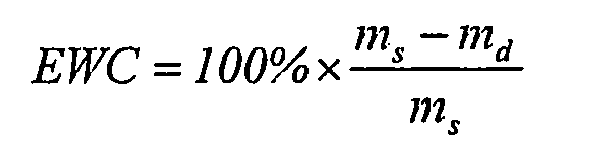
wherein ms is the mass of the hydrated sample in equilibrium state and md is the mass of the dry sample. - Any monomer comprising a covalently bound iodine or bromine is suitable for use in the hydrogel according to the invention. Suitable monomers are vinylic, acrylic and methacrylic monomers. Monomers of this type include, but are not limited to the group of structures represented in
formula 1.
and R1 = I, Br or
nis1,2or3. - Methods of making such compounds are for example disclosed in
WO96/05872
R3 can be located at all possible positions, being ortho, meta, and para. In case n=1, R3 is preferably located atposition position 4. In case n=2, R3 can be located atposition 2 and 4 (ortho and para respectively) orposition 3 and 5 (meta). In case n=3, R3 is preferably located atpositions - Examples of suitable monomers comprising covalently bound iodine or bromine (a) are 2-[2'-iodobenzoyl]-oxo-ethylmethacrylate, 2-(4'-iodobenzoyl)-oxoethyl methacrylate (4IEMA) or 2-[2', 3', 5'-triiodobenzoyl]-oxo-ethyl methacrylate.
- Preferably a monomer comprising covalently bound iodine is used. In a preferred embodiment 4IEMA is used since this crystalline material can be easily prepared in bulk-quantities in pure form via radical polymerization. In another preferred embodiment, 2-[2', 3', 5'-triiodobenzoyl]-oxo-ethyl methacrylate is used, which is useful to introduce a high level of X-ray contrast in the copolymer, since during polymerization three iodine atoms are introduced per monomer.
- Hydrophilic monomer is hereafter defined as any monomer having a strong affinity for water, tending to dissolve in, mix with, or be wetted by water. Examples of suitable hydrophilic monomers (b) are N-vinyl-2-pyrrolidinone (NVP), 2-hydroxy ethyl methacrylate (HEMA), methacrylic acid (MAA), polyethylene glycol methacrylate (PEG-MA), vinyl acetate as a precursor for vinyl alcohol (VA) or derivatives thereof. For the invention it is important that at least one hydrophilic monomer (b) is used in the copolymer, but also mixtures of hydrophilic monomers can be used. Preferably the hydrophilic monomer (b) is HEMA and/or NVP.
- The amount of hydrophilic monomer (b) used to create the copolymer in the hydrogel according to the invention has to suffice to form a hydrogel. The characteristics of the hydrated hydrogel with respect to the equilibrium water content, swelling ratio and time to reach the equilibrium water content differs per hydrophilic monomer. In other words, in case of the same amount of hydrophilic monomer, these characteristics can differ substantially for different hydrophilic monomers. The person skilled in the art can however easily determine the desired amount of hydrophilic monomer in the hydrogel in order to obtain the right mechanical properties.
- Generally, a hydrogel according to the invention can imbibe water up to an EWC of at least 10 wt.% . Preferably, the EWC of the hydrogel is at least 15 wt.%. Even more preferably the EWC of the hydrogel is at least 20 wt.% and most preferably at least 30 wt.%.
- In order to give the hydrogel the right mechanical properties the hydrogel generally has a maximal EWC of 95 wt.% .
- More preferably, the hydrogel has an EWC between 20 and 90 wt.%.
- In another embodiment of the invention the copolymer also comprises a hydrophobic monomer (c). A hydrophobic monomer is hereafter defined as any monomer lacking affinity for water, tending to repel and not absorb water, tending not to dissolve in or mix with or be wetted by water. Examples of such monomers (c) are: methylmethacrylate (MMA), butylmethylacrylate (BMA), vinylacetate as precursor for polyvinyl acetate (VAp).
- The suitable monomers in the copolymer of the present invention can have one or more reactive groups. In one embodiment of the invention at least one monomer is used having two or more reactive groups. In this embodiment a polymer network can be formed. Examples of monomers having two reactive groups, suitable for the present invention are dimethacrylates, divinylbenzene, or allylmethacrylate.
- The fully hydrated hydrogel according to the invention preferably has an elastic modulus (Young's Modulus) of 0.01 -100 MPa at 37°C. Preferably, the elastic modulus of the hydrogel is at least 0.1 MPa, more preferably at least 0.2 MPa, and most preferably at least 0.3 MPa. In order to give the hydrogel the right mechanical properties the hydrogel generally has maximum elastic modulus of 100 MPa. Preferably, the elastic modulus of the hydrogel is at most 50 MPa, more preferably at most 20 MPa, even more preferably at most 10 MPa and most preferably at most 5 MPa. Preferably the hydrogel has an elastic modulus between 0.1 and 10 MPa, more preferably between 0.3 and 5 MPa.
- The hydrogel according to the invention can be used in a prosthetic nucleus pulposus. It has been found that using the hydrogel according to the invention can yield a prosthesis matching the behavior of the native nucleus in the joint as close as possible.
- The advantage of the hydrogel according to the invention when used in the prosthetic nucleus pulposus is that the hydrogel is intrinsically radiopaque. An additional advantage of the prosthetic nucleus pulposus according to the invention is that the prosthesis can fill the entire cavity that is left after (complete) removal of the nucleus, thereby minimizing implant migration. A further advantage is that the prosthesis can be implanted in dehydrated form, which is relatively small, and is then allowed to hydrate and swell in situ. In dehydrated form the prosthesis can be between 1 and 5 times as small as in the swollen state.
- It is possible to determine the swelling ratio of the prosthesis by measuring the swelling ratio of the hydrogel used therein. A method for measurement of the swelling ratio is given in the experimental part. Swelling ratios can be used to calculate the size of the nucleus prosthesis before implantation, based on the dimensions of the nucleus cavity. The person skilled in the art can thereby optimize the dimensions of the prosthesis before implantation in order to obtain a prosthesis, which will fill up the cavity completely after swelling to its equilibrium.
- The prosthetic nucleus pulposus according to the invention can also comprise other components, for example anti-infectives and medicaments to improve healing of the annulus fibrosus after insertion of the prosthesis.
- Furthermore, the invention relates to a method for forming a prosthetic nucleus pulposus comprising the steps of shaping a mass of bonded radiopaque hydrogel material as described above to a shape generally conforming to a natural human disc nucleus.
- In one embodiment of the invention, the prosthetic nucleus pulposus according to the invention is formed before implantation. It can be implanted in swollen or in (partly) dehydrated form. Preferably the prosthetic nucleus pulposus is implanted in dehydrated form, being relatively small in this form, and is then allowed to swell in situ. A non-limiting Example of this method is depicted in
Figures 1 ,2 and3 .Figure 1 shows the native spine, comprising the intervertebral disc (1), wherein the native nucleus pulposus (2) is surrounded by the annulus fibrosus (3) as located in the vertebra (4). InFigure 2 , the native pulposus is removed and replaced by a dehydrated prosthetic nucleus pulposus (5), which inFigure 3 is swollen (5) to fill the entire cavity between the end plates and the annulus. - In another embodiment of the invention the prosthetic nucleus pulposus is formed and shaped in situ. This method comprising forming a mass of radiopaque hydrogel by injecting a mixture of at least
- (a) a monomer comprising covalently bound iodine or bromine
- (b) at least one hydrophilic monomer and
- (c) optionally a hydrophobic monomer,
- The advantage of this method is that there is no need to make a large opening for insertion of the prosthesis. The natural nucleus generally can be removed by suction through a syringe, where after the mixture as described above can be injected.
- The invention is hereafter illustrated by the following non-limiting Examples and comparative experiment.
- NVP and HEMA were purchased from Acros (Landsmeer, The Netherlands) and were distilled under reduced pressure to remove inhibiting additives. The monomer 4IEMA was synthesized from 4-iodobenzoyl chloride and purified HEMA. Purity and identity of all monomers was checked by 1H-NMR spectroscopy. 2,2'-azobis(isobutyronitrile) (AIBN) was used as the source of free radicals; this compound was used as received from Acros. Monomers and 0.044 mol% (based on the total amount of monomers) of AIBN were mixed and transferred to Teflon tubes, which were then immersed in a thermostated oil bath. The temperature profile shown in Table 1 was run.
Table 1: Temperature profile t (h) 0 0.5 8.5 9.5 13.5 14.5 18.5 22.5 T (°C) 40 60 60 80 80 100 100 40 - This resulted in transparent, glassy rods with a diameter of 12 mm. The compositions of the prepared copolymers are displayed in Table 2.
Table 2: Molar ratios of hydrogel composition Example NVP HEMA 4IEMA MMA 1 95 - 5 - 2 90 - 10 - 3 - 95 5 - 4 - 90 10 - 5 94 - 6 - A - 19 21 60 - For testing the mechanical properties of the materials in a static experiment in compression, fully swollen cylindrical samples of ±8 mm thickness and ±15 mm diameter were used. Three samples of each material were compressed, both at room (20°C) and body temperature (37 °C), submerged in water, on a Zwick 1445 compression tester using a 500 N load cell at a strain rate of 3·10-3 s-1. The Young's modulus is calculated within the region of elastic deformation (±2% - 8% compression).
- To study the water uptake of the different materials, swelling experiments in phosphate buffered saline (PBS) were conducted in triplet at room temperature (20°C) using sample discs (cut out of the glassy rods) with a diameter of 12 mm and a thickness of 2 mm. To assure a constant composition of the copolymers during swelling, all samples were washed and air-dried before the experiment. Material masses of the discs were measured at different time intervals. The sample was considered in the equilibrium state once the mass of the wetted sample did not change significantly (± 2%) within a week.
- The excess of water from the surface was removed with a tissue before the samples were weighed. After weighing, the samples were put back in fresh, ample PBS. The equilibrium water content (EWC) was calculated using the following equation:
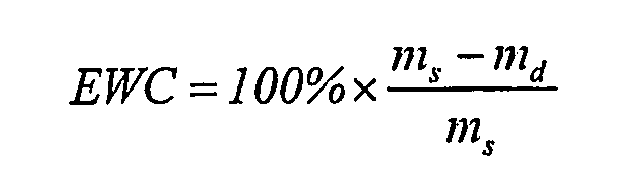
ms is the mass of the swollen sample in equilibrium state and md is the mass of the dry sample. - In the same way as determining the equilibrium water content, the swelling ratio was determined, which is defined by the increase in volume: the volume of the swollen sample in equilibrium state, divided by the volume of the dry sample.
- X-ray visibility was checked by implanting swollen samples of Examples 3 and 4 into a nucleus cavity of the lumbar spine of a porcine cadaver by a certified orthopedic surgeon; subsequently X-ray photographs were taken of the materials in situ under standard hospital conditions, using a Philips BV Pulsera at 66kV and with automatic exposure.
- The results of the measurements of elastic modulus, swelling ratio and equilibrium water content (EWC) are shown in Table 3 below.
Table 3 Results Example Elastic modulus at 20°C (MPa) Elastic modulus at 37°C (MPa) Equilibrium water content (%) Swelling ratio 1 0.9 0.5 77.9 4.5 2 18 8 58.7 2.9 3 0.9 0.7 22.5 1.6 4 4 1 15.4 1.6 5 1 0.7 74 4 A 1200 not determined 2.8 Not determined - The NVP-based hydrogels of Examples 1, 2, and 5 have a higher equilibrium water content than the HEMA-based hydrogels. It also is shown that the presence of the hydrophobic 4IEMA decreases the water uptake of the hydrogels. Also the rate at which the hydrogels imbibe water depends on the hydrophilic character of the hydrogel. Whereas for the more hydrophilic hydrogels (1, 2, 5), equilibrium water content (EWC) is reached in about 12 hours, the less hydrophilic hydrogels (3, 4) take 2 days or more to reach equilibrium swelling.
- Comparative experiment A clearly shows that the incorporation of the hydrophobic monomer MMA decreases the EWC and increases the elastic modulus too much for the material to be regarded as a hydrogel and is therefore not suitable for the purpose of the invention.
-
Figure 4 shows the resulting X-ray image of the implantation whereby samples of Examples 3 (H95) and 4 (H90) were implanted between two adjacent vertebrae of a porcine cadaver. Three intervertebral structures are seen: the native disc (*) on the bottom, the sample of Example 4 in the middle and the sample of Example 3 on top. The native discus is seen as a non-absorbing (white) band, while samples ofExperiments -
Figures 5 and6 show respectively a CT-scan and an MRI scan of the sample of Example 5 implanted in a porcine cadaver. The CT-scan was made on a Toshiba Aquilion (at 120 kV, 20 mAs), and the MRI-scan was made on a Philips Gyroscan NT Intera 1.5T. The implant is clearly visible in a kidney-shaped form, completely filling the cavity.
Copolymers comprising at least
Claims (6)
- Hydrogel suitable for a prosthetic nucleus pulposus, comprising a copolymer based on(a) at least one monomer comprising covalently bound iodine or bromine, and;(b) at least one hydrophilic monomer,wherein the hydrogel, when fully hydrated, has an elastic modulus between 0.01-100 MPa at 37°C.
- Hydrogel according to claim 1, wherein monomer (b) is chosen from the group consisting of N-vinyl-2-pyrrolidinone (NVP), 2-hydroxy ethyl methacrylate (HEMA), methacrylic acid (MAA), polyethylene glycol methacrylate (PEG-MA), vinyl acetate as a precursor for vinyl alcohol (VA) or derivatives thereof.
- Hydrogel according to any one of claims 1-2, wherein the copolymer additionally comprises(c) a hydrophobic monomer.
- Hydrogel according to any one of claims 1-3, wherein the hydrogel at 20°C has an equilibrium water uptake between 10-95 wt% with respect to the wet weight of the hydrogel.
- Prosthetic nucleus pulposus comprising a hydrogel according to any one of claims 1-4.
- Method for forming a prosthetic nucleus pulposus comprising the steps of forming a mass of bonded radiopaque hydrogel material comprising a copolymer based on(a) at least one monomer comprising covalently bound iodine or bromine(b) at least one hydrophilic monomerto a shape generally conforming to a natural disc nucleus.
Priority Applications (1)
| Application Number | Priority Date | Filing Date | Title |
|---|---|---|---|
| EP05781070A EP1786486B1 (en) | 2004-09-10 | 2005-09-08 | Radiopaque prosthetic intervertebral disc nucleus |
Applications Claiming Priority (3)
| Application Number | Priority Date | Filing Date | Title |
|---|---|---|---|
| EP04077514 | 2004-09-10 | ||
| EP05781070A EP1786486B1 (en) | 2004-09-10 | 2005-09-08 | Radiopaque prosthetic intervertebral disc nucleus |
| PCT/NL2005/000650 WO2006028370A1 (en) | 2004-09-10 | 2005-09-08 | Radiopaque prosthetic intervertebral disc nucleus |
Publications (2)
| Publication Number | Publication Date |
|---|---|
| EP1786486A1 EP1786486A1 (en) | 2007-05-23 |
| EP1786486B1 true EP1786486B1 (en) | 2011-05-18 |
Family
ID=34928500
Family Applications (1)
| Application Number | Title | Priority Date | Filing Date |
|---|---|---|---|
| EP05781070A Expired - Lifetime EP1786486B1 (en) | 2004-09-10 | 2005-09-08 | Radiopaque prosthetic intervertebral disc nucleus |
Country Status (6)
| Country | Link |
|---|---|
| US (1) | US20070255417A1 (en) |
| EP (1) | EP1786486B1 (en) |
| JP (2) | JP2008512174A (en) |
| AT (1) | ATE509642T1 (en) |
| CA (1) | CA2577033A1 (en) |
| WO (1) | WO2006028370A1 (en) |
Families Citing this family (5)
| Publication number | Priority date | Publication date | Assignee | Title |
|---|---|---|---|---|
| WO2008054205A2 (en) * | 2006-10-31 | 2008-05-08 | Universiteit Maastricht | Homogeneous, intrinsic radiopaque embolic particles |
| FR2929502B1 (en) * | 2008-04-04 | 2011-04-08 | Clariance | NUCLEIC IMPLANT. |
| EP2177237A1 (en) * | 2008-10-20 | 2010-04-21 | Hoc Age CTA | Core fillings for prostheses |
| EP2403548A1 (en) * | 2009-03-05 | 2012-01-11 | DSM IP Assets B.V. | Spinal fusion cage |
| US9132207B2 (en) * | 2009-10-27 | 2015-09-15 | Spine Wave, Inc. | Radiopaque injectable nucleus hydrogel compositions |
Family Cites Families (13)
| Publication number | Priority date | Publication date | Assignee | Title |
|---|---|---|---|---|
| US3147233A (en) * | 1960-04-18 | 1964-09-01 | Yarney Internat Corp | Polyvinyl compound and treatment involving same |
| US5116371A (en) * | 1990-07-06 | 1992-05-26 | Christensen James M | Prosthesis with improved biocompatibility |
| US5047055A (en) * | 1990-12-21 | 1991-09-10 | Pfizer Hospital Products Group, Inc. | Hydrogel intervertebral disc nucleus |
| US5534028A (en) * | 1993-04-20 | 1996-07-09 | Howmedica, Inc. | Hydrogel intervertebral disc nucleus with diminished lateral bulging |
| US5522898A (en) * | 1993-09-16 | 1996-06-04 | Howmedica Inc. | Dehydration of hydrogels |
| ATE186650T1 (en) * | 1994-08-19 | 1999-12-15 | Biomat Bv | RADIATION OPERASIVE POLYMERS AND METHOD FOR THE PRODUCTION THEREOF |
| ATE203885T1 (en) * | 1994-09-08 | 2001-08-15 | Stryker Technologies Corp | HYDROGEL DISC CORE |
| PT1704878E (en) * | 1995-12-18 | 2013-07-17 | Angiodevice Internat Gmbh | Crosslinked polymer compositions and methods for their use |
| US5981826A (en) * | 1997-05-05 | 1999-11-09 | Georgia Tech Research Corporation | Poly(vinyl alcohol) cryogel |
| US6620196B1 (en) * | 2000-08-30 | 2003-09-16 | Sdgi Holdings, Inc. | Intervertebral disc nucleus implants and methods |
| US6878384B2 (en) * | 2001-03-13 | 2005-04-12 | Microvention, Inc. | Hydrogels that undergo volumetric expansion in response to changes in their environment and their methods of manufacture and use |
| US20040054413A1 (en) * | 2002-09-16 | 2004-03-18 | Howmedica Osteonics Corp. | Radiovisible hydrogel intervertebral disc nucleus |
| JP2008500145A (en) * | 2004-05-21 | 2008-01-10 | ジンテス ゲゼルシャフト ミット ベシュレンクテル ハフツング | Replacement or replacement of nucleus pulposus using hydrogel |
-
2005
- 2005-09-08 EP EP05781070A patent/EP1786486B1/en not_active Expired - Lifetime
- 2005-09-08 CA CA002577033A patent/CA2577033A1/en not_active Abandoned
- 2005-09-08 AT AT05781070T patent/ATE509642T1/en not_active IP Right Cessation
- 2005-09-08 WO PCT/NL2005/000650 patent/WO2006028370A1/en not_active Ceased
- 2005-09-08 JP JP2007531095A patent/JP2008512174A/en active Pending
- 2005-09-08 US US11/661,212 patent/US20070255417A1/en not_active Abandoned
-
2012
- 2012-09-24 JP JP2012209791A patent/JP2013027719A/en not_active Withdrawn
Also Published As
| Publication number | Publication date |
|---|---|
| JP2008512174A (en) | 2008-04-24 |
| JP2013027719A (en) | 2013-02-07 |
| WO2006028370B1 (en) | 2006-04-27 |
| WO2006028370A1 (en) | 2006-03-16 |
| US20070255417A1 (en) | 2007-11-01 |
| ATE509642T1 (en) | 2011-06-15 |
| EP1786486A1 (en) | 2007-05-23 |
| CA2577033A1 (en) | 2006-03-16 |
Similar Documents
| Publication | Publication Date | Title |
|---|---|---|
| JP3909049B2 (en) | Radiovisible hydrogel intervertebral disc nucleus | |
| AU782208B2 (en) | Associating hydrogels for nucleus pulposus replacement in intervertebral discs | |
| CA2523556C (en) | Thermogelling polymer blends for biomaterial applications | |
| US9089437B2 (en) | Fusion device, systems and methods thereof | |
| US6987136B2 (en) | Bioactive spinal implant material and method of manufacture thereof | |
| US20070173943A1 (en) | Artificial nucleus pulposus and method of injecting same | |
| JP2013027719A (en) | Radiopaque prosthetic intervertebral disc nucleus | |
| Nguyen et al. | Graft copolymers of methyl methacrylate and poly ([R]‐3‐hydroxybutyrate) macromonomers as candidates for inclusion in acrylic bone cement formulations: compression testing | |
| van Hooy-Corstjens et al. | Radiopaque polymeric spinal cages: a prototype study | |
| Abouazza et al. | In vitro comparative assessment of the mechanical properties of PMMA cement and a GPC cement for vertebroplasty | |
| Boelen et al. | Preliminary evaluation of new intrinsically radiopaque hydrogels for replacing the nucleus pulposus |
Legal Events
| Date | Code | Title | Description |
|---|---|---|---|
| PUAI | Public reference made under article 153(3) epc to a published international application that has entered the european phase |
Free format text: ORIGINAL CODE: 0009012 |
|
| 17P | Request for examination filed |
Effective date: 20070216 |
|
| AK | Designated contracting states |
Kind code of ref document: A1 Designated state(s): AT BE BG CH CY CZ DE DK EE ES FI FR GB GR HU IE IS IT LI LT LU LV MC NL PL PT RO SE SI SK TR |
|
| DAX | Request for extension of the european patent (deleted) | ||
| 17Q | First examination report despatched |
Effective date: 20070702 |
|
| GRAP | Despatch of communication of intention to grant a patent |
Free format text: ORIGINAL CODE: EPIDOSNIGR1 |
|
| GRAS | Grant fee paid |
Free format text: ORIGINAL CODE: EPIDOSNIGR3 |
|
| GRAA | (expected) grant |
Free format text: ORIGINAL CODE: 0009210 |
|
| AK | Designated contracting states |
Kind code of ref document: B1 Designated state(s): AT BE BG CH CY CZ DE DK EE ES FI FR GB GR HU IE IS IT LI LT LU LV MC NL PL PT RO SE SI SK TR |
|
| REG | Reference to a national code |
Ref country code: GB Ref legal event code: FG4D |
|
| REG | Reference to a national code |
Ref country code: CH Ref legal event code: EP |
|
| REG | Reference to a national code |
Ref country code: IE Ref legal event code: FG4D |
|
| REG | Reference to a national code |
Ref country code: DE Ref legal event code: R096 Ref document number: 602005028143 Country of ref document: DE Effective date: 20110630 |
|
| REG | Reference to a national code |
Ref country code: NL Ref legal event code: T3 |
|
| PG25 | Lapsed in a contracting state [announced via postgrant information from national office to epo] |
Ref country code: PT Free format text: LAPSE BECAUSE OF FAILURE TO SUBMIT A TRANSLATION OF THE DESCRIPTION OR TO PAY THE FEE WITHIN THE PRESCRIBED TIME-LIMIT Effective date: 20110919 Ref country code: SE Free format text: LAPSE BECAUSE OF FAILURE TO SUBMIT A TRANSLATION OF THE DESCRIPTION OR TO PAY THE FEE WITHIN THE PRESCRIBED TIME-LIMIT Effective date: 20110518 Ref country code: LT Free format text: LAPSE BECAUSE OF FAILURE TO SUBMIT A TRANSLATION OF THE DESCRIPTION OR TO PAY THE FEE WITHIN THE PRESCRIBED TIME-LIMIT Effective date: 20110518 |
|
| PG25 | Lapsed in a contracting state [announced via postgrant information from national office to epo] |
Ref country code: FI Free format text: LAPSE BECAUSE OF FAILURE TO SUBMIT A TRANSLATION OF THE DESCRIPTION OR TO PAY THE FEE WITHIN THE PRESCRIBED TIME-LIMIT Effective date: 20110518 Ref country code: ES Free format text: LAPSE BECAUSE OF FAILURE TO SUBMIT A TRANSLATION OF THE DESCRIPTION OR TO PAY THE FEE WITHIN THE PRESCRIBED TIME-LIMIT Effective date: 20110829 Ref country code: LV Free format text: LAPSE BECAUSE OF FAILURE TO SUBMIT A TRANSLATION OF THE DESCRIPTION OR TO PAY THE FEE WITHIN THE PRESCRIBED TIME-LIMIT Effective date: 20110518 Ref country code: AT Free format text: LAPSE BECAUSE OF FAILURE TO SUBMIT A TRANSLATION OF THE DESCRIPTION OR TO PAY THE FEE WITHIN THE PRESCRIBED TIME-LIMIT Effective date: 20110518 Ref country code: BE Free format text: LAPSE BECAUSE OF FAILURE TO SUBMIT A TRANSLATION OF THE DESCRIPTION OR TO PAY THE FEE WITHIN THE PRESCRIBED TIME-LIMIT Effective date: 20110518 Ref country code: CY Free format text: LAPSE BECAUSE OF FAILURE TO SUBMIT A TRANSLATION OF THE DESCRIPTION OR TO PAY THE FEE WITHIN THE PRESCRIBED TIME-LIMIT Effective date: 20110518 Ref country code: GR Free format text: LAPSE BECAUSE OF FAILURE TO SUBMIT A TRANSLATION OF THE DESCRIPTION OR TO PAY THE FEE WITHIN THE PRESCRIBED TIME-LIMIT Effective date: 20110819 Ref country code: SI Free format text: LAPSE BECAUSE OF FAILURE TO SUBMIT A TRANSLATION OF THE DESCRIPTION OR TO PAY THE FEE WITHIN THE PRESCRIBED TIME-LIMIT Effective date: 20110518 Ref country code: IS Free format text: LAPSE BECAUSE OF FAILURE TO SUBMIT A TRANSLATION OF THE DESCRIPTION OR TO PAY THE FEE WITHIN THE PRESCRIBED TIME-LIMIT Effective date: 20110918 |
|
| PG25 | Lapsed in a contracting state [announced via postgrant information from national office to epo] |
Ref country code: EE Free format text: LAPSE BECAUSE OF FAILURE TO SUBMIT A TRANSLATION OF THE DESCRIPTION OR TO PAY THE FEE WITHIN THE PRESCRIBED TIME-LIMIT Effective date: 20110518 Ref country code: CZ Free format text: LAPSE BECAUSE OF FAILURE TO SUBMIT A TRANSLATION OF THE DESCRIPTION OR TO PAY THE FEE WITHIN THE PRESCRIBED TIME-LIMIT Effective date: 20110518 |
|
| PG25 | Lapsed in a contracting state [announced via postgrant information from national office to epo] |
Ref country code: SK Free format text: LAPSE BECAUSE OF FAILURE TO SUBMIT A TRANSLATION OF THE DESCRIPTION OR TO PAY THE FEE WITHIN THE PRESCRIBED TIME-LIMIT Effective date: 20110518 Ref country code: DK Free format text: LAPSE BECAUSE OF FAILURE TO SUBMIT A TRANSLATION OF THE DESCRIPTION OR TO PAY THE FEE WITHIN THE PRESCRIBED TIME-LIMIT Effective date: 20110518 Ref country code: RO Free format text: LAPSE BECAUSE OF FAILURE TO SUBMIT A TRANSLATION OF THE DESCRIPTION OR TO PAY THE FEE WITHIN THE PRESCRIBED TIME-LIMIT Effective date: 20110518 Ref country code: PL Free format text: LAPSE BECAUSE OF FAILURE TO SUBMIT A TRANSLATION OF THE DESCRIPTION OR TO PAY THE FEE WITHIN THE PRESCRIBED TIME-LIMIT Effective date: 20110518 |
|
| PLBE | No opposition filed within time limit |
Free format text: ORIGINAL CODE: 0009261 |
|
| STAA | Information on the status of an ep patent application or granted ep patent |
Free format text: STATUS: NO OPPOSITION FILED WITHIN TIME LIMIT |
|
| 26N | No opposition filed |
Effective date: 20120221 |
|
| PG25 | Lapsed in a contracting state [announced via postgrant information from national office to epo] |
Ref country code: MC Free format text: LAPSE BECAUSE OF NON-PAYMENT OF DUE FEES Effective date: 20110930 |
|
| REG | Reference to a national code |
Ref country code: CH Ref legal event code: PL |
|
| PG25 | Lapsed in a contracting state [announced via postgrant information from national office to epo] |
Ref country code: IT Free format text: LAPSE BECAUSE OF FAILURE TO SUBMIT A TRANSLATION OF THE DESCRIPTION OR TO PAY THE FEE WITHIN THE PRESCRIBED TIME-LIMIT Effective date: 20110518 |
|
| REG | Reference to a national code |
Ref country code: DE Ref legal event code: R097 Ref document number: 602005028143 Country of ref document: DE Effective date: 20120221 |
|
| REG | Reference to a national code |
Ref country code: IE Ref legal event code: MM4A |
|
| PG25 | Lapsed in a contracting state [announced via postgrant information from national office to epo] |
Ref country code: IE Free format text: LAPSE BECAUSE OF NON-PAYMENT OF DUE FEES Effective date: 20110908 Ref country code: LI Free format text: LAPSE BECAUSE OF NON-PAYMENT OF DUE FEES Effective date: 20110930 Ref country code: CH Free format text: LAPSE BECAUSE OF NON-PAYMENT OF DUE FEES Effective date: 20110930 |
|
| REG | Reference to a national code |
Ref country code: NL Ref legal event code: V1 Effective date: 20130401 |
|
| PGFP | Annual fee paid to national office [announced via postgrant information from national office to epo] |
Ref country code: GB Payment date: 20130313 Year of fee payment: 8 |
|
| PG25 | Lapsed in a contracting state [announced via postgrant information from national office to epo] |
Ref country code: LU Free format text: LAPSE BECAUSE OF NON-PAYMENT OF DUE FEES Effective date: 20110908 |
|
| PG25 | Lapsed in a contracting state [announced via postgrant information from national office to epo] |
Ref country code: BG Free format text: LAPSE BECAUSE OF FAILURE TO SUBMIT A TRANSLATION OF THE DESCRIPTION OR TO PAY THE FEE WITHIN THE PRESCRIBED TIME-LIMIT Effective date: 20110818 |
|
| PGFP | Annual fee paid to national office [announced via postgrant information from national office to epo] |
Ref country code: DE Payment date: 20130328 Year of fee payment: 8 |
|
| PG25 | Lapsed in a contracting state [announced via postgrant information from national office to epo] |
Ref country code: NL Free format text: LAPSE BECAUSE OF NON-PAYMENT OF DUE FEES Effective date: 20130401 |
|
| PGFP | Annual fee paid to national office [announced via postgrant information from national office to epo] |
Ref country code: FR Payment date: 20130418 Year of fee payment: 8 Ref country code: NL Payment date: 20130313 Year of fee payment: 8 |
|
| PG25 | Lapsed in a contracting state [announced via postgrant information from national office to epo] |
Ref country code: TR Free format text: LAPSE BECAUSE OF FAILURE TO SUBMIT A TRANSLATION OF THE DESCRIPTION OR TO PAY THE FEE WITHIN THE PRESCRIBED TIME-LIMIT Effective date: 20110518 |
|
| PG25 | Lapsed in a contracting state [announced via postgrant information from national office to epo] |
Ref country code: HU Free format text: LAPSE BECAUSE OF FAILURE TO SUBMIT A TRANSLATION OF THE DESCRIPTION OR TO PAY THE FEE WITHIN THE PRESCRIBED TIME-LIMIT Effective date: 20110518 |
|
| REG | Reference to a national code |
Ref country code: NL Ref legal event code: V1 Effective date: 20140401 |
|
| GBPC | Gb: european patent ceased through non-payment of renewal fee |
Effective date: 20130908 |
|
| REG | Reference to a national code |
Ref country code: FR Ref legal event code: ST Effective date: 20140530 |
|
| REG | Reference to a national code |
Ref country code: DE Ref legal event code: R119 Ref document number: 602005028143 Country of ref document: DE Effective date: 20140401 |
|
| PG25 | Lapsed in a contracting state [announced via postgrant information from national office to epo] |
Ref country code: GB Free format text: LAPSE BECAUSE OF NON-PAYMENT OF DUE FEES Effective date: 20130908 |
|
| PG25 | Lapsed in a contracting state [announced via postgrant information from national office to epo] |
Ref country code: DE Free format text: LAPSE BECAUSE OF NON-PAYMENT OF DUE FEES Effective date: 20140401 Ref country code: NL Free format text: LAPSE BECAUSE OF NON-PAYMENT OF DUE FEES Effective date: 20140401 Ref country code: FR Free format text: LAPSE BECAUSE OF NON-PAYMENT OF DUE FEES Effective date: 20130930 |