EP1754466B1 - Oxidative dye composition for keratinic fibers comprising a fatty alcohol, an oxidative dye, an associative polymer, a fatty acid ester and/or a metallic oxide - Google Patents
Oxidative dye composition for keratinic fibers comprising a fatty alcohol, an oxidative dye, an associative polymer, a fatty acid ester and/or a metallic oxide Download PDFInfo
- Publication number
- EP1754466B1 EP1754466B1 EP06023779.9A EP06023779A EP1754466B1 EP 1754466 B1 EP1754466 B1 EP 1754466B1 EP 06023779 A EP06023779 A EP 06023779A EP 1754466 B1 EP1754466 B1 EP 1754466B1
- Authority
- EP
- European Patent Office
- Prior art keywords
- composition according
- radical
- les
- alkyl
- composition
- Prior art date
- Legal status (The legal status is an assumption and is not a legal conclusion. Google has not performed a legal analysis and makes no representation as to the accuracy of the status listed.)
- Expired - Lifetime
Links
Classifications
-
- A—HUMAN NECESSITIES
- A61—MEDICAL OR VETERINARY SCIENCE; HYGIENE
- A61K—PREPARATIONS FOR MEDICAL, DENTAL OR TOILETRY PURPOSES
- A61K8/00—Cosmetics or similar toiletry preparations
- A61K8/18—Cosmetics or similar toiletry preparations characterised by the composition
- A61K8/30—Cosmetics or similar toiletry preparations characterised by the composition containing organic compounds
- A61K8/33—Cosmetics or similar toiletry preparations characterised by the composition containing organic compounds containing oxygen
- A61K8/34—Alcohols
-
- A—HUMAN NECESSITIES
- A61—MEDICAL OR VETERINARY SCIENCE; HYGIENE
- A61K—PREPARATIONS FOR MEDICAL, DENTAL OR TOILETRY PURPOSES
- A61K8/00—Cosmetics or similar toiletry preparations
- A61K8/18—Cosmetics or similar toiletry preparations characterised by the composition
- A61K8/72—Cosmetics or similar toiletry preparations characterised by the composition containing organic macromolecular compounds
- A61K8/84—Cosmetics or similar toiletry preparations characterised by the composition containing organic macromolecular compounds obtained by reactions otherwise than those involving only carbon-carbon unsaturated bonds
- A61K8/87—Polyurethanes
-
- A—HUMAN NECESSITIES
- A61—MEDICAL OR VETERINARY SCIENCE; HYGIENE
- A61K—PREPARATIONS FOR MEDICAL, DENTAL OR TOILETRY PURPOSES
- A61K8/00—Cosmetics or similar toiletry preparations
- A61K8/18—Cosmetics or similar toiletry preparations characterised by the composition
- A61K8/19—Cosmetics or similar toiletry preparations characterised by the composition containing inorganic ingredients
- A61K8/29—Titanium; Compounds thereof
-
- A—HUMAN NECESSITIES
- A61—MEDICAL OR VETERINARY SCIENCE; HYGIENE
- A61K—PREPARATIONS FOR MEDICAL, DENTAL OR TOILETRY PURPOSES
- A61K8/00—Cosmetics or similar toiletry preparations
- A61K8/18—Cosmetics or similar toiletry preparations characterised by the composition
- A61K8/30—Cosmetics or similar toiletry preparations characterised by the composition containing organic compounds
- A61K8/33—Cosmetics or similar toiletry preparations characterised by the composition containing organic compounds containing oxygen
- A61K8/34—Alcohols
- A61K8/342—Alcohols having more than seven atoms in an unbroken chain
-
- A—HUMAN NECESSITIES
- A61—MEDICAL OR VETERINARY SCIENCE; HYGIENE
- A61K—PREPARATIONS FOR MEDICAL, DENTAL OR TOILETRY PURPOSES
- A61K8/00—Cosmetics or similar toiletry preparations
- A61K8/18—Cosmetics or similar toiletry preparations characterised by the composition
- A61K8/30—Cosmetics or similar toiletry preparations characterised by the composition containing organic compounds
- A61K8/33—Cosmetics or similar toiletry preparations characterised by the composition containing organic compounds containing oxygen
- A61K8/36—Carboxylic acids; Salts or anhydrides thereof
-
- A—HUMAN NECESSITIES
- A61—MEDICAL OR VETERINARY SCIENCE; HYGIENE
- A61K—PREPARATIONS FOR MEDICAL, DENTAL OR TOILETRY PURPOSES
- A61K8/00—Cosmetics or similar toiletry preparations
- A61K8/18—Cosmetics or similar toiletry preparations characterised by the composition
- A61K8/30—Cosmetics or similar toiletry preparations characterised by the composition containing organic compounds
- A61K8/33—Cosmetics or similar toiletry preparations characterised by the composition containing organic compounds containing oxygen
- A61K8/37—Esters of carboxylic acids
-
- A—HUMAN NECESSITIES
- A61—MEDICAL OR VETERINARY SCIENCE; HYGIENE
- A61Q—SPECIFIC USE OF COSMETICS OR SIMILAR TOILETRY PREPARATIONS
- A61Q5/00—Preparations for care of the hair
- A61Q5/10—Preparations for permanently dyeing the hair
Definitions
- the present invention relates to a composition for the oxidation dyeing of keratinous fibers, in particular human keratinous fibers and more particularly hair, comprising at least one oxidation dye, at least one fatty alcohol, at least one cationic associative polymer. in particular, at least one metal oxide selected from titanium oxides and mixed titanium mica oxide compounds, and at least one additional thickening agent.
- oxidation bases in particular ortho- or para-phenylenediamines, ortho- or para-aminophenols, and heterocyclic bases.
- the oxidation dye precursors are initially little or not colored compounds which develop their dyeing power within the hair in the presence of oxidizing agents, leading to the formation of colored compounds.
- the formation of these colored compounds results either from an oxidative condensation of "oxidation bases” on themselves, or from an oxidative condensation of "oxidation bases” on color-modifying compounds, or “couplers” which are generally present in the dye compositions used in oxidation dyeing and are represented more particularly by meta-phenylenediamines, meta-aminophenols and meta-diphenols, and certain heterocyclic compounds.
- compositions which contain oxidation dyes and which are mixed before use with an oxidant are often in the form of water-based creams conventionally comprising fatty alcohols and sometimes soaps. These creams have a high content of fatty alcohols, to ensure the consistency and stability of the medium.
- EP 1 142 555 discloses compositions for the oxidation dyeing of keratin fibers containing a fatty alcohol, a fatty acid ester, an oxidation dye and associative polymers.
- this high content of fatty alcohols causes a change in the viscosity of the dye composition over time, resulting in a degradation of the ease of mixing with the oxidant, and a degradation of the qualities of use. , such as rinse elimination.
- oxidation dyeing compositions comprising an oxidation dye, a fatty alcohol, an associative polymer and a metal oxide have a satisfactory consistency and a viscosity stable over time, without the need to increase the concentration of fatty alcohols.
- Another subject of the invention relates to a ready-to-use composition for dyeing keratin fibers, which comprises the above composition and an oxidizing agent.
- ready-to-use composition is intended to mean the composition intended to be applied as it is to the keratinous fibers, that is to say that it may be stored as it is before use. or result from extemporaneous mixing of two or more compositions.
- the metal oxide is selected from titanium oxides and mixed titanium oxide mica compounds.
- the titanium oxides that can be used according to the invention have in particular a particle size of between 2 and 500 nanometers, preferably between 2 and 300 nanometers and even more particularly less than 50 nanometers.
- the titanium oxides may be coated or uncoated.
- the metal oxide is present in the composition in proportions preferably by weight between 0.2 and 10%, and more preferably between 0.5 and 5% of the total weight of the composition.
- Associative polymers are polymers whose molecules are capable, in the formulation medium, of associating with each other or with molecules of other compounds.
- amphiphilic polymers that is to say polymers comprising one or more hydrophilic parts which render them water-soluble and one or more hydrophobic zones (comprising at least one fatty chain) through which the polymers interact and gather with each other or with other molecules.
- the associative polymers may be chosen from associative polymers comprising at least one chain.
- the fatty chain preferably comprises from 8 to 30 carbon atoms, and even more preferably from 10 to 30 carbon atoms.
- the associative fatty-chain polymers of the cationic type used in the present invention are chosen from quaternized cellulose derivatives.
- the alkyl radicals borne by the above-quaternized celluloses or hydroxyethylcelluloses preferably contain from 8 to 30 carbon atoms.
- the aryl radicals preferably denote phenyl, benzyl, naphthyl or anthryl groups.
- C 8 -C 30 fatty chain quaternized alkylhydroxyethylcelluloses are quaternized hydroxyethylcelluloses modified with a C 12 or C 18 alkyl group such as the products QUATRISOFT LM 200, QUATRISOFT LM-X 529-18 -A, QUATRISOFT LM-X 529-18B (C 12 alkyl) and QUATRISOFT LM-X 529-8 (C 18 alkyl) marketed by the company AMERCHOL and the products CRODACEL QM, CRODACEL QL (C 12 alkyl) and CRODACEL QS (C18 alkyl) marketed by the company CRODA.
- QUATRISOFT LM 200 QUATRISOFT LM-X 529-18 -A
- QUATRISOFT LM-X 529-18B C 12 alkyl
- QUATRISOFT LM-X 529-8 C 18 alkyl
- the associative polymer (s) are present in the composition at contents by weight of preferably between 0.05 and 10%, and even more preferentially between 0.1 and 5% of the total weight of the composition.
- the weight ratio of the metal oxide to the associative polymer is between 0.5 and 5.
- the fatty alcohol according to the invention may be non-oxyalkylenated and non-glycerolated, linear or branched, saturated or unsaturated, and contain from 8 to 40 carbon atoms.
- the fatty alcohol is oxyalkylenated or glycerolated.
- Particularly preferred oxyalkylenated fatty alcohols according to the invention are saturated or unsaturated, linear or branched fatty alcohols comprising from 10 to 20 carbon atoms and 2 to 40 ethylene oxide groups.
- lauryl alcohol with 4 moles of glycerol (INPCI name: POLYGLYCERYL-4 LAURYL ETHER)
- oleic alcohol with 4 moles of glycerol (INPCI name: POLYGLYCERYL-4 OLEYL ETHER )
- oleic alcohol with 2 moles of glycerol (INPCI name: POLYGLYCERYL-2 OLEYL ETHER)
- cetearyl alcohol with 2 moles of glycerol cetearyl alcohol with 6 moles of glycerol
- oleocetyl alcohol with 6 moles of glycerol octadecanol with 6 moles of glycerol.
- the fatty alcohol can represent a mixture of fatty alcohols, which means that in a commercial product can coexist several species of fatty alcohols in the form of a mixture.
- the fatty alcohol is present in the composition in proportions by weight preferably between 0.05 and 30%, and even more preferably between 0.5 and 20% of the total weight of the composition.
- oxidation dyes that can be used according to the invention are chosen from oxidation bases and / or couplers.
- compositions according to the invention contain at least one oxidation base.
- oxidation bases that can be used in the context of the present invention are chosen from those conventionally known in oxidation dyeing, and among which mention may especially be made of ortho- and para-phenylenediamines, double bases, ortho- and para-phenylenediamines. aminophenols, heterocyclic bases, and their addition salts with an acid.
- pyridine derivatives there may be mentioned more particularly the compounds described for example in the US Pat. GB 1,026,978 and GB 1 153 196 such as 2,5-diamino-pyridine, 2- (4-methoxyphenyl) amino-3-amino-pyridine, 2,3-diamino-6-methoxy-pyridine, 2- ( ⁇ -methoxyethyl) amino- 3-amino-6-methoxy pyridine, 3,4-diamino-pyridine, and their addition salts with an acid.
- pyrimidine derivatives mention may be made more particularly of the compounds described for example in German patents DE 2 359 399 or Japanese JP 88-169,571 and JP 91-10659 or patent applications WO 96/15765 such as 2,4,5,6-tetraaminopyrimidine, the 4-hydroxy-2,5,6-triaminopyrimidine, 2-hydroxy-4,5,6-triaminopyrimidine, 2,4-dihydroxy-5,6-diaminopyrimidine, 2,5,6-triaminopyrimidine, and derivatives thereof pyrazolo-pyrimidine compounds such as those mentioned in the patent application FR-A-2,750,048 and among which mention may be made of pyrazolo [1,5-a] pyrimidine-3,7-diamine; 2,5-dimethyl-pyrazolo [1,5-a] pyrimidine-3,7-diamine; pyrazolo [1,5-a] pyrimidine-3,5-diamine;
- the oxidation bases preferably represent from 0.0005 to 12% by weight approximately of the total weight of the composition and still more preferably from 0.005 to 8% by weight approximately of this weight.
- the couplers that can be used in the dyeing process according to the invention are those conventionally used in oxidation dyeing compositions, that is to say meta-ammophenols, meta-phenylenediamines, meta-diphenols, naphthols and heterocyclic couplers such as that, for example, indole derivatives, indoline derivatives, sesamol and its derivatives, pyridine derivatives, pyrazolotriazole derivatives, pyrazolones, indazoles, benzimidazoles, benzothiazoles, benzoxazoles, 1,3-benzodioxoles, quinolines and their addition salts with an acid.
- couplers are more particularly chosen from 2,4-diamino-1- ( ⁇ -hydroxyethyloxy) -benzene, 2-methyl-5-aminophenol, 5-N- ( ⁇ -hydroxyethyl) amino-2-methyl- phenol, 3-amino-phenol, 1,3-dihydroxy-benzene, 1,3-dihydroxy-2-methyl-benzene, 4-chloro-1,3-dihydroxy-benzene, 2-amino-4- (1,3-diamino-benzene, 1,3-bis- 4,5-methylenedioxybenzene, ⁇ -naphthol, 6-hydroxyindole, 4-hydroxyindole, 4-hydroxy-N-methylindole, 6-hydroxyindoline, 2,6-dihydroxy-4-methylpyridine, 1-H-3-methyl-pyrazol-5-one, 1-phenyl-3-methyl-pyrazol-5-one, 2-amino-3-hydroxypyridine, 3,6-dimethyl-pyrazolo- [3]
- these couplers preferably represent from 0.0001 to 10% by weight approximately of the total weight of the composition, and still more preferably from 0.005 to 5% by weight approximately.
- the acid addition salts of the oxidation bases and couplers are chosen in particular from hydrochlorides, hydrobromides, sulphates and tartrates, lactates and acetates.
- composition according to the invention may also contain, in addition to the oxidation dyes defined above, direct dyes to enrich the shades in reflections.
- direct dyes may especially be chosen from nitro, azo or anthraquinone, neutral, cationic or anionic dyes in the weight proportion of about 0.001 to 20% and preferably from 0.01 to 10% of the total weight of the composition.
- composition may furthermore more particularly contain at least one amphoteric or cationic substantive polymer different from the associative polymers of the invention.
- cationic polymer denotes any polymer containing cationic groups and / or ionizable groups in cationic groups.
- the cationic substantive polymers that may be used in accordance with the present invention may be chosen from all those already known per se as improving the cosmetic properties of the hair, namely in particular those described in the patent application.
- the preferred cationic polymers are chosen from those containing units containing primary, secondary, tertiary and / or quaternary amine groups which may either be part of the main polymer chain or may be borne by a lateral substituent directly connected thereto.
- the cationic polymers used generally have a number-average molecular weight of between about 500 and 5 ⁇ 10 6 , and preferably between about 10 3 and 3 ⁇ 10 6 .
- cationic polymers that may be used in the context of the invention are polyalkyleneimines, in particular polyethyleneimines, polymers containing vinylpyridine or vinylpyridinium units, condensates of polyamines and of epichlorohydrin, quaternary polyureylenes and chitin derivatives.
- cationic polymers that may be used in the context of the present invention, it is preferred to use the polymers of the families (1), (9), (10) (11) and (14) and even more preferentially the recurring pattern polymers of the following formulas (W) and (U): and in particular those whose molecular weight, determined by gel permeation chromatography, is between 9500 and 9900; and especially those whose molecular weight, determined by gel permeation chromatography, is about 1200.
- the concentration of substantive cationic polymer in the composition according to the present invention may vary from 0.01 to 10% by weight relative to the total weight of the composition, preferably from 0.05 to 5% and more preferably still from 0.1 to 10% by weight relative to the total weight of the composition. at 3%.
- amphoteric substantive polymers that may be used in accordance with the present invention may be chosen from polymers comprising K and M units statistically distributed in the polymer chain, where K denotes a unit derived from a monomer comprising at least one basic nitrogen atom and M denotes a unit derived from an acidic monomer comprising one or more carboxylic or sulphonic groups, or K and M may denote groups derived from zwitterionic monomers of carboxybetaines or of sulphobetaines; K and M may also denote a cationic polymer chain comprising primary, secondary, tertiary or quaternary amine groups, in which at least one of the amine groups carries a carboxylic or sulphonic group connected via a hydrocarbon radical, or K and M are part of a chain of an ⁇ , ⁇ -dicarboxylic ethylene polymer, one of which has been reacted with a polyamine having one or more primary or secondary amine groups.
- amphoteric polymers that are particularly preferred according to the invention are those of the family (1).
- the amphoteric substantive polymer (s) may represent from 0.01% to 10% by weight, preferably from 0.05% to 5% by weight, and still more preferably from 0.1% to 3% by weight. weight, of the total weight of the composition.
- compositions of the invention preferably comprise one or more surfactants.
- the surfactant or surfactants can be indifferently chosen, alone or in mixtures, from anionic, amphoteric, nonionic, zwitterionic and cationic surfactants.
- the amounts of surfactants present in the composition according to the invention may vary from 0.01 to 40% and preferably from 0.5 to 30% of the total weight of the composition.
- compositions according to the invention also contain other non-associative rheology adjusting agents such as cellulosic thickeners (hydroxyethylcellulose, hydroxypropylcellulose, carboxymethylcellulose, etc.), guar gum and its derivatives (hydroxypropylguar), and gums. of microbial origin (xanthan gum, scleroglucan gum, etc.), synthetic thickeners such as crosslinked homopolymers of acrylic acid or acrylamidopropanesulphonic acid.
- cellulosic thickeners hydroxyethylcellulose, hydroxypropylcellulose, carboxymethylcellulose, etc.
- guar gum and its derivatives hydroxypropylguar
- gums. of microbial origin xanthan gum, scleroglucan gum, etc.
- synthetic thickeners such as crosslinked homopolymers of acrylic acid or acrylamidopropanesulphonic acid.
- auxiliary thickeners may represent from 0.01 to 10% by weight of the total weight of the composition.
- the medium of the composition suitable for dyeing is preferably an aqueous medium consisting of water and may advantageously contain cosmetically acceptable organic solvents, of which, more particularly, alcohols such as ethyl alcohol, alcohol, and the like. isopropyl alcohol, benzyl alcohol, and phenylethyl alcohol, or polyols or polyol ethers such as, for example, ethylene glycol monomethyl, monoethyl and monobutyl ethers, propylene glycol or its ethers such as, for example, propylene glycol monomethyl ether, butylene glycol, dipropylene glycol and diethylene glycol alkyl ethers such as, for example, diethylene glycol monoetiyl ether or monobutyl ether.
- the solvents can then be present in concentrations of between approximately 0.5 and 20% and, preferably, between approximately 2 and 10% by weight relative to the total weight of the composition.
- composition may also comprise an effective amount of other agents, also known previously in oxidation dyeing, such as various conventional adjuvants such as sequestering agents such as EDTA and etidronic acid, UV filters, waxes, volatile or non-volatile silicones, cyclic or linear or branched, organomodified (especially with amine groups) or not, preservatives, ceramides, pseudoceramides, vegetable, mineral or synthetic oils, vitamins or provitamines such as panthenol.
- agents also known previously in oxidation dyeing, such as various conventional adjuvants such as sequestering agents such as EDTA and etidronic acid, UV filters, waxes, volatile or non-volatile silicones, cyclic or linear or branched, organomodified (especially with amine groups) or not, preservatives, ceramides, pseudoceramides, vegetable, mineral or synthetic oils, vitamins or provitamines such as panthenol.
- Said composition may also comprise reducing agents or antioxidants. These may be chosen in particular from sodium sulphite, thioglycolic acid, thiolactic acid, sodium bisulfite, dehydroascorbic acid, hydroquinone, 2-methyl-hydroquinone, ter-butyl- hydroquinone and homogentisic acid, and they are then generally present in amounts ranging from about 0.05 to 1.5% by weight relative to the total weight of the composition.
- the oxidizing agent is preferably selected from urea peroxide, alkali metal bromates or ferricyanides, persalts such as perborates and persulfates.
- the use of hydrogen peroxide is particularly preferred.
- This oxidizing agent is advantageously constituted by a solution of hydrogen peroxide whose content may vary, more particularly, from about 1 to 40 volumes, and even more preferably from about 5 to 40.
- oxidation-reduction enzymes such as laccases, peroxidases and 2-electron oxidoreductases (such as uricase) as oxidizing agent, if appropriate in the presence of their respective donor or cofactor.
- the pH of the ready-to-use composition applied to the keratinous fibers is generally between the values 4 and 11. It is preferably between 6 and 10, and can be adjusted to the desired value by means of acidifying or alkalizing agents well known in the art for dyeing keratinous fibers.
- alkalinizing agents that may be mentioned, for example, ammonia, alkali carbonates, alkanolamines such as mono-, di- and triethanolamines and their derivatives, hydroxyalkylamines and ethylenediamines oxyethylenated and / or oxypropylenated, the hydroxides of sodium or potassium and the compounds of formula (XIX) below: in which R is a propylene residue optionally substituted by a hydroxyl group or a C 1 -C 4 alkyl radical; R 38, R 39, R 40 and R 41, identical or different, represent a hydrogen atom, an alkyl radical in C 1 -C 4 hydroxyalkyl or C 1 -C 4.
- the acidifying agents are conventionally, for example, inorganic or organic acids such as hydrochloric acid, orthophosphoric acid, carboxylic acids such as tartaric acid, citric acid, lactic acid, or acids. sulfonic.
- the dyeing process according to the invention consists, preferably, in applying the composition ready for use, carried extemporaneously at the time of use from the compositions (A) and (B) described above, on the fibers dry or wet keratin, and let it work for a pause time varying, preferably, from 1 to 60 minutes, and more preferably from 10 to 45 minutes, rinsing the fibers, then optionally washing them with shampoo, then rinsing them again, and drying them.
- a variant of this method consists of sequentially or simultaneously applying to the dry or moist keratinous fibers with a possible intermediate rinsing a composition described above and a composition comprising an oxidizing agent and allowing said compositions to be allowed to act during a setting time. varying from 1 to 60 minutes then rinsing the fibers, then possibly washing them with shampoo and then rinsing them again and drying them.
Landscapes
- Health & Medical Sciences (AREA)
- Life Sciences & Earth Sciences (AREA)
- General Health & Medical Sciences (AREA)
- Veterinary Medicine (AREA)
- Public Health (AREA)
- Animal Behavior & Ethology (AREA)
- Birds (AREA)
- Epidemiology (AREA)
- Emergency Medicine (AREA)
- Chemical & Material Sciences (AREA)
- Inorganic Chemistry (AREA)
- Cosmetics (AREA)
- Coloring (AREA)
Description
La présente invention est relative à une composition de teinture d'oxydation des fibres kératiniques, en particulier des fibres kératiniques humaines et plus particulièrement des cheveux, comprenant au moins un colorant d'oxydation, au moins un alcool gras, au moins un polymère associatif cationique particulier, au moins un oxyde métallique choisi parmi les oxydes de titane et les composés mixtes oxyde de titane mica, et au moins un agent épaississant d'appoint.The present invention relates to a composition for the oxidation dyeing of keratinous fibers, in particular human keratinous fibers and more particularly hair, comprising at least one oxidation dye, at least one fatty alcohol, at least one cationic associative polymer. in particular, at least one metal oxide selected from titanium oxides and mixed titanium mica oxide compounds, and at least one additional thickening agent.
Il est connu de teindre les fibres kératiniques, et en particulier les cheveux humains, avec des compositions de teinture contenant des précurseurs de colorants d'oxydation, généralement appelés « bases d'oxydation », en particulier des ortho- ou para- phénylènediamines, des ortho- ou para- aminophénols, et des bases hétérocycliques.It is known to dye keratinous fibers, and in particular human hair, with dyeing compositions containing oxidation dye precursors, generally known as "oxidation bases", in particular ortho- or para-phenylenediamines, ortho- or para-aminophenols, and heterocyclic bases.
Les précurseurs de colorants d'oxydation sont des composés initialement peu ou pas colorés qui développent leur pouvoir tinctorial au sein du cheveu en présence d'agents oxydants en conduisant à la formation de composés colorés. La formation de ces composés colorés résulte, soit d'une condensation oxydative des « bases d'oxydation » sur elles-mêmes, soit d'une condensation oxydative des « bases d'oxydation » sur des composés modificateurs de coloration, ou « coupleurs », qui sont généralement présents dans les compositions tinctoriales utilisées en teinture d'oxydation et sont représentés plus particulièrement par des métaphénylènediamines, des métaaminophénols et des métadiphénols, et certains composés hétérocycliques.The oxidation dye precursors are initially little or not colored compounds which develop their dyeing power within the hair in the presence of oxidizing agents, leading to the formation of colored compounds. The formation of these colored compounds results either from an oxidative condensation of "oxidation bases" on themselves, or from an oxidative condensation of "oxidation bases" on color-modifying compounds, or "couplers" which are generally present in the dye compositions used in oxidation dyeing and are represented more particularly by meta-phenylenediamines, meta-aminophenols and meta-diphenols, and certain heterocyclic compounds.
La variété des molécules mises en jeu, qui sont constituées d'une part par les « bases d'oxydation » et d'autre part par les « coupleurs », permet l'obtention d'une palette très riche en coloris.The variety of molecules involved, which consist on the one hand by the "oxidation bases" and on the other hand by the "couplers", makes it possible to obtain a very rich color palette.
Les compositions qui contiennent des colorants d'oxydations et que l'on mélange avant emploi avec un oxydant se présentent souvent sous la forme de crèmes à base d'eau comprenant de manière classique des alcools gras et parfois des savons. Ces crèmes présentent une teneur importante en alcools gras, afin d'assurer la consistance et la stabilité du milieu.
Or, après d'importantes recherches menées sur la question, la demanderesse vient maintenant de découvrir que des compositions de teinture d'oxydation comprenant un colorant d'oxydation, un alcool gras, un polymère associatif et un oxyde métallique présentent une consistance satisfaisante et une viscosité stable dans le temps, sans qu'il soit nécessaire d'augmenter la concentration en alcools gras.However, after extensive research conducted on the subject, the Applicant has now discovered that oxidation dyeing compositions comprising an oxidation dye, a fatty alcohol, an associative polymer and a metal oxide have a satisfactory consistency and a viscosity stable over time, without the need to increase the concentration of fatty alcohols.
La présente invention a ainsi pour objet une composition pour la teinture d'oxydation des fibres kératiniques, en particulier des fibres kératiniques humaines, telles que les cheveux, caractérisée en ce qu'elle comprend, dans un milieu approprié pour la teinture,
- a) au moins un colorant d'oxydation,
- b) au moins un alcool gras,
- c) au moins un polymère associatif cationique comportant au moins une chaîne grasse choisi parmi les celluloses quaternisées modifiées par des groupements comportant au moins une chaîne grasse et les hydroxyéthylcelluloses quaternisées modifiées par des groupements comportant au moins une chaîne grasse,
- d) au moins un oxyde métallique choisi parmi les oxydes de titane et les composés mixtes oxyde de titane mica,
- e) au moins un agent épaississant d'appoint qui est un épaississant cellulosique, un dérivé de gomme de guar, une gomme d'origine microbienne, ou un épaississant synthétique,
- a) at least one oxidation dye,
- (b) at least one fatty alcohol,
- c) at least one cationic associative polymer comprising at least one fatty chain chosen from quaternized celluloses modified with groups comprising at least one fatty chain and quaternized hydroxyethylcelluloses modified with groups comprising at least one fatty chain,
- d) at least one metal oxide selected from titanium oxides and mixed titanium mica oxide compounds,
- e) at least one additional thickening agent which is a cellulosic thickener, a guar gum derivative, a gum of microbial origin, or a synthetic thickener,
Un autre objet de l'invention porte sur une composition prête à l'emploi pour la teinture des fibres kératiniques, qui comprend la composition ci-avant et un agent oxydant.Another subject of the invention relates to a ready-to-use composition for dyeing keratin fibers, which comprises the above composition and an oxidizing agent.
Par « composition prête à l'emploi », on entend, au sens de l'invention, la composition destinée à être appliquée telle quelle sur les fibres kératiniques, c'est-à-dire qu'elle peut être stockée telle quelle avant utilisation ou résulter du mélange extemporané de deux ou plusieurs compositions.For the purpose of the invention, the term "ready-to-use composition" is intended to mean the composition intended to be applied as it is to the keratinous fibers, that is to say that it may be stored as it is before use. or result from extemporaneous mixing of two or more compositions.
D'autres caractéristiques, aspects, objets et avantages de l'invention apparaîtront encore plus clairement à la lecture de la description et des exemples qui suivent.Other features, aspects, objects and advantages of the invention will emerge even more clearly on reading the description and examples which follow.
L'oxyde métallique est choisi parmi les oxydes de titane et les composés mixte oxyde de titane mica.The metal oxide is selected from titanium oxides and mixed titanium oxide mica compounds.
Les oxydes de titane utilisables selon l'invention présentent notamment une granulométrie comprise entre 2 et 500 nanomètres, de préférence entre 2 et 300 nanomètres et plus particulièrement encore inférieure à 50 nanomètres.The titanium oxides that can be used according to the invention have in particular a particle size of between 2 and 500 nanometers, preferably between 2 and 300 nanometers and even more particularly less than 50 nanometers.
Les oxydes de titane peuvent être enrobés ou non enrobés.The titanium oxides may be coated or uncoated.
Parmi les oxydes de titane non enrobés, on peut citer notamment les produits suivants :
- en poudre :
- BAYERTITAN et DIOXYDE DE TITANE A proposés par la société BAYER ;
- 70110 CARDRE UF TIO2 proposé par la société CARDRE ;
- en dispersion aqueuse à 10%, 20% ou 30% et granulométrie de 15, 20 ou 60 nanomètres :
- SUNVEIL 1010, 1020, 1030, 2020, 2030, 6010, 6030 proposés par la société CATALYSTS & CHEMICALS ;
- MICRO TITANIUM DIOXIDE- USP GRADE proposé par la société COLOR TECHNIQUES.
- in powder :
- BAYERTITAN and TITANIUM DIOXIDE A proposed by the company BAYER;
- 70110 CARDRE UF TIO2 proposed by CARDRE;
- in aqueous dispersion at 10%, 20% or 30% and particle size of 15, 20 or 60 nanometers:
- SUNVEIL 1010, 1020, 1030, 2020, 2030, 6010, 6030 offered by CATALYSTS &CHEMICALS;
- MICRO TITANIUM DIOXIDE- USP GRADE proposed by the company COLOR TECHNIQUES.
Parmi les oxydes de titane enrobés, on peut citer notamment les produits suivants :
- ceux enrobés de polydiméthylsiloxane (CARDRE ULTRAFINE TITANIUM DIOXIDE AS proposé par la société CARDRE) ;
- ceux enrobés de polyméthylhydrogénosiloxane (oxyde de titane non traité enrobé de polyméthylhydrogénosiloxane vendu sous la dénomination commerciale Cosmetic White SA-C47-051-10 par la société MYOSHI) ;
- ceux enrobés de perfluoro polyméthylisopropyléther (CARDRE MICA FHC 70173 OU 70170 CARDRE UF TIO2 FHC proposés par la société CARDRE) ;
- ceux enrobés de silice (SPHERITAN AB proposé par la société CATALYSTS & CHEMICALS ;
- ceux enrobés de polyester (EXPERIMENTAL DESOTO BEADS proposé par la société DESOTO) ;
- ceux enrobés de chitosane (CT-2 TITANIUM DIOXID MT-500SA proposé par la société DAINIHON KASEI) ;
- ceux enrobés de N-lauroyl-L-lysine (LL-5 TITANIUM DIOXIDE A 100 ou bien LL-3 TITANIUM DIOXIDE MT-100SA, ou bien LL-5 TITANIUM DIOXIDE CR-50, ou bien LL-5 TITANIUM DIOXIDE MT-100SA, ou bien LL-5 TITANIUM DIOXIDE MT-500SA, proposés par la société DIANIHON KASEI).
- those coated with polydimethylsiloxane (CARDRE ULTRAFINE TITANIUM DIOXIDE AS proposed by CARDRE);
- those coated with polymethylhydrogenosiloxane (untreated titanium oxide coated with polymethylhydrogenosiloxane sold under the trade name Cosmetic White SA-C47-051-10 by the company Myoshi);
- those coated with perfluoro polymethylisopropyl ether (CARDRE MICA FHC 70173 or 70170 CARDRE UF TIO2 FHC proposed by CARDRE);
- those coated with silica (SPHERITAN AB proposed by the company CATALYSTS &CHEMICALS;
- those coated with polyester (EXPERIMENTAL DESOTO BEADS proposed by DESOTO);
- those coated with chitosan (CT-2 TITANIUM DIOXID MT-500SA proposed by the company DAINIHON KASEI);
- those coated with N-lauroyl-L-lysine (LL-5 TITANIUM DIOXIDE 100 or LL-3 TITANIUM DIOXIDE MT-100SA, or LL-5 TITANIUM DIOXIDE CR-50, or LL-5 TITANIUM DIOXIDE MT-100SA or LL-5 TITANIUM DIOXIDE MT-500SA, offered by DIANIHON KASEI).
L'oxyde métallique est présent dans la composition dans des proportions en poids comprises de préférence entre 0,2 et 10%, et encore de préférence entre 0,5 et 5% du poids total de la composition.The metal oxide is present in the composition in proportions preferably by weight between 0.2 and 10%, and more preferably between 0.5 and 5% of the total weight of the composition.
Les polymères associatifs sont des polymères dont les molécules sont capables, dans le milieu de formulation, de s'associer entre elles ou avec des molécules d'autres composés.Associative polymers are polymers whose molecules are capable, in the formulation medium, of associating with each other or with molecules of other compounds.
Un cas particulier de polymères associatifs sont des polymères amphiphiles, c'est-à-dire des polymères comportant une ou plusieurs parties hydrophiles qui les rendent solubles dans l'eau et une ou plusieurs zones hydrophobes (comprenant au moins une chaîne grasse) par lesquelles les polymères interagissent et se rassemblent entre eux ou avec d'autres molécules.A particular case of associative polymers are amphiphilic polymers, that is to say polymers comprising one or more hydrophilic parts which render them water-soluble and one or more hydrophobic zones (comprising at least one fatty chain) through which the polymers interact and gather with each other or with other molecules.
Les polymères associatifs peuvent être choisis parmi les polymères associatifs comportant au moins une chaîne. grasse. La chaîne grasse comporte de préférence de 8 à 30 atomes de carbone, et encore plus préférentiellement de 10 à 30 atomes de carbone.The associative polymers may be chosen from associative polymers comprising at least one chain. fat. The fatty chain preferably comprises from 8 to 30 carbon atoms, and even more preferably from 10 to 30 carbon atoms.
Les polymères associatifs à chaîne grasse de type cationique utilisés dans la présente invention sont choisis parmi les dérivés de cellulose quaternisée.The associative fatty-chain polymers of the cationic type used in the present invention are chosen from quaternized cellulose derivatives.
Les dérivés de cellulose quaternisée sont,
- les celluloses quaternisées modifiées par des groupements comportant au moins une chaîne grasse, tels que les groupes alkyle, arylalkyle, alkylaryle comportant au moins 8 atomes de carbone, ou des mélanges de ceux-ci,
- les hydroxyéthylcelluloses quaternisées modifiées par des groupements comportant au moins une chaîne grasse, tels que les groupes alkyle, arylalkyle, alkylaryle comportant au moins 8 atomes de carbone, ou des mélanges de ceux-ci.
- quaternized celluloses modified with groups comprising at least one fatty chain, such as alkyl, arylalkyl or alkylaryl groups containing at least 8 carbon atoms, or mixtures thereof,
- quaternized hydroxyethylcelluloses modified with groups comprising at least one fatty chain, such as alkyl, arylalkyl or alkylaryl groups containing at least 8 carbon atoms, or mixtures thereof.
Les radicaux alkyle portés par les celluloses ou hydroxyéthylcelluloses quaternisées ci-dessus comportent de préférence de 8 à 30 atomes de carbone. Les radicaux aryle désignent de préférence les groupements phényle, benzyle, naphtyle ou anthryle.The alkyl radicals borne by the above-quaternized celluloses or hydroxyethylcelluloses preferably contain from 8 to 30 carbon atoms. The aryl radicals preferably denote phenyl, benzyl, naphthyl or anthryl groups.
On peut indiquer comme exemples d'alkylhydroxyéthyl-celluloses quaternisées à chaînes grasses en C8-C30, les hydroxyéthylcelluloses quaternisées modifiées par un groupement alkyle en C12 ou C18 tels que les produits QUATRISOFT LM 200, QUATRISOFT LM-X 529-18-A, QUATRISOFT LM-X 529-18B (alkyle en C12) et QUATRISOFT LM-X 529-8 (alkyle en C18) commercialisés par la société AMERCHOL et les produits CRODACEL QM, CRODACEL QL (alkyle en C12) et CRODACEL QS (alkyle en C18) commercialisés par la société CRODA.Examples of C 8 -C 30 fatty chain quaternized alkylhydroxyethylcelluloses are quaternized hydroxyethylcelluloses modified with a C 12 or C 18 alkyl group such as the products QUATRISOFT LM 200, QUATRISOFT LM-X 529-18 -A, QUATRISOFT LM-X 529-18B (C 12 alkyl) and QUATRISOFT LM-X 529-8 (C 18 alkyl) marketed by the company AMERCHOL and the products CRODACEL QM, CRODACEL QL (C 12 alkyl) and CRODACEL QS (C18 alkyl) marketed by the company CRODA.
Le ou les polymères associatifs sont présents dans la composition à des teneurs en poids comprises de préférence entre 0,05 et 10%, et encore plus préférentiellement entre 0,1 et 5% du poids total de la composition.The associative polymer (s) are present in the composition at contents by weight of preferably between 0.05 and 10%, and even more preferentially between 0.1 and 5% of the total weight of the composition.
Le rapport en poids de l'oxyde métallique sur le polymère associatif est compris entre 0,5 et 5.The weight ratio of the metal oxide to the associative polymer is between 0.5 and 5.
L'alcool gras selon l'invention peut être non oxyalkyléné et non glycérolé, linéaire ou ramifié, saturé ou insaturé, et comporter de 8 à 40 atomes de carbone. A titre d'exemple on peut citer l'alcool cétylique, l'alcool stéarylique et l'alcool oléique.The fatty alcohol according to the invention may be non-oxyalkylenated and non-glycerolated, linear or branched, saturated or unsaturated, and contain from 8 to 40 carbon atoms. By way of example, mention may be made of cetyl alcohol, stearyl alcohol and oleic alcohol.
De préférence, l'alcool gras est oxyalkyléné ou glycérolé.Preferably, the fatty alcohol is oxyalkylenated or glycerolated.
Par alcool gras oxyalkyléné selon l'invention, on entend tout alcool gras pur de structure suivante :
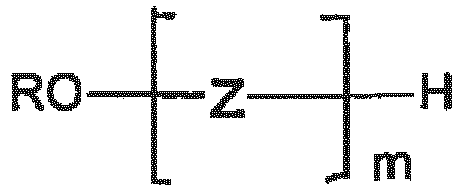
- R désigne un radical saturé ou insaturé, linéaire ou ramifié, comportant de 8 à 40 atomes de carbone et de préférence de 8 à 30,
- Z représente un radical oxyéthyléné (i) et/ou oxypropyléné (ii)1 et (ii)2 de formules respectives suivantes :
-CH2-CH2-O- (i)

-CH2-CH2-CH2-O- (ii)2
m représente le nombre de groupements oxyde d'éthylène (i) et/ou oxyde de propylène (ii)1 ou (ii)2, allant de 1 à 250 et de préférence de 2 à 100.
- R denotes a linear or branched, saturated or unsaturated radical containing from 8 to 40 carbon atoms and preferably from 8 to 30,
- Z represents an oxyethylenated (i) and / or oxypropylene (ii) radical 1 and (ii) 2 of the following respective formulas:
-CH 2 -CH 2 -O- (i)
-CH 2 -CH 2 -CH 2 -O- (ii) 2
m represents the number of ethylene oxide groups (i) and / or propylene oxide (ii) 1 or (ii) 2 , ranging from 1 to 250 and preferably from 2 to 100.
Par alcool gras glycérolé, on entend tout alcool gras pur de structure suivante :

- R désigne un radical saturé ou insaturé, linéaire ou ramifié, comportant de 8 à 40 atomes de carbone et de préférence de 8 à 30,
- Z représente un radical glycérolé (iii) de formule suivante :

- n représente le nombre de groupements glycérol (iii) et est compris entre 1 et 30 et de préférence entre 1 et 10.
- R denotes a linear or branched, saturated or unsaturated radical containing from 8 to 40 carbon atoms and preferably from 8 to 30,
- Z represents a glycerol radical (iii) of the following formula:
- n represents the number of glycerol groups (iii) and is between 1 and 30 and preferably between 1 and 10.
Des alcools gras oxyalkylénés particulièrement préférés selon l'invention sont des alcools gras, saturés ou non, linéaires ou ramifiés, comportant de 10 à 20 atomes de carbone et 2 à 40 groupements oxyde d'éthylène.Particularly preferred oxyalkylenated fatty alcohols according to the invention are saturated or unsaturated, linear or branched fatty alcohols comprising from 10 to 20 carbon atoms and 2 to 40 ethylene oxide groups.
Comme composés de type alcool gras oxyalkyléné, on peut notamment citer les produits commercialisés suivants :
- Mergital LM2 (COGNIS) [alcool laurique 2 OE] ;
- Ifralan L12 (IFRACHEM) et Rewopal 12 (GOLDSCHMIDT) [alcool laurique 12 OE] ;
- Empilan KA 2.5/90FL (ALBRIGHT & WILSON) et Mergital BL309 (COGNIS) [alcool décylique 3 OE] ;
- Empilan KA 5/90 FL (ALBRIGHT & WILSON) et Mergital BL589 (COGNIS) [alcool décylique 5 OE] ;
- Brij 58 (UNIQUEMA) et Simulsol 58 (SEPRIC) [alcool cétylique 20 OE] ; Emulgin 05 (COGNIS) [alcool oléocétylique 5 OE] ;
- Mergital OC30 (COGNIS) [alcool oléocétylique 30 OE] ;
- Brij 72 (UNIQUEMA) [alcool stéarylique 2 OE] ;
- Brij 76 (UNIQUEMA) [alcool stéarylique 10 OE] ;
- Brij 78P (UNIQUEMA) [alcool stéarylique 20 OE] ;
- Brij 700 (UNIQUEMA) [alcool stéarylique 100 OE] ;
- Emulgin B1 (COGNIS) [alcool cétylstéarylique 12 OE] ;
- Emulgin L (COGNIS) [alcool cétylique 9 OE et 2 OP] ;
- Witconol APM (GOLDSCHMIT) [alcool myristique 3 OP] ;
- Mergital LM2 (COGNIS) [lauric alcohol 2 EO];
- Ifralan L12 (IFRACHEM) and Rewopal 12 (GOLDSCHMIDT) [Lauryl alcohol 12 EO];
- Empilan KA 2.5 / 90FL (ALBRIGHT & WILSON) and Mergital BL309 (COGNIS) [decyl alcohol 3 EO];
- Empilan KA 5/90 FL (ALBRIGHT & WILSON) and Mergital BL589 (COGNIS) [decyl alcohol 5 EO];
- Brij 58 (UNIQUEMA) and Simulsol 58 (SEPRIC) [cetyl alcohol 20 EO]; Emulgin 05 (COGNIS) [oleocetyl alcohol 5 EO];
- Mergital OC30 (COGNIS) [30 oleocetyl alcohol];
- Brij 72 (UNIQUEMA) [stearyl alcohol 2 EO];
- Brij 76 (UNIQUEMA) [10 stearyl alcohol];
- Brij 78P (UNIQUEMA) [stearyl alcohol 20 EO];
- Brij 700 (UNIQUEMA) [100 stearyl alcohol];
- Emulgin B1 (COGNIS) [12E cetylstearyl alcohol];
- Emulgin L (COGNIS) [cetyl alcohol 9 EO and 2 OP];
- Witconol APM (GOLDSCHMIT) [myristic alcohol 3 OP];
Comme composés de type alcool gras glycérolé, on peut notamment citer l'alcool laurique à 4 moles de glycérol (nom INPCI : POLYGLYCERYL-4 LAURYL ETHER), l'alcool oléique à 4 moles de glycérol (nom INPCI : POLYGLYCERYL-4 OLEYL ETHER), l'alcool oléique à 2 moles de glycérol (nom INPCI : POLYGLYCERYL-2 OLEYL ETHER), l'alcool cétéarylique à 2 moles de glycérol, l'alcool cétéarylique à 6 moles de glycérol, l'alcool oléocétylique à 6 moles de glycérol, et l'octadécanol à 6 moles de glycérol.As compounds of glycerol fatty alcohol type, there may be mentioned lauryl alcohol with 4 moles of glycerol (INPCI name: POLYGLYCERYL-4 LAURYL ETHER), oleic alcohol with 4 moles of glycerol (INPCI name: POLYGLYCERYL-4 OLEYL ETHER ), oleic alcohol with 2 moles of glycerol (INPCI name: POLYGLYCERYL-2 OLEYL ETHER), cetearyl alcohol with 2 moles of glycerol, cetearyl alcohol with 6 moles of glycerol, oleocetyl alcohol with 6 moles of glycerol, and octadecanol with 6 moles of glycerol.
L'alcool gras peu représenter un mélange d'alcools gras, ce qui signifie que dans un produit commercial peuvent coexister plusieurs espèces d'alcools gras, sous forme d'un mélange.The fatty alcohol can represent a mixture of fatty alcohols, which means that in a commercial product can coexist several species of fatty alcohols in the form of a mixture.
L'alcool gras est présent dans la composition dans des proportions en poids comprises de préférence entre 0,05 et 30%, et encore plus préférentiellement entre 0,5 et 20% du poids total de la composition.The fatty alcohol is present in the composition in proportions by weight preferably between 0.05 and 30%, and even more preferably between 0.5 and 20% of the total weight of the composition.
Les colorants d'oxydation utilisables selon l'invention sont choisis parmi les bases d'oxydation et/ou les coupleurs.The oxidation dyes that can be used according to the invention are chosen from oxidation bases and / or couplers.
De préférence les compositions selon l'invention contiennent au moins une base d'oxydation.Preferably the compositions according to the invention contain at least one oxidation base.
Les bases d'oxydation utilisables dans le cadre de la présente invention sont choisies parmi celles classiquement connues en teinture d'oxydation, et parmi lesquelles on peut notamment citer les ortho- et para-phénylènediamines, les bases doubles, les ortho- et para-aminophénols, les bases hétérocycliques, ainsi que leurs sels d'addition avec un acide.The oxidation bases that can be used in the context of the present invention are chosen from those conventionally known in oxidation dyeing, and among which mention may especially be made of ortho- and para-phenylenediamines, double bases, ortho- and para-phenylenediamines. aminophenols, heterocyclic bases, and their addition salts with an acid.
On peut notamment citer :
- (I) les paraphénylénediamines de formule (I) suivante et leurs sels d'addition avec un acide :

- R1 représente un atome d'hydrogène, un radical alkyle en C1-C4, monohydroxyalkyle en C1-C4, polyhydroxyalkyle en C2-C4 alcoxy(C1-C4)alkyle(C1-C4), alkyle en C1-C4 substitué par un groupement azoté, phényle ou 4'-aminophényle ;
- R2 représente un atome d'hydrogène, un radical alkyle en C1-C4, monohydroxyalkyle en C1-C4 ou polyhydroxyalkyle en C2-C4, alcoxy(C1-C4)alkyle(C1-C4) ou alkyle en C1-C4 substitué par un groupement azoté ; R1 et R2 peuvent également former avec l'atome d'azote qui les porte un hétérocycle azoté à 5 ou 6 chaînons éventuellement substitué par un ou plusieurs groupements alkyle, hydroxy ou uréido;
- R3 représente un atome d'hydrogène, un atome d'halogène tel qu'un atome de chlore, un radical alkyle en C1-C4, sulfo, carboxy, monohydroxyalkyle en C1-C4 ou hydroxyalcoxy en C1-C4, acétylaminoalcoxy en C1-C4, mésylaminoalcoxy en C1-C4 ou carbamoylaminoalcoxy en C1-C4,
- R4 représente un atome d'hydrogène, d'halogène ou un radical alkyle en C,-C4.
Parmi les groupements azotés de la formule (I) ci-dessus, on peut citer notamment les radicaux amino, monoalkyl(C1-C4)amino, dialkyl(C1-C4)amino, trialkyl(C1-C4)amino, monohydroxyalkyl(C1-C4)amino, imidazolinium et ammonium.
Parmi les paraphénylènediamines de formule (I) ci-dessus, on peut plus particulièrement citer la paraphénylènediamine, la paratoluylènediamine, la 2-chloro-paraphénylènediamine, la 2,3-diméthyl-paraphénylènediamine, la 2,6-diméthyl-paxaphénylénediamine, la 2,6-diéthyl-paraphénylènediamine, la 2,5-diméthyl-paraphénylènediamine, la N,N-diméthyl-paraphénylènediamine, la N,N-diéthyl-paraphénylènediamine, la N,N-dipropyl-paraphénylènediamine, la 4-amino-N,N-diéthyl-3-méthyl-aniline, la N,N-bis-(β-hydroxyéthyl)-paraphénylènediamine, la 4-N,N-bis-(β-hydroxyéthyl)amino-2-méthyl-aniline, la 4-N,N-bis-(β-hydroxyéthyl)-amino 2-chloro-aniline, la 2-β-hydroxyéthyl-paraphénylènediamine, la 2-fluoro-paraphénylènediamine, la 2-isopropyl-paraphénylènediamine, la N-(β-hydroxypropyl)-paraphénylènediamine, la 2-hydroxyméthyl-paraphénylènediamine, la N,N-diméthyl-3-méthyl-paraphénylènediamine, la N,N-(éthyl,β-hydroxyéthyl)-paraphénylènediamine, la N-(β,γ-dihydroxypropyl)-paraphénylènediamine, la N-(4'-aminophényl)-paraphénylènediamine, la N-phényl-paraphénylènediamine, la 2-β-hydroxyethyloxy-paraphénylènediamine, la 2-β-acétylaminoéthyloxy-paraphénylénediamine, la N-(β-méthoxyéthyl)-paraphénylènediamine, 2-méthyl-1-N-β-hydroxyéthyl-paraphénylènediamine, et leurs sels d'addition avec un acide.
Parmi les paraphénylènediamines de formule (I) ci-dessus, on préfère tout particulièrement la paraphénylènediamine, la paratoluylènediamine, la 2-isopropyl-paraphénylènediamine, la 2-β-hydroxyéthyl-paraphénylènediamine, la 2-β-hydroxyéthyloxy-paraphénylènediamine, la 2,6-diméthyl-paraphénylène-diamine, la 2,6-diéthyl-paraphénylènediamine, la 2,3-diméthyl--paraphénylènediamine, la N,N-bis-(β-hydroxyéthyl)-paraphénylènediamine, la 2-chloro-paraphénylènediamine, et leurs sels d'addition avec un acide.
- (II) Selon l'invention, on entend par bases doubles, les composés comportant au moins deux noyaux aromatiques sur lesquels sont portés des groupements amino et/ou hydroxyle.
Parmi les bases doubles utilisables à titre de bases d'oxydation dans les compositions tinctoriales conformes à l'invention, on peut notamment citer les composés répondant à la formule (II) suivante, et leurs sels d'addition avec un acide :
- Z1 et Z2, identiques ou différents, représentent un radical hydroxyle ou - NH2 pouvant être substitué par un radical alkyle en C1-C4 ou par un bras de liaison Y ;
- le bras de liaison Y représente une chaîne alkylène comportant de 1 à 14 atomes de carbone, linéaire ou ramifiée pouvant être interrompue ou terminée par un ou plusieurs groupements azotés et/ou par un ou plusieurs hétéroatomes tels que des atomes d'oxygène, de soufre ou d'azote, et éventuellement substituée par un ou plusieurs radicaux hydroxyle ou alcoxy en C1-C6 ;
- R5 et R6 représentent un atome d'hydrogène ou d'halogène, un radical alkyle en C1-C4, monohydroxyalkyle en C1-C4, polyhydroxyalkyle en C2-C4, aminoalkyle en C1-C4 ou un bras de liaison Y ;
- R7, R8, R9, R10, R11 et R12, identiques ou différents, représentent un atome d'hydrogène, un bras de liaison Y ou un radical alkyle en C1-C4 ; étant entendu que les composés de formule (II) ne comportent qu'un seul bras de liaison Y par molécule.
Parmi les groupements azotés de la formule (II) ci-dessus, on peut citer notamment les radicaux amino, monoalkyl(C1-C4)amino, dialkyl(C1-C4)amino, trialkyl(C1-C4)amino. monohydroxyalkyl(C1-C4)amino, imidazolinium et ammonium.
Parmi les bases doubles de formules (II) ci-dessus, on peut plus particulièrement citer le N,N'-bis-(β-hydroxyéthyl)-N,N'-bis-(4'-aminophényl)-1,3-diamino-propanol, la N,N'-bis-(β-hydroxyéthyl)-N,N'-bis-(4'-aminophényl)-éthylènediamine, la N,N'-bis-(4-aminophényl)-tétraméthylènediamine, la N,N'-bis-(β-hydroxyéthyl)-N,N'-bis-(4-aminophényl)-tétraméthylènediamine, la N,N'-bis-(4-méthyl-aminophényl)-tétraméthylènediamine, la N,N'-bis-(éthyl)-N,N'-bis-(4'-amino-3'-méthylphényl)-ethylènediamine, le 1,8-bis-(2,5-diaminophénoxy)-3,5-dioxaoctane, et leurs sels d'addition avec un acide.
Parmi ces bases doubles de formule (II), le N,N'-bis-(β-hydroxyéthyl)-N,N'-bis-(4'-aminophényl)-1,3-diamino-propanol, le 1,8-bis-(2,5-diaminaphénoxy)-3,5-dioxaoctane ou l'un de leurs sels d'addition avec un acide sont particulièrement préférés. - (III) les para-aminophénols répondant à la formule (III) suivante, et leurs sels d'addition avec un acide :

- R13 représente un atome d'hydrogène, un atome d'halogène tel que le fluor, un radical alkyle en C1-C4, monohydroxyalkyle en C1-C4, alcoxy(C1-C4)alkyle(C1-C4) ou aminoalkyle en C1-C4, ou hydroxyalkyl(C1-C4)aminoalkyle en C1-C4.
- R14 représente un atome d'hydrogène ou un atome d'halogène tel que le fluor, un radical alkyle en C1-C4, monohydroxyalkyle en C1-C4, polyhydroxyalkyle en C2-C4, aminoalkyle en C1-C4, cyanoalkyle en C1-C4 ou alcoxy(C1-C4)alkyle(C1-C4).
- R15 représente un atome d'hydrogène ou un radical alkyle en C1-C4.
Parmi les para-aminophénols de formule (III) ci-dessus, on peut plus particulièrement citer le para-aminophénol, le 4-amino-3-méthyl-phénol, le 4-amino-3-fluoro-phénol, le 4-amino-3-hydroxyméthyl-phénol, le 4-amino-2-méthyl-phénol, le 4-amino-2-hydroxyméthyl-phénol, le 4-amino-2-méthoxyméthyl-phénol, le 4-amino-2-aminométhyl-phénol, le 4-amino-2-(β-hydroxyéthyl-aminométhyl)-phénol, et leurs sels d'addition avec un acide. - (IV) les ortho-aminophénols utilisables à titre de bases d'oxydation dans le cadre de la présente l'invention, sont notamment choisis parmi le 2-amino-phénol, le 2-amino-1-hydroxy-5-méthyl-benzène, le 2-amino-1-hydroxy-6-méthyl-benzène, le 5-acétamido-2-amino-phénol, et leurs sels d'addition avec un acide.
- (V) parmi les bases hétérocycliques utilisables à titre de bases d'oxydation dans les compositions tinctoriales conformes à l'invention, on peut plus particulièrement citer les dérivés pyridiniques, les dérivés pyrimidiniques, les dérivés pyrazoliques, et leurs sels d'addition avec un acide.
- (I) the para-phenylenediamines of the following formula (I) and their addition salts with an acid:
- R 1 represents a hydrogen atom, an alkyl radical in C 1 -C 4 monohydroxyalkyl, C 1 -C 4 polyhydroxyalkyl, C 2 -C 4 alkoxy (C 1 -C 4) alkyl (C 1 -C 4) C 1 -C 4 alkyl substituted with nitrogen, phenyl or 4'-aminophenyl;
- R 2 represents a hydrogen atom, an alkyl radical in C 1 -C 4 monohydroxyalkyl, C 1 -C 4 polyhydroxyalkyl or C 2 -C 4 alkoxy (C 1 -C 4) alkyl (C 1 -C 4 ) or C 1 -C 4 alkyl substituted with a nitrogen group; R 1 and R 2 may also form, with the nitrogen atom carrying them, a 5- or 6-membered nitrogenous heterocycle optionally substituted with one or more alkyl, hydroxyl or ureido groups;
- R 3 represents a hydrogen atom, a halogen atom such as a chlorine atom, an alkyl radical C 1 -C 4 alkyl, sulfo, carboxy, monohydroxyalkyl C 1 -C 4 hydroxyalkoxy or C 1 -C 4 acetylaminoalkoxy, C 1 -C 4 mesylaminoalkoxy or C 1 -C 4 carbamoylaminoalkoxy C 1 -C 4,
- R 4 represents a hydrogen atom, a halogen atom or a C 1 -C 4 alkyl radical.
Among the nitrogen groups of formula (I) above, mention may be made especially of amino, monoalkyl (C 1 -C 4 ) amino, dialkyl (C 1 -C 4 ) amino, trialkyl (C 1 -C 4 ) radicals. amino, monohydroxy (C 1 -C 4 ) alkylamino, imidazolinium and ammonium.
Among the paraphenylenediamines of formula (I) above, mention may be made more particularly of para-phenylenediamine, paratoluylenediamine, 2-chloro-para-phenylenediamine, 2,3-dimethyl-para-phenylenediamine, 2,6-dimethyl-paxaphenylenediamine, and 2-chloro-para-phenylenediamine. 6-diethyl-para-phenylenediamine, 2,5-dimethyl-para-phenylenediamine, N, N-dimethyl-para-phenylenediamine, N, N-diethyl-para-phenylenediamine, N, N-dipropyl-para-phenylenediamine, 4-amino-N, N-diethyl-3-methylaniline, N, N-bis- (β-hydroxyethyl) -paraphenylenediamine, 4-N, N-bis- (β-hydroxyethyl) amino-2-methylaniline, 4- N, N-bis- (β-hydroxyethyl) -amino-2-chloroaniline, 2-β-hydroxyethyl-para-phenylenediamine, 2-fluoro-para-phenylenediamine, 2-isopropyl-para-phenylenediamine, N- (β-hydroxypropyl) para-phenylenediamine, 2-hydroxymethyl-para-phenylenediamine, N, N-dimethyl-3-methyl-para-phenylenediamine, N, N- (ethyl, β-hydroxyethyl) -paraphenylenediamine, N- (β, γ-dihydroxypropyl) -paraphenylenediamine, N- (4'-aminophenyl) -paraphenylenediamine, N-phenyl-para-phenylenediamine, 2-β-hydroxyethyloxy-para-phenylenediamine, 2-β-acetylaminoethyloxy-para-phenylenediamine, N- (β-methoxyethyl) -paraphenylenediamine, 2- methyl-1-N-β-hydroxyethyl-para-phenylenediamine, and their addition salts with an acid.
Among the paraphenylenediamines of formula (I) above, para-phenylenediamine, paratoluylenediamine, 2-isopropyl-para-phenylenediamine, 2-β-hydroxyethyl-para-phenylenediamine, 2-β-hydroxyethyloxy-para-phenylenediamine, 2 are particularly preferred. 6-dimethyl-para-phenylenediamine, 2,6-diethyl-para-phenylenediamine, 2,3-dimethyl-para-phenylenediamine, N, N-bis- (β-hydroxyethyl) -paraphenylenediamine, 2-chloro-para-phenylenediamine, and their addition salts with an acid.
- (II) According to the invention, the term "double bases" is intended to mean compounds comprising at least two aromatic rings bearing amino and / or hydroxyl groups.
Among the double bases which can be used as oxidation bases in the dyeing compositions in accordance with the invention, mention may in particular be made of the compounds corresponding to the following formula (II), and their addition salts with an acid:- Z 1 and Z 2 , which may be identical or different, represent a hydroxyl or -NH 2 radical which may be substituted with a C 1 -C 4 alkyl radical or with a Y linker arm;
- the linking arm Y represents an alkylene chain comprising from 1 to 14 carbon atoms, linear or branched, which may be interrupted or terminated by one or more nitrogenous groups and / or by one or more heteroatoms such as oxygen, sulfur or or nitrogen, and optionally substituted with one or more hydroxyl or C 1 -C 6 alkoxy radicals;
- R 5 and R 6 represent a hydrogen or halogen atom, an alkyl radical in C 1 -C 4 monohydroxyalkyl, C 1 -C 4 polyhydroxyalkyl, C 2 -C 4 aminoalkyl, C 1 -C 4 alkyl or a link arm Y;
- R 7 , R 8 , R 9 , R 10 , R 11 and R 12 , which may be identical or different, represent a hydrogen atom, a linking arm Y or a C 1 -C 4 alkyl radical; it being understood that the compounds of formula (II) have only one Y linker per molecule.
Among the nitrogen groups of formula (II) above, mention may be made especially of amino, monoalkyl (C 1 -C 4 ) amino, dialkyl (C 1 -C 4 ) amino, trialkyl (C 1 -C 4 ) radicals. amino. monohydroxy (C 1 -C 4 ) alkylamino, imidazolinium and ammonium.
Among the double bases of formulas (II) above, mention may be made more particularly of N, N'-bis (β-hydroxyethyl) -N, N'-bis (4'-aminophenyl) -1,3- diamino-propanol, N, N'-bis- (β-hydroxyethyl) -N, N'-bis- (4'-aminophenyl) -ethylenediamine, N, N'-bis- (4-aminophenyl) -tetramethylenediamine, N, N'-bis- (β-hydroxyethyl) -N, N'-bis (4-aminophenyl) -tetramethylenediamine, N, N'-bis (4-methylaminophenyl) tetramethylenediamine, N, N'-bis (ethyl) -N, N'-bis- (4'-amino-3'-methylphenyl) -ethylenediamine, 1,8-bis (2,5-diaminophenoxy) -3,5-dioxaoctane, and their addition salts with an acid.
Among these double bases of formula (II), N, N'-bis- (β-hydroxyethyl) -N, N'-bis- (4'-aminophenyl) -1,3-diamino-propanol, 1.8 Bis (2,5-diaminaphenoxy) -3,5-dioxaoctane or an acid addition salt thereof are particularly preferred. - (III) para-aminophenols corresponding to the following formula (III), and their addition salts with an acid:
- R 13 represents a hydrogen atom, a halogen atom such as fluorine, an alkyl radical in C 1 -C 4 monohydroxyalkyl, C 1 -C 4 alkoxy (C 1 -C 4) alkyl (C 1 - C 4 ) or aminoalkyl C 1 -C 4 , or hydroxyalkyl (C 1 -C 4 ) aminoalkyl C 1 -C 4 .
- R 14 represents a hydrogen atom or a halogen atom such as fluorine, an alkyl radical in C 1 -C 4 monohydroxyalkyl, C 1 -C 4 polyhydroxyalkyl, C 2 -C 4 aminoalkyl, C 1 - C 4 , cyanoalkyl C 1 -C 4 or alkoxy (C 1 -C 4 ) alkyl (C 1 -C 4 ).
- R 15 represents a hydrogen atom or a C 1 -C 4 alkyl radical.
Among the para-aminophenols of formula (III) above, mention may be made more particularly of para-aminophenol, 4-amino-3-methylphenol, 4-amino-3-fluoro-phenol and 4-amino. 3-hydroxymethylphenol, 4-amino-2-methylphenol, 4-amino-2-hydroxymethylphenol, 4-amino-2-methoxymethylphenol, 4-amino-2-aminomethylphenol , 4-amino-2- (β-hydroxyethylaminomethyl) phenol, and their addition salts with an acid. - (IV) ortho-aminophenols that can be used as oxidation bases in the context of the present invention are chosen in particular from 2-amino-phenol, 2-amino-1-hydroxy-5-methyl-benzene 2-amino-1-hydroxy-6-methyl-benzene, 5-acetamido-2-aminophenol, and their addition salts with an acid.
- (V) among the heterocyclic bases which can be used as oxidation bases in the dyeing compositions in accordance with the invention, mention may be made more particularly of pyridine derivatives, pyrimidine derivatives, pyrazole derivatives, and their addition salts with a acid.
Parmi les dérivés pyridiniques, on peut plus particulièrement citer les composés décrits par exemple dans les brevets
Parmi les dérivés pyrimidiniques, on peut plus particulièrement citer les composés décrits par exemple dans les brevets allemand
Parmi les dérivés pyrazoliques, on peut plus particulièrement citer les composés décrits dans les brevets
Selon la présente invention, les bases d'oxydation représentent de préférence de 0,0005 à 12% en poids environ du poids total de la composition et encore plus préférentiellement de 0,005 à 8% en poids environ de ce poids.According to the present invention, the oxidation bases preferably represent from 0.0005 to 12% by weight approximately of the total weight of the composition and still more preferably from 0.005 to 8% by weight approximately of this weight.
Les coupleurs utilisables dans le procédé de teinture selon l'invention sont ceux classiquement utilisés dans les compositions de teinture d'oxydation, c'est-à-dire les méta-ammophénols, les métaphénylènediamines, les métadiphénols, les naphtols et les coupleurs hétérocycliques tels que par exemple les dérivés indoliques, les dérivés indoliniques, le sésamol et ses dérivés, les dérivés pyridiniques, les dérivés pyrazolotriazoles, les pyrazolones, les indazoles, les benzimidazoles, les benzothiazoles, les benzoxazoles, les 1,3-benzodioxoles, les quinolines et leurs sels d'addition avec un acide.The couplers that can be used in the dyeing process according to the invention are those conventionally used in oxidation dyeing compositions, that is to say meta-ammophenols, meta-phenylenediamines, meta-diphenols, naphthols and heterocyclic couplers such as that, for example, indole derivatives, indoline derivatives, sesamol and its derivatives, pyridine derivatives, pyrazolotriazole derivatives, pyrazolones, indazoles, benzimidazoles, benzothiazoles, benzoxazoles, 1,3-benzodioxoles, quinolines and their addition salts with an acid.
Ces coupleurs sont plus particulièrement choisis parmi le 2,4-diamino 1-(β-hydroxyéthyloxy)-benzène, le 2-méthyl-5-amino-phénol, le 5-N-(β-hydroxyéthyl)amino-2-méthyl-phénol, le 3-amino-phénol, le 1,3-dihydroxy-benzène, le 1,3-dihydroxy-2-méthyl-benzène, le 4-chloro-1,3-dihydroxy-benzène, le 2-amino 4-(β-hydroxyéthylamino)-1-méthoxy-benzène, le 1,3-diamino-benzéne, le 1,3-bis-(2,4-diaminophénoxy)-propane, le sésamol, le 1-amino-2-méthoxy-4,5-méthylènedioxy benzène, l'α-naphtol, le 6-hydroxy-indole, le 4-hydroxy-indole, le 4-hydroxy-N-méthyl indole, la 6-hydroxy-indoline, la 2,6-dihydroxy-4-méthyl-pyridine, le 1-H-3-méthyl-pyrazole-5-one, le 1-phényl-3-méthyl-pyrazole-5-one, la 2-amino-3-hydroxypyridine, le 3,6-diméthyl-pyrazolo-[3,2-c]-1,2,4-triazole, le 2,6-diméthyl-pyrazolo-[1,5-b]-1,2,4-triazole et leurs sels d'addition avec un acide.These couplers are more particularly chosen from 2,4-diamino-1- (β-hydroxyethyloxy) -benzene, 2-methyl-5-aminophenol, 5-N- (β-hydroxyethyl) amino-2-methyl- phenol, 3-amino-phenol, 1,3-dihydroxy-benzene, 1,3-dihydroxy-2-methyl-benzene, 4-chloro-1,3-dihydroxy-benzene, 2-amino-4- (1,3-diamino-benzene, 1,3-bis- 4,5-methylenedioxybenzene, α-naphthol, 6-hydroxyindole, 4-hydroxyindole, 4-hydroxy-N-methylindole, 6-hydroxyindoline, 2,6-dihydroxy-4-methylpyridine, 1-H-3-methyl-pyrazol-5-one, 1-phenyl-3-methyl-pyrazol-5-one, 2-amino-3-hydroxypyridine, 3,6-dimethyl-pyrazolo- [3] , 2-c] -1,2,4-triazole, 2,6-dimethyl-pyrazolo [1,5-b] -1,2,4-triazole and their addition salts with an acid.
Lorsqu'ils sont présents, ces coupleurs représentent de préférence de 0,0001 à 10% en poids environ du poids total de la composition, et encore plus préférentiellement de 0,005 à 5% en poids environ.When present, these couplers preferably represent from 0.0001 to 10% by weight approximately of the total weight of the composition, and still more preferably from 0.005 to 5% by weight approximately.
D'une manière générale, les sels d'addition avec un acide des bases d'oxydation et coupleurs sont notamment choisis parmi les chlorhydrates, les bromhydrates, les sulfates et les tartrates, les lactates et les acétates.In general, the acid addition salts of the oxidation bases and couplers are chosen in particular from hydrochlorides, hydrobromides, sulphates and tartrates, lactates and acetates.
La composition selon l'invention peut encore contenir, en plus des colorants d'oxydation définis ci-dessus, des colorants directs pour enrichir les nuances en reflets. Ces colorants directs peuvent notamment alors être choisis parmi les colorants nitrés, azoïques ou anthraquinoniques, neutres, cationiques ou anioniques dans la proportion pondérale d'environ 0,001 à 20% et de préférence de 0,01 à 10% du poids total de la composition.The composition according to the invention may also contain, in addition to the oxidation dyes defined above, direct dyes to enrich the shades in reflections. These direct dyes may especially be chosen from nitro, azo or anthraquinone, neutral, cationic or anionic dyes in the weight proportion of about 0.001 to 20% and preferably from 0.01 to 10% of the total weight of the composition.
La composition peut en outre plus particulièrement contenir, au moins un polymère substantif amphotère ou cationique différent des polymères associatifs de l'invention.The composition may furthermore more particularly contain at least one amphoteric or cationic substantive polymer different from the associative polymers of the invention.
Au sens de la présente invention, l'expression "polymère cationique" désigne tout polymère contenant des groupements cationiques et/ou des groupements ionisables en groupements cationiques.For the purposes of the present invention, the expression "cationic polymer" denotes any polymer containing cationic groups and / or ionizable groups in cationic groups.
Les polymères substantifs cationiques utilisables conformément à la présente invention peuvent être choisis parmi tous ceux déjà connus en soi comme améliorant les propriétés cosmétiques des cheveux, à savoir notamment ceux décrits dans la demande de brevet
Les polymères cationiques préférés sont choisis parmi ceux qui contiennent des motifs comportant des groupements amine primaire, secondaire, tertiaire et/ou quaternaire pouvant, soit faire partie de la chaîne principale polymère, soit être portés par un substituant latéral directement relié à celle-ci.The preferred cationic polymers are chosen from those containing units containing primary, secondary, tertiary and / or quaternary amine groups which may either be part of the main polymer chain or may be borne by a lateral substituent directly connected thereto.
Les polymères cationiques utilisés ont généralement une masse moléculaire moyenne en nombre comprise entre 500 et 5.106 environ, et de préférence comprise entre 103 et 3.106 environ.The cationic polymers used generally have a number-average molecular weight of between about 500 and 5 × 10 6 , and preferably between about 10 3 and 3 × 10 6 .
Parmi les polymères cationiques, on peut citer plus particulièrement les polymères du type polyamine, polyaminoamide et polyammonium quaternaire.
Ce sont des produits connus. Ils sont notamment décrits dans les brevets français n°
- (1) Les homopolymères ou copolymères dérivés d'esters ou d'amides acryliques ou méthacryliques et comportant au moins un des motifs de formules (I), (II), (III) ou (IV) suivantes:
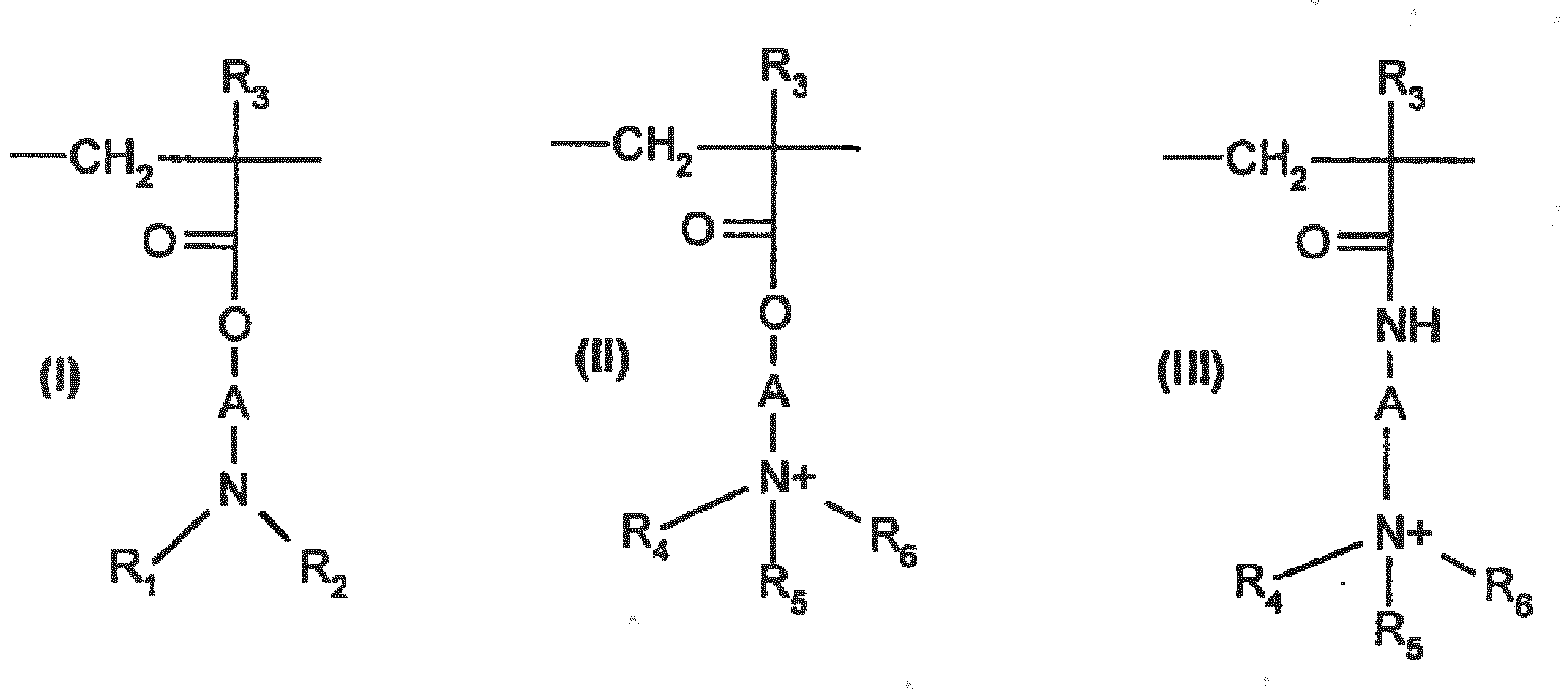

- R3, identiques ou différents, désignent un atome d'hydrogène ou un radical CH3;
- A, identiques ou différents, représentent un groupe alkyle, linéaire ou ramifié, de 1 à 6 atomes de carbone, de préférence 2 ou 3 atomes de carbone ou un groupe hydroxyalkyle de 1 à 4 atomes de carbone ;
- R4, R5, R6, identiques ou différents, représentent un groupe alkyle ayant de 1 à 6 atomes de carbone;
- R1 et R2, identiques ou différents, représentent hydrogène ou un groupe alkyle ayant de 1 à 6 atomes de carbone et de préférence méthyle ou éthyle;
- X désigne un anion dérivé d'un acide minéral ou organique tel qu'un anion méthosulfate ou un halogénure tel que chlorure ou bromure.
Les polymères de la famille (1) peuvent contenir en outre un ou plusieurs motifs dérivant de comonomères pouvant être choisis dans la famille des acrylamides, méthacrylamides, diacétones acrylamides, acrylamides et méthacrylamides substitués sur l'azote par des alkyles inférieurs (C1-C4), des acides acryliques ou méthacryliques ou leurs esters, des vinyllactames tels que la vinylpyrrolidone ou le vinylcaprolactame, des esters vinyliques. Ainsi, parmi ces polymères de la famille (1), on peut citer :- les copolymères d'acrylamide et de diméthylaminoéthyl méthacrylate quaternisé au sulfate de diméthyle ou avec un hologénure de diméthyle, tel que celui vendu sous la dénomination HERCOFLOC par la société HERCULES,
- les copolymères d'acrylamide et de chlorure de méthacryloyloxyéthyl-triméthylammonium décrits par exemple dans la demande de brevet
EP-A-080976 - le copolymère d'acrylamide et de méthosulfate de méthacryloyloxyéthyl-triméthylammonium vendu sous la dénomination RETEN par la société HERCULES,
- les copolymères vinylpyrrolidone / acrylate ou méthacrylate de dialkylaminoalkyle quaternisés ou non, tels que les produits vendus sous la dénomination "GAFQUAT" par la société ISP comme par exemple "GAFQUAT 734" ou "GAFQUAT 755" ou bien les produits dénommés "COPOLYMER 845, 958 et 937". Ces polymères sont décrits en détail dans les brevets français
2.077.143 2.393.573 - les terpolymères méthacrylate de diméthyl amino éthyle/ vinylcaprolactamel vinylpyrrolidone tel que le produit vendu sous la dénomination GAFFIX VC 713 par la société ISP,
- les copolymère vinylpyrrolidone / méthacrylamidopropyl dimethylamine commercialisés notamment sous la dénomination STYLEZE CC 10 par ISP,
- et les copolymères vinylpyrrolidone / méthacrylamide de diméthylamino-propyle quaternisés tel que le produit vendu sous la dénomination "GAFQUAT HS 100" par la société ISP.
- (2) Les dérivés d'éthers de cellulose comportant des groupements ammonium quaternaire décrits dans le brevet français
1 492 597 - (3) Les dérivés de cellulose cationiques tels que les copolymères de cellulose ou les dérivés de cellulose greffés avec un monomère hydrosoluble d'ammonium quaternaire, et décrits notamment dans le brevet
US 4 131 576 - (4) Les polysaccharides cationiques décrits plus particulièrement dans les brevets
US 3 589 578 4 031 307
De tels produits sont commercialisés notamment sous les dénominations commerciales de JAGUAR C13 S, JAGUAR C 15, JAGUAR C 17 ou JAGUAR C162 par la société MEYHALL. - (5) Les polymères constitués de motifs pipérazinyle et de radicaux divalents alkylène ou hydroxyalkylène à chaînes droites ou ramifiées, éventuellement interrompues par des atomes d'oxygène, de soufre, d'azote ou par des cycles aromatiques ou hétérocycliques, ainsi que les produits d'oxydation et/ou de quaternisation de ces polymères. De tels polymères sont notamment décrits dans les brevets français
2.162.025 2.280.361 - (6) Les polyaminoamides solubles dans l'eau préparés en particulier par polycondensation d'un composé acide avec une polyamine ; ces polyaminoamides peuvent être réticulés par une épihalohydrine, un diépoxyde, un dianhydride, un dianhydride non saturé, un dérivé bis-insaturé, une bis-halohydrine, un bis-azétidinium, une bis-haloacyldiamine, un bis-halogénure d'alkyle ou encore par un oligomère résultant de la réaction d'un composé bifonctionnel réactif vis-à-vis d'une bis-halohydrine, d'un bis-azétidinium, d'une bis-haloacyldiamine, d'un bis-halogénure d'alkyle, d'une épilhalohydrine, d'un diépoxyde ou d'un dérivé bis-insaturé ; l'agent réticulant étant utilisé dans des proportions allant de 0,025 à 0,35 mole par groupement amine du polyaminoamide ; ces polyaminoamides peuvent être alcoylés ou s'ils comportent une ou plusieurs fonctions amines tertiaires, quaternisées. De tels polymères sont notamment décrits dans les brevets français
2.252.840 2.368.508 - (7) Les dérivés de polyaminoamides résultant de la condensation de polyalcoylènes polyamines avec des acides polycarboxyliques suivie d'une alcoylation par des agents bifonctionnels. On peut citer par exemple les polymères acide adipique-diacoylaminohydroxyalcoyldialoylène triamine dans lesquels le radical alcoyle comporte de 1 à 4 atomes de carbone et désigne de préférence méthyle, éthyle, propyle. De tels polymères sont notamment décrits dans le brevet français
1.583.363
Parmi ces dérivés, on peut citer plus particulièrement les polymères acide adipique/diméthylaminohydroxypropyl/diéthylène triamine vendus sous la dénomination "Cartaretine F, F4 ou F8" par la société Sandoz. - (8) Les polymères obtenus par réaction d'une polyalkylène polyamine comportant deux groupements amine primaire et au moins un groupement amine secondaire avec un acide dicarboxylique choisi parmi l'acide diglycolique et les acides dicarboxyliques aliphatiques saturés ayant de 3 à 6 atomes de carbone. Le rapport molaire entre le polyalkylène polylamine et l'acide dicarboxylique étant compris entre 0,8 : 1 et 1,4 : = 1; le polyaminoamide en résultant étant amené à réagir avec l'épichlorhydrine dans un rapport molaire d'épichlorhydrine par rapport au groupement amine secondaire du polyaminoamide compris entre 0,5 : 1 et 1,8 : 1. De tels polymères sont notamment décrits dans les brevets américains 3.227.615 et 2.961.347.
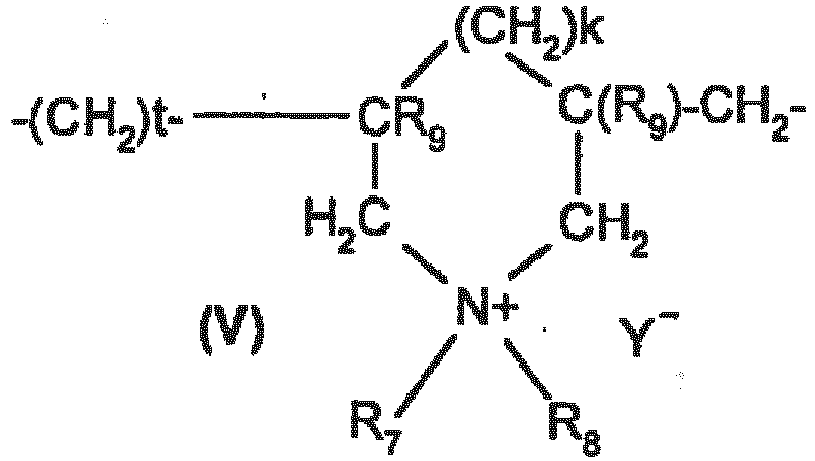
Des polymères de ce type sont en particulier commercialisés sous la dénomination "Hercosett 57" par la société Hercules Inc. ou bien sous la dénomination de "PD 170" ou "Delsette 101" par la société Hercules dans le cas du copolymère d'acide adipique/époxypropyl/diéthylène-triamine. - (9) Les cyclopolymères d'alkyl diallyl amine ou de dialkyl diallyl ammonium tels que les homopolymères ou copolymères comportant comme constituant principal de la chaîne des motifs répondant aux formules (V) ou (VI) :

2.080.759 2.190.406
Parmi les polymères définis ci-dessus, on peut citer plus particulièrement l'homopolymère de chlorure de diméthyldiallylammonium vendu sous la dénomination "Merquat 100" par la société Calgon (et ses homologues de faible masse moléculaire moyenne en poids) et les copolymères de chlorure de diallyldiméthylammonium et d'acrylamide commercialisés sous la dénomination "MERQUAT 550". - (10) Le polymère de diammonium quaternaire contenant des motifs récurrents répondant à la formule :

- R10, R11, R12 et R13, identiques ou différents, représentent des radicaux aliphatiques, alicycliques, ou arylaliphatiques contenant de 1 à 6 atomes de carbone ou des radicaux hydroxyalkylaliphatiques inférieurs, ou bien R10, R11, R12 et R13, ensemble ou séparément, constituent avec les atomes d'azote auxquels ils sont rattachés des hétérocycles contenant éventuellement un second hétéroatome autre que l'azote ou bien R10, R11,
- R12 et R13 représentent un radical alkyle en C1-C6 linéaire ou ramifié substitué par un groupement nitrile, ester, acyle, amide ou -CO-O- R14-D ou -CO-NH- R14-D où R14 est un alkylène et D un groupement ammonium quaternaire ;
- A1 et B1 représentent des groupements polyméthyléniques contenant de 2 à 6 atomes de carbone pouvant être linéaires ou ramifiés, saturés ou insaturés, et pouvant contenir, liés à ou intercalés dans la chaîne principale, un ou plusieurs cycles aromatiques, ou un ou plusieurs atomes d'oxygène, de soufre ou des groupements sulfoxyde, sulfone, disulfure, amino, alkylamino, hydroxyle, ammonium quaternaire, uréido, amide ou ester, et
- X- désigne un anion dérivé d'un acide minéral ou organique;
- A1, R10 et R12 peuvent former avec les deux atomes d'azote auxquels ils sont rattachés un cycle pipérazinique ; en outre si A1 désigne un radical alkylène ou hydroxyalkylène linéaire ou ramifié, saturé ou insaturé, B1 peut également désigner un groupement -(CH2)n-CO-D-OC-(CH2)n- dans lequel n est compris entre 1 et 100 et de préférence entre 1 et 50, et D désigne :
- a) un reste de glycol de formule : -O-Z-O-, où Z désigne un radical hydrocarboné linéaire ou ramifié ou un groupement répondant à l'une des formules suivantes :
-(CH2-CH2-O)x-CH2-CH2-
-[CH2-CH(CH3)-O]y-CH2-CH(CH3)-
où x et y désignent un nombre entier de 1 à 4, représentant un degré de polymérisation défini et unique ou un nombre quelconque de 1 à 4 représentant un degré de polymérisation moyen ; - b) un reste de diamine bis-secondaire tel qu'un dérivé de pipérazine ;
- c) un reste de diamine bis-primaire de formule : -NH-Y-NH-, où Y désigne un radical hydrocarboné linéaire ou ramifié, ou bien le radical bivalent
-CH2-CH2-S-S-CH2-CH2- ;
- d) un groupement uréylène de formule : -NH-CO-NH- .
- a) un reste de glycol de formule : -O-Z-O-, où Z désigne un radical hydrocarboné linéaire ou ramifié ou un groupement répondant à l'une des formules suivantes :
De préférence, X- est un anion tel que le chlorure ou le bromure.
Ces polymères ont une masse moléculaire moyenne en nombre généralement comprise entre 1000 et 100000.
Des polymères de ce type sont notamment décrits dans les brevets français2.320.330 2.270.846 2.316.271 2.336.434 2.413.907 US 2.273.780 2.375.853 2.388.614 2.454.547 3.206.462 2.261.002 2.271.378 3.874.870 4.001.432 3.929.990 3.966.904 4.005.193 4.025.617 4.025.627 4.025.653 4.026.945 4.027.020
On peut utiliser plus particulièrement les polymères qui sont constitués de motifs récurrents répondant à la formule (VIII) suivante:
- (11) Les polymères de polyammonium quaternaire constitués de motifs de formule (IX) :
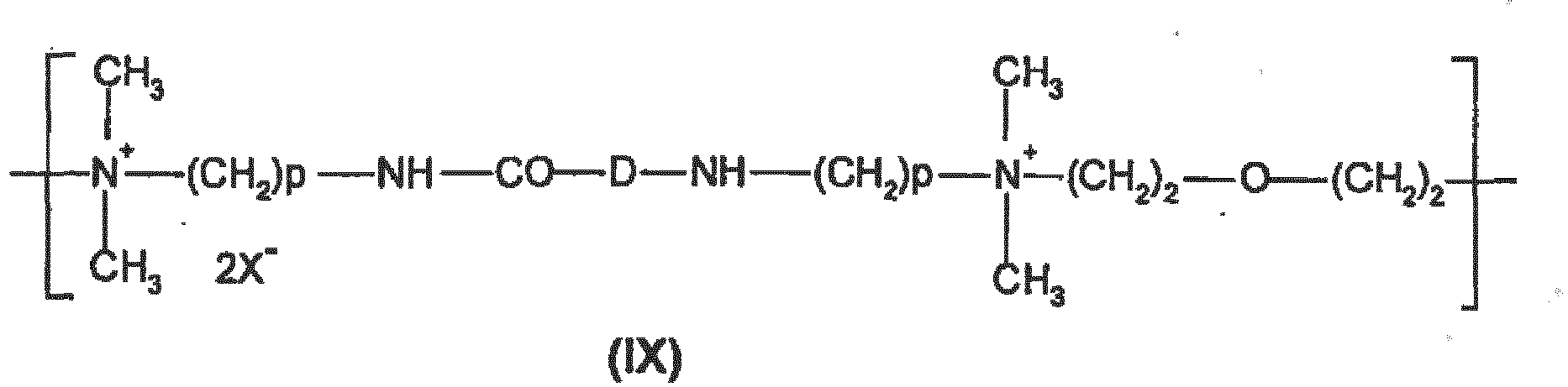
- p désigne un nombre entier variant de 1 à 6 environ,
- D peut être nul ou peut représenter un groupement -(CH2)r-CO- dans lequel r désigne un nombre égal à 4 ou à 7, et
- X- est un anion dérivé d'un acide minéral ou organique.
Les polymères cationiques comportant des motifs de formule (IX) sont notamment décrits dans la demande de brevetEP-A-122 324 4 157 388 4 390 689 4 702 906 4 719 282
Parmi ces polymères, on préfère ceux de masse moléculaire mesurée par RMN du Carbone 13 inférieure à 100000, et dans la formule de laquelle :- p est égal à 3, et,
- a) D représente un groupement -(CH2)4-CO-, X désigne un atome de chlore, la masse moléculaire mesurée par RMN du Carbone 13 (RMN13C) étant d'environ 5600 ; un polymère de ce type est proposé par la société MIRANOL sous le nom de MIRAPOL-AD1,
- b) D représente un groupement -(CH2)7 -CO-, X désigne un atome de chlore, la masse moléculaire mesurée par RMN du Carbone 13 ( RMN13C) étant d'environ 8100 ; un polymère de ce type est proposé par la société MIRANOL sous le nom de MIRAPOL-AZ1,
- c) D désigne la valeur zéro, X désigne un atome de chlore, la masse moléculaire mesurée par RMN du Carbone 13, (RMN13C) étant d'environ 25500 ; un polymère de ce type est vendu par la société MIRANOL sous le nom MIRAPOL-A15,
- d) un "Block Copolymer " formé de motifs correspondant aux polymères décrits aux alinéas a) et c), proposé par la société MIRANOL sous les noms MIRAPOL-9,
Plus particulièrement encore, on préfère selon l'invention le polymère à motifs de formule (IX) dans laquelle p est égal à 3, D désigne la valeur zéro, X désigne un atome de chlore, la masse moléculaire mesurée par RMN du Carbone 13,
(RMN13C) étant d'environ 25500. - (12) Les polymères quaternaires de vinylpyrrolidone et de vinylimidazole tels que par exemple les produits commercialisés sous les dénominations Luviquat FC 905, FC 550 et FC 370 par la société B.A.S.F.
- (13) Les polyamines comme le Polyquart H vendu par HENKEL, référencé sous le nom de "POLYETHYLENEGLYCOL (15) TALLOW POLYAMINE " dans le dictionnaire CTFA.
- (14) Les polymères réticulés de sels de méthacryloyloxyalkyl(C1-C4) trialkyl(C1-C4)ammonium tels que les polymères obtenus par homopolymérisation du diméthylaminoéthylméthacrylate quaternisé par le chlorure de méthyle, ou par copolymérisation de l'acrylamide avec le diméthylaminoéthylméthacrylate quaternisé par le chlorure de méthyle, l'homo ou la copolymérisation étant suivie d'une réticulation par un composé à insaturation oléfinique, en particulier le méthylène bis acrylamide. On peut plus particulièrement utiliser un copolymère réticulé acrylamide/chlorure de méthacryloyloxyéthyl triméthylammonium (20/80 en poids) sous forme de dispersion contenant 50 % en poids dudit copolymère dans de l'huile minérale. Cette dispersion est commercialisée sous le nom de "SALCARE® SC 92 " par la Société ALLIED COLLOIDS. On peut également utiliser un homopolymère réticulé du chlorure de méthacryloyloxyéthyl triméthylammonium contenant environ 50 % en poids de l'homopolymère dans de l'huile minérale ou dans un ester liquide.
These are known products. They are described in particular in the French patents
- (1) homopolymers or copolymers derived from acrylic or methacrylic esters or amides and comprising at least one of the following units of formulas (I), (II), (III) or (IV):
- R 3 , which may be identical or different, denote a hydrogen atom or a CH 3 radical;
- A, which may be identical or different, represent a linear or branched alkyl group of 1 to 6 carbon atoms, preferably 2 or 3 carbon atoms or a hydroxyalkyl group of 1 to 4 carbon atoms;
- R 4 , R 5 , R 6 , which may be identical or different, represent an alkyl group having from 1 to 6 carbon atoms;
- R 1 and R 2 , identical or different, represent hydrogen or an alkyl group having 1 to 6 carbon atoms and preferably methyl or ethyl;
- X denotes an anion derived from a mineral or organic acid such as a methosulphate anion or a halide such as chloride or bromide.
The polymers of family (1) may also contain one or more units derived from comonomers which may be chosen from the family of acrylamides, methacrylamides, diacetones acrylamides, acrylamides and methacrylamides substituted on the nitrogen by lower alkyls (C 1 -C 4 ), acrylic or methacrylic acids or their esters, vinyllactams such as vinylpyrrolidone or vinylcaprolactam, vinyl esters. Thus, among these polymers of the family (1), mention may be made of:- copolymers of acrylamide and of dimethylaminoethyl methacrylate quaternized with dimethyl sulphate or with a dimethyl holognide, such as that sold under the name HERCOFLOC by the company Hercules,
- the copolymers of acrylamide and of methacryloyloxyethyltrimethylammonium chloride described for example in the patent application
EP-A-080976 - the copolymer of acrylamide and methacryloyloxyethyltrimethylammonium methosulphate sold under the name Reten by the company Hercules,
- vinylpyrrolidone / dialkylaminoalkyl acrylate or methacrylate copolymers, whether or not quaternized, such as the products sold under the name "GAFQUAT" by ISP, for example "GAFQUAT 734" or "GAFQUAT 755", or the products referred to as "COPOLYMER 845, 958 and 937 ". These polymers are described in detail in French patents
2,077,143 2,393,573 - dimethylaminoethyl methacrylate / vinylcaprolactamylpyrrolidone terpolymers, such as the product sold under the name GAFFIX VC 713 by the company ISP,
- the vinylpyrrolidone / methacrylamidopropyl dimethylamine copolymers sold in particular under the name STYLEZE CC 10 by ISP,
- and the quaternized vinylpyrrolidone / dimethylaminopropyl methacrylamide copolymers such as the product sold under the name "GAFQUAT HS 100" by the company ISP.
- (2) The cellulose ether derivatives containing quaternary ammonium groups described in the French patent
1,492,597 - (3) Cationic cellulose derivatives such as cellulose copolymers or cellulose derivatives grafted with a water-soluble quaternary ammonium monomer, and described in particular in the patent
US 4,131,576 - (4) The cationic polysaccharides described more particularly in the patents
US 3,589,578 4,031,307
Such products are marketed in particular under the trade names JAGUAR C13 S, JAGUAR C 15, JAGUAR C 17 or JAGUAR C162 by the company MEYHALL. - (5) Polymers consisting of piperazinyl units and straight or branched chain alkylene or hydroxyalkylene divalent radicals, optionally interrupted by oxygen, sulfur, nitrogen or aromatic or heterocyclic rings, as well as oxidation and / or quaternization of these polymers. Such polymers are in particular described in French patents
2,162,025 2,280,361 - (6) water-soluble polyaminoamides prepared in particular by polycondensation of an acidic compound with a polyamine; these polyaminoamides may be crosslinked by an epihalohydrin, a diepoxide, a dianhydride, an unsaturated dianhydride, a bis-unsaturated derivative, a bis-halohydrin, a bis-azetidinium, a bis-haloacyldiamine, a bis-alkyl halide or else by an oligomer resulting from the reaction of a bifunctional compound which is reactive with a bis-halohydrin, a bis-azetidinium, a bis-haloacyldiamine, an alkyl bis-halogenide, epilhalohydrin, diepoxide or bis-unsaturated derivative; the crosslinking agent being used in proportions ranging from 0.025 to 0.35 moles per amine group of the polyaminoamide; these polyaminoamides can be alkylated or if they contain one or several tertiary amino functions, quaternized. Such polymers are in particular described in French patents
2,252,840 2,368,508 - (7) Polyamino amide derivatives resulting from the condensation of polyalkylene polyamines with polycarboxylic acids followed by alkylation with difunctional agents. Mention may be made, for example, of adipic acid-diacoylaminohydroxyalkyldialoylene triamine polymers in which the alkyl radical contains from 1 to 4 carbon atoms and preferably denotes methyl, ethyl or propyl. Such polymers are described in particular in the French patent
1,583,363
Among these derivatives, mention may be made more particularly of the adipic acid / dimethylaminohydroxypropyl / diethylene triamine polymers sold under the name "Cartaretine F, F4 or F8" by the company Sandoz. - (8) The polymers obtained by reaction of a polyalkylene polyamine comprising two primary amine groups and at least one secondary amine group with a dicarboxylic acid chosen from diglycolic acid and saturated aliphatic dicarboxylic acids having from 3 to 6 carbon atoms. The molar ratio between the polyalkylene polylamine and the dicarboxylic acid being between 0.8: 1 and 1.4: = 1; the polyaminoamide resulting therefrom being reacted with epichlorohydrin in a molar ratio of epichlorohydrin relative to the secondary amine group of the polyaminoamide of between 0.5: 1 and 1.8: 1. Such polymers are described in particular in the patents US 3,227,615 and 2,961,347.
Polymers of this type are in particular sold under the name "Hercosett 57" by the company Hercules Inc. or under the name "PD 170" or "Delsette 101" by the company Hercules in the case of the adipic acid copolymer / epoxypropyl / diethylenetriamine. - (9) cyclopolymers of alkyl diallyl amine or of dialkyl diallyl ammonium, such as homopolymers or copolymers comprising, as main constituent of the chain, units corresponding to formulas (V) or (VI):
2,080,759 2,190,406
Among the polymers defined above, mention may be made more particularly of the homopolymer of dimethyldiallylammonium chloride sold under the name "Merquat 100" by Calgon (and its counterparts of low weight average molecular weight) and the copolymers of sodium chloride. diallyldimethylammonium and acrylamide sold under the name "MERQUAT 550". - (10) The quaternary diammonium polymer containing recurring units having the formula:
- R 10 , R 11 , R 12 and R 13 , which may be identical or different, represent aliphatic, alicyclic or arylaliphatic radicals containing from 1 to 6 carbon atoms or lower hydroxyalkylaliphatic radicals, or R 10 , R 11 , R 12 and R 13 , together or separately, constitute with the nitrogen atoms to which they are attached heterocycles optionally containing a second heteroatom other than nitrogen or R 10 , R 11 ,
- R 12 and R 13 represent a linear or branched C 1 -C 6 alkyl radical substituted with a nitrile, ester, acyl or amide group or -CO-O-R 14 -D or -CO-NH-R 14 -D where R 14 is alkylene and D is a quaternary ammonium group;
- A1 and B1 represent polymethylene groups containing from 2 to 6 carbon atoms which may be linear or branched, saturated or unsaturated, and which may contain, bound to or intercalated in the chain main, one or more aromatic rings, or one or more oxygen atoms, sulfur or sulfoxide, sulfone, disulfide, amino, alkylamino, hydroxyl, quaternary ammonium, ureido, amide or ester groups, and
- X - denotes an anion derived from a mineral or organic acid;
- A1, R 10 and R 12 may form with the two nitrogen atoms to which they are attached a piperazine ring; furthermore, if A1 denotes a linear or branched, saturated or unsaturated alkylene or hydroxyalkylene radical, B1 may also denote a - (CH 2 ) n -CO-D-OC- (CH 2 ) n- group in which n is between 1 and 100 and preferably between 1 and 50, and D designates:
- a) a glycol residue of formula: -OZO-, where Z denotes a linear or branched hydrocarbon radical or a group corresponding to one of the following formulas:
- (CH 2 -CH 2 -O) x -CH 2 -CH 2 -
- [CH 2 -CH (CH 3 ) -O] y -CH 2 -CH (CH 3 ) -
where x and y denote an integer from 1 to 4, representing a defined and unique degree of polymerization or any number from 1 to 4 representing an average degree of polymerization; - b) a bis-secondary diamine residue such as a piperazine derivative;
- c) a bis-primary diamine residue of formula: -NH-Y-NH-, where Y denotes a linear or branched hydrocarbon radical, or the divalent radical
-CH 2 -CH 2 -SS-CH 2 -CH 2 -;
- d) a ureylene group of formula: -NH-CO-NH-.
- a) a glycol residue of formula: -OZO-, where Z denotes a linear or branched hydrocarbon radical or a group corresponding to one of the following formulas:
Preferably, X - is an anion such as chloride or bromide.
These polymers have a number average molecular weight generally between 1000 and 100000.
Polymers of this type are in particular described in French patents2,320,330 2270846 2316271 2336434 2413907 US2,273,780 2375853 2388614 2454547 3206462 2261002 2271378 3874870 4001432 3929990 3966904 4005193 4025617 4025627 4025653 4026945 4027020
It is more particularly possible to use polymers which consist of recurring units corresponding to the following formula (VIII): - (11) Quaternary polyammonium polymers consisting of units of formula (IX):
- p denotes an integer ranging from 1 to about 6,
- D can be zero or can represent a group - (CH 2 ) r -CO- in which r denotes a number equal to 4 or to 7, and
- X - is an anion derived from a mineral or organic acid.
The cationic polymers comprising units of formula (IX) are described in particular in the patent applicationEP-A-122,324 4,157,388 4,390,689 4,702,906 4,719,282
Among these polymers, those with a molecular weight measured by 13C NMR of less than 100,000 are preferred, and in the formula of which:- p is 3, and,
- a) D represents a - (CH 2) 4 -CO-, X denotes a chlorine atom, the molecular mass, measured by carbon 13 NMR (13 C NMR) being about 5600; a polymer of this type is proposed by MIRANOL under the name MIRAPOL-AD1,
- b) D represents a group - (CH 2 ) 7 -CO-, X denotes a chlorine atom, the molecular weight measured by NMR of Carbon 13 ( 13 C NMR) being approximately 8100; a polymer of this type is proposed by MIRANOL under the name MIRAPOL-AZ1,
- c) D denotes the value zero, X denotes a chlorine atom, the molecular weight measured by NMR of Carbon 13, ( 13 C NMR) being approximately 25500; a polymer of this type is sold by MIRANOL under the name MIRAPOL-A15,
- (d) a "Block Copolymer" consisting of patterns corresponding to the polymers described in paragraphs (a) and (c), proposed by MIRANOL under the names MIRAPOL-9,
Even more particularly, it is preferred according to the invention the patterned polymer of formula (IX) in which p is equal to 3, D denotes the value zero, X denotes a chlorine atom, the molecular weight measured by NMR of Carbon 13,
( 13 C NMR) being about 25500. - (12) Quaternary polymers of vinylpyrrolidone and of vinylimidazole such as, for example, the products sold under the names Luviquat FC 905, FC 550 and FC 370 by the company BASF
- (13) Polyamines such as Polyquart H sold by HENKEL, referenced under the name "POLYETHYLENEGLYCOL (15) TALLOW POLYAMINE" in the CTFA dictionary.
- (14) Crosslinked polymers of methacryloyloxyalkyl (C 1 -C 4 ) trialkyl (C 1 -C 4 ) ammonium salts such as polymers obtained by homopolymerization of dimethylaminoethyl methacrylate quaternized with methyl chloride, or by copolymerization of acrylamide with dimethylaminoethyl methacrylate quaternized by methyl chloride, the homo or copolymerization being followed by crosslinking with an olefinically unsaturated compound, in particular methylenebisacrylamide. It is more particularly possible to use a crosslinked acrylamide / methacryloyloxyethyltrimethylammonium chloride copolymer (20/80 by weight) in the form of a dispersion containing 50% by weight of said copolymer in mineral oil. This dispersion is marketed under the name "SALCARE® SC 92" by the company ALLIED COLLOIDS. It is also possible to use a crosslinked homopolymer of methacryloyloxyethyltrimethylammonium chloride containing about 50% by weight of the homopolymer in mineral oil or in a liquid ester.
Ces dispersions sont commercialisées sous les noms de "SALCARE® SC 95 " et " SALCARE® SC 96 " par la Société ALLIED COLLOIDS.These dispersions are sold under the names "SALCARE® SC 95" and "SALCARE® SC 96" by the company ALLIED COLLOIDS.
D'autres polymères cationiques utilisables dans le cadre de l'invention sont des polyalkylèneimines, en particulier des polyéthylèneimines, des polymères contenant des motifs vinylpyridine ou vinylpyridinium, des condensats de polyamines et d'épichlorhydrine, des polyuréylènes quaternaires et les dérivés de la chitine.Other cationic polymers that may be used in the context of the invention are polyalkyleneimines, in particular polyethyleneimines, polymers containing vinylpyridine or vinylpyridinium units, condensates of polyamines and of epichlorohydrin, quaternary polyureylenes and chitin derivatives.
Parmi tous les polymères cationiques susceptibles d'être utilisés dans le cadre de la présente invention, on préfère mettre en oeuvre les polymères des familles (1), (9), (10) (11) et (14) et encore plus préférentiellement les polymères aux motifs récurrents de formules (W) et (U) suivantes :
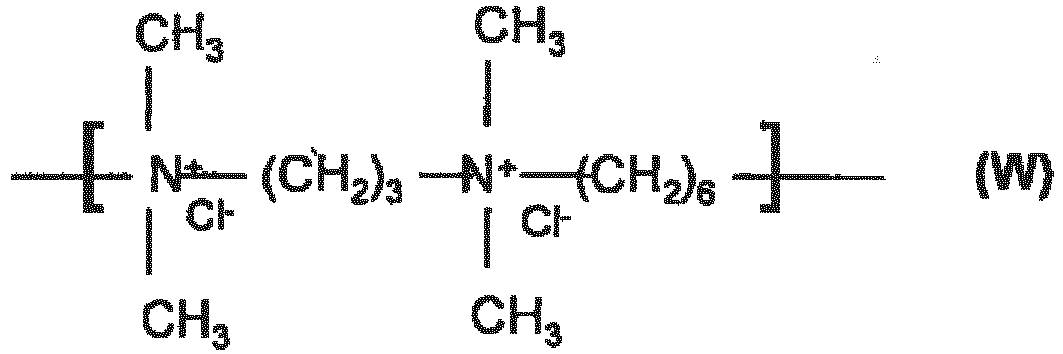

La concentration en polymère substantif cationique dans la composition selon la présente invention peut varier de 0,01 à 10% en poids par rapport au poids total de la composition, de préférence de 0,05 à 5% et plus préférentiellement encore de 0,1 à 3%.The concentration of substantive cationic polymer in the composition according to the present invention may vary from 0.01 to 10% by weight relative to the total weight of the composition, preferably from 0.05 to 5% and more preferably still from 0.1 to 10% by weight relative to the total weight of the composition. at 3%.
Les polymères substantifs amphotères utilisables conformément à la présente invention peuvent être choisis parmi les polymères comportant des motifs K et M répartis statistiquement dans la chaîne polymère, où K désigne un motif dérivant d'un monomère comportant au moins un atome d'azote basique et M désigne un motif dérivant d'un monomère acide comportant un ou plusieurs groupements carboxyliques ou sulfoniques, ou bien K et M peuvent désigner des groupements dérivant de monomères zwittérioniques de carboxybétaïnes ou de sulfobétaïnes;
K et M peuvent également désigner une chaîne polymère cationique comportant des groupements amine primaire, secondaire, tertiaire ou quaternaire, dans laquelle au moins l'un des groupements amine porte un groupement carboxylique ou sulfonique relié par l'intermédiaire d'un radical hydrocarboné, ou bien K et M font partie d'une chaîne d'un polymère à motif éthylène α,β-dicarboxylique dont l'un des groupements carboxyliques a été amené à réagir avec une polyamine comportant un ou plusieurs groupements amine primaire ou secondaire.The amphoteric substantive polymers that may be used in accordance with the present invention may be chosen from polymers comprising K and M units statistically distributed in the polymer chain, where K denotes a unit derived from a monomer comprising at least one basic nitrogen atom and M denotes a unit derived from an acidic monomer comprising one or more carboxylic or sulphonic groups, or K and M may denote groups derived from zwitterionic monomers of carboxybetaines or of sulphobetaines;
K and M may also denote a cationic polymer chain comprising primary, secondary, tertiary or quaternary amine groups, in which at least one of the amine groups carries a carboxylic or sulphonic group connected via a hydrocarbon radical, or K and M are part of a chain of an α, β-dicarboxylic ethylene polymer, one of which has been reacted with a polyamine having one or more primary or secondary amine groups.
Les polymères amphotères répondant à la définition donnée ci-dessus plus particulièrement préférés sont choisis parmi les polymères suivants :
- (1) Les polymères résultant de la copolymérisation d'un monomère dérivé d'un composé vinylique portant un groupement carboxylique tel que plus particulièrement l'acide acrylique, l'acide méthacrylique, l'acide maléique, l'acide alpha-chloracrylique, et d'un composé vinylique substitué contenant au moins un atome basique tel que plus particulièrement les dialkylaminoalkylméthacrylate et acrylate, les dialkylaminoalkyl-méthacrylamide et acrylamide. De tels composés sont décrits dans le brevet américain n° 3 836 537. On peut également citer le copolymère acrylate de sodium / chlorure d'acrylamidopropyl trimethyl ammonium vendu sous la dénomination POLYQUART KE 3033 par la Société HENKEL.
Le composé vinylique substitué contenant au moins un atome basique peut être également un sel de dialkyldiallylammonium tel que le chlorure de diméthyldiallylammonium. Les copolymères d'acide acrylique et de ce dernier monomère sont proposés sous les appellations MERQUAT 280, MERQUAT 295 et MERQUAT PLUS 3330 par la société CALGON. - (2) Les polymères comportant des motifs dérivant :
- a) d'au moins un monomère choisi parmi les acrylamides ou les méthacrylamides substitués sur l'azote par un radical alkyle,
- b) d'au moins un comonomère acide contenant un ou plusieurs groupements carboxyliques réactifs, et
- c) d'au moins un comonomère basique tel que des esters à substituants amine primaire, secondaire, tertiaire et quaternaire des acides acrylique et méthacrylique et le produit de quaternisation du méthacrylate de diméthylaminoéthyle avec le sulfate de diméthyle ou diéthyle.
Les acrylamides ou méthacrylamides N-substitués plus particulièrement préférés selon l'invention sont les groupements dont les radicaux alkyle contiennent de 2 à 6 atomes de carbone et plus particulièrement le N-éthylacrylamide, le N-tertiobutyl-acrylamide, ainsi que les méthacrylamides correspondants.
Les comonomères acides sont choisis plus particulièrement parmi les acides acrylique, méthacrylique, crotonique, itaconique, maléique, fumarique ainsi que les monoesters d'alkyle ayant 1 à 4 atomes de carbone des acides ou des anhydrides maléique ou fumarique.
Les comonomères basiques préférés sont des méthacrylates d'aminoéthyle, de butyl aminoéthyle, de N,N'-diméthylaminoéthyle, de N-tertio-butyl-aminoéthyle.
On utilise particulièrement les copolymères dont la dénomination CTFA (4ème Ed., 1991) est Octylacrylamide/acrylates/butylaminoethylmethacrylate copolymer tels que les produits vendus sous la dénomination AMPHOMER ou LOVOCRYL 47 par la société NATIONAL STARCH. - (3) Les polyaminoamides réticulés et alcoylés partiellement ou totalement dérivant de polyaminoamides de formule générale :
-[-CO-R19-CO-Z-]- (X)
dans laquelle R19 représenté un radical divalent dérivé d'un acide dicarboxylique saturé, d'un acide aliphatique mono ou dicarboxylique à double liaison éthylénique, d'un ester d'un alcanol inférieur ayant 1 à 6 atomes de carbone de ces acides ou d'un radical dérivant de l'addition de l'un quelconque desdits acides avec une amine bis primaire ou bis secondaire, et Z désigne un radical d'une polyalkylène-polyamine bis-primaire, mono ou bis-secondaire et de préférence représente :- a) dans les proportions de 60 à 100 moles %, le radical

- où x=2 et p=2 ou 3, ou bien x=3 et p=2
- ce radical dérivant de la diéthylène triamine, de la triéthylène tétraamine ou de la dipropylène triamine;
- b) dans les proportions de 0 à 40 moles % le radical (XI) ci-dessus, dans lequel x=2 et p=1 et qui dérive de l'éthylènediamine, ou le radical dérivant de la pipérazine :

- c) dans les proportions de 0 à 20 moles % le radical -NH-(CH2)6-NH- dérivant de l'hexaméthylènediamine, ces polyaminoamines étant réticulées par addition d'un agent réticulant bifonctionnel choisi parmi lés épihalohydrines, les diépoxydes, les dianhydrides, les dérivés bis insaturés, au moyen de 0,025 à 0,35 mole d'agent réticulant par groupement amine du polyaminoamide et alcoylés par action d'acide acrylique, d'acide chloracétique ou d'une alcane sultone ou de leurs sels. Les acides carboxyliques saturés sont choisis de préférence parmi les acides ayant 6 à 10 atomes de carbone tels que l'acide adipique, triméthyl-2,2,4-adipique et triméthyl-2,4,4-adipique, téréphtalique, les acides à double liaison éthylénique comme par exemple les acides acrylique, méthacrylique, itaconique.
Les alcanes sultones utilisées dans l'alcoylation sont de préférence la propane ou la butane sultone, les sels des agents d'alcoylation sont de préférence les sels de sodium ou de potassium. - a) dans les proportions de 60 à 100 moles %, le radical
- (4) Les polymères comportant des motifs zwittérioniques de formule :
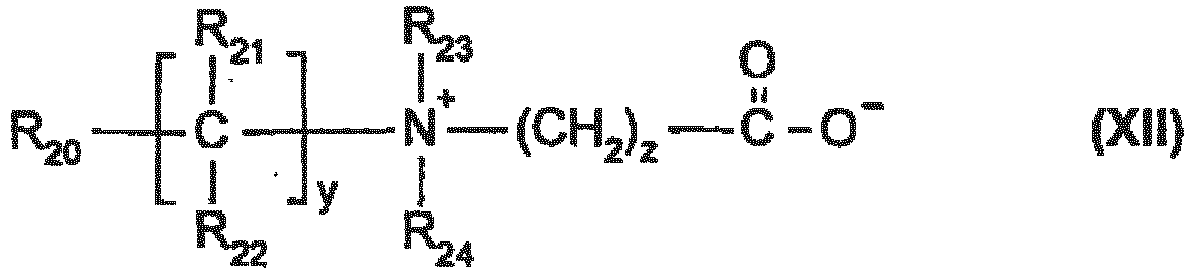
Les polymères comprenant de telles unités peuvent également comporter des motifs dérivés de monomères non zwittérioniques tels que l'acrylate ou le méthacrylate de diméthyl ou diéthylaminoéthyle ou des alkyle acrylates ou méthacrylates, des acrylamides ou méthacrylamides ou l'acétate de vinyle.
A titre d'exemple, on peut citer le copolymère de méthacrylate de butyle / méthacrylate de diméthylcarboxyméthylammonio-éthyle tel que le produit vendu sous la dénomination DIAFORMER Z301 par la société SANDOZ. - (5) les polymères dérivés du chitosane décrits notamment dans les brevets français N°-
2137684 US-3879376 
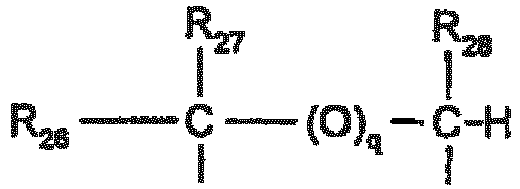
- si q=O, R26, R27 et R28, identiques ou différents, représentent chacun un atome d'hydrogène, un reste méthyle, hydroxyle, acétoxy ou amino, un reste monoalcoylamine ou un reste dialcoylamine éventuellement interrompus par un ou plusieurs atomes d'azote et/ou éventuellement substitués par un ou plusieurs groupes amine, hydroxyle, carboxyle, alcoylthio, sulfonique, un reste alcoylthio dont le groupe alcoyle porte un reste amino, l'un au moins des radicaux R26, R27 et R28 étant dans ce cas un atome d'hydrogène ;
- ou si q=1, R26, R27 et R28 représentent chacun un atome d'hydrogène, ainsi que les sels formés par ces composés avec des bases ou des acides. Des polymères de ce type plus particulièrement préférés comportent de 0 à 20% en poids de motifs (XIII), de 40 à 50% en poids de motifs (XIV), et de 40 à 50% en poids de motifs (XV) dans lequel R25 désigne le radical - CH2-CH2- ;
- (6) Les polymères dérivés de la N-carboxyallcylation du chitosane comme le N-carboxyméthyl chitosane ou le N-carboxybutyl chitosane vendu sous la dénomination "EVALSAN" par la société JAN DEKKER.
- (7) Les polymères répondant à la formule générale (XI) tels que ceux décrits par exemple dans le brevet français
1 400 366 
- dans laquelle R29 représente un atome d'hydrogène, un radical CH3O, CH3CH2O, phényle, R30 désigne l'hydrogène ou un radical alkyle inférieur tel que méthyle, éthyle, R31 désigne l'hydrogène ou un radical alkyle inférieur tel que méthyle, éthyle, R32 désigne un radical alkyle inférieur tel que méthyle, éthyle ou un radical répondant à la formule : R33-N(R31)2, R33 représentant un groupement -CH2-CH2- , -CH2-CH2-CH2- , -CH2-CH(CH3)- , R31 ayant les significations mentionnées ci-dessus,
- ainsi que les homologues supérieurs de ces radicaux et contenant jusqu'à 6 atomes de carbone,
- r est tel que le poids moléculaire est compris entre 500 et 6000000 et de préférence entre 1000 et 1000000.
- (8) Des polymères amphotères du type -D-X-D-X- choisis parmi:
- a) les polymères obtenus par action de l'acide chloracétique ou le chloracétate de sodium sur les composés comportant au moins un motif de formule :
-D-X-D-X-D- (XVII)
où D désigne un radical
- b) les polymères de formule :
-D-X-D-X- (XVIII)
où D désigne un radical
- a) les polymères obtenus par action de l'acide chloracétique ou le chloracétate de sodium sur les composés comportant au moins un motif de formule :
- (9) Les copolymères alkyl(C1-C5)vinyléther / anhydride maléique modifié partiellement par semiamidification avec une N,N-dialkylaminoalkylamine telle que la N,N-diméthylaminopropylamine ou par semiestérification avec une N,N-dialcanolamine. Ces copolymères peuvent également comporter d'autres comonomères vinyliques tels que le vinylcaprolactame.
- (1) The polymers resulting from the copolymerization of a monomer derived from a vinyl compound carrying a carboxylic group such as, more particularly, acrylic acid, methacrylic acid, maleic acid, alpha-chloroacrylic acid, and a substituted vinyl compound containing at least one basic atom such as, more particularly, dialkylaminoalkylmethacrylate and acrylate, dialkylaminoalkyl-methacrylamide and acrylamide. Such compounds are described in US Pat. No. 3,836,537. Mention may also be made of the sodium acrylate / acrylamidopropyltrimethylammonium chloride copolymer sold under the name Polyquart KE 3033 by Henkel.
The substituted vinyl compound containing at least one basic atom may also be a dialkyldiallylammonium salt such as dimethyldiallylammonium chloride. The copolymers of acrylic acid and of the latter monomer are sold under the names MERQUAT 280, MERQUAT 295 and MERQUAT PLUS 3330 by the company CALGON. - (2) Polymers comprising units derived from:
- a) at least one monomer chosen from acrylamides or methacrylamides substituted on the nitrogen with an alkyl radical,
- b) at least one acidic comonomer containing one or more reactive carboxylic groups, and
- c) at least one basic comonomer such as primary, secondary, tertiary and quaternary amine substituent esters of acrylic and methacrylic acids and the quaternization product of dimethylaminoethyl methacrylate with dimethyl or diethyl sulfate.
The N-substituted acrylamides or methacrylamides which are more particularly preferred according to the invention are the groups in which the alkyl radicals contain from 2 to 6 carbon atoms and more particularly N-ethylacrylamide and N-tert-butyl-acrylamide, as well as the corresponding methacrylamides.
The acidic comonomers are chosen more particularly from acrylic, methacrylic, crotonic, itaconic and maleic acids, fumaric acid as well as alkyl monoesters having 1 to 4 carbon atoms of maleic or fumaric acids or anhydrides.
Preferred basic comonomers are aminoethyl, butylaminoethyl, N, N'-dimethylaminoethyl, N-tert-butylaminoethyl methacrylates.
The copolymers whose CTFA (4th Ed., 1991) name is octylacrylamide / acrylates / butylaminoethylmethacrylate copolymer, such as the products sold under the name AMPHOMER or LOVOCRYL 47 by the company National Starch, are particularly used. - (3) Polyamino amides crosslinked and alkylated partially or totally derived from polyamino amides of general formula:
- [- CO-R 19 -CO-Z -] - (X)
wherein R 19 represents a divalent radical derived from a saturated dicarboxylic acid, an ethylenically double-bonded mono or dicarboxylic aliphatic acid, an ester of a lower alkanol having 1 to 6 carbon atoms of these acids or a radical derived from the addition of any one of said acids with a primary bis or secondary bis amine, and Z denotes a radical of a bis-primary, mono or bis-secondary polyalkylene polyamine and preferably represents:- a) in the proportions of 60 to 100 mol%, the radical
- where x = 2 and p = 2 or 3, or x = 3 and p = 2
- this radical derived from diethylene triamine, triethylene tetraamine or dipropylene triamine;
- b) in the proportions of 0 to 40 mol%, the radical (XI) above, in which x = 2 and p = 1 and which is derived from ethylenediamine, or the radical derived from piperazine:
- c) in the proportions of 0 to 20 mole%, the radical -NH- (CH 2 ) 6 -NH- derived from hexamethylenediamine, these polyaminoamines being crosslinked by addition of a bifunctional crosslinking agent chosen from epihalohydrins, diepoxides, dianhydrides, bis unsaturated derivatives, by means of 0.025 to 0.35 mole of crosslinking agent per amine group of the polyaminoamide and alkylated by the action of acrylic acid, chloroacetic acid or an alkane sultone or their salts. The saturated carboxylic acids are preferably chosen from acids having 6 to 10 carbon atoms such as adipic acid, trimethyl-2,2,4-adipic acid and trimethyl-2,4,4-adipic acid, terephthalic acid, acids with ethylenic double bond such as acrylic acid, methacrylic acid, itaconic acid.
The alkanesultones used in the alkylation are preferably propane or butane sultone, the salts of the alkylating agents are preferably the sodium or potassium salts. - a) in the proportions of 60 to 100 mol%, the radical
- (4) polymers having zwitterionic units of formula:
Polymers comprising such units may also comprise units derived from non-zwitterionic monomers such as dimethyl or diethylaminoethyl acrylate or methacrylate or alkyl acrylates or methacrylates, acrylamides or methacrylamides or vinyl acetate.
By way of example, mention may be made of the copolymer of butyl methacrylate / dimethylcarboxymethylammonioethyl methacrylate, such as the product sold under the name DIAFORMER Z301 by the company SANDOZ. - (5) polymers derived from chitosan described in particular in French patents No.
2137684 US 3879376 - if q = O, R 26 , R 27 and R 28 , which may be identical or different, each represents a hydrogen atom, a methyl, hydroxyl, acetoxy or amino residue, a monoalkylamine residue or a dialkylamine residue optionally interrupted by one or more atoms nitrogen and / or optionally substituted by one or more amine, hydroxyl, carboxyl, alkylthio, sulphonic groups, an alkylthio radical whose alkyl group carries an amino residue, at least one of R 26 , R 27 and R 28 radicals. being in this case a hydrogen atom;
- or if q = 1, R 26 , R 27 and R 28 each represent a hydrogen atom, as well as the salts formed by these compounds with bases or acids. More particularly preferred polymers of this type comprise from 0 to 20% by weight of units (XIII), from 40 to 50% by weight of units (XIV), and from 40 to 50% by weight of units (XV) in which R 25 denotes the radical - CH 2 -CH 2 -;
- (6) The polymers derived from the N-carboxyalkylation of chitosan, such as N-carboxymethylchitosan or N-carboxybutylchitosan sold under the name "Evalsan" by the company Jan Dekker.
- (7) polymers corresponding to the general formula (XI) such as those described for example in the French patent
1,400,366 - in which R 29 represents a hydrogen atom, a radical CH 3 O, CH 3 CH 2 O, phenyl, R 30 denotes hydrogen or a lower alkyl radical such as methyl, ethyl, R 31 denotes hydrogen or a lower alkyl radical such as methyl, ethyl, R 32 denotes a lower alkyl radical such as methyl, ethyl or a radical corresponding to the formula: R 33 -N (R 31 ) 2 , R 33 representing a group -CH 2 -CH 2 -, -CH 2 -CH 2 -CH 2 -, -CH 2 -CH (CH 3 ) -, R 31 having the meanings mentioned above,
- as well as the higher homologs of these radicals and containing up to 6 carbon atoms,
- r is such that the molecular weight is between 500 and 6000000 and preferably between 1000 and 1000000.
- (8) Amphoteric polymers of the -DXDX- type chosen from:
- a) the polymers obtained by the action of chloroacetic acid or sodium chloroacetate on compounds comprising at least one unit of formula:
-DXDXD- (XVII)
where D denotes a radical - b) polymers of formula:
-DXDX- (XVIII)
where D denotes a radical
- a) the polymers obtained by the action of chloroacetic acid or sodium chloroacetate on compounds comprising at least one unit of formula:
- (9) (C 1 -C 5 ) alkyl vinyl ether / maleic anhydride copolymers partially modified by semiamidation with an N, N-dialkylaminoalkylamine such as N, N-dimethylaminopropylamine or by semi-esterification with an N, N-dialkanolamine. These copolymers may also comprise other vinylic comonomers such as vinylcaprolactam.
Les polymères amphotères particulièrement préférés selon l'invention sont ceux de la famille (1).The amphoteric polymers that are particularly preferred according to the invention are those of the family (1).
Selon l'invention, le ou les polymères substantifs amphotères peuvent représenter de 0,01 % à 10 % en poids, de préférence de 0,05 % à 5 % en poids, et encore plus préférentiellement de 0,1 % à 3 % en poids, du poids total de la composition.According to the invention, the amphoteric substantive polymer (s) may represent from 0.01% to 10% by weight, preferably from 0.05% to 5% by weight, and still more preferably from 0.1% to 3% by weight. weight, of the total weight of the composition.
Les compositions de l'invention comprennent de préférence un ou plusieurs tensioactifs.
Le ou les tensioactifs peuvent être indifféremment choisis, seuls ou en mélanges, au sein des tensioactifs anioniques, amphotères, non ioniques, zwittérioniques et cationiques.The compositions of the invention preferably comprise one or more surfactants.
The surfactant or surfactants can be indifferently chosen, alone or in mixtures, from anionic, amphoteric, nonionic, zwitterionic and cationic surfactants.
Les tensioactifs convenant à la mise en oeuvre de la présente invention sont notamment les suivants :
- (i) Tensioactif(s) anionique(s) :
- A titre d'exemple de tensio-actifs anioniques utilisables, seuls ou mélanges, dans le cadre de la présente invention, on peut citer notamment (liste non limitative) les sels (en particulier sels alcalins, notamment de sodium, sels d'ammonium, sels d'amines, sels d'aminoalcools ou sels de magnésium) des composés suivants : les alkylsulfates, les alkyléthersulfates, alkylamidoéthersulfates, alkylarylpolyéthersulfates, monoglycérides sulfates ; les alkylsulfonates, alkylphosphates, alkylamidesulfonates, alkylarylsulfonates, α-oléfine-sulfonates, paraffine-sulfonates ; les alkyl(C6-C24) sulfosuccinates, les alkyl(C6-C24) éthersulfosuccinates, les alkyl(C6-C24) amidesulfosuccinates ; les alkyl(C6-C24) sulfoacétates ; les acyl(C6-C24) sarcosinates et les acyl(C6-C24) glutamates. On peut également utiliser les esters d'alkyl(C6-C24)polyglycosides carboxyliques tels que les alkylglucoside citrates, les alkylpolyglycoside tartrate et les alkylpolyglycoside sulfosuccinates., les alkylsulfosuccinamates ; les acyliséthionates et les N-acyltaurates, le radical alkyle ou acyle de tous ces différents composés comportant de préférence de 12 à 20 atomes de carbone, et le radical aryl désignant de préférence un groupement phényle ou benzyle. Parmi les tensioactifs anioniques encore utilisables, on peut également citer les sels d'acides gras tels que les sels des acides oléique, ricinoléique, palmitique, stéarique, les acides d'huile de coprah ou d'huile de coprah hydrogénée ; les acyl-lactylates dont le radical acyle comporte 8 à 20 atomes de carbone. On peut également utiliser les acides d'alkyl D galactoside uroniques et leurs sels, les acides alkyl (C6-C24) éther carboxyliques polyoxyalkylénés, les acides alkyl(C6-C24)aryl éther carboxyliques polyoxyalkylénés, les acides alkyl(C6-C24) amido éther carboxyliques polyoxyalkylénés et leurs sels, en particulier ceux comportant de 2 à 50 groupements oxyde d'alkylène en particulier d'éthylène, et leurs mélanges.
- (ii) Tensioactif(s) non ionique(s) :
- Les agents tensioactifs non-ioniques sont, eux aussi, des composés bien connus en soi (voir notamment à cet égard "
Handbook of Surfactants" par M.R. PORTER, éditions Blackie & Son (Glasgow and London), 1991, pp 116-178
- Les agents tensioactifs non-ioniques sont, eux aussi, des composés bien connus en soi (voir notamment à cet égard "
- (iii) Tensioactif(s) amphotère(s) ou zwittérionique(s) :
- Les agents tensioactifs amphotères ou zwitterioniques, dont la nature ne revêt pas dans le cadre de la présente invention de caractère critique, peuvent être notamment (liste non limitative) des dérivés d'amines secondaires ou tertiaires aliphatiques, dans lesquels le radical aliphatique est une chaîne linéaire ou ramifiée comportant 8 à 18 atomes de carbone et contenant au moins un groupe anionique hydrosolubilisant (par exemple carboxylate, sulfonate, sulfate, phosphate ou phosphonate) ; on peut citer encore les alkyl (C8-C20) bétaïnes, les sulfobétaïnes, les alkyl (C8-C20) amidoalkyl (C1-C6) betaïnes ou les alkyl (C8-C20) amidoalkyl (C1-C6) sulfobétaïnes.
Parmi les dérivés d'amines, on peut citer les produits vendus sous la dénomination MIRANOL, tels que décrits dans les brevetsUS-2 528 378 US-2 781 354
R2 -CONHCH2CH2 -N(R3)(R4)(CH2COO-)
dans laquelle : R2 désigne un radical alkyle linéaire ou ramifié en C5-C20 provenant par exemple d'un acide R2-COOH présent dans l'huile de coprah hydrolysée, un radical heptyle, nonyle ou undécyle, R3 désigne un groupement bêta-hydroxyéthyle et R4 un groupement carboxyméthyle ; et
R2'-CONHCH2CH2-N(B)(C)
dans laquelle :- B représente -CH2CH2OX', C représente -(CH2)z -Y', avec z = 1 ou 2, X' désigne le groupement -CH2CH2-COOH ou un atome d'hydrogène Y' désigne -COOH ou le radical -CH2 - CHOH - SO3H
- R2' désigne un radical alkyle, linéaire ou ramifié, saturé ou non, en C5-C20 d'un acide R9 -COOH présent par exemple dans l'huile de coprah ou dans l'huile de lin hydrolysée, un radical alkyle, notamment en C7, C9, C11 ou C13, un radical alkyle en C17 et sa forme iso, un radical C17 insaturé.
Ces composés sont classés dans le dictionnaire CTFA, 5ème édition, 1993, sous les dénominations Disodium Cocoamphodiacetate, Disodium Lauroamphodiacetate, Disodium Caprylamphodiacetate, Disodium Capryloamphodiacetate, Disodium Cocoamphodipropionate, Disodium Lauroamphodipropionate, Disodium Caprylamphodipropionate, Disodium Capryloamphodipropionate, Lauroamphodipropionic acid, Cocoamphodipropionic acid.
A titre d'exemple on peut citer le cocoamphodiacetate commercialisé sous la dénomination commerciale MIRANOL® C2M concentré par la société RHODIA CHIMIE. - (iv) Tensioactifs cationiques :
- Parmi les tensioactifs cationiques on peut citer en particulier (liste non limitative) : les sels d'amines grasses primaires, secondaires ou tertiaires, éventuellement polyoxyalkylénées ; les sels d'ammonium quaternaire tels que les chlorures ou les bromures de tétraalkylammonium, d'alkylamidoalkyltrialkylammonium, de trialkylbenzylammonium, de trialkylhydroxyalkyl-ammonium ou d'alkylpyridinium; les dérivés d'imidazoline ; ou les oxydes d'amines à caractère cationique.
- (i) Anionic surfactant (s):
- By way of example of anionic surfactants which may be used, alone or as mixtures, in the context of the present invention, mention may be made in particular (nonlimiting list) of the salts (in particular alkaline salts, in particular sodium salts, ammonium salts, amine salts, aminoalcohol salts or magnesium salts) of the following compounds: alkyl sulphates, alkyl ether sulphates, alkyl amido ether sulphates, alkyl aryl polyether sulphates, monoglyceride sulphates; alkylsulfonates, alkylphosphates, alkylamidesulfonates, alkylarylsulfonates, α-olefin-sulfonates, paraffin-sulfonates; (C 6 -C 24 ) alkylsulphosuccinates, (C 6 -C 24 ) alkylsulphosuccinates, (C 6 -C 24 ) alkylamidesulfosuccinates; (C 6 -C 24 ) alkyl sulphoacetates; acyl (C 6 -C 24 ) sarcosinates and acyl (C 6 -C 24 ) glutamates. It is also possible to use (C 6 -C 24 ) alkyl polyglycoside carboxylic esters such as alkylglucoside citrates, alkylpolyglycoside tartrate and alkylpolyglycoside sulfosuccinates, alkylsulfosuccinamates; acylisethionates and N-acyltaurates, the alkyl or acyl radical of all these different compounds preferably comprising from 12 to 20 carbon atoms, and the aryl radical preferably denoting a phenyl or benzyl group. Among the anionic surfactants that can still be used, mention may also be made of fatty acid salts such as the salts of oleic, ricinoleic, palmitic and stearic acids, coconut oil acid or hydrogenated coconut oil acid; acyl lactylates whose acyl radical has 8 to 20 carbon atoms. It is also possible to use the alkyl D galactoside uronic acids and their salts, the polyoxyalkylenated (C 6 -C 24 ) alkyl carboxylic ether acids, the polyoxyalkylenated (C 6 -C 24 ) alkyl aryl ether carboxylic acids and the alkyl (C) alkyl acids. 6 -C 24 ) carboxylic amido ether polyoxyalkylenated and their salts, in particular those containing from 2 to 50 alkylene oxide groups, in particular ethylene, and mixtures thereof.
- (ii) Nonionic surfactant (s):
- Nonionic surfactants are also well-known compounds per se (see in particular in this regard "
Handbook of Surfactants "by MR PORTER, Blackie & Son editions (Glasgow and London), 1991, pp 116-178
- Nonionic surfactants are also well-known compounds per se (see in particular in this regard "
- (iii) Amphoteric (s) or zwitterionic surfactant (s):
- Amphoteric or zwitterionic surfactants, the nature of which does not take place in the context of the present invention of a critical nature, may be in particular (non-limiting list) derivatives of aliphatic secondary or tertiary amines, in which the aliphatic radical is a linear or branched chain containing 8 to 18 carbon atoms and containing at least one anionic water-solubilising group (for example carboxylate, sulphonate sulfate, phosphate or phosphonate); mention may also be made of (C 8 -C 20 ) alkylbetaines, sulphobetaines, (C 8 -C 20 ) alkylamido (C 1 -C 6 ) alkylbaryaines or (C 8 -C 20 ) alkylamidoalkyl (C 1 -C 6 ) sulfobetaines.
Among the amine derivatives, mention may be made of the products sold under the name MIRANOL, as described in the US Pat.US-2,528,378 US-2,781,354
R2 -CONHCH 2 CH 2 -N (R 3 ) (R 4 ) (CH 2 COO - )
in which: R 2 denotes a linear or branched C 5 -C 20 alkyl radical originating, for example, from an R 2 -COOH acid present in the hydrolysed coconut oil, a heptyl, nonyl or undecyl radical, R 3 denotes a beta-hydroxyethyl group and R 4 a carboxymethyl group; and
R 2 '-CONHCH 2 CH 2 -N (B) (C)
in which :- B represents -CH 2 CH 2 OX ', C represents - (CH 2 ) z -Y', with z = 1 or 2, X 'denotes the group -CH 2 CH 2 -COOH or a hydrogen atom Y' designates -COOH or the radical -CH 2 - CHOH - SO 3 H
- R 2 'denotes a linear or branched, saturated or non-saturated C 5 -C 20 alkyl radical of an R 9 -COOH acid present for example in coconut oil or in hydrolyzed linseed oil, an alkyl radical, especially C 7 , C 9 , C 11 or C 13 , a C 17 alkyl radical and its iso form, an unsaturated C 17 radical.
These compounds are classified in the CTFA dictionary, 5th edition, 1993, under the names Disodium Cocoamphodiacetate, Disodium Lauroamphodiacetate, Disodium Caprylamphodiacetate, Disodium Capryloamphodiacetate, Disodium Cocoamphodipropionate, Disodium Lauroamphodipropionate, Disodium Caprylamphodipropionate, Disodium Capryloamphodipropionate, Lauroamphodipropionic Acid, Cocoamphodipropionic Acid.
By way of example, mention may be made of cocoamphodiacetate sold under the trade name MIRANOL® C2M concentrated by Rhodia Chimie. - (iv) Cationic surfactants:
- Among the cationic surfactants, mention may be made in particular (non-limiting list) of the salts of primary, secondary or tertiary fatty amines, optionally polyoxyalkylenated; quaternary ammonium salts such as tetraalkylammonium, alkylamidoalkyltrialkylammonium, trialkylbenzylammonium, trialkylhydroxyalkylammonium or alkylpyridinium chlorides or bromides; imidazoline derivatives; or oxides of amines with a cationic character.
Les quantités d'agents tensioactifs présents dans la composition selon l'invention peuvent varier de 0,01 à 40% et de préférence de 0,5 à 30% du poids total de la composition.The amounts of surfactants present in the composition according to the invention may vary from 0.01 to 40% and preferably from 0.5 to 30% of the total weight of the composition.
Les compositions selon l'invention contiennent également d'autres agents d'ajustement de la rhéologie non associatifs tels que des épaississants cellulosiques (hydroxyéthycellulose, hydroxypropylcellulose, carboxyméthylcellulose..), la gomme de guar et ses dérivés(hydroxypropylguar..), les gommes d'origine microbienne (gomme de xanthane, gomme de scléroglucane..), les épaississants synthétiques tels que les homopolymères réticulés d'acide acrylique ou d'acide acrylamidopropanesulfonique.The compositions according to the invention also contain other non-associative rheology adjusting agents such as cellulosic thickeners (hydroxyethylcellulose, hydroxypropylcellulose, carboxymethylcellulose, etc.), guar gum and its derivatives (hydroxypropylguar), and gums. of microbial origin (xanthan gum, scleroglucan gum, etc.), synthetic thickeners such as crosslinked homopolymers of acrylic acid or acrylamidopropanesulphonic acid.
Ces épaississants d'appoint peuvent représenter de 0,01 à 10% en poids du poids total de la composition.These auxiliary thickeners may represent from 0.01 to 10% by weight of the total weight of the composition.
Le milieu de la composition approprié pour la teinture, est de préférence un milieu aqueux constitué par de l'eau et peut avantageusement contenir des solvants organiques acceptables sur le plan cosmétique, dont plus particulièrement, des alcools tels que l'alcool éthylique, l'alcool isopropylique, l'alcool benzylique, et l'alcool phényléthylique, ou des polyols ou éthers de polyols tels que, par exemple, les éthers monométhylique, monoéthylique et monobutylique d'éthylèneglycol, le propylèneglycol ou ses éthers tels que, par exemple, le monométhyléther de propylèneglycol, le butylèneglycol, le dipropylèneglycol ainsi que les alkyléthers de diéthylèneglycol comme par exemple, le monoétriyléther ou le monobutyléther du diéthylèneglycol. Les solvants peuvent alors être présents dans des concentrations comprises entre environ 0,5 et 20% et, de préférence, entre environ 2 et 10% en poids par rapport au poids total de la composition.The medium of the composition suitable for dyeing is preferably an aqueous medium consisting of water and may advantageously contain cosmetically acceptable organic solvents, of which, more particularly, alcohols such as ethyl alcohol, alcohol, and the like. isopropyl alcohol, benzyl alcohol, and phenylethyl alcohol, or polyols or polyol ethers such as, for example, ethylene glycol monomethyl, monoethyl and monobutyl ethers, propylene glycol or its ethers such as, for example, propylene glycol monomethyl ether, butylene glycol, dipropylene glycol and diethylene glycol alkyl ethers such as, for example, diethylene glycol monoetiyl ether or monobutyl ether. The solvents can then be present in concentrations of between approximately 0.5 and 20% and, preferably, between approximately 2 and 10% by weight relative to the total weight of the composition.
La composition peut encore comprendre une quantité efficace d'autres agents, par ailleurs antérieurement connus en coloration d'oxydation, tels que divers adjuvants usuels comme des séquestrants tel que l'EDTA et l'acide étidronique, des filtres UV, des cires, des silicones volatiles ou non, cycliques ou linéaires ou ramifiées, organomodifiées (notamment par des groupements amines) ou non, des conservateurs, des céramides, des pseudocéramides, des huiles végétales, minérales ou de synthèse, les vitamines ou provitamines comme le panthénol.The composition may also comprise an effective amount of other agents, also known previously in oxidation dyeing, such as various conventional adjuvants such as sequestering agents such as EDTA and etidronic acid, UV filters, waxes, volatile or non-volatile silicones, cyclic or linear or branched, organomodified (especially with amine groups) or not, preservatives, ceramides, pseudoceramides, vegetable, mineral or synthetic oils, vitamins or provitamines such as panthenol.
Ladite composition peut également comprendre des agents réducteurs ou antioxydants. Ceux-ci peuvent être choisis en particulier parmi le sulfite de sodium, l'acide thioglycolique, l'acide thiolactique, le bisulfite de sodium, l'acide déhydroascorbique, l'hydroquinone, la 2-méthyl-hydroquinone, la ter-butyl-hydroquinone et l'acide homogentisique, et ils sont alors généralement présents dans des quantités allant d'environ 0,05 à 1,5% en poids par rapport au poids total de la composition.Said composition may also comprise reducing agents or antioxidants. These may be chosen in particular from sodium sulphite, thioglycolic acid, thiolactic acid, sodium bisulfite, dehydroascorbic acid, hydroquinone, 2-methyl-hydroquinone, ter-butyl- hydroquinone and homogentisic acid, and they are then generally present in amounts ranging from about 0.05 to 1.5% by weight relative to the total weight of the composition.
Bien entendu, l'homme de l'art veillera à choisir le ou les éventuels composés complémentaires mentionnés ci-avant, de manière telle que les propriétés avantageuses attachées intrinsèquement à la composition tinctoriale selon l'invention ne soient pas, ou substantiellement pas, altérées par la ou les adjonctions envisagées.Of course, those skilled in the art will take care to choose the optional additional compounds or compounds mentioned above, so that the advantageous properties intrinsically attached to the dye composition according to the invention are not, or not substantially impaired by the addition or additions envisaged.
Dans la composition prête à l'emploi, l'agent oxydant est choisi de préférence parmi le peroxyde d'urée, les bromates ou ferricyanures de métaux alcalins, les persels tels que les perborates et les persulfates. L'utilisation du peroxyde d'hydrogène est particulièrement préférée. Cet agent oxydant est avantageusement constitué par une solution d'eau oxygénée dont le titre peut varier, plus particulièrement, d'environ 1 à 40 volumes, et encore plus préférentiellement d'environ 5 à 40.In the ready-to-use composition, the oxidizing agent is preferably selected from urea peroxide, alkali metal bromates or ferricyanides, persalts such as perborates and persulfates. The use of hydrogen peroxide is particularly preferred. This oxidizing agent is advantageously constituted by a solution of hydrogen peroxide whose content may vary, more particularly, from about 1 to 40 volumes, and even more preferably from about 5 to 40.
On peut également utiliser à titre d'agent oxydant une ou plusieurs enzymes d'oxydoréduction telles que les laccases, les peroxydases et les oxydoréductases à 2 électrons (telles que l'uricase), le cas échéant en présence de leur donneur ou cofacteur respectif.It is also possible to use one or more oxidation-reduction enzymes such as laccases, peroxidases and 2-electron oxidoreductases (such as uricase) as oxidizing agent, if appropriate in the presence of their respective donor or cofactor.
Le pH de la composition prête à l'emploi et appliquée sur les fibres kératiniques [composition résultant du mélange de la composition tinctoriale (A) et de la composition oxydante (B), est généralement compris entre les valeurs 4 et 11. Il est de préférence compris entre 6 et 10, et peut être ajusté à la valeur désirée au moyen d'agents acidifiants ou alcalinisants bien connus de l'état de la technique en teinture des fibres kératiniques.The pH of the ready-to-use composition applied to the keratinous fibers [composition resulting from the mixing of the dyeing composition (A) and the oxidizing composition (B)) is generally between the values 4 and 11. It is preferably between 6 and 10, and can be adjusted to the desired value by means of acidifying or alkalizing agents well known in the art for dyeing keratinous fibers.
Parmi les agents alcalinisants on peut citer, à titre d'exemple, l'ammoniaque, les carbonates alcalins, les alcanolamines telles que les mono-, di- et triéthanolamines ainsi que leurs dérivés, les hydroxyalkylamines et les ethylènediamines oxyéthylénées et/ou oxypropylénées, les hydroxydes de sodium ou de potassium et les composés de formule (XIX) suivante :

Les agents acidifiants sont classiquement, à titre d'exemple, des acides minéraux ou organiques comme l'acide chlorhydrique, l'acide orthophosphorique, des acides carboxyliques comme l'acide tartrique, l'acide citrique, l'acide lactique, ou des acides sulfoniques.The acidifying agents are conventionally, for example, inorganic or organic acids such as hydrochloric acid, orthophosphoric acid, carboxylic acids such as tartaric acid, citric acid, lactic acid, or acids. sulfonic.
Le procédé de teinture selon l'invention consiste, de préférence, à appliquer la composition prête à l'emploi, réalisée extemporanément au moment de l'emploi à partir des compositions (A) et (B) décrites ci-avant, sur les fibres kératiniques sèches ou humides, et à la laisser agir pendant un temps de pause variant, de préférence, de 1 à 60 minutes, et plus préférentiellement de 10 à 45 minutes, à rincer les fibres, puis éventuellement à les laver au shampooing, puis à les rincer à nouveau, et à les sécher.The dyeing process according to the invention consists, preferably, in applying the composition ready for use, carried extemporaneously at the time of use from the compositions (A) and (B) described above, on the fibers dry or wet keratin, and let it work for a pause time varying, preferably, from 1 to 60 minutes, and more preferably from 10 to 45 minutes, rinsing the fibers, then optionally washing them with shampoo, then rinsing them again, and drying them.
Une variante de ce procédé consiste à appliquer séquentiellement de manière décalée ou simultanée sur les fibres kératiniques sèches ou humides avec un éventuel rinçage intermédiaire une composition décrite ci-dessus et une composition comprenant un agent oxydant et à laisser agir lesdites compositions pendant un temps de pose variant de 1 à 60 minutes puis à rincer les fibres, puis éventuellement à les laver au shampooing puis à les rincer à nouveau et à les sécher.A variant of this method consists of sequentially or simultaneously applying to the dry or moist keratinous fibers with a possible intermediate rinsing a composition described above and a composition comprising an oxidizing agent and allowing said compositions to be allowed to act during a setting time. varying from 1 to 60 minutes then rinsing the fibers, then possibly washing them with shampoo and then rinsing them again and drying them.
Claims (38)
- Composition for the oxidation dyeing of keratin fibres, in particular of human keratin fibres, such as the hair, characterized in that it comprises, in a medium that is suitable for dyeing,a) at least one oxidation dye,b) at least one fatty alcohol,c) at least one cationic associative polymer comprising at least one fatty chain chosen from quaternized celluloses modified with groups comprising at least one fatty chain, and quaternized hydroxyethylcelluloses modified with groups comprising at least one fatty chain,d) at least one metal oxide chosen from titanium oxides and mica-titanium oxide hybrid compounds,e) at least one supplementary thickener which is a cellulosic thickener, a guar gum derivative, a gum of microbial origin or a synthetic thickener,
the ratio by weight of the metal oxide to the associative polymer being between 0.5 and 5. - Composition according to Claim 1, characterized in that the titanium oxide is coated.
- Composition according to Claim 1, characterized in that the titanium oxide is uncoated.
- Composition according to any one of the preceding claims, characterized in that the metal oxide is present in the composition in proportions by weight of between 0.2% and 10% and preferably between 0.5% and 5% of the total weight of the composition.
- Composition according to one of Claims 1 to 4, characterized in that the alkyl groups of the quaternized celluloses or hydroxyethylcelluloses contain from 8 to 30 carbon atoms.
- Composition according to Claim 5, characterized in that the cationic polymer is a quaternized hydroxyethylcellulose modified with a C12 or C18 alkyl group.
- Composition according to any one of the preceding claims, characterized in that the associative polymer or polymers are present in the composition in amounts by weight of between 0.05% and 10% and more preferably between 0.1% and 5% of the total weight of the composition.
- Composition according to any one of the preceding claims, characterized in that the oxidation dye is chosen from oxidation bases and/or couplers.
- Composition according to Claim 8, characterized in that it comprises at least one oxidation base.
- Composition according to Claim 9, characterized in that the oxidation bases are chosen from ortho- and para-phenylenediamines, double bases, ortho- and para-aminophenols, and heterocyclic bases, and also the addition salts of these compounds with an acid.
- Composition according to Claim 10, characterized in that the para-phenylenediamines are chosen from the compounds of structure (I) below:
 - R1 represents a hydrogen atom, a C1-C4 alkyl radical, a C1-C4 monohydroxyalkyl radical, a C2-C4 polyhydroxyalkyl radical, a (C1-C4)alkoxy(C1-C4)alkyl radical or a C1-C4 alkyl radical substituted with a nitrogenous, phenyl or 4'-aminophenyl group;- R2 represents a hydrogen atom, a C1-C4 alkyl radical, a C1-C4 monohydroxyalkyl radical, a C2-C4 polyhydroxyalkyl radical, a (C1-C4)alkoxy(C1-C4)alkyl radical or a C1-C4 alkyl radical substituted with a nitrogenous group;R1 and R2 may also form, with the nitrogen atom that bears them, a 5- or 6-membered nitrogen heterocycle optionally substituted with one or more alkyl, hydroxyl or ureido groups;- R3 represents a hydrogen atom, a halogen atom such as a chlorine atom, a C1-C4 alkyl radical, a sulpho radical, a carboxyl radical, a C1-C4 monohydroxyalkyl radical, a C1-C4 hydroxyalkoxy radical, an acetylamino(C1-C4)alkoxy radical, a mesylamino(C1-C4)alkoxy radical or a carbamoylamino(C1-C4)alkoxy radical,- R4 represents a hydrogen or halogen atom or a C1-C4 alkyl radical.
 - Composition according to Claim 10, characterized in that the double bases are chosen from the compounds of structure (II) below:
 - Z1 and Z2, which may be identical or different, represent a hydroxyl or -NH2 radical which may be substituted with a C1-C4 alkyl radical or with a linker arm Y;- the linker arm Y represents a linear or branched alkylene chain containing from 1 to 14 carbon atoms, which may be interrupted by or terminated with one or more nitrogenous groups and/or one or more heteroatoms such as oxygen, sulphur or nitrogen atoms, and optionally substituted with one or more hydroxyl or C1-C6 alkoxy radicals;- R5 and R6 represent a hydrogen or halogen atom, a C1-C4 alkyl radical, a C1-C4 monohydroxyalkyl radical, a C2-C4 polyhydroxyalkyl radical, a C1-C4 aminoalkyl radical or a linker arm Y;- R7, R8, R9, R10, R11 and R12, which may be identical or different, represent a hydrogen atom, a linker arm Y or a C1-C4 alkyl radical;it being understood that the compounds of formula (II) contain only one linker arm Y per molecule.
 - Composition according to Claim 10, characterized in that the para-aminophenols are chosen from the compounds of structure (III) below:
 - R13 represents a hydrogen atom, a halogen atom such as fluorine, or a C1-C4 alkyl, C1-C4 monohydroxyalkyl , (C1-C4)alkoxy(C1-C4) alkyl, C1-C4 aminoalkyl or hydroxy(C1-C4)alkylamino(C1-C4)alkyl radical,- R14 represents a hydrogen atom, a halogen atom such as fluorine, or a C1-C4 alkyl, C1-C4 monohydroxyalkyl, C2-C4 polyhydroxyalkyl, C1-C4 aminoalkyl, C1-C4 cyanoalkyl or (C1-C4)alkoxy(C1-C4)alkyl radical.- R15 represents a hydrogen atom or a C1-C4 alkyl radical.
 - Composition according to Claim 10, characterized in that the heterocyclic bases are chosen from pyridine derivatives, pyrimidine derivatives, and pyrazole derivatives.
- Composition according to any one of Claims 9 to 14, characterized in that the oxidation bases represent from 0.0005% to 12% and preferably from 0.005% to 8% by weight relative to the total weight of the composition.
- Composition according to Claim 8, characterized in that the couplers are chosen from meta-phenylenediamines, meta-aminophenols, meta-diphenols and heterocyclic couplers, and the addition salts of these compounds with an acid.
- Composition according to Claim 8 or 16, characterized in that the couplers represent from 0.0001% to 10% and preferably from 0.005% to 5% by weight relative to the total weight of the composition.
- Composition according to Claim 10, characterized in that the addition salts with an acid of the oxidation dyes are chosen from hydrochlorides, hydrobromides, sulphates, tartrates, lactates and acetates.
- Composition according to any one of the preceding claims, characterized in that it also comprises direct dyes.
- Composition according to any one of the preceding claims, characterized in that the fatty alcohol is oxyalkylenated or glycerolated.
- Composition according to Claim 20, characterized in that the oxyalkylenated fatty alcohol or alcohols are linear or branched, saturated or unsaturated and contain 10 to 20 carbon atoms and from 2 to 40 ethylene oxide groups.
- Composition according to Claim 20, characterized in that the glycerolated fatty alcohol or alcohols are linear or branched, saturated or unsaturated and contain 8 to 40 carbon atoms and from 1 to 30 glycerol groups.
- Composition according to any one of the preceding claims, characterized in that the fatty alcohol or alcohols represent from 0.05% to 30% and preferably from 0.5% to 20% by weight relative to the total weight of the composition.
- Composition according to any one of the preceding claims, characterized in that the composition further comprises at least one amphoteric or cationic substantive polymer different from those defined in Claim 1.
- Composition according to Claim 24, characterized in that the substantive polymer is the homopolymer of dimethyldiallylammonium chloride.
- Composition according to Claim 24, characterized in that the substantive polymer is a polymer of quaternary polyammonium comprising repeating units corresponding to formula (W) below:
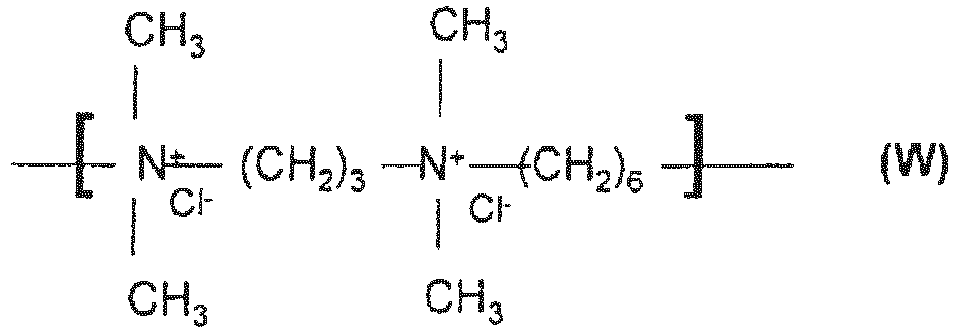
- Composition according to Claim 24, characterized in that the substantive polymer is a polymer of quaternary polyammonium comprising repeating units corresponding to formula (U) below:

- Composition according to Claim 24, characterized in that the cationic or amphoteric substantive polymer or polymers represent from 0.01% to 10%, preferably from 0.05% to 5% and even more preferably from 0.1% to 3% of the total weight of the composition.
- Composition according to any one of the preceding claims, characterized in that it comprises at least one surfactant chosen from anionic, amphoteric, non-ionic, zwitterionic and cationic surfactants.
- Composition according to Claim 29, characterized in that the surfactant is non-ionic.
- Composition according to Claim 29 or 30, characterized in that the surfactants represent from 0.01% to 40% and preferably from 0.5% to 30% by weight relative to the total weight of the composition.
- Composition according to Claim 1, characterized in that the supplementary thickener or thickeners represent from 0.01% to 10% by weight relative to the total weight of the composition.
- Composition according to any one of the preceding claims, characterized in that it also comprises at least one reducing agent, in amounts ranging from 0.05% to 1.5% by weight relative to the total weight of the composition.
- Ready-to-use composition according to any one of the preceding claims, characterized in that it also comprises an oxidizing agent.
- Composition according to Claim 34, characterized in that the oxidizing agent is chosen from hydrogen peroxide, urea peroxide, alkali metal bromates or ferricyanides, persalts, and redox enzymes together where appropriate with the respective donor or co-factor thereof.
- Composition according to Claim 34, characterized in that the oxidizing agent is hydrogen peroxide.
- Composition according to Claim 36, characterized in that the oxidizing agent is an aqueous hydrogen peroxide solution whose titre ranges from 1 to 40 volumes.
- Composition according to Claim 37, characterized in that it has a pH ranging from 4 to 11.
Applications Claiming Priority (2)
| Application Number | Priority Date | Filing Date | Title |
|---|---|---|---|
| FR0215471A FR2848104B1 (en) | 2002-12-06 | 2002-12-06 | OXIDATION DYE COMPOSITION FOR KERATIN FIBERS COMPRISING FATTY ALCOHOL, OXIDATION DYE, ASSOCIATIVE POLYMER, FATTY ACID ESTER AND / OR METAL OXIDE |
| EP03292934A EP1426039A1 (en) | 2002-12-06 | 2003-11-26 | Oxidative dye composition for keratinic fibers comprising a fatty alcohol, an oxidative dye, an associative polymer, a fatty acid ester and/or a metallic oxide |
Related Parent Applications (1)
| Application Number | Title | Priority Date | Filing Date |
|---|---|---|---|
| EP03292934A Division EP1426039A1 (en) | 2002-12-06 | 2003-11-26 | Oxidative dye composition for keratinic fibers comprising a fatty alcohol, an oxidative dye, an associative polymer, a fatty acid ester and/or a metallic oxide |
Publications (2)
| Publication Number | Publication Date |
|---|---|
| EP1754466A1 EP1754466A1 (en) | 2007-02-21 |
| EP1754466B1 true EP1754466B1 (en) | 2017-12-20 |
Family
ID=32310030
Family Applications (2)
| Application Number | Title | Priority Date | Filing Date |
|---|---|---|---|
| EP06023779.9A Expired - Lifetime EP1754466B1 (en) | 2002-12-06 | 2003-11-26 | Oxidative dye composition for keratinic fibers comprising a fatty alcohol, an oxidative dye, an associative polymer, a fatty acid ester and/or a metallic oxide |
| EP03292934A Withdrawn EP1426039A1 (en) | 2002-12-06 | 2003-11-26 | Oxidative dye composition for keratinic fibers comprising a fatty alcohol, an oxidative dye, an associative polymer, a fatty acid ester and/or a metallic oxide |
Family Applications After (1)
| Application Number | Title | Priority Date | Filing Date |
|---|---|---|---|
| EP03292934A Withdrawn EP1426039A1 (en) | 2002-12-06 | 2003-11-26 | Oxidative dye composition for keratinic fibers comprising a fatty alcohol, an oxidative dye, an associative polymer, a fatty acid ester and/or a metallic oxide |
Country Status (7)
| Country | Link |
|---|---|
| EP (2) | EP1754466B1 (en) |
| JP (2) | JP2004189747A (en) |
| KR (1) | KR20040049819A (en) |
| CN (1) | CN100534414C (en) |
| BR (1) | BR0305479A (en) |
| FR (1) | FR2848104B1 (en) |
| MX (1) | MXPA03011266A (en) |
Families Citing this family (20)
| Publication number | Priority date | Publication date | Assignee | Title |
|---|---|---|---|---|
| FR2878153B1 (en) * | 2004-11-22 | 2007-04-20 | Oreal | USE OF THE ASSOCIATION OF AN ASSOCIATIVE POLYMER AND AN AMPHIPHILE DIBLOCS COPOLYMER FOR THE THICKENING OF COSMETIC COMPOSITIONS |
| US7575605B2 (en) | 2005-03-31 | 2009-08-18 | L'oreal S.A. | Dye composition comprising at least one glycerol ester and a process for dyeing keratin fibers using the composition |
| US7569078B2 (en) | 2005-03-31 | 2009-08-04 | L'oreal S.A. | Dye composition comprising at least one cellulose and process for dyeing keratin fibers using the dye composition |
| FR2883736B1 (en) * | 2005-03-31 | 2007-05-25 | Oreal | COLORING COMPOSITION COMPRISING A FATTY ACID ESTER AND METHOD FOR COLORING KERATIN FIBERS USING THE SAME |
| US7651533B2 (en) | 2005-03-31 | 2010-01-26 | Oreal | Dye composition with a reduced content of starting materials, process for dyeing keratin fibers using the same and device therefor |
| US7578854B2 (en) | 2005-03-31 | 2009-08-25 | L'oreal S.A. | Dye composition comprising at least one fatty acid ester and process for dyeing keratin fibers using the same |
| US7550015B2 (en) | 2005-03-31 | 2009-06-23 | L'oreal S.A. | Dye composition with a reduced content of starting materials, and process for dyeing keratin fibers using the same |
| FR2923382B1 (en) | 2007-11-09 | 2012-08-03 | Oreal | COMPOSITION COMPRISING MODIFIED CELLULOSE DERIVATIVE, FATTY ACID AMIDE AND / OR ESTER AND OXIDATION DYES, METHOD OF DYING AND USE |
| FR2923711B1 (en) * | 2007-11-15 | 2011-04-08 | Oreal | (EN) COMPOSITION FOR OXIDATION COLORING AT PH H EXTER OR EQUAL TO 8 OF HUMAN KERATIN FIBERS, COMPRISING FATTY ALCOHOL, FATTY ESTER AND CATIONIC SURFACTANT, METHOD FOR CARRYING OUT SAME AND DEVICE THEREFOR. |
| FR2923710B1 (en) | 2007-11-15 | 2010-04-23 | Oreal | COMPOSITION FOR OXIDATION COLORING AT PH HAS LESS THAN 8 HUMAN KERATIN FIBERS COMPRISING FATTY ALCOHOL, FATTY ESTER AND CATIONIC SURFACTANT, METHOD FOR CARRYING OUT SAME AND DEVICE |
| FR2933296A1 (en) * | 2008-07-03 | 2010-01-08 | Oreal | Composition, useful for oxidation dyeing of keratin fibers, preferably human hair, comprises oxidation dyes and associative cellulose comprising cellulose ether substituted by hydrophobic substituent, in a dyeing medium |
| KR101076914B1 (en) | 2011-04-22 | 2011-10-25 | 동성제약주식회사 | Foam Hair Dye Composition |
| RU2666399C2 (en) * | 2011-07-05 | 2018-09-07 | Л'Ореаль | Dye composition comprising an alkoxylated fatty alcohol ether and a fatty alcohol |
| DE102013226587A1 (en) * | 2013-12-19 | 2015-06-25 | Henkel Ag & Co. Kgaa | Oxidation dye with reduced hair damage |
| FR3029407B1 (en) * | 2014-12-08 | 2016-12-09 | Oreal | A CAPILLARY COLORING PROCESS USING AT LEAST ONE DIRECT AND / OR NATURAL COLOR, TITANIUM SALT, CELLULOSIC POLYSACCHARIDE AND, WHERE POSSIBLE, A PARTICULAR ORGANIC SOLVENT |
| FR3029405B1 (en) | 2014-12-08 | 2019-08-02 | L'oreal | CAPILLARY COLORING PROCESS USING AT LEAST ONE COLOR, TITANIUM SALT, AND INSOLUBLE SILICATE |
| FR3029409B1 (en) | 2014-12-08 | 2016-12-09 | Oreal | A CAPILLARY COLORING PROCESS USING AT LEAST ONE COLOR, AN ORGANIC TITANIUM SALT, AND A NON-CELLULOSIC POLYSACCHARIDE |
| FR3029408B1 (en) * | 2014-12-08 | 2016-12-09 | Oreal | A CAPILLARY COLORING PROCESS USING AT LEAST ONE DYE, A TITANIUM SALT, AND A CATIONIC HYDROPHOBIC CELLULOSIC POLAR |
| FR3029406B1 (en) | 2014-12-08 | 2016-12-09 | Oreal | CAPILLARY COLORING PROCESS USING AT LEAST ONE DYE, ONE TITANIUM SALT, AND ANIONIC THICKENING POLYMER |
| US20180177690A1 (en) * | 2016-12-28 | 2018-06-28 | L'oreal | Composition for lifting color and/or altering the color of keratinous substrates |
Family Cites Families (9)
| Publication number | Priority date | Publication date | Assignee | Title |
|---|---|---|---|---|
| DE4408506C2 (en) * | 1994-03-14 | 1996-07-04 | Schwarzkopf Gmbh Hans | Aqueous hair dye |
| JP2700764B2 (en) * | 1994-04-21 | 1998-01-21 | ホーユー株式会社 | Hair dye |
| FR2803197B1 (en) * | 1999-12-30 | 2002-03-15 | Oreal | COMPOSITION FOR OXIDATION DYEING OF KERATINIC FIBERS COMPRISING A THICKENING POLYMER COMPRISING AT LEAST ONE FATTY CHAIN AND A FATTY ALCOHOL HAVING MORE THAN TWENTY CARBON ATOMS |
| FR2803195B1 (en) * | 1999-12-30 | 2002-03-15 | Oreal | COMPOSITION FOR OXIDATION DYEING OF KERATINIC FIBERS COMPRISING A THICKENING POLYMER COMPRISING AT LEAST ONE FATTY CHAIN AND A SINGLE- OR POLY-GLYCEROLE FATTY ALCOHOL |
| FR2817466B1 (en) * | 2000-12-04 | 2004-12-24 | Oreal | OXIDATION DYE COMPOSITION FOR KERATINIC FIBERS COMPRISING AN ASSOCIATIVE POLYMER AND A NACRANT AGENT |
| DE10112437C2 (en) * | 2001-03-15 | 2003-08-21 | Kpss Kao Gmbh | Hair dyes |
| JP3309221B1 (en) * | 2001-04-27 | 2002-07-29 | 株式会社コスモビューティー | Hair dyeing hair styling composition |
| FR2845907B1 (en) * | 2002-10-21 | 2006-06-16 | Oreal | OXIDATION DYEING COMPOSITION FOR KERATIN FIBERS COMPRISING A CATIONIC POLY (VINYLLACTAM) AND AT LEAST ONE C10-C14 FATTY ACID, METHODS AND DEVICES FOR OXIDATION DYE |
| FR2845908B1 (en) * | 2002-10-21 | 2006-06-16 | Oreal | OXIDATION DYEING COMPOSITION FOR KERATIN FIBERS COMPRISING A CATIONIC POLY (VINYLLACTAM) AND AT LEAST ONE C10-C14 FATTY ALCOHOL, METHODS AND DEVICES FOR OXIDATION DYE |
-
2002
- 2002-12-06 FR FR0215471A patent/FR2848104B1/en not_active Expired - Fee Related
-
2003
- 2003-11-26 EP EP06023779.9A patent/EP1754466B1/en not_active Expired - Lifetime
- 2003-11-26 EP EP03292934A patent/EP1426039A1/en not_active Withdrawn
- 2003-12-05 MX MXPA03011266A patent/MXPA03011266A/en active IP Right Grant
- 2003-12-05 KR KR1020030088128A patent/KR20040049819A/en not_active Withdrawn
- 2003-12-08 JP JP2003436370A patent/JP2004189747A/en active Pending
- 2003-12-08 CN CNB2003101201495A patent/CN100534414C/en not_active Expired - Lifetime
- 2003-12-08 BR BR0305479-9A patent/BR0305479A/en not_active Application Discontinuation
-
2010
- 2010-07-23 JP JP2010165963A patent/JP2010241838A/en active Pending
Non-Patent Citations (1)
| Title |
|---|
| None * |
Also Published As
| Publication number | Publication date |
|---|---|
| BR0305479A (en) | 2004-08-31 |
| JP2010241838A (en) | 2010-10-28 |
| FR2848104A1 (en) | 2004-06-11 |
| EP1426039A1 (en) | 2004-06-09 |
| KR20040049819A (en) | 2004-06-12 |
| EP1754466A1 (en) | 2007-02-21 |
| CN1506037A (en) | 2004-06-23 |
| MXPA03011266A (en) | 2004-09-10 |
| CN100534414C (en) | 2009-09-02 |
| FR2848104B1 (en) | 2006-11-10 |
| JP2004189747A (en) | 2004-07-08 |
Similar Documents
| Publication | Publication Date | Title |
|---|---|---|
| EP1142555B1 (en) | Composition for oxidative dyeing of keratinous fibres containing a thickener polymer with at least a fatty chain and a fatty alcohol having more then 20 carbon atoms | |
| EP1357885B1 (en) | Oxidation dyeing composition for keratin fibres comprising a cationic poly(vinyllactam) | |
| EP1142556B1 (en) | Composition for oxidative dyeing of keratinous fibres containing a thickener polymer with a fatty chain and a mono- or polyglycerolated fatty alcohol | |
| EP1237529B1 (en) | Oxidation dye composition for keratinic fibres containing a thickening polymer with an ether plastic skeleton | |
| EP1142557B2 (en) | Composition for oxidative dyeing of keratinous fibres | |
| EP1889606B1 (en) | Dyeing composition for keratinous fibres comprising an anionic associative polymer and a polymer with acrylamide, dialkyldiallylammonium halide and vinyl carboxylic acid patterns | |
| EP1279395B1 (en) | Composition for oxidative dyeing of keratinous fibres containing a fatty alcohol mono- or poly-glycerols and a particular polyol | |
| EP1321134B1 (en) | Composition for the oxidative dyeing of keratin fibres containing an oxyalkylenated carboxylic acid ether, an associative polymer and an unsaturated fatty acid | |
| EP1341505B1 (en) | Oxidation dyeing composition for keratinous fibres comprising glycerine and a polyol other than glycerine in a specific ratio | |
| EP1416908B1 (en) | Dyeing composition for human keratinous fibres with oxidation dyes and dicationic compounds | |
| EP1754466B1 (en) | Oxidative dye composition for keratinic fibers comprising a fatty alcohol, an oxidative dye, an associative polymer, a fatty acid ester and/or a metallic oxide | |
| EP1335695B1 (en) | Oxidation dyeing composition for keratinous fibres comprising a cationic associative polyurethane | |
| FR2831808A1 (en) | Composition for dyeing human keratinic fibers, especially hair, comprises direct dye or oxidation dye and aminoethylaminoalkyl silicone | |
| EP1341504B2 (en) | Oxidation dyeing composition for keratinous fibres comprising an associative polymer and a pearling agent | |
| FR2833835A1 (en) | COMPOSITION FOR THE OXIDATION STAIN OF KERATINOUS FIBERS COMPRISING AN OXYALKYLENE CARBOXYLIC ETHER ACID, A MONO-OR POLY-GLYCEROL SURFACTANT AND A NONIONIC OXYALKYLENE SURFACTANT | |
| EP1321133B1 (en) | Composition for the oxidative dyeing of keratin fibres | |
| EP1426032B1 (en) | Oxidative dyeing composition for keratinic fibres comprising a non oxyalkylenated fatty alcohol, an oxidation dye, an associative polymer and an amide from an alkanolamine and a C14-C30 fatty acid | |
| EP1426040B1 (en) | Oxidising composition for keratin fibres comprising an oxidising agent, an associative polymer, a nonionic cellulosic compound having no C8-30 fatty chain and a cationic polymer having a charge density greater than 1 meq/g and having no C8-30 fatty chain | |
| EP1413289B1 (en) | Composition for oxidative dyeing of keratinous fibres containing a cationic polyvinyllactam and at least one C10-C14 fatty alcohol, and methods and kits for oxidative dyeing process | |
| FR2845909A1 (en) | Composition for oxidative dyeing of keratinic fibres comprises a cationic poly(vinyllactam) and an oxidative dye in sulfate form | |
| EP1413287B1 (en) | Oxidation dyeing composition for keratin fibres comprising a cationic poly(vinyllactam)and at least a C10-C14 fatty acid, and the dyeing process and used devices | |
| EP1426038B1 (en) | Composition for the oxidative dyeing of keratin fibres containing an oxydation dye, a associative polymer and an amine silicone | |
| EP1716841B1 (en) | Composition for the oxidative dyeing of keratinic fibers |
Legal Events
| Date | Code | Title | Description |
|---|---|---|---|
| PUAI | Public reference made under article 153(3) epc to a published international application that has entered the european phase |
Free format text: ORIGINAL CODE: 0009012 |
|
| 17P | Request for examination filed |
Effective date: 20061116 |
|
| AC | Divisional application: reference to earlier application |
Ref document number: 1426039 Country of ref document: EP Kind code of ref document: P |
|
| AK | Designated contracting states |
Kind code of ref document: A1 Designated state(s): AT BE BG CH CY CZ DE DK EE ES FI FR GB GR HU IE IT LI LU MC NL PT RO SE SI SK TR |
|
| AKX | Designation fees paid |
Designated state(s): AT BE BG CH CY CZ DE DK EE ES FI FR GB GR HU IE IT LI LU MC NL PT RO SE SI SK TR |
|
| 17Q | First examination report despatched |
Effective date: 20071011 |
|
| STAA | Information on the status of an ep patent application or granted ep patent |
Free format text: STATUS: EXAMINATION IS IN PROGRESS |
|
| GRAP | Despatch of communication of intention to grant a patent |
Free format text: ORIGINAL CODE: EPIDOSNIGR1 |
|
| STAA | Information on the status of an ep patent application or granted ep patent |
Free format text: STATUS: GRANT OF PATENT IS INTENDED |
|
| INTG | Intention to grant announced |
Effective date: 20170623 |
|
| GRAJ | Information related to disapproval of communication of intention to grant by the applicant or resumption of examination proceedings by the epo deleted |
Free format text: ORIGINAL CODE: EPIDOSDIGR1 |
|
| STAA | Information on the status of an ep patent application or granted ep patent |
Free format text: STATUS: EXAMINATION IS IN PROGRESS |
|
| GRAR | Information related to intention to grant a patent recorded |
Free format text: ORIGINAL CODE: EPIDOSNIGR71 |
|
| GRAS | Grant fee paid |
Free format text: ORIGINAL CODE: EPIDOSNIGR3 |
|
| STAA | Information on the status of an ep patent application or granted ep patent |
Free format text: STATUS: GRANT OF PATENT IS INTENDED |
|
| INTC | Intention to grant announced (deleted) | ||
| GRAA | (expected) grant |
Free format text: ORIGINAL CODE: 0009210 |
|
| STAA | Information on the status of an ep patent application or granted ep patent |
Free format text: STATUS: THE PATENT HAS BEEN GRANTED |
|
| INTG | Intention to grant announced |
Effective date: 20171018 |
|
| AC | Divisional application: reference to earlier application |
Ref document number: 1426039 Country of ref document: EP Kind code of ref document: P |
|
| AK | Designated contracting states |
Kind code of ref document: B1 Designated state(s): AT BE BG CH CY CZ DE DK EE ES FI FR GB GR HU IE IT LI LU MC NL PT RO SE SI SK TR |
|
| REG | Reference to a national code |
Ref country code: GB Ref legal event code: FG4D Free format text: NOT ENGLISH |
|
| REG | Reference to a national code |
Ref country code: CH Ref legal event code: EP |
|
| REG | Reference to a national code |
Ref country code: IE Ref legal event code: FG4D Free format text: LANGUAGE OF EP DOCUMENT: FRENCH |
|
| REG | Reference to a national code |
Ref country code: AT Ref legal event code: REF Ref document number: 955698 Country of ref document: AT Kind code of ref document: T Effective date: 20180115 |
|
| REG | Reference to a national code |
Ref country code: DE Ref legal event code: R096 Ref document number: 60350866 Country of ref document: DE |
|
| REG | Reference to a national code |
Ref country code: NL Ref legal event code: MP Effective date: 20171220 |
|
| PG25 | Lapsed in a contracting state [announced via postgrant information from national office to epo] |
Ref country code: FI Free format text: LAPSE BECAUSE OF FAILURE TO SUBMIT A TRANSLATION OF THE DESCRIPTION OR TO PAY THE FEE WITHIN THE PRESCRIBED TIME-LIMIT Effective date: 20171220 Ref country code: SE Free format text: LAPSE BECAUSE OF FAILURE TO SUBMIT A TRANSLATION OF THE DESCRIPTION OR TO PAY THE FEE WITHIN THE PRESCRIBED TIME-LIMIT Effective date: 20171220 |
|
| REG | Reference to a national code |
Ref country code: AT Ref legal event code: MK05 Ref document number: 955698 Country of ref document: AT Kind code of ref document: T Effective date: 20171220 |
|
| PG25 | Lapsed in a contracting state [announced via postgrant information from national office to epo] |
Ref country code: BG Free format text: LAPSE BECAUSE OF FAILURE TO SUBMIT A TRANSLATION OF THE DESCRIPTION OR TO PAY THE FEE WITHIN THE PRESCRIBED TIME-LIMIT Effective date: 20180320 Ref country code: GR Free format text: LAPSE BECAUSE OF FAILURE TO SUBMIT A TRANSLATION OF THE DESCRIPTION OR TO PAY THE FEE WITHIN THE PRESCRIBED TIME-LIMIT Effective date: 20180321 |
|
| PG25 | Lapsed in a contracting state [announced via postgrant information from national office to epo] |
Ref country code: NL Free format text: LAPSE BECAUSE OF FAILURE TO SUBMIT A TRANSLATION OF THE DESCRIPTION OR TO PAY THE FEE WITHIN THE PRESCRIBED TIME-LIMIT Effective date: 20171220 |
|
| PG25 | Lapsed in a contracting state [announced via postgrant information from national office to epo] |
Ref country code: SK Free format text: LAPSE BECAUSE OF FAILURE TO SUBMIT A TRANSLATION OF THE DESCRIPTION OR TO PAY THE FEE WITHIN THE PRESCRIBED TIME-LIMIT Effective date: 20171220 Ref country code: CZ Free format text: LAPSE BECAUSE OF FAILURE TO SUBMIT A TRANSLATION OF THE DESCRIPTION OR TO PAY THE FEE WITHIN THE PRESCRIBED TIME-LIMIT Effective date: 20171220 Ref country code: EE Free format text: LAPSE BECAUSE OF FAILURE TO SUBMIT A TRANSLATION OF THE DESCRIPTION OR TO PAY THE FEE WITHIN THE PRESCRIBED TIME-LIMIT Effective date: 20171220 Ref country code: CY Free format text: LAPSE BECAUSE OF FAILURE TO SUBMIT A TRANSLATION OF THE DESCRIPTION OR TO PAY THE FEE WITHIN THE PRESCRIBED TIME-LIMIT Effective date: 20171220 Ref country code: ES Free format text: LAPSE BECAUSE OF FAILURE TO SUBMIT A TRANSLATION OF THE DESCRIPTION OR TO PAY THE FEE WITHIN THE PRESCRIBED TIME-LIMIT Effective date: 20171220 |
|
| PG25 | Lapsed in a contracting state [announced via postgrant information from national office to epo] |
Ref country code: RO Free format text: LAPSE BECAUSE OF FAILURE TO SUBMIT A TRANSLATION OF THE DESCRIPTION OR TO PAY THE FEE WITHIN THE PRESCRIBED TIME-LIMIT Effective date: 20171220 Ref country code: AT Free format text: LAPSE BECAUSE OF FAILURE TO SUBMIT A TRANSLATION OF THE DESCRIPTION OR TO PAY THE FEE WITHIN THE PRESCRIBED TIME-LIMIT Effective date: 20171220 Ref country code: IT Free format text: LAPSE BECAUSE OF FAILURE TO SUBMIT A TRANSLATION OF THE DESCRIPTION OR TO PAY THE FEE WITHIN THE PRESCRIBED TIME-LIMIT Effective date: 20171220 |
|
| REG | Reference to a national code |
Ref country code: DE Ref legal event code: R097 Ref document number: 60350866 Country of ref document: DE |
|
| REG | Reference to a national code |
Ref country code: FR Ref legal event code: PLFP Year of fee payment: 16 |
|
| PLBE | No opposition filed within time limit |
Free format text: ORIGINAL CODE: 0009261 |
|
| STAA | Information on the status of an ep patent application or granted ep patent |
Free format text: STATUS: NO OPPOSITION FILED WITHIN TIME LIMIT |
|
| 26N | No opposition filed |
Effective date: 20180921 |
|
| PG25 | Lapsed in a contracting state [announced via postgrant information from national office to epo] |
Ref country code: DK Free format text: LAPSE BECAUSE OF FAILURE TO SUBMIT A TRANSLATION OF THE DESCRIPTION OR TO PAY THE FEE WITHIN THE PRESCRIBED TIME-LIMIT Effective date: 20171220 |
|
| PG25 | Lapsed in a contracting state [announced via postgrant information from national office to epo] |
Ref country code: SI Free format text: LAPSE BECAUSE OF FAILURE TO SUBMIT A TRANSLATION OF THE DESCRIPTION OR TO PAY THE FEE WITHIN THE PRESCRIBED TIME-LIMIT Effective date: 20171220 |
|
| REG | Reference to a national code |
Ref country code: CH Ref legal event code: PL |
|
| PG25 | Lapsed in a contracting state [announced via postgrant information from national office to epo] |
Ref country code: LU Free format text: LAPSE BECAUSE OF NON-PAYMENT OF DUE FEES Effective date: 20181126 Ref country code: MC Free format text: LAPSE BECAUSE OF FAILURE TO SUBMIT A TRANSLATION OF THE DESCRIPTION OR TO PAY THE FEE WITHIN THE PRESCRIBED TIME-LIMIT Effective date: 20171220 |
|
| REG | Reference to a national code |
Ref country code: BE Ref legal event code: MM Effective date: 20181130 |
|
| REG | Reference to a national code |
Ref country code: IE Ref legal event code: MM4A |
|
| PG25 | Lapsed in a contracting state [announced via postgrant information from national office to epo] |
Ref country code: CH Free format text: LAPSE BECAUSE OF NON-PAYMENT OF DUE FEES Effective date: 20181130 Ref country code: LI Free format text: LAPSE BECAUSE OF NON-PAYMENT OF DUE FEES Effective date: 20181130 |
|
| PG25 | Lapsed in a contracting state [announced via postgrant information from national office to epo] |
Ref country code: IE Free format text: LAPSE BECAUSE OF NON-PAYMENT OF DUE FEES Effective date: 20181126 |
|
| PG25 | Lapsed in a contracting state [announced via postgrant information from national office to epo] |
Ref country code: BE Free format text: LAPSE BECAUSE OF NON-PAYMENT OF DUE FEES Effective date: 20181130 |
|
| PG25 | Lapsed in a contracting state [announced via postgrant information from national office to epo] |
Ref country code: TR Free format text: LAPSE BECAUSE OF FAILURE TO SUBMIT A TRANSLATION OF THE DESCRIPTION OR TO PAY THE FEE WITHIN THE PRESCRIBED TIME-LIMIT Effective date: 20171220 |
|
| PG25 | Lapsed in a contracting state [announced via postgrant information from national office to epo] |
Ref country code: PT Free format text: LAPSE BECAUSE OF FAILURE TO SUBMIT A TRANSLATION OF THE DESCRIPTION OR TO PAY THE FEE WITHIN THE PRESCRIBED TIME-LIMIT Effective date: 20171220 |
|
| PG25 | Lapsed in a contracting state [announced via postgrant information from national office to epo] |
Ref country code: HU Free format text: LAPSE BECAUSE OF FAILURE TO SUBMIT A TRANSLATION OF THE DESCRIPTION OR TO PAY THE FEE WITHIN THE PRESCRIBED TIME-LIMIT; INVALID AB INITIO Effective date: 20031126 |
|
| PGFP | Annual fee paid to national office [announced via postgrant information from national office to epo] |
Ref country code: FR Payment date: 20221010 Year of fee payment: 20 |
|
| PGFP | Annual fee paid to national office [announced via postgrant information from national office to epo] |
Ref country code: GB Payment date: 20221006 Year of fee payment: 20 Ref country code: DE Payment date: 20221004 Year of fee payment: 20 |
|
| REG | Reference to a national code |
Ref country code: DE Ref legal event code: R071 Ref document number: 60350866 Country of ref document: DE |
|
| REG | Reference to a national code |
Ref country code: GB Ref legal event code: PE20 Expiry date: 20231125 |
|
| PG25 | Lapsed in a contracting state [announced via postgrant information from national office to epo] |
Ref country code: GB Free format text: LAPSE BECAUSE OF EXPIRATION OF PROTECTION Effective date: 20231125 |
|
| PG25 | Lapsed in a contracting state [announced via postgrant information from national office to epo] |
Ref country code: GB Free format text: LAPSE BECAUSE OF EXPIRATION OF PROTECTION Effective date: 20231125 |