EP1727794B1 - Novel benzyl(idene)-lactam derivatives - Google Patents
Novel benzyl(idene)-lactam derivatives Download PDFInfo
- Publication number
- EP1727794B1 EP1727794B1 EP05708687A EP05708687A EP1727794B1 EP 1727794 B1 EP1727794 B1 EP 1727794B1 EP 05708687 A EP05708687 A EP 05708687A EP 05708687 A EP05708687 A EP 05708687A EP 1727794 B1 EP1727794 B1 EP 1727794B1
- Authority
- EP
- European Patent Office
- Prior art keywords
- methyl
- benzyl
- piperazin
- phenyl
- pyrrolidin
- Prior art date
- Legal status (The legal status is an assumption and is not a legal conclusion. Google has not performed a legal analysis and makes no representation as to the accuracy of the status listed.)
- Expired - Lifetime
Links
- 125000001797 benzyl group Chemical group [H]C1=C([H])C([H])=C(C([H])=C1[H])C([H])([H])* 0.000 title claims abstract description 20
- 150000001875 compounds Chemical class 0.000 claims abstract description 164
- 208000019901 Anxiety disease Diseases 0.000 claims abstract description 22
- 230000036506 anxiety Effects 0.000 claims abstract description 18
- 150000003839 salts Chemical class 0.000 claims abstract description 18
- 208000021384 Obsessive-Compulsive disease Diseases 0.000 claims abstract description 12
- 208000037265 diseases, disorders, signs and symptoms Diseases 0.000 claims abstract description 12
- 239000008194 pharmaceutical composition Substances 0.000 claims abstract description 6
- LFQSCWFLJHTTHZ-UHFFFAOYSA-N Ethanol Chemical compound CCO LFQSCWFLJHTTHZ-UHFFFAOYSA-N 0.000 claims description 82
- -1 chloro, fluoro, bromo, iodo Chemical group 0.000 claims description 59
- IJGRMHOSHXDMSA-UHFFFAOYSA-N Atomic nitrogen Chemical compound N#N IJGRMHOSHXDMSA-UHFFFAOYSA-N 0.000 claims description 41
- 229910052757 nitrogen Inorganic materials 0.000 claims description 31
- 125000001072 heteroaryl group Chemical group 0.000 claims description 30
- 125000001997 phenyl group Chemical group [H]C1=C([H])C([H])=C(*)C([H])=C1[H] 0.000 claims description 30
- 125000001424 substituent group Chemical group 0.000 claims description 23
- 239000001257 hydrogen Substances 0.000 claims description 22
- 229910052739 hydrogen Inorganic materials 0.000 claims description 22
- 125000003118 aryl group Chemical group 0.000 claims description 21
- 125000001624 naphthyl group Chemical group 0.000 claims description 19
- QJGQUHMNIGDVPM-UHFFFAOYSA-N nitrogen group Chemical group [N] QJGQUHMNIGDVPM-UHFFFAOYSA-N 0.000 claims description 19
- 125000004169 (C1-C6) alkyl group Chemical group 0.000 claims description 16
- 125000004076 pyridyl group Chemical group 0.000 claims description 16
- 150000003951 lactams Chemical group 0.000 claims description 15
- 125000004435 hydrogen atom Chemical group [H]* 0.000 claims description 14
- 208000019906 panic disease Diseases 0.000 claims description 13
- 125000005842 heteroatom Chemical group 0.000 claims description 12
- UFHFLCQGNIYNRP-UHFFFAOYSA-N Hydrogen Chemical compound [H][H] UFHFLCQGNIYNRP-UHFFFAOYSA-N 0.000 claims description 11
- 125000000217 alkyl group Chemical group 0.000 claims description 11
- 208000035475 disorder Diseases 0.000 claims description 11
- 229910052760 oxygen Chemical group 0.000 claims description 11
- 239000001301 oxygen Chemical group 0.000 claims description 11
- 229910052717 sulfur Inorganic materials 0.000 claims description 11
- NINIDFKCEFEMDL-UHFFFAOYSA-N Sulfur Chemical group [S] NINIDFKCEFEMDL-UHFFFAOYSA-N 0.000 claims description 10
- QVGXLLKOCUKJST-UHFFFAOYSA-N atomic oxygen Chemical group [O] QVGXLLKOCUKJST-UHFFFAOYSA-N 0.000 claims description 10
- 239000011593 sulfur Chemical group 0.000 claims description 10
- 125000004178 (C1-C4) alkyl group Chemical group 0.000 claims description 9
- 241000124008 Mammalia Species 0.000 claims description 8
- YNAVUWVOSKDBBP-UHFFFAOYSA-N Morpholine Chemical compound C1COCCN1 YNAVUWVOSKDBBP-UHFFFAOYSA-N 0.000 claims description 8
- 208000018737 Parkinson disease Diseases 0.000 claims description 8
- GLUUGHFHXGJENI-UHFFFAOYSA-N Piperazine Chemical compound C1CNCCN1 GLUUGHFHXGJENI-UHFFFAOYSA-N 0.000 claims description 8
- ZPUCINDJVBIVPJ-LJISPDSOSA-N cocaine Chemical compound O([C@H]1C[C@@H]2CC[C@@H](N2C)[C@H]1C(=O)OC)C(=O)C1=CC=CC=C1 ZPUCINDJVBIVPJ-LJISPDSOSA-N 0.000 claims description 8
- 239000003814 drug Substances 0.000 claims description 8
- 125000004404 heteroalkyl group Chemical group 0.000 claims description 8
- 125000004191 (C1-C6) alkoxy group Chemical group 0.000 claims description 7
- 125000000592 heterocycloalkyl group Chemical group 0.000 claims description 7
- HNJBEVLQSNELDL-UHFFFAOYSA-N pyrrolidin-2-one Chemical compound O=C1CCCN1 HNJBEVLQSNELDL-UHFFFAOYSA-N 0.000 claims description 7
- 125000004434 sulfur atom Chemical group 0.000 claims description 7
- 125000004209 (C1-C8) alkyl group Chemical group 0.000 claims description 6
- 125000006552 (C3-C8) cycloalkyl group Chemical group 0.000 claims description 6
- 208000028017 Psychotic disease Diseases 0.000 claims description 6
- 125000004093 cyano group Chemical group *C#N 0.000 claims description 6
- 206010061428 decreased appetite Diseases 0.000 claims description 6
- 208000024732 dysthymic disease Diseases 0.000 claims description 6
- 125000004430 oxygen atom Chemical group O* 0.000 claims description 6
- 239000000126 substance Substances 0.000 claims description 6
- 208000024891 symptom Diseases 0.000 claims description 6
- 125000002023 trifluoromethyl group Chemical group FC(F)(F)* 0.000 claims description 6
- 125000006570 (C5-C6) heteroaryl group Chemical group 0.000 claims description 5
- 208000023105 Huntington disease Diseases 0.000 claims description 5
- 208000022531 anorexia Diseases 0.000 claims description 5
- 229910052799 carbon Inorganic materials 0.000 claims description 5
- 230000003287 optical effect Effects 0.000 claims description 5
- 125000003386 piperidinyl group Chemical group 0.000 claims description 5
- 125000000714 pyrimidinyl group Chemical group 0.000 claims description 5
- YKLJKMJIWBPKGR-UHFFFAOYSA-N 1-[3-(2-hydroxypropan-2-yl)phenyl]-3-[[2-(4-methylpiperazin-1-yl)phenyl]methyl]pyrrolidin-2-one Chemical compound C1CN(C)CCN1C1=CC=CC=C1CC1C(=O)N(C=2C=C(C=CC=2)C(C)(C)O)CC1 YKLJKMJIWBPKGR-UHFFFAOYSA-N 0.000 claims description 4
- UGKWDJBZDOZRTO-UHFFFAOYSA-N 1-[4-(1-hydroxycyclobutyl)phenyl]-3-[(2-piperazin-1-ylphenyl)methyl]pyrrolidin-2-one Chemical compound C=1C=C(N2C(C(CC=3C(=CC=CC=3)N3CCNCC3)CC2)=O)C=CC=1C1(O)CCC1 UGKWDJBZDOZRTO-UHFFFAOYSA-N 0.000 claims description 4
- XYDVUBFFTBNKHI-UHFFFAOYSA-N 1-[4-(1-hydroxycyclobutyl)phenyl]-3-[[2-(4-methylpiperazin-1-yl)phenyl]methyl]pyrrolidin-2-one Chemical compound C1CN(C)CCN1C1=CC=CC=C1CC1C(=O)N(C=2C=CC(=CC=2)C2(O)CCC2)CC1 XYDVUBFFTBNKHI-UHFFFAOYSA-N 0.000 claims description 4
- MNWZZLCIVSTDJE-UHFFFAOYSA-N 1-[4-(1-hydroxycyclohexyl)phenyl]-3-[[2-(4-methylpiperazin-1-yl)phenyl]methyl]pyrrolidin-2-one Chemical compound C1CN(C)CCN1C1=CC=CC=C1CC1C(=O)N(C=2C=CC(=CC=2)C2(O)CCCCC2)CC1 MNWZZLCIVSTDJE-UHFFFAOYSA-N 0.000 claims description 4
- VLDUARJSSXRZNB-UHFFFAOYSA-N 1-[4-(1-hydroxycyclopentyl)phenyl]-3-[[2-(4-methylpiperazin-1-yl)phenyl]methyl]pyrrolidin-2-one Chemical compound C1CN(C)CCN1C1=CC=CC=C1CC1C(=O)N(C=2C=CC(=CC=2)C2(O)CCCC2)CC1 VLDUARJSSXRZNB-UHFFFAOYSA-N 0.000 claims description 4
- IXMXWCGJBNVOOK-UHFFFAOYSA-N 1-[4-(1-methoxycyclobutyl)phenyl]-3-[[2-(4-methylpiperazin-1-yl)phenyl]methyl]pyrrolidin-2-one Chemical compound C=1C=C(N2C(C(CC=3C(=CC=CC=3)N3CCN(C)CC3)CC2)=O)C=CC=1C1(OC)CCC1 IXMXWCGJBNVOOK-UHFFFAOYSA-N 0.000 claims description 4
- YKSWRMMKOVROFB-UHFFFAOYSA-N 1-[4-(2-hydroxypropan-2-yl)phenyl]-3-[(2-piperazin-1-ylphenyl)methyl]pyrrolidin-2-one Chemical compound C1=CC(C(C)(O)C)=CC=C1N1C(=O)C(CC=2C(=CC=CC=2)N2CCNCC2)CC1 YKSWRMMKOVROFB-UHFFFAOYSA-N 0.000 claims description 4
- XXXCWJSHXOVPDX-UHFFFAOYSA-N 1-[4-(2-hydroxypropan-2-yl)phenyl]-3-[[2-(4-methylpiperazin-1-yl)phenyl]methyl]pyrrolidin-2-one Chemical compound C1CN(C)CCN1C1=CC=CC=C1CC1C(=O)N(C=2C=CC(=CC=2)C(C)(C)O)CC1 XXXCWJSHXOVPDX-UHFFFAOYSA-N 0.000 claims description 4
- YGQWVNMSNMDPFQ-UHFFFAOYSA-N 1-[4-(2-methoxypropan-2-yl)phenyl]-3-[[2-(4-methylpiperazin-1-yl)phenyl]methyl]pyrrolidin-2-one Chemical compound C1=CC(C(C)(C)OC)=CC=C1N1C(=O)C(CC=2C(=CC=CC=2)N2CCN(C)CC2)CC1 YGQWVNMSNMDPFQ-UHFFFAOYSA-N 0.000 claims description 4
- POFAAJSSEPWHKI-UHFFFAOYSA-N 1-[6-(1-hydroxycyclopentyl)pyridin-3-yl]-3-[[2-(4-methylpiperazin-1-yl)phenyl]methyl]pyrrolidin-2-one Chemical compound C1CN(C)CCN1C1=CC=CC=C1CC1C(=O)N(C=2C=NC(=CC=2)C2(O)CCCC2)CC1 POFAAJSSEPWHKI-UHFFFAOYSA-N 0.000 claims description 4
- XJBYAFVACOEIQA-UHFFFAOYSA-N 3-[[2-(4-ethylpiperazin-1-yl)phenyl]methyl]-1-[4-(2-hydroxypropan-2-yl)phenyl]pyrrolidin-2-one Chemical compound C1CN(CC)CCN1C1=CC=CC=C1CC1C(=O)N(C=2C=CC(=CC=2)C(C)(C)O)CC1 XJBYAFVACOEIQA-UHFFFAOYSA-N 0.000 claims description 4
- MTDZAVXORNLAMB-UHFFFAOYSA-N 3-[[2-(4-methylpiperazin-1-yl)phenyl]methyl]-1-(6-morpholin-4-ylpyridin-3-yl)pyrrolidin-2-one Chemical compound C1CN(C)CCN1C1=CC=CC=C1CC1C(=O)N(C=2C=NC(=CC=2)N2CCOCC2)CC1 MTDZAVXORNLAMB-UHFFFAOYSA-N 0.000 claims description 4
- VNITWMCEPLXQHY-UHFFFAOYSA-N 3-[[5-fluoro-2-(4-methylpiperazin-1-yl)phenyl]methyl]-1-[4-(2-hydroxypropan-2-yl)phenyl]pyrrolidin-2-one Chemical compound C1CN(C)CCN1C1=CC=C(F)C=C1CC1C(=O)N(C=2C=CC(=CC=2)C(C)(C)O)CC1 VNITWMCEPLXQHY-UHFFFAOYSA-N 0.000 claims description 4
- 208000020925 Bipolar disease Diseases 0.000 claims description 4
- OKTJSMMVPCPJKN-UHFFFAOYSA-N Carbon Chemical compound [C] OKTJSMMVPCPJKN-UHFFFAOYSA-N 0.000 claims description 4
- 206010010904 Convulsion Diseases 0.000 claims description 4
- 206010012335 Dependence Diseases 0.000 claims description 4
- NQRYJNQNLNOLGT-UHFFFAOYSA-N Piperidine Chemical compound C1CCNCC1 NQRYJNQNLNOLGT-UHFFFAOYSA-N 0.000 claims description 4
- 206010036618 Premenstrual syndrome Diseases 0.000 claims description 4
- 208000000323 Tourette Syndrome Diseases 0.000 claims description 4
- 208000016620 Tourette disease Diseases 0.000 claims description 4
- 208000030886 Traumatic Brain injury Diseases 0.000 claims description 4
- 229960003920 cocaine Drugs 0.000 claims description 4
- 239000003937 drug carrier Substances 0.000 claims description 4
- 206010015037 epilepsy Diseases 0.000 claims description 4
- 125000001153 fluoro group Chemical group F* 0.000 claims description 4
- 125000005350 hydroxycycloalkyl group Chemical group 0.000 claims description 4
- 208000014674 injury Diseases 0.000 claims description 4
- 150000002596 lactones Chemical class 0.000 claims description 4
- 125000000956 methoxy group Chemical group [H]C([H])([H])O* 0.000 claims description 4
- 125000002757 morpholinyl group Chemical group 0.000 claims description 4
- 125000001715 oxadiazolyl group Chemical group 0.000 claims description 4
- 125000002971 oxazolyl group Chemical group 0.000 claims description 4
- 208000019899 phobic disease Diseases 0.000 claims description 4
- 208000028173 post-traumatic stress disease Diseases 0.000 claims description 4
- 208000019116 sleep disease Diseases 0.000 claims description 4
- 230000009529 traumatic brain injury Effects 0.000 claims description 4
- VMEZONIYEZZVQE-UHFFFAOYSA-N 1-[4-(1-hydroxycyclohexyl)phenyl]-3-[(2-piperazin-1-ylphenyl)methyl]pyrrolidin-2-one Chemical compound C=1C=C(N2C(C(CC=3C(=CC=CC=3)N3CCNCC3)CC2)=O)C=CC=1C1(O)CCCCC1 VMEZONIYEZZVQE-UHFFFAOYSA-N 0.000 claims description 3
- YNUDCFYLLPIWAO-UHFFFAOYSA-N 1-[4-(1-hydroxycyclopentyl)phenyl]-3-[(2-piperazin-1-ylphenyl)methyl]pyrrolidin-2-one Chemical compound C=1C=C(N2C(C(CC=3C(=CC=CC=3)N3CCNCC3)CC2)=O)C=CC=1C1(O)CCCC1 YNUDCFYLLPIWAO-UHFFFAOYSA-N 0.000 claims description 3
- HFKGTSALJYWDOZ-UHFFFAOYSA-N 1-[4-(1-hydroxycyclopentyl)phenyl]-3-[[2-(3,4,5-trimethylpiperazin-1-yl)phenyl]methyl]pyrrolidin-2-one Chemical compound C1C(C)N(C)C(C)CN1C1=CC=CC=C1CC1C(=O)N(C=2C=CC(=CC=2)C2(O)CCCC2)CC1 HFKGTSALJYWDOZ-UHFFFAOYSA-N 0.000 claims description 3
- GSHGRLMLXBPSPA-UHFFFAOYSA-N 1-[4-(1-hydroxycyclopentyl)phenyl]-3-[[2-(4-methylpiperazin-1-yl)phenyl]methyl]piperidin-2-one Chemical compound C1CN(C)CCN1C1=CC=CC=C1CC1C(=O)N(C=2C=CC(=CC=2)C2(O)CCCC2)CCC1 GSHGRLMLXBPSPA-UHFFFAOYSA-N 0.000 claims description 3
- ZYRJELOULFEWTC-UHFFFAOYSA-N 1-[4-(1-hydroxycyclopentyl)phenyl]-3-[[5-methoxy-2-(4-methylpiperazin-1-yl)phenyl]methyl]pyrrolidin-2-one Chemical compound C1CN(C=2C=CC(=CC=2)C2(O)CCCC2)C(=O)C1CC1=CC(OC)=CC=C1N1CCN(C)CC1 ZYRJELOULFEWTC-UHFFFAOYSA-N 0.000 claims description 3
- AKWFJNBAOGOJLK-UHFFFAOYSA-N 1-[4-(1-hydroxycyclopentyl)phenyl]-3-[[5-methyl-2-(4-methylpiperazin-1-yl)phenyl]methyl]pyrrolidin-2-one Chemical compound C1CN(C)CCN1C1=CC=C(C)C=C1CC1C(=O)N(C=2C=CC(=CC=2)C2(O)CCCC2)CC1 AKWFJNBAOGOJLK-UHFFFAOYSA-N 0.000 claims description 3
- VOYHNNBXCXXXFV-UHFFFAOYSA-N 1-[4-(2-hydroxypropan-2-yl)phenyl]-3-[[2-(3,4,5-trimethylpiperazin-1-yl)phenyl]methyl]pyrrolidin-2-one Chemical compound C1C(C)N(C)C(C)CN1C1=CC=CC=C1CC1C(=O)N(C=2C=CC(=CC=2)C(C)(C)O)CC1 VOYHNNBXCXXXFV-UHFFFAOYSA-N 0.000 claims description 3
- VOGJDWIFBGNIOB-UHFFFAOYSA-N 1-[4-(2-hydroxypropan-2-yl)phenyl]-3-[[2-(4-methylpiperazin-1-yl)phenyl]methyl]piperidin-2-one Chemical compound C1CN(C)CCN1C1=CC=CC=C1CC1C(=O)N(C=2C=CC(=CC=2)C(C)(C)O)CCC1 VOGJDWIFBGNIOB-UHFFFAOYSA-N 0.000 claims description 3
- QAUUJYPXAAZWGY-UHFFFAOYSA-N 1-[4-(2-hydroxypropan-2-yl)phenyl]-3-[[5-methoxy-2-(4-methylpiperazin-1-yl)phenyl]methyl]pyrrolidin-2-one Chemical compound C1CN(C=2C=CC(=CC=2)C(C)(C)O)C(=O)C1CC1=CC(OC)=CC=C1N1CCN(C)CC1 QAUUJYPXAAZWGY-UHFFFAOYSA-N 0.000 claims description 3
- XRJLYOFCFQPCED-UHFFFAOYSA-N 1-[4-(2-hydroxypropan-2-yl)phenyl]-3-[[5-methyl-2-(4-methylpiperazin-1-yl)phenyl]methyl]pyrrolidin-2-one Chemical compound C1CN(C)CCN1C1=CC=C(C)C=C1CC1C(=O)N(C=2C=CC(=CC=2)C(C)(C)O)CC1 XRJLYOFCFQPCED-UHFFFAOYSA-N 0.000 claims description 3
- IXLDNJPPVHYXHY-UHFFFAOYSA-N 1-[4-(2-methoxy-2-methylpropyl)phenyl]-3-[[2-(4-methylpiperazin-1-yl)phenyl]methyl]pyrrolidin-2-one Chemical compound C1=CC(CC(C)(C)OC)=CC=C1N1C(=O)C(CC=2C(=CC=CC=2)N2CCN(C)CC2)CC1 IXLDNJPPVHYXHY-UHFFFAOYSA-N 0.000 claims description 3
- GCARRSXUJYXUCE-UHFFFAOYSA-N 1-[4-(2-methyl-1,3-oxazol-4-yl)phenyl]-3-[[2-(4-methylpiperazin-1-yl)phenyl]methyl]piperidin-2-one Chemical compound C1CN(C)CCN1C1=CC=CC=C1CC1C(=O)N(C=2C=CC(=CC=2)C=2N=C(C)OC=2)CCC1 GCARRSXUJYXUCE-UHFFFAOYSA-N 0.000 claims description 3
- UCFPDTKNKQWXLD-UHFFFAOYSA-N 1-[4-(3-hydroxypentan-3-yl)phenyl]-3-[[2-(4-methylpiperazin-1-yl)phenyl]methyl]pyrrolidin-2-one Chemical compound C1=CC(C(O)(CC)CC)=CC=C1N1C(=O)C(CC=2C(=CC=CC=2)N2CCN(C)CC2)CC1 UCFPDTKNKQWXLD-UHFFFAOYSA-N 0.000 claims description 3
- CYJJLKFILTZBAP-UHFFFAOYSA-N 1-[4-(4-hydroxyoxan-4-yl)phenyl]-3-[[2-(3,4,5-trimethylpiperazin-1-yl)phenyl]methyl]pyrrolidin-2-one Chemical compound C1C(C)N(C)C(C)CN1C1=CC=CC=C1CC1C(=O)N(C=2C=CC(=CC=2)C2(O)CCOCC2)CC1 CYJJLKFILTZBAP-UHFFFAOYSA-N 0.000 claims description 3
- WWXFNWGEEAQEBB-UHFFFAOYSA-N 1-[6-(2-hydroxypropan-2-yl)pyridin-3-yl]-3-[[2-(3,4,5-trimethylpiperazin-1-yl)phenyl]methyl]pyrrolidin-2-one Chemical compound C1C(C)N(C)C(C)CN1C1=CC=CC=C1CC1C(=O)N(C=2C=NC(=CC=2)C(C)(C)O)CC1 WWXFNWGEEAQEBB-UHFFFAOYSA-N 0.000 claims description 3
- KJHNDXIMFFTKRU-UHFFFAOYSA-N 1-[6-(2-hydroxypropan-2-yl)pyridin-3-yl]-3-[[2-(4-methylpiperazin-1-yl)phenyl]methyl]piperidin-2-one Chemical compound C1CN(C)CCN1C1=CC=CC=C1CC1C(=O)N(C=2C=NC(=CC=2)C(C)(C)O)CCC1 KJHNDXIMFFTKRU-UHFFFAOYSA-N 0.000 claims description 3
- GLEPUNYTPBONFO-UHFFFAOYSA-N 3-[[2-(2,5-dimethylpiperazin-1-yl)phenyl]methyl]-1-[4-(1-hydroxycyclopentyl)phenyl]pyrrolidin-2-one Chemical compound CC1CNC(C)CN1C1=CC=CC=C1CC1C(=O)N(C=2C=CC(=CC=2)C2(O)CCCC2)CC1 GLEPUNYTPBONFO-UHFFFAOYSA-N 0.000 claims description 3
- UQUGRVMHVNIXTB-UHFFFAOYSA-N 3-[[2-(4-methylpiperazin-1-yl)phenyl]methyl]-1-(3-oxo-1h-2-benzofuran-5-yl)piperidin-2-one Chemical compound C1CN(C)CCN1C1=CC=CC=C1CC1C(=O)N(C=2C=C3C(=O)OCC3=CC=2)CCC1 UQUGRVMHVNIXTB-UHFFFAOYSA-N 0.000 claims description 3
- DSHLVUGRTDDMHY-UHFFFAOYSA-N 3-[[2-(4-methylpiperazin-1-yl)phenyl]methyl]-1-(4-morpholin-4-ylphenyl)pyrrolidin-2-one Chemical compound C1CN(C)CCN1C1=CC=CC=C1CC1C(=O)N(C=2C=CC(=CC=2)N2CCOCC2)CC1 DSHLVUGRTDDMHY-UHFFFAOYSA-N 0.000 claims description 3
- UASDPZILQVPPIH-UHFFFAOYSA-N 3-[[2-(4-methylpiperazin-1-yl)phenyl]methyl]-1-(4-pyridin-4-ylphenyl)pyrrolidin-2-one Chemical compound C1CN(C)CCN1C1=CC=CC=C1CC1C(=O)N(C=2C=CC(=CC=2)C=2C=CN=CC=2)CC1 UASDPZILQVPPIH-UHFFFAOYSA-N 0.000 claims description 3
- MHLDIRYHRIBLGP-UHFFFAOYSA-N 3-[[2-(4-methylpiperazin-1-yl)phenyl]methyl]-1-[4-(1,3-oxazol-4-yl)phenyl]piperidin-2-one Chemical compound C1CN(C)CCN1C1=CC=CC=C1CC1C(=O)N(C=2C=CC(=CC=2)C=2N=COC=2)CCC1 MHLDIRYHRIBLGP-UHFFFAOYSA-N 0.000 claims description 3
- GCIVJHALQBWCMY-UHFFFAOYSA-N 3-[[2-(4-methylpiperazin-1-yl)phenyl]methyl]-1-[4-[(2-oxopyrrolidin-1-yl)methyl]phenyl]piperidin-2-one Chemical compound C1CN(C)CCN1C1=CC=CC=C1CC1C(=O)N(C=2C=CC(CN3C(CCC3)=O)=CC=2)CCC1 GCIVJHALQBWCMY-UHFFFAOYSA-N 0.000 claims description 3
- KHKOBGZUZXBMRE-UHFFFAOYSA-N 3-[[2-fluoro-6-(4-methylpiperazin-1-yl)phenyl]methyl]-1-[4-(1-hydroxycyclopentyl)phenyl]pyrrolidin-2-one Chemical compound C1CN(C)CCN1C1=CC=CC(F)=C1CC1C(=O)N(C=2C=CC(=CC=2)C2(O)CCCC2)CC1 KHKOBGZUZXBMRE-UHFFFAOYSA-N 0.000 claims description 3
- GUJNZHHDMSFXMI-UHFFFAOYSA-N 3-[[5-fluoro-2-(3,4,5-trimethylpiperazin-1-yl)phenyl]methyl]-1-[4-(1-hydroxycyclopentyl)phenyl]piperidin-2-one Chemical compound C1C(C)N(C)C(C)CN1C1=CC=C(F)C=C1CC1C(=O)N(C=2C=CC(=CC=2)C2(O)CCCC2)CCC1 GUJNZHHDMSFXMI-UHFFFAOYSA-N 0.000 claims description 3
- 208000024827 Alzheimer disease Diseases 0.000 claims description 3
- 206010020772 Hypertension Diseases 0.000 claims description 3
- 208000019022 Mood disease Diseases 0.000 claims description 3
- 206010043118 Tardive Dyskinesia Diseases 0.000 claims description 3
- 201000004810 Vascular dementia Diseases 0.000 claims description 3
- JYNZIOFUHBJABQ-UHFFFAOYSA-N allyl-{6-[3-(4-bromo-phenyl)-benzofuran-6-yloxy]-hexyl-}-methyl-amin Chemical compound C=1OC2=CC(OCCCCCCN(C)CC=C)=CC=C2C=1C1=CC=C(Br)C=C1 JYNZIOFUHBJABQ-UHFFFAOYSA-N 0.000 claims description 3
- 125000002393 azetidinyl group Chemical group 0.000 claims description 3
- 125000001164 benzothiazolyl group Chemical group S1C(=NC2=C1C=CC=C2)* 0.000 claims description 3
- 125000004541 benzoxazolyl group Chemical group O1C(=NC2=C1C=CC=C2)* 0.000 claims description 3
- 208000002173 dizziness Diseases 0.000 claims description 3
- 125000002887 hydroxy group Chemical group [H]O* 0.000 claims description 3
- 125000002883 imidazolyl group Chemical group 0.000 claims description 3
- 229940005483 opioid analgesics Drugs 0.000 claims description 3
- 125000003566 oxetanyl group Chemical group 0.000 claims description 3
- 125000004193 piperazinyl group Chemical group 0.000 claims description 3
- 125000003226 pyrazolyl group Chemical group 0.000 claims description 3
- 125000000719 pyrrolidinyl group Chemical group 0.000 claims description 3
- 125000000168 pyrrolyl group Chemical group 0.000 claims description 3
- 125000003718 tetrahydrofuranyl group Chemical group 0.000 claims description 3
- 125000003831 tetrazolyl group Chemical group 0.000 claims description 3
- 125000001425 triazolyl group Chemical group 0.000 claims description 3
- SNICXCGAKADSCV-JTQLQIEISA-N (-)-Nicotine Chemical compound CN1CCC[C@H]1C1=CC=CN=C1 SNICXCGAKADSCV-JTQLQIEISA-N 0.000 claims description 2
- MNWZZLCIVSTDJE-QHCPKHFHSA-N (3r)-1-[4-(1-hydroxycyclohexyl)phenyl]-3-[[2-(4-methylpiperazin-1-yl)phenyl]methyl]pyrrolidin-2-one Chemical compound C1CN(C)CCN1C1=CC=CC=C1C[C@H]1C(=O)N(C=2C=CC(=CC=2)C2(O)CCCCC2)CC1 MNWZZLCIVSTDJE-QHCPKHFHSA-N 0.000 claims description 2
- VLDUARJSSXRZNB-QFIPXVFZSA-N (3r)-1-[4-(1-hydroxycyclopentyl)phenyl]-3-[[2-(4-methylpiperazin-1-yl)phenyl]methyl]pyrrolidin-2-one Chemical compound C1CN(C)CCN1C1=CC=CC=C1C[C@H]1C(=O)N(C=2C=CC(=CC=2)C2(O)CCCC2)CC1 VLDUARJSSXRZNB-QFIPXVFZSA-N 0.000 claims description 2
- UCFPDTKNKQWXLD-QFIPXVFZSA-N (3r)-1-[4-(3-hydroxypentan-3-yl)phenyl]-3-[[2-(4-methylpiperazin-1-yl)phenyl]methyl]pyrrolidin-2-one Chemical compound C1=CC(C(O)(CC)CC)=CC=C1N1C(=O)[C@H](CC=2C(=CC=CC=2)N2CCN(C)CC2)CC1 UCFPDTKNKQWXLD-QFIPXVFZSA-N 0.000 claims description 2
- ALAIFUHCXCPDDV-IBGZPJMESA-N (3r)-1-[6-(2-hydroxypropan-2-yl)pyridin-3-yl]-3-[[2-(4-methylpiperazin-1-yl)phenyl]methyl]pyrrolidin-2-one Chemical compound C1CN(C)CCN1C1=CC=CC=C1C[C@H]1C(=O)N(C=2C=NC(=CC=2)C(C)(C)O)CC1 ALAIFUHCXCPDDV-IBGZPJMESA-N 0.000 claims description 2
- DSHLVUGRTDDMHY-QFIPXVFZSA-N (3r)-3-[[2-(4-methylpiperazin-1-yl)phenyl]methyl]-1-(4-morpholin-4-ylphenyl)pyrrolidin-2-one Chemical compound C1CN(C)CCN1C1=CC=CC=C1C[C@H]1C(=O)N(C=2C=CC(=CC=2)N2CCOCC2)CC1 DSHLVUGRTDDMHY-QFIPXVFZSA-N 0.000 claims description 2
- VNITWMCEPLXQHY-SFHVURJKSA-N (3r)-3-[[5-fluoro-2-(4-methylpiperazin-1-yl)phenyl]methyl]-1-[4-(2-hydroxypropan-2-yl)phenyl]pyrrolidin-2-one Chemical compound C1CN(C)CCN1C1=CC=C(F)C=C1C[C@H]1C(=O)N(C=2C=CC(=CC=2)C(C)(C)O)CC1 VNITWMCEPLXQHY-SFHVURJKSA-N 0.000 claims description 2
- MNWZZLCIVSTDJE-HSZRJFAPSA-N (3s)-1-[4-(1-hydroxycyclohexyl)phenyl]-3-[[2-(4-methylpiperazin-1-yl)phenyl]methyl]pyrrolidin-2-one Chemical compound C1CN(C)CCN1C1=CC=CC=C1C[C@@H]1C(=O)N(C=2C=CC(=CC=2)C2(O)CCCCC2)CC1 MNWZZLCIVSTDJE-HSZRJFAPSA-N 0.000 claims description 2
- VLDUARJSSXRZNB-JOCHJYFZSA-N (3s)-1-[4-(1-hydroxycyclopentyl)phenyl]-3-[[2-(4-methylpiperazin-1-yl)phenyl]methyl]pyrrolidin-2-one Chemical compound C1CN(C)CCN1C1=CC=CC=C1C[C@@H]1C(=O)N(C=2C=CC(=CC=2)C2(O)CCCC2)CC1 VLDUARJSSXRZNB-JOCHJYFZSA-N 0.000 claims description 2
- KXIYVKQPUFNJOG-JOCHJYFZSA-N (3s)-1-[4-(2-hydroxy-2-methylpropyl)phenyl]-3-[[2-(4-methylpiperazin-1-yl)phenyl]methyl]pyrrolidin-2-one Chemical compound C1CN(C)CCN1C1=CC=CC=C1C[C@@H]1C(=O)N(C=2C=CC(CC(C)(C)O)=CC=2)CC1 KXIYVKQPUFNJOG-JOCHJYFZSA-N 0.000 claims description 2
- UCFPDTKNKQWXLD-JOCHJYFZSA-N (3s)-1-[4-(3-hydroxypentan-3-yl)phenyl]-3-[[2-(4-methylpiperazin-1-yl)phenyl]methyl]pyrrolidin-2-one Chemical compound C1=CC(C(O)(CC)CC)=CC=C1N1C(=O)[C@@H](CC=2C(=CC=CC=2)N2CCN(C)CC2)CC1 UCFPDTKNKQWXLD-JOCHJYFZSA-N 0.000 claims description 2
- DSHLVUGRTDDMHY-JOCHJYFZSA-N (3s)-3-[[2-(4-methylpiperazin-1-yl)phenyl]methyl]-1-(4-morpholin-4-ylphenyl)pyrrolidin-2-one Chemical compound C1CN(C)CCN1C1=CC=CC=C1C[C@@H]1C(=O)N(C=2C=CC(=CC=2)N2CCOCC2)CC1 DSHLVUGRTDDMHY-JOCHJYFZSA-N 0.000 claims description 2
- MTDZAVXORNLAMB-OAQYLSRUSA-N (3s)-3-[[2-(4-methylpiperazin-1-yl)phenyl]methyl]-1-(6-morpholin-4-ylpyridin-3-yl)pyrrolidin-2-one Chemical compound C1CN(C)CCN1C1=CC=CC=C1C[C@@H]1C(=O)N(C=2C=NC(=CC=2)N2CCOCC2)CC1 MTDZAVXORNLAMB-OAQYLSRUSA-N 0.000 claims description 2
- VNITWMCEPLXQHY-GOSISDBHSA-N (3s)-3-[[5-fluoro-2-(4-methylpiperazin-1-yl)phenyl]methyl]-1-[4-(2-hydroxypropan-2-yl)phenyl]pyrrolidin-2-one Chemical compound C1CN(C)CCN1C1=CC=C(F)C=C1C[C@@H]1C(=O)N(C=2C=CC(=CC=2)C(C)(C)O)CC1 VNITWMCEPLXQHY-GOSISDBHSA-N 0.000 claims description 2
- 125000006625 (C3-C8) cycloalkyloxy group Chemical group 0.000 claims description 2
- DLGUDUIPPYRGSZ-UHFFFAOYSA-N 1-[4-(1-hydroxycyclopentyl)phenyl]-3-[[2-(3,4,5-trimethylpiperazin-1-yl)phenyl]methyl]piperidin-2-one Chemical compound C1C(C)N(C)C(C)CN1C1=CC=CC=C1CC1C(=O)N(C=2C=CC(=CC=2)C2(O)CCCC2)CCC1 DLGUDUIPPYRGSZ-UHFFFAOYSA-N 0.000 claims description 2
- FAIBHUOUIKXBRO-UHFFFAOYSA-N 1-[4-(2-hydroxypropan-2-yl)phenyl]-3-[[2-(3,4,5-trimethylpiperazin-1-yl)phenyl]methyl]piperidin-2-one Chemical compound C1C(C)N(C)C(C)CN1C1=CC=CC=C1CC1C(=O)N(C=2C=CC(=CC=2)C(C)(C)O)CCC1 FAIBHUOUIKXBRO-UHFFFAOYSA-N 0.000 claims description 2
- HMVPFQOJIINESN-UHFFFAOYSA-N 1-[4-(2-hydroxypropan-2-yl)phenyl]-3-[[2-(4-methylpiperazin-1-yl)phenyl]methylidene]pyrrolidin-2-one Chemical compound C1CN(C)CCN1C1=CC=CC=C1C=C1C(=O)N(C=2C=CC(=CC=2)C(C)(C)O)CC1 HMVPFQOJIINESN-UHFFFAOYSA-N 0.000 claims description 2
- CFZPBGZQVUJZGR-UHFFFAOYSA-N 1-[5-(1-hydroxycyclopentyl)pyridin-2-yl]-3-[[2-(4-methylpiperazin-1-yl)phenyl]methyl]pyrrolidin-2-one Chemical compound C1CN(C)CCN1C1=CC=CC=C1CC1C(=O)N(C=2N=CC(=CC=2)C2(O)CCCC2)CC1 CFZPBGZQVUJZGR-UHFFFAOYSA-N 0.000 claims description 2
- ALAIFUHCXCPDDV-UHFFFAOYSA-N 1-[6-(2-hydroxypropan-2-yl)pyridin-3-yl]-3-[[2-(4-methylpiperazin-1-yl)phenyl]methyl]pyrrolidin-2-one Chemical compound C1CN(C)CCN1C1=CC=CC=C1CC1C(=O)N(C=2C=NC(=CC=2)C(C)(C)O)CC1 ALAIFUHCXCPDDV-UHFFFAOYSA-N 0.000 claims description 2
- HRKUMQBATKDGBD-UHFFFAOYSA-N 3-[[2-(4-methylpiperazin-1-yl)phenyl]methyl]-1-(4-pyrazol-1-ylphenyl)piperidin-2-one Chemical compound C1CN(C)CCN1C1=CC=CC=C1CC1C(=O)N(C=2C=CC(=CC=2)N2N=CC=C2)CCC1 HRKUMQBATKDGBD-UHFFFAOYSA-N 0.000 claims description 2
- NFHMZXNIIIWQSS-UHFFFAOYSA-N 3-[[2-fluoro-6-(4-methylpiperazin-1-yl)phenyl]methyl]-1-[6-(2-hydroxypropan-2-yl)pyridin-3-yl]pyrrolidin-2-one Chemical compound C1CN(C)CCN1C1=CC=CC(F)=C1CC1C(=O)N(C=2C=NC(=CC=2)C(C)(C)O)CC1 NFHMZXNIIIWQSS-UHFFFAOYSA-N 0.000 claims description 2
- JBBUHIFABYJBQD-UHFFFAOYSA-N 3-[[5-fluoro-2-(3,4,5-trimethylpiperazin-1-yl)phenyl]methyl]-1-[4-(2-hydroxypropan-2-yl)phenyl]piperidin-2-one Chemical compound C1C(C)N(C)C(C)CN1C1=CC=C(F)C=C1CC1C(=O)N(C=2C=CC(=CC=2)C(C)(C)O)CCC1 JBBUHIFABYJBQD-UHFFFAOYSA-N 0.000 claims description 2
- JTCRSZJLFIKZRB-UHFFFAOYSA-N 3-[[5-fluoro-2-(3,4,5-trimethylpiperazin-1-yl)phenyl]methyl]-1-[6-(2-hydroxypropan-2-yl)pyridin-3-yl]piperidin-2-one Chemical compound C1C(C)N(C)C(C)CN1C1=CC=C(F)C=C1CC1C(=O)N(C=2C=NC(=CC=2)C(C)(C)O)CCC1 JTCRSZJLFIKZRB-UHFFFAOYSA-N 0.000 claims description 2
- AMNGQJFBILAFRD-UHFFFAOYSA-N 3-[[5-fluoro-2-(4-methylpiperazin-1-yl)phenyl]methyl]-1-[4-(1-hydroxycyclobutyl)phenyl]piperidin-2-one Chemical compound C1CN(C)CCN1C1=CC=C(F)C=C1CC1C(=O)N(C=2C=CC(=CC=2)C2(O)CCC2)CCC1 AMNGQJFBILAFRD-UHFFFAOYSA-N 0.000 claims description 2
- SUMDSLXELAMRJM-UHFFFAOYSA-N 3-[[5-fluoro-2-(4-methylpiperazin-1-yl)phenyl]methyl]-1-[6-(2-hydroxypropan-2-yl)pyridin-3-yl]piperidin-2-one Chemical compound C1CN(C)CCN1C1=CC=C(F)C=C1CC1C(=O)N(C=2C=NC(=CC=2)C(C)(C)O)CCC1 SUMDSLXELAMRJM-UHFFFAOYSA-N 0.000 claims description 2
- 208000027559 Appetite disease Diseases 0.000 claims description 2
- 208000006096 Attention Deficit Disorder with Hyperactivity Diseases 0.000 claims description 2
- 201000006474 Brain Ischemia Diseases 0.000 claims description 2
- 208000032841 Bulimia Diseases 0.000 claims description 2
- 206010006550 Bulimia nervosa Diseases 0.000 claims description 2
- 206010008120 Cerebral ischaemia Diseases 0.000 claims description 2
- 208000019888 Circadian rhythm sleep disease Diseases 0.000 claims description 2
- 208000019454 Feeding and Eating disease Diseases 0.000 claims description 2
- 206010056465 Food craving Diseases 0.000 claims description 2
- 208000001613 Gambling Diseases 0.000 claims description 2
- 206010019233 Headaches Diseases 0.000 claims description 2
- 206010020651 Hyperkinesia Diseases 0.000 claims description 2
- 208000000269 Hyperkinesis Diseases 0.000 claims description 2
- 208000006083 Hypokinesia Diseases 0.000 claims description 2
- 208000022559 Inflammatory bowel disease Diseases 0.000 claims description 2
- 208000001456 Jet Lag Syndrome Diseases 0.000 claims description 2
- 208000005314 Multi-Infarct Dementia Diseases 0.000 claims description 2
- 208000008238 Muscle Spasticity Diseases 0.000 claims description 2
- 235000002637 Nicotiana tabacum Nutrition 0.000 claims description 2
- 208000008589 Obesity Diseases 0.000 claims description 2
- 206010034158 Pathological gambling Diseases 0.000 claims description 2
- 206010039966 Senile dementia Diseases 0.000 claims description 2
- 208000006011 Stroke Diseases 0.000 claims description 2
- NFGODEMQGQNUKK-UHFFFAOYSA-M [6-(diethylamino)-9-(2-octadecoxycarbonylphenyl)xanthen-3-ylidene]-diethylazanium;chloride Chemical compound [Cl-].CCCCCCCCCCCCCCCCCCOC(=O)C1=CC=CC=C1C1=C2C=CC(=[N+](CC)CC)C=C2OC2=CC(N(CC)CC)=CC=C21 NFGODEMQGQNUKK-UHFFFAOYSA-M 0.000 claims description 2
- 125000003545 alkoxy group Chemical group 0.000 claims description 2
- 206010003119 arrhythmia Diseases 0.000 claims description 2
- 125000004429 atom Chemical group 0.000 claims description 2
- 229940125717 barbiturate Drugs 0.000 claims description 2
- 125000004604 benzisothiazolyl group Chemical group S1N=C(C2=C1C=CC=C2)* 0.000 claims description 2
- 125000004603 benzisoxazolyl group Chemical group O1N=C(C2=C1C=CC=C2)* 0.000 claims description 2
- 229940049706 benzodiazepine Drugs 0.000 claims description 2
- 125000003310 benzodiazepinyl group Chemical class N1N=C(C=CC2=C1C=CC=C2)* 0.000 claims description 2
- 230000000903 blocking effect Effects 0.000 claims description 2
- 208000030963 borderline personality disease Diseases 0.000 claims description 2
- 125000003178 carboxy group Chemical group [H]OC(*)=O 0.000 claims description 2
- 206010008118 cerebral infarction Diseases 0.000 claims description 2
- 208000010877 cognitive disease Diseases 0.000 claims description 2
- 125000001995 cyclobutyl group Chemical group [H]C1([H])C([H])([H])C([H])(*)C1([H])[H] 0.000 claims description 2
- 125000000113 cyclohexyl group Chemical group [H]C1([H])C([H])([H])C([H])([H])C([H])(*)C([H])([H])C1([H])[H] 0.000 claims description 2
- 125000001511 cyclopentyl group Chemical group [H]C1([H])C([H])([H])C([H])([H])C([H])(*)C1([H])[H] 0.000 claims description 2
- 125000002576 diazepinyl group Chemical group N1N=C(C=CC=C1)* 0.000 claims description 2
- 206010013932 dyslexia Diseases 0.000 claims description 2
- 230000001544 dysphoric effect Effects 0.000 claims description 2
- 230000004634 feeding behavior Effects 0.000 claims description 2
- 231100000869 headache Toxicity 0.000 claims description 2
- 230000003483 hypokinetic effect Effects 0.000 claims description 2
- 208000033915 jet lag type circadian rhythm sleep disease Diseases 0.000 claims description 2
- 230000029849 luteinization Effects 0.000 claims description 2
- 230000004048 modification Effects 0.000 claims description 2
- 238000012986 modification Methods 0.000 claims description 2
- 230000036651 mood Effects 0.000 claims description 2
- 229960002715 nicotine Drugs 0.000 claims description 2
- SNICXCGAKADSCV-UHFFFAOYSA-N nicotine Natural products CN1CCCC1C1=CC=CN=C1 SNICXCGAKADSCV-UHFFFAOYSA-N 0.000 claims description 2
- 235000020824 obesity Nutrition 0.000 claims description 2
- 125000005936 piperidyl group Chemical group 0.000 claims description 2
- 206010036596 premature ejaculation Diseases 0.000 claims description 2
- 208000020685 sleep-wake disease Diseases 0.000 claims description 2
- 208000018198 spasticity Diseases 0.000 claims description 2
- 230000001629 suppression Effects 0.000 claims description 2
- 125000005308 thiazepinyl group Chemical group S1N=C(C=CC=C1)* 0.000 claims description 2
- 125000004568 thiomorpholinyl group Chemical group 0.000 claims description 2
- 235000019505 tobacco product Nutrition 0.000 claims description 2
- 230000008733 trauma Effects 0.000 claims description 2
- XUWHAWMETYGRKB-UHFFFAOYSA-N piperidin-2-one Chemical compound O=C1CCCCN1 XUWHAWMETYGRKB-UHFFFAOYSA-N 0.000 claims 6
- 125000003349 3-pyridyl group Chemical group N1=C([H])C([*])=C([H])C([H])=C1[H] 0.000 claims 3
- 125000002496 methyl group Chemical group [H]C([H])([H])* 0.000 claims 3
- YKLJKMJIWBPKGR-FQEVSTJZSA-N (3r)-1-[3-(2-hydroxypropan-2-yl)phenyl]-3-[[2-(4-methylpiperazin-1-yl)phenyl]methyl]pyrrolidin-2-one Chemical compound C1CN(C)CCN1C1=CC=CC=C1C[C@H]1C(=O)N(C=2C=C(C=CC=2)C(C)(C)O)CC1 YKLJKMJIWBPKGR-FQEVSTJZSA-N 0.000 claims 1
- XYDVUBFFTBNKHI-NRFANRHFSA-N (3r)-1-[4-(1-hydroxycyclobutyl)phenyl]-3-[[2-(4-methylpiperazin-1-yl)phenyl]methyl]pyrrolidin-2-one Chemical compound C1CN(C)CCN1C1=CC=CC=C1C[C@H]1C(=O)N(C=2C=CC(=CC=2)C2(O)CCC2)CC1 XYDVUBFFTBNKHI-NRFANRHFSA-N 0.000 claims 1
- GSHGRLMLXBPSPA-HSZRJFAPSA-N (3r)-1-[4-(1-hydroxycyclopentyl)phenyl]-3-[[2-(4-methylpiperazin-1-yl)phenyl]methyl]piperidin-2-one Chemical compound C1CN(C)CCN1C1=CC=CC=C1C[C@@H]1C(=O)N(C=2C=CC(=CC=2)C2(O)CCCC2)CCC1 GSHGRLMLXBPSPA-HSZRJFAPSA-N 0.000 claims 1
- VOGJDWIFBGNIOB-OAQYLSRUSA-N (3r)-1-[4-(2-hydroxypropan-2-yl)phenyl]-3-[[2-(4-methylpiperazin-1-yl)phenyl]methyl]piperidin-2-one Chemical compound C1CN(C)CCN1C1=CC=CC=C1C[C@@H]1C(=O)N(C=2C=CC(=CC=2)C(C)(C)O)CCC1 VOGJDWIFBGNIOB-OAQYLSRUSA-N 0.000 claims 1
- UABYVBNLHNLNQC-HSZRJFAPSA-N (3r)-1-[4-(4-hydroxyoxan-4-yl)phenyl]-3-[[2-(4-methylpiperazin-1-yl)phenyl]methyl]piperidin-2-one Chemical compound C1CN(C)CCN1C1=CC=CC=C1C[C@@H]1C(=O)N(C=2C=CC(=CC=2)C2(O)CCOCC2)CCC1 UABYVBNLHNLNQC-HSZRJFAPSA-N 0.000 claims 1
- WWXFNWGEEAQEBB-ZVDOUQERSA-N (3r)-1-[6-(2-hydroxypropan-2-yl)pyridin-3-yl]-3-[[2-[(3r,5s)-3,4,5-trimethylpiperazin-1-yl]phenyl]methyl]pyrrolidin-2-one Chemical compound C1[C@@H](C)N(C)[C@@H](C)CN1C1=CC=CC=C1C[C@H]1C(=O)N(C=2C=NC(=CC=2)C(C)(C)O)CC1 WWXFNWGEEAQEBB-ZVDOUQERSA-N 0.000 claims 1
- KNKVRVLSJVIXQO-NRFANRHFSA-N (3r)-1-[6-(3-hydroxypentan-3-yl)pyridin-3-yl]-3-[[2-(4-methylpiperazin-1-yl)phenyl]methyl]pyrrolidin-2-one Chemical compound C1=NC(C(O)(CC)CC)=CC=C1N1C(=O)[C@H](CC=2C(=CC=CC=2)N2CCN(C)CC2)CC1 KNKVRVLSJVIXQO-NRFANRHFSA-N 0.000 claims 1
- NFHMZXNIIIWQSS-KRWDZBQOSA-N (3r)-3-[[2-fluoro-6-(4-methylpiperazin-1-yl)phenyl]methyl]-1-[6-(2-hydroxypropan-2-yl)pyridin-3-yl]pyrrolidin-2-one Chemical compound C1CN(C)CCN1C1=CC=CC(F)=C1C[C@H]1C(=O)N(C=2C=NC(=CC=2)C(C)(C)O)CC1 NFHMZXNIIIWQSS-KRWDZBQOSA-N 0.000 claims 1
- MSKNYWCUVRFNEZ-FQEVSTJZSA-N (3r)-3-[[5-fluoro-2-(4-methylpiperazin-1-yl)phenyl]methyl]-1-[4-(1-hydroxycyclopentyl)phenyl]pyrrolidin-2-one Chemical compound C1CN(C)CCN1C1=CC=C(F)C=C1C[C@H]1C(=O)N(C=2C=CC(=CC=2)C2(O)CCCC2)CC1 MSKNYWCUVRFNEZ-FQEVSTJZSA-N 0.000 claims 1
- SUMDSLXELAMRJM-GOSISDBHSA-N (3r)-3-[[5-fluoro-2-(4-methylpiperazin-1-yl)phenyl]methyl]-1-[6-(2-hydroxypropan-2-yl)pyridin-3-yl]piperidin-2-one Chemical compound C1CN(C)CCN1C1=CC=C(F)C=C1C[C@@H]1C(=O)N(C=2C=NC(=CC=2)C(C)(C)O)CCC1 SUMDSLXELAMRJM-GOSISDBHSA-N 0.000 claims 1
- SXARFIHMTVECIN-KRWDZBQOSA-N (3r)-3-[[5-fluoro-2-(4-methylpiperazin-1-yl)phenyl]methyl]-1-[6-(2-hydroxypropan-2-yl)pyridin-3-yl]pyrrolidin-2-one Chemical compound C1CN(C)CCN1C1=CC=C(F)C=C1C[C@H]1C(=O)N(C=2C=NC(=CC=2)C(C)(C)O)CC1 SXARFIHMTVECIN-KRWDZBQOSA-N 0.000 claims 1
- XYDVUBFFTBNKHI-OAQYLSRUSA-N (3s)-1-[4-(1-hydroxycyclobutyl)phenyl]-3-[[2-(4-methylpiperazin-1-yl)phenyl]methyl]pyrrolidin-2-one Chemical compound C1CN(C)CCN1C1=CC=CC=C1C[C@@H]1C(=O)N(C=2C=CC(=CC=2)C2(O)CCC2)CC1 XYDVUBFFTBNKHI-OAQYLSRUSA-N 0.000 claims 1
- VOGJDWIFBGNIOB-NRFANRHFSA-N (3s)-1-[4-(2-hydroxypropan-2-yl)phenyl]-3-[[2-(4-methylpiperazin-1-yl)phenyl]methyl]piperidin-2-one Chemical compound C1CN(C)CCN1C1=CC=CC=C1C[C@H]1C(=O)N(C=2C=CC(=CC=2)C(C)(C)O)CCC1 VOGJDWIFBGNIOB-NRFANRHFSA-N 0.000 claims 1
- UABYVBNLHNLNQC-QHCPKHFHSA-N (3s)-1-[4-(4-hydroxyoxan-4-yl)phenyl]-3-[[2-(4-methylpiperazin-1-yl)phenyl]methyl]piperidin-2-one Chemical compound C1CN(C)CCN1C1=CC=CC=C1C[C@H]1C(=O)N(C=2C=CC(=CC=2)C2(O)CCOCC2)CCC1 UABYVBNLHNLNQC-QHCPKHFHSA-N 0.000 claims 1
- KNKVRVLSJVIXQO-OAQYLSRUSA-N (3s)-1-[6-(3-hydroxypentan-3-yl)pyridin-3-yl]-3-[[2-(4-methylpiperazin-1-yl)phenyl]methyl]pyrrolidin-2-one Chemical compound C1=NC(C(O)(CC)CC)=CC=C1N1C(=O)[C@@H](CC=2C(=CC=CC=2)N2CCN(C)CC2)CC1 KNKVRVLSJVIXQO-OAQYLSRUSA-N 0.000 claims 1
- SVRRNKBTWPWBNR-XMMPIXPASA-N (3s)-3-[[2-(4-methylpiperazin-1-yl)phenyl]methyl]-1-[4-(piperidine-1-carbonyl)phenyl]pyrrolidin-2-one Chemical compound C1CN(C)CCN1C1=CC=CC=C1C[C@@H]1C(=O)N(C=2C=CC(=CC=2)C(=O)N2CCCCC2)CC1 SVRRNKBTWPWBNR-XMMPIXPASA-N 0.000 claims 1
- NFHMZXNIIIWQSS-QGZVFWFLSA-N (3s)-3-[[2-fluoro-6-(4-methylpiperazin-1-yl)phenyl]methyl]-1-[6-(2-hydroxypropan-2-yl)pyridin-3-yl]pyrrolidin-2-one Chemical compound C1CN(C)CCN1C1=CC=CC(F)=C1C[C@@H]1C(=O)N(C=2C=NC(=CC=2)C(C)(C)O)CC1 NFHMZXNIIIWQSS-QGZVFWFLSA-N 0.000 claims 1
- MSKNYWCUVRFNEZ-HXUWFJFHSA-N (3s)-3-[[5-fluoro-2-(4-methylpiperazin-1-yl)phenyl]methyl]-1-[4-(1-hydroxycyclopentyl)phenyl]pyrrolidin-2-one Chemical compound C1CN(C)CCN1C1=CC=C(F)C=C1C[C@@H]1C(=O)N(C=2C=CC(=CC=2)C2(O)CCCC2)CC1 MSKNYWCUVRFNEZ-HXUWFJFHSA-N 0.000 claims 1
- SUMDSLXELAMRJM-SFHVURJKSA-N (3s)-3-[[5-fluoro-2-(4-methylpiperazin-1-yl)phenyl]methyl]-1-[6-(2-hydroxypropan-2-yl)pyridin-3-yl]piperidin-2-one Chemical compound C1CN(C)CCN1C1=CC=C(F)C=C1C[C@H]1C(=O)N(C=2C=NC(=CC=2)C(C)(C)O)CCC1 SUMDSLXELAMRJM-SFHVURJKSA-N 0.000 claims 1
- GFEVYAVXYPXWOQ-UHFFFAOYSA-N 1-[6-(2-hydroxypropan-2-yl)pyridin-3-yl]-3-[[2-(3,4,5-trimethylpiperazin-1-yl)phenyl]methyl]piperidin-2-one Chemical compound C1C(C)N(C)C(C)CN1C1=CC=CC=C1CC1C(=O)N(C=2C=NC(=CC=2)C(C)(C)O)CCC1 GFEVYAVXYPXWOQ-UHFFFAOYSA-N 0.000 claims 1
- KYBNELCOJGMVBK-UHFFFAOYSA-N 3-[[2-(4-methylpiperazin-1-yl)phenyl]methyl]-1-[3-(1,3,4-oxadiazol-2-yl)phenyl]pyrrolidin-2-one Chemical compound C1CN(C)CCN1C1=CC=CC=C1CC1C(=O)N(C=2C=C(C=CC=2)C=2OC=NN=2)CC1 KYBNELCOJGMVBK-UHFFFAOYSA-N 0.000 claims 1
- DRZUJVJPZUXHCL-UHFFFAOYSA-N 3-[[2-(4-methylpiperazin-1-yl)phenyl]methyl]-1-[4-(1,3-oxazol-5-yl)phenyl]piperidin-2-one Chemical compound C1CN(C)CCN1C1=CC=CC=C1CC1C(=O)N(C=2C=CC(=CC=2)C=2OC=NC=2)CCC1 DRZUJVJPZUXHCL-UHFFFAOYSA-N 0.000 claims 1
- SXARFIHMTVECIN-UHFFFAOYSA-N 3-[[5-fluoro-2-(4-methylpiperazin-1-yl)phenyl]methyl]-1-[6-(2-hydroxypropan-2-yl)pyridin-3-yl]pyrrolidin-2-one Chemical compound C1CN(C)CCN1C1=CC=C(F)C=C1CC1C(=O)N(C=2C=NC(=CC=2)C(C)(C)O)CC1 SXARFIHMTVECIN-UHFFFAOYSA-N 0.000 claims 1
- 241000208125 Nicotiana Species 0.000 claims 1
- 125000001495 ethyl group Chemical group [H]C([H])([H])C([H])([H])* 0.000 claims 1
- 125000004634 hexahydroazepinyl group Chemical group N1(CCCCCC1)* 0.000 claims 1
- 238000004519 manufacturing process Methods 0.000 claims 1
- 125000001147 pentyl group Chemical group C(CCCC)* 0.000 claims 1
- 102000005962 receptors Human genes 0.000 abstract description 16
- 108020003175 receptors Proteins 0.000 abstract description 16
- QZAYGJVTTNCVMB-UHFFFAOYSA-N serotonin Chemical compound C1=C(O)C=C2C(CCN)=CNC2=C1 QZAYGJVTTNCVMB-UHFFFAOYSA-N 0.000 abstract description 16
- 230000000694 effects Effects 0.000 abstract description 13
- 239000000556 agonist Substances 0.000 abstract description 8
- 230000002829 reductive effect Effects 0.000 abstract description 7
- 239000003521 serotonin 5-HT1 receptor agonist Substances 0.000 abstract description 6
- 239000002868 serotonin 5-HT1 receptor antagonist Substances 0.000 abstract description 6
- 239000005557 antagonist Substances 0.000 abstract description 5
- 239000004031 partial agonist Substances 0.000 abstract description 4
- 229940076279 serotonin Drugs 0.000 abstract description 3
- 230000000747 cardiac effect Effects 0.000 abstract description 2
- 102100027499 5-hydroxytryptamine receptor 1B Human genes 0.000 abstract 1
- 102000017911 HTR1A Human genes 0.000 abstract 1
- 101150015707 HTR1A gene Proteins 0.000 abstract 1
- 101150050738 HTR1B gene Proteins 0.000 abstract 1
- HEDRZPFGACZZDS-MICDWDOJSA-N Trichloro(2H)methane Chemical compound [2H]C(Cl)(Cl)Cl HEDRZPFGACZZDS-MICDWDOJSA-N 0.000 description 234
- KDLHZDBZIXYQEI-UHFFFAOYSA-N Palladium Chemical compound [Pd] KDLHZDBZIXYQEI-UHFFFAOYSA-N 0.000 description 106
- 238000001644 13C nuclear magnetic resonance spectroscopy Methods 0.000 description 96
- OKKJLVBELUTLKV-UHFFFAOYSA-N Methanol Chemical compound OC OKKJLVBELUTLKV-UHFFFAOYSA-N 0.000 description 84
- 238000002360 preparation method Methods 0.000 description 84
- WYURNTSHIVDZCO-UHFFFAOYSA-N Tetrahydrofuran Chemical compound C1CCOC1 WYURNTSHIVDZCO-UHFFFAOYSA-N 0.000 description 72
- 238000000034 method Methods 0.000 description 67
- XEKOWRVHYACXOJ-UHFFFAOYSA-N Ethyl acetate Chemical compound CCOC(C)=O XEKOWRVHYACXOJ-UHFFFAOYSA-N 0.000 description 66
- YXFVVABEGXRONW-UHFFFAOYSA-N Toluene Chemical compound CC1=CC=CC=C1 YXFVVABEGXRONW-UHFFFAOYSA-N 0.000 description 60
- WEVYAHXRMPXWCK-UHFFFAOYSA-N Acetonitrile Chemical compound CC#N WEVYAHXRMPXWCK-UHFFFAOYSA-N 0.000 description 42
- 229910001868 water Inorganic materials 0.000 description 40
- 235000019441 ethanol Nutrition 0.000 description 37
- 239000002904 solvent Substances 0.000 description 33
- 239000000243 solution Substances 0.000 description 32
- XLYOFNOQVPJJNP-UHFFFAOYSA-N water Substances O XLYOFNOQVPJJNP-UHFFFAOYSA-N 0.000 description 32
- 239000000203 mixture Substances 0.000 description 30
- BWHMMNNQKKPAPP-UHFFFAOYSA-L potassium carbonate Chemical compound [K+].[K+].[O-]C([O-])=O BWHMMNNQKKPAPP-UHFFFAOYSA-L 0.000 description 30
- RYHBNJHYFVUHQT-UHFFFAOYSA-N 1,4-Dioxane Chemical compound C1COCCO1 RYHBNJHYFVUHQT-UHFFFAOYSA-N 0.000 description 27
- 238000006243 chemical reaction Methods 0.000 description 25
- YLQBMQCUIZJEEH-UHFFFAOYSA-N tetrahydrofuran Natural products C=1C=COC=1 YLQBMQCUIZJEEH-UHFFFAOYSA-N 0.000 description 25
- 239000002585 base Substances 0.000 description 23
- 238000005160 1H NMR spectroscopy Methods 0.000 description 22
- IMNFDUFMRHMDMM-UHFFFAOYSA-N N-Heptane Chemical compound CCCCCCC IMNFDUFMRHMDMM-UHFFFAOYSA-N 0.000 description 22
- 235000019439 ethyl acetate Nutrition 0.000 description 22
- HBAQYPYDRFILMT-UHFFFAOYSA-N 8-[3-(1-cyclopropylpyrazol-4-yl)-1H-pyrazolo[4,3-d]pyrimidin-5-yl]-3-methyl-3,8-diazabicyclo[3.2.1]octan-2-one Chemical class C1(CC1)N1N=CC(=C1)C1=NNC2=C1N=C(N=C2)N1C2C(N(CC1CC2)C)=O HBAQYPYDRFILMT-UHFFFAOYSA-N 0.000 description 20
- CPELXLSAUQHCOX-UHFFFAOYSA-M Bromide Chemical compound [Br-] CPELXLSAUQHCOX-UHFFFAOYSA-M 0.000 description 20
- RTZKZFJDLAIYFH-UHFFFAOYSA-N Diethyl ether Chemical compound CCOCC RTZKZFJDLAIYFH-UHFFFAOYSA-N 0.000 description 20
- 238000004128 high performance liquid chromatography Methods 0.000 description 20
- 230000014759 maintenance of location Effects 0.000 description 19
- UHOVQNZJYSORNB-UHFFFAOYSA-N Benzene Chemical compound C1=CC=CC=C1 UHOVQNZJYSORNB-UHFFFAOYSA-N 0.000 description 18
- BASFCYQUMIYNBI-UHFFFAOYSA-N platinum Chemical compound [Pt] BASFCYQUMIYNBI-UHFFFAOYSA-N 0.000 description 18
- 239000007983 Tris buffer Substances 0.000 description 17
- 239000012442 inert solvent Substances 0.000 description 17
- 239000007787 solid Substances 0.000 description 17
- CYPYTURSJDMMMP-WVCUSYJESA-N (1e,4e)-1,5-diphenylpenta-1,4-dien-3-one;palladium Chemical compound [Pd].[Pd].C=1C=CC=CC=1\C=C\C(=O)\C=C\C1=CC=CC=C1.C=1C=CC=CC=1\C=C\C(=O)\C=C\C1=CC=CC=C1.C=1C=CC=CC=1\C=C\C(=O)\C=C\C1=CC=CC=C1 CYPYTURSJDMMMP-WVCUSYJESA-N 0.000 description 16
- IAZDPXIOMUYVGZ-UHFFFAOYSA-N Dimethylsulphoxide Chemical compound CS(C)=O IAZDPXIOMUYVGZ-UHFFFAOYSA-N 0.000 description 16
- 229910052783 alkali metal Inorganic materials 0.000 description 16
- VEXZGXHMUGYJMC-UHFFFAOYSA-N Hydrochloric acid Chemical class Cl VEXZGXHMUGYJMC-UHFFFAOYSA-N 0.000 description 15
- 229910052763 palladium Inorganic materials 0.000 description 15
- 229910000027 potassium carbonate Inorganic materials 0.000 description 15
- 125000003107 substituted aryl group Chemical group 0.000 description 15
- CXNIUSPIQKWYAI-UHFFFAOYSA-N xantphos Chemical compound C=12OC3=C(P(C=4C=CC=CC=4)C=4C=CC=CC=4)C=CC=C3C(C)(C)C2=CC=CC=1P(C=1C=CC=CC=1)C1=CC=CC=C1 CXNIUSPIQKWYAI-UHFFFAOYSA-N 0.000 description 15
- CSNNHWWHGAXBCP-UHFFFAOYSA-L Magnesium sulfate Chemical compound [Mg+2].[O-][S+2]([O-])([O-])[O-] CSNNHWWHGAXBCP-UHFFFAOYSA-L 0.000 description 14
- ZMXDDKWLCZADIW-UHFFFAOYSA-N N,N-Dimethylformamide Chemical compound CN(C)C=O ZMXDDKWLCZADIW-UHFFFAOYSA-N 0.000 description 14
- TZCXTZWJZNENPQ-UHFFFAOYSA-L barium sulfate Chemical compound [Ba+2].[O-]S([O-])(=O)=O TZCXTZWJZNENPQ-UHFFFAOYSA-L 0.000 description 14
- CDBYLPFSWZWCQE-UHFFFAOYSA-L sodium carbonate Substances [Na+].[Na+].[O-]C([O-])=O CDBYLPFSWZWCQE-UHFFFAOYSA-L 0.000 description 14
- 210000001519 tissue Anatomy 0.000 description 14
- YMWUJEATGCHHMB-UHFFFAOYSA-N Dichloromethane Chemical compound ClCCl YMWUJEATGCHHMB-UHFFFAOYSA-N 0.000 description 13
- 239000000725 suspension Substances 0.000 description 13
- FJDQFPXHSGXQBY-UHFFFAOYSA-L caesium carbonate Chemical compound [Cs+].[Cs+].[O-]C([O-])=O FJDQFPXHSGXQBY-UHFFFAOYSA-L 0.000 description 12
- 229910000024 caesium carbonate Inorganic materials 0.000 description 12
- XMBWDFGMSWQBCA-UHFFFAOYSA-N hydrogen iodide Chemical compound I XMBWDFGMSWQBCA-UHFFFAOYSA-N 0.000 description 12
- 239000011541 reaction mixture Substances 0.000 description 12
- MFRIHAYPQRLWNB-UHFFFAOYSA-N sodium tert-butoxide Chemical compound [Na+].CC(C)(C)[O-] MFRIHAYPQRLWNB-UHFFFAOYSA-N 0.000 description 12
- XTHFKEDIFFGKHM-UHFFFAOYSA-N Dimethoxyethane Chemical compound COCCOC XTHFKEDIFFGKHM-UHFFFAOYSA-N 0.000 description 11
- VZTDIZULWFCMLS-UHFFFAOYSA-N ammonium formate Chemical compound [NH4+].[O-]C=O VZTDIZULWFCMLS-UHFFFAOYSA-N 0.000 description 11
- 239000012044 organic layer Substances 0.000 description 11
- 239000008188 pellet Substances 0.000 description 11
- HEDRZPFGACZZDS-UHFFFAOYSA-N Chloroform Chemical compound ClC(Cl)Cl HEDRZPFGACZZDS-UHFFFAOYSA-N 0.000 description 10
- KEAYESYHFKHZAL-UHFFFAOYSA-N Sodium Chemical compound [Na] KEAYESYHFKHZAL-UHFFFAOYSA-N 0.000 description 10
- 239000003054 catalyst Substances 0.000 description 10
- MGNZXYYWBUKAII-UHFFFAOYSA-N cyclohexa-1,3-diene Chemical compound C1CC=CC=C1 MGNZXYYWBUKAII-UHFFFAOYSA-N 0.000 description 10
- LFPLOYLKHHNDLO-UHFFFAOYSA-N disodium;trimethylsilylazanide Chemical compound [Na+].[Na+].C[Si](C)(C)[NH-].C[Si](C)(C)[NH-] LFPLOYLKHHNDLO-UHFFFAOYSA-N 0.000 description 10
- 238000010898 silica gel chromatography Methods 0.000 description 10
- 239000012312 sodium hydride Substances 0.000 description 10
- 229910000104 sodium hydride Inorganic materials 0.000 description 10
- BDHFUVZGWQCTTF-UHFFFAOYSA-M sulfonate Chemical compound [O-]S(=O)=O BDHFUVZGWQCTTF-UHFFFAOYSA-M 0.000 description 10
- 229910021595 Copper(I) iodide Inorganic materials 0.000 description 9
- 238000006254 arylation reaction Methods 0.000 description 9
- 239000000872 buffer Substances 0.000 description 9
- 239000011203 carbon fibre reinforced carbon Substances 0.000 description 9
- 229910000510 noble metal Inorganic materials 0.000 description 9
- 230000009467 reduction Effects 0.000 description 9
- 238000006722 reduction reaction Methods 0.000 description 9
- CIWBSHSKHKDKBQ-JLAZNSOCSA-N Ascorbic acid Chemical compound OC[C@H](O)[C@H]1OC(=O)C(O)=C1O CIWBSHSKHKDKBQ-JLAZNSOCSA-N 0.000 description 8
- TWRXJAOTZQYOKJ-UHFFFAOYSA-L Magnesium chloride Chemical compound [Mg+2].[Cl-].[Cl-] TWRXJAOTZQYOKJ-UHFFFAOYSA-L 0.000 description 8
- JHIVVAPYMSGYDF-UHFFFAOYSA-N cyclohexanone Chemical compound O=C1CCCCC1 JHIVVAPYMSGYDF-UHFFFAOYSA-N 0.000 description 8
- 230000005764 inhibitory process Effects 0.000 description 8
- 239000003446 ligand Substances 0.000 description 8
- YJVFFLUZDVXJQI-UHFFFAOYSA-L palladium(ii) acetate Chemical compound [Pd+2].CC([O-])=O.CC([O-])=O YJVFFLUZDVXJQI-UHFFFAOYSA-L 0.000 description 8
- QBERHIJABFXGRZ-UHFFFAOYSA-M rhodium;triphenylphosphane;chloride Chemical compound [Cl-].[Rh].C1=CC=CC=C1P(C=1C=CC=CC=1)C1=CC=CC=C1.C1=CC=CC=C1P(C=1C=CC=CC=1)C1=CC=CC=C1.C1=CC=CC=C1P(C=1C=CC=CC=1)C1=CC=CC=C1 QBERHIJABFXGRZ-UHFFFAOYSA-M 0.000 description 8
- 229910000029 sodium carbonate Inorganic materials 0.000 description 8
- LWIHDJKSTIGBAC-UHFFFAOYSA-K tripotassium phosphate Chemical compound [K+].[K+].[K+].[O-]P([O-])([O-])=O LWIHDJKSTIGBAC-UHFFFAOYSA-K 0.000 description 8
- 239000011995 wilkinson's catalyst Substances 0.000 description 8
- UTODFRQBVUVYOB-UHFFFAOYSA-P wilkinson's catalyst Chemical compound [Cl-].C1=CC=CC=C1P(C=1C=CC=CC=1)(C=1C=CC=CC=1)[Rh+](P(C=1C=CC=CC=1)(C=1C=CC=CC=1)C=1C=CC=CC=1)P(C=1C=CC=CC=1)(C=1C=CC=CC=1)C1=CC=CC=C1 UTODFRQBVUVYOB-UHFFFAOYSA-P 0.000 description 8
- 208000008811 Agoraphobia Diseases 0.000 description 7
- NLXLAEXVIDQMFP-UHFFFAOYSA-N Ammonia chloride Chemical compound [NH4+].[Cl-] NLXLAEXVIDQMFP-UHFFFAOYSA-N 0.000 description 7
- BZLVMXJERCGZMT-UHFFFAOYSA-N Methyl tert-butyl ether Chemical compound COC(C)(C)C BZLVMXJERCGZMT-UHFFFAOYSA-N 0.000 description 7
- DTQVDTLACAAQTR-UHFFFAOYSA-N Trifluoroacetic acid Chemical compound OC(=O)C(F)(F)F DTQVDTLACAAQTR-UHFFFAOYSA-N 0.000 description 7
- 229910000288 alkali metal carbonate Inorganic materials 0.000 description 7
- 150000008041 alkali metal carbonates Chemical class 0.000 description 7
- 239000011324 bead Substances 0.000 description 7
- 239000012267 brine Substances 0.000 description 7
- 125000004432 carbon atom Chemical group C* 0.000 description 7
- 229910052943 magnesium sulfate Inorganic materials 0.000 description 7
- KVKFRMCSXWQSNT-UHFFFAOYSA-N n,n'-dimethylethane-1,2-diamine Chemical compound CNCCNC KVKFRMCSXWQSNT-UHFFFAOYSA-N 0.000 description 7
- HPALAKNZSZLMCH-UHFFFAOYSA-M sodium;chloride;hydrate Chemical compound O.[Na+].[Cl-] HPALAKNZSZLMCH-UHFFFAOYSA-M 0.000 description 7
- 238000012360 testing method Methods 0.000 description 7
- HSJKGGMUJITCBW-UHFFFAOYSA-N 3-hydroxybutanal Chemical compound CC(O)CC=O HSJKGGMUJITCBW-UHFFFAOYSA-N 0.000 description 6
- 241001465754 Metazoa Species 0.000 description 6
- 206010033664 Panic attack Diseases 0.000 description 6
- 206010034912 Phobia Diseases 0.000 description 6
- KWYUFKZDYYNOTN-UHFFFAOYSA-M Potassium hydroxide Chemical compound [OH-].[K+] KWYUFKZDYYNOTN-UHFFFAOYSA-M 0.000 description 6
- DNIAPMSPPWPWGF-UHFFFAOYSA-N Propylene glycol Chemical compound CC(O)CO DNIAPMSPPWPWGF-UHFFFAOYSA-N 0.000 description 6
- 206010041250 Social phobia Diseases 0.000 description 6
- HEMHJVSKTPXQMS-UHFFFAOYSA-M Sodium hydroxide Chemical compound [OH-].[Na+] HEMHJVSKTPXQMS-UHFFFAOYSA-M 0.000 description 6
- 150000001299 aldehydes Chemical class 0.000 description 6
- 238000005859 coupling reaction Methods 0.000 description 6
- ZCSHNCUQKCANBX-UHFFFAOYSA-N lithium diisopropylamide Chemical compound [Li+].CC(C)[N-]C(C)C ZCSHNCUQKCANBX-UHFFFAOYSA-N 0.000 description 6
- 235000019341 magnesium sulphate Nutrition 0.000 description 6
- VLKZOEOYAKHREP-UHFFFAOYSA-N n-Hexane Chemical class CCCCCC VLKZOEOYAKHREP-UHFFFAOYSA-N 0.000 description 6
- LPNYRYFBWFDTMA-UHFFFAOYSA-N potassium tert-butoxide Chemical compound [K+].CC(C)(C)[O-] LPNYRYFBWFDTMA-UHFFFAOYSA-N 0.000 description 6
- 150000003335 secondary amines Chemical class 0.000 description 6
- 201000001716 specific phobia Diseases 0.000 description 6
- RIOQSEWOXXDEQQ-UHFFFAOYSA-N triphenylphosphine Chemical compound C1=CC=CC=C1P(C=1C=CC=CC=1)C1=CC=CC=C1 RIOQSEWOXXDEQQ-UHFFFAOYSA-N 0.000 description 6
- 125000000391 vinyl group Chemical group [H]C([*])=C([H])[H] 0.000 description 6
- IMQRBQZNNBYTRR-UHFFFAOYSA-N 5-bromo-3-ethylpyridine-2-carboxylic acid Chemical compound CCC1=CC(Br)=CN=C1C(O)=O IMQRBQZNNBYTRR-UHFFFAOYSA-N 0.000 description 5
- 230000029936 alkylation Effects 0.000 description 5
- 238000005804 alkylation reaction Methods 0.000 description 5
- MUALRAIOVNYAIW-UHFFFAOYSA-N binap Chemical compound C1=CC=CC=C1P(C=1C(=C2C=CC=CC2=CC=1)C=1C2=CC=CC=C2C=CC=1P(C=1C=CC=CC=1)C=1C=CC=CC=1)C1=CC=CC=C1 MUALRAIOVNYAIW-UHFFFAOYSA-N 0.000 description 5
- 125000001246 bromo group Chemical group Br* 0.000 description 5
- LSXDOTMGLUJQCM-UHFFFAOYSA-M copper(i) iodide Chemical compound I[Cu] LSXDOTMGLUJQCM-UHFFFAOYSA-M 0.000 description 5
- 230000008878 coupling Effects 0.000 description 5
- 238000010168 coupling process Methods 0.000 description 5
- 238000002474 experimental method Methods 0.000 description 5
- 150000004678 hydrides Chemical class 0.000 description 5
- 239000010410 layer Substances 0.000 description 5
- 239000012528 membrane Substances 0.000 description 5
- 241000894007 species Species 0.000 description 5
- 238000009901 transfer hydrogenation reaction Methods 0.000 description 5
- 229920002554 vinyl polymer Polymers 0.000 description 5
- SSJXIUAHEKJCMH-OLQVQODUSA-N (1s,2r)-cyclohexane-1,2-diamine Chemical compound N[C@H]1CCCC[C@H]1N SSJXIUAHEKJCMH-OLQVQODUSA-N 0.000 description 4
- UXVMQQNJUSDDNG-UHFFFAOYSA-L Calcium chloride Chemical compound [Cl-].[Cl-].[Ca+2] UXVMQQNJUSDDNG-UHFFFAOYSA-L 0.000 description 4
- 229910021589 Copper(I) bromide Inorganic materials 0.000 description 4
- 229910021591 Copper(I) chloride Inorganic materials 0.000 description 4
- 208000020401 Depressive disease Diseases 0.000 description 4
- PIICEJLVQHRZGT-UHFFFAOYSA-N Ethylenediamine Chemical compound NCCN PIICEJLVQHRZGT-UHFFFAOYSA-N 0.000 description 4
- OHCQJHSOBUTRHG-KGGHGJDLSA-N FORSKOLIN Chemical compound O=C([C@@]12O)C[C@](C)(C=C)O[C@]1(C)[C@@H](OC(=O)C)[C@@H](O)[C@@H]1[C@]2(C)[C@@H](O)CCC1(C)C OHCQJHSOBUTRHG-KGGHGJDLSA-N 0.000 description 4
- DGAQECJNVWCQMB-PUAWFVPOSA-M Ilexoside XXIX Chemical compound C[C@@H]1CC[C@@]2(CC[C@@]3(C(=CC[C@H]4[C@]3(CC[C@@H]5[C@@]4(CC[C@@H](C5(C)C)OS(=O)(=O)[O-])C)C)[C@@H]2[C@]1(C)O)C)C(=O)O[C@H]6[C@@H]([C@H]([C@@H]([C@H](O6)CO)O)O)O.[Na+] DGAQECJNVWCQMB-PUAWFVPOSA-M 0.000 description 4
- LRHPLDYGYMQRHN-UHFFFAOYSA-N N-Butanol Chemical compound CCCCO LRHPLDYGYMQRHN-UHFFFAOYSA-N 0.000 description 4
- DPWPWRLQFGFJFI-UHFFFAOYSA-N Pargyline Chemical compound C#CCN(C)CC1=CC=CC=C1 DPWPWRLQFGFJFI-UHFFFAOYSA-N 0.000 description 4
- 229910000102 alkali metal hydride Inorganic materials 0.000 description 4
- 150000008046 alkali metal hydrides Chemical class 0.000 description 4
- 150000001499 aryl bromides Chemical class 0.000 description 4
- 235000010323 ascorbic acid Nutrition 0.000 description 4
- 229960005070 ascorbic acid Drugs 0.000 description 4
- 239000011668 ascorbic acid Substances 0.000 description 4
- 238000010531 catalytic reduction reaction Methods 0.000 description 4
- WORJEOGGNQDSOE-UHFFFAOYSA-N chloroform;methanol Chemical compound OC.ClC(Cl)Cl WORJEOGGNQDSOE-UHFFFAOYSA-N 0.000 description 4
- OXBLHERUFWYNTN-UHFFFAOYSA-M copper(I) chloride Chemical compound [Cu]Cl OXBLHERUFWYNTN-UHFFFAOYSA-M 0.000 description 4
- 229940045803 cuprous chloride Drugs 0.000 description 4
- 125000000753 cycloalkyl group Chemical group 0.000 description 4
- 150000004985 diamines Chemical class 0.000 description 4
- SBZXBUIDTXKZTM-UHFFFAOYSA-N diglyme Chemical compound COCCOCCOC SBZXBUIDTXKZTM-UHFFFAOYSA-N 0.000 description 4
- 239000003085 diluting agent Substances 0.000 description 4
- 229940079593 drug Drugs 0.000 description 4
- XRUHPQURXKCGQD-UHFFFAOYSA-N ethyl 4-[3-[[2-(4-methylpiperazin-1-yl)phenyl]methyl]-2-oxopyrrolidin-1-yl]benzoate Chemical compound C1=CC(C(=O)OCC)=CC=C1N1C(=O)C(CC=2C(=CC=CC=2)N2CCN(C)CC2)CC1 XRUHPQURXKCGQD-UHFFFAOYSA-N 0.000 description 4
- 238000007306 functionalization reaction Methods 0.000 description 4
- 238000005984 hydrogenation reaction Methods 0.000 description 4
- 238000011534 incubation Methods 0.000 description 4
- INQOMBQAUSQDDS-UHFFFAOYSA-N iodomethane Chemical compound IC INQOMBQAUSQDDS-UHFFFAOYSA-N 0.000 description 4
- LZWQNOHZMQIFBX-UHFFFAOYSA-N lithium;2-methylpropan-2-olate Chemical compound [Li+].CC(C)(C)[O-] LZWQNOHZMQIFBX-UHFFFAOYSA-N 0.000 description 4
- 229910001629 magnesium chloride Inorganic materials 0.000 description 4
- 230000001404 mediated effect Effects 0.000 description 4
- DILRJUIACXKSQE-UHFFFAOYSA-N n',n'-dimethylethane-1,2-diamine Chemical compound CN(C)CCN DILRJUIACXKSQE-UHFFFAOYSA-N 0.000 description 4
- LXNAVEXFUKBNMK-UHFFFAOYSA-N palladium(II) acetate Substances [Pd].CC(O)=O.CC(O)=O LXNAVEXFUKBNMK-UHFFFAOYSA-N 0.000 description 4
- NFHFRUOZVGFOOS-UHFFFAOYSA-N palladium;triphenylphosphane Chemical compound [Pd].C1=CC=CC=C1P(C=1C=CC=CC=1)C1=CC=CC=C1.C1=CC=CC=C1P(C=1C=CC=CC=1)C1=CC=CC=C1.C1=CC=CC=C1P(C=1C=CC=CC=1)C1=CC=CC=C1.C1=CC=CC=C1P(C=1C=CC=CC=1)C1=CC=CC=C1 NFHFRUOZVGFOOS-UHFFFAOYSA-N 0.000 description 4
- 229960001779 pargyline Drugs 0.000 description 4
- NTTOTNSKUYCDAV-UHFFFAOYSA-N potassium hydride Chemical compound [KH] NTTOTNSKUYCDAV-UHFFFAOYSA-N 0.000 description 4
- 229910000105 potassium hydride Inorganic materials 0.000 description 4
- 229910000160 potassium phosphate Inorganic materials 0.000 description 4
- 235000011009 potassium phosphates Nutrition 0.000 description 4
- 239000000047 product Substances 0.000 description 4
- 238000006268 reductive amination reaction Methods 0.000 description 4
- 239000006228 supernatant Substances 0.000 description 4
- 125000000999 tert-butyl group Chemical group [H]C([H])([H])C(*)(C([H])([H])[H])C([H])([H])[H] 0.000 description 4
- DASUJKKKKGHFBF-UHFFFAOYSA-L thallium(i) carbonate Chemical compound [Tl+].[Tl+].[O-]C([O-])=O DASUJKKKKGHFBF-UHFFFAOYSA-L 0.000 description 4
- 125000000335 thiazolyl group Chemical group 0.000 description 4
- LENZDBCJOHFCAS-UHFFFAOYSA-N tris Chemical compound OCC(N)(CO)CO LENZDBCJOHFCAS-UHFFFAOYSA-N 0.000 description 4
- 239000003981 vehicle Substances 0.000 description 4
- FMCAFXHLMUOIGG-IWFBPKFRSA-N (2s)-2-[[(2s)-2-[[(2s)-2-[[(2r)-2-formamido-3-sulfanylpropanoyl]amino]-3-methylbutanoyl]amino]-3-(4-hydroxy-2,5-dimethylphenyl)propanoyl]amino]-4-methylsulfanylbutanoic acid Chemical compound O=CN[C@@H](CS)C(=O)N[C@@H](C(C)C)C(=O)N[C@H](C(=O)N[C@@H](CCSC)C(O)=O)CC1=CC(C)=C(O)C=C1C FMCAFXHLMUOIGG-IWFBPKFRSA-N 0.000 description 3
- VBKMRVAJVREBDT-UHFFFAOYSA-N 1-[4-(3-hydroxypentan-3-yl)phenyl]-3-[(2-piperazin-1-ylphenyl)methyl]pyrrolidin-2-one Chemical compound C1=CC(C(O)(CC)CC)=CC=C1N1C(=O)C(CC=2C(=CC=CC=2)N2CCNCC2)CC1 VBKMRVAJVREBDT-UHFFFAOYSA-N 0.000 description 3
- NFYMCUJYTHOGOF-UHFFFAOYSA-N 1-[5-(2-hydroxypropan-2-yl)pyridin-2-yl]-3-[[2-(4-methylpiperazin-1-yl)phenyl]methyl]pyrrolidin-2-one Chemical compound C1CN(C)CCN1C1=CC=CC=C1CC1C(=O)N(C=2N=CC(=CC=2)C(C)(C)O)CC1 NFYMCUJYTHOGOF-UHFFFAOYSA-N 0.000 description 3
- AOGYBHJTXLXRSM-UHFFFAOYSA-N 2-(4-bromophenyl)propan-2-ol Chemical compound CC(C)(O)C1=CC=C(Br)C=C1 AOGYBHJTXLXRSM-UHFFFAOYSA-N 0.000 description 3
- DHNPBRGINJRMBR-UHFFFAOYSA-N 3-[(2-pyridin-4-ylphenyl)methylidene]pyrrolidin-2-one Chemical compound O=C1NCCC1=CC1=CC=CC=C1C1=CC=NC=C1 DHNPBRGINJRMBR-UHFFFAOYSA-N 0.000 description 3
- CENVZYCECHNKQA-UHFFFAOYSA-N 3-[[5-fluoro-2-(4-methylpiperazin-1-yl)phenyl]methyl]pyrrolidin-2-one Chemical compound C1CN(C)CCN1C1=CC=C(F)C=C1CC1C(=O)NCC1 CENVZYCECHNKQA-UHFFFAOYSA-N 0.000 description 3
- WXUKTUAHUGLOSG-UHFFFAOYSA-N 3-[[5-fluoro-2-(4-methylpiperazin-1-yl)phenyl]methylidene]pyrrolidin-2-one Chemical compound C1CN(C)CCN1C1=CC=C(F)C=C1C=C1C(=O)NCC1 WXUKTUAHUGLOSG-UHFFFAOYSA-N 0.000 description 3
- VHUUQVKOLVNVRT-UHFFFAOYSA-N Ammonium hydroxide Chemical compound [NH4+].[OH-] VHUUQVKOLVNVRT-UHFFFAOYSA-N 0.000 description 3
- 241000283690 Bos taurus Species 0.000 description 3
- 0 CC1(C)N(*)C**1 Chemical compound CC1(C)N(*)C**1 0.000 description 3
- GUBGYTABKSRVRQ-QKKXKWKRSA-N Lactose Natural products OC[C@H]1O[C@@H](O[C@H]2[C@H](O)[C@@H](O)C(O)O[C@@H]2CO)[C@H](O)[C@@H](O)[C@H]1O GUBGYTABKSRVRQ-QKKXKWKRSA-N 0.000 description 3
- 239000007832 Na2SO4 Substances 0.000 description 3
- MUBZPKHOEPUJKR-UHFFFAOYSA-N Oxalic acid Chemical compound OC(=O)C(O)=O MUBZPKHOEPUJKR-UHFFFAOYSA-N 0.000 description 3
- PMZURENOXWZQFD-UHFFFAOYSA-L Sodium Sulfate Chemical compound [Na+].[Na+].[O-]S([O-])(=O)=O PMZURENOXWZQFD-UHFFFAOYSA-L 0.000 description 3
- ZMANZCXQSJIPKH-UHFFFAOYSA-N Triethylamine Chemical compound CCN(CC)CC ZMANZCXQSJIPKH-UHFFFAOYSA-N 0.000 description 3
- 150000001351 alkyl iodides Chemical class 0.000 description 3
- 235000019270 ammonium chloride Nutrition 0.000 description 3
- 239000000908 ammonium hydroxide Substances 0.000 description 3
- 238000003556 assay Methods 0.000 description 3
- 239000012298 atmosphere Substances 0.000 description 3
- 230000027455 binding Effects 0.000 description 3
- 239000001110 calcium chloride Substances 0.000 description 3
- 229910001628 calcium chloride Inorganic materials 0.000 description 3
- 125000001309 chloro group Chemical group Cl* 0.000 description 3
- KRKNYBCHXYNGOX-UHFFFAOYSA-N citric acid Chemical class OC(=O)CC(O)(C(O)=O)CC(O)=O KRKNYBCHXYNGOX-UHFFFAOYSA-N 0.000 description 3
- SGDINNZGYDHHKM-UHFFFAOYSA-N dilithium;trimethylsilylazanide Chemical compound [Li+].[Li+].C[Si](C)(C)[NH-].C[Si](C)(C)[NH-] SGDINNZGYDHHKM-UHFFFAOYSA-N 0.000 description 3
- SBTVCCZEDARAEG-UHFFFAOYSA-N dipotassium;trimethylsilylazanide Chemical compound [K+].[K+].C[Si](C)(C)[NH-].C[Si](C)(C)[NH-] SBTVCCZEDARAEG-UHFFFAOYSA-N 0.000 description 3
- 239000000284 extract Substances 0.000 description 3
- 229910052731 fluorine Inorganic materials 0.000 description 3
- 238000000338 in vitro Methods 0.000 description 3
- 239000003112 inhibitor Substances 0.000 description 3
- 125000002346 iodo group Chemical group I* 0.000 description 3
- 125000001786 isothiazolyl group Chemical group 0.000 description 3
- 239000000463 material Substances 0.000 description 3
- 229910052751 metal Inorganic materials 0.000 description 3
- 239000002184 metal Substances 0.000 description 3
- 208000015238 neurotic disease Diseases 0.000 description 3
- 239000002674 ointment Substances 0.000 description 3
- 102000004169 proteins and genes Human genes 0.000 description 3
- 108090000623 proteins and genes Proteins 0.000 description 3
- 125000002098 pyridazinyl group Chemical group 0.000 description 3
- 239000002287 radioligand Substances 0.000 description 3
- 239000000523 sample Substances 0.000 description 3
- 239000004003 serotonin 1D agonist Substances 0.000 description 3
- 229910000033 sodium borohydride Inorganic materials 0.000 description 3
- 239000012279 sodium borohydride Substances 0.000 description 3
- 229910052938 sodium sulfate Inorganic materials 0.000 description 3
- 238000007920 subcutaneous administration Methods 0.000 description 3
- KQKPFRSPSRPDEB-UHFFFAOYSA-N sumatriptan Chemical compound CNS(=O)(=O)CC1=CC=C2NC=C(CCN(C)C)C2=C1 KQKPFRSPSRPDEB-UHFFFAOYSA-N 0.000 description 3
- 229960003708 sumatriptan Drugs 0.000 description 3
- JOXIMZWYDAKGHI-UHFFFAOYSA-N toluene-4-sulfonic acid Chemical class CC1=CC=C(S(O)(=O)=O)C=C1 JOXIMZWYDAKGHI-UHFFFAOYSA-N 0.000 description 3
- ASXGJMSKWNBENU-CQSZACIVSA-N (7R)-7-(dipropylamino)-5,6,7,8-tetrahydronaphthalen-1-ol Chemical compound C1=CC(O)=C2C[C@H](N(CCC)CCC)CCC2=C1 ASXGJMSKWNBENU-CQSZACIVSA-N 0.000 description 2
- WSLDOOZREJYCGB-UHFFFAOYSA-N 1,2-Dichloroethane Chemical compound ClCCCl WSLDOOZREJYCGB-UHFFFAOYSA-N 0.000 description 2
- SWJPEBQEEAHIGZ-UHFFFAOYSA-N 1,4-dibromobenzene Chemical compound BrC1=CC=C(Br)C=C1 SWJPEBQEEAHIGZ-UHFFFAOYSA-N 0.000 description 2
- ZAKQPOVEARBCCH-UHFFFAOYSA-N 1-(4-bromophenyl)cyclohexan-1-ol Chemical compound C=1C=C(Br)C=CC=1C1(O)CCCCC1 ZAKQPOVEARBCCH-UHFFFAOYSA-N 0.000 description 2
- KNFSCAYAMWMJCY-UHFFFAOYSA-N 1-[4-(1-hydroxycyclobutyl)phenyl]-3-[[2-(1-methylpiperidin-4-yl)phenyl]methyl]pyrrolidin-2-one Chemical compound C1CN(C)CCC1C1=CC=CC=C1CC1C(=O)N(C=2C=CC(=CC=2)C2(O)CCC2)CC1 KNFSCAYAMWMJCY-UHFFFAOYSA-N 0.000 description 2
- KXIYVKQPUFNJOG-UHFFFAOYSA-N 1-[4-(2-hydroxy-2-methylpropyl)phenyl]-3-[[2-(4-methylpiperazin-1-yl)phenyl]methyl]pyrrolidin-2-one Chemical compound C1CN(C)CCN1C1=CC=CC=C1CC1C(=O)N(C=2C=CC(CC(C)(C)O)=CC=2)CC1 KXIYVKQPUFNJOG-UHFFFAOYSA-N 0.000 description 2
- UABYVBNLHNLNQC-UHFFFAOYSA-N 1-[4-(4-hydroxyoxan-4-yl)phenyl]-3-[[2-(4-methylpiperazin-1-yl)phenyl]methyl]piperidin-2-one Chemical compound C1CN(C)CCN1C1=CC=CC=C1CC1C(=O)N(C=2C=CC(=CC=2)C2(O)CCOCC2)CCC1 UABYVBNLHNLNQC-UHFFFAOYSA-N 0.000 description 2
- YSMBUBGYZLPWIG-UHFFFAOYSA-N 1-[4-(4-methylpiperazine-1-carbonyl)phenyl]-3-[[2-(4-methylpiperazin-1-yl)phenyl]methyl]pyrrolidin-2-one Chemical compound C1CN(C)CCN1C(=O)C1=CC=C(N2C(C(CC=3C(=CC=CC=3)N3CCN(C)CC3)CC2)=O)C=C1 YSMBUBGYZLPWIG-UHFFFAOYSA-N 0.000 description 2
- BHKKSKOHRFHHIN-MRVPVSSYSA-N 1-[[2-[(1R)-1-aminoethyl]-4-chlorophenyl]methyl]-2-sulfanylidene-5H-pyrrolo[3,2-d]pyrimidin-4-one Chemical compound N[C@H](C)C1=C(CN2C(NC(C3=C2C=CN3)=O)=S)C=CC(=C1)Cl BHKKSKOHRFHHIN-MRVPVSSYSA-N 0.000 description 2
- YLHUPYSUKYAIBW-UHFFFAOYSA-N 1-acetylpyrrolidin-2-one Chemical compound CC(=O)N1CCCC1=O YLHUPYSUKYAIBW-UHFFFAOYSA-N 0.000 description 2
- VYGMZFAMRBNFOK-UHFFFAOYSA-N 2,2-dimethyl-3-[4-[3-[[2-(4-methylpiperazin-1-yl)phenyl]methyl]-2-oxopyrrolidin-1-yl]phenyl]propanenitrile Chemical compound C1CN(C)CCN1C1=CC=CC=C1CC1C(=O)N(C=2C=CC(CC(C)(C)C#N)=CC=2)CC1 VYGMZFAMRBNFOK-UHFFFAOYSA-N 0.000 description 2
- ZHXUWDPHUQHFOV-UHFFFAOYSA-N 2,5-dibromopyridine Chemical compound BrC1=CC=C(Br)N=C1 ZHXUWDPHUQHFOV-UHFFFAOYSA-N 0.000 description 2
- JKMHFZQWWAIEOD-UHFFFAOYSA-N 2-[4-(2-hydroxyethyl)piperazin-1-yl]ethanesulfonic acid Chemical compound OCC[NH+]1CCN(CCS([O-])(=O)=O)CC1 JKMHFZQWWAIEOD-UHFFFAOYSA-N 0.000 description 2
- ZWDVQMVZZYIAHO-UHFFFAOYSA-N 2-fluorobenzaldehyde Chemical compound FC1=CC=CC=C1C=O ZWDVQMVZZYIAHO-UHFFFAOYSA-N 0.000 description 2
- SAIFJHSBVHIKKC-UHFFFAOYSA-N 3-[[2-(4-methylpiperazin-1-yl)phenyl]methyl]-1-[6-(oxan-4-yloxy)pyridin-3-yl]pyrrolidin-2-one Chemical compound C1CN(C)CCN1C1=CC=CC=C1CC1C(=O)N(C=2C=NC(OC3CCOCC3)=CC=2)CC1 SAIFJHSBVHIKKC-UHFFFAOYSA-N 0.000 description 2
- VLRNGEYXRNXMKH-UHFFFAOYSA-N 3-[[2-(4-methylpiperazin-1-yl)phenyl]methyl]pyrrolidin-2-one Chemical compound C1CN(C)CCN1C1=CC=CC=C1CC1C(=O)NCC1 VLRNGEYXRNXMKH-UHFFFAOYSA-N 0.000 description 2
- QDUYHSWCSDUISH-UHFFFAOYSA-N 3-[[2-(4-methylpiperazin-1-yl)phenyl]methylidene]pyrrolidin-2-one Chemical compound C1CN(C)CCN1C1=CC=CC=C1C=C1C(=O)NCC1 QDUYHSWCSDUISH-UHFFFAOYSA-N 0.000 description 2
- MSKNYWCUVRFNEZ-UHFFFAOYSA-N 3-[[5-fluoro-2-(4-methylpiperazin-1-yl)phenyl]methyl]-1-[4-(1-hydroxycyclopentyl)phenyl]pyrrolidin-2-one Chemical compound C1CN(C)CCN1C1=CC=C(F)C=C1CC1C(=O)N(C=2C=CC(=CC=2)C2(O)CCCC2)CC1 MSKNYWCUVRFNEZ-UHFFFAOYSA-N 0.000 description 2
- BOMIWLCNCJKWPE-UHFFFAOYSA-N 5-fluoro-2-(4-methylpiperazin-1-yl)benzaldehyde Chemical compound C1CN(C)CCN1C1=CC=C(F)C=C1C=O BOMIWLCNCJKWPE-UHFFFAOYSA-N 0.000 description 2
- 102000040125 5-hydroxytryptamine receptor family Human genes 0.000 description 2
- 108091032151 5-hydroxytryptamine receptor family Proteins 0.000 description 2
- ASXGJMSKWNBENU-UHFFFAOYSA-N 8-OH-DPAT Chemical compound C1=CC(O)=C2CC(N(CCC)CCC)CCC2=C1 ASXGJMSKWNBENU-UHFFFAOYSA-N 0.000 description 2
- XKRFYHLGVUSROY-UHFFFAOYSA-N Argon Chemical compound [Ar] XKRFYHLGVUSROY-UHFFFAOYSA-N 0.000 description 2
- PMVTXCDGBACWPV-UHFFFAOYSA-M CCCC.Br[Mg] Chemical compound CCCC.Br[Mg] PMVTXCDGBACWPV-UHFFFAOYSA-M 0.000 description 2
- VTYYLEPIZMXCLO-UHFFFAOYSA-L Calcium carbonate Chemical compound [Ca+2].[O-]C([O-])=O VTYYLEPIZMXCLO-UHFFFAOYSA-L 0.000 description 2
- 241000700198 Cavia Species 0.000 description 2
- VMQMZMRVKUZKQL-UHFFFAOYSA-N Cu+ Chemical class [Cu+] VMQMZMRVKUZKQL-UHFFFAOYSA-N 0.000 description 2
- SUZLHDUTVMZSEV-UHFFFAOYSA-N Deoxycoleonol Natural products C12C(=O)CC(C)(C=C)OC2(C)C(OC(=O)C)C(O)C2C1(C)C(O)CCC2(C)C SUZLHDUTVMZSEV-UHFFFAOYSA-N 0.000 description 2
- 206010012374 Depressed mood Diseases 0.000 description 2
- VZCYOOQTPOCHFL-OWOJBTEDSA-N Fumaric acid Chemical class OC(=O)\C=C\C(O)=O VZCYOOQTPOCHFL-OWOJBTEDSA-N 0.000 description 2
- PEDCQBHIVMGVHV-UHFFFAOYSA-N Glycerine Chemical compound OCC(O)CO PEDCQBHIVMGVHV-UHFFFAOYSA-N 0.000 description 2
- DHMQDGOQFOQNFH-UHFFFAOYSA-N Glycine Chemical compound NCC(O)=O DHMQDGOQFOQNFH-UHFFFAOYSA-N 0.000 description 2
- 239000007995 HEPES buffer Substances 0.000 description 2
- 206010022998 Irritability Diseases 0.000 description 2
- KFZMGEQAYNKOFK-UHFFFAOYSA-N Isopropanol Chemical compound CC(C)O KFZMGEQAYNKOFK-UHFFFAOYSA-N 0.000 description 2
- AFVFQIVMOAPDHO-UHFFFAOYSA-N Methanesulfonic acid Chemical compound CS(O)(=O)=O AFVFQIVMOAPDHO-UHFFFAOYSA-N 0.000 description 2
- 208000019695 Migraine disease Diseases 0.000 description 2
- JGFZNNIVVJXRND-UHFFFAOYSA-N N,N-Diisopropylethylamine (DIPEA) Chemical compound CCN(C(C)C)C(C)C JGFZNNIVVJXRND-UHFFFAOYSA-N 0.000 description 2
- DRBBFCLWYRJSJZ-UHFFFAOYSA-N N-phosphocreatine Chemical compound OC(=O)CN(C)C(=N)NP(O)(O)=O DRBBFCLWYRJSJZ-UHFFFAOYSA-N 0.000 description 2
- 206010028813 Nausea Diseases 0.000 description 2
- XYFCBTPGUUZFHI-UHFFFAOYSA-N Phosphine Chemical compound P XYFCBTPGUUZFHI-UHFFFAOYSA-N 0.000 description 2
- NBIIXXVUZAFLBC-UHFFFAOYSA-N Phosphoric acid Chemical compound OP(O)(O)=O NBIIXXVUZAFLBC-UHFFFAOYSA-N 0.000 description 2
- 239000005819 Potassium phosphonate Substances 0.000 description 2
- 208000001431 Psychomotor Agitation Diseases 0.000 description 2
- FAPWRFPIFSIZLT-UHFFFAOYSA-M Sodium chloride Chemical compound [Na+].[Cl-] FAPWRFPIFSIZLT-UHFFFAOYSA-M 0.000 description 2
- DBMJMQXJHONAFJ-UHFFFAOYSA-M Sodium laurylsulphate Chemical compound [Na+].CCCCCCCCCCCCOS([O-])(=O)=O DBMJMQXJHONAFJ-UHFFFAOYSA-M 0.000 description 2
- 229920002472 Starch Polymers 0.000 description 2
- 229930006000 Sucrose Natural products 0.000 description 2
- CZMRCDWAGMRECN-UGDNZRGBSA-N Sucrose Chemical compound O[C@H]1[C@H](O)[C@@H](CO)O[C@@]1(CO)O[C@@H]1[C@H](O)[C@@H](O)[C@H](O)[C@@H](CO)O1 CZMRCDWAGMRECN-UGDNZRGBSA-N 0.000 description 2
- 208000027418 Wounds and injury Diseases 0.000 description 2
- CSCPPACGZOOCGX-UHFFFAOYSA-N acetone Substances CC(C)=O CSCPPACGZOOCGX-UHFFFAOYSA-N 0.000 description 2
- 239000002253 acid Substances 0.000 description 2
- 208000012826 adjustment disease Diseases 0.000 description 2
- 150000008044 alkali metal hydroxides Chemical class 0.000 description 2
- 125000003342 alkenyl group Chemical group 0.000 description 2
- 150000008055 alkyl aryl sulfonates Chemical class 0.000 description 2
- 125000000304 alkynyl group Chemical group 0.000 description 2
- 150000001412 amines Chemical class 0.000 description 2
- 239000002249 anxiolytic agent Substances 0.000 description 2
- 230000000949 anxiolytic effect Effects 0.000 description 2
- 229940005530 anxiolytics Drugs 0.000 description 2
- 239000011260 aqueous acid Substances 0.000 description 2
- 239000007864 aqueous solution Substances 0.000 description 2
- 239000007900 aqueous suspension Substances 0.000 description 2
- DLGYNVMUCSTYDQ-UHFFFAOYSA-N azane;pyridine Chemical compound N.C1=CC=NC=C1 DLGYNVMUCSTYDQ-UHFFFAOYSA-N 0.000 description 2
- 208000028683 bipolar I disease Diseases 0.000 description 2
- 238000009529 body temperature measurement Methods 0.000 description 2
- 210000004556 brain Anatomy 0.000 description 2
- RYYVLZVUVIJVGH-UHFFFAOYSA-N caffeine Chemical compound CN1C(=O)N(C)C(=O)C2=C1N=CN2C RYYVLZVUVIJVGH-UHFFFAOYSA-N 0.000 description 2
- 150000001732 carboxylic acid derivatives Chemical class 0.000 description 2
- 239000000969 carrier Substances 0.000 description 2
- 239000007810 chemical reaction solvent Substances 0.000 description 2
- 239000003795 chemical substances by application Substances 0.000 description 2
- OHCQJHSOBUTRHG-UHFFFAOYSA-N colforsin Natural products OC12C(=O)CC(C)(C=C)OC1(C)C(OC(=O)C)C(O)C1C2(C)C(O)CCC1(C)C OHCQJHSOBUTRHG-UHFFFAOYSA-N 0.000 description 2
- 238000001816 cooling Methods 0.000 description 2
- 239000006071 cream Substances 0.000 description 2
- BGTOWKSIORTVQH-UHFFFAOYSA-N cyclopentanone Chemical compound O=C1CCCC1 BGTOWKSIORTVQH-UHFFFAOYSA-N 0.000 description 2
- HPNMFZURTQLUMO-UHFFFAOYSA-N diethylamine Chemical compound CCNCC HPNMFZURTQLUMO-UHFFFAOYSA-N 0.000 description 2
- 238000010790 dilution Methods 0.000 description 2
- 239000012895 dilution Substances 0.000 description 2
- YXXXKCDYKKSZHL-UHFFFAOYSA-M dipotassium;dioxido(oxo)phosphanium Chemical compound [K+].[K+].[O-][P+]([O-])=O YXXXKCDYKKSZHL-UHFFFAOYSA-M 0.000 description 2
- 239000006185 dispersion Substances 0.000 description 2
- 239000002552 dosage form Substances 0.000 description 2
- DEFVIWRASFVYLL-UHFFFAOYSA-N ethylene glycol bis(2-aminoethyl)tetraacetic acid Chemical compound OC(=O)CN(CC(O)=O)CCOCCOCCN(CC(O)=O)CC(O)=O DEFVIWRASFVYLL-UHFFFAOYSA-N 0.000 description 2
- 239000000945 filler Substances 0.000 description 2
- 239000000706 filtrate Substances 0.000 description 2
- 239000000499 gel Substances 0.000 description 2
- 238000007429 general method Methods 0.000 description 2
- 208000037870 generalized anxiety Diseases 0.000 description 2
- 239000000380 hallucinogen Substances 0.000 description 2
- 125000005843 halogen group Chemical group 0.000 description 2
- 238000011597 hartley guinea pig Methods 0.000 description 2
- 210000001320 hippocampus Anatomy 0.000 description 2
- 150000002430 hydrocarbons Chemical group 0.000 description 2
- 239000003326 hypnotic agent Substances 0.000 description 2
- 230000000147 hypnotic effect Effects 0.000 description 2
- 229940125425 inverse agonist Drugs 0.000 description 2
- 125000000842 isoxazolyl group Chemical group 0.000 description 2
- 235000015110 jellies Nutrition 0.000 description 2
- HQKMJHAJHXVSDF-UHFFFAOYSA-L magnesium stearate Chemical compound [Mg+2].CCCCCCCCCCCCCCCCCC([O-])=O.CCCCCCCCCCCCCCCCCC([O-])=O HQKMJHAJHXVSDF-UHFFFAOYSA-L 0.000 description 2
- IUYHWZFSGMZEOG-UHFFFAOYSA-M magnesium;propane;chloride Chemical compound [Mg+2].[Cl-].C[CH-]C IUYHWZFSGMZEOG-UHFFFAOYSA-M 0.000 description 2
- 208000024714 major depressive disease Diseases 0.000 description 2
- 206010027599 migraine Diseases 0.000 description 2
- 239000002480 mineral oil Substances 0.000 description 2
- 235000010446 mineral oil Nutrition 0.000 description 2
- 230000008693 nausea Effects 0.000 description 2
- 239000003921 oil Substances 0.000 description 2
- 235000019198 oils Nutrition 0.000 description 2
- 239000006072 paste Substances 0.000 description 2
- FDPIMTJIUBPUKL-UHFFFAOYSA-N pentan-3-one Chemical compound CCC(=O)CC FDPIMTJIUBPUKL-UHFFFAOYSA-N 0.000 description 2
- 230000000144 pharmacologic effect Effects 0.000 description 2
- 238000011533 pre-incubation Methods 0.000 description 2
- 238000000746 purification Methods 0.000 description 2
- 125000003373 pyrazinyl group Chemical group 0.000 description 2
- 238000011084 recovery Methods 0.000 description 2
- 230000000306 recurrent effect Effects 0.000 description 2
- 238000010992 reflux Methods 0.000 description 2
- YGSDEFSMJLZEOE-UHFFFAOYSA-N salicylic acid Chemical compound OC(=O)C1=CC=CC=C1O YGSDEFSMJLZEOE-UHFFFAOYSA-N 0.000 description 2
- 229920006395 saturated elastomer Polymers 0.000 description 2
- 201000000980 schizophrenia Diseases 0.000 description 2
- 238000012216 screening Methods 0.000 description 2
- 229940125723 sedative agent Drugs 0.000 description 2
- 239000000932 sedative agent Substances 0.000 description 2
- 230000007958 sleep Effects 0.000 description 2
- 239000002002 slurry Substances 0.000 description 2
- 239000011734 sodium Substances 0.000 description 2
- 229910052708 sodium Inorganic materials 0.000 description 2
- 235000019333 sodium laurylsulphate Nutrition 0.000 description 2
- 239000008107 starch Substances 0.000 description 2
- 235000019698 starch Nutrition 0.000 description 2
- 210000003523 substantia nigra Anatomy 0.000 description 2
- 239000005720 sucrose Substances 0.000 description 2
- 239000003826 tablet Substances 0.000 description 2
- 125000001113 thiadiazolyl group Chemical group 0.000 description 2
- 125000001544 thienyl group Chemical group 0.000 description 2
- VZCYOOQTPOCHFL-UHFFFAOYSA-N trans-butenedioic acid Chemical class OC(=O)C=CC(O)=O VZCYOOQTPOCHFL-UHFFFAOYSA-N 0.000 description 2
- 125000005270 trialkylamine group Chemical group 0.000 description 2
- 238000010626 work up procedure Methods 0.000 description 2
- QBYIENPQHBMVBV-HFEGYEGKSA-N (2R)-2-hydroxy-2-phenylacetic acid Chemical compound O[C@@H](C(O)=O)c1ccccc1.O[C@@H](C(O)=O)c1ccccc1 QBYIENPQHBMVBV-HFEGYEGKSA-N 0.000 description 1
- FMCAFXHLMUOIGG-JTJHWIPRSA-N (2s)-2-[[(2r)-2-[[(2s)-2-[[(2r)-2-formamido-3-sulfanylpropanoyl]amino]-3-methylbutanoyl]amino]-3-(4-hydroxy-2,5-dimethylphenyl)propanoyl]amino]-4-methylsulfanylbutanoic acid Chemical compound O=CN[C@@H](CS)C(=O)N[C@@H](C(C)C)C(=O)N[C@@H](C(=O)N[C@@H](CCSC)C(O)=O)CC1=CC(C)=C(O)C=C1C FMCAFXHLMUOIGG-JTJHWIPRSA-N 0.000 description 1
- KXIYVKQPUFNJOG-QFIPXVFZSA-N (3r)-1-[4-(2-hydroxy-2-methylpropyl)phenyl]-3-[[2-(4-methylpiperazin-1-yl)phenyl]methyl]pyrrolidin-2-one Chemical compound C1CN(C)CCN1C1=CC=CC=C1C[C@H]1C(=O)N(C=2C=CC(CC(C)(C)O)=CC=2)CC1 KXIYVKQPUFNJOG-QFIPXVFZSA-N 0.000 description 1
- XXXCWJSHXOVPDX-FQEVSTJZSA-N (3r)-1-[4-(2-hydroxypropan-2-yl)phenyl]-3-[[2-(4-methylpiperazin-1-yl)phenyl]methyl]pyrrolidin-2-one Chemical compound C1CN(C)CCN1C1=CC=CC=C1C[C@H]1C(=O)N(C=2C=CC(=CC=2)C(C)(C)O)CC1 XXXCWJSHXOVPDX-FQEVSTJZSA-N 0.000 description 1
- MTDZAVXORNLAMB-NRFANRHFSA-N (3r)-3-[[2-(4-methylpiperazin-1-yl)phenyl]methyl]-1-(6-morpholin-4-ylpyridin-3-yl)pyrrolidin-2-one Chemical compound C1CN(C)CCN1C1=CC=CC=C1C[C@H]1C(=O)N(C=2C=NC(=CC=2)N2CCOCC2)CC1 MTDZAVXORNLAMB-NRFANRHFSA-N 0.000 description 1
- YKLJKMJIWBPKGR-HXUWFJFHSA-N (3s)-1-[3-(2-hydroxypropan-2-yl)phenyl]-3-[[2-(4-methylpiperazin-1-yl)phenyl]methyl]pyrrolidin-2-one Chemical compound C1CN(C)CCN1C1=CC=CC=C1C[C@@H]1C(=O)N(C=2C=C(C=CC=2)C(C)(C)O)CC1 YKLJKMJIWBPKGR-HXUWFJFHSA-N 0.000 description 1
- XXXCWJSHXOVPDX-HXUWFJFHSA-N (3s)-1-[4-(2-hydroxypropan-2-yl)phenyl]-3-[[2-(4-methylpiperazin-1-yl)phenyl]methyl]pyrrolidin-2-one Chemical compound C1CN(C)CCN1C1=CC=CC=C1C[C@@H]1C(=O)N(C=2C=CC(=CC=2)C(C)(C)O)CC1 XXXCWJSHXOVPDX-HXUWFJFHSA-N 0.000 description 1
- ALAIFUHCXCPDDV-LJQANCHMSA-N (3s)-1-[6-(2-hydroxypropan-2-yl)pyridin-3-yl]-3-[[2-(4-methylpiperazin-1-yl)phenyl]methyl]pyrrolidin-2-one Chemical compound C1CN(C)CCN1C1=CC=CC=C1C[C@@H]1C(=O)N(C=2C=NC(=CC=2)C(C)(C)O)CC1 ALAIFUHCXCPDDV-LJQANCHMSA-N 0.000 description 1
- CENMEJUYOOMFFZ-UHFFFAOYSA-N 1,3,2-benzodioxaborole Chemical class C1=CC=C2OBOC2=C1 CENMEJUYOOMFFZ-UHFFFAOYSA-N 0.000 description 1
- CYPYTURSJDMMMP-UHFFFAOYSA-N 1,5-diphenylpenta-1,4-dien-3-one;palladium Chemical compound [Pd].[Pd].C=1C=CC=CC=1C=CC(=O)C=CC1=CC=CC=C1.C=1C=CC=CC=1C=CC(=O)C=CC1=CC=CC=C1.C=1C=CC=CC=1C=CC(=O)C=CC1=CC=CC=C1 CYPYTURSJDMMMP-UHFFFAOYSA-N 0.000 description 1
- GXRFHTZJNUGYSI-UHFFFAOYSA-N 1-(4-bromophenyl)-2-methylpropan-2-ol Chemical compound CC(C)(O)CC1=CC=C(Br)C=C1 GXRFHTZJNUGYSI-UHFFFAOYSA-N 0.000 description 1
- ZOAWHKTZPRKVFB-UHFFFAOYSA-N 1-(4-bromophenyl)cyclobutan-1-ol Chemical compound C=1C=C(Br)C=CC=1C1(O)CCC1 ZOAWHKTZPRKVFB-UHFFFAOYSA-N 0.000 description 1
- KXEZRQJDHKLSHF-UHFFFAOYSA-N 1-(4-bromophenyl)cyclopentan-1-ol Chemical compound C=1C=C(Br)C=CC=1C1(O)CCCC1 KXEZRQJDHKLSHF-UHFFFAOYSA-N 0.000 description 1
- RKOZOMDTRVMVQZ-UHFFFAOYSA-N 1-(6-bromopyridin-3-yl)cyclopentan-1-ol Chemical compound C=1C=C(Br)N=CC=1C1(O)CCCC1 RKOZOMDTRVMVQZ-UHFFFAOYSA-N 0.000 description 1
- XDYRIGIBUWJCMR-UHFFFAOYSA-N 1-(7-methoxynaphthalen-1-yl)piperazine Chemical compound C12=CC(OC)=CC=C2C=CC=C1N1CCNCC1 XDYRIGIBUWJCMR-UHFFFAOYSA-N 0.000 description 1
- PVOAHINGSUIXLS-UHFFFAOYSA-N 1-Methylpiperazine Chemical compound CN1CCNCC1 PVOAHINGSUIXLS-UHFFFAOYSA-N 0.000 description 1
- KLGNEALLMDGFQZ-UHFFFAOYSA-N 1-[4-(1-hydroxycyclohexyl)phenyl]-3-[[2-(1-methylpiperidin-4-yl)phenyl]methyl]pyrrolidin-2-one Chemical compound C1CN(C)CCC1C1=CC=CC=C1CC1C(=O)N(C=2C=CC(=CC=2)C2(O)CCCCC2)CC1 KLGNEALLMDGFQZ-UHFFFAOYSA-N 0.000 description 1
- HKFTZOUVODJQME-UHFFFAOYSA-N 1-[4-(1-hydroxycyclopentyl)phenyl]-3-[[2-(1-methylpiperidin-4-yl)phenyl]methyl]pyrrolidin-2-one Chemical compound C1CN(C)CCC1C1=CC=CC=C1CC1C(=O)N(C=2C=CC(=CC=2)C2(O)CCCC2)CC1 HKFTZOUVODJQME-UHFFFAOYSA-N 0.000 description 1
- AOTBRKNHPNOYIP-UHFFFAOYSA-N 1-[4-(1-hydroxycyclopentyl)phenyl]-3-[[2-(4-methyl-1,4-diazepan-1-yl)phenyl]methyl]pyrrolidin-2-one Chemical compound C1CN(C)CCCN1C1=CC=CC=C1CC1C(=O)N(C=2C=CC(=CC=2)C2(O)CCCC2)CC1 AOTBRKNHPNOYIP-UHFFFAOYSA-N 0.000 description 1
- BDAUCBDMLRIEMS-UHFFFAOYSA-N 1-[4-(2-hydroxypropan-2-yl)phenyl]-3-[[2-(1-methylpiperidin-4-yl)phenyl]methyl]pyrrolidin-2-one Chemical compound C1CN(C)CCC1C1=CC=CC=C1CC1C(=O)N(C=2C=CC(=CC=2)C(C)(C)O)CC1 BDAUCBDMLRIEMS-UHFFFAOYSA-N 0.000 description 1
- VZKRKUUPGFJMID-UHFFFAOYSA-N 1-[4-(2-hydroxypropan-2-yl)phenyl]-3-[[2-(4-methyl-1,4-diazepan-1-yl)phenyl]methyl]pyrrolidin-2-one Chemical compound C1CN(C)CCCN1C1=CC=CC=C1CC1C(=O)N(C=2C=CC(=CC=2)C(C)(C)O)CC1 VZKRKUUPGFJMID-UHFFFAOYSA-N 0.000 description 1
- KNKVRVLSJVIXQO-UHFFFAOYSA-N 1-[6-(3-hydroxypentan-3-yl)pyridin-3-yl]-3-[[2-(4-methylpiperazin-1-yl)phenyl]methyl]pyrrolidin-2-one Chemical compound C1=NC(C(O)(CC)CC)=CC=C1N1C(=O)C(CC=2C(=CC=CC=2)N2CCN(C)CC2)CC1 KNKVRVLSJVIXQO-UHFFFAOYSA-N 0.000 description 1
- JMPVLOKZTIEMHE-UHFFFAOYSA-N 1-bromo-4-(1-methoxycyclobutyl)benzene Chemical compound C=1C=C(Br)C=CC=1C1(OC)CCC1 JMPVLOKZTIEMHE-UHFFFAOYSA-N 0.000 description 1
- NMJVPJWOXJOPRJ-UHFFFAOYSA-N 1-bromo-4-(2-methoxy-2-methylpropyl)benzene Chemical compound COC(C)(C)CC1=CC=C(Br)C=C1 NMJVPJWOXJOPRJ-UHFFFAOYSA-N 0.000 description 1
- SVSUUYAOGAZDBT-UHFFFAOYSA-N 1-bromo-4-(2-methoxypropan-2-yl)benzene Chemical compound COC(C)(C)C1=CC=C(Br)C=C1 SVSUUYAOGAZDBT-UHFFFAOYSA-N 0.000 description 1
- UCCUXODGPMAHRL-UHFFFAOYSA-N 1-bromo-4-iodobenzene Chemical compound BrC1=CC=C(I)C=C1 UCCUXODGPMAHRL-UHFFFAOYSA-N 0.000 description 1
- NTOIKDYVJIWVSU-UHFFFAOYSA-N 2,3-dihydroxy-2,3-bis(4-methylbenzoyl)butanedioic acid Chemical compound C1=CC(C)=CC=C1C(=O)C(O)(C(O)=O)C(O)(C(O)=O)C(=O)C1=CC=C(C)C=C1 NTOIKDYVJIWVSU-UHFFFAOYSA-N 0.000 description 1
- OEACFAWUSASPJN-UHFFFAOYSA-N 2-(2,5-dimethylpiperazin-1-yl)benzaldehyde Chemical compound CC1CNC(C)CN1C1=CC=CC=C1C=O OEACFAWUSASPJN-UHFFFAOYSA-N 0.000 description 1
- CUDTXLRAKIIRLG-UHFFFAOYSA-N 2-(3,4,5-trimethylpiperazin-1-yl)benzaldehyde Chemical compound C1C(C)N(C)C(C)CN1C1=CC=CC=C1C=O CUDTXLRAKIIRLG-UHFFFAOYSA-N 0.000 description 1
- JOBUBUXMMUEWAK-UHFFFAOYSA-N 2-(3,5-dimethylpiperazin-1-yl)benzaldehyde Chemical compound C1C(C)NC(C)CN1C1=CC=CC=C1C=O JOBUBUXMMUEWAK-UHFFFAOYSA-N 0.000 description 1
- ZRFMJMFYMQAUDO-UHFFFAOYSA-N 2-(3-bromophenyl)propan-2-ol Chemical compound CC(C)(O)C1=CC=CC(Br)=C1 ZRFMJMFYMQAUDO-UHFFFAOYSA-N 0.000 description 1
- BDEPGTDKVXMYQP-UHFFFAOYSA-N 2-(4-benzylpiperazin-1-yl)benzaldehyde Chemical compound O=CC1=CC=CC=C1N1CCN(CC=2C=CC=CC=2)CC1 BDEPGTDKVXMYQP-UHFFFAOYSA-N 0.000 description 1
- PCAHVXDDADHPLQ-UHFFFAOYSA-N 2-(4-ethylpiperazin-1-yl)benzaldehyde Chemical compound C1CN(CC)CCN1C1=CC=CC=C1C=O PCAHVXDDADHPLQ-UHFFFAOYSA-N 0.000 description 1
- IWGWGWJWXSGXKV-UHFFFAOYSA-N 2-(4-methyl-1,4-diazepan-1-yl)benzaldehyde Chemical compound C1CN(C)CCCN1C1=CC=CC=C1C=O IWGWGWJWXSGXKV-UHFFFAOYSA-N 0.000 description 1
- GSRYZPWIWYYROI-UHFFFAOYSA-N 2-(4-methylpiperazin-1-yl)benzaldehyde Chemical compound C1CN(C)CCN1C1=CC=CC=C1C=O GSRYZPWIWYYROI-UHFFFAOYSA-N 0.000 description 1
- RDQCATQYMZDJLU-UHFFFAOYSA-N 2-(5-bromopyridin-2-yl)propan-2-ol Chemical compound CC(C)(O)C1=CC=C(Br)C=N1 RDQCATQYMZDJLU-UHFFFAOYSA-N 0.000 description 1
- QXXFENKOGOCHSU-UHFFFAOYSA-N 2-(6-bromopyridin-3-yl)propan-2-ol Chemical compound CC(C)(O)C1=CC=C(Br)N=C1 QXXFENKOGOCHSU-UHFFFAOYSA-N 0.000 description 1
- PJYGXASFNUMXRD-UHFFFAOYSA-N 2-[3-[3-[[2-(4-methylpiperazin-1-yl)phenyl]methyl]pyrrol-1-yl]phenyl]-1,3,4-oxadiazole Chemical compound CN1CCN(CC1)c1ccccc1Cc1ccn(c1)-c1cccc(c1)-c1nnco1 PJYGXASFNUMXRD-UHFFFAOYSA-N 0.000 description 1
- MFGOFGRYDNHJTA-UHFFFAOYSA-N 2-amino-1-(2-fluorophenyl)ethanol Chemical compound NCC(O)C1=CC=CC=C1F MFGOFGRYDNHJTA-UHFFFAOYSA-N 0.000 description 1
- QKNYBSVHEMOAJP-UHFFFAOYSA-N 2-amino-2-(hydroxymethyl)propane-1,3-diol;hydron;chloride Chemical compound Cl.OCC(N)(CO)CO QKNYBSVHEMOAJP-UHFFFAOYSA-N 0.000 description 1
- JGHMLZKNTBZPQC-UHFFFAOYSA-N 2-fluoro-6-(4-methylpiperazin-1-yl)benzaldehyde Chemical compound C1CN(C)CCN1C1=CC=CC(F)=C1C=O JGHMLZKNTBZPQC-UHFFFAOYSA-N 0.000 description 1
- HPSCYFZOYJSYGZ-UHFFFAOYSA-N 2-pyridin-4-ylbenzaldehyde Chemical compound O=CC1=CC=CC=C1C1=CC=NC=C1 HPSCYFZOYJSYGZ-UHFFFAOYSA-N 0.000 description 1
- JIDPHLLCKDISON-UHFFFAOYSA-N 2h-pyran-4-ol Chemical compound OC1=CCOC=C1 JIDPHLLCKDISON-UHFFFAOYSA-N 0.000 description 1
- OFCNTYBPPAQCRE-UHFFFAOYSA-N 3-(2-aminoethyl)-3h-indol-5-ol Chemical compound C1=C(O)C=C2C(CCN)C=NC2=C1 OFCNTYBPPAQCRE-UHFFFAOYSA-N 0.000 description 1
- KXMCEUJUPPBSTO-UHFFFAOYSA-N 3-(5-bromopyridin-2-yl)pentan-3-ol Chemical compound CCC(O)(CC)C1=CC=C(Br)C=N1 KXMCEUJUPPBSTO-UHFFFAOYSA-N 0.000 description 1
- FPQQSJJWHUJYPU-UHFFFAOYSA-N 3-(dimethylamino)propyliminomethylidene-ethylazanium;chloride Chemical compound Cl.CCN=C=NCCCN(C)C FPQQSJJWHUJYPU-UHFFFAOYSA-N 0.000 description 1
- FFDNNYPJMOZSMU-UHFFFAOYSA-N 3-[(1-methylpyrrolidin-2-yl)methyl]-n-(3-nitro-2h-pyridin-3-yl)-1h-indol-5-amine Chemical compound CN1CCCC1CC(C1=C2)=CNC1=CC=C2NC1([N+]([O-])=O)C=CC=NC1 FFDNNYPJMOZSMU-UHFFFAOYSA-N 0.000 description 1
- IWBONKGOULRUEV-UHFFFAOYSA-N 3-[(2-piperazin-1-ylphenyl)methyl]pyrrolidin-2-one Chemical compound O=C1NCCC1CC1=CC=CC=C1N1CCNCC1 IWBONKGOULRUEV-UHFFFAOYSA-N 0.000 description 1
- ADPRUXGDSYXTAR-UHFFFAOYSA-N 3-[[2-(1-methyl-3,6-dihydro-2h-pyridin-4-yl)phenyl]methylidene]pyrrolidin-2-one Chemical compound C1N(C)CCC(C=2C(=CC=CC=2)C=C2C(NCC2)=O)=C1 ADPRUXGDSYXTAR-UHFFFAOYSA-N 0.000 description 1
- NKEKQWPWGZHCSV-UHFFFAOYSA-N 3-[[2-(1-methylpiperidin-4-yl)phenyl]methyl]pyrrolidin-2-one Chemical compound C1CN(C)CCC1C1=CC=CC=C1CC1C(=O)NCC1 NKEKQWPWGZHCSV-UHFFFAOYSA-N 0.000 description 1
- SVWQJUAVWUFDRU-UHFFFAOYSA-N 3-[[2-(2,5-dimethylpiperazin-1-yl)phenyl]methyl]pyrrolidin-2-one Chemical compound CC1CNC(C)CN1C1=CC=CC=C1CC1C(=O)NCC1 SVWQJUAVWUFDRU-UHFFFAOYSA-N 0.000 description 1
- VNGWKCHWESACQZ-UHFFFAOYSA-N 3-[[2-(2,5-dimethylpiperazin-1-yl)phenyl]methylidene]pyrrolidin-2-one Chemical compound CC1CNC(C)CN1C1=CC=CC=C1C=C1C(=O)NCC1 VNGWKCHWESACQZ-UHFFFAOYSA-N 0.000 description 1
- AZJIKVUMHIZURZ-UHFFFAOYSA-N 3-[[2-(3,4,5-trimethylpiperazin-1-yl)phenyl]methyl]pyrrolidin-2-one Chemical compound C1C(C)N(C)C(C)CN1C1=CC=CC=C1CC1C(=O)NCC1 AZJIKVUMHIZURZ-UHFFFAOYSA-N 0.000 description 1
- UADFHUGARBGOHC-UHFFFAOYSA-N 3-[[2-(3,4,5-trimethylpiperazin-1-yl)phenyl]methylidene]pyrrolidin-2-one Chemical compound C1C(C)N(C)C(C)CN1C1=CC=CC=C1C=C1C(=O)NCC1 UADFHUGARBGOHC-UHFFFAOYSA-N 0.000 description 1
- XCERVDUGRFHBDO-UHFFFAOYSA-N 3-[[2-(4-benzylpiperazin-1-yl)phenyl]methylidene]pyrrolidin-2-one Chemical compound O=C1NCCC1=CC1=CC=CC=C1N1CCN(CC=2C=CC=CC=2)CC1 XCERVDUGRFHBDO-UHFFFAOYSA-N 0.000 description 1
- UQQPWNAUMBPGNT-UHFFFAOYSA-N 3-[[2-(4-ethylpiperazin-1-yl)phenyl]methyl]pyrrolidin-2-one Chemical compound C1CN(CC)CCN1C1=CC=CC=C1CC1C(=O)NCC1 UQQPWNAUMBPGNT-UHFFFAOYSA-N 0.000 description 1
- GLBHPWRTIZIUDU-UHFFFAOYSA-N 3-[[2-(4-ethylpiperazin-1-yl)phenyl]methylidene]pyrrolidin-2-one Chemical compound C1CN(CC)CCN1C1=CC=CC=C1C=C1C(=O)NCC1 GLBHPWRTIZIUDU-UHFFFAOYSA-N 0.000 description 1
- GULMCBQHJXUMPY-UHFFFAOYSA-N 3-[[2-(4-methyl-1,4-diazepan-1-yl)phenyl]methyl]pyrrolidin-2-one Chemical compound C1CN(C)CCCN1C1=CC=CC=C1CC1C(=O)NCC1 GULMCBQHJXUMPY-UHFFFAOYSA-N 0.000 description 1
- METCGHQAAFBIAX-UHFFFAOYSA-N 3-[[2-(4-methyl-1,4-diazepan-1-yl)phenyl]methylidene]pyrrolidin-2-one Chemical compound C1CN(C)CCCN1C1=CC=CC=C1C=C1C(=O)NCC1 METCGHQAAFBIAX-UHFFFAOYSA-N 0.000 description 1
- TYINAYJJCYFJCQ-UHFFFAOYSA-N 3-[[2-(4-methylpiperazin-1-yl)phenyl]methyl]-1-[4-(morpholine-4-carbonyl)phenyl]pyrrolidin-2-one Chemical compound C1CN(C)CCN1C1=CC=CC=C1CC1C(=O)N(C=2C=CC(=CC=2)C(=O)N2CCOCC2)CC1 TYINAYJJCYFJCQ-UHFFFAOYSA-N 0.000 description 1
- SVRRNKBTWPWBNR-UHFFFAOYSA-N 3-[[2-(4-methylpiperazin-1-yl)phenyl]methyl]-1-[4-(piperidine-1-carbonyl)phenyl]pyrrolidin-2-one Chemical compound C1CN(C)CCN1C1=CC=CC=C1CC1C(=O)N(C=2C=CC(=CC=2)C(=O)N2CCCCC2)CC1 SVRRNKBTWPWBNR-UHFFFAOYSA-N 0.000 description 1
- INXIWCVCDOMDQM-UHFFFAOYSA-N 3-[[2-(4-methylpiperazin-1-yl)phenyl]methyl]piperidin-2-one Chemical compound C1CN(C)CCN1C1=CC=CC=C1CC1C(=O)NCCC1 INXIWCVCDOMDQM-UHFFFAOYSA-N 0.000 description 1
- HXFUANDJXSGPMX-UHFFFAOYSA-N 3-[[2-(4-methylpiperazin-1-yl)phenyl]methylidene]piperidin-2-one Chemical compound C1CN(C)CCN1C1=CC=CC=C1C=C1C(=O)NCCC1 HXFUANDJXSGPMX-UHFFFAOYSA-N 0.000 description 1
- QWYZQKPZEVSAIB-UHFFFAOYSA-N 3-[[2-fluoro-6-(4-methylpiperazin-1-yl)phenyl]methyl]pyrrolidin-2-one Chemical compound C1CN(C)CCN1C1=CC=CC(F)=C1CC1C(=O)NCC1 QWYZQKPZEVSAIB-UHFFFAOYSA-N 0.000 description 1
- YCGIGMMSWDAZBI-UHFFFAOYSA-N 3-[[5-methoxy-2-(4-methylpiperazin-1-yl)phenyl]methyl]pyrrolidin-2-one Chemical compound C1CNC(=O)C1CC1=CC(OC)=CC=C1N1CCN(C)CC1 YCGIGMMSWDAZBI-UHFFFAOYSA-N 0.000 description 1
- BZFCWABEDNWENX-UHFFFAOYSA-N 3-[[5-methyl-2-(4-methylpiperazin-1-yl)phenyl]methylidene]pyrrolidin-2-one Chemical compound C1CN(C)CCN1C1=CC=C(C)C=C1C=C1C(=O)NCC1 BZFCWABEDNWENX-UHFFFAOYSA-N 0.000 description 1
- BMYNFMYTOJXKLE-UHFFFAOYSA-N 3-azaniumyl-2-hydroxypropanoate Chemical compound NCC(O)C(O)=O BMYNFMYTOJXKLE-UHFFFAOYSA-N 0.000 description 1
- JGQBNAFULRKENS-UHFFFAOYSA-N 3H-pyridin-3-ylium-6-ylideneazanide Chemical compound [N]C1=CC=CC=N1 JGQBNAFULRKENS-UHFFFAOYSA-N 0.000 description 1
- NKJIYYDCYKUWNB-UHFFFAOYSA-N 4-(5-bromopyridin-2-yl)morpholine Chemical compound N1=CC(Br)=CC=C1N1CCOCC1 NKJIYYDCYKUWNB-UHFFFAOYSA-N 0.000 description 1
- ZCTXTBRJCPHMEP-UHFFFAOYSA-N 5-bromo-2-(oxan-4-yloxy)pyridine Chemical compound N1=CC(Br)=CC=C1OC1CCOCC1 ZCTXTBRJCPHMEP-UHFFFAOYSA-N 0.000 description 1
- 101710138068 5-hydroxytryptamine receptor 1D Proteins 0.000 description 1
- 102100027493 5-hydroxytryptamine receptor 1D Human genes 0.000 description 1
- MHTKHAOGGOIPMC-UHFFFAOYSA-N 5-methoxy-2-(4-methylpiperazin-1-yl)benzaldehyde Chemical compound O=CC1=CC(OC)=CC=C1N1CCN(C)CC1 MHTKHAOGGOIPMC-UHFFFAOYSA-N 0.000 description 1
- DLDPXJQKWMVDDZ-UHFFFAOYSA-N 5-methyl-2-(4-methylpiperazin-1-yl)benzaldehyde Chemical compound C1CN(C)CCN1C1=CC=C(C)C=C1C=O DLDPXJQKWMVDDZ-UHFFFAOYSA-N 0.000 description 1
- 206010001297 Adjustment disorder with depressed mood Diseases 0.000 description 1
- GUBGYTABKSRVRQ-XLOQQCSPSA-N Alpha-Lactose Chemical compound O[C@@H]1[C@@H](O)[C@@H](O)[C@@H](CO)O[C@H]1O[C@@H]1[C@@H](CO)O[C@H](O)[C@H](O)[C@H]1O GUBGYTABKSRVRQ-XLOQQCSPSA-N 0.000 description 1
- 206010002650 Anorexia nervosa and bulimia Diseases 0.000 description 1
- 241001120493 Arene Species 0.000 description 1
- 241000700199 Cavia porcellus Species 0.000 description 1
- 108091006146 Channels Proteins 0.000 description 1
- 206010008479 Chest Pain Diseases 0.000 description 1
- RYGMFSIKBFXOCR-UHFFFAOYSA-N Copper Chemical compound [Cu] RYGMFSIKBFXOCR-UHFFFAOYSA-N 0.000 description 1
- 102000004420 Creatine Kinase Human genes 0.000 description 1
- 108010042126 Creatine kinase Proteins 0.000 description 1
- IVOMOUWHDPKRLL-KQYNXXCUSA-N Cyclic adenosine monophosphate Chemical compound C([C@H]1O2)OP(O)(=O)O[C@H]1[C@@H](O)[C@@H]2N1C(N=CN=C2N)=C2N=C1 IVOMOUWHDPKRLL-KQYNXXCUSA-N 0.000 description 1
- 206010012289 Dementia Diseases 0.000 description 1
- FEWJPZIEWOKRBE-JCYAYHJZSA-N Dextrotartaric acid Chemical compound OC(=O)[C@H](O)[C@@H](O)C(O)=O FEWJPZIEWOKRBE-JCYAYHJZSA-N 0.000 description 1
- 235000019739 Dicalciumphosphate Nutrition 0.000 description 1
- QOSSAOTZNIDXMA-UHFFFAOYSA-N Dicylcohexylcarbodiimide Chemical compound C1CCCCC1N=C=NC1CCCCC1 QOSSAOTZNIDXMA-UHFFFAOYSA-N 0.000 description 1
- MYMOFIZGZYHOMD-UHFFFAOYSA-N Dioxygen Chemical group O=O MYMOFIZGZYHOMD-UHFFFAOYSA-N 0.000 description 1
- 208000007590 Disorders of Excessive Somnolence Diseases 0.000 description 1
- 208000000059 Dyspnea Diseases 0.000 description 1
- 206010013975 Dyspnoeas Diseases 0.000 description 1
- 208000017701 Endocrine disease Diseases 0.000 description 1
- 239000004593 Epoxy Substances 0.000 description 1
- 108010010803 Gelatin Proteins 0.000 description 1
- 208000011688 Generalised anxiety disease Diseases 0.000 description 1
- 239000004471 Glycine Substances 0.000 description 1
- 241000238631 Hexapoda Species 0.000 description 1
- 239000004705 High-molecular-weight polyethylene Substances 0.000 description 1
- 101001047090 Homo sapiens Potassium voltage-gated channel subfamily H member 2 Proteins 0.000 description 1
- 101001010792 Homo sapiens Transcriptional regulator ERG Proteins 0.000 description 1
- 208000008454 Hyperhidrosis Diseases 0.000 description 1
- LPHGQDQBBGAPDZ-UHFFFAOYSA-N Isocaffeine Natural products CN1C(=O)N(C)C(=O)C2=C1N(C)C=N2 LPHGQDQBBGAPDZ-UHFFFAOYSA-N 0.000 description 1
- 240000007472 Leucaena leucocephala Species 0.000 description 1
- 235000010643 Leucaena leucocephala Nutrition 0.000 description 1
- 240000003183 Manihot esculenta Species 0.000 description 1
- 235000016735 Manihot esculenta subsp esculenta Nutrition 0.000 description 1
- 208000026139 Memory disease Diseases 0.000 description 1
- JLVHTNZNKOSCNB-YSVLISHTSA-N Mesulergine Chemical compound C1=CC([C@H]2C[C@@H](CN(C)[C@@H]2C2)NS(=O)(=O)N(C)C)=C3C2=CN(C)C3=C1 JLVHTNZNKOSCNB-YSVLISHTSA-N 0.000 description 1
- RLJFTICUTYVZDG-UHFFFAOYSA-N Methiothepine Chemical compound C12=CC(SC)=CC=C2SC2=CC=CC=C2CC1N1CCN(C)CC1 RLJFTICUTYVZDG-UHFFFAOYSA-N 0.000 description 1
- 229920000168 Microcrystalline cellulose Polymers 0.000 description 1
- 206010049816 Muscle tightness Diseases 0.000 description 1
- FXHOOIRPVKKKFG-UHFFFAOYSA-N N,N-Dimethylacetamide Chemical compound CN(C)C(C)=O FXHOOIRPVKKKFG-UHFFFAOYSA-N 0.000 description 1
- 244000061176 Nicotiana tabacum Species 0.000 description 1
- 239000004677 Nylon Substances 0.000 description 1
- 208000002193 Pain Diseases 0.000 description 1
- 206010033557 Palpitations Diseases 0.000 description 1
- 235000019483 Peanut oil Nutrition 0.000 description 1
- 102100022807 Potassium voltage-gated channel subfamily H member 2 Human genes 0.000 description 1
- OFOBLEOULBTSOW-UHFFFAOYSA-N Propanedioic acid Natural products OC(=O)CC(O)=O OFOBLEOULBTSOW-UHFFFAOYSA-N 0.000 description 1
- 206010037211 Psychomotor hyperactivity Diseases 0.000 description 1
- 206010037213 Psychomotor retardation Diseases 0.000 description 1
- CVQUWLDCFXOXEN-UHFFFAOYSA-N Pyran-4-one Chemical compound O=C1C=COC=C1 CVQUWLDCFXOXEN-UHFFFAOYSA-N 0.000 description 1
- IWYDHOAUDWTVEP-UHFFFAOYSA-N R-2-phenyl-2-hydroxyacetic acid Natural products OC(=O)C(O)C1=CC=CC=C1 IWYDHOAUDWTVEP-UHFFFAOYSA-N 0.000 description 1
- 206010038743 Restlessness Diseases 0.000 description 1
- 244000000231 Sesamum indicum Species 0.000 description 1
- 201000001880 Sexual dysfunction Diseases 0.000 description 1
- 208000013738 Sleep Initiation and Maintenance disease Diseases 0.000 description 1
- 244000061456 Solanum tuberosum Species 0.000 description 1
- 235000002595 Solanum tuberosum Nutrition 0.000 description 1
- 208000013200 Stress disease Diseases 0.000 description 1
- 238000003639 Student–Newman–Keuls (SNK) method Methods 0.000 description 1
- KDYFGRWQOYBRFD-UHFFFAOYSA-N Succinic acid Chemical class OC(=O)CCC(O)=O KDYFGRWQOYBRFD-UHFFFAOYSA-N 0.000 description 1
- FEWJPZIEWOKRBE-UHFFFAOYSA-N Tartaric acid Natural products [H+].[H+].[O-]C(=O)C(O)C(O)C([O-])=O FEWJPZIEWOKRBE-UHFFFAOYSA-N 0.000 description 1
- 239000004809 Teflon Substances 0.000 description 1
- 229920006362 Teflon® Polymers 0.000 description 1
- 208000031674 Traumatic Acute Stress disease Diseases 0.000 description 1
- 206010044565 Tremor Diseases 0.000 description 1
- 206010047163 Vasospasm Diseases 0.000 description 1
- 206010047700 Vomiting Diseases 0.000 description 1
- 230000003213 activating effect Effects 0.000 description 1
- 239000004480 active ingredient Substances 0.000 description 1
- 238000007259 addition reaction Methods 0.000 description 1
- 102000030621 adenylate cyclase Human genes 0.000 description 1
- 108060000200 adenylate cyclase Proteins 0.000 description 1
- 239000000783 alginic acid Substances 0.000 description 1
- 235000010443 alginic acid Nutrition 0.000 description 1
- 229920000615 alginic acid Polymers 0.000 description 1
- 229960001126 alginic acid Drugs 0.000 description 1
- 150000004781 alginic acids Chemical class 0.000 description 1
- 150000001340 alkali metals Chemical class 0.000 description 1
- 150000001350 alkyl halides Chemical class 0.000 description 1
- 125000002947 alkylene group Chemical group 0.000 description 1
- HSFWRNGVRCDJHI-UHFFFAOYSA-N alpha-acetylene Natural products C#C HSFWRNGVRCDJHI-UHFFFAOYSA-N 0.000 description 1
- 229910000147 aluminium phosphate Inorganic materials 0.000 description 1
- 238000004458 analytical method Methods 0.000 description 1
- 150000008064 anhydrides Chemical class 0.000 description 1
- 201000002426 animal phobia Diseases 0.000 description 1
- 230000008485 antagonism Effects 0.000 description 1
- 229940125684 antimigraine agent Drugs 0.000 description 1
- 239000002282 antimigraine agent Substances 0.000 description 1
- 239000003420 antiserotonin agent Substances 0.000 description 1
- 239000012736 aqueous medium Substances 0.000 description 1
- 239000008346 aqueous phase Substances 0.000 description 1
- 229910052786 argon Inorganic materials 0.000 description 1
- 125000006615 aromatic heterocyclic group Chemical group 0.000 description 1
- 150000004945 aromatic hydrocarbons Chemical group 0.000 description 1
- 150000001502 aryl halides Chemical class 0.000 description 1
- 125000005228 aryl sulfonate group Chemical group 0.000 description 1
- 208000025748 atypical depressive disease Diseases 0.000 description 1
- 125000005334 azaindolyl group Chemical group N1N=C(C2=CC=CC=C12)* 0.000 description 1
- 125000002785 azepinyl group Chemical group 0.000 description 1
- 230000003542 behavioural effect Effects 0.000 description 1
- 125000003785 benzimidazolyl group Chemical group N1=C(NC2=C1C=CC=C2)* 0.000 description 1
- 125000000499 benzofuranyl group Chemical group O1C(=CC2=C1C=CC=C2)* 0.000 description 1
- 125000004601 benzofurazanyl group Chemical group N1=C2C(=NO1)C(=CC=C2)* 0.000 description 1
- 125000004618 benzofuryl group Chemical group O1C(=CC2=C1C=CC=C2)* 0.000 description 1
- 125000004196 benzothienyl group Chemical group S1C(=CC2=C1C=CC=C2)* 0.000 description 1
- 125000003354 benzotriazolyl group Chemical group N1N=NC2=C1C=CC=C2* 0.000 description 1
- 239000011230 binding agent Substances 0.000 description 1
- 238000004166 bioassay Methods 0.000 description 1
- 208000022257 bipolar II disease Diseases 0.000 description 1
- 239000008280 blood Substances 0.000 description 1
- 210000004369 blood Anatomy 0.000 description 1
- 230000037396 body weight Effects 0.000 description 1
- ZADPBFCGQRWHPN-UHFFFAOYSA-N boronic acid Chemical compound OBO ZADPBFCGQRWHPN-UHFFFAOYSA-N 0.000 description 1
- KDYFGRWQOYBRFD-NUQCWPJISA-N butanedioic acid Chemical class O[14C](=O)CC[14C](O)=O KDYFGRWQOYBRFD-NUQCWPJISA-N 0.000 description 1
- HUCVOHYBFXVBRW-UHFFFAOYSA-M caesium hydroxide Inorganic materials [OH-].[Cs+] HUCVOHYBFXVBRW-UHFFFAOYSA-M 0.000 description 1
- 229960001948 caffeine Drugs 0.000 description 1
- VJEONQKOZGKCAK-UHFFFAOYSA-N caffeine Natural products CN1C(=O)N(C)C(=O)C2=C1C=CN2C VJEONQKOZGKCAK-UHFFFAOYSA-N 0.000 description 1
- 229910000019 calcium carbonate Inorganic materials 0.000 description 1
- 229960003563 calcium carbonate Drugs 0.000 description 1
- 235000010216 calcium carbonate Nutrition 0.000 description 1
- 239000001506 calcium phosphate Substances 0.000 description 1
- 239000002775 capsule Substances 0.000 description 1
- 150000001718 carbodiimides Chemical class 0.000 description 1
- 125000002843 carboxylic acid group Chemical group 0.000 description 1
- 238000009903 catalytic hydrogenation reaction Methods 0.000 description 1
- 238000012832 cell culture technique Methods 0.000 description 1
- 208000015114 central nervous system disease Diseases 0.000 description 1
- 230000002490 cerebral effect Effects 0.000 description 1
- 239000003153 chemical reaction reagent Substances 0.000 description 1
- 125000000259 cinnolinyl group Chemical group N1=NC(=CC2=CC=CC=C12)* 0.000 description 1
- 229940121657 clinical drug Drugs 0.000 description 1
- 238000004040 coloring Methods 0.000 description 1
- 229940125904 compound 1 Drugs 0.000 description 1
- 229940125890 compound Ia Drugs 0.000 description 1
- 235000009508 confectionery Nutrition 0.000 description 1
- 229910052802 copper Inorganic materials 0.000 description 1
- 239000010949 copper Substances 0.000 description 1
- 239000006184 cosolvent Substances 0.000 description 1
- 125000004122 cyclic group Chemical group 0.000 description 1
- SHQSVMDWKBRBGB-UHFFFAOYSA-N cyclobutanone Chemical compound O=C1CCC1 SHQSVMDWKBRBGB-UHFFFAOYSA-N 0.000 description 1
- 125000001559 cyclopropyl group Chemical group [H]C1([H])C([H])([H])C1([H])* 0.000 description 1
- 208000026725 cyclothymic disease Diseases 0.000 description 1
- 230000006378 damage Effects 0.000 description 1
- 230000000994 depressogenic effect Effects 0.000 description 1
- 238000010511 deprotection reaction Methods 0.000 description 1
- NEFBYIFKOOEVPA-UHFFFAOYSA-K dicalcium phosphate Chemical compound [Ca+2].[Ca+2].[O-]P([O-])([O-])=O NEFBYIFKOOEVPA-UHFFFAOYSA-K 0.000 description 1
- 229940038472 dicalcium phosphate Drugs 0.000 description 1
- 229910000390 dicalcium phosphate Inorganic materials 0.000 description 1
- LGTLXDJOAJDFLR-UHFFFAOYSA-N diethyl chlorophosphate Chemical compound CCOP(Cl)(=O)OCC LGTLXDJOAJDFLR-UHFFFAOYSA-N 0.000 description 1
- 229940113088 dimethylacetamide Drugs 0.000 description 1
- 230000008034 disappearance Effects 0.000 description 1
- 239000007884 disintegrant Substances 0.000 description 1
- 239000012153 distilled water Substances 0.000 description 1
- 229960002994 dofetilide Drugs 0.000 description 1
- 230000002526 effect on cardiovascular system Effects 0.000 description 1
- 239000003995 emulsifying agent Substances 0.000 description 1
- 230000001804 emulsifying effect Effects 0.000 description 1
- 230000001667 episodic effect Effects 0.000 description 1
- 150000002148 esters Chemical class 0.000 description 1
- FCZCIXQGZOUIDN-UHFFFAOYSA-N ethyl 2-diethoxyphosphinothioyloxyacetate Chemical compound CCOC(=O)COP(=S)(OCC)OCC FCZCIXQGZOUIDN-UHFFFAOYSA-N 0.000 description 1
- XRUHPQURXKCGQD-NRFANRHFSA-N ethyl 4-[(3r)-3-[[2-(4-methylpiperazin-1-yl)phenyl]methyl]-2-oxopyrrolidin-1-yl]benzoate Chemical compound C1=CC(C(=O)OCC)=CC=C1N1C(=O)[C@H](CC=2C(=CC=CC=2)N2CCN(C)CC2)CC1 XRUHPQURXKCGQD-NRFANRHFSA-N 0.000 description 1
- XRUHPQURXKCGQD-OAQYLSRUSA-N ethyl 4-[(3s)-3-[[2-(4-methylpiperazin-1-yl)phenyl]methyl]-2-oxopyrrolidin-1-yl]benzoate Chemical compound C1=CC(C(=O)OCC)=CC=C1N1C(=O)[C@@H](CC=2C(=CC=CC=2)N2CCN(C)CC2)CC1 XRUHPQURXKCGQD-OAQYLSRUSA-N 0.000 description 1
- 125000002534 ethynyl group Chemical group [H]C#C* 0.000 description 1
- 239000000796 flavoring agent Substances 0.000 description 1
- 239000012530 fluid Substances 0.000 description 1
- 235000013305 food Nutrition 0.000 description 1
- 235000013355 food flavoring agent Nutrition 0.000 description 1
- 235000003599 food sweetener Nutrition 0.000 description 1
- 239000001530 fumaric acid Chemical class 0.000 description 1
- 125000000524 functional group Chemical group 0.000 description 1
- 125000003838 furazanyl group Chemical group 0.000 description 1
- 125000004612 furopyridinyl group Chemical group O1C(=CC2=C1C=CC=N2)* 0.000 description 1
- 125000002541 furyl group Chemical group 0.000 description 1
- 210000001035 gastrointestinal tract Anatomy 0.000 description 1
- 239000008273 gelatin Substances 0.000 description 1
- 229920000159 gelatin Polymers 0.000 description 1
- 239000007903 gelatin capsule Substances 0.000 description 1
- 235000019322 gelatine Nutrition 0.000 description 1
- 235000011852 gelatine desserts Nutrition 0.000 description 1
- 208000029364 generalized anxiety disease Diseases 0.000 description 1
- 239000003365 glass fiber Substances 0.000 description 1
- 235000011187 glycerol Nutrition 0.000 description 1
- 229960002449 glycine Drugs 0.000 description 1
- 238000005469 granulation Methods 0.000 description 1
- 230000003179 granulation Effects 0.000 description 1
- 150000005748 halopyridines Chemical class 0.000 description 1
- 238000010438 heat treatment Methods 0.000 description 1
- 239000013029 homogenous suspension Substances 0.000 description 1
- 125000002768 hydroxyalkyl group Chemical group 0.000 description 1
- 208000031424 hyperprolactinemia Diseases 0.000 description 1
- 206010020765 hypersomnia Diseases 0.000 description 1
- 230000001077 hypotensive effect Effects 0.000 description 1
- 230000002631 hypothermal effect Effects 0.000 description 1
- 238000001727 in vivo Methods 0.000 description 1
- 206010021654 increased appetite Diseases 0.000 description 1
- 125000003453 indazolyl group Chemical group N1N=C(C2=C1C=CC=C2)* 0.000 description 1
- 125000003406 indolizinyl group Chemical group C=1(C=CN2C=CC=CC12)* 0.000 description 1
- 125000001041 indolyl group Chemical group 0.000 description 1
- 230000002401 inhibitory effect Effects 0.000 description 1
- 238000002347 injection Methods 0.000 description 1
- 239000007924 injection Substances 0.000 description 1
- 206010022437 insomnia Diseases 0.000 description 1
- 239000000543 intermediate Substances 0.000 description 1
- 238000010255 intramuscular injection Methods 0.000 description 1
- 239000007927 intramuscular injection Substances 0.000 description 1
- 238000010253 intravenous injection Methods 0.000 description 1
- 125000000904 isoindolyl group Chemical group C=1(NC=C2C=CC=CC12)* 0.000 description 1
- 125000002183 isoquinolinyl group Chemical group C1(=NC=CC2=CC=CC=C12)* 0.000 description 1
- 125000005956 isoquinolyl group Chemical group 0.000 description 1
- 239000008101 lactose Substances 0.000 description 1
- 230000000670 limiting effect Effects 0.000 description 1
- 239000007788 liquid Substances 0.000 description 1
- 238000005567 liquid scintillation counting Methods 0.000 description 1
- DLEDOFVPSDKWEF-UHFFFAOYSA-N lithium butane Chemical compound [Li+].CCC[CH2-] DLEDOFVPSDKWEF-UHFFFAOYSA-N 0.000 description 1
- 239000006210 lotion Substances 0.000 description 1
- 239000007937 lozenge Substances 0.000 description 1
- 239000000314 lubricant Substances 0.000 description 1
- 235000019359 magnesium stearate Nutrition 0.000 description 1
- NXPHGHWWQRMDIA-UHFFFAOYSA-M magnesium;carbanide;bromide Chemical compound [CH3-].[Mg+2].[Br-] NXPHGHWWQRMDIA-UHFFFAOYSA-M 0.000 description 1
- FRIJBUGBVQZNTB-UHFFFAOYSA-M magnesium;ethane;bromide Chemical compound [Mg+2].[Br-].[CH2-]C FRIJBUGBVQZNTB-UHFFFAOYSA-M 0.000 description 1
- VZCYOOQTPOCHFL-UPHRSURJSA-N maleic acid Chemical compound OC(=O)\C=C/C(O)=O VZCYOOQTPOCHFL-UPHRSURJSA-N 0.000 description 1
- 239000011976 maleic acid Substances 0.000 description 1
- 229960002510 mandelic acid Drugs 0.000 description 1
- 240000004308 marijuana Species 0.000 description 1
- 201000003995 melancholia Diseases 0.000 description 1
- 229950008693 mesulergine Drugs 0.000 description 1
- 230000004060 metabolic process Effects 0.000 description 1
- 229940098779 methanesulfonic acid Drugs 0.000 description 1
- AGJSNMGHAVDLRQ-HUUJSLGLSA-N methyl (2s)-2-[[(2r)-2-[[(2s)-2-[[(2r)-2-amino-3-sulfanylpropanoyl]amino]-3-methylbutanoyl]amino]-3-(4-hydroxy-2,3-dimethylphenyl)propanoyl]amino]-4-methylsulfanylbutanoate Chemical compound SC[C@H](N)C(=O)N[C@@H](C(C)C)C(=O)N[C@@H](C(=O)N[C@@H](CCSC)C(=O)OC)CC1=CC=C(O)C(C)=C1C AGJSNMGHAVDLRQ-HUUJSLGLSA-N 0.000 description 1
- QHJOWSXZDCTNQX-UHFFFAOYSA-N methyl 2-(4-bromophenyl)acetate Chemical compound COC(=O)CC1=CC=C(Br)C=C1 QHJOWSXZDCTNQX-UHFFFAOYSA-N 0.000 description 1
- KMFJVYMFCAIRAN-UHFFFAOYSA-N methyl 3-bromobenzoate Chemical compound COC(=O)C1=CC=CC(Br)=C1 KMFJVYMFCAIRAN-UHFFFAOYSA-N 0.000 description 1
- CZNGTXVOZOWWKM-UHFFFAOYSA-N methyl 4-bromobenzoate Chemical compound COC(=O)C1=CC=C(Br)C=C1 CZNGTXVOZOWWKM-UHFFFAOYSA-N 0.000 description 1
- NRQNMMBQPIGPTB-UHFFFAOYSA-N methylaluminum Chemical compound [CH3].[Al] NRQNMMBQPIGPTB-UHFFFAOYSA-N 0.000 description 1
- 239000008108 microcrystalline cellulose Substances 0.000 description 1
- 235000019813 microcrystalline cellulose Nutrition 0.000 description 1
- 229940016286 microcrystalline cellulose Drugs 0.000 description 1
- 230000003278 mimic effect Effects 0.000 description 1
- 230000004899 motility Effects 0.000 description 1
- FUAXXSWWKCVWMD-UHFFFAOYSA-N n,n-dipropyl-1,2,3,4-tetrahydronaphthalen-1-amine Chemical compound C1=CC=C2C(N(CCC)CCC)CCCC2=C1 FUAXXSWWKCVWMD-UHFFFAOYSA-N 0.000 description 1
- MZRVEZGGRBJDDB-UHFFFAOYSA-N n-Butyllithium Substances [Li]CCCC MZRVEZGGRBJDDB-UHFFFAOYSA-N 0.000 description 1
- 150000002790 naphthalenes Chemical class 0.000 description 1
- 125000004593 naphthyridinyl group Chemical group N1=C(C=CC2=CC=CN=C12)* 0.000 description 1
- 230000003880 negative regulation of appetite Effects 0.000 description 1
- 208000025319 neurotic depression Diseases 0.000 description 1
- 231100000252 nontoxic Toxicity 0.000 description 1
- 230000003000 nontoxic effect Effects 0.000 description 1
- 229920001778 nylon Polymers 0.000 description 1
- 239000008203 oral pharmaceutical composition Substances 0.000 description 1
- 239000003960 organic solvent Substances 0.000 description 1
- 235000006408 oxalic acid Nutrition 0.000 description 1
- 238000006464 oxidative addition reaction Methods 0.000 description 1
- PIBWKRNGBLPSSY-UHFFFAOYSA-L palladium(II) chloride Chemical compound Cl[Pd]Cl PIBWKRNGBLPSSY-UHFFFAOYSA-L 0.000 description 1
- FJKROLUGYXJWQN-UHFFFAOYSA-N papa-hydroxy-benzoic acid Natural products OC(=O)C1=CC=C(O)C=C1 FJKROLUGYXJWQN-UHFFFAOYSA-N 0.000 description 1
- 238000007911 parenteral administration Methods 0.000 description 1
- 230000036961 partial effect Effects 0.000 description 1
- 239000000312 peanut oil Substances 0.000 description 1
- 230000002085 persistent effect Effects 0.000 description 1
- 239000000546 pharmaceutical excipient Substances 0.000 description 1
- 239000012071 phase Substances 0.000 description 1
- JTJMJGYZQZDUJJ-UHFFFAOYSA-N phencyclidine Chemical compound C1CCCCN1C1(C=2C=CC=CC=2)CCCCC1 JTJMJGYZQZDUJJ-UHFFFAOYSA-N 0.000 description 1
- 229950010883 phencyclidine Drugs 0.000 description 1
- 229950007002 phosphocreatine Drugs 0.000 description 1
- 229910000073 phosphorus hydride Inorganic materials 0.000 description 1
- 125000004592 phthalazinyl group Chemical group C1(=NN=CC2=CC=CC=C12)* 0.000 description 1
- 239000004033 plastic Substances 0.000 description 1
- 229920003023 plastic Polymers 0.000 description 1
- 229910052697 platinum Inorganic materials 0.000 description 1
- 229920001223 polyethylene glycol Polymers 0.000 description 1
- 239000001267 polyvinylpyrrolidone Substances 0.000 description 1
- 229920000036 polyvinylpyrrolidone Polymers 0.000 description 1
- 235000013855 polyvinylpyrrolidone Nutrition 0.000 description 1
- 238000013105 post hoc analysis Methods 0.000 description 1
- 239000000843 powder Substances 0.000 description 1
- 230000008569 process Effects 0.000 description 1
- 125000004368 propenyl group Chemical group C(=CC)* 0.000 description 1
- 235000013772 propylene glycol Nutrition 0.000 description 1
- 125000002568 propynyl group Chemical group [*]C#CC([H])([H])[H] 0.000 description 1
- 238000000159 protein binding assay Methods 0.000 description 1
- 239000003586 protic polar solvent Substances 0.000 description 1
- 125000000561 purinyl group Chemical group N1=C(N=C2N=CNC2=C1)* 0.000 description 1
- 125000004309 pyranyl group Chemical group O1C(C=CC=C1)* 0.000 description 1
- 125000005495 pyridazyl group Chemical group 0.000 description 1
- HNJBEVLQSNELDL-YZRHJBSPSA-N pyrrolidin-2-one Chemical group O=C1CC[14CH2]N1 HNJBEVLQSNELDL-YZRHJBSPSA-N 0.000 description 1
- 238000010791 quenching Methods 0.000 description 1
- 125000002294 quinazolinyl group Chemical group N1=C(N=CC2=CC=CC=C12)* 0.000 description 1
- 125000002943 quinolinyl group Chemical group N1=C(C=CC2=CC=CC=C12)* 0.000 description 1
- 125000005493 quinolyl group Chemical group 0.000 description 1
- 125000001567 quinoxalinyl group Chemical group N1=C(C=NC2=CC=CC=C12)* 0.000 description 1
- 238000003653 radioligand binding assay Methods 0.000 description 1
- 238000001525 receptor binding assay Methods 0.000 description 1
- 238000001953 recrystallisation Methods 0.000 description 1
- 210000000664 rectum Anatomy 0.000 description 1
- 238000011160 research Methods 0.000 description 1
- 230000004044 response Effects 0.000 description 1
- 239000011369 resultant mixture Substances 0.000 description 1
- 238000012552 review Methods 0.000 description 1
- 125000006413 ring segment Chemical group 0.000 description 1
- 229960004889 salicylic acid Drugs 0.000 description 1
- 210000003752 saphenous vein Anatomy 0.000 description 1
- 238000009738 saturating Methods 0.000 description 1
- 208000022610 schizoaffective disease Diseases 0.000 description 1
- 208000012672 seasonal affective disease Diseases 0.000 description 1
- 230000028327 secretion Effects 0.000 description 1
- 238000000926 separation method Methods 0.000 description 1
- 239000003727 serotonin 1A antagonist Substances 0.000 description 1
- 239000004001 serotonin 1D antagonist Substances 0.000 description 1
- 239000008159 sesame oil Substances 0.000 description 1
- 235000011803 sesame oil Nutrition 0.000 description 1
- 231100000872 sexual dysfunction Toxicity 0.000 description 1
- 208000013220 shortness of breath Diseases 0.000 description 1
- 150000004760 silicates Chemical class 0.000 description 1
- WRIKHQLVHPKCJU-UHFFFAOYSA-N sodium bis(trimethylsilyl)amide Chemical compound C[Si](C)(C)N([Na])[Si](C)(C)C WRIKHQLVHPKCJU-UHFFFAOYSA-N 0.000 description 1
- 239000011780 sodium chloride Substances 0.000 description 1
- 239000001509 sodium citrate Substances 0.000 description 1
- NLJMYIDDQXHKNR-UHFFFAOYSA-K sodium citrate Chemical compound O.O.[Na+].[Na+].[Na+].[O-]C(=O)CC(O)(CC([O-])=O)C([O-])=O NLJMYIDDQXHKNR-UHFFFAOYSA-K 0.000 description 1
- 229960001790 sodium citrate Drugs 0.000 description 1
- 235000011083 sodium citrates Nutrition 0.000 description 1
- RSIJVJUOQBWMIM-UHFFFAOYSA-L sodium sulfate decahydrate Chemical compound O.O.O.O.O.O.O.O.O.O.[Na+].[Na+].[O-]S([O-])(=O)=O RSIJVJUOQBWMIM-UHFFFAOYSA-L 0.000 description 1
- 239000008247 solid mixture Substances 0.000 description 1
- 230000009870 specific binding Effects 0.000 description 1
- 239000007921 spray Substances 0.000 description 1
- 238000010561 standard procedure Methods 0.000 description 1
- 230000035882 stress Effects 0.000 description 1
- 238000010254 subcutaneous injection Methods 0.000 description 1
- 239000007929 subcutaneous injection Substances 0.000 description 1
- 238000006467 substitution reaction Methods 0.000 description 1
- 239000000829 suppository Substances 0.000 description 1
- 239000000375 suspending agent Substances 0.000 description 1
- 230000035900 sweating Effects 0.000 description 1
- 239000003765 sweetening agent Substances 0.000 description 1
- 235000020357 syrup Nutrition 0.000 description 1
- 239000006188 syrup Substances 0.000 description 1
- 239000000454 talc Substances 0.000 description 1
- 229910052623 talc Inorganic materials 0.000 description 1
- 235000012222 talc Nutrition 0.000 description 1
- 239000011975 tartaric acid Substances 0.000 description 1
- 235000002906 tartaric acid Nutrition 0.000 description 1
- LMBFAGIMSUYTBN-MPZNNTNKSA-N teixobactin Chemical group C([C@H](C(=O)N[C@@H]([C@@H](C)CC)C(=O)N[C@@H](CO)C(=O)N[C@H](CCC(N)=O)C(=O)N[C@H]([C@@H](C)CC)C(=O)N[C@@H]([C@@H](C)CC)C(=O)N[C@@H](CO)C(=O)N[C@H]1C(N[C@@H](C)C(=O)N[C@@H](C[C@@H]2NC(=N)NC2)C(=O)N[C@H](C(=O)O[C@H]1C)[C@@H](C)CC)=O)NC)C1=CC=CC=C1 LMBFAGIMSUYTBN-MPZNNTNKSA-N 0.000 description 1
- 230000028016 temperature homeostasis Effects 0.000 description 1
- 125000001412 tetrahydropyranyl group Chemical group 0.000 description 1
- 125000005425 toluyl group Chemical group 0.000 description 1
- 230000000699 topical effect Effects 0.000 description 1
- 230000009466 transformation Effects 0.000 description 1
- 238000000844 transformation Methods 0.000 description 1
- 229910052723 transition metal Inorganic materials 0.000 description 1
- 150000003624 transition metals Chemical class 0.000 description 1
- 125000004306 triazinyl group Chemical group 0.000 description 1
- JLTRXTDYQLMHGR-UHFFFAOYSA-N trimethylaluminium Chemical compound C[Al](C)C JLTRXTDYQLMHGR-UHFFFAOYSA-N 0.000 description 1
- XREXPQGDOPQPAH-QKUPJAQQSA-K trisodium;[(z)-18-[1,3-bis[[(z)-12-sulfonatooxyoctadec-9-enoyl]oxy]propan-2-yloxy]-18-oxooctadec-9-en-7-yl] sulfate Chemical compound [Na+].[Na+].[Na+].CCCCCCC(OS([O-])(=O)=O)C\C=C/CCCCCCCC(=O)OCC(OC(=O)CCCCCCC\C=C/CC(CCCCCC)OS([O-])(=O)=O)COC(=O)CCCCCCC\C=C/CC(CCCCCC)OS([O-])(=O)=O XREXPQGDOPQPAH-QKUPJAQQSA-K 0.000 description 1
- 230000002792 vascular Effects 0.000 description 1
- 210000005166 vasculature Anatomy 0.000 description 1
- 230000002618 waking effect Effects 0.000 description 1
- 238000005303 weighing Methods 0.000 description 1
- 208000016261 weight loss Diseases 0.000 description 1
- 230000004580 weight loss Effects 0.000 description 1
- 239000002023 wood Substances 0.000 description 1
Classifications
-
- C—CHEMISTRY; METALLURGY
- C07—ORGANIC CHEMISTRY
- C07D—HETEROCYCLIC COMPOUNDS
- C07D207/00—Heterocyclic compounds containing five-membered rings not condensed with other rings, with one nitrogen atom as the only ring hetero atom
- C07D207/02—Heterocyclic compounds containing five-membered rings not condensed with other rings, with one nitrogen atom as the only ring hetero atom with only hydrogen or carbon atoms directly attached to the ring nitrogen atom
- C07D207/18—Heterocyclic compounds containing five-membered rings not condensed with other rings, with one nitrogen atom as the only ring hetero atom with only hydrogen or carbon atoms directly attached to the ring nitrogen atom having one double bond between ring members or between a ring member and a non-ring member
- C07D207/22—Heterocyclic compounds containing five-membered rings not condensed with other rings, with one nitrogen atom as the only ring hetero atom with only hydrogen or carbon atoms directly attached to the ring nitrogen atom having one double bond between ring members or between a ring member and a non-ring member with hetero atoms or with carbon atoms having three bonds to hetero atoms with at the most one bond to halogen, e.g. ester or nitrile radicals, directly attached to ring carbon atoms
- C07D207/24—Oxygen or sulfur atoms
- C07D207/26—2-Pyrrolidones
-
- A—HUMAN NECESSITIES
- A61—MEDICAL OR VETERINARY SCIENCE; HYGIENE
- A61P—SPECIFIC THERAPEUTIC ACTIVITY OF CHEMICAL COMPOUNDS OR MEDICINAL PREPARATIONS
- A61P1/00—Drugs for disorders of the alimentary tract or the digestive system
- A61P1/04—Drugs for disorders of the alimentary tract or the digestive system for ulcers, gastritis or reflux esophagitis, e.g. antacids, inhibitors of acid secretion, mucosal protectants
-
- A—HUMAN NECESSITIES
- A61—MEDICAL OR VETERINARY SCIENCE; HYGIENE
- A61P—SPECIFIC THERAPEUTIC ACTIVITY OF CHEMICAL COMPOUNDS OR MEDICINAL PREPARATIONS
- A61P25/00—Drugs for disorders of the nervous system
-
- A—HUMAN NECESSITIES
- A61—MEDICAL OR VETERINARY SCIENCE; HYGIENE
- A61P—SPECIFIC THERAPEUTIC ACTIVITY OF CHEMICAL COMPOUNDS OR MEDICINAL PREPARATIONS
- A61P25/00—Drugs for disorders of the nervous system
- A61P25/04—Centrally acting analgesics, e.g. opioids
-
- A—HUMAN NECESSITIES
- A61—MEDICAL OR VETERINARY SCIENCE; HYGIENE
- A61P—SPECIFIC THERAPEUTIC ACTIVITY OF CHEMICAL COMPOUNDS OR MEDICINAL PREPARATIONS
- A61P25/00—Drugs for disorders of the nervous system
- A61P25/06—Antimigraine agents
-
- A—HUMAN NECESSITIES
- A61—MEDICAL OR VETERINARY SCIENCE; HYGIENE
- A61P—SPECIFIC THERAPEUTIC ACTIVITY OF CHEMICAL COMPOUNDS OR MEDICINAL PREPARATIONS
- A61P25/00—Drugs for disorders of the nervous system
- A61P25/08—Antiepileptics; Anticonvulsants
-
- A—HUMAN NECESSITIES
- A61—MEDICAL OR VETERINARY SCIENCE; HYGIENE
- A61P—SPECIFIC THERAPEUTIC ACTIVITY OF CHEMICAL COMPOUNDS OR MEDICINAL PREPARATIONS
- A61P25/00—Drugs for disorders of the nervous system
- A61P25/14—Drugs for disorders of the nervous system for treating abnormal movements, e.g. chorea, dyskinesia
-
- A—HUMAN NECESSITIES
- A61—MEDICAL OR VETERINARY SCIENCE; HYGIENE
- A61P—SPECIFIC THERAPEUTIC ACTIVITY OF CHEMICAL COMPOUNDS OR MEDICINAL PREPARATIONS
- A61P25/00—Drugs for disorders of the nervous system
- A61P25/14—Drugs for disorders of the nervous system for treating abnormal movements, e.g. chorea, dyskinesia
- A61P25/16—Anti-Parkinson drugs
-
- A—HUMAN NECESSITIES
- A61—MEDICAL OR VETERINARY SCIENCE; HYGIENE
- A61P—SPECIFIC THERAPEUTIC ACTIVITY OF CHEMICAL COMPOUNDS OR MEDICINAL PREPARATIONS
- A61P25/00—Drugs for disorders of the nervous system
- A61P25/18—Antipsychotics, i.e. neuroleptics; Drugs for mania or schizophrenia
-
- A—HUMAN NECESSITIES
- A61—MEDICAL OR VETERINARY SCIENCE; HYGIENE
- A61P—SPECIFIC THERAPEUTIC ACTIVITY OF CHEMICAL COMPOUNDS OR MEDICINAL PREPARATIONS
- A61P25/00—Drugs for disorders of the nervous system
- A61P25/20—Hypnotics; Sedatives
-
- A—HUMAN NECESSITIES
- A61—MEDICAL OR VETERINARY SCIENCE; HYGIENE
- A61P—SPECIFIC THERAPEUTIC ACTIVITY OF CHEMICAL COMPOUNDS OR MEDICINAL PREPARATIONS
- A61P25/00—Drugs for disorders of the nervous system
- A61P25/22—Anxiolytics
-
- A—HUMAN NECESSITIES
- A61—MEDICAL OR VETERINARY SCIENCE; HYGIENE
- A61P—SPECIFIC THERAPEUTIC ACTIVITY OF CHEMICAL COMPOUNDS OR MEDICINAL PREPARATIONS
- A61P25/00—Drugs for disorders of the nervous system
- A61P25/24—Antidepressants
-
- A—HUMAN NECESSITIES
- A61—MEDICAL OR VETERINARY SCIENCE; HYGIENE
- A61P—SPECIFIC THERAPEUTIC ACTIVITY OF CHEMICAL COMPOUNDS OR MEDICINAL PREPARATIONS
- A61P25/00—Drugs for disorders of the nervous system
- A61P25/28—Drugs for disorders of the nervous system for treating neurodegenerative disorders of the central nervous system, e.g. nootropic agents, cognition enhancers, drugs for treating Alzheimer's disease or other forms of dementia
-
- A—HUMAN NECESSITIES
- A61—MEDICAL OR VETERINARY SCIENCE; HYGIENE
- A61P—SPECIFIC THERAPEUTIC ACTIVITY OF CHEMICAL COMPOUNDS OR MEDICINAL PREPARATIONS
- A61P25/00—Drugs for disorders of the nervous system
- A61P25/30—Drugs for disorders of the nervous system for treating abuse or dependence
-
- A—HUMAN NECESSITIES
- A61—MEDICAL OR VETERINARY SCIENCE; HYGIENE
- A61P—SPECIFIC THERAPEUTIC ACTIVITY OF CHEMICAL COMPOUNDS OR MEDICINAL PREPARATIONS
- A61P25/00—Drugs for disorders of the nervous system
- A61P25/30—Drugs for disorders of the nervous system for treating abuse or dependence
- A61P25/32—Alcohol-abuse
-
- A—HUMAN NECESSITIES
- A61—MEDICAL OR VETERINARY SCIENCE; HYGIENE
- A61P—SPECIFIC THERAPEUTIC ACTIVITY OF CHEMICAL COMPOUNDS OR MEDICINAL PREPARATIONS
- A61P25/00—Drugs for disorders of the nervous system
- A61P25/30—Drugs for disorders of the nervous system for treating abuse or dependence
- A61P25/34—Tobacco-abuse
-
- A—HUMAN NECESSITIES
- A61—MEDICAL OR VETERINARY SCIENCE; HYGIENE
- A61P—SPECIFIC THERAPEUTIC ACTIVITY OF CHEMICAL COMPOUNDS OR MEDICINAL PREPARATIONS
- A61P25/00—Drugs for disorders of the nervous system
- A61P25/30—Drugs for disorders of the nervous system for treating abuse or dependence
- A61P25/36—Opioid-abuse
-
- A—HUMAN NECESSITIES
- A61—MEDICAL OR VETERINARY SCIENCE; HYGIENE
- A61P—SPECIFIC THERAPEUTIC ACTIVITY OF CHEMICAL COMPOUNDS OR MEDICINAL PREPARATIONS
- A61P3/00—Drugs for disorders of the metabolism
- A61P3/04—Anorexiants; Antiobesity agents
-
- A—HUMAN NECESSITIES
- A61—MEDICAL OR VETERINARY SCIENCE; HYGIENE
- A61P—SPECIFIC THERAPEUTIC ACTIVITY OF CHEMICAL COMPOUNDS OR MEDICINAL PREPARATIONS
- A61P9/00—Drugs for disorders of the cardiovascular system
-
- A—HUMAN NECESSITIES
- A61—MEDICAL OR VETERINARY SCIENCE; HYGIENE
- A61P—SPECIFIC THERAPEUTIC ACTIVITY OF CHEMICAL COMPOUNDS OR MEDICINAL PREPARATIONS
- A61P9/00—Drugs for disorders of the cardiovascular system
- A61P9/08—Vasodilators for multiple indications
-
- A—HUMAN NECESSITIES
- A61—MEDICAL OR VETERINARY SCIENCE; HYGIENE
- A61P—SPECIFIC THERAPEUTIC ACTIVITY OF CHEMICAL COMPOUNDS OR MEDICINAL PREPARATIONS
- A61P9/00—Drugs for disorders of the cardiovascular system
- A61P9/10—Drugs for disorders of the cardiovascular system for treating ischaemic or atherosclerotic diseases, e.g. antianginal drugs, coronary vasodilators, drugs for myocardial infarction, retinopathy, cerebrovascula insufficiency, renal arteriosclerosis
-
- A—HUMAN NECESSITIES
- A61—MEDICAL OR VETERINARY SCIENCE; HYGIENE
- A61P—SPECIFIC THERAPEUTIC ACTIVITY OF CHEMICAL COMPOUNDS OR MEDICINAL PREPARATIONS
- A61P9/00—Drugs for disorders of the cardiovascular system
- A61P9/12—Antihypertensives
-
- C—CHEMISTRY; METALLURGY
- C07—ORGANIC CHEMISTRY
- C07D—HETEROCYCLIC COMPOUNDS
- C07D211/00—Heterocyclic compounds containing hydrogenated pyridine rings, not condensed with other rings
- C07D211/04—Heterocyclic compounds containing hydrogenated pyridine rings, not condensed with other rings with only hydrogen or carbon atoms directly attached to the ring nitrogen atom
- C07D211/68—Heterocyclic compounds containing hydrogenated pyridine rings, not condensed with other rings with only hydrogen or carbon atoms directly attached to the ring nitrogen atom having one double bond between ring members or between a ring member and a non-ring member
- C07D211/72—Heterocyclic compounds containing hydrogenated pyridine rings, not condensed with other rings with only hydrogen or carbon atoms directly attached to the ring nitrogen atom having one double bond between ring members or between a ring member and a non-ring member with hetero atoms or with carbon atoms having three bonds to hetero atoms, with at the most one bond to halogen, directly attached to ring carbon atoms
- C07D211/74—Oxygen atoms
- C07D211/76—Oxygen atoms attached in position 2 or 6
-
- C—CHEMISTRY; METALLURGY
- C07—ORGANIC CHEMISTRY
- C07D—HETEROCYCLIC COMPOUNDS
- C07D401/00—Heterocyclic compounds containing two or more hetero rings, having nitrogen atoms as the only ring hetero atoms, at least one ring being a six-membered ring with only one nitrogen atom
- C07D401/02—Heterocyclic compounds containing two or more hetero rings, having nitrogen atoms as the only ring hetero atoms, at least one ring being a six-membered ring with only one nitrogen atom containing two hetero rings
- C07D401/04—Heterocyclic compounds containing two or more hetero rings, having nitrogen atoms as the only ring hetero atoms, at least one ring being a six-membered ring with only one nitrogen atom containing two hetero rings directly linked by a ring-member-to-ring-member bond
-
- C—CHEMISTRY; METALLURGY
- C07—ORGANIC CHEMISTRY
- C07D—HETEROCYCLIC COMPOUNDS
- C07D401/00—Heterocyclic compounds containing two or more hetero rings, having nitrogen atoms as the only ring hetero atoms, at least one ring being a six-membered ring with only one nitrogen atom
- C07D401/02—Heterocyclic compounds containing two or more hetero rings, having nitrogen atoms as the only ring hetero atoms, at least one ring being a six-membered ring with only one nitrogen atom containing two hetero rings
- C07D401/10—Heterocyclic compounds containing two or more hetero rings, having nitrogen atoms as the only ring hetero atoms, at least one ring being a six-membered ring with only one nitrogen atom containing two hetero rings linked by a carbon chain containing aromatic rings
-
- C—CHEMISTRY; METALLURGY
- C07—ORGANIC CHEMISTRY
- C07D—HETEROCYCLIC COMPOUNDS
- C07D403/00—Heterocyclic compounds containing two or more hetero rings, having nitrogen atoms as the only ring hetero atoms, not provided for by group C07D401/00
- C07D403/02—Heterocyclic compounds containing two or more hetero rings, having nitrogen atoms as the only ring hetero atoms, not provided for by group C07D401/00 containing two hetero rings
- C07D403/10—Heterocyclic compounds containing two or more hetero rings, having nitrogen atoms as the only ring hetero atoms, not provided for by group C07D401/00 containing two hetero rings linked by a carbon chain containing aromatic rings
-
- C—CHEMISTRY; METALLURGY
- C07—ORGANIC CHEMISTRY
- C07D—HETEROCYCLIC COMPOUNDS
- C07D405/00—Heterocyclic compounds containing both one or more hetero rings having oxygen atoms as the only ring hetero atoms, and one or more rings having nitrogen as the only ring hetero atom
- C07D405/02—Heterocyclic compounds containing both one or more hetero rings having oxygen atoms as the only ring hetero atoms, and one or more rings having nitrogen as the only ring hetero atom containing two hetero rings
- C07D405/04—Heterocyclic compounds containing both one or more hetero rings having oxygen atoms as the only ring hetero atoms, and one or more rings having nitrogen as the only ring hetero atom containing two hetero rings directly linked by a ring-member-to-ring-member bond
-
- C—CHEMISTRY; METALLURGY
- C07—ORGANIC CHEMISTRY
- C07D—HETEROCYCLIC COMPOUNDS
- C07D405/00—Heterocyclic compounds containing both one or more hetero rings having oxygen atoms as the only ring hetero atoms, and one or more rings having nitrogen as the only ring hetero atom
- C07D405/02—Heterocyclic compounds containing both one or more hetero rings having oxygen atoms as the only ring hetero atoms, and one or more rings having nitrogen as the only ring hetero atom containing two hetero rings
- C07D405/10—Heterocyclic compounds containing both one or more hetero rings having oxygen atoms as the only ring hetero atoms, and one or more rings having nitrogen as the only ring hetero atom containing two hetero rings linked by a carbon chain containing aromatic rings
-
- C—CHEMISTRY; METALLURGY
- C07—ORGANIC CHEMISTRY
- C07D—HETEROCYCLIC COMPOUNDS
- C07D405/00—Heterocyclic compounds containing both one or more hetero rings having oxygen atoms as the only ring hetero atoms, and one or more rings having nitrogen as the only ring hetero atom
- C07D405/14—Heterocyclic compounds containing both one or more hetero rings having oxygen atoms as the only ring hetero atoms, and one or more rings having nitrogen as the only ring hetero atom containing three or more hetero rings
-
- C—CHEMISTRY; METALLURGY
- C07—ORGANIC CHEMISTRY
- C07D—HETEROCYCLIC COMPOUNDS
- C07D413/00—Heterocyclic compounds containing two or more hetero rings, at least one ring having nitrogen and oxygen atoms as the only ring hetero atoms
- C07D413/02—Heterocyclic compounds containing two or more hetero rings, at least one ring having nitrogen and oxygen atoms as the only ring hetero atoms containing two hetero rings
- C07D413/10—Heterocyclic compounds containing two or more hetero rings, at least one ring having nitrogen and oxygen atoms as the only ring hetero atoms containing two hetero rings linked by a carbon chain containing aromatic rings
Definitions
- the present invention relates to novel benzyl(idene)-lactam derivatives, to intermediates for their preparation, to pharmaceutical compositions containing them and to their medicinal use.
- the compounds of the present invention include selective antagonists, inverse agonists and partial agonists of serotonin 1 (5-HT 1 ) receptors, specifically, of one or both of the 5-HT 1A and 5-HT 1B (formerly classified 5-HT 1D ) receptors. They are useful in treating or preventing depression, anxiety, obsessive compulsive disorder (OCD) and other disorders for which a 5-HT 1 agonist or antagonist is indicated and have reduced potential for cardiac side effects, in particular QTc prolongation.
- 5-HT 1 serotonin 1 receptors
- European Patent Publication 434,561 published on Jun. 26, 1991 , refers to 7-alkyl alkoxy, and hydroxy substituted-1-(4-substituted-1-piperazinyl)-naphthalenes.
- the compounds are referred to as 5-HT 1 agonists and antagonists useful for the treatment of migraine, depression, anxiety, schizophrenia, stress and pain.
- European Patent Publication 343,050 published on Nov. 23, 1989 , refers to 7-unsubstituted, halogenated, and methoxy substituted-1-(4-substituted-1-piperazinyl)-naphthalenes as useful 5-HT 1A ligand therapeutics.
- European Patent Publication 701,819 published Mar. 20, 1996 , refers to the use of 5-HT 1 agonists and antagonists in combination with a 5-HT re-uptake inhibitor.
- Serotonin Receptors Clinical Implications
- Neuroscience and Behavioral Reviews, 14, 35-47 (1990 ) refers to the pharmacological effects associated with serotonin receptors including appetite suppression, thermoregulation, cardiovascular/hypotensive effects, sleep, psychosis, anxiety, depression, nausea, emesis, Alzheimer's disease, Parkinson's disease and Huntington's disease.
- PCT publication WO 95/31988, published Nov. 30, 1995 refers to the use of a 5-HT 1D antagonist in combination with a 5-HT 1A antagonist to treat CNS disorders such as depression, generalized anxiety, panic disorder, agoraphobia, social phobias, obsessive-compulsive disorder, post-traumatic stress disorder, memory disorders, anorexia nervosa and bulimia nervosa, Parkinson's disease, tardive dyskinesias, endocrine disorders such as hyperprolactinaemia, vasospasm (particularly in the cerebral vasculature) and hypertension, disorders of the gastrointestinal tract where changes in motility and secretion are involved, as well as sexual dysfunction.
- CNS disorders such as depression, generalized anxiety, panic disorder, agoraphobia, social phobias, obsessive-compulsive disorder, post-traumatic stress disorder, memory disorders, anorexia nervosa and bulimia nervosa
- Parkinson's disease tardive dys
- European Patent Publication 666,261 published Aug. 9, 1995 refers to thiazine and thiomorpholine derivatives which are claimed to be useful for the treatment of cataracts.
- the present invention relates to benzyl(idene)-lactams of the formula I wherein R 1 is a group of the formula G 1 or G 2 depicted below, a is zero to eight; m is one to three; R 6 is selected from the group consisting of hydrogen, (C 1 -C 6 )alkyl optionally substituted with (C 1 -C 6 )alkoxy or one to three fluorine atoms, or ((C 1 -C 4 )alkyl)aryl wherein the aryl moiety is phenyl, naphthyl, or heteroaryl-(CH 2 ) q -, wherein the heteroaryl moiety is selected from the group consisting of pyridyl, pyrimidyl, benzoxazolyl, benzothiazolyl, benzisoxazolyl and benzisothiazolyl and q is zero, one, two, three or four, and wherein said aryl and heteroaryl moieties may optional
- each said ring may be optionally substituted with one to three substituents independently selected from phenyl, naphthyl and a 5- to 6-membered heteroaryl ring containing from one to four heteroatoms selected from oxygen, nitrogen and sulfur, with the proviso that said heteroaryl ring cannot contain two adjacent oxygen atoms or two adjacent sulfur atoms, and wherein each independently selected phenyl, naphthyl or heteroaryl substituent may itself be substituted with from one to three (C 1 -C 8 )alkyl or C 3 -C 8 cycloalkyl substituents, wherein examples of heteroaryl groups include, but are not limited to, pyridinyl, pyridazinyl, imidazolyl, pyrimidinyl, pyrazolyl, triazolyl, pyrazinyl, quinolyl, isoquinolyl, tetrazolyl, fu
- each said ring may be optionally substituted with one to three substituents independently selected from (a) lactone formed from -(CH 2 ) t OH with an ortho -COOH, wherein t is one, two or three; (b) -CONR 14 R 15 , wherein R 14 and R 15 are independently selected from (C 1 -C 8 )alkyl and benzyl, or R 14 and R 15 together with the nitrogen to which they are attached form a 5- to 7-membered heteroalkyl ring that may contain from zero to three heteroatoms selected from nitrogen, sulfur and oxygen in addition to the nitrogen of the -CONR 14 R 15 group, wherein when any of said heteroatoms is nitrogen it may be optionally substituted with (C 1 -C 8 )alkyl or benzyl, with the proviso that said ring cannot contain two adjacent oxygen atoms or two adjacent sulfur atoms; (c) -(CH 2 ) OH with an ortho -COOH, wherein t is one, two or three
- n is one, two, or three; or, a pharmaceutically acceptable salt or optical isomer thereof.
- R 3 is (CH 2 ) g B wherein g is zero and B is selected from phenyl or pyridyl.
- the invention also relates to a compound according to formula I wherein R 3 is (CH 2 ) g B wherein g is zero and B is selected from phenyl, or pyridyl, wherein said (C 3 -C 8 )cycloalkyl moiety of said (C 3 -C 8 )hydroxycycloalkyl-, (C 1 -C 8 )alkoxy-(C 3 -C 8 )cydoalkyl-, substituents is selected from cyclopropyl, cyclobutyl, cyclopentyl or cyclohexyl.
- the invention also relates to a compound according to formula I wherein R 3 is (CH 2 ) g B wherein g is zero and B is selected from phenyl, or pyridyl, wherein said heterocycloalkyl moiety having 4 to 8 atoms, of said 1 to 3 optional substituents, is selected from tetrahydropyranyl, morpholinyl, azetidinyl, pyrrolidinyl, piperidyl, piperazinyl, thiomorpholinyl, azepinyl, diazepinyl, oxazepinyl, thiazepinyl, oxetanyl, and tetrahydrofuranyl.
- This invention also relates to a compound according to formula I wherein R 3 is (CH 2 ) g B wherein g is zero and B is selected from phenyl or pyridyl, wherein said alkoxyheterocycloalkyl moiety is selected from tetrahydropyranoxy, tetrahydrofuranoxy, oxetanoxy, azetidinoxy, pyrrolidinoxy, and piperidinoxy.
- the invention also relates to a compound according to formula I wherein R 3 is (CH 2 ) g B wherein g is zero and B is selected from phenyl, or pyridyl, wherein said 5- to 6- membered heteroaryl ring, of said 1 to 3 optional substituents, is selected from pyridyl, pyrrolyl, pyrazolyl, imidazolyl, triazolyl, tetrazolyl, oxazolyl, oxadiazolyl, isoxazolyl, thiazolyl, isothiazolyl, oxadiazolyl, thiadiazolyl, pyrimidinyl, pyrazinyl, and pyridazinyl.
- the invention also relates to a compound according to formula I wherein R 3 is (CH 2 ) g B wherein g is zero and B is selected from phenyl or pyridyl, wherein said R 14 and said R 15 groups of said -CONR 14 R 15 substituent together with the nitrogen to which they are attached form a 5- to 6-membered heteroalkyl ring selected from piperidine, N-(C 0 -C 6 )alkylpiperazine and morpholine.
- the invention also relates to a compound according to formula I wherein R 3 is (CH 2 ) g B wherein g is zero and B is selected from phenyl or pyridyl, wherein said -COR 16 and R 17 groups of said -(CH 2 ) v NCOR 16 R 17 substituent together with the nitrogen to which they are attached form a 5- or 6-membered lactam ring, and v is 1.
- the invention also relates to a compound according to formula I wherein R 3 is (CH 2 ) g B wherein g is zero and B is selected from phenyl or pyridyl, wherein a lactone is formed from said -CH 2 OH substituent, with said ortho -COOH substituent.
- halo includes fluoro, chloro, bromo and iodo.
- alkyl includes straight or branched alkyl groups having one to eight carbon atoms.
- cycloalkyl as used herein includes moieties derived from cyclic hydrocarbons containing from four to seven ring carbon atoms, including cyclic hydrocarbon moieties substituted with straight or branched alkyl moieties.
- heterocycloalkyl includes a cyclic hydrocarbon in which one or more of the ring carbon atoms has been replaced with a nitrogen, oxygen or sulfur atom or any combination thereof.
- examples of such groups are oxetanyl, tetrahydrofuranyl, pyranyl, azetidinyl, pyrrolidinyl, piperidinyl, morpholinyl, thiomorphlinyl, piperazinyl, and azapinyl.
- alkoxy means “alkyl-O-", wherein “alkyl” is defined as above.
- alkylene as used herein, means an alkyl radical having two available bonding sites (i.e., -alkyl-), wherein “alkyl” is defined as above.
- alkenyl is intended to include hydrocarbon chains of either a straight or branched configuration comprising one or more unsaturated carbon-carbon bonds which may occur in any stable point along the chain, such as ethenyl and propenyl. Alkenyl groups typically will have 2 to about 12 carbon atoms, more typically 2 to about 8 carbon atoms.
- alkynyl is intended to include hydrocarbon chains of either a straight or branched configuration comprising one or more triple carbon-carbon bonds which may occur in any stable point along the chain, such as ethynyl and propynyl.
- Alkynyl groups typically will have 2 to about 12 carbon atoms, more typically 2 to about 8 carbon atoms.
- aryl is intended to include groups that, in accordance with the theory of Hückel, have a cyclic, delocalized (4n+2) pi-electron system containing from five to about twelve ring atoms. Examples of aryl groups include, but are not limited to, arenes and their substitution products, e.g. phenyl, naphthyl and toluyl, among numerous others.
- heteroaryl is intended to include aromatic heterocyclic groups and includes the non-limiting examples thiophenyl, pyridyl, pyrimidyl, pyridazyl, oxazolyl, isooxazolyl, thiazolyl and isothiazolyl, among others.
- substituents refers to from one to the maximum number of substituents possible based on the number of available bonding sites.
- the compounds of formula I may have chiral centers and therefore may occur in different enantiomeric configurations.
- the invention includes all enantiomers, diastereomers, and other stereoisomers, as well as any possible tautomers of such compounds of formula I, as well as racemic and other mixtures thereof.
- the present invention also relates to the pharmaceutically acceptable acid addition salts of the compounds of formula I.
- pharmaceutically acceptable acid addition salts of the compounds of formula I are the salts of hydrochloric acid, p-toluenesulfonic acid, fumaric acid, citric acid, succinic acid, salicylic acid, oxalic acid, hydrobromic acid, phosphoric acid, methanesulfonic acid, tartaric acid, maleic acid, di-p-toluoyl tartaric acid, and mandelic acid.
- the present invention also, relates to all radiolabeled forms of the compounds of the formula I.
- Preferred radiolabeled compounds of formula I are those wherein the radiolabels are selected from as 3 H, 11 C, 14 C, 18 F, 123 I and 125 I.
- Such radiolabeled compounds are useful as research and diagnostic tools in metabolism pharmacokinetics studies and in binding assays in both animals and man.
- the present invention also relates to a pharmaceutical composition for treating a disorder or condition in a mammal, including a human, selected from depression, anxiety, depression with concomitant anxiety, dysthymia, post traumatic stress disorder, panic phobias, obsessive compulsive disorder (OCD), OCD with comorbid Tourette's Syndrome, borderline personality disorder, sleep disorder, psychosis, seizures, dyskinesis, symptoms of Huntington's or Parkinson's diseases, spasticity, suppression of seizures resulting from epilepsy, cerebral ischemia, anorexia, faintness attacks, hypokinesia, cranial traumas, chemical dependencies, premature ejaculation, premenstrual syndrome (PMS) associated mood and appetite disorder, inflammatory bowel disease, modification of feeding behavior, blocking carbohydrate cravings, late luteal phase dysphoric disorder, tobacco withdrawal-associated symptoms, panic disorder, bipolar disorder, sleep disorders, jet lag, cognitive dysfunction, hypertension, bulimia, anorexia, obesity, cardiac ar
- the present invention also relates to a method of treating a disorder or condition referred to hereinabove in a mammal, including a human, comprising administering to a mammal in need of such treatment an amount of a compound of the formula I, or a pharmaceutically acceptable salt thereof, that is effective in treating such disorder or condition.
- the present invention also relates to a pharmaceutical composition for use in treating a disorder or condition referred to hereinabove in a mammal, comprising an amount of a compound according of the formula I that is an effective antagonist, inverse agonist or partial agonist of 5-HT 1B receptors and a pharmaceutically acceptable carrier.
- the present invention also relates to a method of treating a disorder or condition referred to hereinabove in a mammal, comprising administering to a mammal in need of such treatment an amount of a compound of the formula I that is an effective antagonist, inverse agonist or partial agonist of 5-HT 1B receptors.
- depression includes depressive disorders, for example, single episodic or recurrent major depressive disorders, and dysthymic disorders, depressive neurosis, and neurotic depression; melancholic depression including anorexia, weight loss, insomnia and early morning waking, and psychomotor retardation; atypical depression (or reactive depression) including increased appetite, hypersomnia, psychomotor agitation or irritability, anxiety and phobias, seasonal affective disorder, or bipolar disorders or manic depression, for example, bipolar I disorder, bipolar II disorder and cyclothymic disorder.
- depressive disorders for example, single episodic or recurrent major depressive disorders, and dysthymic disorders, depressive neurosis, and neurotic depression
- melancholic depression including anorexia, weight loss, insomnia and early morning waking, and psychomotor retardation
- atypical depression or reactive depression
- bipolar disorders or manic depression for example, bipolar I disorder, bipolar II disorder and cyclothymic disorder.
- depression include dysthymic disorder with early or late onset and with or without atypical features; dementia of the Alzheimer's type, with early or late onset, with depressed mood; vascular dementia with depressed mood, disorders induced by alcohol, amphetamines, cocaine, hallucinogens, inhalants, opioids, phencyclidine, sedatives, hypnotics, anxiolytics and other substances; schizoaffective disorder of the depressed type; and adjustment disorder with depressed mood.
- anxiety includes anxiety disorders, such as panic disorder with or without agoraphobia, agoraphobia without history of panic disorder, specific phobias, for example, specific animal phobias, social phobias, obsessive-compulsive disorder, stress disorders including post-traumatic stress disorder and acute stress disorder, and generalized anxiety disorders.
- Generalized anxiety is typically defined as an extended period (e.g. at least six months) of excessive anxiety or worry with symptoms on most days of that period. The anxiety and worry is difficult to control and may be accompanied by restlessness, being easily fatigued, difficulty concentrating, irritability, muscle tension, and disturbed sleep.
- Panic disorder is defined as the presence of recurrent panic attacks followed by at least one month of persistent concern about having another panic attack.
- a “panic attack” is a discrete period in which there is a sudden onset of intense apprehension, fearfulness or terror: During a panic attack, the individual may experience a variety of symptoms including palpitations, sweating, trembling, shortness of breath, chest pain, nausea and dizziness. Panic disorder may occur with or without agoraphobia.
- Phobias includes agoraphobia, specific phobias and social phobias.
- Agoraphobia is characterized by an anxiety about being in places or situations from which escape might be difficult or embarrassing or in which help may not be available in the event of a panic attack. Agoraphobia may occur without history of a panic attack.
- a "specific phobia” is characterized by clinically significant anxiety provoked by feared object or situation.
- Specific phobias include the following subtypes: animal type, cued by animals or insects; natural environment type, cued by objects in the natural environment, for example storms, heights or water; blood-injection-injury type, cued by the sight of blood or an injury or by seeing or receiving an injection or other invasive medical procedure; situational type, cued by a specific situation such as public transportation, tunnels, bridges, elevators, flying, driving or enclosed spaces; and other type where fear is cued by other stimuli.
- Specific phobias may also be referred to as simple phobias.
- a "social phobia” is characterized by clinically significant anxiety provoked by exposure to certain types of social or performance circumstances. Social phobia may also be referred to as social anxiety disorder.
- anxiety disorders encompassed within the term “anxiety” include anxiety disorders induced by alcohol, amphetamines, caffeine, cannabis, cocaine, hallucinogens, inhalants, phencychdine, sedatives, hypnotics, anxiolytics and other substances, and adjustment disorders with anxiety or with mixed anxiety and depression.
- reaction conditions for all reaction schemes include an inert atmosphere commonly used in the art such as nitrogen or argon.
- step 1 of Scheme 1 a mixture of 2-substituted benzaldehyde V wherein the substituent at the 2-position, indicated as Z in Scheme 1, is a functional group that has the ability to undergo oxidative addition such as, but not limited to, F, Cl, Br, I, and sulfonate, such as 2-fluorobenzaldehyde, and an N-substituted compound of the formula IV are treated in a solvent selected from water, 1,4-dioxane, n-butanol, N,N-dimethylformamide, dimethyl sulfoxide, acetonitrile or mixtures thereof, preferably water, with a base such as a trialkyl amine or an alkali metal carbonate, preferably potassium carbonate, at a temperature of about 40°C to about 150°C, preferably about 90°C to about 120°C to yield
- a mixture of the 2-Z-benzaldehyde and N-substituted compound of the formula IV are treated in a solvent selected from toluene, benzene, DME wherein toluene is preferred with a base such as sodium or potassium tert-butoxide, sodium or potassium carbonate, potassium phosphonate preferably sodium tert-butoxide with a palladium source such as tetrakis(triphenylphosphine)palladium, palladium acetate, tris(dibenzyidene-acetone)dipalladium, transdichloro-bis(triphenylphospine)palladium or optionally added phosphine ligands where added such as BINAP or triphenylphosphine where palladium acetate and BINAP is preferred at a temperature of about 40°C to 150°C, preferably about 90°C to 120°C to yield an aldehyde of the formula III.
- a base such
- R 3 is removed under the reaction conditions. In other embodiments, e.g., where R 3 is vinyl, a separate deprotection step is required. In this case, R 3 may be removed using aqueous acid work-up such as trifluoroacetic acid or hydrochloric acid, trifluoroacetic acid being preferred.
- Step 3 of Scheme 1 is a catalytic reduction of the carbon-carbon double bond of IB to produce a compound of the formula I, designated IA in Scheme 1.
- the reduction of this double bond may be effected with hydrogen gas (H 2 ) in a reaction inert solvent such as a lower alcohol, THF, dioxane or ethyl acetate, preferably methanol or ethanol, in the presence of a noble metal catalyst on a solid support such as palladium on carbon (Pd/C), palladium on barium sulfate (Pd/BaSO 4 ), platinum on carbon (Pt/C), or tris(triphenylphosphine) rhodium chloride (Wilkinson's catalyst), preferably about 10% palladium on carbon, at a pressure of from about 1 to about 5 atmospheres, preferably about 3 to about 4 atmospheres, at a temperature of about 10°C to about 100°C, preferably 40°C to 60°C while shaking the reaction mixture.
- the double bond may be reduced under transfer hydrogenation conditions where a hydride donor such as cyclohexadiene or ammonium formate is used in place of hydrogen, where ammonium formate is preferred, in a reaction inert solvent such as a lower alcohol, THF, dioxane or ethyl acetate, preferably methanol or ethanol, in the presence of a noble metal catalyst on a solid support such as palladium on carbon (Pd/C), palladium on barium sulfate (Pd/BaSO 4 ), platinum on carbon (Pt/C), or tris(triphenylphosphine) rhodium chloride (Wilkinson's catalyst), preferably about 10% palladium on carbon, at a temperature of about 20°C to 150°C, preferably 40°C to 80°C.
- a hydride donor such as cyclohexadiene or ammonium formate is used in place of hydrogen, where ammonium formate is preferred
- Step 4 of Scheme 1 depicts the conversion of a compound of formula IA (the compound of formula I in which the optional double is absent) wherein R 3 is hydrogen to a compound of the formula IA' wherein R 3 is an optionally substituted aryl or heteroaryl group, by means of N-arylation or N-heteroarylation.
- the compound of formula IA is treated with an aryl or heteroaryl chloride, bromide, iodide, or sulfonate, preferably the bromide, a base such as potassium phosphate, potassium carbonate, sodium carbonate, thallium carbonate, cesium carbonate, potassium tert-butoxide, lithium tert-butoxide, or sodium tert-butoxide, preferably potassium carbonate, a diamine, such as 1,2-ethylenediamine, N,N '-dimethylethylenediamine, N,N- dimethylethylenediamine, or cis-1,2-diaminocyclohexane, preferably N,N '-dimethylethylenediamine, and cuprous chloride, bromide or iodide or other copper(I) salts, preferably cuprous iodide, in the presence of a small amount of water, preferably about 1% to about 4% water (w/w relative to the compound of formula II), in a reaction
- the N-arylation or N-heteroarylation in step 4 of Scheme 1 may also be accomplished by treating a compound of formula IA (the compound of formula I in which the optional double is absent) wherein R 3 is hydrogen with an aryl or heteroaryl chloride, bromide, iodide, or sulfonate, preferably the bromide with a base such as an alkali metal carbonate, an alkali metal amine base, an alkali metal phosphonate, or an alkali metal alkoxide, preferably cesium carbonate, a phoshpine ligand, preferably 9,9-dimethyl-4,5-bis(diphenyl-phosphino)xanthene (XANTPHOS), and a palladium species, such as palladium(II)acetate or tris(dibenzylideneacetone)dipalladium(0) or the corresponding chloroform adduct, preferably tris(dibenzylideneacetone)dipalladium(0)
- step 3a of scheme 1 the compound of formula IB may be converted to the N-aryl or N-heteroaryl derivative having formula 1 B' using the procedures of step 4 above.
- the compound of formula I wherein R 1 is G 1 and R 3 is an optionally substituted aryl or heteroaryl group, designated lA' in Scheme 1 is then prepared in step 4a of Scheme 1 using the procedures of step 3 above.
- R 6 is benzyl or another group that is labile under hydrogenation conditions
- the corresponding secondary amine derivative i.e., R 6 is H
- R 6 is H
- further functionalization of the secondary amine can be carried out under standard alkylation or reductive amination conditions known to those skilled in the art.
- Scheme 1 a depicts the preparation of a compound of the formula I, wherein the optional double bond is either present or absent beginning with N-arylation or N-heteroarylation of lactam IIa to form lactam II wherein R 3 is an optionally substituted aryl or heteroaryl group.
- a lactam IIA is treated with an aryl or heteroaryl chloride, bromide, iodide, or sulfonate, preferably the bromide, a base such as potassium phosphate, potassium carbonate, sodium carbonate, thallium carbonate, cesium carbonate, potassium tert-butoxide, lithium tert-butoxide, or sodium tert-butoxide, preferably potassium carbonate, a diamine, such as 1,2-ethylenediamine, N,N '-dimethylethylenediamine, N,N -dimethylethylenediamine or cis-1,2-diaminocyclohexane, preferably N,N' -dimethyl-ethylenediamine, and cuprous chloride, bromide or iodide, preferably cuprous iodide, in the presence of a small amount of water, preferably about 1% to about 4% water, in a reaction inert solvent such as 1,2-dimeth
- N-arylation or N-heteroarylation of step 1, Scheme 1 a may also be accomplished by treating a lactam of formula IIA wherein R 3 is hydrogen with an aryl or heteroaryl chloride, bromide, iodide, or sulfonate, preferably the bromide with a base such as an alkali metal carbonate, an alkali metal amine base, an alkali metal phosphonate, or an alkali metal alkoxide, preferably cesium carbonate, a phoshpine ligand, preferably 9,9-dimethyl-4,5-bis(diphenylphosphino)xanthene (XANTPHOS), and a palladium species, such as palladium (II) acetate or tris(dibehzylideneacetone)dipalladium(0) or the corresponding chloroform adduct, preferably tris(dibenzylideneacetone)dipalladium(0), in an inert solvent such as 1,4
- Step 2 of Scheme I a compound IB' is prepared by treating aldehyde III, prepared as in Scheme I, with lactam II, wherein R 3 is optionally substituted aryl or heteroaryl, using the procedure of step 2 in Scheme 1.
- compound 1 B' can alternatively be prepared by treating aldehyde III, prepared as in Scheme I, with lactam II, wherein R 3 is optionally substituted aryl or heteroaryl, in a solvent such as tetrahydrofuran, tert -butylmethyl ether, or 1,4-dioxane, preferably tetrahydrofuran, in the presence of an alkali metal amine base, such as sodium bis(trimethylsilylamide), potassium bis(trimethylsilylamide), lithium bis(trimethylsilylamide), or lithium diisopropylamide, or an alkali metal hydride, such as sodium hydride or potassium hydride, preferably sodium bis(trimethylsilylamide), which is then followed by the addition of diethylchlorophosphonate at a temperature of about -30°C to about 100°C, preferably about - 10°C to about 30°C.
- a solvent such as tetrahydrofuran, tert -
- step 3 of Scheme la compound IA' is prepared by catalytic hydrogenation of compound IB' using the procedure of step 3 in Scheme 1.
- Scheme 1b depicts an alternative preparation of a lactam of formula II wherein R 3 is an optionally substituted aryl or heteroaryl group.
- a compound R 3 -NH2 wherein R 3 is an optionally substituted aryl or heteroaryl group, is treated with a compound of the formula VI wherein, group A of VI is selected from F, Cl, Br, I or an alkyl or aryl sulfonate, preferably Cl, and group B is selected from F, Cl, Br, I, OC 1 -C 4 alkyl, OH, or an activated carboxylic acid group derived from reaction of the corresponding carboxylic acid with a standard carboxylic acid activating reagent such as, but not limited to, a carbodiimide (dicyclohexyl carbodiimide, 1-(3-dimethylaminopropyl)-3-ethylcarbodiimide hydrochloride salt) or tripropylphosphonic anhydride, preferably Cl, in a solvent such as water, acetonitrile, 1,4-dioxane, or tetrahydrofuran,
- group A of VI is
- R 6 is benzyl or another group that is labile under hydrogenation conditions
- the corresponding secondary amine derivative i.e. R 6 is H
- R 6 is H
- further functionalization of the secondary amine can be carried out under standard alkylation or reductive amination conditions known to those skilled in the art.
- Scheme 1c depicts yet another alternative preparation of the compounds of formula IB' and lA' wherein R 3 is an optionally substituted aryl or heteroaryl group.
- a compound of the formula VIII is prepared by treating ortho halo-benzaldehyde VII, wherein D is selected from chloro, bromo, or iodo, preferably bromo, with a lactam of the formula II, wherein R 3 is an optionally substituted aryl or heteroaryl group, in a solvent such as tetrahydrofuran, tert -butylmethyl ether, or 1,4-dioxane, preferably tetrahydrofuran, in the presence of an alkali metal amine base, such as sodium bis(trimethylsilylamide), potassium bis(trimethylsilylamide), lithium bis(trimethylsilylamide), or lithium diisopropylamide, or an alkali metal hydride, such as sodium hydride or potassium hydride, preferably sodium bis(trimethylsilylamide).
- a compound of the formula IB' is prepared by treating a compound of the formula VIII with an N-substituted compound of the formula IV in a solvent selected from water, 1,4-dioxane, n -butanol, N,N -dimethylformamide, dimethyl sulfoxide, acetonitrile or mixtures thereof, preferably water, with a base such as a trialkyl amine or an alkali metal carbonate, preferably potassium carbonate, at a temperature of about 40°C to about 150°C, preferably about 90°C to about 120°C to yield the compound of the formula IB'.
- a solvent selected from water, 1,4-dioxane, n -butanol, N,N -dimethylformamide, dimethyl sulfoxide, acetonitrile or mixtures thereof, preferably water, with a base such as a trialkyl amine or an alkali metal carbonate, preferably potassium carbonate, at a temperature
- this coupling can be facilitated by use of an transition metal such as palladium and the preferred method is that of Buchwald as described in Buchwald et al. J. Org. Chem. 2000, 65, p1144-1157 and p1158-1174.
- a mixture of VIII and N-substituted compound of the formula IV are treated in a solvent selected from toluene, benzene, and DME, wherein toluene is preferred, with a base such as sodium or potassium tert-butoxide, sodium or potassium carbonate, potassium phosphonate, preferably sodium tert-butoxide with a palladium source such as tetrakis(triphenylphosphine)palladium, palladium acetate, tris(dibenzyideneacetone)dipalladium, transdichlorobis(triphenylphospine)palladium or optinally added phospine ligands were added such as BINAP or triphenylphosphine where palladium acetate and BINAP is preferred at a temperature of about 40°C to 150°C, preferably about 900°C to 120°C to yield a compound of formula IB'.
- the compound of the formula IB' can then be
- Step 3 of Scheme 1c is a catalytic reduction of the carbon-carbon double bond of IB' to produce a compound of the formula I, designated IA' in Scheme 1.
- the reduction of this double bond may be effected with hydrogen gas (H 2 ) in a reaction inert solvent such as a lower alcohol, THF, dioxane or ethyl acetate, preferably methanol or ethanol, in the presence of a noble metal catalyst on a solid support such as palladium on carbon (Pd/C), palladium on barium sulfate (Pd/BaSO 4 ) platinum on carbon (Pt/C), or tris(triphenylphosphine) rhodium chloride (Wilkinson's catalyst), preferably about 10% palladium on carbon, at a pressure of from about 1 to about 5 atmospheres, preferably about 3 to about 4 atmospheres, at a temperature of about 10°C to about 100°C, preferably 40°C to 60°C while shaking the reaction mixture.
- the double bond may be reduced under transfer hydrogenation conditions where a hydride donor such as cyclohexadiene or ammonium formate is used in place of hydrogen, where ammonium formate is preferred, in a reaction inert solvent such as a lower alcohol, THF, dioxane or ethyl acetate, preferably methanol or ethanol, in the presence of a noble metal catalyst on a solid support such as palladium on carbon (Pd/C), palladium on barium sulfate (Pd/BaSO 4 platinum on carbon (Pt/C), or tris(triphenylphosphine) rhodium chloride (Wilkinson's catalyst), preferably about 10% palladium on carbon, at a temperature of about 20°C to 150°C, preferably 40°C to 80°C.
- a hydride donor such as cyclohexadiene or ammonium formate is used in place of hydrogen, where ammonium formate is preferred
- Step 1 of Scheme 2 illustrates preparation of a compound XI by coupling boronic acid or boronic ester IX wherein L is selected from OH and O(C 1 - C 4 )alkyl or wherein both L substituents together form a 1,3,2-benzodioxaborole derivative, preferably L is OH with halopyridine X, wherein the halo group HI is selected from chloro, bromo or iodo or sulfonate, preferably bromo, in the presence of a palladium catalyst, such as palladium tetrakistriphenylphosphine, dichloropalladium bistriphenylphosphine, or tris(dibenzidene-acetone)dipalladium, preferably palladium tetrakistriphenylphosphine, and an alkali metal base, such as sodium carbonate, potassium carbonate, cesium carbonate, sodium hydroxide, or potassium hydroxide, preferably sodium
- R 3 is vinyl
- aqueous acid preferably trifluor
- compound XIII is prepared by alkylation of the pyridinyl nitrogen of compound XII and partial reduction of the pyridinyl ring.
- Compound XII is treated with an excess of an alkyl iodide, alkyl methanesulfonate, alkyl arylsulfonate, or alkyl triflate, in a solvent such as acetonitrile or 1,4-dioxane, preferably acetonitrile, at a temperature of about 20°C to about 150°C, preferably 70°C to 90°C, for about 10 minutes to about 60 hours, a period of time sufficient to alkylate the pyridine nitrogen, followed by removal of solvent in vacuo, and subsequent addition of a lower alcohol solvent, preferably methanol, followed by the addition of sodium borohydride.
- a solvent such as acetonitrile or 1,4-dioxane, preferably acetonitrile
- IC in Scheme 2 is prepared by catalytic reduction of the carbon-carbon double bond of XIII.
- the reduction of this double bond may be effected with hydrogen gas (H 2 ) in a reaction inert solvent such as a lower alcohol, THF, dioxane or ethyl acetate, preferably methanol or ethanol, in the presence of a noble metal catalyst on a solid support such as palladium on carbon (Pd/C), palladium on barium sulfate (Pd/BaSO 4 ), platinum on carbon (Pt/C), or tris(triphenylphosphine) rhodium chloride (Wilkinson's catalyst), preferably about 10% palladium on carbon, at a pressure of from about 1 to about 5 atmospheres, preferably about 3 to about 4 atmospheres, at a temperature of about 10°C to about 100°C, preferably 40°C to 60
- the double bond may be reduced under transfer hydrogenation conditions where a hydride donor such as cyclohexadiene or ammonium formate is used in place of hydrogen, where ammonium formate is preferred, in a reaction inert solvent such as a lower alcohol, THF, dioxane or ethyl acetate, preferably methanol or ethanol, in the presence of a noble metal catalyst on a solid support such as palladium on carbon (Pd/C), palladium on barium sulfate (Pd/BaO 4 ).
- a hydride donor such as cyclohexadiene or ammonium formate
- a reaction inert solvent such as a lower alcohol, THF, dioxane or ethyl acetate, preferably methanol or ethanol
- a noble metal catalyst on a solid support such as palladium on carbon (Pd/C), palladium on barium sulfate (Pd/BaO 4 ).
- platinum on carbon Pt/C
- tris(triphenylphosphine) rhodium chloride Wilkinson's catalyst, preferably about 10% palladium on carbon, at a temperature of about 20°C to 150°C, preferably 40°C to 80°C.
- Step 5 of Scheme 2 the compound of the formula IC', wherein R 1 is G 2 and R 3 is an optionally substituted aryl or heteroaryl group, is prepared from the compound of formula IC wherein R 1 is G 2 and R 3 is H by means of N-arylation or N-heteroarylation.
- the compound of formula IC is treated with an aryl or heteroaryl chloride, bromide, iodide, or sulfonate, preferably the bromide, a base such as potassium phosphate, potassium carbonate, sodium carbonate, thallium carbonate, cesium carbonate, potassium tert -butoxide, lithium tert -butoxide, or sodium tert -butoxide, preferably potassium carbonate, a diamine, such as 1,2-ethylenediamine, N,N' dimethylethylenediamine, N,N -dimethylethylenediamine or cis-1,2-diaminocyclohexane, preferably N,N '-dimethylethylenediamine, and cuprous chloride, bromide or iodide or other Copper (1) sources, preferably cuprous iodide, in the presence of a small amount of water, preferably about 1% to about 4% water, in a reaction inert solvent such as 1,2-dimethoxye
- the N-arylation or N-heteroarylation in Step 5 of Scheme 2 may also be accomplished by treating a compound of formula IC wherein R 1 is G 2 and R 3 is H with an aryl or heteroaryl chloride, bromide, iodide, or sulfonate, preferably the bromide with a base such as an alkali metal carbonate, an alkali metal amine base, an alkali metal phosphonate, or an alkali metal alkoxide, preferably cesium carbonate, a phoshpine ligand, preferably 9,9-dimethyl-4,5-bis(diphenylphosphino)xanthene (XANTPHOS), and a palladium species, such as palladium (II) acetate or tris(dibenzylideneacetone)dipalladium(0) or the corresponding chloroform adduct, preferably tris(dibenzylideneacetone)dipalladium(0), in an inert solvent such
- Scheme 2a depicts an alternate route to a compound of the formula IC' wherein R 1 is G 2 .
- Step 1 of Scheme 2a the compound of formula XII is converted to a compound of formula XIV wherein R 3 is an optionally substituted aryl or heteroaryl group, by N-arylation or N-heteroarylation.
- the compound of formula XII is treated with an aryl or heteroaryl chloride, bromide, iodide, or sulfonate, preferably the bromide, a base such as potassium phosphate, potassium carbonate, sodium carbonate, thallium carbonate, cesium carbonate, potassium tert- butoxide, lithium tert -butoxide, or sodium tert -butoxide, preferably potassium carbonate, a diamine, such as 1,2-ethylenediamine, N,N' -dimeihylethylenediamine, N,N -dimethylethylenediamine or cis-1,2-diaminocyclohexane, preferably N,N' -dimethylethylenediamine, and cuprous chloride, bromide or iodide, preferably cuprous iodide, in the presence of a small amount of water, preferably about 1% to about 4% water, in a reaction inert solvent such as 1,2-dimeth
- the N-arylation or N-heteroarylation in Step 1 of Scheme 2a may also be accomplished by treating a compound of formula XII wherein R 1 is G 2 and R 3 is H with an aryl or heteroaryl chloride, bromide, iodide, or sulfonate, preferably the bromide with a base such as an alkali metal carbonate, an alkali metal amine base, an alkali metal phosphonate, or an alkali metal alkoxide, preferably cesium carbonate, a phoshpine ligand, preferably 9,9-dimethyl-4,5-bis(diphenylphosphino)xanthene (XANTPHOS), and a palladium species, such as palladium(II)acetate or tris(dibenzylideneacetone)dipalladium(0) or the corresponding chloroform adduct, preferably tris(dibenzylideneacetone)dipalladium(0), in an inert
- Step 1a of Scheme 2a depicts an alternate route to the preparation of a compound of fonnula XIV by treating the compound of formula XI with the compound of formula 11 (from Scheme 1) wherein R 3 is an optionally substituted aryl or heteroaryl group, in a solvent such as tetrahydrofuran, tert -butylmethyl ether, or 1,4-dioxane, preferably tetrahydrofuran, with an alkali metal amine base, such as sodium bis(trimethylsilylamide), potassium bis(trimethylsilylamide), lithium bis(trimethylsilylamide), or lithium diisopropylamide, or an alkali metal hydride, such as sodium hydride or potassium hydride, preferably sodium bis(trimethylsilylamide).
- a solvent such as tetrahydrofuran, tert -butylmethyl ether, or 1,4-dioxane, preferably tetrahydrofuran
- the compound of the formula XV is prepared by treating the compound of the formula XIV with an excess of an alkyl iodide, alkyl methanesulfonate, alkyl arylsulfonate, or alkyl triflate, in a solvent such as acetonitrile or 1,4-dioxane, preferably acetonitrile, at a temperature of about 20°C to about 150°C, preferably 70°C to 90°C, for about 10 minutes to about 60 hours, a period of time sufficient to alkylate the pyridine nitrogen, followed by removal of solvent in vacuo, and subsequent addition of a lower alcohol solvent, preferably methanol, followed by the addition of sodium borohydride.
- a solvent such as acetonitrile or 1,4-dioxane, preferably acetonitrile
- a compound of the formula I, wherein R 1 is G 2 and R 3 is H, designated IC' in Scheme 2 is prepared by catalytic reduction of compound XV in a reaction inert solvent such as a lower alcohol, preferably methanol or ethanol, with a noble metal catalyst, such as platinum or palladium, suspended on a solid support, preferably 10% palladium on carbon, under a hydrogen pressure of about 1 atmosphere to about 5 atmospheres, preferably about 3 atmospheres to about 4 atmospheres, at a temperature of about 10°C to about 100°C, preferably about 40°C to about 60°C, while shaking the reaction mixture.
- a reaction inert solvent such as a lower alcohol, preferably methanol or ethanol
- a noble metal catalyst such as platinum or palladium
- the double bond may be reduced under transfer hydrogenation conditions where a hydride donor such as cyclohexadiene or ammonium formate is used in place of hydrogen, where ammonium formate is preferred, in a reaction inert solvent such as a lower alcohol, THF, dioxane or ethyl acetate, preferably methanol or ethanol, in the presence of a noble metal catalyst on a solid support such as palladium on carbon (Pd/C), palladium on barium sulfate (Pd/BaSO 4 ), platinum on carbon (Pt/C), or tris(triphenylphosphine) rhodium chloride (Wilkinson's catalyst), preferably about 10% palladium on carbon, at a temperature of about 20°C to 150°C, preferably 40°C to 80°C.
- a hydride donor such as cyclohexadiene or ammonium formate is used in place of hydrogen, where ammonium formate is preferred
- Scheme 2b depicts yet another route for synthesis of compounds of formula I wherein R 1 is G 2 and R 3 is an optionally substituted aryl or heteroaryl group.
- Step 1 of Scheme 2b a compound of the formula XVI wherein R 1 is G 2 is prepared by catalytic reduction of compound XIV, wherein R 3 is an optionally substituted aryl or heteroaryl group, in a reaction inert solvent such as a lower alcohol, preferably methanol or ethanol, with a noble metal catalyst, such as platinum or palladium, suspended on a solid support, preferably 10% palladium on carbon, under a hydrogen pressure of about 1 atmosphere to about 5 atmospheres, preferably about 3 atmospheres to about 4 atmospheres, at a temperature of about 10°C to about 100°C, preferably about 40°C to about 60°C, while shaking the reaction mixture.
- a reaction inert solvent such as a lower alcohol, preferably methanol or ethanol
- a noble metal catalyst such as platinum or palladium
- the double bond may be reduced under transfer hydrogenation conditions where a hydride donor such as cyclohexadiene or ammonium formate is used in place of hydrogen, where ammonium formate is preferred, in a reaction inert solvent such as a lower alcohol, THF, dioxane or ethyl acetate, preferably methanol or ethanol, in the presence of a noble metal catalyst on a solid support such as palladium on carbon (Pd/C), palladium on barium sulfate (Pd/BaSO 4 ) platinum on carbon (Pt/C), or tris(triphenylphosphine) rhodium chloride (Wilkinson's catalyst), preferably about 10% palladium on carbon, at a temperature of about 20°C to 150°C, preferably 40°C to 80°C.
- a hydride donor such as cyclohexadiene or ammonium formate is used in place of hydrogen, where ammonium formate is preferred
- a compound of the formula XVII is prepared by treating the compound of the formula XVI with an excess of an alkyl iodide, alkyl methanesulfonate, alkyl arylsulfonate, or alkyl triflate, in a solvent such as acetonitrile or 1,4-dioxane, preferably acetonitrile, at a temperature of about 20°C to about 150°C, preferably 70°C to 90°C, for about 10 minutes to about 60 hours, a period of time sufficient to alkylate the pyridine nitrogen, followed by removal of solvent in vacuo, and subsequent addition of a lower alcohol solvent, preferably methanol, followed by the addition of sodium borohydride.
- a solvent such as acetonitrile or 1,4-dioxane, preferably acetonitrile
- Step 3 of Scheme 2b the compound of the formula I, wherein R 1 is G 2 and R 3 is an optionally substituted aryl or heteroaryl group, designated IC' in Scheme 2b, is prepared by catalytic reduction of compound XVII in a reaction inert solvent such as a lower alcohol, preferably methanol or ethanol, with a noble metal catalyst, such as platinum or palladium, suspended on a solid support, preferably 10% palladium on carbon, under a hydrogen pressure of about 1 atmosphere to about 5 atmospheres, preferably about 3 atmospheres to about 4 atmospheres, at a temperature of about 10°C to about 100°C, preferably about 20°C to about 50°C, while shaking the reaction mixture.
- a reaction inert solvent such as a lower alcohol, preferably methanol or ethanol
- a noble metal catalyst such as platinum or palladium
- suspended on a solid support preferably 10% palladium on carbon
- the double bond may be reduced under transfer hydrogenation conditions where a hydride donor such as cyclohexadiene or ammonium formate is used in place of hydrogen, where ammonium formate is preferred, in a reaction inert solvent such as a lower alcohol, THF, dioxane or ethyl acetate, preferably methanol or ethanol, in the presence of a noble metal catalyst on a solid support such as palladium on carbon (Pd/C), palladium on barium sulfate (Pd/BaSO 4 ) platinum on carbon (Pt/C), or tris(triphenylphosphine) rhodium chloride (Wilkinson's catalyst), preferably about 10% palladium on carbon, at a temperature of about 20°C to 150°C, preferably 40°C to 80°C.
- a hydride donor such as cyclohexadiene or ammonium formate is used in place of hydrogen, where ammonium formate is preferred
- hydroxyl groups on aryl or heteroaryl halides can be etherified by standard methods known in the art such as treatment with an alkali metal hydride or alkali metal hydroxide, such as sodium hydride, potassium hydride, sodium hydroxide, potassium hydroxide, or cesium hydroxide, preferably sodium hydride, in a solvent such as tetrahydrofuran, N,N -dimethylformamide, or dimethylsulfoxide, preferably tetrahydrofuran, at a temperature from about -20 to 50 °C, followed by addition of an alkyl halide or tosylate, preferably an alkyl iodide.
- an alkali metal hydride or alkali metal hydroxide such as sodium hydride, potassium hydride, sodium hydroxide, potassium hydroxide, or cesium hydroxide, preferably sodium hydride
- a solvent such as tetrahydrofuran, N,N -dimethylformamide, or di
- the compounds of the formula I and their pharmaceutically acceptable salts can be administered via either the oral, transdermal (e.g., through the use of a patch), intranasal, sublingual, rectal, parenteral or topical routes.
- Transdermal and oral administration are preferred.
- These compounds are, most desirably, administered in dosages ranging from about 0.25 mg up to about 1500 mg per day, preferably from about 0.25 to about 300 mg per day in single or divided doses, although variations will necessarily occur depending upon the weight and condition of the subject being treated and the particular route of administration chosen. However, a dosage level that is in the range of about 0.01 mg to about 10 mg per kg of body weight per day is most desirably employed.
- Variations may nevertheless occur depending upon the weight and condition of the persons being treated and their individual responses to said medicament, as well as on the type of pharmaceutical formulation chosen and the time period and interval during which such administration is carried out.
- dosage levels below the lower limit of the aforesaid range may be more than adequate, while in other cases still larger doses may be employed without causing any harmful side effects, provided that such larger doses are first divided into several small doses for administration throughout the day.
- the active compounds can be administered alone or in combination with pharmaceutically acceptable carriers or diluents by any of the several routes previously indicated. More particularly, the active compounds can be administered in a wide variety of different dosage forms, e.g., they may be combined with various pharmaceutically acceptable inert carriers in the form of tablets, capsules, transdermal patches, lozenges, troches, hard candies, powders, sprays, creams, salves, suppositories, jellies, gels, pastes, lotions, ointments, aqueous suspensions, injectable solutions, elixirs, syrups, and the like. Such carriers include solid diluents or fillers, sterile aqueous media and various non-toxic organic solvents. In addition, oral pharmaceutical compositions can be suitably sweetened and/or flavored. In general, the active compounds are present in such dosage forms at concentration levels ranging from about 5.0% to about 70% by weight.
- tablets containing various excipients such as microcrystalline cellulose, sodium citrate, calcium carbonate, dicalcium phosphate and glycine may be employed along with various disintegrants such as starch (preferably com, potato or tapioca starch), alginic acid and certain complex silicates, together with granulation binders like polyvinylpyrrolidone, sucrose, gelatin and acacia.
- disintegrants such as starch (preferably com, potato or tapioca starch), alginic acid and certain complex silicates, together with granulation binders like polyvinylpyrrolidone, sucrose, gelatin and acacia.
- lubricating agents such as magnesium stearate, sodium lauryl sulfate and talc can be used for tableting purposes.
- compositions of a similar type may also be employed as fillers in gelatin capsules; preferred materials in this connection also include lactose or milk sugar] as well as high molecular weight polyethylene glycols.
- preferred materials in this connection also include lactose or milk sugar] as well as high molecular weight polyethylene glycols.
- the active ingredient may be combined with various sweetening or flavoring agents, coloring matter and, if so desired, emulsifying and/or suspending agents, together with such diluents as water, ethanol, propylene glycol, glycerin and various combinations thereof.
- a solution of an active compound in either sesame or peanut oil or in aqueous propylene glycol can be employed.
- the aqueous solutions should be suitably buffered (preferably pH greater than 8), if necessary, and the liquid diluent first rendered isotonic.
- These aqueous solutions are suitable for intravenous injection purposes.
- the oily solutions are suitable for intraarticular, intramuscular and subcutaneous injection purposes. The preparation of all these solutions under sterile conditions is readily accomplished by standard pharmaceutical techniques well known to those skilled in the art.
- the activity of the compounds of the present invention with respect to 5HT 1B (formerly SHT 1D ) binding ability can be determined using standard radioligand binding assays as described in the literature.
- the 5-HT 1A affinity can be measured using the procedure of Hoyer et al. (Brain Res., 376, 85 (1986 )).
- the 5-HT 1D affinity can be measured using the procedure of Heuring and Peroutka (J. Neurosci., 7, 894 (1987 )).
- the in vitro activity of the compounds of the present invention at the 5-HT 1D binding site may be determined according to the following procedure.
- Bovine caudate tissue is homogenized and suspended in 20 volumes of a buffer containing 50 mM TRIS.hydrochloride (tris[hydroxymethyl]aminomethane hydrochloride) at a pH of 7.7.
- the homogenate is then centrifuged at 45,000 G for 10 minutes.
- the supernatant is then discarded and the resulting pellet resuspended in approximately 20 volumes of 50 mM TRIS.hydrochloride buffer at pH 7.7.
- This suspension is then pre-incubated for 15 minutes at 37°C, after which the suspension is centrifuged again at 45,000 G for 10 minutes and the supernatant discarded.
- the resulting pellet (approximately 1 gram) is resuspended in 150 ml of a buffer of 15 mM TRIS.hydrochloride containing 0.01 percent ascorbic acid with a final pH of 7.7 and also containing 10 IJM pargyline and 4 mM calcium chloride (CaCl 2 ).
- the suspension is kept on ice at least 30 minutes prior to use.
- the inhibitor, control or vehicle is then incubated according to the following procedure.
- a 20 percent dimethylsulfoxide (DMSO)/80 percent distilled water solution is added 200 ⁇ l of tritiated 5-hydroxytryptamine (2 nM) in a buffer of 50 mM TRIS.hydrochloride containing 0.01 percent ascorbic acid at pH 7.7 and also containing 10 ⁇ M pargyline and 4 ⁇ M calcium chloride, plus 100 nM of 8-hydroxy-DPAT (dipropylaminotetraline) and 100 nM of mesulergine.
- DMSO dimethylsulfoxide
- distilled water solution is added 200 ⁇ l of tritiated 5-hydroxytryptamine (2 nM) in a buffer of 50 mM TRIS.hydrochloride containing 0.01 percent ascorbic acid at pH 7.7 and also containing 10 ⁇ M pargyline and 4 ⁇ M calcium chloride, plus 100 nM of 8-hydroxy-DPAT (dipropy
- the suspension is then incubated in a shaking water bath for 30 minutes at 25°C. After incubation is complete, the suspension is filtered using glass fiber filters (e.g., Whatman GF/BTM filters.). The pellet is then washed three times with 4 ml of a buffer of 50 mM TRIS.hydrochloride at pH 7.7. The pellet is then placed in a scintillation vial with 5 ml of scintillation fluid (Aquasol 2 TM ) and allowed to sit overnight. The percent inhibition can be calculated for each dose of the compound. An IC 50 value can then be calculated from the percent inhibition values.
- glass fiber filters e.g., Whatman GF/BTM filters.
- the activity of the compounds of the present invention for 5-HT 1A binding ability can be determined according to the following procedure. Rat brain cortex tissue is homogenized and divided into samples of 1 gram lots and diluted with 10 volumes of 0.32 M sucrose solution. The suspension is then centrifuged at 900G for 10 minutes and the supernate separated and recentrifuged at 70,000 G for 15 minutes. The supernate is discarded and the pellet resuspended in 10 volumes of 15 mM TRIS.hydrochloride at pH 7.5. The suspension is allowed to incubate for 15 minutes at 37°C. After pre-incubation is complete, the suspension is centrifuged at 70,000 G for 15 minutes and the supernate discarded.
- the resulting tissue pellet is resuspended in a buffer of 50 mM TRIS.hydrochloride at pH 7.7 containing 4 mM of calcium chloride and 0.01 percent ascorbic acid, The tissue is stored at -70° C until ready for an experiment. The tissue can be thawed immediately prior to use, diluted with 10 ⁇ m pargyline and kept on ice.
- tissue is then incubated according to the following procedure. Fifty microliters of control, inhibitor, or vehicle (1 percent DMSO final concentration) is prepared at various dosages. To this solution is added 200 ⁇ l of tritiated DPAT at a concentration of 1.5 nM in a buffer of 50 mM TRIS.hydrochloride at pH 7.7 containing 4 mM calcium chloride, 0.01 percent ascorbic acid and pargyline. To this solution is then added 750 ⁇ l of tissue and the resulting suspension is vortexed to ensure homogeneity. The suspension is then incubated in a shaking water bath for 30 minutes at 37°C.
- the solution is then filtered, washed twice with 4 ml of 10 mM TRIS.hydrochloride at pH 7.5 containing 154 mM of sodium chloride.
- the percent inhibition is calculated for each dose of the compound, control or vehicle.
- IC 50 values are calculated from the percent inhibition values.
- the agonist and antagonist activities of the compounds of the invention at 5-HT 1A and 5-HT 1D receptors can be determined using a single saturating concentration according to the following procedure. Male Hartley guinea pigs are decapitated and 5-HT 1A receptors are dissected out of the hippocampus, while 5-HT 1D receptors are obtained by slicing at 350 mM on a Mcllwain tissue chopper and dissecting out the substantia nigra from the appropriate slices.
- the individual tissues are homogenized in 5 mM HEPES buffer containing 1 mM EGTA (pH 7.5) using a hand-held glass-Teflon ® homogenizer and centrifuged at 35,000xg for 10 minutes at 4°C.
- the pellets are resuspended in 100 mM HEPES buffer containing 1 mM EGTA (pH 7.5) to a final protein concentration of 20 mg (hippocampus) or 5 mg (substantia nigra) of protein per tube.
- reaction mix in each tube contained 2.0 mM MgCl 2 , 0.5 mM ATP, 1.0 mM cAMP, 0.5 mM IBMX, 10 mM phosphocreatine, 0.31 mg/mL creatine phosphokinase, 100 ⁇ M GTP and 0.5-1 microcuries of [ 32 P]-ATP (30 Ci/mmol: NEG-003--New England Nuclear).
- Incubation is initiated by the addition of tissue to siliconized microfuge tubes (in triplicate) at 30° C. for 15 minutes.
- Each tube receives 20 ⁇ L tissue, 10 ⁇ L drug or buffer (at 10x final concentration), 10 ⁇ L 32 nM agonist or buffer (at 10x final concentration), 20 ⁇ L forskolin (3 ⁇ M final concentration) and 40 ⁇ L of the preceding reaction mix. Incubation is terminated by the addition of 100 ⁇ L 2% SDS, 1.3 mM cAMP, 45 mM ATP solution containing 40,000 dpm [ 3 H]-cAMP (30 Ci/mmol: NET-275--New England Nuclear) to monitor the recovery of cAMP from the columns.
- the in vitro activity of the compounds in the present invention at the human ether-a-go-go-related gene potassium channel (hERG) can be determined according to the following procedure.
- HEK-293 cells expressing the human ERG channel are grown according to standard cell culture techniques. Cells are collected, spun down and the resulting pellet is frozen for future use. On the day of the experiment, frozen cell pellet is weighed (100 mg per 96 well assay plate) and homogenized in 20 volumes of cold 50 mM Tris base containing 10 mM KCI and 1 mM MgCl2 (pH to 7.4 at 4 degrees C). The homogenate is then centrifuged at 45,000 G for 10 minutes.
- the supernatant is decanted and the membrane pellet resuspended by Polytron in cold 50 mM Tris base containing 10 mM KCI and 1 mM MgCl 2 (pH to 7.4 at 4 degrees C) to a 20 mg/mL concentration.
- PVT WGA SPA beads PEI treated type A
- the membrane / bead solution is then gently rotated (speed 2, high) in a cold room (4°C) for 2 hours on a Roto-Torque (Cole-Palmer Model 7637). Following this preincubation, the bead slurry is then centrifuged at 1000 rpm for 5 min at 4°C.
- the supernatant is decanted and the pellet is resuspended to 5 mg/ml membrane and bead concentration in 50 mM Tris base containing 10 mM KCI and 1 mM MgCl2' (pH to 7.4 at 22 degrees C)).
- the resuspended SPA beads / membrane mixture is immediately used in the assay. Beads and membranes are used at a final concentration of 1 mg/well and 25 microgram protein/well, respectively. Dilutions of compounds are made in 10% DMSO / 50 mM Tris buffer (pH 7.4) (at 10 x final concentration - so that the final DMSO concentration is 1%).
- radioligand is added (5 nM final concentration 3H-dofetilide). The incubation is initiated by the addition of tissue/bead slurry. Assay plates incubate for one hour and then radioactivity is quantified using a MicroBeta scintillation counter. The percent inhibition of specific binding can then be calculated.
- the compounds of the invention can be tested for in vivo activity for antagonism of 5-HT 1D agonist-induced hypothermia in guinea pigs according to the following procedure.
- mice Male Hartley guinea pigs from Charles River, weighing 250-275 grams on arrival and 300-600 grams at testing, serve as subjects in the experiment.
- the guinea pigs are housed under standard laboratory conditions on a 7 a.m. to 7 p.m. lighting schedule for at least seven days prior to experimentation. Food and water are available ad libitum until the time of testing.
- the compounds of the invention can be administered as solutions in a volume of 1 ml/kg.
- the vehicle used is varied depending on compound solubility.
- Test compounds are typically administered either sixty minutes orally (p.o.) or 0 minutes subcutaneously (s.c.) prior to a 5-HT 1D agonist, such as [3-(1-methylpyrrolidin-2-ylmethyl)-1H-indol-5-yl]-(3-nitropyridin-3-yl)-amine, which can be prepared as described in PCT publication WO93/11106, published Jun. 10, 1993 which is administered at a dose of 5.6 mg/kg, s.c.
- 5-HT 1D agonist such as [3-(1-methylpyrrolidin-2-ylmethyl)-1H-indol-5-yl]-(3-nitropyridin-3-yl)-amine
- each guinea pig Before a first temperature reading is taken, each guinea pig is placed in a clear plastic shoe box containing wood chips and a metal grid floor and allowed to acclimate to the surroundings for 30 minutes. Animals are then returned to the same shoe box after each temperature reading. Prior to each temperature measurement each animal is firmly held with one hand for a 30-second period. A digital thermometer with a small animal probe is used for temperature measurements. The probe is made of semi-flexible nylon with an epoxy tip. The temperature probe is inserted 6 cm. into the rectum and held there for 30 seconds or until a stable recording is obtained. Temperatures are then recorded.
- a "pre-drug" baseline temperature reading is made at -90 minutes, the test compound is given at -60 minutes and an additional -30 minute reading is taken.
- the 5-HT 1D agonist is then administered at 0 minutes and temperatures are taken 30, 60, 120 and 240 minutes later.
- a pre-drug baseline temperature reading is made at -30 minutes.
- the test compound and 5-HT 1D agonists are given concurrently and temperatures are taken at 30, 60, 120 and 240 minutes later.
- the active compounds of the invention can be evaluated as anti-migraine agents by testing the extent to which they mimic sumatriptan in contracting the dog isolated saphenous vein strip ( P. Humphrey et al., Br. J. Pharmacol., 94, 1128 (1988 )). This effect can be blocked by methiothepin, a known serotonin antagonist.
- Sumatriptan is known to be useful in the treatment of migraine and produces a selective increase in carotid vascular resistance in the anesthetized dog. The pharmacological basis of sumatriptan efficacy has been discussed in W. Fenwick et al., Br. J. Pharmacol., 96, 83 (1989 ).
- the serotonin 5-HT, agonist activity can be determined by the in vitro receptor binding assays, as described for the 5-HT 1A receptor using rat cortex as the receptor source and [ 3 H]-8-OH-DPAT as the radioligand ( D. Hoyer et al., Eur. J. Pharm., 118, 13 (1985 )) and as described for the 5-HT 1D receptor using bovine caudate as the receptor source and [ 3 H]serotonin as the radioligand ( R. E. Heuring and S. J. Peroutka, J. Neuroscience, 7, 894 (1987 )).
- a suspension of 3-[2-(4-benzyl-piperazin-1-yl)-benzylidene]-pyrrolidin-2-one (Preparation 15, 6.3 g, 18 mmol) and 10% palladium on carbon (1.5 g) in methanol (100 mL) was placed under a hydrogen atmosphere (50 psi) and was heated at 50°C for 24 hours.
- the mixture was filtered through CeliteTM, fresh 10% palladium on carbon was added (2.0g), and the mixture was placed under hydrogen (50 psi) and was heated at 60°C for 7 hours.
- 2,5-Dibromopyridine (7.1 g, 30 mmol), morpholine (1.74 mL, 20 mmol), cesium carbonate (9.1 g, 28 mmol), tris(dibenzylideneacetone)dipalladium(0) (183 mg, 0.2 mmol), and racemic 2,2'-bis(diphenylphosphino)-1,1'-binaphthyl (374 mg, 0.6 mmol) in toluene (20 mL) was heated at 120°C for 24 hours. After cooling to room temperature, the mixture was filtered through CeliteTM and the CeliteTM pad was washed with chloroform.
- Example 62-71 The following compounds (Examples 62-71) were made using the same general procedure as for Example 61.
- Trimethyl aluminum (2 M in toluene, 700 uL, 1.4 mmol) was added dropwise to a solution of morpholine (124 uL, 1.4 mmol) in 1,2-dichloroethane (4 mL) at 0 °C. Upon completion of addition, the cold bath was removed and the solution was stirred 30 minutes at 23°C.
Landscapes
- Chemical & Material Sciences (AREA)
- Health & Medical Sciences (AREA)
- Organic Chemistry (AREA)
- Engineering & Computer Science (AREA)
- Bioinformatics & Cheminformatics (AREA)
- Veterinary Medicine (AREA)
- Chemical Kinetics & Catalysis (AREA)
- General Chemical & Material Sciences (AREA)
- Medicinal Chemistry (AREA)
- Nuclear Medicine, Radiotherapy & Molecular Imaging (AREA)
- Pharmacology & Pharmacy (AREA)
- Life Sciences & Earth Sciences (AREA)
- Animal Behavior & Ethology (AREA)
- General Health & Medical Sciences (AREA)
- Public Health (AREA)
- Biomedical Technology (AREA)
- Neurosurgery (AREA)
- Neurology (AREA)
- Addiction (AREA)
- Psychiatry (AREA)
- Cardiology (AREA)
- Pain & Pain Management (AREA)
- Heart & Thoracic Surgery (AREA)
- Psychology (AREA)
- Hospice & Palliative Care (AREA)
- Vascular Medicine (AREA)
- Child & Adolescent Psychology (AREA)
- Obesity (AREA)
- Hematology (AREA)
- Diabetes (AREA)
- Urology & Nephrology (AREA)
- Anesthesiology (AREA)
- Pharmaceuticals Containing Other Organic And Inorganic Compounds (AREA)
- Hydrogenated Pyridines (AREA)
- Plural Heterocyclic Compounds (AREA)
- Pyrrole Compounds (AREA)
- Organic Low-Molecular-Weight Compounds And Preparation Thereof (AREA)
Abstract
Description
- The present invention relates to novel benzyl(idene)-lactam derivatives, to intermediates for their preparation, to pharmaceutical compositions containing them and to their medicinal use. The compounds of the present invention include selective antagonists, inverse agonists and partial agonists of serotonin 1 (5-HT1) receptors, specifically, of one or both of the 5-HT1A and 5-HT1B (formerly classified 5-HT1D) receptors. They are useful in treating or preventing depression, anxiety, obsessive compulsive disorder (OCD) and other disorders for which a 5-HT1 agonist or antagonist is indicated and have reduced potential for cardiac side effects, in particular QTc prolongation.
- European Patent Publication
434,561, published on Jun. 26, 1991 - European Patent Publication
343,050, published on Nov. 23, 1989 -
PCT publication WO 94/21619, published Sep. 29, 1994 -
PCT publication WO 96/00720, published Jan. 11, 1996 -
PCT publication WO97/36867, published Oct. 9, 1997 WO 98/14433, published Apr. 9, 1998 - European Patent Publication
701,819, published Mar. 20, 1996 - Glennon et al. refers to 7-methoxy-1-(1-piperazinyl)-naphthalene as a useful 5-HT1 ligand in their article "5-HT1D Serotonin Receptors", Clinical Drug Res. Dev., 22, 25-36 (1991).
- Glennon's article "Serotonin Receptors: Clinical Implications", Neuroscience and Behavioral Reviews, 14, 35-47 (1990), refers to the pharmacological effects associated with serotonin receptors including appetite suppression, thermoregulation, cardiovascular/hypotensive effects, sleep, psychosis, anxiety, depression, nausea, emesis, Alzheimer's disease, Parkinson's disease and Huntington's disease.
-
PCT publication WO 95/31988, published Nov. 30, 1995 - G. Maura et al., J. Neurochem, 66 (1), 203-209 (1996), have stated that administration of agonists selective for 5-HT1A receptors or for both 5-HT1A and 5-HT1D receptors might represent a great improvement in the treatment of human cerebellar ataxias, a multifaceted syndrome for which no established therapy is available.
- European Patent Publication
666,261, published Aug. 9, 1995
of cataracts. - The present invention relates to benzyl(idene)-lactams of the formula I
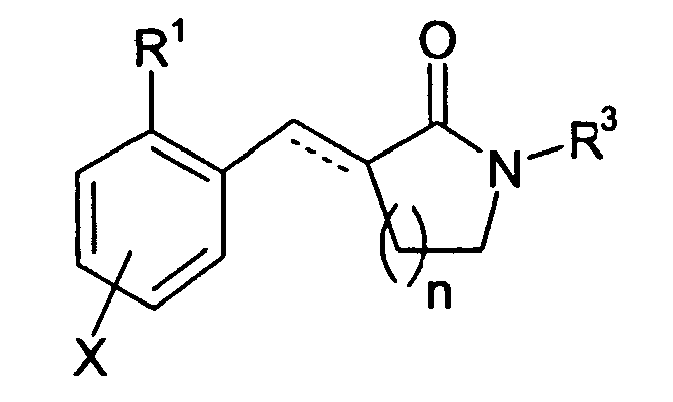

m is one to three;
R6 is selected from the group consisting of hydrogen, (C1-C6)alkyl optionally substituted with (C1-C6)alkoxy or one to three fluorine atoms, or ((C1-C4)alkyl)aryl wherein the aryl moiety is phenyl, naphthyl, or heteroaryl-(CH2)q-, wherein the heteroaryl moiety is selected from the group consisting of pyridyl, pyrimidyl, benzoxazolyl, benzothiazolyl, benzisoxazolyl and benzisothiazolyl and q is zero, one, two, three or four, and wherein said aryl and heteroaryl moieties may optionally be substituted with one or more substituents independently selected from the group consisting of chloro, fluoro, bromo, iodo, (C1-C6)alkyl, (C1-C6)alkoxy, trifluoromethyl, cyano and -SOt(C1-C6)alkyl, wherein t is zero, one or two;
each R13 is, independently, (C1-C4)alkyl or a (C1-C4)alkylene bridge from one of the ring carbons of the piperazine or piperidine ring of G1 or G2, respectively, to the same or another ring carbon or a ring nitrogen of the piperazine or piperidine ring of G1 or G2, respectively, having an available bonding site, or to a ring carbon of R6, when R6 has a ring structure having an available bonding site;
X is hydrogen, chloro, fluoro, bromo, iodo, cyano, (C1-C6)alkyl, hydroxy, (C1-C6)alkoxy, -SOt(C1-C6)alkyl wherein t is zero, one or two, -CO2R10 or -CONR11R12;
each of R10, R11 and R12 is selected, independently, from hydrogen, (C1-C4)alkyl, phenyl and naphthyl, wherein said phenyl or naphthyl may optionally be substituted with one or more substituents independently selected from chloro, fluoro, bromo, iodo, (C1-C6)alkyl, (C1-C6)alkoxy, trifluoromethyl, cyano and -SOt(C1-C6)alkyl wherein t is zero, one or two; or R11 and R12, together with the nitrogen to which they are attached, form a 5- to 7-membered heteroalkyl ring that may contain from zero to four heteroatoms selected from nitrogen, sulfur and oxygen;
R3 is vinyl, C(=O)R, wherein R is C1-C8 straight chain or branched alkyl, C3-C8 cycloalkyl, or aryl, wherein R is preferably tert-butyl, or,
R3 is -(CH2)gB, wherein g is zero to three and B is hydrogen, phenyl, naphthyl or a 5- to 6-membered heteroaryl ring containing from one to four heteroatoms in the ring selected from oxygen, nitrogen and sulfur, with the proviso that said ring cannot contain two adjacent oxygen atoms or two adjacent sulfur atoms and wherein each of the foregoing phenyl, naphthyl and heteroaryl rings may optionally be substituted with one to three substituents independently selected from (C1-C8)hydroxyalkyl-, (C1-C8)alkoxy-(C1-C8)alkyl-, (C3-C8)hydroxycycloalkyl-, (C3-C8)cycloalkoxy-, (C1-C8)alkoxy-(C3-C8)cycloalkyl-, heterocycloalkyl, hydroxyheterocycloalkyl, and (C1-C8)alkoxy-heterocycloalkyl, wherein each (C3-C8)cycloalkyl or heterocycloalkyl moiety may be independently substituted with from one to three (C1-C6)alkyl or benzyl groups; - When B is a phenyl, naphthyl or heteroaryl ring, each said ring may be optionally substituted with one to three substituents independently selected from phenyl, naphthyl and a 5- to 6-membered heteroaryl ring containing from one to four heteroatoms selected from oxygen, nitrogen and sulfur, with the proviso that said heteroaryl ring cannot contain two adjacent oxygen atoms or two adjacent sulfur atoms, and wherein each independently selected phenyl, naphthyl or heteroaryl substituent may itself be substituted with from one to three (C1-C8)alkyl or C3-C8 cycloalkyl substituents, wherein examples of heteroaryl groups include, but are not limited to, pyridinyl, pyridazinyl, imidazolyl, pyrimidinyl, pyrazolyl, triazolyl, pyrazinyl, quinolyl, isoquinolyl, tetrazolyl, furyl, thienyl, isoxazolyl, thiazolyl, oxazolyl, isothiazolyl, pyrrolyl, quinolinyl, isoquinolinyl, indolyl, benzimidazolyl, benzofuranyl, cinnolinyl, indazolyl, indolizinyl, phthalazinyl, pyridazinyl, triazinyl, isoindolyl, purinyl, oxadiazolyl, thiazolyl, thiadiazolyl, furazanyl, benzofurazanyl, benzothiophenyl, benzotriazolyl, benzothiazolyl, benzoxazolyl, quinazolinyl, quinoxalinyl, naphthyridinyl, dihydroquinolyl, tetrahydroquinolyl, dihydroisoquinolyl, tetrahydroisoquinolyl, benzofuryl, furopyridinyl, pyrolopyrimidinyl, and azaindolyl; or,
- When B is a phenyl, naphthyl or heteroaryl ring, each said ring may be optionally substituted with one to three substituents independently selected from (a) lactone formed from -(CH2)tOH with an ortho -COOH, wherein t is one, two or three; (b) -CONR14R15, wherein R14 and R15 are independently selected from (C1-C8)alkyl and benzyl, or R14 and R15 together with the nitrogen to which they are attached form a 5- to 7-membered heteroalkyl ring that may contain from zero to three heteroatoms selected from nitrogen, sulfur and oxygen in addition to the nitrogen of the -CONR14R15 group, wherein when any of said heteroatoms is nitrogen it may be optionally substituted with (C1-C8)alkyl or benzyl, with the proviso that said ring cannot contain two adjacent oxygen atoms or two adjacent sulfur atoms; (c) -(CH2)vNCOR16R17 wherein v is zero, one, two or three and -COR16 and R17 taken together with the nitrogen to which they are attached form a 4-to 6-membered lactam ring; and, (d) --(C1-C8)NR18R19 where each of R18 and R19 is selected, independently, from hydrogen and (C1-C4)alkyl, or R18 and R19, together with the nitrogen to which they are attached, form a 4- to 7-membered heteroalkyl ring that may contain from zero to four heteroatoms selected from nitrogen, sulfur and oxygen;
- Wherein the broken lines indicate optional double bonds; and,
n is one, two, or three; or,
a pharmaceutically acceptable salt or optical isomer thereof. - Other embodiments of the invention relate to a compound according to formula I wherein R3 is (CH2)gB wherein g is zero and B is selected from phenyl or pyridyl.
- The invention also relates to a compound according to formula I wherein R3 is (CH2)gB wherein g is zero and B is selected from phenyl, or pyridyl, wherein said (C3-C8)cycloalkyl moiety of said (C3-C8)hydroxycycloalkyl-, (C1-C8)alkoxy-(C3-C8)cydoalkyl-, substituents is selected from cyclopropyl, cyclobutyl, cyclopentyl or cyclohexyl.
- The invention also relates to a compound according to formula I wherein R3 is (CH2)gB wherein g is zero and B is selected from phenyl, or pyridyl, wherein said heterocycloalkyl moiety having 4 to 8 atoms, of said 1 to 3 optional substituents, is selected from tetrahydropyranyl, morpholinyl, azetidinyl, pyrrolidinyl, piperidyl, piperazinyl, thiomorpholinyl, azepinyl, diazepinyl, oxazepinyl, thiazepinyl, oxetanyl, and tetrahydrofuranyl.
- This invention also relates to a compound according to formula I wherein R3 is (CH2)gB wherein g is zero and B is selected from phenyl or pyridyl, wherein said alkoxyheterocycloalkyl moiety is selected from tetrahydropyranoxy, tetrahydrofuranoxy, oxetanoxy, azetidinoxy, pyrrolidinoxy, and piperidinoxy.
- The invention also relates to a compound according to formula I wherein R3 is (CH2)gB wherein g is zero and B is selected from phenyl, or pyridyl, wherein said 5- to 6- membered heteroaryl ring, of said 1 to 3 optional substituents, is selected from pyridyl, pyrrolyl, pyrazolyl, imidazolyl, triazolyl, tetrazolyl, oxazolyl, oxadiazolyl, isoxazolyl, thiazolyl, isothiazolyl, oxadiazolyl, thiadiazolyl, pyrimidinyl, pyrazinyl, and pyridazinyl.
- The invention also relates to a compound according to formula I wherein R3 is (CH2)gB wherein g is zero and B is selected from phenyl or pyridyl, wherein said R14 and said R15 groups of said -CONR14R15 substituent together with the nitrogen to which they are attached form a 5- to 6-membered heteroalkyl ring selected from piperidine, N-(C0-C6)alkylpiperazine and morpholine.
- The invention also relates to a compound according to formula I wherein R3 is (CH2)gB wherein g is zero and B is selected from phenyl or pyridyl, wherein said -COR16 and R17 groups of
said -(CH2)vNCOR16R17 substituent together with the nitrogen to which they are attached form a 5- or 6-membered lactam ring, and v is 1. - The invention also relates to a compound according to formula I wherein R3 is (CH2)gB wherein g is zero and B is selected from phenyl or pyridyl, wherein a lactone is formed from said -CH2OH substituent, with said ortho -COOH substituent.
- Specific examples of the compounds of the present invention are as follows:
- 3-[5-Fluoro-2-(4-methyl-piperazin-1-yl)-benzyl]-1-[4-(1-hydroxy-1-methyl-ethyl)-phenyl]-pyrrolidin-2-one,
- 4-{3-[2-(4-Methyl-piperazin-1-yl)-benzyl]-2-oxo-pyrrolidin-1-yl)-benzoic acid ethyl ester,
- 3-[2-(4-Methyl-piperazin-1-yl)-benzyl]-1-(6-morpholin-4-yl-pyridin-3-yl)-pyrrolidin-2-one,
- 1-[4-(1-Hydroxy-1-methyl-ethyl)-phenyl]-3-[2-(4-methyl-piperazin-1-yl)-benzyl]-pyrrolidin-2-one,
- 3-[2-(4-Methyl-piperazin-1-yl)benzyl]-1-(4-morpholin-4-yl-phenyl)-pyrrolidin-2-one,
- 1-[4-(1-Hydroxy-cyclopentyl)-phenyl]-3-[2-(4-methyl-piperazin-1-yl)-benzyl]-pyrrolidin-2-one,
- 1-[4-(1-Hydroxy-cyclohexyl)-phenyl]-3-[2-(4-methyl-piperazin-1-yl)-benzyl]-pyrrolidin-2-one,
- 1-[4-(1-Ethyl-1-hydroxy-propyl)-phenyl]-3-[2-(4-methyl-piperazin-1-yl)-benzyl]-pyrrolidin-2-one,
- 1-[3-(1-Hydroxy-1-methyl-ethyl)-phenyl]-3-[2-(4-methyl-piperazin-1-yl)-benzyl]-pyrrolidin-2-one,
- 1-[4-(2-Hydroxy-2-methyl-propyl)-phenyl]-3-[2-(4-memyl-piperazin-1-yl)benzyl]-pyrrolidin-2-one,
- 1-[6-(1-Hydroxy-1-methyl-ethyl)-pyridin-3-yl]-3-[2-(4-methyl-piperazin-1-yl)-benzyl)-pyrrolidin-2-one,
- 1-[4-(1-Methoxy-1-methyl-ethyl)-phenyl]-3-[2-(4-methyl-piperazin-1-yl)-benzyl]-pyrrolidin-2-one,
- 1-[4-(2-Methoxy-2-methyl-propyl)-phenyl]-3-[2-(4-methyl-piperazin-1-yl)-benzyl]-pyrrolidin-2-one,
- 1-[4-(1-Methoxy-cyclobutyl)-phenyl]-3-[2-(4-methyl-piperazin-1-yl)-benzyl]-pyrrolidin-2-one,
- 3-[2-(4-Methyl-piperazin-1-yl)-benzyl]-1-(4-pyridin-4-yl-phenyl)-pyrrolidin-2-one,
- 1-[4-(1-Hydroxy-cyclopentyl)-phenyl]-3-(2-piperazin-1-yl-benzyl)-pyrrolidin-2-one,
- 1-[4-(1-Hydroxy-cyclobutyl)-phenyl]-3-(2-piperazin-1-yl-benzyl)-pyrrolidin-2-one,
- 1-[4-(1-Hydroxy-cyclohexyl)-phenyl]-3-(2-piperazin-1-yl-benzyl)-pyrralidin-2-one,
- 1-[4-(1-Ethyl-1-hydroxy-propyl)-phenyl]-3-(2-piperazin-1-yl-benzyl)-pyrrolidin-2-one,
- 1-[4-(1-Hydroxy-1-methyl-ethyl)-phenyl]-3-(2-piperazin-1-yl-benzyl)-pyrrolidin-2-one,
- 1-[4-(1-Hydroxy-1-methyl-ethyl)-phenyl]-3-[2-(4-methyl-pi perazin-1-yl)-benzylidene]-pyrrolidin-2-one,
- 3-[2-(4-Ethyl-piperazin-1-yl)-benzyl]-1-[4-(1-hydroxy-1-methyl-ethyl)-phenyl]-pyrrolidin-2-one,
- 3-[2-(2,5-Dimethyl-piperazin-1-yl)-benzy)]-1-[4-(1-hydroxy-cyclopentyl)-phenyl]-pyrrolidin-2-one,
- 3-[2-(4-Methyl-piperazin-1-yl)-benzyl]-1-[6-(tetrahydro-pyran-4-yloxy)-pyridin-3-yl]-pyrrolidin-2-one,
- 1-[6-(1-Hydroxy-cyclopentyl)-pyridin-3-yl]-3-[2-(4-methyl-piperazin-1-yl)-benzyl]-pyrrolidin-2-one,
- 1-[4-(1-Hydroxy-cyclobutyl)-phenyl]-3-[2-(4-methyl-piperazin-1-yl)-benzyl]-pyrrolidin-2-one,
- 1-[5-(1-Hydroxy-1-methyl-ethyl)-pyridin-2-yl]-3-[2-(4-methyl-piperazin-1-yl)-benzyl]-pyrrolidin-2-one,
- 1-[5-(11-Hydroxy-cyclopentyl)-pyridin-2-yl]-3-[2-(4-methyl-piperazin-1-yl)-benzyl]-pyrrolidin-2-one, and pharmaceutically acceptable salts and optical isomers thereof.
- Specific optical isomers of the compounds of the invention include:
- (R)-3-[5-Fluoro-2-(4-methyl-piperazin-1-yl)-benzyl]-1-[4-(1-hydroxy-1-methyl-ethyl)-phenyl]-pyrrolidin-2-one,
- (R)-4-{3-[2-(4-Methyl-piperazin-1-yl)-benzyl]-2-oxo-pyrrolidin-1-yl}-benzoic acid ethyl ester,
- (R)-3-[2-(4-Methyl-piperazin-1-yl)-benzyl]-1-(6-morpholin-4-yl-pyridin-3-yl)-pyrrolidin-2-one,
- (R)-1-[4-(1-Hydroxy-1-methyl-ethyl)-phenyl]-3-[2-(4-methyl-piperazin-1-yl)-benzyl]-pyrrolidin-2-one,
- (R)-3-[2-(4-Methyl-piperazin-1-yl)-benzyl]-1-(4-morpholin-4-yl-phenyl)-pyrrolidin-2-one,
- (R)-1-[4-(1-Hydroxy-cyclopentyl)-phenyl]-3-[2-(4-methyl-piperazin-1-yl)-benzyl]-pyrrolidin-2-one,
- (R)-1-[4-(1-Hydroxy-cyclohexyl)-phenyl]-3-[2-(4-methyl-piperazin-1-yl)-benzyl]-pyrrolidin-2-one,
- (R)-1-[4-(1-Ethyl-1-hydroxy-propyl)-phenyl]-3-[2-(4-methyl-piperazin-1-yl)-benzyl]-pyrrolidin-2-one,
- (R)-1-[3-(1-Hydroxy-1-methyl-ethyl]-phenyl]-3-[2-(4-methyl-piperazin-1-yl)-benzyl]-pyrrolidin-2-one,
- (R)-1-[4-(2-Hydroxy-2-methyl-propyl)-phenyl]-3-[2-(4-methyl-piperazin-1-yl)-benzyl]-pyrrolidin-2-one,
- (R)-1-[6-(1-Hydroxy-1-methyl-ethyl)-pyridin-3-yl]-3-[2-(4-methyl-piperazin-1-yl)-benzyl]-pyrrolidin-2-one,
- (S)-3-[5-Fluoro-2-(4-methyl-piperazin-1-yl)-benzyl]-1-[4-(1-hydroxy-1-methyl-ethyl)-phenyl]-pyrrolidin-2-one,
- (S)-4-{3-[2-(4-Methyl-piperazin-1-yl)-benzyl]-2-oxo-pyrrolidin-1-yl}-benzoic acid ethyl ester,
- (S)-3-[2-(4-Methyl-piperazin-1-yl)-benzyl]-1-(6-morpholin-4-yl-pyridin-3-yl)-pyrrolidin-2-one,
- (S)-1-[4-(1-Hydroxy-1-methyl-ethyl)-phenyl]-3-[2-(4-methyl-piperazin-1-yl)-benzyl]-pyrrolidin-2-one,
- (S)-3-[2-(4-Methyl-piperazin-1-yl)-benzyl]-1-(4-morpholin-4-yl-phenyl)-pyrrolidin-2-one,
- (S)-1-[4-(1-Hydroxy-cyclopentyl)-phenyl]-3-[2-(4-methyl-piperazin-1-yl)-benzyl]-pyrrolidin-2-one,
- (S)-1-[4-(1-Hydroxy-cyclohexyl)-phenyl]-3-[2-(4-methyl-piperazin-1-yl)-benzyl]-pyrrolidin-2-one,
- (S)-1-[4-(1-Ethyl-1-hydroxy-propyl)-phenyl]-3-[2-(4-methyl-piperazin-1-yl)-benzyl]-pyrrolidin-2-one,
- (S)-1-[3-(1-Hydroxy-1-methyl-ethyl)-phenyl]-3-[2-(4-methyl-piperazin-1-yl)-benzyl]-pyrrolidin-2-one,
- (S)-1-[4-(2-Hydroxy-2-methyl-propyl)-phenyl]-3-[2-(4-methyl-piperazin-1-yl)-benzyl]-pyrrolidin-2-one,
- (S)-1-[6-(1-Hydroxy-1-methyl-ethyl)-pyridin-3-yl]-3-[2-(4-methyl-piperazin-1-yl)-benzyl]-pyrrolidin-2-one, and pharmaceutically acceptable salts thereof.
- Unless otherwise indicated, the term "halo", as used herein, includes fluoro, chloro, bromo and iodo.
- Unless otherwise indicated, the term "alkyl", as used herein, includes straight or branched alkyl groups having one to eight carbon atoms.
- Unless otherwise indicated the term "cycloalkyl" as used herein includes moieties derived from cyclic hydrocarbons containing from four to seven ring carbon atoms, including cyclic hydrocarbon moieties substituted with straight or branched alkyl moieties.
- Unless otherwise indicated the term "heterocycloalkyl" as used herein includes a cyclic hydrocarbon in which one or more of the ring carbon atoms has been replaced with a nitrogen, oxygen or sulfur atom or any combination thereof. Examples of such groups are oxetanyl, tetrahydrofuranyl, pyranyl, azetidinyl, pyrrolidinyl, piperidinyl, morpholinyl, thiomorphlinyl, piperazinyl, and azapinyl.
- The term "alkoxy", as used herein, means "alkyl-O-", wherein "alkyl" is defined as above.
- The term "alkylene, as used herein, means an alkyl radical having two available bonding sites (i.e., -alkyl-), wherein "alkyl" is defined as above.
- The term "alkenyl" is intended to include hydrocarbon chains of either a straight or branched configuration comprising one or more unsaturated carbon-carbon bonds which may occur in any stable point along the chain, such as ethenyl and propenyl. Alkenyl groups typically will have 2 to about 12 carbon atoms, more typically 2 to about 8 carbon atoms.
- The term "alkynyl" is intended to include hydrocarbon chains of either a straight or branched configuration comprising one or more triple carbon-carbon bonds which may occur in any stable point along the chain, such as ethynyl and propynyl. Alkynyl groups typically will have 2 to about 12 carbon atoms, more typically 2 to about 8 carbon atoms. The term "aryl" is intended to include groups that, in accordance with the theory of Hückel, have a cyclic, delocalized (4n+2) pi-electron system containing from five to about twelve ring atoms. Examples of aryl groups include, but are not limited to, arenes and their substitution products, e.g. phenyl, naphthyl and toluyl, among numerous others.
- The term "heteroaryl" is intended to include aromatic heterocyclic groups and includes the non-limiting examples thiophenyl, pyridyl, pyrimidyl, pyridazyl, oxazolyl, isooxazolyl, thiazolyl and isothiazolyl, among others.
- Unless otherwise indicated, the term "one or more substituents", as used herein, refers to from one to the maximum number of substituents possible based on the number of available bonding sites.
- The compounds of formula I may have chiral centers and therefore may occur in different enantiomeric configurations. The invention includes all enantiomers, diastereomers, and other stereoisomers, as well as any possible tautomers of such compounds of formula I, as well as racemic and other mixtures thereof.
- The present invention also relates to the pharmaceutically acceptable acid addition salts of the compounds of formula I. Examples of pharmaceutically acceptable acid addition salts of the compounds of formula I are the salts of hydrochloric acid, p-toluenesulfonic acid, fumaric acid, citric acid, succinic acid, salicylic acid, oxalic acid, hydrobromic acid, phosphoric acid, methanesulfonic acid, tartaric acid, maleic acid, di-p-toluoyl tartaric acid, and mandelic acid.
- The present invention also, relates to all radiolabeled forms of the compounds of the formula I. Preferred radiolabeled compounds of formula I are those wherein the radiolabels are selected from as 3H, 11C, 14C, 18F, 123I and 125I. Such radiolabeled compounds are useful as research and diagnostic tools in metabolism pharmacokinetics studies and in binding assays in both animals and man.
- The present invention also relates to a pharmaceutical composition for treating a disorder or condition in a mammal, including a human, selected from depression, anxiety, depression with concomitant anxiety, dysthymia, post traumatic stress disorder, panic phobias, obsessive compulsive disorder (OCD), OCD with comorbid Tourette's Syndrome, borderline personality disorder, sleep disorder, psychosis, seizures, dyskinesis, symptoms of Huntington's or Parkinson's diseases, spasticity, suppression of seizures resulting from epilepsy, cerebral ischemia, anorexia, faintness attacks, hypokinesia, cranial traumas, chemical dependencies, premature ejaculation, premenstrual syndrome (PMS) associated mood and appetite disorder, inflammatory bowel disease, modification of feeding behavior, blocking carbohydrate cravings, late luteal phase dysphoric disorder, tobacco withdrawal-associated symptoms, panic disorder, bipolar disorder, sleep disorders, jet lag, cognitive dysfunction, hypertension, bulimia, anorexia, obesity, cardiac arrhythmias, chemical dependencies and addictions selected from dependencies on, or addictions to nicotine or tobacco products, alcohol, benzodiazepines, barbiturates, opioids or cocaine; pathological gambling; trichotilomania; headache, stroke, traumatic brain injury (TBI), psychosis, Huntington's Chorea, tardive dyskinesia, hyperkinesia, dyslexia, schizophrenia, multi-infarct dementia, epilepsy, senile dementia of the Alzheimer's type (AD), Parkinson's disease (PD), attention deficit hyperactivity disorder (ADHD) and Tourette's Syndrome, comprising an amount of a compound of the formula I, or a pharmaceutically acceptable salt thereof, and a pharmaceutically acceptable carrier.
- The present invention also relates to a method of treating a disorder or condition referred to hereinabove in a mammal, including a human, comprising administering to a mammal in need of such treatment an amount of a compound of the formula I, or a pharmaceutically acceptable salt thereof, that is effective in treating such disorder or condition.
- The present invention also relates to a pharmaceutical composition for use in treating a disorder or condition referred to hereinabove in a mammal, comprising an amount of a compound according of the formula I that is an effective antagonist, inverse agonist or partial agonist of 5-HT1B receptors and a pharmaceutically acceptable carrier.
- The present invention also relates to a method of treating a disorder or condition referred to hereinabove in a mammal, comprising administering to a mammal in need of such treatment an amount of a compound of the formula I that is an effective antagonist, inverse agonist or partial agonist of 5-HT1B receptors.
- As used herein, the term "depression" includes depressive disorders, for example, single episodic or recurrent major depressive disorders, and dysthymic disorders, depressive neurosis, and neurotic depression; melancholic depression including anorexia, weight loss, insomnia and early morning waking, and psychomotor retardation; atypical depression (or reactive depression) including increased appetite, hypersomnia, psychomotor agitation or irritability, anxiety and phobias, seasonal affective disorder, or bipolar disorders or manic depression, for example, bipolar I disorder, bipolar II disorder and cyclothymic disorder.
- Other mood disorders encompassed within the term "depression" include dysthymic disorder with early or late onset and with or without atypical features; dementia of the Alzheimer's type, with early or late onset, with depressed mood; vascular dementia with depressed mood, disorders induced by alcohol, amphetamines, cocaine, hallucinogens, inhalants, opioids, phencyclidine, sedatives, hypnotics, anxiolytics and other substances; schizoaffective disorder of the depressed type; and adjustment disorder with depressed mood.
- As used herein, the term "anxiety" includes anxiety disorders, such as panic disorder with or without agoraphobia, agoraphobia without history of panic disorder, specific phobias, for example, specific animal phobias, social phobias, obsessive-compulsive disorder, stress disorders including post-traumatic stress disorder and acute stress disorder, and generalized anxiety disorders.
- "Generalized anxiety" is typically defined as an extended period (e.g. at least six months) of excessive anxiety or worry with symptoms on most days of that period. The anxiety and worry is difficult to control and may be accompanied by restlessness, being easily fatigued, difficulty concentrating, irritability, muscle tension, and disturbed sleep.
- "Panic disorder" is defined as the presence of recurrent panic attacks followed by at least one month of persistent concern about having another panic attack. A "panic attack" is a discrete period in which there is a sudden onset of intense apprehension, fearfulness or terror: During a panic attack, the individual may experience a variety of symptoms including palpitations, sweating, trembling, shortness of breath, chest pain, nausea and dizziness. Panic disorder may occur with or without agoraphobia.
- "Phobias" includes agoraphobia, specific phobias and social phobias. "Agoraphobia" is characterized by an anxiety about being in places or situations from which escape might be difficult or embarrassing or in which help may not be available in the event of a panic attack. Agoraphobia may occur without history of a panic attack. A "specific phobia" is characterized by clinically significant anxiety provoked by feared object or situation. Specific phobias include the following subtypes: animal type, cued by animals or insects; natural environment type, cued by objects in the natural environment, for example storms, heights or water; blood-injection-injury type, cued by the sight of blood or an injury or by seeing or receiving an injection or other invasive medical procedure; situational type, cued by a specific situation such as public transportation, tunnels, bridges, elevators, flying, driving or enclosed spaces; and other type where fear is cued by other stimuli. Specific phobias may also be referred to as simple phobias. A "social phobia" is characterized by clinically significant anxiety provoked by exposure to certain types of social or performance circumstances. Social phobia may also be referred to as social anxiety disorder.
- Other anxiety disorders encompassed within the term "anxiety" include anxiety disorders induced by alcohol, amphetamines, caffeine, cannabis, cocaine, hallucinogens, inhalants, phencychdine, sedatives, hypnotics, anxiolytics and other substances, and adjustment disorders with anxiety or with mixed anxiety and depression.
- Except where otherwise stated, R1, R3, X, G1, G2, R6, R13, a, n and m in the reaction schemes and discussions that follow are defined as above. Unless otherwise stated reaction conditions for all reaction schemes include an inert atmosphere commonly used in the art such as nitrogen or argon.
- Schemes 1 and 1a to 1d refer to general methods suitable for preparing compounds of formula I wherein R1 = G1. In step 1 of Scheme 1 a mixture of 2-substituted benzaldehyde V wherein the substituent at the 2-position, indicated as Z in Scheme 1, is a functional group that has the ability to undergo oxidative addition such as, but not limited to, F, Cl, Br, I, and sulfonate, such as 2-fluorobenzaldehyde, and an N-substituted compound of the formula IV are treated in a solvent selected from water, 1,4-dioxane, n-butanol, N,N-dimethylformamide, dimethyl sulfoxide, acetonitrile or mixtures thereof, preferably water, with a base such as a trialkyl amine or an alkali metal carbonate, preferably potassium carbonate, at a temperature of about 40°C to about 150°C, preferably about 90°C to about 120°C to yield an aldehyde of the formula III. A mixture of the 2-Z-benzaldehyde and N-substituted compound of the formula IV are treated in a solvent selected from toluene, benzene, DME wherein toluene is preferred with a base such as sodium or potassium tert-butoxide, sodium or potassium carbonate, potassium phosphonate preferably sodium tert-butoxide with a palladium source such as tetrakis(triphenylphosphine)palladium, palladium acetate, tris(dibenzyidene-acetone)dipalladium, transdichloro-bis(triphenylphospine)palladium or optionally added phosphine ligands where added such as BINAP or triphenylphosphine where palladium acetate and BINAP is preferred at a temperature of about 40°C to 150°C, preferably about 90°C to 120°C to yield an aldehyde of the formula III.
- Step 2 of Scheme 1 is an addition reaction of N-substituted lactam II to the aldehyde of formula III, wherein the N-substituent R3 is vinyl or C(=O)R, wherein R is C1-C8 straight chain or branched alkyl, C3-C8 cycloalkyl, aryl, or CF3, wherein R is preferably tert-butyl, using an amine or hydridic metal base such as sodium hydride or sodium bis(trimethylsilylamide), preferably sodium bis(trimethylsilylamide), in a reaction inert reaction solvent, preferably an ethereal solvent selected from diethyl ether, dioxane and tetrahydrofuran, most preferably tetrahydrofuran, at a temperature of from about -30°C to about 100°C, preferably from about -10°C to 30°C, to produce a compound of the formula I, wherein the dotted line represents a carbon-carbon double bond, and is designated IB in Scheme 1 (see Sasaki, H. et al. J. Med. Chem., 1991, 34, 628-633). In one embodiment, R3 is removed under the reaction conditions. In other embodiments, e.g., where R3 is vinyl, a separate deprotection step is required. In this case, R3 may be removed using aqueous acid work-up such as trifluoroacetic acid or hydrochloric acid, trifluoroacetic acid being preferred.
- Step 3 of Scheme 1 is a catalytic reduction of the carbon-carbon double bond of IB to produce a compound of the formula I, designated IA in Scheme 1. The reduction of this double bond may be effected with hydrogen gas (H2) in a reaction inert solvent such as a lower alcohol, THF, dioxane or ethyl acetate, preferably methanol or ethanol, in the presence of a noble metal catalyst on a solid support such as palladium on carbon (Pd/C), palladium on barium sulfate (Pd/BaSO4), platinum on carbon (Pt/C), or tris(triphenylphosphine) rhodium chloride (Wilkinson's catalyst), preferably about 10% palladium on carbon, at a pressure of from about 1 to about 5 atmospheres, preferably about 3 to about 4 atmospheres, at a temperature of about 10°C to about 100°C, preferably 40°C to 60°C while shaking the reaction mixture. Alternatively, the double bond may be reduced under transfer hydrogenation conditions where a hydride donor such as cyclohexadiene or ammonium formate is used in place of hydrogen, where ammonium formate is preferred, in a reaction inert solvent such as a lower alcohol, THF, dioxane or ethyl acetate, preferably methanol or ethanol, in the presence of a noble metal catalyst on a solid support such as palladium on carbon (Pd/C), palladium on barium sulfate (Pd/BaSO4), platinum on carbon (Pt/C), or tris(triphenylphosphine) rhodium chloride (Wilkinson's catalyst), preferably about 10% palladium on carbon, at a temperature of about 20°C to 150°C, preferably 40°C to 80°C. Alternatively, the reduction of the carbon-carbon double bond of 1 B to produce a compound of the formula 1, designated 1A in Scheme 1 can be accomplished using alternative procedures known to one skilled in the art. Larock, R. C. Comprehensive Organic Transformations. VCN Publishers, 1989. In those cases where R6 is benzyl or another group that is labile under hydrogenation conditions, the corresponding NH derivative (i.e., R6 = H) is formed.
- Step 4 of Scheme 1 depicts the conversion of a compound of formula IA (the compound of formula I in which the optional double is absent) wherein R3 is hydrogen to a compound of the formula IA' wherein R3 is an optionally substituted aryl or heteroaryl group, by means of N-arylation or N-heteroarylation. The compound of formula IA is treated with an aryl or heteroaryl chloride, bromide, iodide, or sulfonate, preferably the bromide, a base such as potassium phosphate, potassium carbonate, sodium carbonate, thallium carbonate, cesium carbonate, potassium tert-butoxide, lithium tert-butoxide, or sodium tert-butoxide, preferably potassium carbonate, a diamine, such as 1,2-ethylenediamine, N,N'-dimethylethylenediamine, N,N-dimethylethylenediamine, or cis-1,2-diaminocyclohexane, preferably N,N'-dimethylethylenediamine, and cuprous chloride, bromide or iodide or other copper(I) salts, preferably cuprous iodide, in the presence of a small amount of water, preferably about 1% to about 4% water (w/w relative to the compound of formula II), in a reaction inert solvent such as 1,2-dimethoxyethane, diglyme, t-butyl methyl ether, tetrahydrofuran, benzene or toluene, preferably toluene, optionally in the presence of a polar co-solvent such as DMF or dimethyl acetamide in the order of 5-15% vol/vol relative to the first solvent, at a temperature of about 40°C to about 150°C, preferably about 80°C to about 120 °C to yield the compound of formula IA' wherein R3 is optionally substituted aryl or heteroaryl.
- The N-arylation or N-heteroarylation in step 4 of Scheme 1 may also be accomplished by treating a compound of formula IA (the compound of formula I in which the optional double is absent) wherein R3 is hydrogen with an aryl or heteroaryl chloride, bromide, iodide, or sulfonate, preferably the bromide with a base such as an alkali metal carbonate, an alkali metal amine base, an alkali metal phosphonate, or an alkali metal alkoxide, preferably cesium carbonate, a phoshpine ligand, preferably 9,9-dimethyl-4,5-bis(diphenyl-phosphino)xanthene (XANTPHOS), and a palladium species, such as palladium(II)acetate or tris(dibenzylideneacetone)dipalladium(0) or the corresponding chloroform adduct, preferably tris(dibenzylideneacetone)dipalladium(0), in an inert solvent such as 1,4-dioxane or toluene, preferably 1,4-dioxane, at a temperature of about 40°C to about 160°C, preferably about 80°C to about 120°C. For compounds of formula I wherein R6 is H further functionalization of the secondary amine can be carried out under standard alkylation or reductive amination conditions known to one skilled in the art.
- Alternatively, in step 3a of scheme 1, the compound of formula IB may be converted to the N-aryl or N-heteroaryl derivative having formula 1 B' using the procedures of step 4 above. The compound of formula I wherein R1 is G1 and R3 is an optionally substituted aryl or heteroaryl group, designated lA' in Scheme 1 is then prepared in step 4a of Scheme 1 using the procedures of step 3 above.
- In those cases where R6 is benzyl or another group that is labile under hydrogenation conditions, the corresponding secondary amine derivative (i.e., R6 is H) is formed. If R6 is H, further functionalization of the secondary amine can be carried out under standard alkylation or reductive amination conditions known to those skilled in the art.

- Scheme 1 a depicts the preparation of a compound of the formula I, wherein the optional double bond is either present or absent beginning with N-arylation or N-heteroarylation of lactam IIa to form lactam II wherein R3 is an optionally substituted aryl or heteroaryl group.
- In step 1 of Scheme 1 a lactam IIA is treated with an aryl or heteroaryl chloride, bromide, iodide, or sulfonate, preferably the bromide, a base such as potassium phosphate, potassium carbonate, sodium carbonate, thallium carbonate, cesium carbonate, potassium tert-butoxide, lithium tert-butoxide, or sodium tert-butoxide, preferably potassium carbonate, a diamine, such as 1,2-ethylenediamine, N,N'-dimethylethylenediamine, N,N-dimethylethylenediamine or cis-1,2-diaminocyclohexane, preferably N,N'-dimethyl-ethylenediamine, and cuprous chloride, bromide or iodide, preferably cuprous iodide, in the presence of a small amount of water, preferably about 1% to about 4% water, in a reaction inert solvent such as 1,2-dimethoxyethane, diglyme, t-butyl methyl ether, tetrahydrofuran, benzene or toluene, preferably toluene, at a temperature of about 40°C to about 150°C, preferably about 80°C to about 120°C to yield the lactam of formula II wherein R3 is optionally substituted aryl or heteroaryl.
- The N-arylation or N-heteroarylation of step 1, Scheme 1 a may also be accomplished by treating a lactam of formula IIA wherein R3 is hydrogen with an aryl or heteroaryl chloride, bromide, iodide, or sulfonate, preferably the bromide with a base such as an alkali metal carbonate, an alkali metal amine base, an alkali metal phosphonate, or an alkali metal alkoxide, preferably cesium carbonate, a phoshpine ligand, preferably 9,9-dimethyl-4,5-bis(diphenylphosphino)xanthene (XANTPHOS), and a palladium species, such as palladium (II) acetate or tris(dibehzylideneacetone)dipalladium(0) or the corresponding chloroform adduct, preferably tris(dibenzylideneacetone)dipalladium(0), in an inert solvent such as 1,4-dioxane or toluene, preferably 1,4-dioxane, at a temperature of about 40°C to about 160°C, preferably about 80°C to about 120°C.
- In Step 2 of Scheme Ia compound IB' is prepared by treating aldehyde III, prepared as in Scheme I, with lactam II, wherein R3 is optionally substituted aryl or heteroaryl, using the procedure of step 2 in Scheme 1.
- In Step 2 of Scheme 1 a, compound 1 B' can alternatively be prepared by treating aldehyde III, prepared as in Scheme I, with lactam II, wherein R3 is optionally substituted aryl or heteroaryl, in a solvent such as tetrahydrofuran, tert-butylmethyl ether, or 1,4-dioxane, preferably tetrahydrofuran, in the presence of an alkali metal amine base, such as sodium bis(trimethylsilylamide), potassium bis(trimethylsilylamide), lithium bis(trimethylsilylamide), or lithium diisopropylamide, or an alkali metal hydride, such as sodium hydride or potassium hydride, preferably sodium bis(trimethylsilylamide), which is then followed by the addition of diethylchlorophosphonate at a temperature of about -30°C to about 100°C, preferably about - 10°C to about 30°C.
- In step 3 of Scheme la compound IA' is prepared by catalytic hydrogenation of compound IB' using the procedure of step 3 in Scheme 1.


- Scheme 1b depicts an alternative preparation of a lactam of formula II wherein R3 is an optionally substituted aryl or heteroaryl group.
- In step 1 of Scheme 1b, a compound R3-NH2, wherein R3 is an optionally substituted aryl or heteroaryl group, is treated with a compound of the formula VI wherein, group A of VI is selected from F, Cl, Br, I or an alkyl or aryl sulfonate, preferably Cl, and group B is selected from F, Cl, Br, I, OC1-C4 alkyl, OH, or an activated carboxylic acid group derived from reaction of the corresponding carboxylic acid with a standard carboxylic acid activating reagent such as, but not limited to, a carbodiimide (dicyclohexyl carbodiimide, 1-(3-dimethylaminopropyl)-3-ethylcarbodiimide hydrochloride salt) or tripropylphosphonic anhydride, preferably Cl, in a solvent such as water, acetonitrile, 1,4-dioxane, or tetrahydrofuran, or combinations thereof, preferably tetrahydrofuran, at a temperature of about 10°C to about 120°C, preferably about 50°C to about 80°C, in the presence or absence of a base, such as triethylamine, diisopropylethyl amine, an alkali metal hydroxide or an alkali metal carbonate, preferably cesium carbonate.
- Compounds IB' and IA' can then be prepared by the procedures of Scheme la.

- In those cases where R6 is benzyl or another group that is labile under hydrogenation conditions, the corresponding secondary amine derivative (i.e. R6 is H) is formed. If R6 is H, further functionalization of the secondary amine can be carried out under standard alkylation or reductive amination conditions known to those skilled in the art.
- Scheme 1c depicts yet another alternative preparation of the compounds of formula IB' and lA' wherein R3 is an optionally substituted aryl or heteroaryl group.
- In Step 1 of Scheme 1c a compound of the formula VIII is prepared by treating ortho halo-benzaldehyde VII, wherein D is selected from chloro, bromo, or iodo, preferably bromo, with a lactam of the formula II, wherein R3 is an optionally substituted aryl or heteroaryl group, in a solvent such as tetrahydrofuran, tert-butylmethyl ether, or 1,4-dioxane, preferably tetrahydrofuran, in the presence of an alkali metal amine base, such as sodium bis(trimethylsilylamide), potassium bis(trimethylsilylamide), lithium bis(trimethylsilylamide), or lithium diisopropylamide, or an alkali metal hydride, such as sodium hydride or potassium hydride, preferably sodium bis(trimethylsilylamide).
- In Step 2 of Scheme 1c, a compound of the formula IB' is prepared by treating a compound of the formula VIII with an N-substituted compound of the formula IV in a solvent selected from water, 1,4-dioxane, n-butanol, N,N-dimethylformamide, dimethyl sulfoxide, acetonitrile or mixtures thereof, preferably water, with a base such as a trialkyl amine or an alkali metal carbonate, preferably potassium carbonate, at a temperature of about 40°C to about 150°C, preferably about 90°C to about 120°C to yield the compound of the formula IB'. Alternatively, this coupling can be facilitated by use of an transition metal such as palladium and the preferred method is that of Buchwald as described in Buchwald et al. J. Org. Chem. 2000, 65, p1144-1157 and p1158-1174. A mixture of VIII and N-substituted compound of the formula IV are treated in a solvent selected from toluene, benzene, and DME, wherein toluene is preferred, with a base such as sodium or potassium tert-butoxide, sodium or potassium carbonate, potassium phosphonate, preferably sodium tert-butoxide with a palladium source such as tetrakis(triphenylphosphine)palladium, palladium acetate, tris(dibenzyideneacetone)dipalladium, transdichlorobis(triphenylphospine)palladium or optinally added phospine ligands were added such as BINAP or triphenylphosphine where palladium acetate and BINAP is preferred at a temperature of about 40°C to 150°C, preferably about 900°C to 120°C to yield a compound of formula IB'. The compound of the formula IB' can then be converted to the compound of the formula IA' as described above.
- Step 3 of Scheme 1c is a catalytic reduction of the carbon-carbon double bond of IB' to produce a compound of the formula I, designated IA' in Scheme 1. The reduction of this double bond may be effected with hydrogen gas (H2) in a reaction inert solvent such as a lower alcohol, THF, dioxane or ethyl acetate, preferably methanol or ethanol, in the presence of a noble metal catalyst on a solid support such as palladium on carbon (Pd/C), palladium on barium sulfate (Pd/BaSO4) platinum on carbon (Pt/C), or tris(triphenylphosphine) rhodium chloride (Wilkinson's catalyst), preferably about 10% palladium on carbon, at a pressure of from about 1 to about 5 atmospheres, preferably about 3 to about 4 atmospheres, at a temperature of about 10°C to about 100°C, preferably 40°C to 60°C while shaking the reaction mixture. Alternatively, the double bond may be reduced under transfer hydrogenation conditions where a hydride donor such as cyclohexadiene or ammonium formate is used in place of hydrogen, where ammonium formate is preferred, in a reaction inert solvent such as a lower alcohol, THF, dioxane or ethyl acetate, preferably methanol or ethanol, in the presence of a noble metal catalyst on a solid support such as palladium on carbon (Pd/C), palladium on barium sulfate (Pd/BaSO4 platinum on carbon (Pt/C), or tris(triphenylphosphine) rhodium chloride (Wilkinson's catalyst), preferably about 10% palladium on carbon, at a temperature of about 20°C to 150°C, preferably 40°C to 80°C.
- Alternatively, the reduction of the carbon-cabon double bond of 1B to produce a compound of the formula 1, designated 1A in Scheme 1 can be accomplished using alternative procedures known to one skilled in the art. Larock, R. C. Comprehensive Organic Transformations. VCN Publishers, 1989.

- Schemes 2, 2a and 2b refer to general methods suitable for preparing compounds of formula I wherein R1 = G2.
- Step 1 of Scheme 2 illustrates preparation of a compound XI by coupling boronic acid or boronic ester IX wherein L is selected from OH and O(C1 - C4)alkyl or wherein both L substituents together form a 1,3,2-benzodioxaborole derivative, preferably L is OH with halopyridine X, wherein the halo group HI is selected from chloro, bromo or iodo or sulfonate, preferably bromo, in the presence of a palladium catalyst, such as palladium tetrakistriphenylphosphine, dichloropalladium bistriphenylphosphine, or tris(dibenzidene-acetone)dipalladium, preferably palladium tetrakistriphenylphosphine, and an alkali metal base, such as sodium carbonate, potassium carbonate, cesium carbonate, sodium hydroxide, or potassium hydroxide, preferably sodium carbonate, in a solvent system containing dimethoxyethane and a polar protic solvent such as water, methanol, or ethanol, preferably water, at a temperature of from about 10°C to about 150°C, preferably about 70°C to about 110°C.
- In Step 2 of Scheme 2 compound XII is prepared by treating compound XI with N-substituted lactam II wherein the N-substituent R3, is vinyl or C(=O)R, wherein R is C1-C8 straight chain or branched alkyl, C3-C8 cycloalkyl, or aryl, CF3, preferably tert-butyl, in the presence of an amine or hydridic metal base such as sodium hydride or sodium bis(trimethylsilylamide), preferably sodium bis(trimethylsilylamide), in a reaction inert reaction solvent, preferably an ethereal solvent selected from diethyl ether, dioxane and tetrahydrofuran, most preferably tetrahydrofuran, at a temperature of from about -30°C to about 100°C, preferably from about - 10°C to 30°C. In embodiments where R3 is vinyl, aqueous acid, preferably trifluoroacetic acid, is used in the workup to remove R3.
- In Step 3 of Scheme 2 compound XIII is prepared by alkylation of the pyridinyl nitrogen of compound XII and partial reduction of the pyridinyl ring. Compound XII is treated with an excess of an alkyl iodide, alkyl methanesulfonate, alkyl arylsulfonate, or alkyl triflate, in a solvent such as acetonitrile or 1,4-dioxane, preferably acetonitrile, at a temperature of about 20°C to about 150°C, preferably 70°C to 90°C, for about 10 minutes to about 60 hours, a period of time sufficient to alkylate the pyridine nitrogen, followed by removal of solvent in vacuo, and subsequent addition of a lower alcohol solvent, preferably methanol, followed by the addition of sodium borohydride.
- In step 4 of Scheme 2 a compound of the formula I, wherein R1 is G2 and R3 is H, designated IC in Scheme 2 is prepared by catalytic reduction of the carbon-carbon double bond of XIII. The reduction of this double bond may be effected with hydrogen gas (H2) in a reaction inert solvent such as a lower alcohol, THF, dioxane or ethyl acetate, preferably methanol or ethanol, in the presence of a noble metal catalyst on a solid support such as palladium on carbon (Pd/C), palladium on barium sulfate (Pd/BaSO4), platinum on carbon (Pt/C), or tris(triphenylphosphine) rhodium chloride (Wilkinson's catalyst), preferably about 10% palladium on carbon, at a pressure of from about 1 to about 5 atmospheres, preferably about 3 to about 4 atmospheres, at a temperature of about 10°C to about 100°C, preferably 40°C to 60°C while shaking the reaction mixture. Alternatively, the double bond may be reduced under transfer hydrogenation conditions where a hydride donor such as cyclohexadiene or ammonium formate is used in place of hydrogen, where ammonium formate is preferred, in a reaction inert solvent such as a lower alcohol, THF, dioxane or ethyl acetate, preferably methanol or ethanol, in the presence of a noble metal catalyst on a solid support such as palladium on carbon (Pd/C), palladium on barium sulfate (Pd/BaO4). platinum on carbon (Pt/C), or tris(triphenylphosphine) rhodium chloride (Wilkinson's catalyst), preferably about 10% palladium on carbon, at a temperature of about 20°C to 150°C, preferably 40°C to 80°C.
- Alternatively, the reduction of the carbon-carbon double bond of XIII to produce a compound of the formula 1, designated 1C in Scheme 2 can be accomplished using alternative procedures known to one skilled in the art. Larock, R. C. Comprehensive Organic Transformations. VCN Publishers , 1989.
- In Step 5 of Scheme 2 the compound of the formula IC', wherein R1 is G2 and R3 is an optionally substituted aryl or heteroaryl group, is prepared from the compound of formula IC wherein R1 is G2 and R3 is H by means of N-arylation or N-heteroarylation. The compound of formula IC is treated with an aryl or heteroaryl chloride, bromide, iodide, or sulfonate, preferably the bromide, a base such as potassium phosphate, potassium carbonate, sodium carbonate, thallium carbonate, cesium carbonate, potassium tert-butoxide, lithium tert-butoxide, or sodium tert-butoxide, preferably potassium carbonate, a diamine, such as 1,2-ethylenediamine, N,N'dimethylethylenediamine, N,N-dimethylethylenediamine or cis-1,2-diaminocyclohexane, preferably N,N'-dimethylethylenediamine, and cuprous chloride, bromide or iodide or other Copper (1) sources, preferably cuprous iodide, in the presence of a small amount of water, preferably about 1% to about 4% water, in a reaction inert solvent such as 1,2-dimethoxyethane, diglyme, t-butyl methyl ether, tetrahydrofuran, benzene or toluene, preferably toluene, at a temperature of about 40°C to about 150°C, preferably about 80°C to about 120 °C to yield the compound of formula IC' wherein R3 is optionally substituted aryl or heteroaryl.
- The N-arylation or N-heteroarylation in Step 5 of Scheme 2 may also be accomplished by treating a compound of formula IC wherein R1 is G2 and R3 is H with an aryl or heteroaryl chloride, bromide, iodide, or sulfonate, preferably the bromide with a base such as an alkali metal carbonate, an alkali metal amine base, an alkali metal phosphonate, or an alkali metal alkoxide, preferably cesium carbonate, a phoshpine ligand, preferably 9,9-dimethyl-4,5-bis(diphenylphosphino)xanthene (XANTPHOS), and a palladium species, such as palladium (II) acetate or tris(dibenzylideneacetone)dipalladium(0) or the corresponding chloroform adduct, preferably tris(dibenzylideneacetone)dipalladium(0), in an inert solvent such as 1,4-dioxane or toluene, preferably 1,4-dioxane, at a temperature of about 40°C to about 160°C, preferably about 80°C to about 120°C. For compounds of formula IC or IC' wherein R6 is H further functionalization of the secondary amine can be carried out under standard alkylation or reductive amination conditions known to one skilled in the art.
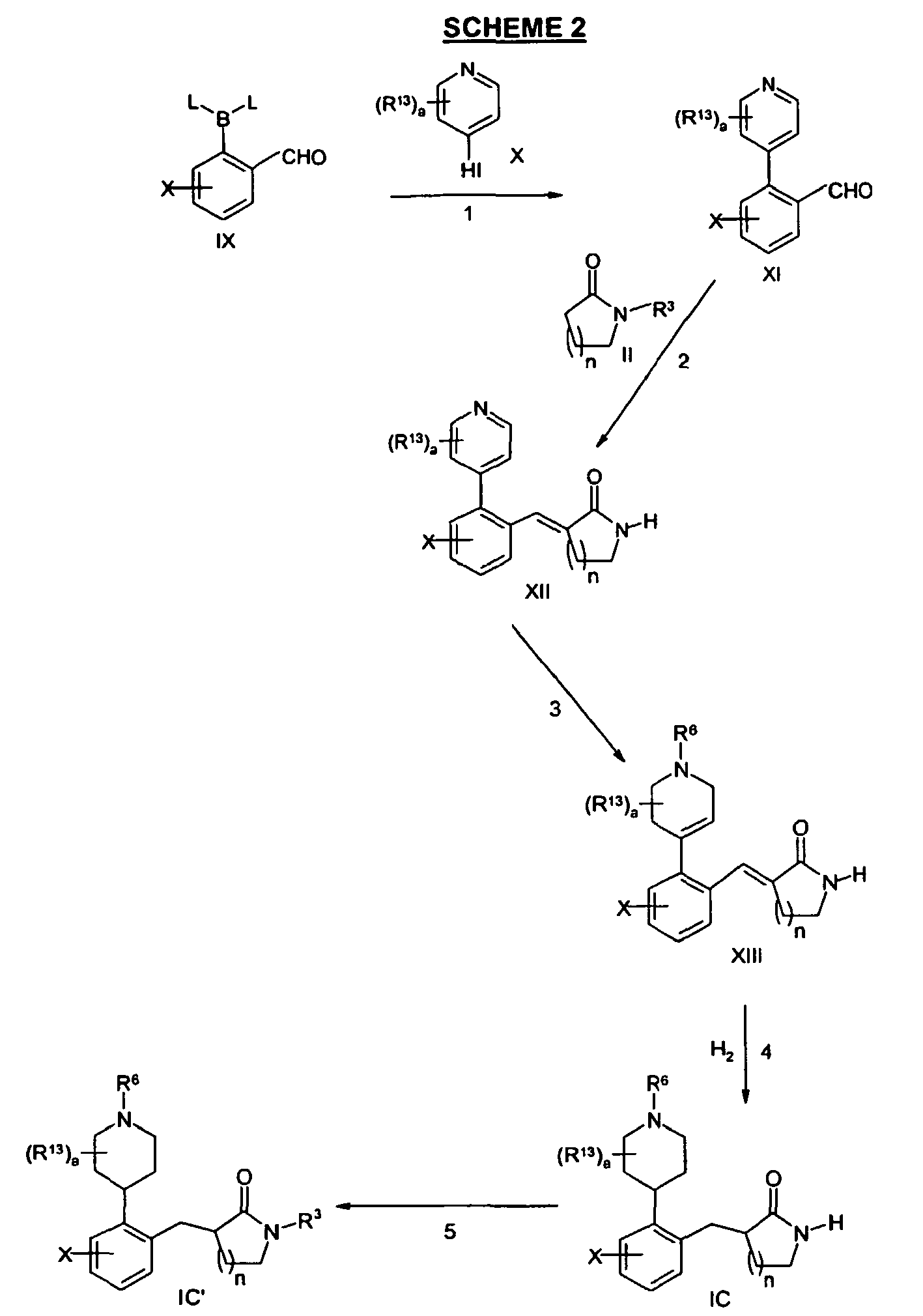
- Scheme 2a depicts an alternate route to a compound of the formula IC' wherein R1 is G2. In Step 1 of Scheme 2a, the compound of formula XII is converted to a compound of formula XIV wherein R3 is an optionally substituted aryl or heteroaryl group, by N-arylation or N-heteroarylation. The compound of formula XII is treated with an aryl or heteroaryl chloride, bromide, iodide, or sulfonate, preferably the bromide, a base such as potassium phosphate, potassium carbonate, sodium carbonate, thallium carbonate, cesium carbonate, potassium tert-butoxide, lithium tert-butoxide, or sodium tert-butoxide, preferably potassium carbonate, a diamine, such as 1,2-ethylenediamine, N,N'-dimeihylethylenediamine, N,N-dimethylethylenediamine or cis-1,2-diaminocyclohexane, preferably N,N'-dimethylethylenediamine, and cuprous chloride, bromide or iodide, preferably cuprous iodide, in the presence of a small amount of water, preferably about 1% to about 4% water, in a reaction inert solvent such as 1,2-dimethoxyethane, diglyme, t-butyl methyl ether, tetrahydrofuran, benzene or toluene, preferably toluene, at a temperature of about 40°C to about 150°C, preferably about 80°C to about 120°C to yield the compound of formula XIV wherein R3 is optionally substituted aryl or heteroaryl.
- The N-arylation or N-heteroarylation in Step 1 of Scheme 2a may also be accomplished by treating a compound of formula XII wherein R1 is G2 and R3 is H with an aryl or heteroaryl chloride, bromide, iodide, or sulfonate, preferably the bromide with a base such as an alkali metal carbonate, an alkali metal amine base, an alkali metal phosphonate, or an alkali metal alkoxide, preferably cesium carbonate, a phoshpine ligand, preferably 9,9-dimethyl-4,5-bis(diphenylphosphino)xanthene (XANTPHOS), and a palladium species, such as palladium(II)acetate or tris(dibenzylideneacetone)dipalladium(0) or the corresponding chloroform adduct, preferably tris(dibenzylideneacetone)dipalladium(0), in an inert solvent such as 1,4-dioxane or toluene, preferably 1,4-dioxane, at a temperature of about 40°C to about 160°C, preferably about 80°C to about 120°C.
- Step 1a of Scheme 2a depicts an alternate route to the preparation of a compound of fonnula XIV by treating the compound of formula XI with the compound of formula 11 (from Scheme 1) wherein R3 is an optionally substituted aryl or heteroaryl group, in a solvent such as tetrahydrofuran, tert-butylmethyl ether, or 1,4-dioxane, preferably tetrahydrofuran, with an alkali metal amine base, such as sodium bis(trimethylsilylamide), potassium bis(trimethylsilylamide), lithium bis(trimethylsilylamide), or lithium diisopropylamide, or an alkali metal hydride, such as sodium hydride or potassium hydride, preferably sodium bis(trimethylsilylamide).
- In Step 2 of Scheme 2a the compound of the formula XV is prepared by treating the compound of the formula XIV with an excess of an alkyl iodide, alkyl methanesulfonate, alkyl arylsulfonate, or alkyl triflate, in a solvent such as acetonitrile or 1,4-dioxane, preferably acetonitrile, at a temperature of about 20°C to about 150°C, preferably 70°C to 90°C, for about 10 minutes to about 60 hours, a period of time sufficient to alkylate the pyridine nitrogen, followed by removal of solvent in vacuo, and subsequent addition of a lower alcohol solvent, preferably methanol, followed by the addition of sodium borohydride.
- In Step 3 of Scheme 2a a compound of the formula I, wherein R1 is G2 and R3 is H, designated IC' in Scheme 2 is prepared by catalytic reduction of compound XV in a reaction inert solvent such as a lower alcohol, preferably methanol or ethanol, with a noble metal catalyst, such as platinum or palladium, suspended on a solid support, preferably 10% palladium on carbon, under a hydrogen pressure of about 1 atmosphere to about 5 atmospheres, preferably about 3 atmospheres to about 4 atmospheres, at a temperature of about 10°C to about 100°C, preferably about 40°C to about 60°C, while shaking the reaction mixture. Alternatively, the double bond may be reduced under transfer hydrogenation conditions where a hydride donor such as cyclohexadiene or ammonium formate is used in place of hydrogen, where ammonium formate is preferred, in a reaction inert solvent such as a lower alcohol, THF, dioxane or ethyl acetate, preferably methanol or ethanol, in the presence of a noble metal catalyst on a solid support such as palladium on carbon (Pd/C), palladium on barium sulfate (Pd/BaSO4), platinum on carbon (Pt/C), or tris(triphenylphosphine) rhodium chloride (Wilkinson's catalyst), preferably about 10% palladium on carbon, at a temperature of about 20°C to 150°C, preferably 40°C to 80°C.
- Alternatively, the reduction of the carbon-carbon double bond of XV to produce a compound of the formula 1, designated 1C' in Scheme 2a can be accomplished using alternative procedures known to one skilled in the art. Larock, R. C. Comprehensive Organic Transformations. VCN Publishers , 1989.

- Scheme 2b depicts yet another route for synthesis of compounds of formula I wherein R1 is G2 and R3 is an optionally substituted aryl or heteroaryl group. In Step 1 of Scheme 2b a compound of the formula XVI wherein R1 is G2 is prepared by catalytic reduction of compound XIV, wherein R3 is an optionally substituted aryl or heteroaryl group, in a reaction inert solvent such as a lower alcohol, preferably methanol or ethanol, with a noble metal catalyst, such as platinum or palladium, suspended on a solid support, preferably 10% palladium on carbon, under a hydrogen pressure of about 1 atmosphere to about 5 atmospheres, preferably about 3 atmospheres to about 4 atmospheres, at a temperature of about 10°C to about 100°C, preferably about 40°C to about 60°C, while shaking the reaction mixture. Alternatively, the double bond may be reduced under transfer hydrogenation conditions where a hydride donor such as cyclohexadiene or ammonium formate is used in place of hydrogen, where ammonium formate is preferred, in a reaction inert solvent such as a lower alcohol, THF, dioxane or ethyl acetate, preferably methanol or ethanol, in the presence of a noble metal catalyst on a solid support such as palladium on carbon (Pd/C), palladium on barium sulfate (Pd/BaSO4) platinum on carbon (Pt/C), or tris(triphenylphosphine) rhodium chloride (Wilkinson's catalyst), preferably about 10% palladium on carbon, at a temperature of about 20°C to 150°C, preferably 40°C to 80°C.
- Alternatively, the reduction of the carbon-carbon double bond of XIV to produce a compound of the formula XVI can be accomplished using alternative procedures known to one skilled in the art. Larock, R. C. 1989.
- In Step 2 of Scheme 2b a compound of the formula XVII is prepared by treating the compound of the formula XVI with an excess of an alkyl iodide, alkyl methanesulfonate, alkyl arylsulfonate, or alkyl triflate, in a solvent such as acetonitrile or 1,4-dioxane, preferably acetonitrile, at a temperature of about 20°C to about 150°C, preferably 70°C to 90°C, for about 10 minutes to about 60 hours, a period of time sufficient to alkylate the pyridine nitrogen, followed by removal of solvent in vacuo, and subsequent addition of a lower alcohol solvent, preferably methanol, followed by the addition of sodium borohydride.
- In Step 3 of Scheme 2b the compound of the formula I, wherein R1 is G2 and R3 is an optionally substituted aryl or heteroaryl group, designated IC' in Scheme 2b, is prepared by catalytic reduction of compound XVII in a reaction inert solvent such as a lower alcohol, preferably methanol or ethanol, with a noble metal catalyst, such as platinum or palladium, suspended on a solid support, preferably 10% palladium on carbon, under a hydrogen pressure of about 1 atmosphere to about 5 atmospheres, preferably about 3 atmospheres to about 4 atmospheres, at a temperature of about 10°C to about 100°C, preferably about 20°C to about 50°C, while shaking the reaction mixture. Alternatively, the double bond may be reduced under transfer hydrogenation conditions where a hydride donor such as cyclohexadiene or ammonium formate is used in place of hydrogen, where ammonium formate is preferred, in a reaction inert solvent such as a lower alcohol, THF, dioxane or ethyl acetate, preferably methanol or ethanol, in the presence of a noble metal catalyst on a solid support such as palladium on carbon (Pd/C), palladium on barium sulfate (Pd/BaSO4) platinum on carbon (Pt/C), or tris(triphenylphosphine) rhodium chloride (Wilkinson's catalyst), preferably about 10% palladium on carbon, at a temperature of about 20°C to 150°C, preferably 40°C to 80°C.
- Alternatively, the reduction of the carbon-carbon double bond of XVII to produce a compound of the formula 1, designated 1C' in Scheme 2b can be accomplished using alternative procedures known to one skilled in the art. Larock, R. C., 1989.


U.S. Patent 5,612,359 ; Guay, D. et al. Biorg. Med.Chem. Lett. 2002, 12, 1457-1461; Sall, D. J. et al. J. Med. Chem. 2000, 43, 649-663; Olah, G. A.; Porter, R.D. J. Amer. Chem. Soc. 1971, 93, 6877-6887; Brown, H.C. et al. J. Amer. Chem. Soc. 1957, 79, 1906-1909; Nenitzescu, C.; Necsoiu, I. J. Amen. Chem. Soc. 1950, 72, 3483-3486; Muci, A. R.; Buchwald, S. L. Top. Curr. Chem.; Springer-Verlag: Berlin Heidelberg, 2002; Vol. 219, pp. 131-209;Schefczik, E. DE 19650708 ;Howard, H. R.; Sarges, R. EP 104860 - The compounds of the formula I and their pharmaceutically acceptable salts (hereafter "the active compounds") can be administered via either the oral, transdermal (e.g., through the use of a patch), intranasal, sublingual, rectal, parenteral or topical routes. Transdermal and oral administration are preferred. These compounds are, most desirably, administered in dosages ranging from about 0.25 mg up to about 1500 mg per day, preferably from about 0.25 to about 300 mg per day in single or divided doses, although variations will necessarily occur depending upon the weight and condition of the subject being treated and the particular route of administration chosen. However, a dosage level that is in the range of about 0.01 mg to about 10 mg per kg of body weight per day is most desirably employed. Variations may nevertheless occur depending upon the weight and condition of the persons being treated and their individual responses to said medicament, as well as on the type of pharmaceutical formulation chosen and the time period and interval during which such administration is carried out. In some instances, dosage levels below the lower limit of the aforesaid range may be more than adequate, while in other cases still larger doses may be employed without causing any harmful side effects, provided that such larger doses are first divided into several small doses for administration throughout the day.
- The active compounds can be administered alone or in combination with pharmaceutically acceptable carriers or diluents by any of the several routes previously indicated. More particularly, the active compounds can be administered in a wide variety of different dosage forms, e.g., they may be combined with various pharmaceutically acceptable inert carriers in the form of tablets, capsules, transdermal patches, lozenges, troches, hard candies, powders, sprays, creams, salves, suppositories, jellies, gels, pastes, lotions, ointments, aqueous suspensions, injectable solutions, elixirs, syrups, and the like. Such carriers include solid diluents or fillers, sterile aqueous media and various non-toxic organic solvents. In addition, oral pharmaceutical compositions can be suitably sweetened and/or flavored. In general, the active compounds are present in such dosage forms at concentration levels ranging from about 5.0% to about 70% by weight.
- For oral administration, tablets containing various excipients such as microcrystalline cellulose, sodium citrate, calcium carbonate, dicalcium phosphate and glycine may be employed along with various disintegrants such as starch (preferably com, potato or tapioca starch), alginic acid and certain complex silicates, together with granulation binders like polyvinylpyrrolidone, sucrose, gelatin and acacia. Additionally, lubricating agents such as magnesium stearate, sodium lauryl sulfate and talc can be used for tableting purposes. Solid compositions of a similar type may also be employed as fillers in gelatin capsules; preferred materials in this connection also include lactose or milk sugar] as well as high molecular weight polyethylene glycols. When aqueous suspensions and/or elixirs are desired for oral administration the active ingredient may be combined with various sweetening or flavoring agents, coloring matter and, if so desired, emulsifying and/or suspending agents, together with such diluents as water, ethanol, propylene glycol, glycerin and various combinations thereof.
- For parenteral administration, a solution of an active compound in either sesame or peanut oil or in aqueous propylene glycol can be employed. The aqueous solutions should be suitably buffered (preferably pH greater than 8), if necessary, and the liquid diluent first rendered isotonic. These aqueous solutions are suitable for intravenous injection purposes. The oily solutions are suitable for intraarticular, intramuscular and subcutaneous injection purposes. The preparation of all these solutions under sterile conditions is readily accomplished by standard pharmaceutical techniques well known to those skilled in the art.
- It is also possible to administer the active compounds topically and this can be done by way of creams, a patch, jellies, gels, pastes, ointments and the like, in accordance with standard pharmaceutical practice.
- All tested compounds had IC50 values of 1000 nM or less. The activity of the compounds of the present invention with respect to 5HT1B (formerly SHT1D) binding ability can be determined using standard radioligand binding assays as described in the literature. The 5-HT1A affinity can be measured using the procedure of Hoyer et al. (Brain Res., 376, 85 (1986)). The 5-HT1D affinity can be measured using the procedure of Heuring and Peroutka (J. Neurosci., 7, 894 (1987)).
- The in vitro activity of the compounds of the present invention at the 5-HT1D binding site may be determined according to the following procedure. Bovine caudate tissue is homogenized and suspended in 20 volumes of a buffer containing 50 mM TRIS.hydrochloride (tris[hydroxymethyl]aminomethane hydrochloride) at a pH of 7.7. The homogenate is then centrifuged at 45,000 G for 10 minutes. The supernatant is then discarded and the resulting pellet resuspended in approximately 20 volumes of 50 mM TRIS.hydrochloride buffer at pH 7.7. This suspension is then pre-incubated for 15 minutes at 37°C, after which the suspension is centrifuged again at 45,000 G for 10 minutes and the supernatant discarded. The resulting pellet (approximately 1 gram) is resuspended in 150 ml of a buffer of 15 mM TRIS.hydrochloride containing 0.01 percent ascorbic acid with a final pH of 7.7 and also containing 10 IJM pargyline and 4 mM calcium chloride (CaCl2). The suspension is kept on ice at least 30 minutes prior to use.
- The inhibitor, control or vehicle is then incubated according to the following procedure. To 50 µl of a 20 percent dimethylsulfoxide (DMSO)/80 percent distilled water solution is added 200 µl of tritiated 5-hydroxytryptamine (2 nM) in a buffer of 50 mM TRIS.hydrochloride containing 0.01 percent ascorbic acid at pH 7.7 and also containing 10 µM pargyline and 4 µM calcium chloride, plus 100 nM of 8-hydroxy-DPAT (dipropylaminotetraline) and 100 nM of mesulergine. To this mixture is added 750 µl of bovine caudate tissue, and the resulting suspension is vortexed to ensure a homogenous suspension. The suspension is then incubated in a shaking water bath for 30 minutes at 25°C. After incubation is complete, the suspension is filtered using glass fiber filters (e.g., Whatman GF/B™ filters.). The pellet is then washed three times with 4 ml of a buffer of 50 mM TRIS.hydrochloride at pH 7.7. The pellet is then placed in a scintillation vial with 5 ml of scintillation fluid (Aquasol 2™) and allowed to sit overnight. The percent inhibition can be calculated for each dose of the compound. An IC50 value can then be calculated from the percent inhibition values.
- The activity of the compounds of the present invention for 5-HT1A binding ability can be determined according to the following procedure. Rat brain cortex tissue is homogenized and divided into samples of 1 gram lots and diluted with 10 volumes of 0.32 M sucrose solution. The suspension is then centrifuged at 900G for 10 minutes and the supernate separated and recentrifuged at 70,000 G for 15 minutes. The supernate is discarded and the pellet resuspended in 10 volumes of 15 mM TRIS.hydrochloride at pH 7.5. The suspension is allowed to incubate for 15 minutes at 37°C. After pre-incubation is complete, the suspension is centrifuged at 70,000 G for 15 minutes and the supernate discarded. The resulting tissue pellet is resuspended in a buffer of 50 mM TRIS.hydrochloride at pH 7.7 containing 4 mM of calcium chloride and 0.01 percent ascorbic acid, The tissue is stored at -70° C until ready for an experiment. The tissue can be thawed immediately prior to use, diluted with 10 µm pargyline and kept on ice.
- The tissue is then incubated according to the following procedure. Fifty microliters of control, inhibitor, or vehicle (1 percent DMSO final concentration) is prepared at various dosages. To this solution is added 200 µl of tritiated DPAT at a concentration of 1.5 nM in a buffer of 50 mM TRIS.hydrochloride at pH 7.7 containing 4 mM calcium chloride, 0.01 percent ascorbic acid and pargyline. To this solution is then added 750 µl of tissue and the resulting suspension is vortexed to ensure homogeneity. The suspension is then incubated in a shaking water bath for 30 minutes at 37°C. The solution is then filtered, washed twice with 4 ml of 10 mM TRIS.hydrochloride at pH 7.5 containing 154 mM of sodium chloride. The percent inhibition is calculated for each dose of the compound, control or vehicle. IC50 values are calculated from the percent inhibition values.
- The agonist and antagonist activities of the compounds of the invention at 5-HT1A and 5-HT1D receptors can be determined using a single saturating concentration according to the following procedure. Male Hartley guinea pigs are decapitated and 5-HT1A receptors are dissected out of the hippocampus, while 5-HT1D receptors are obtained by slicing at 350 mM on a Mcllwain tissue chopper and dissecting out the substantia nigra from the appropriate slices. The individual tissues are homogenized in 5 mM HEPES buffer containing 1 mM EGTA (pH 7.5) using a hand-held glass-Teflon® homogenizer and centrifuged at 35,000xg for 10 minutes at 4°C. The pellets are resuspended in 100 mM HEPES buffer containing 1 mM EGTA (pH 7.5) to a final protein concentration of 20 mg (hippocampus) or 5 mg (substantia nigra) of protein per tube. The following agents are added so that the reaction mix in each tube contained 2.0 mM MgCl2, 0.5 mM ATP, 1.0 mM cAMP, 0.5 mM IBMX, 10 mM phosphocreatine, 0.31 mg/mL creatine phosphokinase, 100 µM GTP and 0.5-1 microcuries of [32P]-ATP (30 Ci/mmol: NEG-003--New England Nuclear). Incubation is initiated by the addition of tissue to siliconized microfuge tubes (in triplicate) at 30° C. for 15 minutes. Each tube receives 20 µL tissue, 10 µL drug or buffer (at 10x final concentration), 10 µL 32 nM agonist or buffer (at 10x final concentration), 20 µL forskolin (3 µM final concentration) and 40 µL of the preceding reaction mix. Incubation is terminated by the addition of 100 µL 2% SDS, 1.3 mM cAMP, 45 mM ATP solution containing 40,000 dpm [3H]-cAMP (30 Ci/mmol: NET-275--New England Nuclear) to monitor the recovery of cAMP from the columns. The separation of [32P]-ATP and [32P]-cAMP is accomplished using the method of Salomon et al., Analytical Biochemistry, 1974, 58, 541-548. Radioactivity is quantified by liquid scintillation counting. Maximal inhibition is defined by 10 µM (R)-8-OH-DPAT for 5-HT1A receptors, and 320 nM 5-HT for 5-HT1D receptors. Percent inhibitions by the test compounds are then calculated in relation to the inhibitory effect of (R)8-OH-DPAT for 5-HT1A receptors or 5-HT for 5-HT1D receptors. The reversal of agonist induced inhibition of forskolin-stimulated adenylate cyclase activity is calculated in relation to the 32 nM agonist effect.
- The in vitro activity of the compounds in the present invention at the human ether-a-go-go-related gene potassium channel (hERG) can be determined according to the following procedure. HEK-293 cells expressing the human ERG channel are grown according to standard cell culture techniques. Cells are collected, spun down and the resulting pellet is frozen for future use. On the day of the experiment, frozen cell pellet is weighed (100 mg per 96 well assay plate) and homogenized in 20 volumes of cold 50 mM Tris base containing 10 mM KCI and 1 mM MgCl2 (pH to 7.4 at 4 degrees C). The homogenate is then centrifuged at 45,000 G for 10 minutes. The supernatant is decanted and the membrane pellet resuspended by Polytron in cold 50 mM Tris base containing 10 mM KCI and 1 mM MgCl2 (pH to 7.4 at 4 degrees C) to a 20 mg/mL concentration. PVT WGA SPA beads (PEI treated type A) are weighed out and added to diluted tissue, also to concentration of 20 mg/mL. The membrane / bead solution is then gently rotated (speed 2, high) in a cold room (4°C) for 2 hours on a Roto-Torque (Cole-Palmer Model 7637). Following this preincubation, the bead slurry is then centrifuged at 1000 rpm for 5 min at 4°C. The supernatant is decanted and the pellet is resuspended to 5 mg/ml membrane and bead concentration in 50 mM Tris base containing 10 mM KCI and 1 mM MgCl2' (pH to 7.4 at 22 degrees C)). The resuspended SPA beads / membrane mixture is immediately used in the assay. Beads and membranes are used at a final concentration of 1 mg/well and 25 microgram protein/well, respectively. Dilutions of compounds are made in 10% DMSO / 50 mM Tris buffer (pH 7.4) (at 10 x final concentration - so that the final DMSO concentration is 1%). To 96 well SPA plates containing drug dilutions, radioligand is added (5 nM final concentration 3H-dofetilide). The incubation is initiated by the addition of tissue/bead slurry. Assay plates incubate for one hour and then radioactivity is quantified using a MicroBeta scintillation counter. The percent inhibition of specific binding can then be calculated.
- The compounds of the invention can be tested for in vivo activity for antagonism of 5-HT1D agonist-induced hypothermia in guinea pigs according to the following procedure.
- Male Hartley guinea pigs from Charles River, weighing 250-275 grams on arrival and 300-600 grams at testing, serve as subjects in the experiment. The guinea pigs are housed under standard laboratory conditions on a 7 a.m. to 7 p.m. lighting schedule for at least seven days prior to experimentation. Food and water are available ad libitum until the time of testing.
- The compounds of the invention can be administered as solutions in a volume of 1 ml/kg. The vehicle used is varied depending on compound solubility. Test compounds are typically administered either sixty minutes orally (p.o.) or 0 minutes subcutaneously (s.c.) prior to a 5-HT1D agonist, such as [3-(1-methylpyrrolidin-2-ylmethyl)-1H-indol-5-yl]-(3-nitropyridin-3-yl)-amine, which can be prepared as described in
PCT publication WO93/11106, published Jun. 10, 1993 - In p.o. screening experiments, a "pre-drug" baseline temperature reading is made at -90 minutes, the test compound is given at -60 minutes and an additional -30 minute reading is taken. The 5-HT1D agonist is then administered at 0 minutes and temperatures are taken 30, 60, 120 and 240 minutes later. In subcutaneous screening experiments, a pre-drug baseline temperature reading is made at -30 minutes. The test compound and 5-HT1D agonists are given concurrently and temperatures are taken at 30, 60, 120 and 240 minutes later.
- Data are analyzed with two-way analysis of variants with repeated measures in Newman-Keuls post hoc analysis.
- The active compounds of the invention can be evaluated as anti-migraine agents by testing the extent to which they mimic sumatriptan in contracting the dog isolated saphenous vein strip (P. Humphrey et al., Br. J. Pharmacol., 94, 1128 (1988)). This effect can be blocked by methiothepin, a known serotonin antagonist. Sumatriptan is known to be useful in the treatment of migraine and produces a selective increase in carotid vascular resistance in the anesthetized dog. The pharmacological basis of sumatriptan efficacy has been discussed in W. Fenwick et al., Br. J. Pharmacol., 96, 83 (1989).
- The serotonin 5-HT, agonist activity can be determined by the in vitro receptor binding assays, as described for the 5-HT1A receptor using rat cortex as the receptor source and [3H]-8-OH-DPAT as the radioligand (D. Hoyer et al., Eur. J. Pharm., 118, 13 (1985)) and as described for the 5-HT1D receptor using bovine caudate as the receptor source and [3H]serotonin as the radioligand (R. E. Heuring and S. J. Peroutka, J. Neuroscience, 7, 894 (1987)).
- The following experimental preparations and examples illustrate, but do not limit the scope of, this invention.
- A solution of 1-methylpiperazine (139.5 mL, 1.26 moles), potassium carbonate (145 g, 1.05 moles), and 2-fluorobenzaldehyde (73.7 mL, 0.7 moles) in water (700 mL) was heated at reflux for 18 hours. The solution was cooled to room temperature, extracted with methylene chloride (2 x 700 mL), and the combined organic layers were washed with water (2 x 700 mL). The organic layer was dried (MgSO4), filtered, and the solvent was removed in vacuo to afford 140 g of a dark oil. 1H NMR (400 MHz, CDCl3) 7.79 (dd, J = 1.2, 7.9 Hz, 1H), 7.52 (td, J = 1.5, 7.5 Hz, 1H), 7.11 (m, 2H), 3.12 (t, J = 4.8 Hz, 4H), 2.63 (brs, 4H), 2.39 (s, 3H); 13C NMR (100 MHz, CDCl3) 191.6, 155.8, 135.2, 130.0, 128.9, 122.8, 119.2, 55.3, 54.1, 46.3.
- The title compound was prepared using the method analogous to that used for Preparation 1. 13C NMR (100 MHz, CDCl3) 191.7, 156.0138.1, 135.2, 129.9, 129.5, 128.9, 128.6, 127.5, 122.8, 119.2; MS (AP/CI) 281.2 (M+H)+.
- The title compound was prepared using the method analogous to that used for Preparation 1. 1H NMR (400 MHz, CDCl3) 2.36 (s, 3H), 2.61 (brs, 1h), 3.03 (m, 4Hz), 3.78 (s, 3H), 7.06-7.12 (m, 2H), 7.28 (m, 2H), 10.37 (s, 1H).
- The title compound was prepared using the method analogous to that used for Preparation 1. 1H NMR (400 MHz, CDCl3) 1H NMR (400 MHz, CDCl3) 0.83 (d, 1H. J = 5.8 Hz), 1.04 (d, 1H. J = 6.6 Hz), 2.20-2.30 (brs, 1H). 2.52 (dd, 1H, J = 11.6 and 10.0 Hz), 2.72 (dd, 1H. J = 13.2 and 10.8 Hz), 2.89 (dd, 1H, J = 11.6 and 2.8 Hz), 3.05-3.64 (m, 3H), 7.21-7.27 (m, 1H). 7.33 (d, 1H. J = 5.5 Hz), 7.56-7.60 (m, 1H), 7.84 (dd, 1H. J = 8.0 and 1.6 Hz), 10.6 (s, 1H); MS (AP/CI) 219.2 (M+H)+.
- The title compound was prepared using the method analogous to that used for Preparation 1. 1H NMR (400 MHz, CDCl3) 2.35 (s, 3H), 2.55-2.65 (m, 4H), 3.00-3.10 (m, 4H), 7.11 (d, 1H, J = 9.2 and 4.8 Hz), 7.19-7.25 (m, 1H), 7.46 (d, 1H, J = 8.8 and 3.6 Hz); 10.38 (s, 1H).
- The title compound was prepared using the method analogous to that used for Preparation 1. 1H NMR (400 MHz, CDCl3) 2.37 (s, 3H), 2.62-2.64 (m, 4H), 3.11-3.14 (m, 4H), 6.74 (dd, 1H, J = 10.4 and 8.4 Hz), 6.84 (d, 1H, J = 8.4 Hz), 7.41-7.46 (m, 1H), 10.25 (s, 1H); MS (AP/CI) 223.3 (M+H)+.
- The title compound was prepared using the method analogous to that used for Preparation 1. 1H NMR (400 MHz, CDCl3) 2.32 (s, 3H), 2.38 (s, 3H), 2.55-2.65 (m, 4H), 3.05-3.09 (m, 4H), 7.04 (d, 1H, J = 8.0 Hz), 7.32-7.34 (m, 1H), 7.61 (d, 1H, J = 2.0 Hz) 10.30 (s, 1H); MS (AP/CI) 219.2 (M+H)+.
- The title compound was prepared using the method analogous to that used for Preparation 1. 1H NMR (400 MHz, CDCl3) 1.09 (d, 6H, J = 6.4 Hz), 2.51 (t, 2H, J = 11.2 Hz), 3.10-3.18 (m, 4H), 7.08 (dd, 1H, J = 3.2 and 0.8 Hz), 7.48-7.51 (m, 1H), 7.78 (d, 1H, J = 8.0 and 2.0 Hz), 10.30 (s, 1H); MS (AP/CI) 219.2 (M+H)+.
- The title compound was prepared using the method analogous to that used for Preparation 1. 1H NMR (400 MHz, CDCl3) 1.12 (d, 6H, J = 6.4 Hz), 2.33 (s, 3H), 2.46-2.51 (m, 2H), 2.79 (dd, 2H, J = 10.8 and 11.6 Hz), 3.06-3.09 (m, 2H), 7.07-7.11 (m, 1H), 7.48-7.53 (m, 1H), 7.78 (dd, 1H, J = 7.6 and 1.6 Hz), 10.32 (s, 1H).
- The title compound was prepared using the method analogous to that used for Preparation 1. 1H NMR (400 MHz, CDCl3) 1.95 (p, 5.6 Hz, 2H), 2.38 (s, 3H), 2.67 (t, J = 5.4 Hz, 2H), 2.73 (d, J= 4.8 Hz, 2H), 3.45 (t, J = 5.8 Hz, 2H), 3.50-3.52 (m, 2H), 6.92 (t, J = 7.3 Hz, 1H), 7.02 (d, J= 8.3 Hz, 1H), 7.39 (dt, J = 7.1, 1.7 Hz, 1H), 7.70 (dd, J= 7.9, 1.7 Hz, 1H), 10.15 (s, 1H).
- The title compound was prepared using the method analogous to that used for Preparation 1. 1H NMR (400 MHz, CDCl3) 1.11 (t, J = 7.3 Hz, 3H), 2.59 (q, J = 7.2 Hz, 2H), 2.65 (br s, 4H), 3.12 (t, J = 4.8 Hz, 4H), 7.06-7.10 (m, 2H), 7.50 (dt, J = 7.7, 1.7 Hz, 1H), 7.77 (dd, J= 8.3, 1.9 Hz, 1H), 10.29 (s, 1H).
- A solution of 9.0 g (40.5 mmol) of 5-Fluoro-2-(4-methyl-piperazin-1-yl)-benzaldehyde and 5.1 g (40.5 mmol) of N-acetylpyrrolidinone in 80 mL of tetrahydrofuran is slowly added to a 0 °C solution of 5.4 g (133.6 mmol) of sodium hydride in 80 mL of tetrahydrofuran over a 2 hour period. After 2.5 hour at 0 °C, the reaction is quenched with sat. ammonium chloride and extracted with methylene chloride. The organic layer is dried with magnesium sulfate and concentrated to provide a yellow solid. Recrystallization from ethyl acetate and diispropyl ether provided 3.92 g (33%) of 3-[5-Fluoro-2-(4-methyl-piperazin-1-yl)-benzylidene]-pyrrolidin-2-one as a white solid. Diagnostic C13 NMR (100 MHz, CDCl3) 26.4, 39.9, 46.1, 52.9, 55.3, 115.2, 115.5, 115.8, 116.0, 120.2, 120.3, 126.7, 131.1, 148.9, 157.3, 159.7, 172.8; MS m/z 290.3 (M+1 ).
- To a solution of 1.0 M NaHMDS in anhydrous THF (30 mL, 30 mmol) at 0 °C under N2 was added via an addition funnel a mixture of aldehyde from preparation 1 (2.02 g, 9.90 mmol) and pyrrolidinone II (R3 = tert-butyl) (5.02 g, 29.6 mmol) in anhydrous THF (20 mL + 5 mL rinse). After the addition was complete, the reaction mixture was warmed to room temperature and stirred at ambient temperature for 18 hours. Water (30 mL) was added to the reaction mixture. The mixture was extracted with CH2Cl2 (30 mL). The aqueous phase was extracted with additional CH2Cl2 (2×20 mL). The combined organic extracts were washed with brine, dried (Na2SO4) and concentrated to give a brown solid. The solid was triturated with ethyl acetate and hexanes for 3 hours then filtered to yield the desired product as beige solids (2.54 g, 95%). 13C NMR (100 MHz, CDCl3) 173.3, 152.1, 129.7, 129.0, 128.0, 122.5, 118.9, 55.4, 52.5, 46.2, 39.9, 26.6; MS (AP/CI) 272.2 (M+H)+.
- The title compound was prepared in a procedure analogous to that described in Preparation 13. 13C NMR (100 MHz, CDCl3) d 173. 3, 152.8, 138.4, 129.7, 129.63, 129.57, 129.0, 128.5, 128.0, 127.3, 122.3, 118.8, 63.3, 53.6, 52.7, 40.0, 26.6; MS (AP/CI) 348.1 (M+H)+.
- The title compound was prepared in a procedure analogous to that described in Preparation 13. 13C NMR (100 MHz, CDCl3) d 26.5, 40.0, 46.2, 53.0, 55.5, 55.7, 114.1, 114.9, 120.0, 127.5, 130.3, 131.2, 146.5, 155.1, 173.1; MS (APICI) 302.3 (M+H)+.
- The title compound was prepared in a procedure analogous to that described in Preparation 13. 13C NMR (100 MHz, CDCl3) d 23.3, 26.6, 42.4, 46.2, 52.2, 55.5, 118.2, 121.8, 128.4, 129.3, 129.4, 130.3, 134.3, 152.4, 167.2; MS (AP/CI) 286.3 (M+H)+.
- The title compound was prepared in a procedure analogous to that described in Preparation 13. 13C NMR (100 MHz, CDCl3) d 17.5, 19.6, 26.6, 40.0, 51.1, 53.8, 53.9, 63.8, 123.4, 124.3, 127.3, 128.9, 129.2, 130.4, 133.6, 151.6, 173.4; MS (AP/CI) 286.3 (M+H)+.
- The title compound was prepared in a procedure analogous to that described in Preparation 13. 13C NMR (100 MHz, CDCl3) d 23.3, 26.5, 42.4, 46.2, 52.5, 55.5, 115.4, 115.6, 116.6, 116.8, 119.5, 119.6, 129.4, 131.2, 131.2, 133.1, 148.7, 159.1, 166.7; MS (AP/CI) 304.2 (M+H)+.
- The title compound was prepared in a procedure analogous to that described in Preparation 13. 13C NMR (100 MHz, CDCl3) d 25.2, 27.3, 40.7, 41.4, 46.2, 53.0, 55.7, 111.5, 111.7, 116.6, 116.6, 123.0, 123.2, 127.8, 127.9, 153.8, 153.9, 160.9, 163.4, 180.7; MS (AP/CI) 292.3 (M+H)+.
- The title compound was prepared in a procedure analogous to that described in Preparation 13. 13C NMR (100 MHz, CDCl3) d 18.3, 26.6, 29.9, 38.0, 39.9, 58.1, 60.2, 118.8, 122.4, 127.8, 129.0, 129.6, 152.2, 173.1.
- The title compound was prepared in a procedure analogous to that described in Preparation 13. 13C NMR (100 MHz, CDCl3) d 23.0, 26.6, 39.9, 46.1, 52.7. 55.4, 118.8, 128.0, 129.3, 129.5, 129.6, 130.2, 131.8, 150.4, 173.0; MS (AP/CI) 286.3 (M+H)+.
- The title compound was prepared in a procedure analogous to that described in Preparation 13. 1H NMR (400 MHz, COCK3) 1.93 (p, J = 5.9 Hz, 2H), 2.41 (s, 3H), 2.72-2.76 (m, 4H), 3.03 (dt, J = 6.6, 2.8 Hz, 2H), 3.22-3.30 (m, 4H), 3.49 (t, J = 6.4 Hz, 2H), 6.44 (s, 1H), 6.95 (t, J = 7.5 Hz, 1H), 7.05 (dd, J = 7.9, 1.0 Hz, 1H), 7.20-7.24 (m, 1H), 7.35 (dd, J = 7.9, 1.2 Hz, 1H), 7.60 (t, J = 2.9 Hz, 1H); MS (AP/CI) 286.2 (M+H)+.
- The title compound was prepared in a procedure analogous to that described in Preparation 13. 1H NMR (400 MHz, CDCl3) 1.09 (t, J = 7.1 Hz, 3H), 2.48 (q, J = 7.2 Hz, 2H), 2.64 (br s, 4H), 2.98 (t, J = 4.6 Hz, 4H), 3.07-3.11 (m, 2H), 3.49 (t, J = 6.6 Hz, 2H), 6.50 (br s, 1H), 7.00-7.04 (m, 2H), 7.27 (t, J = 8.5 Hz, 1H), 7.38 (d, J = 7.9 Hz, 1H), 7.62 (t, J = 2.7 Hz, 1H); MS (AP/CI) 286.2 (M+H)+.
- To a solution of 3.9 g (13.5 mmol) of 3-[5-Fluoro-2-(4-methyl-piperazin-1-yl)-benzylidene]-pyrrolidin-2-one in 150 mL of methanol is added 1.0 g of Pd/C. Hydrogenation at 50 psi with heating to 50 °C was complete after 24 hours. The reaction was filtered over Celite™ using methanol and concentrated. The resultant residue was purified by silica gel chromatography to provide 3.8 g (98% yield) of 3-[5-Fluoro-2-(4-methyl-piperazin-1-yl)-benzyl]-pyrrolidin-2-one. Diagnostic C13 NMR (100 MHz, CDCl3) 27.3, 31.7, 40.5, 42.1, 46.2, 53.0, 55.8, 113.7, 113.9, 116.6, 116.8, 122.3, 122.4, 137.9, 148.0, 161.0; MS m/z 292.2 (M+1).
- A round bottom flask under N2 was charged with 10% Pd/C (0.99 g) and ethyl alcohol (50 mL) followed by 3-[2-(4-methylpiperazin-1-yl)-benzylidene]-pyrrolidin-2-one (3.00 g, 11.1 mmol) and ammonium formate (6.97 g, 110.6 mmol). The reaction mixture was stirred at room temperature for 1 hour then heated to 50°C for 3 hours. The reaction mixture was cooled to room temperature and filtered through Celite™ under N2. The Celite™ pad was washed with ethyl alcohol (25 mL) and water (10 mL). The filtrate was evaporated to give white solids which were partitioned between ethyl acetate (25 mL) and H2O (10 mL). The aqueous layer was extracted with additional ethyl acetate (2x25 mL). The combined organic extracts were washed with brine, dried (Na2SO4) and concentrated to a white solid (2.90 g, 96%). The material could be used crude or triturated with ethyl acetate (5 vol) to give 80% recovery of improved purity of the title compound. 13C NMR (100 MHz, CDCl3) d 180.6, 152.1, 135.5, 130.4, 127.5, 124.5, 120.8, 55.9, 52.9, 46.4, 42.4, 40.6, 31.8, 27.3; MS (AP/CI) 274.3 (M+H)+.
-
- 3-[5-Methoxy-2-(4-methyl-piperazin-1-yl)-benzyl]-pyrrolidin-2-one
- 3-[2-(4-Methyl-piperazin-1-yl)-benzyl]-piperidin-2-one
- 3-[2-(2,5-Dimethyl-piperazin-1-yl)-benzyl]-pyrrolidin-2-one
- 3-[5-Fluoro-2-(4-methyl-piperazin-1-yl)-benzyl]-pi peridin-2-one
- 3-[2-Fluoro-6-(4-methyl-piperazin-1-yl)-benzyl]-pyrrolidin-2-one
- 3-[5-Methyl-2-(4-methyl-piperazin-1-ylrbenzyl]-pyrrolidin-2-one
- 3-[2-(3,4,5-Trimethyl-piperazin-1-yl)-benzyl]-pyrrolidin-2-one
- 3-[2-(4-Methyl-[1,4]diazepan-1-yl)-benzyl]-pyrrolidin-2-one
- 3-[2-(4-Ethyl-piperazin-1-yl)-benzyl]-pyrrolidin-2-one
- The title compounds were prepared in a procedure analogous to that described in Preparation 25.
- A suspension of 3-[2-(4-benzyl-piperazin-1-yl)-benzylidene]-pyrrolidin-2-one (Preparation 15, 6.3 g, 18 mmol) and 10% palladium on carbon (1.5 g) in methanol (100 mL) was placed under a hydrogen atmosphere (50 psi) and was heated at 50°C for 24 hours. The mixture was filtered through Celite™, fresh 10% palladium on carbon was added (2.0g), and the mixture was placed under hydrogen (50 psi) and was heated at 60°C for 7 hours. The mixture was filtered through Celite™, the solvent was removed in vacuo and the residue was purified by silica gel chromatography (20:1 chloroform-methanol w/ 1% ammonium hydroxide) to give 3.8 g (82% yield) of the title compound. 13C NMR (100 MHz, CDCl3) 180.7, 152.6, 135.5, 130.4, 127.5, 124.5, 120.8, 54.3, 46.8, 42.4, 40.7, 31.9, 27.3; MS (AP/CI) 260.1 (M+H)+.
- A solution of methyl p-bromobenzoate (3g, 13.2 mmol) in tetrahydrofuran (14 mL) cooled to -30°C was treated dropwise with methyl magnesium bromide (1 M in diethyl ether, 105.5 mmol, 105.5 mL). Upon completion of addition, the resulting suspension was allowed to warm to room temperature and was stirred for 5 hours. Saturated aqueous ammonium chloride (100 mL) was added slowly and the mixture was diluted with ethyl acetate (100 mL). The organic and aqueous layers were separated and the aqueous layer was extracted with ethyl acetate (3 x 50 mL). The combined organic layers were dried over magnesium sulfate, were filtered, and the solvent was removed in vacuo. Purification by silica gel chromatography (10:1 hexanes - ethyl acetate) gave 2.2 g (79% yield) of 2-(4-bromo-phenyl)-propan-2-ol. 13C NMR (100 MHz, CDCl3) d 148.4, 131.4, 126.6, 120.8, 72.5, 31.9; MS (AP/CI) 197.1.199.1 (M+H)+.
-
- 2-(3-Bromo-phenyl)-propan-2-ol
- 1-(4-Bromo-phenyl)-2-methyl-propan-2-ol
- 2-(5-Bromo-pyridin-2-yl)-propan-2-ol
- 3-(5-Bromo-pyridin-2-yl)-pentan-3-ol
- The title compounds were prepared using methyl-3-bromobenzoate, methyl-4-bromophenyl acetate, ethyl-5-bromo-2-carboxypyridine or ethyl-5-bromo-2-carboxypyridine and ethyl magnesium bromide with methylene chloride as solvent, respectively, but otherwise followed the procedure detailed for Preparation 36.
- The title compound was prepared using ethyl-5-bromo-2-carboxypyridine, 1,4-bis (bromomagnesium) butane and diethyl ether as solvent, but otherwise followed the general procedure for Preparation 36. 13C NMR (100 MHz, CDCl3) d 164.1, 148.9, 139.5, 120.9, 118.8, 83.2, 42.7, 24.9; MS (AP/CI) 242.1, 244.1 (M+H)+.
- The title compound was prepared using ethyl 5-bromo-2-carboxypyridine, but otherwise followed the general procedure for Preparation 36. 13C NMR (100 MHz, CDCl3) d 147.2, 144.1, 140.4, 135.8, 127.8, 21.3, 31.9; MS (AP/CI) 216.2, 218.2 (M+H)+.
- The title compound was prepared using ethyl 5-bromo-2-carboxypyridine, 1,4-bis (bromomagnesium) butane and diethyl ether as solvent, but otherwise followed the general procedure for Preparation 36. 13C NMR (100 MHz, CDCl3) d 147.5, 142.2, 140.3, 136.4, 127.8, 81.8, 42.3, 24.0; MS (AP/CI) 242.2, 244.2 (M+H)+.
- 4-Bromo-1-iodobenzene (5g, 17.7 mmol) in tetrahydrofuran (20 mL) at -40°C was treated dropwise with isopropyl magnesium chloride (2 M solution in tetrahydrofuran, 23 mmol, 11.5 mL) and following addition was stirred 1 hour. Cyclohexanone (1.5 mL, 14.75 mmol) in tetrahydrofuran (5 mL) was added and the solution was allowed to slowly warm to room temperature over 3 hours. Saturated aqueous ammonium chloride solution was added and the mixture was then diluted with ethyl acetate. The aqueous and organic layers were separated and the organic layer was washed with water (1x) and brine (1x). The combined aqueous layers were extracted with ethyl acetate (3 x 10 mL), the combined organic layers were dried over magnesium sulfate, were filtered, and the solvent was removed in vacuo. The residue was purified by silica gel chromatography (20:1 hexanes-ethyl acetate) to afford 3g (67% yield) of 1-(4-bromo-phenyl)-cyclohexanol. 13C NMR (100 MHz, CDCl3) □ 148.8, 131.4, 126.8, 120.8, 73.2, 38.9, 25.6, 22.3.
- The title compound was prepared using the procedure detailed for Preparation 44 with 3-pentanone in place of cyclohexanone. 1H NMR (400 MHz, CDCl3) d 7.45 (d, J = 8.7 Hz, 2H), 7.24 (d, J = 8.7 Hz, 2H), 1.8 (m, 4H), 1.59 (s, 1H), 0.74 (t, J = 7.5 Hz, 6H); 13C NMR (100 MHz, CDCl3) d 145.0, 131.3, 127.7, 120.4, 77.5, 35.2, 8.0.
- The title compound was prepared using the procedure detailed for Preparation 44 with cyclopentanone in place of cyclohexanone. 1H NMR (400 MHz, CDCl3) d 7.44 (d, J = 8.3 Hz, 2H), 7.35 (d, J = 8.7 Hz, 2H), 1.9 (m, 6H), 1.8 (m, 2H), 1.75 (s, 1H); 13C NMR (100 MHz, CDCl3) d 146.4,131.4, 127.2, 120.8, 83.4, 42.2, 24.1.
- A flame dried flask under N2 was charged with 1,4-dibromobenzene (7.52 g, 31.9 mmol) and anhydrous THF (50 mL). The reaction mixture was cooled to -78°C and 2.5 M n-BuLi in hexanes (12.8 mL, 32 mmol) was added keeping the temperature below -60 °C. The reaction mixture was stirred at -78°C for 30 min and then cyclobutanone (2 mL, 26.8 mmol) was added slowly keeping the temp below -60 °C. After one hour, the reaction was poured into a saturated NH4Cl solution (40 mL). The salts were filtered through Celite™ and washed with EtOAc (2x20 mL). The layers were separated and the aq. phase was extracted with additional EtOAc (20 mL). The combined organic layers were washed with brine, dried (Na2SO4) and concentrated to a pale yellow oil (5.51 g). The material could be used without further purification. 13C NMR (400 MHz, CDCl3) d 145.5, 131.7, 127.1, 121.3, 76.8, 37.2, 13.2; MS (AP/CI) 209.0, 211.0 (M+H-H2O)+.
- The title compound was prepared using the procedure detailed for Preparation 44 with 4-oxopyran in place of cyclohexanone. 13C NMR (100 MHz, CDCl3) d 38.8, 63.9, 70.6, 121.3, 126.6,131.7,147.4.
- 2-(4-Bromo-phenyl)-propan-2-ol (Preparation 39, 1.77g, 8.2 mmol) and methyl iodide (0.5 mL, 8.2 mmol) in tetrahydrofuran (100 mL) were treated with sodium hydride (60% dispersion in mineral oil, 328 mg, 8.2 mmol). The mixture was stirred for 24 hours at room temperature, was poured into 0.5 M aqueous hydrochloric acid, and the mixture was extracted with ethyl acetate. The organic layer was washed with brine, was dried over magnesium sulfate, was filtered, and the solvent was removed in vacuo. The residue was purified by silica gel chromatography (200:1 hexanes-ethyl acetate) to afford 500 mg (27% yield) of the title compound. 13C NMR (100 MHz, CDCl3) d 145.4, 131.5, 127.9, 121.0, 76.7, 50.9, 28.1; MS (AP/CI) 197.0, 199.0 (M+H-OMe)+.
- The title compound was prepared using the procedure detailed for Preparation 51 on the corresponding hydroxyl compound prepared above. 13C NMR (100 MHz, CDCl3) d 142.5, 131.6, 128.4, 121.4, 81.3, 50.8, 33.0, 13.1; MS (AP/CI) 209.1, 211.1 (M+H-OMe)+.
- The title compound was prepared using the procedure detailed for Preparation 51 on the corresponding hydroxyl compound prepared above. 13C NMR (100 MHz, CDCl3) d 137.6, 132.4, 131.1, 120.3, 75.2, 49.7, 45.9, 24.9; MS (AP/CI) 211.1, 213.1 (M+H-OMe)+.
- A solution of 2,5-dibromopyridine (9.5 g, 40 mmol) in N,N-dimethylformamide (100 mL) was treated with sodium hydride (60% dispersion in mineral oil, 2.4 g, 60 mmol). The mixture was cooled to 0°C and 4-hydroxypyran (3.8 mL, 40 mmol) was added slowly. The resultant mixture was stirred at room temperature for 24 hours, then was added to dilute brine solution and was extracted with ethyl acetate. The organic layer was dried over magnesium sulfate, was filtered, and the solvent was removed in vacuo. The residue was purified by silica gel chromatography (40:1 hexanes-ethyl acetate) to afford 9.0 g (87% yield) of the title compound. 13C NMR (100 MHz, CDCl3) d 162.0, 147.6, 141.5, 113.5, 111.7, 70.3, 65.7, 32.1; MS (AP/CI) 258.2, 260.2 (M+H)+.
- 2,5-Dibromopyridine (7.1 g, 30 mmol), morpholine (1.74 mL, 20 mmol), cesium carbonate (9.1 g, 28 mmol), tris(dibenzylideneacetone)dipalladium(0) (183 mg, 0.2 mmol), and racemic 2,2'-bis(diphenylphosphino)-1,1'-binaphthyl (374 mg, 0.6 mmol) in toluene (20 mL) was heated at 120°C for 24 hours. After cooling to room temperature, the mixture was filtered through Celite™ and the Celite™ pad was washed with chloroform. The solution was concentrated in vacuo and was purified by silica gel chromatography (200:1 chloroform-methanol) to give 2.9 g (60% yield) of the title compound. 13C NMR (100 MHz, CDCl3) d 158.3, 148.7, 140.0, 108.4, 66.8, 45.7; MS (AP/CI) 243.0, 245.0 (M+H)+.
- The title compound was prepared using 1,4-dibromobenzene, but otherwise followed the procedure for Preparation 55. 1H NMR (400 MHz, CDCl3) d 7.35 (d, J = 9.1 Hz, 2H), 6.77 (d, J = 9.1 Hz, 2H), 3.85 (t, J = 5.0 Hz, 4H), 3.12 (t, J = 4.8 Hz, 4H); MS (AP/CI) 242.1, 244.0 (M+H)+.
- The following general procedure illustrates the method used for Pd mediated N-arylation of the pyrrolidin-2-one moiety with the corresponding aryl bromide: To a sealed tube was added 3-[5-fluoro-2-(4-methyl-piperazin-1-yl)-benzyl]-pyrrolidin-2-one (Preparation 13), aryl bromide (1.2 equiv), dipalladium tris(dibenzylideneacetone) (0.05 equiv), 9,9-dimethyl-4,5-bis(diphenylphosphino)xanthene (XANTPHOS) (0.15 equiv), cesium carbonate (1.5 equiv), and dioxane (7 volumes). The mixture was heated at 100°C for 12 to 24 hours. After cooling to room temperature, the mixture was concentrated in vacuo and was purified by silica gel chromatography.
- The following compounds were prepared via the general procedure above:
- 3-[5-Fluoro-2-(4-methyl-piperazin-1-yl)-benzyl]-1-[4-(1-hydroxy-1-methyl-ethyl)-phenyl]-pyrrolidin-2-one: 13C NMR (100 MHz, CDCl3) d 24.8, 31.9, 32.5, 44.7, 46.0, 46.9, 52.9, 55.7, 72.4, 113.9. 114.1, 116.8, 117.1, 119.7, 1222.4, 122.5, 125.2, 137.8, 137.9, 138.2, 145.6, 147.9, 158.6, 161.1, 175.5; MS (AP/CI) 426.3 (M+H)+. The enantiomers were separable by HPLC (90/10 heptane/ethanol; Chiralcel OD, 10 cm x 50 cm; 275 mL/minute). Approximate retention times: t1 = 12.7 minutes; t2 = 14.8 minutes.
- 4-{3-[2-(4-Methyl-piperazin-1-yl)-benzyl]-2-oxo-pyrrolidin-1-yl}-benzoic acid ethyl ester: 13C NMR (100 MHz, CDCl3) d 176.46, 166.86, 152.14, 143.83, 134.97, 130.70, 130.55, 127.73, 125.58, 124.55, 120.86, 118.68; Anal. calcd. for C25H31N303: C, 71.2; H, 7.4; N, 10.0; Found: C, 70.9; H, 7.4; N, 10.1.
- 3-[2-(4-Methyl-piperazin-1-yl)-benzyl]-1-(6-morpholin-4-yl-pyridin-3-yl)-pyrrolidin-2-one: 13C NMR (100 MHz, CDCl3) d 175.90, 156.93, 152.14, 139.17, 135.15, 130.75, 130.52, 128.27, 127.64, 124.53, 120.79, 107.02, 66.93, 55.91, 52.96, 46.82, 46.36, 46.18, 44.34, 32.40, 24.75; MS (AP/CI) 436.2 (M+H)+. The enantiomers were separable by HPLC (70/30 heptane/ethanol with 0.025% diethylamine; Chiralcel OD, 4.6 mm x 25 cm; 1 mL/minute). Retention times: t1 = 9.8 minutes; t2 = 12.3 minutes.
- 1-[4-(1-Hydroxy-1-methyl-ethyl)phenyl]-3-[2-(4-methyl-piperazin-1-yl)-benzyl]pyrrolidin-2-one: 13C NMR (100 MHz, CDCl3) d 175.99, 152.05, 145.55, 138.33, 135.23, 130.54, 127.62, 125.16, 124.56, 120.83, 119.64, 72.38, 55.84, 52.80. 47.01, 46.27, 44.89, 32.51, 32.01, 24.71; MS (AP/CI) 408.4 (M+H)+, 390.3 (M+H-H20)+. The enantiomers were separable by HPLC (95/5 acetonitrile/methanol; Chiralpak AD, 10 cm x 50 cm; 250 mL/minute). Approximate retention times: t1 = 25 minutes; t2 = 40 minutes.
- 3-[2-(4-Methyl-piperazin-1-yl)-benzyl]-1-(4-morpholin-4-yl-phenyl)-pyrrolidin-2-one: 13C NMR (100 MHz, CDCl3) d 175.57, 152.04, 148.43, 135.35, 132.70, 130.55, 127.58, 124.54, 121.18, 120.79, 116.29, 67.10, 55.84, 52.82, 49.89, 47.19, 46.26, 44.76, 32.54, 24.73; MS (AP/CI) 435.2 (M+H)+.
- 1-[4-(1-Hydroxy-cyclopentyl)-phenyl]-3-[2-(4-methyl-piperazin-1-yl)-benzyl]-pyrrolidin-2-one: 13C NMR (100 MHz, CDCl3) d 175.94, 152.15, 143.44, 138.45, 135.25, 130.36, 127.47, 125.83, 124.51, 120.79, 119.63, 83.11, 55.91, 52.94, 47.00, 46.37, 44.90, 42.04, 32.46, 24.69, 24.03; MS (AP/CI) 416.1 ((M+H)-H2O)+; 434.1 (M+H)+. The enantiomers were separable by HPLC (85/15 acetonitrile/methanol; Chiralpak AD, 2.1 cm x 25 cm; 20 mL/minute). Retention times: t1 = 7 minutes; t2 = 11 minutes.
- 1-[4-(1-Hydroxy-cyclohexyl)-phenyl]-3-[2-(4-methyl-piperazin-1-yl)-benzyl]-pyrrolidin-2-one: 1H NMR (400 MHz, CDCl3) d 7.63 (d, J = 8.7 Hz, 2H), 7.51 (d, J = 9.1 Hz, 2H), 7.2 (m, 2H), 7.14 (dd, J = 1.2, 7.9 Hz, 1H), 7.05 (m, 1H), 3.7 (m, 2H), 3.38 (m, 1H), 3.06 (m, 1H), 2.94 (m, 4H), 2.78 (dd, J = 10.6, 13.5 Hz, 1H), 2.60 (brs, 4H), 2.35 (s, 3H), 2.06 (m, 1H), 1.9-1.6 (m, 10H), 1.3 (m, 1H); MS (AP/CI) 448.2 (M+H)+, 430.2 (M+H-H2O)+.
- 1-[4-(1-Ethyl-1-hydroxy-propyl)-phenyl]-3-[2-(4-methyl-piperazin-1-yl)-benzyl]-pyrrolidin-2-one:_13C NMR (100 MHz, CDCl3) d 175.91, 152.15, 141.99, 138.08, 135.29, 130.55, 127.59, 126.22, 124.50, 120.77, 119.28, 76.98, 55.91, 52.95, 46.96, 46.38, 44.97, 35.21, 32.53, 24.75, 8.06; MS (AP/CI) 436.1 (M+H)+, 418.1 (M+H-H2O)+. The enantiomers were separable by HPLC (methanol; Chiralpak AD, 10 cM x 50 cm; 250 mL/min). Approximate retention times: t1 = 35 minutes; t2 = 68 minutes (flow rate increased to 290 mL/minute after 46 minutes).
- 1-[3-(1-Hydroxy-1-methyl-ethyl)-phenyl]-3-[2-(4-methyl-piperazin-1-yl)-benzyl]-pyrrolidin-2-one: 13C NMR (100 MHz, CDCl3) d 176.0, 152.0, 150.3, 139.7, 135.2, 130.6, 128.9, 127.6, 124.6, 120.8, 118.3, 116.4, 72.7, 55.8, 52.8, 47.1, 46.2, 44.9, 32.6, 32.0, 24.8; MS (AP/CI) 408.1 (M+H)+.
- 1-[4-(2-Hydroxy-2-methyl-propyl)-phenyl]-3-[2-(4-methyl-piperazin-1-yl)-benzyl]-pyrrolidin-2-one: 13C NMR (100 MHz, CDCl3) d 175.9, 152.0, 138.3, 135.2, 134.1, 131.0, 130.6, 127.6, 124.6, 120.8, 119.7, 71.0, 55.8, 52.8, 49.4, 47.0, 46.2, 44.9, 32.6, 29.4, 24.7; MS (AP/CI) 422.5 (M+H)+, The enantiomers were separable by HPLC (methanol; Chiralpak AD, 10 cm x 50 cm; 250 mUmin). Approximate retention times: t1 = 20 minutes; t2 = 38 minutes.
- 1-[6-(1-Hydroxy-1-methyl-ethyl)-pyridin-3-yl]-3-[2-(4-methyl-piperazin-1-yl)-benzyl]-pyrrolidin-2-one: 13C NMR (100 MHz, CDCl3) d 176.5, 161.9, 152.1, 138.2, 124.9, 134.9, 130.5, 128.2, 127.8, 124.6, 120.9, 118.7, 71.9, 55.9, 52.9, 46.3, 44.4, 32.4, 30.9, 24.7; MS (AP/CI) 409.4 (M+H)+. The enantiomers were separable by HPLC (95/5 acetonitrile/methanol; Chiralpak AD, 10 cm x 50 cm; 250 mUmin). Approximate retention times: t1 = 26 minutes; t2 = 37 minutes.
- 2,2-Dimethyl-3-(4-{3-[2-(4-methyl-piperazin-1-yl)-benzyl]-2-oxo-pyrrolidin-1-yl}-phenyl)-propionitrile: 13C NMR (100 MHz, CDCl3) d 176.0, 152.1, 139.1, 135.2, 130.6, 127.6, 125.0, 124.5, 120.8, 119.6, 55.9, 53.0, 46.9, 46.37, 46.30, 45.0, 33.8, 32.5, 26.7, 24.7; MS (AP/CI) 431.3 (M+H)+.
- 1-[4-(1-Methoxy-1-methyl-ethyl)-phenyl]-3-[2-(4-methyl-piperazin-1-yl)-benzyl]-pyrrolidin-2-one: 13C NMR (100 MHz, CDCl3) d 175.9, 152.1, 142.1, 138.6, 135.3, 130.5, 127.6, 126.6, 124.5, 120.8, 119.6, 76.7, 55.9, 53.0, 50.9. 47.0, 46.4, 44.9, 32.5, 28.2, 24.7; MS (AP/CI) 422.2 (M+H)+.
- 1-[4-(2-Methoxy-2-methyl-propyl)-phenyl]-3-[2-(4-methyl-piperazin-1-yl)-benzyl]-pyrrolidin-2-one: 13C NMR (100 MHz, CDCl3) d 175.8, 152.1, 138.0, 135.3, 131.0, 130.5, 129.0, 127.6, 124.5, 120.8, 119.3, 75.5, 55.9, 53.0, 49.6, 47.0, 46.4. 45.9, 45.0, 32.5, 24.9, 24.7; MS (AP/CI) 436.4 (M+H)+.
- 1-[4-(1-Methoxy-cyclobutyl)-phenyl]-3-[2-(4-methyl-piperazin-1-yl)-benzyl]-pyrrolidin-2-one: 13C NMR (100 MHz, CDCl3) d 176.0, 152.1, 139.2, 138.8, 135.2, 130.5, 127.6, 127.1, 124.5. 120.8, 119.6, 81.3, 55.9. 53.0. 50.7, 47.0, 46.4, 44.9, 33.1, 32.5, 24.7. 13.1; MS (AP/CI) 434.4 (M+H)+.
- 3-[2-(4-Methyl-piperazin-1-yl)-benzyl]-1-(4-pyridin-4-yl-phenyl)-pyrrolidin-2-one: 13C NMR (100 MHz, CDCl3) d 176.2, 152.1, 150.5, 147.7, 140.7, 135.1, 133.7, 130.6, 127.7, 127.6, 124.6, 121.4, 120.9, 120.0, 55.9, 52.9, 46.8, 46.3, 45.0, 32.5, 24.6; MS (AP/CI) 427.3 (M+H)+.
- 1-[4-(1-Hydroxy-cyclopentyl)-phenyl]-3-(2-piperazin-1-yl-benzyl)-pyrrolidin-2-one: 13C NMR (100 MHz, CDCl3) d 176.0, 152.4, 143.5, 138.3, 135.2, 130.6, 127.6, 125.8, 124.6, 120.9, 119.7, 83.3, 54.1, 47.1, 46.6. 44.9. 42.0, 32.44, 24.7, 24.0; MS (AP/CI) 420.1 (M+H)+.
- 1-[4-(1-Hydroxy-cyclobutyl)-phenyl]-3-(2-piperazin-1-yl-benzyl)- pyrrolidin-2-one: 13C NMR (100 MHz, CDCl3) d 176.0, 152.4, 142.7, 138.8, 135.2, 130.6, 127.6, 124.6, 120.9, 119.8, 76.7, 54.0, 47.0, 46.6, 45.0, 37.2, 32.5, 24.7, 13.2; MS (AP/CI) 406.2 (M+H)+.
- 1-[4-(1-Hydroxy-cyclohexyl)-phenyl]-3-(2-piperazin-1-yl-benzyl)- pyrrolidin-2-one: 13C NMR (100 MHz, CDCl3) d 175.9, 152.6, 145.8, 138.3, 135.3, 130.5, 127.6, 125.3, 124.5, 120.9, 119.7, 73.1, 54.2, 47.0, 46.8, 45.0, 39.1, 32.4, 25.7, 24.7, 22.4; MS (AP/CI) 434.3 (M+H)+, 416.3 (M+H-H2O)+.
- 1-[4-(1-Ethyl-1-hydroxy-propyl)-phenyl]-3-(2-piperazin-1-yl-benzyl)-pyrrolidin-2-one: 13C NMR (100 MHz, CDCl3) d 175.9, 152.6, 141.9, 138.1, 135.3, 130.6, 127.6, 126.2, 124.5, 120.8, 119.3, 77.4, 54.2, 47.0, 46.8, 45.0, 35.2, 32.5, 24.7, 8.1; MS (AP/CI) 422.3 (M+H)+, 404.3 (M+H-H2O)+.
- 1-[4-(1-Hydroxy-1-methyl-ethyl)-phenyl]-3-(2-piperazin-1-yl-benzyl)-pyrrolidin-2-one: 13C NMR (100 MHz, CDCl3) d 176.0, 152.6, 145.5, 138.4, 135.3, 130.6, 127.6, 125.1, 124.5, 120.9, 119.7, 72.5, 54.1. 47.0, 46.7, 45.0, 32.5, 32.0, 24.7; MS (AP/CI) 394.2 (M+H)+, 376.2 (M+H-H2O)+.
- 1-[4-(1-Hydroxyh-1-methyl-ethyl)-phenyl]-3-[2-(4-methyl-piperazin-1-yl)-benzylidene]-pyrrolidin-2-one: 13C NMR (100 MHz, CDCl3) d 168.8, 152.9, 145.6, 138.5, 129.8, 129.5, 129.1, 128.9, 125.2, 122.4, 119.5. 119.0, 72.4, 55.5, 52.7, 46.2, 45.8, 32.0, 24.3; MS (AP/CI) 406.1 (M+H)+.
- 3-[5-Fluoro-2-(4-methyl-piperazin-1-yl)-benzyl]-1-[4-(1-hydroxy-cyclopentyl)-phenyl]-pyrrolidin-2-one: 13C NMR (100 MHz, CDCl3) d 24.0, 24.7, 32.4, 42.1, 44.7, 46.2. 46.9, 53.0, 55.8, 113.8, 114.0, 116.8. 117.0, 119.6, 122.3, 122.4, 125.8, 137.7, 138.3. 143.5, 148.0, 158.6, 175.0; MS (AP/CI) 452.3 (M+H)+. The enantiomers were separable by HPLC (90/10 heptane/ethanol; Chiralcel OD, 10 cm x 50 cm; 275 mL/min). Approximate retention times: t1 = 13.7 minutes; t2 = 16.2 minutes.
- 1-[4-(1-Hydroxy-cyclopentyl)-phenyl]-3-[5-methyl-2-(4-methyl-piperazin-1-yl)-benzyl]-pyrrolidin-2-one: 13C NMR (100 MHz, CDCl3) d 21.1, 24.0, 24.6, 32.4, 41.7, 42.0, 45.0, 46.2, 47.0, 52.8, 55.9, 83.3, 119.6, 120.7, 125.8, 128.2, 131.2, 134.0, 135.1, 138.4, 143.3, 149.5, 176.0; MS (AP/CI) 448.4 (M+H)+.
- 1-[4-(1-Hydroxy-1-methyl-ethyl)-phenyl]-3-[5-methyl-2-(4-methyl-piperazin-1-yl)-benzyl]-pyrrolidin-2-one: 13C NMR (100 MHz, CDCl3) d 21.1, 24.6, 31.9, 32.4, 45.0, 46.2, 47.0, 52.9, 55.9, 72.4, 119.6, 120.7, 125.1, 128.1, 131.2, 134.0, 135.1, 138.3, 145.5, 149.5, 176.0; MS (AP/CI) 422.3 (M+H)+.
- 1-[4-(1-Hydroxy-cyclopentyl)-phenyl]-3-[2-(4-methyl-piperazin-1-yl)-benzyl]-piperidin-2-one: 13C NMR (100 MHz, CDCl3) 22.1, 24.0, 25.8, 33.1,42.0. 43.2, 46.2, 51.9, 52.7, 55.8, 83.3, 120.7, 124.4, 126.0, 126.1, 127.3, 130.9, 135.8, 142.3, 145.7, 152.2, 173.0; MS (AP/CI) 448.3 (M+H)+. The enantiomers were separable by HPLC (60/40 heptane/ethanol; Chiralpak AD, 10 cm x 50 cm; 275 mL/min). Approximate retention times: t1 = 8.3 minutes; t2 =10.7 minutes.
- 1-[4-(1-Hydroxy-1-methyl-ethyl)-phenyl]-3-[2-(4-methyl-piperazin-1-yl)-benzyl]-piperidin-2-one: 13C NMR (100 MHz, CDCl3) 22.1, 25.8. 31.9, 33.1, 43.2, 46.2, 51.9, 52.7, 55.8, 72.4, 120.8, 124.4, 125.5, 126.0, 127.3, 130.9, 135.9, 142.2, 147.7, 152.2, 173.0; MS (AP/CI) 422.3 (M+H)+. The enantiomers were separable by HPLC (60/40 heptane/ethanol; Chiralpak AD, 10 cm x 50 cm; 275 mL/min). Approximate retention times: t1 = 6.9 minutes; t2 = 10.3 minutes.
- 1-[4-(1-Hydroxy-1-methyl-ethyl)-phenyl]-3-[5-methoxy-2-(4-methyl-piperazin-1-yl)-benzyl]-pyrrolidin-2-one: 13C NMR (100 MHz, CDCl3) 24.5, 31.9, 32.4, 45.0, 46.2, 47.0, 53.1, 55.5, 55.8, 72.3, 112.3, 115.9, 119.6, 122.1, 125.1, 136.9, 138.2, 145.2, 145.7, 156.5, 175.9; MS (AP/CI) 438.3 (M+H)+.
- 1-[4-(1-Hydroxy-cyclopentyl)-phenyl]-3-[5-methoxy-2-(4-methyl-piperazin-1-yl)-benzyl]-pyrrolidin-2-one: 13C NMR (100 MHz. CDCl3) 24.0, 24.5. 32.4, 42.0, 45.0, 46.0, 47.0, 52.9, 55.5, 55.8, 83.2, 112.2, 115.9, 119.6, 122.1, 125.8, 136.9, 138.2, 143.6, 145.1, 156.6, 175.9; MS (AP/CI) 464.4 (M+H)+.
- 3-[2-Fluoro-6-(4-methyl-piperazin-1-yl)-benzyl]-1-[4-(1-hydroxy-cyclopentyl)-phenyl]-pyrrolidin-2-one: 13C NMR (100 MHz, CDCl3) 24.0, 24.9, 25.7, 42.0, 43.9, 46.2, 46.8, 53.0, 55.7, 83.2, 111.5, 111.7, 116.6, 119.5. 122.7, 122.9, 125.8, 128.0, 128.1, 138.4, 143.4, 153.9, 153.9, 161.0, 163.4, 175.6; MS (AP/CI) 464.3 (M+H)+.
- 1-[4-(1-Hydroxy-cyclopentyl)-phenyl]-3-[2-(3,4,5-trimethyl-piperazin-1-yl)-benzyl]-pyrrolidin-2-one: 1H NMR (400 MHz, CDCl3) 1.13 (s, 6H), 1.51-1.69 (m, 2H), 1.80-1.89 (m, 4H), 1.98 (s, 3H), 2.31-2.51 (m, 4H), 2.60-2.71 (m, 2H), 2.79 (dd, 1H, J = 10.4 and 13.6 Hz), 2.84-2.95 (m, 2H), 3.03-3.04 (m, 1H), 3.36 (dd, 1H, J = 13.6 and 4.0 Hz), 3.676-3.71 (m, 2H), 7.05 (dd, 1H, J = 7.6 and 7.2 Hz); 7.11 (d, 1H, J = 7.6 Hz0, 7.19-7.23 (m, 2h), 7.49 (d, 2H, J = 9.2 Hz), 7.61 (d, 2H, J = 8.8 Hz); MS (AP/CI) 462.4 (M+H)+.
- 1-[4-(1-Hydroxy-1-methyl-ethyl)-phenyl]-3-[2-(3,4,5-trimethyl-piperazin-1-yl)-benzyl]-pyrrolidin-2-one: 13C NMR (100 MHz, CDCl3) 18.1, 24.7, 31.9, 32.4, 38.0, 44.9, 47.0, 58.7, 60.4, 60.7, 72.5, 119.6, 120.5, 124.5, 125.1, 127.6, 130.5. 135.1,138.3, 145.3, 151.6, 175.9; MS (AP/CI) 436.2 (M+H)+.
- 1-[4-(4-Hydroxy-tetrahydro-pyran-4-yl)-phenyl]-3-[2-(3,4,5-trimethyl-piperazin-1-yl)-benzyl]-pyrrolidin-2-one: 13C NMR (100 MHz, CDCl3) diagnostic peaks: 24.6, 39.0, 44.9, 46.9, 64.1, 119.8, 125.2, 127.7, 130.5; MS (AP/CI) 478.4 (M+H)+.
- 1-[4-(4-Hydroxy-tetrahydro-pyran-4-yl)-phenyl]-3-[2-(4-methyl-piperazin-1-yl)-benzyl]-piperidin-2-one: 13C NMR (100 MHz, CDCl3) 22.1, 25.8, 33.1, 38.9, 43.2, 46.2, 51.8, 52.7, 55.8, 64.1, 70.6, 120.8, 124.4, 125.6, 126.3, 127.4, 130.9, 135.8, 142.7, 146.7, 152.2, 173.0; MS (AP/CI) 464.4 (M+H)+. The enantiomers were separable by HPLC (75/25 heptane/ethanol with 2% diethylamine; Chiralpak OJ, 10 cm x 50 cm; 275 mL/min). Approximate retention times: t1 = 6.8 minutes; t2 = 10.6 minutes.
- 1-[4-(1-Hydroxy-1-methyl-ethyl)-phenyl]-3-[2-(3,4,5-trimethyl-piperazin-1-yl)-benzyl]-piperidin-2-one: 13C NMR (100 MHz. CDCl3) 18.2, 18.3, 22.2, 25.8, 31.9, 33.0, 38.0, 43.3, 51.9, 58.7, 60.3, 60.9, 72.5, 120.4, 124.4, 125.5, 126.1, 127.3, 130.9, 135.8, 1423.3, 147.6, 151.9, 173.0; MS (AP/CI) 450.5 (M+H)+.
- 1-[4-(1-Hydroxy-cyclopentyl)-phenyl]-3-[2-(3,4,5-trimethyl-piperazin-1-yl)-benzyl]-piperidin-2-one: 13C NMR (100 MHz, CDCl3) 18.1, 18.2, 22.2, 24.0, 25.8, 33.0, 38.0, 42.1, 43.3, 51.9, 58.7, 58.8, 60.3, 60.9, 83.4, 120.4, 124.4, 126.1, 126.2, 127.3, 130.9, 135.8, 142.4, 145.6, 151.9, 173.0; MS (AP/CI) 476.5 (M+H)+.
- 3-[5-Fluoro-2-(3,4,5-trimethyl-piperazin-1-yl)-benzyl]-1-[4-(1-hydroxy-1-methyl-ethyl)-phenyl]-piperidin-2-one: 13C NMR (100 MHz, CDCl3) 18.1, 22.3, 25.9, 31.9, 32.9, 37.9, 43.2, 51.8, 58.8, 60.6, 61.0. 72.5, 113.5, 113.7, 117.1, 117.3, 121.9, 125.5, 126.0, 138.5, 142.2, 147.7, 147.8, 172.6; MS (AP/CI) 468.5 (M+H)+.
- 3-[5-Fluoro-2-(3,4,5-trimethyl-piperazin-1-yl)-benzyl]-1-[4-(1-hydroxy-cyclopentyl)-phenyl]-piperidin-2-one: 13C NMR (100 MHz, CDCl3) 18.1, 18.2, 22.3, 24.0, 25.9, 32.8, 38.0, 42.1, 43.2, 51.8. 58.7, 58.8, 60.6, 61.1. 83.3. 113.5. 113.7, 117.0, 117.2, 121.9, 122.0. 126.0. 126.1, 126.4, 129.3, 138.4, 138.5, 142.2, 145.7, 147.9, 158.5, 160.9, 172.6; MS (AP/CI) 494.5 (M+H)+.
- 3-[2-(4-Methyl-piperazin-1-yl)-benzyl]-1-[4-(2-oxo-pyrrolidin-1-ylmethyl)-phenyl]-piperidin-2-one: 13C NMR (100 MHz, CDCl3) 17.9, 22.2, 25.8, 31.1, 33.1, 43.2, 46.2, 46.3, 46.8, 51.8, 52.8, 55.8, 120.8, 124.4, 126.6, 127.4, 129.0, 130.9, 135.0, 135.8, 143.2, 152.2, 173.0, 175.2; MS (AP/CI) 461.5 (M+H)+.
- 3-[2-(4-Methyl-piperazin-1-yl)-benzyl]-1-(3-oxo-1,3-dihydro-isobenzofuran-5-yl)-piperidin-2-one: 13C NMR (100 MHz, CDCl3) 22.1, 25.8, 33.0, 43.3, 46.3, 51.8, 52.2, 52.8, 55.5, 55.9, 69.8, 120.8, 122.7, 122.8, 124.6, 127.0, 127.5, 130.9, 133.3, 135.5, 144.5, 144.9, 12.2, 170.7, 173.3; MS (AP/CI) 420.5 (M+H)+.
- 3-[5-Fluoro-2-(4-methyl-piperazin-1-yl)-benzyl]-1-[4-(1-hydroxy-cyclobutyl)-phenyl]-piperidin-2-one: 13C NMR (100 MHz, CDCl3) 13.1, 22.2, 26.0, 33.0, 37.1, 43.2, 46.0, 51.8, 52.9, 55.7, 113.6, 113.9, 117.1, 117.4, 122.3, 122.4, 126.1, 126.3, 142.7, 161.0, 172.6; MS (AP/CI) 452.5 (M+H)+.
- 3-[2-(4-Methyl-piperazin-1-yl)-benzyl]-1-(3-[1,3,4]oxadiazol-2-yl-phenyl)-pyrrol idin-2-one: 13C NMR (100 MHz, CDCl3) 24.6, 32.6. 44.9, 46.1, 46.8, 52.7,53.0, 55.7, 112.4, 117.6, 120.9, 122.9, 123.2, 124.6, 127.8, 129.9, 130.5, 134.9, 140.6, 151.9, 152.9, 164.8, 176.3; MS (AP/CI) 418.3 (M+H)+.
- 6'-(1-Hydroxy-1-methyl-ethyl)-3-[2-(4-methyl-piperazin-1-yl)-benzyl]-3,4,5,6-tetrahydro-[1,3']bipyridinyl-2-one: 13C NMR (100 MHz, CDCl3) 22.1, 25.8, 30.8, 30.9, 33.1, 43.2, 46.2, 51.7, 52.8, 55.9, 118.9, 120.8, 124.5, 127.5, 130.9, 135.0, 135.5, 138.6, 114.9, 152.2, 163.9, 173.4; MS (AP/CI) 423.4 (M+H)+. The enantiomers were separable by HPLC (70/30 heptane/ethanol; Chiralpak AD, 10 cm x 50 cm; 85 mUmin). Approximate retention times: t1 = 11.8 minutes; t2 = 14.6 minutes.
- 3-[5-Fluoro-2-(4-methyl-piperazin-1-yl)-benzyl]-1-[6-(1-hydroxy-1-methyl-ethyl)-pyridin-3-] yl]-pyrrolidin-2-one: 13C NMR (100 MHz, CDCl3) 24.8, 30.8, 32.2, 44.3, 46.2, 53.1, 55.8, 71.9, 114.0, 114.2. 116.8, 117.0, 118.7, 122.4, 122.5, 128.3, 134.9, 137.3, 137.4, 138.1, 148.0, 148.1, 158.5, 160.9, 161.8, 176.0; MS (AP/CI) 464.3 (M+H)+. The enantiomers were separable by HPLC (85/15 heptane/isopropanol; Chiralcel AD, 10 cm x 50 cm; 85 mL/min). Approximate retention times: t1 = 16.1 minutes; t2 = 18.0 minutes.
- 3-[2-Fluoro-6-(4-methyl-piperazin-1-yl)-benzyl]-1-[6-(1-hydroxy-1-methyl-ethyl)-pyridin-3-yl]-pyrrolidin-2-one: 13C NMR (100 MHz, CDCl3) 24.9, 25.5, 30.8, 43.4, 46.2, 53.0, 55.6, 71.9, 111.5. 111.7, 116.7, 118.7, 122.3, 122.5, 128.1, 128.2, 134.9, 138.1, 153.8, 153.9, 160.9, 161.8, 163.3, 176.1; MS (AP/CI) 427.3 (M+H)+. The enantiomers were separable by HPLC (70/30 heptane/ethanol; Chiralpak AD, 10 cm x 50 cm; 250 mL/min). Approximate retention times: t1 = 8.4 minutes; t2 = 12.9 minutes.
- 1-[6-(1-Hydroxy-1-methyl-ethyl)-pyridin-3-yl]-3-[2-(3,4,5-trimethyl-piperazin-1-yl)-benzyl]-pyrrolidin-2-one: 1H NMR (400 MHz, CDCl3) 1.10 (d, 3H, J = 6.4 Hz), 1.12 (d, 3H, J = 6.4 Hz), 1.54 (s, 6H), 1.86-1.95 (m, 1H), 2.07-2.15 (m, 1H), 2.32 (s, 3H), 2.35-2.42 (m, 1H), 2.62-2.68 (m, 1H), 2.79-2.85 (m, 2H), 2.90 (dt, 1H, J = 11.2 and 2.4 Hz), 3.08 (ddd, 1H, J = 14.4, 10.4, and 4.0 Hz), 3.86 (dd, 1H, J = 14.0 and 4.0 Hz), 3.68-3.73 (m, 2H), 7.04 (dt, IH, J = 7.6 and 1.2 Hz), 7.10-7.13 (m, 1 h), 7.20-7.24 (m, 2H), 8.29 (dd, 1H, J = 8.8 and 2.8 Hz), 8.59 (d, 1H, J = 2.4 Hz); MS (AP/CI) 437.4 3 (M+H)+.
- 6'-(1-Hydroxy-1-methyl-ethyl)-3-[2-(3,4,5-trimethyl-piperazin-1-ylrbenzyl]-3,4,5,6-tetrahydro-[1,3']bi-pyridinyl-2-one: 13C NMR (100 MHz, CDCl3) 18.1, 22.2, 25.8, 30.8, 33.1, 38.0, 43.3, 51.7, 58.8, 58.9, 60.3, 60.7, 72.0, 118.9, 120.6, 124.4, 127.5, 130.9, 135.0, 135.4, 138.6, 144.9, 151.8, 163.8, 173.4; MS (AP/CI) 451.3 (M+H)+.
- 3-[5-Fluoro-2-(3,4,5-trimethyl-piperazin-1-yl)-benzyl]-6'-(1-hydroxy-1-methyl-ethyl)-3,4,5,6-tetrahydro-[1,3']bipyridinyl-2-one: 13C NMR (100 MHz, CDCl3) 18.0, 21.5, 22.2, 25.9, 30.8, 32.9, 37.8, 43.2, 51.7, 58.9, 59.0, 60.6, 60.9, 72.0, 113.7, 113.9, 117.1, 118.9, 122.1, 122.2, 135.0, 1338.0, 138.1, 138.5, 144.9. 147.7, 158.5, 160.9, 164.0, 173.0; MS (AP/CI) 469.5 (M+H)+.
- 13C NMR (100 MHz, CDCl3) 22.2, 25.8, 30.8, 32.8, 43.1, 46.2, 46.3, 51.6, 53.1, 55.8, 72.0, 113.7, 113.9, 117.0, 117.2, 118.9, 122.3, 122.4, 134.9, 138.1. 138.2, 138.4, 144.9, 148.2, 148.3, 160.9, 164.0, 173.0; MS (AP/CI) 441.5 (M+H)+. The enantiomers were separable by HPLC (50/50 heptane/ethanol with 1% TFA; Chiralpak AD, 5 cm x 50 cm; 100 mL/min). Approximate retention times: t1 = 12.1 minutes; t2 = 16.1 minutes.
- 1-[4-(1-Hydroxy-cyclopentyl)-phenyl]-3-[2-(4-methyl-[1,4]diazepan-1-yl)-benzyl]-pyrrolidin-2-one: 1H NMR (400 MHz, CDCl3) 1.80-1.89 (m, 1H), 1.96 (br s, 8H), 2.03-2.20 (m, 2H), 2.55-2.64 (m, 4H), 2.80-3.40 (m, 10H), 3.50 (dd, J = 13.3, 2.9 Hz, 1H), 3.71 (dd, J = 8.3, 5.6 Hz, 2H), 7.03 (dt, J = 7.3, 1.2 Hz, 1H), 7.13-7.22 (m, 3H), 7.48 (d, J = 9.1 Hz, 2H), 7.58 (d, J = 8.7 Hz, 2H); MS (AP/CI) 448.3 (M+H)+.
- 1-[4-(1-Hydroxy-1-methyl-ethyl)-phenyl]-3-[2-(4-methyl-[1,4]diazepan-1-yl)-benzyl]-pyrrolidin-2-one: 1H NMR (400 MHz, CDCl3) 1.55 (s, 6H), 1.80-1.88 (m, 1H), 1.97-2.11 (m, 3H), 2.44 (s, 3H), 2.68 (dd, J= 13.3, 10.6 Hz, 1H), 2.75-2.90 (m, 4H), 2.95-3.25 (m, 5H), 3.45 (dd, J = 13.7, 3.7 Hz, 1H), 3.68-3.72 (m, 2H), 6.99 (dt, J =7.3, 1.2 Hz, 1H), 7.11-7.20 (m, 3H), 7.47 (d, J = 8.7 Hz, 2H), 7.58 (d, J= 8.7 Hz, 2H); MS (AP/CI) 422.3 (M+H)+.
- 3-[2-(4-Ethyl-piperazin-1-yl)-benzyl]-1-[4-(1-hydroxy-1-methyl-ethyl)-phenyl]-pyrrolidin-2-one: 1H NMR (400 MHz, CDCl3) 1.15-1.20 (m, 3H), 1.55 (s, 6H), 1.77-1.87 (m, 1H), 2.03-2.11 I (m, 1H), 2.30-2.90 (br m, 7H), 2.93-3.15 (m, 5H), 3.37 (dd, J = 13.3, 5.5 Hz, 1H), 3.62-3.72 (m, 2H), 7.04 (dt, J = 7.5, 1.6 Hz, 1H), 7.14 (dd, J = 7.9, 1.5 Hz, 1H), 7.18-7.22 (m, 2H), 7.47 (d, J = 9.1 Hz, 2H), 7.58 (d, J = 8.7 Hz, 2H); mp = 135-137°C.
- 3-[2-(2,5-Dimethyl-piperazin-1-yl)-benzyl]-1-[4-(1-hydroxy-cyclopentyl)-phenyl]-pyrrolidin-2-one: 13C NMR (100 MHz, CDCl3) 17.4, 19.5; 19.6, 24.0, 24.9, 31.1, 33.0, 42.0, 44.2, 45.2, 46.9, 47.0, 51.5, 51.6, 54.1, 54.3, 54.5, 83.1, 119.5, 123.4, 123.5, 125.2, 125.8, 127.2, 127.5, 129.8, 130.8, 137.3, 137.5, 138.3, 143.5, 143.6, 150.3, 150.4, 175.9, 176.0; MS (AP/CI) 448.4 (M+H)+.
- A mixture of 3-[2-(4-methylpiperazin-1-yl)-benzyl]-pyrrolidin-2-one, 1 equivalent of the aryl bromide corresponding to the aryl group of the N-arylated product, copper (I) iodide (0.1 equivalent), potassium carbonate (1.5 equivalents), and N-N'-dimethylethylendiamine (0.1 equivalent) in toluene (5 volumes) containing water (0.05-0.5 volume) were stirred at reflux until HPLC analysis showed disappearance of the starting aryl bromide. The mixture was cooled to room temperature and filtered through a pad of Celite™ and washed with toluene. The filtrate was washed with water and the organic extracts were washed with brine and concentrated to provide the crude arylated product.
- The following compounds (Examples 62-71) were made using the same general procedure as for Example 61.
- 1-[6-(1-Ethyl-1-hydroxy-propyl)-pyridin-3-yl]-3-[2-(4-methyl-piperazin-1-yl)-benzyl]-pyrrolidin-2-one: 13C NMR (100 MHz, CDCl3) 176.5, 159.0, 152.0, 137.5, 134.9, 130.6, 128.2, 127.8, 124.6, 120.9, 119.6, 76.6, 55.9, 52.9, 46.3, 44.6, 34.95, 34.89, 32.5, 24.8, 8.0; MS (AP/CI) 437.3 (M+H)+. The enantiomers were separable by HPLC (92/8 acetonitrile/methanol; Chiralpak AD, 10 cm x 50 cm; 275 mL/min). Approximate retention times: t1 = 25 minutes; t2 = 50 minutes.
- 3-[2-(4-Methyl-piperazin-1-yl)-benzyl]-1-[6-(tetrahydro-pyran-4-yloxy)-pyridin-3-yl]-pyrrolidin-2-one: 13C NMR (100 MHz, CDCl3) d 176.0, 159.9, 152.0, 137.8, 135.0, 132.0, 130.7, 130.5, 127.7, 124.6, 120.9, 111.6, 69.9, 65.8, 55.8, 52.8, 46.8, 46.2, 44.3, 32.5, 32.2, 24.8; MS (AP/CI) 451.5 (M+H)+.
- 1-[6-(1-Hydroxy-cyclopentyl)-pyridin-3-yl]-3-[2-(4-methyl-piperazin-1-yl)-benzyl]-pyrrolidin-2-one: 13C NMR (100 MHz, CDCl3) d 176.5, 160.7, 152.0, 138.1, 134.9, 130.5, 128.2, 127.8.124.6, 120.9, 119.2, 82.9, 55.8, 46.4, 46.3, 44.5, 42.8, 32.5, 25.0. 24.8; MS (AP/CI) 435.5 (M+H)+.
- 1-[4-(l -Hydroxy-cyclobutyl)-phenyl]-3-[2-(4-methyl-piperazin-1-yl)-benzyl]-pyrrolidin-2-one: 13C NMR (100 MHz, CDCl3) d 176.00, 152.08, 142.59, 138.82, 135.22, 130.54, 127.63, 125.79, 124.55, 120.83, 119.81, 76.76, 55.85, 52.84, 47.00, 46.27, 44.91, 37.20, 32.51, 24.70, 13.13; MS (AP/CI) 420.3 (M+H)+. The enantiomers were separable by HPLC (92/8 acetonitrile/methanol; Chiralpak AD, 10 cm x 50 cm; 275 mL/min). Approximate retention times: t1 = 30 minutes; t2 = 49 minutes.
- 1-[5-(1-Hydroxy-1-methyl-ethyl)-pyridin-2-yl]-3-[2-(4-methyl-piperazin-1-yl)-benzyl]-pyrrolidin-2-one: 13C NMR (100 MHz, CDCl3) d 176.7, 152.0, 150.8, 144.2, 140.3, 135.2, 134.6, 130.5, 127.7, 124.6, 120.9, 114.2, 71.2, 55.8, 52.7, 46.2, 45.8, 45.6, 32.5, 31.9, 24.5; MS (AP/CI) 409.5 (M+H)+.
- 1-[5-(1-Hydroxy-cyclopentyl)-pyridin-2-yl]-3-[2-(4-methyl-piperazin-1-ylrbenzyl]-pyrrolidin-2-one: 13C NMR (100 MHz, CDCl3) d 176.7, 152.0, 150.9, 144.7, 138.3, 135.22, 135.18, 130.5, 127.7, 124.6, 120.9, 114.2, 81.9, 55.8, 52.7, 46.2, 45.7, 45.6, 41.9, 32.5, 24.5, 23.9; MS (AP/CI) 435.4 (M+H)+.
- 3-[2-(4-Methyl-piperazin-1-yl)-benzyl]-1-(4-oxazol-4-yl-phenyl)-piperidin-2-one: 13C NMR (100 MHz, CDCl3) 22.2, 25.8, 33.0, 43.3, 46.3, 51.7, 52.9, 55.9, 120.7, 124.4, 126.4, 126.7, 127.3, 129.0, 130.9, 134.0, 135.8, 140.1, 143.7, 151.5, 152.3, 173.0; MS (AP/CI) 431.3 (M+H)+.
- Methyl-piperazin-1-yl)-benzyl]-1-(4-pyrazol-1-yl-phenyl)-piperidin-2-one: 13C NMR (100 MHz, CDCl3) 22.2, 25.6, 25.8, 33.0, 43.3, 46.3, 51.8, 52.9, 55.9, 107.9, 119.9, 120.7, 124.4, 127.0, 127.3, 127.4, 130.9, 135.8, 138.4, 141.3, 142.0, 152.3, 173.1; MS (AP/CI) 430.3 (M+H)+.
- 1-[4-(2-Methyl-oxazol-4-yl)-phenyl]-3-[2-(4-methyl-piperazin-1-yl)-benzyl]-piperidin-2-one: 13C NMR (100 MHz, CDCl3) 14.2, 22.2, 25.8. 33.0, 43.3, 46.3, 51.7, 52.8, 55.9, 120.7. 124.4, 126.2, 126.6, 127.3, 129.5, 130.9, 133.4, 135.8, 143.3, 152.2, 173.0; MS (AP/CI) 445.3 (M+H)+.
- 13C NMR (100 MHz, CDCl3) 22.2, 25.8, 29.9, 33.0, 43.3, 46.4. 51.6, 52.9, 55.9, 120.7, 121.7, 124.4, 125.2, 126.0, 126.8, 127.4, 130.9, 135.8, 144.0, 150.7, 152.4, 173.1; MS (AP/CI) 431.5 (M+H)+.
- Trimethyl aluminum (2 M in toluene, 700 uL, 1.4 mmol) was added dropwise to a solution of morpholine (124 uL, 1.4 mmol) in 1,2-dichloroethane (4 mL) at 0 °C. Upon completion of addition, the cold bath was removed and the solution was stirred 30 minutes at 23°C. A solution of 4-{3-[2-(4-methyl-piperazin-1-yl)-benzyl]-2-oxo-pyrrolidin-1-yl}-benzoic acid ethyl ester (Example 2, 150 mg, 0.36 mmol) in 1,2-dichloroethane (2 mL) was then added and the solution was heated at 70 °C for ca. 18 hours. The solution was cooled to room temperature, methanol was carefully added to quench excess methyl aluminum species, and the mixture was then treated with sodium sulfate decahydrate (1.5 g). The mixture was stirred rapidly for 3 hours, the salts were filtered off, the solvent was removed in vacuo and the residue was purified by silica gel chromatography (20:1 chloroform-methanol w/ 1% ammonium hydroxide) to afford 160 mg (96% yield) of the title compound. 13C NMR (100 MHz, CDCl3) d 176.28, 170.23, 152.12, 141.26, 135.00, 130.88, 130.52, 128.25, 127.71, 124.54, 120.84, 119.35, 67.14, 67.09, 55.90, 54.36, 52.97, 46.81, 46.36, 44.91, 32.48, 24.58; MS (AP/CI) 463.2 (M+H)+. The enantiomers were separated by HPLC (60/40 heptane/ethanol; Chiralcel OJ, 10 cm x 50 cm; 27.5 mL/min). Approximate retention times: t1 = 45 minutes; t2 = 60 minutes.
- The following compounds (Examples 73-74) were prepared in an analogous manner.
- 1-[4-(4-Methyl-piperazine-1-carbonyl)-phenyl]-3-[2-(4-methyl-piperazin-1-yl)-benzyl]-pyrrolidin-2-one: 13C NMR (100 MHz, CDCl3) d 176.24, 170.11, 152.03, 141.05, 135.03, 131.48, 130.54, 128.28, 127.71, 124.59, 120.86. 119.33, 77.52, 55.85, 55.21, 52.86, 46.83, 46.27, 44.91, 32.52, 24.62; MS (AP/CI) 476.2 (M+H)+.
- 3-[2-(4-Methyl-piperazin-1-yl)-benzyl]-1-[4-(piperidine-1-carbonyl)-phenyl]-pyrrolidin-2-one: 13C NMR (100 MHz, CDCl3) d 176.2, 170.1, 152.0, 140.8, 135.1, 132.3, 130.6, 128.0, 127.7, 124.6, 120.9. 119.3, 55.8, 52.8, 49.1. 46.9, 46.2, 44.9, 43.5, 32.5, 26.8, 25.9. 24.8, 24.6; MS (AP/CI) 461.2 (M+H)+. The enantiomers were separable by HPLC (5/95 acetonitrile/methanol; Chiralpak AD, 4.6 mm x 25 cm; 1 mL/min). Retention times: t1 = 8.9 minutes; t2 = 19.1 minutes.
- The title compound was prepared via reaction between 2-pyridin-4-yl-benzaldehyde and N-acetylpyrrolidinone using General Aldol Procedure 1. 13C NMR (100 MHz, CDCl3) d 172.6, 149.9, 148.5, 140.0, 133.7, 132.8, 130.3, 128.9, 128.7, 128.4, 124.8, 40.0, 26.4; MS (AP/CI) 252.1 (M+H)+.
- A solution of 3-(2-pyridin-4-yl-benzylidene)-pyrrolidin-2-one (Example 77, 500 mg, 2 mmol) and methyl iodide (150 uL, 2.4 mmol) in acetonitrile (5 mL) was stirred at room temperature for 1 hour. Methanol (5 mL) was added to improve solubility then 10 equiv methyl iodide was added. The mixture was heated at 40 °C for 18h, then was heated at 75 °C for 18 hours. The solvent was removed in vacuo, methanol was added and the process was repeated three times (to remove methyl iodide). The residue was dissolved in methanol (20 mL), was cooled to 0 °C, and sodium borohydride (151 mg, 4.0 mmol) was added in small portions. After addition was completed, the mixture was stirred at room temperature for 2 hours. The solvent was removed in vacuo, water was added, and the mixture was extracted with diethyl ether (5x). The organic layer was dried over magnesium sulfate, was filtered, and the solvent was removed in vacuo. The residue was purified by silica gel chromatography (50:1 chloroform-methanol w/1% ammonium hydroxide) to afford 313 mg (58% yield) of the title compound. 13C NMR (100 MHz, CDCl3) d 172.9, 144.4, 135.8, 133.4, 130.9, 129.5, 128.8, 128.5, 128.3, 127.0, 126.1, 54.8, 52.2, 45.9. 40.0, 31.5, 26.5; MS (AP/CI) 269.2 (M+H)+.
- A mixture of 3-[2-(1-Methyl-1,2,3,6-tetrahydro-pyridin-4-yl)-benzylidene]-pyrrolidin-2-one (Example 78), 308 mg, 1.15 mmol) and 10% palladium on carbon (300 mg) in methanol (20 mL) was placed under 50 psi hydrogen and was heated at 50 °C for 8 hours. The mixture was cooled to room temperature, was filtered through Celite™, and the solvent was removed in vacuo to afford 310 mg (99% yield) of the title compound. 13C NMR (100 MHz, CDCl3) d 180.1, 144.5, 136.8, 129.9, 127.1, 126.6, 126.2, 56.7, 46.7, 42.7, 40.6, 37.2, 33.9, 33.6, 33.5, 27.7; MS (AP/CI) 273.2 (M+H)+.
- The compounds in examples 80-83 were prepared from the corresponding N-arylated 3-(2-pyridin-4-yl-benzylidene)-pyrrolidin-2-one using procedures analogous to that used for Examples 1-62 general palladium mediated coupling conditions.
- 1-[4-(1-Hydroxy-cyclobutyl)-phenyl]-3-[2-(1-methyl-piperidin-4-yl)-benzyl]-pyrrolidin-2-one: 13C NMR (100 MHz, CDCl3) d 175.3, 144.4, 142.9, 138.6, 136.7, 130.0. 127.2, 126.8, 126.2, 125.8, 119.8, 76.6, 56.6, 46.9, 46.5, 45.4, 37.2, 34.0, 33.8, 33.3, 25.1, 13.2; MS (AP/CI) 419.3 (M+H)+.
- 13C NMR (100 MHz, CDCl3) d 175.3, 146.0, 144.4, 138.1, 136.7, 130.0, 127.2, 126.8, 126.2, 125.4, 119.6, 73.1, 56.6, 46.9, 46.6, 45.4, 37.2, 34.0, 33.8, 33.3, 25.72, 25.1, 22.4; MS (AP/CI) 447.3 (M+H)+, 429.3 (M+H-H2O)+.
- 1-[4-(1-Hydroxy-1-methyl-ethyl)-phenyl]-3-[2-(1-methyl-piperidin-4-yl)-benzyl]-pyrrol-idin-2-one: 13C NMR (100 MHz, CDCl3) d 175.3, 145.7, 144.4, 138.2, 126.7, 130.0, 127.2, 126.8, 126.2, 125.2, 119.7, 72.4, 56.6, 46.9, 46.6, 45.4, 37.2, 34.0, 33.8, 33.3, 25.1; MS (AP/CI) 407.3 (M+H)+, 389.3 (M+H-H2O)+.
- 1-[4-(1-Hydroxy-cyclopentyl)-phenyl]-3-[2-(1-methyl-piperidin-4-yl)-benzyl]-pyrrolidin-2-one: 13C NMR (100 MHz, CDCl3) d 175.3, 144.4, 143.6, 138.3, 136.7, 130.0, 127.2, 126.8, 126.2, 125.8, 119.7, 56.6, 46.9, 46.6, 45.4, 42.1, 37.2, 34.0, 33.8, 33.3, 25.1, 24.0; MS (AP/CI) 433.3 (M+H)+, 415.3 (M+H-H2O)+.
Claims (14)
- A compound of the formula I


m is one to three;
R6 is selected from the group consisting of hydrogen, (C1-C6)alkyl optionally substituted with (C1-C6)alkoxy or one to three fluorine atoms, or ((C1-C4)alkyl)aryl wherein the aryl moiety is phenyl, naphthyl, or heteroaryl-(CH2)q-, wherein the heteroaryl moiety is selected from the group consisting of pyridyl, pyrimidyl, benzoxazolyl, benzothiazolyl, benzisoxazolyl and benzisothiazolyl and q is zero, one, two, three or four, and wherein said aryl and heteroaryl moieties may optionally be substituted with one or more substituents independently selected from the group consisting of chloro, fluoro, bromo, iodo, (C1-C6)alkyl, {C1-C6)alkoxy, trifluoromethyl, cyano and -SOt(C1-C6)alkyl, wherein t is zero, one or two;
each R13 is, independently, (C1-C4)alkyl or a (C1-C4)alkylene bridge from one of the ring carbons of the piperazine or piperidine ring of G1 or G2, respectively, to the same or another ring carbon or a ring nitrogen of the piperazine or piperidine ring of G1 or G2, respectively, having an available bonding site, or to a ring carbon of R6, when R6 has a ring structure having an available bonding site;
X is hydrogen, chloro, fluoro, bromo, iodo, cyano, (C1-C6)alkyl, hydroxy, (C1-C6)alkoxy, -SOt(C1-C6)alkyl wherein t is zero, one or two, -CO2R10 or -CONR11R12;
each of R10, R11 and R12 is selected, independently, from hydrogen, (C1-C4)alkyl, phenyl and naphthyl, wherein said phenyl or naphthyl may optionally be substituted with one or more substituents independently selected from chloro, fluoro, bromo, iodo, (C1-C6)alkyl, (C1-C6)alkoxy, trifluoromethyl, cyano and -SOt(C1-C6)alkyl wherein t is zero, one or two; or R11 and R12, together with the nitrogen to which they are attached, form a 5- to 7-membered heteroalkyl ring that may contain from zero to four heteroatoms selected from nitrogen, sulfur and oxygen; or
R3 is -(CH2)gB, wherein g is zero to three and B is phenyl, naphthyl or a 5- to 6-membered heteroaryl ring containing from one to four heteroatoms in the ring selected from oxygen, nitrogen and sulfur, with the proviso that said ring cannot contain two adjacent oxygen atoms or two adjacent sulfur atoms and wherein each of the foregoing phenyl, naphthyl and heteroaryl rings is substituted with one to three substituents independently selected from (C1-C8)hydroxyalkyl-. (C1-C8)alkoxy-(C1-CB)alkyl-, (C3-C8)hydroxycycloalkyl-, (C3-C8)cycloalkoxy-. (C1-C8)alkoxy-(C3-C8)cycloalkyl-, heterocycloalkyl, hydroxyheterocycloalkyl, and (C1-C8)alkoxy-heterocycloalkyl, wherein each (C3-C8)cycfoalkyl or heterocycloalkyl moiety may be independently substituted with from one to three (C1-C6)alkyl or benzyl groups;
when B is a phenyl, naphthyl or heteroaryl ring, or each said ring is substituted with one to three substituents independently selected from phenyl, naphthyl and a 5- to 6-membered heteoaryl ring containing from one to four heteroatoms selected from oxygen, nitrogen and sulfur, with the proviso that said heteroaryl ring cannot contain two adjacent oxygen atoms or two adjacent sulfur atoms, and wherein each independently selected phenyl, naphthyl or heteroaryl substituant may itself be substituted with from one to three (C1-C8)alkyl or C3-C8 cycloalkyl substituents; or when B is a phenyl, naphthyl or heteroaryl ring, each said ring is substituted with one to three substituents independently selected from (a) lactone formed from -(CH2)tOH with an ortho -COOH, wherein t is one, two or three; (b) -CONR14R15, wherein R14 and R15 are independently selected from (C1-C8)alkyl and benzyl, or R14 and R15 together with the nitrogen to which they are attached form a 5- to 7-membered heteroalkyl ring that may contain from zero to three heteroatoms selected from nitrogen, sulfur and oxygen in addition to the nitrogen of the -CONR14R15 group, wherein when any of said heteroatoms is nitrogen it may be optionally substitute with (C1-C8)alkyl or benzyl, with the proviso that said ring cannot contain two adjacent oxygen atoms or two adjacent sulfur atoms; (c) -(CH2)vNCOR16R17 wherein v is zero, one, two or three and -COR16 and R17 taken together with the nitrogen to which they are attached form a 4- to 6-membered lactam ring; and, (d) -(C1-C8)NR18R19 where each of R18 and R19 is selected, independently, from hydrogen and (C1-C4)alkyl, or R18 and R19, together with the nitrogen to which they are attached, form a 4- to 7-membered heteroalkyl ring that may contain from zero to four heteroatoms selected from nitrogen, sulfur and oxygen;
wherein the broken lines indicate optional double bonds;
n is one, two, or three; and
a pharmaceutically acceptable salt or optical isomer thereof. - A compound according to claim 1 wherein R3 is (CH2)gB wherein g is zero and B is selected from phenyl and pyridyl.
- A compound according to claim 2 wherein said (C3-C8)cycloalkyl moiety of said (C3-C8)hydroxycycloalkyl-, (C3-C8)cycloalkoxy-, or (C1-C8)alkoxy-(C3-C8)cycloalkyl-substituents is selected from cyclobutyl, cyclopentyl and cyclohexyl.
- A compound according to claim 2 wherein said heterocycloalkyl moiety having 4 to 8 atoms, of said one to three optional substituents, is selected from tetrahydropytanyl, morpholinyl, azetidinyl, pyrrolidinyl, piperidyl, piperazinyl, morpholinyl, thiomorpholinyl, hexahydroazepinyl, diazepinyl, oxazepinyl, thiazepinyl, oxetanyl and tetrahydrofuranyl.
- A compound according to claim 2 wherein said 5- to 6-membered heteroaryl ring of said one to three optional substituents is selected from pyridyl, pyrrolyl, pyrazolyl, imidazolyl, triazolyl, tetrazolyl, oxazolyl and oxadiazolyl.
- A compound according to claim 2 wherein said R14 and said R15 groups of said -CONR14R15 substituent together with the nitrogen to which they are attached form a 6-membered heteroalkyl ring selected from piperidine, N-(C0-C6)alkylpiperazine and morpholine.
- A compound according to claim 2 wherein said -COR16 and R17 groups of said -(CH2)vNCOR16R17 substituent together with the nitrogen to which they are attached form a 5- or 6-membered lactam ring, and v is 1.
- A compound according to claim 2 wherein a lactone is formed from said -CH2OH substituent, with said ortho -COOH substituent.
- A compound according to claim 1 wherein R6 is selected from hydrogen, methyl, ethyl and benzyl, R13 is methyl, X is fluoro, methyl, or methoxy, a is 1 or 2, m is 1 or 2 and n is 1 or 2.
- A compound according to claim 1 selected from the group consisting of
3-[5-Fluoro-2-(4-methyl-piperazin-1-yl)-benzyl]-1-[4-(1-hydroxy-1-methyl-ethyl)-phenyl]-pyrrolidin-2-one,
3-[2-(4-Methyl-piperazin-1-yl)-benzyl]-1-(6-morpholin-4-yl-pyridin-3-yl)-pyrrolidin-2-one,
1-[4-(1-Hydroxy-1-methyl-ethyl)-phenyl]-3-[2-(4-methyl-piperazin-1-yl)-benzyl]-pyrrolidin-2-one,
3-[2-(4-Methyl-piperazin-1-yl)-benzyl]-1-(4-morpholin-4-yl-phenyl)-pyrrolidin-2-one,
1-[4-(1-Hydroxy-cyclopentyl)-phenyl]-3-[2-(4-methyl-piperazin-1-yl)-benzyl]-pyrrolidin-2-one,
1-[4-(1-Hydroxy-cyclohexyl)-phenyl]-3-[2-(4-methyl-piperazin-1-yl)-benzyl]-pyrrolidin-2-one,
1-[4-(1-Ethyl-1-hydroxy-propyl)-phenyl]-3-[2-(4-methyl-piperazin-1-yl)-benzyl]-pyrrolidin-2-one,
1-[3-(1-Hydroxy-1-methyl-ethyl)-phenyl]-3-[2-(4-methyl-piperazin-1-yl)-benzyl]-pyrrolidin-2-one,
1-[4-(2-Hydroxy-2-methyl-propyl)-phenyl]-3-[2-(4-methyl-piperazin-1-yl)-benzylq-pyrrolidin-2-one.
1-[6-(1-Hydroxy-1-methyl-ethyl)-pyridin-3-yl]-3-[2-(4-methyl-piperazin-1-yl)-benzyl]-pyrrolidin-2-one,
1-[4-(1-Methoxy-1-methyl-ethyl)-phenyl]-3-[2-(4-methyl-piperazin-1-yl)-benzyl]-pyrrolidin-2-one,
1-[4-(2-Methoxy-2-methyl-propyl)-phenyl]-3-[2-(4-methyl-piperazin-1-yl)-benzyl]-pyrrolidin-2-one,
1-[4-(1-Methoxy-cyclobutyl)-phenyl]-3-[2-(4-methyl-piperazin-1-yl)-benzyl]-pyrrolidin-2-one,
3-[2-(4-Methyl-piperazin-1-yl)-benzyl]-1-(4-pyridin-4-yl-phenyl)-pyrrolidin-2-one,
1-[4-(1-Hydroxy-cyclopentyl)-phenyl]-3-(2-piperazin-1-yl-benzyl)-pyrrolidin-2-one.
1-[4-(1-Hydroxy-cyclobutyl)-phenyl]-3-(2-piperazin-1-yl-benzyl)- pyrrolidin-2-one,
1-[4-(1-Hydroxy-cyclohexyl)-phenyl]-3-(2-piperazin-1-yl-benzyl)- pyrrolidin-2-one,}
1-[4-(1-Ethyl-1-hydroxy-propyl)-phenyl]-3-(2-piperazin-1-yl-benzyl)-pyrrolidin-2-one,
1-[4-(1-Hydroxy-1-methyl-ethyl)-phenyl]-3-(2-piperazin-1-yl-benzyl)-pyrrolidin-2-one,
1-[4-(1-Hydroxy-1-methyl-ethyl)-phenyl]-3-[2-(4-methyl-piperazin-1-yl)-benzylidene]-pyrrolidin-2-one,
1-[4-(1-Hydroxy-cyclopentyl)-phenyl]-3-[5-methyl-2-(4-methyl-piperazin-1-yl)-benzyl]-pyrrolidin-2-one,
1-[4-(1-Hydroxy-1-methyl-ethyl)-phenyl]-3-[5-methyl-2-(4-methyl-piperazin-1-yl)-benzyl]-pyrrolidin-2-one,
1-[4-(1-Hydroxy-cyclopentyl)-phenyl]-3-[2-(4-methyl-piperazin-1-yl)-benzyl]-piperidin-2-one,
1-[4-(1-Hydroxy-1-methyl-ethyl)-phenyl]-3-[2-(4-methyl-piperazin-1-yl)-benzyl]-piperidin-2-one,
1-[4-(1-Hydroxy-1-methyl-ethyl)-phenyl]-3-[5-methoxy-2-(4-methyl-piperazin-1-yl)-benzyl]-pyrrolidin-2-one,
1-[4-(1-Hydroxy-cyclopentyl)-phenyl]-3-[5-methoxy-2-(4-methyl-piperazin-1-yl)-benzyl]-pyrrolidin-2-one,
3-[2-Fluoro-6-(4-methyl-piperazin-1-yl)-benzyl]-1-[4-(1-hydroxy-cyclopentyl)-phenyl]-pyrrolidin-2-one,
1-[4-(1-Hydroxy-cyclopentyl)-phenyl]-3-[2-(3,4,5-trimethyl-piperazin-1-yl)-benzyl]-pyrrolidin-2-one,
1-[4-(1-Hydroxy-1-methyl-ethyl)-phenyl]-3-[2-(3,4,5-trimethyl-piperazin-1-yl)-benzyl]-pyrrolidin-2-one,
1-[4-(4-Hydroxy-tetrahydro-pyran-4-yl)-phenyl]-3-[2-(3,4,5-trimethyl-piperazin-1-yl)-benzyl]-pyrrolidin-2-one,
1-[4-(4-Hydroxy-tetrahydro-pyran-4-yl)-phenyl]-3-[2-(4-methyl-piperazin-1-yl)-benzyl]-piperioin-2-one,
1-[4-(1-Hydroxy-1-methyl-ethyl)-phenyl]-3-[2-(3,4,5-trimethyl-piperazin-1-yl)-benzyl]-piperidin-2-one,
1-[4-(1-Hydroxy-cyclopentyl)-phenyl]-3-[2-(3,4,5-trimethyl-piperazin-1-yl)-benzyl]-piperidin-2-one,
3-[5-Fluoro-2-(3,4,5-trimethyl-piperazin-1-yl)-benzyl]-1-[4-(1-hydroxy-1-methyl-ethyl)-phenyl]-piperidin-2-one,
3-[5-Fluoro-2-(3,4,5-trimethyl-piperazin-1-yl)-benzyl]-1-[4-(1-hydroxy-cyclopentyl)-phenyl]-piperidin-2-one,
3-[2-(4-Methyl-piperazin-1-yl)-benzyl]-1-[4-(2-oxo-pyrrolidin-1-ylmethyl)-phenyl]-piperidin-2-one,
3-[2-(4-Methyl-piperazin-1-yl)-benzyl]-1-(3-oxo-1,3-dihydro-isobenzofuran-5-yl)-piperidin-2-one,
3-[5-Fluoro-2-(4-methyl-piperazin-1-yl)-benzyl]-1-[4-(1-hydroxy-cyclobutyl)-phenyl]-piperidin-2-one,
3-[2-(4-Methyl-piperazin-1-yl)-benzyl]-1-(3-[1,3,4]oxadiazol-2-yl-phenyl)-pyrrolidin-2-one,
6'-(1-Hydroxy-1-methyl-ethyl)-3-[2-(4-methyl-piperazin-1-yl)-benzyl]-3,4,5,6-tetrahydro-[1,3']bipyridinyl-2-one,
3-[5-Fluoro-2-(4-methyl-piperazin-1-yl)-benzyl]-1-[6-(1-hydroxy-1-methyl-ethyl)-pyridin-3-yl]-pyrrolidin-2-one,
3-[2-Fluoro-6-(4-methyl-piperazin-1-yl)-benzyl]-1-[6-(1-hydroxy-1-methyl-ethyl)-pyridin-3-yl]-pyrrolidin-2-one,
1-[6-(1-Hydroxy-1-methyl-ethyl)-pyridin-3-yl]-3-[2-(3,4,5-trimethyl-piperazin-1-yl)-benzyl]-pyrrolidin-2-one,
6'-(1-Hydroxy-1-methyl-ethyl)-3-[2-(3,4,5-trimethyl-piperazin-1-yl)-benzyl]-3,4,5,6-tetrahydro-[1,3']bi-pyridinyl-2-one,
3-[5-Fluoro-2-(3,4,5-trimethyl-piperazin-1-yl)-benzyl]-6'-(1-hydroxy-1-methyl-ethyl)-3,4,5,6-tetrahydro-[1,3']bipyridinyl-2-one,
3-[5-Fluoro-2-(4-methyl-piperazin-1-yl)-benzyl]-6'-(1-hydroxy-1-methyl-ethyl)-3,4,5,6-tetrahydro-[1,3']bipyridinyl-2-one,
1-[4-(1-Hydroxy-cyclopentyl)-phenyl]-3-[2-(4-methyl-[1,4]diazepan-1-yl)-benzyl]-pyrrolidin-2.one,
1-[4-(1-Hydroxy-1-methyl-ethyl)-phenyl]-3-[2-(4-methyl-[1,4]diazepan-1-yl)-beneyl]-pyrrolidin-2-one,
3-[2-(4-Ethyl-piperazin-1-yl)-benzyl]-1-[4-(1-hydroxy-1-methyl-ethyl)-phenyl]-pyrrolidin-2-one,
3-[2-(2,5-Dimethyl-piperazin-1-yl)-benzyl]-1-[4-(1-hydroxy-cyclopentyl)-phenyl]-pyrrolidin-2-one,
1-[6-(1-Ethyl-1-hydroxy-propyl)-pyridin-3-yl]-3-[2-(4-methyl-piperazin-1-yl)-benzyl]-pyttolidin-2-one,
1-[6-(1-Hydroxy-cyclopentyl)-pyridin-3-yl]-3-[2-(4-methyl-piperazin-1-yl)-benzyl]-pyrrolidin-2-one,
1-[4-(1-Hydroxy-cyclobutyl)-phenyl]-3-[2-(4-methyl-piperazin-1-yl)-benzyl]-pyrrolidin-2-one,
1-[5-(1-Hydroxy-1-methyl-ethyl)-pyridin-2-yl]-3-[2-(4-methyl-piperazin-1-yl)-benrzyl]-pyrrolidin-2-one,
1-[5-(1-Hydroxy-cyclopentyl)-pyridin-2-yl]-3-[2-(4-methyl-piperazin-1-yl)-benzyl]-pyrrolidin-2-one,
3-[2-(4-Methyl-piperazin-1-yl)-benzyl]-1-(4-oxazol-4-yl-phenyl)-piperidin-2-one,
3-[2-(4-Methyl-piperazin-1-yl)-benzyl]-1-(4-pyrazol-1-yl-phenyl)-piperidin-2-one,
1-[4-(2-Methyl-oxazol-4-yl)-phenyl]-3-[2-(4-methyl-piperazin-1-yl)-benzyl]-piperidin-2-one,
3-[2-(4-Methyl-piperazin-1-yl)-benzyl]-1-(4-oxazol-5-yl-phenyl)-piperidin-2-one,
3-[2-(4-Methyl-piperazin-1-yl)-benzyl]-1-[4-(morpholine-4-carbonyl)-phenyl]-pymolidin-2-one,
1-[4-(4-Methyl-pi perazine-1-carbonyl)-phenyl]-3-[2-(4-methyl-piperazin-1-yl)-benzyl]-pyrrolid in-2-one,
3-[2-(4-Methyl-piperazin-1-yl)-benzyl]-1-[4-(pipeidine-1-carbonyl)-phenyl]-pyrrolidin-2-one, and pharmaceutically acceptable salts and optical isomers thereof. - A compound according to claim 1 selected from the group consisting of
(R)-3-[5-Fluoro-2-(4-methyl-piperazin-1-yl)-benzyl]-1-[4-(1-hydroxy-1-methyl-ethyl)-phenyl]-pyrrolidin-2-one,
(R)-3-[2-(4-Methyl-piperazin-1-yl)-benzyl]-1-(6-morpholin-4-yl-pyridin-3-yl)-pyrrmlidin-2-one,
(R)-1-[4-(1-Hydroxy-1-methyl-ethyl)-phenyl]-3-[2-(4-methyl-piperazin-1-yl)-benayl]-pyrrolidin-2-one,
(R)-3-[2-(4-Methyl-piperazin-1-yl)-benzyl]-1-(4-morpholin-4-yl-phenyl)-pyrrolidin-2-one,
(R)-1-[4-(1-Hydroxy-cyclopentyl)-phenyl]-3-[2-(4-methyl-piperazin-1-yl)-benzyl]-pyrrolidin-2-one,
(R)-1-[4-(1-Hydroxy-cyclohexyl)-phenyl]-3-[2-(4-methyl-piperazin-1-yl)-benzyl]-pyrrolidin-2-one,
(R)-1-[4-(1-Ethyl-1-hydroxy-propyl)-phenyl]-3-[2-(4-methyl-piperazin-1-yl)-benzyl]-pyrrolidin-2-one,
(R)-1-[3-(1-Hydroxy-1-methyl-ethyl)-phenyl]-3-[2-(4-methyl-piperazin-1-yl)-benzyl]-pyrrolidin-2-one,
(R)-1-[4-(2-Hydroxy-2-methyl-propyl)-phenyl]-3-[2-(4-methyl-piperazin-1-yl)-bemzyl]-pyrrolidin-2-one,
(R)-1-[6-(1-Hydroxy-1-methyl-ethyl)-pyridin-3-yl]-3-[2-(4-methyl-piperazin-1-yl)-benzyl]-pyrrolidin-2-one,
(R)-3-[5-fluoro-2-(4-methylpiperazin-1-yl)benzyl]-1-[4-(1-hydroxycyclopentyl)phenyl]pyrrolidin-2-one,
(R)-1-[4-(1-hydroxycyclopentyl)phenyl]-3-[2-(4-methylpiperazin-1-yl)benzyl]piperidin-2-one,
(R)-1-[4-(1-hydroxy-1-methylethyl)phenyl]-3-[2-(4-methylpiperazin-1-yl)benzyl]piperidin-2-one,
(R)-1-[4-(4-hydroxytetrahydro-2H-pyran-4-yl)phenyl]-3-[2-(4-methylpiperazin-1-yl)benzyl]piperidin-2-one,
(R)-1-[6-(1-hydroxy-1-methylethyl)pyridin-3-yl]-3-[2-(4-methylpiperazin-1-yl)bemzyl]piperidin-2-one,
(R)-3-[5-fluoro-2-(4-methylpiperazin-1-yl)benzyl]-1-[6-(1-hydroxy-1-methylethyl)pyridin-3-yl]pyrrolidin-2-one,
(R)-3-[2-fluoro-6-(4-methylpiperazin-1-yl)benzyl]-1-[6-(1-hydroxy-1-methylethyl)pyridin-3-yl]pyrrolidin-2-one,
(R)-1-[6-(1-hydroxy-1-methylethyl)pyridin-3-yl]-3-{2-[(3R,5S)-3,4,5-trimethylpiperazin-1-yl]benzyl}pyrrolidin-2-one,
(R)-3-[5-fluoro-2-(4-methylpiperazin-1-yl)benzyl]-1-[6-(1-hydroxy-1-methylethyl)pyridin-3-yl]piperidin-2-one,
(R)-1-[6-(1-Ethyl-1-hydroxy-propyl)-pyridin-3-yl]-3-[2-(4-methyl-piperazin-1-yl)-benzyl]-pyrrolidin-2-one,
(R)-1-[4-(1-Hydroxy-cyclobutyl)-phenyl]-3-[2-(4-methyl-piperazin-1-yl)-benzyl]-pyrrolidin-2-one,
(R)-3-[2-(4-methylpiperazin-1-yl)benzyl]-1-[4-(pipertdin-1-ylcarbonyl)phenyl]pyrrolidin-2-one,
(S)-3-[5-Fluoro-2-(4-methyl-piperazin-1-yl)-benzyl]-1-[4-(1-hydroxy-1-methyl-ethyl)-phenyl]-pyrrolidin-2-one,
(S)-3-[2-(4-Methyl-piperazin-1-yl)-benzyl]-1-(6-morpholin-4-yl-pyridin-3-yl)-pyrrolidin-2-one,
(S)-1-[4-(1-Hydroxy-1-methyl-ethyl)-phenyl]-3-[2-(4-methyl-piperazin-1-yl)-benayl]-pyrrolidin-2-one,
(S)-3-[2-(4-Methyl-piperazin-1-yl)-benzyl]-1-(4-morpholin-4-yl-phenyl)-pyrrolidin-2-one,
(S)-1-[4-(1-Hydroxy-cyclopentyl)-phenyl]-3-[2-(4-methyl-piperazin-1-yl)-benzyl]-pyrrolidin-2-one,
(S)-1-[4-(1-Hydroxy-cyclohexyl)-phenyl]-3-[2-(4-methyl-piperazin-1-yl)-benzyl]-pyrrolidin-2-one,
(S)-1-[4-(1-Ethyl-1-hydroxy-propyl)-phenyl]-3-[2-(4-methyl-piperazin-1-yl)-benzyl]-pyrrolidin-2-one,
(S)-1-[3-(1-Hydroxy-1-methyl-ethy)-phenyl]-3-[2-(4-methyl-piperazin-1-yl)-benzyl]-pyrrolidin-2-one,
(S)-1-[4-(2-Hydroxy-2-methyl-propyl)-phenyl]-3-[2-(4-methyl-piperazin-1-yl)-benzyl]-pyrrolidin-2-one,
(S)-1-[6-(1-Hydroxy-1-methyl-ethyl)-pyridin-3-yl]-3-(2-(4-methyl-piperazin-1-yl)-benzyl]-pyrrolidin-2-one,
(S)-3-[5-fluoro-2-(4-methylpiperazin-1-yl)benzyl]-1-[4-(1-hydroxycyclopentyl)phenyl]-pyrrolidin-2-one,
(S)-1-[4-(1-hydroxycyl)pentyl)phenyl]-3-[2-(4-methylpiperazin-1-yl)benzyl]piperidin-2-one,
(S)-1-[4-(1-hydroxy-1-methylethyl)phenyl]-3-[2-(4-methylpiperazin-1-yl)benzyl]piperidin-2-one,
(S)-1-[4-(4-hydroxytetrahydro-2H-pyran-4-yl)phenyl]-3-[2-(4-methylpiperazin-1-yl)benzyl]piperidin-2-one,
(S)-1-[6-(1-hydroxy-1-methylethyl)pyridin-3-yl]-3-[2-(4-methylpiperazin-1-yl)bernzyl]piperidin-2-one,
(S)-3-[5-fluoro-2-(4-methylpiperazin-1-yl)benzyl]-1-[6-(1-hydroxy-1-memylethyl)pyridin-3-yl]pyrrolidin-2-one,
(S)-3-[2-fluoro-6-(4-methylpiperazin-1-yl)benzyl]-1-[6-(1-hydroxy-1-methylethyl)pyridin-3-yl]pyrrolidin-2-one,
(S)-1-[6-(1-hydroxy-1-methylethyl)pyfidin-3-yl]-3-(2-[(3R,5S)-3,4,5-trimethylpiperazin-1-yl]benzyl)pyrrolidin-2-one,
(S)-3-[5-fluoro-2-(4-methylpiperazin-1-yl)benzyl]-1-[6-(1-hydroxy-1-methylethyl)pyridin-3-yl]piperidin-2-one,
(S)-1-[6-(1-Ethyl-1-hydroxy-propyl)-pyridin-3-yl]-3-[2-(4-methyl-piperazin-1-yl)-benzyl]-pyrrolidin-2-one,
(S)-1-[4-(1-Hydroxy-cyclobutyl)-phenyl]-3-[2-(4-methyl-piperazin-1-yl)-benzyl]-pyrrolidin-2-one,
(S)-3-[2-(4-methylpiperazin-1-yl)benzyl]-1-[4-(piperidin-1-ylcarbonyl)phenyl]pyrrolidin-2-one, and pharmaceutically acceptable salts thereof. - A pharmaceutical composition comprising an amount of a compound according to any of claims 1 to 11, or a pharmaceutically acceptable salt thereof, and a pharmaceutically acceptable carrier.
- Use of a compound according to any of claims 1 to 11, or a pharmaceutically acceptable salt thereof, in the manufacture of a medicament for treating a disorder or condition in a mammal selected from depression, anxiety, depression with concomitant anxiety, dysthymia, post traumatic stress disorder, panic phobias, obsessive compulsive disorder (OCD), OCD with comorbid Tourette's Syndrome, borderline personality disorder, sleep disorder, psychosis, seizures, dyskinesis, symptoms of Huntington's or Parkinson's diseases, spasticity, suppression of seizures resulting from epilepsy, cerebral ischemia, anorexia, faintness attacks hypokinesia, cranial traumas, chemical dependencies, premature ejaculation, premenstrual syndrome (PMS) associated mood and appetite disorder, inflammatory bowel disease, modification of feeding behavior, blocking carbohydrate cravings, late luteal phase dysphoric disorder, tobacco withdrawal-assoclated symptoms, panic disorder, bipolar disorder, sleep disorders, jet lag, cognitive dysfunction, hypertension, bulimia, anorexia, obesity, cardiac arrhythmias, chemical dependencies and addictions selected from dependencies on, or addictions to nicotine or tobacco products, alcohol, benzodiazepines, barbiturates, opioids or cocaine; pathological gambling; trichotilomania; headache, stroke, traumatic brain injury (TBI), psychosis. Huntington's Chorea, tardive dyskinesia, hyperkinesia, dyslexia, schizophienia, multi-Infarct dementia, epilepsy, senile dementia of the Alzheimer's type (AD), Parkinson's disease (PD), attention deficit hyperactivity disorder (ADHD) and Tourette's Syndrome, in a mammal.
- A compound according to any of claims 1 to 11, or a pharmaceutically acceptable salt thereof, for use as a medicament.
Applications Claiming Priority (2)
| Application Number | Priority Date | Filing Date | Title |
|---|---|---|---|
| US55380804P | 2004-03-17 | 2004-03-17 | |
| PCT/IB2005/000583 WO2005090300A1 (en) | 2004-03-17 | 2005-03-07 | Novel benzyl(idene)-lactam derivatives |
Publications (2)
| Publication Number | Publication Date |
|---|---|
| EP1727794A1 EP1727794A1 (en) | 2006-12-06 |
| EP1727794B1 true EP1727794B1 (en) | 2011-11-16 |
Family
ID=34960867
Family Applications (1)
| Application Number | Title | Priority Date | Filing Date |
|---|---|---|---|
| EP05708687A Expired - Lifetime EP1727794B1 (en) | 2004-03-17 | 2005-03-07 | Novel benzyl(idene)-lactam derivatives |
Country Status (29)
| Country | Link |
|---|---|
| US (1) | US7479559B2 (en) |
| EP (1) | EP1727794B1 (en) |
| JP (1) | JP4880583B2 (en) |
| KR (1) | KR20060124770A (en) |
| CN (1) | CN1934081A (en) |
| AP (1) | AP2006003726A0 (en) |
| AR (1) | AR050403A1 (en) |
| AT (1) | ATE533745T1 (en) |
| AU (1) | AU2005223481A1 (en) |
| BR (1) | BRPI0508825A (en) |
| CA (1) | CA2559530C (en) |
| CR (1) | CR8618A (en) |
| DO (1) | DOP2005000035A (en) |
| EA (1) | EA200601461A1 (en) |
| EC (1) | ECSP066853A (en) |
| ES (1) | ES2374629T3 (en) |
| GT (1) | GT200500051A (en) |
| IL (1) | IL178105A0 (en) |
| MA (1) | MA28474B1 (en) |
| NL (1) | NL1028558C2 (en) |
| NO (1) | NO20063602L (en) |
| PA (1) | PA8626501A1 (en) |
| PE (1) | PE20051153A1 (en) |
| SV (1) | SV2005002051A (en) |
| TN (1) | TNSN06287A1 (en) |
| TW (1) | TW200604165A (en) |
| UY (1) | UY28811A1 (en) |
| WO (1) | WO2005090300A1 (en) |
| ZA (1) | ZA200607133B (en) |
Cited By (1)
| Publication number | Priority date | Publication date | Assignee | Title |
|---|---|---|---|---|
| US10154988B2 (en) | 2012-11-14 | 2018-12-18 | The Johns Hopkins University | Methods and compositions for treating schizophrenia |
Families Citing this family (12)
| Publication number | Priority date | Publication date | Assignee | Title |
|---|---|---|---|---|
| WO2006075226A1 (en) * | 2005-01-13 | 2006-07-20 | Pfizer Products Inc. | 11c-labeled benzyl-lactam compounds and their use as imaging agents |
| JP2008543829A (en) * | 2005-06-17 | 2008-12-04 | ファイザー・プロダクツ・インク | 1- [6- (1-Ethyl-1-hydroxy-propyl) -pyridin-3-yl] -3- [2- (4-methyl-piperazin-1-yl) -benzyl]-as a serotonin receptor antagonist Metabolites of pyrrolidin-2-one |
| WO2007026219A2 (en) * | 2005-08-31 | 2007-03-08 | Pfizer Products Inc. | Combinations of a 5-ht1b antagonist with a noradrenalin re-uptake inhibitor or a serotonin noradrenalin reutake inhibitor for treating cns conditions |
| WO2008068614A2 (en) * | 2006-12-06 | 2008-06-12 | Pfizer Products Inc. | Stereoselective synthesis of 1-[6-ethyl-1,2-dihydroxy-propyl)-pyridin-3-yl]-3-[2-(4-methyl-piperazin-1-yl)-benzyl]-pyrrolidin-2-one |
| FR2948660B1 (en) * | 2009-07-30 | 2011-08-19 | Oroxcell | 2-AMINO-2-PHENYL-ALKANOL DERIVATIVES, THEIR PREPARATION AND THE PHARMACEUTICAL COMPOSITIONS CONTAINING THEM |
| EP2338873A1 (en) | 2009-12-22 | 2011-06-29 | Gmeiner, Peter | New aminotetraline derivatives |
| EP2515903A4 (en) * | 2009-12-23 | 2013-07-10 | Peter Maccallum Cancer Inst | COMPOUNDS, PREPARATION AND USES THEREOF |
| DK2884978T3 (en) | 2012-08-16 | 2019-09-30 | Scripps Research Inst | New Kappa opioid ligand |
| EP3097090B1 (en) * | 2014-01-20 | 2018-10-10 | F. Hoffmann-La Roche AG | N-phenyl-lactam derivatives capable of stimulating neurogenesis and their use in the treatment of neurological disorders |
| EP3268360B1 (en) | 2015-03-09 | 2019-04-24 | Bristol-Myers Squibb Company | Lactams as inhibitors of rock |
| WO2020183011A1 (en) | 2019-03-14 | 2020-09-17 | Institut Curie | Htr1d inhibitors and uses thereof in the treatment of cancer |
| CN119219603A (en) * | 2023-06-28 | 2024-12-31 | 科辉智药(深圳)新药研究中心有限公司 | SARM1 enzyme activity inhibitors and uses thereof |
Family Cites Families (12)
| Publication number | Priority date | Publication date | Assignee | Title |
|---|---|---|---|---|
| JPS58189163A (en) * | 1982-04-02 | 1983-11-04 | Takeda Chem Ind Ltd | Condensed pyrrolinone derivative |
| CA2099233A1 (en) | 1992-06-29 | 1993-12-30 | Conrad P. Dorn | Morpholine and thiomorpholine tachykinin receptor antagonists |
| ATE201403T1 (en) | 1993-03-16 | 2001-06-15 | Pfizer | NAPHTALINE DERIVATIVES |
| JP3786983B2 (en) * | 1994-01-27 | 2006-06-21 | シエーリング アクチエンゲゼルシャフト | Pyrrolidinone derivative |
| GB9410512D0 (en) | 1994-05-25 | 1994-07-13 | Smithkline Beecham Plc | Novel treatment |
| NZ284853A (en) | 1994-06-29 | 1998-12-23 | Pfizer | 1-(azacycloalkyl)-7-(arylalkoxy)naphthalene derivatives; medicaments |
| ES2246058T3 (en) * | 1996-03-29 | 2006-02-01 | Pfizer Inc. | BENCIL DERIVATIVES (IDEN) -LACTAMA, ITS PREPARATION AND ITS USE AS (ANT) 5-HT1A AND / OR 5-HT1D SELECTIVE AGONISTS. |
| US6423708B1 (en) * | 1996-09-30 | 2002-07-23 | Pfizer Inc | Aralkyl and aralkylidene heterocyclic lactams and imides |
| UA56185C2 (en) * | 1996-09-30 | 2003-05-15 | Пфайзер Інк. | Aralkyl- and aralkylidene heterocyclic lactams and imids, a pharmaceutical composition and a treatment method |
| DE10002509A1 (en) * | 2000-01-21 | 2001-07-26 | Gruenenthal Gmbh | New substituted glutarimide derivatives are IL-12 antagonists, are useful as immunomodulators and for the treatment of angiopathy, hematological or oncological disorders |
| US20020049211A1 (en) * | 2000-09-06 | 2002-04-25 | Sobolov-Jaynes Susan Beth | Combination treatment for depression and anxiety |
| TWI263640B (en) * | 2001-12-19 | 2006-10-11 | Bristol Myers Squibb Co | Fused heterocyclic succinimide compounds and analogs thereof, modulators of nuclear hormone receptor function |
-
2005
- 2005-03-07 KR KR1020067019078A patent/KR20060124770A/en not_active Ceased
- 2005-03-07 ES ES05708687T patent/ES2374629T3/en not_active Expired - Lifetime
- 2005-03-07 CN CNA2005800085634A patent/CN1934081A/en active Pending
- 2005-03-07 WO PCT/IB2005/000583 patent/WO2005090300A1/en not_active Ceased
- 2005-03-07 BR BRPI0508825-9A patent/BRPI0508825A/en not_active IP Right Cessation
- 2005-03-07 JP JP2007503427A patent/JP4880583B2/en not_active Expired - Fee Related
- 2005-03-07 EP EP05708687A patent/EP1727794B1/en not_active Expired - Lifetime
- 2005-03-07 EA EA200601461A patent/EA200601461A1/en unknown
- 2005-03-07 AU AU2005223481A patent/AU2005223481A1/en not_active Abandoned
- 2005-03-07 AP AP2006003726A patent/AP2006003726A0/en unknown
- 2005-03-07 AT AT05708687T patent/ATE533745T1/en active
- 2005-03-07 CA CA2559530A patent/CA2559530C/en not_active Expired - Fee Related
- 2005-03-10 DO DO2005000035A patent/DOP2005000035A/en unknown
- 2005-03-15 GT GT200500051A patent/GT200500051A/en unknown
- 2005-03-15 UY UY28811A patent/UY28811A1/en not_active Application Discontinuation
- 2005-03-15 PE PE2005000296A patent/PE20051153A1/en not_active Application Discontinuation
- 2005-03-15 TW TW094107893A patent/TW200604165A/en unknown
- 2005-03-16 NL NL1028558A patent/NL1028558C2/en not_active IP Right Cessation
- 2005-03-16 SV SV2005002051A patent/SV2005002051A/en not_active Application Discontinuation
- 2005-03-16 AR ARP050101025A patent/AR050403A1/en unknown
- 2005-03-17 PA PA20058626501A patent/PA8626501A1/en unknown
- 2005-03-17 US US11/083,188 patent/US7479559B2/en not_active Expired - Fee Related
-
2006
- 2006-08-09 NO NO20063602A patent/NO20063602L/en not_active Application Discontinuation
- 2006-08-25 ZA ZA200607133A patent/ZA200607133B/en unknown
- 2006-09-13 CR CR8618A patent/CR8618A/en not_active Application Discontinuation
- 2006-09-14 IL IL178105A patent/IL178105A0/en unknown
- 2006-09-15 EC EC2006006853A patent/ECSP066853A/en unknown
- 2006-09-15 MA MA29327A patent/MA28474B1/en unknown
- 2006-09-15 TN TNP2006000287A patent/TNSN06287A1/en unknown
Cited By (2)
| Publication number | Priority date | Publication date | Assignee | Title |
|---|---|---|---|---|
| US10154988B2 (en) | 2012-11-14 | 2018-12-18 | The Johns Hopkins University | Methods and compositions for treating schizophrenia |
| EP3610890A1 (en) | 2012-11-14 | 2020-02-19 | The Johns Hopkins University | Methods and compositions for treating schizophrenia |
Also Published As
| Publication number | Publication date |
|---|---|
| US20050245521A1 (en) | 2005-11-03 |
| JP2007529495A (en) | 2007-10-25 |
| PA8626501A1 (en) | 2005-11-25 |
| NO20063602L (en) | 2006-09-08 |
| ECSP066853A (en) | 2006-11-24 |
| NL1028558A1 (en) | 2005-09-20 |
| CA2559530A1 (en) | 2005-09-29 |
| CA2559530C (en) | 2012-04-24 |
| AP2006003726A0 (en) | 2006-10-31 |
| PE20051153A1 (en) | 2006-01-28 |
| TW200604165A (en) | 2006-02-01 |
| IL178105A0 (en) | 2006-12-31 |
| JP4880583B2 (en) | 2012-02-22 |
| ES2374629T3 (en) | 2012-02-20 |
| KR20060124770A (en) | 2006-12-05 |
| SV2005002051A (en) | 2005-12-13 |
| UY28811A1 (en) | 2005-10-31 |
| TNSN06287A1 (en) | 2007-12-03 |
| US7479559B2 (en) | 2009-01-20 |
| EA200601461A1 (en) | 2007-02-27 |
| DOP2005000035A (en) | 2005-10-31 |
| CR8618A (en) | 2006-11-15 |
| AR050403A1 (en) | 2006-10-25 |
| MA28474B1 (en) | 2007-03-01 |
| GT200500051A (en) | 2005-10-24 |
| AU2005223481A1 (en) | 2005-09-29 |
| EP1727794A1 (en) | 2006-12-06 |
| ATE533745T1 (en) | 2011-12-15 |
| BRPI0508825A (en) | 2007-08-14 |
| NL1028558C2 (en) | 2006-06-27 |
| CN1934081A (en) | 2007-03-21 |
| ZA200607133B (en) | 2007-12-27 |
| WO2005090300A1 (en) | 2005-09-29 |
Similar Documents
| Publication | Publication Date | Title |
|---|---|---|
| US8471026B2 (en) | Substituted hydroxamic acids and uses thereof | |
| FI114470B (en) | New substituted piperidines useful in the treatment of allergic diseases | |
| RU2561920C2 (en) | Positive allosteric modulators (pam) | |
| EP1727794B1 (en) | Novel benzyl(idene)-lactam derivatives | |
| JP6321825B2 (en) | N-phenyl-lactam derivatives capable of stimulating neurogenesis and their use in the treatment of neurological disorders | |
| WO2011146591A1 (en) | Substituted hydroxamic acids and uses thereof | |
| BG100040A (en) | Indole derivatives as 5-ht1a and/or 5-ht2 ligands | |
| JP2023554282A (en) | SUBSTITUTED PIPERIDINO COMPOUNDS AND RELATED TREATMENT METHODS | |
| TWI454461B (en) | Isoquinolinone derivatives as nk3 antagonists | |
| JP2011168617A (en) | Anabaseine derivative useful in treatment of neurodegenerative disease | |
| HUE027791T2 (en) | Piperidine derivatives as nk1 antagonists | |
| US20080306122A1 (en) | Novel Compounds | |
| AU2009232836A1 (en) | Indolinone compound | |
| KR20100020452A (en) | Spirocyclopropyl piperidine derivatives | |
| CA2124306C (en) | Quinazolinone derivatives | |
| TW202204343A (en) | Substituted 3-phenoxyazetidin-1-yl-pyrazines | |
| EA022776B1 (en) | Arylosulfonamides for the treatment of cns diseases | |
| JPWO2010090009A1 (en) | Indoline derivative | |
| JP2005518378A (en) | 3,4-Dihydro-IH-isoquinolin-2-yl derivatives | |
| CN112041300B (en) | Indole and benzimidazole derivatives as dual 5-HT2A and 5-HT6 receptor antagonists | |
| US20050282816A1 (en) | Pyrazinylmethyl lactam derivatives | |
| AU2012277358A1 (en) | Indoleamine derivatives for the treatment of central nervous system diseases | |
| MXPA06010630A (en) | Novel benzyl(idene)-lactam derivatives | |
| WO2006106416A1 (en) | PYRIDIL-LACTAMS AND THEIR USE 5 -HTl RECEPTORS LIGAN | |
| HK1160649A (en) | Isoquinolinone derivatives as nk3 antagonists |
Legal Events
| Date | Code | Title | Description |
|---|---|---|---|
| PUAI | Public reference made under article 153(3) epc to a published international application that has entered the european phase |
Free format text: ORIGINAL CODE: 0009012 |
|
| 17P | Request for examination filed |
Effective date: 20061017 |
|
| AK | Designated contracting states |
Kind code of ref document: A1 Designated state(s): AT BE BG CH CY CZ DE DK EE ES FI FR GB GR HU IE IS IT LI LT LU MC NL PL PT RO SE SI SK TR |
|
| AX | Request for extension of the european patent |
Extension state: AL BA HR LV MK YU |
|
| 17Q | First examination report despatched |
Effective date: 20110118 |
|
| GRAP | Despatch of communication of intention to grant a patent |
Free format text: ORIGINAL CODE: EPIDOSNIGR1 |
|
| GRAS | Grant fee paid |
Free format text: ORIGINAL CODE: EPIDOSNIGR3 |
|
| GRAA | (expected) grant |
Free format text: ORIGINAL CODE: 0009210 |
|
| AK | Designated contracting states |
Kind code of ref document: B1 Designated state(s): AT BE BG CH CY CZ DE DK EE ES FI FR GB GR HU IE IS IT LI LT LU MC NL PL PT RO SE SI SK TR |
|
| AX | Request for extension of the european patent |
Extension state: AL BA HR LV MK YU |
|
| REG | Reference to a national code |
Ref country code: GB Ref legal event code: FG4D |
|
| REG | Reference to a national code |
Ref country code: CH Ref legal event code: EP |
|
| REG | Reference to a national code |
Ref country code: IE Ref legal event code: FG4D |
|
| REG | Reference to a national code |
Ref country code: DE Ref legal event code: R096 Ref document number: 602005031211 Country of ref document: DE Effective date: 20120209 |
|
| REG | Reference to a national code |
Ref country code: ES Ref legal event code: FG2A Ref document number: 2374629 Country of ref document: ES Kind code of ref document: T3 Effective date: 20120220 |
|
| REG | Reference to a national code |
Ref country code: NL Ref legal event code: VDEP Effective date: 20111116 |
|
| LTIE | Lt: invalidation of european patent or patent extension |
Effective date: 20111116 |
|
| PG25 | Lapsed in a contracting state [announced via postgrant information from national office to epo] |
Ref country code: IS Free format text: LAPSE BECAUSE OF FAILURE TO SUBMIT A TRANSLATION OF THE DESCRIPTION OR TO PAY THE FEE WITHIN THE PRESCRIBED TIME-LIMIT Effective date: 20120316 Ref country code: LT Free format text: LAPSE BECAUSE OF FAILURE TO SUBMIT A TRANSLATION OF THE DESCRIPTION OR TO PAY THE FEE WITHIN THE PRESCRIBED TIME-LIMIT Effective date: 20111116 |
|
| PG25 | Lapsed in a contracting state [announced via postgrant information from national office to epo] |
Ref country code: BE Free format text: LAPSE BECAUSE OF FAILURE TO SUBMIT A TRANSLATION OF THE DESCRIPTION OR TO PAY THE FEE WITHIN THE PRESCRIBED TIME-LIMIT Effective date: 20111116 Ref country code: PT Free format text: LAPSE BECAUSE OF FAILURE TO SUBMIT A TRANSLATION OF THE DESCRIPTION OR TO PAY THE FEE WITHIN THE PRESCRIBED TIME-LIMIT Effective date: 20120316 Ref country code: GR Free format text: LAPSE BECAUSE OF FAILURE TO SUBMIT A TRANSLATION OF THE DESCRIPTION OR TO PAY THE FEE WITHIN THE PRESCRIBED TIME-LIMIT Effective date: 20120217 Ref country code: PL Free format text: LAPSE BECAUSE OF FAILURE TO SUBMIT A TRANSLATION OF THE DESCRIPTION OR TO PAY THE FEE WITHIN THE PRESCRIBED TIME-LIMIT Effective date: 20111116 Ref country code: SE Free format text: LAPSE BECAUSE OF FAILURE TO SUBMIT A TRANSLATION OF THE DESCRIPTION OR TO PAY THE FEE WITHIN THE PRESCRIBED TIME-LIMIT Effective date: 20111116 Ref country code: SI Free format text: LAPSE BECAUSE OF FAILURE TO SUBMIT A TRANSLATION OF THE DESCRIPTION OR TO PAY THE FEE WITHIN THE PRESCRIBED TIME-LIMIT Effective date: 20111116 Ref country code: NL Free format text: LAPSE BECAUSE OF FAILURE TO SUBMIT A TRANSLATION OF THE DESCRIPTION OR TO PAY THE FEE WITHIN THE PRESCRIBED TIME-LIMIT Effective date: 20111116 |
|
| PG25 | Lapsed in a contracting state [announced via postgrant information from national office to epo] |
Ref country code: CY Free format text: LAPSE BECAUSE OF FAILURE TO SUBMIT A TRANSLATION OF THE DESCRIPTION OR TO PAY THE FEE WITHIN THE PRESCRIBED TIME-LIMIT Effective date: 20111116 |
|
| PGFP | Annual fee paid to national office [announced via postgrant information from national office to epo] |
Ref country code: IT Payment date: 20120118 Year of fee payment: 8 |
|
| PG25 | Lapsed in a contracting state [announced via postgrant information from national office to epo] |
Ref country code: EE Free format text: LAPSE BECAUSE OF FAILURE TO SUBMIT A TRANSLATION OF THE DESCRIPTION OR TO PAY THE FEE WITHIN THE PRESCRIBED TIME-LIMIT Effective date: 20111116 Ref country code: CZ Free format text: LAPSE BECAUSE OF FAILURE TO SUBMIT A TRANSLATION OF THE DESCRIPTION OR TO PAY THE FEE WITHIN THE PRESCRIBED TIME-LIMIT Effective date: 20111116 Ref country code: DK Free format text: LAPSE BECAUSE OF FAILURE TO SUBMIT A TRANSLATION OF THE DESCRIPTION OR TO PAY THE FEE WITHIN THE PRESCRIBED TIME-LIMIT Effective date: 20111116 Ref country code: SK Free format text: LAPSE BECAUSE OF FAILURE TO SUBMIT A TRANSLATION OF THE DESCRIPTION OR TO PAY THE FEE WITHIN THE PRESCRIBED TIME-LIMIT Effective date: 20111116 Ref country code: BG Free format text: LAPSE BECAUSE OF FAILURE TO SUBMIT A TRANSLATION OF THE DESCRIPTION OR TO PAY THE FEE WITHIN THE PRESCRIBED TIME-LIMIT Effective date: 20120216 |
|
| PG25 | Lapsed in a contracting state [announced via postgrant information from national office to epo] |
Ref country code: RO Free format text: LAPSE BECAUSE OF FAILURE TO SUBMIT A TRANSLATION OF THE DESCRIPTION OR TO PAY THE FEE WITHIN THE PRESCRIBED TIME-LIMIT Effective date: 20111116 |
|
| REG | Reference to a national code |
Ref country code: AT Ref legal event code: MK05 Ref document number: 533745 Country of ref document: AT Kind code of ref document: T Effective date: 20111116 |
|
| PLBE | No opposition filed within time limit |
Free format text: ORIGINAL CODE: 0009261 |
|
| STAA | Information on the status of an ep patent application or granted ep patent |
Free format text: STATUS: NO OPPOSITION FILED WITHIN TIME LIMIT |
|
| 26N | No opposition filed |
Effective date: 20120817 |
|
| PG25 | Lapsed in a contracting state [announced via postgrant information from national office to epo] |
Ref country code: MC Free format text: LAPSE BECAUSE OF NON-PAYMENT OF DUE FEES Effective date: 20120331 |
|
| REG | Reference to a national code |
Ref country code: CH Ref legal event code: PL |
|
| REG | Reference to a national code |
Ref country code: DE Ref legal event code: R097 Ref document number: 602005031211 Country of ref document: DE Effective date: 20120817 |
|
| PG25 | Lapsed in a contracting state [announced via postgrant information from national office to epo] |
Ref country code: LI Free format text: LAPSE BECAUSE OF NON-PAYMENT OF DUE FEES Effective date: 20120331 Ref country code: AT Free format text: LAPSE BECAUSE OF FAILURE TO SUBMIT A TRANSLATION OF THE DESCRIPTION OR TO PAY THE FEE WITHIN THE PRESCRIBED TIME-LIMIT Effective date: 20111116 Ref country code: CH Free format text: LAPSE BECAUSE OF NON-PAYMENT OF DUE FEES Effective date: 20120331 |
|
| PGFP | Annual fee paid to national office [announced via postgrant information from national office to epo] |
Ref country code: GB Payment date: 20130225 Year of fee payment: 9 Ref country code: FR Payment date: 20130315 Year of fee payment: 9 Ref country code: IE Payment date: 20130306 Year of fee payment: 9 Ref country code: ES Payment date: 20130322 Year of fee payment: 9 |
|
| PG25 | Lapsed in a contracting state [announced via postgrant information from national office to epo] |
Ref country code: FI Free format text: LAPSE BECAUSE OF FAILURE TO SUBMIT A TRANSLATION OF THE DESCRIPTION OR TO PAY THE FEE WITHIN THE PRESCRIBED TIME-LIMIT Effective date: 20111116 |
|
| PGFP | Annual fee paid to national office [announced via postgrant information from national office to epo] |
Ref country code: DE Payment date: 20130328 Year of fee payment: 9 |
|
| PG25 | Lapsed in a contracting state [announced via postgrant information from national office to epo] |
Ref country code: TR Free format text: LAPSE BECAUSE OF FAILURE TO SUBMIT A TRANSLATION OF THE DESCRIPTION OR TO PAY THE FEE WITHIN THE PRESCRIBED TIME-LIMIT Effective date: 20111116 |
|
| PG25 | Lapsed in a contracting state [announced via postgrant information from national office to epo] |
Ref country code: LU Free format text: LAPSE BECAUSE OF NON-PAYMENT OF DUE FEES Effective date: 20120307 |
|
| PG25 | Lapsed in a contracting state [announced via postgrant information from national office to epo] |
Ref country code: HU Free format text: LAPSE BECAUSE OF FAILURE TO SUBMIT A TRANSLATION OF THE DESCRIPTION OR TO PAY THE FEE WITHIN THE PRESCRIBED TIME-LIMIT Effective date: 20050307 |
|
| REG | Reference to a national code |
Ref country code: DE Ref legal event code: R119 Ref document number: 602005031211 Country of ref document: DE |
|
| GBPC | Gb: european patent ceased through non-payment of renewal fee |
Effective date: 20140307 |
|
| REG | Reference to a national code |
Ref country code: FR Ref legal event code: ST Effective date: 20141128 |
|
| REG | Reference to a national code |
Ref country code: IE Ref legal event code: MM4A |
|
| REG | Reference to a national code |
Ref country code: DE Ref legal event code: R119 Ref document number: 602005031211 Country of ref document: DE Effective date: 20141001 |
|
| PG25 | Lapsed in a contracting state [announced via postgrant information from national office to epo] |
Ref country code: IE Free format text: LAPSE BECAUSE OF NON-PAYMENT OF DUE FEES Effective date: 20140307 Ref country code: DE Free format text: LAPSE BECAUSE OF NON-PAYMENT OF DUE FEES Effective date: 20141001 Ref country code: GB Free format text: LAPSE BECAUSE OF NON-PAYMENT OF DUE FEES Effective date: 20140307 Ref country code: FR Free format text: LAPSE BECAUSE OF NON-PAYMENT OF DUE FEES Effective date: 20140331 |
|
| PG25 | Lapsed in a contracting state [announced via postgrant information from national office to epo] |
Ref country code: IT Free format text: LAPSE BECAUSE OF NON-PAYMENT OF DUE FEES Effective date: 20140307 |
|
| REG | Reference to a national code |
Ref country code: ES Ref legal event code: FD2A Effective date: 20150427 |
|
| PG25 | Lapsed in a contracting state [announced via postgrant information from national office to epo] |
Ref country code: ES Free format text: LAPSE BECAUSE OF NON-PAYMENT OF DUE FEES Effective date: 20140308 |