EP1723128B1 - Heteroaryl-ureas and their use as glucokinase activators - Google Patents
Heteroaryl-ureas and their use as glucokinase activators Download PDFInfo
- Publication number
- EP1723128B1 EP1723128B1 EP05700554A EP05700554A EP1723128B1 EP 1723128 B1 EP1723128 B1 EP 1723128B1 EP 05700554 A EP05700554 A EP 05700554A EP 05700554 A EP05700554 A EP 05700554A EP 1723128 B1 EP1723128 B1 EP 1723128B1
- Authority
- EP
- European Patent Office
- Prior art keywords
- alkyl
- carboxy
- independently selected
- aryl
- optionally substituted
- Prior art date
- Legal status (The legal status is an assumption and is not a legal conclusion. Google has not performed a legal analysis and makes no representation as to the accuracy of the status listed.)
- Expired - Lifetime
Links
- 0 *NC(N(*)*)=O Chemical compound *NC(N(*)*)=O 0.000 description 6
- GGTWGCFLJKGYAB-UHFFFAOYSA-N CC(CC1)CCC1N(C1CCCCC1)C(Nc1ncc(CN(CC2)CCN2S(CCC(O)=O)(=O)=O)[s]1)=O Chemical compound CC(CC1)CCC1N(C1CCCCC1)C(Nc1ncc(CN(CC2)CCN2S(CCC(O)=O)(=O)=O)[s]1)=O GGTWGCFLJKGYAB-UHFFFAOYSA-N 0.000 description 1
- QQKNGDXRCBGWAC-UHFFFAOYSA-N COC(CCSc1cnc(NC(N(C2CCCCC2)C(CC2)CCC2C(F)(F)F)=O)[s]1)=O Chemical compound COC(CCSc1cnc(NC(N(C2CCCCC2)C(CC2)CCC2C(F)(F)F)=O)[s]1)=O QQKNGDXRCBGWAC-UHFFFAOYSA-N 0.000 description 1
- BXYCULGXSUIRRN-UHFFFAOYSA-N OC(CSc1cnc(NC(N(C2CCCCC2)C(CC2)CCC2c2ccccc2)=O)[s]1)=O Chemical compound OC(CSc1cnc(NC(N(C2CCCCC2)C(CC2)CCC2c2ccccc2)=O)[s]1)=O BXYCULGXSUIRRN-UHFFFAOYSA-N 0.000 description 1
Classifications
-
- C—CHEMISTRY; METALLURGY
- C07—ORGANIC CHEMISTRY
- C07D—HETEROCYCLIC COMPOUNDS
- C07D417/00—Heterocyclic compounds containing two or more hetero rings, at least one ring having nitrogen and sulfur atoms as the only ring hetero atoms, not provided for by group C07D415/00
- C07D417/02—Heterocyclic compounds containing two or more hetero rings, at least one ring having nitrogen and sulfur atoms as the only ring hetero atoms, not provided for by group C07D415/00 containing two hetero rings
- C07D417/12—Heterocyclic compounds containing two or more hetero rings, at least one ring having nitrogen and sulfur atoms as the only ring hetero atoms, not provided for by group C07D415/00 containing two hetero rings linked by a chain containing hetero atoms as chain links
-
- A—HUMAN NECESSITIES
- A61—MEDICAL OR VETERINARY SCIENCE; HYGIENE
- A61K—PREPARATIONS FOR MEDICAL, DENTAL OR TOILETRY PURPOSES
- A61K31/00—Medicinal preparations containing organic active ingredients
- A61K31/33—Heterocyclic compounds
- A61K31/395—Heterocyclic compounds having nitrogen as a ring hetero atom, e.g. guanethidine or rifamycins
- A61K31/41—Heterocyclic compounds having nitrogen as a ring hetero atom, e.g. guanethidine or rifamycins having five-membered rings with two or more ring hetero atoms, at least one of which being nitrogen, e.g. tetrazole
- A61K31/4164—1,3-Diazoles
- A61K31/4168—1,3-Diazoles having a nitrogen attached in position 2, e.g. clonidine
-
- A—HUMAN NECESSITIES
- A61—MEDICAL OR VETERINARY SCIENCE; HYGIENE
- A61K—PREPARATIONS FOR MEDICAL, DENTAL OR TOILETRY PURPOSES
- A61K31/00—Medicinal preparations containing organic active ingredients
- A61K31/33—Heterocyclic compounds
- A61K31/395—Heterocyclic compounds having nitrogen as a ring hetero atom, e.g. guanethidine or rifamycins
- A61K31/41—Heterocyclic compounds having nitrogen as a ring hetero atom, e.g. guanethidine or rifamycins having five-membered rings with two or more ring hetero atoms, at least one of which being nitrogen, e.g. tetrazole
- A61K31/425—Thiazoles
- A61K31/427—Thiazoles not condensed and containing further heterocyclic rings
-
- A—HUMAN NECESSITIES
- A61—MEDICAL OR VETERINARY SCIENCE; HYGIENE
- A61K—PREPARATIONS FOR MEDICAL, DENTAL OR TOILETRY PURPOSES
- A61K31/00—Medicinal preparations containing organic active ingredients
- A61K31/33—Heterocyclic compounds
- A61K31/395—Heterocyclic compounds having nitrogen as a ring hetero atom, e.g. guanethidine or rifamycins
- A61K31/41—Heterocyclic compounds having nitrogen as a ring hetero atom, e.g. guanethidine or rifamycins having five-membered rings with two or more ring hetero atoms, at least one of which being nitrogen, e.g. tetrazole
- A61K31/433—Thidiazoles
-
- A—HUMAN NECESSITIES
- A61—MEDICAL OR VETERINARY SCIENCE; HYGIENE
- A61P—SPECIFIC THERAPEUTIC ACTIVITY OF CHEMICAL COMPOUNDS OR MEDICINAL PREPARATIONS
- A61P1/00—Drugs for disorders of the alimentary tract or the digestive system
- A61P1/06—Anti-spasmodics, e.g. drugs for colics, esophagic dyskinesia
-
- A—HUMAN NECESSITIES
- A61—MEDICAL OR VETERINARY SCIENCE; HYGIENE
- A61P—SPECIFIC THERAPEUTIC ACTIVITY OF CHEMICAL COMPOUNDS OR MEDICINAL PREPARATIONS
- A61P13/00—Drugs for disorders of the urinary system
- A61P13/12—Drugs for disorders of the urinary system of the kidneys
-
- A—HUMAN NECESSITIES
- A61—MEDICAL OR VETERINARY SCIENCE; HYGIENE
- A61P—SPECIFIC THERAPEUTIC ACTIVITY OF CHEMICAL COMPOUNDS OR MEDICINAL PREPARATIONS
- A61P3/00—Drugs for disorders of the metabolism
-
- A—HUMAN NECESSITIES
- A61—MEDICAL OR VETERINARY SCIENCE; HYGIENE
- A61P—SPECIFIC THERAPEUTIC ACTIVITY OF CHEMICAL COMPOUNDS OR MEDICINAL PREPARATIONS
- A61P3/00—Drugs for disorders of the metabolism
- A61P3/04—Anorexiants; Antiobesity agents
-
- A—HUMAN NECESSITIES
- A61—MEDICAL OR VETERINARY SCIENCE; HYGIENE
- A61P—SPECIFIC THERAPEUTIC ACTIVITY OF CHEMICAL COMPOUNDS OR MEDICINAL PREPARATIONS
- A61P3/00—Drugs for disorders of the metabolism
- A61P3/06—Antihyperlipidemics
-
- A—HUMAN NECESSITIES
- A61—MEDICAL OR VETERINARY SCIENCE; HYGIENE
- A61P—SPECIFIC THERAPEUTIC ACTIVITY OF CHEMICAL COMPOUNDS OR MEDICINAL PREPARATIONS
- A61P3/00—Drugs for disorders of the metabolism
- A61P3/08—Drugs for disorders of the metabolism for glucose homeostasis
-
- A—HUMAN NECESSITIES
- A61—MEDICAL OR VETERINARY SCIENCE; HYGIENE
- A61P—SPECIFIC THERAPEUTIC ACTIVITY OF CHEMICAL COMPOUNDS OR MEDICINAL PREPARATIONS
- A61P3/00—Drugs for disorders of the metabolism
- A61P3/08—Drugs for disorders of the metabolism for glucose homeostasis
- A61P3/10—Drugs for disorders of the metabolism for glucose homeostasis for hyperglycaemia, e.g. antidiabetics
-
- A—HUMAN NECESSITIES
- A61—MEDICAL OR VETERINARY SCIENCE; HYGIENE
- A61P—SPECIFIC THERAPEUTIC ACTIVITY OF CHEMICAL COMPOUNDS OR MEDICINAL PREPARATIONS
- A61P43/00—Drugs for specific purposes, not provided for in groups A61P1/00-A61P41/00
-
- A—HUMAN NECESSITIES
- A61—MEDICAL OR VETERINARY SCIENCE; HYGIENE
- A61P—SPECIFIC THERAPEUTIC ACTIVITY OF CHEMICAL COMPOUNDS OR MEDICINAL PREPARATIONS
- A61P9/00—Drugs for disorders of the cardiovascular system
-
- A—HUMAN NECESSITIES
- A61—MEDICAL OR VETERINARY SCIENCE; HYGIENE
- A61P—SPECIFIC THERAPEUTIC ACTIVITY OF CHEMICAL COMPOUNDS OR MEDICINAL PREPARATIONS
- A61P9/00—Drugs for disorders of the cardiovascular system
- A61P9/10—Drugs for disorders of the cardiovascular system for treating ischaemic or atherosclerotic diseases, e.g. antianginal drugs, coronary vasodilators, drugs for myocardial infarction, retinopathy, cerebrovascula insufficiency, renal arteriosclerosis
-
- A—HUMAN NECESSITIES
- A61—MEDICAL OR VETERINARY SCIENCE; HYGIENE
- A61P—SPECIFIC THERAPEUTIC ACTIVITY OF CHEMICAL COMPOUNDS OR MEDICINAL PREPARATIONS
- A61P9/00—Drugs for disorders of the cardiovascular system
- A61P9/12—Antihypertensives
-
- C—CHEMISTRY; METALLURGY
- C07—ORGANIC CHEMISTRY
- C07D—HETEROCYCLIC COMPOUNDS
- C07D213/00—Heterocyclic compounds containing six-membered rings, not condensed with other rings, with one nitrogen atom as the only ring hetero atom and three or more double bonds between ring members or between ring members and non-ring members
- C07D213/02—Heterocyclic compounds containing six-membered rings, not condensed with other rings, with one nitrogen atom as the only ring hetero atom and three or more double bonds between ring members or between ring members and non-ring members having three double bonds between ring members or between ring members and non-ring members
- C07D213/04—Heterocyclic compounds containing six-membered rings, not condensed with other rings, with one nitrogen atom as the only ring hetero atom and three or more double bonds between ring members or between ring members and non-ring members having three double bonds between ring members or between ring members and non-ring members having no bond between the ring nitrogen atom and a non-ring member or having only hydrogen or carbon atoms directly attached to the ring nitrogen atom
- C07D213/60—Heterocyclic compounds containing six-membered rings, not condensed with other rings, with one nitrogen atom as the only ring hetero atom and three or more double bonds between ring members or between ring members and non-ring members having three double bonds between ring members or between ring members and non-ring members having no bond between the ring nitrogen atom and a non-ring member or having only hydrogen or carbon atoms directly attached to the ring nitrogen atom with hetero atoms or with carbon atoms having three bonds to hetero atoms with at the most one bond to halogen, e.g. ester or nitrile radicals, directly attached to ring carbon atoms
- C07D213/72—Nitrogen atoms
- C07D213/75—Amino or imino radicals, acylated by carboxylic or carbonic acids, or by sulfur or nitrogen analogues thereof, e.g. carbamates
-
- C—CHEMISTRY; METALLURGY
- C07—ORGANIC CHEMISTRY
- C07D—HETEROCYCLIC COMPOUNDS
- C07D233/00—Heterocyclic compounds containing 1,3-diazole or hydrogenated 1,3-diazole rings, not condensed with other rings
- C07D233/54—Heterocyclic compounds containing 1,3-diazole or hydrogenated 1,3-diazole rings, not condensed with other rings having two double bonds between ring members or between ring members and non-ring members
- C07D233/66—Heterocyclic compounds containing 1,3-diazole or hydrogenated 1,3-diazole rings, not condensed with other rings having two double bonds between ring members or between ring members and non-ring members with hetero atoms or with carbon atoms having three bonds to hetero atoms with at the most one bond to halogen, e.g. ester or nitrile radicals, directly attached to ring carbon atoms
- C07D233/88—Nitrogen atoms, e.g. allantoin
-
- C—CHEMISTRY; METALLURGY
- C07—ORGANIC CHEMISTRY
- C07D—HETEROCYCLIC COMPOUNDS
- C07D241/00—Heterocyclic compounds containing 1,4-diazine or hydrogenated 1,4-diazine rings
- C07D241/02—Heterocyclic compounds containing 1,4-diazine or hydrogenated 1,4-diazine rings not condensed with other rings
- C07D241/10—Heterocyclic compounds containing 1,4-diazine or hydrogenated 1,4-diazine rings not condensed with other rings having three double bonds between ring members or between ring members and non-ring members
- C07D241/14—Heterocyclic compounds containing 1,4-diazine or hydrogenated 1,4-diazine rings not condensed with other rings having three double bonds between ring members or between ring members and non-ring members with hetero atoms or with carbon atoms having three bonds to hetero atoms with at the most one bond to halogen, e.g. ester or nitrile radicals, directly attached to ring carbon atoms
- C07D241/20—Nitrogen atoms
-
- C—CHEMISTRY; METALLURGY
- C07—ORGANIC CHEMISTRY
- C07D—HETEROCYCLIC COMPOUNDS
- C07D261/00—Heterocyclic compounds containing 1,2-oxazole or hydrogenated 1,2-oxazole rings
- C07D261/02—Heterocyclic compounds containing 1,2-oxazole or hydrogenated 1,2-oxazole rings not condensed with other rings
- C07D261/06—Heterocyclic compounds containing 1,2-oxazole or hydrogenated 1,2-oxazole rings not condensed with other rings having two or more double bonds between ring members or between ring members and non-ring members
- C07D261/10—Heterocyclic compounds containing 1,2-oxazole or hydrogenated 1,2-oxazole rings not condensed with other rings having two or more double bonds between ring members or between ring members and non-ring members with hetero atoms or with carbon atoms having three bonds to hetero atoms with at the most one bond to halogen, e.g. ester or nitrile radicals, directly attached to ring carbon atoms
- C07D261/14—Nitrogen atoms
-
- C—CHEMISTRY; METALLURGY
- C07—ORGANIC CHEMISTRY
- C07D—HETEROCYCLIC COMPOUNDS
- C07D271/00—Heterocyclic compounds containing five-membered rings having two nitrogen atoms and one oxygen atom as the only ring hetero atoms
- C07D271/02—Heterocyclic compounds containing five-membered rings having two nitrogen atoms and one oxygen atom as the only ring hetero atoms not condensed with other rings
- C07D271/08—1,2,5-Oxadiazoles; Hydrogenated 1,2,5-oxadiazoles
-
- C—CHEMISTRY; METALLURGY
- C07—ORGANIC CHEMISTRY
- C07D—HETEROCYCLIC COMPOUNDS
- C07D277/00—Heterocyclic compounds containing 1,3-thiazole or hydrogenated 1,3-thiazole rings
- C07D277/02—Heterocyclic compounds containing 1,3-thiazole or hydrogenated 1,3-thiazole rings not condensed with other rings
- C07D277/20—Heterocyclic compounds containing 1,3-thiazole or hydrogenated 1,3-thiazole rings not condensed with other rings having two or three double bonds between ring members or between ring members and non-ring members
- C07D277/32—Heterocyclic compounds containing 1,3-thiazole or hydrogenated 1,3-thiazole rings not condensed with other rings having two or three double bonds between ring members or between ring members and non-ring members with hetero atoms or with carbon atoms having three bonds to hetero atoms with at the most one bond to halogen, e.g. ester or nitrile radicals, directly attached to ring carbon atoms
- C07D277/38—Nitrogen atoms
- C07D277/44—Acylated amino or imino radicals
- C07D277/48—Acylated amino or imino radicals by radicals derived from carbonic acid, or sulfur or nitrogen analogues thereof, e.g. carbonylguanidines
-
- C—CHEMISTRY; METALLURGY
- C07—ORGANIC CHEMISTRY
- C07D—HETEROCYCLIC COMPOUNDS
- C07D277/00—Heterocyclic compounds containing 1,3-thiazole or hydrogenated 1,3-thiazole rings
- C07D277/02—Heterocyclic compounds containing 1,3-thiazole or hydrogenated 1,3-thiazole rings not condensed with other rings
- C07D277/20—Heterocyclic compounds containing 1,3-thiazole or hydrogenated 1,3-thiazole rings not condensed with other rings having two or three double bonds between ring members or between ring members and non-ring members
- C07D277/32—Heterocyclic compounds containing 1,3-thiazole or hydrogenated 1,3-thiazole rings not condensed with other rings having two or three double bonds between ring members or between ring members and non-ring members with hetero atoms or with carbon atoms having three bonds to hetero atoms with at the most one bond to halogen, e.g. ester or nitrile radicals, directly attached to ring carbon atoms
- C07D277/56—Carbon atoms having three bonds to hetero atoms with at the most one bond to halogen
-
- C—CHEMISTRY; METALLURGY
- C07—ORGANIC CHEMISTRY
- C07D—HETEROCYCLIC COMPOUNDS
- C07D277/00—Heterocyclic compounds containing 1,3-thiazole or hydrogenated 1,3-thiazole rings
- C07D277/60—Heterocyclic compounds containing 1,3-thiazole or hydrogenated 1,3-thiazole rings condensed with carbocyclic rings or ring systems
-
- C—CHEMISTRY; METALLURGY
- C07—ORGANIC CHEMISTRY
- C07D—HETEROCYCLIC COMPOUNDS
- C07D277/00—Heterocyclic compounds containing 1,3-thiazole or hydrogenated 1,3-thiazole rings
- C07D277/60—Heterocyclic compounds containing 1,3-thiazole or hydrogenated 1,3-thiazole rings condensed with carbocyclic rings or ring systems
- C07D277/62—Benzothiazoles
- C07D277/68—Benzothiazoles with hetero atoms or with carbon atoms having three bonds to hetero atoms with at the most one bond to halogen, e.g. ester or nitrile radicals, directly attached in position 2
- C07D277/82—Nitrogen atoms
-
- C—CHEMISTRY; METALLURGY
- C07—ORGANIC CHEMISTRY
- C07D—HETEROCYCLIC COMPOUNDS
- C07D285/00—Heterocyclic compounds containing rings having nitrogen and sulfur atoms as the only ring hetero atoms, not provided for by groups C07D275/00 - C07D283/00
- C07D285/01—Five-membered rings
- C07D285/02—Thiadiazoles; Hydrogenated thiadiazoles
- C07D285/04—Thiadiazoles; Hydrogenated thiadiazoles not condensed with other rings
- C07D285/08—1,2,4-Thiadiazoles; Hydrogenated 1,2,4-thiadiazoles
-
- C—CHEMISTRY; METALLURGY
- C07—ORGANIC CHEMISTRY
- C07D—HETEROCYCLIC COMPOUNDS
- C07D285/00—Heterocyclic compounds containing rings having nitrogen and sulfur atoms as the only ring hetero atoms, not provided for by groups C07D275/00 - C07D283/00
- C07D285/01—Five-membered rings
- C07D285/02—Thiadiazoles; Hydrogenated thiadiazoles
- C07D285/04—Thiadiazoles; Hydrogenated thiadiazoles not condensed with other rings
- C07D285/12—1,3,4-Thiadiazoles; Hydrogenated 1,3,4-thiadiazoles
- C07D285/125—1,3,4-Thiadiazoles; Hydrogenated 1,3,4-thiadiazoles with oxygen, sulfur or nitrogen atoms, directly attached to ring carbon atoms, the nitrogen atoms not forming part of a nitro radical
- C07D285/135—Nitrogen atoms
-
- C—CHEMISTRY; METALLURGY
- C07—ORGANIC CHEMISTRY
- C07D—HETEROCYCLIC COMPOUNDS
- C07D417/00—Heterocyclic compounds containing two or more hetero rings, at least one ring having nitrogen and sulfur atoms as the only ring hetero atoms, not provided for by group C07D415/00
- C07D417/02—Heterocyclic compounds containing two or more hetero rings, at least one ring having nitrogen and sulfur atoms as the only ring hetero atoms, not provided for by group C07D415/00 containing two hetero rings
- C07D417/04—Heterocyclic compounds containing two or more hetero rings, at least one ring having nitrogen and sulfur atoms as the only ring hetero atoms, not provided for by group C07D415/00 containing two hetero rings directly linked by a ring-member-to-ring-member bond
-
- C—CHEMISTRY; METALLURGY
- C07—ORGANIC CHEMISTRY
- C07D—HETEROCYCLIC COMPOUNDS
- C07D417/00—Heterocyclic compounds containing two or more hetero rings, at least one ring having nitrogen and sulfur atoms as the only ring hetero atoms, not provided for by group C07D415/00
- C07D417/02—Heterocyclic compounds containing two or more hetero rings, at least one ring having nitrogen and sulfur atoms as the only ring hetero atoms, not provided for by group C07D415/00 containing two hetero rings
- C07D417/06—Heterocyclic compounds containing two or more hetero rings, at least one ring having nitrogen and sulfur atoms as the only ring hetero atoms, not provided for by group C07D415/00 containing two hetero rings linked by a carbon chain containing only aliphatic carbon atoms
-
- C—CHEMISTRY; METALLURGY
- C07—ORGANIC CHEMISTRY
- C07D—HETEROCYCLIC COMPOUNDS
- C07D417/00—Heterocyclic compounds containing two or more hetero rings, at least one ring having nitrogen and sulfur atoms as the only ring hetero atoms, not provided for by group C07D415/00
- C07D417/14—Heterocyclic compounds containing two or more hetero rings, at least one ring having nitrogen and sulfur atoms as the only ring hetero atoms, not provided for by group C07D415/00 containing three or more hetero rings
-
- C—CHEMISTRY; METALLURGY
- C07—ORGANIC CHEMISTRY
- C07D—HETEROCYCLIC COMPOUNDS
- C07D513/00—Heterocyclic compounds containing in the condensed system at least one hetero ring having nitrogen and sulfur atoms as the only ring hetero atoms, not provided for in groups C07D463/00, C07D477/00 or C07D499/00 - C07D507/00
- C07D513/02—Heterocyclic compounds containing in the condensed system at least one hetero ring having nitrogen and sulfur atoms as the only ring hetero atoms, not provided for in groups C07D463/00, C07D477/00 or C07D499/00 - C07D507/00 in which the condensed system contains two hetero rings
- C07D513/04—Ortho-condensed systems
Definitions
- This invention relates to compounds that are activators of glucokinase and thus may be useful for the management, treatment, control, or adjunct treatment of diseases, where increasing glucokinase activity is beneficial.
- Diabetes is characterised by an impaired glucose metabolism manifesting itself among other things by an elevated blood glucose level in the diabetic patients. Underlying defects lead to a classification of diabetes into two major groups: Type 1 diabetes, or insulin demanding diabetes mellitus (IDDM), which arises when patients lack ⁇ -cells producing insulin in their pancreatic glands, and type 2 diabetes, or non-insulin dependent diabetes mellitus (NIDDM), which occurs in patients with an impaired ⁇ -cell function besides a range of other abnormalities.
- IDDM insulin demanding diabetes mellitus
- NIDDM non-insulin dependent diabetes mellitus
- Type 1 diabetic patients are currently treated with insulin, while the majority of type 2 diabetic patients are treated either with sulphonylureas that stimulate ⁇ -cell function or with agents that enhance the tissue sensitivity of the patients towards insulin or with insulin.
- agents that enhance the tissue sensitivity towards insulin metformin is a representative example.
- Atherosclerosis a disease of the arteries, is recognized to be the leading cause of death in the United States and Western Europe.
- the pathological sequence leading to atherosclerosis and occlusive heart disease is well known. The earliest stage in this sequence is the formation of "fatty streaks" in the carotid, coronary and cerebral arteries and in the aorta. These lesions are yellow in colour due to the presence of lipid deposits found principally within smooth-muscle cells and in macrophages of the intima layer of the arteries and aorta.
- fibrous plaque which consists of accumulated intimal smooth muscle cells laden with lipid and surrounded by extra-cellular lipid, collagen, elastin and proteoglycans.
- the cells plus matrix form a fibrous cap that covers a deeper deposit of cell debris and more extracellular lipid.
- the lipid is primarily free and esterified cholesterol.
- the fibrous plaque forms slowly, and is likely in time to become calcified and necrotic, advancing to the "complicated lesion” which accounts for the arterial occlusion and tendency toward mural thrombosis and arterial muscle spasm that characterize advanced atherosclerosis.
- CVD cardiovascular disease
- leaders of the medical profession have placed renewed emphasis on lowering plasma cholesterol levels, and low density lipoprotein cholesterol in particular, as an essential step in prevention of CVD.
- the upper limits of "normal” are now known to be significantly lower than heretofore appreciated.
- Independent risk factors include glucose intolerance, left ventricular hypertrophy, hypertension, and being of the male sex.
- Cardiovascular disease is especially prevalent among diabetic subjects, at least in part because of the existence of multiple independent risk factors in this population. Successful treatment of hyperlipidemia in the general population, and in diabetic subjects in particular, is therefore of exceptional medical importance.
- Hypertension is a condition, which occurs in the human population as a secondary symptom to various other disorders such as renal artery stenosis, pheochromocytoma, or endocrine disorders.
- hypertension is also evidenced in many patients in whom the causative agent or disorder is unknown. While such "essential" hypertension is often associated with disorders such as obesity, diabetes, and hypertriglyceridemia, the relationship between these disorders has not been elucidated. Additionally, many patients display the symptoms of high blood pressure in the complete absence of any other signs of disease or disorder.
- hypertension can directly lead to heart failure, renal failure, and stroke (brain haemorrhaging). These conditions are capable of causing short-term death in a patient. Hypertension can also contribute to the development of atherosclerosis and coronary disease. These conditions gradually weaken a patient and can lead to long-term death.
- the exact cause of essential hypertension is unknown, though a number of factors are believed to contribute to the onset of the disease. Among such factors are stress, uncontrolled emotions, unregulated hormone release (the renin, angiotensin aldosterone system), excessive salt and water due to kidney malfunction, wall thickening and hypertrophy of the vasculature resulting in constricted blood vessels and genetic factors.
- stress uncontrolled emotions
- unregulated hormone release the renin, angiotensin aldosterone system
- excessive salt and water due to kidney malfunction
- wall thickening and hypertrophy of the vasculature resulting in constricted blood vessels and genetic factors.
- Insulin a peptide hormone whose primary actions are to promote glucose utilization, protein synthesis and the formation and storage of neutral lipids, also acts to promote vascular cell growth and increase renal sodium retention, among other things. These latter functions can be accomplished without affecting glucose levels and are known causes of hypertension. Peripheral vasculature growth, for example, can cause constriction of peripheral capillaries, while sodium retention increases blood volume. Thus, the lowering of insulin levels in hyperinsulinemics can prevent abnormal vascular growth and renal sodium retention caused by high insulin levels and thereby alleviates hypertension.
- Cardiac hypertrophy is a significant risk factor in the development of sudden death, myocardial infarction, and congestive heart failure. Theses cardiac events are due, at least in part, to increased susceptibility to myocardial injury after ischemia and reperfusion, which can occur in out-patient as well as perioperative settings. There is an unmet medical need to prevent or minimize adverse myocardial perioperative outcomes, particularly perioperative myocardial infarction. Both non-cardiac and cardiac surgery are associated with substantial risks for myocardial infarction or death. Some 7 million patients undergoing non-cardiac surgery are considered to be at risk, with incidences of perioperative death and serious cardiac complications as high as 20-25% in some series.
- the term obesity implies an excess of adipose tissue.
- obesity is best viewed as any degree of excess adiposity that imparts a health risk.
- the cut off between normal and obese individuals can only be approximated, but the health risk imparted by the obesity is probably a continuum with increasing adiposity.
- the Framingham study demonstrated that a 20% excess over desirable weight clearly imparted a health risk ( Mann GV N.Engl.J.Med 291:226, 1974 ).
- BMI body mass index
- the regulation of eating behaviour is incompletely understood. To some extent appetite is controlled by discrete areas in the hypothalamus: a feeding centre in the ventrolateral nucleus of the hypothalamus (VLH) and a satiety centre in the ventromedial hypothalamus (VMH).
- the cerebral cortex receives positive signals from the feeding centre that stimulate eating, and the satiety centre modulates this process by sending inhibitory impulses to the feeding centre.
- the satiety centre may be activated by the increases in plasma glucose and/or insulin that follow a meal. Meal-induced gastric distension is another possible inhibitory factor. Additionally the hypothalamic centres are sensitive to catecholamines, and beta-adrenergic stimulation inhibits eating behaviour.
- the cerebral cortex controls eating behaviour, and impulses from the feeding centre to the cerebral cortex are only one input. Psychological, social, and genetic factors also influence food intake.
- initial weight loss is not an optimal therapeutic goal. Rather, the problem is that most obese patients eventually regain their weight.
- An effective means to establish and/or sustain weight loss is the major challenge in the treatment of obesity today.
- the present invention also provides use of the compounds of the invention for preparation of a medicament for the treatment of various diseases, e.g. for the treatment of type 2 diabetes.
- the present compounds represent a selection from within the structures disclosed in WO 03/55482 .
- optionally substituted means that the moiety which is optionally substituted is either unsubstituted or substituted with one or more of the substituents specified. When the moiety in question is substituted with more than one substituent, the substituent may be the same or different.
- adjacent as used herein regards the relative positions of two atoms or variables, these two atoms or variables sharing a bond or one variable preceding or succeeding the other in a variable specification.
- atom A adjacent to atom B means that the two atoms A and B share a bond.
- C x-y -alkyl, C x-y -alkenyl, C x-y -alkynyl, C x-y -cycloalyl or C x-y -cycloalkyl-C x-y -alkenyl- and the like designates radical of the designated type having from x to y carbon atoms.
- alkenyl refers to a straight or branched chain monovalent hydrocarbon radical containing from two to ten carbon atoms and at least one carbon-carbon double bond, for example C 2-8 -alkenyl or C 2-6 -alkenyl.
- Typical C 2-8 -alkenyl groups and C 2-6 -alkenyl groups include, but are not limited to, vinyl, 1-propenyl, 2-propenyl, iso-propenyl, 1,3-butadienyl, 1-butenyl, 2-butenyl, 3-butenyl, 2-methyl-1-propenyl, 1-pentenyl, 2-pentenyl, 3-pentenyl, 4-pentenyl, 3-methyl-2-butenyl, 1-hexenyl, 2-hexenyl, 3-hexenyl, 2,4-hexadienyl, 5-hexenyl and the like.
- Typical C 2-8 -alkynyl groups and C 2-6 -alkynyl groups include, but are not limited to, ethynyl, 1-propynyl, 2-propynyl, 1-butynyl, 2-butynyl, 3-butynyl, 1-pentynyl, 2-pentynyl, 3-pentynyl, 4-pentynyl, 1-hexynyl, 2-hexynyl, 3-hexynyl, 5-hexynyl, 2,4-hexadiynyl and the like.
- cycloalkenyl refers to an non-aromatic unsaturated mono-, bi-, or tricarbocyclic radical having from three to twelve carbon atoms, for example C 3-8 -cycloalkenyl.
- Typical C 3-8 -cycloalkyl groups include, but are not limited to cyclohexene, cycloheptene and cyclopentene, and the like.
- Typical C 3-8 -heterocyclyl groups include, but are not limited to, tetrahydrofuryl, tetrahydrothienyl, tetrahydropyranyl, tetrahydrothiopyranyl, 1,4-dioxanyl, 1,3-dioxanyl, piperidyl, pyrrolidinyl, morpholinyl, piperazinyl, and the like.
- alkoxy refers to the monovalent radical R a O-, where R a is alkyl as defined above, for example C 1-8 -alkyl giving C 1-8 -alkoxy.
- Typical C 1-8 -alkoxy groups include, but are not limited to, methoxy, ethoxy, n-propoxy, isopropoxy, butoxy, sec-butoxy, tert-butoxy, pentoxy, isopentoxy, hexoxy, isohexoxy and the like.
- alkylthio refers to a straight or branched monovalent radical comprising an alkyl group as described above linked through a divalent sulphur atom having its free valence bond from the sulphur atom, for example C 1-6 -alkylthio.
- Typical C 1-6 -alkylthio groups include, but are not limited to, methylthio, ethylthio, propylthio, butylthio, pentylthio, hexylthio and the like.
- aryl refers to a carbocyclic aromatic ring radical or to a aromatic ring system radical. Aryl is also intended to include the partially hydrogenated derivatives of the carbocyclic systems.
- heteroaryl refers to an aromatic ring radical with for instance 5 to 7 member atoms, or to a aromatic ring system radical with for instance from 7 to 18 member atoms, containing one or more heteroatoms selected from nitrogen, oxygen, or sulphur heteroatoms, wherein N-oxides and sulphur monoxides and sulphur dioxides are permissible heteroaromatic substitutions; such as e.g.
- aryl and “heteroaryl” includes, but are not limited to phenyl, biphenyl, indene, fluorene, naphthyl (1-naphthyl, 2-naphthyl), anthracene (1-anthracenyl, 2-anthracenyl, 3-anthracenyl), thiophene (2-thienyl, 3-thienyl), furyl (2-furyl, 3-furyl), indolyl, oxadiazolyl, isoxazolyl, thiadiazolyl, oxatriazolyl, thiatriazolyl, quinazolin, fluorenyl, xanthenyl, isoindanyl, benzhydryl, acridinyl, thiazolyl, pyrrolyl (1-pyrrolyl, 2-pyrrolyl, 3-pyrrolyl), pyrazolyl (1-pyrazolyl, 3-pyrazolyl,
- the present invention also relates to partly or fully saturated analogues of the ring systems mentioned above.
- the first mentioned radical is a substituent on the latter mentioned radical, where the point of substitution, i.e. the point of attachment to another part of the molecule, is on the latter of the radicals, for example aryl-alkyl- : cycloalkyl-alkyl- : and aryl-alkoxy- :
- alkylsulfenyl refers to the group R a S(O)-, where R a is alkyl as described above.
- alkylsulfamoyl refers to the group R a NHSO 2 -, where R a is alkyl as described above.
- R 27 ismethyl, ethyl, propyl, n-butyl, isobutyl, 1,1,1-trifluoroethyl, cyclopropyl, cyclopentyl, cyclopropylmethyl, phenyl, pyridyl, thiophene, imidazole, or thiazole, each of which is optionally substituted with one or more substituents independently selected from R 12 .
- R 13 and R 14 are independently selected from the group consisting of hydrogen, C 1-6 -alkyl, hydroxy-C 1-6 -alkyl, carboxy-C 1-6 -alkyl, phenyl, andnaphthyl, each of which is optionally substituted with one or more substituents independently selected from R 15 ; or R 13 and R 14 together with the nitrogen to which they are attached form a 3- to 8-membered heterocyclic ring with the said nitrogen atom, the heterocyclic ring optionally containing one or two further heteroatoms selected from the group consisting of nitrogen, oxygen and sulphur.
- R 8 is selected from the group consisting of
- R 16 , R 17 , and R 18 are independently methyl, ethyl, propyl, halogen, hydroxy, oxo, carboxy, -CF 3 , carboxy-methyl, carboxy-ethyl, carboxy-propyl, hydroxy-methyl, hydroxy-ethyl, hydroxy-propyl, -CH 2 -C(O)-O-CH 3 , -CH 2 -C(O)-O-CH 2 CH 3 , -CH 2 CH 2 -C(O)-O-CH 3 , -CH 2 CH 2 -C(O)-O-CH 2 CH 3 , -C(O)-O-CH 3 , -C(O)-O-CH 2 CH 3 , -C(O)-O-CH 2 CH Z CH 3 , or -S(O) 2 CH 3 .
- R 19 and R 20 are independently selected from the group consisting of hydrogen, methyl, ethyl, and propyl, or R 19 and R 20 together with the nitrogen to which they are attached form a 3- to 8-membered heterocyclic ring with the said nitrogen atom, wherein the heterocyclic ring is pyrrolidyl, piperidyl, piperazinyl, homopiperazinyl, or morpholinyl, the heterocyclic ring is optionally substituted with one or more substituents independently selected from R 24 .
- R 22 and R 23 are independently selected from the group consisting of hydrogen, methyl, ethyl, propyl, butyl, carboxymethyl, carboxyethyl, carboxypropyl, cyclopropyl, cyclobutyl, cyclopentyl, cyclohexyl, cycloheptyl, phenyl, and naphthyl, or R 22 and R 23 together with the nitrogen to which they are attached form a 3- to 8-membered heterocyclic ring with the said nitrogen atom, wherein the heterocyclic ring is pyrrolidyl, piperidyl, piperazinyl, homopiperazinyl, or morpholinyl, the heterocyclic ring is optionally substituted with one or more substituents independently selected from R 24 .
- R 22 and R 23 together with the nitrogen to which they are attached form a 3- to 8-membered heterocyclic ring with the said nitrogen atom, wherein the heterocyclic ring is pyrrolidyl, piperidyl, piperazinyl, homopiperazinyl, or morpholinyl, the heterocyclic ring is optionally substituted with one or more substituents independently selected from R 24 .
- R 25 and R 26 are independently methyl, ethyl, propyl, halogen, hydroxy, carboxy, or -CF 3 .
- R 28 is C 1-6 -alkyl, -C 1-6 -alkyl-C(O)-O-C 1-6 -alkyl, or -N(CH 3 ) 2 .
- Another embodiment of present invention relates to a compound according to Formula (I) which is ⁇ 2-[3-Cyclohexyl-3-(4-trifluoromethyl-cyclohexyl)-ureido]-thiazol-5-ylsulfanyl ⁇ -acetic acid or a pharmaceutically acceptable salt thereof.
- Another embodiment of present invention relates to a compound according to Formula (I) which is ⁇ 2-[3-Cyclohexyl-3-(4-trifluoromethyl-cyclohexyl)-ureido]-thiazol-5-ylsulfanyl ⁇ -acetic acid.
- Another embodiment of present invention relates to a compound according to Formula (I) which is ⁇ 2-[3-Cyclohexyl-3- (4-methylcyclohexyl)ureideo]thiazol-5-ylsulfanyl ⁇ acetic acid methyl ester.
- Another embodiment of present invention relates to a compound according to Formula (I) which is ⁇ 2-[3-Cyclohexyl-3-(4-methylcyclohexyl)ureideo]thiazol-5-ylsulfanyl ⁇ acetic acid or a pharmaceutically acceptable salt thereof.
- Another embodiment of present invention relates to a compound according to Formula (I) which is ⁇ 2-[3-Cyclohexyl-3-(trans-4-propoxy-cyclohexyl)-ureido]-thiazol-5-ylsulfanyl ⁇ -acetic acid or a pharmaceutically acceptable salt thereof.
- Another embodiment of present invention relates to a compound of Formula (I) which is ⁇ 2-[3-Cyclohexyl-3-(trans-4-propoxy-cyclohexyl)-ureido]-thiazol-5-ylsulfanyl ⁇ -acetic acid.
- Another embodiment of present invention relates to a combination comprising a compound of Formula (I) according to any one of above embodiments and one or more further active substances.
- Another embodiment of present invention relates to a pharmaceutical composition
- a pharmaceutical composition comprising a compound of Formula (I) according to any one of above embodiments or a combination of further active substances according to any one of above embodiments and one or more pharmaceutically acceptable carriers or diluents.
- Another embodiment of the present invention relates to compound of Formula (I) or the combination of active substances or the pharmaceutical composition for the treatment of an indication selected from the group consisting of hyperglycemia, IGT, insulin resistance syndrome, syndrome X, type 2 diabetes, type 1 diabetes, dyslipidemia, hypertension, and obesity.
- Another embodiment of the present invention relates to use of a compound of Formula (I) according to any one of the above embodiment for the preparation of a medicament for the treatment of hyperglycemia, IGT, Syndrome X, type 2 diabetes, type 1 diabetes, dyslipidemia, hyperlipidemia, hypertension, or obesity.
- Another embodiment of the present invention relates to a compound which is ⁇ 2-[3-Cyclohexyl-3-(trans-4-propoxy-cyclohexyl)-ureido]-thiazol-5-ylsulfanyl ⁇ -acetic acid or a pharmaceutically acceptable salt thereof for use as a medicament.
- Another embodiment of the present invention relates to a compound which is ⁇ 2-[3-Cyclohexyl-3-(trans-4-propoxy-cyclohexyl)-ureido]-thiazol-5-ylsulfanyl ⁇ -acetic acid or a pharmaceutically acceptable salt thereof for use in the treatment of an indication selected from the group consisting of hyperglycemia, IGT, insulin resistance syndrome, syndrome X, type 2 diabetes, type 1 diabetes, dyslipidemia, hypertension, and obesity.
- Another embodiment of the present invention relates to a compound which is ⁇ 2-[3-Cyclohexyl-3-(4-methylcyclohexyl)ureideo]thiazol-5-ylsulfanyl ⁇ acetic acid methyl ester or a pharmaceutically acceptable salt thereof for use as a medicament.
- Another embodiment of the present invention relates to a compound which is ⁇ 2-[3-Cyclohexyl-3-(4-methylcyclohexyl)ureideo]thiazol-5-ylsulfanyl ⁇ acetic acid methyl ester or a pharmaceutically acceptable salt thereof for use in the treatment of an indication selected from the group consisting of hyperglycemia, IGT, insulin resistance syndrome, syndrome X, type 2 diabetes, type 1 diabetes, dyslipidemia, hypertension, and obesity.
- Another embodiment of the present invention relates to a compound which is ⁇ 2-[3-Cyclohexyl-3-(4-methylcyclohexyl)ureideo]thiazol-5-ylsulfanyl ⁇ acetic acid or a pharmaceutically acceptable salt thereof for use as a medicament.
- the present compounds are administered in combination with a biguanide eg metformin.
- the present compounds are administered in combination with a meglitinide eg repaglinide or senaglinide/nateglinide.
- a meglitinide eg repaglinide or senaglinide/nateglinide.
- the present compounds are administered in combination with a thiazolidinedione insulin sensitizer eg troglitazone, ciglitazone, pioglitazone, rosiglitazone, isaglitazone, darglitazone, englitazone, CS-011/CI-1037 or T 174 or the compounds disclosed in WO 97/41097 (DRF-2344), WO 97/41119 , WO 97/41120 , WO 00/41121 and WO 98/45292 (Dr. Reddy's Research Foundation).
- a thiazolidinedione insulin sensitizer eg troglitazone, ciglitazone, pioglitazone, rosiglitazone, isaglitazone, darglitazone, englitazone, CS-011/CI-1037 or T 174 or the compounds disclosed in WO 97/41097 (DRF-2344), WO 97/41119 , WO
- the present compounds are administered in combination with an ⁇ -glucosidase inhibitor eg voglibose, emiglitate, miglitol or acarbose.
- an ⁇ -glucosidase inhibitor eg voglibose, emiglitate, miglitol or acarbose.
- the present compounds are administered in combination with a glycogen phosphorylase inhibitor eg the compounds described in WO 97/09040 (Novo Nordisk A/S).
- a glycogen phosphorylase inhibitor eg the compounds described in WO 97/09040 (Novo Nordisk A/S).
- the present compounds are administered in combination with an agent acting on the ATP-dependent potassium channel of the pancreatic ⁇ -cells eg tolbutamide, glibenclamide, glipizide, glicazide, BTS-67582 or repaglinide.
- an agent acting on the ATP-dependent potassium channel of the pancreatic ⁇ -cells eg tolbutamide, glibenclamide, glipizide, glicazide, BTS-67582 or repaglinide.
- the present compounds are administered in combination with an antihyperlipidemic agent or a antilipidemic agent eg cholestyramine, colestipol, clofibrate, gemfibrozil, lovastatin, pravastatin, simvastatin, probucol or dextrothyroxine.
- an antihyperlipidemic agent or a antilipidemic agent eg cholestyramine, colestipol, clofibrate, gemfibrozil, lovastatin, pravastatin, simvastatin, probucol or dextrothyroxine.
- the compounds according to the invention may be administered in combination with one or more antiobesity agents or appetite regulating agents.
- Such agents may be selected from the group consisting of CART (cocaine amphetamine regulated transcript) agonists, NPY (neuropeptide Y) antagonists, MC3 (melanocortin 3) agonists, MC4 (melanocortin 4) agonists, orexin antagonists, TNF (tumor necrosis factor) agonists, CRF (corticotropin releasing factor) agonists, CRF BP (corticotropin releasing factor binding protein) antagonists, urocortin agonists, ⁇ 3 adrenergic agonists such as CL-316243, AJ-9677, GW-0604, LY362884, LY377267 or AZ-40140, MSH (melanocyte-stimulating hormone) agonists, MCH (melanocyte-concentrating hormone) antagonists, CCK (cholecystokinin) agonists, serotonin reuptake inhibitors (fluoxetine, seroxat or citalopram
- the antiobesity agent is leptin.
- the antiobesity agent is a lipase inhibitor eg orlistat.
- the antiobesity agent is an adrenergic CNS stimulating agent eg dexamphetamine, amphetamine, phentermine, mazindol phendimetrazine, diethylpropion, fenfluramine or dexfenfluramine.
- an adrenergic CNS stimulating agent eg dexamphetamine, amphetamine, phentermine, mazindol phendimetrazine, diethylpropion, fenfluramine or dexfenfluramine.
- the present compounds may be administered in combination with one or more antihypertensive agents.
- antihypertensive agents are ⁇ -blockers such as alprenolol, atenolol, timolol, pindolol, propranolol and metoprolol, ACE (angiotensin converting enzyme) inhibitors such as benazepril, captopril, enalapril, fosinopril, lisinopril, quinapril and ramipril, calcium channel blockers such as nifedipine, felodipine, nicardipine, isradipine, nimodipine, diltiazem and verapamil, and ⁇ -blockers such as doxazosin, urapidil, prazosin and terazosin. Further reference can be made to Remington: The Science and Practice of Pharmacy, 19th Edition, Gennaro, Ed., Mack Publishing Co
- the insulin is an insulin derivative is selected from the group consisting of B29-N ⁇ -myristoyl-des(B30) human insulin, B29-N ⁇ -palmitoyl-des(B30) human insulin, B29-N ⁇ -myristoyl human insulin, B29-N ⁇ -palmitoyl human insulin, B28-N ⁇ -myristoyl Lys B28 Pro B29 human insulin, B28-N ⁇ -palmitoyl Lys B28 Pro B29 human insulin, B30-N ⁇ -myristoyl-Thr B29 Lys B30 human insulin, B30-N ⁇ -palmitoyl-Thr B29 Lys B30 human insulin, B29-N ⁇ -(N-palmitoyl- ⁇ -glutamyl)-des(B30) human insulin, B29-N ⁇ -(N-lithocholyl- ⁇ -glutamyl)-des(B30) human insulin, B29-N ⁇ -
- the insulin derivative is B29-N ⁇ -myristoyl-des(B30) human insulin.
- the insulin is an acid-stabilised insulin.
- the acid-stabilised insulin may be selected from analogues of human insulin having one of the following amino acid residue substitutions:
- the insulin is an insulin analogue.
- the insulin analogue may be selected from the group consisting of
- position B28 is Asp, Lys, Leu, Val, or Ala and position B29 is Lys or Pro; and des(B28-B30), des(B27) or des(B30) human insulin.
- analogue is an analogue of human insulin wherein position B28 is Asp or Lys, and position B29 is Lys or Pro.
- analogue is des(B30) human insulin.
- analogue is an analogue wherein position B3 is Lys and position B29 is Glu or Asp.
- the GLP-1 derivative to be employed in combination with a compound of the present invention refers to GLP-1(1-37), exendin-4(1-39), insulinotropic fragments thereof, insulinotropic analogues thereof and insulinotropic derivatives thereof.
- Insulinotropic fragments of GLP-1 (1-37) are insulinotropic peptides for which the entire sequence can be found in the sequence of GLP-1(1-37) and where at least one terminal amino acid has been deleted.
- Examples of insulinotropic fragments of GLP-1(1-37) are GLP-1 (7-37) wherein the amino acid residues in positions 1-6 of GLP-1 (1-37) have been deleted, and GLP-1 (7-36) where the amino acid residues in position 1-6 and 37 of GLP-1(1-37) have been deleted.
- insulinotropic fragments of exendin-4(1-39) are exendin-4(1-38) and exendin-4(1-31).
- the insulinotropic property of a compound may be determined by in vivo or in vitro assays well known in the art. For instance, the compound may be administered to an animal and monitoring the insulin concentration over time.
- Insulinotropic analogues of GLP-1(1-37) and exendin-4(1-39) refer to the respective molecules wherein one or more of the amino acids residues have been exchanged with other amino acid residues and/or from which one or more amino acid residues have been deleted and/or from which one or more amino acid residues have been added with the proviso that said analogue either is insulinotropic or is a prodrug of an insulinotropic compound.
- insulinotropic analogues of GLP-1(1-37) are e.g. Met 8 -GLP-1(7-37) wherein the alanine in position 8 has been replaced by methionine and the amino acid residues in position 1 to 6 have been deleted, and Arg 34 -GLP-1(7-37) wherein the valine in position 34 has been replaced with arginine and the amino acid residues in position 1 to 6 have been deleted.
- An example of an insulinotropic analogue of exendin-4(1-39) is Ser 2 Asp 3 -exendin-4(1-39) wherein the amino acid residues in position 2 and 3 have been replaced with serine and aspartic acid, respectively (this particular analogue also being known in the art as exendin-3).
- Insulinotropic derivatives of GLP-1(1-37), exendin-4(1-39) and analogues thereof are what the person skilled in the art considers to be derivatives of these peptides, i.e. having at least one substituent which is not present in the parent peptide molecule with the proviso that said derivative either is insulinotropic or is a prodrug of an insulinotropic compound.
- substituents are amides, carbohydrates, alkyl groups and lipophilic substituents.
- the present compounds are administered in combination with more than one of the above-mentioned compounds e.g. in combination with metformin and a sulphonylurea such as glyburide; a sulphonylurea and acarbose; nateglinide and metformin; acarbose and metformin; a sulfonylurea, metformin and troglitazone; insulin and a sulfonylurea; insulin and metformin; insulin, metformin and a sulfonylurea; insulin and troglitazone; insulin and lovastatin; etc.
- metformin and a sulphonylurea such as glyburide
- a sulphonylurea and acarbose such as glyburide
- a sulphonylurea and acarbose such as glyburide
- the pharmaceutical composition according to the present invention comprises e.g.
- a compound of the invention in combination with metformin and a sulphonylurea such as glyburide
- a compound of the invention in combination with a sulphonylurea and acarbose such as glyburide
- a compound of the invention in combination with a sulphonylurea and acarbose such as glyburide
- a compound of the invention in combination with a sulphonylurea and acarbose nateglinide and metformin
- acarbose and metformin a sulfonylurea, metformin and troglitazone
- insulin and a sulfonylurea insulin and metformin
- insulin, metformin and a sulfonylurea insulin and troglitazone
- insulin and lovastatin etc.
- the compounds of the present invention may be administered alone or in combination with pharmaceutically acceptable carriers or excipients, in either single or multiple doses.
- the pharmaceutical compositions according to the invention may be formulated with pharmaceutically acceptable carriers or diluents as well as any other known adjuvants and excipients in accordance with conventional techniques such as those disclosed in Remington: The Science and Practice of Pharmacy, 19th Edition, Gennaro, Ed., Mack Publishing Co., Easton, PA, 1995 .
- compositions may be specifically formulated for administration by any suitable route such as the oral, rectal, nasal, pulmonary, topical (including buccal and sublingual), transdermal, intracisternal, intraperitoneal, vaginal and parenteral (including subcutaneous, intramuscular, intrathecal, intravenous and intradermal) route, the oral route being preferred. It will be appreciated that the preferred route will depend on the general condition and age of the subject to be treated, the nature of the condition to be treated and the active ingredient chosen.
- compositions for parenteral administration include sterile aqueous and non-aqueous injectable solutions, dispersions, suspensions or emulsions as well as sterile powders to be reconstituted in sterile injectable solutions or dispersions prior to use. Depot injectable formulations are also contemplated as being within the scope of the present invention.
- Suitable administration forms include suppositories, sprays, ointments, cremes, gels, inhalants, dermal patches, implants etc.
- a typical oral dosage is in the range of from about 0.001 to about 100 mg/kg body weight per day, preferably from about 0.01 to about 50 mg/kg body weight per day, and more preferred from about 0.05 to about 10 mg/kg body weight per day administered in one or more dosages such as 1 to 3 dosages.
- the exact dosage will depend upon the frequency and mode of administration, the sex, age, weight and general condition of the subject treated, the nature and severity of the condition treated and any concomitant diseases to be treated and other factors evident to those skilled in the art.
- a typical unit dosage form for oral administration one or more times per day such as 1 to 3 times per day may contain from 0.05 to about 1000 mg, preferably from about 0.1 to about 500 mg, and more preferred from about 0.5 mg to about 200 mg.
- parenteral routes such as intravenous, intrathecal, intramuscular and similar administration, typically doses are in the order of about half the dose employed for oral administration.
- the compounds of this invention are generally utilized as the free substance or as a pharmaceutically acceptable salt thereof. Examples are an acid addition salt of a compound having the utility of a free base and a base addition salt of a compound having the utility of a free acid.
- pharmaceutically acceptable salts refers to non-toxic salts of the compounds of this invention which are generally prepared by reacting the free base with a suitable organic or inorganic acid or by reacting the acid with a suitable organic or inorganic base.
- a compound according to the present invention contains a free base such salts are prepared in a conventional manner by treating a solution or suspension of the compound with a chemical equivalent of a pharmaceutically acceptable acid.
- a compound according to the present invention contains a free acid such salts are prepared in a conventional manner by treating a solution or suspension of the compound with a chemical equivalent of a pharmaceutically acceptable base.
- Physiologically acceptable salts of a compound with a hydroxy group include the anion of said compound in combination with a suitable cation such as sodium or ammonium ion.
- a suitable cation such as sodium or ammonium ion.
- Other salts which are not pharmaceutically acceptable may be useful in the preparation of compounds of the present invention and these form a further aspect of the present invention.
- solutions of the novel compounds of the formula (I) in sterile aqueous solution, aqueous propylene glycol or sesame or peanut oil may be employed.
- aqueous solutions should be suitably buffered if necessary and the liquid diluent first rendered isotonic with sufficient saline or glucose.
- the aqueous solutions are particularly suitable for intravenous, intramuscular, subcutaneous and intraperitoneal administration.
- the sterile aqueous media employed are all readily available by standard techniques known to those skilled in the art.
- Suitable pharmaceutical carriers include inert solid diluents or fillers, sterile aqueous solution and various organic solvents.
- solid carriers are lactose, terra alba, sucrose, cyclodextrin, talc, gelatine, agar, pectin, acacia, magnesium stearate, stearic acid and lower alkyl ethers of cellulose.
- liquid carriers are syrup, peanut oil, olive oil, phospholipids, fatty acids, fatty acid amines, polyoxyethylene and water.
- the carrier or diluent may include any sustained release material known in the art, such as glyceryl monostearate or glyceryl distearate, alone or mixed with a wax.
- the pharmaceutical compositions formed by combining the novel compounds of the present invention and the pharmaceutically acceptable carriers are then readily administered in a variety of dosage forms suitable for the disclosed routes of administration.
- the formulations may conveniently be presented in unit dosage form by methods known in the art of pharmacy.
- Formulations of the present invention suitable for oral administration may be presented as discrete units such as capsules or tablets, each containing a predetermined amount of the active ingredient, and which may include a suitable excipient.
- the orally available formulations may be in the form of a powder or granules, a solution or suspension in an aqueous or non-aqueous liquid, or an oil-in-water or water-in-oil liquid emulsion.
- Compositions intended for oral use may be prepared according to any known method, and such compositions may contain one or more agents selected from the group consisting of sweetening agents, flavoring agents, coloring agents, and preserving agents in order to provide pharmaceutically elegant and palatable preparations.
- Tablets may contain the active ingredient in admixture with non-toxic pharmaceutically-acceptable excipients which are suitable for the manufacture of tablets.
- excipients may be for example, inert diluents, such as calcium carbonate, sodium carbonate, lactose, calcium phosphate or sodium phosphate; granulating and disintegrating agents, for example corn starch or alginic acid; binding agents, for example, starch, gelatin or acacia; and lubricating agents, for example magnesium stearate, stearic acid or talc.
- the tablets may be uncoated or they may be coated by known techniques to delay disintegration and absorption in the gastrointestinal tract and thereby provide a sustained action over a longer period.
- a time delay material such as glyceryl monostearate or glyceryl distearate may be employed. They may also be coated by the techniques described in U.S. Patent Nos. 4,356,108 ; 4,166,452 ; and 4,265,874 ,, to form osmotic therapeutic tablets for controlled release.
- Formulations for oral use may also be presented as hard gelatin capsules where the active ingredient is mixed with an inert solid diluent, for example, calcium carbonate, calcium phosphate or kaolin, or a soft gelatin capsules wherein the active ingredient is mixed with water or an oil medium, for example peanut oil, liquid paraffin, or olive oil.
- an inert solid diluent for example, calcium carbonate, calcium phosphate or kaolin
- water or an oil medium for example peanut oil, liquid paraffin, or olive oil.
- Aqueous suspensions may contain the active compounds in admixture with excipients suitable for the manufacture of aqueous suspensions.
- excipients are suspending agents, for example sodium carboxymethylcellulose, methylcellulose, hydroxypropylmethylcellulose, sodium alginate, polyvinylpyrrolidone, gum tragacanth and gum acacia; dispersing or wetting agents may be a naturally-occurring phosphatide such as lecithin, or condensation products of an alkylene oxide with fatty acids, for example polyoxyethylene stearate, or condensation products of ethylene oxide with long chain aliphatic alcohols, for example, heptadecaethyl-eneoxycetanol, or condensation products of ethylene oxide with partial esters derived from fatty acids and a hexitol such as polyoxyethylene sorbitol monooleate, or condensation products of ethylene oxide with partial esters derived from fatty acids and hexitol anhydrides, for example polyethylene
- Oily suspensions may be formulated by suspending the active ingredient in a vegetable oil, for example arachis oil, olive oil, sesame oil or coconut oil, or in a mineral oil such as a liquid paraffin.
- the oily suspensions may contain a thickening agent, for example beeswax, hard paraffin or cetyl alchol. Sweetening agents such as those set forth above, and flavoring agents may be added to provide a palatable oral preparation. These compositions may be preserved by the addition of an anti-oxidant such as ascorbic acid.
- Dispersible powders and granules suitable for preparation of an aqueous suspension by the addition of water provide the active compound in admixture with a dispersing or wetting agent, suspending agent and one or more preservatives. Suitable dispersing or wetting agents and suspending agents are exemplified by those already mentioned above. Additional excipients, for example, sweetening, flavoring, and coloring agents may also be present.
- the pharmaceutical compositions of the present invention may also be in the form of oil-in-water emulsions.
- the oily phase may be a vegetable oil, for example, olive oil or arachis oil, or a mineral oil, for example a liquid paraffin, or a mixture thereof.
- Suitable emulsifying agents may be naturally-occurring gums, for example gum acacia or gum tragacanth, naturally-occurring phosphatides, for example soy bean, lecithin, and esters or partial esters derived from fatty acids and hexitol anhydrides, for example sorbitan monooleate, and condensation products of said partial esters with ethylene oxide, for example polyoxyethylene sorbitan monooleate.
- the emulsions may also contain sweetening and flavoring agents.
- Syrups and elixirs may be formulated with sweetening agents, for example glycerol, propylene glycol, sorbitol or sucrose. Such formulations may also contain a demulcent, a preservative and flavoring and coloring agents.
- the pharmaceutical compositions may be in the form of a sterile injectible aqueous or oleaginous suspension. This suspension may be formulated according to the known methods using suitable dispersing or wetting agents and suspending agents described above.
- the sterile injectable preparation may also be a sterile injectable solution or suspension in a non-toxic parenterally-acceptable diluent or solvent, for example as a solution in 1,3-butanediol.
- Suitable vehicles and solvents that may be employed are water, Ringer's solution, and isotonic sodium chloride solution.
- sterile, fixed oils are conveniently employed as solvent or suspending medium.
- any bland fixed oil may be employed using synthetic mono- or diglycerides.
- fatty acids such as oleic acid find use in the preparation of injectables.
- compositions may also be in the form of suppositories for rectal administration of the compounds of the present invention.
- These compositions can be prepared by mixing the drug with a suitable non-irritating excipient which is solid at ordinary temperatures but liquid at the rectal temperature and will thus melt in the rectum to release the drug.
- suitable non-irritating excipient include cocoa butter and polyethylene glycols, for example.
- topical applications For topical use, creams, ointments, jellies, solutions of suspensions, etc., containing the compounds of the present invention are contemplated.
- topical applications shall include mouth washes and gargles.
- the compounds of the present invention may also be administered in the form of liposome delivery systems, such as small unilamellar vesicles, large unilamellar vesicles, and multilamellar vesicles.
- Liposomes may be formed from a variety of phospholipids, such as cholesterol, stearylamine, or phosphatidylcholines.
- solvates may form solvates with water or common organic solvents. Such solvates are also encompassed within the scope of the present invention.
- a pharmaceutical composition comprising a compound according to the present invention, or a pharmaceutically acceptable salt, solvate, or prodrug therof, and one or more pharmaceutically acceptable carriers, excipients, or diluents.
- the preparation may be tabletted, placed in a hard gelatine capsule in powder or pellet form or it can be in the form of a troche or lozenge.
- the amount of solid carrier will vary widely but will usually be from about 25 mg to about 1 g.
- the preparation may be in the form of a syrup, emulsion, soft gelatine capsule or sterile injectable liquid such as an aqueous or non-aqueous liquid suspension or solution.
- a typical tablet that may be prepared by conventional tabletting techniques may contain: Core: Active compound (as free compound or salt thereof) 5.0 mg Lactosum Ph. Eur. 67.8 mg Cellulose, microcryst. (Avicel) 31.4 mg Amberlite ® IRP88* 1.0 mg Magnesii stearas Ph. Eur. q.s. Coating: Hydroxypropyl methylcellulose approx. 9 mg Mywacett 9-40 T** approx. 0.9 mg *Polacrillin potassium NF, tablet disintegrant, Rohm and Haas. **Acylated monoglyceride used as plasticizer for film coating.
- composition of the present invention may comprise a compound according to the present invention in combination with further active substances such as those described in the foregoing.
- the present invention also provides a method for the synthesis of compounds useful as intermediates in the preparation of compounds of formula (I) along with methods for the preparation of compounds of formula (I).
- the compounds can be prepared readily according to the following reaction Schemes (in which all variables are as defined before, unless so specified) using readily available starting materials, reagents and conventional synthesis procedures. In these reactions, it is also possible to make use of variants which are themselves known to those of ordinary skill in this art, but are not mentioned in greater detail.
- the compounds of this invention can be prepared by routes outlined in the reaction Scheme 1. Reaction of a suitable primary amine (I) with a ketone (II) under reductive amination conditions according to methods known in the literature affords secondary amine (III). Compound (III) can be converted to the corresponding urea (V) by reaction with, for example, carbonyl diimidazole and a suitable amino heterocycle (IV) under standard conditions for the synthesis of ureas.
- a suitable protection group for example Boc or Cbz
- further manipulation eg. amide coupling, reductive amination etc) using standard procedures described in the literature.
- R 1 or R 2 contains an additional alcohol functionality
- a suitable protection group for example benzyl, tert-butyldimethylsilyl
- further manipulation eg. ether coupling
- the instrument is controlled by HP Chemstation software.
- the HPLC pump is connected to two eluent reservoirs containing: A: 0.01% TFA in water B: 0.01% TFA in acetonitrile
- the purification of His-tagged human glucokinase was performed as follows: The cell pellet from 50 ml E. coli culture was resuspended in 5 ml extraction buffer A (25 mM HEPES, pH 8.0, 1 mM MgCl 2 , 150 mM NaCl, 2 mM mercaptoethanol) with addition of 0.25 mg/ml lysozyme and 50 ⁇ g/ml sodium azide. After 5 minutes at room temperature 5 ml of extraction buffer B (1.5 M NaCl, 100 mM CaCl 2 , 100 mM MgCl 2 , 0.02 mg/ml DNase 1, protease inhibitor tablet (complete® 1697498): 1 tablet pr.
- extraction buffer A 25 mM HEPES, pH 8.0, 1 mM MgCl 2 , 150 mM NaCl, 2 mM mercaptoethanol
- 5 ml of extraction buffer B 1.5 M NaCl, 100 mM CaCl
- hGK containing fractions are loaded onto a Superdex 75 (16/60) gelfiltration column and eluted with Buffer B (25 mM HEPES, pH 8.0, 1 mM MgCl 2 , 150 mM NaCl, 1 mM Dithiothreitol).
- Buffer B 25 mM HEPES, pH 8.0, 1 mM MgCl 2 , 150 mM NaCl, 1 mM Dithiothreitol.
- the purified hGK is examined by SDS-gel electrophoresis and MALDI mass spectrometry and finally 20% glycerol is added before freezing.
- the yield from 50 ml E. coli culture is generally approximately 2-3 mg hGK with a purity >90%.
- the compound to be tested is added into the well in final 2.5% DMSO concentration in an amount sufficient to give a desired concentration of compound, for instance 1, 5, 10, 25 or 50 ⁇ M.
- the reaction starts after glucose is added to a final concentration of 2, 5, 10 or 15 mM.
- the assay uses a 96-well UV plate and the final assay volume used is 200 ⁇ l/well. The plate is incubated at 25°C for 5 min and kinetics is measured at 340 nm in SpectraMax every 30 seconds for 5 minutes.
- Hepatocytes are isolated from rats fed ad libitum by a two-step perfusion technique. Cell viability, assessed by trypan blue exclusion, is consistently greater than 80%. Cells are plated onto collagen-coated 96-well plates in basal medium (Medium 199 (5.5 mM glucose) supplemented with 0.1 ⁇ M dexamethasone, 100 units/ml penicillin, 100 mg/ml streptomycin, 2 mM L-glutamine and 1 nM insulin) with 4 % FCS at a cell density of 30,000 cells/well. The medium is replaced with basal medium 1 hour after initial plating in order to remove dead cells.
- basal medium Medium 199 (5.5 mM glucose) supplemented with 0.1 ⁇ M dexamethasone, 100 units/ml penicillin, 100 mg/ml streptomycin, 2 mM L-glutamine and 1 nM insulin
- hepatocytes are washed twice with prewarmed (37°C) buffer A (117.6 mM NaCl, 5.4 mM KCI, 0.82 mM Mg 2 SO 4 , 1.5 mM KH 2 PO 4 , 20 mM HEPES, 9 mM NaHCO 3 , 0.1% w/v HSA, and 2.25 mM CaCl 2 , pH 7.4 at 37°C) and incubated in 100 ⁇ l buffer A containing 15 mM glucose and increasing concentrations of the test compound, such as for instance 1, 5, 10, 25, 50 or 100 ⁇ M, for 180 minutes.
- buffer A 117.6 mM NaCl, 5.4 mM KCI, 0.82 mM Mg 2 SO 4 , 1.5 mM KH 2 PO 4 , 20 mM HEPES, 9 mM NaHCO 3 , 0.1% w/v HSA, and 2.25 mM CaCl 2 , pH 7.4 at 37°C
- Glycogen content is measured using standard procedures( Agius, L.et al, Biochem J. 266, 91-102 (1990 ). A compound, which when used in this assay gives an significant increase in glycogen content compared to the result from the assay without compound, is deemed to have activity in this assay.
Landscapes
- Chemical & Material Sciences (AREA)
- Organic Chemistry (AREA)
- Health & Medical Sciences (AREA)
- General Health & Medical Sciences (AREA)
- Public Health (AREA)
- Veterinary Medicine (AREA)
- Medicinal Chemistry (AREA)
- Animal Behavior & Ethology (AREA)
- Life Sciences & Earth Sciences (AREA)
- Pharmacology & Pharmacy (AREA)
- Bioinformatics & Cheminformatics (AREA)
- Engineering & Computer Science (AREA)
- Nuclear Medicine, Radiotherapy & Molecular Imaging (AREA)
- Chemical Kinetics & Catalysis (AREA)
- General Chemical & Material Sciences (AREA)
- Diabetes (AREA)
- Epidemiology (AREA)
- Hematology (AREA)
- Obesity (AREA)
- Heart & Thoracic Surgery (AREA)
- Cardiology (AREA)
- Emergency Medicine (AREA)
- Endocrinology (AREA)
- Urology & Nephrology (AREA)
- Child & Adolescent Psychology (AREA)
- Vascular Medicine (AREA)
- Pharmaceuticals Containing Other Organic And Inorganic Compounds (AREA)
- Plural Heterocyclic Compounds (AREA)
- Nitrogen- Or Sulfur-Containing Heterocyclic Ring Compounds With Rings Of Six Or More Members (AREA)
- Pyridine Compounds (AREA)
- Heterocyclic Carbon Compounds Containing A Hetero Ring Having Nitrogen And Oxygen As The Only Ring Hetero Atoms (AREA)
- Nitrogen And Oxygen Or Sulfur-Condensed Heterocyclic Ring Systems (AREA)
- Thiazole And Isothizaole Compounds (AREA)
Description
- This invention relates to compounds that are activators of glucokinase and thus may be useful for the management, treatment, control, or adjunct treatment of diseases, where increasing glucokinase activity is beneficial.
- Diabetes is characterised by an impaired glucose metabolism manifesting itself among other things by an elevated blood glucose level in the diabetic patients. Underlying defects lead to a classification of diabetes into two major groups: Type 1 diabetes, or insulin demanding diabetes mellitus (IDDM), which arises when patients lack β-cells producing insulin in their pancreatic glands, and type 2 diabetes, or non-insulin dependent diabetes mellitus (NIDDM), which occurs in patients with an impaired β-cell function besides a range of other abnormalities.
- Type 1 diabetic patients are currently treated with insulin, while the majority of type 2 diabetic patients are treated either with sulphonylureas that stimulate β-cell function or with agents that enhance the tissue sensitivity of the patients towards insulin or with insulin. Among the agents applied to enhance tissue sensitivity towards insulin, metformin is a representative example.
- Even though sulphonylureas are widely used in the treatment of NIDDM this therapy is, in most instances, not satisfactory: In a large number of NIDDM patients sulphonylureas do not suffice to normalise blood sugar levels and the patients are, therefore, at high risk for acquiring diabetic complications. Also, many patients gradually lose the ability to respond to treatment with sulphonylureas and are thus gradually forced into insulin treatment. This shift of patients from oral hypoglycaemic agents to insulin therapy is usually ascribed to exhaustion of the β-cells in NIDDM patients.
- In normal subjects as well as in diabetic subjects, the liver produces glucose in order to avoid hypoglycaemia. This glucose production is derived either from the release of glucose from glycogen stores or from gluconeogenesis, which is a de novo intracellular synthesis of glucose. In type 2 diabetes, however, the regulation of hepatic glucose output is poorly controlled and is increased, and may be doubled after an overnight fast. Moreover, in these patients there exists a strong correlation between the increased fasting plasma glucose levels and the rate of hepatic glucose production. Similarly, hepatic glucose production will be increased in type 1 diabetes, if the disease is not properly controlled by insulin treatment. Since existing forms of therapy of diabetes does not lead to sufficient glycaemic control and therefore are unsatisfactory, there is a great demand for novel therapeutic approaches. Atherosclerosis, a disease of the arteries, is recognized to be the leading cause of death in the United States and Western Europe. The pathological sequence leading to atherosclerosis and occlusive heart disease is well known. The earliest stage in this sequence is the formation of "fatty streaks" in the carotid, coronary and cerebral arteries and in the aorta. These lesions are yellow in colour due to the presence of lipid deposits found principally within smooth-muscle cells and in macrophages of the intima layer of the arteries and aorta. Further, it is postulated that most of the cholesterol found within the fatty streaks, in turn, give rise to development of the "fibrous plaque", which consists of accumulated intimal smooth muscle cells laden with lipid and surrounded by extra-cellular lipid, collagen, elastin and proteoglycans. The cells plus matrix form a fibrous cap that covers a deeper deposit of cell debris and more extracellular lipid. The lipid is primarily free and esterified cholesterol. The fibrous plaque forms slowly, and is likely in time to become calcified and necrotic, advancing to the "complicated lesion" which accounts for the arterial occlusion and tendency toward mural thrombosis and arterial muscle spasm that characterize advanced atherosclerosis. Epidemiological evidence has firmly established hyperlipidemia as a primary risk factor in causing cardiovascular disease (CVD) due to atherosclerosis. In recent years, leaders of the medical profession have placed renewed emphasis on lowering plasma cholesterol levels, and low density lipoprotein cholesterol in particular, as an essential step in prevention of CVD. The upper limits of "normal" are now known to be significantly lower than heretofore appreciated. As a result, large segments of Western populations are now realized to be at particular high risk. Independent risk factors include glucose intolerance, left ventricular hypertrophy, hypertension, and being of the male sex. Cardiovascular disease is especially prevalent among diabetic subjects, at least in part because of the existence of multiple independent risk factors in this population. Successful treatment of hyperlipidemia in the general population, and in diabetic subjects in particular, is therefore of exceptional medical importance.
- Hypertension (or high blood pressure) is a condition, which occurs in the human population as a secondary symptom to various other disorders such as renal artery stenosis, pheochromocytoma, or endocrine disorders. However, hypertension is also evidenced in many patients in whom the causative agent or disorder is unknown. While such "essential" hypertension is often associated with disorders such as obesity, diabetes, and hypertriglyceridemia, the relationship between these disorders has not been elucidated. Additionally, many patients display the symptoms of high blood pressure in the complete absence of any other signs of disease or disorder.
- It is known that hypertension can directly lead to heart failure, renal failure, and stroke (brain haemorrhaging). These conditions are capable of causing short-term death in a patient. Hypertension can also contribute to the development of atherosclerosis and coronary disease. These conditions gradually weaken a patient and can lead to long-term death.
- The exact cause of essential hypertension is unknown, though a number of factors are believed to contribute to the onset of the disease. Among such factors are stress, uncontrolled emotions, unregulated hormone release (the renin, angiotensin aldosterone system), excessive salt and water due to kidney malfunction, wall thickening and hypertrophy of the vasculature resulting in constricted blood vessels and genetic factors.
- The treatment of essential hypertension has been undertaken bearing the foregoing factors in mind. Thus a broad range of beta-blockers, vasoconstrictors, angiotensin converting enzyme inhibitors and the like have been developed and marketed as antihypertensives. The treatment of hypertension utilizing these compounds has proven beneficial in the prevention of short-interval deaths such as heart failure, renal failure, and brain haemorrhaging. However, the development of atherosclerosis or heart disease due to hypertension over a long period of time remains a problem. This implies that although high blood pressure is being reduced, the underlying cause of essential hypertension is not responding to this treatment. Hypertension has been associated with elevated blood insulin levels, a condition known as hyperinsulinemia. Insulin, a peptide hormone whose primary actions are to promote glucose utilization, protein synthesis and the formation and storage of neutral lipids, also acts to promote vascular cell growth and increase renal sodium retention, among other things. These latter functions can be accomplished without affecting glucose levels and are known causes of hypertension. Peripheral vasculature growth, for example, can cause constriction of peripheral capillaries, while sodium retention increases blood volume. Thus, the lowering of insulin levels in hyperinsulinemics can prevent abnormal vascular growth and renal sodium retention caused by high insulin levels and thereby alleviates hypertension.
- Cardiac hypertrophy is a significant risk factor in the development of sudden death, myocardial infarction, and congestive heart failure. Theses cardiac events are due, at least in part, to increased susceptibility to myocardial injury after ischemia and reperfusion, which can occur in out-patient as well as perioperative settings. There is an unmet medical need to prevent or minimize adverse myocardial perioperative outcomes, particularly perioperative myocardial infarction. Both non-cardiac and cardiac surgery are associated with substantial risks for myocardial infarction or death. Some 7 million patients undergoing non-cardiac surgery are considered to be at risk, with incidences of perioperative death and serious cardiac complications as high as 20-25% in some series. In addition, of the 400,000 patients undergoing coronary by-pass surgery annually, perioperative myocardial infarction is estimated to occur in 5% and death in 1-2%. There is currently no drug therapy in this area, which reduces damage to cardiac tissue from perioperative myocardial ischemia or enhances cardiac resistance to ischemic episodes. Such a therapy is anticipated to be life-saving and reduce hospitalizations, enhance quality of life and reduce overall health care costs of high risk patients. Obesity is a well-known risk factor for the development of many very common diseases such as atherosclerosis, hypertension, and diabetes. The incidence of obese people and thereby also these diseases is increasing throughout the entire industrialised world. Except for exercise, diet and food restriction no convincing pharmacological treatment for reducing body weight effectively and acceptably currently exists. However, due to its indirect but important effect as a risk factor in mortal and common diseases it will be important to find treatment for obesity and/or means of appetite regulation.
- The term obesity implies an excess of adipose tissue. In this context obesity is best viewed as any degree of excess adiposity that imparts a health risk. The cut off between normal and obese individuals can only be approximated, but the health risk imparted by the obesity is probably a continuum with increasing adiposity. The Framingham study demonstrated that a 20% excess over desirable weight clearly imparted a health risk (Mann GV N.Engl.J.Med 291:226, 1974). In the United States a National Institutes of Health consensus panel on obesity agreed that a 20% increase in relative weight or a body mass index (BMI = body weight in kilograms divided by the square of the height in meters) above the 85th percentile for young adults constitutes a health risk. By the use of these criteria 20 to 30 percent of adult men and 30 to 40 percent of adult women in the United States are obese. (NIH, Ann Intern Med 103:147, 1985).
- Even mild obesity increases the risk for premature death, diabetes, hypertension, atherosclerosis, gallbladder disease, and certain types of cancer. In the industrialised western world the prevalence of obesity has increased significantly in the past few decades. Because of the high prevalence of obesity and its health consequences, its prevention and treatment should be a high public health priority.
- When energy intake exceeds expenditure, the excess calories are stored in adipose tissue, and if this net positive balance is prolonged, obesity results, i.e. there are two components to weight balance, and an abnormality on either side (intake or expenditure) can lead to obesity.
- The regulation of eating behaviour is incompletely understood. To some extent appetite is controlled by discrete areas in the hypothalamus: a feeding centre in the ventrolateral nucleus of the hypothalamus (VLH) and a satiety centre in the ventromedial hypothalamus (VMH). The cerebral cortex receives positive signals from the feeding centre that stimulate eating, and the satiety centre modulates this process by sending inhibitory impulses to the feeding centre. Several regulatory processes may influence these hypothalamic centres. The satiety centre may be activated by the increases in plasma glucose and/or insulin that follow a meal. Meal-induced gastric distension is another possible inhibitory factor. Additionally the hypothalamic centres are sensitive to catecholamines, and beta-adrenergic stimulation inhibits eating behaviour. Ultimately, the cerebral cortex controls eating behaviour, and impulses from the feeding centre to the cerebral cortex are only one input. Psychological, social, and genetic factors also influence food intake.
- At present a variety of techniques are available to effect initial weight loss. Unfortunately, initial weight loss is not an optimal therapeutic goal. Rather, the problem is that most obese patients eventually regain their weight. An effective means to establish and/or sustain weight loss is the major challenge in the treatment of obesity today.
- The present invention provides compounds of general formula (1)

- The present invention also provides use of the compounds of the invention for preparation of a medicament for the treatment of various diseases, e.g. for the treatment of type 2 diabetes. The present compounds represent a selection from within the structures disclosed in
WO 03/55482 - In the structural formulas given herein and throughout the present specification, the following terms have the indicated meaning:
- The term "optionally substituted" as used herein means that the moiety which is optionally substituted is either unsubstituted or substituted with one or more of the substituents specified. When the moiety in question is substituted with more than one substituent, the substituent may be the same or different.
- The term "adjacent" as used herein regards the relative positions of two atoms or variables, these two atoms or variables sharing a bond or one variable preceding or succeeding the other in a variable specification. By way of example, "atom A adjacent to atom B" means that the two atoms A and B share a bond.
- The term "halogen" or "halo" means fluorine, chlorine, bromine or iodine.
- The use of prefixes of this structure: Cx-y-alkyl, Cx-y-alkenyl, Cx-y-alkynyl, Cx-y-cycloalyl or Cx-y-cycloalkyl-Cx-y-alkenyl- and the like designates radical of the designated type having from x to y carbon atoms.
- The term "alkyl" as used herein, alone or in combination, refers to a straight or branched chain saturated monovalent hydrocarbon radical having from one to ten carbon atoms, for example C1-8-alkyl or C1-6-alkyl. Typical C1-8-alkyl groups and C1-6-alkyl groups include, but are not limited to e.g. methyl, ethyl, n-propyl, isopropyl, n-butyl, sec-butyl, isobutyl, tert-butyl, n-pentyl, 2-methylbutyl, 3-methylbutyl, 4-methylpentyl, neopentyl, n-pentyl, n-hexyl, 1,2-dimethylpropyl, 2,2-dimethylpropyl, 1,2,2-trimethylpropyl and the like. The term "C1-8-alkyl" as used herein also includes secondary C3-8-alkyl and tertiary C4-8-alkyl. The term "C1-6-alkyl" as used herein also includes secondary C3-6-alkyl and tertiary C4-6-alkyl.
- The term " alkenyl" as used herein, alone or in combination, refers to a straight or branched chain monovalent hydrocarbon radical containing from two to ten carbon atoms and at least one carbon-carbon double bond, for example C2-8-alkenyl or C2-6-alkenyl. Typical C2-8-alkenyl groups and C2-6-alkenyl groups include, but are not limited to, vinyl, 1-propenyl, 2-propenyl, iso-propenyl, 1,3-butadienyl, 1-butenyl, 2-butenyl, 3-butenyl, 2-methyl-1-propenyl, 1-pentenyl, 2-pentenyl, 3-pentenyl, 4-pentenyl, 3-methyl-2-butenyl, 1-hexenyl, 2-hexenyl, 3-hexenyl, 2,4-hexadienyl, 5-hexenyl and the like.
- The term "alkynyl" as used herein alone or in combination, refers to a straight or branched monovalent hydrocarbon radical containing from two to ten carbon atoms and at least one triple carbon-carbon bond, for example C2-8-alkynyl or C2-6-alkynyl. Typical C2-8-alkynyl groups and C2-6-alkynyl groups include, but are not limited to, ethynyl, 1-propynyl, 2-propynyl, 1-butynyl, 2-butynyl, 3-butynyl, 1-pentynyl, 2-pentynyl, 3-pentynyl, 4-pentynyl, 1-hexynyl, 2-hexynyl, 3-hexynyl, 5-hexynyl, 2,4-hexadiynyl and the like.
- The term "cycloalkyl" as used herein, alone or in combination, refers to a saturated mono-, bi-, or tricarbocyclic radical having from three to twelve carbon atoms, for example C3-8-cycloalkyl. Typical C3-8-cycloalkyl groups include, but are not limited to, cyclopropyl, cyclobutyl, cyclopentyl, cyclohexyl, cycloheptyl, cyclooctyl, bicyclo[3.2.1]octyl, bicyclo[2.2.1]heptyl, norpinyl, norbonyl, norcaryl, adamantyl and the like.
- The term "cycloalkenyl" as used herein, alone or in combination, refers to an non-aromatic unsaturated mono-, bi-, or tricarbocyclic radical having from three to twelve carbon atoms, for example C3-8-cycloalkenyl. Typical C3-8-cycloalkyl groups include, but are not limited to cyclohexene, cycloheptene and cyclopentene, and the like.
- The term "heterocyclic" or the term "heterocyclyl" as used herein, alone or in combination, refers to a saturated mono-, bi-, or tricarbocyclic group having three to twelve carbon atoms and one or two additional heteroatoms or groups selected from nitrogen, oxygen, sulphur, SO or SO2, for example C3-8-heterocyclyl. Typical C3-8-heterocyclyl groups include, but are not limited to, tetrahydrofuryl, tetrahydrothienyl, tetrahydropyranyl, tetrahydrothiopyranyl, 1,4-dioxanyl, 1,3-dioxanyl, piperidyl, pyrrolidinyl, morpholinyl, piperazinyl, and the like.
- The term "alkoxy" as used herein, alone or in combination, refers to the monovalent radical RaO-, where Ra is alkyl as defined above, for example C1-8-alkyl giving C1-8-alkoxy. Typical C1-8-alkoxy groups include, but are not limited to, methoxy, ethoxy, n-propoxy, isopropoxy, butoxy, sec-butoxy, tert-butoxy, pentoxy, isopentoxy, hexoxy, isohexoxy and the like.
- The term "alkylthio" as used herein, alone or in combination, refers to a straight or branched monovalent radical comprising an alkyl group as described above linked through a divalent sulphur atom having its free valence bond from the sulphur atom, for example C1-6-alkylthio. Typical C1-6-alkylthio groups include, but are not limited to, methylthio, ethylthio, propylthio, butylthio, pentylthio, hexylthio and the like.
- The term "aryl" as used herein refers to a carbocyclic aromatic ring radical or to a aromatic ring system radical. Aryl is also intended to include the partially hydrogenated derivatives of the carbocyclic systems.
- The term "heteroaryl", as used herein, alone or in combination, refers to an aromatic ring radical with for instance 5 to 7 member atoms, or to a aromatic ring system radical with for instance from 7 to 18 member atoms, containing one or more heteroatoms selected from nitrogen, oxygen, or sulphur heteroatoms, wherein N-oxides and sulphur monoxides and sulphur dioxides are permissible heteroaromatic substitutions; such as e.g. furanyl, thienyl, thiophenyl, pyrrolyl, imidazolyl, pyrazolyl, triazolyl, tetrazolyl, thiazolyl, oxazolyl, isoxazolyl, oxadiazolyl, thiadiazolyl, isothiazolyl, pyridinyl, pyridazinyl, pyrazinyl, pyrimidinyl, quinolinyl, isoquinolinyl, benzofuranyl, benzothiophenyl, indolyl, and indazolyl, and the like. Heteroaryl is also intended to include the partially hydrogenated derivatives of the heterocyclic systems enumerated below.
- Examples of "aryl" and "heteroaryl" includes, but are not limited to phenyl, biphenyl, indene, fluorene, naphthyl (1-naphthyl, 2-naphthyl), anthracene (1-anthracenyl, 2-anthracenyl, 3-anthracenyl), thiophene (2-thienyl, 3-thienyl), furyl (2-furyl, 3-furyl), indolyl, oxadiazolyl, isoxazolyl, thiadiazolyl, oxatriazolyl, thiatriazolyl, quinazolin, fluorenyl, xanthenyl, isoindanyl, benzhydryl, acridinyl, thiazolyl, pyrrolyl (1-pyrrolyl, 2-pyrrolyl, 3-pyrrolyl), pyrazolyl (1-pyrazolyl, 3-pyrazolyl, 4-pyrazolyl, 5-pyrazolyl), imidazolyl (1-imidazolyl, 2-imidazolyl, 4-imidazolyl, 5-imidazolyl), triazolyl (1,2,3-triazol-1-yl, 1,2,3-triazol-4-yl 1,2,3-triazol-5-yl, 1,2,4-triazol-3-yl, 1,2,4-triazol-5-yl), oxazolyl (2-oxazolyl, 4-oxazolyl, 5-oxazolyl), isooxazolyl (isooxazo-3-yl, isooxazo-4-yl, isooxaz-5-yl), isothiazolyl (isothiazo-3-yl, isothiazo-4-yl, isothiaz-5-yl) thiazolyl (2-thiazolyl, 4-thiazolyl, 5-thiazolyl), pyridyl (2-pyridyl, 3-pyridyl, 4-pyridyl), pyrimidinyl (2-pyrimidinyl, 4-pyrimidinyl, 5-pyrimidinyl, 6-pyrimidinyl), pyrazinyl, pyridazinyl (3- pyridazinyl, 4-pyridazinyl, 5-pyridazinyl), quinolyl (2-quinolyl, 3-quinolyl, 4-quinolyl, 5-quinolyl, 6-quinolyl, 7-quinolyl, 8-quinolyl), isoquinolyl (1-isoquinolyl, 3-isoquinolyl, 4-isoquinolyl, 5-isoquinolyl, 6-isoquinolyl, 7-isoquinolyl, 8-isoquinolyl), benzo[b]furanyl (2-benzo[b]furanyl, 3-benzo[b]furanyl, 4-benzo[b]furanyl, 5-benzo[b]furanyl, 6-benzo[b]furanyl, 7-benzo[b]furanyl), 2,3-dihydro-benzo[b]furanyl (2-(2,3-dihydro-benzo[b]furanyl), 3-(2,3-dihydro-benzo[b]furanyl), 4-(2,3-dihydro-benzo[b]furanyl), 5-(2,3-dihydro-benzo[b]furanyl), 6-(2,3-dihydro-benzo[b]furanyl), 7-(2,3-dihydro-benzo[b]furanyl)), benzo[b]thiophenyl (benzo[b]thiophen-2-yl, benzo[b]thiophen-3-yl, benzo[b]thiophen-4-yl, benzo[b]thiophen-5-yl, benzo[b]thiophen-6-yl, benzo[b]thiophen-7-yl), 2,3-dihydro-benzo[b]thiophenyl (2,3-dihydrobenzo[b]thiophen-2-yl, 2,3-dihydro-benzo[b]thiophen-3-yl, 2,3-dihydro-benzo[b]thiophen-4-yl, 2,3-dihydro-benzo[b]thiophen-5-yl, 2,3-dihydro-benzo[b]thiophen-6-yl, 2,3-dihydrobenzo[b]thiophen-7-yl), indolyl (1-indolyl, 2-indolyl, 3-indolyl, 4-indolyl, 5-indolyl, 6-indolyl, 7-indolyl), indazole (1-indazolyl, 3-indazolyl, 4-indazolyl, 5-indazolyl, 6-indazolyl, 7-indazolyl), benzimidazolyl (1-benzimidazolyl, 2-benzimidazolyl, 4-benzimidazolyl, 5-benzimidazolyl, 6-benzimidazolyl, 7-benzimidazolyl, 8-benzimidazolyl), benzoxazolyl (2-benzoxazolyl, 3-benzoxazolyl, 4-benzoxazolyl, 5-benzoxazolyl, 6-benzoxazolyl, 7-benzoxazolyl), benzothiazolyl (2-benzothiazolyl, 4-benzothiazolyl, 5-benzothiazolyl, 6-benzothiazolyl, 7-benzothiazolyl), carbazolyl (1-carbazolyl, 2-carbazolyl, 3-carbazolyl, 4-carbazolyl), 5H-dibenz[b,f]azepine (5H-dibenz[b,f]azepin-1-yl, 5H-dibenz[b,f]azepine-2-yl, 5H-dibenz[b,f]azepine-3-yl, 5H-dibenz[b,f]azepine-4-yl, 5H-dibenz[b,f]azepine-5-yl), 10,11-dihydro-5H-dibenz[b,f]azepine (10,11-dihydro-5H-dibenz[b,f]azepine-1-yl, 10,11-dihydro-5H-dibenz[b,f]azepine-2-yl, 10,11-dihydro-5H-dibenz[b,f]azepine-3-yl, 10,11-dihydro-5H-dibenz[b,f]azepine-4-yl, 10,11-dihydro-5H-dibenz[b,f]azepine-5-yl), benzo[1,3]dioxole (2-benzo[1,3]dioxole, 4-benzo[1,3]dioxole, 5-benzo[1,3]dioxole, 6-benzo[1,3]dioxole, 7-benzo[1,3]dioxole), purinyl, and tetrazolyl (5-tetrazolyl, N-tetrazolyl).
- The present invention also relates to partly or fully saturated analogues of the ring systems mentioned above.
- When two or more of the above defined terms are used in combination, such as in aryl-alkyl, heteroaryl-alkyl, cycloalkyl-C1-6-alkyl and the like, it is to be understood that the first mentioned radical is a substituent on the latter mentioned radical, where the point of substitution, i.e. the point of attachment to another part of the molecule, is on the latter of the radicals, for example aryl-alkyl- :


- The term "alkylsulfenyl", as used herein, refers to the group RaS(O)-, where Ra is alkyl as described above.
- The term "alkylsulfamoyl", as used herein, refers to the group RaNHSO2-, where Ra is alkyl as described above.
- The term "alkylsulfinamoyl", as used herein, refers to the group RaNHSO-, where Ra is alkyl as described above.
- The term "alkylamino", as used herein, refers to the group RaNH-, where Ra is alkyl as described above.
- The term "acyl", as used herein, refers to the group RaC(O)-, where Ra is alkyl, alkenyl, alkynyl, cycloalkyl, cycloalkenyl, or heterocyclyl as described above.
- The term "heteroaryloxy" as used herein, alone or in combination, refers to the monovalent radical RaO-, where Ra is heteroaryl as defined above.
- The term "aryloxy", as used herein refers to the group Ra-O-, where Ra is aryl as described above.
- The term "heteroaroyloxy", as used herein, refers to the group RaC(O)O-, where Ra is heteroaryl as described above.
- Whenever the terms "alkyl", "cycloalkyl", "aryl", "heteroaryl" or the like or either of their prefix roots appear in a name of a substituent (e.g. arylalkoxyaryloxy) they shall be interpreted as including those limitations given above for "alkyl" and "aryl".
- As used herein, the term "oxo" shall refer to the substituent =O.
- As used herein, the term "carboxy" shall refer to the substituent-C(O)OH.
- As used herein, the term "cyano" shall refer to the substituent -CN.
- As used herein, the term "nitro" shall refer to the substituent -NO2.
- As used herein, the term "sulfanyl" shall refer to the substituent -S-.
- As used herein, the term "sulfonyl" shall refer to the substituent -S(O)2-.
- As used herein, the term "direct bond", where part of a structural variable specification, refers to the direct joining of the substituents flanking (preceding and succeeding) the variable taken as a "direct bond".
- The term "lower', as used herein, refers to an group having between one and six carbons, and may be indicated with the prefix Cx-6-. Lower alkyl may thus be indicated as C1-6-alkyl, while lower alkylene may be indicated as C2-6-alkylene.
- A radical such as Cx-y-cycloalkyl-Ca-b-alkenyl shall designate that the radical's point of attachment is in part of the radical mentioned last.
- As used herein, the term "optionally" means that the subsequently described event(s) may or may not occur, and includes both event(s) which occur and events that do not occur.
- As used herein, the term "substituted" refers to substitution with the named substituent or substituents, multiple degrees of substitution being allowed unless otherwise stated.
- As used herein, the term "attached" or "-" (e.g. -C(O)R11 which indicates the carbonyl attachment point to the scaffold) signifies a stable covalent bond.
- As used herein, the terms "contain" or "containing" can refer to in-line substitutions at any position along the above defined alkyl, alkenyl, alkynyl or cycloalkyl substituents with one or more of any of O, S, SO, SO2, N, or N-alkyl, including, for example, -CH2-O-CH2 -CH2-SO2-CH2-, -CH2-NH-CH3 and so forth.
- Certain of the above defined terms may occur more than once in the structural formulae, and upon such occurrence each term shall be defined independently of the other.
- As used herein, the term "solvate" is a complex of variable stoichiometry formed by a solute (in this invention, a compound of formula (I)) and a solvent. Such solvents for the purpose of the present invention may not interfere with the biological activity of the solute. Solvents may be, by way of example, water, ethanol, or acetic acid.
- As used herein, the term "biohydrolyzable ester" is an ester of a drug substance (in this invention, a compound of formula (I)) which either a) does not interfere with the biological activity of the parent substance but confers on that substance advantageous properties in vivo such as duration of action, onset of action, and the like, or b) is biologically inactive but is readily converted in vivo by the subject to the biologically active principle. The advantage is that, for example, the biohydrolyzable ester is orally absorbed from the gut and is transformed to (I) in plasma. Many examples of such are known in the art and include by way of example lower alkyl esters (e.g., C1-4), lower acyloxyalkyl esters, lower alkoxyacyloxyalkyl esters, alkoxyacyloxy esters, alkyl acylamino alkyl esters, and choline esters.
- As used herein, the term "biohydrolyzable amide" is an amide of a drug substance (in this invention, a compound of general formula (I)) which either a) does not interfere with the biological activity of the parent substance but confers on that substance advantageous properties in vivo such as duration of action, onset of action, and the like, or b) is biologically inactive but is readily converted in vivo by the subject to the biologically active principle. The advantage is that, for example, the biohydrolyzable amide is orally absorbed from the gut and is transformed to (I) in plasma. Many examples of such are known in the art and include by way of example lower alkyl amides, α-amino acid amides, alkoxyacyl amides, and alkylaminoalkylcarbonyl amides.
- The term "pharmacologically effective amount" or shall mean that amount of a drug or pharmaceutical agent that will elicit the biological or medical response of a tissue, animal or human that is being sought by a researcher or clinician. This amount can be a therapeutically effective amount. The term "therapeutically effective amount" shall mean that amount of a drug or pharmaceutical agent that will elicit the therapeutic response of an animal or human that is being sought.
- The term "treatment" and "treating" as used herein means the management and care of a patient for the purpose of combating a disease, disorder or condition. The term is intended to include the full spectrum of treatments for a given disorder from which the patient is suffering, such as the delaying of the progression of the disease, disorder or condition, the alleviation or relief of symptoms and complications, the prevention of the disease and/or the cure or elimination of the disease, disorder or condition. The patient to be treated is preferably a mammal, in particular a human being.
- The present invention provides compounds of general of formula (I)


R5 is selected from the group consisting of - halogen, nitro, cyano, hydroxy, oxo, carboxy, and -CF3; or
- -NR10R11; or
- C1-6-alkyl, C2-6-alkenyl, C2-6-alkynyl, C3-8-cydoalkyl, C3-8-cycloalkyl-C1-6-alkyl, aryl, aryl-C1-6-alkyl, heteroaryl-C1-6-alkyl, C1-6-alkoxy, C3-6-cycloalkyl-C1-6-alkoxy, aryl-C1-6-alkoxy, heteroaryl, heteroaryl-C1-6-alkoxy, aryloxy, heteroaryloxy, C1-6-alkylthio, arylthio, heteroarylthio, C3-8-cycloalkylthio, aryl-C1-6-alkylthio, heteroaryl-C1-6-alkylthio, C1-6-alkylsulfenyl, C3-6-cycloalkyl-C1-6-alkylthio, C1-6-alkyl-C(O)-O-C1-6-alkyl, C1-6-alkoxy-C1-6-alkyl, C1-6-alkylthio-C1-6-alkyl, carboxy-C1-6-alkyloxy, aminO-C1-6-alkyl, C1-6-alkylamino-C1-6-alkyl, di-(C1-6-alkyl)amino-C1-6-alkyl, C1-6-alkylsulfamoyl, di(C1-6-alkyl)sulfamoyl, C1-6-alkylsulfinamoyl and di(C1-6-alkyl)sulfinamoyl each of which is optionally substituted with one or more substituents independently selected from R12; or
- -C(O)-R27, -S(O)2-R27, -C(O)-NR13R14, -S(O)2-NR13R14, and -C1-6-alkyl-C(O)-NR13R14;
- halogen, carboxy, cyano, nitro, hydroxy, -CF3, and -SCN; or
- C1-6-alkyl, C2-6-alkenyl, C2-6-alkynyl, C1-6-alkoxy, C1-6-alkylthio, C2-6-alkenylthio, C1-6-alkylamino, C1-6-alkylsulfenyl, -C(O)-O-C1-6-alkyl, formyl, -C(O)-C1-6-alkyl, -C1-6-alkyl-C(O)-O-C1-6-alkyl, -C1-6-alkyl-O-C(O)-C1-6-alkyl, -NH-C(O)-C1-6-alkyl, -C1-6-alkoxy-C1-6-alkyl, -C1-6-alkyl-S-C1-6-alkyl, carboxy-C1-6-alkyl, and hydroxy-C1-6-alkyl, each of which is optionally substituted with one or more substituents independently selected from R16; or
- aryl, heteroaryl, aryl-C1-6-alkyl, heteroaryl-C1-6-alkyl, aryl-C1-6-alkoxy, heteroaryl-C1-6-alkoxy, aryl-C1-6-alkylthio, heteroaryl-C1-6-alkylthio, heteroaryl-thio-C1-6-alkyl,heteroaryl-oxy-C1-6-alkyl, aryloxy, heteroaryloxy, arylthio, heteroarylthio, aryl-C1-6-alkylamino, -C(O)-aryl, and -C(O)-heteroraryl, each of which is optionally substituted on the aryl or heteroaryl part with one or more substituents independently selected from R17; or
- C3-8-cycloalkyl, C3-8-cycloalkenyl, C3-8-Cycloalkylthio, C3-8-cycloalkyl-C1-6-alkyl, C3-8-cycloalkenyl-C1-6-alkyl, C3-6-cycloalkyl-C1-6alkoxy, and C3-6-cycloalkyl-C1-6-alkylthio, each of which is optionally substituted on the cycloalkyl part with one or more substituents independently selected from R18; or
- C3-8-heterocyclyl,C3-8-heterocyclyl-C1-6-alkyl,C3-8-heterocydyl-C1-6-alkylthio,C3-8-heterocydylthio,C3-8-heterocydyl-amino-C1-6-alkyl, and -C(O)-C3-8-heterocyclyl,each of which is optionally substituted with one or more substituents independently selected from R16; or
- -NR19R20, -C1-6-alkyl-NR19R20,-C2-6-alkenyl-NR19R20, -C1-6-alkyl-S-R21, -C1-6-alkyl-S(O)-R21 -C1-6-alkyl-S(O)2-R21, -S(O)2-R21and-S(O)2-NR19R20, wherein each alkyl part may be substituted with one or more substituents independently selected from R25; or
- -C(O)NR22R23, -C1-6-alkyl-C(O)NR22R23 -C1-6-alkyl-NH-NR22R23 and -C1-6-alkyl-NH-C(O)-C1-6-alkyl-NR22R23, each optionally substituted with one or more substituents independently selected from R26;
- C1-6-alkyl, C2-6-alkenyl , carboxy-C1-6-alkyl, C1-6-alkylamino-C1-6-alkyl. hydroxy-C1-6-alkyl, or -C1-6-alkyl-NR22R23; or
- aryl, heteroaryl, aryl-C1-6-alkyl, or heteroaryl-C1-6-alkyl, wherein the aryl or heteroaryl part is optionally substituted with one or more substituents independently selected from R24; or
- C3-8-cycloalkyl, C3-8-cycloalkenyl, C3-8-cycloalkyl-C1-6-alkyl, or C3-8-cycloalkenyl-C1-6-alkyl;
- In one embodiment R5 is selected from the group consisting of
- halogen, oxo, cyano, hydroxy, carboxy, and -CF3; or
- -NR10R11; or
- C1-6-alkyl, C2-6-alkenyl, C3-8-cycloalkyl, C3-8-cycloalkyl-C1-6-alkyl, aryl, aryl-C1-6-alkyl, C1-6-alkoxy, C3-6-cycloalkyl-C1-6-alkoxy, aryl-C1-6-alkoxy, C1-6-alkylthio, arylthio, -C(O)-O-C1-6-alkyl, and C1-6-alkyl-C(O)-O-C1-6-alkyl, each of which is
optionally substituted with one or more substituents independently selected from R12; or - -C(O)-R27, -S(O)2-R27, -C(O)-NR13R14, -S(O)2-NR13R14, and -C1-6-alkyl-C(O)-NR13R14.
- In another embodiment R5 is selected from the group consisting of
- halogen, oxo, and -CF3; or
- -NR10R11; or
- C1-6-alkyl, C3-8-cydoalkyl, C1-6-alkoxy, C1-6-alkylthio, aryl, aryl-C1-6-alkyl, arylthio, -C(O)-O-C1-6-alkyl, and C1-6-alkyl-C(O)-O-C1-6-alkyl, each of which is optionally substituted with one or more substituents independently selected from R12; or
- -C(O)-R27, -S(O)2-NR13R14and-S(O)2-R27.
- In another embodiment R5 is selected from the group consisting of
- halogen, and -CF3; or
- methyl, ethyl, propyl, isopropyl, butyl, tert-butyl, cyclopropyl, cyclobutyl, cyclopentyl, cyclohexyl, phenyl, naphthyl, benzyl, phenyl-ethyl, methoxy, ethoxy, propoxy, phenylthio, -C(O)-O-CH3, and-C(O)-O-CH2CH3, each of which is optionally substituted with one or more substituents independently selected from R12; or
- -C(O)-R27, -S(O)2-NR13R14 and-S(O)2-R27.
- In another embodiment R5 is selected from the group consisting of
- halogen, and -CF3; or
- methyl, ethyl, propyl, isopropyl, butyl, tert-butyl, cyclopropyl, cyclobutyl, cyclopentyl, cyclohexyl, phenyl, naphthyl, benzyl, phenyl-ethyl, methoxy, ethoxy, propoxy, phenylthio, -C(O)-O-CH3, and -C(O)-O-CH2CH3, each of which is optionally substituted with one or more substituents independently selected from R12 ; or
- -C(O)-R27, -S(O)2-NR13R14 and-S(O)2-R27.
- In another embodiment R5 is selected from the group consisting of F, Cl, -CF3, methyl, ethyl, propyl, isopropyl, butyl, tert-butyl, methoxy, ethoxy, propoxy,-C(O)-R27, -S(O)2-NR13R14 and -S(O)2-R27.
- In another embodimentR5 is selected from the group consisting of C1-6-alkyl, C1-6-alkoxy, -S(O)2-R27 and-C(O)-R27.
- In another embodiment R10 and R11 are independently selected from the group consisting of hydrogen, methyl, ethyl, propyl, -C(O)-CH3, -C(O)-CH2CH3, -CH2C(O)OH, -CH2CH2C(O)OH, -C(O)-CH2-C(O)OH, -C(O)-CH2CH2-C(O)OH, -S(O)2CH3, and phenyl.
- In another embodiment R10 and R11 are independently selected from the group consisting of hydrogen, methyl, ethyl, -C(O)-CH3, -CH2C(O)OH, -C(O)-CH2-C(O)OH, -S(O)2CH3, and phenyl.
- In another embodiment R10 and R11 are independently selected from the group consisting of hydrogen, methyl, ethyl, and phenyl.
- In another embodiment R27 is C1-6-alkyl, C1-6-alkoxy, C2-6-alkenyl, C2-6-alkynyl, C3-8-cycloalkyl, C3-8-cycloalkyl-C1-6-alkyl, aryl, aryl-C1-6-alkyl, aryl-C2-6-alkenyl, heteroaryl, heteroaryl-C1-6-alkyl, carboxy-C1-6-alkyl, C1-6-alkoxy-C1-6-alkyl, C1-6-alkylthio-C1-6-alkyl, R10HN-C1-6-alkyl, R10R11N-C1-6-alkyl, R10R11N-S(O)2-C1-6-alkyl, or R10R11N-C(O)-C1-6-alkyl, each of which is optionally substituted with one or more substituents independently selected from R12.
- In another embodiment R27 is C1-6-alkyl, C1-6-alkoxy, C3-8-cydoalkyl, C3-8-cycloalkyl-C1-6-alkyl, aryl-C2-6-alkenyl, aryl, heteroaryl, heteroaryl-C1-6-alkyl, carboxy-C1-6-alkyl, carboxy-C1-6-alkyl, C1-6-alkoxy-C1-6-alkyl, R10HN-C1-6-alkyl, R10R11N-C1-6-alkyl, R10R11N-S(O)2-C1-6-alkyl, or R10R11N-C(O)-C1-6-alkyl, each of which is optionally substituted with one or more substituents independently selected from R12.
- In another embodiment R27 isC1-6-alkyl, C1-6-alkoxy, C3-8-cycloalkyl, C3-8-cycloalkyl-C1-6-alkyl, aryl, heteroaryl-C1-6-alkyl, aryl-C1-6-alkyl, C1-6-alkoxy-C1-6-alkyl,carboxy-C1-6-alkyl, or heteroaryl, each of which is optionally substituted with one or more substituents independently selected from R12.
- In another embodiment R27 ismethyl, ethyl, propyl, n-butyl, isobutyl, 1,1,1-trifluoroethyl, cyclopropyl, cyclopentyl, cyclopropylmethyl, phenyl, pyridyl, thiophene, imidazole, or thiazole, each of which is optionally substituted with one or more substituents independently selected from R12.
- In another embodiment R27 ismethyl, ethyl, propyl, n-butyl, isobutyl, 1,1,1-trifluoroethyl, cyclopropyl, cyclopentyl, cyclopropylmethyl, phenyl, pyridyl, thiophene, imidazole, or thiazole.
- In another embodiment wherein R12 is halogen, cyano, hydroxy, carboxy, -CF3, or C1-6-alkyl.
- In another embodimentR12 is halogen, cyano, hydroxy, carboxy, -CF3, methyl, ethyl or propyl.
- In another embodimentR12 is halogen, carboxy, methyl, ethyl or propyl.
- In another embodiment R13 and R14 are independently selected from the group consisting of hydrogen, C1-6-alkyl, hydroxy-C1-6-alkyl, carboxy-C1-6-alkyl, phenyl, andnaphthyl, each of which is optionally substituted with one or more substituents independently selected from R15; or R13 and R14 together with the nitrogen to which they are attached form a 3- to 8-membered heterocyclic ring with the said nitrogen atom, the heterocyclic ring optionally containing one or two further heteroatoms selected from the group consisting of nitrogen, oxygen and sulphur.
- In another embodiment R13 and R14 are independently selected from the group consisting of hydrogen, methyl, ethyl, propyl, hydroxy-methyl, hydroxy-ethyl, carboxy-methyl, carboxy-ethyl, phenyl, and naphthyl, each of which is optionally substituted with one or more substituents independently selected from R15; or R13 and R14 together with the nitrogen to which they are attached form a 3- to 8-membered heterocyclic ring with the said nitrogen atom, the heterocyclic ring optionally containing one or two further heteroatoms selected from the group consisting of nitrogen, oxygen and sulphur.
- In another embodimentR13 and R14 are independently selected from the group consisting of hydrogen, methyl, ethyl, propyl, and phenyl, each of which is optionally substituted with one or more substituents independently selected from R15.
- In another embodimentR15 is halogen, cyano, hydroxy, carboxy, -CF3, methyl, ethyl, or propyl.
- In another embodimentR15 is halogen, hydroxy, carboxy, -CF3, methyl, or ethyl.
- In another embodimentR8 is selected from the group consisting of
- halogen, carboxy, cyano, nitro, hydroxy, -CF3, and -SCN; or
- C1-6-alkyl, C2-6-alkenyl, C1-6-alkoxy, C1-6-alkylthio, C1-6-alkylamino, C1-6-alkylsulfenyl, -C(O)-O-C1-6-alkyl, -C(O)-C1-6-alkyl, -C1-6-alkyl-C(O)-O-C1-6-alkyl, -C1-6-alkyl-O-C(O)-C1-6-alkyl, -NH-C(O)-C1-6-alkyl, -C1-6-alkoxy-C1-6-alkyl, -C1-6-alkyl-S-C1-6-alkyl, C3-8-cycloalkyl-C1-6-alkyl, C3-6-cycloalkyl-C1-6-alkoxy, and C3-6-cycloalkyl-C1-6-alkylthio each of which is optionally substituted with one or more substituents independently selected from R16; or
- aryl, heteroaryl, aryl-C1-6-alkyl, heteroaryl-C1-6-alkyl, aryl-C1-6-alkoxy, heteroaryl-C1-6-alkoxy, heteroaryl-thio-C1-6-alkyl, aryloxy, heteroaryloxy, and heteroarylthio, each of which is optionally substituted on the aryl or heteroaryl part with one or more substituents independently selected from R17; or
- C3-8-cycloalkyl, C3-8-cycloalkenyl, C3-8-cycloalkyl-C1-6-alkyl, and C3-8-cycloalkenyl-C1-8-alkyl, each of which is optionally substituted on the cycloalkyl part with one or more substituents independently selected from R18; or
- C3-8-heterocyclyl,C3-8-heterocyclyl-C1-6-alkyl,C3-8-heterocyclylthio, and -C(O)-C3-8-heterocyclyl,each of which is optionally substituted with one or more substituents independently selected from R16; or
- -NR19R20, -C1-6-alkyl-NR19R20, -C1-6-alkyl-S-R21, -C1-6-alkyl-S(O)-R21, -C1-6-alkyl-S(O)2-R21, -S(O)2-R21and-S(O)2-NR19R20, wherein each alkyl part may be substituted with one or more substituents independently selected from R25; or
- -C(O)NR22R23, and -C1-6-alkyl-C(O)NR22R23 optionally substituted with one or more substituents independently selected from R26.
- In another embodimentR8 is selected from the group consisting of
- halogen, carboxy, cyano, and-CF3; or
- C1-6-alkyl, C2-6-alkenyl, C1-6-alkoxy, C1-6-alkylthio, -C(O)-O-C1-6-alkyl, -C(O)-C1-6-alkyl, -C1-6-alkyl-C(O)-O-Ci-6-alkyl, -C1-6-alkyl-O-C(O)-C1-6-alkyl, -C1-6-alkoxy-C1-6-alkyl, and C3-8-cycloalkyl-C1-6-alkyl, each of which is optionally substituted with one or more substituents independently selected from R16; or
- aryl, heteroaryl, aryl-C1-6-alkyl, and heteroaryl-C1-6-alkyl, each of which is optionally substituted on the aryl or heteroaryl part with one or more substituents independently selected from R17; or
- C3-8-cycloalkyl, and C3-8-cycloalkyl-C1-6-alkyl, each of which is optionally substituted on the cycloalkyl part with one or more substituents independently selected from R18; or
- C3-8-heterocyclyl,C3-8-heterocyclyl-C1-6-alkyl,and -C(O)-C3-8-heterocyclyl,each of which is optionally substituted with one or more substituents independently selected from R16 ; or
- -NR19R20, -C1-6-alkyl-NR19R20, -S(O)2-R21 and -S(O)2-NR19R20, wherein each alkyl part may be substituted with one or more substituents independently selected from R25; or
- -C(O)NR22R23, and -C1-6-alkyl-C(O)NR22R23 optionally substituted with one or more substituents independently selected from R26.
- In another embodimentR8 is selected from the group consisting of
- halogen, carboxy and -CF3; or
- C1-6-alkyl, C1-6-alkoxy, C1-6-alkylthio, -C1-6-alkyl-C(O)-O-C1-6-alkyl, -C1-6-alkyl-O-C(O)-Cl-6-alkyl and -C(O)-O-C1-6-alkyl, each of which is optionally substituted with one or more substituents independently selected from R16; or
- phenyl, benzyl, and heteroarylthio, wherein heteroaryl is pyridyl or imidazolyl, and wherein each aryl or heteroaryl is optionally substituted on the aryl or heteroaryl part with one or more substituents independently selected from R17; or
- cyclopropyl, cyclobutyl, cyclopentyl, and cyclohexyl, each of which is optionally substituted on the cycloalkyl part with one or more substituents independently selected from R18; or
- pyrrolidinyl, piperidyl, piperazinyl, and morpholinyl,each of which is optionally substituted with one or more substituents independently selected from R16; or
- -C(O)NR22R23, -S(O)2-R21 and -S(O)2-NR19R20.
- In another embodimentR8 is selected from the group consisting of halogen, carboxy, -CF3, -S-CH3, -S-CH2CH3, -S-CH2CH2CH3, methyl, ethyl, propyl, isopropyl, butyl, tert-butyl, methoxy, ethoxy, -CH2-C(O)-O-CH3, -CH2-C(O)-O-CH2CH3, -CH2CH2-C(O)-O-CH3, -CH2CH2-C(O)-O-CHZCH3, -CH2-O-C(O)-CH3, -CH2-O-C(O)-CH2CH3, -CH2CH2-O-C(O)-CH3, -CH2CH2-O-C(O)-CH2CH3, -C(O)-O-CH3, and -C(O)-O-CH2CH3, each of which is optionally substituted with one or more substituents independently selected from R16; or heteroarylthio, wherein heteroaryl is pyridyl or imidazolyl, each optionally substituted on the heteroaryl part with one or more substituents independently selected from R17, or pyrrolidinyl, piperidyl, piperazinyl, and morpholinyl,each of which is optionally substituted with one or more substituents independently selected from R16, or -S(O)2-R21.
- In another embodimentR8 is selected from the group consisting of Cl, F, Br, -CF3, -S-CH3, -S-CH2CH3, -S-CH2CH2CH3, methyl, ethyl, methoxy, ethoxy, -CH2-C(O)-O-CH2CH3, -C(O)-O-CH3, and -C(O)-O-CH2CH3, each of which is optionally substituted with one or more substituents independently selected from R16; or heteroarylthio, wherein heteroaryl is pyridyl or imidazolyl, each optionally substituted on the heteroaryl part with one or more substituents independently selected from R17,or pyrrolidinyl, piperidyl, piperazinyl, and morpholinyl,each of which is optionally substituted with one or more substituents independently selected from R16.
- In another embodiment R16, R17, and R18 are independently C1-6-alkyl, halogen, hydroxy, oxo, carboxy, -CF3, carboxy-C1-6-alkyl hydroxy-C1-6-alkyl, -C1-6-alkyl-C(O)-O-C1-6-alkyl, -C(O)-O-C1-6-alkyl, -NR19R20, -C(O)NR19R20 or -S(O)2-C1-6-alkyl.
- In another embodiment R16, R17, and R18 are independently methyl, ethyl, propyl, halogen, hydroxy, oxo, carboxy, -CF3, carboxy-methyl, carboxy-ethyl, carboxy-propyl, hydroxy-methyl, hydroxy-ethyl, hydroxy-propyl, -CH2-C(O)-O-CH3, -CH2-C(O)-O-CH2CH3, -CH2CH2-C(O)-O-CH3, -CH2CH2-C(O)-O-CH2CH3, -C(O)-O-CH3, -C(O)-O-CH2CH3, -C(O)-O-CH2CHZCH3, or -S(O)2CH3.
- In another embodiment R16, R17, and R18 are independently methyl, ethyl, propyl, halogen, oxo, carboxy, carboxy-methyl, carboxy-ethyl, carboxy-propyl, hydroxy-methyl, hydroxy-ethyl, hydroxy-propyl, -CH2-C(O)-O-CH3, -CH2-C(O)-O-CH2CH3, -CH2CH2-C(O)-O-CH3, -CH2CH2-C(O) O-CH2CH3, -C(O)-O-CH3, -C(O)-O-CH2CH3, -C(O)-O-CH2CH2CH3, or -S(O)2CH3.
- In another embodiment R16, R17, and R18 are independently C1-6-alkyl, carboxy, -NR19R20, -C(O)-O-C1-6-alkyl or -C(O)NR19R20.
- In another embodiment R19 and R20 are independently selected from the group consisting of hydrogen, C1-6-alkyl, hydroxy-C1-6-alkyl, carboxy-C1-6-alkyl, phenyl, naphthyl, C3-8-heterocyclyl, phenyl-C1-6-alkyl, C3-8-heterocyclyl-C1-6-alkyl, -C(O)-O-C1-6-alkyl, -C1-6-alkyl-C(O)-O-C1-6-alkyl, -C1-6-alkyl-NR22R23 and-S(O)2-C1-6-alkyl, each of which is optionally substituted with one or more substituents independently selected from R24; or R19 and R20 together with the nitrogen to which they are attached form a 3- to 8-membered heterocyclic ring with the said nitrogen atom, the heterocyclic ring optionally containing one or two further heteroatoms selected from the group consisting of nitrogen, oxygen and sulphur, the heterocyclic ring is optionally substituted with one or more substituents independently selected from R24.
- In another embodiment wherein R19 and R20 are independently selected from the group consisting of hydrogen, methyl, ethyl, propyl, carboxy-methyl, carboxy-ethyl, carboxy-propyl, hydroxy-methyl, hydroxy-ethyl, hydroxy-propyl, phenyl, phenyl-C1-6-alkyl, C3-8-heterocyclyl-C1-6-alkyl, -C(O)-O-C1-6-alkyl, -C1-6-alkyl-C(O)-O-C1-6-alkyl, -C1-6-alkyl-NR22R23, andnaphthyl, or R19 and R20 together with the nitrogen to which they are attached form a 3- to 8-membered heterocyclic ring with the said nitrogen atom, the heterocyclic ring optionally containing one or two further heteroatoms selected from the group consisting of nitrogen, oxygen and sulphur, the heterocyclic ring is optionally substituted with one or more substituents independently selected from R24.
- In another embodiment R19 and R20 are independently selected from the group consisting of hydrogen, and C1-6-alkyl, or R19 and
- R20 together with the nitrogen to which they are attached form a 3- to 8-membered heterocyclic ring with the said nitrogen atom, the heterocyclic ring optionally containing one or two further heteroatoms selected from the group consisting of nitrogen, oxygen and sulphur, the heterocyclic ring is optionally substituted with one or more substituents independently selected from R24.
- In another embodiment R19 and R20 are independently selected from the group consisting of hydrogen, methyl, ethyl, and propyl, or R19 and R20 together with the nitrogen to which they are attached form a 3- to 8-membered heterocyclic ring with the said nitrogen atom, wherein the heterocyclic ring is pyrrolidyl, piperidyl, piperazinyl, homopiperazinyl, or morpholinyl, the heterocyclic ring is optionally substituted with one or more substituents independently selected from R24.
- In another embodiment R21 is
- C1-6-alkyl, carboxy-C1-6-alkyl, -C1-6-alkyl-NR22R23or hydroxy-C1-6-alkyl; or
- phenyl, naphthyl, or phenyl-C1-6-alkyl, wherein the aryl part is optionally substituted with one or more substituents independently selected from R24; or
- C3-8-cycloalkyl, or C3-8-cycloalkyl-C1-6-alkyl.
- In another embodiment R21 is
- methyl, ethyl, propyl, carboxy-methyl, carboxy-ethyl, or carboxy-propyl, hydroxy-methyl, hydroxy-ethyl, or hydroxy-propyl; or
- phenyl, naphthyl, or phenyl-C1-6-alkyl, wherein the aryl part is optionally substituted with one or more substituents independently selected from R24; or
- C3-8-cycloalkyl, or C3-8-cycloalkyl-C1-6-alkyl.
- In another embodiment R21 is
- methyl, ethyl, carboxy-methyl, carboxy-ethyl, or carboxy-propyl,; or
- phenyl, naphthyl, or phenyl-C1-6-alkyl, wherein the aryl part is optionally substituted with one or more substituents independently selected from R24.
- In another embodiment R22 and R23 are independently selected from the group consisting of hydrogen, C1-6-alkyl, carboxy-C1-6-alkyl,-C1-6-alkyl-C(O)-O-C1-6-alkyl,-C(O)-O-C1-6-alkyl,C3-8-cycloalkyl, phenyl, and naphthyl, or R22 and R23 together with the nitrogen to which they are attached form a 3- to 8-membered heterocyclic ring with the said nitrogen atom, the heterocyclic ring optionally containing one or two further heteroatoms selected from the group consisting of nitrogen, oxygen and sulphur, the heterocyclic ring is optionally substituted with one or more substituents independently selected from R24.
- In another embodiment R22 and R23 are independently selected from the group consisting of hydrogen, methyl, ethyl, propyl, butyl, carboxymethyl, carboxyethyl, carboxypropyl, cyclopropyl, cyclobutyl, cyclopentyl, cyclohexyl, cycloheptyl, phenyl, and naphthyl, or R22 and R23 together with the nitrogen to which they are attached form a 3- to 8-membered heterocyclic ring with the said nitrogen atom, wherein the heterocyclic ring is pyrrolidyl, piperidyl, piperazinyl, homopiperazinyl, or morpholinyl, the heterocyclic ring is optionally substituted with one or more substituents independently selected from R24.
- In another embodiment R22 and R23 together with the nitrogen to which they are attached form a 3- to 8-membered heterocyclic ring with the said nitrogen atom, wherein the heterocyclic ring is pyrrolidyl, piperidyl, piperazinyl, homopiperazinyl, or morpholinyl, the heterocyclic ring is optionally substituted with one or more substituents independently selected from R24.
- In another embodiment R24 is halogen, hydroxy, carboxy, oxo, -CF3, C1-6-alkyl, hydroxy-C1-6-alkyl, carboxy-C1-6-alkyl, -C(O)-C1-6-alkyl, -C(O)-O-C1-6-alkyl,-C1-6-alkyl-C(O)-O-C1-6-alkyl, aryl, heteroaryl, aryl-C1-6-alkyl, heteroaryl-C1-6-alkyl, C3-8-cycloalkyl,C3-8-heterocyclyl,C3-8-cycloalkyl-C1-6-alkyl,C3-8-heterocyclyl-C1-6-alkyl,-C(O)-O-C1-6-alkyl-aryl, or -S(O)2R28, wherein aryl is phenyl or naphthyl, and heteroaryl is pyridyl or pyrimidyl, and wherein each cyclic moiety is optionally substituted with one or more substituents independently selected from R29.
- In another embodiment R24 is halogen, hydroxy, carboxy, oxo, -CF3, C1-6-alkyl, hydroxy-C1-6-alkyl, carboxy-C1-6-alkyl, -C(O)-C1-6-alkyl, -C(O)-O-C1-6-alkyl,aryl, heteroaryl, aryl-C1-6-alkyl, heteroaryl-C1-6-alkyl, C3-8-cycloalkyl,C3-8-heterocyclyl,C3-8-cycloalkyl-C1-6-alkyl,C3-8-heterocyclyl-C1-6-alkyl, or -S(O)2R28, wherein aryl is phenyl or naphthyl, and heteroaryl is pyridyl or pyrimidyl, and wherein each cyclic moiety is optionally substituted with one or more substituents independently selected from R29.
- In another embodimentR24 is halogen, carboxy, oxo, -CF3, C1-6-alkyl, carboxy-C1-6-alkyl, -C(O)-C1-6-alkyl, -C(O)-O-C1-6-alkyl,aryl, aryl-C1-6-alkyl, C3-8-cycloalkyl,C3-8-heterocyclyl,C3-8-heterocyclyl-C1-6-alkyl, or -S(O)R28, wherein aryl is phenyl or naphthyl, and wherein each cyclic moiety is optionally substituted with one or more substituents independently selected from R29.
- In another embodimentR24 iscarboxy, oxo, C1-6-alkyl, carboxy-C1-6-alkyl, -C(O)-O-C1-6-alkyl,aryl, aryl-C1-6-alkyl, C3-8-cycloalkyl,C3-8-heterocyclyl,C3-8-heterocyclyl-C1-6-alkyl, or -S(O)2R28, wherein aryl is phenyl or naphthyl, and wherein each cyclic moiety is optionally substituted with one or more substituents independently selected from R29.
- In another embodiment R25 and R26 are independently C1-6-alkyl, halogen, hydroxy, carboxy, or -CF3.
- In another embodiment R25 and R26 are independently methyl, ethyl, propyl, halogen, hydroxy, carboxy, or -CF3.
- In another embodimentR28 is C1-6-alkyl, -C1-6-alkyl-C(O)-O-C1-6-alkyl, phenyl, phenyl-C1-6-alkyl, heteroaryl optionally substituted with C1-6-alkyl, or -N(CH3)2, wherein heteroaryl is imidazolyl, pyridyl or pyrimidyl.
- In another embodiment R28 is C1-6-alkyl, -C1-6-alkyl-C(O)-O-C1-6-alkyl, or -N(CH3)2.
- In another embodiment R29 is halogen, carboxy, -CF3,C1-6-alkyl, or C1-6-alkoxy.
- Another embodiment of present invention relates to a compound according to Formula (I) which is {2-[3-Cyclohexyl-3-(4-trifluoromethyl-cyclohexyl)-ureido]-thiazol-5-ylsulfanyl}-acetic acid or a pharmaceutically acceptable salt thereof.
- Another embodiment of present invention relates to a compound according to Formula (I) which is {2-[3-Cyclohexyl-3-(4-trifluoromethyl-cyclohexyl)-ureido]-thiazol-5-ylsulfanyl}-acetic acid.
- Another embodiment of present invention relates to a compound according to Formula (I) which is {2-[3-Cyclohexyl-3- (4-methylcyclohexyl)ureideo]thiazol-5-ylsulfanyl}acetic acid methyl ester or a pharmaceutically acceptable salt thereof.
- Another embodiment of present invention relates to a compound according to Formula (I) which is {2-[3-Cyclohexyl-3- (4-methylcyclohexyl)ureideo]thiazol-5-ylsulfanyl}acetic acid methyl ester.
- Another embodiment of present invention relates to a compound according to Formula (I) which is {2-[3-Cyclohexyl-3-(4-methylcyclohexyl)ureideo]thiazol-5-ylsulfanyl}acetic acid or a pharmaceutically acceptable salt thereof.
- Another embodiment of present invention relates to a compound according to Formula (I) which is {2-[3-Cyclohexyl-3-(4-methylcyclohexyl)ureideo]thiazol-5-ylsulfanyl}acetic acid.
- Another embodiment of present invention relates to a compound according to Formula (I) which is {2-[3-Cyclohexyl-3-(trans-4-propoxy-cyclohexyl)-ureido]-thiazol-5-ylsulfanyl}-acetic acid or a pharmaceutically acceptable salt thereof.
- Another embodiment of present invention relates to a compound of Formula (I) which is {2-[3-Cyclohexyl-3-(trans-4-propoxy-cyclohexyl)-ureido]-thiazol-5-ylsulfanyl}-acetic acid.
- Another embodiment of present invention relates to a compound of Formula (I)for use as a medicament.
- Another embodiment of present invention relates to a combination comprising a compound of Formula (I) according to any one of above embodiments and one or more further active substances.
- Another embodiment of present invention relates to a combination comprising a compound of Formula (I) according to any one of above embodiments and one or more further active substances, wherein said further active substances are selected from antidiabetic agents, antihyperlipidemic agents, antiobesity agents, antihypertensive agents and agents for the treatment of complications resulting from or associated with diabetes.
- Another embodiment of the present invention relates to the combination of compound of formula (I) according to any one of the above embodiments and further active substance wherein further active substance is metformin.
- Another embodiment of present invention relates to a pharmaceutical composition comprising a compound of Formula (I) according to any one of above embodiments or a combination of further active substances according to any one of above embodiments and one or more pharmaceutically acceptable carriers or diluents.
- Another embodiment of the present invention relates to a pharmaceutical composition in a unit dosage form, comprising from about 0.05 mg to about 1000 mg, or from about 0.1 mg to about 500 mg, or from about 0.5 mg to about 200 mg of the compound.
- Another embodiment of the present invention relates to compound of Formula (I) or the combination of active substances or the pharmaceutical composition for the treatment of an indication selected from the group consisting of hyperglycemia, IGT, insulin resistance syndrome, syndrome X, type 2 diabetes, type 1 diabetes, dyslipidemia, hypertension, and obesity.
- Another embodiment of the present invention relates to use of a compound of Formula (I) according to any one of the above embodiment for the preparation of a medicament for the treatment of hyperglycemia, IGT, Syndrome X, type 2 diabetes, type 1 diabetes, dyslipidemia, hyperlipidemia, hypertension, or obesity.
- Another embodiment of the present invention relates to a compound which is{2-[3-Cyclohexyl-3-(trans-4-propoxy-cyclohexyl)-ureido]-thiazol-5-ylsulfanyl}-acetic acid or a pharmaceutically acceptable salt thereof for use as a medicament.
- Another embodiment of the present invention relates to a compound which is {2-[3-Cyclohexyl-3-(trans-4-propoxy-cyclohexyl)-ureido]-thiazol-5-ylsulfanyl}-acetic acid or a pharmaceutically acceptable salt thereof for use in the treatment of an indication selected from the group consisting of hyperglycemia, IGT, insulin resistance syndrome, syndrome X, type 2 diabetes, type 1 diabetes, dyslipidemia, hypertension, and obesity.
- Another embodiment of the present invention relates to a compound which is {2-[3-Cyclohexyl-3-(4-trifluoromethyl-cyclohexyl)-ureido]-thiazol-5-ylsulfanyl}-acetic acid or a pharmaceutically acceptable salt thereof for use as a medicament.
- Another embodiment of the present invention relates to a compound which is {2-[3-Cyclohexyl-3-(4-trifluoromethyl-cyclohexyl)-ureido]-thiazol-5-ylsulfanyl}-acetic acid or a pharmaceutically acceptable salt thereof for use in the treatment of an indication selected from the group consisting of hyperglycemia, IGT, insulin resistance syndrome, syndrome X, type 2 diabetes, type 1 diabetes, dyslipidemia, hypertension, and obesity.
- Another embodiment of the present invention relates to a compound which is {2-[3-Cyclohexyl-3-(4-methylcyclohexyl)ureideo]thiazol-5-ylsulfanyl}acetic acid methyl ester or a pharmaceutically acceptable salt thereof for use as a medicament.
- Another embodiment of the present invention relates to a compound which is {2-[3-Cyclohexyl-3-(4-methylcyclohexyl)ureideo]thiazol-5-ylsulfanyl}acetic acid methyl ester or a pharmaceutically acceptable salt thereof for use in the treatment of an indication selected from the group consisting of hyperglycemia, IGT, insulin resistance syndrome, syndrome X, type 2 diabetes, type 1 diabetes, dyslipidemia, hypertension, and obesity.
- Another embodiment of the present invention relates to a compound which is {2-[3-Cyclohexyl-3-(4-methylcyclohexyl)ureideo]thiazol-5-ylsulfanyl}acetic acid or a pharmaceutically acceptable salt thereof for use as a medicament.
- Another embodiment of the present invention relates to a compound which is {2-[3-Cyclohexyl-3-(4-methylcyclohexyl)ureideo]thiazol-5-ylsulfanyl}acetic acid or a pharmaceutically acceptable salt thereof for use in the treatment of an indication selected from the group consisting of hyperglycemia, IGT, insulin resistance syndrome, syndrome X, type 2 diabetes, type 1 diabetes, dyslipidemia, hypertension, and obesity.
- In a further aspect of the present invention the present compounds are administered in combination with one or more further active substances in any suitable ratios. Such further active agents may be selected from antidiabetic agents, antihyperlipidemic agents, antiobesity agents, antihypertensive agents and agents for the treatment of complications resulting from or associated with diabetes.
- Suitable antidiabetic agents include insulin, GLP-1 (glucagon like peptide-1) derivatives such as those disclosed in
WO 98/08871 - Suitable orally active hypoglycemic agents preferably include imidazolines, sulfonylureas, biguanides, meglitinides, oxadiazolidinediones, thiazolidinediones, insulin sensitizers, α-glucosidase inhibitors, agents acting on the ATP-dependent potassium channel of the pancreatic β-cells eg potassium channel openers such as those disclosed in
WO 97/26265 WO 99/03861 WO 00/37474 WO 99/01423 WO 00/39088 WO 00/42026 - In one embodiment of the present invention, the present compounds are administered in combination with a sulphonylurea eg tolbutamide, chlorpropamide, tolazamide, glibenclamide, glipizide, glimepiride, glicazide or glyburide.
- In one embodiment of the present invention, the present compounds are administered in combination with a biguanide eg metformin.
- In one embodiment of the present invention, the present compounds are administered in combination with a meglitinide eg repaglinide or senaglinide/nateglinide.
- In one embodiment of the present invention, the present compounds are administered in combination with a thiazolidinedione insulin sensitizer eg troglitazone, ciglitazone, pioglitazone, rosiglitazone, isaglitazone, darglitazone, englitazone, CS-011/CI-1037 or T 174 or the compounds disclosed in
WO 97/41097 WO 97/41119 WO 97/41120 WO 00/41121 WO 98/45292 - In one embodiment of the present invention the present compounds may be administered in combination with an insulin sensitizer eg such as GI 262570, YM-440, MCC-555, JTT-501, AR-H039242, KRP-297, GW-409544, CRE-16336, AR-H049020, LY510929, MBX-102, CLX-0940, GW-501516 or the compounds disclosed in
WO 99/19313 WO 00/50414 WO 00/63191 WO 00/63192 WO 00/63193 WO 00/23425 WO 00/23415 WO 00/23451 WO 00/23445 WO 00/23417 WO 00/23416 WO 00/63153 WO 00/63196 WO 00/63209 WO 00/63190 WO 00/63189 - In one embodiment of the present invention the present compounds are administered in combination with an α-glucosidase inhibitor eg voglibose, emiglitate, miglitol or acarbose.
- In one embodiment of the present invention the present compounds are administered in combination with a glycogen phosphorylase inhibitor eg the compounds described in
WO 97/09040 - In one embodiment of the present invention the present compounds are administered in combination with an agent acting on the ATP-dependent potassium channel of the pancreatic β-cells eg tolbutamide, glibenclamide, glipizide, glicazide, BTS-67582 or repaglinide.
- In one embodiment of the present invention the present compounds are administered in combination with nateglinide.
- In one embodiment of the present invention the present compounds are administered in combination with an antihyperlipidemic agent or a antilipidemic agent eg cholestyramine, colestipol, clofibrate, gemfibrozil, lovastatin, pravastatin, simvastatin, probucol or dextrothyroxine.
- Furthermore, the compounds according to the invention may be administered in combination with one or more antiobesity agents or appetite regulating agents.
- Such agents may be selected from the group consisting of CART (cocaine amphetamine regulated transcript) agonists, NPY (neuropeptide Y) antagonists, MC3 (melanocortin 3) agonists, MC4 (melanocortin 4) agonists, orexin antagonists, TNF (tumor necrosis factor) agonists, CRF (corticotropin releasing factor) agonists, CRF BP (corticotropin releasing factor binding protein) antagonists, urocortin agonists, β3 adrenergic agonists such as CL-316243, AJ-9677, GW-0604, LY362884, LY377267 or AZ-40140, MSH (melanocyte-stimulating hormone) agonists, MCH (melanocyte-concentrating hormone) antagonists, CCK (cholecystokinin) agonists, serotonin reuptake inhibitors (fluoxetine, seroxat or citalopram), serotonin and norepinephrine reuptake inhibitors, 5HT (serotonin) agonists, bombesin agonists, galanin antagonists, growth hormone, growth factors such as prolactin or placental lactogen, growth hormone releasing compounds, TRH (thyreotropin releasing hormone) agonists, UCP 2 or 3 (uncoupling protein 2 or 3) modulators, leptin agonists, DA (dopamine) agonists (bromocriptin, doprexin), lipase/amylase inhibitors, PPAR modulators, RXR modulators, TR β agonists, adrenergic CNS stimulating agents, AGRP (agouti related protein) inhibitors, H3 histamine antagonists such as those disclosed in
WO 00/42023 WO 00/63208 WO 00/64884 - In one embodiment of the present invention the antiobesity agent is leptin.
- In one embodiment of the present invention the antiobesity agent is a serotonin and norepinephrine reuptake inhibitor eg sibutramine.
- In one embodiment of the present invention the antiobesity agent is a lipase inhibitor eg orlistat.
- In one embodiment of the present invention the antiobesity agent is an adrenergic CNS stimulating agent eg dexamphetamine, amphetamine, phentermine, mazindol phendimetrazine, diethylpropion, fenfluramine or dexfenfluramine.
- Furthermore, the present compounds may be administered in combination with one or more antihypertensive agents. Examples of antihypertensive agents are β-blockers such as alprenolol, atenolol, timolol, pindolol, propranolol and metoprolol, ACE (angiotensin converting enzyme) inhibitors such as benazepril, captopril, enalapril, fosinopril, lisinopril, quinapril and ramipril, calcium channel blockers such as nifedipine, felodipine, nicardipine, isradipine, nimodipine, diltiazem and verapamil, and α-blockers such as doxazosin, urapidil, prazosin and terazosin. Further reference can be made to Remington: The Science and Practice of Pharmacy, 19th Edition, Gennaro, Ed., Mack Publishing Co., Easton, PA, 1995.
- In one embodiment of the present invention, the present compounds are administered in combination with insulin, insulin derivatives or insulin analogues.
- In one embodiment of the invention the insulin is an insulin derivative is selected from the group consisting of B29-Nε-myristoyl-des(B30) human insulin, B29-Nε-palmitoyl-des(B30) human insulin, B29-Nε-myristoyl human insulin, B29-Nε-palmitoyl human insulin, B28-Nε-myristoyl LysB28 ProB29 human insulin, B28-Nε-palmitoyl LysB28 ProB29 human insulin, B30-Nε-myristoyl-ThrB29LysB30 human insulin, B30-Nε-palmitoyl-ThrB29LysB30 human insulin, B29-Nε-(N-palmitoyl-γ-glutamyl)-des(B30) human insulin, B29-Nε-(N-lithocholyl-γ-glutamyl)-des(B30) human insulin, B29-Nε-(ω-carboxyheptadecanoyl)-des(B30) human insulin and B29-Nε-(ω-carboxyheptadecanoyl) human insulin.
- In another embodiment of the invention the insulin derivative is B29-Nε-myristoyl-des(B30) human insulin.
- In a further embodiment of the invention the insulin is an acid-stabilised insulin. The acid-stabilised insulin may be selected from analogues of human insulin having one of the following amino acid residue substitutions:
- A21 G
- A21G, B28K, B29P
- A21G, B28D
- A21G, B28E
- A21G, B3K, B29E
- A21 G, desB27
- A21 G, B9E
- A21 G, B9D
- A21G, B10E insulin.
- In a further embodiment of the invention the insulin is an insulin analogue. The insulin analogue may be selected from the group consisting of
- An analogue wherein position B28 is Asp, Lys, Leu, Val, or Ala and position B29 is Lys or Pro; and
des(B28-B30), des(B27) or des(B30) human insulin. - In another embodiment the analogue is an analogue of human insulin wherein position B28 is Asp or Lys, and position B29 is Lys or Pro.
- In another embodiment the analogue is des(B30) human insulin.
- In another embodiment the insulin analogue is an analogue of human insulin wherein position B28 is Asp.
- In another embodiment the analogue is an analogue wherein position B3 is Lys and position B29 is Glu or Asp.
- In another embodiment the GLP-1 derivative to be employed in combination with a compound of the present invention refers to GLP-1(1-37), exendin-4(1-39), insulinotropic fragments thereof, insulinotropic analogues thereof and insulinotropic derivatives thereof. Insulinotropic fragments of GLP-1 (1-37) are insulinotropic peptides for which the entire sequence can be found in the sequence of GLP-1(1-37) and where at least one terminal amino acid has been deleted. Examples of insulinotropic fragments of GLP-1(1-37) are GLP-1 (7-37) wherein the amino acid residues in positions 1-6 of GLP-1 (1-37) have been deleted, and GLP-1 (7-36) where the amino acid residues in position 1-6 and 37 of GLP-1(1-37) have been deleted. Examples of insulinotropic fragments of exendin-4(1-39) are exendin-4(1-38) and exendin-4(1-31). The insulinotropic property of a compound may be determined by in vivo or in vitro assays well known in the art. For instance, the compound may be administered to an animal and monitoring the insulin concentration over time. Insulinotropic analogues of GLP-1(1-37) and exendin-4(1-39) refer to the respective molecules wherein one or more of the amino acids residues have been exchanged with other amino acid residues and/or from which one or more amino acid residues have been deleted and/or from which one or more amino acid residues have been added with the proviso that said analogue either is insulinotropic or is a prodrug of an insulinotropic compound. Examples of insulinotropic analogues of GLP-1(1-37) are e.g. Met8-GLP-1(7-37) wherein the alanine in position 8 has been replaced by methionine and the amino acid residues in position 1 to 6 have been deleted, and Arg34-GLP-1(7-37) wherein the valine in position 34 has been replaced with arginine and the amino acid residues in position 1 to 6 have been deleted. An example of an insulinotropic analogue of exendin-4(1-39) is Ser2Asp3-exendin-4(1-39) wherein the amino acid residues in position 2 and 3 have been replaced with serine and aspartic acid, respectively (this particular analogue also being known in the art as exendin-3). Insulinotropic derivatives of GLP-1(1-37), exendin-4(1-39) and analogues thereof are what the person skilled in the art considers to be derivatives of these peptides, i.e. having at least one substituent which is not present in the parent peptide molecule with the proviso that said derivative either is insulinotropic or is a prodrug of an insulinotropic compound. Examples of substituents are amides, carbohydrates, alkyl groups and lipophilic substituents. Examples of insulinotropic derivatives of GLP-1 (1-37), exendin-4(1-39) and analogues thereof are GLP-1 (7-36)-amide, Arg34, Lys26(Nε-(γ-Glu(Nε-hexadecanoyl)))-GLP-1(7-37) and Tyr31-exendin-4(1-31)-amide. Further examples of GLP-1(1-37), exendin-4(1-39), insulinotropic fragments thereof, insulinotropic analogues thereof and insulinotropic derivatives thereof are described in
WO 98/08871 WO 99/43706 US 5424286 andWO 00/09666 - In another aspect of the present invention, the present compounds are administered in combination with more than one of the above-mentioned compounds e.g. in combination with metformin and a sulphonylurea such as glyburide; a sulphonylurea and acarbose; nateglinide and metformin; acarbose and metformin; a sulfonylurea, metformin and troglitazone; insulin and a sulfonylurea; insulin and metformin; insulin, metformin and a sulfonylurea; insulin and troglitazone; insulin and lovastatin; etc.
- It should be understood that any suitable combination of the compounds according to the invention with diet and/or exercise, one or more of the above-mentioned compounds and optionally one or more other active substances are considered to be within the scope of the present invention. In one embodiment of the present invention, the pharmaceutical composition according to the present invention comprises e.g. a compound of the invention in combination with metformin and a sulphonylurea such as glyburide; a compound of the invention in combination with a sulphonylurea and acarbose; nateglinide and metformin; acarbose and metformin; a sulfonylurea, metformin and troglitazone; insulin and a sulfonylurea; insulin and metformin; insulin, metformin and a sulfonylurea; insulin and troglitazone; insulin and lovastatin; etc.
- The compounds of the present invention may be administered alone or in combination with pharmaceutically acceptable carriers or excipients, in either single or multiple doses. The pharmaceutical compositions according to the invention may be formulated with pharmaceutically acceptable carriers or diluents as well as any other known adjuvants and excipients in accordance with conventional techniques such as those disclosed in Remington: The Science and Practice of Pharmacy, 19th Edition, Gennaro, Ed., Mack Publishing Co., Easton, PA, 1995.
- The pharmaceutical compositions may be specifically formulated for administration by any suitable route such as the oral, rectal, nasal, pulmonary, topical (including buccal and sublingual), transdermal, intracisternal, intraperitoneal, vaginal and parenteral (including subcutaneous, intramuscular, intrathecal, intravenous and intradermal) route, the oral route being preferred. It will be appreciated that the preferred route will depend on the general condition and age of the subject to be treated, the nature of the condition to be treated and the active ingredient chosen.
- Pharmaceutical compositions for oral administration include solid dosage forms such as hard or soft capsules, tablets, troches, dragees, pills, lozenges, powders and granules. Where appropriate, they can be prepared with coatings such as enteric coatings or they can be formulated so as to provide controlled release of the active ingredient such as sustained or prolonged release according to methods well known in the art.
- Liquid dosage forms for oral administration include solutions, emulsions, aqueous or oily suspensions, syrups and elixirs.
- Pharmaceutical compositions for parenteral administration include sterile aqueous and non-aqueous injectable solutions, dispersions, suspensions or emulsions as well as sterile powders to be reconstituted in sterile injectable solutions or dispersions prior to use. Depot injectable formulations are also contemplated as being within the scope of the present invention.
- Other suitable administration forms include suppositories, sprays, ointments, cremes, gels, inhalants, dermal patches, implants etc.
- A typical oral dosage is in the range of from about 0.001 to about 100 mg/kg body weight per day, preferably from about 0.01 to about 50 mg/kg body weight per day, and more preferred from about 0.05 to about 10 mg/kg body weight per day administered in one or more dosages such as 1 to 3 dosages. The exact dosage will depend upon the frequency and mode of administration, the sex, age, weight and general condition of the subject treated, the nature and severity of the condition treated and any concomitant diseases to be treated and other factors evident to those skilled in the art.
- The formulations may conveniently be presented in unit dosage form by methods known to those skilled in the art. A typical unit dosage form for oral administration one or more times per day such as 1 to 3 times per day may contain from 0.05 to about 1000 mg, preferably from about 0.1 to about 500 mg, and more preferred from about 0.5 mg to about 200 mg. For parenteral routes such as intravenous, intrathecal, intramuscular and similar administration, typically doses are in the order of about half the dose employed for oral administration. The compounds of this invention are generally utilized as the free substance or as a pharmaceutically acceptable salt thereof. Examples are an acid addition salt of a compound having the utility of a free base and a base addition salt of a compound having the utility of a free acid. The term "pharmaceutically acceptable salts" refers to non-toxic salts of the compounds of this invention which are generally prepared by reacting the free base with a suitable organic or inorganic acid or by reacting the acid with a suitable organic or inorganic base. When a compound according to the present invention contains a free base such salts are prepared in a conventional manner by treating a solution or suspension of the compound with a chemical equivalent of a pharmaceutically acceptable acid. When a compound according to the present invention contains a free acid such salts are prepared in a conventional manner by treating a solution or suspension of the compound with a chemical equivalent of a pharmaceutically acceptable base. Physiologically acceptable salts of a compound with a hydroxy group include the anion of said compound in combination with a suitable cation such as sodium or ammonium ion. Other salts which are not pharmaceutically acceptable may be useful in the preparation of compounds of the present invention and these form a further aspect of the present invention.
- For parenteral administration, solutions of the novel compounds of the formula (I) in sterile aqueous solution, aqueous propylene glycol or sesame or peanut oil may be employed. Such aqueous solutions should be suitably buffered if necessary and the liquid diluent first rendered isotonic with sufficient saline or glucose. The aqueous solutions are particularly suitable for intravenous, intramuscular, subcutaneous and intraperitoneal administration. The sterile aqueous media employed are all readily available by standard techniques known to those skilled in the art.
- Suitable pharmaceutical carriers include inert solid diluents or fillers, sterile aqueous solution and various organic solvents. Examples of solid carriers are lactose, terra alba, sucrose, cyclodextrin, talc, gelatine, agar, pectin, acacia, magnesium stearate, stearic acid and lower alkyl ethers of cellulose. Examples of liquid carriers are syrup, peanut oil, olive oil, phospholipids, fatty acids, fatty acid amines, polyoxyethylene and water. Similarly, the carrier or diluent may include any sustained release material known in the art, such as glyceryl monostearate or glyceryl distearate, alone or mixed with a wax. The pharmaceutical compositions formed by combining the novel compounds of the present invention and the pharmaceutically acceptable carriers are then readily administered in a variety of dosage forms suitable for the disclosed routes of administration. The formulations may conveniently be presented in unit dosage form by methods known in the art of pharmacy.
- Formulations of the present invention suitable for oral administration may be presented as discrete units such as capsules or tablets, each containing a predetermined amount of the active ingredient, and which may include a suitable excipient. Furthermore, the orally available formulations may be in the form of a powder or granules, a solution or suspension in an aqueous or non-aqueous liquid, or an oil-in-water or water-in-oil liquid emulsion. Compositions intended for oral use may be prepared according to any known method, and such compositions may contain one or more agents selected from the group consisting of sweetening agents, flavoring agents, coloring agents, and preserving agents in order to provide pharmaceutically elegant and palatable preparations. Tablets may contain the active ingredient in admixture with non-toxic pharmaceutically-acceptable excipients which are suitable for the manufacture of tablets. These excipients may be for example, inert diluents, such as calcium carbonate, sodium carbonate, lactose, calcium phosphate or sodium phosphate; granulating and disintegrating agents, for example corn starch or alginic acid; binding agents, for example, starch, gelatin or acacia; and lubricating agents, for example magnesium stearate, stearic acid or talc. The tablets may be uncoated or they may be coated by known techniques to delay disintegration and absorption in the gastrointestinal tract and thereby provide a sustained action over a longer period. For example, a time delay material such as glyceryl monostearate or glyceryl distearate may be employed. They may also be coated by the techniques described in
U.S. Patent Nos. 4,356,108 ;4,166,452 ; and4,265,874 ,, to form osmotic therapeutic tablets for controlled release. - Formulations for oral use may also be presented as hard gelatin capsules where the active ingredient is mixed with an inert solid diluent, for example, calcium carbonate, calcium phosphate or kaolin, or a soft gelatin capsules wherein the active ingredient is mixed with water or an oil medium, for example peanut oil, liquid paraffin, or olive oil.
- Aqueous suspensions may contain the active compounds in admixture with excipients suitable for the manufacture of aqueous suspensions. Such excipients are suspending agents, for example sodium carboxymethylcellulose, methylcellulose, hydroxypropylmethylcellulose, sodium alginate, polyvinylpyrrolidone, gum tragacanth and gum acacia; dispersing or wetting agents may be a naturally-occurring phosphatide such as lecithin, or condensation products of an alkylene oxide with fatty acids, for example polyoxyethylene stearate, or condensation products of ethylene oxide with long chain aliphatic alcohols, for example, heptadecaethyl-eneoxycetanol, or condensation products of ethylene oxide with partial esters derived from fatty acids and a hexitol such as polyoxyethylene sorbitol monooleate, or condensation products of ethylene oxide with partial esters derived from fatty acids and hexitol anhydrides, for example polyethylene sorbitan monooleate. The aqueous suspensions may also contain one or more coloring agents, one or more flavoring agents, and one or more sweetening agents, such as sucrose or saccharin.
- Oily suspensions may be formulated by suspending the active ingredient in a vegetable oil, for example arachis oil, olive oil, sesame oil or coconut oil, or in a mineral oil such as a liquid paraffin. The oily suspensions may contain a thickening agent, for example beeswax, hard paraffin or cetyl alchol. Sweetening agents such as those set forth above, and flavoring agents may be added to provide a palatable oral preparation. These compositions may be preserved by the addition of an anti-oxidant such as ascorbic acid.
- Dispersible powders and granules suitable for preparation of an aqueous suspension by the addition of water provide the active compound in admixture with a dispersing or wetting agent, suspending agent and one or more preservatives. Suitable dispersing or wetting agents and suspending agents are exemplified by those already mentioned above. Additional excipients, for example, sweetening, flavoring, and coloring agents may also be present. The pharmaceutical compositions of the present invention may also be in the form of oil-in-water emulsions. The oily phase may be a vegetable oil, for example, olive oil or arachis oil, or a mineral oil, for example a liquid paraffin, or a mixture thereof. Suitable emulsifying agents may be naturally-occurring gums, for example gum acacia or gum tragacanth, naturally-occurring phosphatides, for example soy bean, lecithin, and esters or partial esters derived from fatty acids and hexitol anhydrides, for example sorbitan monooleate, and condensation products of said partial esters with ethylene oxide, for example polyoxyethylene sorbitan monooleate. The emulsions may also contain sweetening and flavoring agents.
- Syrups and elixirs may be formulated with sweetening agents, for example glycerol, propylene glycol, sorbitol or sucrose. Such formulations may also contain a demulcent, a preservative and flavoring and coloring agents. The pharmaceutical compositions may be in the form of a sterile injectible aqueous or oleaginous suspension. This suspension may be formulated according to the known methods using suitable dispersing or wetting agents and suspending agents described above. The sterile injectable preparation may also be a sterile injectable solution or suspension in a non-toxic parenterally-acceptable diluent or solvent, for example as a solution in 1,3-butanediol. Among the acceptable vehicles and solvents that may be employed are water, Ringer's solution, and isotonic sodium chloride solution. In addition, sterile, fixed oils are conveniently employed as solvent or suspending medium. For this purpose, any bland fixed oil may be employed using synthetic mono- or diglycerides. In addition, fatty acids such as oleic acid find use in the preparation of injectables.
- The compositions may also be in the form of suppositories for rectal administration of the compounds of the present invention. These compositions can be prepared by mixing the drug with a suitable non-irritating excipient which is solid at ordinary temperatures but liquid at the rectal temperature and will thus melt in the rectum to release the drug. Such materials include cocoa butter and polyethylene glycols, for example.
- For topical use, creams, ointments, jellies, solutions of suspensions, etc., containing the compounds of the present invention are contemplated. For the purpose of this application, topical applications shall include mouth washes and gargles.
- The compounds of the present invention may also be administered in the form of liposome delivery systems, such as small unilamellar vesicles, large unilamellar vesicles, and multilamellar vesicles. Liposomes may be formed from a variety of phospholipids, such as cholesterol, stearylamine, or phosphatidylcholines.
- In addition, some of the compounds of the present invention may form solvates with water or common organic solvents. Such solvates are also encompassed within the scope of the present invention.
- Thus, in a further embodiment, there is provided a pharmaceutical composition comprising a compound according to the present invention, or a pharmaceutically acceptable salt, solvate, or prodrug therof, and one or more pharmaceutically acceptable carriers, excipients, or diluents.
- If a solid carrier is used for oral administration, the preparation may be tabletted, placed in a hard gelatine capsule in powder or pellet form or it can be in the form of a troche or lozenge. The amount of solid carrier will vary widely but will usually be from about 25 mg to about 1 g. If a liquid carrier is used, the preparation may be in the form of a syrup, emulsion, soft gelatine capsule or sterile injectable liquid such as an aqueous or non-aqueous liquid suspension or solution.
- A typical tablet that may be prepared by conventional tabletting techniques may contain:
Core: Active compound (as free compound or salt thereof) 5.0 mg Lactosum Ph. Eur. 67.8 mg Cellulose, microcryst. (Avicel) 31.4 mg Amberlite®IRP88* 1.0 mg Magnesii stearas Ph. Eur. q.s. Coating: Hydroxypropyl methylcellulose approx. 9 mg Mywacett 9-40 T** approx. 0.9 mg *Polacrillin potassium NF, tablet disintegrant, Rohm and Haas.
**Acylated monoglyceride used as plasticizer for film coating. - If desired, the pharmaceutical composition of the present invention may comprise a compound according to the present invention in combination with further active substances such as those described in the foregoing.
- The present invention also provides a method for the synthesis of compounds useful as intermediates in the preparation of compounds of formula (I) along with methods for the preparation of compounds of formula (I). The compounds can be prepared readily according to the following reaction Schemes (in which all variables are as defined before, unless so specified) using readily available starting materials, reagents and conventional synthesis procedures. In these reactions, it is also possible to make use of variants which are themselves known to those of ordinary skill in this art, but are not mentioned in greater detail.
- The compounds of this invention can be prepared by routes outlined in the reaction Scheme 1. Reaction of a suitable primary amine (I) with a ketone (II) under reductive amination conditions according to methods known in the literature affords secondary amine (III). Compound (III) can be converted to the corresponding urea (V) by reaction with, for example, carbonyl diimidazole and a suitable amino heterocycle (IV) under standard conditions for the synthesis of ureas. For intermediates where R1 or R2 contains an additional amino functionality, a suitable protection group (for example Boc or Cbz) may be employed, allowing for deprotection and further manipulation (eg. amide coupling, reductive amination etc) using standard procedures described in the literature.
- For intermediates where R1 or R2 contains an additional alcohol functionality, a suitable protection group (for example benzyl, tert-butyldimethylsilyl) may be employed, allowing for deprotection and further manipulation (eg. ether coupling) using standard procedures described in the literature.
- For intermediates where R1, R2 or A contains an additional carboxy functionality, a suitable precursor (eg. alkyl ester) may be employed, allowing for deprotection and further manipulation (eg. acid or base hydrolysis, conversion to amides via reaction with amines) using standard procedures described in the literature. Additional manipulation of compound (V) can be performed as described within the general procedures outlined within the example section.

- The following instrumentation is used:
Hewlett Packard series 1100 G1312A Bin Pump
Hewlett Packard series 1100 Column compartment
Hewlett Packard series 1100 G1315A DAD diode array detector
Hewlett Packard series 1100 MSD
Sedere 75 Evaporative Light Scattering detector
The instrument is controlled by HP Chemstation software.
The HPLC pump is connected to two eluent reservoirs containing:A: 0.01% TFA in water B: 0.01% TFA in acetonitrile - The analysis is performed at 40 °C by injecting an appropriate volume of the sample (preferably 1 µl) onto the column which is eluted with a gradient of acetonitrile.
- The HPLC conditions, detector settings and mass spectrometer settings used are given in the following table.
Column Waters Xterra MS C-18 X 3 mm id 5 µm Gradient 5% - 100% acetonitrile linear during 7.5 min at 1.5 mL/min Detection 210 nm (analogue output from DAD) ELS (analogue output from ELS) MS ionisation mode API-ES Scan 100-1000 amu step 0.1 amu - After the DAD the flow is divided yielding approximately 1 mL/min to the ELS and 0.5 mL/min to the MS.
- Proton NMR spectra were recorded at ambient temperature using a Brucker Avance DPX 200 (200 MHz), Brucker Avance DPX 300 (300 MHz) and Brucker Avance DPX 400 (400 MHz) with tetramethylsilane as an internal standard. Chemical shifts (δ) are given in ppm
-

- The aminoheterocycle (NH2A) wherein A is defined as above, can be converted using standard literature procedures(for example
WO 2004/002481 ) to an acyl imidazonium intermediate with carbonyl diimidazole (CDI) in a solvent such as dichloromethane, dichloroethane, tetrahydrofuran, or DMF. Treatment with R1R2NH, wherein R1 and R2 are as defined above, gives the compound of formula (I). The aminoheterocycle (NH2A) or secondary amine (R1R2NH) can be either commercially available compounds or compounds that can be prepared following procedures described in the literature or prepared as described in the relevant example and general procedures. - The desired amines R1R2NH described in General procedure (A), wherein R1 and R2 are as defined above are commercially available, or can be prepared by a reductive amination with a suitable primary amine and a ketone as shown below, following procedures described in the literature (Org. Prep. Proced. Int. 1979, 11, 201).

- A mixture of 1,1'-carbonyldiimidazole (98 mg, 0.6 mmol), amino heteroarylcompound (0.6 mmol) and 4-(N,N-dimethylamino)pyridine (5 mg) in dichloroethane (5 ml) was heated at 80°C for 1 h. The reaction mixture was cooled to room temperature and was added solution of a dicycloalkylamine (0.5 mmol) in dichloroethane (2 ml). The resulting suspension was heated at 80°C for 3 h and concentrated. The residue was purified by column chromatography (silica, CH2Cl2 then 5-10% ethyl acetate in CH2Cl2) to afford the desired urea 50-60% yield.
-

- A mixture of 3-(5-bromo-thiazol-2-yl)-1,1-dicyclohexyl-urea (1 mmol), alkylthiol (2 mmol) and DIEA (2 mmol) in DMF (5 mL) was heated at 80°C for 3 h. The mixture was poured into water (20 mL) and was extracted with ethyl acetate (3 x 25 mL). The organic layer was washed with water (2 x 30 mL), brine (1 x 30 mL), dried (anhydrous Na2SO4) and concentrated in vacuo to furnish a residue containing 3-(5-alkylthio-thiazol-2-yl)-1,1-dicyclohexyl-urea. The crude product was purified by column chromatography (silica, CH2Cl2 then 5-20% ethyl acetate in CH2Cl2) to afford 3-(5-alkylthio-thiazol-2-yl)-1,1-dicyclohexyl-urea in 35-45 % yield.
- A mixture of arylthiol (2 mmol) and tert.BuOK (2 mmol) in DMF (5 mL) was stirred for 15 min. To this solution was added 3-(5-bromo-thiazol-2-yl)-1,1-dicyclohexyl-urea (1 mmol) and was heated at 80°C for 3 h. The mixture was poured into water (20 mL) and was extracted with ethyl acetate (3 x 25 mL). The organic layer was washed with water (2 x 30 mL), brine (1 x 30 mL), dried (anhydrous Na2SO4) and concentrated in vacuo to furnish a residue containing (5-arylthio-2-thiazolyl)-1,1-dicyclohexyl-urea. The crude product was purified by column chromatography (silica, CH2Cl2 then 5-20% ethyl acetate in CH2Cl2 and 2% MeOH in CH2Cl2) to afford the desired urea in 25-45 % yield.
- Ester (1 mmol) was dissolved in 1:1 mixture of THF and methanol (5 mL). To this solution was added 2 M solution of LiOH (2 mL, 4 mmol). The mixture was stirred for 4-6 h and was concentrated. The residue was diluted with water (10 mL) and the aqueous layer was washed with ethyl acetate (2 x 10 mL). The water layer was acidified with HCl to pH 6.0 and the precipitated acid was extracted with ethyl acetate (2 x 50 mL). The organic layer was washed with water (2 x 20 mL), dried (Na2SO4) and concentrated in vacuo to furnish corresponding carboxylic acid in almost quantitative yield.
-

- Step 1.To N-Boc-piperidone (10g) in a mixture of MeOH (50ml) and THF (50ml) is added an equimolar amount of cycloalkylamine (4.5g) at room temperature. Sodium cyanoborohydride (6.3g, 2eq) is added and the reaction stirred at room temperature overnight. The crude product is filtered through celite, concentrated in vacuo, redissolved/suspended in ether, stirred for 1h, and decanted. This procedure is repeated 4 times and the combined ether-phases are concentrated in vacuo to afford 4-cycloalkylamino-piperidine-1-carboxylic acid tert-butyl ester as a pale yellow oilwhich is used directly in step 2.
- Step 2. A equimolar mixture of 1,1-carbonyldiimidazole, aminoheteroaryl compound (for example 5-methylaminothiazole) and DMAP (5mol% ) in dichloroethane is heated for 4h at 80°C then cooled to room temperature.The amine product (1 equivalent) from Step 1 is added and the reaction is stirred overnight. Work up and chromatography (5% ethyl acetate in hexane) affords the desired Boc protected urea.
- Step 3. Boc deprotection is performed using trifluoroacetic acid in DCM for 2h at room temperature. Excess TFA and DCM are removed in vacuoto give the crude amine which is used directly in the next Step.
- Step 4. Acylation with either an HOBt activated carboxylic acid or a sulfonylchloride affords the required amide or sulfonamide respectively via established literature procedures.
- Step 5. If the substituent on the aminoheteroaryl moiety contains an ester functionality this can be hydrolysed using lithium hydroxide in methanol to give the corresponding acid.
-

- Step 1. A equimolar mixture of 1,1-carbonyldiimidazole, the appropriate 5-thiocyanato-thiazol-2-ylamine (commercially available or prepared as described in J. Am. Chem. Soc 71, 4007, 1949 or J. Med. Chem, 20, 572, 1977) and DMAP (5mol% ) in THF is heated for 2 h at 60-70°C and then cooled to room temperature. The secondary amine (1 equivalent; prepared as described in General procedure (C) or General Procedure(I))is added and the reaction is stirred overnight at room temperature. The reaction mixture was quenched with water and organic phase was isolated. The aqueous phase was extracted with CH2Cl2, and the combined organic phases were dried and concentrated in vacuo. The crude product was purified by flash chromatography (heptane: CH2Cl2 20:80 → 0:100 or heptane: CH2Cl2: EtOAc 20:80:0 → 0:0:100) afforded the desired (5-thiocyanato-thiazol-2-yl) urea.
- Step 2. An equimolar mixture of 1,4-dithiothreitol (DTT) and the appropriate (5-thiocyanato-thiazol-2-yl) urea (prepared as described in Step 1) in MeOH (4 mL/mmol) was stirred in a nitrogen atmosphere at room temperature for 2 h. Addition of K2CO3 (3 equiv) and the appropriate alkyl halide (1-3 equivalents). The reaction mixture was stirred at room temperature over night and quenched with water. Addition of CH2Cl2. The organic phase was isolated and the aqueous phase was extracted with CH2Cl2, and the combined organic phases were concentrated in vacuo. The crude product was dissolved in MeOH or MeCN and purified by reverse phase preparative HPLC (Gilson) to give the desired product.
- Step 1. A equimolar mixture of 4-piperidone monohydrate hydrochloride, diisopropylethylamine and the appropriate acyl chloride in CH2Cl2 (1mL/mmol) was stirred at room temperature overnight. The reaction mixture was added to CH2Cl2 and the organic phase was washed with 1 N NaOH (twice), 1 N HCl and brine and subsequently concentrated in vacuo to give the acylated piperidone which was used directly in Step 2.
- Step 2. A equimolar mixture the acylated piperidone (prepared in Step 1) and the appropriate cycloalkylamine in THF:MeOH (1:1, 2 mL/mmol) and 3A molsieves was added sodium cyanoborohydride (2 equiv) and the mixture was stirred at room temperature overnight to give the crude secondary amine which is filtered through celite, concentrated in vacuo, redissolved/suspended in ether, stirred for 1h, and decanted. The procedure is repeated 4 times and the combined ether-phases are concentrated in vacuo to afford the desired N-acylated cycloalkylpiperidin-4-yl amine.
- To the Boc-protected amine (0.5 mmol) was added 4 M solution of HCl in dioxane (2 mL). The mixture was stirred for 30 min. The mixture was concentrated and the residue was washed with anhydrous ether and concentrated to get amine hydrochloride in almost quantitative yield.
- A solution of amine/amine hydrochloride (0.5 mmol) in DCM was cooled to 0°C. To this solution was added acyl chloride (0.6 mmol) followed by DIEA (1.5 mmol). The mixture was stirred for 2h and concentrated. The residue was purified by column chromatography (silica, CH2Cl2 then 5-20% ethyl acetate in CH2Cl2 and 2% MeOH in CH2Cl2) to afford the desired product.
-

- Prepared as described in general procedures (A) and (B) using 5-chloro-2-aminothiazole and 4-cyclohexylamino-cyclohexanecarboxylic acid ethyl ester.
HPLC-MS: m/z = 414 (M+1). -

- Prepared as described in general procedures (A) and (B) using 5-chloro-2-aminothiazole and 3-(4-cyclohexylamino-cyclohexyl)-propionic acid ethyl ester.
HPLC-MS: m/z = 442 (M+1). -

- Prepared as described in general procedures (A) and (B) using 5-methyl-2-aminothiazole and 4-cyclohexylamino-cyclohexanecarboxylic acid ethyl ester.
HPLC-MS: m/z = 394 (M+1). -

- Prepared as described in general procedures (A) and (B) using 5-methyl-2-aminothiazole and 3-(4-cyclohexylamino-cyclohexyl)-propionic acid ethyl ester.
HPLC-MS: m/z = 422 (M+1). -
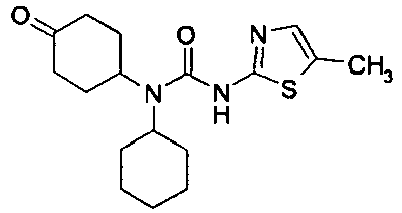
- Prepared as described in general procedures (A) and (B) using 5-methyl-2-aminothiazole and 4-cyclohexylamino-cyclohexanone.
HPLC-MS: m/z = 336 (M+1). -

- Prepared as described in general procedures (A) and (B) using 4-(4-methyl-cyclohexylamino)-cyclohexanone and ethyl-2-[5-aminothiazol-2-yl-thio]acetate
HPLC-MS: m/z = 440 (M+1). -

- Prepared from {2-[3-Cyclohexyl-3-(4-oxo-cyclohexyl)-ureido]-thiazol-5-ylsulfanyl}-acetic acid ethyl esterusing general procedure (F).
HPLC-MS: m/z = 412 (M+1). -

- Prepared as described in general procedures (A), (B) using (4-cyclohexylamino-cyclohexyl)-carbamic acid tert-butyl ester and 5-chloro-2-aminothiazole.
HPLC-MS: m/z = 357 (M+1). -

- Prepared as described in general procedures (A) and (B) using (4-cyclohexylamino-cyclohexyl)-carbamic acid tert-butyl ester and 2-amino-5-chlorothiazole.
HPLC-MS: m/z = 457 (M+1). -

- Prepared as described in general procedure (C) using cyclohexyl-(4-trifluoromethyl-cyclo hexyl)-amine and 5-bromo-2-thiazolyl amine.
1H NMR (CDCl3): δ 8.15 (br, 1H), 7.26 (1H, s), 3.70 (m, 1H), 3.32(m, 1H), 1.15-2.07 (m, 19H), 0.89-1.03 (dd, 3H) ppm; HPLC-MS: m/z 455 (M+1). -

- Prepared as described in general procedure (D) using 3-(5-bromo-thiazol-2-yl)-1-cyclohexyl-1-(4-trifluoromethyl-cyclohexyl)-urea (Example 10) and methyl thioglycolate.
1H NMR (CDCl3): δ7.62 (br, 1H), 7.34 (s, 1H), 3.66 (s, 3H), 3.37 (s, 2H), 3.28 (m, 2H), 1.05-2.26 (m, 19H) ppm; HPLC-MS: m/z 480 (M+1). -

- Prepared as described in general procedure (F) from {2-[3-cyclohexyl-3-(4-trifluoromethyl-cyclohexyl)-ureido]-thiazol-5-ylsulfanyl}-acetic acid methyl ester (Example 11).
1H NMR (DMSO-d6): δ 12.16 (br, 1H), 7.37 (s, 1H), 3.44 (s, 3H), 3.32 (m, 2H), 1.05-2.21 (m, 19H) ppm; HPLC-MS: m/z 466 (M+1). -

- Prepared as described in general procedure (D) using 3-(5-bromo-thiazol-2-yl)-1-cyclohexyl-1-(4-trifluoromethyl-cyclohexyl)-urea (Example 10) and 3-mercaptopropionic acid methyl ester.
HPLC-MS: m/z 494 (M+1). -

- Prepared as described in general procedure (E) from 3-(5-bromothiazol-2-yl)-1-cyclohexyl-1-(4-methylcyclohexyl)-urea and 2-mercapto-3-methyl-3H-imidazole-4-carboxylic acid ethyl ester.
1H NMR (4:1 CDCl3-CD3OD): δ7.69 (s, 1H), 7.57 (s, 1H), 4.31 (q, 2H), 4.0 (s, 3H), 3.38 (m, 2H), 1.15-1.90 (m, 19H), 1.35 (t, 3H), 0.90-1.10 (two d, 3H) ppm; HPLC-MS: m/z 506 (M+1). -

- Prepared as described in general procedure (E) using 3-(5-bromothiazol-2-yl)-1-cyclohexyl-1-(4-methylcyclohexyl)-urea and meythyl thioglycolate.
1H NMR (CDCl3): δ 7.43 (s, 1H), 7.48 (s, 1H), 3.77 (s, 3H), 3.79 (d, 1H), 3.50 (d, 1H), 3.46 (m, 2H), 1.15-1.90 (m, 19H) ppm; 0.90-1.05 (two d, 3H) ppm; HPLC-MS: m/z 426 (M+1). -

- Prepared in 88% yield as described in general procedure (F) from {2-[3-cyclohexyl-3-(4-methylcyclohexyl)ureideo]thiazol-5-ylsulfanyl}acetic acid methyl ester (Example 15).
1H NMR (4:1 CDCl3-CD3OD): 87.39 (s, 1H), 7.06 (s, 1H), 3.38 (obscured by MeOH peak), 1.15-1.90 (m, 19H), 0.95-1.05 (two d, 3H) ppm; HPLC-MS: m/z 412 (M+1). -

- Prepared in 80 % yield as described in general procedure (F) from 2-{-2-[3-cyclohexyl-3-(4-methyl-cyclohexyl)-ureido]-thiazol-5-ylsulfanyl}-3-methyl-3H-imidazole-4-carboxylic acid ethyl ester (Example 14).
1H NMR (4:1 CDCl3-CD3OD): δ7.80 (s, 1H), 7.56 (s, 1H), 4.00 (s, 3H), 3.36 (m, 2H), 1.15-1.90 (m, 19H), 0.95-1.05 (two d, 3H) ppm; HPLC-MS: m/z 478 (M+1) -

- Prepared from N-Boc-aminocyclohexanone, cyclohexylamine and 5-chloro-2-aminothiazole using general procedure (G).
HPLC-MS: m/z = 399 (M+1) -

- Prepared from N-Boc-aminocyclohexanone, cyclohexylamine and 5-chloro-2-aminothiazole using general procedure (G).
HPLC-MS: m/z =435 (M+1) -
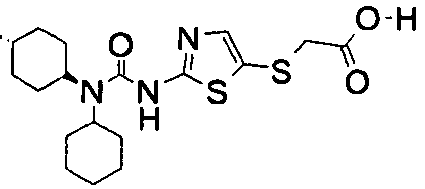
- {2-[3-Cyclohexyl-3-(trans-4-methyl-cyclohexyl)-ureido]-thiazol-5-ylsulfanyl}-acetic acid ethyl ester was prepared as described in general procedures (A) and (B) using cyclohexyl-(trans-4-methyl-cyclohexyl)-amine and 5-aminothiazol-2-mercaptoacetic acid ethyl ester. Hydrolysis using general procedure (F) gave the title compound.
HPLC-MS: m/z =412 (M+1). -

- Prepared as described in general procedures (A) and (B) and (F) using trans-4-propoxy-cyclohexyl]-cyclohexyl-amine and 5-aminothiazole-2-mercaptoacetic acid ethyl ester.
HPLC-MS: m/z 456 (M+1). -

- Prepared as described in general procedures (A) and (B) and (F) using trans-4-propoxy-cyclohexyl]-cyclohexyl-amine and 5-aminothiazole-2-mercaptopropionic acid ethyl ester.
HPLC-MS: m/z 470 (M+1). -

- Prepared in 80% (383 mg) yield as described in the general procedure F from 3-{2-[3-cyclohexyl-3-(4-trifluoromethyl-cyclohexyl)-ureido]-thiazol-5-ylsulfanyl}-propionic acid methyl ester (494 mg, 1.0 mmol).
1H NMR (Acetone-d6): δ 7.39 (br 1H), 7.31 (s, 1H), 3.62 (m, 1H), 3.51 (m, 1H), 2.93 (t, 2H), 2.63 (t, 2H), 2.1 (m, 1H), 1.06-2.01 (m, 18 H) ppm; HPLC-MS: m/z 480 (M+1). -

- Prepared in 60% (240 mg) yield as described in general procedure C using trans-4-methylcyclohexyl-cyclohexylamine (195 mg, 1.0 mmol) and 2-amino-5-bromothiazole (179 mg, 1.0 mmol).
1H NMR (CDCl3): δ 8.4 (br, 1H), 7.25 (s, 1H), 3.48 (m, 2H), 1.12-1.99 (m, 19H), 0.90 (d, 3H) ppm; HPLC-MS: m/z 401 (M+1). -

- To a solution of 1-cyclohexyl-3-(5-formyl-thiazol-2-yl)-1-(trans-4-methyl-cyclohexyl)-urea (175 mg, 0.5 mmol) in MeOH (5 mL) was added sodium borohydride (38 mg, 1 mmol). The mixture was stirred at rt for 10 min and the solution was poured into water (25 mL). The aqueous layer was extracted with ethyl acetate (2 x 20 mL). The organic layer was washed with water (2 x 20 mL), brine (1 x 20 mL), dried (anhydrous Na2SO4) and concentrated to get trans-1-cyclohexyl-3-(5-hydroxymethyl-thiazol-2-yl)-l-(4-methyl-cyclohexyl)-urea in (90%, 158 mg) yield.
1H NMR (CDCl3): δ 9.20 (m, 1H), 7.22 (s, 1H), 4.74 (s, 2H), 3.63 (br, 1H), 3.43 (m, 2H), 1.04-1.85 (m, 19H), 0.89 (d, 3H) ppm; HPLC-MS: m/z 352 (M+1). -

- Prepared in 60% (333 mg) yield as described in general procedure (D) using trans-3-(5-bromo-thiazol-2-yl)-1-cyclohexyl-1-(4-methyl-cyclohexyl)-urea (400 mg, 1.0 mmol) and N-(tert-butoxycarbonyl)-L-cysteine methyl ester (470 mg, 2.0 mmol).
1H NMR (CDCl3):δ7.39 (br, 1H), 7.32 (s, 1H), 6.84 (d, 1H), 3.66 (s, 3H), 3.40 (m, 3H), 3.16 (m, 2H), 1.64-1.82 (m, 16H), 1.44 (s, 9H), 1.1-1.43 (m, 3H), 0.90 (d, 3H) ppm; HPLC-MS: m/z 555 (M+1). -

- Prepared in 70% (95 mg) yield as described in general procedure (F) from (S)-2-tert-butoxycarbonylamino-3-{2-[trans-3-cyclohexyl-3-(4-methyl-cyclohexyl)-ureido]-thiazol-5-ylsulfanyl}-propionic acid methyl ester (139 mg, 0.25 mmol).
HPLC-MS: m/z 541 (M+1). -

- Prepared in 75% (86 mg) yield as described in general procedure (M) from (S)-2-tert-butoxycarbonylamino-3-{2-[(3-cyclohexyl-3-(trans-4-methyl-cyclohexyl)-ureido]-thiazol-5-ylsulfanyl}-propionic acid methyl ester (139 mg, 0.25 mmol).
HPLC-MS: m/z 456 (M+1). -

- Prepared in 70% (77 mg) yield as described in general procedure (M) from (S)-2-tert-butoxycarbonylamino-3-{2-[(trans)-3-cyclohexyl-3-(4-methyl-cyclohexyl)-ureido]-thiazol-5-ylsulfanyl}-propionic acid (135 mg, 0.25 mmol).
HPLC-MS: m/z 442 (M+1). -

- Prepared in 60% (307 mg) yield as described in general procedure (B) from trans-1-cyclohexyl-3-(5-formyl-thiazol-2-yl)-1-(4-methyl-cyclohexyl)-urea (349 mg, 1.0 mmol) and 1-ethanesulfonyl-piperazine hydrochloride (215 mg, 1.0 mmol).
1H NMR (CDCl3): δ 7.60 (br, 1H), 7.12 (s, 1H), 3.66 (s, 2H), 3.42 (m, 2H), 3.29 (m, 4H), 2.93 (q, 2H), 2.56 (m, 4H), 1.60-1.99 (m, 16H), 1.36 (t, 3H), 0.95-1.35 (m, 3H), 0.88 (d, 3H) ppm; HPLC-MS: m/z 512 (M+1). -

- Prepared in 62% (326 mg) yield as described in general procedure (B) from trans-1-cyclohexyl-3-(5-formyl-thiazol-2-yl)-1-(4-methyl-cyclohexyl)-urea (349 mg, 1.0 mmol) and piperazine-1-sulfonic acid dimethylamide hydrochloride (230 mg, 1 mmol).
1H NMR (CDCl3): δ 7.58 (br, 1H), 7.11 (s, 1H), 3.65 (s, 2H), 3.46 (m, 2H), 3.25 (m, 4H), 2.82 (s, 6H), 2.52 (m, 4H), 1.01-1.99 (m, 19H), 0.89 (d, 3H) ppm; HPLC-MS: m/z 527 (M+1). -

- Prepared in 60% (342 mg) yield as described in general procedure (B) from trans-1-cyclohexyl-3-(5-formyl-thiazol-2-yl)-1-(4-methyl-cyclohexyl)-urea (349 mg, 1.0 mmol) and 4-(2-methoxycarbonyl-ethanesulfonyl)-piperazin-1-ium; chloride (273 mg, 1.0 mmol).
1H NMR (CDCl3): δ 7.22 (br, 1H), 7.10 (s, 1H), 3.73 (s, 3H), 3.65 (s, 2H), 3.41 (m, 2H), 3.28 (br, 4H), 3.23 (t, 2H), 2.83 (t, 2H), 2.54 (br, 4H), 1.02-1.94 (m, 19H), 0.88 (d, 3H) ppm; HPLC-MS: m/z 570 (M+1). -

- Prepared in 80% (223 mg) yield as described in general procedure (F) from trans-3-(4-{2-[3-cyclohexyl-3-(4-methyl-cyclohexyl)-ureido]-thiazol-5-ylmethyl}-piperazine-1-sulfonyl)-propionic acid methyl ester (285 mg, 0.5 mmol).
1H NMR (DMSO-d6): δ 7.08 (s, 1H), 6.78 (br, 1H), 3.55 (s, 2H), 3.31 (m, 2H), 3.21 (t, 2H), 3.14 (br, 4H), 2.46 (t, 2H), 2.40 (br, 4H), 1.11-1.87 (m, 19H), 0.84 (d, 3H) ppm; HPLC-MS: m/z 556 (M+1). -

- Prepared in 50% (232 mg) yield as described in general procedure (C) from cyclohexyl-(4-phenyl-cyclohexyl)-amine (257 mg, 1.0 mmol) and 5-bromo-thiazol-2-ylamine (179 mg, 1.0 mmol).
1H NMR (CDCl3): δ 8.20 (br, 1H), 7.06-7.25 (m, 6H), 3.68 (m, 1H), 3.42 (m, 1H), 1.56-2.51 (m, 17H), 1.14-1.35 (m, 2H) ppm; HPLC-MS: m/z 463 (M+1). -

- A solution of cyclohexyl-(trans-4-methylcylcohexyl)-3-(5-formyl-thiazol-2-yl)-urea (350 mg, 1.00 mmol) and (carbethoxymethylene)triphenylphosphorane (420 mg, 1.20 mmol) in THF (5 mL) was stirred at 50 °C for 12h. The reaction mixture was concentrated and the residue was purified by flash chromatography (silica, CH2Cl2-EtOAc, 4:1) to obtain 3-{2-[3-cyclohexyl-3-(4-trans-methylcyclohexyl)-ureido]-thiazol-5-yl}-acrylic acid ethyl ester (300 mg) in 73 % yield.
1H NMR (CDCl3): δ8.20 (s, 1H), 7.70 (d, 1H), 7.47 (s, 1H), 6.06 (d, 1H), 4.23 (q, 2H), 3.40 (m, 2H), 1.50-2.00 (m, 12H), 1.40-1.50 (m, 2H), 1.30 (t, 3H), 1.0-1.20 (M, 5H), 0.91 (d, 3H) ppm; HPLC-MS: m/z 420 (M+1). -
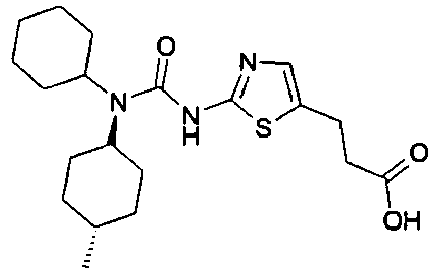
- 3-{2-[3-Cyclohexyl-3-(4-trans-methylcyclohexyl)-ureido]-thiazol-5-yl}-acrylic acid ethyl ester (200 mg, 0.48 mmol) was reduced with hydrogen (60 psi, pressure reaction vessel) over Pd/C (300 mg) to give 3-{2-[3-cyclohexyl-3-(4-trans-methylcyclohexyl)-ureido]-thiazol-5-yl}-propionic acid ethyl ester (110 mg) after purification (silical gel, 20% ethyl acetate in hexanes).
- 3-{2-[3-Cyclohexyl-3-(4-trans-methylcyclohexylrureido]-thiazol-5-yl}-propionic acid ethyl ester (100 mg) was hydrolysed according to general procedure F using NaOH to give 85 mg (91 % yield) of 3-{2-[3-cyclohexyl-3-(4-trans-methylcyclohexyl)-ureido]-thiazol-5-yl}-propionic acid.
1H NMR (d6-DMSO): δ6.94 (s, 1H), 4.4 (t, 2H), 3.6 (m, 2H), 2.80 (t, 2H), 1.10-1.90 (m, 19H), 0.85 (d, 3H) ppm; HPLC-MS: m/z 394 (M+1). -

- Prepared in 69 % yield (8.3 g) as described in general procedure (C) from cyclohexyl-(4-methylcyclohexyl)-amine (6.2g, 32 mmol) and methyl-2-aminothiazole-5-carboxylate (5.0 g, 31.6 mmol).
1H NMR (CDCl3): δ8.00 (s, 1H), 3.82 (s, 3H), 3.36 (m, 2H), 1.15-2.00 (m, 19H), 1.02 (d, 3H) ppm; HPLC-MS: m/z 380 (M+1). -

- Prepared in 60 % (292 mg) yield as described in general procedure (D) from 3-(5-bromothiazol-2-yl)-1-cyclohexyl-1-(4-phenyl-cyclohexyl)-urea (463 mg, 1.0 mmol) and methylthioglycolate (212 mg, 2.0 mmol).
1H NMR (CDCl3): δ 8.16 (br, 1H), 7.42 (s, 1H), 7.18-7.38 (m, 5H), 3.71 (s, 3H), 3.56 (br, 1H), 3.44 (br, 1H), 3.43 (s, 2H), 2.58 (m, 1H), 1.17-2.02 (m, 18H) ppm; HPLC-MS: m/z 488 (M+1). -

- Prepared in 80 % (190 mg) yield as described in general procedure (F) from {2-[3-cyclohexyl-3-(4-phenyl-cyclohexyl)-ureido]-thiazol-5-ylsulfanyl}-acetic acid methyl ester (244 mg, 0.5 mmol).
1H NMR (CDCl3): δ 12.02 (br, 1H), (8.32 (br, 1H), 7.14-7.39 (m, 6H), 3.45 (m, 4H), 2.19 (m, 1H), 1.07-1.96 (m, 18H) ppm; HPLC-MS: m/z 474 (M+1). -

- Prepared as described in general procedure (H) using 1-cyclohexyl-1-(trans-4-methylcyclohexyl)-3-(5-thiocyanato-thiazol-2-yl)-urea, dithioerythritol and N-(2-chloroethyl)morpholine.
HPLC-MS: m/z 468 (M+1). -

- Prepared as described in general procedure (H) using 1-cyclohexyl-1-(trans-4-methylcyclohexyl)-3-(5-thiocyanato-thiazol-2-yl)-urea, dithioerythritol and N-(2-chloroethyl)piperidine
HPLC-MS: m/z 466 (M+1). -

- Prepared as described in general procedure (H) using 1-cyclohexyl-1-(trans-4-methylcyclohexyl)-3-(5-thiocyanato-thiazol-2-yl)-urea, dithioerythritol and 2-(hexamethyleneimino)ethyl chloride.
HPLC-MS: m/z 480 (M+1). -

- {2-[3-Cyclohexyl-3-(trans-4-methyl-cyclohexyl)-ureido]-thiazol-5-ylsulfanyl}-propionic acid ethyl ester prepared as described in general procedure (A) using cyclohexyl-(trans-4-methylcyclohexyl)-amine and 5-aminothiazole-2-mercaptopropionic acid ethyl ester. Hydrolysis using general procedure (F) gave the title compound.
HPLC-MS: m/z 426 (M+1). -

- Prepared as described in general procedure (H) using 1-cyclohexyl-1-(trans-4-methylcyclohexyl)-3-(5-thiocyanato-thiazol-2-yl)-urea, dithioerythritol and 2-chlorotriethylamine.
HPLC-MS: m/z 454 (M+1). -

- Prepared as described in general procedure (H) using 1-cyclohexyl-1-(trans-4-methylcyclohexyl)-3-(5-thiocyanato-thiazol-2-yl)-urea, dithioerythritol and 4-(3-chloropropyl)morpholine.
HPLC-MS: m/z 482 (M+1). -

- Prepared as described in general procedure (N) using [trans-4-(tert-butyl-dimethylsilanyloxy)-cyclohexyl]-cyclohexyl-amine and 5-aminothiazole-2-mercaptoacetic acid ethyl ester.
HPLC-MS: m/z 414 (M+1). -

- Prepared as described in general procedure (N) using [trans-4-(tert-butyl-dimethylsilanyloxy)-cyclohexyl]-cyclohexyl-amine and 5-chloro 2-aminothiazole.
HPLC-MS: m/z 358 (M+1). -

- Prepared as described in general procedures (A) and (B)and (F) using trans-4-methoxycyclohexyl]-cyclohexyl-amine and 5-aminothiazole-2-mercaptoacetic acid ethyl ester.
HPLC-MS: m/z 428 (M+1). -

- Prepared as described in general procedure (H) using 1-cyclohexyl-1-(trans-4-methylcyclohexyl)-3-(5-thiocyanato-thiazol-2-yl)-urea, dithioerythritol and N-(2-chloroethyl)pyrrolidine.
HPLC-MS: m/z 452 (M+1). -

- Prepared as described in general procedures (A) and (B) using cyclohexyl-(trans-4-methylcyclohexyl)-amine and5-fluoro-2-aminothiazole.
HPLC-MS: m/z 340 (M+1). -

- Prepared as described in general procedure (H) using 1-cyclohexyl-1-(trans-4-methylcyclohexyl)-3-(5-thiocyanato-thiazol-2-yl)-urea, dithioerythritol and ethyl-2-bromopropionate.
HPLC-MS: m/z 428 (M+1). -

- Prepared as described in general procedure (H) using 1-cyclohexyl-1-(trans-4-methylcyclohexyl)-3-(5-thiocyanato-thiazol-2-yl)-urea, dithioerythritol and ethyl-2-bromo-2-methyl propionate.
HPLC-MS: m/z 441 (M+1). -

- Prepared as described in general procedure (H) using 1-cyclohexyl-1-(trans-4-methylcyclohexyl)-3-(5-thiocyanato-thiazol-2-yl)-urea, dithioerythritol and ethyl-1-bromocyclobutane carboxylate.
HPLC-MS: m/z 453 (M+1). -

- Prepared as described in general procedure (H) using 1-cyclohexyl-1-(trans-4-methylcyclohexyl)-3-(5-thiocyanato-thiazol-2-yl)-urea, dithioerythritol and ethyl-2-bromoisovalerate.
HPLC-MS: m/z 455 (M+1). - Glucokinase activity is assayed spectrometrically coupled to glucose 6-phosphate dehydrogenase to determine compound activation of glucokinase. The final assay contains 50 mM Hepes, pH 7.1, 50 mM KCl, 5 mM MgCl2, 2 mM dithiothreitol, 0.6 mM NADP, 1 mM ATP, 0.195 µM G-6-P dehydrogenase (from Roche, 127 671), 15 nM recombinant human glucokinase. The glucokinase is human liver glucokinase N-terminally truncated with an N-terminal His-tag ((His)8-VEQILA......Q466) and is expressed in E.coli as a soluble protein with enzymatic activity comparable to liver extracted GK.
- The purification of His-tagged human glucokinase (hGK) was performed as follows: The cell pellet from 50 ml E. coli culture was resuspended in 5 ml extraction buffer A (25 mM HEPES, pH 8.0, 1 mM MgCl2, 150 mM NaCl, 2 mM mercaptoethanol) with addition of 0.25 mg/ml lysozyme and 50 µg/ml sodium azide. After 5 minutes at room temperature 5 ml of extraction buffer B (1.5 M NaCl, 100 mM CaCl2, 100 mM MgCl2, 0.02 mg/ml DNase 1, protease inhibitor tablet (complete® 1697498): 1 tablet pr. 20 ml buffer) was added. The extract was then centrifugated at 15.000 g for 30 minutes. The resulting supernatant was loaded on a 1 ml Metal Chelate Affinity Chromatography (MCAC) Column charged with Ni2+. The column is washed with 2 volumes buffer A containing 20 mM imidazole and the bound his-tagged hGK is subsequently eluted using a 20 minute gradient of 20 to 500 mM imididazol in buffer A. Fractions are examined using SDS-gel-electrophoresis, and fractions containing hGK (MW: 52 KDa) are pooled. Finally a gelfiltration step is used for final polishing and buffer exhange. hGK containing fractions are loaded onto a Superdex 75 (16/60) gelfiltration column and eluted with Buffer B (25 mM HEPES, pH 8.0, 1 mM MgCl2, 150 mM NaCl, 1 mM Dithiothreitol). The purified hGK is examined by SDS-gel electrophoresis and MALDI mass spectrometry and finally 20% glycerol is added before freezing. The yield from 50 ml E. coli culture is generally approximately 2-3 mg hGK with a purity >90%.
- The compound to be tested is added into the well in final 2.5% DMSO concentration in an amount sufficient to give a desired concentration of compound, for instance 1, 5, 10, 25 or 50 µM. The reaction starts after glucose is added to a final concentration of 2, 5, 10 or 15 mM. The assay uses a 96-well UV plate and the final assay volume used is 200 µl/well. The plate is incubated at 25°C for 5 min and kinetics is measured at 340 nm in SpectraMax every 30 seconds for 5 minutes. Results for each compound are expressed as the fold activation of the glucokinase activity compared to the activation of the glucokinase enzyme in an assay without compound after having been subtracted from a "blank", which is without glucokinase enzyme and without compound. The compounds in each of the Examples exhibits activation of glucokinase in this assay. A compound, which at a concentration of at or below 30 µM gives 1.5 - fold higher glucokinase activity than the result from the assay without compound, is deemed to be an activator of glucokinase.
- The glucose sensitivity of the compounds are measured at a compound concentration of 10 µM and at glucose concentrations of 5 and 15 mM.
- Hepatocytes are isolated from rats fed ad libitum by a two-step perfusion technique. Cell viability, assessed by trypan blue exclusion, is consistently greater than 80%. Cells are plated onto collagen-coated 96-well plates in basal medium (Medium 199 (5.5 mM glucose) supplemented with 0.1 µM dexamethasone, 100 units/ml penicillin, 100 mg/ml streptomycin, 2 mM L-glutamine and 1 nM insulin) with 4 % FCS at a cell density of 30,000 cells/well. The medium is replaced with basal medium 1 hour after initial plating in order to remove dead cells. Medium is changed after 24 hours to basal medium supplemented with 9.5 mM glucose and 10 nM insulin to induce glycogen synthesis, and experiments are performed the next day. The hepatocytes are washed twice with prewarmed (37°C) buffer A (117.6 mM NaCl, 5.4 mM KCI, 0.82 mM Mg2SO4, 1.5 mM KH2PO4, 20 mM HEPES, 9 mM NaHCO3, 0.1% w/v HSA, and 2.25 mM CaCl2, pH 7.4 at 37°C) and incubated in 100 µl buffer A containing 15 mM glucose and increasing concentrations of the test compound, such as for instance 1, 5, 10, 25, 50 or 100 µM, for 180 minutes. Glycogen content is measured using standard procedures(Agius, L.et al, Biochem J. 266, 91-102 (1990). A compound, which when used in this assay gives an significant increase in glycogen content compared to the result from the assay without compound, is deemed to have activity in this assay.
- The glucose responsive β-cell line INS-1E is cultivated as described by Asfari M et al., Endocrinology, 130, 167-178 (1992). The cells are then seeded into 96 well cell culture plates and grown to a density of approximately 5 x 10⁴ per well. Stimulation of glucose dependent insulin secretion is tested by incubation for 2 hours in Krebs Ringer Hepes buffer at glucose concentrations from 2.5 to 15 mM with or without addition of glucokinase activating compounds in concentrations of for instance 1, 5, 10, 25, 50 or 100 µM, and the supernatants collected for measurements of insulin concentrations by ELISA (n= 4). A compound, which when used in this assay gives an significant increase in insulin secretion in response to glucose compared to the result from the assay without compound, is deemed to have activity in this assay.
- While the invention has been described and illustrated with reference to certain preferred embodiments thereof, those skilled in the art will appreciate that various changes, modifications and substitutions can be made therein in the present invention. For example, effective dosages other than the preferred dosages as set forth herein may be applicable as a consequence of variations in the responsiveness of the mammal being treated for glucokinase-deficiency mediated disease(s). Likewise, the specific pharmacological responses observed may vary according to and depending on the particular active compound selected or whether there are present pharmaceutical carriers, as well as the type of formulation and mode of administration employed, and such expected variations or differences in the results are contemplated in accordance with the objects and practices of the present invention.
R27 is C1-6-alkyl, C1-6-alkoxy, C2-6-alkenyl, C2-6-alkynyl, C3-8-cycloalkyl, C3-8-cycloalkyl-C1-6-alkyl, C3-8-cycloalkyl-C2-6-alkenyl, aryl, aryl-C1-6-alkyl, aryloxy-C1-6-alkyl, aryl-C2-6-alkenyl, heteroaryl, C3-8-heterocyclyl, heteroaryl-C1-6-alkyl, C3-8-heterocyclyl-C1-6-alkyl, heteroaryloxy-C1-6-alkyl, carboxy-C1-6-alkyl, carboxy-C2-6-alkenyl, C1-6-alkoxy-C1-6-alkyl, C1-6-alkoxy-C2-6-alkenyl, C1-6-alkylthio-C1-6-alkyl, R10HN-C1-6-alkyl, R10R11-N-C1-6-alkyl, R10R11-N-C2-6-alkenyl, R10R11-N-S(O)2-C1-6-alkyl, R10R11-N-C(O)-C1-6-alkyl, C1-6-alkyl-C(O)-NH-C1-6-alkyl, aryl-C(O)-NH-C1-6-alkyl, heteroaryl-C(O)-NH-C1-6-alkyl, C3-8-cydoalkyl-C(O)-NH-C1-6-alkyl, C1-6-alkylS(O)2-NH-C1-6-alkyl, aryl-S(O)2-NH-C1-6-alkyl, heteroaryl-S(O)2-NH-C1-6-alkyl, or C3-8-cycloalkyl-S(O)2-NH-C1-6-alkyl, each of which is optionally substituted with one or more substituents independently selected from R12;
R12 is halogen, cyano, hydroxy, -C(O)-O-C1-6-alkyl, carboxy, -CF3, C1-6-alkyl, C1-6-alkoxy, - NR10R11, -S(O)2CH3, or -S(O)2NH2;
R13 and R14 are independently selected from the group consisting of hydrogen, C1-6-alkyl, hydroxy-C1-6-alkyl, carboxy-C1-6-alkyl, aryl, and heteroaryl, each of which is optionally substituted with one or more substituents independently selected from R15; or R13 and R14 together with the nitrogen to which they are attached form a 3 to 8 membered heterocyclic ring with the said nitrogen atom, the heterocyclic ring optionally containing one or two further heteroatoms selected from the group consisting of nitrogen, oxygen and sulphur;
R15 is halogen, cyano, hydroxy, carboxy, -CF3, C1-6-alkyl, -S(O)2CH3, or -S(O)2NH2;
A is

R19 and R20 are independently hydrogen, C1-6-alkyl, hydroxy-C1-6-alkyl, carboxy-C1-6-alkyl, aryl, heteroaryl, C3-8-heterocyclyl,aryl-C1-6-alkyl, C3-8-heterocyclyl-C1-6-alkyl, -C(O)-O-C1-6-alkyl, -C1-6-alkyl-C(O)-O-C1-6-alkyl, -C1-6-alkyl-NR22R23, or -S(O)2-C1-6-alkyl, each of which is optionally substituted with one or more substituents independently selected from R24, or R19 and R20 together with the nitrogen to which they are attached form a 3 to 8 membered heterocyclic ring with the said nitrogen atom, the heterocyclic ring optionally containing one or two further heteroatoms selected from the group consisting of nitrogen, oxygen and sulphur, the heterocyclic ring is optionally substituted with one or more substituents independently selected from R24;
R21 is
R24 is halogen, nitro, cyano, hydroxy, carboxy, oxo, -CF3, C1-6-alkyl, hydroxy-C1-6-alkyl, carboxy-C1-6-alkyl, -C(O)-C1-6-alkyl,-C(O)-C3-8-cycloalkyl,-C(O)-aryl, -C(O)-heteroaryl, -C(O)-C3-8-heterocyclyl -C(O)-O-C1-6-alkyl,-C1-6-alkyl-C(O)-O-C1-6-alkyl, aryl, heteroaryl, aryl-C1-6-alkyl, heteroaryl-C1-6-alkyl, C3-8-cycloalkyl,C3-8-heterocyclyl,C3-8-cycloalkyl-C1-6-alkyl,C3-8-heterocyclyl-C1-6-alkyl,-C1-6-alkyl-C(O)-C3-8-heterocydyl, -C(O)-O-C1-6-alkyl-aryl, -NH-S(O)2R28, or -S(O)2R28, wherein each cyclic moiety is optionally substituted with one or more substituents independently selected from R29;
R25 and R26 are independently C1-6-alkyl, halogen, nitro, cyano, hydroxy, -C(O)-O-C1-6-alkyl, carboxy, -C1-6-alkyl-C(O)-O-C1-6-alkyl, carboxy-C1-6-alkyl, -CF3, -S(O)2CH3, or -S(O)2NH2;
R28 is C1-6-alkyl, carboxy-C1-6-alkyl, -C1-6-alkyl-C(O)-O-C1-6-alkyl, C3-8-cycloalkyl, aryl, aryl-C1-6-alkyl, heteroaryl optionally substituted with C1-6-alkyl, -NH2, or -N(CH3)2;
R29 is halogen, nitro, cyano, hydroxy, carboxy, oxo, -CF3,C1-6-alkyl, or C1-6-alkoxy;
or a pharmaceutically acceptable salt thereof.
Claims (75)
- A compound of formula (I)


Rs is selected from the group consisting of• halogen, nitro, cyano, hydroxy, oxo, carboxy, and -CF3; or• -NR10R11; or• C1-6-alkyl, C2-6-alkenyl, C2-6-alkynyl, C3-8-cycloalkyl, C3-8-cycloalkyl-C1-6-alkyl, aryl, aryl-C1-6-alkyl, heteroaryl-C1-6-alkyl, C1-6-alkoxy, C3-6-cycloalkyl-C1-6-alkoxy, aryl-C1-6-alkoxy, heteroaryl, heteroaryl-C1-6-alkoxy, aryloxy, heteroaryloxy, C1-6-alkylthio, arylthio, heteroarylthio, C3-8-cycloalkylthio, aryl-C1-6-alkylthio, heteroaryl-C1-6-alkylthio, C1-6-alkylsulfenyl, C3-6-cycloalkyl-C1-6-alkylthio, C1-6-alkyl-C(O)-O-C1-6-alkyl, C1-6-alkoxy-C1-6-alkyl, C1-6-alkylthio-C1-6-alkyl, carboxy-C1-6-alkyloxy, amino-C1-6-alkyl, C1-6-alkylamino-C1-6-alkyl, di-(C1-6-alkyl)aminO-C1-6-alkyl, C1-6-alkylsulfamoyl, di(C1-6-alkyl)sulfamoyl, C1-6-alkylsulfinamoyl and di(C1-6-alkyl)sulfinamoyl each of which is optionally substituted with one or more substituents independently selected from R12; or• -C(O)-R27, -S(O)2-R27, -C(O)-NR13R14, -S(O)2-NR13R14, and -C1-6-alkyl-C(O)-NR13R14;R10 and R11 are independently hydrogen, C1-6-alkyl, -C(O)-C1-6-alkyl, -C(O)-O-C1-6-alkyl, carboxy-C1-6-alkyl, -C(O)-C1-6-alkyl-C(O)OH, -S(O)2-C1-6-alkyl, or aryl;
R27 is C1-6-alkyl, C1-6-alkoxy, C2-6-alkenyl, C2-6-alkynyl, C3-8-cycloalkyl, C3-8-cycloalkyl-C1-6-alkyl, C3-8-cycloalkyl-C2-6-alkenyl, aryl, aryl-C1-6-alkyl, aryloxy-C1-6-alkyl, aryl-C2-6-alkenyl, heteroaryl, C3-8-heterocyclyl, heteroaryl-C1-6-alkyl, C3-8-heterocyclyl-C1-6-alkyl, heteroaryloxy-C1-6-alkyl, carboxy-C1-6-alkyl, carboxy-C2-6-alkenyl, C1-6-alkoxy-C1-6-alkyl, C1-6-alkoxy-C2-6-alkenyl, C1-6-alkylthio-C1-6-alkyl, R10HN-C1-6-alkyl, R10R11-N-C1-6-alkyl, R10R11-N-C2-6-alkenyl, R10R11-N-S(O)2-C1-6-alkyl, R10R11-N-C(O)-C1-6-alkyl, C1-6-alkyl-C(O)-NH-C1-6-alkyl, aryl-C(O)-NH-C1-6-alkyl, heteroaryl-C(O)-NH-C1-6-alkyl, C3-8-cycloalkyl-C(O)-NH-C1-6-alkyl, C1-6-alkylS(O)2-NH-C1-6-alkyl, aryl-S(O)2-NH-C1-6-alkyl, heteroaryl-S(O)2-NH-C1-6-alkyl, or C3-8-cycloalkyl-S(O)2-NH-C1-6-alkyl, each of which is optionally substituted with one or more substituents independently selected from R12;
R12 is halogen, cyano, hydroxy, -C(O)-O-C1-6-alkyl, carboxy, -CF3, C1-6-alkyl, C1-6-alkoxy, - NR10R11, -S(O)2CH3, or -S(O)2NH2;
R13 and R14 are independently selected from the group consisting of hydrogen, C1-6-alkyl, hydroxy-C1-6-alkyl, carboxy-C1-6-alkyl, aryl, and heteroaryl, each of which is optionally substituted with one or more substituents independently selected from R15; or R13 and R14 together with the nitrogen to which they are attached form a 3 to 8 membered heterocyclic ring with the said nitrogen atom, the heterocyclic ring optionally containing one or two further heteroatoms selected from the group consisting of nitrogen, oxygen and sulphur;
R15 is halogen, cyano, hydroxy, carboxy, -CF3, C1-6-alkyl, -S(O)2CH3, or -S(O)2NH2;
A is • halogen, carboxy, cyano, nitro, hydroxy, -CF3, and -SCN; or• C1-6-alkyl, C2-6-alkenyl, C2-6-alkynyl, C1-6-alkoxy, C1-6-alkylthio, C2-6-alkenylthio, C1-6-alkylamino, C1-6-alkylsulfenyl, -C(O)-O-C1-6-alkyl, formyl, -C(O)-C1-6-alkyl, -C1-6-alkyl-C(O)-O-C1-6-alkyl, -C1-6-alkyl-O-C(O)-C1-6-alkyl, -NH-C(O)-C1-6-alkyl, -C1-6-alkoxy-C1-6-alkyl, -C1-6-alkyl-S-C1-6-alkyl, carboxy-C1-6-alkyl, and hydroxy-C1-6-alkyl, each of which is optionally substituted with one or more substituents independently selected from R16; or• aryl, heteroaryl, aryl-C1-6-alkyl, heteroaryl-C1-6-alkyl, aryl-C1-6-alkoxy, heteroaryl-C1-6-alkoxy, aryl-C1-6-alkylthio, heteroaryl-C1-6-alkylthio, heteroaryl-thio-C1-6-alkyl,heteroaryl-oxy-C1-6-alkyl, aryloxy, heteroaryloxy, arylthio, heteroarylthio, aryl-C1-6-alkylamino, -C(O)-aryl, and -C(O)-heteroraryl, each of which is optionally substituted on the aryl or heteroaryl part with one or more substituents independently selected from R17 ; or• C3-8-cycloalkyl, C3-8-cycloalkenyl, C3-8-cycloalkylthio, C3-8-cycloalkyl-C1-6-alkyl, C3-8-cycloalkenyl-C1-6-alkyl, C3-6-cycloalkyl-C1-6-alkoxy, and C3-6-cycloalkyl-C1-6-alkylthio, each of which is optionally substituted on the cycloalkyl part with one or more substituents independently selected from R18; or• C3-8-heterocyclyl,C3-8-heterocyclyl-C1-6-alkyl,C3-8-heterocyclyl-C1-6-alkylthio,C3-8-heterocyclylthio,C3-8-heterocyclyl-amino-C1-6-alkyl, and -C(O)-C3-8-heterocyclyl,each of which is optionally substituted with one or more substituents independently selected from R16 ; or• -NR19R20, -C1-6-alkyl-NR19R20,-C2-6-alkenyl-NR19R20, -C1-6-alkyl-S-R21, -C1-6-alkyl-S(O)-R21, -C1-6-alkyl-S(O)2-R21, -S(O)2-R21and-S(O)2-NR19R20, wherein each alkyl part may be substituted with one or more substituents independently selected from R25; or• -C(O)NR22R23, -C1-6-alkyl-C(O)NR22R23 -C1-6-alkyl-NH-NR22R23 and -C1-6-alkyl-NH-C(O)-C1-6-alkyl-NR22R23, each optionally substituted with one or more substituents independently selected from R26;R16, R17, and R18 are independently C1-6-alkyl, halogen, nitro, cyano, hydroxy, carboxy, oxo, -CF3, carboxy-C1-6-alkyl, hydroxy-C1-6-alkyl, -C1-6-alkyl-C(O)-O-C1-6-alkyl, -C1-6-alkyl-C(O)-NR19R20, -C(O)-O-C1-6-alkyl,-C(O)-C1-6-alkyl-C(O)-C1-6-alkyl, -NR19R20, -NHS(O)2C1-6-alkyl, -C(O)NR19R20, -S(O)2C1-6-alkyl, or -S(O)2NR19R 20;
R19 and R20 are independently hydrogen, C1-6-alkyl, hydroxy-C1-6-alkyl, carboxy-C1-6-alkyl, aryl, heteroaryl, C3-8-heterocycyl,aryl-C1-6-alkyl, C3-8-heterocyclyl-C1-6-alkyl, -C(O)-O-C1-6-alkyl, -C1-6-alkyl-C(O)-O-C1-6-alkyl, -C1-6-alkyl-NR22R23, or -S(O)2-C1-6-alkyl, each of which is optionally substituted with one or more substituents independently selected from R24, or R19 and R20 together with the nitrogen to which they are attached form a 3 to 8 membered heterocyclic ring with the said nitrogen atom, the heterocyclic ring optionally containing one or two further heteroatoms selected from the group consisting of nitrogen, oxygen and sulphur, the heterocyclic ring is optionally substituted with one or more substituents independently selected from R24;
R21 is• C1-6-alkyl, C2-6-alkenyl, carboxy-C1-6-alkyl, C1-6-alkylamino-C1-6-alkyl, hydroxy-C1-6-alkyl, or -C1-6-alkyl-NR22R23; or• aryl, heteroaryl, aryl-C1-6-alkyl, or heteroaryl-C1-6-alkyl, wherein the aryl or heteroaryl part is optionally substituted with one or more substituents independently selected from R24; or• C3-8-cycloalkyl, C3-8-cycloalkenyl, C3-8-cycloalkyl-C1-6-alkyl, or C3-8-cycloalkenyl-C1-6-alkyl;R22 and R23 are independently selected from the,group consisting of hydrogen, C1-6-alkyl, carboxy-C1-6-alkyl,-C1-6-alkyl-C(O)-O-C1-6-alkyl,-C(O)-O-C1-6-alkyl,-C1-6-alkyl-S(O)2-C1-6-alkyl,C3-8-cycloalkyl, aryl, and heteroaryl; or R22 and R23 together with the nitrogen to which they are attached form a 3 to 8 membered heterocyclic ring with the said nitrogen atom, the heterocyclic ring optionally containing one or two further heteroatoms selected from the group consisting of nitrogen, oxygen and sulphur, the heterocyclic ring is optionally substituted with one or more substituents independently selected from R24;
R24 is halogen, nitro, cyano, hydroxy, carboxy, oxo, -CF3, C1-6-alkyl, hydroxy-C1-6-alkyl, carboxy-C1-6-alkyl, -C(O)-C1-6-alkyl,-C(O)-C3-8-cycloalkyl,-C(O)-aryl, -C(O)-heteroaryl, -C(O)-C3-8-heterocyclyl -C(O)-O-C1-6-alkyl,-C1-6-alkyl-C(O)-O-C1-6-alkyl, aryl, heteroaryl, aryl-C1-6-alkyl, heteroaryl-C1-6-alkyl, C3-8-cycloalkyl,C3-8-heterocyclyl,C3-8-cycloalkyl-C1-6-alkyl,C3-8-heterocyclyl-C1-6-alkyl,-C1-6-alkyl-C(O)-C3-8-heterocyclyl, -C(O)-O-C1-6-alkyl-aryl, -NH-S(O)2R28, or -S(O)2R28, wherein each cyclic moiety is optionally substituted with one or more substituents independently selected from R29;
R25 and R26 are independently C1-6-alkyl, halogen, nitro, cyano, hydroxy, -C(O)-O-C1-6-alkyl, carboxy, -C1-6-alkyl-C(O)-O-C1-6-alkyl, carboxy-C1-6-alkyl, -CF3, -S(O)2CH3, or -S(O)2NH2;
R28 is C1-6-alkyl, carboxy-C1-6-alkyl, -C1-6-alkyl-C(O)-O-C1-6-alkyl, C3-8-cycloalkyl, aryl, aryl-C1-6-alkyl, heteroaryl optionally substituted with C1-6-alkyl, -NH2, or -N(CH3)2;
R29 is halogen, nitro, cyano, hydroxy, carboxy, oxo, -CF3,C1-6-alkyl, or C1-6-alkoxy;
or a pharmaceutically acceptable salt thereof. - The compound according to claim 1, wherein R5 is selected from the group consisting of• halogen, oxo, cyano, hydroxy, carboxy, and -CF3; or• -NR10R11; or• C1-6-alkyl, C2-6-alkenyl, C3-8-cycloalkyl, C3-8-cycloalkyl-C1-6-alkyl, aryl, aryl-C1-6-alkyl, C1-6-alkoxy, C3-6-cycloalkyl-C1-6-alkoxy, aryl-C1-6-alkoxy, C1-6-alkylthio, arylthio, -C(O)-O-C1-6-alkyl, and C1-6-alkyl-C(O)-O-C1-6-alkyl, each of which is optionally substituted with one or more substituents independently selected from R12; or• -C(O)-R27, -S(O)2-R27, -C(O)-NR13R14, -S(O)2-NR13R14, and -C1-6-alkyl-C(O)-NR13R14
- The compound according to claim 2, wherein R5 is selected from the group consisting of• halogen, oxo, and -CF3; or• -NR10R11; or• C1-6-alkyl, C3-8-cycloalkyl, C1-6-alkoxy, C1-6-alkylthio, aryl, aryl-C1-6-alkyl, arylthio, -C(O)-O-C1-6-alkyl, and C1-6-alkyl-C(O)-O-C1-6-alkyl, each of which is optionally substituted with one or more substituents independently selected from R12; or• -C(O)-R27, -S(O)2-NR13R14and-S(O)2-R27.
- The compound according to claim 3, wherein R5 is selected from the group consisting of• halogen, and -CF3; or• methyl, ethyl, propyl, isopropyl, butyl, tert-butyl, cyclopropyl, cyclobutyl, cyclopentyl, cyclohexyl, phenyl, naphthyl, benzyl, phenyl-ethyl, methoxy, ethoxy, propoxy, phenylthio, -C(O)-O-CH3, and-C(O)-O-CH2CH3, each of which is optionally substituted with one or more substituents independently selected from R12 ; or• -C(O)-R27, -S(O)2-NR13R14and-S(O)2-R27.
- The compound according to claim 4, whereinR5 is selected from the group consisting of• halogen, and -CF3; or• methyl, ethyl, propyl, isopropyl, butyl, tert-butyl, cyclopropyl, cyclobutyl, cyclopentyl, cyclohexyl, phenyl, naphthyl, benzyl, phenyl-ethyl, methoxy, ethoxy, propoxy, phenylthio, -C(O)-O-CH3, and -C(O)-O-CH2CH3, each of which is optionally substituted with one or more substituents independently selected from R12 ; or• -C(O)-R27, -S(O)2-NR13R14and-S(O)2-R27.
- The compound according to claim 5, wherein R5 is selected from the group consisting of F, Cl, -CF3, methyl, ethyl, propyl, isopropyl, butyl, tert-butyl, methoxy, ethoxy, propoxy,-C(O)-R27-S(O)2-NR13R14and-S(O)2-R27.
- The compound according to claim 3, whereinR5 is selected from the group consisting of C1-6-alkyl, C1-6-alkoxy, -S(O)2-R27and-C(O)-R27.
- The compound according to any one of claims 1 to 7, wherein R10 and R11 are independently selected from the group consisting of hydrogen, methyl, ethyl, propyl, -C(O)-CH3, -C(O)-CH2CH3, -CH2C(O)OH, -CH2CH2C(O)OH, -C(O)-CH2-C(O)OH, -C(O)-CH2CH2-C(O)OH, -S(O)2CH3, and phenyl.
- A compound according to claim 8, wherein R10 and R11are independently selected from the group consisting of hydrogen, methyl, ethyl, -C(O)-CH3, -CH2C(O)OH, -C(O)-CH2-C(O)OH, -S(O)2CH3, and phenyl.
- The compound according to claim 9, wherein R10 and R11 are independently selected from the group consisting of hydrogen, methyl, ethyl, and phenyl.
- The compound according to any one of claims 1 to 10, wherein R27 is C1-6-alkyl, C1-6-alkoxy, C2-6-alkenyl, C2-6-alkynyl, C3-8-cycloalkyl, C3-8-cycloalkyl-C1-6-alkyl, aryl, aryl-C1-6-alkyl, aryl-C2-6-alkenyl, heteroaryl, heteroaryl-C1-6-alkyl, carboxy-C1-6-alkyl, C1-6-alkoxy-C1-6-alkyl, C1-6-alkylthio-C1-6-alkyl, R10HN-C1-6-alkyl, R10R11N-C1-6-alkyl, R10R11N-S(O)2-C1-6-alkyl, or R10R11N-C(O)-C1-6-alkyl, each of which is optionally substituted with one or more substituents independently selected from R12.
- A compound according to claim 11, wherein R27 is C1-6-alkyl, C1-6-alkoxy, C3-8-cycloalkyl, C3-8-cycloalkyl-C1-6-alkyl, aryl-C2-6-alkenyl, aryl, heteroaryl, heteroaryl-C1-6-alkyl, carboxy-C1-6-alkyl, carboxy-C1-6-alkyl, C1-6-alkoxy-C1-6-alkyl, R10HN-C1-6-alkyl, R10R11N-C1-6-alkyl, R10R11N-S(O)2-C1-6-alkyl, or R10R11N-C(O)-C1-6-alkyl, each of which is optionally substituted with one or more substituents independently selected from R12.
- The compound according to claim 12, wherein R27 is C1-6-alkyl, C1-6-alkoxy, C3-8-cycloalkyl, C3-8-cycloalkyl-C1-6-alkyl, aryl, heteroaryl-C1-6-alkyl, aryl-C1-6-alkyl, C1-6-alkoxy-C1-6-alkyl,carboxy-C1-6-alkyl, or heteroaryl, each of which is optionally substituted with one or more substituents independently selected from R12.
- The compound according to claim 13, wherein R27 ismethyl, ethyl, propyl, n-butyl, isobutyl, 1,1,1-trifluoroethyl, cyclopropyl, cyclopentyl, cyclopropylmethyl, phenyl, pyridyl, thiophene, imidazole, or thiazole, each of which is optionally substituted with one or more substituents independently selected from R12.
- The compound according to claim 14, wherein R27 ismethyl, ethyl, propyl, n-butyl, isobutyl, 1,1,1-trifluoroethyl, cyclopropyl, cyclopentyl, cyclopropylmethyl, phenyl, pyridyl, thiophene, imidazole, or thiazole.
- The compound according to any one of claims 1 to 15, wherein R12 is halogen, cyano, hydroxy, carboxy, -CF3, or C1-6-alkyl.
- A compound according to claim 16, wherein R12 is halogen, cyano, hydroxy, carboxy, -CF3, methyl, ethyl or propyl.
- The compound according to claim17, whereinR12 is halogen, carboxy, methyl, ethyl or propyl.
- The compound according to any one of claims 1 to 18, wherein R13 and R14 are independently selected from the group consisting of hydrogen, C1-6-alkyl, hydroxy-C1-6-alkyl, carboxy-C1-6-alkyl, phenyl, andnaphthyl, each of which is optionally substituted with one or more substituents independently selected from R15; or R13 and R14 together with the nitrogen to which they are attached form a 3- to 8-membered heterocyclic ring with the said nitrogen atom, the heterocyclic ring optionally containing one or two further heteroatoms selected from the group consisting of nitrogen, oxygen and sulphur.
- A compound according to claim 19,wherein R13 and R14 are independently selected from the group consisting of hydrogen, methyl, ethyl, propyl, hydroxy-methyl, hydroxy-ethyl, carboxy-methyl, carboxy-ethyl, phenyl, andnaphthyl, each of which is optionally substituted with one or more substituents independently selected from R15; or R13 and R14 together with the nitrogen to which they are attached form a 3- to 8-membered heterocyclic ring with the said nitrogen atom, the heterocyclic ring optionally containing one or two further heteroatoms selected from the group consisting of nitrogen, oxygen and sulphur.
- The compound according to claim 20,wherein R13 and R14 are independently selected from the group consisting of hydrogen, methyl, ethyl, propyl, and phenyl, each of which is optionally substituted with one or more substituents independently selected from R15.
- The compound according to any one of claims 1 to 20, wherein R15 is halogen, cyano, hydroxy, carboxy, -CF3, methyl, ethyl, or propyl.
- The compound according to claim 22, wherein R15 is halogen, hydroxy, carboxy, -CF3, methyl, or ethyl.
- The compound according toany one of claims 1 to 23, wherein R8 is selected from the group consisting of• halogen, carboxy, cyano, nitro, hydroxy, -CF3 , and -SCN; or• C1-6-alkyl, C2-6-alkenyl, C1-6-alkoxy, C1-6-alkylthio, C1-6-alkylamino, C1-6-alkylsulfenyl, -C(O)-O-C1-6-alkyl, -C(O)-C1-6-alkyl, -C1-6-alkyl-C(O)-O-C1-6-alkyl, -C1-6-alkyl-O-C(O)-C1-6-alkyl, -NH-C(O)-C1-6-alkyl, -C1-6-alkoxy-C1-6-alkyl, -C1-6-alkyl-S-C1-6-alkyl, C3-8-cycloalkyl-C1-6-alkyl, C3-6-cycloalkyl-C1-6-alkoxy, and C3-6-cycloalkyl-C1-6-alkylthio each of which is optionally substituted with one or more substituents independently selected from R16; or• aryl, heteroaryl, aryl-C1-6-alkyl, heteroaryl-C1-6-alkyl, aryl-C1-6-alkoxy, heteroaryl-C1-6-alkoxy, heteroaryl-thio-C1-6-alkyl, aryloxy, heteroaryloxy, and heteroarylthio, each of which is optionally substituted on the aryl or heteroaryl part with one or more substituents independently selected from R17; or• C3-8-cycloalkyl, C3-8-cycloalkenyl, C3-8-cycloalkyl-C1-6-alkyl, and C3-8-cycloalkenyl-C1-6-alkyl, each of which is optionally substituted on the cycloalkyl part with one or more substituents independently selected from R18; or• C3-8-heterocyclyl,C3-8-heterocyclyl-C1-6-alkyl,C3-8-heterocyclylthio, and -C(O)-C3-8-heterocyclyl,each of which is optionally substituted with one or more substituents independently selected from R16; or• -NR19R20, -C1-6-alkyl-NR19R20, -C1-6-alkyl-S-R21, -C1-6-alkyl-S(O)-R21, -C1-6-alkyl-S(O)2-R21, -S(O)2-R21and-S(O)2-NR19R20, wherein each alkyl part may be substituted with one or more substituents independently selected from R25; or• -C(O)NR22R23, and -C1-6-alkyl-C(O)NR22R23 optionally substituted with one or more substituents independently selected from R26.
- The compound according to claim 24,wherein R8 is selected from the group consisting of• halogen, carboxy, cyano, and-CF3; or• C1-6-alkyl, C2-6-alkenyl, C1-6-alkoxy, C1-6-alkylthio, -C(O)-O-C1-6-alkyl, -C(O)-C1-6-alkyl, -C1-6-alkyl-C(O)-O-C1-6-alkyl, -C1-6-alkyl-O-C(O)-C1-6-alkyl, -C1-6-alkoxy-C1-6-alkyl, and C3-8-cycloalkyl-C1-6-alkyl, each of which is optionally substituted with one or more substituents independently selected from R16; or• aryl, heteroaryl, aryl-C1-6-alkyl, and heteroaryl-C1-6-alkyl, each of which is optionally substituted on the aryl or heteroaryl part with one or more substituents independently selected from R17 ; or• C3-8-cycloalkyl, and C3-8-cycloalkyl-C1-6-alkyl, each of which is optionally substituted on the cycloalkyl part with one or more substituents independently selected from R18; or• C3-8-heterocyclyl,C3-8-heterocyclyl-C1-6-alkyl,and -C(O)-C3-8-heterocyclyl, each of which is optionally substituted with one or more substituents independently selected from R16; or• -NR19R20, -C1-6-alkyl-NR19R20, -S(O)2-R21and -S(O)2-NR19R20, wherein each alkyl part may be substituted with one or more substituents independently selected from R25; or• -C(O)NR22R23, and -C1-6-alkyl-C(O)NR22R23 optionally substituted with one or more substituents independently selected from R26.
- The compound according to claim 25,wherein R8 is selected from the group consisting of• halogen, carboxy and -CF3; or• C1-6-alkyl, C1-6-alkoxy, C1-6-alkylthio, -C1-6-alkyl-C(O)-O-C1-6-alkyl, -C1-6-alkyl-O-C(O)-C1-6-alkyl and -C(O)-O-C1-6-alkyl, each of which is optionally substituted with one or more substituents independently selected from R16; or• phenyl, benzyl, and heteroarylthio, wherein heteroaryl is pyridyl or imidazolyl, and wherein each aryl or heteroaryl is optionally substituted on the aryl or heteroaryl part with one or more substituents independently selected from R17; or• cyclopropyl, cyclobutyl, cyclopentyl, and cyclohexyl, each of which is optionally substituted on the cycloalkyl part with one or more substituents independently selected from R18; or• pyrrolidinyl, piperidyl, piperazinyl, and morpholinyl,each of which is optionally substituted with one or more substituents independently selected from R16; or• -C(O)NR22R23, -S(O)2-R21and -S(O)2-NR19R20.
- The compound according to claim 26,wherein R8 is selected from the group consisting of halogen, carboxy, -CF3, -S-CH3, -S-CH2CH3, -S-CH2CH2CH3, methyl, ethyl, propyl, isopropyl, butyl, tert-butyl, methoxy, ethoxy, -CH2-C(O)-O-CH3, -CH2-C(O)-O-CH2CH3, -CH2CH2-C(O)-O-CH3, -CH2CH2-C(O)-O-CH2CH3, -CH2-O-C(O)-CH3, -CH2-O-C(O)-CH2CH3, -CH2CH2-O-C(O)-CH3, -CH2CH2-O-C(O)-CH2CH3, -C(O)-O-CH3, and -C(O)-O-CH2CH3, each of which is optionally substituted with one or more substituents independently selected from R16; or heteroarylthio, wherein heteroaryl is pyridyl or imidazolyl, each optionally substituted on the heteroaryl part with one or more substituents independently selected from R17, or pyrrolidinyl, piperidyl, piperazinyl, and morpholinyl,each of which is optionally substituted with one or more substituents independently selected from R16, or -S(O)2-R21.
- The compound according to claim 27,wherein R8 is selected from the group consisting of Cl, F, Br, -CF3, -S-CH3, -S-CH2CH3, -S-CH2CH2CH3, methyl, ethyl, methoxy, ethoxy, -CH2-C(O)-O-CH2CH3, -C(O)-O-CH3, and -C(O)-O-CH2CH3, each of which is optionally substituted with one or more substituents independently selected from R16; or heteroarylthio, wherein heteroaryl is pyridyl or imidazolyl, each optionally substituted on the heteroaryl part with one or more substituents independently selected from R17, or pyrrolidinyl, piperidyl, piperazinyl, and morpholinyl,each of which is optionally substituted with one or more substituents independently selected from R16.
- The compound according to any one of claims 1 to 28, wherein R16, R17, and R18 are independently C1-6-alkyl, halogen, hydroxy, oxo, carboxy, -CF3, carboxy-C1-6-alkyl, hydroxy-C1-6-alkyl, -C1-6-alkyl-C(O)-O-C1-6-alkyl, -C(O)-O-C1-6-alkyl, -NR19R20, -C(O)NR19R20 or -S(O)2-C1-6-alkyl.
- The compound according to claim 29, wherein R16, R17, and R18 are independently methyl, ethyl, propyl, halogen, hydroxy, oxo, carboxy, -CF3, carboxy-methyl, carboxy-ethyl, carboxy-propyl, hydroxy-methyl, hydroxy-ethyl, hydroxy-propyl, -CH2-C(O)-O-CH3, -CH2-C(O)-O-CH2CH3, -CH2CH2-C(O)-O-CH3, -CH2CH2-C(O)-O-CH2CH3, -C(O)-O-CH3, -C(O)-O-CH2CH3, -C(O)-O-CH2CH2CH3, or -S(O)2CH3.
- The compound according to claim 30, wherein R16, R17, and R18 are independently methyl, ethyl, propyl, halogen, oxo, carboxy, carboxy-methyl, carboxy-ethyl, carboxy-propyl, hydroxy-methyl, hydroxy-ethyl, hydroxy-propyl, -CH2-C(O)-O-CH3, -CH2-C(O)-O-CH2CH3, -CH2CH2-C(O)-O-CH3, -CH2CH2-C(O)-O-CH2CH3, -C(O)-O-CH3, -C(O)-O-CH2CH3, -C(O)-O-CH2CH2CH3, or -S(O)2CH3.
- The compound according to claim 29, wherein R16, R17, and R18 are independently C1-6-alkyl, carboxy, -NR19R20, -C(O)-O-C1-6-alkyl or-C(O)NR19R20.
- The compound according to any one of claims 1 to 32, wherein R19 and R20 are independently selected from the group consisting of hydrogen, C1-6-alkyl, hydroxy-C1-6-alkyl, carboxy-C1-6-alkyl, phenyl, naphthy, C3-8-heterocyclyl, phenyl-C1-6-alkyl, C3-8-heterocyclyl-C1-6-alkyl, -C(O)-O-C1-6-alkyl, -C1-6-alkyl-C(O)-O-C1-6-alkyl, -C1-6-alkyl-NR22R23and-S(O)2-C1-6-alkyl, each of which is optionally substituted with one or more substituents independently selected from R24; or R19 and R20 together with the nitrogen to which they are attached form a 3- to 8-membered heterocyclic ring with the said nitrogen atom, the heterocyclic ring optionally containing one or two further heteroatoms selected from the group consisting of nitrogen, oxygen and sulphur, the heterocyclic ring is optionally substituted with one or more substituents independently selected from R2a.
- A compound according to claim 33, wherein R19 and R20 are independently selected from the group consisting of hydrogen, methyl, ethyl, propyl, carboxy-methyl, carboxy-ethyl, carboxy-propyl, hydroxy-methyl, hydroxy-ethyl, hydroxy-propyl, phenyl, phenyl-C1-6-alkyl, C3-8-heterocyclyl-C1-6-alkyl, -C(O)-O-C1-6-alkyl, -C1-6-alkyl-C(O)-O-C1-6-alkyl, -C1-6-alkyl-NR22R23, and naphthyl, or R19 and R20 together with the nitrogen to which they are attached form a 3-to 8-membered heterocyclic ring with the said nitrogen atom, the heterocyclic ring optionally containing one or two further heteroatoms selected from the group consisting of nitrogen, oxygen and sulphur, the heterocyclic ring is optionally substituted with one or more substituents independently selected from R24.
- A compound according to claim 33, wherein R19 and R20 are independently selected from the group consisting of hydrogen, and C1-6-alkyl, or R19 and R20 together with the nitrogen to which they are attached form a 3- to 8-membered heterocyclic ring with the said nitrogen atom, the heterocyclic ring optionally containing one or two further heteroatoms selected from the group consisting of nitrogen, oxygen and sulphur, the heterocyclic ring is optionally substituted with one or more substituents independently selected from R24.
- The compound according to claim 35, wherein R19 and R20 are independently selected from the group consisting of hydrogen, methyl, ethyl, and propyl, or R19 and R20 together with the nitrogen to which they are attached form a 3- to 8-membered heterocyclic ring with the said nitrogen atom, wherein the heterocyclic ring is pyrrolidyl, piperidyl, piperazinyl, homopiperazinyl, or morpholinyl, the heterocyclic ring is optionally substituted with one or more substituents independently selected from R24.
- The compound according to any one of claims 1 to 36, wherein R21 is• C1-6-alkyl, carboxy-C1-6-alkyl, -C1-6-alkyl-NR22R23 or hydroxy-C1-6-alkyl; or• phenyl, naphthyl, or phenyl-C1-6-alkyl, wherein the aryl part is optionally substituted with one or more substituents independently selected from R24; or• C3-8-cycloalkyl, or C3-8-cycloalkyl-C1-6-alkyl.
- The compound according to claim 37, wherein R21 is• methyl, ethyl, propyl, carboxy-methyl, carboxy-ethyl, or carboxy-propyl, hydroxy-methyl, hydroxy-ethyl, or hydroxy-propyl; or• phenyl, naphthyl, or phenyl-C1-6-alkyl, wherein the aryl part is optionally substituted with one or more substituents independently selected from R24; or• C3-8-cycloalkyl, or C3-8-cycloalkyl-C1-6-alkyl.
- The compound according to claim 38, wherein R21 is• methyl, ethyl, carboxy-methyl, carboxy-ethyl, or carboxy-propyl,; or• phenyl, naphthyl, or phenyl-C1-6-alkyl, wherein the aryl part is optionally substituted with one or more substituents independently selected from R24.
- The compound according to any one of claims 1 to 39, wherein R22 and R23 are independently selected from the group consisting of hydrogen, C1-6-alkyl, carboxy-C1-6-alkyl,-C1-6-alkyl-C(O)-O-C1-6-alkyl,-C(O)-O-C1-6-alkyl,C3-8-cycloalkyl, phenyl, and naphthyl, or R22 and R23 together with the nitrogen to which they are attached form a 3- to 8-membered heterocyclic ring with the said nitrogen atom, the heterocyclic ring optionally containing one or two further heteroatoms selected from the group consisting of nitrogen, oxygen and sulphur, the heterocyclic ring is optionally substituted with one or more substituents independently selected from R24.
- The compound according to claim 40, wherein R22 and R23 are independently selected from the group consisting of hydrogen, methyl, ethyl, propyl, butyl, carboxymethyl, carboxyethyl, carboxypropyl, cyclopropyl, cyclobutyl, cyclopentyl, cyclohexyl, cycloheptyl, phenyl, and naphthyl, or R22 and R23 together with the nitrogen to which they are attached form a 3- to 8-membered heterocyclic ring with the said nitrogen atom, wherein the heterocyclic ring is pyrrolidyl, piperidyl, piperazinyl, homopiperazinyl, or morpholinyl, the heterocyclic ring is optionally substituted with one or more substituents independently selected from R24.
- The compound according to claim 41, wherein R22 and R23 together with the nitrogen to which they are attached form a 3- to 8-membered heterocyclic ring with the said nitrogen atom, wherein the heterocyclic ring is pyrrolidyl, piperidyl, piperazinyl, homopiperazinyl, or morpholinyl, the heterocyclic ring is optionally substituted with one or more substituents independently selected from R24.
- The compound according to any one of claims 1 to 42, wherein R24 is halogen, hydroxy, carboxy, oxo, -CF3, C1-6-alkyl, hydroxy-C1-6-alkyl, carboxy-C1-6-alkyl, -C(O)-C1-6-alkyl, -C(O)-O-C1-6-alkyl,-C1-6-alkyl-C(O)-O-C1-6-alkyl, aryl, heteroaryl, aryl-C1-6-alkyl, heteroaryl-C1-6-alkyl, C3-8-cycloalkyl,C3-8-heterocyclyl, C3-8-cycloalkyl-C1-6-alkyl, C3-8-heterocyclyl-C1-6-alkyl,-C(O)-O-C1-6-alkyl-aryl, or -S(O)2R28, wherein aryl is phenyl or naphthyl and heteroaryl is pyridyl or pyrimidyl, and wherein each cyclic moiety is optionally substituted with one or more substituents independently selected from R29.
- The compound according to claim 43, wherein R24 is halogen, hydroxy, carboxy, oxo, -CF3, C1-6-alkyl, hydroxy-C1-6-alkyl, carboxy-C1-6-alkyl, -C(O)-C1-6-alkyl, -C(O)-O-C1-6-alkyl,aryl, heteroaryl, aryl-C1-6-alkyl, heteroaryl-C1-6-alkyl, C3-8-cyloalkyl,C3-8-heterocyclyl,C3- 8-cycloalkyl-C1-6-alkyl,C3-8-heterocyclyl-C1-6-alkyl, or -S(O)2R2a, wherein aryl is phenyl or naphthyl, and heteroaryl is pyridyl or pyrimidyl, and wherein each cyclic moiety is optionally substituted with one or more substituents independently selected from R29.
- The compound according to claim 44, wherein R24 is halogen, carboxy, oxo, -CF3, C1-6-alkyl, carboxy-C1-6-alkyl, -C(O)-C1-6-alkyl, -C(O)-O-C1-6-alkyl,aryl, aryl-C1-6-alkyl, C3-8-cycloalkyl,C3-8-heterocyclyl,C3-8-heterocyclyl-C1-6-alkyl, or -S(O)2R28, wherein aryl is phenyl or naphthyl, and wherein each cyclic moiety is optionally substituted with one or more substituents independently selected from R29.
- The compound according to claim 45, wherein R24 iscarboxy, oxo, C1-6-alkyl, carboxy-C1-6 -alkyl, -C(O)-O-C1-6-alkyl,aryl, aryl-C1-6-alkyl, C3-8-cycloalkyl,C3-8-heterocyclyl,C3-8-heterocyclyl-C1-6-alkyl, or -S(O)2R28, wherein aryl is phenyl or naphthyl, and wherein each cyclic moiety is optionally substituted with one or more substituents independently selected from R29.
- The compound according to any one of claims 1 to 46, wherein R25 and R26 are independently C1-6-alkyl, halogen, hydroxy, carboxy, or -CF3.
- The compound according to claim 47, wherein R25 and R26 are independently methyl, ethyl, propyl, halogen, hydroxy, carboxy, or -CF3.
- The compound according to any one of claims 1 to 48, wherein R28 is C1-6-alkyl, -C1-6-alkyl-C(O)-O-C1-6-alkyl, phenyl, phenyl-C1-6-alkyl, heteroaryl optionally substituted with C1-6-alkyl, or -N(CH3)2, wherein heteroaryl is imidazolyl, pyridyl or pyrimidyl.
- The compound according to claim 49, whereinR28 is C1-6-alkyl, -C1-6-alkyl-C(O)-O-C1-6-alkyl, or -N(CH3)2.
- The compound according to any one of claims 1 to 50, wherein R29 is halogen, carboxy, -CF3,C1-6-alkyl, or C1-6-alkoxy.
- The compound according to claim 1 which is {2-[3-Cyclohexyl-3-(4-trifluoromethyl-cyclohexyl)-ureido]-thiazol-5-ylsulfanyl}-acetic acid or a pharmaceutically acceptable salt thereof.
- The compound according to claim 52 which is {2-[3-Cyclohexyl-3-(4-trifluoromethyl-cyclohexyl)-ureido]-thiazol-5-ylsulfanyl}-acetic acid.
- The compound according to claim 1 which is {2-[3-Cyclohexyl-3- (4-methylcyclohexyl)ureideo]thiazol-5-ylsulfanyl}acetic acid methyl ester or a pharmaceutically acceptable salt thereof.
- The compound according to claim 54 which is {2-[3-Cyclohexyl-3- (4-methylcyclohexyl)ureideo]thiazol-5-ylsulfanyl}acetic acid methyl ester.
- The compound according to claim 1 which is {2-[3-Cyclohexyl-3-(4-methylcyclohexyl)ureideo]thiazol-5-ylsulfanyl}acetic acid or a pharmaceutically acceptable salt thereof.
- The compound according to claim 56 which is {2-[3-Cyclohexyl-3-(4-methylcyclohexyl)ureideo]thiazol-5-ylsulfanyl}acetic acid.
- The compound according to claim 1 which is {2-[3-Cyclohexyl-3-(trans-4-propoxycyclohexyl)-ureido]-thiazol-5-ylsulfanyl}-acetic acid or a pharmaceutically acceptable salt thereof.
- The compound according to claim 58 which is {2-[3-Cyclohexyl-3-(trans-4-propoxycyclohexyl)-ureido]-thiazol-5-ylsulfanyl}-acetic acid.
- A compound according to any one of claims 1 to 59 for use as a medicament.
- A combination comprising a compound according to any one of claims 1 to 59 and one or more further active substances.
- The combination of claim 61, wherein said further active substances are selected from antidiabetic agents, antihyperlipidemic agents, antiobesity agents, antihypertensive agents and agents for the treatment of complications resulting from or associated with diabetes.
- The combination of claim 62, wherein the further active substance is metformin.
- A pharmaceutical composition comprising a compound according to any one of claims 1 to 59 or a combination according to any one of claims 61 to 63, and one or more pharmaceutically acceptable carriers or diluents.
- The pharmaceutical composition of claim 64 in a unit dosage form, comprising from about 0.05 mg to about 1000 mg, or from about 0.1 mg to about 500 mg, or from about 0.5 mg to about 200 mg of the compound.
- The compound according to any one of claims 1 to 59, or the combination according to any one of claims 61 to 63, or the pharmaceutical composition according to claims 64 to 65 for the treatment of an indication selected from the group consisting of hyperglycemia, IGT, insulin resistance syndrome, syndrome X, type 2 diabetes, type 1 diabetes, dyslipidemia, hypertension, and obesity.
- Use of a compound of any one of claims 1 to 59 for the preparation of a medicament for the treatment of hyperglycemia, IGT, Syndrome X, type 2 diabetes, type 1 diabetes, dyslipidemia, hyperlipidemia, hypertension, or obesity.
- {2-[3-Cyclohexyl-3-(trans-4-propoxy-cyclohexyl)-ureido]-thiazol-5-ylsulfanyl}-acetic acid or a pharmaceutically acceptable salt thereof for use as a medicament.
- {2-[3-Cyclohexyl-3-(trans-4-propoxy-cyclohexyl)-ureido]-thiazol-5-ylsulfanyl}-acetic acid or a pharmaceutically acceptable salt thereof for use in the treatment of an indication selected from the group consisting of hyperglycemia, IGT, insulin resistance syndrome, syndrome X, type 2 diabetes, type 1 diabetes, dyslipidemia, hypertension, and obesity.
- {2-[3-Cyclohexyl-3-(4-trifluoromethyl-cyclohexyl)-ureido]-thiazol-5-ylsulfanyl}-acetic acid or a pharmaceutically acceptable salt thereof for use as a medicament.
- {2-[3-Cyclohexyl-3-(4-trifluoromethyl-cyclohexyl)-ureido]-thiazol-5-ylsulfanyl}-acetic acid or a pharmaceutically acceptable salt thereof for use in the treatment of an indication selected from the group consisting of hyperglycemia, IGT, insulin resistance syndrome, syndrome X, type 2 diabetes, type 1 diabetes, dyslipidemia, hypertension, and obesity.
- {2-[3-Cyclohexyl-3-(4-methylcyclohexyl)ureideo]thiazol-5-ylsulfanyl}acetic acid methyl ester or a pharmaceutically acceptable salt thereof for use as a medicament.
- {2-[3-Cyclohexyl-3-(4-methylcyclohexyl)ureideo]thiazol-5-ylsulfanyl}acetic acid methyl ester or a pharmaceutically acceptable salt thereof for use in the treatment of an indication selected from the group consisting of hyperglycemia, IGT, insulin resistance syndrome, syndrome X, type 2 diabetes, type 1 diabetes, dyslipidemia, hypertension, and obesity.
- {2-[3-Cyclohexyl-3-(4-methylcyclohexyl)ureideo]thiazol-5-ylsulfanyl}acetic acid or a pharmaceutically acceptable salt thereof for use as a medicament.
- {2-[3-Cyclohexyl-3-(4-methylcyclohexyl)ureideo]thiazol-5-ylsulfanyl}acetic acid or a pharmaceutically acceptable salt thereof for use in the treatment of an indication selected from the group consisting of hyperglycemia, IGT, insulin resistance syndrome, syndrome X, type 2 diabetes, type 1 diabetes, dyslipidemia, hypertension, and obesity.
Priority Applications (4)
| Application Number | Priority Date | Filing Date | Title |
|---|---|---|---|
| EP11183761A EP2444397A1 (en) | 2004-01-06 | 2005-01-06 | Heteroaryl-ureas and their use as glucokinase activators |
| PL05700554T PL1723128T3 (en) | 2004-01-06 | 2005-01-06 | Heteroaryl-ureas and their use as glucokinase activators |
| SI200531665T SI1723128T1 (en) | 2004-01-06 | 2005-01-06 | Heteroaryl-ureas and their use as glucokinase activators |
| CY20131100107T CY1113736T1 (en) | 2004-01-06 | 2013-02-06 | Uteroaryl-urine and their use as glucokinase activators |
Applications Claiming Priority (4)
| Application Number | Priority Date | Filing Date | Title |
|---|---|---|---|
| DKPA200400013 | 2004-01-06 | ||
| DKPA200401272 | 2004-08-23 | ||
| DKPA200401897 | 2004-12-07 | ||
| PCT/DK2005/000002 WO2005066145A1 (en) | 2004-01-06 | 2005-01-06 | Heteroaryl-ureas and their use as glucokinase activators |
Related Child Applications (1)
| Application Number | Title | Priority Date | Filing Date |
|---|---|---|---|
| EP11183761.3 Division-Into | 2011-10-04 |
Publications (2)
| Publication Number | Publication Date |
|---|---|
| EP1723128A1 EP1723128A1 (en) | 2006-11-22 |
| EP1723128B1 true EP1723128B1 (en) | 2012-11-07 |
Family
ID=34753321
Family Applications (2)
| Application Number | Title | Priority Date | Filing Date |
|---|---|---|---|
| EP11183761A Withdrawn EP2444397A1 (en) | 2004-01-06 | 2005-01-06 | Heteroaryl-ureas and their use as glucokinase activators |
| EP05700554A Expired - Lifetime EP1723128B1 (en) | 2004-01-06 | 2005-01-06 | Heteroaryl-ureas and their use as glucokinase activators |
Family Applications Before (1)
| Application Number | Title | Priority Date | Filing Date |
|---|---|---|---|
| EP11183761A Withdrawn EP2444397A1 (en) | 2004-01-06 | 2005-01-06 | Heteroaryl-ureas and their use as glucokinase activators |
Country Status (19)
| Country | Link |
|---|---|
| US (5) | US7598391B2 (en) |
| EP (2) | EP2444397A1 (en) |
| JP (2) | JP4834840B2 (en) |
| KR (2) | KR101196313B1 (en) |
| CN (1) | CN102516240A (en) |
| AU (1) | AU2005203930C1 (en) |
| BR (1) | BRPI0506662B8 (en) |
| CA (1) | CA2551324C (en) |
| CY (1) | CY1113736T1 (en) |
| DK (1) | DK1723128T3 (en) |
| ES (1) | ES2399052T3 (en) |
| IL (2) | IL176257A (en) |
| MX (1) | MXPA06007667A (en) |
| NO (1) | NO337003B1 (en) |
| PL (1) | PL1723128T3 (en) |
| PT (1) | PT1723128E (en) |
| RU (1) | RU2386622C9 (en) |
| SI (1) | SI1723128T1 (en) |
| WO (1) | WO2005066145A1 (en) |
Families Citing this family (51)
| Publication number | Priority date | Publication date | Assignee | Title |
|---|---|---|---|---|
| US5186219A (en) * | 1984-11-08 | 1993-02-16 | Earth Resources Consultants, Inc. | Cylinder rupture vessel |
| SE0102299D0 (en) | 2001-06-26 | 2001-06-26 | Astrazeneca Ab | Compounds |
| SE0102764D0 (en) | 2001-08-17 | 2001-08-17 | Astrazeneca Ab | Compounds |
| PL370989A1 (en) * | 2001-12-21 | 2005-06-13 | Novo Nordisk A/S | Amide derivatives as gk activators |
| MXPA05000130A (en) * | 2002-06-27 | 2005-02-17 | Novo Nordisk As | Aryl carbonyl derivatives as therapeutic agents. |
| GB0226931D0 (en) | 2002-11-19 | 2002-12-24 | Astrazeneca Ab | Chemical compounds |
| PL1723128T3 (en) * | 2004-01-06 | 2013-04-30 | Novo Nordisk As | Heteroaryl-ureas and their use as glucokinase activators |
| TW200630337A (en) * | 2004-10-14 | 2006-09-01 | Euro Celtique Sa | Piperidinyl compounds and the use thereof |
| ATE547396T1 (en) * | 2005-07-08 | 2012-03-15 | Novo Nordisk As | DICYCLOALKYLCARBAMOYL UREAS AS GLUCOKINASE ACTIVATORS |
| KR20080024211A (en) * | 2005-07-08 | 2008-03-17 | 노보 노르디스크 에이/에스 | Dicycloalkyl Urea Glucokinase Activator |
| JP4651714B2 (en) | 2005-07-09 | 2011-03-16 | アストラゼネカ アクチボラグ | Heteroarylbenzamide derivatives for use as GLK activators in the treatment of diabetes |
| US7884210B2 (en) * | 2005-07-14 | 2011-02-08 | Novo Nordisk A/S | Ureido-thiazole glucokinase activators |
| RU2008112198A (en) | 2005-09-29 | 2009-10-10 | Санофи-Авентис (Fr) | DERIVATIVES OF PHENYL-1,2,4-OXADIAZAZOLONE, METHODS FOR THEIR PRODUCTION AND THEIR APPLICATION AS PHARMACEUTICAL PRODUCTS |
| AR058277A1 (en) * | 2005-12-09 | 2008-01-30 | Solvay Pharm Gmbh | N- SULFAMOIL - PIPERIDIN - AMIDAS, PHARMACEUTICAL COMPOSITIONS THAT UNDERSTAND AND PROCEDURE FOR PREPARATION |
| WO2007110449A1 (en) | 2006-03-29 | 2007-10-04 | Euro-Celtique S.A. | Benzenesulfonamide compounds and their use |
| WO2007118853A1 (en) | 2006-04-13 | 2007-10-25 | Euro-Celtique S.A. | Benzenesulfonamide compounds and their use as blockers of calcium channels |
| TW200812963A (en) | 2006-04-13 | 2008-03-16 | Euro Celtique Sa | Benzenesulfonamide compounds and the use thereof |
| PE20080251A1 (en) | 2006-05-04 | 2008-04-25 | Boehringer Ingelheim Int | USES OF DPP IV INHIBITORS |
| US8138185B2 (en) * | 2007-01-09 | 2012-03-20 | Novo Nordisk A/S | Urea glucokinase activators |
| EP2099777B1 (en) * | 2007-01-11 | 2015-08-12 | Novo Nordisk A/S | Urea glucokinase activators |
| WO2008124118A1 (en) | 2007-04-09 | 2008-10-16 | Purdue Pharma L.P. | Benzenesulfonyl compounds and the use therof |
| US8765736B2 (en) | 2007-09-28 | 2014-07-01 | Purdue Pharma L.P. | Benzenesulfonamide compounds and the use thereof |
| PT2239253E (en) | 2008-02-06 | 2013-09-17 | Daiichi Sankyo Co Ltd | Novel phenylpyrrole derivative |
| US7741327B2 (en) | 2008-04-16 | 2010-06-22 | Hoffmann-La Roche Inc. | Pyrrolidinone glucokinase activators |
| JP2013522294A (en) * | 2010-03-18 | 2013-06-13 | タケダ カリフォルニア インコーポレイテッド | Process for producing 2-amino-5-fluorothiazole |
| AU2011235212B2 (en) | 2010-03-31 | 2014-07-31 | The Scripps Research Institute | Reprogramming cells |
| KR101860120B1 (en) | 2010-05-26 | 2018-05-23 | 브이티브이 테라퓨틱스 엘엘씨 | Use of metformin in combination with a glucokinase activator and compositions comprising metformin and a glucokinase activator |
| US8178689B2 (en) | 2010-06-17 | 2012-05-15 | Hoffman-La Roche Inc. | Tricyclic compounds |
| CN102718703B (en) * | 2011-03-31 | 2016-09-14 | 中国医学科学院药物研究所 | GK and PPAR double excitation activity containing dimethylated aryl urea derivant |
| US8921576B2 (en) | 2011-10-19 | 2014-12-30 | Kowa Company, Ltd. | Spiroindoline compound, and medicinal agent comprising same |
| ES2878001T3 (en) | 2012-05-17 | 2021-11-18 | Vtv Therapeutics Llc | Glucokinase activator compositions for the treatment of diabetes |
| JP6441828B2 (en) * | 2013-03-04 | 2018-12-19 | ブイティーブイ・セラピューティクス・エルエルシー | Stable glucokinase activator composition |
| JP6441829B2 (en) * | 2013-03-04 | 2018-12-19 | ブイティーブイ・セラピューティクス・エルエルシー | Solid composition comprising a glucokinase activator and methods of making and using the same |
| DK2970272T3 (en) | 2013-03-14 | 2019-04-23 | Merck Patent Gmbh | glycosidase |
| CA2948876A1 (en) * | 2014-05-21 | 2015-11-26 | Allergan, Inc. | Imidazole derivatives as formyl peptide receptor modulators |
| JP6563017B2 (en) | 2014-08-28 | 2019-08-21 | エースニューロン・ソシエテ・アノニム | Glycosidase inhibitor |
| US11261183B2 (en) | 2016-02-25 | 2022-03-01 | Asceneuron Sa | Sulfoximine glycosidase inhibitors |
| MA43677A (en) | 2016-02-25 | 2018-11-28 | Asceneuron Sa | GLYCOSIDASE INHIBITORS |
| MX2018010191A (en) | 2016-02-25 | 2019-05-20 | Asceneuron S A | Glycosidase inhibitors. |
| EP3419976B1 (en) | 2016-02-25 | 2021-04-07 | Asceneuron SA | Acid addition salts of piperazine derivatives |
| US11213525B2 (en) | 2017-08-24 | 2022-01-04 | Asceneuron Sa | Linear glycosidase inhibitors |
| GB201714777D0 (en) | 2017-09-14 | 2017-11-01 | Univ London Queen Mary | Agent |
| EP4487909A3 (en) | 2018-06-12 | 2025-03-19 | vTv Therapeutics LLC | Therapeutic uses of glucokinase activators in combination with insulin or insulin analogs |
| WO2020039027A1 (en) | 2018-08-22 | 2020-02-27 | Asceneuron S. A. | Pyrrolidine glycosidase inhibitors |
| WO2020039028A1 (en) | 2018-08-22 | 2020-02-27 | Asceneuron S. A. | Tetrahydro-benzoazepine glycosidase inhibitors |
| BR112021003022A2 (en) | 2018-08-22 | 2021-05-11 | Asceneuron Sa | acid addition salts of succinic acid or fumaric acid, of monosuccinic acid, of monofumaric acid and of addition of succinic acid or of fumaric acid addition salt, methods of preparing an acid addition salt of succinic acid or fumaric acid, for to treat a tauopathy and to inhibit a glycosidase, and solid oral dosage form. |
| US11731972B2 (en) | 2018-08-22 | 2023-08-22 | Asceneuron Sa | Spiro compounds as glycosidase inhibitors |
| US12391658B2 (en) | 2020-02-18 | 2025-08-19 | Vtv Therapeutics Llc | Sulfoxide and sulfone glucokinase activators and methods of use thereof |
| EP4161639A4 (en) * | 2020-06-08 | 2024-01-17 | vTv Therapeutics LLC | CRYSTALLINE FORMS OF ACETIC ACID {2-[3-CYCLOHEXYL-3-(TRANS-4-PROPOXY-CYCLOHEXYL)-UREIDO]-THIAZOL-5-YLSULFANYL} AND THEIR USES |
| KR20230048502A (en) | 2020-06-08 | 2023-04-11 | 브이티브이 테라퓨틱스 엘엘씨 | Salt or co-crystal of {2-[3-cyclohexyl-3-(trans-4-propoxy-cyclohexyl)-ureido]-thiazol-5-ylsulfanyl}-acetic acid and uses thereof |
| WO2023225300A2 (en) * | 2022-05-20 | 2023-11-23 | Emory University | Compounds and pharmaceutical compositions useful for managing sickle cell disease and conditions related thereto |
Family Cites Families (152)
| Publication number | Priority date | Publication date | Assignee | Title |
|---|---|---|---|---|
| FR7428A (en) | ||||
| DD29937A (en) | ||||
| US589769A (en) * | 1897-09-07 | Port end for metallurgical furnaces | ||
| DE152585C (en) | 1929-11-02 | |||
| US2712630A (en) * | 1951-11-20 | 1955-07-05 | Schlumberger Well Surv Corp | Methods and apparatus for electrical logging of wells |
| GB771147A (en) | 1954-06-04 | 1957-03-27 | Merck & Co Inc | Derivatives of urea |
| US3152136A (en) * | 1958-10-30 | 1964-10-06 | Dow Chemical Co | Dinitroaroyl-nu-pyridyl amides |
| US3067250A (en) * | 1959-01-26 | 1962-12-04 | Dow Chemical Co | 4-aryl, 1, 1-di propynyl-semicarbazides |
| US3317534A (en) * | 1963-10-30 | 1967-05-02 | Chugai Pharmaceutical Co Ltd | Benzamidopyrimidines |
| US3551442A (en) * | 1965-04-06 | 1970-12-29 | Pechiney Saint Gobain | Thiazole derivatives |
| US3424762A (en) * | 1966-03-07 | 1969-01-28 | Robins Co Inc A H | Certain 3-ureidopyrrolidines |
| ZA6706928B (en) | 1967-03-23 | |||
| CH493195A (en) | 1968-01-23 | 1970-07-15 | Ciba Geigy | Pesticides |
| GB1195672A (en) | 1968-02-01 | 1970-06-17 | Mobil Oil Corp | Novel Urea Derivatives and Herbicides containing the same |
| US4175081A (en) | 1968-02-01 | 1979-11-20 | Mobil Oil Corporation | 5-Substituted thiadiazole ureas |
| FR7428M (en) | 1968-05-06 | 1969-11-12 | ||
| CH502762A (en) | 1968-07-17 | 1971-02-15 | Agripat Sa | 5 mercapto 1 3 4 thiadiazol 2 yl ureas with herbicidal - activity |
| GB1266769A (en) * | 1969-08-15 | 1972-03-15 | ||
| BE754783A (en) | 1969-08-15 | 1971-02-12 | May & Baker Ltd | THIAZOLYL DERIVATIVES FOR HERBICIDE USE THEIR PREPARATION AND THE COMPOSITIONS CONTAINING THEM |
| GB1318291A (en) | 1970-04-15 | 1973-05-23 | Shell Int Research | Carboxamide derivatives and fungicidal compositions containing them |
| NL7106557A (en) | 1970-06-15 | 1971-12-17 | ||
| IT960595B (en) | 1971-06-16 | 1973-11-30 | Hispaco Ag | SHUTTLE FOR WEAVING |
| US3887709A (en) * | 1971-09-16 | 1975-06-03 | Zdzislaw Brzozowski | 2-Pyrazoline-1-carboxamide sulfonamide derivatives useful as hypoglycemic agents |
| US3862163A (en) * | 1971-10-14 | 1975-01-21 | Schering Ag | Phenoxycarboxylic acid amides |
| DE2151766C3 (en) | 1971-10-14 | 1981-03-19 | Schering Ag, 1000 Berlin Und 4619 Bergkamen | N-thiazolinyl-phenoxycarboxamides |
| US3874873A (en) * | 1972-03-27 | 1975-04-01 | Fmc Corp | Herbicidal compositions based on 1,2,3-thiadiazol-5-yl ureas |
| IE38778B1 (en) | 1973-02-02 | 1978-05-24 | Ciba Geigy | New 1,2,4-benzotriazine derivatives |
| US3844873A (en) * | 1973-02-28 | 1974-10-29 | S Dalske | Christmas tree construction |
| JPS5614643B2 (en) | 1973-07-02 | 1981-04-06 | ||
| US4166452A (en) | 1976-05-03 | 1979-09-04 | Generales Constantine D J Jr | Apparatus for testing human responses to stimuli |
| PL106114B1 (en) * | 1976-12-31 | 1979-11-30 | Akad Medyczna | METHOD OF MAKING NEW N- (4- / 2- / PYRAZOLO-1-CARBONAMIDO / -ETHYL / -BENZENSULPHONYL) -Urea |
| DE2712630A1 (en) | 1977-03-23 | 1978-09-28 | Bayer Ag | 1,3,4-THIADIAZOL-2-YL-UREA, METHOD OF MANUFACTURING AND USE AS FUNGICIDES |
| DE2716324A1 (en) * | 1977-04-07 | 1978-10-12 | Schering Ag | 1,2,3-THIADIAZOL-3-IN-5-YLIDEN-UREAS, METHOD FOR THE PRODUCTION OF THESE COMPOUNDS AND THEIR CONTAINING AGENTS WITH GROWTH REGULATORY EFFECT FOR PLANTS |
| JPS6033109B2 (en) * | 1977-04-28 | 1985-08-01 | 塩野義製薬株式会社 | Synthesis method of urea derivatives |
| US4241072A (en) * | 1979-01-18 | 1980-12-23 | Merck & Co., Inc. | Substituted ureas and processes for their preparation |
| DE2928485A1 (en) | 1979-07-14 | 1981-01-29 | Bayer Ag | USE OF UREA DERIVATIVES AS A MEDICINAL PRODUCT IN THE TREATMENT OF FATTY METABOLISM DISORDERS |
| US4356108A (en) | 1979-12-20 | 1982-10-26 | The Mead Corporation | Encapsulation process |
| US4265874A (en) | 1980-04-25 | 1981-05-05 | Alza Corporation | Method of delivering drug with aid of effervescent activity generated in environment of use |
| IL72093A0 (en) | 1983-06-20 | 1984-10-31 | Lilly Co Eli | N'-substituted(3-alkyl-5-isothiazolyl)urea derivatives |
| JPS60236828A (en) | 1984-05-08 | 1985-11-25 | Pearl Kogyo Kk | Machining method of sun shade for car |
| US4694004A (en) | 1984-07-09 | 1987-09-15 | Fujisawa Pharmaceutical Co., Ltd. | Semicarbazide derivatives, processes for preparation thereof and pharmaceutical composition comprising the same |
| US4808722A (en) * | 1985-10-31 | 1989-02-28 | Fmc Corporation | Pyridinylurea N-oxide compounds and agricultural uses |
| JPS6456660A (en) | 1987-05-11 | 1989-03-03 | Sumitomo Chemical Co | Urea derivative or its salt, production thereof and germicide for agriculture and horticulture containing said derivative or salt thereof as active ingredient |
| JPH0453257Y2 (en) | 1987-09-30 | 1992-12-15 | ||
| WO1991004027A1 (en) | 1989-09-15 | 1991-04-04 | Pfizer Inc. | New n-aryl and n-heteroarylamide and urea derivatives as inhibitors of acyl coenzyme a: cholesterol acyl transferase (acat) |
| IE68593B1 (en) | 1989-12-06 | 1996-06-26 | Sanofi Sa | Heterocyclic substituted acylaminothiazoles their preparation and pharmaceutical compositions containing them |
| RU2021258C1 (en) | 1991-02-28 | 1994-10-15 | Агролинц Агрархемикалиен ГмбХ | Method of synthesis of asymmetrically disubstituted ureas |
| US5371086A (en) * | 1991-03-15 | 1994-12-06 | The Green Cross Corporation | Aminopyridine compounds |
| JPH05294935A (en) * | 1991-03-15 | 1993-11-09 | Green Cross Corp:The | Aminopyridine compound |
| JPH04334374A (en) | 1991-05-07 | 1992-11-20 | Mitsui Toatsu Chem Inc | N-(2-thiazolyl)urea derivative, its production and insecticide containing the same compound |
| BR9306421A (en) * | 1992-05-28 | 1998-09-15 | Pfizer | New n-aryl and n-heteroarylurea derivatives as acylcoenzyme a inhibitors: cholesterol acyltransferase (acat) |
| JP3176137B2 (en) | 1992-07-02 | 2001-06-11 | 大正製薬株式会社 | Biuret derivative |
| JPH06102611A (en) | 1992-09-22 | 1994-04-15 | Konica Corp | Silver halide photographic sensitive material |
| WO1994014801A1 (en) | 1992-12-29 | 1994-07-07 | Smithkline Beecham Plc | Heterocyclic urea derivatives as 5ht2c and 5ht2b antagonists |
| US5424286A (en) | 1993-05-24 | 1995-06-13 | Eng; John | Exendin-3 and exendin-4 polypeptides, and pharmaceutical compositions comprising same |
| US5849769A (en) | 1994-08-24 | 1998-12-15 | Medivir Ab | N-arylalkyl-N-heteroarylurea and guandine compounds and methods of treating HIV infection |
| US5556969A (en) | 1994-12-07 | 1996-09-17 | Merck Sharp & Dohme Ltd. | Benzodiazepine derivatives |
| US6579314B1 (en) | 1995-03-10 | 2003-06-17 | C.R. Bard, Inc. | Covered stent with encapsulated ends |
| WO1996040629A1 (en) * | 1995-06-07 | 1996-12-19 | Sugen, Inc. | Tyrphostin-like compounds for the treatment of cell proliferative disorders or cell differentiation disorders |
| US5846990A (en) * | 1995-07-24 | 1998-12-08 | Bristol-Myers Squibb Co. | Substituted biphenyl isoxazole sulfonamides |
| CN1202105A (en) | 1995-09-08 | 1998-12-16 | 诺沃挪第克公司 | 2-alkylpyrrolidines |
| JPH09124620A (en) * | 1995-10-11 | 1997-05-13 | Bristol Myers Squibb Co | Substituted biphenyl sulfonamide endothelin antagonist |
| GB9526560D0 (en) | 1995-12-27 | 1996-02-28 | Bayer Ag | Use of 2-Amino-Heterocycles |
| CA2241567A1 (en) | 1996-01-17 | 1997-07-24 | Novo Nordisk A/S | Fused 1,2,4-thiadiazine and fused 1,4-thiazine derivatives, their preparation and use |
| CA2197364A1 (en) | 1996-02-15 | 1997-08-16 | Toshikazu Suzuki | Phenol compound and process for preparing the same |
| WO1997030978A1 (en) | 1996-02-26 | 1997-08-28 | Sumitomo Pharmaceuticals Company, Limited | Sulfonylureidopyrazole derivatives |
| CN1221417A (en) | 1996-07-26 | 1999-06-30 | 雷迪博士研究基金会 | Thiazolidinedione compound with antidiabetic, blood lipid lowering and antihypertensive properties, preparation method and pharmaceutical composition thereof |
| KR100556067B1 (en) | 1996-08-30 | 2006-03-07 | 노보 노르디스크 에이/에스 | Glp-1 derivatives |
| TW523506B (en) * | 1996-12-18 | 2003-03-11 | Ono Pharmaceutical Co | Sulfonamide or carbamide derivatives and drugs containing the same as active ingredients |
| IL127296A (en) | 1996-12-31 | 2003-01-12 | Reddy Research Foundation | Heterocyclic compounds, process for their preparation and pharmaceutical compositions containing them |
| US5846985A (en) * | 1997-03-05 | 1998-12-08 | Bristol-Myers Squibb Co. | Substituted biphenyl isoxazole sulfonamides |
| JP2001518069A (en) | 1997-05-02 | 2001-10-09 | ドクター・レディーズ・リサーチ・ファウンデーション | Novel anti-diabetic compounds having low lipid and anti-hypertensive properties, methods for their preparation and pharmaceutical compositions containing them |
| SE9702001D0 (en) * | 1997-05-28 | 1997-05-28 | Astra Pharma Prod | Novel compounds |
| US6613942B1 (en) | 1997-07-01 | 2003-09-02 | Novo Nordisk A/S | Glucagon antagonists/inverse agonists |
| AU749271B2 (en) | 1997-07-01 | 2002-06-20 | Agouron Pharmaceuticals, Inc. | Glucagon antagonists/inverse agonists |
| RU2215004C2 (en) | 1997-07-16 | 2003-10-27 | Ново Нордиск А/С | Condensed derivative of 1,2,4-thiadiazine, pharmaceutical composition and method for preparing medicine |
| US6268384B1 (en) * | 1997-08-29 | 2001-07-31 | Vertex Pharmaceuticals Incorporated | Compounds possessing neuronal activity |
| US6225346B1 (en) * | 1997-10-24 | 2001-05-01 | Sugen, Inc. | Tyrphostin like compounds |
| US6440961B1 (en) | 1997-10-27 | 2002-08-27 | Dr. Reddy's Research Foundation | Tricyclic compounds and their use in medicine: process for their preparation and pharmaceutical compositions containing them |
| WO1999019313A1 (en) | 1997-10-27 | 1999-04-22 | Dr. Reddy's Research Foundation | Novel tricyclic compounds and their use in medicine; process for their preparation and pharmaceutical compositions containing them |
| DE69833224T2 (en) | 1997-11-10 | 2006-09-28 | Bristol-Myers Squibb Co. | BENZOTHIAZOLE AS PROTEIN TYROSINE KINASE INHIBITORS |
| US6040321A (en) | 1997-11-12 | 2000-03-21 | Bristol-Myers Squibb Company | Aminothiazole inhibitors of cyclin dependent kinases |
| US6262096B1 (en) | 1997-11-12 | 2001-07-17 | Bristol-Myers Squibb Company | Aminothiazole inhibitors of cyclin dependent kinases |
| AU755654C (en) | 1997-11-14 | 2007-03-29 | Kowa Company Ltd. | Novel amide compounds and drugs containing the same |
| JP4391597B2 (en) | 1997-12-02 | 2009-12-24 | ドクター・レディーズ・ラボラトリーズ・リミテッド | Thiazolinedione and oxazolidinedione derivatives with antidiabetic, hypolipidemic and antihypertensive properties |
| DE1041982T1 (en) | 1997-12-22 | 2001-06-07 | Bayer Corp., Pittsburgh | INHIBITION OF p38 KINASE ACTIVITY BY SUBSTITUTED HETEROCYCLIC UREAS |
| NZ505844A (en) | 1997-12-22 | 2003-10-31 | Bayer Ag | Inhibition of raf kinase using substituted heterocyclic ureas |
| DE69942306D1 (en) | 1998-02-27 | 2010-06-10 | Novo Nordisk As | ABSTRACT OF GLP-1 ANALOG |
| UA60365C2 (en) | 1998-06-04 | 2003-10-15 | Пфайзер Продактс Інк. | Isothiazole derivatives, a method for preparing thereof, a pharmaceutical composition and a method for treatment of hyperproliferative disease of mammal |
| US6407124B1 (en) | 1998-06-18 | 2002-06-18 | Bristol-Myers Squibb Company | Carbon substituted aminothiazole inhibitors of cyclin dependent kinases |
| DE69941510D1 (en) | 1998-08-10 | 2009-11-19 | Us Gov Nat Inst Health | DIFFERENTIATION OF NON-INSULIN IN INSULIN-PRODUCING CELLS BY GLP-1 AND EXENDIN-4 AND THEIR USE |
| GT199900147A (en) * | 1998-09-17 | 1999-09-06 | 1, 2, 3, 4- TETRAHIDROQUINOLINAS 2-SUBSTITUTED 4-AMINO SUBSTITUTED. | |
| EP1123297A1 (en) | 1998-10-21 | 2001-08-16 | Novo Nordisk A/S | New compounds, their preparation and use |
| US6353018B1 (en) | 1998-10-21 | 2002-03-05 | Novo Nordisk A/S | Compounds, their preparation and use |
| WO2000023416A1 (en) | 1998-10-21 | 2000-04-27 | Novo Nordisk A/S | New compounds, their preparation and use |
| WO2000023425A1 (en) | 1998-10-21 | 2000-04-27 | Novo Nordisk A/S | New compounds, their preparation and use |
| AU6325599A (en) | 1998-10-21 | 2000-05-08 | Dr. Reddy's Research Foundation | New compounds, their preparation and use |
| EP1123269A1 (en) | 1998-10-21 | 2001-08-16 | Novo Nordisk A/S | New compounds, their preparation and use |
| GB9823873D0 (en) * | 1998-10-30 | 1998-12-30 | Pharmacia & Upjohn Spa | 2-ureido-thiazole derivatives,process for their preparation,and their use as antitumour agents |
| KR20010100965A (en) | 1998-11-02 | 2001-11-14 | 가마꾸라 아끼오 | Pyrrolidine compounds and medicinal utilization thereof |
| WO2000035455A1 (en) * | 1998-12-15 | 2000-06-22 | Telik, Inc. | Heteroaryl-aryl ureas as igf-1 receptor antagonists |
| IL143402A0 (en) | 1998-12-18 | 2002-04-21 | Novo Nordisk As | Fused 1,2,4-thiadiazine derivatives, their preparation and use |
| WO2000041121A1 (en) | 1999-01-07 | 2000-07-13 | Ccrewards.Com | Method and arrangement for issuance and management of digital coupons and sales offers |
| EP1147094A1 (en) | 1999-01-15 | 2001-10-24 | Novo Nordisk A/S | Non-peptide glp-1 agonists |
| EP1147092A1 (en) | 1999-01-18 | 2001-10-24 | Novo Nordisk A/S | Substituted imidazoles, their preparation and use |
| ES2232427T3 (en) | 1999-03-08 | 2005-06-01 | Bayer Healthcare Ag | DERIVATIVES OF TIAZOLILUREA AND ITS USE AS ANTIVIRAL AGENTS. |
| RU2242469C2 (en) * | 1999-03-29 | 2004-12-20 | Ф.Хоффманн-Ля Рош Аг | Glucokinase activating agents |
| HUP0200396A3 (en) | 1999-03-29 | 2003-04-28 | Hoffmann La Roche | Gluckokinase activators, process for their preparation, pharmaceutical compositions containing them and their use |
| US6610846B1 (en) * | 1999-03-29 | 2003-08-26 | Hoffman-La Roche Inc. | Heteroaromatic glucokinase activators |
| US7125875B2 (en) | 1999-04-15 | 2006-10-24 | Bristol-Myers Squibb Company | Cyclic protein tyrosine kinase inhibitors |
| WO2000063189A1 (en) | 1999-04-16 | 2000-10-26 | Novo Nordisk A/S | Crystalline r- guanidines, arginine or (l) -arginine (2s) -2- ethoxy -3-{4- [2-(10h -phenoxazin -10-yl)ethoxy]phenyl}propanoate |
| WO2000063191A1 (en) | 1999-04-16 | 2000-10-26 | Dr. Reddy's Research Foundation | Novel polymorphic forms of an antidiabetic agent: process for their preparation and a pharmaceutical composition containing them |
| TR200103851T2 (en) | 1999-04-16 | 2002-04-22 | Dr. Reddy' S Research Foundation | New polymorphic forms of an antidiabetic agent, the process for their preparation, and pharmaceutical compositions thereof |
| EP1173438A1 (en) | 1999-04-16 | 2002-01-23 | Novo Nordisk A/S | Substituted imidazoles, their preparation and use |
| AU3958200A (en) | 1999-04-20 | 2000-11-02 | Novo Nordisk A/S | New compounds, their preparation and use |
| PL351312A1 (en) | 1999-04-20 | 2003-04-07 | Novo Nordisk As | New compounds, their preparation and use |
| EP1171431A1 (en) | 1999-04-20 | 2002-01-16 | Novo Nordisk A/S | Compounds, their preparation and use |
| WO2000063209A1 (en) | 1999-04-20 | 2000-10-26 | Novo Nordisk A/S | New compounds, their preparation and use |
| WO2000064884A1 (en) | 1999-04-26 | 2000-11-02 | Novo Nordisk A/S | Piperidyl-imidazole derivatives, their preparations and therapeutic uses |
| US6503949B1 (en) * | 1999-05-17 | 2003-01-07 | Noro Nordisk A/S | Glucagon antagonists/inverse agonists |
| IL146288A0 (en) | 1999-06-30 | 2002-07-25 | Daiichi Seiyaku Co | Vla-4 inhibitor compounds |
| US6114365A (en) | 1999-08-12 | 2000-09-05 | Pharmacia & Upjohn S.P.A. | Arylmethyl-carbonylamino-thiazole derivatives, process for their preparation, and their use as antitumor agents |
| CN1238343C (en) | 1999-09-09 | 2006-01-25 | 组合化学工业株式会社 | Pyrimidine derivatives and herbicides containing the same |
| US6353111B1 (en) | 1999-12-15 | 2002-03-05 | Hoffmann-La Roche Inc. | Trans olefinic glucokinase activators |
| WO2001057008A1 (en) | 2000-02-07 | 2001-08-09 | Abbott Gesellschaft Mit Beschrankter Haftung & Company Kommanditgesellschaft | 2-benzothiazolyl urea derivatives and their use as protein kinase inhibitors |
| EP1280801B1 (en) * | 2000-05-03 | 2005-09-07 | F. Hoffmann-La Roche Ag | Hydantoin-containing glucokinase activators |
| AU2001270494B2 (en) | 2000-05-03 | 2005-11-10 | F. Hoffmann-La Roche Ag | Alkynyl phenyl heteroaromatic glucokinase activators |
| EP1282611B1 (en) | 2000-05-08 | 2004-10-20 | F. Hoffmann-La Roche Ag | Substituted phenylacetamides and their use as glucokinase activators |
| PT1283830E (en) | 2000-05-08 | 2008-08-18 | Hoffmann La Roche | Para-amine substituted phenylamide glucokinase activators |
| KR20030017569A (en) | 2000-06-28 | 2003-03-03 | 테바 파마슈티컬 인더스트리즈 리미티드 | Carvedilol |
| WO2002008209A1 (en) * | 2000-07-20 | 2002-01-31 | F. Hoffmann-La Roche Ag | Alpha-acyl and alpha-heteroatom-substituted benzene acetamide glucokinase activators |
| US6645990B2 (en) | 2000-08-15 | 2003-11-11 | Amgen Inc. | Thiazolyl urea compounds and methods of uses |
| US20020173507A1 (en) | 2000-08-15 | 2002-11-21 | Vincent Santora | Urea compounds and methods of uses |
| US20030022891A1 (en) * | 2000-12-01 | 2003-01-30 | Anandan Palani | MCH antagonists and their use in the treatment of obesity |
| ATE316965T1 (en) | 2000-12-06 | 2006-02-15 | Hoffmann La Roche | CONDENSED HETEROAROMATIC GLUCOCINASE ACTIVATORS |
| CA2436551A1 (en) | 2001-01-31 | 2002-08-08 | Pfizer Products Inc. | Thiazolyl-, oxazolyl-, pyrrolyl-, and imidazolyl-acid amide derivatives useful as inhibitors of pde4 isozymes |
| UA76977C2 (en) | 2001-03-02 | 2006-10-16 | Icos Corp | Aryl- and heteroaryl substituted chk1 inhibitors and their use as radiosensitizers and chemosensitizers |
| EP1256578B1 (en) | 2001-05-11 | 2006-01-11 | Pfizer Products Inc. | Thiazole derivatives and their use as cdk inhibitors |
| DE60219793T2 (en) | 2001-07-11 | 2008-01-24 | Boehringer Ingelheim Pharmaceuticals, Inc., Ridgefield | Process for the treatment of cytokine-mediated diseases |
| US6881746B2 (en) * | 2001-12-03 | 2005-04-19 | Novo Nordick A/S | Glucagon antagonists/inverse agonists |
| US6936629B2 (en) | 2001-12-21 | 2005-08-30 | Virochem Pharma Inc. | Compounds and methods for the treatment or prevention of flavivirus infections |
| PL370989A1 (en) | 2001-12-21 | 2005-06-13 | Novo Nordisk A/S | Amide derivatives as gk activators |
| MXPA05000130A (en) | 2002-06-27 | 2005-02-17 | Novo Nordisk As | Aryl carbonyl derivatives as therapeutic agents. |
| TW200505894A (en) * | 2003-08-08 | 2005-02-16 | Yamanouchi Pharma Co Ltd | Tetrahydro-2H-thiopyran-4-carboxamide derivative |
| PL1723128T3 (en) | 2004-01-06 | 2013-04-30 | Novo Nordisk As | Heteroaryl-ureas and their use as glucokinase activators |
| JP4334374B2 (en) | 2004-03-05 | 2009-09-30 | 株式会社東芝 | Exposure dose evaluation method, exposure dose evaluation system, and exposure dose evaluation program |
| AR049333A1 (en) | 2004-04-02 | 2006-07-19 | Vertex Pharma | INHIBITING AZAINDOLS OF ROCK PROTEINQUINASES AND OTHER KINASE PROTEINS. PHARMACEUTICAL COMPOSITIONS. |
| KR20080024211A (en) | 2005-07-08 | 2008-03-17 | 노보 노르디스크 에이/에스 | Dicycloalkyl Urea Glucokinase Activator |
| US7884210B2 (en) | 2005-07-14 | 2011-02-08 | Novo Nordisk A/S | Ureido-thiazole glucokinase activators |
| US8138185B2 (en) | 2007-01-09 | 2012-03-20 | Novo Nordisk A/S | Urea glucokinase activators |
| EP2099777B1 (en) | 2007-01-11 | 2015-08-12 | Novo Nordisk A/S | Urea glucokinase activators |
| WO2009104027A1 (en) | 2008-02-19 | 2009-08-27 | Vichem Chemie Kutató Kft | Therapeutic application of triciclic aromatic and saturated benzo(4,5)thieno-(2,3-d)pyrimidine derivates, as well as their therapeutically acceptable salts |
-
2005
- 2005-01-06 PL PL05700554T patent/PL1723128T3/en unknown
- 2005-01-06 SI SI200531665T patent/SI1723128T1/en unknown
- 2005-01-06 EP EP11183761A patent/EP2444397A1/en not_active Withdrawn
- 2005-01-06 EP EP05700554A patent/EP1723128B1/en not_active Expired - Lifetime
- 2005-01-06 DK DK05700554.8T patent/DK1723128T3/en active
- 2005-01-06 AU AU2005203930A patent/AU2005203930C1/en not_active Expired
- 2005-01-06 CA CA2551324A patent/CA2551324C/en not_active Expired - Lifetime
- 2005-01-06 WO PCT/DK2005/000002 patent/WO2005066145A1/en not_active Ceased
- 2005-01-06 PT PT57005548T patent/PT1723128E/en unknown
- 2005-01-06 KR KR1020067013454A patent/KR101196313B1/en not_active Expired - Lifetime
- 2005-01-06 KR KR1020127000490A patent/KR101126225B1/en not_active Expired - Lifetime
- 2005-01-06 MX MXPA06007667A patent/MXPA06007667A/en active IP Right Grant
- 2005-01-06 JP JP2006548114A patent/JP4834840B2/en not_active Expired - Lifetime
- 2005-01-06 CN CN2011103519098A patent/CN102516240A/en active Pending
- 2005-01-06 RU RU2006122209A patent/RU2386622C9/en active
- 2005-01-06 BR BRPI0506662A patent/BRPI0506662B8/en not_active IP Right Cessation
- 2005-01-06 ES ES05700554T patent/ES2399052T3/en not_active Expired - Lifetime
-
2006
- 2006-06-12 IL IL176257A patent/IL176257A/en active IP Right Grant
- 2006-06-14 US US11/453,330 patent/US7598391B2/en not_active Expired - Lifetime
- 2006-07-19 NO NO20063351A patent/NO337003B1/en unknown
-
2008
- 2008-08-08 US US12/188,402 patent/US7872139B2/en not_active Ceased
-
2010
- 2010-04-09 US US12/757,217 patent/US7851636B2/en not_active Expired - Lifetime
- 2010-11-09 US US12/942,297 patent/US8263634B2/en not_active Expired - Lifetime
-
2011
- 2011-05-06 JP JP2011103784A patent/JP5415477B2/en not_active Expired - Lifetime
- 2011-06-28 IL IL213808A patent/IL213808A0/en unknown
-
2013
- 2013-02-06 CY CY20131100107T patent/CY1113736T1/en unknown
- 2013-07-12 US US13/940,786 patent/USRE45183E1/en not_active Expired - Fee Related
Also Published As
Similar Documents
| Publication | Publication Date | Title |
|---|---|---|
| EP1723128B1 (en) | Heteroaryl-ureas and their use as glucokinase activators | |
| EP1904467B1 (en) | Urea glucokinase activators | |
| EP1531815B1 (en) | Glucokinase activators | |
| US7582769B2 (en) | Dicycloalkyl urea glucokinase activators | |
| US8148412B2 (en) | Heteroaromatic glucokinase activators | |
| US7812043B2 (en) | N-heteroaryl indole carboxamides and analogues thereof, for use as glucokinase activators in the treatment of diabetes | |
| EP1904438B1 (en) | Dicycloalkylcarbamoyl ureas as glucokinase activators | |
| AU2011232797A1 (en) | Heteroaryl-ureas and their use as glucokinase activators |
Legal Events
| Date | Code | Title | Description |
|---|---|---|---|
| PUAI | Public reference made under article 153(3) epc to a published international application that has entered the european phase |
Free format text: ORIGINAL CODE: 0009012 |
|
| 17P | Request for examination filed |
Effective date: 20060807 |
|
| AK | Designated contracting states |
Kind code of ref document: A1 Designated state(s): AT BE BG CH CY CZ DE DK EE ES FI FR GB GR HU IE IS IT LI LT LU MC NL PL PT RO SE SI SK TR |
|
| DAX | Request for extension of the european patent (deleted) | ||
| 17Q | First examination report despatched |
Effective date: 20091002 |
|
| GRAP | Despatch of communication of intention to grant a patent |
Free format text: ORIGINAL CODE: EPIDOSNIGR1 |
|
| RIC1 | Information provided on ipc code assigned before grant |
Ipc: C07D 277/48 20060101AFI20120511BHEP Ipc: A61K 31/14 20060101ALI20120511BHEP Ipc: A61K 31/426 20060101ALI20120511BHEP Ipc: C07D 417/12 20060101ALI20120511BHEP Ipc: A61P 3/10 20060101ALI20120511BHEP |
|
| GRAS | Grant fee paid |
Free format text: ORIGINAL CODE: EPIDOSNIGR3 |
|
| GRAA | (expected) grant |
Free format text: ORIGINAL CODE: 0009210 |
|
| RAP1 | Party data changed (applicant data changed or rights of an application transferred) |
Owner name: NOVO NORDISK A/S Owner name: TRANSTECH PHARMA, INC |
|
| AK | Designated contracting states |
Kind code of ref document: B1 Designated state(s): AT BE BG CH CY CZ DE DK EE ES FI FR GB GR HU IE IS IT LI LT LU MC NL PL PT RO SE SI SK TR |
|
| REG | Reference to a national code |
Ref country code: GB Ref legal event code: FG4D |
|
| REG | Reference to a national code |
Ref country code: AT Ref legal event code: REF Ref document number: 582944 Country of ref document: AT Kind code of ref document: T Effective date: 20121115 Ref country code: CH Ref legal event code: EP |
|
| REG | Reference to a national code |
Ref country code: IE Ref legal event code: FG4D |
|
| REG | Reference to a national code |
Ref country code: DE Ref legal event code: R096 Ref document number: 602005036867 Country of ref document: DE Effective date: 20130103 |
|
| REG | Reference to a national code |
Ref country code: RO Ref legal event code: EPE |
|
| REG | Reference to a national code |
Ref country code: DK Ref legal event code: T3 |
|
| REG | Reference to a national code |
Ref country code: SE Ref legal event code: TRGR |
|
| REG | Reference to a national code |
Ref country code: PT Ref legal event code: SC4A Free format text: AVAILABILITY OF NATIONAL TRANSLATION Effective date: 20130207 |
|
| REG | Reference to a national code |
Ref country code: NL Ref legal event code: T3 |
|
| REG | Reference to a national code |
Ref country code: ES Ref legal event code: FG2A Ref document number: 2399052 Country of ref document: ES Kind code of ref document: T3 Effective date: 20130325 |
|
| REG | Reference to a national code |
Ref country code: GR Ref legal event code: EP Ref document number: 20130400166 Country of ref document: GR Effective date: 20130225 |
|
| REG | Reference to a national code |
Ref country code: EE Ref legal event code: FG4A Ref document number: E007615 Country of ref document: EE Effective date: 20130206 |
|
| REG | Reference to a national code |
Ref country code: PL Ref legal event code: T3 |
|
| REG | Reference to a national code |
Ref country code: SK Ref legal event code: T3 Ref document number: E 13998 Country of ref document: SK |
|
| PLBE | No opposition filed within time limit |
Free format text: ORIGINAL CODE: 0009261 |
|
| STAA | Information on the status of an ep patent application or granted ep patent |
Free format text: STATUS: NO OPPOSITION FILED WITHIN TIME LIMIT |
|
| REG | Reference to a national code |
Ref country code: HU Ref legal event code: AG4A Ref document number: E016575 Country of ref document: HU |
|
| 26N | No opposition filed |
Effective date: 20130808 |
|
| REG | Reference to a national code |
Ref country code: DE Ref legal event code: R097 Ref document number: 602005036867 Country of ref document: DE Effective date: 20130808 |
|
| REG | Reference to a national code |
Ref country code: EE Ref legal event code: GB1A Ref document number: E007615 Country of ref document: EE |
|
| REG | Reference to a national code |
Ref country code: SI Ref legal event code: SP73 Owner name: TRANSTECH PHARMA, LLC; US Effective date: 20140514 |
|
| REG | Reference to a national code |
Ref country code: SK Ref legal event code: PC4A Ref document number: E 13998 Country of ref document: SK Owner name: TRANSTECH PHARMA, LLC, HIGH POINT, NC, US Free format text: FORMER OWNER: TRANSTECH PHARMA, INC, HIGH POINT, NC, US Effective date: 20140415 |
|
| REG | Reference to a national code |
Ref country code: FR Ref legal event code: PLFP Year of fee payment: 12 |
|
| REG | Reference to a national code |
Ref country code: SI Ref legal event code: SP73 Owner name: VTV THERAPEUTICS LLC; US Effective date: 20160324 |
|
| REG | Reference to a national code |
Ref country code: SK Ref legal event code: TC4A Ref document number: E 13998 Country of ref document: SK Owner name: VTVX HOLDINGS I LLC, HIGH POINT, US Effective date: 20160511 Ref country code: SK Ref legal event code: PC4A Ref document number: E 13998 Country of ref document: SK Owner name: VTV THERAPEUTICS LLC, HIGH POINT, NC, US Free format text: FORMER OWNER: VTVX HOLDINGS I LLC, HIGH POINT, NC, US Effective date: 20160126 |
|
| PG25 | Lapsed in a contracting state [announced via postgrant information from national office to epo] |
Ref country code: CY Free format text: THE PATENT HAS BEEN ANNULLED BY A DECISION OF A NATIONAL AUTHORITY Effective date: 20121107 |
|
| REG | Reference to a national code |
Ref country code: FR Ref legal event code: PLFP Year of fee payment: 13 |
|
| REG | Reference to a national code |
Ref country code: FR Ref legal event code: PLFP Year of fee payment: 14 |
|
| PG25 | Lapsed in a contracting state [announced via postgrant information from national office to epo] |
Ref country code: MC Free format text: LAPSE BECAUSE OF NON-PAYMENT OF DUE FEES Effective date: 20200131 |
|
| REG | Reference to a national code |
Ref country code: EE Ref legal event code: MM4A Ref document number: E007615 Country of ref document: EE Effective date: 20200131 |
|
| REG | Reference to a national code |
Ref country code: SK Ref legal event code: MM4A Ref document number: E 13998 Country of ref document: SK Effective date: 20200106 |
|
| REG | Reference to a national code |
Ref country code: LT Ref legal event code: MM4D Effective date: 20200106 |
|
| PG25 | Lapsed in a contracting state [announced via postgrant information from national office to epo] |
Ref country code: LU Free format text: LAPSE BECAUSE OF NON-PAYMENT OF DUE FEES Effective date: 20200106 Ref country code: RO Free format text: LAPSE BECAUSE OF NON-PAYMENT OF DUE FEES Effective date: 20200106 Ref country code: CY Free format text: LAPSE BECAUSE OF NON-PAYMENT OF DUE FEES Effective date: 20200106 Ref country code: LT Free format text: LAPSE BECAUSE OF NON-PAYMENT OF DUE FEES Effective date: 20200106 Ref country code: EE Free format text: LAPSE BECAUSE OF NON-PAYMENT OF DUE FEES Effective date: 20200131 Ref country code: SK Free format text: LAPSE BECAUSE OF NON-PAYMENT OF DUE FEES Effective date: 20200106 |
|
| PG25 | Lapsed in a contracting state [announced via postgrant information from national office to epo] |
Ref country code: BG Free format text: LAPSE BECAUSE OF NON-PAYMENT OF DUE FEES Effective date: 20200731 Ref country code: SI Free format text: LAPSE BECAUSE OF NON-PAYMENT OF DUE FEES Effective date: 20200107 |
|
| PGFP | Annual fee paid to national office [announced via postgrant information from national office to epo] |
Ref country code: PL Payment date: 20201218 Year of fee payment: 17 |
|
| REG | Reference to a national code |
Ref country code: DE Ref legal event code: R081 Ref document number: 602005036867 Country of ref document: DE Owner name: VTV THERAPEUTICS LLC (N.D.GES.D. STAATES DELAW, US Free format text: FORMER OWNER: NOVO-NORDISK A/S, BAGSVAERD, DK |
|
| REG | Reference to a national code |
Ref country code: FI Ref legal event code: PCE Owner name: VTV THERAPEUTICS LLC |
|
| REG | Reference to a national code |
Ref country code: HU Ref legal event code: GB9C Owner name: VTV THERAPEUTICS LLC, US Free format text: FORMER OWNER(S): NOVO NORDISK A/S, DK |
|
| REG | Reference to a national code |
Ref country code: ES Ref legal event code: PC2A Owner name: VTV THERAPEUTICS LLC Effective date: 20210423 |
|
| REG | Reference to a national code |
Ref country code: CH Ref legal event code: NV Representative=s name: MURGITROYD AND COMPANY, CH Ref country code: CH Ref legal event code: PUE Owner name: VTV THERAPEUTICS LLC, US Free format text: FORMER OWNER: NOVO NORDISK A/S, DK |
|
| REG | Reference to a national code |
Ref country code: GB Ref legal event code: 732E Free format text: REGISTERED BETWEEN 20210520 AND 20210526 |
|
| REG | Reference to a national code |
Ref country code: NL Ref legal event code: PD Owner name: NOVO NORDISK A/S; DK Free format text: DETAILS ASSIGNMENT: CHANGE OF OWNER(S), ASSIGNMENT; FORMER OWNER NAME: TRANSTECH PHARMA, INC Effective date: 20210616 |
|
| REG | Reference to a national code |
Ref country code: AT Ref legal event code: PC Ref document number: 582944 Country of ref document: AT Kind code of ref document: T Owner name: VTV THERAPEUTICS LLC, US Effective date: 20210607 Ref country code: AT Ref legal event code: PC Ref document number: 582944 Country of ref document: AT Kind code of ref document: T Owner name: TRANSTECH PHARMA, INC, US Effective date: 20210607 |
|
| REG | Reference to a national code |
Ref country code: AT Ref legal event code: HC Ref document number: 582944 Country of ref document: AT Kind code of ref document: T Owner name: VTV THERAPEUTICS LLC, US Effective date: 20211018 |
|
| P01 | Opt-out of the competence of the unified patent court (upc) registered |
Effective date: 20230523 |
|
| PGFP | Annual fee paid to national office [announced via postgrant information from national office to epo] |
Ref country code: PT Payment date: 20231219 Year of fee payment: 20 Ref country code: CZ Payment date: 20231220 Year of fee payment: 20 |
|
| PGFP | Annual fee paid to national office [announced via postgrant information from national office to epo] |
Ref country code: NL Payment date: 20240126 Year of fee payment: 20 |
|
| PGFP | Annual fee paid to national office [announced via postgrant information from national office to epo] |
Ref country code: GR Payment date: 20240126 Year of fee payment: 20 |
|
| PGFP | Annual fee paid to national office [announced via postgrant information from national office to epo] |
Ref country code: ES Payment date: 20240201 Year of fee payment: 20 Ref country code: IE Payment date: 20240129 Year of fee payment: 20 |
|
| PGFP | Annual fee paid to national office [announced via postgrant information from national office to epo] |
Ref country code: AT Payment date: 20231220 Year of fee payment: 20 |
|
| PGFP | Annual fee paid to national office [announced via postgrant information from national office to epo] |
Ref country code: HU Payment date: 20231222 Year of fee payment: 20 Ref country code: FI Payment date: 20240125 Year of fee payment: 20 Ref country code: DE Payment date: 20240129 Year of fee payment: 20 Ref country code: CH Payment date: 20240201 Year of fee payment: 20 Ref country code: GB Payment date: 20240129 Year of fee payment: 20 |
|
| PGFP | Annual fee paid to national office [announced via postgrant information from national office to epo] |
Ref country code: TR Payment date: 20240108 Year of fee payment: 20 Ref country code: SE Payment date: 20240127 Year of fee payment: 20 Ref country code: IT Payment date: 20240122 Year of fee payment: 20 Ref country code: FR Payment date: 20240125 Year of fee payment: 20 Ref country code: DK Payment date: 20240125 Year of fee payment: 20 Ref country code: BE Payment date: 20240129 Year of fee payment: 20 |
|
| REG | Reference to a national code |
Ref country code: DE Ref legal event code: R071 Ref document number: 602005036867 Country of ref document: DE |
|
| REG | Reference to a national code |
Ref country code: NL Ref legal event code: MK Effective date: 20250105 |
|
| REG | Reference to a national code |
Ref country code: DK Ref legal event code: EUP Expiry date: 20250106 |
|
| REG | Reference to a national code |
Ref country code: CH Ref legal event code: PL |
|
| PG25 | Lapsed in a contracting state [announced via postgrant information from national office to epo] |
Ref country code: CZ Free format text: LAPSE BECAUSE OF EXPIRATION OF PROTECTION Effective date: 20250106 |
|
| REG | Reference to a national code |
Ref country code: GB Ref legal event code: PE20 Expiry date: 20250105 |
|
| PG25 | Lapsed in a contracting state [announced via postgrant information from national office to epo] |
Ref country code: CZ Free format text: LAPSE BECAUSE OF EXPIRATION OF PROTECTION Effective date: 20250106 |
|
| REG | Reference to a national code |
Ref country code: ES Ref legal event code: FD2A Effective date: 20250131 |
|
| REG | Reference to a national code |
Ref country code: AT Ref legal event code: MK07 Ref document number: 582944 Country of ref document: AT Kind code of ref document: T Effective date: 20250106 |
|
| REG | Reference to a national code |
Ref country code: BE Ref legal event code: MK Effective date: 20250106 |
|
| REG | Reference to a national code |
Ref country code: IE Ref legal event code: MK9A |
|
| REG | Reference to a national code |
Ref country code: SE Ref legal event code: EUG |
|
| PG25 | Lapsed in a contracting state [announced via postgrant information from national office to epo] |
Ref country code: PT Free format text: LAPSE BECAUSE OF EXPIRATION OF PROTECTION Effective date: 20250115 |
|
| PG25 | Lapsed in a contracting state [announced via postgrant information from national office to epo] |
Ref country code: ES Free format text: LAPSE BECAUSE OF EXPIRATION OF PROTECTION Effective date: 20250107 |
|
| PG25 | Lapsed in a contracting state [announced via postgrant information from national office to epo] |
Ref country code: IE Free format text: LAPSE BECAUSE OF EXPIRATION OF PROTECTION Effective date: 20250106 |
|
| PG25 | Lapsed in a contracting state [announced via postgrant information from national office to epo] |
Ref country code: GB Free format text: LAPSE BECAUSE OF EXPIRATION OF PROTECTION Effective date: 20250105 |
|
| PG25 | Lapsed in a contracting state [announced via postgrant information from national office to epo] |
Ref country code: IS Free format text: LAPSE BECAUSE OF NON-PAYMENT OF DUE FEES Effective date: 20200806 |