EP1721909A1 - Growth factor mutants with altered biological attributes - Google Patents
Growth factor mutants with altered biological attributes Download PDFInfo
- Publication number
- EP1721909A1 EP1721909A1 EP05010172A EP05010172A EP1721909A1 EP 1721909 A1 EP1721909 A1 EP 1721909A1 EP 05010172 A EP05010172 A EP 05010172A EP 05010172 A EP05010172 A EP 05010172A EP 1721909 A1 EP1721909 A1 EP 1721909A1
- Authority
- EP
- European Patent Office
- Prior art keywords
- bmp
- gdf
- protein
- muscular
- ossification
- Prior art date
- Legal status (The legal status is an assumption and is not a legal conclusion. Google has not performed a legal analysis and makes no representation as to the accuracy of the status listed.)
- Withdrawn
Links
- 239000003102 growth factor Substances 0.000 title abstract description 10
- 108090000623 proteins and genes Proteins 0.000 claims abstract description 67
- 102000004169 proteins and genes Human genes 0.000 claims abstract description 62
- 210000004027 cell Anatomy 0.000 claims abstract description 35
- 208000037265 diseases, disorders, signs and symptoms Diseases 0.000 claims abstract description 31
- 208000035475 disorder Diseases 0.000 claims abstract description 25
- 230000009471 action Effects 0.000 claims abstract description 9
- 230000003042 antagnostic effect Effects 0.000 claims abstract description 8
- 208000021642 Muscular disease Diseases 0.000 claims abstract description 4
- 108010090254 Growth Differentiation Factor 5 Proteins 0.000 claims description 46
- 102000007350 Bone Morphogenetic Proteins Human genes 0.000 claims description 40
- 108010007726 Bone Morphogenetic Proteins Proteins 0.000 claims description 40
- 229940112869 bone morphogenetic protein Drugs 0.000 claims description 40
- 101001023988 Homo sapiens Growth/differentiation factor 5 Proteins 0.000 claims description 24
- 210000000988 bone and bone Anatomy 0.000 claims description 24
- 108020004707 nucleic acids Proteins 0.000 claims description 17
- 102000039446 nucleic acids Human genes 0.000 claims description 17
- 150000007523 nucleic acids Chemical class 0.000 claims description 17
- 230000011164 ossification Effects 0.000 claims description 16
- 102000007056 Recombinant Fusion Proteins Human genes 0.000 claims description 15
- 108010008281 Recombinant Fusion Proteins Proteins 0.000 claims description 15
- 239000011159 matrix material Substances 0.000 claims description 14
- 210000003205 muscle Anatomy 0.000 claims description 14
- 239000013604 expression vector Substances 0.000 claims description 13
- 230000014509 gene expression Effects 0.000 claims description 13
- 239000008194 pharmaceutical composition Substances 0.000 claims description 13
- 210000001519 tissue Anatomy 0.000 claims description 13
- 238000002360 preparation method Methods 0.000 claims description 12
- 210000002808 connective tissue Anatomy 0.000 claims description 11
- 102100035368 Growth/differentiation factor 6 Human genes 0.000 claims description 10
- ROHFNLRQFUQHCH-UHFFFAOYSA-N Leucine Natural products CC(C)CC(N)C(O)=O ROHFNLRQFUQHCH-UHFFFAOYSA-N 0.000 claims description 10
- 102100024506 Bone morphogenetic protein 2 Human genes 0.000 claims description 9
- 206010068715 Fibrodysplasia ossificans progressiva Diseases 0.000 claims description 9
- 102100035379 Growth/differentiation factor 5 Human genes 0.000 claims description 9
- ROHFNLRQFUQHCH-YFKPBYRVSA-N L-leucine Chemical compound CC(C)C[C@H](N)C(O)=O ROHFNLRQFUQHCH-YFKPBYRVSA-N 0.000 claims description 9
- 239000003814 drug Substances 0.000 claims description 9
- 238000002560 therapeutic procedure Methods 0.000 claims description 9
- 239000013598 vector Substances 0.000 claims description 9
- 208000034970 Heterotopic Ossification Diseases 0.000 claims description 8
- 102000045246 noggin Human genes 0.000 claims description 8
- 108700007229 noggin Proteins 0.000 claims description 8
- 230000002265 prevention Effects 0.000 claims description 8
- 101710204283 Growth/differentiation factor 7 Proteins 0.000 claims description 7
- 102100035363 Growth/differentiation factor 7 Human genes 0.000 claims description 7
- 239000005557 antagonist Substances 0.000 claims description 7
- 230000024245 cell differentiation Effects 0.000 claims description 7
- 230000003387 muscular Effects 0.000 claims description 7
- 102100022544 Bone morphogenetic protein 7 Human genes 0.000 claims description 6
- 102100022545 Bone morphogenetic protein 8B Human genes 0.000 claims description 6
- KZSNJWFQEVHDMF-BYPYZUCNSA-N L-valine Chemical compound CC(C)[C@H](N)C(O)=O KZSNJWFQEVHDMF-BYPYZUCNSA-N 0.000 claims description 6
- 208000006513 Progressive osseous heteroplasia Diseases 0.000 claims description 6
- KZSNJWFQEVHDMF-UHFFFAOYSA-N Valine Natural products CC(C)C(N)C(O)=O KZSNJWFQEVHDMF-UHFFFAOYSA-N 0.000 claims description 6
- 230000002939 deleterious effect Effects 0.000 claims description 6
- 210000003041 ligament Anatomy 0.000 claims description 6
- 125000001360 methionine group Chemical group N[C@@H](CCSC)C(=O)* 0.000 claims description 6
- 210000002379 periodontal ligament Anatomy 0.000 claims description 6
- 210000003491 skin Anatomy 0.000 claims description 6
- 210000002435 tendon Anatomy 0.000 claims description 6
- 239000004474 valine Substances 0.000 claims description 6
- 108010049870 Bone Morphogenetic Protein 7 Proteins 0.000 claims description 5
- 101710117973 Bone morphogenetic protein 8A Proteins 0.000 claims description 5
- 206010049811 Extraskeletal ossification Diseases 0.000 claims description 5
- 108010090250 Growth Differentiation Factor 6 Proteins 0.000 claims description 5
- 102100040892 Growth/differentiation factor 2 Human genes 0.000 claims description 5
- 230000015572 biosynthetic process Effects 0.000 claims description 5
- 210000004204 blood vessel Anatomy 0.000 claims description 5
- 210000000845 cartilage Anatomy 0.000 claims description 5
- 125000001500 prolyl group Chemical group [H]N1C([H])(C(=O)[*])C([H])([H])C([H])([H])C1([H])[H] 0.000 claims description 5
- 230000019491 signal transduction Effects 0.000 claims description 5
- 239000000126 substance Substances 0.000 claims description 5
- -1 ventropin Proteins 0.000 claims description 5
- 108010049955 Bone Morphogenetic Protein 4 Proteins 0.000 claims description 4
- 108010049976 Bone Morphogenetic Protein 5 Proteins 0.000 claims description 4
- 108010049974 Bone Morphogenetic Protein 6 Proteins 0.000 claims description 4
- 102100028726 Bone morphogenetic protein 10 Human genes 0.000 claims description 4
- 101710118482 Bone morphogenetic protein 10 Proteins 0.000 claims description 4
- 102100024505 Bone morphogenetic protein 4 Human genes 0.000 claims description 4
- 102100022526 Bone morphogenetic protein 5 Human genes 0.000 claims description 4
- 102100022525 Bone morphogenetic protein 6 Human genes 0.000 claims description 4
- 206010013801 Duchenne Muscular Dystrophy Diseases 0.000 claims description 4
- 102100034239 Emerin Human genes 0.000 claims description 4
- 201000009344 Emery-Dreifuss muscular dystrophy Diseases 0.000 claims description 4
- 102000016970 Follistatin Human genes 0.000 claims description 4
- 108010014612 Follistatin Proteins 0.000 claims description 4
- 102100038353 Gremlin-2 Human genes 0.000 claims description 4
- 101710169778 Gremlin-2 Proteins 0.000 claims description 4
- 108010090290 Growth Differentiation Factor 2 Proteins 0.000 claims description 4
- 101710204282 Growth/differentiation factor 5 Proteins 0.000 claims description 4
- 101000617738 Homo sapiens Survival motor neuron protein Proteins 0.000 claims description 4
- 102100022745 Laminin subunit alpha-2 Human genes 0.000 claims description 4
- 208000033522 Proximal spinal muscular atrophy type 2 Diseases 0.000 claims description 4
- 102100021947 Survival motor neuron protein Human genes 0.000 claims description 4
- 206010002026 amyotrophic lateral sclerosis Diseases 0.000 claims description 4
- 201000006815 congenital muscular dystrophy Diseases 0.000 claims description 4
- 210000004268 dentin Anatomy 0.000 claims description 4
- 230000007941 heterotopic ossification Effects 0.000 claims description 4
- 201000001881 impotence Diseases 0.000 claims description 4
- 201000006913 intermediate spinal muscular atrophy Diseases 0.000 claims description 4
- 208000018360 neuromuscular disease Diseases 0.000 claims description 4
- 208000032521 type II spinal muscular atrophy Diseases 0.000 claims description 4
- 108010049931 Bone Morphogenetic Protein 2 Proteins 0.000 claims description 3
- 108010049951 Bone Morphogenetic Protein 3 Proteins 0.000 claims description 3
- 102100024504 Bone morphogenetic protein 3 Human genes 0.000 claims description 3
- 102100022546 Bone morphogenetic protein 8A Human genes 0.000 claims description 3
- 101710117970 Bone morphogenetic protein 8B Proteins 0.000 claims description 3
- 208000010693 Charcot-Marie-Tooth Disease Diseases 0.000 claims description 3
- 102100040895 Growth/differentiation factor 10 Human genes 0.000 claims description 3
- 101710204281 Growth/differentiation factor 6 Proteins 0.000 claims description 3
- 208000010428 Muscle Weakness Diseases 0.000 claims description 3
- 206010028372 Muscular weakness Diseases 0.000 claims description 3
- 206010028980 Neoplasm Diseases 0.000 claims description 3
- 206010048902 Osteoma cutis Diseases 0.000 claims description 3
- 102100034201 Sclerostin Human genes 0.000 claims description 3
- 230000002308 calcification Effects 0.000 claims description 3
- 102000006533 chordin Human genes 0.000 claims description 3
- 108010008846 chordin Proteins 0.000 claims description 3
- 230000005499 meniscus Effects 0.000 claims description 3
- 230000001537 neural effect Effects 0.000 claims description 3
- 208000030507 AIDS Diseases 0.000 claims description 2
- 206010005949 Bone cancer Diseases 0.000 claims description 2
- 208000018084 Bone neoplasm Diseases 0.000 claims description 2
- 208000022621 Caronte Diseases 0.000 claims description 2
- 101710010675 Cerberus Proteins 0.000 claims description 2
- 241000202252 Cerberus Species 0.000 claims description 2
- 101100315385 Drosophila melanogaster tsg gene Proteins 0.000 claims description 2
- 208000010228 Erectile Dysfunction Diseases 0.000 claims description 2
- 102100038367 Gremlin-1 Human genes 0.000 claims description 2
- 101710194458 Growth/differentiation factor 10 Proteins 0.000 claims description 2
- 206010019280 Heart failures Diseases 0.000 claims description 2
- 101001032872 Homo sapiens Gremlin-1 Proteins 0.000 claims description 2
- 206010020772 Hypertension Diseases 0.000 claims description 2
- 208000001953 Hypotension Diseases 0.000 claims description 2
- 206010021639 Incontinence Diseases 0.000 claims description 2
- 206010049816 Muscle tightness Diseases 0.000 claims description 2
- 206010056338 Myositis ossificans circumscripta Diseases 0.000 claims description 2
- 101150079463 NBL1 gene Proteins 0.000 claims description 2
- 206010031299 Osteosis Diseases 0.000 claims description 2
- 108050006698 Sclerostin Proteins 0.000 claims description 2
- 101100154843 Xenopus laevis twsg1-b gene Proteins 0.000 claims description 2
- 208000011775 arteriosclerosis disease Diseases 0.000 claims description 2
- QVGXLLKOCUKJST-UHFFFAOYSA-N atomic oxygen Chemical compound [O] QVGXLLKOCUKJST-UHFFFAOYSA-N 0.000 claims description 2
- 230000033228 biological regulation Effects 0.000 claims description 2
- 201000011510 cancer Diseases 0.000 claims description 2
- 230000015556 catabolic process Effects 0.000 claims description 2
- 101150118520 dan gene Proteins 0.000 claims description 2
- 230000007547 defect Effects 0.000 claims description 2
- 238000006731 degradation reaction Methods 0.000 claims description 2
- 210000004209 hair Anatomy 0.000 claims description 2
- 210000003709 heart valve Anatomy 0.000 claims description 2
- 210000004446 longitudinal ligament Anatomy 0.000 claims description 2
- 201000000585 muscular atrophy Diseases 0.000 claims description 2
- 208000029513 osteogenic neoplasm Diseases 0.000 claims description 2
- 239000001301 oxygen Substances 0.000 claims description 2
- 229910052760 oxygen Inorganic materials 0.000 claims description 2
- 208000022074 proximal spinal muscular atrophy Diseases 0.000 claims description 2
- 101150060270 twsg1a gene Proteins 0.000 claims description 2
- 210000004509 vascular smooth muscle cell Anatomy 0.000 claims description 2
- 108010041881 Growth Differentiation Factor 10 Proteins 0.000 claims 1
- 101000711796 Homo sapiens Sclerostin Proteins 0.000 claims 1
- 230000002209 hydrophobic effect Effects 0.000 claims 1
- 208000009912 sclerosteosis Diseases 0.000 claims 1
- 230000007998 vessel formation Effects 0.000 claims 1
- 230000004069 differentiation Effects 0.000 abstract description 13
- ZRKFYGHZFMAOKI-QMGMOQQFSA-N tgfbeta Chemical compound C([C@H](NC(=O)[C@H](C(C)C)NC(=O)CNC(=O)[C@H](CCC(O)=O)NC(=O)[C@H](CCCNC(N)=N)NC(=O)[C@H](CC(N)=O)NC(=O)[C@H](CC(C)C)NC(=O)[C@H]([C@@H](C)O)NC(=O)[C@H](CCC(O)=O)NC(=O)[C@H]([C@@H](C)O)NC(=O)[C@H](CC(C)C)NC(=O)CNC(=O)[C@H](C)NC(=O)[C@H](CO)NC(=O)[C@H](CCC(N)=O)NC(=O)[C@@H](NC(=O)[C@H](C)NC(=O)[C@H](C)NC(=O)[C@@H](NC(=O)[C@H](CC(C)C)NC(=O)[C@@H](N)CCSC)C(C)C)[C@@H](C)CC)C(=O)N[C@@H]([C@@H](C)O)C(=O)N[C@@H](C(C)C)C(=O)N[C@@H](CC=1C=CC=CC=1)C(=O)N[C@@H](C)C(=O)N1[C@@H](CCC1)C(=O)N[C@@H]([C@@H](C)O)C(=O)N[C@@H](CC(N)=O)C(=O)N[C@@H](CCC(O)=O)C(=O)N[C@@H](C)C(=O)N[C@@H](CC=1C=CC=CC=1)C(=O)N[C@@H](CCCNC(N)=N)C(=O)N[C@@H](C)C(=O)N[C@@H](CC(C)C)C(=O)N1[C@@H](CCC1)C(=O)N1[C@@H](CCC1)C(=O)N[C@@H](CCCNC(N)=N)C(=O)N[C@@H](CCC(O)=O)C(=O)N[C@@H](CCCNC(N)=N)C(=O)N[C@@H](CO)C(=O)N[C@@H](CCCNC(N)=N)C(=O)N[C@@H](CC(C)C)C(=O)N[C@@H](CC(C)C)C(O)=O)C1=CC=C(O)C=C1 ZRKFYGHZFMAOKI-QMGMOQQFSA-N 0.000 abstract description 8
- 102000004887 Transforming Growth Factor beta Human genes 0.000 abstract description 7
- 108090001012 Transforming Growth Factor beta Proteins 0.000 abstract description 7
- 230000012010 growth Effects 0.000 abstract description 6
- 210000000130 stem cell Anatomy 0.000 abstract description 5
- 238000011069 regeneration method Methods 0.000 abstract description 4
- 210000000056 organ Anatomy 0.000 abstract description 3
- 230000008929 regeneration Effects 0.000 abstract description 3
- 230000000638 stimulation Effects 0.000 abstract description 3
- 238000009120 supportive therapy Methods 0.000 abstract description 3
- 230000011664 signaling Effects 0.000 abstract description 2
- 235000018102 proteins Nutrition 0.000 description 55
- 102000012966 Growth Differentiation Factor 5 Human genes 0.000 description 43
- 102000002260 Alkaline Phosphatase Human genes 0.000 description 16
- 108020004774 Alkaline Phosphatase Proteins 0.000 description 16
- 230000000694 effects Effects 0.000 description 15
- 239000000203 mixture Substances 0.000 description 15
- 235000001014 amino acid Nutrition 0.000 description 9
- 238000009472 formulation Methods 0.000 description 8
- 230000006698 induction Effects 0.000 description 8
- 239000000463 material Substances 0.000 description 8
- 238000000034 method Methods 0.000 description 8
- 101000762366 Homo sapiens Bone morphogenetic protein 2 Proteins 0.000 description 7
- 241000699666 Mus <mouse, genus> Species 0.000 description 7
- ONIBWKKTOPOVIA-UHFFFAOYSA-N Proline Natural products OC(=O)C1CCCN1 ONIBWKKTOPOVIA-UHFFFAOYSA-N 0.000 description 7
- FAPWRFPIFSIZLT-UHFFFAOYSA-M Sodium chloride Chemical compound [Na+].[Cl-] FAPWRFPIFSIZLT-UHFFFAOYSA-M 0.000 description 7
- 101100472152 Trypanosoma brucei brucei (strain 927/4 GUTat10.1) REL1 gene Proteins 0.000 description 7
- 150000001413 amino acids Chemical class 0.000 description 7
- 229920000747 poly(lactic acid) Polymers 0.000 description 7
- 108020004414 DNA Proteins 0.000 description 6
- 239000006144 Dulbecco’s modified Eagle's medium Substances 0.000 description 6
- ONIBWKKTOPOVIA-BYPYZUCNSA-N L-Proline Chemical compound OC(=O)[C@@H]1CCCN1 ONIBWKKTOPOVIA-BYPYZUCNSA-N 0.000 description 6
- 230000004071 biological effect Effects 0.000 description 6
- 201000010099 disease Diseases 0.000 description 6
- 102100040898 Growth/differentiation factor 11 Human genes 0.000 description 5
- 101710194452 Growth/differentiation factor 11 Proteins 0.000 description 5
- ZDXPYRJPNDTMRX-VKHMYHEASA-N L-glutamine Chemical compound OC(=O)[C@@H](N)CCC(N)=O ZDXPYRJPNDTMRX-VKHMYHEASA-N 0.000 description 5
- 229930182816 L-glutamine Natural products 0.000 description 5
- 239000012634 fragment Substances 0.000 description 5
- 230000002188 osteogenic effect Effects 0.000 description 5
- 102000003928 Bone morphogenetic protein 15 Human genes 0.000 description 4
- 108090000349 Bone morphogenetic protein 15 Proteins 0.000 description 4
- WQZGKKKJIJFFOK-GASJEMHNSA-N Glucose Natural products OC[C@H]1OC(O)[C@H](O)[C@@H](O)[C@@H]1O WQZGKKKJIJFFOK-GASJEMHNSA-N 0.000 description 4
- DHMQDGOQFOQNFH-UHFFFAOYSA-N Glycine Chemical compound NCC(O)=O DHMQDGOQFOQNFH-UHFFFAOYSA-N 0.000 description 4
- 102100039939 Growth/differentiation factor 8 Human genes 0.000 description 4
- TWRXJAOTZQYOKJ-UHFFFAOYSA-L Magnesium chloride Chemical compound [Mg+2].[Cl-].[Cl-] TWRXJAOTZQYOKJ-UHFFFAOYSA-L 0.000 description 4
- 208000010358 Myositis Ossificans Diseases 0.000 description 4
- 108010056852 Myostatin Proteins 0.000 description 4
- 125000003275 alpha amino acid group Chemical group 0.000 description 4
- 239000000872 buffer Substances 0.000 description 4
- 229920001436 collagen Polymers 0.000 description 4
- 239000008103 glucose Substances 0.000 description 4
- 230000035772 mutation Effects 0.000 description 4
- 239000002243 precursor Substances 0.000 description 4
- UCSJYZPVAKXKNQ-HZYVHMACSA-N streptomycin Chemical compound CN[C@H]1[C@H](O)[C@@H](O)[C@H](CO)O[C@H]1O[C@@H]1[C@](C=O)(O)[C@H](C)O[C@H]1O[C@@H]1[C@@H](NC(N)=N)[C@H](O)[C@@H](NC(N)=N)[C@H](O)[C@H]1O UCSJYZPVAKXKNQ-HZYVHMACSA-N 0.000 description 4
- 238000006467 substitution reaction Methods 0.000 description 4
- 238000012360 testing method Methods 0.000 description 4
- QORWJWZARLRLPR-UHFFFAOYSA-H tricalcium bis(phosphate) Chemical class [Ca+2].[Ca+2].[Ca+2].[O-]P([O-])([O-])=O.[O-]P([O-])([O-])=O QORWJWZARLRLPR-UHFFFAOYSA-H 0.000 description 4
- 108010035532 Collagen Proteins 0.000 description 3
- 102000008186 Collagen Human genes 0.000 description 3
- KCXVZYZYPLLWCC-UHFFFAOYSA-N EDTA Chemical compound OC(=O)CN(CC(O)=O)CCN(CC(O)=O)CC(O)=O KCXVZYZYPLLWCC-UHFFFAOYSA-N 0.000 description 3
- 241000287828 Gallus gallus Species 0.000 description 3
- 102000004858 Growth differentiation factor-9 Human genes 0.000 description 3
- 108090001086 Growth differentiation factor-9 Proteins 0.000 description 3
- 101001023964 Homo sapiens Growth/differentiation factor 6 Proteins 0.000 description 3
- 102000003505 Myosin Human genes 0.000 description 3
- 241000283973 Oryctolagus cuniculus Species 0.000 description 3
- 229920000954 Polyglycolide Polymers 0.000 description 3
- 102000007453 TGF-beta Superfamily Proteins Human genes 0.000 description 3
- 108010085004 TGF-beta Superfamily Proteins Proteins 0.000 description 3
- 239000007983 Tris buffer Substances 0.000 description 3
- 238000007792 addition Methods 0.000 description 3
- 230000033115 angiogenesis Effects 0.000 description 3
- 239000003963 antioxidant agent Substances 0.000 description 3
- 235000006708 antioxidants Nutrition 0.000 description 3
- 238000003556 assay Methods 0.000 description 3
- 239000000969 carrier Substances 0.000 description 3
- 238000005119 centrifugation Methods 0.000 description 3
- 230000002648 chondrogenic effect Effects 0.000 description 3
- 125000000151 cysteine group Chemical group N[C@@H](CS)C(=O)* 0.000 description 3
- 238000011161 development Methods 0.000 description 3
- 230000018109 developmental process Effects 0.000 description 3
- 230000006870 function Effects 0.000 description 3
- 230000001976 improved effect Effects 0.000 description 3
- 238000001727 in vivo Methods 0.000 description 3
- 230000001965 increasing effect Effects 0.000 description 3
- 239000000546 pharmaceutical excipient Substances 0.000 description 3
- 229920001223 polyethylene glycol Polymers 0.000 description 3
- 239000004633 polyglycolic acid Substances 0.000 description 3
- 239000004626 polylactic acid Substances 0.000 description 3
- 230000008569 process Effects 0.000 description 3
- 102000005962 receptors Human genes 0.000 description 3
- 108020003175 receptors Proteins 0.000 description 3
- 239000011780 sodium chloride Substances 0.000 description 3
- 238000010186 staining Methods 0.000 description 3
- LENZDBCJOHFCAS-UHFFFAOYSA-N tris Chemical compound OCC(N)(CO)CO LENZDBCJOHFCAS-UHFFFAOYSA-N 0.000 description 3
- KIUKXJAPPMFGSW-DNGZLQJQSA-N (2S,3S,4S,5R,6R)-6-[(2S,3R,4R,5S,6R)-3-Acetamido-2-[(2S,3S,4R,5R,6R)-6-[(2R,3R,4R,5S,6R)-3-acetamido-2,5-dihydroxy-6-(hydroxymethyl)oxan-4-yl]oxy-2-carboxy-4,5-dihydroxyoxan-3-yl]oxy-5-hydroxy-6-(hydroxymethyl)oxan-4-yl]oxy-3,4,5-trihydroxyoxane-2-carboxylic acid Chemical compound CC(=O)N[C@H]1[C@H](O)O[C@H](CO)[C@@H](O)[C@@H]1O[C@H]1[C@H](O)[C@@H](O)[C@H](O[C@H]2[C@@H]([C@@H](O[C@H]3[C@@H]([C@@H](O)[C@H](O)[C@H](O3)C(O)=O)O)[C@H](O)[C@@H](CO)O2)NC(C)=O)[C@@H](C(O)=O)O1 KIUKXJAPPMFGSW-DNGZLQJQSA-N 0.000 description 2
- QKNYBSVHEMOAJP-UHFFFAOYSA-N 2-amino-2-(hydroxymethyl)propane-1,3-diol;hydron;chloride Chemical compound Cl.OCC(N)(CO)CO QKNYBSVHEMOAJP-UHFFFAOYSA-N 0.000 description 2
- XZKIHKMTEMTJQX-UHFFFAOYSA-N 4-Nitrophenyl Phosphate Chemical compound OP(O)(=O)OC1=CC=C([N+]([O-])=O)C=C1 XZKIHKMTEMTJQX-UHFFFAOYSA-N 0.000 description 2
- CIWBSHSKHKDKBQ-JLAZNSOCSA-N Ascorbic acid Chemical compound OC[C@H](O)[C@H]1OC(=O)C(O)=C1O CIWBSHSKHKDKBQ-JLAZNSOCSA-N 0.000 description 2
- 102000016928 DNA-directed DNA polymerase Human genes 0.000 description 2
- 108010014303 DNA-directed DNA polymerase Proteins 0.000 description 2
- 241000588724 Escherichia coli Species 0.000 description 2
- 102000010834 Extracellular Matrix Proteins Human genes 0.000 description 2
- 108010037362 Extracellular Matrix Proteins Proteins 0.000 description 2
- 239000004471 Glycine Substances 0.000 description 2
- 108010090293 Growth Differentiation Factor 3 Proteins 0.000 description 2
- 102100035364 Growth/differentiation factor 3 Human genes 0.000 description 2
- ZRALSGWEFCBTJO-UHFFFAOYSA-N Guanidine Chemical compound NC(N)=N ZRALSGWEFCBTJO-UHFFFAOYSA-N 0.000 description 2
- 208000026350 Inborn Genetic disease Diseases 0.000 description 2
- 241000699660 Mus musculus Species 0.000 description 2
- 108060008487 Myosin Proteins 0.000 description 2
- 108010025020 Nerve Growth Factor Proteins 0.000 description 2
- 108091028043 Nucleic acid sequence Proteins 0.000 description 2
- 241000906034 Orthops Species 0.000 description 2
- 229930182555 Penicillin Natural products 0.000 description 2
- JGSARLDLIJGVTE-MBNYWOFBSA-N Penicillin G Chemical compound N([C@H]1[C@H]2SC([C@@H](N2C1=O)C(O)=O)(C)C)C(=O)CC1=CC=CC=C1 JGSARLDLIJGVTE-MBNYWOFBSA-N 0.000 description 2
- 239000002202 Polyethylene glycol Substances 0.000 description 2
- 108091005682 Receptor kinases Proteins 0.000 description 2
- XSQUKJJJFZCRTK-UHFFFAOYSA-N Urea Chemical compound NC(N)=O XSQUKJJJFZCRTK-UHFFFAOYSA-N 0.000 description 2
- 241000251539 Vertebrata <Metazoa> Species 0.000 description 2
- 241000269368 Xenopus laevis Species 0.000 description 2
- 208000033827 acromesomelic dysplasia 2B Diseases 0.000 description 2
- 229940088710 antibiotic agent Drugs 0.000 description 2
- 230000027455 binding Effects 0.000 description 2
- 238000004422 calculation algorithm Methods 0.000 description 2
- 108010027904 cartilage-derived-morphogenetic protein-2 Proteins 0.000 description 2
- 239000000919 ceramic Substances 0.000 description 2
- 235000018417 cysteine Nutrition 0.000 description 2
- XUJNEKJLAYXESH-UHFFFAOYSA-N cysteine Natural products SCC(N)C(O)=O XUJNEKJLAYXESH-UHFFFAOYSA-N 0.000 description 2
- 238000001514 detection method Methods 0.000 description 2
- 239000003085 diluting agent Substances 0.000 description 2
- 239000003480 eluent Substances 0.000 description 2
- 210000002744 extracellular matrix Anatomy 0.000 description 2
- 201000008617 fibular hypoplasia and complex brachydactyly Diseases 0.000 description 2
- 208000016361 genetic disease Diseases 0.000 description 2
- 229960004198 guanidine Drugs 0.000 description 2
- 229920002674 hyaluronan Polymers 0.000 description 2
- 229960003160 hyaluronic acid Drugs 0.000 description 2
- 229910052588 hydroxylapatite Inorganic materials 0.000 description 2
- 238000000338 in vitro Methods 0.000 description 2
- 210000003000 inclusion body Anatomy 0.000 description 2
- 239000003112 inhibitor Substances 0.000 description 2
- 208000014674 injury Diseases 0.000 description 2
- 229910052500 inorganic mineral Inorganic materials 0.000 description 2
- 230000003902 lesion Effects 0.000 description 2
- 125000001909 leucine group Chemical group [H]N(*)C(C(*)=O)C([H])([H])C(C([H])([H])[H])C([H])([H])[H] 0.000 description 2
- 239000006210 lotion Substances 0.000 description 2
- 239000008176 lyophilized powder Substances 0.000 description 2
- 229910001629 magnesium chloride Inorganic materials 0.000 description 2
- 239000011707 mineral Substances 0.000 description 2
- 235000010755 mineral Nutrition 0.000 description 2
- 239000005445 natural material Substances 0.000 description 2
- 230000001582 osteoblastic effect Effects 0.000 description 2
- 210000004663 osteoprogenitor cell Anatomy 0.000 description 2
- 238000007911 parenteral administration Methods 0.000 description 2
- 239000002245 particle Substances 0.000 description 2
- 229940049954 penicillin Drugs 0.000 description 2
- XYJRXVWERLGGKC-UHFFFAOYSA-D pentacalcium;hydroxide;triphosphate Chemical compound [OH-].[Ca+2].[Ca+2].[Ca+2].[Ca+2].[Ca+2].[O-]P([O-])([O-])=O.[O-]P([O-])([O-])=O.[O-]P([O-])([O-])=O XYJRXVWERLGGKC-UHFFFAOYSA-D 0.000 description 2
- 230000003239 periodontal effect Effects 0.000 description 2
- 229920000642 polymer Polymers 0.000 description 2
- 229920001184 polypeptide Polymers 0.000 description 2
- 239000003755 preservative agent Substances 0.000 description 2
- 108090000765 processed proteins & peptides Proteins 0.000 description 2
- 102000004196 processed proteins & peptides Human genes 0.000 description 2
- 230000000750 progressive effect Effects 0.000 description 2
- 230000004853 protein function Effects 0.000 description 2
- 238000000746 purification Methods 0.000 description 2
- 238000012552 review Methods 0.000 description 2
- 210000004872 soft tissue Anatomy 0.000 description 2
- 239000007787 solid Substances 0.000 description 2
- 239000000243 solution Substances 0.000 description 2
- 239000002904 solvent Substances 0.000 description 2
- 229960005322 streptomycin Drugs 0.000 description 2
- 208000011580 syndromic disease Diseases 0.000 description 2
- 229920002994 synthetic fiber Polymers 0.000 description 2
- 230000001225 therapeutic effect Effects 0.000 description 2
- 230000009772 tissue formation Effects 0.000 description 2
- 230000017423 tissue regeneration Effects 0.000 description 2
- 230000009466 transformation Effects 0.000 description 2
- 239000003981 vehicle Substances 0.000 description 2
- 239000011592 zinc chloride Substances 0.000 description 2
- JIAARYAFYJHUJI-UHFFFAOYSA-L zinc dichloride Chemical compound [Cl-].[Cl-].[Zn+2] JIAARYAFYJHUJI-UHFFFAOYSA-L 0.000 description 2
- UBWXUGDQUBIEIZ-UHFFFAOYSA-N (13-methyl-3-oxo-2,6,7,8,9,10,11,12,14,15,16,17-dodecahydro-1h-cyclopenta[a]phenanthren-17-yl) 3-phenylpropanoate Chemical compound CC12CCC(C3CCC(=O)C=C3CC3)C3C1CCC2OC(=O)CCC1=CC=CC=C1 UBWXUGDQUBIEIZ-UHFFFAOYSA-N 0.000 description 1
- RKDVKSZUMVYZHH-UHFFFAOYSA-N 1,4-dioxane-2,5-dione Chemical compound O=C1COC(=O)CO1 RKDVKSZUMVYZHH-UHFFFAOYSA-N 0.000 description 1
- 102100023621 4-hydroxyphenylpyruvate dioxygenase-like protein Human genes 0.000 description 1
- SQDAZGGFXASXDW-UHFFFAOYSA-N 5-bromo-2-(trifluoromethoxy)pyridine Chemical compound FC(F)(F)OC1=CC=C(Br)C=N1 SQDAZGGFXASXDW-UHFFFAOYSA-N 0.000 description 1
- 102000007469 Actins Human genes 0.000 description 1
- 108010085238 Actins Proteins 0.000 description 1
- 108010059616 Activins Proteins 0.000 description 1
- 102000005606 Activins Human genes 0.000 description 1
- 238000008940 Alkaline Phosphatase assay kit Methods 0.000 description 1
- 208000024827 Alzheimer disease Diseases 0.000 description 1
- 241000894006 Bacteria Species 0.000 description 1
- 201000004569 Blindness Diseases 0.000 description 1
- 101001023970 Bos taurus Growth/differentiation factor 6 Proteins 0.000 description 1
- 108090000715 Brain-derived neurotrophic factor Proteins 0.000 description 1
- 102000004219 Brain-derived neurotrophic factor Human genes 0.000 description 1
- 235000014653 Carica parviflora Nutrition 0.000 description 1
- 102000014914 Carrier Proteins Human genes 0.000 description 1
- 108010078791 Carrier Proteins Proteins 0.000 description 1
- 108010001857 Cell Surface Receptors Proteins 0.000 description 1
- 229920002101 Chitin Polymers 0.000 description 1
- 229920001287 Chondroitin sulfate Polymers 0.000 description 1
- 241000243321 Cnidaria Species 0.000 description 1
- 102000008169 Co-Repressor Proteins Human genes 0.000 description 1
- 102000012422 Collagen Type I Human genes 0.000 description 1
- 108010022452 Collagen Type I Proteins 0.000 description 1
- 102000001187 Collagen Type III Human genes 0.000 description 1
- 108010069502 Collagen Type III Proteins 0.000 description 1
- 208000032170 Congenital Abnormalities Diseases 0.000 description 1
- 108091035707 Consensus sequence Proteins 0.000 description 1
- 238000001712 DNA sequencing Methods 0.000 description 1
- 230000004568 DNA-binding Effects 0.000 description 1
- 102400001058 Dentin phosphoprotein Human genes 0.000 description 1
- 208000013558 Developmental Bone disease Diseases 0.000 description 1
- 229920001353 Dextrin Polymers 0.000 description 1
- 239000004375 Dextrin Substances 0.000 description 1
- 239000004150 EU approved colour Substances 0.000 description 1
- 102100040897 Embryonic growth/differentiation factor 1 Human genes 0.000 description 1
- 102000004533 Endonucleases Human genes 0.000 description 1
- 108010042407 Endonucleases Proteins 0.000 description 1
- 241001302584 Escherichia coli str. K-12 substr. W3110 Species 0.000 description 1
- 108010067306 Fibronectins Proteins 0.000 description 1
- 102000016359 Fibronectins Human genes 0.000 description 1
- 208000037152 Fibular aplasia-complex brachydactyly syndrome Diseases 0.000 description 1
- 108010010803 Gelatin Proteins 0.000 description 1
- 108010053070 Glutathione Disulfide Proteins 0.000 description 1
- 229920002683 Glycosaminoglycan Polymers 0.000 description 1
- 108010090296 Growth Differentiation Factor 1 Proteins 0.000 description 1
- 101710204270 Growth/differentiation factor 2 Proteins 0.000 description 1
- 108010011593 Healos Proteins 0.000 description 1
- 108090000031 Hedgehog Proteins Proteins 0.000 description 1
- 102000003693 Hedgehog Proteins Human genes 0.000 description 1
- HTTJABKRGRZYRN-UHFFFAOYSA-N Heparin Chemical compound OC1C(NC(=O)C)C(O)OC(COS(O)(=O)=O)C1OC1C(OS(O)(=O)=O)C(O)C(OC2C(C(OS(O)(=O)=O)C(OC3C(C(O)C(O)C(O3)C(O)=O)OS(O)(=O)=O)C(CO)O2)NS(O)(=O)=O)C(C(O)=O)O1 HTTJABKRGRZYRN-UHFFFAOYSA-N 0.000 description 1
- 101001048445 Homo sapiens 4-hydroxyphenylpyruvate dioxygenase-like protein Proteins 0.000 description 1
- 101000899361 Homo sapiens Bone morphogenetic protein 7 Proteins 0.000 description 1
- 101000899368 Homo sapiens Bone morphogenetic protein 8B Proteins 0.000 description 1
- 101001023968 Homo sapiens Growth/differentiation factor 7 Proteins 0.000 description 1
- 208000023105 Huntington disease Diseases 0.000 description 1
- 102000001706 Immunoglobulin Fab Fragments Human genes 0.000 description 1
- 108010054477 Immunoglobulin Fab Fragments Proteins 0.000 description 1
- 102000008394 Immunoglobulin Fragments Human genes 0.000 description 1
- 108010021625 Immunoglobulin Fragments Proteins 0.000 description 1
- 206010061218 Inflammation Diseases 0.000 description 1
- 108010004250 Inhibins Proteins 0.000 description 1
- 102000002746 Inhibins Human genes 0.000 description 1
- 108010085895 Laminin Proteins 0.000 description 1
- 102000007547 Laminin Human genes 0.000 description 1
- 102000043136 MAP kinase family Human genes 0.000 description 1
- 108091054455 MAP kinase family Proteins 0.000 description 1
- 108010072582 Matrilin Proteins Proteins 0.000 description 1
- 102000055008 Matrilin Proteins Human genes 0.000 description 1
- 241001465754 Metazoa Species 0.000 description 1
- 101710167839 Morphogenetic protein Proteins 0.000 description 1
- 101001023989 Mus musculus Growth/differentiation factor 5 Proteins 0.000 description 1
- 101001023965 Mus musculus Growth/differentiation factor 6 Proteins 0.000 description 1
- 101001023969 Mus musculus Growth/differentiation factor 7 Proteins 0.000 description 1
- 102000008300 Mutant Proteins Human genes 0.000 description 1
- 108010021466 Mutant Proteins Proteins 0.000 description 1
- 102000005604 Myosin Heavy Chains Human genes 0.000 description 1
- 108010084498 Myosin Heavy Chains Proteins 0.000 description 1
- 206010029113 Neovascularisation Diseases 0.000 description 1
- 102000007072 Nerve Growth Factors Human genes 0.000 description 1
- 102100029268 Neurotrophin-3 Human genes 0.000 description 1
- 208000022873 Ocular disease Diseases 0.000 description 1
- 108010081689 Osteopontin Proteins 0.000 description 1
- 102000004264 Osteopontin Human genes 0.000 description 1
- 208000018737 Parkinson disease Diseases 0.000 description 1
- 229920000388 Polyphosphate Polymers 0.000 description 1
- 101710098940 Pro-epidermal growth factor Proteins 0.000 description 1
- 108010076504 Protein Sorting Signals Proteins 0.000 description 1
- 208000034189 Sclerosis Diseases 0.000 description 1
- 241000801924 Sena Species 0.000 description 1
- MTCFGRXMJLQNBG-UHFFFAOYSA-N Serine Natural products OCC(N)C(O)=O MTCFGRXMJLQNBG-UHFFFAOYSA-N 0.000 description 1
- 108010071390 Serum Albumin Proteins 0.000 description 1
- 102000007562 Serum Albumin Human genes 0.000 description 1
- BQCADISMDOOEFD-UHFFFAOYSA-N Silver Chemical compound [Ag] BQCADISMDOOEFD-UHFFFAOYSA-N 0.000 description 1
- 206010072610 Skeletal dysplasia Diseases 0.000 description 1
- 206010067868 Skin mass Diseases 0.000 description 1
- 108010007945 Smad Proteins Proteins 0.000 description 1
- 102000007374 Smad Proteins Human genes 0.000 description 1
- AYFVYJQAPQTCCC-UHFFFAOYSA-N Threonine Natural products CC(O)C(N)C(O)=O AYFVYJQAPQTCCC-UHFFFAOYSA-N 0.000 description 1
- 239000004473 Threonine Substances 0.000 description 1
- 108060008245 Thrombospondin Proteins 0.000 description 1
- 102000002938 Thrombospondin Human genes 0.000 description 1
- RTAQQCXQSZGOHL-UHFFFAOYSA-N Titanium Chemical compound [Ti] RTAQQCXQSZGOHL-UHFFFAOYSA-N 0.000 description 1
- 102000004338 Transferrin Human genes 0.000 description 1
- 108090000901 Transferrin Proteins 0.000 description 1
- 108010051583 Ventricular Myosins Proteins 0.000 description 1
- 108010031318 Vitronectin Proteins 0.000 description 1
- 102100035140 Vitronectin Human genes 0.000 description 1
- 208000027418 Wounds and injury Diseases 0.000 description 1
- 230000001594 aberrant effect Effects 0.000 description 1
- 230000002159 abnormal effect Effects 0.000 description 1
- 208000001884 acromesomelic dysplasia Diseases 0.000 description 1
- 239000013543 active substance Substances 0.000 description 1
- 239000000488 activin Substances 0.000 description 1
- 238000012382 advanced drug delivery Methods 0.000 description 1
- 238000013019 agitation Methods 0.000 description 1
- 229920013820 alkyl cellulose Polymers 0.000 description 1
- 125000000539 amino acid group Chemical group 0.000 description 1
- 239000000058 anti acne agent Substances 0.000 description 1
- 239000003242 anti bacterial agent Substances 0.000 description 1
- 230000000844 anti-bacterial effect Effects 0.000 description 1
- 229940121363 anti-inflammatory agent Drugs 0.000 description 1
- 239000002260 anti-inflammatory agent Substances 0.000 description 1
- 230000001733 anti-osteogenic effect Effects 0.000 description 1
- 229940124340 antiacne agent Drugs 0.000 description 1
- 229940121375 antifungal agent Drugs 0.000 description 1
- 230000003078 antioxidant effect Effects 0.000 description 1
- 238000013459 approach Methods 0.000 description 1
- 239000007864 aqueous solution Substances 0.000 description 1
- 229960005070 ascorbic acid Drugs 0.000 description 1
- 235000010323 ascorbic acid Nutrition 0.000 description 1
- 239000011668 ascorbic acid Substances 0.000 description 1
- 230000001580 bacterial effect Effects 0.000 description 1
- 230000009286 beneficial effect Effects 0.000 description 1
- 230000000975 bioactive effect Effects 0.000 description 1
- 239000005313 bioactive glass Substances 0.000 description 1
- 230000008827 biological function Effects 0.000 description 1
- 210000001124 body fluid Anatomy 0.000 description 1
- 239000010839 body fluid Substances 0.000 description 1
- 201000006715 brachydactyly Diseases 0.000 description 1
- 201000003232 brachydactyly type C Diseases 0.000 description 1
- 239000004067 bulking agent Substances 0.000 description 1
- 210000004899 c-terminal region Anatomy 0.000 description 1
- AXCZMVOFGPJBDE-UHFFFAOYSA-L calcium dihydroxide Chemical compound [OH-].[OH-].[Ca+2] AXCZMVOFGPJBDE-UHFFFAOYSA-L 0.000 description 1
- 239000000920 calcium hydroxide Substances 0.000 description 1
- 229910001861 calcium hydroxide Inorganic materials 0.000 description 1
- 239000001506 calcium phosphate Substances 0.000 description 1
- 235000011010 calcium phosphates Nutrition 0.000 description 1
- OSGAYBCDTDRGGQ-UHFFFAOYSA-L calcium sulfate Inorganic materials [Ca+2].[O-]S([O-])(=O)=O OSGAYBCDTDRGGQ-UHFFFAOYSA-L 0.000 description 1
- ZOMBKNNSYQHRCA-UHFFFAOYSA-J calcium sulfate hemihydrate Chemical compound O.[Ca+2].[Ca+2].[O-]S([O-])(=O)=O.[O-]S([O-])(=O)=O ZOMBKNNSYQHRCA-UHFFFAOYSA-J 0.000 description 1
- 238000004364 calculation method Methods 0.000 description 1
- 239000004202 carbamide Substances 0.000 description 1
- 230000022159 cartilage development Effects 0.000 description 1
- 230000004663 cell proliferation Effects 0.000 description 1
- 230000006041 cell recruitment Effects 0.000 description 1
- 230000008859 change Effects 0.000 description 1
- 239000002738 chelating agent Substances 0.000 description 1
- 229940059329 chondroitin sulfate Drugs 0.000 description 1
- 210000003109 clavicle Anatomy 0.000 description 1
- 229940096422 collagen type i Drugs 0.000 description 1
- 238000004040 coloring Methods 0.000 description 1
- 239000002131 composite material Substances 0.000 description 1
- 150000001875 compounds Chemical class 0.000 description 1
- 238000004590 computer program Methods 0.000 description 1
- 229920001577 copolymer Polymers 0.000 description 1
- 210000004087 cornea Anatomy 0.000 description 1
- 239000002537 cosmetic Substances 0.000 description 1
- 230000006378 damage Effects 0.000 description 1
- 230000007850 degeneration Effects 0.000 description 1
- 238000012217 deletion Methods 0.000 description 1
- 230000037430 deletion Effects 0.000 description 1
- 108010088492 dentin sialophosphoprotein Proteins 0.000 description 1
- 239000000645 desinfectant Substances 0.000 description 1
- 235000019425 dextrin Nutrition 0.000 description 1
- 238000003745 diagnosis Methods 0.000 description 1
- 239000000539 dimer Substances 0.000 description 1
- 230000006806 disease prevention Effects 0.000 description 1
- BVTBRVFYZUCAKH-UHFFFAOYSA-L disodium selenite Chemical compound [Na+].[Na+].[O-][Se]([O-])=O BVTBRVFYZUCAKH-UHFFFAOYSA-L 0.000 description 1
- 238000004090 dissolution Methods 0.000 description 1
- 210000005064 dopaminergic neuron Anatomy 0.000 description 1
- 231100000673 dose–response relationship Toxicity 0.000 description 1
- 229940079593 drug Drugs 0.000 description 1
- 239000003937 drug carrier Substances 0.000 description 1
- 230000001516 effect on protein Effects 0.000 description 1
- 239000003995 emulsifying agent Substances 0.000 description 1
- 239000000839 emulsion Substances 0.000 description 1
- 230000002124 endocrine Effects 0.000 description 1
- 201000010934 exostosis Diseases 0.000 description 1
- 238000002474 experimental method Methods 0.000 description 1
- 210000003414 extremity Anatomy 0.000 description 1
- 239000003925 fat Substances 0.000 description 1
- 239000000945 filler Substances 0.000 description 1
- 239000000796 flavoring agent Substances 0.000 description 1
- 230000004927 fusion Effects 0.000 description 1
- 239000000499 gel Substances 0.000 description 1
- 229920000159 gelatin Polymers 0.000 description 1
- 235000019322 gelatine Nutrition 0.000 description 1
- 235000011852 gelatine desserts Nutrition 0.000 description 1
- 238000001415 gene therapy Methods 0.000 description 1
- 230000002068 genetic effect Effects 0.000 description 1
- 239000002241 glass-ceramic Substances 0.000 description 1
- YPZRWBKMTBYPTK-BJDJZHNGSA-N glutathione disulfide Chemical compound OC(=O)[C@@H](N)CCC(=O)N[C@H](C(=O)NCC(O)=O)CSSC[C@@H](C(=O)NCC(O)=O)NC(=O)CC[C@H](N)C(O)=O YPZRWBKMTBYPTK-BJDJZHNGSA-N 0.000 description 1
- 239000001963 growth medium Substances 0.000 description 1
- 239000011507 gypsum plaster Substances 0.000 description 1
- 230000003779 hair growth Effects 0.000 description 1
- 229920000669 heparin Polymers 0.000 description 1
- 229960002897 heparin Drugs 0.000 description 1
- 239000011539 homogenization buffer Substances 0.000 description 1
- 102000045896 human BMP2 Human genes 0.000 description 1
- 102000046039 human GDF5 Human genes 0.000 description 1
- 239000003906 humectant Substances 0.000 description 1
- 235000003642 hunger Nutrition 0.000 description 1
- 239000000017 hydrogel Substances 0.000 description 1
- 201000010930 hyperostosis Diseases 0.000 description 1
- 238000002991 immunohistochemical analysis Methods 0.000 description 1
- 238000011534 incubation Methods 0.000 description 1
- 239000000411 inducer Substances 0.000 description 1
- 230000001939 inductive effect Effects 0.000 description 1
- 230000036512 infertility Effects 0.000 description 1
- 230000004054 inflammatory process Effects 0.000 description 1
- 238000001802 infusion Methods 0.000 description 1
- 239000004615 ingredient Substances 0.000 description 1
- 239000000893 inhibin Substances 0.000 description 1
- 230000005764 inhibitory process Effects 0.000 description 1
- 238000002347 injection Methods 0.000 description 1
- 239000007924 injection Substances 0.000 description 1
- 208000028867 ischemia Diseases 0.000 description 1
- 210000003734 kidney Anatomy 0.000 description 1
- 239000002502 liposome Substances 0.000 description 1
- 239000007788 liquid Substances 0.000 description 1
- 230000033001 locomotion Effects 0.000 description 1
- 230000002934 lysing effect Effects 0.000 description 1
- 210000004373 mandible Anatomy 0.000 description 1
- 230000001404 mediated effect Effects 0.000 description 1
- 102000006240 membrane receptors Human genes 0.000 description 1
- 229910052751 metal Inorganic materials 0.000 description 1
- 239000002184 metal Substances 0.000 description 1
- 229910001092 metal group alloy Inorganic materials 0.000 description 1
- 150000002739 metals Chemical class 0.000 description 1
- 235000013336 milk Nutrition 0.000 description 1
- 210000004080 milk Anatomy 0.000 description 1
- 230000003278 mimic effect Effects 0.000 description 1
- 230000004048 modification Effects 0.000 description 1
- 238000012986 modification Methods 0.000 description 1
- 238000012544 monitoring process Methods 0.000 description 1
- 239000000178 monomer Substances 0.000 description 1
- 230000009753 muscle formation Effects 0.000 description 1
- 210000002346 musculoskeletal system Anatomy 0.000 description 1
- 210000000651 myofibroblast Anatomy 0.000 description 1
- 210000000944 nerve tissue Anatomy 0.000 description 1
- 208000015122 neurodegenerative disease Diseases 0.000 description 1
- 239000003900 neurotrophic factor Substances 0.000 description 1
- 238000011580 nude mouse model Methods 0.000 description 1
- 125000002347 octyl group Chemical group [H]C([*])([H])C([H])([H])C([H])([H])C([H])([H])C([H])([H])C([H])([H])C([H])([H])C([H])([H])[H] 0.000 description 1
- 239000003921 oil Substances 0.000 description 1
- 235000019198 oils Nutrition 0.000 description 1
- 210000001328 optic nerve Anatomy 0.000 description 1
- 231100001065 ossification reduction Toxicity 0.000 description 1
- 230000002018 overexpression Effects 0.000 description 1
- 125000000636 p-nitrophenyl group Chemical group [H]C1=C([H])C(=C([H])C([H])=C1*)[N+]([O-])=O 0.000 description 1
- 230000007310 pathophysiology Effects 0.000 description 1
- 230000037361 pathway Effects 0.000 description 1
- 239000002304 perfume Substances 0.000 description 1
- 239000002504 physiological saline solution Substances 0.000 description 1
- 239000013600 plasmid vector Substances 0.000 description 1
- 229920001983 poloxamer Polymers 0.000 description 1
- 229920001606 poly(lactic acid-co-glycolic acid) Polymers 0.000 description 1
- 229920002503 polyoxyethylene-polyoxypropylene Polymers 0.000 description 1
- 239000001205 polyphosphate Substances 0.000 description 1
- 235000011176 polyphosphates Nutrition 0.000 description 1
- 210000001236 prokaryotic cell Anatomy 0.000 description 1
- 230000035755 proliferation Effects 0.000 description 1
- 230000001737 promoting effect Effects 0.000 description 1
- 230000004952 protein activity Effects 0.000 description 1
- 108020001775 protein parts Proteins 0.000 description 1
- 230000006337 proteolytic cleavage Effects 0.000 description 1
- 238000004153 renaturation Methods 0.000 description 1
- 230000008439 repair process Effects 0.000 description 1
- 230000004044 response Effects 0.000 description 1
- 210000001525 retina Anatomy 0.000 description 1
- 238000003757 reverse transcription PCR Methods 0.000 description 1
- 238000004007 reversed phase HPLC Methods 0.000 description 1
- 210000000614 rib Anatomy 0.000 description 1
- 238000002864 sequence alignment Methods 0.000 description 1
- 238000004904 shortening Methods 0.000 description 1
- 229910052709 silver Inorganic materials 0.000 description 1
- 239000004332 silver Substances 0.000 description 1
- 238000002741 site-directed mutagenesis Methods 0.000 description 1
- 210000003625 skull Anatomy 0.000 description 1
- 238000002415 sodium dodecyl sulfate polyacrylamide gel electrophoresis Methods 0.000 description 1
- 239000011781 sodium selenite Substances 0.000 description 1
- 229960001471 sodium selenite Drugs 0.000 description 1
- 235000015921 sodium selenite Nutrition 0.000 description 1
- 241000894007 species Species 0.000 description 1
- 230000002269 spontaneous effect Effects 0.000 description 1
- 239000003381 stabilizer Substances 0.000 description 1
- 230000004936 stimulating effect Effects 0.000 description 1
- 238000003860 storage Methods 0.000 description 1
- 239000000758 substrate Substances 0.000 description 1
- 235000000346 sugar Nutrition 0.000 description 1
- 150000008163 sugars Chemical class 0.000 description 1
- 230000000475 sunscreen effect Effects 0.000 description 1
- 239000000516 sunscreening agent Substances 0.000 description 1
- 239000006228 supernatant Substances 0.000 description 1
- 230000008093 supporting effect Effects 0.000 description 1
- 230000001629 suppression Effects 0.000 description 1
- 239000004094 surface-active agent Substances 0.000 description 1
- 230000004083 survival effect Effects 0.000 description 1
- 239000000375 suspending agent Substances 0.000 description 1
- 239000000725 suspension Substances 0.000 description 1
- 230000002459 sustained effect Effects 0.000 description 1
- 230000008719 thickening Effects 0.000 description 1
- 239000002562 thickening agent Substances 0.000 description 1
- 239000010936 titanium Substances 0.000 description 1
- 229910052719 titanium Inorganic materials 0.000 description 1
- 210000003371 toe Anatomy 0.000 description 1
- 238000013518 transcription Methods 0.000 description 1
- 230000035897 transcription Effects 0.000 description 1
- 108091006108 transcriptional coactivators Proteins 0.000 description 1
- 108091006105 transcriptional corepressors Proteins 0.000 description 1
- 239000012581 transferrin Substances 0.000 description 1
- 238000002054 transplantation Methods 0.000 description 1
- 230000008733 trauma Effects 0.000 description 1
- 229910000391 tricalcium phosphate Inorganic materials 0.000 description 1
- 230000004614 tumor growth Effects 0.000 description 1
- 235000015112 vegetable and seed oil Nutrition 0.000 description 1
- 239000008158 vegetable oil Substances 0.000 description 1
- 239000013603 viral vector Substances 0.000 description 1
- 239000011345 viscous material Substances 0.000 description 1
- 235000013343 vitamin Nutrition 0.000 description 1
- 239000011782 vitamin Substances 0.000 description 1
- 229940088594 vitamin Drugs 0.000 description 1
- 229930003231 vitamin Natural products 0.000 description 1
- 239000011534 wash buffer Substances 0.000 description 1
- 238000005406 washing Methods 0.000 description 1
- XLYOFNOQVPJJNP-UHFFFAOYSA-N water Chemical compound O XLYOFNOQVPJJNP-UHFFFAOYSA-N 0.000 description 1
- 239000003643 water by type Substances 0.000 description 1
- 239000008215 water for injection Substances 0.000 description 1
- 239000001993 wax Substances 0.000 description 1
- 238000001262 western blot Methods 0.000 description 1
- 239000010456 wollastonite Substances 0.000 description 1
- 229910052882 wollastonite Inorganic materials 0.000 description 1
- 230000037314 wound repair Effects 0.000 description 1
Images


Classifications
-
- C—CHEMISTRY; METALLURGY
- C07—ORGANIC CHEMISTRY
- C07K—PEPTIDES
- C07K14/00—Peptides having more than 20 amino acids; Gastrins; Somatostatins; Melanotropins; Derivatives thereof
- C07K14/435—Peptides having more than 20 amino acids; Gastrins; Somatostatins; Melanotropins; Derivatives thereof from animals; from humans
- C07K14/475—Growth factors; Growth regulators
- C07K14/51—Bone morphogenetic factor; Osteogenins; Osteogenic factor; Bone-inducing factor
-
- A—HUMAN NECESSITIES
- A61—MEDICAL OR VETERINARY SCIENCE; HYGIENE
- A61P—SPECIFIC THERAPEUTIC ACTIVITY OF CHEMICAL COMPOUNDS OR MEDICINAL PREPARATIONS
- A61P19/00—Drugs for skeletal disorders
-
- A—HUMAN NECESSITIES
- A61—MEDICAL OR VETERINARY SCIENCE; HYGIENE
- A61P—SPECIFIC THERAPEUTIC ACTIVITY OF CHEMICAL COMPOUNDS OR MEDICINAL PREPARATIONS
- A61P21/00—Drugs for disorders of the muscular or neuromuscular system
Definitions
- the invention relates to novel recombinant growth factor mutants with altered biological attributes.
- the growth factor mutants provided herein are derived from proteins of the TGF-ß superfamily of signalling molecules and exhibit novel antagonistic properties. They are particularly suitable for the determination of cell fates, the growth stimulation and differentiation of various cells including stem cells and the regeneration of organs. Further indications are supportive therapy of muscular diseases and treatment of disorders characterized by the excessive action of TGF-ß superfamily members.
- the invention also relates to nucleic acid molecules coding for said recombinant protein mutants, expression vectors and host cells containing the nucleic acid molecules, antibodies directed against said growth factor mutants, pharmaceutical compositions and methods for producing the growth factor mutants.
- TGF-beta The transforming growth factor-beta (TGF-beta) superfamily of proteins comprises more than 35 members including TGF-betas, bone morphogenetic proteins (BMPs), activins, inhibins and growth/differentiation factors (GDFs).
- TGF-beta superfamily proteins promote cell proliferation and differentiation as well as tissue formation/regeneration and are relevant for a wide range of medical treatment methods and applications.
- BMPs bone morphogenetic proteins
- GDFs growth/differentiation factors
- TGF-beta superfamily proteins promote cell proliferation and differentiation as well as tissue formation/regeneration and are relevant for a wide range of medical treatment methods and applications.
- These dimeric molecules act through specific receptor complexes that are composed of type I and type II serine/threonine receptor kinases. The receptor kinases subsequently activate Smad proteins, which then propagate the signals into the nucleus to regulate target gene expression.
- Smad independent signalling pathways are also initiated by these receptors and result in induction of the MAP Kinase pathway.
- Smads are a unique family of signal transduction molecules that can transmit signals directly from the cell surface receptors to the nucleus, where they regulate transcription by interacting with DNA binding partners as well as transcriptional coactivators and corepressors.
- the members of this protein family are initially synthesized as large heterogeneous precursor proteins which subsequently undergo proteolytic cleavage at a cluster of basic residues approximately 110-140 amino acids from the C-terminus, thus releasing the C-terminal mature protein parts from the N-terminal prodomain. All mature polypeptides are structurally related and contain a conserved bioactive domain comprising six or seven canonical cysteine residues which are responsible for the characteristical three-dimensional "cystine-knot" motif of these proteins.
- the various superfamily members can be further classified into distinct subfamilies and -groups, based on the extent of the homology/identity of their cystine-knot motif.
- the family of bone morphogenetic proteins (BMPs) is known to play a diverse set of roles in the musculoskeletal system and other tissues (see i.e. Ducy and Karsenty 2000, Kidney Int. 57, 2207-2214 for a review).
- Growth/differentiation factors (GDFs) are a distinct subgroup of the BMPs.
- GDF-5 the protein is also known as MP52, CDMP-1 or sometimes as BMP-14
- GDF-6 CDMP-2, BMP13
- GDF-7 CDMP-3, BMP-12
- FOP fibrodysplasia ossificans progressiva
- POH progressive osseous heteroplasia
- This object is solved according to the invention by providing growth factor mutants which are able to antagonize the action of bone morphogenetic proteins.
- bone morphogenetic proteins or BMPs as used herein means the subclass of TGF-ß superfamily proteins generally known as bone morphogenetic proteins (BMPs). BMPs have been identified to exhibit osteogenic, chondrogenic and/or other growth and differentiation type activities. These BMPs (some are also known as GDFs) include e.g.
- BMP-2 BMP-2A
- BMP-3 BMP-3A
- BMP-4 BMP-2B
- BMP-5 BMP-6, BMP-7 (QP-1), BMP-8A (OP-2), BMP-8B (OP-3), BMP-9 (GDF-2), BMP-10, BMP-11 (GDF-11), BMP-12 (GDF-7), BMP-13 (GDF-6), BMP-14 (GDF-5), BMP-15 (GDF-9B), BMP-16, BMP-17, BMP-18, GDF-1, GDF-3, GDF-8 (Myostatin) and GDF-9 which sequences are all disclosed and well known to the person skilled in the art.
- BMP-2, BMP-3, BMP-4, BMP-5, BMP-6 and BMP-7 are disclosed in United States Patents 5,108,922 ; 5,013,649 ; 5,116,738 ; 5,106,748 ; 5,187,076 ; and 5,141,905 ;
- BMP-8 is disclosed in PCT publication W091/18098 ;
- BMP-9 in PCT publication W093/00432 ,
- BMP-10 in United States Patent 5,637,480 ;
- BMP-11 in United States Patent 5,639,638 , BMP-12 and BMP-13 are disclosed in United States Patent 5,658,882
- BMP-15 is disclosed United States Patent 5,635,372 , BMP-16 is disclosed in copending patent application serial number 08/715,202.
- GDFs growth and differentiation factors
- MP52 disclosed in PCT applications W093/16099 and WO96/33215 and monomeric MP52, disclosed in W099/61611 and WO01/11041 .
- cystine-knot-domain means the well known and conserved cysteine-rich amino acid region which is present in the mature parts of TGF-beta superfamily proteins such as BMPs and GDFs and which forms a three-dimensional protein structure known as cystine-knot. In this domain, the respective location of the cysteine residues to each other is important and is only allowed to vary slightly in order not to lose the biological activity. Consensus sequences for cystine-knot domains are known in the state of the art.
- the cystine-knot-domain of a protein starts with the first cysteine residue participating in the cystine-knot of the respective protein and ends with the residue which follows the last cysteine participating in the cystine-knot of the respective protein.
- the cystine-knot domain of the human GDF-5 precursor protein comprises the amino acids 400-501 (see also Fig. 1).
- GDF-5-related protein means any naturally occurring or artificially created bone morphogenetic protein which comprises a cystine-knot-domain with an amino acid identity of at least 40%, preferably at least 50%, more preferably at least 75% and most preferably at least 90% to the 102 aa cystine-knot domain of human GDF-5 (amino acids 400-501 of Fig. 1/SEQ ID NO 1).
- the percentage of identical residues can be easily determined by alignment of two sequences as described herein, followed by counting of the identical residues.
- proline-mutant means a recombinant protein derived from a bone morphogenetic protein, a GDF-5-related protein or a variant thereof in which, after alignment with human GDF-5 as described in this application, the leucine, valine or methionine residue equivalent to leucine 441 (L441) of human GDF-5 (SEQ ID NO 1) has been replaced by proline (P).
- variant as used herein means any of the following polypeptides:
- Biologically active fragments are meant to encompass parts of the known proteins which retain at least the amino acid positioned at 441 in GDF-5 or the equivalent position in other proteins. Such fragment is considered biologically active if at least one of the biological activities of the corresponding mature protein is still observable using known tests, preferably if a bone and/or cartilage inducing activity can be determined.
- BMP mutants are often characterized by reduced ossification and shortened or missing bones.
- null mutants of GDF-5/CDMP-1/BMP-14 cause skeletal shortening of fingers and toes (brachydactyly type C), brachypodism in animals ( Storm et al. 1994, Nature 368, 639-643 ) and acromesomelic dysplasias in man ( Thomas et al. 1996, Nature Gen. 12, 315-317 , Schwabe et al. 2004, Amer. J. Med Genet. 124A, 356-363 ).
- FIG. 1-5 The invention is further illustrated by FIG. 1-5.
- FIG. 1 shows the human GDF-5 precursor protein ( Hötten et al. 1994, Biochem. Biophys Res. Commun. 204, 646-652 ) which consists of a 381 aa prodomain (aa 1-381 including signal peptide part aa 1-27, bold letters) and a 120 aa mature part (aa 382-501).
- the mature part or especially the cystine-knot-domain (aa 400-501, underlined) are sufficient for the biological function of the protein.
- Residue L441 grey box is located within this cystine-knot domain.
- FIG. 3 shows a table with the sequence identities of cystine-knot-domains of known BMPs and GDFs to the cystine-knot-domain of human GDF-5.
- the sequences are available in patent applications or in the "Entrez" NCBI protein database (hftp://www.ncbi.nlm.nih.gov/Entrez/) under the following accession numbers: GDF-5 Homo: P43026, GDF-5 Mus: NP_032135, GDF-6 Mus: P43028, GDF-7 Homo: Q7Z4P5, GDF-7 Mus: P43029, GDF-7 Mus: BMP-2A: P12643, BMP-2B: P12644, BMP-9: Q9UK05, BMP-10: 095393, GDF-3: Q9NR23, GDF-8: 014739, GDF-11: 095390, GDF-9: NP_005251, GDF-9B: 095972, GDF-12: WO96/02559 (Patent),
- FIG. 4 shows a typical example of the antagonistic activity of proline-mutants according to the invention.
- recombinant BMP2 causes a characteristic induction of ALP activity in C2C12 progenitor cells.
- Induction of ALP is an established test system for the detection of osteogenic and chondrogenic properties of bone morphogenetic proteins.
- addition of increasing amounts of GDF-5 mutant L441 P results in significant dose-dependant inhibition of the BMP2-mediated ALP induction. The effect is qualitatively comparable to the action of known BMP antagonist Noggin.
- FIG. 5A and 5B exemplify the ability of proline-mutants to modulate myoblastic transdifferentiation.
- the process of myofibroblast transdifferentiation is characterized by the expression of muscle-specific genes such as alpha-actin and myosin.
- Differentiation of premyoblastic C2C12 cells was determined using ALP staining (osteoblastic lineage) or immunohistochemical analysis of myosin expression (muscle lineage).
- Treatment of C2C12 cells with BMP2 results in strong induction of ALP activity and suppression of muscle differentiation. Wildtype GDF5 has no effect on their spontaneous differentiation along the muscle lineage.
- treatment with proline-mutant GDF-5 L441 P significantly increases muscle formation similar to the effects of the BMP inhibitor NOG (noggin), as indicated by the change of cell morphology and myosin expression.
- FIG.6 documents the loss of osteogenic activity of the proline-mutants.
- ALP activity was measured after stimulating chondrogenic ATDC5 cells with increasing amounts of recombinant proteins after 3 days.
- Recombinant wildtype GDFS displays characteristic dose-dependent inductions of ALP activity in ATDC5 cells.
- GDF-5 mutant L441 P is almost inactive.
- the antagonistic and thus antiosteogenic properties of the proline-mutants of the invention can especially be used for the therapy or prevention of several disorders characterized by deleterious calcification and/or excessive or ectopic ossification.
- Non limiting examples for such diseases are:
- Fibrodysplasia ossificans progressiva FOP
- Fibrodysplasia ossificans progressiva also known as myositis ossificans progressiva, is a genetically caused disease in which the body produces an extra skeleton.
- myositis ossificans progressiva is a genetically caused disease in which the body produces an extra skeleton.
- FOP then progresses along the trunk and limbs of the body. These lesions slowly replace the body's muscles with normal appearing bone. Any attempt to remove the extra bone results in even more robust bone formation. Bone can be found in muscles, tendons, ligaments, and other connective tissues, therefore progressively restricting movement. To date, no effective cure exists to prevent the heterotopic ossification.
- Sclerosterosis is a progressive bone dysplasia that is characterized by hyperostosis and sclerosis, leading to thickening and deformation of skull, mandible, ribs, clavicles, and all other long bones.
- Progressive osseous heteroplasia is an extremely rare disorder characterized by abnormal development of bone in areas of the body where bone is not normally present. The disorder first appears as areas of patchy ossification on the skin. Ossification progresses to involve connective tissues, muscles, tendons, ligaments and fibrous tissue bands supporting muscles.
- Osteoma cutis has a pathophysiology of bone arising in skin and soft tissues through mesenchymal ossification in the absence of an associated lesion.
- Myositis ossificans is an aberrant reparative process that causes benign extraskeletal ossification in soft tissue and manifests in two forms: Myositis ossificans circumscripta which develops in response to trauma, injury, ischemia or inflammation; and myositis ossificans progressive which is a genetic disorder resulting in overexpression of BMP-4.
- disorders are neurotic osteosis, ectopic ossification caused by stress of operation, ossification of heart valves, ossification by defect of oxygen supply, osteogenic tumor, arterial sclerosis, ossification of the posterior longitudinal ligament (OPLL), pseudomalignant heterotopic ossification (PHO), pseudomalignant osseous tumor
- OPLL posterior longitudinal ligament
- PHO pseudomalignant heterotopic ossification
- the proteins of the invention can also be efficiently used for the treatment or prevention of diseases associated with muscular degeneration characteristics.
- diseases associated with muscular degeneration characteristics are various neuromuscular diseases, cardiac insufficiency, weakness of single muscles such as e.g. the constrictor or bladder muscle, hypo- or hypertension caused by problems with the constrictor function of vascular smooth muscle cells, impotence/erectile dysfunction, incontinence, AIDS-related muscular weakness, amyotrophic lateral sclerosis (ALS), general and age-related amyotrophia.
- ALS amyotrophic lateral sclerosis
- DMD Duchenne muscular dystrophy
- EDMD Emery-Dreifuss muscular dystrophy
- CMD congenital muscular dystrophy
- SMA or SMA2 intermediate spinal muscular atrophy
- CMT Charcot-Marie-Tooth disease
- the proline-mutants according to the invention are able to mimic the effects of known BMP inhibitors such as noggin.
- they are especially useful for prevention or therapy of a disorder characterized by insufficient action or lack of one or more bone morphogenetic protein antagonists.
- bone morphogenetic protein antagonists which can be substituted by proline-mutants are noggin, chordin, ventropin, follistatin, dan, cerberus, protein related to dan and cerberus (PRDC), dante, caronte, sclerostin, tsg, gremlin and follistatin-related gene (FLRG).
- PRDC protein related to dan and cerberus
- FLRG follistatin-related gene
- the proline-mutants according to the inventions can be used for the regulation of BMP-related signalling pathways and for prevention or therapy of a disorder in connection with unusual high BMP expression.
- disorders may cause deleterious and/or excessive formation of tissues and organs, such as e.g. bone, cartilage, connective tissue, connective tissue attachment, tendon, ligament, spinal/intervertebral disk, meniscus, blood vessels, dental tissue, dentin, periodontal ligament, skin, hair or neural tissue.
- BMPs such as GDF-5, BMP2 or BMP7 (OP-1) are known for their potential to induce angiogenesis resulting in the formation of blood vessels (see e.g. Deckers et al. 2002, Endocrinology 143 (4), 1545-1553 , Ramoshebi & Ripamonti 2000, The Anatomical Record 259, 97-107 , Yamashita et al. 1997, Exp Cell Res. 235, 218-226 ).
- Some disorders are known, wherein the excessive formation of blood vessels is deleterious.
- One example is cancer, wherein angiogenesis results in increased tumor growth.
- BMP2 caused an increase in the number of blood vessels in tumors from nude mice injected with 549 cells.
- Further examples are ophthalmic neovascularization which is a complication in a variety of ocular disorders and can lead to blindness.
- proline-mutants according to the invention are useful for the modulation of cell differentiation in vitro and in vivo, especially for the development of a muscular phenotype.
- the biological activities of bone morphogenetic proteins and proline-mutants thereof i.e. in the field of induction of bone, cartilage and connective tissue such as i.e. periodontal ligament can be easily determined with the help of established test systems.
- Most useful and preferred is a common in vitro test known as alkaline phosphatase (ALP) assay ( Takuwa et al. 1989, Am. J. Physiol. 257, E797-E803 ), which is demonstrated in example 2 / FIG. 6.
- ALP alkaline phosphatase
- GDF-5-related proteins have been demonstrated to increase alkaline phosphatase activity i.e. in ROB-C26 osteoprogenitor cells ( Yamaguchi et al. 1991, Calcif. Tissue Int.
- amino acid identities in this patent application have been calculated by aligning sequences with the freeware program ClustaIX (Version 1.81) with default parameters and subsequent counting of identical residues by hand. Default settings for pairwise alignment (slow-accurate) are: gap opening parameter: 10.00; gap extension parameter 0.10; Protein weight matrix: Gonnet 250.
- ClustalX program is described in detail in:
- the GDF-5-related proteins as defined herein comprise a cystine-knot-domain with an amino acid identity of at least 40%, preferably at least 50%, more preferably at least 75% and most preferably at least 90% to the 102 aa cystine-knot domain of human GDF-5 (amino acids 400-501 of Fig. 1/SEQ ID NO 1).
- a limiting value of at least 40% identity excludes the GDF-8, GDF-9, GDF-11 and GDF-12 proteins which all do not have a leucine, valine or methionine residue at a position equivalent to pos 441 of human GDF-5 and are therefore not comprised in the invention.
- a limiting value of at least 75% identity is well suitable to separate the highly related members of the GDF-5/-6/-7 group of proteins and variants thereof from other BMPs.
- a limiting value of at least 90% identity delimits GDF-5 molecules of different species from other bone morphogenetic proteins.
- the proline-mutant according to the invention is a proline-mutant of a GDF-5-related protein or a variant thereof and has the potential to antagonize the multiple actions of GDF-5-related proteins. It has been demonstrated that GDF-5-related proteins are important inducers and regulators/differentiators of i.e. bone and cartilage ( Cheng et al. 2003, J. Bone & Joint Surg. Am. 85-A, 1544-1552 ; Settle et al. 2003, Developm. Biol. 254, 116-130 ), connective tissue such as tendon and ligament ( Wolfman et al. 1997, J. Clin. Invest. 100, 321-330 ), nerve tissue ( Farkas et al.
- GDF-5 related proteins are human GDF-5 (disclosed as MP52 in WO95/04819 and in Hötten et al. 1994, Biochem. Biophys Res. Commun. 204, 646-652 ), recombinant human GDF-5/MP52 ( WO96/33215 ), mouse GDF-5 ( US 5,801,014 ), CDMP-1 ( WO96/14335 ), HMW human MP52s ( WO97/04095 ), rabbit GDF-5 ( Sanyal et al. 2000, Mol Biotechnol.
- the proline-mutant protein according to the invention is a proline-mutant of a vertebrate or recombinant GDF-5 protein or a variant thereof and has the potential to antagonize the multiple actions of GDF-5 and other bone morphogenetic proteins.
- Native GDF-5 is considered to be a very effective promoter of bone and cartilage formation as well as connective tissue formation (see for example WO 95/04819 , Hötten et al. 1996, Growth Factors 13, 65-74 ; Storm et al. 1994, Nature 368, 639-643 ; Chang et al. 1994, J. Biol. Chem.
- GDF-5 is useful for applications concerning the joints between skeletal elements (see for example Storm & Kingsley 1996, Development 122, 3969-3979 ).
- connective tissue is tendon and ligament ( Wolfman et al. 1997, J. Clin. Invest. 100, 321-330 ; Aspenberg & Forslund 1999, Acta Orthop Scand 70, 51-54 ; WO 95/16035 ).
- the protein is helpful for meniscus and spinal/intervertebral disk repair ( Walsh et al. 2004, Spine 29, 156-63 ) and spinal fusion applications ( Spiro et al. 2000, Biochem Soc Trans.
- GDF-5 can be beneficially applied in tooth (dental and periodontal) applications (see for example WO 95/04819 ; WO 93/16099 ; Morotome et al. 1998, Biochem Biophys Res Comm 244, 85-90 ) such as the regeneration of dentin or periodontal ligament. GDF-5 is also useful in wound repair of any kind. It is also beneficial for promoting tissue regeneration in the neuronal system and survival of e.g. dopaminergic neurons. In this context, GDF-5 can be used for treating neurodegenerative disorders like e.g.
- GDF-5 allows to maintain nervous function or to retain nervous function in already damaged tissues. GDF-5 is therefore considered to be a generally applicable neurotrophic factor. It is also useful for diseases of the eye, in particular retina, cornea and optic nerve (see for example WO 97/03188 ; You et al.
- GDF-5 proteins and variants thereof are: human GDF-5 (disclosed as MP52 in WO95/04819 and as human GDF-5 in Hötten et al. 1994, Biochem. Biophys Res. Commun.
- proline-mutants of allelic versions of the aforementioned genes/proteins as well as proline-mutants of the vertebrate, mammalian and recombinant proteins or variants thereof having additional mutations such as substitutions, additions and deletions, as long as these additional mutations have no essential effect on protein activity.
- proline-mutants according to the invention can be easily produced in various prokaryotic and eukaryotic expression systems, in particular by expression in prokaryotes and subsequent renaturation/refolding according to known methods (see i.e. WO96/33215 ).
- a further subject matter of the present invention is a nucleic acid encoding a proline-mutant according to the invention.
- the nucleic acid has a sequence such that a substitution of the leucine, valine or methionine residues equivalent to leucine 441 of human GDF-5 with a proline is achieved.
- the base triplets coding for these amino acids and the degeneracy of the genetic code are generally known. Possible base triplets for proline are CCT (CCU), CCC, CCA and CCG.
- the nucleic acid can be a DNA sequence and/or a RNA sequence, as long as the protein according to the invention can be obtained from this nucleic acid upon expression in a suitable system.
- Expression vectors are a further subject matter of the present invention, wherein the nucleic acid is inserted in a suitable vector system, the vector system being selected according to the desired expression of the protein.
- the vector system can be a eukaryotic vector system, but preferred is a prokaryotic vector system, with which the proteins can be produced in a particularly easy and pure manner.
- a suitable expression vector is i.e. shown in WO96/33215 .
- the expression vector can also be a viral vector which can be used i.e. in gene therapy approaches.
- Host cells are also a subject matter of the present invention.
- the host cells are characterized in that they contain a nucleic acid or an expression vector according to the invention and that they are able to use the information present in the nucleic acids and in the expression vector, respectively, for the expression of proline-mutants according to the invention.
- Suitable host cells are preferably prokaryotic cells, in particular most E. coli strains. Particularly useful host strains are descendents of E. coli W3110 as shown e.g. in WO96/33215 .
- host cells preferably of human origin, may also be useful for transplantation to patients in need thereof.
- antibodies against proline-mutants are specific for the claimed recombinant proline-mutant.
- These antibodies according to the present invention can be generated by using those fragments of the protein of the invention as described above as immunogens to generate antibodies by known methods.
- the antibodies can be monoclonal or polyclonal and they can be of any isotype. Also comprised are antibody fragments such as Fab-fragments or Fab 2 -fragments.
- the antibodies can also be humanized antibodies or chimeric antibodies etc. These antibodies are useful e.g. for purification purposes or diagnostic purposes such as monitoring the proline-mutant in body fluids of patients which are either diagnosed with Du Pan syndrome/brachydactyly A2 or which are treated with the proline-mutant or host cells expressing the proline mutant.
- compositions comprising at least one proline-mutant of a bone morphogenetic protein or a nucleic acid or a vector or host cell according to the invention.
- Suitable are generally all pharmaceutical compositions which have already been published in context with bone morphogenetic proteins.
- An expression vector or a host cell can be considered to be advantageous as active substances in a pharmaceutical and/or diagnostic composition.
- combinations of a protein according to the invention with other proteins can be used in preferred pharmaceutical compositions. Combinations with other proteins such as other BMP antagonists but also with growth factors as i.e. NGF, BDNF, EGF, PDGF, NT-3, -4,-5, chordin and/or hedgehog proteins are possible.
- this invention also comprises pharmaceutical compositions containing further substances like e.g. pharmacologically acceptable auxiliary and carrier substances.
- the formulation may include antioxidants, preservatives, colouring, flavouring and emulsifying agents, suspending agents, solvents, fillers, bulking agents, buffers, delivery vehicles, excipients and/or pharmaceutical adjuvants.
- a suitable carrier or vehicle may be water for injection, physiological saline solution, or a saline solution mixed with a suitable carrier protein such as serum albumin.
- a preferred antioxidant for the preparation of the composition of the present invention is ascorbic acid.
- Cosmetic compositions known in the art are also useful within the context of the present invention, and include toilet waters, packs, lotions, skin milks or milky lotions.
- Said preparations contain, besides the active compound, components usually employed in such preparations. Examples of such components are oils, fats, waxes, surfactants, humectants, thickening agents, antioxidants, viscosity stabilizers, chelating agents, buffers, preservatives, perfumes, dyestuffs, lower alkanols, and the like.
- further ingredients may be incorporated in the compositions, e.g. antiinflammatory agents, antibacterials, antifungals, disinfectants, vitamins, sunscreens, antibiotics, or other anti-acne agents.
- the solvent or diluent of the pharmaceutical composition may be either aqueous or non-aqueous and may contain other pharmaceutically acceptable excipients which are capable of modifying and/or maintaining a pH, osmolarity, viscosity, clarity, scale, sterility, stability, rate of dissolution or odour of the formulation. Similarily other components may be included in the pharmaceutical composition according to the present invention in order to modify and/or maintain the rate of release of the pharmaceutically effective substance. Such modifying components are substances usually employed in the art in order to formulate dosages for parenteral administration in either unit or multi-dose form.
- the finally formulated pharmaceutical and/or diagnostic composition prepared according to the present invention may be stored in sterile vials in form of a solution, suspension, gel, emulsion, solid or dehydrated or lyophilized powder. These formulations may be stored either in a ready-to-use form or in a form, e.g. in case of a lyophilized powder, which requires reconstitution prior to administration.
- suitable pharmaceutical formulations are known in the art and are described in, for example, Gus Remington's Pharmaceutical Sciences (18th Ed., Mack Publishing Co., Eastern, Pa., 1990, 1435-1712). Such formulations may influence the physical state, stability, rate of in vivo release and rate of in vivo clearance of the pharmaceutically effective component.
- parenteral slow-release i.e. retarded, formulations, inhalent mists, or orally active formulations.
- a slow-release formulation may comprise proteins bound to or incorporated into particulate preparations of polymeric compounds (such as polylactic acid, polyglycolic acid, etc.) or liposomes.
- the pharmaceutical composition according to the present invention may also be formulated for parenteral administration, e.g., by infusion or injection, and may also include slow-release or sustained circulation formulations.
- Such parenterally administered therapeutic compositions are typically in the form of pyrogen-free, parenterally acceptable aqueous solutions comprising the pharmaceutically effective component(s) in a pharmaceutically acceptable carrier and/or diluent.
- the pharmaceutical composition may comprise a matrix material, i.e. in cases where local application, e.g. at a site of ectopic bone formation, is intended. It is advantageous to the protein, the nucleic acid, the expression vector or the host cell when they are applied in and/or on a biocompatible matrix material.
- Matrix material as used herein means a carrier or matrix acting as a scaffold for cell recruitment, attachment, proliferation and differentiation and/or as a potential delivery and storage device for proline-mutants of bone morphogenetic proteins.
- carriers consist of amorphous materials having no defined surfaces and lacking a specific shape, i.e. alkylcelluloses, pluronics, gelatins, polyethylene glycols, dextrins, vegetable oils, sugars and other liquid and viscous substances.
- matrix materials are extensively published and described, such as for example in WO98/21972 . These matrix materials are equally suitable for proline-mutants according to the invention.
- the matrix material can be transplanted into the patient, e.g. surgically, wherein the protein or the DNA encoding the protein can be slowly released from the matrix material and then be effective over a long period of time. All types of matrix materials are useful in accordance with the present invention, as long as they are biocompatible and selected for the intended area or indication of use.
- the matrix material can be a natural material, a modified natural material as well as a synthetic material. All already known matrices for morphogenetic proteins are encompassed. Examples of natural materials are e.g.
- autologous, heterologous or xenologous bone materials collagen, e.g. collagen type I and iii, or metals like titanium.
- the extracellular matrix comprises for example the various collagens, as for example types I, II, V, IX, X, Xi and XIII, further proteoglycanes and glycosaminoglycanes, as for example chondroitinsulfate, biglycane, decorine and/or hyaluronic acid, or noncollagenous proteins as for example osteopontin, laminin, fibronectin, vitronectin, thrombospondin, cartilage matrix protein and dentin phosphoprotein.
- Preferred materials derive from muscle tissue.
- modified natural materials are demineralized bone, thermoashed bone mineral, sintered bone or chemically crosslinked hyaluronic acid (hydrogel), or metal alloys.
- synthetic materials are polymers like polyglycolic acid, polylactide and polylactide derivatives such as e.g.
- polylactic acid poly(lactide-co-glycolide), polylactid acid-polyethylene glycol or glycolide L-lactide copolymers, further polyphosphates, polyethylene glycol, polyoxyethylene polyoxypropylene copolymers or materials containing calcium phosphates such as beta-tricalcium phosphate (Ca 3 (PO 4 ) 2 ), alpha-tricalcium phosphate and hydroxyl apatite.
- Ca 3 (PO 4 ) 2 beta-tricalcium phosphate
- alpha-tricalcium phosphate alpha-tricalcium phosphate and hydroxyl apatite.
- useful matrix materials belonging to one of the above mentioned groups are Ca(OH) 2 , coral, natural bone mineral, chitin, non-demineralized bone particles, ceramic bone particles, ceramic dentin, irradiated cancellous bone chips, plaster of Paris, bioactive glass, apatite-wollastonite-containing glass ceramic.
- a combination of the above mentioned carriers and/or matrices can form the matrix material as for example the combination of hydroxy apatite and collagen (e.g. Healos, previously available from Orquest, Inc., CA, USA, [now DePuy Acromed, MA, USA]), a combination of polyglycolic acid and polylactic acid or polylactid derivatives, or coral-collagen composites.
- useful carriers and matrices see further i.e. Kirker-Head 2000, Advanced Drug Delivery 43, 65-92 .
- SEQ ID NO 1 shows the DNA and protein sequence of the human GDF-5 precursor.
- the leucine residue at pos 441 is substituted with proline.
- SEQ ID NO 2 shows the DNA and protein sequence of the human monomeric GDF-5.
- mutant GDF5 patient DNA carrying the mutant L441 P was amplified by PCR with specific GDF-5 primer pair F_MP52_Afl II (GCAAGAACCTTAAGGCTCGC) and R_MP52_Nco I (CGGGGTCCATGGAGTTCATC) with Pfx DNA Polymerase (Invitrogen).
- the amplified DNA was ligated into the protein expression vector pKOT277 and confirmed by DNA sequencing.
- DNAs coding for the mature parts of bone morphogenetic proteins have been isolated from human ROB-C26 osteoprogenitor cells ( Yamaguchi et al. 1991, Calcif. Tissue Int.
- Mutant proteins were dissolved in buffer (6 M Guanidin HCl, 50 mM Tris, 150 mM NaCl, 3 mM DTT, pH 8.0), the protein concentration adjusted to 2.6 mg/ml and the pH between 8 and 9.
- buffer 6 M Guanidin HCl, 50 mM Tris, 150 mM NaCl, 3 mM DTT, pH 8.0
- refolding buffer (1 M NaCl, 50 mM Tris, 5 mM EDTA, 1 mM GSSG, 2 mM GSH, 33 mM Chaps, pH 9.5) was added under gentle agitation to reach a final protein concentration of 0.16 mg/ml.
- the solution was then incubated for 48 h at 22° C and the refolding was stopped by changing the pH to 3-4 by adding HCl to 18% (vol/vol).
- ALP activity of micromass cultures was determined by homogenizing cultures in ALP-buffer1 and after centrifugation only supernatant was used for further proceedings. After addition of one volume of ALP-buffer2 (5 mM pNPP, 0.1 M Glycine, pH 9.6, 1 mM MgCl 2 , 1 mM ZnCl 2 ) alkaline phosphatase activity was determined spectrophotometrically. The amount of p-nitrophenyl released from the substrate p-nitrophenyl-phosphate was recorded at 405 nm and used to calculate ALP activity.
- C2C12 For differentiation of C2C12, cells were grown on coverslips in DMEM high glucose supplemented with 10% FCS, 2 mM L-Glutamine and Penicillin/Streptomycin. Before reaching confluence cells were stimulated with 10 nM recombinant proteins in DMEM high glucose supplemented with only 2% FCS, 2 mM L-Glutamine and Penicillin/Streptomycin over 5 days. ALP staining was performed to visualize osteoblastic differentiation. Myoblastic differentiation was analyzed by immuncytochemistry using an antibody against myosin heavy chain (anti-Myosin-IgG mouse, SIGMA, 1:300). Detection was achieved after extensive washings by Vectastain-Kit (Vector) and DAB-staining (Vector) according to the manufacturer's recommendations.
- Vector Vectastain-Kit
- DAB-staining Vector
Landscapes
- Health & Medical Sciences (AREA)
- Chemical & Material Sciences (AREA)
- Life Sciences & Earth Sciences (AREA)
- Organic Chemistry (AREA)
- Medicinal Chemistry (AREA)
- General Health & Medical Sciences (AREA)
- Animal Behavior & Ethology (AREA)
- Orthopedic Medicine & Surgery (AREA)
- Nuclear Medicine, Radiotherapy & Molecular Imaging (AREA)
- Chemical Kinetics & Catalysis (AREA)
- Pharmacology & Pharmacy (AREA)
- Physical Education & Sports Medicine (AREA)
- Bioinformatics & Cheminformatics (AREA)
- Engineering & Computer Science (AREA)
- Public Health (AREA)
- Veterinary Medicine (AREA)
- General Chemical & Material Sciences (AREA)
- Neurology (AREA)
- Toxicology (AREA)
- Zoology (AREA)
- Gastroenterology & Hepatology (AREA)
- Biochemistry (AREA)
- Biophysics (AREA)
- Genetics & Genomics (AREA)
- Molecular Biology (AREA)
- Proteomics, Peptides & Aminoacids (AREA)
- Medicines That Contain Protein Lipid Enzymes And Other Medicines (AREA)
Abstract
The invention relates to novel recombinant growth factor mutants with altered biological attributes which are derived from proteins of the TGF-β superfamily of signalling molecules and exhibit novel antagonistic properties. They are particularly suitable for the determination of cell fates, the growth stimulation and differentiation of various cells including stem cells and the regeneration of organs. They are also useful for the supportive therapy of muscular diseases and treatment of disorders characterized by the excessive action of TGF-β superfamily members.
Description
- The invention relates to novel recombinant growth factor mutants with altered biological attributes. The growth factor mutants provided herein are derived from proteins of the TGF-ß superfamily of signalling molecules and exhibit novel antagonistic properties. They are particularly suitable for the determination of cell fates, the growth stimulation and differentiation of various cells including stem cells and the regeneration of organs. Further indications are supportive therapy of muscular diseases and treatment of disorders characterized by the excessive action of TGF-ß superfamily members. The invention also relates to nucleic acid molecules coding for said recombinant protein mutants, expression vectors and host cells containing the nucleic acid molecules, antibodies directed against said growth factor mutants, pharmaceutical compositions and methods for producing the growth factor mutants.
- The transforming growth factor-beta (TGF-beta) superfamily of proteins comprises more than 35 members including TGF-betas, bone morphogenetic proteins (BMPs), activins, inhibins and growth/differentiation factors (GDFs). TGF-beta superfamily proteins promote cell proliferation and differentiation as well as tissue formation/regeneration and are relevant for a wide range of medical treatment methods and applications. These dimeric molecules act through specific receptor complexes that are composed of type I and type II serine/threonine receptor kinases. The receptor kinases subsequently activate Smad proteins, which then propagate the signals into the nucleus to regulate target gene expression. Smad independent signalling pathways are also initiated by these receptors and result in induction of the MAP Kinase pathway. Smads are a unique family of signal transduction molecules that can transmit signals directly from the cell surface receptors to the nucleus, where they regulate transcription by interacting with DNA binding partners as well as transcriptional coactivators and corepressors.
- The members of this protein family are initially synthesized as large heterogeneous precursor proteins which subsequently undergo proteolytic cleavage at a cluster of basic residues approximately 110-140 amino acids from the C-terminus, thus releasing the C-terminal mature protein parts from the N-terminal prodomain. All mature polypeptides are structurally related and contain a conserved bioactive domain comprising six or seven canonical cysteine residues which are responsible for the characteristical three-dimensional "cystine-knot" motif of these proteins.
- The various superfamily members can be further classified into distinct subfamilies and -groups, based on the extent of the homology/identity of their cystine-knot motif. The family of bone morphogenetic proteins (BMPs) is known to play a diverse set of roles in the musculoskeletal system and other tissues (see i.e. Ducy and Karsenty 2000, Kidney Int. 57, 2207-2214 for a review). Growth/differentiation factors (GDFs) are a distinct subgroup of the BMPs. Especially human GDF-5 (the protein is also known as MP52, CDMP-1 or sometimes as BMP-14), GDF-6 (CDMP-2, BMP13) and GDF-7 (CDMP-3, BMP-12) have been grouped together by several authors due to their comparable biological properties and the extraordinarily high degree of amino acid sequence identity (see i.e. Mikic 2004, Annals of Biomedical Engineering 32, 466-476; Wolfman et al. 1997, J. Clin. Invest. 100, 321-330).
- Several diseases and genetic disorders which are related to the BMP/GDF signalling pathway have previously been elucidated. Besides loss-of-function disorders with reduced bone formation there is also a broad range of BMP-related diseases which in contrast lead to excessive ossification, calcification and/or the transformation of muscle into hard tissue mass.
- A characteristic example of a disorder characterized by excessive ossification is fibrodysplasia ossificans progressiva (FOP). Individuals with FOP phenotype develop an extra skeleton due to the transformation of fibrous tissue. However, there are several other similar diseases such as e.g. sclerosterosis and progressive osseous heteroplasia (POH).
- Hence, there is a great demand to develop improved drugs and therapies for the treatment of disorders characterized by excessive ossification and/or muscular degradation or -transformation.
- This object is solved according to the invention by providing growth factor mutants which are able to antagonize the action of bone morphogenetic proteins.
- Some frequently used terms herein are defined and exemplified as follows:
- The term "bone morphogenetic proteins" or BMPs as used herein means the subclass of TGF-ß superfamily proteins generally known as bone morphogenetic proteins (BMPs). BMPs have been identified to exhibit osteogenic, chondrogenic and/or other growth and differentiation type activities. These BMPs (some are also known as GDFs) include e.g. BMP-2 (BMP-2A), BMP-3 (BMP-3A), BMP-4 (BMP-2B), BMP-5, BMP-6, BMP-7 (QP-1), BMP-8A (OP-2), BMP-8B (OP-3), BMP-9 (GDF-2), BMP-10, BMP-11 (GDF-11), BMP-12 (GDF-7), BMP-13 (GDF-6), BMP-14 (GDF-5), BMP-15 (GDF-9B), BMP-16, BMP-17, BMP-18, GDF-1, GDF-3, GDF-8 (Myostatin) and GDF-9 which sequences are all disclosed and well known to the person skilled in the art. For example, BMP-2, BMP-3, BMP-4, BMP-5, BMP-6 and BMP-7 are disclosed in
United States Patents 5,108,922 ;5,013,649 ;5,116,738 ;5,106,748 ;5,187,076 ; and5,141,905 ; BMP-8 is disclosed inPCT publication W091/18098 PCT publication W093/00432 United States Patent 5,637,480 ; BMP-11 inUnited States Patent 5,639,638 , BMP-12 and BMP-13 are disclosed inUnited States Patent 5,658,882 , BMP-15 is disclosedUnited States Patent 5,635,372 , BMP-16 is disclosed in copending patent application serial number 08/715,202. Also included are any of the growth and differentiation factors (GDFs), including those described inPCT applications W094/15965 W094/15949 W095/01801 W095/01802 W094/21681 W094/15966 W095/10539 W096/01845 W096/02559 PCT applications W093/16099 WO96/33215 W099/61611 WO01/11041 - The term "cystine-knot-domain" as used herein means the well known and conserved cysteine-rich amino acid region which is present in the mature parts of TGF-beta superfamily proteins such as BMPs and GDFs and which forms a three-dimensional protein structure known as cystine-knot. In this domain, the respective location of the cysteine residues to each other is important and is only allowed to vary slightly in order not to lose the biological activity. Consensus sequences for cystine-knot domains are known in the state of the art. According to the definition defined herein the cystine-knot-domain of a protein starts with the first cysteine residue participating in the cystine-knot of the respective protein and ends with the residue which follows the last cysteine participating in the cystine-knot of the respective protein. For example, the cystine-knot domain of the human GDF-5 precursor protein (SEQ ID NO 1) comprises the amino acids 400-501 (see also Fig. 1).
- The term "GDF-5-related protein" as used herein means any naturally occurring or artificially created bone morphogenetic protein which comprises a cystine-knot-domain with an amino acid identity of at least 40%, preferably at least 50%, more preferably at least 75% and most preferably at least 90% to the 102 aa cystine-knot domain of human GDF-5 (amino acids 400-501 of Fig. 1/SEQ ID NO 1). The percentage of identical residues can be easily determined by alignment of two sequences as described herein, followed by counting of the identical residues.
- The term "proline-mutant" as used herein means a recombinant protein derived from a bone morphogenetic protein, a GDF-5-related protein or a variant thereof in which, after alignment with human GDF-5 as described in this application, the leucine, valine or methionine residue equivalent to leucine 441 (L441) of human GDF-5 (SEQ ID NO 1) has been replaced by proline (P).
- The term "variant" as used herein means any of the following polypeptides:
- a) biologically active fragments of a protein
- b) protein constructs which contain additional sequences in excess to the original sequence of the protein
- c) any combination of a) and b)
- Biologically active fragments are meant to encompass parts of the known proteins which retain at least the amino acid positioned at 441 in GDF-5 or the equivalent position in other proteins. Such fragment is considered biologically active if at least one of the biological activities of the corresponding mature protein is still observable using known tests, preferably if a bone and/or cartilage inducing activity can be determined.
- Due to the abolishment of osteogenic protein activity, BMP mutants are often characterized by reduced ossification and shortened or missing bones. For example, null mutants of GDF-5/CDMP-1/BMP-14 cause skeletal shortening of fingers and toes (brachydactyly type C), brachypodism in animals (Storm et al. 1994, Nature 368, 639-643) and acromesomelic dysplasias in man (Thomas et al. 1996, Nature Gen. 12, 315-317, Schwabe et al. 2004, Amer. J. Med Genet. 124A, 356-363). It has recently been discovered that disorders characterized by fibular hypoplasia and complex brachydactyly (DuPan syndrome) are presumably linked to the lack of active osteogenic GDF-5 protein. In individuals with DuPan syndrome, a L441P leucine-to-proline "loss-of-function" mutation at position 441 of human GDF-5 has been identified (Faiyaz-Ul-Haque et al. 2002, Clin. Genet. 61, 454-458). The finding that introduction of the strong protein helix and beta-strand breaker proline at a position equivalent to pos. 441 of GDF-5 is incompatible with the normal protein function is also supported by the fact that no native BMP molecule is carrying a proline residue (FIG. 2) at that specific position.
- However, it has now surprisingly been found by means of functional studies and other experiments that in BMPs, the substitution of a leucine, valine or methionine residue with a proline residue at a position equivalent to pos 441 (leucine) of human GDF-5 generates completely unexpected novel protein functions which can be used e.g. for medicinal applications. According to this invention, recombinant bone morphogenetic protein mutants having a proline residue at this specific position exhibit antagonistic properties against bone morphogenetic proteins and are capable to modulate cell differentiation towards a muscular phenotype. These proteins can thus be efficiently used for scientific and therapeutic purposes and are e.g. suitable for the supportive therapy of muscular diseases, for the treatment of BMP-related disorders characterized by the excessive action of BMPs/GDFs, and for the modulation of stem cell differentiation towards a muscular phenotype.
- The invention is further illustrated by FIG. 1-5.
- FIG. 1 shows the human GDF-5 precursor protein (Hötten et al. 1994, Biochem. Biophys Res. Commun. 204, 646-652) which consists of a 381 aa prodomain (aa 1-381 including signal peptide part aa 1-27, bold letters) and a 120 aa mature part (aa 382-501). The mature part or especially the cystine-knot-domain (aa 400-501, underlined) are sufficient for the biological function of the protein. Residue L441 (grey box) is located within this cystine-knot domain.
- Amino acid residues equivalent to L441 in the cystine-knot-domains of other bone morphogenetic proteins are shown in FIG. 2 (column marked by arrow). Substitution of a leucine, valine or methionine residue with proline results in generation of proteins with novel antagonistic and cell differentiation properties according to the present invention. Corresponding residues in bone morphogenetic proteins and variants thereof not shown in these figures can be easily determined by a sequence alignment with human GDF-5 as described in this patent application.
- FIG. 3 shows a table with the sequence identities of cystine-knot-domains of known BMPs and GDFs to the cystine-knot-domain of human GDF-5. The sequences are available in patent applications or in the "Entrez" NCBI protein database (hftp://www.ncbi.nlm.nih.gov/Entrez/) under the following accession numbers: GDF-5 Homo: P43026, GDF-5 Mus: NP_032135, GDF-6 Mus: P43028, GDF-7 Homo: Q7Z4P5, GDF-7 Mus: P43029, GDF-7 Mus: BMP-2A: P12643, BMP-2B: P12644, BMP-9: Q9UK05, BMP-10: 095393, GDF-3: Q9NR23, GDF-8: 014739, GDF-11: 095390, GDF-9: NP_005251, GDF-9B: 095972, GDF-12:
WO96/02559 - FIG. 4 shows a typical example of the antagonistic activity of proline-mutants according to the invention. Like several BMPs, recombinant BMP2 causes a characteristic induction of ALP activity in C2C12 progenitor cells. Induction of ALP is an established test system for the detection of osteogenic and chondrogenic properties of bone morphogenetic proteins. According to FIG. 4, addition of increasing amounts of GDF-5 mutant L441 P results in significant dose-dependant inhibition of the BMP2-mediated ALP induction. The effect is qualitatively comparable to the action of known BMP antagonist Noggin.
- FIG. 5A and 5B exemplify the ability of proline-mutants to modulate myoblastic transdifferentiation. The process of myofibroblast transdifferentiation is characterized by the expression of muscle-specific genes such as alpha-actin and myosin. Differentiation of premyoblastic C2C12 cells was determined using ALP staining (osteoblastic lineage) or immunohistochemical analysis of myosin expression (muscle lineage). Treatment of C2C12 cells with BMP2 results in strong induction of ALP activity and suppression of muscle differentiation. Wildtype GDF5 has no effect on their spontaneous differentiation along the muscle lineage. In contrast, treatment with proline-mutant GDF-5 L441 P significantly increases muscle formation similar to the effects of the BMP inhibitor NOG (noggin), as indicated by the change of cell morphology and myosin expression.
- FIG.6 documents the loss of osteogenic activity of the proline-mutants. ALP activity was measured after stimulating chondrogenic ATDC5 cells with increasing amounts of recombinant proteins after 3 days. Recombinant wildtype GDFS displays characteristic dose-dependent inductions of ALP activity in ATDC5 cells. In contrast, GDF-5 mutant L441 P is almost inactive.
- The antagonistic and thus antiosteogenic properties of the proline-mutants of the invention can especially be used for the therapy or prevention of several disorders characterized by deleterious calcification and/or excessive or ectopic ossification. Non limiting examples for such diseases are:
- Fibrodysplasia ossificans progressiva, also known as myositis ossificans progressiva, is a genetically caused disease in which the body produces an extra skeleton. During the first or second decade of life, children form painful fibrous nodules over the neck, back, and shoulders which mature into bone in a process known as heterotopic ossification. FOP then progresses along the trunk and limbs of the body. These lesions slowly replace the body's muscles with normal appearing bone. Any attempt to remove the extra bone results in even more robust bone formation. Bone can be found in muscles, tendons, ligaments, and other connective tissues, therefore progressively restricting movement. To date, no effective cure exists to prevent the heterotopic ossification.
- Sclerosterosis is a progressive bone dysplasia that is characterized by hyperostosis and sclerosis, leading to thickening and deformation of skull, mandible, ribs, clavicles, and all other long bones.
- Progressive osseous heteroplasia is an extremely rare disorder characterized by abnormal development of bone in areas of the body where bone is not normally present. The disorder first appears as areas of patchy ossification on the skin. Ossification progresses to involve connective tissues, muscles, tendons, ligaments and fibrous tissue bands supporting muscles.
- Osteoma cutis has a pathophysiology of bone arising in skin and soft tissues through mesenchymal ossification in the absence of an associated lesion.
- Myositis ossificans is an aberrant reparative process that causes benign extraskeletal ossification in soft tissue and manifests in two forms: Myositis ossificans circumscripta which develops in response to trauma, injury, ischemia or inflammation; and myositis ossificans progressive which is a genetic disorder resulting in overexpression of BMP-4.
- Further examples of disorders are neurotic osteosis, ectopic ossification caused by stress of operation, ossification of heart valves, ossification by defect of oxygen supply, osteogenic tumor, arterial sclerosis, ossification of the posterior longitudinal ligament (OPLL), pseudomalignant heterotopic ossification (PHO), pseudomalignant osseous tumor
- According to the novel muscle-promoting properties of the proline-mutants as disclosed herein, the proteins of the invention can also be efficiently used for the treatment or prevention of diseases associated with muscular degeneration characteristics. Non limiting examples of such disorders are various neuromuscular diseases, cardiac insufficiency, weakness of single muscles such as e.g. the constrictor or bladder muscle, hypo- or hypertension caused by problems with the constrictor function of vascular smooth muscle cells, impotence/erectile dysfunction, incontinence, AIDS-related muscular weakness, amyotrophic lateral sclerosis (ALS), general and age-related amyotrophia. Especially preferred is the treatment of neuromuscular diseases which are aligned with joint or skeletal deformities. Non limiting examples for such disorders are Duchenne muscular dystrophy (DMD), Emery-Dreifuss muscular dystrophy (EDMD), congenital muscular dystrophy (CMD), intermediate spinal muscular atrophy (SMA or SMA2) and Charcot-Marie-Tooth disease (CMT).
- As shown in the examples, the proline-mutants according to the invention are able to mimic the effects of known BMP inhibitors such as noggin. Thus, they are especially useful for prevention or therapy of a disorder characterized by insufficient action or lack of one or more bone morphogenetic protein antagonists. Examples for such bone morphogenetic protein antagonists which can be substituted by proline-mutants are noggin, chordin, ventropin, follistatin, dan, cerberus, protein related to dan and cerberus (PRDC), dante, caronte, sclerostin, tsg, gremlin and follistatin-related gene (FLRG). These and other bmp antagonists are known in the art and are e.g. disclosed in Canalis et al., Endocrine Reviews 24, 21-235 (2003).
- In general, the proline-mutants according to the inventions can be used for the regulation of BMP-related signalling pathways and for prevention or therapy of a disorder in connection with unusual high BMP expression. Such disorders may cause deleterious and/or excessive formation of tissues and organs, such as e.g. bone, cartilage, connective tissue, connective tissue attachment, tendon, ligament, spinal/intervertebral disk, meniscus, blood vessels, dental tissue, dentin, periodontal ligament, skin, hair or neural tissue.
- BMPs such as GDF-5, BMP2 or BMP7 (OP-1) are known for their potential to induce angiogenesis resulting in the formation of blood vessels (see e.g. Deckers et al. 2002, Endocrinology 143 (4), 1545-1553, Ramoshebi & Ripamonti 2000, The Anatomical Record 259, 97-107, Yamashita et al. 1997, Exp Cell Res. 235, 218-226). Some disorders are known, wherein the excessive formation of blood vessels is deleterious. One example is cancer, wherein angiogenesis results in increased tumor growth. In
WO 02/054940 - Finally, the proline-mutants according to the invention are useful for the modulation of cell differentiation in vitro and in vivo, especially for the development of a muscular phenotype.
- The biological activities of bone morphogenetic proteins and proline-mutants thereof i.e. in the field of induction of bone, cartilage and connective tissue such as i.e. periodontal ligament can be easily determined with the help of established test systems. Most useful and preferred is a common in vitro test known as alkaline phosphatase (ALP) assay (Takuwa et al. 1989, Am. J. Physiol. 257, E797-E803), which is demonstrated in example 2 / FIG. 6. GDF-5-related proteins have been demonstrated to increase alkaline phosphatase activity i.e. in ROB-C26 osteoprogenitor cells (Yamaguchi et al. 1991, Calcif. Tissue Int. 49, 221-225) as described in
W095/04819 - The determination of corresponding amino acid positions in related amino acid sequences as well as the calculation of percentages of identity can be performed with the help of well known alignment algorithms and optionally computer programs using these algorithms. The amino acid identities in this patent application have been calculated by aligning sequences with the freeware program ClustaIX (Version 1.81) with default parameters and subsequent counting of identical residues by hand. Default settings for pairwise alignment (slow-accurate) are: gap opening parameter: 10.00; gap extension parameter 0.10; Protein weight matrix: Gonnet 250. The ClustalX program is described in detail in:
- Thompson,J.D., Gibson,T.J., Plewniak,F., Jeanmougin,F. and Higgins,D.G. (1997) The ClustalX windows interface: flexible strategies for multiple sequence alignment aided by quality analysis tools. Nucleic Acids Research 24:4876-4882.
- ClustaIX is a windows interface for the ClustaIW multiple sequence alignment program and is i.e. available from various sources, i.e. by anonymous ftp from ftp-igbmc.u-strasbg.fr, ftp.embl-heidelberg.de, ftp.ebi.ac.uk or via download from the following webpage: http://www-igbmc.u-strasbg.fr/Biolnfo/. The ClustaIW program and algorithm is also described in detail in:
- Thompson, J.D., Higgins, D.G. and Gibson, T.J. (1994) CLUSTALW: improving the sensitivity of progressive multiple sequence alignment through sequence weighting, positions-specific gap penalties and weight matrix choice. Nucleic Acids Research 22:4673-4680.
- The GDF-5-related proteins as defined herein comprise a cystine-knot-domain with an amino acid identity of at least 40%, preferably at least 50%, more preferably at least 75% and most preferably at least 90% to the 102 aa cystine-knot domain of human GDF-5 (amino acids 400-501 of Fig. 1/SEQ ID NO 1). According to FIG. 3, a limiting value of at least 40% identity excludes the GDF-8, GDF-9, GDF-11 and GDF-12 proteins which all do not have a leucine, valine or methionine residue at a position equivalent to pos 441 of human GDF-5 and are therefore not comprised in the invention. A limiting value of at least 75% identity is well suitable to separate the highly related members of the GDF-5/-6/-7 group of proteins and variants thereof from other BMPs. A limiting value of at least 90% identity delimits GDF-5 molecules of different species from other bone morphogenetic proteins.
- In a preferred embodiment, the proline-mutant according to the invention is a proline-mutant of a GDF-5-related protein or a variant thereof and has the potential to antagonize the multiple actions of GDF-5-related proteins. It has been demonstrated that GDF-5-related proteins are important inducers and regulators/differentiators of i.e. bone and cartilage (Cheng et al. 2003, J. Bone & Joint Surg. Am. 85-A, 1544-1552; Settle et al. 2003, Developm. Biol. 254, 116-130), connective tissue such as tendon and ligament (Wolfman et al. 1997, J. Clin. Invest. 100, 321-330), nerve tissue (Farkas et al. 1997, Neurosci Lett. 236,120-122; Watakabe et al. 2001, J. Neurochem. 76, 1455-1464), stem cells (Shimaoka et al. 2003, J. Biomed. Materials Res. Part A 68A, 168-176; Bai et al. 2004, Biochem. Biophys. Res. Commun. 325, 453-460) and/ periodontal ligament and teeth (Sena et al 2003, J. Dent. Res. 82, 166-171; Morotome et al. 1998, Biochem. Biophys. Res. Commun. 244, 85-90).
- Non-limiting examples of GDF-5 related proteins according to the definition above (90% identity limitation) are human GDF-5 (disclosed as MP52 in
WO95/04819 WO96/33215 US 5,801,014 ), CDMP-1 (WO96/14335 WO97/04095 US 5,658,882 ), bovine GDF-6 (NCBI accession no P55106), mouse GDF-6 (NCBI accession no NP_038554), GDF-6/CDMP-2 (WO96/14335 US 5,658,882 ), mouse GDF-7 (NCBI accession no AAP97721), GDF-7/CDMP-3 (WO96/143335 WO 01/11041 WO99/61611 - In a more preferred embodiment, the proline-mutant protein according to the invention is a proline-mutant of a vertebrate or recombinant GDF-5 protein or a variant thereof and has the potential to antagonize the multiple actions of GDF-5 and other bone morphogenetic proteins. Native GDF-5 is considered to be a very effective promoter of bone and cartilage formation as well as connective tissue formation (see for example
WO 95/04819 EP 0 831 884WO 95/16035 WO 95/04819 WO 93/16099 WO 97/03188 WO 97/03188 WO 02/076494 WO95/04819 WO96/33215 WO97/04095 WO96/14335 US 5,801,014 ), rabbit (Oryctolagus cuniculus) GDF-5 (Sanyal et al. 2000, Mol Biotechnol. 16, 203-210), chicken (Gallus gallus) GDF-5 (NCBI accession no. NP_989669), african clawed frog (Xenopus laevis) GDF-5 (NCBI accession no. AAT99303), monomeric human GDF-5 (WO 01/11041 WO99/61611 - Enclosed in these embodiments are also proline-mutants of allelic versions of the aforementioned genes/proteins as well as proline-mutants of the vertebrate, mammalian and recombinant proteins or variants thereof having additional mutations such as substitutions, additions and deletions, as long as these additional mutations have no essential effect on protein activity.
- The proline-mutants according to the invention can be easily produced in various prokaryotic and eukaryotic expression systems, in particular by expression in prokaryotes and subsequent renaturation/refolding according to known methods (see i.e.
WO96/33215 - A further subject matter of the present invention is a nucleic acid encoding a proline-mutant according to the invention. The nucleic acid has a sequence such that a substitution of the leucine, valine or methionine residues equivalent to leucine 441 of human GDF-5 with a proline is achieved. The base triplets coding for these amino acids and the degeneracy of the genetic code are generally known. Possible base triplets for proline are CCT (CCU), CCC, CCA and CCG. The nucleic acid can be a DNA sequence and/or a RNA sequence, as long as the protein according to the invention can be obtained from this nucleic acid upon expression in a suitable system.
- Expression vectors are a further subject matter of the present invention, wherein the nucleic acid is inserted in a suitable vector system, the vector system being selected according to the desired expression of the protein. The vector system can be a eukaryotic vector system, but preferred is a prokaryotic vector system, with which the proteins can be produced in a particularly easy and pure manner. A suitable expression vector is i.e. shown in
WO96/33215 - Host cells are also a subject matter of the present invention. The host cells are characterized in that they contain a nucleic acid or an expression vector according to the invention and that they are able to use the information present in the nucleic acids and in the expression vector, respectively, for the expression of proline-mutants according to the invention. Suitable host cells are preferably prokaryotic cells, in particular most E. coli strains. Particularly useful host strains are descendents of E. coli W3110 as shown e.g. in
WO96/33215 - Another subject matter of the present invention are antibodies against proline-mutants. These antibodies according to the present invention are specific for the claimed recombinant proline-mutant. These antibodies according to the present invention can be generated by using those fragments of the protein of the invention as described above as immunogens to generate antibodies by known methods. The antibodies can be monoclonal or polyclonal and they can be of any isotype. Also comprised are antibody fragments such as Fab-fragments or Fab2-fragments. The antibodies can also be humanized antibodies or chimeric antibodies etc. These antibodies are useful e.g. for purification purposes or diagnostic purposes such as monitoring the proline-mutant in body fluids of patients which are either diagnosed with Du Pan syndrome/brachydactyly A2 or which are treated with the proline-mutant or host cells expressing the proline mutant.
- Further subject matters of the present application are pharmaceutical and/or diagnostic compositions comprising at least one proline-mutant of a bone morphogenetic protein or a nucleic acid or a vector or host cell according to the invention. Suitable are generally all pharmaceutical compositions which have already been published in context with bone morphogenetic proteins. An expression vector or a host cell can be considered to be advantageous as active substances in a pharmaceutical and/or diagnostic composition. Also combinations of a protein according to the invention with other proteins can be used in preferred pharmaceutical compositions. Combinations with other proteins such as other BMP antagonists but also with growth factors as i.e. NGF, BDNF, EGF, PDGF, NT-3, -4,-5, chordin and/or hedgehog proteins are possible. Of course this invention also comprises pharmaceutical compositions containing further substances like e.g. pharmacologically acceptable auxiliary and carrier substances. The formulation may include antioxidants, preservatives, colouring, flavouring and emulsifying agents, suspending agents, solvents, fillers, bulking agents, buffers, delivery vehicles, excipients and/or pharmaceutical adjuvants. For example, a suitable carrier or vehicle may be water for injection, physiological saline solution, or a saline solution mixed with a suitable carrier protein such as serum albumin. A preferred antioxidant for the preparation of the composition of the present invention is ascorbic acid.
- Cosmetic compositions known in the art, preferably hypoallergic and pH controlled are also useful within the context of the present invention, and include toilet waters, packs, lotions, skin milks or milky lotions. Said preparations contain, besides the active compound, components usually employed in such preparations. Examples of such components are oils, fats, waxes, surfactants, humectants, thickening agents, antioxidants, viscosity stabilizers, chelating agents, buffers, preservatives, perfumes, dyestuffs, lower alkanols, and the like. If desired, further ingredients may be incorporated in the compositions, e.g. antiinflammatory agents, antibacterials, antifungals, disinfectants, vitamins, sunscreens, antibiotics, or other anti-acne agents.
- The solvent or diluent of the pharmaceutical composition may be either aqueous or non-aqueous and may contain other pharmaceutically acceptable excipients which are capable of modifying and/or maintaining a pH, osmolarity, viscosity, clarity, scale, sterility, stability, rate of dissolution or odour of the formulation. Similarily other components may be included in the pharmaceutical composition according to the present invention in order to modify and/or maintain the rate of release of the pharmaceutically effective substance. Such modifying components are substances usually employed in the art in order to formulate dosages for parenteral administration in either unit or multi-dose form. The finally formulated pharmaceutical and/or diagnostic composition prepared according to the present invention may be stored in sterile vials in form of a solution, suspension, gel, emulsion, solid or dehydrated or lyophilized powder. These formulations may be stored either in a ready-to-use form or in a form, e.g. in case of a lyophilized powder, which requires reconstitution prior to administration. The above and further suitable pharmaceutical formulations are known in the art and are described in, for example, Gus Remington's Pharmaceutical Sciences (18th Ed., Mack Publishing Co., Eastern, Pa., 1990, 1435-1712). Such formulations may influence the physical state, stability, rate of in vivo release and rate of in vivo clearance of the pharmaceutically effective component. Other effective administration forms comprise parenteral slow-release, i.e. retarded, formulations, inhalent mists, or orally active formulations. For example, a slow-release formulation may comprise proteins bound to or incorporated into particulate preparations of polymeric compounds (such as polylactic acid, polyglycolic acid, etc.) or liposomes. The pharmaceutical composition according to the present invention may also be formulated for parenteral administration, e.g., by infusion or injection, and may also include slow-release or sustained circulation formulations. Such parenterally administered therapeutic compositions are typically in the form of pyrogen-free, parenterally acceptable aqueous solutions comprising the pharmaceutically effective component(s) in a pharmaceutically acceptable carrier and/or diluent. The pharmaceutical composition may comprise a matrix material, i.e. in cases where local application, e.g. at a site of ectopic bone formation, is intended. It is advantageous to the protein, the nucleic acid, the expression vector or the host cell when they are applied in and/or on a biocompatible matrix material. Matrix material as used herein means a carrier or matrix acting as a scaffold for cell recruitment, attachment, proliferation and differentiation and/or as a potential delivery and storage device for proline-mutants of bone morphogenetic proteins. In contrast to the solid matrices, carriers consist of amorphous materials having no defined surfaces and lacking a specific shape, i.e. alkylcelluloses, pluronics, gelatins, polyethylene glycols, dextrins, vegetable oils, sugars and other liquid and viscous substances.
- Uses of bone morphogenetic proteins in combination with matrix materials are extensively published and described, such as for example in
WO98/21972 -
SEQ ID NO 1 shows the DNA and protein sequence of the human GDF-5 precursor. In the preferred human GDF-5 protein mutant with improved bioiogicai acitivity, the leucine residue at pos 441 is substituted with proline. -
SEQ ID NO 2 shows the DNA and protein sequence of the human monomeric GDF-5. - The following non limiting examples are intended to further illustrate the invention.
- For the expression of mutant GDF5, patient DNA carrying the mutant L441 P was amplified by PCR with specific GDF-5 primer pair F_MP52_Afl II (GCAAGAACCTTAAGGCTCGC) and R_MP52_Nco I (CGGGGTCCATGGAGTTCATC) with Pfx DNA Polymerase (Invitrogen). The amplified DNA was ligated into the protein expression vector pKOT277 and confirmed by DNA sequencing. For the expression of other BMP mutants, DNAs coding for the mature parts of bone morphogenetic proteins have been isolated from human ROB-C26 osteoprogenitor cells (Yamaguchi et al. 1991, Calcif. Tissue Int. 49, 221-225) via RT-PCR technique and subsequently ligated into prokaryotic plasmid vectors. Mutations were created by using the QuickChangeTM site-directed mutagenesis kit with the PfuTurboTm DNA polymerase and the DPN I endonuclease from Stratagene according to the instruction manual of the manufacturer. The proteins were expressed in inclusion bodies using the bacterial E. coli strain W3110BP and isolated using a homogenization buffer (25 mM Tris HCl, pH 7.3, 10 mM EDTA, pH 8.0) and wash buffer (1 M Urea, 20 mM Tris HCl, 5 mM EDTA, pH 8.3). After centrifugation the inclusion bodies were dissolved in 6 M Guanidin HCl, 50 mM Tris, 150 mM NaCl, 3 mM DTT, pH 8.0). Further purification was carried out on a reversed phase column Aquapore Octyl (Applied Biosys, CV = 7.8 ml, 100x10, 20µ, No 186470) with a gradient from 100% of Eluent A (0.1 % TFA) to 100% Eluent B (0.1 % TFA, 90 % CH3N) in 104 minutes (flow rate: 3 ml/min). Mutant proteins were dissolved in buffer (6 M Guanidin HCl, 50 mM Tris, 150 mM NaCl, 3 mM DTT, pH 8.0), the protein concentration adjusted to 2.6 mg/ml and the pH between 8 and 9. After 2 h incubation at room temperature, refolding buffer (1 M NaCl, 50 mM Tris, 5 mM EDTA, 1 mM GSSG, 2 mM GSH, 33 mM Chaps, pH 9.5) was added under gentle agitation to reach a final protein concentration of 0.16 mg/ml. The solution was then incubated for 48 h at 22° C and the refolding was stopped by changing the pH to 3-4 by adding HCl to 18% (vol/vol). After centrifugation, the non-refolded monomer was separated from the dimer form by carrying out a second RP-HPLC under the same conditions. Purity was controlled by a western blot and SDS PAGE silver stain, the fractions containing the dimerized protein were pooled and lyophilized. Subsequently the proteins were dissolved in 10 mM HCl and stored at -80°C. BMP2 was prepared as previously described (Ruppert, R., Hoffmann, E., and Sebald, W. 1996. Human bone .). Human recombinant NOG (noggin) was a kind gift from A. Economides (Regeneron Pharmaceuticals, Inc).
- Quantitative ALP assays were performed as described (Knaus, P., and Sebald, W. 2001. Cooperativity of binding epitopes and receptor chains in the BMP/TGFbeta superfamily. Biol Chem 382:1189-1195.) with minor modifications: ATDC5 and C2C12 cells were seeded at a density of 1x10⁴ (?) cells/96well in growth media (for ATDC5: DMEM:F12, 5% FCS, 10 µg/ml transferrin, 30 nM sodium selenite, 2 mM LGlutamine in 5% CO2 - for C2C12: DMEM high glucose, 10% FCS, 2 mM L-Glutamine in 10% CO2). After 24 h cells were starved for 5 h in media with reduced FCS (for ATDCS: 8 DMEM/F12, 0.5% FCS, 2 mM L-Glutamine in 5% CO2 - for C2C12: DMEM high glucose, 2% FCS, 2 mM L-Glutamine in 10% CO2). Stimulation with recombinant proteins was performed in starving media for 3 days. ALP activity was measured for ATDC5 and C2C12 cells directly in 96well plate by lysing cells in ALP-buffer1 (0.1 M Glycine, pH 9.6, 1% NP-40, 1 mM MgCl2, 1 mM ZnCl2). ALP activity of micromass cultures was determined by homogenizing cultures in ALP-buffer1 and after centrifugation only supernatant was used for further proceedings. After addition of one volume of ALP-buffer2 (5 mM pNPP, 0.1 M Glycine, pH 9.6, 1 mM MgCl2, 1 mM ZnCl2) alkaline phosphatase activity was determined spectrophotometrically. The amount of p-nitrophenyl released from the substrate p-nitrophenyl-phosphate was recorded at 405 nm and used to calculate ALP activity.
- For differentiation of C2C12, cells were grown on coverslips in DMEM high glucose supplemented with 10% FCS, 2 mM L-Glutamine and Penicillin/Streptomycin. Before reaching confluence cells were stimulated with 10 nM recombinant proteins in DMEM high glucose supplemented with only 2% FCS, 2 mM L-Glutamine and Penicillin/Streptomycin over 5 days. ALP staining was performed to visualize osteoblastic differentiation. Myoblastic differentiation was analyzed by immuncytochemistry using an antibody against myosin heavy chain (anti-Myosin-IgG mouse, SIGMA, 1:300). Detection was achieved after extensive washings by Vectastain-Kit (Vector) and DAB-staining (Vector) according to the manufacturer's recommendations.


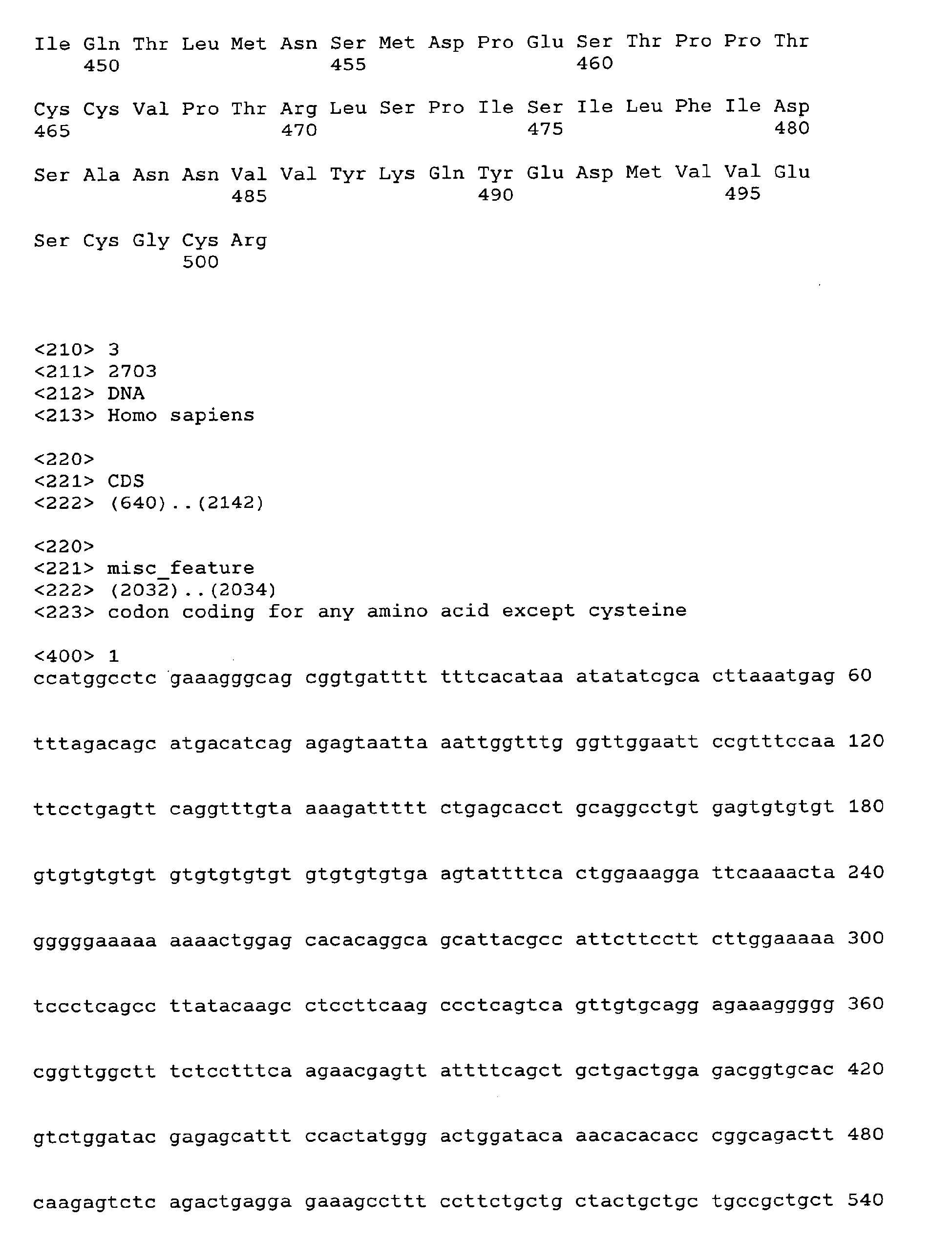


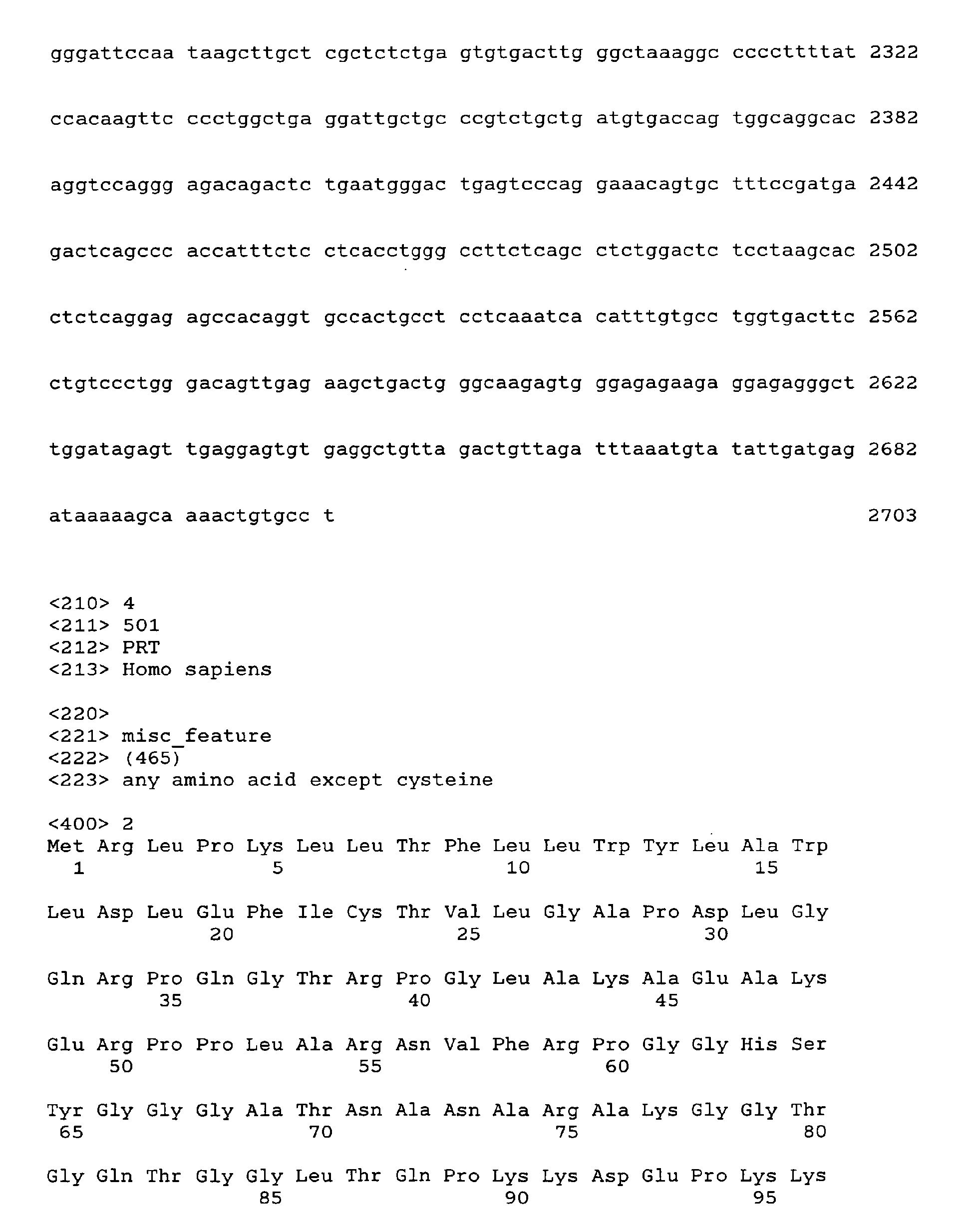

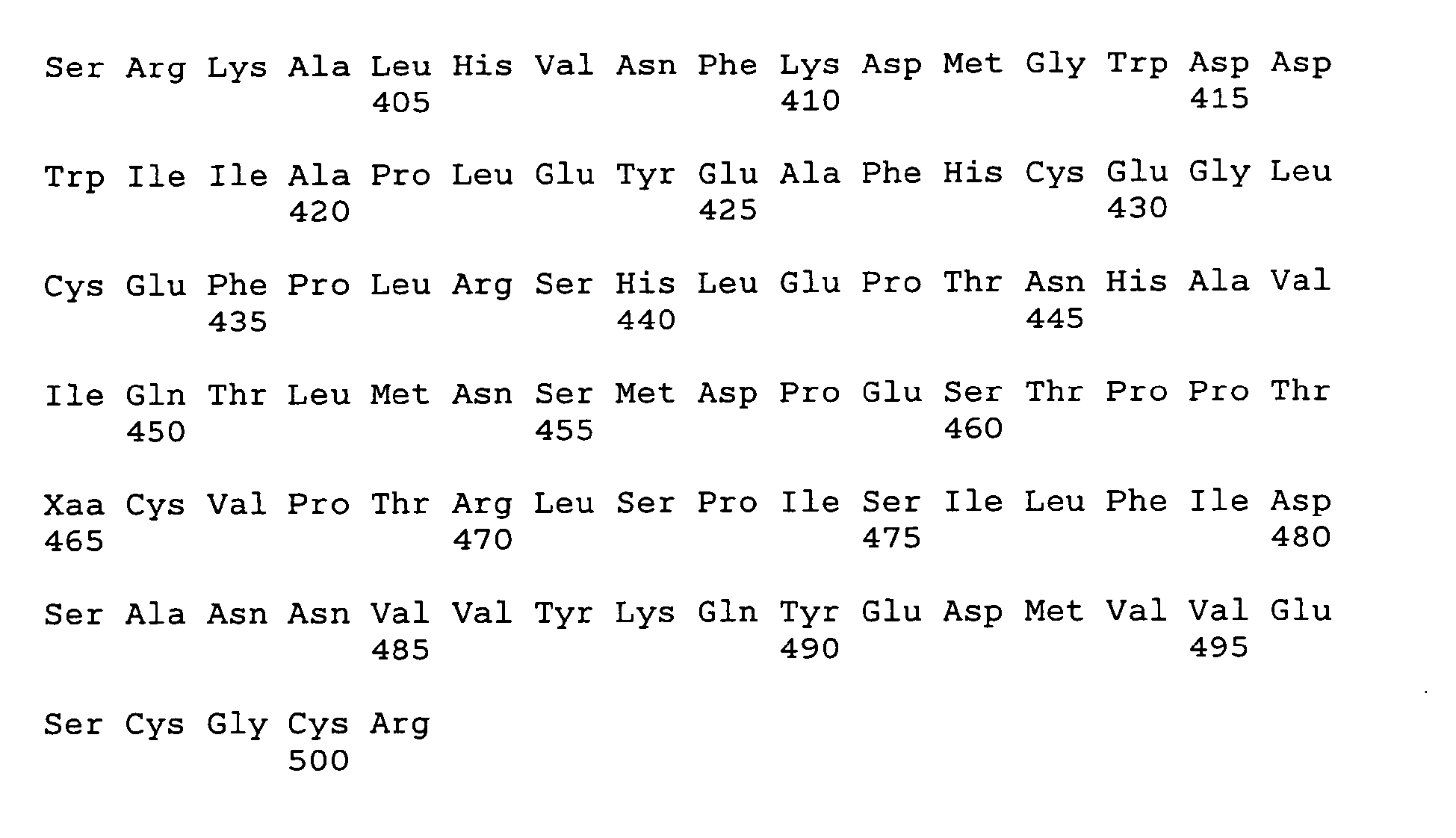
Claims (17)
- A recombinant protein which is derived from a bone morphogenetic protein or a variant thereof by converting a hydrophobic leucine, valine or methionine residue at a position equivalent to leucine 441 of human wildtype GDF-5 (SEQ ID NO 1) to a proline residue.
- The recombinant protein according to claim 1 wherein said recombinant protein is derived from the group consisting of mammalian BMP-2 (BMP-2A), BMP-3 (BMP-3A), BMP-3B (GDF-10), BMP-4 (BMP-2A), BMP-5, BMP-6, BMP-7 (OP-1), BMP-8A (OP-2), BMP-8B (OP-3), BMP-9, BMP-10, BMP-12 (GDF-7), BMP-13 (GDF-6), BMP-14 (GDF-5), or variants thereof.
- The recombinant protein according to claim 1 wherein said recombinant protein is derived from a GDF-5-related protein.
- The recombinant protein according to claim 3 which is derived from dimeric human GDF-5 (SEQ ID NO 1) or monomeric human GDF-5 (SEQ ID NO 2), or variants thereof.
- Nucleic acid, encoding a protein according to any one of the preceding claims.
- Expression vector, comprising a nucleic acid according to claim 5.
- Host cell, containing a nucleic acid according to claim 5 or an expression vector according to claim 6.
- Antibody directed against a recombinant protein having antagonistic activity against bone morphogenetic proteins according to any one of claims 1 to 4.
- Pharmaceutical composition, comprising a protein according to any one of claims 1 to 4, or/and a nucleic acid according to claim 5, or/and an expression vector according to claim 6, or/and a host cell according to claim 7, or/and an antibody according to claim 8.
- Pharmaceutical composition according to claim 9, additionally comprising pharmacologically acceptable auxiliary and/or carrier substances.
- Pharmaceutical composition according to claims 9 or 10,
wherein the protein and/or nucleic acid and/or vector and/or host cell are contained in and/or on a biocompatible matrix material. - Use of a recombinant protein having antagonistic activity against bone morphogenetic proteins according to any one of the claims 1 to 4, or use of a nucleic acid according to claim 5, or use of an expression vector according to claim. 6, or use of a host cell according to claim 7, or use of an antibody according to claim 8, or use of a pharmaceutical composition according to any one of claims 9 to 11, fora) the preparation of a medicament for prevention or therapy of a disorder characterized by deleterious calcification and/or excessive or ectopic ossificationb) the preparation of a medicament for prevention or therapy of a disorder characterized by insufficient action or lack of one or more bone morphogenetic protein antagonistsc) the preparation of a medicament for prevention or therapy of a disorder characterized by muscular degradation or muscular weakness.d) the preparation of a medicament for the prevention or therapy of a disorder in connection with BMP-caused deleterious formation of bone, cartilage, connective tissue, connective tissue attachment, tendon, ligament, spinal/intervertebral disk, meniscus, dental tissue, dentin, periodontal ligament, blood vessels, skin, hair or neural tissue. e) the preparation of a medicament for direction of cell differentiation towards a muscular phenotype.f) the preparation of a medicament for regulation of BMP-related signalling pathwaysg) the preparation of a medicament for the prevention or therapy of a disorder caused by unusual high expression of BMPs
- Use according to claim 12 a), wherein said disorder is selected from the group consisting of neurotic osteosis, ectopic ossification caused by stress of operation, ossification of heart valves, ossification by defect of oxygen supply, osteogenic tumor, arterial sclerosis, ossification of the posterior longitudinal ligament (OPLL), pseudomalignant heterotopic ossification (PHO), pseudomalignant osseous tumor, myositis ossificans circumscripta, fibrodysplasia ossificans progressiva (FOP), osteoma cutis, progressive osseous heteroplasia and sclerosteosis.
- Use according to claim 12 b) wherein the lacking or insufficiently working BMP antagonist is selected from the group consisting of Noggin, chordin, ventropin, follistatin, dan, cerberus, protein related to dan and Cerberus (PRDC), dante, caronte, sclerostin, tsg, gremlin and follistatin-related gene (FLRG)
- Use according to claim 12 c) wherein said muscular disorder is selected from the group consisting of neuromuscular diseases, cardiac insufficiency, weakness of single muscles such as e.g. the constrictor or bladder muscle, hypo- or hypertension caused by problems with the constrictor function of vascular smooth muscle cells, impotence/erectile dysfunction, incontinence, AIDS-related muscular weakness, amyotrophic lateral sclerosis (ALS), general and age-related amyotrophia.
- Use according to claim 15 wherein said neuromuscular disease is selected from the group consisting of Duchenne muscular dystrophy (DMD), Emery-Dreifuss muscular dystrophy (EDMD), congenital muscular dystrophy (CMD), intermediate spinal muscular atrophy (SMA or SMA2) and Charcot-Marie-Tooth disease.
- Use according to claim 12 (d), wherein the deleterious blood vessel formation is caused by a cancer disorder.
Priority Applications (2)
| Application Number | Priority Date | Filing Date | Title |
|---|---|---|---|
| EP05010172A EP1721909A1 (en) | 2005-05-10 | 2005-05-10 | Growth factor mutants with altered biological attributes |
| PCT/EP2006/004331 WO2006119965A2 (en) | 2005-05-10 | 2006-05-09 | Growth factor mutants with altered biological attributes |
Applications Claiming Priority (1)
| Application Number | Priority Date | Filing Date | Title |
|---|---|---|---|
| EP05010172A EP1721909A1 (en) | 2005-05-10 | 2005-05-10 | Growth factor mutants with altered biological attributes |
Publications (1)
| Publication Number | Publication Date |
|---|---|
| EP1721909A1 true EP1721909A1 (en) | 2006-11-15 |
Family
ID=35033362
Family Applications (1)
| Application Number | Title | Priority Date | Filing Date |
|---|---|---|---|
| EP05010172A Withdrawn EP1721909A1 (en) | 2005-05-10 | 2005-05-10 | Growth factor mutants with altered biological attributes |
Country Status (2)
| Country | Link |
|---|---|
| EP (1) | EP1721909A1 (en) |
| WO (1) | WO2006119965A2 (en) |
Cited By (4)
| Publication number | Priority date | Publication date | Assignee | Title |
|---|---|---|---|---|
| WO2017046215A3 (en) * | 2015-09-17 | 2017-06-22 | Histide Ag | Pharmaceutical association comprising a growth factor receptor agonist conjugated to a bioactive carrier for converting a neoplastic cell into a non-neoplastic cell and uses thereof |
| US9718867B2 (en) | 2011-12-05 | 2017-08-01 | Biopharma Gesellschaft Zur Biotechnologischen Entwicklung Von Pharmaka Mbh | GDF-5 mutant for inducing cartilage formation |
| WO2020016425A1 (en) * | 2018-07-20 | 2020-01-23 | Association Institut De Myologie | Compositions for the treatment of sarcopenia or disuse atrophy |
| US11578110B2 (en) | 2015-08-25 | 2023-02-14 | Histide Ag | Compounds for inducing tissue formation and uses thereof |
Citations (1)
| Publication number | Priority date | Publication date | Assignee | Title |
|---|---|---|---|---|
| WO2001092298A2 (en) * | 2000-05-30 | 2001-12-06 | Walter Sebald | CHAIN MUTEINS OF TGF-BETA GROWTH FACTOR SUPERFAMILY PROTEIN |
-
2005
- 2005-05-10 EP EP05010172A patent/EP1721909A1/en not_active Withdrawn
-
2006
- 2006-05-09 WO PCT/EP2006/004331 patent/WO2006119965A2/en not_active Ceased
Patent Citations (1)
| Publication number | Priority date | Publication date | Assignee | Title |
|---|---|---|---|---|
| WO2001092298A2 (en) * | 2000-05-30 | 2001-12-06 | Walter Sebald | CHAIN MUTEINS OF TGF-BETA GROWTH FACTOR SUPERFAMILY PROTEIN |
Non-Patent Citations (2)
| Title |
|---|
| DUCY P ET AL: "THE FAMILY OF BONE MORPHOGENETIC PROTEINS", KIDNEY INTERNATIONAL, NEW YORK, NY, US, vol. 57, no. 6, June 2000 (2000-06-01), pages 2207 - 2214, XP001159614, ISSN: 0085-2538 * |
| FAIYAZ-UL-HAQUE M ET AL: "MUTATION IN THE CARTILAGE-DERIVED MORPHOGENETIC PROTEIN-1 (CDMP1) GENE IN A KINDRED AFFECTED WITH FIBULAR HYPOPLASIA AND COMPLEX BRACHYDACTYLY (DUPAN SYNDROME)", CLINICAL GENETICS, DENMARK, vol. 61, no. 6, 2002, pages 454 - 458, XP002348715 * |
Cited By (7)
| Publication number | Priority date | Publication date | Assignee | Title |
|---|---|---|---|---|
| US9718867B2 (en) | 2011-12-05 | 2017-08-01 | Biopharma Gesellschaft Zur Biotechnologischen Entwicklung Von Pharmaka Mbh | GDF-5 mutant for inducing cartilage formation |
| US11578110B2 (en) | 2015-08-25 | 2023-02-14 | Histide Ag | Compounds for inducing tissue formation and uses thereof |
| WO2017046215A3 (en) * | 2015-09-17 | 2017-06-22 | Histide Ag | Pharmaceutical association comprising a growth factor receptor agonist conjugated to a bioactive carrier for converting a neoplastic cell into a non-neoplastic cell and uses thereof |
| IL258126B (en) * | 2015-09-17 | 2022-10-01 | Histide Ag | Pharmaceutical association comprising a growth factor receptor agonist conjugated to a bioactive carrier for converting a neoplastic cell into a non-neoplastic cell and uses thereof |
| IL258126B2 (en) * | 2015-09-17 | 2023-02-01 | Histide Ag | Pharmaceutical association comprising a growth factor receptor agonist conjugated to a bioactive carrier for converting a neoplastic cell into a non-neoplastic cell and uses thereof |
| WO2020016425A1 (en) * | 2018-07-20 | 2020-01-23 | Association Institut De Myologie | Compositions for the treatment of sarcopenia or disuse atrophy |
| US12496328B2 (en) | 2018-07-20 | 2025-12-16 | Association Institut De Myologie | Compositions for the treatment of sarcopenia or disuse atrophy |
Also Published As
| Publication number | Publication date |
|---|---|
| WO2006119965A2 (en) | 2006-11-16 |
| WO2006119965A3 (en) | 2007-03-01 |
Similar Documents
| Publication | Publication Date | Title |
|---|---|---|
| US7041645B2 (en) | Methods of inhibiting or inducing bone formation | |
| US9200048B2 (en) | High activity growth factor mutants | |
| US8361745B2 (en) | Human growth and differentiation factor GDF-5 | |
| JP5529754B2 (en) | BMP variant with reduced sensitivity to Noggin | |
| JP2003506086A (en) | TGF-β family monomeric protein | |
| EP1721909A1 (en) | Growth factor mutants with altered biological attributes | |
| US9012401B2 (en) | Growth factor mutants with improved biological activity | |
| US7186689B2 (en) | Mutants of bone morphogenetic proteins | |
| Chen | Recombinant human morphogenetic protein: its future role in spinal fusions |
Legal Events
| Date | Code | Title | Description |
|---|---|---|---|
| PUAI | Public reference made under article 153(3) epc to a published international application that has entered the european phase |
Free format text: ORIGINAL CODE: 0009012 |
|
| AK | Designated contracting states |
Kind code of ref document: A1 Designated state(s): AT BE BG CH CY CZ DE DK EE ES FI FR GB GR HU IE IS IT LI LT LU MC NL PL PT RO SE SI SK TR |
|
| AX | Request for extension of the european patent |
Extension state: AL BA HR LV MK YU |
|
| AKX | Designation fees paid | ||
| STAA | Information on the status of an ep patent application or granted ep patent |
Free format text: STATUS: THE APPLICATION IS DEEMED TO BE WITHDRAWN |
|
| 18D | Application deemed to be withdrawn |
Effective date: 20070516 |
|
| REG | Reference to a national code |
Ref country code: DE Ref legal event code: 8566 |