EP1702967B1 - Pressure-sensitive adhesive compositions, pressure-sensitive adhesive sheets and surface protecting films - Google Patents
Pressure-sensitive adhesive compositions, pressure-sensitive adhesive sheets and surface protecting films Download PDFInfo
- Publication number
- EP1702967B1 EP1702967B1 EP20060111107 EP06111107A EP1702967B1 EP 1702967 B1 EP1702967 B1 EP 1702967B1 EP 20060111107 EP20060111107 EP 20060111107 EP 06111107 A EP06111107 A EP 06111107A EP 1702967 B1 EP1702967 B1 EP 1702967B1
- Authority
- EP
- European Patent Office
- Prior art keywords
- sensitive adhesive
- pressure
- cation
- group
- meth
- Prior art date
- Legal status (The legal status is an assumption and is not a legal conclusion. Google has not performed a legal analysis and makes no representation as to the accuracy of the status listed.)
- Not-in-force
Links
- 239000004820 Pressure-sensitive adhesive Substances 0.000 title claims abstract description 245
- 239000000203 mixture Substances 0.000 title claims abstract description 99
- 229920000642 polymer Polymers 0.000 claims abstract description 85
- 239000000178 monomer Substances 0.000 claims abstract description 73
- 239000002608 ionic liquid Substances 0.000 claims abstract description 67
- OKTJSMMVPCPJKN-UHFFFAOYSA-N Carbon Chemical compound [C] OKTJSMMVPCPJKN-UHFFFAOYSA-N 0.000 claims abstract description 60
- 229910052799 carbon Inorganic materials 0.000 claims abstract description 60
- 239000004094 surface-active agent Substances 0.000 claims abstract description 40
- 125000002947 alkylene group Chemical group 0.000 claims abstract description 35
- 229910052739 hydrogen Inorganic materials 0.000 claims abstract description 27
- 239000001257 hydrogen Substances 0.000 claims abstract description 27
- UFHFLCQGNIYNRP-UHFFFAOYSA-N Hydrogen Chemical compound [H][H] UFHFLCQGNIYNRP-UHFFFAOYSA-N 0.000 claims abstract description 24
- 125000000129 anionic group Chemical group 0.000 claims abstract description 12
- 125000002496 methyl group Chemical group [H]C([H])([H])* 0.000 claims abstract description 10
- 239000010410 layer Substances 0.000 claims description 35
- 150000001875 compounds Chemical class 0.000 claims description 34
- 150000001768 cations Chemical class 0.000 claims description 32
- 125000005842 heteroatom Chemical group 0.000 claims description 22
- 238000004132 cross linking Methods 0.000 claims description 21
- 150000003839 salts Chemical class 0.000 claims description 21
- 125000001033 ether group Chemical group 0.000 claims description 16
- 229920006255 plastic film Polymers 0.000 claims description 10
- 239000002985 plastic film Substances 0.000 claims description 10
- 229910052717 sulfur Inorganic materials 0.000 claims description 10
- 229910052757 nitrogen Inorganic materials 0.000 claims description 9
- 229910052698 phosphorus Inorganic materials 0.000 claims description 7
- 125000004433 nitrogen atom Chemical group N* 0.000 claims description 6
- 125000004434 sulfur atom Chemical group 0.000 claims description 6
- OAICVXFJPJFONN-UHFFFAOYSA-N Phosphorus Chemical compound [P] OAICVXFJPJFONN-UHFFFAOYSA-N 0.000 claims description 4
- NINIDFKCEFEMDL-UHFFFAOYSA-N Sulfur Chemical compound [S] NINIDFKCEFEMDL-UHFFFAOYSA-N 0.000 claims description 4
- QJGQUHMNIGDVPM-UHFFFAOYSA-N nitrogen group Chemical group [N] QJGQUHMNIGDVPM-UHFFFAOYSA-N 0.000 claims description 4
- 239000011574 phosphorus Substances 0.000 claims description 4
- 239000011593 sulfur Substances 0.000 claims description 4
- 125000004437 phosphorous atom Chemical group 0.000 claims description 3
- 229910052702 rhenium Inorganic materials 0.000 claims description 3
- 125000001183 hydrocarbyl group Chemical group 0.000 claims 7
- 230000002829 reductive effect Effects 0.000 abstract description 8
- -1 alkali metal salt Chemical class 0.000 description 467
- 239000000243 solution Substances 0.000 description 108
- NIXOWILDQLNWCW-UHFFFAOYSA-M Acrylate Chemical compound [O-]C(=O)C=C NIXOWILDQLNWCW-UHFFFAOYSA-M 0.000 description 82
- 238000000034 method Methods 0.000 description 82
- XEKOWRVHYACXOJ-UHFFFAOYSA-N Ethyl acetate Chemical compound CCOC(C)=O XEKOWRVHYACXOJ-UHFFFAOYSA-N 0.000 description 81
- ZXMGHDIOOHOAAE-UHFFFAOYSA-N 1,1,1-trifluoro-n-(trifluoromethylsulfonyl)methanesulfonamide Chemical compound FC(F)(F)S(=O)(=O)NS(=O)(=O)C(F)(F)F ZXMGHDIOOHOAAE-UHFFFAOYSA-N 0.000 description 78
- NIXOWILDQLNWCW-UHFFFAOYSA-N 2-Propenoic acid Natural products OC(=O)C=C NIXOWILDQLNWCW-UHFFFAOYSA-N 0.000 description 62
- 150000003949 imides Chemical class 0.000 description 51
- 150000001252 acrylic acid derivatives Chemical class 0.000 description 41
- 239000007788 liquid Substances 0.000 description 32
- 239000002253 acid Substances 0.000 description 27
- 239000003795 chemical substances by application Substances 0.000 description 23
- 238000004519 manufacturing process Methods 0.000 description 23
- 238000010186 staining Methods 0.000 description 23
- 238000002360 preparation method Methods 0.000 description 22
- 230000000052 comparative effect Effects 0.000 description 20
- 238000002156 mixing Methods 0.000 description 20
- 238000006243 chemical reaction Methods 0.000 description 19
- 229920005989 resin Polymers 0.000 description 19
- 239000011347 resin Substances 0.000 description 19
- 239000002216 antistatic agent Substances 0.000 description 16
- 235000014113 dietary fatty acids Nutrition 0.000 description 16
- 239000000194 fatty acid Substances 0.000 description 16
- 229930195729 fatty acid Natural products 0.000 description 16
- 229920001223 polyethylene glycol Polymers 0.000 description 16
- 229920003171 Poly (ethylene oxide) Polymers 0.000 description 15
- 239000002202 Polyethylene glycol Substances 0.000 description 15
- 238000000576 coating method Methods 0.000 description 15
- 150000002430 hydrocarbons Chemical group 0.000 description 15
- 238000005259 measurement Methods 0.000 description 15
- 239000000523 sample Substances 0.000 description 15
- 239000000126 substance Substances 0.000 description 15
- OZAIFHULBGXAKX-UHFFFAOYSA-N 2-(2-cyanopropan-2-yldiazenyl)-2-methylpropanenitrile Chemical compound N#CC(C)(C)N=NC(C)(C)C#N OZAIFHULBGXAKX-UHFFFAOYSA-N 0.000 description 14
- IJGRMHOSHXDMSA-UHFFFAOYSA-N Atomic nitrogen Chemical compound N#N IJGRMHOSHXDMSA-UHFFFAOYSA-N 0.000 description 14
- 125000000217 alkyl group Chemical group 0.000 description 14
- 229920001577 copolymer Polymers 0.000 description 14
- 229910001873 dinitrogen Inorganic materials 0.000 description 14
- 238000006116 polymerization reaction Methods 0.000 description 14
- 238000003756 stirring Methods 0.000 description 14
- 238000011282 treatment Methods 0.000 description 14
- 239000005057 Hexamethylene diisocyanate Substances 0.000 description 13
- RRAMGCGOFNQTLD-UHFFFAOYSA-N hexamethylene diisocyanate Chemical compound O=C=NCCCCCCN=C=O RRAMGCGOFNQTLD-UHFFFAOYSA-N 0.000 description 13
- 230000003287 optical effect Effects 0.000 description 13
- 239000011248 coating agent Substances 0.000 description 12
- ZBCBWPMODOFKDW-UHFFFAOYSA-N diethanolamine Chemical compound OCCNCCO ZBCBWPMODOFKDW-UHFFFAOYSA-N 0.000 description 12
- 239000004814 polyurethane Substances 0.000 description 12
- 229920002635 polyurethane Polymers 0.000 description 12
- 229920005601 base polymer Polymers 0.000 description 11
- NOFBAVDIGCEKOQ-UHFFFAOYSA-N bis(trifluoromethylsulfonyl)azanide;1-butyl-3-methylpyridin-1-ium Chemical compound CCCC[N+]1=CC=CC(C)=C1.FC(F)(F)S(=O)(=O)[N-]S(=O)(=O)C(F)(F)F NOFBAVDIGCEKOQ-UHFFFAOYSA-N 0.000 description 11
- 230000009477 glass transition Effects 0.000 description 11
- 239000012948 isocyanate Substances 0.000 description 11
- 230000005611 electricity Effects 0.000 description 10
- ZFSLODLOARCGLH-UHFFFAOYSA-N isocyanuric acid Chemical compound OC1=NC(O)=NC(O)=N1 ZFSLODLOARCGLH-UHFFFAOYSA-N 0.000 description 10
- GOXQRTZXKQZDDN-UHFFFAOYSA-N 2-Ethylhexyl acrylate Chemical compound CCCCC(CC)COC(=O)C=C GOXQRTZXKQZDDN-UHFFFAOYSA-N 0.000 description 9
- UKLDJPRMSDWDSL-UHFFFAOYSA-L [dibutyl(dodecanoyloxy)stannyl] dodecanoate Chemical compound CCCCCCCCCCCC(=O)O[Sn](CCCC)(CCCC)OC(=O)CCCCCCCCCCC UKLDJPRMSDWDSL-UHFFFAOYSA-L 0.000 description 9
- 230000000740 bleeding effect Effects 0.000 description 9
- 239000003054 catalyst Substances 0.000 description 9
- 239000012975 dibutyltin dilaurate Substances 0.000 description 9
- 125000003827 glycol group Chemical group 0.000 description 9
- 150000004820 halides Chemical class 0.000 description 9
- 125000005702 oxyalkylene group Chemical group 0.000 description 9
- 229920003023 plastic Polymers 0.000 description 9
- 239000004033 plastic Substances 0.000 description 9
- 239000003505 polymerization initiator Substances 0.000 description 9
- KFZMGEQAYNKOFK-UHFFFAOYSA-N Isopropanol Chemical compound CC(C)O KFZMGEQAYNKOFK-UHFFFAOYSA-N 0.000 description 8
- PPBRXRYQALVLMV-UHFFFAOYSA-N Styrene Chemical compound C=CC1=CC=CC=C1 PPBRXRYQALVLMV-UHFFFAOYSA-N 0.000 description 8
- 239000000853 adhesive Substances 0.000 description 8
- 230000001070 adhesive effect Effects 0.000 description 8
- 125000003178 carboxy group Chemical group [H]OC(*)=O 0.000 description 8
- 230000000694 effects Effects 0.000 description 8
- 150000002148 esters Chemical class 0.000 description 8
- RTZKZFJDLAIYFH-UHFFFAOYSA-N ether Substances CCOCC RTZKZFJDLAIYFH-UHFFFAOYSA-N 0.000 description 8
- 125000001453 quaternary ammonium group Chemical group 0.000 description 8
- 230000003068 static effect Effects 0.000 description 8
- 239000000758 substrate Substances 0.000 description 8
- HIXDQWDOVZUNNA-UHFFFAOYSA-N 2-(3,4-dimethoxyphenyl)-5-hydroxy-7-methoxychromen-4-one Chemical compound C=1C(OC)=CC(O)=C(C(C=2)=O)C=1OC=2C1=CC=C(OC)C(OC)=C1 HIXDQWDOVZUNNA-UHFFFAOYSA-N 0.000 description 7
- OMIGHNLMNHATMP-UHFFFAOYSA-N 2-hydroxyethyl prop-2-enoate Chemical compound OCCOC(=O)C=C OMIGHNLMNHATMP-UHFFFAOYSA-N 0.000 description 7
- OKKJLVBELUTLKV-UHFFFAOYSA-N Methanol Chemical compound OC OKKJLVBELUTLKV-UHFFFAOYSA-N 0.000 description 7
- 239000003431 cross linking reagent Substances 0.000 description 7
- 125000002887 hydroxy group Chemical group [H]O* 0.000 description 7
- QGZKDVFQNNGYKY-UHFFFAOYSA-O Ammonium Chemical compound [NH4+] QGZKDVFQNNGYKY-UHFFFAOYSA-O 0.000 description 6
- 239000005977 Ethylene Substances 0.000 description 6
- LYCAIKOWRPUZTN-UHFFFAOYSA-N Ethylene glycol Chemical compound OCCO LYCAIKOWRPUZTN-UHFFFAOYSA-N 0.000 description 6
- NBIIXXVUZAFLBC-UHFFFAOYSA-N Phosphoric acid Chemical compound OP(O)(O)=O NBIIXXVUZAFLBC-UHFFFAOYSA-N 0.000 description 6
- 239000004721 Polyphenylene oxide Substances 0.000 description 6
- 239000004743 Polypropylene Substances 0.000 description 6
- VYPSYNLAJGMNEJ-UHFFFAOYSA-N Silicium dioxide Chemical compound O=[Si]=O VYPSYNLAJGMNEJ-UHFFFAOYSA-N 0.000 description 6
- WYURNTSHIVDZCO-UHFFFAOYSA-N Tetrahydrofuran Chemical compound C1CCOC1 WYURNTSHIVDZCO-UHFFFAOYSA-N 0.000 description 6
- YXFVVABEGXRONW-UHFFFAOYSA-N Toluene Chemical compound CC1=CC=CC=C1 YXFVVABEGXRONW-UHFFFAOYSA-N 0.000 description 6
- 239000000460 chlorine Substances 0.000 description 6
- 229920001940 conductive polymer Polymers 0.000 description 6
- XLYOFNOQVPJJNP-UHFFFAOYSA-M hydroxide Chemical compound [OH-] XLYOFNOQVPJJNP-UHFFFAOYSA-M 0.000 description 6
- 229920001155 polypropylene Polymers 0.000 description 6
- 239000002904 solvent Substances 0.000 description 6
- XLYOFNOQVPJJNP-UHFFFAOYSA-N water Chemical compound O XLYOFNOQVPJJNP-UHFFFAOYSA-N 0.000 description 6
- 239000004593 Epoxy Substances 0.000 description 5
- VGGSQFUCUMXWEO-UHFFFAOYSA-N Ethene Chemical compound C=C VGGSQFUCUMXWEO-UHFFFAOYSA-N 0.000 description 5
- 229920001400 block copolymer Polymers 0.000 description 5
- 229910052794 bromium Inorganic materials 0.000 description 5
- 239000003093 cationic surfactant Substances 0.000 description 5
- 229910052801 chlorine Inorganic materials 0.000 description 5
- 125000003700 epoxy group Chemical group 0.000 description 5
- 125000000524 functional group Chemical group 0.000 description 5
- 239000003999 initiator Substances 0.000 description 5
- 229910052740 iodine Inorganic materials 0.000 description 5
- 125000000959 isobutyl group Chemical group [H]C([H])([H])C([H])(C([H])([H])[H])C([H])([H])* 0.000 description 5
- 239000004973 liquid crystal related substance Substances 0.000 description 5
- 238000006386 neutralization reaction Methods 0.000 description 5
- 229920000570 polyether Polymers 0.000 description 5
- 229920000139 polyethylene terephthalate Polymers 0.000 description 5
- 239000005020 polyethylene terephthalate Substances 0.000 description 5
- 229920001451 polypropylene glycol Polymers 0.000 description 5
- 229920001296 polysiloxane Polymers 0.000 description 5
- 239000000843 powder Substances 0.000 description 5
- 230000001105 regulatory effect Effects 0.000 description 5
- VXNZUUAINFGPBY-UHFFFAOYSA-N 1-Butene Chemical compound CCC=C VXNZUUAINFGPBY-UHFFFAOYSA-N 0.000 description 4
- QTBSBXVTEAMEQO-UHFFFAOYSA-N Acetic acid Chemical compound CC(O)=O QTBSBXVTEAMEQO-UHFFFAOYSA-N 0.000 description 4
- HRPVXLWXLXDGHG-UHFFFAOYSA-N Acrylamide Chemical compound NC(=O)C=C HRPVXLWXLXDGHG-UHFFFAOYSA-N 0.000 description 4
- KLZUFWVZNOTSEM-UHFFFAOYSA-K Aluminium flouride Chemical compound F[Al](F)F KLZUFWVZNOTSEM-UHFFFAOYSA-K 0.000 description 4
- QGZKDVFQNNGYKY-UHFFFAOYSA-N Ammonia Chemical compound N QGZKDVFQNNGYKY-UHFFFAOYSA-N 0.000 description 4
- IAYPIBMASNFSPL-UHFFFAOYSA-N Ethylene oxide Chemical group C1CO1 IAYPIBMASNFSPL-UHFFFAOYSA-N 0.000 description 4
- KRHYYFGTRYWZRS-UHFFFAOYSA-N Fluorane Chemical compound F KRHYYFGTRYWZRS-UHFFFAOYSA-N 0.000 description 4
- VZCYOOQTPOCHFL-OWOJBTEDSA-N Fumaric acid Chemical compound OC(=O)\C=C\C(O)=O VZCYOOQTPOCHFL-OWOJBTEDSA-N 0.000 description 4
- 102100025283 Gap junction alpha-8 protein Human genes 0.000 description 4
- 101710086969 Gap junction alpha-8 protein Proteins 0.000 description 4
- 239000004698 Polyethylene Substances 0.000 description 4
- QYKIQEUNHZKYBP-UHFFFAOYSA-N Vinyl ether Chemical class C=COC=C QYKIQEUNHZKYBP-UHFFFAOYSA-N 0.000 description 4
- 125000004018 acid anhydride group Chemical group 0.000 description 4
- 150000005215 alkyl ethers Chemical class 0.000 description 4
- XXROGKLTLUQVRX-UHFFFAOYSA-N allyl alcohol Chemical compound OCC=C XXROGKLTLUQVRX-UHFFFAOYSA-N 0.000 description 4
- 125000003368 amide group Chemical group 0.000 description 4
- 125000003277 amino group Chemical group 0.000 description 4
- 150000001450 anions Chemical class 0.000 description 4
- 239000013522 chelant Substances 0.000 description 4
- 125000004093 cyano group Chemical group *C#N 0.000 description 4
- FJKIXWOMBXYWOQ-UHFFFAOYSA-N ethenoxyethane Chemical compound CCOC=C FJKIXWOMBXYWOQ-UHFFFAOYSA-N 0.000 description 4
- 150000004665 fatty acids Chemical class 0.000 description 4
- 229910052731 fluorine Inorganic materials 0.000 description 4
- 125000004051 hexyl group Chemical group [H]C([H])([H])C([H])([H])C([H])([H])C([H])([H])C([H])([H])C([H])([H])* 0.000 description 4
- 229910052744 lithium Inorganic materials 0.000 description 4
- ZUZLIXGTXQBUDC-UHFFFAOYSA-N methyltrioctylammonium Chemical compound CCCCCCCC[N+](C)(CCCCCCCC)CCCCCCCC ZUZLIXGTXQBUDC-UHFFFAOYSA-N 0.000 description 4
- 125000004108 n-butyl group Chemical group [H]C([H])([H])C([H])([H])C([H])([H])C([H])([H])* 0.000 description 4
- 238000007747 plating Methods 0.000 description 4
- 229920000573 polyethylene Polymers 0.000 description 4
- 229920005862 polyol Polymers 0.000 description 4
- 229910052700 potassium Inorganic materials 0.000 description 4
- 125000002914 sec-butyl group Chemical group [H]C([H])([H])C([H])([H])C([H])(*)C([H])([H])[H] 0.000 description 4
- 229910052709 silver Inorganic materials 0.000 description 4
- 229910052708 sodium Inorganic materials 0.000 description 4
- 239000011734 sodium Substances 0.000 description 4
- 125000000542 sulfonic acid group Chemical group 0.000 description 4
- 125000000999 tert-butyl group Chemical group [H]C([H])([H])C(*)(C([H])([H])[H])C([H])([H])[H] 0.000 description 4
- 238000004448 titration Methods 0.000 description 4
- VZCYOOQTPOCHFL-UHFFFAOYSA-N trans-butenedioic acid Natural products OC(=O)C=CC(O)=O VZCYOOQTPOCHFL-UHFFFAOYSA-N 0.000 description 4
- LDHQCZJRKDOVOX-UHFFFAOYSA-N trans-crotonic acid Natural products CC=CC(O)=O LDHQCZJRKDOVOX-UHFFFAOYSA-N 0.000 description 4
- 229920001567 vinyl ester resin Polymers 0.000 description 4
- 229920002554 vinyl polymer Polymers 0.000 description 4
- BCMSMDHXUXDJFB-UHFFFAOYSA-N 1,1-dibutylpiperidin-1-ium Chemical compound CCCC[N+]1(CCCC)CCCCC1 BCMSMDHXUXDJFB-UHFFFAOYSA-N 0.000 description 3
- GXNZJXAATBWYOL-UHFFFAOYSA-N 1-butyl-2,3,5-trimethylpyrazol-2-ium Chemical compound CCCC[N+]1=C(C)C=C(C)N1C GXNZJXAATBWYOL-UHFFFAOYSA-N 0.000 description 3
- NJMWOUFKYKNWDW-UHFFFAOYSA-N 1-ethyl-3-methylimidazolium Chemical compound CCN1C=C[N+](C)=C1 NJMWOUFKYKNWDW-UHFFFAOYSA-N 0.000 description 3
- XLPJNCYCZORXHG-UHFFFAOYSA-N 1-morpholin-4-ylprop-2-en-1-one Chemical compound C=CC(=O)N1CCOCC1 XLPJNCYCZORXHG-UHFFFAOYSA-N 0.000 description 3
- LQWJONARYDIOSE-UHFFFAOYSA-N 1-pentylpiperidine Chemical compound CCCCCN1CCCCC1 LQWJONARYDIOSE-UHFFFAOYSA-N 0.000 description 3
- VTDIWMPYBAVEDY-UHFFFAOYSA-N 1-propylpiperidine Chemical compound CCCN1CCCCC1 VTDIWMPYBAVEDY-UHFFFAOYSA-N 0.000 description 3
- SMZOUWXMTYCWNB-UHFFFAOYSA-N 2-(2-methoxy-5-methylphenyl)ethanamine Chemical compound COC1=CC=C(C)C=C1CCN SMZOUWXMTYCWNB-UHFFFAOYSA-N 0.000 description 3
- ZWEHNKRNPOVVGH-UHFFFAOYSA-N 2-Butanone Chemical compound CCC(C)=O ZWEHNKRNPOVVGH-UHFFFAOYSA-N 0.000 description 3
- CSCPPACGZOOCGX-UHFFFAOYSA-N Acetone Chemical compound CC(C)=O CSCPPACGZOOCGX-UHFFFAOYSA-N 0.000 description 3
- LFQSCWFLJHTTHZ-UHFFFAOYSA-N Ethanol Chemical compound CCO LFQSCWFLJHTTHZ-UHFFFAOYSA-N 0.000 description 3
- YCKRFDGAMUMZLT-UHFFFAOYSA-N Fluorine atom Chemical compound [F] YCKRFDGAMUMZLT-UHFFFAOYSA-N 0.000 description 3
- 102100039399 Gap junction beta-7 protein Human genes 0.000 description 3
- PEDCQBHIVMGVHV-UHFFFAOYSA-N Glycerine Chemical compound OCC(O)CO PEDCQBHIVMGVHV-UHFFFAOYSA-N 0.000 description 3
- 101000889130 Homo sapiens Gap junction beta-7 protein Proteins 0.000 description 3
- 229920000877 Melamine resin Polymers 0.000 description 3
- 229910003202 NH4 Inorganic materials 0.000 description 3
- 239000004952 Polyamide Substances 0.000 description 3
- 239000004793 Polystyrene Substances 0.000 description 3
- HEMHJVSKTPXQMS-UHFFFAOYSA-M Sodium hydroxide Chemical compound [OH-].[Na+] HEMHJVSKTPXQMS-UHFFFAOYSA-M 0.000 description 3
- QAOWNCQODCNURD-UHFFFAOYSA-N Sulfuric acid Chemical compound OS(O)(=O)=O QAOWNCQODCNURD-UHFFFAOYSA-N 0.000 description 3
- ZJCCRDAZUWHFQH-UHFFFAOYSA-N Trimethylolpropane Chemical compound CCC(CO)(CO)CO ZJCCRDAZUWHFQH-UHFFFAOYSA-N 0.000 description 3
- 125000003647 acryloyl group Chemical group O=C([*])C([H])=C([H])[H] 0.000 description 3
- 229910052783 alkali metal Inorganic materials 0.000 description 3
- 150000003973 alkyl amines Chemical class 0.000 description 3
- 230000015572 biosynthetic process Effects 0.000 description 3
- 230000001276 controlling effect Effects 0.000 description 3
- 230000003247 decreasing effect Effects 0.000 description 3
- BXHHZLMBMOBPEH-UHFFFAOYSA-N diethyl-(2-methoxyethyl)-methylazanium Chemical compound CC[N+](C)(CC)CCOC BXHHZLMBMOBPEH-UHFFFAOYSA-N 0.000 description 3
- 238000009792 diffusion process Methods 0.000 description 3
- 150000002170 ethers Chemical class 0.000 description 3
- 125000001495 ethyl group Chemical group [H]C([H])([H])C([H])([H])* 0.000 description 3
- 239000011737 fluorine Substances 0.000 description 3
- 125000001153 fluoro group Chemical group F* 0.000 description 3
- 238000005227 gel permeation chromatography Methods 0.000 description 3
- 229910000040 hydrogen fluoride Inorganic materials 0.000 description 3
- 230000003993 interaction Effects 0.000 description 3
- 150000008040 ionic compounds Chemical class 0.000 description 3
- 238000004898 kneading Methods 0.000 description 3
- 239000000463 material Substances 0.000 description 3
- JDSHMPZPIAZGSV-UHFFFAOYSA-N melamine Chemical compound NC1=NC(N)=NC(N)=N1 JDSHMPZPIAZGSV-UHFFFAOYSA-N 0.000 description 3
- 239000012046 mixed solvent Substances 0.000 description 3
- ZIUHHBKFKCYYJD-UHFFFAOYSA-N n,n'-methylenebisacrylamide Chemical compound C=CC(=O)NCNC(=O)C=C ZIUHHBKFKCYYJD-UHFFFAOYSA-N 0.000 description 3
- 150000007524 organic acids Chemical class 0.000 description 3
- 150000003014 phosphoric acid esters Chemical class 0.000 description 3
- 229920002647 polyamide Polymers 0.000 description 3
- 229920002223 polystyrene Polymers 0.000 description 3
- 230000005855 radiation Effects 0.000 description 3
- 229920005604 random copolymer Polymers 0.000 description 3
- 239000012488 sample solution Substances 0.000 description 3
- 239000000377 silicon dioxide Substances 0.000 description 3
- 150000003512 tertiary amines Chemical class 0.000 description 3
- DVKJHBMWWAPEIU-UHFFFAOYSA-N toluene 2,4-diisocyanate Chemical compound CC1=CC=C(N=C=O)C=C1N=C=O DVKJHBMWWAPEIU-UHFFFAOYSA-N 0.000 description 3
- 125000001889 triflyl group Chemical group FC(F)(F)S(*)(=O)=O 0.000 description 3
- 125000000391 vinyl group Chemical group [H]C([*])=C([H])[H] 0.000 description 3
- 239000008096 xylene Substances 0.000 description 3
- QIAZNDAYSCULMI-UHFFFAOYSA-N 1,1-dibutylpyrrolidin-1-ium Chemical compound CCCC[N+]1(CCCC)CCCC1 QIAZNDAYSCULMI-UHFFFAOYSA-N 0.000 description 2
- HNVRIVKDRYGTED-UHFFFAOYSA-N 1,1-diethylpiperidin-1-ium Chemical compound CC[N+]1(CC)CCCCC1 HNVRIVKDRYGTED-UHFFFAOYSA-N 0.000 description 2
- PWZSCBSKFVJMJH-UHFFFAOYSA-N 1,1-diethylpyrrolidin-1-ium Chemical compound CC[N+]1(CC)CCCC1 PWZSCBSKFVJMJH-UHFFFAOYSA-N 0.000 description 2
- QWBFCFUNYGOTQP-UHFFFAOYSA-N 1,1-dipropylpiperidin-1-ium Chemical compound CCC[N+]1(CCC)CCCCC1 QWBFCFUNYGOTQP-UHFFFAOYSA-N 0.000 description 2
- WBHKHVSKPJNNQD-UHFFFAOYSA-N 1,1-dipropylpyrrolidin-1-ium Chemical compound CCC[N+]1(CCC)CCCC1 WBHKHVSKPJNNQD-UHFFFAOYSA-N 0.000 description 2
- MYRTYDVEIRVNKP-UHFFFAOYSA-N 1,2-Divinylbenzene Chemical compound C=CC1=CC=CC=C1C=C MYRTYDVEIRVNKP-UHFFFAOYSA-N 0.000 description 2
- NWUYHJFMYQTDRP-UHFFFAOYSA-N 1,2-bis(ethenyl)benzene;1-ethenyl-2-ethylbenzene;styrene Chemical compound C=CC1=CC=CC=C1.CCC1=CC=CC=C1C=C.C=CC1=CC=CC=C1C=C NWUYHJFMYQTDRP-UHFFFAOYSA-N 0.000 description 2
- VGLXNNQUTZDJIR-UHFFFAOYSA-N 1-butyl-1-ethylpiperidin-1-ium Chemical compound CCCC[N+]1(CC)CCCCC1 VGLXNNQUTZDJIR-UHFFFAOYSA-N 0.000 description 2
- YXJSMCZTRWECJF-UHFFFAOYSA-N 1-butyl-1-ethylpyrrolidin-1-ium Chemical compound CCCC[N+]1(CC)CCCC1 YXJSMCZTRWECJF-UHFFFAOYSA-N 0.000 description 2
- UVCPHBWNKAXVPC-UHFFFAOYSA-N 1-butyl-1-methylpiperidin-1-ium Chemical compound CCCC[N+]1(C)CCCCC1 UVCPHBWNKAXVPC-UHFFFAOYSA-N 0.000 description 2
- PXELHGDYRQLRQO-UHFFFAOYSA-N 1-butyl-1-methylpyrrolidin-1-ium Chemical compound CCCC[N+]1(C)CCCC1 PXELHGDYRQLRQO-UHFFFAOYSA-N 0.000 description 2
- SWSKIIOYEBKVTM-UHFFFAOYSA-N 1-butyl-1-propylpiperidin-1-ium Chemical compound CCCC[N+]1(CCC)CCCCC1 SWSKIIOYEBKVTM-UHFFFAOYSA-N 0.000 description 2
- HODMCOIBCPNLAO-UHFFFAOYSA-N 1-butyl-1-propylpyrrolidin-1-ium Chemical compound CCCC[N+]1(CCC)CCCC1 HODMCOIBCPNLAO-UHFFFAOYSA-N 0.000 description 2
- IQQRAVYLUAZUGX-UHFFFAOYSA-N 1-butyl-3-methylimidazolium Chemical compound CCCCN1C=C[N+](C)=C1 IQQRAVYLUAZUGX-UHFFFAOYSA-N 0.000 description 2
- DADKKHHMGSWSPH-UHFFFAOYSA-N 1-butyl-3-methylpyridin-1-ium Chemical compound CCCC[N+]1=CC=CC(C)=C1 DADKKHHMGSWSPH-UHFFFAOYSA-N 0.000 description 2
- BQTPKSBXMONSJI-UHFFFAOYSA-N 1-cyclohexylpyrrole-2,5-dione Chemical compound O=C1C=CC(=O)N1C1CCCCC1 BQTPKSBXMONSJI-UHFFFAOYSA-N 0.000 description 2
- OZCMOJQQLBXBKI-UHFFFAOYSA-N 1-ethenoxy-2-methylpropane Chemical compound CC(C)COC=C OZCMOJQQLBXBKI-UHFFFAOYSA-N 0.000 description 2
- NEHRNKRYGQRPBR-UHFFFAOYSA-N 1-ethyl-1-heptylpiperidin-1-ium Chemical compound CCCCCCC[N+]1(CC)CCCCC1 NEHRNKRYGQRPBR-UHFFFAOYSA-N 0.000 description 2
- PAYARTBUZGCOKP-UHFFFAOYSA-N 1-ethyl-1-heptylpyrrolidin-1-ium Chemical compound CCCCCCC[N+]1(CC)CCCC1 PAYARTBUZGCOKP-UHFFFAOYSA-N 0.000 description 2
- LXQHIUBJRDWKHC-UHFFFAOYSA-N 1-ethyl-1-hexylpiperidin-1-ium Chemical compound CCCCCC[N+]1(CC)CCCCC1 LXQHIUBJRDWKHC-UHFFFAOYSA-N 0.000 description 2
- VNVSNJDXLYCKSH-UHFFFAOYSA-N 1-ethyl-1-hexylpyrrolidin-1-ium Chemical compound CCCCCC[N+]1(CC)CCCC1 VNVSNJDXLYCKSH-UHFFFAOYSA-N 0.000 description 2
- NIHOUJYFWMURBG-UHFFFAOYSA-N 1-ethyl-1-methylpyrrolidin-1-ium Chemical compound CC[N+]1(C)CCCC1 NIHOUJYFWMURBG-UHFFFAOYSA-N 0.000 description 2
- OOFSYDNJNGBIOG-UHFFFAOYSA-N 1-ethyl-1-pentylpiperidin-1-ium Chemical compound CCCCC[N+]1(CC)CCCCC1 OOFSYDNJNGBIOG-UHFFFAOYSA-N 0.000 description 2
- BUPNNPKTBYFKKC-UHFFFAOYSA-N 1-ethyl-1-pentylpyrrolidin-1-ium Chemical compound CCCCC[N+]1(CC)CCCC1 BUPNNPKTBYFKKC-UHFFFAOYSA-N 0.000 description 2
- WQJAOAVHWUDVMV-UHFFFAOYSA-N 1-ethyl-1-propylpiperidin-1-ium Chemical compound CCC[N+]1(CC)CCCCC1 WQJAOAVHWUDVMV-UHFFFAOYSA-N 0.000 description 2
- QNXMTMCQDZQADU-UHFFFAOYSA-N 1-ethyl-1-propylpyrrolidin-1-ium Chemical compound CCC[N+]1(CC)CCCC1 QNXMTMCQDZQADU-UHFFFAOYSA-N 0.000 description 2
- XJBALIUUDWYQES-UHFFFAOYSA-N 1-ethyl-2,3,5-trimethylpyrazol-2-ium Chemical compound CC[N+]1=C(C)C=C(C)N1C XJBALIUUDWYQES-UHFFFAOYSA-N 0.000 description 2
- IXSSETPVBLTFMF-UHFFFAOYSA-N 1-heptyl-1-methylpiperidin-1-ium Chemical compound CCCCCCC[N+]1(C)CCCCC1 IXSSETPVBLTFMF-UHFFFAOYSA-N 0.000 description 2
- XZDPRAGZNFQVIM-UHFFFAOYSA-N 1-heptyl-1-methylpyrrolidin-1-ium Chemical compound CCCCCCC[N+]1(C)CCCC1 XZDPRAGZNFQVIM-UHFFFAOYSA-N 0.000 description 2
- LCGDUVOEIAIQMJ-UHFFFAOYSA-N 1-heptyl-1-propylpiperidin-1-ium Chemical compound CCCCCCC[N+]1(CCC)CCCCC1 LCGDUVOEIAIQMJ-UHFFFAOYSA-N 0.000 description 2
- BRBIHAQFQIFSDL-UHFFFAOYSA-N 1-heptyl-1-propylpyrrolidin-1-ium Chemical compound CCCCCCC[N+]1(CCC)CCCC1 BRBIHAQFQIFSDL-UHFFFAOYSA-N 0.000 description 2
- FHZKIKVDRZVWKN-UHFFFAOYSA-N 1-hexyl-1-methylpiperidin-1-ium Chemical compound CCCCCC[N+]1(C)CCCCC1 FHZKIKVDRZVWKN-UHFFFAOYSA-N 0.000 description 2
- SVONMDAUOJGXHL-UHFFFAOYSA-N 1-hexyl-1-methylpyrrolidin-1-ium Chemical compound CCCCCC[N+]1(C)CCCC1 SVONMDAUOJGXHL-UHFFFAOYSA-N 0.000 description 2
- VXTUURUSJXVJNS-UHFFFAOYSA-N 1-hexyl-1-propylpiperidin-1-ium Chemical compound CCCCCC[N+]1(CCC)CCCCC1 VXTUURUSJXVJNS-UHFFFAOYSA-N 0.000 description 2
- QUCGEEIXOHYZCR-UHFFFAOYSA-N 1-hexyl-1-propylpyrrolidin-1-ium Chemical compound CCCCCC[N+]1(CCC)CCCC1 QUCGEEIXOHYZCR-UHFFFAOYSA-N 0.000 description 2
- FPDXTDBUOUGVNV-UHFFFAOYSA-N 1-methyl-1-pentylpiperidin-1-ium Chemical compound CCCCC[N+]1(C)CCCCC1 FPDXTDBUOUGVNV-UHFFFAOYSA-N 0.000 description 2
- SOFYOMTXVOKDPG-UHFFFAOYSA-N 1-pentyl-1-propylpiperidin-1-ium Chemical compound CCCCC[N+]1(CCC)CCCCC1 SOFYOMTXVOKDPG-UHFFFAOYSA-N 0.000 description 2
- XVNWJRAXYYMXSF-UHFFFAOYSA-N 1-pentyl-1-propylpyrrolidin-1-ium Chemical compound CCCCC[N+]1(CCC)CCCC1 XVNWJRAXYYMXSF-UHFFFAOYSA-N 0.000 description 2
- STMDPCBYJCIZOD-UHFFFAOYSA-N 2-(2,4-dinitroanilino)-4-methylpentanoic acid Chemical compound CC(C)CC(C(O)=O)NC1=CC=C([N+]([O-])=O)C=C1[N+]([O-])=O STMDPCBYJCIZOD-UHFFFAOYSA-N 0.000 description 2
- WULAHPYSGCVQHM-UHFFFAOYSA-N 2-(2-ethenoxyethoxy)ethanol Chemical compound OCCOCCOC=C WULAHPYSGCVQHM-UHFFFAOYSA-N 0.000 description 2
- JAHNSTQSQJOJLO-UHFFFAOYSA-N 2-(3-fluorophenyl)-1h-imidazole Chemical compound FC1=CC=CC(C=2NC=CN=2)=C1 JAHNSTQSQJOJLO-UHFFFAOYSA-N 0.000 description 2
- 125000000022 2-aminoethyl group Chemical group [H]C([*])([H])C([H])([H])N([H])[H] 0.000 description 2
- SBYMUDUGTIKLCR-UHFFFAOYSA-N 2-chloroethenylbenzene Chemical compound ClC=CC1=CC=CC=C1 SBYMUDUGTIKLCR-UHFFFAOYSA-N 0.000 description 2
- VUIWJRYTWUGOOF-UHFFFAOYSA-N 2-ethenoxyethanol Chemical compound OCCOC=C VUIWJRYTWUGOOF-UHFFFAOYSA-N 0.000 description 2
- 125000000954 2-hydroxyethyl group Chemical group [H]C([*])([H])C([H])([H])O[H] 0.000 description 2
- JNDVNJWCRZQGFQ-UHFFFAOYSA-N 2-methyl-N,N-bis(methylamino)hex-2-enamide Chemical compound CCCC=C(C)C(=O)N(NC)NC JNDVNJWCRZQGFQ-UHFFFAOYSA-N 0.000 description 2
- 125000003903 2-propenyl group Chemical group [H]C([*])([H])C([H])=C([H])[H] 0.000 description 2
- IWTYTFSSTWXZFU-UHFFFAOYSA-N 3-chloroprop-1-enylbenzene Chemical compound ClCC=CC1=CC=CC=C1 IWTYTFSSTWXZFU-UHFFFAOYSA-N 0.000 description 2
- UJTRCPVECIHPBG-UHFFFAOYSA-N 3-cyclohexylpyrrole-2,5-dione Chemical compound O=C1NC(=O)C(C2CCCCC2)=C1 UJTRCPVECIHPBG-UHFFFAOYSA-N 0.000 description 2
- UVRCNEIYXSRHNT-UHFFFAOYSA-N 3-ethylpent-2-enamide Chemical compound CCC(CC)=CC(N)=O UVRCNEIYXSRHNT-UHFFFAOYSA-N 0.000 description 2
- OFNISBHGPNMTMS-UHFFFAOYSA-N 3-methylideneoxolane-2,5-dione Chemical compound C=C1CC(=O)OC1=O OFNISBHGPNMTMS-UHFFFAOYSA-N 0.000 description 2
- SSMDYRHBKZVGNR-UHFFFAOYSA-N 3-propan-2-ylpyrrole-2,5-dione Chemical compound CC(C)C1=CC(=O)NC1=O SSMDYRHBKZVGNR-UHFFFAOYSA-N 0.000 description 2
- HMBNQNDUEFFFNZ-UHFFFAOYSA-N 4-ethenoxybutan-1-ol Chemical compound OCCCCOC=C HMBNQNDUEFFFNZ-UHFFFAOYSA-N 0.000 description 2
- SXIFAEWFOJETOA-UHFFFAOYSA-N 4-hydroxy-butyl Chemical group [CH2]CCCO SXIFAEWFOJETOA-UHFFFAOYSA-N 0.000 description 2
- WSSSPWUEQFSQQG-UHFFFAOYSA-N 4-methyl-1-pentene Chemical compound CC(C)CC=C WSSSPWUEQFSQQG-UHFFFAOYSA-N 0.000 description 2
- ZCYVEMRRCGMTRW-UHFFFAOYSA-N 7553-56-2 Chemical compound [I] ZCYVEMRRCGMTRW-UHFFFAOYSA-N 0.000 description 2
- 229920006353 Acrylite® Polymers 0.000 description 2
- NLHHRLWOUZZQLW-UHFFFAOYSA-N Acrylonitrile Chemical compound C=CC#N NLHHRLWOUZZQLW-UHFFFAOYSA-N 0.000 description 2
- 229910021630 Antimony pentafluoride Inorganic materials 0.000 description 2
- WKBOTKDWSSQWDR-UHFFFAOYSA-N Bromine atom Chemical compound [Br] WKBOTKDWSSQWDR-UHFFFAOYSA-N 0.000 description 2
- ZAMOUSCENKQFHK-UHFFFAOYSA-N Chlorine atom Chemical compound [Cl] ZAMOUSCENKQFHK-UHFFFAOYSA-N 0.000 description 2
- FBPFZTCFMRRESA-FSIIMWSLSA-N D-Glucitol Natural products OC[C@H](O)[C@H](O)[C@@H](O)[C@H](O)CO FBPFZTCFMRRESA-FSIIMWSLSA-N 0.000 description 2
- IMROMDMJAWUWLK-UHFFFAOYSA-N Ethenol Chemical compound OC=C IMROMDMJAWUWLK-UHFFFAOYSA-N 0.000 description 2
- 229910004039 HBF4 Inorganic materials 0.000 description 2
- 229910004713 HPF6 Inorganic materials 0.000 description 2
- WOBHKFSMXKNTIM-UHFFFAOYSA-N Hydroxyethyl methacrylate Chemical compound CC(=C)C(=O)OCCO WOBHKFSMXKNTIM-UHFFFAOYSA-N 0.000 description 2
- XEEYBQQBJWHFJM-UHFFFAOYSA-N Iron Chemical compound [Fe] XEEYBQQBJWHFJM-UHFFFAOYSA-N 0.000 description 2
- VQTUBCCKSQIDNK-UHFFFAOYSA-N Isobutene Chemical group CC(C)=C VQTUBCCKSQIDNK-UHFFFAOYSA-N 0.000 description 2
- 239000005058 Isophorone diisocyanate Substances 0.000 description 2
- CERQOIWHTDAKMF-UHFFFAOYSA-M Methacrylate Chemical compound CC(=C)C([O-])=O CERQOIWHTDAKMF-UHFFFAOYSA-M 0.000 description 2
- CERQOIWHTDAKMF-UHFFFAOYSA-N Methacrylic acid Chemical compound CC(=C)C(O)=O CERQOIWHTDAKMF-UHFFFAOYSA-N 0.000 description 2
- AFVFQIVMOAPDHO-UHFFFAOYSA-N Methanesulfonic acid Chemical compound CS(O)(=O)=O AFVFQIVMOAPDHO-UHFFFAOYSA-N 0.000 description 2
- GYCMBHHDWRMZGG-UHFFFAOYSA-N Methylacrylonitrile Chemical compound CC(=C)C#N GYCMBHHDWRMZGG-UHFFFAOYSA-N 0.000 description 2
- WHNWPMSKXPGLAX-UHFFFAOYSA-N N-Vinyl-2-pyrrolidone Chemical compound C=CN1CCCC1=O WHNWPMSKXPGLAX-UHFFFAOYSA-N 0.000 description 2
- 229910019787 NbF5 Inorganic materials 0.000 description 2
- PXHVJJICTQNCMI-UHFFFAOYSA-N Nickel Chemical compound [Ni] PXHVJJICTQNCMI-UHFFFAOYSA-N 0.000 description 2
- 229920002292 Nylon 6 Polymers 0.000 description 2
- 229920002302 Nylon 6,6 Polymers 0.000 description 2
- NYXVMNRGBMOSIY-UHFFFAOYSA-N OCCC=CC(=O)OP(O)(O)=O Chemical compound OCCC=CC(=O)OP(O)(O)=O NYXVMNRGBMOSIY-UHFFFAOYSA-N 0.000 description 2
- 229920001328 Polyvinylidene chloride Polymers 0.000 description 2
- OFOBLEOULBTSOW-UHFFFAOYSA-N Propanedioic acid Natural products OC(=O)CC(O)=O OFOBLEOULBTSOW-UHFFFAOYSA-N 0.000 description 2
- 229920000297 Rayon Polymers 0.000 description 2
- 235000000126 Styrax benzoin Nutrition 0.000 description 2
- 244000028419 Styrax benzoin Species 0.000 description 2
- 235000008411 Sumatra benzointree Nutrition 0.000 description 2
- 229910004516 TaF6 Inorganic materials 0.000 description 2
- DTQVDTLACAAQTR-UHFFFAOYSA-N Trifluoroacetic acid Chemical compound OC(=O)C(F)(F)F DTQVDTLACAAQTR-UHFFFAOYSA-N 0.000 description 2
- XTXRWKRVRITETP-UHFFFAOYSA-N Vinyl acetate Chemical compound CC(=O)OC=C XTXRWKRVRITETP-UHFFFAOYSA-N 0.000 description 2
- XLOMVQKBTHCTTD-UHFFFAOYSA-N Zinc monoxide Chemical compound [Zn]=O XLOMVQKBTHCTTD-UHFFFAOYSA-N 0.000 description 2
- URLYGBGJPQYXBN-UHFFFAOYSA-N [4-(hydroxymethyl)cyclohexyl]methyl prop-2-enoate Chemical compound OCC1CCC(COC(=O)C=C)CC1 URLYGBGJPQYXBN-UHFFFAOYSA-N 0.000 description 2
- 150000008065 acid anhydrides Chemical class 0.000 description 2
- 238000010306 acid treatment Methods 0.000 description 2
- 238000007754 air knife coating Methods 0.000 description 2
- 239000003513 alkali Substances 0.000 description 2
- 150000001340 alkali metals Chemical class 0.000 description 2
- 229910052784 alkaline earth metal Inorganic materials 0.000 description 2
- 150000001342 alkaline earth metals Chemical class 0.000 description 2
- 125000004849 alkoxymethyl group Chemical group 0.000 description 2
- XYLMUPLGERFSHI-UHFFFAOYSA-N alpha-Methylstyrene Chemical compound CC(=C)C1=CC=CC=C1 XYLMUPLGERFSHI-UHFFFAOYSA-N 0.000 description 2
- 229910052782 aluminium Inorganic materials 0.000 description 2
- LDDQLRUQCUTJBB-UHFFFAOYSA-N ammonium fluoride Chemical compound [NH4+].[F-] LDDQLRUQCUTJBB-UHFFFAOYSA-N 0.000 description 2
- 239000002280 amphoteric surfactant Substances 0.000 description 2
- 239000003945 anionic surfactant Substances 0.000 description 2
- VBVBHWZYQGJZLR-UHFFFAOYSA-I antimony pentafluoride Chemical compound F[Sb](F)(F)(F)F VBVBHWZYQGJZLR-UHFFFAOYSA-I 0.000 description 2
- ISAOCJYIOMOJEB-UHFFFAOYSA-N benzoin Chemical compound C=1C=CC=CC=1C(O)C(=O)C1=CC=CC=C1 ISAOCJYIOMOJEB-UHFFFAOYSA-N 0.000 description 2
- 239000012965 benzophenone Substances 0.000 description 2
- GDTBXPJZTBHREO-UHFFFAOYSA-N bromine Substances BrBr GDTBXPJZTBHREO-UHFFFAOYSA-N 0.000 description 2
- 230000001680 brushing effect Effects 0.000 description 2
- BVKZGUZCCUSVTD-UHFFFAOYSA-N carbonic acid Chemical compound OC(O)=O BVKZGUZCCUSVTD-UHFFFAOYSA-N 0.000 description 2
- 238000010276 construction Methods 0.000 description 2
- 238000003851 corona treatment Methods 0.000 description 2
- LDHQCZJRKDOVOX-NSCUHMNNSA-N crotonic acid Chemical compound C\C=C\C(O)=O LDHQCZJRKDOVOX-NSCUHMNNSA-N 0.000 description 2
- 238000007766 curtain coating Methods 0.000 description 2
- JHIVVAPYMSGYDF-UHFFFAOYSA-N cyclohexanone Chemical compound O=C1CCCCC1 JHIVVAPYMSGYDF-UHFFFAOYSA-N 0.000 description 2
- 238000000151 deposition Methods 0.000 description 2
- 239000012153 distilled water Substances 0.000 description 2
- 238000001035 drying Methods 0.000 description 2
- GLVVKKSPKXTQRB-UHFFFAOYSA-N ethenyl dodecanoate Chemical compound CCCCCCCCCCCC(=O)OC=C GLVVKKSPKXTQRB-UHFFFAOYSA-N 0.000 description 2
- UIWXSTHGICQLQT-UHFFFAOYSA-N ethenyl propanoate Chemical compound CCC(=O)OC=C UIWXSTHGICQLQT-UHFFFAOYSA-N 0.000 description 2
- 125000000816 ethylene group Chemical group [H]C([H])([*:1])C([H])([H])[*:2] 0.000 description 2
- 230000001747 exhibiting effect Effects 0.000 description 2
- 239000001530 fumaric acid Substances 0.000 description 2
- 239000007789 gas Substances 0.000 description 2
- 235000011187 glycerol Nutrition 0.000 description 2
- 125000003055 glycidyl group Chemical group C(C1CO1)* 0.000 description 2
- 238000007756 gravure coating Methods 0.000 description 2
- 235000019382 gum benzoic Nutrition 0.000 description 2
- 229910052736 halogen Inorganic materials 0.000 description 2
- 150000002367 halogens Chemical class 0.000 description 2
- 150000002431 hydrogen Chemical class 0.000 description 2
- WGCNASOHLSPBMP-UHFFFAOYSA-N hydroxyacetaldehyde Natural products OCC=O WGCNASOHLSPBMP-UHFFFAOYSA-N 0.000 description 2
- 230000002401 inhibitory effect Effects 0.000 description 2
- 230000000977 initiatory effect Effects 0.000 description 2
- 239000011630 iodine Substances 0.000 description 2
- 239000003456 ion exchange resin Substances 0.000 description 2
- 229920003303 ion-exchange polymer Polymers 0.000 description 2
- 230000001678 irradiating effect Effects 0.000 description 2
- LDHQCZJRKDOVOX-IHWYPQMZSA-N isocrotonic acid Chemical compound C\C=C/C(O)=O LDHQCZJRKDOVOX-IHWYPQMZSA-N 0.000 description 2
- NIMLQBUJDJZYEJ-UHFFFAOYSA-N isophorone diisocyanate Chemical compound CC1(C)CC(N=C=O)CC(C)(CN=C=O)C1 NIMLQBUJDJZYEJ-UHFFFAOYSA-N 0.000 description 2
- VZCYOOQTPOCHFL-UPHRSURJSA-N maleic acid Chemical compound OC(=O)\C=C/C(O)=O VZCYOOQTPOCHFL-UPHRSURJSA-N 0.000 description 2
- 239000011976 maleic acid Substances 0.000 description 2
- FPYJFEHAWHCUMM-UHFFFAOYSA-N maleic anhydride Chemical compound O=C1OC(=O)C=C1 FPYJFEHAWHCUMM-UHFFFAOYSA-N 0.000 description 2
- 239000000155 melt Substances 0.000 description 2
- FQPSGWSUVKBHSU-UHFFFAOYSA-N methacrylamide Chemical compound CC(=C)C(N)=O FQPSGWSUVKBHSU-UHFFFAOYSA-N 0.000 description 2
- BDAGIHXWWSANSR-UHFFFAOYSA-N methanoic acid Natural products OC=O BDAGIHXWWSANSR-UHFFFAOYSA-N 0.000 description 2
- 125000000956 methoxy group Chemical group [H]C([H])([H])O* 0.000 description 2
- XJRBAMWJDBPFIM-UHFFFAOYSA-N methyl vinyl ether Chemical compound COC=C XJRBAMWJDBPFIM-UHFFFAOYSA-N 0.000 description 2
- LVHBHZANLOWSRM-UHFFFAOYSA-N methylenebutanedioic acid Natural products OC(=O)CC(=C)C(O)=O LVHBHZANLOWSRM-UHFFFAOYSA-N 0.000 description 2
- QRWZCJXEAOZAAW-UHFFFAOYSA-N n,n,2-trimethylprop-2-enamide Chemical compound CN(C)C(=O)C(C)=C QRWZCJXEAOZAAW-UHFFFAOYSA-N 0.000 description 2
- DFENKTCEEGOWLB-UHFFFAOYSA-N n,n-bis(methylamino)-2-methylidenepentanamide Chemical compound CCCC(=C)C(=O)N(NC)NC DFENKTCEEGOWLB-UHFFFAOYSA-N 0.000 description 2
- JMCVCHBBHPFWBF-UHFFFAOYSA-N n,n-diethyl-2-methylprop-2-enamide Chemical compound CCN(CC)C(=O)C(C)=C JMCVCHBBHPFWBF-UHFFFAOYSA-N 0.000 description 2
- OVHHHVAVHBHXAK-UHFFFAOYSA-N n,n-diethylprop-2-enamide Chemical compound CCN(CC)C(=O)C=C OVHHHVAVHBHXAK-UHFFFAOYSA-N 0.000 description 2
- 229940088644 n,n-dimethylacrylamide Drugs 0.000 description 2
- YLGYACDQVQQZSW-UHFFFAOYSA-N n,n-dimethylprop-2-enamide Chemical compound CN(C)C(=O)C=C YLGYACDQVQQZSW-UHFFFAOYSA-N 0.000 description 2
- OMNKZBIFPJNNIO-UHFFFAOYSA-N n-(2-methyl-4-oxopentan-2-yl)prop-2-enamide Chemical compound CC(=O)CC(C)(C)NC(=O)C=C OMNKZBIFPJNNIO-UHFFFAOYSA-N 0.000 description 2
- VLKZOEOYAKHREP-UHFFFAOYSA-N n-Hexane Chemical compound CCCCCC VLKZOEOYAKHREP-UHFFFAOYSA-N 0.000 description 2
- 239000002736 nonionic surfactant Substances 0.000 description 2
- 239000003960 organic solvent Substances 0.000 description 2
- 125000006353 oxyethylene group Chemical group 0.000 description 2
- AOLPZAHRYHXPLR-UHFFFAOYSA-I pentafluoroniobium Chemical compound F[Nb](F)(F)(F)F AOLPZAHRYHXPLR-UHFFFAOYSA-I 0.000 description 2
- 239000003209 petroleum derivative Substances 0.000 description 2
- 125000001997 phenyl group Chemical group [H]C1=C([H])C([H])=C(*)C([H])=C1[H] 0.000 description 2
- 238000009832 plasma treatment Methods 0.000 description 2
- 229920003207 poly(ethylene-2,6-naphthalate) Polymers 0.000 description 2
- 229920000058 polyacrylate Polymers 0.000 description 2
- 229920001707 polybutylene terephthalate Polymers 0.000 description 2
- 229920006289 polycarbonate film Polymers 0.000 description 2
- 229920006267 polyester film Polymers 0.000 description 2
- 239000011112 polyethylene naphthalate Substances 0.000 description 2
- 239000004926 polymethyl methacrylate Substances 0.000 description 2
- 229920000098 polyolefin Polymers 0.000 description 2
- 239000004800 polyvinyl chloride Substances 0.000 description 2
- 229920000915 polyvinyl chloride Polymers 0.000 description 2
- 239000005033 polyvinylidene chloride Substances 0.000 description 2
- BDERNNFJNOPAEC-UHFFFAOYSA-N propan-1-ol Chemical compound CCCO BDERNNFJNOPAEC-UHFFFAOYSA-N 0.000 description 2
- 230000002441 reversible effect Effects 0.000 description 2
- 229920006012 semi-aromatic polyamide Polymers 0.000 description 2
- 239000007787 solid Substances 0.000 description 2
- 239000000600 sorbitol Substances 0.000 description 2
- 238000005507 spraying Methods 0.000 description 2
- 150000003440 styrenes Chemical class 0.000 description 2
- 125000001424 substituent group Chemical group 0.000 description 2
- 150000003467 sulfuric acid derivatives Chemical class 0.000 description 2
- 230000002194 synthesizing effect Effects 0.000 description 2
- 238000012360 testing method Methods 0.000 description 2
- DZLFLBLQUQXARW-UHFFFAOYSA-N tetrabutylammonium Chemical compound CCCC[N+](CCCC)(CCCC)CCCC DZLFLBLQUQXARW-UHFFFAOYSA-N 0.000 description 2
- BJQWBACJIAKDTJ-UHFFFAOYSA-N tetrabutylphosphanium Chemical compound CCCC[P+](CCCC)(CCCC)CCCC BJQWBACJIAKDTJ-UHFFFAOYSA-N 0.000 description 2
- CBXCPBUEXACCNR-UHFFFAOYSA-N tetraethylammonium Chemical compound CC[N+](CC)(CC)CC CBXCPBUEXACCNR-UHFFFAOYSA-N 0.000 description 2
- QEMXHQIAXOOASZ-UHFFFAOYSA-N tetramethylammonium Chemical compound C[N+](C)(C)C QEMXHQIAXOOASZ-UHFFFAOYSA-N 0.000 description 2
- GJSGYPDDPQRWPK-UHFFFAOYSA-N tetrapentylammonium Chemical compound CCCCC[N+](CCCCC)(CCCCC)CCCCC GJSGYPDDPQRWPK-UHFFFAOYSA-N 0.000 description 2
- XOLBLPGZBRYERU-UHFFFAOYSA-N tin dioxide Chemical compound O=[Sn]=O XOLBLPGZBRYERU-UHFFFAOYSA-N 0.000 description 2
- 229910001887 tin oxide Inorganic materials 0.000 description 2
- 238000012546 transfer Methods 0.000 description 2
- ITMCEJHCFYSIIV-UHFFFAOYSA-N triflic acid Chemical compound OS(=O)(=O)C(F)(F)F ITMCEJHCFYSIIV-UHFFFAOYSA-N 0.000 description 2
- 239000013638 trimer Substances 0.000 description 2
- NRZWQKGABZFFKE-UHFFFAOYSA-N trimethylsulfonium Chemical compound C[S+](C)C NRZWQKGABZFFKE-UHFFFAOYSA-N 0.000 description 2
- 238000009736 wetting Methods 0.000 description 2
- 238000004804 winding Methods 0.000 description 2
- CKGKXGQVRVAKEA-UHFFFAOYSA-N (2-methylphenyl)-phenylmethanone Chemical compound CC1=CC=CC=C1C(=O)C1=CC=CC=C1 CKGKXGQVRVAKEA-UHFFFAOYSA-N 0.000 description 1
- OBDUMNZXAIUUTH-HWKANZROSA-N (e)-tetradec-2-ene Chemical group CCCCCCCCCCC\C=C\C OBDUMNZXAIUUTH-HWKANZROSA-N 0.000 description 1
- JGTNAGYHADQMCM-UHFFFAOYSA-M 1,1,2,2,3,3,4,4,4-nonafluorobutane-1-sulfonate Chemical compound [O-]S(=O)(=O)C(F)(F)C(F)(F)C(F)(F)C(F)(F)F JGTNAGYHADQMCM-UHFFFAOYSA-M 0.000 description 1
- GARJMFRQLMUUDD-UHFFFAOYSA-N 1,1-dimethylpyrrolidin-1-ium Chemical compound C[N+]1(C)CCCC1 GARJMFRQLMUUDD-UHFFFAOYSA-N 0.000 description 1
- MSAHTMIQULFMRG-UHFFFAOYSA-N 1,2-diphenyl-2-propan-2-yloxyethanone Chemical compound C=1C=CC=CC=1C(OC(C)C)C(=O)C1=CC=CC=C1 MSAHTMIQULFMRG-UHFFFAOYSA-N 0.000 description 1
- QLAJNZSPVITUCQ-UHFFFAOYSA-N 1,3,2-dioxathietane 2,2-dioxide Chemical compound O=S1(=O)OCO1 QLAJNZSPVITUCQ-UHFFFAOYSA-N 0.000 description 1
- RYHBNJHYFVUHQT-UHFFFAOYSA-N 1,4-Dioxane Chemical compound C1COCCO1 RYHBNJHYFVUHQT-UHFFFAOYSA-N 0.000 description 1
- OVBFMUAFNIIQAL-UHFFFAOYSA-N 1,4-diisocyanatobutane Chemical compound O=C=NCCCCN=C=O OVBFMUAFNIIQAL-UHFFFAOYSA-N 0.000 description 1
- WGYZMNBUZFHYRX-UHFFFAOYSA-N 1-(1-methoxypropan-2-yloxy)propan-2-ol Chemical compound COCC(C)OCC(C)O WGYZMNBUZFHYRX-UHFFFAOYSA-N 0.000 description 1
- IAUGBVWVWDTCJV-UHFFFAOYSA-N 1-(prop-2-enoylamino)propane-1-sulfonic acid Chemical compound CCC(S(O)(=O)=O)NC(=O)C=C IAUGBVWVWDTCJV-UHFFFAOYSA-N 0.000 description 1
- HASUCEDGKYJBDC-UHFFFAOYSA-N 1-[3-[[bis(oxiran-2-ylmethyl)amino]methyl]cyclohexyl]-n,n-bis(oxiran-2-ylmethyl)methanamine Chemical compound C1OC1CN(CC1CC(CN(CC2OC2)CC2OC2)CCC1)CC1CO1 HASUCEDGKYJBDC-UHFFFAOYSA-N 0.000 description 1
- CXDYSALBRRVKME-UHFFFAOYSA-N 1-butyl-2,3,5-trimethylpyrazol-2-ium;2,2,2-trifluoro-n,n-bis(trifluoromethylsulfonyl)acetamide Chemical compound CCCCN1C(C)=CC(C)=[N+]1C.FC(F)(F)C(=O)N(S(=O)(=O)C(F)(F)F)S(=O)(=O)C(F)(F)F CXDYSALBRRVKME-UHFFFAOYSA-N 0.000 description 1
- QPDGLRRWSBZCHP-UHFFFAOYSA-M 1-butyl-3-methylimidazol-3-ium;2,2,2-trifluoroacetate Chemical compound [O-]C(=O)C(F)(F)F.CCCC[N+]=1C=CN(C)C=1 QPDGLRRWSBZCHP-UHFFFAOYSA-M 0.000 description 1
- FRZPYEHDSAQGAS-UHFFFAOYSA-M 1-butyl-3-methylimidazol-3-ium;trifluoromethanesulfonate Chemical compound [O-]S(=O)(=O)C(F)(F)F.CCCC[N+]=1C=CN(C)C=1 FRZPYEHDSAQGAS-UHFFFAOYSA-M 0.000 description 1
- SZBRISJDXSIRRE-UHFFFAOYSA-M 1-butyl-3-methylpyridin-1-ium;trifluoromethanesulfonate Chemical compound [O-]S(=O)(=O)C(F)(F)F.CCCC[N+]1=CC=CC(C)=C1 SZBRISJDXSIRRE-UHFFFAOYSA-M 0.000 description 1
- REACWASHYHDPSQ-UHFFFAOYSA-N 1-butylpyridin-1-ium Chemical compound CCCC[N+]1=CC=CC=C1 REACWASHYHDPSQ-UHFFFAOYSA-N 0.000 description 1
- BEFWDPZVLOCGRP-UHFFFAOYSA-M 1-butylpyridin-1-ium;trifluoromethanesulfonate Chemical compound [O-]S(=O)(=O)C(F)(F)F.CCCC[N+]1=CC=CC=C1 BEFWDPZVLOCGRP-UHFFFAOYSA-M 0.000 description 1
- HTZVLLVRJHAJJF-UHFFFAOYSA-M 1-decyl-3-methylimidazolium chloride Chemical compound [Cl-].CCCCCCCCCCN1C=C[N+](C)=C1 HTZVLLVRJHAJJF-UHFFFAOYSA-M 0.000 description 1
- OPXNHKQUEXEWAM-UHFFFAOYSA-M 1-dodecyl-3-methylimidazol-3-ium;chloride Chemical compound [Cl-].CCCCCCCCCCCCN1C=C[N+](C)=C1 OPXNHKQUEXEWAM-UHFFFAOYSA-M 0.000 description 1
- SDXHBDVTZNMBEW-UHFFFAOYSA-N 1-ethoxy-2-(2-hydroxyethoxy)ethanol Chemical compound CCOC(O)COCCO SDXHBDVTZNMBEW-UHFFFAOYSA-N 0.000 description 1
- WACRAFUNNYGNEQ-UHFFFAOYSA-N 1-ethyl-1-methylpiperidin-1-ium Chemical compound CC[N+]1(C)CCCCC1 WACRAFUNNYGNEQ-UHFFFAOYSA-N 0.000 description 1
- XLYHLIBDBTXBJK-UHFFFAOYSA-N 1-ethyl-2,3,5-trimethylpyrazol-2-ium;2,2,2-trifluoro-n,n-bis(trifluoromethylsulfonyl)acetamide Chemical compound CCN1C(C)=CC(C)=[N+]1C.FC(F)(F)C(=O)N(S(=O)(=O)C(F)(F)F)S(=O)(=O)C(F)(F)F XLYHLIBDBTXBJK-UHFFFAOYSA-N 0.000 description 1
- XIYUIMLQTKODPS-UHFFFAOYSA-M 1-ethyl-3-methylimidazol-3-ium;acetate Chemical compound CC([O-])=O.CC[N+]=1C=CN(C)C=1 XIYUIMLQTKODPS-UHFFFAOYSA-M 0.000 description 1
- ZPTRYWVRCNOTAS-UHFFFAOYSA-M 1-ethyl-3-methylimidazol-3-ium;trifluoromethanesulfonate Chemical compound CC[N+]=1C=CN(C)C=1.[O-]S(=O)(=O)C(F)(F)F ZPTRYWVRCNOTAS-UHFFFAOYSA-M 0.000 description 1
- KTUDCAXDKIVTNY-UHFFFAOYSA-M 1-hexyl-2,3-dimethylimidazol-3-ium;bromide Chemical compound [Br-].CCCCCCN1C=C[N+](C)=C1C KTUDCAXDKIVTNY-UHFFFAOYSA-M 0.000 description 1
- NCTQEXWJEPRHLV-UHFFFAOYSA-M 1-hexyl-2,3-dimethylimidazol-3-ium;chloride Chemical compound [Cl-].CCCCCCN1C=C[N+](C)=C1C NCTQEXWJEPRHLV-UHFFFAOYSA-M 0.000 description 1
- BGSUDDILQRFOKZ-UHFFFAOYSA-M 1-hexyl-3-methylimidazol-3-ium;bromide Chemical compound [Br-].CCCCCCN1C=C[N+](C)=C1 BGSUDDILQRFOKZ-UHFFFAOYSA-M 0.000 description 1
- RABFGPMWVQNDHI-UHFFFAOYSA-M 1-hexyl-3-methylimidazol-3-ium;trifluoromethanesulfonate Chemical compound [O-]S(=O)(=O)C(F)(F)F.CCCCCC[N+]=1C=CN(C)C=1 RABFGPMWVQNDHI-UHFFFAOYSA-M 0.000 description 1
- NKRASMXHSQKLHA-UHFFFAOYSA-M 1-hexyl-3-methylimidazolium chloride Chemical compound [Cl-].CCCCCCN1C=C[N+](C)=C1 NKRASMXHSQKLHA-UHFFFAOYSA-M 0.000 description 1
- SZRSEFNUSHACPD-UHFFFAOYSA-M 1-hexylpyridin-1-ium;bromide Chemical compound [Br-].CCCCCC[N+]1=CC=CC=C1 SZRSEFNUSHACPD-UHFFFAOYSA-M 0.000 description 1
- JEOSMYVMLZTQOH-UHFFFAOYSA-M 1-hexylpyridin-1-ium;chloride Chemical compound [Cl-].CCCCCC[N+]1=CC=CC=C1 JEOSMYVMLZTQOH-UHFFFAOYSA-M 0.000 description 1
- 239000012956 1-hydroxycyclohexylphenyl-ketone Substances 0.000 description 1
- RRYKUXCBJXYIOD-UHFFFAOYSA-N 1-methyl-1-pentylpyrrolidin-1-ium Chemical compound CCCCC[N+]1(C)CCCC1 RRYKUXCBJXYIOD-UHFFFAOYSA-N 0.000 description 1
- OGLIVJFAKNJZRE-UHFFFAOYSA-N 1-methyl-1-propylpiperidin-1-ium Chemical compound CCC[N+]1(C)CCCCC1 OGLIVJFAKNJZRE-UHFFFAOYSA-N 0.000 description 1
- YQFWGCSKGJMGHE-UHFFFAOYSA-N 1-methyl-1-propylpyrrolidin-1-ium Chemical compound CCC[N+]1(C)CCCC1 YQFWGCSKGJMGHE-UHFFFAOYSA-N 0.000 description 1
- KWKAKUADMBZCLK-UHFFFAOYSA-N 1-octene Chemical group CCCCCCC=C KWKAKUADMBZCLK-UHFFFAOYSA-N 0.000 description 1
- NWRUFJHICAREBX-UHFFFAOYSA-N 1-pentylpyrrolidine Chemical compound CCCCCN1CCCC1 NWRUFJHICAREBX-UHFFFAOYSA-N 0.000 description 1
- YIKSHDNOAYSSPX-UHFFFAOYSA-N 1-propan-2-ylthioxanthen-9-one Chemical compound S1C2=CC=CC=C2C(=O)C2=C1C=CC=C2C(C)C YIKSHDNOAYSSPX-UHFFFAOYSA-N 0.000 description 1
- HLNRRPIYRBBHSQ-UHFFFAOYSA-N 1-propylpyrrolidine Chemical compound CCCN1CCCC1 HLNRRPIYRBBHSQ-UHFFFAOYSA-N 0.000 description 1
- OAMHTTBNEJBIKA-UHFFFAOYSA-N 2,2,2-trichloro-1-phenylethanone Chemical compound ClC(Cl)(Cl)C(=O)C1=CC=CC=C1 OAMHTTBNEJBIKA-UHFFFAOYSA-N 0.000 description 1
- MUKBEWXPHOHEBS-UHFFFAOYSA-N 2,2,2-trifluoro-N-(trifluoromethylsulfonyl)acetamide trimethyl(oxiran-2-ylmethyl)azanium Chemical compound C[N+](C)(C)CC1CO1.FC(F)(F)C(=O)NS(=O)(=O)C(F)(F)F MUKBEWXPHOHEBS-UHFFFAOYSA-N 0.000 description 1
- ZSRKFJQCTIZQQA-UHFFFAOYSA-N 2,2,2-trifluoro-n,n-bis(trifluoromethylsulfonyl)acetamide;1,3,5-trimethyl-2-propylpyrazol-1-ium Chemical compound CCCN1C(C)=CC(C)=[N+]1C.FC(F)(F)C(=O)N(S(=O)(=O)C(F)(F)F)S(=O)(=O)C(F)(F)F ZSRKFJQCTIZQQA-UHFFFAOYSA-N 0.000 description 1
- CFYBHDCZEADVJH-UHFFFAOYSA-N 2,2,2-trifluoro-n-(trifluoromethylsulfonyl)acetamide Chemical compound FC(F)(F)C(=O)NS(=O)(=O)C(F)(F)F CFYBHDCZEADVJH-UHFFFAOYSA-N 0.000 description 1
- PIZHFBODNLEQBL-UHFFFAOYSA-N 2,2-diethoxy-1-phenylethanone Chemical compound CCOC(OCC)C(=O)C1=CC=CC=C1 PIZHFBODNLEQBL-UHFFFAOYSA-N 0.000 description 1
- KQSMCAVKSJWMSI-UHFFFAOYSA-N 2,4-dimethyl-1-n,1-n,3-n,3-n-tetrakis(oxiran-2-ylmethyl)benzene-1,3-diamine Chemical compound CC1=C(N(CC2OC2)CC2OC2)C(C)=CC=C1N(CC1OC1)CC1CO1 KQSMCAVKSJWMSI-UHFFFAOYSA-N 0.000 description 1
- OAYXUHPQHDHDDZ-UHFFFAOYSA-N 2-(2-butoxyethoxy)ethanol Chemical compound CCCCOCCOCCO OAYXUHPQHDHDDZ-UHFFFAOYSA-N 0.000 description 1
- YHYCMHWTYHPIQS-UHFFFAOYSA-N 2-(2-hydroxyethoxy)-1-methoxyethanol Chemical compound COC(O)COCCO YHYCMHWTYHPIQS-UHFFFAOYSA-N 0.000 description 1
- HLIQLHSBZXDKLV-UHFFFAOYSA-N 2-(2-hydroxyethoxy)-1-phenoxyethanol Chemical compound OCCOCC(O)OC1=CC=CC=C1 HLIQLHSBZXDKLV-UHFFFAOYSA-N 0.000 description 1
- KJSGODDTWRXQRH-UHFFFAOYSA-N 2-(dimethylamino)ethyl benzoate Chemical compound CN(C)CCOC(=O)C1=CC=CC=C1 KJSGODDTWRXQRH-UHFFFAOYSA-N 0.000 description 1
- CGTZMJIMMUNLQD-UHFFFAOYSA-N 2-[(2-ethoxyphenoxy)-phenylmethyl]morpholine;methanesulfonic acid Chemical compound CS(O)(=O)=O.CCOC1=CC=CC=C1OC(C=1C=CC=CC=1)C1OCCNC1 CGTZMJIMMUNLQD-UHFFFAOYSA-N 0.000 description 1
- COBPKKZHLDDMTB-UHFFFAOYSA-N 2-[2-(2-butoxyethoxy)ethoxy]ethanol Chemical compound CCCCOCCOCCOCCO COBPKKZHLDDMTB-UHFFFAOYSA-N 0.000 description 1
- WFSMVVDJSNMRAR-UHFFFAOYSA-N 2-[2-(2-ethoxyethoxy)ethoxy]ethanol Chemical compound CCOCCOCCOCCO WFSMVVDJSNMRAR-UHFFFAOYSA-N 0.000 description 1
- ZHCHRKVXJJJZFX-UHFFFAOYSA-N 2-[2-(2-hydroxyethoxy)ethoxy]-1-phenoxyethanol Chemical compound OCCOCCOCC(O)OC1=CC=CC=C1 ZHCHRKVXJJJZFX-UHFFFAOYSA-N 0.000 description 1
- TXHZNLCKXHJYNX-UHFFFAOYSA-N 2-[2-[2-[2-[2-[2-[2-[2-(2-methoxyethoxy)ethoxy]ethoxy]ethoxy]ethoxy]ethoxy]ethoxy]ethoxy]ethyl 2-methylprop-2-enoate Chemical compound COCCOCCOCCOCCOCCOCCOCCOCCOCCOC(=O)C(C)=C TXHZNLCKXHJYNX-UHFFFAOYSA-N 0.000 description 1
- TXBCBTDQIULDIA-UHFFFAOYSA-N 2-[[3-hydroxy-2,2-bis(hydroxymethyl)propoxy]methyl]-2-(hydroxymethyl)propane-1,3-diol Chemical compound OCC(CO)(CO)COCC(CO)(CO)CO TXBCBTDQIULDIA-UHFFFAOYSA-N 0.000 description 1
- ZCDADJXRUCOCJE-UHFFFAOYSA-N 2-chlorothioxanthen-9-one Chemical compound C1=CC=C2C(=O)C3=CC(Cl)=CC=C3SC2=C1 ZCDADJXRUCOCJE-UHFFFAOYSA-N 0.000 description 1
- KMNCBSZOIQAUFX-UHFFFAOYSA-N 2-ethoxy-1,2-diphenylethanone Chemical compound C=1C=CC=CC=1C(OCC)C(=O)C1=CC=CC=C1 KMNCBSZOIQAUFX-UHFFFAOYSA-N 0.000 description 1
- YJQMXVDKXSQCDI-UHFFFAOYSA-N 2-ethylthioxanthen-9-one Chemical compound C1=CC=C2C(=O)C3=CC(CC)=CC=C3SC2=C1 YJQMXVDKXSQCDI-UHFFFAOYSA-N 0.000 description 1
- DIVXVZXROTWKIH-UHFFFAOYSA-N 2-hydroxy-1,2-diphenylpropan-1-one Chemical compound C=1C=CC=CC=1C(O)(C)C(=O)C1=CC=CC=C1 DIVXVZXROTWKIH-UHFFFAOYSA-N 0.000 description 1
- QPXVRLXJHPTCPW-UHFFFAOYSA-N 2-hydroxy-2-methyl-1-(4-propan-2-ylphenyl)propan-1-one Chemical compound CC(C)C1=CC=C(C(=O)C(C)(C)O)C=C1 QPXVRLXJHPTCPW-UHFFFAOYSA-N 0.000 description 1
- XMLYCEVDHLAQEL-UHFFFAOYSA-N 2-hydroxy-2-methyl-1-phenylpropan-1-one Chemical compound CC(C)(O)C(=O)C1=CC=CC=C1 XMLYCEVDHLAQEL-UHFFFAOYSA-N 0.000 description 1
- 239000001763 2-hydroxyethyl(trimethyl)azanium Substances 0.000 description 1
- BQZJOQXSCSZQPS-UHFFFAOYSA-N 2-methoxy-1,2-diphenylethanone Chemical compound C=1C=CC=CC=1C(OC)C(=O)C1=CC=CC=C1 BQZJOQXSCSZQPS-UHFFFAOYSA-N 0.000 description 1
- QENRKQYUEGJNNZ-UHFFFAOYSA-N 2-methyl-1-(prop-2-enoylamino)propane-1-sulfonic acid Chemical compound CC(C)C(S(O)(=O)=O)NC(=O)C=C QENRKQYUEGJNNZ-UHFFFAOYSA-N 0.000 description 1
- AGBXYHCHUYARJY-UHFFFAOYSA-N 2-phenylethenesulfonic acid Chemical compound OS(=O)(=O)C=CC1=CC=CC=C1 AGBXYHCHUYARJY-UHFFFAOYSA-N 0.000 description 1
- OXFBEEDAZHXDHB-UHFFFAOYSA-M 3-methyl-1-octylimidazolium chloride Chemical compound [Cl-].CCCCCCCCN1C=C[N+](C)=C1 OXFBEEDAZHXDHB-UHFFFAOYSA-M 0.000 description 1
- 125000005917 3-methylpentyl group Chemical group 0.000 description 1
- UPMLOUAZCHDJJD-UHFFFAOYSA-N 4,4'-Diphenylmethane Diisocyanate Chemical compound C1=CC(N=C=O)=CC=C1CC1=CC=C(N=C=O)C=C1 UPMLOUAZCHDJJD-UHFFFAOYSA-N 0.000 description 1
- OSWFIVFLDKOXQC-UHFFFAOYSA-N 4-(3-methoxyphenyl)aniline Chemical compound COC1=CC=CC(C=2C=CC(N)=CC=2)=C1 OSWFIVFLDKOXQC-UHFFFAOYSA-N 0.000 description 1
- UGVRJVHOJNYEHR-UHFFFAOYSA-N 4-chlorobenzophenone Chemical compound C1=CC(Cl)=CC=C1C(=O)C1=CC=CC=C1 UGVRJVHOJNYEHR-UHFFFAOYSA-N 0.000 description 1
- BMVWCPGVLSILMU-UHFFFAOYSA-N 5,6-dihydrodibenzo[2,1-b:2',1'-f][7]annulen-11-one Chemical compound C1CC2=CC=CC=C2C(=O)C2=CC=CC=C21 BMVWCPGVLSILMU-UHFFFAOYSA-N 0.000 description 1
- DDFHBQSCUXNBSA-UHFFFAOYSA-N 5-(5-carboxythiophen-2-yl)thiophene-2-carboxylic acid Chemical compound S1C(C(=O)O)=CC=C1C1=CC=C(C(O)=O)S1 DDFHBQSCUXNBSA-UHFFFAOYSA-N 0.000 description 1
- 229910017048 AsF6 Inorganic materials 0.000 description 1
- 0 COC1*CCC1 Chemical compound COC1*CCC1 0.000 description 1
- 229920002284 Cellulose triacetate Polymers 0.000 description 1
- VEXZGXHMUGYJMC-UHFFFAOYSA-M Chloride anion Chemical compound [Cl-] VEXZGXHMUGYJMC-UHFFFAOYSA-M 0.000 description 1
- 235000019743 Choline chloride Nutrition 0.000 description 1
- VYZAMTAEIAYCRO-UHFFFAOYSA-N Chromium Chemical compound [Cr] VYZAMTAEIAYCRO-UHFFFAOYSA-N 0.000 description 1
- RYGMFSIKBFXOCR-UHFFFAOYSA-N Copper Chemical compound [Cu] RYGMFSIKBFXOCR-UHFFFAOYSA-N 0.000 description 1
- ZMDDERVSCYEKPQ-UHFFFAOYSA-N Ethyl (mesitylcarbonyl)phenylphosphinate Chemical compound C=1C=CC=CC=1P(=O)(OCC)C(=O)C1=C(C)C=C(C)C=C1C ZMDDERVSCYEKPQ-UHFFFAOYSA-N 0.000 description 1
- JOYRKODLDBILNP-UHFFFAOYSA-N Ethyl urethane Chemical compound CCOC(N)=O JOYRKODLDBILNP-UHFFFAOYSA-N 0.000 description 1
- 229920000219 Ethylene vinyl alcohol Polymers 0.000 description 1
- 229910016861 F9SO3 Inorganic materials 0.000 description 1
- KRHYYFGTRYWZRS-UHFFFAOYSA-M Fluoride anion Chemical compound [F-] KRHYYFGTRYWZRS-UHFFFAOYSA-M 0.000 description 1
- DGAQECJNVWCQMB-PUAWFVPOSA-M Ilexoside XXIX Chemical compound C[C@@H]1CC[C@@]2(CC[C@@]3(C(=CC[C@H]4[C@]3(CC[C@@H]5[C@@]4(CC[C@@H](C5(C)C)OS(=O)(=O)[O-])C)C)[C@@H]2[C@]1(C)O)C)C(=O)O[C@H]6[C@@H]([C@H]([C@@H]([C@H](O6)CO)O)O)O.[Na+] DGAQECJNVWCQMB-PUAWFVPOSA-M 0.000 description 1
- RAXXELZNTBOGNW-UHFFFAOYSA-O Imidazolium Chemical compound C1=C[NH+]=CN1 RAXXELZNTBOGNW-UHFFFAOYSA-O 0.000 description 1
- QNAYBMKLOCPYGJ-REOHCLBHSA-N L-alanine Chemical compound C[C@H](N)C(O)=O QNAYBMKLOCPYGJ-REOHCLBHSA-N 0.000 description 1
- WHXSMMKQMYFTQS-UHFFFAOYSA-N Lithium Chemical compound [Li] WHXSMMKQMYFTQS-UHFFFAOYSA-N 0.000 description 1
- CTQNGGLPUBDAKN-UHFFFAOYSA-N O-Xylene Chemical compound CC1=CC=CC=C1C CTQNGGLPUBDAKN-UHFFFAOYSA-N 0.000 description 1
- 229910019142 PO4 Inorganic materials 0.000 description 1
- OFSAUHSCHWRZKM-UHFFFAOYSA-N Padimate A Chemical compound CC(C)CCOC(=O)C1=CC=C(N(C)C)C=C1 OFSAUHSCHWRZKM-UHFFFAOYSA-N 0.000 description 1
- NQRYJNQNLNOLGT-UHFFFAOYSA-O Piperidinium(1+) Chemical compound C1CC[NH2+]CC1 NQRYJNQNLNOLGT-UHFFFAOYSA-O 0.000 description 1
- 239000005062 Polybutadiene Substances 0.000 description 1
- 229920002614 Polyether block amide Polymers 0.000 description 1
- 229920001214 Polysorbate 60 Polymers 0.000 description 1
- ZLMJMSJWJFRBEC-UHFFFAOYSA-N Potassium Chemical compound [K] ZLMJMSJWJFRBEC-UHFFFAOYSA-N 0.000 description 1
- KWYUFKZDYYNOTN-UHFFFAOYSA-M Potassium hydroxide Chemical compound [OH-].[K+] KWYUFKZDYYNOTN-UHFFFAOYSA-M 0.000 description 1
- JUJWROOIHBZHMG-UHFFFAOYSA-N Pyridine Chemical class C1=CC=NC=C1 JUJWROOIHBZHMG-UHFFFAOYSA-N 0.000 description 1
- 229910006146 SO3M1 Inorganic materials 0.000 description 1
- 239000006087 Silane Coupling Agent Substances 0.000 description 1
- BQCADISMDOOEFD-UHFFFAOYSA-N Silver Chemical compound [Ag] BQCADISMDOOEFD-UHFFFAOYSA-N 0.000 description 1
- LSNNMFCWUKXFEE-UHFFFAOYSA-N Sulfurous acid Chemical compound OS(O)=O LSNNMFCWUKXFEE-UHFFFAOYSA-N 0.000 description 1
- 229910004546 TaF5 Inorganic materials 0.000 description 1
- ATJFFYVFTNAWJD-UHFFFAOYSA-N Tin Chemical compound [Sn] ATJFFYVFTNAWJD-UHFFFAOYSA-N 0.000 description 1
- GWEVSGVZZGPLCZ-UHFFFAOYSA-N Titan oxide Chemical compound O=[Ti]=O GWEVSGVZZGPLCZ-UHFFFAOYSA-N 0.000 description 1
- RTAQQCXQSZGOHL-UHFFFAOYSA-N Titanium Chemical compound [Ti] RTAQQCXQSZGOHL-UHFFFAOYSA-N 0.000 description 1
- XSTXAVWGXDQKEL-UHFFFAOYSA-N Trichloroethylene Chemical compound ClC=C(Cl)Cl XSTXAVWGXDQKEL-UHFFFAOYSA-N 0.000 description 1
- 235000010724 Wisteria floribunda Nutrition 0.000 description 1
- NNLVGZFZQQXQNW-ADJNRHBOSA-N [(2r,3r,4s,5r,6s)-4,5-diacetyloxy-3-[(2s,3r,4s,5r,6r)-3,4,5-triacetyloxy-6-(acetyloxymethyl)oxan-2-yl]oxy-6-[(2r,3r,4s,5r,6s)-4,5,6-triacetyloxy-2-(acetyloxymethyl)oxan-3-yl]oxyoxan-2-yl]methyl acetate Chemical compound O([C@@H]1O[C@@H]([C@H]([C@H](OC(C)=O)[C@H]1OC(C)=O)O[C@H]1[C@@H]([C@@H](OC(C)=O)[C@H](OC(C)=O)[C@@H](COC(C)=O)O1)OC(C)=O)COC(=O)C)[C@@H]1[C@@H](COC(C)=O)O[C@@H](OC(C)=O)[C@H](OC(C)=O)[C@H]1OC(C)=O NNLVGZFZQQXQNW-ADJNRHBOSA-N 0.000 description 1
- KAPCRJOPWXUMSQ-UHFFFAOYSA-N [2,2-bis[3-(aziridin-1-yl)propanoyloxymethyl]-3-hydroxypropyl] 3-(aziridin-1-yl)propanoate Chemical compound C1CN1CCC(=O)OCC(COC(=O)CCN1CC1)(CO)COC(=O)CCN1CC1 KAPCRJOPWXUMSQ-UHFFFAOYSA-N 0.000 description 1
- BEUGBYXJXMVRFO-UHFFFAOYSA-N [4-(dimethylamino)phenyl]-phenylmethanone Chemical compound C1=CC(N(C)C)=CC=C1C(=O)C1=CC=CC=C1 BEUGBYXJXMVRFO-UHFFFAOYSA-N 0.000 description 1
- IIDBECUYFVCBTO-UHFFFAOYSA-N [C-](S(=O)(=O)C(F)(F)F)(S(=O)(=O)C(F)(F)F)S(=O)(=O)C(F)(F)F.C(C)[N+]1=CN(C=C1)C Chemical compound [C-](S(=O)(=O)C(F)(F)F)(S(=O)(=O)C(F)(F)F)S(=O)(=O)C(F)(F)F.C(C)[N+]1=CN(C=C1)C IIDBECUYFVCBTO-UHFFFAOYSA-N 0.000 description 1
- YGCOKJWKWLYHTG-UHFFFAOYSA-N [[4,6-bis[bis(hydroxymethyl)amino]-1,3,5-triazin-2-yl]-(hydroxymethyl)amino]methanol Chemical compound OCN(CO)C1=NC(N(CO)CO)=NC(N(CO)CO)=N1 YGCOKJWKWLYHTG-UHFFFAOYSA-N 0.000 description 1
- GUCYFKSBFREPBC-UHFFFAOYSA-N [phenyl-(2,4,6-trimethylbenzoyl)phosphoryl]-(2,4,6-trimethylphenyl)methanone Chemical compound CC1=CC(C)=CC(C)=C1C(=O)P(=O)(C=1C=CC=CC=1)C(=O)C1=C(C)C=C(C)C=C1C GUCYFKSBFREPBC-UHFFFAOYSA-N 0.000 description 1
- 239000006096 absorbing agent Substances 0.000 description 1
- 150000008062 acetophenones Chemical class 0.000 description 1
- 150000003926 acrylamides Chemical class 0.000 description 1
- 230000009471 action Effects 0.000 description 1
- 239000000654 additive Substances 0.000 description 1
- 230000032683 aging Effects 0.000 description 1
- 235000004279 alanine Nutrition 0.000 description 1
- 125000001931 aliphatic group Chemical group 0.000 description 1
- 125000003342 alkenyl group Chemical group 0.000 description 1
- 125000003545 alkoxy group Chemical group 0.000 description 1
- 125000005250 alkyl acrylate group Chemical group 0.000 description 1
- 150000001350 alkyl halides Chemical class 0.000 description 1
- 125000005037 alkyl phenyl group Chemical group 0.000 description 1
- 239000000956 alloy Substances 0.000 description 1
- 229910045601 alloy Inorganic materials 0.000 description 1
- 230000005260 alpha ray Effects 0.000 description 1
- XAGFODPZIPBFFR-UHFFFAOYSA-N aluminium Chemical compound [Al] XAGFODPZIPBFFR-UHFFFAOYSA-N 0.000 description 1
- 229910000147 aluminium phosphate Inorganic materials 0.000 description 1
- 150000001412 amines Chemical class 0.000 description 1
- 229910052787 antimony Inorganic materials 0.000 description 1
- WATWJIUSRGPENY-UHFFFAOYSA-N antimony atom Chemical compound [Sb] WATWJIUSRGPENY-UHFFFAOYSA-N 0.000 description 1
- 229910000410 antimony oxide Inorganic materials 0.000 description 1
- 239000003963 antioxidant agent Substances 0.000 description 1
- 230000003078 antioxidant effect Effects 0.000 description 1
- 150000001491 aromatic compounds Chemical class 0.000 description 1
- 125000003118 aryl group Chemical group 0.000 description 1
- 150000001541 aziridines Chemical class 0.000 description 1
- WURBFLDFSFBTLW-UHFFFAOYSA-N benzil Chemical compound C=1C=CC=CC=1C(=O)C(=O)C1=CC=CC=C1 WURBFLDFSFBTLW-UHFFFAOYSA-N 0.000 description 1
- 229960002130 benzoin Drugs 0.000 description 1
- RWCCWEUUXYIKHB-UHFFFAOYSA-N benzophenone Chemical compound C=1C=CC=CC=1C(=O)C1=CC=CC=C1 RWCCWEUUXYIKHB-UHFFFAOYSA-N 0.000 description 1
- 150000008366 benzophenones Chemical class 0.000 description 1
- 230000005250 beta ray Effects 0.000 description 1
- UODQEMVTULZGKO-UHFFFAOYSA-N bis(trifluoromethylsulfonyl)azanide 1-methyl-1-pentylpyrrolidin-1-ium Chemical compound CCCCC[N+]1(C)CCCC1.FC(F)(F)S(=O)(=O)[N-]S(=O)(=O)C(F)(F)F UODQEMVTULZGKO-UHFFFAOYSA-N 0.000 description 1
- XOZHIVUWCICHSQ-UHFFFAOYSA-N bis(trifluoromethylsulfonyl)azanide;1,2-dimethyl-3-propylimidazol-1-ium Chemical compound CCCN1C=C[N+](C)=C1C.FC(F)(F)S(=O)(=O)[N-]S(=O)(=O)C(F)(F)F XOZHIVUWCICHSQ-UHFFFAOYSA-N 0.000 description 1
- INDFXCHYORWHLQ-UHFFFAOYSA-N bis(trifluoromethylsulfonyl)azanide;1-butyl-3-methylimidazol-3-ium Chemical compound CCCCN1C=C[N+](C)=C1.FC(F)(F)S(=O)(=O)[N-]S(=O)(=O)C(F)(F)F INDFXCHYORWHLQ-UHFFFAOYSA-N 0.000 description 1
- LRESCJAINPKJTO-UHFFFAOYSA-N bis(trifluoromethylsulfonyl)azanide;1-ethyl-3-methylimidazol-3-ium Chemical compound CCN1C=C[N+](C)=C1.FC(F)(F)S(=O)(=O)[N-]S(=O)(=O)C(F)(F)F LRESCJAINPKJTO-UHFFFAOYSA-N 0.000 description 1
- IEFUHGXOQSVRDQ-UHFFFAOYSA-N bis(trifluoromethylsulfonyl)azanide;1-methyl-1-propylpiperidin-1-ium Chemical compound CCC[N+]1(C)CCCCC1.FC(F)(F)S(=O)(=O)[N-]S(=O)(=O)C(F)(F)F IEFUHGXOQSVRDQ-UHFFFAOYSA-N 0.000 description 1
- DKNRELLLVOYIIB-UHFFFAOYSA-N bis(trifluoromethylsulfonyl)azanide;1-methyl-1-propylpyrrolidin-1-ium Chemical compound CCC[N+]1(C)CCCC1.FC(F)(F)S(=O)(=O)[N-]S(=O)(=O)C(F)(F)F DKNRELLLVOYIIB-UHFFFAOYSA-N 0.000 description 1
- ALYCOCULEAWWJO-UHFFFAOYSA-N bis(trifluoromethylsulfonyl)azanide;triethyl(pentyl)azanium Chemical compound CCCCC[N+](CC)(CC)CC.FC(F)(F)S(=O)(=O)[N-]S(=O)(=O)C(F)(F)F ALYCOCULEAWWJO-UHFFFAOYSA-N 0.000 description 1
- MQDJYUACMFCOFT-UHFFFAOYSA-N bis[2-(1-hydroxycyclohexyl)phenyl]methanone Chemical compound C=1C=CC=C(C(=O)C=2C(=CC=CC=2)C2(O)CCCCC2)C=1C1(O)CCCCC1 MQDJYUACMFCOFT-UHFFFAOYSA-N 0.000 description 1
- 238000012662 bulk polymerization Methods 0.000 description 1
- IKWKJIWDLVYZIY-UHFFFAOYSA-M butyl(triphenyl)phosphanium;bromide Chemical compound [Br-].C=1C=CC=CC=1[P+](C=1C=CC=CC=1)(CCCC)C1=CC=CC=C1 IKWKJIWDLVYZIY-UHFFFAOYSA-M 0.000 description 1
- AILPSZWICOHGMA-UHFFFAOYSA-N butyl-dimethyl-propylazanium Chemical compound CCCC[N+](C)(C)CCC AILPSZWICOHGMA-UHFFFAOYSA-N 0.000 description 1
- VJBODIYZSOOKES-UHFFFAOYSA-N butyl-ethyl-dimethylazanium Chemical compound CCCC[N+](C)(C)CC VJBODIYZSOOKES-UHFFFAOYSA-N 0.000 description 1
- MKLCNZGZWCQCIY-UHFFFAOYSA-N butyl-heptyl-dimethylazanium Chemical compound CCCCCCC[N+](C)(C)CCCC MKLCNZGZWCQCIY-UHFFFAOYSA-N 0.000 description 1
- GUZLSXNNIAYDHJ-UHFFFAOYSA-N butyl-hexyl-dimethylazanium Chemical compound CCCCCC[N+](C)(C)CCCC GUZLSXNNIAYDHJ-UHFFFAOYSA-N 0.000 description 1
- HEZLPXHJHDDYOE-UHFFFAOYSA-N butyl-hexyl-dipropylazanium Chemical compound CCCCCC[N+](CCC)(CCC)CCCC HEZLPXHJHDDYOE-UHFFFAOYSA-N 0.000 description 1
- CXKCTMHTOKXKQT-UHFFFAOYSA-N cadmium oxide Inorganic materials [Cd]=O CXKCTMHTOKXKQT-UHFFFAOYSA-N 0.000 description 1
- CFEAAQFZALKQPA-UHFFFAOYSA-N cadmium(2+);oxygen(2-) Chemical compound [O-2].[Cd+2] CFEAAQFZALKQPA-UHFFFAOYSA-N 0.000 description 1
- 125000002091 cationic group Chemical group 0.000 description 1
- 238000005234 chemical deposition Methods 0.000 description 1
- 229910001914 chlorine tetroxide Inorganic materials 0.000 description 1
- 229960003178 choline chloride Drugs 0.000 description 1
- 229910052804 chromium Inorganic materials 0.000 description 1
- 239000011651 chromium Substances 0.000 description 1
- 229910052802 copper Inorganic materials 0.000 description 1
- 239000010949 copper Substances 0.000 description 1
- GBRBMTNGQBKBQE-UHFFFAOYSA-L copper;diiodide Chemical compound I[Cu]I GBRBMTNGQBKBQE-UHFFFAOYSA-L 0.000 description 1
- 230000007797 corrosion Effects 0.000 description 1
- 238000005260 corrosion Methods 0.000 description 1
- MKHFCTXNDRMIDR-UHFFFAOYSA-N cyanoiminomethylideneazanide;1-ethyl-3-methylimidazol-3-ium Chemical compound [N-]=C=NC#N.CCN1C=C[N+](C)=C1 MKHFCTXNDRMIDR-UHFFFAOYSA-N 0.000 description 1
- PESYEWKSBIWTAK-UHFFFAOYSA-N cyclopenta-1,3-diene;titanium(2+) Chemical compound [Ti+2].C=1C=C[CH-]C=1.C=1C=C[CH-]C=1 PESYEWKSBIWTAK-UHFFFAOYSA-N 0.000 description 1
- 125000002704 decyl group Chemical group [H]C([H])([H])C([H])([H])C([H])([H])C([H])([H])C([H])([H])C([H])([H])C([H])([H])C([H])([H])C([H])([H])C([H])([H])* 0.000 description 1
- 230000007547 defect Effects 0.000 description 1
- URQUNWYOBNUYJQ-UHFFFAOYSA-N diazonaphthoquinone Chemical compound C1=CC=C2C(=O)C(=[N]=[N])C=CC2=C1 URQUNWYOBNUYJQ-UHFFFAOYSA-N 0.000 description 1
- 239000012954 diazonium Substances 0.000 description 1
- USXXKLJKCGLODH-UHFFFAOYSA-N dibutyl-hexyl-methylazanium Chemical compound CCCCCC[N+](C)(CCCC)CCCC USXXKLJKCGLODH-UHFFFAOYSA-N 0.000 description 1
- CJMALQPKCBISHD-UHFFFAOYSA-N dibutyl-methyl-pentylazanium Chemical compound CCCCC[N+](C)(CCCC)CCCC CJMALQPKCBISHD-UHFFFAOYSA-N 0.000 description 1
- PIODCVYLDQEZFW-UHFFFAOYSA-N diethyl-heptyl-methylazanium Chemical compound CCCCCCC[N+](C)(CC)CC PIODCVYLDQEZFW-UHFFFAOYSA-N 0.000 description 1
- OBRWMJNKKIMAPZ-UHFFFAOYSA-N diethyl-methyl-pentylazanium Chemical compound CCCCC[N+](C)(CC)CC OBRWMJNKKIMAPZ-UHFFFAOYSA-N 0.000 description 1
- KSRKBDUROZKZBR-UHFFFAOYSA-N diethyl-methyl-propylazanium Chemical compound CCC[N+](C)(CC)CC KSRKBDUROZKZBR-UHFFFAOYSA-N 0.000 description 1
- IAYWJKSKVFOMDT-UHFFFAOYSA-N diethyl-pentyl-propylazanium Chemical compound CCCCC[N+](CC)(CC)CCC IAYWJKSKVFOMDT-UHFFFAOYSA-N 0.000 description 1
- BVYKZCWFDFGEDY-UHFFFAOYSA-N dihexyl(dimethyl)azanium Chemical compound CCCCCC[N+](C)(C)CCCCCC BVYKZCWFDFGEDY-UHFFFAOYSA-N 0.000 description 1
- JCWIHQGUAVBVND-UHFFFAOYSA-N dihexyl(dipropyl)azanium Chemical compound CCCCCC[N+](CCC)(CCC)CCCCCC JCWIHQGUAVBVND-UHFFFAOYSA-N 0.000 description 1
- 238000007865 diluting Methods 0.000 description 1
- WQHRRUZRGXLCGL-UHFFFAOYSA-N dimethyl(dipropyl)azanium Chemical compound CCC[N+](C)(C)CCC WQHRRUZRGXLCGL-UHFFFAOYSA-N 0.000 description 1
- AEVGDMCWEJJJPC-UHFFFAOYSA-N dimethyl-pentyl-propylazanium Chemical compound CCCCC[N+](C)(C)CCC AEVGDMCWEJJJPC-UHFFFAOYSA-N 0.000 description 1
- 150000002009 diols Chemical class 0.000 description 1
- VFHVQBAGLAREND-UHFFFAOYSA-N diphenylphosphoryl-(2,4,6-trimethylphenyl)methanone Chemical compound CC1=CC(C)=CC(C)=C1C(=O)P(=O)(C=1C=CC=CC=1)C1=CC=CC=C1 VFHVQBAGLAREND-UHFFFAOYSA-N 0.000 description 1
- IIRVGTWONXBBAW-UHFFFAOYSA-M disodium;dioxido(oxo)phosphanium Chemical compound [Na+].[Na+].[O-][P+]([O-])=O IIRVGTWONXBBAW-UHFFFAOYSA-M 0.000 description 1
- DDXLVDQZPFLQMZ-UHFFFAOYSA-M dodecyl(trimethyl)azanium;chloride Chemical compound [Cl-].CCCCCCCCCCCC[N+](C)(C)C DDXLVDQZPFLQMZ-UHFFFAOYSA-M 0.000 description 1
- 238000005868 electrolysis reaction Methods 0.000 description 1
- 238000010894 electron beam technology Methods 0.000 description 1
- 239000003480 eluent Substances 0.000 description 1
- 238000007720 emulsion polymerization reaction Methods 0.000 description 1
- GMFVWRLWYQFTJD-UHFFFAOYSA-N ethyl-dimethyl-nonylazanium Chemical compound CCCCCCCCC[N+](C)(C)CC GMFVWRLWYQFTJD-UHFFFAOYSA-N 0.000 description 1
- DJCZADVNBUGGRS-UHFFFAOYSA-N ethyl-dimethyl-pentylazanium Chemical compound CCCCC[N+](C)(C)CC DJCZADVNBUGGRS-UHFFFAOYSA-N 0.000 description 1
- ZOZZQPFBMNNPPO-UHFFFAOYSA-N ethyl-dimethyl-propylazanium Chemical compound CCC[N+](C)(C)CC ZOZZQPFBMNNPPO-UHFFFAOYSA-N 0.000 description 1
- KUDSOEFZHRAMEU-UHFFFAOYSA-N ethyl-heptyl-dimethylazanium Chemical compound CCCCCCC[N+](C)(C)CC KUDSOEFZHRAMEU-UHFFFAOYSA-N 0.000 description 1
- BEURYHDWKDICEO-UHFFFAOYSA-N ethyl-hexyl-dimethylazanium Chemical compound CCCCCC[N+](C)(C)CC BEURYHDWKDICEO-UHFFFAOYSA-N 0.000 description 1
- YZCTWRWJKAZUIJ-UHFFFAOYSA-N ethyl-methyl-dipropylazanium Chemical compound CCC[N+](C)(CC)CCC YZCTWRWJKAZUIJ-UHFFFAOYSA-N 0.000 description 1
- HDGUMDFPVDXMFR-UHFFFAOYSA-N ethyl-methyl-pentyl-propylazanium Chemical compound CCCCC[N+](C)(CC)CCC HDGUMDFPVDXMFR-UHFFFAOYSA-N 0.000 description 1
- 239000005038 ethylene vinyl acetate Substances 0.000 description 1
- 229920006244 ethylene-ethyl acrylate Polymers 0.000 description 1
- 238000007765 extrusion coating Methods 0.000 description 1
- 239000011888 foil Substances 0.000 description 1
- 235000019253 formic acid Nutrition 0.000 description 1
- 238000010528 free radical solution polymerization reaction Methods 0.000 description 1
- 230000005251 gamma ray Effects 0.000 description 1
- 239000011521 glass Substances 0.000 description 1
- LEQAOMBKQFMDFZ-UHFFFAOYSA-N glyoxal Chemical class O=CC=O LEQAOMBKQFMDFZ-UHFFFAOYSA-N 0.000 description 1
- PCHJSUWPFVWCPO-UHFFFAOYSA-N gold Chemical compound [Au] PCHJSUWPFVWCPO-UHFFFAOYSA-N 0.000 description 1
- 229910052737 gold Inorganic materials 0.000 description 1
- 239000010931 gold Substances 0.000 description 1
- 229920000578 graft copolymer Polymers 0.000 description 1
- 238000010438 heat treatment Methods 0.000 description 1
- XLYOFNOQVPJJNP-ZSJDYOACSA-N heavy water Substances [2H]O[2H] XLYOFNOQVPJJNP-ZSJDYOACSA-N 0.000 description 1
- 125000003187 heptyl group Chemical group [H]C([*])([H])C([H])([H])C([H])([H])C([H])([H])C([H])([H])C([H])([H])C([H])([H])[H] 0.000 description 1
- PISCILXZPLTTFP-UHFFFAOYSA-N heptyl(trimethyl)azanium Chemical compound CCCCCCC[N+](C)(C)C PISCILXZPLTTFP-UHFFFAOYSA-N 0.000 description 1
- HRVTXKZFPPCSKD-UHFFFAOYSA-N heptyl-dimethyl-propylazanium Chemical compound CCCCCCC[N+](C)(C)CCC HRVTXKZFPPCSKD-UHFFFAOYSA-N 0.000 description 1
- 125000004836 hexamethylene group Chemical group [H]C([H])([*:2])C([H])([H])C([H])([H])C([H])([H])C([H])([H])C([H])([H])[*:1] 0.000 description 1
- XXMIOPMDWAUFGU-UHFFFAOYSA-N hexane-1,6-diol Chemical compound OCCCCCCO XXMIOPMDWAUFGU-UHFFFAOYSA-N 0.000 description 1
- KIVAZLJKZWJKRY-UHFFFAOYSA-N hexyl-dimethyl-pentylazanium Chemical compound CCCCCC[N+](C)(C)CCCCC KIVAZLJKZWJKRY-UHFFFAOYSA-N 0.000 description 1
- LZHJKZALMMLMRU-UHFFFAOYSA-N hexyl-dimethyl-propylazanium Chemical compound CCCCCC[N+](C)(C)CCC LZHJKZALMMLMRU-UHFFFAOYSA-N 0.000 description 1
- 125000004435 hydrogen atom Chemical group [H]* 0.000 description 1
- MTNDZQHUAFNZQY-UHFFFAOYSA-N imidazoline Chemical compound C1CN=CN1 MTNDZQHUAFNZQY-UHFFFAOYSA-N 0.000 description 1
- 125000005462 imide group Chemical group 0.000 description 1
- 229910052738 indium Inorganic materials 0.000 description 1
- APFVFJFRJDLVQX-UHFFFAOYSA-N indium atom Chemical compound [In] APFVFJFRJDLVQX-UHFFFAOYSA-N 0.000 description 1
- 229910003437 indium oxide Inorganic materials 0.000 description 1
- PJXISJQVUVHSOJ-UHFFFAOYSA-N indium(iii) oxide Chemical compound [O-2].[O-2].[O-2].[In+3].[In+3] PJXISJQVUVHSOJ-UHFFFAOYSA-N 0.000 description 1
- 239000003112 inhibitor Substances 0.000 description 1
- 238000002347 injection Methods 0.000 description 1
- 239000007924 injection Substances 0.000 description 1
- 239000003014 ion exchange membrane Substances 0.000 description 1
- 238000007733 ion plating Methods 0.000 description 1
- 229910052742 iron Inorganic materials 0.000 description 1
- 150000002513 isocyanates Chemical class 0.000 description 1
- 238000003475 lamination Methods 0.000 description 1
- 238000002844 melting Methods 0.000 description 1
- 230000008018 melting Effects 0.000 description 1
- NNCAWEWCFVZOGF-UHFFFAOYSA-N mepiquat Chemical compound C[N+]1(C)CCCCC1 NNCAWEWCFVZOGF-UHFFFAOYSA-N 0.000 description 1
- QSHDDOUJBYECFT-UHFFFAOYSA-N mercury Chemical compound [Hg] QSHDDOUJBYECFT-UHFFFAOYSA-N 0.000 description 1
- 229910052753 mercury Inorganic materials 0.000 description 1
- 229910052751 metal Inorganic materials 0.000 description 1
- 239000002184 metal Substances 0.000 description 1
- 125000005641 methacryl group Chemical group 0.000 description 1
- 229940098779 methanesulfonic acid Drugs 0.000 description 1
- VMVNZNXAVJHNDJ-UHFFFAOYSA-N methyl 2,2,2-trifluoroacetate Chemical compound COC(=O)C(F)(F)F VMVNZNXAVJHNDJ-UHFFFAOYSA-N 0.000 description 1
- GVXHSMAJJFVLGD-UHFFFAOYSA-N methyl 5-chloro-7-(trifluoromethyl)thieno[3,2-b]pyridine-3-carboxylate Chemical compound C1=C(Cl)N=C2C(C(=O)OC)=CSC2=C1C(F)(F)F GVXHSMAJJFVLGD-UHFFFAOYSA-N 0.000 description 1
- OIRDBPQYVWXNSJ-UHFFFAOYSA-N methyl trifluoromethansulfonate Chemical compound COS(=O)(=O)C(F)(F)F OIRDBPQYVWXNSJ-UHFFFAOYSA-N 0.000 description 1
- HYYUVNFATOSGPP-UHFFFAOYSA-N methyl-pentyl-dipropylazanium Chemical compound CCCCC[N+](C)(CCC)CCC HYYUVNFATOSGPP-UHFFFAOYSA-N 0.000 description 1
- 125000001570 methylene group Chemical group [H]C([H])([*:1])[*:2] 0.000 description 1
- YACKEPLHDIMKIO-UHFFFAOYSA-N methylphosphonic acid Chemical compound CP(O)(O)=O YACKEPLHDIMKIO-UHFFFAOYSA-N 0.000 description 1
- 150000007522 mineralic acids Chemical class 0.000 description 1
- 125000001421 myristyl group Chemical group [H]C([*])([H])C([H])([H])C([H])([H])C([H])([H])C([H])([H])C([H])([H])C([H])([H])C([H])([H])C([H])([H])C([H])([H])C([H])([H])C([H])([H])C([H])([H])C([H])([H])[H] 0.000 description 1
- SLCVBVWXLSEKPL-UHFFFAOYSA-N neopentyl glycol Chemical compound OCC(C)(C)CO SLCVBVWXLSEKPL-UHFFFAOYSA-N 0.000 description 1
- 229910052759 nickel Inorganic materials 0.000 description 1
- 239000004745 nonwoven fabric Substances 0.000 description 1
- 125000001400 nonyl group Chemical group [H]C([*])([H])C([H])([H])C([H])([H])C([H])([H])C([H])([H])C([H])([H])C([H])([H])C([H])([H])C([H])([H])[H] 0.000 description 1
- 125000002347 octyl group Chemical group [H]C([*])([H])C([H])([H])C([H])([H])C([H])([H])C([H])([H])C([H])([H])C([H])([H])C([H])([H])[H] 0.000 description 1
- 150000002892 organic cations Chemical class 0.000 description 1
- 125000002524 organometallic group Chemical group 0.000 description 1
- VTRUBDSFZJNXHI-UHFFFAOYSA-N oxoantimony Chemical compound [Sb]=O VTRUBDSFZJNXHI-UHFFFAOYSA-N 0.000 description 1
- 125000005704 oxymethylene group Chemical group [H]C([H])([*:2])O[*:1] 0.000 description 1
- 125000000913 palmityl group Chemical group [H]C([*])([H])C([H])([H])C([H])([H])C([H])([H])C([H])([H])C([H])([H])C([H])([H])C([H])([H])C([H])([H])C([H])([H])C([H])([H])C([H])([H])C([H])([H])C([H])([H])C([H])([H])C([H])([H])[H] 0.000 description 1
- FZUGPQWGEGAKET-UHFFFAOYSA-N parbenate Chemical compound CCOC(=O)C1=CC=C(N(C)C)C=C1 FZUGPQWGEGAKET-UHFFFAOYSA-N 0.000 description 1
- 239000002245 particle Substances 0.000 description 1
- 239000008188 pellet Substances 0.000 description 1
- WXZMFSXDPGVJKK-UHFFFAOYSA-N pentaerythritol Chemical compound OCC(CO)(CO)CO WXZMFSXDPGVJKK-UHFFFAOYSA-N 0.000 description 1
- 125000004817 pentamethylene group Chemical group [H]C([H])([*:2])C([H])([H])C([H])([H])C([H])([H])C([H])([H])[*:1] 0.000 description 1
- 125000001147 pentyl group Chemical group C(CCCC)* 0.000 description 1
- PNJWIWWMYCMZRO-UHFFFAOYSA-N pent‐4‐en‐2‐one Natural products CC(=O)CC=C PNJWIWWMYCMZRO-UHFFFAOYSA-N 0.000 description 1
- VLTRZXGMWDSKGL-UHFFFAOYSA-M perchlorate Chemical compound [O-]Cl(=O)(=O)=O VLTRZXGMWDSKGL-UHFFFAOYSA-M 0.000 description 1
- 229940044654 phenolsulfonic acid Drugs 0.000 description 1
- 239000010452 phosphate Substances 0.000 description 1
- 125000002467 phosphate group Chemical group [H]OP(=O)(O[H])O[*] 0.000 description 1
- XYFCBTPGUUZFHI-UHFFFAOYSA-O phosphonium Chemical compound [PH4+] XYFCBTPGUUZFHI-UHFFFAOYSA-O 0.000 description 1
- 239000000049 pigment Substances 0.000 description 1
- 229920000371 poly(diallyldimethylammonium chloride) polymer Polymers 0.000 description 1
- 229920001200 poly(ethylene-vinyl acetate) Polymers 0.000 description 1
- 229920000767 polyaniline Polymers 0.000 description 1
- 229920002857 polybutadiene Polymers 0.000 description 1
- 229920000728 polyester Polymers 0.000 description 1
- 229920001225 polyester resin Polymers 0.000 description 1
- 239000004645 polyester resin Substances 0.000 description 1
- 229920006149 polyester-amide block copolymer Polymers 0.000 description 1
- 239000005056 polyisocyanate Substances 0.000 description 1
- 229920001228 polyisocyanate Polymers 0.000 description 1
- 230000000379 polymerizing effect Effects 0.000 description 1
- 229920000306 polymethylpentene Polymers 0.000 description 1
- 239000011116 polymethylpentene Substances 0.000 description 1
- 150000003077 polyols Chemical class 0.000 description 1
- 229920000128 polypyrrole Polymers 0.000 description 1
- 229920000909 polytetrahydrofuran Polymers 0.000 description 1
- 229920000123 polythiophene Polymers 0.000 description 1
- 229920006264 polyurethane film Polymers 0.000 description 1
- 239000011148 porous material Substances 0.000 description 1
- 239000011591 potassium Substances 0.000 description 1
- 125000002924 primary amino group Chemical group [H]N([H])* 0.000 description 1
- 238000012545 processing Methods 0.000 description 1
- UIIIBRHUICCMAI-UHFFFAOYSA-N prop-2-ene-1-sulfonic acid Chemical compound OS(=O)(=O)CC=C UIIIBRHUICCMAI-UHFFFAOYSA-N 0.000 description 1
- KRIOVPPHQSLHCZ-UHFFFAOYSA-N propiophenone Chemical class CCC(=O)C1=CC=CC=C1 KRIOVPPHQSLHCZ-UHFFFAOYSA-N 0.000 description 1
- 125000001436 propyl group Chemical group [H]C([*])([H])C([H])([H])C([H])([H])[H] 0.000 description 1
- QQONPFPTGQHPMA-UHFFFAOYSA-N propylene Natural products CC=C QQONPFPTGQHPMA-UHFFFAOYSA-N 0.000 description 1
- JUJWROOIHBZHMG-UHFFFAOYSA-O pyridinium Chemical compound C1=CC=[NH+]C=C1 JUJWROOIHBZHMG-UHFFFAOYSA-O 0.000 description 1
- 125000001422 pyrrolinyl group Chemical group 0.000 description 1
- 125000000168 pyrrolyl group Chemical group 0.000 description 1
- 150000003242 quaternary ammonium salts Chemical class 0.000 description 1
- 150000003254 radicals Chemical class 0.000 description 1
- 230000009467 reduction Effects 0.000 description 1
- 229920006395 saturated elastomer Polymers 0.000 description 1
- 125000000467 secondary amino group Chemical group [H]N([*:1])[*:2] 0.000 description 1
- 239000004332 silver Substances 0.000 description 1
- VFWRGKJLLYDFBY-UHFFFAOYSA-N silver;hydrate Chemical compound O.[Ag].[Ag] VFWRGKJLLYDFBY-UHFFFAOYSA-N 0.000 description 1
- BWYYYTVSBPRQCN-UHFFFAOYSA-M sodium;ethenesulfonate Chemical compound [Na+].[O-]S(=O)(=O)C=C BWYYYTVSBPRQCN-UHFFFAOYSA-M 0.000 description 1
- 238000005118 spray pyrolysis Methods 0.000 description 1
- 238000004544 sputter deposition Methods 0.000 description 1
- 239000003381 stabilizer Substances 0.000 description 1
- 125000004079 stearyl group Chemical group [H]C([*])([H])C([H])([H])C([H])([H])C([H])([H])C([H])([H])C([H])([H])C([H])([H])C([H])([H])C([H])([H])C([H])([H])C([H])([H])C([H])([H])C([H])([H])C([H])([H])C([H])([H])C([H])([H])C([H])([H])C([H])([H])[H] 0.000 description 1
- 150000003458 sulfonic acid derivatives Chemical class 0.000 description 1
- 150000003460 sulfonic acids Chemical class 0.000 description 1
- 238000010557 suspension polymerization reaction Methods 0.000 description 1
- 238000001308 synthesis method Methods 0.000 description 1
- YRGLXIVYESZPLQ-UHFFFAOYSA-I tantalum pentafluoride Chemical compound F[Ta](F)(F)(F)F YRGLXIVYESZPLQ-UHFFFAOYSA-I 0.000 description 1
- 238000009864 tensile test Methods 0.000 description 1
- ISIJQEHRDSCQIU-UHFFFAOYSA-N tert-butyl 2,7-diazaspiro[4.5]decane-7-carboxylate Chemical compound C1N(C(=O)OC(C)(C)C)CCCC11CNCC1 ISIJQEHRDSCQIU-UHFFFAOYSA-N 0.000 description 1
- 125000001302 tertiary amino group Chemical group 0.000 description 1
- 125000005207 tetraalkylammonium group Chemical group 0.000 description 1
- UWHCKJMYHZGTIT-UHFFFAOYSA-N tetraethylene glycol Chemical compound OCCOCCOCCOCCO UWHCKJMYHZGTIT-UHFFFAOYSA-N 0.000 description 1
- DTIFFPXSSXFQCJ-UHFFFAOYSA-N tetrahexylazanium Chemical compound CCCCCC[N+](CCCCCC)(CCCCCC)CCCCCC DTIFFPXSSXFQCJ-UHFFFAOYSA-N 0.000 description 1
- YLQBMQCUIZJEEH-UHFFFAOYSA-N tetrahydrofuran Natural products C=1C=COC=1 YLQBMQCUIZJEEH-UHFFFAOYSA-N 0.000 description 1
- 229910052718 tin Inorganic materials 0.000 description 1
- 229910052719 titanium Inorganic materials 0.000 description 1
- 239000010936 titanium Substances 0.000 description 1
- OGIDPMRJRNCKJF-UHFFFAOYSA-N titanium oxide Inorganic materials [Ti]=O OGIDPMRJRNCKJF-UHFFFAOYSA-N 0.000 description 1
- MEJYOZOPFBOWNM-UHFFFAOYSA-N triethyl(heptyl)azanium Chemical compound CCCCCCC[N+](CC)(CC)CC MEJYOZOPFBOWNM-UHFFFAOYSA-N 0.000 description 1
- WGYXSYLSCVXFDU-UHFFFAOYSA-N triethyl(propyl)azanium Chemical compound CCC[N+](CC)(CC)CC WGYXSYLSCVXFDU-UHFFFAOYSA-N 0.000 description 1
- JLGLQAWTXXGVEM-UHFFFAOYSA-N triethylene glycol monomethyl ether Chemical compound COCCOCCOCCO JLGLQAWTXXGVEM-UHFFFAOYSA-N 0.000 description 1
- ITMCEJHCFYSIIV-UHFFFAOYSA-M triflate Chemical compound [O-]S(=O)(=O)C(F)(F)F ITMCEJHCFYSIIV-UHFFFAOYSA-M 0.000 description 1
- IQZRBOPLVCXUST-UHFFFAOYSA-M trifluoromethanesulfonate;trimethyl(oxiran-2-ylmethyl)azanium Chemical compound C[N+](C)(C)CC1CO1.[O-]S(=O)(=O)C(F)(F)F IQZRBOPLVCXUST-UHFFFAOYSA-M 0.000 description 1
- LAGQNGWYNLUQRI-UHFFFAOYSA-N trioctylmethylammonium bis(trifluoromethylsulfonyl)imide Chemical compound FC(F)(F)S(=O)(=O)[N-]S(=O)(=O)C(F)(F)F.CCCCCCCC[N+](C)(CCCCCCCC)CCCCCCCC LAGQNGWYNLUQRI-UHFFFAOYSA-N 0.000 description 1
- 150000003672 ureas Chemical class 0.000 description 1
- 238000001771 vacuum deposition Methods 0.000 description 1
- 239000011787 zinc oxide Substances 0.000 description 1
Images

Classifications
-
- C—CHEMISTRY; METALLURGY
- C09—DYES; PAINTS; POLISHES; NATURAL RESINS; ADHESIVES; COMPOSITIONS NOT OTHERWISE PROVIDED FOR; APPLICATIONS OF MATERIALS NOT OTHERWISE PROVIDED FOR
- C09J—ADHESIVES; NON-MECHANICAL ASPECTS OF ADHESIVE PROCESSES IN GENERAL; ADHESIVE PROCESSES NOT PROVIDED FOR ELSEWHERE; USE OF MATERIALS AS ADHESIVES
- C09J133/00—Adhesives based on homopolymers or copolymers of compounds having one or more unsaturated aliphatic radicals, each having only one carbon-to-carbon double bond, and at least one being terminated by only one carboxyl radical, or of salts, anhydrides, esters, amides, imides, or nitriles thereof; Adhesives based on derivatives of such polymers
- C09J133/04—Homopolymers or copolymers of esters
- C09J133/14—Homopolymers or copolymers of esters of esters containing halogen, nitrogen, sulfur or oxygen atoms in addition to the carboxy oxygen
-
- C—CHEMISTRY; METALLURGY
- C09—DYES; PAINTS; POLISHES; NATURAL RESINS; ADHESIVES; COMPOSITIONS NOT OTHERWISE PROVIDED FOR; APPLICATIONS OF MATERIALS NOT OTHERWISE PROVIDED FOR
- C09J—ADHESIVES; NON-MECHANICAL ASPECTS OF ADHESIVE PROCESSES IN GENERAL; ADHESIVE PROCESSES NOT PROVIDED FOR ELSEWHERE; USE OF MATERIALS AS ADHESIVES
- C09J11/00—Features of adhesives not provided for in group C09J9/00, e.g. additives
- C09J11/02—Non-macromolecular additives
- C09J11/06—Non-macromolecular additives organic
-
- C—CHEMISTRY; METALLURGY
- C09—DYES; PAINTS; POLISHES; NATURAL RESINS; ADHESIVES; COMPOSITIONS NOT OTHERWISE PROVIDED FOR; APPLICATIONS OF MATERIALS NOT OTHERWISE PROVIDED FOR
- C09J—ADHESIVES; NON-MECHANICAL ASPECTS OF ADHESIVE PROCESSES IN GENERAL; ADHESIVE PROCESSES NOT PROVIDED FOR ELSEWHERE; USE OF MATERIALS AS ADHESIVES
- C09J133/00—Adhesives based on homopolymers or copolymers of compounds having one or more unsaturated aliphatic radicals, each having only one carbon-to-carbon double bond, and at least one being terminated by only one carboxyl radical, or of salts, anhydrides, esters, amides, imides, or nitriles thereof; Adhesives based on derivatives of such polymers
- C09J133/04—Homopolymers or copolymers of esters
- C09J133/06—Homopolymers or copolymers of esters of esters containing only carbon, hydrogen and oxygen, the oxygen atom being present only as part of the carboxyl radical
-
- C—CHEMISTRY; METALLURGY
- C09—DYES; PAINTS; POLISHES; NATURAL RESINS; ADHESIVES; COMPOSITIONS NOT OTHERWISE PROVIDED FOR; APPLICATIONS OF MATERIALS NOT OTHERWISE PROVIDED FOR
- C09J—ADHESIVES; NON-MECHANICAL ASPECTS OF ADHESIVE PROCESSES IN GENERAL; ADHESIVE PROCESSES NOT PROVIDED FOR ELSEWHERE; USE OF MATERIALS AS ADHESIVES
- C09J133/00—Adhesives based on homopolymers or copolymers of compounds having one or more unsaturated aliphatic radicals, each having only one carbon-to-carbon double bond, and at least one being terminated by only one carboxyl radical, or of salts, anhydrides, esters, amides, imides, or nitriles thereof; Adhesives based on derivatives of such polymers
- C09J133/04—Homopolymers or copolymers of esters
- C09J133/06—Homopolymers or copolymers of esters of esters containing only carbon, hydrogen and oxygen, the oxygen atom being present only as part of the carboxyl radical
- C09J133/08—Homopolymers or copolymers of acrylic acid esters
-
- C—CHEMISTRY; METALLURGY
- C09—DYES; PAINTS; POLISHES; NATURAL RESINS; ADHESIVES; COMPOSITIONS NOT OTHERWISE PROVIDED FOR; APPLICATIONS OF MATERIALS NOT OTHERWISE PROVIDED FOR
- C09J—ADHESIVES; NON-MECHANICAL ASPECTS OF ADHESIVE PROCESSES IN GENERAL; ADHESIVE PROCESSES NOT PROVIDED FOR ELSEWHERE; USE OF MATERIALS AS ADHESIVES
- C09J7/00—Adhesives in the form of films or foils
- C09J7/20—Adhesives in the form of films or foils characterised by their carriers
- C09J7/22—Plastics; Metallised plastics
-
- C—CHEMISTRY; METALLURGY
- C09—DYES; PAINTS; POLISHES; NATURAL RESINS; ADHESIVES; COMPOSITIONS NOT OTHERWISE PROVIDED FOR; APPLICATIONS OF MATERIALS NOT OTHERWISE PROVIDED FOR
- C09J—ADHESIVES; NON-MECHANICAL ASPECTS OF ADHESIVE PROCESSES IN GENERAL; ADHESIVE PROCESSES NOT PROVIDED FOR ELSEWHERE; USE OF MATERIALS AS ADHESIVES
- C09J7/00—Adhesives in the form of films or foils
- C09J7/30—Adhesives in the form of films or foils characterised by the adhesive composition
-
- C—CHEMISTRY; METALLURGY
- C09—DYES; PAINTS; POLISHES; NATURAL RESINS; ADHESIVES; COMPOSITIONS NOT OTHERWISE PROVIDED FOR; APPLICATIONS OF MATERIALS NOT OTHERWISE PROVIDED FOR
- C09J—ADHESIVES; NON-MECHANICAL ASPECTS OF ADHESIVE PROCESSES IN GENERAL; ADHESIVE PROCESSES NOT PROVIDED FOR ELSEWHERE; USE OF MATERIALS AS ADHESIVES
- C09J7/00—Adhesives in the form of films or foils
- C09J7/30—Adhesives in the form of films or foils characterised by the adhesive composition
- C09J7/38—Pressure-sensitive adhesives [PSA]
- C09J7/381—Pressure-sensitive adhesives [PSA] based on macromolecular compounds obtained by reactions involving only carbon-to-carbon unsaturated bonds
- C09J7/385—Acrylic polymers
-
- C—CHEMISTRY; METALLURGY
- C09—DYES; PAINTS; POLISHES; NATURAL RESINS; ADHESIVES; COMPOSITIONS NOT OTHERWISE PROVIDED FOR; APPLICATIONS OF MATERIALS NOT OTHERWISE PROVIDED FOR
- C09J—ADHESIVES; NON-MECHANICAL ASPECTS OF ADHESIVE PROCESSES IN GENERAL; ADHESIVE PROCESSES NOT PROVIDED FOR ELSEWHERE; USE OF MATERIALS AS ADHESIVES
- C09J9/00—Adhesives characterised by their physical nature or the effects produced, e.g. glue sticks
-
- C—CHEMISTRY; METALLURGY
- C08—ORGANIC MACROMOLECULAR COMPOUNDS; THEIR PREPARATION OR CHEMICAL WORKING-UP; COMPOSITIONS BASED THEREON
- C08K—Use of inorganic or non-macromolecular organic substances as compounding ingredients
- C08K5/00—Use of organic ingredients
- C08K5/0008—Organic ingredients according to more than one of the "one dot" groups of C08K5/01 - C08K5/59
- C08K5/0075—Antistatics
-
- C—CHEMISTRY; METALLURGY
- C08—ORGANIC MACROMOLECULAR COMPOUNDS; THEIR PREPARATION OR CHEMICAL WORKING-UP; COMPOSITIONS BASED THEREON
- C08K—Use of inorganic or non-macromolecular organic substances as compounding ingredients
- C08K5/00—Use of organic ingredients
- C08K5/16—Nitrogen-containing compounds
- C08K5/34—Heterocyclic compounds having nitrogen in the ring
- C08K5/3442—Heterocyclic compounds having nitrogen in the ring having two nitrogen atoms in the ring
-
- C—CHEMISTRY; METALLURGY
- C08—ORGANIC MACROMOLECULAR COMPOUNDS; THEIR PREPARATION OR CHEMICAL WORKING-UP; COMPOSITIONS BASED THEREON
- C08L—COMPOSITIONS OF MACROMOLECULAR COMPOUNDS
- C08L71/00—Compositions of polyethers obtained by reactions forming an ether link in the main chain; Compositions of derivatives of such polymers
- C08L71/02—Polyalkylene oxides
-
- C—CHEMISTRY; METALLURGY
- C09—DYES; PAINTS; POLISHES; NATURAL RESINS; ADHESIVES; COMPOSITIONS NOT OTHERWISE PROVIDED FOR; APPLICATIONS OF MATERIALS NOT OTHERWISE PROVIDED FOR
- C09J—ADHESIVES; NON-MECHANICAL ASPECTS OF ADHESIVE PROCESSES IN GENERAL; ADHESIVE PROCESSES NOT PROVIDED FOR ELSEWHERE; USE OF MATERIALS AS ADHESIVES
- C09J2203/00—Applications of adhesives in processes or use of adhesives in the form of films or foils
- C09J2203/318—Applications of adhesives in processes or use of adhesives in the form of films or foils for the production of liquid crystal displays
-
- C—CHEMISTRY; METALLURGY
- C09—DYES; PAINTS; POLISHES; NATURAL RESINS; ADHESIVES; COMPOSITIONS NOT OTHERWISE PROVIDED FOR; APPLICATIONS OF MATERIALS NOT OTHERWISE PROVIDED FOR
- C09J—ADHESIVES; NON-MECHANICAL ASPECTS OF ADHESIVE PROCESSES IN GENERAL; ADHESIVE PROCESSES NOT PROVIDED FOR ELSEWHERE; USE OF MATERIALS AS ADHESIVES
- C09J2301/00—Additional features of adhesives in the form of films or foils
- C09J2301/30—Additional features of adhesives in the form of films or foils characterized by the chemical, physicochemical or physical properties of the adhesive or the carrier
- C09J2301/302—Additional features of adhesives in the form of films or foils characterized by the chemical, physicochemical or physical properties of the adhesive or the carrier the adhesive being pressure-sensitive, i.e. tacky at temperatures inferior to 30°C
-
- C—CHEMISTRY; METALLURGY
- C09—DYES; PAINTS; POLISHES; NATURAL RESINS; ADHESIVES; COMPOSITIONS NOT OTHERWISE PROVIDED FOR; APPLICATIONS OF MATERIALS NOT OTHERWISE PROVIDED FOR
- C09J—ADHESIVES; NON-MECHANICAL ASPECTS OF ADHESIVE PROCESSES IN GENERAL; ADHESIVE PROCESSES NOT PROVIDED FOR ELSEWHERE; USE OF MATERIALS AS ADHESIVES
- C09J2301/00—Additional features of adhesives in the form of films or foils
- C09J2301/40—Additional features of adhesives in the form of films or foils characterized by the presence of essential components
- C09J2301/408—Additional features of adhesives in the form of films or foils characterized by the presence of essential components additives as essential feature of the adhesive layer
-
- Y—GENERAL TAGGING OF NEW TECHNOLOGICAL DEVELOPMENTS; GENERAL TAGGING OF CROSS-SECTIONAL TECHNOLOGIES SPANNING OVER SEVERAL SECTIONS OF THE IPC; TECHNICAL SUBJECTS COVERED BY FORMER USPC CROSS-REFERENCE ART COLLECTIONS [XRACs] AND DIGESTS
- Y10—TECHNICAL SUBJECTS COVERED BY FORMER USPC
- Y10T—TECHNICAL SUBJECTS COVERED BY FORMER US CLASSIFICATION
- Y10T428/00—Stock material or miscellaneous articles
- Y10T428/28—Web or sheet containing structurally defined element or component and having an adhesive outermost layer
-
- Y—GENERAL TAGGING OF NEW TECHNOLOGICAL DEVELOPMENTS; GENERAL TAGGING OF CROSS-SECTIONAL TECHNOLOGIES SPANNING OVER SEVERAL SECTIONS OF THE IPC; TECHNICAL SUBJECTS COVERED BY FORMER USPC CROSS-REFERENCE ART COLLECTIONS [XRACs] AND DIGESTS
- Y10—TECHNICAL SUBJECTS COVERED BY FORMER USPC
- Y10T—TECHNICAL SUBJECTS COVERED BY FORMER US CLASSIFICATION
- Y10T428/00—Stock material or miscellaneous articles
- Y10T428/31504—Composite [nonstructural laminate]
-
- Y—GENERAL TAGGING OF NEW TECHNOLOGICAL DEVELOPMENTS; GENERAL TAGGING OF CROSS-SECTIONAL TECHNOLOGIES SPANNING OVER SEVERAL SECTIONS OF THE IPC; TECHNICAL SUBJECTS COVERED BY FORMER USPC CROSS-REFERENCE ART COLLECTIONS [XRACs] AND DIGESTS
- Y10—TECHNICAL SUBJECTS COVERED BY FORMER USPC
- Y10T—TECHNICAL SUBJECTS COVERED BY FORMER US CLASSIFICATION
- Y10T428/00—Stock material or miscellaneous articles
- Y10T428/31504—Composite [nonstructural laminate]
- Y10T428/31855—Of addition polymer from unsaturated monomers
- Y10T428/31935—Ester, halide or nitrile of addition polymer
Definitions
- the present invention relates to a pressure-sensitive adhesive composition having antistatic property, and pressure-sensitive adhesive sheets and a surface protecting film obtained by formulating into a form of a sheet or a tape using the composition.
- Pressure-sensitive sheets comprising an antistatic pressure-sensitive adhesive composition of the present invention is suitably used in plastic products on which static electricity is easily generated.
- the sheets are useful as antistatic pressure-sensitive adhesive sheets used in utilities disliking static electricity such as an electronic instrument, as well as a surface protecting film used for the purpose of protecting an optical member surface such as a polarizing plate, a wavelength plate, an optical compensating film, a light diffusion sheet and a reflecting sheet.
- a surface protecting film is generally used for the purpose of preventing a scratch or a stain produced at processing or conveyance of a subject to be protected by applying to a subject to be protected via a pressure-sensitive adhesive layer coated on a protecting film side.
- a surface protecting film is applied to an optical member such as a polarizing plate and a wavelength plate used in a panel of a liquid crystal display via a pressure-sensitive adhesive layer.
- a method for providing antistatic to the base polymer itself of a pressure-sensitive adhesive composition is disclosed as a means for reducing the aforementioned staining (see, for example, Patent Publication 3).
- a pressure-sensitive adhesive composition made of a (meth)acryl-based polymer that contains a reactive surfactant is cited.
- great effects of suppressing the peeling electrification voltage on the adherend side that has not been electrification-prevented, according to this method are not recognized, and as a result, it has been found that it is difficult to reduce staining and at the same time suppress the peeling electrification voltage on the adherend side that has not been electrification-prevented.
- EP 1 621 596 A2 discloses a pressure-sensitive adhesive composition, pressure-sensitive adhesive sheets, and surface-protecting film.
- a pressure-sensitive composition comprising a ionic liquid, and a (meth)acryl-based polymer containing, as a monomer component, 0.01 to 20% by weight of a reactive surfactant is also disclosed.
- EP 1 602 698 A1 provides a pressure-sensitive adhesive composition which contains an ionic liquid, and a polymer having a glass transition temperature of Tg of 0°C or lower as a base polymer, as well as an ethylene oxide group-containing compound and/or a surfactant.
- an object of the present invention is to solve problems to provide an antistatic pressure-sensitive adhesive composition which is excellent in antistatic property and antistatic property with time of a non-electrification-prevented adherend (subject to be protected) upon peeling, and has reduced stainability in an adherend and is excellent in adhesion reliance, and electrification preventing pressure-sensitive adhesive sheets using the same.
- a pressure-sensitive adhesive composition of the present invention is characterized in that it comprises an ionic liquid, and a (meth)acryl-based polymer containing, as a monomer component, 0.01 to 20% by weight of a reactive surfactant shown by the following general formula (I) as a monomer unit.
- R 1 , R 2 , and R 3 indicate likewise or differently hydrogen or the methyl group
- R 4 indicates an alkylene group of 0 to 30 in carbon number (further, 0 in carbon number means that there is no R 4 )
- R 5 and R 6 indicate likewise or differently alkylene groups of 1 to 30 in carbon number
- m indicates the number of 0 to 50 (may not be an integer)
- n indicates the number of 0 to 100 (may not be an integer)
- m + n indicates the number of 1 to 150 (may not be an integer)
- X indicates hydrogen or an anionic hydrophilic group
- the pressure-sensitive adhesive composition of the present invention since 0.01 to 20% by weight of specific reactive surfactants is a monomer component, and an ionic liquid is further contained, in a pressure-sensitive adhesive layer obtained by crosslinking this, staining property on an adherend (subject to be protected) is reduced, and antistatic property of an adherend (subject to be protected) upon peeling, especially antistatic property of non-electrification-prevented adherend (subject to be protected), becomes excellent.
- the ionic liquid in the present invention refers to a melt salt (ionic compound) exhibiting the liquid state at room temperature (25°C).
- a pressure-sensitive adhesive composition in which bleeding of an antistatic agent is suppressed, and adhesion reliance to an adherend with time or even under a high temperature is excellent, is obtained.
- bleeding can be suppressed using an ionic liquid is not clear, it is presumed to be the high compatibility with a base polymer in comparison with surfactants or the like.
- an ionic liquid itself exhibits high conductivity, and therefore, sufficient antistatic properties can be gained, even when staining on a surface of an adherend is microscopic.
- the aforementioned ionic liquids are preferably in the state of liquid at room temperature, and therefore, addition to, diffusion in, and dissolving in pressure-sensitive adhesive compositions can be easily carried out, in comparison with solid salts. Furthermore, the ionic liquid has no vapor pressure (non-volatile), and therefore, it does not vanish with time, and antistatic properties are maintained.
- a (meth)acryl-based polymer containing, as a monomer component, 0.01 to 20% by weight of a reactive surfactant shown by the following general formula (I) as a monomer unit is used as a base polymer.
- R 1 , R 2 , and R 3 indicate likewise or differently hydrogen or the methyl group
- R 4 indicates an alkylene group of 0 to 30 in carbon number (further, 0 in carbon number means that there is no R 4 )
- R 5 and R 6 indicate likewise or differently alkylene groups of 1 to 30 in carbon number
- m indicates the number of 0 to 50 (may not be an integer)
- n indicates the number of 0 to 100 (may not be an integer)
- m + n indicates the number of 1 to 150 (may not be an integer)
- X indicates hydrogen or an anionic hydrophilic group
- the (meth)acryl-based polymer in the present invention refers to an acryl-based polymer and/or a methacryl-based polymer.
- the alkyl (meth)acrylate refers to an alkyl acrylate and/or an alkyl methacrylate
- the (meth)acrylate refers to an acrylate and/or a methacrylate.
- the ionic liquid is one or more kinds of a nitrogen-containing onium salt, a sulfur-containing onium salt, and a phosphorus-containing onium salt.
- the ionic liquid contains one or more kinds of cations represented by the following general formulas (A) to (D). By an ionic liquids having these cations, further excellent antistatic ability is obtained.
- R a represents a hydrocarbon group of a carbon number of 4 to 20, and may contain a hetero atom
- R b and R c are the same or different, represent hydrogen or a hydrocarbon group of a carbon number of 1 to 16, and may contain a hetero atom, provided that, when a nitrogen atom contains a double bond, R c is not present
- R d represents a hydrocarbon group of a carbon number of 2 to 20, and may contain a hetero atom
- R e , R f and Rg are the same or different, represent hydrogen or a hydrocarbon group of a carbon number of 1 to 16, and may contain a hetero atom
- R h represents a hydrocarbon group of a carbon number of 2 to 20, and may contain a hetero atom
- R i , Rj and R k are the same or different, represent a hydrogen or a hydrocarbon group of a carbon number of 1 to 16, and may contain a hetero atom]
- a pressure-sensitive adhesive composition of the present invention can suitably contain an ether group-containing compound.
- the pressure-sensitive adhesive composition may become a pressure-sensitive adhesive composition further excellent in antistatic property by containing the above-mentioned ether group-containing compound.
- a pressure-sensitive adhesive layer of the present invention is characterized in that the aforementioned pressure-sensitive adhesive composition is crosslinked.
- crosslinking by appropriately regulating a constitutional unit and a constitutional ratio of a (meth) acryl-based polymer, selection of a crosslinking agent, and an addition ratio, a surface protecting film more excellent in heat resistance and weather resistance can be obtained.
- a pressure-sensitive adhesive sheet is characterized in that the sheet has a pressure-sensitive adhesive layer, which is formed by crosslinking a pressure-sensitive adhesive composition as defined above on one side or both sides of a support.
- a pressure-sensitive adhesive sheet of the present invention since the pressure-sensitive adhesive composition of the present invention exerting the aforementioned action and effect is used, electrification of an adherend (subject to be protected) which has not electrification-prevented can be prevented upon peeling, and a pressure-sensitive adhesive sheet which can reduce staining property on an adherend (subject to be protected),and excellent adhesion reliance can be obtained.
- a pressure-sensitive adhesive sheet of the present invention includes those in the forms of a sheet, a tape, and a film state such as a pressure-sensitive adhesive tape, a double-sided pressure-sensitive adhesive tape, and a pressure-sensitive adhesive film, as well as a pressure-sensitive adhesive sheet.
- the pressure-sensitive adhesive composition of the present invention when applied to a surface protecting film, it is preferable that a plastic substrate used in a protecting film is antistatic-treated. By subjecting the plastic film to electrification preventing treatment, more excellent antistatic property is obtained.
- the pressure-sensitive adhesive composition of the present invention is characterized in that it contains an ionic liquid, and a (meth)acryl-based polymer containing, as a monomer component, 0.01 to 20% by weight of a reactive surfactant shown by the following general formula (I) as a monomer unit.
- R 1 , R 2 , and R 3 indicate likewise or differently hydrogen or the methyl group
- R 4 indicates an alkylene group of 0 to 30 in carbon number (further, 0 in carbon number means that there is no R 4 )
- R 5 and R 6 indicate likewise or differently alkylene groups of 1 to 30 in carbon number
- m indicates the number of 0 to 50 (may not be an integer)
- n indicates the number of 0 to 100 (may not be an integer)
- m + n indicates the number of 1 to 150 (may not be an integer)
- X indicates hydrogen or an anionic hydrophilic group
- the ionic liquid in the present invention refers to a melt salt (ionic compound) exhibiting the liquid state at room temperature (25°C).
- a nitrogen-containing onium salt, a sulfur-containing onium salt or a phosphorus-containing onium salt is preferably used.
- an ionic liquid comprising an organic cation component represented by the following general formulas (A) to (D), and an anion component is preferably used.
- R a represents a hydrocarbon group of a carbon number of 4 to 20, and may contain a hetero atom
- R b and R c are the same or different, represent hydrogen or a hydrocarbon group of a carbon number of 1 to 16, and may contain a hetero atom, provided that, when a nitrogen atom contains a double bond, R c is not present
- R d represents a hydrocarbon group of a carbon number of 2 to 20, and may contain a hetero atom
- R e , R f and Rg are the same or different, represent hydrogen or a hydrocarbon group of a carbon number of 1 to 16, and may contain a hetero atom
- R h represents a hydrocarbon group of a carbon number of 2 to 20, and may contain a hetero atom
- R i , R j and R k are the same or different, represent a hydrogen or a hydrocarbon group of a carbon number of 1 to 16, and may contain a hetero atom
- Examples of the cation represented by the formula (A) include a pyridinium cation, a piperidinium cation, a pyrrolidinium cation, a cation having a pyrroline skeleton, and a cation having a pyrrole skeleton.
- Examples of the cation represented by the formula (B) include an imidazolium cation, a tetrahydropyrimidinium cation, and a dihydropyrimidinium cation.
- Specific examples include, for example, a 1,3-dimethylimidazolium cation, a 1,3-diethylimidazolium cation, a 1-ethyl-3-methylimidazolium cation, a 1-butyl-3-methyimidazolium cation, a 1-hexyl-3-methylimidazolium cation, 1-ocytl-3-methylimidazolium cation, a 1-decyl-3-methylimidazolium cation, a 1-dodecyl-3-methylimidazolium cation, a 1-tetradecyl-3-methylimidazolium cation, a 1,2-dimethyl-3-propylimidazolium cation, a 1-ethyl-2,3-dimethylimidazolium cation, a 1-butyl-2,3-dimethylimidazolium cation, a 1-hexyl-2,
- Examples of the cation represented by the formula (C) include a pyrazolium cation, and a pyrazolinium cation.
- Specific examples include, for example, a 1-methylpyrazolium cation, a 3-methylpyrazolium cation, and a 1-ethyl-2-methylpyrazolinium cation, 1-ethyl-2,3,5-trimethylpyrazolium cation, 1-propyl-2,3,5-trimethylpyrazolium cation, 1-butyl-2,3,5-trimethylpyrazolium cation.
- Examples of the cation represented by the formula (D) include a tetraalkylammonium cation, a trialkylsulfonium cation, a tetraalkylphosphonium cation, and those cations in which a part of the alkyl group is substituted with an alkenyl group, an alkoxyl group, or an epoxy group.
- Specific examples include, for example, tetramethylammonium cation, tetraethylammonium cation, tetrapropylammonium cation, tetrabutylammonium cation, tetrapentylammonium cation, tetrahexylammonium cation, tetraheptylammonium cation, triethymethylammonium cation, tributylethylammonium cation, trimethyldecylammonium cation, trioctylmethylammonium cation, tripentylbutylammonium cation, trihexylmethylammonium cation, trihexylpentylammonium cation, triheptylmethylammonium cation, tripentylbutylammonium cation, triheptylhexylammonium cation, dimethyldihexylam
- a tetra alkyl ammonium cation such as tetraalkylammonium cations such as tetramethylammonium cation, tetraethylammonium cation, tetrapropylammonium cation, tetrabutylammonium cation, tetrapentylammonium cation, tetrahexylammonium cation, tetraheptylammonium cation, triethylmethylammonium cation, tributylethylammonium cation, trimethyldecylammonium cation, trioctylmethylammonium cation, tripentylbutylammonium cation, trihexylmethylammonium cation, trihexylpentylammonium cation, triheptylmethylammonium cation, tripentyl
- the anionic component is not particularly limited as far as it satisfies that it becomes an ionic liquid.
- An embodiment of an ionic liquid used in the present invention is used by appropriately selecting from a combination of the aforementioned cation component and anion component.
- an ammonium cation such as cyclic nitrogen atom-containing onium cation components.
- cyclic nitrogen atom-containing onium cation components By use of those cyclic nitrogen atom-containing onium cation components, the peeling electrification voltage of the adherend (subject to be protected) can be efficiently reduced although the content of the ionic liquid in the pressure-sensitive adhesive composition(and the pressure-sensitive adhesive layer) is lesser.
- the cyclic nitrogen atom-containing onium cations can be an aromatic compounds and compounds which are saturated or have degree of saturation.
- ionic liquid a commercially available ionic liquid may be used, or the liquid may be synthesized as described below.
- a method of synthesizing an ionic liquid is not particularly limited as far as an objective ionic liquid is obtained.
- a halide method, a hydroxide method, an acid ester method, a chelate forming method, and a neutralization method described in the publication " Ionic liquid-The Front and Future of Development-" (published by CMC ) are used.
- a halide method a hydroxide method, an acid ester method, a chelate forming method, and a neutralization method
- a synthesis method using an example of a nitrogen-containing onium salt will be shown below, but other ionic liquid such as a sulfur-containing onium salt, and a phosphorus-containing onium salt can be obtained by the similar procedure.
- the halide method is a method which is performed by a reaction shown in the following formulas (1) to (3). First, a tertiary amine and alkyl halide are reacted to obtain halide (Reaction Equation (1), as a halogen, chlorine, bromine or iodine is used).
- the resulting halide is reacted with an acid (HA) having an anion structure (A - ) of an objective ionic liquid or a salt (MA, M is a cation forming a salt with an objective anion such as ammonium, lithium, sodium and potassium) of an objective ionic liquid to obtain an objective ionic liquid (R 4 NA).
- HA acid
- MA, M is a cation forming a salt with an objective anion such as ammonium, lithium, sodium and potassium
- the aforementioned R represents hydrogen or a hydrocarbon group of a carbon number of 1 to 20, and may contain a hetero atom.
- an amount of an ionic liquid to be blended varies depending on compatibility between a polymer and an ionic liquid to be used, the amount can not be always indiscriminately defined, but generally is preferably 0.01 to 40 parts by weight, more preferably 0.01 to 30 parts by weight, more preferably 0.03 to 20 parts by weight, much more preferably 0.03 to 10 parts by weight, further more preferably 0.03 to 4.9 parts by weight, most preferably 0.05 to 2 parts by weight relative to 100 parts by weight of a base polymer.
- the amount is less than 0.01 part by weight, sufficient antistatic property is not obtained and, when the amount exceeds 40 parts by weight, there is a tendency that staining on an adherend is increased.
- the pressure-sensitive adhesive composition of the present invention is characterized in that it contains an ionic liquid, and a (meth)acryl-based polymer containing, as a monomer component, 0.01 to 20% by weight of a reactive surfactant shown by the following general formula (I) as a monomer unit.
- R 1 , R 2 , and R 3 indicate likewise or differently hydrogen or the methyl group
- R 4 indicates an alkylene group of 0 to 30 in carbon number (further, 0 in carbon number means that there is no R 4 )
- R 5 and R 6 indicate likewise or differently alkylene groups of 1 to 30 in carbon number
- m indicates the number of 0 to 50 (may not be an integer)
- n indicates the number of 0 to 100 (may not be an integer)
- m + n indicates the number of 1 to 150 (may not be an integer)
- X indicates hydrogen or an anionic hydrophilic group
- the aforementioned (meth)acryl-based polymer used in the present invention is not particularly limited as far as it is a (meth)acryl-based polymer having pressure-sensitive adhering property corresponding to the aforementioned property.
- R 4 is preferable to be an alkylene group of 0 to 10 in carbon number, and especially preferable to be an alkylene group of 0 to 4 in carbon number. Further, the case of 0 in carbon number means that there is no R 4 .
- Alkylene groups of 1 to 4 in carbon number include the methylene group, the ethylene group, the 1,2-propylene group, the 1,3-propylene group, the dimethyl methylene group, the 1,2-butylene group, the 2,3-butylene group, the 1,3-butylene group, the 1,4-butylene group, and the isobutylene group.
- R 5 is preferable to be an alkylene group of 2 to 20 in carbon number, and especially preferable to be an alkylene group of 3 to 18 in carbon number or an alkoxy methyl ethylene group shown by the following formula (II).
- R in the formula (II) indicates an alkylene group of 1 to 18 in carbon number.
- An alkylene group of 3 to 18 in carbon number includes, for example, the 1,2-propylene group, the 1,3-propylene group, the 1,2-butylene group, the 2,3-butylene group, the 1,3-butylene group, the 1,4-butylene group, the isobutylene group, the pentylene group, the hexylene group, the heptylene group, the octylene group, the nonylene group, the decylene group, the dodecylene group, the tetradecylene group, the hexadecylene group, and the octadecylene group.
- An alkyl group of 1 to 18 in carbon number includes, for example, the methyl group, the ethyl group, the propyl group, the 2-methyl propyl group, the n-butyl group, the s-butyl group, the t-butyl group, the isobutyl group, the pentyl group, the 3-methyl pentyl group, the hexyl group, the 2-ethyl hexyl group, the heptyl group, the octyl group, the nonyl group, the decyl group, the tetradecyl group, the hexadecyl group, and the octadecyl group.
- R 6 is preferable to be an alkylene group of 1 to 4 in carbon number, and especially preferable to be the ethylene group of 2 in carbon number.
- m pieces of (R 5 O) groups and n pieces of (R 6 O) groups may be any bonding form of block bonding, random bonding, and the like, respectively, and further may be the bonding form of combining block bonding and random bonding.
- the order of arranging the (R 5 O) groups and the (R 6 O) groups may be any order.
- m pieces of (R 5 O) groups may be the same or different, and in cases where (R 5 O) groups are different, any bonding form of block bonding, random bonding, and further of combining block bonding and random bonding can be acceptable.
- m indicates the average number of moles added of an oxyalkylene group or an alkoxymethyl oxyethylene group, showing the number of 0 to 50 (may not be an integer), and m is preferable to be in the range of 0 to 40, and especially preferable to be in the range of 0 to 20.
- n indicates the average number of moles added of an oxyalkylene group, showing the number of 0 to 100 (may not be an integer), and n is preferable to be in the range of 1 to 70, and especially preferable to be in the range of 5 to 50.
- n and n are not 0 at the same time, and m + n is the number of 1 to 150 (may not be an integer).
- X indicates hydrogen or an anionic hydrophilic group.
- Anionic hydrophilic groups include, for example, those shown by the following formula (III) or (IV).
- -SO 3 M 1 (III) [M 1 in the formula (III) indicates any of hydrogen, alkali metals, alkaline earth metals, the ammonium group, and alkanol ammonium groups.]
- M 2 and M 3 in the formula (IV) indicate likewise or differently any of hydrogen, alkali metals, alkaline earth metals, the ammonium group, and alkanol ammonium groups, respectively.]
- Latemul PD-104 manufactured by Kao Corp.
- Latemul PD-420 manufactured by Kao Corp.
- Latemul PD-430 manufactured by Kao Corp.
- Latemul PD-450 manufactured by Kao Corp.
- reactive surfactants may be used separately and may be used in the mixture of two or more kinds, the amount of them is preferable to be 0.01 to 20 % by weight in the total monomer components of (meth)acryl polymers, more preferable to be 0.05 to 10% by weight, and especially preferable to be 0.1 to 5% by weight.
- the content of the reactive surfactant is less than 0.01 % by weight, it is not preferable because the effect of inhibiting the ionic liquid bleeding and the effect of decreasing the staining of the subject to be protected in the present invention cannot be obtained sufficiently.
- the content is over 20% by weight, it is not preferable because the effect of inhibiting the ionic liquid bleeding becomes high and the antistatic effect is decreased.
- Futhermore in addition to the aforementioned reactive surfactant monomer component, (meth)acryl-based monomer components having an alkyl group of a carbon number of 1 to 14 and other polymerizable monomer components for regulating the glass transition temperature and the peeling properties of the (meth)acryl-based polymer can be utilized.
- (meth)acrylate having an alkyl group of a carbon numberof 1 to 14 include methyl (meth)acrylate, ethyl (meth)acrylate, n-butyl (meth)acrylate, s-butyl (meth)acrylate, t-butyl (meth)acrylate, isobutyl (meth)acrylate, hexyl (meth)acrylate, 2-ethylhexyl (meth)acrylate, n-octyl (meth)acrylate, isooctyl (meth)acrylate, n-nonyl (meth)acrylate, isononyl (meth)acrylate, n-decyl (meth)acrylate, isodecyl (meth)acrylate, n-dodecyl (meth)acrylate, n-tridecyl (meth)acrylate, and n-tetradecyl (meth)acrylate,
- n-butyl (meth)acrylate, s-butyl (meth)acrylate, t-butyl (meth)acrylate, isobutyl (meth)acrylate, hexyl (meth)acrylate, 2-ethylhexyl (meth)acrylate, n-octyl (meth)acrylate, isooctyl (meth)acrylate, n-nonyl (meth)acrylate, isononyl (meth)acrylate, n-decyl (meth)acrylate, isodecyl (meth)acrylate or the like are preferable to use for the present invention.
- (meth)acryl-based monomers having an alkyl group of a carbon number of 1 to 14 may be used alone, or two or more kinds may be used by mixing, and a content as a whole is preferably 50 to 99.99% by weight, more preferably 60 to 99% by weight, particularly preferably 70 to 96% by weight in a monomer component of a (meth)acryl-based polymer.
- a content as a whole is preferably 50 to 99.99% by weight, more preferably 60 to 99% by weight, particularly preferably 70 to 96% by weight in a monomer component of a (meth)acryl-based polymer.
- a polymerizable monomer for regulating a glass transition point or peelability of a (meth)acryl-based polymer can be used in such a range that the effect of the present invention is not deteriorated.
- a cohesive strength or a heat resistance improving component such as a sulfonic acid group-containing monomer, a phosphoric acid group-containing monomer, a cyano group-containing monomer, vinyl esters, and an aromatic vinyl compound, and a component having a functional group working for improving an adhering force or for a crosslinking point, such as a carboxyl group-containing monomer, an acid anhydride group-containing monomer, a hydroxyl group-containing monomer, an amido group-containing monomer, an amino group-containing monomer, an imido group-containing monomer, an epoxy group-containing monomer, vinyl ethers can be appropriately used.
- Other components may be used alone, or two or more of them may be used by mixing.
- (meth)acrylate having an acid functional group such as a carboxyl group, a sulfonic acid group, and a phosphoric acid group it is preferable to adjust an acid value of a (meth)acryl-based polymer 29 or less.
- an acid value of a (meth)acryl-based polymer exceeds 29, there is a tendency that antistatic property is deteriorated.
- An acid value can be adjusted by an amount of (meth)acrylate having an acid functional group to be blended, and examples thereof include a (meth)acryl-based polymer obtained by copolymerizing 2-ethylhexyl acrylate as a (meth)acryl-based polymer having a carboxyl group, and acrylic acid.
- acrylic acid at 3.7 parts by weight relative to a total of 100 parts by weight of 2-ethylhexyl acrylate and acrylic acid, the aforementioned acid value can be satisfied.
- sulfonic acid group-containing monomer examples include styrenesulfonic acid, allylsulfonic acid, 2-(meth)acrylamido-2-methylpropanesulfonic acid, (meth)acrylamidopropanesulfonic acid, sulfopropyl (meth)acrylate, (meth)acryloyloxynaphthalenesulfonic acid, and sodium vinylsulfonate.
- Examples of the phosphoric acid group-containing monomer include 2-hydroxyethylacryloyl phosphate.
- Examples of the cyano group-containing monomer include acrylonitrile and methacrylonitrile.
- vinylesters examples include vinyl acetate, vinyl propionate, and vinyl laurate.
- aromatic vinyl compound examples include styrene, chlorostyrene, chloromethylstyrene, ⁇ -methylstyrene, and other substituted styrene.
- carboxyl group-containing monomer examples include (meth)acrylic acid, carboxyethyl (meth)acrylate, carboxypentyl (meth)acrylate, itaconic acid, maleic acid, fumaric acid, crotonic acid, and isocrotonic acid.
- Examples of the acid anhydride group-containing monomer include maleic acid anhydride, itaconic acid anhydride, and an acid anhydride of the aforementioned carboxyl group-containing monomer.
- hydroxyl group-containing monomer examples include 2-hydroxyethyl (meth)acrylate, 2-hydroxypropyl (meth)acrylate, 4-hydroxybutyl (meth)acrylate, 6-hydroxyhexyl (meth)acrylate, 8-hydroxyoctyl (meth)acrylate, 10-hydroxydecyl (meth)acrylate, 12-hydroxylauryl (meth)acrylate, (4-hydroxymethylcyclohexyl)methyl acrylate, N-methylol(meth)acrylamide, vinyl alcohol, allyl alcohol, 2-hydroxyethyl vinyl ether, 4-hydroxybutylvinyl ether, and diethylene glycol monovinyl ether.
- amido group-containing monomer examples include acrylamide, methacrylamide, diethylacrylamide, N-vinylpyrrolidone, N, N-dimethylacrylamide, N, N-dimethylmethacrylamide, N, N-diethylacrylamide, N, N-diethylmethacrylamide, N, N'-methylenebisacrylamide, N, N-dimethylaminopropylacrylamide, N, N-dimethylaminopropylmethacrylamide, and diacetoneacrylamide.
- amino group-containing monomer examples include aminoethyl (meth)acrylate, N, N-dimethylaminoethyl (meth)acrylate, N, N-dimethylaminopropyl (meth)acrylate, and (meth)acryloylmorpholine.
- imido group-containing monomer examples include cyclohexylmaleimide, isopropylmaleimide, N-cyclohexylmaleimide, and itaconeimide.
- epoxy group-containing monomer examples include glycidyl (meth)acrylate, methylglycidyl (meth)acrylate, and allyl glycidyl ether.
- vinyl ethers examples include methyl vinyl ether, ethyl vinyl ether, and isobutyl vinyl ether.
- the aforementioned other polymerizable monomer component may be used alone, or two or more kinds may be used by mixing, and a content as a whole is such that a polymerizable monomer component is preferably 0 to 49.99 parts by weight, more preferably 0.5 to 40 parts by weight, particularly preferably 1 to 20 parts by weight relative to 100 parts by weight of a total constituting unit of a (meth)acryl-based polymer.
- a polymerizable monomer component is preferably 0 to 49.99 parts by weight, more preferably 0.5 to 40 parts by weight, particularly preferably 1 to 20 parts by weight relative to 100 parts by weight of a total constituting unit of a (meth)acryl-based polymer.
- the aforementioned (meth)acryl-based polymer used in the present invention has a weight average molecular weight of preferably 100,000 to 5,000,000, more preferably 200,000 to 4,000,000, further preferably 300,000 to 3,000,000.
- a weight average molecular weight is less than 100,000, there is a tendency that paste (adhesive residue) remaining is generated due to reduction in a cohesive strength of a pressure-sensitive adhesive composition.
- a weight average molecular weight is obtained by measurement with GPC (gel permeation chromatography).
- the aforementioned (meth)acryl-based polymer of which the glass transition temperature (Tg) of is no lower than -100°C is generally used, and it is preferable for the glass transition temperature to be -90°C to 0°C, and it is more preferable for it to be -80°C to -10°C.
- a glass transition temperature is higher than 0°C, it becomes difficult to obtain a sufficient adhering property and tends to be a cause for peeling off which is generated between a polarizing plate and a pressure-sensitive adhesive composition layer of a pressure-sensitive adhesive sheet.
- a glass transition temperature (Tg) of a (meth)acryl-based polymer can be adjusted in the aforementioned range by appropriating changing a monomer component and a composition ratio to be used.
- the aforementioned (meth)acryl-based polymer of the present invention is obtained by a polymerization method which is generally used as a procedure for synthesizing a (meth)acryl-based polymer such as solution polymerization, emulsion polymerization, bulk polymerization and suspension polymerization.
- the resulting polymer may be any of a random copolymer, a block copolymer, and a graft copolymer.
- pressure-sensitive adhesive sheets further excellent in heat resistance are obtained by appropriately crosslinking a base polymer, in particular, a (meth)acryl-based polymer.
- a specific means for a crosslinking method include a so-called method of using a crosslinking agent, in which a compound having a group reactive with a carboxyl group, a hydroxyl group which is appropriately contained as a crosslinking basal point in a (meth)acrly-based polymer such as an isocyanate compound, an epoxy compound, a melamine-based resin and an aziridine compound is added to react them.
- an isocyanate compound and an epoxy compound are particularly preferably used. These compounds may be used alone, or may be used by mixing two or more kinds of them.
- examples of the isocyanate compound include aromatic isocyanate such as tolylene diisocyanate, and xylene diisocyanate, alicyclic isocyanate such as isophorone diisocyanate and aliphatic isocyanate such as hexamethylene diisocyanate.
- isocyanate compound examples include lower aliphatic polyisocyanates such as butylene diisocyanate, and hexamethylene diisocyanate, alicyclic isocyanates such as cyclopentylene diisocyanate, cyclohexylene diisocyanate, and isophorone diisocyanate, aromatic diisocyanates such as 2,4-tolylene diisocyanate, 4,4'-diphenylmethane diisocyanate, and xylene diisocyanate, and isocyanate adducts such as trimethylolpropane/tolylene diisocyanate trimer adduct (trade name: Coronate L manufactured by Nippon Polyurethane Industry Co., Ltd.), trimethylolpropane/hexamethylene diisocyanate trimer adduct (trade name: Coronate HL manufactured by Nippon Polyurethane Industry Co., Ltd.), and isocyanurate of hexam
- epoxy compound examples include N,N,N',N'-tetraglycidyl-m-xylenediamine (trade name TETRAD-X manufactured by Mitsubishi Gas Chemical Company, Inc.) and 1,3-bis(N,N-diglycidylaminomethyl)cyclohexane (trade name TETRAD-C manufactured by Mitsubishi Gas Chemical Company Inc.). These compounds may be used alone, or may be used by mixing two or more kinds.
- Examples of the melamine-based resin include hexamethylolmelamine.
- aziridine derivative examples include trade name HDU, trade name TAZM, and trade name TAZO (all manufactured by Sogo Pharmaceutical Co., Ltd.) as a commercially available product. These compounds may be used alone, or may be used by mixing two or more kinds.
- the crosslinking agent is contained preferably at 0.01 to 15 parts by weight, more preferably 0.5 to 10 parts by weight relative to 100 parts by weight of the (meth)acryl-based polymer.
- a content is less than 0.01 part by weight, crosslinking formation due to a crosslinking agent becomes insufficient, a cohesive strength of a pressure-sensitive adhesive composition becomes small, and sufficient heat resistance is not obtained in some cases, and there is a tendency that it becomes cause for an adhesive residue.
- a content exceeds 15 parts by weight a cohesive strength of a polymer is great, fluidlity is reduced, and wetting on an adherend becomes insufficient, and there is a tendency that this becomes cause for peeling off.
- a polyfunctional monomer containing two or more radiation-reactive unsaturated bonds as a substantial crosslinking agent is added, and this may be crosslinked with radiation.
- the polyfunctional monomer having two or more radiation-reactive unsaturated bonds a polyfunctional monomer component having two or more of one kind or two or more kinds radiation-reactive groups which can be crosslinking-treated (cured) by irradiation of radiation, such as a vinyl group, an acryloyl group, a methacryloyl group, and a vinylbenzyl group is used. Generally, a component having 10 or less of radiation-reactive unsaturated bonds is suitably used. Two or more kinds of the polyfunctional monomer may be used by mixing.
- polyfunctinal monomer examples include ethylene glycol di(meth)acrylate, diethlene glycol di(meth)acrylate, tetraethylene glycol di(meth)acrylate, neopentyl glycol di(meth)acrylate, 1,6-hexanediol di(meth)acrylate, trimethylolpropane tri(meth)acrylate, pentaerythritol tri(meth)acrylate, dipentaerythritol hexa(meth)acrylate, divinylbenzene, and N,N'-methylenebisacrylamide.
- an amount of the polyfunctinoal monomer to be used depends on balance between a (meth)acryl-based polymer to be crosslinked, and is appropriately selected depending on utility as a pressure-sensitive adhesive sheet.
- the monomer is preferably blended at 0.1 to 30 parts by weight relative to 100 parts by weight of a (meth)acryl-based polymer. From a viewpoint of flexibility and tackiness, the monomer is preferably blended at 10 parts by weight or less relative to 100 parts by weight of a (meth)acryl-based polymer.
- Examples of radiation include ultraviolet ray, laser ray, ⁇ ray, ⁇ ray, ⁇ ray, X-ray, and electron beam. From a viewpoint of controlling property and better handling property and a cost, ultraviolet ray is suitably used. More preferably, ultraviolet ray having a wavelength of 200 to 400nm is used. Ultraviolet ray can be irradiated using an appropriate light source such as a high pressure mercury lamp, a micro-wave excitation-type lamp, and a chemical lamp. When ultraviolet ray is used as irradiation, a photopolymerization initiator is added to an acryl pressure-sensitive adhesive layer.
- the photopolymerization initiator depends on a kind of a radiation-reactive component, and may be a substance which produces a radical or a cation by irradiating ultraviolet ray having an appropriately wavelength which can trigger the polymerization reaction.
- Example of the photoradical polymerization initiator include benzoins such as benzoin, benzoin methyl ether, benzoin ethyl ether, methyl o-benzoylbenzoate-p-benzoin ethyl ether, benzoin isopropyl ether, and ⁇ -methylbenzoin, acetophenones such as benzylmethylketal, trichloroacetophenone, 2,2-diethoxyacetophenone, and 1-hydroxycyclohexyl phenyl ketone, propiophenones such as 2-hydroxy-2-methylpropiophenone, and 2-hydroxy-4'-isopropyl-2-methylpropiophenone, benzophenones such as benzophenone, methylbenzophenone, p-chlorobenzophenone, and p-dimethylaminobenzophenone, thioxanthons such as 2-chlorothioxanthon, 2-ethylthioxan
- Examples of a photocation polymerization initiator include onium salts such as an aromatic diazonium salt, an aromatic iodonium salt, and an aromatic sulfonium salt, organometallic complexes such as an ion-allene complex. a titanocene complex, and an aryl silanol-aluminum complex, nitrobenzyl ester, sulfonic acid derivative, phosphoric acid ester, phenolsulfonic acid ester, diazonaphthoquinone, and N-hydroxymidosulfonate. Two or more kinds of the photopolymerization initiators may be used by mixing.
- the photopolymerization initiator is blended usually in a range of 0.1 to 10 parts by weight, preferably 0.2 to 7 parts by weight relative to 100 parts by weight of a (meth)acryl-based polymer.
- a photoinitiation polymerization assistant such as amines.
- the photoinitiation assistant include 2-dimethylaminoethyl benzoate, diemethylaminoacetophenone, p-dimethylaminobenzoic acid ethyl ester, and p-dimethylaminobenzoic acid isoamyl ester.
- Two or more kinds of the photopolymerization initiation assistants may be used. It is preferably that the polymerization initiation assistant is blended at 0.05 to 10 parts by weight, further 0.1 to 7 parts by weight relative to 100 parts by weight a (meth)acryl-based polymer.
- the previously known tackifiers or the previously known various additives such as a leveling agent, an antioxidant, a corrosion preventing agent, a photo stabilizer, an ultraviolet absorbing agent, a polymerization inhibitor, a silane coupling agent, and a powder, a particle, and a foil of inorganic or organic filer, metal powder and pigment may be appropriately added to the pressure-sensitive adhesive composition used in the pressure-sensitive adhesive sheet of the present invention depending on utility.
- a pressure-sensitive adhesive composition of the present invention can suitably contain an ether group-containing compound.
- the pressure-sensitive adhesive composition may become a pressure-sensitive adhesive composition further excellent in antistatic property by containing the above-mentioned ether group-containing compound.
- the ether group-containing compounds in the present invention are not particularly limited as long as they contain an ether group, and well-known an ether group-containing compounds can be used.
- ether group-containing compounds in specific terms, for example, polyether polyol compounds, compounds containing an alkylene oxide group, and the like can be listed.
- polyether polyol compounds, (meth)acryl-based polymers containing an alkylene glycol group, and ether type surfactants such as polyoxyalkylene alkylphenyl ethers, polyoxyalkylene alkyl ethers, and polyoxyalkylene alkylallyl ethers are preferably used because they are easily well-balanced in compatibility with the base polymer.
- Polyether polyol compounds include, for example, polyethylene glycol, polypropylene glycol (a diol type), polypropylene glycol (a triol type), polytetramethylene ether glycol, derivatives of the above-mentioned compounds, and random copolymers and block copolymers of polyethylene glycol and polypropylene glycol such as block copolymers of polypropylene glycol-polyethylene glycol-polypropylene glycol, block copolymers of polypropylene glycol-polyethylene glycol, block copolymers of polyethylene glycol-polypropylene glycol-polyethylene glycol, and random copolymers of polypropylene glycol-polyethylene glycol.
- terminal of the glycol chain may be the hydroxyl group as it is, or may be substituted with an alkyl group, a phenyl group, and the like.
- (meth)acryl-based polymers containing an alkylene glycol group As (meth)acryl-based polymers containing an alkylene glycol group, (meth)acryl-based polymers, the essential component of which is a (meth)acrylate containing an alkylene glycol group, are used.
- oxyalkylene units to the above-mentioned (meth)acrylates those having an alkylene group of 1 to 6 in carbon number, for example, oxymethylene groups, oxyethylene groups, oxypropylene groups, oxybutylene groups and the like can be listed.
- the number of moles added of an oxyalkylene unit to (meth)acrylates is preferable to be 1 to 50 and more preferable to be 2 to 30, from the viewpoint of the coordination of an ionic liquid.
- terminal of the oxyalkylene chain may be the hydroxyl group as it is, or may be substituted with an alkyl group, a phenyl group, and the like.
- (Meth)acrylates containing an alkylene glycol group include, for example, methoxy-polyethylene glycol (meth)acrylate types such as methoxy-diethylene glycol (meth)acrylates and methoxy-triethylene glycol (meth)acrylates, ethoxy-polyethylene glycol (meth)acrylate types such as ethoxy-diethylene glycol (meth)acrylates and ethoxy-triethylene glycol (meth)acrylates, butoxy-polyethylene glycol (meth)acrylate types such as butoxy-diethylene glycol (meth)acrylates and butoxy-triethylene glycol (meth)acrylates, phenoxy-polyethylene glycol (meth)acrylate types such as phenoxy-diethylene glycol (meth)acrylates and phenoxy-triethylene glycol (meth)acrylates, methoxy-polypropylene glycol (meth)acrylate types such as methoxy-dipropylene glycol (meth)acrylates,
- Examples of the phosphoric acid group-containing monomer include 2-hydroxyethylacryloyl phosphate.
- Examples of the cyano group-containing monomer include acrylonitrile and methacrylonitrile.
- vinylesters examples include vinyl acetate, vinyl propionate, and vinyl laurate.
- aromatic vinyl compound examples include styrene, chlorostyrene, chloromethylstyrene, ⁇ -methylstyrene, and other substituted styrene.
- carboxyl group-containing monomer examples include (meth)acrylic acid, carboxyethyl (meth)acrylate, carboxypentyl (meth)acrylate, itaconic acid, maleic acid, fumaric acid, crotonic acid, and isocrotonic acid.
- Examples of the acid anhydride group-containing monomer include maleic acid anhydride, itaconic acid anhydride, and an acid anhydride of the aforementioned carboxyl group-containing monomer.
- hydroxyl group-containing monomer examples include 2-hydroxyethyl (meth)acrylate, 2-hydroxypropyl (meth)acrylate, 4-hydroxybutyl (meth)acrylate, 6-hydroxyhexyl (meth)acrylate, 8-hydroxyoctyl (meth)acrylate, 10-hydroxydecyl (meth)acrylate, 12-hydroxylauryl (meth)acrylate, (4-hydroxymethylcyclohexyl)methyl acrylate, N-methylol(meth)acrylamide, vinyl alcohol, allyl alcohol, 2-hydroxyethyl vinyl ether, 4-hydroxybutylvinyl ether, and diethylene glycol monovinyl ether.
- amido group-containing monomer examples include acrylamide, methacrylamide, diethylacrylamide, N-vinylpyrrolidone, N, N-dimethylacrylamide, N, N-dimethylmethacrylamide, N, N-diethylacrylamide, N, N-diethylmethacrylamide, N, N'-methylenebisacrylamide, N, N-dimethylaminopropylacrylamide, N, N-dimethylaminopropylmethacrylamide, and diacetoneacrylamide.
- amino group-containing monomer examples include aminoethyl (meth)acrylate, N, N-dimethylaminoethyl (meth)acrylate, N, N-dimethylaminopropyl (meth)acrylate, and (meth)acryloylmorpholine.
- imido group-containing monomer examples include cyclohexylmaleimide, isopropylmaleimide, N-cyclohexylmaleimide, and itaconeimide.
- epoxy group-containing monomer examples include glycidyl (meth)acrylate, methylglycidyl (meth)acrylate, and allyl glycidyl ether.
- vinyl ethers examples include methyl vinyl ether, ethyl vinyl ether, and isobutyl vinyl ether.
- the aforementioned (meth)acrylates may be used alone, or two or more kinds may be used by mixing, and a content as a whole is such that a (meth)acrylate containing an alkylene glycol group is preferably 10 to 70 parts by weight of a total constituting unit of a (meth)acryl-based polymer containing an alkylene glycol group.
- a content of the (meth)acrylate containing an alkylene glycol group is less than 10% by weight, it is not preferable because the compatibility with the ionic liquid deteriorates and the electrification property cannot be obtained sufficiently.
- Ether type surfactants include, for example, nonionic surfactants such as polyoxyalkylene fatty acid esters, polyoxyalkylene sorbitan fatty acid esters, polyoxyalkylene sorbitol fatty acid esters, polyoxyalkylene alkyl ethers, polyoxyalkylene alkylallyl ethers, polyoxyalkylene alkylphenyl ethers, polyoxyalkylene derivatives, polyoxyalkylene alkylamines, and polyoxyalkylene alkylamine fatty acid esters, anionic surfactants such as polyoxyalkylene alkylether sulfate esters, polyoxyalkylene alkylether phosphate esters, polyoxyalkylene alkylphenylether sulphate esters, and polyoxyalkylene alkylphenylether phosphate esters, cationic surfactants having an alkylene oxide group, and amphoteric surfactants.
- These ether type surfactants may have a reactive substituent such
- ether type surfactants the following surfactants are preferably used: nonionic surfactants having an ethylene oxide group such as polyoxyethylene fatty acid esters, polyoxyethylene sorbitan fatty acid esters, polyoxyethylene sorbitol fatty acid esters, polyoxyethylene alkyl ethers, polyoxyethylene alkylallyl ethers, polyoxyethylene alkylphenyl ethers, polyoxyethylene derivatives, polyoxyethylene alkylamines, and polyoxyethylene alkylamine fatty acid esters, anionic surfactants having an ethylene oxide group such as polyoxyethylene alkylether sulfate esters, polyoxyethylene alkylether phosphate esters, polyoxyethylene alkylphenylether sulphate esters, and polyoxyethylene alkylphenylether phosphate esters, cationic surfactants having an ethylene oxide group, and amphoteric surfactants.
- These ether type surfactants may have a reactive substituent such as an (
- the number of moles added of the oxyalkylene unit in the surfactants having the above-mentioned alkylene oxide groups is preferable to be 1 to 50 and more preferable to be 2 to 40, from the viewpoint of the interaction with the ionic liquid.
- the number of moles added of the oxyalkylene unit is less than 1, it is not preferable because the oxyalkylene unit is hard to be balanced in compatibility with the ionic liquid and the base polymer and the bleeding to the adherend is apt to increase.
- the number of moles added of the oxyalkylene unit is more than 50, it is also not preferable because the ionic liquid is restrained by the alkylene oxide group and the antistatic property is apt to be decreased.
- ether type surfactants include, for example, ADEKA REASOAP NE-10, ADEKA REASOAP SE-10N, ADEKA REASOAP SE-20N, ADEKA REASOAP ER-10, ADEKA REASOAP SR-10, and ADEKA REASOAP SR-20 (all mentioned above are manufactured by Asahi Denka Co., Ltd.), Emulgen 120 (manufactured by Kao Corp.), and Noigen EA130T (manufactured by Dai-ichi Kogyo Seiyaku Co., Ltd.).
- the molecular weight of the above-mentioned ether group-containing compound s of 10,000 or less in number average molecular weight are suitably used and those of 200 to 5000 are more suitably used.
- Compounds of more than 10,000 in number average molecular weight are apt to worsen their staining property to the adherend.
- the blending quantity is preferable to be 0.01 to 10 weight parts to 100 weight parts of the base polymer, and more preferable to be 0.05 to 5 weight parts.
- the blending quantity is less than 0.01 weight parts, sufficient electrification property cannot be obtained, and when the quantity is more than 10 weight parts, the bleeding to the adherend is increased to tend to lower the adhesive strength.
- the pressure-sensitive adhesive layer in the present invention is such that the aforementioned pressure-sensitive adhesive composition is crosslinked.
- pressure-sensitive adhesive sheets of the present invention are such that such the pressure-sensitive adhesive layer is formed on a supporting film.
- crossslinking of the pressure-sensitive adhesive composition is generally performed after coating of the pressure-sensitive adhesive composition, and a pressure-sensitive adhesive layer composition after crosslinking may be also transferred onto a supporting film.
- a pressure-sensitive adhesive layer can be obtained by coating the pressure-sensitive adhesive composition directly on a subject to be protected, or coating on one side or both sides of a supporting substrate, and performing light irradiation.
- a pressure-sensitive adhesive layer is used by photopolymerization by irradiating with ultraviolet ray having an irradiance of 1 to 200mW/cm 2 at a wavelength of 300 to 400nm, at an expose dose of around 200 to 4000mJ/cm 2 .
- a method of forming a pressure-sensitive adhesive layer on a film is not particularly limited, but for example, a layer is prepared by coating the aforementioned pressure-sensitive adhesive composition on a supporting film, and drying this to remove a polymerization solvent to form a pressure-sensitive adhesive layer on a supporting film. Thereafter, aging may be performed for the purpose of adjusting transference of a component of a pressure-sensitive adhesive layer or adjusting a crosslinking reaction.
- one or more kinds of solvents other than a polymerization solvent may be newly added to the composition so that the composition can be uniformly coated on a supporting film.
- the known method used for preparing pressure-sensitive adhesive sheets is used.
- examples include roll coating, gravure coating, reverse coating, roll brushing, spray coating, and air knife coating methods, immersing and curtain coating method, and extruding coating method with a die coater.
- Pressure-sensitive adhesive sheets of the present invention are such that the aforementioned pressure-sensitive adhesive layer is coated on one side or both sides of various supports comprising a plastic film such as a polyester film, or a porous material such as a paper and a non-woven fabric at a thickness of usually 3 to 100 ⁇ m, preferably around 5 to 50 ⁇ m, to form an aspect of a sheet or a tape.
- a plastic substrate as a support in a case of a surface protecting film.
- the plastic substrate is not particularly limited as far as it can be formed into a sheet or a film, and examples include a polyolefin film such as polyethylene, polypropylene, poly-1-butene, poly-4-methyl-1-pentene, a polybutadiene film, a polymethylpentene film, an ethylene ⁇ propylene copolymer, an ethylene ⁇ 1-butene copolymer, an ethylene ⁇ vinyl acetate copolymer, an ethylene ⁇ ethyl acrylate copolymer, and an ethylene ⁇ vinyl alcohol copolymer, a polyester film such as polyethylene terephthalate, polyethylene naphthalate, and polybutylene terephthalate, a polyacrylate film, a polyurethane film, a polystyrene film, a polyamide film such as nylon 6, nylon 6,6, and partially aromatic polyamide, a polyvinyl chloride film, a vinyl chloride copolymer film, a polyvinyliden
- a thickness of the film is usually 5 to 200 ⁇ m, preferably around 10 to 100 ⁇ m.
- the plastic substrate may be subjected to releasing, anti-staining or acid treatment with silicone, fluorine, long chain alkyl-based or fatty acid amide-based releasing agent, or a silica powder, easy adhesion treatment such as alkali treatment, primer treatment, corona treatment, plasma treatment, and ultraviolet ray treatment, or coating-type, kneading-type, or deposition-type antistatic treatment, if necessary.
- a plastic substrate used in the surface protecting film of the present invention is electrification preventing-treated.
- Antistatic treatment which is performed on a plastic substrate is not particularly limited, but for example, a method of providing an electrification preventing layer on at least one side of a generally used film, or a method of kneading a kneading-type electrification preventing agent into a plastic film is used.
- Examples of a method of providing an electrification preventing layer on at least one side of a film include a method of coating an electrification preventing resin comprising an electrification preventing agent and a resin component, or an electrically conductive resin containing an electrically conductive polymer or an electrically conductive substance, and a method of depositing or plating an electrically conductive substance.
- an electrification preventing agent contained in an electrification preventing resin examples include a cation-type electrification preventing agent having a cationic functional group such as a quaternary ammonium salt, a pyridinium salt, and a primary, secondary or tertiary amino group, an anion-type electrification preventing agent having an anionic functional group such as a sulfonic acid salt, a sulfuric acid ester salt, a phosphonic acid salt, and a phosphoric ester salt, an amphoteric-type electrification preventing agent such as alkylbetain and a derivative thereof, imidazoline and a derivative thereof, and alanine and a derivative thereof, a nonion-type electrification preventing agent such as glycerin and a derivative thereof, and polyethylene glycol and a derivative thereof, and an ionic electrically conductive polymer obtained by polymerizing or copolymerizing a monomer having the aforementioned cation-type
- examples of the cation-type electrification preventing agent include a (meth)acrylate copolymer having a quaternary ammonium group such as an alkyl trimethylammmonium salt, acyloylamidopropyltrimethtylammonium methosulfate, an alkylbenzylmethylammonium salt, acyl choline chloride, and polydimethylaminoethyl methacrylate, a styrene copolymer having a quaternary ammonium group such as polyvinylbenzyltrimethylammonium chloride, and a diallylamine copolymer having a quaternary ammonium group such as polydiallyldimethylammonium chloride.
- the compounds may be used alone, or two or more kinds may be used by mixing.
- anion-type electrification preventing agent examples include an alkyl sulfonic acid salt, an alkylbenzenesulfonic acid salt, an alkyl sulfate ester salt, an alkyl ethoxy sulfate ester salt, an alkyl phosphate ester salt, and a sulfonic acid group-containing styrene copolymer. These compounds may be used alone, or two or more kinds may be used by mixing.
- amphoteric-type electrification preventing agent examples include alkylbetain, alkylimidazoliumbetain, and carbobetaingrafted copolymer. These compounds may be used alone, or two or more kinds may be used by mixing.
- nonion-type electrification preventing agent examples include fatty acid alkylolamide, di(2-hydroxyethyl)alkylamine, polyoxyethylenealkylamine, fatty acid glycerin ester, polyoxyethylene glycol fatty acid ester, sorbitan fatty acid ester, polyoxysorbitan fatty acid ester, polyoxyethylene alkyl phenyl ether, polyoxyethylene alkyl ether, polyethylene glycol, polyoxyethylenediamine, a copolymer consisting of polyether, polyester and polyamide, and methoxypolyethyleneglycol (meth)acrylate. These compounds may be used alone, or two or more kinds may be used by mixing.
- Examples of the electrically conductive polymer include polyaniline, polypyrrole and polythiophene. These electrically conductive polymers may be used alone, or two or more kinds may be used by mixing.
- Examples of the electrically conductive substance include tin oxide, antimony oxide, indium oxide, cadmium oxide, titanium oxide, zinc oxide, indium, tin, antimony, gold, silver, copper, aluminum, nickel, chromium, titanium, iron, covert, copper iodide, and an alloy and a mixture thereof. These electrically conductive substances may be used alone, or two or more kinds may be used by mixing.
- the electrification preventing resin component As a resin component used in the electrification preventing resin and the electrically conductive resin, a generally used resin such as polyester, acryl, polyvinyl, urethane, melamine and epoxy is used. In the case of a polymer-type electrification preventing agent, it is not necessary that a resin component is contained.
- the electrification preventing resin component may contain compounds of a methylolated or alkylolated melanine series, a urea series, a glyoxal series, and an acrylamide series, an epoxy compound, or an isocyanate compound as a crosslinking agent.
- An electrification preventing layer is formed, for example, by diluting the aforementioned electrification preventing resin, electrically conductive polymer or electrically conductive resin with a solvent such as an organic solvent and water, and coating this coating solution on a plastic film, followed by drying.
- Examples of an organic solvent used in formation of the electrification preventing layer include methyl ethyl ketone, acetone, ethyl acetate, tetrahydrofuran, dioxane, cyclohexanone, n-hexane, toluene, xylene, methanol, ethanol, n-propanol and isopropanol. These solvents may be used alone, or two or more kinds may be used by mixing.
- the known coating method is appropriately used, and examples include roll coating, gravure coating, reverse coating, roll brushing, spray coating, and air knife coating methods, an immersing and curtain coating method, and an extrusion coating method with a die coater.
- a thickness of the aforementioned electrification preventing resin layer, electrically conductive polymer or electrically conductive resin is usually 0.01 to 5 ⁇ m, preferably around 0.03 to 1 ⁇ m.
- Examples of a method of depositing or plating an electrically conductive substance include vacuum deposition, sputtering, ion plating, chemical deposition, spray pyrolysis, chemical plating, and electric plating methods.
- a thickness of the electrically conductive substance is usually 20 to 10000 ⁇ , preferably 50 to 5000 ⁇ .
- the aforementioned electrification preventing agent is appropriately used.
- An amount of the kneading-type electrification preventing agent to be blended is 20% by weight or less, preferably in a range of 0.05 to 10% by weight relative to a total weight of a plastic film.
- a kneading method is not particularly limited as far as it is a method by which the electrification preventing agent can be uniformly mixed into a resin used in a plastic film, but for example, a heating roll, a Banbury mixer, a pressure kneader, and a biaxial kneading machine are used.
- the plastic film may be subjected to releasing, anti-staining or acid treatment with a silicone-based, fluorine-based, long chain alkyl-based or fatty acid amide-based releasing agent, or a silica powder, or easy adhesion treatment such as alkali treatment, primer treatment, corona treatment, plasma treatment, and ultraviolet treatment, if necessary.
- a silicone-based, fluorine-based, long chain alkyl-based or fatty acid amide-based releasing agent or a silica powder
- easy adhesion treatment such as alkali treatment, primer treatment, corona treatment, plasma treatment, and ultraviolet treatment, if necessary.
- a separator (or peeling liner, peeling sheet etc.) can be laminated on a surface of a pressure-sensitive adhesive for the purpose of protecting a pressure-sensitive adhesive surface.
- a substrate constituting a separator there are a paper and a plastic film, and a plastic film is suitably used from a viewpoint of excellent surface smoothness.
- the film is not particularly limited as far as it is a film which can protect the pressure-sensitive adhesive layer, and examples include a polyolefin film such as polyethylene, polypropylene, poly-1-butene, poly-4-methyl-1-pentene, an ethylene propylene copolymer, an ethylene- 1-butene copolymer, an ethylene-vinyl acetate copolymer, an ethylene-ethyl acrylate copolymer, and an ethylene vinyl alcohol copolymer, a polyether film such as polyethylene terephthalate, polyethylene naphthalate, and polybutylene terephthalate, a polyacrylate film, a polystyrene film, a polyamide film such as nylon 6, nylon 6,6, and partially aromatic polyamide, a polyvinyl chloride film, a poly vinylidene chloride film, and a polycarbonate film.
- a polyolefin film such as polyethylene, polypropylene, poly-1-butene, poly
- a thickness of the film is usually around 5 to 200 ⁇ m, preferably around 10 to 100 ⁇ m.
- a pressure-sensitive adhesive layer applying surface of the film is appropriately subjected to treatment with a releasing agent such as a silicone-based, fluorine-based, long chain alkyl-based, or fatty acid amide-based releasing agent, or a silica powder.
- the pressure-sensitive adhesive composition, the pressure-sensitive adhesive layer and the pressure-sensitive adhesive sheets using the present invention are used, particularly, in plastic products on which static electricity is easily generated and, in particular, can be used as a surface protecting film used for the purpose of protecting an optical member surface such as a polarizing plate, a wavelength plate, an optical compensating film, a light diffusion sheet and a reflecting sheet which are used in a liquid crystal display.
- An acid value was measured using an automatically titrating apparatus (COM-550 manufactured by HIRANUMA SANGYO Co., Ltd.), and was obtained by the following equation.
- A Y ⁇ X ⁇ f ⁇ 5.611 / M
- Acid value Y Titration amount of sample solution (ml) X; Titration amount of solution of only 50g of mixed solvent (ml) f; Factor of titration solution M; Weight of polymer sample (g)
- a molecular weight was measured using a GPC apparatus (HLC-8220GPC manufactured by Tosoh Corporation). Measuring conditions are as follows. Sample concentration: 0.2wt% (THF solution) Sample injection amount: 10 ⁇ l Eluent: THF Flow rate: 0.6ml/min Measuring temperature: 40°C Column: Sample column; TSKguard column SuperHZ-H(1 column)+TSK gel Super HZM-H(2 columns) Reference column; TSK gel SuperH-RC(1 column) Detector: Refractive index detector (RI)
- a molecular weight was obtained in terms of polystyrene.
- a glass transition temperature Tg(°C) of Acryl-based polymers was obtained by the following procedures using the measurement of a dynamic viscoelasticity.
- Sheets of an acryl-based polymer having a thickness of 25 ⁇ m were laminated into a thickness of about 2mm, this was punched into ⁇ 7.9mm to prepare a cylindrical pellet, and this was used as a sample for measuring a glass transition temperature (Tg).
- Tg glass transition temperature
- the measuring sample was fixed on a jig of a ⁇ 7.9mm parallel plate, temperature dependency of loss elastic modulus G" was measured with a dynamic viscoelasticity measuring apparatus (ARES manufactured by Rheometric Scientific, Inc.), and a temperature at which the resulting G" curve became a maximum was adopted as a glass transition temperature (Tg) (°C).
- Tg glass transition temperature
- Measuring conditions are as follows. Measurement: shear mode Temperature range: -70°C to 200°C Temperature raising rate: 5°C/min Frequency: 1Hz
- an acryl-based polymer (A) solution (35% by weight) was thus prepared.
- Tg was -10°C or less
- the weight average molecular weight was 450,000
- the acid value was 0.0.
- an acryl-based polymer (B) solution (35% by weight) was thus prepared.
- Tg was -10°C or less
- the weight average molecular weight was 440,000
- the acid value was 0.0.
- an acryl-based polymer (D) solution (35% by weight) was thus prepared.
- Tg was -10°C or less
- the weight average molecular weight was 410,000
- the acid value was 0.0.
- an acryl-based polymer (E) solution (35% by weight) was thus prepared.
- Tg was -10°C or less
- the weight average molecular weight was 450,000
- the acid value was 0.0.
- an acryl-based polymer (F) solution (35% by weight) was thus prepared.
- Tg was -10°C or less
- the weight average molecular weight was 450,000
- the acid value was 0.0.
- an acryl-based polymer (G) solution (35% by weight) was thus prepared.
- Tg was -10°C or less
- the weight average molecular weight was 510,000
- the acid value was 0.0.
- the obtained antistatic agent solution was applied on a polyethylene terephthalate (PET) film (38 ⁇ m in thickness) with Mayer bar and then dried at 130°C for one minute to remove the solvent, resulting in forming an antistatic layer (0.2 ⁇ m in thickness).
- PET polyethylene terephthalate
- the above-mentioned acryl-based polymer (A) solution (35% by weight) was diluted with ethyl acetate to 20% by weight.
- ethyl acetate 35% by weight
- 0.4 weight parts of an isocyanurate of hexamethylene diisocyanate (Coronate HX manufactured by Nippon Polyurethane Industry Co., Ltd.)
- dibutyl tin dilaurate 1% by weight ethyl acetate solution
- the above-mentioned acrylic pressure-sensitive adhesive solution (1) was applied on the surface opposite to the antistatic-treated surface of the above-mentioned antistatic-treated film and heated at 110°C for 3 minutes to form a pressure-sensitive adhesive layer of 20 ⁇ m in thickness. Then, the silicone-treated surface of a polyethylene terephthalate film that was 25 ⁇ m in thickness and silicone treatment had been performed on one side was stuck to the surface of the above-mentioned pressure-sensitive adhesive layer to manufacture a pressure-sensitive adhesive sheet.
- An acrylic pressure-sensitive adhesive solution (2) was prepared in the same method as Example 1, except that 0.12 weight parts of 1-butyl-3-methylpyridinium bis(trifluoromethanesulfonyl) imide (BMP-IL in a liquid state at 25°C, manufactured by Japan Carlit Co., Ltd.) was used in place of 0.14 weight parts of the above-mentioned aliphatic amine-based ionic liquid (IL-A1 in a liquid state at 25°C, manufactured by Koei Chemical Co., Ltd.).
- BMP-IL 1-butyl-3-methylpyridinium bis(trifluoromethanesulfonyl) imide
- IL-A1 aliphatic amine-based ionic liquid
- a pressure-sensitive adhesive sheet was manufactured in the same method as Example 1, except for using the above-mentioned acrylic pressure-sensitive adhesive solution (2) in place of the above-mentioned acrylic pressure-sensitive adhesive solution (1).
- the above-mentioned acryl-based polymer (D) solution (35% by weight) was diluted with ethyl acetate to 20% by weight.
- 0.4 weight parts of an isocyanurate of hexamethylene diisocyanate (Coronate HX manufactured by Nippon Polyurethane Industry Co., Ltd.)
- dibutyl tin dilaurate 1% by weight ethyl acetate solution
- a pressure-sensitive adhesive sheet was manufactured in the same method as Example 1, except for using the above-mentioned acrylic pressure-sensitive adhesive solution (3) in place of the above-mentioned acrylic pressure-sensitive adhesive solution (1).
- An acrylic pressure-sensitive adhesive solution (4) was prepared in the same method as Example 3, except that 0.08 weight parts of 1-butyl-3-methylpyridinium bis(trifluoromethanesulfonyl) imide (BMP-IL in a liquid state at 25°C, manufactured by Japan Carlit Co., Ltd.) was used in place of 0.1 weight parts of the above-mentioned aliphatic amine-based ionic liquid (IL-A1 in a liquid state at 25°C, manufactured by Koei Chemical Co., Ltd.).
- BMP-IL 1-butyl-3-methylpyridinium bis(trifluoromethanesulfonyl) imide
- IL-A1 aliphatic amine-based ionic liquid
- a pressure-sensitive adhesive sheet was manufactured in the same method as Example 1, except for using the above-mentioned acrylic pressure-sensitive adhesive solution (4) in place of the above-mentioned acrylic pressure-sensitive adhesive solution (1).
- An acrylic pressure-sensitive adhesive solution (5) was prepared in the same method as Example 1, except for using the above-mentioned (meth)acryl-based polymer (B) (35% by weight) in place of the above-mentioned (meth)acryl-based polymer (A) (35% by weight).
- a pressure-sensitive adhesive sheet was manufactured in the same method as Example 1, except for using the above-mentioned acrylic pressure-sensitive adhesive solution (5) in place of the above-mentioned acrylic pressure-sensitive adhesive solution (1).
- An acrylic pressure-sensitive adhesive solution (6) was prepared in the same method as Example 1, except that the above-mentioned aliphatic amine-based ionic liquid was not used.
- a pressure-sensitive adhesive sheet was manufactured in the same method as Example 1, except for using the above-mentioned acrylic pressure-sensitive adhesive solution (6) in place of the above-mentioned acrylic pressure-sensitive adhesive solution (1).
- the above-mentioned acryl-based polymer (C) solution (40% by weight) was diluted with ethyl acetate to 20% by weight.
- 1.0 weight part of the above-mentioned antistatic agent solution (a) (20% by weight), 0.4 weight parts of an isocyanurate of hexamethylene diisocyanate (Coronate HX manufactured by Nippon Polyurethane Industry Co., Ltd.), and 0.4 weight parts of dibutyl tin dilaurate (1% by weight ethyl acetate solution) as a crosslinking catalyst were added and then, the mixture was mixed and stirred at 25°C or less for about one minute to prepare an acrylic pressure-sensitive adhesive solution (7).
- a pressure-sensitive adhesive sheet was manufactured in the same method as Example 1, except for using the above-mentioned acrylic pressure-sensitive adhesive solution (7) in place of the above-mentioned acrylic pressure-sensitive adhesive solution (1).
- An acrylic pressure-sensitive adhesive solution (8) was prepared in the same method as Comparative example 1, except that 0.12 weight parts of 1-butyl-3-methylpyridinium bis(trifluoromethanesulfonyl) imide (BMP-IL in a liquid state at 25°C, manufactured by Japan Carlit Co., Ltd.) was used in place of 0.14 weight parts of the above-mentioned aliphatic amine-based ionic liquid (IL-A1 in a liquid state at 25°C, manufactured by Koei Chemical Co., Ltd.).
- BMP-IL 1-butyl-3-methylpyridinium bis(trifluoromethanesulfonyl) imide
- IL-A1 aliphatic amine-based ionic liquid
- a pressure-sensitive adhesive sheet was manufactured in the same method as Example 1, except for using the above-mentioned acrylic pressure-sensitive adhesive solution (8) in place of the above-mentioned acrylic pressure-sensitive adhesive solution (1).
- the above-mentioned acryl-based polymer (E) solution (35% by weight) was diluted with ethyl acetate to 20% by weight.
- 0.4 weight parts of an isocyanurate of hexamethylene diisocyanate (Coronate HX manufactured by Nippon Polyurethane Industry Co., Ltd.)
- dibutyl tin dilaurate 1% by weight ethyl acetate solution
- a pressure-sensitive adhesive sheet was manufactured in the same method as Example 1, except for using the above-mentioned acrylic pressure-sensitive adhesive solution (9) in place of the above-mentioned acrylic pressure-sensitive adhesive solution (1).
- An acrylic pressure-sensitive adhesive solution (10) was prepared in the same method as Example 3, except that the above-mentioned aliphatic amine-based ionic liquid was not used.
- a pressure-sensitive adhesive sheet was manufactured in the same method as Example 1, except for using the above-mentioned acrylic pressure-sensitive adhesive solution (10) in place of the above-mentioned acrylic pressure-sensitive adhesive solution (1).
- An acrylic pressure-sensitive adhesive solution (11) was prepared in the same method as Comparative example 5, except that 0.08 weight parts of 1-butyl-3-methylpyridinium bis(trifluoromethanesulfonyl) imide (BMP-IL in a liquid state at 25°C, manufactured by Japan Carlit Co., Ltd.) was used in place of 0.1 weight parts of the above-mentioned aliphatic amine-based ionic liquid (IL-A1 in a liquid state at 25°C, manufactured by Koei Chemical Co., Ltd.).
- BMP-IL 1-butyl-3-methylpyridinium bis(trifluoromethanesulfonyl) imide
- IL-A1 aliphatic amine-based ionic liquid
- a pressure-sensitive adhesive sheet was manufactured in the same method as Example 1, except for using the above-mentioned acrylic pressure-sensitive adhesive solution (11) in place of the above-mentioned acrylic pressure-sensitive adhesive solution (1).
- An acrylic pressure-sensitive adhesive solution (12) was prepared in the same method as Example 4, except that 0.2 weight parts of 1-butyl-3-methylpyridinium bis(trifluoromethanesulfonyl) imide (BMP-IL in a liquid state at 25°C, manufactured by Japan Carlit Co., Ltd.) was used in place of 0.08 weight parts of the above-mentioned 1-butyl-3-methylpyridinium bis(trifluoromethanesulfonyl) imide (BMP-IL in a liquid state at 25°C, manufactured by Japan Carlit Co., Ltd.).
- BMP-IL 1-butyl-3-methylpyridinium bis(trifluoromethanesulfonyl) imide
- a pressure-sensitive adhesive sheet was manufactured in the same method as Example 1, except for using the above-mentioned acrylic pressure-sensitive adhesive solution (12) in place of the above-mentioned acrylic pressure-sensitive adhesive solution (1).
- the above-mentioned acryl-based polymer (D) solution (35% by weight) was diluted with ethyl acetate to 20% by weight.
- 0.03 weight parts of methoxy polyethylene glycol monomethacrylate (Blemmer PME-400 manufactured by NOF Corporation)
- an isocyanurate of hexamethylene diisocyanate Coronate HX manufactured by Nippon Polyurethane Industry Co., Ltd.
- dibutyl tin dilaurate 1% by weight ethyl acetate solution
- a crosslinking catalyst 1% by weight ethyl acetate solution
- a pressure-sensitive adhesive sheet was manufactured in the same method as Example 1, except for using the above-mentioned acrylic pressure-sensitive adhesive solution (13) in place of the above-mentioned acrylic pressure-sensitive adhesive solution (1).
- the above-mentioned acryl-based polymer (D) solution (35% by weight) was diluted with ethyl acetate to 20% by weight.
- 0.03 weight parts of methoxy polyethylene glycol monomethacrylate (Blemmer PME-1000 manufactured by NOF Corporation)
- an isocyanurate of hexamethylene diisocyanate Coronate HX manufactured by Nippon Polyurethane Industry Co., Ltd.
- dibutyl tin dilaurate 1% by weight ethyl acetate solution
- a crosslinking catalyst a crosslinking catalyst
- a pressure-sensitive adhesive sheet was manufactured in the same method as Example 1, except for using the above-mentioned acrylic pressure-sensitive adhesive solution (14) in place of the above-mentioned acrylic pressure-sensitive adhesive solution (1).
- the above-mentioned acryl-based polymer (F) solution (35% by weight) was diluted with ethyl acetate to 20% by weight.
- 0.48 weight parts of an isocyanurate of hexamethylene diisocyanate (Coronate HX manufactured by Nippon Polyurethane Industry Co., Ltd.)
- dibutyl tin dilaurate 1% by weight ethyl acetate solution
- a crosslinking catalyst 15
- a pressure-sensitive adhesive sheet was manufactured in the same method as Example 1, except for using the above-mentioned acrylic pressure-sensitive adhesive solution (15) in place of the above-mentioned acrylic pressure-sensitive adhesive solution (1).
- the above-mentioned acryl-based polymer (G) solution (35% by weight) was diluted with ethyl acetate to 20% by weight.
- BMP-IL 1-butyl-3-methylpyridinium bis(trifluoromethanesulfonyl) imide
- BMP-IL 1-butyl-3-methylpyridinium bis(trifluoromethanesulfonyl) imide
- an isocyanurate of hexamethylene diisocyanate Coronate HX manufactured by Nippon Polyurethane Industry Co., Ltd.
- dibutyl tin dilaurate 1% by weight ethyl acetate solution
- a pressure-sensitive adhesive sheet was manufactured in the same method as Example 1, except for using the above-mentioned acrylic pressure-sensitive adhesive solution (16) in place of the above-mentioned acrylic pressure-sensitive adhesive solution (1).
- the above-mentioned acryl-based polymer (D) solution (35% by weight) was diluted with ethyl acetate to 20% by weight.
- ILC-404-2 0.18 weight parts of 1-butyl-2,3,5-trimethylpyrazolium bis(trifluoromethanesulfonyl) imide
- ILC-404-2 1-butyl-2,3,5-trimethylpyrazolium bis(trifluoromethanesulfonyl) imide
- an isocyanurate of hexamethylene diisocyanate Coronate HX manufactured by Nippon Polyurethane Industry Co., Ltd.
- dibutyl tin dilaurate 1% by weight ethyl acetate solution
- a pressure-sensitive adhesive sheet was manufactured in the same method as Example 1, except for using the above-mentioned acrylic pressure-sensitive adhesive solution (17) in place of the above-mentioned acrylic pressure-sensitive adhesive solution (1).
- An acrylic pressure-sensitive adhesive solution (18) was prepared in the same method as Example 3, except that 0.4 weight parts of the above-mentioned antistatic agent solution (a) (20% by weight) was used in place of 0.1 weight parts of the above-mentioned aliphatic amine-based ionic liquid (IL-A1 in a liquid state at 25°C, manufactured by Koei Chemical Co., Ltd.).
- a pressure-sensitive adhesive sheet was manufactured in the same method as Example 1, except for using the above-mentioned acrylic pressure-sensitive adhesive solution (18) in place of the above-mentioned acrylic pressure-sensitive adhesive solution (1).
- An acrylic pressure-sensitive adhesive solution (19) was prepared in the same method as Example 3, except that 1.0 weight part of the above-mentioned antistatic agent solution (a) (20% by weight) was used in place of 0.1 weight parts of the above-mentioned aliphatic amine-based ionic liquid (IL-A1 in a liquid state at 25°C, manufactured by Koei Chemical Co., Ltd.).
- a pressure-sensitive adhesive sheet was manufactured in the same method as Example 1, except for using the above-mentioned acrylic pressure-sensitive adhesive solution (19) in place of the above-mentioned acrylic pressure-sensitive adhesive solution (1).
- An acrylic pressure-sensitive adhesive solution (20) was prepared in the same method as Example 1, except that 0.6 weight parts of the above-mentioned antistatic agent solution (a) (20% by weight) was used in place of 0.14 weight parts of the above-mentioned aliphatic amine-based ionic liquid (IL-A1 in a liquid state at 25°C, manufactured by Koei Chemical Co., Ltd.).
- a pressure-sensitive adhesive sheet was manufactured in the same method as Example 1, except for using the above-mentioned acrylic pressure-sensitive adhesive solution (20) in place of the above-mentioned acrylic pressure-sensitive adhesive solution (1).
- a pressure-sensitive adhesive sheet was cut into a size of a width of 70 mm and a length of 130 mm, a separator was peeled, and this was adhered to a surface of a polarizing plate (SEG1425DU manufactured by Nitto Denko Corporation, width:70 mm, length: 100 mm) laminated to an acryl plate (Acrylite manufactured by Mitsubishi Rayon Co., Ltd, thickness: 1mm, width:70mm, length:100mm) from which electricity had been removed in advance, with a hand roller, so that one end was protruded by 30 mm.
- a polarizing plate SEG1425DU manufactured by Nitto Denko Corporation, width:70 mm, length: 100 mm
- an acryl plate Acrylite manufactured by Mitsubishi Rayon Co., Ltd, thickness: 1mm, width:70mm, length:100mm
- a pressure-sensitive adhesive sheet was cut into a size of a width of 70 mm and a length of 130 mm, a separator was peeled, and this was adhered to a surface of a polarizing plate (SEG1425DU manufactured by Nitto Denko Corporation, width:70 mm, length: 100 mm) laminated to an acryl plate (Acrylite manufactured by Mitsubishi Rayon Co., Ltd, thickness: 1mm, width:70mm, length:100mm) from which electricity had been removed in advance, with a hand roller, so that one end was protruded by 30 mm.
- a polarizing plate SEG1425DU manufactured by Nitto Denko Corporation, width:70 mm, length: 100 mm
- an acryl plate Acrylite manufactured by Mitsubishi Rayon Co., Ltd, thickness: 1mm, width:70mm, length:100mm
- a triacetylcellulose film (FujiTAC manufactured by Fuji Photo Film Co., Ltd., thickness: 90 ⁇ m) was cut into size of a width of 70 mm and a length of 100 mm, this was immersed in an aqueous sodium hydroxide solution (10% by weight) at 60°C for 1 minute, and washed with distilled water to prepare an adherend.
- the adherend was allowed to stand for 24 hours under the environment of 23°Cx50 %RH, and a pressure-sensitive adhesive sheet which had been cut into a size of a width of 25 mm and a length of 100 mm was laminated on the adherend at a pressure of 0.25 MPa to prepare an assessment sample.
- pressure-sensitive adhesive sheets in Examples 1 to 10 of the present invention have adhesive strength in peeling at 180° in the range of 0.1 to 6 N/25mm and can be recognized to be applicable pressure-sensitive adhesive sheets as a pressure-sensitive adhesive sheet.
- An object of the present invention is to provide an antistatic pressure-sensitive adhesive composition which is excellent in antistatic property and antistatic property with time of a non-electrification-prevented adherend (subject to be protected) upon peeling, and has reduced stainability in an adherend and is excellent in adhesion reliance, and electrification preventing pressure-sensitive adhesive sheets using the same.
- a pressure-sensitive adhesive composition comprising an ionic liquid, and a (meth)acryl-based polymer containing, as a monomer component, 0.01 to 20% by weight of a reactive surfactant shown by the following general formula (I) as a monomer unit.
- R 1 , R 2 , and R 3 indicate likewise or differently hydrogen or the methyl group
- R 4 indicates an alkylene group of 0 to 30 in carbon number (further, 0 in carbon number means that there is no R 4 )
- R 5 and R 6 indicate likewise or differently alkylene groups of 1 to 30 in carbon number
- m indicates the number of 0 to 50 (may not be an integer)
- n indicates the number of 0 to 100 (may not be an integer)
- m + n indicates the number of 1 to 150 (may not be an integer)
- X indicates hydrogen or an anionic hydrophilic group
Landscapes
- Chemical & Material Sciences (AREA)
- Organic Chemistry (AREA)
- Chemical Kinetics & Catalysis (AREA)
- Adhesives Or Adhesive Processes (AREA)
- Adhesive Tapes (AREA)
- Laminated Bodies (AREA)
Abstract
Description
- The present invention relates to a pressure-sensitive adhesive composition having antistatic property, and pressure-sensitive adhesive sheets and a surface protecting film obtained by formulating into a form of a sheet or a tape using the composition.
- Pressure-sensitive sheets comprising an antistatic pressure-sensitive adhesive composition of the present invention is suitably used in plastic products on which static electricity is easily generated. Among them, particularly, the sheets are useful as antistatic pressure-sensitive adhesive sheets used in utilities disliking static electricity such as an electronic instrument, as well as a surface protecting film used for the purpose of protecting an optical member surface such as a polarizing plate, a wavelength plate, an optical compensating film, a light diffusion sheet and a reflecting sheet.
- A surface protecting film is generally used for the purpose of preventing a scratch or a stain produced at processing or conveyance of a subject to be protected by applying to a subject to be protected via a pressure-sensitive adhesive layer coated on a protecting film side. For example, for the purpose of preventing a scratch or a stain, a surface protecting film is applied to an optical member such as a polarizing plate and a wavelength plate used in a panel of a liquid crystal display via a pressure-sensitive adhesive layer.
- When a liquid crystal display is produced with these optical members, since a surface protecting film become unnecessary, it is peeled and removed from an optical member. Since the aforementioned optical member, pressure-sensitive adhesive, and surface protecting film are constructed of a plastic material, they have high electrical insulating property and generate static electricity upon friction or peeling. Therefore, also when a surface protecting film is peeled from an optical member, static electricity is generated. Therefore, also when a protecting film is peeled from an optical member such as a polarizing plate, static electricity is generated. When a voltage is applied to a liquid crystal in the state where static electricity remains, orientation of a liquid crystal molecule is lost, and a defect of a panel is generated. Then, in order to prevent such the disadvantage, a surface protecting film is subjected to various antistatic treatments.
- Previously, as an attempt to suppress the aforementioned electrification of static electricity, for example, a method of preventing electrification by adding a low-molecular surfactant to a pressure-sensitive adhesive, and transferring a surfactant from a pressure-sensitive adhesive to an adherend has been disclosed (for example, see Patent Publication 1). However, the low-molecular surfactant is easily bled on a surface of a pressure-sensitive adhesive agent and, when applied to a protecting film, staining of an adherend is feared. Therefore, when a pressure-sensitive adhesive with a low-molecular surfactant added thereto is applied to a protecting film for an optical member, there is a problem that optical property of an optical member is deteriorated.
- In addition, a method of adding an antistatic agent comprising polyether polyol and alkali metal salt to an acryl pressure-sensitive adhesive to suppress an antistatic agent from bleeding on a surface of a pressure-sensitive adhesive has been disclosed (for example, see Patent Publication 2). However, also in this method, bleeding of an antistatic agent is not avoided, and it has been found out that, when applied to a surface protecting film, staining of an adherend occurs with time or under a high temperature.
- Furthermore, a method for providing antistatic to the base polymer itself of a pressure-sensitive adhesive composition is disclosed as a means for reducing the aforementioned staining (see, for example, Patent Publication 3). In this disclosure, a pressure-sensitive adhesive composition made of a (meth)acryl-based polymer that contains a reactive surfactant is cited. However, great effects of suppressing the peeling electrification voltage on the adherend side that has not been electrification-prevented, according to this method, are not recognized, and as a result, it has been found that it is difficult to reduce staining and at the same time suppress the peeling electrification voltage on the adherend side that has not been electrification-prevented.
- [Patent Publication 1]
JP-A No.9-165460 - [Patent Publication 2]
JP-A No.6-128539 - [Patent Publication 3]
JP-A No.9-208910 -
EP 1 621 596 A2 discloses a pressure-sensitive adhesive composition, pressure-sensitive adhesive sheets, and surface-protecting film. A pressure-sensitive composition comprising a ionic liquid, and a (meth)acryl-based polymer containing, as a monomer component, 0.01 to 20% by weight of a reactive surfactant is also disclosed. -
EP 1 602 698 A1 provides a pressure-sensitive adhesive composition which contains an ionic liquid, and a polymer having a glass transition temperature of Tg of 0°C or lower as a base polymer, as well as an ethylene oxide group-containing compound and/or a surfactant. - In light of such the circumstances, an object of the present invention is to solve problems to provide an antistatic pressure-sensitive adhesive composition which is excellent in antistatic property and antistatic property with time of a non-electrification-prevented adherend (subject to be protected) upon peeling, and has reduced stainability in an adherend and is excellent in adhesion reliance, and electrification preventing pressure-sensitive adhesive sheets using the same.
- In order to solve the aforementioned problems, the present inventors intensively studied and, as a result, found out that the aforementioned object can be attained by a pressure-sensitive adhesive composition shown below, which resulted in completion of the present invention.
- That is, a pressure-sensitive adhesive composition of the present invention is
characterized in that it comprises an ionic liquid, and a (meth)acryl-based polymer containing, as a monomer component, 0.01 to 20% by weight of a reactive surfactant shown by the following general formula (I) as a monomer unit.
- According to the pressure-sensitive adhesive composition of the present invention, as shown in results of Example, since 0.01 to 20% by weight of specific reactive surfactants is a monomer component, and an ionic liquid is further contained, in a pressure-sensitive adhesive layer obtained by crosslinking this, staining property on an adherend (subject to be protected) is reduced, and antistatic property of an adherend (subject to be protected) upon peeling, especially antistatic property of non-electrification-prevented adherend (subject to be protected), becomes excellent. Although details of reasons why a crosslinked base polymer using the aforementioned monomer component as a monomer component manifests such a property are not clear, it is presumed that, in contrast to ordinary reactive surfactans, by coordination of an ether group in a base polymer backbone with an ionic liquid, bleeding of an ionic liquid becomes difficult, and both of excellent antistatic property with time and low staining property are realized.
- The ionic liquid in the present invention refers to a melt salt (ionic compound) exhibiting the liquid state at room temperature (25°C).
- According to the present invention, by use of the aforementioned ionic liquid as an antistatic agent, a pressure-sensitive adhesive composition in which bleeding of an antistatic agent is suppressed, and adhesion reliance to an adherend with time or even under a high temperature is excellent, is obtained. Although the reason why bleeding can be suppressed using an ionic liquid is not clear, it is presumed to be the high compatibility with a base polymer in comparison with surfactants or the like. In addition, an ionic liquid itself exhibits high conductivity, and therefore, sufficient antistatic properties can be gained, even when staining on a surface of an adherend is microscopic.
- In addition, the aforementioned ionic liquids are preferably in the state of liquid at room temperature, and therefore, addition to, diffusion in, and dissolving in pressure-sensitive adhesive compositions can be easily carried out, in comparison with solid salts. Furthermore, the ionic liquid has no vapor pressure (non-volatile), and therefore, it does not vanish with time, and antistatic properties are maintained.
- In the present invention, a (meth)acryl-based polymer containing, as a monomer component, 0.01 to 20% by weight of a reactive surfactant shown by the following general formula (I) as a monomer unit is used as a base polymer.

- The (meth)acryl-based polymer in the present invention refers to an acryl-based polymer and/or a methacryl-based polymer. In addition, the alkyl (meth)acrylate refers to an alkyl acrylate and/or an alkyl methacrylate, and, the (meth)acrylate refers to an acrylate and/or a methacrylate.
- In the foregoing, it is preferable that the ionic liquid is one or more kinds of a nitrogen-containing onium salt, a sulfur-containing onium salt, and a phosphorus-containing onium salt. In particular, it is preferable that the ionic liquid contains one or more kinds of cations represented by the following general formulas (A) to (D). By an ionic liquids having these cations, further excellent antistatic ability is obtained.

[in the formula (B), Rd represents a hydrocarbon group of a carbon number of 2 to 20, and may contain a hetero atom, and Re, Rf and Rg are the same or different, represent hydrogen or a hydrocarbon group of a carbon number of 1 to 16, and may contain a hetero atom]
[in the formula (C), Rh represents a hydrocarbon group of a carbon number of 2 to 20, and may contain a hetero atom, and Ri, Rj and Rk are the same or different, represent a hydrogen or a hydrocarbon group of a carbon number of 1 to 16, and may contain a hetero atom]
[in the formula (D), Z represents a nitrogen atom, a sulfur atom, or a phosphorus atom, and R1, Rm, Rn and Ro are the same or different, represent a hydrocarbon group of a carbon number of 1 to 20, and may contain a hetero atom, provided that, when Z is a sulfur atom, Ro is not present] - A pressure-sensitive adhesive composition of the present invention can suitably contain an ether group-containing compound. The pressure-sensitive adhesive composition may become a pressure-sensitive adhesive composition further excellent in antistatic property by containing the above-mentioned ether group-containing compound. Although it is not clear that the reason why the antistatic property is improved by the use of an ether group-containing compound, through using together an ether group-containing compound improves the wettability to nonpolar materials such as fluoro resin and the transfer of an ionic liquid to an adherend can be carried out effectively.
- On the other hand, a pressure-sensitive adhesive layer of the present invention is characterized in that the aforementioned pressure-sensitive adhesive composition is crosslinked. By performing crosslinking by appropriately regulating a constitutional unit and a constitutional ratio of a (meth) acryl-based polymer, selection of a crosslinking agent, and an addition ratio, a surface protecting film more excellent in heat resistance and weather resistance can be obtained.
- In addition, a pressure-sensitive adhesive sheet is characterized in that the sheet has a pressure-sensitive adhesive layer, which is formed by crosslinking a pressure-sensitive adhesive composition as defined above on one side or both sides of a support. According to the pressure-sensitive adhesive sheet of the present invention, since the pressure-sensitive adhesive composition of the present invention exerting the aforementioned action and effect is used, electrification of an adherend (subject to be protected) which has not electrification-prevented can be prevented upon peeling, and a pressure-sensitive adhesive sheet which can reduce staining property on an adherend (subject to be protected),and excellent adhesion reliance can be obtained.
- A pressure-sensitive adhesive sheet of the present invention includes those in the forms of a sheet, a tape, and a film state such as a pressure-sensitive adhesive tape, a double-sided pressure-sensitive adhesive tape, and a pressure-sensitive adhesive film, as well as a pressure-sensitive adhesive sheet.
- Furthermore, when the pressure-sensitive adhesive composition of the present invention is applied to a surface protecting film, it is preferable that a plastic substrate used in a protecting film is antistatic-treated. By subjecting the plastic film to electrification preventing treatment, more excellent antistatic property is obtained.
-
-
Fig.1 is a schematic construction view of an electrostatic measuring part used for measuring a peeling electrification voltage in Example. - Embodiments of the present invention will be explained in detail below.
- The pressure-sensitive adhesive composition of the present invention is
characterized in that it contains an ionic liquid, and a (meth)acryl-based polymer containing, as a monomer component, 0.01 to 20% by weight of a reactive surfactant shown by the following general formula (I) as a monomer unit.
- The ionic liquid in the present invention refers to a melt salt (ionic compound) exhibiting the liquid state at room temperature (25°C).
- As the ionic liquid, a nitrogen-containing onium salt, a sulfur-containing onium salt or a phosphorus-containing onium salt is preferably used. In particular, since excellent antistatic ability is obtained, an ionic liquid comprising an organic cation component represented by the following general formulas (A) to (D), and an anion component is preferably used.

[in the formula (B), Rd represents a hydrocarbon group of a carbon number of 2 to 20, and may contain a hetero atom, and Re, Rf and Rg are the same or different, represent hydrogen or a hydrocarbon group of a carbon number of 1 to 16, and may contain a hetero atom]
[in the formula (C), Rh represents a hydrocarbon group of a carbon number of 2 to 20, and may contain a hetero atom, and Ri, Rj and Rk are the same or different, represent a hydrogen or a hydrocarbon group of a carbon number of 1 to 16, and may contain a hetero atom]
[in the formula (D), Z represents a nitrogen atom, a sulfur atom, or a phosphorus atom, and Rl, Rm, Rn and Ro are the same or different, represent a hydrocarbon group of a carbon number of 1 to 20, and may contain a hetero atom, provided that, when Z is a sulfur atom, Ro is not present] - Examples of the cation represented by the formula (A) include a pyridinium cation, a piperidinium cation, a pyrrolidinium cation, a cation having a pyrroline skeleton, and a cation having a pyrrole skeleton.
- Specific examples include, for example, 1-ethylpyridinium cation, 1-butylpyridinium cation, 1-hexylpyridinium cation, 1-butyl-3-methylpyridinium cation, 1-butyl-4-methylpyridinium cation, 1-hexyl-3-methylpyridinium cation, 1-butyl-3,4-dimethylpyridinium cation, 1,1-dimethylpyrrolidinium cation, 1-methyl-1-ethylpyrrolidinium cation, 1-methyl-1-propylpyrrolidinium cation, 1-methyl-1-butylpyrrolidinium cation, 1-methy-1-pentylpyrrolidinium cation, 1-methyl-1-hexylpyrrolidinium cation, 1-methyl-1-heptylpyrrolidinium cation, 1-ethyl-1-propylpyrrolidinium cation, 1-ethyl-1-butylpyrrolidinium cation, 1-ethyl-1-pentylpyrrolidinium cation, 1-ethyl-1-hexylpyrrolidinium cation, 1-ethyl-1-heptylpyrrolidinium cation, 1,1-dipropylpyrrolidinium cation, 1-propyl-1-butylpyrrolidinium cation, 1,1-dibutylpyrrolidinium cation, 1-propylpiperidinium cation, 1-pentylpiperidinium cation, 1,1-dimethylpiperidinium cation, 1-methyl-1-ethylpiperidinium cation, 1-methyl-1-propylpiperidinium cation, 1-methyl-1-butylpiperidinium cation, 1-methyl-1-pentylpiperidinium cation, 1-methyl-1-hexylpiperidinium cation, 1-methyl-1-heptylpiperidinium cation, 1-ethyl-1-propylpiperidinium cation, 1-ethyl-1-butylpiperidinium cation, 1-ethyl-1-pentylpiperidinium cation, 1-ethyl-1-hexylpiperidinium cation, 1-ethyl-1-heptylpiperidinium cation, 1,1-dipropylpiperidinium cation, 1-propyl-1-butylpiperidinium cation, 1-propyl-1-pentylpiperidinium cation, 1-propyl-1-hexylpiperidinium cation, 1-propyl-1-heptylpiperidinium cation, 1,1-dibutylpiperidinium cation, 1-butyl-1-pentylpiperidinium cation, 1-butyl-1-hexylpiperidinium cation, 1-butyl-1-heptylpiperidinium cation, 2-methyl-1-pyrroline cation, 1-ethyl-2-phenylindole cation, 1,2-dimethylindole cation, and 1-ethylcarbazole cation.
- Examples of the cation represented by the formula (B) include an imidazolium cation, a tetrahydropyrimidinium cation, and a dihydropyrimidinium cation.
- Specific examples include, for example, a 1,3-dimethylimidazolium cation, a 1,3-diethylimidazolium cation, a 1-ethyl-3-methylimidazolium cation, a 1-butyl-3-methyimidazolium cation, a 1-hexyl-3-methylimidazolium cation, 1-ocytl-3-methylimidazolium cation, a 1-decyl-3-methylimidazolium cation, a 1-dodecyl-3-methylimidazolium cation, a 1-tetradecyl-3-methylimidazolium cation, a 1,2-dimethyl-3-propylimidazolium cation, a 1-ethyl-2,3-dimethylimidazolium cation, a 1-butyl-2,3-dimethylimidazolium cation, a 1-hexyl-2,3-dimethylimidazolium cation, a 1,3-dimethyl-1,4,5,6-tetrahydropyrimidinium cation, a 1,2,3-trimethyl-1,4,5,6-tetrahydropyrimidinium cation, a 1,2,3,4-tetramethyl-1,4,5,6-tetrahydropyrimidinium cation, a 1,2,3,5-tetramethyl-1,4,5,6-tetrahydropyrimidinium cation, a 1,3-dimethyl-1,4-dihydropyrimidinium cation, a 1,3-dimethyl-1,6-dihydropyrimidinium cation, a 1,2,3-trimethyl-1,4-dihydropyrimidinium cation, a 1,2,3-trimethyl-1,6-dihydropyrimidinium cation, a 1,2,3,4-tetramethyl-1,4-dihydropyrimidinium cation, and a 1,2,3,4-tetramethyl-1,6-dihydropyrimidinium cation.
- Examples of the cation represented by the formula (C) include a pyrazolium cation, and a pyrazolinium cation.
- Specific examples include, for example, a 1-methylpyrazolium cation, a 3-methylpyrazolium cation, and a 1-ethyl-2-methylpyrazolinium cation, 1-ethyl-2,3,5-trimethylpyrazolium cation, 1-propyl-2,3,5-trimethylpyrazolium cation, 1-butyl-2,3,5-trimethylpyrazolium cation.
- Examples of the cation represented by the formula (D) include a tetraalkylammonium cation, a trialkylsulfonium cation, a tetraalkylphosphonium cation, and those cations in which a part of the alkyl group is substituted with an alkenyl group, an alkoxyl group, or an epoxy group.
- Specific examples include, for example, tetramethylammonium cation, tetraethylammonium cation, tetrapropylammonium cation, tetrabutylammonium cation, tetrapentylammonium cation, tetrahexylammonium cation, tetraheptylammonium cation, triethymethylammonium cation, tributylethylammonium cation, trimethyldecylammonium cation, trioctylmethylammonium cation, tripentylbutylammonium cation, trihexylmethylammonium cation, trihexylpentylammonium cation, triheptylmethylammonium cation, tripentylbutylammonium cation, triheptylhexylammonium cation, dimethyldihexylammonium cation, dipropyldihexylammonium cation, heptyldimethylhexylammonium cation, N,N-diethyl-N-methyl-N-(2-methoxyethyl)ammonium cation, glycidyltrimethylammonium cation, diallyldimethylammonium cation, N,N-dimethyl-N,N-dipropylammonium cation, N,N-dimethyl-N,N-dihexylammonium cation, N,N-diporpyl-N,N-dihexylammonium cation, N,N-dimethyl-N-ethyl-N-propylammonium cation, N,N-dimethyl-N-ethyl-N-butylammonium cation, N,N-dimethyl-N-ethyl-N-pentylammonium cation, N,N-dimethyl-N-ethyl-N-hexylammonium cation, N,N-dimethyl-N-ethyl-N-heptylammonium cation, N,N-dimethyl-N-ethyl-N-nonylammonium cation, N,N-dimethyl-N-propyl-N-butylammonium cation, N,N-dimethyl-N-propyl-N-pentylammonium cation, N,N-dimethyl-N-propyl-N-hexylammonium cation, N,N-dimethyl-N-propyl-N-heptylammonium cation, N,N-dimethyl-N-butyl-N-hexylammonium cation, N,N-dimethyl-N-butyl-N-heptylammonium cation, N,N-dimethyl-N-pentyl-N-hexylammonium cation, trimethylheptylammonium cation, N,N-diethyl-N-methyl-N-propylammonium cation, N,N-diethyl-N-methyl-N-pentylammonium cation, N,N-diethyl-N-methyl-N-heptylammonium cation, N,N-diethyl-N-propyl-N-pentylammonium cation, triethylmethylammonium cation, triethylpropylammonium cation, triethylpentylammonium cation, triethylheptylammonium cation, N,N-dipropyl-N-methyl-N-ethylammonium cation, N,N-dipropyl-N-metyl-N-pentylammonium cation, N,N-dipropyl-N-butyl-N-hexylammonium cation, N,N-dipropyl-N,N-dihexylammonium cation, N,N-dibutyl-N-methyl-N-pentylammonium cation, N,N-dibutyl-N-methyl-N-hexylammonium cation, N,N-dimethyl-N,N-dihexylammonium cation, trioctylmethylammonium cation, N-methyl-N-ethyl-N-propyl-N-pentylammonium cation, trimethylsulfonium cation, triethylsulfonium cation, tributylsulfonium cation, trihexylsulfonium cation, diethylmethylsulfonium cation, dibutylethylsulfonium cation, dimethyldecylsulfonium cation, tetramethylphosphonium cation, tetraethylphosphonium cation, tetrabutylphosphonium cation, tetrapentylphosphonium cation, tetrahexylphosphonium cation, phosphonium cation, tetraheptylphosphonium cation, tetraoctylphosphonium cation, triethylmethylphosphonium cation, tributylethylphosphonium cation, and trimethyldecylphosphonium cation, and the like.
- Among them, there are preferably used a tetra alkyl ammonium cation, such as tetraalkylammonium cations such as tetramethylammonium cation, tetraethylammonium cation, tetrapropylammonium cation, tetrabutylammonium cation, tetrapentylammonium cation, tetrahexylammonium cation, tetraheptylammonium cation, triethylmethylammonium cation, tributylethylammonium cation, trimethyldecylammonium cation, trioctylmethylammonium cation, tripentylbutylammonium cation, trihexylmethylammonium cation, trihexylpentylammonium cation, triheptylmethylammonium cation, tripentylbutylammonium cation, triheptylhexylammonium cation, dimethydihexylammonium cation, dipropyldihexylammonium cation, heptyldimethylhexylammonium cation, N,N-diethyl-N-methyl-N-(2-methoxyethyl)ammonium cation, glycidyltrimethylammonium cation, diallyldimethylammonium cation, N,N-dimethyl-N-ethyl-N-propylammonium cation, N,N-dimethyl-N-ethyl-N-butylammonium cation, N,N-dimethyl-N-ethyl-N-pentylammonium cation, N,N-dimethyl-N-ethyl-N-hexylammonium cation, N,N-dimethyl-N-ethyl-N-heptylammonium cation, N,N-dimethyl-N-ethyl-N-nonylammonium cation, N,N-dimethyl-N-propyl-N-butylammonium cation, N,N-dimethyl-N-propyl-N-pentylammonium cation, N,N-dimethyl-N-propyl-N-hexylammonium cation, N,N-dimethyl-N-propyl-N-heptylammonium cation, N,N-dimethyl-N-butyl-N-hexylammonium cation, N,N-dimethyl-N-butyl-N-heptylammonium cation, N,N-dimethyl-N-pentyl-N-hexylammonium cation, trimethylheptylammonium cation, N,N-diethyl-N-methyl-N-propylammonium cation, N,N-diethyl-N-methyl-N-pentylammonium cation, N,N-diethyl-N-methyl-N-heptylammonium cation, N,N-diethyl-N-propyl-N-pentylammonium cation, N,N-dimethyl-N,N-dihexylammonium cation, triethylmethylammonium cation, triethylpropylammonium cation, triethylpentylammonium cation, triethylheptylammonium cation, N,N-dipropyl-N-methyl-N-ethylammonium cation, N,N-dipropyl-N-methyl-N-pentylammonium cation, N,N-dipropyl-N-butyl-N-hexylammonium cation, N,N-dipropyl-N,N-dihexylammonium cation, N,N-dibutyl-N-methyl-N-pentylammonium cation, N,N-dibutyl-N-methyl-N-hexylammonium cation, trioctylmethylammonium cation, and N-methyl-N-ethyl-N-propyl-N-pentylammonium cation, trialkylsulfonium cations such as trimethylsulfonium cation, triethylsulfonium cation, tributylsulfonium cation, trihexylsulfonium cation, diethylmethylsulfonium cation, dibutylethylsulfonium cation, and dimethyldecylsulfonium cation, and tetraalkylphosphonium cations such as tetramethylphosphonium cation, tetraethylphosphonium cation, tetrabutylphosphonium cation, tetrapentylphosphonium cation, tetrahexylphosphonium cation, tetraheptylphosphonium cation, tetraoctylphosphonium cation, triethylmethylphosphonium cation, tributylethylphosphonium cation, and trimethyldecylphosphonium cation.
- On the other hand, the anionic component is not particularly limited as far as it satisfies that it becomes an ionic liquid. Specifically, for example, Cl-, Br-, I-, AlCl4 -, Al2Cl7 -, BF4 -, PF6 -, ClO4 -, NO3 -, CH3COO-, CF3COO-, CH3SO3 -, CF3SO3 -, (CF3SO2)2N-, (CF3SO2)3C-, AsF6 -, SbF6 -, NbF6 -, TaF6 -, F(HF)n -, (CN)2N-, C4F9SO3 -, (C2F5SO2)2N-, C3F7COO-, and (CF3SO2)(CF3CO)N- are used. Among them, in particular, an anionic component containing a fluorine atom is preferably used because a low melting point ionic compound is obtained.
- An embodiment of an ionic liquid used in the present invention is used by appropriately selecting from a combination of the aforementioned cation component and anion component.
- Specific examples include, for example, 1-butylpyridinium tetrafluoroborate, 1-butylpyridinium hexafluorophosphate, 1-butyl-3-methylpyridinium tetrafluoroborate, 1-butyl-3-methylpyridinium trifluoromethanesulfonate, 1-butyl-3-methylpyridinium bis(trifluoromethanesulfonyl) imide, 1-butyl-3-methylpyridinium bis(pentafluoroethanesulfonyl) imide, 1-hexylpyridinium tetrafluoroborate, 1,1-dimethylpyrrolidinium bis(trifluoromethanesulfonyl) imide, 1-methyl-1-ethylpyrrolidinium bis(trifluoromethanesulfonyl) imide, 1-methyl-1-propylpyrrolidinium bis(trifluoromethanesulfonyl) imide, 1-methyl-1-butylpyrrolidinium bis(trifluoromethanesulfonyl) imide, 1-methyl-1-pentylpyrrolidinium bis(trifluoromethanesulfonyl) imide, 1-methyl-1-hexylpyrrolidinium bis(trifluoromethanesulfonyl) imide, 1-methyl-1-heptylpyrrolidinium bis(trifluoromethanesulfonyl) imide, 1,1-diethylpyrrolidinium bis(trifluoromethanesulfonyl) imide, 1-ethyl-1-propylpyrrolidinium bis(trifluoromethanesulfonyl) imide, 1-ethyl-1-butylpyrrolidinium bis(trifluoromethanesulfonyl) imide, 1-ethyl-1-pentylpyrrolidinium bis(trifluoromethanesulfonyl) imide, 1-ethyl-1-hexylpyrrolidinium bis(trifluoromethanesulfonyl) imide, 1-ethyl-1-heptylpyrrolidinium bis(trifluoromethanesulfonyl) imide, 1,1-dipropylpyrrolidinium bis(trifluoromethanesulfonyl) imide, 1-propyl-1-butylpyrrolidinium bis(trifluoromethanesulfonyl) imide, 1-propyl-1-pentylpyrrolidinium bis(trifluoromethanesulfonyl) imide, 1-propyl-1-hexylpyrrolidinium bis(trifluoromethanesulfonyl) imide, 1-propyl-1-heptylpyrrolidinium bis(trifluoromethanesulfonyl) imide, 1,1-dibutylpyrrolidinium bis(trifluoromethanesulfonyl) imide, 1-propylpiperidinium bis(trifluoromethanesulfonyl) imide, 1-pentylpiperidinium bis(trifluoromethanesulfonyl) imide, 1,1-dibutylpiperidinium bis(trifluoromethanesulfonyl) imide, 1-methy-1-ethylpiperidinium bis(trifluoromethanesulfonyl) imide, 1-methyl-1-propylpiperidinium bis(trifluoromethanesulfonyl) imide, 1-methyl-1-butylpiperidinium bis(trifluoromethanesulfonyl) imide, 1-methyl-1-pentylpiperidinium bis(trifluoromethanesulfonyl) imide, 1-methyl-1-hexylpiperidinium bis(trifluoromethanesulfonyl) imide, 1-methyl-1-heptylpiperidinium bis(trifluoromethanesulfonyl) imide, 1,1-diethylpiperidinium bis(trifluoromethanesulfonyl) imide, 1-ethyl-1-propylpiperidinium bis(trifluoromethanesulfonyl) imide, 1-ethyl-1-butylpiperidinium bis(trifluoromethanesulfonyl) imide, 1-ethyl-1-pentylpiperidinium bis(trifluoromethanesulfonyl) imide, 1-ethyl-1-hexylpiperidinium bis(trifluoromethanesulfonyl) imide, 1-ethyl-1-heptylpiperidinium bis(trifluoromethanesulfonyl) imide, 1,1-dipropylpiperidinium bis(trifluoromethanesulfonyl) imide, 1-propyl-1-butylpiperidinium bis(trifluoromethanesulfonyl) imide, 1-propyl-1-pentylpiperidinium bis(trifluoromethanesulfonyl) imide, 1-propyl-1-hexylpiperidinium bis(trifluoromethanesulfonyl) imide, 1-propyl-1-heptylpiperidinium bis(trifluoromethanesulfonyl) imide, 1-propylpiperidinium bis(trifluoromethanesulfonyl) imide, 1-pentylpiperidinium bis(trifluoromethanesulfonyl) imide, 1,1-dibutylpiperidinium bis(trifluoromethanesulfonyl) imide, 1-propylpyrrolidinium bis(pentafluoroethanesulfonyl) imide, 1-pentylpyrrolidinium bis(pentafluoroethanesulfonyl) imide, 1,1-dimethypyrrolidinium bis(pentafluoroethanesulfonyl) imide, 1-methyl-1-ethylpyrrolidinium bis(pentafluoroethanesulfonyl) imide, 1-methyl-1-propylpyrrolidinium bis(pentafluoroethanesulfonyl) imide, 1-methyl-1-butylpyrrolidinium bis(pentafluoroethanesulfonyl) imide, 1-methyl-1-pentylpyrrolidinium bis(pentafluoroethanesulfonyl) imide, 1-methyl-1-hexylpyrrolidinium bis(pentafluoroethanesulfonyl) imide, 1-methyl-1-heptylpyrrolidinium bis(pentafluoroethanesulfonyl) imide, 1,1-diethylpyrrolidinium bis(pentafluoroethanesulfonyl) imide, 1-ethyl-1-propylpyrrolidinium bis(pentafluoroethanesulfonyl) imide, 1-ethyl-1-butylpyrrolidinium bis(pentafluoroethanesulfonyl) imide, 1-ethyl-1-pentylpyrrolidinium bis(pentafluoroethanesulfonyl) imide, 1-ethyl-1-hexylpyrrolidinium bis(pentafluoroethanesulfonyl) imide, 1-ethyl-1-heptylpyrrolidinium bis(pentafluoroethanesulfonyl) imide, 1,1-dipropylpyrrolidinium bis(pentafluoroethanesulfonyl) imide, 1-propyl-1-butylpyrrolidinium bis(pentafluoroethanesulfonyl) imide, 1-propyl-1-pentylpyrrolidinium bis(pentafluoroethanesulfonyl) imide, 1-propyl-1-hexylpyrrolidinium bis(pentafluoroethanesulfonyl) imide, 1-propyl-1-heptylpyrrolidinium bis(pentafluoroethanesulfonyl) imide, 1,1-dibutylpyrrolidinium bis(pentafluoroethanesulfonyl) imide, 1-propylpiperidinium bis(pentafluoroethanesulfonyl) imide, 1-pentylpiperidinium bis(pentafluoroethanesulfonyl) imide, 1,1-dimethylpiperidinium bis(pentafluoroethanesulfonyl) imide, 1-methyl-1-ethylpiperidinium bis(pentafluoroethanesulfonyl) imide, 1-methyl-1-propylpiperidinium bis(pentafluoroethanesulfonyl) imide, 1-methyl-1-butylpiperidinium bis(pentafluoroethanesulfonyl) imide, 1-methyl-1-pentylpiperidinium bis(pentafluoroethanesulfonyl) imide, 1-methyl-1-hexylpiperidinium bis(pentafluoroethanesulfonyl) imide, 1-methyl-1-heptylpiperidinium bis(pentafluoroethanesulfonyl) imide, 1,1-diethylpiperidinium bis(pentafluoroethanesulfonyl) imide, 1-ethyl-1-propylpiperidinium bis(pentafluoroethanesulfonyl) imide, 1-ethyl-1-butylpiperidinium bis(pentafluoroethanesulfonyl) imide, 1-ethyl-1-pentylpiperidinium bis(pentafluoroethanesulfonyl) imide, 1-ethyl-1-hexylpiperidinium bis(pentafluoroethanesulfonyl) imide, 1-ethyl-1-heptylpiperidinium bis(pentafluoroethanesulfonyl) imide, 1,1-dipropylpiperidinium bis(pentafluoroethanesulfonyl) imide, 1-propyl-1-butylpiperidinium bis(pentafluoroethanesulfonyl) imide, 1-propyl-1-pentylpiperidinium bis(pentafluoroethanesulfonyl) imide, 1-propyl-1-hexylpiperidinium bis(pentafluoroethanesulfonyl) imide, 1-propyl-1-heptylpiperidinium bis(pentafluoroethanesulfonyl) imide, 1,1-dibutylpiperidinium bis(pentafluoroethanesulfonyl) imide, 2-methyl-1-pyrroline tetrafluoroborate, 1-ethyl-2-phenylindole tetrafluoroborate, 1,2-dimethylindole tetrafluoroborate, 1-ethylcarbazole tetrafluoroborate, 1-ethyl-3-methylimidazolium hexafluorophosphate, 1-ethyl-3-methylimidazolium tetrafluoroborate, 1-ethyl-3-methylimidazolium acetate, 1-ethyl-3-methylimidazolium heptafluorobutylate, 1-ethyl-3-methylimidazolium trifluoromethanesulfonate, 1 -ethyl-3-methylimidazolium perfluorobutanesulfonate, 1-ethyl-3-methylimidazolium dicyanamide, 1-ethyl-3-methylimidazolium bis(trifluoromethanesulfonyl) imide, 1-ethyl-3-methylimidazolium bis(pentafluoroethanesulfonyl) imide, 1-ethyl-3-methylimidazolium tris(trifluoromethanesulfonyl) methide, 1-butyl-3-methylimidazolium tetrafluoroborate, 1-butyl-3-methylimidazolium hexafluorophosphate, 1-butyl-3-methylimidazolium trifluoroacetate, 1-butyl-3-methylimidazolium heptafluorobutylate, 1-butyl-3-methylimidazolium trifluoromethanesulfonate, 1 -butyl-3 -methylimidazolium perfluorobutanesulfonate, 1-butyl-3-methylimidazolium bis(trifluoromethanesulfonyl) imide, 1-hexyl-3-methylimidazolium bromide, 1-hexyl-3-methylimidazolium chloride, 1-hexyl-3-methylimidazolium tetrafluoroborate, 1-hexyl-3-methylimidazolium hexafluorophosphate, 1-hexyl-3-methylimidazolium trifluoromethanesulfonate, 1-octyl-3-methylimidazolium tetrafluoroborate, 1-octyl-3-methylimidazolium hexafluorophosphate, 1-hexyl-2,3-dimethylimidazolium tetrafluoroborate, 1,2-dimethyl-3-propylimidazolium bis(trifluoromethanesulfonyl) imide, 1-methylpyrazolium tetrafluoroborate, 3-methylpyrazolium tetrafluoroborate, 1-ethyl-2,3,5-trimethylpyrazolium bis(trifluoromethanesulfonyl) imide, 1-propyl-2,3,5-trimethypyrazolium bis(trifluoromethanesulfonyl) imide, 1-butyl-2,3,5-trimethylpyrazolium bis(trifluoromethanesulfonyl) imide, 1-ethyl-2,3,5-trimethylpyrazolium bis(pentafluoroethanesulfonyl) imide, 1-propyl-2,3,5-trimethypyrazolium bis(pentafluoroethanesulfonyl) imide, 1-butyl-2,3,5-trimethylpyrazolium bis(pentafluoroethanesulfonyl) imide, 1-ethyl-2,3,5-trimethylpyrazolium bis(trifluoromethanesulfonyl) trifluoroacetamide, 1-propyl-2,3,5-trimethylpyrazolium bis(trifluoromethanesulfonyl) trifluoroacetamide, 1-butyl-2,3,5-trimethylpyrazolium bis(trifluoromethanesulfonyl) trifluoroacetamide, N,N-dimethyl-N-ethyl-N-propylammonium bis(trifluoromethanesulfonyl) imide, N,N-dimethyl-N-ethyl-N-butylammonium bis(trifluoromethanesulfonyl) imide, N,N-dimethyl-N-ethyl-N-pentylammonium bis(trifluoromethanesulfonyl) imide, N,N-dimethyl-N-ethyl-N-hexylammonium bis(trifluoromethanesulfonyl) imide, N,N-dimethyl-N-ethyl-N-heptylammonium bis(trifluoromethanesulfonyl) imide, N,N-dimethyl-N-ethyl-N-nonylammonium bis(trifluoromethanesulfonyl) imide, N,N-dimethyl-N,N-dipropylammonium bis(trifluoromethanesulfonyl) imide, N,N-dimethyl-N-propyl-N-butylammonium bis(trifluoromethanesulfonyl) imide, N,N-dimethyl-N-propyl-N-pentylammonium bis(trifluoromethanesulfonyl) imide, N,N-dimethyl-N-propyl-N-hexylammonium bis(trifluoromethanesulfonyl) imide, N,N-dimethyl-N-propyl-N-heptylammonium bis(trifluoromethanesulfonyl) imide, N,N-dimethyl-N-butyl-N-hexylammonium bis(trifluoromethanesulfonyl) imide, N,N-dimethyl-N-butyl-N-heptylammonium bis(trifluoromethanesulfonyl) imide, N,N-dimethyl-N-pentyl-N-hexylammonium bis(trifluoromethanesulfonyl) imide, N,N-dimethyl-N,N-dihexylammonium bis(trifluoromethanesulfonyl) imide, trimethylheptylammonium bis(trifluoromethanesulfonyl) imide, N,N-diethyl-N-methyl-N-propylammonium bis(trifluoromethanesulfonyl) imide, N,N-diethyl-N-methyl-N-pentylammonium bis(trifluoromethanesulfonyl) imide, N,N-diethyl-N-methyl-N-heptylammonium bis(trifluoromethanesulfonyl) imide, N,N-diethyl-N-propyl-N-pentylammonium bis(trifluoromethanesulfonyl) imide, triethylpropylammonium bis(trifluoromethanesulfonyl) imide, triethylpentylammonium bis(trifluoromethanesulfonyl) imide, triethylheptylammonium bis(trifluoromethanesulfonyl) imide, N,N-dipropyl-N-methyl-N-ethylammonium bis(trifluoromethanesulfonyl) imide, N,N-dipropyl-N-methyl-N-pentylammonium bis(trifluoromethanesulfonyl) imide, N,N-dipropyl-N-butyl-N-hexylammonium bis(trifluoromethanesulfonyl) imide, N,N-dipropyl-N,N-dihexylammonium bis(trifluoromethanesulfonyl) imide, N,N-dibutyl-N-methyl-N-pentylammonium bis(trifluoromethanesulfonyl) imide, N,N-dibutyl-N-methyl-N-hexylammonium bis(trifluoromethanesulfonyl) imide, trioctylmethylammonium bis(trifluoromethanesulfonyl) imide, N-methyl-N-ethyl-N-propyl-N-pentylammonium bis(trifluoromethanesulfonyl) imide, 1-butylpyridinium (trifluoromethanesulfonyl) triflyoroacetamide, 1-butyl-3-methylpyridinium (trifluoromethanesulfonyl) triflyoroacetamide, 1-ethyl-3-methylimidazolium (trifluoromethanesulfonyl) triflyoroacetamide, tetrahexylammonium bis(trifluoromethanesulfonyl) imide, N,N-diethyl-N-methyl-N-(2-methoxyethyl)ammonium tetrafluoroborate, N,N-diethyl-N-methyl-N-(2-methoxyethyl)ammonium bis(trifluoromethanesulfonyl) imide, diallydimethylammonium tetrafluoroborate, diallydimethylammonium trifluoromethanesulfonate, diallydimethylammonium bis(trifluoromethanesulfonyl) imide, diallydimethylammonium bis(pentafluoroethanesulfonyl) imide, glycidyltrimethylammonium trifluoromethanesulfonate, glycidyltrimethyammonium bis(trifluoromethanesulfonyl) imide, grycidyltrimethyammonium bis(pentafluoroethanesulfonyl) imide, diallydimethylammonium (trifluoromethanesulfonyl) trifluoroacetamide, glycidyltrimethylammonium (trifluoromethanesulfonyl) trifluoroacetamide, diallydimethylammonium bis(pentafluoroethanesulfonyl) imide, diallydimethyl bis(pentafluoroethanesulfonyl) imide, 1-octyl-3-methylimidazolium chloride, 1-decyl-3-methylimidazolium chloride, 1-dodecyl-3-methylimidazolium chloride, 1-tetradodecyl-3-methylimidazolium chloride, 1-hexadodecyl-3-methylimidazolium chloride, 1-hexyl-2,3 -dimethylimidazolium bromide, 1-hexyl-2,3-dimethylimidazolium chloride, 1-butylpyridinium trifluoromethanesulfonate, 1-hexylpyridinium bromide, 1-hexylpyridinium chloride, and the like.
- Among them, there are preferably used an ammonium cation, such as cyclic nitrogen atom-containing onium cation components. By use of those cyclic nitrogen atom-containing onium cation components, the peeling electrification voltage of the adherend (subject to be protected) can be efficiently reduced although the content of the ionic liquid in the pressure-sensitive adhesive composition(and the pressure-sensitive adhesive layer) is lesser. And the cyclic nitrogen atom-containing onium cations can be an aromatic compounds and compounds which are saturated or have degree of saturation.
- As the aforementioned ionic liquid, a commercially available ionic liquid may be used, or the liquid may be synthesized as described below.
- A method of synthesizing an ionic liquid is not particularly limited as far as an objective ionic liquid is obtained. Generally, a halide method, a hydroxide method, an acid ester method, a chelate forming method, and a neutralization method described in the publication "Ionic liquid-The Front and Future of Development-" (published by CMC) are used.
- Regarding a halide method, a hydroxide method, an acid ester method, a chelate forming method, and a neutralization method, a synthesis method using an example of a nitrogen-containing onium salt will be shown below, but other ionic liquid such as a sulfur-containing onium salt, and a phosphorus-containing onium salt can be obtained by the similar procedure.
- The halide method is a method which is performed by a reaction shown in the following formulas (1) to (3). First, a tertiary amine and alkyl halide are reacted to obtain halide (Reaction Equation (1), as a halogen, chlorine, bromine or iodine is used).
- The resulting halide is reacted with an acid (HA) having an anion structure (A-) of an objective ionic liquid or a salt (MA, M is a cation forming a salt with an objective anion such as ammonium, lithium, sodium and potassium) of an objective ionic liquid to obtain an objective ionic liquid (R4NA).
- (1) R3N+RX→R4NX (X: Cl, Br, I)
- (2) R4NX+HA→R4NA+HX
- (3) R4NX+MA→R4NA+MX (M: NH4, Li, Na, K, Ag etc.)
The hydroxide method is a method performed by a reaction shown in (4) to (8). First, a halide (R4NX) is subjected to ion exchange membrane method electrolysis (reaction equation (4)), an OH-type ion exchange resin method (reaction equation (5)) or a reaction with silver oxide (Ag2O) (reaction equation (6)) to obtain a hydroxide (R4NOH) (as a halogen, chlorine, bromine or iodine is used).
The resulting hydroxide is subjected to a reaction of reaction equations (7) to (8) as in the aforementioned halide method to obtain an objective ionic liquid (R4NH). - (4) R4NX+H2O→R4NOH+1/2H2+1/2X2 (X: Cl, Br, I)
- (5) R4NX+P-OH→R4NOH+P-X (P-OH: OH-type ion exchange resin)
- (6) R4NX+1/2Ag2O+1/2H2O→R4NOH+AgX
- (7) R4NOH+HA→R4NA+H2O
- (8) R4NOH+MA→R4NA+MOH (M: NH4, Li, Na, K, Ag etc.)
The acid ester method is a method performed by a reaction shown in (9) to (11). First, tertiary amine (R3N) is reacted with acid ester to obtain an acid esterified substance (reaction equation (9), as acid ester, ester of an inorganic acid such as sulfuric acid, sulfurous acid, phosphoric acid, phosphorous acid, and carbonic acid, or ester of organic acid such as methanesulfonic acid, methylphosphonic acid and formic acid is used).
The resulting acid esterified substance is subjected to a reaction of reaction equations (10) to (11) as in the aforementioned halide method, to obtain an objective ionic liquid (R4NA). Alternatively, as acid ester, methyl trifluoromethane sulfonate, or methyl trifluoroacetate may be used to directly obtain an ionic liquid. - (9) R3N+ROY→R4NOY

- (10) R4NOY+HA→R4NA+HOY

- (11) R4NOY+MA→R4NA+MOY (M: NH4, Li, Na, K, Ag etc.)
The chelate forming method is a method performed by a reaction as shown in (12) to (15). First, halide of quaternary ammonium (R4NX), hydroxide of quaternary ammonium (R4NOH), or carbonic acid esterified substance of quaternary ammonium (R4NOCO2CH3) is reacted with hydrogen fluoride (HF) or ammonium fluoride (NH4F) to obtain a quaternary ammonium fluoride salt (reaction equation (12) to (14)).
The resulting quaternary ammonium fluoride salt can be subjected to a chelate forming reaction with fluoride such as BF3, AlF3, PF5, ASF5, SbF5, NbF5 and TaF6, to obtain an ionic liquid (reaction equation (15)). - (12) R4NX+HF→R4NF+HX (X: Cl, Br, I)
- (13) R4NY+HF→R4NF+HY (Y: OH, OCO2CH3)
- (14) R4NY+NH4F→R4NF+NH3+HY (Y: OH, OCO2CH3)
- (15) R4NF+MFn+1→R4NMFn
(MFn-1: BF3, AlF3, PF5, ASF5, SbF5, NbF5, TaF5 etc.)
The neutralization method is a method performed by a reaction shown in (16). An ionic liquid can be obtained by reacting tertiary amine and an organic acid such as HBF4, HPF6, CH3COOH, CF3COOH, CF3SO3H, (CF3SO2)2NH, (CF3SO2)3CH, and (C2F5SO2)2NH. - (16) R3N+HZ→R3HN+Z-
[HZ: HBF4, HPF6, CH3COOH, CF3COOH, CF3SO3H, (CF3SO2)2NH, (CF3SO2)3CH, (C2F5SO2)2NH organic acid such as] - The aforementioned R represents hydrogen or a hydrocarbon group of a carbon number of 1 to 20, and may contain a hetero atom.
- Since an amount of an ionic liquid to be blended varies depending on compatibility between a polymer and an ionic liquid to be used, the amount can not be always indiscriminately defined, but generally is preferably 0.01 to 40 parts by weight, more preferably 0.01 to 30 parts by weight, more preferably 0.03 to 20 parts by weight, much more preferably 0.03 to 10 parts by weight, further more preferably 0.03 to 4.9 parts by weight, most preferably 0.05 to 2 parts by weight relative to 100 parts by weight of a base polymer. When the amount is less than 0.01 part by weight, sufficient antistatic property is not obtained and, when the amount exceeds 40 parts by weight, there is a tendency that staining on an adherend is increased.
- The pressure-sensitive adhesive composition of the present invention is characterized in that it contains an ionic liquid, and a (meth)acryl-based polymer containing, as a monomer component, 0.01 to 20% by weight of a reactive surfactant shown by the following general formula (I) as a monomer unit.
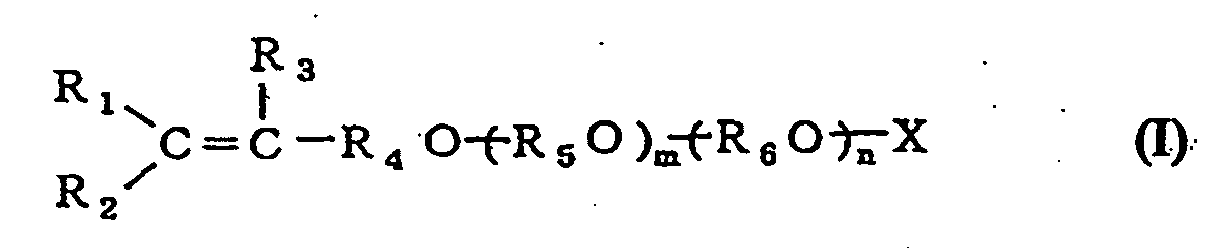
- The aforementioned (meth)acryl-based polymer used in the present invention is not particularly limited as far as it is a (meth)acryl-based polymer having pressure-sensitive adhering property corresponding to the aforementioned property.
- In the reactive surfactant shown by the above-mentioned formula (I), R4 is preferable to be an alkylene group of 0 to 10 in carbon number, and especially preferable to be an alkylene group of 0 to 4 in carbon number. Further, the case of 0 in carbon number means that there is no R4.
- Alkylene groups of 1 to 4 in carbon number include the methylene group, the ethylene group, the 1,2-propylene group, the 1,3-propylene group, the dimethyl methylene group, the 1,2-butylene group, the 2,3-butylene group, the 1,3-butylene group, the 1,4-butylene group, and the isobutylene group.
- In the reactive surfactants shown by the above-mentioned formula (I), R5 is preferable to be an alkylene group of 2 to 20 in carbon number, and especially preferable to be an alkylene group of 3 to 18 in carbon number or an alkoxy methyl ethylene group shown by the following formula (II).

- An alkylene group of 3 to 18 in carbon number includes, for example, the 1,2-propylene group, the 1,3-propylene group, the 1,2-butylene group, the 2,3-butylene group, the 1,3-butylene group, the 1,4-butylene group, the isobutylene group, the pentylene group, the hexylene group, the heptylene group, the octylene group, the nonylene group, the decylene group, the dodecylene group, the tetradecylene group, the hexadecylene group, and the octadecylene group.
- An alkyl group of 1 to 18 in carbon number includes, for example, the methyl group, the ethyl group, the propyl group, the 2-methyl propyl group, the n-butyl group, the s-butyl group, the t-butyl group, the isobutyl group, the pentyl group, the 3-methyl pentyl group, the hexyl group, the 2-ethyl hexyl group, the heptyl group, the octyl group, the nonyl group, the decyl group, the tetradecyl group, the hexadecyl group, and the octadecyl group.
- In the reactive surfactants shown by the above-mentioned formula (I), R6 is preferable to be an alkylene group of 1 to 4 in carbon number, and especially preferable to be the ethylene group of 2 in carbon number.
- In the reactive surfactants shown by the above-mentioned formula (I), m pieces of (R5O) groups and n pieces of (R6O) groups may be any bonding form of block bonding, random bonding, and the like, respectively, and further may be the bonding form of combining block bonding and random bonding. Moreover, in case of block bonding, the order of arranging the (R5O) groups and the (R6O) groups may be any order. Further, m pieces of (R5O) groups may be the same or different, and in cases where (R5O) groups are different, any bonding form of block bonding, random bonding, and further of combining block bonding and random bonding can be acceptable.
- The symbol of m indicates the average number of moles added of an oxyalkylene group or an alkoxymethyl oxyethylene group, showing the number of 0 to 50 (may not be an integer), and m is preferable to be in the range of 0 to 40, and especially preferable to be in the range of 0 to 20.
- The symbol of n indicates the average number of moles added of an oxyalkylene group, showing the number of 0 to 100 (may not be an integer), and n is preferable to be in the range of 1 to 70, and especially preferable to be in the range of 5 to 50.
- Moreover, m and n are not 0 at the same time, and m + n is the number of 1 to 150 (may not be an integer).
- In the reactive surfactants shown by the above-mentioned formula (I), X indicates hydrogen or an anionic hydrophilic group.
- Anionic hydrophilic groups include, for example, those shown by the following formula (III) or (IV).
-SO3M1 (III)
[M1 in the formula (III) indicates any of hydrogen, alkali metals, alkaline earth metals, the ammonium group, and alkanol ammonium groups.]
- Specific examples of the above-mentioned reactive surfactants include, for example, Latemul PD-104 (manufactured by Kao Corp.), Latemul PD-420 (manufactured by Kao Corp.), Latemul PD-430 (manufactured by Kao Corp.), and Latemul PD-450 (manufactured by Kao Corp.).
- Although reactive surfactants may be used separately and may be used in the mixture of two or more kinds, the amount of them is preferable to be 0.01 to 20 % by weight in the total monomer components of (meth)acryl polymers, more preferable to be 0.05 to 10% by weight, and especially preferable to be 0.1 to 5% by weight. When the content of the reactive surfactant is less than 0.01 % by weight, it is not preferable because the effect of inhibiting the ionic liquid bleeding and the effect of decreasing the staining of the subject to be protected in the present invention cannot be obtained sufficiently. On the other hand, when the content is over 20% by weight, it is not preferable because the effect of inhibiting the ionic liquid bleeding becomes high and the antistatic effect is decreased.
- Futhermore, in the present invention, in addition to the aforementioned reactive surfactant monomer component, (meth)acryl-based monomer components having an alkyl group of a carbon number of 1 to 14 and other polymerizable monomer components for regulating the glass transition temperature and the peeling properties of the (meth)acryl-based polymer can be utilized.
- Specific examples of (meth)acrylate having an alkyl group of a carbon numberof 1 to 14 include methyl (meth)acrylate, ethyl (meth)acrylate, n-butyl (meth)acrylate, s-butyl (meth)acrylate, t-butyl (meth)acrylate, isobutyl (meth)acrylate, hexyl (meth)acrylate, 2-ethylhexyl (meth)acrylate, n-octyl (meth)acrylate, isooctyl (meth)acrylate, n-nonyl (meth)acrylate, isononyl (meth)acrylate, n-decyl (meth)acrylate, isodecyl (meth)acrylate, n-dodecyl (meth)acrylate, n-tridecyl (meth)acrylate, and n-tetradecyl (meth)acrylate, or the like.
- Among them, for applying to the surface protecting films, n-butyl (meth)acrylate, s-butyl (meth)acrylate, t-butyl (meth)acrylate, isobutyl (meth)acrylate, hexyl (meth)acrylate, 2-ethylhexyl (meth)acrylate, n-octyl (meth)acrylate, isooctyl (meth)acrylate, n-nonyl (meth)acrylate, isononyl (meth)acrylate, n-decyl (meth)acrylate, isodecyl (meth)acrylate or the like are preferable to use for the present invention.
- In the present invention, (meth)acryl-based monomers having an alkyl group of a carbon number of 1 to 14 may be used alone, or two or more kinds may be used by mixing, and a content as a whole is preferably 50 to 99.99% by weight, more preferably 60 to 99% by weight, particularly preferably 70 to 96% by weight in a monomer component of a (meth)acryl-based polymer. By using a (meth)acryl-based monomer having an alkyl group of a carbon number of 1 to 14, better interaction with an ionic liquid, and better adherability can be appropriately regulated.
- As other polymerizable monomer component other than aforementioned (meth)acryl-based monomer, a polymerizable monomer for regulating a glass transition point or peelability of a (meth)acryl-based polymer can be used in such a range that the effect of the present invention is not deteriorated.
- As other polymerizable monomer component, a cohesive strength or a heat resistance improving component such as a sulfonic acid group-containing monomer, a phosphoric acid group-containing monomer, a cyano group-containing monomer, vinyl esters, and an aromatic vinyl compound, and a component having a functional group working for improving an adhering force or for a crosslinking point, such as a carboxyl group-containing monomer, an acid anhydride group-containing monomer, a hydroxyl group-containing monomer, an amido group-containing monomer, an amino group-containing monomer, an imido group-containing monomer, an epoxy group-containing monomer, vinyl ethers can be appropriately used. Other components may be used alone, or two or more of them may be used by mixing.
- Here, when (meth)acrylate having an acid functional group such as a carboxyl group, a sulfonic acid group, and a phosphoric acid group is used, it is preferable to adjust an acid value of a (meth)acryl-based polymer 29 or less. When an acid value of a (meth)acryl-based polymer exceeds 29, there is a tendency that antistatic property is deteriorated.
- An acid value can be adjusted by an amount of (meth)acrylate having an acid functional group to be blended, and examples thereof include a (meth)acryl-based polymer obtained by copolymerizing 2-ethylhexyl acrylate as a (meth)acryl-based polymer having a carboxyl group, and acrylic acid. In this case, by adjusting acrylic acid at 3.7 parts by weight relative to a total of 100 parts by weight of 2-ethylhexyl acrylate and acrylic acid, the aforementioned acid value can be satisfied.
- Examples of the sulfonic acid group-containing monomer include styrenesulfonic acid, allylsulfonic acid, 2-(meth)acrylamido-2-methylpropanesulfonic acid, (meth)acrylamidopropanesulfonic acid, sulfopropyl (meth)acrylate, (meth)acryloyloxynaphthalenesulfonic acid, and sodium vinylsulfonate.
- Examples of the phosphoric acid group-containing monomer include 2-hydroxyethylacryloyl phosphate.
- Examples of the cyano group-containing monomer include acrylonitrile and methacrylonitrile.
- Examples of vinylesters include vinyl acetate, vinyl propionate, and vinyl laurate.
- Examples of the aromatic vinyl compound include styrene, chlorostyrene, chloromethylstyrene, α-methylstyrene, and other substituted styrene.
- Examples of the carboxyl group-containing monomer include (meth)acrylic acid, carboxyethyl (meth)acrylate, carboxypentyl (meth)acrylate, itaconic acid, maleic acid, fumaric acid, crotonic acid, and isocrotonic acid.
- Examples of the acid anhydride group-containing monomer include maleic acid anhydride, itaconic acid anhydride, and an acid anhydride of the aforementioned carboxyl group-containing monomer.
- Examples of the hydroxyl group-containing monomer include 2-hydroxyethyl (meth)acrylate, 2-hydroxypropyl (meth)acrylate, 4-hydroxybutyl (meth)acrylate, 6-hydroxyhexyl (meth)acrylate, 8-hydroxyoctyl (meth)acrylate, 10-hydroxydecyl (meth)acrylate, 12-hydroxylauryl (meth)acrylate, (4-hydroxymethylcyclohexyl)methyl acrylate, N-methylol(meth)acrylamide, vinyl alcohol, allyl alcohol, 2-hydroxyethyl vinyl ether, 4-hydroxybutylvinyl ether, and diethylene glycol monovinyl ether.
- Examples of the amido group-containing monomer include acrylamide, methacrylamide, diethylacrylamide, N-vinylpyrrolidone, N, N-dimethylacrylamide, N, N-dimethylmethacrylamide, N, N-diethylacrylamide, N, N-diethylmethacrylamide, N, N'-methylenebisacrylamide, N, N-dimethylaminopropylacrylamide, N, N-dimethylaminopropylmethacrylamide, and diacetoneacrylamide.
- Examples of the amino group-containing monomer include aminoethyl (meth)acrylate, N, N-dimethylaminoethyl (meth)acrylate, N, N-dimethylaminopropyl (meth)acrylate, and (meth)acryloylmorpholine.
- Examples of the imido group-containing monomer include cyclohexylmaleimide, isopropylmaleimide, N-cyclohexylmaleimide, and itaconeimide.
- Examples of the epoxy group-containing monomer include glycidyl (meth)acrylate, methylglycidyl (meth)acrylate, and allyl glycidyl ether.
- Examples of vinyl ethers include methyl vinyl ether, ethyl vinyl ether, and isobutyl vinyl ether.
- The aforementioned other polymerizable monomer component may be used alone, or two or more kinds may be used by mixing, and a content as a whole is such that a polymerizable monomer component is preferably 0 to 49.99 parts by weight, more preferably 0.5 to 40 parts by weight, particularly preferably 1 to 20 parts by weight relative to 100 parts by weight of a total constituting unit of a (meth)acryl-based polymer. By using the aforementioned other polymerizable monomer component, better interaction with an ionic liquid, and better adherability can be appropriately regulated.
- The aforementioned (meth)acryl-based polymer used in the present invention has a weight average molecular weight of preferably 100,000 to 5,000,000, more preferably 200,000 to 4,000,000, further preferably 300,000 to 3,000,000. When a weight average molecular weight is less than 100,000, there is a tendency that paste (adhesive residue) remaining is generated due to reduction in a cohesive strength of a pressure-sensitive adhesive composition. On the other hand, when a weight average molecular weight exceeds 5,000,000, there is a tendency that fluidity of a polymer is reduced, wetting on a polarizing plate becomes insufficient, and there is a tendency that this is a cause for peeling off which is generated between a polarizing plate and a pressure-sensitive adhesive composition layer of a surface protecting film. A weight average molecular weight is obtained by measurement with GPC (gel permeation chromatography).
- In addition, the aforementioned (meth)acryl-based polymer of which the glass transition temperature (Tg) of is no lower than -100°C is generally used, and it is preferable for the glass transition temperature to be -90°C to 0°C, and it is more preferable for it to be -80°C to -10°C. When a glass transition temperature is higher than 0°C, it becomes difficult to obtain a sufficient adhering property and tends to be a cause for peeling off which is generated between a polarizing plate and a pressure-sensitive adhesive composition layer of a pressure-sensitive adhesive sheet. Futhermore, a glass transition temperature (Tg) of a (meth)acryl-based polymer can be adjusted in the aforementioned range by appropriating changing a monomer component and a composition ratio to be used.
- The aforementioned (meth)acryl-based polymer of the present invention is obtained by a polymerization method which is generally used as a procedure for synthesizing a (meth)acryl-based polymer such as solution polymerization, emulsion polymerization, bulk polymerization and suspension polymerization. In addition, the resulting polymer may be any of a random copolymer, a block copolymer, and a graft copolymer.
- In the pressure-sensitive adhesive composition of the present invention, pressure-sensitive adhesive sheets further excellent in heat resistance are obtained by appropriately crosslinking a base polymer, in particular, a (meth)acryl-based polymer. Examples of a specific means for a crosslinking method include a so-called method of using a crosslinking agent, in which a compound having a group reactive with a carboxyl group, a hydroxyl group which is appropriately contained as a crosslinking basal point in a (meth)acrly-based polymer such as an isocyanate compound, an epoxy compound, a melamine-based resin and an aziridine compound is added to react them. Among them, from a viewpoint mainly of obtaining an appropriate cohesive strength, an isocyanate compound and an epoxy compound are particularly preferably used. These compounds may be used alone, or may be used by mixing two or more kinds of them.
- Among them, examples of the isocyanate compound include aromatic isocyanate such as tolylene diisocyanate, and xylene diisocyanate, alicyclic isocyanate such as isophorone diisocyanate and aliphatic isocyanate such as hexamethylene diisocyanate.
- More specific examples of the isocyanate compound include lower aliphatic polyisocyanates such as butylene diisocyanate, and hexamethylene diisocyanate, alicyclic isocyanates such as cyclopentylene diisocyanate, cyclohexylene diisocyanate, and isophorone diisocyanate, aromatic diisocyanates such as 2,4-tolylene diisocyanate, 4,4'-diphenylmethane diisocyanate, and xylene diisocyanate, and isocyanate adducts such as trimethylolpropane/tolylene diisocyanate trimer adduct (trade name: Coronate L manufactured by Nippon Polyurethane Industry Co., Ltd.), trimethylolpropane/hexamethylene diisocyanate trimer adduct (trade name: Coronate HL manufactured by Nippon Polyurethane Industry Co., Ltd.), and isocyanurate of hexamethylene diisocyanate (trade name: Coronate HX manufactured by Nippon Polyurethane Industry Co., Ltd.). These isocyanate compounds may be used alone, or may be used by mixing two or kinds of them.
- Examples of the epoxy compound include
N,N,N',N'-tetraglycidyl-m-xylenediamine (trade name TETRAD-X manufactured by Mitsubishi Gas Chemical Company, Inc.) and
1,3-bis(N,N-diglycidylaminomethyl)cyclohexane (trade name TETRAD-C manufactured by Mitsubishi Gas Chemical Company Inc.). These compounds may be used alone, or may be used by mixing two or more kinds. - Examples of the melamine-based resin include hexamethylolmelamine.
- Examples of the aziridine derivative include trade name HDU, trade name TAZM, and trade name TAZO (all manufactured by Sogo Pharmaceutical Co., Ltd.) as a commercially available product. These compounds may be used alone, or may be used by mixing two or more kinds.
- An amount of these crosslinking agents to be used depends on balance between a (meth)acryl-based polymer to be crosslinked, and is appropriately selected depending on utility as a pressure-sensitive adhesive sheet. In order to obtain sufficient heat resistance due to a cohesive strength of an acryl pressure-sensitive adhesive, generally, the crosslinking agent is contained preferably at 0.01 to 15 parts by weight, more preferably 0.5 to 10 parts by weight relative to 100 parts by weight of the (meth)acryl-based polymer. When a content is less than 0.01 part by weight, crosslinking formation due to a crosslinking agent becomes insufficient, a cohesive strength of a pressure-sensitive adhesive composition becomes small, and sufficient heat resistance is not obtained in some cases, and there is a tendency that it becomes cause for an adhesive residue. On the other hand, when a content exceeds 15 parts by weight, a cohesive strength of a polymer is great, fluidlity is reduced, and wetting on an adherend becomes insufficient, and there is a tendency that this becomes cause for peeling off.
- Alternatively, a polyfunctional monomer containing two or more radiation-reactive unsaturated bonds as a substantial crosslinking agent is added, and this may be crosslinked with radiation.
- As the polyfunctional monomer having two or more radiation-reactive unsaturated bonds, a polyfunctional monomer component having two or more of one kind or two or more kinds radiation-reactive groups which can be crosslinking-treated (cured) by irradiation of radiation, such as a vinyl group, an acryloyl group, a methacryloyl group, and a vinylbenzyl group is used. Generally, a component having 10 or less of radiation-reactive unsaturated bonds is suitably used. Two or more kinds of the polyfunctional monomer may be used by mixing.
- Examples of the polyfunctinal monomer include ethylene glycol di(meth)acrylate, diethlene glycol di(meth)acrylate, tetraethylene glycol di(meth)acrylate, neopentyl glycol di(meth)acrylate, 1,6-hexanediol di(meth)acrylate, trimethylolpropane tri(meth)acrylate, pentaerythritol tri(meth)acrylate, dipentaerythritol hexa(meth)acrylate, divinylbenzene, and N,N'-methylenebisacrylamide.
- An amount of the polyfunctinoal monomer to be used depends on balance between a (meth)acryl-based polymer to be crosslinked, and is appropriately selected depending on utility as a pressure-sensitive adhesive sheet. In order to obtain sufficient heat resistance due to a cohesive strength of an acryl pressure-sensitive adhesive, generally, the monomer is preferably blended at 0.1 to 30 parts by weight relative to 100 parts by weight of a (meth)acryl-based polymer. From a viewpoint of flexibility and tackiness, the monomer is preferably blended at 10 parts by weight or less relative to 100 parts by weight of a (meth)acryl-based polymer.
- Examples of radiation include ultraviolet ray, laser ray, α ray, β ray, γ ray, X-ray, and electron beam. From a viewpoint of controlling property and better handling property and a cost, ultraviolet ray is suitably used. More preferably, ultraviolet ray having a wavelength of 200 to 400nm is used. Ultraviolet ray can be irradiated using an appropriate light source such as a high pressure mercury lamp, a micro-wave excitation-type lamp, and a chemical lamp. When ultraviolet ray is used as irradiation, a photopolymerization initiator is added to an acryl pressure-sensitive adhesive layer.
- The photopolymerization initiator depends on a kind of a radiation-reactive component, and may be a substance which produces a radical or a cation by irradiating ultraviolet ray having an appropriately wavelength which can trigger the polymerization reaction.
- Example of the photoradical polymerization initiator include benzoins such as benzoin, benzoin methyl ether, benzoin ethyl ether, methyl o-benzoylbenzoate-p-benzoin ethyl ether, benzoin isopropyl ether, and α-methylbenzoin, acetophenones such as benzylmethylketal, trichloroacetophenone, 2,2-diethoxyacetophenone, and 1-hydroxycyclohexyl phenyl ketone, propiophenones such as 2-hydroxy-2-methylpropiophenone, and 2-hydroxy-4'-isopropyl-2-methylpropiophenone, benzophenones such as benzophenone, methylbenzophenone, p-chlorobenzophenone, and p-dimethylaminobenzophenone, thioxanthons such as 2-chlorothioxanthon, 2-ethylthioxanthon, and 2-isopropylthioxanthon, acylphosphine oxides such as bis(2,4,6-trimethylbenzoyl)-phenylphosphine oxide, 2,4,6-trimethylbenzoyldiphenylphosphine oxide, and (2,4,6-trimethylbenzoyl)-(ethoxy)-phenylphosphine oxide, benzil, dibenzsuberone, and α-acyloxime ether.
- Examples of a photocation polymerization initiator include onium salts such as an aromatic diazonium salt, an aromatic iodonium salt, and an aromatic sulfonium salt, organometallic complexes such as an ion-allene complex. a titanocene complex, and an aryl silanol-aluminum complex, nitrobenzyl ester, sulfonic acid derivative, phosphoric acid ester, phenolsulfonic acid ester, diazonaphthoquinone, and N-hydroxymidosulfonate. Two or more kinds of the photopolymerization initiators may be used by mixing.
- It is preferably that the photopolymerization initiator is blended usually in a range of 0.1 to 10 parts by weight, preferably 0.2 to 7 parts by weight relative to 100 parts by weight of a (meth)acryl-based polymer.
- Further, it is also possible to use a photoinitiation polymerization assistant such as amines. Examples of the photoinitiation assistant include 2-dimethylaminoethyl benzoate, diemethylaminoacetophenone, p-dimethylaminobenzoic acid ethyl ester, and p-dimethylaminobenzoic acid isoamyl ester. Two or more kinds of the photopolymerization initiation assistants may be used. It is preferably that the polymerization initiation assistant is blended at 0.05 to 10 parts by weight, further 0.1 to 7 parts by weight relative to 100 parts by weight a (meth)acryl-based polymer.
- Further, the previously known tackifiers, or the previously known various additives such as a leveling agent, an antioxidant, a corrosion preventing agent, a photo stabilizer, an ultraviolet absorbing agent, a polymerization inhibitor, a silane coupling agent, and a powder, a particle, and a foil of inorganic or organic filer, metal powder and pigment may be appropriately added to the pressure-sensitive adhesive composition used in the pressure-sensitive adhesive sheet of the present invention depending on utility.
- A pressure-sensitive adhesive composition of the present invention can suitably contain an ether group-containing compound. The pressure-sensitive adhesive composition may become a pressure-sensitive adhesive composition further excellent in antistatic property by containing the above-mentioned ether group-containing compound. Although it is not clear that the reason why the antistatic property is improved by the use of an ether group-containing compound, through using together an ether group-containing compound improves the wettability to nonpolar materials such as a fluoro resin and the transfer of an ionic liquid to an adherend can be carried out effectively.
- The ether group-containing compounds in the present invention are not particularly limited as long as they contain an ether group, and well-known an ether group-containing compounds can be used.
- As the above-mentioned ether group-containing compounds, in specific terms, for example, polyether polyol compounds, compounds containing an alkylene oxide group, and the like can be listed. Among them, polyether polyol compounds, (meth)acryl-based polymers containing an alkylene glycol group, and ether type surfactants such as polyoxyalkylene alkylphenyl ethers, polyoxyalkylene alkyl ethers, and polyoxyalkylene alkylallyl ethers are preferably used because they are easily well-balanced in compatibility with the base polymer.
- Polyether polyol compounds include, for example, polyethylene glycol, polypropylene glycol (a diol type), polypropylene glycol (a triol type), polytetramethylene ether glycol, derivatives of the above-mentioned compounds, and random copolymers and block copolymers of polyethylene glycol and polypropylene glycol such as block copolymers of polypropylene glycol-polyethylene glycol-polypropylene glycol, block copolymers of polypropylene glycol-polyethylene glycol, block copolymers of polyethylene glycol-polypropylene glycol-polyethylene glycol, and random copolymers of polypropylene glycol-polyethylene glycol.
- Further, the terminal of the glycol chain may be the hydroxyl group as it is, or may be substituted with an alkyl group, a phenyl group, and the like.
- As (meth)acryl-based polymers containing an alkylene glycol group, (meth)acryl-based polymers, the essential component of which is a (meth)acrylate containing an alkylene glycol group, are used.
- As oxyalkylene units to the above-mentioned (meth)acrylates, those having an alkylene group of 1 to 6 in carbon number, for example, oxymethylene groups, oxyethylene groups, oxypropylene groups, oxybutylene groups and the like can be listed.
- Moreover, the number of moles added of an oxyalkylene unit to (meth)acrylates is preferable to be 1 to 50 and more preferable to be 2 to 30, from the viewpoint of the coordination of an ionic liquid.
- Further, the terminal of the oxyalkylene chain may be the hydroxyl group as it is, or may be substituted with an alkyl group, a phenyl group, and the like.
- (Meth)acrylates containing an alkylene glycol group include, for example, methoxy-polyethylene glycol (meth)acrylate types such as methoxy-diethylene glycol (meth)acrylates and methoxy-triethylene glycol (meth)acrylates, ethoxy-polyethylene glycol (meth)acrylate types such as ethoxy-diethylene glycol (meth)acrylates and ethoxy-triethylene glycol (meth)acrylates, butoxy-polyethylene glycol (meth)acrylate types such as butoxy-diethylene glycol (meth)acrylates and butoxy-triethylene glycol (meth)acrylates, phenoxy-polyethylene glycol (meth)acrylate types such as phenoxy-diethylene glycol (meth)acrylates and phenoxy-triethylene glycol (meth)acrylates, methoxy-polypropylene glycol (meth)acrylate types such as methoxy-dipropylene glycol (meth)acrylates, 2-ethylhexyl-polyethylene glycol (meth)acrylates, and nonylphenyl-polyethylene glycol (meth)acrylates.
- Moreover, besides the above-mentioned components, the following (meth)acrylates having an alkyl group of 1 to 14 in carbon number can also be used:
- methyl (meth)acrylates, ethyl (meth)acrylates, n-butyl (meth)acrylates, s-butyl (meth)acrylates, t-butyl (meth)acrylates, isobutyl (meth)acrylates, hexyl (meth)acrylates, 2-ethylhexyl (meth)acrylates, n-octyl (meth)acrylates, iso-octyl (meth)acrylates, n-nonyl (meth)acrylates, iso-nonyl (meth)acrylates, n-decyl (meth)acrylates, iso-decyl (meth)acrylates, n-dodecyl (meth)acrylates, n-tridecyl (meth)acrylates, and n-tetradecyl (meth)acrylates.
- Furthermore, it is also possible to suitably use such compounds as (meth)acrylates containing a phosphate group, (meth)acrylates containing a cyano group, vinyl esters, aromatic vinyl compounds, (meth)acrylates containing an acid anhydride group, (meth)acrylates containing a hydroxyl group, (meth)acrylates containing an amide group, (meth)acrylates containing an amino group, (meth)acrylates containing an imide group, (meth)acrylates containing an epoxy group, N-acryloyl morpholine, and vinyl ethers.
- Examples of the phosphoric acid group-containing monomer include 2-hydroxyethylacryloyl phosphate.
- Examples of the cyano group-containing monomer include acrylonitrile and methacrylonitrile.
- Examples of vinylesters include vinyl acetate, vinyl propionate, and vinyl laurate.
- Examples of the aromatic vinyl compound include styrene, chlorostyrene, chloromethylstyrene, α-methylstyrene, and other substituted styrene.
- Examples of the carboxyl group-containing monomer include (meth)acrylic acid, carboxyethyl (meth)acrylate, carboxypentyl (meth)acrylate, itaconic acid, maleic acid, fumaric acid, crotonic acid, and isocrotonic acid.
- Examples of the acid anhydride group-containing monomer include maleic acid anhydride, itaconic acid anhydride, and an acid anhydride of the aforementioned carboxyl group-containing monomer.
- Examples of the hydroxyl group-containing monomer include 2-hydroxyethyl (meth)acrylate, 2-hydroxypropyl (meth)acrylate, 4-hydroxybutyl (meth)acrylate, 6-hydroxyhexyl (meth)acrylate, 8-hydroxyoctyl (meth)acrylate, 10-hydroxydecyl (meth)acrylate, 12-hydroxylauryl (meth)acrylate, (4-hydroxymethylcyclohexyl)methyl acrylate, N-methylol(meth)acrylamide, vinyl alcohol, allyl alcohol, 2-hydroxyethyl vinyl ether, 4-hydroxybutylvinyl ether, and diethylene glycol monovinyl ether.
- Examples of the amido group-containing monomer include acrylamide, methacrylamide, diethylacrylamide, N-vinylpyrrolidone, N, N-dimethylacrylamide, N, N-dimethylmethacrylamide, N, N-diethylacrylamide, N, N-diethylmethacrylamide, N, N'-methylenebisacrylamide, N, N-dimethylaminopropylacrylamide, N, N-dimethylaminopropylmethacrylamide, and diacetoneacrylamide.
- Examples of the amino group-containing monomer include aminoethyl (meth)acrylate, N, N-dimethylaminoethyl (meth)acrylate, N, N-dimethylaminopropyl (meth)acrylate, and (meth)acryloylmorpholine.
- Examples of the imido group-containing monomer include cyclohexylmaleimide, isopropylmaleimide, N-cyclohexylmaleimide, and itaconeimide.
- Examples of the epoxy group-containing monomer include glycidyl (meth)acrylate, methylglycidyl (meth)acrylate, and allyl glycidyl ether.
- Examples of vinyl ethers include methyl vinyl ether, ethyl vinyl ether, and isobutyl vinyl ether.
- The aforementioned (meth)acrylates may be used alone, or two or more kinds may be used by mixing, and a content as a whole is such that a (meth)acrylate containing an alkylene glycol group is preferably 10 to 70 parts by weight of a total constituting unit of a (meth)acryl-based polymer containing an alkylene glycol group. When the content of the (meth)acrylate containing an alkylene glycol group is less than 10% by weight, it is not preferable because the compatibility with the ionic liquid deteriorates and the electrification property cannot be obtained sufficiently. On the other hand, when the content of the (meth)acrylate containing an alkylene glycol group is over 70% by weight, it is not preferable because the compatibility with the (meth)acryl-based polymer deteriorates and the electrification property cannot be obtained sufficiently.
- Ether type surfactants include, for example, nonionic surfactants such as polyoxyalkylene fatty acid esters, polyoxyalkylene sorbitan fatty acid esters, polyoxyalkylene sorbitol fatty acid esters, polyoxyalkylene alkyl ethers, polyoxyalkylene alkylallyl ethers, polyoxyalkylene alkylphenyl ethers, polyoxyalkylene derivatives, polyoxyalkylene alkylamines, and polyoxyalkylene alkylamine fatty acid esters, anionic surfactants such as polyoxyalkylene alkylether sulfate esters, polyoxyalkylene alkylether phosphate esters, polyoxyalkylene alkylphenylether sulphate esters, and polyoxyalkylene alkylphenylether phosphate esters, cationic surfactants having an alkylene oxide group, and amphoteric surfactants. These ether type surfactants may have a reactive substituent such as an (meth)acryloyl group and an allyl group in the molecule.
- Among the above-mentioned ether type surfactants, the following surfactants are preferably used: nonionic surfactants having an ethylene oxide group such as polyoxyethylene fatty acid esters, polyoxyethylene sorbitan fatty acid esters, polyoxyethylene sorbitol fatty acid esters, polyoxyethylene alkyl ethers, polyoxyethylene alkylallyl ethers, polyoxyethylene alkylphenyl ethers, polyoxyethylene derivatives, polyoxyethylene alkylamines, and polyoxyethylene alkylamine fatty acid esters, anionic surfactants having an ethylene oxide group such as polyoxyethylene alkylether sulfate esters, polyoxyethylene alkylether phosphate esters, polyoxyethylene alkylphenylether sulphate esters, and polyoxyethylene alkylphenylether phosphate esters, cationic surfactants having an ethylene oxide group, and amphoteric surfactants. These ether type surfactants may have a reactive substituent such as an (meth)acryloyl group and an allyl group in the molecule.
- The number of moles added of the oxyalkylene unit in the surfactants having the above-mentioned alkylene oxide groups is preferable to be 1 to 50 and more preferable to be 2 to 40, from the viewpoint of the interaction with the ionic liquid. When the number of moles added of the oxyalkylene unit is less than 1, it is not preferable because the oxyalkylene unit is hard to be balanced in compatibility with the ionic liquid and the base polymer and the bleeding to the adherend is apt to increase. On the other hand, when the number of moles added of the oxyalkylene unit is more than 50, it is also not preferable because the ionic liquid is restrained by the alkylene oxide group and the antistatic property is apt to be decreased.
- Specific examples of ether type surfactants include, for example, ADEKA REASOAP NE-10, ADEKA REASOAP SE-10N, ADEKA REASOAP SE-20N, ADEKA REASOAP ER-10, ADEKA REASOAP SR-10, and ADEKA REASOAP SR-20 (all mentioned above are manufactured by Asahi Denka Co., Ltd.), Emulgen 120 (manufactured by Kao Corp.), and Noigen EA130T (manufactured by Dai-ichi Kogyo Seiyaku Co., Ltd.).
- As for the molecular weight of the above-mentioned ether group-containing compound s of 10,000 or less in number average molecular weight are suitably used and those of 200 to 5000 are more suitably used. Compounds of more than 10,000 in number average molecular weight are apt to worsen their staining property to the adherend.
- Although the above-mentioned ether group-containing compounds may be used separately and may be used in the mixture of two or more kinds, the blending quantity is preferable to be 0.01 to 10 weight parts to 100 weight parts of the base polymer, and more preferable to be 0.05 to 5 weight parts. When the blending quantity is less than 0.01 weight parts, sufficient electrification property cannot be obtained, and when the quantity is more than 10 weight parts, the bleeding to the adherend is increased to tend to lower the adhesive strength.
- Meanwhile, the pressure-sensitive adhesive layer in the present invention is such that the aforementioned pressure-sensitive adhesive composition is crosslinked. In addition, pressure-sensitive adhesive sheets of the present invention are such that such the pressure-sensitive adhesive layer is formed on a supporting film. Thereupon, crossslinking of the pressure-sensitive adhesive composition is generally performed after coating of the pressure-sensitive adhesive composition, and a pressure-sensitive adhesive layer composition after crosslinking may be also transferred onto a supporting film.
- When a photopolymerization initiator as an arbitrary component is added as described above, a pressure-sensitive adhesive layer can be obtained by coating the pressure-sensitive adhesive composition directly on a subject to be protected, or coating on one side or both sides of a supporting substrate, and performing light irradiation. Usually, a pressure-sensitive adhesive layer is used by photopolymerization by irradiating with ultraviolet ray having an irradiance of 1 to 200mW/cm2 at a wavelength of 300 to 400nm, at an expose dose of around 200 to 4000mJ/cm2.
- A method of forming a pressure-sensitive adhesive layer on a film is not particularly limited, but for example, a layer is prepared by coating the aforementioned pressure-sensitive adhesive composition on a supporting film, and drying this to remove a polymerization solvent to form a pressure-sensitive adhesive layer on a supporting film. Thereafter, aging may be performed for the purpose of adjusting transference of a component of a pressure-sensitive adhesive layer or adjusting a crosslinking reaction. Alternatively, when pressure-sensitive adhesive sheets are prepared by coating a pressure-sensitive adhesive composition on a supporting film, one or more kinds of solvents other than a polymerization solvent may be newly added to the composition so that the composition can be uniformly coated on a supporting film.
- In addition, as a method of forming the pressure-sensitive adhesive layer of the present invention, the known method used for preparing pressure-sensitive adhesive sheets is used. Specifically, examples include roll coating, gravure coating, reverse coating, roll brushing, spray coating, and air knife coating methods, immersing and curtain coating method, and extruding coating method with a die coater.
- Pressure-sensitive adhesive sheets of the present invention are such that the aforementioned pressure-sensitive adhesive layer is coated on one side or both sides of various supports comprising a plastic film such as a polyester film, or a porous material such as a paper and a non-woven fabric at a thickness of usually 3 to 100 µm, preferably around 5 to 50µm, to form an aspect of a sheet or a tape. In particular, it is preferable to use a plastic substrate as a support in a case of a surface protecting film.
- The plastic substrate is not particularly limited as far as it can be formed into a sheet or a film, and examples include a polyolefin film such as polyethylene, polypropylene, poly-1-butene, poly-4-methyl-1-pentene, a polybutadiene film, a polymethylpentene film, an ethylene·propylene copolymer, an ethylene·1-butene copolymer, an ethylene·vinyl acetate copolymer, an ethylene·ethyl acrylate copolymer, and an ethylene·vinyl alcohol copolymer, a polyester film such as polyethylene terephthalate, polyethylene naphthalate, and polybutylene terephthalate, a polyacrylate film, a polyurethane film, a polystyrene film, a polyamide film such as nylon 6, nylon 6,6, and partially aromatic polyamide, a polyvinyl chloride film, a vinyl chloride copolymer film, a polyvinylidene chloride film, and a polycarbonate film.
- A thickness of the film is usually 5 to 200 µm, preferably around 10 to 100 µm.
- The plastic substrate may be subjected to releasing, anti-staining or acid treatment with silicone, fluorine, long chain alkyl-based or fatty acid amide-based releasing agent, or a silica powder, easy adhesion treatment such as alkali treatment, primer treatment, corona treatment, plasma treatment, and ultraviolet ray treatment, or coating-type, kneading-type, or deposition-type antistatic treatment, if necessary.
- In addition, it is more preferably that a plastic substrate used in the surface protecting film of the present invention is electrification preventing-treated.
- Antistatic treatment which is performed on a plastic substrate is not particularly limited, but for example, a method of providing an electrification preventing layer on at least one side of a generally used film, or a method of kneading a kneading-type electrification preventing agent into a plastic film is used.
- Examples of a method of providing an electrification preventing layer on at least one side of a film include a method of coating an electrification preventing resin comprising an electrification preventing agent and a resin component, or an electrically conductive resin containing an electrically conductive polymer or an electrically conductive substance, and a method of depositing or plating an electrically conductive substance.
- Examples of an electrification preventing agent contained in an electrification preventing resin include a cation-type electrification preventing agent having a cationic functional group such as a quaternary ammonium salt, a pyridinium salt, and a primary, secondary or tertiary amino group, an anion-type electrification preventing agent having an anionic functional group such as a sulfonic acid salt, a sulfuric acid ester salt, a phosphonic acid salt, and a phosphoric ester salt, an amphoteric-type electrification preventing agent such as alkylbetain and a derivative thereof, imidazoline and a derivative thereof, and alanine and a derivative thereof, a nonion-type electrification preventing agent such as glycerin and a derivative thereof, and polyethylene glycol and a derivative thereof, and an ionic electrically conductive polymer obtained by polymerizing or copolymerizing a monomer having the aforementioned cation-type, anion-type, or amphoteric-type ionic electrically conductive group. These compounds may be used alone, or two or more of them may be used by mixing.
- Specifically, examples of the cation-type electrification preventing agent include a (meth)acrylate copolymer having a quaternary ammonium group such as an alkyl trimethylammmonium salt, acyloylamidopropyltrimethtylammonium methosulfate, an alkylbenzylmethylammonium salt, acyl choline chloride, and polydimethylaminoethyl methacrylate, a styrene copolymer having a quaternary ammonium group such as polyvinylbenzyltrimethylammonium chloride, and a diallylamine copolymer having a quaternary ammonium group such as polydiallyldimethylammonium chloride. The compounds may be used alone, or two or more kinds may be used by mixing.
- Examples of the anion-type electrification preventing agent include an alkyl sulfonic acid salt, an alkylbenzenesulfonic acid salt, an alkyl sulfate ester salt, an alkyl ethoxy sulfate ester salt, an alkyl phosphate ester salt, and a sulfonic acid group-containing styrene copolymer. These compounds may be used alone, or two or more kinds may be used by mixing.
- Examples of the amphoteric-type electrification preventing agent include alkylbetain, alkylimidazoliumbetain, and carbobetaingrafted copolymer. These compounds may be used alone, or two or more kinds may be used by mixing.
- Examples of the nonion-type electrification preventing agent include fatty acid alkylolamide, di(2-hydroxyethyl)alkylamine, polyoxyethylenealkylamine, fatty acid glycerin ester, polyoxyethylene glycol fatty acid ester, sorbitan fatty acid ester, polyoxysorbitan fatty acid ester, polyoxyethylene alkyl phenyl ether, polyoxyethylene alkyl ether, polyethylene glycol, polyoxyethylenediamine, a copolymer consisting of polyether, polyester and polyamide, and methoxypolyethyleneglycol (meth)acrylate. These compounds may be used alone, or two or more kinds may be used by mixing.
- Examples of the electrically conductive polymer include polyaniline, polypyrrole and polythiophene. These electrically conductive polymers may be used alone, or two or more kinds may be used by mixing.
- Examples of the electrically conductive substance include tin oxide, antimony oxide, indium oxide, cadmium oxide, titanium oxide, zinc oxide, indium, tin, antimony, gold, silver, copper, aluminum, nickel, chromium, titanium, iron, covert, copper iodide, and an alloy and a mixture thereof. These electrically conductive substances may be used alone, or two or more kinds may be used by mixing.
- As a resin component used in the electrification preventing resin and the electrically conductive resin, a generally used resin such as polyester, acryl, polyvinyl, urethane, melamine and epoxy is used. In the case of a polymer-type electrification preventing agent, it is not necessary that a resin component is contained. In addition, the electrification preventing resin component may contain compounds of a methylolated or alkylolated melanine series, a urea series, a glyoxal series, and an acrylamide series, an epoxy compound, or an isocyanate compound as a crosslinking agent.
- An electrification preventing layer is formed, for example, by diluting the aforementioned electrification preventing resin, electrically conductive polymer or electrically conductive resin with a solvent such as an organic solvent and water, and coating this coating solution on a plastic film, followed by drying.
- Examples of an organic solvent used in formation of the electrification preventing layer include methyl ethyl ketone, acetone, ethyl acetate, tetrahydrofuran, dioxane, cyclohexanone, n-hexane, toluene, xylene, methanol, ethanol, n-propanol and isopropanol. These solvents may be used alone, or two or more kinds may be used by mixing.
- As a coating method in formation of the electrification preventing layer, the known coating method is appropriately used, and examples include roll coating, gravure coating, reverse coating, roll brushing, spray coating, and air knife coating methods, an immersing and curtain coating method, and an extrusion coating method with a die coater.
- A thickness of the aforementioned electrification preventing resin layer, electrically conductive polymer or electrically conductive resin is usually 0.01 to 5 µm, preferably around 0.03 to 1 µm.
- Examples of a method of depositing or plating an electrically conductive substance include vacuum deposition, sputtering, ion plating, chemical deposition, spray pyrolysis, chemical plating, and electric plating methods.
- A thickness of the electrically conductive substance is usually 20 to 10000Å, preferably 50 to 5000Å.
- As the kneading-type electrification preventing agent, the aforementioned electrification preventing agent is appropriately used.
- An amount of the kneading-type electrification preventing agent to be blended is 20% by weight or less, preferably in a range of 0.05 to 10% by weight relative to a total weight of a plastic film. A kneading method is not particularly limited as far as it is a method by which the electrification preventing agent can be uniformly mixed into a resin used in a plastic film, but for example, a heating roll, a Banbury mixer, a pressure kneader, and a biaxial kneading machine are used.
- The plastic film may be subjected to releasing, anti-staining or acid treatment with a silicone-based, fluorine-based, long chain alkyl-based or fatty acid amide-based releasing agent, or a silica powder, or easy adhesion treatment such as alkali treatment, primer treatment, corona treatment, plasma treatment, and ultraviolet treatment, if necessary.
- If necessary, a separator (or peeling liner, peeling sheet etc.) can be laminated on a surface of a pressure-sensitive adhesive for the purpose of protecting a pressure-sensitive adhesive surface. As a substrate constituting a separator, there are a paper and a plastic film, and a plastic film is suitably used from a viewpoint of excellent surface smoothness.
- The film is not particularly limited as far as it is a film which can protect the pressure-sensitive adhesive layer, and examples include a polyolefin film such as polyethylene, polypropylene, poly-1-butene, poly-4-methyl-1-pentene, an ethylene propylene copolymer, an ethylene- 1-butene copolymer, an ethylene-vinyl acetate copolymer, an ethylene-ethyl acrylate copolymer, and an ethylene vinyl alcohol copolymer, a polyether film such as polyethylene terephthalate, polyethylene naphthalate, and polybutylene terephthalate, a polyacrylate film, a polystyrene film, a polyamide film such as nylon 6, nylon 6,6, and partially aromatic polyamide, a polyvinyl chloride film, a poly vinylidene chloride film, and a polycarbonate film.
- A thickness of the film is usually around 5 to 200µm, preferably around 10 to 100µm. A pressure-sensitive adhesive layer applying surface of the film is appropriately subjected to treatment with a releasing agent such as a silicone-based, fluorine-based, long chain alkyl-based, or fatty acid amide-based releasing agent, or a silica powder.
- The pressure-sensitive adhesive composition, the pressure-sensitive adhesive layer and the pressure-sensitive adhesive sheets using the present invention are used, particularly, in plastic products on which static electricity is easily generated and, in particular, can be used as a surface protecting film used for the purpose of protecting an optical member surface such as a polarizing plate, a wavelength plate, an optical compensating film, a light diffusion sheet and a reflecting sheet which are used in a liquid crystal display.
- Examples which specifically show a construction and effect of the present invention will be explained below. Assessment items in Examples were measured as follows:
- An acid value was measured using an automatically titrating apparatus (COM-550 manufactured by HIRANUMA SANGYO Co., Ltd.), and was obtained by the following equation.

A; Acid value
Y; Titration amount of sample solution (ml)
X; Titration amount of solution of only 50g of mixed solvent (ml)
f; Factor of titration solution
M; Weight of polymer sample (g) - Measurement conditions are as follows:
- Sample solution: About 0.5g of a polymer sample was dissolved in 50g of a mixed solvent (toluene/2-propanol/distilled water= 50/49.5/0.5, weight ratio) to obtain a sample solution.
- Titration solution: 0.1N 2-propanolic potassium hydroxide solution (for petroleum product neutralization value test manufactured by Wako Pure Chemical Industries, Ltd.)
- Electrode: glass electrode; GE-101, comparative electrode; RE-201, Measurement mode: petroleum product neutralization value test 1
- A molecular weight was measured using a GPC apparatus (HLC-8220GPC manufactured by Tosoh Corporation). Measuring conditions are as follows.
Sample concentration: 0.2wt% (THF solution)
Sample injection amount: 10µl
Eluent: THF
Flow rate: 0.6ml/min
Measuring temperature: 40°C
Column:
Sample column;
TSKguard column SuperHZ-H(1 column)+TSK gel Super HZM-H(2 columns)
Reference column;
TSK gel SuperH-RC(1 column)
Detector: Refractive index detector (RI) - A molecular weight was obtained in terms of polystyrene.
- A glass transition temperature Tg(°C) of Acryl-based polymers was obtained by the following procedures using the measurement of a dynamic viscoelasticity.
- Sheets of an acryl-based polymer having a thickness of 25µm were laminated into a thickness of about 2mm, this was punched into φ7.9mm to prepare a cylindrical pellet, and this was used as a sample for measuring a glass transition temperature (Tg).
- Using the measuring sample, the measuring sample was fixed on a jig of a φ7.9mm parallel plate, temperature dependency of loss elastic modulus G" was measured with a dynamic viscoelasticity measuring apparatus (ARES manufactured by Rheometric Scientific, Inc.), and a temperature at which the resulting G" curve became a maximum was adopted as a glass transition temperature (Tg) (°C). Measuring conditions are as follows.
Measurement: shear mode
Temperature range: -70°C to 200°C
Temperature raising rate: 5°C/min
Frequency: 1Hz - In a four-neck flask equipped with a stirring blade, a thermometer, a nitrogen gas introduction pipe, a condenser, and a dropping funnel, 198 weight parts of 2-ethylhexyl acrylate, 2 weight parts of a reactive surfactant (Latemul PD-420 manufactured by Kao Corp.), 8 weight parts of 2-hydroxyethyl acrylate, 0.4 weight parts of 2,2'-azobisisobutyronitrile as a polymerization initiator, and 386 weight parts of ethyl acetate were put in. Then, nitrogen gas was introduced into the flask while slowly stirring the mixture and the polymerization reaction was carried out for 6 hours while keeping the liquid temperature in the flask at about 65°C, and an acryl-based polymer (A) solution (35% by weight) was thus prepared. As for this acryl-based polymer (A), Tg was -10°C or less, the weight average molecular weight was 450,000, and the acid value was 0.0.
- In a four-neck flask equipped with a stirring blade, a thermometer, a nitrogen gas introduction pipe, a condenser, and a dropping funnel, 198 weight parts of 2-ethylhexyl acrylate, 2 weight parts of a reactive surfactant (ADEKA REASOAP ER-10 manufactured by Asahi Denka Co., Ltd.), 8 weight parts of 2-hydroxyethyl acrylate, 0.4 weight parts of 2,2'-azobisisobutyronitrile as a polymerization initiator, and 386 weight parts of ethyl acetate were put in. Then, nitrogen gas was introduced into the flask while slowly stirring the mixture and the polymerization reaction was carried out for 6 hours while keeping the liquid temperature in the flask at about 65°C, and an acryl-based polymer (B) solution (35% by weight) was thus prepared. As for this acryl-based polymer (B), Tg was -10°C or less, the weight average molecular weight was 440,000, and the acid value was 0.0.
- In a four-neck flask equipped with a stirring blade, a thermometer, a nitrogen gas introduction pipe, a condenser, and a dropping funnel, 200 weight parts of 2-ethylhexyl acrylate, 8 weight parts of 2-hydroxyethyl acrylate, 0.4 weight parts of 2,2'-azobisisobutyronitrile as a polymerization initiator, and 312 weight parts of ethyl acetate were put in. Then, nitrogen gas was introduced into the flask while slowly stirring the mixture and the polymerization reaction was carried out for 6 hours while keeping the liquid temperature in the flask at about 65°C, and an acryl-based polymer (C) solution (40% by weight) was thus prepared. As for this acryl-based polymer (C), Tg was -10°C or less, the weight average molecular weight was 550,000, and the acid value was 0.0.
- In a four-neck flask equipped with a stirring blade, a thermometer, a nitrogen gas introduction pipe, a condenser, and a dropping funnel, 199 weight parts of 2-ethylhexyl acrylate, 1 weight part of a reactive surfactant (Latemul PD-420 manufactured by Kao Corp.), 8 weight parts of 2-hydroxyethyl acrylate, 0.4 weight parts of 2,2'-azobisisobutyronitrile as a polymerization initiator, and 386 weight parts of ethyl acetate were put in. Then, nitrogen gas was introduced into the flask while slowly stirring the mixture and the polymerization reaction was carried out for 6 hours while keeping the liquid temperature in the flask at about 65°C, and an acryl-based polymer (D) solution (35% by weight) was thus prepared. As for this acryl-based polymer (D), Tg was -10°C or less, the weight average molecular weight was 410,000, and the acid value was 0.0.
- In a four-neck flask equipped with a stirring blade, a thermometer, a nitrogen gas introduction pipe, a condenser, and a dropping funnel, 199 weight parts of 2-ethylhexyl acrylate, 1 weight part of a reactive surfactant (ADEKA REASOAP NE-10 manufactured by Asahi Denka Co., Ltd.), 8 weight parts of 2-hydroxyethyl acrylate, 0.4 weight parts of 2,2'-azobisisobutyronitrile as a polymerization initiator, and 386 weight parts of ethyl acetate were put in. Then, nitrogen gas was introduced into the flask while slowly stirring the mixture and the polymerization reaction was carried out for 6 hours while keeping the liquid temperature in the flask at about 65°C, and an acryl-based polymer (E) solution (35% by weight) was thus prepared. As for this acryl-based polymer (E), Tg was -10°C or less, the weight average molecular weight was 450,000, and the acid value was 0.0.
- In a four-neck flask equipped with a stirring blade, a thermometer, a nitrogen gas introduction pipe, a condenser, and a dropping funnel, 199.6 weight parts of 2-ethylhexyl acrylate, 0.4 weight parts of a reactive surfactant (Latemul PD-420 manufactured by Kao Corp.), 8 weight parts of 2-hydroxyethyl acrylate, 0.4 weight parts of 2,2'-azobisisobutyronitrile as a polymerization initiator, and 386 weight parts of ethyl acetate were put in. Then, nitrogen gas was introduced into the flask while slowly stirring the mixture and the polymerization reaction was carried out for 6 hours while keeping the liquid temperature in the flask at about 65°C, and an acryl-based polymer (F) solution (35% by weight) was thus prepared. As for this acryl-based polymer (F), Tg was -10°C or less, the weight average molecular weight was 450,000, and the acid value was 0.0.
- In a four-neck flask equipped with a stirring blade, a thermometer, a nitrogen gas introuction pipe, a condenser, and a dropping funnel, 199.4 weight parts of 2-ethylhexyl acrylate, 0.6 weight parts of a reactive surfactant (Latemul PD-430 manufactured by Kao Corp.), 8 weight parts of 2-hydroxyethyl acrylate, 0.4 weight parts of 2,2'-azobisisobutyronitrile as a polymerization initiator, and 386 weight parts of ethyl acetate were put in. Then, nitrogen gas was introduced into the flask while slowly stirring the mixture and the polymerization reaction was carried out for 6 hours while keeping the liquid temperature in the flask at about 61 °C, and an acryl-based polymer (G) solution (35% by weight) was thus prepared. As for this acryl-based polymer (G), Tg was -10°C or less, the weight average molecular weight was 510,000, and the acid value was 0.0.
- Ten weight parts of lauryltrimethylammonium chloride (in solid form at 25°C or less, manufactured by Tokyo Kasei Kogyo Co., Ltd.), which is a cationic surfactant, was diluted with 20 weight parts of ethyl acetate and 20 weight parts of isopropyl alcohol to prepare an antistatic agent solution (a) (20% by weight).
- Ten weight parts of an antistatic agent (Microsolver RMd-142 manufactured by Solvex Corp., which contains tin oxide and a polyester resin as main components) was diluted with a mixed solvent comprised of 30 weight parts of water and 70 weight parts of methanol to prepare an antistatic agent solution.
- The obtained antistatic agent solution was applied on a polyethylene terephthalate (PET) film (38 µm in thickness) with Mayer bar and then dried at 130°C for one minute to remove the solvent, resulting in forming an antistatic layer (0.2 µm in thickness). Thus, an antistatic-treated film was manufactured.
- The above-mentioned acryl-based polymer (A) solution (35% by weight) was diluted with ethyl acetate to 20% by weight. In 100 weight parts of this solution, 0.14 weight parts of an aliphatic amine-based ionic liquid (IL-A1 in a liquid state at 25°C, manufactured by Koei Chemical Co., Ltd.), 0.4 weight parts of an isocyanurate of hexamethylene diisocyanate (Coronate HX manufactured by Nippon Polyurethane Industry Co., Ltd.), and 0.4 weight parts of dibutyl tin dilaurate (1% by weight ethyl acetate solution) as a crosslinking catalyst were added and then, the mixture was mixed and stirred at 25°C or less for about one minute to prepare an acrylic pressure-sensitive adhesive solution (1).
- The above-mentioned acrylic pressure-sensitive adhesive solution (1) was applied on the surface opposite to the antistatic-treated surface of the above-mentioned antistatic-treated film and heated at 110°C for 3 minutes to form a pressure-sensitive adhesive layer of 20 µm in thickness. Then, the silicone-treated surface of a polyethylene terephthalate film that was 25 µm in thickness and silicone treatment had been performed on one side was stuck to the surface of the above-mentioned pressure-sensitive adhesive layer to manufacture a pressure-sensitive adhesive sheet.
- An acrylic pressure-sensitive adhesive solution (2) was prepared in the same method as Example 1, except that 0.12 weight parts of 1-butyl-3-methylpyridinium bis(trifluoromethanesulfonyl) imide (BMP-IL in a liquid state at 25°C, manufactured by Japan Carlit Co., Ltd.) was used in place of 0.14 weight parts of the above-mentioned aliphatic amine-based ionic liquid (IL-A1 in a liquid state at 25°C, manufactured by Koei Chemical Co., Ltd.).
- A pressure-sensitive adhesive sheet was manufactured in the same method as Example 1, except for using the above-mentioned acrylic pressure-sensitive adhesive solution (2) in place of the above-mentioned acrylic pressure-sensitive adhesive solution (1).
- The above-mentioned acryl-based polymer (D) solution (35% by weight) was diluted with ethyl acetate to 20% by weight. In 100 weight parts of this solution, 0.1 weight parts of an aliphatic amine-based ionic liquid (IL-A1 in a liquid state at 25°C, manufactured by Koei Chemical Co., Ltd.), 0.4 weight parts of an isocyanurate of hexamethylene diisocyanate (Coronate HX manufactured by Nippon Polyurethane Industry Co., Ltd.), and 0.4 weight parts of dibutyl tin dilaurate (1% by weight ethyl acetate solution) as a crosslinking catalyst were added and then, the mixture was mixed and stirred at 25°C or less for about one minute to prepare an acrylic pressure-sensitive adhesive solution (3).
- A pressure-sensitive adhesive sheet was manufactured in the same method as Example 1, except for using the above-mentioned acrylic pressure-sensitive adhesive solution (3) in place of the above-mentioned acrylic pressure-sensitive adhesive solution (1).
- An acrylic pressure-sensitive adhesive solution (4) was prepared in the same method as Example 3, except that 0.08 weight parts of 1-butyl-3-methylpyridinium bis(trifluoromethanesulfonyl) imide (BMP-IL in a liquid state at 25°C, manufactured by Japan Carlit Co., Ltd.) was used in place of 0.1 weight parts of the above-mentioned aliphatic amine-based ionic liquid (IL-A1 in a liquid state at 25°C, manufactured by Koei Chemical Co., Ltd.).
- A pressure-sensitive adhesive sheet was manufactured in the same method as Example 1, except for using the above-mentioned acrylic pressure-sensitive adhesive solution (4) in place of the above-mentioned acrylic pressure-sensitive adhesive solution (1).
- An acrylic pressure-sensitive adhesive solution (5) was prepared in the same method as Example 1, except for using the above-mentioned (meth)acryl-based polymer (B) (35% by weight) in place of the above-mentioned (meth)acryl-based polymer (A) (35% by weight).
- A pressure-sensitive adhesive sheet was manufactured in the same method as Example 1, except for using the above-mentioned acrylic pressure-sensitive adhesive solution (5) in place of the above-mentioned acrylic pressure-sensitive adhesive solution (1).
- An acrylic pressure-sensitive adhesive solution (6) was prepared in the same method as Example 1, except that the above-mentioned aliphatic amine-based ionic liquid was not used.
- A pressure-sensitive adhesive sheet was manufactured in the same method as Example 1, except for using the above-mentioned acrylic pressure-sensitive adhesive solution (6) in place of the above-mentioned acrylic pressure-sensitive adhesive solution (1).
- The above-mentioned acryl-based polymer (C) solution (40% by weight) was diluted with ethyl acetate to 20% by weight. In 100 weight parts of this solution, 1.0 weight part of the above-mentioned antistatic agent solution (a) (20% by weight), 0.4 weight parts of an isocyanurate of hexamethylene diisocyanate (Coronate HX manufactured by Nippon Polyurethane Industry Co., Ltd.), and 0.4 weight parts of dibutyl tin dilaurate (1% by weight ethyl acetate solution) as a crosslinking catalyst were added and then, the mixture was mixed and stirred at 25°C or less for about one minute to prepare an acrylic pressure-sensitive adhesive solution (7).
- A pressure-sensitive adhesive sheet was manufactured in the same method as Example 1, except for using the above-mentioned acrylic pressure-sensitive adhesive solution (7) in place of the above-mentioned acrylic pressure-sensitive adhesive solution (1).
- An acrylic pressure-sensitive adhesive solution (8) was prepared in the same method as Comparative example 1, except that 0.12 weight parts of 1-butyl-3-methylpyridinium bis(trifluoromethanesulfonyl) imide (BMP-IL in a liquid state at 25°C, manufactured by Japan Carlit Co., Ltd.) was used in place of 0.14 weight parts of the above-mentioned aliphatic amine-based ionic liquid (IL-A1 in a liquid state at 25°C, manufactured by Koei Chemical Co., Ltd.).
- A pressure-sensitive adhesive sheet was manufactured in the same method as Example 1, except for using the above-mentioned acrylic pressure-sensitive adhesive solution (8) in place of the above-mentioned acrylic pressure-sensitive adhesive solution (1).
- The above-mentioned acryl-based polymer (E) solution (35% by weight) was diluted with ethyl acetate to 20% by weight. In 100 weight parts of this solution, 0.1 weight parts of an aliphatic amine-based ionic liquid (IL-A1 in a liquid state at 25°C, manufactured by Koei Chemical Co., Ltd.), 0.4 weight parts of an isocyanurate of hexamethylene diisocyanate (Coronate HX manufactured by Nippon Polyurethane Industry Co., Ltd.), and 0.4 weight parts of dibutyl tin dilaurate (1% by weight ethyl acetate solution) as a crosslinking catalyst were added and then, the mixture was mixed and stirred at 25°C or less for about one minute to prepare an acrylic pressure-sensitive adhesive solution (9).
- A pressure-sensitive adhesive sheet was manufactured in the same method as Example 1, except for using the above-mentioned acrylic pressure-sensitive adhesive solution (9) in place of the above-mentioned acrylic pressure-sensitive adhesive solution (1).
- An acrylic pressure-sensitive adhesive solution (10) was prepared in the same method as Example 3, except that the above-mentioned aliphatic amine-based ionic liquid was not used.
- A pressure-sensitive adhesive sheet was manufactured in the same method as Example 1, except for using the above-mentioned acrylic pressure-sensitive adhesive solution (10) in place of the above-mentioned acrylic pressure-sensitive adhesive solution (1).
- An acrylic pressure-sensitive adhesive solution (11) was prepared in the same method as Comparative example 5, except that 0.08 weight parts of 1-butyl-3-methylpyridinium bis(trifluoromethanesulfonyl) imide (BMP-IL in a liquid state at 25°C, manufactured by Japan Carlit Co., Ltd.) was used in place of 0.1 weight parts of the above-mentioned aliphatic amine-based ionic liquid (IL-A1 in a liquid state at 25°C, manufactured by Koei Chemical Co., Ltd.).
- A pressure-sensitive adhesive sheet was manufactured in the same method as Example 1, except for using the above-mentioned acrylic pressure-sensitive adhesive solution (11) in place of the above-mentioned acrylic pressure-sensitive adhesive solution (1).
- An acrylic pressure-sensitive adhesive solution (12) was prepared in the same method as Example 4, except that 0.2 weight parts of 1-butyl-3-methylpyridinium bis(trifluoromethanesulfonyl) imide (BMP-IL in a liquid state at 25°C, manufactured by Japan Carlit Co., Ltd.) was used in place of 0.08 weight parts of the above-mentioned 1-butyl-3-methylpyridinium bis(trifluoromethanesulfonyl) imide (BMP-IL in a liquid state at 25°C, manufactured by Japan Carlit Co., Ltd.).
- A pressure-sensitive adhesive sheet was manufactured in the same method as Example 1, except for using the above-mentioned acrylic pressure-sensitive adhesive solution (12) in place of the above-mentioned acrylic pressure-sensitive adhesive solution (1).
- The above-mentioned acryl-based polymer (D) solution (35% by weight) was diluted with ethyl acetate to 20% by weight. In 100 weight parts of this solution, 0.18 weight parts of 1-butyl-3-methylpyridinium bis(trifluoromethanesulfonyl) imide (BMP-IL in a liquid state at 25°C, manufactured by Japan Carlit Co., Ltd.), 0.03 weight parts of methoxy polyethylene glycol monomethacrylate (Blemmer PME-400 manufactured by NOF Corporation), 0.7 weight parts of an isocyanurate of hexamethylene diisocyanate (Coronate HX manufactured by Nippon Polyurethane Industry Co., Ltd.), and 0.4 weight parts of dibutyl tin dilaurate (1% by weight ethyl acetate solution) as a crosslinking catalyst were added and then, the mixture was mixed and stirred at 25°C or less for about one minute to prepare an acrylic pressure-sensitive adhesive solution (13).
- A pressure-sensitive adhesive sheet was manufactured in the same method as Example 1, except for using the above-mentioned acrylic pressure-sensitive adhesive solution (13) in place of the above-mentioned acrylic pressure-sensitive adhesive solution (1).
- The above-mentioned acryl-based polymer (D) solution (35% by weight) was diluted with ethyl acetate to 20% by weight. In 100 weight parts of this solution, 0.18 weight parts of 1-butyl-3-methylpyridinium bis(trifluoromethanesulfonyl) imide (BMP-IL in a liquid state at 25°C, manufactured by Japan Carlit Co., Ltd.), 0.03 weight parts of methoxy polyethylene glycol monomethacrylate (Blemmer PME-1000 manufactured by NOF Corporation), 0.7 weight parts of an isocyanurate of hexamethylene diisocyanate (Coronate HX manufactured by Nippon Polyurethane Industry Co., Ltd.), and 0.4 weight parts of dibutyl tin dilaurate (1% by weight ethyl acetate solution) as a crosslinking catalyst were added and then, the mixture was mixed and stirred at 25°C or less for about one minute to prepare an acrylic pressure-sensitive adhesive solution (14).
- A pressure-sensitive adhesive sheet was manufactured in the same method as Example 1, except for using the above-mentioned acrylic pressure-sensitive adhesive solution (14) in place of the above-mentioned acrylic pressure-sensitive adhesive solution (1).
- The above-mentioned acryl-based polymer (F) solution (35% by weight) was diluted with ethyl acetate to 20% by weight. In 100 weight parts of this solution, 0.11 weight parts of 1-butyl-3-methylpyridinium bis(trifluoromethanesulfonyl) imide (BMP-IL in a liquid state at 25°C, manufactured by Japan Carlit Co., Ltd.), 0.48 weight parts of an isocyanurate of hexamethylene diisocyanate (Coronate HX manufactured by Nippon Polyurethane Industry Co., Ltd.), and 0.4 weight parts of dibutyl tin dilaurate (1% by weight ethyl acetate solution) as a crosslinking catalyst were added and then, the mixture was mixed and stirred at 25°C or less for about one minute to prepare an acrylic pressure-sensitive adhesive solution (15).
- A pressure-sensitive adhesive sheet was manufactured in the same method as Example 1, except for using the above-mentioned acrylic pressure-sensitive adhesive solution (15) in place of the above-mentioned acrylic pressure-sensitive adhesive solution (1).
- The above-mentioned acryl-based polymer (G) solution (35% by weight) was diluted with ethyl acetate to 20% by weight. In 100 weight parts of this solution, 0.08 weight parts of 1-butyl-3-methylpyridinium bis(trifluoromethanesulfonyl) imide (BMP-IL in a liquid state at 25°C, manufactured by Japan Carlit Co., Ltd.), 0.4 weight parts of an isocyanurate of hexamethylene diisocyanate (Coronate HX manufactured by Nippon Polyurethane Industry Co., Ltd.), and 0.4 weight parts of dibutyl tin dilaurate (1% by weight ethyl acetate solution) as a crosslinking catalyst were added and then, the mixture was mixed and stirred at 25°C or less for about one minute to prepare an acrylic pressure-sensitive adhesive solution (16).
- A pressure-sensitive adhesive sheet was manufactured in the same method as Example 1, except for using the above-mentioned acrylic pressure-sensitive adhesive solution (16) in place of the above-mentioned acrylic pressure-sensitive adhesive solution (1).
- The above-mentioned acryl-based polymer (D) solution (35% by weight) was diluted with ethyl acetate to 20% by weight. In 100 weight parts of this solution, 0.18 weight parts of 1-butyl-2,3,5-trimethylpyrazolium bis(trifluoromethanesulfonyl) imide (ILC-404-2 in a liquid state at 25°C, manufactured by Japan Carlit Co., Ltd.), 0.7 weight parts of an isocyanurate of hexamethylene diisocyanate (Coronate HX manufactured by Nippon Polyurethane Industry Co., Ltd.), and 0.4 weight parts of dibutyl tin dilaurate (1% by weight ethyl acetate solution) as a crosslinking catalyst were added and then, the mixture was mixed and stirred at 25°C or less for about one minute to prepare an acrylic pressure-sensitive adhesive solution (17).
- A pressure-sensitive adhesive sheet was manufactured in the same method as Example 1, except for using the above-mentioned acrylic pressure-sensitive adhesive solution (17) in place of the above-mentioned acrylic pressure-sensitive adhesive solution (1).
- An acrylic pressure-sensitive adhesive solution (18) was prepared in the same method as Example 3, except that 0.4 weight parts of the above-mentioned antistatic agent solution (a) (20% by weight) was used in place of 0.1 weight parts of the above-mentioned aliphatic amine-based ionic liquid (IL-A1 in a liquid state at 25°C, manufactured by Koei Chemical Co., Ltd.).
- A pressure-sensitive adhesive sheet was manufactured in the same method as Example 1, except for using the above-mentioned acrylic pressure-sensitive adhesive solution (18) in place of the above-mentioned acrylic pressure-sensitive adhesive solution (1).
- An acrylic pressure-sensitive adhesive solution (19) was prepared in the same method as Example 3, except that 1.0 weight part of the above-mentioned antistatic agent solution (a) (20% by weight) was used in place of 0.1 weight parts of the above-mentioned aliphatic amine-based ionic liquid (IL-A1 in a liquid state at 25°C, manufactured by Koei Chemical Co., Ltd.).
- A pressure-sensitive adhesive sheet was manufactured in the same method as Example 1, except for using the above-mentioned acrylic pressure-sensitive adhesive solution (19) in place of the above-mentioned acrylic pressure-sensitive adhesive solution (1).
- An acrylic pressure-sensitive adhesive solution (20) was prepared in the same method as Example 1, except that 0.6 weight parts of the above-mentioned antistatic agent solution (a) (20% by weight) was used in place of 0.14 weight parts of the above-mentioned aliphatic amine-based ionic liquid (IL-A1 in a liquid state at 25°C, manufactured by Koei Chemical Co., Ltd.).
- A pressure-sensitive adhesive sheet was manufactured in the same method as Example 1, except for using the above-mentioned acrylic pressure-sensitive adhesive solution (20) in place of the above-mentioned acrylic pressure-sensitive adhesive solution (1).
- About pressure-sensitive adhesive sheets obtained in the above-mentioned Examples and Comparative examples, peeling electrification voltage, peeling electrification voltage with time, staining property, and adhesive strength were evaluated in the following manner.
- A pressure-sensitive adhesive sheet was cut into a size of a width of 70 mm and a length of 130 mm, a separator was peeled, and this was adhered to a surface of a polarizing plate (SEG1425DU manufactured by Nitto Denko Corporation, width:70 mm, length: 100 mm) laminated to an acryl plate (Acrylite manufactured by Mitsubishi Rayon Co., Ltd, thickness: 1mm, width:70mm, length:100mm) from which electricity had been removed in advance, with a hand roller, so that one end was protruded by 30 mm.
- After allowed to stand for one day under the environment of 23 °Cx50 %RH, and a sample was set at a prescribed position as shown in
Fig.1 . One end protruding by 30 mm was fixed on an automatic winding machine, and a sample was peeled at a peeling angle of 150°and a peeling rate of 30 m/min. A voltage at a polarizing plate surface generated thereupon was measured with an electrostatic voltmeter (KSD-0103 manufactured by Kasuga Denki, INC.) fixed at a prescribed position. Measurement was performed under the environment of 20°Cx25 %RH. - A pressure-sensitive adhesive sheet was cut into a size of a width of 70 mm and a length of 130 mm, a separator was peeled, and this was adhered to a surface of a polarizing plate (SEG1425DU manufactured by Nitto Denko Corporation, width:70 mm, length: 100 mm) laminated to an acryl plate (Acrylite manufactured by Mitsubishi Rayon Co., Ltd, thickness: 1mm, width:70mm, length:100mm) from which electricity had been removed in advance, with a hand roller, so that one end was protruded by 30 mm.
- After allowed to stand for 14 days under the environment of 40°Cx25 %RH, and a sample was set at a prescribed position as shown in
Fig.1 . One end protruding by 30 mm was fixed on an automatic winding machine, and a sample was peeled at a peeling angle of 150°and a peeling rate of 30 m/min. A voltage at a polarizing plate surface generated thereupon was measured with an electrostatic voltmeter (KSD-0103 manufactured by Kasuga Denka, INC.) fixed at a prescribed position. Measurement was performed under the environment of 20°Cx25 %RH. - After the above-mentioned peeling electrification voltage was measured, the peeled pressure-sensitive adhesive sheet was stuck again by hand so that air bubbles would be immixed between the sheet and the polarizing plate after the measurement. An assessment sample was thus prepared.
- After this assessment sample was let alone in the environment of 23°C×50% RH for one month, the pressure-sensitive adhesive sheet was peeled off from the adherend by hand. At that time, the staining state in the surface of the adherend was observed visually. The assessment criteria are as follows:
- Case of observation of no staining: o
- Case of observation of staining: x
- A triacetylcellulose film (FujiTAC manufactured by Fuji Photo Film Co., Ltd., thickness: 90µm) was cut into size of a width of 70 mm and a length of 100 mm, this was immersed in an aqueous sodium hydroxide solution (10% by weight) at 60°C for 1 minute, and washed with distilled water to prepare an adherend.
- The adherend was allowed to stand for 24 hours under the environment of 23°Cx50 %RH, and a pressure-sensitive adhesive sheet which had been cut into a size of a width of 25 mm and a length of 100 mm was laminated on the adherend at a pressure of 0.25 MPa to prepare an assessment sample.
- After allowing to stand for 30 minutes under the environment of 23°Cx50 %RH after the lamination, an adhesive strength when peeled with a universal tensile testing machine at a peeling rate of 30 m/min and a peeling angle of 180° was measured. Measurement was performed under the environment of 23°Cx50 %RH.
- The results of the above are shown in Table 1.
Table 1 peeling electrification voltage [kV] peeling electrification voltage with time [kV] staining property [-] adhesive strength [N/25mm] Example 1 -0.1 -0.1 ○ 2.8 Example 2 -0.1 0.0 ○ 3.0 Example 3 -0.2 -0.3 ○ 2.7 Example 4 0.0 0.0 ○ 2.1 Example 5 0.0 0.0 ○ 2.5 Example 6 0.0 -0.2 ○ 2.1 Example 7 0.0 0.0 ○ 2.3 Example 8 -0.3 -0.3 ○ 1.6 Example 9 0.0 0.0 ○ 2.2 Example 10 -0.1 0.0 ○ 1.3 Comp. Ex. 1 -0.3 -0.7 ○ 2.8 Comp. Ex. 2 1.3 1.6 ○ 2.6 Comp. Ex. 3 0.0 0.0 × 0.5 Comp. Ex. 4 -0.3 -0.6 ○ 2.5 Comp. Ex. 5 -0.9 -1.4 ○ 2.5 Comp. Ex. 6 1.3 1.5 ○ 2.6 Comp. Ex. 7 -0.4 -1.2 ○ 2.5 Comp. Ex. 8 -1.0 0.0 × 0.8 Comp. Ex.9 0.0 0.0 × 0.4 Comp. Ex. 10 0.0 0.0 × 0.5 - From the results of the above-mentioned Table 1, when the pressure-sensitive adhesive compositions manufactured according to the present invention were used (Examples 1 to 10), it became clear that the peeling electrification voltage to the polarizing plate was controlled even with time and no staining was occurred on the polarizing plate in all Examples.
- On the other hand, when reactive surfactants different from those in the present invention were used (Comparative examples 1, 4, 5, and 7), in all cases, the peeling electrification voltage with time to the polarizing plate was higher compared to the results in Examples. Moreover, when pressure-sensitive adhesive compositions containing no ionic liquid were used (Comparative examples 2, and 6), in all cases, the peeling electrification voltage became high from the initial state. Further, when cationic surfactants were used as an antistatic agent (Comparative examples 3, 9, and 10), although the peeling electrification voltage to the polarizing plate was stably controlled even with time, the occurrence of staining was recognized. In addition, when the amount of a cationic surfactant added was reduced (Comparative example 8), the peeling electrification voltage in the initial stage was high and the occurrence of staining was also recognized. Therefore, in all Comparative examples, both of stably controlling the peeling electrification voltage with time to the polarizing plate that is an adherend and of controlling the occurrence of staining on the plate cannot be satisfied, it became clear that the pressure-sensitive adhesive compositions prepared in Comparative examples were not suitable for manufacturing an antistatic pressure-sensitive adhesive sheet.
- Moreover, all of pressure-sensitive adhesive sheets in Examples 1 to 10 of the present invention have adhesive strength in peeling at 180° in the range of 0.1 to 6 N/25mm and can be recognized to be applicable pressure-sensitive adhesive sheets as a pressure-sensitive adhesive sheet.
- An object of the present invention is to provide an antistatic pressure-sensitive adhesive composition which is excellent in antistatic property and antistatic property with time of a non-electrification-prevented adherend (subject to be protected) upon peeling, and has reduced stainability in an adherend and is excellent in adhesion reliance, and electrification preventing pressure-sensitive adhesive sheets using the same. There is provided a pressure-sensitive adhesive composition comprising an ionic liquid, and a (meth)acryl-based polymer containing, as a monomer component, 0.01 to 20% by weight of a reactive surfactant shown by the following general formula (I) as a monomer unit.

Claims (7)
- A pressure-sensitive adhesive composition comprising an ionic liquid, and a (meth)acryl-based polymer containing, as a monomer component, 0.01 to 20% by weight of a reactive surfactant shown by the following general formula (I) as a monomer unit.
 [in the formula (I), R1, R2, and R3 indicate likewise or differently hydrogen or the methyl group, R4 indicates an alkylene group of 0 to 30 in carbon number (further, 0 in carbon number means that there is no R4), R5 and R6 indicate likewise or differently alkylene groups of 1 to 30 in carbon number, m indicates the number of 0 to 50 (may not be an integer), n indicates the number of 0 to 100 (may not be an integer), m + n indicates the number of 1 to 150 (may not be an integer), and X indicates hydrogen or an anionic hydrophilic group]
 - The pressure-sensitive adhesive composition according to claim 1, wherein the ionic liquid is at least one kind or more of a nitrogen-containing onium salt, a sulfur-containing onium salt, and a phosphorus-containing onium salt.
- The pressure-sensitive adhesive composition according to any one of claims 1 to 2, wherein the ionic liquid contains one or more kinds of cations represented by the following general formulas (A) to (D).
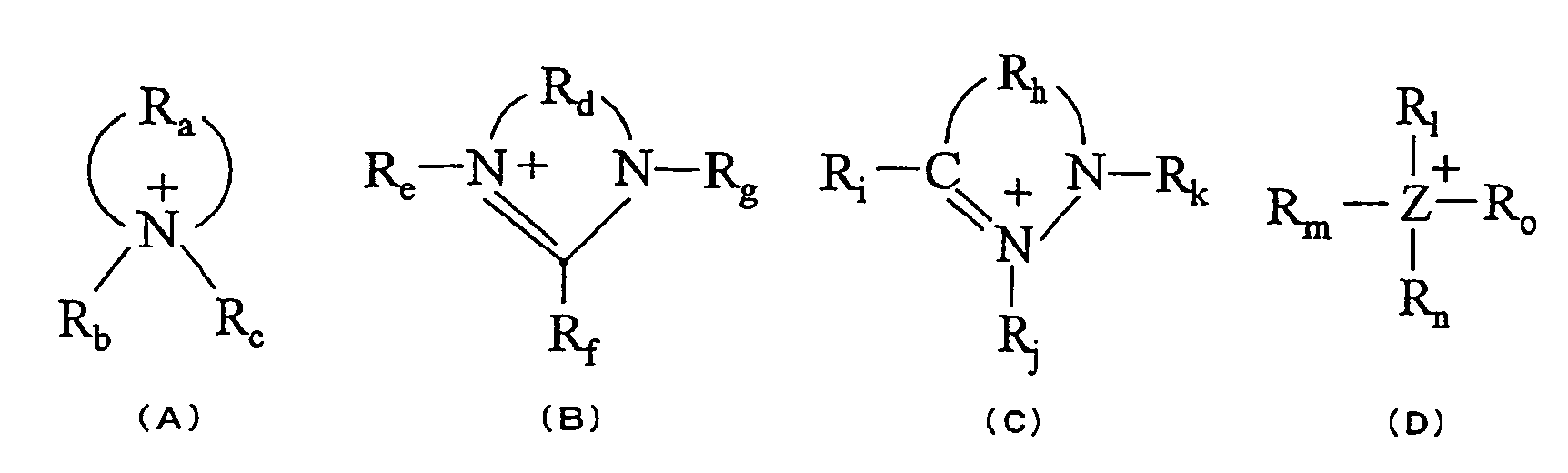 [in the formula (A), Ra represents a hydrocarbon group of a carbon number of 4 to 20, and may contain a hetero atom, and Rb and Rc are the same or different, represent hydrogen or a hydrocarbon group of a carbon number of 1 to 16, and may contain a hetero atom, provided that, when a nitrogen atom contains a double bond, Rc is not present][in the formula (B), Rd represents a hydrocarbon group of a carbon number of 2 to 20, and may contain a hetero atom, and Re, Rf and Rg are the same or different, represent hydrogen or a hydrocarbon group of a carbon number of 1 to 16, and may contain a hetero atom][in the formula (C), Rh represents a hydrocarbon group of a carbon number of 2 to 20, and may contain a hetero atom, and Ri, Rj and Rk are the same or different, represent a hydrogen or a hydrocarbon group of a carbon number of 1 to 16, and may contain a hetero atom][in the formula (D), Z represents a nitrogen atom, a sulfur atom, or a phosphorus atom, and Rl, Rm, Rn and Ro are the same or different, represent a hydrocarbon group of a carbon number of 1 to 20, and may contain a hetero atom, provided that, when Z is a sulfur atom, Ro is not present]
 - The pressure-sensitive adhesive composition according to any one of claims 1 to 3, wherein the pressure-sensitive adhesive composition contains an ether group-containing compound.
- A pressure-sensitive adhesive layer, wherein the pressure-sensitive adhesive composition as defined in any one of claims 1 to 4 is crosslinked.
- A pressure-sensitive adhesive sheet comprising a pressure-sensitive adhesive layer containing a pressure-sensitive adhesive composition as defined in any one of claims 1 to 4 on one side or both sides of a support.
- A surface protecting film comprising a pressure-sensitive adhesive layer, which is formed by crosslinking a pressure-sensitive adhesive composition as defined in any one of claims 1 to 4 on one side or both sides of a support which is provided with an antistatic-treated plastic film.
Applications Claiming Priority (2)
| Application Number | Priority Date | Filing Date | Title |
|---|---|---|---|
| JP2005074963 | 2005-03-16 | ||
| JP2006021035A JP4358190B2 (en) | 2005-03-16 | 2006-01-30 | Adhesive composition, adhesive sheet and surface protective film |
Publications (2)
| Publication Number | Publication Date |
|---|---|
| EP1702967A1 EP1702967A1 (en) | 2006-09-20 |
| EP1702967B1 true EP1702967B1 (en) | 2010-01-27 |
Family
ID=36570806
Family Applications (1)
| Application Number | Title | Priority Date | Filing Date |
|---|---|---|---|
| EP20060111107 Not-in-force EP1702967B1 (en) | 2005-03-16 | 2006-03-14 | Pressure-sensitive adhesive compositions, pressure-sensitive adhesive sheets and surface protecting films |
Country Status (8)
| Country | Link |
|---|---|
| US (1) | US8318859B2 (en) |
| EP (1) | EP1702967B1 (en) |
| JP (1) | JP4358190B2 (en) |
| KR (2) | KR100968502B1 (en) |
| CN (2) | CN101899273B (en) |
| AT (1) | ATE456641T1 (en) |
| DE (1) | DE602006011972D1 (en) |
| TW (1) | TW200643132A (en) |
Families Citing this family (42)
| Publication number | Priority date | Publication date | Assignee | Title |
|---|---|---|---|---|
| DE602005024071D1 (en) | 2004-03-08 | 2010-11-25 | Nitto Denko Corp | Pressure Sensitive Adhesive Composition, Pressure Sensitive Adhesive Sheet, and Surface Protection Film |
| TW200617124A (en) | 2004-06-01 | 2006-06-01 | Nitto Denko Corp | Pressure-sensitive adhesive composition, pressure-sensitive adhesive sheet and surface protecting film |
| TWI387629B (en) | 2004-07-26 | 2013-03-01 | Nitto Denko Corp | Pressure sensitive adhesive composition, pressure sensitive adhesive sheet and surface protective film |
| EP1884547B1 (en) * | 2005-05-20 | 2010-12-15 | Nitto Denko Corporation | Pressure sensitive adhesive composition, pressure sensitive adhesive sheet and surface protective film |
| WO2007029681A1 (en) * | 2005-09-05 | 2007-03-15 | Nitto Denko Corporation | Adhesive composition, adhesive sheet, and surface protective film |
| JP4799205B2 (en) * | 2006-02-16 | 2011-10-26 | 日東電工株式会社 | Active surface-attached dicing adhesive tape or sheet and method of picking up a workpiece cut piece |
| US7718036B2 (en) * | 2006-03-21 | 2010-05-18 | Georgia Pacific Consumer Products Lp | Absorbent sheet having regenerated cellulose microfiber network |
| US8187421B2 (en) | 2006-03-21 | 2012-05-29 | Georgia-Pacific Consumer Products Lp | Absorbent sheet incorporating regenerated cellulose microfiber |
| US8187422B2 (en) | 2006-03-21 | 2012-05-29 | Georgia-Pacific Consumer Products Lp | Disposable cellulosic wiper |
| US8540846B2 (en) | 2009-01-28 | 2013-09-24 | Georgia-Pacific Consumer Products Lp | Belt-creped, variable local basis weight multi-ply sheet with cellulose microfiber prepared with perforated polymeric belt |
| US8357734B2 (en) | 2006-11-02 | 2013-01-22 | Georgia-Pacific Consumer Products Lp | Creping adhesive with ionic liquid |
| US7998313B2 (en) * | 2006-12-07 | 2011-08-16 | Georgia-Pacific Consumer Products Lp | Inflated fibers of regenerated cellulose formed from ionic liquid/cellulose dope and related products |
| US7951264B2 (en) | 2007-01-19 | 2011-05-31 | Georgia-Pacific Consumer Products Lp | Absorbent cellulosic products with regenerated cellulose formed in-situ |
| KR101047925B1 (en) | 2007-04-19 | 2011-07-08 | 주식회사 엘지화학 | Acrylic pressure-sensitive adhesive composition and a polarizing plate comprising the same |
| CN101586010B (en) * | 2008-05-23 | 2011-05-11 | 北京京都大成化工有限公司 | Preparation method of dry composite crylic acid resin aqueous adhesive |
| CA2735867C (en) | 2008-09-16 | 2017-12-05 | Dixie Consumer Products Llc | Food wrap basesheet with regenerated cellulose microfiber |
| US8361632B2 (en) * | 2008-10-03 | 2013-01-29 | 3M Innovative Properties Company | Cloud point-resistant adhesives and laminates |
| US8361633B2 (en) | 2008-10-03 | 2013-01-29 | 3M Innovative Properties Company | Cloud point-resistant adhesives and laminates |
| US8794175B2 (en) * | 2008-12-03 | 2014-08-05 | The Regents Of The University Of Michigan | Rolling contact layer-by-layer assembly |
| JP5455362B2 (en) * | 2008-12-25 | 2014-03-26 | チェイル インダストリーズ インコーポレイテッド | Adhesive composition and optical member using the same |
| US8795783B2 (en) | 2009-08-31 | 2014-08-05 | The Regents Of The University Of Michigan | Preparation of layer-by-layer materials and coatings from ionic liquids |
| JP5577111B2 (en) * | 2010-02-23 | 2014-08-20 | 日東電工株式会社 | Antistatic laminate sheet |
| JP2011202161A (en) * | 2010-03-02 | 2011-10-13 | Nitto Denko Corp | Adhesive composition, adhesive sheet and surface protective film |
| JP5583001B2 (en) * | 2010-12-24 | 2014-09-03 | 綜研化学株式会社 | Adhesive composition for optical film and adhesive optical film |
| JP5588361B2 (en) * | 2011-01-06 | 2014-09-10 | 日東電工株式会社 | Surface protection sheet |
| KR101226218B1 (en) * | 2011-03-25 | 2013-01-28 | 삼성디스플레이 주식회사 | Display Apparatus and Method for Manufacturing the Same |
| JP5885286B2 (en) | 2011-03-29 | 2016-03-15 | 日東電工株式会社 | Adhesive sheet and use thereof |
| US9267240B2 (en) | 2011-07-28 | 2016-02-23 | Georgia-Pacific Products LP | High softness, high durability bath tissue incorporating high lignin eucalyptus fiber |
| US9309627B2 (en) | 2011-07-28 | 2016-04-12 | Georgia-Pacific Consumer Products Lp | High softness, high durability bath tissues with temporary wet strength |
| WO2013069907A1 (en) * | 2011-11-08 | 2013-05-16 | 주식회사 엘지화학 | Adhesive composition for an antistatic protective film, and production method therefor |
| JP2013229563A (en) * | 2012-03-26 | 2013-11-07 | Furukawa Electric Co Ltd:The | Adhesive tape for protecting semiconductor wafer surface |
| JP5977110B2 (en) * | 2012-07-27 | 2016-08-24 | 日東電工株式会社 | Adhesive sheet |
| JP6263379B2 (en) * | 2012-12-27 | 2018-01-17 | 日東電工株式会社 | Antistatic layer, antistatic adhesive sheet, and optical film |
| US9943658B2 (en) | 2013-02-27 | 2018-04-17 | Melinda Baker | CPAP mask skin adhesive applicator |
| JP6181958B2 (en) * | 2013-03-28 | 2017-08-16 | 日東電工株式会社 | Antistatic adhesive sheet and optical film |
| US10066133B2 (en) | 2013-06-19 | 2018-09-04 | Lg Chem, Ltd. | Pressure-sensitive adhesive composition |
| CN104640952B (en) | 2013-06-19 | 2016-08-17 | 株式会社Lg化学 | pressure sensitive adhesive composition |
| WO2020139673A1 (en) | 2018-12-28 | 2020-07-02 | Saint-Gobain Performance Plastics Corporation | Adhesive composition and methods of forming the same |
| KR20240060706A (en) | 2018-12-28 | 2024-05-08 | 생-고뱅 퍼포먼스 플라스틱스 코포레이션 | Adhesive composition and methods of forming the same |
| EP3739006B1 (en) * | 2019-05-15 | 2025-10-22 | The Hong Kong University of Science and Technology | Ionic liquid-based coating and method of making articles coated with the same |
| JP7602293B2 (en) * | 2022-02-10 | 2024-12-18 | ビッグテクノス株式会社 | Electrically peelable adhesive composition, electrically peelable adhesive product and use thereof |
| US20250084198A1 (en) * | 2022-03-15 | 2025-03-13 | 3M Innovative Properties Company | Composite adhesives |
Family Cites Families (87)
| Publication number | Priority date | Publication date | Assignee | Title |
|---|---|---|---|---|
| US3492276A (en) | 1967-12-18 | 1970-01-27 | Du Pont | Sulfur-containing copolymers of chloroprene,a carboxyl-containing monomer,and another monomer |
| US4145327A (en) | 1978-01-05 | 1979-03-20 | The Firestone Tire & Rubber Company | Pressure-sensitive antistatic adhesive and process for the preparation thereof using an aqueous latex copolymer and a quaternary ammonium salt |
| US4313978A (en) | 1978-12-20 | 1982-02-02 | Minnesota Mining And Manufacturing Company | Antistatic compositions and treatment |
| GB2121061B (en) | 1982-05-01 | 1985-11-13 | Belzona Molecular Metalife | Water resistant coating compositions |
| JPS59226076A (en) | 1983-06-07 | 1984-12-19 | Nissan Chem Ind Ltd | Water-dispersed pressure-sensitive adhesive |
| JPS61138901A (en) | 1984-12-11 | 1986-06-26 | Fuaintetsuku Kenkyusho:Kk | Polarizer for liquid crystal display element |
| US5296627A (en) * | 1988-06-20 | 1994-03-22 | Ppg Industries, Inc. | Ethylenically unsaturated poly(alkyleneoxy) surfactants |
| JPH03183545A (en) | 1989-12-14 | 1991-08-09 | Teijin Ltd | Static electricity restrictive and readily adhesive film and manufacture thereof and magnetic card used therewith |
| DE4039780C1 (en) | 1990-12-13 | 1992-08-06 | Lohmann Gmbh & Co Kg, 5450 Neuwied, De | |
| JPH04309585A (en) | 1991-04-05 | 1992-11-02 | Sekisui Chem Co Ltd | Surface-protecting film |
| JPH059449A (en) | 1991-06-28 | 1993-01-19 | Toyo Ink Mfg Co Ltd | Removable adhesive composition |
| JPH0710901B2 (en) | 1991-08-07 | 1995-02-08 | 昭和高分子株式会社 | Method for producing synthetic resin emulsion |
| US5183841A (en) | 1991-12-24 | 1993-02-02 | Avery Dennison Corporation | Removable pressure-sensitive adhesives for recyclable substrates |
| JPH0651121A (en) | 1992-07-29 | 1994-02-25 | Nitto Denko Corp | Polarizing plate and elliptically polarizing plate |
| JP3190743B2 (en) | 1992-10-14 | 2001-07-23 | 日東電工株式会社 | Adhesive tape or sheet |
| US5670557A (en) | 1994-01-28 | 1997-09-23 | Minnesota Mining And Manufacturing Company | Polymerized microemulsion pressure sensitive adhesive compositions and methods of preparing and using same |
| MX9605243A (en) | 1994-05-06 | 1997-10-31 | Minnesota Mining & Mfg | High temperature resistant antistatic pressure-sensitive adhesive tape. |
| IL113583A (en) | 1994-05-26 | 1999-12-22 | Rohm & Haas | Acrylic pressure sensitive adhesive |
| JP3849889B2 (en) | 1995-12-05 | 2006-11-22 | 三菱レイヨン株式会社 | Acrylic adhesive composition |
| JPH09165460A (en) | 1995-12-14 | 1997-06-24 | Hitachi Chem Co Ltd | Antistatic treatment method |
| JP4096209B2 (en) | 1996-02-02 | 2008-06-04 | 綜研化学株式会社 | Adhesive composition and surface protective film formed by applying the same |
| US5885678A (en) | 1996-06-03 | 1999-03-23 | Xerox Corporation | Coated labels |
| EP0819746B1 (en) * | 1996-07-15 | 2004-05-06 | Sekisui Kagaku Kogyo Kabushiki Kaisha | Sheet form, curable pressure-sensitive adhesive |
| GB9619133D0 (en) | 1996-09-13 | 1996-10-23 | Secr Defence | An electrolyte |
| JPH10231325A (en) | 1997-02-17 | 1998-09-02 | Daicel Chem Ind Ltd | Acrylic polymer and resin composition containing the same polymer |
| JPH10298539A (en) | 1997-04-22 | 1998-11-10 | Arutetsuku Kk | Antistatic agent and coating and adhesive using the antistatic agent |
| EP0919603B1 (en) | 1997-06-18 | 2005-05-11 | Toagosei Co., Ltd. | Process for producing labeled article |
| JP4014280B2 (en) | 1998-03-13 | 2007-11-28 | 帝人株式会社 | Surface protection film |
| JPH11349910A (en) | 1998-05-28 | 1999-12-21 | Minnesota Mining & Mfg Co <3M> | Electroconductive tacky agent and tacky agent article provided with the same |
| US6061087A (en) | 1998-07-16 | 2000-05-09 | Sensormatic Electronics Corporation | Outdoor enclosure for video surveillance system |
| US6103316A (en) * | 1998-07-17 | 2000-08-15 | 3M Innovative Properties Company | Method of making electron beam polymerized emulsion-based acrylate pressure sensitive adhesives |
| JP2000129235A (en) * | 1998-10-27 | 2000-05-09 | Minnesota Mining & Mfg Co <3M> | Antistatic pressure-sensitive adhesive composition |
| US6518342B1 (en) | 1998-10-29 | 2003-02-11 | Nippon Shokubai Co., Ltd. | Emulsion for pressure-sensitive adhesive |
| JP2000191991A (en) | 1998-12-24 | 2000-07-11 | Nitto Denko Corp | Top cover tape for chip-type electronic component carriers |
| JP4531883B2 (en) | 1999-03-25 | 2010-08-25 | リンテック株式会社 | Antistatic adhesive sheet |
| US6524675B1 (en) | 1999-05-13 | 2003-02-25 | 3M Innovative Properties Company | Adhesive-back articles |
| CN1257101A (en) * | 1999-07-13 | 2000-06-21 | 国家淀粉及化学投资控股公司 | Pressure-sensitive adhesion agent capable of being solidifed by ultraviolet |
| US6372829B1 (en) | 1999-10-06 | 2002-04-16 | 3M Innovative Properties Company | Antistatic composition |
| JP2001209039A (en) | 1999-11-18 | 2001-08-03 | Nitto Denko Corp | Surface protective film for liquid crystal display device, liquid crystal display device protected by the surface protective film, and method for protecting surface of liquid crystal display device using the surface protective film |
| JP2001318230A (en) | 2000-03-01 | 2001-11-16 | Nitto Denko Corp | Polarizing member, surface light source and liquid crystal display |
| KR100711423B1 (en) | 2000-03-14 | 2007-05-02 | 린텍 가부시키가이샤 | Adhesive composition, adhesive sheet using the same and adhesive optical members |
| US6596375B2 (en) | 2000-03-23 | 2003-07-22 | Tomoegawa Paper Co. | Optical sheet and production process thereof |
| TW554025B (en) | 2000-04-13 | 2003-09-21 | Lintec Corp | Adhesive compositions and adhesive optical elements using thereof |
| JP2002022960A (en) | 2000-07-13 | 2002-01-23 | Nitto Denko Corp | Polarizing member, surface light source and liquid crystal display |
| US6524649B1 (en) | 2000-08-15 | 2003-02-25 | 3M Innovative Properties Company | Method of enhancing coating speed |
| US6657011B2 (en) | 2000-09-14 | 2003-12-02 | Rohm And Haas Company | Adhesive compositions containing low molecular weight polymeric additives |
| TWI241332B (en) | 2000-12-01 | 2005-10-11 | 3M Innovative Properties Co | Crosslinked pressure sensitive adhesive compositions, and adhesive articles based thereon, useful in high temperature applications |
| DE10100455A1 (en) * | 2001-01-08 | 2002-07-11 | Creavis Tech & Innovation Gmbh | Novel polymer binder systems with ionic liquids |
| JP4716603B2 (en) | 2001-05-30 | 2011-07-06 | 日東電工株式会社 | Removable pressure-sensitive adhesive composition and re-peelable pressure-sensitive adhesive sheet |
| US7169846B2 (en) * | 2001-07-13 | 2007-01-30 | Cytec Surface Specialties, Inc. | Process for improving water-whitening resistance of pressure sensitive adhesives |
| EP1414896B1 (en) * | 2001-08-02 | 2005-01-12 | 3M Innovative Properties Company | Optically clear and antistatic pressure sensitive adhesives |
| JP4193193B2 (en) | 2001-10-16 | 2008-12-10 | シンジーテック株式会社 | Conductive roll |
| JP2003195044A (en) | 2001-12-26 | 2003-07-09 | Fuji Photo Film Co Ltd | Polarizing plate having electrification prevention ability and liquid crystal display device |
| KR100494704B1 (en) | 2001-12-31 | 2005-06-13 | 비오이 하이디스 테크놀로지 주식회사 | Conductive polarizer of liquid crystal display device |
| DE10201420A1 (en) | 2002-01-15 | 2003-07-24 | Basf Ag | Highly adhesive mixture especially for coating plastics, glass or metals comprises a radiation-hardenable composition with an added adhesive |
| JP4304078B2 (en) | 2002-02-14 | 2009-07-29 | リンテック株式会社 | Medical pressure-sensitive adhesive composition, method for producing the same, and medical tape |
| JP4148499B2 (en) | 2002-03-18 | 2008-09-10 | リンテック株式会社 | Adhesive composition and adhesive sheet using the same |
| JP2003342483A (en) | 2002-03-20 | 2003-12-03 | Sanyo Chem Ind Ltd | Electroconductive elastomer |
| DE10214872A1 (en) | 2002-04-04 | 2003-10-16 | Creavis Tech & Innovation Gmbh | Compositions of cationic polymers with amidinium groups and ionic liquids |
| JP3996800B2 (en) | 2002-05-08 | 2007-10-24 | 藤森工業株式会社 | Surface protective film and laminate using the same |
| AU2003251312A1 (en) | 2002-05-28 | 2003-12-12 | 3M Innovative Properties Company | Curable adhesive articles having topographical features therein |
| DE50308930D1 (en) | 2002-07-05 | 2008-02-14 | Evonik Goldschmidt Gmbh | POLYMERIC COMPOSITIONS OF POLYMERS AND IONIC FLUIDS |
| JP4298246B2 (en) | 2002-09-20 | 2009-07-15 | 日清紡ホールディングス株式会社 | Nonaqueous electrolyte, electric double layer capacitor and nonaqueous electrolyte secondary battery |
| JP2006501328A (en) * | 2002-09-26 | 2006-01-12 | サーフェース スペシャリティーズ、エス.エイ. | Peelable water whitening pressure sensitive adhesive |
| JP2004135167A (en) | 2002-10-11 | 2004-04-30 | Funai Electric Co Ltd | Multimedia display device and its method |
| JP4625255B2 (en) | 2002-12-27 | 2011-02-02 | 三洋化成工業株式会社 | Antistatic agent and antistatic resin composition |
| ITMI20030038A1 (en) * | 2003-01-13 | 2004-07-14 | Elio Cavagna | LINEAR HANDLING DEVICE ASSOCIATED WITH AN ENDLESS SCREW. |
| JP2004237515A (en) | 2003-02-05 | 2004-08-26 | Asahi Denka Kogyo Kk | Thermal recording coating agent and thermal recording sheet |
| JP2004287199A (en) | 2003-03-24 | 2004-10-14 | Sun A Kaken Co Ltd | Surface protection film |
| JP3907611B2 (en) | 2003-06-23 | 2007-04-18 | 日東電工株式会社 | Adhesive composition and adhesive product |
| JP2005113128A (en) | 2003-09-16 | 2005-04-28 | Jsr Corp | Adhesive composition, method for producing the same, and adhesive article |
| KR20050027971A (en) | 2003-09-16 | 2005-03-21 | 제이에스알 가부시끼가이샤 | Adhesive composition, its preparation process and adhesive article |
| JP4618993B2 (en) | 2003-10-02 | 2011-01-26 | 日東電工株式会社 | Pressure sensitive adhesive tape or sheet and optical film |
| JP4577481B2 (en) | 2003-12-22 | 2010-11-10 | 日清紡ホールディングス株式会社 | Inorganic-organic composite functional composition |
| JP5422091B2 (en) | 2003-12-26 | 2014-02-19 | 東洋インキScホールディングス株式会社 | Antistatic acrylic adhesive |
| DE602005024071D1 (en) | 2004-03-08 | 2010-11-25 | Nitto Denko Corp | Pressure Sensitive Adhesive Composition, Pressure Sensitive Adhesive Sheet, and Surface Protection Film |
| JP4515118B2 (en) | 2004-03-12 | 2010-07-28 | 日東電工株式会社 | Transparent double-sided adhesive tape or sheet and touch panel |
| JP2005314579A (en) | 2004-04-30 | 2005-11-10 | Nitto Denko Corp | Adhesive composition and adhesive sheets |
| JP4562070B2 (en) | 2004-05-14 | 2010-10-13 | 日東電工株式会社 | Adhesive composition, adhesive sheet, and surface protective film |
| TW200617124A (en) | 2004-06-01 | 2006-06-01 | Nitto Denko Corp | Pressure-sensitive adhesive composition, pressure-sensitive adhesive sheet and surface protecting film |
| TWI387629B (en) | 2004-07-26 | 2013-03-01 | Nitto Denko Corp | Pressure sensitive adhesive composition, pressure sensitive adhesive sheet and surface protective film |
| JP2006232882A (en) | 2005-02-22 | 2006-09-07 | Nitto Denko Corp | Adhesive composition, adhesive sheet and double-sided adhesive tape |
| WO2006102367A1 (en) | 2005-03-22 | 2006-09-28 | Biosafe Inc. | Method of creating a solvent-free polymeric silicon-containing quaternary ammonium antimicrobial agent having superior sustained antimicrobial properties |
| US20060156481A1 (en) | 2005-03-22 | 2006-07-20 | The Procter & Gamble Company | Keratin dyeing compounds, keratin dyeing compositions containing them, and use thereof |
| EP1884547B1 (en) | 2005-05-20 | 2010-12-15 | Nitto Denko Corporation | Pressure sensitive adhesive composition, pressure sensitive adhesive sheet and surface protective film |
| WO2007029681A1 (en) | 2005-09-05 | 2007-03-15 | Nitto Denko Corporation | Adhesive composition, adhesive sheet, and surface protective film |
| JP5009449B2 (en) | 2010-10-22 | 2012-08-22 | 日野自動車株式会社 | Vehicle, control method, and program |
-
2006
- 2006-01-30 JP JP2006021035A patent/JP4358190B2/en not_active Expired - Fee Related
- 2006-03-06 TW TW95107388A patent/TW200643132A/en not_active IP Right Cessation
- 2006-03-14 DE DE200660011972 patent/DE602006011972D1/en active Active
- 2006-03-14 EP EP20060111107 patent/EP1702967B1/en not_active Not-in-force
- 2006-03-14 AT AT06111107T patent/ATE456641T1/en not_active IP Right Cessation
- 2006-03-15 KR KR1020060023951A patent/KR100968502B1/en not_active Expired - Fee Related
- 2006-03-15 US US11/375,963 patent/US8318859B2/en not_active Expired - Fee Related
- 2006-03-16 CN CN2010102467693A patent/CN101899273B/en not_active Expired - Fee Related
- 2006-03-16 CN CN2006100717062A patent/CN1840600B/en not_active Expired - Fee Related
-
2010
- 2010-03-09 KR KR1020100020845A patent/KR101019903B1/en not_active Expired - Fee Related
Also Published As
| Publication number | Publication date |
|---|---|
| TWI372171B (en) | 2012-09-11 |
| DE602006011972D1 (en) | 2010-03-18 |
| ATE456641T1 (en) | 2010-02-15 |
| JP2006291172A (en) | 2006-10-26 |
| KR20060100261A (en) | 2006-09-20 |
| CN101899273B (en) | 2012-05-09 |
| US20060207722A1 (en) | 2006-09-21 |
| KR100968502B1 (en) | 2010-07-07 |
| KR20100040820A (en) | 2010-04-21 |
| KR101019903B1 (en) | 2011-03-04 |
| TW200643132A (en) | 2006-12-16 |
| CN1840600A (en) | 2006-10-04 |
| CN101899273A (en) | 2010-12-01 |
| US8318859B2 (en) | 2012-11-27 |
| CN1840600B (en) | 2010-09-29 |
| EP1702967A1 (en) | 2006-09-20 |
| JP4358190B2 (en) | 2009-11-04 |
Similar Documents
| Publication | Publication Date | Title |
|---|---|---|
| EP1702967B1 (en) | Pressure-sensitive adhesive compositions, pressure-sensitive adhesive sheets and surface protecting films | |
| EP1602698B1 (en) | Pressure-sensitive adhesive composition, pressure-sensitive adhesive sheet and surface protecting film | |
| EP1621596B1 (en) | Pressure-sensitive adhesive composition, pressure-sensitive adhesive sheets, and surface protecting film | |
| EP1939263B1 (en) | Adhesive composition, adhesive sheet, and surface protective film | |
| EP2543711A1 (en) | Adhesive composition, adhesive sheet, and surface protective film | |
| EP1884547B1 (en) | Pressure sensitive adhesive composition, pressure sensitive adhesive sheet and surface protective film | |
| US7887914B2 (en) | Pressure-sensitive adhesive compositions, pressure-sensitive adhesive sheets and surface protecting films | |
| EP2554615A1 (en) | Pressure-sensitive adhesive compositions, pressure-sensitive adhesive layers, and pressure-sensitive adhesive sheets | |
| EP1923444A1 (en) | Adhesive composition, adhesive sheet, and surface-protective film | |
| EP2402409A1 (en) | Pressure-sensitive adhesive composition, pressure-sensitive adhesive layer, and pressure-sensitive adhesive sheet |
Legal Events
| Date | Code | Title | Description |
|---|---|---|---|
| PUAI | Public reference made under article 153(3) epc to a published international application that has entered the european phase |
Free format text: ORIGINAL CODE: 0009012 |
|
| AK | Designated contracting states |
Kind code of ref document: A1 Designated state(s): AT BE BG CH CY CZ DE DK EE ES FI FR GB GR HU IE IS IT LI LT LU LV MC NL PL PT RO SE SI SK TR |
|
| AX | Request for extension of the european patent |
Extension state: AL BA HR MK YU |
|
| 17P | Request for examination filed |
Effective date: 20061214 |
|
| 17Q | First examination report despatched |
Effective date: 20070131 |
|
| AKX | Designation fees paid |
Designated state(s): AT BE BG CH CY CZ DE DK EE ES FI FR GB GR HU IE IS IT LI LT LU LV MC NL PL PT RO SE SI SK TR |
|
| GRAP | Despatch of communication of intention to grant a patent |
Free format text: ORIGINAL CODE: EPIDOSNIGR1 |
|
| GRAS | Grant fee paid |
Free format text: ORIGINAL CODE: EPIDOSNIGR3 |
|
| GRAA | (expected) grant |
Free format text: ORIGINAL CODE: 0009210 |
|
| AK | Designated contracting states |
Kind code of ref document: B1 Designated state(s): AT BE BG CH CY CZ DE DK EE ES FI FR GB GR HU IE IS IT LI LT LU LV MC NL PL PT RO SE SI SK TR |
|
| REG | Reference to a national code |
Ref country code: GB Ref legal event code: FG4D |
|
| REG | Reference to a national code |
Ref country code: CH Ref legal event code: EP |
|
| REG | Reference to a national code |
Ref country code: IE Ref legal event code: FG4D |
|
| REF | Corresponds to: |
Ref document number: 602006011972 Country of ref document: DE Date of ref document: 20100318 Kind code of ref document: P |
|
| REG | Reference to a national code |
Ref country code: NL Ref legal event code: VDEP Effective date: 20100127 |
|
| LTIE | Lt: invalidation of european patent or patent extension |
Effective date: 20100127 |
|
| PG25 | Lapsed in a contracting state [announced via postgrant information from national office to epo] |
Ref country code: AT Free format text: LAPSE BECAUSE OF FAILURE TO SUBMIT A TRANSLATION OF THE DESCRIPTION OR TO PAY THE FEE WITHIN THE PRESCRIBED TIME-LIMIT Effective date: 20100127 |
|
| PG25 | Lapsed in a contracting state [announced via postgrant information from national office to epo] |
Ref country code: PT Free format text: LAPSE BECAUSE OF FAILURE TO SUBMIT A TRANSLATION OF THE DESCRIPTION OR TO PAY THE FEE WITHIN THE PRESCRIBED TIME-LIMIT Effective date: 20100527 Ref country code: ES Free format text: LAPSE BECAUSE OF FAILURE TO SUBMIT A TRANSLATION OF THE DESCRIPTION OR TO PAY THE FEE WITHIN THE PRESCRIBED TIME-LIMIT Effective date: 20100508 Ref country code: IS Free format text: LAPSE BECAUSE OF FAILURE TO SUBMIT A TRANSLATION OF THE DESCRIPTION OR TO PAY THE FEE WITHIN THE PRESCRIBED TIME-LIMIT Effective date: 20100527 Ref country code: LT Free format text: LAPSE BECAUSE OF FAILURE TO SUBMIT A TRANSLATION OF THE DESCRIPTION OR TO PAY THE FEE WITHIN THE PRESCRIBED TIME-LIMIT Effective date: 20100127 Ref country code: NL Free format text: LAPSE BECAUSE OF FAILURE TO SUBMIT A TRANSLATION OF THE DESCRIPTION OR TO PAY THE FEE WITHIN THE PRESCRIBED TIME-LIMIT Effective date: 20100127 |
|
| PG25 | Lapsed in a contracting state [announced via postgrant information from national office to epo] |
Ref country code: FI Free format text: LAPSE BECAUSE OF FAILURE TO SUBMIT A TRANSLATION OF THE DESCRIPTION OR TO PAY THE FEE WITHIN THE PRESCRIBED TIME-LIMIT Effective date: 20100127 Ref country code: LV Free format text: LAPSE BECAUSE OF FAILURE TO SUBMIT A TRANSLATION OF THE DESCRIPTION OR TO PAY THE FEE WITHIN THE PRESCRIBED TIME-LIMIT Effective date: 20100127 Ref country code: PL Free format text: LAPSE BECAUSE OF FAILURE TO SUBMIT A TRANSLATION OF THE DESCRIPTION OR TO PAY THE FEE WITHIN THE PRESCRIBED TIME-LIMIT Effective date: 20100127 Ref country code: SI Free format text: LAPSE BECAUSE OF FAILURE TO SUBMIT A TRANSLATION OF THE DESCRIPTION OR TO PAY THE FEE WITHIN THE PRESCRIBED TIME-LIMIT Effective date: 20100127 |
|
| PG25 | Lapsed in a contracting state [announced via postgrant information from national office to epo] |
Ref country code: SE Free format text: LAPSE BECAUSE OF FAILURE TO SUBMIT A TRANSLATION OF THE DESCRIPTION OR TO PAY THE FEE WITHIN THE PRESCRIBED TIME-LIMIT Effective date: 20100127 Ref country code: EE Free format text: LAPSE BECAUSE OF FAILURE TO SUBMIT A TRANSLATION OF THE DESCRIPTION OR TO PAY THE FEE WITHIN THE PRESCRIBED TIME-LIMIT Effective date: 20100127 Ref country code: RO Free format text: LAPSE BECAUSE OF FAILURE TO SUBMIT A TRANSLATION OF THE DESCRIPTION OR TO PAY THE FEE WITHIN THE PRESCRIBED TIME-LIMIT Effective date: 20100127 Ref country code: GR Free format text: LAPSE BECAUSE OF FAILURE TO SUBMIT A TRANSLATION OF THE DESCRIPTION OR TO PAY THE FEE WITHIN THE PRESCRIBED TIME-LIMIT Effective date: 20100428 Ref country code: MC Free format text: LAPSE BECAUSE OF NON-PAYMENT OF DUE FEES Effective date: 20100331 Ref country code: BE Free format text: LAPSE BECAUSE OF FAILURE TO SUBMIT A TRANSLATION OF THE DESCRIPTION OR TO PAY THE FEE WITHIN THE PRESCRIBED TIME-LIMIT Effective date: 20100127 Ref country code: CY Free format text: LAPSE BECAUSE OF FAILURE TO SUBMIT A TRANSLATION OF THE DESCRIPTION OR TO PAY THE FEE WITHIN THE PRESCRIBED TIME-LIMIT Effective date: 20100127 |
|
| REG | Reference to a national code |
Ref country code: CH Ref legal event code: PL |
|
| PG25 | Lapsed in a contracting state [announced via postgrant information from national office to epo] |
Ref country code: BG Free format text: LAPSE BECAUSE OF FAILURE TO SUBMIT A TRANSLATION OF THE DESCRIPTION OR TO PAY THE FEE WITHIN THE PRESCRIBED TIME-LIMIT Effective date: 20100427 Ref country code: CZ Free format text: LAPSE BECAUSE OF FAILURE TO SUBMIT A TRANSLATION OF THE DESCRIPTION OR TO PAY THE FEE WITHIN THE PRESCRIBED TIME-LIMIT Effective date: 20100127 Ref country code: SK Free format text: LAPSE BECAUSE OF FAILURE TO SUBMIT A TRANSLATION OF THE DESCRIPTION OR TO PAY THE FEE WITHIN THE PRESCRIBED TIME-LIMIT Effective date: 20100127 |
|
| PLBE | No opposition filed within time limit |
Free format text: ORIGINAL CODE: 0009261 |
|
| STAA | Information on the status of an ep patent application or granted ep patent |
Free format text: STATUS: NO OPPOSITION FILED WITHIN TIME LIMIT |
|
| GBPC | Gb: european patent ceased through non-payment of renewal fee |
Effective date: 20100427 |
|
| 26N | No opposition filed |
Effective date: 20101028 |
|
| PG25 | Lapsed in a contracting state [announced via postgrant information from national office to epo] |
Ref country code: IE Free format text: LAPSE BECAUSE OF NON-PAYMENT OF DUE FEES Effective date: 20100314 Ref country code: DK Free format text: LAPSE BECAUSE OF FAILURE TO SUBMIT A TRANSLATION OF THE DESCRIPTION OR TO PAY THE FEE WITHIN THE PRESCRIBED TIME-LIMIT Effective date: 20100127 |
|
| PG25 | Lapsed in a contracting state [announced via postgrant information from national office to epo] |
Ref country code: LI Free format text: LAPSE BECAUSE OF NON-PAYMENT OF DUE FEES Effective date: 20100331 Ref country code: CH Free format text: LAPSE BECAUSE OF NON-PAYMENT OF DUE FEES Effective date: 20100331 |
|
| PG25 | Lapsed in a contracting state [announced via postgrant information from national office to epo] |
Ref country code: IT Free format text: LAPSE BECAUSE OF FAILURE TO SUBMIT A TRANSLATION OF THE DESCRIPTION OR TO PAY THE FEE WITHIN THE PRESCRIBED TIME-LIMIT Effective date: 20100127 Ref country code: GB Free format text: LAPSE BECAUSE OF NON-PAYMENT OF DUE FEES Effective date: 20100427 |
|
| PG25 | Lapsed in a contracting state [announced via postgrant information from national office to epo] |
Ref country code: HU Free format text: LAPSE BECAUSE OF FAILURE TO SUBMIT A TRANSLATION OF THE DESCRIPTION OR TO PAY THE FEE WITHIN THE PRESCRIBED TIME-LIMIT Effective date: 20100728 Ref country code: LU Free format text: LAPSE BECAUSE OF NON-PAYMENT OF DUE FEES Effective date: 20100314 |
|
| PG25 | Lapsed in a contracting state [announced via postgrant information from national office to epo] |
Ref country code: TR Free format text: LAPSE BECAUSE OF FAILURE TO SUBMIT A TRANSLATION OF THE DESCRIPTION OR TO PAY THE FEE WITHIN THE PRESCRIBED TIME-LIMIT Effective date: 20100127 |
|
| PGFP | Annual fee paid to national office [announced via postgrant information from national office to epo] |
Ref country code: FR Payment date: 20140311 Year of fee payment: 9 |
|
| PGFP | Annual fee paid to national office [announced via postgrant information from national office to epo] |
Ref country code: DE Payment date: 20140417 Year of fee payment: 9 |
|
| REG | Reference to a national code |
Ref country code: DE Ref legal event code: R119 Ref document number: 602006011972 Country of ref document: DE |
|
| REG | Reference to a national code |
Ref country code: FR Ref legal event code: ST Effective date: 20151130 |
|
| PG25 | Lapsed in a contracting state [announced via postgrant information from national office to epo] |
Ref country code: DE Free format text: LAPSE BECAUSE OF NON-PAYMENT OF DUE FEES Effective date: 20151001 |
|
| PG25 | Lapsed in a contracting state [announced via postgrant information from national office to epo] |
Ref country code: FR Free format text: LAPSE BECAUSE OF NON-PAYMENT OF DUE FEES Effective date: 20150331 |