EP1702558A1 - Method and device for the assessment of bowel function - Google Patents
Method and device for the assessment of bowel function Download PDFInfo
- Publication number
- EP1702558A1 EP1702558A1 EP05004378A EP05004378A EP1702558A1 EP 1702558 A1 EP1702558 A1 EP 1702558A1 EP 05004378 A EP05004378 A EP 05004378A EP 05004378 A EP05004378 A EP 05004378A EP 1702558 A1 EP1702558 A1 EP 1702558A1
- Authority
- EP
- European Patent Office
- Prior art keywords
- patient
- bowel function
- parameter
- analog scale
- scale
- Prior art date
- Legal status (The legal status is an assumption and is not a legal conclusion. Google has not performed a legal analysis and makes no representation as to the accuracy of the status listed.)
- Withdrawn
Links
- 230000003871 intestinal function Effects 0.000 title claims abstract description 170
- 238000000034 method Methods 0.000 title claims abstract description 51
- UZHSEJADLWPNLE-GRGSLBFTSA-N naloxone Chemical compound O=C([C@@H]1O2)CC[C@@]3(O)[C@H]4CC5=CC=C(O)C2=C5[C@@]13CCN4CC=C UZHSEJADLWPNLE-GRGSLBFTSA-N 0.000 claims description 82
- 229960004127 naloxone Drugs 0.000 claims description 81
- 206010010774 Constipation Diseases 0.000 claims description 39
- BRUQQQPBMZOVGD-XFKAJCMBSA-N Oxycodone Chemical compound O=C([C@@H]1O2)CC[C@@]3(O)[C@H]4CC5=CC=C(OC)C2=C5[C@@]13CCN4C BRUQQQPBMZOVGD-XFKAJCMBSA-N 0.000 claims description 36
- 229960002085 oxycodone Drugs 0.000 claims description 36
- 239000008141 laxative Substances 0.000 claims description 18
- 208000017228 Gastrointestinal motility disease Diseases 0.000 claims description 17
- 230000013872 defecation Effects 0.000 claims description 13
- 230000002475 laxative effect Effects 0.000 claims description 13
- 229940035676 analgesics Drugs 0.000 claims description 10
- 239000000730 antalgic agent Substances 0.000 claims description 10
- 230000036541 health Effects 0.000 claims description 10
- 230000000875 corresponding effect Effects 0.000 claims description 8
- 230000003533 narcotic effect Effects 0.000 claims description 7
- 230000003247 decreasing effect Effects 0.000 claims description 5
- 238000012935 Averaging Methods 0.000 claims description 4
- 238000004891 communication Methods 0.000 claims description 3
- 238000004590 computer program Methods 0.000 claims description 3
- 230000002596 correlated effect Effects 0.000 claims description 2
- 238000001228 spectrum Methods 0.000 claims description 2
- 208000002193 Pain Diseases 0.000 description 46
- 230000036407 pain Effects 0.000 description 43
- 239000000902 placebo Substances 0.000 description 31
- 229940068196 placebo Drugs 0.000 description 31
- 238000012423 maintenance Methods 0.000 description 26
- ACSGYQDUMAPFHC-ONHRPZMOSA-N (4r,4as,7ar,12bs)-4a,9-dihydroxy-3-prop-2-enyl-2,4,5,6,7a,13-hexahydro-1h-4,12-methanobenzofuro[3,2-e]isoquinoline-7-one;(4r,4as,7ar,12bs)-4a-hydroxy-9-methoxy-3-methyl-2,4,5,6,7a,13-hexahydro-1h-4,12-methanobenzofuro[3,2-e]isoquinoline-7-one Chemical compound O=C([C@@H]1O2)CC[C@@]3(O)[C@H]4CC5=CC=C(OC)C2=C5[C@@]13CCN4C.O=C([C@@H]1O2)CC[C@@]3(O)[C@H]4CC5=CC=C(O)C2=C5[C@@]13CCN4CC=C ACSGYQDUMAPFHC-ONHRPZMOSA-N 0.000 description 19
- 230000000694 effects Effects 0.000 description 16
- 230000006872 improvement Effects 0.000 description 14
- 229940005483 opioid analgesics Drugs 0.000 description 14
- 238000004458 analytical method Methods 0.000 description 12
- 238000004448 titration Methods 0.000 description 12
- 238000013270 controlled release Methods 0.000 description 11
- 244000134552 Plantago ovata Species 0.000 description 9
- 235000003421 Plantago ovata Nutrition 0.000 description 9
- 239000009223 Psyllium Substances 0.000 description 9
- 229940070687 psyllium Drugs 0.000 description 9
- 230000000202 analgesic effect Effects 0.000 description 8
- 239000000014 opioid analgesic Substances 0.000 description 7
- 238000002560 therapeutic procedure Methods 0.000 description 7
- HNSDLXPSAYFUHK-UHFFFAOYSA-N 1,4-bis(2-ethylhexyl) sulfosuccinate Chemical compound CCCCC(CC)COC(=O)CC(S(O)(=O)=O)C(=O)OCC(CC)CCCC HNSDLXPSAYFUHK-UHFFFAOYSA-N 0.000 description 6
- 239000005557 antagonist Substances 0.000 description 6
- 229940018602 docusate Drugs 0.000 description 6
- 238000012545 processing Methods 0.000 description 6
- 206010028980 Neoplasm Diseases 0.000 description 5
- 238000000692 Student's t-test Methods 0.000 description 5
- WDEFBBTXULIOBB-WBVHZDCISA-N dextilidine Chemical compound C=1C=CC=CC=1[C@@]1(C(=O)OCC)CCC=C[C@H]1N(C)C WDEFBBTXULIOBB-WBVHZDCISA-N 0.000 description 5
- 229940125722 laxative agent Drugs 0.000 description 5
- -1 naloxoneazinen Chemical compound 0.000 description 5
- 239000003887 narcotic antagonist Substances 0.000 description 5
- 230000004044 response Effects 0.000 description 5
- 238000012353 t test Methods 0.000 description 5
- 229960001402 tilidine Drugs 0.000 description 5
- 239000010369 Cascara Substances 0.000 description 4
- 241000556215 Frangula purshiana Species 0.000 description 4
- PEDCQBHIVMGVHV-UHFFFAOYSA-N Glycerine Chemical compound OCC(O)CO PEDCQBHIVMGVHV-UHFFFAOYSA-N 0.000 description 4
- 230000005540 biological transmission Effects 0.000 description 4
- 229940071704 cascara sagrada Drugs 0.000 description 4
- OROGSEYTTFOCAN-DNJOTXNNSA-N codeine Chemical compound C([C@H]1[C@H](N(CC[C@@]112)C)C3)=C[C@H](O)[C@@H]1OC1=C2C3=CC=C1OC OROGSEYTTFOCAN-DNJOTXNNSA-N 0.000 description 4
- 150000001875 compounds Chemical class 0.000 description 4
- 238000013461 design Methods 0.000 description 4
- XYYVYLMBEZUESM-UHFFFAOYSA-N dihydrocodeine Natural products C1C(N(CCC234)C)C2C=CC(=O)C3OC2=C4C1=CC=C2OC XYYVYLMBEZUESM-UHFFFAOYSA-N 0.000 description 4
- 239000003814 drug Substances 0.000 description 4
- OROGSEYTTFOCAN-UHFFFAOYSA-N hydrocodone Natural products C1C(N(CCC234)C)C2C=CC(O)C3OC2=C4C1=CC=C2OC OROGSEYTTFOCAN-UHFFFAOYSA-N 0.000 description 4
- VTHJTEIRLNZDEV-UHFFFAOYSA-L magnesium dihydroxide Chemical compound [OH-].[OH-].[Mg+2] VTHJTEIRLNZDEV-UHFFFAOYSA-L 0.000 description 4
- 239000000347 magnesium hydroxide Substances 0.000 description 4
- 229910001862 magnesium hydroxide Inorganic materials 0.000 description 4
- BQJCRHHNABKAKU-KBQPJGBKSA-N morphine Chemical compound O([C@H]1[C@H](C=C[C@H]23)O)C4=C5[C@@]12CCN(C)[C@@H]3CC5=CC=C4O BQJCRHHNABKAKU-KBQPJGBKSA-N 0.000 description 4
- 238000012360 testing method Methods 0.000 description 4
- OHXPGWPVLFPUSM-KLRNGDHRSA-N 3,7,12-trioxo-5beta-cholanic acid Chemical compound C1CC(=O)C[C@H]2CC(=O)[C@H]3[C@@H]4CC[C@H]([C@@H](CCC(O)=O)C)[C@@]4(C)C(=O)C[C@@H]3[C@]21C OHXPGWPVLFPUSM-KLRNGDHRSA-N 0.000 description 3
- IPQVTOJGNYVQEO-UHFFFAOYSA-N 9-[2-carboxy-4-hydroxy-10-oxo-5-[3,4,5-trihydroxy-6-(hydroxymethyl)oxan-2-yl]oxy-9h-anthracen-9-yl]-4-hydroxy-10-oxo-5-[3,4,5-trihydroxy-6-(hydroxymethyl)oxan-2-yl]oxy-9h-anthracene-2-carboxylic acid Chemical class OC1C(O)C(O)C(CO)OC1OC1=CC=CC2=C1C(=O)C1=C(O)C=C(C(O)=O)C=C1C2C1C2=CC(C(O)=O)=CC(O)=C2C(=O)C2=C(OC3C(C(O)C(O)C(CO)O3)O)C=CC=C21 IPQVTOJGNYVQEO-UHFFFAOYSA-N 0.000 description 3
- KHOITXIGCFIULA-UHFFFAOYSA-N Alophen Chemical compound C1=CC(OC(=O)C)=CC=C1C(C=1N=CC=CC=1)C1=CC=C(OC(C)=O)C=C1 KHOITXIGCFIULA-UHFFFAOYSA-N 0.000 description 3
- 235000006693 Cassia laevigata Nutrition 0.000 description 3
- 241000522641 Senna Species 0.000 description 3
- 239000000556 agonist Substances 0.000 description 3
- 229960000503 bisacodyl Drugs 0.000 description 3
- 229960001736 buprenorphine Drugs 0.000 description 3
- RMRJXGBAOAMLHD-IHFGGWKQSA-N buprenorphine Chemical compound C([C@]12[C@H]3OC=4C(O)=CC=C(C2=4)C[C@@H]2[C@]11CC[C@]3([C@H](C1)[C@](C)(O)C(C)(C)C)OC)CN2CC1CC1 RMRJXGBAOAMLHD-IHFGGWKQSA-N 0.000 description 3
- 230000000295 complement effect Effects 0.000 description 3
- 229960002997 dehydrocholic acid Drugs 0.000 description 3
- 238000005469 granulation Methods 0.000 description 3
- 230000003179 granulation Effects 0.000 description 3
- 239000002480 mineral oil Substances 0.000 description 3
- 235000010446 mineral oil Nutrition 0.000 description 3
- 229960003086 naltrexone Drugs 0.000 description 3
- DQCKKXVULJGBQN-XFWGSAIBSA-N naltrexone Chemical compound N1([C@@H]2CC3=CC=C(C=4O[C@@H]5[C@](C3=4)([C@]2(CCC5=O)O)CC1)O)CC1CC1 DQCKKXVULJGBQN-XFWGSAIBSA-N 0.000 description 3
- VOKSWYLNZZRQPF-GDIGMMSISA-N pentazocine Chemical compound C1C2=CC=C(O)C=C2[C@@]2(C)[C@@H](C)[C@@H]1N(CC=C(C)C)CC2 VOKSWYLNZZRQPF-GDIGMMSISA-N 0.000 description 3
- 229960005301 pentazocine Drugs 0.000 description 3
- 239000000047 product Substances 0.000 description 3
- 238000012216 screening Methods 0.000 description 3
- 229940124513 senna glycoside Drugs 0.000 description 3
- 229930186851 sennoside Natural products 0.000 description 3
- 238000005211 surface analysis Methods 0.000 description 3
- CPUHNROBVJNNPW-VVBPCJSVSA-N (10r)-1,8-dihydroxy-3-(hydroxymethyl)-10-[(2r,3r,4r,5r,6r)-3,4,5-trihydroxy-6-(hydroxymethyl)oxan-2-yl]oxy-10h-anthracen-9-one Chemical compound O[C@@H]1[C@H](O)[C@@H](O)[C@@H](CO)O[C@H]1O[C@H]1C2=CC(CO)=CC(O)=C2C(=O)C2=C(O)C=CC=C21 CPUHNROBVJNNPW-VVBPCJSVSA-N 0.000 description 2
- JVLBPIPGETUEET-WIXLDOGYSA-O (3r,4r,4as,7ar,12bs)-3-(cyclopropylmethyl)-4a,9-dihydroxy-3-methyl-2,4,5,6,7a,13-hexahydro-1h-4,12-methanobenzofuro[3,2-e]isoquinoline-3-ium-7-one Chemical compound C([N@+]1(C)[C@@H]2CC=3C4=C(C(=CC=3)O)O[C@@H]3[C@]4([C@@]2(O)CCC3=O)CC1)C1CC1 JVLBPIPGETUEET-WIXLDOGYSA-O 0.000 description 2
- ANEQRJBDUHMEEB-MKUCUKIISA-N (4r,4ar,7r,7ar,12bs)-3-prop-2-enyl-2,4,4a,5,6,7,7a,13-octahydro-1h-4,12-methanobenzofuro[3,2-e]isoquinoline-7,9-diol Chemical compound C([C@@H](N(CC1)CC=C)[C@@H]2CC[C@H]3O)C4=CC=C(O)C5=C4[C@@]21[C@H]3O5 ANEQRJBDUHMEEB-MKUCUKIISA-N 0.000 description 2
- LGFMXOTUSSVQJV-NEYUFSEYSA-N (4r,4ar,7s,7ar,12bs)-9-methoxy-3-methyl-2,4,4a,7,7a,13-hexahydro-1h-4,12-methanobenzofuro[3,2-e]isoquinoline-7-ol;(4r,4ar,7s,7ar,12bs)-3-methyl-2,4,4a,7,7a,13-hexahydro-1h-4,12-methanobenzofuro[3,2-e]isoquinoline-7,9-diol;1-[(3,4-dimethoxyphenyl)methyl]-6 Chemical compound Cl.Cl.Cl.O([C@H]1[C@H](C=C[C@H]23)O)C4=C5[C@@]12CCN(C)[C@@H]3CC5=CC=C4O.C([C@H]1[C@H](N(CC[C@@]112)C)C3)=C[C@H](O)[C@@H]1OC1=C2C3=CC=C1OC.C1=C(OC)C(OC)=CC=C1CC1=NC=CC2=CC(OC)=C(OC)C=C12 LGFMXOTUSSVQJV-NEYUFSEYSA-N 0.000 description 2
- TVYLLZQTGLZFBW-ZBFHGGJFSA-N (R,R)-tramadol Chemical compound COC1=CC=CC([C@]2(O)[C@H](CCCC2)CN(C)C)=C1 TVYLLZQTGLZFBW-ZBFHGGJFSA-N 0.000 description 2
- LLSKXGRDUPMXLC-UHFFFAOYSA-N 1-phenylpiperidine Chemical compound C1CCCCN1C1=CC=CC=C1 LLSKXGRDUPMXLC-UHFFFAOYSA-N 0.000 description 2
- USSIQXCVUWKGNF-UHFFFAOYSA-N 6-(dimethylamino)-4,4-diphenylheptan-3-one Chemical compound C=1C=CC=CC=1C(CC(C)N(C)C)(C(=O)CC)C1=CC=CC=C1 USSIQXCVUWKGNF-UHFFFAOYSA-N 0.000 description 2
- JLVNEHKORQFVQJ-PYIJOLGTSA-N 6alpha-Naltrexol Chemical compound C([C@]12[C@H]3OC=4C(O)=CC=C(C2=4)C[C@@H]2[C@]1(O)CC[C@H]3O)CN2CC1CC1 JLVNEHKORQFVQJ-PYIJOLGTSA-N 0.000 description 2
- CURLTUGMZLYLDI-UHFFFAOYSA-N Carbon dioxide Chemical compound O=C=O CURLTUGMZLYLDI-UHFFFAOYSA-N 0.000 description 2
- 208000000094 Chronic Pain Diseases 0.000 description 2
- OGDVEMNWJVYAJL-LEPYJNQMSA-N Ethyl morphine Chemical compound C([C@H]1[C@H](N(CC[C@@]112)C)C3)=C[C@H](O)[C@@H]1OC1=C2C3=CC=C1OCC OGDVEMNWJVYAJL-LEPYJNQMSA-N 0.000 description 2
- OGDVEMNWJVYAJL-UHFFFAOYSA-N Ethylmorphine Natural products C1C(N(CCC234)C)C2C=CC(O)C3OC2=C4C1=CC=C2OCC OGDVEMNWJVYAJL-UHFFFAOYSA-N 0.000 description 2
- GVGLGOZIDCSQPN-PVHGPHFFSA-N Heroin Chemical compound O([C@H]1[C@H](C=C[C@H]23)OC(C)=O)C4=C5[C@@]12CCN(C)[C@@H]3CC5=CC=C4OC(C)=O GVGLGOZIDCSQPN-PVHGPHFFSA-N 0.000 description 2
- CSNNHWWHGAXBCP-UHFFFAOYSA-L Magnesium sulfate Chemical compound [Mg+2].[O-][S+2]([O-])([O-])[O-] CSNNHWWHGAXBCP-UHFFFAOYSA-L 0.000 description 2
- WJBLNOPPDWQMCH-MBPVOVBZSA-N Nalmefene Chemical compound N1([C@@H]2CC3=CC=C(C=4O[C@@H]5[C@](C3=4)([C@]2(CCC5=C)O)CC1)O)CC1CC1 WJBLNOPPDWQMCH-MBPVOVBZSA-N 0.000 description 2
- UIQMVEYFGZJHCZ-SSTWWWIQSA-N Nalorphine Chemical compound C([C@@H](N(CC1)CC=C)[C@@H]2C=C[C@@H]3O)C4=CC=C(O)C5=C4[C@@]21[C@H]3O5 UIQMVEYFGZJHCZ-SSTWWWIQSA-N 0.000 description 2
- 229940127450 Opioid Agonists Drugs 0.000 description 2
- 102000003840 Opioid Receptors Human genes 0.000 description 2
- 108090000137 Opioid Receptors Proteins 0.000 description 2
- 229920000148 Polycarbophil calcium Polymers 0.000 description 2
- UIIMBOGNXHQVGW-UHFFFAOYSA-M Sodium bicarbonate Chemical compound [Na+].OC([O-])=O UIIMBOGNXHQVGW-UHFFFAOYSA-M 0.000 description 2
- 201000011510 cancer Diseases 0.000 description 2
- 229940071711 casanthranol Drugs 0.000 description 2
- QBPFLULOKWLNNW-UHFFFAOYSA-N chrysazin Chemical compound O=C1C2=CC=CC(O)=C2C(=O)C2=C1C=CC=C2O QBPFLULOKWLNNW-UHFFFAOYSA-N 0.000 description 2
- 229960004126 codeine Drugs 0.000 description 2
- 230000007423 decrease Effects 0.000 description 2
- 238000011161 development Methods 0.000 description 2
- 229960004193 dextropropoxyphene Drugs 0.000 description 2
- XLMALTXPSGQGBX-GCJKJVERSA-N dextropropoxyphene Chemical compound C([C@](OC(=O)CC)([C@H](C)CN(C)C)C=1C=CC=CC=1)C1=CC=CC=C1 XLMALTXPSGQGBX-GCJKJVERSA-N 0.000 description 2
- 229960002069 diamorphine Drugs 0.000 description 2
- 229960000920 dihydrocodeine Drugs 0.000 description 2
- RBOXVHNMENFORY-DNJOTXNNSA-N dihydrocodeine Chemical compound C([C@H]1[C@H](N(CC[C@@]112)C)C3)C[C@H](O)[C@@H]1OC1=C2C3=CC=C1OC RBOXVHNMENFORY-DNJOTXNNSA-N 0.000 description 2
- 201000010099 disease Diseases 0.000 description 2
- 208000037265 diseases, disorders, signs and symptoms Diseases 0.000 description 2
- 229940079593 drug Drugs 0.000 description 2
- 239000003974 emollient agent Substances 0.000 description 2
- 239000008144 emollient laxative Substances 0.000 description 2
- 229960004578 ethylmorphine Drugs 0.000 description 2
- 235000011187 glycerol Nutrition 0.000 description 2
- LLPOLZWFYMWNKH-CMKMFDCUSA-N hydrocodone Chemical compound C([C@H]1[C@H](N(CC[C@@]112)C)C3)CC(=O)[C@@H]1OC1=C2C3=CC=C1OC LLPOLZWFYMWNKH-CMKMFDCUSA-N 0.000 description 2
- 229960000240 hydrocodone Drugs 0.000 description 2
- WVLOADHCBXTIJK-YNHQPCIGSA-N hydromorphone Chemical compound O([C@H]1C(CC[C@H]23)=O)C4=C5[C@@]12CCN(C)[C@@H]3CC5=CC=C4O WVLOADHCBXTIJK-YNHQPCIGSA-N 0.000 description 2
- 229960001410 hydromorphone Drugs 0.000 description 2
- 230000001771 impaired effect Effects 0.000 description 2
- JCQLYHFGKNRPGE-FCVZTGTOSA-N lactulose Chemical compound OC[C@H]1O[C@](O)(CO)[C@@H](O)[C@@H]1O[C@H]1[C@H](O)[C@@H](O)[C@@H](O)[C@@H](CO)O1 JCQLYHFGKNRPGE-FCVZTGTOSA-N 0.000 description 2
- 229960000511 lactulose Drugs 0.000 description 2
- PFCRQPBOOFTZGQ-UHFFFAOYSA-N lactulose keto form Natural products OCC(=O)C(O)C(C(O)CO)OC1OC(CO)C(O)C(O)C1O PFCRQPBOOFTZGQ-UHFFFAOYSA-N 0.000 description 2
- 239000000314 lubricant Substances 0.000 description 2
- 239000000395 magnesium oxide Substances 0.000 description 2
- CPLXHLVBOLITMK-UHFFFAOYSA-N magnesium oxide Inorganic materials [Mg]=O CPLXHLVBOLITMK-UHFFFAOYSA-N 0.000 description 2
- AXZKOIWUVFPNLO-UHFFFAOYSA-N magnesium;oxygen(2-) Chemical compound [O-2].[Mg+2] AXZKOIWUVFPNLO-UHFFFAOYSA-N 0.000 description 2
- 229940069515 malt soup extract Drugs 0.000 description 2
- 238000005259 measurement Methods 0.000 description 2
- 229960001797 methadone Drugs 0.000 description 2
- 229960002921 methylnaltrexone Drugs 0.000 description 2
- 229960005181 morphine Drugs 0.000 description 2
- 229960000805 nalbuphine Drugs 0.000 description 2
- NETZHAKZCGBWSS-CEDHKZHLSA-N nalbuphine Chemical compound C([C@]12[C@H]3OC=4C(O)=CC=C(C2=4)C[C@@H]2[C@]1(O)CC[C@@H]3O)CN2CC1CCC1 NETZHAKZCGBWSS-CEDHKZHLSA-N 0.000 description 2
- 229960005297 nalmefene Drugs 0.000 description 2
- 229960000938 nalorphine Drugs 0.000 description 2
- 229960004300 nicomorphine Drugs 0.000 description 2
- HNDXBGYRMHRUFN-CIVUWBIHSA-N nicomorphine Chemical compound O([C@H]1C=C[C@H]2[C@H]3CC=4C5=C(C(=CC=4)OC(=O)C=4C=NC=CC=4)O[C@@H]1[C@]52CCN3C)C(=O)C1=CC=CN=C1 HNDXBGYRMHRUFN-CIVUWBIHSA-N 0.000 description 2
- 229960003294 papaveretum Drugs 0.000 description 2
- 229950005134 polycarbophil Drugs 0.000 description 2
- 238000002203 pretreatment Methods 0.000 description 2
- 229940127558 rescue medication Drugs 0.000 description 2
- 239000000126 substance Substances 0.000 description 2
- 201000009032 substance abuse Diseases 0.000 description 2
- 230000001225 therapeutic effect Effects 0.000 description 2
- 229960004380 tramadol Drugs 0.000 description 2
- TVYLLZQTGLZFBW-GOEBONIOSA-N tramadol Natural products COC1=CC=CC([C@@]2(O)[C@@H](CCCC2)CN(C)C)=C1 TVYLLZQTGLZFBW-GOEBONIOSA-N 0.000 description 2
- LLPOLZWFYMWNKH-UHFFFAOYSA-N trans-dihydrocodeinone Natural products C1C(N(CCC234)C)C2CCC(=O)C3OC2=C4C1=CC=C2OC LLPOLZWFYMWNKH-UHFFFAOYSA-N 0.000 description 2
- 230000001755 vocal effect Effects 0.000 description 2
- 241001116389 Aloe Species 0.000 description 1
- VTYYLEPIZMXCLO-UHFFFAOYSA-L Calcium carbonate Chemical class [Ca+2].[O-]C([O-])=O VTYYLEPIZMXCLO-UHFFFAOYSA-L 0.000 description 1
- 229920002134 Carboxymethyl cellulose Polymers 0.000 description 1
- 206010012335 Dependence Diseases 0.000 description 1
- CTKXFMQHOOWWEB-UHFFFAOYSA-N Ethylene oxide/propylene oxide copolymer Chemical compound CCCOC(C)COCCO CTKXFMQHOOWWEB-UHFFFAOYSA-N 0.000 description 1
- 206010022998 Irritability Diseases 0.000 description 1
- APSUXPSYBJVPPS-YAUKWVCOSA-N Norbinaltorphimine Chemical compound N1([C@@H]2CC3=CC=C(C=4O[C@@H]5[C@](C3=4)([C@]2(CC=2C=3C[C@]4(O)[C@]67CCN(CC8CC8)[C@@H]4CC=4C7=C(C(=CC=4)O)O[C@H]6C=3NC=25)O)CC1)O)CC1CC1 APSUXPSYBJVPPS-YAUKWVCOSA-N 0.000 description 1
- 208000006735 Periostitis Diseases 0.000 description 1
- 239000002202 Polyethylene glycol Substances 0.000 description 1
- 206010039897 Sedation Diseases 0.000 description 1
- FAPWRFPIFSIZLT-UHFFFAOYSA-M Sodium chloride Chemical compound [Na+].[Cl-] FAPWRFPIFSIZLT-UHFFFAOYSA-M 0.000 description 1
- 208000027520 Somatoform disease Diseases 0.000 description 1
- 235000011399 aloe vera Nutrition 0.000 description 1
- 230000036592 analgesia Effects 0.000 description 1
- 229940069428 antacid Drugs 0.000 description 1
- 239000003159 antacid agent Substances 0.000 description 1
- 230000001458 anti-acid effect Effects 0.000 description 1
- 230000001142 anti-diarrhea Effects 0.000 description 1
- 230000001315 anti-hyperlipaemic effect Effects 0.000 description 1
- 206010003246 arthritis Diseases 0.000 description 1
- 230000006399 behavior Effects 0.000 description 1
- 230000000903 blocking effect Effects 0.000 description 1
- 210000000988 bone and bone Anatomy 0.000 description 1
- 238000004364 calculation method Methods 0.000 description 1
- 239000001569 carbon dioxide Substances 0.000 description 1
- 229910002092 carbon dioxide Inorganic materials 0.000 description 1
- 239000001768 carboxy methyl cellulose Substances 0.000 description 1
- 235000010948 carboxy methyl cellulose Nutrition 0.000 description 1
- 239000008112 carboxymethyl-cellulose Substances 0.000 description 1
- 239000004359 castor oil Substances 0.000 description 1
- 235000019438 castor oil Nutrition 0.000 description 1
- 230000008859 change Effects 0.000 description 1
- 239000013066 combination product Substances 0.000 description 1
- 229940127555 combination product Drugs 0.000 description 1
- 229960001577 dantron Drugs 0.000 description 1
- 230000006735 deficit Effects 0.000 description 1
- 230000001419 dependent effect Effects 0.000 description 1
- 230000003001 depressive effect Effects 0.000 description 1
- 230000005670 electromagnetic radiation Effects 0.000 description 1
- 230000002996 emotional effect Effects 0.000 description 1
- WHYVWQHDUOALSV-UMJMSJQKSA-N ethyl (1s,2r)-2-(dimethylamino)-1-phenylcyclohex-3-ene-1-carboxylate;hydrate;dihydrochloride Chemical compound O.Cl.Cl.C=1C=CC=CC=1[C@@]1(C(=O)OCC)CCC=C[C@H]1N(C)C.C=1C=CC=CC=1[C@@]1(C(=O)OCC)CCC=C[C@H]1N(C)C WHYVWQHDUOALSV-UMJMSJQKSA-N 0.000 description 1
- 230000006870 function Effects 0.000 description 1
- ZEMPKEQAKRGZGQ-XOQCFJPHSA-N glycerol triricinoleate Natural products CCCCCC[C@@H](O)CC=CCCCCCCCC(=O)OC[C@@H](COC(=O)CCCCCCCC=CC[C@@H](O)CCCCCC)OC(=O)CCCCCCCC=CC[C@H](O)CCCCCC ZEMPKEQAKRGZGQ-XOQCFJPHSA-N 0.000 description 1
- 230000005764 inhibitory process Effects 0.000 description 1
- 238000001990 intravenous administration Methods 0.000 description 1
- 230000002045 lasting effect Effects 0.000 description 1
- 230000009021 linear effect Effects 0.000 description 1
- 239000004973 liquid crystal related substance Substances 0.000 description 1
- 229960005336 magnesium citrate Drugs 0.000 description 1
- 235000002538 magnesium citrate Nutrition 0.000 description 1
- 239000004337 magnesium citrate Substances 0.000 description 1
- 229910052943 magnesium sulfate Inorganic materials 0.000 description 1
- 235000019341 magnesium sulphate Nutrition 0.000 description 1
- 206010025482 malaise Diseases 0.000 description 1
- 229920000609 methyl cellulose Polymers 0.000 description 1
- 239000001923 methylcellulose Substances 0.000 description 1
- 235000016337 monopotassium tartrate Nutrition 0.000 description 1
- 230000036651 mood Effects 0.000 description 1
- 239000003401 opiate antagonist Substances 0.000 description 1
- 238000005457 optimization Methods 0.000 description 1
- 208000027753 pain disease Diseases 0.000 description 1
- 238000007427 paired t-test Methods 0.000 description 1
- 210000003460 periosteum Anatomy 0.000 description 1
- 239000000825 pharmaceutical preparation Substances 0.000 description 1
- 230000035790 physiological processes and functions Effects 0.000 description 1
- 229920001993 poloxamer 188 Polymers 0.000 description 1
- 229940044519 poloxamer 188 Drugs 0.000 description 1
- 229920001223 polyethylene glycol Polymers 0.000 description 1
- KYKNRZGSIGMXFH-ZVGUSBNCSA-M potassium bitartrate Chemical compound [K+].OC(=O)[C@H](O)[C@@H](O)C([O-])=O KYKNRZGSIGMXFH-ZVGUSBNCSA-M 0.000 description 1
- 229940081543 potassium bitartrate Drugs 0.000 description 1
- 230000003389 potentiating effect Effects 0.000 description 1
- 208000037920 primary disease Diseases 0.000 description 1
- 230000008569 process Effects 0.000 description 1
- 230000009467 reduction Effects 0.000 description 1
- 230000036280 sedation Effects 0.000 description 1
- 235000017557 sodium bicarbonate Nutrition 0.000 description 1
- 229910000030 sodium bicarbonate Inorganic materials 0.000 description 1
- 239000011780 sodium chloride Substances 0.000 description 1
- 239000001488 sodium phosphate Substances 0.000 description 1
- 229910000162 sodium phosphate Inorganic materials 0.000 description 1
- 210000004872 soft tissue Anatomy 0.000 description 1
- 230000001629 suppression Effects 0.000 description 1
- 230000002459 sustained effect Effects 0.000 description 1
- PLSARIKBYIPYPF-UHFFFAOYSA-H trimagnesium dicitrate Chemical compound [Mg+2].[Mg+2].[Mg+2].[O-]C(=O)CC(O)(CC([O-])=O)C([O-])=O.[O-]C(=O)CC(O)(CC([O-])=O)C([O-])=O PLSARIKBYIPYPF-UHFFFAOYSA-H 0.000 description 1
- RYFMWSXOAZQYPI-UHFFFAOYSA-K trisodium phosphate Chemical compound [Na+].[Na+].[Na+].[O-]P([O-])([O-])=O RYFMWSXOAZQYPI-UHFFFAOYSA-K 0.000 description 1
- 208000009935 visceral pain Diseases 0.000 description 1
Images


Classifications
-
- A—HUMAN NECESSITIES
- A61—MEDICAL OR VETERINARY SCIENCE; HYGIENE
- A61B—DIAGNOSIS; SURGERY; IDENTIFICATION
- A61B5/00—Measuring for diagnostic purposes; Identification of persons
- A61B5/48—Other medical applications
- A61B5/4848—Monitoring or testing the effects of treatment, e.g. of medication
-
- A—HUMAN NECESSITIES
- A61—MEDICAL OR VETERINARY SCIENCE; HYGIENE
- A61B—DIAGNOSIS; SURGERY; IDENTIFICATION
- A61B5/00—Measuring for diagnostic purposes; Identification of persons
-
- A—HUMAN NECESSITIES
- A61—MEDICAL OR VETERINARY SCIENCE; HYGIENE
- A61B—DIAGNOSIS; SURGERY; IDENTIFICATION
- A61B5/00—Measuring for diagnostic purposes; Identification of persons
- A61B5/42—Detecting, measuring or recording for evaluating the gastrointestinal, the endocrine or the exocrine systems
- A61B5/4222—Evaluating particular parts, e.g. particular organs
- A61B5/4255—Intestines, colon or appendix
-
- A—HUMAN NECESSITIES
- A61—MEDICAL OR VETERINARY SCIENCE; HYGIENE
- A61B—DIAGNOSIS; SURGERY; IDENTIFICATION
- A61B5/00—Measuring for diagnostic purposes; Identification of persons
- A61B5/48—Other medical applications
- A61B5/4824—Touch or pain perception evaluation
-
- A—HUMAN NECESSITIES
- A61—MEDICAL OR VETERINARY SCIENCE; HYGIENE
- A61P—SPECIFIC THERAPEUTIC ACTIVITY OF CHEMICAL COMPOUNDS OR MEDICINAL PREPARATIONS
- A61P1/00—Drugs for disorders of the alimentary tract or the digestive system
- A61P1/10—Laxatives
-
- G—PHYSICS
- G16—INFORMATION AND COMMUNICATION TECHNOLOGY [ICT] SPECIALLY ADAPTED FOR SPECIFIC APPLICATION FIELDS
- G16H—HEALTHCARE INFORMATICS, i.e. INFORMATION AND COMMUNICATION TECHNOLOGY [ICT] SPECIALLY ADAPTED FOR THE HANDLING OR PROCESSING OF MEDICAL OR HEALTHCARE DATA
- G16H10/00—ICT specially adapted for the handling or processing of patient-related medical or healthcare data
- G16H10/20—ICT specially adapted for the handling or processing of patient-related medical or healthcare data for electronic clinical trials or questionnaires
-
- G—PHYSICS
- G16—INFORMATION AND COMMUNICATION TECHNOLOGY [ICT] SPECIALLY ADAPTED FOR SPECIFIC APPLICATION FIELDS
- G16H—HEALTHCARE INFORMATICS, i.e. INFORMATION AND COMMUNICATION TECHNOLOGY [ICT] SPECIALLY ADAPTED FOR THE HANDLING OR PROCESSING OF MEDICAL OR HEALTHCARE DATA
- G16H40/00—ICT specially adapted for the management or administration of healthcare resources or facilities; ICT specially adapted for the management or operation of medical equipment or devices
- G16H40/60—ICT specially adapted for the management or administration of healthcare resources or facilities; ICT specially adapted for the management or operation of medical equipment or devices for the operation of medical equipment or devices
- G16H40/63—ICT specially adapted for the management or administration of healthcare resources or facilities; ICT specially adapted for the management or operation of medical equipment or devices for the operation of medical equipment or devices for local operation
Definitions
- the present invention relates to the assessment of levels of bowel function experienced by a person.
- the pain disorder usually has a negative influence on the progression of the primary disease, e.g. cancer, which is the original cause of the pain.
- the range of pain felt by tumor patients comprises pain of the periosteum and of the bone itself, as well as visceral pain and pain in soft tissues. Severe pain brings the patient to the edge of his physical and emotional endurance and leads to depressive moods, irritability, weakness, restricted range of interests and reduced social activities. Successful pain therapy resulting in a lasting improvement of quality of life for the patient is therefore equally important to the success of a comprehensive therapy, as is the treatment of the actual causes of the disease.
- Opioid analgesics take a central role in treating pain, especially chronic pain.
- the group of opioid analgesics comprises morphine, oxycodone, hydromorphone, nicomorphine, dihydrocodeine, diamorphine, papaveretum, codeine, ethyl morphine, phenyl piperidine and derivatives thereof, methadone, dextropropoxyphene, buprenorphine, pentazocine, tilidine, tramadol and hydrocodone.
- the pronounced pain-relieving effect of opioid analgesics is due to the imitation of the effect of endogeneous, morphine-like acting substances, whose physiological function is to control the reception and processing of pain stimuli.
- Opioid analgesics are considered to be strong agonists if they bind with high affinity to opioid receptors and induce a strong inhibition of pain reception. Substances that also bind with high affinity to opioid receptors, but do not cause a reduction of pain reception and which thereby counteract the opioid agonists, are designated as antagonists. Depending on the binding behavior and the induced activity, opioids can be classified as pure agonists, mixed agonists/antagonists and pure antagonists.
- Pure opioid antagonists comprise for instance naltrexone, naloxone, nalmefene, nalorphine, nalbuphine, naloxoneazinen, methylnaltrexone, ketylcyclazocine, norbinaltorfimine, naltrindol, 6- ⁇ -naloxol and 6- ⁇ -naltrexol.
- Further opioid agonists and antagonists are e.g. disclosed in W. Forth, D. Henschler, W. Rummel, K. Starke: interne und Spezielle Pharmakologie und Toxikologie, 7th edition, 1996, Spektrum Akademischer Verlag, Heidelberg, Berlin, Oxford.
- Medicaments such as Oxigesic® comprising oxycodone as the analgesic active compound and Valoron® comprising tilidine as the analgesic active compound have proven valuable for pain therapy.
- opioids are effective in the management of pain, there is a risk of abuse by individuals who are dependent on opioids or who misuse opioids for non-therapeutic reasons.
- the use of potent opioid analgesics for pain therapy may lead to undesirable side effects such as constipation, breath depression, sickness and sedation.
- Attempts to minimize the addictive and habit-forming potential of opioid analgesics as well as their other side effects may involve the administration of antagonists which counteract the opioid analgesic.
- antagonists may be selected from naltrexone or naloxone.
- this therapeutic concept has been successfully applied in a combination product ValoronN® of the opioid tilidine and the opioid antagonist naloxone, which is a commercially available intravenous narcotic antagonist indicated for blocking exogenously administered opioids.
- WO 03/084520 describes a storage-stable pharmaceutical preparation comprising oxycodone and naloxone for use in pain therapy, with the active compounds being released from the preparation in a sustained, invariant and independent manner.
- oxycodone and naloxone for use in pain therapy, with the active compounds being released from the preparation in a sustained, invariant and independent manner.
- Reduced bowel function in particular constipation, may be a significant problem with patients receiving narcotic analgesics. It is known that some often-used parameters, like stool frequency and stool consistency do not fully reflect the impairment of patient satisfaction caused by constipation. It is generally agreed that the judgment by the patient could be more meaningful than e.g. the number of bowel movements. Subjective factors that may influence patient satisfaction include among other things hard stools, cramping, difficulty of defecation, incompleteness of bowel evacuation and painful laxation.
- Health care providers are constantly looking for new and better methods to properly assess bowel function, in particular of patients receiving treatment with narcotic analgesics.
- the present invention it is possible to accurately assess the bowel function of patients, in particular of those patients receiving pain treatment with narcotic analgesics, by observing parameters which are measures of this bowel function.
- the present invention is, inter alia, directed to a method for measuring the level of bowel function that the person is experiencing and to analog scales which are particularly suitable for use in this method.
- a method for assessing bowel function in a patient which comprises the following steps:
- Parameters which are measures of bowel function or which are associated with bowel function may be selected from the group consisting of difficulty of defecation, feeling of incomplete bowel evacuation and judgment of constipation.
- the patient is provided with numeric scales for at least two parameters, more preferably at least three parameters.
- the method preferably comprises determining a mean bowel function.
- the mean bowel function may be calculated by averaging the numeric analog scale values for each parameter.
- the method according to the present invention is preferably used for assessing bowel function in patients receiving pain treatment with narcotic analgesics such as oxycodone, more preferably oxycodone in combination with naloxone.
- narcotic analgesics such as oxycodone, more preferably oxycodone in combination with naloxone.
- the numeric analog scale preferably ranges from 0 to 10 or from 0 to 100.
- analog scales and devices are provided which are suitable for assessing the bowel function in patients.
- Preferred embodiments of the analog scales according to the present invention include paper forms, circular bowel function meters and electronic devices.
- a device for assessing bowel function in a patient, the device comprising a display unit for providing a numeric analog scale for at least one parameter which is associated with bowel function of a patient, a receiving unit adapted to receive an amount and/or intensity of the at least one parameter indicated by the patient on the numeric analog scale, and an interface unit adapted to provide the amount and/or intensity of the at least one parameter indicated on the numeric analog scale in order to assess bowel function.
- Such a device may display a numeric analog scale to a user (like a patient or a physician) in a manner that the scale is perceivable (e.g. visually and/or acoustically) by the user.
- a display unit may be a monitor (e.g. a cathode ray tube, a liquid crystal display or a plasma display) or may even be a handheld device. Further, such a display may also be a strip or a sheet on which the scale is marked.
- the device may then receive the input of the user, may optionally pre-process this input (e.g. convert it into a machine readable format, like a digital format), and may provide the result for subsequent transmission at the communication interface.
- the device may be realized as an electronic device, for instance a handheld device similar to a PDA (personal digital assistant). Further, the device may be integrated in a mobile phone, a laptop or the like.
- PDA personal digital assistant
- the user may input data to the device via a user interface, for instance by a mouse, a track ball, a keypad, a touchpad or based on a voice recognition system.
- a user interface for instance by a mouse, a track ball, a keypad, a touchpad or based on a voice recognition system.
- the interface unit may be adapted to transmit the amount and/or intensity of the at least one parameter indicated on the numeric analog scale in order to assess bowel function to a control entity.
- a control entity In a hospital, for instance, it may be desired to assess the bowel function of a large number of patients and to provide corresponding information in a centralized manner, that is to say provide the data from different devices residing on different patient locations centrally to a control computer.
- the transmission of the data from the interface unit to the control entity may be performed via a wired or via a wireless communication path.
- the interface of the device may be connected to a central control computer (e.g. a workstation or a personal computer) via a conventional cable connection.
- a central control computer e.g. a workstation or a personal computer
- the interface of the device may communicate to a central control computer via the exchange of electromagnetic waves (e.g. electromagnetic radiation in the infrared band or in the radio frequency band).
- a computer-readable medium in which a computer program of assessing bowel function in a patient is stored which, when being executed by a processor, is adapted to control or carry out the method steps of providing the patient with a numeric analog scale for at least one parameter which is associated with bowel function, causing the patient to indicate on the numeric analog scale the amount and/or intensity of the parameter being experienced, and observing the amount and/or intensity of the at least one parameter indicated on the numeric analog scale in order to assess bowel function.
- Such a computer readable medium can be a CD, a floppy disk, a USB memory stick, a hard disk (RAM, ROM, flash memory), etc.
- a computer aided control system may include such a computer-readable medium for software-based assessing bowel function.
- a program element of assessing bowel function in a patient is provided, which, when being executed by a processor, is adapted to control or carry out the above mentioned method steps.
- Such a program element may be provided in a compiled or non-compiled form or may even be a travelling signal transmitted via a network, like a LAN or the internet.
- the assessment of bowel function in a patient of the invention can be realized by a computer program, i.e. by software, or by using one or more special electronic optimization circuits, i.e. in hardware, or in hybrid form, i.e. by means of software components and hardware components.
- the present invention is based on the finding that bowel function may be more accurately determined by measuring parameters which are associated with bowel function using numerical analog scales (NAS) for these parameters.
- NAS numerical analog scales
- Such a method is particularly advantageous when assessing the bowel function in patients receiving treatment with analgesics, since analgesic efficacy of drugs is usually assessed using a numeric analog scale.
- patients receiving treatment with analgesics are used to handle numerical analog scales which provides for obtaining meaningful results.
- bowel function is assessed by observing parameters which are associated with bowel function.
- bowel function may be determined based on parameters selected from ease or difficulty of defecation, feeling of incomplete bowel evacuation, and/or personal judgment of patient regarding constipation.
- Other parameters which may be observed alternatively or in addition in order to assess the bowel function of a patient include among other things stool frequency, stool consistency, cramping, and painful laxation.
- the patient usually indicates the amount and/or intensity of parameter being experienced during the last days or weeks, e.g. during the last 1, 2, 3, 4, 5, 6, 7, 10 or 14 days.
- the numerical analog scale on which the patient indicates his/her subjective experience of the observed parameter may have any size or form and may range from 0 or any other number to any number, such as from 0 to 10 or from 0 to 50 or from 0 to 300 or from 1 to 10.
- a mean bowel function may be obtained in form of a numerical value which is the mean of the parameters observed, e.g. the three numeric analog scale values for ease or difficulty of defecation, feeling of incomplete bowel evacuation and judgment of constipation.
- the mean bowel function is also designated as mean bowel function score, bowel function index or BFI3 (if three parameters are observed).
- the method according to the present invention is preferably used for assessing bowel function in patients receiving pain treatment with narcotic analgesics since constipation is a significant problem for these patients.
- Narcotic analgesics according to the present invention include among other things morphine, oxycodone, hydromorphone, nicomorphine, dihydrocodeine, diamorphine, papaveretum, codeine, ethyl morphine, phenyl piperidine and derivatives thereof, methadone, dextropropoxyphene, buprenorphine, pentazocine, tilidine, tramadol and hydrocodone.
- opioid antagonists according to the present invention include among other things naltrexone, naloxone, nalmefene, nalorphine, nalbuphine, naloxoneazinen, methylnaltrexone, ketylcyclazocine, norbinaltorphimine, naltrindol, 6-ß-naloxol und 6-ß-naltrexol (see also Forth W.; Henschler, D.; Rummel W.; Starke, K.: interne und Spezielle Pharmakologie und Toxikologie, 7. Auflage, 1996, Spektrum Akademischer Verlag, Heidelberg Berlin Oxford).
- the bowel function in patients treated with an oxycodone naloxone preparation is measured with a numeric analog scale using three key parameters.
- bowel function may be determined based on the following three parameters:
- Mean bowel function may be obtained in form of a numerical value which is the mean of the parameters observed, e.g. the three numeric analog scale values for ease or difficulty of defecation, feeling of incomplete bowel evacuation and judgment of constipation.
- summary statistics for mean bowel function e.g. during the last 7 days according to the patient's indication, are provided.
- the method for assessing bowel function according to the present invention is performed by using analog scales or devices according to the present invention as described in the following.
- the parameter scale or numeric analog scale presented to the patient may be an uninterrupted line that bears no indicators or markings other than at the ends indicating no experience or very strong experience of the parameter to be observed.
- the patient is then caused to indicate the amount and/or intensity of the parameter experienced by making a dash on the uninterrupted line.
- the health care provider or medical practitioner may measure the distance from the dash to the end indicating no experience or to the end indicating very strong experience, and divide this measure by the distance between both ends.
- the result is a numerical value which is a score for the bowel function. If more than one parameter is observed a mean bowel function score is usually determined by averaging the numeric analog scale values for each parameter. If three parameters are observed this mean bowel function score is also designated as Bowel Function Index or BFI3. Rome II-criteria can be detected by this scale.
- Fig. 1 illustrates an example for a paper form which can be used for assessing the bowel function index according to the present invention.
- the patient or the medical practitioner responsible for this patient may be asked to answer questions rendered on the paper form which concern parameters associated with bowel function such as the ease or difficulty of defecation, for example during the last 1, 3, 7 or 14 days; the feeling of incomplete bowel evacuation, for example during the last 1, 3, 7 or 14 days; and a personal judgment of the patient regarding constipation, again for example during the last 1, 3, 7 or 14 days.
- the questions are answered by making a mark on a line between 0 and 100, wherein 0 corresponds to no difficulties and 100 corresponds to severe difficulties of defecation and/or wherein 0 corresponds to no feeling of incomplete bowel evacuation at all and 100 corresponds to very strong feeling of incomplete bowel evacuation and/or wherein 0 corresponds to no constipation at all and 100 corresponds to very heavy constipation.
- the scale may range from 0 or any other number to any number, such as from 0 to 10 or 0 to 50 or 0 to 300 or 1 to 10.
- the three numerical values which, for example, may be obtained by measuring the distance from the mark to the end indicating no experience or to the end indicating very strong experience, and dividing this measure by the distance between both ends, are then preferably added and divided by three in order to obtain the mean bowel function score or mean bowel function index (BFI) or BFI3.
- BFI mean bowel function index
- Fig. 2 illustrates an example of a circular BFI meter according to the present invention.
- a circular BFI meter according to the present invention contains a paper form with questions concerning the patient's assessment on one or more parameters which are associated with bowel function as described above.
- a circular BFI meter preferably contains a numerical scale on an inner circle and a numerical scale on an outer scale.
- the numerical scales are preferably correlated with each other such that a value on one scale is a multiple of the corresponding value on the other scale wherein the factor corresponds to the number of parameters which are observed. For example, if three parameters are observed, a value on one scale shows the corresponding value on the other scale divided or multiplied by three.
- a BFI meter according to the present invention contains a needle or pointer which is attached to the middle of the circle and can be moved around the circle in order to facilitate the correlation of the corresponding values on the numerical scales on the inner and outer circle.
- a scale going clockwise from 0-100 is arranged which is in line with the marks of the scale of the inner circle and shows the value of the inner circle divided by 3.
- a needle or pointer (1) is attached to the middle of the circle which can be moved around the circle.
- a window (2) which frames the numbers of the inner and outer circle.
- the needle may be moved to the number in the inner circle which is the result of question 1.
- the result of question 2 may be added by moving the needle to that point of the inner circle.
- the result of question 3 is added by moving the needle to the resulting point of the inner circle.
- the mean bowel function score can be seen on the outer circle.
- the method according to the present invention may be performed with analogs scales as described in US 6,258,042 B1 and WO 03/073937 A1 which have to be adapted to devices or analog scales as described above.
- the disclosures of these two references are hereby incorporated by reference.
- an analog scale may be used which is a handheld panel-like device having two sides. One side of the panel, the patient's side, bears a patient's scale for the parameter which is a measure of bowel function, wherein the scale depicts a spectrum of the parameter ranging from no experience of the parameter and very strong experience of the parameter.
- the scale is an uninterrupted line bearing no indicators or markings other than at the ends indicating no experience or very strong experience of the parameter.
- the other side of the panel bears a health care provider's scale for the parameter divided into discrete intervals numbered 0 to an integer which is preferably selected from 10 or 100.
- the discrete intervals in turn represent increasing levels of experience of the parameter described using terms used by health care providers and insurers to identify and treat the parameter.
- the device is provided with an indicator slidably mounted on the panel that wraps around the panel and overlays both scales on each side of the panel.
- the indicator bears indicator lines that point to specific points along each scale.
- Each indicator line is connected to the other, such that when one indicator line is moved, the other indicator line is moved in a complementary manner.
- the present invention is directed to a measurement device displaying two complementary scales and bearing a slidable indicator that a person can use to describe the amount and intensity of the parameter that the person is experiencing.
- the health care provider presents the patient's scale for the parameter to the patient and lets the patient indicate the amount and intensity of the parameter the patient is or was experiencing by positioning the indicator at a subjective point along the scale.
- the patient is not permitted to view to the health care provider's parameter scale that shows discrete, incremental intervals corresponding to numerical and/or verbal pain descriptors.
- the health care provider then reads and records the numerical and/or verbal pain descriptor indicated on the provider's pain scale by the slidable indicator.
- the slidable indicator points to a position on the provider's pain scale that is the complement to the position indicated by the patient on the patient's parameter scale.
- the device 100 for assessing bowel function in a patient comprises an LCD display 101 for providing three numeric analog scales 102, 103, 104 each assigned to a corresponding one of three parameters A, B, C which are associated with bowel function of a patient.
- the device 100 further comprises a receiving part 105 which allows to user-interactively receive an amount or a value of each of the three parameters A, B, C indicated by the patient on the numeric analog scales 102, 103, 104 between 0 and 100.
- the receiving part 105 includes a keypad 106, a trackball 107 and a button 108 via which a user (not shown) may input data (like patient data "Patient No. 23516") and may adjust, via shiftable bars 109, the patient-related values for each of the three parameters A, B, C.
- a mouse pointer 110 may be operated by a user via the keypad 106, the trackball 107 and the button 108.
- a processor e.g. a CPU may be included in the device 100 for calculating the average value of the three parameters A, B, C.
- the average value may be displayed on the LCD display 101 (in the present example "41" as an average of "31 “, "52” and “40”).
- the input values in the present example "31", “52” and “40" and/or a calculated value (in the present example "41") can be provided at an infrared interface 111, i.e. at an infrared emitting and receiving unit.
- the infrared interface 111 is adapted to transmit the provided data via an infrared signal 112 to a central control computer 113 in a wireless manner.
- a plurality of devices like the device 100 may be provided in different patient rooms of a hospital, and all data may be sent to a central computer 113.
- all data can be post-processed and/or provided in a manner to allow a physician to monitor even a large amount of data clearly laid-out.
- Fig. 11 depicts an exemplary embodiment of a data processing device according to the present invention for executing an exemplary embodiment of a method in accordance with the present invention.
- the data processing device depicted in Fig. 11 comprises a central processing unit (CPU) or bowel function assessment parameter processor 151 connected to a memory 152 for storing an data representative for the bowel function of a patient.
- the data processor 151 may be connected to a plurality of input/output network or processing devices, such as a central computer in a hospital at which central computer bowel function data of a plurality of patients present in the hospital may be stored, accessed or post-processed.
- the data processor may furthermore be connected to a display device 154, for example a computer monitor, for displaying information or a numeric analog scale for parameters associated with bowel function.
- a patient, operator or physician may interact with the data processor 151 via a keyboard 155 and/or other output devices, which are not depicted in Fig. 11.
- the bus system 153 it is also possible to connect the control processor 151 to other computers of a network.
- the devices or analog scales for assessing bowel function according to the present invention are used by doctors to assess the adequacy of treatment of constipation, especially in patients receiving treatment with analgesics.
- the doctor increases or starts the treatment with administration of laxatives or the like. If the patient indicates a low degree of constipation or a high degree of bowel function, e.g. a low bowel function score, the administration of laxatives or the like is decreased or discontinued or not started.
- the present invention further provides a method of treating constipation in a patient comprising the following steps:
- the present invention provides a method of treating constipation comprising the following steps:
- treating constipation in dependence of the bowel function of the patient comprises starting, increasing, decreasing or discontinuing of administering at least one laxative or the like to the patient.
- Preferred laxatives are selected from the following categories:
- the method of the present invention and analog scales of the present invention were employed in a clinical Phase II study conducted in Europe.
- the clinical Phase II trial was designed and carried out to investigate whether an oxycodone/naloxone combination would lead to a comparable analgesia with a decrease in constipation in patients with severe chronic pain of tumor and non-tumor origin, and need for laxatives, when compared with oxycodone alone.
- analyses were carried out to determine which dose ratio of oxycodone to naloxone was the most effective and most suitable for further development with respect to bowel function improvement, analgesic efficacy, and safety.
- Blinded naloxone CR tablets (5 mg and 10 mg) were supplied in bottles. The dosage regimen was constant for the entire double-blind treatment period and no dose adjustments were allowed. Patients received 5, 10 or 20 mg of oral naloxone each morning and evening.
- Open label oxycodone CR tablets (10 mg and 20 mg) were supplied in PP blisters. Dose adjustments could be performed during the titration/run-in period and 10 mg CR oxycodone tablets were available as rescue medication throughout the entire study. The dosage regimen was constant for the entire double-blind treatment period. Patients received 20, 30 or 40 mg of oral oxycodone each morning and evening.
- Blinded naloxone placebo tablets were optically identical to naloxone tablets 5 mg and 10 mg. Dose and mode of administration were as for naloxone CR tablets.
- the clinical study was conducted in Germany as a multi-center, prospective, controlled, randomized, double-blind (with placebo-dummy), four group parallel study with oral controlled release (CR) oxycodone, oral controlled-release (CR) naloxone and corresponding naloxone placebo.
- the primary efficacy variables of interest were pain and bowel function as follows:
- Table 3 Mean Pain at End of Titration Visit (V3) and End of Maintenance Visit (V5) by Absolute Dose of Naloxone - ITT (with non-missing data) and PP Analysis Populations.
- Placebo* (-5.04, 4.58) (-2.36, 7.22) (-4.76, 4.93) PP N 29 26 22 22
- the Intent-To-Treat (ITT) population included all randomized patients who received at least one dose of study drug and had at least one post-randomization efficacy assessment. For some analyses, the last observation was carried forward for those ITT subjects who discontinued after Visit 4 (ITT/LOCF). In other instances, only the available data were used (ITT non-missing).
- the Per Protocol (PP) population included all randomized patients who completed the study (including the follow-up phase) without major protocol violations.
- a quadratic response surface model with naloxone and oxycodone dose as factors and baseline pain as covariate shows that the only factor that affects the end of maintenance mean pain is the baseline pain measurement. There was no evidence of changes in mean pain with varying amounts of naloxone. However the study was not designed nor powered as a formal demonstration of non-inferiority of oxycodone/naloxone versus oxycodone/naloxone placebo.
- Mean bowel function was calculated for each study visit from the mean of the three NAS values ease/difficulty of defecation, feeling of incomplete bowel evacuation and judgment of constipation. Summary statistics for mean bowel function during the last 7 days were provided for each study visit for the groupings dose ratio of oxycodone and naloxone, absolute dose of naloxone and absolute dose of naloxone given the same oxycodone/naloxone ratio.
- t-tests were performed for the values obtained during the end of maintenance phase (after 4 weeks of naloxone treatment).
- two-sided 95% CIs CI, confidence interval
- a response surface analysis was also performed for the end of the maintenance phase (after 4 weeks of naloxone treatment).
- mean ( ⁇ SD) bowel function was lowest in the 1/1, 1.5/1 and 2/1 dose ratios (21.9 ⁇ 22.25, 21.8 ⁇ 21.35 and 26.7 ⁇ 23.98 for the 1/1, 1.5/1 and 2/1 dose ratios, respectively). Furthermore, mean bowel function worsened as the amount of naloxone decreased, to a maximum value of 47.8 ( ⁇ 23.20) for a dose ratio of 6/1.
- mean bowel function ranged from 20.7 ( ⁇ 19.24) at a ratio of 1/1 to 45.7 ( ⁇ 26.86) at a ratio of 8/1 (see Figure 4.
- Values for mean bowel function in the oxycodone/naloxone placebo dose ratios were higher than in the 1/1, 1.5/1 and 2/1 dose ratios at both visits.
- mean bowel function worsened From the end of the maintenance phase to end of follow-up, mean bowel function worsened (.
- the range for mean bowel function was 21.8 ( ⁇ 21.35) to 48.2 ( ⁇ 21.71) for the dose ratio groups at end of maintenance and 33.2 ( ⁇ 20.76) to 52.1 ( ⁇ 26.79) for the dose ratio groups at the end of follow-up.
- the change was greatest in the 40 mg naloxone group; mean bowel function was 26.1 ( ⁇ 25.08) at the end of maintenance and 42.4 ( ⁇ 23.19) at the end of follow-up.
- mean bowel function was 42.3 ( ⁇ 24.03), 39.4 ( ⁇ 23.44), 29.8 ( ⁇ 29.29) and 29.6 ( ⁇ 28.34) for placebo, 10 mg, 20 mg and 40 mg naloxone.
- the small number of patients in each treatment group in the PP population meant statistically significant p-values were not obtained in the PP analysis for t-tests for difference for mean bowel function.
- Table 4 Mean Bowel Function Scores at End of Titration Visit (V3) and End of Maintenance Visit (V5) by Absolute Dose of Naloxone - ITT (non-missing) and ITT/LOCF Analysis Populations.
- the response surface quadratic analysis confirms improving bowel function with increasing dose of naloxone, with the linear effect of naloxone dose statistically significant.
- the Table 5 displays the estimated improvements in mean bowel function scores versus naloxone placebo for the different oxycodone/naloxone ratios studied; these estimates correspond both to oxycodone/naloxone combinations actually represented in the study design, and some combinations for which quadratic surface interpolation was appropriate.
- the estimates were calculated by combining the results from the different oxycodone/naloxone combinations, e.g.; the 2:1 ratio estimate was formed by averaging the predicted results of the 40/20 mg, 60/30 mg, and 80/40 mg oxycodone/naloxone combinations, relative to naloxone placebo.
- the estimated mean differences (SE) in mean bowel function for various oxycodone/naloxone ratios versus naloxone placebo groups are displayed below.
- Table 6 Response Surface Analysis of Bowel Function Efficacy by Oxycodone/Naloxone ratio (Estimated Improvement (SE) vs Naloxone Placebo).
- Oxycodone / Naloxone Ratio Overall Improvement SE vs Placebo 6:1 8.0 (3.3) 4:1 11.1 (4.1) 3:1 13.4 (4.6) 2:1 16.2 (4.5) 1.5:1 16.5 (5.1)
- SE Oxycodone / Naloxone Ratio Overall Improvement
Landscapes
- Health & Medical Sciences (AREA)
- Life Sciences & Earth Sciences (AREA)
- Engineering & Computer Science (AREA)
- Public Health (AREA)
- General Health & Medical Sciences (AREA)
- Biomedical Technology (AREA)
- Medical Informatics (AREA)
- Animal Behavior & Ethology (AREA)
- Veterinary Medicine (AREA)
- Biophysics (AREA)
- Surgery (AREA)
- Molecular Biology (AREA)
- Heart & Thoracic Surgery (AREA)
- Pathology (AREA)
- Physics & Mathematics (AREA)
- Primary Health Care (AREA)
- Epidemiology (AREA)
- Business, Economics & Management (AREA)
- Hospice & Palliative Care (AREA)
- Pain & Pain Management (AREA)
- Psychiatry (AREA)
- Endocrinology (AREA)
- Gastroenterology & Hepatology (AREA)
- Physiology (AREA)
- General Business, Economics & Management (AREA)
- Chemical & Material Sciences (AREA)
- General Chemical & Material Sciences (AREA)
- Medicinal Chemistry (AREA)
- Nuclear Medicine, Radiotherapy & Molecular Imaging (AREA)
- Organic Chemistry (AREA)
- Pharmacology & Pharmacy (AREA)
- Chemical Kinetics & Catalysis (AREA)
- Bioinformatics & Cheminformatics (AREA)
- Investigating Or Analysing Biological Materials (AREA)
- Pharmaceuticals Containing Other Organic And Inorganic Compounds (AREA)
Abstract
Description
- The present invention relates to the assessment of levels of bowel function experienced by a person.
- Diseases such as cancer, rheumatism and arthritis are often associated with severe pain. The pain disorder usually has a negative influence on the progression of the primary disease, e.g. cancer, which is the original cause of the pain. The range of pain felt by tumor patients comprises pain of the periosteum and of the bone itself, as well as visceral pain and pain in soft tissues. Severe pain brings the patient to the edge of his physical and emotional endurance and leads to depressive moods, irritability, weakness, restricted range of interests and reduced social activities. Successful pain therapy resulting in a lasting improvement of quality of life for the patient is therefore equally important to the success of a comprehensive therapy, as is the treatment of the actual causes of the disease.
- Opioid analgesics take a central role in treating pain, especially chronic pain. The group of opioid analgesics comprises morphine, oxycodone, hydromorphone, nicomorphine, dihydrocodeine, diamorphine, papaveretum, codeine, ethyl morphine, phenyl piperidine and derivatives thereof, methadone, dextropropoxyphene, buprenorphine, pentazocine, tilidine, tramadol and hydrocodone. The pronounced pain-relieving effect of opioid analgesics is due to the imitation of the effect of endogeneous, morphine-like acting substances, whose physiological function is to control the reception and processing of pain stimuli.
- Opioid analgesics are considered to be strong agonists if they bind with high affinity to opioid receptors and induce a strong inhibition of pain reception. Substances that also bind with high affinity to opioid receptors, but do not cause a reduction of pain reception and which thereby counteract the opioid agonists, are designated as antagonists. Depending on the binding behavior and the induced activity, opioids can be classified as pure agonists, mixed agonists/antagonists and pure antagonists.
- Pure opioid antagonists comprise for instance naltrexone, naloxone, nalmefene, nalorphine, nalbuphine, naloxoneazinen, methylnaltrexone, ketylcyclazocine, norbinaltorfimine, naltrindol, 6-β-naloxol and 6- β -naltrexol. Further opioid agonists and antagonists are e.g. disclosed in W. Forth, D. Henschler, W. Rummel, K. Starke:
Allgemeine und Spezielle Pharmakologie und Toxikologie, 7th edition, 1996, Spektrum Akademischer Verlag, Heidelberg, Berlin, Oxford. - Due to their analgesic efficacy, compounds such as oxycodone, tilidine, buprenorphine and pentazocine have been used in the form of medicaments for pain therapy. Medicaments such as Oxigesic® comprising oxycodone as the analgesic active compound and Valoron® comprising tilidine as the analgesic active compound have proven valuable for pain therapy.
- Although opioids are effective in the management of pain, there is a risk of abuse by individuals who are dependent on opioids or who misuse opioids for non-therapeutic reasons. Besides the abuse potential of opioids, the use of potent opioid analgesics for pain therapy may lead to undesirable side effects such as constipation, breath depression, sickness and sedation. Attempts to minimize the addictive and habit-forming potential of opioid analgesics as well as their other side effects may involve the administration of antagonists which counteract the opioid analgesic. Such antagonists may be selected from naltrexone or naloxone. For example, this therapeutic concept has been successfully applied in a combination product ValoronN® of the opioid tilidine and the opioid antagonist naloxone, which is a commercially available intravenous narcotic antagonist indicated for blocking exogenously administered opioids.
- WO 03/084520 describes a storage-stable pharmaceutical preparation comprising oxycodone and naloxone for use in pain therapy, with the active compounds being released from the preparation in a sustained, invariant and independent manner. In particular, it is stated therein that by the combination of oxycodone and naloxone an efficient analgesic activity and at the same time, the suppression of common side effects such as constipation, breath depression and development of addiction is achieved.
- In diagnosing and treating patients for varying levels of side effects such as constipation caused by pain treatment with opioids, health care providers are constantly faced with difficulties, since the patients are not able to accurately describe the side effects that they are experiencing. The lack of a uniform system for the patients to use in describing side effects such as constipation often presents a health care provider with very different descriptions for the same levels of constipation. These different descriptions sometimes result in ineffective, inadequate or excessive treatment. In addition, the lack of a uniform system for the patients to use in describing their incomplete bowel function results in an inaccurate medical record and inability to describe the bowel function in the course of treatment accurately for clinical studies or insurance providers.
- Reduced bowel function, in particular constipation, may be a significant problem with patients receiving narcotic analgesics. It is known that some often-used parameters, like stool frequency and stool consistency do not fully reflect the impairment of patient satisfaction caused by constipation. It is generally agreed that the judgment by the patient could be more meaningful than e.g. the number of bowel movements. Subjective factors that may influence patient satisfaction include among other things hard stools, cramping, difficulty of defecation, incompleteness of bowel evacuation and painful laxation.
- Health care providers are constantly looking for new and better methods to properly assess bowel function, in particular of patients receiving treatment with narcotic analgesics.
- It is therefore an object of this invention to provide an improved method by which the bowel function of patients may be assessed.
- It is a further object of the invention to provide a device by which the bowel function of a patient may be assessed.
- It is a further object of the invention to provide a device that can assess or diagnose the bowel function by analyzing parameters that a patient is experiencing without suggesting categorical descriptions to the patient that can influence the patient's disclosure.
- It is a further object of this invention to provide a device by which bowel function of patients can be more accurately assessed in order to provide a more complete and accurate medical record.
- It is still a further object of the invention to provide a bowel function-measuring device which may be used more easily and accurately by visually impaired patients, particularly in view of the number of elderly pain management patients having impaired vision.
- According to the present invention, it is possible to accurately assess the bowel function of patients, in particular of those patients receiving pain treatment with narcotic analgesics, by observing parameters which are measures of this bowel function. The present invention is, inter alia, directed to a method for measuring the level of bowel function that the person is experiencing and to analog scales which are particularly suitable for use in this method.
- In one aspect of the present invention, a method for assessing bowel function in a patient is provided which comprises the following steps:
- providing the patient with a numeric analog scale for at least one parameter, which parameter is a measure of bowel function;
- causing the patient to indicate on the numeric analog scale the amount and/or intensity of the parameter being experienced; and
- observing the amount and/or intensity of the at least one parameter indicated on the numeric analog scale in order to assess bowel function.
- Parameters which are measures of bowel function or which are associated with bowel function may be selected from the group consisting of difficulty of defecation, feeling of incomplete bowel evacuation and judgment of constipation.
- Preferably, the patient is provided with numeric scales for at least two parameters, more preferably at least three parameters. If the patient is provided with more than one numeric analog scale, the method preferably comprises determining a mean bowel function. The mean bowel function may be calculated by averaging the numeric analog scale values for each parameter.
- As already mentioned above, the method according to the present invention is preferably used for assessing bowel function in patients receiving pain treatment with narcotic analgesics such as oxycodone, more preferably oxycodone in combination with naloxone.
- The numeric analog scale preferably ranges from 0 to 10 or from 0 to 100.
- In a further aspect of the invention, analog scales and devices are provided which are suitable for assessing the bowel function in patients. Preferred embodiments of the analog scales according to the present invention include paper forms, circular bowel function meters and electronic devices.
- According to an exemplary embodiment of the invention, a device is provided for assessing bowel function in a patient, the device comprising a display unit for providing a numeric analog scale for at least one parameter which is associated with bowel function of a patient, a receiving unit adapted to receive an amount and/or intensity of the at least one parameter indicated by the patient on the numeric analog scale, and an interface unit adapted to provide the amount and/or intensity of the at least one parameter indicated on the numeric analog scale in order to assess bowel function.
- Such a device may display a numeric analog scale to a user (like a patient or a physician) in a manner that the scale is perceivable (e.g. visually and/or acoustically) by the user. Such a display unit may be a monitor (e.g. a cathode ray tube, a liquid crystal display or a plasma display) or may even be a handheld device. Further, such a display may also be a strip or a sheet on which the scale is marked. The device may then receive the input of the user, may optionally pre-process this input (e.g. convert it into a machine readable format, like a digital format), and may provide the result for subsequent transmission at the communication interface.
- The device may be realized as an electronic device, for instance a handheld device similar to a PDA (personal digital assistant). Further, the device may be integrated in a mobile phone, a laptop or the like.
- The user may input data to the device via a user interface, for instance by a mouse, a track ball, a keypad, a touchpad or based on a voice recognition system.
- Particularly, the interface unit may be adapted to transmit the amount and/or intensity of the at least one parameter indicated on the numeric analog scale in order to assess bowel function to a control entity. In a hospital, for instance, it may be desired to assess the bowel function of a large number of patients and to provide corresponding information in a centralized manner, that is to say provide the data from different devices residing on different patient locations centrally to a control computer.
- The transmission of the data from the interface unit to the control entity may be performed via a wired or via a wireless communication path. For a wired transmission, the interface of the device may be connected to a central control computer (e.g. a workstation or a personal computer) via a conventional cable connection. For a wireless transmission, the interface of the device may communicate to a central control computer via the exchange of electromagnetic waves (e.g. electromagnetic radiation in the infrared band or in the radio frequency band).
- According to another exemplary embodiment of the invention, a computer-readable medium is provided, in which a computer program of assessing bowel function in a patient is stored which, when being executed by a processor, is adapted to control or carry out the method steps of providing the patient with a numeric analog scale for at least one parameter which is associated with bowel function, causing the patient to indicate on the numeric analog scale the amount and/or intensity of the parameter being experienced, and observing the amount and/or intensity of the at least one parameter indicated on the numeric analog scale in order to assess bowel function.
- Such a computer readable medium can be a CD, a floppy disk, a USB memory stick, a hard disk (RAM, ROM, flash memory), etc. A computer aided control system may include such a computer-readable medium for software-based assessing bowel function.
- According to still another exemplary embodiment of the invention, a program element of assessing bowel function in a patient is provided, which, when being executed by a processor, is adapted to control or carry out the above mentioned method steps.
- Such a program element may be provided in a compiled or non-compiled form or may even be a travelling signal transmitted via a network, like a LAN or the internet.
- The assessment of bowel function in a patient of the invention can be realized by a computer program, i.e. by software, or by using one or more special electronic optimization circuits, i.e. in hardware, or in hybrid form, i.e. by means of software components and hardware components.
- The embodiments explained for the method according to the invention also apply for the device, the computer-readable medium and the program element, and vice versa.
-
- Figure 1 shows a paper form for assessing the bowel function index (BFI3) which is one embodiment of an analog scale according to the present invention which is suitable for use in a method for assessing bowel function.
- Figure 2 shows a circular bowel function index (BFI3) meter which is a further embodiment of an analog scale according to the present invention which is suitable for use in a method for assessing bowel function.
- Figure 3 shows the schematic study design for the clinical study of the embodiment example.
- Figures 4 to 6 are tables summarizing the values for mean bowel function at each study visit by dose ratio, by absolute dose of naloxone and by absolute dose of naloxone given the same oxycodone/naloxone dose ratio in the ITT population according to the embodiment example.
- Figure 7 is a table summarizing the test for difference for each dose of naloxone versus placebo according to the embodiment example.
- Figure 8 shows a surface plot of the whole dose range investigated based on the RSREG estimations of the model parameters according to the embodiment example.
- Figure 9 shows a contour plot of the bowel function with a granulation of 10 according to the embodiment example.
- Figure 10 schematically illustrates a device for assessing bowel function in a patient according to an exemplary embodiment of the invention.
- Figure 11 depicts an exemplary embodiment of a data processing device according to the present invention for executing an exemplary embodiment of a method in accordance with the present invention.
- The present invention is based on the finding that bowel function may be more accurately determined by measuring parameters which are associated with bowel function using numerical analog scales (NAS) for these parameters. Such a method is particularly advantageous when assessing the bowel function in patients receiving treatment with analgesics, since analgesic efficacy of drugs is usually assessed using a numeric analog scale. Hence, patients receiving treatment with analgesics are used to handle numerical analog scales which provides for obtaining meaningful results.
- According to the present invention, bowel function is assessed by observing parameters which are associated with bowel function. In particular, bowel function may be determined based on parameters selected from ease or difficulty of defecation, feeling of incomplete bowel evacuation, and/or personal judgment of patient regarding constipation. Other parameters which may be observed alternatively or in addition in order to assess the bowel function of a patient include among other things stool frequency, stool consistency, cramping, and painful laxation.
- The patient usually indicates the amount and/or intensity of parameter being experienced during the last days or weeks, e.g. during the last 1, 2, 3, 4, 5, 6, 7, 10 or 14 days.
- The numerical analog scale on which the patient indicates his/her subjective experience of the observed parameter may have any size or form and may range from 0 or any other number to any number, such as from 0 to 10 or from 0 to 50 or from 0 to 300 or from 1 to 10.
- If more than one parameter is observed, a mean bowel function may be obtained in form of a numerical value which is the mean of the parameters observed, e.g. the three numeric analog scale values for ease or difficulty of defecation, feeling of incomplete bowel evacuation and judgment of constipation. The mean bowel function is also designated as mean bowel function score, bowel function index or BFI3 (if three parameters are observed).
- In a preferred embodiment, the method according to the present invention is preferably used for assessing bowel function in patients receiving pain treatment with narcotic analgesics since constipation is a significant problem for these patients. Narcotic analgesics according to the present invention include among other things morphine, oxycodone, hydromorphone, nicomorphine, dihydrocodeine, diamorphine, papaveretum, codeine, ethyl morphine, phenyl piperidine and derivatives thereof, methadone, dextropropoxyphene, buprenorphine, pentazocine, tilidine, tramadol and hydrocodone.
- Since the treatment of constipation during pain therapy often involves the administration of opioids in combination with opioid antagonists, it is particularly preferred to use the method according to the present invention in patients receiving pain treatment in combination with the administration of opioid antagonists. Such opioid antagonists according to the present invention include among other things naltrexone, naloxone, nalmefene, nalorphine, nalbuphine, naloxoneazinen, methylnaltrexone, ketylcyclazocine, norbinaltorphimine, naltrindol, 6-ß-naloxol und 6-ß-naltrexol (see also Forth W.; Henschler, D.; Rummel W.; Starke, K.: Allgemeine und Spezielle Pharmakologie und Toxikologie, 7. Auflage, 1996, Spektrum Akademischer Verlag, Heidelberg Berlin Oxford).
- In a particularly preferred embodiment of the method according to the present invention, the bowel function in patients treated with an oxycodone naloxone preparation is measured with a numeric analog scale using three key parameters. In particular, bowel function may be determined based on the following three parameters:
- ease or difficulty of defecation, for example during the last 7 days according to the patient assessment, wherein 0 corresponds to no difficulties and 100 corresponds to severe difficulties;
- feeling of incomplete bowel evacuation, for example during the last 7 days according to the patient assessment, wherein 0 corresponds to no feeling of incomplete bowel evacuation and 100 corresponds to very strong feeling of incomplete bowel evacuation;
- personal judgment of patient regarding constipation, for example during the last 7 days, wherein 0 corresponds to no constipation at all and 100 corresponds to very heavy constipation.
- Mean bowel function may be obtained in form of a numerical value which is the mean of the parameters observed, e.g. the three numeric analog scale values for ease or difficulty of defecation, feeling of incomplete bowel evacuation and judgment of constipation.
- In a further preferred embodiment, summary statistics for mean bowel function, e.g. during the last 7 days according to the patient's indication, are provided.
- In particular, the method for assessing bowel function according to the present invention is performed by using analog scales or devices according to the present invention as described in the following.
- In one embodiment, the parameter scale or numeric analog scale presented to the patient may be an uninterrupted line that bears no indicators or markings other than at the ends indicating no experience or very strong experience of the parameter to be observed. The patient is then caused to indicate the amount and/or intensity of the parameter experienced by making a dash on the uninterrupted line. Then, the health care provider or medical practitioner may measure the distance from the dash to the end indicating no experience or to the end indicating very strong experience, and divide this measure by the distance between both ends. The result is a numerical value which is a score for the bowel function. If more than one parameter is observed a mean bowel function score is usually determined by averaging the numeric analog scale values for each parameter. If three parameters are observed this mean bowel function score is also designated as Bowel Function Index or BFI3. Rome II-criteria can be detected by this scale.
- In a further embodiment, Fig. 1 illustrates an example for a paper form which can be used for assessing the bowel function index according to the present invention. In particular, the patient or the medical practitioner responsible for this patient may be asked to answer questions rendered on the paper form which concern parameters associated with bowel function such as the ease or difficulty of defecation, for example during the last 1, 3, 7 or 14 days; the feeling of incomplete bowel evacuation, for example during the last 1, 3, 7 or 14 days; and a personal judgment of the patient regarding constipation, again for example during the last 1, 3, 7 or 14 days. In this embodiment, the questions are answered by making a mark on a line between 0 and 100, wherein 0 corresponds to no difficulties and 100 corresponds to severe difficulties of defecation and/or wherein 0 corresponds to no feeling of incomplete bowel evacuation at all and 100 corresponds to very strong feeling of incomplete bowel evacuation and/or wherein 0 corresponds to no constipation at all and 100 corresponds to very heavy constipation. Of course, the scale may range from 0 or any other number to any number, such as from 0 to 10 or 0 to 50 or 0 to 300 or 1 to 10. The three numerical values which, for example, may be obtained by measuring the distance from the mark to the end indicating no experience or to the end indicating very strong experience, and dividing this measure by the distance between both ends, are then preferably added and divided by three in order to obtain the mean bowel function score or mean bowel function index (BFI) or BFI3.
- In a further embodiment, Fig. 2 illustrates an example of a circular BFI meter according to the present invention. Preferably, a circular BFI meter according to the present invention contains a paper form with questions concerning the patient's assessment on one or more parameters which are associated with bowel function as described above. Further, such a circular BFI meter preferably contains a numerical scale on an inner circle and a numerical scale on an outer scale. The numerical scales are preferably correlated with each other such that a value on one scale is a multiple of the corresponding value on the other scale wherein the factor corresponds to the number of parameters which are observed. For example, if three parameters are observed, a value on one scale shows the corresponding value on the other scale divided or multiplied by three. Moreover, a BFI meter according to the present invention contains a needle or pointer which is attached to the middle of the circle and can be moved around the circle in order to facilitate the correlation of the corresponding values on the numerical scales on the inner and outer circle.
- For example, three questions concerning the ease or difficulty of defecation, for example during the last 7 days, wherein 0 corresponds to no difficulties and 100 corresponds to severe difficulties; the feeling of incomplete bowel evacuation, for example during the last 7 days according to the patient assessment, wherein 0 corresponds to no feeling of incomplete bowel evacuation and 100 corresponds to very strong feeling of incomplete bowel evacuation; and a personal judgment of the patient regarding constipation, in order to obtain the
BFI 3 are given on the inner field of a circle of the BFI meter. On the inner circle (3), a scale going clockwise from 0-300 is arranged. On the outer circle (4), a scale going clockwise from 0-100 is arranged which is in line with the marks of the scale of the inner circle and shows the value of the inner circle divided by 3. To facilitate the calculation, a needle or pointer (1) is attached to the middle of the circle which can be moved around the circle. At the outer end of the needle there is a window (2) which frames the numbers of the inner and outer circle. In order to assess the mean bowel function the needle may be moved to the number in the inner circle which is the result ofquestion 1. Then, the result ofquestion 2 may be added by moving the needle to that point of the inner circle. In a third step, the result ofquestion 3 is added by moving the needle to the resulting point of the inner circle. As a result, the mean bowel function score can be seen on the outer circle. - In other preferred embodiments, the method according to the present invention may be performed with analogs scales as described in US 6,258,042 B1 and WO 03/073937 A1 which have to be adapted to devices or analog scales as described above. The disclosures of these two references are hereby incorporated by reference.
- In a further aspect of the present invention, an analog scale may be used which is a handheld panel-like device having two sides. One side of the panel, the patient's side, bears a patient's scale for the parameter which is a measure of bowel function, wherein the scale depicts a spectrum of the parameter ranging from no experience of the parameter and very strong experience of the parameter.
- Preferably, the scale is an uninterrupted line bearing no indicators or markings other than at the ends indicating no experience or very strong experience of the parameter.
- The other side of the panel bears a health care provider's scale for the parameter divided into discrete intervals numbered 0 to an integer which is preferably selected from 10 or 100. The discrete intervals in turn represent increasing levels of experience of the parameter described using terms used by health care providers and insurers to identify and treat the parameter.
- Preferably, the device is provided with an indicator slidably mounted on the panel that wraps around the panel and overlays both scales on each side of the panel. The indicator bears indicator lines that point to specific points along each scale. Each indicator line is connected to the other, such that when one indicator line is moved, the other indicator line is moved in a complementary manner. Hence, the present invention is directed to a measurement device displaying two complementary scales and bearing a slidable indicator that a person can use to describe the amount and intensity of the parameter that the person is experiencing.
- In use, the health care provider presents the patient's scale for the parameter to the patient and lets the patient indicate the amount and intensity of the parameter the patient is or was experiencing by positioning the indicator at a subjective point along the scale. The patient is not permitted to view to the health care provider's parameter scale that shows discrete, incremental intervals corresponding to numerical and/or verbal pain descriptors. The health care provider then reads and records the numerical and/or verbal pain descriptor indicated on the provider's pain scale by the slidable indicator. As described above, the slidable indicator points to a position on the provider's pain scale that is the complement to the position indicated by the patient on the patient's parameter scale.
- In the following, referring to Fig. 10, an
electronic device 100 for assessing bowel function in a patient according to an exemplary embodiment of the invention will be described. - The
device 100 for assessing bowel function in a patient comprises anLCD display 101 for providing three numeric analog scales 102, 103, 104 each assigned to a corresponding one of three parameters A, B, C which are associated with bowel function of a patient. - The
device 100 further comprises a receivingpart 105 which allows to user-interactively receive an amount or a value of each of the three parameters A, B, C indicated by the patient on the numeric analog scales 102, 103, 104 between 0 and 100. The receivingpart 105 includes akeypad 106, atrackball 107 and abutton 108 via which a user (not shown) may input data (like patient data "Patient No. 23516") and may adjust, viashiftable bars 109, the patient-related values for each of the three parameters A, B, C. For thus purpose, amouse pointer 110 may be operated by a user via thekeypad 106, thetrackball 107 and thebutton 108. - A processor (e.g. a CPU) may be included in the
device 100 for calculating the average value of the three parameters A, B, C. The average value may be displayed on the LCD display 101 (in the present example "41" as an average of "31 ", "52" and "40"). Further, the input values (in the present example "31", "52" and "40") and/or a calculated value (in the present example "41") can be provided at aninfrared interface 111, i.e. at an infrared emitting and receiving unit. - The
infrared interface 111 is adapted to transmit the provided data via aninfrared signal 112 to acentral control computer 113 in a wireless manner. - Thus, a plurality of devices like the
device 100 may be provided in different patient rooms of a hospital, and all data may be sent to acentral computer 113. In thecentral computer 113, all data can be post-processed and/or provided in a manner to allow a physician to monitor even a large amount of data clearly laid-out. - Fig. 11 depicts an exemplary embodiment of a data processing device according to the present invention for executing an exemplary embodiment of a method in accordance with the present invention. The data processing device depicted in Fig. 11 comprises a central processing unit (CPU) or bowel function
assessment parameter processor 151 connected to amemory 152 for storing an data representative for the bowel function of a patient. Thedata processor 151 may be connected to a plurality of input/output network or processing devices, such as a central computer in a hospital at which central computer bowel function data of a plurality of patients present in the hospital may be stored, accessed or post-processed. The data processor may furthermore be connected to adisplay device 154, for example a computer monitor, for displaying information or a numeric analog scale for parameters associated with bowel function. A patient, operator or physician may interact with thedata processor 151 via akeyboard 155 and/or other output devices, which are not depicted in Fig. 11. Furthermore, via thebus system 153, it is also possible to connect thecontrol processor 151 to other computers of a network. - Preferably, the devices or analog scales for assessing bowel function according to the present invention are used by doctors to assess the adequacy of treatment of constipation, especially in patients receiving treatment with analgesics. In one embodiment, if the patient indicates a high degree of constipation or a low degree of bowel function, e.g. a high bowel function score, on the device or analog scale for assessing bowel function according to the present invention, the doctor increases or starts the treatment with administration of laxatives or the like. If the patient indicates a low degree of constipation or a high degree of bowel function, e.g. a low bowel function score, the administration of laxatives or the like is decreased or discontinued or not started.
- Accordingly, the present invention further provides a method of treating constipation in a patient comprising the following steps:
- assessing bowel function in a patient using the method for assessing bowel function according to the present invention as described above;
- treating constipation in dependence of the bowel function of the patient.
- In a further aspect, the present invention provides a method of treating constipation comprising the following steps:
- assessing bowel function in a patient using a device for assessing bowel function according to the present invention as described above,
- treating constipation in dependence of the bowel function of the patient.
- In the context of the present invention treating constipation in dependence of the bowel function of the patient comprises starting, increasing, decreasing or discontinuing of administering at least one laxative or the like to the patient.
- Preferred laxatives are selected from the following categories:
- antacid such as magnesium hydroxide; magnesium oxide
- antidiarrheal such as polycarbophil; psyllium hydrophilic mucilloid antihyperammonemic such as lactulose
- antihyperlipidemic such as psyllium hydrophilic mucilloid
- hydrocholeretic such as dehydrocholic acid
- laxative, bulk-forming such as malt soup extract; malt soup extract and psyllium; methylcellulose; polycarbophil; psyllium; psyllium hydrophilic mucilloid; psyllium hydrophilic mucilloid and carboxymethylcellulose
- laxative, bulk-forming and stimulant such as psyllium and senna; psyllium hydrophilic mucilloid and senna; psyllium hydrophilic mucilloid and sennosides
- laxative, carbon dioxide-releasing such as potassium bitartrate and sodium bicarbonate laxative, hyperosmotic such as glycerin; lactulose; polyethylene glycol
- laxative, hyperosmotic and lubricant such as magnesium hydroxide and mineral oil; mineral oil and glycerin
- laxative, hyperosmotic and stimulant such as magnesium hydroxide and cascara sagrada laxative, hyperosmotic, saline such as magnesium citrate; magnesium hydroxide; magnesium oxide; magnesium sulfate; sodium phosphate
- laxative, lubricant such as mineral oil
- laxative, stimulant and stool softener (emollient) such as bisacodyl and docusate; casanthranol and docusate; danthron and docusate; dehydrocholic acid and docusate; sennosides and docusate
- laxative, stimulant or contact such as bisacodyl; casanthranol; cascara sagrada and
- bisacodyl ; cascara sagrada; cascara sagrada and aloe; castor oil; dehydrocholic acid; senna; sennosides
- laxative, stool softener (emollient) such as docusate; poloxamer 188.
- An example that displays highly advantageous embodiments of the invention is set out below. The example is not to be interpreted as limiting the possible embodiments of the invention.
- The method of the present invention and analog scales of the present invention were employed in a clinical Phase II study conducted in Europe. The clinical Phase II trial was designed and carried out to investigate whether an oxycodone/naloxone combination would lead to a comparable analgesia with a decrease in constipation in patients with severe chronic pain of tumor and non-tumor origin, and need for laxatives, when compared with oxycodone alone. In addition, analyses were carried out to determine which dose ratio of oxycodone to naloxone was the most effective and most suitable for further development with respect to bowel function improvement, analgesic efficacy, and safety.
- Blinded naloxone CR tablets (5 mg and 10 mg) were supplied in bottles. The dosage regimen was constant for the entire double-blind treatment period and no dose adjustments were allowed. Patients received 5, 10 or 20 mg of oral naloxone each morning and evening.
- Open label oxycodone CR tablets (10 mg and 20 mg) were supplied in PP blisters. Dose adjustments could be performed during the titration/run-in period and 10 mg CR oxycodone tablets were available as rescue medication throughout the entire study. The dosage regimen was constant for the entire double-blind treatment period. Patients received 20, 30 or 40 mg of oral oxycodone each morning and evening.
- Blinded naloxone placebo tablets were optically identical to
naloxone tablets 5 mg and 10 mg. Dose and mode of administration were as for naloxone CR tablets. - The clinical study was conducted in Germany as a multi-center, prospective, controlled, randomized, double-blind (with placebo-dummy), four group parallel study with oral controlled release (CR) oxycodone, oral controlled-release (CR) naloxone and corresponding naloxone placebo.
- The study had three core phases: a pre-randomization phase, a 4-week double-blind treatment period (maintenance phase) and a follow-up phase. The pre-randomization phase consisted of screening and titration/run-in. Following screening, patients entered either a titration or run-in period. Patients with insufficient pain pre-treatment entered a minimum 2-week titration period and were individually titrated and stabilized at an oxycodone dose of 40 mg, 60 mg or 80 mg per day. Patients on stable oxycodone pre-treatment at screening (between 40-80 mg/day) and with concomitant constipation, entered a 1 week run-in period and were eligible for the maintenance phase without prior titration. For all patients, the dose of oxycodone could be adjusted during titration or run-in and investigators maintained compulsory telephone contact every 2nd day to assess pain control and make dose changes.
- At the end of the titration/run-in period, patients who were receiving a stable maintenance dose of 40 mg, 60 mg or 80 mg oxycodone per day (with no more than 5 rescue medication intakes per week) and had a medical need for the regular intake of laxatives were randomized to one of 3 naloxone treatment groups or a naloxone placebo treatment group. Each patient received their maintenance dose of oxycodone plus either 10 mg, 20 mg, 40 mg or naloxone placebo CR tablets daily (see Table 2).
- After the treatment period, patients maintained their maintenance dose of oxycodone only for a further two-week follow-up phase (40 mg, 60 mg, or 80 mg oxycodone per day). Patients maintained a daily diary, and efficacy and safety assessments were performed over the course of the study.
Table 2: Treatment groups for maintenance phase based on naloxone dose per day. Group 1Group 2Group 3Group 4Naloxone daily dose (mg) Placebo 5 + 5 10 + 10 20 + 20 0 10 20 40 Oxycodone daily dose (mg) 2x20, 2x30, 2x40 2x20, 2x30, 2x40 2x20, 2x30, 2x40 2x20, 2x30, 2x40 40 60 80 40 60 80 40 60 80 40 60 80 Oxycodone + Naloxone dose (mg) 40/ pl 60/pl 80/pl 40/10, 60/10, 80/10 40/20, 60/20, 80/20 40/40, 60/40, 80/40 Ratio 40/ pl 60/pl 80/pl 4/1, 6/1, 8/1 2/1, 3/1, 4/1 1/1, 1.5/1, 2/1 Note: Identical dose ratios were obtained for 40/10 mg and 80/20 mg (4/1) and for 40/20 mg and 80/40 mg (2/1) - Efficacy assessments were determined based on data recorded in the case report form and in patient diaries.
- The primary efficacy variables of interest were pain and bowel function as follows:
- a) Mean Pain during the last 7 days prior to each visit, based on the patient's twice-daily assessment of pain intensity using the 0-100 numerical analogue scale (NAS) (0= no pain and 100= worst imaginable pain). Mean Pain was calculated for each study visit as the mean value of the daily mean values of all patient's diary entries from the last 7 days.
- b) Mean bowel function: patient's assessment, at each study visit, of bowel function during the last 7 days prior to each visit. Mean bowel function was calculated from the mean of the three 0-100 NAS scores: ease of defecation (0= easy/no difficulty, 100= severe difficulty), feeling of incomplete bowel evacuation (0= not at all, 100= very strong), and judgment of constipation (0= not at all, 100= very strong).
- The end of maintenance mean pain results are summarized below:
Table 3: Mean Pain at End of Titration Visit (V3) and End of Maintenance Visit (V5) by Absolute Dose of Naloxone - ITT (with non-missing data) and PP Analysis Populations. Population Statistic Naloxone Placebo Naloxone 10 mg Naloxone 20 mg Naloxone 40 mg ITT non- missing N 46 42 43 41 Mean (SD) V3 36.9 (15.9) 35.9 (16.3) 39.8 (18.4) 38.1 (15.8) Mean (SD) V5 37.8 (18.2) 37.2 (17.3) 37.5 (20.5) 38.7 (17.0) 95% Confidence Interval for Difference vs. Placebo* (-5.04, 4.58) (-2.36, 7.22) (-4.76, 4.93) PP N 29 26 22 22 Mean (SD) V3 34.0 (16.0) 38.0 (17.7) 40.1 (20.0) 39.0 (16.1) Mean (SD) V5 32.6 (16.6) 38.8 (18.4) 36.1 (19.5) 38.7 (16.6) 95% Confidence Interval for Difference vs. Placebo* (-9.10, 2.94) (-5.01, 7.64) (-8.41, 4.22) *95% Confidence Intervals for Difference vs. Placebo at Visit 5 (end of maintenance) are based on an ANCOVA model with treatment and baseline pain intensity as factors in the model. - The Intent-To-Treat (ITT) population included all randomized patients who received at least one dose of study drug and had at least one post-randomization efficacy assessment. For some analyses, the last observation was carried forward for those ITT subjects who discontinued after Visit 4 (ITT/LOCF). In other instances, only the available data were used (ITT non-missing).
- The Per Protocol (PP) population included all randomized patients who completed the study (including the follow-up phase) without major protocol violations.
- The differences were small and confidence intervals were fairly narrow relative to the 0-100 pain scale and did not point to a difference in analgesic efficacy between active naloxone and naloxone placebo.
- A quadratic response surface model with naloxone and oxycodone dose as factors and baseline pain as covariate shows that the only factor that affects the end of maintenance mean pain is the baseline pain measurement. There was no evidence of changes in mean pain with varying amounts of naloxone. However the study was not designed nor powered as a formal demonstration of non-inferiority of oxycodone/naloxone versus oxycodone/naloxone placebo.
- Mean bowel function was calculated for each study visit from the mean of the three NAS values ease/difficulty of defecation, feeling of incomplete bowel evacuation and judgment of constipation. Summary statistics for mean bowel function during the last 7 days were provided for each study visit for the groupings dose ratio of oxycodone and naloxone, absolute dose of naloxone and absolute dose of naloxone given the same oxycodone/naloxone ratio.
- To test for difference of absolute dose of naloxone versus placebo, t-tests were performed for the values obtained during the end of maintenance phase (after 4 weeks of naloxone treatment). In addition, two-sided 95% CIs (CI, confidence interval) for the difference in means between the treatment groups were provided. A response surface analysis was also performed for the end of the maintenance phase (after 4 weeks of naloxone treatment). These analyses were performed for the ITT and PP populations. For the ITT population only, t-tests for difference were also performed to explore mean bowel function at Visit 4 (after I week of naloxone treatment).
- In addition, summary statistics of mean bowel function during the last 7 days for the end of the follow-up phase were provided for the grouping absolute dose of oxycodone in the ITT population.
- To evaluate the effects of the titration/run-in period a paired t-test for difference was conducted for the mean bowel function during the last 7 days before the end of titration/run-in, compared with the mean bowel function during the last 7 days before the baseline visit. This analysis was performed in the titration phase population. In addition, two-sided 95% Cls for the difference in means between the treatment periods were provided.
- Figures were provided for the ITT and the PP population. The values obtained for mean bowel function during the last 7 days before the end of the maintenance phase (mean ± 95% CI) were plotted against the oxycodone/naloxone dose ratio and the absolute dose of naloxone. In addition, surface plots were provided for the results obtained at the end of the maintenance phase.
- To investigate if the bowel function depends on the ratio of oxycodone and naloxone or the absolute dose of naloxone additional analysis and figures were provided for the ITT population. A response surface analysis for the total consumed oxycodone dose during the last week of the maintenance phase versus the naloxone dose was performed. The parameter estimates derived were taken to display a surface plot of the whole dose range investigated. Moreover, a contour plot of the bowel function with a granulation of 10 was performed.
- The values for mean bowel function at each study visit by dose ratio, by absolute dose of naloxone and by absolute dose of naloxone given the same oxycodone/naloxone dose ratio in the ITT population are presented in Figures 4 to 6. The test for difference for each dose of naloxone versus placebo is summarized in Figure 7.
- The surface plot of the whole dose range investigated based on the RSREG estimations of the model parameters is displayed in Figure 8. The contour plot of the bowel function with a granulation of 10 is shown in Figure 9.
- Within the ITT population, a trend towards improved mean bowel function with increased dose of naloxone was seen. During the last 7 days at the end of the maintenance phase, mean (±SD) bowel function was lowest in the 1/1, 1.5/1 and 2/1 dose ratios (21.9±22.25, 21.8±21.35 and 26.7±23.98 for the 1/1, 1.5/1 and 2/1 dose ratios, respectively). Furthermore, mean bowel function worsened as the amount of naloxone decreased, to a maximum value of 47.8 (±23.20) for a dose ratio of 6/1. For the last 7 days prior to Visit 4, mean bowel function ranged from 20.7 (±19.24) at a ratio of 1/1 to 45.7 (±26.86) at a ratio of 8/1 (see Figure 4. Values for mean bowel function in the oxycodone/naloxone placebo dose ratios were higher than in the 1/1, 1.5/1 and 2/1 dose ratios at both visits.
- Analysis by absolute dose of naloxone showed values of 45.4 (±22.28), 40.3 (±23.09), 31.3 (±25.82) and 26.1 (±25.08) for placebo, 10 mg, 20 mg and 40 mg respectively at the end of maintenance (p<0.05 for 20 mg and 40 mg naloxone versus placebo, t-test for difference) and 43.3 (±26.41), 42.1 (±25.53), 34.2 (±30.04) and 27.9 (±22.68) at Visit 4 (p=0.004 for 40 mg naloxone versus placebo, t-test for difference) (see Figures 5 and 7).
- Analysis by absolute dose of naloxone given the same oxycodone/naloxone dose ratio showed that within both dose ratio groups (4/1 and 2/1) patients taking the higher oxycodone dose had higher mean bowel function values at
Visits 4 and 5 (see Figure 6). - From the end of the maintenance phase to end of follow-up, mean bowel function worsened (. The range for mean bowel function was 21.8 (±21.35) to 48.2 (±21.71) for the dose ratio groups at end of maintenance and 33.2 (±20.76) to 52.1 (±26.79) for the dose ratio groups at the end of follow-up. The change was greatest in the 40 mg naloxone group; mean bowel function was 26.1 (±25.08) at the end of maintenance and 42.4 (±23.19) at the end of follow-up.
- Analysis using the PP population generally mirrored the trends observed in the ITT population with regards to mean bowel function. During the last 7 days at the end of the maintenance phase, mean (±SD) bowel function was lowest in the 1/1 dose ratio (10.7±15.35) and worsened to a maximum of 57.3 (±17.38) for a dose ratio of 6/1. Mean bowel function values were higher than the 1/1, 1.5/1 and 2/1 ratios for all oxycodone/placebo dose ratios. Similar values were seen for the last 7 days prior to Visit 4 with the exception of the 3/1 dose ratio. At the end of the maintenance phase mean bowel function was 42.3 (±24.03), 39.4 (±23.44), 29.8 (±29.29) and 29.6 (±28.34) for placebo, 10 mg, 20 mg and 40 mg naloxone. The small number of patients in each treatment group in the PP population meant statistically significant p-values were not obtained in the PP analysis for t-tests for difference for mean bowel function.
- The end of maintenance mean bowel function results are summarized below:
Table 4: Mean Bowel Function Scores at End of Titration Visit (V3) and End of Maintenance Visit (V5) by Absolute Dose of Naloxone - ITT (non-missing) and ITT/LOCF Analysis Populations. Population Statistic Naloxone Placebo Naloxone 10 mg Naloxone 20 mg Naloxone 40 mg ITT non-missing N 45 41 42 40 Mean (SD) V3 48.2 (23.5) 53.5 (22.2) 51.3 (21.6) 48.2 (20.6) Mean (SD) V5 45.4 (22.3) 40.3 (23.1) 31.3 (25.8) 26.1 (25.1) P-Value* 0.1658 0.0025 0.0002 ITT / LOCF N 48 47 47 42 Mean (SD) V3 47.7 (24.0) 53.6 (22.8) 49.9 (23.1) 47.7 (20.5) Mean (SD) V5 44.8 (22.9) 40.1 (24.7) 33.2 (28.4) 26.5 (25.7) P-Value* 0.1795 0.0140 0.0005 *Comparison versus Naloxone Placebo using ANCOVA model with Naloxone dose and baseline bowel function as factors in the model. - As already mentioned above, within the ITT population, improved mean bowel function with increased dose of naloxone was seen, with mean values (± SD) of 45.4 (±22.3), 40.3 (±23.1), 31.3 (±25.8) and 26.1 (±25.1) for placebo, 10 mg, 20 mg and 40 mg respectively at the end of maintenance (p<0.05 for 20 mg and 40 mg naloxone versus placebo). The 95% confidence intervals for the mean bowel function differences from naloxone placebo were (-2.83, 16.69) at 10 mg naloxone, (5.46, 24.82) at 20 mg naloxone, and (9.54, 29.11) at 40 mg naloxone. The results display an increasing improvement in bowel function with increasing dose of naloxone, with the difference of the 20mg and 40mg dose versus naloxone placebo statistically significant at end of maintenance.
- The response surface quadratic analysis confirms improving bowel function with increasing dose of naloxone, with the linear effect of naloxone dose statistically significant. The Table 5 displays the estimated improvements in mean bowel function scores versus naloxone placebo for the different oxycodone/naloxone ratios studied; these estimates correspond both to oxycodone/naloxone combinations actually represented in the study design, and some combinations for which quadratic surface interpolation was appropriate.
- The estimates indicate that the mean bowel function improvement is in general constant within each ratio, and independent of the varying doses of oxycodone and naloxone. The only possible exception is the 80/40 mg combination, where there is a suggestion of a lower predicted effect than for the 60/30 mg and 40/20 mg combinations; this observation, however, has to be interpreted with the size of the standard error in mind.
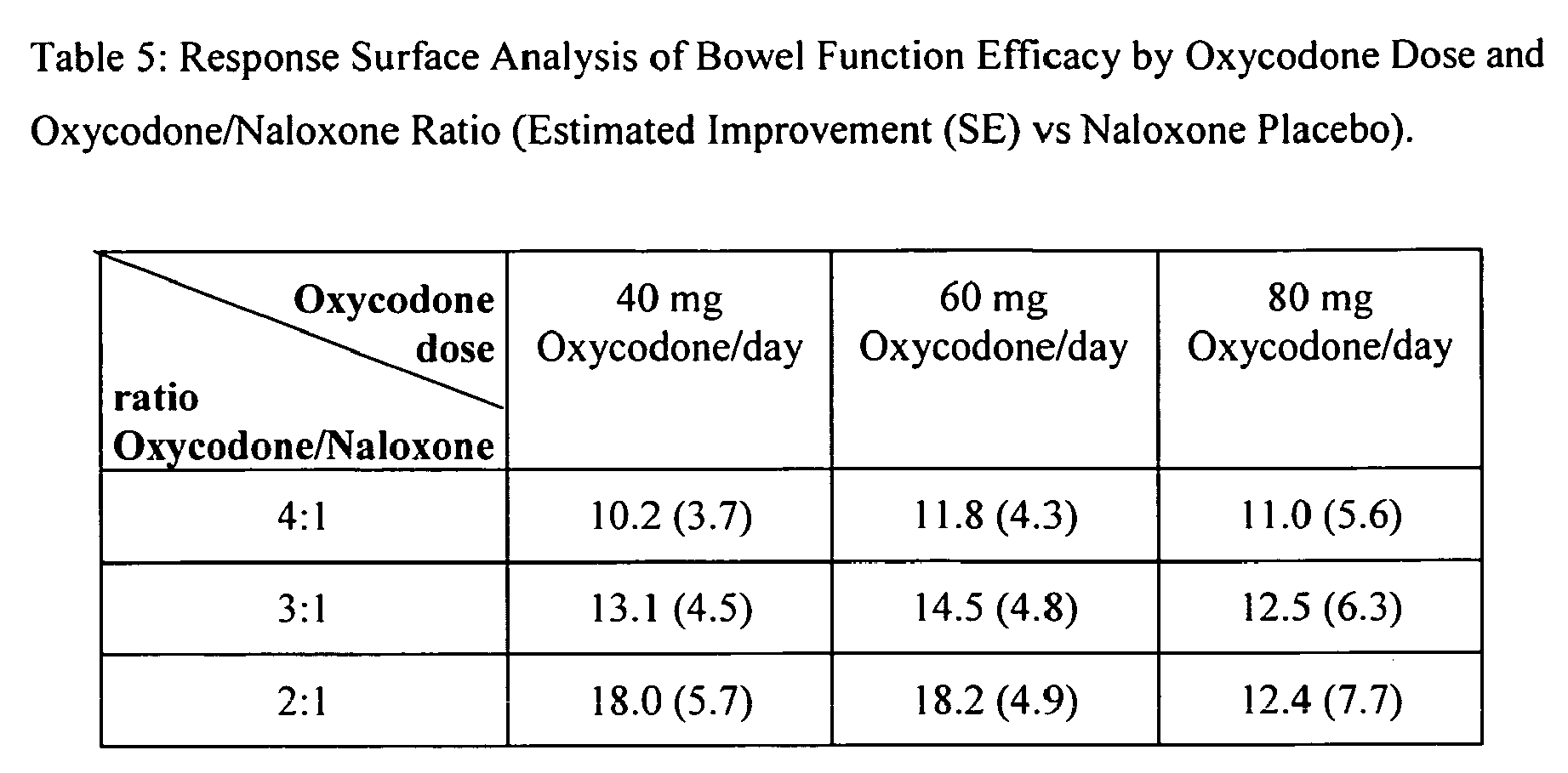
Table 6: Response Surface Analysis of Bowel Function Efficacy by Oxycodone/Naloxone ratio (Estimated Improvement (SE) vs Naloxone Placebo). Oxycodone / Naloxone Ratio Overall Improvement (SE) vs Placebo 6:1 8.0 (3.3) 4:1 11.1 (4.1) 3:1 13.4 (4.6) 2:1 16.2 (4.5) 1.5:1 16.5 (5.1) - The study demonstrated that addition of controlled release naloxone to controlled release oxycodone results in a statistically significant improvement in mean bowel function at the two higher doses of naloxone (20mg and 40mg). The improvement increases with decreasing oxycodone/naloxone ratio and appears to plateau at the 2:1 ratio, with the overall effect at 2:1 ratio approximately 50% greater than at 4:1. The data indicate that the bowel function improvement is in general a function of the ratio; i.e., the improvement is, in general, constant within each ratio, and independent of the varying doses of oxycodone and naloxone. The only exception is the 80/40 combination, where there is a suggestion of a lower predicted effect than for the 60/30 mg and 40/20 mg combinations; this observation, however, has to be interpreted with the size of the standard error in mind.
- Having thus described in detail preferred embodiments of the present invention, it is to be understood that the invention defined by the above paragraphs is not to be limited to particular details set forth in the above description, as many apparent variations thereof are possible without departing from the spirit or scope of the present invention.
- All documents cited or referenced herein ("herein cited documents") including any manufacturer's instructions, descriptions, product specifications and product sheets for any products mentioned herein or in any document referenced herein, are hereby incorporated herein by reference. Citation or identification of any document in this application is not an admission that such document is available as prior art to the present invention. The detailed description, given by way of example, is not intended to limit the invention solely to the specific embodiments described.
Claims (27)
- Method for assessing bowel function in a patient, comprisingproviding the patient with a numeric analog scale for at least one parameter which is associated with bowel function;causing the patient to indicate on the numeric analog scale the amount and/or intensity of the parameter being experienced; andobserving the amount and/or intensity of the at least one parameter indicated on the numeric analog scale in order to assess bowel function.
- Method according to claim 1,
wherein the at least one parameter is selected from the group consisting of difficulty of defecation, feeling of incomplete bowel evacuation, and judgement of constipation. - Method according to claim 1 or 2,
wherein the patient is provided with numeric analog scales for at least two, preferably at least three parameters. - Method according to claim 3,
which further comprises determining a mean bowel function by averaging the numeric analog scale values for each parameter. - Method according to any of the preceding claims,
wherein the patient is a patient receiving treatment with narcotic analgesics. - Method according to claim 5,
wherein the patient is a patient receiving treatment with oxycodone. - Method according to claim 6,
wherein the patient is a patient receiving treatment with oxycodone in combination with naloxone. - Method according to any of the preceding claims,
wherein the numeric analog scale ranges from 0 to 10 or from 0 to 100. - Method according to any of the preceding claims,
wherein the numeric analog scale presented to the patient is an uninterrupted line that bears no indicators or markings other than at the ends indicating no experience or very strong experience of the parameter to be observed. - Method according to claim 9,
wherein the patient indicates the amount and/or intensity of the parameter experienced by making a dash on the uninterrupted line. - Method according to claim 10,
wherein the distance from the dash to the end indicating no experience or to the end indicating very strong experience is measured and said distance is divided by the distance between both ends in order to obtain a numerical value which is a score for the bowel function. - Method according to any of the preceding claims,
wherein a paper form is used for assessing the bowel function index which paper form contains questions concerning at least one parameter which is associated with bowel function such as ease or difficulty of defecation, feeling of incomplete bowel evacuation, and constipation. - Method according to any of the preceding claims,
wherein a circular bowel function index meter is used for assessing the bowel function index. - Method according to claim 13,
wherein the circular BFI meter contains a paper form with questions concerning the patient's assessment at least one parameters associated with bowel function. - Method according to claim 13 or 14,
wherein the circular BFI meter contains a numerical scale on an inner circle and a numerical scale on an outer circle which numerical scales are correlated with each other such that a value on one scale is a multiple of the corresponding value on the other scale
wherein the factor corresponds to the number of parameters which are observed. - Method according to any one of claims 13 to 15,
wherein the circular BFI meter contains a needle which is attached to the middle of the circle and can be moved around the circle. - Method according to any one of claims 1 to 11,
wherein the numerical analog scale is a handheld panel-like device having two sides
wherein one side of the panel bears a patient's scale for the parameter associated with bowel function, depicting a spectrum of the parameter ranging from no experience of the parameter and very strong experience of the parameter, and the other side of the panel bears a health care provider's scale for the parameter divided into discrete intervals numbered 0 to an integer which is preferably selected from 5, 10, 50 or 100. - A device for assessing bowel function in a patient, the device comprisinga display unit for providing a numeric analog scale for at least one parameter which is associated with bowel function of a patient;a receiving unit adapted to receive an amount and/or intensity of the at least one parameter indicated by the patient on the numeric analog scale; andan interface unit adapted to provide the amount and/or intensity of the at least one parameter indicated on the numeric analog scale in order to assess bowel function.
- The device according to claim 18,
realized as an electronic device. - The device according to claim 18 or 19,
wherein the interface unit is adapted to transmit the amount and/or intensity of the at least one parameter indicated on the numeric analog scale in order to assess bowel function to a control entity. - The device according to any of claims 18 to 20,
wherein the interface unit is adapted to transmit the amount and/or intensity of the at least one parameter indicated on the numeric analog scale in order to assess bowel function to a control entity via a wired or via a wireless communication path. - A computer-readable medium, in which a computer program of assessing bowel function in a patient is stored which, when being executed by a processor, is adapted to control or carry out the following method stepsproviding the patient with a numeric analog scale for at least one parameter which is associated with bowel function;causing the patient to indicate on the numeric analog scale the amount and/or intensity of the parameter being experienced; andobserving the amount and/or intensity of the at least one parameter indicated on the numeric analog scale in order to assess bowel function.
- A program element of assessing bowel function in a patient, which, when being executed by a processor, is adapted to control or carry out the following method steps providing the patient with a numeric analog scale for at least one parameter which is associated with bowel function;causing the patient to indicate on the numeric analog scale the amount and/or intensity of the parameter being experienced; andobserving the amount and/or intensity of the at least one parameter indicated on the numeric analog scale in order to assess bowel function.
- Method for assessing bowel function in a patient according to one of claims 1 to 17,
wherein a device according to claim 18 to 21 is used in order to assess bowel function. - Method of treating constipation in a patient comprising the following steps:assessing bowel function in a patient according to the method of claims 1 to 17 or 24; treating constipation in dependence of the bowel function of the patient.
- Method of treating constipation comprising the following steps:assessing bowel function in a patient using a device according to claim 18 to 21,treating constipation in dependence of the assessed bowel function of the patient.
- Method according to claim 25 or 26,
wherein treating constipation in dependence of the bowel function of the patient comprises starting, increasing, decreasing or discontinuing administering at least one laxative or the like to the patient.
Priority Applications (15)
| Application Number | Priority Date | Filing Date | Title |
|---|---|---|---|
| EP05004378A EP1702558A1 (en) | 2005-02-28 | 2005-02-28 | Method and device for the assessment of bowel function |
| NZ556593A NZ556593A (en) | 2005-02-28 | 2006-02-28 | Method and device for the assessment of bowel function |
| KR1020077022376A KR20070107804A (en) | 2005-02-28 | 2006-02-28 | Intestinal function evaluation method and device |
| CA002599154A CA2599154A1 (en) | 2005-02-28 | 2006-02-28 | Method and device for the assessment of bowel function |
| KR1020127003777A KR20140015125A (en) | 2005-02-28 | 2006-02-28 | Method and device for the assessment of bowel function |
| AU2006217867A AU2006217867B2 (en) | 2005-02-28 | 2006-02-28 | Method and device for the assessment of bowel function |
| EP06708562A EP1860988A1 (en) | 2005-02-28 | 2006-02-28 | Method and device for the assessment of bowel function |
| JP2007557490A JP4949273B2 (en) | 2005-02-28 | 2006-02-28 | Method and apparatus for assessing bowel function |
| US11/885,285 US10258235B2 (en) | 2005-02-28 | 2006-02-28 | Method and device for the assessment of bowel function |
| KR1020107001394A KR20100018091A (en) | 2005-02-28 | 2006-02-28 | Method and device for the assessment of bowel function |
| CN2006800062783A CN101128147B (en) | 2005-02-28 | 2006-02-28 | Method and device for evaluating bowel function |
| RU2007135992/14A RU2413457C2 (en) | 2005-02-28 | 2006-02-28 | Method and apparatus for intestinal action examination |
| PCT/EP2006/060336 WO2006089970A1 (en) | 2005-02-28 | 2006-02-28 | Method and device for the assessment of bowel function |
| KR1020137022637A KR101579765B1 (en) | 2005-02-28 | 2006-02-28 | Method and device for the assessment of bowel function |
| AU2009201046A AU2009201046A1 (en) | 2005-02-28 | 2009-03-16 | Method and device for the assessment of bowel function |
Applications Claiming Priority (1)
| Application Number | Priority Date | Filing Date | Title |
|---|---|---|---|
| EP05004378A EP1702558A1 (en) | 2005-02-28 | 2005-02-28 | Method and device for the assessment of bowel function |
Publications (1)
| Publication Number | Publication Date |
|---|---|
| EP1702558A1 true EP1702558A1 (en) | 2006-09-20 |
Family
ID=34933991
Family Applications (2)
| Application Number | Title | Priority Date | Filing Date |
|---|---|---|---|
| EP05004378A Withdrawn EP1702558A1 (en) | 2005-02-28 | 2005-02-28 | Method and device for the assessment of bowel function |
| EP06708562A Withdrawn EP1860988A1 (en) | 2005-02-28 | 2006-02-28 | Method and device for the assessment of bowel function |
Family Applications After (1)
| Application Number | Title | Priority Date | Filing Date |
|---|---|---|---|
| EP06708562A Withdrawn EP1860988A1 (en) | 2005-02-28 | 2006-02-28 | Method and device for the assessment of bowel function |
Country Status (10)
| Country | Link |
|---|---|
| US (1) | US10258235B2 (en) |
| EP (2) | EP1702558A1 (en) |
| JP (1) | JP4949273B2 (en) |
| KR (4) | KR20140015125A (en) |
| CN (1) | CN101128147B (en) |
| AU (2) | AU2006217867B2 (en) |
| CA (1) | CA2599154A1 (en) |
| NZ (1) | NZ556593A (en) |
| RU (1) | RU2413457C2 (en) |
| WO (1) | WO2006089970A1 (en) |
Cited By (1)
| Publication number | Priority date | Publication date | Assignee | Title |
|---|---|---|---|---|
| EP2359747A1 (en) * | 2010-02-12 | 2011-08-24 | AIT Austrian Institute of Technology GmbH | Method for objective detection and measurement of pains |
Families Citing this family (20)
| Publication number | Priority date | Publication date | Assignee | Title |
|---|---|---|---|---|
| US6277384B1 (en) | 1997-12-22 | 2001-08-21 | Euro-Celtique S.A. | Opioid agonist/antagonist combinations |
| US6375957B1 (en) | 1997-12-22 | 2002-04-23 | Euro-Celtique, S.A. | Opioid agonist/opioid antagonist/acetaminophen combinations |
| CA2446550C (en) | 2001-05-11 | 2012-03-06 | Endo Pharmaceuticals, Inc. | Abuse-resistant controlled-release opioid dosage form |
| KR100784341B1 (en) | 2002-04-05 | 2007-12-13 | 유로-셀띠끄 소시에떼 아노님 | Matrix for sustained, invariant and independent release of active compounds |
| EP1604666A1 (en) | 2004-06-08 | 2005-12-14 | Euro-Celtique S.A. | Opioids for the treatment of the Chronic Obstructive Pulmonary Disease (COPD) |
| EP1702558A1 (en) | 2005-02-28 | 2006-09-20 | Euro-Celtique S.A. | Method and device for the assessment of bowel function |
| WO2007054940A2 (en) * | 2005-11-11 | 2007-05-18 | Breathid (2006) | Breath test device and method |
| US8512258B2 (en) * | 2005-11-11 | 2013-08-20 | Exalenz Bioscience Ltd. | Breath test device and method |
| KR101218303B1 (en) | 2007-10-25 | 2013-01-03 | 삼성테크윈 주식회사 | compact lens system |
| SMT201900023T1 (en) | 2009-03-10 | 2019-02-28 | Euro Celtique Sa | Immediate release pharmaceutical compositions comprising oxycodone and naloxone |
| GB2475268A (en) * | 2009-11-12 | 2011-05-18 | Sero Solutions Ltd | Near field measurement adapter |
| US9892236B2 (en) * | 2011-03-22 | 2018-02-13 | Numoda Technologies, Inc. | Automated method of generating reconciliation reports regarding mismatches of clinical data received from multiple sources during a clinical trial |
| WO2015011189A1 (en) | 2013-07-23 | 2015-01-29 | Euro-Celtique S.A. | A combination of oxycodone and naloxone for use in treating pain in patients suffering from pain and a disease resulting in intestinal dysbiosis and/or increasing the risk for intestinal bacterial translocation |
| WO2016075324A1 (en) * | 2014-11-13 | 2016-05-19 | Mensia Technologies | Scoring method based on improved signals analysis |
| RU2655540C2 (en) * | 2016-08-31 | 2018-05-28 | Общество С Ограниченной Ответственностью "Валента-Интеллект" | Method of estimation of the treatment and diagnostics efficiency of the clinical course severity of the gastrointestinal tract functional disorders |
| EP3788639A1 (en) | 2018-05-03 | 2021-03-10 | F. Hoffmann-La Roche AG | Visualization of biomedical predictions |
| CN109316196B (en) * | 2018-12-12 | 2022-07-19 | 上海市精神卫生中心(上海市心理咨询培训中心) | Amphetamine stimulant craving assessment method based on virtual reality and electroencephalogram monitoring |
| JP7422061B2 (en) * | 2019-12-11 | 2024-01-25 | Eaファーマ株式会社 | Constipation medication support program and constipation medication support method |
| JP7072306B1 (en) * | 2021-11-11 | 2022-05-20 | 国立大学法人東北大学 | Indexing system, indexing method, and indexing program |
| KR20250061518A (en) * | 2023-10-27 | 2025-05-08 | 연세대학교 산학협력단 | Method for providing information on ulcerative colitis and device using the same |
Citations (4)
| Publication number | Priority date | Publication date | Assignee | Title |
|---|---|---|---|---|
| WO1999005960A1 (en) * | 1997-07-30 | 1999-02-11 | Universite De Montreal | Portable and programmable interactive visual analogue scale data-logger device |
| WO2003020124A2 (en) * | 2001-09-06 | 2003-03-13 | Aalborg Universitet | Method an apparatus for stimulating a bodily hollow system and method and apparatus for measuring reactions to stimuli of such system |
| WO2003073937A1 (en) * | 2002-03-06 | 2003-09-12 | Euro-Celtique S.A. | Analog scale for measuring pain |
| US20030178031A1 (en) * | 1999-05-07 | 2003-09-25 | Du Pen, Inc. | Method for cancer pain treatment |
Family Cites Families (272)
| Publication number | Priority date | Publication date | Assignee | Title |
|---|---|---|---|---|
| US2770569A (en) | 1952-08-01 | 1956-11-13 | Hoffmann La Roche | Analgesic compositions |
| US3173877A (en) | 1957-09-09 | 1965-03-16 | Wyandotte Chemicals Corp | Detergent compositions comprising inorganic esters of epoxyhydrocarbon polymers |
| US3173876A (en) | 1960-05-27 | 1965-03-16 | John C Zobrist | Cleaning methods and compositions |
| NL271831A (en) | 1960-11-29 | |||
| US3493657A (en) | 1961-03-14 | 1970-02-03 | Mozes Juda Lewenstein | Therapeutic compositions of n-allyl-14-hydroxy - dihydronormorphinane and morphine |
| US3332950A (en) | 1963-03-23 | 1967-07-25 | Endo Lab | 14-hydroxydihydronormorphinone derivatives |
| US3276586A (en) | 1963-08-30 | 1966-10-04 | Rosaen Filter Co | Indicating means for fluid filters |
| NL6714885A (en) | 1967-11-02 | 1969-05-06 | ||
| US3541006A (en) | 1968-07-03 | 1970-11-17 | Amicon Corp | Ultrafiltration process |
| US3541005A (en) | 1969-02-05 | 1970-11-17 | Amicon Corp | Continuous ultrafiltration of macromolecular solutions |
| US3773955A (en) | 1970-08-03 | 1973-11-20 | Bristol Myers Co | Analgetic compositions |
| US3879555A (en) | 1970-11-16 | 1975-04-22 | Bristol Myers Co | Method of treating drug addicts |
| US3676557A (en) | 1971-03-02 | 1972-07-11 | Endo Lab | Long-acting narcotic antagonist formulations |
| GB1390772A (en) | 1971-05-07 | 1975-04-16 | Endo Lab | Oral narcotic composition |
| FR2183546B1 (en) | 1972-05-10 | 1975-06-20 | Servier Lab | |
| US3965256A (en) | 1972-05-16 | 1976-06-22 | Synergistics | Slow release pharmaceutical compositions |
| US3845770A (en) | 1972-06-05 | 1974-11-05 | Alza Corp | Osmatic dispensing device for releasing beneficial agent |
| US3916899A (en) | 1973-04-25 | 1975-11-04 | Alza Corp | Osmotic dispensing device with maximum and minimum sizes for the passageway |
| US3916889A (en) | 1973-09-28 | 1975-11-04 | Sandoz Ag | Patient ventilator apparatus |
| US3966940A (en) | 1973-11-09 | 1976-06-29 | Bristol-Myers Company | Analgetic compositions |
| GB1478759A (en) | 1974-11-18 | 1977-07-06 | Alza Corp | Process for forming outlet passageways in pills using a laser |
| US4077407A (en) | 1975-11-24 | 1978-03-07 | Alza Corporation | Osmotic devices having composite walls |
| US4126684A (en) | 1976-02-11 | 1978-11-21 | Ciba-Geigy Corporation | 4-amino-3-p-halophenylbutyric acids and their derivatives used in the control of narcotic abuse |
| US4063064A (en) | 1976-02-23 | 1977-12-13 | Coherent Radiation | Apparatus for tracking moving workpiece by a laser beam |
| LU77339A1 (en) | 1977-05-16 | 1979-01-19 | ||
| US4176186A (en) | 1978-07-28 | 1979-11-27 | Boehringer Ingelheim Gmbh | Quaternary derivatives of noroxymorphone which relieve intestinal immobility |
| US4285987A (en) | 1978-10-23 | 1981-08-25 | Alza Corporation | Process for manufacturing device with dispersion zone |
| US4200098A (en) | 1978-10-23 | 1980-04-29 | Alza Corporation | Osmotic system with distribution zone for dispensing beneficial agent |
| GB2049431B (en) * | 1979-04-09 | 1983-05-18 | Wyeth John & Brother Ltd | Measuring device |
| US4237140A (en) | 1979-05-18 | 1980-12-02 | E. I. Du Pont De Nemours And Company | Analgesic mixture of nalbuphine and acetaminophen |
| US4293539A (en) | 1979-09-12 | 1981-10-06 | Eli Lilly And Company | Controlled release formulations and method of treatment |
| IE49324B1 (en) | 1979-12-19 | 1985-09-18 | Euro Celtique Sa | Controlled release compositions |
| US4457933A (en) * | 1980-01-24 | 1984-07-03 | Bristol-Myers Company | Prevention of analgesic abuse |
| US4464378A (en) | 1981-04-28 | 1984-08-07 | University Of Kentucky Research Foundation | Method of administering narcotic antagonists and analgesics and novel dosage forms containing same |
| US4401672A (en) | 1981-10-13 | 1983-08-30 | Regents Of The University Of Minnesota | Non-addictive narcotic antitussive preparation |
| US4608376A (en) | 1981-10-16 | 1986-08-26 | Carolyn McGinnis | Opiate agonists and antagonists |
| DE3381877D1 (en) | 1982-03-16 | 1990-10-18 | Univ Rockefeller | USE OF OPIUM ANTAGONISTS FOR THE PRODUCTION OF MEDICINAL PRODUCTS FOR THE REMEDY OF GASTRO-INTESTINAL DISORDERS. |
| US4987136A (en) | 1982-03-16 | 1991-01-22 | The Rockefeller University | Method for controlling gastrointestinal dysmotility |
| US4443428A (en) | 1982-06-21 | 1984-04-17 | Euroceltique, S.A. | Extended action controlled release compositions |
| US4451470A (en) | 1982-07-06 | 1984-05-29 | E. I. Du Pont De Nemours And Company | Analgesic, antagonist, and/or anorectic 14-fluoromorphinans |
| US4803208A (en) | 1982-09-30 | 1989-02-07 | Sloan-Kettering Institute For Cancer Research | Opiate agonists and antagonists |
| GB8332556D0 (en) | 1983-12-06 | 1984-01-11 | Reckitt & Colmann Prod Ltd | Analgesic compositions |
| US5266574A (en) | 1984-04-09 | 1993-11-30 | Ian S. Zagon | Growth regulation and related applications of opioid antagonists |
| US4668685A (en) | 1984-07-05 | 1987-05-26 | E.I. Du Pont De Nemours And Company | Substituted benzoate ester prodrug derivatives of 3-hydroxymorphinans, which are analgesics or narcotic antagonists |
| DE3434946A1 (en) | 1984-09-22 | 1986-04-03 | Basf Ag, 6700 Ludwigshafen | DIARYLACETYLENE, THEIR PRODUCTION AND USE |
| US4573995A (en) | 1984-10-09 | 1986-03-04 | Alza Corporation | Transdermal therapeutic systems for the administration of naloxone, naltrexone and nalbuphine |
| GB8430346D0 (en) | 1984-11-30 | 1985-01-09 | Reckitt & Colmann Prod Ltd | Analgesic compositions |
| US4806341A (en) | 1985-02-25 | 1989-02-21 | Rutgers, The State University Of New Jersey | Transdermal absorption dosage unit for narcotic analgesics and antagonists and process for administration |
| CA1267092A (en) | 1985-02-25 | 1990-03-27 | Martin D. Hynes | Analgesic composition containing codeine |
| GB8514665D0 (en) | 1985-06-11 | 1985-07-10 | Eroceltique Sa | Oral pharmaceutical composition |
| FR2585246A1 (en) | 1985-07-26 | 1987-01-30 | Cortial | PROCESS FOR OBTAINING SOLID PHARMACEUTICAL FORMS WITH PROLONGED RELEASE |
| GB8521350D0 (en) | 1985-08-28 | 1985-10-02 | Euro Celtique Sa | Analgesic composition |
| EP0236477B1 (en) | 1985-09-06 | 1993-01-20 | Baker Norton Pharmaceuticals, Inc. | Use of 6-methylene-6-desoxy-n-cyclopropylmethyl-14-hydroxydihydronormorphine |
| US4760069A (en) | 1985-09-23 | 1988-07-26 | Nova Pharmaceutical Corporation | Oximes of oxymorphone, naltrexone and naloxone as potent, selective opioid receptor agonists and antagonists |
| US4889860A (en) | 1985-09-23 | 1989-12-26 | Nova Pharmaceutical Corporation | Oximes of oxymorphone, naltrexone and naloxone as potent, selective opioid receptor agonists and antagonists |
| US4722928A (en) | 1985-12-02 | 1988-02-02 | E. I. Du Pont De Nemours And Company | N-oxide prodrug derivatives of 3-hydroxy morphinans and partial morphinans having improved oral bioavailability, pharmaceutical compositions, and processes |
| US4730048A (en) | 1985-12-12 | 1988-03-08 | Regents Of The University Of Minnesota | Gut-selective opiates |
| US4861781A (en) | 1986-03-07 | 1989-08-29 | The University Of Chicago | Quaternary derivatives of noroxymorphone which relieve nausea and emesis |
| US4719215A (en) | 1986-03-07 | 1988-01-12 | University Of Chicago | Quaternary derivatives of noroxymorphone which relieve nausea and emesis |
| US5316759A (en) | 1986-03-17 | 1994-05-31 | Robert J. Schaap | Agonist-antagonist combination to reduce the use of nicotine and other drugs |
| GB8613689D0 (en) | 1986-06-05 | 1986-07-09 | Euro Celtique Sa | Pharmaceutical composition |
| GB8613688D0 (en) | 1986-06-05 | 1986-07-09 | Euro Celtique Sa | Pharmaceutical composition |
| ATE107857T1 (en) | 1986-06-10 | 1994-07-15 | Euro Celtique Sa | COMPOSITION WITH CONTROLLED RELEASE OF DIHYDROCODEINE. |
| US4769372A (en) | 1986-06-18 | 1988-09-06 | The Rockefeller University | Method of treating patients suffering from chronic pain or chronic cough |
| US4785000A (en) | 1986-06-18 | 1988-11-15 | The Rockefeller University | Method of treating patients suffering from chronic pain or chronic cough |
| US4970075A (en) | 1986-07-18 | 1990-11-13 | Euroceltique, S.A. | Controlled release bases for pharmaceuticals |
| US4861598A (en) | 1986-07-18 | 1989-08-29 | Euroceltique, S.A. | Controlled release bases for pharmaceuticals |
| US5356900A (en) | 1986-10-07 | 1994-10-18 | Bernard Bihari | Method of treating chronic herpes virus infections using an opiate receptor antagonist |
| GB8626098D0 (en) | 1986-10-31 | 1986-12-03 | Euro Celtique Sa | Controlled release hydromorphone composition |
| US4806543A (en) | 1986-11-25 | 1989-02-21 | Board Of Trustees Of The Leland Stanford Junior University | Method and compositions for reducing neurotoxic injury |
| GB8628728D0 (en) | 1986-12-02 | 1987-01-07 | Euro Celtique Sa | Spheroids |
| GB8705083D0 (en) | 1987-03-04 | 1987-04-08 | Euro Celtique Sa | Spheroids |
| GB8728294D0 (en) | 1987-12-03 | 1988-01-06 | Reckitt & Colmann Prod Ltd | Treatment compositions |
| DE3812567A1 (en) | 1988-04-15 | 1989-10-26 | Basf Ag | METHOD FOR PRODUCING PHARMACEUTICAL MIXTURES |
| US4873076A (en) | 1988-04-29 | 1989-10-10 | Baker Cummins Pharmaceuticals, Inc. | Method of safely providing anesthesia or conscious sedation |
| GB8813064D0 (en) | 1988-06-02 | 1988-07-06 | Euro Celtique Sa | Controlled release dosage forms having defined water content |
| US4882335A (en) | 1988-06-13 | 1989-11-21 | Alko Limited | Method for treating alcohol-drinking response |
| EP0352361A1 (en) | 1988-07-29 | 1990-01-31 | The Rockefeller University | Method of treating patients suffering from chronic pain or chronic cough |
| US5236714A (en) | 1988-11-01 | 1993-08-17 | Alza Corporation | Abusable substance dosage form having reduced abuse potential |
| CA2002492A1 (en) | 1988-11-11 | 1990-05-11 | Sandra T. A. Malkowska | Pharmaceutical ion exchange resin composition |
| US5102887A (en) | 1989-02-17 | 1992-04-07 | Arch Development Corporation | Method for reducing emesis and nausea induced by the administration of an emesis causing agent |
| US5018526A (en) * | 1989-02-28 | 1991-05-28 | Gaston Johansson Fannie | Apparatus and method for providing a multidimensional indication of pain |
| US5096715A (en) | 1989-11-20 | 1992-03-17 | Alko Ltd. | Method and means for treating alcoholism by extinguishing the alcohol-drinking response using a transdermally administered opiate antagonist |
| US5075341A (en) | 1989-12-01 | 1991-12-24 | The Mclean Hospital Corporation | Treatment for cocaine abuse |
| US5086058A (en) | 1990-06-04 | 1992-02-04 | Alko Ltd. | Method for treating alcoholism with nalmefene |
| FR2669336B1 (en) | 1990-11-20 | 1993-01-22 | Adir | NOVEL OXAZOLO PYRIDINES DERIVATIVES, PROCESSES FOR THEIR PREPARATION AND THE PHARMACEUTICAL COMPOSITIONS CONTAINING THEM. |
| HU208633B (en) | 1991-02-04 | 1993-12-28 | Alkaloida Vegyeszeti Gyar | Process for production of analgetic compositions as applicable for blocking of opioid-binding spaces /2-receptors/ causing respiration depression |
| US5486362A (en) | 1991-05-07 | 1996-01-23 | Dynagen, Inc. | Controlled, sustained release delivery system for treating drug dependency |
| US5682899A (en) * | 1991-05-16 | 1997-11-04 | Ami-Med Corporation | Apparatus and method for continuous cardiac output monitoring |
| JP3178541B2 (en) | 1991-05-29 | 2001-06-18 | キヤノン株式会社 | Image processing method and apparatus |
| US5149538A (en) | 1991-06-14 | 1992-09-22 | Warner-Lambert Company | Misuse-resistive transdermal opioid dosage form |
| GB9117361D0 (en) | 1991-08-12 | 1991-09-25 | Euro Celtique Sa | Oral dosage form |
| KR100221695B1 (en) | 1991-08-12 | 1999-09-15 | 그린 마틴, 브라이언 쥐 테슬리 | Pharmaceutical Formulation Formulations |
| WO1993004675A1 (en) | 1991-09-06 | 1993-03-18 | Mcneilab, Inc. | Composition comprising a tramadol material and acetaminophen and its use |
| US5215758A (en) | 1991-09-11 | 1993-06-01 | Euroceltique, S.A. | Controlled release matrix suppository for pharmaceuticals |
| US5225440A (en) | 1991-09-13 | 1993-07-06 | The United States Of America As Represented By The Department Of Health And Human Services | Attenuation of the opioid withdrawal syndrome by inhibitors of nitric oxide synthase |
| US5266331A (en) | 1991-11-27 | 1993-11-30 | Euroceltique, S.A. | Controlled release oxycodone compositions |
| US5656295A (en) | 1991-11-27 | 1997-08-12 | Euro-Celtique, S.A. | Controlled release oxycodone compositions |
| US5681585A (en) | 1991-12-24 | 1997-10-28 | Euro-Celtique, S.A. | Stabilized controlled release substrate having a coating derived from an aqueous dispersion of hydrophobic polymer |
| US5273760A (en) | 1991-12-24 | 1993-12-28 | Euroceltigue, S.A. | Stabilized controlled release substrate having a coating derived from an aqueous dispersion of hydrophobic polymer |
| US5478577A (en) | 1993-11-23 | 1995-12-26 | Euroceltique, S.A. | Method of treating pain by administering 24 hour oral opioid formulations exhibiting rapid rate of initial rise of plasma drug level |
| US5580578A (en) | 1992-01-27 | 1996-12-03 | Euro-Celtique, S.A. | Controlled release formulations coated with aqueous dispersions of acrylic polymers |
| US5968551A (en) | 1991-12-24 | 1999-10-19 | Purdue Pharma L.P. | Orally administrable opioid formulations having extended duration of effect |
| US5286493A (en) | 1992-01-27 | 1994-02-15 | Euroceltique, S.A. | Stabilized controlled release formulations having acrylic polymer coating |
| US5958459A (en) | 1991-12-24 | 1999-09-28 | Purdue Pharma L.P. | Opioid formulations having extended controlled released |
| US5472712A (en) | 1991-12-24 | 1995-12-05 | Euroceltique, S.A. | Controlled-release formulations coated with aqueous dispersions of ethylcellulose |
| GB9203689D0 (en) | 1992-02-20 | 1992-04-08 | Euro Celtique Sa | Pharmaceutical composition |
| GB9204354D0 (en) | 1992-02-28 | 1992-04-08 | Biokine Tech Ltd | Compounds for medicinal use |
| JPH05305060A (en) * | 1992-04-30 | 1993-11-19 | Toto Ltd | Health maintenance device for kitchen |
| US5596007A (en) * | 1992-05-18 | 1997-01-21 | Pharmaco Behavioral Associates, Inc. | Therapeutic method to alleviate the craving associated with cessation of tobacco with cotinine |
| JPH05342288A (en) * | 1992-06-11 | 1993-12-24 | Kiyoshi Inoue | Self management system for fatigue |
| ATE404201T1 (en) | 1992-06-22 | 2008-08-15 | Univ California | GLYCINE RECEPTOR ANTAGONISTS AND THEIR USE |
| US5352680A (en) | 1992-07-15 | 1994-10-04 | Regents Of The University Of Minnesota | Delta opioid receptor antagonists to block opioid agonist tolerance and dependence |
| US5256669A (en) | 1992-08-07 | 1993-10-26 | Aminotek Sciences, Inc. | Methods and compositions for treating acute or chronic pain and drug addiction |
| US5324351A (en) | 1992-08-13 | 1994-06-28 | Euroceltique | Aqueous dispersions of zein and preparation thereof |
| US5633259A (en) | 1992-09-21 | 1997-05-27 | United Biomedical, Inc. | Method for identification of low/non-addictive opioid analgesics and the use of said analgesics for treatment of opioid addiction |
| US6096756A (en) | 1992-09-21 | 2000-08-01 | Albert Einstein College Of Medicine Of Yeshiva University | Method of simultaneously enhancing analgesic potency and attenuating dependence liability caused by morphine and other bimodally-acting opioid agonists |
| US20010006967A1 (en) | 1992-09-21 | 2001-07-05 | Stanley M. Crain | Method of simultaneously enhancing analgesic potency and attenuating adverse side effects caused by tramadol and other bimodally-acting opioid agonists |
| US5472943A (en) | 1992-09-21 | 1995-12-05 | Albert Einstein College Of Medicine Of Yeshiva University, | Method of simultaneously enhancing analgesic potency and attenuating dependence liability caused by morphine and other opioid agonists |
| US5580876A (en) | 1992-09-21 | 1996-12-03 | Albert Einstein College Of Medicine Of Yeshiva University, A Division Of Yeshiva University | Method of simultaneously enhancing analgesic potency and attenuating dependence liability caused by morphine and other bimodally-acting opioid agonists |
| US5512578A (en) | 1992-09-21 | 1996-04-30 | Albert Einstein College Of Medicine Of Yeshiva University, A Division Of Yeshiva University | Method of simultaneously enhancing analgesic potency and attenuating dependence liability caused by exogenous and endogenous opiod agonists |
| WO1994006426A1 (en) | 1992-09-21 | 1994-03-31 | Qin Bo Yi | Methods for identifying and using low/non-addictive opioid analgesics |
| US5869097A (en) | 1992-11-02 | 1999-02-09 | Alza Corporation | Method of therapy comprising an osmotic caplet |
| US5604260A (en) | 1992-12-11 | 1997-02-18 | Merck Frosst Canada Inc. | 5-methanesulfonamido-1-indanones as an inhibitor of cyclooxygenase-2 |
| US5321012A (en) | 1993-01-28 | 1994-06-14 | Virginia Commonwealth University Medical College | Inhibiting the development of tolerance to and/or dependence on a narcotic addictive substance |
| US5585348A (en) | 1993-02-10 | 1996-12-17 | Albert Einstein College Of Medicine Of Yeshiva University, A Division Of Yeshiva University | Use of excitatory opioid receptor antagonists to prevent growth factor-induced hyperalgesia |
| US5352683A (en) | 1993-03-05 | 1994-10-04 | Virginia Commonwealth University Medical College Of Virginia | Method for the treatment of chronic pain |
| CA2115792C (en) | 1993-03-05 | 2005-11-01 | David J. Mayer | Method for the treatment of pain |
| US5409944A (en) | 1993-03-12 | 1995-04-25 | Merck Frosst Canada, Inc. | Alkanesulfonamido-1-indanone derivatives as inhibitors of cyclooxygenase |
| NZ260408A (en) | 1993-05-10 | 1996-05-28 | Euro Celtique Sa | Controlled release preparation comprising tramadol |
| US5457208A (en) | 1993-06-21 | 1995-10-10 | Regents Of The University Of Minnesota | Kappa opioid receptor antagonists |
| US5436265A (en) | 1993-11-12 | 1995-07-25 | Merck Frosst Canada, Inc. | 1-aroyl-3-indolyl alkanoic acids and derivatives thereof useful as anti-inflammatory agents |
| US5474995A (en) | 1993-06-24 | 1995-12-12 | Merck Frosst Canada, Inc. | Phenyl heterocycles as cox-2 inhibitors |
| NZ260883A (en) | 1993-07-01 | 1997-06-24 | Euro Celtique Sa | Oral sustained-release medicaments containing morphine |
| IL110014A (en) | 1993-07-01 | 1999-11-30 | Euro Celtique Sa | Solid controlled-release oral dosage forms of opioid analgesics |
| US5879705A (en) | 1993-07-27 | 1999-03-09 | Euro-Celtique S.A. | Sustained release compositions of morphine and a method of preparing pharmaceutical compositions |
| DE4325465B4 (en) | 1993-07-29 | 2004-03-04 | Zenz, Michael, Prof. Dr.med. | Oral pharmaceutical preparation for pain therapy |
| GB9319568D0 (en) | 1993-09-22 | 1993-11-10 | Euro Celtique Sa | Pharmaceutical compositions and usages |
| EP2036558A3 (en) | 1993-10-07 | 2010-04-28 | Euro-Celtique S.A. | Orally administrable opioid formulations having extended duration of effect |
| KR100354702B1 (en) | 1993-11-23 | 2002-12-28 | 유로-셀티크 소시에떼 아노뉨 | Manufacturing method and sustained release composition of pharmaceutical composition |
| US5891471A (en) | 1993-11-23 | 1999-04-06 | Euro-Celtique, S.A. | Pharmaceutical multiparticulates |
| US6210714B1 (en) | 1993-11-23 | 2001-04-03 | Euro-Celtique S.A. | Immediate release tablet cores of acetaminophen having sustained-release coating |
| US5500227A (en) | 1993-11-23 | 1996-03-19 | Euro-Celtique, S.A. | Immediate release tablet cores of insoluble drugs having sustained-release coating |
| DE69429710T2 (en) | 1993-11-23 | 2002-08-08 | Euro-Celtique S.A., Luxemburg/Luxembourg | Process for the preparation of a drug composition with delayed drug delivery |
| US5376662A (en) | 1993-12-08 | 1994-12-27 | Ockert; David M. | Method of attenuating nerve injury induced pain |
| US5834477A (en) | 1993-12-08 | 1998-11-10 | The United States Of America As Represented By The Secretary Of The Army | Opiate analgesic formulation with improved safety |
| US5843480A (en) | 1994-03-14 | 1998-12-01 | Euro-Celtique, S.A. | Controlled release diamorphine formulation |
| US5411745A (en) | 1994-05-25 | 1995-05-02 | Euro-Celtique, S.A. | Powder-layered morphine sulfate formulations |
| US6077533A (en) | 1994-05-25 | 2000-06-20 | Purdue Pharma L.P. | Powder-layered oral dosage forms |
| US6405732B1 (en) * | 1994-06-24 | 2002-06-18 | Curon Medical, Inc. | Method to treat gastric reflux via the detection and ablation of gastro-esophageal nerves and receptors |
| US5460826A (en) | 1994-06-27 | 1995-10-24 | Alza Corporation | Morphine therapy |
| GB9414699D0 (en) | 1994-07-21 | 1994-09-07 | Slagel David | Aqueous foamable composition |
| US5616601A (en) | 1994-07-28 | 1997-04-01 | Gd Searle & Co | 1,2-aryl and heteroaryl substituted imidazolyl compounds for the treatment of inflammation |
| US5521213A (en) | 1994-08-29 | 1996-05-28 | Merck Frosst Canada, Inc. | Diaryl bicyclic heterocycles as inhibitors of cyclooxygenase-2 |
| US5593994A (en) | 1994-09-29 | 1997-01-14 | The Dupont Merck Pharmaceutical Company | Prostaglandin synthase inhibitors |
| US5866154A (en) | 1994-10-07 | 1999-02-02 | The Dupont Merck Pharmaceutical Company | Stabilized naloxone formulations |
| GB9422154D0 (en) | 1994-11-03 | 1994-12-21 | Euro Celtique Sa | Pharmaceutical compositions and method of producing the same |
| US5965161A (en) | 1994-11-04 | 1999-10-12 | Euro-Celtique, S.A. | Extruded multi-particulates |
| FR2727850B1 (en) * | 1994-12-08 | 1997-09-19 | Ela Medical Sa | METHOD FOR REMOTE ANALYSIS OF PHYSIOLOGICAL PARAMETERS OR OPERATION OF ACTIVE MEDICAL DEVICES, SELF-CONTAINED APPARATUS AND SITE EQUIPMENT FOR CARRYING OUT SAID METHOD |
| ES2244966T3 (en) | 1994-12-12 | 2005-12-16 | Omeros Corporation | IRRIGATION SOLUTION AND ITS USE TO PERIOPERATORY INHIBIT THE PAIN, INFLAMMATION AND SPASM IN A WOUND. |
| GB9426102D0 (en) | 1994-12-23 | 1995-02-22 | Merck Sharp & Dohme | Pharmacuetical compositions |
| US5692500A (en) * | 1995-01-09 | 1997-12-02 | Gaston-Johansson; Fannie | Pain measurement and recording tool and method |
| US5552422A (en) | 1995-01-11 | 1996-09-03 | Merck Frosst Canada, Inc. | Aryl substituted 5,5 fused aromatic nitrogen compounds as anti-inflammatory agents |
| US5578725A (en) | 1995-01-30 | 1996-11-26 | Regents Of The University Of Minnesota | Delta opioid receptor antagonists |
| US20020006964A1 (en) | 1995-05-16 | 2002-01-17 | Young James W. | Methods of using and compositions comprising (+) sibutramine optionally in combination with other pharmacologically active compounds |
| US5604253A (en) | 1995-05-22 | 1997-02-18 | Merck Frosst Canada, Inc. | N-benzylindol-3-yl propanoic acid derivatives as cyclooxygenase inhibitors |
| US5510368A (en) | 1995-05-22 | 1996-04-23 | Merck Frosst Canada, Inc. | N-benzyl-3-indoleacetic acids as antiinflammatory drugs |
| US5639780A (en) | 1995-05-22 | 1997-06-17 | Merck Frosst Canada, Inc. | N-benzyl indol-3-yl butanoic acid derivatives as cyclooxygenase inhibitors |
| ATE267587T1 (en) | 1995-06-09 | 2004-06-15 | Euro Celtique Sa | FORMULATIONS AND METHODS FOR PROLONGED LOCAL ANESTHESIA |
| US5931809A (en) | 1995-07-14 | 1999-08-03 | Depotech Corporation | Epidural administration of therapeutic compounds with sustained rate of release |
| GB9517883D0 (en) | 1995-09-01 | 1995-11-01 | Euro Celtique Sa | Improved pharmaceutical ion exchange resin composition |
| GB9519363D0 (en) | 1995-09-22 | 1995-11-22 | Euro Celtique Sa | Pharmaceutical formulation |
| US5811126A (en) | 1995-10-02 | 1998-09-22 | Euro-Celtique, S.A. | Controlled release matrix for pharmaceuticals |
| AUPN603895A0 (en) | 1995-10-19 | 1995-11-09 | University Of Queensland, The | Production of analgesic synergy by co-administration of sub-analgesic doses of two strong opioids |
| US5998434A (en) | 1995-12-06 | 1999-12-07 | Eli Lilly And Company | Composition for treating pain |
| ES2200158T3 (en) | 1996-03-08 | 2004-03-01 | Nycomed Danmark Aps | MULTIPLE UNIT DOSAGE COMPOSITION, MODIFIED RELEASE. |
| AU2059297A (en) | 1996-03-12 | 1997-10-01 | Alza Corporation | Composition and dosage form comprising opioid antagonist |
| US6103258A (en) | 1996-04-12 | 2000-08-15 | Simon; David Lew | Salts and bases of the 17-(Cyclopropylmethyl)-4,5 alpha-epoxy-6-Methylenemorphinan-3,14 diol molecule for optimizing dopamine homeostasis during administration of opioid analgesics |
| WO1997045091A2 (en) | 1996-05-31 | 1997-12-04 | Euro-Celtique, S.A. | Sustained release oxycodone formulations with no fed/fast effect |
| DE19651551C2 (en) | 1996-12-11 | 2000-02-03 | Klinge Co Chem Pharm Fab | Opioid antagonist-containing galenic formulation |
| ATE186643T1 (en) | 1997-02-14 | 1999-12-15 | Goedecke Ag | STABILIZATION OF NALOXONE HYDROCHLORIDE |
| DE29719704U1 (en) | 1997-02-14 | 1998-01-22 | Gödecke AG, 10587 Berlin | Stable preparations of naloxone hydrochloride |
| US5968547A (en) | 1997-02-24 | 1999-10-19 | Euro-Celtique, S.A. | Method of providing sustained analgesia with buprenorphine |
| DE19710008A1 (en) | 1997-03-12 | 1998-09-17 | Basf Ag | Solid, at least two-phase formulations of a sustained-release opioid analgesic |
| US5780479A (en) | 1997-04-04 | 1998-07-14 | Regents Of The University Of Minnesota | Use of opioid antagonists to treat impulse-control disorders |
| US6207142B1 (en) | 1997-04-14 | 2001-03-27 | Janssen Pharmaceutica N.V. | Compositions containing an antifungal and a cationic agent |
| DK1009387T3 (en) | 1997-07-02 | 2006-08-14 | Euro Celtique Sa | Long-release stabilized tramadol formulations |
| IL134796A0 (en) | 1997-09-04 | 2001-04-30 | Novoneuron Inc | Noribogaine in the treatment of pain and drug addiction |
| US5972954A (en) | 1997-11-03 | 1999-10-26 | Arch Development Corporation | Use of methylnaltrexone and related compounds |
| EP0913152B1 (en) | 1997-11-03 | 2001-12-19 | Stada Arzneimittel Ag | Stabilised combination of drugs comprising naloxone and an opioid analgesic |
| US6274591B1 (en) | 1997-11-03 | 2001-08-14 | Joseph F. Foss | Use of methylnaltrexone and related compounds |
| US6277384B1 (en) | 1997-12-22 | 2001-08-21 | Euro-Celtique S.A. | Opioid agonist/antagonist combinations |
| NZ505192A (en) | 1997-12-22 | 2003-05-30 | Euro Celtique S | A method of preventing abuse of opioid dosage forms , whereby opioid agonist and opioid antagonist are only extractable together |
| US6375957B1 (en) * | 1997-12-22 | 2002-04-23 | Euro-Celtique, S.A. | Opioid agonist/opioid antagonist/acetaminophen combinations |
| KR100597517B1 (en) | 1998-03-27 | 2006-07-10 | 파마시아 앤드 업존 캄파니 엘엘씨 | Use of cabergoline to treat restless leg syndrome |
| DE19857766A1 (en) | 1998-05-28 | 1999-12-02 | Krewel Meuselbach Gmbh | Delayed pain reliever containing tilidine |
| SE9803760D0 (en) | 1998-11-04 | 1998-11-04 | Jan Hedner | Methods to treat and diagnose the restless legs syndrome and the corresponding agents |
| DE19859636A1 (en) | 1998-12-23 | 2000-06-29 | Hexal Ag | Controlled release pharmaceutical composition with tilidine mesylate as active ingredient |
| FR2787715B1 (en) | 1998-12-23 | 2002-05-10 | Synthelabo | PHARMACEUTICAL COMPOSITION COMPRISING A HYPNOTIC COMPOUND OR ONE OF ITS PHARMACEUTICALLY ACCEPTABLE SALTS |
| DE19901085C2 (en) | 1999-01-14 | 2003-12-18 | Lohmann Therapie Syst Lts | Transdermal therapeutic system with a self-adhesive matrix containing organic acid addition salts of morphine or morphine type alkaloids |
| US6194382B1 (en) | 1999-03-03 | 2001-02-27 | Albert Einstein College Of Medicine Of Yeshiva University | Method and composition for treating irritable bowel syndrome using low doses of opioid receptor antagonists |
| DE19918325A1 (en) | 1999-04-22 | 2000-10-26 | Euro Celtique Sa | Extruded drug dosage form, e.g. granulate for tableting, comprising an active agent in a polysaccharide-containing matrix, giving a release profile which is controllable by extrusion conditions and/or the inclusion of additives |
| US6765010B2 (en) | 1999-05-06 | 2004-07-20 | Pain Therapeutics, Inc. | Compositions and methods for enhancing analgesic potency of tramadol and attenuating its adverse side effects |
| US20030118641A1 (en) | 2000-07-27 | 2003-06-26 | Roxane Laboratories, Inc. | Abuse-resistant sustained-release opioid formulation |
| US6451007B1 (en) | 1999-07-29 | 2002-09-17 | Dale E. Koop | Thermal quenching of tissue |
| DE19938823A1 (en) | 1999-08-19 | 2001-02-22 | Boehringer Ingelheim Pharma | Treatment of restless leg syndrome symptoms, using synergistic combination of alpha-2 agonist, preferably clonidine, and another neuro-psychic drug, e.g. pramipexol |
| US6258042B1 (en) * | 1999-09-17 | 2001-07-10 | James S. Factor | Visual analog scale and method of use for the diagnosis and/or treatment of physical pain |
| US6451806B2 (en) | 1999-09-29 | 2002-09-17 | Adolor Corporation | Methods and compositions involving opioids and antagonists thereof |
| DK1225897T3 (en) | 1999-11-01 | 2005-01-10 | John Rhodes | Composition for the treatment of constipation and irritable colon |
| JP2003528819A (en) | 1999-11-29 | 2003-09-30 | アドラー コーポレーション | Novel methods and compositions for opioids and their antagonists |
| WO2001052851A1 (en) | 2000-01-22 | 2001-07-26 | Albert Shulman | Methods for the treatment of substance abuse |
| ES2540103T3 (en) | 2000-02-08 | 2015-07-08 | Euro-Celtique S.A. | Oral formulations of opioid agonists resistant to improper manipulations |
| US6716449B2 (en) | 2000-02-08 | 2004-04-06 | Euro-Celtique S.A. | Controlled-release compositions containing opioid agonist and antagonist |
| AU4743601A (en) | 2000-03-15 | 2001-09-24 | Wolfgang Sadee | Neutral antagonists and use thereof in treating drug abuse |
| JP2004515455A (en) | 2000-05-05 | 2004-05-27 | ペイン・セラピューティクス・インコーポレイテッド | Opioid antagonist compositions and dosage forms |
| WO2001085150A2 (en) | 2000-05-05 | 2001-11-15 | Pain Therapeutics, Inc. | Opioid antagonist containing composition for enchaching the potency or reducing adverse side effects ofopioid agonists |
| AU2001268353A1 (en) | 2000-06-09 | 2001-12-17 | The Regents Of The University Of California | Method of treating pain using nalbuphine and opioid antagonists |
| US7223421B2 (en) | 2000-06-30 | 2007-05-29 | Mcneil-Ppc, Inc. | Teste masked pharmaceutical particles |
| GB0026137D0 (en) | 2000-10-25 | 2000-12-13 | Euro Celtique Sa | Transdermal dosage form |
| AR031152A1 (en) | 2000-10-31 | 2003-09-10 | Upjohn Co | NEW TREATMENTS FOR THE CONCERNED LEG SYNDROME |
| JP2002288340A (en) * | 2001-03-27 | 2002-10-04 | Takayoshi Yamamoto | Diagnosing method by oriental medicine and computer for performing diagnosing method |
| WO2002085839A1 (en) | 2001-04-19 | 2002-10-31 | Warner-Lambert Company Llc | Fused bicyclic or tricyclic amino acids |
| UA81224C2 (en) | 2001-05-02 | 2007-12-25 | Euro Celtic S A | Dosage form of oxycodone and use thereof |
| WO2002092059A1 (en) | 2001-05-11 | 2002-11-21 | Endo Pharmaceuticals, Inc. | Abuse-resistant opioid dosage form |
| CA2446550C (en) | 2001-05-11 | 2012-03-06 | Endo Pharmaceuticals, Inc. | Abuse-resistant controlled-release opioid dosage form |
| DE60234183D1 (en) * | 2001-06-05 | 2009-12-10 | Univ Chicago | USE OF METHYL NALTREXONE FOR THE TREATMENT OF IMMUNOSUPPRESSION |
| DE10131113A1 (en) | 2001-06-28 | 2003-01-23 | Siemens Linear Motor Systems G | Rotary electric motor |
| WO2003004009A1 (en) | 2001-07-02 | 2003-01-16 | Geneva Pharmaceuticals, Inc. | Pharmaceutical composition |
| DK1416842T3 (en) | 2001-07-18 | 2009-03-16 | Euro Celtique Sa | Pharmaceutical combinations of oxycodone and naloxone |
| US7332182B2 (en) | 2001-08-06 | 2008-02-19 | Purdue Pharma L.P. | Pharmaceutical formulation containing opioid agonist, opioid antagonist and irritant |
| BR0212019A (en) | 2001-08-06 | 2005-08-09 | Euro Celtique Sa | Dosage forms, methods for treating pain, methods of preparing a dosage form and methods for preventing abuse of a dosage form. |
| PL367427A1 (en) | 2001-08-06 | 2005-02-21 | Euro-Celtique S.A. | Opioid agonist formulations with releasable and sequestered antagonist |
| AU2002324624A1 (en) | 2001-08-06 | 2003-02-24 | Euro-Celtique S.A. | Sequestered antagonist formulations |
| US20030044458A1 (en) | 2001-08-06 | 2003-03-06 | Curtis Wright | Oral dosage form comprising a therapeutic agent and an adverse-effect agent |
| HUP0401344A2 (en) | 2001-08-06 | 2004-11-29 | Euro-Celtique S.A. | Pharmaceutical compositions to prevent abuse of opioids and process for producing them |
| EP2957281A1 (en) | 2001-09-21 | 2015-12-23 | Egalet Ltd. | Polymer release system |
| EP1429744A1 (en) | 2001-09-21 | 2004-06-23 | Egalet A/S | Morphine polymer release system |
| MXPA04002709A (en) | 2001-09-24 | 2005-06-06 | Johnson & Johnson | Anticonvulsant derivatives useful for the treatment of restless limb syndrome and periodic limb movement disorder. |
| TWI306450B (en) | 2001-12-13 | 2009-02-21 | Wyeth Corp | Substituted phenyl naphthalenes as estrogenic agents |
| WO2003077867A2 (en) | 2002-03-14 | 2003-09-25 | Euro-Celtique, S.A. | Naltrexone hydrochloride compositions |
| KR100784341B1 (en) | 2002-04-05 | 2007-12-13 | 유로-셀띠끄 소시에떼 아노님 | Matrix for sustained, invariant and independent release of active compounds |
| US20030191147A1 (en) | 2002-04-09 | 2003-10-09 | Barry Sherman | Opioid antagonist compositions and dosage forms |
| JP4177591B2 (en) * | 2002-04-10 | 2008-11-05 | 康令 広瀬 | Computer system and program |
| EP1364649A1 (en) | 2002-05-23 | 2003-11-26 | Cilag AG | Adduct of topiramate and tramadol hydrochioride and uses thereof |
| CA2491572C (en) | 2002-07-05 | 2010-03-23 | Collegium Pharmaceutical, Inc. | Abuse-deterrent pharmaceutical compositions of opiods and other drugs |
| RU2222260C1 (en) * | 2002-07-08 | 2004-01-27 | Сибирский государственный медицинский университет | Method for carrying out differential evaluation of functional activity degree of small intestine |
| WO2004026262A2 (en) | 2002-09-23 | 2004-04-01 | Verion, Inc. | Abuse-resistant pharmaceutical compositions |
| KR100712356B1 (en) | 2003-01-23 | 2007-05-02 | (주)아모레퍼시픽 | Sustained-release preparations and method for producing the same |
| HRP20150037T4 (en) | 2003-04-08 | 2022-09-02 | Progenics Pharmaceuticals, Inc. | PHARMACEUTICAL FORMULATIONS CONTAINING METHYLNALTREXONE |
| US20040225529A1 (en) * | 2003-05-06 | 2004-11-11 | Snyder Bernard M. | Method and apparatus for monitoring and treating medical signs and symptoms |
| TWI357815B (en) | 2003-06-27 | 2012-02-11 | Euro Celtique Sa | Multiparticulates |
| US20050053659A1 (en) | 2003-09-10 | 2005-03-10 | Pace Gary W. | Methods and compositions for reducing the risk associated with the administration of opioid analgesics in patients with diagnosed or undiagnosed respiratory illness |
| TWI350762B (en) | 2004-02-12 | 2011-10-21 | Euro Celtique Sa | Particulates |
| ATE433828T1 (en) | 2004-04-13 | 2009-07-15 | Black & Decker Inc | LOW PROFILE ELECTRIC SANDER |
| US7700626B2 (en) | 2004-06-04 | 2010-04-20 | Adolor Corporation | Compositions containing opioid antagonists |
| EP1604666A1 (en) | 2004-06-08 | 2005-12-14 | Euro-Celtique S.A. | Opioids for the treatment of the Chronic Obstructive Pulmonary Disease (COPD) |
| EP1604667A1 (en) | 2004-06-08 | 2005-12-14 | Euro-Celtique S.A. | Opioids for the treatment of the restless leg syndrome |
| GB2418854B (en) | 2004-08-31 | 2009-12-23 | Euro Celtique Sa | Multiparticulates |
| GEP20105052B (en) | 2005-01-28 | 2010-07-26 | Euro Celtique Sa | Alcohol resistant dosage forms |
| EP1695700A1 (en) | 2005-02-28 | 2006-08-30 | Euro-Celtique S.A. | Dosage form containing oxycodone and naloxone |
| EP1702558A1 (en) | 2005-02-28 | 2006-09-20 | Euro-Celtique S.A. | Method and device for the assessment of bowel function |
| US20070092576A1 (en) | 2005-10-20 | 2007-04-26 | Adolor Corporation | Compositions containing opioid antagonists |
| EP1813276A1 (en) | 2006-01-27 | 2007-08-01 | Euro-Celtique S.A. | Tamper resistant dosage forms |
| US20070185145A1 (en) | 2006-02-03 | 2007-08-09 | Royds Robert B | Pharmaceutical composition containing a central opioid agonist, a central opioid antagonist, and a peripheral opioid antagonist, and method for making the same |
| WO2007111945A2 (en) | 2006-03-22 | 2007-10-04 | Trustees Of Boston University | Method for management of diarrhea |
| BRPI0710541A2 (en) | 2006-04-19 | 2011-08-16 | Jill P Smith | treatment of inflammatory and ulcerative bowel diseases with opioid antagonists |
| DE202006018609U1 (en) | 2006-08-29 | 2007-05-16 | Euro-Celtique S.A. | Needle-free apparatus for administrating pharmaceutical composition in humans, comprises a housing; auxiliary substance to force a pharmaceutical composition from a package into human body; a composition comprising analgesic, e.g. opioids |
| TW200817048A (en) | 2006-09-08 | 2008-04-16 | Wyeth Corp | Dry powder compound formulations and uses thereof |
| EP2042176A1 (en) | 2007-09-26 | 2009-04-01 | Euro-Celtique S.A. | Use of a combination of an opioid agonist and an opioid antagonist for the treatment of Crohn's disease |
| KR20110026013A (en) | 2008-07-07 | 2011-03-14 | 유로-셀티큐 에스.에이. | Use of opioid antagonists for the treatment of urinary tract |
| SMT201900023T1 (en) | 2009-03-10 | 2019-02-28 | Euro Celtique Sa | Immediate release pharmaceutical compositions comprising oxycodone and naloxone |
| BR112013003150B1 (en) | 2010-08-13 | 2022-01-18 | Euro-Celtique S.A. | USE OF HYDROXYPROPYL CELLULOSE FOR THE MANUFACTURE OF STORAGE STABLE FORMULATIONS |
-
2005
- 2005-02-28 EP EP05004378A patent/EP1702558A1/en not_active Withdrawn
-
2006
- 2006-02-28 NZ NZ556593A patent/NZ556593A/en unknown
- 2006-02-28 JP JP2007557490A patent/JP4949273B2/en not_active Expired - Fee Related
- 2006-02-28 CN CN2006800062783A patent/CN101128147B/en not_active Expired - Fee Related
- 2006-02-28 KR KR1020127003777A patent/KR20140015125A/en not_active Ceased
- 2006-02-28 CA CA002599154A patent/CA2599154A1/en not_active Abandoned
- 2006-02-28 KR KR1020107001394A patent/KR20100018091A/en not_active Ceased
- 2006-02-28 US US11/885,285 patent/US10258235B2/en active Active
- 2006-02-28 WO PCT/EP2006/060336 patent/WO2006089970A1/en not_active Ceased
- 2006-02-28 EP EP06708562A patent/EP1860988A1/en not_active Withdrawn
- 2006-02-28 KR KR1020077022376A patent/KR20070107804A/en not_active Ceased
- 2006-02-28 KR KR1020137022637A patent/KR101579765B1/en not_active Expired - Fee Related
- 2006-02-28 RU RU2007135992/14A patent/RU2413457C2/en not_active IP Right Cessation
- 2006-02-28 AU AU2006217867A patent/AU2006217867B2/en not_active Ceased
-
2009
- 2009-03-16 AU AU2009201046A patent/AU2009201046A1/en not_active Abandoned
Patent Citations (4)
| Publication number | Priority date | Publication date | Assignee | Title |
|---|---|---|---|---|
| WO1999005960A1 (en) * | 1997-07-30 | 1999-02-11 | Universite De Montreal | Portable and programmable interactive visual analogue scale data-logger device |
| US20030178031A1 (en) * | 1999-05-07 | 2003-09-25 | Du Pen, Inc. | Method for cancer pain treatment |
| WO2003020124A2 (en) * | 2001-09-06 | 2003-03-13 | Aalborg Universitet | Method an apparatus for stimulating a bodily hollow system and method and apparatus for measuring reactions to stimuli of such system |
| WO2003073937A1 (en) * | 2002-03-06 | 2003-09-12 | Euro-Celtique S.A. | Analog scale for measuring pain |
Non-Patent Citations (1)
| Title |
|---|
| CLARK J A ET AL: "Symptom indexes to assess outcomes of treatment for early prostate cancer.", MEDICAL CARE. OCT 2001, vol. 39, no. 10, October 2001 (2001-10-01), pages 1118 - 1130, XP008050887, ISSN: 0025-7079 * |
Cited By (1)
| Publication number | Priority date | Publication date | Assignee | Title |
|---|---|---|---|---|
| EP2359747A1 (en) * | 2010-02-12 | 2011-08-24 | AIT Austrian Institute of Technology GmbH | Method for objective detection and measurement of pains |
Also Published As
| Publication number | Publication date |
|---|---|
| AU2006217867A1 (en) | 2006-08-31 |
| AU2006217867B2 (en) | 2009-01-08 |
| AU2009201046A1 (en) | 2009-04-02 |
| US20080167533A1 (en) | 2008-07-10 |
| EP1860988A1 (en) | 2007-12-05 |
| JP4949273B2 (en) | 2012-06-06 |
| RU2007135992A (en) | 2009-04-10 |
| KR20070107804A (en) | 2007-11-07 |
| CA2599154A1 (en) | 2006-08-31 |
| KR101579765B1 (en) | 2015-12-23 |
| WO2006089970A1 (en) | 2006-08-31 |
| NZ556593A (en) | 2010-05-28 |
| JP2008531649A (en) | 2008-08-14 |
| KR20100018091A (en) | 2010-02-16 |
| KR20130133269A (en) | 2013-12-06 |
| US10258235B2 (en) | 2019-04-16 |
| CN101128147A (en) | 2008-02-20 |
| RU2413457C2 (en) | 2011-03-10 |
| KR20140015125A (en) | 2014-02-06 |
| CN101128147B (en) | 2013-09-04 |
Similar Documents
| Publication | Publication Date | Title |
|---|---|---|
| EP1702558A1 (en) | Method and device for the assessment of bowel function | |
| Woodhouse et al. | A comparison of morphine, pethidine and fentanyl in the postsurgical patient-controlled analgesia environment | |
| Dawn et al. | Butorphanol for treatment of intractable pruritus | |
| Comer et al. | Abuse liability of prescription opioids compared to heroin in morphine-maintained heroin abusers | |
| Chen et al. | Altered quantitative sensory testing outcome in subjects with opioid therapy | |
| McCarberg et al. | Long-acting opioids for chronic pain: pharmacotherapeutic opportunities to enhance compliance, quality of life, and analgesia | |
| AU2009201019B2 (en) | Dosage form containing oxycodone and naloxone | |
| Jones et al. | Age as a risk factor for inadequate emergency department analgesia | |
| Lieberman | Maximizing clozapine therapy: managing side effects | |
| Hall et al. | Trends in opiate-related deaths in the United Kingdom and Australia, 1985–1995 | |
| Marco et al. | Comparison of oxycodone and hydrocodone for the treatment of acute pain associated with fractures: a double‐blind, randomized, controlled trial | |
| Lofwall et al. | Effects of cold pressor pain on the abuse liability of intranasal oxycodone in male and female prescription opioid abusers | |
| Cowan et al. | A pilot study into the problematic use of opioid analgesics in chronic non-cancer pain patients | |
| Salvato et al. | Opioid prescription for terminally ill outpatients in a district of northern Italy: a retrospective survey | |
| Rashiq et al. | The effect of opioid analgesia on exercise test performance in chronic low back pain | |
| Voepel-Lewis et al. | Behavioral pain assessment and the Face, Legs, Activity, Cry and Consolability instrument | |
| Davies | Cancer-related breakthrough pain | |
| Johnson et al. | The use of continuous femoral nerve blocks versus extended release epidural morphine: a study comparing outcomes in total knee arthroplasty procedures | |
| Dunn et al. | The impact of alvimopan on return of bowel function after major spine surgery–a Prospective, randomized, double-blind study | |
| Chong et al. | Managing long-term high-dose prescription opioids in patients with non-cancer pain:'The potential role of sublingual buprenorphine' | |
| Birmingham et al. | Dolasetron versus ondansetron as single-agent prophylaxis for patients at increased risk for postoperative nausea and vomiting: a prospective, double-blind, randomized trial | |
| Toth | Concepts in cancer pain management | |
| Schneider | Disparity in Naloxone Availability and the Impact of Sociodemographic Determinants. | |
| Deborah Coady | The opioid pain reliever epidemic | |
| Jou et al. | Meeting the JCAHO challenge for improving pain management: the Cedars-Sinai approach |
Legal Events
| Date | Code | Title | Description |
|---|---|---|---|
| PUAI | Public reference made under article 153(3) epc to a published international application that has entered the european phase |
Free format text: ORIGINAL CODE: 0009012 |
|
| 17P | Request for examination filed |
Effective date: 20050324 |
|
| AK | Designated contracting states |
Kind code of ref document: A1 Designated state(s): AT BE BG CH CY CZ DE DK EE ES FI FR GB GR HU IE IS IT LI LT LU MC NL PL PT RO SE SI SK TR |
|
| AX | Request for extension of the european patent |
Extension state: AL BA HR LV MK YU |
|
| AKX | Designation fees paid |
Designated state(s): AT BE BG CH CY CZ DE DK EE ES FI FR GB GR HU IE IS IT LI LT LU MC NL PL PT RO SE SI SK TR |
|
| AXX | Extension fees paid |
Extension state: YU Payment date: 20050324 Extension state: MK Payment date: 20050324 Extension state: LV Payment date: 20050324 Extension state: HR Payment date: 20050324 Extension state: BA Payment date: 20050324 Extension state: AL Payment date: 20050324 |
|
| 17Q | First examination report despatched |
Effective date: 20071010 |
|
| RAP1 | Party data changed (applicant data changed or rights of an application transferred) |
Owner name: EURO-CELTIQUE S.A. |
|
| STAA | Information on the status of an ep patent application or granted ep patent |
Free format text: STATUS: THE APPLICATION IS DEEMED TO BE WITHDRAWN |
|
| 18D | Application deemed to be withdrawn |
Effective date: 20080422 |