EP1689462B1 - Coatings for implantable devices comprising block copolymers of lactic acid and ethylene glycol - Google Patents
Coatings for implantable devices comprising block copolymers of lactic acid and ethylene glycol Download PDFInfo
- Publication number
- EP1689462B1 EP1689462B1 EP04811546A EP04811546A EP1689462B1 EP 1689462 B1 EP1689462 B1 EP 1689462B1 EP 04811546 A EP04811546 A EP 04811546A EP 04811546 A EP04811546 A EP 04811546A EP 1689462 B1 EP1689462 B1 EP 1689462B1
- Authority
- EP
- European Patent Office
- Prior art keywords
- poly
- block
- lactic acid
- ethylene
- glycol
- Prior art date
- Legal status (The legal status is an assumption and is not a legal conclusion. Google has not performed a legal analysis and makes no representation as to the accuracy of the status listed.)
- Expired - Lifetime
Links
Classifications
-
- A—HUMAN NECESSITIES
- A61—MEDICAL OR VETERINARY SCIENCE; HYGIENE
- A61L—METHODS OR APPARATUS FOR STERILISING MATERIALS OR OBJECTS IN GENERAL; DISINFECTION, STERILISATION OR DEODORISATION OF AIR; CHEMICAL ASPECTS OF BANDAGES, DRESSINGS, ABSORBENT PADS OR SURGICAL ARTICLES; MATERIALS FOR BANDAGES, DRESSINGS, ABSORBENT PADS OR SURGICAL ARTICLES
- A61L31/00—Materials for other surgical articles, e.g. stents, stent-grafts, shunts, surgical drapes, guide wires, materials for adhesion prevention, occluding devices, surgical gloves, tissue fixation devices
- A61L31/08—Materials for coatings
- A61L31/10—Macromolecular materials
-
- A—HUMAN NECESSITIES
- A61—MEDICAL OR VETERINARY SCIENCE; HYGIENE
- A61F—FILTERS IMPLANTABLE INTO BLOOD VESSELS; PROSTHESES; DEVICES PROVIDING PATENCY TO, OR PREVENTING COLLAPSING OF, TUBULAR STRUCTURES OF THE BODY, e.g. STENTS; ORTHOPAEDIC, NURSING OR CONTRACEPTIVE DEVICES; FOMENTATION; TREATMENT OR PROTECTION OF EYES OR EARS; BANDAGES, DRESSINGS OR ABSORBENT PADS; FIRST-AID KITS
- A61F2/00—Filters implantable into blood vessels; Prostheses, i.e. artificial substitutes or replacements for parts of the body; Appliances for connecting them with the body; Devices providing patency to, or preventing collapsing of, tubular structures of the body, e.g. stents
- A61F2/82—Devices providing patency to, or preventing collapsing of, tubular structures of the body, e.g. stents
- A61F2/86—Stents in a form characterised by the wire-like elements; Stents in the form characterised by a net-like or mesh-like structure
-
- A—HUMAN NECESSITIES
- A61—MEDICAL OR VETERINARY SCIENCE; HYGIENE
- A61L—METHODS OR APPARATUS FOR STERILISING MATERIALS OR OBJECTS IN GENERAL; DISINFECTION, STERILISATION OR DEODORISATION OF AIR; CHEMICAL ASPECTS OF BANDAGES, DRESSINGS, ABSORBENT PADS OR SURGICAL ARTICLES; MATERIALS FOR BANDAGES, DRESSINGS, ABSORBENT PADS OR SURGICAL ARTICLES
- A61L31/00—Materials for other surgical articles, e.g. stents, stent-grafts, shunts, surgical drapes, guide wires, materials for adhesion prevention, occluding devices, surgical gloves, tissue fixation devices
- A61L31/14—Materials characterised by their function or physical properties, e.g. injectable or lubricating compositions, shape-memory materials, surface modified materials
- A61L31/148—Materials at least partially resorbable by the body
-
- A—HUMAN NECESSITIES
- A61—MEDICAL OR VETERINARY SCIENCE; HYGIENE
- A61L—METHODS OR APPARATUS FOR STERILISING MATERIALS OR OBJECTS IN GENERAL; DISINFECTION, STERILISATION OR DEODORISATION OF AIR; CHEMICAL ASPECTS OF BANDAGES, DRESSINGS, ABSORBENT PADS OR SURGICAL ARTICLES; MATERIALS FOR BANDAGES, DRESSINGS, ABSORBENT PADS OR SURGICAL ARTICLES
- A61L31/00—Materials for other surgical articles, e.g. stents, stent-grafts, shunts, surgical drapes, guide wires, materials for adhesion prevention, occluding devices, surgical gloves, tissue fixation devices
- A61L31/14—Materials characterised by their function or physical properties, e.g. injectable or lubricating compositions, shape-memory materials, surface modified materials
- A61L31/16—Biologically active materials, e.g. therapeutic substances
-
- A—HUMAN NECESSITIES
- A61—MEDICAL OR VETERINARY SCIENCE; HYGIENE
- A61F—FILTERS IMPLANTABLE INTO BLOOD VESSELS; PROSTHESES; DEVICES PROVIDING PATENCY TO, OR PREVENTING COLLAPSING OF, TUBULAR STRUCTURES OF THE BODY, e.g. STENTS; ORTHOPAEDIC, NURSING OR CONTRACEPTIVE DEVICES; FOMENTATION; TREATMENT OR PROTECTION OF EYES OR EARS; BANDAGES, DRESSINGS OR ABSORBENT PADS; FIRST-AID KITS
- A61F2250/00—Special features of prostheses classified in groups A61F2/00 - A61F2/26 or A61F2/82 or A61F9/00 or A61F11/00 or subgroups thereof
- A61F2250/0058—Additional features; Implant or prostheses properties not otherwise provided for
- A61F2250/0067—Means for introducing or releasing pharmaceutical products into the body
-
- A—HUMAN NECESSITIES
- A61—MEDICAL OR VETERINARY SCIENCE; HYGIENE
- A61L—METHODS OR APPARATUS FOR STERILISING MATERIALS OR OBJECTS IN GENERAL; DISINFECTION, STERILISATION OR DEODORISATION OF AIR; CHEMICAL ASPECTS OF BANDAGES, DRESSINGS, ABSORBENT PADS OR SURGICAL ARTICLES; MATERIALS FOR BANDAGES, DRESSINGS, ABSORBENT PADS OR SURGICAL ARTICLES
- A61L2300/00—Biologically active materials used in bandages, wound dressings, absorbent pads or medical devices
- A61L2300/40—Biologically active materials used in bandages, wound dressings, absorbent pads or medical devices characterised by a specific therapeutic activity or mode of action
- A61L2300/416—Anti-neoplastic or anti-proliferative or anti-restenosis or anti-angiogenic agents, e.g. paclitaxel, sirolimus
-
- A—HUMAN NECESSITIES
- A61—MEDICAL OR VETERINARY SCIENCE; HYGIENE
- A61L—METHODS OR APPARATUS FOR STERILISING MATERIALS OR OBJECTS IN GENERAL; DISINFECTION, STERILISATION OR DEODORISATION OF AIR; CHEMICAL ASPECTS OF BANDAGES, DRESSINGS, ABSORBENT PADS OR SURGICAL ARTICLES; MATERIALS FOR BANDAGES, DRESSINGS, ABSORBENT PADS OR SURGICAL ARTICLES
- A61L2300/00—Biologically active materials used in bandages, wound dressings, absorbent pads or medical devices
- A61L2300/60—Biologically active materials used in bandages, wound dressings, absorbent pads or medical devices characterised by a special physical form
- A61L2300/606—Coatings
Definitions
- This invention is directed to coatings for drug delivery devices, such as drug eluting vascular stents, and methods for producing the same.
- Percutaneous transluminal coronary angioplasty is a procedure for treating heart disease.
- a catheter assembly having a balloon portion is introduced percutaneously into the cardiovascular system of a patient via the brachial or femoral artery.
- the catheter assembly is advanced through the coronary vasculature until the balloon portion is positioned across the occlusive lesion.
- the balloon is inflated to a predetermined size to.radially compress against the atherosclerotic plaque of the lesion to remodel the lumen wall.
- the balloon is then deflated to a smaller profile to allow the catheter to be withdrawn from the patient's vasculature.
- a problem associated with the above procedure includes formation of intimal flaps or torn arterial linings which can collapse and occlude the conduit after the balloon is deflated. Moreover, thrombosis and restenosis of the artery may develop over several months after the procedure, which may require another angioplasty procedure or a surgical by-pass operation. To reduce the partial or total occlusion of the artery by the collapse of arterial lining and to reduce the chance of the development of thrombosis and restenosis, a stent is implanted in the lumen to maintain the vascular patency.
- Stents are used not only as a mechanical intervention but also as a vehicle for providing biological therapy.
- stents act as scaffoldings, functioning to physically hold open and, if desired, to expand the wall of the passageway.
- stents are capable of being compressed, so that they can be inserted through small vessels via catheters, and then expanded to a larger diameter once they are at the desired location. Examples in patent literature disclosing stents which have been applied in PTCA procedures include stents illustrated in U.S. Patent No. 4,733,665 issued to Palmaz, U.S. Patent No. 4,800,882 issued to Gianturco, and U.S. Patent No. 4,886,062 issued to Wiktor.
- Biological therapy can be achieved by medicating the stents.
- Medicated stents provide for the local administration of a therapeutic substance at the diseased site.
- systemic administration of such medication often produces adverse or toxic side effects for the patient:
- Local delivery is a preferred method of treatment in that smaller total levels of medication are administered in comparison to systemic dosages, but are concentrated at a specific site. Local delivery thus produces fewer side effects and achieves more favorable results.
- One proposed method for medicating stents involves the use of a polymeric carrier coated onto the surface of a stent. A solution which includes a solvent, a polymer dissolved in the solvent, and a therapeutic substance dispersed in the blend is applied to the stent. The solvent is allowed to evaporate, leaving on the stent surface a coating of the polymer and the therapeutic substance impregnated in the polymer.
- EP-1,362,603 A2 describes a coating on a stent that can include poly(lactic acid), polyglycolic acid or copolymer of poly(lactic acid) and glycolic acid (see paragraph [0031]).
- the coating can also include poly(ethylene glycol) (paragraph [78]).
- EP-1,362,603 A2 does not describe forming a coating that includes a block copolymer that comprises at least one poly(lactic acid) block and at least one poly(ethylene glycol) block.
- U.S. Patent No. 6,555,157 describes a coating on an implantable device that can include poly(lactic acid), polyglycolic acid or poly(lactide-co-glycolide) (see col. 5, lines 10 to 43).
- the coating can also include poly(ethylene glycol) or polyethylene oxide (PEO) (see column 5, lines 10 to 43).
- PEO polyethylene oxide
- US 6,555,157 does not describe forming a coating that includes a block copolymer that comprises at least one poly(lactic acid) block and at least one poly(ethylene glycol) block.
- US Patent No. 6,783,793 describes a coating on an implantable device that can include poly(lactic acid), polyglycolic acid or poly(lactide-co-glycolide) (see Column 5, line 64 to Column 6, line 31).
- the coating can also include poly(ethylene glycol) or polyethylene oxide (PEO) (see column 5, line 64 to column 6, line 31).
- PEO polyethylene oxide
- US 6,783,793 does not describe forming a coating that includes a block copolymer that comprises at least one poly(lactic acid) block and at least one poly(lactic acid) block and at least one poly(ethylene glycol) block.
- US Patent No. 5,824,048 describes a method for delivering a therapeutic substance to a body lumen using coating on an implantable device that can include poly(lactic acid), polyglycolic acid or poly(lactide-co-glycolide) (see column 5, lines 13 to 53).
- US 5,824,048 does not describe delivering a therapeutic substance from a coating that includes a block copolymer that comprises at least one poly(lactic acid) block and at least one poly(ethylene glycol) block.
- US Patent No. 6,753,071 describes a method for release of an agent from a coating on an implantable device that can include poly(lactic acid), polyglycolic acid or poly(lactide-co-glycolide) (see column 4, lines 6 to 60).
- US 6,753,071 does not describe release of an agent from a coating that includes a block copolymer that comprises at least one poly(lactic acid) block and at least one poly(ethylene glycol) block.
- the present invention provides a medical article comprising an implantable substrate having a coating, the coating including a diblock copolymer or a triblock copolymer comprising at least one poly(lactic acid) block and at least one poly(ethylene glycol) block.
- the block polymers include diblock-copolymers, triblock-copolymers, or mixture thereof.
- the present invention provides a method for fabricating a medical article, the method including depositing a coating on at least a portion of an implantable substrate, the coating including a diblock copolymer or triblock copolymer comprising at least one poly(lactic acid) block and at least one poly(ethylene glycol) block.
- biologically degradable biologically erodable
- biologicalcally absorbable biologically resorbable coatings and/or polymers
- coatings and/or polymers that are capable of being completely degraded, dissolved, and/or eroded over time when exposed to bodily fluids such as blood and are gradually resorbed, absorbed and/or eliminated by the body.
- the processes of breaking down and eventual absorption and elimination of the coating and/or polymer can be caused, for example, by hydrolysis, metabolic processes, bulk or surface erosion.
- biologically degradable biologically degradable
- biologically erodable biologically absorbable
- biologically resorbable biologically resorbable
- Biodegradability “bioerodability,” “bioabsorbability,” and “bioresorbability” are defined as inherent properties of the coating and/or polymer making the coating and/or polymer biologically degradable, biologically erodable, or biologically absorbable, and biologically resorbable.
- “Fast release” is defined as in vivo release of substantially entire amount of the drug from the stent coating in less than 15 days, for example, within 7 to 14 days.
- “Slow release” is defined as in vivo release of substantially entire amount of the drug from the stent coating in 15 days or longer, for example, within 15 to 56 days.
- block-copolymer and "graft copolymer” are defined in accordance with the terminology used by the International Union of Pure and Applied Chemistry (IUPAC).
- Block-copolymer refers to a copolymer containing a linear arrangement of blocks. The block is defined as a portion of a polymer molecule in which the monomeric units have at least one constitutional or configurational feature absent from the adjacent portions.
- Graft copolymer refers to a polymer composed of macromolecules with one or more species of block connected to the main chain as side chains, these side chains having constitutional or configurational features that differ from those in the main chain.
- ABS block-copolymer is defined as a block-copolymer having moieties A and B arranged according to the general formula- ⁇ [A-] m -[B] n ⁇ - x , where each of "m,” “n,” and “x” is a positive integer, and m ⁇ 2, and n ⁇ 2.
- ABA block-copolymer is defined as a block-copolymer having moieties A and B arranged according to the general formula- ⁇ [A-] m -[B-] n -[A] p ⁇ - x , where each of "m,” “n,” “p,” and “x” is a positive integer, and m ⁇ 2, and n ⁇ 2, and p ⁇ 2.
- the blocks of the ABA and AB block-copolymers need not be linked on the ends, since the values of the integers determining the number of A and B blocks are such as to ensure that the individual blocks are usually long enough to be considered polymers in their own right.
- the ABA block copolymer can be named poly A-block-co-poly B block-co-poly A block-copolymer
- the AB block copolymer can be named poly A-block-co-poly B block-copolymer.
- Blocks "A" and "B,” typically, larger than three-block size, can be alternating or random.
- a coating for an implantable medical device such as a stent, according to embodiments of the present invention, can be a multi-layer structure that can include any of the following four layers or combination thereof:
- Each layer of the stent coating can be formed on the stent by dissolving the polymer or a blend of polymers in a solvent, or a mixture of solvents, and applying the resulting polymer solution on the stent by spraying or immersing the stent in the solution. After the solution has been applied onto the stent, the coating is dried by allowing the solvent to evaporate. The process of drying can be accelerated if the drying is conducted at an elevated temperature.
- the complete stent coating can be optionally annealed at a temperature between about 40°C and about 150°C for a period of time about 5 minutes and about 60 minutes, if desired, to improve the thermodynamic stability of the coating.
- the drug can be combined with the polymer solution that is applied onto the stent as described above.
- a polymer-free reservoir can be made.
- the drug can be dissolved in a suitable solvent or mixture of solvents, and the resulting drug solution can be applied on the stent by spraying or immersing the stent in the drug solution.
- the drug can be introduced as a colloid system, such as a suspension in an appropriate solvent phase.
- the drug can be dispersed in the solvent phase using conventional techniques used in colloid chemistry.
- solvent to form the solvent phase of the suspension, as well as the quantity of the drug to be dispersed in the solvent phase.
- the suspension can be mixed with a polymer solution and the mixture can be applied on the stent as described above. Alternatively, the drug suspension can be applied on the stent without being mixed with the polymer solution.
- the drug-polymer layer can be applied directly onto at least a part of the stent surface to serve as a reservoir for at least one active agent or a drug which is incorporated into the reservoir layer.
- the optional primer layer can be applied between the stent and the reservoir to improve the adhesion of the drug-polymer layer to the stent.
- the optional topcoat layer can be applied over at least a portion of the reservoir layer and serves as a rate limiting membrane which helps to control the rate of release of the drug. In one embodiment, the topcoat layer can be essentially free from any active agents or drugs. If the topcoat layer is used, the optional finishing coat layer can be applied over at least a portion of the topcoat layer for further control of the drug release rate and for improving the biocompatibility of the coating. Without the topcoat layer, the finishing coat layer can be deposited directly on the reservoir layer.
- the process of the release of the drug from a coating having both topcoat and finishing coat layers includes at least three steps. First, the drug is absorbed by the polymer of the topcoat layer on the drug-polymer layer/topcoat layer interface. Next, the drug diffuses through the topcoat layer using empty spaces between the macromolecules of the topcoat layer polymer as pathways for migration. Next, the drug arrives to the topcoat layer/finishing layer interface. Finally, the drug diffuses through the finishing coat layer in a similar fashion, arrives to the outer surface of the finishing coat layer, and desorbs from the outer surface. At this point, the drug is released into the blood stream. Consequently, a combination of the topcoat and finishing coat layers, if used, can serve as a rate limiting barrier. The drug can be released through the degradation, dissolution, and/or erosion of the layer.
- any or all of the layers of the stent coating can be made of a biologically degradable, erodable, absorbable, and/or resorbable polymer.
- the outermost layer of the coating can be limited to such a polymer.
- the outermost layer is the finishing coat layer, which is made of a polymer that is biologically degradable, erodable, absorbable, and/or resorbable.
- the remaining layers i.e., the primer, the reservoir layer, the topcoat layer
- the polymer can be the same or different in each layer.
- the topcoat layer can be the outermost layer and is made of a biologically degradable polymer.
- the remaining layers i.e., the primer and the reservoir layer
- the polymer can be the same or different in each of the three layers.
- the stent coating can have only two layers, the primer and the reservoir.
- the reservoir in this case is the outermost layer of the stent coating and is made of a biologically degradable polymer.
- the primer can be also fabricated of a biologically degradable polymer.
- the two layers can be made from the same or different materials.
- the biological degradation, erosion, absorption and/or resorption of a biologically degradable, erodable, absorbable and /or resorbable polymer are expected to cause the increase of the release rate of the drug due to the gradual disappearance of the polymer that forms the reservoir or the topcoat layer, or both.
- the stent coating can be engineered to provide either fast or slow release of the drug, as desired.
- fast release may be recommended for stent coatings loaded with antimigratory drugs which often need to be released within 1 to 2 weeks.
- slow release may be needed (up to 30 days release time).
- Bioly degradable, erodable, absorbable and /or resorbable polymers that can be used for making any of the stent coating layers include at least one ofpoly(lactic acids), i.e., poly(D,L-lactic acid) (DLPLA), poly(D-lactic acid) or poly(L-lactic acid), or any combination thereof.
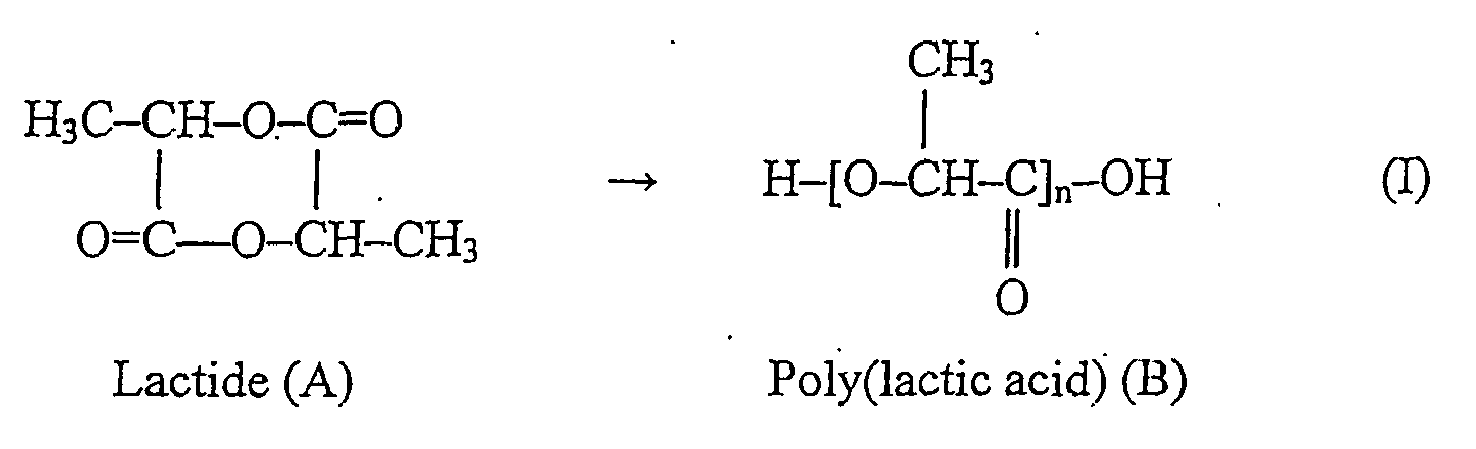
- Poly(lactic acid) has the formula H-[O-CH(CH 3 )-C(O)] n -OH and can be obtained by ring-opening polymerization of lactide (a cyclic dimer of lactic acid), as demonstrated schematically by reaction (I), where lactide is compound (A) and poly(lactic acid) is compound (B):
- the molecular weight of poly(lactic acid) can be between about 30,000 and about 300,000 Daltons, corresponding to the value of the integer u in the compound (B) between about 416 and about 4,166.
- Those having ordinary skill in the art can determine the conditions under which the transformation of lactide to poly(lactic acid) illustrated by reaction (I) can be carried out.
- polymers containing moieties derived from poly(lactic acid) can be also used in addition to or instead of, poly(lactic acid), for making any of the stent coating layers.
- poly(lactic acid) includes derivatives of poly(lactic acid), for example, hydrolyzed or carboxylated poly(lactic acid), or a blend thereof. Using the hydrolyzed or carboxylated poly(lactic acid) is expected to result in the increased rate of degradation of the coating, consequently leading to the increased rate of release of the drug.
- the hydrolyzed poly(lactic acid) is a polymeric product comprising a mixture of the original (unhydrolized) poly(lactic acid) (B) and oligomeric and/or polymeric products of the hydrolysis thereof.
- the products of hydrolysis can include a complex mixture of oligomers of lactic acid, some monomeric lactic acid and other products that can include hydroxylated species.
- the mixture can contain between about 1 mass % and about 20 mass % original poly(lactic acid) (B) having the molecular weight as indicated above, and the balance, the products of hydrolysis thereof.
- the oligomeric and/or polymeric products of hydrolysis of poly(lactic acid) can have an average molecular weight between about 1,000 and about 20,000 Daltons.
- poly(lactic acid) can be hydrolyzed under the conditions that can be selected by those having ordinary skill in the art.
- the process of hydrolysis is a polymer-analogous transformation and can be carried out until the mixture of poly(lactic acid) and the products of hydrolysis thereof are obtained, the mixture having a desired ratio between poly(lactic acid) and the products of hydrolysis thereof.
- the desired ratio can be also determined by those having ordinary skill in the art.
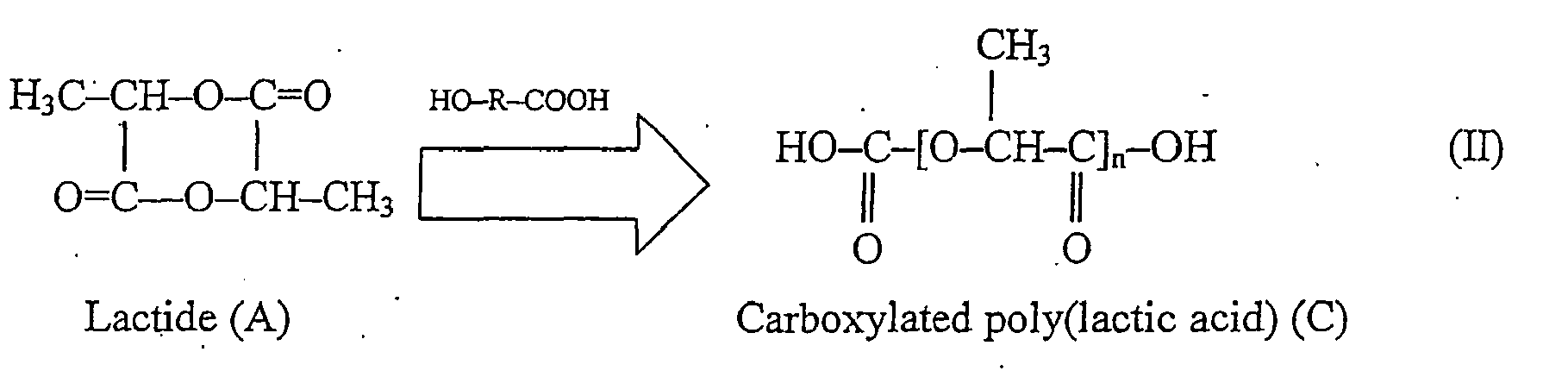
- the carboxylated poly(lactic acid) comprises poly(lactic acid) terminated with a carboxyl group and can be obtained by ring-opening polymerization of lactide (A), in the presence of a hydroxy acid HO-R-COOH serving as a ring opening catalyst as demonstrated schematically by reaction (II), where the carboxylated poly(lactic acid) is compound (C):
- Hydroxy acid HO-R-COOH, the ring-opening catalyst, in reaction (II) can be any suitable hydroxy acid that can be selected by those having ordinary skill in the art.
- hydroxy acid that can be used is hydroacetic (glycolic) acid.
- the carboxylated poly(lactic acid) can be a fully carboxylated poly(lactic acid), i.e., can be a 100% product (C).
- the molecular weight of the fully carboxylated poly(lactic acid) can be between about 1,000 and about 20,000 Daltons.
- the fully carboxylated poly(lactic acid) can be obtained from Birmingham Polymers, Inc. of Birmingham, Alabama.
- the carboxylated poly(lactic acid) can be also in a mixture with original poly(lactic acid) (B).
- the mixture can contain between about 1 mass % and about 20 mass % original poly(lactic acid) (B) having the molecular weight as indicated above, and the balance, the carboxylated poly(lactic acid) (C).
- the polymers based on poly(lactic acid) that can be used include block-copolymers, such as AB block-copolymers ("diblock-copolymers”) or ABA block-copolymers ("triblock-copolymers”), or mixtures thereof.
- the molecular weight of blocks A can be between about 300 and about 40,000 Daltons, more narrowly, between about 8,000 and about 30,000 Daltons, for example, about 15,000 Daltons.
- the molecular weight of blocks B can be between about 50,000 and about 250,000 Daltons, more narrowly, between about 80,000 and about 200,000 Daltons, for example, about 100,000 Daltons.
- Both ABA and AB block-copolymers that can be used contain the block(s) of poly(lactic acid), and the block(s) of a biologically compatible moiety, providing the AB or ABA block-copolymer with blood compatibility ("a biocompatible moiety").
- a biocompatible moiety is poly(lactic acid) and moiety B is the biocompatible moiety.
- moiety B is poly(lactic acid), and moiety A is the biocompatible moiety.
- the biocompatible moieties are selected in such a way so that to make the entire ABA and AB block-copolymers biologically degradable.
- the biocompatible moiety is poly(ethylene glycol) (PEG),
- a molecular weight of a suitable biocompatible polymeric moiety can be below 40,000 Daltons to ensure the renal clearance of the compound, for example, between about 300 and about 40,000 Daltons, more narrowly, between about 8,000 and about 30,000 Daltons, for example, about 15,000 Daltons.
- Lactones and lactides mentioned above can also replace a part or all of DLPLA in the block-copolymer, if desired.
- AB block copolymer poly(D,L-lactic acid)-block-poly(ethylene-glycol) (DLPLA-PEG).
- DLPLA-PEG poly(D,L-lactic acid)-block-poly(ethylene-glycol)
- the DLPLA-PEG block-copolymer shown by formula (III) can have a total molecular weight between about 30,000 and about 306,000 Daltons, for example, about 60,000 Daltons as measured by the gel-permeation chromatography (GPC) method in tetrahydrofuran.
- the molecular weight of the PEG blocks can be between about 500 and about 30,000 Daltons, for example, about 550 Daltons, and the molecular weight of the DLPLA blocks can be between about 1,500 and about 20,000 Daltons, for example, about 1,900 Daltons.
- GPC gel-permeation chromatography
- ABA block copolymer poly(D,L-lactic acid)-block-poly(ethylene-glycol)-block- poly(D,L-lactic acid) (DLPLA-PEG-DLPLA).
- DLPLA-PEG-DLPLA poly(D,L-lactic acid)-block-poly(ethylene-glycol)-block- poly(D,L-lactic acid)
- the DLPLA-PEG-DLPLA block-copolymer shown by formula (IV) can have a total molecular weight between about 30,000 and about 300,000 Daltons, for example, about 60,000 Daltons as measured by the GPC method in tetrahydrofuran.
- the molecular weight of the PEG blocks can be between about 500 and about 30,000 Daltons, for example, about 7,500 Daltons
- the molecular weight of the DLPLA blocks can be between about 1,500 and about 20,000 Daltons
- one terminal DLPLA block can have the molecular weight of about 3,400 Daltons
- the other terminal DLPLA block can have the molecular weight of about 10,000 Daltons.
- n is an integer that can have a value between about 21 and about 278
- m is an integer that can have a value between about 11 and about 682
- p is an integer that can have a value between about 21 and about 278.
- the positions of the moieties can be switched to obtain a BAB block-copolymer, poly(ethylene-glycol)-block-poly(D,L-lactic acid)-block-poly(ethylene-glycol) (PEG-DLPLA-PEG).
- PEG-DLPLA-PEG poly(ethylene-glycol)-block-poly(D,L-lactic acid)-block-poly(ethylene-glycol)
- the PEG-DLPLA-PEG block-copolymer shown by formula (V) can have a total molecular weight between about 30,000 and about 300,000 Daltons, for example, about 60,000 Daltons as measured by the GPC method in tetrahydrofuran.
- the molecular weight of the PEG blocks can be between about 500 and about 30,000 Daltons, for example, about 7,500 Daltons, and the molecular weight of the DLPLA blocks can be between about 1,500 and about 20,000 Daltons.
- "n” is an integer that can have a value between about 21 and about 278,
- m is an integer that can have a value between about 11 and about 682, and
- p is an integer that can have a value between about 11 and about 682.
- Block-copolymers shown by formulae (III-V) can be synthesized by standard methods known to those having ordinary skill in the art, for example, copolycondensation of PEG with DLPLA. The process of copolycondensation can be catalyzed by an acid or a base, if necessary.
- hydrolyzed block copolymers of PEG and DPLA can be used for making the stent coatings. Both AB and ABA and BAB block-copolymers discussed above can be used to obtain the hydrolyzed block copolymers of PEG and DPLA.
- the hydrolyzed block copolymers of PEG and DPLA are polymeric products comprising a mixture of block copolymers of PEG and DPLA and products of partial hydrolysis thereof. The mixture can contain between about 1 mass % and about 20 mass % unhydrolyzed block copolymers of PEG and DPLA and the balance, the products of hydrolysis thereof.
- the block-copolymers can be hydrolyzed under the conditions that can be selected by those having ordinary skill in the art.
- the process of hydrolysis can be carried out until the mixture of the block-copolymer and the products of partial hydrolysis thereof is obtained, the mixture having a desired ratio between the block-copolymer and the products of partial hydrolysis thereof.
- the desired ratio can be also determined by those having ordinary skill in the art.
- poly(lactic) acid in addition to, or instead of, the polymers based on poly(lactic) acid, other biologically absorbable polymers can be used for making stent coatings.
- poly(lactic) acid in addition to, or instead of, other biologically absorbable polymers.
- PEG-PBT and PEG-PBT-PEG block copolymers are known under a trade name POLYACTIVE TM and are available from IsoTis Corp. of Holland. These polymers can be obtained, for example, by trans-esterification of dibutyleneterephthalate with PEG.
- POLYACTIVE TM the ratio between the units derived from ethylene glycol and the units derived from butylene terephthalate can be between about 0.67:1 and about 9:1.
- the molecular weight of the units derived from ethylene glycol can be between about 300 and about 4,000 Daltons, and the molecular weight of the units derived from butylene terephthalate can be between about 50,000 and about 250,000, for example, about 100,000 Daltons.
- DLPLA-PEG-DLPLA, PEG-DLPLA-PEG, PEG-PBT, PEG-PBT-PEG, PBT-PEG-PBT, PEG-PCL, PEG-PCL-PEG, and PCL-PEG-PCL block copolymers all contain fragments with ester bonds.
- Ester bonds are known to be water-labile bonds. When in contact with slightly alkaline blood, ester bonds are subject to catalyzed hydrolysis, thus ensuring biological degradability of the block-copolymer.
- One product of degradation of every block polymer belonging to the group DLPLA-PEG-DLPLA, PEG-DLPLA-PEG, PEG-PBT, PEG-PBT-PEG, PBT-PEG-PBT, PEG-PCL, PEG-PCL-PEG, and PCL-PEG-PCL is expected to be PEG, which is highly biologically compatible.
- Any layer of the stent coating can contain any amount of the bioabsorbable polymer(s) described above, of a blend of more than one of such polymers. If less than 100% of the layer is made of the bioabsorbable polymer(s) described above, other, alternative, polymers can comprise the balance.
- polyacrylates such as poly(butyl naethacrylate), poly(ethyl methacrylate), poly(ethyl methacrylate-co-butyl methacrylate), poly(acrylonitrile), poly(ethylene-co-methyl methacrylate), poly(acrylonitrile-co-styrene), and poly(cyanoacrylates); fluorinated polymers and/or copolymers, such as poly(vinylidene fluoride) and poly(vinylidene fluoride-co-hexafluoro propene); poly(N-vinyl pyrrolidone); polydioxanone; polyorthoester; polyanhydride; poly(glycolic acid); poly(glycolic acid-co-trimethylene carbonate); polyphosphoester; polyphosphoester urethane; poly(amino acids); poly(trimethylene carbonate); poly(iminocarbonate); co-poly(
- solvents suitable for making the stent coatings include N,N-dimethylacetamide (DMAC), N,N-dimethylformamide (DMF), tethrahydrofurane (THF), cyclohexanone, xylene, toluene, acetone, i -propanol, methyl ethyl ketone, propylene glycol monomethyl ether, methyl butyl ketone, ethyl acetate, n -butyl acetate, and dioxane.
- DMAC N,N-dimethylacetamide
- DMF N,N-dimethylformamide
- THF tethrahydrofurane
- cyclohexanone cyclohexanone
- xylene toluene
- acetone i -propanol
- methyl ethyl ketone propylene glycol monomethyl ether
- FLUX REMOVER AMS is in the trade name of a solvent manufactured by Tech Spray, Inc. of Amarillo, Texas comprising about 93.7% of a mixture of 3,3-dichloro-1,1,1,2,2-pentafluoropropane and 1,3-dichloro-1,1,2,2,3-pentafluoropropane, and the balance of methanol, with trace amounts of nitromethane.
- solvent or a mixture of solvents suitable for a particular polymer being dissolved are examples of a solvent manufactured by Tech Spray, Inc. of Amarillo, Texas comprising about 93.7% of a mixture of 3,3-dichloro-1,1,1,2,2-pentafluoropropane and 1,3-dichloro-1,1,2,2,3-pentafluoropropane, and the balance of methanol, with trace amounts of nitromethane.
- Those.having ordinary skill in the art will select the solvent or a mixture of solvents suitable for a particular poly
- the therapeutic substance which can be used in the reservoir layer can include any substance capable of exerting a therapeutic or prophylactic effect for a patient.
- the therapeutic substance may include small molecule substances, peptides, proteins, oligonucleotides.
- the therapeutic substance could be designed, for example, to inhibit the activity of vascular smooth muscle cells. It can be directed at inhibiting abnormal or inappropriate migration and/or proliferation of smooth muscle cells to inhibit restenosis.
- therapeutic substances examples include antiproliferative substances such as actinomycin D, or derivatives and analogs thereof (manufactured by Sigma-Aldrich of Milwaukee, Wisconsin, or COSMEGEN available from Merck). Synonyms of actinomycin D include dactinomycin, actinomycin IV, actinomycin I I , actinomycin X 1 , and actinomycin C 1 .
- the active agent can also fall under the genus of antineoplastic, anti-inflammatory, antiplatelet, anticoagu,lant, antifibrin, antithrombin, antimitotic, antibiotic, antiallergic and antioxidant substances. Examples of such antineoplastics and/or antimitotics include paclitaxel (e.g.
- TAXOL ® by Bristol-Myers Squibb Co., Stamford, Conn.
- docetaxel e.g. Taxotere ® , from Aventis S.A., Frankfurt, Germany
- methotrexate azathioprine
- vincristine vincristine
- vinblastine a cell line
- fluorouracil a cell line
- doxorubicin hydrochloride e.g. Adriamycin ® from Pharmacia & Upjohn, Peapack N.J.
- mitomycin e.g. Mutamycin ® from Bristol-Myers Squibb Co., Stamford, Conn.
- antiplatelets examples include sodium heparin, low molecular weight heparins, heparinoids, hirudin, argatroban, forskolin, vapiprost, prostacyclin and prostacyclin analogues, dextran, D-phe-pro-arg-chloromethylketone (synthetic antithroxnbin), dipyridamole, glycoprotein IIb/IIIa platelet membrane receptor antagonist antibody, recombinant hirudin, and thrombin inhibitors such as ANGIONIAX TM (Biogen, Inc., Cambridge, Mass.).
- cytostatic or antiproliferative agents examples include angiopeptin, angiotensin converting enzyme inhibitors such as captopril (e.g. Capoten ® and Capazide ® from Bristol-Myers Squibb Co., Stamford, Conn.), cilazapril or lisinopril (e.g.
- calcium channel blockers such as nifedipine
- colchicine fibroblast growth factor (FGF) antagonists
- fish oil omega 3-fatty acid
- histamine antagonists lovastatin (an inhibitor of HMG-CoA reductase, a cholesterol lowering drug, brand name Mevacor ® from Merck & Co., Inc., Whitehouse Station, NJ)
- monoclonal antibodies such as those specific for Platelet-Derived Growth Factor (PDGF) receptors), nitroprusside, phosphodiestsrase inhibitors, prostaglandin inhibitors, surarim, serotonin blockers, steroids, thioprotease inhibitors, triazoloppimidine (a PDGF antagonist), and nitric oxide.
- PDGF Platelet-Derived Growth Factor
- an antiallergic agent is permirolast potassium.
- Other therapeutic substances or agents which may be appropriate include alpha-mterfcron, genetically engineered epithelial cells, tacralimus, dexamethasone, and rapamycin and structural derivatives or functional analogs thereof such as 40-O-(2-hydroxy)ethyl-rapamycin (known by the trade name of EVEROLIMUS TM available from Novartis), 40-O-(3-hydroxy)propyl-rapamycin, 40-O-[2-(2-hydroxy)ethoxy]ethyl-rapamycin, and 40-O-tetrazole-rapamycin.
- a stent such as a balloon expandable or self-expandable stent
- the use of the coating is not limited to stents, however, and the coating can also be used with a variety of other medical devices.
- the implantable medical device that can be used in conjunction with the embodiments of this invention include stent-grafts, grafts (e.g., aortic grafts), artificial heart valves, cerebrospinal fluid shunts, pacemaker electrodes, axius coronary shunts and endocardial leads (e.g., FINELINE TM and ENDOTAK TM , available from Guidant Corporation).
- the underlying structure of the device can be of virtually any design.
- the device can be made of a metallic material or an alloy such as cobalt-chromium alloys (e.g., ELGILOY TM ), stainless steel (316L), "MP35N TM ,” “MP20N TM ,” ELASTINTIE TM (Nitinol), tantalum, tantalum-based alloys, aickel-titanium alloy, platinum, platinum-based alloys such as, e.g., platinum-indium alloy, indium, gold, magnesium, titanium, titanium-based alloys, zirconium-based alloys, or combinations thereof
- Devices made from bioabsorbable or biostable polymers can also be used with the embodiments of the present invention.
- the device itself can be made from the above described polymers.
- MP35N TM and “MP20N TM” are trade names for alloys of cobalt, nickel, chromium and molybdenum available from Standard Press Steel Co. of Jenkintown, Pennsylvania.
- MP35N TM consists of 35% cobalt, 35% nickel, 20% chromium, and 10% molybdenum.
- MP20N TM consists of 50% cobalt, 20% nickel, 20% chromium, and 10% molybdenum.
- a first composition can be prepared by mixing the following components:
- the first composition can be applied onto the surface of a bare 12 mm VISION TM stent (available from Guidant Corporation) by spraying and dried to form a primer layer.
- a spray coater can be used having a 0.014 fan nozzle maintained at about 60°C with a feed pressure of about 0.2 atm (about 3 psi) and an atomization pressure of about 1.3 atm (about 20 psi).
- the primer can be baked at about 120°C for about 30 minutes, yielding a dry primer layer.
- the primer layer can contain about 100 ⁇ g DLPLA.
- a second composition can be prepared by mixing the following components:
- the second composition can be applied onto the dried primer layer to form the reservoir layer, using the same spraying technique and equipment used for applying the primer layer, followed by drying, e.g., by baking at about 50°C for about I hour, yielding a dry reservoir layer.
- the dry reservoir layer can contain about 120 ⁇ g EVEROLIMUS TM .
- a third composition can be prepared by mixing the following components:
- the third composition can be applied onto the dried reservoir layer to form a topcoat layer, using the same spraying technique and equipment used for applying the primer layer and the reservoir layer followed by drying, e.g., by baking at about 50°C for about 1 hour, yielding a dry topcoat layer.
- the dry topcoat layer can contain about 300 ⁇ g DLPLA.
- the stent can be coated with a primer layer as described in Example 1.
- a first composition can be prepared by mixing the following components:
- the mass ratio between EVEROLIMUS TM and DLPLA-PEG-DLPLA can be about 1:3.
- the first composition can be applied onto the dried primer layer to form the reservoir layer, using the same spraying technique and equipment used for applying the primer layer, followed by drying, e.g., by baking at about 50°C for about 1 hour, yielding a dry reservoir layer.
- the dry reservoir layer can contain about 75 ⁇ g EVEROLIMUS TM and about 225 ⁇ g DLPLA-PEG-DLPLA.
- a second composition can be prepared by mixing the following components:
- the second composition can be applied onto the dried reservoir to form the topcoat layer, using the same spraying technique and equipment used for applying the primer layer and reservoir, followed by drying, e.g., by baking at about 50°C for about 1 hour, yielding a dry topcoat layer.
- the dry topcoat layer can contain about 150 ⁇ g PEG-PBT.
Landscapes
- Health & Medical Sciences (AREA)
- Life Sciences & Earth Sciences (AREA)
- Veterinary Medicine (AREA)
- Heart & Thoracic Surgery (AREA)
- Vascular Medicine (AREA)
- Animal Behavior & Ethology (AREA)
- General Health & Medical Sciences (AREA)
- Public Health (AREA)
- Engineering & Computer Science (AREA)
- Biomedical Technology (AREA)
- Epidemiology (AREA)
- Surgery (AREA)
- Transplantation (AREA)
- Oral & Maxillofacial Surgery (AREA)
- Cardiology (AREA)
- Chemical & Material Sciences (AREA)
- Medicinal Chemistry (AREA)
- Molecular Biology (AREA)
- Materials For Medical Uses (AREA)
- Polyesters Or Polycarbonates (AREA)
- Paints Or Removers (AREA)
Abstract
Description
- This invention is directed to coatings for drug delivery devices, such as drug eluting vascular stents, and methods for producing the same.
- Percutaneous transluminal coronary angioplasty (PTCA) is a procedure for treating heart disease. A catheter assembly having a balloon portion is introduced percutaneously into the cardiovascular system of a patient via the brachial or femoral artery. The catheter assembly is advanced through the coronary vasculature until the balloon portion is positioned across the occlusive lesion. Once in position across the lesion, the balloon is inflated to a predetermined size to.radially compress against the atherosclerotic plaque of the lesion to remodel the lumen wall. The balloon is then deflated to a smaller profile to allow the catheter to be withdrawn from the patient's vasculature.
- A problem associated with the above procedure includes formation of intimal flaps or torn arterial linings which can collapse and occlude the conduit after the balloon is deflated. Moreover, thrombosis and restenosis of the artery may develop over several months after the procedure, which may require another angioplasty procedure or a surgical by-pass operation. To reduce the partial or total occlusion of the artery by the collapse of arterial lining and to reduce the chance of the development of thrombosis and restenosis, a stent is implanted in the lumen to maintain the vascular patency.
- Stents are used not only as a mechanical intervention but also as a vehicle for providing biological therapy. As a mechanical intervention, stents act as scaffoldings, functioning to physically hold open and, if desired, to expand the wall of the passageway. Typically, stents are capable of being compressed, so that they can be inserted through small vessels via catheters, and then expanded to a larger diameter once they are at the desired location. Examples in patent literature disclosing stents which have been applied in PTCA procedures include stents illustrated in
U.S. Patent No. 4,733,665 issued to Palmaz,U.S. Patent No. 4,800,882 issued to Gianturco, andU.S. Patent No. 4,886,062 issued to Wiktor. - Biological therapy can be achieved by medicating the stents. Medicated stents provide for the local administration of a therapeutic substance at the diseased site. In order to provide an efficacious concentration to the treated site, systemic administration of such medication often produces adverse or toxic side effects for the patient: Local delivery is a preferred method of treatment in that smaller total levels of medication are administered in comparison to systemic dosages, but are concentrated at a specific site. Local delivery thus produces fewer side effects and achieves more favorable results. One proposed method for medicating stents involves the use of a polymeric carrier coated onto the surface of a stent. A solution which includes a solvent, a polymer dissolved in the solvent, and a therapeutic substance dispersed in the blend is applied to the stent. The solvent is allowed to evaporate, leaving on the stent surface a coating of the polymer and the therapeutic substance impregnated in the polymer.
- Local administration of therapeutic agents via stents has shown some favorable results in reducing restenosis. However, there is a great need for better and more effective coatings for the local drug delivery. For example, it is desirable to have the biologically absorbable stent coatings having biologically beneficial properties, enhanced absorption rate, the drug release rate that can be modulated, and good mechanical properties. Embodiments of the present invention disclose such coatings.
-
EP-1,362,603 A2 describes a coating on a stent that can include poly(lactic acid), polyglycolic acid or copolymer of poly(lactic acid) and glycolic acid (see paragraph [0031]). The coating can also include poly(ethylene glycol) (paragraph [78]). However,EP-1,362,603 A2 does not describe forming a coating that includes a block copolymer that comprises at least one poly(lactic acid) block and at least one poly(ethylene glycol) block. -
U.S. Patent No. 6,555,157 describes a coating on an implantable device that can include poly(lactic acid), polyglycolic acid or poly(lactide-co-glycolide) (see col. 5, lines 10 to 43). The coating can also include poly(ethylene glycol) or polyethylene oxide (PEO) (see column 5, lines 10 to 43). However,US 6,555,157 does not describe forming a coating that includes a block copolymer that comprises at least one poly(lactic acid) block and at least one poly(ethylene glycol) block. -
US Patent No. 6,783,793 describes a coating on an implantable device that can include poly(lactic acid), polyglycolic acid or poly(lactide-co-glycolide) (see Column 5, line 64 to Column 6, line 31). The coating can also include poly(ethylene glycol) or polyethylene oxide (PEO) (see column 5, line 64 to column 6, line 31). However,US 6,783,793 does not describe forming a coating that includes a block copolymer that comprises at least one poly(lactic acid) block and at least one poly(lactic acid) block and at least one poly(ethylene glycol) block. -
US Patent No. 5,824,048 describes a method for delivering a therapeutic substance to a body lumen using coating on an implantable device that can include poly(lactic acid), polyglycolic acid or poly(lactide-co-glycolide) (see column 5, lines 13 to 53). However,US 5,824,048 does not describe delivering a therapeutic substance from a coating that includes a block copolymer that comprises at least one poly(lactic acid) block and at least one poly(ethylene glycol) block. -
US Patent No. 6,753,071 describes a method for release of an agent from a coating on an implantable device that can include poly(lactic acid), polyglycolic acid or poly(lactide-co-glycolide) (see column 4, lines 6 to 60). However,US 6,753,071 does not describe release of an agent from a coating that includes a block copolymer that comprises at least one poly(lactic acid) block and at least one poly(ethylene glycol) block. - According to a first aspect, the present invention provides a medical article comprising an implantable substrate having a coating, the coating including a diblock copolymer or a triblock copolymer comprising at least one poly(lactic acid) block and at least one poly(ethylene glycol) block. The block polymers include diblock-copolymers, triblock-copolymers, or mixture thereof.
- According to a further aspect, the present invention provides a method for fabricating a medical article, the method including depositing a coating on at least a portion of an implantable substrate, the coating including a diblock copolymer or triblock copolymer comprising at least one poly(lactic acid) block and at least one poly(ethylene glycol) block.
- The following definitions apply:
- The terms "biologically degradable," "biologically erodable," "biologically absorbable," and "biologically resorbable" coatings and/or polymers, which are used interchangeably, are defined as coatings and/or polymers that are capable of being completely degraded, dissolved, and/or eroded over time when exposed to bodily fluids such as blood and are gradually resorbed, absorbed and/or eliminated by the body. The processes of breaking down and eventual absorption and elimination of the coating and/or polymer can be caused, for example, by hydrolysis, metabolic processes, bulk or surface erosion.
- Whenever the reference is made to "biologically degradable," "biologically erodable," "biologically absorbable," and "biologically resorbable" stent coatings and/or polymers forming such stent coatings, it is understood that after the process of degradation, erosion, absorption, and/or resorption has been completed, no coating will remain on the stent. Whenever the terms "degradable," "biodegradable," or "biologically degradable" are used in this application, they are intended to broadly include biologically degradable, biologically erodable, biologically absorbable, and biologically resorbable coatings and/or polymers.
- "Biodegradability," "bioerodability," "bioabsorbability," and "bioresorbability" are defined as inherent properties of the coating and/or polymer making the coating and/or polymer biologically degradable, biologically erodable, or biologically absorbable, and biologically resorbable.
- "Fast release" is defined as in vivo release of substantially entire amount of the drug from the stent coating in less than 15 days, for example, within 7 to 14 days. "Slow release" is defined as in vivo release of substantially entire amount of the drug from the stent coating in 15 days or longer, for example, within 15 to 56 days.
- The terms "block-copolymer" and "graft copolymer" are defined in accordance with the terminology used by the International Union of Pure and Applied Chemistry (IUPAC). "Block-copolymer" refers to a copolymer containing a linear arrangement of blocks. The block is defined as a portion of a polymer molecule in which the monomeric units have at least one constitutional or configurational feature absent from the adjacent portions. "Graft copolymer" refers to a polymer composed of macromolecules with one or more species of block connected to the main chain as side chains, these side chains having constitutional or configurational features that differ from those in the main chain.
- The term "AB block-copolymer" is defined as a block-copolymer having moieties A and B arranged according to the general formula-{[A-]m-[B]n}-x, where each of "m," "n," and "x" is a positive integer, and m≥2, and n≥2.
- The term "ABA block-copolymer" is defined as a block-copolymer having moieties A and B arranged according to the general formula-{[A-]m-[B-]n-[A]p}-x, where each of "m," "n," "p," and "x" is a positive integer, and m ≥2, and n≥2, and p≥2.
- The blocks of the ABA and AB block-copolymers need not be linked on the ends, since the values of the integers determining the number of A and B blocks are such as to ensure that the individual blocks are usually long enough to be considered polymers in their own right. Accordingly, the ABA block copolymer can be named poly A-block-co-poly B block-co-poly A block-copolymer, and the AB block copolymer can be named poly A-block-co-poly B block-copolymer. Blocks "A" and "B," typically, larger than three-block size, can be alternating or random.
- A coating for an implantable medical device, such as a stent, according to embodiments of the present invention, can be a multi-layer structure that can include any of the following four layers or combination thereof:
- (a) a primer layer;
- (b) a drug-polymer layer (also referred to as "reservoir" or "reservoir layer") or alternatively a polymer free drug layer;
- (c) a topcoat layer; and/or
- (d) a finishing coat layer.
- Each layer of the stent coating can be formed on the stent by dissolving the polymer or a blend of polymers in a solvent, or a mixture of solvents, and applying the resulting polymer solution on the stent by spraying or immersing the stent in the solution. After the solution has been applied onto the stent, the coating is dried by allowing the solvent to evaporate. The process of drying can be accelerated if the drying is conducted at an elevated temperature. The complete stent coating can be optionally annealed at a temperature between about 40°C and about 150°C for a period of time about 5 minutes and about 60 minutes, if desired, to improve the thermodynamic stability of the coating.
- To incorporate a drug into the reservoir layer, the drug can be combined with the polymer solution that is applied onto the stent as described above. Alternatively, if it is desirable to have the stent coating with the fast drug release rate, a polymer-free reservoir can be made. To fabricate a polymer free reservoir, the drug can be dissolved in a suitable solvent or mixture of solvents, and the resulting drug solution can be applied on the stent by spraying or immersing the stent in the drug solution.
- Instead of introducing the drug as a solution, the drug can be introduced as a colloid system, such as a suspension in an appropriate solvent phase. To make the suspension, the drug can be dispersed in the solvent phase using conventional techniques used in colloid chemistry. Depending on a variety of factors, e.g., the nature of the drug, those having ordinary skill in the art can select the solvent to form the solvent phase of the suspension, as well as the quantity of the drug to be dispersed in the solvent phase. The suspension can be mixed with a polymer solution and the mixture can be applied on the stent as described above. Alternatively, the drug suspension can be applied on the stent without being mixed with the polymer solution.
- The drug-polymer layer can be applied directly onto at least a part of the stent surface to serve as a reservoir for at least one active agent or a drug which is incorporated into the reservoir layer. The optional primer layer can be applied between the stent and the reservoir to improve the adhesion of the drug-polymer layer to the stent. The optional topcoat layer can be applied over at least a portion of the reservoir layer and serves as a rate limiting membrane which helps to control the rate of release of the drug. In one embodiment, the topcoat layer can be essentially free from any active agents or drugs. If the topcoat layer is used, the optional finishing coat layer can be applied over at least a portion of the topcoat layer for further control of the drug release rate and for improving the biocompatibility of the coating. Without the topcoat layer, the finishing coat layer can be deposited directly on the reservoir layer.
- The process of the release of the drug from a coating having both topcoat and finishing coat layers includes at least three steps. First, the drug is absorbed by the polymer of the topcoat layer on the drug-polymer layer/topcoat layer interface. Next, the drug diffuses through the topcoat layer using empty spaces between the macromolecules of the topcoat layer polymer as pathways for migration. Next, the drug arrives to the topcoat layer/finishing layer interface. Finally, the drug diffuses through the finishing coat layer in a similar fashion, arrives to the outer surface of the finishing coat layer, and desorbs from the outer surface. At this point, the drug is released into the blood stream. Consequently, a combination of the topcoat and finishing coat layers, if used, can serve as a rate limiting barrier. The drug can be released through the degradation, dissolution, and/or erosion of the layer.
- In one embodiment, any or all of the layers of the stent coating, can be made of a biologically degradable, erodable, absorbable, and/or resorbable polymer. In another embodiment, the outermost layer of the coating can be limited to such a polymer.
- To illustrate in more detail, in the stent coating having all four layers described above (i.e., the primer, the reservoir layer, the topcoat layer and the finishing coat layer), the outermost layer is the finishing coat layer, which is made of a polymer that is biologically degradable, erodable, absorbable, and/or resorbable. In this case, optionally, the remaining layers (i.e., the primer, the reservoir layer, the topcoat layer) can be also fabricated of a biologically degradable polymer; and the polymer can be the same or different in each layer.
- If the finishing coat layer is not used, the topcoat layer can be the outermost layer and is made of a biologically degradable polymer. In this case, optionally, the remaining layers (i.e., the primer and the reservoir layer) can be also fabricated of a biologically degradable polymer; and the polymer can be the same or different in each of the three layers.
- If neither the finishing coat layer nor the topcoat layer is used, the stent coating can have only two layers, the primer and the reservoir. The reservoir in this case is the outermost layer of the stent coating and is made of a biologically degradable polymer. Optionally, the primer can be also fabricated of a biologically degradable polymer. The two layers can be made from the same or different materials.
- The biological degradation, erosion, absorption and/or resorption of a biologically degradable, erodable, absorbable and /or resorbable polymer are expected to cause the increase of the release rate of the drug due to the gradual disappearance of the polymer that forms the reservoir or the topcoat layer, or both. By choosing an appropriate degradable polymer the stent coating can be engineered to provide either fast or slow release of the drug, as desired. Those having ordinary skill in the art can determine whether a stent coating having slow or fast release rate is advisable for a particular drug. For example, fast release may be recommended for stent coatings loaded with antimigratory drugs which often need to be released within 1 to 2 weeks. For antiproliferative drugs, slow release may be needed (up to 30 days release time).
- Biologically degradable, erodable, absorbable and /or resorbable polymers that can be used for making any of the stent coating layers include at least one ofpoly(lactic acids), i.e., poly(D,L-lactic acid) (DLPLA), poly(D-lactic acid) or poly(L-lactic acid), or any combination thereof. Poly(lactic acid) has the formula H-[O-CH(CH3)-C(O)]n-OH and can be obtained by ring-opening polymerization of lactide (a cyclic dimer of lactic acid), as demonstrated schematically by reaction (I), where lactide is compound (A) and poly(lactic acid) is compound (B):
- The molecular weight of poly(lactic acid) can be between about 30,000 and about 300,000 Daltons, corresponding to the value of the integer u in the compound (B) between about 416 and about 4,166. Those having ordinary skill in the art can determine the conditions under which the transformation of lactide to poly(lactic acid) illustrated by reaction (I) can be carried out.
- Alternatively, polymers containing moieties derived from poly(lactic acid) can be also used in addition to or instead of, poly(lactic acid), for making any of the stent coating layers. One type of alternative polymers based on poly(lactic acid) includes derivatives of poly(lactic acid), for example, hydrolyzed or carboxylated poly(lactic acid), or a blend thereof. Using the hydrolyzed or carboxylated poly(lactic acid) is expected to result in the increased rate of degradation of the coating, consequently leading to the increased rate of release of the drug.
- The hydrolyzed poly(lactic acid) is a polymeric product comprising a mixture of the original (unhydrolized) poly(lactic acid) (B) and oligomeric and/or polymeric products of the hydrolysis thereof. The products of hydrolysis can include a complex mixture of oligomers of lactic acid, some monomeric lactic acid and other products that can include hydroxylated species. The mixture can contain between about 1 mass % and about 20 mass % original poly(lactic acid) (B) having the molecular weight as indicated above, and the balance, the products of hydrolysis thereof. The oligomeric and/or polymeric products of hydrolysis of poly(lactic acid) can have an average molecular weight between about 1,000 and about 20,000 Daltons.
- To obtain the hydrolyzed poly(lactic acid), poly(lactic acid) can be hydrolyzed under the conditions that can be selected by those having ordinary skill in the art. The process of hydrolysis is a polymer-analogous transformation and can be carried out until the mixture of poly(lactic acid) and the products of hydrolysis thereof are obtained, the mixture having a desired ratio between poly(lactic acid) and the products of hydrolysis thereof. The desired ratio can be also determined by those having ordinary skill in the art.
- The carboxylated poly(lactic acid) comprises poly(lactic acid) terminated with a carboxyl group and can be obtained by ring-opening polymerization of lactide (A), in the presence of a hydroxy acid HO-R-COOH serving as a ring opening catalyst as demonstrated schematically by reaction (II), where the carboxylated poly(lactic acid) is compound (C):
- Hydroxy acid HO-R-COOH, the ring-opening catalyst, in reaction (II) can be any suitable hydroxy acid that can be selected by those having ordinary skill in the art. One example of hydroxy acid that can be used is hydroacetic (glycolic) acid.
- The carboxylated poly(lactic acid) can be a fully carboxylated poly(lactic acid), i.e., can be a 100% product (C). The molecular weight of the fully carboxylated poly(lactic acid) can be between about 1,000 and about 20,000 Daltons. The fully carboxylated poly(lactic acid) can be obtained from Birmingham Polymers, Inc. of Birmingham, Alabama.
- The carboxylated poly(lactic acid) can be also in a mixture with original poly(lactic acid) (B). The mixture can contain between about 1 mass % and about 20 mass % original poly(lactic acid) (B) having the molecular weight as indicated above, and the balance, the carboxylated poly(lactic acid) (C).
- The polymers based on poly(lactic acid) that can be used include block-copolymers, such as AB block-copolymers ("diblock-copolymers") or ABA block-copolymers ("triblock-copolymers"), or mixtures thereof. The molecular weight of blocks A can be between about 300 and about 40,000 Daltons, more narrowly, between about 8,000 and about 30,000 Daltons, for example, about 15,000 Daltons. The molecular weight of blocks B can be between about 50,000 and about 250,000 Daltons, more narrowly, between about 80,000 and about 200,000 Daltons, for example, about 100,000 Daltons.
- Both ABA and AB block-copolymers that can be used contain the block(s) of poly(lactic acid), and the block(s) of a biologically compatible moiety, providing the AB or ABA block-copolymer with blood compatibility ("a biocompatible moiety"). To illustrate, in one embodiment, moiety A is poly(lactic acid) and moiety B is the biocompatible moiety. In another embodiment, moiety B is poly(lactic acid), and moiety A is the biocompatible moiety. In one embodiment, the biocompatible moieties are selected in such a way so that to make the entire ABA and AB block-copolymers biologically degradable.
- The biocompatible moiety is poly(ethylene glycol) (PEG), A molecular weight of a suitable biocompatible polymeric moiety can be below 40,000 Daltons to ensure the renal clearance of the compound, for example, between about 300 and about 40,000 Daltons, more narrowly, between about 8,000 and about 30,000 Daltons, for example, about 15,000 Daltons. Lactones and lactides mentioned above can also replace a part or all of DLPLA in the block-copolymer, if desired.
- Accordingly, one example of the AB block copolymer that can be used is poly(D,L-lactic acid)-block-poly(ethylene-glycol) (DLPLA-PEG). One possible structure of the DLPLA-PEG block-copolymer is shown by formula (III):
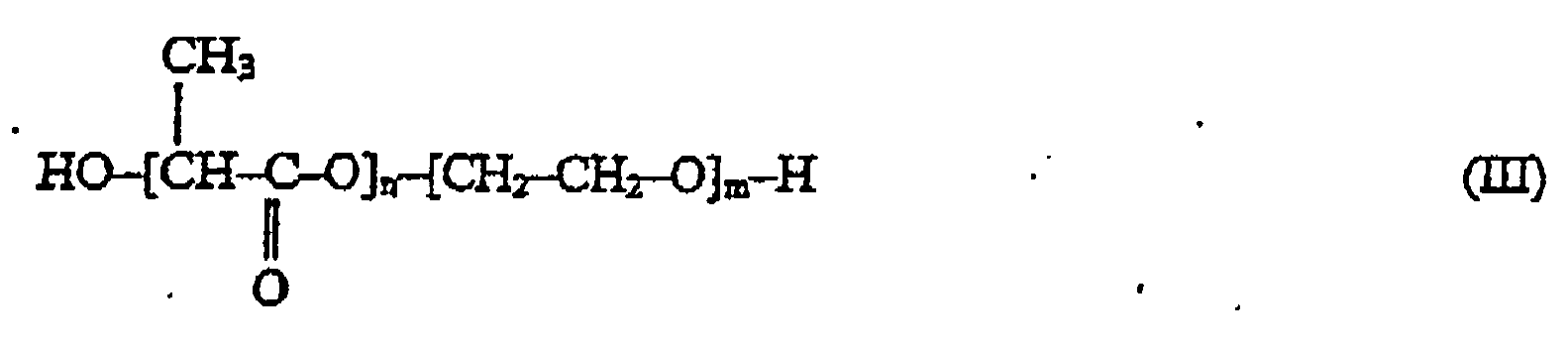
- The DLPLA-PEG block-copolymer shown by formula (III) can have a total molecular weight between about 30,000 and about 306,000 Daltons, for example, about 60,000 Daltons as measured by the gel-permeation chromatography (GPC) method in tetrahydrofuran. The molecular weight of the PEG blocks can be between about 500 and about 30,000 Daltons, for example, about 550 Daltons, and the molecular weight of the DLPLA blocks can be between about 1,500 and about 20,000 Daltons, for example, about 1,900 Daltons. Accordingly, in formula (III), "n" is an integer that can have a value between about 21 and about 278, and "m" is an integer that can have a value between about 11 and about 682.
- One example of the ABA block copolymer that can be used is poly(D,L-lactic acid)-block-poly(ethylene-glycol)-block- poly(D,L-lactic acid) (DLPLA-PEG-DLPLA). One possible structure of the DLPLA-PEG-DLPLA block-copolymer is shown by formula (IV):
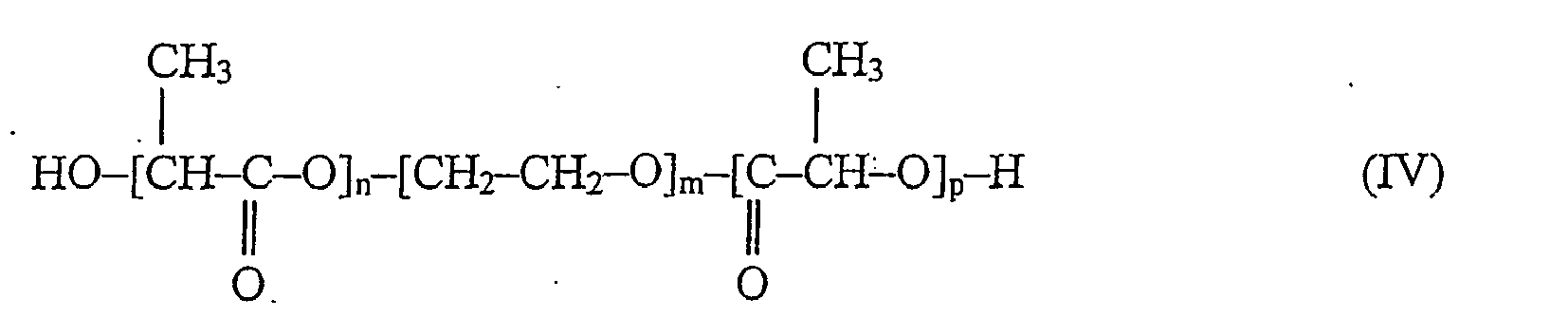
- The DLPLA-PEG-DLPLA block-copolymer shown by formula (IV) can have a total molecular weight between about 30,000 and about 300,000 Daltons, for example, about 60,000 Daltons as measured by the GPC method in tetrahydrofuran. The molecular weight of the PEG blocks can be between about 500 and about 30,000 Daltons, for example, about 7,500 Daltons, and the molecular weight of the DLPLA blocks can be between about 1,500 and about 20,000 Daltons, for example, one terminal DLPLA block can have the molecular weight of about 3,400 Daltons, and the other terminal DLPLA block can have the molecular weight of about 10,000 Daltons. Accordingly, in formula (IV), "n" is an integer that can have a value between about 21 and about 278, "m" is an integer that can have a value between about 11 and about 682, and "p" is an integer that can have a value between about 21 and about 278.
- If desired, the positions of the moieties can be switched to obtain a BAB block-copolymer, poly(ethylene-glycol)-block-poly(D,L-lactic acid)-block-poly(ethylene-glycol) (PEG-DLPLA-PEG). One possible structure of the PEG-DLPLA-PEG block-copolymer is shown by formula (V):

- The PEG-DLPLA-PEG block-copolymer shown by formula (V) can have a total molecular weight between about 30,000 and about 300,000 Daltons, for example, about 60,000 Daltons as measured by the GPC method in tetrahydrofuran. The molecular weight of the PEG blocks can be between about 500 and about 30,000 Daltons, for example, about 7,500 Daltons, and the molecular weight of the DLPLA blocks can be between about 1,500 and about 20,000 Daltons. Accordingly, in formula (V), "n" is an integer that can have a value between about 21 and about 278, "m" is an integer that can have a value between about 11 and about 682, and "p" is an integer that can have a value between about 11 and about 682.
- Block-copolymers shown by formulae (III-V) can be synthesized by standard methods known to those having ordinary skill in the art, for example, copolycondensation of PEG with DLPLA. The process of copolycondensation can be catalyzed by an acid or a base, if necessary.
- According to one embodiment, hydrolyzed block copolymers of PEG and DPLA can be used for making the stent coatings. Both AB and ABA and BAB block-copolymers discussed above can be used to obtain the hydrolyzed block copolymers of PEG and DPLA. The hydrolyzed block copolymers of PEG and DPLA are polymeric products comprising a mixture of block copolymers of PEG and DPLA and products of partial hydrolysis thereof. The mixture can contain between about 1 mass % and about 20 mass % unhydrolyzed block copolymers of PEG and DPLA and the balance, the products of hydrolysis thereof.
- To obtain the hydrolyzed block copolymers of PEG and DPLA, the block-copolymers can be hydrolyzed under the conditions that can be selected by those having ordinary skill in the art. The process of hydrolysis can be carried out until the mixture of the block-copolymer and the products of partial hydrolysis thereof is obtained, the mixture having a desired ratio between the block-copolymer and the products of partial hydrolysis thereof. The desired ratio can be also determined by those having ordinary skill in the art.
- In accordance with other embodiments of the present invention, in addition to, or instead of, the polymers based on poly(lactic) acid, other biologically absorbable polymers can be used for making stent coatings. Some examples of such polymers include:
- (a) poly(hydroxybutyrate) (PHB);
- (b) poly(hydroxyvalerate) (PHV);
- (c) poly(hydroxybutyrate-co-valerate) (PHB-HV);
- (d) poly(caprolactone) (PCL);
- (e) poly(lactide-co-glycolide) (PLGA);
- (f) and AB and ABA block-copolymers of PEG with poly(butylene terephthalate) (PBT), e.g., poly(ethylene-glycol)-block-poly(butyleneterephthalate) (PEG-PBT), poly(ethylene-glycol)-block-poly (butylene terephthalate)-block-poly(ethylene-glycol) (PEG-PBT-PEG), or poly(butyleneterephthalate)-block-poly(ethylene-glycol)-block poly(butyleneterephthalate) (PBT-PEG-PBT); and
- (f) AB and ABA block-copolymers of PEG with PCL, e.g., poly(ethylene-glycol)-block-poly(caprolactone) (PEG-PCL), poly(ethylene-glycol)-block-poly(caprolactone)-block-poly(ethylene-glycol) (PEG-PCL-PEG), or poly(caprolactone)-block-poly(ethylene-glycol)-block- poly(caprolactone) (PCL-PEG-PCL).
- Any mixture of compounds of groups (a)-(f) described above can be also used. PEG-PBT and PEG-PBT-PEG block copolymers are known under a trade name POLYACTIVE™ and are available from IsoTis Corp. of Holland. These polymers can be obtained, for example, by trans-esterification of dibutyleneterephthalate with PEG. In POLYACTIVE™, the ratio between the units derived from ethylene glycol and the units derived from butylene terephthalate can be between about 0.67:1 and about 9:1. The molecular weight of the units derived from ethylene glycol can be between about 300 and about 4,000 Daltons, and the molecular weight of the units derived from butylene terephthalate can be between about 50,000 and about 250,000, for example, about 100,000 Daltons.
- DLPLA-PEG-DLPLA, PEG-DLPLA-PEG, PEG-PBT, PEG-PBT-PEG, PBT-PEG-PBT, PEG-PCL, PEG-PCL-PEG, and PCL-PEG-PCL block copolymers all contain fragments with ester bonds. Ester bonds are known to be water-labile bonds. When in contact with slightly alkaline blood, ester bonds are subject to catalyzed hydrolysis, thus ensuring biological degradability of the block-copolymer. One product of degradation of every block polymer, belonging to the group DLPLA-PEG-DLPLA, PEG-DLPLA-PEG, PEG-PBT, PEG-PBT-PEG, PBT-PEG-PBT, PEG-PCL, PEG-PCL-PEG, and PCL-PEG-PCL is expected to be PEG, which is highly biologically compatible.
- Any layer of the stent coating can contain any amount of the bioabsorbable polymer(s) described above, of a blend of more than one of such polymers. If less than 100% of the layer is made of the bioabsorbable polymer(s) described above, other, alternative, polymers can comprise the balance. Examples of the alternative polymers that can be used include polyacrylates, such as poly(butyl naethacrylate), poly(ethyl methacrylate), poly(ethyl methacrylate-co-butyl methacrylate), poly(acrylonitrile), poly(ethylene-co-methyl methacrylate), poly(acrylonitrile-co-styrene), and poly(cyanoacrylates); fluorinated polymers and/or copolymers, such as poly(vinylidene fluoride) and poly(vinylidene fluoride-co-hexafluoro propene); poly(N-vinyl pyrrolidone); polydioxanone; polyorthoester; polyanhydride; poly(glycolic acid); poly(glycolic acid-co-trimethylene carbonate); polyphosphoester; polyphosphoester urethane; poly(amino acids); poly(trimethylene carbonate); poly(iminocarbonate); co-poly(ether-esters); polyalkylene oxalates; polyphosphazenes; biomolecules, such as fibrin, fibrinogen, cellulose, starch, collagen and hyaluronic acid; polyurethanes; silicones; polyesters; polyolefins; polyisobutylene and ethylene-alphaolefin copolymers; vinyl halide polymers and copolymers, such as polyvinyl chloride; polyvinyl ethers, such as polyvinyl methyl ether; polyvinylidene chloride; polyvinyl ketones; polyvinyl aromatics such as polystyrene; polyvinyl esters such as polyvinyl acetate; copolymers of vinyl monomers with each other and olefins, e.g., poly(ethylene-co-vinyl alcohol) (EVAL); ABS resins; and poly(ethylene-co-vinyl acetate); polyamides such as Nylon 66 and polycaprolactam; alkyd resins; polycarbonates; polyoxymethylenes; polyimides; polyethers, epoxy resins; polyurethanes; rayon; rayon-triacetate; cellulose; cellulose acetate; cellulose butyrate; cellulose acetate butyrate; cellophane; cellulose nitrate; cellulose propionate; cellulose ethers; and carboxymethyl cellulose.
- Representative examples of some solvents suitable for making the stent coatings include N,N-dimethylacetamide (DMAC), N,N-dimethylformamide (DMF), tethrahydrofurane (THF), cyclohexanone, xylene, toluene, acetone, i-propanol, methyl ethyl ketone, propylene glycol monomethyl ether, methyl butyl ketone, ethyl acetate, n-butyl acetate, and dioxane. Some solvent mixtures can be used as well. Representative examples of the mixtures include:
- (1) DMAC-and methanol (e.g., a 50:50 by mags mixture);
- (2) water, i-propanol, and DMAC (e.g., a 10:3:87 by mass mixmre);
- (3) i-propanol, and DMAC (e.g., 80:20, 50:50, or 20:80 by mass mixtures);
- (4) acetone and cyclohexanone (e.g., 80:20, 50:50, or 20:80 by mass mixtures);
- (5) acetone and xylene (e.g. a 50:50 by mass mixture);
- (6) acetone, FLUX REMOVER AMS, and xylene (e.g., a 10:50:40 by mass mixture); and
- (7) 1,1,2-trichloroethane and chloroform (e.g., an 80:20 by mass mixture).
- FLUX REMOVER AMS is in the trade name of a solvent manufactured by Tech Spray, Inc. of Amarillo, Texas comprising about 93.7% of a mixture of 3,3-dichloro-1,1,1,2,2-pentafluoropropane and 1,3-dichloro-1,1,2,2,3-pentafluoropropane, and the balance of methanol, with trace amounts of nitromethane. Those.having ordinary skill in the art will select the solvent or a mixture of solvents suitable for a particular polymer being dissolved.
- The therapeutic substance which can be used in the reservoir layer can include any substance capable of exerting a therapeutic or prophylactic effect for a patient. The therapeutic substance may include small molecule substances, peptides, proteins, oligonucleotides. The therapeutic substance could be designed, for example, to inhibit the activity of vascular smooth muscle cells. It can be directed at inhibiting abnormal or inappropriate migration and/or proliferation of smooth muscle cells to inhibit restenosis.
- Examples of therapeutic substances that can be used include antiproliferative substances such as actinomycin D, or derivatives and analogs thereof (manufactured by Sigma-Aldrich of Milwaukee, Wisconsin, or COSMEGEN available from Merck). Synonyms of actinomycin D include dactinomycin, actinomycin IV, actinomycin II, actinomycin X1, and actinomycin C1. The active agent can also fall under the genus of antineoplastic, anti-inflammatory, antiplatelet, anticoagu,lant, antifibrin, antithrombin, antimitotic, antibiotic, antiallergic and antioxidant substances. Examples of such antineoplastics and/or antimitotics include paclitaxel (e.g. TAXOL® by Bristol-Myers Squibb Co., Stamford, Conn.), docetaxel (e.g. Taxotere®, from Aventis S.A., Frankfurt, Germany) methotrexate, azathioprine, vincristine, vinblastine, fluorouracil, doxorubicin hydrochloride (e.g. Adriamycin® from Pharmacia & Upjohn, Peapack N.J.), and mitomycin (e.g. Mutamycin® from Bristol-Myers Squibb Co., Stamford, Conn.). Examples of such antiplatelets, anticoagulants, antifibrin, and antithrombins include sodium heparin, low molecular weight heparins, heparinoids, hirudin, argatroban, forskolin, vapiprost, prostacyclin and prostacyclin analogues, dextran, D-phe-pro-arg-chloromethylketone (synthetic antithroxnbin), dipyridamole, glycoprotein IIb/IIIa platelet membrane receptor antagonist antibody, recombinant hirudin, and thrombin inhibitors such as ANGIONIAX™(Biogen, Inc., Cambridge, Mass.). Examples of such cytostatic or antiproliferative agents include angiopeptin, angiotensin converting enzyme inhibitors such as captopril (e.g. Capoten® and Capazide® from Bristol-Myers Squibb Co., Stamford, Conn.), cilazapril or lisinopril (e.g. Prinivil® and Prinzide® from Merck & Co., Inc., Whitehouse Station, NJ); calcium channel blockers (such as nifedipine), colchicine, fibroblast growth factor (FGF) antagonists, fish oil (omega 3-fatty acid), histamine antagonists, lovastatin (an inhibitor of HMG-CoA reductase, a cholesterol lowering drug, brand name Mevacor® from Merck & Co., Inc., Whitehouse Station, NJ), monoclonal antibodies (such as those specific for Platelet-Derived Growth Factor (PDGF) receptors), nitroprusside, phosphodiestsrase inhibitors, prostaglandin inhibitors, surarim, serotonin blockers, steroids, thioprotease inhibitors, triazoloppimidine (a PDGF antagonist), and nitric oxide. An example of an antiallergic agent is permirolast potassium. Other therapeutic substances or agents which may be appropriate include alpha-mterfcron, genetically engineered epithelial cells, tacralimus, dexamethasone, and rapamycin and structural derivatives or functional analogs thereof such as 40-O-(2-hydroxy)ethyl-rapamycin (known by the trade name of EVEROLIMUS™ available from Novartis), 40-O-(3-hydroxy)propyl-rapamycin, 40-O-[2-(2-hydroxy)ethoxy]ethyl-rapamycin, and 40-O-tetrazole-rapamycin.
- The coatings and methods of the present invention have been described with reference to a stent, such as a balloon expandable or self-expandable stent The use of the coating is not limited to stents, however, and the coating can also be used with a variety of other medical devices. Examples of the implantable medical device, that can be used in conjunction with the embodiments of this invention include stent-grafts, grafts (e.g., aortic grafts), artificial heart valves, cerebrospinal fluid shunts, pacemaker electrodes, axius coronary shunts and endocardial leads (e.g., FINELINE™ and ENDOTAK™, available from Guidant Corporation). The underlying structure of the device can be of virtually any design. The device can be made of a metallic material or an alloy such as cobalt-chromium alloys (e.g., ELGILOY™), stainless steel (316L), "MP35N™," "MP20N™," ELASTINTIE™(Nitinol), tantalum, tantalum-based alloys, aickel-titanium alloy, platinum, platinum-based alloys such as, e.g., platinum-indium alloy, indium, gold, magnesium, titanium, titanium-based alloys, zirconium-based alloys, or combinations thereof Devices made from bioabsorbable or biostable polymers can also be used with the embodiments of the present invention. In some embodiments, the device itself can be made from the above described polymers.
- "MP35N™" and "MP20N™" are trade names for alloys of cobalt, nickel, chromium and molybdenum available from Standard Press Steel Co. of Jenkintown, Pennsylvania. "MP35N™" consists of 35% cobalt, 35% nickel, 20% chromium, and 10% molybdenum. "MP20N™" consists of 50% cobalt, 20% nickel, 20% chromium, and 10% molybdenum.
- The following examples are provided to further illustrate embodiments of the present invention.
- A first composition can be prepared by mixing the following components:
- (a) between about 1.0 mass % and about 15 mass %, for example, about 2.0 mass % poly(D,L-lactic acid) (DLPLA) having inherent viscosity of about 0.67 dl/cm3 at room temperature, and
- (b) the balance, a solvent blend comprising 1,1,2-trichlaroethane (TCE) and chloroform having a mass ratio between TCE and chloroform of about 4:1.
- The first composition can be applied onto the surface of a bare 12 mm VISION™ stent (available from Guidant Corporation) by spraying and dried to form a primer layer. A spray coater can be used having a 0.014 fan nozzle maintained at about 60°C with a feed pressure of about 0.2 atm (about 3 psi) and an atomization pressure of about 1.3 atm (about 20 psi). The primer can be baked at about 120°C for about 30 minutes, yielding a dry primer layer. The primer layer can contain about 100 µg DLPLA.
- A second composition can be prepared by mixing the following components:
- (a) between about 0.05 mass % and about 3.0 mass %, for example, about 2.0 mass % EVEROLIMUSTM; and
- (c) the balance, a solvent blend comprising acetone and xylene having a mass ratio between acetone and xylene of about 2:3.
- The second composition can be applied onto the dried primer layer to form the reservoir layer, using the same spraying technique and equipment used for applying the primer layer, followed by drying, e.g., by baking at about 50°C for about I hour, yielding a dry reservoir layer. The dry reservoir layer can contain about 120 µg EVEROLIMUS™.
- A third composition can be prepared by mixing the following components:
- (a) between about 1.0 mass % and about 15 mass %, for example, about 2.0 mass % DLPLA having inherent viscosity of about 0.67 dl/cm3 at room temperature, and
- (b) the balance, a solvent blend comprising TCE and chloroform having a mass ratio between TCE and chloroform of about 4:1.
- The third composition can be applied onto the dried reservoir layer to form a topcoat layer, using the same spraying technique and equipment used for applying the primer layer and the reservoir layer followed by drying, e.g., by baking at about 50°C for about 1 hour, yielding a dry topcoat layer. The dry topcoat layer can contain about 300 µg DLPLA.
- About 33 mmol of PEG diol having molecular weight of about 3,400 Daltons and about 33 mol of D,L lactide re-crystallized from acetone were placed in a flask and dissolved in anhydrous toluene. An azeotropic distillation was performed twice under vacuum to remove residual water. The blend of PEG-diol and D,L-lactide was heated to about 140°C under vacuum for about 10 minutes. The vacuum was under about 7 Torr. While the temperature was maintained at about 140°C, argon was introduced into the flask and a catalytic amount of stannous octoate (2 drops, gauge 21 needle) was added to the blend of PEG-diol and D,L-lactide as the argon atmosphere in the flask was maintained. The reaction was then carried out for about 10 hours at the temperature of about 160°C. The resulting polymer was dissolved in acetone, precipitated in methanol, and vacuum-dried at about 60°C for about 72 hours.
- The stent can be coated with a primer layer as described in Example 1. A first composition can be prepared by mixing the following components:
- (a) between about 0.05 mass % and about 3.0 mass %, for example, about 0.7 mass % EVEROLIMUS™;
- (b) between about 1.0 mass % and about 15 mass %, for example, about 2.1 mass % poly(lactic acid)-block-poly(etlhylene glycol)-block- poly(lactic acid) (DLPLA-PEG-DLPLA) described in Example 5; and
- (c) the balance, the blend of TCE and chloroform described above.
- The mass ratio between EVEROLIMUS™ and DLPLA-PEG-DLPLA can be about 1:3. The first composition can be applied onto the dried primer layer to form the reservoir layer, using the same spraying technique and equipment used for applying the primer layer, followed by drying, e.g., by baking at about 50°C for about 1 hour, yielding a dry reservoir layer. The dry reservoir layer can contain about 75 µg EVEROLIMUS™ and about 225 µg DLPLA-PEG-DLPLA.
- A second composition can be prepared by mixing the following components:
- (a) between about 1.0 mass % and about 15 mass %, for example, about 2.0 mass % PEG-PBT block-copolymer described in Example 2; and
- (b) the balance, the blend of TCE and chloroform described above.
- The second composition can be applied onto the dried reservoir to form the topcoat layer, using the same spraying technique and equipment used for applying the primer layer and reservoir, followed by drying, e.g., by baking at about 50°C for about 1 hour, yielding a dry topcoat layer. The dry topcoat layer can contain about 150 µg PEG-PBT.
Claims (30)
- A medical article comprising an implantable substrate having a coating, the coating including a diblock copolymer or a triblock copolymer comprising at least one poly(lactic acid) block and at least one poly(ethylene glycol) block.
- The medical article of Claim 1, wherein the medical article is a stent.
- The medical article of Claim 1, wherein poly(lactic acid) includes poly(D-lactic acid), poly(L-lactic acid), poly(D,L-lactic acid), or a derivative of poly(lactic acid).
- The medical article of Claim 1, wherein the derivative of poly(lactic acid) is hydrolyzed poly(lactic acid) or carboxylated poly(lactic acid).
- The medical article of Claim 1, which comprises a mixture of diblock and triblock copolymers.
- The medical article of Claim 1, wherein the diblock-copolymer is a copolymer having a formula:
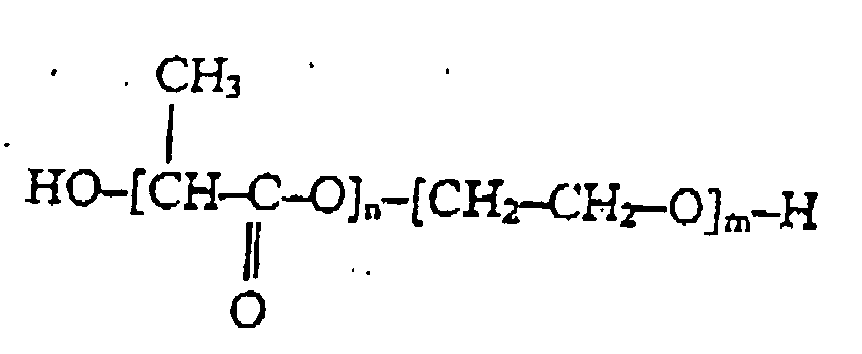
- The medical article of Claim 6, wherein "n" has a value between 21 and 278, and "m" has a value between 11 and 682.
- The medical article of Claim 1, wherein the triblockcopolymer is a copolymer having a formula:
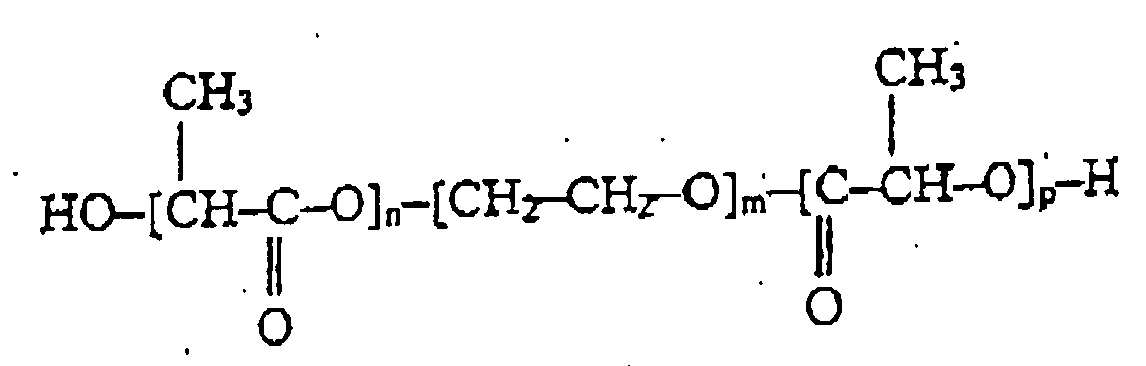
- The medical article of Claim 8, wherein "n" has a value between 21 and 278, and "m" has a value of between 11 and 682, and "p" has a value between 21 and 278.
- The medical article of Claim 1, wherein the triblockcopolymer is a copolymer having a formula:
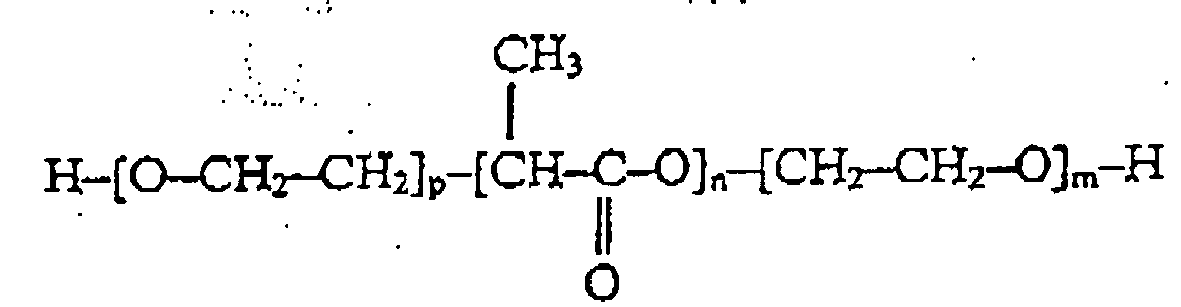
- The medical article of Claim 10, wherein "n" has a value between 21 and 278, "m" has a value between 11 and 682, and "p" has a value between 11 and 682.
- The medical article of Claim 1, wherein the diblock-copolymers and triblock-copolymers are hydrolyzed block-colpolymers of poly(lactic acid) and poly(ethylene glycol).
- The medical article of Claim 1, wherein the coating further includes a biologically absorbable polymer.
- The medical article of Claim 13, wherein the biologically absorbable polymer is selected from a group consisting of poly(hydroxybutyrate), poly(hydroxyvalerate), poly(hydroxybutyrate-co-valerate), poly(caprolactone), poly(lactide-co-glycolide), poly(ethylene-glycol)-block-poly(butyleneterephthalate, poly(ethylene-glycol)-block-poly(butylene terephthalate)-block-poly(ethylene-glycol), poly(butyleneterephthalate)-block-poly(ethylene-glycol)-block poly(butyleneterephthalate), poly(ethylene-glycol)-block-poly(caprolactone), poly(ethylene-glycol)-block-poly(caprolactone)-block-poly(ethylene-glycol), poly(caprolactone)-block-poly(ethylene-glycol)-block-poly(caprolactone), and blends thereof.
- The medical article of Claim 1, additionally comprising a biologically active agent incorporated into the coating.
- A method for fabricating a medical article, the method including depositing a coating on at least a portion of an implantable substrate, the coating including a diblock copolymer or triblock copolymer comprising at least one poly(lactic acid) block and at least one poly(ethylene glycol) block.
- The method of Claim 16, wherein the medical article is a stent.
- The method of Claim 16, wherein poly(lactic acid) includes poly(D-lactic acid), poly(L-lactic acid), poly(D,L-lactic acid), or a derivative of poly(lactic acid).
- The method of Claim 16, further including hydrolyzing or carboxylating poly(lactic acid) to obtain the derivative of poly(lactic acid).
- The method of Claim 16, which comprises a mixture of diblock and triblock copolymers.
- The method of Claim 16, wherein the diblock-copolymer is a copolymer having a formula:
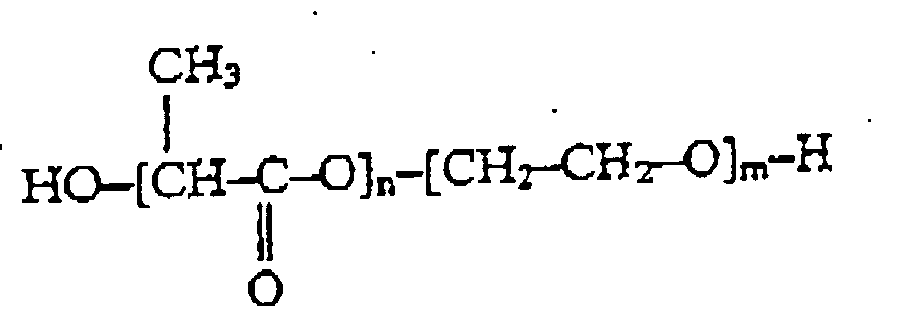
- The method of Claim 21, wherein "n" has a value between 21 and 278, and "m" has a value between 11 and 682.
- The method of Claim 16, wherein the triblock-polymer is a copolymer having a formula:
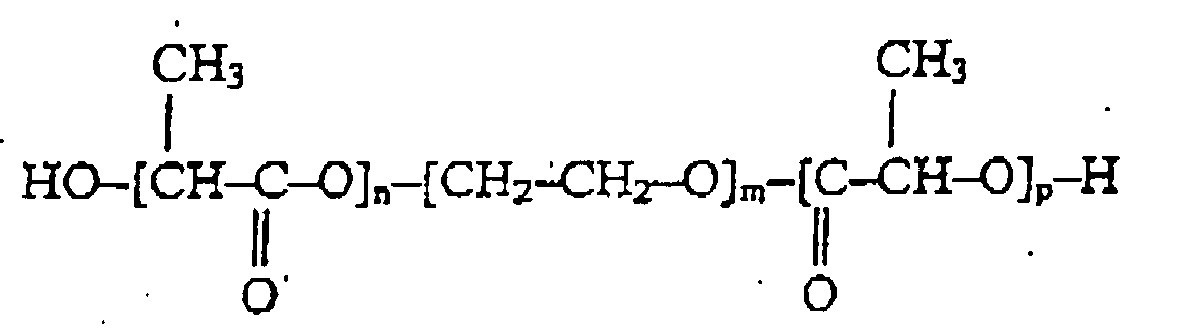
- The method of Claim 23, wherein "n" has a value between 21 and 278, and "m" has a value between 11 and 682, and "p" has a value between 21 and 278.
- The method of Claim 16, wherein the triblock-colpolymer is a copolymer having a formula:
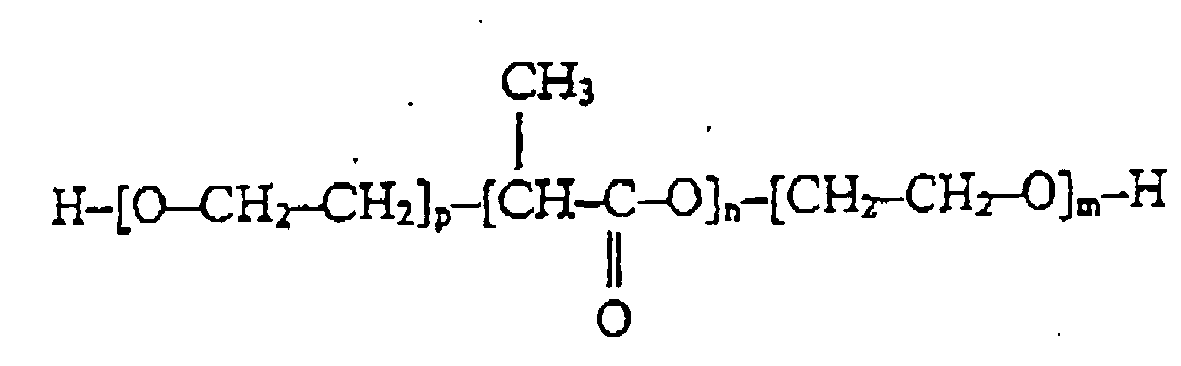
- The method of Claim 25, wherein "n" has a value between 21 and 278, "m" has a value between 11 and 682, and "p" has a value between 11 and 682.
- The method of Claim 16, further including hydrolyzing the diblock-copolymers and triblock-copolymers to obtain hydrolyzed block-copolymers of poly(lactic acid) and poly(ethylene glycol), and incorporating the hydrolyzed block-copolymers of poly(lactic acid) and poly (ethylene glycol) into the coating.
- The method of Claim 16, further including incorporating a biologically absorbable polymer.
- The method of claim 28, wherein the biologically absorbable polymer is selected from a group consisting of poly(hydroxybutyrate), poly(hydroxyvalerate), poly(hydroxybutyrate-co-valerate), pcly(caprolactone), poly(lactide-co-glycolide), poly(ethyelene-glycol)-block-poly(butyleneterephthalate, poly(ethylene-glycol)-block-poly(butylenes terephthalate)-block-poly(ethylene-glycol), poly(butyleneterephtnalate)-block-poly(ethylene-glycol)-block poly(butyleneterephthalate), poly(ethylene-glyccl)-block-poly(caprolactone), poly(ethylene-glycol)-block-poly(caprolactone)-block-poly(ethylene-glycol), poly(caprolactone)-block-poly(ethylene-glycol)-block-poly(caprolactone), and blends thereof.
- The method of Claim 16, additionally comprising incorporating a biologically active agent into the coating.
Priority Applications (1)
| Application Number | Priority Date | Filing Date | Title |
|---|---|---|---|
| EP08001182A EP1932551A1 (en) | 2003-11-20 | 2004-11-17 | A coated medical device |
Applications Claiming Priority (2)
| Application Number | Priority Date | Filing Date | Title |
|---|---|---|---|
| US10/718,976 US20050112170A1 (en) | 2003-11-20 | 2003-11-20 | Coatings for implantable devices comprising polymers of lactic acid and methods for fabricating the same |
| PCT/US2004/038843 WO2005051449A1 (en) | 2003-11-20 | 2004-11-17 | Coatings for implantable devices comprising polymers of lactic acid and methods for fabricating the same |
Related Child Applications (1)
| Application Number | Title | Priority Date | Filing Date |
|---|---|---|---|
| EP08001182A Division EP1932551A1 (en) | 2003-11-20 | 2004-11-17 | A coated medical device |
Publications (2)
| Publication Number | Publication Date |
|---|---|
| EP1689462A1 EP1689462A1 (en) | 2006-08-16 |
| EP1689462B1 true EP1689462B1 (en) | 2008-03-19 |
Family
ID=34591207
Family Applications (2)
| Application Number | Title | Priority Date | Filing Date |
|---|---|---|---|
| EP08001182A Withdrawn EP1932551A1 (en) | 2003-11-20 | 2004-11-17 | A coated medical device |
| EP04811546A Expired - Lifetime EP1689462B1 (en) | 2003-11-20 | 2004-11-17 | Coatings for implantable devices comprising block copolymers of lactic acid and ethylene glycol |
Family Applications Before (1)
| Application Number | Title | Priority Date | Filing Date |
|---|---|---|---|
| EP08001182A Withdrawn EP1932551A1 (en) | 2003-11-20 | 2004-11-17 | A coated medical device |
Country Status (6)
| Country | Link |
|---|---|
| US (1) | US20050112170A1 (en) |
| EP (2) | EP1932551A1 (en) |
| JP (1) | JP2007512094A (en) |
| AT (1) | ATE389423T1 (en) |
| DE (1) | DE602004012597T2 (en) |
| WO (1) | WO2005051449A1 (en) |
Families Citing this family (91)
| Publication number | Priority date | Publication date | Assignee | Title |
|---|---|---|---|---|
| CA2178541C (en) | 1995-06-07 | 2009-11-24 | Neal E. Fearnot | Implantable medical device |
| US8741378B1 (en) | 2001-06-27 | 2014-06-03 | Advanced Cardiovascular Systems, Inc. | Methods of coating an implantable device |
| US7056338B2 (en) | 2003-03-28 | 2006-06-06 | Conor Medsystems, Inc. | Therapeutic agent delivery device with controlled therapeutic agent release rates |
| US6926919B1 (en) * | 2003-02-26 | 2005-08-09 | Advanced Cardiovascular Systems, Inc. | Method for fabricating a coating for a medical device |
| JP5596896B2 (en) | 2003-03-28 | 2014-09-24 | イノヴェイショナル・ホールディングズ・エルエルシー | Method of forming an implantable medical device having a beneficial agent concentration gradient |
| US7169404B2 (en) * | 2003-07-30 | 2007-01-30 | Advanced Cardiovasular Systems, Inc. | Biologically absorbable coatings for implantable devices and methods for fabricating the same |
| US8846069B2 (en) * | 2003-11-20 | 2014-09-30 | Abbott Cardiovascular Systems Inc. | Coatings for implantable devices comprising polymers of lactic acid and methods for fabricating the same |
| EP1699527A1 (en) | 2004-01-02 | 2006-09-13 | Advanced Cardiovascular Systems, Inc. | High-density lipoprotein coated medical devices |
| US20050208093A1 (en) | 2004-03-22 | 2005-09-22 | Thierry Glauser | Phosphoryl choline coating compositions |
| US20050214339A1 (en) * | 2004-03-29 | 2005-09-29 | Yiwen Tang | Biologically degradable compositions for medical applications |
| US20060018948A1 (en) * | 2004-06-24 | 2006-01-26 | Guire Patrick E | Biodegradable implantable medical devices, methods and systems |
| US20060024350A1 (en) * | 2004-06-24 | 2006-02-02 | Varner Signe E | Biodegradable ocular devices, methods and systems |
| US7311980B1 (en) * | 2004-08-02 | 2007-12-25 | Advanced Cardiovascular Systems, Inc. | Polyactive/polylactic acid coatings for an implantable device |
| US8980300B2 (en) * | 2004-08-05 | 2015-03-17 | Advanced Cardiovascular Systems, Inc. | Plasticizers for coating compositions |
| US8124127B2 (en) | 2005-10-15 | 2012-02-28 | Atrium Medical Corporation | Hydrophobic cross-linked gels for bioabsorbable drug carrier coatings |
| US8312836B2 (en) * | 2004-09-28 | 2012-11-20 | Atrium Medical Corporation | Method and apparatus for application of a fresh coating on a medical device |
| US9012506B2 (en) | 2004-09-28 | 2015-04-21 | Atrium Medical Corporation | Cross-linked fatty acid-based biomaterials |
| US8263102B2 (en) | 2004-09-28 | 2012-09-11 | Atrium Medical Corporation | Drug delivery coating for use with a stent |
| US9000040B2 (en) | 2004-09-28 | 2015-04-07 | Atrium Medical Corporation | Cross-linked fatty acid-based biomaterials |
| US9801982B2 (en) | 2004-09-28 | 2017-10-31 | Atrium Medical Corporation | Implantable barrier device |
| US8367099B2 (en) | 2004-09-28 | 2013-02-05 | Atrium Medical Corporation | Perforated fatty acid films |
| WO2007011385A2 (en) | 2004-09-28 | 2007-01-25 | Atrium Medical Corporation | Heat cured gel and method of making |
| US8778375B2 (en) * | 2005-04-29 | 2014-07-15 | Advanced Cardiovascular Systems, Inc. | Amorphous poly(D,L-lactide) coating |
| DE102005033101A1 (en) * | 2005-07-15 | 2007-01-25 | Boehringer Ingelheim Pharma Gmbh & Co. Kg | Resorbable polyether esters and their use for the manufacture of medical implants |
| US9427423B2 (en) | 2009-03-10 | 2016-08-30 | Atrium Medical Corporation | Fatty-acid based particles |
| US9278161B2 (en) | 2005-09-28 | 2016-03-08 | Atrium Medical Corporation | Tissue-separating fatty acid adhesion barrier |
| US20070084144A1 (en) * | 2005-10-14 | 2007-04-19 | Atrium Medical Corporation | Packaging and sterilization of medical devices |
| US20070196423A1 (en) * | 2005-11-21 | 2007-08-23 | Med Institute, Inc. | Implantable medical device coatings with biodegradable elastomer and releasable therapeutic agent |
| US20090053391A1 (en) * | 2005-12-06 | 2009-02-26 | Ludwig Florian N | Method Of Coating A Drug-Releasing Layer Onto A Substrate |
| US8979921B2 (en) * | 2006-02-07 | 2015-03-17 | Tepha, Inc. | Polymeric, degradable drug-eluting stents and coatings |
| US9592325B2 (en) * | 2006-02-07 | 2017-03-14 | Tepha, Inc. | Polymeric, degradable drug-eluting stents and coatings |
| US7713637B2 (en) * | 2006-03-03 | 2010-05-11 | Advanced Cardiovascular Systems, Inc. | Coating containing PEGylated hyaluronic acid and a PEGylated non-hyaluronic acid polymer |
| PL2010184T3 (en) * | 2006-04-06 | 2013-07-31 | Nupathe Inc | Implants for the treatment of dopamine associated states |
| US20070286882A1 (en) * | 2006-06-09 | 2007-12-13 | Yiwen Tang | Solvent systems for coating medical devices |
| US8114150B2 (en) * | 2006-06-14 | 2012-02-14 | Advanced Cardiovascular Systems, Inc. | RGD peptide attached to bioabsorbable stents |
| US9040069B2 (en) * | 2006-07-07 | 2015-05-26 | Biotronik Vi Patent Ag | Process for manufacturing a stationary state of crystalline polymer of a biodegradable polymer matrix carrying an active substance and a polymer matrix produced thereby |
| US9028859B2 (en) | 2006-07-07 | 2015-05-12 | Advanced Cardiovascular Systems, Inc. | Phase-separated block copolymer coatings for implantable medical devices |
| US8685430B1 (en) | 2006-07-14 | 2014-04-01 | Abbott Cardiovascular Systems Inc. | Tailored aliphatic polyesters for stent coatings |
| US7794495B2 (en) * | 2006-07-17 | 2010-09-14 | Advanced Cardiovascular Systems, Inc. | Controlled degradation of stents |
| US8900619B2 (en) * | 2006-08-24 | 2014-12-02 | Boston Scientific Scimed, Inc. | Medical devices for the release of therapeutic agents |
| EP1916006A1 (en) * | 2006-10-19 | 2008-04-30 | Albert Schömig | Implant coated with a wax or a resin |
| EP1913960A1 (en) * | 2006-10-19 | 2008-04-23 | Albert Schömig | Coated implant |
| WO2008057344A2 (en) | 2006-11-06 | 2008-05-15 | Atrium Medical Corporation | Coated surgical mesh |
| US9492596B2 (en) | 2006-11-06 | 2016-11-15 | Atrium Medical Corporation | Barrier layer with underlying medical device and one or more reinforcing support structures |
| US7691402B2 (en) * | 2006-11-06 | 2010-04-06 | Medtronic Vascular, Inc. | Block biodegradable copolymers for medical devices |
| US20080114096A1 (en) * | 2006-11-09 | 2008-05-15 | Hydromer, Inc. | Lubricious biopolymeric network compositions and methods of making same |
| US20090281059A1 (en) * | 2007-02-21 | 2009-11-12 | Robert Falotico | Coating for a medical device having an anti-thrombotic conjugate |
| US8273402B2 (en) * | 2007-02-26 | 2012-09-25 | Medtronic Vascular, Inc. | Drug coated stent with magnesium topcoat |
| US10155881B2 (en) * | 2007-05-30 | 2018-12-18 | Abbott Cardiovascular Systems Inc. | Substituted polycaprolactone for coating |
| US8293260B2 (en) * | 2007-06-05 | 2012-10-23 | Abbott Cardiovascular Systems Inc. | Elastomeric copolymer coatings containing poly (tetramethyl carbonate) for implantable medical devices |
| US8202528B2 (en) * | 2007-06-05 | 2012-06-19 | Abbott Cardiovascular Systems Inc. | Implantable medical devices with elastomeric block copolymer coatings |
| US8133553B2 (en) | 2007-06-18 | 2012-03-13 | Zimmer, Inc. | Process for forming a ceramic layer |
| US8309521B2 (en) | 2007-06-19 | 2012-11-13 | Zimmer, Inc. | Spacer with a coating thereon for use with an implant device |
| US9737638B2 (en) | 2007-06-20 | 2017-08-22 | Abbott Cardiovascular Systems, Inc. | Polyester amide copolymers having free carboxylic acid pendant groups |
| US20090004243A1 (en) | 2007-06-29 | 2009-01-01 | Pacetti Stephen D | Biodegradable triblock copolymers for implantable devices |
| US20110129514A1 (en) * | 2007-09-06 | 2011-06-02 | Hossainy Syed F A | Hygroscopic coating on a balloon device |
| US20110137243A1 (en) * | 2007-09-06 | 2011-06-09 | Abbott Cardiovascular Systems Inc. | Coating On A Balloon Device |
| US9248219B2 (en) * | 2007-09-14 | 2016-02-02 | Boston Scientific Scimed, Inc. | Medical devices having bioerodable layers for the release of therapeutic agents |
| US9814553B1 (en) | 2007-10-10 | 2017-11-14 | Abbott Cardiovascular Systems Inc. | Bioabsorbable semi-crystalline polymer for controlling release of drug from a coating |
| US8608049B2 (en) | 2007-10-10 | 2013-12-17 | Zimmer, Inc. | Method for bonding a tantalum structure to a cobalt-alloy substrate |
| US20090306120A1 (en) * | 2007-10-23 | 2009-12-10 | Florencia Lim | Terpolymers containing lactide and glycolide |
| US20090104241A1 (en) * | 2007-10-23 | 2009-04-23 | Pacetti Stephen D | Random amorphous terpolymer containing lactide and glycolide |
| US8642062B2 (en) | 2007-10-31 | 2014-02-04 | Abbott Cardiovascular Systems Inc. | Implantable device having a slow dissolving polymer |
| US20090110713A1 (en) * | 2007-10-31 | 2009-04-30 | Florencia Lim | Biodegradable polymeric materials providing controlled release of hydrophobic drugs from implantable devices |
| DE102008006455A1 (en) | 2008-01-29 | 2009-07-30 | Biotronik Vi Patent Ag | Implant comprising a body made of a biocorrodible alloy and a corrosion-inhibiting coating |
| US20090228097A1 (en) * | 2008-03-07 | 2009-09-10 | Abbott Cardiovascular Systems Inc. | A1 Adenosine Receptor Antagonist-Coated Implantable Medical Device |
| US8377116B2 (en) * | 2008-03-20 | 2013-02-19 | Abbott Cardiovascular Systems Inc. | Implantable medical device coatings with improved mechanical stability |
| US9259515B2 (en) | 2008-04-10 | 2016-02-16 | Abbott Cardiovascular Systems Inc. | Implantable medical devices fabricated from polyurethanes with grafted radiopaque groups |
| US8128983B2 (en) * | 2008-04-11 | 2012-03-06 | Abbott Cardiovascular Systems Inc. | Coating comprising poly(ethylene glycol)-poly(lactide-glycolide-caprolactone) interpenetrating network |
| US20090297584A1 (en) * | 2008-04-18 | 2009-12-03 | Florencia Lim | Biosoluble coating with linear over time mass loss |
| US20090285873A1 (en) * | 2008-04-18 | 2009-11-19 | Abbott Cardiovascular Systems Inc. | Implantable medical devices and coatings therefor comprising block copolymers of poly(ethylene glycol) and a poly(lactide-glycolide) |
| US8916188B2 (en) * | 2008-04-18 | 2014-12-23 | Abbott Cardiovascular Systems Inc. | Block copolymer comprising at least one polyester block and a poly (ethylene glycol) block |
| US8697113B2 (en) * | 2008-05-21 | 2014-04-15 | Abbott Cardiovascular Systems Inc. | Coating comprising a terpolymer comprising caprolactone and glycolide |
| US20090299464A1 (en) * | 2008-06-02 | 2009-12-03 | Medtronic Vascular, Inc. | Reducing Bioabsorbtion Time of Polymer Coated Implantable Medical Devices Using Polymer Blends |
| US8652506B2 (en) | 2008-06-05 | 2014-02-18 | Boston Scientific Scimed, Inc. | Bio-degradable block co-polymers for controlled release |
| US8642063B2 (en) * | 2008-08-22 | 2014-02-04 | Cook Medical Technologies Llc | Implantable medical device coatings with biodegradable elastomer and releasable taxane agent |
| US9283304B2 (en) * | 2008-11-25 | 2016-03-15 | CARDINAL HEALTH SWITZERLAND 515 GmbH | Absorbable stent having a coating for controlling degradation of the stent and maintaining pH neutrality |
| US8668919B2 (en) * | 2009-03-03 | 2014-03-11 | Abbott Cardiovascular Systems Inc. | Polymer for creating hemocompatible surface |
| US9254350B2 (en) * | 2009-04-10 | 2016-02-09 | Medtronic Vascular, Inc. | Implantable medical devices having bioabsorbable primer polymer coatings |
| US8697110B2 (en) * | 2009-05-14 | 2014-04-15 | Abbott Cardiovascular Systems Inc. | Polymers comprising amorphous terpolymers and semicrystalline blocks |
| US8119704B2 (en) * | 2009-07-21 | 2012-02-21 | Abbott Cardiovascular Systems Inc. | Implantable medical device comprising copolymer of L-lactide with improved fracture toughness |
| US20110038910A1 (en) | 2009-08-11 | 2011-02-17 | Atrium Medical Corporation | Anti-infective antimicrobial-containing biomaterials |
| US8685433B2 (en) | 2010-03-31 | 2014-04-01 | Abbott Cardiovascular Systems Inc. | Absorbable coating for implantable device |
| US9295663B2 (en) | 2010-07-14 | 2016-03-29 | Abbott Cardiovascular Systems Inc. | Drug coated balloon with in-situ formed drug containing microspheres |
| WO2012009707A2 (en) | 2010-07-16 | 2012-01-19 | Atrium Medical Corporation | Composition and methods for altering the rate of hydrolysis of cured oil-based materials |
| LT2658525T (en) * | 2010-12-29 | 2017-12-11 | Medincell | Biodegradable drug delivery compositions |
| US9867880B2 (en) | 2012-06-13 | 2018-01-16 | Atrium Medical Corporation | Cured oil-hydrogel biomaterial compositions for controlled drug delivery |
| EP2866837B1 (en) * | 2012-06-27 | 2022-12-14 | Medincell S.A. | Biodegradable drug delivery for hydrophobic compositions |
| US9381280B2 (en) | 2014-06-13 | 2016-07-05 | Abbott Cardiovascular Systems Inc. | Plasticizers for a biodegradable scaffolding and methods of forming same |
| EP3342795B1 (en) * | 2015-08-24 | 2023-01-04 | 3-D Matrix, Ltd. | Biodegradable injectable gel |
| EP4374861A3 (en) | 2015-11-16 | 2024-08-07 | MedinCell S.A. | A method for morselizing and/or targeting pharmaceutically active principles to synovial tissue |
Family Cites Families (9)
| Publication number | Priority date | Publication date | Assignee | Title |
|---|---|---|---|---|
| US5206341A (en) * | 1991-11-21 | 1993-04-27 | Southern Research Institute | Polymers from hydroxy acids and polycarboxylic acids |
| US5824048A (en) * | 1993-04-26 | 1998-10-20 | Medtronic, Inc. | Method for delivering a therapeutic substance to a body lumen |
| KR0148704B1 (en) * | 1994-01-10 | 1998-08-17 | 김상응 | Biodegradable Drug Delivery Polymer |
| ATE272394T1 (en) * | 1996-10-31 | 2004-08-15 | Takeda Chemical Industries Ltd | DELAYED RELEASE PREPARATION |
| US6555157B1 (en) * | 2000-07-25 | 2003-04-29 | Advanced Cardiovascular Systems, Inc. | Method for coating an implantable device and system for performing the method |
| US6783793B1 (en) | 2000-10-26 | 2004-08-31 | Advanced Cardiovascular Systems, Inc. | Selective coating of medical devices |
| US6753071B1 (en) | 2001-09-27 | 2004-06-22 | Advanced Cardiovascular Systems, Inc. | Rate-reducing membrane for release of an agent |
| US20030203000A1 (en) * | 2002-04-24 | 2003-10-30 | Schwarz Marlene C. | Modulation of therapeutic agent release from a polymeric carrier using solvent-based techniques |
| ATE318623T1 (en) | 2002-05-14 | 2006-03-15 | Terumo Corp | COATED STENT FOR THE RELEASE OF ACTIVE SUBSTANCES |
-
2003
- 2003-11-20 US US10/718,976 patent/US20050112170A1/en not_active Abandoned
-
2004
- 2004-11-17 EP EP08001182A patent/EP1932551A1/en not_active Withdrawn
- 2004-11-17 JP JP2006541411A patent/JP2007512094A/en active Pending
- 2004-11-17 EP EP04811546A patent/EP1689462B1/en not_active Expired - Lifetime
- 2004-11-17 WO PCT/US2004/038843 patent/WO2005051449A1/en not_active Ceased
- 2004-11-17 DE DE602004012597T patent/DE602004012597T2/en not_active Expired - Lifetime
- 2004-11-17 AT AT04811546T patent/ATE389423T1/en not_active IP Right Cessation
Also Published As
| Publication number | Publication date |
|---|---|
| JP2007512094A (en) | 2007-05-17 |
| DE602004012597D1 (en) | 2008-04-30 |
| ATE389423T1 (en) | 2008-04-15 |
| US20050112170A1 (en) | 2005-05-26 |
| WO2005051449A1 (en) | 2005-06-09 |
| EP1932551A1 (en) | 2008-06-18 |
| EP1689462A1 (en) | 2006-08-16 |
| DE602004012597T2 (en) | 2009-04-16 |
Similar Documents
| Publication | Publication Date | Title |
|---|---|---|
| EP1689462B1 (en) | Coatings for implantable devices comprising block copolymers of lactic acid and ethylene glycol | |
| EP1660148B1 (en) | Biologically absorbable coatings for implantable devices | |
| US8846070B2 (en) | Biologically degradable compositions for medical applications | |
| EP1684818B1 (en) | Coatings for implantable devices including biologically erodable polyesters and methods for fabricating the same | |
| EP1804848B1 (en) | Implantable devices comprising biologically absorbable star polymers and methods for fabricating the same | |
| EP1684821B1 (en) | Biologically beneficial coatings for implantable devices containing fluorinated polymers and methods for fabricating the same | |
| WO2004032804A1 (en) | Rate limiting barriers for implantable medical devices | |
| US9408949B2 (en) | Coatings for implantable devices comprising polymers of lactic acid and methods for fabricating the same | |
| HK1181328B (en) | Coatings for implantable devices comprising polymers of lactic acid and methods for fabricating the same |
Legal Events
| Date | Code | Title | Description |
|---|---|---|---|
| PUAI | Public reference made under article 153(3) epc to a published international application that has entered the european phase |
Free format text: ORIGINAL CODE: 0009012 |
|
| 17P | Request for examination filed |
Effective date: 20060602 |
|
| AK | Designated contracting states |
Kind code of ref document: A1 Designated state(s): AT BE BG CH CY CZ DE DK EE ES FI FR GB GR HU IE IS IT LI LU MC NL PL PT RO SE SI SK TR |
|
| RIN1 | Information on inventor provided before grant (corrected) |
Inventor name: GLAUSER, THIERRY Inventor name: TANG, YIWEN Inventor name: DESNOYER, JESSICA, R. Inventor name: PACETTI, STEPHEN, D. Inventor name: HOSSAINY, SYED, F.A. Inventor name: MICHAL, EUGENE, T. |
|
| DAX | Request for extension of the european patent (deleted) | ||
| 17Q | First examination report despatched |
Effective date: 20070207 |
|
| GRAP | Despatch of communication of intention to grant a patent |
Free format text: ORIGINAL CODE: EPIDOSNIGR1 |
|
| RTI1 | Title (correction) |
Free format text: COATINGS FOR IMPLANTABLE DEVICES COMPRISING BLOCK COPOLYMERS OF LACTIC ACID AND ETHYLENE GLYCOL |
|
| GRAS | Grant fee paid |
Free format text: ORIGINAL CODE: EPIDOSNIGR3 |
|
| GRAA | (expected) grant |
Free format text: ORIGINAL CODE: 0009210 |
|
| RAP1 | Party data changed (applicant data changed or rights of an application transferred) |
Owner name: ABBOTT CARDIOVASCULAR SYSTEMS INC. |
|
| AK | Designated contracting states |
Kind code of ref document: B1 Designated state(s): AT BE BG CH CY CZ DE DK EE ES FI FR GB GR HU IE IS IT LI LU MC NL PL PT RO SE SI SK TR |
|
| REG | Reference to a national code |
Ref country code: GB Ref legal event code: FG4D |
|
| REG | Reference to a national code |
Ref country code: CH Ref legal event code: EP |
|
| REF | Corresponds to: |
Ref document number: 602004012597 Country of ref document: DE Date of ref document: 20080430 Kind code of ref document: P |
|
| REG | Reference to a national code |
Ref country code: IE Ref legal event code: FG4D |
|
| RAP2 | Party data changed (patent owner data changed or rights of a patent transferred) |
Owner name: ABBOTT CARDIOVASCULAR SYSTEMS INC. |
|
| NLT2 | Nl: modifications (of names), taken from the european patent patent bulletin |
Owner name: ABBOTT CARDIOVASCULAR SYSTEMS INC. Effective date: 20080514 |
|
| PG25 | Lapsed in a contracting state [announced via postgrant information from national office to epo] |
Ref country code: FI Free format text: LAPSE BECAUSE OF FAILURE TO SUBMIT A TRANSLATION OF THE DESCRIPTION OR TO PAY THE FEE WITHIN THE PRESCRIBED TIME-LIMIT Effective date: 20080319 |
|
| PG25 | Lapsed in a contracting state [announced via postgrant information from national office to epo] |
Ref country code: AT Free format text: LAPSE BECAUSE OF FAILURE TO SUBMIT A TRANSLATION OF THE DESCRIPTION OR TO PAY THE FEE WITHIN THE PRESCRIBED TIME-LIMIT Effective date: 20080319 |
|
| NLV1 | Nl: lapsed or annulled due to failure to fulfill the requirements of art. 29p and 29m of the patents act | ||
| PG25 | Lapsed in a contracting state [announced via postgrant information from national office to epo] |
Ref country code: SI Free format text: LAPSE BECAUSE OF FAILURE TO SUBMIT A TRANSLATION OF THE DESCRIPTION OR TO PAY THE FEE WITHIN THE PRESCRIBED TIME-LIMIT Effective date: 20080319 Ref country code: PL Free format text: LAPSE BECAUSE OF FAILURE TO SUBMIT A TRANSLATION OF THE DESCRIPTION OR TO PAY THE FEE WITHIN THE PRESCRIBED TIME-LIMIT Effective date: 20080319 Ref country code: BE Free format text: LAPSE BECAUSE OF FAILURE TO SUBMIT A TRANSLATION OF THE DESCRIPTION OR TO PAY THE FEE WITHIN THE PRESCRIBED TIME-LIMIT Effective date: 20080319 |
|
| PG25 | Lapsed in a contracting state [announced via postgrant information from national office to epo] |
Ref country code: CZ Free format text: LAPSE BECAUSE OF FAILURE TO SUBMIT A TRANSLATION OF THE DESCRIPTION OR TO PAY THE FEE WITHIN THE PRESCRIBED TIME-LIMIT Effective date: 20080319 Ref country code: SK Free format text: LAPSE BECAUSE OF FAILURE TO SUBMIT A TRANSLATION OF THE DESCRIPTION OR TO PAY THE FEE WITHIN THE PRESCRIBED TIME-LIMIT Effective date: 20080319 Ref country code: SE Free format text: LAPSE BECAUSE OF FAILURE TO SUBMIT A TRANSLATION OF THE DESCRIPTION OR TO PAY THE FEE WITHIN THE PRESCRIBED TIME-LIMIT Effective date: 20080619 Ref country code: PT Free format text: LAPSE BECAUSE OF FAILURE TO SUBMIT A TRANSLATION OF THE DESCRIPTION OR TO PAY THE FEE WITHIN THE PRESCRIBED TIME-LIMIT Effective date: 20080826 Ref country code: ES Free format text: LAPSE BECAUSE OF FAILURE TO SUBMIT A TRANSLATION OF THE DESCRIPTION OR TO PAY THE FEE WITHIN THE PRESCRIBED TIME-LIMIT Effective date: 20080630 |
|
| PG25 | Lapsed in a contracting state [announced via postgrant information from national office to epo] |
Ref country code: NL Free format text: LAPSE BECAUSE OF FAILURE TO SUBMIT A TRANSLATION OF THE DESCRIPTION OR TO PAY THE FEE WITHIN THE PRESCRIBED TIME-LIMIT Effective date: 20080319 Ref country code: RO Free format text: LAPSE BECAUSE OF FAILURE TO SUBMIT A TRANSLATION OF THE DESCRIPTION OR TO PAY THE FEE WITHIN THE PRESCRIBED TIME-LIMIT Effective date: 20080319 |
|
| ET | Fr: translation filed | ||
| PG25 | Lapsed in a contracting state [announced via postgrant information from national office to epo] |
Ref country code: IS Free format text: LAPSE BECAUSE OF FAILURE TO SUBMIT A TRANSLATION OF THE DESCRIPTION OR TO PAY THE FEE WITHIN THE PRESCRIBED TIME-LIMIT Effective date: 20080719 |
|
| PLBE | No opposition filed within time limit |
Free format text: ORIGINAL CODE: 0009261 |
|
| STAA | Information on the status of an ep patent application or granted ep patent |
Free format text: STATUS: NO OPPOSITION FILED WITHIN TIME LIMIT |
|
| PG25 | Lapsed in a contracting state [announced via postgrant information from national office to epo] |
Ref country code: DK Free format text: LAPSE BECAUSE OF FAILURE TO SUBMIT A TRANSLATION OF THE DESCRIPTION OR TO PAY THE FEE WITHIN THE PRESCRIBED TIME-LIMIT Effective date: 20080319 |
|
| 26N | No opposition filed |
Effective date: 20081222 |
|
| PG25 | Lapsed in a contracting state [announced via postgrant information from national office to epo] |
Ref country code: BG Free format text: LAPSE BECAUSE OF FAILURE TO SUBMIT A TRANSLATION OF THE DESCRIPTION OR TO PAY THE FEE WITHIN THE PRESCRIBED TIME-LIMIT Effective date: 20080619 Ref country code: EE Free format text: LAPSE BECAUSE OF FAILURE TO SUBMIT A TRANSLATION OF THE DESCRIPTION OR TO PAY THE FEE WITHIN THE PRESCRIBED TIME-LIMIT Effective date: 20080319 |
|
| PG25 | Lapsed in a contracting state [announced via postgrant information from national office to epo] |
Ref country code: MC Free format text: LAPSE BECAUSE OF NON-PAYMENT OF DUE FEES Effective date: 20081130 |
|
| REG | Reference to a national code |
Ref country code: CH Ref legal event code: PL |
|
| PG25 | Lapsed in a contracting state [announced via postgrant information from national office to epo] |
Ref country code: IT Free format text: LAPSE BECAUSE OF FAILURE TO SUBMIT A TRANSLATION OF THE DESCRIPTION OR TO PAY THE FEE WITHIN THE PRESCRIBED TIME-LIMIT Effective date: 20080319 |
|
| PG25 | Lapsed in a contracting state [announced via postgrant information from national office to epo] |
Ref country code: CY Free format text: LAPSE BECAUSE OF FAILURE TO SUBMIT A TRANSLATION OF THE DESCRIPTION OR TO PAY THE FEE WITHIN THE PRESCRIBED TIME-LIMIT Effective date: 20080319 |
|
| PG25 | Lapsed in a contracting state [announced via postgrant information from national office to epo] |
Ref country code: LI Free format text: LAPSE BECAUSE OF NON-PAYMENT OF DUE FEES Effective date: 20081130 Ref country code: CH Free format text: LAPSE BECAUSE OF NON-PAYMENT OF DUE FEES Effective date: 20081130 |
|
| PG25 | Lapsed in a contracting state [announced via postgrant information from national office to epo] |
Ref country code: LU Free format text: LAPSE BECAUSE OF NON-PAYMENT OF DUE FEES Effective date: 20081117 Ref country code: HU Free format text: LAPSE BECAUSE OF FAILURE TO SUBMIT A TRANSLATION OF THE DESCRIPTION OR TO PAY THE FEE WITHIN THE PRESCRIBED TIME-LIMIT Effective date: 20080920 |
|
| PG25 | Lapsed in a contracting state [announced via postgrant information from national office to epo] |
Ref country code: TR Free format text: LAPSE BECAUSE OF FAILURE TO SUBMIT A TRANSLATION OF THE DESCRIPTION OR TO PAY THE FEE WITHIN THE PRESCRIBED TIME-LIMIT Effective date: 20080319 |
|
| PG25 | Lapsed in a contracting state [announced via postgrant information from national office to epo] |
Ref country code: GR Free format text: LAPSE BECAUSE OF FAILURE TO SUBMIT A TRANSLATION OF THE DESCRIPTION OR TO PAY THE FEE WITHIN THE PRESCRIBED TIME-LIMIT Effective date: 20080620 |
|
| REG | Reference to a national code |
Ref country code: FR Ref legal event code: PLFP Year of fee payment: 12 |
|
| REG | Reference to a national code |
Ref country code: FR Ref legal event code: PLFP Year of fee payment: 13 |
|
| REG | Reference to a national code |
Ref country code: FR Ref legal event code: PLFP Year of fee payment: 14 |
|
| REG | Reference to a national code |
Ref country code: FR Ref legal event code: PLFP Year of fee payment: 15 |
|
| PGFP | Annual fee paid to national office [announced via postgrant information from national office to epo] |
Ref country code: DE Payment date: 20181015 Year of fee payment: 15 Ref country code: IE Payment date: 20181026 Year of fee payment: 15 |
|
| PGFP | Annual fee paid to national office [announced via postgrant information from national office to epo] |
Ref country code: GB Payment date: 20181025 Year of fee payment: 15 Ref country code: FR Payment date: 20181017 Year of fee payment: 15 |
|
| REG | Reference to a national code |
Ref country code: DE Ref legal event code: R119 Ref document number: 602004012597 Country of ref document: DE |
|
| GBPC | Gb: european patent ceased through non-payment of renewal fee |
Effective date: 20191117 |
|
| PG25 | Lapsed in a contracting state [announced via postgrant information from national office to epo] |
Ref country code: GB Free format text: LAPSE BECAUSE OF NON-PAYMENT OF DUE FEES Effective date: 20191117 Ref country code: IE Free format text: LAPSE BECAUSE OF NON-PAYMENT OF DUE FEES Effective date: 20191117 Ref country code: FR Free format text: LAPSE BECAUSE OF NON-PAYMENT OF DUE FEES Effective date: 20191130 Ref country code: DE Free format text: LAPSE BECAUSE OF NON-PAYMENT OF DUE FEES Effective date: 20200603 |