EP1680400B1 - Derivatives of n-[ phenyl(pyrrolidine-2-yl)methyl]benzamide and n-[ (azepan-2-yl)phenylmethyl]benzamide, preparation method thereof and application of same in therapeutics - Google Patents
Derivatives of n-[ phenyl(pyrrolidine-2-yl)methyl]benzamide and n-[ (azepan-2-yl)phenylmethyl]benzamide, preparation method thereof and application of same in therapeutics Download PDFInfo
- Publication number
- EP1680400B1 EP1680400B1 EP04791555A EP04791555A EP1680400B1 EP 1680400 B1 EP1680400 B1 EP 1680400B1 EP 04791555 A EP04791555 A EP 04791555A EP 04791555 A EP04791555 A EP 04791555A EP 1680400 B1 EP1680400 B1 EP 1680400B1
- Authority
- EP
- European Patent Office
- Prior art keywords
- phenyl
- alkyl
- compound according
- mmol
- methyl
- Prior art date
- Legal status (The legal status is an assumption and is not a legal conclusion. Google has not performed a legal analysis and makes no representation as to the accuracy of the status listed.)
- Expired - Lifetime
Links
- KWOLFJPFCHCOCG-UHFFFAOYSA-N CC(c1ccccc1)=O Chemical compound CC(c1ccccc1)=O KWOLFJPFCHCOCG-UHFFFAOYSA-N 0.000 description 1
Classifications
-
- C—CHEMISTRY; METALLURGY
- C07—ORGANIC CHEMISTRY
- C07D—HETEROCYCLIC COMPOUNDS
- C07D223/00—Heterocyclic compounds containing seven-membered rings having one nitrogen atom as the only ring hetero atom
- C07D223/02—Heterocyclic compounds containing seven-membered rings having one nitrogen atom as the only ring hetero atom not condensed with other rings
- C07D223/04—Heterocyclic compounds containing seven-membered rings having one nitrogen atom as the only ring hetero atom not condensed with other rings with only hydrogen atoms, halogen atoms, hydrocarbon or substituted hydrocarbon radicals, directly attached to ring carbon atoms
-
- A—HUMAN NECESSITIES
- A61—MEDICAL OR VETERINARY SCIENCE; HYGIENE
- A61P—SPECIFIC THERAPEUTIC ACTIVITY OF CHEMICAL COMPOUNDS OR MEDICINAL PREPARATIONS
- A61P11/00—Drugs for disorders of the respiratory system
-
- A—HUMAN NECESSITIES
- A61—MEDICAL OR VETERINARY SCIENCE; HYGIENE
- A61P—SPECIFIC THERAPEUTIC ACTIVITY OF CHEMICAL COMPOUNDS OR MEDICINAL PREPARATIONS
- A61P15/00—Drugs for genital or sexual disorders; Contraceptives
-
- A—HUMAN NECESSITIES
- A61—MEDICAL OR VETERINARY SCIENCE; HYGIENE
- A61P—SPECIFIC THERAPEUTIC ACTIVITY OF CHEMICAL COMPOUNDS OR MEDICINAL PREPARATIONS
- A61P15/00—Drugs for genital or sexual disorders; Contraceptives
- A61P15/08—Drugs for genital or sexual disorders; Contraceptives for gonadal disorders or for enhancing fertility, e.g. inducers of ovulation or of spermatogenesis
-
- A—HUMAN NECESSITIES
- A61—MEDICAL OR VETERINARY SCIENCE; HYGIENE
- A61P—SPECIFIC THERAPEUTIC ACTIVITY OF CHEMICAL COMPOUNDS OR MEDICINAL PREPARATIONS
- A61P19/00—Drugs for skeletal disorders
-
- A—HUMAN NECESSITIES
- A61—MEDICAL OR VETERINARY SCIENCE; HYGIENE
- A61P—SPECIFIC THERAPEUTIC ACTIVITY OF CHEMICAL COMPOUNDS OR MEDICINAL PREPARATIONS
- A61P25/00—Drugs for disorders of the nervous system
-
- A—HUMAN NECESSITIES
- A61—MEDICAL OR VETERINARY SCIENCE; HYGIENE
- A61P—SPECIFIC THERAPEUTIC ACTIVITY OF CHEMICAL COMPOUNDS OR MEDICINAL PREPARATIONS
- A61P25/00—Drugs for disorders of the nervous system
- A61P25/02—Drugs for disorders of the nervous system for peripheral neuropathies
-
- A—HUMAN NECESSITIES
- A61—MEDICAL OR VETERINARY SCIENCE; HYGIENE
- A61P—SPECIFIC THERAPEUTIC ACTIVITY OF CHEMICAL COMPOUNDS OR MEDICINAL PREPARATIONS
- A61P25/00—Drugs for disorders of the nervous system
- A61P25/04—Centrally acting analgesics, e.g. opioids
-
- A—HUMAN NECESSITIES
- A61—MEDICAL OR VETERINARY SCIENCE; HYGIENE
- A61P—SPECIFIC THERAPEUTIC ACTIVITY OF CHEMICAL COMPOUNDS OR MEDICINAL PREPARATIONS
- A61P25/00—Drugs for disorders of the nervous system
- A61P25/06—Antimigraine agents
-
- A—HUMAN NECESSITIES
- A61—MEDICAL OR VETERINARY SCIENCE; HYGIENE
- A61P—SPECIFIC THERAPEUTIC ACTIVITY OF CHEMICAL COMPOUNDS OR MEDICINAL PREPARATIONS
- A61P25/00—Drugs for disorders of the nervous system
- A61P25/08—Antiepileptics; Anticonvulsants
-
- A—HUMAN NECESSITIES
- A61—MEDICAL OR VETERINARY SCIENCE; HYGIENE
- A61P—SPECIFIC THERAPEUTIC ACTIVITY OF CHEMICAL COMPOUNDS OR MEDICINAL PREPARATIONS
- A61P25/00—Drugs for disorders of the nervous system
- A61P25/14—Drugs for disorders of the nervous system for treating abnormal movements, e.g. chorea, dyskinesia
- A61P25/16—Anti-Parkinson drugs
-
- A—HUMAN NECESSITIES
- A61—MEDICAL OR VETERINARY SCIENCE; HYGIENE
- A61P—SPECIFIC THERAPEUTIC ACTIVITY OF CHEMICAL COMPOUNDS OR MEDICINAL PREPARATIONS
- A61P25/00—Drugs for disorders of the nervous system
- A61P25/18—Antipsychotics, i.e. neuroleptics; Drugs for mania or schizophrenia
-
- A—HUMAN NECESSITIES
- A61—MEDICAL OR VETERINARY SCIENCE; HYGIENE
- A61P—SPECIFIC THERAPEUTIC ACTIVITY OF CHEMICAL COMPOUNDS OR MEDICINAL PREPARATIONS
- A61P25/00—Drugs for disorders of the nervous system
- A61P25/22—Anxiolytics
-
- A—HUMAN NECESSITIES
- A61—MEDICAL OR VETERINARY SCIENCE; HYGIENE
- A61P—SPECIFIC THERAPEUTIC ACTIVITY OF CHEMICAL COMPOUNDS OR MEDICINAL PREPARATIONS
- A61P25/00—Drugs for disorders of the nervous system
- A61P25/24—Antidepressants
-
- A—HUMAN NECESSITIES
- A61—MEDICAL OR VETERINARY SCIENCE; HYGIENE
- A61P—SPECIFIC THERAPEUTIC ACTIVITY OF CHEMICAL COMPOUNDS OR MEDICINAL PREPARATIONS
- A61P25/00—Drugs for disorders of the nervous system
- A61P25/28—Drugs for disorders of the nervous system for treating neurodegenerative disorders of the central nervous system, e.g. nootropic agents, cognition enhancers, drugs for treating Alzheimer's disease or other forms of dementia
-
- A—HUMAN NECESSITIES
- A61—MEDICAL OR VETERINARY SCIENCE; HYGIENE
- A61P—SPECIFIC THERAPEUTIC ACTIVITY OF CHEMICAL COMPOUNDS OR MEDICINAL PREPARATIONS
- A61P25/00—Drugs for disorders of the nervous system
- A61P25/30—Drugs for disorders of the nervous system for treating abuse or dependence
- A61P25/32—Alcohol-abuse
-
- A—HUMAN NECESSITIES
- A61—MEDICAL OR VETERINARY SCIENCE; HYGIENE
- A61P—SPECIFIC THERAPEUTIC ACTIVITY OF CHEMICAL COMPOUNDS OR MEDICINAL PREPARATIONS
- A61P29/00—Non-central analgesic, antipyretic or antiinflammatory agents, e.g. antirheumatic agents; Non-steroidal antiinflammatory drugs [NSAID]
-
- A—HUMAN NECESSITIES
- A61—MEDICAL OR VETERINARY SCIENCE; HYGIENE
- A61P—SPECIFIC THERAPEUTIC ACTIVITY OF CHEMICAL COMPOUNDS OR MEDICINAL PREPARATIONS
- A61P3/00—Drugs for disorders of the metabolism
- A61P3/04—Anorexiants; Antiobesity agents
-
- C—CHEMISTRY; METALLURGY
- C07—ORGANIC CHEMISTRY
- C07D—HETEROCYCLIC COMPOUNDS
- C07D207/00—Heterocyclic compounds containing five-membered rings not condensed with other rings, with one nitrogen atom as the only ring hetero atom
- C07D207/02—Heterocyclic compounds containing five-membered rings not condensed with other rings, with one nitrogen atom as the only ring hetero atom with only hydrogen or carbon atoms directly attached to the ring nitrogen atom
- C07D207/04—Heterocyclic compounds containing five-membered rings not condensed with other rings, with one nitrogen atom as the only ring hetero atom with only hydrogen or carbon atoms directly attached to the ring nitrogen atom having no double bonds between ring members or between ring members and non-ring members
- C07D207/08—Heterocyclic compounds containing five-membered rings not condensed with other rings, with one nitrogen atom as the only ring hetero atom with only hydrogen or carbon atoms directly attached to the ring nitrogen atom having no double bonds between ring members or between ring members and non-ring members with hydrocarbon radicals, substituted by hetero atoms, attached to ring carbon atoms
- C07D207/09—Radicals substituted by nitrogen atoms, not forming part of a nitro radical
Definitions
- the compounds of general formula (I) may exist in the form of threo (1 R , 2 R ; 1 S , 2 S ) or erythro (1 S , 2 R ; 1 R , 2 S ) racemates or in the form of enantiomers; they may exist in the form of free bases or addition salts with acids.
- the compounds of the invention exhibit particular activity as specific inhibitors of the glyt1 and / or glyt2 glycine transporters.
- the compounds of general formula (I) in which R 1 is different from a hydrogen atom can be prepared by a process illustrated in Scheme 1 which follows. Coupling of a diamine of general formula (II) of threo or erythro relative configuration or in mixture, in which R 1 and X are as defined above (with R 1 different from a hydrogen atom) with an activated acid or an acid chloride of the general formula (III) wherein Y represents a nucleofugal group, such as a halogen atom and R 2 is as defined above, using the known methods of the skilled person.
- the compounds of general formula (I) erythro or threo pure can be obtained by any method known to those skilled in the art, for example by separation by high performance liquid chromatography.
- the diamine of general formula (II), of threo or erythro relative configuration or in mixture may be prepared by the illustrated process by the diagram 2 way A.
- the ketone IV in which P represents Boc can be reduced to the alcohol (X) erythro / threo whose ratio depends on the nature of the hydride used according to a method described in J. Chem. Soc. Chem. Commun., 1986, 412-413.
- the protective group is then removed according to a conventional method, in a mixture of dichloromethane and trifluoroacetic acid.
- the ketone of general formula (IV) in which P represents CO 2 Et and X is as defined above can be reacted with the hydrochloride of benzylhydroxylamine under reflux of ethanol to provide a mixture.
- the reduction of the carbamate of general formula (IX) by aluminum and lithium double hydride at the reflux of a solvent such as ether leads to the diamine of general formula (II).
- the erythro alcohol of general formula (XXII) is then converted into an erythro intermediate of general formula (II) where R 1 represents a methyl group, in two stages: the alcohol function is first converted into a nucleofugal group, for example a group methanesulfonate, by the action of mesyl chloride, in a chlorinated solvent such as dichloromethane, and in the presence of a base such as triethylamine, between 0 ° C and room temperature, and then the nucleofuge group is reacted with ammonia liquefied at -50 ° C, in an alcohol such as ethanol, in a closed medium such as an autoclave, between -50 ° C and room temperature.
- a nucleofugal group for example a group methanesulfonate
- mesyl chloride in a chlorinated solvent such as dichloromethane
- a base such as triethylamine
- N- alkylation is then carried out using a halogenated derivative of formula R 1 Z, in which R 1 is as defined above, but different from a hydrogen atom, and Z represents a halogen atom, in the presence of a base such as potassium carbonate, in a polar solvent such as N, N- dimethylformamide, between room temperature and 100 ° C to yield the alkyl derivative of general formula (XXI).
- a base such as potassium carbonate
- a polar solvent such as N, N- dimethylformamide
- the compounds of general formula (I) in which R 1 represents a hydrogen atom may be prepared from a compound of general (I) in which R 1 represents either an optionally substituted phenylmethyl group and to deprotect the nitrogen of the piperidine ring, for example by an oxidizing agent or a Lewis acid such as boron tribromide, or by hydrogenolysis is an alkenyl group, preferably allyl, followed by deprotection with a complex of Pd ° to obtain a compound of general formula (I) in which R 1 represents a hydrogen atom
- the chiral compounds of general formula (I) can also be obtained either by separation of the racemic compounds by high performance liquid chromatography (HPLC) on a chiral column, or from the chiral amine obtained or by resolution of the amine racemic system of general formula (II) using a chiral acid, such as tartaric acid, camphorsulfonic acid, dibenzoyltartric acid, N-acetyleucine, by the fractional and preferential recrystallization of a diastereoisomeric salt in a alcohol type solvent, either by chiral synthesis according to the B 'or A pathway starting from the ketone of general formula (IV) chiral of scheme 2, or again from the chiral alcohol of general formula (XIII) of scheme 3 .
- HPLC high performance liquid chromatography
- the ketone of general formula (IV) may be racemic prepared according to a method described in Tetrahedron Lett., (38) (5), 1997, 783-786; Tetrahedron , (59), 2003 , 1083-1094.
- the ketone of general formula (IV) or the chiral alcohols of general formulas (X) or (XIII) may be prepared according to a method described in international application WO03004468 and in J.Chem.Soc. Perkin Trans I, 1987, 1465-1471.
- Perhydroazepine of general formula (XVI) may be prepared according to a method described in J. Org. Chem., (58) , 5, 1993, 1109-1117.
- Example 1 (Compound No. 1).
- the residue After evaporation of the reaction medium to dryness under reduced pressure, the residue is diluted with water and dichloromethane, the aqueous phase is separated, and it is extracted with dichloromethane. After washing the combined organic phases, drying over sodium sulphate and evaporation of the solvent under reduced pressure, the residue is purified by chromatography on a column of silica gel, eluting with a mixture of ethyl acetate and cyclohexane. 8 g of product are thus obtained in the form of an oil.
- Example 1.5 According to the procedure described in Example 1.5, starting from 1 g (4.62 mmol) of threo [(1-allylpyrrolidin-2-yl) phenyl) methyl] amine, 1.13 g (4.62 mmol) of 2-chloro-3-trifluoromethylbenzoic acid chloride and 0.64 g (4.62 mmol) of potassium carbonate, 20 mg of an oil which crystallizes is obtained. Melting point: 117-123 ° C.
- Example 2 According to the procedure described in Example 2, starting from 0.12 g (0.63 mmol) of [( S ) - [(2 S ) - (1-methylpyrrolidin-2-yl)] phenyl) methyl] amine, 0.12 g (0.63 mmol) of 1- [3- (dimethylamino) propyl] -3-ethylcarbodiimide hydrochloride, 0.085 g (0.63 mmol) of hydroxybenzotriazole and 0.14 g (0.63 g) mmol) of 4-chloro-3-sulphonylbenzoic acid, 0.12 g of 3- (aminosulfonyl) -4-chloro are obtained after treatment and purification by chromatography on silica gel with a gradient of dichloromethane and methanol.
- Example 2 According to the procedure described in Example 2, starting from 0.073 g (0.38 mmol) of erythro (1-methylpyrrolidin-2-yl) phenyl) methyl] amine, 0.074 g (0.38 mmol) 1- [3- (dimethylamino) propyl] -3-ethylcarbodiimide hydrochloride, 0.052 g (0.38 mmol) of hydroxybenzotriazole and 0.092 g (0.63 mmol) of 4-amino-3-chloro-5-acid -trifluoromethylbenzoic acid, obtained after treatment and purification by chromatography on silica gel with a gradient of dichloromethane and methanol, 0.089 g of erythro-4-amino-3-chloro-N- [1-methylpyrrolidinyl-2-yl] (phenyl) ) methyl] -5- (trifluoromethyl) benzamide.
- reaction mixture is diluted with water and dichloromethane.
- the aqueous phase is extracted 3 times with dichloromethane. After washing the combined organic phases, drying over sodium sulphate and evaporation of the solvent under reduced pressure, 1.7 g of [(1-methylazepan-2-yl) phenyl) methyl] amine are obtained in the form of an oil which is uses brute in the next step.
- 3-trifluorobenzoic acid 0.8 g of erythro-2-chloro- N - (1-methylazepan-2-yl) (phenyl) methyl] -3- are obtained after treatment and purification by chromatography on silica gel ( trifluoromethyl) benzamide. The latter is dissolved in a few ml of propan-2-ol, 20 ml of a 0.1 N solution of hydrochloric acid in propan-2-ol are added, and the mixture is concentrated under reduced pressure in order to reduce the volume. solvent. After trituration, 0.48 g of hydrochloride is finally isolated in the form of a solid. Melting point: 124-126 ° C.
- R 1 not X R 2 Salt F (° C) 1 threo (1 R , 2 R ; 1 S , 2 S ) CH 3 1 H 2-Cl, 3-CF 3 HCl 96-110 2 threo (1 R , 2 R ; 1 S , 2 S ) CH 3 1 H 2,6-Cl 2, 4-NH 2 HCl 155-162 3 threo (1 R , 2 R ; 1 S , 2 S ) allyl 1 H 2-Cl, 3-CF 3 - 117-123 4 threo (1 S , 2 S ) CH 3 1 H 4-Cl, 3-SO 2 NH 2 HCl 165-170 5 erythro (1 R , 2 S , 1 S , 2 R ) CH 3 1 H 3-Cl, 4-NH 2 , 5-CF 3 HCl 130-140 6 erythro (1 R , 2 S ) CH 3 1 H 4-Cl, 3-SO 2 NH 2 HCl 190-192 7 erythro (1 R , 2 S , 3-
- the compounds of the invention have been subjected to a series of pharmacological tests which have demonstrated their interest as substances with therapeutic activities.
- [ 14 C] glycine uptake is studied in SK-N-MC cells (human neuroepithelial cells) expressing the native human glyt1 transporter by measuring the radioactivity incorporated in the presence or absence of the test compound.
- the cells are cultured in monolayer for 48 h in 0.02% fibronectin pretreated plates. On the day of the experiment, the culture medium is removed and the cells are washed with Krebs-HEPES buffer ([4- (2-hydroxyethyl) piperazine-1-ethanesulfonic acid) at pH 7.4.
- Krebs-HEPES buffer [4- (2-hydroxyethyl) piperazine-1-ethanesulfonic acid
- the effectiveness of the compound is determined by the IC 50 concentration of the compound which decreases by 50% the specific uptake of glycine, defined by the difference in radioactivity incorporated by the control group and the batch that received glycine at 10 mM.
- the compounds of the invention, in this test, have an IC 50 of the order of 0.01 to 10 ⁇ M.
- [ 14 C] glycine uptake by the glyt2 transporter is studied in mouse spinal cord homogenate by measurement of radioactivity incorporated in the presence or absence of test compound. After euthanasia of the animals (male OF1 Iffa Crudo mice weighing 20 to 25 g on the day of the experiment), the spinal cord of each animal is rapidly removed, weighed and kept on ice. The samples are homogenized in Krebs-HEPES buffer ([4- (2-hydroxyethyl) piperazine-1-ethanesulfonic acid), pH 7.4, at 25 ml / g of tissue. 50 ⁇ l of homogenate are preincubated for 10 min at 25 ° C.
- Krebs-HEPES buffer [4- (2-hydroxyethyl) piperazine-1-ethanesulfonic acid
- the reaction is stopped by vacuum filtration and the radioactivity is estimated by solid scintillation by counting on a Microbeta Tri-lux TM counter.
- the effectiveness of the compound is determined by the IC 50 concentration capable of decreasing by 50% the specific uptake of glycine, defined by the difference in radioactivity incorporated by the control group and the batch which received 10 mM glycine.
- the compounds of the invention in this test have an IC 50 of the order of 0.1 to 10 ⁇ M.
- results of the tests carried out on the compounds of the invention show that they are inhibitors of the glycine transporter glytl present in the brain and glyt2 present in the marrow.
- the compounds of the invention can be used for the treatment of disorders behaviors associated with dementia, psychoses, especially schizophrenia (deficient form and productive form) and acute or chronic extrapyramidal symptoms induced by neuroleptics, for the treatment of various forms of anxiety, panic attacks, phobias , obsessive-compulsive disorder, for the treatment of various forms of depression, including psychotic depression, for the treatment of alcohol abuse or withdrawal disorders, sexual behavior disorders, food, and for the treatment of migraine.
- the compounds of the invention can be used for the treatment of painful muscle contractures in rheumatology and acute spinal pathology, for the treatment of spastic contractures of medullary or cerebral origin, for the symptomatic treatment of acute and subacute pain. mild to moderate intensity, for the treatment of severe and / or chronic pain, neurogenic pain and rebel pain, for the treatment of Parkinson's disease and parkinsonian symptoms of neurodegenerative or neurodeptic origin, for the treatment of epilepsies generalized primary and secondary, partial to simple or complex symptomatology, mixed forms and other epileptic syndromes in addition to another antiepileptic treatment, or as monotherapy, for the treatment of sleep apnea, and for neuroprotection.
- the subject of the present invention is also pharmaceutical compositions containing an effective dose of at least one compound according to the invention, in the form of a base or of a pharmaceutically acceptable salt or solvate, and in a mixture, where appropriate. appropriate, with suitable excipients.
- Said excipients are chosen according to the pharmaceutical form and the desired mode of administration.
- compositions according to the invention can thus be intended for oral, sublingual, subcutaneous, intramuscular, intravenous, topical, intratracheal, intranasal, transdermal, rectal, intraocular administration.
- the unit dosage forms may be, for example, tablets, capsules, granules, powders, oral or injectable solutions or suspensions, transdermal patches, suppositories.
- Said unit forms are dosed to allow a daily administration of 0.01 to 20 mg of active ingredient per kg of body weight, according to the dosage form.
- a pharmaceutical carrier which may be composed of diluents, for example lactose, microcrystalline cellulose or starch, and formulation adjuvants such as binders, polyvinylpyrrolidone, is added to the active ingredient, which may or may not be micronized. hydroxypropyl methylcellulose, etc.), flow agents such as silica, lubricants such as magnesium stearate, stearic acid, glycerol tribehenate, sodium stearyl fumarate. Wetting agents or surfactants such as sodium lauryl sulphate may also be added.
- the production techniques can be direct compression, dry granulation, wet granulation or hot melt.
- the tablets may be bare, sugar-coated, for example with sucrose, or coated with various polymers or other appropriate materials. It can be designed to allow rapid, delayed or sustained release of the active ingredient through polymer matrices or specific polymers used in the coating.
- capsules the active ingredient is mixed with dry pharmaceutical vehicles (simple mixing, dry or wet granulation, or hot melting), liquid or semi-solid.
- dry pharmaceutical vehicles simple mixing, dry or wet granulation, or hot melting
- liquid or semi-solid may be hard or soft, film-coated or not, so as to have a rapid, prolonged or delayed activity (for example for an enteric form).
- a composition in the form of syrup or elixir or for administration in the form of drops may contain the active ingredient together with a sweetener, preferably acaloric, methylparaben or propylparaben as antiseptic, a flavoring agent and a dye.
- a sweetener preferably acaloric, methylparaben or propylparaben as antiseptic, a flavoring agent and a dye.
- Water-dispersible powders and granules may contain the active ingredient in admixture with dispersing agents or wetting agents, or dispersing agents such as polyvinylpyrrolidone, as well as with sweeteners and taste-correcting agents.
- suppositories prepared with binders melting at the rectal temperature for example cocoa butter or polyethylene glycols, are used.
- aqueous suspensions, isotonic saline solutions or sterile injectable solutions containing pharmacologically compatible dispersing agents and / or wetting agents, for example propylene glycol or butylene, are used. glycol.
- the active ingredient may also be formulated in the form of microcapsules, optionally with one or more supports or additives, or with a polymer matrix or with a cyclodextrin (transdermal patches, sustained-release forms).
- compositions according to the invention comprise a medium compatible with the skin. They may be in the form of aqueous, alcoholic or aqueous-alcoholic solutions, gels, water-in-oil or oil-in-water emulsions having the appearance of a cream or gel, microemulsions, aerosols, or in the form of vesicular dispersions containing ionic and / or nonionic lipids. These galenic forms are prepared according to the usual methods of the fields considered.
- compositions according to the invention may contain, besides a compound of general formula (I), other active ingredients which may be useful in the treatment of the disorders and diseases indicated above.
Landscapes
- Health & Medical Sciences (AREA)
- Chemical & Material Sciences (AREA)
- Organic Chemistry (AREA)
- Engineering & Computer Science (AREA)
- Bioinformatics & Cheminformatics (AREA)
- Veterinary Medicine (AREA)
- Animal Behavior & Ethology (AREA)
- Public Health (AREA)
- Chemical Kinetics & Catalysis (AREA)
- General Chemical & Material Sciences (AREA)
- Medicinal Chemistry (AREA)
- Nuclear Medicine, Radiotherapy & Molecular Imaging (AREA)
- General Health & Medical Sciences (AREA)
- Pharmacology & Pharmacy (AREA)
- Life Sciences & Earth Sciences (AREA)
- Neurology (AREA)
- Neurosurgery (AREA)
- Biomedical Technology (AREA)
- Pain & Pain Management (AREA)
- Psychiatry (AREA)
- Reproductive Health (AREA)
- Endocrinology (AREA)
- Addiction (AREA)
- Hospice & Palliative Care (AREA)
- Hematology (AREA)
- Rheumatology (AREA)
- Diabetes (AREA)
- Psychology (AREA)
- Physical Education & Sports Medicine (AREA)
- Child & Adolescent Psychology (AREA)
- Obesity (AREA)
- Pulmonology (AREA)
- Gynecology & Obstetrics (AREA)
- Pregnancy & Childbirth (AREA)
- Pharmaceuticals Containing Other Organic And Inorganic Compounds (AREA)
- Pyrrole Compounds (AREA)
- Plural Heterocyclic Compounds (AREA)
- Acyclic And Carbocyclic Compounds In Medicinal Compositions (AREA)
Abstract
Description
La présente invention a pour objet des composés répondant à la formule générale (I)
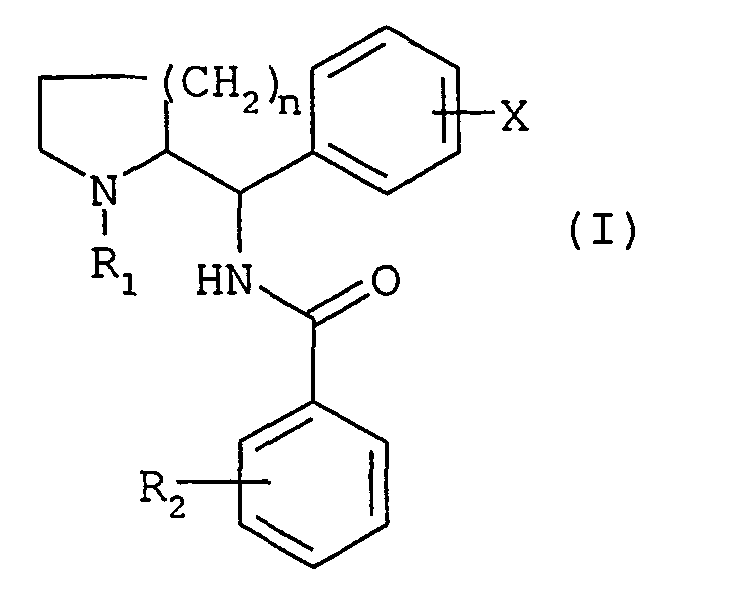
- n représente le nombre 1 ou 3,
- R1 représente soit un atome d'hydrogène, soit un groupe (C1-C7)alkyle linéaire ou ramifié éventuellement substitué par un ou plusieurs atomes de fluor, soit un groupe (C3-C7) cycloalkyle, soit un groupe (C3-C7) cycloalkyl-(C1-C3) alkyle, soit un groupe phényl (C1-C3) alkyle éventuellement substitué par un ou deux groupes méthoxy, soit un groupe (C2-C4)alcényle, soit un groupe (C2-C4)alcynyle,
- X représente soit un atome d'hydrogène soit un ou plusieurs substituants choisis parmi les atomes d'halogènes et les groupes trifluorométhyle, (C1-C6)alkyles et (C1-C6)alcoxy. linéaires ou ramifiés,
- R2 représente soit un atome d'hydrogène, soit un ou plusieurs substituants choisis parmi les atomes d'halogènes, et les groupes trifluorométhyle, (C1-C6) alkyles, (C1-C6) alcoxy, linéaires ou ramifiés, (C3-C7)cycloalkyles, phényle, cyano, acétyle, benzoyle, S(C1-C6)alkyles, (C1-C6)alkylsulfonyles, carboxy et (C1-C6)alcoxycarbonyles, soit un groupe de formule générale NR3R4, SO2NR3R4 ou CONR3R4, dans lesquelles R3 et R4 représentent chacun, indépendamment l'un de l'autre, un atome d'hydrogène ou un groupe (C1-C6)alkyle linéaire ou ramifié ou (C3-C7)cycloalkyle, ou forment, avec l'atome d'azote qui les porte, un cycle pyrrolidine, pipéridine ou morpholine.
- n represents the number 1 or 3,
- R 1 represents either a hydrogen atom or a linear or branched (C 1 -C 7 ) alkyl group optionally substituted by one or more fluorine atoms, a (C 3 -C 7 ) cycloalkyl group, or a group ( C 3 -C 7 ) cycloalkyl- (C 1 -C 3 ) alkyl, a phenyl (C 1 -C 3 ) alkyl group optionally substituted with one or two methoxy groups, or a (C 2 -C 4 ) alkenyl group, a (C 2 -C 4 ) alkynyl group,
- X represents either a hydrogen atom or one or more substituents chosen from halogen atoms and trifluoromethyl, (C 1 -C 6 ) alkyl and (C 1 -C 6 ) alkoxy groups. linear or branched,
- R 2 represents either a hydrogen atom or one or more substituents selected from halogen atoms, and linear or branched (C 1 -C 6 ) alkyl, (C 1 -C 6 ) alkoxy, trifluoromethyl, (C 3 -C 7 ) cycloalkyl, phenyl, cyano, acetyl, benzoyl, S (C 1 -C 6 ) alkyl, (C 1 -C 6 ) alkylsulfonyl, carboxy and (C 1 -C 6 ) alkoxycarbonyls, a group of general formula NR 3 R 4 , SO 2 NR 3 R 4 or CONR 3 R 4 , in which R 3 and R 4 each represent, independently of one another, a hydrogen atom or a (C 1 -C 6) ) linear or branched alkyl or (C 3 -C 7 ) cycloalkyl, or form, with the nitrogen atom which carries them, a pyrrolidine, piperidine or morpholine ring.
Les composés de formule générale (I) peuvent exister sous forme des racémates thréo (1R, 2R ; 1S,2S) ou érythro (1S, 2R ; 1R,2S) ou sous forme d'énantiomères ; ils peuvent exister à l'état de bases libres ou de sels d'addition à des acides.The compounds of general formula (I) may exist in the form of threo (1 R , 2 R ; 1 S , 2 S ) or erythro (1 S , 2 R ; 1 R , 2 S ) racemates or in the form of enantiomers; they may exist in the form of free bases or addition salts with acids.
Des composés de structure analogue à celle des composés de l'invention sont décrits dans le brevet US-5254569 comme analgésiques, diurétiques, anticonvulsivants, anesthésiques, sédatifs, cérébroprotecteurs, par un mécanisme d'action sur les récepteurs opiacés.Compounds of structure analogous to that of the compounds of the invention are described in US Pat. No. 5,254,569 as analgesics, diuretics, anticonvulsants, anesthetics, sedatives, and cerebroprotectives, by a mechanism of action on opiate receptors.
Les composés de l'invention présentent une activité particulière comme inhibiteurs spécifiques des transporteurs de la glycine glyt1 et/ou glyt2.The compounds of the invention exhibit particular activity as specific inhibitors of the glyt1 and / or glyt2 glycine transporters.
Les composés de formule générale (I) dans laquelle R1 est différent d'un atome d'hydrogène peuvent être préparés par un procédé illustré par le schéma 1 qui suit.

On peut obtenir les composés de formule générale (I) érythro ou thréo purs selon toutes méthodes connues de l'homme du métier, par exemple par séparation par chromatographie liquide à haute performance.The compounds of general formula (I) in which R 1 is different from a hydrogen atom can be prepared by a process illustrated in Scheme 1 which follows.
The compounds of general formula (I) erythro or threo pure can be obtained by any method known to those skilled in the art, for example by separation by high performance liquid chromatography.
Pour n=1 avec R1 différent de l'atome d'hydrogène et X tels que définis ci-dessus, la diamine de formule générale (II), de configuration relative thréo ou érythro ou en mélange, peut être préparée par le procédé illustré par le schéma 2 voie A.
On peut réduire la cétone IV où P représente Boc en alcool (X) érythro/thréo dont le ratio dépend de la nature de l'hydrure utilisé selon une méthode décrite dans J.Chem. Soc. Chem. Commun., 1986, 412-413. Le groupement protecteur est ensuite éliminé selon une méthode classique , dans un mélange de dichlorométhane et d'acide trifluoroacétique. On obtient ainsi l'amino alcool (XI) sur lequel on procède ensuite à une N-alkylation au moyen d'un dérivé halogéné de formule R1Z, et d'une base du type potassium carbonate pour donner l'amino alcool fonctionnalisé de formule générale (XII).
Enfin dans les conditions classiques de Mitsunobu, selon une méthode décrite dans Bull. Soc. Chim. Belg. (106), 1997, 77-84 en présence d'acide hydrazoïque et de triphénylphosphine, on obtient la diamine de formule générale (II).

The ketone IV in which P represents Boc can be reduced to the alcohol (X) erythro / threo whose ratio depends on the nature of the hydride used according to a method described in J. Chem. Soc. Chem. Commun., 1986, 412-413. The protective group is then removed according to a conventional method, in a mixture of dichloromethane and trifluoroacetic acid. The amino alcohol (XI) is thus obtained, on which an N-alkylation is then carried out using a halogenated derivative of formula R 1 Z, and a base of the potassium carbonate type to give the functionalized amino alcohol of general formula (XII).
Finally, in the conventional conditions of Mitsunobu, according to a method described in Bull. Soc. Chim. Belg. (106) , 1997, 77-84 in the presence of hydrazoic acid and triphenylphosphine, the diamine of general formula (II) is obtained.
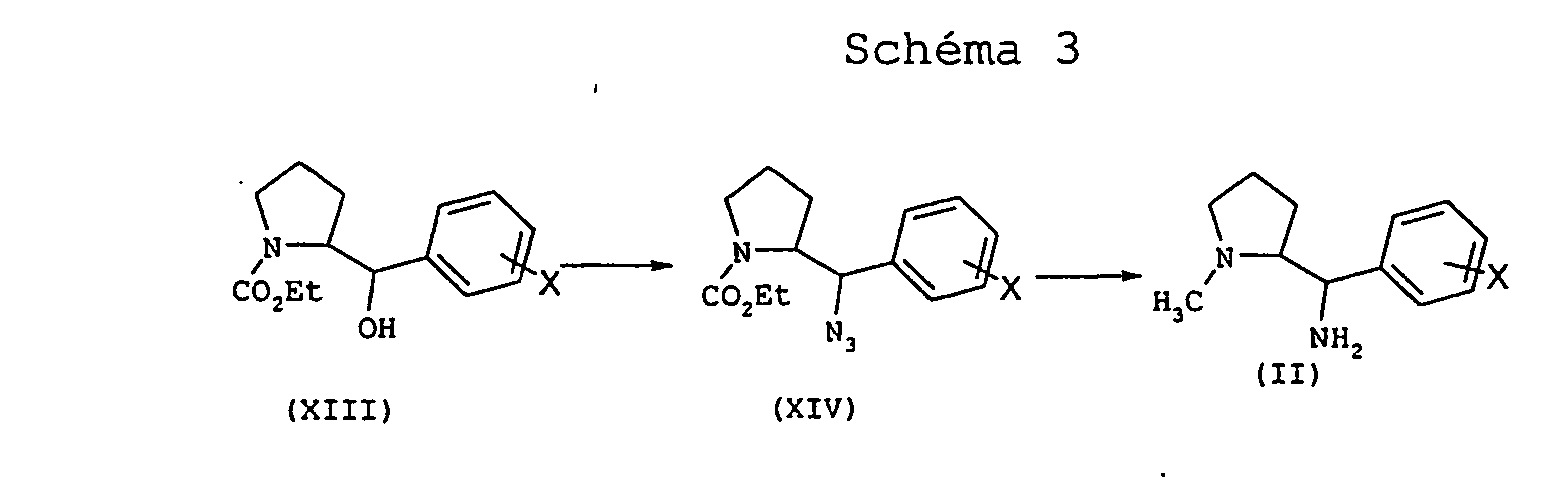
Pour n=1 avec R1= CH3 et X tel que défini ci-dessus en peut également obtenir la diamine de formule générale (II), de configuration relative thréo ou érythro ou en mélange, selon les voies B et B' du schéma 2 et selon le schéma 3.For n = 1, with R 1 = CH 3 and X as defined above, it is also possible to obtain the diamine of general formula (II), of threo or erythro relative configuration or in mixture, according to the B and B 'pathways of the scheme. 2 and according to Scheme 3.
Selon la voie B, on fait réagir la cétone (IV) dans laquelle X est tel que défini ci-dessus, avec le chlorhydrate de la benzylhydroxylamine au reflux de la pyridine pour fournir un mélange d'oxime (V) que l'on déprotège avec l'acide trifluoroacétique pour obtenir l'amine libre (VI).According to Route B, the ketone (IV) in which X is as defined above is reacted with the hydrochloride of benzylhydroxylamine under reflux of pyridine to provide a mixture of oxime (V) which is deprotected. with trifluoroacetic acid to obtain the free amine (VI).
La méthylation de la pyrrolidine s'effectue classiquement au reflux du formaldéhyde et de l'acide formique pour générer le composé (VII). Enfin l'hydrogénation catalysée par le palladium sur charbon de ce composé, dans un solvant alcoolique en présence d'acide chlorhydrique aqueux conduit à la diamine de formule générale (II).The methylation of pyrrolidine is conventionally carried out under reflux of formaldehyde and formic acid to generate compound (VII). Finally, the palladium-carbon catalyzed hydrogenation of this compound in an alcoholic solvent in the presence of aqueous hydrochloric acid leads to the diamine of general formula (II).
Selon la voie B', on peut faire réagir la cétone de formule générale (IV) où P représente CO2Et et X est tel que défini ci-dessus, avec le chlorhydrate de la benzylhydroxylamine au reflux de l'éthanol pour fournir un mélange d'oximes (VIII) sur lesquelles on pratique une hydrogénation catalysée par le palladium sur charbon dans un solvant alcoolique en présence d'acide chlorhydrique aqueux pour fournir le carbamate (IX). La réduction du carbamate de formule générale (IX) par l'hydrure double d'aluminium et de lithium au reflux d'un solvant tel que l'éther conduit à la diamine de formule générale (II).According to the route B ', the ketone of general formula (IV) in which P represents CO 2 Et and X is as defined above, can be reacted with the hydrochloride of benzylhydroxylamine under reflux of ethanol to provide a mixture. of oximes (VIII) on which a palladium-carbon catalyzed hydrogenation in an alcoholic solvent is carried out in the presence of aqueous hydrochloric acid to provide the carbamate (IX). The reduction of the carbamate of general formula (IX) by aluminum and lithium double hydride at the reflux of a solvent such as ether leads to the diamine of general formula (II).
Selon le schéma 3, l'amino alcool (XIII) est transformé en azoture (XIV) dans les conditions classiques de Mitsunobu, selon une méthode décrite dans J. Org. Chem., (64), 1999, 6106-6111. La réduction du carbamate azoture (XIV) par l'hydrure double d'aluminium et de lithium au reflux d'un solvant tel que le tétrahydrofuranne conduit à un mélange de diamines de formule générale (II).
La diamine de formule générale (II) de configuration relative thréo ou érythro dans laquelle R1 est différent d'un atome d'hydrogène et n = 3 peut être préparée par un procédé illustré par le schéma 4 qui suit.
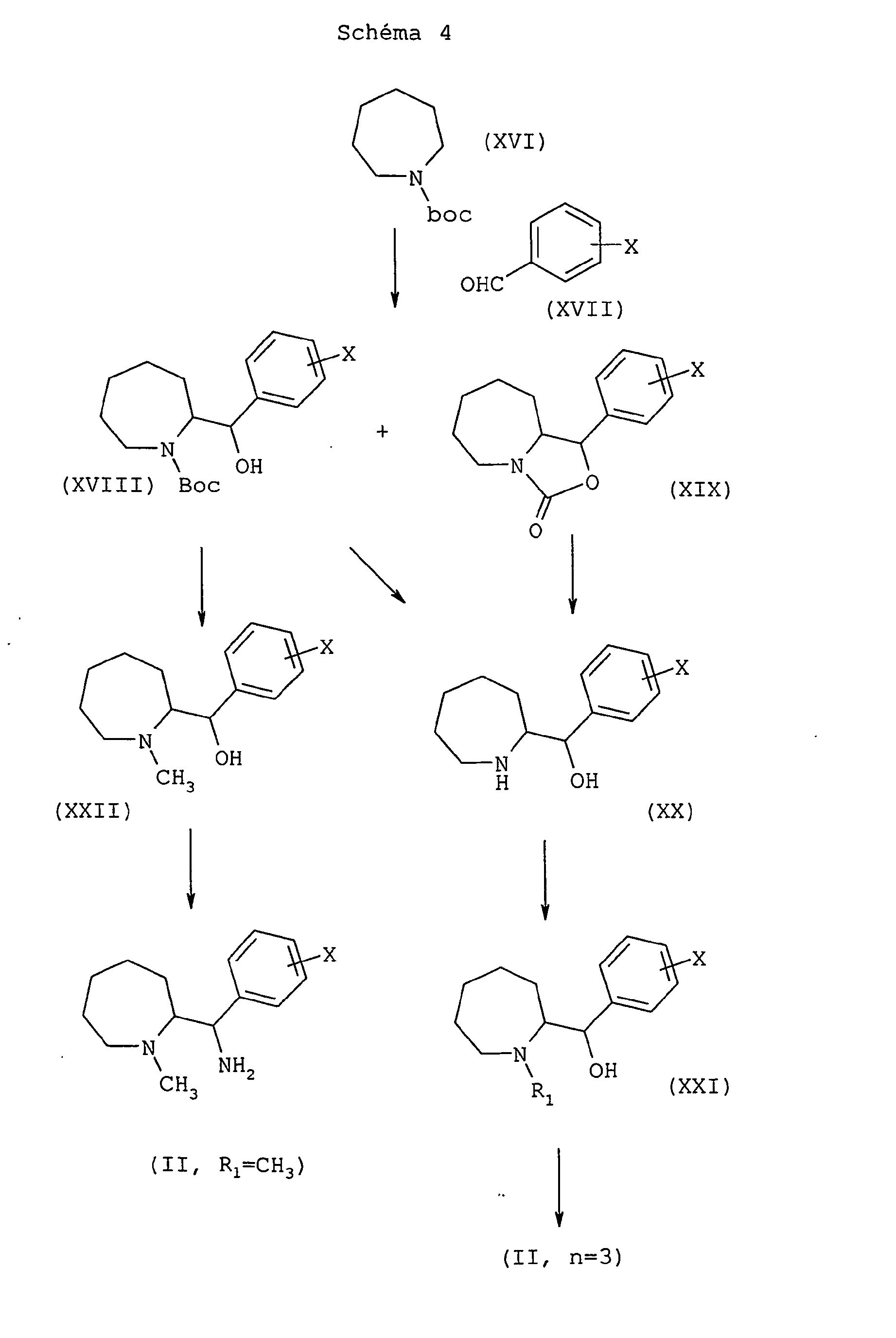
On réalise l'alpha-lithiation de l'azépane de formule générale (XVI) dans laquelle Boc représente un groupe 1,1-diméthyléthoxycarbonyle, par le sec-butyllithium en présence de TMEDA (N,N,N',N'-tétraméthyléthylènediamine) dans un solvant éthéré tel que l'éther diéthylique à -78°C, pour faire réagir la lithioamine formée in situ sur le benzaldéhyde de formule générale (XVII) selon une méthode décrite dans J. Org. Chem., (58), 5, 1993, 1109-1117.
On obtient ainsi un mélange d'alcool de formule générale (XVIII) de configuration érythro et de carbamate cyclique de formule générale (XIX) de configuration thréo Le carbamate de formule générale (XVIII) de configuration érythro peut ensuite être réduit en N-méthylaminoalcool érythro de formule générale (XXII) par action d'un hydrure mixte tel que l'hydrure double d'aluminium et de lithium, dans un solvant éthéré tel que le tétrahydrofurane, entre la température ambiante et la température de reflux.
On transforme ensuite l'alcool érythro de formule générale (XXII) en intermédiaire érythro de formule générale (II) où R1 représente un groupe méthyle, en deux étapes : on transforme d'abord la fonction alcool en groupe nucléofuge, par exemple un groupe méthanesulfonate, par action du chlorure de mésyle, dans un solvant chloré tel que le dichlorométhane, et en présence d'une base telle que la triéthylamine, entre 0°C et la température ambiante, puis on fait réagir le groupe nucléofuge avec de l'ammoniac liquéfié à -50°C, dans un alcool tel que l'éthanol, dans un milieu clos tel qu'un autoclave, entre -50°C et la température ambiante.
On peut également déprotéger le carbamate de formule générale (XVIII) de configuration érythro au moyen d'une base forte telle que la potasse aqueuse, dans un alcool tel que le méthanol pour obtenir 1' aminoalcool correspondant de formule générale (XX). Dans les mêmes conditions d'hydrolyse, le carbamate cyclique thréo de formule générale (XIX) conduit à l'aminoalcool thréo de formule générale (XX).
On procède ensuite à une N-alkylation au moyen d'un dérivé halogéné de formule R1Z, dans laquelle R1 est tel que défini ci-dessus, mais différent d'un atome d'hydrogène, et Z représente un atome d'halogène, en présence d'une base telle que le carbonate de potassium, dans un solvant polaire tel que le N,N-diméthylformamide, entre la température ambiante et 100°C pour conduire au dérivé alkylé de formule générale (XXI). On traite ensuite ce dernier comme décrit à propos de l'alcool de formule générale (XXII).The alpha-lithiation of the azepane of general formula (XVI) in which Boc represents a 1,1-dimethylethoxycarbonyl group is carried out by sec- butyllithium in the presence of TMEDA ( N, N, N ', N ' -tetramethylethylenediamine). ) in an ethereal solvent such as diethyl ether at -78 ° C, to react the lithioamine formed in situ on the benzaldehyde of general formula (XVII) according to a method described in J. Org. Chem., (58) , 5, 1993, 1109-1117.
There is thus obtained a mixture of alcohol of general formula (XVIII) of erythro configuration and cyclic carbamate of general formula (XIX) of threo configuration. The carbamate of general formula (XVIII) of erythro configuration can then be reduced to N- methylaminoalcohol erythro of general formula (XXII) by the action of a mixed hydride such as lithium aluminum hydride double, in an ethereal solvent such as tetrahydrofuran, between room temperature and the reflux temperature.
The erythro alcohol of general formula (XXII) is then converted into an erythro intermediate of general formula (II) where R 1 represents a methyl group, in two stages: the alcohol function is first converted into a nucleofugal group, for example a group methanesulfonate, by the action of mesyl chloride, in a chlorinated solvent such as dichloromethane, and in the presence of a base such as triethylamine, between 0 ° C and room temperature, and then the nucleofuge group is reacted with ammonia liquefied at -50 ° C, in an alcohol such as ethanol, in a closed medium such as an autoclave, between -50 ° C and room temperature.
It is also possible to deprotect the carbamate of general formula (XVIII) of erythro configuration by means of a strong base such as aqueous potassium hydroxide, in an alcohol such as methanol to obtain the corresponding aminoalcohol of general formula (XX). Under the same hydrolysis conditions, the threo cyclic carbamate of general formula (XIX) gives the threo amino alcohol of general formula (XX).
N- alkylation is then carried out using a halogenated derivative of formula R 1 Z, in which R 1 is as defined above, but different from a hydrogen atom, and Z represents a halogen atom, in the presence of a base such as potassium carbonate, in a polar solvent such as N, N- dimethylformamide, between room temperature and 100 ° C to yield the alkyl derivative of general formula (XXI). The latter is then treated as described with reference to the alcohol of general formula (XXII).
Les composés de formule générale (I) dans laquelle R1 représente un atome d'hydrogène peuvent être préparés à partir d'un composé de générale (I) dans laquelle R1 représente soit un groupe phénylméthyle éventuellement substitué et à déprotéger l'azote du cycle pipéridine, par exemple par un agent oxydant ou par un acide de Lewis tel que le tribromure de bore, ou par hydrogénolyse soit un groupe alcényle, de préférence allyle, suivie d'une déprotection par un complexe du Pd° pour obtenir un composé de formule générale (I) dans laquelle R1 représente un atome d'hydrogèneThe compounds of general formula (I) in which R 1 represents a hydrogen atom may be prepared from a compound of general (I) in which R 1 represents either an optionally substituted phenylmethyl group and to deprotect the nitrogen of the piperidine ring, for example by an oxidizing agent or a Lewis acid such as boron tribromide, or by hydrogenolysis is an alkenyl group, preferably allyl, followed by deprotection with a complex of Pd ° to obtain a compound of general formula (I) in which R 1 represents a hydrogen atom
Par ailleurs les composés chiraux de formule générale (I) peuvent être également obtenus soit par séparation des composés racémiques par chromatographie liquide à haute performance (CLHP) sur colonne chirale, soit à partir de l'amine chirale obtenue soit par dédoublement de l'amine racémique de formule générale (II) par utilisation d'un acide chiral, tel que l'acide tartrique, l'acide camphorsulfonique, l'acide dibenzoyltartrique, la N-acétylleucine, par la recristallisation fractionnée et préférentielle d'un sel diastéréoisomérique dans un solvant de type alcool, soit par synthèse chirale selon la voie B' ou A à partir de la cétone de formule générale (IV) chirale du schéma 2, soit encore à partir de l'alcool chiral de formule générale (XIII) du schéma 3.Moreover, the chiral compounds of general formula (I) can also be obtained either by separation of the racemic compounds by high performance liquid chromatography (HPLC) on a chiral column, or from the chiral amine obtained or by resolution of the amine racemic system of general formula (II) using a chiral acid, such as tartaric acid, camphorsulfonic acid, dibenzoyltartric acid, N-acetyleucine, by the fractional and preferential recrystallization of a diastereoisomeric salt in a alcohol type solvent, either by chiral synthesis according to the B 'or A pathway starting from the ketone of general formula (IV) chiral of scheme 2, or again from the chiral alcohol of general formula (XIII) of scheme 3 .
La cétone de formule générale (IV) racémique peut être préparée selon une méthode décrite dans Tetrahedron Lett., (38) (5) ,1997, 783-786 ; Tetrahedron ,(59), 2003,1083-1094. En série chirale la cétone de formule générale (IV) ou les alcools chiraux de formules générales (X) ou (XIII) peuvent être préparés selon une méthode décrite dans la demande internationale WO03004468 et dans J.Chem.Soc. Perkin Trans I, 1987, 1465-1471. La perhydroazépine de formule générale (XVI) peut être préparée selon une méthode décrite dans J. Org. Chem., (58),5, 1993, 1109-1117.The ketone of general formula (IV) may be racemic prepared according to a method described in Tetrahedron Lett., (38) (5), 1997, 783-786; Tetrahedron , (59), 2003 , 1083-1094. In chiral series, the ketone of general formula (IV) or the chiral alcohols of general formulas (X) or (XIII) may be prepared according to a method described in international application WO03004468 and in J.Chem.Soc. Perkin Trans I, 1987, 1465-1471. Perhydroazepine of general formula (XVI) may be prepared according to a method described in J. Org. Chem., (58) , 5, 1993, 1109-1117.
Les exemples qui vont suivre illustrent la préparation de quelques composés de l'invention. Les microanalyses élémentaires, et les spectres I.R. et R.M.N. et la CLHP sur colonne chirale confirment les structures et les puretés énantiomériques des composés obtenus.
Les numéros indiqués entre parenthèses dans les titres des exemples correspondent à ceux de la 1ère colonne du tableau donné plus loin.
Dans les noms des composés, le tiret "-" fait partie du mot, et le tiret "-" ne sert que pour la coupure en fin de ligne ; il est à supprimer en l'absence de coupure, et ne doit être remplacé ni par un tiret normal ni par un espace.The examples which follow illustrate the preparation of some compounds of the invention. Elemental microanalyses, and IR and NMR spectra and chiral column HPLC confirm the enantiomeric structures and purities of the compounds obtained.
The numbers indicated in parentheses in the titles of the examples correspond to those in the 1st column of the table given below.
In the names of the compounds, the hyphen "-" is part of the word, and the hyphen "-" is only used for the cut at the end of the line; it must be deleted in the absence of a cut, and must not be replaced by a normal dash or a space.
Dans un ballon de 1000 ml, muni d'une agitation magnétique, on introduit 8,8 g (31,36 mmoles) de 2-benzoylpyrrolidine-1-carboxylate de tert-butyle et 5,6 g (35,15 mmoles) de chlorhydrate de benzylhydroxylamine en solution dans 100 ml d'éthanol absolu et 35 ml de soude 1M et on chauffe au reflux pendant 16 h.In a 1000 ml flask fitted with magnetic stirring, 8.8 g (31.36 mmol) of tert- butyl 2-benzoylpyrrolidine-1-carboxylate and 5.6 g (35.15 mmol) of benzylhydroxylamine hydrochloride dissolved in 100 ml of absolute ethanol and 35 ml of 1M sodium hydroxide solution and refluxed for 16 hours.
Après évaporation à sec du milieu réactionnel sous pression réduite, on dilue le résidu avec de l'eau et du dichlorométhane, on sépare la phase aqueuse, et on l'extrait avec du dichlorométhane. Après lavage des phases organiques réunies, séchage sur sulfate de sodium et évaporation du solvant sous pression réduite, on purifie le résidu par chromatographie sur colonne de gel de silice en éluant avec un mélange d'acétate d'éthyle et de cyclohexane.
On obtient ainsi 8 g de produit sous forme d'huile.After evaporation of the reaction medium to dryness under reduced pressure, the residue is diluted with water and dichloromethane, the aqueous phase is separated, and it is extracted with dichloromethane. After washing the combined organic phases, drying over sodium sulphate and evaporation of the solvent under reduced pressure, the residue is purified by chromatography on a column of silica gel, eluting with a mixture of ethyl acetate and cyclohexane.
8 g of product are thus obtained in the form of an oil.
Dans un ballon de 500 ml, muni d'une agitation magnétique, on introduit 8g (20 mmoles) 2-[[(benzyloxy)imino] (phényl)-méthyl]pyrrolidine-1-carboxylate de tert-butyle en solution dans 400 ml d'un mélange d'acide trifluoroacétique 30% dans le dichlorométhane et on agite 4 h à température ambiante. Après évaporation à sec du milieu réactionnel sous pression réduite, on dilue le résidu avec de l'ammoniaque et du dichlorométhane, on sépare la phase aqueuse, et on l'extrait avec du dichlorométhane. Après lavage des phases organiques réunies, séchage sur sulfate de sodium et évaporation du solvant sous pression réduite, on purifie le résidu par chromatographie sur colonne de gel de silice en éluant avec un mélange dichlorométhane et de méthanol.
On obtient 4 g de produit.In a 500 ml flask fitted with magnetic stirring, 8 g (20 mmol) tert- butyl 2 - [[(benzyloxy) imino] (phenyl) methyl] pyrrolidine-1-carboxylate are introduced in 400 ml solution. a mixture of trifluoroacetic acid 30% in dichloromethane and stirred for 4 h at room temperature. After evaporation of the reaction medium to dryness under reduced pressure, the residue is diluted with ammonia and dichloromethane, the aqueous phase is separated, and extracted with dichloromethane. After washing the combined organic phases, drying over sodium sulphate and evaporation of the solvent under reduced pressure, the residue is purified by chromatography on a column of silica gel, eluting with a dichloromethane / methanol mixture.
4 g of product are obtained.
1.3(1-méthylpyrrolidin-2-yl)(phényl)méthanone O-benzyloxime. Dans un ballon de 50 ml , muni d'une agitation magnétique, on introduit 1,2 g (4,28 mmoles) de phényl(pyrrolidin-2-yl)méthanone ○-benzyloxime dans 4 ml d'un mélange (1/1) d'acide formique et de formaldéhyde aqueux à 37% et on chauffe au reflux pendant 16 h.
Après évaporation à sec du milieu réactionnel sous pression réduite, on dilue le résidu avec de l'ammoniaque et du dichlorométhane, on sépare la phase aqueuse, et on l'extrait avec du dichlorométhane. Après lavage des phases organiques réunies, séchage sur sulfate de sodium et évaporation du solvant sous pression réduite, on purifie le résidu par chromatographie sur colonne de gel de silice en éluant avec un mélange de dichlorométhane et de méthanol.
On obtient 1,05 g de produit.1.3 (1-methylpyrrolidin-2-yl) (phenyl) methanone O- benzyloxime. In a 50 ml flask equipped with magnetic stirring, 1.2 g (4.28 mmol) of phenyl (pyrrolidin-2-yl) methanone ○ -benzyloxime are introduced into 4 ml of a mixture (1/1 ) formic acid and 37% aqueous formaldehyde and refluxed for 16 h.
After evaporation of the reaction medium to dryness under reduced pressure, the residue is diluted with ammonia and dichloromethane, the aqueous phase is separated, and extracted with dichloromethane. After washing the combined organic phases, drying over sodium sulphate and evaporation of the solvent under reduced pressure, the residue is purified by chromatography on a column of silica gel, eluting with a mixture of dichloromethane and methanol.
1.05 g of product is obtained.
Dans une fiole de Parr sous atmosphère d'azote on place 1,05 g (3,56 mmoles) de (1-méthylpyrrolidin-2-yl)(phényl)-méthanone O-benzyloxime en solution dans un mélange de 20 ml d'éthanol et de 10 ml d'acide chlorhydrique 1N en présence d'une pointe de spatule de palladium sur charbon à 10%. On place les réactifs sous atmosphère d'hydrogène et on les agite pendant 8 h.
Après filtration du catalyseur et évaporation du filtrat sous pression réduite, on dilue le résidu avec de l'ammoniaque et du dichlorométhane, on sépare la phase aqueuse, et on l'extrait avec du dichlorométhane. Après lavage des phases organiques réunies, séchage sur sulfate de sodium et évaporation du solvant sous pression réduite,on obtient ainsi 0,54 g de produit sous forme d'une huile que l'on utilise brute dans l'étape suivante.In a Parr flask under a nitrogen atmosphere, 1.05 g (3.56 mmol) of (1-methylpyrrolidin-2-yl) (phenyl) -methanone O- benzyloxime are placed in solution in a mixture of 20 ml of ethanol and 10 ml of 1N hydrochloric acid in the presence of a spatula tip of palladium on carbon at 10%. The reagents are placed under a hydrogen atmosphere and stirred for 8 hours.
After filtration of the catalyst and evaporation of the filtrate under reduced pressure, the residue is diluted with ammonia and dichloromethane, the aqueous phase is separated, and extracted with dichloromethane. After washing the combined organic phases, drying over sodium sulfate and evaporation of the solvent under reduced pressure, 0.54 g of product is obtained in the form of an oil which is used in the next step.
Dans ballon de 100 ml , sous atmosphère d'azote on place 0,54 g (2,84 mmoles) de [(1-méthylpyrrolidin-2-yl)phényl)méthyl]amine et 0,41 g de carbonate de potassium en solution dans 7 ml de dichlorométhane à 0°C. On ajoute une solution de 0,72 g (2,97 mmoles) de chlorure d'acide 2-chloro-3-trifluorométhylbenzoïque en solution dans 3 ml de dichlorométhane et on laisse 16 h à température ambiante.
On dilue le mélange réactionnel avec de l'eau et du dichlorométhane, on sépare la phase aqueuse, et on l'extrait avec du dichlorométhane. Après lavage des phases organiques réunies, séchage sur sulfate de sodium et évaporation du solvant sous pression réduite, on purifie le résidu par chromatographie sur colonne de gel de silice en éluant avec un mélange de dichlorométhane et de méthanol. On isole ainsi 110 mg de thréo-2-chloro-N-[(1-méthylpyrrolidin-2-yl)phényl méthyl]-3-trifluorométhylbenzamide.
On dissout ce dernier dans quelques ml de propan-2-ol, on ajoute 6 ml d'une solution 0,1N d'acide chlorhydrique dans le propan-2-ol, et on concentre le mélange sous pression réduite afin de réduire le volume du solvant. Après trituration on isole finalement 0,10 g de chlorhydrate sous forme d'un solide.
Point de fusion : 96-110°C.In a 100 ml flask, 0.54 g (2.84 mmol) of [(1-methylpyrrolidin-2-yl) phenyl) methyl] amine and 0.41 g of potassium carbonate in solution are placed under nitrogen atmosphere. in 7 ml of dichloromethane at 0 ° C. A solution of 0.72 g (2.97 mmol) of 2-chloro-3-trifluoromethylbenzoic acid chloride dissolved in 3 ml of dichloromethane is added and the mixture is left for 16 hours at room temperature.
The reaction mixture is diluted with water and dichloromethane, the aqueous phase is separated off and extracted with dichloromethane. After washing the combined organic phases, drying over sodium sulphate and evaporation of the solvent under reduced pressure, the residue is purified by chromatography on a column of silica gel, eluting with a mixture of dichloromethane and methanol. 110 mg of threo-2-chloro- N - [(1-methylpyrrolidin-2-yl) phenylmethyl] -3-trifluoromethylbenzamide are thus isolated.
The latter is dissolved in a few ml of propan-2-ol, 6 ml of a 0.1N solution of hydrochloric acid in propan-2-ol are added, and the mixture is concentrated under reduced pressure in order to reduce the volume. solvent. After trituration, 0.10 g of hydrochloride is finally isolated in the form of a solid.
Melting point: 96-110 ° C.
Dans ballon de 100 ml muni d'une agitation magnétique on introduit 0,975 g (4,73 mmoles) d'acide 4-amino-3,5-dichlorobenzoïque, 0,639 g (4,73 mmoles) d'hydroxybenzotriazole 0,906 g (4,73 mmoles)de chlorhydrate de 1-[3-(diméthylamino)propyl]-3-éthylcarbodiimide en solution dans 50 ml de dichlorométhane. On laisse 30 min à température ambiante et on ajoute 0,9 g (4,73 mmoles) de [(1-méthylpyrrolidin-2-yl)phényl)méthyl]amine en solution dans 20 ml de dichlorométhane et on laisse à température ambiante pendant la nuit.
Après hydrolyse à l'eau et dilution au dichlorométhane on sépare la phase aqueuse, et on l'extrait avec du dichlorométhane. Après lavage des phases organiques réunies, séchage sur sulfate de sodium et évaporation du solvant sous pression réduite, on purifie le résidu par chromatographie sur colonne de gel de silice en éluant avec un mélange de dichlorométhane et de méthanol.
On obtient 0,19 g de produit huileux.
On dissout ce dernier dans quelques ml de propan-2-ol, on ajoute 20 ml d'une solution 0,1N d'acide chlorhydrique dans le propan-2-ol, et on concentre le mélange sous pression réduite afin de réduire le volume du solvant. Après trituration on isole finalement 0,19 g de chlorhydrate sous forme d'un solide.
Point de fusion : 155-162°C.In a 100 ml flask equipped with magnetic stirring, 0.975 g (4.73 mmol) of 4-amino-3,5-dichlorobenzoic acid, 0.639 g (4.73 mmol) of hydroxybenzotriazole 0.906 g (4, 73 mmol) of 1- [3- (dimethylamino) propyl] -3-ethylcarbodiimide hydrochloride dissolved in 50 ml of dichloromethane. It is left for 30 minutes at room temperature and 0.9 g (4.73 mmol) of [(1-methylpyrrolidin-2-yl) phenyl) methyl] amine dissolved in 20 ml of dichloromethane are added and the mixture is left at ambient temperature for 30 minutes. the night.
After hydrolysis with water and dilution with dichloromethane, the aqueous phase is separated off and extracted with dichloromethane. After washing the combined organic phases, drying over sodium sulphate and evaporation of solvent under reduced pressure, the residue is purified by chromatography on a column of silica gel, eluting with a mixture of dichloromethane and methanol.
0.19 g of oily product is obtained.
The latter is dissolved in a few ml of propan-2-ol, 20 ml of a 0.1 N solution of hydrochloric acid in propan-2-ol are added, and the mixture is concentrated under reduced pressure in order to reduce the volume. solvent. After trituration, 0.19 g of hydrochloride is finally isolated in the form of a solid.
Melting point: 155-162 ° C.
Dans un tricol de 250 ml muni d'une agitation magnétique, sous atmosphère d'azote, on place 3 g (10,89 mmoles) de 2-benzoylpyrrolidine-1-carboxylate de tert-butyle en solution dans 110 ml de tétrahydrofurane à -70°C. On ajoute goutte à goutte 29 ml (43,58 mmoles) d'une solution d'hydrure de diisobutylaluminium 1,5M dans le toluène. On laisse 2 heures à -70°C et on laisse remonter à -20°C. On hydrolyse alors précautionneusement avec 50 ml de méthanol. Après évaporation du mélange réactionnel sous pression réduite, on dilue le résidu avec de l'acide chlorhydrique 1N et du dichlorométhane, on sépare la phase aqueuse, et on l'extrait avec du dichlorométhane. Après lavage des phases organiques réunies, séchage sur sulfate de sodium et évaporation du solvant sous pression réduite, on obtient 2,8 g d'un mélange contenant majoritairement le diastéréo-isomère érythro-2-[hydroxy(phénylméthyl]pyrrolidine-1-carboxylate de tert-butyle que l'on utilise brut dans l'étape suivante.In a 250 ml three-necked flask equipped with magnetic stirring, under a nitrogen atmosphere, 3 g (10.89 mmol) of tert- butyl 2-benzoylpyrrolidine-1-carboxylate in solution in 110 ml of tetrahydrofuran are placed in 70 ° C. 29 ml (43.58 mmol) of a solution of 1.5M diisobutylaluminum hydride in toluene are added dropwise. The mixture is left at -70 ° C. for 2 hours and allowed to warm to -20 ° C. It is then hydrolysed carefully with 50 ml of methanol. After evaporation of the reaction mixture under reduced pressure, the residue is diluted with 1N hydrochloric acid and dichloromethane, the aqueous phase is separated off and extracted with dichloromethane. After washing the combined organic phases, drying over sodium sulphate and evaporation of the solvent under reduced pressure, 2.8 g of a mixture containing predominantly the diastereoisomer erythro-2- [hydroxy (phenylmethyl) pyrrolidine-1-carboxylate are obtained. tert -butyl that the crude is used in the next step.
Dans un ballon de 250 ml, muni d'une agitation magnétique, on place 5 g (21,99 mmoles) d'érythro-2-[hydroxy(phénylméthyl]pyrrolidine-1-carboxylate de tert-butyle en solution dans un mélange de 75 ml de dichlorométhane et de 30 ml d'acide trifluoroacétique et on agite le mélange. On laisse à température ambiante pendant 2 h.
On évapore le mélange réactionnel sous pression réduite.
On obtient ainsi 5 g d'un mélange contenant le trifluroacétate de l'érythro-phényl(pyrrolidin-2-yl)méthanol que l'on utilise brut dans l'étape suivante.In a 250 ml flask equipped with magnetic stirring, 5 g (21.99 mmol) of tert- butyl erythro-2- [hydroxy (phenylmethyl) pyrrolidine-1-carboxylate in solution in a mixture of 75 ml of dichloromethane and 30 ml of trifluoroacetic acid and the mixture is stirred and left at room temperature for 2 hours.
The reaction mixture is evaporated under reduced pressure.
There is thus obtained 5 g of a mixture containing trifluroacetate of erythro-phenyl (pyrrolidin-2-yl) methanol which is used crude in the next step.
Dans un ballon de 250 ml, muni d'une agitation magnétique, on.place 5 g (17,16 mmoles) de trifluoroacétate de érythrophényl(pyrrolidin-2-yl)méthanol, 5,9 g (43 mmoles) de carbonate de potassium et 1,8 ml (20,6 mmoles) de bromure d'allyle en solution dans 50 ml d'acétonitrile, et on agite à température ambiante pendant 16 h.
Après évaporation à sec du milieu réactionnel sous pression réduite, on dilue le résidu avec de l'ammoniaque et du dichlorométhane, on sépare la phase aqueuse, et on l'extrait avec du dichlorométhane. Après lavage des phases organiques réunies, séchage sur sulfate de sodium et évaporation du solvant sous pression réduite, on purifie le résidu par chromatographie sur colonne de gel de silice en éluant avec un mélange de dichlorométhane et de méthanol.
On obtient ainsi 1,1g d'un mélange contenant de l'érythro-(1-allylpyrrolidinyl-2-yl)phényl)méthanol.In a 250 ml flask fitted with magnetic stirring, 5 g (17.16 mmol) of erythrophenyl (pyrrolidin-2-yl) methanol trifluoroacetate, 5.9 g (43 mmol) of potassium carbonate, are added. and 1.8 ml (20.6 mmol) of allyl bromide dissolved in 50 ml of acetonitrile and stirred at room temperature for 16 h.
After evaporation of the reaction medium to dryness under reduced pressure, the residue is diluted with ammonia and dichloromethane, the aqueous phase is separated, and extracted with dichloromethane. After washing the combined organic phases, drying over sodium sulphate and evaporation of the solvent under reduced pressure, the residue is purified by chromatography on a column of silica gel, eluting with a mixture of dichloromethane and methanol.
There is thus obtained 1.1 g of a mixture containing erythro- (1-allylpyrrolidinyl-2-yl) phenyl) methanol.
On hydrolyse avec de l'acide chlorhydrique 1N et on dilue avec du chloroforme. On basifie la phase aqueuse avec de l'ammoniaque et on l'extrait plusieurs fois avec du chloroforme. Après lavage des phases organiques réunies, séchage sur sulfate de sodium et évaporation du solvant sous pression réduite. On obtient 1 g d'une huile orangée contenant de la thréo-[(1-allylpyrrolidinyl-2-yl)phényl)méthyl]amine que l'on utilise brute dans l'étape suivanteIt is hydrolyzed with 1N hydrochloric acid and diluted with chloroform. The aqueous phase is basified with ammonia and extracted several times with chloroform. After washing the combined organic phases, drying over sodium sulfate and evaporation of the solvent under reduced pressure. 1 g of an orange oil containing threo - [(1-allylpyrrolidinyl-2-yl) phenyl) methyl] amine is obtained which is used crude in the next step.
Selon le mode opératoire décrit dans l'exemple 1.5, en partant de 1 g (4,62 mmoles) de thréo [(1-allylpyrrolidin-2-yl)phényl)méthyl]amine, 1,13 g (4,62 mmoles) de chlorure d'acide 2-chloro-3-trifluorométhylbenzoïque et 0,64 g (4,62 mmoles) de carbonate de potassium, on obtient 20 mg d'une huile qui cristallise
Point de fusion : 117-123°C.According to the procedure described in Example 1.5, starting from 1 g (4.62 mmol) of threo [(1-allylpyrrolidin-2-yl) phenyl) methyl] amine, 1.13 g (4.62 mmol) of 2-chloro-3-trifluoromethylbenzoic acid chloride and 0.64 g (4.62 mmol) of potassium carbonate, 20 mg of an oil which crystallizes is obtained.
Melting point: 117-123 ° C.
Dans un ballon de 100 ml muni d'une agitation magnétique, on introduit 1,36 g (5,5 mmoles) de 2-benzoylpyrrolidine-1-carboxylate d'éthyle en solution de 30 ml d'éthanol et on ajoute 1,75 g (10,96 mmoles) de chlorhydrate de benzylhydroxylamine et on chauffe le mélange au reflux pendant 12 h. Après évaporation du solvant sous pression réduite, on reprend le résidu à l'acétate d'éthyle et on lave la phase organique avec une solution saturée en chlorure de sodium, on la sèche sur sulfate de sodium et on l'évapore sous pression réduite. On obtient 1,95 g d'une huile jaune que l'on purifie par chromatographie sur colonne de gel de silice en éluant avec un mélange d'acétate d'éthyle et de cyclohexane.
On obtient 1,56 g de produit.In a 100 ml flask equipped with magnetic stirring, 1.36 g (5.5 mmol) of ethyl 2-benzoylpyrrolidine-1-carboxylate in solution of 30 ml of ethanol are introduced and 1.75 g (10.96 mmol) of benzylhydroxylamine hydrochloride and the mixture was refluxed for 12 h. After evaporation of the solvent under reduced pressure, the residue is taken up with ethyl acetate and the organic phase is washed with saturated sodium chloride solution, dried over sodium sulfate and evaporated under reduced pressure. 1.95 g of a yellow oil are obtained which are purified by chromatography on a column of silica gel, eluting with a mixture of ethyl acetate and cyclohexane.
1.56 g of product are obtained.
Dans une fiole de Parr de 250 ml, on introduit 1,56 g (4,43 mmoles) de [(benzyloxy)imino]phénylméthylpyrrolidine-1-carboxylate d'éthyle dans 40 ml d'éthanol et 8 ml d'acide chlorhydrique 1N, on ajoute 0,15 g de palladium sur charbon à 10% et on place le mélange sous atmosphère d'hydrogène pendant 7 h.
Après filtration du catalyseur et évaporation du filtrat sous pression réduite, on dilue le résidu avec de l'ammoniaque et du dichlorométhane, on sépare la phase aqueuse, et on l'extrait avec du dichlorométhane.. Après lavage des phases organiques réunies, séchage sur sulfate de sodium et évaporation du solvant sous pression réduite, on obtient 1 g d'un mélange comprenant les (S)-2-[(S)-amino(phényl)méthyl]pyrrolidine-1-carboxylate d'éthyle et le [phênyl(-pyrrolidin-2-yl)méthyl]carbamate d'éthyle, que l'on utilise brut dans l'étape suivante.To a 250 ml Parr flask was charged 1.56 g (4.43 mmol) of ethyl [(benzyloxy) imino] phenylmethylpyrrolidine-1-carboxylate in 40 ml of ethanol and 8 ml of 1N hydrochloric acid. 0.15 g of 10% palladium on charcoal is added and the mixture is placed under a hydrogen atmosphere for 7 hours.
After filtration of the catalyst and evaporation of the filtrate under reduced pressure, the residue is diluted with ammonia and dichloromethane, the aqueous phase is separated off and extracted with dichloromethane. After washing the combined organic phases, drying is carried out. sodium sulphate and evaporation of the solvent under reduced pressure, 1 g of a mixture comprising ethyl ( S ) -2 - [( S ) -amino (phenyl) methyl] pyrrolidine-1-carboxylate and [phenyl (-pyrrolidin-2-yl) methyl] carbamate are obtained. ethyl, which is used crude in the next step.
Dans un ballon de 100 ml muni d'une agitation magnétique, sous atmosphère d'azote, on introduit 1 g (4 mmoles) du mélange comprenant les (S)-2-[(S)-amino(phényl)méthyl]-pyrrolidine-1-carboxylate d'éthyle et [phényl(-pyrrolidin-2-yl)méthyl]carbamate d'éthyle en solution dans 20 ml d'éther anhydre à 0°C. On ajoute 0,8 g (21 mmoles) d'hydrure double d'aluminium et de lithium par portions et on chauffe au reflux pendant 5 h.
Après refroidissement, on traite successivement par 0,8 ml d'eau, 0,8 ml de soude à 15% et 2,4 ml d'eau.
Après filtration sur Célite®, on concentre le filtrat sous pression réduite. On purifie le résidu obtenu (0,7g) par chromatographie sur colonne de gel de silice en éluant avec un mélange de dichlorométane de méthanol et d'ammoniaque.
On obtient 0,12 g de produit sous forme d'une huile jaune.In a 100 ml flask equipped with magnetic stirring, under a nitrogen atmosphere, 1 g (4 mmol) of the mixture comprising ( S ) -2 - [( S ) -amino (phenyl) methyl] -pyrrolidine are introduced. Ethyl -1-carboxylate and [phenyl (-pyrrolidin-2-yl) methyl] carbamate in solution in 20 ml of anhydrous ether at 0 ° C. 0.8 g (21 mmol) of lithium aluminum hydride are added in portions and heated under reflux for 5 hours.
After cooling, 0.8 ml of water, 0.8 ml of 15% sodium hydroxide and 2.4 ml of water are treated successively.
After filtration on Celite®, the filtrate is concentrated under reduced pressure. The residue obtained (0.7 g) is purified by chromatography on a column of silica gel, eluting with a mixture of dichloromethane of methanol and of ammonia.
0.12 g of product is obtained in the form of a yellow oil.
Selon le mode opératoire décrit dans l'exemple 2, en partant de 0,12 g (0,63 mmole)de [(S)-[(2S)-(1-méthylpyrrolidin-2-yl)]phényl)méthyl]amine, 0,12 g (0,63 mmole)de chlorhydrate de 1-[3-(diméthylamino)propyl]-3-éthylcarbodiimide, 0,085 g (0, 63 mmole) d'hydroxybenzotriazole et 0,14 g (0,63 mmole) d'acide 4-chloro-3-sulfonylbenzoïque, on obtient, après traitement et purification par chromatographie sur gel de silice avec un gradient de dichlorométhane et de méthanol, 0,12 g de 3-(aminosulfonyl)-4-chloro-N-[(S)-[(2S)-1-méthylpyrrolidin-2-yl](phényl)méthyl]benzamide.
On dissout ce dernier dans quelques ml de propan-2-ol, on ajoute 20 ml d'une solution 0,1N d'acide chlorhydrique dans le propan-2-ol, et on concentre le mélange sous pression réduite afin de réduire le volume du solvant. Après trituration on isole finalement 0,09 g de chlorhydrate sous forme d'un solide blanc.
Point de fusion : 165-170°C.According to the procedure described in Example 2, starting from 0.12 g (0.63 mmol) of [( S ) - [(2 S ) - (1-methylpyrrolidin-2-yl)] phenyl) methyl] amine, 0.12 g (0.63 mmol) of 1- [3- (dimethylamino) propyl] -3-ethylcarbodiimide hydrochloride, 0.085 g (0.63 mmol) of hydroxybenzotriazole and 0.14 g (0.63 g) mmol) of 4-chloro-3-sulphonylbenzoic acid, 0.12 g of 3- (aminosulfonyl) -4-chloro are obtained after treatment and purification by chromatography on silica gel with a gradient of dichloromethane and methanol. N - [(S) - [( 2S ) -1-methylpyrrolidin-2-yl] (phenyl) methyl] benzamide.
This is dissolved in a few ml of propan-2-ol, 20 ml of a 0.1 N solution of hydrochloric acid in propan-2-ol are added, and the mixture is concentrated under reduced pressure in order to reduce the volume of the solvent. After trituration, 0.09 g of hydrochloride is finally isolated in the form of a white solid.
Melting point: 165-170 ° C.
Dans un ballon de 500 ml muni d'une agitation magnétique et sous atmosphère d'argon, on place 2,9 g (11,6 mmoles) de thréo-[hydroxy(phényl)méthyl]pyrrolidine-1-carboxylate d'éthyle en solution dans 150 ml de tétrahydrofurane à 0°C. On ajoute 4,57 g (17,4 mmoles)de triphénylphosphine et 35 mmoles d'une solution d'acide hydrazoïque dans le toluène. On ajoute goutte à goutte 2,74 ml (17,4 mmoles) d'azidodicarboxylate d'éthyle et on laisse agiter pendant 24 h.
On ajoute de la soude 1N et on reprend le mélange repris avec de l'acétate d'éthyle. On sèche la phase organique sur sulfate de sodium et on l'évapore sous pression réduite. On obtient 10 g d'un résidu que l'on purifie par chromatographie sur gel de silice avec un gradient de cyclohexane et d'acétate d'éthyle. On obtient ainsi 1,17 g d'érythro-[azido(phényl)méthyl]pyrrolidine-1-carboxylate d'éthyle.In a 500 ml flask equipped with magnetic stirring and under an argon atmosphere, 2.9 g (11.6 mmol) of ethyl threo- [hydroxy (phenyl) methyl] pyrrolidine-1-carboxylate are placed in solution in 150 ml of tetrahydrofuran at 0 ° C. 4.57 g (17.4 mmol) of triphenylphosphine and 35 mmol of a solution of hydrazoic acid in toluene are added. 2.74 ml (17.4 mmol) of ethyl azidodicarboxylate are added dropwise and the mixture is stirred for 24 hours.
1N sodium hydroxide is added and the reaction mixture is taken up in ethyl acetate. The organic phase is dried over sodium sulfate and evaporated under reduced pressure. 10 g of a residue are obtained which is purified by chromatography on silica gel with a gradient of cyclohexane and ethyl acetate. There is thus obtained 1.17 g of ethyl erythro [azido (phenyl) methyl] pyrrolidine-1-carboxylate.
Après refroidissement on traite successivement avec 0,8 ml d'eau, 0,8 ml de soude à 15% et 2,4 ml d'eau.
Après filtration sur Célite®, on évapore le filtrat sous pression réduite et on purifie le résidu par chromatographie sur gel de silice avec un mélange de dichlorométhane, de méthanol et d'ammoniaque. On obtient ainsi 0,16 g d'érythro-[(1-méthylpyrrolidin-2-yl)phényl)méthyl]amine et 0,15 g de [méthylphényl(pyrrolidinyl-2-yl)méthyl]amine.After cooling, 0.8 ml of water, 0.8 ml of 15% sodium hydroxide and 2.4 ml of water are treated successively.
After filtration on Celite®, the filtrate is evaporated under reduced pressure and the residue is purified by chromatography on silica gel with a mixture of dichloromethane, methanol and ammonia. 0.16 g of erythro - [(1-methylpyrrolidin-2-yl) phenyl) methyl] amine and 0.15 g of [methylphenyl (pyrrolidinyl-2-yl) methyl] amine are thus obtained.
Selon le mode opératoire décrit dans l'exemple 2, en partant de 0,073 g (0,38 mmole)de érythro (1-méthylpyrrolidin-2-yl)]phényl)méthyl]amine, 0, 074 g (0,38 mmole) de chlorhydrate de 1-[3-(diméthylamino)propyl]-3-éthylcarbodiimide, 0,052 g (0,38 mmole) d'hydroxybenzotriazole et 0,092 g (0,63 mmole) d'acide 4-amino-3-chloro-5-trifluorométhylbenzoïque, on obtient après traitement et purification par chromatographie sur gel de silice avec un gradient de dichlorométhane et de méthanol, 0,089 g de érythro-4-amino-3-chloro-N-[1-méthylpyrrolidinyl-2-yl](phényl)méthyl]-5-(trifluorométhyl)benzamide.
On dissout ce dernier dans quelques ml de propan-2-ol, on ajoute 20 ml d'une solution 0,1N d'acide chlorhydrique dans le propan-2-ol, et on concentre le mélange sous pression réduite afin de réduire le volume du solvant. Après trituration on isole finalement 0,07 g de chlorhydrate sous forme d'un solide blanc.
Point de fusion : 130-140°C.According to the procedure described in Example 2, starting from 0.073 g (0.38 mmol) of erythro (1-methylpyrrolidin-2-yl) phenyl) methyl] amine, 0.074 g (0.38 mmol) 1- [3- (dimethylamino) propyl] -3-ethylcarbodiimide hydrochloride, 0.052 g (0.38 mmol) of hydroxybenzotriazole and 0.092 g (0.63 mmol) of 4-amino-3-chloro-5-acid -trifluoromethylbenzoic acid, obtained after treatment and purification by chromatography on silica gel with a gradient of dichloromethane and methanol, 0.089 g of erythro-4-amino-3-chloro-N- [1-methylpyrrolidinyl-2-yl] (phenyl) ) methyl] -5- (trifluoromethyl) benzamide.
The latter is dissolved in a few ml of propan-2-ol, 20 ml of a 0.1 N solution of hydrochloric acid in propan-2-ol are added, and the mixture is concentrated under reduced pressure in order to reduce the volume. solvent. After trituration, 0.07 g of hydrochloride is finally isolated in the form of a white solid.
Melting point: 130-140 ° C.
En utilisant la méthode de synthèse de l'exemple 5 en partant de l'amino alcool thréo chiral (2S)-2-[2-(S)-hydroxy(phényl)méthyl]pyrrolidine-1-carboxylate d'éthyle, on obtient 0,12 g de chlorhydrate de 3-(aminosulfonyl)-4-chloro-N-[(R)-[(2S)-1-méthylpyrrolidin-2-yl](phényl)méthyl]benzamide 1:1.
Point de fusion : 190-192°C.Using the synthetic method of Example 5 starting from ethyl amino threo-chiral (2 S ) -2- [2- ( S ) -hydroxy (phenyl) methyl] pyrrolidine-1-carboxylate ethyl, 0.12 g of 3- (aminosulfonyl) -4-chloro-N - [(R) - [(2S) -1-methylpyrrolidin-2-yl] (phenyl) methyl] benzamide hydrochloride 1: 1 are obtained.
Melting point: 190-192 ° C.
Dans un tricol de 250 ml muni d'une agitation magnétique sous atmosphère d'argon, on place 5 g (25,09 mmoles) d'azépane-1-carboxylate de tert-butyle et 3,8 ml (25,09 mmoles) de tétraméthylenediamine en solution dans 30 ml d'éther anhydre à -75 °C. On ajoute goutte à goutte 21 ml (27,60 mmoles)de sec-butyllithium 1,3M dans le cyclohexane. On laisse remonter la température jusqu'à -50°C en 3 h (solution A).
Dans un ballon de 250 ml , muni d'une agitation magnétique sous atmosphère d'argon, on place 3,8 ml (37,63 mmoles) de benzaldéhyde dans 10 ml d'éther anhydre (solution B).
On refroidit les 2 solutions à -75°C et on introduit la soution A dans la solution B en contrôlant la température. Après la fin de l'addition, on laisse remonter à température ambiante et on laisse agiter une nuit.
Après hydrolyse avec une solution saturée en chlorure d'ammonium, on sépare la phase aqueuse, et on l'extrait avec de l'acétate d'éthyle. Après lavage des phases organiques réunies, séchage sur sulfate de sodium et évaporation du solvant sous pression réduite, on purifie Le résidu (10 g) par chromatographie sur colonne de gel de silice en éluant avec un mélange d'acétate d'éthyle et de cyclohexane.
On obtient ainsi 2g de 2-[hydroxy(phényl)méthyl]azépane-1-carboxylate de tert-butyle.In a 250 ml three-neck tube equipped with magnetic stirring under an argon atmosphere, 5 g (25.09 mmol) of tert- butyl azepane-1-carboxylate and 3.8 ml (25.09 mmol) are placed. of tetramethylenediamine dissolved in 30 ml of anhydrous ether at -75 ° C. 21 ml (27.60 mmol) of 1,3 M sec- butyllithium in cyclohexane are added dropwise. The temperature is allowed to rise to -50 ° C. in 3 hours (solution A).
In a 250 ml flask equipped with magnetic stirring under an argon atmosphere, 3.8 ml (37.63 mmol) of benzaldehyde are placed in 10 ml of anhydrous ether (solution B).
The solutions are cooled to -75 ° C. and the suspension A is introduced into solution B while controlling the temperature. After the end of the addition, it is allowed to rise to room temperature and allowed to stir overnight.
After hydrolysis with a saturated solution of ammonium chloride, the aqueous phase is separated off and extracted with ethyl acetate. After washing the combined organic phases, drying over sodium sulphate and evaporation of the solvent under reduced pressure, the residue is purified (10 g) by chromatography on a column of silica gel, eluting with a mixture of ethyl acetate and cyclohexane. .
Thus obtaining 2 g of 2- [hydroxy (phenyl) methyl] azepane-1-carboxylic acid tert -butyl.
Dans un bicol de 100 ml sous atmosphère d'azote, muni d'une agitation magnétique et surmonté d'un réfrigérant, on place en suspension dans 10 ml de tétrahydrofurane 1,2 g (32,74 mmoles) d'hydrure double de lithium et d'aluminium.
On ajoute goutte à goutte une solution de 2 g (6,55 mmoles) de 2-[hydroxy(phényl)méthyl]azépane-1-carboxylate de tert-butyle dans 10 ml de tétrahydrofurane et au chauffe au reflux pendant 5 h.
Après refroidissement , on ajoute 5,5 ml d'une solution 0,1M de tartrate double de potassium et de sodium et on agite une nuit à température ambiante.
Après filtration de l'insoluble sous pression réduite et rinçage au tétrahydrofurane, on concentre le filtrat sous pression réduite. On obtient 1,36 g d'une huile que l'on purifie par chromatographie sur colonne de gel de silice en éluant avec un mélange de dichlorométhane, de méthanol et d'ammoniaque.
On obtient 0,95 g de (1-méthylazépan-2-yl)phényl)méthanol.In a 100 ml bicol under a nitrogen atmosphere, equipped with magnetic stirring and surmounted by a condenser, 1.2 g (32.74 mmol) of lithium double hydride are suspended in 10 ml of tetrahydrofuran. and aluminum.
A solution of 2 g (6.55 mmol) of tert- butyl 2- [hydroxy (phenyl) methyl] azepane-1-carboxylate in 10 ml of tetrahydrofuran and refluxing for 5 h was added dropwise.
After cooling, 5.5 ml of a 0.1M solution of potassium and sodium double tartrate are added and the mixture is stirred overnight at room temperature.
After filtration of the insoluble under reduced pressure and rinsing with tetrahydrofuran, the filtrate is concentrated under reduced pressure. 1.36 g of an oil are obtained which is purified by chromatography on a column of silica gel, eluting with a mixture of dichloromethane, methanol and ammonia.
0.95 g of (1-methylazepan-2-yl) phenyl) methanol is obtained.
Dans un ballon de 100 ml sous atmosphère d'azote muni d'une agitation magnétique on place 0,95 g (4,33 mmoles) de (1-méthylazépan-2-yl)phényl)méthanol, 0,6 ml (4,33 mmoles) de triéthylamine en solution dans 20 ml de dichlorométhane à 0°C. On ajoute 0,34 ml de chlorure de mésyle et on agite le mélange à température ambiante pendant 3 h.
Après évaporation des solvants sous pression réduite on reprend le résidu dans 20 ml d'éthanol et on l'ajoute à une solution d'ammoniac liquéfié dans un autoclave refroidi à -50°C. On ferme l'autoclave et on laisse agiter à température ambiante pendant 48 h.
On dilue le mélange réactionnel avec de l'eau et du dichlorométhane. On extrait la phase aqueuse 3 fois au dichlorométhane. Après lavage des phases organiques réunies, séchage sur sulfate de sodium et évaporation du solvant sous pression réduite on obtient 1,7 g de [(1-méthylazépan-2-yl)phényl)méthyl]amine sous forme d'huile que l'on utilise brute dans l'étape suivante.In a 100 ml flask under nitrogen atmosphere provided with magnetic stirring, 0.95 g (4.33 mmol) of (1-methylazepan-2-yl) phenyl) methanol, 0.6 ml (4, 33 mmol) of triethylamine dissolved in 20 ml of dichloromethane at 0 ° C. 0.34 ml of mesyl chloride is added and the mixture is stirred at room temperature for 3 hours.
After evaporation of the solvents under reduced pressure, the residue is taken up in 20 ml of ethanol and added to a solution of liquefied ammonia in an autoclave cooled to -50 ° C. The autoclave is closed and allowed to stir at room temperature for 48 hours.
The reaction mixture is diluted with water and dichloromethane. The aqueous phase is extracted 3 times with dichloromethane. After washing the combined organic phases, drying over sodium sulphate and evaporation of the solvent under reduced pressure, 1.7 g of [(1-methylazepan-2-yl) phenyl) methyl] amine are obtained in the form of an oil which is uses brute in the next step.
Selon le mode opératoire décrit dans l'exemple 2, en partant de 1,7 g (7,79 mmoles)de [(1-méthylazépan-2-yl)phényl)-méthyl]amine, 1,49 g (7,79 mmoles)de chlorhydrate de 1-[3-(diméthylamino)propyl]-3-éthylcarbodiimide, 1,05g (7,79 mmoles) d'hydroxybenzotriazole et 1,74 g (7,79 mmoles) d'acide 2-chloro-3-trifluorobenzoïque, on obtient, après traitement et purification par chromatographie sur gel de silice, 0,8 g d'érythro-2-chloro-N-(1-méthylazépan-2-yl)(phényl)méthyl]-3-(trifluorométhyl)benzamide.
On dissout ce dernier dans quelques ml de propan-2-ol, on ajoute 20 ml d'une solution 0,1N d'acide chlorhydrique dans le propan-2-ol, et on concentre le mélange sous pression réduite afin de réduire le volume du solvant. Après trituration on isole finalement 0,48 g de chlorhydrate sous forme d'un solide.
Point de fusion : 124-126°C.According to the procedure described in Example 2, starting from 1.7 g (7.79 mmol) of [(1-methylazepan-2-yl) phenyl) -methyl] amine, 1.49 g (7.79 mmol). mmol) of 1- [3- (dimethylamino) propyl] -3-ethylcarbodiimide hydrochloride, 1.05 g (7.79 mmol) of hydroxybenzotriazole and 1.74 g (7.79 mmol) of 2-chloroacetic acid. 3-trifluorobenzoic acid, 0.8 g of erythro-2-chloro- N - (1-methylazepan-2-yl) (phenyl) methyl] -3- are obtained after treatment and purification by chromatography on silica gel ( trifluoromethyl) benzamide.
The latter is dissolved in a few ml of propan-2-ol, 20 ml of a 0.1 N solution of hydrochloric acid in propan-2-ol are added, and the mixture is concentrated under reduced pressure in order to reduce the volume. solvent. After trituration, 0.48 g of hydrochloride is finally isolated in the form of a solid.
Melting point: 124-126 ° C.
Le tableau 1 qui suit illustre les structures chimiques et les points de fusion de quelques composés de l'invention. Dans la colonne "Sel", - désigne un composé à l'état de base, HCl désigne un chlorhydrate et tfa désigne un trifluoroacétate.
Le composé 7 existe sous forme de mélange d'érythro (7,5) et de thréo (2,5).

Compound 7 exists as a mixture of erythro (7.5) and threo (2.5).
Les composés de l'invention ont été soumis à une série d'essais pharmacologiques qui ont mis en évidence leur intérêt comme substances à activités thérapeutiques.The compounds of the invention have been subjected to a series of pharmacological tests which have demonstrated their interest as substances with therapeutic activities.
La capture de [14C]glycine est étudiée dans les cellules SK-N-MC (cellules neuro-épithéliales humaines) exprimant le transporteur humain glyt1 natif par la mesure de la radioactivité incorporée en présence ou en absence du composé à tester. Les cellules sont cultivées en monocouche pendant 48 h dans des plaques prétraitées à la fibronectine à 0,02%. Le jour de l'expérience, le milieu de culture est éliminé et les cellules sont lavées par un tampon Krebs-HEPES (acide [4-(2-hydroxyéthyl)pipérazine-1-éthanesulfonique) à pH 7,4. Après 10 min de préincubation à 37°C en présence soit de tampon (lot témoin), soit de composé à tester a différentes concentrations ou de 10 mM de glycine (détermination de la capture non spécifique), 10 µM de [14C] glycine (activité spécifique 112 mCi/mmole) sont ensuite ajoutés. L'incubation se poursuit pendant 10 min à 37°C, et la réaction est arrêtée par 2 lavages avec un tampon Krebs-HEPES à pH 7,4. La radioactivité incorporée par les cellules est alors estimée après ajout de 100 µl de scintillant liquide et agitation pendant 1 h. Le comptage est réalisé sur compteur Microbeta Tri-lux™. L'efficacité du composé est déterminée par la CI50, concentration du composé qui diminue de 50% la capture spécifique de glycine, définie par la différence de radioactivité incorporée par le lot témoin et le lot qui a reçu la glycine à 10 mM.
Les composés de l'invention, dans ce test, ont une CI50 de l'ordre de 0,01 à 10 µM.[ 14 C] glycine uptake is studied in SK-N-MC cells (human neuroepithelial cells) expressing the native human glyt1 transporter by measuring the radioactivity incorporated in the presence or absence of the test compound. The cells are cultured in monolayer for 48 h in 0.02% fibronectin pretreated plates. On the day of the experiment, the culture medium is removed and the cells are washed with Krebs-HEPES buffer ([4- (2-hydroxyethyl) piperazine-1-ethanesulfonic acid) at pH 7.4. After 10 min preincubation at 37 ° C in the presence of either buffer (control group) or test compound at different concentrations or 10 mM glycine (determination of non-specific uptake), 10 μM [ 14 C] glycine (specific activity 112 mCi / mmol) are then added. Incubation is continued for 10 min at 37 ° C, and the reaction is stopped by 2 washes with Krebs-HEPES buffer pH 7.4. The radioactivity incorporated by the cells is then estimated after adding 100 μl of liquid scintillant and stirring for 1 h. Counting is performed on a Microbeta Tri-lux ™ counter. The effectiveness of the compound is determined by the IC 50 concentration of the compound which decreases by 50% the specific uptake of glycine, defined by the difference in radioactivity incorporated by the control group and the batch that received glycine at 10 mM.
The compounds of the invention, in this test, have an IC 50 of the order of 0.01 to 10 μM.
La capture de [14C] glycine par le transporteur glyt2 est étudiée dans l'homogénat de moelle épinière de souris par la mesure de radioactivité incorporée en présence ou en absence de composé à étudier.
Après euthanasie des animaux (souris mâles OF1 Iffa Crédo pesant 20 à 25 g le jour de l'expérience), la moelle épinière de chaque animal est rapidement prélevée, pesée et conservée sur glace. Les échantillons sont homogénéisés dans un tampon Krebs-HEPES (acide [4-(2-hydroxyéthyl)pipérazine-1-éthanesulfonique), pH 7,4, à raison de 25 ml/g de tissu.
50 µl d'homogénat sont pré-incubés pendant 10 min à 25°C en présence de tampon Krebs-HEPES , pH 7,4 et de composé à étudier à différentes concentrations, ou de 10 mM de glycine pour déterminer la capture non spécifique. La [14C]glycine (activité spécifique = 112mCi/mmole) est ensuite ajoutée pendant 10 min à 25°C à la concentration finale de 10 µM. La réaction est arrêtée par filtration sous vide et la radioactivité est estimée par scintillation solide par comptage sur un compteur Microbeta Tri-lux™. L'efficacité du composé est déterminée par la concentration CI50 capable de diminuer de 50% la capture spécifique de glycine, définie par la différence de radioactivité incorporée par le lot témoin et le lot qui a reçu la glycine 10 mM.
Les composés de l'invention dans ce test, ont une CI50 de l'ordre de 0,1 à 10 µM.[ 14 C] glycine uptake by the glyt2 transporter is studied in mouse spinal cord homogenate by measurement of radioactivity incorporated in the presence or absence of test compound.
After euthanasia of the animals (male OF1 Iffa Crédo mice weighing 20 to 25 g on the day of the experiment), the spinal cord of each animal is rapidly removed, weighed and kept on ice. The samples are homogenized in Krebs-HEPES buffer ([4- (2-hydroxyethyl) piperazine-1-ethanesulfonic acid), pH 7.4, at 25 ml / g of tissue.
50 μl of homogenate are preincubated for 10 min at 25 ° C. in the presence of Krebs-HEPES buffer, pH 7.4 and of the compound to be studied at different concentrations, or of 10 mM glycine to determine the non-specific capture. The [ 14 C] glycine (specific activity = 112 mCi / mmol) is then added for 10 min at 25 ° C. to the final concentration of 10 μM. The reaction is stopped by vacuum filtration and the radioactivity is estimated by solid scintillation by counting on a Microbeta Tri-lux ™ counter. The effectiveness of the compound is determined by the IC 50 concentration capable of decreasing by 50% the specific uptake of glycine, defined by the difference in radioactivity incorporated by the control group and the batch which received 10 mM glycine.
The compounds of the invention in this test have an IC 50 of the order of 0.1 to 10 μM.
Les résultats des essais effectués sur les composés de l'invention montrent qu'ils sont des inhibiteurs du transporteur de la glycine glytl présents dans le cerveau et glyt2 présents dans la moelle.The results of the tests carried out on the compounds of the invention show that they are inhibitors of the glycine transporter glytl present in the brain and glyt2 present in the marrow.
Ces résultats suggèrent que les composés de l'invention peuvent être utilisés pour le traitement des troubles comportementaux associés à la démence, des psychoses, en particulier de la schizophrénie (forme déficitaire et forme productive) et des symptômes extrapyramidaux aigus ou chroniques induits par les neuroleptiques, pour le traitement des diverses formes d'anxiété, des attaques de panique, des phobies, des troubles obsessionnels compulsifs, pour le traitement des différentes formes de dépression, y compris la dépression psychotique, pour le traitement des troubles dus à l'abus ou au sevrage d'alcool, des troubles du comportement sexuel, des troubles de la prise de nourriture, et pour le traitement de la migraine.These results suggest that the compounds of the invention can be used for the treatment of disorders behaviors associated with dementia, psychoses, especially schizophrenia (deficient form and productive form) and acute or chronic extrapyramidal symptoms induced by neuroleptics, for the treatment of various forms of anxiety, panic attacks, phobias , obsessive-compulsive disorder, for the treatment of various forms of depression, including psychotic depression, for the treatment of alcohol abuse or withdrawal disorders, sexual behavior disorders, food, and for the treatment of migraine.
Par ailleurs les composés de l'invention peuvent être utilisés pour le traitement des contractures musculaires douloureuses en rhumatologie et en pathologie rachidienne aiguë, pour le traitement des contractures spastiques d'origine médullaire ou cérébrale, pour le traitement symptomatique des douleurs aiguës et subaiguës d'intensité légère à modérée, pour le traitement des douleurs intenses et/ou chroniques, des douleurs neurogènes et algies rebelles, pour le traitement de la maladie de Parkinson et des symptômes parkinsoniens d'origine neurodégénérative ou induits par des neuroleptiques, pour le traitement des épilepsies généralisées primaires et secondaires, partielles à symptomatologie simple ou complexe, des formes mixtes et autres syndromes épileptiques en complément d'un autre traitement antiépileptique, ou en monothérapie, pour le traitement des apnées du sommeil, et pour la neuroprotection.Moreover, the compounds of the invention can be used for the treatment of painful muscle contractures in rheumatology and acute spinal pathology, for the treatment of spastic contractures of medullary or cerebral origin, for the symptomatic treatment of acute and subacute pain. mild to moderate intensity, for the treatment of severe and / or chronic pain, neurogenic pain and rebel pain, for the treatment of Parkinson's disease and parkinsonian symptoms of neurodegenerative or neurodeptic origin, for the treatment of epilepsies generalized primary and secondary, partial to simple or complex symptomatology, mixed forms and other epileptic syndromes in addition to another antiepileptic treatment, or as monotherapy, for the treatment of sleep apnea, and for neuroprotection.
C'est pourquoi la présente invention a également pour objet des compositions pharmaceutiques contenant une dose efficace d'au moins un composé selon l'invention, à l'état de base ou de sel ou de solvat pharmaceutiquement acceptable, et en mélange, le cas échéant, avec des excipients convenables.Therefore, the subject of the present invention is also pharmaceutical compositions containing an effective dose of at least one compound according to the invention, in the form of a base or of a pharmaceutically acceptable salt or solvate, and in a mixture, where appropriate. appropriate, with suitable excipients.
Les compositions pharmaceutiques selon l'invention peuvent ainsi être destinées à l'administration orale, sublinguale, sous-cutanée, intramusculaire, intraveineuse, topique, intratrachéale, intranasale, transdermique, rectale, intraocculaire.The pharmaceutical compositions according to the invention can thus be intended for oral, sublingual, subcutaneous, intramuscular, intravenous, topical, intratracheal, intranasal, transdermal, rectal, intraocular administration.
Les formes unitaires d'administration peuvent être, par exemple, des comprimés, des gélules, des granules, des poudres, des solutions ou suspensions orales ou injectables, des timbres transdermiques (« patch »), des suppositoires. Pour l'administration topique on peut envisager des pommades, lotions et collyres.
Lesdites formes unitaires sont dosées pour permettre une administration journalière de 0,01 à 20 mg de principe actif par kg de poids corporel, selon la forme galénique.The unit dosage forms may be, for example, tablets, capsules, granules, powders, oral or injectable solutions or suspensions, transdermal patches, suppositories. For topical administration we can consider ointments, lotions and eye drops.
Said unit forms are dosed to allow a daily administration of 0.01 to 20 mg of active ingredient per kg of body weight, according to the dosage form.
Pour préparer des comprimés on ajoute au principe actif, micronisé ou non, un véhicule pharmaceutique qui peut être composé de diluants, comme par exemple le lactose, la cellulose microcristalline, l'amidon, et des adjuvants de formulation comme des liants, (polyvinylpyrrolidone, hydroxypropylméthylcellulose, etc), des agents d'écoulement comme la silice, des lubrifiants comme le stéarate de magnésium, l'acide stéarique, le tribehenate de glycerol, le stéarylfumarate de sodium. Des agents mouillants ou tensioactifs tels que le laurylsulfate de sodium peuvent aussi être ajoutés.
Les techniques de réalisation peuvent être la compression directe, la granulation sèche, la granulation humide ou la fusion à chaud.
Les comprimés peuvent être nus, dragéifiés, par exemple par du saccharose, ou enrobés avec divers polymères ou autres matières appropriées. Il peuvent être conçus pour permettre une libération rapide, retardée ou prolongée du principe actif grâce à des matrices polymères ou à des polymères spécifiques utilisés dans l'enrobage.In order to prepare tablets, a pharmaceutical carrier which may be composed of diluents, for example lactose, microcrystalline cellulose or starch, and formulation adjuvants such as binders, polyvinylpyrrolidone, is added to the active ingredient, which may or may not be micronized. hydroxypropyl methylcellulose, etc.), flow agents such as silica, lubricants such as magnesium stearate, stearic acid, glycerol tribehenate, sodium stearyl fumarate. Wetting agents or surfactants such as sodium lauryl sulphate may also be added.
The production techniques can be direct compression, dry granulation, wet granulation or hot melt.
The tablets may be bare, sugar-coated, for example with sucrose, or coated with various polymers or other appropriate materials. It can be designed to allow rapid, delayed or sustained release of the active ingredient through polymer matrices or specific polymers used in the coating.
Pour préparer des gélules on mélange le principe actif avec des véhicules pharmaceutiques secs (simple mélange, granulation sèche ou humide, ou fusion à chaud), liquides ou semi-solides.
Les gélules peuvent être dures ou molles, pelliculées ou non, de manière à avoir une activité rapide, prolongée ou retardée (par exemple pour une forme entérique).To prepare capsules the active ingredient is mixed with dry pharmaceutical vehicles (simple mixing, dry or wet granulation, or hot melting), liquid or semi-solid.
The capsules may be hard or soft, film-coated or not, so as to have a rapid, prolonged or delayed activity (for example for an enteric form).
Une composition sous forme de sirop ou d'élixir ou pour l'administration sous forme de gouttes peut contenir le principe actif conjointement à un édulcorant, de préférence acalorique, du méthylparaben ou du propylparaben comme antiseptique, un agent de sapidité et un colorant.A composition in the form of syrup or elixir or for administration in the form of drops may contain the active ingredient together with a sweetener, preferably acaloric, methylparaben or propylparaben as antiseptic, a flavoring agent and a dye.
Les poudres et granules dispersibles dans de l'eau peuvent contenir le principe actif en mélange avec des agents de dispersion ou des agents mouillants, ou des agents dispersants comme la polyvinylpyrrolidone, de même qu'avec des édulcorants et des agents correcteurs de goût.Water-dispersible powders and granules may contain the active ingredient in admixture with dispersing agents or wetting agents, or dispersing agents such as polyvinylpyrrolidone, as well as with sweeteners and taste-correcting agents.
Pour l'administration rectale, on recourt à des suppositoires préparés avec des liants fondant à la température rectale, par exemple du beurre de cacao ou des polyéthylèneglycols.For rectal administration, suppositories prepared with binders melting at the rectal temperature, for example cocoa butter or polyethylene glycols, are used.
Pour une administration parentérale, on utilise des suspensions aqueuses, des solutions salines isotoniques ou des solutions stériles injectables contenant des agents de dispersion et/ou des mouillants pharmacologiquement compatibles, par exemple le propylèneglycol ou le butylène glycol.For parenteral administration, aqueous suspensions, isotonic saline solutions or sterile injectable solutions containing pharmacologically compatible dispersing agents and / or wetting agents, for example propylene glycol or butylene, are used. glycol.
Le principe actif peut être formulé également sous forme de microcapsules, éventuellement avec un ou plusieurs supports ou additifs, ou bien avec une matrice polymère ou avec une cyclodextrine (timbres transdermiques, formes à libération prolongée).The active ingredient may also be formulated in the form of microcapsules, optionally with one or more supports or additives, or with a polymer matrix or with a cyclodextrin (transdermal patches, sustained-release forms).
Les compositions topiques selon l'invention comprennent un milieu compatible avec la peau. Elles peuvent se présenter notamment sous forme de solutions aqueuses, alcooliques ou hydroalcooliques, de gels, d'émulsions eau-dans-huile ou huile-dans-eau ayant l'aspect d'une crème ou d'un gel, de microémulsions, d'aérosols, ou encore sous forme de dispersions vésiculaires contenant des lipides ioniques et/ou non ioniques. Ces formes galéniques sont préparées selon les méthodes usuelles des domaines considérés.The topical compositions according to the invention comprise a medium compatible with the skin. They may be in the form of aqueous, alcoholic or aqueous-alcoholic solutions, gels, water-in-oil or oil-in-water emulsions having the appearance of a cream or gel, microemulsions, aerosols, or in the form of vesicular dispersions containing ionic and / or nonionic lipids. These galenic forms are prepared according to the usual methods of the fields considered.
Enfin, les compositions pharmaceutiques selon l'invention peuvent contenir, à côté d'un composé de formule générale (I), d'autres principes actifs qui peuvent être utiles dans le traitement des troubles et maladies indiqués ci-dessus.Finally, the pharmaceutical compositions according to the invention may contain, besides a compound of general formula (I), other active ingredients which may be useful in the treatment of the disorders and diseases indicated above.
Claims (11)
- Compound corresponding to the general formula (I)
 n represents the number 1 or 3,R1 represents either a hydrogen atom, a linear or branched (C1-C7)alkyl group optionally substituted with one or more fluorine atoms, a (C3-C7)cycloalkyl group, a (C3-C7)cycloalkyl(C1-C3)alkyl group, a phenyl (C1-C3) alkyl group optionally substituted with one or two methoxy groups, a (C2-C4) alkenyl group, or a (C2-C4) alkynyl group,X represents either a hydrogen atom or one or more substituents chosen from halogen atoms and trifluoromethyl and linear or branched (C1-C6) alkyl and (C1-C6) alkoxy groups,R2 represents either a hydrogen atom or one or more substituents chosen from halogen atoms and trifluoromethyl, linear or branched (C1-C6)alkyl and (C1-C6)alkoxy, (C3-C7)cycloalkyl, phenyl, cyano, acetyl, benzoyl, S(C1-C6)alkyl, (C1-C6)alkylsulfonyl, carboxyl and (C1-C6)alkoxycarbonyl groups, or a group of general formula NR3R4, SO2NR3R4 or CONR3R4, in which R3 and R4 represent, independently of each other, a hydrogen atom or a linear or branched (C1-C6) alkyl or (C3-C7)cycloalkyl group, or form, with the nitrogen atom that bears them, a pyrrolidine, piperidine or morpholine ring,in the form of base or of acid-addition salt.
 - Compound according to Claim 1, characterized in that it is of threo relative configuration (1S, 2S; 1R, 2R).
- Compound according to Claim 1, characterized in that it is of (1S, 2S) configuration.
- Compound according to Claim 1, characterized in that it is of (1R, 2R) configuration.
- Compound according to Claim 1, characterized in that it is of erythro relative configuration (1S, 2R; 1R, 2S).
- Compound according to Claim 1, characterized in that it is of (1R, 2S) configuration.
- Compound according to Claim 1, characterized in that it is of (1S, 2R) configuration.
- Medicament, characterized in that it consists of a compound according to any one of Claims 1 to 5.
- Pharmaceutical composition, characterized in that it contains a compound according to any one of Claims 1 to 5, combined with an excipient.
- Use of a compound according to Claim 1 for the preparation of a medicament for treating behavioral disorders associated with dementia, psychosis, various forms of anxiety, panic attacks, phobia, compulsive obsessive disorders, various forms of depression, disorders caused by alcohol abuse or weaning from alcohol, sexual behavior disorders, eating disorders and migraine.
- Use of a compound according to Claim 1 for the preparation of a medicament for treating contracture, pain, Parkinson's disease and Parkinson-like symptoms, epilepsy, mixed forms and other epileptic syndromes in addition to another antiepileptic treatment, or in monotherapy, and sleep apnea, and for neuroprotection.
Priority Applications (2)
| Application Number | Priority Date | Filing Date | Title |
|---|---|---|---|
| SI200430394T SI1680400T1 (en) | 2003-10-17 | 2004-10-15 | DERIVATIVES OF N-?á PHENYL(PYRROLIDINE-2-YL)METHYL?åBENZAMIDE AND N-?á (AZEPAN-2-YL)PHENYLMETHYL?åBENZAMIDE, PREPARATION METHOD THEREOF AND APPLICATION OF SAME IN THERAPEUTICS |
| PL04791555T PL1680400T3 (en) | 2003-10-17 | 2004-10-15 | Derivatives of n-[ phenyl(pyrrolidine-2-yl)methyl]benzamide and n-[ (azepan-2-yl)phenylmethyl]benzamide, preparation method thereof and application of same in therapeutics |
Applications Claiming Priority (2)
| Application Number | Priority Date | Filing Date | Title |
|---|---|---|---|
| FR0312143A FR2861070B1 (en) | 2003-10-17 | 2003-10-17 | DERIVATIVES OF N- [PHENYL (PYRROLIDIN-2-YL) METHYL] BENZAMIDE AND N - [(AZEPAN-2-YL) PHENYLMETHYL] BENZAMIDE, THEIR PREPARATION AND THEIR THERAPEUTIC USE |
| PCT/FR2004/002644 WO2005037785A2 (en) | 2003-10-17 | 2004-10-15 | Derivatives of n-[phenyl(pyrrolidine-2-yl)methyl]benzamide and n-[(azepan-2-yl)phenylmethyl]benzamide, preparation method thereof and application of same in therapeutics |
Publications (2)
| Publication Number | Publication Date |
|---|---|
| EP1680400A2 EP1680400A2 (en) | 2006-07-19 |
| EP1680400B1 true EP1680400B1 (en) | 2007-06-06 |
Family
ID=34385236
Family Applications (1)
| Application Number | Title | Priority Date | Filing Date |
|---|---|---|---|
| EP04791555A Expired - Lifetime EP1680400B1 (en) | 2003-10-17 | 2004-10-15 | Derivatives of n-[ phenyl(pyrrolidine-2-yl)methyl]benzamide and n-[ (azepan-2-yl)phenylmethyl]benzamide, preparation method thereof and application of same in therapeutics |
Country Status (25)
| Country | Link |
|---|---|
| US (2) | US7226917B2 (en) |
| EP (1) | EP1680400B1 (en) |
| JP (1) | JP4700007B2 (en) |
| CN (1) | CN1882534A (en) |
| AT (1) | ATE364038T1 (en) |
| AU (1) | AU2004281218B2 (en) |
| BR (1) | BRPI0415511A (en) |
| CA (1) | CA2542727A1 (en) |
| CY (1) | CY1106827T1 (en) |
| DE (1) | DE602004006891T2 (en) |
| DK (1) | DK1680400T3 (en) |
| ES (1) | ES2286689T3 (en) |
| FR (1) | FR2861070B1 (en) |
| HR (1) | HRP20070307T3 (en) |
| IL (1) | IL174934A (en) |
| MA (1) | MA28098A1 (en) |
| ME (1) | MEP12608A (en) |
| NO (1) | NO20062032L (en) |
| NZ (1) | NZ547167A (en) |
| PL (1) | PL1680400T3 (en) |
| PT (1) | PT1680400E (en) |
| RS (1) | RS20060315A (en) |
| RU (1) | RU2386614C2 (en) |
| WO (1) | WO2005037785A2 (en) |
| ZA (1) | ZA200603862B (en) |
Cited By (1)
| Publication number | Priority date | Publication date | Assignee | Title |
|---|---|---|---|---|
| CN102692463A (en) * | 2012-06-13 | 2012-09-26 | 山东凯盛新材料股份有限公司 | Method for detecting aromatic acyl chloride product by adopting high performance liquid chromatography method |
Families Citing this family (29)
| Publication number | Priority date | Publication date | Assignee | Title |
|---|---|---|---|---|
| FR2842804B1 (en) | 2002-07-29 | 2004-09-03 | Sanofi Synthelabo | N- [PHENYL (PIPERIDIN-2-YL) METHYL] BENZAMIDE DERIVATIVES, THEIR PREPARATION AND THEIR THERAPEUTIC APPLICATION |
| FR2861074B1 (en) * | 2003-10-17 | 2006-04-07 | Sanofi Synthelabo | N- [PHENYL (PIPERIDIN-2-YL) METHYL] BENZAMIDE DERIVATIVES, THEIR PREPARATION AND THEIR THERAPEUTIC USE |
| FR2861071B1 (en) * | 2003-10-17 | 2006-01-06 | Sanofi Synthelabo | N- [PHENYL (ALKYLPIPERIDIN-2-YL) METHYL] BENZAMIDE DERIVATIVES, THEIR PREPARATION AND THEIR THERAPEUTIC USE |
| FR2861070B1 (en) * | 2003-10-17 | 2006-01-06 | Sanofi Synthelabo | DERIVATIVES OF N- [PHENYL (PYRROLIDIN-2-YL) METHYL] BENZAMIDE AND N - [(AZEPAN-2-YL) PHENYLMETHYL] BENZAMIDE, THEIR PREPARATION AND THEIR THERAPEUTIC USE |
| PE20061156A1 (en) | 2004-12-23 | 2006-12-16 | Glaxo Group Ltd | BENZAMIDE DERIVATIVES AS INHIBITING AGENTS OF THE GLYCINE TRANSPORTER |
| GB0612420D0 (en) * | 2006-06-22 | 2006-08-02 | Glaxo Group Ltd | Compounds |
| CA2691450A1 (en) | 2007-08-22 | 2009-02-26 | Abbott Gmbh & Co. Kg | 4-benzylaminoquinolines, pharmaceutical compositions containing them, and their use in therapy |
| ES2397764T3 (en) | 2008-04-01 | 2013-03-11 | Abbott Gmbh & Co. Kg | Tetrahydroisoquinolines, pharmaceutical compositions containing them, and their use in therapy |
| WO2010087762A1 (en) * | 2009-01-28 | 2010-08-05 | Astrazeneca Ab | 2-aza-bicyclo[2.2.1]heptane compounds and uses thereof |
| FR2941954B1 (en) * | 2009-02-10 | 2011-04-08 | Sanofi Aventis | N- (6-AZA-BICYCLO ° 3.2.1! OCT-1-YL) -ARYL-METHYL DERIVATIVES BENZAMIDE, THEIR PREPARATION AND THEIR THERAPEUTIC APPLICATION |
| FR2941953B1 (en) * | 2009-02-10 | 2011-04-08 | Sanofi Aventis | DERIVATIVES OF N- (2-AZA-BICYCLO® 2.1.1! HEX-1-YL) -BENZAMIDE, THEIR PREPARATION AND THEIR THERAPEUTIC USE |
| AR075442A1 (en) | 2009-02-16 | 2011-03-30 | Abbott Gmbh & Co Kg | AMINOTETRALINE DERIVATIVES, PHARMACEUTICAL COMPOSITIONS THAT CONTAIN THEM AND THEIR USES IN THERAPY |
| TW201038569A (en) | 2009-02-16 | 2010-11-01 | Abbott Gmbh & Co Kg | Heterocyclic compounds, pharmaceutical compositions containing them, and their use in therapy |
| FR2943056A1 (en) * | 2009-03-16 | 2010-09-17 | Sanofi Aventis | New N-(2-aza-bicyclo(2.2.1)-hex-1-yl)-aryl-methyl-heterobenzamide derivatives are glycine transporter 1 inhibitors useful to treat e.g. dementia, psychosis, schizophrenia, anxiety, panic attacks, and obsessive compulsive disorder |
| AR075837A1 (en) * | 2009-03-16 | 2011-04-27 | Sanofi Aventis | DERIVATIVES OF N [(2-AZA-BICICLO [2,1,1] HEX-1-IL) -ARIL-METIL] HETEROBENZAMIDA, ITS PREPARATION, PHARMACEUTICAL COMPOSITIONS AND ITS USE IN THE TREATMENT OF NEURODEGENERATIVE DISEASES |
| US8883839B2 (en) | 2010-08-13 | 2014-11-11 | Abbott Laboratories | Tetraline and indane derivatives, pharmaceutical compositions containing them, and their use in therapy |
| US9045459B2 (en) | 2010-08-13 | 2015-06-02 | AbbVie Deutschland GmbH & Co. KG | Phenalkylamine derivatives, pharmaceutical compositions containing them, and their use in therapy |
| US8846743B2 (en) | 2010-08-13 | 2014-09-30 | Abbott Laboratories | Aminoindane derivatives, pharmaceutical compositions containing them, and their use in therapy |
| US8877794B2 (en) | 2010-08-13 | 2014-11-04 | Abbott Laboratories | Phenalkylamine derivatives, pharmaceutical compositions containing them, and their use in therapy |
| US9051280B2 (en) | 2010-08-13 | 2015-06-09 | AbbVie Deutschland GmbH & Co. KG | Tetraline and indane derivatives, pharmaceutical compositions containing them, and their use in therapy |
| US9309200B2 (en) | 2011-05-12 | 2016-04-12 | AbbVie Deutschland GmbH & Co. KG | Benzazepine derivatives, pharmaceutical compositions containing them, and their use in therapy |
| MX2014001457A (en) | 2011-08-05 | 2014-08-21 | Abbvie Deutschland | Aminochromane, aminothiochromane and amino-1,2,3,4-tetrahydroquin oline derivatives, pharmaceutical compositions containing them, and their use in therapy. |
| US8846741B2 (en) | 2011-11-18 | 2014-09-30 | Abbvie Inc. | N-substituted aminobenzocycloheptene, aminotetraline, aminoindane and phenalkylamine derivatives, pharmaceutical compositions containing them, and their use in therapy |
| US9365512B2 (en) | 2012-02-13 | 2016-06-14 | AbbVie Deutschland GmbH & Co. KG | Isoindoline derivatives, pharmaceutical compositions containing them, and their use in therapy |
| US9656955B2 (en) | 2013-03-15 | 2017-05-23 | Abbvie Inc. | Pyrrolidine derivatives, pharmaceutical compositions containing them, and their use in therapy |
| US9650334B2 (en) | 2013-03-15 | 2017-05-16 | Abbvie Inc. | Pyrrolidine derivatives, pharmaceutical compositions containing them, and their use in therapy |
| MX2016004936A (en) | 2013-10-17 | 2016-12-20 | Abbvie Deutschland | Aminochromane, aminothiochromane and amino-1,2,3,4-tetrahydroquin oline derivatives, pharmaceutical compositions containing them, and their use in therapy. |
| MX2016004934A (en) | 2013-10-17 | 2016-12-20 | Abbvie Deutschland | Aminotetraline and aminoindane derivatives, pharmaceutical compositions containing them, and their use in therapy. |
| US9550754B2 (en) | 2014-09-11 | 2017-01-24 | AbbVie Deutschland GmbH & Co. KG | 4,5-dihydropyrazole derivatives, pharmaceutical compositions containing them, and their use in therapy |
Family Cites Families (9)
| Publication number | Priority date | Publication date | Assignee | Title |
|---|---|---|---|---|
| US5254569A (en) * | 1991-01-14 | 1993-10-19 | The Du Pont Merck Pharmaceutical Company | (Amidomethyl)nitrogen heterocyclic analgesics |
| JP3026845B2 (en) * | 1991-02-20 | 2000-03-27 | 日清製粉株式会社 | Piperidine derivative |
| AU3254499A (en) * | 1998-03-06 | 1999-09-20 | Janssen Pharmaceutica N.V. | Glycine transport inhibitors |
| CA2601132C (en) * | 1998-04-14 | 2011-11-08 | The General Hospital Corporation | Use of n-methylglycine and pharmaceutical compositions comprising n-methylglycine for treating neuropsychiatric disorders |
| FR2838739B1 (en) * | 2002-04-19 | 2004-05-28 | Sanofi Synthelabo | N- [PHENYL (PIPERIDIN-2-YL) METHYL) BENZAMIDE DERIVATIVES, THEIR PREPARATION AND THEIR THERAPEUTIC APPLICATION |
| FR2842804B1 (en) * | 2002-07-29 | 2004-09-03 | Sanofi Synthelabo | N- [PHENYL (PIPERIDIN-2-YL) METHYL] BENZAMIDE DERIVATIVES, THEIR PREPARATION AND THEIR THERAPEUTIC APPLICATION |
| TW200526626A (en) * | 2003-09-13 | 2005-08-16 | Astrazeneca Ab | Chemical compounds |
| FR2861070B1 (en) * | 2003-10-17 | 2006-01-06 | Sanofi Synthelabo | DERIVATIVES OF N- [PHENYL (PYRROLIDIN-2-YL) METHYL] BENZAMIDE AND N - [(AZEPAN-2-YL) PHENYLMETHYL] BENZAMIDE, THEIR PREPARATION AND THEIR THERAPEUTIC USE |
| EP1871165B1 (en) * | 2005-04-11 | 2017-06-21 | Yale University | Method of treating schizophrenia prodrome |
-
2003
- 2003-10-17 FR FR0312143A patent/FR2861070B1/en not_active Expired - Fee Related
-
2004
- 2004-10-15 JP JP2006534801A patent/JP4700007B2/en not_active Expired - Fee Related
- 2004-10-15 ME MEP-126/08A patent/MEP12608A/en unknown
- 2004-10-15 ZA ZA200603862A patent/ZA200603862B/en unknown
- 2004-10-15 ES ES04791555T patent/ES2286689T3/en not_active Expired - Lifetime
- 2004-10-15 WO PCT/FR2004/002644 patent/WO2005037785A2/en not_active Ceased
- 2004-10-15 AU AU2004281218A patent/AU2004281218B2/en not_active Ceased
- 2004-10-15 NZ NZ547167A patent/NZ547167A/en not_active IP Right Cessation
- 2004-10-15 RU RU2006116890/04A patent/RU2386614C2/en not_active IP Right Cessation
- 2004-10-15 PL PL04791555T patent/PL1680400T3/en unknown
- 2004-10-15 EP EP04791555A patent/EP1680400B1/en not_active Expired - Lifetime
- 2004-10-15 PT PT04791555T patent/PT1680400E/en unknown
- 2004-10-15 CN CNA2004800338510A patent/CN1882534A/en active Pending
- 2004-10-15 HR HR20070307T patent/HRP20070307T3/en unknown
- 2004-10-15 DK DK04791555T patent/DK1680400T3/en active
- 2004-10-15 AT AT04791555T patent/ATE364038T1/en active
- 2004-10-15 RS YUP-2006/0315A patent/RS20060315A/en unknown
- 2004-10-15 DE DE602004006891T patent/DE602004006891T2/en not_active Expired - Lifetime
- 2004-10-15 CA CA002542727A patent/CA2542727A1/en not_active Abandoned
- 2004-10-15 BR BRPI0415511-4A patent/BRPI0415511A/en not_active IP Right Cessation
-
2006
- 2006-04-11 IL IL174934A patent/IL174934A/en not_active IP Right Cessation
- 2006-04-17 US US11/405,191 patent/US7226917B2/en not_active Expired - Fee Related
- 2006-04-17 MA MA28943A patent/MA28098A1/en unknown
- 2006-05-05 NO NO20062032A patent/NO20062032L/en not_active Application Discontinuation
-
2007
- 2007-04-30 US US11/741,803 patent/US7700585B2/en not_active Expired - Fee Related
- 2007-08-31 CY CY20071101114T patent/CY1106827T1/en unknown
Cited By (1)
| Publication number | Priority date | Publication date | Assignee | Title |
|---|---|---|---|---|
| CN102692463A (en) * | 2012-06-13 | 2012-09-26 | 山东凯盛新材料股份有限公司 | Method for detecting aromatic acyl chloride product by adopting high performance liquid chromatography method |
Also Published As
Similar Documents
| Publication | Publication Date | Title |
|---|---|---|
| EP1680400B1 (en) | Derivatives of n-[ phenyl(pyrrolidine-2-yl)methyl]benzamide and n-[ (azepan-2-yl)phenylmethyl]benzamide, preparation method thereof and application of same in therapeutics | |
| EP1527048B1 (en) | N-[phenyl(piperidin-2-yl)methyl]benzamide derivatives, preparation thereof, and use thereof in therapy | |
| EP1499589B1 (en) | Derivatives of n-phenyl(piperidin-2-yl)methyl benzamide, the preparation method thereof and application of same in therapeutics | |
| EP1682503B1 (en) | Derivatives of n-[phenyl(alkylpiperidine-2-yl)methyl]benzamide, preparation method thereof and application of same in therapeutics | |
| EP1680418B1 (en) | Derivatives of n-[heteroaryl(piperidine-2-yl)methyl]benzamide, preparation method thereof and application of same in therapeutics | |
| CA2542647C (en) | Derivatives of n-heterocyclylmethylbenzamides, prepartion method thereof and application of same in therapeutics | |
| FR2861074A1 (en) | New N-(piperidinyl)(phenyl)methyl amide derivatives useful as glycine transporter inhibitors, e.g. for treating dementia-associated behavioral problems, psychoses, anxiety, depression, alcohol abuse | |
| WO2004013100A2 (en) | N-[phenyl(piperidin-2-yl)methyl]benzamide derivatives, preparation thereof, and use thereof in therapy | |
| EP2077837A2 (en) | Derivatives of pyrrolizine, indolizine and quinolizine, preparation thereof and therapeutic use thereof | |
| EP2419431A1 (en) | Derivatives of n-[(7-aza-bicyclo[2.2.1]hept-1-yl)-aryl-methyl]-benzamide, preparation thereof, and therapeutic use thereof | |
| MXPA06004266A (en) | Derivatives of n-[phenyl(pyrrolidine-2-yl)methyl]benzamide and n-[(azepan-2-yl)phenylmethyl]benzamide, preparation method thereof and application of same in therapeutics | |
| EP2396334A1 (en) | N-[(2-azabicyclo[2.1.1]hex-1-yl]-aryl-methyl]-benzamide derivatives, preparation thereof, and therapeutic use thereof | |
| EP2396335A1 (en) | N-[(6-azabicyclo[3.2.1]oct-1-yl)-aryl-methyl]-benzamide derivatives, preparation thereof, and therapeutic use thereof |
Legal Events
| Date | Code | Title | Description |
|---|---|---|---|
| PUAI | Public reference made under article 153(3) epc to a published international application that has entered the european phase |
Free format text: ORIGINAL CODE: 0009012 |
|
| 17P | Request for examination filed |
Effective date: 20060517 |
|
| AK | Designated contracting states |
Kind code of ref document: A2 Designated state(s): AT BE BG CH CY CZ DE DK EE ES FI FR GB GR HU IE IT LI LU MC NL PL PT RO SE SI SK TR |
|
| AX | Request for extension of the european patent |
Extension state: AL HR LT LV MK |
|
| GRAP | Despatch of communication of intention to grant a patent |
Free format text: ORIGINAL CODE: EPIDOSNIGR1 |
|
| GRAS | Grant fee paid |
Free format text: ORIGINAL CODE: EPIDOSNIGR3 |
|
| GRAA | (expected) grant |
Free format text: ORIGINAL CODE: 0009210 |
|
| AK | Designated contracting states |
Kind code of ref document: B1 Designated state(s): AT BE BG CH CY CZ DE DK EE ES FI FR GB GR HU IE IT LI LU MC NL PL PT RO SE SI SK TR |
|
| AX | Request for extension of the european patent |
Extension state: AL HR LT LV MK |
|
| REG | Reference to a national code |
Ref country code: GB Ref legal event code: FG4D Free format text: NOT ENGLISH |
|
| REG | Reference to a national code |
Ref country code: CH Ref legal event code: EP |
|
| REG | Reference to a national code |
Ref country code: HR Ref legal event code: TUEP Ref document number: P20070307 Country of ref document: HR Ref country code: IE Ref legal event code: FG4D Free format text: LANGUAGE OF EP DOCUMENT: FRENCH |
|
| REF | Corresponds to: |
Ref document number: 602004006891 Country of ref document: DE Date of ref document: 20070719 Kind code of ref document: P |
|
| REG | Reference to a national code |
Ref country code: PT Ref legal event code: SC4A Free format text: AVAILABILITY OF NATIONAL TRANSLATION Effective date: 20070712 |
|
| REG | Reference to a national code |
Ref country code: RO Ref legal event code: EPE |
|
| REG | Reference to a national code |
Ref country code: GR Ref legal event code: EP Ref document number: 20070402364 Country of ref document: GR |
|
| GBT | Gb: translation of ep patent filed (gb section 77(6)(a)/1977) |
Effective date: 20070810 |
|
| REG | Reference to a national code |
Ref country code: DK Ref legal event code: T3 |
|
| REG | Reference to a national code |
Ref country code: HR Ref legal event code: T1PR Ref document number: P20070307 Country of ref document: HR |
|
| REG | Reference to a national code |
Ref country code: SE Ref legal event code: TRGR |
|
| REG | Reference to a national code |
Ref country code: EE Ref legal event code: FG4A Ref document number: E001356 Country of ref document: EE Effective date: 20070725 |
|
| REG | Reference to a national code |
Ref country code: PL Ref legal event code: T3 |
|
| REG | Reference to a national code |
Ref country code: ES Ref legal event code: FG2A Ref document number: 2286689 Country of ref document: ES Kind code of ref document: T3 |
|
| REG | Reference to a national code |
Ref country code: HU Ref legal event code: AG4A Ref document number: E002017 Country of ref document: HU |
|
| PLBE | No opposition filed within time limit |
Free format text: ORIGINAL CODE: 0009261 |
|
| STAA | Information on the status of an ep patent application or granted ep patent |
Free format text: STATUS: NO OPPOSITION FILED WITHIN TIME LIMIT |
|
| 26N | No opposition filed |
Effective date: 20080307 |
|
| PGFP | Annual fee paid to national office [announced via postgrant information from national office to epo] |
Ref country code: AT Payment date: 20101014 Year of fee payment: 7 |
|
| PGFP | Annual fee paid to national office [announced via postgrant information from national office to epo] |
Ref country code: DE Payment date: 20101013 Year of fee payment: 7 Ref country code: SI Payment date: 20100908 Year of fee payment: 7 |
|
| PGFP | Annual fee paid to national office [announced via postgrant information from national office to epo] |
Ref country code: IT Payment date: 20101020 Year of fee payment: 7 Ref country code: GB Payment date: 20101013 Year of fee payment: 7 |
|
| REG | Reference to a national code |
Ref country code: HR Ref legal event code: ODRP Ref document number: P20070307 Country of ref document: HR Payment date: 20111008 Year of fee payment: 8 |
|
| PGFP | Annual fee paid to national office [announced via postgrant information from national office to epo] |
Ref country code: MC Payment date: 20110928 Year of fee payment: 8 |
|
| PGFP | Annual fee paid to national office [announced via postgrant information from national office to epo] |
Ref country code: EE Payment date: 20110919 Year of fee payment: 8 Ref country code: CZ Payment date: 20110915 Year of fee payment: 8 Ref country code: PL Payment date: 20110913 Year of fee payment: 8 Ref country code: RO Payment date: 20110914 Year of fee payment: 8 Ref country code: GR Payment date: 20110914 Year of fee payment: 8 Ref country code: SK Payment date: 20110921 Year of fee payment: 8 Ref country code: TR Payment date: 20110926 Year of fee payment: 8 |
|
| PGFP | Annual fee paid to national office [announced via postgrant information from national office to epo] |
Ref country code: PT Payment date: 20111013 Year of fee payment: 8 Ref country code: NL Payment date: 20111021 Year of fee payment: 8 Ref country code: SE Payment date: 20111011 Year of fee payment: 8 Ref country code: BE Payment date: 20111012 Year of fee payment: 8 Ref country code: BG Payment date: 20111215 Year of fee payment: 8 Ref country code: CH Payment date: 20111012 Year of fee payment: 8 Ref country code: HU Payment date: 20111003 Year of fee payment: 8 Ref country code: IE Payment date: 20111011 Year of fee payment: 8 Ref country code: FR Payment date: 20111103 Year of fee payment: 8 Ref country code: LU Payment date: 20111013 Year of fee payment: 8 Ref country code: DK Payment date: 20111011 Year of fee payment: 8 Ref country code: ES Payment date: 20111115 Year of fee payment: 8 Ref country code: FI Payment date: 20111011 Year of fee payment: 8 |
|
| PGFP | Annual fee paid to national office [announced via postgrant information from national office to epo] |
Ref country code: CY Payment date: 20111003 Year of fee payment: 8 |
|
| REG | Reference to a national code |
Ref country code: DE Ref legal event code: R081 Ref document number: 602004006891 Country of ref document: DE Owner name: SANOFI, FR Free format text: FORMER OWNER: SANOFI-AVENTIS, PARIS, FR Effective date: 20130205 Ref country code: DE Ref legal event code: R081 Ref document number: 602004006891 Country of ref document: DE Owner name: SANOFI-AVENTIS, FR Free format text: FORMER OWNER: SANOFI-AVENTIS, PARIS, FR Effective date: 20130205 |
|
| REG | Reference to a national code |
Ref country code: HR Ref legal event code: PBON Ref document number: P20070307 Country of ref document: HR Effective date: 20121016 |
|
| REG | Reference to a national code |
Ref country code: PT Ref legal event code: MM4A Free format text: LAPSE DUE TO NON-PAYMENT OF FEES Effective date: 20130415 |
|
| BERE | Be: lapsed |
Owner name: SANOFI-AVENTIS Effective date: 20121031 |
|
| REG | Reference to a national code |
Ref country code: NL Ref legal event code: V1 Effective date: 20130501 |
|
| PG25 | Lapsed in a contracting state [announced via postgrant information from national office to epo] |
Ref country code: MC Free format text: LAPSE BECAUSE OF NON-PAYMENT OF DUE FEES Effective date: 20121031 |
|
| REG | Reference to a national code |
Ref country code: CH Ref legal event code: PL |
|
| REG | Reference to a national code |
Ref country code: DK Ref legal event code: EBP |
|
| REG | Reference to a national code |
Ref country code: AT Ref legal event code: MM01 Ref document number: 364038 Country of ref document: AT Kind code of ref document: T Effective date: 20121015 |
|
| REG | Reference to a national code |
Ref country code: EE Ref legal event code: MM4A Ref document number: E001356 Country of ref document: EE Effective date: 20121031 |
|
| REG | Reference to a national code |
Ref country code: GR Ref legal event code: ML Ref document number: 20070402364 Country of ref document: GR Effective date: 20130508 |
|
| REG | Reference to a national code |
Ref country code: LT Ref legal event code: MM9D Effective date: 20121015 |
|
| GBPC | Gb: european patent ceased through non-payment of renewal fee |
Effective date: 20121015 |
|
| REG | Reference to a national code |
Ref country code: SI Ref legal event code: KO00 Effective date: 20130520 |
|
| REG | Reference to a national code |
Ref country code: SK Ref legal event code: MM4A Ref document number: E 2312 Country of ref document: SK Effective date: 20121015 |
|
| REG | Reference to a national code |
Ref country code: IE Ref legal event code: MM4A |
|
| REG | Reference to a national code |
Ref country code: FR Ref legal event code: ST Effective date: 20130628 |
|
| PG25 | Lapsed in a contracting state [announced via postgrant information from national office to epo] |
Ref country code: CY Free format text: LAPSE BECAUSE OF NON-PAYMENT OF DUE FEES Effective date: 20121015 Ref country code: CZ Free format text: LAPSE BECAUSE OF NON-PAYMENT OF DUE FEES Effective date: 20121015 Ref country code: AT Free format text: LAPSE BECAUSE OF NON-PAYMENT OF DUE FEES Effective date: 20121015 Ref country code: SK Free format text: LAPSE BECAUSE OF NON-PAYMENT OF DUE FEES Effective date: 20121015 Ref country code: SE Free format text: LAPSE BECAUSE OF NON-PAYMENT OF DUE FEES Effective date: 20121016 Ref country code: DE Free format text: LAPSE BECAUSE OF NON-PAYMENT OF DUE FEES Effective date: 20130501 Ref country code: CH Free format text: LAPSE BECAUSE OF NON-PAYMENT OF DUE FEES Effective date: 20121031 Ref country code: LI Free format text: LAPSE BECAUSE OF NON-PAYMENT OF DUE FEES Effective date: 20121031 Ref country code: GB Free format text: LAPSE BECAUSE OF NON-PAYMENT OF DUE FEES Effective date: 20121015 Ref country code: EE Free format text: LAPSE BECAUSE OF NON-PAYMENT OF DUE FEES Effective date: 20121031 Ref country code: BE Free format text: LAPSE BECAUSE OF NON-PAYMENT OF DUE FEES Effective date: 20121031 Ref country code: IE Free format text: LAPSE BECAUSE OF NON-PAYMENT OF DUE FEES Effective date: 20121015 |
|
| REG | Reference to a national code |
Ref country code: DE Ref legal event code: R119 Ref document number: 602004006891 Country of ref document: DE Effective date: 20130501 |
|
| PG25 | Lapsed in a contracting state [announced via postgrant information from national office to epo] |
Ref country code: FI Free format text: LAPSE BECAUSE OF NON-PAYMENT OF DUE FEES Effective date: 20121015 Ref country code: SI Free format text: LAPSE BECAUSE OF NON-PAYMENT OF DUE FEES Effective date: 20121016 Ref country code: HU Free format text: LAPSE BECAUSE OF NON-PAYMENT OF DUE FEES Effective date: 20121016 Ref country code: GR Free format text: LAPSE BECAUSE OF NON-PAYMENT OF DUE FEES Effective date: 20130508 Ref country code: PT Free format text: LAPSE BECAUSE OF NON-PAYMENT OF DUE FEES Effective date: 20130415 Ref country code: RO Free format text: LAPSE BECAUSE OF NON-PAYMENT OF DUE FEES Effective date: 20121015 Ref country code: FR Free format text: LAPSE BECAUSE OF NON-PAYMENT OF DUE FEES Effective date: 20121031 Ref country code: IT Free format text: LAPSE BECAUSE OF NON-PAYMENT OF DUE FEES Effective date: 20121015 Ref country code: NL Free format text: LAPSE BECAUSE OF NON-PAYMENT OF DUE FEES Effective date: 20130501 |
|
| PG25 | Lapsed in a contracting state [announced via postgrant information from national office to epo] |
Ref country code: DK Free format text: LAPSE BECAUSE OF NON-PAYMENT OF DUE FEES Effective date: 20121031 |
|
| REG | Reference to a national code |
Ref country code: ES Ref legal event code: FD2A Effective date: 20140116 |
|
| REG | Reference to a national code |
Ref country code: PL Ref legal event code: LAPE |
|
| PG25 | Lapsed in a contracting state [announced via postgrant information from national office to epo] |
Ref country code: TR Free format text: LAPSE BECAUSE OF NON-PAYMENT OF DUE FEES Effective date: 20121015 Ref country code: PL Free format text: LAPSE BECAUSE OF NON-PAYMENT OF DUE FEES Effective date: 20121015 |
|
| PG25 | Lapsed in a contracting state [announced via postgrant information from national office to epo] |
Ref country code: ES Free format text: LAPSE BECAUSE OF NON-PAYMENT OF DUE FEES Effective date: 20121016 Ref country code: LU Free format text: LAPSE BECAUSE OF NON-PAYMENT OF DUE FEES Effective date: 20121015 |
|
| PG25 | Lapsed in a contracting state [announced via postgrant information from national office to epo] |
Ref country code: BG Free format text: LAPSE BECAUSE OF NON-PAYMENT OF DUE FEES Effective date: 20121031 |