EP1666054A1 - Method for administering insulinotropic peptides - Google Patents
Method for administering insulinotropic peptides Download PDFInfo
- Publication number
- EP1666054A1 EP1666054A1 EP06100208A EP06100208A EP1666054A1 EP 1666054 A1 EP1666054 A1 EP 1666054A1 EP 06100208 A EP06100208 A EP 06100208A EP 06100208 A EP06100208 A EP 06100208A EP 1666054 A1 EP1666054 A1 EP 1666054A1
- Authority
- EP
- European Patent Office
- Prior art keywords
- glp
- molecule
- formulation
- peptide
- analogs
- Prior art date
- Legal status (The legal status is an assumption and is not a legal conclusion. Google has not performed a legal analysis and makes no representation as to the accuracy of the status listed.)
- Withdrawn
Links
- 238000000034 method Methods 0.000 title abstract description 16
- 108090000765 processed proteins & peptides Proteins 0.000 title description 33
- 102000004196 processed proteins & peptides Human genes 0.000 title description 7
- 230000002473 insulinotropic effect Effects 0.000 title description 5
- DTHNMHAUYICORS-KTKZVXAJSA-N Glucagon-like peptide 1 Chemical compound C([C@@H](C(=O)N[C@@H]([C@@H](C)CC)C(=O)N[C@@H](C)C(=O)N[C@@H](CC=1C2=CC=CC=C2NC=1)C(=O)N[C@@H](CC(C)C)C(=O)N[C@@H](C(C)C)C(=O)N[C@@H](CCCCN)C(=O)NCC(=O)N[C@@H](CCCNC(N)=N)C(N)=O)NC(=O)[C@H](CCC(O)=O)NC(=O)[C@H](CCCCN)NC(=O)[C@H](C)NC(=O)[C@H](C)NC(=O)[C@H](CCC(N)=O)NC(=O)CNC(=O)[C@H](CCC(O)=O)NC(=O)[C@H](CC(C)C)NC(=O)[C@H](CC=1C=CC(O)=CC=1)NC(=O)[C@H](CO)NC(=O)[C@H](CO)NC(=O)[C@@H](NC(=O)[C@H](CC(O)=O)NC(=O)[C@H](CO)NC(=O)[C@@H](NC(=O)[C@H](CC=1C=CC=CC=1)NC(=O)[C@@H](NC(=O)CNC(=O)[C@H](CCC(O)=O)NC(=O)[C@H](C)NC(=O)[C@@H](N)CC=1N=CNC=1)[C@@H](C)O)[C@@H](C)O)C(C)C)C1=CC=CC=C1 DTHNMHAUYICORS-KTKZVXAJSA-N 0.000 claims abstract description 180
- 206010012601 diabetes mellitus Diseases 0.000 claims abstract description 10
- 239000000203 mixture Substances 0.000 claims description 48
- 238000009472 formulation Methods 0.000 claims description 46
- 210000004072 lung Anatomy 0.000 claims description 37
- 239000002245 particle Substances 0.000 claims description 33
- 239000000443 aerosol Substances 0.000 claims description 22
- 230000002685 pulmonary effect Effects 0.000 claims description 21
- 239000000843 powder Substances 0.000 claims description 20
- 239000006199 nebulizer Substances 0.000 claims description 13
- 238000000151 deposition Methods 0.000 claims description 8
- 239000003814 drug Substances 0.000 claims description 5
- 229940112141 dry powder inhaler Drugs 0.000 claims description 5
- 229940071648 metered dose inhaler Drugs 0.000 claims description 5
- 239000000725 suspension Substances 0.000 claims description 5
- 239000008194 pharmaceutical composition Substances 0.000 claims description 4
- 238000004519 manufacturing process Methods 0.000 claims description 3
- 208000002705 Glucose Intolerance Diseases 0.000 claims description 2
- 239000012736 aqueous medium Substances 0.000 claims description 2
- 201000009104 prediabetes syndrome Diseases 0.000 claims description 2
- 102100025101 GATA-type zinc finger protein 1 Human genes 0.000 claims 19
- 101710198884 GATA-type zinc finger protein 1 Proteins 0.000 claims 19
- BLUGYPPOFIHFJS-UUFHNPECSA-N (2s)-n-[(2s)-1-[[(3r,4s,5s)-3-methoxy-1-[(2s)-2-[(1r,2r)-1-methoxy-2-methyl-3-oxo-3-[[(1s)-2-phenyl-1-(1,3-thiazol-2-yl)ethyl]amino]propyl]pyrrolidin-1-yl]-5-methyl-1-oxoheptan-4-yl]-methylamino]-3-methyl-1-oxobutan-2-yl]-3-methyl-2-(methylamino)butanamid Chemical compound CN[C@@H](C(C)C)C(=O)N[C@@H](C(C)C)C(=O)N(C)[C@@H]([C@@H](C)CC)[C@H](OC)CC(=O)N1CCC[C@H]1[C@H](OC)[C@@H](C)C(=O)N[C@H](C=1SC=CN=1)CC1=CC=CC=C1 BLUGYPPOFIHFJS-UUFHNPECSA-N 0.000 claims 3
- 208000007934 ACTH-independent macronodular adrenal hyperplasia Diseases 0.000 claims 3
- 239000003937 drug carrier Substances 0.000 claims 1
- 239000002609 medium Substances 0.000 claims 1
- 101800000224 Glucagon-like peptide 1 Proteins 0.000 abstract description 102
- 102100040918 Pro-glucagon Human genes 0.000 abstract description 102
- 201000001421 hyperglycemia Diseases 0.000 abstract description 6
- KZSNJWFQEVHDMF-UHFFFAOYSA-N Valine Chemical compound CC(C)C(N)C(O)=O KZSNJWFQEVHDMF-UHFFFAOYSA-N 0.000 description 38
- NOESYZHRGYRDHS-UHFFFAOYSA-N insulin Chemical compound N1C(=O)C(NC(=O)C(CCC(N)=O)NC(=O)C(CCC(O)=O)NC(=O)C(C(C)C)NC(=O)C(NC(=O)CN)C(C)CC)CSSCC(C(NC(CO)C(=O)NC(CC(C)C)C(=O)NC(CC=2C=CC(O)=CC=2)C(=O)NC(CCC(N)=O)C(=O)NC(CC(C)C)C(=O)NC(CCC(O)=O)C(=O)NC(CC(N)=O)C(=O)NC(CC=2C=CC(O)=CC=2)C(=O)NC(CSSCC(NC(=O)C(C(C)C)NC(=O)C(CC(C)C)NC(=O)C(CC=2C=CC(O)=CC=2)NC(=O)C(CC(C)C)NC(=O)C(C)NC(=O)C(CCC(O)=O)NC(=O)C(C(C)C)NC(=O)C(CC(C)C)NC(=O)C(CC=2NC=NC=2)NC(=O)C(CO)NC(=O)CNC2=O)C(=O)NCC(=O)NC(CCC(O)=O)C(=O)NC(CCCNC(N)=N)C(=O)NCC(=O)NC(CC=3C=CC=CC=3)C(=O)NC(CC=3C=CC=CC=3)C(=O)NC(CC=3C=CC(O)=CC=3)C(=O)NC(C(C)O)C(=O)N3C(CCC3)C(=O)NC(CCCCN)C(=O)NC(C)C(O)=O)C(=O)NC(CC(N)=O)C(O)=O)=O)NC(=O)C(C(C)CC)NC(=O)C(CO)NC(=O)C(C(C)O)NC(=O)C1CSSCC2NC(=O)C(CC(C)C)NC(=O)C(NC(=O)C(CCC(N)=O)NC(=O)C(CC(N)=O)NC(=O)C(NC(=O)C(N)CC=1C=CC=CC=1)C(C)C)CC1=CN=CN1 NOESYZHRGYRDHS-UHFFFAOYSA-N 0.000 description 36
- 235000018102 proteins Nutrition 0.000 description 31
- 102000004169 proteins and genes Human genes 0.000 description 31
- 108090000623 proteins and genes Proteins 0.000 description 31
- 241001465754 Metazoa Species 0.000 description 24
- DHMQDGOQFOQNFH-UHFFFAOYSA-N Glycine Chemical group NCC(O)=O DHMQDGOQFOQNFH-UHFFFAOYSA-N 0.000 description 19
- 102000004877 Insulin Human genes 0.000 description 18
- 108090001061 Insulin Proteins 0.000 description 18
- 229940125396 insulin Drugs 0.000 description 18
- 150000001875 compounds Chemical class 0.000 description 17
- 239000000243 solution Substances 0.000 description 16
- -1 alkyl amide Chemical class 0.000 description 15
- 239000004094 surface-active agent Substances 0.000 description 15
- 239000003795 chemical substances by application Substances 0.000 description 14
- WQZGKKKJIJFFOK-GASJEMHNSA-N Glucose Natural products OC[C@H]1OC(O)[C@H](O)[C@@H](O)[C@@H]1O WQZGKKKJIJFFOK-GASJEMHNSA-N 0.000 description 13
- WQZGKKKJIJFFOK-VFUOTHLCSA-N beta-D-glucose Chemical compound OC[C@H]1O[C@@H](O)[C@H](O)[C@@H](O)[C@@H]1O WQZGKKKJIJFFOK-VFUOTHLCSA-N 0.000 description 13
- 239000008103 glucose Substances 0.000 description 12
- 238000007920 subcutaneous administration Methods 0.000 description 11
- ZDXPYRJPNDTMRX-VKHMYHEASA-N L-glutamine Chemical compound OC(=O)[C@@H](N)CCC(N)=O ZDXPYRJPNDTMRX-VKHMYHEASA-N 0.000 description 10
- 235000001014 amino acid Nutrition 0.000 description 10
- 210000004369 blood Anatomy 0.000 description 10
- 239000008280 blood Substances 0.000 description 10
- MTCFGRXMJLQNBG-REOHCLBHSA-N (2S)-2-Amino-3-hydroxypropansäure Chemical compound OC[C@H](N)C(O)=O MTCFGRXMJLQNBG-REOHCLBHSA-N 0.000 description 9
- 241000282472 Canis lupus familiaris Species 0.000 description 9
- AYFVYJQAPQTCCC-GBXIJSLDSA-N L-threonine Chemical compound C[C@@H](O)[C@H](N)C(O)=O AYFVYJQAPQTCCC-GBXIJSLDSA-N 0.000 description 9
- KDXKERNSBIXSRK-UHFFFAOYSA-N Lysine Natural products NCCCCC(N)C(O)=O KDXKERNSBIXSRK-UHFFFAOYSA-N 0.000 description 9
- 229940024606 amino acid Drugs 0.000 description 9
- 150000001413 amino acids Chemical class 0.000 description 9
- 239000000872 buffer Substances 0.000 description 9
- 210000004027 cell Anatomy 0.000 description 9
- MTCFGRXMJLQNBG-UHFFFAOYSA-N Serine Chemical class OCC(N)C(O)=O MTCFGRXMJLQNBG-UHFFFAOYSA-N 0.000 description 8
- 238000010521 absorption reaction Methods 0.000 description 8
- 239000000654 additive Substances 0.000 description 8
- ZDXPYRJPNDTMRX-UHFFFAOYSA-N glutamine Natural products OC(=O)C(N)CCC(N)=O ZDXPYRJPNDTMRX-UHFFFAOYSA-N 0.000 description 8
- 238000006467 substitution reaction Methods 0.000 description 8
- WHUUTDBJXJRKMK-UHFFFAOYSA-N Glutamic acid Natural products OC(=O)C(N)CCC(O)=O WHUUTDBJXJRKMK-UHFFFAOYSA-N 0.000 description 7
- 239000004471 Glycine Substances 0.000 description 7
- 235000004279 alanine Nutrition 0.000 description 7
- 150000001408 amides Chemical class 0.000 description 7
- 230000008021 deposition Effects 0.000 description 7
- 239000000546 pharmaceutical excipient Substances 0.000 description 7
- 150000003839 salts Chemical class 0.000 description 7
- 238000005070 sampling Methods 0.000 description 7
- 239000004475 Arginine Substances 0.000 description 6
- DCXYFEDJOCDNAF-UHFFFAOYSA-N Asparagine Natural products OC(=O)C(N)CC(N)=O DCXYFEDJOCDNAF-UHFFFAOYSA-N 0.000 description 6
- 102400000324 Glucagon-like peptide 1(7-37) Human genes 0.000 description 6
- XUJNEKJLAYXESH-REOHCLBHSA-N L-Cysteine Chemical class SC[C@H](N)C(O)=O XUJNEKJLAYXESH-REOHCLBHSA-N 0.000 description 6
- DCXYFEDJOCDNAF-REOHCLBHSA-N L-asparagine Chemical compound OC(=O)[C@@H](N)CC(N)=O DCXYFEDJOCDNAF-REOHCLBHSA-N 0.000 description 6
- AGPKZVBTJJNPAG-WHFBIAKZSA-N L-isoleucine Chemical group CC[C@H](C)[C@H](N)C(O)=O AGPKZVBTJJNPAG-WHFBIAKZSA-N 0.000 description 6
- KDXKERNSBIXSRK-YFKPBYRVSA-N L-lysine Chemical compound NCCCC[C@H](N)C(O)=O KDXKERNSBIXSRK-YFKPBYRVSA-N 0.000 description 6
- OUYCCCASQSFEME-QMMMGPOBSA-N L-tyrosine Chemical class OC(=O)[C@@H](N)CC1=CC=C(O)C=C1 OUYCCCASQSFEME-QMMMGPOBSA-N 0.000 description 6
- 239000004472 Lysine Substances 0.000 description 6
- ODKSFYDXXFIFQN-UHFFFAOYSA-N arginine Natural products OC(=O)C(N)CCCNC(N)=N ODKSFYDXXFIFQN-UHFFFAOYSA-N 0.000 description 6
- 235000009582 asparagine Nutrition 0.000 description 6
- 229960001230 asparagine Drugs 0.000 description 6
- 230000037396 body weight Effects 0.000 description 6
- 235000018417 cysteine Nutrition 0.000 description 6
- XUJNEKJLAYXESH-UHFFFAOYSA-N cysteine Chemical class SCC(N)C(O)=O XUJNEKJLAYXESH-UHFFFAOYSA-N 0.000 description 6
- 230000004048 modification Effects 0.000 description 6
- 238000012986 modification Methods 0.000 description 6
- 239000003380 propellant Substances 0.000 description 6
- 238000010254 subcutaneous injection Methods 0.000 description 6
- 239000007929 subcutaneous injection Substances 0.000 description 6
- OUYCCCASQSFEME-UHFFFAOYSA-N tyrosine Chemical class OC(=O)C(N)CC1=CC=C(O)C=C1 OUYCCCASQSFEME-UHFFFAOYSA-N 0.000 description 6
- 239000004474 valine Chemical class 0.000 description 6
- 101800004266 Glucagon-like peptide 1(7-37) Proteins 0.000 description 5
- PEDCQBHIVMGVHV-UHFFFAOYSA-N Glycerine Chemical compound OCC(O)CO PEDCQBHIVMGVHV-UHFFFAOYSA-N 0.000 description 5
- QNAYBMKLOCPYGJ-REOHCLBHSA-N L-alanine Chemical class C[C@H](N)C(O)=O QNAYBMKLOCPYGJ-REOHCLBHSA-N 0.000 description 5
- ROHFNLRQFUQHCH-YFKPBYRVSA-N L-leucine Chemical class CC(C)C[C@H](N)C(O)=O ROHFNLRQFUQHCH-YFKPBYRVSA-N 0.000 description 5
- FFEARJCKVFRZRR-BYPYZUCNSA-N L-methionine Chemical class CSCC[C@H](N)C(O)=O FFEARJCKVFRZRR-BYPYZUCNSA-N 0.000 description 5
- COLNVLDHVKWLRT-QMMMGPOBSA-N L-phenylalanine Chemical class OC(=O)[C@@H](N)CC1=CC=CC=C1 COLNVLDHVKWLRT-QMMMGPOBSA-N 0.000 description 5
- KZSNJWFQEVHDMF-BYPYZUCNSA-N L-valine Chemical class CC(C)[C@H](N)C(O)=O KZSNJWFQEVHDMF-BYPYZUCNSA-N 0.000 description 5
- ROHFNLRQFUQHCH-UHFFFAOYSA-N Leucine Chemical class CC(C)CC(N)C(O)=O ROHFNLRQFUQHCH-UHFFFAOYSA-N 0.000 description 5
- AYFVYJQAPQTCCC-UHFFFAOYSA-N Threonine Chemical class CC(O)C(N)C(O)=O AYFVYJQAPQTCCC-UHFFFAOYSA-N 0.000 description 5
- 239000004473 Threonine Chemical class 0.000 description 5
- 125000002252 acyl group Chemical group 0.000 description 5
- 230000000996 additive effect Effects 0.000 description 5
- 125000003295 alanine group Chemical group N[C@@H](C)C(=O)* 0.000 description 5
- 230000000694 effects Effects 0.000 description 5
- 229960002885 histidine Drugs 0.000 description 5
- 229960000310 isoleucine Drugs 0.000 description 5
- AGPKZVBTJJNPAG-UHFFFAOYSA-N isoleucine Chemical class CCC(C)C(N)C(O)=O AGPKZVBTJJNPAG-UHFFFAOYSA-N 0.000 description 5
- 229930182817 methionine Chemical class 0.000 description 5
- 239000000813 peptide hormone Substances 0.000 description 5
- COLNVLDHVKWLRT-UHFFFAOYSA-N phenylalanine Chemical class OC(=O)C(N)CC1=CC=CC=C1 COLNVLDHVKWLRT-UHFFFAOYSA-N 0.000 description 5
- 239000003755 preservative agent Substances 0.000 description 5
- 238000002560 therapeutic procedure Methods 0.000 description 5
- 208000001072 type 2 diabetes mellitus Diseases 0.000 description 5
- GUBGYTABKSRVRQ-XLOQQCSPSA-N Alpha-Lactose Chemical compound O[C@@H]1[C@@H](O)[C@@H](O)[C@@H](CO)O[C@H]1O[C@@H]1[C@@H](CO)O[C@H](O)[C@H](O)[C@H]1O GUBGYTABKSRVRQ-XLOQQCSPSA-N 0.000 description 4
- FBPFZTCFMRRESA-KVTDHHQDSA-N D-Mannitol Chemical compound OC[C@@H](O)[C@@H](O)[C@H](O)[C@H](O)CO FBPFZTCFMRRESA-KVTDHHQDSA-N 0.000 description 4
- WHUUTDBJXJRKMK-VKHMYHEASA-N L-glutamic acid Chemical compound OC(=O)[C@@H](N)CCC(O)=O WHUUTDBJXJRKMK-VKHMYHEASA-N 0.000 description 4
- GUBGYTABKSRVRQ-QKKXKWKRSA-N Lactose Natural products OC[C@H]1O[C@@H](O[C@H]2[C@H](O)[C@@H](O)C(O)O[C@@H]2CO)[C@H](O)[C@@H](O)[C@H]1O GUBGYTABKSRVRQ-QKKXKWKRSA-N 0.000 description 4
- 229930195725 Mannitol Natural products 0.000 description 4
- 229920003171 Poly (ethylene oxide) Polymers 0.000 description 4
- 150000001720 carbohydrates Chemical class 0.000 description 4
- 235000014633 carbohydrates Nutrition 0.000 description 4
- 235000014113 dietary fatty acids Nutrition 0.000 description 4
- 229930195729 fatty acid Natural products 0.000 description 4
- 239000000194 fatty acid Substances 0.000 description 4
- 239000012530 fluid Substances 0.000 description 4
- HNDVDQJCIGZPNO-UHFFFAOYSA-N histidine Natural products OC(=O)C(N)CC1=CN=CN1 HNDVDQJCIGZPNO-UHFFFAOYSA-N 0.000 description 4
- 229940088597 hormone Drugs 0.000 description 4
- 239000005556 hormone Substances 0.000 description 4
- 239000008101 lactose Substances 0.000 description 4
- 239000000594 mannitol Substances 0.000 description 4
- 235000010355 mannitol Nutrition 0.000 description 4
- 230000036470 plasma concentration Effects 0.000 description 4
- 239000000244 polyoxyethylene sorbitan monooleate Substances 0.000 description 4
- 235000010482 polyoxyethylene sorbitan monooleate Nutrition 0.000 description 4
- 229920000053 polysorbate 80 Polymers 0.000 description 4
- 230000002335 preservative effect Effects 0.000 description 4
- 230000001225 therapeutic effect Effects 0.000 description 4
- XLYOFNOQVPJJNP-UHFFFAOYSA-N water Substances O XLYOFNOQVPJJNP-UHFFFAOYSA-N 0.000 description 4
- HDTRYLNUVZCQOY-UHFFFAOYSA-N α-D-glucopyranosyl-α-D-glucopyranoside Natural products OC1C(O)C(O)C(CO)OC1OC1C(O)C(O)C(O)C(CO)O1 HDTRYLNUVZCQOY-UHFFFAOYSA-N 0.000 description 3
- 102100025012 Dipeptidyl peptidase 4 Human genes 0.000 description 3
- LFQSCWFLJHTTHZ-UHFFFAOYSA-N Ethanol Chemical compound CCO LFQSCWFLJHTTHZ-UHFFFAOYSA-N 0.000 description 3
- 241000282412 Homo Species 0.000 description 3
- 206010022489 Insulin Resistance Diseases 0.000 description 3
- ODKSFYDXXFIFQN-BYPYZUCNSA-P L-argininium(2+) Chemical compound NC(=[NH2+])NCCC[C@H]([NH3+])C(O)=O ODKSFYDXXFIFQN-BYPYZUCNSA-P 0.000 description 3
- CKLJMWTZIZZHCS-REOHCLBHSA-N L-aspartic acid Chemical compound OC(=O)[C@@H](N)CC(O)=O CKLJMWTZIZZHCS-REOHCLBHSA-N 0.000 description 3
- HNDVDQJCIGZPNO-YFKPBYRVSA-N L-histidine Chemical compound OC(=O)[C@@H](N)CC1=CN=CN1 HNDVDQJCIGZPNO-YFKPBYRVSA-N 0.000 description 3
- HEMHJVSKTPXQMS-UHFFFAOYSA-M Sodium hydroxide Chemical compound [OH-].[Na+] HEMHJVSKTPXQMS-UHFFFAOYSA-M 0.000 description 3
- CZMRCDWAGMRECN-UGDNZRGBSA-N Sucrose Chemical compound O[C@H]1[C@H](O)[C@@H](CO)O[C@@]1(CO)O[C@@H]1[C@H](O)[C@@H](O)[C@H](O)[C@@H](CO)O1 CZMRCDWAGMRECN-UGDNZRGBSA-N 0.000 description 3
- 229930006000 Sucrose Natural products 0.000 description 3
- HDTRYLNUVZCQOY-WSWWMNSNSA-N Trehalose Natural products O[C@@H]1[C@@H](O)[C@@H](O)[C@@H](CO)O[C@@H]1O[C@@H]1[C@H](O)[C@@H](O)[C@@H](O)[C@@H](CO)O1 HDTRYLNUVZCQOY-WSWWMNSNSA-N 0.000 description 3
- 206010067584 Type 1 diabetes mellitus Diseases 0.000 description 3
- 239000002253 acid Substances 0.000 description 3
- 125000000217 alkyl group Chemical group 0.000 description 3
- 125000003275 alpha amino acid group Chemical group 0.000 description 3
- HDTRYLNUVZCQOY-LIZSDCNHSA-N alpha,alpha-trehalose Chemical compound O[C@@H]1[C@@H](O)[C@H](O)[C@@H](CO)O[C@@H]1O[C@@H]1[C@H](O)[C@@H](O)[C@H](O)[C@@H](CO)O1 HDTRYLNUVZCQOY-LIZSDCNHSA-N 0.000 description 3
- 235000003704 aspartic acid Nutrition 0.000 description 3
- OQFSQFPPLPISGP-UHFFFAOYSA-N beta-carboxyaspartic acid Natural products OC(=O)C(N)C(C(O)=O)C(O)=O OQFSQFPPLPISGP-UHFFFAOYSA-N 0.000 description 3
- 238000004820 blood count Methods 0.000 description 3
- 230000035565 breathing frequency Effects 0.000 description 3
- 229960001231 choline Drugs 0.000 description 3
- OEYIOHPDSNJKLS-UHFFFAOYSA-N choline Chemical compound C[N+](C)(C)CCO OEYIOHPDSNJKLS-UHFFFAOYSA-N 0.000 description 3
- 230000007423 decrease Effects 0.000 description 3
- 235000013922 glutamic acid Nutrition 0.000 description 3
- 239000004220 glutamic acid Substances 0.000 description 3
- 125000000291 glutamic acid group Chemical group N[C@@H](CCC(O)=O)C(=O)* 0.000 description 3
- 150000002333 glycines Chemical class 0.000 description 3
- 125000003630 glycyl group Chemical group [H]N([H])C([H])([H])C(*)=O 0.000 description 3
- 231100000824 inhalation exposure Toxicity 0.000 description 3
- 239000007788 liquid Substances 0.000 description 3
- 125000002924 primary amino group Chemical group [H]N([H])* 0.000 description 3
- 238000001694 spray drying Methods 0.000 description 3
- 239000000126 substance Substances 0.000 description 3
- 239000005720 sucrose Substances 0.000 description 3
- LVGUZGTVOIAKKC-UHFFFAOYSA-N 1,1,1,2-tetrafluoroethane Chemical compound FCC(F)(F)F LVGUZGTVOIAKKC-UHFFFAOYSA-N 0.000 description 2
- IIZPXYDJLKNOIY-JXPKJXOSSA-N 1-palmitoyl-2-arachidonoyl-sn-glycero-3-phosphocholine Chemical compound CCCCCCCCCCCCCCCC(=O)OC[C@H](COP([O-])(=O)OCC[N+](C)(C)C)OC(=O)CCC\C=C/C\C=C/C\C=C/C\C=C/CCCCC IIZPXYDJLKNOIY-JXPKJXOSSA-N 0.000 description 2
- CFKMVGJGLGKFKI-UHFFFAOYSA-N 4-chloro-m-cresol Chemical compound CC1=CC(O)=CC=C1Cl CFKMVGJGLGKFKI-UHFFFAOYSA-N 0.000 description 2
- 102000009027 Albumins Human genes 0.000 description 2
- 108010088751 Albumins Proteins 0.000 description 2
- 108010067722 Dipeptidyl Peptidase 4 Proteins 0.000 description 2
- 241001269524 Dura Species 0.000 description 2
- 108090000790 Enzymes Proteins 0.000 description 2
- 102000004190 Enzymes Human genes 0.000 description 2
- 101800004295 Glucagon-like peptide 1(7-36) Proteins 0.000 description 2
- 102000003982 Parathyroid hormone Human genes 0.000 description 2
- 108090000445 Parathyroid hormone Proteins 0.000 description 2
- ISWSIDIOOBJBQZ-UHFFFAOYSA-N Phenol Chemical compound OC1=CC=CC=C1 ISWSIDIOOBJBQZ-UHFFFAOYSA-N 0.000 description 2
- 229920001213 Polysorbate 20 Polymers 0.000 description 2
- 102000035554 Proglucagon Human genes 0.000 description 2
- 108010058003 Proglucagon Proteins 0.000 description 2
- 102000007327 Protamines Human genes 0.000 description 2
- 108010007568 Protamines Proteins 0.000 description 2
- 108020004511 Recombinant DNA Proteins 0.000 description 2
- FAPWRFPIFSIZLT-UHFFFAOYSA-M Sodium chloride Chemical compound [Na+].[Cl-] FAPWRFPIFSIZLT-UHFFFAOYSA-M 0.000 description 2
- 229940100389 Sulfonylurea Drugs 0.000 description 2
- 239000013543 active substance Substances 0.000 description 2
- 230000010933 acylation Effects 0.000 description 2
- 238000005917 acylation reaction Methods 0.000 description 2
- 238000007792 addition Methods 0.000 description 2
- 230000002411 adverse Effects 0.000 description 2
- 230000002776 aggregation Effects 0.000 description 2
- 238000004220 aggregation Methods 0.000 description 2
- 150000001298 alcohols Chemical class 0.000 description 2
- 125000005907 alkyl ester group Chemical group 0.000 description 2
- 230000029936 alkylation Effects 0.000 description 2
- 238000005804 alkylation reaction Methods 0.000 description 2
- 210000002821 alveolar epithelial cell Anatomy 0.000 description 2
- 238000004458 analytical method Methods 0.000 description 2
- 238000000889 atomisation Methods 0.000 description 2
- WPYMKLBDIGXBTP-UHFFFAOYSA-N benzoic acid Chemical compound OC(=O)C1=CC=CC=C1 WPYMKLBDIGXBTP-UHFFFAOYSA-N 0.000 description 2
- 239000004067 bulking agent Substances 0.000 description 2
- 210000004899 c-terminal region Anatomy 0.000 description 2
- 125000002843 carboxylic acid group Chemical group 0.000 description 2
- 150000001768 cations Chemical class 0.000 description 2
- 238000007385 chemical modification Methods 0.000 description 2
- 239000003638 chemical reducing agent Substances 0.000 description 2
- OSASVXMJTNOKOY-UHFFFAOYSA-N chlorobutanol Chemical compound CC(C)(O)C(Cl)(Cl)Cl OSASVXMJTNOKOY-UHFFFAOYSA-N 0.000 description 2
- 238000003776 cleavage reaction Methods 0.000 description 2
- 238000009833 condensation Methods 0.000 description 2
- 230000005494 condensation Effects 0.000 description 2
- 230000001419 dependent effect Effects 0.000 description 2
- 230000030136 gastric emptying Effects 0.000 description 2
- 235000011187 glycerol Nutrition 0.000 description 2
- 210000003128 head Anatomy 0.000 description 2
- 125000000487 histidyl group Chemical group [H]N([H])C(C(=O)O*)C([H])([H])C1=C([H])N([H])C([H])=N1 0.000 description 2
- 230000002779 inactivation Effects 0.000 description 2
- 238000002347 injection Methods 0.000 description 2
- 239000007924 injection Substances 0.000 description 2
- 230000003914 insulin secretion Effects 0.000 description 2
- 239000000787 lecithin Substances 0.000 description 2
- 235000010445 lecithin Nutrition 0.000 description 2
- 229940067606 lecithin Drugs 0.000 description 2
- 125000003588 lysine group Chemical group [H]N([H])C([H])([H])C([H])([H])C([H])([H])C([H])([H])C([H])(N([H])[H])C(*)=O 0.000 description 2
- RLSSMJSEOOYNOY-UHFFFAOYSA-N m-cresol Chemical compound CC1=CC=CC(O)=C1 RLSSMJSEOOYNOY-UHFFFAOYSA-N 0.000 description 2
- 239000000463 material Substances 0.000 description 2
- 230000007246 mechanism Effects 0.000 description 2
- 239000002184 metal Substances 0.000 description 2
- 229910052751 metal Inorganic materials 0.000 description 2
- LXCFILQKKLGQFO-UHFFFAOYSA-N methylparaben Chemical compound COC(=O)C1=CC=C(O)C=C1 LXCFILQKKLGQFO-UHFFFAOYSA-N 0.000 description 2
- 238000003801 milling Methods 0.000 description 2
- 210000003739 neck Anatomy 0.000 description 2
- QWVGKYWNOKOFNN-UHFFFAOYSA-N o-cresol Chemical compound CC1=CC=CC=C1O QWVGKYWNOKOFNN-UHFFFAOYSA-N 0.000 description 2
- IWDCLRJOBJJRNH-UHFFFAOYSA-N p-cresol Chemical compound CC1=CC=C(O)C=C1 IWDCLRJOBJJRNH-UHFFFAOYSA-N 0.000 description 2
- 239000000199 parathyroid hormone Substances 0.000 description 2
- 239000012071 phase Substances 0.000 description 2
- 239000000256 polyoxyethylene sorbitan monolaurate Substances 0.000 description 2
- 235000010486 polyoxyethylene sorbitan monolaurate Nutrition 0.000 description 2
- 229940068977 polysorbate 20 Drugs 0.000 description 2
- 229940068968 polysorbate 80 Drugs 0.000 description 2
- 230000000291 postprandial effect Effects 0.000 description 2
- 239000002243 precursor Substances 0.000 description 2
- 229940048914 protamine Drugs 0.000 description 2
- 238000003127 radioimmunoassay Methods 0.000 description 2
- 238000011160 research Methods 0.000 description 2
- 230000029058 respiratory gaseous exchange Effects 0.000 description 2
- 210000002345 respiratory system Anatomy 0.000 description 2
- 230000004044 response Effects 0.000 description 2
- 230000007017 scission Effects 0.000 description 2
- 210000002966 serum Anatomy 0.000 description 2
- 239000007787 solid Substances 0.000 description 2
- 239000002904 solvent Substances 0.000 description 2
- 235000010356 sorbitol Nutrition 0.000 description 2
- 239000007921 spray Substances 0.000 description 2
- 239000008223 sterile water Substances 0.000 description 2
- 230000009885 systemic effect Effects 0.000 description 2
- IZUAHLHTQJCCLJ-UHFFFAOYSA-N (2-chloro-1,1,2,2-tetrafluoroethyl) hypochlorite Chemical compound FC(F)(Cl)C(F)(F)OCl IZUAHLHTQJCCLJ-UHFFFAOYSA-N 0.000 description 1
- AJFGLTPLWPTALJ-SSDOTTSWSA-N (2s)-2-azaniumyl-2-(fluoromethyl)-3-(1h-imidazol-5-yl)propanoate Chemical compound FC[C@@](N)(C(O)=O)CC1=CN=CN1 AJFGLTPLWPTALJ-SSDOTTSWSA-N 0.000 description 1
- MSECZMWQBBVGEN-LURJTMIESA-N (2s)-2-azaniumyl-4-(1h-imidazol-5-yl)butanoate Chemical compound OC(=O)[C@@H](N)CCC1=CN=CN1 MSECZMWQBBVGEN-LURJTMIESA-N 0.000 description 1
- UYEGXSNFZXWSDV-BYPYZUCNSA-N (2s)-3-(2-amino-1h-imidazol-5-yl)-2-azaniumylpropanoate Chemical group OC(=O)[C@@H](N)CC1=CNC(N)=N1 UYEGXSNFZXWSDV-BYPYZUCNSA-N 0.000 description 1
- NGJOFQZEYQGZMB-KTKZVXAJSA-N (4S)-5-[[2-[[(2S,3R)-1-[[(2S)-1-[[(2S,3R)-1-[[(2S)-1-[[(2S)-1-[[(2S)-1-[[(2S)-1-[[(2S)-1-[[(2S)-1-[[(2S)-1-[[(2S)-1-[[2-[[(2S)-5-amino-1-[[(2S)-1-[[(2S)-1-[[(2S)-6-amino-1-[[(2S)-1-[[(2S)-1-[[(2S,3S)-1-[[(2S)-1-[[(2S)-1-[[(2S)-1-[[(2S)-1-[[(2S)-6-amino-1-[[2-[[(1S)-4-carbamimidamido-1-carboxybutyl]amino]-2-oxoethyl]amino]-1-oxohexan-2-yl]amino]-3-methyl-1-oxobutan-2-yl]amino]-4-methyl-1-oxopentan-2-yl]amino]-3-(1H-indol-3-yl)-1-oxopropan-2-yl]amino]-1-oxopropan-2-yl]amino]-3-methyl-1-oxopentan-2-yl]amino]-1-oxo-3-phenylpropan-2-yl]amino]-4-carboxy-1-oxobutan-2-yl]amino]-1-oxohexan-2-yl]amino]-1-oxopropan-2-yl]amino]-1-oxopropan-2-yl]amino]-1,5-dioxopentan-2-yl]amino]-2-oxoethyl]amino]-4-carboxy-1-oxobutan-2-yl]amino]-4-methyl-1-oxopentan-2-yl]amino]-3-(4-hydroxyphenyl)-1-oxopropan-2-yl]amino]-3-hydroxy-1-oxopropan-2-yl]amino]-3-hydroxy-1-oxopropan-2-yl]amino]-3-methyl-1-oxobutan-2-yl]amino]-3-carboxy-1-oxopropan-2-yl]amino]-3-hydroxy-1-oxopropan-2-yl]amino]-3-hydroxy-1-oxobutan-2-yl]amino]-1-oxo-3-phenylpropan-2-yl]amino]-3-hydroxy-1-oxobutan-2-yl]amino]-2-oxoethyl]amino]-4-[[(2S)-2-[[(2S)-2-amino-3-(1H-imidazol-4-yl)propanoyl]amino]propanoyl]amino]-5-oxopentanoic acid Chemical compound C([C@@H](C(=O)N[C@@H]([C@@H](C)CC)C(=O)N[C@@H](C)C(=O)N[C@@H](CC=1C2=CC=CC=C2NC=1)C(=O)N[C@@H](CC(C)C)C(=O)N[C@@H](C(C)C)C(=O)N[C@@H](CCCCN)C(=O)NCC(=O)N[C@@H](CCCNC(N)=N)C(O)=O)NC(=O)[C@H](CCC(O)=O)NC(=O)[C@H](CCCCN)NC(=O)[C@H](C)NC(=O)[C@H](C)NC(=O)[C@H](CCC(N)=O)NC(=O)CNC(=O)[C@H](CCC(O)=O)NC(=O)[C@H](CC(C)C)NC(=O)[C@H](CC=1C=CC(O)=CC=1)NC(=O)[C@H](CO)NC(=O)[C@H](CO)NC(=O)[C@@H](NC(=O)[C@H](CC(O)=O)NC(=O)[C@H](CO)NC(=O)[C@@H](NC(=O)[C@H](CC=1C=CC=CC=1)NC(=O)[C@@H](NC(=O)CNC(=O)[C@H](CCC(O)=O)NC(=O)[C@H](C)NC(=O)[C@@H](N)CC=1NC=NC=1)[C@@H](C)O)[C@@H](C)O)C(C)C)C1=CC=CC=C1 NGJOFQZEYQGZMB-KTKZVXAJSA-N 0.000 description 1
- 125000004178 (C1-C4) alkyl group Chemical group 0.000 description 1
- WRIDQFICGBMAFQ-UHFFFAOYSA-N (E)-8-Octadecenoic acid Natural products CCCCCCCCCC=CCCCCCCC(O)=O WRIDQFICGBMAFQ-UHFFFAOYSA-N 0.000 description 1
- YFMFNYKEUDLDTL-UHFFFAOYSA-N 1,1,1,2,3,3,3-heptafluoropropane Chemical compound FC(F)(F)C(F)C(F)(F)F YFMFNYKEUDLDTL-UHFFFAOYSA-N 0.000 description 1
- OHMHBGPWCHTMQE-UHFFFAOYSA-N 2,2-dichloro-1,1,1-trifluoroethane Chemical compound FC(F)(F)C(Cl)Cl OHMHBGPWCHTMQE-UHFFFAOYSA-N 0.000 description 1
- LQJBNNIYVWPHFW-UHFFFAOYSA-N 20:1omega9c fatty acid Natural products CCCCCCCCCCC=CCCCCCCCC(O)=O LQJBNNIYVWPHFW-UHFFFAOYSA-N 0.000 description 1
- QSBYPNXLFMSGKH-UHFFFAOYSA-N 9-Heptadecensaeure Natural products CCCCCCCC=CCCCCCCCC(O)=O QSBYPNXLFMSGKH-UHFFFAOYSA-N 0.000 description 1
- QTBSBXVTEAMEQO-UHFFFAOYSA-M Acetate Chemical compound CC([O-])=O QTBSBXVTEAMEQO-UHFFFAOYSA-M 0.000 description 1
- 102100022712 Alpha-1-antitrypsin Human genes 0.000 description 1
- 239000005711 Benzoic acid Substances 0.000 description 1
- 102400000113 Calcitonin Human genes 0.000 description 1
- 108060001064 Calcitonin Proteins 0.000 description 1
- 239000004215 Carbon black (E152) Substances 0.000 description 1
- GHXZTYHSJHQHIJ-UHFFFAOYSA-N Chlorhexidine Chemical compound C=1C=C(Cl)C=CC=1NC(N)=NC(N)=NCCCCCCN=C(N)N=C(N)NC1=CC=C(Cl)C=C1 GHXZTYHSJHQHIJ-UHFFFAOYSA-N 0.000 description 1
- KRKNYBCHXYNGOX-UHFFFAOYSA-K Citrate Chemical compound [O-]C(=O)CC(O)(CC([O-])=O)C([O-])=O KRKNYBCHXYNGOX-UHFFFAOYSA-K 0.000 description 1
- 102000004127 Cytokines Human genes 0.000 description 1
- 108090000695 Cytokines Proteins 0.000 description 1
- FBPFZTCFMRRESA-FSIIMWSLSA-N D-Glucitol Natural products OC[C@H](O)[C@H](O)[C@@H](O)[C@H](O)CO FBPFZTCFMRRESA-FSIIMWSLSA-N 0.000 description 1
- ODKSFYDXXFIFQN-SCSAIBSYSA-N D-arginine Chemical class OC(=O)[C@H](N)CCCNC(N)=N ODKSFYDXXFIFQN-SCSAIBSYSA-N 0.000 description 1
- 229930028154 D-arginine Chemical class 0.000 description 1
- ZDXPYRJPNDTMRX-GSVOUGTGSA-N D-glutamine Chemical compound OC(=O)[C@H](N)CCC(N)=O ZDXPYRJPNDTMRX-GSVOUGTGSA-N 0.000 description 1
- HNDVDQJCIGZPNO-RXMQYKEDSA-N D-histidine Chemical group OC(=O)[C@H](N)CC1=CN=CN1 HNDVDQJCIGZPNO-RXMQYKEDSA-N 0.000 description 1
- 229930195721 D-histidine Chemical group 0.000 description 1
- KDXKERNSBIXSRK-RXMQYKEDSA-N D-lysine Chemical class NCCCC[C@@H](N)C(O)=O KDXKERNSBIXSRK-RXMQYKEDSA-N 0.000 description 1
- QWIZNVHXZXRPDR-UHFFFAOYSA-N D-melezitose Natural products O1C(CO)C(O)C(O)C(O)C1OC1C(O)C(CO)OC1(CO)OC1OC(CO)C(O)C(O)C1O QWIZNVHXZXRPDR-UHFFFAOYSA-N 0.000 description 1
- 239000004338 Dichlorodifluoromethane Substances 0.000 description 1
- KCXVZYZYPLLWCC-UHFFFAOYSA-N EDTA Chemical compound OC(=O)CN(CC(O)=O)CCN(CC(O)=O)CC(O)=O KCXVZYZYPLLWCC-UHFFFAOYSA-N 0.000 description 1
- 101000930822 Giardia intestinalis Dipeptidyl-peptidase 4 Proteins 0.000 description 1
- 102000051325 Glucagon Human genes 0.000 description 1
- 108060003199 Glucagon Proteins 0.000 description 1
- 102400000322 Glucagon-like peptide 1 Human genes 0.000 description 1
- 102400000325 Glucagon-like peptide 1(7-36) Human genes 0.000 description 1
- 101000788682 Homo sapiens GATA-type zinc finger protein 1 Proteins 0.000 description 1
- 101000886868 Homo sapiens Gastric inhibitory polypeptide Proteins 0.000 description 1
- 101500028774 Homo sapiens Glucagon-like peptide 1 Proteins 0.000 description 1
- 101500028773 Homo sapiens Glucagon-like peptide 1(7-37) Proteins 0.000 description 1
- 208000013016 Hypoglycemia Diseases 0.000 description 1
- 125000002066 L-histidyl group Chemical group [H]N1C([H])=NC(C([H])([H])[C@](C(=O)[*])([H])N([H])[H])=C1[H] 0.000 description 1
- 102000003855 L-lactate dehydrogenase Human genes 0.000 description 1
- 108700023483 L-lactate dehydrogenases Proteins 0.000 description 1
- HGNRJCINZYHNOU-LURJTMIESA-N Lys-Gly Chemical group NCCCC[C@H](N)C(=O)NCC(O)=O HGNRJCINZYHNOU-LURJTMIESA-N 0.000 description 1
- 208000001705 Mouth breathing Diseases 0.000 description 1
- 238000007126 N-alkylation reaction Methods 0.000 description 1
- 101100395023 Neurospora crassa (strain ATCC 24698 / 74-OR23-1A / CBS 708.71 / DSM 1257 / FGSC 987) his-7 gene Proteins 0.000 description 1
- 239000005642 Oleic acid Substances 0.000 description 1
- ZQPPMHVWECSIRJ-UHFFFAOYSA-N Oleic acid Natural products CCCCCCCCC=CCCCCCCCC(O)=O ZQPPMHVWECSIRJ-UHFFFAOYSA-N 0.000 description 1
- 229910019142 PO4 Inorganic materials 0.000 description 1
- 108091005804 Peptidases Proteins 0.000 description 1
- 102000035195 Peptidases Human genes 0.000 description 1
- MUPFEKGTMRGPLJ-RMMQSMQOSA-N Raffinose Natural products O(C[C@H]1[C@@H](O)[C@H](O)[C@@H](O)[C@@H](O[C@@]2(CO)[C@H](O)[C@@H](O)[C@@H](CO)O2)O1)[C@@H]1[C@H](O)[C@@H](O)[C@@H](O)[C@@H](CO)O1 MUPFEKGTMRGPLJ-RMMQSMQOSA-N 0.000 description 1
- 239000004147 Sorbitan trioleate Substances 0.000 description 1
- PRXRUNOAOLTIEF-ADSICKODSA-N Sorbitan trioleate Chemical compound CCCCCCCC\C=C/CCCCCCCC(=O)OC[C@@H](OC(=O)CCCCCCC\C=C/CCCCCCCC)[C@H]1OC[C@H](O)[C@H]1OC(=O)CCCCCCC\C=C/CCCCCCCC PRXRUNOAOLTIEF-ADSICKODSA-N 0.000 description 1
- 229920002472 Starch Polymers 0.000 description 1
- 239000007983 Tris buffer Substances 0.000 description 1
- QIVBCDIJIAJPQS-UHFFFAOYSA-N Tryptophan Natural products C1=CC=C2C(CC(N)C(O)=O)=CNC2=C1 QIVBCDIJIAJPQS-UHFFFAOYSA-N 0.000 description 1
- MUPFEKGTMRGPLJ-UHFFFAOYSA-N UNPD196149 Natural products OC1C(O)C(CO)OC1(CO)OC1C(O)C(O)C(O)C(COC2C(C(O)C(O)C(CO)O2)O)O1 MUPFEKGTMRGPLJ-UHFFFAOYSA-N 0.000 description 1
- 230000009471 action Effects 0.000 description 1
- BNPSSFBOAGDEEL-UHFFFAOYSA-N albuterol sulfate Chemical compound OS(O)(=O)=O.CC(C)(C)NCC(O)C1=CC=C(O)C(CO)=C1.CC(C)(C)NCC(O)C1=CC=C(O)C(CO)=C1 BNPSSFBOAGDEEL-UHFFFAOYSA-N 0.000 description 1
- 108010050122 alpha 1-Antitrypsin Proteins 0.000 description 1
- 229940024142 alpha 1-antitrypsin Drugs 0.000 description 1
- HRRYYCWYCMJNGA-ZETCQYMHSA-N alpha-methyl-L-histidine Chemical compound OC(=O)[C@](N)(C)CC1=CN=CN1 HRRYYCWYCMJNGA-ZETCQYMHSA-N 0.000 description 1
- 125000000539 amino acid group Chemical group 0.000 description 1
- 125000003277 amino group Chemical group 0.000 description 1
- 238000010171 animal model Methods 0.000 description 1
- 230000003178 anti-diabetic effect Effects 0.000 description 1
- 239000003472 antidiabetic agent Substances 0.000 description 1
- 239000004599 antimicrobial Substances 0.000 description 1
- 239000003963 antioxidant agent Substances 0.000 description 1
- 230000036528 appetite Effects 0.000 description 1
- 235000019789 appetite Nutrition 0.000 description 1
- 239000007864 aqueous solution Substances 0.000 description 1
- 125000000637 arginyl group Chemical group N[C@@H](CCCNC(N)=N)C(=O)* 0.000 description 1
- 238000003556 assay Methods 0.000 description 1
- 210000003651 basophil Anatomy 0.000 description 1
- 230000008901 benefit Effects 0.000 description 1
- 229960000686 benzalkonium chloride Drugs 0.000 description 1
- 229960003872 benzethonium Drugs 0.000 description 1
- 235000010233 benzoic acid Nutrition 0.000 description 1
- CADWTSSKOVRVJC-UHFFFAOYSA-N benzyl(dimethyl)azanium;chloride Chemical compound [Cl-].C[NH+](C)CC1=CC=CC=C1 CADWTSSKOVRVJC-UHFFFAOYSA-N 0.000 description 1
- 230000004071 biological effect Effects 0.000 description 1
- 230000036765 blood level Effects 0.000 description 1
- 229940028978 brevital Drugs 0.000 description 1
- BBBFJLBPOGFECG-VJVYQDLKSA-N calcitonin Chemical compound N([C@H](C(=O)N[C@@H](CC(C)C)C(=O)NCC(=O)N[C@@H](CCCCN)C(=O)N[C@@H](CC(C)C)C(=O)N[C@@H](CO)C(=O)N[C@@H](CCC(N)=O)C(=O)N[C@@H](CCC(O)=O)C(=O)N[C@@H](CC(C)C)C(=O)N[C@@H](CC=1NC=NC=1)C(=O)N[C@@H](CCCCN)C(=O)N[C@@H](CC(C)C)C(=O)N[C@@H](CCC(N)=O)C(=O)N[C@@H]([C@@H](C)O)C(=O)N[C@@H](CC=1C=CC(O)=CC=1)C(=O)N1[C@@H](CCC1)C(=O)N[C@@H](CCCNC(N)=N)C(=O)N[C@@H]([C@@H](C)O)C(=O)N[C@@H](CC(N)=O)C(=O)N[C@@H]([C@@H](C)O)C(=O)NCC(=O)N[C@@H](CO)C(=O)NCC(=O)N[C@@H]([C@@H](C)O)C(=O)N1[C@@H](CCC1)C(N)=O)C(C)C)C(=O)[C@@H]1CSSC[C@H](N)C(=O)N[C@@H](CO)C(=O)N[C@@H](CC(N)=O)C(=O)N[C@@H](CC(C)C)C(=O)N[C@@H](CO)C(=O)N[C@@H]([C@@H](C)O)C(=O)N1 BBBFJLBPOGFECG-VJVYQDLKSA-N 0.000 description 1
- 229960004015 calcitonin Drugs 0.000 description 1
- 229910052799 carbon Inorganic materials 0.000 description 1
- 125000003178 carboxy group Chemical group [H]OC(*)=O 0.000 description 1
- 210000000170 cell membrane Anatomy 0.000 description 1
- 238000002144 chemical decomposition reaction Methods 0.000 description 1
- 229960003260 chlorhexidine Drugs 0.000 description 1
- KYKAJFCTULSVSH-UHFFFAOYSA-N chloro(fluoro)methane Chemical compound F[C]Cl KYKAJFCTULSVSH-UHFFFAOYSA-N 0.000 description 1
- 229960004926 chlorobutanol Drugs 0.000 description 1
- 229960002242 chlorocresol Drugs 0.000 description 1
- 230000000052 comparative effect Effects 0.000 description 1
- 230000002860 competitive effect Effects 0.000 description 1
- 238000007796 conventional method Methods 0.000 description 1
- 230000008878 coupling Effects 0.000 description 1
- 238000010168 coupling process Methods 0.000 description 1
- 238000005859 coupling reaction Methods 0.000 description 1
- 238000013480 data collection Methods 0.000 description 1
- 230000006240 deamidation Effects 0.000 description 1
- 230000003247 decreasing effect Effects 0.000 description 1
- 238000012217 deletion Methods 0.000 description 1
- 230000037430 deletion Effects 0.000 description 1
- 238000011161 development Methods 0.000 description 1
- 239000008121 dextrose Substances 0.000 description 1
- PXBRQCKWGAHEHS-UHFFFAOYSA-N dichlorodifluoromethane Chemical compound FC(F)(Cl)Cl PXBRQCKWGAHEHS-UHFFFAOYSA-N 0.000 description 1
- 235000019404 dichlorodifluoromethane Nutrition 0.000 description 1
- 235000005911 diet Nutrition 0.000 description 1
- 230000037213 diet Effects 0.000 description 1
- ZCKYOWGFRHAZIQ-UHFFFAOYSA-N dihydrourocanic acid Chemical group OC(=O)CCC1=CNC=N1 ZCKYOWGFRHAZIQ-UHFFFAOYSA-N 0.000 description 1
- SIYLLGKDQZGJHK-UHFFFAOYSA-N dimethyl-(phenylmethyl)-[2-[2-[4-(2,4,4-trimethylpentan-2-yl)phenoxy]ethoxy]ethyl]ammonium Chemical compound C1=CC(C(C)(C)CC(C)(C)C)=CC=C1OCCOCC[N+](C)(C)CC1=CC=CC=C1 SIYLLGKDQZGJHK-UHFFFAOYSA-N 0.000 description 1
- 208000037265 diseases, disorders, signs and symptoms Diseases 0.000 description 1
- 208000035475 disorder Diseases 0.000 description 1
- 239000006185 dispersion Substances 0.000 description 1
- 238000009826 distribution Methods 0.000 description 1
- 229940079593 drug Drugs 0.000 description 1
- 210000003027 ear inner Anatomy 0.000 description 1
- 230000005684 electric field Effects 0.000 description 1
- 238000005516 engineering process Methods 0.000 description 1
- 230000007613 environmental effect Effects 0.000 description 1
- 230000002255 enzymatic effect Effects 0.000 description 1
- 210000003979 eosinophil Anatomy 0.000 description 1
- 210000002919 epithelial cell Anatomy 0.000 description 1
- 210000000981 epithelium Anatomy 0.000 description 1
- 210000003743 erythrocyte Anatomy 0.000 description 1
- 235000013305 food Nutrition 0.000 description 1
- 230000037406 food intake Effects 0.000 description 1
- 230000006870 function Effects 0.000 description 1
- 210000001035 gastrointestinal tract Anatomy 0.000 description 1
- 239000003365 glass fiber Substances 0.000 description 1
- MASNOZXLGMXCHN-ZLPAWPGGSA-N glucagon Chemical compound C([C@@H](C(=O)N[C@H](C(=O)N[C@@H](CCC(N)=O)C(=O)N[C@@H](CC=1C2=CC=CC=C2NC=1)C(=O)N[C@@H](CC(C)C)C(=O)N[C@@H](CCSC)C(=O)N[C@@H](CC(N)=O)C(=O)N[C@@H]([C@@H](C)O)C(O)=O)C(C)C)NC(=O)[C@H](CC(O)=O)NC(=O)[C@H](CCC(N)=O)NC(=O)[C@H](C)NC(=O)[C@H](CCCNC(N)=N)NC(=O)[C@H](CCCNC(N)=N)NC(=O)[C@H](CO)NC(=O)[C@H](CC(O)=O)NC(=O)[C@H](CC(C)C)NC(=O)[C@H](CC=1C=CC(O)=CC=1)NC(=O)[C@H](CCCCN)NC(=O)[C@H](CO)NC(=O)[C@H](CC=1C=CC(O)=CC=1)NC(=O)[C@H](CC(O)=O)NC(=O)[C@H](CO)NC(=O)[C@@H](NC(=O)[C@H](CC=1C=CC=CC=1)NC(=O)[C@@H](NC(=O)CNC(=O)[C@H](CCC(N)=O)NC(=O)[C@H](CO)NC(=O)[C@@H](N)CC=1NC=NC=1)[C@@H](C)O)[C@@H](C)O)C1=CC=CC=C1 MASNOZXLGMXCHN-ZLPAWPGGSA-N 0.000 description 1
- 229960004666 glucagon Drugs 0.000 description 1
- 230000001369 glucagonostatic effect Effects 0.000 description 1
- 230000004190 glucose uptake Effects 0.000 description 1
- 125000000404 glutamine group Chemical group N[C@@H](CCC(N)=O)C(=O)* 0.000 description 1
- 150000004676 glycans Chemical class 0.000 description 1
- 230000002641 glycemic effect Effects 0.000 description 1
- 239000003102 growth factor Substances 0.000 description 1
- 230000036541 health Effects 0.000 description 1
- 230000002440 hepatic effect Effects 0.000 description 1
- 238000001794 hormone therapy Methods 0.000 description 1
- 229930195733 hydrocarbon Natural products 0.000 description 1
- 150000002430 hydrocarbons Chemical class 0.000 description 1
- 230000003345 hyperglycaemic effect Effects 0.000 description 1
- 230000002218 hypoglycaemic effect Effects 0.000 description 1
- 238000001727 in vivo Methods 0.000 description 1
- 239000004615 ingredient Substances 0.000 description 1
- 230000000977 initiatory effect Effects 0.000 description 1
- 210000000936 intestine Anatomy 0.000 description 1
- 238000010253 intravenous injection Methods 0.000 description 1
- QXJSBBXBKPUZAA-UHFFFAOYSA-N isooleic acid Natural products CCCCCCCC=CCCCCCCCCC(O)=O QXJSBBXBKPUZAA-UHFFFAOYSA-N 0.000 description 1
- 238000010902 jet-milling Methods 0.000 description 1
- 210000004731 jugular vein Anatomy 0.000 description 1
- 239000000832 lactitol Substances 0.000 description 1
- VQHSOMBJVWLPSR-JVCRWLNRSA-N lactitol Chemical compound OC[C@H](O)[C@@H](O)[C@@H]([C@H](O)CO)O[C@@H]1O[C@H](CO)[C@H](O)[C@H](O)[C@H]1O VQHSOMBJVWLPSR-JVCRWLNRSA-N 0.000 description 1
- 235000010448 lactitol Nutrition 0.000 description 1
- 229960003451 lactitol Drugs 0.000 description 1
- 239000004816 latex Substances 0.000 description 1
- 229920000126 latex Polymers 0.000 description 1
- 210000000265 leukocyte Anatomy 0.000 description 1
- 230000000670 limiting effect Effects 0.000 description 1
- 239000012669 liquid formulation Substances 0.000 description 1
- 210000004185 liver Anatomy 0.000 description 1
- 210000004698 lymphocyte Anatomy 0.000 description 1
- 108010064235 lysylglycine Chemical group 0.000 description 1
- 210000002540 macrophage Anatomy 0.000 description 1
- VQHSOMBJVWLPSR-WUJBLJFYSA-N maltitol Chemical compound OC[C@H](O)[C@@H](O)[C@@H]([C@H](O)CO)O[C@H]1O[C@H](CO)[C@@H](O)[C@H](O)[C@H]1O VQHSOMBJVWLPSR-WUJBLJFYSA-N 0.000 description 1
- 239000000845 maltitol Substances 0.000 description 1
- 235000010449 maltitol Nutrition 0.000 description 1
- 229940035436 maltitol Drugs 0.000 description 1
- 229940127554 medical product Drugs 0.000 description 1
- QWIZNVHXZXRPDR-WSCXOGSTSA-N melezitose Chemical compound O([C@@]1(O[C@@H]([C@H]([C@@H]1O[C@@H]1[C@@H]([C@@H](O)[C@H](O)[C@@H](CO)O1)O)O)CO)CO)[C@H]1O[C@H](CO)[C@@H](O)[C@H](O)[C@H]1O QWIZNVHXZXRPDR-WSCXOGSTSA-N 0.000 description 1
- 230000002503 metabolic effect Effects 0.000 description 1
- KDXZREBVGAGZHS-UHFFFAOYSA-M methohexital sodium Chemical compound [Na+].CCC#CC(C)C1(CC=C)C(=O)N=C([O-])N(C)C1=O KDXZREBVGAGZHS-UHFFFAOYSA-M 0.000 description 1
- 235000010270 methyl p-hydroxybenzoate Nutrition 0.000 description 1
- 239000004292 methyl p-hydroxybenzoate Substances 0.000 description 1
- 229960002216 methylparaben Drugs 0.000 description 1
- 238000007431 microscopic evaluation Methods 0.000 description 1
- 238000012544 monitoring process Methods 0.000 description 1
- 210000001616 monocyte Anatomy 0.000 description 1
- 230000000420 mucociliary effect Effects 0.000 description 1
- 210000003097 mucus Anatomy 0.000 description 1
- 210000003205 muscle Anatomy 0.000 description 1
- 210000000440 neutrophil Anatomy 0.000 description 1
- 235000015816 nutrient absorption Nutrition 0.000 description 1
- ZQPPMHVWECSIRJ-KTKRTIGZSA-N oleic acid Chemical compound CCCCCCCC\C=C/CCCCCCCC(O)=O ZQPPMHVWECSIRJ-KTKRTIGZSA-N 0.000 description 1
- 230000003647 oxidation Effects 0.000 description 1
- 238000007254 oxidation reaction Methods 0.000 description 1
- 229960001319 parathyroid hormone Drugs 0.000 description 1
- 238000003921 particle size analysis Methods 0.000 description 1
- 230000002093 peripheral effect Effects 0.000 description 1
- 230000003285 pharmacodynamic effect Effects 0.000 description 1
- 229960003742 phenol Drugs 0.000 description 1
- WVDDGKGOMKODPV-ZQBYOMGUSA-N phenyl(114C)methanol Chemical compound O[14CH2]C1=CC=CC=C1 WVDDGKGOMKODPV-ZQBYOMGUSA-N 0.000 description 1
- PDTFCHSETJBPTR-UHFFFAOYSA-N phenylmercuric nitrate Chemical compound [O-][N+](=O)O[Hg]C1=CC=CC=C1 PDTFCHSETJBPTR-UHFFFAOYSA-N 0.000 description 1
- NBIIXXVUZAFLBC-UHFFFAOYSA-K phosphate Chemical compound [O-]P([O-])([O-])=O NBIIXXVUZAFLBC-UHFFFAOYSA-K 0.000 description 1
- 239000010452 phosphate Substances 0.000 description 1
- WTJKGGKOPKCXLL-RRHRGVEJSA-N phosphatidylcholine Chemical compound CCCCCCCCCCCCCCCC(=O)OC[C@H](COP([O-])(=O)OCC[N+](C)(C)C)OC(=O)CCCCCCCC=CCCCCCCCC WTJKGGKOPKCXLL-RRHRGVEJSA-N 0.000 description 1
- 230000000704 physical effect Effects 0.000 description 1
- 229920005862 polyol Polymers 0.000 description 1
- 150000003077 polyols Chemical class 0.000 description 1
- 229920001282 polysaccharide Polymers 0.000 description 1
- 239000005017 polysaccharide Substances 0.000 description 1
- 210000003240 portal vein Anatomy 0.000 description 1
- GCYXWQUSHADNBF-AAEALURTSA-N preproglucagon 78-108 Chemical compound C([C@@H](C(=O)N[C@@H]([C@@H](C)CC)C(=O)N[C@@H](C)C(=O)N[C@@H](CC=1C2=CC=CC=C2NC=1)C(=O)N[C@@H](CC(C)C)C(=O)N[C@@H](C(C)C)C(=O)N[C@@H](CCCCN)C(=O)NCC(=O)N[C@@H](CCCNC(N)=N)C(=O)NCC(O)=O)NC(=O)[C@H](CCC(O)=O)NC(=O)[C@H](CCCCN)NC(=O)[C@H](C)NC(=O)[C@H](C)NC(=O)[C@H](CCC(N)=O)NC(=O)CNC(=O)[C@H](CCC(O)=O)NC(=O)[C@H](CC(C)C)NC(=O)[C@H](CC=1C=CC(O)=CC=1)NC(=O)[C@H](CO)NC(=O)[C@H](CO)NC(=O)[C@@H](NC(=O)[C@H](CC(O)=O)NC(=O)[C@H](CO)NC(=O)[C@@H](NC(=O)[C@H](CC=1C=CC=CC=1)NC(=O)[C@@H](NC(=O)CNC(=O)[C@H](CCC(O)=O)NC(=O)[C@H](C)NC(=O)[C@@H](N)CC=1N=CNC=1)[C@@H](C)O)[C@@H](C)O)C(C)C)C1=CC=CC=C1 GCYXWQUSHADNBF-AAEALURTSA-N 0.000 description 1
- 238000012545 processing Methods 0.000 description 1
- 235000019833 protease Nutrition 0.000 description 1
- 125000006239 protecting group Chemical group 0.000 description 1
- 230000009325 pulmonary function Effects 0.000 description 1
- 238000000746 purification Methods 0.000 description 1
- MUPFEKGTMRGPLJ-ZQSKZDJDSA-N raffinose Chemical compound O[C@H]1[C@H](O)[C@@H](CO)O[C@@]1(CO)O[C@@H]1[C@H](O)[C@@H](O)[C@H](O)[C@@H](CO[C@@H]2[C@@H]([C@@H](O)[C@@H](O)[C@@H](CO)O2)O)O1 MUPFEKGTMRGPLJ-ZQSKZDJDSA-N 0.000 description 1
- 238000012552 review Methods 0.000 description 1
- 230000028327 secretion Effects 0.000 description 1
- 125000003607 serino group Chemical group [H]N([H])[C@]([H])(C(=O)[*])C(O[H])([H])[H] 0.000 description 1
- 239000011780 sodium chloride Substances 0.000 description 1
- 239000007790 solid phase Substances 0.000 description 1
- 235000019337 sorbitan trioleate Nutrition 0.000 description 1
- 229960000391 sorbitan trioleate Drugs 0.000 description 1
- 239000000600 sorbitol Substances 0.000 description 1
- 239000008347 soybean phospholipid Substances 0.000 description 1
- 229910001220 stainless steel Inorganic materials 0.000 description 1
- 239000010935 stainless steel Substances 0.000 description 1
- 239000008107 starch Substances 0.000 description 1
- 235000019698 starch Nutrition 0.000 description 1
- 235000000346 sugar Nutrition 0.000 description 1
- 150000005846 sugar alcohols Chemical class 0.000 description 1
- 150000008163 sugars Chemical class 0.000 description 1
- 239000008399 tap water Substances 0.000 description 1
- 235000020679 tap water Nutrition 0.000 description 1
- 229940124597 therapeutic agent Drugs 0.000 description 1
- 231100001274 therapeutic index Toxicity 0.000 description 1
- RTKIYNMVFMVABJ-UHFFFAOYSA-L thimerosal Chemical compound [Na+].CC[Hg]SC1=CC=CC=C1C([O-])=O RTKIYNMVFMVABJ-UHFFFAOYSA-L 0.000 description 1
- 229940033663 thimerosal Drugs 0.000 description 1
- 210000001519 tissue Anatomy 0.000 description 1
- 230000032258 transport Effects 0.000 description 1
- CYRMSUTZVYGINF-UHFFFAOYSA-N trichlorofluoromethane Chemical compound FC(Cl)(Cl)Cl CYRMSUTZVYGINF-UHFFFAOYSA-N 0.000 description 1
- 229940029284 trichlorofluoromethane Drugs 0.000 description 1
- 125000000430 tryptophan group Chemical group [H]N([H])C(C(=O)O*)C([H])([H])C1=C([H])N([H])C2=C([H])C([H])=C([H])C([H])=C12 0.000 description 1
- 230000007306 turnover Effects 0.000 description 1
- 208000035408 type 1 diabetes mellitus 1 Diseases 0.000 description 1
- 125000002987 valine group Chemical group [H]N([H])C([H])(C(*)=O)C([H])(C([H])([H])[H])C([H])([H])[H] 0.000 description 1
- 229940070384 ventolin Drugs 0.000 description 1
- 230000004584 weight gain Effects 0.000 description 1
- 235000019786 weight gain Nutrition 0.000 description 1
Classifications
-
- A—HUMAN NECESSITIES
- A61—MEDICAL OR VETERINARY SCIENCE; HYGIENE
- A61K—PREPARATIONS FOR MEDICAL, DENTAL OR TOILETRY PURPOSES
- A61K38/00—Medicinal preparations containing peptides
- A61K38/16—Peptides having more than 20 amino acids; Gastrins; Somatostatins; Melanotropins; Derivatives thereof
- A61K38/17—Peptides having more than 20 amino acids; Gastrins; Somatostatins; Melanotropins; Derivatives thereof from animals; from humans
- A61K38/22—Hormones
- A61K38/26—Glucagons
-
- A—HUMAN NECESSITIES
- A61—MEDICAL OR VETERINARY SCIENCE; HYGIENE
- A61K—PREPARATIONS FOR MEDICAL, DENTAL OR TOILETRY PURPOSES
- A61K9/00—Medicinal preparations characterised by special physical form
- A61K9/0012—Galenical forms characterised by the site of application
- A61K9/007—Pulmonary tract; Aromatherapy
- A61K9/0073—Sprays or powders for inhalation; Aerolised or nebulised preparations generated by other means than thermal energy
-
- A—HUMAN NECESSITIES
- A61—MEDICAL OR VETERINARY SCIENCE; HYGIENE
- A61P—SPECIFIC THERAPEUTIC ACTIVITY OF CHEMICAL COMPOUNDS OR MEDICINAL PREPARATIONS
- A61P3/00—Drugs for disorders of the metabolism
- A61P3/08—Drugs for disorders of the metabolism for glucose homeostasis
Definitions
- This invention relates to methods of treating humans suffering from diabetes and insulin resistance.
- the invention relates to the pulmonary delivery of glucagon-like peptide-1 (GLP-1) and analogs thereof for systemic absorption through the lungs to eliminate the need for administering anti-diabetic compounds by injection.
- GLP-1 glucagon-like peptide-1
- Glucagon-like peptide-1 was first identified in 1987 as a incretin hormone, a peptide secreted by the gut upon ingestion of food. Glucagon-like peptide-1 is secreted by the L-cells of the intestine after being proteolytically processed from the 160 amino acid precursor protein, preproglucagon. Cleavage of preproglucagon first yields glucagon-like peptide-1, a 37 amino acid peptide that is poorly active. A subsequent cleavage of the peptide bond between residues 6 and 7 yields biologically active glucagon-like peptide-1 referred to as GLP-1(7-37). It should be noted that this specification uses the nomenclature scheme that has developed around this hormone.
- GLP-1(7-37) amino terminus of GLP-1(7-37) has been assigned number 7 and the carboxy terminus number 37. Approximately 80% of the GLP-1(7-37) that is synthesized is amidated at the C-terminal after removal of the terminal glycine residue in the L-cells. The biological effects and metabolic turnover of the free acid GLP-1(7-37), and the amide, GLP-1(7-36)NH 2 , are indistinguishable. As used herein, these two naturally-occurring forms will be referred to collectively as GLP-1.
- GLP-1 is known to stimulate insulin secretion (insulinotropic action) causing glucose uptake by cells which decreases serum glucose levels (see, e g., Mojsov, S., Int. J. Peptide Protein Research, 40 :333-343 (1992)). Numerous GLP-1 analogs and derivatives demonstrating insulinotropic action are known in the art. Also it has been demonstrated that the N-terminal histidine residue (His 7) is very important to insulinotropic activity of GLP-1 (Suzuki, S., et al. Diabetes Res.; Clinical Practice 5 (Supp. 1):S30 (1988).
- GLP-1 based peptides hold great promise as alternatives to insulin therapy for patients with diabetes who have failed on sulfonylureas.
- GLP-1 has been studied intensively by academic investigators, and this research has established the following for patients with type II diabetes who have failed on sulfonylureas:
- GLP-1 based peptides offer several advantages over insulin therapy. Insulin therapy requires blood glucose monitoring, which is both expensive and painful. The glucose-dependency of GLP-1 provides an enhanced therapeutic window in comparison to insulin, and should minimize the need to monitor blood glucose. Weight gain also can be a problem with intensive insulin therapy, particularly in the obese type II diabetic patients.
- the therapeutic potential for native GLP-1 is further increased if one considers its use in patients with type I diabetes.
- a number of studies have demonstrated the effectiveness of native GLP-1 in the treatment of insulin dependent diabetes mellitus. Similar to patients with type II diabetes, GLP-1 is effective in reducing fasting hyperglycemia through its glucagonostatic properties. Additional studies have indicated that GLP-1 also reduces postprandial glycemic excursions in type I patients, most likely through a delay in gastric emptying. These observations indicate that GLP-1 will be useful as a treatment in patients with type I and type II diabetes and in patients with impaired glucose tolerance.
- Pulmonary absorption of smaller proteins is however much less predictable; though insulin (51 residues), calcitonin (32 residues) and parathyroid hormone (34 residues) have been reported to be systemically absorbed through the pulmonary route. See US Patent No: 5,607,915, herein incorporated by reference. Despite systemic absorption by the lung of some small protein hormones, the pharmacodynamics associated with pulmonary delivery of peptides is unpredictable.
- Efficient pulmonary delivery is dependent on the ability to deliver the protein to the deep lung alveolar epithelium. Protein particles that lodge in the upper airway epithelium are not absorbed to a significant extent because the overlying mucus functions to trap, and then clear debris by mucociliary transport up the airway. This mechanism is also a major contributor to low bioavailability. The extent to which proteins are not absorbed and instead eliminated by these routes depends on their solubility, their size, and other largely uncharacterized mechanisms.
- the present invention relates to a method for administering a glucagon-like peptide-1 molecule comprising, administering an effective amount of the peptide to a patient in need thereof by pulmonary delivery.
- the present invention also relates to a method for treating diabetes comprising, administering an effective dose of a glucagon-like peptide-1 to a patient in need thereof by pulmonary delivery.
- Another aspect of the invention relates to a method for treating hyperglycemia comprising, administering an effective dose of a glucagon-like peptide-1 to a patient in need thereof by pulmonary delivery.
- the glucagon-like peptide-1 molecule is delivered by inhalation and to the lower airway of the patient.
- the glucagon-like peptide-1 can be delivered in a carrier, as a solution or suspension, or as a dry powder, using any of a variety of devices suitable for administration by inhalation.
- the glucagon-like peptide-1 is delivered in a particle size effective for reaching the lower airways of the lung.
- GLP-1 refers to human glucagon-like peptide-1 whose sequences and structures are known in the art. See US Patent No. 5,120,712, herein incorporated by reference. As previously discussed, there are two native forms of human GLP-1, GLP-1(7-37) and GLP-1(7-36)NH 2 which will be distinguished only when necessary.
- GLP-1 analog is defined as a molecule having one or more amino acid substitutions, deletions, inversions, or additions compared with GLP-1.
- Many GLP-1 analogs are known in the art and include, for example, GLP-1(7-34) and GLP-1 (7-35), GLP-1 (7-36), Val 8 -GLP-1(7-37), Gln 9 -GLP-1(7-37), D-Gln 9 -GLP-1(7-37), Thr 16 -Lys 18 -GLP-1(7-37), and Lys 18 -GLP-1(7-37).
- Preferred GLP-1 analogs are GLP-1(7-34) and GLP-1(7-35), which are disclosed in U.S. Patent No: 5,118,666, herein incorporated by reference.
- GLP-1 derivative is defined as a molecule having the amino acid sequence of GLP-1 or a GLP-1 analog, but additionally having chemical modification of one or more of its amino acid side groups, a-carbon atoms, terminal amino group, or terminal carboxylic acid group.
- a chemical modification includes, but is not limited to, adding chemical moieties, creating new bonds, and removing chemical moieties. Modifications at amino acid side groups include, without limitation, acylation of lysine e-amino groups, N-alkylation of arginine, histidine, or lysine, alkylation of glutamic or aspartic carboxylic acid groups, and deamidation of glutamine or asparagine.
- Modifications of the terminal amino include, without limitation, the desamino, N-lower alkyl, N-di-lower alkyl, and N-acyl modifications.
- Modifications of the terminal carboxy group include, without limitation, the amide, lower alkyl amide, dialkyl amide, and lower alkyl ester modifications.
- Lower alkyl is C 1 -C 4 alkyl.
- one or more side groups, or terminal groups may be protected by protective groups known to the ordinarily-skilled protein chemist.
- the a-carbon of an amino acid may be mono- or di-methylated.
- GLP-1 molecule means GLP-1, GLP-1 analog, or GLP-1 derivative.
- GLP-1 analogs are defined by the formula: and the pharmaceutically-acceptable salts thereof, wherein: R 1 is selected from the group consisting of L-histidine, D-histidine, desamino-histidine, 2-amino-histidine, b-hydroxy-histidine, homohistidine, alpha-fluoromethyl-histidine, and alpha-methyl-histidine; X is selected from the group consisting of Ala, Gly, Val, Thr, Ile, and alpha-methyl-Ala; Y is selected from the group consisting of Glu, Gln, Ala, Thr, Ser, and Gly; Z is selected from the group consisting of Glu, Gln, Ala, Thr, Ser, and Gly; and R 2 is selected from the group consisting of NH 2 , and Gly-OH; providing that when R 1 is His, X is Ala, Y is Glu, and Z is Glu, R 2 must be NH 2 .
- dipeptidyl-peptidase IV may be responsible for the observed rapid in vivo inactivation of administered GLP-1, [see, e.g., Mentlein, R., et al., Eur. J.
- GLP-1 analogs and derivatives that are protected from the activity of DPP IV is preferred, and the administration of Gly 8 -GLP-1(7-36)NH 2 , Val 8 -GLP-1(7-37)OH, a-methyl-Ala 8 -GLP-1(7-36)NH 2 , and Gly 8 -Gln 21 -GLP-1(7-37)OH, or pharmaceutically-acceptable salts thereof, is more preferred.
- Such molecule is selected from the group consisting of a peptide having the amino acid sequence: wherein X is selected from the group consisting of Lys and Lys-Gly; and a derivative of said peptide, wherein said peptide is selected from the group consisting of: a pharmaceutically-acceptable acid addition salt of said peptide; a pharmaceutically-acceptable carboxylate salt of said peptide; a pharmaceutically-acceptable lower alkylester of said peptide; and a pharmaceutically-acceptable amide of said peptide selected from the group consisting of amide, lower alkyl amide, and lower dialkyl amide.
- Another preferred group of molecules for use in the present invention consists of compounds disclosed in U.S. Patent No. 5,512,549, herein incorporated by reference, having the general formula: and pharmaceutically-acceptable salts thereof, wherein R is selected from the group consisting of 4-imidazopropionyl, 4-imidazoacetyl, or 4-imidazo-a, a dimethyl-acetyl; R 2 is selected from the group consisting of C 6 -C 10 unbranched acyl, or is absent; R 3 is selected from the group consisting of Gly-OH or NH 2 ; and, Xaa is Lys or Arg, may be used in present invention.
- R is selected from the group consisting of 4-imidazopropionyl, 4-imidazoacetyl, or 4-imidazo-a, a dimethyl-acetyl
- R 2 is selected from the group consisting of C 6 -C 10 unbranched acyl, or is absent
- R 3 is selected from the group consisting of Gly
- More preferred compounds of SEQ ID NO:3 for use in the present invention are those in which Xaa is Arg and R 2 is C 6 -C 10 unbranched acyl.
- Highly preferred compounds of SEQ ID NO:3 for use in the present invention are those in which Xaa is Arg, R 2 is C 6 -C 10 unbranched acyl, and R 3 is Gly-OH.
- More highly preferred compounds of SEQ ID NO:3 for use in the present invention are those in which Xaa is Arg, R 2 is C 6 -C 10 unbranched acyl, R 3 is Gly-OH, and R 1 is 4-imidazopropionyl.
- the most preferred compound of SEQ ID NO:3 for use in the present invention is that in which Xaa is Arg, R 2 is C 8 unbranched acyl, R 3 is Gly-OH, and R 1 is 4-imidazopropionyl.
- Val 8 -GLP-1(7-37)OH or a pharmaceutically-acceptable salt thereof, as claimed in US Patent Number 5,705,483, herein incorporated by reference, in the present invention is highly preferred.
- GLP-1, GLP-1 analogs, or GLP-1 derivatives useful in the present invention are well-known in the art and are easily within the grasp of ordinarily skilled protein chemists or biochemists.
- the amino acid portion of the active compound used in the present invention, or a precursor thereto, can be made either by solid-phase synthetic chemistry, purification of GLP-1 molecules from natural sources, or recombinant DNA technology. Routine synthetic organic techniques enable the alkylation and acylation of the GLP-1 derivatives.
- GLP-1 related compound refers to any compound falling within the GLP-1, GLP-1 analog, or GLP-1 derivative definition.
- preservative refers to a compound added to a pharmaceutical formulation to act as an anti-microbial agent.
- a parenteral formulation must meet guidelines for preservative effectiveness to be a commercially viable multi-use product.
- preservatives known in the art as being effective and acceptable in parenteral formulations are benzalkonium chloride, benzethonium, chlorohexidine, phenol, m-cresol, benzyl alcohol, methylparaben, chlorobutanol, o-cresol, p-cresol, chlorocresol, phenylmercuric nitrate, thimerosal, benzoic acid, and various mixtures thereof. See, e.g., Wallhauser, K., Develop. Biol. Standard, 24: 9-28 (Basel, S. Krager, 1974).
- buffer or “pharmaceutically acceptable buffer” refers to a compound that is known to be safe for use in protein formulations and that has the effect of controlling the pH of the formulation at the pH desired for the formulation.
- Pharmaceutically acceptable buffers for controlling pH at a moderately acid pH to a moderately basic pH include, for example, such compounds as phosphate, acetate, citrate, TRIS, arginine, or histidine.
- isotonicity agent refers to a compound that is tolerated physiologically and imparts a suitable tonicity to a formulation to prevent the net flow of water across the cell membrane.
- Compounds, such as glycerin, are commonly used for such purposes at known concentrations.
- Other acceptable isotonicity agents include salts and sugars, e.g., NaCl, dextrose, mannitol, and lactose. Glycerol at a concentration of 12 to 25 mg/mL is preferred as an isotonicity agent.
- GLP-1 related compounds described above are administered by inhalation in a dose effective manner to introduce circulating therapeutic levels which results in reducing abnormally high blood glucose levels.
- Therapeutic serum levels of GLP-1 are in the range of 0.1 to about 10.0 ng/ml, preferably about 0.3 to about 5.0 ng/ml and most preferably about 0.5 to about 3.0 ng/ml. Such administration can be effective for treating disorders such as diabetes, hyperglycemia, or insulin resistance.
- Achieving therapeutically effective doses of GLP-1 related compounds requires administering an inhalation dose of about 0.5 ⁇ g/kg to about 100 ⁇ g/kg of the GLP-1 molecule, preferably about 1.0 ⁇ g/kg to about 50 ⁇ g/kg, more preferably about 2.0 ⁇ g/kg to about 25 ⁇ g/kg, and most preferably about 2.5 ⁇ g/kg to about 15 ⁇ g/kg.
- a therapeutically effective amount can be determined by a knowledgeable practitioner, who will take into account factors including native GLP-1 blood levels, blood glucose levels, the physical condition of the patient, the patient's pulmonary status, and the like.
- GLP-1 and GLP-1 analogs and derivatives are delivered by inhalation to achieve rapid absorption in the lungs.
- Administration by inhalation can result in pharmacokinetics comparable to subcutaneous administration of these substances.
- Inhalation of GLP-1 and GLP-1 analogs and derivatives leads to a rise in the level of circulating insulin followed by a rapid fall in blood glucose levels.
- Different inhalation devices typically provide similar pharmacokinetics when similar particle sizes and similar levels of lung deposition are compared.
- GLP-1 and GLP-1 analogs and derivatives can be delivered by any of a variety of inhalation devices known in the art for administration of a therapeutic agent by inhalation. These devices include metered dose inhalers, nebulizers, dry powder inhalers, sprayers, and the like. Preferably, GLP-1 and GLP-1 analogs and derivatives are delivered by a dry powder inhaler or a sprayer.
- an inhalation device for administering GLP-1 and GLP-1 analogs and derivatives is advantageously reliable, reproducible, and accurate.
- the inhalation device should deliver small particles, e.g.
- MMAD mass median aerodynamic diameter
- Some specific examples of commercially available inhalation devices, or those in late stage development, suitable for the practice of this invention are TurbohalerTM (Astra), Rotahaler® (Glaxo), Diskus® (Glaxo), SpirosTM inhaler (Dura), devices being developed by Inhale Therapeutics, AERxTM (Aradigm), the Ultravent® nebulizer (Mallinckrodt), the Acorn II® nebulizer (Marquest Medical Products), the Ventolin® metered dose inhaler (Glaxo), the Spinhaler® powder inhaler (Fisons), or the like.
- the formulation of GLP-1 and GLP-1 analogs and derivatives, the quantity of the formulation delivered, and the duration of administration of a single dose depend on the type of inhalation device employed.
- the frequency of administration and length of time for which the system is activated will depend mainly on the concentration of the GLP-1 molecule in the aerosol.
- shorter periods of administration can be used at higher concentrations of GLP-1 and GLP-1 analogs and derivatives in the nebulizer solution.
- Devices such as metered dose inhalers can produce higher aerosol concentrations, and can be operated for shorter periods to deliver the desired amount of GLP-1 and GLP-1 analogs and derivatives.
- Devices such as powder inhalers deliver active agent until a given charge of agent is expelled from the device.
- the amount of GLP-1 and GLP-1 analogs and derivatives in a given quantity of the powder determines the dose delivered in a single administration.
- the particle size of the GLP-1 and GLP-1 analogs and derivatives in the formulation delivered by the inhalation device is critical with respect to the ability of protein to deposit in the lungs, and preferably in the lower airways or alveoli.
- the GLP-1 and GLP-1 analogs and derivatives is formulated so that at least about 10% of the peptide delivered is deposited in the lung, preferably about 10% to about 20%, or more. It is known that the maximum efficiency of pulmonary deposition for mouth breathing humans is obtained with particle sizes of about 2 ⁇ m to about 3 ⁇ m MMAD. When particle sizes are above about 5 ⁇ m MMAD, pulmonary deposition decreases substantially.
- particles of GLP-1 and GLP-1 analogs and derivatives delivered by inhalation have a particle size preferably less than about 10 ⁇ m MMAD, more preferably in the range of about 1 ⁇ m to about 5 ⁇ m MMAD, and most preferably in the range of about 2 ⁇ m to about 3 ⁇ m MMAD.
- the formulation of GLP-1 and GLP-1 analogs and derivatives is selected to yield the desired particle size in the chosen inhalation device.
- GLP-1 and GLP-1 analogs and derivatives are prepared in a particulate form resulting in an emitted particle size less than about 10 ⁇ m MMAD, preferably about 1 to about 5 ⁇ m MMAD, and most preferably about 2 ⁇ m to about 3 ⁇ m MMAD.
- the preferred particle size is effective for delivery to the alveoli of the patient's lung.
- the dry powder is largely composed of particles produced so that a majority of the particles have a size in the desired range.
- at least about 50% of the dry powder is made of particles having a diameter less than about 10 ⁇ m MMAD.
- Such formulations can be achieved by spray drying, milling, or critical point condensation of a solution containing the particular GLP-1 molecule and other desired ingredients. Other methods also suitable for generating particles useful in the current invention are known in the art.
- the particles are usually separated from a dry powder formulation in a container and then transported into the lung of a patient via a carrier air stream.
- a dry powder formulation typically, in current dry powder inhalers, the force for breaking up the solid is provided solely by the patient's inhalation.
- One suitable dry powder inhaler is the TurbohalerTM manufactured by Astra (Södertalje, Sweden).
- air flow generated by the patient's inhalation activates an impeller motor which deagglomerates the GLP-1 molecule particles.
- the Dura SpirosTM inhaler is such a device.
- Formulations of GLP-1 and GLP-1 analogs and derivatives for administration from a dry powder inhaler typically include a finely divided dry powder containing peptide, but the powder can also include a bulking agent, carrier, excipient, another additive, or the like.
- Additives can be included in a dry powder formulation of GLP-1 and GLP-1 analogs and derivatives, for example, to dilute the powder as required for delivery from the particular powder inhaler, to facilitate processing of the formulation, to provide advantageous powder properties to the formulation, to facilitate dispersion of the powder from the inhalation device, to stabilize the formulation (e.g., antioxidants or buffers), to provide taste to the formulation, or the like.
- the additive does not adversely affect the patient's airways.
- the GLP-1 and GLP-1 analogs and derivatives can be mixed with an additive at a molecular level or the solid formulation can include particles of the peptide mixed with or coated on particles of the additive.
- Typical additives include mono-, di-, and polysaccharides; sugar alcohols and other polyols, such as, for example, lactose, glucose, raffinose, melezitose, lactitol, maltitol, trehalose, sucrose, mannitol, starch, or combinations thereof; surfactants, such as sorbitols, diphosphatidyl choline, or lecithin; or the like.
- an additive such as a bulking agent, is present in an amount effective for a purpose described above, often at about 50% to about 90% by weight of the formulation. Additional agents known in the art for formulating proteins can also be included in the formulation.
- a spray including GLP-1 and GLP-1 analogs and derivatives can be produced by forcing a suspension or solution of the peptide through a nozzle under pressure.
- the nozzle size and configuration, the applied pressure, and the liquid feed rate can be chosen to achieve the desired output and particle size.
- An electro-spray can be produced, for example, by an electric field in connection with a capillary or nozzle feed.
- proplets of GLP-1 and GLP-1 analogs and derivatives delivered by a sprayer have an inhaled droplet size less than about 10 ⁇ m MMAD, preferably in the range of about 1 ⁇ m to about 5 ⁇ m MMAD, and most preferably about 2 ⁇ m to about 3 ⁇ m MMAD.
- Formulations of GLP-1 and GLP-1 analogs and derivatives suitable for use with a sprayer typically are about 1 mg to about 20 mg of the peptide per ml of solution.
- the formulation can include agents such as an excipient, a buffer, an isotonicity agent, a preservative, a surfactant, and metal cations.
- the formulation can also include an excipient or agent to stabilize the peptide such as a buffer, a reducing agent, a bulk protein, or a carbohydrate.
- Bulk proteins useful in formulating GLP-1 and GLP-1 analogs and derivatives include albumin, protamine, or the like.
- Typical carbohydrates useful in formulating GLP-1 and GLP-1 analogs and derivatives include sucrose, mannitol, lactose, trehalose, glucose, or the like.
- Formulations of GLP-1 and GLP-1 analogs and derivatives can also include a surfactant, which can reduce or prevent surface-induced aggregation of the peptide caused by atomization of the solution in forming an aerosol.
- a surfactant can be employed, such as polyoxyethylene fatty acid esters and alcohols, and polyoxyethylene sorbitol fatty acid esters. Amounts will generally range between 0.001 and 4% by weight of the formulation.
- Other surfactants such as diphosphatidyl choline or lecithin can also be used.
- Especially preferred surfactants for purposes of this invention are polyoxyethylene sorbitan monooleate, polysorbate 80, polysorbate 20, or the like. Additional agents known in the art for formulating proteins can also be included in the formulation.
- GLP-1 and GLP-1 analogs and derivatives can be administered by a nebulizer, such as jet nebulizer or an ultrasonic nebulizer.
- a nebulizer such as jet nebulizer or an ultrasonic nebulizer.
- a compressed air source is used to create a high-velocity air jet through an orifice.
- a low-pressure region is created, which draws a solution of the peptide through a capillary tube connected to a liquid reservoir.
- the liquid stream from the capillary tube is sheared into unstable filaments and droplets as it exits the tube, creating the aerosol.
- a range of configurations, flow rates, and baffle types can be employed to achieve the desired performance characteristics from a given jet nebulizer.
- droplets of GLP-1 and GLP-1 analogs and derivatives delivered by a nebulizer have a particle size less than about 10 ⁇ m MMAD, preferably in the range of about 1 ⁇ m to about 5 ⁇ m MMAD, and most preferably about 2 ⁇ m to about 3 ⁇ m MMAD.
- Formulations of GLP-1 and GLP-1 analogs and derivatives suitable for use with a nebulizer, either jet or ultrasonic typically include an aqueous solution of the peptide at a concentration of about 1 mg to about 20 mg per ml of solution.
- the formulation can include agents such as an excipient, a buffer, an isotonicity agent, a preservative, a surfactant, and a divalent metal cation.
- the formulation can also include an excipient or agent to stabilize the peptide, such as a buffer, a reducing agent, a bulk protein, or a carbohydrate.
- Bulk proteins useful in formulating GLP-1 and GLP-1 analogs and derivatives include albumin, protamine, or the like.
- Typical carbohydrates useful in formulating GLP-1 related proteins include sucrose, mannitol, lactose, trehalose, glucose, or the like.
- Formulations of the GLP-1 and GLP-1 analogs and derivatives can also include a surfactant, which can reduce or prevent surface-induced aggregation of the peptide caused by atomization of the solution in forming an aerosol.
- a surfactant which can reduce or prevent surface-induced aggregation of the peptide caused by atomization of the solution in forming an aerosol.
- Various conventional surfactants can be employed, such as polyoxyethylene fatty acid esters and alcohols, and polyoxyethylene sorbital fatty acid esters. Amounts will generally range between 0.001 and 4% by weight of the formulation.
- Other surfactants such as phosphatidyl choline or lethicin can also be used.
- Especially preferred surfactants for purposes of this invention are polyoxyethylene sorbitan monooleate, polysorbate 80, polysorbate 20, or the like. Additional agents known in the art for formulation of a protein such as GLP-1 related molecules can also be included in the formulation.
- a metered dose inhaler (MDI).
- a propellant, GLP-1 and GLP-1 analogs and derivatives, and any excipients or other additives are contained in a canister as a mixture including a liquefied compressed gas.
- Actuation of the metering valve releases the mixture as an aerosol, preferably containing inhaled particles in the size range of less than about 10 ⁇ m MMAD, preferably about 1 ⁇ m to about 5 ⁇ m MMAD, and most preferably about 2 ⁇ m to about 3 ⁇ m MMAD.
- the desired aerosol particle size can be obtained by employing a formulation of GLP-1 and GLP-1 analogs and derivatives produced by various methods known to those of skill in the art, including jet-milling, spray drying, critical point condensation, or the like.
- Preferred metered dose inhalers include those manufactured by 3M or Glaxo and employing a hydrofluorocarbon propellant.
- Formulations of GLP-1 and GLP-1 analogs and derivatives for use with a metered-dose inhaler device will generally include a finely divided powder containing peptide as a suspension in a non aqueous medium, for example, suspended in a propellant with the aid of a surfactant.
- the propellant may be any conventional material employed for this purpose, such as chlorofluorocarbon, a hydrochlorofluorocarbon, a hydrofluorocarbon, or a hydrocarbon, including trichlorofluoromethane, dichlorodifluoromethane, dichlorotetrafluoroethanol and 1,1,1,2-tetrafluoroethane, HFA-134a (hydrofluroalkane-134a), HFA-227 (hydrofluroalkane-227), or the like.
- the propellant is a hydrofluorocarbon.
- the surfactant can be chosen to stabilize the GLP-1 molecule as a suspension in the propellant, to protect the active agent against chemical degradation, and the like.
- Suitable surfactants include sorbitan trioleate, soya lecithin, oleic acid, or the like. In some cases solution aerosols are preferred using solvents such as ethanol. Other surfactants such as diphosphatidyl choline or lethicin can also be used. Additional agents known in the art for formulating proteins can also be included in the formulation.
- the present invention also relates to a pharmaceutical composition or formulation including GLP-1 and GLP-1 analogs and derivatives and suitable for administration by inhalation.
- GLP-1 and GLP-1 analogs and derivatives can be used for manufacturing a formulation or medicament suitable for administration by inhalation.
- the invention also relates to methods for manufacturing formulations including GLP-1 related molecules in a form that is suitable for administration by inhalation.
- a dry powder formulation can be manufactured in several ways, using conventional techniques. Particles in the size range appropriate for maximal deposition in the lower respiratory tract can be made by micronizing, milling, spray drying, or the like.
- a liquid formulation can be manufactured by dissolving the peptide in a suitable solvent, such as water, at an appropriate pH, including buffers or other excipients.
- a suitable solvent such as water
- the GLP-1 analog, Val 8 -GLP-1(7-37)OH was prepared in E coli using conventional recombinant DNA techniques and purified to homogeneity.
- Val 8 -GLP-1 One group of 6 female beagle dogs was exposed to inhaled Val 8 -GLP-1 for 15 minutes at an average aerosol concentration of 77.2 ⁇ g/L generated from a solution of Val 8 -GLP-1 in sterile water. These animals were dosed with 100 ⁇ g/kg via subcutaneous administration approximately 1-week after inhalation exposures. Tidal volume, breathing rate, and minute volume were monitored prior to and throughout the exposure period. Blood was collected for analysis of plasma levels of Val 8 -GLP-1 at various time points following inhalation and subcutaneous administration. Bronchoalveolar lavage (BAL) fluid was collected approximately 4 hours postexposure and analyzed for LDH, total protein, cell counts, and white cell differentials.
- BAL Bronchoalveolar lavage
- Val 8 -GLP-1 The delivery of Val 8 -GLP-1 was well tolerated with an inhaled dose of 1198 ⁇ g/kg and an estimated deposited lung dose of 240 ⁇ g/kg. Subcutaneous administration of 100 ⁇ g/kg was also well tolerated by all animals. Inhalation and subcutaneous administration of Val 8 -GLP-1 was delivered using formulated and formulated material.
- Val 8 -GLP-1 There were no treatment-related clinical observations; body weights were not adversely affected by Val 8 -GLP-1. Only minor lung effects were observed. Increases in both tidal volume and minute volume were observed during the 15 minute inhalation exposures but the data were highly variable. No significant changes were observed for LDH, red blood cell counts, white blood cell counts, neutrophils, lymphocytes, eosinophils, epithelial cells, macrophages, basophils, or monocytes. There was a mild increase in total protein following aerosol delivery of Val 8 -GLP-1.
- Val 8 -GLP-1 40%, based on AUC
- Val 8 -GLP-1 was well tolerated for up to 15 minutes with minimal effects on the lungs at an average inhaled dose of 1198 ⁇ g/kg, which was a no-observed-adverse-effects level (NOAEL) in this study.
- NOAEL no-observed-adverse-effects level
- Val 8 -GLP-1 Solutions of Val 8 -GLP-1 were prepared on the days of dosing at concentrations of 0.5 mg/ml or 8 mg/ml in sterile water for subcutaneous administration and pulmonary administration, respectively.
- the solutions were filtered through a low protein binding 0.22 micron canister filter. The pH of the solution was adjusted with sodium hydroxide solution to 7.47.
- Animals were pair housed in stainless steel cages except on the days of exposure. Each animal was individually housed on the day of exposure in order to monitor their feeding regimen. Rooms were thermostatically set to maintain a temperature of 70°F and maintain the actual temperature within ⁇ 8°F from that set point. The environmental control system is designed to maintain a relative humidity of 20% and a maximum of 80%. Light was on a 12-hour cycle, with lights on between 0600 and 1800 hours. Subsequently, lights were off between 1800 and 0600 hours except when blood samples were collected. Animals were fed once daily with Hill's Science Diet. Animals were fasted for approximately 12-hours prior to exposure. Tap water was provided ad libitum except during exposures.
- Val 8 -GLP-1 All 6 dogs were exposed for 15 minutes to aerosolized Val 8 -GLP-1.
- the targeted deposited lung dose for Val 8 -GLP-1 exposures was 200 ⁇ g/kg of body weight.
- the dogs were tested while standing in restraint slings. Two layers of 0.03 inch latex sheets were placed around the animals' necks to form a nonrestrictive airtight seal. A custom built, 11-L head-dome, similar to that described by Allen et al. (J Appl Toxicol 1995; 15:13-17) was placed over the dogs' heads and secured to the sling. Airflow was exhaust driven via a transvector located on the exhaust side of the dome. Because the helmet was airtight and the neck was sealed, this constituted a head-only exposure system. The total flow rate through the dome was approximately 7.5 L/min.
- the aerosols were generated using a Respirgard II nebulizer with an input of approximately 6.5 L/min.
- the output from the generator flowed directly into the head-dome.
- Val 8 -GLP-1 inhaled during a 15-minute exposure was estimated as follows: the mean minute volume (mL) during the 15 minute exposure was multiplied by the exposure duration to yield the total air breathed (L) during the inhalation exposure. This value was multiplied by the aerosol concentration ( ⁇ g/L) to determine total dose (mg). The inhaled dose ( ⁇ g/kg) was calculated by dividing the total dose ( ⁇ g) by the animal's body weight (kg).
- Val 8 -GLP-1 deposited in the lungs was estimated as follows: inhaled dose ( ⁇ g/kg) was multiplied by 20 percent to yield estimated deposited lung dose ( ⁇ g/kg). Aerosols with a MMEAD ranging from 1-2 ⁇ m MMAD have been shown to deposit in the lung with approximately a 20 percent efficiency (Schlesinger RB. 1985. Comparative deposition of inhaled aerosols in experimental animals and humans: a review. J Toxicol Environ Health 15:197-214).
- Bronchoalveolar lavage was performed approximately 4 hours after each dosing regimen.
- the animals were anesthetized with an intravenous injection of 2% Brevital prior to the BAL procedure.
- Bronchoalveolar lavage was performed using a pediatric fiberoptic bronchoscope (Olympus, model BF, Type 3C10, Lake Success, NY). The bronchoscope tip was wedged in a 5 th to 7 th generation airway of a lower lobe.
- the BALs were alternated between the right and left lung lobes. Two 10-mL aliquots were instilled and gently suctioned out. Aliquots of the recovered lavage fluid were used to determine total white cell counts, total red cell counts, white cell differentials, total protein, and lactate dehydrogenase.
- Val 8- GLP-1 For analysis of plasma pharmacokinetics of Val 8- GLP-1, approximately 2 to 3 mL of blood were collected in EDTA vacutainer tubes from the cephalic or jugular vein prior to exposure and at 0.25, 0.5, 1, 2, 3, 4, 6, 8, and 12 hours postexposure. To obtain the plasma, each tube was centrifuged at approximately 3000 rpm for 10 minutes at 10°C. The plasma samples were stored at -70 °C until sent for assay.
- the average exposure concentration for each dog exposed to Val 8 -GLP-1 ranged from 64.0 to 101.3 ⁇ g/L.
- the mean ( ⁇ SD) concentration for all animals was 77.2 ⁇ 16.9 ⁇ g/L.
- Particle size was measured as a mass median equivalent aerodynamic diameter (MMEAD) of 0.91 ⁇ m with a geometric standard deviation (GSD) of 2.37.
- Val 8 -GLP-1 deposited in lungs of 6 dogs treated with Val 8 -GLP-1 was calculated as 240 ⁇ 42 ⁇ g/kg (mean ⁇ SD).
- the mean inhaled dose (that which entered the respiratory tract neglecting deposition) was 1198 ⁇ 208 ⁇ g/kg (mean ⁇ SD).
- Individual animal data are shown in the table below. Estimated Lung Dose for Animals Exposed to Aerosols of Val 8 -GLP-1 Animal Number Aerosol Conc.
- Plasma concentrations of immunoreactive Val 8 -GLP-1 were measured by a competitive radioimmunoassay (RIA).
- RIA competitive radioimmunoassay
- the absorption of Val 8 -GLP-1 via both delivery routes appeared to be rapid, reaching substantial plasma concentrations at 15 minutes postdose.
- the plasma time profiles were similar for the subcutaneous injections and inhalation.
- the average Tmax value for inhalation was greater than that for subcutaneous injection.
- the elevated plasma Val 8 -GLP-1 concentration (close to Cmax) achieved by inhalation appeared to remain near that level for a longer period of time than following subcutaneous injection.
- the bioavailability of inhaled Val 8 -GLP-1 (averaged inhaled dose of 1198 ⁇ g/kg) relative to subcutaneous injection (100 ⁇ g/kg) was approximately 7.7%.
- the bioavailability relative to subcutaneous injection was 40%.
Landscapes
- Health & Medical Sciences (AREA)
- Life Sciences & Earth Sciences (AREA)
- Public Health (AREA)
- Engineering & Computer Science (AREA)
- Bioinformatics & Cheminformatics (AREA)
- Veterinary Medicine (AREA)
- Chemical & Material Sciences (AREA)
- Pharmacology & Pharmacy (AREA)
- General Health & Medical Sciences (AREA)
- Medicinal Chemistry (AREA)
- Animal Behavior & Ethology (AREA)
- Endocrinology (AREA)
- Epidemiology (AREA)
- Diabetes (AREA)
- Obesity (AREA)
- Gastroenterology & Hepatology (AREA)
- Nuclear Medicine, Radiotherapy & Molecular Imaging (AREA)
- General Chemical & Material Sciences (AREA)
- Chemical Kinetics & Catalysis (AREA)
- Hematology (AREA)
- Zoology (AREA)
- Organic Chemistry (AREA)
- Immunology (AREA)
- Proteomics, Peptides & Aminoacids (AREA)
- Emergency Medicine (AREA)
- Otolaryngology (AREA)
- Pulmonology (AREA)
- Medicinal Preparation (AREA)
- Medicines That Contain Protein Lipid Enzymes And Other Medicines (AREA)
Abstract
Description
- This invention relates to methods of treating humans suffering from diabetes and insulin resistance. In particular, the invention relates to the pulmonary delivery of glucagon-like peptide-1 (GLP-1) and analogs thereof for systemic absorption through the lungs to eliminate the need for administering anti-diabetic compounds by injection.
- Glucagon-like peptide-1 was first identified in 1987 as a incretin hormone, a peptide secreted by the gut upon ingestion of food. Glucagon-like peptide-1 is secreted by the L-cells of the intestine after being proteolytically processed from the 160 amino acid precursor protein, preproglucagon. Cleavage of preproglucagon first yields glucagon-like peptide-1, a 37 amino acid peptide that is poorly active. A subsequent cleavage of the peptide bond between residues 6 and 7 yields biologically active glucagon-like peptide-1 referred to as GLP-1(7-37). It should be noted that this specification uses the nomenclature scheme that has developed around this hormone. By convention in the art, the amino terminus of GLP-1(7-37) has been assigned number 7 and the carboxy terminus number 37. Approximately 80% of the GLP-1(7-37) that is synthesized is amidated at the C-terminal after removal of the terminal glycine residue in the L-cells. The biological effects and metabolic turnover of the free acid GLP-1(7-37), and the amide, GLP-1(7-36)NH2, are indistinguishable. As used herein, these two naturally-occurring forms will be referred to collectively as GLP-1.
- GLP-1 is known to stimulate insulin secretion (insulinotropic action) causing glucose uptake by cells which decreases serum glucose levels (see, e g., Mojsov, S., Int. J. Peptide Protein Research, 40:333-343 (1992)). Numerous GLP-1 analogs and derivatives demonstrating insulinotropic action are known in the art. Also it has been demonstrated that the N-terminal histidine residue (His 7) is very important to insulinotropic activity of GLP-1 (Suzuki, S., et al. Diabetes Res.; Clinical Practice 5 (Supp. 1):S30 (1988).
- Multiple authors have demonstrated the nexus between laboratory experimentation and mammalian, particularly human, insulinotropic responses to exogenous administration of GLP-1. See, e.g., Nauck, M.A., et al., Diabetologia, 36:741-744 (1993); Gutniak, M., et al., New England J. of Medicine, 326(20):1316-1322 (1992); Nauck, M.A., et al., J. Clin. Invest., 91:301-307 (1993); and Thorens, B., et al., Diabetes, 42:1219-1225 (1993)].
- GLP-1 based peptides hold great promise as alternatives to insulin therapy for patients with diabetes who have failed on sulfonylureas. GLP-1 has been studied intensively by academic investigators, and this research has established the following for patients with type II diabetes who have failed on sulfonylureas:
- 1) GLP-1 stimulates insulin secretion, but only during periods of hyperglycemia. The safety of GLP-1 compared to insulin is enhanced by this property of GLP-1 and by the observation that the amount of insulin secreted is proportional to the magnitude of the hyperglycemia. In addition, GLP-1 therapy will result in pancreatic release of insulin and first-pass insulin action at the liver. This results in lower circulating levels of insulin in the periphery compared to subcutaneous insulin injections.
- 2) GLP-1 suppresses glucagon secretion, and this, in addition to the delivery of insulin via the portal vein helps suppress the excessive hepatic glucose output in diabetic patients.
- 3) GLP-1 slows gastric emptying which is desirable in that it spreads nutrient absorption over a longer time period, decreasing the postprandial glucose peak.
- 4) Several reports have suggested that GLP-1 may enhance insulin sensitivity in peripheral tissues such as muscle and fat.
- 5) Finally, GLP-1 has been shown to be a potential regulator of appetite.
- Meal-time use of GLP-1 based peptides offers several advantages over insulin therapy. Insulin therapy requires blood glucose monitoring, which is both expensive and painful. The glucose-dependency of GLP-1 provides an enhanced therapeutic window in comparison to insulin, and should minimize the need to monitor blood glucose. Weight gain also can be a problem with intensive insulin therapy, particularly in the obese type II diabetic patients.
- The therapeutic potential for native GLP-1 is further increased if one considers its use in patients with type I diabetes. A number of studies have demonstrated the effectiveness of native GLP-1 in the treatment of insulin dependent diabetes mellitus. Similar to patients with type II diabetes, GLP-1 is effective in reducing fasting hyperglycemia through its glucagonostatic properties. Additional studies have indicated that GLP-1 also reduces postprandial glycemic excursions in type I patients, most likely through a delay in gastric emptying. These observations indicate that GLP-1 will be useful as a treatment in patients with type I and type II diabetes and in patients with impaired glucose tolerance.
- To date administration of clinically proven peptide hormones and as well as GLP-1 has generally been accomplished by subcutaneous injection which is both inconvenient and unattractive. Therefore, many investigators have studied alternate routes for administering peptide hormones such as oral, rectal, transdermal, and nasal routes. Thus far, however, these routes of administration have not resulted in clinically proven peptide hormone therapy.
- It has been known for a number of years that some proteins can be absorbed from the lung. For example, insulin administered by inhalation aerosol to the lung was first reported by Gaensslen in 1925. Despite the fact that a number of human and animal studies have shown that some insulin formulations can be absorbed through the lungs, pulmonary delivery of peptide hormones has not been vigorously pursued because of very low bioavailability. Larger proteins, such as cytokines and growth factors which are generally larger than 150 amino acid residues, are often readily absorbed by the cells lining the alveolar regions of the lung. Pulmonary absorption of smaller proteins is however much less predictable; though insulin (51 residues), calcitonin (32 residues) and parathyroid hormone (34 residues) have been reported to be systemically absorbed through the pulmonary route. See US Patent No: 5,607,915, herein incorporated by reference. Despite systemic absorption by the lung of some small protein hormones, the pharmacodynamics associated with pulmonary delivery of peptides is unpredictable.
- Thus, there is a need to provide a reliable pulmonary method of delivering GLP-1 and related analogs because it would offer patients an attractive, non-invasive alternative to insulin. This need is particularly true since insulin has a very narrow therapeutic index while GLP-1 treatment offers a way to normalize blood glucose only in response to hyperglycemic conditions without the threat of hypoglycemia.
- Not all protein hormones can be efficiently absorbed through the lungs, and there are many factors that affect it. Absorption of proteins in the lung is largely dependent on the physical characteristics of the protein. Thus, even though pulmonary delivery of some protein hormones has been observed, the physical properties and short length of GLP-1 and some related peptides made it unclear whether such peptides could be effectively delivered through the pulmonary route.
- Efficient pulmonary delivery is dependent on the ability to deliver the protein to the deep lung alveolar epithelium. Protein particles that lodge in the upper airway epithelium are not absorbed to a significant extent because the overlying mucus functions to trap, and then clear debris by mucociliary transport up the airway. This mechanism is also a major contributor to low bioavailability. The extent to which proteins are not absorbed and instead eliminated by these routes depends on their solubility, their size, and other largely uncharacterized mechanisms.
- Even when a peptide hormone can be reproducibly delivered to the deep lung alveolar epithelium, it is difficult to predict whether it will be rapidly absorbed and transported to the blood. Absorption values for some proteins delivered through the lungs have been calculated and range from fifteen minutes for parathyroid hormone (1-34) to 48 hours for glycosylated α1-antitrypsin. Moreover a variety of endogenous peptidases exist in the lung which can degrade peptides prior to absorption. Thus, the longer it takes for a peptide particle to dissolve and be absorbed, the greater the chance for enzymatic inactivation. Thus, because of the small size of GLP-1 and its inherent susceptibility to certain enzymes, it was most surprising to find that an aerosolized GLP-1 analog could be reproducibly and effectively delivered through the lungs.
- The present invention relates to a method for administering a glucagon-like peptide-1 molecule comprising, administering an effective amount of the peptide to a patient in need thereof by pulmonary delivery. The present invention also relates to a method for treating diabetes comprising, administering an effective dose of a glucagon-like peptide-1 to a patient in need thereof by pulmonary delivery. Another aspect of the invention relates to a method for treating hyperglycemia comprising, administering an effective dose of a glucagon-like peptide-1 to a patient in need thereof by pulmonary delivery. Preferably, the glucagon-like peptide-1 molecule is delivered by inhalation and to the lower airway of the patient.
- The glucagon-like peptide-1 can be delivered in a carrier, as a solution or suspension, or as a dry powder, using any of a variety of devices suitable for administration by inhalation. Preferably, the glucagon-like peptide-1 is delivered in a particle size effective for reaching the lower airways of the lung.
- The term "GLP-1" refers to human glucagon-like peptide-1 whose sequences and structures are known in the art. See US Patent No. 5,120,712, herein incorporated by reference. As previously discussed, there are two native forms of human GLP-1, GLP-1(7-37) and GLP-1(7-36)NH2 which will be distinguished only when necessary.
- The term "GLP-1 analog" is defined as a molecule having one or more amino acid substitutions, deletions, inversions, or additions compared with GLP-1. Many GLP-1 analogs are known in the art and include, for example, GLP-1(7-34) and GLP-1 (7-35), GLP-1 (7-36), Val8-GLP-1(7-37), Gln9-GLP-1(7-37), D-Gln9-GLP-1(7-37), Thr16-Lys18-GLP-1(7-37), and Lys18-GLP-1(7-37). Preferred GLP-1 analogs are GLP-1(7-34) and GLP-1(7-35), which are disclosed in U.S. Patent No: 5,118,666, herein incorporated by reference.
- The term "GLP-1 derivative" is defined as a molecule having the amino acid sequence of GLP-1 or a GLP-1 analog, but additionally having chemical modification of one or more of its amino acid side groups, a-carbon atoms, terminal amino group, or terminal carboxylic acid group. A chemical modification includes, but is not limited to, adding chemical moieties, creating new bonds, and removing chemical moieties. Modifications at amino acid side groups include, without limitation, acylation of lysine e-amino groups, N-alkylation of arginine, histidine, or lysine, alkylation of glutamic or aspartic carboxylic acid groups, and deamidation of glutamine or asparagine. Modifications of the terminal amino include, without limitation, the desamino, N-lower alkyl, N-di-lower alkyl, and N-acyl modifications. Modifications of the terminal carboxy group include, without limitation, the amide, lower alkyl amide, dialkyl amide, and lower alkyl ester modifications. Lower alkyl is C1-C4 alkyl. Furthermore, one or more side groups, or terminal groups, may be protected by protective groups known to the ordinarily-skilled protein chemist. The a-carbon of an amino acid may be mono- or di-methylated.
- The term "GLP-1 molecule" means GLP-1, GLP-1 analog, or GLP-1 derivative.
- Another preferred group of GLP-1 analogs is defined by the formula:and the pharmaceutically-acceptable salts thereof, wherein: R1 is selected from the group consisting of L-histidine, D-histidine, desamino-histidine, 2-amino-histidine, b-hydroxy-histidine, homohistidine, alpha-fluoromethyl-histidine, and alpha-methyl-histidine; X is selected from the group consisting of Ala, Gly, Val, Thr, Ile, and alpha-methyl-Ala; Y is selected from the group consisting of Glu, Gln, Ala, Thr, Ser, and Gly; Z is selected from the group consisting of Glu, Gln, Ala, Thr, Ser, and Gly; and R2 is selected from the group consisting of NH2, and Gly-OH; providing that when R1 is His, X is Ala, Y is Glu, and Z is Glu, R2 must be NH2.
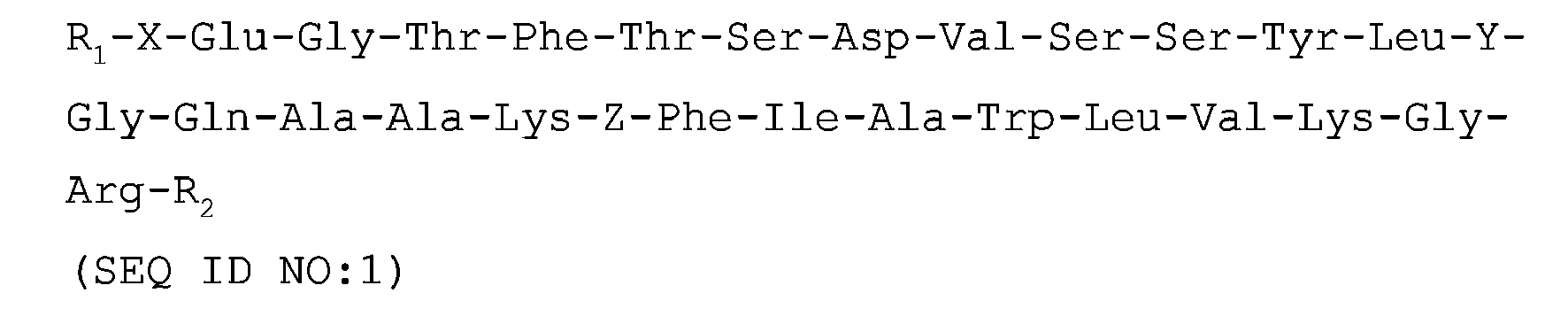
- Yet another preferred group of compounds consistent with the present invention is disclosed in WO 91/11457 (U.S. Patent No. 5,545,618, herein incorporated by reference) and consists essentially of GLP-1(7-34), GLP-1(7-35), GLP-1(7-36), or GLP-1(7-37), or the amide forms thereof, and pharmaceutically-acceptable salts thereof, having at least one modification selected from the group consisting of:
- (a) substitution of glycine, serine, cysteine, threonine, asparagine, glutamine, tyrosine, alanine, valine, isoleucine, leucine, methionine, phenylalanine, arginine, or D-lysine for lysine at position 26 and/or position 34; or substitution of glycine, serine, cysteine, threonine, asparagine, glutamine, tyrosine, alanine, valine, isoleucine, leucine, methionine, phenylalanine, lysine, or a D-arginine for arginine at position 36;
- (b) substitution of an oxidation-resistant amino acid for tryptophan at position 31;
- (c) substitution of at least one of: tyrosine for valine at position 16; lysine for serine at position 18; aspartic acid for glutamic acid at position 21; serine for glycine at position 22; arginine for glutamine at position 23; arginine for alanine at position 24; and glutamine for lysine at position 26; and
- (d) substitution of at least one of: glycine, serine, or cysteine for alanine at position 8; aspartic acid, glycine, serine, cysteine, threonine, asparagine, glutamine, tyrosine, alanine, valine, isoleucine, leucine, methionine, or phenylalanine for glutamic acid at position 9; serine, cysteine, threonine, asparagine, glutamine, tyrosine, alanine, valine, isoleucine, leucine, methionine, or phenylalanine for glycine at position 10; and glutamic acid for aspartic acid at position 15; and
- (e) substitution of glycine, serine, cysteine, threonine, asparagine, glutamine, tyrosine, alanine, valine, isoleucine, leucine, methionine, or phenylalanine, or the D- or N-acylated or alkylated form of histidine for histidine at position 7; wherein, in the substitutions is (a), (b), (d), and (e), the substituted amino acids can optionally be in the D-form and the amino acids substituted at position 7 can optionally be in the N-acylated or N-alkylated form.
- Because the enzyme, dipeptidyl-peptidase IV (DPP IV), may be responsible for the observed rapid in vivo inactivation of administered GLP-1, [see, e.g., Mentlein, R., et al., Eur. J. Biochem., 214:829-835 (1993)], administration of GLP-1 analogs and derivatives that are protected from the activity of DPP IV is preferred, and the administration of Gly8-GLP-1(7-36)NH2, Val8-GLP-1(7-37)OH, a-methyl-Ala8-GLP-1(7-36)NH2, and Gly8-Gln21-GLP-1(7-37)OH, or pharmaceutically-acceptable salts thereof, is more preferred.
- The use in the present invention of a molecule claimed in U.S. Patent No. 5,188,666, herein incorporated by reference, is preferred. Such molecule is selected from the group consisting of a peptide having the amino acid sequence:wherein X is selected from the group consisting of Lys and Lys-Gly; and a derivative of said peptide, wherein said peptide is selected from the group consisting of: a pharmaceutically-acceptable acid addition salt of said peptide; a pharmaceutically-acceptable carboxylate salt of said peptide; a pharmaceutically-acceptable lower alkylester of said peptide; and a pharmaceutically-acceptable amide of said peptide selected from the group consisting of amide, lower alkyl amide, and lower dialkyl amide.
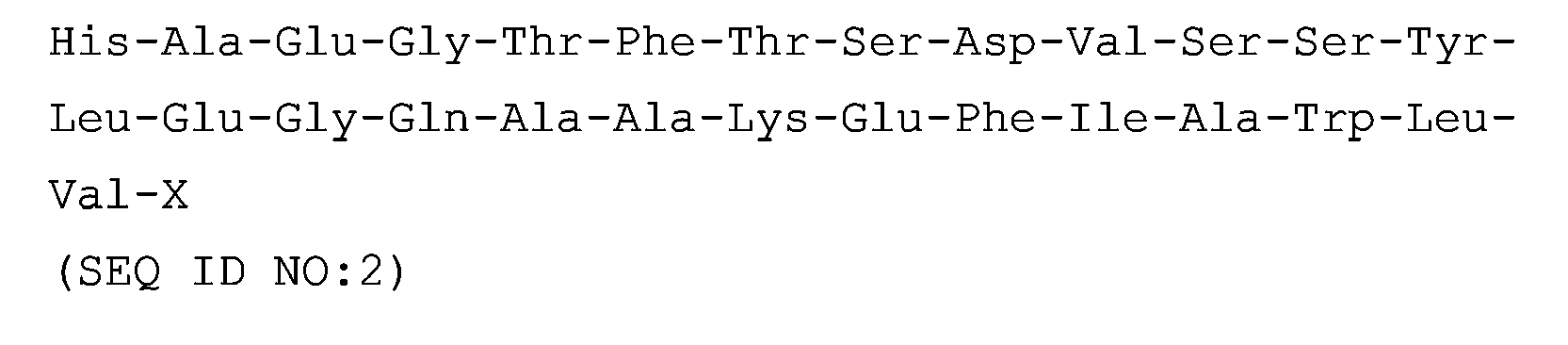
- Another preferred group of molecules for use in the present invention consists of compounds disclosed in U.S. Patent No. 5,512,549, herein incorporated by reference, having the general formula:and pharmaceutically-acceptable salts thereof, wherein R is selected from the group consisting of 4-imidazopropionyl, 4-imidazoacetyl, or 4-imidazo-a, a dimethyl-acetyl; R2 is selected from the group consisting of C6-C10 unbranched acyl, or is absent; R3 is selected from the group consisting of Gly-OH or NH2; and, Xaa is Lys or Arg, may be used in present invention.

- More preferred compounds of SEQ ID NO:3 for use in the present invention are those in which Xaa is Arg and R2 is C6-C10 unbranched acyl.
- Highly preferred compounds of SEQ ID NO:3 for use in the present invention are those in which Xaa is Arg, R2 is C6-C10 unbranched acyl, and R3 is Gly-OH.
- More highly preferred compounds of SEQ ID NO:3 for use in the present invention are those in which Xaa is Arg, R2 is C6-C10 unbranched acyl, R3 is Gly-OH, and R1 is 4-imidazopropionyl.
- The most preferred compound of SEQ ID NO:3 for use in the present invention is that in which Xaa is Arg, R2 is C8 unbranched acyl, R3 is Gly-OH, and R1 is 4-imidazopropionyl.
- The use of Val8-GLP-1(7-37)OH or a pharmaceutically-acceptable salt thereof, as claimed in US Patent Number 5,705,483, herein incorporated by reference, in the present invention is highly preferred.
- Methods for preparing the GLP-1, GLP-1 analogs, or GLP-1 derivatives useful in the present invention are well-known in the art and are easily within the grasp of ordinarily skilled protein chemists or biochemists. The amino acid portion of the active compound used in the present invention, or a precursor thereto, can be made either by solid-phase synthetic chemistry, purification of GLP-1 molecules from natural sources, or recombinant DNA technology. Routine synthetic organic techniques enable the alkylation and acylation of the GLP-1 derivatives.
- The term "GLP-1 related compound" refers to any compound falling within the GLP-1, GLP-1 analog, or GLP-1 derivative definition.
- The term "preservative" refers to a compound added to a pharmaceutical formulation to act as an anti-microbial agent. A parenteral formulation must meet guidelines for preservative effectiveness to be a commercially viable multi-use product. Among preservatives known in the art as being effective and acceptable in parenteral formulations are benzalkonium chloride, benzethonium, chlorohexidine, phenol, m-cresol, benzyl alcohol, methylparaben, chlorobutanol, o-cresol, p-cresol, chlorocresol, phenylmercuric nitrate, thimerosal, benzoic acid, and various mixtures thereof. See, e.g., Wallhauser, K., Develop. Biol. Standard, 24: 9-28 (Basel, S. Krager, 1974).
- The term "buffer" or "pharmaceutically acceptable buffer" refers to a compound that is known to be safe for use in protein formulations and that has the effect of controlling the pH of the formulation at the pH desired for the formulation. Pharmaceutically acceptable buffers for controlling pH at a moderately acid pH to a moderately basic pH include, for example, such compounds as phosphate, acetate, citrate, TRIS, arginine, or histidine.
- The term "isotonicity agent" refers to a compound that is tolerated physiologically and imparts a suitable tonicity to a formulation to prevent the net flow of water across the cell membrane. Compounds, such as glycerin, are commonly used for such purposes at known concentrations. Other acceptable isotonicity agents include salts and sugars, e.g., NaCl, dextrose, mannitol, and lactose. Glycerol at a concentration of 12 to 25 mg/mL is preferred as an isotonicity agent.
- GLP-1 related compounds described above are administered by inhalation in a dose effective manner to introduce circulating therapeutic levels which results in reducing abnormally high blood glucose levels. Therapeutic serum levels of GLP-1 are in the range of 0.1 to about 10.0 ng/ml, preferably about 0.3 to about 5.0 ng/ml and most preferably about 0.5 to about 3.0 ng/ml. Such administration can be effective for treating disorders such as diabetes, hyperglycemia, or insulin resistance. Achieving therapeutically effective doses of GLP-1 related compounds requires administering an inhalation dose of about 0.5 µg/kg to about 100 µg/kg of the GLP-1 molecule, preferably about 1.0 µg/kg to about 50 µg/kg, more preferably about 2.0 µg/kg to about 25 µg/kg, and most preferably about 2.5 µg/kg to about 15 µg/kg. A therapeutically effective amount can be determined by a knowledgeable practitioner, who will take into account factors including native GLP-1 blood levels, blood glucose levels, the physical condition of the patient, the patient's pulmonary status, and the like.
- According to the invention, GLP-1 and GLP-1 analogs and derivatives are delivered by inhalation to achieve rapid absorption in the lungs. Administration by inhalation can result in pharmacokinetics comparable to subcutaneous administration of these substances. Inhalation of GLP-1 and GLP-1 analogs and derivatives leads to a rise in the level of circulating insulin followed by a rapid fall in blood glucose levels. Different inhalation devices typically provide similar pharmacokinetics when similar particle sizes and similar levels of lung deposition are compared.
- According to the invention, GLP-1 and GLP-1 analogs and derivatives can be delivered by any of a variety of inhalation devices known in the art for administration of a therapeutic agent by inhalation. These devices include metered dose inhalers, nebulizers, dry powder inhalers, sprayers, and the like. Preferably, GLP-1 and GLP-1 analogs and derivatives are delivered by a dry powder inhaler or a sprayer. There are a several desirable features of an inhalation device for administering GLP-1 and GLP-1 analogs and derivatives. For example, delivery by the inhalation device is advantageously reliable, reproducible, and accurate. The inhalation device should deliver small particles, e.g. less than about 10 µm mass median aerodynamic diameter (MMAD), preferably about 1-5 µm MMAD, for good respirability. Some specific examples of commercially available inhalation devices, or those in late stage development, suitable for the practice of this invention are Turbohaler™ (Astra), Rotahaler® (Glaxo), Diskus® (Glaxo), Spiros™ inhaler (Dura), devices being developed by Inhale Therapeutics, AERx™ (Aradigm), the Ultravent® nebulizer (Mallinckrodt), the Acorn II® nebulizer (Marquest Medical Products), the Ventolin® metered dose inhaler (Glaxo), the Spinhaler® powder inhaler (Fisons), or the like.
- As those skilled in the art will recognize, the formulation of GLP-1 and GLP-1 analogs and derivatives, the quantity of the formulation delivered, and the duration of administration of a single dose depend on the type of inhalation device employed. For some aerosol delivery systems, such as nebulizers, the frequency of administration and length of time for which the system is activated will depend mainly on the concentration of the GLP-1 molecule in the aerosol. For example, shorter periods of administration can be used at higher concentrations of GLP-1 and GLP-1 analogs and derivatives in the nebulizer solution. Devices such as metered dose inhalers can produce higher aerosol concentrations, and can be operated for shorter periods to deliver the desired amount of GLP-1 and GLP-1 analogs and derivatives. Devices such as powder inhalers deliver active agent until a given charge of agent is expelled from the device. In this type of inhaler, the amount of GLP-1 and GLP-1 analogs and derivatives in a given quantity of the powder determines the dose delivered in a single administration.
- The particle size of the GLP-1 and GLP-1 analogs and derivatives in the formulation delivered by the inhalation device is critical with respect to the ability of protein to deposit in the lungs, and preferably in the lower airways or alveoli. Preferably, the GLP-1 and GLP-1 analogs and derivatives is formulated so that at least about 10% of the peptide delivered is deposited in the lung, preferably about 10% to about 20%, or more. It is known that the maximum efficiency of pulmonary deposition for mouth breathing humans is obtained with particle sizes of about 2 µm to about 3 µm MMAD. When particle sizes are above about 5 µm MMAD, pulmonary deposition decreases substantially. Particle sizes below about 1 µm MMAD cause pulmonary deposition to decrease, and it becomes difficult to deliver particles with sufficient mass to be therapeutically effective. Thus, particles of GLP-1 and GLP-1 analogs and derivatives delivered by inhalation have a particle size preferably less than about 10 µm MMAD, more preferably in the range of about 1 µm to about 5 µm MMAD, and most preferably in the range of about 2 µm to about 3 µm MMAD. The formulation of GLP-1 and GLP-1 analogs and derivatives is selected to yield the desired particle size in the chosen inhalation device.
- Advantageously for administration as a dry powder, GLP-1 and GLP-1 analogs and derivatives are prepared in a particulate form resulting in an emitted particle size less than about 10 µm MMAD, preferably about 1 to about 5 µm MMAD, and most preferably about 2 µm to about 3 µm MMAD. The preferred particle size is effective for delivery to the alveoli of the patient's lung. Preferably, the dry powder is largely composed of particles produced so that a majority of the particles have a size in the desired range. Advantageously, at least about 50% of the dry powder is made of particles having a diameter less than about 10 µm MMAD. Such formulations can be achieved by spray drying, milling, or critical point condensation of a solution containing the particular GLP-1 molecule and other desired ingredients. Other methods also suitable for generating particles useful in the current invention are known in the art.
- The particles are usually separated from a dry powder formulation in a container and then transported into the lung of a patient via a carrier air stream. Typically, in current dry powder inhalers, the force for breaking up the solid is provided solely by the patient's inhalation. One suitable dry powder inhaler is the Turbohaler™ manufactured by Astra (Södertalje, Sweden). In another type of inhaler, air flow generated by the patient's inhalation activates an impeller motor which deagglomerates the GLP-1 molecule particles. The Dura Spiros™ inhaler is such a device.
- Formulations of GLP-1 and GLP-1 analogs and derivatives for administration from a dry powder inhaler typically include a finely divided dry powder containing peptide, but the powder can also include a bulking agent, carrier, excipient, another additive, or the like. Additives can be included in a dry powder formulation of GLP-1 and GLP-1 analogs and derivatives, for example, to dilute the powder as required for delivery from the particular powder inhaler, to facilitate processing of the formulation, to provide advantageous powder properties to the formulation, to facilitate dispersion of the powder from the inhalation device, to stabilize the formulation (e.g., antioxidants or buffers), to provide taste to the formulation, or the like. Advantageously, the additive does not adversely affect the patient's airways. The GLP-1 and GLP-1 analogs and derivatives can be mixed with an additive at a molecular level or the solid formulation can include particles of the peptide mixed with or coated on particles of the additive. Typical additives include mono-, di-, and polysaccharides; sugar alcohols and other polyols, such as, for example, lactose, glucose, raffinose, melezitose, lactitol, maltitol, trehalose, sucrose, mannitol, starch, or combinations thereof; surfactants, such as sorbitols, diphosphatidyl choline, or lecithin; or the like. Typically an additive, such as a bulking agent, is present in an amount effective for a purpose described above, often at about 50% to about 90% by weight of the formulation. Additional agents known in the art for formulating proteins can also be included in the formulation.
- In another aspect of the invention a spray including GLP-1 and GLP-1 analogs and derivatives can be produced by forcing a suspension or solution of the peptide through a nozzle under pressure. The nozzle size and configuration, the applied pressure, and the liquid feed rate can be chosen to achieve the desired output and particle size. An electro-spray can be produced, for example, by an electric field in connection with a capillary or nozzle feed. Advantageously, proplets of GLP-1 and GLP-1 analogs and derivatives delivered by a sprayer have an inhaled droplet size less than about 10 µm MMAD, preferably in the range of about 1 µm to about 5 µm MMAD, and most preferably about 2 µm to about 3 µm MMAD.
- Formulations of GLP-1 and GLP-1 analogs and derivatives suitable for use with a sprayer typically are about 1 mg to about 20 mg of the peptide per ml of solution. The formulation can include agents such as an excipient, a buffer, an isotonicity agent, a preservative, a surfactant, and metal cations. The formulation can also include an excipient or agent to stabilize the peptide such as a buffer, a reducing agent, a bulk protein, or a carbohydrate. Bulk proteins useful in formulating GLP-1 and GLP-1 analogs and derivatives include albumin, protamine, or the like. Typical carbohydrates useful in formulating GLP-1 and GLP-1 analogs and derivatives include sucrose, mannitol, lactose, trehalose, glucose, or the like. Formulations of GLP-1 and GLP-1 analogs and derivatives can also include a surfactant, which can reduce or prevent surface-induced aggregation of the peptide caused by atomization of the solution in forming an aerosol. Various conventional surfactants can be employed, such as polyoxyethylene fatty acid esters and alcohols, and polyoxyethylene sorbitol fatty acid esters. Amounts will generally range between 0.001 and 4% by weight of the formulation. Other surfactants such as diphosphatidyl choline or lecithin can also be used. Especially preferred surfactants for purposes of this invention are polyoxyethylene sorbitan monooleate, polysorbate 80, polysorbate 20, or the like. Additional agents known in the art for formulating proteins can also be included in the formulation.
- GLP-1 and GLP-1 analogs and derivatives can be administered by a nebulizer, such as jet nebulizer or an ultrasonic nebulizer. Typically, in a jet nebulizer, a compressed air source is used to create a high-velocity air jet through an orifice. As the gas expands beyond the nozzle, a low-pressure region is created, which draws a solution of the peptide through a capillary tube connected to a liquid reservoir. The liquid stream from the capillary tube is sheared into unstable filaments and droplets as it exits the tube, creating the aerosol. A range of configurations, flow rates, and baffle types can be employed to achieve the desired performance characteristics from a given jet nebulizer. In an ultrasonic nebulizer, highfrequency electrical energy is used to create vibrational, mechanical energy, typically employing a piezoelectric transducer. This energy is transmitted to the peptide formulation either directly or through a coupling fluid, creating an aerosol. Advantageously, droplets of GLP-1 and GLP-1 analogs and derivatives delivered by a nebulizer have a particle size less than about 10 µm MMAD, preferably in the range of about 1 µm to about 5 µm MMAD, and most preferably about 2 µm to about 3 µm MMAD.
- Formulations of GLP-1 and GLP-1 analogs and derivatives suitable for use with a nebulizer, either jet or ultrasonic, typically include an aqueous solution of the peptide at a concentration of about 1 mg to about 20 mg per ml of solution. The formulation can include agents such as an excipient, a buffer, an isotonicity agent, a preservative, a surfactant, and a divalent metal cation. The formulation can also include an excipient or agent to stabilize the peptide, such as a buffer, a reducing agent, a bulk protein, or a carbohydrate. Bulk proteins useful in formulating GLP-1 and GLP-1 analogs and derivatives include albumin, protamine, or the like. Typical carbohydrates useful in formulating GLP-1 related proteins include sucrose, mannitol, lactose, trehalose, glucose, or the like. Formulations of the GLP-1 and GLP-1 analogs and derivatives can also include a surfactant, which can reduce or prevent surface-induced aggregation of the peptide caused by atomization of the solution in forming an aerosol. Various conventional surfactants can be employed, such as polyoxyethylene fatty acid esters and alcohols, and polyoxyethylene sorbital fatty acid esters. Amounts will generally range between 0.001 and 4% by weight of the formulation. Other surfactants such as phosphatidyl choline or lethicin can also be used. Especially preferred surfactants for purposes of this invention are polyoxyethylene sorbitan monooleate, polysorbate 80, polysorbate 20, or the like. Additional agents known in the art for formulation of a protein such as GLP-1 related molecules can also be included in the formulation.
- Another aspect of the invention involves a metered dose inhaler (MDI). In this embodiment, a propellant, GLP-1 and GLP-1 analogs and derivatives, and any excipients or other additives are contained in a canister as a mixture including a liquefied compressed gas. Actuation of the metering valve releases the mixture as an aerosol, preferably containing inhaled particles in the size range of less than about 10 µm MMAD, preferably about 1 µm to about 5 µm MMAD, and most preferably about 2 µm to about 3 µm MMAD. The desired aerosol particle size can be obtained by employing a formulation of GLP-1 and GLP-1 analogs and derivatives produced by various methods known to those of skill in the art, including jet-milling, spray drying, critical point condensation, or the like. Preferred metered dose inhalers include those manufactured by 3M or Glaxo and employing a hydrofluorocarbon propellant.
- Formulations of GLP-1 and GLP-1 analogs and derivatives for use with a metered-dose inhaler device will generally include a finely divided powder containing peptide as a suspension in a non aqueous medium, for example, suspended in a propellant with the aid of a surfactant. The propellant may be any conventional material employed for this purpose, such as chlorofluorocarbon, a hydrochlorofluorocarbon, a hydrofluorocarbon, or a hydrocarbon, including trichlorofluoromethane, dichlorodifluoromethane, dichlorotetrafluoroethanol and 1,1,1,2-tetrafluoroethane, HFA-134a (hydrofluroalkane-134a), HFA-227 (hydrofluroalkane-227), or the like. Preferably the propellant is a hydrofluorocarbon. The surfactant can be chosen to stabilize the GLP-1 molecule as a suspension in the propellant, to protect the active agent against chemical degradation, and the like. Suitable surfactants include sorbitan trioleate, soya lecithin, oleic acid, or the like. In some cases solution aerosols are preferred using solvents such as ethanol. Other surfactants such as diphosphatidyl choline or lethicin can also be used. Additional agents known in the art for formulating proteins can also be included in the formulation.
- The present invention also relates to a pharmaceutical composition or formulation including GLP-1 and GLP-1 analogs and derivatives and suitable for administration by inhalation. According to the invention, GLP-1 and GLP-1 analogs and derivatives can be used for manufacturing a formulation or medicament suitable for administration by inhalation. The invention also relates to methods for manufacturing formulations including GLP-1 related molecules in a form that is suitable for administration by inhalation. For example, a dry powder formulation can be manufactured in several ways, using conventional techniques. Particles in the size range appropriate for maximal deposition in the lower respiratory tract can be made by micronizing, milling, spray drying, or the like. And a liquid formulation can be manufactured by dissolving the peptide in a suitable solvent, such as water, at an appropriate pH, including buffers or other excipients. The present invention may be better understood with reference to the following examples. These examples are intended to be representative of specific embodiments of the invention, and are not intended as limiting the scope of the invention.
- The GLP-1 analog, Val8-GLP-1(7-37)OH (SEQ ID NO:4) was prepared in E coli using conventional recombinant DNA techniques and purified to homogeneity.

- One group of 6 female beagle dogs was exposed to inhaled Val8-GLP-1 for 15 minutes at an average aerosol concentration of 77.2 µg/L generated from a solution of Val8-GLP-1 in sterile water. These animals were dosed with 100 µg/kg via subcutaneous administration approximately 1-week after inhalation exposures. Tidal volume, breathing rate, and minute volume were monitored prior to and throughout the exposure period. Blood was collected for analysis of plasma levels of Val8-GLP-1 at various time points following inhalation and subcutaneous administration. Bronchoalveolar lavage (BAL) fluid was collected approximately 4 hours postexposure and analyzed for LDH, total protein, cell counts, and white cell differentials.
- The delivery of Val8-GLP-1 was well tolerated with an inhaled dose of 1198 µg/kg and an estimated deposited lung dose of 240 µg/kg. Subcutaneous administration of 100 µg/kg was also well tolerated by all animals. Inhalation and subcutaneous administration of Val8-GLP-1 was delivered using formulated and formulated material.
- There were no treatment-related clinical observations; body weights were not adversely affected by Val8-GLP-1. Only minor lung effects were observed. Increases in both tidal volume and minute volume were observed during the 15 minute inhalation exposures but the data were highly variable. No significant changes were observed for LDH, red blood cell counts, white blood cell counts, neutrophils, lymphocytes, eosinophils, epithelial cells, macrophages, basophils, or monocytes. There was a mild increase in total protein following aerosol delivery of Val8-GLP-1.
- Results from this study demonstrated that there was good bioavailability of Val8-GLP-1 (40%, based on AUC) delivered to the lungs of beagle dogs by inhalation relative to subcutaneous administration. Val8-GLP-1 was well tolerated for up to 15 minutes with minimal effects on the lungs at an average inhaled dose of 1198 µg/kg, which was a no-observed-adverse-effects level (NOAEL) in this study.
- Solutions of Val8-GLP-1 were prepared on the days of dosing at concentrations of 0.5 mg/ml or 8 mg/ml in sterile water for subcutaneous administration and pulmonary administration, respectively. An additional solution of Val8-GLP-1 (8 mg/ml) was prepared at the end of live phase in order to determine the particle size distribution of aerosolized Val8-GLP-1. The solutions were filtered through a low protein binding 0.22 micron canister filter. The pH of the solution was adjusted with sodium hydroxide solution to 7.47.
- Six females Beagle dogs (Marshall Farms, North Rose, NY) were used in this study. Each animal was uniquely identified by a five-digit animal number and a seven-digit tattoo (located on inner ear) number recorded on their cage card. All of the animals were acclimated to the restraint slings prior to beginning the study. The weight range of the animals at the start of the study was 8.4 to 11.1 kg. The age of the animals at the start of the study was 33 to 37 weeks.
- Animals were pair housed in stainless steel cages except on the days of exposure. Each animal was individually housed on the day of exposure in order to monitor their feeding regimen. Rooms were thermostatically set to maintain a temperature of 70°F and maintain the actual temperature within ±8°F from that set point. The environmental control system is designed to maintain a relative humidity of 20% and a maximum of 80%. Light was on a 12-hour cycle, with lights on between 0600 and 1800 hours. Subsequently, lights were off between 1800 and 0600 hours except when blood samples were collected. Animals were fed once daily with Hill's Science Diet. Animals were fasted for approximately 12-hours prior to exposure. Tap water was provided ad libitum except during exposures.
- All 6 dogs were exposed for 15 minutes to aerosolized Val8-GLP-1. The targeted deposited lung dose for Val8-GLP-1 exposures was 200 µg/kg of body weight. Approximately 7 days after pulmonary administration of Val8-GLP-1, all dogs were dosed with 100 µg/kg Val8-GLP-1 of body weight via subcutaneous administration.
- The dogs were tested while standing in restraint slings. Two layers of 0.03 inch latex sheets were placed around the animals' necks to form a nonrestrictive airtight seal. A custom built, 11-L head-dome, similar to that described by Allen et al. (J Appl Toxicol 1995; 15:13-17) was placed over the dogs' heads and secured to the sling. Airflow was exhaust driven via a transvector located on the exhaust side of the dome. Because the helmet was airtight and the neck was sealed, this constituted a head-only exposure system. The total flow rate through the dome was approximately 7.5 L/min.
- The aerosols were generated using a Respirgard II nebulizer with an input of approximately 6.5 L/min. The output from the generator flowed directly into the head-dome.
- All sampling for total gravimetric concentrations was performed with in-line filter holders containing type A/E glass fiber filters (Gelman Instruments Co., Ann Arbor, MI). Filters sampling from the chamber was carried out at a nominal sampling rate of 1 L/min, calibrated with a portable mass airflow calibrator (Model 830, Sierra Instruments, Carmel Valley, CA). Sampling duration was 15 minutes. Particle size analysis was performed with a Sierra Model 218K Ambient Cascade Impactor (Anderson Samplers, Inc, Atlanta, GA). Cascade sampling from the chamber was carried out at a nominal sampling rate of 3 L/min, calibrated with a portable mass airflow calibrator (Model 830, Sierra Instruments, Carmel Valley, CA). Sampling duration was 31 minutes. Filters were allowed to dry for approximately 30-minutes before being re-weighed.
- The dose of Val8-GLP-1 inhaled during a 15-minute exposure was estimated as follows: the mean minute volume (mL) during the 15 minute exposure was multiplied by the exposure duration to yield the total air breathed (L) during the inhalation exposure. This value was multiplied by the aerosol concentration (µg/L) to determine total dose (mg). The inhaled dose (µg/kg) was calculated by dividing the total dose (µg) by the animal's body weight (kg).
- The dose of Val8-GLP-1 deposited in the lungs was estimated as follows: inhaled dose (µg/kg) was multiplied by 20 percent to yield estimated deposited lung dose (µg/kg). Aerosols with a MMEAD ranging from 1-2 µm MMAD have been shown to deposit in the lung with approximately a 20 percent efficiency (Schlesinger RB. 1985. Comparative deposition of inhaled aerosols in experimental animals and humans: a review. J Toxicol Environ Health 15:197-214).
- All animals were weighed on Days -5, 0, and 7. Breathing patterns (tidal volume, breathing frequency, and minute volume) were monitored using a size '0' pneumotachograph connected to a port on the head-dome. The signals were collected on a personal computer using the Buxco XA Data Acquisition System (Buxco Electronics, Inc, Sharon, CT). At least 15 minutes of preexposure data were collected before the exposures began, followed by data collection throughout the 15-minute exposure periods. All data were analyzed as 5-minute averages.
- Bronchoalveolar lavage (BAL) was performed approximately 4 hours after each dosing regimen. The animals were anesthetized with an intravenous injection of 2% Brevital prior to the BAL procedure. Bronchoalveolar lavage was performed using a pediatric fiberoptic bronchoscope (Olympus, model BF, Type 3C10, Lake Success, NY). The bronchoscope tip was wedged in a 5th to 7th generation airway of a lower lobe. The BALs were alternated between the right and left lung lobes. Two 10-mL aliquots were instilled and gently suctioned out. Aliquots of the recovered lavage fluid were used to determine total white cell counts, total red cell counts, white cell differentials, total protein, and lactate dehydrogenase.
- A complete blood count was done on the unconcentrated BAL fluid using a Technicon H1 System (Technicon Instruments Corporation). Cell differentials for the BAL were done by microscopic evaluation of 200 Wright stained cells.
- For analysis of plasma pharmacokinetics of Val8-GLP-1, approximately 2 to 3 mL of blood were collected in EDTA vacutainer tubes from the cephalic or jugular vein prior to exposure and at 0.25, 0.5, 1, 2, 3, 4, 6, 8, and 12 hours postexposure. To obtain the plasma, each tube was centrifuged at approximately 3000 rpm for 10 minutes at 10°C. The plasma samples were stored at -70 °C until sent for assay.
- The average exposure concentration for each dog exposed to Val8-GLP-1 ranged from 64.0 to 101.3 µg/L. The mean (± SD) concentration for all animals was 77.2 ± 16.9 µg/L. Particle size was measured as a mass median equivalent aerodynamic diameter (MMEAD) of 0.91 µm with a geometric standard deviation (GSD) of 2.37.
- The average dose of Val8-GLP-1 deposited in lungs of 6 dogs treated with Val8-GLP-1 was calculated as 240 ± 42 µg/kg (mean ± SD). The mean inhaled dose (that which entered the respiratory tract neglecting deposition) was 1198 ± 208 µg/kg (mean ± SD). Individual animal data are shown in the table below.
Estimated Lung Dose for Animals Exposed to Aerosols of Val8-GLP-1 Animal Number Aerosol Conc. (µg/L) Average Minute Volume (ml) Inhaled Lung Dose (µg/kg) Deposited Lung Dose (µg/kg) 27682 0.07717* 8406 1060 212 27684 0.07717* 9563 1030 206 27685 0.10133 7260 1350 270 27686 0.06400 12733 1360 272 27687 0.06733 9214 950 190 27689 0.07600 11890 1400 288 *Aerosol concentration was not determined for animals 27682 and 27684, therefore the mean aerosol concentration was used to calculate an estimated inhaled lung dose (µg/kg). - No significant changes in body weight were observed during the treatment phase. The initial (Day -5) and final (Day 7) body weights were 9.5 ± 0.9 (mean ± SD; n=6) and 9.7 ± 0.9 kg, respectively. No marked changes in breathing frequency was observed. Slight increases in tidal volume and minute volume were measured but the data was highly variable potentially due to the short acclimation period prior to study initiation. Individual animal data are shown in the table below.
Changes in Pulmonary Function During Exposure to Val8-GLP-1 Animal Tidal Volume (mL) Breathing Frequency (bpm) Minute Volume (mL/min) Number 5* 10* 15* 5* 10* 15* 5* 10* 15* 27682 119.0 152.1 105.1 74 86.0 95.7 7265 9360 8592 27684 104.6 99.4 100.8 119.2 118.2 108.7 10300 9117 9272 27685 165.9 178.5 209.6 58.1 49.4 42.5 7938 7465 6377 27686 325.1 586.2 374.4 56.3 33.8 59.4 12200 13300 12700 27687 245.9 221.6 183.1 39.5 45.5 50.5 9288 9573 8781 27689 184.5 367.6 454.0 39.8 46.8 33.3 7271 13400 15000 Mean 190.8 267.6 237.8 64.6 63.3 65.0 9044 10369 10120 Stdev 82.8 180.7 145.3 29.8 32.2 30.3 1956 2426.1 3141 Mean (baseline) 239.0 216.8 207.6** 45.9 51.4 64.4** 8448 8744.8 8223** Stdev (baseline) 161.4 137.2 209.5 12 10.2 32.3 2614 2614 1566 *minutes during exposure (values represent average over 5 minutes) **mean calculated from a n=5 (instead of n=6) because no value was recorded for animal #27689 at 15 minutes preexposure Comparison of Pharmacokinetics Following Subcutaneous and Pulmonary Administration of Val8-GLP-1 Delivery Route Cmax (ng/mL) Tmax (h) AUC0-t'(1) (ng*h/mL) T1/2(α) (hours) Subcutaneous 10.53±1.06 0.71±0.14 36.37±2.18 1.26±0.11 Inhalation 8.66±0.90 1.54±0.59 35.21±5.91 1.19±0.11 *All values are reported as mean ± SEM (standard error of the mean). (1)AUC0-t'=area under the plasma concentration curve trom time 0 to t, where t=12 hours postdose - Plasma concentrations of immunoreactive Val8-GLP-1 (Table 3) were measured by a competitive radioimmunoassay (RIA). The absorption of Val8-GLP-1 via both delivery routes appeared to be rapid, reaching substantial plasma concentrations at 15 minutes postdose. The plasma time profiles were similar for the subcutaneous injections and inhalation. The average Tmax value for inhalation was greater than that for subcutaneous injection. Also, the elevated plasma Val8-GLP-1 concentration (close to Cmax) achieved by inhalation appeared to remain near that level for a longer period of time than following subcutaneous injection.
- Based on the average AUC values, the bioavailability of inhaled Val8-GLP-1 (averaged inhaled dose of 1198 µg/kg) relative to subcutaneous injection (100 µg/kg) was approximately 7.7%. On the basis of deposited lung dose, estimated as 240 µg/kg, the bioavailability relative to subcutaneous injection was 40%.


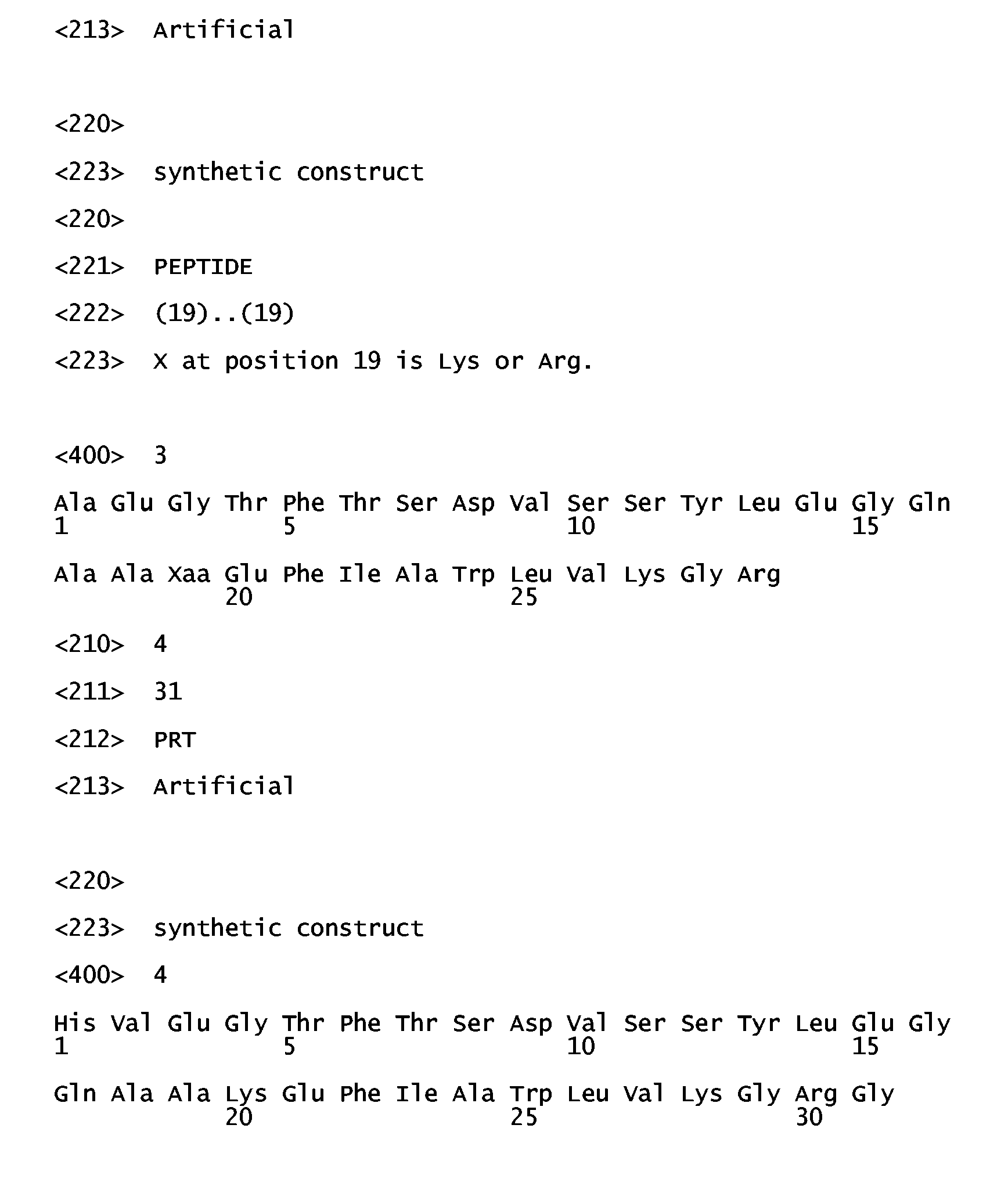
Claims (24)
- Use of a GLP-1 molecule selected from GLP-1, GLP-1 analogs, or GLP-1 derivatives for the manufacture of a medicament for pulmonary administration for the treatment of diabetes or impaired glucose tolerance.
- The use of claim 1, wherein the GLP-1 molecule is delivered to lower airways of the patient.
- The use of claim 2, wherein the GLP-1 molecule is deposited in the alveoli.
- The use of claim 1, wherein the GLP-1 molecule is inhaled through the mouth of the patient.
- The use of claim 1, wherein the GLP-1 molecule is administered as a pharmaceutical formulation comprising the GLP-1 molecule in a pharmaceutically acceptable carrier.
- The use of claim 5, wherein the formulation is a solution in an aqueous medium or a suspension in a nonaqueous medium.
- The use of claim 6, wherein the formulation is administered as an aerosol.
- The use of claim 5, wherein the formulation is in the form of a dry powder.
- The use of claim 5, wherein the GLP-1 molecule has a particle size of less than about 10 microns MMAD.
- The use of claim 9, wherein the GLP-1 molecule has a particle size of about 1 to about 5 microns MMAD.
- The use of claim 10, wherein the GLP-1 molecule has a particle size of about 2 to about 3 microns MMAD.
- The use of claim 1, wherein at least about 10% of the GLP-1 molecule delivered is deposited in the lung.
- The use of claim 1, wherein the GLP-1 molecule is delivered from an inhalation device suitable for pulmonary administration and capable of depositing the GLP-1 molecule in the lungs of the patient.
- The use of claim 13, wherein the device is a nebulizer, a metered-dose inhaler, a dry powder inhaler, or a sprayer.
- The use of claim 14, wherein the device is a dry powder inhaler.
- The use of claim 1 wherein the GLP-1 molecule is a GLP-1 analog or GLP-1 derivative.
- The use of claim 16 wherein the GLP-1 molecule is a GLP-1 analog.
- The use of claim 17 wherein the GLP-1 analog is Val8-GLP-1(7-37)OH, Gly8-GLP-1(7-37)OH, or Asp8-GLP-1(7-37)OH.
- The use of claim 18, wherein the GLP-1 analog is Val -GLP-1(7-37)OH.
- The use of claim 18, wherein the GLP-1 analog is Gly8-GLP-1(7-37)OH.
- The use of claim 13, wherein an actuation of the device administers about 40 µg to about 4,000 µg of a GLP-1 molecule.
- The use of claim 13, wherein an actuation of the device administers about 80 µg to about 2,000 µg of a GLP-1 molecule.
- The use of claim 13, wherein an actuation of the device administers about 160 µg to about 1,000 µg of a GLP-1 molecule.
- The use of claim 13, wherein an actuation of the device administers about 320 µg to about 500 µg of a GLP-1 molecule.
Applications Claiming Priority (3)
| Application Number | Priority Date | Filing Date | Title |
|---|---|---|---|
| US9827398P | 1998-08-28 | 1998-08-28 | |
| US10001298P | 1998-09-11 | 1998-09-11 | |
| EP99306733A EP0997151B1 (en) | 1998-08-28 | 1999-08-25 | Method for administering insulinotropic peptides |
Related Parent Applications (1)
| Application Number | Title | Priority Date | Filing Date |
|---|---|---|---|
| EP99306733A Division EP0997151B1 (en) | 1998-08-28 | 1999-08-25 | Method for administering insulinotropic peptides |
Publications (1)
| Publication Number | Publication Date |
|---|---|
| EP1666054A1 true EP1666054A1 (en) | 2006-06-07 |
Family
ID=36242226
Family Applications (1)
| Application Number | Title | Priority Date | Filing Date |
|---|---|---|---|
| EP06100208A Withdrawn EP1666054A1 (en) | 1998-08-28 | 1999-08-25 | Method for administering insulinotropic peptides |
Country Status (1)
| Country | Link |
|---|---|
| EP (1) | EP1666054A1 (en) |
Citations (13)
| Publication number | Priority date | Publication date | Assignee | Title |
|---|---|---|---|---|
| WO1991011457A1 (en) | 1990-01-24 | 1991-08-08 | Buckley Douglas I | Glp-1 analogs useful for diabetes treatment |
| US5118666A (en) | 1986-05-05 | 1992-06-02 | The General Hospital Corporation | Insulinotropic hormone |
| US5120712A (en) | 1986-05-05 | 1992-06-09 | The General Hospital Corporation | Insulinotropic hormone |
| US5188666A (en) | 1983-06-30 | 1993-02-23 | Boccardo Victor N | Paint removing compositions and methods for the manufacture and use thereof |
| WO1993018785A1 (en) * | 1992-03-19 | 1993-09-30 | Novo Nordisk A/S | Novel medicament |
| EP0619322A2 (en) * | 1993-04-07 | 1994-10-12 | Pfizer Inc. | Prolonged delivery of peptides |
| US5512549A (en) | 1994-10-18 | 1996-04-30 | Eli Lilly And Company | Glucagon-like insulinotropic peptide analogs, compositions, and methods of use |
| US5545618A (en) | 1990-01-24 | 1996-08-13 | Buckley; Douglas I. | GLP-1 analogs useful for diabetes treatment |
| US5607915A (en) | 1992-09-29 | 1997-03-04 | Inhale Therapeutic Systems | Pulmonary delivery of active fragments of parathyroid hormone |
| US5705483A (en) | 1993-12-09 | 1998-01-06 | Eli Lilly And Company | Glucagon-like insulinotropic peptides, compositions and methods |
| WO1998008871A1 (en) * | 1996-08-30 | 1998-03-05 | Novo Nordisk A/S | Glp-1 derivatives |
| WO1998019698A1 (en) * | 1996-11-05 | 1998-05-14 | Eli Lilly And Company | Use of glp-1 analogs and derivatives administered peripherally in regulation of obesity |
| WO1999003454A1 (en) * | 1997-07-18 | 1999-01-28 | Infimed, Inc. | Biodegradable macromers for the controlled release of biologically active substances |
-
1999
- 1999-08-25 EP EP06100208A patent/EP1666054A1/en not_active Withdrawn
Patent Citations (13)
| Publication number | Priority date | Publication date | Assignee | Title |
|---|---|---|---|---|
| US5188666A (en) | 1983-06-30 | 1993-02-23 | Boccardo Victor N | Paint removing compositions and methods for the manufacture and use thereof |
| US5118666A (en) | 1986-05-05 | 1992-06-02 | The General Hospital Corporation | Insulinotropic hormone |
| US5120712A (en) | 1986-05-05 | 1992-06-09 | The General Hospital Corporation | Insulinotropic hormone |
| WO1991011457A1 (en) | 1990-01-24 | 1991-08-08 | Buckley Douglas I | Glp-1 analogs useful for diabetes treatment |
| US5545618A (en) | 1990-01-24 | 1996-08-13 | Buckley; Douglas I. | GLP-1 analogs useful for diabetes treatment |
| WO1993018785A1 (en) * | 1992-03-19 | 1993-09-30 | Novo Nordisk A/S | Novel medicament |
| US5607915A (en) | 1992-09-29 | 1997-03-04 | Inhale Therapeutic Systems | Pulmonary delivery of active fragments of parathyroid hormone |
| EP0619322A2 (en) * | 1993-04-07 | 1994-10-12 | Pfizer Inc. | Prolonged delivery of peptides |
| US5705483A (en) | 1993-12-09 | 1998-01-06 | Eli Lilly And Company | Glucagon-like insulinotropic peptides, compositions and methods |
| US5512549A (en) | 1994-10-18 | 1996-04-30 | Eli Lilly And Company | Glucagon-like insulinotropic peptide analogs, compositions, and methods of use |
| WO1998008871A1 (en) * | 1996-08-30 | 1998-03-05 | Novo Nordisk A/S | Glp-1 derivatives |
| WO1998019698A1 (en) * | 1996-11-05 | 1998-05-14 | Eli Lilly And Company | Use of glp-1 analogs and derivatives administered peripherally in regulation of obesity |
| WO1999003454A1 (en) * | 1997-07-18 | 1999-01-28 | Infimed, Inc. | Biodegradable macromers for the controlled release of biologically active substances |
Non-Patent Citations (10)
| Title |
|---|
| ALLEN, J APPL TOXICOL, vol. 15, 1995, pages 13 - 17 |
| GUTNIAK, M., NEW ENGLAND J. OF MEDICINE, vol. 326, no. 20, 1992, pages 1316 - 1322 |
| MENTLEIN, R., EUR. J. BIOCHEM., vol. 214, 1993, pages 829 - 835 |
| MOJSOV, S., INT. J. PEPTIDE PROTEIN RESEARCH, vol. 40, 1992, pages 333 - 343 |
| NAUCK, M.A., DIABETOLOGIA, vol. 36, 1993, pages 741 - 744 |
| NAUCK, M.A., J. CLIN. INVEST., vol. 91, 1993, pages 301 - 307 |
| SCHLESINGER RB.: "Comparative deposition of inhaled aerosols in experimental animals and humans: a review", J TOXICOL ENVIRON HEALTH, vol. 15, 1985, pages 197 - 214 |
| SUZUKI, S.: "Clinical Practice", DIABETES RES., vol. 5, 1988, pages S30 |
| THORENS, B., DIABETES, vol. 42, 1993, pages 1219 - 1225 |
| WALLHAUSER, K.: "DEVELOP. BIOL. STANDARD", vol. 24, 1974, BASEL, S. KRAGER, pages: 9 - 28 |
Similar Documents
| Publication | Publication Date | Title |
|---|---|---|
| EP0997151B1 (en) | Method for administering insulinotropic peptides | |
| US6720407B1 (en) | Method for administering insulinotropic peptides | |
| AU754707B2 (en) | Method for administering monomeric insulin analogs | |
| US7144863B2 (en) | GLP-1 formulations with protracted time action | |
| EP0919242A2 (en) | Method for administering acylated insulin | |
| EP1173482A1 (en) | Insulin crystals for pulmonary administration | |
| EP1196445A1 (en) | Insulin crystals for pulmonary administration | |
| EP2036572A1 (en) | Process for drying a protein, a protein particle and a pharmaceutical composition comprising the protein particle | |
| EP1666054A1 (en) | Method for administering insulinotropic peptides | |
| HK1029041A (en) | Method for administering insulinotropic peptides | |
| MXPA01001905A (en) | Method for administering insulinotropic peptides | |
| US20040214747A1 (en) | Method for administering monomeric insulin | |
| ZA200101541B (en) | Method for administering insulinotropic peptides. | |
| HK1024860A (en) | Method for administering aspb28-human insulin | |
| HK1024861A (en) | Method for administering monomeric insulin analogs | |
| CZ20002417A3 (en) | Drug for administration by inhalation | |
| MXPA00006645A (en) | Method for administering aspb28-human insulin | |
| MXPA00006644A (en) | Method for administering monomeric insulin analogs |
Legal Events
| Date | Code | Title | Description |
|---|---|---|---|
| PUAI | Public reference made under article 153(3) epc to a published international application that has entered the european phase |
Free format text: ORIGINAL CODE: 0009012 |
|
| AC | Divisional application: reference to earlier application |
Ref document number: 0997151 Country of ref document: EP Kind code of ref document: P |
|
| AK | Designated contracting states |
Kind code of ref document: A1 Designated state(s): AT BE CH CY DE DK ES FI FR GB GR IE IT LI LU MC NL PT SE |
|
| AX | Request for extension of the european patent |
Extension state: AL LT LV RO SI |
|
| 17P | Request for examination filed |
Effective date: 20061207 |
|
| AKX | Designation fees paid |
Designated state(s): AT BE CH CY DE DK ES FI FR GB GR IE IT LI LU MC NL PT SE |
|
| AXX | Extension fees paid |
Extension state: SI Payment date: 20061207 Extension state: RO Payment date: 20061207 Extension state: LV Payment date: 20061207 Extension state: LT Payment date: 20061207 Extension state: AL Payment date: 20061207 |
|
| 17Q | First examination report despatched |
Effective date: 20070419 |
|
| STAA | Information on the status of an ep patent application or granted ep patent |
Free format text: STATUS: THE APPLICATION IS DEEMED TO BE WITHDRAWN |
|
| 18D | Application deemed to be withdrawn |
Effective date: 20070830 |