EP1506997A1 - Method of generating neural stem cells - Google Patents
Method of generating neural stem cells Download PDFInfo
- Publication number
- EP1506997A1 EP1506997A1 EP03017676A EP03017676A EP1506997A1 EP 1506997 A1 EP1506997 A1 EP 1506997A1 EP 03017676 A EP03017676 A EP 03017676A EP 03017676 A EP03017676 A EP 03017676A EP 1506997 A1 EP1506997 A1 EP 1506997A1
- Authority
- EP
- European Patent Office
- Prior art keywords
- cells
- stem cells
- neural stem
- mesodermal
- population
- Prior art date
- Legal status (The legal status is an assumption and is not a legal conclusion. Google has not performed a legal analysis and makes no representation as to the accuracy of the status listed.)
- Withdrawn
Links
- 210000001178 neural stem cell Anatomy 0.000 title claims abstract description 60
- 238000000034 method Methods 0.000 title claims abstract description 35
- 210000004027 cell Anatomy 0.000 claims abstract description 112
- 230000014509 gene expression Effects 0.000 claims description 32
- 210000002901 mesenchymal stem cell Anatomy 0.000 claims description 27
- 230000004069 differentiation Effects 0.000 claims description 23
- 102100037362 Fibronectin Human genes 0.000 claims description 22
- 102000003974 Fibroblast growth factor 2 Human genes 0.000 claims description 19
- 108090000379 Fibroblast growth factor 2 Proteins 0.000 claims description 19
- 239000003550 marker Substances 0.000 claims description 18
- 101001027128 Homo sapiens Fibronectin Proteins 0.000 claims description 12
- 210000004271 bone marrow stromal cell Anatomy 0.000 claims description 12
- 210000001519 tissue Anatomy 0.000 claims description 11
- 210000003061 neural cell Anatomy 0.000 claims description 9
- QVGXLLKOCUKJST-UHFFFAOYSA-N atomic oxygen Chemical compound [O] QVGXLLKOCUKJST-UHFFFAOYSA-N 0.000 claims description 8
- 238000004519 manufacturing process Methods 0.000 claims description 8
- 229910052760 oxygen Inorganic materials 0.000 claims description 8
- 239000001301 oxygen Substances 0.000 claims description 8
- 210000001185 bone marrow Anatomy 0.000 claims description 7
- 102100024210 CD166 antigen Human genes 0.000 claims description 6
- 102100031573 Hematopoietic progenitor cell antigen CD34 Human genes 0.000 claims description 6
- 101000980840 Homo sapiens CD166 antigen Proteins 0.000 claims description 6
- 101000777663 Homo sapiens Hematopoietic progenitor cell antigen CD34 Proteins 0.000 claims description 6
- 101000610551 Homo sapiens Prominin-1 Proteins 0.000 claims description 6
- 101000738771 Homo sapiens Receptor-type tyrosine-protein phosphatase C Proteins 0.000 claims description 6
- 102100040120 Prominin-1 Human genes 0.000 claims description 6
- 102100037422 Receptor-type tyrosine-protein phosphatase C Human genes 0.000 claims description 6
- 102100035248 Alpha-(1,3)-fucosyltransferase 4 Human genes 0.000 claims description 5
- 101001022185 Homo sapiens Alpha-(1,3)-fucosyltransferase 4 Proteins 0.000 claims description 5
- 208000012902 Nervous system disease Diseases 0.000 claims description 5
- 238000012258 culturing Methods 0.000 claims description 5
- 239000003814 drug Substances 0.000 claims description 5
- 210000004700 fetal blood Anatomy 0.000 claims description 5
- 102000003745 Hepatocyte Growth Factor Human genes 0.000 claims description 4
- 108090000100 Hepatocyte Growth Factor Proteins 0.000 claims description 4
- 210000004556 brain Anatomy 0.000 claims description 4
- 239000003085 diluting agent Substances 0.000 claims description 4
- 239000003937 drug carrier Substances 0.000 claims description 3
- 210000002798 bone marrow cell Anatomy 0.000 claims description 2
- 230000001537 neural effect Effects 0.000 abstract description 29
- 208000024827 Alzheimer disease Diseases 0.000 abstract description 3
- 208000018737 Parkinson disease Diseases 0.000 abstract description 3
- 208000015122 neurodegenerative disease Diseases 0.000 abstract description 3
- 210000002569 neuron Anatomy 0.000 description 25
- 239000002609 medium Substances 0.000 description 22
- VYFYYTLLBUKUHU-UHFFFAOYSA-N dopamine Chemical compound NCCC1=CC=C(O)C(O)=C1 VYFYYTLLBUKUHU-UHFFFAOYSA-N 0.000 description 18
- 230000006698 induction Effects 0.000 description 18
- 108010088225 Nestin Proteins 0.000 description 16
- 102000008730 Nestin Human genes 0.000 description 16
- 210000005055 nestin Anatomy 0.000 description 16
- 102000009024 Epidermal Growth Factor Human genes 0.000 description 15
- 230000002518 glial effect Effects 0.000 description 15
- 210000004498 neuroglial cell Anatomy 0.000 description 15
- 101710193519 Glial fibrillary acidic protein Proteins 0.000 description 14
- 102000002260 Alkaline Phosphatase Human genes 0.000 description 12
- 108020004774 Alkaline Phosphatase Proteins 0.000 description 12
- 210000005046 glial fibrillary acidic protein Anatomy 0.000 description 12
- 102100039289 Glial fibrillary acidic protein Human genes 0.000 description 11
- 238000004458 analytical method Methods 0.000 description 11
- 108010067306 Fibronectins Proteins 0.000 description 10
- 229960003638 dopamine Drugs 0.000 description 9
- 238000006243 chemical reaction Methods 0.000 description 8
- 238000000338 in vitro Methods 0.000 description 8
- 238000000692 Student's t-test Methods 0.000 description 7
- 238000002474 experimental method Methods 0.000 description 7
- 210000000963 osteoblast Anatomy 0.000 description 7
- 239000000047 product Substances 0.000 description 7
- 210000000130 stem cell Anatomy 0.000 description 7
- 238000012353 t test Methods 0.000 description 7
- 210000001130 astrocyte Anatomy 0.000 description 6
- 108090000623 proteins and genes Proteins 0.000 description 6
- FWBHETKCLVMNFS-UHFFFAOYSA-N 4',6-Diamino-2-phenylindol Chemical compound C1=CC(C(=N)N)=CC=C1C1=CC2=CC=C(C(N)=N)C=C2N1 FWBHETKCLVMNFS-UHFFFAOYSA-N 0.000 description 5
- 102000004219 Brain-derived neurotrophic factor Human genes 0.000 description 5
- 108090000715 Brain-derived neurotrophic factor Proteins 0.000 description 5
- 102100037241 Endoglin Human genes 0.000 description 5
- 101000800116 Homo sapiens Thy-1 membrane glycoprotein Proteins 0.000 description 5
- 101000713585 Homo sapiens Tubulin beta-4A chain Proteins 0.000 description 5
- 102100034391 Porphobilinogen deaminase Human genes 0.000 description 5
- 102100033523 Thy-1 membrane glycoprotein Human genes 0.000 description 5
- 102100036790 Tubulin beta-3 chain Human genes 0.000 description 5
- 208000036815 beta tubulin Diseases 0.000 description 5
- 229940077737 brain-derived neurotrophic factor Drugs 0.000 description 5
- 239000003102 growth factor Substances 0.000 description 5
- 108020004999 messenger RNA Proteins 0.000 description 5
- 230000002188 osteogenic effect Effects 0.000 description 5
- 238000007747 plating Methods 0.000 description 5
- 108091032973 (ribonucleotides)n+m Proteins 0.000 description 4
- 102100026882 Alpha-synuclein Human genes 0.000 description 4
- CIWBSHSKHKDKBQ-JLAZNSOCSA-N Ascorbic acid Chemical compound OC[C@H](O)[C@H]1OC(=O)C(O)=C1O CIWBSHSKHKDKBQ-JLAZNSOCSA-N 0.000 description 4
- 102000000131 Beta tubulin Human genes 0.000 description 4
- 102100037904 CD9 antigen Human genes 0.000 description 4
- 101000834898 Homo sapiens Alpha-synuclein Proteins 0.000 description 4
- 101000738354 Homo sapiens CD9 antigen Proteins 0.000 description 4
- TWRXJAOTZQYOKJ-UHFFFAOYSA-L Magnesium chloride Chemical compound [Mg+2].[Cl-].[Cl-] TWRXJAOTZQYOKJ-UHFFFAOYSA-L 0.000 description 4
- 238000011529 RT qPCR Methods 0.000 description 4
- 102100025368 Runt-related transcription factor 2 Human genes 0.000 description 4
- FAPWRFPIFSIZLT-UHFFFAOYSA-M Sodium chloride Chemical compound [Na+].[Cl-] FAPWRFPIFSIZLT-UHFFFAOYSA-M 0.000 description 4
- 108090000704 Tubulin Proteins 0.000 description 4
- SHGAZHPCJJPHSC-YCNIQYBTSA-N all-trans-retinoic acid Chemical compound OC(=O)\C=C(/C)\C=C\C=C(/C)\C=C\C1=C(C)CCCC1(C)C SHGAZHPCJJPHSC-YCNIQYBTSA-N 0.000 description 4
- 238000010790 dilution Methods 0.000 description 4
- 239000012895 dilution Substances 0.000 description 4
- 208000037265 diseases, disorders, signs and symptoms Diseases 0.000 description 4
- 239000001963 growth medium Substances 0.000 description 4
- 210000004940 nucleus Anatomy 0.000 description 4
- 210000004248 oligodendroglia Anatomy 0.000 description 4
- 238000011002 quantification Methods 0.000 description 4
- 229930002330 retinoic acid Natural products 0.000 description 4
- 238000003757 reverse transcription PCR Methods 0.000 description 4
- 239000000243 solution Substances 0.000 description 4
- 238000002054 transplantation Methods 0.000 description 4
- 108700039887 Essential Genes Proteins 0.000 description 3
- 101000881679 Homo sapiens Endoglin Proteins 0.000 description 3
- 230000015572 biosynthetic process Effects 0.000 description 3
- 238000004113 cell culture Methods 0.000 description 3
- 238000011509 clonal analysis Methods 0.000 description 3
- 230000001143 conditioned effect Effects 0.000 description 3
- 230000001419 dependent effect Effects 0.000 description 3
- 238000010586 diagram Methods 0.000 description 3
- 208000035475 disorder Diseases 0.000 description 3
- 230000001605 fetal effect Effects 0.000 description 3
- 102000006602 glyceraldehyde-3-phosphate dehydrogenase Human genes 0.000 description 3
- 108020004445 glyceraldehyde-3-phosphate dehydrogenase Proteins 0.000 description 3
- 238000002844 melting Methods 0.000 description 3
- 230000008018 melting Effects 0.000 description 3
- 230000000877 morphologic effect Effects 0.000 description 3
- 230000009818 osteogenic differentiation Effects 0.000 description 3
- 238000003753 real-time PCR Methods 0.000 description 3
- UCSJYZPVAKXKNQ-HZYVHMACSA-N streptomycin Chemical compound CN[C@H]1[C@H](O)[C@@H](O)[C@H](CO)O[C@H]1O[C@@H]1[C@](C=O)(O)[C@H](C)O[C@H]1O[C@@H]1[C@@H](NC(N)=N)[C@H](O)[C@@H](NC(N)=N)[C@H](O)[C@H]1O UCSJYZPVAKXKNQ-HZYVHMACSA-N 0.000 description 3
- 229960001727 tretinoin Drugs 0.000 description 3
- JKMHFZQWWAIEOD-UHFFFAOYSA-N 2-[4-(2-hydroxyethyl)piperazin-1-yl]ethanesulfonic acid Chemical compound OCC[NH+]1CCN(CCS([O-])(=O)=O)CC1 JKMHFZQWWAIEOD-UHFFFAOYSA-N 0.000 description 2
- 102100022900 Actin, cytoplasmic 1 Human genes 0.000 description 2
- 108010085238 Actins Proteins 0.000 description 2
- 102100037917 CD109 antigen Human genes 0.000 description 2
- UXVMQQNJUSDDNG-UHFFFAOYSA-L Calcium chloride Chemical compound [Cl-].[Cl-].[Ca+2] UXVMQQNJUSDDNG-UHFFFAOYSA-L 0.000 description 2
- 108091006146 Channels Proteins 0.000 description 2
- 108010024682 Core Binding Factor Alpha 1 Subunit Proteins 0.000 description 2
- 108010036395 Endoglin Proteins 0.000 description 2
- 238000012413 Fluorescence activated cell sorting analysis Methods 0.000 description 2
- 102000034615 Glial cell line-derived neurotrophic factor Human genes 0.000 description 2
- 108091010837 Glial cell line-derived neurotrophic factor Proteins 0.000 description 2
- DHCLVCXQIBBOPH-UHFFFAOYSA-N Glycerol 2-phosphate Chemical compound OCC(CO)OP(O)(O)=O DHCLVCXQIBBOPH-UHFFFAOYSA-N 0.000 description 2
- 101000738399 Homo sapiens CD109 antigen Proteins 0.000 description 2
- 101000692455 Homo sapiens Platelet-derived growth factor receptor beta Proteins 0.000 description 2
- 101000713575 Homo sapiens Tubulin beta-3 chain Proteins 0.000 description 2
- 108010056651 Hydroxymethylbilane synthase Proteins 0.000 description 2
- 108060003951 Immunoglobulin Proteins 0.000 description 2
- 102000004058 Leukemia inhibitory factor Human genes 0.000 description 2
- 108090000581 Leukemia inhibitory factor Proteins 0.000 description 2
- 108010025020 Nerve Growth Factor Proteins 0.000 description 2
- 102000015336 Nerve Growth Factor Human genes 0.000 description 2
- 229930182555 Penicillin Natural products 0.000 description 2
- JGSARLDLIJGVTE-MBNYWOFBSA-N Penicillin G Chemical compound N([C@H]1[C@H]2SC([C@@H](N2C1=O)C(O)=O)(C)C)C(=O)CC1=CC=CC=C1 JGSARLDLIJGVTE-MBNYWOFBSA-N 0.000 description 2
- 102100026547 Platelet-derived growth factor receptor beta Human genes 0.000 description 2
- 101710189720 Porphobilinogen deaminase Proteins 0.000 description 2
- 101710170827 Porphobilinogen deaminase, chloroplastic Proteins 0.000 description 2
- ZLMJMSJWJFRBEC-UHFFFAOYSA-N Potassium Chemical compound [K] ZLMJMSJWJFRBEC-UHFFFAOYSA-N 0.000 description 2
- 101710100896 Probable porphobilinogen deaminase Proteins 0.000 description 2
- 102000007568 Proto-Oncogene Proteins c-fos Human genes 0.000 description 2
- 108010071563 Proto-Oncogene Proteins c-fos Proteins 0.000 description 2
- 238000010240 RT-PCR analysis Methods 0.000 description 2
- 101710102802 Runt-related transcription factor 2 Proteins 0.000 description 2
- 230000004913 activation Effects 0.000 description 2
- 102000003802 alpha-Synuclein Human genes 0.000 description 2
- 108090000185 alpha-Synuclein Proteins 0.000 description 2
- 230000003321 amplification Effects 0.000 description 2
- 235000010323 ascorbic acid Nutrition 0.000 description 2
- 239000011668 ascorbic acid Substances 0.000 description 2
- 239000001110 calcium chloride Substances 0.000 description 2
- 229910001628 calcium chloride Inorganic materials 0.000 description 2
- 230000000768 catecholaminergic effect Effects 0.000 description 2
- 108091092328 cellular RNA Proteins 0.000 description 2
- 239000003795 chemical substances by application Substances 0.000 description 2
- 230000003021 clonogenic effect Effects 0.000 description 2
- 210000001671 embryonic stem cell Anatomy 0.000 description 2
- DEFVIWRASFVYLL-UHFFFAOYSA-N ethylene glycol bis(2-aminoethyl)tetraacetic acid Chemical compound OC(=O)CN(CC(O)=O)CCOCCOCCN(CC(O)=O)CC(O)=O DEFVIWRASFVYLL-UHFFFAOYSA-N 0.000 description 2
- RWSXRVCMGQZWBV-WDSKDSINSA-N glutathione Chemical compound OC(=O)[C@@H](N)CCC(=O)N[C@@H](CS)C(=O)NCC(O)=O RWSXRVCMGQZWBV-WDSKDSINSA-N 0.000 description 2
- 102000018358 immunoglobulin Human genes 0.000 description 2
- 230000000670 limiting effect Effects 0.000 description 2
- 229910001629 magnesium chloride Inorganic materials 0.000 description 2
- 238000011880 melting curve analysis Methods 0.000 description 2
- 239000012528 membrane Substances 0.000 description 2
- 238000001000 micrograph Methods 0.000 description 2
- 230000009456 molecular mechanism Effects 0.000 description 2
- 210000005087 mononuclear cell Anatomy 0.000 description 2
- 229940053128 nerve growth factor Drugs 0.000 description 2
- 230000004031 neuronal differentiation Effects 0.000 description 2
- 238000003199 nucleic acid amplification method Methods 0.000 description 2
- 229940049954 penicillin Drugs 0.000 description 2
- 229920000729 poly(L-lysine) polymer Polymers 0.000 description 2
- 229910052700 potassium Inorganic materials 0.000 description 2
- 239000011591 potassium Substances 0.000 description 2
- 230000002028 premature Effects 0.000 description 2
- 238000002360 preparation method Methods 0.000 description 2
- 230000035755 proliferation Effects 0.000 description 2
- 238000000746 purification Methods 0.000 description 2
- 230000002829 reductive effect Effects 0.000 description 2
- 239000011780 sodium chloride Substances 0.000 description 2
- CXVGEDCSTKKODG-UHFFFAOYSA-N sulisobenzone Chemical compound C1=C(S(O)(=O)=O)C(OC)=CC(O)=C1C(=O)C1=CC=CC=C1 CXVGEDCSTKKODG-UHFFFAOYSA-N 0.000 description 2
- 238000001356 surgical procedure Methods 0.000 description 2
- 230000002459 sustained effect Effects 0.000 description 2
- 238000012360 testing method Methods 0.000 description 2
- 230000003827 upregulation Effects 0.000 description 2
- VBEQCZHXXJYVRD-GACYYNSASA-N uroanthelone Chemical compound C([C@@H](C(=O)N[C@H](C(=O)N[C@@H](CS)C(=O)N[C@@H](CC(N)=O)C(=O)N[C@@H](CS)C(=O)N[C@H](C(=O)N[C@@H]([C@@H](C)CC)C(=O)NCC(=O)N[C@@H](CC=1C=CC(O)=CC=1)C(=O)N[C@@H](CO)C(=O)NCC(=O)N[C@@H](CC(O)=O)C(=O)N[C@@H](CCCNC(N)=N)C(=O)N[C@@H](CS)C(=O)N[C@@H](CCC(N)=O)C(=O)N[C@@H]([C@@H](C)O)C(=O)N[C@@H](CCCNC(N)=N)C(=O)N[C@@H](CC(O)=O)C(=O)N[C@@H](CC(C)C)C(=O)N[C@@H](CCCNC(N)=N)C(=O)N[C@@H](CC=1C2=CC=CC=C2NC=1)C(=O)N[C@@H](CC=1C2=CC=CC=C2NC=1)C(=O)N[C@@H](CCC(O)=O)C(=O)N[C@@H](CC(C)C)C(=O)N[C@@H](CCCNC(N)=N)C(O)=O)C(C)C)[C@@H](C)O)NC(=O)[C@H](CO)NC(=O)[C@H](CC(O)=O)NC(=O)[C@H](CC(C)C)NC(=O)[C@H](CO)NC(=O)[C@H](CCC(O)=O)NC(=O)[C@@H](NC(=O)[C@H](CC=1NC=NC=1)NC(=O)[C@H](CCSC)NC(=O)[C@H](CS)NC(=O)[C@@H](NC(=O)CNC(=O)CNC(=O)[C@H](CC(N)=O)NC(=O)[C@H](CC(C)C)NC(=O)[C@H](CS)NC(=O)[C@H](CC=1C=CC(O)=CC=1)NC(=O)CNC(=O)[C@H](CC(O)=O)NC(=O)[C@H](CC=1C=CC(O)=CC=1)NC(=O)[C@H](CO)NC(=O)[C@H](CO)NC(=O)[C@H]1N(CCC1)C(=O)[C@H](CS)NC(=O)CNC(=O)[C@H]1N(CCC1)C(=O)[C@H](CC=1C=CC(O)=CC=1)NC(=O)[C@H](CO)NC(=O)[C@@H](N)CC(N)=O)C(C)C)[C@@H](C)CC)C1=CC=C(O)C=C1 VBEQCZHXXJYVRD-GACYYNSASA-N 0.000 description 2
- BUOYTFVLNZIELF-UHFFFAOYSA-N 2-phenyl-1h-indole-4,6-dicarboximidamide Chemical compound N1C2=CC(C(=N)N)=CC(C(N)=N)=C2C=C1C1=CC=CC=C1 BUOYTFVLNZIELF-UHFFFAOYSA-N 0.000 description 1
- 102100022749 Aminopeptidase N Human genes 0.000 description 1
- 108010081589 Becaplermin Proteins 0.000 description 1
- 102000004127 Cytokines Human genes 0.000 description 1
- 108090000695 Cytokines Proteins 0.000 description 1
- 108020004414 DNA Proteins 0.000 description 1
- 102000053602 DNA Human genes 0.000 description 1
- 102000016911 Deoxyribonucleases Human genes 0.000 description 1
- 108010053770 Deoxyribonucleases Proteins 0.000 description 1
- 239000006144 Dulbecco’s modified Eagle's medium Substances 0.000 description 1
- KCXVZYZYPLLWCC-UHFFFAOYSA-N EDTA Chemical compound OC(=O)CN(CC(O)=O)CCN(CC(O)=O)CC(O)=O KCXVZYZYPLLWCC-UHFFFAOYSA-N 0.000 description 1
- 102000004190 Enzymes Human genes 0.000 description 1
- 108090000790 Enzymes Proteins 0.000 description 1
- 101800003838 Epidermal growth factor Proteins 0.000 description 1
- 101150099704 Fn1 gene Proteins 0.000 description 1
- 101150057182 GFAP gene Proteins 0.000 description 1
- 102100028496 Galactocerebrosidase Human genes 0.000 description 1
- 108010042681 Galactosylceramidase Proteins 0.000 description 1
- 102000053171 Glial Fibrillary Acidic Human genes 0.000 description 1
- WQZGKKKJIJFFOK-GASJEMHNSA-N Glucose Natural products OC[C@H]1OC(O)[C@H](O)[C@@H](O)[C@@H]1O WQZGKKKJIJFFOK-GASJEMHNSA-N 0.000 description 1
- 108010024636 Glutathione Proteins 0.000 description 1
- 101000757160 Homo sapiens Aminopeptidase N Proteins 0.000 description 1
- 101001015004 Homo sapiens Integrin beta-3 Proteins 0.000 description 1
- 101000946889 Homo sapiens Monocyte differentiation antigen CD14 Proteins 0.000 description 1
- 101000958041 Homo sapiens Musculin Proteins 0.000 description 1
- 101000581981 Homo sapiens Neural cell adhesion molecule 1 Proteins 0.000 description 1
- 101001067140 Homo sapiens Porphobilinogen deaminase Proteins 0.000 description 1
- 101001133085 Homo sapiens Sialomucin core protein 24 Proteins 0.000 description 1
- 101000711846 Homo sapiens Transcription factor SOX-9 Proteins 0.000 description 1
- 101000863873 Homo sapiens Tyrosine-protein phosphatase non-receptor type substrate 1 Proteins 0.000 description 1
- 101150098499 III gene Proteins 0.000 description 1
- 102100032999 Integrin beta-3 Human genes 0.000 description 1
- 102000000589 Interleukin-1 Human genes 0.000 description 1
- 108010002352 Interleukin-1 Proteins 0.000 description 1
- 102000003815 Interleukin-11 Human genes 0.000 description 1
- 108090000177 Interleukin-11 Proteins 0.000 description 1
- 102000012411 Intermediate Filament Proteins Human genes 0.000 description 1
- 108010061998 Intermediate Filament Proteins Proteins 0.000 description 1
- KDXKERNSBIXSRK-YFKPBYRVSA-N L-lysine Chemical compound NCCCC[C@H](N)C(O)=O KDXKERNSBIXSRK-YFKPBYRVSA-N 0.000 description 1
- 238000000585 Mann–Whitney U test Methods 0.000 description 1
- 102100035877 Monocyte differentiation antigen CD14 Human genes 0.000 description 1
- 239000012580 N-2 Supplement Substances 0.000 description 1
- 102000003729 Neprilysin Human genes 0.000 description 1
- 108090000028 Neprilysin Proteins 0.000 description 1
- 108010032605 Nerve Growth Factor Receptors Proteins 0.000 description 1
- 102100027347 Neural cell adhesion molecule 1 Human genes 0.000 description 1
- 208000025966 Neurological disease Diseases 0.000 description 1
- 208000012868 Overgrowth Diseases 0.000 description 1
- 229930040373 Paraformaldehyde Natural products 0.000 description 1
- 108010038512 Platelet-Derived Growth Factor Proteins 0.000 description 1
- 102000010780 Platelet-Derived Growth Factor Human genes 0.000 description 1
- 102000004257 Potassium Channel Human genes 0.000 description 1
- 238000002123 RNA extraction Methods 0.000 description 1
- 101150106167 SOX9 gene Proteins 0.000 description 1
- CGNLCCVKSWNSDG-UHFFFAOYSA-N SYBR Green I Chemical compound CN(C)CCCN(CCC)C1=CC(C=C2N(C3=CC=CC=C3S2)C)=C2C=CC=CC2=[N+]1C1=CC=CC=C1 CGNLCCVKSWNSDG-UHFFFAOYSA-N 0.000 description 1
- 102100034258 Sialomucin core protein 24 Human genes 0.000 description 1
- 108010052164 Sodium Channels Proteins 0.000 description 1
- 102000018674 Sodium Channels Human genes 0.000 description 1
- 208000006011 Stroke Diseases 0.000 description 1
- 101150076211 TH gene Proteins 0.000 description 1
- 108091023040 Transcription factor Proteins 0.000 description 1
- 102000040945 Transcription factor Human genes 0.000 description 1
- 102000004142 Trypsin Human genes 0.000 description 1
- 108090000631 Trypsin Proteins 0.000 description 1
- 241000364021 Tulsa Species 0.000 description 1
- 102100033725 Tumor necrosis factor receptor superfamily member 16 Human genes 0.000 description 1
- 108091000117 Tyrosine 3-Monooxygenase Proteins 0.000 description 1
- 102000048218 Tyrosine 3-monooxygenases Human genes 0.000 description 1
- 102100029948 Tyrosine-protein phosphatase non-receptor type substrate 1 Human genes 0.000 description 1
- 238000010521 absorption reaction Methods 0.000 description 1
- 230000001154 acute effect Effects 0.000 description 1
- 210000001789 adipocyte Anatomy 0.000 description 1
- 230000002293 adipogenic effect Effects 0.000 description 1
- 210000000577 adipose tissue Anatomy 0.000 description 1
- XAGFODPZIPBFFR-UHFFFAOYSA-N aluminium Chemical compound [Al] XAGFODPZIPBFFR-UHFFFAOYSA-N 0.000 description 1
- 229910052782 aluminium Inorganic materials 0.000 description 1
- 230000000692 anti-sense effect Effects 0.000 description 1
- 238000013459 approach Methods 0.000 description 1
- 229940072107 ascorbate Drugs 0.000 description 1
- 229960005070 ascorbic acid Drugs 0.000 description 1
- 210000003050 axon Anatomy 0.000 description 1
- 230000004888 barrier function Effects 0.000 description 1
- 238000003287 bathing Methods 0.000 description 1
- 230000008901 benefit Effects 0.000 description 1
- 238000002306 biochemical method Methods 0.000 description 1
- 210000000988 bone and bone Anatomy 0.000 description 1
- 210000005013 brain tissue Anatomy 0.000 description 1
- 239000000969 carrier Substances 0.000 description 1
- 210000000845 cartilage Anatomy 0.000 description 1
- 230000030833 cell death Effects 0.000 description 1
- 210000003855 cell nucleus Anatomy 0.000 description 1
- 239000006285 cell suspension Substances 0.000 description 1
- 210000003169 central nervous system Anatomy 0.000 description 1
- 238000012512 characterization method Methods 0.000 description 1
- 210000001612 chondrocyte Anatomy 0.000 description 1
- 230000002648 chondrogenic effect Effects 0.000 description 1
- 230000001684 chronic effect Effects 0.000 description 1
- 239000003636 conditioned culture medium Substances 0.000 description 1
- 230000007850 degeneration Effects 0.000 description 1
- 230000003111 delayed effect Effects 0.000 description 1
- 230000002999 depolarising effect Effects 0.000 description 1
- 238000001514 detection method Methods 0.000 description 1
- 238000011161 development Methods 0.000 description 1
- 230000018109 developmental process Effects 0.000 description 1
- UREBDLICKHMUKA-CXSFZGCWSA-N dexamethasone Chemical compound C1CC2=CC(=O)C=C[C@]2(C)[C@]2(F)[C@@H]1[C@@H]1C[C@@H](C)[C@@](C(=O)CO)(O)[C@@]1(C)C[C@@H]2O UREBDLICKHMUKA-CXSFZGCWSA-N 0.000 description 1
- 229960003957 dexamethasone Drugs 0.000 description 1
- 230000003467 diminishing effect Effects 0.000 description 1
- 201000010099 disease Diseases 0.000 description 1
- 230000003291 dopaminomimetic effect Effects 0.000 description 1
- -1 e.g. Substances 0.000 description 1
- 230000000694 effects Effects 0.000 description 1
- 238000000835 electrochemical detection Methods 0.000 description 1
- 239000008151 electrolyte solution Substances 0.000 description 1
- 229940021013 electrolyte solution Drugs 0.000 description 1
- 230000007831 electrophysiology Effects 0.000 description 1
- 238000002001 electrophysiology Methods 0.000 description 1
- 238000005516 engineering process Methods 0.000 description 1
- 230000002255 enzymatic effect Effects 0.000 description 1
- 229940116977 epidermal growth factor Drugs 0.000 description 1
- 238000000556 factor analysis Methods 0.000 description 1
- 238000007667 floating Methods 0.000 description 1
- 238000000684 flow cytometry Methods 0.000 description 1
- MHMNJMPURVTYEJ-UHFFFAOYSA-N fluorescein-5-isothiocyanate Chemical compound O1C(=O)C2=CC(N=C=S)=CC=C2C21C1=CC=C(O)C=C1OC1=CC(O)=CC=C21 MHMNJMPURVTYEJ-UHFFFAOYSA-N 0.000 description 1
- 238000001943 fluorescence-activated cell sorting Methods 0.000 description 1
- 239000007850 fluorescent dye Substances 0.000 description 1
- 238000003500 gene array Methods 0.000 description 1
- 210000001654 germ layer Anatomy 0.000 description 1
- 239000011521 glass Substances 0.000 description 1
- ZDXPYRJPNDTMRX-UHFFFAOYSA-N glutamine Natural products OC(=O)C(N)CCC(N)=O ZDXPYRJPNDTMRX-UHFFFAOYSA-N 0.000 description 1
- 229960003180 glutathione Drugs 0.000 description 1
- 239000001046 green dye Substances 0.000 description 1
- 230000012010 growth Effects 0.000 description 1
- 238000003306 harvesting Methods 0.000 description 1
- 210000003958 hematopoietic stem cell Anatomy 0.000 description 1
- 238000004128 high performance liquid chromatography Methods 0.000 description 1
- 102000046949 human MSC Human genes 0.000 description 1
- 210000005260 human cell Anatomy 0.000 description 1
- 238000003365 immunocytochemistry Methods 0.000 description 1
- 238000012744 immunostaining Methods 0.000 description 1
- 238000001727 in vivo Methods 0.000 description 1
- 230000001939 inductive effect Effects 0.000 description 1
- 238000001802 infusion Methods 0.000 description 1
- 229940074383 interleukin-11 Drugs 0.000 description 1
- 238000002955 isolation Methods 0.000 description 1
- 230000000366 juvenile effect Effects 0.000 description 1
- 238000002826 magnetic-activated cell sorting Methods 0.000 description 1
- 210000001161 mammalian embryo Anatomy 0.000 description 1
- 238000005259 measurement Methods 0.000 description 1
- 230000011278 mitosis Effects 0.000 description 1
- 239000000203 mixture Substances 0.000 description 1
- 201000006417 multiple sclerosis Diseases 0.000 description 1
- 210000003205 muscle Anatomy 0.000 description 1
- 230000001114 myogenic effect Effects 0.000 description 1
- 210000005155 neural progenitor cell Anatomy 0.000 description 1
- 230000004770 neurodegeneration Effects 0.000 description 1
- 230000004072 osteoblast differentiation Effects 0.000 description 1
- 238000007427 paired t-test Methods 0.000 description 1
- 229920002866 paraformaldehyde Polymers 0.000 description 1
- 238000012402 patch clamp technique Methods 0.000 description 1
- 210000001778 pluripotent stem cell Anatomy 0.000 description 1
- 108020001213 potassium channel Proteins 0.000 description 1
- 230000008569 process Effects 0.000 description 1
- 230000002062 proliferating effect Effects 0.000 description 1
- 210000004129 prosencephalon Anatomy 0.000 description 1
- 102000004169 proteins and genes Human genes 0.000 description 1
- 238000004445 quantitative analysis Methods 0.000 description 1
- 230000001105 regulatory effect Effects 0.000 description 1
- 230000008439 repair process Effects 0.000 description 1
- 238000009256 replacement therapy Methods 0.000 description 1
- 230000008672 reprogramming Effects 0.000 description 1
- 238000010839 reverse transcription Methods 0.000 description 1
- 238000004007 reversed phase HPLC Methods 0.000 description 1
- 230000002441 reversible effect Effects 0.000 description 1
- FNKQXYHWGSIFBK-RPDRRWSUSA-N sapropterin Chemical compound N1=C(N)NC(=O)C2=C1NC[C@H]([C@@H](O)[C@@H](O)C)N2 FNKQXYHWGSIFBK-RPDRRWSUSA-N 0.000 description 1
- 229960004617 sapropterin Drugs 0.000 description 1
- 238000007789 sealing Methods 0.000 description 1
- 210000002966 serum Anatomy 0.000 description 1
- 241000894007 species Species 0.000 description 1
- 238000010186 staining Methods 0.000 description 1
- 229960005322 streptomycin Drugs 0.000 description 1
- 210000002536 stromal cell Anatomy 0.000 description 1
- 230000001502 supplementing effect Effects 0.000 description 1
- 239000000725 suspension Substances 0.000 description 1
- 238000003786 synthesis reaction Methods 0.000 description 1
- 239000012588 trypsin Substances 0.000 description 1
- XLYOFNOQVPJJNP-UHFFFAOYSA-N water Substances O XLYOFNOQVPJJNP-UHFFFAOYSA-N 0.000 description 1
Images


Classifications
-
- C—CHEMISTRY; METALLURGY
- C12—BIOCHEMISTRY; BEER; SPIRITS; WINE; VINEGAR; MICROBIOLOGY; ENZYMOLOGY; MUTATION OR GENETIC ENGINEERING
- C12N—MICROORGANISMS OR ENZYMES; COMPOSITIONS THEREOF; PROPAGATING, PRESERVING, OR MAINTAINING MICROORGANISMS; MUTATION OR GENETIC ENGINEERING; CULTURE MEDIA
- C12N5/00—Undifferentiated human, animal or plant cells, e.g. cell lines; Tissues; Cultivation or maintenance thereof; Culture media therefor
- C12N5/06—Animal cells or tissues; Human cells or tissues
- C12N5/0602—Vertebrate cells
- C12N5/0618—Cells of the nervous system
- C12N5/0623—Stem cells
-
- A—HUMAN NECESSITIES
- A61—MEDICAL OR VETERINARY SCIENCE; HYGIENE
- A61P—SPECIFIC THERAPEUTIC ACTIVITY OF CHEMICAL COMPOUNDS OR MEDICINAL PREPARATIONS
- A61P25/00—Drugs for disorders of the nervous system
-
- A—HUMAN NECESSITIES
- A61—MEDICAL OR VETERINARY SCIENCE; HYGIENE
- A61P—SPECIFIC THERAPEUTIC ACTIVITY OF CHEMICAL COMPOUNDS OR MEDICINAL PREPARATIONS
- A61P25/00—Drugs for disorders of the nervous system
- A61P25/14—Drugs for disorders of the nervous system for treating abnormal movements, e.g. chorea, dyskinesia
- A61P25/16—Anti-Parkinson drugs
-
- A—HUMAN NECESSITIES
- A61—MEDICAL OR VETERINARY SCIENCE; HYGIENE
- A61P—SPECIFIC THERAPEUTIC ACTIVITY OF CHEMICAL COMPOUNDS OR MEDICINAL PREPARATIONS
- A61P25/00—Drugs for disorders of the nervous system
- A61P25/28—Drugs for disorders of the nervous system for treating neurodegenerative disorders of the central nervous system, e.g. nootropic agents, cognition enhancers, drugs for treating Alzheimer's disease or other forms of dementia
-
- A—HUMAN NECESSITIES
- A61—MEDICAL OR VETERINARY SCIENCE; HYGIENE
- A61K—PREPARATIONS FOR MEDICAL, DENTAL OR TOILETRY PURPOSES
- A61K35/00—Medicinal preparations containing materials or reaction products thereof with undetermined constitution
- A61K35/12—Materials from mammals; Compositions comprising non-specified tissues or cells; Compositions comprising non-embryonic stem cells; Genetically modified cells
-
- C—CHEMISTRY; METALLURGY
- C12—BIOCHEMISTRY; BEER; SPIRITS; WINE; VINEGAR; MICROBIOLOGY; ENZYMOLOGY; MUTATION OR GENETIC ENGINEERING
- C12N—MICROORGANISMS OR ENZYMES; COMPOSITIONS THEREOF; PROPAGATING, PRESERVING, OR MAINTAINING MICROORGANISMS; MUTATION OR GENETIC ENGINEERING; CULTURE MEDIA
- C12N2500/00—Specific components of cell culture medium
- C12N2500/02—Atmosphere, e.g. low oxygen conditions
-
- C—CHEMISTRY; METALLURGY
- C12—BIOCHEMISTRY; BEER; SPIRITS; WINE; VINEGAR; MICROBIOLOGY; ENZYMOLOGY; MUTATION OR GENETIC ENGINEERING
- C12N—MICROORGANISMS OR ENZYMES; COMPOSITIONS THEREOF; PROPAGATING, PRESERVING, OR MAINTAINING MICROORGANISMS; MUTATION OR GENETIC ENGINEERING; CULTURE MEDIA
- C12N2501/00—Active agents used in cell culture processes, e.g. differentation
- C12N2501/10—Growth factors
- C12N2501/11—Epidermal growth factor [EGF]
-
- C—CHEMISTRY; METALLURGY
- C12—BIOCHEMISTRY; BEER; SPIRITS; WINE; VINEGAR; MICROBIOLOGY; ENZYMOLOGY; MUTATION OR GENETIC ENGINEERING
- C12N—MICROORGANISMS OR ENZYMES; COMPOSITIONS THEREOF; PROPAGATING, PRESERVING, OR MAINTAINING MICROORGANISMS; MUTATION OR GENETIC ENGINEERING; CULTURE MEDIA
- C12N2501/00—Active agents used in cell culture processes, e.g. differentation
- C12N2501/10—Growth factors
- C12N2501/115—Basic fibroblast growth factor (bFGF, FGF-2)
-
- C—CHEMISTRY; METALLURGY
- C12—BIOCHEMISTRY; BEER; SPIRITS; WINE; VINEGAR; MICROBIOLOGY; ENZYMOLOGY; MUTATION OR GENETIC ENGINEERING
- C12N—MICROORGANISMS OR ENZYMES; COMPOSITIONS THEREOF; PROPAGATING, PRESERVING, OR MAINTAINING MICROORGANISMS; MUTATION OR GENETIC ENGINEERING; CULTURE MEDIA
- C12N2506/00—Differentiation of animal cells from one lineage to another; Differentiation of pluripotent cells
- C12N2506/13—Differentiation of animal cells from one lineage to another; Differentiation of pluripotent cells from connective tissue cells, from mesenchymal cells
- C12N2506/1346—Differentiation of animal cells from one lineage to another; Differentiation of pluripotent cells from connective tissue cells, from mesenchymal cells from mesenchymal stem cells
- C12N2506/1353—Differentiation of animal cells from one lineage to another; Differentiation of pluripotent cells from connective tissue cells, from mesenchymal cells from mesenchymal stem cells from bone marrow mesenchymal stem cells (BM-MSC)
Definitions
- the present invention relates to a method of generating neural stem cells from mesodermal cells.
- the invention further provides a cell population which has neural stem cell-like characteristics.
- the neural stem cells prepared according to the invention are useful in the treatment of neurodegenerative disorders such as Alzheimer's disease and Parkinson's disease.
- Stem cells have the capacity to both self-renew and to generate a large number of differentiated progeny. Stem cells can be isolated from the developing embryo and from specific adult tissues, but their potential for differentiation into all cell types becomes restricted gradually to a more limited range of cells typical of the mature tissue in which the stem cell (or progenitor cell) resides.
- Clonogenic neural stem cells are self-renewing cells that maintain the capacity to differentiate into brain-specific cell types [Fricker et al., 1999; Kilpatrick & Bartlett, 1993; Uchida et al., 2000], and may also replace or repair diseased brain tissue [Kim et al., 2002; Pluchino et al., 2003; Carvey et al., 2001].
- NSCs can be directly isolated from fetal or adult nervous tissue [Reynolds & Weiss, 1992; Kilpatrick & Bartlett, 1993; Cattaneo & McKay, 1990], or derived from embryonic stem cells [Bain et al., 1995; Lee et al., 2000].
- Bone marrow stromal cells grown out of bone marrow cell suspensions by their selective attachment to tissue culture plastic can be expanded efficiently (Figure 1a) [Friedenstein et al., 1975; Reyes et al., 2001; Sekiya et al., 2002]. MSCs are capable of differentiating into multiple mesodermal tissues, including bone, cartilage, fat, and muscle [Prockop, 1997, Sekiya et al., 2002; Reyes et al., 2002].
- these cells can break barriers of germ layer commitment and differentiate in vitro and in vivo into cells expressing neuronal and glial markers [Woodbury et al., 2000; Sanchez-Ramos et al., 2000; Zhao et al., 2002].
- neural stem cells or premature neural cells are more suitable for neurotransplantation strategies compared to fully differentiated neural cells.
- cell sources that are suitable for neurotransplantations.
- MSCs can be converted into undifferentiated NSCs by culturing them in a culture medium containing EGF and FGF-2.
- the resulting cells can be proliferated and differentiated in vitro into glia and neurons.
- the present invention therefore relates to a method of generating neural stem cells, comprising culturing mesenchymal stem cells in a medium containing EGF and FGF-2 wherein hepatocyte growth factor is not present in said medium.
- mesenchymal stem cell designates a cell which is capable of proliferating and differentiating into myogenic, osteogenic, chondrogenic, and adipogenic lineages.
- Mesenchymal stem cells may be derived from, e.g., bone marrow, umbilical cord blood or fat tissue.
- mesenchymal stem cells express the marker molecules CD10, CD13, CD61, CD90, CD140b, CD109, CD172a and CD105 (endoglin), whereas they do not express CD45, CD34, and CD133 [Vogel et al., 2003].
- the mesenchymal cells can be isolated from bone marrow, preferably adult bone marrow, more preferably human adult bone marrow.
- the mesenchymal stem cells can be isolated from umbilical cord blood, preferably human umbilical cord blood, or from adipose tissue.
- Methods of isolating mesenchymal stem cells from various sources are known to those skilled in the art (see, e.g., Fiedler et al., 2002; Vogel et al., 2003; Ashjian et al., 2003; Erices et al., 2000; Romanov et al., 2003; Tholpady et al., 2003; Wickham et al., 2003).
- adult preferably refers to an individual at an age of at least about 16 years, e.g., about 16 years to about 45 years, more preferably at least about 18 years, e.g., about 18 years to about 30 years. However, also individuals at an age of less than 16 years or greater than 45 years may be suitable donors.
- neural stem cell designates a cell which is capable of self-renewing and of differentiating into glial cells and neurons.
- neural stem cells express the marker molecules nestin, CD15, CD56, CD90, CD164, and NGFR, whereas they do not express CD45, CD105 (endoglin), CD109, and CD140b (PDGF-RB) [Vogel et al., 2003].
- self-renewing refers to the capability of a cell to undergo mitosis and to divide to produce two daughter cells.
- EGF and FGF-2 are commercially available.
- the concentration of EGF in the culture medium is preferably 0.2 ng/ml to 2 ⁇ g/ml, more preferably 2 ng/ml to 200 ng/ml, still more preferably 10 ng/ml to 100 ng/ml, most preferably about 20 ng/ml.
- the concentration of FGF-2 in the culture medium is preferably 0.2 ng/ml to 2 ⁇ g/ml, more preferably 2 ng/ml to 200 ng/ml, still more preferably 10 ng/ml to 100 ng/ml, most preferably about 20 ng/ml.
- the mesenchymal stem cells may be cultured in the presence of EGF and FGF-2 for at least 2 days, preferably for at least 10 days, most preferably for at least 20 days, e.g., for 20 to 70 days.
- the mesenchymal stem cells are cultured in the presence of EGF and FGF-2 until neurosphere formation is observed, e.g., for 10 to 20 days.
- These neurospheres may be further expanded in medium containing EGF and FGF-2 for 1 to 15 weeks, preferably for 2 to 10 weeks.
- the mesenchymal cells are cultured under an atmosphere having an oxygen concentration of less than 20% (v/v).
- the oxygen concentration is less than 15% (v/v), more preferably less than 10% (v/v), still more preferably less than 5% (v/v), most preferably about 3% (v/v).
- the minimum oxygen concentration may be 0.1% (v/v) or 1% (v/v).
- the cells may be cultured under an atmosphere of 5% (v/v) CO 2 , 92% (v/v) N 2 and 3 ⁇ 2 % (v/v) O 2 .
- the cells may be cultured at a temperature of about 35-38°C, preferably at about 36-38°C, most preferably at about 37°C.
- the cells may be cultured under conditions such that substantially no differentiation into neural cells is observed. This is accomplished by excluding from the culture medium agents that are known to induce neural differentiation such as hepatocyte growth factor (WO 02/086108 A1), brain-derived neurotrophic factor (BDNF), neurotrophine-3, nerve growth factor (NGF), glial cell line derived neurotrophic factor (GDNF), interleukin-1, interleukin-11, leukemia inhibitory factor (LIF), and the like.
- hepatocyte growth factor WO 02/086108 A1
- BDNF brain-derived neurotrophic factor
- NGF nerve growth factor
- GDNF glial cell line derived neurotrophic factor
- interleukin-1 interleukin-1
- interleukin-11 interleukin-11
- LIF leukemia inhibitory factor
- the method of the invention may further comprise one or more of the following steps:
- no enrichment and/or isolation of mononuclear cells is performed prior to culturing the mesenchymal stem cells in the presence of EGF and FGF-2.
- Another aspect of the invention is a method for making a medicament comprising the steps of (a) generating neural stem cells using the method described supra; and (b) adding to the neural stem cells a pharmaceutically acceptable carrier or diluent.
- Suitable carriers or diluents include, but are not limited to, physiological electrolyte solutions, e.g., sodium chloride solutions.
- the invention concerns a population of mesodermal-derived neural stem cells obtainable by a method described supra.
- the cells obtainable by the method according to the invention exhibit properties similar to those of neural stem cells. They usually lack expression of the marker molecules CD15, CD34, CD133 and CD166.
- the expression of marker molecules can be determined by FACS analysis as described in the Examples.
- the cells obtained according to the invention express NES (encoding nestin) and FN1 (encoding fibronectin).
- the amount of expression of a particular gene can be determined by quantitative real-time RT-PCR as described in the examples.
- the amount of NES expression in the population of mesodermal-derived neural stem cells is significantly higher than that in the starting population of mesenchymal stem cells.
- the amount of NES expression is increased by at least 100%, more preferably by at least 200%, most preferably by at least 300%, compared to the population of mesenchymal stem cells.
- the amount of FN1 expression in the population of mesodermal-derived neural stem cells is about 50% to about 150% compared to the amount of FN1 expression in the starting population of mesenchymal stem cells.
- the amount of FN1 expression in the population of mesodermal-derived neural stem cells is about 80% to about 120% compared to the amount of FN1 expression in the starting population of mesenchymal stem cells.
- the mesodermal-derived neural stem cells of the invention express only low amounts of the glial marker gene GFAP, and of the neuronal marker genes TUBB4 / III and SNCA.
- the amount of expression of GFAP is less than about 50%, preferably less than about 25% of that in fully differentiated glial cells, e.g., astrocytes.
- the amount of expression of TUBB4 / III is less than about 50%, preferably less than about 25%, more preferably less than about 15% of that in fully differentiated neuronal cells, e.g., dopaminergic neuronal cells.
- the amount of expression of SNCA is less than about 50%, preferably less than about 25%, more preferably less than about 15% of that in fully differentiated neuronal cells.
- Neurological disorders include, but are not limited to disorders with substantial loss of neurons and/or glial cells, e. g., stroke, multiple sclerosis, Alzheimer's disease, Parkinson's disease.
- the cells obtained according to the process disclosed herein may be administered to a patient in need thereof using an established transplantation protocol.
- Such administration may be carried out by a method known in the art, such as surgery, with an infusion cannula, needle, or the like.
- the number of mesodermal-derived neural stem cells to be administered ranges from 100 to 100,000,000, preferably 1,000 to 10,000,000, more preferably 10,000 to 10,000,000, most preferably 100,000 to 10,000,000 cells.
- 100 to 10,000,000, preferably 1,000 to 10,000,000, more preferably 10,000 to 10,000,000, still more preferably 100,000 to 5,000,000, most preferably 1,000,000 to 5,000,000 cells are administered in a volume of 1 to 100 ⁇ l.
- the cells may be administered once or several times (e.g., twice, two times, three times, four times, five times, six times, seven times, eight times, nine times or ten times) at intervals of 2 to 24 weeks.
- mesenchymal stem cells for the manufacture of a medicament for the treatment of a neurological disorder.
- the mesenchymal stem cells are first cultured in vitro in the presence of EGF and FGF-2 (in the absence of hepatocyte growth factor).
- the mesodermal-derived neural stem cells thus obtained may be combined with a pharmaceutically acceptable carrier or diluent. Subsequently, the cells may be administered to a patient in need thereof in order to ameliorate the condition to be treated.
- the cells administered to the patient usually are human cells.
- the cells administered to the patient are autologous cells.
- the invention further pertains to a method for treating a neurological disorder in an individual, which comprises administering to the individual a therapeutically effective amount of the mesodermal-derived neuronal stem cells described herein.
- the preferred embodiments of this method correspond to the preferred embodiments described above.
- the present invention pertains to the efficient conversion of human adult bone marrow stromal cells (MSC) [Friedenstein et al., 1976; Prockop, 1997; Reyes et al., 2002] into a neural stem-like cell population (hMNSC, for human mesodermal-derived NSC). These cells grow in neurospheres, express high levels of the NSC marker nestin, but loose characteristics of mesodermal stromal cells. In the presence of selected growth factors, hMNSCs can be differentiated into the three main neural phenotypes: astroglia, oligodendroglia and neurons. Clonal analysis demonstrates that individual hMNSCs are multipotent and retain the capacity to generate both glia and neurons.
- the cell culture system described herein provides a powerful tool for investigating the molecular mechanisms of neural differentiation in adult human NSCs. hMNSCs may ultimately help to treat acute and chronic neurodegenerative diseases.
- hMSC Cell culture.
- Adult human bone marrow was harvested from routine surgical procedures (3 samples, age 18-30 years) with informed consent and in accordance with the terms of the ethics committee of the University of Ulm.
- hMSC were isolated and cultured as described earlier [Fiedler et al., 2002]. Cells were passaged once a week. The hMSC phenotype was proved by FACS analysis with CD9, CD90, CD105, and CD166 (positive), as well as CD14, CD34, and CD45 (negative), and by the potential to differentiate in osteoblasts, chondrocytes and adipocytes.
- neurospheres were expanded for additional 2 to 10 weeks (2 to 4 passages; ⁇ 5 to 30 population doublings) before glial or neuronal differentiation was initiated.
- the medium was changed once a week while growth factors were added twice a week.
- Induction of neural differentiation was initiated by plating the cells on poly-L-lysin coated glass cover slips at a concentration of 1.5-2.0 ⁇ 10 5 cells cm -2 in NB medium (Gibco, Tulsa, OK) supplemented with 0.5 ⁇ mol I -1 all-trans-retinoic acid (Sigma), and 1% FCS, 5% horse serum, 1% N2 supplement and 1% penicillin/streptomycin (all from Gibco), and 10 ng ml -1 rh-PDGF-BB (glial induction; R&D Systems, Minneapolis, MN) or 10 ng ml -1 rh-BDNF (neuronal induction; Promega, Madison, WI).
- Cells were differentiated for 10 to 14 days.
- hMNSCs were serially diluted into the hMNSC expansion medium in 96-multiwell plates. Only single cells were expanded by supplementing the medium to 50% with filtered hMNSC conditioned medium containing growth factors. Cells were expanded for 3 to 6 weeks and further processed as described above for hMNSC using the glial induction protocol.
- hMSC and hMNSC were treated with trypsin-EDTA (Gibco) and washed with PBS. Dead cells were excluded from analysis by forward-scatter gating. Samples were analyzed using FACSCalibur flow cytometer and Cellquest software (both from Becton Dickinson, Franklin Lakes, NJ). A minimum of 12,000 events was acquired for each sample.
- DAPI 4,6-diamidino-2-phenylindole
- Antibodies and dilutions were as follows: TH monoclonal 1:1000, ⁇ -tubutin III monoclonal 1:1000, fibronectin monoclonal 1:400 (all from Sigma), MAP2ab monoclonal 1:300 and GFAP monoclonal 1:1000 (both Pharmingen, San Diego, CA), GaIC monoclonal 1:750, GFAP polyclonal 1:1000, nestin polyclonal 1:500 (all from Chemicon International, Temecula, USA), and fluorescence labeled secondary antibodies (Jackson, West Grove, PA).
- Quantitative real-time RT-PCR analysis Total cellular RNA was extracted from hMSCs, hMNSCs and differentiated hMNSCs (neuronal induction medium) using RNAeasy total RNA purification kit followed by treatment with RNase-free DNase (Qiagen, Hilden, Germany). Quantitative real-time one step RT-PCR was carried out using the LightCycler ⁇ System (Roche, Mannheim, Germany), and amplification was monitored and analyzed by measuring the binding of the fluorescence dye SYBR Green I to double-stranded DNA.
- RNA 1 ⁇ l of total RNA was reversely transcribed and subsequently amplified using QuantiTect SYBR Green RT-PCR Master mix (Qiagen) and 0.5 ⁇ mol I -1 of both sense and antisense primers. Tenfold dilutions of total RNA were used as external standards. Standards and samples were simultaneously amplified. After amplification, melting curves of the RT-PCR products were acquired to demonstrate product specificity (Figure 4). The results are expressed relative to the housekeeping genes ACTB ( ⁇ -actin) or HMBS (porphobilinogen deaminase; PBGD). Primer sequences and product lengths products can be found in Table 1:
- Electrophysiology Cells were investigated for membrane currents between days 10 and 20 after differentiation using the standard whole cell patch clamp technique with an EPC-7 amplifier (List electronics, Heidelberg, Germany) and pClamp data acquisition (Axon Instruments). For better sealing we added 10% FCS 3-5 days prior to patch-clamp experiments.
- Bathing solution in mM: 100 NaCl, 54 KCI, 2 CaCl 2 , 2 MgCl 2 , 10 Hepes, 10 D-Glucose.
- Pipette solution 130 KCI, 0.5 CaCl 2 , 2 MgCl 2 , 5 EGTA, 10 Hepes, 3 Na-ATP. Borosilicate pipettes had resistances of 3-4 M ⁇ . Seal resistances in the whole cell mode were between 0.1 and 1 G ⁇ . Data were analysed using pClamp 8.0, Microsoft Excel 97 and Origin 5.0 software.
- RNA extraction and RT-PCR analysis The differentiation status of hMSCs and hMNSCs was investigated by RT-PCR for the expression of the following osteogenic markers: alkaline phosphatase (AP), runt-related transcription factor 2 (RUNX2), and the transcription factors SOX9 and c-Fos.
- AP alkaline phosphatase
- RUNX2 runt-related transcription factor 2
- Glyceraldehyde-3-phosphate dehydrogenase (GAPDH) were used to verify the PCR results as internal standards.
- Total cellular RNA was prepared using RNAeasy total RNA purification kit and reverse transcription was done with Omniscript RT Kit (all from QIAGEN, Hilden, Germany). PCR reactions were performed essentially as described previously (Fiedler et al., 2002).
- Primer sequences forward, reverse
- lengths of the amplified products were as follows:
- hMSCs To convert adult hMSCs into cells with characteristics of NSCs, we detached hMSCs after 2 to 10 passages ( ⁇ 10-50 population doublings) and cultured them in uncoated flasks in serum-free P4-8F medium supplemented with epidermal growth factor (EGF) and fibroblast growth factor 2 (FGF-2). The cells did not adhere to the surface of tissue culture flask.
- EGF epidermal growth factor
- FGF-2 fibroblast growth factor 2
- hMNSCs The phenotype of these hMNSCs was CD15, CD34, CD45, CD133, and CD166 negative; hMNSCs expressed low levels of CD9 and fibronectin, and higher levels of CD90 and nestin, an intermediate filament protein present in CNS stem cells (Figure 1a,c) [Cattaneo & McKay, 1990; Reynolds & Weiss, 1992; Vogel et al., 2003]. hMNSCs proliferated in vitro for 2 to 10 weeks ( ⁇ 5-30 population doublings; Figure 1b) without changing morphology and phenotype.
- the hMNSC phenotype was similar to that of human neural progenitor cells derived from fetal forebrain [Vogel et al., 2003; Uchida et al., 2000], but different from that of hMSC (CD9 + , CD15 - , CD34 - , CD45 - , CD90 low/+ , CD166 + , CD133 - , fibronectin + and nestin -/low ( Figure 1a,c) [Fiedler et al., 2002; Vogel et al., 2003].
- hMNSCs in vitro using a glial and a neuronal induction protocol, respectively, by plating the cells onto poly-L-Lysine and adding cytokines and growth factors known to induce differentiation of NSCs into mature glial or neuronal cells ( Figure 3a,b).
- Differentiation into astroglial and oligodendroglial cells required plating of hMNSCs in medium without EGF and FGF-2, but with platelet-derived growth factor (PDGF-BB) and retinoic acid (glial induction medium).
- PDGF-BB platelet-derived growth factor
- retinoic acid glial induction medium
- GFAP glial fibrillary acidic protein
- GaIC galactocerebrosidase
- MAP2ab and GFAP were never found in the same cell.
- TH catecholaminergic marker tyrosine hydroxylase
- Figure 2 we were able to show up-regulation of TH gene expression (Figure 2) as well as dopamine production and potassium-dependent release in cultures of differentiated hMNSCs (Figure 3f).
- patch-clamp experiments to demonstrate neuronal characteristics in these cells were not successful, since addition of 10% FCS was necessary to obtain sufficiently high seal resistances, but this led to an extensive overgrowth of glial cells.
- hMNSCs were similar to that of NSCs derived from fetal and adult brain of various species [Cattaneo & McKay, 1990; Song et al., 2002; Carvey et al., 2001; Kilpatrick & Bartlett, 1993; Uchida et al., 2000; Reynold & Weiss, 1992].
- AP alkaline phosphatase
- the central finding of this invention is that cells with major characteristics of NSCs can be generated with high efficiency from hMSCs, e.g., adult hMSCs, similar to the production of NSCs from embryonic stem cells [Bain et al., 1995; Lee et al., 2000].
- the presented human mesodermal-derived NSCs are clonogenic, self-renewing cells that maintain the capacity to differentiate into mature functional brain-specific cell types while dramatically diminishing their mesenchymal differentiation potential, and therefore fulfill all major criteria of NSCs.
- hMNSCs Numerically, at least 7 ⁇ 10 7 hMNSCs, or 0.5 ⁇ 10 7 neurons, 3 ⁇ 10 7 astroglial and 2 ⁇ 10 7 oligodendroglial cells, respectively, could be produced from one hMSC harvested from the bone marrow sample. This represents the total sum of all parameters of proliferation, cell death, and selective differentiation throughout the multiple conversion and differentiation steps. These cell quantities are sufficient for most transplantation protocols as well as for extensive characterizations of adult NSCs by molecular biology or protein biochemistry methods, such as gene array analysis or proteomics. Thus, hMNSCs could facilitate understanding the molecular mechanisms of neural differentiation in adult human NSCs.
- Another advantage compared to previous protocols for the conversion of MSCs into neural cells is the possibility to generate undifferentiated NSCs or premature neural cells.
- These cell types are commonly used and more suitable for neurotransplantation strategies compared to fully differentiated neural cells [Kim et al., 2002; Pluchino et al., 2003; Carvey et al., 2001; Björklund & Lindvall, 2000], since differentiated neuronal cells are well known to poorly survive detachment and subsequent transplantation procedures.
- hMNSC differentiate into mature neural cells showing functional properties, such as expression of outward-rectifying potassium channels and sodium channels in glial cells as well as dopamine production and potassium-dependent release.
- the method of the invention provides for the first time the possibility to extensively study autologous approaches in neurotransplantation using adult human NSCs.
Landscapes
- Health & Medical Sciences (AREA)
- Engineering & Computer Science (AREA)
- Biomedical Technology (AREA)
- Life Sciences & Earth Sciences (AREA)
- Bioinformatics & Cheminformatics (AREA)
- Organic Chemistry (AREA)
- Neurology (AREA)
- Neurosurgery (AREA)
- Chemical & Material Sciences (AREA)
- General Health & Medical Sciences (AREA)
- Genetics & Genomics (AREA)
- Biotechnology (AREA)
- Zoology (AREA)
- Wood Science & Technology (AREA)
- Animal Behavior & Ethology (AREA)
- Nuclear Medicine, Radiotherapy & Molecular Imaging (AREA)
- Medicinal Chemistry (AREA)
- Chemical Kinetics & Catalysis (AREA)
- Public Health (AREA)
- Veterinary Medicine (AREA)
- General Chemical & Material Sciences (AREA)
- Pharmacology & Pharmacy (AREA)
- Developmental Biology & Embryology (AREA)
- Cell Biology (AREA)
- Microbiology (AREA)
- Biochemistry (AREA)
- General Engineering & Computer Science (AREA)
- Hospice & Palliative Care (AREA)
- Psychology (AREA)
- Psychiatry (AREA)
- Micro-Organisms Or Cultivation Processes Thereof (AREA)
- Medicines Containing Material From Animals Or Micro-Organisms (AREA)
Abstract
The present invention relates to a method of generating neural stem cells from
mesodermal cells. The invention further provides a cell population which has neural stem
cell-like characteristics. The neural stem cells prepared according to the invention are
useful in the treatment of neurodegenerative disorders such as Alzheimer's disease and
Parkinson's disease.
Description
- The present invention relates to a method of generating neural stem cells from mesodermal cells. The invention further provides a cell population which has neural stem cell-like characteristics. The neural stem cells prepared according to the invention are useful in the treatment of neurodegenerative disorders such as Alzheimer's disease and Parkinson's disease.
- There are severe diseases associated with the degeneration or functional disorder of certain specific cells. Due to the rapid development of stem cell technology cell replacement therapies have opened interesting possibilities in the treatment of those disorders. Stem cells have the capacity to both self-renew and to generate a large number of differentiated progeny. Stem cells can be isolated from the developing embryo and from specific adult tissues, but their potential for differentiation into all cell types becomes restricted gradually to a more limited range of cells typical of the mature tissue in which the stem cell (or progenitor cell) resides.
- Clonogenic neural stem cells (NSC) are self-renewing cells that maintain the capacity to differentiate into brain-specific cell types [Fricker et al., 1999; Kilpatrick & Bartlett, 1993; Uchida et al., 2000], and may also replace or repair diseased brain tissue [Kim et al., 2002; Pluchino et al., 2003; Carvey et al., 2001]. NSCs can be directly isolated from fetal or adult nervous tissue [Reynolds & Weiss, 1992; Kilpatrick & Bartlett, 1993; Cattaneo & McKay, 1990], or derived from embryonic stem cells [Bain et al., 1995; Lee et al., 2000].
- Bone marrow stromal cells (MSCs) grown out of bone marrow cell suspensions by their selective attachment to tissue culture plastic can be expanded efficiently (Figure 1a) [Friedenstein et al., 1975; Reyes et al., 2001; Sekiya et al., 2002]. MSCs are capable of differentiating into multiple mesodermal tissues, including bone, cartilage, fat, and muscle [Prockop, 1997, Sekiya et al., 2002; Reyes et al., 2002]. In addition, these cells can break barriers of germ layer commitment and differentiate in vitro and in vivo into cells expressing neuronal and glial markers [Woodbury et al., 2000; Sanchez-Ramos et al., 2000; Zhao et al., 2002].
- However, differentiated neuronal cells are well known to poorly survive detachment and subsequent transplantation procedures. Accordingly, neural stem cells or premature neural cells are more suitable for neurotransplantation strategies compared to fully differentiated neural cells. There exists an ongoing need for cell sources that are suitable for neurotransplantations.
- The inventors surprisingly found that MSCs can be converted into undifferentiated NSCs by culturing them in a culture medium containing EGF and FGF-2. The resulting cells can be proliferated and differentiated in vitro into glia and neurons.
- The present invention therefore relates to a method of generating neural stem cells, comprising culturing mesenchymal stem cells in a medium containing EGF and FGF-2 wherein hepatocyte growth factor is not present in said medium.
- As used herein, the term "mesenchymal stem cell" designates a cell which is capable of proliferating and differentiating into myogenic, osteogenic, chondrogenic, and adipogenic lineages. Mesenchymal stem cells may be derived from, e.g., bone marrow, umbilical cord blood or fat tissue. Usually, mesenchymal stem cells express the marker molecules CD10, CD13, CD61, CD90, CD140b, CD109, CD172a and CD105 (endoglin), whereas they do not express CD45, CD34, and CD133 [Vogel et al., 2003].
- The mesenchymal cells can be isolated from bone marrow, preferably adult bone marrow, more preferably human adult bone marrow. Alternatively, the mesenchymal stem cells can be isolated from umbilical cord blood, preferably human umbilical cord blood, or from adipose tissue. Methods of isolating mesenchymal stem cells from various sources are known to those skilled in the art (see, e.g., Fiedler et al., 2002; Vogel et al., 2003; Ashjian et al., 2003; Erices et al., 2000; Romanov et al., 2003; Tholpady et al., 2003; Wickham et al., 2003).
- The term "adult" preferably refers to an individual at an age of at least about 16 years, e.g., about 16 years to about 45 years, more preferably at least about 18 years, e.g., about 18 years to about 30 years. However, also individuals at an age of less than 16 years or greater than 45 years may be suitable donors.
- As used herein, the term "neural stem cell" designates a cell which is capable of self-renewing and of differentiating into glial cells and neurons. Usually, neural stem cells express the marker molecules nestin, CD15, CD56, CD90, CD164, and NGFR, whereas they do not express CD45, CD105 (endoglin), CD109, and CD140b (PDGF-RB) [Vogel et al., 2003].
- The term "self-renewing" refers to the capability of a cell to undergo mitosis and to divide to produce two daughter cells.
- According to the invention mesenchymal stem cells are cultured in a medium containing EGF (=epidermal growth factor) and FGF-2 (=basic FGF=fibroblast growth factor 2). EGF and FGF-2 are commercially available. The concentration of EGF in the culture medium is preferably 0.2 ng/ml to 2 µg/ml, more preferably 2 ng/ml to 200 ng/ml, still more preferably 10 ng/ml to 100 ng/ml, most preferably about 20 ng/ml. The concentration of FGF-2 in the culture medium is preferably 0.2 ng/ml to 2 µg/ml, more preferably 2 ng/ml to 200 ng/ml, still more preferably 10 ng/ml to 100 ng/ml, most preferably about 20 ng/ml.
- The mesenchymal stem cells may be cultured in the presence of EGF and FGF-2 for at least 2 days, preferably for at least 10 days, most preferably for at least 20 days, e.g., for 20 to 70 days. In one aspect, the mesenchymal stem cells are cultured in the presence of EGF and FGF-2 until neurosphere formation is observed, e.g., for 10 to 20 days. These neurospheres may be further expanded in medium containing EGF and FGF-2 for 1 to 15 weeks, preferably for 2 to 10 weeks.
- In a particular embodiment of the invention, the mesenchymal cells are cultured under an atmosphere having an oxygen concentration of less than 20% (v/v). Preferably, the oxygen concentration is less than 15% (v/v), more preferably less than 10% (v/v), still more preferably less than 5% (v/v), most preferably about 3% (v/v). The minimum oxygen concentration may be 0.1% (v/v) or 1% (v/v). The cells may be cultured under an atmosphere of 5% (v/v) CO2, 92% (v/v) N2 and 3±2 % (v/v) O2.
- The cells may be cultured at a temperature of about 35-38°C, preferably at about 36-38°C, most preferably at about 37°C.
- The cells may be cultured under conditions such that substantially no differentiation into neural cells is observed. This is accomplished by excluding from the culture medium agents that are known to induce neural differentiation such as hepatocyte growth factor (WO 02/086108 A1), brain-derived neurotrophic factor (BDNF), neurotrophine-3, nerve growth factor (NGF), glial cell line derived neurotrophic factor (GDNF), interleukin-1, interleukin-11, leukemia inhibitory factor (LIF), and the like.
- The method of the invention may further comprise one or more of the following steps:
- following the culture in a medium containing EGF and FGF-2, the obtained mesodermal-derived neural stem cells can be enriched, e.g. by separating them from undesired cells which may be present as a minor fraction of the cells. Examples of such undesired cells include but are not limited to dead cells, remaining mesenchymal stem cells, fully differentiated neural cells and glial cells;
- the mesodermal-derived neural stem cells obtained by the method described supra may be cryopreserved according to an established protocol (Bruder et al., 1997; De Bari et al., 2001);
- the mesodermal-derived neural stem cells obtained by the method described supra may be further differentiated into neurons or glial cells by protocols known in the art. In this embodiment, the neural stem cells are further cultured in a medium containing a suitable differentiation inducing agent. For glial induction, PDGF may be used, for neuronal induction, BDNF may be used. Either of both growth factors may be combined with retinoic acid. Differentiation usually takes 7 to 20 days, preferably 10 to 14 days. Preferably, EGF and FGF-2 are not present during differentiation into glia or neurons.
- Neural stem cells may be enriched or depleted for a certain cell type. For example oligodendrocytes may be selected using an antibody directed against O4 and cell sorting (MACS or FACS).
- Prior to culturing the mesenchymal stem cells, the cells may be depleted or enriched for a certain cell type. For example, hematopoietic cells may be depleted or mononuclear cells may be isolated. Bone marrow stromal cells may be enriched by selective attachment to tissue culture plastic.
- In a specific embodiment, no enrichment and/or isolation of mononuclear cells is performed prior to culturing the mesenchymal stem cells in the presence of EGF and FGF-2.
- Another aspect of the invention is a method for making a medicament comprising the steps of (a) generating neural stem cells using the method described supra; and (b) adding to the neural stem cells a pharmaceutically acceptable carrier or diluent. Suitable carriers or diluents include, but are not limited to, physiological electrolyte solutions, e.g., sodium chloride solutions.
- In another aspect the invention concerns a population of mesodermal-derived neural stem cells obtainable by a method described supra. The cells obtainable by the method according to the invention exhibit properties similar to those of neural stem cells. They usually lack expression of the marker molecules CD15, CD34, CD133 and CD166. The expression of marker molecules can be determined by FACS analysis as described in the Examples.
- The cells obtained according to the invention express NES (encoding nestin) and FN1 (encoding fibronectin). The amount of expression of a particular gene can be determined by quantitative real-time RT-PCR as described in the examples.
- The amount of NES expression in the population of mesodermal-derived neural stem cells is significantly higher than that in the starting population of mesenchymal stem cells. Preferably, the amount of NES expression is increased by at least 100%, more preferably by at least 200%, most preferably by at least 300%, compared to the population of mesenchymal stem cells.
- The amount of FN1 expression in the population of mesodermal-derived neural stem cells is about 50% to about 150% compared to the amount of FN1 expression in the starting population of mesenchymal stem cells. Preferably, the amount of FN1 expression in the population of mesodermal-derived neural stem cells is about 80% to about 120% compared to the amount of FN1 expression in the starting population of mesenchymal stem cells.
- The mesodermal-derived neural stem cells of the invention express only low amounts of the glial marker gene GFAP, and of the neuronal marker genes TUBB4/III and SNCA. Usually, the amount of expression of GFAP is less than about 50%, preferably less than about 25% of that in fully differentiated glial cells, e.g., astrocytes. Usually, the amount of expression of TUBB4/III is less than about 50%, preferably less than about 25%, more preferably less than about 15% of that in fully differentiated neuronal cells, e.g., dopaminergic neuronal cells. Usually, the amount of expression of SNCA is less than about 50%, preferably less than about 25%, more preferably less than about 15% of that in fully differentiated neuronal cells.
- Another aspect of the invention is the use of a population of mesodermal-derived neural stem cells according to the invention for the manufacture of a medicament for the treatment of a neurological disorder. Neurological disorders include, but are not limited to disorders with substantial loss of neurons and/or glial cells, e. g., stroke, multiple sclerosis, Alzheimer's disease, Parkinson's disease.
- The cells obtained according to the process disclosed herein may be administered to a patient in need thereof using an established transplantation protocol. Such administration may be carried out by a method known in the art, such as surgery, with an infusion cannula, needle, or the like.
- The number of mesodermal-derived neural stem cells to be administered ranges from 100 to 100,000,000, preferably 1,000 to 10,000,000, more preferably 10,000 to 10,000,000, most preferably 100,000 to 10,000,000 cells. Usually 100 to 10,000,000, preferably 1,000 to 10,000,000, more preferably 10,000 to 10,000,000, still more preferably 100,000 to 5,000,000, most preferably 1,000,000 to 5,000,000 cells are administered in a volume of 1 to 100 µl. The cells may be administered once or several times (e.g., twice, two times, three times, four times, five times, six times, seven times, eight times, nine times or ten times) at intervals of 2 to 24 weeks.
- Another aspect of the invention is the use of mesenchymal stem cells for the manufacture of a medicament for the treatment of a neurological disorder. According to this embodiment, the mesenchymal stem cells are first cultured in vitro in the presence of EGF and FGF-2 (in the absence of hepatocyte growth factor). The mesodermal-derived neural stem cells thus obtained may be combined with a pharmaceutically acceptable carrier or diluent. Subsequently, the cells may be administered to a patient in need thereof in order to ameliorate the condition to be treated.
- The cells administered to the patient usually are human cells. Preferably, the cells administered to the patient are autologous cells.
- The invention further pertains to a method for treating a neurological disorder in an individual, which comprises administering to the individual a therapeutically effective amount of the mesodermal-derived neuronal stem cells described herein. The preferred embodiments of this method correspond to the preferred embodiments described above.
- The present invention pertains to the efficient conversion of human adult bone marrow stromal cells (MSC) [Friedenstein et al., 1976; Prockop, 1997; Reyes et al., 2002] into a neural stem-like cell population (hMNSC, for human mesodermal-derived NSC). These cells grow in neurospheres, express high levels of the NSC marker nestin, but loose characteristics of mesodermal stromal cells. In the presence of selected growth factors, hMNSCs can be differentiated into the three main neural phenotypes: astroglia, oligodendroglia and neurons. Clonal analysis demonstrates that individual hMNSCs are multipotent and retain the capacity to generate both glia and neurons. The cell culture system described herein provides a powerful tool for investigating the molecular mechanisms of neural differentiation in adult human NSCs. hMNSCs may ultimately help to treat acute and chronic neurodegenerative diseases.
- Figure 1 shows the characteristics of adult hMSC and human mesodermal-derived neural stem cells (hMNSC) during expansion. a, Morphology, fibronectin and nestin expression of hMSC (left panel) and hMNSC (right panel). All hMSCs express high levels of fibronectin, but only ≈ 5% of cells express very low levels of the NSC marker nestin, while some hMNSCs express low levels of fibronectin, but all cells express high levels of nestin. Nuclei are counterstained with DAPI (blue). Scale bars, 100 µm. b, Representative sequence of phase contrast microphotographs of hMNSCs after 1, 5, 12, and 21 days after conversion from hMSCs. Growth curve of hMNSCs revealed by enumerating the cells at each time point under a hemocytometer (n=5; calculated doubling time = 2.6 days). Scale bars, 50 µm. c, hMSCs (left panel) and hMNSCs (right panel) cultured for 10-50 and 5-30 population doublings, respectively, were labeled with FITC-coupled antibodies against CD9, CD15, CD34, CD45, CD90, CD133, CD166 or immunoglobulin isotype control antibodies. Cell were analyzed using a FACSCalibur flow cytometer. Black line, control immunoglobulin; red line, specific antibody.
- Figure 2 shows the Gene expression profile of hMSC, hMNSCs and differentiated hMNSCs into glial and neuronal cell types using the neuronal induction protocol for 14 days. Quantitative real-time RT-PCR for FN1 (encoding for fibronectin), NES (nestin), GFAP (GFAP), TUBB4/III (β-tubulin III), SNCA (α-synuclein) and TH (TH) was performed using the LightCycler® technique and expression levels are expressed relative to the housekeeping gene ACTB (β-actin) or HMBS (porphobilinogen deaminase). For primers see Table 1, for representative standard curves and melting curve analysis demonstrating the specificity of amplified PCR products, see Figure 4. # indicates P < 0.05, ## represents P < 0.01 when compared to hMSCs; + indicates P < 0.05 when compared to hMNSCs.
- Figure 3 shows the In vitro differentiation of hMSC-derived neurospheres to astroglial, oligodendroglial and neuronal cell types. hMNSCs were differentiated after 5 to 30 population doublings using the glial induction or the neuronal induction protocol on poly-L-lysine for 14 days. a, Differentiated hMNSCs were stained for markers for astrocytes (GFAP), oligodendrocytes (GaIC), neurons (β-tubulin-III, MAP2ab), or catecholaminergic cells (TH), respectively. Nuclei are counterstained with DAPI (blue). Scale bars, 100 µm. b, Quantification of 14-day cultures of hMNSCs differentiated with the glial and the neuronal induction protocol, respectively. Data shown are mean values ± s.e.m. from at least three independent hMSC preparations. Significant differences from glial induction protocol are marked with a single (P < 0.05, t-test) or double (P < 0.01, t-test) asterisk. c, Clonal analysis of hMNSCs. Sequential phase contrast microphotographs of a hMNSC clone after 1, 4, 9, 19, 30 and 39 days after plating (upper panel). Progeny of single cell-derived neurospheres can be differentiated into neurons (β-tubulin III+, green) and astrocytes (GFAP+, red). Nuclei are counterstained with DAPI (blue). Scale bars, 100 µm. d, Electrophysiological recordings. For voltage-clamp measurements, cells were held at -80 mV and hyper- or depolarized in 10 mV steps between -160 and +70 mV. Example of a sustained outward current shown without and with (inset) leak subtraction using a -P/4 protocol. Current-voltage relationship of the normalized outward currents recorded with leak subtraction (n=7). e, Example of an inward current without and with leak subtraction (inset: only currents for depolarizing steps to -40, -20, 0, 20 and 60 mV are shown). Peak current-voltage relationship for the same cell with leak subtraction. The line represents a fit to the following equation: I(V)/Imax = g×(V-Vrev)/(1+exp((V-V0.5)/kV), with I (Imax) being the (maximum) membrane current, g the maximum conductance, V the applied voltage, Vrev the reversal potential for Na+, V0.5 the potential of half-maximal activation and kV a slope factor. f, Dopamine production and release were measured in hMNSCs differentiated using the neuronal induction protocol. The HPLC-ECD determination of dopamine concentration is shown in medium conditioned for 3 days (left), in extracellular buffer conditioned for 45 min. (center), and in extracellular buffer + 56 mM KCI conditioned for 45 min. (right). # indicates P < 0.05 when compared to extracellular buffer (paired t-test).
- Figure 4 shows a real time PCR analysis of mesenchymal and neural genes on mRNA level. a , Real-time PCR analysis of FN1 mRNA encoding for fibronectin. Upper diagram: Plot of the fluorescence versus the cycle number obtained from SYBR Green detection of serially diluted FN1 mRNA. The crossing line represents the position of the threshold. Lower diagrams show the standard curve (left) obtained by plotting cycle number of crossing points versus dilution factor as well as melting curve analysis (right). b , Melting curve analyses of all other real-time PCR reactions used in the present study is performed to verify that the SYBR Green dye only detected the specific PCR product resulting in a single peak. In the ACTB mRNA analysis (upper left diagram) the melting point curve analyses of both the water (blue line) and the RT-minus sample (green line) are also included.
- Figure 5 shows an analysis of the osteogenic differentiation ability of both hMSCs and
hMNSCs. Both cells types were differentiated after 6 to 10 passages using the osteoblast
differentiation protocol for 10 days (for details, see Supplementary Experimental Protocol).
a , Differentiated hMSCs (upper panel) and hMNSCs (lower panel) were stained for the
osteogenic marker alkaline phosphatase (AP+). Scale bar, 50 µm. b , Quantification of 10-day
cultures of hMSCs and hMNSCs, respectively, differentiated into osteoblasts under
normal atmospheric oxygen levels routinely used for osteoblast cultures (21%) and
reduced atmospheric oxygen levels used in our neural system (3%). Data shown are mean
values +/- s.e.m. from at least three independent cell preparations. Significant differences
from hMSCs are marked with a single (P<0.05, t-test) or double (P<0.01, t-test) asterisk. c,
Expression of osteogenic marker genes in hMSCs and hMNSCs after osteogenic
differentiation under both normal and reduced atmospheric oxygen levels (21% and 3%,
respectively). Semiquantitative RT-PCR analysis of alkaline phosphatase (AP), runt-related
transcription factor 2 (RUNX2), and the transcription factors Sox9 and c-fos, as well
as GAPDH (housekeeping gene).
Lane 1, hMNSC (21% O2);lane 2, hMNSC (3% O2);lane 3, hMSC (3% O2);lane 4, hMSC (21% O2). -
- The following non-limiting examples further illustrate the invention.
- Cell culture. Adult human bone marrow was harvested from routine surgical procedures (3 samples, age 18-30 years) with informed consent and in accordance with the terms of the ethics committee of the University of Ulm. hMSC were isolated and cultured as described earlier [Fiedler et al., 2002]. Cells were passaged once a week. The hMSC phenotype was proved by FACS analysis with CD9, CD90, CD105, and CD166 (positive), as well as CD14, CD34, and CD45 (negative), and by the potential to differentiate in osteoblasts, chondrocytes and adipocytes.
- After
passage 2 to 10 (≈ 10 to 50 population doublings) conversion of hMSC into neurospheres was initiated. Specifically, cells were dissociated by 0.05% trypsin/0.04% EDTA, and plated on tissue culture low-attachment plastic flasks at a concentration of 1.0-2.0×10⁵ cells cm-2 in P4-8F medium (AthenaES, Baltimore, MD) supplemented with 20 ng ml-1 of both EGF and FGF-2 (both from Sigma, St. Louis, MO) at 5% CO2, 92% N2 and 3±2% O2. After 10 to 20 days, sphere formation could be observed. These neurospheres were expanded for additional 2 to 10 weeks (2 to 4 passages; ≈ 5 to 30 population doublings) before glial or neuronal differentiation was initiated. The medium was changed once a week while growth factors were added twice a week. Induction of neural differentiation was initiated by plating the cells on poly-L-lysin coated glass cover slips at a concentration of 1.5-2.0×10⁵ cells cm-2 in NB medium (Gibco, Tulsa, OK) supplemented with 0.5 µmol I-1 all-trans-retinoic acid (Sigma), and 1% FCS, 5% horse serum, 1% N2 supplement and 1% penicillin/streptomycin (all from Gibco), and 10 ng ml-1 rh-PDGF-BB (glial induction; R&D Systems, Minneapolis, MN) or 10 ng ml-1 rh-BDNF (neuronal induction; Promega, Madison, WI). Cells were differentiated for 10 to 14 days. - For clonal analysis, hMNSCs were serially diluted into the hMNSC expansion medium in 96-multiwell plates. Only single cells were expanded by supplementing the medium to 50% with filtered hMNSC conditioned medium containing growth factors. Cells were expanded for 3 to 6 weeks and further processed as described above for hMNSC using the glial induction protocol.
- Flow cytometry. hMSC and hMNSC were treated with trypsin-EDTA (Gibco) and washed with PBS. Dead cells were excluded from analysis by forward-scatter gating. Samples were analyzed using FACSCalibur flow cytometer and Cellquest software (both from Becton Dickinson, Franklin Lakes, NJ). A minimum of 12,000 events was acquired for each sample.
- lmmunocytochemistry. Cells were fixed in 4% paraformaldehyde in PBS. Immunocytochemistry was carried out using standard protocols. Cell nuclei were counter stained with 4,6-diamidino-2-phenylindole (DAPI). Antibodies and dilutions were as follows: TH monoclonal 1:1000, β-tubutin III monoclonal 1:1000, fibronectin monoclonal 1:400 (all from Sigma), MAP2ab monoclonal 1:300 and GFAP monoclonal 1:1000 (both Pharmingen, San Diego, CA), GaIC monoclonal 1:750, GFAP polyclonal 1:1000, nestin polyclonal 1:500 (all from Chemicon International, Temecula, USA), and fluorescence labeled secondary antibodies (Jackson, West Grove, PA).
- Quantitative real-time RT-PCR analysis. Total cellular RNA was extracted from hMSCs, hMNSCs and differentiated hMNSCs (neuronal induction medium) using RNAeasy total RNA purification kit followed by treatment with RNase-free DNase (Qiagen, Hilden, Germany). Quantitative real-time one step RT-PCR was carried out using the LightCycler© System (Roche, Mannheim, Germany), and amplification was monitored and analyzed by measuring the binding of the fluorescence dye SYBR Green I to double-stranded DNA. 1 µl of total RNA was reversely transcribed and subsequently amplified using QuantiTect SYBR Green RT-PCR Master mix (Qiagen) and 0.5 µmol I-1 of both sense and antisense primers. Tenfold dilutions of total RNA were used as external standards. Standards and samples were simultaneously amplified. After amplification, melting curves of the RT-PCR products were acquired to demonstrate product specificity (Figure 4). The results are expressed relative to the housekeeping genes ACTB (β-actin) or HMBS (porphobilinogen deaminase; PBGD). Primer sequences and product lengths products can be found in Table 1:

- Electrophysiology. Cells were investigated for membrane currents between
days - Reverse-phase HPLC with electrochemical detection. For determination of dopamine production and release, media were supplemented with 100 µmol I-1 tetrahydrobiopterin and 200 µmol I-1 ascorbate 3 days prior to medium harvest. Dopamine levels were determined in medium and extracellular buffer stabilized with EGTA/glutathione solution as reported previously [Storch et al., 2001], and stored at-80°C until analysis. Aluminum absorption and HPLC analysis of dopamine have been described [Storch et al., 2001].
- Cell counting and statistics. For quantification of the percentage of cells producing a given marker, in any given experiments the number of positive cells of the whole well surface was determined relative to the total number of DAPI-labeled nuclei. In a typical experiment, a total of 500 to 1,000 cells were counted per marker. Statistical comparisons were made by Dunnett's t-test. If data were not normally distributed, a non-parametric test (Mann-Whitney U-test) was used for comparisons of results. All data are expressed as mean ± s.e.m.
- Cell culture. In order to differentiate MSCs and hMNSCs into osteoblasts, we used standard protocols described earlier (Fiedler et al., 2002; Reyes et al., 2001). Briefly, differentiation was induced by plating the cells at 2×10⁴ cells cm-2 in DMEM medium containing 10% FCS, 1% glutamine and 1% penicillin/streptomycine (all from Biochrom Seromed, Berlin, Germany). We used both cell types from passage 6 to 10. For osteogenic differentiation the medium was supplemented with 0.1 µmol I-1 dexamethasone, 50 mg ml-1 ascorbic acid, and 2.16 mg ml-1 β-glycerophosphate (all from Sigma, St. Louis, MO). Cells were cultured for 10 days and medium was changed twice a week.
- lmmunocytochemistry. For visualizing osteoblasts, the cultures were analyzed by enzymatic testing for alkaline phosphatase (AP) activity according to standard protocols using an AP staining kit (Sigma) (Fiedler et al., 2002). For quantification of the percentage of cells producing AP, the number of positive cells of the whole well surface was determined relative to the total number of cells under a phase-contrast microscope. In a typical experiment, a total of 500 to 1,000 cells were counted per marker. Statistical comparisons were made by Dunnett's t-test. Data were expressed as mean ± s.e.m.
- RNA extraction and RT-PCR analysis. The differentiation status of hMSCs and hMNSCs was investigated by RT-PCR for the expression of the following osteogenic markers: alkaline phosphatase (AP), runt-related transcription factor 2 (RUNX2), and the transcription factors SOX9 and c-Fos. Glyceraldehyde-3-phosphate dehydrogenase (GAPDH) were used to verify the PCR results as internal standards. Total cellular RNA was prepared using RNAeasy total RNA purification kit and reverse transcription was done with Omniscript RT Kit (all from QIAGEN, Hilden, Germany). PCR reactions were performed essentially as described previously (Fiedler et al., 2002).
- Primer sequences (forward, reverse) and lengths of the amplified products were as follows:

- To convert adult hMSCs into cells with characteristics of NSCs, we detached hMSCs after 2 to 10 passages (≈10-50 population doublings) and cultured them in uncoated flasks in serum-free P4-8F medium supplemented with epidermal growth factor (EGF) and fibroblast growth factor 2 (FGF-2). The cells did not adhere to the surface of tissue culture flask. One third (37±17%, n=5) of hMSCs died after 3 days, but after 10 to 14 days, the remaining cells formed small spheres of floating cells (Figure 1a,b). The phenotype of these hMNSCs was CD15, CD34, CD45, CD133, and CD166 negative; hMNSCs expressed low levels of CD9 and fibronectin, and higher levels of CD90 and nestin, an intermediate filament protein present in CNS stem cells (Figure 1a,c) [Cattaneo & McKay, 1990; Reynolds & Weiss, 1992; Vogel et al., 2003]. hMNSCs proliferated in vitro for 2 to 10 weeks (≈5-30 population doublings; Figure 1b) without changing morphology and phenotype. The hMNSC phenotype was similar to that of human neural progenitor cells derived from fetal forebrain [Vogel et al., 2003; Uchida et al., 2000], but different from that of hMSC (CD9+, CD15-, CD34-, CD45-, CD90low/+, CD166+, CD133-, fibronectin+and nestin-/low (Figure 1a,c) [Fiedler et al., 2002; Vogel et al., 2003]. Notably, CD133 expression was only detected on a small hMNSCs subset (< 1%), consistent with previous reports on neural progenitors [Vogel et al., 2003; Uchida et al., 2000]. Furthermore, we used quantitative real-time RT-PCR to investigate the expression pattern of several mesenchymal and neural genes in hMSCs, hMNSCs and neuronally differentiated hMNSCs (Figure 2, see also Figure 4). Thus, we demonstrated that the high level expression of the FN1 gene, encoding for fibronectin, in hMSCs is virtually lost in hMNSCs following their in vitro differentiation into glia and neurons (Figure 2). Moreover, quantitative analysis of NES (encoding for nestin) showed that hMSCs almost lack while hMNSCs displayed dramatic increase of NES mRNA (Figure 2).
- We differentiated hMNSCs in vitro using a glial and a neuronal induction protocol, respectively, by plating the cells onto poly-L-Lysine and adding cytokines and growth factors known to induce differentiation of NSCs into mature glial or neuronal cells (Figure 3a,b). Differentiation into astroglial and oligodendroglial cells required plating of hMNSCs in medium without EGF and FGF-2, but with platelet-derived growth factor (PDGF-BB) and retinoic acid (glial induction medium). After 10 to 14 days, 45±4% (n=3) of hMNSCs acquired morphological and phenotypic characteristics of astrocytes (glial fibrillary acidic protein (GFAP)+), 27±5% of oligodendrocytes (galactocerebrosidase (GaIC)+), while only a few cells exhibited the early neuronal marker class III β-tubulin (Figure 3b). No mature MAP2ab+ neurons could be detected. Electrophysiological analysis of hMNSCs, that were differentiated using the glial induction protocol, revealed that 40% of cells (19 out of 47 recorded cells) showed a sustained outward current of a few hundred pA up to 6 nA. These currents had a voltage-dependent activation and kinetics characteristic for delayed rectifier K+ channels (Figure 3d). In a few cells, we could identify small inward currents with voltage dependence and kinetics typical for voltage-activated Na+ channels (Figure 3e). Such currents have been described in developing and adult glial cells [Kressin et al., 1995].
- Using the neuronal induction medium containing brain-derived neurotrophic factor (BDNF) and retinoic acid, we obtained 42±6% of hMNSCs with early neuronal characteristics (class III β-tubulin expression) and 6±2% expressing the marker molecule for mature neurons, MAP2ab, but only 13±4% of cells with GFAP expression and astroglial morphology (Figure 3a,b). In line with these immunocytochemical results, the expression of the glial gene GFAP as well as the neuronal genes TUBB4/III (encoding for β-tubulin III) and SNCA (α-synuclein) was significantly up-regulated during the neuronal differentiation of hMNSCs (Figure 2). MAP2ab and GFAP were never found in the same cell. Interestingly, in these cultures 11±7% of cells expressed the catecholaminergic marker tyrosine hydroxylase (TH; n=3), which is the rate-limiting enzyme for dopamine synthesis. Consistently, we were able to show up-regulation of TH gene expression (Figure 2) as well as dopamine production and potassium-dependent release in cultures of differentiated hMNSCs (Figure 3f). Unfortunately, patch-clamp experiments to demonstrate neuronal characteristics in these cells were not successful, since addition of 10% FCS was necessary to obtain sufficiently high seal resistances, but this led to an extensive overgrowth of glial cells. However, the differentiation ability of hMNSCs was similar to that of NSCs derived from fetal and adult brain of various species [Cattaneo & McKay, 1990; Song et al., 2002; Carvey et al., 2001; Kilpatrick & Bartlett, 1993; Uchida et al., 2000; Reynold & Weiss, 1992]. In contrast, differentiation of hMSCs using the neuronal induction protocol did not produce mature MAP2ab+ neurons or TH+/dopamine producing cells (n=5), and did not lead to up-regulation of TUBB4/III or GFAP gene expression (data not shown).
- To determine whether individual hMNSCs could generate both neurons and glia, juvenile spheres or MSCs were dissociated and individual cells were isolated by limiting dilution into ultra low attachment multiwell plates; single cells were cultured for 3 to 6 weeks. 11% of the single cells proliferated to generate neurospheres (Figure 3c). Clonal cells were then differentiated for 10 days. Double immunostaining revealed that individual cells in these clones acquired morphologic and phenotypic characteristics of astrocytes (GFAP+) and neurons (β-tubulin III+) (Figure 3c).
- We next tested whether hMNSCs were still able to differentiate into mesenchymal cell types in vitro. We therefore compared the ability of hMSCs and hMNSCs to differentiate into osteoblasts using standard protocols and high density cultures (for Methods, see Supplementary Methods) [Fiedler et al., 2002; Reyes et al., 2001]. After 14 days, 60±3% of hMSCs, but only 17±5% of hMNSCs acquired morphological and phenotypic characteristics of osteoblasts (alkaline phosphatase (AP)+; n=3; P<0.01, t-test). Consistently, expression levels of osteogenic marker genes were very low or absent in differentiated hMNSCs (for details, see Figure 5).
- The central finding of this invention is that cells with major characteristics of NSCs can be generated with high efficiency from hMSCs, e.g., adult hMSCs, similar to the production of NSCs from embryonic stem cells [Bain et al., 1995; Lee et al., 2000]. The presented human mesodermal-derived NSCs are clonogenic, self-renewing cells that maintain the capacity to differentiate into mature functional brain-specific cell types while dramatically diminishing their mesenchymal differentiation potential, and therefore fulfill all major criteria of NSCs. Thus, we provide proof of conversion of human MSCs into NSCs. However, future experiments are warranted to determine whether reprogramming of a committed mesenchymal stem cell (transdifferentiation) or proliferation and differentiation of a more pluripotent stem cell already harbored in the hMSC suspension is responsible for the cell type conversion in our system [Sanchez-Ramos, 2002; Jiang et al., 2002]. In a typical experiment, for every 1×10⁶ of hMSCs, we routinely obtained 1.6×10⁸ mesodermal-derived NSCs, 0.1×10⁸ neurons, 0.7×10⁸ astroglial, and 0.4×10⁸ oligodendroglial cells. Numerically, at least 7×10⁷ hMNSCs, or 0.5×10⁷ neurons, 3×10⁷ astroglial and 2×10⁷ oligodendroglial cells, respectively, could be produced from one hMSC harvested from the bone marrow sample. This represents the total sum of all parameters of proliferation, cell death, and selective differentiation throughout the multiple conversion and differentiation steps. These cell quantities are sufficient for most transplantation protocols as well as for extensive characterizations of adult NSCs by molecular biology or protein biochemistry methods, such as gene array analysis or proteomics. Thus, hMNSCs could facilitate understanding the molecular mechanisms of neural differentiation in adult human NSCs. Another advantage compared to previous protocols for the conversion of MSCs into neural cells [Sanchez-Ramos et al., 2000; Woodbury et al., 2000] is the possibility to generate undifferentiated NSCs or premature neural cells. These cell types are commonly used and more suitable for neurotransplantation strategies compared to fully differentiated neural cells [Kim et al., 2002; Pluchino et al., 2003; Carvey et al., 2001; Björklund & Lindvall, 2000], since differentiated neuronal cells are well known to poorly survive detachment and subsequent transplantation procedures. The data presented herein demonstrate that hMNSC differentiate into mature neural cells showing functional properties, such as expression of outward-rectifying potassium channels and sodium channels in glial cells as well as dopamine production and potassium-dependent release. Indeed, the method of the invention provides for the first time the possibility to extensively study autologous approaches in neurotransplantation using adult human NSCs.
-
- 1. Bain, G.. et al. Embryonic stem cells express neuronal properties in vitro. Dev. Biol. 168, 342-357 (1995).
- 2. Björklund, A., Lindvall, O. Cell replacement therapies for central nervous system disorders. Nat. Neurosci. 3, 537-544 (2000)
- 3. Carvey, P.M. et al. A clonal line of mesencephalic progenitor cells converted to dopamine neurons by hematopoietic cytokines: A source of cells for transplantation in Parkinson's disease, Exp. Neurol. 171, 98-108 (2001).
- 4. Cattaneo, E., McKay, R. Proliferation and differentiation of neuronal stem cells regulated by nerve growth factor. Nature 347, 762-765 (1990).
- 5. Fiedler, J. et al. BMP-2, BMP-4, and PDGFbb stimulate chemotactic migration of primary human mesenchymal progenitor cells. J. Cell. Biochem. 87, 305-312 (2002).
- 6. Fricker, R.A. et al. Site-specific migration and neuronal differentiation of human neural progenitor cells after transplantation in the adult rat brain. J. Neurosci. 19, 5990-6005 (1999).
- 7. Friedenstein, A.J., Gorskala U.F., Kulagina, N.N. Fibroblast precursors in normal and irradiated mouse hematopoietic organs. Exp. Hematol. 4, 267-274 (1976).
- 8. Jiang, Y. et al. Pluripotency of mesenchymal stem cells derived from adult marrow. Nature 418, 41-49 (2002).
- 9. Kilpatrick, T.J., Bartlett, P.F. Cloning and growth of multipotential neural precursors:
requirements for proliferation and differentiation.
Neuron 10, 255-265 (1993). - 10. Kim, J.-H. et al. Dopamine neurons derived from embryonic stem cells function in an animal model of Parkinson's disease. Nature 418, 50-56 (2002).
- 11. Kressin K, Kuprijanova E, Jabs R, Seifert G, Steinhäuser C. Developmental
regulation of Na+ and K+ conductances in glial cells of mouse hippocampal brain
slices.
Glia 15, 173-187 (1995). - 12. Lee, S.-H. et al. Efficient generation of midbrain and hindbrain neurons from mouse embryonic stem cells. Nat. Biotech. 18, 675-679 (2000).
- 13. Mezey, E. et al. Turning blood into brain: cells bearing neuronal antigens generated in vivo from bone marrow. Science 290, 1779-1782 (2000).
- 14. Pluchino, S. et al. Injection of adult neurospheres induces recovery in a chronic model of multiple sclerosis. Nature 422, 688-694 (2003).
- 15. Prockop, D.J. Marrow stromal cells as stem cells for non-hematopoietic tissues Science 276, 71-74 (1997).
- 16. Reyes, M. et al. Purification and ex vivo expansion of postnatal human marrow mesodermal progenitor cells. Blood 98, 2615-2525 (2001).
- 17. Reynolds, B. A., Weiss, S. A. Generation of neurons and astrocytes from isolated cells of the adult mammalian central nervous system. Science 255, 1707-1710 (1992).
- 18. Sanchez-Ramos, J.R. Neural cells derived from adult bone marrow and umbilical cord blood. J. Neurosci. Res. 69, 880-893 (2002).
- 19. Sanchez-Ramos, J. et al. Adult bone marrow stromal cells differentiate into neural cells in vitro. Exp. Neurol. 164, 247-256 (2000).
- 20. Song, H., Stevens, C.F., Gage, F.H. Astroglia induce neurogenesis from adult neural stem cells. Nature 417, 39-44 (2002).
- 21. Sekiya, I. et al. Expansion of human adult stem cells from bone marrow stroma:
Conditions that maximize the yields of early progenitors and evaluate their quality.
Stem Cells 20, 530-541 (2002). - 22. Storch, A. et al. Long-term proliferation and dopaminergic differentiation of human mesencephalic neural precursor cells. Exp. Neurol. 170, 317-325 (2001).
- 23. Vogel, W. et al. Heterogeneity among human bone marrow-derived mesenchymal stem cells and neural progenitor cells. J. Haematol. 88, 126-133 (2003).
- 24. Woodbury, D. et al. Adult rat and human bone marrow stromal cells differentiate into neurons. J. Neurosci. Res. 61, 364-370 (2000).
- 25. Uchida, N. et al. Direct isolation of human central nervous system stem cells. Proc. Natl. Acad. Sci. USA 97, 14720-14725 (2000).
- 26. Zhao, L.-R. et al. Human bone marrow stem cells exhibit neural phenotypes and ameliorate neurological deficits after grafting into ischemic brain of rats. Exp. Neurol. 174, 11-20 (2002).
- 27. Bruder, S. P., Jaiswal, N., and Haynesworth, S. E. (1997). Growth kinetics, self-renewal, and the osteogenic potential of purified human mesenchymal stem cells during extensive subcultivation and following cryopreservation. J Cell Biochem 64, 278-294.
- 28. Ashjian, P. H., Elbarbary, A. S., Edmonds, B., DeUgarte, D., Zhu, M., Zuk, P. A., Lorenz, H. P., Benhaim, P., and Hedrick, M. H. (2003). In vitro differentiation of human processed lipoaspirate cells into early neural progenitors. Plast Reconstr Surg 111, 1922-1931.
- 29. De Bari, C., Dell'Accio, F., Tylzanowski, P., and Luyten, F. P. (2001). Multipotent mesenchymal stem cells from adult human synovial membrane. Arthritis Rheum 44, 1928-1942.
- 30. Erices, A., Conget, P., and Minguell, J. J. (2000). Mesenchymal progenitor cells in human umbilical cord blood. Br J Haematol 109, 235-242.
- 31. Romanov, Y. A., Svintsitskaya, V. A., and Smirnov, V. N. (2003). Searching for
Alternative Sources of Postnatal Human Mesenchymal Stem Cells: Candidate
MSC-Like Cells from Umbilical Cord.
Stem Cells 21, 105-110. - 32. Tholpady, S. S., Katz, A. J., and Ogle, R. C. (2003). Mesenchymal stem cells from rat visceral fat exhibit multipotential differentiation in vitro. Anat Rec 272A, 398-402.
- 33. Wickham, M. Q., Erickson, G. R., Gimble, J. M., Vail, T. P., and Guilak, F. (2003). Multipotent stromal cells derived from the infrapatellar fat pad of the knee. Clin Orthop, 196-212.
-
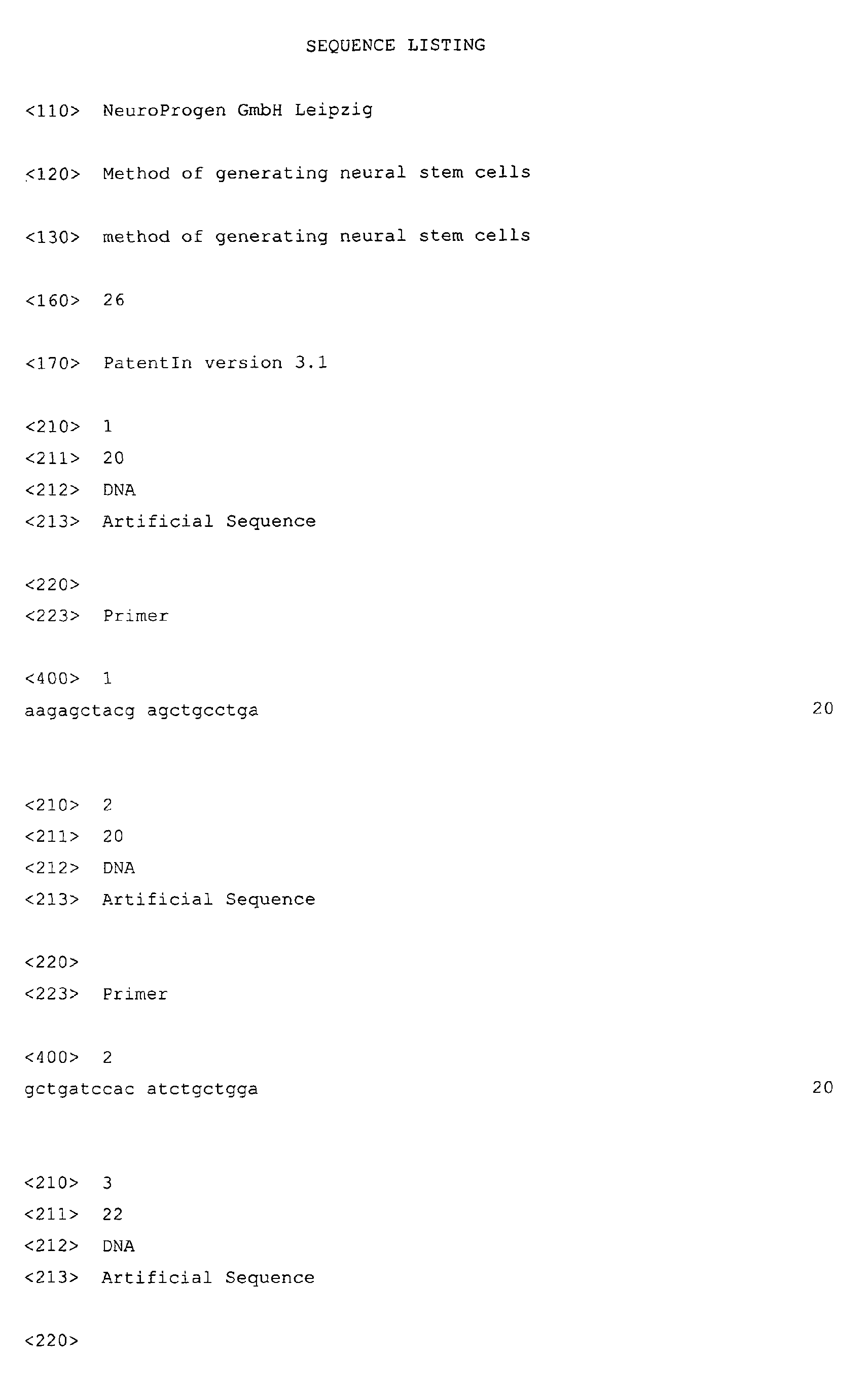


Claims (16)
- A method of generating neural stem cells, comprising culturing mesenchymal stem cells in a medium containing EGF and FGF-2 wherein hepatocyte growth factor is not present in said medium, and under an atmosphere having an oxygen concentration of less than 20% (v/v).
- A method according to claim 1 wherein the mesenchymal stem cells are derived from a tissue selected from the group consisting of adult bone marrow, umbilical cord blood and adult fat tissue.
- A method according to claim 1 or 2 wherein the mesenchymal stem cells are selected from the group consisting of adult bone marrow cells and umbilical cord blood cells.
- A method according to any one of claims 1 to 3 wherein the mesenchymal stem cells are cultured in the presence of EGF and FGF-2 for at least 10 days.
- A method according to any one of claims 1 to 4 wherein the mesenchymal stem cells are cultured under an atmosphere having an oxygen concentration of less than 15% (v/v).
- A method according to any one of claims 1 to 5 wherein the mesenchymal stem cells are cultured under conditions such that no substantial differentiation into neural cells occurs.
- A method according to any one of claims 1 to 6 wherein the mesenchymal stem cells are cultured under conditions such that a population of cells expressing NES is obtained.
- A method according to any one of claims 1 to 7 wherein the mesenchymal stem cells are cultured under conditions such that a population of cells expressing FN1 is obtained.
- A method for making a medicament comprising the steps of(a) generating neural stem cells using the method according to any one of claims 1 to 8; and(b) adding to the cells obtained in step (a) a pharmaceutically acceptable carrier or diluent.
- A population of mesodermal-derived neural stem cells obtainable by a method according to any one of claims 1 to 8.
- A population of mesodermal-derived neural stem cells characterized in that the neural stem cells express NES and FN1.
- A population of mesodermal-derived neural stem cells according to claim 10 or 11 wherein the neural stem cells substantially lack expression of the marker molecules CD15, CD34, CD45, CD133, and CD166.
- A population of mesodermal-derived neural stem cells according to any one of claims 10 to 12 wherein(i) the amount of NES expression in the neural stem cells is increased by at least 200% compared to the amount of NES expression in bone marrow stromal cells, and(ii) the amount of FN1 expression in the neural stem cells is 50% to 150 % of the amount of FN1 expression in bone marrow stromal cells.
- The use of a population of mesodermal-derived neural stem cells according to any one of claims 10 to 13 for the manufacture of a medicament for the treatment of a neurological disorder.
- The use according to claim 14 wherein the mesodermal-derived neural stem cells are transplanted to the brain of a patient.
- The use according to claim 14 or 15 wherein the mesodermal-derived neural stem cells are autologous cells.
Priority Applications (7)
| Application Number | Priority Date | Filing Date | Title |
|---|---|---|---|
| EP03017676A EP1506997A1 (en) | 2003-08-14 | 2003-08-14 | Method of generating neural stem cells |
| AU2004265432A AU2004265432A1 (en) | 2003-08-14 | 2004-08-05 | Method of generating neural stem cells |
| EP04763821A EP1654351A1 (en) | 2003-08-14 | 2004-08-05 | Method of generating neural stem cells |
| CA002535685A CA2535685A1 (en) | 2003-08-14 | 2004-08-05 | Method of generating neural stem cells |
| PCT/EP2004/008780 WO2005017132A1 (en) | 2003-08-14 | 2004-08-05 | Method of generating neural stem cells |
| JP2006522961A JP2007502104A (en) | 2003-08-14 | 2004-08-05 | How to generate neural stem cells |
| US11/276,014 US20060177928A1 (en) | 2003-08-14 | 2006-02-09 | Method of generating neural stem cells |
Applications Claiming Priority (1)
| Application Number | Priority Date | Filing Date | Title |
|---|---|---|---|
| EP03017676A EP1506997A1 (en) | 2003-08-14 | 2003-08-14 | Method of generating neural stem cells |
Publications (1)
| Publication Number | Publication Date |
|---|---|
| EP1506997A1 true EP1506997A1 (en) | 2005-02-16 |
Family
ID=33560767
Family Applications (2)
| Application Number | Title | Priority Date | Filing Date |
|---|---|---|---|
| EP03017676A Withdrawn EP1506997A1 (en) | 2003-08-14 | 2003-08-14 | Method of generating neural stem cells |
| EP04763821A Withdrawn EP1654351A1 (en) | 2003-08-14 | 2004-08-05 | Method of generating neural stem cells |
Family Applications After (1)
| Application Number | Title | Priority Date | Filing Date |
|---|---|---|---|
| EP04763821A Withdrawn EP1654351A1 (en) | 2003-08-14 | 2004-08-05 | Method of generating neural stem cells |
Country Status (6)
| Country | Link |
|---|---|
| US (1) | US20060177928A1 (en) |
| EP (2) | EP1506997A1 (en) |
| JP (1) | JP2007502104A (en) |
| AU (1) | AU2004265432A1 (en) |
| CA (1) | CA2535685A1 (en) |
| WO (1) | WO2005017132A1 (en) |
Cited By (5)
| Publication number | Priority date | Publication date | Assignee | Title |
|---|---|---|---|---|
| US7670596B2 (en) * | 2004-04-23 | 2010-03-02 | Bioe, Inc. | Multi-lineage progenitor cells |
| WO2013124816A3 (en) * | 2012-02-22 | 2014-01-03 | Brainstem Biotec Ltd. | Generation of neural stem cells and motor neurons |
| US9783781B2 (en) | 2010-08-16 | 2017-10-10 | Exostem Biotec Ltd. | Methods of generating oligodendrocytes and cell populations comprising same |
| US10034902B2 (en) | 2012-02-22 | 2018-07-31 | Exostem Biotec Ltd. | MicroRNAs for the generation of astrocytes |
| US10385314B2 (en) | 2010-08-16 | 2019-08-20 | Exostem Biotec Ltd. | Methods of generating oligodendrocytes and cell populations comprising same |
Families Citing this family (5)
| Publication number | Priority date | Publication date | Assignee | Title |
|---|---|---|---|---|
| US7622108B2 (en) | 2004-04-23 | 2009-11-24 | Bioe, Inc. | Multi-lineage progenitor cells |
| CU23529A1 (en) * | 2005-03-02 | 2010-06-17 | Ct Ingenieria Genetica Biotech | COMBINATION OF EGF / GHRP-6 FOR THE NEUROREGENERATION OF THE CENTRAL NERVOUS SYSTEM AFTER THE AUTOINMUNE DANE |
| WO2006113731A2 (en) * | 2005-04-20 | 2006-10-26 | University Of Florida Research Foundation, Inc. | Bone marrow-derived neurogenic cells and uses thereof |
| JP2009183204A (en) * | 2008-02-06 | 2009-08-20 | Nara Institute Of Science & Technology | Cell culture method |
| US20230346847A1 (en) * | 2020-08-24 | 2023-11-02 | The Johns Hopkins University | Juvenile protective factors to arrest and reverse aging in the enteric nervous system |
Citations (2)
| Publication number | Priority date | Publication date | Assignee | Title |
|---|---|---|---|---|
| US20010034061A1 (en) * | 1998-11-18 | 2001-10-25 | California Institute Of Technology | Methods for isolation and activation of, and control of differentiation from, stem and progenitor cells |
| WO2003035855A1 (en) * | 2001-10-25 | 2003-05-01 | Cedars-Sinai Medical Center | Differentiation of whole bone marrow |
Family Cites Families (4)
| Publication number | Priority date | Publication date | Assignee | Title |
|---|---|---|---|---|
| US6610540B1 (en) * | 1998-11-18 | 2003-08-26 | California Institute Of Technology | Low oxygen culturing of central nervous system progenitor cells |
| CA2396536A1 (en) * | 2001-08-10 | 2003-02-10 | Saiko Uchida | Human stem cells originated from human amniotic mesenchymal cell layer |
| EP1452586B1 (en) * | 2001-10-30 | 2012-05-30 | Nc Medical Research Inc. | Method of inducing differentiation of mesodermal stem cells into nervous system cells |
| JP2003189847A (en) * | 2001-12-26 | 2003-07-08 | Kainosu:Kk | Method for sorting multipotent neural stem cells |
-
2003
- 2003-08-14 EP EP03017676A patent/EP1506997A1/en not_active Withdrawn
-
2004
- 2004-08-05 JP JP2006522961A patent/JP2007502104A/en active Pending
- 2004-08-05 AU AU2004265432A patent/AU2004265432A1/en not_active Abandoned
- 2004-08-05 WO PCT/EP2004/008780 patent/WO2005017132A1/en not_active Ceased
- 2004-08-05 CA CA002535685A patent/CA2535685A1/en not_active Abandoned
- 2004-08-05 EP EP04763821A patent/EP1654351A1/en not_active Withdrawn
-
2006
- 2006-02-09 US US11/276,014 patent/US20060177928A1/en not_active Abandoned
Patent Citations (2)
| Publication number | Priority date | Publication date | Assignee | Title |
|---|---|---|---|---|
| US20010034061A1 (en) * | 1998-11-18 | 2001-10-25 | California Institute Of Technology | Methods for isolation and activation of, and control of differentiation from, stem and progenitor cells |
| WO2003035855A1 (en) * | 2001-10-25 | 2003-05-01 | Cedars-Sinai Medical Center | Differentiation of whole bone marrow |
Non-Patent Citations (3)
| Title |
|---|
| GAGE F H: "MAMMALIAN NEURAL STEM CELLS", SCIENCE, AMERICAN ASSOCIATION FOR THE ADVANCEMENT OF SCIENCE,, US, vol. 287, no. 5457, 25 February 2000 (2000-02-25), pages 1433 - 1438, XP000919227, ISSN: 0036-8075 * |
| SHIH CHU-CHIH ET AL: "Identification of a candidate human neurohematopoietic stem-cell population", BLOOD, vol. 98, no. 11 Part 2, 16 November 2001 (2001-11-16), 43rd Annual Meeting of the American Society of Hematology, Part 2;Orlando, Florida, USA; December 07-11, 2001, pages 125b, XP008027983, ISSN: 0006-4971 * |
| VOGEL WICHARD ET AL: "Heterogeneity among human bone marrow-derived mesenchymal stem cells and neural progenitor cells", HAEMATOLOGICA, ROME, IT, vol. 88, no. 2, February 2003 (2003-02-01), pages 126 - 133, XP002262821 * |
Cited By (7)
| Publication number | Priority date | Publication date | Assignee | Title |
|---|---|---|---|---|
| US7670596B2 (en) * | 2004-04-23 | 2010-03-02 | Bioe, Inc. | Multi-lineage progenitor cells |
| US9783781B2 (en) | 2010-08-16 | 2017-10-10 | Exostem Biotec Ltd. | Methods of generating oligodendrocytes and cell populations comprising same |
| US10385314B2 (en) | 2010-08-16 | 2019-08-20 | Exostem Biotec Ltd. | Methods of generating oligodendrocytes and cell populations comprising same |
| WO2013124816A3 (en) * | 2012-02-22 | 2014-01-03 | Brainstem Biotec Ltd. | Generation of neural stem cells and motor neurons |
| US9803175B2 (en) | 2012-02-22 | 2017-10-31 | Exostem Biotec Ltd. | Generation of neural stem cells and motor neurons |
| US10034902B2 (en) | 2012-02-22 | 2018-07-31 | Exostem Biotec Ltd. | MicroRNAs for the generation of astrocytes |
| US10752883B2 (en) | 2012-02-22 | 2020-08-25 | Exostem Biotec Ltd. | Generation of neural stem cells and motor neurons |
Also Published As
| Publication number | Publication date |
|---|---|
| EP1654351A1 (en) | 2006-05-10 |
| JP2007502104A (en) | 2007-02-08 |
| AU2004265432A1 (en) | 2005-02-24 |
| US20060177928A1 (en) | 2006-08-10 |
| WO2005017132A1 (en) | 2005-02-24 |
| CA2535685A1 (en) | 2005-02-24 |
Similar Documents
| Publication | Publication Date | Title |
|---|---|---|
| Hermann et al. | Efficient generation of neural stem cell-like cells from adult human bone marrow stromal cells | |
| Woodbury et al. | Adult rat and human bone marrow stromal cells differentiate into neurons | |
| Fu et al. | Derivation of neural stem cells from mesenchymal stem cells: evidence for a bipotential stem cell population | |
| Chang et al. | Neurogenic differentiation of dental pulp stem cells to neuron-like cells in dopaminergic and motor neuronal inductive media | |
| Anghileri et al. | Neuronal differentiation potential of human adipose-derived mesenchymal stem cells | |
| Scintu et al. | Differentiation of human bone marrow stem cells into cells with a neural phenotype: diverse effects of two specific treatments | |
| Lodie et al. | Systematic analysis of reportedly distinct populations of multipotent bone marrow-derived stem cells reveals a lack of distinction | |
| CN104204193B (en) | The cultivation of mescenchymal stem cell | |
| Vazey et al. | Transplanted adult neural progenitor cells survive, differentiate and reduce motor function impairment in a rodent model of Huntington's disease | |
| Lambert et al. | Differentiation of human adipose-derived adult stem cells into neuronal tissue: does it work? | |
| EP1272614B1 (en) | Differentiation of bone marrow cells into neuronal cells and uses therefor | |
| Vourc’h et al. | Isolation and characterization of cells with neurogenic potential from adult skeletal muscle | |
| CN112891374B (en) | Ways to treat the effects of a stroke | |
| Song et al. | Comparison of neuron-like cells derived from bone marrow stem cells to those differentiated from adult brain neural stem cells | |
| Fang et al. | Multipotency of Flk1+ CD34− progenitors derived from human fetal bone marrow | |
| CN115968401A (en) | Method for differentiating stem cells into dopaminergic progenitor cells | |
| WO2014046417A1 (en) | Method for preparing mesenchymal stem cell aggregates | |
| CN105814196A (en) | Method of obtaining terminally differentiated neuronal lineages and uses thereof | |
| EP1506997A1 (en) | Method of generating neural stem cells | |
| Ramli et al. | Human bone marrow‐derived MSCs spontaneously express specific Schwann cell markers | |
| Chen et al. | Neural progenitor cells derived from the adult rat subventricular zone: characterization and transplantation | |
| Li et al. | Isolation and characterization of neural stem cells from human fetal striatum | |
| EP1917348B1 (en) | Isolation of multi-lineage stem cells | |
| Alexanian et al. | Quiescent neural cells regain multipotent stem cell characteristics influenced by adult neural stem cells in co-culture | |
| EP1767617A1 (en) | Mesenchymal stem cells isolation and expansion method and uses thereof |
Legal Events
| Date | Code | Title | Description |
|---|---|---|---|
| PUAI | Public reference made under article 153(3) epc to a published international application that has entered the european phase |
Free format text: ORIGINAL CODE: 0009012 |
|
| AK | Designated contracting states |
Kind code of ref document: A1 Designated state(s): AT BE BG CH CY CZ DE DK EE ES FI FR GB GR HU IE IT LI LU MC NL PT RO SE SI SK TR |
|
| AX | Request for extension of the european patent |
Extension state: AL LT LV MK |
|
| AKX | Designation fees paid | ||
| REG | Reference to a national code |
Ref country code: DE Ref legal event code: 8566 |
|
| STAA | Information on the status of an ep patent application or granted ep patent |
Free format text: STATUS: THE APPLICATION IS DEEMED TO BE WITHDRAWN |
|
| 18D | Application deemed to be withdrawn |
Effective date: 20050817 |