EP1450758B1 - Cosmetic compositions using polyether siloxane copolymer network compositions - Google Patents
Cosmetic compositions using polyether siloxane copolymer network compositions Download PDFInfo
- Publication number
- EP1450758B1 EP1450758B1 EP01989830A EP01989830A EP1450758B1 EP 1450758 B1 EP1450758 B1 EP 1450758B1 EP 01989830 A EP01989830 A EP 01989830A EP 01989830 A EP01989830 A EP 01989830A EP 1450758 B1 EP1450758 B1 EP 1450758B1
- Authority
- EP
- European Patent Office
- Prior art keywords
- composition
- sio
- carbon atoms
- products
- phase comprises
- Prior art date
- Legal status (The legal status is an assumption and is not a legal conclusion. Google has not performed a legal analysis and makes no representation as to the accuracy of the status listed.)
- Expired - Lifetime
Links
- 239000000203 mixture Substances 0.000 title claims abstract description 148
- 239000002537 cosmetic Substances 0.000 title claims description 32
- 229920001577 copolymer Polymers 0.000 title abstract description 40
- 229920000570 polyether Polymers 0.000 title abstract description 35
- 239000004721 Polyphenylene oxide Substances 0.000 title abstract description 34
- 239000007795 chemical reaction product Substances 0.000 claims abstract description 12
- 229910020388 SiO1/2 Inorganic materials 0.000 claims abstract description 11
- 229910020485 SiO4/2 Inorganic materials 0.000 claims abstract description 4
- -1 hydrocarbon radicals Chemical class 0.000 claims description 139
- 229920001296 polysiloxane Polymers 0.000 claims description 64
- 229930195733 hydrocarbon Natural products 0.000 claims description 38
- 239000004215 Carbon black (E152) Substances 0.000 claims description 37
- 238000009472 formulation Methods 0.000 claims description 30
- 239000000839 emulsion Substances 0.000 claims description 28
- 239000000499 gel Substances 0.000 claims description 26
- 125000004432 carbon atom Chemical group C* 0.000 claims description 24
- 239000000047 product Substances 0.000 claims description 24
- 239000003213 antiperspirant Substances 0.000 claims description 23
- 230000001166 anti-perspirative effect Effects 0.000 claims description 20
- XLYOFNOQVPJJNP-UHFFFAOYSA-N water Substances O XLYOFNOQVPJJNP-UHFFFAOYSA-N 0.000 claims description 18
- 125000000391 vinyl group Chemical group [H]C([*])=C([H])[H] 0.000 claims description 14
- 239000006210 lotion Substances 0.000 claims description 10
- 229910052739 hydrogen Inorganic materials 0.000 claims description 8
- 229910020447 SiO2/2 Inorganic materials 0.000 claims description 7
- 229910020487 SiO3/2 Inorganic materials 0.000 claims description 7
- 239000001257 hydrogen Substances 0.000 claims description 7
- 125000000466 oxiranyl group Chemical group 0.000 claims description 7
- 239000002453 shampoo Substances 0.000 claims description 7
- UFHFLCQGNIYNRP-UHFFFAOYSA-N Hydrogen Chemical compound [H][H] UFHFLCQGNIYNRP-UHFFFAOYSA-N 0.000 claims description 6
- 125000002496 methyl group Chemical group [H]C([H])([H])* 0.000 claims description 6
- 239000002904 solvent Substances 0.000 claims description 5
- 230000000475 sunscreen effect Effects 0.000 claims description 5
- 239000000516 sunscreening agent Substances 0.000 claims description 5
- SNRUBQQJIBEYMU-UHFFFAOYSA-N Dodecane Natural products CCCCCCCCCCCC SNRUBQQJIBEYMU-UHFFFAOYSA-N 0.000 claims description 4
- 239000004909 Moisturizer Substances 0.000 claims description 4
- 125000002704 decyl group Chemical group [H]C([H])([H])C([H])([H])C([H])([H])C([H])([H])C([H])([H])C([H])([H])C([H])([H])C([H])([H])C([H])([H])C([H])([H])* 0.000 claims description 4
- 239000002781 deodorant agent Substances 0.000 claims description 4
- 125000003438 dodecyl group Chemical group [H]C([H])([H])C([H])([H])C([H])([H])C([H])([H])C([H])([H])C([H])([H])C([H])([H])C([H])([H])C([H])([H])C([H])([H])C([H])([H])C([H])([H])* 0.000 claims description 4
- 125000001495 ethyl group Chemical group [H]C([H])([H])C([H])([H])* 0.000 claims description 4
- 230000001333 moisturizer Effects 0.000 claims description 4
- 125000002914 sec-butyl group Chemical group [H]C([H])([H])C([H])([H])C([H])(*)C([H])([H])[H] 0.000 claims description 4
- 125000000999 tert-butyl group Chemical group [H]C([H])([H])C(*)(C([H])([H])[H])C([H])([H])[H] 0.000 claims description 4
- HNEGJTWNOOWEMH-UHFFFAOYSA-N 1-fluoropropane Chemical group [CH2]CCF HNEGJTWNOOWEMH-UHFFFAOYSA-N 0.000 claims description 3
- SLJFKNONPLNAPF-UHFFFAOYSA-N 3-Vinyl-7-oxabicyclo[4.1.0]heptane Chemical compound C1C(C=C)CCC2OC21 SLJFKNONPLNAPF-UHFFFAOYSA-N 0.000 claims description 3
- 229910004726 HSiO3/2 Inorganic materials 0.000 claims description 3
- 125000000480 butynyl group Chemical group [*]C#CC([H])([H])C([H])([H])[H] 0.000 claims description 3
- 125000002057 carboxymethyl group Chemical group [H]OC(=O)C([H])([H])[*] 0.000 claims description 3
- 125000004218 chloromethyl group Chemical group [H]C([H])(Cl)* 0.000 claims description 3
- 239000006071 cream Substances 0.000 claims description 3
- 239000000077 insect repellent Substances 0.000 claims description 3
- 125000002347 octyl group Chemical group [H]C([*])([H])C([H])([H])C([H])([H])C([H])([H])C([H])([H])C([H])([H])C([H])([H])C([H])([H])[H] 0.000 claims description 3
- 125000000913 palmityl group Chemical group [H]C([*])([H])C([H])([H])C([H])([H])C([H])([H])C([H])([H])C([H])([H])C([H])([H])C([H])([H])C([H])([H])C([H])([H])C([H])([H])C([H])([H])C([H])([H])C([H])([H])C([H])([H])C([H])([H])[H] 0.000 claims description 3
- 125000004368 propenyl group Chemical group C(=CC)* 0.000 claims description 3
- 125000004079 stearyl group Chemical group [H]C([*])([H])C([H])([H])C([H])([H])C([H])([H])C([H])([H])C([H])([H])C([H])([H])C([H])([H])C([H])([H])C([H])([H])C([H])([H])C([H])([H])C([H])([H])C([H])([H])C([H])([H])C([H])([H])C([H])([H])C([H])([H])[H] 0.000 claims description 3
- CCEFMUBVSUDRLG-KXUCPTDWSA-N (4R)-limonene 1,2-epoxide Natural products C1[C@H](C(=C)C)CC[C@@]2(C)O[C@H]21 CCEFMUBVSUDRLG-KXUCPTDWSA-N 0.000 claims description 2
- WEEGYLXZBRQIMU-UHFFFAOYSA-N 1,8-cineole Natural products C1CC2CCC1(C)OC2(C)C WEEGYLXZBRQIMU-UHFFFAOYSA-N 0.000 claims description 2
- STMDPCBYJCIZOD-UHFFFAOYSA-N 2-(2,4-dinitroanilino)-4-methylpentanoic acid Chemical compound CC(C)CC(C(O)=O)NC1=CC=C([N+]([O-])=O)C=C1[N+]([O-])=O STMDPCBYJCIZOD-UHFFFAOYSA-N 0.000 claims description 2
- MUUOUUYKIVSIAR-UHFFFAOYSA-N 2-but-3-enyloxirane Chemical compound C=CCCC1CO1 MUUOUUYKIVSIAR-UHFFFAOYSA-N 0.000 claims description 2
- 125000001731 2-cyanoethyl group Chemical group [H]C([H])(*)C([H])([H])C#N 0.000 claims description 2
- UKTHULMXFLCNAV-UHFFFAOYSA-N 2-hex-5-enyloxirane Chemical compound C=CCCCCC1CO1 UKTHULMXFLCNAV-UHFFFAOYSA-N 0.000 claims description 2
- FCZHJHKCOZGQJZ-UHFFFAOYSA-N 2-oct-7-enyloxirane Chemical compound C=CCCCCCCC1CO1 FCZHJHKCOZGQJZ-UHFFFAOYSA-N 0.000 claims description 2
- 241000195940 Bryophyta Species 0.000 claims description 2
- CCEFMUBVSUDRLG-XNWIYYODSA-N Limonene-1,2-epoxide Chemical compound C1[C@H](C(=C)C)CCC2(C)OC21 CCEFMUBVSUDRLG-XNWIYYODSA-N 0.000 claims description 2
- 230000003712 anti-aging effect Effects 0.000 claims description 2
- 238000012377 drug delivery Methods 0.000 claims description 2
- 230000037308 hair color Effects 0.000 claims description 2
- 239000000118 hair dye Substances 0.000 claims description 2
- 239000008266 hair spray Substances 0.000 claims description 2
- 235000011929 mousse Nutrition 0.000 claims description 2
- 239000000843 powder Substances 0.000 claims description 2
- 239000011252 protective cream Substances 0.000 claims description 2
- 230000000699 topical effect Effects 0.000 claims description 2
- SJYNFBVQFBRSIB-UHFFFAOYSA-N norbornadiene Chemical compound C1=CC2C=CC1C2 SJYNFBVQFBRSIB-UHFFFAOYSA-N 0.000 claims 1
- 239000002210 silicon-based material Substances 0.000 abstract description 3
- 239000012530 fluid Substances 0.000 description 55
- 239000003054 catalyst Substances 0.000 description 25
- 150000001875 compounds Chemical class 0.000 description 25
- BASFCYQUMIYNBI-UHFFFAOYSA-N platinum Chemical compound [Pt] BASFCYQUMIYNBI-UHFFFAOYSA-N 0.000 description 23
- 150000003254 radicals Chemical class 0.000 description 23
- 239000000463 material Substances 0.000 description 20
- 239000007787 solid Substances 0.000 description 20
- XMSXQFUHVRWGNA-UHFFFAOYSA-N Decamethylcyclopentasiloxane Chemical compound C[Si]1(C)O[Si](C)(C)O[Si](C)(C)O[Si](C)(C)O[Si](C)(C)O1 XMSXQFUHVRWGNA-UHFFFAOYSA-N 0.000 description 19
- 210000003491 skin Anatomy 0.000 description 19
- 239000004593 Epoxy Substances 0.000 description 17
- 150000002924 oxiranes Chemical group 0.000 description 17
- 238000006459 hydrosilylation reaction Methods 0.000 description 15
- 238000006116 polymerization reaction Methods 0.000 description 14
- 235000013870 dimethyl polysiloxane Nutrition 0.000 description 13
- 150000004678 hydrides Chemical group 0.000 description 13
- 229920000435 poly(dimethylsiloxane) Polymers 0.000 description 13
- DNIAPMSPPWPWGF-UHFFFAOYSA-N Propylene glycol Chemical compound CC(O)CO DNIAPMSPPWPWGF-UHFFFAOYSA-N 0.000 description 12
- 229940008099 dimethicone Drugs 0.000 description 12
- 239000004205 dimethyl polysiloxane Substances 0.000 description 12
- 238000002360 preparation method Methods 0.000 description 12
- IAYPIBMASNFSPL-UHFFFAOYSA-N Ethylene oxide Chemical compound C1CO1 IAYPIBMASNFSPL-UHFFFAOYSA-N 0.000 description 11
- 229910052697 platinum Inorganic materials 0.000 description 11
- XAYDWGMOPRHLEP-UHFFFAOYSA-N 6-ethenyl-7-oxabicyclo[4.1.0]heptane Chemical compound C1CCCC2OC21C=C XAYDWGMOPRHLEP-UHFFFAOYSA-N 0.000 description 10
- 125000003342 alkenyl group Chemical group 0.000 description 10
- DSVRVHYFPPQFTI-UHFFFAOYSA-N bis(ethenyl)-methyl-trimethylsilyloxysilane;platinum Chemical compound [Pt].C[Si](C)(C)O[Si](C)(C=C)C=C DSVRVHYFPPQFTI-UHFFFAOYSA-N 0.000 description 10
- 229920002554 vinyl polymer Polymers 0.000 description 10
- 238000006243 chemical reaction Methods 0.000 description 9
- 125000000217 alkyl group Chemical group 0.000 description 8
- KPUWHANPEXNPJT-UHFFFAOYSA-N disiloxane Chemical class [SiH3]O[SiH3] KPUWHANPEXNPJT-UHFFFAOYSA-N 0.000 description 8
- 239000004615 ingredient Substances 0.000 description 8
- 238000000034 method Methods 0.000 description 8
- 229920000642 polymer Polymers 0.000 description 8
- LYCAIKOWRPUZTN-UHFFFAOYSA-N Ethylene glycol Chemical compound OCCO LYCAIKOWRPUZTN-UHFFFAOYSA-N 0.000 description 7
- 150000001298 alcohols Chemical class 0.000 description 7
- 239000003974 emollient agent Substances 0.000 description 7
- 238000002156 mixing Methods 0.000 description 7
- 229910000510 noble metal Inorganic materials 0.000 description 7
- 239000003921 oil Substances 0.000 description 7
- 239000004711 α-olefin Substances 0.000 description 7
- GTJOHISYCKPIMT-UHFFFAOYSA-N 2-methylundecane Chemical compound CCCCCCCCCC(C)C GTJOHISYCKPIMT-UHFFFAOYSA-N 0.000 description 6
- CIWBSHSKHKDKBQ-JLAZNSOCSA-N Ascorbic acid Chemical compound OC[C@H](O)[C@H]1OC(=O)C(O)=C1O CIWBSHSKHKDKBQ-JLAZNSOCSA-N 0.000 description 6
- PEDCQBHIVMGVHV-UHFFFAOYSA-N Glycerine Chemical compound OCC(O)CO PEDCQBHIVMGVHV-UHFFFAOYSA-N 0.000 description 6
- SGVYKUFIHHTIFL-UHFFFAOYSA-N Isobutylhexyl Natural products CCCCCCCC(C)C SGVYKUFIHHTIFL-UHFFFAOYSA-N 0.000 description 6
- 239000004264 Petrolatum Substances 0.000 description 6
- GWEVSGVZZGPLCZ-UHFFFAOYSA-N Titan oxide Chemical compound O=[Ti]=O GWEVSGVZZGPLCZ-UHFFFAOYSA-N 0.000 description 6
- RRAFCDWBNXTKKO-UHFFFAOYSA-N eugenol Chemical compound COC1=CC(CC=C)=CC=C1O RRAFCDWBNXTKKO-UHFFFAOYSA-N 0.000 description 6
- 239000003205 fragrance Substances 0.000 description 6
- 150000002430 hydrocarbons Chemical class 0.000 description 6
- VKPSKYDESGTTFR-UHFFFAOYSA-N isododecane Natural products CC(C)(C)CC(C)CC(C)(C)C VKPSKYDESGTTFR-UHFFFAOYSA-N 0.000 description 6
- 239000007788 liquid Substances 0.000 description 6
- GLDOVTGHNKAZLK-UHFFFAOYSA-N octadecan-1-ol Chemical compound CCCCCCCCCCCCCCCCCCO GLDOVTGHNKAZLK-UHFFFAOYSA-N 0.000 description 6
- 125000005375 organosiloxane group Chemical group 0.000 description 6
- 235000019271 petrolatum Nutrition 0.000 description 6
- 229940066842 petrolatum Drugs 0.000 description 6
- 125000002091 cationic group Chemical group 0.000 description 5
- 150000002334 glycols Chemical class 0.000 description 5
- 238000010438 heat treatment Methods 0.000 description 5
- 125000002887 hydroxy group Chemical group [H]O* 0.000 description 5
- 235000019198 oils Nutrition 0.000 description 5
- 239000011541 reaction mixture Substances 0.000 description 5
- 229930195734 saturated hydrocarbon Natural products 0.000 description 5
- LFQSCWFLJHTTHZ-UHFFFAOYSA-N Ethanol Chemical compound CCO LFQSCWFLJHTTHZ-UHFFFAOYSA-N 0.000 description 4
- 229920002153 Hydroxypropyl cellulose Polymers 0.000 description 4
- BLRPTPMANUNPDV-UHFFFAOYSA-N Silane Chemical group [SiH4] BLRPTPMANUNPDV-UHFFFAOYSA-N 0.000 description 4
- QVGXLLKOCUKJST-UHFFFAOYSA-N atomic oxygen Chemical compound [O] QVGXLLKOCUKJST-UHFFFAOYSA-N 0.000 description 4
- 238000010538 cationic polymerization reaction Methods 0.000 description 4
- 125000000524 functional group Chemical group 0.000 description 4
- 125000000623 heterocyclic group Chemical group 0.000 description 4
- 125000004435 hydrogen atom Chemical group [H]* 0.000 description 4
- 235000010977 hydroxypropyl cellulose Nutrition 0.000 description 4
- 150000002894 organic compounds Chemical class 0.000 description 4
- 239000001301 oxygen Substances 0.000 description 4
- 229910052760 oxygen Inorganic materials 0.000 description 4
- 239000000049 pigment Substances 0.000 description 4
- 239000003755 preservative agent Substances 0.000 description 4
- 125000001424 substituent group Chemical group 0.000 description 4
- 125000003903 2-propenyl group Chemical group [H]C([*])([H])C([H])=C([H])[H] 0.000 description 3
- ZZZCUOFIHGPKAK-UHFFFAOYSA-N D-erythro-ascorbic acid Natural products OCC1OC(=O)C(O)=C1O ZZZCUOFIHGPKAK-UHFFFAOYSA-N 0.000 description 3
- KFZMGEQAYNKOFK-UHFFFAOYSA-N Isopropanol Chemical compound CC(C)O KFZMGEQAYNKOFK-UHFFFAOYSA-N 0.000 description 3
- HEMHJVSKTPXQMS-UHFFFAOYSA-M Sodium hydroxide Chemical compound [OH-].[Na+] HEMHJVSKTPXQMS-UHFFFAOYSA-M 0.000 description 3
- 229930003268 Vitamin C Natural products 0.000 description 3
- 239000002253 acid Substances 0.000 description 3
- 125000003118 aryl group Chemical group 0.000 description 3
- 239000012298 atmosphere Substances 0.000 description 3
- 230000008901 benefit Effects 0.000 description 3
- 239000004359 castor oil Substances 0.000 description 3
- 235000019438 castor oil Nutrition 0.000 description 3
- KRKNYBCHXYNGOX-UHFFFAOYSA-N citric acid Chemical compound OC(=O)CC(O)(C(O)=O)CC(O)=O KRKNYBCHXYNGOX-UHFFFAOYSA-N 0.000 description 3
- 230000000536 complexating effect Effects 0.000 description 3
- 238000004132 cross linking Methods 0.000 description 3
- 150000002148 esters Chemical class 0.000 description 3
- 235000011187 glycerol Nutrition 0.000 description 3
- ZEMPKEQAKRGZGQ-XOQCFJPHSA-N glycerol triricinoleate Natural products CCCCCC[C@@H](O)CC=CCCCCCCCC(=O)OC[C@@H](COC(=O)CCCCCCCC=CC[C@@H](O)CCCCCC)OC(=O)CCCCCCCC=CC[C@H](O)CCCCCC ZEMPKEQAKRGZGQ-XOQCFJPHSA-N 0.000 description 3
- 239000003446 ligand Substances 0.000 description 3
- GOQYKNQRPGWPLP-UHFFFAOYSA-N n-heptadecyl alcohol Natural products CCCCCCCCCCCCCCCCCO GOQYKNQRPGWPLP-UHFFFAOYSA-N 0.000 description 3
- 150000003839 salts Chemical class 0.000 description 3
- 229920006395 saturated elastomer Polymers 0.000 description 3
- 230000001953 sensory effect Effects 0.000 description 3
- 238000010008 shearing Methods 0.000 description 3
- 150000005846 sugar alcohols Polymers 0.000 description 3
- 239000000454 talc Substances 0.000 description 3
- 229910052623 talc Inorganic materials 0.000 description 3
- 235000012222 talc Nutrition 0.000 description 3
- 229930003231 vitamin Natural products 0.000 description 3
- 229940088594 vitamin Drugs 0.000 description 3
- 239000011782 vitamin Substances 0.000 description 3
- 235000013343 vitamin Nutrition 0.000 description 3
- 235000019154 vitamin C Nutrition 0.000 description 3
- 239000011718 vitamin C Substances 0.000 description 3
- PUPZLCDOIYMWBV-UHFFFAOYSA-N (+/-)-1,3-Butanediol Chemical compound CC(O)CCO PUPZLCDOIYMWBV-UHFFFAOYSA-N 0.000 description 2
- GVJHHUAWPYXKBD-UHFFFAOYSA-N (±)-α-Tocopherol Chemical compound OC1=C(C)C(C)=C2OC(CCCC(C)CCCC(C)CCCC(C)C)(C)CCC2=C1C GVJHHUAWPYXKBD-UHFFFAOYSA-N 0.000 description 2
- BANXPJUEBPWEOT-UHFFFAOYSA-N 2-methyl-Pentadecane Chemical compound CCCCCCCCCCCCCC(C)C BANXPJUEBPWEOT-UHFFFAOYSA-N 0.000 description 2
- ALYNCZNDIQEVRV-UHFFFAOYSA-N 4-aminobenzoic acid Chemical compound NC1=CC=C(C(O)=O)C=C1 ALYNCZNDIQEVRV-UHFFFAOYSA-N 0.000 description 2
- RTZKZFJDLAIYFH-UHFFFAOYSA-N Diethyl ether Chemical compound CCOCC RTZKZFJDLAIYFH-UHFFFAOYSA-N 0.000 description 2
- CSNNHWWHGAXBCP-UHFFFAOYSA-L Magnesium sulfate Chemical compound [Mg+2].[O-][S+2]([O-])([O-])[O-] CSNNHWWHGAXBCP-UHFFFAOYSA-L 0.000 description 2
- OKKJLVBELUTLKV-UHFFFAOYSA-N Methanol Chemical compound OC OKKJLVBELUTLKV-UHFFFAOYSA-N 0.000 description 2
- KDLHZDBZIXYQEI-UHFFFAOYSA-N Palladium Chemical compound [Pd] KDLHZDBZIXYQEI-UHFFFAOYSA-N 0.000 description 2
- FAPWRFPIFSIZLT-UHFFFAOYSA-M Sodium chloride Chemical compound [Na+].[Cl-] FAPWRFPIFSIZLT-UHFFFAOYSA-M 0.000 description 2
- NWGKJDSIEKMTRX-AAZCQSIUSA-N Sorbitan monooleate Chemical compound CCCCCCCC\C=C/CCCCCCCC(=O)OC[C@@H](O)[C@H]1OC[C@H](O)[C@H]1O NWGKJDSIEKMTRX-AAZCQSIUSA-N 0.000 description 2
- NINIDFKCEFEMDL-UHFFFAOYSA-N Sulfur Chemical compound [S] NINIDFKCEFEMDL-UHFFFAOYSA-N 0.000 description 2
- XLOMVQKBTHCTTD-UHFFFAOYSA-N Zinc monoxide Chemical compound [Zn]=O XLOMVQKBTHCTTD-UHFFFAOYSA-N 0.000 description 2
- 229910052782 aluminium Inorganic materials 0.000 description 2
- 150000001412 amines Chemical class 0.000 description 2
- 235000001014 amino acid Nutrition 0.000 description 2
- 229940098781 c18-36 acid triglyceride Drugs 0.000 description 2
- 239000011203 carbon fibre reinforced carbon Substances 0.000 description 2
- 239000000969 carrier Substances 0.000 description 2
- 238000000576 coating method Methods 0.000 description 2
- 239000003086 colorant Substances 0.000 description 2
- 229920006037 cross link polymer Polymers 0.000 description 2
- 238000002425 crystallisation Methods 0.000 description 2
- 230000008025 crystallization Effects 0.000 description 2
- 125000004122 cyclic group Chemical group 0.000 description 2
- 239000008367 deionised water Substances 0.000 description 2
- 229910021641 deionized water Inorganic materials 0.000 description 2
- 235000014113 dietary fatty acids Nutrition 0.000 description 2
- 239000000975 dye Substances 0.000 description 2
- 238000001704 evaporation Methods 0.000 description 2
- 239000000194 fatty acid Substances 0.000 description 2
- 229930195729 fatty acid Natural products 0.000 description 2
- 150000004665 fatty acids Chemical class 0.000 description 2
- 230000006870 function Effects 0.000 description 2
- 239000003349 gelling agent Substances 0.000 description 2
- 239000005556 hormone Substances 0.000 description 2
- 229940088597 hormone Drugs 0.000 description 2
- WGCNASOHLSPBMP-UHFFFAOYSA-N hydroxyacetaldehyde Natural products OCC=O WGCNASOHLSPBMP-UHFFFAOYSA-N 0.000 description 2
- 239000001863 hydroxypropyl cellulose Substances 0.000 description 2
- 239000003112 inhibitor Substances 0.000 description 2
- 239000011159 matrix material Substances 0.000 description 2
- 230000007246 mechanism Effects 0.000 description 2
- 239000010445 mica Substances 0.000 description 2
- 229910052618 mica group Inorganic materials 0.000 description 2
- 239000004530 micro-emulsion Substances 0.000 description 2
- 150000004947 monocyclic arenes Chemical class 0.000 description 2
- WWZKQHOCKIZLMA-UHFFFAOYSA-N octanoic acid Chemical compound CCCCCCCC(O)=O WWZKQHOCKIZLMA-UHFFFAOYSA-N 0.000 description 2
- 239000003960 organic solvent Substances 0.000 description 2
- 239000013503 personal care ingredient Substances 0.000 description 2
- 150000003058 platinum compounds Chemical class 0.000 description 2
- 229920000233 poly(alkylene oxides) Polymers 0.000 description 2
- 229920001223 polyethylene glycol Polymers 0.000 description 2
- 230000000379 polymerizing effect Effects 0.000 description 2
- 238000012545 processing Methods 0.000 description 2
- BDERNNFJNOPAEC-UHFFFAOYSA-N propan-1-ol Chemical compound CCCO BDERNNFJNOPAEC-UHFFFAOYSA-N 0.000 description 2
- 229920002545 silicone oil Polymers 0.000 description 2
- 229950004959 sorbitan oleate Drugs 0.000 description 2
- 241000894007 species Species 0.000 description 2
- 239000000126 substance Substances 0.000 description 2
- 229910052717 sulfur Inorganic materials 0.000 description 2
- 239000011593 sulfur Substances 0.000 description 2
- 239000004094 surface-active agent Substances 0.000 description 2
- 239000002562 thickening agent Substances 0.000 description 2
- 239000004408 titanium dioxide Substances 0.000 description 2
- LADGBHLMCUINGV-UHFFFAOYSA-N tricaprin Chemical compound CCCCCCCCCC(=O)OCC(OC(=O)CCCCCCCCC)COC(=O)CCCCCCCCC LADGBHLMCUINGV-UHFFFAOYSA-N 0.000 description 2
- 239000001993 wax Substances 0.000 description 2
- 239000000230 xanthan gum Substances 0.000 description 2
- 229920001285 xanthan gum Polymers 0.000 description 2
- 235000010493 xanthan gum Nutrition 0.000 description 2
- 229940082509 xanthan gum Drugs 0.000 description 2
- DSEKYWAQQVUQTP-XEWMWGOFSA-N (2r,4r,4as,6as,6as,6br,8ar,12ar,14as,14bs)-2-hydroxy-4,4a,6a,6b,8a,11,11,14a-octamethyl-2,4,5,6,6a,7,8,9,10,12,12a,13,14,14b-tetradecahydro-1h-picen-3-one Chemical compound C([C@H]1[C@]2(C)CC[C@@]34C)C(C)(C)CC[C@]1(C)CC[C@]2(C)[C@H]4CC[C@@]1(C)[C@H]3C[C@@H](O)C(=O)[C@@H]1C DSEKYWAQQVUQTP-XEWMWGOFSA-N 0.000 description 1
- ALSTYHKOOCGGFT-KTKRTIGZSA-N (9Z)-octadecen-1-ol Chemical compound CCCCCCCC\C=C/CCCCCCCCO ALSTYHKOOCGGFT-KTKRTIGZSA-N 0.000 description 1
- 125000004955 1,4-cyclohexylene group Chemical group [H]C1([H])C([H])([H])C([H])([*:1])C([H])([H])C([H])([H])C1([H])[*:2] 0.000 description 1
- VBICKXHEKHSIBG-UHFFFAOYSA-N 1-monostearoylglycerol Chemical compound CCCCCCCCCCCCCCCCCC(=O)OCC(O)CO VBICKXHEKHSIBG-UHFFFAOYSA-N 0.000 description 1
- FPIPGXGPPPQFEQ-UHFFFAOYSA-N 13-cis retinol Natural products OCC=C(C)C=CC=C(C)C=CC1=C(C)CCCC1(C)C FPIPGXGPPPQFEQ-UHFFFAOYSA-N 0.000 description 1
- 229940043268 2,2,4,4,6,8,8-heptamethylnonane Drugs 0.000 description 1
- LCZVSXRMYJUNFX-UHFFFAOYSA-N 2-[2-(2-hydroxypropoxy)propoxy]propan-1-ol Chemical compound CC(O)COC(C)COC(C)CO LCZVSXRMYJUNFX-UHFFFAOYSA-N 0.000 description 1
- QIRNGVVZBINFMX-UHFFFAOYSA-N 2-allylphenol Chemical compound OC1=CC=CC=C1CC=C QIRNGVVZBINFMX-UHFFFAOYSA-N 0.000 description 1
- TYYHDKOVFSVWON-UHFFFAOYSA-N 2-butyl-2-methoxy-1,3-diphenylpropane-1,3-dione Chemical compound C=1C=CC=CC=1C(=O)C(OC)(CCCC)C(=O)C1=CC=CC=C1 TYYHDKOVFSVWON-UHFFFAOYSA-N 0.000 description 1
- LZDXRPVSAKWYDH-UHFFFAOYSA-N 2-ethyl-2-(prop-2-enoxymethyl)propane-1,3-diol Chemical compound CCC(CO)(CO)COCC=C LZDXRPVSAKWYDH-UHFFFAOYSA-N 0.000 description 1
- OSCJHTSDLYVCQC-UHFFFAOYSA-N 2-ethylhexyl 4-[[4-[4-(tert-butylcarbamoyl)anilino]-6-[4-(2-ethylhexoxycarbonyl)anilino]-1,3,5-triazin-2-yl]amino]benzoate Chemical compound C1=CC(C(=O)OCC(CC)CCCC)=CC=C1NC1=NC(NC=2C=CC(=CC=2)C(=O)NC(C)(C)C)=NC(NC=2C=CC(=CC=2)C(=O)OCC(CC)CCCC)=N1 OSCJHTSDLYVCQC-UHFFFAOYSA-N 0.000 description 1
- BTVWZWFKMIUSGS-UHFFFAOYSA-N 2-methylpropane-1,2-diol Chemical compound CC(C)(O)CO BTVWZWFKMIUSGS-UHFFFAOYSA-N 0.000 description 1
- QWGRWMMWNDWRQN-UHFFFAOYSA-N 2-methylpropane-1,3-diol Chemical compound OCC(C)CO QWGRWMMWNDWRQN-UHFFFAOYSA-N 0.000 description 1
- PTPDZZWUOHQSLG-UHFFFAOYSA-N 2-octyldodecyl 2,2-dimethylpropanoate Chemical compound CCCCCCCCCCC(COC(=O)C(C)(C)C)CCCCCCCC PTPDZZWUOHQSLG-UHFFFAOYSA-N 0.000 description 1
- 125000000094 2-phenylethyl group Chemical group [H]C1=C([H])C([H])=C(C([H])=C1[H])C([H])([H])C([H])([H])* 0.000 description 1
- 125000004975 3-butenyl group Chemical group C(CC=C)* 0.000 description 1
- 125000006043 5-hexenyl group Chemical group 0.000 description 1
- NIXOWILDQLNWCW-UHFFFAOYSA-M Acrylate Chemical compound [O-]C(=O)C=C NIXOWILDQLNWCW-UHFFFAOYSA-M 0.000 description 1
- 239000005995 Aluminium silicate Substances 0.000 description 1
- IRXXVRCVJSNSLT-UHFFFAOYSA-N C=CC1CC(C2)OC2C1 Chemical compound C=CC1CC(C2)OC2C1 IRXXVRCVJSNSLT-UHFFFAOYSA-N 0.000 description 1
- NPBVQXIMTZKSBA-UHFFFAOYSA-N Chavibetol Natural products COC1=CC=C(CC=C)C=C1O NPBVQXIMTZKSBA-UHFFFAOYSA-N 0.000 description 1
- LVZWSLJZHVFIQJ-UHFFFAOYSA-N Cyclopropane Chemical compound C1CC1 LVZWSLJZHVFIQJ-UHFFFAOYSA-N 0.000 description 1
- FBPFZTCFMRRESA-FSIIMWSLSA-N D-Glucitol Natural products OC[C@H](O)[C@H](O)[C@@H](O)[C@H](O)CO FBPFZTCFMRRESA-FSIIMWSLSA-N 0.000 description 1
- FBPFZTCFMRRESA-JGWLITMVSA-N D-glucitol Chemical compound OC[C@H](O)[C@@H](O)[C@H](O)[C@H](O)CO FBPFZTCFMRRESA-JGWLITMVSA-N 0.000 description 1
- BWGNESOTFCXPMA-UHFFFAOYSA-N Dihydrogen disulfide Chemical compound SS BWGNESOTFCXPMA-UHFFFAOYSA-N 0.000 description 1
- MYMOFIZGZYHOMD-UHFFFAOYSA-N Dioxygen Chemical compound O=O MYMOFIZGZYHOMD-UHFFFAOYSA-N 0.000 description 1
- IUMSDRXLFWAGNT-UHFFFAOYSA-N Dodecamethylcyclohexasiloxane Chemical compound C[Si]1(C)O[Si](C)(C)O[Si](C)(C)O[Si](C)(C)O[Si](C)(C)O[Si](C)(C)O1 IUMSDRXLFWAGNT-UHFFFAOYSA-N 0.000 description 1
- 102000004190 Enzymes Human genes 0.000 description 1
- 108090000790 Enzymes Proteins 0.000 description 1
- OTMSDBZUPAUEDD-UHFFFAOYSA-N Ethane Chemical compound CC OTMSDBZUPAUEDD-UHFFFAOYSA-N 0.000 description 1
- 239000005770 Eugenol Substances 0.000 description 1
- 238000005033 Fourier transform infrared spectroscopy Methods 0.000 description 1
- CTKINSOISVBQLD-UHFFFAOYSA-N Glycidol Chemical compound OCC1CO1 CTKINSOISVBQLD-UHFFFAOYSA-N 0.000 description 1
- 239000004354 Hydroxyethyl cellulose Substances 0.000 description 1
- 229920000663 Hydroxyethyl cellulose Polymers 0.000 description 1
- 229910021578 Iron(III) chloride Inorganic materials 0.000 description 1
- XUJNEKJLAYXESH-REOHCLBHSA-N L-Cysteine Chemical compound SC[C@H](N)C(O)=O XUJNEKJLAYXESH-REOHCLBHSA-N 0.000 description 1
- JHWNWJKBPDFINM-UHFFFAOYSA-N Laurolactam Chemical compound O=C1CCCCCCCCCCCN1 JHWNWJKBPDFINM-UHFFFAOYSA-N 0.000 description 1
- 239000002841 Lewis acid Substances 0.000 description 1
- 239000004368 Modified starch Substances 0.000 description 1
- 229920000881 Modified starch Polymers 0.000 description 1
- 239000004677 Nylon Substances 0.000 description 1
- 229920000299 Nylon 12 Polymers 0.000 description 1
- YBGZDTIWKVFICR-JLHYYAGUSA-N Octyl 4-methoxycinnamic acid Chemical compound CCCCC(CC)COC(=O)\C=C\C1=CC=C(OC)C=C1 YBGZDTIWKVFICR-JLHYYAGUSA-N 0.000 description 1
- 239000004698 Polyethylene Substances 0.000 description 1
- 239000002202 Polyethylene glycol Substances 0.000 description 1
- GOOHAUXETOMSMM-UHFFFAOYSA-N Propylene oxide Chemical compound CC1CO1 GOOHAUXETOMSMM-UHFFFAOYSA-N 0.000 description 1
- UVMRYBDEERADNV-UHFFFAOYSA-N Pseudoeugenol Natural products COC1=CC(C(C)=C)=CC=C1O UVMRYBDEERADNV-UHFFFAOYSA-N 0.000 description 1
- 229910019032 PtCl2 Inorganic materials 0.000 description 1
- KJTLSVCANCCWHF-UHFFFAOYSA-N Ruthenium Chemical compound [Ru] KJTLSVCANCCWHF-UHFFFAOYSA-N 0.000 description 1
- VYPSYNLAJGMNEJ-UHFFFAOYSA-N Silicium dioxide Chemical compound O=[Si]=O VYPSYNLAJGMNEJ-UHFFFAOYSA-N 0.000 description 1
- 241000221095 Simmondsia Species 0.000 description 1
- 235000004433 Simmondsia californica Nutrition 0.000 description 1
- 244000258044 Solanum gilo Species 0.000 description 1
- 229920002472 Starch Polymers 0.000 description 1
- WYURNTSHIVDZCO-UHFFFAOYSA-N Tetrahydrofuran Chemical compound C1CCOC1 WYURNTSHIVDZCO-UHFFFAOYSA-N 0.000 description 1
- FPIPGXGPPPQFEQ-BOOMUCAASA-N Vitamin A Natural products OC/C=C(/C)\C=C\C=C(\C)/C=C/C1=C(C)CCCC1(C)C FPIPGXGPPPQFEQ-BOOMUCAASA-N 0.000 description 1
- 229930003427 Vitamin E Natural products 0.000 description 1
- 239000004164 Wax ester Substances 0.000 description 1
- ZGUQGPFMMTZGBQ-UHFFFAOYSA-N [Al].[Al].[Zr] Chemical compound [Al].[Al].[Zr] ZGUQGPFMMTZGBQ-UHFFFAOYSA-N 0.000 description 1
- 238000002835 absorbance Methods 0.000 description 1
- 239000006096 absorbing agent Substances 0.000 description 1
- 238000007171 acid catalysis Methods 0.000 description 1
- 239000003377 acid catalyst Substances 0.000 description 1
- 150000007513 acids Chemical class 0.000 description 1
- 239000004480 active ingredient Substances 0.000 description 1
- 238000012644 addition polymerization Methods 0.000 description 1
- 238000007259 addition reaction Methods 0.000 description 1
- 230000032683 aging Effects 0.000 description 1
- 150000001299 aldehydes Chemical class 0.000 description 1
- 125000002723 alicyclic group Chemical group 0.000 description 1
- 125000003545 alkoxy group Chemical group 0.000 description 1
- 125000005250 alkyl acrylate group Chemical group 0.000 description 1
- 150000001346 alkyl aryl ethers Chemical class 0.000 description 1
- 125000000304 alkynyl group Chemical group 0.000 description 1
- FPIPGXGPPPQFEQ-OVSJKPMPSA-N all-trans-retinol Chemical compound OC\C=C(/C)\C=C\C=C(/C)\C=C\C1=C(C)CCCC1(C)C FPIPGXGPPPQFEQ-OVSJKPMPSA-N 0.000 description 1
- XAGFODPZIPBFFR-UHFFFAOYSA-N aluminium Chemical compound [Al] XAGFODPZIPBFFR-UHFFFAOYSA-N 0.000 description 1
- 235000012211 aluminium silicate Nutrition 0.000 description 1
- VSCWAEJMTAWNJL-UHFFFAOYSA-K aluminium trichloride Chemical compound Cl[Al](Cl)Cl VSCWAEJMTAWNJL-UHFFFAOYSA-K 0.000 description 1
- 229940048506 aluminum zirconium tetrachlorohydrex gly Drugs 0.000 description 1
- WYANSMZYIOPJFV-UHFFFAOYSA-L aluminum;2-aminoacetic acid;zirconium(4+);chloride;hydroxide;hydrate Chemical compound O.[OH-].[Al+3].[Cl-].[Zr+4].NCC(O)=O WYANSMZYIOPJFV-UHFFFAOYSA-L 0.000 description 1
- 150000001413 amino acids Chemical class 0.000 description 1
- 229960004050 aminobenzoic acid Drugs 0.000 description 1
- BTBJBAZGXNKLQC-UHFFFAOYSA-N ammonium lauryl sulfate Chemical compound [NH4+].CCCCCCCCCCCCOS([O-])(=O)=O BTBJBAZGXNKLQC-UHFFFAOYSA-N 0.000 description 1
- 229940063953 ammonium lauryl sulfate Drugs 0.000 description 1
- 238000004458 analytical method Methods 0.000 description 1
- 125000005428 anthryl group Chemical group [H]C1=C([H])C([H])=C2C([H])=C3C(*)=C([H])C([H])=C([H])C3=C([H])C2=C1[H] 0.000 description 1
- 239000003429 antifungal agent Substances 0.000 description 1
- 229940121375 antifungal agent Drugs 0.000 description 1
- 239000004599 antimicrobial Substances 0.000 description 1
- 239000003963 antioxidant agent Substances 0.000 description 1
- 235000006708 antioxidants Nutrition 0.000 description 1
- 125000003710 aryl alkyl group Chemical group 0.000 description 1
- 125000004429 atom Chemical group 0.000 description 1
- 229960005193 avobenzone Drugs 0.000 description 1
- 230000004888 barrier function Effects 0.000 description 1
- 239000000440 bentonite Substances 0.000 description 1
- 229910000278 bentonite Inorganic materials 0.000 description 1
- SVPXDRXYRYOSEX-UHFFFAOYSA-N bentoquatam Chemical compound O.O=[Si]=O.O=[Al]O[Al]=O SVPXDRXYRYOSEX-UHFFFAOYSA-N 0.000 description 1
- 239000003139 biocide Substances 0.000 description 1
- 230000015572 biosynthetic process Effects 0.000 description 1
- 229940073609 bismuth oxychloride Drugs 0.000 description 1
- 229920001400 block copolymer Polymers 0.000 description 1
- 150000001721 carbon Chemical group 0.000 description 1
- 229910052799 carbon Inorganic materials 0.000 description 1
- 150000003857 carboxamides Chemical class 0.000 description 1
- 125000003178 carboxy group Chemical group [H]OC(*)=O 0.000 description 1
- 125000004181 carboxyalkyl group Chemical group 0.000 description 1
- 229960002788 cetrimonium chloride Drugs 0.000 description 1
- WOWHHFRSBJGXCM-UHFFFAOYSA-M cetyltrimethylammonium chloride Chemical compound [Cl-].CCCCCCCCCCCCCCCC[N+](C)(C)C WOWHHFRSBJGXCM-UHFFFAOYSA-M 0.000 description 1
- PZTQVMXMKVTIRC-UHFFFAOYSA-L chembl2028348 Chemical compound [Ca+2].[O-]S(=O)(=O)C1=CC(C)=CC=C1N=NC1=C(O)C(C([O-])=O)=CC2=CC=CC=C12 PZTQVMXMKVTIRC-UHFFFAOYSA-L 0.000 description 1
- MRUAUOIMASANKQ-UHFFFAOYSA-N cocamidopropyl betaine Chemical compound CCCCCCCCCCCC(=O)NCCC[N+](C)(C)CC([O-])=O MRUAUOIMASANKQ-UHFFFAOYSA-N 0.000 description 1
- 229940073507 cocamidopropyl betaine Drugs 0.000 description 1
- 239000008406 cosmetic ingredient Substances 0.000 description 1
- 125000004966 cyanoalkyl group Chemical group 0.000 description 1
- ZWAJLVLEBYIOTI-UHFFFAOYSA-N cyclohexene oxide Chemical compound C1CCCC2OC21 ZWAJLVLEBYIOTI-UHFFFAOYSA-N 0.000 description 1
- FWFSEYBSWVRWGL-UHFFFAOYSA-N cyclohexene oxide Natural products O=C1CCCC=C1 FWFSEYBSWVRWGL-UHFFFAOYSA-N 0.000 description 1
- 125000000113 cyclohexyl group Chemical group [H]C1([H])C([H])([H])C([H])([H])C([H])(*)C([H])([H])C1([H])[H] 0.000 description 1
- 125000000640 cyclooctyl group Chemical group [H]C1([H])C([H])([H])C([H])([H])C([H])([H])C([H])(*)C([H])([H])C([H])([H])C1([H])[H] 0.000 description 1
- XUJNEKJLAYXESH-UHFFFAOYSA-N cysteine Natural products SCC(N)C(O)=O XUJNEKJLAYXESH-UHFFFAOYSA-N 0.000 description 1
- 235000018417 cysteine Nutrition 0.000 description 1
- 229940057946 d&c red no. 7 Drugs 0.000 description 1
- 230000009849 deactivation Effects 0.000 description 1
- 230000003247 decreasing effect Effects 0.000 description 1
- 230000001419 dependent effect Effects 0.000 description 1
- 230000008021 deposition Effects 0.000 description 1
- 238000013461 design Methods 0.000 description 1
- LVYZJEPLMYTTGH-UHFFFAOYSA-H dialuminum chloride pentahydroxide dihydrate Chemical compound [Cl-].[Al+3].[OH-].[OH-].[Al+3].[OH-].[OH-].[OH-].O.O LVYZJEPLMYTTGH-UHFFFAOYSA-H 0.000 description 1
- 150000002009 diols Chemical class 0.000 description 1
- LRCFXGAMWKDGLA-UHFFFAOYSA-N dioxosilane;hydrate Chemical compound O.O=[Si]=O LRCFXGAMWKDGLA-UHFFFAOYSA-N 0.000 description 1
- 229910001882 dioxygen Inorganic materials 0.000 description 1
- SZXQTJUDPRGNJN-UHFFFAOYSA-N dipropylene glycol Chemical compound OCCCOCCCO SZXQTJUDPRGNJN-UHFFFAOYSA-N 0.000 description 1
- DLAHAXOYRFRPFQ-UHFFFAOYSA-N dodecyl benzoate Chemical compound CCCCCCCCCCCCOC(=O)C1=CC=CC=C1 DLAHAXOYRFRPFQ-UHFFFAOYSA-N 0.000 description 1
- 229940079593 drug Drugs 0.000 description 1
- 239000003814 drug Substances 0.000 description 1
- 229940126534 drug product Drugs 0.000 description 1
- 235000013345 egg yolk Nutrition 0.000 description 1
- 210000002969 egg yolk Anatomy 0.000 description 1
- 229920001971 elastomer Polymers 0.000 description 1
- 239000000806 elastomer Substances 0.000 description 1
- 239000003792 electrolyte Substances 0.000 description 1
- 239000003623 enhancer Substances 0.000 description 1
- 125000003700 epoxy group Chemical group 0.000 description 1
- 150000002170 ethers Chemical class 0.000 description 1
- 125000005677 ethinylene group Chemical group [*:2]C#C[*:1] 0.000 description 1
- QUPDWYMUPZLYJZ-UHFFFAOYSA-N ethyl Chemical compound C[CH2] QUPDWYMUPZLYJZ-UHFFFAOYSA-N 0.000 description 1
- YVKSGVDJQXLXDV-BYPYZUCNSA-N ethyl (2r)-2-amino-3-sulfanylpropanoate Chemical compound CCOC(=O)[C@@H](N)CS YVKSGVDJQXLXDV-BYPYZUCNSA-N 0.000 description 1
- ARJXIGOIOGJAKR-LURJTMIESA-N ethyl L-methioninate Chemical compound CCOC(=O)[C@@H](N)CCSC ARJXIGOIOGJAKR-LURJTMIESA-N 0.000 description 1
- 229960002217 eugenol Drugs 0.000 description 1
- 230000008020 evaporation Effects 0.000 description 1
- 239000000284 extract Substances 0.000 description 1
- 150000002191 fatty alcohols Chemical class 0.000 description 1
- 239000000835 fiber Substances 0.000 description 1
- 239000000945 filler Substances 0.000 description 1
- 239000010408 film Substances 0.000 description 1
- 239000013020 final formulation Substances 0.000 description 1
- 210000003811 finger Anatomy 0.000 description 1
- 230000009969 flowable effect Effects 0.000 description 1
- 229910021485 fumed silica Inorganic materials 0.000 description 1
- WIGCFUFOHFEKBI-UHFFFAOYSA-N gamma-tocopherol Natural products CC(C)CCCC(C)CCCC(C)CCCC1CCC2C(C)C(O)C(C)C(C)C2O1 WIGCFUFOHFEKBI-UHFFFAOYSA-N 0.000 description 1
- 238000001879 gelation Methods 0.000 description 1
- 239000011521 glass Substances 0.000 description 1
- 229940075529 glyceryl stearate Drugs 0.000 description 1
- 125000001188 haloalkyl group Chemical group 0.000 description 1
- 125000001475 halogen functional group Chemical group 0.000 description 1
- 125000003187 heptyl group Chemical group [H]C([*])([H])C([H])([H])C([H])([H])C([H])([H])C([H])([H])C([H])([H])C([H])([H])[H] 0.000 description 1
- AHAREKHAZNPPMI-UHFFFAOYSA-N hexa-1,3-diene Chemical compound CCC=CC=C AHAREKHAZNPPMI-UHFFFAOYSA-N 0.000 description 1
- HTDJPCNNEPUOOQ-UHFFFAOYSA-N hexamethylcyclotrisiloxane Chemical compound C[Si]1(C)O[Si](C)(C)O[Si](C)(C)O1 HTDJPCNNEPUOOQ-UHFFFAOYSA-N 0.000 description 1
- 125000004051 hexyl group Chemical group [H]C([H])([H])C([H])([H])C([H])([H])C([H])([H])C([H])([H])C([H])([H])* 0.000 description 1
- 238000007172 homogeneous catalysis Methods 0.000 description 1
- 239000003906 humectant Substances 0.000 description 1
- 229920006007 hydrogenated polyisobutylene Polymers 0.000 description 1
- 125000002768 hydroxyalkyl group Chemical group 0.000 description 1
- 235000019447 hydroxyethyl cellulose Nutrition 0.000 description 1
- 238000010348 incorporation Methods 0.000 description 1
- 230000005764 inhibitory process Effects 0.000 description 1
- 230000003993 interaction Effects 0.000 description 1
- 229910052741 iridium Inorganic materials 0.000 description 1
- GKOZUEZYRPOHIO-UHFFFAOYSA-N iridium atom Chemical compound [Ir] GKOZUEZYRPOHIO-UHFFFAOYSA-N 0.000 description 1
- UQSXHKLRYXJYBZ-UHFFFAOYSA-N iron oxide Inorganic materials [Fe]=O UQSXHKLRYXJYBZ-UHFFFAOYSA-N 0.000 description 1
- 235000013980 iron oxide Nutrition 0.000 description 1
- RBTARNINKXHZNM-UHFFFAOYSA-K iron trichloride Chemical compound Cl[Fe](Cl)Cl RBTARNINKXHZNM-UHFFFAOYSA-K 0.000 description 1
- XDOFQFKRPWOURC-UHFFFAOYSA-N iso-octadecanoic acid Natural products CC(C)CCCCCCCCCCCCCCC(O)=O XDOFQFKRPWOURC-UHFFFAOYSA-N 0.000 description 1
- 125000000959 isobutyl group Chemical group [H]C([H])([H])C([H])(C([H])([H])[H])C([H])([H])* 0.000 description 1
- KUVMKLCGXIYSNH-UHFFFAOYSA-N isopentadecane Natural products CCCCCCCCCCCCC(C)C KUVMKLCGXIYSNH-UHFFFAOYSA-N 0.000 description 1
- 229960004592 isopropanol Drugs 0.000 description 1
- 125000001449 isopropyl group Chemical group [H]C([H])([H])C([H])(*)C([H])([H])[H] 0.000 description 1
- NLYAJNPCOHFWQQ-UHFFFAOYSA-N kaolin Chemical compound O.O.O=[Al]O[Si](=O)O[Si](=O)O[Al]=O NLYAJNPCOHFWQQ-UHFFFAOYSA-N 0.000 description 1
- 239000011967 lanthanide triflate Substances 0.000 description 1
- 150000007517 lewis acids Chemical class 0.000 description 1
- 235000010187 litholrubine BK Nutrition 0.000 description 1
- 239000000314 lubricant Substances 0.000 description 1
- 229910052943 magnesium sulfate Inorganic materials 0.000 description 1
- 235000019341 magnesium sulphate Nutrition 0.000 description 1
- 238000004519 manufacturing process Methods 0.000 description 1
- 229960001913 mecysteine Drugs 0.000 description 1
- 229910052751 metal Inorganic materials 0.000 description 1
- 239000002184 metal Substances 0.000 description 1
- UIHPNZDZCOEZEN-YFKPBYRVSA-N methyl (2s)-2-amino-4-methylsulfanylbutanoate Chemical compound COC(=O)[C@@H](N)CCSC UIHPNZDZCOEZEN-YFKPBYRVSA-N 0.000 description 1
- OJURWUUOVGOHJZ-UHFFFAOYSA-N methyl 2-[(2-acetyloxyphenyl)methyl-[2-[(2-acetyloxyphenyl)methyl-(2-methoxy-2-oxoethyl)amino]ethyl]amino]acetate Chemical compound C=1C=CC=C(OC(C)=O)C=1CN(CC(=O)OC)CCN(CC(=O)OC)CC1=CC=CC=C1OC(C)=O OJURWUUOVGOHJZ-UHFFFAOYSA-N 0.000 description 1
- MCYHPZGUONZRGO-VKHMYHEASA-N methyl L-cysteinate Chemical compound COC(=O)[C@@H](N)CS MCYHPZGUONZRGO-VKHMYHEASA-N 0.000 description 1
- 229940100573 methylpropanediol Drugs 0.000 description 1
- 230000003278 mimic effect Effects 0.000 description 1
- 235000019426 modified starch Nutrition 0.000 description 1
- 125000004108 n-butyl group Chemical group [H]C([H])([H])C([H])([H])C([H])([H])C([H])([H])* 0.000 description 1
- 125000001624 naphthyl group Chemical group 0.000 description 1
- 238000006386 neutralization reaction Methods 0.000 description 1
- 229920001778 nylon Polymers 0.000 description 1
- 239000007764 o/w emulsion Substances 0.000 description 1
- HMMGMWAXVFQUOA-UHFFFAOYSA-N octamethylcyclotetrasiloxane Chemical compound C[Si]1(C)O[Si](C)(C)O[Si](C)(C)O[Si](C)(C)O1 HMMGMWAXVFQUOA-UHFFFAOYSA-N 0.000 description 1
- 229960001679 octinoxate Drugs 0.000 description 1
- YAGMLECKUBJRNO-UHFFFAOYSA-N octyl 4-(dimethylamino)benzoate Chemical compound CCCCCCCCOC(=O)C1=CC=C(N(C)C)C=C1 YAGMLECKUBJRNO-UHFFFAOYSA-N 0.000 description 1
- 229940048862 octyldodecyl neopentanoate Drugs 0.000 description 1
- JRZJOMJEPLMPRA-UHFFFAOYSA-N olefin Natural products CCCCCCCC=C JRZJOMJEPLMPRA-UHFFFAOYSA-N 0.000 description 1
- BARWIPMJPCRCTP-UHFFFAOYSA-N oleic acid oleyl ester Natural products CCCCCCCCC=CCCCCCCCCOC(=O)CCCCCCCC=CCCCCCCCC BARWIPMJPCRCTP-UHFFFAOYSA-N 0.000 description 1
- 229940055577 oleyl alcohol Drugs 0.000 description 1
- XMLQWXUVTXCDDL-UHFFFAOYSA-N oleyl alcohol Natural products CCCCCCC=CCCCCCCCCCCO XMLQWXUVTXCDDL-UHFFFAOYSA-N 0.000 description 1
- BARWIPMJPCRCTP-CLFAGFIQSA-N oleyl oleate Chemical compound CCCCCCCC\C=C/CCCCCCCCOC(=O)CCCCCCC\C=C/CCCCCCCC BARWIPMJPCRCTP-CLFAGFIQSA-N 0.000 description 1
- 230000003287 optical effect Effects 0.000 description 1
- 125000000962 organic group Chemical group 0.000 description 1
- 239000011368 organic material Substances 0.000 description 1
- 229920000620 organic polymer Polymers 0.000 description 1
- 150000002898 organic sulfur compounds Chemical class 0.000 description 1
- 125000002524 organometallic group Chemical group 0.000 description 1
- 229910052762 osmium Inorganic materials 0.000 description 1
- SYQBFIAQOQZEGI-UHFFFAOYSA-N osmium atom Chemical compound [Os] SYQBFIAQOQZEGI-UHFFFAOYSA-N 0.000 description 1
- BWOROQSFKKODDR-UHFFFAOYSA-N oxobismuth;hydrochloride Chemical compound Cl.[Bi]=O BWOROQSFKKODDR-UHFFFAOYSA-N 0.000 description 1
- 125000001820 oxy group Chemical group [*:1]O[*:2] 0.000 description 1
- DXGLGDHPHMLXJC-UHFFFAOYSA-N oxybenzone Chemical compound OC1=CC(OC)=CC=C1C(=O)C1=CC=CC=C1 DXGLGDHPHMLXJC-UHFFFAOYSA-N 0.000 description 1
- 229960001173 oxybenzone Drugs 0.000 description 1
- 229910052763 palladium Inorganic materials 0.000 description 1
- 239000002245 particle Substances 0.000 description 1
- 230000037361 pathway Effects 0.000 description 1
- 229940100460 peg-100 stearate Drugs 0.000 description 1
- 125000001147 pentyl group Chemical group C(CCCC)* 0.000 description 1
- 239000000825 pharmaceutical preparation Substances 0.000 description 1
- 125000001997 phenyl group Chemical group [H]C1=C([H])C([H])=C(*)C([H])=C1[H] 0.000 description 1
- 229940057874 phenyl trimethicone Drugs 0.000 description 1
- 150000003003 phosphines Chemical class 0.000 description 1
- 229920003023 plastic Polymers 0.000 description 1
- 239000004033 plastic Substances 0.000 description 1
- CLSUSRZJUQMOHH-UHFFFAOYSA-L platinum dichloride Chemical compound Cl[Pt]Cl CLSUSRZJUQMOHH-UHFFFAOYSA-L 0.000 description 1
- 229920003217 poly(methylsilsesquioxane) Polymers 0.000 description 1
- 229920000573 polyethylene Polymers 0.000 description 1
- 229920005862 polyol Polymers 0.000 description 1
- 150000003077 polyols Chemical class 0.000 description 1
- 229920001184 polypeptide Polymers 0.000 description 1
- 229920001451 polypropylene glycol Polymers 0.000 description 1
- 239000010970 precious metal Substances 0.000 description 1
- 239000002243 precursor Substances 0.000 description 1
- 230000002335 preservative effect Effects 0.000 description 1
- 102000004196 processed proteins & peptides Human genes 0.000 description 1
- 108090000765 processed proteins & peptides Proteins 0.000 description 1
- 230000002035 prolonged effect Effects 0.000 description 1
- 125000001436 propyl group Chemical group [H]C([*])([H])C([H])([H])C([H])([H])[H] 0.000 description 1
- 235000018102 proteins Nutrition 0.000 description 1
- 108090000623 proteins and genes Proteins 0.000 description 1
- 102000004169 proteins and genes Human genes 0.000 description 1
- 230000005855 radiation Effects 0.000 description 1
- 239000000376 reactant Substances 0.000 description 1
- 230000035484 reaction time Effects 0.000 description 1
- 230000009467 reduction Effects 0.000 description 1
- 229910052703 rhodium Inorganic materials 0.000 description 1
- 239000010948 rhodium Substances 0.000 description 1
- MHOVAHRLVXNVSD-UHFFFAOYSA-N rhodium atom Chemical compound [Rh] MHOVAHRLVXNVSD-UHFFFAOYSA-N 0.000 description 1
- 229910052707 ruthenium Inorganic materials 0.000 description 1
- 229960004029 silicic acid Drugs 0.000 description 1
- 229920005573 silicon-containing polymer Polymers 0.000 description 1
- 125000005373 siloxane group Chemical group [SiH2](O*)* 0.000 description 1
- 239000011780 sodium chloride Substances 0.000 description 1
- 239000000600 sorbitol Substances 0.000 description 1
- 239000003549 soybean oil Substances 0.000 description 1
- 235000012424 soybean oil Nutrition 0.000 description 1
- 239000008107 starch Substances 0.000 description 1
- 235000019698 starch Nutrition 0.000 description 1
- 210000000434 stratum corneum Anatomy 0.000 description 1
- 230000008961 swelling Effects 0.000 description 1
- 230000009182 swimming Effects 0.000 description 1
- 238000003786 synthesis reaction Methods 0.000 description 1
- 239000003760 tallow Substances 0.000 description 1
- 238000012360 testing method Methods 0.000 description 1
- 230000008719 thickening Effects 0.000 description 1
- 150000003568 thioethers Chemical class 0.000 description 1
- 150000003573 thiols Chemical class 0.000 description 1
- 210000003813 thumb Anatomy 0.000 description 1
- 229960005196 titanium dioxide Drugs 0.000 description 1
- 125000003944 tolyl group Chemical group 0.000 description 1
- 231100000331 toxic Toxicity 0.000 description 1
- 230000002588 toxic effect Effects 0.000 description 1
- 229910052723 transition metal Inorganic materials 0.000 description 1
- 150000003624 transition metals Chemical class 0.000 description 1
- 150000003626 triacylglycerols Chemical class 0.000 description 1
- LINXHFKHZLOLEI-UHFFFAOYSA-N trimethyl-[phenyl-bis(trimethylsilyloxy)silyl]oxysilane Chemical compound C[Si](C)(C)O[Si](O[Si](C)(C)C)(O[Si](C)(C)C)C1=CC=CC=C1 LINXHFKHZLOLEI-UHFFFAOYSA-N 0.000 description 1
- 125000000026 trimethylsilyl group Chemical group [H]C([H])([H])[Si]([*])(C([H])([H])[H])C([H])([H])[H] 0.000 description 1
- 229930195735 unsaturated hydrocarbon Natural products 0.000 description 1
- 239000003981 vehicle Substances 0.000 description 1
- 235000019155 vitamin A Nutrition 0.000 description 1
- 239000011719 vitamin A Substances 0.000 description 1
- 235000019165 vitamin E Nutrition 0.000 description 1
- 229940046009 vitamin E Drugs 0.000 description 1
- 239000011709 vitamin E Substances 0.000 description 1
- 229940045997 vitamin a Drugs 0.000 description 1
- 150000003722 vitamin derivatives Chemical class 0.000 description 1
- 239000007762 w/o emulsion Substances 0.000 description 1
- 235000019386 wax ester Nutrition 0.000 description 1
- 239000011787 zinc oxide Substances 0.000 description 1
- 229960001296 zinc oxide Drugs 0.000 description 1
Classifications
-
- A—HUMAN NECESSITIES
- A61—MEDICAL OR VETERINARY SCIENCE; HYGIENE
- A61K—PREPARATIONS FOR MEDICAL, DENTAL OR TOILETRY PURPOSES
- A61K8/00—Cosmetics or similar toiletry preparations
- A61K8/18—Cosmetics or similar toiletry preparations characterised by the composition
- A61K8/72—Cosmetics or similar toiletry preparations characterised by the composition containing organic macromolecular compounds
- A61K8/84—Cosmetics or similar toiletry preparations characterised by the composition containing organic macromolecular compounds obtained by reactions otherwise than those involving only carbon-carbon unsaturated bonds
- A61K8/89—Polysiloxanes
-
- A—HUMAN NECESSITIES
- A61—MEDICAL OR VETERINARY SCIENCE; HYGIENE
- A61K—PREPARATIONS FOR MEDICAL, DENTAL OR TOILETRY PURPOSES
- A61K8/00—Cosmetics or similar toiletry preparations
- A61K8/18—Cosmetics or similar toiletry preparations characterised by the composition
- A61K8/72—Cosmetics or similar toiletry preparations characterised by the composition containing organic macromolecular compounds
- A61K8/84—Cosmetics or similar toiletry preparations characterised by the composition containing organic macromolecular compounds obtained by reactions otherwise than those involving only carbon-carbon unsaturated bonds
- A61K8/89—Polysiloxanes
- A61K8/891—Polysiloxanes saturated, e.g. dimethicone, phenyl trimethicone, C24-C28 methicone or stearyl dimethicone
-
- A—HUMAN NECESSITIES
- A61—MEDICAL OR VETERINARY SCIENCE; HYGIENE
- A61K—PREPARATIONS FOR MEDICAL, DENTAL OR TOILETRY PURPOSES
- A61K8/00—Cosmetics or similar toiletry preparations
- A61K8/02—Cosmetics or similar toiletry preparations characterised by special physical form
-
- A—HUMAN NECESSITIES
- A61—MEDICAL OR VETERINARY SCIENCE; HYGIENE
- A61K—PREPARATIONS FOR MEDICAL, DENTAL OR TOILETRY PURPOSES
- A61K8/00—Cosmetics or similar toiletry preparations
- A61K8/02—Cosmetics or similar toiletry preparations characterised by special physical form
- A61K8/04—Dispersions; Emulsions
- A61K8/042—Gels
-
- A—HUMAN NECESSITIES
- A61—MEDICAL OR VETERINARY SCIENCE; HYGIENE
- A61K—PREPARATIONS FOR MEDICAL, DENTAL OR TOILETRY PURPOSES
- A61K8/00—Cosmetics or similar toiletry preparations
- A61K8/18—Cosmetics or similar toiletry preparations characterised by the composition
- A61K8/72—Cosmetics or similar toiletry preparations characterised by the composition containing organic macromolecular compounds
- A61K8/84—Cosmetics or similar toiletry preparations characterised by the composition containing organic macromolecular compounds obtained by reactions otherwise than those involving only carbon-carbon unsaturated bonds
- A61K8/89—Polysiloxanes
- A61K8/891—Polysiloxanes saturated, e.g. dimethicone, phenyl trimethicone, C24-C28 methicone or stearyl dimethicone
- A61K8/894—Polysiloxanes saturated, e.g. dimethicone, phenyl trimethicone, C24-C28 methicone or stearyl dimethicone modified by a polyoxyalkylene group, e.g. cetyl dimethicone copolyol
-
- A—HUMAN NECESSITIES
- A61—MEDICAL OR VETERINARY SCIENCE; HYGIENE
- A61Q—SPECIFIC USE OF COSMETICS OR SIMILAR TOILETRY PREPARATIONS
- A61Q1/00—Make-up preparations; Body powders; Preparations for removing make-up
-
- A—HUMAN NECESSITIES
- A61—MEDICAL OR VETERINARY SCIENCE; HYGIENE
- A61Q—SPECIFIC USE OF COSMETICS OR SIMILAR TOILETRY PREPARATIONS
- A61Q1/00—Make-up preparations; Body powders; Preparations for removing make-up
- A61Q1/02—Preparations containing skin colorants, e.g. pigments
-
- A—HUMAN NECESSITIES
- A61—MEDICAL OR VETERINARY SCIENCE; HYGIENE
- A61Q—SPECIFIC USE OF COSMETICS OR SIMILAR TOILETRY PREPARATIONS
- A61Q1/00—Make-up preparations; Body powders; Preparations for removing make-up
- A61Q1/02—Preparations containing skin colorants, e.g. pigments
- A61Q1/04—Preparations containing skin colorants, e.g. pigments for lips
-
- A—HUMAN NECESSITIES
- A61—MEDICAL OR VETERINARY SCIENCE; HYGIENE
- A61Q—SPECIFIC USE OF COSMETICS OR SIMILAR TOILETRY PREPARATIONS
- A61Q1/00—Make-up preparations; Body powders; Preparations for removing make-up
- A61Q1/02—Preparations containing skin colorants, e.g. pigments
- A61Q1/04—Preparations containing skin colorants, e.g. pigments for lips
- A61Q1/06—Lipsticks
-
- A—HUMAN NECESSITIES
- A61—MEDICAL OR VETERINARY SCIENCE; HYGIENE
- A61Q—SPECIFIC USE OF COSMETICS OR SIMILAR TOILETRY PREPARATIONS
- A61Q15/00—Anti-perspirants or body deodorants
-
- A—HUMAN NECESSITIES
- A61—MEDICAL OR VETERINARY SCIENCE; HYGIENE
- A61Q—SPECIFIC USE OF COSMETICS OR SIMILAR TOILETRY PREPARATIONS
- A61Q19/00—Preparations for care of the skin
-
- A—HUMAN NECESSITIES
- A61—MEDICAL OR VETERINARY SCIENCE; HYGIENE
- A61Q—SPECIFIC USE OF COSMETICS OR SIMILAR TOILETRY PREPARATIONS
- A61Q5/00—Preparations for care of the hair
- A61Q5/12—Preparations containing hair conditioners
-
- A—HUMAN NECESSITIES
- A61—MEDICAL OR VETERINARY SCIENCE; HYGIENE
- A61K—PREPARATIONS FOR MEDICAL, DENTAL OR TOILETRY PURPOSES
- A61K2800/00—Properties of cosmetic compositions or active ingredients thereof or formulation aids used therein and process related aspects
- A61K2800/40—Chemical, physico-chemical or functional or structural properties of particular ingredients
- A61K2800/54—Polymers characterized by specific structures/properties
-
- A—HUMAN NECESSITIES
- A61—MEDICAL OR VETERINARY SCIENCE; HYGIENE
- A61K—PREPARATIONS FOR MEDICAL, DENTAL OR TOILETRY PURPOSES
- A61K2800/00—Properties of cosmetic compositions or active ingredients thereof or formulation aids used therein and process related aspects
- A61K2800/40—Chemical, physico-chemical or functional or structural properties of particular ingredients
- A61K2800/56—Compounds, absorbed onto or entrapped into a solid carrier, e.g. encapsulated perfumes, inclusion compounds, sustained release forms
Definitions
- the present invention relates to silicone compositions, more particularly to compositions comprising a silicone polymer network comprising cross-links derived from epoxide or oxirane moieites.
- the personal care industry thrives on being able to deliver multiple performance products based on mixtures of several components, with each having performance characteristics important to or desirable in the final formulation.
- One desirable characteristic is the ability to provide a silky initial feel derived from low molecular weight silicones, such as for example, octamethylcyclotetrasilioxane or decamethylcyclopentasiloxane, in the formulation while maintaining a high, but shear-thinnable viscosity. While these low molecular weight silicones provide the desired feel characteristics, they are also low viscosity, highly flowable liquids. Thus they are not easily held in a formulation, preferring rather to separate and flow out of a given container or flow uncontrollably across the skin when used in a specific application.
- Such polymeric silicone gels have typically been made by the hydrosilylation reaction, which requires the use of both SiH functional groups and terminal olefinic groups to form crosslinked siloxane polymers.
- siloxane structures that can incorporate silylhydride groups and optionally, vinyl functional siloxane groups, can be utilized in making these materials.
- this method of generating crosslinked siloxane polymers limits the range of desirable organofunctional groups that may be incorporated into the polymeric structure to create additional performance advantages in complex formulations.
- attempts to include organofunctional groups into the crosslinked siloxane polymer include unsaturated organic groups compatible with the hydrosilylaton reaction.
- a cosmetic composition comprising the reaction products of M a M H b M E c D d D H e D E f T g T H h T E i Q j
- M R 1 R 2 R 3 SiO 1/2
- M H R 4 R 5 H SiO 1/2
- M E R 6 R 7 R E SiO 1/2
- D R 8 R 9 SiO 2/2
- D H R 10 HSiO 2/2
- D E R 11 R E SiO 2/2
- T R 12 SiO 3/2
- T H HSiO 3/2
- T E R E SiO 3/2
- Q SiO 4/2
- R 1 , R 2 , R 3 , R 8 , R 9 and R 12 are independently monovalent hydrocarbon radicals having from one to sixty carbon atoms
- R 4 , R 5 and R 10 are independently monovalent hydrocarbon radicals having from one to sixty carbon atoms or hydrogen
- R 6 , R 7 , R 11 are independently monovalent hydrocarbon radicals having from one
- reaction product of the present invention is a polyether siloxane copolymer network.
- reaction product of the present invention is a polyether siloxane copolymer network swollen with a volatile low molecular weight silicon containing compound.
- compositions of the present invention comprise the reaction products of an epoxy functional hydrido siloxane molecule having the following formula: M a M H b M E c D d D H e D E f T g T H h T E i Q j
- M R 1 R 2 R 3 SiO 1/2
- M H R 4 R 5 H SiO 1/2
- M E R 6 R 7 R E SiO 1/2
- D R 8 R 9 SiO 2/2
- D H R 10 HSiO 2/2
- D E R 11 R E SiO 2/2
- T R 12 SiO 3/2
- T H HSiO 3/2
- T E R E SiO 3/2
- Q SiO 4/2 ;
- R 1 , R 2 , R 3 , R 8 , R 9 and R 12 are independently monovalent hydrocarbon radicals having from one to sixty carbon atoms
- R 4 , R 5 and R 10 are independently monovalent hydrocarbon radicals having from one to sixty carbon atoms or hydrogen
- One method of producing the composition of the present invention is to react a molecule having the following formula: M a M H b ,D d D H e , T g T H h' Q j wherein the definitions and relationships are as later defined (and also consistent with those defined above) under hydrosilylation conditions with an olefinically unsaturated molecule containing one or more oxirane moieties under conditions of stoichiometry where the molar quantity of oxirane is less than the molar quantity of silyl hydride.
- an olefinically unsaturated molecule containing one or more oxirane moieties means a molecule possessing one or more interior, pendant or terminal carbon carbon double bonds simultaneously with one or more interior, pendant or terminal three membered oxygen containing heterocyclic rings (chemically the phrase “three membered oxygen containing heterocyclic ring” is used herein interchangeably with the oxirane or epoxide structures).
- the simplest chemical structure exemplified by such a definition is: but also includes alicyclic structures exemplified by:
- subscript k may be zero or a positive integer, more preferably a positive integer ranging generally from 0 to about 10. It should be noted that both exemplified structures are terminal in both the olefinic moiety and the oxirane (epoxide) moiety.
- R 13 , R 14 , R 15 , R 16 , R 17 and R 18 are each independently selected from the group of hydrogen and monovalent hydrocarbon radicals having from one to sixty carbon atoms
- Q m is a di- or trivalent hydrocarbon radical having from one to sixty carbon atoms
- Q n is a divalent hydrocarbon radical having from one to sixty carbon atoms with the subscripts m and n independently zero or one subject to the limitation that when Qm is trivalent one of R 13 or R 14 is absent and where R 16 and R 18 may be either cis- or trans- to each other.
- reaction products of the present invention is as follows: M a M H b ,D d D H e , T g T H h ,Q j + ⁇ reacting under hydrosilylation conditions to yield M a M H b M E c D d D H e D E f T g T H h T E i Q j when the stoichiometric coefficient, ⁇ , is less than the sum of b' + e' + h'.
- an olefinically unsaturated molecule containing one or more oxirane moieties is intended to also include an acetylenically unsaturated molecule containing one or more oxirane moieties.
- an acetylenically unsaturated molecule containing one or more oxirane moieties means a molecule possessing one or more interior, pendant or terminal carbon carbon triple bonds simultaneously with one or more interior, pendant or terminal three membered oxygen containing heterocyclic rings (chemically the phrase "three membered oxygen containing heterocyclic ring” is used herein interchangeably with the oxirane or epoxide structures).
- the epoxide compound is an olefinic epoxide, a specific example being: then R E as a substituent, becomes with all the definitions consistent with those as previously defined.
- R E is an acetylenic epoxide, a specific example being: then R E as a substituent, becomes either: or with all the definitions consistent with those as previously defined.
- the silyl hydride bearing precursor molecule M a M H b' D d D H e' T g T H h' Q j , can be prepared by a variety of techniques known in the art.
- Epoxy substituted siloxanes are prepared in the normal manner through the use of a hydrosilylation reaction to attach a vinyl or allyl substituted epoxide onto an SiH bearing siloxane.
- SiH containing siloxanes are well known in the art and can be linear, branched, or cyclic in structure.
- Examples of useful vinyl or allyl substituted epoxides include 4-vinyl cyclohexene oxide, allyl glycidyl ether, limonene oxide, 1,2-epoxy-5-hexene,1,2-epoxy-7-octene, norbomadiene monoepoxide and 1,2-epoxy-9-decene.
- Precious metal catalysts suitable for making epoxy siloxanes are also well known in the art and comprise complexes of rhodium, ruthenium, palladium, osmium, iridium and /or platinum.
- platinum catalysts for this SiH olefin addition reaction hydrosilation or hydrosilylation
- platinum catalysts may be used for the reaction in the present instance.
- the preferred platinum catalysts are those platinum compound catalysts that are soluble in the reaction mixture.
- the platinum compound can be selected from those having the formula (PtCl 2 Olefin) and H(PtCl 3 Olefin) as described in U.S. patent number 3,159,601.
- a further platinum containing material usable in the compositions of the present invention is the cyclopropane complex of platinum chloride described in U.S. patent number 3,159,662.
- the platinum containing material can be a complex formed from chloroplatinic acid with up to 2 moles per gram of platinum of a member selected from the class consisting of alcohols, ethers, aldehydes and mixtures of the above as described in U.S. patent number 3,220,972.
- the catalysts preferred for use are described in U. S. Patents numbers 3,715,334; 3,775,452; and 3,814,730 to Karstedt. Additional background concerning the art may be found at J. L. Spier, "Homogeneous Catalysis of Hydrosilation by Transition Metals, in Advances in Organometallic Chemistry , volume 17, pages 407 through 447, F.G.A. Stone and R. West editors, published by the Academic Press (New York, 1979). Persons skilled in the art can easily determine an effective amount of platinum catalyst. Generally, an effective amount ranges from about 0.1 to 50 parts per million of the total organopolysiloxane composition.
- the reaction product of M a M H b M E c D d D H e D E f T g T H h T E i Q j produces a polymer network, believed to be a polyether siloxane copolymer network (or alternativeley a siloxane polyether copolymer network).
- network means a three dimensionally extending structure comprising interconnected polyether siloxane copolymer chains.
- fluid is contained within interstices of the network.
- interstices is used herein in reference to a network to denote spaces within the network, that is, spaces between the polyether siloxane copolymer chains of the network.
- polyether is intended to include the reaction product of two or more epoxide moieties to form one or more ether linkages that form a cross link between siloxane chains or moieties.
- the polyether siloxane copolymer network is a crosslinked network that is insoluble in the fluid component of the silicone composition of the present invention, but that is capable of being swollen by the fluid.
- the amount of crosslinking present in the crosslinked network may be characterized with respect to the degree of swelling exhibited by the network in the fluid.
- the crosslinked structure of the network is effective to allow the network to be swollen by a low molecular weight silicone fluid, such as, for example, decamethylcyclopentasiloxane, from its original volume to a swollen volume that is a factor of from 1.01 to 5000, more preferably from 2 to 1000, and even more preferably from 5 to 500, times its original volume.
- the original volume of the network can be determined, for example, by extracting or evaporating all of the fluid component from the silicone composition of the present invention to leave the original volume, that is, the volume of the polyether siloxane copolymer network in the absence of the fluid.
- hydrocarbon radical includes acyclic hydrocarbon radicals, alicyclic hydrocarbon radicals and aromatic hydrocarbon radicals.
- a monovalent radical can be represented as having been derived from a saturated hydrocarbon compound by conceptual removal of one hydrogen atom from the compound
- a divalent radical can be represented as having been derived from a saturated hydrocarbon compound by conceptual removal of two hydrogen atoms from the compound
- a trivalent radical can be represented as having been derived from a saturated hydrocarbon compound by conceptual removal of three hydrogen atoms from the compound.
- an ethyl radical that is, a - CH 2 CH 3 radical
- a dimethylene radical that is, a - (CH 2 ) 2 - radical
- an ethanetriyl radical that is, radical
- radical is a trivalent radical, each of which can be represented as having been derived by conceptual removal of one or more hydrogen atoms from the saturated hydrocarbon ethane.
- acyclic hydrocarbon radical means a straight chain or branched hydrocarbon radical, preferably containing from 1 to 60 carbon atoms per radical, which may be saturated or unsaturated and which may be optionally substituted or interrupted with one or more atoms or functional groups, such as, for example, carboxyl, cyano, hydroxy, halo and oxy.
- suitable monovalent acyclic hydrocarbon radicals may include, for example, alkyl, alkenyl, alkynyl, hydroxyalkyl, cyanoalkyl, carboxyalkyl, alkyloxy, oxaalkyl, alkylcarbonyloxaalkylene, carboxamide and haloalkyl, such as, for example, methyl, ethyl, sec-butyl, tert-butyl, octyl, decyl, dodecyl, cetyl, stearyl, ethenyl, propenyl, butynyl, hydroxypropyl, cyanoethyl, butoxy, 2,5,8-trioxadecanyl, carboxymethyl, chloromethyl and 3,3,3-fluoropropyl.
- Suitable divalent acyclic hydrocarbon radicals include, for example, linear or branched alkylene radicals, such as, for example, methylene, dimethylene, trimethylene, decamethylene, ethylethylene, 2-methyltrimethylene, 2,2-dimethyltrimethylene and linear or branched oxalkylene radicals such as, for example, methyleneoxypropylene.
- Suitable trivalent acyclic hydrocarbon radicals include, for example, alkanetriyl radicals, such as, for example, 1,1,2-ethanetriyl, 1,2,4-butanetriyl, 1,2,8-octanetriyl, 1,2,4-cyclohexanetriyl and oxaalkanetriyl radicals such as, for example, 1,2,6-triyl-4-oxahexane.
- alkyl means a saturated straight or branched monovalent hydrocarbon radical.
- monovalent alkyl groups are selected from linear or branched alkyl groups containing from 1 to 60 carbons per group, such as, for example, methyl, ethyl, propyl, iso-propyl, n-butyl, iso-butyl, sec-butyl, tert-butyl, pentyl, hexyl, heptyl, decyl, dodecyl.
- alkenyl means a straight or branched monovalent terminally unsaturated hydrocarbon radical, preferably containing from 2 to 10 carbon atoms per radical, such as, for example, ethenyl, 2-propenyl, 3-butenyl, 5-hexenyl, 7-octenyl and ethenylphenyl.
- alicyclic hydrocarbon radical means a radical containing one or more saturated hydrocarbon rings, preferably containing from 4 to 12 carbon atoms per ring, per radical which may optionally be substituted on one or more of the rings with one or more alkyl radicals, each preferably containing from 2 to 6 carbon atoms per alkyl radical, halo radicals or other functional groups and which, in the case of a monovalent alicyclic hydrocarbon radical containing two or more rings, may be fused rings.
- Suitable monovalent alicyclic hydrocarbon radicals include, for example, cyclohexyl and cyclooctyl.
- Suitable divalent hydrocarbon radicals include, saturated or unsaturated divalent monocyclic hydrocarbon radicals, such as, for example, 1,4-cyclohexylene.
- Suitable trivalent alicyclic hydrocarbon radicals include, for example, cycloalkanetriyl radicals such as, for example, 1-dimethylene-2, 4-cyclohexylene, 1-methylethylene-3-methyl-3,4-cyclohexylene.
- aromatic hydrocarbon radical means a hydrocarbon radical containing one or more aromatic rings per radical, which may, optionally, be substituted on the aromatic rings with one or more alkyl radicals, each preferably containing from 2 to 6 carbon atoms per alkyl radical, halo radicals or other functional groups and which, in the case of a monovalent aromatic hydrocarbon radical containing two or more rings, may be fused rings.
- Suitable monovalent aromatic hydrocarbon radicals include, for example, phenyl, tolyl, 2,4,6-trimethylphenyl, 1,2-isopropylmethylphenyl, 1-pentalenyl, naphthyl, anthryl, eugenol and allylphenol as well as aralkyl radicals such as, for example, 2-phenylethyl.
- Suitable divalent aromatic hydrocarbon radicals include, for example, divalent monocyclic arenes such as, for example, 1,2-phenylene, 1,4-phenylene, 4-methyl-1,2-phenylene, phenylmethylene.
- Suitable trivalent aromatic hydrocarbon radicals include, for example, trivalent monocyclic arenes such as, for example, 1-trimethylene-3,5-phenylene.
- the epoxy functional organosiloxane compound is reacted by polymerizing the epoxy functional organosiloxane compound under cationic polymerization conditions and, preferably, in the presence of a fluid, preferably a volatile siloxane fluid.
- a fluid preferably a volatile siloxane fluid.
- the epoxy functional organosiloxane compound is polymerized in the presence of a fluid to directly form the silicone composition of the present invention.
- the epoxy functional organosiloxane compound is polymerized in the presence of a first fluid or fluid mixture to form a polyether siloxane copolymer network, and then the network so formed is subsequently swollen with a second fluid or fluid mixture to form the silicone composition of the present invention.
- the second fluid or fluid mixture may be the same as or different from the first fluid mixture.
- the first solvent may, optionally, be removed from the polymerized network by, for example, evaporation, prior to addition of the second fluid.
- the epoxy functional organosiloxane compound is polymerized in the absence of a fluid to form a polyether siloxane copolymer network and the network is subsequently swollen with a fluid or mixture of fluids to form the silicone composition of the present invention.
- the polymerization of the epoxy functional organosiloxane is conducted with a sufficient amount of excess hydridosiloxane functionality such that there is residual hydride remaining after polymerization that may be subsequently reacted under conditions suitable for hydrosilylation with one or more alkenyl functional compounds.
- alkenyl functional compounds can act as inhibitors of cationic cure.
- alkenyl compounds are those that contain a functionality that can act as an inhibitor of the cationic cure mechanism, e.g. a base.
- a small amount of a concentrated hydridosiloxane or hydridosilane compound is added in order to increase the rate of polymerization.
- Cationic polymerization conditions can be generated by addition of an acid catalyst capable of polymerizing an epoxy group such as, for example, by addition of onium salt generated acids and certain metal salts, such as, for example, aluminum trichloride and ferric chloride, which act as Lewis acids or by addition of lanthanide triflates, see PCT Int. Appl. WO 0008,087.
- Acid catalyzed polymerization of epoxides is a well known method of forming organic polymers and has been applied to epoxy-functional siloxane compounds in order to form siloxane polyalkyleneoxide block copolymers for use in a variety of applications as, for example, release coatings on paper, see, for example, U.S.
- Patent No.4,279,717 and in conjunction with organic materials to form coatings and modified plastic compositions, see for example, U.S. Patent Nos. 5,354,796 and 5,663,752.
- One precautionary note must be observed, that is if the cationic polymerization is conducted in the presence of cyclic siloxanes, e.g. D 3 , D 4 or D 5 and the like, the strength of the acid catalysis employed must be such that cationic polymerization of the epoxide moiety occurs but polymerization of the cyclic siloxane does not occur to any appreciable extent.
- the epoxy functional organosiloxane compound is polymerized under cationic cure conditions generated through the interaction with platinum and an SiH-containing compound.
- This epoxide polymerization reaction route is described in U.S. Patent No. 5,128,431 and by J.V. Crivello and N. Fan, J. Polymer Sci., Part A: Polymer Chemistry, pp.1853-1863 (1997).
- the reaction kinetics appear to be dependent upon the presence of trace quantities of molecular oxygen.
- the polyether siloxane copolymer network compositions of the present invention produce a cross linked structure that possesses a certain amount of steric hindrance by reason of the cross links. This steric hindrance tends to prevent the reaction from going to completion even at long reaction times and thus a certain amount of residual functionality may remain.
- This residual functionality provides the ability to incorporate other functionality into the polyether siloxane copolymer network by reaction with functionalized molecules that are not as sterically constrained as the polyether siloxane copolymer network or it must be chemically inactivated.
- These materials are prepared by first hydrosilylation of a silyl hydride with an olefinic or acetylenic oxirane or epoxide compound.
- a noble metal hydrosilylation catalyst will be present in the reaction mixture or within the interstices of the polyether siloxane copolymer network.
- This catalyst may be used to further polymerize the oxirane or epoxide moiety (moieties) incorporated in the reaction product producing the polyether siloxane copolymer network(s) of the present invention.
- the residual functionality remaining by design, i.e. by use of sub-stoichiometric quantities, or by reason of steric inhibition of reaction completion may be further reacted as taught herein or neutralized or inhibited.
- sulfur containing amino acid esters are strong noble metal complexing ligands and methionine methyl ester, methionine ethyl ester, cysteine methyl ester, cysteine ethyl ester and cysteine dimethyl ester have been preferred for such noble metal deactivation.
- naturally occuring proteins containing disulfide linkages that are easily disrupted may also be used to deactivate the noble metal catalysts employed, e.g. egg yolks and the like.
- Sulfur containing amino acid amides, polypeptides and the like may also function similarly to deactivate noble metal hydrosilylation catalysts.
- the method of polymer synthesis provides for incorporation of a wide range of organofunctional groups into the copolymeric structure.
- organofunctional groups such as, for example, organic epoxides, epoxysiloxanes, terminally unsaturated organic and alkenylsiloxane compounds can be used to modify the resulting copolymers.
- the organofunctional groups are introduced to the network during polymerization of the epoxyfunctional organosiloxane by including organofunctional compounds to the reaction mixture which are copolymerizable with the epoxy functional organosiloxane under the chosen polymerization reaction conditions.
- polymerization of the epoxy functional organosiloxane is conducted in the presence of one or more organic epoxide compounds which are copolymerizable with epoxy functional hydrido siloxanes under the polymerization conditions to form mixed polyalkyleneoxide units.
- the additional organic epoxide compounds may contain different substituents to further modify the resulting copolymer.
- Suitable organic epoxide compounds include, for example, ethylene oxide, propylene oxide, butylene oxide, cyclohexene oxide, glycidol and epoxide oils suchas for example epoxidized soybean oil.
- the polymerization of the epoxy functional organosiloxane is conducted in the presence of one or more hydroxyl functional compounds which are copolymerizable with epoxy functional hydrido siloxanes under the polymerization conditions to modify the product copolymer.
- Suitable hydroxyl functional compounds include, for example, water, hydroxy-stopped polyethers, organic alcohols, including organic diols, carbinol functional siloxanes and hydroxy functional organopolysiloxane polymers, including polyethersiloxane copolymers.
- the polymerization of the epoxy functional organosiloxane is conducted in the presence one or more alkenyl functional compounds which are copolymerizable with epoxy functional hydrido siloxanes under the polymerization conditions to modify the product copolymer.
- alkenyl functional compounds include alkenyl functional organic compounds, such as, for example, hexadiene, and alkenyl functional silicone compounds, such as for example, vinyl polydimethylsiloxanes.
- an alkenyl-functional compound may conveniently be added via hydrosilylation in those embodiments in which the cationic reaction conditions for reacting the epoxide groups are generated using platinum and a hydrido-substituted siloxane, as described above.
- the silicone composition may be further processed under low to high shear to adjust the viscosity and sensory feel of the composition. This may be achieved, for example, by subjecting the composition to a moderate to high shearing force. High shear may be applied using, for example, a Sonolator apparatus, a Gaulin Homogenizer or a Micro Fluidizer apparatus. Optionally, one or more fluids may be added to the silicone composition prior to the shearing.
- the silicone composition of the present invention is a solid, typically having a creamy consistency, wherein the copolymer network acts as a means for gelling the fluid to reversibly impart characteristics of a solid to the fluid.
- the silicone composition At rest, the silicone composition exhibits the properties of a solid gel material.
- the silicone composition of the present invention exhibits high stability and resistance to syneresis, that is, the composition exhibits little or no tendency for fluid to flow from the composition and imparts high stability and syneresis resistance to personal care compositions which include the silicone composition as a component.
- the high stability and syneresis resistance persists with prolonged aging of such silicone compositions and personal care compositions.
- fluid may be released from the network by subjecting the silicone composition to a shearing force, such as, for example, by rubbing the composition between one's fingers, to provide improved sensory feel characteristic of the fluid component of the silicone material.
- Fluids suitable for use as the fluid component of the composition of the present invention are those compounds or mixtures of two or more compounds that are in the liquid state at or near room temperature, for example, from about 20°C about 50°C, and about one atmosphere pressure, and include, for example, silicone fluids, hydrocarbon fluids, esters, alcohols, fatty alcohols, glycols and organic oils.
- the fluid component of the composition of the present invention exhibits a viscosity of below about 1,000 cSt, preferably below about 500 cSt, more preferably below about 250 cSt, and most preferably below 100 cSt, at 25 °C.
- the fluid component of the present invention comprises an emollient compound.
- Suitable emollient compound include any fluid that provides emollient properties, that is, that when applied to skin, tend to remain on the surface of the skin or in the stratum corneum layer of the skin to act as lubricants, reduce flaking and to improve the appearance of the skin.
- Emollient compound include, for example, hydrocarbons, such as for example, isododecane, isohexadecane and hydrogenated polyisobutene, organic waxes, such as for example, jojoba, silicone fluids, such as, for example, cyclopentasiloxane, dimethicone and bis-phenylpropyl dimethicone, esters, such as, for example, octyldodecyl neopentanoate and oleyl oleate, as well as fatty acids and alcohols, such as for example, oleyl alcohol and isomyristyl alcohol.
- hydrocarbons such as for example, isododecane, isohexadecane and hydrogenated polyisobutene
- organic waxes such as for example, jojoba
- silicone fluids such as, for example, cyclopentasiloxane, dimethicone and bis-phenylpropy
- the fluid component of the present invention comprises a silicone fluid, more preferably a silicone fluid that exhibits emollient properties, preferably a low molecular weight silicone fluid or alternatively a low molecular weight siloxane compound.
- Suitable silicone fluids include, for example, cyclic silicones of the formula D r , wherein D, R 8 and R 9 are as previously defined, preferably with R 8 and R 9 chosen from the group consisting of monovalent one to six carbon atom monovalent hydrocarbon radicals, more preferably methyl, and r is an integer wherein 3 ⁇ r ⁇ 12, such as, for example, hexamethylcyclotrisiloxane ("D 3 "), octamethylcyclotetrasiloxane ("D 4 "), decamethylcyclopentasiloxane ("D 5 "), and dodecamethylcyclohexasiloxane ("D 6 ”) as well as linear or branched organopolysiloxanes having the formula: M'D' q T' s M' wherein:
- the silicone composition of the present invention comprises, per 100 parts by weight ("pbw") of the silicone composition, from 0.1 to 99 pbw, more preferably from 0.5 pbw to 30 pbw and still more preferably from 1 to 15 pbw of the polyether siloxane copolymer network and from 1 pbw to 99.9 pbw, more preferably from 70 pbw to 99.5 pbw, and still more preferably from 85 pbw to 99 pbw of the fluid.
- pbw parts by weight
- the polyether siloxane copolymer network compositions of the present invention may be utilized as prepared or as the silicone component in emulsions.
- emulsions comprise at least two immiscible phases one of which is continuous and the other which is discontinuous.
- Further emulsions may be liquids with varying viscosities or solids. Additionally the particle size of the emulsions may be render them microemulsions and when sufficiently small microemulsions may be transparent.
- emulsions of emulsions and these are generally known as multiple emulsions. These emulsions may be:
- Non-aqueous emulsions comprising a silicone phase are described in US patents 6,060,546 and 6,271,295.
- non-aqueous hydroxylic organic compound means hydroxyl containing organic compounds exemplified by alcohols, glycols, polyhydric alcohols and polymeric glycols and mixtures thereof that are liquid at room temperature, e.g. about 25 °C, and about one atmosphere pressure.
- the non-aqueous organic hydroxylic solvents are selected from the group consisting of hydroxyl containing organic compounds comprising alcohols, glycols, polyhydric alcohols and polymeric glycols and mixtures thereof that are liquid at room temperature, e.g. about 25 °C, and about one atmosphere pressure.
- the non-aqueous hydroxylic organic solvent is selected from the group consisting of ethylene glycol, ethanol, propyl alcohol, iso-propyl alcohol, propylene glycol, dipropylene glycol, tripropylene glycol, butylene glycol, iso-butylene glycol, methyl propane diol, glycerin, sorbitol, polyethylene glycol, polypropylene glycol mono alkyl ethers, polyoxyalkylene copolymers and mixtures thereof.
- the resulting material is usually a high viscosity cream with good feel characteristics, and high absorbance of volatile siloxanes. It is capable of being blended into formulations for hair care, skin care, antiperspirants, sunscreens, cosmetics, color cosmetics, insect repellants, vitamin and hormone carriers, fragrance carriers and the like.
- the personal care applications where the polyether siloxane copolymer network of the present invention and the silicone compositions derived therefrom of the present invention may be employed include, but are not limited to, deodorants, antiperspirants, antiperspirant/ deodorants, shaving products, skin lotions, moisturizers, toners, bath products, cleansing products, hair care products such as shampoos, conditioners, mousses, styling gels, hair sprays, hair dyes, hair color products, hair bleaches, waving products, hair straighteners, manicure products such as nail polish, nail polish remover, nails creams and lotions, cuticle softeners, protective creams such as sunscreen, insect repellent and anti-aging products, color cosmetics such as lipsticks, foundations, face powders, eye liners, eye shadows, blushes, makeup, mascaras and other personal care formulations where silicone components have been conventionally added, as well as drug delivery systems for topical application of medicinal compositions that are to be applied to the skin.
- the personal care composition of the present invention further comprises one or more personal care ingredients.
- suitable personal care ingredients include, for example, emollients, moisturizers, humectants, pigments, including pearlescent pigments such as, for example, bismuth oxychloride and titanium dioxide coated mica, colorants, fragrances, biocides, preservatives, antioxidants, anti-microbial agents, anti-fungal agents, antiperspirant agents, exfoliants, hormones, enzymes, medicinal compounds, vitamins, salts, electrolytes, alcohols, polyols, absorbing agents for ultraviolet radiation, botanical extracts, surfactants, silicone oils, organic oils, waxes, film formers, thickening agents such as, for example, fumed silica or hydrated silica, particulate fillers, such as for example, talc, kaolin, starch, modified starch, mica, nylon, clays, such as, for example, bentonite and organo-modified clays.
- Suitable personal care compositions are made by combining, in a manner known in the art, such as, for example, by mixing, one or more of the above components with the polyether siloxane copolymer network, preferably in the form of the silicone composition of the present invention.
- Suitable personal care compositions may be in the form of a single phase or in the form of an emulsion, including oil-in-water, water-in-oil and anhydrous emulsions where the silicone phase may be either the discontinuous phase or the continuous phase, as well as multiple emulsions, such as, for example, oil-in water-in-oil emulsions and water-in-oil-in water-emulsions.
- an antiperspirant composition comprises the polyether siloxane copolymer network of the present invention and one or more active antiperspirant agents.
- active antiperspirant agents include, for example, the Category I active antiperspirant ingredients listed in the U.S.
- antiperspirant drug products for over-the-counter human use such as, for example, aluminum halides, aluminum hydroxyhalides, for example, aluminum chlorohydrate, and complexes or mixtures thereof with zirconyl oxyhalides and zirconyl hydroxyhalides, such as for example, aluminum-zirconium chlorohydrate, aluminum zirconium glycine complexes, such as, for example, aluminum zirconium tetrachlorohydrex gly.
- a skin care composition comprises the polyether siloxane copolymer network, preferably in the form of silicone composition of the present invention, and a vehicle, such as, for example, a silicone oil or an organic oil.
- the skin care composition may, optionally, further include emollients, such as, for example, triglyceride esters, wax esters, alkyl or alkenyl esters of fatty acids or polyhydric alcohol esters and one or more the known components conventionally used in skin care compositions, such as, for example, pigments, vitamins, such as, for example, Vitamin A, Vitamin C and Vitamin E, sunscreen or sunblock compounds, such as, for example, titanium dioxide, zinc oxide, oxybenzone, octylmethoxy cinnamate, butylmethoxy dibenzoylm ethane, p-aminobenzoic acid and octyl dimethyl-p-aminobenzoic acid.
- emollients such as, for example,
- a color cosmetic composition such as, for example, a lipstick, a makeup or a mascara composition
- a coloring agent such as a pigment, a water soluble dye or a liposoluble dye.
- compositions of the present invention are utilized in conjunction with fragrant materials.
- These fragrant materials may be fragrant compounds, encapsulated fragrant compounds, or fragrance releasing compounds that either the neat compounds or are encapsulated.
- Particularly compatible with the compositions of the present invention are the fragrance releasing silicon containing compounds as disclosed in US patents 6,046,156; 6,054,547; 6,075,111; 6,077,923; 6,083,901; and 6,153,578.
- Preparation Example 1 494.5 g of a hydride fluid with approximate composition M H D 300 D H 4 M H was mixed with 5.5 g of vinyl cyclohexene oxide, 1500 g of decamethyl cyclopentasiloxane (D5), and 0.1 g of a platinum divinyltetramethyldisiloxane catalyst solution. The result was heated to 80 °C. After a couple of hours, an additional portion of platinum catalyst solution was added. The material was heated for a total of 4 hours at 80 °C. In this way a gel material ExpMJO-07-391 was obtained with a solids content of about 26%. 567 g of ExpMJO-07-391 was then mixed with 1433 g of additional D5.
- ExpMJO-07-401 had a solids content of about 7.3% and a viscosity of 24,200 cps. This material gave a very silky feel when rubbed on the skin.
- ExpMJO-07-433 was then swollen with 1412.5 g of additional D5 and then passed through a Gaulin homogenizer at 31026 KPa (4500 psi).
- the result, ExpMJO-07-434 had a solids content of about 7.4% and a viscosity of 45,000 cps. It also gave a silky feel when rubbed on the skin.
- ExpMJO-07-422 was then swollen with 1408.6 g of additional D5 and then passed through a Gaulin homogenizer a 31026 KPa (4500 psi).
- the result, ExpMJO-07-437 had a solids content of about 7.26% and a viscosity of 39,000 cps.
- ExpMJO-07-424 was then swollen with 1408.6 g of additional D5 and then passed through a Gaulin homogenizer at 31026 KPa (4500 psi).
- ExpMJO-07-464 533 g was then swollen with 967 g of additional D5 and then passed through a Gaulin homogenizer at 31026 KPa (4500 psi).
- the result, ExpNUO-07-465 had a solids content of about 11% and a viscosity of 200,000 cps.
- Preparation Example 6 300 g of a hydride fluid with approximate composition MD 100 D H 10.5 M was mixed with 13.53 g of vinyl cyclohexene oxide, 34.84 g of Gulftene C30+ Alpha Olefin Fraction from Chevron, 647 g of decamethyl cyclopentasiloxane (D5), and 0.10 g of a platinum divinyltetramethyldisiloxane catalyst solution. The result was heated to 80°C for 6 hours producing ExpMJO-07-477. This material had a solids content of about 35.25%.
- ExpMJO-07-464 533 g was then swollen with 947 g of additional D5 and then passed through a Gaulin homogenizer at 31026 KPa (4500 psi).
- the result, ExpMJO-07-482 had a solids content of about 12.69% and a viscosity of 16,500 cps.
- Preparation Example 7 316.4 g of a hydride fluid with approximate composition M H D 200 D H 10.5 M H was mixed with 7.56 g of vinyl cyclohexene oxide 7.00g of 4-allyl-2-methoxy-phenol, 840 g of decamethyl cyclopentasiloxane (D5), and 0.09 g of a platinum divinyltetramethyldisiloxane catalyst solution. The result was heated to 80 °C for 6 hours producing ExpMJO-08-537. 418 g of ExpMJO-08-537 was then swollen with 582 g of additional D5 and then passed through a Gaulin homogenizer at 55158 KPa (8000 psi). The result, ExpMJO-08-540, had a solids content of about 12% and a viscosity of 198,000 cps.
- Example 9 Showing Addition of a Concentrated Hydridosiloxane. 300 g of a hydride fluid with approximate composition M H 1.73 D 388 D H 6.9 M 0.27 was mixed with 3.00 g of vinyl cyclohexene oxide, 4.00 g of 4-allyl-2-methoxy-phenol, 20.8 g of Gulftene C30+ Alpha Olefin Fraction from Chevron, 984 g of decamethyl cyclopentasiloxane (D5), and 0.1 g of a platinum divinyltetramethyl disiloxane catalyst solution. The result was heated to 80°C for an hour with good mixing.
- Preparation Example 10 300 g of a hydride fluid with approximate composition M H D 200 D H 10.5 M H was mixed with 7.22 g of vinyl cyclohexene oxide, 34.1 g of Gulftene C30+ Alpha Olefin Fraction from Chevron, 796 g of decamethyl cyclopentasiloxane (D5), and 0.085 g of a platinum divinyltetramethyldisiloxane catalyst solution. The result was heated to 80 °C for 6 hours producing ExpMJO-07-481.
- ExpMJO-07-481 562 g was then swollen with a mixture of 938 g of additional D5 and 1.0 g of a 10% solution of methyl di(hydrogenated tallow)amine in Isopar C and then passed through a Gaulin homogenizer at 31026 KPa (4500 psi).
- the result, ExpMJO-07-484 had a solids content of about 11.58% and a viscosity of 85,000 cps.
- antiperspirant sticks were made by heating stearyl alcohol, hydrogenated castor oil, isododecane, SF1202 and ExpMJO-07-465 until the gellants were melted. Al Zr Trichlorohydrex gly was added to the batch at 70°C and mixed until uniform. Antiperspirants were poured to containers at about 60°C. The antiperspirant was evaluated for whiteness, ability to hold liquid, feel, and hardness of the stick. The whiteness was determined by applying antiperspirant onto dark color vinyl slides to mimic the consumer application methods. Vinyl test slides were air dried for 15 min and the whiteness was determined by appearance. The control antiperspirants showed intense whiteness within 5-10 min after application. The antiperspirant B showed whiteness reduction as compared to control.
- Antiperspirant B also demonstrated a superior ability to hold cosmetic fluid when using thumb pressure was applied to the sticks. It also improved the rigidity and resiliency of the stick in this formulation. In addition, it provided lubricious skin feel with powdery finish. Formulation B also modified the crystallization of organic gelling agents by providing a better and more uniform matrix and reducing the growth of stearyl alcohol crystallization matrix.
- composition A B(Ex2) Part A wt% wt% Propylene glycol 42.2 42.2 Hydroxypropyl cellulose 0.5 0.5 DBS 2 2 Part B 30% A1 Zr Pentachlorohydrex gly in propylene glycol 30 30 Part C SF1202 10 0 ExpMJO-07-465 0 10 SF1555 15 15 40% Dimethicone 0.3 0.3 copolyol in D5
- the clear antiperspirant B in this invention showed no syneresis and increased stiffness of the stick compared to control. It gave good pay-out and smooth uniform deposition of antiperspirant active on the skin when compared to control.
- the foundations were prepared by mixing part A and part B together at room temperature until uniform.
- the emulsion was developed when the water phase (Part C) was added into the oil phase.
- the foundation samples were evaluated for coverage on vinyl slides at 24 micron in thickness. All foundations were evaluated on ease of spreadability during draw down, appearance, degree of coverage and shine. Shine was determined by using gloss meter after 12 hours.
- formulation B was evaluated against formulation A(control) and formulation D was evaluated against formulation C(control).
- Formulation B gave superior uniform coverage by reducing the appearance of lines and imperfections on the vinyl slides, and by reducing shine during initial rub-out. However, both formulation A and B did not show the difference in gloss after 12 hours. Formulation B imparted a luxurious silky feel with a powdery finish appearance. The foundation B in this invention had improved stability after one week at room temperature compared to the formulation A(control) which showed syneresis at the same time.
- Formulation D gave the similar benefits as described in formulation B. In addition, it also provided wash off resistance which made personal care products more durable to perspiration or during swimming. Formulation D had an ability to control shine as shown in the result above.
- Cetearyl methicone is a linear alkyl substituted silicone and it provides moisturization to the formulation by creating an occlusive barrier on the skin. When this silicone moisturizer was combined with the new gel, it showed good compatibility whereas the SFE839 did not. In addition, the gel according to this invention is easier to blend with cosmetic ingredients in that it does not require the high shear mixer or lengthy mixing time required by SFE839.
- This skin treatment gel was prepared by combining all ingredients listed below until uniform at room temperature.
- the gel was used as delivery system for skin treatment and it is suitable for both heat sensitive and non-heat sensitive active ingredients since it does not require heating during manufacturing.
- the absence of water in this formulation ensures the efficacy of vitamin C until used.
- a lip treatment comprising ingredients below is useful for contouring, durability and moisturization feel.
- Silky body lotion is made by combining part A together and heating to 80°C. In a separate vessel, part B is mixed and heated to 75°C. The emulsion is formed when part A and part B are added together under high shear mixing. This lotion provides light and lubricious skin feel.
- Composition Part A wt% ExpMJO-07-465 10
- Part B Water q.s. Xanthan gum 0.1 Glycerin 2
- Water resistant lotions useful for various personal care products were prepared by combining part A and part B together at room temperature. The lotions were then applied on glass slides and tested for degree of water resistance using the method described in ASTM D1913. The degree of wash off resistance is the numbers of wash off cycles taken before the lotion was completely washed away. The body lotion B-E with the new gel in this invention showed water resistant benefit as shown below.
- composition A B C D E Cosmetic Examples Control 10 11 12 13 Part A wt% wt% wt% wt% wt% wt% Sorbitan oleate 0.6 0.6 0.6 0.6 10% Dimthicone copolyol in D5 10 10 10 10 10 SF1202 16 4 4 4 4 ExpMJO-07-401 0 12 0 0 0 ExpMJO-07-437 0 0 12 0 0 ExpMJO-07-434 0 0 0 12 0 ExpMJO-07-438 0 0 0 0 12 Part B Glycerin 1 1 1 1 1 1 1 1 1 Sodium chloride 1 1 1 1 1 1 Quatemium-15 0.1 0.1 0.1 0.1 0.1 0.1 0.1 Water q.s. q.s. q.s. q,s,s, Wash off resistant result Formulation Cycles of wash off A(control) 5 B 15 C 15 D 15 E 10
- Hair shampoo comprising ingredients below gives a silky feel to hair fibers.
- This shampoo can be prepared into 2 ways; one is directly add silicone gel to the shampoo, and the other is pre-blend silicone gel with at least one surfactant and water until emulsion developed and add silicone gel emulsion to the shampoo.
- This shampoo is made by mixing ingredients as ordered. Compositions wt% Ammonium lauryl sulfate 35 Cocamidopropyl betaine 5 Water 56.6 Preservative 0.01 Acrylate/C 10-30 alkyl acrylate crosspolymer 0.8 Sodium hydroxide adjust to pH 7.5 ExpMJO-07-465 2.5 Citric acid adjust to pH 6
- This hair conditioner for daily use provides softness, lubricity and body.
- Composition wt% Deionized water 93 Hydroxyethylcellulose 1.5 Silicone gel emulsion 2 Cetrimonium chloride 3 Preservatives, color, fragrance q.s.
- the leave on hair conditioner reduces fly-away and increases body and volume.
- This soft solid antiperspirant contains silicone gel an anti-syneresis, thickening and sensory enhancer.
- the gel shows excellent organic compatibility. It is used in combination with an organic thickener to achieve the desired texture and rigidity.
- This silicone lipstick contains silicone gel to soften lips.
- silicones There are two silicones, SF1528, and Exp-MJO-07-484, which give a unique soft silky feel.
- Sunscreens could be added to the formulations for solar protection.
Landscapes
- Health & Medical Sciences (AREA)
- Life Sciences & Earth Sciences (AREA)
- Animal Behavior & Ethology (AREA)
- General Health & Medical Sciences (AREA)
- Public Health (AREA)
- Veterinary Medicine (AREA)
- Birds (AREA)
- Epidemiology (AREA)
- Dermatology (AREA)
- Chemical & Material Sciences (AREA)
- Dispersion Chemistry (AREA)
- Cosmetics (AREA)
- Silicon Polymers (AREA)
Abstract
Description
- The present invention relates to silicone compositions, more particularly to compositions comprising a silicone polymer network comprising cross-links derived from epoxide or oxirane moieites.
- The personal care industry thrives on being able to deliver multiple performance products based on mixtures of several components, with each having performance characteristics important to or desirable in the final formulation. One desirable characteristic is the ability to provide a silky initial feel derived from low molecular weight silicones, such as for example, octamethylcyclotetrasilioxane or decamethylcyclopentasiloxane, in the formulation while maintaining a high, but shear-thinnable viscosity. While these low molecular weight silicones provide the desired feel characteristics, they are also low viscosity, highly flowable liquids. Thus they are not easily held in a formulation, preferring rather to separate and flow out of a given container or flow uncontrollably across the skin when used in a specific application. Further, it desirable to achieve an initial silky feel while providing a smooth, low-residue feel upon dry-down. Polymeric silicone gels prepared in volatile silicone have been found to deliver desirable initial feel of volatile, low viscosity silicones to formulations while at the same time provide high viscosity and a smooth silky feel on dry-down, see for example, US Patent Nos.5,760,116, 5,493,041 and 4,987,169.
- Such polymeric silicone gels have typically been made by the hydrosilylation reaction, which requires the use of both SiH functional groups and terminal olefinic groups to form crosslinked siloxane polymers. Thus only siloxane structures that can incorporate silylhydride groups and optionally, vinyl functional siloxane groups, can be utilized in making these materials. Further this method of generating crosslinked siloxane polymers limits the range of desirable organofunctional groups that may be incorporated into the polymeric structure to create additional performance advantages in complex formulations. Thus attempts to include organofunctional groups into the crosslinked siloxane polymer include unsaturated organic groups compatible with the hydrosilylaton reaction.
- A cosmetic composition comprising the reaction products of
MaMH bME cDdDH eDE f TgTH hTE iQj
where
M = R1R2R3SiO1/2;
MH = R4R5H SiO1/2;
ME = R6R7RESiO1/2;
D = R8R9SiO2/2;
DH = R10HSiO2/2;
DE = R11RESiO2/2;
T = R12SiO3/2;
TH= HSiO3/2;
TE = RESiO3/2; and
Q = SiO4/2;
where R1, R2, R3, R8, R9 and R12 are independently monovalent hydrocarbon radicals having from one to sixty carbon atoms; R4, R5 and R10 are independently monovalent hydrocarbon radicals having from one to sixty carbon atoms or hydrogen; R6, R7, R11 are independently monovalent hydrocarbon radicals having from one to sixty carbon atoms or RE; each RE is independently a monovalent hydrocarbon radical containing one or more oxirane moieties having from one to sixty carbon atoms; the stoichiometric subscripts a, b, c, d, e, f, g, h, i, and j are either zero or positive subject to the following limitations: a + b + c > 1; b + e + h > 1; c + f + i > 1; b + e + h > c + f + i. In a preferred embodiment the reaction product of the present invention is a polyether siloxane copolymer network. In another preferred embodiment the reaction product of the present invention is a polyether siloxane copolymer network swollen with a volatile low molecular weight silicon containing compound. These compositions are useful for a variety of personal care compositions. - The compositions of the present invention comprise the reaction products of an epoxy functional hydrido siloxane molecule having the following formula:
MaMH bME cDdDH eDE fTgTH hTE iQj
where
M = R1R2R3SiO1/2;
MH = R4R5H SiO1/2;
ME = R6R7RESiO1/2;
D = R8R9SiO2/2;
DH = R10HSiO2/2;
DE = R11RESiO2/2;
T = R12SiO3/2;
TH= HSiO3/2;
TE = RESiO3/2; and
Q = SiO4/2;
where R1, R2, R3, R8, R9 and R12 are independently monovalent hydrocarbon radicals having from one to sixty carbon atoms; R4, R5 and R10 are independently monovalent hydrocarbon radicals having from one to sixty carbon atoms or hydrogen; R6, R7, R11 are independently monovalent hydrocarbon radicals having from one to sixty carbon atoms or RE; each RE is independently a monovalent hydrocarbon radical containing one or more oxirane moieties having from one to sixty carbon atoms; the stoichiometric subscripts a, b, c, d, e, f, g, h, i, and j are either zero or positive subject to the following limitations: a + b + c > 1; b + e + h > 1; c + f + i > 1; b + e + h > c + f + i. - One method of producing the composition of the present invention is to react a molecule having the following formula:
MaMH b,DdDH e, TgTH h'Qj
wherein the definitions and relationships are as later defined (and also consistent with those defined above) under hydrosilylation conditions with an olefinically unsaturated molecule containing one or more oxirane moieties under conditions of stoichiometry where the molar quantity of oxirane is less than the molar quantity of silyl hydride. As used herein the phrase "an olefinically unsaturated molecule containing one or more oxirane moieties" means a molecule possessing one or more interior, pendant or terminal carbon carbon double bonds simultaneously with one or more interior, pendant or terminal three membered oxygen containing heterocyclic rings (chemically the phrase "three membered oxygen containing heterocyclic ring" is used herein interchangeably with the oxirane or epoxide structures). The simplest chemical structure exemplified by such a definition is: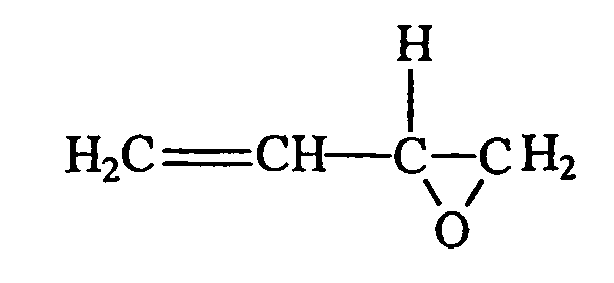

- Where the subscript k may be zero or a positive integer, more preferably a positive integer ranging generally from 0 to about 10. It should be noted that both exemplified structures are terminal in both the olefinic moiety and the oxirane (epoxide) moiety. A more general chemical structure is:
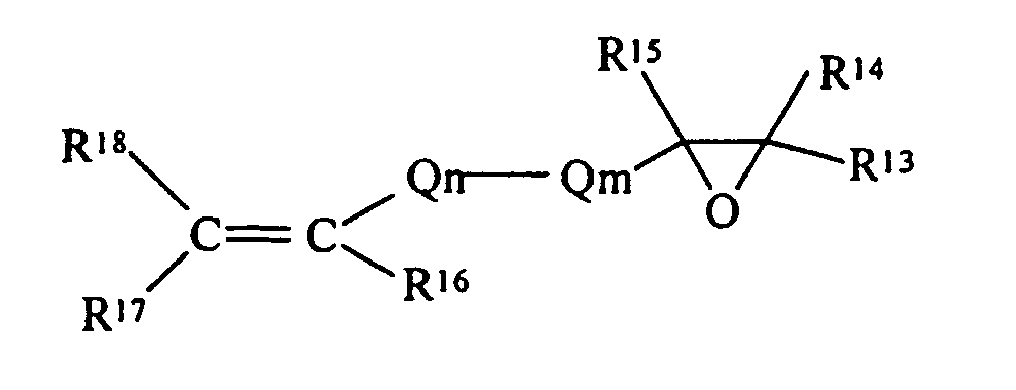
- Thus one possible synthetic pathway to prepare the reaction products of the present invention is as follows:
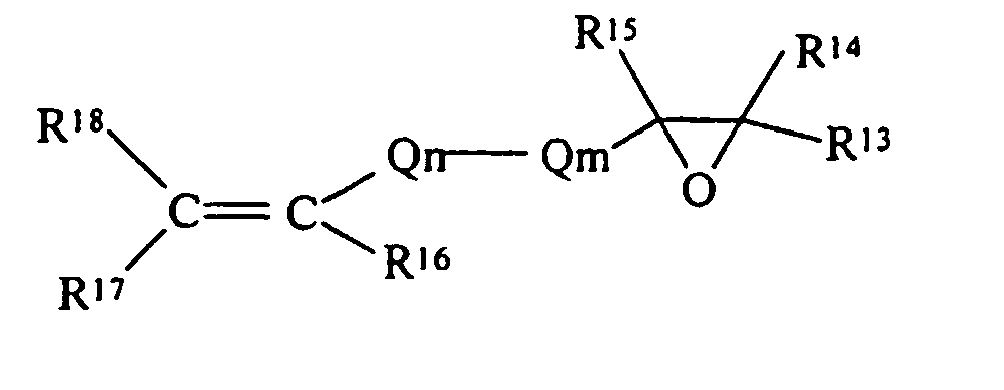

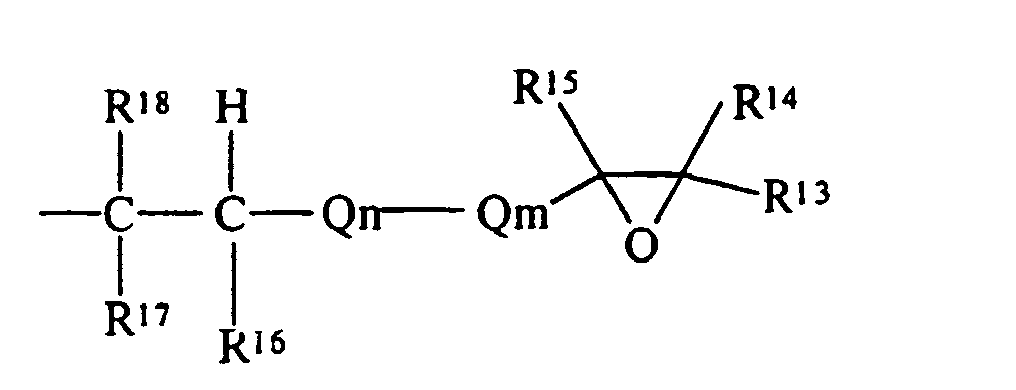
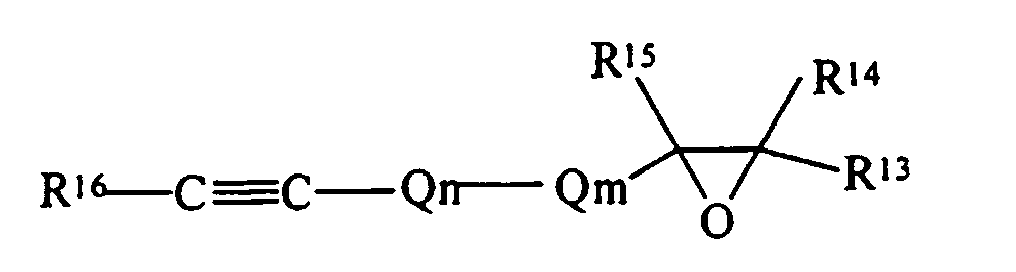
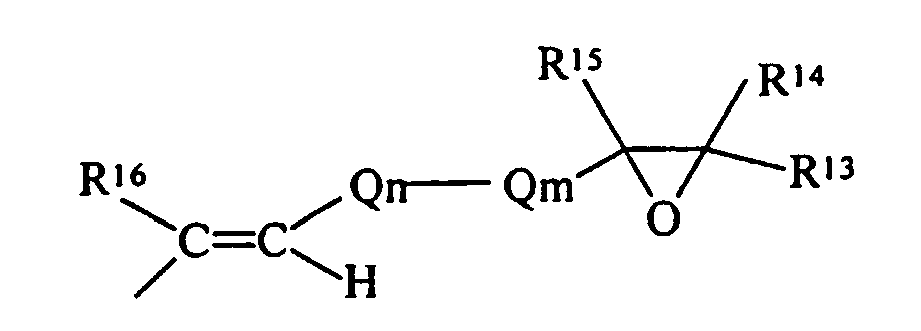
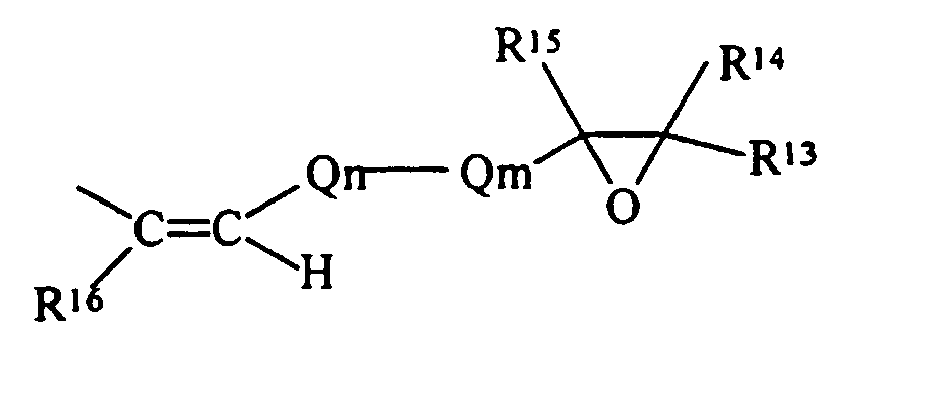
- The silyl hydride bearing precursor molecule, MaMH b'DdDH e'TgTH h'Qj, can be prepared by a variety of techniques known in the art. Epoxy substituted siloxanes are prepared in the normal manner through the use of a hydrosilylation reaction to attach a vinyl or allyl substituted epoxide onto an SiH bearing siloxane. SiH containing siloxanes are well known in the art and can be linear, branched, or cyclic in structure. Examples of useful vinyl or allyl substituted epoxides include 4-vinyl cyclohexene oxide, allyl glycidyl ether, limonene oxide, 1,2-epoxy-5-hexene,1,2-epoxy-7-octene, norbomadiene monoepoxide and 1,2-epoxy-9-decene. Precious metal catalysts suitable for making epoxy siloxanes are also well known in the art and comprise complexes of rhodium, ruthenium, palladium, osmium, iridium and /or platinum.
- Many types of platinum catalysts for this SiH olefin addition reaction (hydrosilation or hydrosilylation) are known and such platinum catalysts may be used for the reaction in the present instance. When optical clarity is required the preferred platinum catalysts are those platinum compound catalysts that are soluble in the reaction mixture. The platinum compound can be selected from those having the formula (PtCl2Olefin) and H(PtCl3Olefin) as described in U.S. patent number 3,159,601. A further platinum containing material usable in the compositions of the present invention is the cyclopropane complex of platinum chloride described in U.S. patent number 3,159,662. Further the platinum containing material can be a complex formed from chloroplatinic acid with up to 2 moles per gram of platinum of a member selected from the class consisting of alcohols, ethers, aldehydes and mixtures of the above as described in U.S. patent number 3,220,972. The catalysts preferred for use are described in U. S. Patents numbers 3,715,334; 3,775,452; and 3,814,730 to Karstedt. Additional background concerning the art may be found at J. L. Spier, "Homogeneous Catalysis of Hydrosilation by Transition Metals, in Advances in Organometallic Chemistry, volume 17, pages 407 through 447, F.G.A. Stone and R. West editors, published by the Academic Press (New York, 1979). Persons skilled in the art can easily determine an effective amount of platinum catalyst. Generally, an effective amount ranges from about 0.1 to 50 parts per million of the total organopolysiloxane composition.
- The reaction product of MaMH bME cDdDH eDE fTgTH hTE iQj produces a polymer network, believed to be a polyether siloxane copolymer network (or alternativeley a siloxane polyether copolymer network). As used herein, the terminology "network" means a three dimensionally extending structure comprising interconnected polyether siloxane copolymer chains. Preferably, fluid is contained within interstices of the network. The term "interstices" is used herein in reference to a network to denote spaces within the network, that is, spaces between the polyether siloxane copolymer chains of the network. As used herein in the context of the polyether siloxane copolymer network, the term polyether is intended to include the reaction product of two or more epoxide moieties to form one or more ether linkages that form a cross link between siloxane chains or moieties.
- In one preferred embodiment, the polyether siloxane copolymer network is a crosslinked network that is insoluble in the fluid component of the silicone composition of the present invention, but that is capable of being swollen by the fluid. The amount of crosslinking present in the crosslinked network may be characterized with respect to the degree of swelling exhibited by the network in the fluid. In another preferred embodiment, the crosslinked structure of the network is effective to allow the network to be swollen by a low molecular weight silicone fluid, such as, for example, decamethylcyclopentasiloxane, from its original volume to a swollen volume that is a factor of from 1.01 to 5000, more preferably from 2 to 1000, and even more preferably from 5 to 500, times its original volume. The original volume of the network can be determined, for example, by extracting or evaporating all of the fluid component from the silicone composition of the present invention to leave the original volume, that is, the volume of the polyether siloxane copolymer network in the absence of the fluid.
- As used herein the terminology "hydrocarbon radical" includes acyclic hydrocarbon radicals, alicyclic hydrocarbon radicals and aromatic hydrocarbon radicals.
- As used herein in reference to a hydrocarbon radical, the term "monovalent" means that the radical is capable of forming one covalent bond per radical, the term "divalent" means that the radical is capable of forming two covalent bonds per radical and the term "trivalent" means that the radical is capable of forming three covalent bonds per radical. Generally, a monovalent radical can be represented as having been derived from a saturated hydrocarbon compound by conceptual removal of one hydrogen atom from the compound, a divalent radical can be represented as having been derived from a saturated hydrocarbon compound by conceptual removal of two hydrogen atoms from the compound and a trivalent radical can be represented as having been derived from a saturated hydrocarbon compound by conceptual removal of three hydrogen atoms from the compound. For example, an ethyl radical, that is, a - CH2CH3 radical, is a monovalent radical; a dimethylene radical, that is, a - (CH2)2 - radical, is a divalent radical and an ethanetriyl radical, that is,
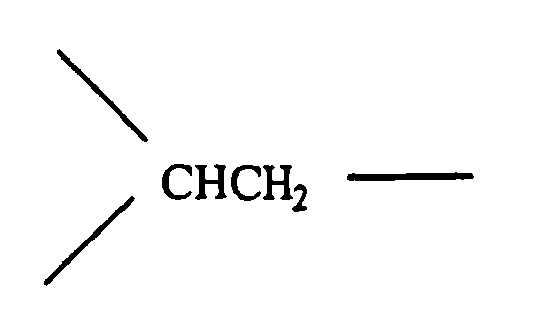
- As used herein, the terminology "acyclic hydrocarbon radical" means a straight chain or branched hydrocarbon radical, preferably containing from 1 to 60 carbon atoms per radical, which may be saturated or unsaturated and which may be optionally substituted or interrupted with one or more atoms or functional groups, such as, for example, carboxyl, cyano, hydroxy, halo and oxy. As long as these functional groups do not interfere with the cationic cure mechanism of the epoxide or oxirane moiety, suitable monovalent acyclic hydrocarbon radicals may include, for example, alkyl, alkenyl, alkynyl, hydroxyalkyl, cyanoalkyl, carboxyalkyl, alkyloxy, oxaalkyl, alkylcarbonyloxaalkylene, carboxamide and haloalkyl, such as, for example, methyl, ethyl, sec-butyl, tert-butyl, octyl, decyl, dodecyl, cetyl, stearyl, ethenyl, propenyl, butynyl, hydroxypropyl, cyanoethyl, butoxy, 2,5,8-trioxadecanyl, carboxymethyl, chloromethyl and 3,3,3-fluoropropyl. Suitable divalent acyclic hydrocarbon radicals include, for example, linear or branched alkylene radicals, such as, for example, methylene, dimethylene, trimethylene, decamethylene, ethylethylene, 2-methyltrimethylene, 2,2-dimethyltrimethylene and linear or branched oxalkylene radicals such as, for example, methyleneoxypropylene. Suitable trivalent acyclic hydrocarbon radicals include, for example, alkanetriyl radicals, such as, for example, 1,1,2-ethanetriyl, 1,2,4-butanetriyl, 1,2,8-octanetriyl, 1,2,4-cyclohexanetriyl and oxaalkanetriyl radicals such as, for example, 1,2,6-triyl-4-oxahexane.
- As used herein the term "alkyl" means a saturated straight or branched monovalent hydrocarbon radical. In a preferred embodiment, monovalent alkyl groups are selected from linear or branched alkyl groups containing from 1 to 60 carbons per group, such as, for example, methyl, ethyl, propyl, iso-propyl, n-butyl, iso-butyl, sec-butyl, tert-butyl, pentyl, hexyl, heptyl, decyl, dodecyl.
- As used herein the term "alkenyl" means a straight or branched monovalent terminally unsaturated hydrocarbon radical, preferably containing from 2 to 10 carbon atoms per radical, such as, for example, ethenyl, 2-propenyl, 3-butenyl, 5-hexenyl, 7-octenyl and ethenylphenyl.
- As used herein, the terminology "alicyclic hydrocarbon radical" means a radical containing one or more saturated hydrocarbon rings, preferably containing from 4 to 12 carbon atoms per ring, per radical which may optionally be substituted on one or more of the rings with one or more alkyl radicals, each preferably containing from 2 to 6 carbon atoms per alkyl radical, halo radicals or other functional groups and which, in the case of a monovalent alicyclic hydrocarbon radical containing two or more rings, may be fused rings. Suitable monovalent alicyclic hydrocarbon radicals include, for example, cyclohexyl and cyclooctyl. Suitable divalent hydrocarbon radicals include, saturated or unsaturated divalent monocyclic hydrocarbon radicals, such as, for example, 1,4-cyclohexylene. Suitable trivalent alicyclic hydrocarbon radicals include, for example, cycloalkanetriyl radicals such as, for example, 1-dimethylene-2, 4-cyclohexylene, 1-methylethylene-3-methyl-3,4-cyclohexylene.
- As used herein, the terminology "aromatic hydrocarbon radical" means a hydrocarbon radical containing one or more aromatic rings per radical, which may, optionally, be substituted on the aromatic rings with one or more alkyl radicals, each preferably containing from 2 to 6 carbon atoms per alkyl radical, halo radicals or other functional groups and which, in the case of a monovalent aromatic hydrocarbon radical containing two or more rings, may be fused rings. Suitable monovalent aromatic hydrocarbon radicals include, for example, phenyl, tolyl, 2,4,6-trimethylphenyl, 1,2-isopropylmethylphenyl, 1-pentalenyl, naphthyl, anthryl, eugenol and allylphenol as well as aralkyl radicals such as, for example, 2-phenylethyl. Suitable divalent aromatic hydrocarbon radicals include, for example, divalent monocyclic arenes such as, for example, 1,2-phenylene, 1,4-phenylene, 4-methyl-1,2-phenylene, phenylmethylene. Suitable trivalent aromatic hydrocarbon radicals include, for example, trivalent monocyclic arenes such as, for example, 1-trimethylene-3,5-phenylene.
- In a preferred embodiment, the epoxy functional organosiloxane compound is reacted by polymerizing the epoxy functional organosiloxane compound under cationic polymerization conditions and, preferably, in the presence of a fluid, preferably a volatile siloxane fluid. In one embodiment, the epoxy functional organosiloxane compound is polymerized in the presence of a fluid to directly form the silicone composition of the present invention. In another embodiment, the epoxy functional organosiloxane compound is polymerized in the presence of a first fluid or fluid mixture to form a polyether siloxane copolymer network, and then the network so formed is subsequently swollen with a second fluid or fluid mixture to form the silicone composition of the present invention. The second fluid or fluid mixture may be the same as or different from the first fluid mixture. The first solvent may, optionally, be removed from the polymerized network by, for example, evaporation, prior to addition of the second fluid. As a further alternative, the epoxy functional organosiloxane compound is polymerized in the absence of a fluid to form a polyether siloxane copolymer network and the network is subsequently swollen with a fluid or mixture of fluids to form the silicone composition of the present invention. In another embodiment, the polymerization of the epoxy functional organosiloxane is conducted with a sufficient amount of excess hydridosiloxane functionality such that there is residual hydride remaining after polymerization that may be subsequently reacted under conditions suitable for hydrosilylation with one or more alkenyl functional compounds. This is especially advantageous in cases where the alkenyl functional compounds can act as inhibitors of cationic cure. Such alkenyl compounds are those that contain a functionality that can act as an inhibitor of the cationic cure mechanism, e.g. a base. In another embodiment, a small amount of a concentrated hydridosiloxane or hydridosilane compound is added in order to increase the rate of polymerization.
- Cationic polymerization conditions can be generated by addition of an acid catalyst capable of polymerizing an epoxy group such as, for example, by addition of onium salt generated acids and certain metal salts, such as, for example, aluminum trichloride and ferric chloride, which act as Lewis acids or by addition of lanthanide triflates, see PCT Int. Appl. WO 0008,087. Acid catalyzed polymerization of epoxides is a well known method of forming organic polymers and has been applied to epoxy-functional siloxane compounds in order to form siloxane polyalkyleneoxide block copolymers for use in a variety of applications as, for example, release coatings on paper, see, for example, U.S. Patent No.4,279,717, and in conjunction with organic materials to form coatings and modified plastic compositions, see for example, U.S. Patent Nos. 5,354,796 and 5,663,752. One precautionary note must be observed, that is if the cationic polymerization is conducted in the presence of cyclic siloxanes, e.g. D3, D4 or D5 and the like, the strength of the acid catalysis employed must be such that cationic polymerization of the epoxide moiety occurs but polymerization of the cyclic siloxane does not occur to any appreciable extent.
- In a preferred embodiment, the epoxy functional organosiloxane compound is polymerized under cationic cure conditions generated through the interaction with platinum and an SiH-containing compound. This epoxide polymerization reaction route is described in U.S. Patent No. 5,128,431 and by J.V. Crivello and N. Fan, J. Polymer Sci., Part A: Polymer Chemistry, pp.1853-1863 (1997). In this embodiment, the reaction kinetics appear to be dependent upon the presence of trace quantities of molecular oxygen.
- The polyether siloxane copolymer network compositions of the present invention produce a cross linked structure that possesses a certain amount of steric hindrance by reason of the cross links. This steric hindrance tends to prevent the reaction from going to completion even at long reaction times and thus a certain amount of residual functionality may remain. This residual functionality provides the ability to incorporate other functionality into the polyether siloxane copolymer network by reaction with functionalized molecules that are not as sterically constrained as the polyether siloxane copolymer network or it must be chemically inactivated. One reason the residual functionality might desirably be chemically inactivated is that in the processing of these materials as a polyether siloxane copolymer network swollen with a low molecular weight siloxane compound (or alternatively, low molecular weight silicone fluid), usually D3, D4, D5, D6 or M'D'qT'sM' as later defined, is that processing under conditions of high shear tends to disrupt the network reducing the level of steric hindrance and thus could enable further cross linking reactions to occur because of the chemically exposed residual functionality. Post-cure cross linking is known to occur in addition polymerized silicones where the addition polymerization occurs via hydrosilylation. These materials are prepared by first hydrosilylation of a silyl hydride with an olefinic or acetylenic oxirane or epoxide compound. Thus a noble metal hydrosilylation catalyst will be present in the reaction mixture or within the interstices of the polyether siloxane copolymer network. This catalyst may be used to further polymerize the oxirane or epoxide moiety (moieties) incorporated in the reaction product producing the polyether siloxane copolymer network(s) of the present invention. The residual functionality remaining by design, i.e. by use of sub-stoichiometric quantities, or by reason of steric inhibition of reaction completion may be further reacted as taught herein or neutralized or inhibited. US patents 5,977,280 and 5,929,164 teach such neutralization of hydrosilylation catalysts by treatment with strong noble metal complexing ligands, for example phosphines, amines and organic sulfur compounds such as organic sulfides and thiols. However, some of these strongly complexing ligands, while deactivating a noble metal hydrosilylation catalyst are toxic and thus their use must be avoided in some applications, e.g. personal care applications. Thus sulfur containing amino acid esters are strong noble metal complexing ligands and methionine methyl ester, methionine ethyl ester, cysteine methyl ester, cysteine ethyl ester and cysteine dimethyl ester have been preferred for such noble metal deactivation. It should be noted that naturally occuring proteins containing disulfide linkages that are easily disrupted may also be used to deactivate the noble metal catalysts employed, e.g. egg yolks and the like. Sulfur containing amino acid amides, polypeptides and the like may also function similarly to deactivate noble metal hydrosilylation catalysts.
- The method of polymer synthesis provides for incorporation of a wide range of organofunctional groups into the copolymeric structure. Thus, the inclusion of other organofunctional groups, such as, for example, organic epoxides, epoxysiloxanes, terminally unsaturated organic and alkenylsiloxane compounds can be used to modify the resulting copolymers.
- In an alternative embodiment, the organofunctional groups are introduced to the network during polymerization of the epoxyfunctional organosiloxane by including organofunctional compounds to the reaction mixture which are copolymerizable with the epoxy functional organosiloxane under the chosen polymerization reaction conditions.
- In one embodiment, polymerization of the epoxy functional organosiloxane is conducted in the presence of one or more organic epoxide compounds which are copolymerizable with epoxy functional hydrido siloxanes under the polymerization conditions to form mixed polyalkyleneoxide units. The additional organic epoxide compounds may contain different substituents to further modify the resulting copolymer. Suitable organic epoxide compounds include, for example, ethylene oxide, propylene oxide, butylene oxide, cyclohexene oxide, glycidol and epoxide oils suchas for example epoxidized soybean oil.
- In another embodiment, the polymerization of the epoxy functional organosiloxane is conducted in the presence of one or more hydroxyl functional compounds which are copolymerizable with epoxy functional hydrido siloxanes under the polymerization conditions to modify the product copolymer. Suitable hydroxyl functional compounds include, for example, water, hydroxy-stopped polyethers, organic alcohols, including organic diols, carbinol functional siloxanes and hydroxy functional organopolysiloxane polymers, including polyethersiloxane copolymers.
- In another embodiment, the polymerization of the epoxy functional organosiloxane is conducted in the presence one or more alkenyl functional compounds which are copolymerizable with epoxy functional hydrido siloxanes under the polymerization conditions to modify the product copolymer. Suitable alkenyl functional compounds include alkenyl functional organic compounds, such as, for example, hexadiene, and alkenyl functional silicone compounds, such as for example, vinyl polydimethylsiloxanes. For example, an alkenyl-functional compound may conveniently be added via hydrosilylation in those embodiments in which the cationic reaction conditions for reacting the epoxide groups are generated using platinum and a hydrido-substituted siloxane, as described above.
- The silicone composition may be further processed under low to high shear to adjust the viscosity and sensory feel of the composition. This may be achieved, for example, by subjecting the composition to a moderate to high shearing force. High shear may be applied using, for example, a Sonolator apparatus, a Gaulin Homogenizer or a Micro Fluidizer apparatus. Optionally, one or more fluids may be added to the silicone composition prior to the shearing.
- In a preferred embodiment, the silicone composition of the present invention is a solid, typically having a creamy consistency, wherein the copolymer network acts as a means for gelling the fluid to reversibly impart characteristics of a solid to the fluid. At rest, the silicone composition exhibits the properties of a solid gel material. The silicone composition of the present invention exhibits high stability and resistance to syneresis, that is, the composition exhibits little or no tendency for fluid to flow from the composition and imparts high stability and syneresis resistance to personal care compositions which include the silicone composition as a component. The high stability and syneresis resistance persists with prolonged aging of such silicone compositions and personal care compositions. However, fluid may be released from the network by subjecting the silicone composition to a shearing force, such as, for example, by rubbing the composition between one's fingers, to provide improved sensory feel characteristic of the fluid component of the silicone material.
- Fluids suitable for use as the fluid component of the composition of the present invention are those compounds or mixtures of two or more compounds that are in the liquid state at or near room temperature, for example, from about 20°C about 50°C, and about one atmosphere pressure, and include, for example, silicone fluids, hydrocarbon fluids, esters, alcohols, fatty alcohols, glycols and organic oils. In a preferred embodiment, the fluid component of the composition of the present invention exhibits a viscosity of below about 1,000 cSt, preferably below about 500 cSt, more preferably below about 250 cSt, and most preferably below 100 cSt, at 25 °C.
- In a preferred embodiment, the fluid component of the present invention comprises an emollient compound. Suitable emollient compound include any fluid that provides emollient properties, that is, that when applied to skin, tend to remain on the surface of the skin or in the stratum corneum layer of the skin to act as lubricants, reduce flaking and to improve the appearance of the skin. Emollient compound are generically known and include, for example, hydrocarbons, such as for example, isododecane, isohexadecane and hydrogenated polyisobutene, organic waxes, such as for example, jojoba, silicone fluids, such as, for example, cyclopentasiloxane, dimethicone and bis-phenylpropyl dimethicone, esters, such as, for example, octyldodecyl neopentanoate and oleyl oleate, as well as fatty acids and alcohols, such as for example, oleyl alcohol and isomyristyl alcohol.
- In a highly preferred embodiment, the fluid component of the present invention comprises a silicone fluid, more preferably a silicone fluid that exhibits emollient properties, preferably a low molecular weight silicone fluid or alternatively a low molecular weight siloxane compound. Suitable silicone fluids include, for example, cyclic silicones of the formula Dr, wherein D, R8 and R9 are as previously defined, preferably with R8 and R9 chosen from the group consisting of monovalent one to six carbon atom monovalent hydrocarbon radicals, more preferably methyl, and r is an integer wherein 3 ≤ r ≤ 12, such as, for example, hexamethylcyclotrisiloxane ("D3"), octamethylcyclotetrasiloxane ("D4"), decamethylcyclopentasiloxane ("D5"), and dodecamethylcyclohexasiloxane ("D6") as well as linear or branched organopolysiloxanes having the formula:
M'D'qT'sM'
wherein: - M' is R19 3SiO1/2;
- D' is R20 2SiO2/2;
- T' is R21SiO3/2
- In a preferred embodiment, the silicone composition of the present invention comprises, per 100 parts by weight ("pbw") of the silicone composition, from 0.1 to 99 pbw, more preferably from 0.5 pbw to 30 pbw and still more preferably from 1 to 15 pbw of the polyether siloxane copolymer network and from 1 pbw to 99.9 pbw, more preferably from 70 pbw to 99.5 pbw, and still more preferably from 85 pbw to 99 pbw of the fluid.
- The polyether siloxane copolymer network compositions of the present invention may be utilized as prepared or as the silicone component in emulsions. As is generally known, emulsions comprise at least two immiscible phases one of which is continuous and the other which is discontinuous. Further emulsions may be liquids with varying viscosities or solids. Additionally the particle size of the emulsions may be render them microemulsions and when sufficiently small microemulsions may be transparent. Further it is also possible to prepare emulsions of emulsions and these are generally known as multiple emulsions. These emulsions may be:
- 1) aqueous emulsions where the discontinuous phase comprises water and the continuous phase comprises the polyether siloxane copolymer network of the present invention;
- 2) aqueous emulsions where the continuous phase comprises the polyether siloxane copolymer network of the present invention and the discontinuous phase comprises water;
- 3) non-aqueous emulsions where the discontinuous phase comprises a non-aqueous hydroxylic solvent and the continuous phase comprises the polyether siloxane copolymer network of the present invention; and
- 4) non-aqueous emulsions where the continuous phase comprises a non-aqueous hydroxylic organic solvent and the discontinuous phase comprises the polyether siloxane copolymer network of the present invention.
- Non-aqueous emulsions comprising a silicone phase are described in US patents 6,060,546 and 6,271,295.
- As used herein the term "non-aqueous hydroxylic organic compound" means hydroxyl containing organic compounds exemplified by alcohols, glycols, polyhydric alcohols and polymeric glycols and mixtures thereof that are liquid at room temperature, e.g. about 25 °C, and about one atmosphere pressure. The non-aqueous organic hydroxylic solvents are selected from the group consisting of hydroxyl containing organic compounds comprising alcohols, glycols, polyhydric alcohols and polymeric glycols and mixtures thereof that are liquid at room temperature, e.g. about 25 °C, and about one atmosphere pressure. Preferably the non-aqueous hydroxylic organic solvent is selected from the group consisting of ethylene glycol, ethanol, propyl alcohol, iso-propyl alcohol, propylene glycol, dipropylene glycol, tripropylene glycol, butylene glycol, iso-butylene glycol, methyl propane diol, glycerin, sorbitol, polyethylene glycol, polypropylene glycol mono alkyl ethers, polyoxyalkylene copolymers and mixtures thereof.
- Once the desired form is attained whether as a silicone only phase, an anhydrous mixture comprising the silicone phase, a hydrous mixture comprising the silicone phase, a water-in-oil emulsion, an oil-in-water emulsion, or either of the two non-aqueous emulsions or variations thereon, the resulting material is usually a high viscosity cream with good feel characteristics, and high absorbance of volatile siloxanes. It is capable of being blended into formulations for hair care, skin care, antiperspirants, sunscreens, cosmetics, color cosmetics, insect repellants, vitamin and hormone carriers, fragrance carriers and the like.
- The personal care applications where the polyether siloxane copolymer network of the present invention and the silicone compositions derived therefrom of the present invention may be employed include, but are not limited to, deodorants, antiperspirants, antiperspirant/ deodorants, shaving products, skin lotions, moisturizers, toners, bath products, cleansing products, hair care products such as shampoos, conditioners, mousses, styling gels, hair sprays, hair dyes, hair color products, hair bleaches, waving products, hair straighteners, manicure products such as nail polish, nail polish remover, nails creams and lotions, cuticle softeners, protective creams such as sunscreen, insect repellent and anti-aging products, color cosmetics such as lipsticks, foundations, face powders, eye liners, eye shadows, blushes, makeup, mascaras and other personal care formulations where silicone components have been conventionally added, as well as drug delivery systems for topical application of medicinal compositions that are to be applied to the skin.
- In a preferred embodiment, the personal care composition of the present invention further comprises one or more personal care ingredients. Suitable personal care ingredients include, for example, emollients, moisturizers, humectants, pigments, including pearlescent pigments such as, for example, bismuth oxychloride and titanium dioxide coated mica, colorants, fragrances, biocides, preservatives, antioxidants, anti-microbial agents, anti-fungal agents, antiperspirant agents, exfoliants, hormones, enzymes, medicinal compounds, vitamins, salts, electrolytes, alcohols, polyols, absorbing agents for ultraviolet radiation, botanical extracts, surfactants, silicone oils, organic oils, waxes, film formers, thickening agents such as, for example, fumed silica or hydrated silica, particulate fillers, such as for example, talc, kaolin, starch, modified starch, mica, nylon, clays, such as, for example, bentonite and organo-modified clays.
- Suitable personal care compositions are made by combining, in a manner known in the art, such as, for example, by mixing, one or more of the above components with the polyether siloxane copolymer network, preferably in the form of the silicone composition of the present invention. Suitable personal care compositions may be in the form of a single phase or in the form of an emulsion, including oil-in-water, water-in-oil and anhydrous emulsions where the silicone phase may be either the discontinuous phase or the continuous phase, as well as multiple emulsions, such as, for example, oil-in water-in-oil emulsions and water-in-oil-in water-emulsions.
- In one useful embodiment, an antiperspirant composition comprises the polyether siloxane copolymer network of the present invention and one or more active antiperspirant agents. Suitable antiperspirant agents include, for example, the Category I active antiperspirant ingredients listed in the U.S. Food and Drug Administration's October 10, 1993 Monograph on antiperspirant drug products for over-the-counter human use, such as, for example, aluminum halides, aluminum hydroxyhalides, for example, aluminum chlorohydrate, and complexes or mixtures thereof with zirconyl oxyhalides and zirconyl hydroxyhalides, such as for example, aluminum-zirconium chlorohydrate, aluminum zirconium glycine complexes, such as, for example, aluminum zirconium tetrachlorohydrex gly.
- In another useful embodiment, a skin care composition comprises the polyether siloxane copolymer network, preferably in the form of silicone composition of the present invention, and a vehicle, such as, for example, a silicone oil or an organic oil. The skin care composition may, optionally, further include emollients, such as, for example, triglyceride esters, wax esters, alkyl or alkenyl esters of fatty acids or polyhydric alcohol esters and one or more the known components conventionally used in skin care compositions, such as, for example, pigments, vitamins, such as, for example, Vitamin A, Vitamin C and Vitamin E, sunscreen or sunblock compounds, such as, for example, titanium dioxide, zinc oxide, oxybenzone, octylmethoxy cinnamate, butylmethoxy dibenzoylm ethane, p-aminobenzoic acid and octyl dimethyl-p-aminobenzoic acid.
- In another useful embodiment, a color cosmetic composition, such as, for example, a lipstick, a makeup or a mascara composition comprises the polyether siloxane copolymer network, preferably in the form of silicone composition of the present invention, and a coloring agent, such as a pigment, a water soluble dye or a liposoluble dye.
- In another useful embodiment, the compositions of the present invention are utilized in conjunction with fragrant materials. These fragrant materials may be fragrant compounds, encapsulated fragrant compounds, or fragrance releasing compounds that either the neat compounds or are encapsulated. Particularly compatible with the compositions of the present invention are the fragrance releasing silicon containing compounds as disclosed in US patents 6,046,156; 6,054,547; 6,075,111; 6,077,923; 6,083,901; and 6,153,578.
- Preparation Example 1. 494.5 g of a hydride fluid with approximate composition MHD300 DH 4MH was mixed with 5.5 g of vinyl cyclohexene oxide, 1500 g of decamethyl cyclopentasiloxane (D5), and 0.1 g of a platinum divinyltetramethyldisiloxane catalyst solution. The result was heated to 80 °C. After a couple of hours, an additional portion of platinum catalyst solution was added. The material was heated for a total of 4 hours at 80 °C. In this way a gel material ExpMJO-07-391 was obtained with a solids content of about 26%. 567 g of ExpMJO-07-391 was then mixed with 1433 g of additional D5. Then the result was passed twice through a Gaulin homogenizer at 31026 KPa (4500 psi). The result, ExpMJO-07-401 had a solids content of about 7.3% and a viscosity of 24,200 cps. This material gave a very silky feel when rubbed on the skin.
- Preparation Example 2. 300 g of a hydride fluid with approximate composition MHD337DH 11.8MH was mixed with 3.94 g of vinyl cyclohexene oxide, 37 g of Gulftene C30+ Alpha Olefin Fraction from Chevron (herein defined when a substituent as C30+), 1022.8 g of decamethyl cyclopentasiloxane (D5), and 0.1 g of a platinum divinyltetramethyldisiloxane catalyst solution. The result was heated to 80 °C for 8 hours producing ExpMJO-07-433. This material had a solids content of about 25.5%. 587.5 g of ExpMJO-07-433 was then swollen with 1412.5 g of additional D5 and then passed through a Gaulin homogenizer at 31026 KPa (4500 psi). The result, ExpMJO-07-434, had a solids content of about 7.4% and a viscosity of 45,000 cps. It also gave a silky feel when rubbed on the skin.
- Preparation Example 3. 300 g of a hydride fluid with approximate composition MH 1.73D388 DH 6.9M0.27 was mixed with 3.00 g of vinyl cyclohexene oxide, 9 g of Gulftene C30+ Alpha Olefin Fraction from Chevron, 936 g of decamethyl cyclopentasiloxane (D5), and 0.1 g of a platinum divinyltetramethyldisiloxane catalyst solution. The result was heated to 80 °C for 8 hours producing ExpMJO-07-422. This material had a solids content of about 25.7%. 591.4 g of ExpMJO-07-422 was then swollen with 1408.6 g of additional D5 and then passed through a Gaulin homogenizer a 31026 KPa (4500 psi). The result, ExpMJO-07-437, had a solids content of about 7.26% and a viscosity of 39,000 cps.
- Preparation Example 4. 300 g of a hydride fluid with approximate composition MH 1.73D388 DH 6.9M0.27 was mixed with 3.00 g of vinyl cyclohexene oxide, 3 g of a C-16/18 Alpha Olefin Fraction, 918 g of decamethyl cyclopentasiloxane (D5), and 0.1 g of a platinum divinyltetramethyldisiloxane catalyst solution. The result was heated to 80 °C for 8 hours producing ExpMJO-07-424. This material had a solids content of about 25.7%. 591.4 g of ExpMJO-07-424 was then swollen with 1408.6 g of additional D5 and then passed through a Gaulin homogenizer at 31026 KPa (4500 psi). The result, ExpMJO-07-438, had a solids content of about 7.57% and a viscosity of 39,500 cps.
- Preparation Example 5. 300 g of a hydride fluid with approximate composition MHD337 DH 11.8MH was mixed with 4.89 g of vinyl cyclohexene oxide, 26.4 g of Gulftene C30+ Alpha Olefin Fraction from Chevron, 733 g of decamethyl cyclopentasiloxane (D5), and 0.08 g of a platinum divinyltetramethyldisiloxane catalyst solution. The result was heated to 80 °C for 6 hours producing ExpMJO-07-464. This material had a solids content of about 30.84 %. 533 g of ExpMJO-07-464 was then swollen with 967 g of additional D5 and then passed through a Gaulin homogenizer at 31026 KPa (4500 psi). The result, ExpNUO-07-465, had a solids content of about 11% and a viscosity of 200,000 cps.
- Preparation Example 6. 300 g of a hydride fluid with approximate composition MD100 DH 10.5M was mixed with 13.53 g of vinyl cyclohexene oxide, 34.84 g of Gulftene C30+ Alpha Olefin Fraction from Chevron, 647 g of decamethyl cyclopentasiloxane (D5), and 0.10 g of a platinum divinyltetramethyldisiloxane catalyst solution. The result was heated to 80°C for 6 hours producing ExpMJO-07-477. This material had a solids content of about 35.25%. 533 g of ExpMJO-07-464 was then swollen with 947 g of additional D5 and then passed through a Gaulin homogenizer at 31026 KPa (4500 psi). The result, ExpMJO-07-482, had a solids content of about 12.69% and a viscosity of 16,500 cps.
- Preparation Example 7. 316.4 g of a hydride fluid with approximate composition MHD200 DH 10.5MH was mixed with 7.56 g of vinyl cyclohexene oxide 7.00g of 4-allyl-2-methoxy-phenol, 840 g of decamethyl cyclopentasiloxane (D5), and 0.09 g of a platinum divinyltetramethyldisiloxane catalyst solution. The result was heated to 80 °C for 6 hours producing ExpMJO-08-537. 418 g of ExpMJO-08-537 was then swollen with 582 g of additional D5 and then passed through a Gaulin homogenizer at 55158 KPa (8000 psi). The result, ExpMJO-08-540, had a solids content of about 12% and a viscosity of 198,000 cps.
- Preparation Example 8. Example Showing Gelation Followed by Hydrosilyation. 300 g of a hydride fluid with approximate composition MHD337 DH 11.8MH was mixed with 3.94 g of vinyl cyclohexene oxide, 905.4 g of decamethyl cyclopentasiloxane (D5), and 0.1 g of a platinum divinyltetramethyl disiloxane catalyst solution. The result was heated to 80 °C for 4 hours with good mixing. A small sample of the gelled reaction mixture was taken out and analyzed by FTTR. This clearly showed that there was residual SiH remaining. Next, a mixture of 30 g of the di isostearic acid ester of trimethylolpropane monoallyl ether, 100g of D5 and 1 drop of Pt catalyst was added. The result was heated for another 2 hours at 80 °C. At this end of this time a gel was obtained (Gel E) which had a solids content of 25.1 %. FTIR analysis showed that the size of the SiH stretch (ca. 2140 cm-1) had substantially decreased.
- Preparation Example 9. Example Showing Addition of a Concentrated Hydridosiloxane. 300 g of a hydride fluid with approximate composition MH 1.73D388 DH 6.9M0.27 was mixed with 3.00 g of vinyl cyclohexene oxide, 4.00 g of 4-allyl-2-methoxy-phenol, 20.8 g of Gulftene C30+ Alpha Olefin Fraction from Chevron, 984 g of decamethyl cyclopentasiloxane (D5), and 0.1 g of a platinum divinyltetramethyl disiloxane catalyst solution. The result was heated to 80°C for an hour with good mixing. At this point, a mixture of 4 g of a trimethylsilyl stopped methyl hydrogen polsiloxane and 5 g decamethyl cyclopentasiloxane was added. With 3 minutes, the reaction mixture gelled. Heating was continued for 5 hours in order to ensure complete reaction.
- Preparation Example 10 300 g of a hydride fluid with approximate composition MHD200 DH 10.5MH was mixed with 7.22 g of vinyl cyclohexene oxide, 34.1 g of Gulftene C30+ Alpha Olefin Fraction from Chevron, 796 g of decamethyl cyclopentasiloxane (D5), and 0.085 g of a platinum divinyltetramethyldisiloxane catalyst solution. The result was heated to 80 °C for 6 hours producing ExpMJO-07-481. 562 g of ExpMJO-07-481 was then swollen with a mixture of 938 g of additional D5 and 1.0 g of a 10% solution of methyl di(hydrogenated tallow)amine in Isopar C and then passed through a Gaulin homogenizer at 31026 KPa (4500 psi). The result, ExpMJO-07-484, had a solids content of about 11.58% and a viscosity of 85,000 cps.
-
Composition wt% wt% A(Control) B(Ex1) Stearyl alcohol 15 15 Hydrogenated castor oil 5 5 Isododecane 10 10 SF1202 45 35 Talc 1 1 Al Zr Trichlorohydrex Gly 24 24 ExpMJO-07-465 0 10 - These antiperspirant sticks were made by heating stearyl alcohol, hydrogenated castor oil, isododecane, SF1202 and ExpMJO-07-465 until the gellants were melted. Al Zr Trichlorohydrex gly was added to the batch at 70°C and mixed until uniform. Antiperspirants were poured to containers at about 60°C. The antiperspirant was evaluated for whiteness, ability to hold liquid, feel, and hardness of the stick. The whiteness was determined by applying antiperspirant onto dark color vinyl slides to mimic the consumer application methods. Vinyl test slides were air dried for 15 min and the whiteness was determined by appearance. The control antiperspirants showed intense whiteness within 5-10 min after application. The antiperspirant B showed whiteness reduction as compared to control. Antiperspirant B also demonstrated a superior ability to hold cosmetic fluid when using thumb pressure was applied to the sticks. It also improved the rigidity and resiliency of the stick in this formulation. In addition, it provided lubricious skin feel with powdery finish. Formulation B also modified the crystallization of organic gelling agents by providing a better and more uniform matrix and reducing the growth of stearyl alcohol crystallization matrix.
-
Composition A B(Ex2) Part A wt% wt% Propylene glycol 42.2 42.2 Hydroxypropyl cellulose 0.5 0.5 DBS 2 2 Part B 30% A1 Zr Pentachlorohydrex gly in propylene glycol 30 30 Part C SF1202 10 0 ExpMJO-07-465 0 10 SF1555 15 15 40% Dimethicone 0.3 0.3 copolyol in D5 - These dear antiperspirant sticks were prepared by heating propylene glycol to 80°C and slowly sprinkling in hydroxypropyl cellulose(HPC). After the HPC was uniformly dispersed, the mixture was heated up to 130°C and DBS was added to the batch. The glycol mixture was cooled down to 100°C when a solution of the antiperspirant active was added. The silicone phase or part C was separately mixed and heated to 80°C and then the glycol phase was slowly introduced to the silicone phase.
- The clear antiperspirant B in this invention showed no syneresis and increased stiffness of the stick compared to control. It gave good pay-out and smooth uniform deposition of antiperspirant active on the skin when compared to control.
-
Ingredients A B(Ex3) C D(Ex4) Part A Wt% Wt% Wt% Wt% SF1202 21.65 11.65 19.2 9.9 Isododecane 8.7 8.7 Caprylic/capric Triglyceride 3.6 3.6 Dimethicone 9.3 9.3 Phenyl trimethicone 9.3 9.3 Sorbitan oleate 1.5 1.5 1.4 1.4 40% Dimethicone copolyol in D5 3.75 3.75 3.5 3.5 ExpMJO-07-465 10 ExpMJO-07-434 9.3 Part B Iron oxides(red, yellow, black) 2.34 2.34 2.18 2.18 TiO2 8.73 8.73 8.11 8.11 10% Dimethicone copolyol in D5 6.63 6.63 6.15 6.15 Part C Deionized water 37.75 37.75 34.98 34.98 Butylene glycol 5 5 4.65 4.65 Xanthan gum 0.1 0.1 0.1 0.1 C11-15 Pareth-7 0.25 0.25 0.23 0.23 Magnesium sulfate 0.9 0.9 Parameter Foundatio Foundation Foundatio Foundation n A B(Ex3) n C D(Ex4) Degree of coverage1 - Excellent - Excellent Gloss 3.2 3.2 17.2 11.6 Appearance after 5 cycles of wash off 2 NA NA Washed away Partially washed away, the remaining foundation showed powdery finish. Note: 1 = Degree of coverage was conducted against the control. Formulation A was the control of formulation B and formulation C was the control of formulation D.
2 = Formulation C and D was tested for appearance of foundation coated on vinyl slides after 5 cycles of wash off. The wash off resistance method was described in ASTM D1913. - The foundations were prepared by mixing part A and part B together at room temperature until uniform. The emulsion was developed when the water phase (Part C) was added into the oil phase. The foundation samples were evaluated for coverage on vinyl slides at 24 micron in thickness. All foundations were evaluated on ease of spreadability during draw down, appearance, degree of coverage and shine. Shine was determined by using gloss meter after 12 hours. In this study formulation B was evaluated against formulation A(control) and formulation D was evaluated against formulation C(control).
- Formulation B gave superior uniform coverage by reducing the appearance of lines and imperfections on the vinyl slides, and by reducing shine during initial rub-out. However, both formulation A and B did not show the difference in gloss after 12 hours. Formulation B imparted a luxurious silky feel with a powdery finish appearance. The foundation B in this invention had improved stability after one week at room temperature compared to the formulation A(control) which showed syneresis at the same time.
- Formulation D gave the similar benefits as described in formulation B. In addition, it also provided wash off resistance which made personal care products more durable to perspiration or during swimming. Formulation D had an ability to control shine as shown in the result above.
- These two examples were prepared to illustrate organic compatibility of silicone gel in this invention and compared it with the current elastomer gel with an INCI name of cyclopentasiloxane (and) dimethicone/vinyl dimethicone crosspolymer (SFE839).
-
Composition Appearance 25% Petrolatum in SFE839 fluid 25% Petrolatum in ExpMJO-07-465 gel - When petrolatum was mixed with SFE839, the formulation lost the structure and became an opaque fluid mixture. This suggested the incompatibility of petrolatum and SFE839. On the other hand, when petrolatum was incorporated into the gel of this invention, the gel had an ability to maintain product integrity, indicating the compatibility of this gel and petrolatum.
-
Composition Appearance 50% Cetearyl methicone in SFE839 Incompatible 50% Cetearyl methicone in ExpMJO-07-465 Compatible - Cetearyl methicone is a linear alkyl substituted silicone and it provides moisturization to the formulation by creating an occlusive barrier on the skin. When this silicone moisturizer was combined with the new gel, it showed good compatibility whereas the SFE839 did not. In addition, the gel according to this invention is easier to blend with cosmetic ingredients in that it does not require the high shear mixer or lengthy mixing time required by SFE839.
- This skin treatment gel was prepared by combining all ingredients listed below until uniform at room temperature. The gel was used as delivery system for skin treatment and it is suitable for both heat sensitive and non-heat sensitive active ingredients since it does not require heating during manufacturing. The absence of water in this formulation ensures the efficacy of vitamin C until used.
Composition wt% Polymethylsilsesquioxane(Tospear12000B) 0.5 Vitamin C 1 Hydrogenated polydecene 10 ExpMJO-07-434 88.5 - A lip treatment comprising ingredients below is useful for contouring, durability and moisturization feel.
Composition wt% ExpMJO-07-465 89 Phenylpropyldimethylsiloxysilicate 10 Nylon-12 1 - Silky body lotion is made by combining part A together and heating to 80°C. In a separate vessel, part B is mixed and heated to 75°C. The emulsion is formed when part A and part B are added together under high shear mixing. This lotion provides light and lubricious skin feel.
Composition Part A wt% ExpMJO-07-465 10 Caprylic/capric triglyceride 5 C30-45 Alkyl Dimethicone 5 Glyceryl stearate(and) PEG-100 stearate 4 Part B Water q.s. Xanthan gum 0.1 Glycerin 2 Preservatives, color, fragrance 1 - Water resistant lotions useful for various personal care products were prepared by combining part A and part B together at room temperature. The lotions were then applied on glass slides and tested for degree of water resistance using the method described in ASTM D1913. The degree of wash off resistance is the numbers of wash off cycles taken before the lotion was completely washed away. The body lotion B-E with the new gel in this invention showed water resistant benefit as shown below.
Composition A B C D E Cosmetic Examples Control 10 11 12 13 Part A wt% wt% wt% wt% wt% Sorbitan oleate 0.6 0.6 0.6 0.6 0.6 10% Dimthicone copolyol in D5 10 10 10 10 10 SF1202 16 4 4 4 4 ExpMJO-07-401 0 12 0 0 0 ExpMJO-07-437 0 0 12 0 0 ExpMJO-07-434 0 0 0 12 0 ExpMJO-07-438 0 0 0 0 12 Part B Glycerin 1 1 1 1 1 Sodium chloride 1 1 1 1 1 Quatemium-15 0.1 0.1 0.1 0.1 0.1 Water q.s. q.s. q.s. q.s. q,s, Wash off resistant result Formulation Cycles of wash off A(control) 5 B 15 C 15 D 15 E 10 - Hair shampoo comprising ingredients below gives a silky feel to hair fibers. This shampoo can be prepared into 2 ways; one is directly add silicone gel to the shampoo, and the other is pre-blend silicone gel with at least one surfactant and water until emulsion developed and add silicone gel emulsion to the shampoo.
This shampoo is made by mixing ingredients as ordered.Compositions wt% Ammonium lauryl sulfate 35 Cocamidopropyl betaine 5 Water 56.6 Preservative 0.01 Acrylate/C10-30 alkyl acrylate crosspolymer 0.8 Sodium hydroxide adjust to pH 7.5 ExpMJO-07-465 2.5 Citric acid adjust to pH 6 - This hair conditioner for daily use provides softness, lubricity and body.
Composition wt% Deionized water 93 Hydroxyethylcellulose 1.5 Silicone gel emulsion 2 Cetrimonium chloride 3 Preservatives, color, fragrance q.s. - The leave on hair conditioner reduces fly-away and increases body and volume.
Composition wt% ExpMJO-07-465 50 Dimethicone copolyol 5 Isododecane 45 - This soft solid antiperspirant contains silicone gel an anti-syneresis, thickening and sensory enhancer. The gel shows excellent organic compatibility. It is used in combination with an organic thickener to achieve the desired texture and rigidity.
Ingredient Part/Wt (%) Cyclopentasiloxane (SF1202) 37.0 Dimethicone (SF96-10) 8.0 C12-15 Alkyl Benzoate 8.0 Hydrogenated Castor Oil (mp 70°C) 7.0 C18-36 Acid Triglyceride 7.0 ExpMJO-07-484 5.0 Talc 3.Q Aluminum Zirconium Tetrachlorohydrex 25.0 Gly - This silicone lipstick contains silicone gel to soften lips. There are two silicones, SF1528, and Exp-MJO-07-484, which give a unique soft silky feel. Sunscreens could be added to the formulations for solar protection.
Ingredient Part/Wt (%) Cyclopentasiloxane (and) PEG/PPG-20/15 Dimethicone (SF1528) 20.0 ExpMJO-07-484 40.0 C18-36 Acid Triglyceride 5.0 Ozokerite 3.0 Polyethylene 5.0 Isododecane 20.0 D&C Red No.7 Ca Lake 7.0 - Materials listed as SFxxxx are commercially available silicone materials available from GE Silicones, 260 Hudson River Road, Waterford NY 12188.
- These examples are to be construed as exemplary in nature only and are not intended in any way to limit the appended claims. It is contemplated that a person having ordinary skill in the art would be able to produce obvious variations of the subject matter and disclosures herein contained that would be by reason of such ordinary skill within the literal or equitable scope of the appended claims.
q and s are each independently integers from 0 to 300, preferably from 0 to 100, more preferably from 0 to 50, and most preferably from 0 to 20.
Claims (12)
- A cosmetic composition comprising the reaction product of:
MaMH bME cDdDH eDE f TgTH hTE iQj
where
M = R1R2R3SiO1/2;
MH = R4R5H SiO1/2;
ME = R6R7RESiO1/2;
D = R8R9SiO2/2;
DH = R10HSiO2/2;
DE = R11RESiO2/2;
T = R12SiO3/2;
TH= HSiO3/2;
TE = RESiO3/2; and
Q = SiO4/2;
where R1, R2, R3, R8, R9 and R12 are independently monovalent hydrocarbon radicals having from one to sixty carbon atoms; R4, R5 and R10 are independently monovalent hydrocarbon radicals having from one to sixty carbon atoms or hydrogen; R6, R7, R11 are independently monovalent hydrocarbon radicals having from one to sixty carbon atoms or RE; each RE is independently a monovalent hydrocarbon radical containing one or more oxirane moieties having from one to sixty carbon atoms; the stoichiometric subscripts a, b, c, d, e, f, g, h, i, and j are either zero or positive subject to the following limitations: a + b + c > 1; b + e + h > 1; c + f + i > 1; b + e + h > c + f + i. - A cosmetic composition comprising an aqueous emulsion where the discontinuous phase comprises water and the continuous phase comprises a composition according to claim 1.
- A cosmetic composition comprising an aqueous emulsion where the continuous phase comprises water and the discontinuous phase comprises a composition according to claim 1.
- A cosmetic composition comprising a non-aqueous emulsion where the discontinuous phase comprises a non-aqueous hydroxylic solvent and the continuous phase comprises a composition according to claim 1.
- A cosmetic composition comprising a non-aqueous emulsion where the continuous phase comprises a non-aqueous hydroxylic solvent and the discontinuous phase comprises a composition according to claim 1.
- The composition of any one of claims 1 to 5 where RE has the formula:
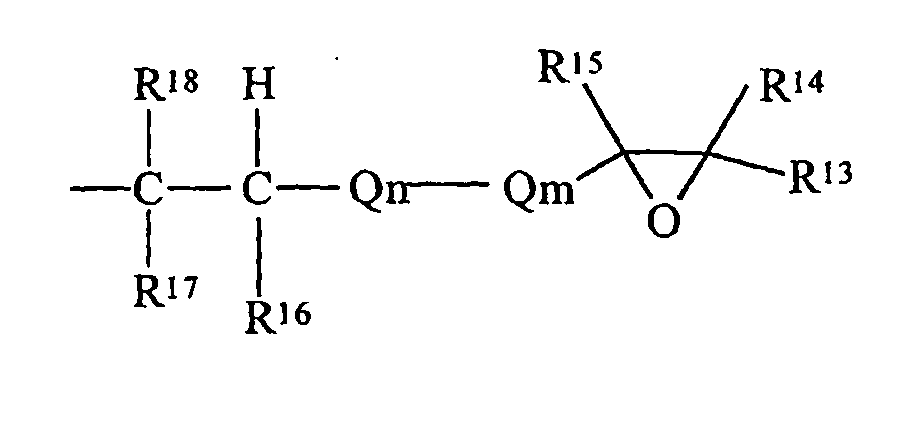
- The composition of any one of claims 1 to 5 where RE is selected from the group consisting of 4-vinyl cyclohexene oxide, allyl glycidyl ether, limonene oxide, 1,2-epoxy-5-hexene, 1,2-epoxy-7-octene, norbornadiene monoepoxide and 1,2-epoxy-9-decene.
- The composition of claim 6 where R13, R14, R15, R16, R17 and R18 are hydrogen and m and n are zero.
- The composition of claim 7 where RE is 4-vinyl cyclohexene oxide.
- The composition of any one of claims 1 to 5 where R1, R2, R3, R8, R9 and R12 are independently selected from the group consisting of methyl, ethyl, sec-butyl, tert-butyl, octyl, decyl, dodecyl, cetyl, stearyl, ethenyl, propenyl, butynyl, hydroxypropyl, butoxy, 2,5,8-trioxadecanyl, carboxymethyl, chloromethyl, C30+ and 3,3,3-fluoropropyl.
- The composition of any one of claims 2 to 9 where R1, R2, R3, R8, R9 and R12 are independently selected from the group consisting of methyl, ethyl, sec-butyl, tert-butyl, octyl, decyl, dodecyl, cetyl, stearyl, ethenyl, propenyl, butynyl, hydroxypropyl, cyanoethyl, butoxy, 2,5,8-trioxadecanyl, carboxymethyl, chloromethyl and 3,3,3-fluoropropyl.
- The cosmetic composition of any one claims 1 to 5 wherein the cosmetic composition is selected from the group consisting of deodorants, antiperspirants, combination antiperspirant deodorants, shaving products, skin lotions, moisturizers, toners, bath products, cleansing products, hair care products, shampoos, conditioners, mousses, styling gels, hair sprays, hair dyes, hair coloring products, hair bleaches, hair waving products, hair straighteners, manicure products nail polish, nail polish remover, nail creams, nail lotions, cuticle softeners, protective creams, sunscreen, insect repellent, anti-aging products, color cosmetics, lipsticks, foundations, face powders, eye liners, eye shadows, blushes, makeup, mascaras, personal care formulations where silicone components have been conventionally added, and drug delivery systems for topical application of medicinal compositions that are to be applied to the skin.
Applications Claiming Priority (3)
| Application Number | Priority Date | Filing Date | Title |
|---|---|---|---|
| US09/858,795 US6538061B2 (en) | 2001-05-16 | 2001-05-16 | Cosmetic compositions using polyether siloxane copolymer network compositions |
| US858795 | 2001-05-16 | ||
| PCT/US2001/045475 WO2002092048A2 (en) | 2001-05-16 | 2001-10-31 | Cosmetic compositions using polyether siloxane copolymer network compositions |
Publications (2)
| Publication Number | Publication Date |
|---|---|
| EP1450758A2 EP1450758A2 (en) | 2004-09-01 |
| EP1450758B1 true EP1450758B1 (en) | 2006-10-25 |
Family
ID=25329205
Family Applications (1)
| Application Number | Title | Priority Date | Filing Date |
|---|---|---|---|
| EP01989830A Expired - Lifetime EP1450758B1 (en) | 2001-05-16 | 2001-10-31 | Cosmetic compositions using polyether siloxane copolymer network compositions |
Country Status (7)
| Country | Link |
|---|---|
| US (4) | US6538061B2 (en) |
| EP (1) | EP1450758B1 (en) |
| JP (1) | JP4647190B2 (en) |
| KR (1) | KR100870787B1 (en) |
| CN (1) | CN100558337C (en) |
| DE (1) | DE60124152T2 (en) |
| WO (1) | WO2002092048A2 (en) |
Cited By (1)
| Publication number | Priority date | Publication date | Assignee | Title |
|---|---|---|---|---|
| DE102007030642A1 (en) * | 2007-07-02 | 2009-01-08 | Momentive Performance Materials Gmbh | Process for the preparation of polyorganosiloxanes having (C6-C60) -alkylmethylsiloxy groups and dimethylsiloxy groups |
Families Citing this family (100)
| Publication number | Priority date | Publication date | Assignee | Title |
|---|---|---|---|---|
| US20030203978A1 (en) * | 2001-05-16 | 2003-10-30 | O'brien Michael Joseph | Cosmetic compositions comprising silicone gels comprising entrapped, occluded or encapsulated pigments |
| US7388049B2 (en) * | 2001-05-16 | 2008-06-17 | Momentive Performance Materials Inc. | Polyether siloxane copolymer network compositions |
| US7241835B2 (en) * | 2001-05-16 | 2007-07-10 | General Electric Company | Cosmetic compositions comprising silicone gels |
| US7411007B2 (en) * | 2001-05-16 | 2008-08-12 | O'brien Michael Joseph | Cosmetic compositions using polyether siloxane copolymer network compositions |
| GB0125778D0 (en) | 2001-10-26 | 2001-12-19 | Procter & Gamble | Silicone elastomer emulsion cosmetic composition comprising colorant inclusive internal phase |
| US20030190336A1 (en) * | 2002-03-18 | 2003-10-09 | Adams Christine Helga | Personal care compositions comprising solid particles enterapped in a gel network |
| US8435942B2 (en) * | 2002-05-31 | 2013-05-07 | Transdermal Biotechnology, Inc. | Methods for formulating stabilized insulin compositions |
| US20040018237A1 (en) * | 2002-05-31 | 2004-01-29 | Perricone Nicholas V. | Topical drug delivery using phosphatidylcholine |
| DE10234262A1 (en) * | 2002-07-27 | 2004-02-19 | Beiersdorf Ag | Hair shampoo for fine and oily hair |
| CN100354340C (en) * | 2002-10-11 | 2007-12-12 | 通用电气公司 | Polyether silioxane network composition |
| US20040228821A1 (en) * | 2003-05-16 | 2004-11-18 | The Procter & Gamble Company | Personal care products comprising active agents in a gel network |
| US7837742B2 (en) * | 2003-05-19 | 2010-11-23 | The Procter & Gamble Company | Cosmetic compositions comprising a polymer and a colorant |
| US20050142079A1 (en) * | 2003-12-26 | 2005-06-30 | Garrison Mark S. | Oil in silicone emulsion and compositions containing same |
| DE102004018017A1 (en) * | 2004-04-14 | 2005-11-10 | Wella Aktiengesellschaft | Cosmetic composition for hair care |
| US20050249689A1 (en) * | 2004-05-10 | 2005-11-10 | An-Li Kuo | Personal care compositions with enhanced properties, method of manufacture, and method of use thereof |
| US7611726B2 (en) * | 2004-07-15 | 2009-11-03 | L'oréal | Shine-enhancing film formers |
| US20060134035A1 (en) * | 2004-12-22 | 2006-06-22 | Avon Products, Inc. | Long wear topical composition having improved glossy appearance |
| JP4987488B2 (en) * | 2005-01-24 | 2012-07-25 | 株式会社コスメテクノ | Method for selecting pigments and titanium oxide in consideration of the environment under multiple light sources and its blend |
| WO2006086444A1 (en) * | 2005-02-09 | 2006-08-17 | Farouk Systems, Inc. | Composition and system for hair coloring and color retention |
| US8197231B2 (en) * | 2005-07-13 | 2012-06-12 | Purity Solutions Llc | Diaphragm pump and related methods |
| JP2009510072A (en) | 2005-09-26 | 2009-03-12 | ロレアル | Methods and compositions for treating keratin substrates with at least two immiscible cosmetic compositions |
| US7767754B2 (en) * | 2005-11-08 | 2010-08-03 | Momentive Performance Materials Inc. | Silicone composition and process of making same |
| US7479522B2 (en) * | 2005-11-09 | 2009-01-20 | Momentive Performance Materials Inc. | Silicone elastomer composition |
| US8017687B2 (en) * | 2005-11-15 | 2011-09-13 | Momentive Performance Materials Inc. | Swollen silicone composition and process of producing same |
| US20070112078A1 (en) * | 2005-11-15 | 2007-05-17 | Ian Procter | Silicone antifoam composition |
| US7863361B2 (en) * | 2005-11-15 | 2011-01-04 | Momentive Performance Materials Inc. | Swollen silicone composition, process of producing same and products thereof |
| US8277785B2 (en) * | 2005-12-13 | 2012-10-02 | Avon Products, Inc. | Cosmetic compositions with encapsulated pigments and a method for using |
| US7687574B2 (en) * | 2006-05-01 | 2010-03-30 | Momentive Performance Materials Inc. | Acrylate cross linked silicone copolymer networks |
| US20080019932A1 (en) * | 2006-07-20 | 2008-01-24 | Laura Louise Crosby | Color Cosmetic Compositions |
| US20080134590A1 (en) * | 2006-12-12 | 2008-06-12 | Marr Jimmy F | Insect repellant barrier |
| US20080145443A1 (en) * | 2006-12-15 | 2008-06-19 | Kimberly-Clark Worldwide, Inc. | Diaper rash composition and method |
| US9345649B2 (en) | 2006-12-21 | 2016-05-24 | Avon Products, Inc. | Cosmetic composition containing novel fractal particle-based gels |
| ITMI20070172A1 (en) * | 2007-02-02 | 2008-08-03 | Art Cosmetics Srl | EYE SHADOW FOR EYES AND PROCESS FOR ITS PREPARATION |
| JP2010529233A (en) * | 2007-05-30 | 2010-08-26 | ダウ・コーニング・コーポレイション | Silicone copolymers and silicone elastomers derived from natural oils |
| US20100330011A1 (en) * | 2007-06-29 | 2010-12-30 | John Joseph Kennan | Silicone-Organic Gels with Polyalkyloxylene Crosslinked Silicone Elastomers |
| US20100202986A1 (en) * | 2007-07-11 | 2010-08-12 | Victor Albert Raul | Compositions For Delivering A Drug |
| US20090081316A1 (en) * | 2007-09-20 | 2009-03-26 | Momentive Performance Materials Inc. | Boron nitride-containing silicone gel composition |
| CA2703114A1 (en) * | 2007-10-22 | 2009-04-30 | Alzo International, Inc. | Silicone elastomers in cosmetic esters |
| US7842102B2 (en) * | 2007-11-05 | 2010-11-30 | Sunbelt Corporation | Liquid dye formulations in non-petroleum based solvent systems |
| TWI468185B (en) | 2007-12-27 | 2015-01-11 | Avon Prod Inc | Gel technology suitable for use in cosmetic compositions |
| TWI411448B (en) | 2007-12-27 | 2013-10-11 | Avon Prod Inc | Optical blurring pigment composition suitable for use in cosmetics |
| US8173147B2 (en) * | 2008-08-15 | 2012-05-08 | Xttrium Laboratories, Inc. | Gentle, non-irritating, non-alcoholic skin disinfectant |
| MX2011007376A (en) * | 2009-01-22 | 2011-08-12 | Siltech Corp | Alkyl quaternium silicone compounds. |
| JP6196038B2 (en) | 2009-10-23 | 2017-09-13 | ダウ コーニング コーポレーションDow Corning Corporation | Silicone composition comprising swollen silicone gel |
| KR20120101015A (en) | 2009-10-23 | 2012-09-12 | 다우 코닝 코포레이션 | Hydrophilically-modified silicone compositions |
| CN104224560A (en) * | 2009-10-27 | 2014-12-24 | 宝洁公司 | Long-wear mascara compositions |
| WO2012058657A2 (en) * | 2010-10-29 | 2012-05-03 | Hardcoat Surfaces Llc | High hardness low surface energy coating |
| CA2830298C (en) | 2011-03-17 | 2016-08-16 | Transdermal Biotechnology, Inc. | Topical nitric oxide systems comprising lecithin and methods of use thereof |
| DE102011078105A1 (en) * | 2011-06-27 | 2012-12-27 | Beiersdorf Ag | Latest use of silicone elastomers in cosmetic preparations |
| WO2013033131A1 (en) | 2011-08-30 | 2013-03-07 | Avery Dennison Corporation | Silicone absorbent adhesive layer |
| BR112014019019B1 (en) | 2012-02-01 | 2021-01-19 | Momentive Performance Materials Inc. | composition of soluble or dispersible copolymer, demulsifying composition, method for separating emulsions and method for producing said copolymer composition |
| DE102012202527A1 (en) * | 2012-02-20 | 2013-08-22 | Evonik Goldschmidt Gmbh | Compositions containing polymers and metal atoms or ions and their use |
| US20130243834A1 (en) * | 2012-03-19 | 2013-09-19 | The Procter & Gamble Company | Cross linked silicone copolmyer networks in a thickened aqueous phase |
| US8871255B2 (en) | 2012-09-19 | 2014-10-28 | Transdermal Biotechnology, Inc. | Treatment of skin and soft tissue infection with nitric oxide |
| US8871260B2 (en) | 2012-09-19 | 2014-10-28 | Transdermal Biotechnology, Inc. | Methods and compositions for muscular and neuromuscular diseases |
| US8871261B2 (en) | 2012-09-19 | 2014-10-28 | Transdermal Biotechnology, Inc. | Cancer treatments and compositions for use thereof |
| US8871258B2 (en) | 2012-09-19 | 2014-10-28 | Transdermal Biotechnology, Inc. | Treatment and prevention of learning and memory disorders |
| US8871262B2 (en) | 2012-09-19 | 2014-10-28 | Transdermal Biotechnology, Inc. | Compositions and methods for treatment of osteoporosis and other indications |
| US8871257B2 (en) | 2012-09-19 | 2014-10-28 | Transdermal Biotechnology, Inc. | Prevention and treatment of cardiovascular diseases using systems and methods for transdermal nitric oxide delivery |
| US8871259B2 (en) | 2012-09-19 | 2014-10-28 | Transdermal Biotechnology, Inc. | Techniques and systems for treatment of neuropathic pain and other indications |
| US8871256B2 (en) | 2012-09-19 | 2014-10-28 | Transdermal Biotechnology, Inc. | Methods and systems for treatment of inflammatory diseases with nitric oxide |
| US8871254B2 (en) | 2012-09-19 | 2014-10-28 | Transdermal Biotechnology, Inc. | Systems and methods for treatment of acne vulgaris and other conditions with a topical nitric oxide delivery system |
| US9597267B2 (en) | 2012-09-21 | 2017-03-21 | Elc Management Llc | Slurry powder cosmetic compositions and methods |
| US9370471B2 (en) | 2012-09-21 | 2016-06-21 | Elc Management Llc | Slurry powder cosmetic compositions and methods |
| KR101767207B1 (en) * | 2012-11-30 | 2017-08-11 | (주)아모레퍼시픽 | Inorganic powder coated by bio-compatible polymer and the cosmetic composition containing thereof |
| AU2012397116B2 (en) | 2012-12-21 | 2016-11-10 | Estee Lauder International, Inc. | Slurry powder cosmetic compositions and methods |
| US9339457B2 (en) | 2013-03-13 | 2016-05-17 | Transdermal Biotechnology, Inc. | Cardiovascular disease treatment and prevention |
| US9314433B2 (en) | 2013-03-13 | 2016-04-19 | Transdermal Biotechnology, Inc. | Methods and systems for treating or preventing cancer |
| US9314423B2 (en) | 2013-03-13 | 2016-04-19 | Transdermal Biotechnology, Inc. | Hair treatment systems and methods using peptides and other compositions |
| US9241899B2 (en) | 2013-03-13 | 2016-01-26 | Transdermal Biotechnology, Inc. | Topical systems and methods for treating sexual dysfunction |
| US9320758B2 (en) | 2013-03-13 | 2016-04-26 | Transdermal Biotechnology, Inc. | Brain and neural treatments comprising peptides and other compositions |
| US9849160B2 (en) | 2013-03-13 | 2017-12-26 | Transdermal Biotechnology, Inc. | Methods and systems for treating or preventing cancer |
| US9393265B2 (en) | 2013-03-13 | 2016-07-19 | Transdermal Biotechnology, Inc. | Wound healing using topical systems and methods |
| US9295637B2 (en) | 2013-03-13 | 2016-03-29 | Transdermal Biotechnology, Inc. | Compositions and methods for affecting mood states |
| US9295647B2 (en) | 2013-03-13 | 2016-03-29 | Transdermal Biotechnology, Inc. | Systems and methods for delivery of peptides |
| US9393264B2 (en) | 2013-03-13 | 2016-07-19 | Transdermal Biotechnology, Inc. | Immune modulation using peptides and other compositions |
| US9314417B2 (en) | 2013-03-13 | 2016-04-19 | Transdermal Biotechnology, Inc. | Treatment of skin, including aging skin, to improve appearance |
| US9295636B2 (en) | 2013-03-13 | 2016-03-29 | Transdermal Biotechnology, Inc. | Wound healing using topical systems and methods |
| US20140271938A1 (en) | 2013-03-13 | 2014-09-18 | Transdermal Biotechnology, Inc. | Systems and methods for delivery of peptides |
| US9724419B2 (en) | 2013-03-13 | 2017-08-08 | Transdermal Biotechnology, Inc. | Peptide systems and methods for metabolic conditions |
| US9314422B2 (en) | 2013-03-13 | 2016-04-19 | Transdermal Biotechnology, Inc. | Peptide systems and methods for metabolic conditions |
| US9320706B2 (en) | 2013-03-13 | 2016-04-26 | Transdermal Biotechnology, Inc. | Immune modulation using peptides and other compositions |
| US9387159B2 (en) | 2013-03-13 | 2016-07-12 | Transdermal Biotechnology, Inc. | Treatment of skin, including aging skin, to improve appearance |
| US20140271937A1 (en) | 2013-03-13 | 2014-09-18 | Transdermal Biotechnology, Inc. | Brain and neural treatments comprising peptides and other compositions |
| US9687520B2 (en) | 2013-03-13 | 2017-06-27 | Transdermal Biotechnology, Inc. | Memory or learning improvement using peptide and other compositions |
| US9750787B2 (en) | 2013-03-13 | 2017-09-05 | Transdermal Biotechnology, Inc. | Memory or learning improvement using peptide and other compositions |
| US20140271731A1 (en) | 2013-03-13 | 2014-09-18 | Transdermal Biotechnology, Inc. | Cardiovascular disease treatment and prevention |
| CN103393583B (en) * | 2013-06-29 | 2015-06-10 | 安徽榄菊日用制品有限公司 | Natural sunscreen multi-effect lip balm and preparation method thereof |
| JP6607861B2 (en) | 2013-10-31 | 2019-11-20 | ダウ シリコーンズ コーポレーション | Cross-linked composition and method for forming the same |
| WO2015066165A1 (en) | 2013-10-31 | 2015-05-07 | Dow Corning Corporation | Cross-linked composition and method of forming the same |
| JP6522638B2 (en) | 2013-10-31 | 2019-05-29 | ダウ シリコーンズ コーポレーション | Cosmetic composition comprising a carboxy functional elastomer |
| KR101902167B1 (en) | 2014-04-28 | 2018-10-01 | 다우 실리콘즈 코포레이션 | Cross-linked composition and cosmetic composition comprising the same |
| US9801805B2 (en) * | 2014-12-16 | 2017-10-31 | Momentive Performance Materials Inc. | Personal care composition comprising silicone network |
| CA3013991C (en) * | 2016-02-25 | 2024-02-13 | Unilever Plc | Process for preparing a silicone elastomer and personal care composition containing the elastomer |
| WO2017144531A1 (en) | 2016-02-25 | 2017-08-31 | Unilever Plc | Process for preparing a silicone elastomer with hydrophilic actives and a personal care composition containing the elastomer |
| WO2017160348A1 (en) | 2016-03-14 | 2017-09-21 | Dow Corning Corporation | Composition and method of preparation |
| CN105963166A (en) * | 2016-04-11 | 2016-09-28 | 甘肃大禹黑枸杞农业科技有限公司 | Lipstick prepared form lycium ruthenicum mill |
| CN113939269A (en) * | 2018-10-03 | 2022-01-14 | 欧莱雅 | Compositions, methods and uses comprising non-volatile/volatile oils and lipophilic dyes |
| CN114761088B (en) * | 2019-12-13 | 2024-05-28 | 罗门哈斯公司 | Personal care compositions comprising silicone |
| CN115551462A (en) * | 2020-05-07 | 2022-12-30 | 迈图高新材料公司 | O/W emulsion and W/O emulsion inverted therefrom, and personal care composition containing same |
Family Cites Families (81)
| Publication number | Priority date | Publication date | Assignee | Title |
|---|---|---|---|---|
| US3159601A (en) | 1962-07-02 | 1964-12-01 | Gen Electric | Platinum-olefin complex catalyzed addition of hydrogen- and alkenyl-substituted siloxanes |
| US3159662A (en) | 1962-07-02 | 1964-12-01 | Gen Electric | Addition reaction |
| US3220972A (en) | 1962-07-02 | 1965-11-30 | Gen Electric | Organosilicon process using a chloroplatinic acid reaction product as the catalyst |
| US3814730A (en) | 1970-08-06 | 1974-06-04 | Gen Electric | Platinum complexes of unsaturated siloxanes and platinum containing organopolysiloxanes |
| US3715334A (en) | 1970-11-27 | 1973-02-06 | Gen Electric | Platinum-vinylsiloxanes |
| US3775452A (en) | 1971-04-28 | 1973-11-27 | Gen Electric | Platinum complexes of unsaturated siloxanes and platinum containing organopolysiloxanes |
| US4279717A (en) | 1979-08-03 | 1981-07-21 | General Electric Company | Ultraviolet curable epoxy silicone coating compositions |
| JPS5968333A (en) | 1982-10-12 | 1984-04-18 | Toray Silicone Co Ltd | Spherical, cured polymer containing linear organopolysiloxane block or composition containing said polymer and production thereof |
| JPS62243621A (en) | 1986-04-17 | 1987-10-24 | Toray Silicone Co Ltd | Production of granular silicone rubber |
| US4724142A (en) * | 1986-08-06 | 1988-02-09 | Drew Chemical Corporation | Synergistic microbiocidal compositions containing a mixture of a N-alkyl dimethylbenzylammonium halide and an acrolein/formaldehyde polycondensation product |
| US5266321A (en) | 1988-03-31 | 1993-11-30 | Kobayashi Kose Co., Ltd. | Oily make-up cosmetic comprising oil base and silicone gel composition |
| JPH0655897B2 (en) | 1988-04-22 | 1994-07-27 | 信越化学工業株式会社 | Method for producing silicone composition |
| JPH0753646B2 (en) | 1989-01-31 | 1995-06-07 | 東レ・ダウコーニング・シリコーン株式会社 | Cosmetics |
| JPH0660286B2 (en) | 1989-02-15 | 1994-08-10 | 信越化学工業株式会社 | Oily paste composition |
| US4984169A (en) * | 1989-03-23 | 1991-01-08 | Milliken Research Corp. | Data loading and distributing process and apparatus for control of a patterning process |
| US5128431A (en) | 1989-09-01 | 1992-07-07 | General Electric Company | Platinum catalyzed heterocyclic compound compositions |
| US5260399A (en) * | 1992-06-08 | 1993-11-09 | General Electric Company | Regiospecific catalyst for the synthesis of epoxysiloxane monomers and polymers |
| JP2516451B2 (en) | 1990-04-04 | 1996-07-24 | 信越化学工業株式会社 | Curable composition and cured product thereof |
| US5074672A (en) * | 1990-10-26 | 1991-12-24 | Westinghouse Electric Corp. | Arrangement for monitoring temperatures of water-cooled electric generator windings |
| US5403580A (en) | 1991-01-22 | 1995-04-04 | Dow Corning Corporation | Organosilicon gels and method of making |
| JP2631772B2 (en) | 1991-02-27 | 1997-07-16 | 信越化学工業株式会社 | Novel silicone polymer and paste-like silicone composition having water dispersibility using the same |
| JP2511348B2 (en) * | 1991-10-17 | 1996-06-26 | 東レ・ダウコーニング・シリコーン株式会社 | Organopolysiloxane and method for producing the same |
| EP0545002A1 (en) | 1991-11-21 | 1993-06-09 | Kose Corporation | Silicone polymer, paste-like composition and water-in-oil type cosmetic composition comprising the same |
| FI932639A7 (en) * | 1992-06-11 | 1993-12-12 | Gen Electric | Selective catalysts for the synthesis of epoxy silicone monomers and polymers |
| US5354796A (en) | 1992-10-01 | 1994-10-11 | General Electric Company | Low gloss thermoplastic molding compositions |
| JP2739407B2 (en) | 1993-02-09 | 1998-04-15 | 信越化学工業株式会社 | Low elastic modulus silicone gel composition and gel-like cured product |
| JP2974229B2 (en) * | 1993-03-03 | 1999-11-10 | 信越化学工業株式会社 | Fluorosilicone rubber composition |
| JP3397478B2 (en) | 1993-11-26 | 2003-04-14 | キヤノン株式会社 | INK JET HEAD, METHOD OF MANUFACTURING THE INK JET HEAD, AND INK JET DEVICE |
| US5599894A (en) | 1994-06-07 | 1997-02-04 | Shin-Etsu Chemical Co., Ltd. | Silicone gel compositions |
| US5599533A (en) | 1994-12-15 | 1997-02-04 | Estee Lauder, Inc. | Stable water-in-oil emulsion system |
| JP3778962B2 (en) * | 1994-12-28 | 2006-05-24 | 住友電気工業株式会社 | Anti-skid control device |
| US5493041A (en) | 1995-07-21 | 1996-02-20 | Dow Corning Corporation | Lightly crosslinked poly(n-alkylmethylsiloxanes) and methods of producing same |
| FR2737116B1 (en) | 1995-07-25 | 1997-08-22 | Oreal | STABLE COMPOSITION CONTAINING A WATER SENSITIVE COSMETIC AND / OR DERMATOLOGICAL ACTIVE |
| FR2740037B1 (en) * | 1995-10-18 | 1997-12-05 | Rhone Poulenc Chimie | COSMETIC COMPOSITIONS FOR HAIR AND SKIN BASED ON FUNCTIONALIZED POLYORGANOSILOXANES |
| US5665804A (en) | 1996-02-05 | 1997-09-09 | Dow Corning Corporation | Silicone latex solvent thickening |
| FR2744911B1 (en) | 1996-02-19 | 1998-03-20 | Oreal | USE OF AN ELASTOMERIC SOLID ORGANOPOLYSILOXANE COMBINED WITH A FAT PHASE FOR THE PREPARATION OF A COMPOSITION OR IN A CARE OR MAKE-UP COMPOSITION FOR MATIFYING THE SKIN |
| US5654362A (en) | 1996-03-20 | 1997-08-05 | Dow Corning Corporation | Silicone oils and solvents thickened by silicone elastomers |
| US5919437A (en) | 1996-05-24 | 1999-07-06 | Colgate-Palmolive Company | Cosmetic cream composition containing silicone gel material |
| RU2185144C2 (en) | 1996-06-28 | 2002-07-20 | Унилевер Н.В. | Liquid composition of antiperspirant/deodorant |
| US5972314A (en) | 1996-06-28 | 1999-10-26 | Chesebrough-Pond's Usa Co., Division Of Conopco, Inc. | Self-tanner cosmetic compositions |
| US5849314A (en) | 1996-06-28 | 1998-12-15 | Chesebrough-Pond's Usa Co., Division Of Conopco, Inc. | Anhydrous cosmetic compositions |
| US6074672A (en) | 1996-06-28 | 2000-06-13 | Chesebrough-Pond's Usa Co., Division Of Conopco, Inc. | Powdered cosmetic compositions containing silicone elastomers |
| US5922308A (en) | 1996-06-28 | 1999-07-13 | Chesebrough-Pond's Usa Co., | Underarm compositions |
| US5853741A (en) | 1996-06-28 | 1998-12-29 | Chesebrough-Pond's Usa Co., Division Of Conopco, Inc. | Vitamin C delivery system |
| ZA971943B (en) | 1996-06-28 | 1998-09-07 | Unilever Plc | Vitamin C delivery system |
| US6231259B1 (en) | 1996-07-26 | 2001-05-15 | The Gillette Company | Viscous product dispenser with porous dome |
| US5698654A (en) * | 1996-07-30 | 1997-12-16 | General Electric Company | Process for preparing hydrogen siloxane copolymers |
| US6271295B1 (en) * | 1996-09-05 | 2001-08-07 | General Electric Company | Emulsions of silicones with non-aqueous hydroxylic solvents |
| US5760116A (en) * | 1996-09-05 | 1998-06-02 | General Electric Company | Elastomer gels containing volatile, low molecular weight silicones |
| US6060546A (en) | 1996-09-05 | 2000-05-09 | General Electric Company | Non-aqueous silicone emulsions |
| DE69732464T2 (en) | 1996-10-03 | 2006-05-11 | Shiseido Co. Ltd. | External gel-based skin care product |
| US5753751A (en) * | 1996-10-24 | 1998-05-19 | General Electric Company | Process for preparing self-curable alkenyl hydride siloxane copolymers and coating composition |
| GB9622580D0 (en) | 1996-10-30 | 1997-01-08 | Unilever Plc | Antiperspirant composition |
| US5811487A (en) | 1996-12-16 | 1998-09-22 | Dow Corning Corporation | Thickening silicones with elastomeric silicone polyethers |
| JPH10175816A (en) | 1996-12-18 | 1998-06-30 | Toray Dow Corning Silicone Co Ltd | Cosmetic raw material, cosmetic and production of cosmetic |
| US5866261A (en) * | 1996-12-20 | 1999-02-02 | Rhodia Inc. | Release composition |
| FR2759583B1 (en) | 1997-02-17 | 1999-12-10 | Oreal | ANTISOLAR COMPOSITION CONTAINING A SOLID ORGANOPOLYSILOXANE ELASTOMERIC |
| US5854336A (en) | 1997-03-20 | 1998-12-29 | Chesebrough-Pond's Usa Co., Division Of Conopco, Inc. | Process for preparing silicone elastomer compositions |
| US5880210A (en) | 1997-04-01 | 1999-03-09 | Dow Corning Corporation | Silicone fluids and solvents thickened with silicone elastomers |
| US5889108A (en) | 1997-06-02 | 1999-03-30 | Dow Corning Corporation | Thickening solvents with elastomeric silicone polyethers |
| US6027738A (en) | 1997-10-31 | 2000-02-22 | E-L Management Corp. | Anhydrous matte cosmetic |
| US5929164A (en) | 1997-11-05 | 1999-07-27 | Dow Corning Corporation | Quenching post cure |
| US5977280A (en) | 1997-11-05 | 1999-11-02 | Dow Corning Corporation | Terminating post cure with amino acid esters |
| US5871720A (en) | 1997-11-20 | 1999-02-16 | Colgate-Palmolive Company | Cosmetic compositions with DBS and functionalized silicones |
| US5922309A (en) | 1997-12-23 | 1999-07-13 | Cheesebrough-Pond's Usa Co. | Non-whitening underarm compositions |
| US5961961A (en) | 1998-06-04 | 1999-10-05 | Chesebrough-Pond's Usa Co. | Sunscreen cosmetic composition |
| ES2154165B1 (en) | 1998-08-06 | 2001-10-16 | Univ Rovira I Virgili | COMPOSITION FOR THE CROSSING OF EPOXY RESINS. |
| US6054547A (en) | 1998-08-28 | 2000-04-25 | General Electric Company | Fragrance releasing non-volatile polymeric-siloxanes |
| US6083901A (en) | 1998-08-28 | 2000-07-04 | General Electric Company | Emulsions of fragrance releasing silicon compounds |
| US6075111A (en) | 1998-08-28 | 2000-06-13 | General Electric Company | Fragrance releasing non-volatile polymeric siloxanes |
| US6046156A (en) | 1998-08-28 | 2000-04-04 | General Electric Company | Fragrance releasing olefinic silanes |
| US6042815A (en) | 1998-10-21 | 2000-03-28 | Revlon Consumer Products Corporation | Water and oil emulsion solid cosmetic composition |
| US6056156A (en) * | 1998-11-12 | 2000-05-02 | Peng; Yuenan | Caulking gun with a built-in spout cutter |
| US6039935A (en) | 1998-12-30 | 2000-03-21 | Elizabeth Arden Company, Division Of Conopco, Inc. | Sunscreen compositions |
| JP4102520B2 (en) * | 1999-07-01 | 2008-06-18 | 花王株式会社 | Cosmetic powder |
| JP4164209B2 (en) * | 1999-10-28 | 2008-10-15 | 信越化学工業株式会社 | Cosmetics |
| US6365696B1 (en) * | 1999-12-17 | 2002-04-02 | Crompton Corporation | Process for producing epoxyorganosilicon compounds |
| JP4104264B2 (en) * | 2000-02-01 | 2008-06-18 | 信越化学工業株式会社 | Novel silicone compound and cosmetics using the same |
| US6365670B1 (en) * | 2000-03-10 | 2002-04-02 | Wacker Silicones Corporation | Organopolysiloxane gels for use in cosmetics |
| US6774179B2 (en) * | 2000-12-18 | 2004-08-10 | Dow Corning Corporation | Encapsulation of actives in core-shell and gel particles |
| US6531540B1 (en) * | 2001-05-16 | 2003-03-11 | General Electric Company | Polyether siloxane copolymer network compositions |
-
2001
- 2001-05-16 US US09/858,795 patent/US6538061B2/en not_active Expired - Lifetime
- 2001-10-31 CN CNB018232671A patent/CN100558337C/en not_active Expired - Lifetime
- 2001-10-31 JP JP2002588967A patent/JP4647190B2/en not_active Expired - Fee Related
- 2001-10-31 EP EP01989830A patent/EP1450758B1/en not_active Expired - Lifetime
- 2001-10-31 DE DE60124152T patent/DE60124152T2/en not_active Expired - Lifetime
- 2001-10-31 WO PCT/US2001/045475 patent/WO2002092048A2/en not_active Ceased
- 2001-10-31 KR KR1020037014979A patent/KR100870787B1/en not_active Expired - Fee Related
-
2002
- 2002-03-22 US US10/103,926 patent/US20030118530A1/en not_active Abandoned
-
2003
- 2003-03-21 US US10/393,858 patent/US6759479B2/en not_active Expired - Fee Related
-
2004
- 2004-08-20 US US10/922,487 patent/US20050027051A1/en not_active Abandoned
Cited By (1)
| Publication number | Priority date | Publication date | Assignee | Title |
|---|---|---|---|---|
| DE102007030642A1 (en) * | 2007-07-02 | 2009-01-08 | Momentive Performance Materials Gmbh | Process for the preparation of polyorganosiloxanes having (C6-C60) -alkylmethylsiloxy groups and dimethylsiloxy groups |
Also Published As
| Publication number | Publication date |
|---|---|
| CN100558337C (en) | 2009-11-11 |
| KR20040000475A (en) | 2004-01-03 |
| US20030207989A1 (en) | 2003-11-06 |
| KR100870787B1 (en) | 2008-11-27 |
| DE60124152T2 (en) | 2007-09-06 |
| US6538061B2 (en) | 2003-03-25 |
| JP2005503348A (en) | 2005-02-03 |
| WO2002092048A2 (en) | 2002-11-21 |
| US20050027051A1 (en) | 2005-02-03 |
| CN1516574A (en) | 2004-07-28 |
| JP4647190B2 (en) | 2011-03-09 |
| WO2002092048A3 (en) | 2004-02-26 |
| US6759479B2 (en) | 2004-07-06 |
| US20030118530A1 (en) | 2003-06-26 |
| EP1450758A2 (en) | 2004-09-01 |
| DE60124152D1 (en) | 2006-12-07 |
| US20020188058A1 (en) | 2002-12-12 |
Similar Documents
| Publication | Publication Date | Title |
|---|---|---|
| EP1450758B1 (en) | Cosmetic compositions using polyether siloxane copolymer network compositions | |
| EP1260552B1 (en) | Polyether siloxane copolymer network composition and emulsions comprising it | |
| US7381769B2 (en) | Cosmetic compositions using polyether siloxane copolymer network compositions | |
| EP1164172B1 (en) | Silicone polymer network compositions | |
| US8017687B2 (en) | Swollen silicone composition and process of producing same | |
| US20110085988A1 (en) | Swollen silicone composition, process of producing same and products thereof | |
| US20020119111A1 (en) | Silicone compositions | |
| EP3233049B1 (en) | Personal care composition comprising silicone network | |
| CA2746080A1 (en) | Composition comprising at least two different cycloalkylmethicones and use thereof | |
| US7387784B2 (en) | Process for making cosmetic compositions using polyether siloxane copolymer network compositions | |
| US7411007B2 (en) | Cosmetic compositions using polyether siloxane copolymer network compositions | |
| EP1404744B1 (en) | Branch organosilicone compound | |
| US7388049B2 (en) | Polyether siloxane copolymer network compositions | |
| KR100896363B1 (en) | Polyether siloxane copolymer network composition | |
| CN100354340C (en) | Polyether silioxane network composition |
Legal Events
| Date | Code | Title | Description |
|---|---|---|---|
| PUAI | Public reference made under article 153(3) epc to a published international application that has entered the european phase |
Free format text: ORIGINAL CODE: 0009012 |
|
| 17P | Request for examination filed |
Effective date: 20040419 |
|
| AK | Designated contracting states |
Kind code of ref document: A2 Designated state(s): AT BE CH CY DE DK ES FI FR GB GR IE IT LI LU MC NL PT SE TR |
|
| AX | Request for extension of the european patent |
Extension state: AL LT LV MK RO SI |
|
| 17Q | First examination report despatched |
Effective date: 20050701 |
|
| GRAP | Despatch of communication of intention to grant a patent |
Free format text: ORIGINAL CODE: EPIDOSNIGR1 |
|
| RIC1 | Information provided on ipc code assigned before grant |
Ipc: A61Q 19/00 20060101ALI20060316BHEP Ipc: A61K 8/896 20060101ALI20060316BHEP Ipc: A61K 8/02 20060101AFI20060316BHEP Ipc: A61Q 15/00 20060101ALI20060316BHEP Ipc: A61Q 5/12 20060101ALI20060316BHEP Ipc: A61K 8/898 20060101ALI20060316BHEP Ipc: A61Q 1/02 20060101ALI20060316BHEP Ipc: A61Q 1/04 20060101ALI20060316BHEP Ipc: A61Q 1/06 20060101ALI20060316BHEP |
|
| GRAS | Grant fee paid |
Free format text: ORIGINAL CODE: EPIDOSNIGR3 |
|
| GRAA | (expected) grant |
Free format text: ORIGINAL CODE: 0009210 |
|
| AK | Designated contracting states |
Kind code of ref document: B1 Designated state(s): DE FR GB |
|
| REG | Reference to a national code |
Ref country code: GB Ref legal event code: FG4D |
|
| REF | Corresponds to: |
Ref document number: 60124152 Country of ref document: DE Date of ref document: 20061207 Kind code of ref document: P |
|
| ET | Fr: translation filed | ||
| PLBE | No opposition filed within time limit |
Free format text: ORIGINAL CODE: 0009261 |
|
| STAA | Information on the status of an ep patent application or granted ep patent |
Free format text: STATUS: NO OPPOSITION FILED WITHIN TIME LIMIT |
|
| 26N | No opposition filed |
Effective date: 20070726 |
|
| REG | Reference to a national code |
Ref country code: DE Ref legal event code: R082 Ref document number: 60124152 Country of ref document: DE Representative=s name: MAI DOERR BESIER PATENTANWAELTE, DE Ref country code: DE Ref legal event code: R082 Ref document number: 60124152 Country of ref document: DE Representative=s name: MAI DOERR BESIER EUROPEAN PATENT ATTORNEYS - E, DE |
|
| REG | Reference to a national code |
Ref country code: DE Ref legal event code: R082 Ref document number: 60124152 Country of ref document: DE Representative=s name: MAI DOERR BESIER PATENTANWAELTE, DE Ref country code: DE Ref legal event code: R082 Ref document number: 60124152 Country of ref document: DE Representative=s name: MAI DOERR BESIER EUROPEAN PATENT ATTORNEYS - E, DE |
|
| REG | Reference to a national code |
Ref country code: DE Ref legal event code: R082 Ref document number: 60124152 Country of ref document: DE Representative=s name: MAI DOERR BESIER PATENTANWAELTE, DE Ref country code: DE Ref legal event code: R082 Ref document number: 60124152 Country of ref document: DE Representative=s name: MAI DOERR BESIER EUROPEAN PATENT ATTORNEYS - E, DE |
|
| REG | Reference to a national code |
Ref country code: FR Ref legal event code: PLFP Year of fee payment: 15 |
|
| REG | Reference to a national code |
Ref country code: FR Ref legal event code: PLFP Year of fee payment: 16 |
|
| REG | Reference to a national code |
Ref country code: FR Ref legal event code: PLFP Year of fee payment: 17 |
|
| PGFP | Annual fee paid to national office [announced via postgrant information from national office to epo] |
Ref country code: GB Payment date: 20171027 Year of fee payment: 17 |
|
| REG | Reference to a national code |
Ref country code: FR Ref legal event code: PLFP Year of fee payment: 18 |
|
| GBPC | Gb: european patent ceased through non-payment of renewal fee |
Effective date: 20181031 |
|
| PG25 | Lapsed in a contracting state [announced via postgrant information from national office to epo] |
Ref country code: GB Free format text: LAPSE BECAUSE OF NON-PAYMENT OF DUE FEES Effective date: 20181031 |
|
| PGFP | Annual fee paid to national office [announced via postgrant information from national office to epo] |
Ref country code: DE Payment date: 20201028 Year of fee payment: 20 Ref country code: FR Payment date: 20201026 Year of fee payment: 20 |
|
| REG | Reference to a national code |
Ref country code: DE Ref legal event code: R071 Ref document number: 60124152 Country of ref document: DE |