EP1446429B1 - Process for the polymerization of 1-butene - Google Patents
Process for the polymerization of 1-butene Download PDFInfo
- Publication number
- EP1446429B1 EP1446429B1 EP02743196A EP02743196A EP1446429B1 EP 1446429 B1 EP1446429 B1 EP 1446429B1 EP 02743196 A EP02743196 A EP 02743196A EP 02743196 A EP02743196 A EP 02743196A EP 1446429 B1 EP1446429 B1 EP 1446429B1
- Authority
- EP
- European Patent Office
- Prior art keywords
- butene
- alkyl
- formula
- group
- groups
- Prior art date
- Legal status (The legal status is an assumption and is not a legal conclusion. Google has not performed a legal analysis and makes no representation as to the accuracy of the status listed.)
- Expired - Lifetime
Links
- VXNZUUAINFGPBY-UHFFFAOYSA-N 1-Butene Chemical compound CCC=C VXNZUUAINFGPBY-UHFFFAOYSA-N 0.000 title claims abstract description 93
- 238000006116 polymerization reaction Methods 0.000 title claims description 22
- 238000000034 method Methods 0.000 title claims description 19
- 229920000642 polymer Polymers 0.000 claims abstract description 32
- VGGSQFUCUMXWEO-UHFFFAOYSA-N Ethene Chemical compound C=C VGGSQFUCUMXWEO-UHFFFAOYSA-N 0.000 claims abstract description 18
- 239000005977 Ethylene Substances 0.000 claims abstract description 18
- 238000002844 melting Methods 0.000 claims abstract description 11
- 230000008018 melting Effects 0.000 claims abstract description 11
- 229920001038 ethylene copolymer Polymers 0.000 claims abstract description 8
- 150000001875 compounds Chemical class 0.000 claims description 38
- -1 ethylene, propylene Chemical group 0.000 claims description 25
- 125000004435 hydrogen atom Chemical class [H]* 0.000 claims description 23
- 239000001257 hydrogen Substances 0.000 claims description 20
- 229910052739 hydrogen Inorganic materials 0.000 claims description 20
- 230000000737 periodic effect Effects 0.000 claims description 19
- 239000003054 catalyst Substances 0.000 claims description 18
- 125000006736 (C6-C20) aryl group Chemical group 0.000 claims description 17
- 125000005842 heteroatom Chemical group 0.000 claims description 16
- 229920006395 saturated elastomer Polymers 0.000 claims description 16
- 125000003837 (C1-C20) alkyl group Chemical group 0.000 claims description 15
- 229920001519 homopolymer Polymers 0.000 claims description 10
- 238000009826 distribution Methods 0.000 claims description 9
- 238000003780 insertion Methods 0.000 claims description 8
- 230000037431 insertion Effects 0.000 claims description 8
- 125000001424 substituent group Chemical group 0.000 claims description 8
- 229910052799 carbon Inorganic materials 0.000 claims description 7
- 125000000058 cyclopentadienyl group Chemical group C1(=CC=CC1)* 0.000 claims description 7
- 230000000379 polymerizing effect Effects 0.000 claims description 6
- XUIMIQQOPSSXEZ-UHFFFAOYSA-N Silicon Chemical group [Si] XUIMIQQOPSSXEZ-UHFFFAOYSA-N 0.000 claims description 5
- 125000005843 halogen group Chemical group 0.000 claims description 5
- 229910052710 silicon Inorganic materials 0.000 claims description 5
- NINIDFKCEFEMDL-UHFFFAOYSA-N Sulfur Chemical compound [S] NINIDFKCEFEMDL-UHFFFAOYSA-N 0.000 claims description 4
- 239000005864 Sulphur Substances 0.000 claims description 4
- 229910052782 aluminium Inorganic materials 0.000 claims description 4
- 125000004429 atom Chemical group 0.000 claims description 4
- 150000001768 cations Chemical class 0.000 claims description 4
- QCWXUUIWCKQGHC-UHFFFAOYSA-N Zirconium Chemical group [Zr] QCWXUUIWCKQGHC-UHFFFAOYSA-N 0.000 claims description 3
- 125000000816 ethylene group Chemical group [H]C([H])([*:1])C([H])([H])[*:2] 0.000 claims description 3
- GNPVGFCGXDBREM-UHFFFAOYSA-N germanium atom Chemical group [Ge] GNPVGFCGXDBREM-UHFFFAOYSA-N 0.000 claims description 3
- 229910052726 zirconium Inorganic materials 0.000 claims description 3
- 239000004711 α-olefin Substances 0.000 claims description 3
- UFHFLCQGNIYNRP-UHFFFAOYSA-N Hydrogen Chemical compound [H][H] UFHFLCQGNIYNRP-UHFFFAOYSA-N 0.000 claims description 2
- 125000003968 arylidene group Chemical group [H]C(c)=* 0.000 claims description 2
- QVGXLLKOCUKJST-UHFFFAOYSA-N atomic oxygen Chemical group [O] QVGXLLKOCUKJST-UHFFFAOYSA-N 0.000 claims description 2
- 229910052732 germanium Inorganic materials 0.000 claims description 2
- 229910052735 hafnium Inorganic materials 0.000 claims description 2
- VBJZVLUMGGDVMO-UHFFFAOYSA-N hafnium atom Chemical group [Hf] VBJZVLUMGGDVMO-UHFFFAOYSA-N 0.000 claims description 2
- 229910052736 halogen Inorganic materials 0.000 claims description 2
- 239000001301 oxygen Substances 0.000 claims description 2
- 229910052760 oxygen Inorganic materials 0.000 claims description 2
- 150000003624 transition metals Chemical group 0.000 claims description 2
- 125000002827 triflate group Chemical group FC(S(=O)(=O)O*)(F)F 0.000 claims description 2
- 125000004432 carbon atom Chemical group C* 0.000 claims 3
- IJGRMHOSHXDMSA-UHFFFAOYSA-N Atomic nitrogen Chemical compound N#N IJGRMHOSHXDMSA-UHFFFAOYSA-N 0.000 description 24
- BTBUEUYNUDRHOZ-UHFFFAOYSA-N Borate Chemical compound [O-]B([O-])[O-] BTBUEUYNUDRHOZ-UHFFFAOYSA-N 0.000 description 21
- YXFVVABEGXRONW-UHFFFAOYSA-N Toluene Chemical compound CC1=CC=CC=C1 YXFVVABEGXRONW-UHFFFAOYSA-N 0.000 description 18
- VLKZOEOYAKHREP-UHFFFAOYSA-N n-Hexane Chemical compound CCCCCC VLKZOEOYAKHREP-UHFFFAOYSA-N 0.000 description 12
- 229910052757 nitrogen Inorganic materials 0.000 description 12
- 239000000243 solution Substances 0.000 description 12
- AQZWEFBJYQSQEH-UHFFFAOYSA-N 2-methyloxaluminane Chemical compound C[Al]1CCCCO1 AQZWEFBJYQSQEH-UHFFFAOYSA-N 0.000 description 9
- 239000000203 mixture Substances 0.000 description 8
- 125000002496 methyl group Chemical group [H]C([H])([H])* 0.000 description 7
- 229910000831 Steel Inorganic materials 0.000 description 6
- 229920001577 copolymer Polymers 0.000 description 6
- 239000010959 steel Substances 0.000 description 6
- 238000003756 stirring Methods 0.000 description 6
- 150000004645 aluminates Chemical class 0.000 description 5
- 239000000178 monomer Substances 0.000 description 5
- VPGLGRNSAYHXPY-UHFFFAOYSA-L zirconium(2+);dichloride Chemical compound Cl[Zr]Cl VPGLGRNSAYHXPY-UHFFFAOYSA-L 0.000 description 5
- 150000001450 anions Chemical class 0.000 description 4
- 238000012512 characterization method Methods 0.000 description 4
- 238000001816 cooling Methods 0.000 description 4
- 230000000694 effects Effects 0.000 description 4
- 239000010936 titanium Substances 0.000 description 4
- XLYOFNOQVPJJNP-UHFFFAOYSA-N water Substances O XLYOFNOQVPJJNP-UHFFFAOYSA-N 0.000 description 4
- PBKONEOXTCPAFI-UHFFFAOYSA-N 1,2,4-trichlorobenzene Chemical compound ClC1=CC=C(Cl)C(Cl)=C1 PBKONEOXTCPAFI-UHFFFAOYSA-N 0.000 description 3
- ZMZGFLUUZLELNE-UHFFFAOYSA-N 2,3,5-triiodobenzoic acid Chemical compound OC(=O)C1=CC(I)=CC(I)=C1I ZMZGFLUUZLELNE-UHFFFAOYSA-N 0.000 description 3
- ZOXJGFHDIHLPTG-UHFFFAOYSA-N Boron Chemical group [B] ZOXJGFHDIHLPTG-UHFFFAOYSA-N 0.000 description 3
- NLZUEZXRPGMBCV-UHFFFAOYSA-N Butylhydroxytoluene Chemical compound CC1=CC(C(C)(C)C)=C(O)C(C(C)(C)C)=C1 NLZUEZXRPGMBCV-UHFFFAOYSA-N 0.000 description 3
- 229910007928 ZrCl2 Inorganic materials 0.000 description 3
- 125000003118 aryl group Chemical group 0.000 description 3
- 150000001721 carbon Chemical group 0.000 description 3
- 230000003197 catalytic effect Effects 0.000 description 3
- 230000000052 comparative effect Effects 0.000 description 3
- YNLAOSYQHBDIKW-UHFFFAOYSA-M diethylaluminium chloride Chemical compound CC[Al](Cl)CC YNLAOSYQHBDIKW-UHFFFAOYSA-M 0.000 description 3
- 238000010438 heat treatment Methods 0.000 description 3
- 229920002521 macromolecule Polymers 0.000 description 3
- 229910052751 metal Inorganic materials 0.000 description 3
- 239000002184 metal Substances 0.000 description 3
- 150000003254 radicals Chemical class 0.000 description 3
- 239000002904 solvent Substances 0.000 description 3
- 229910001220 stainless steel Inorganic materials 0.000 description 3
- 239000010935 stainless steel Substances 0.000 description 3
- OKTJSMMVPCPJKN-UHFFFAOYSA-N Carbon Chemical compound [C] OKTJSMMVPCPJKN-UHFFFAOYSA-N 0.000 description 2
- 239000004215 Carbon black (E152) Substances 0.000 description 2
- TWRXJAOTZQYOKJ-UHFFFAOYSA-L Magnesium chloride Chemical compound [Mg+2].[Cl-].[Cl-] TWRXJAOTZQYOKJ-UHFFFAOYSA-L 0.000 description 2
- IMNFDUFMRHMDMM-UHFFFAOYSA-N N-Heptane Chemical compound CCCCCCC IMNFDUFMRHMDMM-UHFFFAOYSA-N 0.000 description 2
- ATUOYWHBWRKTHZ-UHFFFAOYSA-N Propane Chemical compound CCC ATUOYWHBWRKTHZ-UHFFFAOYSA-N 0.000 description 2
- 229910010062 TiCl3 Inorganic materials 0.000 description 2
- RTAQQCXQSZGOHL-UHFFFAOYSA-N Titanium Chemical compound [Ti] RTAQQCXQSZGOHL-UHFFFAOYSA-N 0.000 description 2
- NDJMNNSJDIFFTH-UHFFFAOYSA-L [Cl-].[Cl-].CC1=CC(C(=CC=C2)C=3C=CC=CC=3)=C2C1[Zr+2]([SiH](C)C)C1C(C)=CC2=C1C=CC=C2C1=CC=CC=C1 Chemical compound [Cl-].[Cl-].CC1=CC(C(=CC=C2)C=3C=CC=CC=3)=C2C1[Zr+2]([SiH](C)C)C1C(C)=CC2=C1C=CC=C2C1=CC=CC=C1 NDJMNNSJDIFFTH-UHFFFAOYSA-L 0.000 description 2
- 125000000217 alkyl group Chemical group 0.000 description 2
- XAGFODPZIPBFFR-UHFFFAOYSA-N aluminium Chemical compound [Al] XAGFODPZIPBFFR-UHFFFAOYSA-N 0.000 description 2
- 150000001399 aluminium compounds Chemical class 0.000 description 2
- 229940077746 antacid containing aluminium compound Drugs 0.000 description 2
- 238000006243 chemical reaction Methods 0.000 description 2
- 239000000460 chlorine Substances 0.000 description 2
- 229910052801 chlorine Inorganic materials 0.000 description 2
- 238000004140 cleaning Methods 0.000 description 2
- 150000001923 cyclic compounds Chemical class 0.000 description 2
- PPQUYYAZSOKTQD-UHFFFAOYSA-M diethylalumanylium;iodide Chemical compound CC[Al](I)CC PPQUYYAZSOKTQD-UHFFFAOYSA-M 0.000 description 2
- 230000004907 flux Effects 0.000 description 2
- 229930195733 hydrocarbon Natural products 0.000 description 2
- 150000002430 hydrocarbons Chemical class 0.000 description 2
- 125000001183 hydrocarbyl group Chemical group 0.000 description 2
- NNPPMTNAJDCUHE-UHFFFAOYSA-N isobutane Chemical compound CC(C)C NNPPMTNAJDCUHE-UHFFFAOYSA-N 0.000 description 2
- 239000007788 liquid Substances 0.000 description 2
- 125000001997 phenyl group Chemical group [H]C1=C([H])C([H])=C(*)C([H])=C1[H] 0.000 description 2
- QQONPFPTGQHPMA-UHFFFAOYSA-N propylene Natural products CC=C QQONPFPTGQHPMA-UHFFFAOYSA-N 0.000 description 2
- 125000004805 propylene group Chemical group [H]C([H])([H])C([H])([*:1])C([H])([H])[*:2] 0.000 description 2
- 229910052719 titanium Inorganic materials 0.000 description 2
- YONPGGFAJWQGJC-UHFFFAOYSA-K titanium(iii) chloride Chemical compound Cl[Ti](Cl)Cl YONPGGFAJWQGJC-UHFFFAOYSA-K 0.000 description 2
- MCULRUJILOGHCJ-UHFFFAOYSA-N triisobutylaluminium Chemical compound CC(C)C[Al](CC(C)C)CC(C)C MCULRUJILOGHCJ-UHFFFAOYSA-N 0.000 description 2
- JLTRXTDYQLMHGR-UHFFFAOYSA-N trimethylaluminium Chemical compound C[Al](C)C JLTRXTDYQLMHGR-UHFFFAOYSA-N 0.000 description 2
- HKVFGFGPRISDFM-UHFFFAOYSA-N tris(2,3,3-trimethylbutyl)alumane Chemical compound CC(C)(C)C(C)C[Al](CC(C)C(C)(C)C)CC(C)C(C)(C)C HKVFGFGPRISDFM-UHFFFAOYSA-N 0.000 description 2
- SSEXLBWMXFFGTD-UHFFFAOYSA-N tris(2,3-dimethylbutyl)alumane Chemical compound CC(C)C(C)C[Al](CC(C)C(C)C)CC(C)C(C)C SSEXLBWMXFFGTD-UHFFFAOYSA-N 0.000 description 2
- QPFMBZIOSGYJDE-QDNHWIQGSA-N 1,1,2,2-tetrachlorethane-d2 Chemical compound [2H]C(Cl)(Cl)C([2H])(Cl)Cl QPFMBZIOSGYJDE-QDNHWIQGSA-N 0.000 description 1
- UHWUPRFSWYYSEB-UHFFFAOYSA-N 1-[bis(2-trimethylsilylpropyl)alumanyl]propan-2-yl-trimethylsilane Chemical compound C[Si](C)(C)C(C)C[Al](CC(C)[Si](C)(C)C)CC(C)[Si](C)(C)C UHWUPRFSWYYSEB-UHFFFAOYSA-N 0.000 description 1
- YBYIRNPNPLQARY-UHFFFAOYSA-N 1H-indene Natural products C1=CC=C2CC=CC2=C1 YBYIRNPNPLQARY-UHFFFAOYSA-N 0.000 description 1
- KAESVJOAVNADME-UHFFFAOYSA-N 1H-pyrrole Natural products C=1C=CNC=1 KAESVJOAVNADME-UHFFFAOYSA-N 0.000 description 1
- 239000007848 Bronsted acid Substances 0.000 description 1
- ZAMOUSCENKQFHK-UHFFFAOYSA-N Chlorine atom Chemical group [Cl] ZAMOUSCENKQFHK-UHFFFAOYSA-N 0.000 description 1
- XDTMQSROBMDMFD-UHFFFAOYSA-N Cyclohexane Chemical compound C1CCCCC1 XDTMQSROBMDMFD-UHFFFAOYSA-N 0.000 description 1
- NHTMVDHEPJAVLT-UHFFFAOYSA-N Isooctane Chemical compound CC(C)CC(C)(C)C NHTMVDHEPJAVLT-UHFFFAOYSA-N 0.000 description 1
- 239000011954 Ziegler–Natta catalyst Substances 0.000 description 1
- NAQHQEGMBKTRDE-UHFFFAOYSA-L [Cl-].[Cl-].C1=CC(CCCC2)=C2C1[Zr+2]([SiH](C)C)C1C(CCCC2)=C2C=C1 Chemical compound [Cl-].[Cl-].C1=CC(CCCC2)=C2C1[Zr+2]([SiH](C)C)C1C(CCCC2)=C2C=C1 NAQHQEGMBKTRDE-UHFFFAOYSA-L 0.000 description 1
- 125000001931 aliphatic group Chemical group 0.000 description 1
- AZDRQVAHHNSJOQ-UHFFFAOYSA-N alumane Chemical class [AlH3] AZDRQVAHHNSJOQ-UHFFFAOYSA-N 0.000 description 1
- 239000004411 aluminium Substances 0.000 description 1
- 150000005840 aryl radicals Chemical class 0.000 description 1
- 229910052796 boron Inorganic materials 0.000 description 1
- 238000001460 carbon-13 nuclear magnetic resonance spectrum Methods 0.000 description 1
- 239000003795 chemical substances by application Substances 0.000 description 1
- 125000001309 chloro group Chemical group Cl* 0.000 description 1
- 239000013065 commercial product Substances 0.000 description 1
- 238000000748 compression moulding Methods 0.000 description 1
- 230000008878 coupling Effects 0.000 description 1
- 238000010168 coupling process Methods 0.000 description 1
- 238000005859 coupling reaction Methods 0.000 description 1
- 238000000113 differential scanning calorimetry Methods 0.000 description 1
- 125000000118 dimethyl group Chemical group [H]C([H])([H])* 0.000 description 1
- ZSWFCLXCOIISFI-UHFFFAOYSA-N endo-cyclopentadiene Natural products C1C=CC=C1 ZSWFCLXCOIISFI-UHFFFAOYSA-N 0.000 description 1
- 239000007789 gas Substances 0.000 description 1
- 150000002367 halogens Chemical class 0.000 description 1
- 125000003454 indenyl group Chemical group C1(C=CC2=CC=CC=C12)* 0.000 description 1
- 239000001282 iso-butane Substances 0.000 description 1
- 125000000959 isobutyl group Chemical group [H]C([H])([H])C([H])(C([H])([H])[H])C([H])([H])* 0.000 description 1
- 229920001580 isotactic polymer Polymers 0.000 description 1
- 239000007791 liquid phase Substances 0.000 description 1
- 229910001629 magnesium chloride Inorganic materials 0.000 description 1
- 238000004519 manufacturing process Methods 0.000 description 1
- WCYWZMWISLQXQU-UHFFFAOYSA-N methyl Chemical group [CH3] WCYWZMWISLQXQU-UHFFFAOYSA-N 0.000 description 1
- CPOFMOWDMVWCLF-UHFFFAOYSA-N methyl(oxo)alumane Chemical compound C[Al]=O CPOFMOWDMVWCLF-UHFFFAOYSA-N 0.000 description 1
- 150000002899 organoaluminium compounds Chemical class 0.000 description 1
- 238000004806 packaging method and process Methods 0.000 description 1
- 125000000538 pentafluorophenyl group Chemical group FC1=C(F)C(F)=C(*)C(F)=C1F 0.000 description 1
- 239000012071 phase Substances 0.000 description 1
- DOIRQSBPFJWKBE-UHFFFAOYSA-N phthalic acid di-n-butyl ester Natural products CCCCOC(=O)C1=CC=CC=C1C(=O)OCCCC DOIRQSBPFJWKBE-UHFFFAOYSA-N 0.000 description 1
- 238000002360 preparation method Methods 0.000 description 1
- 239000001294 propane Substances 0.000 description 1
- 238000000746 purification Methods 0.000 description 1
- 239000010703 silicon Substances 0.000 description 1
- 239000007787 solid Substances 0.000 description 1
- 230000003595 spectral effect Effects 0.000 description 1
- 238000001228 spectrum Methods 0.000 description 1
- 238000010561 standard procedure Methods 0.000 description 1
- 230000000707 stereoselective effect Effects 0.000 description 1
- 239000000126 substance Substances 0.000 description 1
- 238000009864 tensile test Methods 0.000 description 1
- 229910052723 transition metal Inorganic materials 0.000 description 1
- 238000011282 treatment Methods 0.000 description 1
- INNUJJCMHIUXQQ-UHFFFAOYSA-N tris(2,2-diphenylethyl)alumane Chemical compound C=1C=CC=CC=1C(C=1C=CC=CC=1)C[Al](CC(C=1C=CC=CC=1)C=1C=CC=CC=1)CC(C=1C=CC=CC=1)C1=CC=CC=C1 INNUJJCMHIUXQQ-UHFFFAOYSA-N 0.000 description 1
- PUGPVAUOXDRYSP-UHFFFAOYSA-N tris(2,3,3-trimethylhexyl)alumane Chemical compound CCCC(C)(C)C(C)C[Al](CC(C)C(C)(C)CCC)CC(C)C(C)(C)CCC PUGPVAUOXDRYSP-UHFFFAOYSA-N 0.000 description 1
- RXTYCDSTJDDMRJ-UHFFFAOYSA-N tris(2,3,3-trimethylpentyl)alumane Chemical compound CCC(C)(C)C(C)C[Al](CC(C)C(C)(C)CC)CC(C)C(C)(C)CC RXTYCDSTJDDMRJ-UHFFFAOYSA-N 0.000 description 1
- WRZKUDJYHWOMSC-UHFFFAOYSA-N tris(2,3-diethylpentyl)alumane Chemical compound CCC(CC)C(CC)C[Al](CC(CC)C(CC)CC)CC(CC)C(CC)CC WRZKUDJYHWOMSC-UHFFFAOYSA-N 0.000 description 1
- IBAAQZWRANCYLH-UHFFFAOYSA-N tris(2,3-dimethyl-3-phenylbutyl)alumane Chemical compound C=1C=CC=CC=1C(C)(C)C(C)C[Al](CC(C)C(C)(C)C=1C=CC=CC=1)CC(C)C(C)(C)C1=CC=CC=C1 IBAAQZWRANCYLH-UHFFFAOYSA-N 0.000 description 1
- WUGMXCQCNQHHDC-UHFFFAOYSA-N tris(2,3-dimethylheptyl)alumane Chemical compound CCCCC(C)C(C)C[Al](CC(C)C(C)CCCC)CC(C)C(C)CCCC WUGMXCQCNQHHDC-UHFFFAOYSA-N 0.000 description 1
- VGONMIOMLRCRSS-UHFFFAOYSA-N tris(2,3-dimethylhexyl)alumane Chemical compound CCCC(C)C(C)C[Al](CC(C)C(C)CCC)CC(C)C(C)CCC VGONMIOMLRCRSS-UHFFFAOYSA-N 0.000 description 1
- BENYMJNPVWYYES-UHFFFAOYSA-N tris(2,3-dimethylpentyl)alumane Chemical compound CCC(C)C(C)C[Al](CC(C)C(C)CC)CC(C)C(C)CC BENYMJNPVWYYES-UHFFFAOYSA-N 0.000 description 1
- XZIKSWMNFLIAQP-UHFFFAOYSA-N tris(2,4,4-trimethylpentyl)alumane Chemical compound CC(C)(C)CC(C)C[Al](CC(C)CC(C)(C)C)CC(C)CC(C)(C)C XZIKSWMNFLIAQP-UHFFFAOYSA-N 0.000 description 1
- WXUZTGFTOYFKIR-UHFFFAOYSA-N tris(2-ethyl-3,3-dimethylbutyl)alumane Chemical compound CCC(C(C)(C)C)C[Al](CC(CC)C(C)(C)C)CC(CC)C(C)(C)C WXUZTGFTOYFKIR-UHFFFAOYSA-N 0.000 description 1
- IDEILWZYRDEEGQ-UHFFFAOYSA-N tris(2-ethyl-3,3-dimethylpentyl)alumane Chemical compound CCC(C)(C)C(CC)C[Al](CC(CC)C(C)(C)CC)CC(CC)C(C)(C)CC IDEILWZYRDEEGQ-UHFFFAOYSA-N 0.000 description 1
- FEJNOSHLGDRZDX-UHFFFAOYSA-N tris(2-ethyl-3-methylbutyl)alumane Chemical compound CCC(C(C)C)C[Al](CC(CC)C(C)C)CC(CC)C(C)C FEJNOSHLGDRZDX-UHFFFAOYSA-N 0.000 description 1
- JAFSWBPCWFKGBY-UHFFFAOYSA-N tris(2-ethyl-3-methylpentyl)alumane Chemical compound CCC(C)C(CC)C[Al](CC(CC)C(C)CC)CC(CC)C(C)CC JAFSWBPCWFKGBY-UHFFFAOYSA-N 0.000 description 1
- SHYOGCVYLVUSDK-UHFFFAOYSA-N tris(2-ethyl-3-phenylbutyl)alumane Chemical compound C=1C=CC=CC=1C(C)C(CC)C[Al](CC(CC)C(C)C=1C=CC=CC=1)CC(CC)C(C)C1=CC=CC=C1 SHYOGCVYLVUSDK-UHFFFAOYSA-N 0.000 description 1
- FVXNGHQGBIRVOB-UHFFFAOYSA-N tris(2-methyl-2-phenylpropyl)alumane Chemical compound C=1C=CC=CC=1C(C)(C)C[Al](CC(C)(C)C=1C=CC=CC=1)CC(C)(C)C1=CC=CC=C1 FVXNGHQGBIRVOB-UHFFFAOYSA-N 0.000 description 1
- ZMFQGYOUXPHLOA-UHFFFAOYSA-N tris(2-methyl-3-phenylbutyl)alumane Chemical compound C=1C=CC=CC=1C(C)C(C)C[Al](CC(C)C(C)C=1C=CC=CC=1)CC(C)C(C)C1=CC=CC=C1 ZMFQGYOUXPHLOA-UHFFFAOYSA-N 0.000 description 1
- JHKHTIUZAWUYBF-UHFFFAOYSA-N tris(2-methyl-3-propylhexyl)alumane Chemical compound CCCC(CCC)C(C)C[Al](CC(C)C(CCC)CCC)CC(C)C(CCC)CCC JHKHTIUZAWUYBF-UHFFFAOYSA-N 0.000 description 1
- ZOELJNRKNGBGAH-UHFFFAOYSA-N tris(2-phenylbutyl)alumane Chemical compound C=1C=CC=CC=1C(CC)C[Al](CC(CC)C=1C=CC=CC=1)CC(CC)C1=CC=CC=C1 ZOELJNRKNGBGAH-UHFFFAOYSA-N 0.000 description 1
- VFPYUYMFBROVAS-UHFFFAOYSA-N tris(2-phenylpentyl)alumane Chemical compound C=1C=CC=CC=1C(CCC)C[Al](CC(CCC)C=1C=CC=CC=1)CC(CCC)C1=CC=CC=C1 VFPYUYMFBROVAS-UHFFFAOYSA-N 0.000 description 1
- VJEKKLDXDUTOAK-UHFFFAOYSA-N tris(2-phenylpropyl)alumane Chemical compound C=1C=CC=CC=1C(C)C[Al](CC(C)C=1C=CC=CC=1)CC(C)C1=CC=CC=C1 VJEKKLDXDUTOAK-UHFFFAOYSA-N 0.000 description 1
- NEKKHOCWHFUARF-UHFFFAOYSA-N tris(2-propan-2-ylpentyl)alumane Chemical compound CCCC(C(C)C)C[Al](CC(CCC)C(C)C)CC(CCC)C(C)C NEKKHOCWHFUARF-UHFFFAOYSA-N 0.000 description 1
- YEGQCMGIQOIQNF-UHFFFAOYSA-N tris(3,3-dimethyl-2-propan-2-ylbutyl)alumane Chemical compound CC(C)C(C(C)(C)C)C[Al](CC(C(C)C)C(C)(C)C)CC(C(C)C)C(C)(C)C YEGQCMGIQOIQNF-UHFFFAOYSA-N 0.000 description 1
- NWZXKGHKCZTEHC-UHFFFAOYSA-N tris(3-ethyl-2-methylheptyl)alumane Chemical compound CCCCC(CC)C(C)C[Al](CC(C)C(CC)CCCC)CC(C)C(CC)CCCC NWZXKGHKCZTEHC-UHFFFAOYSA-N 0.000 description 1
- PZHDFOMROGHRBA-UHFFFAOYSA-N tris(3-ethyl-2-methylhexyl)alumane Chemical compound CCCC(CC)C(C)C[Al](CC(C)C(CC)CCC)CC(C)C(CC)CCC PZHDFOMROGHRBA-UHFFFAOYSA-N 0.000 description 1
- AMPVHNIRJXJXEN-UHFFFAOYSA-N tris(3-ethyl-2-methylpentyl)alumane Chemical compound CCC(CC)C(C)C[Al](CC(C)C(CC)CC)CC(C)C(CC)CC AMPVHNIRJXJXEN-UHFFFAOYSA-N 0.000 description 1
- QQRJKBIMCFKYOT-UHFFFAOYSA-N tris(3-methyl-2-phenylbutyl)alumane Chemical compound C=1C=CC=CC=1C(C(C)C)C[Al](CC(C(C)C)C=1C=CC=CC=1)CC(C(C)C)C1=CC=CC=C1 QQRJKBIMCFKYOT-UHFFFAOYSA-N 0.000 description 1
- VIDMRZMJMLMHSP-UHFFFAOYSA-N tris(3-methyl-2-propan-2-ylbutyl)alumane Chemical compound CC(C)C(C(C)C)C[Al](CC(C(C)C)C(C)C)CC(C(C)C)C(C)C VIDMRZMJMLMHSP-UHFFFAOYSA-N 0.000 description 1
- KFXLMHSDDUANFS-UHFFFAOYSA-N tris[2-(2,3,4,5,6-pentafluorophenyl)propyl]alumane Chemical compound FC=1C(F)=C(F)C(F)=C(F)C=1C(C)C[Al](CC(C)C=1C(=C(F)C(F)=C(F)C=1F)F)CC(C)C1=C(F)C(F)=C(F)C(F)=C1F KFXLMHSDDUANFS-UHFFFAOYSA-N 0.000 description 1
- JFJVQNAKPNAYCQ-UHFFFAOYSA-N tris[2-(3-propan-2-ylphenyl)propyl]alumane Chemical compound CC(C)C1=CC=CC(C(C)C[Al](CC(C)C=2C=C(C=CC=2)C(C)C)CC(C)C=2C=C(C=CC=2)C(C)C)=C1 JFJVQNAKPNAYCQ-UHFFFAOYSA-N 0.000 description 1
- ASSHEQWDGOTJRP-UHFFFAOYSA-N tris[2-(4-chlorophenyl)propyl]alumane Chemical compound C=1C=C(Cl)C=CC=1C(C)C[Al](CC(C)C=1C=CC(Cl)=CC=1)CC(C)C1=CC=C(Cl)C=C1 ASSHEQWDGOTJRP-UHFFFAOYSA-N 0.000 description 1
- ZCLZBCAKWSHDJL-UHFFFAOYSA-N tris[2-(4-fluorophenyl)propyl]alumane Chemical compound C=1C=C(F)C=CC=1C(C)C[Al](CC(C)C=1C=CC(F)=CC=1)CC(C)C1=CC=C(F)C=C1 ZCLZBCAKWSHDJL-UHFFFAOYSA-N 0.000 description 1
- AETKXSGBGBBCGA-UHFFFAOYSA-N tris[3-methyl-2-(2-methylpropyl)pentyl]alumane Chemical compound CCC(C)C(CC(C)C)C[Al](CC(CC(C)C)C(C)CC)CC(CC(C)C)C(C)CC AETKXSGBGBBCGA-UHFFFAOYSA-N 0.000 description 1
- 239000003643 water by type Substances 0.000 description 1
Classifications
-
- C—CHEMISTRY; METALLURGY
- C08—ORGANIC MACROMOLECULAR COMPOUNDS; THEIR PREPARATION OR CHEMICAL WORKING-UP; COMPOSITIONS BASED THEREON
- C08F—MACROMOLECULAR COMPOUNDS OBTAINED BY REACTIONS ONLY INVOLVING CARBON-TO-CARBON UNSATURATED BONDS
- C08F10/00—Homopolymers and copolymers of unsaturated aliphatic hydrocarbons having only one carbon-to-carbon double bond
- C08F10/04—Monomers containing three or four carbon atoms
- C08F10/08—Butenes
-
- C—CHEMISTRY; METALLURGY
- C08—ORGANIC MACROMOLECULAR COMPOUNDS; THEIR PREPARATION OR CHEMICAL WORKING-UP; COMPOSITIONS BASED THEREON
- C08F—MACROMOLECULAR COMPOUNDS OBTAINED BY REACTIONS ONLY INVOLVING CARBON-TO-CARBON UNSATURATED BONDS
- C08F110/00—Homopolymers of unsaturated aliphatic hydrocarbons having only one carbon-to-carbon double bond
- C08F110/04—Monomers containing three or four carbon atoms
- C08F110/08—Butenes
-
- C—CHEMISTRY; METALLURGY
- C08—ORGANIC MACROMOLECULAR COMPOUNDS; THEIR PREPARATION OR CHEMICAL WORKING-UP; COMPOSITIONS BASED THEREON
- C08F—MACROMOLECULAR COMPOUNDS OBTAINED BY REACTIONS ONLY INVOLVING CARBON-TO-CARBON UNSATURATED BONDS
- C08F210/00—Copolymers of unsaturated aliphatic hydrocarbons having only one carbon-to-carbon double bond
- C08F210/04—Monomers containing three or four carbon atoms
- C08F210/08—Butenes
-
- C—CHEMISTRY; METALLURGY
- C08—ORGANIC MACROMOLECULAR COMPOUNDS; THEIR PREPARATION OR CHEMICAL WORKING-UP; COMPOSITIONS BASED THEREON
- C08F—MACROMOLECULAR COMPOUNDS OBTAINED BY REACTIONS ONLY INVOLVING CARBON-TO-CARBON UNSATURATED BONDS
- C08F4/00—Polymerisation catalysts
- C08F4/42—Metals; Metal hydrides; Metallo-organic compounds; Use thereof as catalyst precursors
- C08F4/44—Metals; Metal hydrides; Metallo-organic compounds; Use thereof as catalyst precursors selected from light metals, zinc, cadmium, mercury, copper, silver, gold, boron, gallium, indium, thallium, rare earths or actinides
- C08F4/60—Metals; Metal hydrides; Metallo-organic compounds; Use thereof as catalyst precursors selected from light metals, zinc, cadmium, mercury, copper, silver, gold, boron, gallium, indium, thallium, rare earths or actinides together with refractory metals, iron group metals, platinum group metals, manganese, rhenium technetium or compounds thereof
- C08F4/62—Refractory metals or compounds thereof
- C08F4/64—Titanium, zirconium, hafnium or compounds thereof
- C08F4/659—Component covered by group C08F4/64 containing a transition metal-carbon bond
- C08F4/65912—Component covered by group C08F4/64 containing a transition metal-carbon bond in combination with an organoaluminium compound
-
- Y—GENERAL TAGGING OF NEW TECHNOLOGICAL DEVELOPMENTS; GENERAL TAGGING OF CROSS-SECTIONAL TECHNOLOGIES SPANNING OVER SEVERAL SECTIONS OF THE IPC; TECHNICAL SUBJECTS COVERED BY FORMER USPC CROSS-REFERENCE ART COLLECTIONS [XRACs] AND DIGESTS
- Y10—TECHNICAL SUBJECTS COVERED BY FORMER USPC
- Y10S—TECHNICAL SUBJECTS COVERED BY FORMER USPC CROSS-REFERENCE ART COLLECTIONS [XRACs] AND DIGESTS
- Y10S526/00—Synthetic resins or natural rubbers -- part of the class 520 series
- Y10S526/943—Polymerization with metallocene catalysts
Definitions
- the present invention relates to a process for polymerizing 1-butene by using a substituted bis cyclopentadienyl bridged metallocene compound.
- 1-butene polymers are well known in the art. In view of their good properties in terms of pressure resistance, creep resistance, and impact strength they have a lot of uses such as the manufacture of pipes to be used in the metal pipe replacement, easy-open packaging and films.
- the 1-butene (co)polymers are generally prepared by polymerizing 1-butene in the presence of TiCl 3 based catalysts components together with diethylaluminum chloride (DEAC) as cocatalyst. In some cases diethyl aluminum iodide (DEAI) is also used in mixtures with DEAC.
- DEAC diethylaluminum chloride
- 1-butene (co)polymers can also be obtained by polymerizing the monomers in the presence of a stereospecific catalyst comprising (A) a solid component comprising a Ti compound and an electron-donor compound supported on MgCl 2 ; (B) an alkylaluminum compound and, optionally, (C) an external electron-donor compound.
- DE-A-19903306 discloses metallocene compounds containing an indenyl moiety and a thiopentalene moiety. It discloses in a general way that these compounds can be used to polymerize 1-butene.
- JP 3126704 discloses homopolymers of 1-butene having isotacticity index between 85% and 95%, Mw/Mn between 3 and 7 and intrisic viscosity between 2 and 6 dl/g.
- JP 602 62804 discloses homopolymers of 1-butene having isotacticity index higher than 95%, Mw/Mn lower than 6 and intrinsic viscosity between 1.5 and 4 dl/g, obtained by using titanium-based catalyst. However it does not exemplify polymer having very narrow distribution of molecular weight.
- EP 353 318 discloses 1-butene/ethylene copolymers obtained by using titanium-based catalyst system.
- WO 01/44318 relates to a broad class of metallocene compounds containing thiopentalene moieties. However there is no specific disclosure about the polymerization of 1-butene by using a specific class of metallocene compounds.
- EP 1 308 466 discloses 1-butene copolymers, the preferred monomer is propylene and ethylene is not disclosed in a specific way.
- An object of the present invention is a process for polymerizing 1-butene comprising the step of contacting under polymerization conditions 1-butene and optionally from 0 to 20% by mol, preferably from 0
- Preferred structures for the (R 2 2 A) m bridging group are is Si(CH 3 ) 2 , SiPh 2 , CH 2 CH 2 , the Si(CH 3 ) 2 being the most preferred.
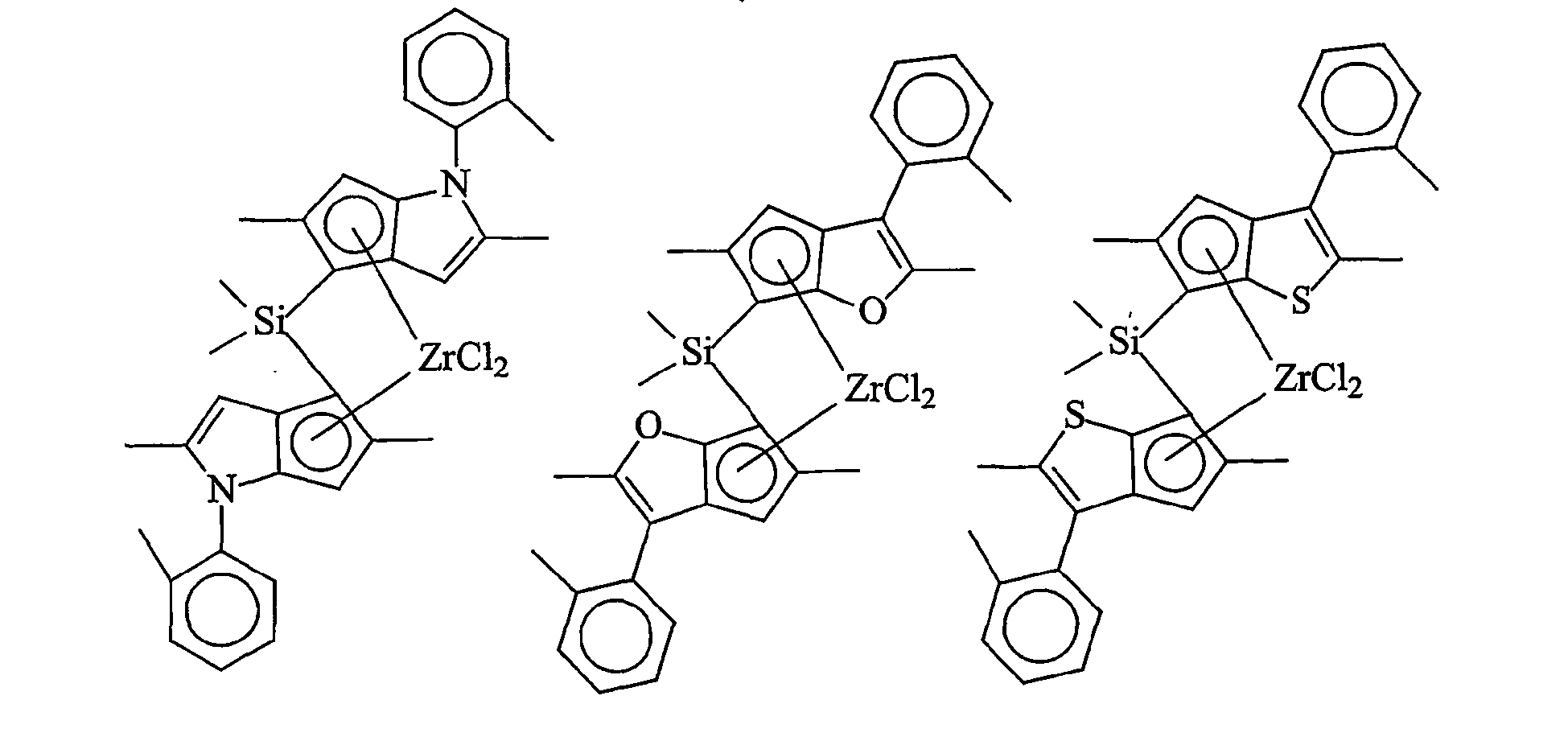
- Examples of compound of formula (I) are: as well as the corresponding dihydride and dimethyl compounds.
- the compounds of formula (I) have formula (III): wherein R 1 , R 2 , R 3 , R 4 , R 5 , R 6 , R 7 , R 8 , A, M, T, X and m are defined as above.
- Metallocene compounds of formula (I) or (III) are well known in the art, they can be prepared according to known procedure, such as those described in WO 01/44318 and USP 5,786,432 .
- Alumoxanes used as component b) can be obtained by reacting water with an organo-aluminium compound of formula H j AlU 3-j or H j Al 2 U 6-j , where U substituents, same or different, are hydrogen atoms, C 1 -C 20 -alkyl, C 3 -C 20 -cyclalkyl, C 6 -C 20 -aryl, C 7 -C 20 -alkylaryl or C 7 -C 20 -arylalkyl, optionally containing silicon or germanium atoms with the proviso that at least one U is different from halogen, and j ranges from 0 to 1, being also a non-integer number.
- the molar ratio of Al/water is preferably comprised between 1:1 and 100:1.
- the molar ratio between aluminium and the metal of the metallocene is comprised between 10:1 and 20000:1, and more preferably between 100: 1 and 5000:1.
- the alumoxanes used in the catalyst according to the invention are considered to be linear, branched or cyclic compounds containing at least one group of the type: wherein the substituents U, same or different, are described above.
- alumoxanes of the formula can be used in the case of linear compounds, wherein n 1 is 0 or an integer from 1 to 40 and the substituents U are defined as above, or alumoxanes of the formula: can be used in the case of cyclic compounds, wherein n 2 is an integer from 2 to 40 and the U substituents are defined as above.
- alumoxanes suitable for use according to the present invention are methylalumoxane (MAO), tetra-(isobutyl)alumoxane (TIBAO), tetra-(2,4,4-trimethyl-pentyl)alumoxane (TIOAO), tetra-(2,3-dimethylbutyl)alumoxane (TDMBAO) and tetra-(2,3,3-trimethylbutyl)alumoxane (TTMBAO).
- MAO methylalumoxane
- TIBAO tetra-(isobutyl)alumoxane
- TIOAO tetra-(2,4,4-trimethyl-pentyl)alumoxane
- TDMBAO tetra-(2,3-dimethylbutyl)alumoxane
- TTMBAO tetra-(2,3,3-trimethylbutyl)alumox
- aluminium compounds according to said international applications are: tris(2,3,3-trimethyl-butyl)aluminium, tris(2,3-dimethyl-hexyl)aluminium, tris(2,3-dimethylbutyl)aluminium, tris(2,3-dimethyl-pentyl)aluminium, tris(2,3-dimethyl-heptyl)aluminium, tris(2-methyl-3-ethyl-pentyl)aluminium, tris(2-methyl-3-ethyl-hexyl)aluminium, tris(2-methyl-3-ethyl-heptyl)aluminium, tris(2-methyl-3-propyl-hexyl)aluminium, tris(2-ethyl-3-methylbutyl)aluminium, tris(2-ethyl-3-methyl-pentyl)aluminium, tris(2,3-diethyl-pentyl)a
- TMA trimethylaluminium
- TIBAL triisobutylaluminium
- TIOA tris(2,4,4-trimethyl-pentyl)aluminium
- TDMBA tris(2,3-dimethylbutyl)aluminium
- TTMBA tris(2,3,3-trimethylbutyl)aluminium
- Examples of compounds able to form an alkylmetallocene cation are compounds of formula D + E - , wherein D + is a Bronsted acid, able to donate a proton and to react irreversibly with a substituent X of the metallocene of formula (I) and E - is a compatible anion, which is able to stabilize the active catalytic species originating from the reaction of the two compounds, and which is sufficiently labile to be able to be removed by an olefinic monomer.
- the anion E - comprises of one or more boron atoms.
- the anion E - is an anion of the formula BAr 4 (-) , wherein the substituents Ar which can be identical or different are aryl radicals such as phenyl, pentafluorophenyl or bis(trifluoromethyl)phenyl. Tetrakis-pentafluorophenyl borate is particularly preferred examples of these compounds are described in WO 91/02012 . Moreover, compounds of the formula BAr 3 can conveniently be used. Compounds of this type are described, for example, in the published International patent application WO 92/00333 .
- compounds able to form an alkylmetallocene cation are compounds of formula BAR 3 P wherein P is a substituted or unsubstituted pyrrol radicals. These compounds are described in WO 01/62764 . All these compounds containing boron atoms can be used in a molar ratio between boron and the metal of the metallocene comprised between 1:1 and 10:1; preferably 1:1 and 2.1; more preferably 1:1.
- Said hydrocarbon solvent can be either aromatic (such as toluene) or aliphatic (such as propane, hexane, heptane, isobutane, cyclohexane and 2,2,4-trimethylpentane).
- aromatic such as toluene
- aliphatic such as propane, hexane, heptane, isobutane, cyclohexane and 2,2,4-trimethylpentane.
- propane hexane, heptane, isobutane, cyclohexane and 2,2,4-trimethylpentane.
- the polymerization temperature preferably ranges from 0°C to 250°C; preferably comprised between 20°C and 150°C and, more particularly between 40°C and 90°C;
- the molecular weight distribution of the polymer obtained with the process of the present invention can be varied by using mixtures of different metallocene compounds or mixtures of the metallocene compound of formula (I) and a Ziegler-Natta catalyst or by carrying out the polymerization in several stages at different polymerization temperatures and/or different concentrations of the molecular weight regulators and/or different monomer concentration.
- the polymerization yield depends on the purity of the transition metal organometallic catalyst compound a) in the catalyst, therefore, said compound can be used as such or can be subjected to purification treatments before use.
- 1-butene can be polymerized with high yields and the isotactic polymers obtained show a high molecular weight and a low content of regioerrors, i.e. 4,1 insertions. Moreover the obtained polymer show very high values of the flexural modulus allowing to obtain pipes having a longer durability and thinner walls. Therefore another object of the present invention is a 1-butene homopolymer having the following characteristics:
- the 4,1 insertions are lower than ⁇ 0.90%; preferably the 4,1 insertions are comprised between 0.05% and 0.90%; more preferably they are comprised between 0.10% and 0.70%; a further preferred range is between 0.10% and 0.39%.
- the 1-butene homopolymers of the invention have molecular weight distribution (Mw/Mn) mm ⁇ 2.5; even more preferably ⁇ 2.2 .
- a copolymer having a comonomer derived units content from 0 to 50% by weight can be obtained, preferably from 0.5 to 20% by weight.
- Preferred comonomers are ethylene or propylene.
- a particular interesting copolymer that can be obtained with the process of the present invention is a 1-butene/ethylene copolymer having a content of ethylene derived units from 0.1% to 5 % by weight preferably from 0.5% to 2.5 % by weight in which the ethylene content in the polymer (C 2 ) and the melting point of the polymer (Tm) meet the following relation: Tm ⁇ - 0.3283 ⁇ C 2 3 + 4.7184 ⁇ C 2 2 - 22.454 ⁇ C 2 + 114.
- the relation is Tm ⁇ -0.3283C 2 3 + 4.7184 C 2 2 - 22.454 C 2 + 113; more preferably Tm ⁇ -0.3283C 2 3 + 4.7184 C 2 2 - 22.454 C 2 + 111.2.
- the content of ethylene derived units in the above copolymer ranges from 0.1 to 2.5 % by weight
- a further feature of said 1-butene/ethylene copolymer is the intrinsic viscosity (I.V.) > 0.7 dL/g; preferably>1 dL/g.
- the intrinsic viscosity (I.V.) was measured in tetrahydronaphtalene (THN) at 135°C.
- the melting points of the polymers (T m ) were measured by Differential Scanning Calorimetry (D.S.C.) on a Perkin Elmer DSC-7 instrument, according to the standard method.
- a weighted sample (5-10 mg) obtained from the polymerization was sealed into aluminum pans and heated at 180°C with a scanning speed corresponding to 10°C/minute.
- the sample was kept at 180°C for 5 minutes to allow a complete melting of all the crystallites. Successively, after cooling to 20°C with a scanning speed corresponding to 10°C/minute. After standing 2 minutes at 20°C, the sample was heated for the second time at 180°C with a scanning speed corresponding to 10°C/min. In this second heating run, the peak temperature was taken as the melting temperature (T m ) and the area as global melting enthalpy ( ⁇ H f ).
- the molecular weight distribution was determined on a WATERS 150 C using the following chromatographic conditions:
- Rhidimethylsilylbis(2-methyl-4-phenyl-indenyl) zirconium dichloride (A-4) was prepared according to USP 5,786,432 .
- the cocatalyst methylalumoxane (MAO) was a commercial product which was used as received (Witco AG, 10 %wt/vol toluene solution, 1.7 M in Al).
- the catalyst mixture was prepared by dissolving the amount of the metallocene indicated in table 1 in 8 ml of toluene (excepting for example 3 in which 3 ml of toluene has been used) with the proper amount of the MAO solution (amounts are reported in table 1), obtaining a solution which was stirred for 10 min at room temperature before being injected into the autoclave.
- the catalyst mixture was prepared by dissolving the amount of the metallocene indicated in table 2 in 8 ml of toluene with the proper amount of the MAO solution (Al/Zr ratio reported in table 2), obtaining a solution which was stirred for 10 min at room temperature before being injected into the autoclave.
- the stirring starts and 1-butene is fed into the reactor (1350 gr at 30°C) together with 6 mmol of Al( i -Bu) 3 (TIBA) (as a 1 M solution in hexane).
- TIBA Al( i -Bu) 3
- the reactor inner temperature is raised from 30°C to the polymerisation temperature (indicated in table 2); as a consequence the pressure increases.
- the catalytic solution is fed into the reactor with a nitrogen overpressure.
- the polymerisation is run for a time indicated in table 2 at the chosen polymerization temperature.
- the stirring is interrupted; the pressure into the autoclave is raised to 20 bar-g with nitrogen.
- the bottom discharge valve is opened and the 1-butene/poly-1-butene mixture is discharged into the steel heated tank containing water at 70°C.
- the tank heating is switched off and a flux of 0.5 bar-g nitrogen is fed.
- After 1 hour cooling at room temperature the steel tank is opened and the wet polymer collected.
- the wet polymer is dried in oven under nitrogen at 70°C.
- the polymerization conditions and the characterization data of the obtained polymers are reported in Table 2.
- Samples of polymer obtained from examples 3, 7, 9, and 10 were ground in an electric mill with liquid nitrogen in order to achieve the right size to feed them in a Brabender ® mixer chamber.
- the ground samples were mixed in a Brabender ® chamber with 1% 2,6- di-t-butyl-4-methyl phenol (BHT) at 200°C and then transformed in 1.9 and 4.0 mm thick plaques through compression molding at 200°C.
- BHT 2,6- di-t-butyl-4-methyl phenol
- the 1.9 mm thick plaques were submitted to tensile test (according to ASTM D 638 method), while the 4.0 mm thick plaques were submitted to the flexural modulus determination according to ISO 178 method. The results are reported in table 2a.
- 1-butene is fed into the reactor (1350 gr at 30°C excepting for example 10 wherein 1368 g of 1-butene are used) with the amount of ethylene reported in table 3, together with 6 mmol of Al( i -Bu) 3 (TIBA) (as a 1 M solution in hexane).
- TIBA Al( i -Bu) 3
- the reactor inner temperature is raised from 30°C to the polymerisation temperature (indicated in table 3); as a consequence the pressure increases.
- the catalytic solution is fed into the reactor with a nitrogen overpressure and the polymerisation pressure is kept constant feeding only ethylene (amount indicated in table 3).
- the polymerisation is run for a time indicated in table 3 at the chosen polymerization temperature. Then the stirring is interrupted; the pressure into the autoclave is raised to 20 bar-g with nitrogen. The bottom discharge valve is opened and the 1-butene/poly-1-butene mixture is discharged into the steel heated tank containing water at 70°C. The tank heating is switched off and a flux of 0.5 bar-g nitrogen is fed. After 1 hour cooling at room temperature the steel tank is opened and the wet polymer collected. The wet polymer is dried in a oven under nitrogen at 70°C. The polymerization conditions and the characterization data of the obtained polymers are reported in Table 3 Table 1 Ex metall.
Landscapes
- Chemical & Material Sciences (AREA)
- Health & Medical Sciences (AREA)
- Chemical Kinetics & Catalysis (AREA)
- Medicinal Chemistry (AREA)
- Polymers & Plastics (AREA)
- Organic Chemistry (AREA)
- Transition And Organic Metals Composition Catalysts For Addition Polymerization (AREA)
- Addition Polymer Or Copolymer, Post-Treatments, Or Chemical Modifications (AREA)
- Organic Low-Molecular-Weight Compounds And Preparation Thereof (AREA)
Abstract
Description
- The present invention relates to a process for polymerizing 1-butene by using a substituted bis cyclopentadienyl bridged metallocene compound. 1-butene polymers are well known in the art. In view of their good properties in terms of pressure resistance, creep resistance, and impact strength they have a lot of uses such as the manufacture of pipes to be used in the metal pipe replacement, easy-open packaging and films. The 1-butene (co)polymers are generally prepared by polymerizing 1-butene in the presence of TiCl3 based catalysts components together with diethylaluminum chloride (DEAC) as cocatalyst. In some cases diethyl aluminum iodide (DEAI) is also used in mixtures with DEAC. The polymers obtained, however, generally do not show satisfactory mechanical properties. Furthermore, in view of the low yields obtainable with the TiCl3 based catalysts, the 1-butene polymers prepared with these catalysts have a high content of catalyst residues (generally more than 300 ppm of Ti) which lowers the properties of the polymers making it necessary a deashing step. 1-butene (co)polymers can also be obtained by polymerizing the monomers in the presence of a stereospecific catalyst comprising (A) a solid component comprising a Ti compound and an electron-donor compound supported on MgCl2; (B) an alkylaluminum compound and, optionally, (C) an external electron-donor compound. A process of this type is disclosed in
EP-A-172961 WO99/45043 -
DE-A-19903306 discloses metallocene compounds containing an indenyl moiety and a thiopentalene moiety. It discloses in a general way that these compounds can be used to polymerize 1-butene. -
JP 3126704 JP 602 62804 -
EP 353 318 -
WO 01/44318 -
EP 1 308 466 discloses 1-butene copolymers, the preferred monomer is propylene and ethylene is not disclosed in a specific way. - A process that permits to obtain 1-butene polymer with high molecular weight and in high yield is therefore desirable. An object of the present invention is a process for polymerizing 1-butene comprising the step of contacting under polymerization conditions 1-butene and optionally from 0 to 20% by mol, preferably from 0
- to 10% by mol of ethylene, propylene and/or an alpha olefin of formula CH2=CHZ wherein Z is a C3-C10 alkyl group, in the presence of a catalyst system obtainable by contacting:
- a) a racemic or racemic-like bridged metallocene compound of formula (I)

R1, same or different, is hydrogen, a linear or branched saturated or unsaturated C1-C20-alky, C3-C20-cycloalkyl, C6-C20-aryl, C7-C20-alkylaryl, C7-C20-arylalkyl radical, optionally containing heteroatoms belonging to groups 13-17 of the Periodic Table of the Elements; preferably R1 is hydrogen or a C1-C20-alkyl radical, more preferably R1 is hydrogen or methyl.
A, same or different, is a carbon atom, a germanium atom or a silicon atom; with the proviso that, when m is 1, A is different from a carbon atom; preferably A is a silicon atom;
m is 1 or 2, preferably m is 1;
R2, same or different, is hydrogen, or a linear or branched saturated or unsaturated C1-C20-alkyl, C3-C20-cycloalkyl, C6-C20-aryl, C7-C20-alkylaryl, C7-C20-arylalkyl radical, optionally containing heteroatoms belonging to groups 13-17 of the Periodic Table of the
Elements; preferably R2 is hydrogen, a C1-C20-alkyl or a C6-C20-aryl; more preferably R2 is hydrogen, methyl or phenyl;
more preferably the bridge (R2 2A)m is Si(CH3)2, SiPh2, CH2CH2;
M is a transition metal atom selected from those belonging to group 4 of the Periodic Table of the Elements (IUPAC version); preferably M is zirconium or hafnium, more preferably M is zirconium;
X, same or different, is a hydrogen atom, a halogen atom, or a R, OR, OSO2CF3, OCOR, SR, NR2 or PR2 group, wherein R is a linear or branched, saturated or unsaturated C1-C20 alkyl, C3-C20 cycloalkyl, C6-C20 aryl, C7-C20 alkylaryl or C7-C20 arylalkyl radical, optionally containing heteroatoms belonging to groups 13-17 of the Periodic Table of the Elements; or two X can optionally form a substituted or unsubstituted butadienyl radical or a OR11O group wherein R11 is a divalent radical selected from C1-C20 alkylidene, C6-C40 arylidene, C7-C40 alkylarylidene and C7-C40 arylalkylidene radicals; preferably X is a hydrogen atom, a halogen atom or a R group or OR group; more preferably X is chlorine or a methyl radical;
wherein the R substituents are selected from linear or branched, saturated or unsaturated C1-C20-akyl, C3-C20-cycloalkyl, C6-C20-aryl, C7-C20-alkylaryl, C7-C20-arylalkyl radical, optionally containing heteroatoms belonging to groups 13 or 15-17 of the Periodic Table of the Elements; preferably X is hydrogen, a halogen atom, a R or OR group; more preferably X is hydrogen, chlorine or methyl;
L, same or different, is a moiety of formula (IIa), (IIb), or (IIc):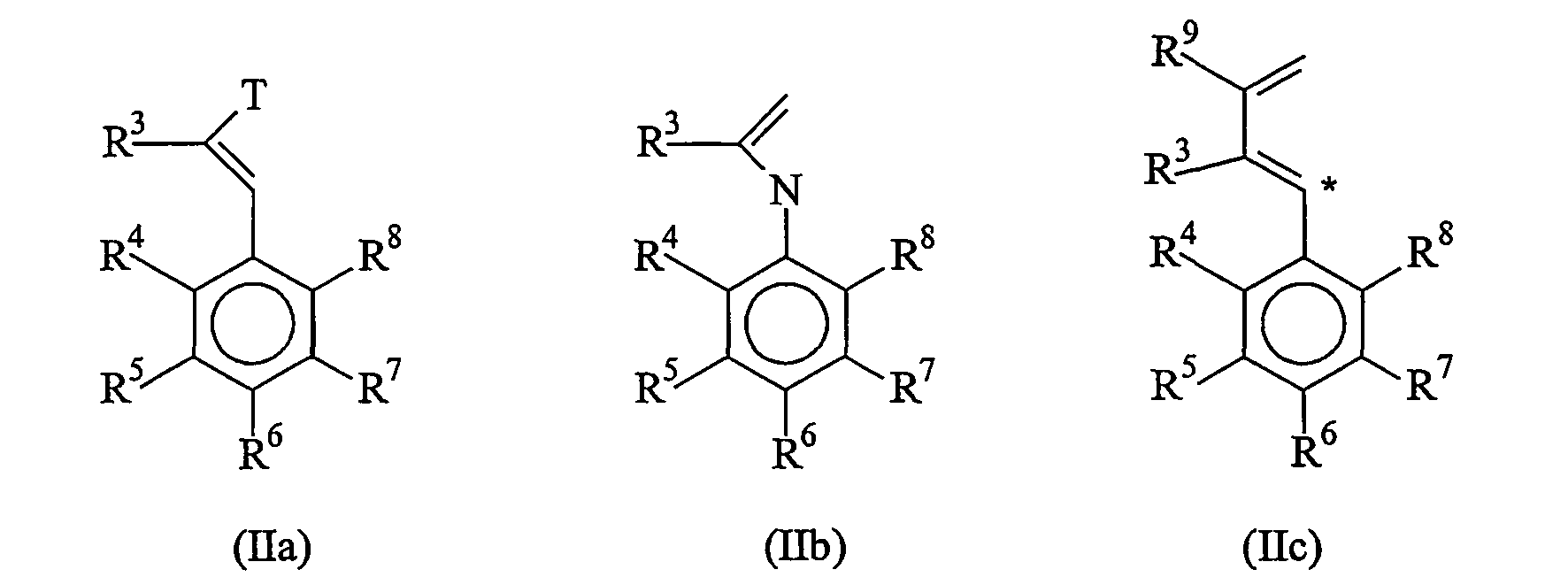
in the moiety of formula (IIa) T bonds to the cyclopentadienyl group in position 5; in the moiety of formula (IIb) N bonds to the cyclopentadienyl group in position 4; in the moiety of formula (IIc) the carbon atom marked with the symbol * bonds to the cyclopentadienyl group in position 4;
T is an oxygen (O) atom, a sulphur (S) atom or a CH2 group; preferably T is sulphur;
R3 is hydrogen or a linear or branched, saturated or unsaturated C1-C20-alkyl, C3-C20-cycloalkyl, C6-C20-aryl, C7-C20-alkylaryl, C7-C20-arylalkyl radical, optionally containing heteroatoms belonging to groups 13-17 of the Periodic Table of the Elements;
R4 is a linear or branched saturated or unsaturated C1-C20-alkyl, C3-C20-cycloalkyl, C6-C20-aryl, C7-C20-alkylaryl, C7-C20-arylalkyl radical, optionally containing heteroatoms belonging to groups 13-17 of the Periodic Table of the Elements;
preferably, R3 is hydrogen or a C1-C20-alkyl radical; more preferably R3 is methyl; preferably, R4 is a C1-C20-alkyl radical; more preferably R4 is methyl;
R5, R6, R7, R8 and R9, same or different, are selected from the group consisting of hydrogen, a linear or branched saturated or unsaturated C1-C20-alkyl, C3-C20-cycloalkyl, C6-C20-aryl, C7-C20-alkylaryl, C7-C20-arylalkyl radical, optionally containing heteroatoms belonging to groups 13-17 of the Periodic Table of the Elements, or two adjacent groups can form together a saturated or unsaturated condensed 5 or 6 membered ring optionally containing heteroatoms belonging to groups 13-16 of the Periodic Table of the Elements; Preferably R7 is hydrogen or methyl; preferably R5, R6, R8 and R9 are hydrogen. - b) an alumoxane or a compound able to form an alkylmetallocene cation; and
- c) optionally an organo aluminum compound.
- Preferred structures for the (R2 2A)m bridging group are is Si(CH3)2, SiPh2, CH2CH2, the Si(CH3)2 being the most preferred.
Examples of compound of formula (I) are: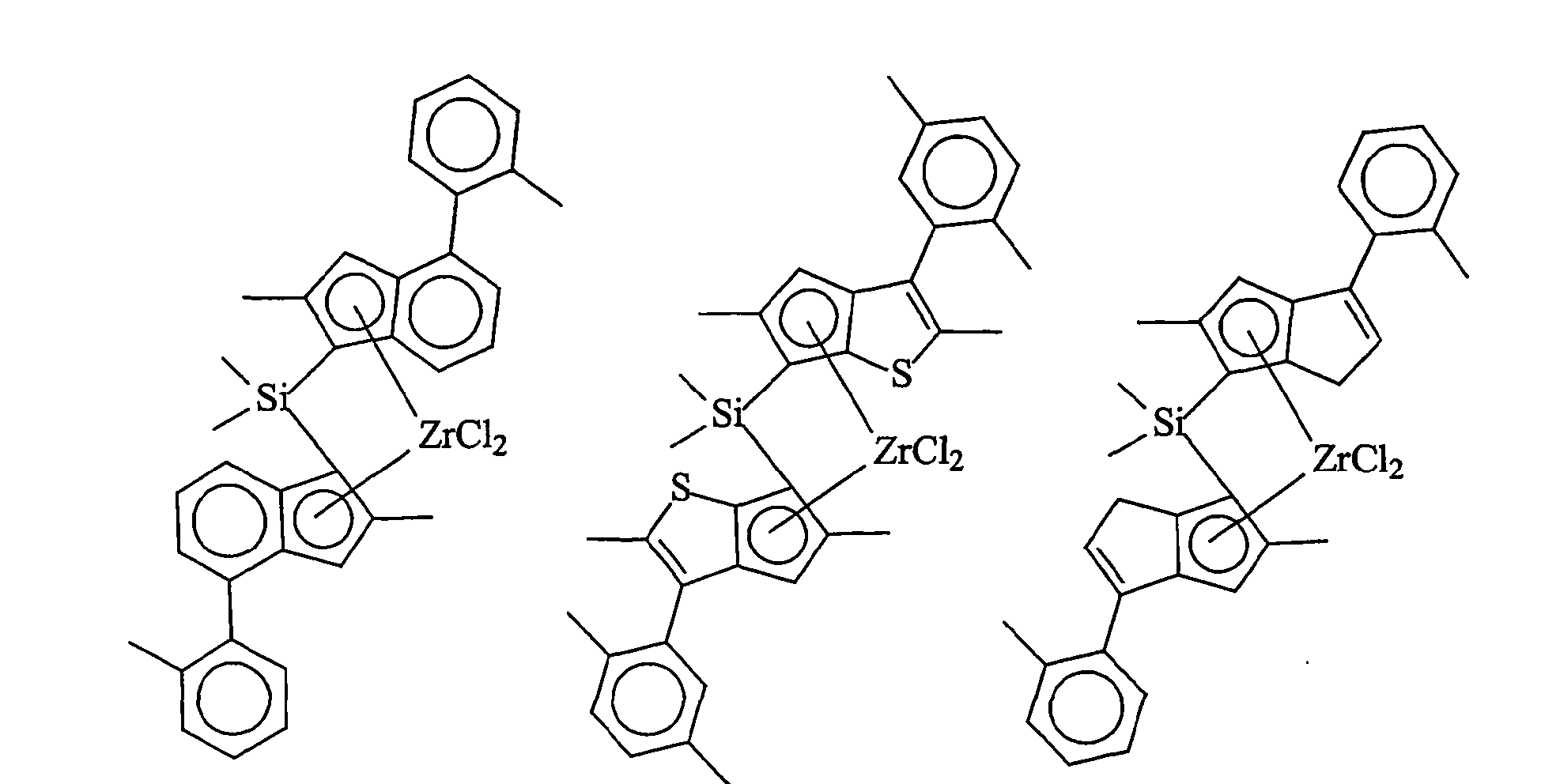
- Preferably the compounds of formula (I) have formula (III):

- Metallocene compounds of formula (I) or (III) are well known in the art, they can be prepared according to known procedure, such as those described in
WO 01/44318 USP 5,786,432 . Alumoxanes used as component b) can be obtained by reacting water with an organo-aluminium compound of formula HjAlU3-j or HjAl2U6-j, where U substituents, same or different, are hydrogen atoms, C1-C20-alkyl, C3-C20-cyclalkyl, C6-C20-aryl, C7-C20-alkylaryl or C7-C20-arylalkyl, optionally containing silicon or germanium atoms with the proviso that at least one U is different from halogen, and j ranges from 0 to 1, being also a non-integer number. In this reaction the molar ratio of Al/water is preferably comprised between 1:1 and 100:1. The molar ratio between aluminium and the metal of the metallocene is comprised between 10:1 and 20000:1, and more preferably between 100: 1 and 5000:1. The alumoxanes used in the catalyst according to the invention are considered to be linear, branched or cyclic compounds containing at least one group of the type: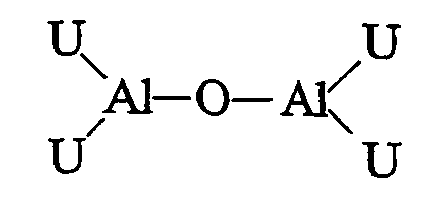
- In particular, alumoxanes of the formula:
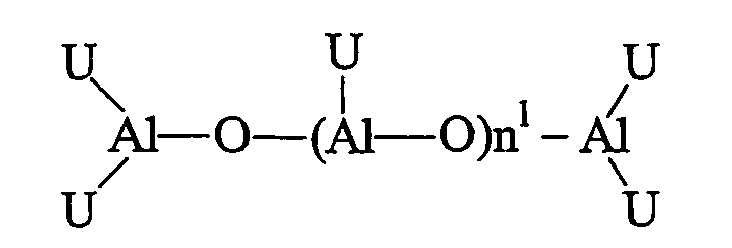

WO 99/21899 WO 01/21674
tris(2,3,3-trimethyl-butyl)aluminium, tris(2,3-dimethyl-hexyl)aluminium, tris(2,3-dimethylbutyl)aluminium, tris(2,3-dimethyl-pentyl)aluminium, tris(2,3-dimethyl-heptyl)aluminium, tris(2-methyl-3-ethyl-pentyl)aluminium, tris(2-methyl-3-ethyl-hexyl)aluminium, tris(2-methyl-3-ethyl-heptyl)aluminium, tris(2-methyl-3-propyl-hexyl)aluminium, tris(2-ethyl-3-methylbutyl)aluminium, tris(2-ethyl-3-methyl-pentyl)aluminium, tris(2,3-diethyl-pentyl)aluminium, tris(2-propyl-3-methyl-butyl)aluminium, tris(2-isopropyl-3-methyl-butyl)aluminium, tris(2-isobutyl-3-methyl-pentyl)aluminium, tris(2,3,3-trimethyl-pentyl)aluminium, tris(2,3,3-trimethyl-hexyl)aluminium, tris(2-ethyl-3,3-dimethyl-butyl)aluminium, tris(2-ethyl-3,3-dimethyl-pentyl)aluminium, tris(2-isopropyl-3,3-dimethyl-butyl)aluminium, tris(2-trimethylsilyl-propyl)aluminium, tris(2-methyl-3-phenyl-butyl)aluminium, tris(2-ethyl-3-phenyl-butyl)aluminium, tris(2,3-dimethyl-3-phenyl-butyl)aluminium, tris(2-phenylpropyl)aluminium, tris[2-(4-fluoro-phenyl)-propyl]aluminium, tris[2-(4-chloro-phenyl)-propyl]aluminium, tris[2-(3-isopropyl-phenyl)-propyl]aluminium, tris(2-phenylbutyl)aluminium, tris(3-methyl-2-phenyl-butyl)aluminium, tris(2-phenyl-pentyl)aluminium, tris[2-(pentafluorophenyl)-propyl]aluminium, tris[2,2-diphenyl-ethyl]aluminium and tris[2-phenyl-2-methyl-propyl]aluminium, as well as the corresponding compounds wherein one of the hydrocarbyl groups is replaced with a hydrogen atom, and those wherein one or two of the hydrocarbyl groups are replaced with an isobutyl group. Amongst the above aluminium compounds, trimethylaluminium (TMA), triisobutylaluminium (TIBAL), tris(2,4,4-trimethyl-pentyl)aluminium (TIOA), tris(2,3-dimethylbutyl)aluminium (TDMBA) and tris(2,3,3-trimethylbutyl)aluminium (TTMBA) are preferred. Examples of compounds able to form an alkylmetallocene cation are compounds of formula D+E-, wherein D+ is a Bronsted acid, able to donate a proton and to react irreversibly with a substituent X of the metallocene of formula (I) and E- is a compatible anion, which is able to stabilize the active catalytic species originating from the reaction of the two compounds, and which is sufficiently labile to be able to be removed by an olefinic monomer. Preferably, the anion E- comprises of one or more boron atoms. More preferably, the anion E- is an anion of the formula BAr4 (-), wherein the substituents Ar which can be identical or different are aryl radicals such as phenyl, pentafluorophenyl or bis(trifluoromethyl)phenyl. Tetrakis-pentafluorophenyl borate is particularly preferred examples of these compounds are described inWO 91/02012 WO 92/00333 WO 01/62764 - Examples of compounds of formula D+E- are:
- Triethylammoniumtetra(phenyl)borate,
- Tributylammoniumtetra(phenyl)borate,
- Trimethylammoniumtetra(tolyl)borate,
- Tributylammoniumtetra(tolyl)borate,
- Tributylammoniumtetra(pentafluorophenyl)borate,
- Tributylammoniumtetra(pentafluorophenyl)aluminate,
- Tripropylammoniumtetra(dimethylphenyl)borate,
- Tributylammoniumtetra(trifluoromethylphenyl)borate,
- Tributylammoniumtetra(4-fluorophenyl)borate,
- N,N-Dimethylaniliniumtetra(phenyl)borate,
- N,N-Diethylaniliniumtetra(phenyl)borate,
- N,N-Dimethylaniliniumtetrakis(pentafluorophenyl)boratee,
- N,N-Dimethylaniliniumtetrakis(pentafluorophenyl)aluminate,
- Di(propyl)ammoniumtetrakis(pentafluorophenyl)borate,
- Di(cyclohexyl)ammoniumtetrakis(pentafluorophenyl)borate,
- Triphenylphosphoniumtetrakis(phenyl)borate,
- Triethylphosphoniumtetrakis(phenyl)borate,
- Diphenylphosphoniumtetrakis(phenyl)borate,
- Tri(methylphenyl)phosphoniumtetrakis(phenyl)borate,
- Tri(dimethylphenyl)phosphoniumtetrakis(phenyl)borate,
- Triphenylcarbeniumtetrakis(pentafluorophenyl)borate,
- Triphenylcarbeniumtetrakis(pentafluorophenyl)aluminate,
- Triphenylcarbeniumtetrakis(phenyl)aluminate,
- Ferroceniumtetrakis(pentafluorophenyl)borate,
- Ferroceniumtetrakis(pentafluorophenyl)aluminate.
- Triphenylcarbeniumtetrakis(pentafluorophenyl)borate,
- N,N-Dimethylaniliniumtetrakis(pentafluorophenyl)borate.
- Further compounds that can be used are those of formula RM'-O-M'R, R being an alkyl or aryl group, and M' is selected from an element of the Group 13 of the Periodic Table of the Elements (new IUPAC version). Compounds of this type are described, for example, in the International patent application
WO 99/40129 - intrinsic viscosity (I.V.) > 0.7 dL/g; preferably >1 dL/g; more preferably >1.5 dL/g;
- isotactic triads (mm) > 70%; preferably >95%; more preferably >98%;
- a flexural modulus (ASTM D 638) > 400 MPa, preferably > 425 MPa; more preferably > 450 MPa;
- melting point>105°C, preferably > 108°C; more preferably >110°C;
- molecular weight distribution (Mw/Mn) is lower than 3.
- The 4,1 insertions are lower than < 0.90%; preferably the 4,1 insertions are comprised between 0.05% and 0.90%; more preferably they are comprised between 0.10% and 0.70%; a further preferred range is between 0.10% and 0.39%.
- Preferably the 1-butene homopolymers of the invention have molecular weight distribution (Mw/Mn) mm < 2.5; even more preferably < 2.2 .
- When 1-butene is copolymerized with ethylene, propylene or an alpha olefin of formula CH2=CHZ wherein Z is a C3-C10 alkyl group, a copolymer having a comonomer derived units content from 0 to 50% by weight can be obtained, preferably from 0.5 to 20% by weight. Preferred comonomers are ethylene or propylene.
- A particular interesting copolymer that can be obtained with the process of the present invention is a 1-butene/ethylene copolymer having a content of ethylene derived units from 0.1% to 5 % by weight preferably from 0.5% to 2.5 % by weight in which the ethylene content in the polymer (C2) and the melting point of the polymer (Tm) meet the following relation:

- Preferably the relation is Tm < -0.3283C2 3 + 4.7184 C2 2 - 22.454 C2 + 113; more preferably Tm < -0.3283C2 3 + 4.7184 C2 2 - 22.454 C2 + 111.2.
- When the content of ethylene derived units in the above copolymer ranges from 0.1 to 2.5 % by weight the ethylene content in the polymer (C2) and the melting point of the polymer (Tm) meet the following relation:

preferably the relation is Tm = 4.0037C2 2 - 21.91C2 + 113; more preferably Tm = 4.0037C2 2 - 21.91C2+110.5. - Furthermore the 1-butene/ethylene copolymer above described are endowed with a molecular weight distribution (Mw/Mn) <4.
- A further feature of said 1-butene/ethylene copolymer is the intrinsic viscosity (I.V.) > 0.7 dL/g; preferably>1 dL/g.
- The intrinsic viscosity (I.V.) was measured in tetrahydronaphtalene (THN) at 135°C.
- The melting points of the polymers (Tm) were measured by Differential Scanning Calorimetry (D.S.C.) on a Perkin Elmer DSC-7 instrument, according to the standard method. A weighted sample (5-10 mg) obtained from the polymerization was sealed into aluminum pans and heated at 180°C with a scanning speed corresponding to 10°C/minute. The sample was kept at 180°C for 5 minutes to allow a complete melting of all the crystallites. Successively, after cooling to 20°C with a scanning speed corresponding to 10°C/minute. After standing 2 minutes at 20°C, the sample was heated for the second time at 180°C with a scanning speed corresponding to 10°C/min. In this second heating run, the peak temperature was taken as the melting temperature (Tm) and the area as global melting enthalpy (ΔHf).
- The molecular weight distribution was determined on a WATERS 150 C using the following chromatographic conditions:
- Columns:
- 3x SHODEX AT 806 MS; 1x SHODEX UT 807; 1x SHODEX AT-G;
- Solvent:
- 1,2,4 trichlorobenzene (+ 0.025% 2,6-Di-tert.Butyl-4-Methyl-Phenol);
- Flow rate:
- 0.6 - 1 ml/min;
- Temperature:
- 135 °C;
- Detector:
- INFRARED AT λ≅3.5µm;
- Calibration:
- Universal Calibration with PS-Standards.
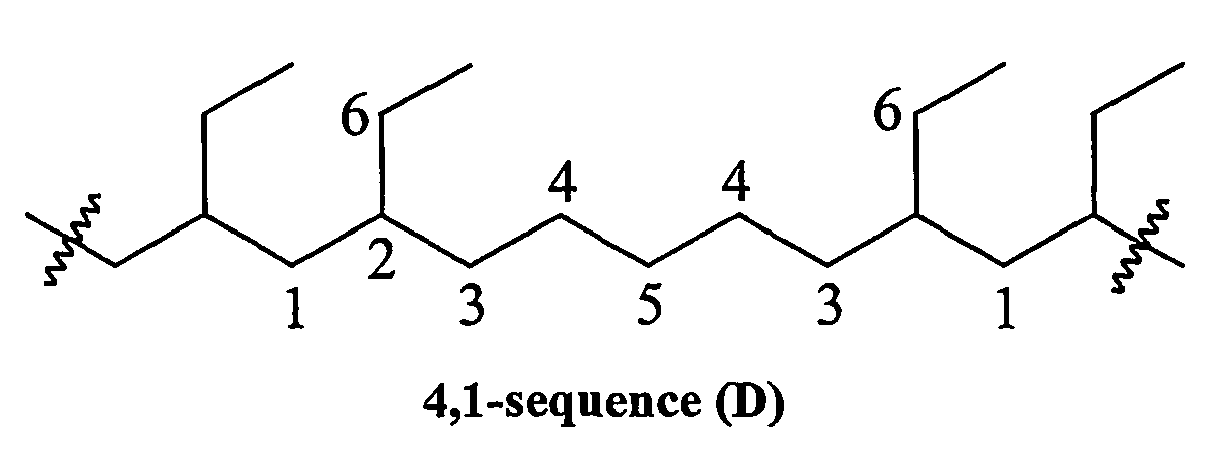
- 13C-NMR spectra were acquired on a DPX-400 spectrometer operating at 100.61 MHz in the Fourier transform mode at 120 °C. The peak of the 2B2 carbon (nomenclature according to Carman, C. J.; Harrington, R. A.; Wilkes, C. E. Macromolecules 1977, 10, 535) was used as internal reference at 27.73. The samples were dissolved in 1,1,2,2-tetrachloroethane-d2 at 120 °C with a 8% wt/v concentration. Each spectrum was acquired with a 90° pulse, 15 seconds of delay between pulses and CPD (waltz16) to remove 1H-13C coupling. About 3000 transients were stored in 32K data points using a spectral window of 6000 Hz. Assignments of 4,1 insertion were made according to Busico (V. Busico, R. Cipullo, A. Borriello, Macromol. Rapid. Commun. 1995, 16, 269-274)
Chemical Shift (ppm) Carbon Sequence 40.21 CH2 (Sαα) B 39.65 CH2 D1 37.3 CH D2 34.99 CH B 34.31 CH2 D3 31.13 CH2 D5 27.73 CH2 branch B mmmm 27.57 CH2 branch B mmmr 27.37 CH2 branch B mmrr 27.21-27.14 CH2 D4+D6 26.57 CH2 branch B mrrm 10.96 CH3 B - The content of 4,1 insertions was calculated as follows: 4,1 units = O.5×I4×100/(I2+I4)
- Rac dimethylsilandiylbis-6-[2,5-dimethyl-3-(2'-methyl-phenyl)cyclopentadienyl-[1,2-b]-thiophene]zirconium dichloride (A-1), rac dimethylsilandiylbis-6-[2,5-dimethyl-3-(2',5'-dimethyl-phenyl)cyclopentadienyl-[1,2-b]-thiophene]zirconium dichloride (A-2) and rac dimethylsilandiylbis-6-(2,5-dimethyl-3-phenylcyclopentadienyl-[1,2-b]-thiophene)zirconium dichloride (A-3) were prepared according to
WO 01/44318 USP 5,786,432 . The cocatalyst methylalumoxane (MAO) was a commercial product which was used as received (Witco AG, 10 %wt/vol toluene solution, 1.7 M in Al). - The catalyst mixture was prepared by dissolving the amount of the metallocene indicated in table 1 in 8 ml of toluene (excepting for example 3 in which 3 ml of toluene has been used) with the proper amount of the MAO solution (amounts are reported in table 1), obtaining a solution which was stirred for 10 min at room temperature before being injected into the autoclave. 4 mmol of Al(i-Bu)3 (TIBA) (as a 1 M solution in hexane) and 712 g of 1-butene were charged, at room temperature, in a 2.3-L jacketed stainless-steel autoclave, equipped with magnetically driven stirrer and a 35-mL stainless-steel vial, connected to a thermostat for temperature control. The autoclave was then thermostatted at 2 °C below the polymerization temperature and the catalyst system, prepared as reported above, was injected in the autoclave by means of nitrogen pressure through the stainless-steel vial. The temperature was rapidly raised to the polymerization temperature and the polymerization was carried out at constant temperature, for a time indicated in table 1. After cooling the reactor to room temperature, the polymer was dried under reduced pressure, at 60 °C. The polymerization conditions and the characterization data of the obtained polymers are reported in Table 1.
- The catalyst mixture was prepared by dissolving the amount of the metallocene indicated in table 2 in 8 ml of toluene with the proper amount of the MAO solution (Al/Zr ratio reported in table 2), obtaining a solution which was stirred for 10 min at room temperature before being injected into the autoclave. A 4.25 litres steel autoclave, equipped with magnetically stirred anchor (usual stirring rate 550 rpm) and with different Flow Record & Control systems (FRC), among which a FRC having maximum flow rate of 9000 gr/hour for 1-butene and two FRC having maximum flow rate of 500 and 30 g/h for ethylene is cleaned with warm nitrogen (1.5 barg N2, 70°C, 1 hour). After the above mentioned autoclave cleaning, the stirring starts and 1-butene is fed into the reactor (1350 gr at 30°C) together with 6 mmol of Al(i-Bu)3 (TIBA) (as a 1 M solution in hexane). Subsequently, the reactor inner temperature is raised from 30°C to the polymerisation temperature (indicated in table 2); as a consequence the pressure increases. When pressure and temperature are constant, the catalytic solution is fed into the reactor with a nitrogen overpressure. The polymerisation is run for a time indicated in table 2 at the chosen polymerization temperature. Then the stirring is interrupted; the pressure into the autoclave is raised to 20 bar-g with nitrogen. The bottom discharge valve is opened and the 1-butene/poly-1-butene mixture is discharged into the steel heated tank containing water at 70°C. The tank heating is switched off and a flux of 0.5 bar-g nitrogen is fed. After 1 hour cooling at room temperature the steel tank is opened and the wet polymer collected. The wet polymer is dried in oven under nitrogen at 70°C. The polymerization conditions and the characterization data of the obtained polymers are reported in Table 2.
- Samples of polymer obtained from examples 3, 7, 9, and 10 were ground in an electric mill with liquid nitrogen in order to achieve the right size to feed them in a Brabender® mixer chamber. The ground samples were mixed in a Brabender® chamber with 1% 2,6- di-t-butyl-4-methyl phenol (BHT) at 200°C and then transformed in 1.9 and 4.0 mm thick plaques through compression molding at 200°C.
- The 1.9 mm thick plaques were submitted to tensile test (according to ASTM D 638 method), while the 4.0 mm thick plaques were submitted to the flexural modulus determination according to ISO 178 method. The results are reported in table 2a.
- The catalyst mixture was prepared by dissolving the amount of the metallocene indicated in table 2 in toluene with the proper amount of the MAO solution (Al/Zr = 10000), obtaining a solution which was stirred for 10 min at room temperature before being injected into the autoclave. A 4.25 litres steel autoclave, equipped with magnetically stirred anchor (usual stirring rate 550 rpm) and with the proper Flow Record & Control systems (FRC), among which a FRC having maximum flow rate of 9000 gr/hour for 1-butene and two FRC having maximum flow rate of 500 and 30 g/h for ethylene is cleaned with warm nitrogen (1.5 barg N2, 70°C, 1 hour). After the above mentioned autoclave cleaning, the stirring starts, 1-butene is fed into the reactor (1350 gr at 30°C excepting for example 10 wherein 1368 g of 1-butene are used) with the amount of ethylene reported in table 3, together with 6 mmol of Al(i-Bu)3 (TIBA) (as a 1 M solution in hexane). Subsequently, the reactor inner temperature is raised from 30°C to the polymerisation temperature (indicated in table 3); as a consequence the pressure increases. When pressure and temperature are constant, the catalytic solution is fed into the reactor with a nitrogen overpressure and the polymerisation pressure is kept constant feeding only ethylene (amount indicated in table 3). The polymerisation is run for a time indicated in table 3 at the chosen polymerization temperature. Then the stirring is interrupted; the pressure into the autoclave is raised to 20 bar-g with nitrogen. The bottom discharge valve is opened and the 1-butene/poly-1-butene mixture is discharged into the steel heated tank containing water at 70°C. The tank heating is switched off and a flux of 0.5 bar-g nitrogen is fed. After 1 hour cooling at room temperature the steel tank is opened and the wet polymer collected. The wet polymer is dried in a oven under nitrogen at 70°C. The polymerization conditions and the characterization data of the obtained polymers are reported in Table 3
Table 1 Ex metall. Mg Al(MAO) /Zr Tpol °C t (min) Yield (g) Activity kg/(gcat*h) I.V. (dL/g) Mw/Mn triads % (mm) regioerrors 4,1 insertions Tm(II) °C ΔHf(II) J/g 1 A-1 2 1000 60 17 73.8 130.2 1.8 n.a. >99 0.17% 110 40 2 A-1 3 200 60 30 89.9 60.0 2.0 n.a. ≈100 0.3% n.a. n.a. 3 A-2 1 1000 60 60 69.9 69.9 1.7 2.16 ≈100 0.2% 111 34 4 A-2 3 200 70 30 124.9 83.3 1.3 n.a. n.a. n.a. n.a. n.a. 5* A-3 4 1000 60 30 96.5 48.3 1.0 2.12 ≈100 1% 100 37 6* A-4 4 1000 60 60 39.5 9.9 0.9 n.a. ≈100 0.4% 105 33 *comparative
n.a. = not availableTable 2 Ex Metall. Mg Al(MAO) /Zr Tpol t (min) Yield (g) Activity kg/(gcat*h) I.V. (dL/g) Mw/M n Tm(II) °C ΔHf(II) J/g 7 A-2 3 1000 50 43 263 122.3 2.31 2.09 111.6 36.0 8 A-2 1 1000 70 60 130 130.0 1.50 2.18 109.2 35.4 9 A-2 1 1000 85 60 195 195.0 n.a. 2.12 n.a. n.a. 10 A-1 3 1000 50 53 285 107.5 2.72 2.14 110.2 34.9 11 A-1 2 1000 85 60 90 45.0 n.a. 2.12 n.a. n.a. 12 A-1 2 1000 85 60 312.4 156.2 n.a. 2.18 n.a. n.a. 13 A-1 2 500 85 60 166 83.0 n.a. 2.16 n.a. n.a. Table 2a Ex Flexural modulus Yield strength Break strength Elongation at break (MPa) (MPa) (MPa) (%) 3 480 n.a. n.a. n.a. 7 472 19.2 40.0 300 9 472 23.8 22.8 218 10 437 18.6 37.9 280 n.a.=not available Table 3 Ex met. mg Tpol °C t (min) C2 added g C2 feed g yield (g) Activity kg/ (gcat*h) I.V. C2 wt% (IR) Mw/Mn Tm(II) °C 14 A-1 1 70 70 0.9 4 224.0 192.0 1.22 0.50 2.41 99.56 15 A-1 1 70 70 0.8 6 127.0 108.9 1.26 0.50 2.40 99.72 16 A-1 1 70 70 2.6 17 432.0 370.3 1.09 1.90 2.68 78.90 17 A-2 1 70 70 1.1 0.4 96.0 82.3 1.17 0.70 2.52 96.02 18 A-2 1 70 70 2.3 4.6 203.0 174.0 1.41 2.20 3.92 81.00 19 A-2 1 70 70 3.0 17 340.0 291.4 1.17 1.70 2.91 83.84 C2 added = ethylene added in the reactor with 1-butene
C2 feed = ethylene feed during the polymerization
Claims (11)
- A process for polymerizing 1-butene comprising the step of contacting under polymerization conditions 1-butene and optionally from 0 to 20% by mol, of ethylene, propylene and/or an alpha olefin of formula CH2=CHZ wherein Z is a C3-C10 alkyl group, in the presence of a catalyst system obtainable by contacting:a) a racemic or racemic-like bridged metallocene compound of formula (I)
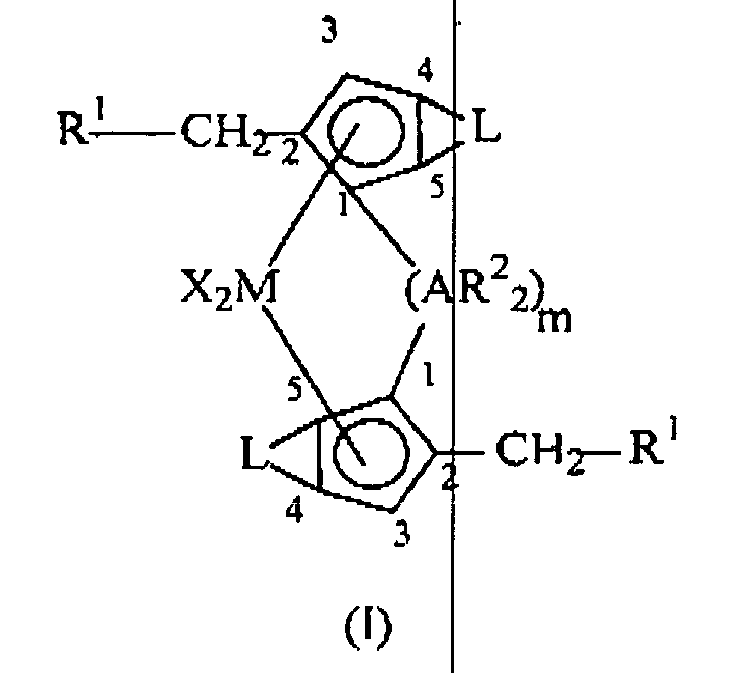
R1, same or different, is hydrogen, linear or branched saturated or unsaturated C1-C20-alkyl, C3-C20-cycloalkyl, C6-C20-aryl, C7-C20-alkylaryl, C7-C20-arylalkyl radical, optionally containing heteroatoms belonging to groups 13-17 of the Periodic Table of the Elements;
A, same or different, is a carbon atom, germanium atom or a silicon atom; with the proviso that when m is 1, A is different from a carbon atom;
m is 1, 2,
R2, same or different, is hydrogen, a linear or branched saturated or unsaturated C1-C20-alkyl, C3-C20-cycloalkyl, C6-C20-aryl, C7-C20-alkylaryl, C7-C20-arylalkyl radical, optionally containing heteroatoms belonging to groups 13-17 of the Periodic Table of the Elements;
M is a transition metal atom selected from those belonging to group 4 of the Periodic Table of the Elements (IUPAC version);
X, same or different, is a hydrogen atom, a halogen atom, or a R, OR, OSO2CF3, OCOR, SR, NR2 or PR2 group, wherein R is a linear or branched, saturated or unsaturated C1-C20 alkyl, C3-C20 cycloalkyl, C6-C20 aryl, C7-C20 alkylaryl or C7-C20 arylalkyl radical, optionally containing heteroatoms belonging to groups 13-17 of the Periodic Table of the Elements; or two X can optionally form a substituted or unsubstituted butadienyl radical or a OR11O group wherein R11 is a divalent radical selected from C1-C20 alkylidene, C6-C40 arylidene, C7-C40 alkylarylidene and C7-C40 arylalkylidene radicals; the R substituents are selected from linear or branched, saturated or unsaturated C1-C20-alkyl, C3-C20-cycloalkyl, C6-C20-aryl, C7-C20-alkylaryl. C7-C20-arylalkyl radical, optionally containing heteroatoms belonging to groups 13 or 15-17 of the Periodic Table of the Elements;
L, same or different, is a moiety of formula (IIa), (IIb), or (IIc)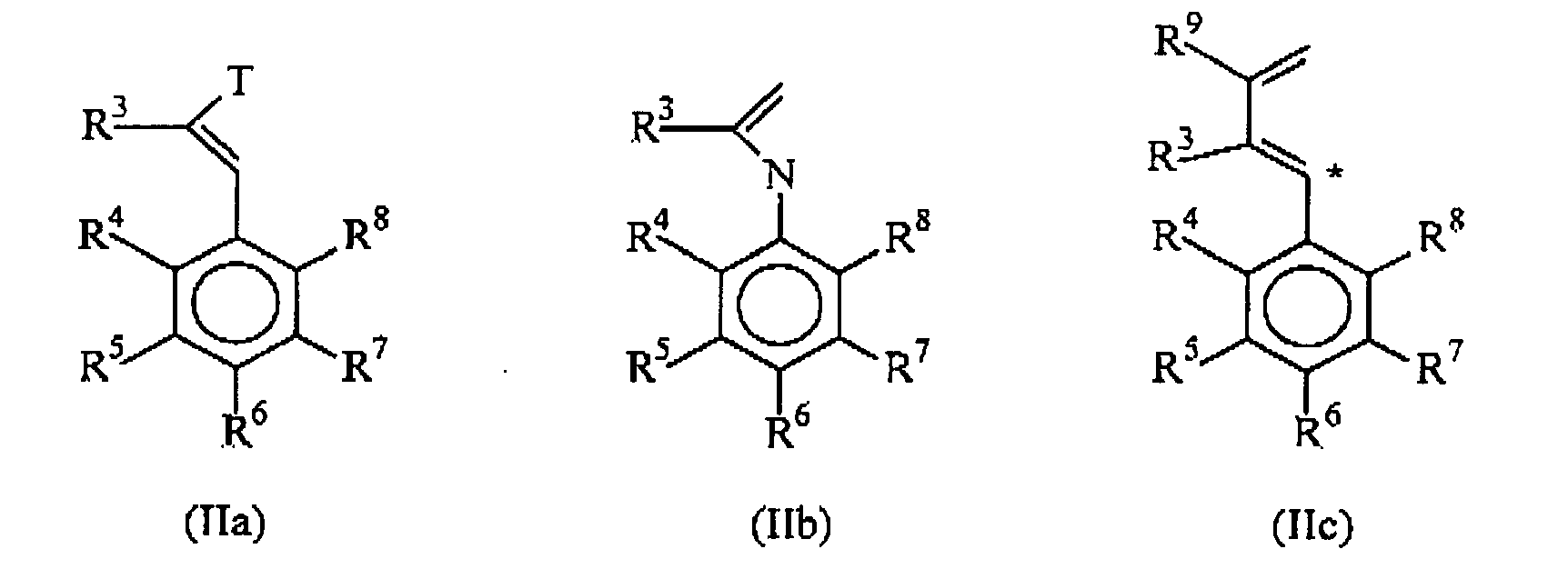
in the moiety of formula (IIa) T bonds to the cyclopentadienyl group in position 5;
in the moiety of formula (IIb) N bonds to the cyclopentadienyl group in position 4;
in the moiety of formula (IIc) the carbon atom marked with the symbol * bonds to the cyclopentadienyl group in position 4;
T is an oxygen (O) atom or a sulphur (S) atom or a CH2 group;
R3 is hydrogen, a linear or branched saturated or unsaturated C1-C20-alkyl, C3-C20-cycloalkyl, C6-C20-aryl, C7-C20-alkylaryl, C7-C20-arylalkyl radical, optionally containing heteroatoms belonging to groups 13-17 of the Periodic Table of the Elements;
R4 is a linear or branched saturated or unsaturated C1-C20-alkyl, C3-C20-cycloalkyl, C6-C20-aryl, C7-C20-alkylaryl, C7-C20-arylalkyl radical, optionally containing heteroatoms belonging to groups 13-17 of the Periodic Table of the Elements;
R5, R6, R7 R8 and R9 same or different are selected from the group consisting of hydrogen, linear or branched saturated or unsaturated C1-C20-alkyl, C3-C20-cycloalkyl, C6-C20-aryl, C7-C20-alkylaryl, C7-C20-arylalkyl radical, optionally containing heteroatoms belonging to groups 13-17 of the Periodic Table of the Elements or two adjacent groups can form together a saturated or unsaturated condensed 5 or 6 membered ring optionally containing heteroatoms belonging to groups 13-16 of the Periodic Table of the Elements;b) an alumoxane or a compound able to form an alkylmetallocene cation; andc) optionally an organo aluminum compound. - The process according to claim 1 wherein in the bridged metallocene compound of formula (I):R1 is selected from the group consisting of hydrogen, C1-C20-alkyl radical; R2 is selected from hydrogen, C1-C20-alkyl or C6-C20-aryl; m is l; A is a silicon atom; M is zirconium, hafnium; X is halogen, a group R or OR;
- The process according to claims 1 or 2 wherein the bridge (R2 2A)m is Si(CH3)2, SiPh2, CH2CH2;
- The process according to anyone of claims 1 to 3 wherein in the moiety of formula (IIa) T is sulphur.
- The process according to anyone of claims 1 to 4 wherein R5, R6, R7, R8 and R9 are hydrogen.
- The process according to anyone of claims 1 to 5 wherein the bridged metallocene compounds has formula (III)
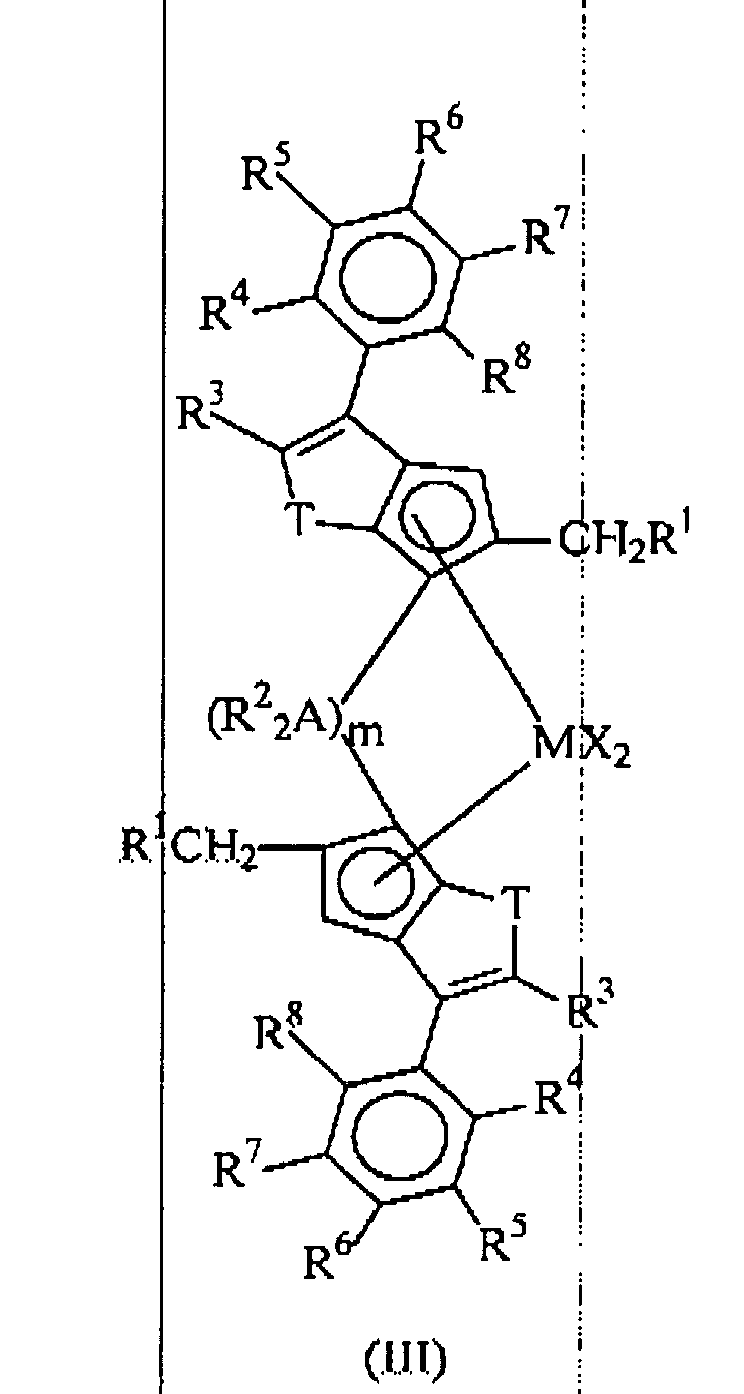
- A 1-butene homopolymer having the following characteristics:- intrinsic viscosity (I.V.) (measured in tetrahydronaphtalene (THN) at 135°C) > 0.7 dL/g- isotactic triads (mm) >70%;- 4,1 insertions < 1%;- a flexural modulus (ASTM D 638)> 400 Mpa;- melting point >105°C;- molecular weight distribution (Mw/Mn) is lower than 3 .
- The 1-butene homopolymer according to claim 7 wherein the isotactic triads (mm) are higher than 95%.
- The 1-butene homopolymer according to anyone of claims 7-8 wherein the 4,1 insertions are comprised between 0.05% and 0.90%.
- A 1-butene/ethylene copolymer having a content of ethylene derived units from 0.1% to 5 % by weight and a molecular weight distribution Mw/Mn <4 in which the ethylene content in the polymer (C2) and the melting point of the polymer (Tm) meet the following relation:

- A 1-butene/ethylene copolymer having a content of ethylene derived units from 0.1% to 2.5 % by weight and a molecular weight distribution (Mw/Mn) <4 in which the ethylene content in the polymer (C2) and the melting point of the polymer (Tm) meet the following relation:

Priority Applications (1)
| Application Number | Priority Date | Filing Date | Title |
|---|---|---|---|
| EP02743196A EP1446429B1 (en) | 2001-06-12 | 2002-06-11 | Process for the polymerization of 1-butene |
Applications Claiming Priority (4)
| Application Number | Priority Date | Filing Date | Title |
|---|---|---|---|
| EP01202263 | 2001-06-12 | ||
| EP01202263 | 2001-06-12 | ||
| PCT/EP2002/006575 WO2002100909A1 (en) | 2001-06-12 | 2002-06-11 | Process for the polymerization of 1-butene |
| EP02743196A EP1446429B1 (en) | 2001-06-12 | 2002-06-11 | Process for the polymerization of 1-butene |
Publications (2)
| Publication Number | Publication Date |
|---|---|
| EP1446429A1 EP1446429A1 (en) | 2004-08-18 |
| EP1446429B1 true EP1446429B1 (en) | 2009-10-07 |
Family
ID=8180466
Family Applications (1)
| Application Number | Title | Priority Date | Filing Date |
|---|---|---|---|
| EP02743196A Expired - Lifetime EP1446429B1 (en) | 2001-06-12 | 2002-06-11 | Process for the polymerization of 1-butene |
Country Status (6)
| Country | Link |
|---|---|
| US (3) | US7074864B2 (en) |
| EP (1) | EP1446429B1 (en) |
| JP (1) | JP4332029B2 (en) |
| AT (1) | ATE444975T1 (en) |
| DE (1) | DE60233961D1 (en) |
| WO (1) | WO2002100909A1 (en) |
Families Citing this family (28)
| Publication number | Priority date | Publication date | Assignee | Title |
|---|---|---|---|---|
| EP1446429B1 (en) | 2001-06-12 | 2009-10-07 | Basell Polyolefine GmbH | Process for the polymerization of 1-butene |
| JP4571798B2 (en) * | 2001-06-12 | 2010-10-27 | バーゼル・ポリオレフィン・ゲーエムベーハー | 1-butene polymerization method |
| EP1406969A1 (en) * | 2001-07-17 | 2004-04-14 | Basell Polyolefine GmbH | Multistep process for the (co)polymerization of olefins |
| US7019157B2 (en) * | 2001-08-06 | 2006-03-28 | Chisso Corporation | Metallocene compounds, production process for olefin polymers using catalysts containing them and olefin polymers produced by the production process |
| JP2005510567A (en) * | 2001-11-30 | 2005-04-21 | バセル ポリオレフィン ジーエムビーエイチ | Metallocene compound and method for producing propylene polymer |
| AU2003260432A1 (en) * | 2002-09-06 | 2004-03-29 | Basell Polyolefine Gmbh | Process for the copolymerization of ethylene |
| AU2003273400A1 (en) | 2002-10-10 | 2004-05-04 | Basell Polyolefine Gmbh | Process for the copolymerization of ethylene |
| DE60329523D1 (en) * | 2002-12-04 | 2009-11-12 | Basell Polyolefine Gmbh | 1-butene copolymers and production process therefor |
| ATE444315T1 (en) * | 2002-12-04 | 2009-10-15 | Basell Polyolefine Gmbh | 1-BUTENE COPOLYMERS AND PRODUCTION PROCESS THEREOF |
| US7589160B2 (en) * | 2002-12-04 | 2009-09-15 | Basell Polyolefine Gmbh | Process for preparing 1-butene polymers |
| WO2004099269A2 (en) * | 2003-05-12 | 2004-11-18 | Basell Polyolefine Gmbh | Process for polymerizing 1-butene |
| DE602005023844D1 (en) * | 2004-03-12 | 2010-11-11 | Basell Polyolefine Gmbh | PROCESS FOR POLYMERIZING 1-HEXES OR HIGHER ALPHA OLEFINES |
| ATE445650T1 (en) | 2004-05-04 | 2009-10-15 | Basell Polyolefine Gmbh | METHOD FOR PRODUCING ATACTIC 1-BUTENE POLYMERS |
| JP5006783B2 (en) | 2004-07-13 | 2012-08-22 | バーゼル・ポリオレフィン・ゲーエムベーハー | Metallocene compounds, ligands used in their preparation, methods for preparing 1-butene polymers, and 1-butene polymers obtained from the methods |
| KR20070043800A (en) | 2004-07-22 | 2007-04-25 | 바젤 폴리올레핀 게엠베하 | 1-butene polymer composition |
| JP2008506825A (en) | 2004-07-22 | 2008-03-06 | バーゼル・ポリオレフィン・ゲーエムベーハー | Process for producing fractionable 1-butene polymers |
| CN101039967B (en) | 2004-10-18 | 2010-06-09 | 巴塞尔聚烯烃意大利有限责任公司 | Butene-1 homo-or copolymers of low isotacticity |
| EP1802669B1 (en) | 2004-10-21 | 2011-03-09 | Basell Polyolefine GmbH | 1-butene polymer and process for the preparation thereof |
| US8051611B2 (en) * | 2005-06-24 | 2011-11-08 | Dryvit Systems, Inc. | Exterior insulation and finish system and method and tool for installing same |
| ATE451422T1 (en) | 2006-08-30 | 2009-12-15 | Basell Polyolefine Gmbh | 1-BUTENE-PROPYLENE COPOLYMER COMPOSITIONS |
| EP2057227B1 (en) * | 2006-08-30 | 2009-12-09 | Basell Polyolefine GmbH | 1-butene propylene copolymer compositions |
| DE102008005949A1 (en) * | 2008-01-24 | 2009-07-30 | Evonik Degussa Gmbh | Polyolefins with isotactic structural elements, process for their preparation and their use |
| US20110003951A1 (en) * | 2008-03-20 | 2011-01-06 | Basell Poliolefine Italia S.R.L. | 1-butene copolymers |
| KR20100133987A (en) * | 2008-03-20 | 2010-12-22 | 바셀 폴리올레핀 이탈리아 에스.알.엘 | 1-butene terpolymer |
| BRPI0910237A2 (en) * | 2008-03-20 | 2015-09-29 | Basell Poliolefine Srl | 1-butene copolymers |
| KR20100137472A (en) * | 2008-03-20 | 2010-12-30 | 바셀 폴리올레핀 이탈리아 에스.알.엘 | Compositions of 1-butene Based Polymers |
| ES2758928T3 (en) * | 2012-09-14 | 2020-05-07 | Mitsui Chemicals Inc | 1-Butene / alpha-olefin copolymer and composition containing it |
| CN115991804A (en) * | 2021-10-20 | 2023-04-21 | 中国石油化工股份有限公司 | Poly-1-butene and its preparation method |
Family Cites Families (47)
| Publication number | Priority date | Publication date | Assignee | Title |
|---|---|---|---|---|
| US376409A (en) * | 1888-01-10 | Adolf kaysee | ||
| ZA844157B (en) | 1983-06-06 | 1986-01-29 | Exxon Research Engineering Co | Process and catalyst for polyolefin density and molecular weight control |
| JPS60262804A (en) * | 1984-06-11 | 1985-12-26 | Mitsui Petrochem Ind Ltd | Polybutene-1 resin |
| EP0172961B1 (en) | 1984-08-30 | 1988-10-19 | Mitsui Petrochemical Industries, Ltd. | 1-butene polymer and its use |
| JPH0816133B2 (en) * | 1987-03-14 | 1996-02-21 | 出光石油化学株式会社 | Butene-1 copolymer |
| PL286365A1 (en) | 1989-08-03 | 1991-04-22 | Exxon Chemical Patents Inc | Method of polymerizing especially ethylene any polymerization catalyst and method of obtaining same |
| JPH03126704A (en) * | 1989-10-11 | 1991-05-29 | Idemitsu Petrochem Co Ltd | Polybutene-1 for pipe and pipe of the same resin |
| ATE147761T1 (en) | 1990-06-22 | 1997-02-15 | Exxon Chemical Patents Inc | ALUMINUM-FREE MONOCYCLOPENTADIENYL METALLOCENE CATALYSTS FOR OLEFIN POLYMERIZATION |
| ES2090209T3 (en) | 1990-11-12 | 1996-10-16 | Hoechst Ag | METALLOCENES WITH LIGANDS BASED ON SUBSTITUTED INDENYL DERIVATIVES IN POSITION 2, PROCEDURE FOR THEIR PREPARATION AND USE AS CATALYSTS. |
| DE59104869D1 (en) | 1990-11-12 | 1995-04-13 | Hoechst Ag | 2-Substituted bisindenyl metallocenes, process for their preparation and their use as catalysts in olefin polymerization. |
| TW294669B (en) * | 1992-06-27 | 1997-01-01 | Hoechst Ag | |
| IT1264680B1 (en) | 1993-07-07 | 1996-10-04 | Spherilene Srl | SUPPORTED CATALYSTS FOR THE POLYMERIZATION OF OLEFINS |
| DE4333128A1 (en) * | 1993-09-29 | 1995-03-30 | Hoechst Ag | Process for the preparation of polyolefins |
| DE4344689A1 (en) * | 1993-12-27 | 1995-06-29 | Hoechst Ag | Metallocene compound |
| IT1269837B (en) | 1994-05-26 | 1997-04-15 | Spherilene Srl | COMPONENTS AND CATALYSTS FOR THE POLYMERIZATION OF OLEFINS |
| JP3338190B2 (en) | 1994-08-17 | 2002-10-28 | 三菱化学株式会社 | Catalyst component for .ALPHA.-olefin polymerization and method for producing .ALPHA.-olefin polymer using the same |
| JP3540431B2 (en) * | 1994-12-20 | 2004-07-07 | 三井化学株式会社 | Method for producing poly 1-butene |
| US6399533B2 (en) * | 1995-05-25 | 2002-06-04 | Basell Technology Company Bv | Compounds and catalysts for the polymerization of olefins |
| EP0775707B1 (en) | 1995-06-08 | 2001-11-28 | Showa Denko Kabushiki Kaisha | Ionic compounds and catalyst for olefin polymerisation using the compounds |
| RU2194708C2 (en) | 1996-11-15 | 2002-12-20 | Монтелл Текнолоджи Компани Б.В. | Metallocene, ligand, catalytic system, method of polymerization |
| US6340652B1 (en) | 1996-12-09 | 2002-01-22 | Mitsubishi Chemical Corporation | Catalysts for polymerization of α-olefins, process for producing α-olefin polymers, novel transition metal compounds and catalyst components for polymerization of α-olefin |
| BR9808827B1 (en) * | 1997-03-07 | 2009-12-01 | process for the preparation of indanones, and use of an indanone. | |
| US6559252B1 (en) | 1997-10-29 | 2003-05-06 | Basell Technology Company Bv | Catalysts and processes for the polymerization of olefins |
| EP0979232B1 (en) | 1998-01-14 | 2002-10-09 | Basell Polyolefine GmbH | Process for the preparation of metallocene compounds |
| DE19804970A1 (en) | 1998-02-07 | 1999-08-12 | Aventis Res & Tech Gmbh & Co | Catalyst system |
| AU744327B2 (en) | 1998-03-05 | 2002-02-21 | Montell Technology Company B.V. | Polybutene-1 (co)polymers and process for their preparation |
| JP2002505713A (en) * | 1998-04-21 | 2002-02-19 | モンテル テクノロジー カンパニー ビーブイ | Method for producing ethylene copolymer with α-olefin |
| DE19903306A1 (en) * | 1999-01-28 | 2000-08-03 | Targor Gmbh | Organometallic compound, catalyst system containing this organometallic compound and its use |
| DE19917985A1 (en) | 1999-04-21 | 2000-10-26 | Targor Gmbh | Metallocene catalyst system, useful for the production of polyolefins, comprises an organoboron or organoaluminum compound covalently bonded to a support. |
| EP1074557A3 (en) | 1999-07-31 | 2003-02-26 | Basell Polyolefine GmbH | Transition metal complexes, ligands, catalysts, and their use in the polymerisation of olefins |
| BR0014616A (en) | 1999-09-22 | 2002-06-18 | Basell Technology Co Bv | Catalytic system and process for polymerization of olefins |
| US6444833B1 (en) * | 1999-12-15 | 2002-09-03 | Basell Technology Company Bv | Metallocene compounds, process for their preparation and their use in catalytic systems for the polymerization of olefins |
| EP1548023B1 (en) | 1999-12-23 | 2013-08-14 | Basell Polyolefine GmbH | Transition metal compound, catalyst system and the use of the latter for the polymerisation and copolymerisation of olefins |
| DE19962814A1 (en) | 1999-12-23 | 2001-06-28 | Targor Gmbh | Catalyst system, useful for the production of polyolefins, comprises a metallocene, a Lewis base, a support and a compound containing at least one Group 3 element |
| DE19962910A1 (en) | 1999-12-23 | 2001-07-05 | Targor Gmbh | Chemical compound, process for its preparation and its use in catalyst systems for the production of polyolefins |
| AU783058B2 (en) | 2000-02-24 | 2005-09-22 | Basell Technology Company B.V. | Organometallic compound useful as cocatalyst for polymerizing olefins |
| EP1308466B1 (en) | 2000-07-03 | 2007-02-28 | Mitsui Chemicals, Inc. | Butene copolymer, resin composition comprising the copolymer and moldings of the composition |
| JP3986441B2 (en) | 2001-04-10 | 2007-10-03 | バセル ポリオレフィン ジーエムビーエイチ | Method for producing monohalide or dihalide metallocene compound |
| WO2002102811A1 (en) | 2001-05-21 | 2002-12-27 | Basell Polyolefine Gmbh | Catalyst system for the polymerization of olefins |
| EP1446429B1 (en) | 2001-06-12 | 2009-10-07 | Basell Polyolefine GmbH | Process for the polymerization of 1-butene |
| JP4571798B2 (en) | 2001-06-12 | 2010-10-27 | バーゼル・ポリオレフィン・ゲーエムベーハー | 1-butene polymerization method |
| DE60210089T2 (en) | 2001-06-22 | 2006-10-19 | Basell Polyolefine Gmbh | METALLOCENE, USE IN CATALYSTS FOR OLEFIN POLYMERIZATION |
| EP1406969A1 (en) * | 2001-07-17 | 2004-04-14 | Basell Polyolefine GmbH | Multistep process for the (co)polymerization of olefins |
| DE60208683T2 (en) | 2001-08-01 | 2006-11-02 | Basell Polyolefine Gmbh | PROCESS FOR PREPARING HETEROCYCLIC PENTAL DERIVATIVES |
| JP2005510567A (en) | 2001-11-30 | 2005-04-21 | バセル ポリオレフィン ジーエムビーエイチ | Metallocene compound and method for producing propylene polymer |
| EP1492825A1 (en) | 2002-02-25 | 2005-01-05 | Basell Polyolefine GmbH | Process for the copolymerization of ethylene |
| AU2003260432A1 (en) | 2002-09-06 | 2004-03-29 | Basell Polyolefine Gmbh | Process for the copolymerization of ethylene |
-
2002
- 2002-06-11 EP EP02743196A patent/EP1446429B1/en not_active Expired - Lifetime
- 2002-06-11 US US10/479,328 patent/US7074864B2/en not_active Expired - Lifetime
- 2002-06-11 DE DE60233961T patent/DE60233961D1/en not_active Expired - Lifetime
- 2002-06-11 JP JP2003503675A patent/JP4332029B2/en not_active Expired - Fee Related
- 2002-06-11 WO PCT/EP2002/006575 patent/WO2002100909A1/en not_active Ceased
- 2002-06-11 AT AT02743196T patent/ATE444975T1/en not_active IP Right Cessation
-
2006
- 2006-03-15 US US11/376,409 patent/US7619051B2/en not_active Expired - Lifetime
- 2006-03-15 US US11/376,406 patent/US7476717B2/en not_active Expired - Lifetime
Also Published As
| Publication number | Publication date |
|---|---|
| US20040198932A1 (en) | 2004-10-07 |
| WO2002100909A1 (en) | 2002-12-19 |
| US7476717B2 (en) | 2009-01-13 |
| EP1446429A1 (en) | 2004-08-18 |
| US7619051B2 (en) | 2009-11-17 |
| DE60233961D1 (en) | 2009-11-19 |
| US20070149729A1 (en) | 2007-06-28 |
| US20080171840A1 (en) | 2008-07-17 |
| US7074864B2 (en) | 2006-07-11 |
| JP4332029B2 (en) | 2009-09-16 |
| JP2004529254A (en) | 2004-09-24 |
| ATE444975T1 (en) | 2009-10-15 |
Similar Documents
| Publication | Publication Date | Title |
|---|---|---|
| EP1446429B1 (en) | Process for the polymerization of 1-butene | |
| US8030421B2 (en) | Process for the polymerization of 1-butene | |
| EP1622948B1 (en) | Process for polymerizing 1-butene | |
| EP1446430B1 (en) | Process for polymerizing 1-butene and 1-butene polymers | |
| EP2158235B1 (en) | 1-butene ethylene copolymers | |
| US7964679B2 (en) | Process for the polymerization of alpha olefins | |
| US7538174B2 (en) | Isotactic 1-butene copolymers | |
| US7776978B2 (en) | Process for producing fractionable 1-butene polymers | |
| EP1567568B1 (en) | 1-Buten copolymers and process for preparing them | |
| EP1753792B1 (en) | Process for the preparation of atactic 1-butene polymers | |
| KR20070018930A (en) | Process for preparing hybrid array 1-butene polymer |
Legal Events
| Date | Code | Title | Description |
|---|---|---|---|
| PUAI | Public reference made under article 153(3) epc to a published international application that has entered the european phase |
Free format text: ORIGINAL CODE: 0009012 |
|
| 17P | Request for examination filed |
Effective date: 20030923 |
|
| AK | Designated contracting states |
Kind code of ref document: A1 Designated state(s): AT BE CH CY DE DK ES FI FR GB GR IE IT LI LU MC NL PT SE TR |
|
| RIN1 | Information on inventor provided before grant (corrected) |
Inventor name: RESCONI, LUIGI |
|
| 17Q | First examination report despatched |
Effective date: 20060713 |
|
| GRAP | Despatch of communication of intention to grant a patent |
Free format text: ORIGINAL CODE: EPIDOSNIGR1 |
|
| RIC1 | Information provided on ipc code assigned before grant |
Ipc: C08F 4/6592 20060101ALI20090227BHEP Ipc: C08F 10/08 20060101AFI20090227BHEP |
|
| RTI1 | Title (correction) |
Free format text: PROCESS FOR THE POLYMERIZATION OF 1-BUTENE |
|
| GRAS | Grant fee paid |
Free format text: ORIGINAL CODE: EPIDOSNIGR3 |
|
| GRAA | (expected) grant |
Free format text: ORIGINAL CODE: 0009210 |
|
| AK | Designated contracting states |
Kind code of ref document: B1 Designated state(s): AT BE CH CY DE DK ES FI FR GB GR IE IT LI LU MC NL PT SE TR |
|
| REG | Reference to a national code |
Ref country code: GB Ref legal event code: FG4D |
|
| REG | Reference to a national code |
Ref country code: CH Ref legal event code: EP |
|
| REG | Reference to a national code |
Ref country code: IE Ref legal event code: FG4D |
|
| REF | Corresponds to: |
Ref document number: 60233961 Country of ref document: DE Date of ref document: 20091119 Kind code of ref document: P |
|
| NLV1 | Nl: lapsed or annulled due to failure to fulfill the requirements of art. 29p and 29m of the patents act | ||
| PG25 | Lapsed in a contracting state [announced via postgrant information from national office to epo] |
Ref country code: SE Free format text: LAPSE BECAUSE OF FAILURE TO SUBMIT A TRANSLATION OF THE DESCRIPTION OR TO PAY THE FEE WITHIN THE PRESCRIBED TIME-LIMIT Effective date: 20091007 Ref country code: ES Free format text: LAPSE BECAUSE OF FAILURE TO SUBMIT A TRANSLATION OF THE DESCRIPTION OR TO PAY THE FEE WITHIN THE PRESCRIBED TIME-LIMIT Effective date: 20100118 Ref country code: PT Free format text: LAPSE BECAUSE OF FAILURE TO SUBMIT A TRANSLATION OF THE DESCRIPTION OR TO PAY THE FEE WITHIN THE PRESCRIBED TIME-LIMIT Effective date: 20100208 Ref country code: FI Free format text: LAPSE BECAUSE OF FAILURE TO SUBMIT A TRANSLATION OF THE DESCRIPTION OR TO PAY THE FEE WITHIN THE PRESCRIBED TIME-LIMIT Effective date: 20091007 |
|
| PG25 | Lapsed in a contracting state [announced via postgrant information from national office to epo] |
Ref country code: AT Free format text: LAPSE BECAUSE OF FAILURE TO SUBMIT A TRANSLATION OF THE DESCRIPTION OR TO PAY THE FEE WITHIN THE PRESCRIBED TIME-LIMIT Effective date: 20091007 Ref country code: BE Free format text: LAPSE BECAUSE OF FAILURE TO SUBMIT A TRANSLATION OF THE DESCRIPTION OR TO PAY THE FEE WITHIN THE PRESCRIBED TIME-LIMIT Effective date: 20091007 |
|
| PG25 | Lapsed in a contracting state [announced via postgrant information from national office to epo] |
Ref country code: NL Free format text: LAPSE BECAUSE OF FAILURE TO SUBMIT A TRANSLATION OF THE DESCRIPTION OR TO PAY THE FEE WITHIN THE PRESCRIBED TIME-LIMIT Effective date: 20091007 Ref country code: DK Free format text: LAPSE BECAUSE OF FAILURE TO SUBMIT A TRANSLATION OF THE DESCRIPTION OR TO PAY THE FEE WITHIN THE PRESCRIBED TIME-LIMIT Effective date: 20091007 |
|
| PLBE | No opposition filed within time limit |
Free format text: ORIGINAL CODE: 0009261 |
|
| STAA | Information on the status of an ep patent application or granted ep patent |
Free format text: STATUS: NO OPPOSITION FILED WITHIN TIME LIMIT |
|
| 26N | No opposition filed |
Effective date: 20100708 |
|
| PG25 | Lapsed in a contracting state [announced via postgrant information from national office to epo] |
Ref country code: GR Free format text: LAPSE BECAUSE OF FAILURE TO SUBMIT A TRANSLATION OF THE DESCRIPTION OR TO PAY THE FEE WITHIN THE PRESCRIBED TIME-LIMIT Effective date: 20100108 |
|
| PG25 | Lapsed in a contracting state [announced via postgrant information from national office to epo] |
Ref country code: MC Free format text: LAPSE BECAUSE OF NON-PAYMENT OF DUE FEES Effective date: 20100630 |
|
| REG | Reference to a national code |
Ref country code: CH Ref legal event code: PL |
|
| REG | Reference to a national code |
Ref country code: FR Ref legal event code: ST Effective date: 20110228 |
|
| PG25 | Lapsed in a contracting state [announced via postgrant information from national office to epo] |
Ref country code: IT Free format text: LAPSE BECAUSE OF FAILURE TO SUBMIT A TRANSLATION OF THE DESCRIPTION OR TO PAY THE FEE WITHIN THE PRESCRIBED TIME-LIMIT Effective date: 20091007 |
|
| PG25 | Lapsed in a contracting state [announced via postgrant information from national office to epo] |
Ref country code: IE Free format text: LAPSE BECAUSE OF NON-PAYMENT OF DUE FEES Effective date: 20100611 Ref country code: LI Free format text: LAPSE BECAUSE OF NON-PAYMENT OF DUE FEES Effective date: 20100630 Ref country code: CH Free format text: LAPSE BECAUSE OF NON-PAYMENT OF DUE FEES Effective date: 20100630 |
|
| PG25 | Lapsed in a contracting state [announced via postgrant information from national office to epo] |
Ref country code: FR Free format text: LAPSE BECAUSE OF NON-PAYMENT OF DUE FEES Effective date: 20100630 |
|
| PGFP | Annual fee paid to national office [announced via postgrant information from national office to epo] |
Ref country code: GB Payment date: 20110628 Year of fee payment: 10 |
|
| PG25 | Lapsed in a contracting state [announced via postgrant information from national office to epo] |
Ref country code: CY Free format text: LAPSE BECAUSE OF FAILURE TO SUBMIT A TRANSLATION OF THE DESCRIPTION OR TO PAY THE FEE WITHIN THE PRESCRIBED TIME-LIMIT Effective date: 20091007 |
|
| PG25 | Lapsed in a contracting state [announced via postgrant information from national office to epo] |
Ref country code: LU Free format text: LAPSE BECAUSE OF NON-PAYMENT OF DUE FEES Effective date: 20100611 |
|
| PG25 | Lapsed in a contracting state [announced via postgrant information from national office to epo] |
Ref country code: TR Free format text: LAPSE BECAUSE OF FAILURE TO SUBMIT A TRANSLATION OF THE DESCRIPTION OR TO PAY THE FEE WITHIN THE PRESCRIBED TIME-LIMIT Effective date: 20091007 |
|
| GBPC | Gb: european patent ceased through non-payment of renewal fee |
Effective date: 20120611 |
|
| PG25 | Lapsed in a contracting state [announced via postgrant information from national office to epo] |
Ref country code: GB Free format text: LAPSE BECAUSE OF NON-PAYMENT OF DUE FEES Effective date: 20120611 |
|
| PGFP | Annual fee paid to national office [announced via postgrant information from national office to epo] |
Ref country code: DE Payment date: 20210512 Year of fee payment: 20 |
|
| REG | Reference to a national code |
Ref country code: DE Ref legal event code: R071 Ref document number: 60233961 Country of ref document: DE |