EP1419786A1 - Method for the selective and quantitative functionalization of immunoglobulin fab fragments, conjugate compounds obtained with the same and compositions thereof - Google Patents
Method for the selective and quantitative functionalization of immunoglobulin fab fragments, conjugate compounds obtained with the same and compositions thereof Download PDFInfo
- Publication number
- EP1419786A1 EP1419786A1 EP02025315A EP02025315A EP1419786A1 EP 1419786 A1 EP1419786 A1 EP 1419786A1 EP 02025315 A EP02025315 A EP 02025315A EP 02025315 A EP02025315 A EP 02025315A EP 1419786 A1 EP1419786 A1 EP 1419786A1
- Authority
- EP
- European Patent Office
- Prior art keywords
- reaction
- diagnostic
- selective
- fab
- inter
- Prior art date
- Legal status (The legal status is an assumption and is not a legal conclusion. Google has not performed a legal analysis and makes no representation as to the accuracy of the status listed.)
- Withdrawn
Links
- 102000001706 Immunoglobulin Fab Fragments Human genes 0.000 title claims abstract description 45
- 108010054477 Immunoglobulin Fab Fragments Proteins 0.000 title claims abstract description 45
- 150000001875 compounds Chemical class 0.000 title claims description 41
- 238000000034 method Methods 0.000 title claims description 32
- 239000000203 mixture Substances 0.000 title claims description 20
- 238000007306 functionalization reaction Methods 0.000 title claims description 7
- 125000003396 thiol group Chemical group [H]S* 0.000 claims abstract description 54
- 230000009467 reduction Effects 0.000 claims abstract description 42
- 230000001225 therapeutic effect Effects 0.000 claims abstract description 40
- 230000021615 conjugation Effects 0.000 claims abstract description 33
- 239000000126 substance Substances 0.000 claims abstract description 8
- 239000008194 pharmaceutical composition Substances 0.000 claims abstract description 5
- 238000006243 chemical reaction Methods 0.000 claims description 34
- 239000012634 fragment Substances 0.000 claims description 30
- 239000000243 solution Substances 0.000 claims description 23
- 230000002829 reductive effect Effects 0.000 claims description 16
- 239000003638 chemical reducing agent Substances 0.000 claims description 15
- XYFCBTPGUUZFHI-UHFFFAOYSA-N Phosphine Chemical compound P XYFCBTPGUUZFHI-UHFFFAOYSA-N 0.000 claims description 14
- 230000001268 conjugating effect Effects 0.000 claims description 14
- 230000008569 process Effects 0.000 claims description 12
- SGPUHRSBWMQRAN-UHFFFAOYSA-N 2-[bis(1-carboxyethyl)phosphanyl]propanoic acid Chemical compound OC(=O)C(C)P(C(C)C(O)=O)C(C)C(O)=O SGPUHRSBWMQRAN-UHFFFAOYSA-N 0.000 claims description 11
- -1 iodoacetyl Chemical group 0.000 claims description 10
- 238000002360 preparation method Methods 0.000 claims description 10
- 239000003795 chemical substances by application Substances 0.000 claims description 8
- 238000007385 chemical modification Methods 0.000 claims description 7
- 229910000073 phosphorus hydride Inorganic materials 0.000 claims description 7
- YBJHBAHKTGYVGT-ZKWXMUAHSA-N (+)-Biotin Chemical compound N1C(=O)N[C@@H]2[C@H](CCCCC(=O)O)SC[C@@H]21 YBJHBAHKTGYVGT-ZKWXMUAHSA-N 0.000 claims description 6
- 239000003814 drug Substances 0.000 claims description 6
- 229910021645 metal ion Inorganic materials 0.000 claims description 6
- 239000012429 reaction media Substances 0.000 claims description 6
- 239000004480 active ingredient Substances 0.000 claims description 5
- 239000008366 buffered solution Substances 0.000 claims description 5
- 239000000032 diagnostic agent Substances 0.000 claims description 5
- 229940039227 diagnostic agent Drugs 0.000 claims description 5
- 230000035484 reaction time Effects 0.000 claims description 5
- 229940124597 therapeutic agent Drugs 0.000 claims description 5
- 239000002738 chelating agent Substances 0.000 claims description 4
- 238000000338 in vitro Methods 0.000 claims description 4
- KFTBCJUZVUOWRL-UHFFFAOYSA-N 1-fluoro-2,3-dinitrobenzene Chemical class [O-][N+](=O)C1=CC=CC(F)=C1[N+]([O-])=O KFTBCJUZVUOWRL-UHFFFAOYSA-N 0.000 claims description 3
- 108090001008 Avidin Proteins 0.000 claims description 3
- 108010090804 Streptavidin Proteins 0.000 claims description 3
- 229960002685 biotin Drugs 0.000 claims description 3
- 235000020958 biotin Nutrition 0.000 claims description 3
- 239000011616 biotin Substances 0.000 claims description 3
- 238000010511 deprotection reaction Methods 0.000 claims description 3
- 125000000524 functional group Chemical group 0.000 claims description 3
- 239000002502 liposome Substances 0.000 claims description 3
- 239000004005 microsphere Substances 0.000 claims description 3
- 230000005298 paramagnetic effect Effects 0.000 claims description 3
- 229920000642 polymer Polymers 0.000 claims description 3
- 238000012360 testing method Methods 0.000 claims description 3
- 229940126585 therapeutic drug Drugs 0.000 claims description 3
- TUQOTMZNTHZOKS-UHFFFAOYSA-N tributylphosphine Chemical compound CCCCP(CCCC)CCCC TUQOTMZNTHZOKS-UHFFFAOYSA-N 0.000 claims description 3
- 125000000391 vinyl group Chemical group [H]C([*])=C([H])[H] 0.000 claims description 3
- 229920002554 vinyl polymer Polymers 0.000 claims description 3
- 230000002152 alkylating effect Effects 0.000 claims description 2
- 239000007864 aqueous solution Substances 0.000 claims description 2
- 239000000839 emulsion Substances 0.000 claims description 2
- 230000000984 immunochemical effect Effects 0.000 claims description 2
- 238000002156 mixing Methods 0.000 claims description 2
- 238000007911 parenteral administration Methods 0.000 claims description 2
- 125000006239 protecting group Chemical group 0.000 claims description 2
- 239000000725 suspension Substances 0.000 claims description 2
- 238000004519 manufacturing process Methods 0.000 abstract description 2
- 235000018102 proteins Nutrition 0.000 description 25
- 102000004169 proteins and genes Human genes 0.000 description 25
- 108090000623 proteins and genes Proteins 0.000 description 25
- 239000000047 product Substances 0.000 description 21
- 238000004458 analytical method Methods 0.000 description 14
- 239000000427 antigen Substances 0.000 description 14
- 102000036639 antigens Human genes 0.000 description 14
- 108091007433 antigens Proteins 0.000 description 14
- 238000005804 alkylation reaction Methods 0.000 description 9
- IUTPJBLLJJNPAJ-UHFFFAOYSA-N 3-(2,5-dioxopyrrol-1-yl)propanoic acid Chemical compound OC(=O)CCN1C(=O)C=CC1=O IUTPJBLLJJNPAJ-UHFFFAOYSA-N 0.000 description 7
- 238000004949 mass spectrometry Methods 0.000 description 7
- 239000011541 reaction mixture Substances 0.000 description 7
- BWGNESOTFCXPMA-UHFFFAOYSA-N Dihydrogen disulfide Chemical compound SS BWGNESOTFCXPMA-UHFFFAOYSA-N 0.000 description 6
- XEKOWRVHYACXOJ-UHFFFAOYSA-N Ethyl acetate Chemical compound CCOC(C)=O XEKOWRVHYACXOJ-UHFFFAOYSA-N 0.000 description 6
- 108060003951 Immunoglobulin Proteins 0.000 description 5
- 230000029936 alkylation Effects 0.000 description 5
- 230000015572 biosynthetic process Effects 0.000 description 5
- 102000018358 immunoglobulin Human genes 0.000 description 5
- 229940072221 immunoglobulins Drugs 0.000 description 5
- WYURNTSHIVDZCO-UHFFFAOYSA-N Tetrahydrofuran Chemical compound C1CCOC1 WYURNTSHIVDZCO-UHFFFAOYSA-N 0.000 description 4
- DTQVDTLACAAQTR-UHFFFAOYSA-N Trifluoroacetic acid Chemical compound OC(=O)C(F)(F)F DTQVDTLACAAQTR-UHFFFAOYSA-N 0.000 description 4
- 238000004587 chromatography analysis Methods 0.000 description 4
- 238000004128 high performance liquid chromatography Methods 0.000 description 4
- 230000000670 limiting effect Effects 0.000 description 4
- 238000000746 purification Methods 0.000 description 4
- 238000000926 separation method Methods 0.000 description 4
- DGVVWUTYPXICAM-UHFFFAOYSA-N β‐Mercaptoethanol Chemical compound OCCS DGVVWUTYPXICAM-UHFFFAOYSA-N 0.000 description 4
- WEVYAHXRMPXWCK-UHFFFAOYSA-N Acetonitrile Chemical compound CC#N WEVYAHXRMPXWCK-UHFFFAOYSA-N 0.000 description 3
- YMWUJEATGCHHMB-UHFFFAOYSA-N Dichloromethane Chemical compound ClCCl YMWUJEATGCHHMB-UHFFFAOYSA-N 0.000 description 3
- 241000700584 Simplexvirus Species 0.000 description 3
- ZMANZCXQSJIPKH-UHFFFAOYSA-N Triethylamine Chemical compound CCN(CC)CC ZMANZCXQSJIPKH-UHFFFAOYSA-N 0.000 description 3
- 230000000890 antigenic effect Effects 0.000 description 3
- 239000000872 buffer Substances 0.000 description 3
- 239000003153 chemical reaction reagent Substances 0.000 description 3
- 238000009833 condensation Methods 0.000 description 3
- 230000005494 condensation Effects 0.000 description 3
- 238000001514 detection method Methods 0.000 description 3
- 230000001627 detrimental effect Effects 0.000 description 3
- 150000002019 disulfides Chemical class 0.000 description 3
- VHJLVAABSRFDPM-QWWZWVQMSA-N dithiothreitol Chemical compound SC[C@@H](O)[C@H](O)CS VHJLVAABSRFDPM-QWWZWVQMSA-N 0.000 description 3
- 239000012467 final product Substances 0.000 description 3
- 230000005012 migration Effects 0.000 description 3
- 238000013508 migration Methods 0.000 description 3
- 230000000144 pharmacologic effect Effects 0.000 description 3
- 150000003003 phosphines Chemical class 0.000 description 3
- 229920001184 polypeptide Polymers 0.000 description 3
- 239000002243 precursor Substances 0.000 description 3
- 102000004196 processed proteins & peptides Human genes 0.000 description 3
- 108090000765 processed proteins & peptides Proteins 0.000 description 3
- LVTJOONKWUXEFR-FZRMHRINSA-N protoneodioscin Natural products O(C[C@@H](CC[C@]1(O)[C@H](C)[C@@H]2[C@]3(C)[C@H]([C@H]4[C@@H]([C@]5(C)C(=CC4)C[C@@H](O[C@@H]4[C@H](O[C@H]6[C@@H](O)[C@@H](O)[C@@H](O)[C@H](C)O6)[C@@H](O)[C@H](O[C@H]6[C@@H](O)[C@@H](O)[C@@H](O)[C@H](C)O6)[C@H](CO)O4)CC5)CC3)C[C@@H]2O1)C)[C@H]1[C@H](O)[C@H](O)[C@H](O)[C@@H](CO)O1 LVTJOONKWUXEFR-FZRMHRINSA-N 0.000 description 3
- 239000000376 reactant Substances 0.000 description 3
- 241000894007 species Species 0.000 description 3
- XLYOFNOQVPJJNP-UHFFFAOYSA-N water Substances O XLYOFNOQVPJJNP-UHFFFAOYSA-N 0.000 description 3
- QKNYBSVHEMOAJP-UHFFFAOYSA-N 2-amino-2-(hydroxymethyl)propane-1,3-diol;hydron;chloride Chemical compound Cl.OCC(N)(CO)CO QKNYBSVHEMOAJP-UHFFFAOYSA-N 0.000 description 2
- CIWBSHSKHKDKBQ-JLAZNSOCSA-N Ascorbic acid Chemical compound OC[C@H](O)[C@H]1OC(=O)C(O)=C1O CIWBSHSKHKDKBQ-JLAZNSOCSA-N 0.000 description 2
- IJGRMHOSHXDMSA-UHFFFAOYSA-N Atomic nitrogen Chemical compound N#N IJGRMHOSHXDMSA-UHFFFAOYSA-N 0.000 description 2
- 229940126062 Compound A Drugs 0.000 description 2
- RTZKZFJDLAIYFH-UHFFFAOYSA-N Diethyl ether Chemical compound CCOCC RTZKZFJDLAIYFH-UHFFFAOYSA-N 0.000 description 2
- 208000009889 Herpes Simplex Diseases 0.000 description 2
- NLDMNSXOCDLTTB-UHFFFAOYSA-N Heterophylliin A Natural products O1C2COC(=O)C3=CC(O)=C(O)C(O)=C3C3=C(O)C(O)=C(O)C=C3C(=O)OC2C(OC(=O)C=2C=C(O)C(O)=C(O)C=2)C(O)C1OC(=O)C1=CC(O)=C(O)C(O)=C1 NLDMNSXOCDLTTB-UHFFFAOYSA-N 0.000 description 2
- 102000008394 Immunoglobulin Fragments Human genes 0.000 description 2
- 108010021625 Immunoglobulin Fragments Proteins 0.000 description 2
- PMZURENOXWZQFD-UHFFFAOYSA-L Sodium Sulfate Chemical compound [Na+].[Na+].[O-]S([O-])(=O)=O PMZURENOXWZQFD-UHFFFAOYSA-L 0.000 description 2
- VMHLLURERBWHNL-UHFFFAOYSA-M Sodium acetate Chemical compound [Na+].CC([O-])=O VMHLLURERBWHNL-UHFFFAOYSA-M 0.000 description 2
- 239000008351 acetate buffer Substances 0.000 description 2
- 239000002168 alkylating agent Substances 0.000 description 2
- 229940100198 alkylating agent Drugs 0.000 description 2
- 230000003602 anti-herpes Effects 0.000 description 2
- 210000004899 c-terminal region Anatomy 0.000 description 2
- 125000003178 carboxy group Chemical group [H]OC(*)=O 0.000 description 2
- 150000007942 carboxylates Chemical group 0.000 description 2
- QYJXLKYOBNZROU-UHFFFAOYSA-N carboxysulfonylformic acid Chemical compound OC(=O)S(=O)(=O)C(O)=O QYJXLKYOBNZROU-UHFFFAOYSA-N 0.000 description 2
- 238000005341 cation exchange Methods 0.000 description 2
- 238000005277 cation exchange chromatography Methods 0.000 description 2
- 210000004027 cell Anatomy 0.000 description 2
- 238000006482 condensation reaction Methods 0.000 description 2
- 235000018417 cysteine Nutrition 0.000 description 2
- 125000002228 disulfide group Chemical group 0.000 description 2
- VHJLVAABSRFDPM-ZXZARUISSA-N dithioerythritol Chemical compound SC[C@H](O)[C@H](O)CS VHJLVAABSRFDPM-ZXZARUISSA-N 0.000 description 2
- 230000000694 effects Effects 0.000 description 2
- 238000001962 electrophoresis Methods 0.000 description 2
- 238000010828 elution Methods 0.000 description 2
- DNJIEGIFACGWOD-UHFFFAOYSA-N ethyl mercaptane Natural products CCS DNJIEGIFACGWOD-UHFFFAOYSA-N 0.000 description 2
- RWSXRVCMGQZWBV-WDSKDSINSA-N glutathione Chemical compound OC(=O)[C@@H](N)CCC(=O)N[C@@H](CS)C(=O)NCC(O)=O RWSXRVCMGQZWBV-WDSKDSINSA-N 0.000 description 2
- 230000036541 health Effects 0.000 description 2
- 239000012535 impurity Substances 0.000 description 2
- 238000004255 ion exchange chromatography Methods 0.000 description 2
- 239000003446 ligand Substances 0.000 description 2
- 230000014759 maintenance of location Effects 0.000 description 2
- 230000003647 oxidation Effects 0.000 description 2
- 238000007254 oxidation reaction Methods 0.000 description 2
- 239000008363 phosphate buffer Substances 0.000 description 2
- 230000002441 reversible effect Effects 0.000 description 2
- 150000003839 salts Chemical class 0.000 description 2
- 239000001632 sodium acetate Substances 0.000 description 2
- 235000017281 sodium acetate Nutrition 0.000 description 2
- 238000006467 substitution reaction Methods 0.000 description 2
- YLQBMQCUIZJEEH-UHFFFAOYSA-N tetrahydrofuran Natural products C=1C=COC=1 YLQBMQCUIZJEEH-UHFFFAOYSA-N 0.000 description 2
- 150000003573 thiols Chemical class 0.000 description 2
- YOETUEMZNOLGDB-UHFFFAOYSA-N 2-methylpropyl carbonochloridate Chemical compound CC(C)COC(Cl)=O YOETUEMZNOLGDB-UHFFFAOYSA-N 0.000 description 1
- NCPQROHLJFARLL-UHFFFAOYSA-N 4-(2,5-dioxopyrrol-1-yl)butanoic acid Chemical compound OC(=O)CCCN1C(=O)C=CC1=O NCPQROHLJFARLL-UHFFFAOYSA-N 0.000 description 1
- CKLJMWTZIZZHCS-UHFFFAOYSA-N Aspartic acid Chemical compound OC(=O)C(N)CC(O)=O CKLJMWTZIZZHCS-UHFFFAOYSA-N 0.000 description 1
- 241000894006 Bacteria Species 0.000 description 1
- KCXVZYZYPLLWCC-UHFFFAOYSA-N EDTA Chemical compound OC(=O)CN(CC(O)=O)CCN(CC(O)=O)CC(O)=O KCXVZYZYPLLWCC-UHFFFAOYSA-N 0.000 description 1
- WHUUTDBJXJRKMK-UHFFFAOYSA-N Glutamic acid Natural products OC(=O)C(N)CCC(O)=O WHUUTDBJXJRKMK-UHFFFAOYSA-N 0.000 description 1
- 108010024636 Glutathione Proteins 0.000 description 1
- 102000018071 Immunoglobulin Fc Fragments Human genes 0.000 description 1
- 108010091135 Immunoglobulin Fc Fragments Proteins 0.000 description 1
- 206010061218 Inflammation Diseases 0.000 description 1
- XUJNEKJLAYXESH-REOHCLBHSA-N L-Cysteine Chemical compound SC[C@H](N)C(O)=O XUJNEKJLAYXESH-REOHCLBHSA-N 0.000 description 1
- WHUUTDBJXJRKMK-VKHMYHEASA-N L-glutamic acid Chemical compound OC(=O)[C@@H](N)CCC(O)=O WHUUTDBJXJRKMK-VKHMYHEASA-N 0.000 description 1
- 206010028980 Neoplasm Diseases 0.000 description 1
- 108020004511 Recombinant DNA Proteins 0.000 description 1
- 239000002253 acid Substances 0.000 description 1
- 125000000539 amino acid group Chemical group 0.000 description 1
- 125000003277 amino group Chemical group 0.000 description 1
- 229940072107 ascorbate Drugs 0.000 description 1
- 235000010323 ascorbic acid Nutrition 0.000 description 1
- 239000011668 ascorbic acid Substances 0.000 description 1
- 235000003704 aspartic acid Nutrition 0.000 description 1
- QVGXLLKOCUKJST-UHFFFAOYSA-N atomic oxygen Chemical compound [O] QVGXLLKOCUKJST-UHFFFAOYSA-N 0.000 description 1
- OQFSQFPPLPISGP-UHFFFAOYSA-N beta-carboxyaspartic acid Natural products OC(=O)C(N)C(C(O)=O)C(O)=O OQFSQFPPLPISGP-UHFFFAOYSA-N 0.000 description 1
- 230000000903 blocking effect Effects 0.000 description 1
- 239000008280 blood Substances 0.000 description 1
- 210000004369 blood Anatomy 0.000 description 1
- 230000005587 bubbling Effects 0.000 description 1
- 239000006172 buffering agent Substances 0.000 description 1
- 239000006227 byproduct Substances 0.000 description 1
- 230000022534 cell killing Effects 0.000 description 1
- 238000012512 characterization method Methods 0.000 description 1
- 229920001429 chelating resin Polymers 0.000 description 1
- 239000007795 chemical reaction product Substances 0.000 description 1
- 239000013065 commercial product Substances 0.000 description 1
- 238000001816 cooling Methods 0.000 description 1
- XUJNEKJLAYXESH-UHFFFAOYSA-N cysteine Natural products SCC(N)C(O)=O XUJNEKJLAYXESH-UHFFFAOYSA-N 0.000 description 1
- 150000001945 cysteines Chemical class 0.000 description 1
- 230000003412 degenerative effect Effects 0.000 description 1
- 238000002405 diagnostic procedure Methods 0.000 description 1
- 238000000502 dialysis Methods 0.000 description 1
- 238000010790 dilution Methods 0.000 description 1
- 239000012895 dilution Substances 0.000 description 1
- 230000008034 disappearance Effects 0.000 description 1
- GRWZHXKQBITJKP-UHFFFAOYSA-L dithionite(2-) Chemical compound [O-]S(=O)S([O-])=O GRWZHXKQBITJKP-UHFFFAOYSA-L 0.000 description 1
- 229940079593 drug Drugs 0.000 description 1
- 238000011156 evaluation Methods 0.000 description 1
- 230000029142 excretion Effects 0.000 description 1
- 238000003818 flash chromatography Methods 0.000 description 1
- 238000002523 gelfiltration Methods 0.000 description 1
- 230000007274 generation of a signal involved in cell-cell signaling Effects 0.000 description 1
- 235000013922 glutamic acid Nutrition 0.000 description 1
- 239000004220 glutamic acid Substances 0.000 description 1
- 229960003180 glutathione Drugs 0.000 description 1
- 238000001727 in vivo Methods 0.000 description 1
- 208000015181 infectious disease Diseases 0.000 description 1
- 230000004054 inflammatory process Effects 0.000 description 1
- 230000002401 inhibitory effect Effects 0.000 description 1
- 230000003993 interaction Effects 0.000 description 1
- 150000002500 ions Chemical class 0.000 description 1
- 235000018977 lysine Nutrition 0.000 description 1
- 150000002669 lysines Chemical class 0.000 description 1
- 239000003550 marker Substances 0.000 description 1
- 238000005259 measurement Methods 0.000 description 1
- 230000004048 modification Effects 0.000 description 1
- 238000012986 modification Methods 0.000 description 1
- 239000003607 modifier Substances 0.000 description 1
- 229910052757 nitrogen Inorganic materials 0.000 description 1
- 239000012299 nitrogen atmosphere Substances 0.000 description 1
- 239000012074 organic phase Substances 0.000 description 1
- 239000001301 oxygen Substances 0.000 description 1
- 229910052760 oxygen Inorganic materials 0.000 description 1
- 230000007170 pathology Effects 0.000 description 1
- 239000003208 petroleum Substances 0.000 description 1
- 239000000825 pharmaceutical preparation Substances 0.000 description 1
- 229940127557 pharmaceutical product Drugs 0.000 description 1
- 125000002924 primary amino group Chemical group [H]N([H])* 0.000 description 1
- 230000002797 proteolythic effect Effects 0.000 description 1
- 230000005855 radiation Effects 0.000 description 1
- 238000001959 radiotherapy Methods 0.000 description 1
- 230000009257 reactivity Effects 0.000 description 1
- 230000001105 regulatory effect Effects 0.000 description 1
- 238000010405 reoxidation reaction Methods 0.000 description 1
- 238000002415 sodium dodecyl sulfate polyacrylamide gel electrophoresis Methods 0.000 description 1
- 229910052938 sodium sulfate Inorganic materials 0.000 description 1
- 235000011152 sodium sulphate Nutrition 0.000 description 1
- 239000007787 solid Substances 0.000 description 1
- 230000000087 stabilizing effect Effects 0.000 description 1
- 125000001424 substituent group Chemical group 0.000 description 1
- 238000003786 synthesis reaction Methods 0.000 description 1
- 238000011285 therapeutic regimen Methods 0.000 description 1
- 238000001269 time-of-flight mass spectrometry Methods 0.000 description 1
- 231100000331 toxic Toxicity 0.000 description 1
- 230000002588 toxic effect Effects 0.000 description 1
- 239000011800 void material Substances 0.000 description 1
Images


Classifications
-
- B—PERFORMING OPERATIONS; TRANSPORTING
- B82—NANOTECHNOLOGY
- B82Y—SPECIFIC USES OR APPLICATIONS OF NANOSTRUCTURES; MEASUREMENT OR ANALYSIS OF NANOSTRUCTURES; MANUFACTURE OR TREATMENT OF NANOSTRUCTURES
- B82Y5/00—Nanobiotechnology or nanomedicine, e.g. protein engineering or drug delivery
-
- A—HUMAN NECESSITIES
- A61—MEDICAL OR VETERINARY SCIENCE; HYGIENE
- A61K—PREPARATIONS FOR MEDICAL, DENTAL OR TOILETRY PURPOSES
- A61K47/00—Medicinal preparations characterised by the non-active ingredients used, e.g. carriers or inert additives; Targeting or modifying agents chemically bound to the active ingredient
- A61K47/50—Medicinal preparations characterised by the non-active ingredients used, e.g. carriers or inert additives; Targeting or modifying agents chemically bound to the active ingredient the non-active ingredient being chemically bound to the active ingredient, e.g. polymer-drug conjugates
- A61K47/51—Medicinal preparations characterised by the non-active ingredients used, e.g. carriers or inert additives; Targeting or modifying agents chemically bound to the active ingredient the non-active ingredient being chemically bound to the active ingredient, e.g. polymer-drug conjugates the non-active ingredient being a modifying agent
- A61K47/68—Medicinal preparations characterised by the non-active ingredients used, e.g. carriers or inert additives; Targeting or modifying agents chemically bound to the active ingredient the non-active ingredient being chemically bound to the active ingredient, e.g. polymer-drug conjugates the non-active ingredient being a modifying agent the modifying agent being an antibody, an immunoglobulin or a fragment thereof, e.g. an Fc-fragment
- A61K47/6891—Pre-targeting systems involving an antibody for targeting specific cells
- A61K47/6897—Pre-targeting systems with two or three steps using antibody conjugates; Ligand-antiligand therapies
-
- A—HUMAN NECESSITIES
- A61—MEDICAL OR VETERINARY SCIENCE; HYGIENE
- A61K—PREPARATIONS FOR MEDICAL, DENTAL OR TOILETRY PURPOSES
- A61K47/00—Medicinal preparations characterised by the non-active ingredients used, e.g. carriers or inert additives; Targeting or modifying agents chemically bound to the active ingredient
- A61K47/50—Medicinal preparations characterised by the non-active ingredients used, e.g. carriers or inert additives; Targeting or modifying agents chemically bound to the active ingredient the non-active ingredient being chemically bound to the active ingredient, e.g. polymer-drug conjugates
- A61K47/51—Medicinal preparations characterised by the non-active ingredients used, e.g. carriers or inert additives; Targeting or modifying agents chemically bound to the active ingredient the non-active ingredient being chemically bound to the active ingredient, e.g. polymer-drug conjugates the non-active ingredient being a modifying agent
- A61K47/68—Medicinal preparations characterised by the non-active ingredients used, e.g. carriers or inert additives; Targeting or modifying agents chemically bound to the active ingredient the non-active ingredient being chemically bound to the active ingredient, e.g. polymer-drug conjugates the non-active ingredient being a modifying agent the modifying agent being an antibody, an immunoglobulin or a fragment thereof, e.g. an Fc-fragment
- A61K47/6835—Medicinal preparations characterised by the non-active ingredients used, e.g. carriers or inert additives; Targeting or modifying agents chemically bound to the active ingredient the non-active ingredient being chemically bound to the active ingredient, e.g. polymer-drug conjugates the non-active ingredient being a modifying agent the modifying agent being an antibody, an immunoglobulin or a fragment thereof, e.g. an Fc-fragment the modifying agent being an antibody or an immunoglobulin bearing at least one antigen-binding site
- A61K47/6887—Antibody-chelate conjugates using chelates for therapeutic purposes
-
- A—HUMAN NECESSITIES
- A61—MEDICAL OR VETERINARY SCIENCE; HYGIENE
- A61K—PREPARATIONS FOR MEDICAL, DENTAL OR TOILETRY PURPOSES
- A61K51/00—Preparations containing radioactive substances for use in therapy or testing in vivo
- A61K51/02—Preparations containing radioactive substances for use in therapy or testing in vivo characterised by the carrier, i.e. characterised by the agent or material covalently linked or complexing the radioactive nucleus
- A61K51/04—Organic compounds
- A61K51/08—Peptides, e.g. proteins, carriers being peptides, polyamino acids, proteins
- A61K51/10—Antibodies or immunoglobulins; Fragments thereof, the carrier being an antibody, an immunoglobulin or a fragment thereof, e.g. a camelised human single domain antibody or the Fc fragment of an antibody
- A61K51/1093—Antibodies or immunoglobulins; Fragments thereof, the carrier being an antibody, an immunoglobulin or a fragment thereof, e.g. a camelised human single domain antibody or the Fc fragment of an antibody conjugates with carriers being antibodies
Definitions
- This invention relates to conjugates of immunoglobulin Fab fragments (Fab), in which said Fab have been quantitatively and selectively funzionalized only at predetermined specific desired sites of the molecule.
- the invention also relates to a method for obtaining said selective and quantitative functionalization, as well as to pharmaceutical compositions comprising said conjugates.
- Monoclonal antibodies are proteins with the well-known capability to localise both in vitro and in vivo on cells or on tissues which expose the antigen to which they are specific. This property is maintained in some of their well-known proteolytic fragments, e.g. Fab, Fab' and F(ab') 2 .
- immunoglobulin Fab fragments (hereafter also in the plural simply called Fab) maintain this property.
- diagnostic or therapeutic molecules of different type, or precursors thereof may be covalently linked to a mAb or its fragments.
- Those conjugates in which the linked diagnostic or therapeutic molecule does not interfere with the capability of binding to the target antigen are able to transport and thus target the molecule to antigen-bearing cells and tissues, where it can exert its intended purpose, such as, for example, diagnostic signals production or therapeutic cell killing.
- Fab fragments are of particular interest as diagnostic or therapeutic agents, since they are smaller than intact immunoglobulins or some of their other fragments, e.g. F(ab') 2 .
- Smallness increases their rate of passage from the blood to the tissue interstitium, where many of them find their target. It also increases their diffusivity in the tissue interstitium, and thereby it facilitates and accelerates their arrival at the target site and the disappearance of unbound molecules from said site. Moreover it increases their rate of excretion, thus favouring the reduction of non-specific background effects.
- Fab' fragments Only minimally larger than Fab fragments are Fab' fragments. These are obtained from F(ab') 2 fragments by reduction of the disulfide bridge linking the two heavy chains, and need to be stabilized by chemical modification of the free sulfhydryl groups.
- the conjugating molecule modifies the mAb or its fragments at various sites, including some that interfere with binding to antigen.
- Major loss of binding to antigen can often be achieved by a low stoichiometric ratio of conjugating molecule to protein.
- stoichiometric ratios substantially below one are sometimes, although not always, acceptable.
- the explanation is found on the one hand in the elevated number of antigenic sites relative to the number of mAb or its fragments necessary for satisfactory signal generation, and on the other hand in the fact that elevated concentrations of the mAb or its fragment have no detrimental pharmacological activity. In these particular cases excesses of unlabeled mAb or its fragments do not significantly interfere with binding of their radiolabeled conjugates and, from a signal-generating standpoint, they are silent.
- Elevated stoichiometric ratios of conjugating molecules to protein can easily be achieved for example by chemical modification of free amino groups (amino-terminal ⁇ -amino groups and the ⁇ -amino groups of lysines) or of free carboxyl groups (carboxy-terminal ⁇ -carboxy groups and the ⁇ -, respectively ⁇ -carboxy groups, of aspartic and glutamic acid).
- free amino groups amino-terminal ⁇ -amino groups and the ⁇ -amino groups of lysines
- carboxyl groups carboxyl groups
- conjugates add noise instead of signal to diagnostic procedures and add radiation load without concomitant therapeutic benefits to therapeutic regimens.
- the described chemical conjugation methods are non-specific for selected sites of the protein and consequently are not useful for obtaining final products in which the numbers and/or the types of the sites of conjugation on the protein or protein fragment are known and well defined. Rather, conjugation randomly occurs on a plurality of reactive and poorly defined sites.
- the stoichiometry of the conjugation products i.e. the molar ratio diagnostic/therapeutic moiety to protein/protein fragment, results poorly defined. At best only a mean stoichiometric molar ratio of conjugating molecule to protein can be measured and fractional occupancy of certain amino acid residues can be estimated.
- the actual final product generally consists of a complex, poorly defined mixture of variously substituted compounds, each one having its stoichiometry of substitution.
- Clinical application of such mixtures of conjugated products is at variance with the norms regarding classical pharmaceutical products. Therefore health regulatory bodies are calling for chemically better defined conjugates involving immunoglobulins and/or their fragments.
- Fab fragments contain four intra-polypeptide-chain disulfide bridges and one inter-polypeptide-chain disulfide bridge.
- the single inter-chain disulfide bridge is located close to the carboxy-terminal of the two polypeptide chains, i.e. at the opposite end of the site on the molecule which is responsible for antigen binding. Chemical modifications at this site are therefore expected to have minimal effects on affinity for antigens. Accordingly, realizing a method able to selectively functionalize only said inter-chain disulfide bond leaving untouched the other four intra-chain disulfide bonds, as well as the other possible reactive groups in the molecule, is of the greatest importance for obtaining highly pure and structurally well definied compounds.
- Disulfide bridges in proteins can be reduced to pairs of free sulfhydryl groups. Most often that is accomplished by exposing the protein to a very large molecular excess of small-molecular-weight sulfhydryl compounds, such as, for example, mercaptoethanol, dithiothreitol, dithioerythritol, cysteine or glutathione. Under these conditions, disulfide bonds are formed among the small-molecular-weight sulfhydryl compounds, while the protein disulfide bridges are reduced to free sulfhydryl groups.
- small-molecular-weight sulfhydryl compounds such as, for example, mercaptoethanol, dithiothreitol, dithioerythritol, cysteine or glutathione.
- the present invention mainly focuses on conjugates involving Fab fragments, substantially because of their size.
- EP-A-131836 discloses S -alkylated Fab or Fc fragments of human immunoglobulins (IgG) obtained by reducing the multiple inter-chain disulfide bonds with excess of mercaptoethanol, dithiothreitol or dithioerythritol followed by alkylation of the resulting sulfhydryl groups.
- the disclosed method does not allow a precise control of the stoichiometry of the conjugation on the antibody fragments, thus giving a complex mixture of the various possible products.
- the excess of reducing agent makes the use of a large excess of alkylating agent necessary.
- conjugates of antibodies or fragments thereof obtained by reaction of the free sulfhydryl groups, deriving from the reduction of disulfide bridges, with different modifiers of the sulfhydryl groups, are disclosed in EP-A-453082, US 4,741,900, EP-A-417927, EP-A-023779, EP-A-332022, EP-A-453082, EP-A-277088, US 5,082,930.
- all these documents generally disclose chemistries which produce mixtures of products of non-defined structure; none of them allows or discloses or, directly or indirectly, teaches the preparation of specifically substituted conjugates characterized by a pre-determined and substantially controlled conjugation stoichiometry.
- phosphine derivatives such as tributylphosphine or tris-(carboxyethyl)phosphine (TCEP)
- TCEP tris-(carboxyethyl)phosphine
- the present invention provides a chemical conjugate between an immunoglobulin Fab fragment and molecular entities imparting diagnostic or therapeutic utility, whereby the only sites of conjugation on the Fab fragment are one or both of the sulfhydryl groups deriving from the selective and quantitative reduction of the inter-chain disulfide bond of said Fab fragment and whereby said molecular entities imparting diagnostic or therapeutic utility have at least one free sulfhydryl-reactive group, characterized in that the conjugation stoichiometric molar ratio molecular entity to Fab fragment is in the range from 0.95 to 1.05 or in the range from 1.95 to 2.05.
- the conjugate is obtained by selectively and quantitatively reducing only the inter-chain disulfide bond of a Fab fragment and then quantitatively functionalizing one of the two obtained sulfhydryl groups by reaction with a first molecular entity which has at least one free sulfhydryl-reactive group and gives therapeutic or diagnostic utility, then, if desired, quantitatively functionalizing also the other sulfhydryl group of the Fab with a second molecular entity having at least one free sulfhydryl-reactive group and imparting diagnostic or therapeutic utility, said second moiety being identical to the first one or even different, in this case possibly giving also different diagnostic or therapeutic properties.
- This blocking group preferably comprises a chemical moiety non-imparting diagnostic or therapeutic utility, being said chemical moiety preferably selected among protective groups of the thiol group or small alkylating or arylating agents.
- first molecular entities having a sulfhydryl-reactive group and imparting diagnostic or therapeutic utility comprise suitable derivatives of chelating agents for, or chelates of, radionuclides, paramagnetic metal ions or luminescent metal ions, a chromophoric fluorescent or a phosphorescent molecule, a biotin molecule, a hapten recognized by a distinct antibody or fragment thereof, an avidin or streptavidin molecule, a therapeutic drug, a lipophilic chain bearing molecular entity incorporated into liposomes, phospholipid-stabilized microbubbles, triglyceride- or polymer-based microspheres, microballoons which carry the diagnostic or therapeutic agent.
- Said first moiety may further comprise one or more functional groups which may be used, as such or after deprotection or after chemical modification, as targets for the selective attachment of a second Fab fragment, equal or different from the first one, or of a second molecular entity imparting diagnostic or therapeutic utility.
- suitable sulfhydryl-reactive groups comprise iodoacetyl, bromoacetyl, vinyl or maleimido groups, or polyfluorobenzene or dinitrofluorobenzene derivatives. If desired, a reversible linkage can be obtained by reaction with another disulfide-containing molecule and formation of mixed disulfides.
- the second molecular entity can be the same as the first one or it may be different, thus giving a combination of different residues and, possibly, of different diagnostic or therapeutic effects or even of a mixed diagnostic and therapeutic use.
- Preferred examples of said second molecular entity having a sulfhydryl-reactive group and imparting diagnostic or therapeutic utility comprise suitable derivatives of chelating agents for, or chelates of, radionuclides, paramagnetic metal ions or luminescent metal ions, a chromophoric fluorescent or a phosphorescent molecule, a biotin molecule, a hapten recognized by a distinct antibody or fragment thereof, an avidin or streptavidin molecule, a therapeutic drug, a lipophilic chain bearing molecular entity incorporated into liposomes, phospholipid-stabilized microbubbles, triglyceride- or polymer-based microspheres, microballoons which carry the diagnostic or therapeutic agent.
- Said second moiety may further comprise one or more functional groups which may be used, as such or after deprotection or after chemical modification, as targets for the selective attachment of a second Fab fragment, equal or different from the first one, or of a second molecular entity imparting diagnostic or therapeutic utility.
- suitable sulfhydryl-reactive groups comprise iodoacetyl, bromoacetyl, vinyl or maleimido groups, or polyfluorobenzene or dinitrofluorobenzene derivatives. If desired, a reversible linkage can be obtained by reaction with another disulfide-containing molecule and formation of mixed disulfides.
- Fab fragments are obtained by known methods: the use of rFab, i.e. Fab obtained through recombinant DNA techniques, is particularly preferred.
- the invention provides a process for the preparation of said conjugates, said process comprising:
- reducing agents which can be employed for the reduction of disulfide bonds, but, in the present case, specific reagents and specific reaction conditions were needed in order to quantitatively reduce only the inter-chain disulfide bond of a Fab fragment, leaving the other disulfide bonds unaffected.
- reducing agents for the disulfide bond may be selected from borohydrides, cyanoborohydrides, phosphines, thiol compounds, stannous ions, ascorbate and dithionite.
- borohydrides cyanoborohydrides, phosphines, thiol compounds, stannous ions, ascorbate and dithionite.
- none of them has been till now disclosed as a specific reducing agent for the inter-chain disulfide bond od a Fab fragment.
- phosphines resulted highly promising for reaching this scope, in particular tributylphosphine and tris-(carboxyethyl)phosphine.
- the last one, hereinafter shortly named with the acronym TCEP resulted the reducing agent of choice, surprisingly allowing to obtain the desired quantitative and selective reduction only of the inter-chain disulfide bond in Fab fragments, while leaving unaffected the other four -S-S- intra-chain bonds.
- This goal was obtained by using controlled working conditions and a substantially lower excess of the reducing agent in comparison to other possible reducing compounds.
- no interactions usually happened with the conjugating moieties so it was also possible to limit the excess of the same during the following condensation step.
- less reactants were used, less by-products were formed, no need for intermediate purification of the reduced Fab fragments existed, higher yields of purer, easier to purify, final compounds were obtained.
- Reaction time ranges from 5 to 180 min, preferably from 25 to 70 min.
- Reaction temperature is kept from 4 to 45°C, preferably from 25 to 40°C.
- the condensation reaction is usually performed immediately at the end of the reduction of the disulfide bond, in the same reaction medium, by adding a buffered aqueous solution of the desired conjugating molecular entity, without previously purifying the reduced Fab fragment.
- the preferred found condensation conditions are disclosed in detail in the experimental section, Examples 1, 4 and 6.
- the final buffered aqueous reaction solution (every type of buffer giving the desired pH range is equally usable) preferably has the following characteristics:
- Reaction time is preferably ⁇ 30 min.
- Reaction temperature is kept from 4 to 45°C, preferably from 20 to 40°C.
- conjugated a recombinant anti- Herpes simplex virus Fab fragment (prepared according to: Cattani P, Rossolini GM, Cresti S, Santangelo R, Burton DR, Williamson RA, Sanna PP, Fadda G; J Clin Microbiol. 1997 Jun; 35 (6): 1504-9.
- the alkylation reaction was performed immediately at the end of the reduction of the disulfide bond, in the same reaction medium, without purifying the reduced Fab fragment.
- the reaction conditions may vary according to the reactivity of the various thiol-reactive molecular entities, to their molecular weight and steric hindrance, to the desired final compound (mono- or di-conjugated, symmetrically or not) and it is generally advisable to control that, if the reduction step is omitted, no lateral reaction occurs (this confirms that only the two sulfhydryl groups deriving from the reduction of the single inter-chain disulfide bridge of the Fab react with the conjugating moiety/ies).
- conjugate compounds of the invention are particularly advantageous because:
- Fab conjugates according to the invention will usually be directed against antigens of therapeutic or diagnostic interest, e.g. against tumor antigens, receptors, tissue markers, markers for specific pathologies, infections, inflammations, degenerative processes and so on.
- the invention also provides diagnostic and/or therapeutic compositions containing said conjugates as active ingredients.
- the conjugate compounds of the invention will be formulated in suitable compositions, usually in the form of suspensions, solutions or emulsions for parenteral administration, lyophilizates to be reconstituted before use or even in the form of other pharmaceutical compositions suitable for other desired different types of administration.
- the dose will depend on several parameters ( kind of ligand, patient's conditions) but it will generally be in the range from 0.1 to 10 mg of conjugate per single administration in the case of diagnostic applications and in the range from 10 to 500 mg of conjugate per single administration in the case of therapeutic applications.
- conjugate compounds of the invention are particularly advantageous also for their in vitro use, whereby they show their utility, preferably when applied to immunochemical tests in vitro .
- the invention equally applies to Fab' fragments, which, as previously mentioned, have structure similar to and dimension not much larger than Fab.
- Fig. 1 shows cation-exchange HPLC analyses of reaction mixtures between the rFab of Example 1 and ⁇ -maleimidopropionic acid. In all runs, the peaks eluting before 5 min are due to salts and reactants that absorb at 215 nm.
- Fig. 2 shows HPLC cation-exchange analysis of the rFab essentially free from deamidated form, before (up) and after (bottom) exhaustive conjugation with Compound D of Example 2, corresponding to lanes 3 and 4 of Fig 3.
- the profiles show that the main peak shifts to lower retention times, due to conjugation, and that the purity of the preparation, once removed the reagents, is similar to that of the starting rFab (the peaks at the void volume around 3 min are due to reagents).
- Fig. 3 shows native electrophoresis of rFab preparations, before and after exhaustive alkylation with Compound D of Example 2.
- the reaction mixtures were analyzed without any purification step.
- the reduction in migration distance that follows reaction with Compound D confirms the attachment of a definite number of negatively charged groups.
- MALDI-TPOF MS analysis confirmed that the disubstituted product was obtained.
- a model reaction system was established in order to test several reaction conditions and to easily characterize the reaction products.
- the optimised procedure was the following one:
- a sample was injected into a cation-exchange HPLC column and eluted with a salt gradient. Chromatography was performed on a WP Carboxy-sulfon column (J.T. Baker) at 1 mL/min, using a 15-min gradient from 60 to 120 mM phosphate buffer pH 5.8. Detection was performed at 215 nm. The results are shown in Fig. 1 and demonstrate that the rFab is completely converted in a homogeneous product having 2 more negative charges (Fig. 1A), therefore corresponding to the disubstituted derivative. MS analysis confirmed the disubstitution. The same initial rFab, unconjugated, is shown in Fig.
- Fig. 1B shows the content of a reaction mixture in which the reduction step was omitted, i.e. the reducing agent TCEP was not added.
- the unmodified elution profile with respect to the unconjugated rFab of Fig. 1B, demonstrates that the alkylation is specific for thiol groups and does not take place if disulfide bonds are intact.
- the rFab of Example 1 after selective reduction of the inter-chain disulfide bond, was reacted with a novel maleimido derivative of diethylentriaminopentaacetic acid (DTPA), which is a well known and widely used chelating agent of proven diagnostic and therapeutic utility (Compound D of Example 2), to give the conjugation products.
- DTPA diethylentriaminopentaacetic acid
- Trifluoroacetic acid (68.6 mmol) was added to a solution of Compound C (6.25 g, 6.86 mmol) in dichloromethane (100 mL). After 15 h the solution was evaporated under vacuum and the residue was taken up into a further 10 ml of trifluoroacetic acid. After 6 h, the mixture was evaporated again, the residue was taken up into 50 mL of water, purified on an Amberlite XAD 16.00T column with a water/acetonitrile mixture and the relevant fractions were evaporated, to obtain Compound D as a white solid (59 % yield). The analytical data are consistent with the suggested structure
- Example 3 The cysteines formed as a consequence of the specific reduction of Example 3 were subjected to conjugation with Compound D od Example 2, directly in the same reaction medium of the reduction, by simply adding a half volume V/2 of a 100 mM Compound D solution in 0.5 M sodium acetate (final pH of the reaction solution of about 5) and incubating for 16 h at 30 °C. Under the described conditions, a single product formed in quantitative yield as shown in Fig. 2, where HPLC cation-exchange analysis of rFab before (up) and after (bottom) conjugation with Compound D is reported.
- Chromatography was performed on a WP Carboxy-sulfon column (J.T. Baker) at 1 mL/min, using a 15-min gradient from 60 to 120 mM phosphate buffer pH 5.8. Detection was performed at 215 nm.
- protein charge analysis may be used to evaluate the homogeneity of the preparation, i.e. to make sure that no conjugates with a variable number of DTPA derivatives are formed, thus leading to a mixture of different compounds.
- Charge analysis can be carried out by electrophoretic and chromatographic techniques.
- the used electrophoretic technique was native electrophoresis. According to this technique, protein migration depends on both molecular weight and charge, however, for the reduced rFab before and after conjugation with Compound C, being the protein mass substantially the same, the difference of the electrophoretic run was due solely to the differences in the charge introduced by the DTPA derivative. As shown in Fig.
Landscapes
- Health & Medical Sciences (AREA)
- Life Sciences & Earth Sciences (AREA)
- Engineering & Computer Science (AREA)
- Chemical & Material Sciences (AREA)
- General Health & Medical Sciences (AREA)
- Medicinal Chemistry (AREA)
- Pharmacology & Pharmacy (AREA)
- Bioinformatics & Cheminformatics (AREA)
- Epidemiology (AREA)
- Animal Behavior & Ethology (AREA)
- Public Health (AREA)
- Veterinary Medicine (AREA)
- Immunology (AREA)
- Nanotechnology (AREA)
- Proteomics, Peptides & Aminoacids (AREA)
- Physics & Mathematics (AREA)
- Biophysics (AREA)
- Biotechnology (AREA)
- General Engineering & Computer Science (AREA)
- Medical Informatics (AREA)
- Molecular Biology (AREA)
- Crystallography & Structural Chemistry (AREA)
- Optics & Photonics (AREA)
- Biomedical Technology (AREA)
- Nuclear Medicine, Radiotherapy & Molecular Imaging (AREA)
- Medicines Containing Antibodies Or Antigens For Use As Internal Diagnostic Agents (AREA)
- Peptides Or Proteins (AREA)
- Medicinal Preparation (AREA)
Abstract
Description
- This invention relates to conjugates of immunoglobulin Fab fragments (Fab), in which said Fab have been quantitatively and selectively funzionalized only at predetermined specific desired sites of the molecule.
- The invention also relates to a method for obtaining said selective and quantitative functionalization, as well as to pharmaceutical compositions comprising said conjugates.
- Monoclonal antibodies (mAb) are proteins with the well-known capability to localise both in vitro and in vivo on cells or on tissues which expose the antigen to which they are specific. This property is maintained in some of their well-known proteolytic fragments, e.g. Fab, Fab' and F(ab')2. In particular, immunoglobulin Fab fragments (hereafter also in the plural simply called Fab) maintain this property.
- It is well known that diagnostic or therapeutic molecules of different type, or precursors thereof, may be covalently linked to a mAb or its fragments. Those conjugates in which the linked diagnostic or therapeutic molecule does not interfere with the capability of binding to the target antigen are able to transport and thus target the molecule to antigen-bearing cells and tissues, where it can exert its intended purpose, such as, for example, diagnostic signals production or therapeutic cell killing.
- Fab fragments are of particular interest as diagnostic or therapeutic agents, since they are smaller than intact immunoglobulins or some of their other fragments, e.g. F(ab')2. Smallness increases their rate of passage from the blood to the tissue interstitium, where many of them find their target. It also increases their diffusivity in the tissue interstitium, and thereby it facilitates and accelerates their arrival at the target site and the disappearance of unbound molecules from said site. Moreover it increases their rate of excretion, thus favouring the reduction of non-specific background effects.
- Only minimally larger than Fab fragments are Fab' fragments. These are obtained from F(ab') 2 fragments by reduction of the disulfide bridge linking the two heavy chains, and need to be stabilized by chemical modification of the free sulfhydryl groups.
- Many methods for conjugating suitable diagnostic or therapeutic molecules to mAb and their various fragments have already been described. Typically the conjugating molecule modifies the mAb or its fragments at various sites, including some that interfere with binding to antigen. Major loss of binding to antigen can often be achieved by a low stoichiometric ratio of conjugating molecule to protein. Especially for radiodiagnostic purposes stoichiometric ratios substantially below one are sometimes, although not always, acceptable. When they are acceptable, the explanation is found on the one hand in the elevated number of antigenic sites relative to the number of mAb or its fragments necessary for satisfactory signal generation, and on the other hand in the fact that elevated concentrations of the mAb or its fragment have no detrimental pharmacological activity. In these particular cases excesses of unlabeled mAb or its fragments do not significantly interfere with binding of their radiolabeled conjugates and, from a signal-generating standpoint, they are silent.
- In contrast, when the number of antigenic sites is very low, or when the mAb or its fragments have detrimental pharmacological activities, it is highly preferable that most or all mAb or fragments are radiolabeled.
- The requirement for an elevated fraction, preferably the totality, of mAb or fragments being radiolabeled is particularly pronounced in the case of radiotherapy. In this case the number of antigenic binding sites is almost always limiting therapeutic efficacy. The same requirement holds when the mAb or its fragment has detrimental pharmacological activity, which needs to be contained. In these cases occupation of any sites by unlabeled mAb or fragment is to be avoided.
- Elevated stoichiometric ratios of conjugating molecules to protein can easily be achieved for example by chemical modification of free amino groups (amino-terminal α-amino groups and the ε-amino groups of lysines) or of free carboxyl groups (carboxy-terminal α-carboxy groups and the γ-, respectively δ-carboxy groups, of aspartic and glutamic acid). Unfortunately, most of the times this is accompanied by the creation of a substantial fraction of conjugates that binds no more or poorly to antigen. When radiolabeled, such conjugates add noise instead of signal to diagnostic procedures and add radiation load without concomitant therapeutic benefits to therapeutic regimens. Moreover, the described chemical conjugation methods are non-specific for selected sites of the protein and consequently are not useful for obtaining final products in which the numbers and/or the types of the sites of conjugation on the protein or protein fragment are known and well defined. Rather, conjugation randomly occurs on a plurality of reactive and poorly defined sites. As a result, also the stoichiometry of the conjugation products, i.e. the molar ratio diagnostic/therapeutic moiety to protein/protein fragment, results poorly defined. At best only a mean stoichiometric molar ratio of conjugating molecule to protein can be measured and fractional occupancy of certain amino acid residues can be estimated. The actual final product generally consists of a complex, poorly defined mixture of variously substituted compounds, each one having its stoichiometry of substitution. Clinical application of such mixtures of conjugated products is at variance with the norms regarding classical pharmaceutical products. Therefore health regulatory bodies are calling for chemically better defined conjugates involving immunoglobulins and/or their fragments.
- Such products, even if highly needed, have so far not been practical, since by present means they are obtained in low yields and require costly and industrially impractical separation methods. It would thus be highly desirable to find a method that allows conjugation of diagnostic or therapeutic molecules to mAb or its fragments at a stoichiometric ratio of at least one, and only at well-defined sites that do not interfere with binding to antigens. The present invention offers a solution to this problem, preferably with regard to Fab fragments.
- Fab fragments contain four intra-polypeptide-chain disulfide bridges and one inter-polypeptide-chain disulfide bridge. The single inter-chain disulfide bridge is located close to the carboxy-terminal of the two polypeptide chains, i.e. at the opposite end of the site on the molecule which is responsible for antigen binding. Chemical modifications at this site are therefore expected to have minimal effects on affinity for antigens. Accordingly, realizing a method able to selectively functionalize only said inter-chain disulfide bond leaving untouched the other four intra-chain disulfide bonds, as well as the other possible reactive groups in the molecule, is of the greatest importance for obtaining highly pure and structurally well definied compounds.
- Disulfide bridges in proteins can be reduced to pairs of free sulfhydryl groups. Most often that is accomplished by exposing the protein to a very large molecular excess of small-molecular-weight sulfhydryl compounds, such as, for example, mercaptoethanol, dithiothreitol, dithioerythritol, cysteine or glutathione. Under these conditions, disulfide bonds are formed among the small-molecular-weight sulfhydryl compounds, while the protein disulfide bridges are reduced to free sulfhydryl groups. It is difficult to eliminate the excess of reducing sulfhydryl compounds and their oxidation products at the end of the reaction without causing substantial reoxidation of the protein sulfhydryl groups to disulfide bridges again. Thus, usually, when a subsequent sulfhydryl-specific chemical modification of the protein sulfhydryl groups is desired, the modifying agent is added in the continued presence of the excess of the small-molecular-weight sulfhydryl compounds and of their oxidation products. Since all the sulfhydryl groups in the reaction mixture, both those on the protein and those on the small-molecular-weight sulfhydryl compounds, undergo the same reaction with the modifying agent, the latter must be added in large excess over the number of the protein sulfhydryl groups, actually somewhat in excess over the sulfhydryl groups of the small-molecular-weight sulfhydryl compounds. When expensive modifying agents are at stake, this type of process results non-practical from the industrial point of view. Moreover, such conditions are difficult to fully standardise and, worse of all, do not consent to obtain specific and stoichiometrically well defined modifications at the desired sulfhydryl group/groups of the protein or protein fragment of interest, leaving untouched the other ones. In other words, this type of reaction involves, at least partially, all the disulfide groups of the protein, and sometimes also other reactive groups of the same, thus giving a mixture of randomly reacted and unreacted sulfhydryl groups.
- The present invention mainly focuses on conjugates involving Fab fragments, substantially because of their size.
- As already mentioned, a lot of literature, also comprising patents and patent applications, exists, dealing with the preparation of conjugates of immunoglobulins and their fragments with suitable diagnostic or therapeutic mojeties. Actually none of said documents solves, nor gives useful suggestions for solving, the problem represented by the need of administering to the patient pharmaceutical formulations containing, as active ingredients, Fab fragments which have been selectively and quantitatively funzionalized only at desired specific sites of the molecule, thus showing a predefined, precise substitution stoichiometry.
- EP-A-131836, for instance, discloses S-alkylated Fab or Fc fragments of human immunoglobulins (IgG) obtained by reducing the multiple inter-chain disulfide bonds with excess of mercaptoethanol, dithiothreitol or dithioerythritol followed by alkylation of the resulting sulfhydryl groups. However, the disclosed method does not allow a precise control of the stoichiometry of the conjugation on the antibody fragments, thus giving a complex mixture of the various possible products. Moreover, the excess of reducing agent makes the use of a large excess of alkylating agent necessary.
- A similar method is disclosed in US 5,612,016 and is applied only to intact IgG or to F(ab')2 fragments. Reduction of the disulfides is performed with excess of thiol derivatives and can involve more than one disulfide group. The final conjugate may contain at least one ligand per antibody or F(ab')2 fragment, but different ratios are equally allowed. No mention to a precise, well defined conjugation stoichiometry, as well as to a precise site of conjugation is reported. Also in this case large excess of alkylating agent is required to overcome the excess of reducing agent.
- US 5,274,119 shows that selective reduction of inter-chain disulfide bridges of F(ab')2 fragments with dithiothreitol is possible only under very strictly controlled conditions, e.g. at pH = 7. Moreover subsequent purification over a GF-250 HPLC column is mandatory. That means that the method is not applicable on industrial scale and that at least some of the free sulfhydryl groups are reconverted to disulfide bonds.
- Other conjugates of antibodies or fragments thereof, obtained by reaction of the free sulfhydryl groups, deriving from the reduction of disulfide bridges, with different modifiers of the sulfhydryl groups, are disclosed in EP-A-453082, US 4,741,900, EP-A-417927, EP-A-023779, EP-A-332022, EP-A-453082, EP-A-277088, US 5,082,930. However, all these documents generally disclose chemistries which produce mixtures of products of non-defined structure; none of them allows or discloses or, directly or indirectly, teaches the preparation of specifically substituted conjugates characterized by a pre-determined and substantially controlled conjugation stoichiometry.
- Very recently, in Bioconjugate Chem, 2001, 12, 178-185, Fab fragments were described in which the reduction of the disulfide bonds was performed by using 2-mercaptoethanol. An illustration of a Fab modified on a C-terminal sulfhydryl group was shown. However, the described reduction introduced 3.67 thiol groups per molecule of Fab, thus leading, even in this case, to conjugates of ill-defined conjugation stoichiometry. It further confirms that the use of thiol derivatives as reducing agents does not represent the solution to the need of obtaining the desired selective reduction of Fab fragments and the corresponding stoichiometrically well defined conjugation.
- In the case of Fab fragments, which bear the antigen-binding sites, the problem of selective conjugation at only the C-terminal sulfhydryl groups is intensely perceived by researchers, but cannot be addressed by the methods used for intact immunoglobulins. Despite of this evident need, no other methods have been so far described that are able to specifically and quantitatively direct the conjugation reaction only to the sulfhydryl groups which do not take part in stabilizing the folding of the polypeptide chain, i.e. the two deriving from the inter-chain disulfide bond.
- The use of particular phosphine derivatives, such as tributylphosphine or tris-(carboxyethyl)phosphine (TCEP), as reducing agents for the disulfide bonds in proteins has already been disclosed in a number of papers: for example in Methods in Enzymol. 1977, 47, 116-122, J. Org. Chem. 1991, 56, 2648-2650; Eur. J. Nucl. Med. 1995, 22, 690-698, Biophisical Journal 1998, 74, A179, abstr.Tu-Pos196, Faseb Journal 1997, 11, A1361, abstr. 2948, Eur. J. Nucl. Med. 1999, 26, 1265-1273, Anal. Biochem. 1999, 273, 73-80; Protein Science, 1993, 2, 1749-1755; nevertheless, said phosphine agents have never been suggested as possible selective reducing agents for the inter-chain disulfide bonds in Fab and Fab' fragments.
- Despite the general teaching of the art, we have now surprisingly found that it is possible to prepare, easily and with convenient yields, conjugates of Fab fragments with diagnostic or therapeutic agents, or useful precursors thereof, which are characterized, within narrow limits of error, by exact conjugation stoichiometries, i.e. showing a conjugation molar ratio agent/agents to Fab of 1:1 or 2:1, being the Fab selectively functionalized only at one or two specific sulfhydryl groups in a predefined position of the Fab, i.e. those deriving from the selective reduction of the disulfide inter-chain bond.
- In a first preferred embodiment, the present invention provides a chemical conjugate between an immunoglobulin Fab fragment and molecular entities imparting diagnostic or therapeutic utility, whereby the only sites of conjugation on the Fab fragment are one or both of the sulfhydryl groups deriving from the selective and quantitative reduction of the inter-chain disulfide bond of said Fab fragment and whereby said molecular entities imparting diagnostic or therapeutic utility have at least one free sulfhydryl-reactive group, characterized in that the conjugation stoichiometric molar ratio molecular entity to Fab fragment is in the range from 0.95 to 1.05 or in the range from 1.95 to 2.05.
- The conjugate is obtained by selectively and quantitatively reducing only the inter-chain disulfide bond of a Fab fragment and then quantitatively functionalizing one of the two obtained sulfhydryl groups by reaction with a first molecular entity which has at least one free sulfhydryl-reactive group and gives therapeutic or diagnostic utility, then, if desired, quantitatively functionalizing also the other sulfhydryl group of the Fab with a second molecular entity having at least one free sulfhydryl-reactive group and imparting diagnostic or therapeutic utility, said second moiety being identical to the first one or even different, in this case possibly giving also different diagnostic or therapeutic properties.
- Alternatively and preferably, after reduction of the inter-chain disulfide bond, it is possible to quantitatively obtain the symmetrically diconjugated product by directly reacting said reduced Fab fragment with a stoichiometric excess of one of said conjugating moieties.
- The term " quantitatively functionalizing ", as used in this disclosure, means that the final conjugated compounds show:
- a) a molar ratio between conjugating molecular entity and Fab fragment ranging from 0.95 to 1.05, when only one of the two free sulfhydryl groups of the reduced Fab is conjugated,
- b) a molar ratio between conjugating molecular entity and Fab fragment ranging from 1.95 to 2.05, when both of the two sulfhydryl groups are conjugated either asymmetrically or symmetrically.
-
- In case only one of the sulfhydryl groups deriving from the selective and quantitative reduction of the inter-chain disulfide bond of the Fab is desired as a conjugated, the other one sulfhydryl group may be kept as a free sulfhydryl group or, in turn, may be functionalized with a bocking group. This blocking group preferably comprises a chemical moiety non-imparting diagnostic or therapeutic utility, being said chemical moiety preferably selected among protective groups of the thiol group or small alkylating or arylating agents.
- Without thereby limiting the generality of the invention, preferred examples of first molecular entities having a sulfhydryl-reactive group and imparting diagnostic or therapeutic utility comprise suitable derivatives of chelating agents for, or chelates of, radionuclides, paramagnetic metal ions or luminescent metal ions, a chromophoric fluorescent or a phosphorescent molecule, a biotin molecule, a hapten recognized by a distinct antibody or fragment thereof, an avidin or streptavidin molecule, a therapeutic drug, a lipophilic chain bearing molecular entity incorporated into liposomes, phospholipid-stabilized microbubbles, triglyceride- or polymer-based microspheres, microballoons which carry the diagnostic or therapeutic agent. Said first moiety may further comprise one or more functional groups which may be used, as such or after deprotection or after chemical modification, as targets for the selective attachment of a second Fab fragment, equal or different from the first one, or of a second molecular entity imparting diagnostic or therapeutic utility.
- Without thereby limiting the generality of the invention, preferred examples of suitable sulfhydryl-reactive groups comprise iodoacetyl, bromoacetyl, vinyl or maleimido groups, or polyfluorobenzene or dinitrofluorobenzene derivatives. If desired, a reversible linkage can be obtained by reaction with another disulfide-containing molecule and formation of mixed disulfides.
- The second molecular entity can be the same as the first one or it may be different, thus giving a combination of different residues and, possibly, of different diagnostic or therapeutic effects or even of a mixed diagnostic and therapeutic use.
- Preferred examples of said second molecular entity having a sulfhydryl-reactive group and imparting diagnostic or therapeutic utility comprise suitable derivatives of chelating agents for, or chelates of, radionuclides, paramagnetic metal ions or luminescent metal ions, a chromophoric fluorescent or a phosphorescent molecule, a biotin molecule, a hapten recognized by a distinct antibody or fragment thereof, an avidin or streptavidin molecule, a therapeutic drug, a lipophilic chain bearing molecular entity incorporated into liposomes, phospholipid-stabilized microbubbles, triglyceride- or polymer-based microspheres, microballoons which carry the diagnostic or therapeutic agent. Said second moiety may further comprise one or more functional groups which may be used, as such or after deprotection or after chemical modification, as targets for the selective attachment of a second Fab fragment, equal or different from the first one, or of a second molecular entity imparting diagnostic or therapeutic utility.
- Even in this case preferred examples of suitable sulfhydryl-reactive groups comprise iodoacetyl, bromoacetyl, vinyl or maleimido groups, or polyfluorobenzene or dinitrofluorobenzene derivatives. If desired, a reversible linkage can be obtained by reaction with another disulfide-containing molecule and formation of mixed disulfides.
- Fab fragments are obtained by known methods: the use of rFab, i.e. Fab obtained through recombinant DNA techniques, is particularly preferred.
- According to another preferred embodiment, the invention provides a process for the preparation of said conjugates, said process comprising:
- a ) the selective and quantitative reduction of the inter-chain disulfide bond of a Fab fragment to give two free sulfhydryl groups;
- b) the quantitative functionalization of one or both of the sulfhydryl groups from step a) with molecular entities having at least one free sulfhydryl-reactive group and imparting diagnostic or therapeutic utility, to give mono- or diconjugate compounds, said diconjugates deriving from either symmetric or asymmetric functionalization of the sulfhydryl groups.
-
- As above disclosed, a number of reducing agents are known which can be employed for the reduction of disulfide bonds, but, in the present case, specific reagents and specific reaction conditions were needed in order to quantitatively reduce only the inter-chain disulfide bond of a Fab fragment, leaving the other disulfide bonds unaffected. Namely, it is well known in the art that reducing agents for the disulfide bond may be selected from borohydrides, cyanoborohydrides, phosphines, thiol compounds, stannous ions, ascorbate and dithionite. However, none of them has been till now disclosed as a specific reducing agent for the inter-chain disulfide bond od a Fab fragment.
- Unexpectedly, phosphines resulted highly promising for reaching this scope, in particular tributylphosphine and tris-(carboxyethyl)phosphine. The last one, hereinafter shortly named with the acronym TCEP, resulted the reducing agent of choice, surprisingly allowing to obtain the desired quantitative and selective reduction only of the inter-chain disulfide bond in Fab fragments, while leaving unaffected the other four -S-S- intra-chain bonds. This goal was obtained by using controlled working conditions and a substantially lower excess of the reducing agent in comparison to other possible reducing compounds. Moreover, no interactions usually happened with the conjugating moieties, so it was also possible to limit the excess of the same during the following condensation step. As a result, less reactants were used, less by-products were formed, no need for intermediate purification of the reduced Fab fragments existed, higher yields of purer, easier to purify, final compounds were obtained.
- The preferred found experimental conditions under which the selective and quantitative reduction of the invention takes place are shortly summarized in the following and further detailed in the experimental section.
- After mixing the reacting species under buffered conditions (every type of buffer giving the desired pH range is equally usable) according to the teaching of Examples 1 and 3, a final buffered aqueous reaction solution having the following characteristics is obtained:
- Fab concentration: 1-100 µM, preferably 1.5-10 µM, most preferably 2-5 µM;
- Phosphine concentration: 0.1-10 mM, preferably 0.5-5 mM;
- pH of the buffered solution: between 4 and 8, preferably between 5 and 7.
-
- Reaction time ranges from 5 to 180 min, preferably from 25 to 70 min.
- Reaction temperature is kept from 4 to 45°C, preferably from 25 to 40°C.
- The condensation reaction is usually performed immediately at the end of the reduction of the disulfide bond, in the same reaction medium, by adding a buffered aqueous solution of the desired conjugating molecular entity, without previously purifying the reduced Fab fragment.
- The preferred found condensation conditions are disclosed in detail in the experimental section, Examples 1, 4 and 6. The final buffered aqueous reaction solution (every type of buffer giving the desired pH range is equally usable) preferably has the following characteristics:
- Fab concentration: 2-5 µM;
- Phosphine concentration: 0.5 - 5 mM;
- conjugating moiety concentration: 0.1-100 mM;
- pH of the buffered solution: between 5 and 7.
-
- Reaction time is preferably ≥ 30 min.
- Reaction temperature is kept from 4 to 45°C, preferably from 20 to 40°C.
- For the purpose of confirming the nature of the conjugates of the present invention, in particular the stoichiometry of the condensation reaction, we have conjugated a recombinant anti-Herpes simplex virus Fab fragment (prepared according to: Cattani P, Rossolini GM, Cresti S, Santangelo R, Burton DR, Williamson RA, Sanna PP, Fadda G; J Clin Microbiol. 1997 Jun; 35(6): 1504-9. "Detection and Typing of Herpes Simplex Viruses by Using Recombinant Immunoglobulin Fragments Produced in Bacteria"), selectively reduced at the inter-chain disulfide bond by using the method of the invention, with β-maleimidopropionic acid, as disclosed in Example 1. This last molecule adds a carboxylate residue to the free sulfhydryl group and thus enables the measurement of the number and type of conjugated molecules by using a simple ion-exchange chromatography method.
- The alkylation reaction was performed immediately at the end of the reduction of the disulfide bond, in the same reaction medium, without purifying the reduced Fab fragment.
- Said alkylation reaction was performed under the preferred found conditions of the invention as fully disclosed in Example 1.
- At the end of the reaction, it was possible to calculate the total number of added carboxylate groups, in this case confirming that both of the two free sulfhydryl group underwent the conjugation reaction, as also shown in Fig.1.
- The reaction conditions may vary according to the reactivity of the various thiol-reactive molecular entities, to their molecular weight and steric hindrance, to the desired final compound (mono- or di-conjugated, symmetrically or not) and it is generally advisable to control that, if the reduction step is omitted, no lateral reaction occurs (this confirms that only the two sulfhydryl groups deriving from the reduction of the single inter-chain disulfide bridge of the Fab react with the conjugating moiety/ies).
- It is particularly preferable to perform the alkylation reaction without previous separation of the excess of reducing agent, because the inter-chain disulfide bond can easily reform.
- The conjugate compounds of the invention are particularly advantageous because:
- a pre-determined, controlled stoichiometry of conjugation greatly reduces the percentage of residual impurities, which can be inactive or inhibitory, or even toxic, in the final compound;
- the products are easily characterised and characterizable for drug registration purposes before the health authorities;
- the process for the preparation of the products is relatively easy, has good yields and is applicable on industrial scale;
- the purification of the final diagnostic or therapeutic compounds, or of their precursors, results simple because it implies the separation of mixtures mainly containing products with 0, 1 or 2 substituents, said mixtures being greatly enriched in only one of them;
- the conjugated moieties are exclusively located near the carboxy terminal of the Fab heavy and light chains, therefore they are not likely to interfere with the antigen recognition site, which is formed by residues near the amino terminal part of the polypeptide chains;
- the initial conformation of the Fab is maintained.
-
- Fab conjugates according to the invention will usually be directed against antigens of therapeutic or diagnostic interest, e.g. against tumor antigens, receptors, tissue markers, markers for specific pathologies, infections, inflammations, degenerative processes and so on.
- So, according to a further preferred embodiment, the invention also provides diagnostic and/or therapeutic compositions containing said conjugates as active ingredients.
- For the desired diagnostic or therapeutic applications, the conjugate compounds of the invention will be formulated in suitable compositions, usually in the form of suspensions, solutions or emulsions for parenteral administration, lyophilizates to be reconstituted before use or even in the form of other pharmaceutical compositions suitable for other desired different types of administration. The dose will depend on several parameters ( kind of ligand, patient's conditions) but it will generally be in the range from 0.1 to 10 mg of conjugate per single administration in the case of diagnostic applications and in the range from 10 to 500 mg of conjugate per single administration in the case of therapeutic applications.
- The conjugate compounds of the invention are particularly advantageous also for their in vitro use, whereby they show their utility, preferably when applied to immunochemical tests in vitro.
- The invention equally applies to Fab' fragments, which, as previously mentioned, have structure similar to and dimension not much larger than Fab.
- Fig. 1 shows cation-exchange HPLC analyses of reaction mixtures between the rFab of Example 1 and β-maleimidopropionic acid. In all runs, the peaks eluting before 5 min are due to salts and reactants that absorb at 215 nm.
- A) is the complete reaction mixture, containing both TCEP and β-maleimidopropionic acid;
- B) is the initial unreacted rFab solution;
- C) is the incomplete reaction mixture, without TCEP, but containing β-maleimidopropionic acid.
- A) shows that the initial rFab has completely reacted, giving a unique conjugation compound. Mass Spectrometry (MS) analysis demonstrated that the disubstituded product was obtained. Mass Spectrometry used was of the type MALDI-TOF-MS (Matrix-Assisted-Laser-Desorption-Ionozation Time-Of-Flight Mass Spectrometry).
- B) shows the initial rFab of Example 1, which comprises the rFab and a minor component/impurity consisting of a monodeamidated rFab;
- C) shows that the reaction is specific and does not take place in absence of the reducing agent.
-
- Fig. 2 shows HPLC cation-exchange analysis of the rFab essentially free from deamidated form, before (up) and after (bottom) exhaustive conjugation with Compound D of Example 2, corresponding to
lanes - Fig. 3 shows native electrophoresis of rFab preparations, before and after exhaustive alkylation with Compound D of Example 2. The reaction mixtures were analyzed without any purification step. The reduction in migration distance that follows reaction with Compound D confirms the attachment of a definite number of negatively charged groups. MALDI-TPOF MS analysis confirmed that the disubstituted product was obtained.
- 1. rFab (prep. 1)
- 2. rFab (prep. 1) conjugated with Compound D
- 3. rFab (prep. 2)
- 4. rFab (prep. 2) conjugated with Compound D
- 5. rFab (prep. 3)
- 6. rFab (prep. 3) conjugated with Compound D
-
- The invention is further illustrated in details by reference to the following non-limiting Examples:
- A model reaction system was established in order to test several reaction conditions and to easily characterize the reaction products. A commercially available maleimido derivative endowed with a ionizable group, β-maleimidopropionic acid (following compound of formula I), was selected as a model compound, which allowed the evaluation of the number of conjugated moieties by a simple ion-exchange chromatography analysis, together with MS analysis
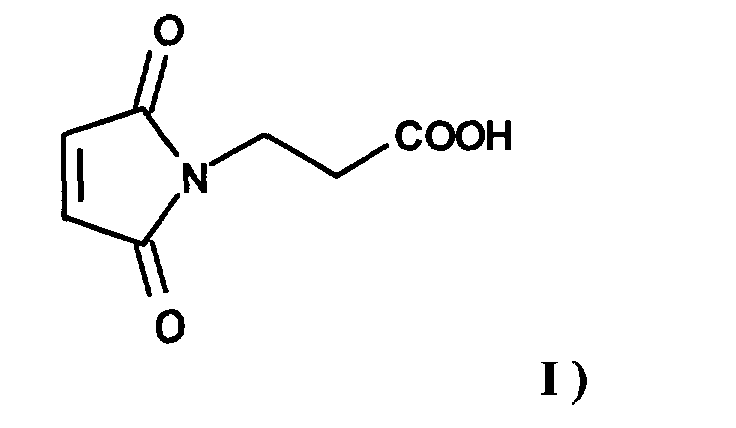
- The optimised procedure was the following one:
- One volume V of a 2 mM TCEP solution was prepared by 1 to 250 dilution of the 0.5 M commercial product (Pierce) in a thoroughly deareated buffer containing 50 mM Tris-HCl, 5 mM EDTA at pH = 7.0. Then, this solution was added to an equivalent volume V of a 10 µM solution of the rFab of the title (prepared according to the previously mentioned Cattani P et al. reference) and incubated for 30 min at 37 °C. Then, a V/2 volume of 50 mM β-maleimidopropionic acid in 0.1 M acetate buffer at pH = 5 was added and the reaction mixture was kept 1 h at 37 °C. At this point the reaction is complete and, if required, excess reactants can be removed by conventional separation procedures, like dialysis or gel-filtration.
- For analytical purposes, a sample was injected into a cation-exchange HPLC column and eluted with a salt gradient. Chromatography was performed on a WP Carboxy-sulfon column (J.T. Baker) at 1 mL/min, using a 15-min gradient from 60 to 120 mM phosphate buffer pH 5.8. Detection was performed at 215 nm. The results are shown in Fig. 1 and demonstrate that the rFab is completely converted in a homogeneous product having 2 more negative charges (Fig. 1A), therefore corresponding to the disubstituted derivative. MS analysis confirmed the disubstitution. The same initial rFab, unconjugated, is shown in Fig. 1B, together with a small peak eluting at 8.8 min, which is due to a mono-deamidated form of the rFab and is a useful marker of the elution position of rFab species differing only by 1 charge. Also this species is subjected to reduction and alkylation and gives the corresponding disubstituted derivative eluting at 6.38 min in Fig. 1A. Fig. 1C shows the content of a reaction mixture in which the reduction step was omitted, i.e. the reducing agent TCEP was not added. The unmodified elution profile, with respect to the unconjugated rFab of Fig. 1B, demonstrates that the alkylation is specific for thiol groups and does not take place if disulfide bonds are intact.
- The rFab of Example 1, after selective reduction of the inter-chain disulfide bond, was reacted with a novel maleimido derivative of diethylentriaminopentaacetic acid (DTPA), which is a well known and widely used chelating agent of proven diagnostic and therapeutic utility (Compound D of Example 2), to give the conjugation products.
- The compound of the title was synthesised starting from compound A (which was prepared according to "Anelli, P.L. et al.; Bioconjugate Chem. 1999, 10, 137-140") following the two steps scheme below:
- Isobutyl chloroformate (15 mmol) was dropped into a solution of 4-maleimidobutyric acid of commercial source (Compound B; 13.6 mmol) and triethylamine (15 mmol) in tetrahydrofuran (55 mL) at -15 °C, under nitrogen atmosphere. After 15 min, a solution of compound A (13.6 mmol), prepared as previously disclosed, in tetrahydrofuran (20 mL) was dropped therein, while keeping the temperature at -4 °C. After 15 min cooling was interrupted and the mixture was stirred at room temperature for 1 h, then evaporated under vacuum. The residue was dissolved in ethyl acetate (50 mL), then washed with water. The organic phase was then dried over sodium sulphate, filtered and evaporated under vacuum.
- The residue was purified by flash chromatography in an ethyl acetate/petroleum ether mixture, to obtain Compound C as a yellow oil (yield: 8.12 mmol, equivalent to 60 %). The analytical data are consistent with the desired structure.
- Trifluoroacetic acid (68.6 mmol) was added to a solution of Compound C (6.25 g, 6.86 mmol) in dichloromethane (100 mL). After 15 h the solution was evaporated under vacuum and the residue was taken up into a further 10 ml of trifluoroacetic acid. After 6 h, the mixture wasevaporated again, the residue was taken up into 50 mL of water, purified on an Amberlite XAD 16.00T column with a water/acetonitrile mixture and the relevant fractions were evaporated, to obtain Compound D as a white solid (59 % yield). The analytical data are consistent with the suggested structure

- Reduction of one volume V of the 10 µM rFab solution of Example 1 was carried out with an equivalent volume V of a 5 mM TCEP solution in 100 mM acetate buffer at pH = 5, for 1 h at 37 °C. As much oxygen as possible was removed from the reaction medium by bubbling nitrogen through the buffering agent before use. Under these conditions, the reduction of the inter-chain disulfide was substantially complete, as observed by SDS-PAGE analysis. However, rFab conformation was not lost as evidenced by the fact that, removing the reducing agent and incubating the reduced rFab for 2 h in 0.1 M Tris-HCl at pH = 8, the inter-chain disulfide was formed again. This fact is very important, meaning that the final product will maintain the capability of recognising the reactive site of the antigen.
- The cysteines formed as a consequence of the specific reduction of Example 3 were subjected to conjugation with Compound D od Example 2, directly in the same reaction medium of the reduction, by simply adding a half volume V/2 of a 100 mM Compound D solution in 0.5 M sodium acetate (final pH of the reaction solution of about 5) and incubating for 16 h at 30 °C. Under the described conditions, a single product formed in quantitative yield as shown in Fig. 2, where HPLC cation-exchange analysis of rFab before (up) and after (bottom) conjugation with Compound D is reported.
- Chromatography was performed on a WP Carboxy-sulfon column (J.T. Baker) at 1 mL/min, using a 15-min gradient from 60 to 120 mM phosphate buffer pH 5.8. Detection was performed at 215 nm.
- MS analysis of the final product confirmed the formation of the diconjugate.
- As the introduction of each DTPA derivative molecule causes an increase in the protein total negative charge, protein charge analysis may be used to evaluate the homogeneity of the preparation, i.e. to make sure that no conjugates with a variable number of DTPA derivatives are formed, thus leading to a mixture of different compounds. Charge analysis can be carried out by electrophoretic and chromatographic techniques. The used electrophoretic technique was native electrophoresis. According to this technique, protein migration depends on both molecular weight and charge, however, for the reduced rFab before and after conjugation with Compound C, being the protein mass substantially the same, the difference of the electrophoretic run was due solely to the differences in the charge introduced by the DTPA derivative. As shown in Fig. 3, three preparations of rFab analysed before and after conjugation with Compound D showed the same behaviour, i.e. a reduction of the migration distance towards the cathode, following conjugation. The same analysis showed that the conjugation product was homogeneous and reproducible.
- The inter-chain disulfide bond of the rFab of Example 1 (one volume V of the 10 µM rFab solution) was selectively reduced as described in Example 3, then a half volume V/2 of a 0.5 mM Compound D solution in 0.5 M sodium acetate (final pH of the reaction solution of about 5) was very slowly dropped directly into the same reaction medium of the reduction at about 5 °C and the condensation was continuously monitored by HPLC.
- The formation of the product of mono-alkylation was shown by the appearance of an increasing peak of intermediate retention time between the unreacted reduced rFab and the diconjugation product. When the area of this peak became bigger than the ones of the other two products, the reaction was stopped and the final mixture was purified by chromatography. MS analysis confirmed that the main peak corresponded to the monoalkylated compound.

Claims (22)
- A chemical conjugate between an immunoglobulin Fab fragment and molecular entities imparting diagnostic or therapeutic utility, whereby the only sites of conjugation on the Fab fragment are one or both of the sulfhydryl groups deriving from the selective and quantitative reduction of the inter-chain disulfide bond of said Fab fragment and whereby said molecular entities imparting diagnostic or therapeutic utility have at least one free sulfhydryl-reactive group, characterized in that the conjugation stoichiometric molar ratio molecular entity to Fab fragment is in the range from 0.95 to 1.05 or in the range from 1.95 to 2.05.
- A conjugate according to claim 1, wherein a first of said sulfhydryl groups deriving from the selective and quantitative reduction of the inter-chain disulfide bond is quantitatively functionalized by reaction with one of said molecular entities imparting diagnostic or therapeutic utility.
- A conjugate according to claim 2, wherein also the second one of said sulfhydryl groups deriving from the selective and quantitative reduction of the inter-chain disulfide bond is quantitatively functionalized by reaction with a second of said molecular entities imparting diagnostic or therapeutic utility, said second molecular entity being different or identical to the first one.
- A conjugate according to claim 1, wherein both of said sulfhydryl groups deriving from the selective and quantitative reduction of the inter-chain disulfide bond are quantitatively symmetrically functionalized by reaction with a stoichiometric excess of one of said molecular entities imparting diagnostic or therapeutic utility.
- A conjugate according to claims 1 or 2, wherein one of said sulfhydryl groups deriving from the selective and quantitative reduction of the inter-chain disulfide bond is chemically modified by reaction with a chemical moiety non-imparting diagnostic or therapeutic utility, said chemical moiety being preferably selected among protective groups of the thiol group or small alkylating or arylating agents.
- A conjugate according to claims 1 to 5, wherein said molecular entities imparting diagnostic or therapeutic utility comprise derivatives of chelating agents for, or chelates of, radionuclides, paramagnetic metal ions or luminescent metal ions, a chromophoric fluorescent or a phosphorescent molecule, a biotin molecule, a hapten recognized by a distinct antibody or fragment thereof, an avidin or streptavidin molecule, a therapeutic drug, a lipophilic chain bearing molecular entity incorporated into liposomes, phospholipid-stabilized microbubbles, triglyceride- or polymer-based microspheres, microballoons which carry the diagnostic or therapeutic agent.
- A conjugate according to claim 6, wherein said molecular entities further comprise one or more functional groups which may be used, as such or after deprotection or after chemical modification, as targets for the selective attachment of a second Fab fragment, equal or different from the first one, or of a second molecular entity imparting diagnostic or therapeutic utility.
- A conjugate according to claims 1 to 6, wherein said sulfhydryl reactive groups comprise iodoacetyl, bromoacetyl, vinyl, maleimido groups or polyfluorobenzene or dinitrofluorobenzene derivatives.
- A conjugate according to any one of the preceding claims, wherein the Fab fragment is a recombinant Fab.
- A process for the preparation of the conjugates of claims 1 to 9, comprising:a ) the selective and quantitative reduction of the inter-chain disulfide bond of a Fab fragment to give two free sulfhydryl groups;b) the quantitative functionalization of one or both of the sulfhydryl groups from step a) with molecular entities having at least one free sulfhydryl-reactive group and imparting diagnostic or therapeutic utility, to give mono- or diconjugate compounds, said diconjugates deriving from either symmetric or asymmetric functionalization of the sulfhydryl groups.
- The process of claim 10, wherein said selective and quantitative reduction of the inter-chain disulfide bond is performed with a phosphine, preferably tributylphosphine and tris-(carboxyethyl)-phosphine.
- The process of claim 11, wherein the reducing agent is tris-(carboxyethyl)-phosphine.
- The process of claim 11, wherein the reduction is carried out mixing the reacting species under buffered conditions giving a final buffered aqueous reaction solution having the following characteristics:
Fab concentration 1 - 100 µM; Phosphine concentration 0.1 - 10 mM; pH of the buffered solution 4 - 8; reaction time 5 - 180 min; reaction temperature 4 - 45 °C. - The process of claim 13, wherein the preferred conditions are the following:
Fab concentration 1.5 - 10 µM or 1 - 5 µM; Phosphine concentration 0.5 - 5 mM; pH of the buffered solution 5 - 7; reaction time 25 - 70 min; reaction temperature 25 - 40 °C. - The process of claim 10, wherein said quantitative functionalization of step b) is performed immediately at the end of the reduction step a), in the same reaction medium, by adding a buffered aqueous solution of the conjugating molecular entity, without purifying the reduced Fab fragment.
- The process of claim 15, wherein the final buffered aqueous reaction solution has the following characteristics:
Fab concentration 2 - 5 µM; Phosphine concentration 0.5 - 5 mM; conjugating moiety concentration 0.1 - 100 mM; pH of the buffered solution 5 - 7; reaction time ≥ 30 min; reaction temperature 4 - 45 °C or 20 - 40 °C. - N 2,N 2-bis[2-[bis(carboxymethyl)amino]ethyl]-N 6-[4-(2,5-dioxo-1H-pyrrol-1-yl)-1-oxobutyl]--lysine as intermediate compound for the preparation of conjugates of claim 1.

- Pharmaceutical compositions containing as active ingredients the conjugate compounds of claims from 1 to 9.
- Compositions according to claim 18, wherein said conjugate compounds are formulated in the form of suspensions, solutions, emulsions for parenteral administration, lyophilizates to be reconstituted before use.
- Diagnostic compositions according to claim 18, wherein the dose of the active ingredient ranges from 0.1 to 10 mg of conjugate per single administration.
- Therapeutic compositions according to claim 18, wherein the dose of the active ingredient ranges from 10 to 500 mg of conjugate per single administration.
- Compositions according to claim 18, for use in analytical immunochemical tests in vitro
Priority Applications (12)
| Application Number | Priority Date | Filing Date | Title |
|---|---|---|---|
| EP02025315A EP1419786A1 (en) | 2002-11-13 | 2002-11-13 | Method for the selective and quantitative functionalization of immunoglobulin fab fragments, conjugate compounds obtained with the same and compositions thereof |
| CN2003801032086A CN1711108B (en) | 2002-11-13 | 2003-11-10 | Method for selective and quantitative functionalization of immunoglobulin Fab fragments, conjugated compounds obtained therefrom and compositions thereof |
| CA2503647A CA2503647C (en) | 2002-11-13 | 2003-11-10 | Method for the selective and quantitative functionalization of immunoglobulin fab fragments, conjugate compounds obtained with the same and compositions thereof |
| US10/532,446 US20060120959A1 (en) | 2002-11-13 | 2003-11-10 | Method for the selective and quantitative functionalization of immunoglobulin fab fragments, conjugate compounds obtained with the same and compositions thereof |
| AT03779875T ATE421340T1 (en) | 2002-11-13 | 2003-11-10 | METHOD FOR THE QUANTITATIVE AND SELECTIVE FUNCTIONALIZATION OF IMMUNOGLOBULIN FAB FRAGMENTS, THEIR CONJUGATES AND THEIR COMPOSITIONS |
| JP2004550961A JP4801352B2 (en) | 2002-11-13 | 2003-11-10 | Method for selectively and quantitatively functionalizing immunoglobulin FAB fragments |
| EP03779875A EP1560600B1 (en) | 2002-11-13 | 2003-11-10 | Method for the selective and quantitative functionalization of immunoglobulin fab fragments, conjugate compounds obtained with the same and compositions thereof |
| DE60325996T DE60325996D1 (en) | 2002-11-13 | 2003-11-10 | METHOD FOR THE QUANTITATIVE AND SELECTIVE FUNCTIONALIZATION OF IMMUNOGLOBULIN FAB FRAGMENTS, THEIR CONJUGATES, AND THEIR COMPOSITIONS |
| AU2003288022A AU2003288022B2 (en) | 2002-11-13 | 2003-11-10 | Method for the selective and quantitative functionalization of immunoglobulin Fab fragments, conjugate compounds obtained with the same and compositions thereof |
| EP07123000A EP1900379A2 (en) | 2002-11-13 | 2003-11-10 | Method for the selective and quantitative functionalization of immunoglobulin FAB fragments, conjugate compounds obtained with the same and composition thereof |
| PCT/EP2003/012514 WO2004043492A1 (en) | 2002-11-13 | 2003-11-10 | Method for the selective and quantitative functionalization of immunoglobulin fab fragments, conjugate compounds obtained with the same and compositions thereof |
| JP2011089945A JP2011148820A (en) | 2002-11-13 | 2011-04-14 | Method for selective and quantitative functionalization of immunoglobulin fab fragment |
Applications Claiming Priority (1)
| Application Number | Priority Date | Filing Date | Title |
|---|---|---|---|
| EP02025315A EP1419786A1 (en) | 2002-11-13 | 2002-11-13 | Method for the selective and quantitative functionalization of immunoglobulin fab fragments, conjugate compounds obtained with the same and compositions thereof |
Publications (1)
| Publication Number | Publication Date |
|---|---|
| EP1419786A1 true EP1419786A1 (en) | 2004-05-19 |
Family
ID=32116242
Family Applications (3)
| Application Number | Title | Priority Date | Filing Date |
|---|---|---|---|
| EP02025315A Withdrawn EP1419786A1 (en) | 2002-11-13 | 2002-11-13 | Method for the selective and quantitative functionalization of immunoglobulin fab fragments, conjugate compounds obtained with the same and compositions thereof |
| EP03779875A Expired - Lifetime EP1560600B1 (en) | 2002-11-13 | 2003-11-10 | Method for the selective and quantitative functionalization of immunoglobulin fab fragments, conjugate compounds obtained with the same and compositions thereof |
| EP07123000A Withdrawn EP1900379A2 (en) | 2002-11-13 | 2003-11-10 | Method for the selective and quantitative functionalization of immunoglobulin FAB fragments, conjugate compounds obtained with the same and composition thereof |
Family Applications After (2)
| Application Number | Title | Priority Date | Filing Date |
|---|---|---|---|
| EP03779875A Expired - Lifetime EP1560600B1 (en) | 2002-11-13 | 2003-11-10 | Method for the selective and quantitative functionalization of immunoglobulin fab fragments, conjugate compounds obtained with the same and compositions thereof |
| EP07123000A Withdrawn EP1900379A2 (en) | 2002-11-13 | 2003-11-10 | Method for the selective and quantitative functionalization of immunoglobulin FAB fragments, conjugate compounds obtained with the same and composition thereof |
Country Status (9)
| Country | Link |
|---|---|
| US (1) | US20060120959A1 (en) |
| EP (3) | EP1419786A1 (en) |
| JP (2) | JP4801352B2 (en) |
| CN (1) | CN1711108B (en) |
| AT (1) | ATE421340T1 (en) |
| AU (1) | AU2003288022B2 (en) |
| CA (1) | CA2503647C (en) |
| DE (1) | DE60325996D1 (en) |
| WO (1) | WO2004043492A1 (en) |
Cited By (4)
| Publication number | Priority date | Publication date | Assignee | Title |
|---|---|---|---|---|
| WO2005003170A2 (en) | 2003-07-01 | 2005-01-13 | Celltech R & D Limited | Modified antibody fragments |
| WO2007128873A1 (en) * | 2006-05-05 | 2007-11-15 | Wallac Oy | A method for the preparation of maleimido derivatives of biomolecule labeling reactants and conjugates derived thereof |
| CN107764992A (en) * | 2017-10-16 | 2018-03-06 | 南京诺唯赞医疗科技有限公司 | The orientation coupling method of a kind of microballoon and antibody and application |
| EP3745129A4 (en) * | 2018-03-23 | 2021-03-24 | Konica Minolta, Inc. | Labeled antibody dispersion liquid and kit for spfs |
Families Citing this family (12)
| Publication number | Priority date | Publication date | Assignee | Title |
|---|---|---|---|---|
| GB0315457D0 (en) * | 2003-07-01 | 2003-08-06 | Celltech R&D Ltd | Biological products |
| ES2533695T3 (en) * | 2004-03-02 | 2015-04-14 | Seattle Genetics, Inc. | Partially charged antibodies and methods for conjugation |
| WO2009012288A2 (en) * | 2007-07-17 | 2009-01-22 | Government Of The United States Of America, Represented By The Secretary, Department Of Health And Human Services | Trifunctional imaging agent for monoclonal antibody tumor-targeted imaging |
| WO2009058203A1 (en) * | 2007-10-29 | 2009-05-07 | Albert Einstein College Of Medicine Of Yeshiva University | Radiolabeled monoclonal antibodies, methods of preparation using tcep, and uses thereof |
| BRPI0921320A2 (en) * | 2008-11-28 | 2018-05-22 | Abbott Laboratories | stable antibody compositions and methods for stabilizing them |
| EP3892294A1 (en) | 2013-08-28 | 2021-10-13 | AbbVie Stemcentrx LLC | Site-specific antibody conjugation methods and compositions |
| JP6515111B2 (en) | 2013-11-06 | 2019-05-22 | アッヴィ・ステムセントルクス・エル・エル・シー | Novel anti-claudin antibodies and methods of use |
| CA2932476A1 (en) | 2013-12-12 | 2015-06-18 | Stemcentrx, Inc. | Novel anti-dpep3 antibodies and methods of use |
| BR112016018891A2 (en) | 2014-02-21 | 2017-10-10 | Abbvie Stemcentrx Llc | anti-dll3 antibodies and drug conjugates for use in melanoma |
| TW201617368A (en) | 2014-09-05 | 2016-05-16 | 史坦森特瑞斯公司 | Novel anti-MFI2 antibody and method of use |
| EP3464384A4 (en) | 2016-06-06 | 2020-03-25 | Northwestern University | FUSION PRODUCT CONSTRUCT |
| CN111505293B (en) * | 2020-04-03 | 2022-11-18 | 北京望尔生物技术有限公司 | Test strip for detecting variegated aspergillin and application thereof |
Citations (2)
| Publication number | Priority date | Publication date | Assignee | Title |
|---|---|---|---|---|
| WO1991004056A1 (en) * | 1989-09-18 | 1991-04-04 | Immunomedics, Inc. | Method for rapidly radiolabeling monovalent antibody fragments with technetium |
| US5274119A (en) * | 1988-07-01 | 1993-12-28 | The Dow Chemical Company | Vicinal diols |
Family Cites Families (14)
| Publication number | Priority date | Publication date | Assignee | Title |
|---|---|---|---|---|
| JPS5616417A (en) | 1979-07-19 | 1981-02-17 | Teijin Ltd | Antitumor protein complex and its preparation |
| US4741900A (en) | 1982-11-16 | 1988-05-03 | Cytogen Corporation | Antibody-metal ion complexes |
| CA1260828A (en) | 1983-07-04 | 1989-09-26 | Masakazu Iwai | Therapeutic and prophylactic agent for gastrointestinal ulcers |
| US5082930A (en) | 1986-05-29 | 1992-01-21 | Mallinckrodt Medical, Inc. | Coupling agents for joining radionuclide metal ions with biologically useful proteins |
| DE3701665A1 (en) | 1987-01-19 | 1988-07-28 | Schering Ag | POLYMER COMPLEXES, METHOD FOR THE PRODUCTION THEREOF AND PHARMACEUTICAL AGENTS CONTAINING THEM |
| DE3807904A1 (en) | 1988-03-10 | 1989-09-21 | Behringwerke Ag | MAGNETIC PROTEIN CONJUGATES, METHOD FOR THE PRODUCTION THEREOF AND THEIR USE |
| US5612016A (en) | 1988-04-01 | 1997-03-18 | Immunomedics, Inc. | Conjugates of antibodies and bifunctional ligands |
| US5061641A (en) * | 1988-04-01 | 1991-10-29 | Immunomedics, Inc. | Method for radiolabeling proteins |
| US5541297A (en) * | 1988-04-01 | 1996-07-30 | Immunomedics, Inc. | Therapeutic conjugates of toxins and drugs |
| CA1339415C (en) | 1989-08-24 | 1997-09-02 | Milton David Goldenberg | Detection and treatment of infections with immunoconjugates |
| DE69026387T2 (en) * | 1989-09-29 | 1996-11-28 | Neorx Corp., Seattle, Wash. | REDUCTION OF NON-TARGET-SPECIFIC RETENTION OF IMMUNOCONJUGATES AND THEIR METABOLITES |
| IL97459A0 (en) | 1990-03-09 | 1992-06-21 | Hybritech Inc | Trifunctional antibody-like compounds as a combined diagnostic and therapeutic agent |
| US5494655A (en) * | 1990-03-09 | 1996-02-27 | The Regents Of The University Of California | Methods for detecting blood perfusion variations by magnetic resonance imaging |
| US7320793B2 (en) * | 2001-01-19 | 2008-01-22 | Cytos Biotechnology Ag | Molecular antigen array |
-
2002
- 2002-11-13 EP EP02025315A patent/EP1419786A1/en not_active Withdrawn
-
2003
- 2003-11-10 WO PCT/EP2003/012514 patent/WO2004043492A1/en not_active Ceased
- 2003-11-10 AT AT03779875T patent/ATE421340T1/en not_active IP Right Cessation
- 2003-11-10 JP JP2004550961A patent/JP4801352B2/en not_active Expired - Fee Related
- 2003-11-10 EP EP03779875A patent/EP1560600B1/en not_active Expired - Lifetime
- 2003-11-10 DE DE60325996T patent/DE60325996D1/en not_active Expired - Lifetime
- 2003-11-10 US US10/532,446 patent/US20060120959A1/en not_active Abandoned
- 2003-11-10 CN CN2003801032086A patent/CN1711108B/en not_active Expired - Fee Related
- 2003-11-10 EP EP07123000A patent/EP1900379A2/en not_active Withdrawn
- 2003-11-10 CA CA2503647A patent/CA2503647C/en not_active Expired - Fee Related
- 2003-11-10 AU AU2003288022A patent/AU2003288022B2/en not_active Ceased
-
2011
- 2011-04-14 JP JP2011089945A patent/JP2011148820A/en active Pending
Patent Citations (2)
| Publication number | Priority date | Publication date | Assignee | Title |
|---|---|---|---|---|
| US5274119A (en) * | 1988-07-01 | 1993-12-28 | The Dow Chemical Company | Vicinal diols |
| WO1991004056A1 (en) * | 1989-09-18 | 1991-04-04 | Immunomedics, Inc. | Method for rapidly radiolabeling monovalent antibody fragments with technetium |
Non-Patent Citations (6)
| Title |
|---|
| ANELLI ET AL: "L-Glutamic acid and L-lysine as useful building blocks for the preparation of bifunctional DTPA-like ligands", BIOCONJUGATE CHEMISTRY, vol. 10, no. 1, 1999, pages 137 - 140,ABSTRACT, XP002115959 * |
| ARTEAGA DE MURPHY C ET AL: "PHOSPHINE REDUCED IGG: A NEW METHOD FOR 99MTC LABELING IMMUNOGLOBULINS", JOURNAL OF RADIOANALYTICAL AND NUCLEAR CHEMISTRY, ARTICLES, ELSEVIER SEQUOIA S.A., LAUSANNE, CH, vol. 220, no. 1, 1997, pages 41 - 45, XP000199389 * |
| BURNS J A ET AL: "Selective reduction of disulfides by tris(2-carboxyethyl)phosphine", JOURNAL OF ORGANIC CHEMISTRY, AMERICAN CHEMICAL SOCIETY. EASTON, US, vol. 56, no. 8, 1991, pages 2648 - 2650, XP002149302, ISSN: 0022-3263 * |
| SEITZ U ET AL: "PREPARATION AND EVALUATION OF THE RHENIUM-188-LABELLED ANTI-NCA ANTIGEN MONOCLONAL ANTIBODY BW 250/183 FOR RADIOIMMUNOTHERAPY OF LEUKAEMIA", EUROPEAN JOURNAL OF NUCLEAR MEDICINE, BERLIN, DE, vol. 26, no. 10, October 1999 (1999-10-01), pages 1265 - 1273, XP000952569, ISSN: 0340-6997 * |
| SINGH RAJEEVA ET AL.: "Labeling of antibodies by in situ modification of thiol groups generated from selenol-catalyzed reduction of native disulfide bonds.", ANALYTICAL BIOCHEMISTRY, vol. 304, - 2002, pages 147 - 156, XP001165655 * |
| YASUSHI FUJIOKA, ET AL.: "Renal metabolism of 3'-iodohippuryl N-maleoyl -L-Lysine (HML)-conjugated Fab fragments", BIOCONJUGATE CHEMISTRY, vol. 12, 2001, pages 178 - 185, XP001165761 * |
Cited By (5)
| Publication number | Priority date | Publication date | Assignee | Title |
|---|---|---|---|---|
| WO2005003170A2 (en) | 2003-07-01 | 2005-01-13 | Celltech R & D Limited | Modified antibody fragments |
| WO2005003170A3 (en) * | 2003-07-01 | 2005-03-10 | Celltech R&D Ltd | Modified antibody fragments |
| WO2007128873A1 (en) * | 2006-05-05 | 2007-11-15 | Wallac Oy | A method for the preparation of maleimido derivatives of biomolecule labeling reactants and conjugates derived thereof |
| CN107764992A (en) * | 2017-10-16 | 2018-03-06 | 南京诺唯赞医疗科技有限公司 | The orientation coupling method of a kind of microballoon and antibody and application |
| EP3745129A4 (en) * | 2018-03-23 | 2021-03-24 | Konica Minolta, Inc. | Labeled antibody dispersion liquid and kit for spfs |
Also Published As
| Publication number | Publication date |
|---|---|
| WO2004043492A1 (en) | 2004-05-27 |
| EP1560600A1 (en) | 2005-08-10 |
| CN1711108B (en) | 2010-10-06 |
| EP1900379A2 (en) | 2008-03-19 |
| JP2011148820A (en) | 2011-08-04 |
| JP2006508954A (en) | 2006-03-16 |
| US20060120959A1 (en) | 2006-06-08 |
| ATE421340T1 (en) | 2009-02-15 |
| CN1711108A (en) | 2005-12-21 |
| EP1560600B1 (en) | 2009-01-21 |
| DE60325996D1 (en) | 2009-03-12 |
| CA2503647C (en) | 2012-07-03 |
| AU2003288022A1 (en) | 2004-06-03 |
| CA2503647A1 (en) | 2004-05-27 |
| JP4801352B2 (en) | 2011-10-26 |
| AU2003288022B2 (en) | 2009-04-30 |
Similar Documents
| Publication | Publication Date | Title |
|---|---|---|
| JP2011148820A (en) | Method for selective and quantitative functionalization of immunoglobulin fab fragment | |
| US5391723A (en) | Oligonucleotide conjugates | |
| US5563250A (en) | Cleavable conjugates for the delivery and release of agents in native form | |
| AU646121B2 (en) | Acid-labile linker molecules | |
| US5141648A (en) | Methods for isolating compounds using cleavable linker bound matrices | |
| PL172837B1 (en) | Pharmaceutical preparation containing thioether conjugates PL PL PL PL PL | |
| CN114127059A (en) | Macrocyclic chelants and methods of use thereof | |
| JPH0647557B2 (en) | Radiolabeled antibody fragment | |
| JPH08507517A (en) | Acid-cleavable compounds, their preparation and use as divalent acid-labile crosslinkers | |
| US20050271673A1 (en) | Trifunctional reagent for conjugation to a biomolecule | |
| US6576746B2 (en) | Site-specific labeling of disulfide-containing targeting vectors | |
| IE52239B1 (en) | Conjugates of vindesine with immunoglobulin or fragments thereof | |
| AU5047590A (en) | Cross-linked antibodies and processes for their preparation | |
| US5017693A (en) | Methods for introducing a sulfhydryl amino or hydroxyl groups to a compound | |
| JPH05238952A (en) | Cluster complex of drugs with antibodies | |
| US20010023288A1 (en) | Trifunctional reagent for conjugation to a biomolecule | |
| KR20050086578A (en) | Agents for the diagnosis and treatment of tumours that expose altered proteins on the cell surface | |
| US5874549A (en) | Acid-cleavable compound | |
| EP1121153B1 (en) | Site-specific labeling of disulfide-containing targeting vectors | |
| WO2024235071A1 (en) | Conjugate and the preparation thereof | |
| WO1990014844A2 (en) | Sugars as cleavable linkers for the delivery and release of agents in native form | |
| CN121038819A (en) | Antibody-drug conjugates and their use and treatment methods | |
| HK40071088A (en) | Macrocyclic chelators and methods of use thereof | |
| BR112016018005B1 (en) | ANTIBODY-DRUG CONJUGATES AND IMMUNOTOXINS | |
| JPH0782300A (en) | Antitumor substance |
Legal Events
| Date | Code | Title | Description |
|---|---|---|---|
| PUAI | Public reference made under article 153(3) epc to a published international application that has entered the european phase |
Free format text: ORIGINAL CODE: 0009012 |
|
| AK | Designated contracting states |
Kind code of ref document: A1 Designated state(s): AT BE BG CH CY CZ DE DK EE ES FI FR GB GR IE IT LI LU MC NL PT SE SK TR |
|
| AX | Request for extension of the european patent |
Extension state: AL LT LV MK RO SI |
|
| 17P | Request for examination filed |
Effective date: 20041119 |
|
| AKX | Designation fees paid |
Designated state(s): AT BE BG CH CY CZ DE DK EE ES FI FR GB GR IE IT LI LU MC NL PT SE SK TR |
|
| 17Q | First examination report despatched |
Effective date: 20050330 |
|
| STAA | Information on the status of an ep patent application or granted ep patent |
Free format text: STATUS: THE APPLICATION IS DEEMED TO BE WITHDRAWN |
|
| 18D | Application deemed to be withdrawn |
Effective date: 20050810 |