EP1419150B1 - Phenylsulfonyl-1,3-dihydro-2h-indole-2-one derivatives, their preparation and their therapeutic use - Google Patents
Phenylsulfonyl-1,3-dihydro-2h-indole-2-one derivatives, their preparation and their therapeutic use Download PDFInfo
- Publication number
- EP1419150B1 EP1419150B1 EP02774822A EP02774822A EP1419150B1 EP 1419150 B1 EP1419150 B1 EP 1419150B1 EP 02774822 A EP02774822 A EP 02774822A EP 02774822 A EP02774822 A EP 02774822A EP 1419150 B1 EP1419150 B1 EP 1419150B1
- Authority
- EP
- European Patent Office
- Prior art keywords
- indol
- dihydro
- chloro
- oxo
- dimethoxyphenyl
- Prior art date
- Legal status (The legal status is an assumption and is not a legal conclusion. Google has not performed a legal analysis and makes no representation as to the accuracy of the status listed.)
- Expired - Lifetime
Links
- 0 C*(O*)I*N*N=C Chemical compound C*(O*)I*N*N=C 0.000 description 3
- XGCZABZDVJOWTL-UHFFFAOYSA-N Cc1cc(O)ccc1N=O Chemical compound Cc1cc(O)ccc1N=O XGCZABZDVJOWTL-UHFFFAOYSA-N 0.000 description 1
Classifications
-
- C—CHEMISTRY; METALLURGY
- C07—ORGANIC CHEMISTRY
- C07D—HETEROCYCLIC COMPOUNDS
- C07D401/00—Heterocyclic compounds containing two or more hetero rings, having nitrogen atoms as the only ring hetero atoms, at least one ring being a six-membered ring with only one nitrogen atom
- C07D401/02—Heterocyclic compounds containing two or more hetero rings, having nitrogen atoms as the only ring hetero atoms, at least one ring being a six-membered ring with only one nitrogen atom containing two hetero rings
- C07D401/12—Heterocyclic compounds containing two or more hetero rings, having nitrogen atoms as the only ring hetero atoms, at least one ring being a six-membered ring with only one nitrogen atom containing two hetero rings linked by a chain containing hetero atoms as chain links
-
- A—HUMAN NECESSITIES
- A61—MEDICAL OR VETERINARY SCIENCE; HYGIENE
- A61P—SPECIFIC THERAPEUTIC ACTIVITY OF CHEMICAL COMPOUNDS OR MEDICINAL PREPARATIONS
- A61P1/00—Drugs for disorders of the alimentary tract or the digestive system
- A61P1/04—Drugs for disorders of the alimentary tract or the digestive system for ulcers, gastritis or reflux esophagitis, e.g. antacids, inhibitors of acid secretion, mucosal protectants
-
- A—HUMAN NECESSITIES
- A61—MEDICAL OR VETERINARY SCIENCE; HYGIENE
- A61P—SPECIFIC THERAPEUTIC ACTIVITY OF CHEMICAL COMPOUNDS OR MEDICINAL PREPARATIONS
- A61P1/00—Drugs for disorders of the alimentary tract or the digestive system
- A61P1/08—Drugs for disorders of the alimentary tract or the digestive system for nausea, cinetosis or vertigo; Antiemetics
-
- A—HUMAN NECESSITIES
- A61—MEDICAL OR VETERINARY SCIENCE; HYGIENE
- A61P—SPECIFIC THERAPEUTIC ACTIVITY OF CHEMICAL COMPOUNDS OR MEDICINAL PREPARATIONS
- A61P1/00—Drugs for disorders of the alimentary tract or the digestive system
- A61P1/12—Antidiarrhoeals
-
- A—HUMAN NECESSITIES
- A61—MEDICAL OR VETERINARY SCIENCE; HYGIENE
- A61P—SPECIFIC THERAPEUTIC ACTIVITY OF CHEMICAL COMPOUNDS OR MEDICINAL PREPARATIONS
- A61P1/00—Drugs for disorders of the alimentary tract or the digestive system
- A61P1/14—Prodigestives, e.g. acids, enzymes, appetite stimulants, antidyspeptics, tonics, antiflatulents
-
- A—HUMAN NECESSITIES
- A61—MEDICAL OR VETERINARY SCIENCE; HYGIENE
- A61P—SPECIFIC THERAPEUTIC ACTIVITY OF CHEMICAL COMPOUNDS OR MEDICINAL PREPARATIONS
- A61P1/00—Drugs for disorders of the alimentary tract or the digestive system
- A61P1/16—Drugs for disorders of the alimentary tract or the digestive system for liver or gallbladder disorders, e.g. hepatoprotective agents, cholagogues, litholytics
-
- A—HUMAN NECESSITIES
- A61—MEDICAL OR VETERINARY SCIENCE; HYGIENE
- A61P—SPECIFIC THERAPEUTIC ACTIVITY OF CHEMICAL COMPOUNDS OR MEDICINAL PREPARATIONS
- A61P11/00—Drugs for disorders of the respiratory system
-
- A—HUMAN NECESSITIES
- A61—MEDICAL OR VETERINARY SCIENCE; HYGIENE
- A61P—SPECIFIC THERAPEUTIC ACTIVITY OF CHEMICAL COMPOUNDS OR MEDICINAL PREPARATIONS
- A61P11/00—Drugs for disorders of the respiratory system
- A61P11/06—Antiasthmatics
-
- A—HUMAN NECESSITIES
- A61—MEDICAL OR VETERINARY SCIENCE; HYGIENE
- A61P—SPECIFIC THERAPEUTIC ACTIVITY OF CHEMICAL COMPOUNDS OR MEDICINAL PREPARATIONS
- A61P13/00—Drugs for disorders of the urinary system
-
- A—HUMAN NECESSITIES
- A61—MEDICAL OR VETERINARY SCIENCE; HYGIENE
- A61P—SPECIFIC THERAPEUTIC ACTIVITY OF CHEMICAL COMPOUNDS OR MEDICINAL PREPARATIONS
- A61P13/00—Drugs for disorders of the urinary system
- A61P13/02—Drugs for disorders of the urinary system of urine or of the urinary tract, e.g. urine acidifiers
-
- A—HUMAN NECESSITIES
- A61—MEDICAL OR VETERINARY SCIENCE; HYGIENE
- A61P—SPECIFIC THERAPEUTIC ACTIVITY OF CHEMICAL COMPOUNDS OR MEDICINAL PREPARATIONS
- A61P13/00—Drugs for disorders of the urinary system
- A61P13/08—Drugs for disorders of the urinary system of the prostate
-
- A—HUMAN NECESSITIES
- A61—MEDICAL OR VETERINARY SCIENCE; HYGIENE
- A61P—SPECIFIC THERAPEUTIC ACTIVITY OF CHEMICAL COMPOUNDS OR MEDICINAL PREPARATIONS
- A61P13/00—Drugs for disorders of the urinary system
- A61P13/12—Drugs for disorders of the urinary system of the kidneys
-
- A—HUMAN NECESSITIES
- A61—MEDICAL OR VETERINARY SCIENCE; HYGIENE
- A61P—SPECIFIC THERAPEUTIC ACTIVITY OF CHEMICAL COMPOUNDS OR MEDICINAL PREPARATIONS
- A61P15/00—Drugs for genital or sexual disorders; Contraceptives
-
- A—HUMAN NECESSITIES
- A61—MEDICAL OR VETERINARY SCIENCE; HYGIENE
- A61P—SPECIFIC THERAPEUTIC ACTIVITY OF CHEMICAL COMPOUNDS OR MEDICINAL PREPARATIONS
- A61P15/00—Drugs for genital or sexual disorders; Contraceptives
- A61P15/04—Drugs for genital or sexual disorders; Contraceptives for inducing labour or abortion; Uterotonics
-
- A—HUMAN NECESSITIES
- A61—MEDICAL OR VETERINARY SCIENCE; HYGIENE
- A61P—SPECIFIC THERAPEUTIC ACTIVITY OF CHEMICAL COMPOUNDS OR MEDICINAL PREPARATIONS
- A61P15/00—Drugs for genital or sexual disorders; Contraceptives
- A61P15/10—Drugs for genital or sexual disorders; Contraceptives for impotence
-
- A—HUMAN NECESSITIES
- A61—MEDICAL OR VETERINARY SCIENCE; HYGIENE
- A61P—SPECIFIC THERAPEUTIC ACTIVITY OF CHEMICAL COMPOUNDS OR MEDICINAL PREPARATIONS
- A61P17/00—Drugs for dermatological disorders
- A61P17/02—Drugs for dermatological disorders for treating wounds, ulcers, burns, scars, keloids, or the like
-
- A—HUMAN NECESSITIES
- A61—MEDICAL OR VETERINARY SCIENCE; HYGIENE
- A61P—SPECIFIC THERAPEUTIC ACTIVITY OF CHEMICAL COMPOUNDS OR MEDICINAL PREPARATIONS
- A61P17/00—Drugs for dermatological disorders
- A61P17/06—Antipsoriatics
-
- A—HUMAN NECESSITIES
- A61—MEDICAL OR VETERINARY SCIENCE; HYGIENE
- A61P—SPECIFIC THERAPEUTIC ACTIVITY OF CHEMICAL COMPOUNDS OR MEDICINAL PREPARATIONS
- A61P19/00—Drugs for skeletal disorders
- A61P19/02—Drugs for skeletal disorders for joint disorders, e.g. arthritis, arthrosis
-
- A—HUMAN NECESSITIES
- A61—MEDICAL OR VETERINARY SCIENCE; HYGIENE
- A61P—SPECIFIC THERAPEUTIC ACTIVITY OF CHEMICAL COMPOUNDS OR MEDICINAL PREPARATIONS
- A61P21/00—Drugs for disorders of the muscular or neuromuscular system
-
- A—HUMAN NECESSITIES
- A61—MEDICAL OR VETERINARY SCIENCE; HYGIENE
- A61P—SPECIFIC THERAPEUTIC ACTIVITY OF CHEMICAL COMPOUNDS OR MEDICINAL PREPARATIONS
- A61P21/00—Drugs for disorders of the muscular or neuromuscular system
- A61P21/02—Muscle relaxants, e.g. for tetanus or cramps
-
- A—HUMAN NECESSITIES
- A61—MEDICAL OR VETERINARY SCIENCE; HYGIENE
- A61P—SPECIFIC THERAPEUTIC ACTIVITY OF CHEMICAL COMPOUNDS OR MEDICINAL PREPARATIONS
- A61P25/00—Drugs for disorders of the nervous system
- A61P25/04—Centrally acting analgesics, e.g. opioids
-
- A—HUMAN NECESSITIES
- A61—MEDICAL OR VETERINARY SCIENCE; HYGIENE
- A61P—SPECIFIC THERAPEUTIC ACTIVITY OF CHEMICAL COMPOUNDS OR MEDICINAL PREPARATIONS
- A61P25/00—Drugs for disorders of the nervous system
- A61P25/06—Antimigraine agents
-
- A—HUMAN NECESSITIES
- A61—MEDICAL OR VETERINARY SCIENCE; HYGIENE
- A61P—SPECIFIC THERAPEUTIC ACTIVITY OF CHEMICAL COMPOUNDS OR MEDICINAL PREPARATIONS
- A61P25/00—Drugs for disorders of the nervous system
- A61P25/14—Drugs for disorders of the nervous system for treating abnormal movements, e.g. chorea, dyskinesia
-
- A—HUMAN NECESSITIES
- A61—MEDICAL OR VETERINARY SCIENCE; HYGIENE
- A61P—SPECIFIC THERAPEUTIC ACTIVITY OF CHEMICAL COMPOUNDS OR MEDICINAL PREPARATIONS
- A61P25/00—Drugs for disorders of the nervous system
- A61P25/14—Drugs for disorders of the nervous system for treating abnormal movements, e.g. chorea, dyskinesia
- A61P25/16—Anti-Parkinson drugs
-
- A—HUMAN NECESSITIES
- A61—MEDICAL OR VETERINARY SCIENCE; HYGIENE
- A61P—SPECIFIC THERAPEUTIC ACTIVITY OF CHEMICAL COMPOUNDS OR MEDICINAL PREPARATIONS
- A61P25/00—Drugs for disorders of the nervous system
- A61P25/18—Antipsychotics, i.e. neuroleptics; Drugs for mania or schizophrenia
-
- A—HUMAN NECESSITIES
- A61—MEDICAL OR VETERINARY SCIENCE; HYGIENE
- A61P—SPECIFIC THERAPEUTIC ACTIVITY OF CHEMICAL COMPOUNDS OR MEDICINAL PREPARATIONS
- A61P25/00—Drugs for disorders of the nervous system
- A61P25/20—Hypnotics; Sedatives
-
- A—HUMAN NECESSITIES
- A61—MEDICAL OR VETERINARY SCIENCE; HYGIENE
- A61P—SPECIFIC THERAPEUTIC ACTIVITY OF CHEMICAL COMPOUNDS OR MEDICINAL PREPARATIONS
- A61P25/00—Drugs for disorders of the nervous system
- A61P25/22—Anxiolytics
-
- A—HUMAN NECESSITIES
- A61—MEDICAL OR VETERINARY SCIENCE; HYGIENE
- A61P—SPECIFIC THERAPEUTIC ACTIVITY OF CHEMICAL COMPOUNDS OR MEDICINAL PREPARATIONS
- A61P25/00—Drugs for disorders of the nervous system
- A61P25/24—Antidepressants
-
- A—HUMAN NECESSITIES
- A61—MEDICAL OR VETERINARY SCIENCE; HYGIENE
- A61P—SPECIFIC THERAPEUTIC ACTIVITY OF CHEMICAL COMPOUNDS OR MEDICINAL PREPARATIONS
- A61P25/00—Drugs for disorders of the nervous system
- A61P25/28—Drugs for disorders of the nervous system for treating neurodegenerative disorders of the central nervous system, e.g. nootropic agents, cognition enhancers, drugs for treating Alzheimer's disease or other forms of dementia
-
- A—HUMAN NECESSITIES
- A61—MEDICAL OR VETERINARY SCIENCE; HYGIENE
- A61P—SPECIFIC THERAPEUTIC ACTIVITY OF CHEMICAL COMPOUNDS OR MEDICINAL PREPARATIONS
- A61P25/00—Drugs for disorders of the nervous system
- A61P25/30—Drugs for disorders of the nervous system for treating abuse or dependence
-
- A—HUMAN NECESSITIES
- A61—MEDICAL OR VETERINARY SCIENCE; HYGIENE
- A61P—SPECIFIC THERAPEUTIC ACTIVITY OF CHEMICAL COMPOUNDS OR MEDICINAL PREPARATIONS
- A61P25/00—Drugs for disorders of the nervous system
- A61P25/30—Drugs for disorders of the nervous system for treating abuse or dependence
- A61P25/34—Tobacco-abuse
-
- A—HUMAN NECESSITIES
- A61—MEDICAL OR VETERINARY SCIENCE; HYGIENE
- A61P—SPECIFIC THERAPEUTIC ACTIVITY OF CHEMICAL COMPOUNDS OR MEDICINAL PREPARATIONS
- A61P27/00—Drugs for disorders of the senses
- A61P27/02—Ophthalmic agents
- A61P27/06—Antiglaucoma agents or miotics
-
- A—HUMAN NECESSITIES
- A61—MEDICAL OR VETERINARY SCIENCE; HYGIENE
- A61P—SPECIFIC THERAPEUTIC ACTIVITY OF CHEMICAL COMPOUNDS OR MEDICINAL PREPARATIONS
- A61P27/00—Drugs for disorders of the senses
- A61P27/02—Ophthalmic agents
- A61P27/12—Ophthalmic agents for cataracts
-
- A—HUMAN NECESSITIES
- A61—MEDICAL OR VETERINARY SCIENCE; HYGIENE
- A61P—SPECIFIC THERAPEUTIC ACTIVITY OF CHEMICAL COMPOUNDS OR MEDICINAL PREPARATIONS
- A61P29/00—Non-central analgesic, antipyretic or antiinflammatory agents, e.g. antirheumatic agents; Non-steroidal antiinflammatory drugs [NSAID]
-
- A—HUMAN NECESSITIES
- A61—MEDICAL OR VETERINARY SCIENCE; HYGIENE
- A61P—SPECIFIC THERAPEUTIC ACTIVITY OF CHEMICAL COMPOUNDS OR MEDICINAL PREPARATIONS
- A61P29/00—Non-central analgesic, antipyretic or antiinflammatory agents, e.g. antirheumatic agents; Non-steroidal antiinflammatory drugs [NSAID]
- A61P29/02—Non-central analgesic, antipyretic or antiinflammatory agents, e.g. antirheumatic agents; Non-steroidal antiinflammatory drugs [NSAID] without antiinflammatory effect
-
- A—HUMAN NECESSITIES
- A61—MEDICAL OR VETERINARY SCIENCE; HYGIENE
- A61P—SPECIFIC THERAPEUTIC ACTIVITY OF CHEMICAL COMPOUNDS OR MEDICINAL PREPARATIONS
- A61P3/00—Drugs for disorders of the metabolism
- A61P3/04—Anorexiants; Antiobesity agents
-
- A—HUMAN NECESSITIES
- A61—MEDICAL OR VETERINARY SCIENCE; HYGIENE
- A61P—SPECIFIC THERAPEUTIC ACTIVITY OF CHEMICAL COMPOUNDS OR MEDICINAL PREPARATIONS
- A61P3/00—Drugs for disorders of the metabolism
- A61P3/06—Antihyperlipidemics
-
- A—HUMAN NECESSITIES
- A61—MEDICAL OR VETERINARY SCIENCE; HYGIENE
- A61P—SPECIFIC THERAPEUTIC ACTIVITY OF CHEMICAL COMPOUNDS OR MEDICINAL PREPARATIONS
- A61P3/00—Drugs for disorders of the metabolism
- A61P3/08—Drugs for disorders of the metabolism for glucose homeostasis
-
- A—HUMAN NECESSITIES
- A61—MEDICAL OR VETERINARY SCIENCE; HYGIENE
- A61P—SPECIFIC THERAPEUTIC ACTIVITY OF CHEMICAL COMPOUNDS OR MEDICINAL PREPARATIONS
- A61P3/00—Drugs for disorders of the metabolism
- A61P3/08—Drugs for disorders of the metabolism for glucose homeostasis
- A61P3/10—Drugs for disorders of the metabolism for glucose homeostasis for hyperglycaemia, e.g. antidiabetics
-
- A—HUMAN NECESSITIES
- A61—MEDICAL OR VETERINARY SCIENCE; HYGIENE
- A61P—SPECIFIC THERAPEUTIC ACTIVITY OF CHEMICAL COMPOUNDS OR MEDICINAL PREPARATIONS
- A61P3/00—Drugs for disorders of the metabolism
- A61P3/12—Drugs for disorders of the metabolism for electrolyte homeostasis
-
- A—HUMAN NECESSITIES
- A61—MEDICAL OR VETERINARY SCIENCE; HYGIENE
- A61P—SPECIFIC THERAPEUTIC ACTIVITY OF CHEMICAL COMPOUNDS OR MEDICINAL PREPARATIONS
- A61P31/00—Antiinfectives, i.e. antibiotics, antiseptics, chemotherapeutics
-
- A—HUMAN NECESSITIES
- A61—MEDICAL OR VETERINARY SCIENCE; HYGIENE
- A61P—SPECIFIC THERAPEUTIC ACTIVITY OF CHEMICAL COMPOUNDS OR MEDICINAL PREPARATIONS
- A61P35/00—Antineoplastic agents
-
- A—HUMAN NECESSITIES
- A61—MEDICAL OR VETERINARY SCIENCE; HYGIENE
- A61P—SPECIFIC THERAPEUTIC ACTIVITY OF CHEMICAL COMPOUNDS OR MEDICINAL PREPARATIONS
- A61P37/00—Drugs for immunological or allergic disorders
- A61P37/02—Immunomodulators
- A61P37/04—Immunostimulants
-
- A—HUMAN NECESSITIES
- A61—MEDICAL OR VETERINARY SCIENCE; HYGIENE
- A61P—SPECIFIC THERAPEUTIC ACTIVITY OF CHEMICAL COMPOUNDS OR MEDICINAL PREPARATIONS
- A61P37/00—Drugs for immunological or allergic disorders
- A61P37/08—Antiallergic agents
-
- A—HUMAN NECESSITIES
- A61—MEDICAL OR VETERINARY SCIENCE; HYGIENE
- A61P—SPECIFIC THERAPEUTIC ACTIVITY OF CHEMICAL COMPOUNDS OR MEDICINAL PREPARATIONS
- A61P43/00—Drugs for specific purposes, not provided for in groups A61P1/00-A61P41/00
-
- A—HUMAN NECESSITIES
- A61—MEDICAL OR VETERINARY SCIENCE; HYGIENE
- A61P—SPECIFIC THERAPEUTIC ACTIVITY OF CHEMICAL COMPOUNDS OR MEDICINAL PREPARATIONS
- A61P5/00—Drugs for disorders of the endocrine system
- A61P5/24—Drugs for disorders of the endocrine system of the sex hormones
-
- A—HUMAN NECESSITIES
- A61—MEDICAL OR VETERINARY SCIENCE; HYGIENE
- A61P—SPECIFIC THERAPEUTIC ACTIVITY OF CHEMICAL COMPOUNDS OR MEDICINAL PREPARATIONS
- A61P5/00—Drugs for disorders of the endocrine system
- A61P5/38—Drugs for disorders of the endocrine system of the suprarenal hormones
-
- A—HUMAN NECESSITIES
- A61—MEDICAL OR VETERINARY SCIENCE; HYGIENE
- A61P—SPECIFIC THERAPEUTIC ACTIVITY OF CHEMICAL COMPOUNDS OR MEDICINAL PREPARATIONS
- A61P7/00—Drugs for disorders of the blood or the extracellular fluid
- A61P7/04—Antihaemorrhagics; Procoagulants; Haemostatic agents; Antifibrinolytic agents
-
- A—HUMAN NECESSITIES
- A61—MEDICAL OR VETERINARY SCIENCE; HYGIENE
- A61P—SPECIFIC THERAPEUTIC ACTIVITY OF CHEMICAL COMPOUNDS OR MEDICINAL PREPARATIONS
- A61P9/00—Drugs for disorders of the cardiovascular system
-
- A—HUMAN NECESSITIES
- A61—MEDICAL OR VETERINARY SCIENCE; HYGIENE
- A61P—SPECIFIC THERAPEUTIC ACTIVITY OF CHEMICAL COMPOUNDS OR MEDICINAL PREPARATIONS
- A61P9/00—Drugs for disorders of the cardiovascular system
- A61P9/04—Inotropic agents, i.e. stimulants of cardiac contraction; Drugs for heart failure
-
- A—HUMAN NECESSITIES
- A61—MEDICAL OR VETERINARY SCIENCE; HYGIENE
- A61P—SPECIFIC THERAPEUTIC ACTIVITY OF CHEMICAL COMPOUNDS OR MEDICINAL PREPARATIONS
- A61P9/00—Drugs for disorders of the cardiovascular system
- A61P9/08—Vasodilators for multiple indications
-
- A—HUMAN NECESSITIES
- A61—MEDICAL OR VETERINARY SCIENCE; HYGIENE
- A61P—SPECIFIC THERAPEUTIC ACTIVITY OF CHEMICAL COMPOUNDS OR MEDICINAL PREPARATIONS
- A61P9/00—Drugs for disorders of the cardiovascular system
- A61P9/10—Drugs for disorders of the cardiovascular system for treating ischaemic or atherosclerotic diseases, e.g. antianginal drugs, coronary vasodilators, drugs for myocardial infarction, retinopathy, cerebrovascula insufficiency, renal arteriosclerosis
-
- A—HUMAN NECESSITIES
- A61—MEDICAL OR VETERINARY SCIENCE; HYGIENE
- A61P—SPECIFIC THERAPEUTIC ACTIVITY OF CHEMICAL COMPOUNDS OR MEDICINAL PREPARATIONS
- A61P9/00—Drugs for disorders of the cardiovascular system
- A61P9/12—Antihypertensives
-
- C—CHEMISTRY; METALLURGY
- C07—ORGANIC CHEMISTRY
- C07D—HETEROCYCLIC COMPOUNDS
- C07D401/00—Heterocyclic compounds containing two or more hetero rings, having nitrogen atoms as the only ring hetero atoms, at least one ring being a six-membered ring with only one nitrogen atom
- C07D401/14—Heterocyclic compounds containing two or more hetero rings, having nitrogen atoms as the only ring hetero atoms, at least one ring being a six-membered ring with only one nitrogen atom containing three or more hetero rings
-
- C—CHEMISTRY; METALLURGY
- C07—ORGANIC CHEMISTRY
- C07D—HETEROCYCLIC COMPOUNDS
- C07D403/00—Heterocyclic compounds containing two or more hetero rings, having nitrogen atoms as the only ring hetero atoms, not provided for by group C07D401/00
- C07D403/02—Heterocyclic compounds containing two or more hetero rings, having nitrogen atoms as the only ring hetero atoms, not provided for by group C07D401/00 containing two hetero rings
- C07D403/12—Heterocyclic compounds containing two or more hetero rings, having nitrogen atoms as the only ring hetero atoms, not provided for by group C07D401/00 containing two hetero rings linked by a chain containing hetero atoms as chain links
Definitions
- the present invention relates to 1,3-dihydro- 2H -indol-2-one derivatives, their preparation and their therapeutic application.
- the compounds according to the present invention have an affinity for the arginine-vasopressin V 1b receptors (AVP) and / or the oxytocin (OT) receptors and, in addition, for some of them an affinity for the receivers V 1a of the AVP.
- AVP arginine-vasopressin V 1b receptors
- OT oxytocin
- AVP is a hormone known for its antidiuretic effect and its effect in the regulation of blood pressure. It stimulates several types of receivers: V 1 (V 1a , V 1b ), V 2 . These receptors are located in particular in the liver, the vessels (coronary, renal, cerebral), platelets, kidney, uterus, adrenal glands, pancreas, central nervous system, pituitary gland. AVP thus exerts cardiovascular, hepatic, pancreatic, antidiuretic, platelet aggregating effects and effects on the central and peripheral nervous system, and on the uterine sphere.
- OT is a neurohypophyseal hormone with a cyclic nonapeptide structure close to that of the AVP.
- OT receptors are essentially on the smooth muscle of the uterus and on the myoepithelial cells of the mammary glands. Thus, OT plays an important role in parturition since it intervenes in the contraction of the uterine muscle and in lactation.
- OT receivers are also localized in other peripheral tissues and in the nervous system central; OT may therefore have effects in the cardiovascular, renal, endocrine or behavioral.
- V 1a receptors of AVP are localized in many peripheral organs and in the brain. They have been cloned, particularly in rats and humans, and they regulate the majority of the known effects of AVP: platelet aggregation; uterine contractions; the contraction of the vessels; the secretion of aldosterone, cortisol, CRF (corticotropin-releasing factor) and adrenocorticotrophic hormone (ACTH); hepatic glycogenolysis, cell proliferation and the main central effects of AVP (hypothermia, memory, ).
- V 1b receptors were initially identified in the adenohypophysis of different animal species (rat, pig, beef, sheep, etc.) including in humans (S. JARD et al., Mol Pharmacol., 1986, 30 , 171-177, Y. ARSENIJEVIC et al., J. Endocrinol., 1994, 141 , 383-391, J. SCHWARTZ et al., Endocrinology, 1991, 129 (2), 1107-1109, Y.
- V 1b receptors have been cloned in rats, humans and mice (Y. KEYSER, FEBS Letters, 1994, 356 , 215-220, T. SUGIMOTO et al., J. Biol Chem, 1994, 269 (43), 27088-27092, M. SAITO et al., Biochem Biophys Res Commun., 1995, 212 (3), 751-757, SJ LOLAIT et al., Neurobiology, 1996, 92 , 6783.
- AVP via these receptors would play a crucial role in certain types of adrenal pheochromocytomas secreting AVP and thus inducing a sustained production of catecholamines at the origin of hypertension that is resistant to receptor antagonists.
- angiotensin II and angiotensin converting enzyme inhibitors The adrenal cortex is also rich in V 1a receptors involved in the production of gluco- and mineralo-corticoids (aldosterone and cortisol).
- AVP circulating or synthesized locally
- Cortisol is a potent regulator of the production of ACTH, the stress hormone.
- V 1b receptors are also considered a marker of tumors.
- secreting tumors of ACTH such as certain pituitary tumors, certain bronchial carcinomas (Small Cell Lung Cancers or SCLC), pancreatic, adrenal and thyroid cancers, inducing Cushing's syndrome in certain patients.
- SCLC bronchial carcinomas
- et al. Eur J Endocrinol., 1996, 135 , 173, GA WITTERT et al., Lancet, 1990, 335 , 991-994
- overexpress V 1b receptors overexpress V 1b receptors.
- the V 1a receptors are, for their part, a more specific marker of small cell lung cancer (SCLC) (PJ Woll et al., Biochem Biophys Res Commun, 1989, 164 (1), 66-73).
- SCLC small cell lung cancer
- the compounds according to the present invention are obvious diagnostic tools and offer a new therapeutic approach in the proliferation and detection of these tumors, at an early stage (radiolabeling, SPECT, of the English Single Photon Emission Computed Tomography; PET Scan, English Positron Emission Tomography Scanner).
- V 1b receptors The abundant presence of the messenger of the V 1b receptors at the stomach and intestinal level, suggests involvement of AVP via this receptor on the release of gastrointestinal hormones such as cholecystokinin, gastrin or secretin (T. SUGIMOTO et al., Molecular cloning and functional expression of V 1b receptor gene, in Neurohypophysis: Recent Progress of Vasopressin and Oxytocin Research, T. SAITO, K. KUROKAWA and S. YOSHIDA ed., Elvesier Science, 1995, 409-413).
- 1,3-Dihydro- 2H- indol-2-one derivatives have been described in certain patent applications as ligands for the arginine-vasopressin and / or oxytocin receptors: mention may be made of the WO 93/15051, EP 636608, EP 636609, WO 95/18105, WO 97/15556 and WO 98/25901.
- Novel 1,3-dihydro- 2H- indol-2-one derivatives having affinity and selectivity for arginine vasopressin V 1b receptors and / or for oxytocin receptors have now been found. and, in addition, for some compounds an affinity for V 1a receptors. These derivatives have no affinity for AVP V 2 receptors.
- the compounds of formula (I) can comprise one or more atoms of asymmetric carbon. They can therefore exist in the form of enantiomers, or diastereoisomers. These enantiomers, diastereoisomers, as well as their mixtures, including racemic mixtures, form part of the invention.
- the compounds of formula (I) may exist in the form of bases or of addition salts to acids. Such addition salts are part of the invention.
- salts are advantageously prepared with pharmaceutically acceptable acids acceptable but the salts of other acids useful for the purification or isolation of compounds of formula (I) are also part of the invention.
- the compounds of formula (I) may also exist in the form of hydrates or solvates, namely in the form of associations or combinations with one or several molecules of water or with a solvent. Such hydrates and solvates are also part of the invention.
- halogen an atom of chlorine, bromine, fluorine or iodine.
- alkyl is meant a linear or branched alkyl radical of one to three carbon atoms or one to four carbon atoms, such as the methyl, ethyl, propyl, isopropyl, butyl, isobutyl, sec- butyl or tert- butyl radical.
- alkoxy is meant a linear or branched alkoxy radical of one to three carbon atoms or one to four carbon atoms, such as methoxy, ethoxy, propoxy, isopropoxy, butoxy, isobutoxy, sec- butoxy or tert- butoxy.
- the invention relates to compounds of formula (I) in which R 5 represents a radical chosen from:
- R 2 represents a hydrogen atom, a chlorine atom, a methyl radical, a methoxy radical or a trifluoromethyl radical.
- R 3 represents a chlorine atom, a fluorine atom, a methoxy radical, an ethoxy radical, an isopropoxy radical, a trifluoromethoxy radical or a trifluoromethyl radical are preferred.
- R 5 represents a 2-pyridinyl, a 3-pyridinyl, a 4-pyridinyl, a 2-pyrimidinyl, a 2-pyrazinyl, a 3-pyridazinyl, a 1,3-thiazol-2-yl.
- the compounds of formula (I) in which R 6 is in the 2-position of phenyl and is a methoxy radical are preferred.
- the compound of formula (I) is converted into one of its salts with inorganic or organic acids.
- the reaction of the compound of formula (II) with compound of formula (III) is carried out in the presence of a coupling agent used in Peptide chemistry such as benzotriazol-1-yloxytris hexafluorophosphate (dimethyl amino) phosphonium or benzotriazol-1-yloxytripyrrolidino hexafluorophosphate phosphonium and in the presence of a base such as triethylamine or N, N-diisopropylethylamine, in a solvent such as dichloromethane or N, N-dimethylformamide, at a temperature between 0 ° C and room temperature.
- a coupling agent used in Peptide chemistry such as benzotriazol-1-yloxytris hexafluorophosphate (dimethyl amino) phosphonium or benzotriazol-1-yloxytripyrrolidino hexafluorophosphate phosphonium and in the presence of a base
- the reaction of the compound (II) with the compound (III) is carried out in the absence or presence of a base such as triethylamine or N, N-diisopropylethylamine in a solvent such as dichloromethane or chloroform and at a temperature between - 60 ° C and ambient temperature. In the absence of base, an excess of compound (III) is used.
- a base such as triethylamine or N, N-diisopropylethylamine in a solvent such as dichloromethane or chloroform
- reaction of the compound (II) with the compound (III) is carried out in a solvent such as dichloromethane, chloroform or tetrahydrofuran or a mixture of these solvents and at a temperature between room temperature and the reflux temperature of the solvent.
- a solvent such as dichloromethane, chloroform or tetrahydrofuran or a mixture of these solvents and at a temperature between room temperature and the reflux temperature of the solvent.
- the compounds of formula (I) thus obtained may subsequently be separated from reaction medium and purified by conventional methods, for example by crystallization or chromatography.
- step a1 of SCHEME 1 a compound of formula (VIII) is prepared by dehydroxylating a corresponding compound of formula (VI) by the action of triethylsilane according to Bioorganic and Medicinal Chemistry Letters, 1997, 7 (10), 1255- 1260.
- step b1 It is also possible to prepare a compound of formula (VIII) by cyclization reaction (step b1) of a compound of formula (VII) in a strong acid medium, for example sulfuric acid or polyphosphoric acid, according to the method described in US Pat. WO 95/18105 or in J. Org. Chem., 1968, 33 , 1640-1643.
- a strong acid medium for example sulfuric acid or polyphosphoric acid
- the compound of formula (VIII) is reacted in step c1 with a compound of formula Hal-CH 2 COOAlk in which Hal represents a halogen atom, preferably bromine or chlorine, and Alk represents a (C 1 -C 2 ) alkyl, in the presence of a base such as an alkali metal carbonate (potassium carbonate for example) and an alkali metal iodide (potassium iodide for example) or in the presence of a base strong such as an alkali metal hydride (sodium hydride for example), or an alkali metal alcoholate (sodium ethoxide for example) to obtain the compound of formula (IX).
- the reaction is carried out in a solvent such as acetone or N, N-dimethylformamide and at a temperature between 0 ° C and the reflux temperature of the solvent.
- step d1 the expected compound of formula (II) is obtained by hydrolysis in a medium alkali, of the compound of formula (IX) using an alkali metal hydroxide such as sodium hydroxide, potassium hydroxide or lithium hydroxide in a solvent such as water, methanol, ethanol, tetrahydrofuran, dioxane or a mixture of these solvents, at a temperature between 0 ° C and the temperature of reflux of the solvent.
- an alkali metal hydroxide such as sodium hydroxide, potassium hydroxide or lithium hydroxide in a solvent
- a solvent such as water, methanol, ethanol, tetrahydrofuran, dioxane or a mixture of these solvents
- a compound of formula (VI) is prepared by reacting a 1 H -indole-2,3-dione derivative of formula: in which R 1 and R 2 are as defined for a compound of formula (I), with an organomagnesium derivative of formula: in which R 3 and R 4 are as defined for a compound of formula (I) and Hal represents a halogen atom, preferably bromine or iodine, in a solvent such as tetrahydrofuran or diethyl ether and at a temperature between 0 ° C and the reflux temperature of the solvent.
- a solvent such as tetrahydrofuran or diethyl ether
- the 1 H -indole-2,3-dione derivatives (X) are commercially available or are prepared according to the methods described in Tetrahedron Letters, 1998, 39 , 7679-7682; Tetrahedron Letters, 1994, 35, 7303-7306; J. Org. Chem., 1977, 42 (8), 1344-1348; J. Org. Chem., 1952, 17 , 149-156; J. Am. Chem. Soc., 1946, 68 , 2697-2703; Organic Syntheses, 1925, V, 71-74 and Advances in Heterocyclic Chemistry, AR Katritzky and AJ Boulton, Academic Press, New York, 1975, 18 , 2-58.
- organomagnesium derivatives (XI) are prepared according to conventional methods well known to those skilled in the art.
- step a2 of SCHEME 2 a compound of formula (XII) is first reacted with a lithium derivative such as n-butyllithium, in the absence or in the presence of a base such as N, N, N ', N'-tetramethylethylenediamine, then the lithiated intermediate thus obtained is reacted with diethyl oxalate to give the formula (XIII).
- the reaction is carried out in a solvent such as diethyl ether, tetrahydrofuran, hexane or a mixture of these solvents and at a temperature between -70 ° C and room temperature.
- step b2 a compound of formula (XIV) is first reacted with two equivalents of a lithium derivative such as tert- butyllithium, and then the lithiated intermediate thus obtained is reacted with the compound of formula (XIII) to give the expected compound of formula (VI).
- the reaction is carried out in a solvent such as diethyl ether, tetrahydrofuran, pentane or a mixture of these solvents and at a temperature between -70 ° C and room temperature.
- the compounds of formula (XII) are commercially or synthesized in a manner classic.
- step a3 of SCHEME 3 hydroxy is selectively protected from a compound of formula (VI) using, for example, hexamethyldisilazane according to the method described in Synthetic Communications, 1993, 23 (12), 1633-1641.
- step b3 The compound of formula (XV) thus obtained is reacted, in step b3, with a sulfonyl halide of formula (V), in the presence of a strong base, according to the previously described conditions.
- step c3 the deprotection of the trimethylsilyl group of the compound of formula (XVI) thus obtained makes it possible to obtain the compound of formula (XVIII).
- the reaction is carried out by the action of a strong acid such as hydrochloric acid or acid trifluoroacetic acid, in a solvent such as dichloromethane, acetone, tetrahydrofuran, water or a mixture of these solvents and at a temperature between the ambient temperature and the reflux temperature of the solvent.
- step f3 the compound of formula (XVIII) thus obtained is reacted with phenyl chloroformate, in the presence of a base such as pyridine, in a solvent such as dichloromethane or without solvent, at a temperature between 0 ° C and 100 ° C and gives the compound of formula (II) expected.
- a base such as pyridine
- a solvent such as dichloromethane or without solvent
- the compound of formula (VI) is prepared according to the methods previously described. It is also possible to prepare a compound of formula (VI) by oxidation with air of a compound of formula (VIII) in the presence of a base such as hydride of sodium and in the presence of dimethyl disulphide.
- a compound of formula (VI) by hydrolysis of a halide of formula: wherein R 1 , R 2 , R 3 and R 4 are as defined for a compound of formula (I) and Hal represents a halogen atom, preferably bromine or chlorine.
- the reaction is carried out in a solvent such as tetrahydrofuran and at a temperature between room temperature and the reflux temperature of the solvent.
- step a4 of SCHEME 4 a compound of formula (XIX) is reacted with methyl glycolate, in the presence of a strong base such as sodium hydride, in a solvent such as tetrahydrofuran or dichloromethane and at a temperature of between 0 ° C and the reflux temperature of the solvent.
- a strong base such as sodium hydride
- a solvent such as tetrahydrofuran or dichloromethane
- step b4 The compound of formula (XX) thus obtained is hydrolysed in step b4 in medium alkaline according to the methods previously described in step d1 of SCHEME 1 and obtain the compound of formula (II) expected.
- step a5 of SCHEME 5 a compound of formula (XIX) is reacted with the tert- butyl ester of glycine in the presence of a base such as triethylamine or N, N-diisopropylethylamine in a solvent such as dichloromethane, chloroform, tetrahydrofuran or a mixture of these solvents and at a temperature between 0 ° C and room temperature.
- a base such as triethylamine or N, N-diisopropylethylamine
- a solvent such as dichloromethane, chloroform, tetrahydrofuran or a mixture of these solvents and at a temperature between 0 ° C and room temperature.
- step b5 The compound of formula (XXI) thus obtained is reacted in step b5, with a sulfonyl halide of formula (V), in the presence of a strong base, according to the previously described conditions.
- step c5 the compound of formula (XXII) thus obtained is hydrolyzed in medium acid using a strong acid such as hydrochloric acid or acid trifluoroacetic acid, in a solvent such as dichloromethane, tetrahydrofuran, acetone, water, a mixture of these solvents or without solvent, and at a temperature between 0 ° C and room temperature.
- a strong acid such as hydrochloric acid or acid trifluoroacetic acid
- a solvent such as dichloromethane, tetrahydrofuran, acetone, water, a mixture of these solvents or without solvent
- step a6 of SCHEME 6 a compound of formula (XIX) is reacted with the tert- butyl ester of ⁇ -alanine, in the presence of a base such as triethylamine or N, N-diisopropylethylamine, in a solvent such as dichloromethane, chloroform, tetrahydrofuran or a mixture of these solvents and at a temperature between 0 ° C and room temperature.
- a base such as triethylamine or N, N-diisopropylethylamine
- step b6 The compound of formula (XXIII) thus obtained is reacted, in step b6, with a sulfonyl halide of formula (V), in the presence of a strong base, according to the previously described conditions.
- step c6 the compound of formula (XXIV) thus obtained is hydrolyzed in medium acid according to the conditions previously described in step c5 of SCHEME 5. On thus obtaining the compound of formula (II) expected.
- a compound of formula (III) is prepared by reacting a compound of formula: in which n is as defined for a compound of formula (I) and Z represents hydrogen or an N-protecting group, with a compound of formula: Hal-R 5 in which R 5 is as defined for a compound of formula (I) and Hal represents a halogen atom, preferably chlorine, bromine or iodine.
- the reaction is carried out in the presence or absence of base in an inert solvent such as ethanol, propan-2-ol, n-butanol or acetonitrile and at a between 0 ° C and the reflux temperature of the solvent.
- a base this is selected from organic bases such as diisopropylethylamine or among the alkali metal carbonates such as sodium carbonate or potassium carbonate.
- the reaction is carried out using an excess of the formula (XXV).
- the reaction can also be carried out without solvent by heating the mixture of the compounds (XXV) and (XXVI) at temperatures of the order of 140 ° C and 180 ° C.
- the compounds of formula (V) are known or prepared by known methods such as those described in EP-0 469 984 B and WO 95/18105.
- compounds of formula (V) can be prepared by halogenation of the acids benzenesulphonic compounds or their salts, for example their sodium or potassium.
- the reaction is carried out in the presence of a halogenating agent such phosphorus oxychloride, thionyl chloride, phosphorus trichloride, phosphorus tribromide or phosphorus pentachloride, without solvent or in a an inert solvent such as a halogenated hydrocarbon or N, N-dimethylformamide and at a temperature between -10 ° C and 200 ° C.
- 2,4-Dimethoxybenzenesulfonyl chloride is prepared according to J. Am. Chem. Soc., 1952, 74 , 2008. 3,4-Dimethoxybenzenesulfonyl chloride is commercially available, or prepared according to J. Med. Chem., 1977, 20 (10), 1235-1239.
- optically pure compounds of formula (I) can also be prepared from of an optically pure intermediate compound useful for the preparation of the compounds of formula (I).
- step a7 of SCHEME 7 a compound of formula (VI) is reacted with phenyl chloroformate, in the presence of a base such as pyridine, in a solvent such as dichloromethane or without solvent and at a temperature between 0 ° C and 100 ° C.
- a base such as pyridine
- a solvent such as dichloromethane or without solvent
- step b7 The compound of formula (XXVII) thus obtained is reacted, in step b7, with a compound of formula (III), in a solvent such as dichoromethane, the chloroform or tetrahydrofuran or a mixture of these solvents at a temperature between room temperature and the reflux temperature of the solvent for obtain a compound of formula (XXVIII).
- a solvent such as dichoromethane, the chloroform or tetrahydrofuran or a mixture of these solvents at a temperature between room temperature and the reflux temperature of the solvent for obtain a compound of formula (XXVIII).
- step d7 of one of the diastereoisomers of the compound of formula (XXIX) with a strong base such as sodium methoxide, in a solvent such as methanol or tetrahydrofuran or a mixture of these solvents at a temperature between 0 ° C and the reflux temperature of the solvent, a compound of Optically pure formula (XXX).
- a strong base such as sodium methoxide
- step a8 of SCHEME 8 a compound of formula (XIX) is reacted with (S) - (+) - ⁇ -phenylglycinol or (R) - (-) - ⁇ -phenylglycinol and obtains a mixture of diastereoisomers of a compound of formula (XXXI) which can be separated by chromatography or crystallization.
- step b8 by oxidation with lead tetraacetate and hydrolysis in a medium acid of one of the diastereoisomers of the compound (XXXI), a compound of formula (XXXII) optically pure.
- step c8 the reaction of the compound (XXXII) thus obtained with a halogenide of sulfonyl of formula (V), followed by the reaction of the compound (XXXIII) thus obtained with phenyl chloroformate (step d8) according to the methods described in WO 95/18105, allow to obtain the compound (II) optically pure expected.
- any of the steps of preparing the compounds of the formula (I) or intermediate compounds of formula (II), (III) or (IV) it may be necessary and / or desirable to protect reactive or sensitive functional groups, such as amine, hydroxyl or carboxy groups, present on any of the molecules concerned.
- This protection can be done using the protective groups conventional methods, such as those described in Protective Groups in Organic Chemistry, J.F.W. McOmie, Ed. Plenum Press, 1973, in Protective Groups in Organic Synthesis, T.W. Greene and P.G.M. Wutts, Ed. John Wiley and Sounds, 1991 or in Protecting Groups, Kocienski P.J., 1994, Georg Thieme Verlag.
- the elimination of protective groups can be carried out at a later convenient stage using the methods known to those skilled in the art and which do not affect the rest of the molecule concerned.
- N-protecting groups which may be used are the conventional N-protecting groups well known to those skilled in the art, such as, for example, the tert- butoxycarbonyl, fluorenylmethoxycarbonyl, benzyl, benzhydrylidene or benzyloxycarbonyl group.
- the compounds of formula (I) above also include those in which one or more atoms of hydrogen or carbon have been replaced by their isotope radioactive for example tritium, or carbon-14.
- Such labeled compounds are useful in research, metabolism or pharmacokinetics, in biochemical assays as a receptor ligand.
- Proton magnetic resonance spectra ( 1 H NMR) are recorded at 200 MHz in DMSO-d 6 , using the peak of DMSO-d 6 as a reference.
- the chemical shifts ⁇ are expressed in parts per million (ppm).
- the signals observed are expressed as follows: s: singlet; it is: widened singlet; d: doublet; dd: double doublet; t: triplet; td: split triplet; q: quadruplet; m: massive; mt: multiplet.
- This compound is prepared according to the procedure described in WO 95/18105.
- a solution of 2-methoxyphenylmagnesium bromide is prepared from 16 g of magnesium in 35 ml of ether and a solution of 124 g of 1-bromo-2-methoxybenzene in 175 ml of ether.
- This solution is added dropwise, in an argon atmosphere, to a mixture of 30 g of 5-chloro- 1H- indole-2,3-dione in 250 ml of THF, previously cooled in an ice bath, then left stirring, allowing the temperature to rise to RT. After stirring for 1 hour at RT, the reaction mixture is slowly poured into saturated NH 4 Cl solution and the THF evaporated under vacuum. The precipitate formed is filtered off and washed with iso ether. 42 g of the expected product are obtained which is used as such in the next step.
- a mixture of 5.8 g of the compound obtained at room temperature is refluxed for 24 hours. the previous step, 25 ml of TFA and 10 ml of triethylsilane. Concentrate under vacuum at 100 ° C the reaction mixture, the residue is taken up in 30 ml of iso ether and left at rest 15 hours at 20 ° C. The precipitate formed is filtered off and washed with iso ether and then heptane. 4.3 g of the expected product are obtained.
- a mixture of 2.85 g of the compound obtained in the preceding step, 2.05 g of ethyl bromoacetate, 2.05 g of KI and 3.1 g of K 2 CO 3 is heated under reflux for 20 hours. 15 ml of acetone. The inorganic salts are filtered and the filtrate is concentrated under vacuum. The residue is extracted with AcOEt, the organic phase is washed with water and dried over Na 2 SO 4 and the solvent is evaporated off under vacuum. The residue is triturated in iso ether and the precipitate formed is filtered off with suction. The precipitate is chromatographed on silica gel, eluting with DCM and then with AcOEt. 1.55 g of the expected product are obtained after recrystallization from iso ether, mp 184 ° -187 ° C.
- This compound is prepared according to the procedure described in step B of the Preparation 1.1 from 4 g of the compound obtained in the preceding step, 15 ml of TFA and 5.6 ml of triethylsilane. 3.6 g of the expected product are obtained.
- a solution of sodium ethoxide is prepared from 280 ml of EtOH and 7.3 g of sodium, 50 g of 2-bromophenol are added and the mixture is stirred for 30 minutes at RT. 43 g of isopropyl bromide are then added and the mixture is refluxed for 15 hours.
- the reaction mixture is concentrated under vacuum, the residue is taken up in a 1N NaOH solution and extracted with ether, the organic phase is dried over Na 2 SO 4 and the solvent is evaporated off under vacuum.
- a solution of 2-isopropoxyphenylmagnesium bromide is prepared from 6.3 g of magnesium in 20 ml of ether and 49.3 g of the compound obtained in the preceding step. This solution is added in the course of 3 minutes to a mixture of 13.3 g of 5-chloro- 1H- indole-2,3-dione in 30 ml of THF and then refluxed for 90 minutes. After cooling to RT, the reaction mixture is poured into ice / concentrated HCl, extracted with AcOEt, the organic phase is washed with 1N NaOH solution, with water, dried over Na 2 SO 4 and evaporated under vacuum. the solvent. The residue is taken up in hot iso ether and the precipitate formed is filtered off after trituration. 17.4 g of the expected product are obtained.
- This compound is prepared according to the procedure described in step C of Preparation 1.1 from 2.55 g of the compound obtained in the preceding step, 1.67 g of ethyl bromoacetate, 1.66 g of KI. and 2.52 g of K 2 CO 3 in 12 ml of acetone.
- a mixture of 2 g of the compound obtained in the preceding step and 10 ml of thionyl chloride is stirred for 20 hours at 20 ° C. It is concentrated under vacuum, the residue is taken up in DCM, the solvent is concentrated under vacuum at RT and 2 g of the acid chloride are obtained.
- the acid chloride is dissolved in 20 ml of DCM, this solution is added to a mixture of 0.8 g of (R) -pantolactone and 1 g of N-methylpyrrolidine in 10 ml of DCM previously cooled to 10 ° C. and left 2 hours with stirring at RT.
- the reaction mixture is concentrated under vacuum, the residue is taken up in water and extracted with AcOEt, the organic phase is washed with water and dried over Na 2 SO 4 and the solvent is evaporated off under vacuum.
- the residue is chromatographed on silica gel H, eluting with DCM. The diastereoisomers are separated and the most polar compound is collected. 0.6 g of the expected product is obtained.
- This compound is prepared according to the procedure described in WO 95/18105 to Steps A and B of Preparation 65.
- a mixture of 5 g of the compound obtained in the preceding step in 10 ml of DMF is cooled to a temperature below 10 ° C., 0.87 g of 60% sodium hydride in oil are added in small portions. and leave stirring for 30 minutes. 3.15 ml of methyl bromoacetate are then added, the mixture is stirred for 4 hours at RT, then 1 ml of methyl bromoacetate is added and the mixture is stirred for 16 hours at RT.
- the reaction mixture is poured into water and extracted with AcOEt, the organic phase is washed with water and dried over Na 2 SO 4 and the solvent is evaporated off under vacuum. The residue is chromatographed on silica gel, eluting with DCM and then with a DCM / AcOEt mixture (95/5, v / v). 0.57 g of the expected product is obtained.
- reaction mixture is poured into a saturated solution of NH 4 Cl, decanted, the aqueous phase is extracted with AcOEt, the combined organic phases are washed with 1N HCl, dried over Na 2 SO 4 and the solvent is evaporated off under vacuum.
- a mixture of 2.3 g of the compound obtained in the stage is heated under reflux for 10 hours. 15 ml of TFA and 3.8 ml of triethylsilane. It is concentrated under vacuum (13 Pa), triturate the residue in pentane and wring the precipitate formed. The chromatography is precipitated on silica gel, eluting with DCM. 0.85 g of the expected product is obtained, M.p. 145-146 ° C.
- a mixture of 0.8 g of the compound obtained in the preceding step, 0.53 g of ethyl bromoacetate, 0.53 g of KI and 0.8 g of K 2 CO 3 is heated under reflux for 15 hours. 6 ml of acetone. The inorganic salts are filtered, the filtrate is concentrated under vacuum, the residue is extracted with DCM, the organic phase is washed with water and an insoluble material is filtered off. The filtrate is chromatographed on silica gel, eluting with DCM and then with a DCM / AcOEt mixture (70/30, v / v). 0.55 g of the expected product is obtained, mp 152-154 ° C.
- a solution of 2-isopropoxyphenylmagnesium bromide is prepared from 0.5 g of magnesium in 20 ml of THF and 4 g of 1-bromo-2-isopropoxybenzene. This solution is added dropwise and at RT to a mixture of 4.8 g of the compound obtained in the preceding step in 50 ml of THF and then heated under reflux for 1 hour. After cooling to RT, the reaction mixture is poured into ice / 6N HCl, extracted with AcOEt, the organic phase is washed with water and dried over Na 2 SO 4 and the solvent is evaporated off under vacuum. The residue is chromatographed on silica gel, eluting with a DCM / MeOH (99/1; v / v) mixture. 3.8 g of the expected product are obtained.
- a mixture of 6.34 g of the compound obtained in step B of Preparation 1.3 in 60 ml of pyridine is heated to 70 ° C., 7 g of phenyl chloroformate are added dropwise and the mixture is left stirring for 3 hours. at 70 ° C and overnight at RT.
- the reaction mixture is poured into water and extracted with DCM, the organic phase is washed with water and dried over Na 2 SO 4 and the solvent is evaporated off under vacuum.
- the residue is chromatographed on silica gel, eluting with DCM.
- the product obtained is triturated in iso ether and the precipitate formed is filtered off with suction. 8 g of the expected product are obtained.
- a solution of 2-chlorophenylmagnesium bromide is prepared from 0.4 g of magnesium, 0.01 g of iodine, 20 ml of ether and 2.9 g of 1-bromo-2-chlorobenzene.
- a mixture of 2.8 g of the compound obtained in step A of Preparation 1.9 in 30 ml of THF is added to this refluxing solution in 1 minute, and the mixture is kept at reflux for 20 minutes.
- the reaction mixture is poured into ice / concentrated HCl, extracted with AcOEt, the organic phase is washed with water and dried over Na 2 SO 4 and the solvent is evaporated off under vacuum. The residue is chromatographed on silica gel, eluting with iso ether and then with DCM. 1.55 g of the expected product are obtained in the form of a foam which is used as such.
- This compound is prepared according to the method described in J. Org. Chem., 1968, 33 , 2565-2566.
- This compound can also be prepared by following the procedure below. Cooling to a temperature below 10 ° C, a mixture of 17.4 g of 2-fluorobenzaldehyde and 9.6 g of potassium cyanide in 30 ml of ether, added, in 30 minutes, 15 ml of HCl. concentrated and left stirring for 2 hours at RT. After decantation, the organic phase is dried over Na 2 SO 4 and the solvent is evaporated off under vacuum. The crude product thus obtained is taken up in 20 ml of concentrated HCl and refluxed for 5 hours. After cooling to RT, the reaction mixture is extracted with ether, the organic phase is washed with water and dried over Na 2 SO 4 and the solvent is evaporated off under vacuum. 17.5 g of the expected product are obtained after crystallization from iso ether.
- This compound is prepared according to the procedure described in step B of the Preparation 1.8 from 1.3 g of the compound obtained in the preceding step, 0.1 g of 60% sodium hydride in oil, 15 ml of THF and 1 g of 2,4-dimethoxybenzenesulfonyl chloride. 1.75 g of the expected product are obtained after crystallization. in iso ether, mp 184-186 ° C.
- This compound is prepared according to the procedure described in step B of the Preparation 1.8 from 0.85 g of the compound obtained in the previous step, 0.06 g of 60% sodium hydride in oil, 20 ml of THF and 0.6 g of 2,4-dimethoxybenzenesulfonyl chloride. 0.95 g of the expected product is obtained after crystallization. in iso ether, mp 190-191 ° C.
- a mixture of 28 g of the compound obtained is heated at 230 ° C. for 4 hours. the previous step and 33.13 g of DL-2-chloromandelic acid in 128 ml of 1,2-dichlorobenzene by eliminating the water formed using a Dean-Stark apparatus. We Partly concentrated in vacuo the reaction mixture and left in crystallization. We the crystalline product formed is filtered off and washed with iso ether. 40 g of the product are obtained expected.
- This compound is prepared according to the procedure described in step B of the Preparation 1.8 from 1.2 g of the compound obtained in the previous step, 0.08 g of 60% sodium hydride in oil, 15 ml of THF and 0.8 g of 2,4-dimethoxybenzenesulfonyl chloride. 1.6 g of the expected product are obtained after crystallization. in iso ether, mp 217-219 ° C.
- a solution of 2,5-dimethoxyphenylmagnesium bromide is prepared from 2.2 g of magnesium, 18 g of 1-bromo-2,5-dimethoxybenzene and 50 ml of ether. This solution is added, dropwise, to a mixture of 5 g of 5-chloro- 1H -indole-2,3-dione in 50 ml of THF at a temperature below 30.degree. C. and then heated for 3 hours at room temperature. reflux. After cooling to RT, the reaction mixture is poured into a solution of 1N HCl, extracted with AcOEt, the organic phase is washed with water and dried over Na 2 SO 4 and the solvent is evaporated off under vacuum. 7.1 g of the expected product are obtained after crystallization from hot iso ether.
- This compound is prepared according to the procedure described in step B of the Preparation 1.8 from 2 g of the compound obtained in the previous step, 0.135 g of 60% sodium hydride in oil, 40 ml of THF and 1.3 g of 2,4-dimethoxybenzenesulfonyl chloride. 2.2 g of the expected product are obtained after crystallization. in the iso ether.
- a solution of 1.64 g of the compound obtained in the preceding step in 20 ml of DMF is cooled to 4 ° C., 0.25 g of 60% sodium hydride in the oil is added and the mixture is left stirring for 30 minutes. at 4 ° C. 1.34 g of 2,4-dimethoxybenzenesulfonyl chloride are then added and the mixture is stirred for 4 hours at RT. 50 ml of water are added to the reaction mixture, extracted with AcOEt, the organic phase is washed with saturated NaCl solution, dried over Na 2 SO 4 and the solvent is evaporated off under vacuum.
- a mixture of 9 g of the compound obtained in step A of the reaction mixture is cooled to 0 ° C.
- Water is added to the reaction mixture and evaporated DCM under vacuum. The precipitate formed is filtered off, washed four times with water and then the iso cold ether and dry it. 8.8 g of the expected product are obtained.
- a solution of 1.178 g of the compound obtained in the preceding step in 10 ml of DMF is cooled to 0 ° C. and 0.188 g of 60% sodium hydride in oil are added under an argon atmosphere and the mixture is left under nitrogen. stirring until cessation of gassing. 1.02 g of 2,4-dimethoxybenzenesulfonyl chloride are then added and the mixture is left stirring for 3 hours at RT.
- the reaction mixture is poured into a 5% solution of K 2 CO 3 , extracted with EtOAc, the organic phase washed with water, with a 5% solution of K 2 CO 3 , with a saturated solution of NaCl dried over Na 2 SO 4 and the solvent evaporated under vacuum.
- a mixture of 2.68 g of the compound obtained in the preceding step is cooled to 0 ° C. and 4.5 ml of pyridine in 25 ml of DCM, added in 30 seconds 1.06 g of phenyl chloroformate and quit cold for 18 hours.
- a mixture of 1.25 g of the compound obtained in the preceding step is cooled to 0 ° C. in 7 ml of THF, bubbled ammonia gas 4 times 10 minutes in 6 hours and left stirring for 24 hours at RT. Concentrate in vacuo, take up the residue at DCM and evaporated under vacuum the solvent. The residue is chromatographed on silica gel eluting with DCM and then with DCM / AcOEt (60/40, v / v). We obtain 0.808 g the expected product that is used as is.
- a mixture of 2.0 g of the compound obtained in step B of Preparation 1.6 in 45 ml of DCM is cooled to 0 ° C., 0.77 ml of pyridine is added, then 1.17 g of thionyl chloride is added and the mixture is left behind. stirring hours after allowing the temperature to rise to RT. Water and DCM are added to the reaction mixture, after decantation the organic phase is washed four times with water, dried over Na 2 SO 4 and the solvent evaporated under vacuum. The expected product is obtained which is used as it is.
- RT is bubbled at 30 minutes for ammonia gas into a mixture of 3.4 g of the compound obtained in the preceding step in 25 ml of DCM and left stirring for 18 hours. It is concentrated under vacuum, the residue is extracted with AcOEt, the organic phase is washed with saturated NaCl solution and dried over Na 2 SO 4 and the solvent is evaporated off under vacuum. The residue is chromatographed on silica gel, eluting with a DCM / MeOH mixture (95/5, v / v). 2 g of the expected product are obtained.
- This compound is prepared according to the procedure described in step B of the Preparation 1.18 from 2 g of the compound obtained in the previous step, 0.29 g 60% sodium hydride in oil, 15 ml of DMF and 1.54 g of 2,4-dimethoxybenzenesulfonyl chloride. 3.2 g of the expected product are obtained.
- a suspension of 1.3 g of the compound obtained in step A in 8 ml of DCM is cooled to 0 ° C., 0.43 ml of pyridine and then 0.4 ml of thionyl chloride are added and the mixture is left stirring for 15 minutes.
- the reaction mixture is washed three times with water, the organic phase is dried over Na 2 SO 4 and the solvent is evaporated off under vacuum. 1.2 g of the expected product are obtained, which is used as such.
- the product obtained is taken up in 30 ml of water, 30 ml of a solution of 5N HCl are added dropwise, then THF until solubilization and the mixture is left stirring for 1 hour.
- the residue is chromatographed on silica gel, eluting with a DCM / MeOH (92/8, v / v) mixture. 0.19 g of the expected product is obtained.
- This compound is prepared according to the procedure described in step B of the Preparation 1.18 from 0.19 g of the compound obtained in the previous step, 0.023 g of 60% sodium hydride in oil, 2 ml of DMF and 0.138 g of 2,4-dimethoxybenzenesulfonyl chloride. 0.22 g of the expected product is obtained.
- This compound is prepared according to the procedure described in step C of the Preparation 1.18 from 0.215 g of the compound obtained in the previous step, 0.31 ml pyridine, 5 ml of DCM and 0.079 g of phenyl chloroformate. We obtain 0.208 g the expected product.
- This compound is prepared according to the procedure described in step B of the Preparation 1.18 from 0.54 g of the compound obtained in the previous step, 0.077 g of 60% sodium hydride in oil, 5 ml of DMF and 0.435 g of 2,4-dimethoxybenzenesulfonyl chloride. 0.592 g of the expected product is obtained after crystallization in the DCM / iso ether mixture.
- This compound is prepared according to the procedure described in step C of the Preparation 1.18 from 0.592 g of the compound obtained in the preceding step, 1 ml of pyridine, 6 ml of DCM and 0.19 ml of phenyl chloroformate. We obtain 0.690 g the expected product that is used as is.
- step A of Preparation 1.12 and 7.5 g of 3,4-dichloroaniline in 40 ml of 1,2-dichlorobenzene by eliminating the water formed using a Dean-Stark apparatus. We It is concentrated under vacuum, the residue is taken up in iso ether and the precipitate formed is filtered off with suction. We 9 g of the expected product are obtained.
- a mixture of 27.6 g of 1,2-dimethoxybenzene in 160 ml of ether is cooled to -40 ° C., 250 ml of a 1.6 M solution of n-butyllithium in the reaction medium are added dropwise. hexane, then left stirring for 24 hours, allowing the temperature to rise to RT.
- the reaction mixture is cooled to -20 ° C., 136 ml of diethyl oxalate are rapidly added and the mixture is stirred while allowing the temperature to rise to RT.
- This compound is prepared according to the procedure described in step C of Preparation 1.1 from 0.5 g of the compound obtained in the preceding step, 0.29 g of ethyl bromoacetate, 0.29 g of KI. and 0.46 g of K 2 CO 3 in 5 ml of acetone. 0.25 g of the expected product is obtained.
- This compound is prepared according to the procedure described in step E of the Preparation 1.2 from 0.25 g of the compound obtained in the previous step, 0.3 ml of a 30% NaOH solution in 2.8 ml of water and 7 ml of THF. 0.2 g of expected product.
- This compound is prepared according to the procedure described in step A) of the Preparation 1.8 from 2 g of the compound of Step B of Preparation 1.2, 0.1 g of zinc chloride, 6.6 ml of HMDS and 30 ml of acetonitrile. 1.5 g of the product is obtained waited after trituration in heptane.
- This compound is prepared according to the procedure described in step B of the Preparation 1.8 from 1.45 g of the compound obtained in the preceding step, 20 ml of THF, 0.05 g of 60% sodium hydride in oil and 1 g of 2,4-dimethoxybenzenesulfonyl chloride. 1.6 g of the expected product are obtained after trituration in the iso ether.
- a mixture of 1.35 g of the compound obtained in the preceding step is cooled to 10 ° C. in 20 ml of pyridine, add 2 g of phenyl chloroformate and leave 20 hours with stirring, allowing the temperature to rise to RT. Concentrate in vacuo, take up the residue with a solution of 1N HCl, extracted with iso ether, wring the precipitate formed and washed with iso ether. 1.8 g of the expected product are obtained, mp 210-211 ° C. (dec).
- This compound is prepared according to the method described in Tetrahedron Letters, 1998, 39 , 617-620.
- a mixture of 2 g of 4-bromopyridine and 10 g of homopiperazine is heated at 100 ° C. for 4 hours. 100 ml of water are added to the reaction mixture, basified to pH 10 by addition of a 10% solution of NaOH, extracted three times with 100 ml of chloroform, the organic phase is dried over Na 2 SO 4 and evaporated under vacuum the solvent. 0.9 g of the expected product are obtained.
- Example 7 A mixture of 0.3 g of the compound obtained is heated at reflux for 3 hours.
- This compound is prepared according to the procedure described in Example 13 from 0.46 g of the compound obtained in Preparation 1.22 and 0.21 ml of 1- (2-pyridinyl) piperazine in 5 ml of chloroform. 0.382 g of the expected product is obtained after crystallization from a DCM / iso ether / hexane mixture.
- This compound is prepared according to the procedure described in step B of Example 1 from 0.5 g of the compound obtained in the preceding step, 0.04 g of sodium hydride at 60% in oil, 10 ml of THF and 0.3 g of 2,4-dimethoxybenzene chloride sulfonyl. 0.55 g of the expected product is obtained after crystallization from iso ether, M.p .: 201-203 ° C.
- This compound is prepared according to the procedure described in Example 26 from 0.054 g of 1- (2-pyrimidinyl) piperazine in 2 ml of chloroform and 0.07 g of compound obtained in Preparation 1.20. The expected product is obtained. HPLC purity: 99%.
- the compounds according to the invention have been the subject of biochemical studies.
- the affinity of the compounds of formula (I) according to the invention for the V 1b receptors of arginine vasopressin was determined in vitro using the method described by Y. DE KEYSER et al., Febs Letters, 1994, 356. , 215-220. This method consists of studying in vitro the displacement of tritiated arginine-vasopressin ([ 3 H] -AVP) at the V 1b receptors present on adenohypophyseal or cellular membrane preparations carrying rat V 1b or human receptors.
- the 50% inhibitory concentrations (IC 50 ) of the binding of tritiated arginine-vasopressin of the compounds according to the invention are low and vary from 10 -6 to 10 -9 M.
- the affinity of the compounds of formula (I) according to the invention for the V 1a receptors of arginine-vasopressin was determined in vitro using the method described by M. THIBONNIER et al., J. Biol. Chem., 1994, 269, 3304-3310. This method consists of studying in vitro the displacement of tritiated arginine-vasopressin ([ 3 H] -AVP) at the V 1a receptors present on membrane or cell preparations carrying the rat or human V 1a receptors.
- the compounds of formula (I) have an affinity for arginine vasopressin V 1a receptors with IC 50 values which range from 10 -6 to 10 -9 M.
- the affinity of the compounds of formula (I) according to the invention for the V 2 receptors of vasopressin has also been studied (method described by M. Bimbaumer et al., Nature (London), 1992, 357, 333-335 ).
- the test compounds have little or no affinity for V 2 receptors with IC 50 values generally greater than 10 -6 M.
- the affinity of the compounds according to the invention for oxytocin receptors was determined in an in vitro binding assay using the method described by J. Elands et al. in Eur. J. Pharmacol., 1987, 147 , 197-207.
- This method consists in studying in vitro the displacement of a radioiodinated oxytocin analogue to oxytocin receptors in a membrane preparation of cells transfected with the human uterine oxytocin receptor.
- IC 50 inhibitory concentration of 50% of the binding of the radioiodinated analogue of oxytocin to its receptors
- 10 -6 to 10 -9 M in this latter test.
- the compounds of the present invention are in particular active principles of pharmaceutical compositions, the toxicity of which is compatible with their use in as medicines.
- the present invention relates to the use of the compounds of formula (I), or one of their pharmaceutically acceptable salts, solvates and / or hydrates, for the preparation of medicaments intended to treat any pathology in which the arginine-vasopressin and / or its V 1b receptors and / or its V 1a receptors and / or oxytocin and / or its receptors are involved.
- the compounds according to the invention can be used, in humans or at home.
- the animal in the treatment or prevention of various vasopressin-dependent conditions such as cardiovascular conditions, such as hypertension, pulmonary hypertension, heart failure, myocardial infarction, or coronary vasospasm, particularly in the smoker, Raynaud's disease, unstable angina and PTCA (from the English percutaneous transluminal coronary angioplasty), cardiac ischemia, dysregulation of hemostasis; the affections of the central nervous system such as migraine, cerebral vasospasm, haemorrhage cerebral edema, depression, anxiety, stress, disorders emotional, obsessive-compulsive disorder, panic attacks, states psychotic, memory disorders for example; diseases of the renal system such as renal vasospasm, necrosis of the renal cortex; diabetes insipidus nephrogenic; disorders of the gastric system such as gastric vasospasm, hepatocirrhosis, ulcers, pathology of vomiting,
- the compounds according to the invention can also be used in the treatment of disorders of sexual behavior; in women, the compounds according to The invention can be used to treat dysmenorrhea or premature labor.
- the compounds according to the invention can also be used in the treatment of small cell lung cancer; hyponatremic encephalopathies; of pulmonary syndrome, Meniere's disease; glaucoma, cataracts; of obesity; type I and II diabetes; atherosclerosis; Cushing's syndrome; of insulin resistance; hypertriglyceridemia; in postoperative treatments, especially after abdominal surgery.
- the compounds according to the invention can also be used in the treatment or the prevention of all pathologies resulting from stress such as fatigue and its syndromes, ACTH-dependent disorders, cardiac disorders, pain, changes in gastric emptying, faecal excretion (colitis, colon syndrome irritable, Crohn's disease), acid secretion, hyperglycemia, immunosuppression, inflammatory processes (rheumatoid arthritis and osteoarthritis), multiple infections, cancers, asthma, psoriasis, allergies and various neuropsychiatric disorders such as anorexia nervosa, bulimia nervosa, mood disorders, depression, anxiety, sleep disorders, states of panic, phobias, obsession, disorders of pain perception (fibromyalgia), neurodegenerative diseases (Alzheimer's disease, Parkinson's, Huntington's disease), substance dependence, weaning, stress hemorrhagic, muscle spasm, hypoglycemia.
- the compounds according to the invention may also be used in the treatment or
- the compounds according to the invention can also be used as psychostimulants, causing the increase of the awakening, the emotional reactivity face to the environment and facilitating adaptation.
- the compounds according to the invention having an affinity for oxytocin are of particular interest in the prevention and / or prevention of treatment of oxytocin-dependent disorders.
- the compounds according to the present invention are of interest in healing, in analgesia, in anxiolysis, in the prevention of pain, in the prevention of anxiety, depression, schizophrenia, autism, obsessive-compulsive syndromes, in the maternal behavior (facilitating recognition and acceptance of the mother by the child) and social, memory; regulation of food and drink intake, drug dependence, withdrawal and sexual motivation; they can also be used advantageously in the disorders of the urogenital sphere particularly in the obstetric and gynecological fields, particularly as an tocolytic or uterine relaxing or to control the contractions of the uterus before pregnancy has come to an end, to control prenatal work, or to control the preparatory work for cesarean delivery, to resolve problems of infertility, fertility, birth control (veterinary use in particular), control estrus, stop breastfeeding, weaning, transfer and embryo
- the compounds of the invention may be used to induce contraception.
- the compounds according to the invention may be used for their effects. anti-tumors, in secretory oxytocin tumors, particularly cancers mammary and prostatic.
- the compounds of formula (I) above, or one of their salts, solvates and / or hydrates pharmaceutically acceptable salts can be used at daily doses of 0.01 at 100 mg per kilogram of body weight of the mammal to be treated, preferably at doses daily doses of 0.1 to 50 mg / kg.
- the dose may vary preferably from 0.1 to 4000 mg per day, more particularly from 0.5 to 1000 mg depending on the age of the subject to treat or the type of treatment: prophylactic or curative.
- the compounds of formula (I) are usually administered in dosage units.
- Said dosage units are preferably formulated in pharmaceutical compositions in which the active ingredient is mixed with one or more pharmaceutical excipients.
- the present invention relates to pharmaceutical compositions containing as active ingredient a compound of formula (I), or one of its pharmaceutically acceptable salts, solvates and / or hydrates acceptable, as well as one or more pharmaceutically acceptable excipients.
- the active ingredients may be administered in unit dosage forms, mixed with carriers pharmaceuticals, animals and humans.
- the unitary forms appropriate forms of administration include oral forms such as tablets, capsules, powders, granules and oral solutions or suspensions, forms of sublingual and oral administration, aerosols, forms topical administration, implants, forms of subcutaneous administration, intramuscular, intravenous, intranasal or intraocular and forms rectal administration.
- each dosage unit the active ingredient of formula (I) is present in the quantities adapted to the daily doses envisaged.
- each unit of the dosage is suitably adjusted according to the dosage and the type of administration for example tablets, capsules and the like, sachets, ampoules, syrups and the like, drops so that such a dosage unit contains 0.1 to 1000 mg of active ingredient, preferably from 0.5 to 250 mg to be administered one to four times per day.
- the dosage appropriate for each patient is determined by the doctor according to the mode the age, weight and response of said patient.
- the present invention also relates to a method of treatment of the pathologies indicated above which includes administering to a patient an effective dose of a compound according to the invention or a of its pharmaceutically acceptable salts.
Landscapes
- Health & Medical Sciences (AREA)
- Organic Chemistry (AREA)
- Chemical & Material Sciences (AREA)
- Bioinformatics & Cheminformatics (AREA)
- Engineering & Computer Science (AREA)
- Life Sciences & Earth Sciences (AREA)
- General Health & Medical Sciences (AREA)
- General Chemical & Material Sciences (AREA)
- Medicinal Chemistry (AREA)
- Nuclear Medicine, Radiotherapy & Molecular Imaging (AREA)
- Animal Behavior & Ethology (AREA)
- Veterinary Medicine (AREA)
- Pharmacology & Pharmacy (AREA)
- Public Health (AREA)
- Chemical Kinetics & Catalysis (AREA)
- Neurology (AREA)
- Biomedical Technology (AREA)
- Neurosurgery (AREA)
- Diabetes (AREA)
- Endocrinology (AREA)
- Cardiology (AREA)
- Hematology (AREA)
- Pain & Pain Management (AREA)
- Heart & Thoracic Surgery (AREA)
- Urology & Nephrology (AREA)
- Obesity (AREA)
- Immunology (AREA)
- Psychiatry (AREA)
- Pulmonology (AREA)
- Ophthalmology & Optometry (AREA)
- Hospice & Palliative Care (AREA)
- Physical Education & Sports Medicine (AREA)
- Orthopedic Medicine & Surgery (AREA)
- Reproductive Health (AREA)
- Rheumatology (AREA)
- Addiction (AREA)
- Psychology (AREA)
- Dermatology (AREA)
- Emergency Medicine (AREA)
- Gynecology & Obstetrics (AREA)
Description
La présente invention a pour objet des dérivés de 1,3-dihydro-2H-indol-2-one, leur préparation et leur application en thérapeutique.The present invention relates to 1,3-dihydro- 2H -indol-2-one derivatives, their preparation and their therapeutic application.
Les composés selon la présente invention présentent une affinité pour les récepteurs V1b de l'arginine-vasopressine (AVP) et/ou pour les récepteurs de l'ocytocine (OT) et, de plus, pour certains d'entre eux une affinité pour les récepteurs V1a de l'AVP.The compounds according to the present invention have an affinity for the arginine-vasopressin V 1b receptors (AVP) and / or the oxytocin (OT) receptors and, in addition, for some of them an affinity for the receivers V 1a of the AVP.
L'AVP est une hormone connue pour son effet antidiurétique et son effet dans la régulation de la pression artérielle. Elle stimule plusieurs types de récepteurs : V1 (V1a,V1b), V2. Ces récepteurs sont localisés en particulier dans le foie, les vaisseaux (coronaires, rénaux, cérébraux), les plaquettes, le rein, l'utérus, les glandes surrénales, le pancréas, le système nerveux central, l'hypophyse. L'AVP exerce ainsi des effets cardio-vasculaires, hépatiques, pancréatiques, antidiurétiques, agrégants des plaquettes et des effets sur le système nerveux central et périphérique, et sur la sphère utérine.AVP is a hormone known for its antidiuretic effect and its effect in the regulation of blood pressure. It stimulates several types of receivers: V 1 (V 1a , V 1b ), V 2 . These receptors are located in particular in the liver, the vessels (coronary, renal, cerebral), platelets, kidney, uterus, adrenal glands, pancreas, central nervous system, pituitary gland. AVP thus exerts cardiovascular, hepatic, pancreatic, antidiuretic, platelet aggregating effects and effects on the central and peripheral nervous system, and on the uterine sphere.
L'OT est une hormone neurohypophysaire, de structure nonapeptidique cyclique proche de celle de l'AVP. Les récepteurs de l'OT se trouvent essentiellement sur le muscle lisse de l'utérus et sur les cellules myoépithéliales des glandes mammaires. Ainsi, l'OT joue un rôle important dans la parturition puisqu'elle intervient dans la contraction du muscle utérin et dans la lactation. Par ailleurs, les récepteurs de l'OT sont également localisés dans d'autres tissus périphériques et dans le système nerveux central ; l'OT peut donc avoir des effets dans les domaines cardiovasculaire, rénal, endocrinien ou comportemental.OT is a neurohypophyseal hormone with a cyclic nonapeptide structure close to that of the AVP. OT receptors are essentially on the smooth muscle of the uterus and on the myoepithelial cells of the mammary glands. Thus, OT plays an important role in parturition since it intervenes in the contraction of the uterine muscle and in lactation. In addition, OT receivers are also localized in other peripheral tissues and in the nervous system central; OT may therefore have effects in the cardiovascular, renal, endocrine or behavioral.
La localisation des différents récepteurs est décrite dans : S. JARD et al., Vasopressin and oxytocin receptors : an overview, in Progress in Endocrinology. H. IMURA and K. SHIZURNE ed., Experta Medica, Amsterdam, 1988, 1183-1188, ainsi que dans les articles suivants : J. Lab. Clin. Med., 1989, 114 (6), 617-632 et Pharmacol. Rev., 1991, 43 (1), 73-108.The localization of the different receptors is described in: S. JARD et al., Vasopressin and oxytocin receptors: an overview, in Progress in Endocrinology. H. IMURA and K. SHIZURNE ed., Experta Medica, Amsterdam, 1988, 1183-1188, as well as in the following articles: J. Lab. Clin. Med., 1989, 114 (6), 617-632 and Pharmacol. Rev., 1991, 43 (1), 73-108.
Plus particulièrement, les récepteurs V1a de l'AVP sont localisés dans de nombreux organes périphériques et dans le cerveau. Ils ont été clonés, en particulier chez le rat et l'homme, et ils régulent la majorité des effets connus de l'AVP : l'agrégation plaquettaire ; les contractions utérines ; la contraction des vaisseaux ; la sécrétion d'aldostérone, de cortisol, du CRF (de l'anglais corticotropin-releasing factor) et de l'hormone adrénocorticotrophique (ACTH, de l'anglais adrenocorticotrophic hormone) ; la glycogénolyse hépatique, la prolifération cellulaire et les principaux effets centraux de l'AVP (hypothermie, mémoire, ...).More particularly, V 1a receptors of AVP are localized in many peripheral organs and in the brain. They have been cloned, particularly in rats and humans, and they regulate the majority of the known effects of AVP: platelet aggregation; uterine contractions; the contraction of the vessels; the secretion of aldosterone, cortisol, CRF (corticotropin-releasing factor) and adrenocorticotrophic hormone (ACTH); hepatic glycogenolysis, cell proliferation and the main central effects of AVP (hypothermia, memory, ...).
Les récepteurs V1b ont été initialement identifiés dans l'adénohypophyse de différentes espèces animales (rat, porc, boeuf, mouton...) y compris chez l'homme (S. JARD et al., Mol. Pharmacol., 1986, 30, 171-177 ; Y. ARSENIJEVIC et al., J. Endocrinol., 1994, 141, 383-391 ; J. SCHWARTZ et al., Endocrinology, 1991, 129 (2), 1107-1109 ; Y. DE KEYSER et al., FEBS Letters, 1994, 356, 215-220) où ils stimulent la libération d'hormone adrénocorticotrophique par l'AVP et potentialisent les effets du CRF sur la libération d'ACTH (G.E. GILLIES et al., Nature, 1982, 299, 355). Dans l'hypothalamus, les récepteurs V1b induisent aussi une libération directe de CRF (Neuroendocrinology, 1994, 60, 503-508) et sont, à ces divers titres, impliqués dans les situations de stress.V 1b receptors were initially identified in the adenohypophysis of different animal species (rat, pig, beef, sheep, etc.) including in humans (S. JARD et al., Mol Pharmacol., 1986, 30 , 171-177, Y. ARSENIJEVIC et al., J. Endocrinol., 1994, 141 , 383-391, J. SCHWARTZ et al., Endocrinology, 1991, 129 (2), 1107-1109, Y. DE KEYSER and al., FEBS Letters, 1994, 356 , 215-220) where they stimulate adrénocorticotrophic hormone release by AVP and potentiate the effects of CRF on ACTH release (GE GILLIES et al., Nature, 1982, 299 , 355). In the hypothalamus, V 1b receptors also induce a direct release of CRF (Neuroendocrinology, 1994, 60 , 503-508) and are, in these various ways, involved in stressful situations.
Ces récepteurs V1b ont été clonés chez le rat, l'homme et la souris (Y. DE KEYSER, FEBS Letters, 1994, 356, 215-220 ; T. SUGIMOTO et al., J. Biol. Chem., 1994, 269 (43), 27088-27092 ; M. SAITO et al., Biochem. Biophys. Res. Commun., 1995, 212 (3), 751-757 ; S.J. LOLAIT et al., Neurobiology, 1996, 92, 6783-6787 ; M.A. VENTURA et al., Journal of Molecular endocrinology, 1999, 22, 251-260) et différentes études (hybridation in situ, PCR, de l'anglais Polymerase Chain Reaction, ...) révèlent une localisation ubiquitaire de ces récepteurs dans divers tissus centraux (cerveau, hypothalamus et adénohypophyse, en particulier) et périphériques (rein, pancréas, surrénales, coeur, poumons, intestin, estomac, foie, mésentère, vessie, thymus, rate, utérus, rétine, thyroïde...) et dans certaines tumeurs (hypophysaires, pulmonaires...) suggérant un rôle biologique et/ou pathologique étendu de ces récepteurs et une implication potentielle dans diverses maladies.These V 1b receptors have been cloned in rats, humans and mice (Y. KEYSER, FEBS Letters, 1994, 356 , 215-220, T. SUGIMOTO et al., J. Biol Chem, 1994, 269 (43), 27088-27092, M. SAITO et al., Biochem Biophys Res Commun., 1995, 212 (3), 751-757, SJ LOLAIT et al., Neurobiology, 1996, 92 , 6783. 6787, MA VENTURA et al., Journal of Molecular Endocrinology, 1999, 22 , 251-260) and various studies ( in situ hybridization, PCR, Polymerase Chain Reaction, ...) reveal a ubiquitous localization of these receptors. in various central tissues (brain, hypothalamus and adenohypophysis, in particular) and peripheral (kidney, pancreas, adrenal, heart, lungs, intestine, stomach, liver, mesentery, bladder, thymus, spleen, uterus, retina, thyroid ...) and in some tumors (pituitary, pulmonary ...) suggesting an extended biological and / or pathological role of these receptors and a potential involvement in various diseases.
A titre d'exemples, chez le rat, des travaux ont montré que l'AVP via les récepteurs V1b régule le pancréas endocrine en stimulant la sécrétion d'insuline et de glucagon (B. LEE et al., Am. J. Physiol. 269 (Endocrinol. Metab. 32) : E1095-E1100, 1995) ou la production de catécholamines dans la medullo-surrénale qui est le siège d'une synthèse locale d'AVP (E. GRAZZINI et al., Endocrinology, 1996, 137 (a), 3906-3914). Ainsi, dans ce dernier tissu, l'AVP via ces récepteurs aurait un rôle crucial dans certains types de phéochromocytomes surrénaliens sécrétants de l'AVP et induisant de ce fait une production soutenue de catécholamines à l'origine d'hypertensions résistantes aux antagonistes des récepteurs de l'angiotensine II et aux inhibiteurs de l'enzyme de conversion. Le cortex surrénalien est aussi riche en récepteurs V1a impliqués dans la production de gluco- et minéralo-corticoides (aldostérone et cortisol). Via ces récepteurs, l'AVP (circulante ou synthétisée localement) peut induire une production d'aldostérone avec une efficacité comparable à celle de l'angiotensine II (G. GUILLON et al., Endocrinology, 1995, 136 (3), 1285-1295). Le cortisol est un puissant régulateur de la production d'ACTH, l'hormone du stress.By way of example, in the rat, studies have shown that AVP via the V 1b receptors regulates the endocrine pancreas by stimulating the secretion of insulin and glucagon (B. LEE et al., Am. J. Physiol 269 (Endocrinol Metab.32): E1095-E1100, 1995) or the production of catecholamines in the adrenal medulla which is the site of a local synthesis of AVP (E. GRAZZINI et al., Endocrinology, 1996, 137 (a), 3906-3914). Thus, in this latter tissue, AVP via these receptors would play a crucial role in certain types of adrenal pheochromocytomas secreting AVP and thus inducing a sustained production of catecholamines at the origin of hypertension that is resistant to receptor antagonists. angiotensin II and angiotensin converting enzyme inhibitors. The adrenal cortex is also rich in V 1a receptors involved in the production of gluco- and mineralo-corticoids (aldosterone and cortisol). Via these receptors, AVP (circulating or synthesized locally) can induce aldosterone production with an efficiency comparable to that of angiotensin II (G. GUILLON et al., Endocrinology, 1995, 136 (3), 1285- 1295). Cortisol is a potent regulator of the production of ACTH, the stress hormone.
De récents travaux ont aussi montré que les surrénales étaient capables de libérer directement du CRF et/ou de l'ACTH via l'activation des récepteurs V1b et/ou V1a portés par les cellules de la médulla (G. MAZZOCCHI et al., Peptides, 1997, 18 (2), 191-195 ; E. GRAZZINI et al., J. Clin. Endocrinol. Metab., 1999, 84 (6), 2195-2203).Recent studies have also shown that the adrenal glands are capable of directly releasing CRF and / or ACTH via the activation of V 1b and / or V 1a receptors carried by the cells of the medulla (G. MAZZOCCHI et al. , Peptides, 1997, 18 (2), 191-195, E. GRAZZINI et al., J. Clin Endocrinol Metab., 1999, 84 (6), 2195-2203).
Les récepteurs V1b sont aussi considérés comme un marqueur de tumeurs. Par exemple, les tumeurs sécrétantes d'ACTH que sont certaines tumeurs pituitaires, certains carcinomes bronchiques (cancers pulmonaires à petites cellules ou SCLC, de l'anglais Small Cell Lung Cancers), pancréatiques, surrénaliens et thyroidiens, induisant un syndrome de Cushing dans certains cas (J. BERTHERAT et al., Eur. J. Endocrinol., 1996, 135,173 ; G.A. WITTERT et al., Lancet, 1990, 335, 991-994 ; G. DICKSTEIN et al., J. Clin. Endocrinol. Metab., 1996, 81 (8), 2934-2941) surexpriment les récepteurs V1b. Les récepteurs V1a sont, quant à eux, un marqueur plus spécifique des cancers pulmonaires à petites cellules (SCLC) (P.J. WOLL et al., Biochem. Biophys. Res. Commun., 1989, 164 (1), 66-73). Ainsi, les composés selon la présente invention sont des outils de diagnostic évidents et offrent une approche thérapeutique nouvelle dans la prolifération et la détection de ces tumeurs, à un stade même précoce (radiomarquage ; SPECT, de l'anglais Single Photon Emission Computed Tomography ; PET Scan, de l'anglais Positron Emission Tomography Scanner).V 1b receptors are also considered a marker of tumors. For example, secreting tumors of ACTH such as certain pituitary tumors, certain bronchial carcinomas (Small Cell Lung Cancers or SCLC), pancreatic, adrenal and thyroid cancers, inducing Cushing's syndrome in certain patients. case (J. BERTHERAT et al., Eur J Endocrinol., 1996, 135 , 173, GA WITTERT et al., Lancet, 1990, 335 , 991-994, G. DICKSTEIN et al., J. Clin Endocrinol Metab., 1996, 81 (8), 2934-2941) overexpress V 1b receptors. The V 1a receptors are, for their part, a more specific marker of small cell lung cancer (SCLC) (PJ Woll et al., Biochem Biophys Res Commun, 1989, 164 (1), 66-73). . Thus, the compounds according to the present invention are obvious diagnostic tools and offer a new therapeutic approach in the proliferation and detection of these tumors, at an early stage (radiolabeling, SPECT, of the English Single Photon Emission Computed Tomography; PET Scan, English Positron Emission Tomography Scanner).
La présence abondante du messager des récepteurs V1b au niveau stomacal et intestinal, suggère une implication de l'AVP via ce récepteur sur la libération d'hormones gastrointestinales comme la cholécystokinine, la gastrine ou la sécrétine (T. SUGIMOTO et al., Molecular cloning and functional expression of V1b receptor gene, dans Neurohypophysis : Recent Progress of Vasopressin and Oxytocin Research ; T. SAITO, K. KUROKAWA and S. YOSHIDA ed., Elvesier Science, 1995, 409-413).The abundant presence of the messenger of the V 1b receptors at the stomach and intestinal level, suggests involvement of AVP via this receptor on the release of gastrointestinal hormones such as cholecystokinin, gastrin or secretin (T. SUGIMOTO et al., Molecular cloning and functional expression of V 1b receptor gene, in Neurohypophysis: Recent Progress of Vasopressin and Oxytocin Research, T. SAITO, K. KUROKAWA and S. YOSHIDA ed., Elvesier Science, 1995, 409-413).
Des dérivés de 1,3-dihydro-2H-indol-2-one ont été décrits dans certaines demandes de brevet comme des ligands des récepteurs de l'arginine-vasopressine et/ou de l'ocytocine : on peut citer les demandes de brevets WO 93/15051, EP 636608, EP 636609, WO 95/18105, WO 97/15556 et WO 98/25901.1,3-Dihydro- 2H- indol-2-one derivatives have been described in certain patent applications as ligands for the arginine-vasopressin and / or oxytocin receptors: mention may be made of the WO 93/15051, EP 636608, EP 636609, WO 95/18105, WO 97/15556 and WO 98/25901.
On a maintenant trouvé de nouveaux dérivés de 1,3-dihydro-2H-indol-2-one qui présentent une affinité et une sélectivité pour les récepteurs V1b de l'arginine-vasopressine et/ou pour les récepteurs de l'ocytocine et, de plus, pour certains composés une affinité pour les récepteurs V1a. Ces dérivés n'ont pas d'affinité pour les récepteurs V2 de l'AVP.Novel 1,3-dihydro- 2H- indol-2-one derivatives having affinity and selectivity for arginine vasopressin V 1b receptors and / or for oxytocin receptors have now been found. and, in addition, for some compounds an affinity for V 1a receptors. These derivatives have no affinity for AVP V 2 receptors.
Ainsi, selon un de ses aspects, la présente invention a pour objet des composés de
formule :

- n est 1 ou 2 ;
- X représente un groupe -CH2- ; -O- ; -NH- ; -O-CH2- ; -NH-CH2- ; -NH-CH2-CH2- ;
- R1 représente un atome d'halogène ; un (C1-C4)alkyle ; un (C1-C4)alcoxy ;
- R2 représente un atome d'hydrogène ; un atome d'halogène ; un (C1-C4)alkyle ; un (C1-C4)alcoxy ; un radical trifluorométhyle ;
- R3 représente un atome d'halogène ; un (C1-C3)alkyle ; un (C1-C3)alcoxy ; un radical trifluorométhyle ; un radical trifluorométhoxy ;
- R4 représente un atome d'hydrogène ; un halogène ; un (C1-C3)alkyle ; un (C1-C3)alcoxy ;
- R5 représente un radical choisi parmi :


- R6 représente un (C1-C4)alcoxy ;
- R7 représente un (C1-C4)alcoxy ;
- n is 1 or 2;
- X represents a group -CH 2 -; -O-; -NH-; -O-CH 2 -; -NH-CH 2 -; -NH-CH 2 -CH 2 -;
- R 1 represents a halogen atom; a (C 1 -C 4 ) alkyl; a (C 1 -C 4 ) alkoxy;
- R 2 represents a hydrogen atom; a halogen atom; a (C 1 -C 4 ) alkyl; a (C 1 -C 4 ) alkoxy; a trifluoromethyl radical;
- R 3 represents a halogen atom; a (C 1 -C 3 ) alkyl; a (C 1 -C 3 ) alkoxy; a trifluoromethyl radical; a trifluoromethoxy radical;
- R 4 represents a hydrogen atom; a halogen; a (C 1 -C 3 ) alkyl; a (C 1 -C 3 ) alkoxy;
- R 5 represents a radical chosen from:
- R 6 represents a (C 1 -C 4 ) alkoxy;
- R 7 represents a (C 1 -C 4 ) alkoxy;
Les composés de formule (I) peuvent comporter un ou plusieurs atomes de carbone asymétriques. Ils peuvent donc exister sous forme d'énantiomères, ou de diastéréoisoméres. Ces énantiomères, diastéréoisomères, ainsi que leurs mélanges, y compris les mélanges racémiques, font partie de l'invention.The compounds of formula (I) can comprise one or more atoms of asymmetric carbon. They can therefore exist in the form of enantiomers, or diastereoisomers. These enantiomers, diastereoisomers, as well as their mixtures, including racemic mixtures, form part of the invention.
Les composés de formule (I) peuvent exister à l'état de bases ou de sels d'addition à des acides. De tels sels d'addition font partie de l'invention.The compounds of formula (I) may exist in the form of bases or of addition salts to acids. Such addition salts are part of the invention.
Les sels sont avantageusement préparés avec des acides pharmaceutiquement acceptables mais les sels d'autres acides utiles pour la purification ou l'isolement des composés de formule (I) font également partie de l'invention.The salts are advantageously prepared with pharmaceutically acceptable acids acceptable but the salts of other acids useful for the purification or isolation of compounds of formula (I) are also part of the invention.
Les composés de formule (I) peuvent également exister sous forme d'hydrates ou de solvats, à savoir sous forme d'associations ou de combinaisons avec une ou plusieurs molécules d'eau ou avec un solvant. De tels hydrates et solvats font également partie de l'invention.The compounds of formula (I) may also exist in the form of hydrates or solvates, namely in the form of associations or combinations with one or several molecules of water or with a solvent. Such hydrates and solvates are also part of the invention.
Par halogène on entend un atome de chlore, de brome, de fluor ou d'iode.By halogen is meant an atom of chlorine, bromine, fluorine or iodine.
Par alkyle on entend un radical alkyle linéaire ou ramifié de un à trois atomes de carbone ou de un à quatre atomes de carbone, tel que le radical méthyle, éthyle, propyle, isopropyle, butyle, isobutyle, sec-butyle ou tert-butyle.By alkyl is meant a linear or branched alkyl radical of one to three carbon atoms or one to four carbon atoms, such as the methyl, ethyl, propyl, isopropyl, butyl, isobutyl, sec- butyl or tert- butyl radical.
Par alcoxy on entend un radical alcoxy linéaire ou ramifié de un à trois atomes de carbone ou de un à quatre atomes de carbone, tel que le radical méthoxy, éthoxy, propoxy, isopropoxy, butoxy, isobutoxy, sec-butoxy ou tert-butoxy.By alkoxy is meant a linear or branched alkoxy radical of one to three carbon atoms or one to four carbon atoms, such as methoxy, ethoxy, propoxy, isopropoxy, butoxy, isobutoxy, sec- butoxy or tert- butoxy.
Avantageusement, l'invention concerne des composés de formule (I) dans laquelle
R5 représente un radical choisi parmi :


Selon la présente invention, on préfère les composés de formule (I) dans laquelle R1 représente un atome de chlore ou un radical méthyle.According to the present invention, the compounds of formula (I) in which R 1 represents a chlorine atom or a methyl radical are preferred.
Selon la présente invention, on préfère les composés de formule (I) dans laquelle R2 représente un atome d'hydrogène, un atome de chlore, un radical méthyle, un radical méthoxy ou un radical trifluorométhyle. According to the present invention, the compounds of formula (I) in which R 2 represents a hydrogen atom, a chlorine atom, a methyl radical, a methoxy radical or a trifluoromethyl radical are preferred.
Selon la présente invention, on préfère les composés de formule (I) dans laquelle R3 représente un atome de chlore, un atome de fluor, un radical méthoxy, un radical éthoxy, un radical isopropoxy, un radical trifluorométhoxy ou un radical trifluorométhyle.According to the present invention, the compounds of formula (I) in which R 3 represents a chlorine atom, a fluorine atom, a methoxy radical, an ethoxy radical, an isopropoxy radical, a trifluoromethoxy radical or a trifluoromethyl radical are preferred.
Selon la présente invention, on préfère les composés de formule (I) dans laquelle R4 représente un atome d'hydrogène ou un radical méthoxy.According to the present invention, the compounds of formula (I) in which R 4 represents a hydrogen atom or a methoxy radical are preferred.
Selon la présente invention, on préfère les composés de formule (I) dans laquelle R5 représente un 2-pyridinyle, un 3-pyridinyle, un 4-pyridinyle, un 2-pyrimidinyle, un 2-pyrazinyle, un 3-pyridazinyle, un 1,3-thiazol-2-yle.According to the present invention, the compounds of formula (I) in which R 5 represents a 2-pyridinyl, a 3-pyridinyl, a 4-pyridinyl, a 2-pyrimidinyl, a 2-pyrazinyl, a 3-pyridazinyl, a 1,3-thiazol-2-yl.
Selon la présente invention, on préfère les composés de formule (I) dans laquelle R6 est en position -2- du phényle et représente un radical méthoxy.According to the present invention, the compounds of formula (I) in which R 6 is in the 2-position of phenyl and is a methoxy radical are preferred.
Selon la présente invention, on préfère les composés de formule (I) dans laquelle R7 représente un radical méthoxy.According to the present invention, the compounds of formula (I) in which R 7 represents a methoxy radical are preferred.
Particulièrement, on préfère les composés de formule (I) dans laquelle :
- n et X sont tels que définis pour un composé de formule (I) ;
- R1 représente un atome de chlore ou un radical méthyle ;
- R2 représente un atome d'hydrogène ou est en position -4- ou -6- de l'indol-2-one et représente un atome de chlore, un radical méthyle, un radical méthoxy ou un radical trifluorométhyle ;
- R3 représente un atome de chlore, un atome de fluor, un radical méthoxy, un radical éthoxy, un radical isopropoxy, un radical trifluorométhyle ou un radical trifluorométhoxy ;
- R4 représente un atome d'hydrogène ou un radical méthoxy ;
- R5 représente un 2-pyridinyle, un 3-pyridinyle, un 4-pyridinyle, un 2-pyrimidinyle, un 2-pyrazinyle, un 3-pyridazinyle, un 1,3-thiazol-2-yle ;
- R6 est en position -2- du phényle et représente un radical méthoxy ;
- R7 représente un radical méthoxy ; ainsi que leurs sels avec des acides minéraux ou organiques, leurs solvats et/ou hydrates.
- n and X are as defined for a compound of formula (I);
- R 1 represents a chlorine atom or a methyl radical;
- R 2 represents a hydrogen atom or is in position -4- or -6- indol-2-one and represents a chlorine atom, a methyl radical, a methoxy radical or a trifluoromethyl radical;
- R 3 is chlorine, fluorine, methoxy, ethoxy, isopropoxy, trifluoromethyl or trifluoromethoxy;
- R 4 represents a hydrogen atom or a methoxy radical;
- R 5 represents 2-pyridinyl, 3-pyridinyl, 4-pyridinyl, 2-pyrimidinyl, 2-pyrazinyl, 3-pyridazinyl, 1,3-thiazol-2-yl;
- R 6 is in the -2-position of phenyl and represents a methoxy radical;
- R 7 represents a methoxy radical; as well as their salts with mineral or organic acids, their solvates and / or hydrates.
Plus particulièrement, on préfère les composés de formule (I) dans laquelle :
- n est 1 ou 2 ;
- X représente un groupe -CH2- ; -O- ; -NH- ;
- R1 représente un atome de chlore ;
- R2 représente un atome d'hydrogène ;
- R3 représente un radical méthoxy, un radical éthoxy, un radical isopropoxy ;
- R4 représente un atome d'hydrogène ;
- R5 représente un radical choisi parmi :
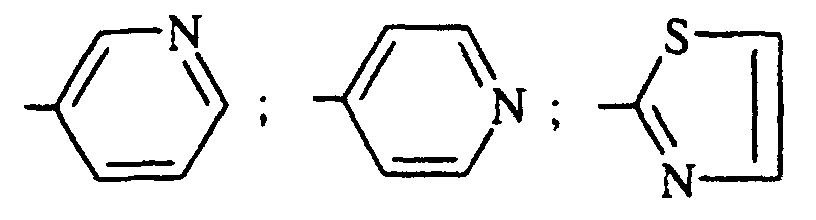
- R6 est en position -2- du phényle et représente un radical méthoxy ;
- R7 représente un radical méthoxy ;
ainsi que leurs sels avec des acides minéraux ou organiques, leurs solvats et/ou hydrates.
- n is 1 or 2;
- X represents a group -CH 2 -; -O-; -NH-;
- R 1 represents a chlorine atom;
- R 2 represents a hydrogen atom;
- R 3 represents a methoxy radical, an ethoxy radical, an isopropoxy radical;
- R 4 represents a hydrogen atom;
- R 5 represents a radical chosen from:
- R 6 is in the -2-position of phenyl and represents a methoxy radical;
- R 7 represents a methoxy radical;
as well as their salts with mineral or organic acids, their solvates and / or hydrates.
Plus particulièrement aussi, on préfère les composés de formule (I) dans laquelle :
- n est 1 ;
- X représente un groupe -CH2- ; -O- ; -NH- ;
- R1 représente un atome de chlore ou un radical méthyle ;
- R2 représente un atome d'hydrogène ou est en position -4- ou -6- de l'indol-2-one et représente un atome de chlore ; un radical méthyle ; un radical méthoxy ;
- R3 représente un atome de chlore, un atome de fluor ou un radical méthoxy ;
- R4 représente un atome d'hydrogène ;
- R5 représente un radical choisi parmi :

- R6 est en position -2- du phényle et représente un radical méthoxy ;
- R7 représente un radical méthoxy ;
ainsi que leurs sels avec des acides minéraux ou organiques, leurs solvats et/ou hydrates.
- n is 1;
- X represents a group -CH 2 -; -O-; -NH-;
- R 1 represents a chlorine atom or a methyl radical;
- R 2 represents a hydrogen atom or is in position -4- or -6- of the indol-2-one and represents a chlorine atom; a methyl radical; a methoxy radical;
- R 3 represents a chlorine atom, a fluorine atom or a methoxy radical;
- R 4 represents a hydrogen atom;
- R 5 represents a radical chosen from:
- R 6 is in the -2-position of phenyl and represents a methoxy radical;
- R 7 represents a methoxy radical;
as well as their salts with mineral or organic acids, their solvates and / or hydrates.
Plus particulièrement enfin, on préfère les composés de formule (I) dans laquelle :
- n est 1 ;
- X représente un groupe -O- ; -NH- ; -NH-CH2-CH2- ;
- R1 représente un atome de chlore ;
- R2 représente un atome d'hydrogène ;
- R3 représente un atome de chlore ou un radical méthoxy ;
- R4 représente un atome d'hydrogène ;
- R5 représente un radical

- R6 est en position -2- du phényle et représente un radical méthoxy ;
- R7 représente un radical méthoxy ;
- n is 1;
- X represents a group -O-; -NH-; -NH-CH 2 -CH 2 -;
- R 1 represents a chlorine atom;
- R 2 represents a hydrogen atom;
- R 3 represents a chlorine atom or a methoxy radical;
- R 4 represents a hydrogen atom;
- R 5 represents a radical
- R 6 is in the -2-position of phenyl and represents a methoxy radical;
- R 7 represents a methoxy radical;
Les composés suivants :
- 5-Chloro-3-(2-éthoxyphényl)-1-[(2,4-diméthoxyphényl)sulfonyl]-3-[2-oxo-2-[4-(4-pyridinyl)-1-pipérazinyl]éthyl]-1,3-dihydro-2H-indol-2-one ;
- 5-Chloro-3-(2-isopropoxyphényl)-1-[(2,4-diméthoxyphényl)sulfonyl]-3-[2-oxo-2-[4-(4-pyridinyl)-1-pipérazinyl]éthyl]-1,3-dihydro-2H-indol-2-one ;
- 4-(2-Pyridinyl)-1-pipérazinecarboxylate de 5-chloro-1-[(2,4-diméthoxyphényl)sulfonyl]-3-(2-méthoxyphényl)-2-oxo-2,3-dihydro-1H-indol-3-yle ;
- 4-(4-Pyridinyl)-1-pipérazinecarboxylate de 5-chloro-1-[(2,4-diméthoxyphényl)sulfonyl]-3-(2-isopropoxyphényl)-2-oxo-2,3-dihydro-1H-indol-3-yle ;
- N-[5-Chloro-1-[(2,4-diméthoxyphényl)sulfonyl]-3-(2-méthoxyphényl)-2-oxo-2,3-dihydro-1H-indol-3-yl]-4-(4-pyridinyl)homopipérazine-1-carboxamide ;
- N-[5-Chloro-1-[(2,4-diméthoxyphényl)sulfonyl]-3-(2-isopropoxyphényl)-2-oxo-2,3-dihydro-1H-indol-3-yl]-4-(3-pyridinyl)pipérazine-1-carboxamide ;
- N-[5-Chloro-1-[(2,4-diméthoxyphényl)sulfonyl]-3-(2-isopropoxyphényl)-2-oxo-2,3-dihydro-1H-indol-3-yl]-4-(4-pyridinyl)pipérazine-1-carboxamide ;
- 5-Chloro-1-[(2,4-diméthoxyphényl)sulfonyl]-3-(2-méthoxyphényl)-3-[[3-oxo-3-[4-(2-pyridinyl)-1-pipérazinyl]propyl]amino]-1,3-dihydro-2H-indol-2-one ;
- 5,6-Dichloro-1-[(2,4-diméthoxyphényl)sulfonyl]-3-(2-méthoxyphényl)-3-[2-oxo-2-[4-(4-pyridinyl)-1-pipérazinyl]éthyl]-1,3-dihydro-2H-indol-2-one ;
- 5-Chloro-1-[(2,4-diméthoxyphényl)sulfonyl]-3-(2-méthoxyphényl)-6-méthyl-3-[2-oxo-2-[4-(4-pyridinyl)-1-pipérazinyl]éthyl]-1,3-dihydro-2H-indol-2-one ;
- 4-(4-Pyridinyl)-1-pipérazinecarboxylate de 5-chloro-1-[(2,4-diméthoxyphényl)sulfonyl]-3-(2-méthoxyphényl)-6-méthyl-2-oxo-2,3-dihydro-1H-indol-3-yle ;
- 4-(4-Pyridinyl)-1-pipérazinecarboxylate de 5-chloro-1-[(2,4-diméthoxyphényl)sulfonyl]-6-méthoxy-3-(2-méthoxyphényl)-2-oxo-2,3-dihydro-1H-indol-3-yle ;
- N-[5-Chloro-3-(2-chlorophényl)-1-[(2,4-diméthoxyphényl)sulfonyl]-2-oxo-2,3-dihydro-1H-indol-3-yl]-4-(2-pyridinyl)pipérazine-1-carboxamide ;
- N-[5-Chloro-1-[(2,4-diméthoxyphényl)sulfonyl]-3-(2-méthoxyphényl)-6-méthyl-2-oxo-2,3-dihydro-1H-indol-3-yl]-4-(4-pyridinyl)pipérazine-1-carboxamide ;
- N-[6-Chloro-3-(2-chlorophényl)-1-[(2,4-diméthoxyphényl)sulfonyl]-5-méthyl-2-oxo-2,3-dihydro-1H-indol-3-yl]-4-(4-pyridinyl)pipérazine-1-carboxamide ;
- 5-Chloro-1-[(2,4-diméthoxyphényl)sulfonyl]-3-(2-fluorophényl)-3-[2-oxo-2-[4-(4-pyridinyl)-1-pipérazinyl]éthyl]-1,3-dihydro-2H-indol-2-one ;
- 5,6-Dichloro-1-[(2,4-diméthoxyphényl)sulfonyl]-3-(2-fluorophényl)-3-[2-oxo-2-[4-(4-pyridinyl)-1-pipérazinyl]éthyl]-1,3-dihydro-2H-indol-2-one ;
- 5-Chloro-3-(2,3-diméthoxyphényl)-1-[(2,4-diméthoxyphényl)sulfonyl]-3-[2-oxo-2-[4-(4-pyridinyl)-1-pipérazinyl]éthyl]-1,3-dihydro-2H-indol-2-one ;
- 5-Chloro-1-[(2,4-diméthoxyphényl)sulfonyl]-3-(2-éthoxyphényl)-3-[2-oxo-2-[4-(3-pyridinyl)-1-pipérazinyl]éthyl]-1,3-dihydro-2H-indol-2-one ;
- 5-Chloro-1-[(2,4-diméthoxyphényl)sulfonyl]-3-(2-isopropoxyphényl)-3-[2-oxo-2-[4-(3-pyridinyl)-1-pipérazinyl]éthyl]-1,3-dihydro-2H-indol-2-one ;
- 5-Chloro-1-[(2,4-diméthoxyphényl)sulfonyl]-3-(2-isopropoxyphényl)-3-[2-oxo-2-[4-(4-pyridinyl)-1-homopipérazine]éthyl]-1,3-dihydro-2H-indol-2-one ;
- 5-Chloro-1-[(2,4-diméthoxyphényl)sulfonyl]-3-(2-isopropoxyphényl)-3-[2-oxo-2-[4-(1,3-thiazol-2-yl)-1-pipérazinyl]éthyl]-1,3-dihydro-2H-indol-2-one ;
- 4-(3-Pyridinyl)-1-pipérazinecarboxylate de 5-chloro-1-[(2,4-diméthoxyphényl)sulfonyl]-3-(2-éthoxyphényl)-2-oxo-2,3-dihydro-1H-indol-3-yle ;
- 4-(4-Pyridinyl)-1-pipérazinecarboxylate de 5-chloro-1-[(2,4-diméthoxyphényl)sulfonyl]-3-(2-éthoxyphényl)-2-oxo-2,3-dihydro-1H-indol-3-yle ;
- 5-Chloro-3- (2-ethoxyphenyl) -1 - [(2,4-dimethoxyphenyl) sulfonyl] -3- [2-oxo-2- [4- (4-pyridinyl) -1-piperazinyl] ethyl] - 1,3-dihydro- 2H- indol-2-one;
- 5-Chloro-3- (2-isopropoxyphenyl) -1 - [(2,4-dimethoxyphenyl) sulfonyl] -3- [2-oxo-2- [4- (4-pyridinyl) -1-piperazinyl] ethyl] - 1,3-dihydro- 2H- indol-2-one;
- 4- (2-pyridinyl) -1-piperazinecarboxylate 5-chloro-1 - [(2,4-dimethoxyphenyl) sulfonyl] -3- (2-methoxyphenyl) -2-oxo-2,3-dihydro-1 H - indol-3-yl;
- 4- (4-pyridinyl) -1-piperazinecarboxylate 5-chloro-1 - [(2,4-dimethoxyphenyl) sulfonyl] -3- (2-isopropoxyphenyl) -2-oxo-2,3-dihydro-1 H - indol-3-yl;
- N- [5-Chloro-1 - [(2,4-dimethoxyphenyl) sulfonyl] -3- (2-methoxyphenyl) -2-oxo-2,3-dihydro- 1H- indol-3-yl] -4- (4-pyridinyl) homopiperazine-1-carboxamide;
- N- [5-Chloro-1 - [(2,4-dimethoxyphenyl) sulfonyl] -3- (2-isopropoxyphenyl) -2-oxo-2,3-dihydro- 1H- indol-3-yl] -4- (3-pyridinyl) piperazine-1-carboxamide;
- N- [5-Chloro-1 - [(2,4-dimethoxyphenyl) sulfonyl] -3- (2-isopropoxyphenyl) -2-oxo-2,3-dihydro- 1H- indol-3-yl] -4- (4-pyridinyl) piperazine-1-carboxamide;
- 5-Chloro-1 - [(2,4-dimethoxyphenyl) sulfonyl] -3- (2-methoxyphenyl) -3 - [[3-oxo-3- [4- (2-pyridinyl) -1-piperazinyl] propyl] amino] -1,3-dihydro- 2H- indol-2-one;
- 5,6-Dichloro-1 - [(2,4-dimethoxyphenyl) sulfonyl] -3- (2-methoxyphenyl) -3- [2-oxo-2- [4- (4-pyridinyl) -1-piperazinyl] ethyl -1,3-dihydro- 2H- indol-2-one;
- 5-Chloro-1 - [(2,4-dimethoxyphenyl) sulfonyl] -3- (2-methoxyphenyl) -6-methyl-3- [2-oxo-2- [4- (4-pyridinyl) -1-piperazinyl ] ethyl] -1,3-dihydro- 2H- indol-2-one;
- 5-Chloro-1 - [(2,4-dimethoxyphenyl) sulfonyl] -3- (2-methoxyphenyl) -6-methyl-2-oxo-2,3-dihydro 4- (4-pyridinyl) -1-piperazinecarboxylate -1 H -indol-3-yl;
- 5-Chloro-1 - [(2,4-dimethoxyphenyl) sulfonyl] -6-methoxy-3- (2-methoxyphenyl) -2-oxo-2,3-dihydro 4- (4-pyridinyl) -1-piperazinecarboxylate -1 H -indol-3-yl;
- N- [5-Chloro-3- (2-chlorophenyl) -1 - [(2,4-dimethoxyphenyl) sulfonyl] -2-oxo-2,3-dihydro- 1H- indol-3-yl] -4- (2-pyridinyl) piperazine-1-carboxamide;
- N- [5-Chloro-1 - [(2,4-dimethoxyphenyl) sulfonyl] -3- (2-methoxyphenyl) -6-methyl-2-oxo-2,3-dihydro- 1H- indol-3-yl -4- (4-pyridinyl) piperazine-1-carboxamide;
- N- [6-Chloro-3- (2-chlorophenyl) -1 - [(2,4-dimethoxyphenyl) sulfonyl] -5-methyl-2-oxo-2,3-dihydro- 1H- indol-3-yl -4- (4-pyridinyl) piperazine-1-carboxamide;
- 5-Chloro-1 - [(2,4-dimethoxyphenyl) sulfonyl] -3- (2-fluorophenyl) -3- [2-oxo-2- [4- (4-pyridinyl) -1-piperazinyl] ethyl] - 1,3-dihydro- 2H- indol-2-one;
- 5,6-Dichloro-1 - [(2,4-dimethoxyphenyl) sulfonyl] -3- (2-fluorophenyl) -3- [2-oxo-2- [4- (4-pyridinyl) -1-piperazinyl] ethyl -1,3-dihydro- 2H- indol-2-one;
- 5-Chloro-3- (2,3-dimethoxyphenyl) -1 - [(2,4-dimethoxyphenyl) sulfonyl] -3- [2-oxo-2- [4- (4-pyridinyl) -1-piperazinyl] ethyl -1,3-dihydro- 2H- indol-2-one;
- 5-Chloro-1 - [(2,4-dimethoxyphenyl) sulfonyl] -3- (2-ethoxyphenyl) -3- [2-oxo-2- [4- (3-pyridinyl) -1-piperazinyl] ethyl] - 1,3-dihydro- 2H- indol-2-one;
- 5-Chloro-1 - [(2,4-dimethoxyphenyl) sulfonyl] -3- (2-isopropoxyphenyl) -3- [2-oxo-2- [4- (3-pyridinyl) -1-piperazinyl] ethyl] - 1,3-dihydro- 2H- indol-2-one;
- 5-Chloro-1 - [(2,4-dimethoxyphenyl) sulfonyl] -3- (2-isopropoxyphenyl) -3- [2-oxo-2- [4- (4-pyridinyl) -1-homopiperazine] ethyl] - 1,3-dihydro- 2H- indol-2-one;
- 5-Chloro-1 - [(2,4-dimethoxyphenyl) sulfonyl] -3- (2-isopropoxyphenyl) -3- [2-oxo-2- [4- (1,3-thiazol-2-yl) -1 piperazinyl] ethyl] -1,3-dihydro- 2H- indol-2-one;
- 4- (3-pyridinyl) -1-piperazinecarboxylate 5-chloro-1 - [(2,4-dimethoxyphenyl) sulfonyl] -3- (2-ethoxyphenyl) -2-oxo-2,3-dihydro-1 H - indol-3-yl;
- 4- (4-pyridinyl) -1-piperazinecarboxylate 5-chloro-1 - [(2,4-dimethoxyphenyl) sulfonyl] -3- (2-ethoxyphenyl) -2-oxo-2,3-dihydro-1 H - indol-3-yl;
Selon un autre de ses aspects, la présente invention a pour objet un procédé de
préparation des composés de formule (I) caractérisé en ce que :
on fait réagir un composé de formule :

- Y représente un hydroxy ou un atome de chlore lorsque X représente un groupe -CH2- ; -OCH2 - ; -NH-CH2- ; -NH-CH2-CH2- ;
- ou Y représente un phénoxy lorsque X représente un groupe -O- ; -NH- ;
- W représente un atome d'hydrogène lorsque X représente un groupe -CH2- ; -OCH2- ;
- ou W représente un groupe
dans lequel R6 et R7 sont tels que définis pour un composé de formule (I) lorsque X représente un groupe -O- ; -NH-; -NH-CH2- ; -NH-CH2-CH2- ;


- lorsque W représente un groupe
on obtient le composé de formule (I) attendu ;
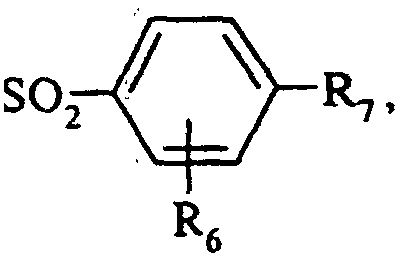
- ou lorsque W représente un atome d'hydrogène, on fait réagir, en présence d'une
base, le composé ainsi obtenu de formule :
avec un halogénure de sulfonyle de formule :


a compound of formula:
- Y is hydroxy or a chlorine atom when X is -CH 2 -; -OCH 2 -; -NH-CH 2 -; -NH-CH 2 -CH 2 -;
- or Y is phenoxy when X is -O-; -NH-;
- W represents a hydrogen atom when X represents a group -CH 2 -; -OCH 2 -;
- where W represents a group wherein R 6 and R 7 are as defined for a compound of formula (I) when X is -O-; -NH-; -NH-CH 2 -; -NH-CH 2 -CH 2 -;
- when W represents a group the expected compound of formula (I) is obtained;
- or when W represents a hydrogen atom, is reacted, in the presence of a base, the compound thus obtained of formula: with a sulfonyl halide of formula:
Eventuellement, on transforme le composé de formule (I) en l'un de ses sels avec des acides minéraux ou organiques. Optionally, the compound of formula (I) is converted into one of its salts with inorganic or organic acids.
Lorsque Y représente un hydroxy, la réaction du composé de formule (II) avec le composé de formule (III) s'effectue en présence d'un agent de couplage utilisé en chimie peptidique tel que l'hexafluorophosphate de benzotriazol-1-yloxytris(diméthyl amino)phosphonium ou l'hexafluorophosphate de benzotriazol-1-yloxytripyrrolidino phosphonium et en présence d'une base telle que la triéthylamine ou la N,N-diisopropyléthylamine, dans un solvant tel que le dichlorométhane ou le N,N-diméthylformamide, à une température comprise entre 0°C et la température ambiante.When Y is hydroxy, the reaction of the compound of formula (II) with compound of formula (III) is carried out in the presence of a coupling agent used in Peptide chemistry such as benzotriazol-1-yloxytris hexafluorophosphate (dimethyl amino) phosphonium or benzotriazol-1-yloxytripyrrolidino hexafluorophosphate phosphonium and in the presence of a base such as triethylamine or N, N-diisopropylethylamine, in a solvent such as dichloromethane or N, N-dimethylformamide, at a temperature between 0 ° C and room temperature.
Lorsque Y représente un atome de chlore, la réaction du composé (II) avec le composé (III) s'effectue en l'absence ou en présence d'une base telle que la triéthylamine ou la N,N-diisopropyléthylamine, dans un solvant tel que la dichlorométhane ou le chloroforme et à une température comprise entre - 60°C et la température ambiante. En l'absence de base on utilise un excès de composé (III).When Y represents a chlorine atom, the reaction of the compound (II) with the compound (III) is carried out in the absence or presence of a base such as triethylamine or N, N-diisopropylethylamine in a solvent such as dichloromethane or chloroform and at a temperature between - 60 ° C and ambient temperature. In the absence of base, an excess of compound (III) is used.
Lorsque Y représente un phénoxy, la réaction du composé (II) avec le composé (III) s'effectue dans un solvant tel que le dichlorométhane , le chloroforme ou le tétrahydrofurane ou un mélange de ces solvants et à une température comprise entre la température ambiante et la température de reflux du solvant.When Y represents a phenoxy, the reaction of the compound (II) with the compound (III) is carried out in a solvent such as dichloromethane, chloroform or tetrahydrofuran or a mixture of these solvents and at a temperature between room temperature and the reflux temperature of the solvent.
On obtient ainsi soit directement un composé de formule (I), soit un composé de formule (IV). La réaction du composé (IV) avec l'halogénure de sulfonyle (V) s'effectue en présence d'une base forte comme un hydrure métallique tel que l'hydrure de sodium ou un alcoolate alcalin tel que le tert-butylate de potassium, dans un solvant tel que le N,N-diméthylformamide ou le tétrahydrofurane et à une température comprise entre - 70°C et la température ambiante. La réaction s'effectue de préférence en utilisant un composé de formule (V) dans laquelle Hal représente un atome de chlore.There is thus obtained either directly a compound of formula (I) or a compound of formula (IV). The reaction of the compound (IV) with the sulfonyl halide (V) is carried out in the presence of a strong base such as a metal hydride such as sodium hydride or an alkali alkoxide such as potassium tert- butoxide, in a solvent such as N, N-dimethylformamide or tetrahydrofuran and at a temperature between -70 ° C and room temperature. The reaction is preferably carried out using a compound of formula (V) in which Hal represents a chlorine atom.
Les composés de formule (I) ainsi obtenus peuvent être ultérieurement séparés du milieu réactionnel et purifiés selon les méthodes classiques, par exemple, par cristallisation ou chromatographie.The compounds of formula (I) thus obtained may subsequently be separated from reaction medium and purified by conventional methods, for example by crystallization or chromatography.
Les composés de formule (I) ainsi obtenus sont isolés sous forme de base libre ou de sel, selon les techniques classiques.The compounds of formula (I) thus obtained are isolated in the form of a free base or of salt, according to conventional techniques.
Les composés de formule (II) se préparent selon différents modes opératoires.The compounds of formula (II) are prepared according to various procedures.
Les composés de formule (II) dans laquelle -X- représente un groupe -CH2-, Y
représente un hydroxy et W représente l'hydrogène se préparent selon le SCHEMA 1
ci-après dans lequel R1, R2, R3 et R4 sont tels que définis pour un composé de
formule (I) et Alk représente un (C1-C2)alkyle.

A l'étape a1 du SCHEMA 1, on prépare un composé de formule (VIII) par deshydroxylation d'un composé de formule (VI) correspondant par action du triéthylsilane selon Bioorganic and Medicinal Chemistry Letters, 1997, 7 (10), 1255-1260.In step a1 of SCHEME 1, a compound of formula (VIII) is prepared by dehydroxylating a corresponding compound of formula (VI) by the action of triethylsilane according to Bioorganic and Medicinal Chemistry Letters, 1997, 7 (10), 1255- 1260.
On peut également préparer un composé de formule (VIII) par réaction de cyclisation (étape b1) d'un composé de formule (VII) en milieu acide fort, l'acide sulfurique ou l'acide polyphosphorique par exemple, selon la méthode décrite dans WO 95/18105 ou dans J. Org. Chem., 1968, 33, 1640-1643..It is also possible to prepare a compound of formula (VIII) by cyclization reaction (step b1) of a compound of formula (VII) in a strong acid medium, for example sulfuric acid or polyphosphoric acid, according to the method described in US Pat. WO 95/18105 or in J. Org. Chem., 1968, 33 , 1640-1643.
On fait réagir à l'étape c1 le composé de formule (VIII) avec un composé de formule Hal-CH2COOAlk dans laquelle Hal représente un atome d'halogène de préférence le brome ou le chlore et Alk représente un (C1-C2)alkyle, en présence d'une base tel qu'un carbonate de métal alcalin (le carbonate de potassium par exemple) et d'un iodure de métal alcalin (l'iodure de potassium par exemple) ou en présence d'une base forte tel qu'un hydrure de métal alcalin (l'hydrure de sodium par exemple), ou un alcoolate de métal alcalin (l'éthylate de sodium par exemple) pour obtenir le composé de formule (IX). La réaction s'effectue dans un solvant tel que l'acétone ou le N,N-diméthylformamide et à une température comprise entre 0°C et la température de reflux du solvant.The compound of formula (VIII) is reacted in step c1 with a compound of formula Hal-CH 2 COOAlk in which Hal represents a halogen atom, preferably bromine or chlorine, and Alk represents a (C 1 -C 2 ) alkyl, in the presence of a base such as an alkali metal carbonate (potassium carbonate for example) and an alkali metal iodide (potassium iodide for example) or in the presence of a base strong such as an alkali metal hydride (sodium hydride for example), or an alkali metal alcoholate (sodium ethoxide for example) to obtain the compound of formula (IX). The reaction is carried out in a solvent such as acetone or N, N-dimethylformamide and at a temperature between 0 ° C and the reflux temperature of the solvent.
A l'étape d1 on obtient le composé de formule (II) attendu par hydrolyse en milieu alcalin, du composé de formule (IX) en utilisant un hydroxyde de métal alcalin tel que l'hydroxyde de sodium, l'hydroxyde de potassium ou l'hydroxyde de lithium dans un solvant tel que l'eau, le méthanol, l'éthanol, le tétrahydrofurane, le dioxane ou un mélange de ces solvants, à une température comprise entre 0°C et la température de reflux du solvant.In step d1, the expected compound of formula (II) is obtained by hydrolysis in a medium alkali, of the compound of formula (IX) using an alkali metal hydroxide such as sodium hydroxide, potassium hydroxide or lithium hydroxide in a solvent such as water, methanol, ethanol, tetrahydrofuran, dioxane or a mixture of these solvents, at a temperature between 0 ° C and the temperature of reflux of the solvent.
Les composés de formule (VI) sont connus et se préparent selon des méthodes connues telles que celles décrites dans WO 95/18105.The compounds of formula (VI) are known and are prepared according to methods known as those described in WO 95/18105.
Par exemple, on prépare un composé de formule (VI) par réaction d'un dérivé de
1H-indole-2,3-dione de formule :


On peut également préparer un composé de formule (VI) dans laquelle R3 est tel
que défini pour un composé de formule (I) et R4, différent de l'hydrogène, est en
position -3- ou -6- du phényle, par réaction d'un composé de formule :

Les dérivés de 1H-indole-2,3-dione (X) sont commerciaux ou se préparent selon les méthodes décrites dans Tetrahedron Letters, 1998, 39, 7679-7682 ; Tetrahedron Letters, 1994, 35, 7303-7306 ; J. Org. Chem., 1977, 42 (8), 1344-1348 ; J. Org. Chem., 1952, 17, 149-156 ; J. Am. Chem. Soc., 1946, 68, 2697-2703 ; Organic Synthèses, 1925, V, 71-74 et Advances in Heterocyclic Chemistry, A.R. Katritzky and A.J. Boulton, Academic Press, New-York, 1975, 18, 2-58.The 1 H -indole-2,3-dione derivatives (X) are commercially available or are prepared according to the methods described in Tetrahedron Letters, 1998, 39 , 7679-7682; Tetrahedron Letters, 1994, 35, 7303-7306; J. Org. Chem., 1977, 42 (8), 1344-1348; J. Org. Chem., 1952, 17 , 149-156; J. Am. Chem. Soc., 1946, 68 , 2697-2703; Organic Syntheses, 1925, V, 71-74 and Advances in Heterocyclic Chemistry, AR Katritzky and AJ Boulton, Academic Press, New York, 1975, 18 , 2-58.
Les dérivés organomagnésiens (XI) sont préparés selon les méthodes classiques bien connues de l'homme de l'art.The organomagnesium derivatives (XI) are prepared according to conventional methods well known to those skilled in the art.
De façon particulière, on peut préparer les composés de formule (VI) dans
laquelle R3 = (C1-C2)alcoxy et R4 = H, ou bien R3 = R4 = (C1-C2)alcoxy avec R4 en
position -3 ou -6 du phényle, R2 est différent d'un atome d'halogène et R1 est tel que
défini pour un composé de formule (I), en suivant le procédé décrit dans le SCHEMA
2.

A l'étape a2 du SCHEMA 2, on fait d'abord réagir un composé de formule (XII) avec un dérivé du lithium tel que le n-butyllithium, en l'absence ou en présence d'une base telle que la N, N, N', N'-tétraméthyléthylènediamine, puis l'intermédiaire lithié ainsi obtenu est mis en réaction avec l'oxalate de diéthyle pour donner le composé de formule (XIII). La réaction s'effectue dans un solvant tel que l'éther diéthylique, le tétrahydrofurane, l'hexane ou un mélange de ces solvants et à une température comprise entre -70°C et la température ambiante.In step a2 of SCHEME 2, a compound of formula (XII) is first reacted with a lithium derivative such as n-butyllithium, in the absence or in the presence of a base such as N, N, N ', N'-tetramethylethylenediamine, then the lithiated intermediate thus obtained is reacted with diethyl oxalate to give the formula (XIII). The reaction is carried out in a solvent such as diethyl ether, tetrahydrofuran, hexane or a mixture of these solvents and at a temperature between -70 ° C and room temperature.
A l'étape b2, on fait d'abord réagir un composé de formule (XIV) avec deux équivalents d'un dérivé du lithium tel que le tert-butyllithium, puis l'intermédiaire lithié ainsi obtenu est mis en réaction avec le composé de formule (XIII) pour donner le composé de formule (VI) attendu. La réaction s'effectue dans un solvant tel que l'éther diéthylique, le tétrahydrofurane , le pentane ou un mélange de ces solvants et à une température comprise entre -70°C et la température ambiante.In step b2, a compound of formula (XIV) is first reacted with two equivalents of a lithium derivative such as tert- butyllithium, and then the lithiated intermediate thus obtained is reacted with the compound of formula (XIII) to give the expected compound of formula (VI). The reaction is carried out in a solvent such as diethyl ether, tetrahydrofuran, pentane or a mixture of these solvents and at a temperature between -70 ° C and room temperature.
Les composés de formule (XII) sont commerciaux ou synthétisés de manière classique.The compounds of formula (XII) are commercially or synthesized in a manner classic.
Les composés de formule (XIV) sont préparés par réaction des dérivés de l'aniline correspondants avec du di-tert-butyldicarbonate selon les méthodes classiques. Compounds of formula (XIV) are prepared by reaction of the corresponding aniline derivatives with di- tert- butyldicarbonate according to conventional methods.
Les composés de formule (VII) sont connus et se préparent selon des méthodes connues telles que celles décrites dans WO 95/18105 ou dans J. Org. Chem., 1968, 33, 1640-1643.The compounds of formula (VII) are known and are prepared according to known methods such as those described in WO 95/18105 or in J. Org. Chem., 1968, 33 , 1640-1643.
Les composés de formule (II) dans laquelle X = -CH2-, Y représente un atome de chlore et W = H se préparent à partir des composés de formule (II) correspondants dans laquelle Y = OH par réaction avec du chlorure de thionyle dans un solvant tel que le toluène et à une température comprise entre 0°C et la température de reflux du solvant.The compounds of formula (II) in which X = -CH 2 -, Y represents a chlorine atom and W = H are prepared from the corresponding compounds of formula (II) in which Y = OH by reaction with thionyl chloride in a solvent such as toluene and at a temperature between 0 ° C and the reflux temperature of the solvent.
Les composés de formule (II) dans laquelle -X- représente un groupe -O-,
Y représente un phénoxy et W =


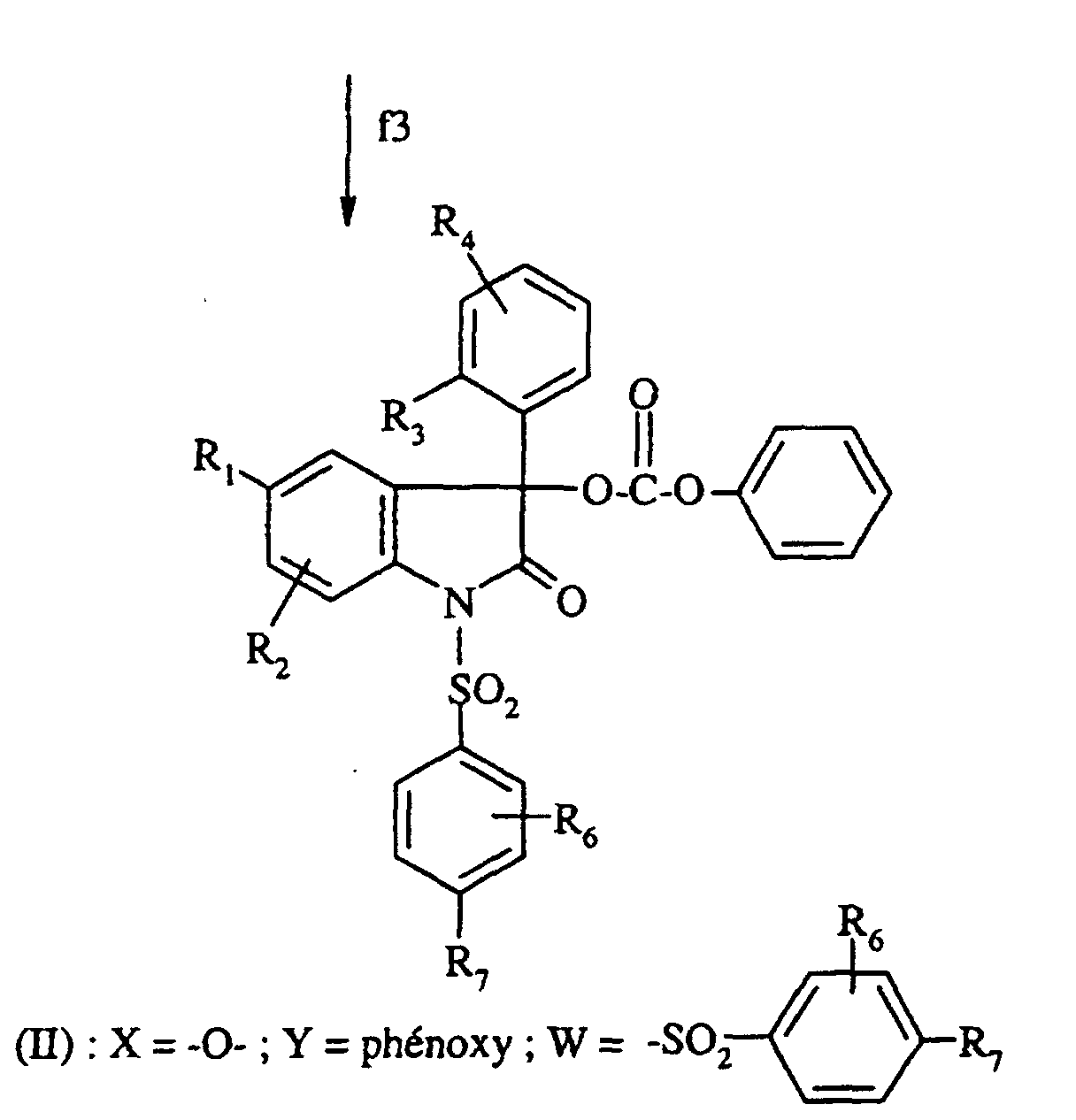
Y represents a phenoxy and W =
A l'étape a3 du SCHEMA 3, on protège sélectivement l'hydroxy d'un composé de formule (VI) en utilisant par exemple l'hexaméthyldisilazane selon la méthode décrite dans Synthetic Communications, 1993, 23 (12), 1633-1641.In step a3 of SCHEME 3, hydroxy is selectively protected from a compound of formula (VI) using, for example, hexamethyldisilazane according to the method described in Synthetic Communications, 1993, 23 (12), 1633-1641.
Le composé de formule (XV) ainsi obtenu est mis en réaction, à l'étape b3, avec un halogénure de sulfonyle de formule (V), en présence d'une base forte, selon les conditions précédemment décrites.The compound of formula (XV) thus obtained is reacted, in step b3, with a sulfonyl halide of formula (V), in the presence of a strong base, according to the previously described conditions.
A l'étape c3, la déprotection du groupe triméthylsilyle du composé de formule (XVI) ainsi obtenu permet d'obtenir le composé de formule (XVIII). La réaction s'effectue par action d'un acide fort tel que l'acide chlorhydrique ou l'acide trifluoroacétique, dans un solvant tel que le dichlorométhane, l'acétone, le tétrahydrofurane, l'eau ou un mélange de ces solvants et à une température comprise entre la température ambiante et la température de reflux du solvant.In step c3, the deprotection of the trimethylsilyl group of the compound of formula (XVI) thus obtained makes it possible to obtain the compound of formula (XVIII). The reaction is carried out by the action of a strong acid such as hydrochloric acid or acid trifluoroacetic acid, in a solvent such as dichloromethane, acetone, tetrahydrofuran, water or a mixture of these solvents and at a temperature between the ambient temperature and the reflux temperature of the solvent.
On peut également obtenir un composé de formule (XVIII) par réaction à l'étape d3, d'un composé de formule (X) avec un halogénure de sulfonyle de formule (V), selon les conditions précédemment décrites, suivi de la réaction du composé de formule (XVII) ainsi obtenu avec un dérivé organomagnésien de formule (XI) selon les conditions précédemment décrites.It is also possible to obtain a compound of formula (XVIII) by reaction at stage d3, a compound of formula (X) with a sulfonyl halide of formula (V), according to the conditions previously described, followed by the reaction of the formula (XVII) thus obtained with an organomagnesium derivative of formula (XI) according to the conditions previously described.
A l'étape f3, on fait réagir le composé de formule (XVIII) ainsi obtenu avec du chloroformiate de phényle, en présence d'une base telle que la pyridine, dans un solvant tel que le dichlorométhane ou sans solvant, à une température comprise entre 0°C et 100°C et obtient le composé de formule (II) attendu.In step f3, the compound of formula (XVIII) thus obtained is reacted with phenyl chloroformate, in the presence of a base such as pyridine, in a solvent such as dichloromethane or without solvent, at a temperature between 0 ° C and 100 ° C and gives the compound of formula (II) expected.
Le composé de formule (VI) se prépare selon les méthodes précédemment décrites. On peut également préparer un composé de formule (VI) par oxydation par l'air d'un composé de formule (VIII) en présence d'une base telle que l'hydrure de sodium et en présence de diméthyldisulfure.The compound of formula (VI) is prepared according to the methods previously described. It is also possible to prepare a compound of formula (VI) by oxidation with air of a compound of formula (VIII) in the presence of a base such as hydride of sodium and in the presence of dimethyl disulphide.
On peut aussi préparer un composé de formule (VI) par hydrolyse d'un halogénure
de formule :

Les composés de formule (XIX) sont connus et se préparent selon des méthodes connues telles que celles décrites dans WO 95/18105.The compounds of formula (XIX) are known and are prepared according to methods known as those described in WO 95/18105.
Les composés de formule (II) dans laquelle -X- représente un groupe -NH-, Y
représente un phénoxy et W représente un groupe

Les composés de formule (II) dans laquelle -X- représente un groupe -O-CH2-, Y
représente un hydroxy et W représente l'hydrogène se préparent selon le SCHEMA 4
ci-après dans lequel R1, R2, R3 et R4 sont tels que définis pour une composé de
formule (I).

A l'étape a4 du SCHEMA 4, on fait réagir un composé de formule (XIX) avec du glycolate de méthyle, en présence d'une base forte telle que l'hydrure de sodium, dans un solvant tel que le tétrahydrofurane ou le dichlorométhane et à une température comprise entre 0°C et la température de reflux du solvant.In step a4 of SCHEME 4, a compound of formula (XIX) is reacted with methyl glycolate, in the presence of a strong base such as sodium hydride, in a solvent such as tetrahydrofuran or dichloromethane and at a temperature of between 0 ° C and the reflux temperature of the solvent.
Le composé de formule (XX) ainsi obtenu est hydrolysé à l'étape b4 en milieu alcalin selon les méthodes précédemment décrites à l'étape d1 du SCHEMA 1 et on obtient le composé de formule (II) attendu. The compound of formula (XX) thus obtained is hydrolysed in step b4 in medium alkaline according to the methods previously described in step d1 of SCHEME 1 and obtain the compound of formula (II) expected.
Les composés de formule (II) dans laquelle X = -O-CH2-, Y représente un atome de chlore et W = H se préparent à partir des composés de formule (II) correspondants dans laquelle Y = OH par réaction avec du chlorure de thionyle selon la méthode précédemment citée.The compounds of formula (II) in which X = -O-CH 2 -, Y represents a chlorine atom and W = H are prepared from the corresponding compounds of formula (II) in which Y = OH by reaction with chloride of thionyl according to the method previously mentioned.
Les composés de formule (II) dans laquelle -X- représente un groupe -NH-CH2-,
Y représente un hydroxy et W représente un groupe


Y is hydroxy and W is a group
A l'étape a5 du SCHEMA 5, on fait réagir un composé de formule (XIX) avec l'ester tert-butylique de la glycine, en présence d'une base telle que la triéthylamine ou la N,N-diisopropyléthylamine, dans un solvant tel que le dichlorométhane, le chloroforme, le tétrahydrofurane ou un mélange de ces solvants et à une température comprise entre 0°C et la température ambiante.In step a5 of SCHEME 5, a compound of formula (XIX) is reacted with the tert- butyl ester of glycine in the presence of a base such as triethylamine or N, N-diisopropylethylamine in a solvent such as dichloromethane, chloroform, tetrahydrofuran or a mixture of these solvents and at a temperature between 0 ° C and room temperature.
Le composé de formule (XXI) ainsi obtenu est mis en réaction à l'étape b5, avec un halogénure de sulfonyle de formule (V), en présence d'une base forte, selon les conditions précédemment décrites.The compound of formula (XXI) thus obtained is reacted in step b5, with a sulfonyl halide of formula (V), in the presence of a strong base, according to the previously described conditions.
A l'étape c5, le composé de formule (XXII) ainsi obtenu est hydrolysé en milieu acide en utilisant un acide fort tel que l'acide chlorhydrique ou l'acide triflluoroacétique, dans un solvant tel que le dichlorométhane, le tétrahydrofurane, l'acétone, l'eau, un mélange de ces solvants ou sans solvant, et à une température comprise entre 0°C et la température ambiante. On obtient ainsi le composé de formule (II) attendu.In step c5, the compound of formula (XXII) thus obtained is hydrolyzed in medium acid using a strong acid such as hydrochloric acid or acid trifluoroacetic acid, in a solvent such as dichloromethane, tetrahydrofuran, acetone, water, a mixture of these solvents or without solvent, and at a temperature between 0 ° C and room temperature. The compound of formula (II) expected.
Les composés de formule (II) dans laquelle X = -NH-CH2-, Y représente un
atome de chlore et

Les composés de formule (I) dans laquelle -X- représente un groupe
-NH-CH2-CH2-, Y représente un hydroxy et W représente un groupe

R1, R2, R3, R4, R6 et R7 sont tels que définis pour une composé de formule (I).

R 1 , R 2 , R 3 , R 4 , R 6 and R 7 are as defined for a compound of formula (I).
A l'étape a6 du SCHEMA 6, on fait réagir un composé de formule (XIX) avec l'ester tert-butylique de la β-alanine, en présence d'une base telle que la triéthylamine ou la N,N-diisopropyléthylamine, dans un solvant tel que le dichlorométhane, le chloroforme, le tétrahydrofurane ou un mélange de ces solvants et à une température comprise entre 0°C et la température ambiante.In step a6 of SCHEME 6, a compound of formula (XIX) is reacted with the tert- butyl ester of β-alanine, in the presence of a base such as triethylamine or N, N-diisopropylethylamine, in a solvent such as dichloromethane, chloroform, tetrahydrofuran or a mixture of these solvents and at a temperature between 0 ° C and room temperature.
Le composé de formule (XXIII) ainsi obtenu est mis en réaction, à l'étape b6, avec un halogénure de sulfonyle de formule (V), en présence d'une base forte, selon les conditions précédemment décrites.The compound of formula (XXIII) thus obtained is reacted, in step b6, with a sulfonyl halide of formula (V), in the presence of a strong base, according to the previously described conditions.
A l'étape c6, le composé de formule (XXIV) ainsi obtenu est hydrolysé en milieu acide selon les conditions précédemment décrites à l'étape c5 du SCHEMA 5. On obtient ainsi le composé de formule (II) attendu.In step c6, the compound of formula (XXIV) thus obtained is hydrolyzed in medium acid according to the conditions previously described in step c5 of SCHEME 5. On thus obtaining the compound of formula (II) expected.
Les composés de formule (II) dans laquelle -X- = -NH-CH2-CH2-, Y représente
un atome de chlore et

Les composés de formule (III) sont commerciaux ou préparés selon des méthodes connues telles que décrites dans J. Org. Chem., 1953, 18, 1484-1488, J. Med. Chem., 1978, 21 (6), 536-542, Chem. Pharm. Bull., 1991, 39 (9), 2288-2300, Tetrahedron Letters, 1998, 39, 617-620 ou dans WO 97/28129.The compounds of formula (III) are commercially available or prepared according to known methods as described in J. Org. Chem., 1953, 18, 1484-1488, J. Med. Chem., 1978, 21 (6), 536-542, Chem. Pharm. Bull., 1991, 39 (9), 2288-2300, Tetrahedron Letters, 1998, 39 , 617-620 or WO 97/28129.
Par exemple, on prépare un composé de formule (III) par réaction d'un composé
de formule :
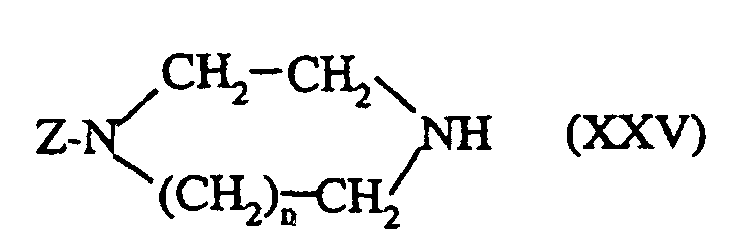
La réaction s'effectue en présence ou en l'absence de base, dans un solvant inerte tel que l'éthanol, le propan-2-ol, le n-butanol ou l'acétonitrile et à une température comprise entre 0°C et la température de reflux du solvant. Lorsqu'on utilise une base, celle-ci est choisie parmi les bases organiques telles que la diisopropyléthylamine ou parmi les carbonates de métal alcalin tel que le carbonate de sodium ou de potassium. En l'absence de base, la réaction s'effectue en utilisant un excès du composé de formule (XXV). La réaction peut également s'effectuer sans solvant par chauffage du mélange des composés (XXV) et (XXVI) à des températures de l'ordre de 140°C et 180°C.The reaction is carried out in the presence or absence of base in an inert solvent such as ethanol, propan-2-ol, n-butanol or acetonitrile and at a between 0 ° C and the reflux temperature of the solvent. When using a base, this is selected from organic bases such as diisopropylethylamine or among the alkali metal carbonates such as sodium carbonate or potassium carbonate. In the absence of base, the reaction is carried out using an excess of the formula (XXV). The reaction can also be carried out without solvent by heating the mixture of the compounds (XXV) and (XXVI) at temperatures of the order of 140 ° C and 180 ° C.
Le cas échéant, lorsque Z représente un groupe N-protecteur, on l'élimine selon les méthodes classiques et on obtient les composés de formule (III) attendus.If appropriate, when Z represents an N-protecting group, it is removed according to conventional methods and the compounds of formula (III) expected.
Les composés de formule (XXV) ou de formule (XXVI) sont connus ou se préparent selon des méthodes connues.Compounds of formula (XXV) or of formula (XXVI) are known or prepare according to known methods.
Les composés de formule (V) sont connus ou préparés par des méthodes connues telles que celles décrites dans EP-0 469 984 B et WO 95/18105. Par exemple, les composés de formule (V) peuvent être préparés par halogénation des acides benzènesulfoniques correspondants ou de leurs sels, par exemple de leurs sels de sodium ou de potassium. La réaction s'effectue en présence d'un agent halogénant tel que l'oxychlorure de phosphore, le chlorure de thionyle, le trichlorure de phosphore, le tribromure de phosphore ou le pentachlorure de phosphore, sans solvant ou dans un solvant inerte tel qu'un hydrocarbure halogéné ou le N,N-diméthylformamide et à une température comprise entre -10°C et 200°C.The compounds of formula (V) are known or prepared by known methods such as those described in EP-0 469 984 B and WO 95/18105. For example, compounds of formula (V) can be prepared by halogenation of the acids benzenesulphonic compounds or their salts, for example their sodium or potassium. The reaction is carried out in the presence of a halogenating agent such phosphorus oxychloride, thionyl chloride, phosphorus trichloride, phosphorus tribromide or phosphorus pentachloride, without solvent or in a an inert solvent such as a halogenated hydrocarbon or N, N-dimethylformamide and at a temperature between -10 ° C and 200 ° C.
Le chlorure de 2,4-diméthoxybenzènesulfonyle est préparé selon J. Am. Chem. Soc., 1952, 74, 2008. Le chlorure de 3,4-diméthoxybenzènesulfonyle est commercial, ou préparé selon J. Med. Chem., 1977, 20 (10), 1235-1239.2,4-Dimethoxybenzenesulfonyl chloride is prepared according to J. Am. Chem. Soc., 1952, 74 , 2008. 3,4-Dimethoxybenzenesulfonyl chloride is commercially available, or prepared according to J. Med. Chem., 1977, 20 (10), 1235-1239.
Pour obtenir les composés de formule (I) sous forme d'isomères optiquement purs, on peut utiliser les techniques classiques de séparation : par exemple des recristallisations fractionnées d'un sel formé à partir de la base racémique avec un acide optiquement actif dont le principe est bien connu ou les techniques classiques de chromatographie sur phase chirale.To obtain the compounds of formula (I) in the form of optically pure isomers, classical separation techniques can be used: for example fractional recrystallizations of a salt formed from the racemic base with a optically active acid whose principle is well known or the conventional techniques of chiral phase chromatography.
On peut également préparer les composés de formule (I) optiquement purs à partir d'un composé intermédiaire optiquement pur utile pour la préparation des composés de formule (I).The optically pure compounds of formula (I) can also be prepared from of an optically pure intermediate compound useful for the preparation of the compounds of formula (I).
Ainsi, lorsqu'on veut préparer un composé optiquement pur de formule (I) dans laquelle -X- = -CH2- on effectue la résolution optique d'un composé de formule (II) dans laquelle -X- = -CH2-, Y = OH et W = H selon le procédé décrit dans J. Am. Chem. Soc., 1989, 111, 7650-7651 en utilisant la (R)-pantolactone comme réactif chiral ou bien en utilisant une amine chirale telle que la (+)-cinchonine.Thus, when it is desired to prepare an optically pure compound of formula (I) in which -X- = -CH 2 -the optical resolution of a compound of formula (II) in which -X- = -CH 2 - is carried out. , Y = OH and W = H according to the method described in J. Am. Chem. Soc., 1989, 111 , 7650-7651 using (R) -pantolactone as a chiral reagent or using a chiral amine such as (+) - cinchonine.
On peut préparer un composé optiquement pur de formule (I) dans laquelle
-X- = -O- selon le procédé décrit dans le SCHEMA 7 ci-après dans lequel R1, R2, R3,
R4, n et R5 sont tels que définis pour un composé de formule (I) et R représente un
phényle ou un isobutyle.

A l'étape a7 du SCHEMA 7, on fait réagir un composé de formule (VI) avec du chloroformiate de phényle, en présence d'une base telle que la pyridine, dans un solvant tel que le dichlorométhane ou sans solvant et à une température comprise entre 0°C et 100°C.In step a7 of SCHEME 7, a compound of formula (VI) is reacted with phenyl chloroformate, in the presence of a base such as pyridine, in a solvent such as dichloromethane or without solvent and at a temperature between 0 ° C and 100 ° C.
Le composé de formule (XXVII) ainsi obtenu est mis en réaction, à l'étape b7, avec un composé de formule (III), dans un solvant tel que le dichorométhane, le chloroforme ou le tétrahydrofurane ou un mélange de ces solvants, à une température comprise entre la température ambiante et la température de reflux du solvant pour obtenir un composé de formule (XXVIII).The compound of formula (XXVII) thus obtained is reacted, in step b7, with a compound of formula (III), in a solvent such as dichoromethane, the chloroform or tetrahydrofuran or a mixture of these solvents at a temperature between room temperature and the reflux temperature of the solvent for obtain a compound of formula (XXVIII).
Par réaction du composé (XXVIII) avec le L-leucinol (R = isobutyle) ou le D-Leucinol ou avec le (R)-(-)-α-phénylglycinol (R = phényle) ou le (S)-(+)-α-phénylglycinol, on obtient, à l'étape c7, un mélange de diastéréoisomères d'un composé de formule (XXIX) que l'on peut séparer, par exemple, par chromatographie ou cristallisation.By reaction of the compound (XXVIII) with L-leucinol (R = isobutyl) or D-Leucinol or with (R) - (-) - α-phenylglycinol (R = phenyl) or (S) - (+) - α-phenylglycinol, in step c7, a mixture of diastereoisomers of one compound of formula (XXIX) which can be separated, for example, by chromatography or crystallization.
Par réaction, à l'étape d7, d'un des diastéréoisomères du composé de formule (XXIX) avec une base forte telle que le méthylate de sodium, dans un solvant tel que le méthanol ou le tétrahydrofurane ou un mélange de ces solvants, à une température comprise entre 0°C et la température de reflux du solvant, on obtient un composé de formule (XXX) optiquement pur.By reaction, in step d7, of one of the diastereoisomers of the compound of formula (XXIX) with a strong base such as sodium methoxide, in a solvent such as methanol or tetrahydrofuran or a mixture of these solvents at a temperature between 0 ° C and the reflux temperature of the solvent, a compound of Optically pure formula (XXX).
La réaction du composé (XXX) avec un halogénure de sulfonyle de formule (V) selon les méthodes précédemment décrites permet d'obtenir un composé de formule (I) dans laquelle X = -O-, optiquement pur.The reaction of the compound (XXX) with a sulfonyl halide of formula (V) according to the methods described above, it is possible to obtain a compound of formula (I) wherein X = -O-, optically pure.
Lorsqu'on veut préparer un composé optiquement pur de formule (I) dans laquelle
-X- = -NH-, on prépare un composé de formule (II) dans laquelle -X- = -NH-,
Y = phénoxy et


A l'étape a8 du SCHEMA 8, on fait réagir un composé de formule (XIX) avec le (S)-(+)-α-phénylglycinol ou le (R)-(-)-α-phénylglycinol et obtient un mélange de diastéréoisomères d'un composé de formule (XXXI) que l'on peut séparer par chromatographie ou cristallisation.In step a8 of SCHEME 8, a compound of formula (XIX) is reacted with (S) - (+) - α-phenylglycinol or (R) - (-) - α-phenylglycinol and obtains a mixture of diastereoisomers of a compound of formula (XXXI) which can be separated by chromatography or crystallization.
A l'étape b8, par oxydation par le tétraacétate de plomb et hydrolyse en milieu acide d'un des diastéréoisomères du composé (XXXI), on obtient un composé de formule (XXXII) optiquement pur.In step b8, by oxidation with lead tetraacetate and hydrolysis in a medium acid of one of the diastereoisomers of the compound (XXXI), a compound of formula (XXXII) optically pure.
A l'étape c8, la réaction du composé (XXXII) ainsi obtenu avec un halogénure de sulfonyle de formule (V), suivi de la réaction du composé (XXXIII) ainsi obtenu avec le chloroformiate de phényle (étape d8) selon les méthodes décrites dans WO 95/18105, permettent d'obtenir le composé (II) optiquement pur attendu.In step c8, the reaction of the compound (XXXII) thus obtained with a halogenide of sulfonyl of formula (V), followed by the reaction of the compound (XXXIII) thus obtained with phenyl chloroformate (step d8) according to the methods described in WO 95/18105, allow to obtain the compound (II) optically pure expected.
Au cours de l'une quelconque des étapes de préparation des composés de formule (I) ou des composés intermédiaires de formule (II), (III) ou (IV) il peut être nécessaire et/ou souhaitable de protéger les groupes fonctionnels réactifs ou sensibles, tels que les groupes amine, hydroxyle ou carboxy, présents sur l'une quelconque des molécules concernées. Cette protection peut s'effectuer en utilisant les groupes protecteurs conventionnels, tels que ceux décrits dans Protective Groups in Organic Chemistry, J.F.W. McOmie, Ed. Plenum Press, 1973, dans Protective Groups in Organic Synthesis, T.W. Greene et P.G.M. Wutts, Ed. John Wiley et sons, 1991 ou dans Protecting Groups, Kocienski P.J., 1994, Georg Thieme Verlag. L'élimination des groupes protecteurs peut s'effectuer à une étape ultérieure opportune en utilisant les méthodes connues de l'homme de l'art et qui n'affectent pas le reste de la molécule concernée.During any of the steps of preparing the compounds of the formula (I) or intermediate compounds of formula (II), (III) or (IV) it may be necessary and / or desirable to protect reactive or sensitive functional groups, such as amine, hydroxyl or carboxy groups, present on any of the molecules concerned. This protection can be done using the protective groups conventional methods, such as those described in Protective Groups in Organic Chemistry, J.F.W. McOmie, Ed. Plenum Press, 1973, in Protective Groups in Organic Synthesis, T.W. Greene and P.G.M. Wutts, Ed. John Wiley and Sounds, 1991 or in Protecting Groups, Kocienski P.J., 1994, Georg Thieme Verlag. The elimination of protective groups can be carried out at a later convenient stage using the methods known to those skilled in the art and which do not affect the rest of the molecule concerned.
Les groupes N-protecteurs éventuellement utilisés sont les groupes N-protecteurs classiques bien connus de l'homme de l'art tels que par exemple le groupe tert-butoxycarbonyle, fluorénylméthoxycarbonyle, benzyle, benzhydrylidène ou benzyloxycarbonyle.The N-protecting groups which may be used are the conventional N-protecting groups well known to those skilled in the art, such as, for example, the tert- butoxycarbonyl, fluorenylmethoxycarbonyl, benzyl, benzhydrylidene or benzyloxycarbonyl group.
Les composés de formule (IV) sont nouveaux et font partie de l'invention.The compounds of formula (IV) are new and form part of the invention.
Ainsi, selon un autre de ses aspects, l'invention a pour objet des composés de
formule :

- n est 1 ou 2 ;
- X représente un groupe -CH2- ; -O-CH2- ;
- R1 représente un atome d'halogène ; un (C1-C4)alkyle ; un (C1-C4)alcoxy ;
- R2 représente un atome d'hydrogène ; un atome d'halogène ; un (C1-C4)alkyle ; un (C1-C4)alcoxy ; un radical trifluorométhyle ;
- R3 représente un atome d'halogène ; un (C1-C3)alkyle ; un (C1-C3)alcoxy ; un radical trifluorométhyle ; un radical trifluorométhoxy ;
- R4 représente un atome d'hydrogène ; un atome d'halogène ; un (C1-C3)alkyle ; un (C1-C3)alcoxy ;
- R5 représente un radical choisi parmi :


- n is 1 or 2;
- X represents a group -CH 2 -; -O-CH 2 -;
- R 1 represents a halogen atom; a (C 1 -C 4 ) alkyl; a (C 1 -C 4 ) alkoxy;
- R 2 represents a hydrogen atom; a halogen atom; a (C 1 -C 4 ) alkyl; a (C 1 -C 4 ) alkoxy; a trifluoromethyl radical;
- R 3 represents a halogen atom; a (C 1 -C 3 ) alkyl; a (C 1 -C 3 ) alkoxy; a trifluoromethyl radical; a trifluoromethoxy radical;
- R 4 represents a hydrogen atom; a halogen atom; a (C 1 -C 3 ) alkyl; a (C 1 -C 3 ) alkoxy;
- R 5 represents a radical chosen from:
Les composés de formule (I) ci-dessus comprennent également ceux dans lesquels un ou plusieurs atomes d'hydrogène, ou de carbone ont été remplacés par leur isotope radioactif par exemple le tritium, ou le carbone-14. De tels composés marqués sont utiles dans des travaux de recherche, de métabolisme ou de pharmacocinétique, dans des essais biochimiques en tant que ligand de récepteurs.The compounds of formula (I) above also include those in which one or more atoms of hydrogen or carbon have been replaced by their isotope radioactive for example tritium, or carbon-14. Such labeled compounds are useful in research, metabolism or pharmacokinetics, in biochemical assays as a receptor ligand.
Les PREPARATIONS et EXEMPLES suivants illustrent l'invention sans toute fois la limiter.The following PREPARATIONS and EXAMPLES illustrate the invention without any time limit it.
Dans les Préparations et dans les Exemples on utilise les abréviations suivantes :
Les spectres de résonance magnétique du proton (RMN 1H) sont enregistrés à 200 MHz dans du DMSO-d6, en utilisant le pic du DMSO-d6 comme référence. Les déplacements chimiques δ sont exprimés en parties par million (ppm). Les signaux observés sont exprimés ainsi : s: singulet ; se : singulet élargi ; d : doublet ; d.d : doublet dédoublé ; t : triplet ; td : triplet dédoublé ; q : quadruplet ; m : massif ; mt : multiplet.Proton magnetic resonance spectra ( 1 H NMR) are recorded at 200 MHz in DMSO-d 6 , using the peak of DMSO-d 6 as a reference. The chemical shifts δ are expressed in parts per million (ppm). The signals observed are expressed as follows: s: singlet; it is: widened singlet; d: doublet; dd: double doublet; t: triplet; td: split triplet; q: quadruplet; m: massive; mt: multiplet.
Les spectres RMN confirment les structures des composés.NMR spectra confirm the structures of the compounds.
(II) : R1 = Cl ; R2 = H ; R3 = OCH3 ; R4 = H ; X = -CH2- ; Y = OH ; W = H.(II): R 1 = Cl; R 2 = H; R 3 = OCH 3 ; R 4 = H; X = -CH 2 -; Y = OH; W = H.
On prépare ce composé selon le mode opératoire décrit dans WO 95/18105. On prépare une solution de bromure de 2-méthoxyphénylmagnésium à partir de 16 g de magnésium dans 35 ml d'éther et d'une solution de 124 g de 1-bromo-2-méthoxybenzène dans 175 ml d'éther. On ajoute, en goutte à goutte, sous atmosphère d'argon, cette solution à un mélange de 30 g de 5-chloro-1H-indole-2,3-dione dans 250 ml de THF, préalablement refroidi au bain de glace, puis laisse sous agitation en laissant remonter la température à TA. Après 1 heure d'agitation à TA, on verse lentement le mélange réactionnel sur une solution saturée de NH4Cl et évapore le THF sous vide. On essore le précipité formé et le lave à l'éther iso. On obtient 42 g du produit attendu que l'on utilise tel quel à l'étape suivante.This compound is prepared according to the procedure described in WO 95/18105. A solution of 2-methoxyphenylmagnesium bromide is prepared from 16 g of magnesium in 35 ml of ether and a solution of 124 g of 1-bromo-2-methoxybenzene in 175 ml of ether. This solution is added dropwise, in an argon atmosphere, to a mixture of 30 g of 5-chloro- 1H- indole-2,3-dione in 250 ml of THF, previously cooled in an ice bath, then left stirring, allowing the temperature to rise to RT. After stirring for 1 hour at RT, the reaction mixture is slowly poured into saturated NH 4 Cl solution and the THF evaporated under vacuum. The precipitate formed is filtered off and washed with iso ether. 42 g of the expected product are obtained which is used as such in the next step.
On chauffe à reflux pendant 24 heures un mélange de 5,8 g du composé obtenu à l'étape précédente, 25 ml de TFA et 10 ml de triéthylsilane. On concentre sous vide à 100°C le mélange réactionnel, reprend le résidu dans 30 ml d'éther iso et laisse au repos 15 heures à 20°C. On essore le précipité formé et le lave à l'éther iso puis à l'heptane. On obtient 4,3 g du produit attendu.A mixture of 5.8 g of the compound obtained at room temperature is refluxed for 24 hours. the previous step, 25 ml of TFA and 10 ml of triethylsilane. Concentrate under vacuum at 100 ° C the reaction mixture, the residue is taken up in 30 ml of iso ether and left at rest 15 hours at 20 ° C. The precipitate formed is filtered off and washed with iso ether and then heptane. 4.3 g of the expected product are obtained.
On chauffe à reflux pendant 20 heures un mélange de 2,85 g du composé obtenu à l'étape précédente, 2,05 g de bromoacétate d'éthyle, 2,05 g de KI et 3,1 g de K2CO3 dans 15 ml d'acétone. On filtre les sels minéraux et concentre sous vide le filtrat. On extrait le résidu à l'AcOEt, lave la phase organique à l'eau, sèche sur Na2SO4 et évapore sous vide le solvant. On triture le résidu dans l'éther iso et essore le précipité formé. On chromatographie le précipité sur gel de silice en éluant au DCM puis à l'AcOEt. On obtient 1,55 g du produit attendu après recristallisation dans l'éther iso, F = 184-187°C.A mixture of 2.85 g of the compound obtained in the preceding step, 2.05 g of ethyl bromoacetate, 2.05 g of KI and 3.1 g of K 2 CO 3 is heated under reflux for 20 hours. 15 ml of acetone. The inorganic salts are filtered and the filtrate is concentrated under vacuum. The residue is extracted with AcOEt, the organic phase is washed with water and dried over Na 2 SO 4 and the solvent is evaporated off under vacuum. The residue is triturated in iso ether and the precipitate formed is filtered off with suction. The precipitate is chromatographed on silica gel, eluting with DCM and then with AcOEt. 1.55 g of the expected product are obtained after recrystallization from iso ether, mp 184 ° -187 ° C.
A un mélange de 1,5 g du composé obtenu à l'étape précédente dans 30 ml de MeOH on ajoute, à TA, une solution de 0,5 g de NaOH en pastilles dans 10 ml d'eau et laisse 20 heures sous agitation à 20°C. On concentre sous vide le mélange réactionnel, reprend le résidu dans 20 ml d'eau, lave la phase aqueuse à l'AcOEt, acidifie la phase aqueuse à pH = 1 par ajout d'HCl concentré et essore le précipité formé. On obtient 1,15 g du produit attendu, F = 135-139°C.To a mixture of 1.5 g of the compound obtained in the previous step in 30 ml of MeOH is added, at RT, a solution of 0.5 g of NaOH in pellets in 10 ml of water and left stirring for 20 hours at 20 ° C. The mixture is concentrated under vacuum reaction, the residue is taken up in 20 ml of water, the aqueous phase is washed with AcOEt, acidifies the aqueous phase to pH = 1 by adding concentrated HCl and wrings out the precipitate form. 1.15 g of the expected product is obtained, mp = 135 ° -139 ° C.
(II) : R1 = Cl ; R2 = H ; R3 = OCH2CH3 ; R4 = H ; X = -CH2- ; Y = OH ; W = H.(II): R 1 = Cl; R 2 = H; R 3 = OCH 2 CH 3 ; R 4 = H; X = -CH 2 -; Y = OH; W = H.
On chauffe 2 heures à reflux un mélange de 17,5 g de 2-bromophénol, 66 ml de sulfate de diéthyle et 170 ml d'une solution de NaOH à 10%. Après refroidissement du mélange réactionnel à TA, on extrait à l'AcOEt, lave la phase organique par une solution de NaOH 2N, sèche sur Na2SO4 et évapore sous vide le solvant. On obtient 19,6 g du produit attendu.A mixture of 17.5 g of 2-bromophenol, 66 ml of diethyl sulfate and 170 ml of a 10% solution of NaOH is refluxed for 2 hours. After cooling the reaction mixture at RT, it is extracted with AcOEt, the organic phase is washed with a 2N NaOH solution, dried over Na 2 SO 4 and the solvent is evaporated off under vacuum. 19.6 g of the expected product are obtained.
On prépare une solution de bromure de 2-éthoxyphénylmagnésium à partir de 2,2 g de magnésium dans 10 ml d'éther et d'une solution de 16,5 g du composé obtenu à l'étape précédente dans 40 ml d'éther. On ajoute, en goutte à goutte et sous atmosphère d'azote, cette solution à un mélange de 5 g de 5-chloro-1H-indole-2,3-dione dans 20 ml de THF, en maintenant la température du milieu réactionnel inférieure à 35°C. Après 2 heures d'agitation à TA, on verse le mélange réactionnel sur 200 ml d'HCl 2N, extrait à l'AcOEt, sèche la phase organique sur Na2SO4 et évapore sous vide les solvants. On reprend le résidu dans l'éther iso à chaud et laisse en cristallisation. On essore le produit cristallisé formé, le lave à l'éther iso et le sèche. On obtient 5,7 g du produit attendu, F = 251°C.A solution of 2-ethoxyphenylmagnesium bromide is prepared from 2.2 g of magnesium in 10 ml of ether and a solution of 16.5 g of the compound obtained in the preceding step in 40 ml of ether. This solution is added, dropwise and under a nitrogen atmosphere, to a mixture of 5 g of 5-chloro- 1H- indole-2,3-dione in 20 ml of THF, while maintaining the temperature of the reaction medium. less than 35 ° C. After stirring for 2 hours at RT, the reaction mixture is poured into 200 ml of 2N HCl, extracted with AcOEt, the organic phase is dried over Na 2 SO 4 and the solvents are evaporated off under vacuum. The residue is taken up in hot iso ether and left to crystallize. The crystallized product formed is filtered off, washed with iso ether and dried. 5.7 g of the expected product are obtained, mp = 251 ° C.
On prépare ce composé selon le mode opératoire décrit à l'étape B de la Préparation 1.1 à partir de 4 g du composé obtenu à l'étape précédente, 15 ml de TFA et 5,6 ml de triéthylsilane. On obtient 3,6 g du produit attendu.This compound is prepared according to the procedure described in step B of the Preparation 1.1 from 4 g of the compound obtained in the preceding step, 15 ml of TFA and 5.6 ml of triethylsilane. 3.6 g of the expected product are obtained.
On prépare ce composé selon le mode opératoire décrit à l'étape C de la Préparation 1.1 à partir de 3,5 g du composé obtenu à l'étape précédente, 2,2 g de bromoacétate d'éthyle, 2,2 g de KI, 3,5 g de K2CO3 dans 20 ml d'acétone. On obtient 1,7 g du produit attendu après précipitation dans l'éther iso, F = 181°C.This compound is prepared according to the procedure described in step C of Preparation 1.1 from 3.5 g of the compound obtained in the preceding step, 2.2 g of ethyl bromoacetate, 2.2 g of KI. 3.5 g of K 2 CO 3 in 20 ml of acetone. 1.7 g of the expected product are obtained after precipitation in iso ether, mp = 181 ° C.
On laisse 24 heures sous agitation à TA un mélange de 1,65 g du composé obtenu à l'étape précédente et 2 ml d'une solution de NaOH à 30 %, dans 50 ml d'eau et 20 ml de THF. On concentre sous vide, reprend le résidu dans 100 ml d'eau, lave la phase aqueuse à l'AcOEt, acidifie la phase aqueuse à pH = 1 par ajout d'HCl concentré, extrait à l'AcOEt, lave la phase organique à l'eau, sèche sur Na2SO4 et évapore sous vide le solvant. On obtient 1,2 g du produit attendu après cristallisation dans l'éther iso, F = 212°C.A mixture of 1.65 g of the compound obtained in the preceding step and 2 ml of a 30% solution of NaOH in 50 ml of water and 20 ml of THF is stirred for 24 hours at RT. It is concentrated under vacuum, the residue is taken up in 100 ml of water, the aqueous phase is washed with AcOEt, the aqueous phase is acidified to pH 1 by addition of concentrated HCl, extracted with AcOEt, the organic phase is washed with the water is dried over Na 2 SO 4 and the solvent is evaporated off under vacuum. 1.2 g of the expected product are obtained after crystallization from iso ether, mp = 212 ° C.
(II) : R1 = Cl ; R2 = H ; R3 = OCH(CH3)2 ; R4 = H ; X = -CH2- ; Y = OH ; W = H.(II): R 1 = Cl; R 2 = H; R 3 = OCH (CH 3 ) 2 ; R 4 = H; X = -CH 2 -; Y = OH; W = H.
On prépare une solution d'éthylate de sodium à partir de 280 ml d'EtOH et 7,3 g de sodium, ajoute 50 g de 2-bromophénol et laisse 30 minutes sous agitation à TA. On ajoute ensuite 43 g de bromure d'isopropyle et chauffe à reflux pendant 15 heures. On concentre sous vide le mélange réactionnel, reprend le résidu par une solution de NaOH 1N, extrait à l'éther, sèche la phase organique sur Na2SO4 et évapore sous vide le solvant. On distille sous pression réduite l'huile résultante et obtient 49,3 g du produit attendu sous forme de liquide incolore, Eb = 113-115°C sous 3366 Pa.A solution of sodium ethoxide is prepared from 280 ml of EtOH and 7.3 g of sodium, 50 g of 2-bromophenol are added and the mixture is stirred for 30 minutes at RT. 43 g of isopropyl bromide are then added and the mixture is refluxed for 15 hours. The reaction mixture is concentrated under vacuum, the residue is taken up in a 1N NaOH solution and extracted with ether, the organic phase is dried over Na 2 SO 4 and the solvent is evaporated off under vacuum. The resulting oil is distilled off under reduced pressure and 49.3 g of the expected product are obtained in the form of a colorless liquid, bp = 113-115 ° C. under 3366 Pa.
On prépare une solution de bromure de 2-isopropoxyphénylmagnésium à partir de 6,3 g de magnésium dans 20 ml d'éther et 49,3 g du composé obtenu à l'étape précédente. On ajoute en 3 minutes cette solution à un mélange de 13,3 g de 5-chloro-1H-indole-2,3-dione dans 30 ml de THF, puis chauffe à reflux pendant 90 minutes. Après refroidissement à TA, on verse le mélange réactionnel sur un mélange glace/HCl concentré, extrait à l'AcOEt, lave la phase organique par une solution de NaOH 1N, à l'eau, sèche sur Na2SO4 et évapore sous vide le solvant. On reprend le résidu dans l'éther iso chaud et essore le précipité formé après trituration. On obtient 17,4 g du produit attendu.A solution of 2-isopropoxyphenylmagnesium bromide is prepared from 6.3 g of magnesium in 20 ml of ether and 49.3 g of the compound obtained in the preceding step. This solution is added in the course of 3 minutes to a mixture of 13.3 g of 5-chloro- 1H- indole-2,3-dione in 30 ml of THF and then refluxed for 90 minutes. After cooling to RT, the reaction mixture is poured into ice / concentrated HCl, extracted with AcOEt, the organic phase is washed with 1N NaOH solution, with water, dried over Na 2 SO 4 and evaporated under vacuum. the solvent. The residue is taken up in hot iso ether and the precipitate formed is filtered off after trituration. 17.4 g of the expected product are obtained.
On chauffe à reflux pendant 8 heures un mélange de 3,5 g du composé obtenu à l'étape précédente, 15 ml de TFA et 5,5 ml de triéthylsilane. On concentre sous vide, et chromatographie le résidu sur gel de silice en éluant à l'éther iso puis au DCM. On obtient 2,2 g du produit attendu après cristallisation dans l'heptane, F = 154°C.A mixture of 3.5 g of the compound obtained at room temperature is refluxed for 8 hours. the previous step, 15 ml of TFA and 5.5 ml of triethylsilane. Concentrated under vacuum, and The residue is chromatographed on silica gel, eluting with iso ether and then with DCM. We 2.2 g of the expected product are obtained after crystallization from heptane, mp = 154 ° C.
On prépare ce composé selon le mode opératoire décrit à l'étape C de la Préparation 1.1 à partir de 2,55 g du composé obtenu à l'étape précédente, 1,67 g de bromoacétate d'éthyle, 1,66 g de KI et 2,52 g de K2CO3 dans 12 ml d'acétone. On chromatographie le produit obtenu sur alumine en éluant au DCM puis à l'acétone. On obtient 1,6 g du produit attendu après cristallisation dans l'éther iso, F = 193°C.This compound is prepared according to the procedure described in step C of Preparation 1.1 from 2.55 g of the compound obtained in the preceding step, 1.67 g of ethyl bromoacetate, 1.66 g of KI. and 2.52 g of K 2 CO 3 in 12 ml of acetone. The product obtained is chromatographed on alumina, eluting with DCM and then with acetone. 1.6 g of the expected product are obtained after crystallization from iso ether, mp = 193 ° C.
A une solution de 1,6 g du composé obtenu à l'étape précédente dans 10 ml d'EtOH, on ajoute, à 40°C, une solution de 1 g de NaOH en pastilles dans 10 ml d'eau et laisse 20 heures sous agitation à 20°C. On concentre sous vide, reprend le résidu dans 30 ml d'eau, chauffe à 40°C et filtre un insoluble. On acidifie le filtrat à pH = 1 par ajout d'HCl concentré, essore le précipité formé et le sèche. On obtient 1,15 g du produit attendu, F = 146-148°C.To a solution of 1.6 g of the compound obtained in the previous step in 10 ml of EtOH, a solution of 1 g of NaOH in pellets in 10 ml of water is added at 40 ° C. and left stirring for 20 hours at 20 ° C. Concentrate in vacuo, take up the residue in 30 ml of water, heated to 40 ° C and filtered an insoluble. The filtrate is acidified to pH = 1 by adding concentrated HCl, the precipitate formed is filtered off and dried. We obtain 1.15 g of expected product, m.p .: 146-148 ° C.
On laisse 20 heures sous agitation à 20°C un mélange de 2 g du composé obtenu à l'étape précédente et 10 ml de chlorure de thionyle. On concentre sous vide, reprend le résidu au DCM, concentre sous vide le solvant à TA et obtient 2 g du chlorure d'acide. On dissout le chlorure d'acide dans 20 ml de DCM, ajoute cette solution à un mélange de 0,8 g de (R)-pantolactone et 1 g de N-méthylpyrrolidine dans 10 ml de DCM préalablement refroidi à 10°C et laisse 2 heures sous agitation à TA. On concentre sous vide le mélange réactionnel, reprend le résidu à l'eau, extrait à l'AcOEt, lave la phase organique à l'eau, sèche sur Na2SO4 et évapore sous vide le solvant. On chromatographie le résidu sur gel de silice H en éluant au DCM. On sépare les diastéréoisomères et recueille le composé le plus polaire. On obtient 0,6 g du produit attendu.A mixture of 2 g of the compound obtained in the preceding step and 10 ml of thionyl chloride is stirred for 20 hours at 20 ° C. It is concentrated under vacuum, the residue is taken up in DCM, the solvent is concentrated under vacuum at RT and 2 g of the acid chloride are obtained. The acid chloride is dissolved in 20 ml of DCM, this solution is added to a mixture of 0.8 g of (R) -pantolactone and 1 g of N-methylpyrrolidine in 10 ml of DCM previously cooled to 10 ° C. and left 2 hours with stirring at RT. The reaction mixture is concentrated under vacuum, the residue is taken up in water and extracted with AcOEt, the organic phase is washed with water and dried over Na 2 SO 4 and the solvent is evaporated off under vacuum. The residue is chromatographed on silica gel H, eluting with DCM. The diastereoisomers are separated and the most polar compound is collected. 0.6 g of the expected product is obtained.
A un mélange de 0,8 g du composé obtenu à l'étape précédente dans 30 ml de
MeOH, on ajoute une solution de 0,8 g d'hydroxyde de lithium monohydrate dans 10
ml d'eau et laisse 20 heures sous agitation à 20°C. On concentre sous vide le mélange
réactionnel, extrait le résidu à l'eau, lave la phase aqueuse à l'éther, acidifie la phase
aqueuse à pH = 1 par ajout d'HCl concentré, extrait au DCM, sèche la phase organique
sur Na2SO4 et évapore sous vide le solvant. On obtient 0,5 g du produit attendu.
α 20 / D = + 84° (c = 0,25 ; chloroforme).To a mixture of 0.8 g of the compound obtained in the preceding step in 30 ml of MeOH is added a solution of 0.8 g of lithium hydroxide monohydrate in 10 ml of water and leaves stirring for 20 hours. 20 ° C. The reaction mixture is concentrated under vacuum, the residue is extracted with water, the aqueous phase is washed with ether, the aqueous phase is acidified to pH 1 by addition of concentrated HCl, extracted with DCM and the organic phase is dried over Na 2 SO 4 and evaporated under vacuum the solvent. 0.5 g of the expected product is obtained.
α 20 / D = + 84 ° (c = 0.25, chloroform).
(II) : R1 = CH3 ; R2 = H ; R3 = Cl ; R4 = H ; X = -CH2- ; Y = OH ; W = H.(II): R 1 = CH 3 ; R 2 = H; R 3 = Cl; R 4 = H; X = -CH 2 -; Y = OH; W = H.
On prépare ce composé selon le mode opératoire décrit dans WO 95/18105 aux étapes A et B de la Préparation 65.This compound is prepared according to the procedure described in WO 95/18105 to Steps A and B of Preparation 65.
On refroidit à une température inférieure à 10°C un mélange de 5 g du composé obtenu à l'étape précédente dans 10 ml de DMF, ajoute, par petites fractions 0,87 g d'hydrure de sodium à 60 % dans l'huile et laisse 30 minutes sous agitation. On ajoute ensuite 3,15 ml de bromoacétate de méthyle, laisse 4 heures sous agitation à TA, puis rajoute 1 ml de bromoacétate de méthyle et laisse 16 heures sous agitation à TA. On verse le mélange réactionnel dans l'eau, extrait à l'AcOEt, lave la phase organique à l'eau, sèche sur Na2SO4 et évapore sous vide le solvant. On chromatographie le résidu sur gel de silice en éluant au DCM puis par le mélange DCM/AcOEt (95/5 ; v/v). On obtient 0,57 g du produit attendu.A mixture of 5 g of the compound obtained in the preceding step in 10 ml of DMF is cooled to a temperature below 10 ° C., 0.87 g of 60% sodium hydride in oil are added in small portions. and leave stirring for 30 minutes. 3.15 ml of methyl bromoacetate are then added, the mixture is stirred for 4 hours at RT, then 1 ml of methyl bromoacetate is added and the mixture is stirred for 16 hours at RT. The reaction mixture is poured into water and extracted with AcOEt, the organic phase is washed with water and dried over Na 2 SO 4 and the solvent is evaporated off under vacuum. The residue is chromatographed on silica gel, eluting with DCM and then with a DCM / AcOEt mixture (95/5, v / v). 0.57 g of the expected product is obtained.
A un mélange de 0,57 g du composé obtenu à l'étape précédente dans 10 ml de dioxane, on ajoute une solution de 0,16 g de NaOH en pastilles dans 40 ml d'eau et laisse 24 heures sous agitation à TA. On ajoute 50 ml d'eau au mélange réactionnel, lave la phase aqueuse à l'AcOEt, acidifie la phase aqueuse à pH = 1 par ajout d'HCl 1N, extrait à l'AcOEt, sèche la phase organique sur Na2SO4 et évapore sous vide le solvant. On chromatographie le résidu sur gel de silice en éluant par le mélange DCM/AcOEt (95/5 ; v/v). On obtient 0,27 g du produit attendu.To a mixture of 0.57 g of the compound obtained in the previous step in 10 ml of dioxane is added a solution of 0.16 g of NaOH pellets in 40 ml of water and stirred for 24 hours at RT. 50 ml of water are added to the reaction mixture, the aqueous phase is washed with AcOEt, the aqueous phase is acidified to pH 1 by addition of 1N HCl, extracted with AcOEt, the organic phase is dried over Na 2 SO 4 and evaporating the solvent in vacuo. The residue is chromatographed on silica gel, eluting with a DCM / AcOEt mixture (95/5, v / v). 0.27 g of the expected product is obtained.
(II) : R1 = Cl ; R2 = 6-Cl ; R3 = OCH3 ; R4 = H ; X = -CH2- ; Y = OH ; W = H.(II): R 1 = Cl; R 2 = 6-Cl; R 3 = OCH 3 ; R 4 = H; X = -CH 2 -; Y = OH; W = H.
On prépare ce composé selon le mode opératoire décrit dans J. Am. Chem. Soc., 1946, 68, 2697-2703 ou selon le mode opératoire décrit dans J. Org. Chem., 1952, 17, 149-156.This compound is prepared according to the procedure described in J. Am. Chem. Soc., 1946, 68 , 2697-2703 or according to the procedure described in J. Org. Chem., 1952, 17, 149-156.
A une suspension de 1,1 g de magnésium dans 20 ml d'éther contenant quelques cristaux d'iode, on ajoute, en goutte à goutte, 7,5 g de 1-bromo-2-méthoxybenzène, en maintenant le reflux lorsque celui-ci a démarré. A la fin de l'addition on chauffe 2 heures à reflux. On ajoute ensuite une suspension de 4,3 g de 5,6-dichloro-1H-indole-2,3-dione dans 20 ml de THF et chauffe à reflux pendant 30 minutes. Après refroidissement à TA, on verse le mélange réactionnel sur un mélange eau/glace/HCl concentré, extrait à l'AcOEt, sèche la phase organique sur Na2SO4 et évapore sous vide le solvant. On triture le résidu dans l'éther iso à chaud, essore le précipité formé et le lave à l'éther. On obtient 5,2 g du produit attendu, F = 245-246°C.To a suspension of 1.1 g of magnesium in 20 ml of ether containing some iodine crystals is added dropwise, 7.5 g of 1-bromo-2-methoxybenzene, maintaining the reflux when the one it started. At the end of the addition, the mixture is heated for 2 hours under reflux. A suspension of 4.3 g of 5,6-dichloro- 1H -indole-2,3-dione in THF (20 ml) is then added and refluxed for 30 minutes. After cooling to RT, the reaction mixture is poured into a water / ice / concentrated HCl mixture, extracted with AcOEt, the organic phase is dried over Na 2 SO 4 and the solvent is evaporated off under vacuum. The residue is triturated in hot iso ether, the precipitate formed is filtered off and washed with ether. 5.2 g of the expected product are obtained, mp 245-246 ° C.
On chauffe à reflux pendant 15 heures un mélange de 5,1 g du composé obtenu à l'étape précédente, 25 ml de TFA et 10 ml de triéthylsilane. On concentre sous vide, triture le résidu dans l'heptane et essore le précipité formé. On obtient 4,8 g du produit attendu après cristallisation dans l'éther iso, F = 195-197°C.A mixture of 5.1 g of the compound obtained is refluxed for 15 hours. the previous step, 25 ml of TFA and 10 ml of triethylsilane. Concentrate in vacuo, triturate the residue in heptane and wring the precipitate formed. 4.8 g of the product are obtained after crystallization from iso ether, mp 195-197 ° C.
On chauffe à reflux pendant 16 heures un mélange de 4,8 g du composé obtenu à l'étape précédente, 2,7 g de bromoacétate d'éthyle, 2,7 g de KI et 4,4 g de K2CO3 dans 25 ml d'acétone. On filtre les sels minéraux et concentre sous vide le filtrat. On chromatographie le résidu sur gel de silice eh éluant au DCM puis à l'AcOEt. On obtient 2,6 g du produit attendu après cristallisation dans l'éther iso, F = 214-219°C.A mixture of 4.8 g of the compound obtained in the preceding step, 2.7 g of ethyl bromoacetate, 2.7 g of KI and 4.4 g of K 2 CO 3 is heated under reflux for 16 hours. 25 ml of acetone. The inorganic salts are filtered and the filtrate is concentrated under vacuum. The residue is chromatographed on silica gel eluting with DCM and then with AcOEt. 2.6 g of the expected product are obtained after crystallization from iso ether, mp = 214-219 ° C.
A un mélange de 2,5 g du composé obtenu à l'étape précédente dans 50 ml de MeOH, on ajoute 3 ml d'une solution de NaOH 2N et laisse 48 heures sous agitation à 20°C. On concentre sous vide, reprend le résidu dans 30 ml d'eau, filtre un insoluble, acidifie le filtrat à pH = 1 par ajout d'HCl concentré, extrait à l'AcOEt, lave la phase organique à l'eau, sèche sur Na2SO4 et évapore sous vide le solvant. On obtient 2 g du produit attendu après cristallisation dans l'éther iso, F = 222-224°C.To a mixture of 2.5 g of the compound obtained in the preceding step in 50 ml of MeOH is added 3 ml of a 2N NaOH solution and left stirring for 48 hours at 20 ° C. It is concentrated under vacuum, the residue is taken up in 30 ml of water, an insoluble material is filtered off, the filtrate is acidified to pH 1 by addition of concentrated HCl, extracted with AcOEt, the organic phase is washed with water and dried over Na 2 SO 4 and the solvent evaporated under vacuum. 2 g of the expected product are obtained after crystallization from iso ether, mp = 222-224 ° C.
(II) : R1 = Cl ; R2 = 6-CH3 ; R3 = OCH3 ; R4 = H ; X = -CH2- ; Y = OH ; W = H.(II): R 1 = Cl; R 2 = 6-CH 3 ; R 3 = OCH 3 ; R 4 = H; X = -CH 2 -; Y = OH; W = H.
On refroidit à -70°C, sous atmosphère d'argon, une solution de 27 g de 1-bromo-2-méthoxybenzène dans 270 ml d'éther, ajoute, goutte à goutte, 90 ml d'une solution 1,6 M de n-butyllithium dans le pentane, puis laisse 45 minutes sous agitation. On ajoute rapidement 78 ml d'oxalate de diéthyle et laisse sous agitation en laissant remonter la température à TA. Après 1 heure d'agitation à TA, on ajoute au mélange réactionnel une solution saturée de NH4Cl, décante, extrait la phase aqueuse à l'éther, lave les phases organiques jointes à l'eau, par une solution saturée de NaCl, sèche sur Na2SO4 et évapore les solvants sous vide. On élimine l'oxalate de diéthyle en excès par distillation sous vide (Eb = 87°C sous 2000 Pa). On chromatographie le produit résultant sur gel de silice en éluant par le mélange DCM/hexane (50/50 ; v/v) puis au DCM. Le produit obtenu est purifié par distillation sous vide. On obtient 13 g du produit attendu, Eb = 110°C sous 3 Pa.A solution of 27 g of 1-bromo-2-methoxybenzene in 270 ml of ether is cooled to -70 ° C. under an argon atmosphere and 90 ml of a 1.6M solution are added dropwise. n-butyllithium in pentane and then left stirring for 45 minutes. 78 ml of diethyl oxalate are rapidly added and the mixture is left stirring, allowing the temperature to rise to RT. After stirring for 1 hour at RT, saturated NH 4 Cl solution is added to the reaction mixture, decanted, the aqueous phase is extracted with ether, the combined organic phases are washed with water and with saturated NaCl solution. dries on Na 2 SO 4 and evaporates the solvents under vacuum. Excess diethyl oxalate is removed by vacuum distillation (bp = 87 ° C. under 2000 Pa). The resulting product is chromatographed on silica gel, eluting with a DCM / hexane mixture (50/50, v / v) and then with DCM. The product obtained is purified by vacuum distillation. 13 g of the expected product are obtained, bp = 110 ° C. under 3 Pa.
On chauffe à reflux pendant 15 heures un mélange de 3 g du composé obtenu à l'étape précédente, 15 ml de TFA et 6 ml de triéthylsilane. On concentre sous vide, triture le résidu dans le pentane et obtient 2,85 g du produit attendu, F = 193°C.A mixture of 3 g of the compound obtained is heated at reflux for 15 hours. the previous step, 15 ml of TFA and 6 ml of triethylsilane. Concentrate in vacuo, The residue is triturated with pentane to give 2.85 g of the expected product, mp = 193 ° C.
On chauffe à reflux pendant 16 heures un mélange de 2,8 g du composé obtenu à l'étape précédente, 1,7 g de bromoacétate d'éthyle, 1,7 g de KI et 2,7 g de K2CO3 dans 15 ml d'acétone. On filtre les sels minéraux et concentre sous vide le filtrat. On obtient 2,35 g du produit attendu après cristallisation dans l'éther iso, F = 170°C.A mixture of 2.8 g of the compound obtained in the preceding step, 1.7 g of ethyl bromoacetate, 1.7 g of KI and 2.7 g of K 2 CO 3 is refluxed for 16 hours. 15 ml of acetone. The inorganic salts are filtered and the filtrate is concentrated under vacuum. 2.35 g of the expected product are obtained after crystallization from iso ether, mp = 170 ° C.
On laisse 20 heures sous agitation à 20°C un mélange de 2,3 g du composé obtenu à l'étape précédente et 3,5 g d'une solution de NaOH 12N dans 100 ml de MeOH et 5 ml d'eau. On concentre sous vide, reprend le résidu dans 30 ml d'eau, acidifie à pH = 1 par ajout d'HCl concentré, extrait à l'AcOEt, lave la phase organique à l'eau, sèche sur Na2SO4 et évapore sous vide le solvant. On obtient 1,3 g du produit attendu après cristallisation dans l'éther iso, F = 214-216°C.A mixture of 2.3 g of the compound obtained in the preceding step and 3.5 g of a 12N solution of NaOH in 100 ml of MeOH and 5 ml of water is stirred for 20 hours at 20 ° C. It is concentrated under vacuum, the residue is taken up in 30 ml of water, acidified to pH 1 by addition of concentrated HCl, extracted with AcOEt, the organic phase is washed with water, dried over Na 2 SO 4 and evaporated. under vacuum the solvent. 1.3 g of the expected product are obtained after crystallization from iso ether, mp 214 ° -216 ° C.
(II) : R1 = CI; R2 = 6-CH3 ; R3 = OCH(CH3)2 ; R4 = H ; X = -CH2- ; Y = OH ; W = H.(II): R 1 = Cl; R 2 = 6-CH 3 ; R 3 = OCH (CH 3 ) 2 ; R 4 = H; X = -CH 2 -; Y = OH; W = H.
On refroidit à -50°C, sous atmosphère d'azote, une solution de 5,9 g de 4-chloro-3-méthylphénylcarbamate de tert-butyle dans 60 ml d'éther, ajoute, goutte à goutte, 42 ml d'une solution de tert-butyllithium dans le pentane et laisse 2 heures sous agitation en laissant remonter à -20°C. On refroidit le mélange réactionnel à -70°C, ajoute, goutte à goutte, une solution de 4,5 g d'oxalate de diéthyle dans 30 ml de THF et laisse 1 heure sous agitation en laissant remonter la température à 20°C. On verse le mélange réactionnel sur une solution saturée de NH4Cl, décante, extrait la phase aqueuse à l'AcOEt, lave les phases organiques jointes par HCl 1N, sèche sur Na2SO4 et évapore sous vide le solvant. On chromatographie le résidu sur gel de silice en éluant par le mélange éther iso/pentane (50/50 ; v/v). On obtient 8 g du produit attendu sous forme d'huile qui cristallise, F = 111°C.A solution of 5.9 g of tert- butyl 4-chloro-3-methylphenylcarbamate in 60 ml of ether is cooled to -50 ° C. under a nitrogen atmosphere, 42 ml of dichloromethane are added dropwise. a solution of tert- butyllithium in pentane and left stirring for 2 hours, allowing to rise to -20 ° C. The reaction mixture is cooled to -70 ° C., a solution of 4.5 g of diethyl oxalate in 30 ml of THF is added dropwise and the mixture is left stirring for 1 hour, allowing the temperature to rise to 20 ° C. The reaction mixture is poured into a saturated solution of NH 4 Cl, decanted, the aqueous phase is extracted with AcOEt, the combined organic phases are washed with 1N HCl, dried over Na 2 SO 4 and the solvent is evaporated off under vacuum. The residue is chromatographed on silica gel, eluting with iso-pentane ether (50/50, v / v). 8 g of the expected product are obtained in the form of an oil which crystallizes, mp = 111 ° C.
On chauffe à reflux pendant 2 heures un mélange de 8 g du composé obtenu à l'étape précédente et 60 ml d'HCl 3N dans 80 ml de THF. On concentre sous vide le mélange réactionnel, reprend le résidu à l'EtOH et concentre à nouveau sous vide le solvant. On reprend le résidu à l'EtOH, essore le précipité formé et le lave à l'éther iso. On obtient 1,9 g du produit attendu.A mixture of 8 g of the compound obtained is heated under reflux for 2 hours. the previous step and 60 ml of 3N HCl in 80 ml of THF. It is concentrated under vacuum reaction mixture, the residue is taken up in EtOH and again concentrated under vacuum solvent. The residue is taken up in EtOH, the precipitate formed is filtered off and washed with iso ether. 1.9 g of the expected product are obtained.
A une suspension de 0,36 g de magnésium dans 10 ml d'éther, on ajoute, goutte à goutte, 3,2 g de 1-bromo-2-isopropoxybenzène, en maintenant le reflux lorsque celui-ci a démarré. A la fin de l'addition on chauffe 2 heures à reflux. On ajoute ensuite, en une seule fois, une solution de 1,8 g du composé obtenu à l'étape précédente dans 30 ml de THF et chauffe à reflux pendant 30 minutes. Après refroidissement à TA, on verse le mélange réactionnel sur un mélange glace/HCl concentré, extrait à l'AcOEt, sèche la phase organique sur Na2SO4 et évapore sous vide le solvant. On triture le résidu dans l'éther iso à chaud, essore le précipité formé et le lave à l'AcOEt chaud. On obtient 1,8 g du produit attendu que l'on utilise tel quel.To a suspension of 0.36 g of magnesium in 10 ml of ether is added, dropwise, 3.2 g of 1-bromo-2-isopropoxybenzene, maintaining the reflux when it has started. At the end of the addition, the mixture is heated for 2 hours under reflux. A solution of 1.8 g of the compound obtained in the previous step in 30 ml of THF is then added all at once and refluxed for 30 minutes. After cooling to RT, the reaction mixture is poured into ice / concentrated HCl, extracted with AcOEt, the organic phase is dried over Na 2 SO 4 and the solvent is evaporated off under vacuum. The residue is triturated in hot iso ether, the precipitate formed is filtered off and washed with hot AcOEt. 1.8 g of the expected product are obtained, which is used as such.
On chauffe 10 heures à reflux un mélange de 2,3 g du composé obtenu à l'étape précédente, 15 ml de TFA et 3,8 ml de triéthylsilane. On concentre sous vide (13 Pa), triture le résidu dans le pentane et essore le précipité formé. On chromatographie le précipité sur gel de silice en éluant au DCM. On obtient 0,85 g du produit attendu, F = 145-146°C.A mixture of 2.3 g of the compound obtained in the stage is heated under reflux for 10 hours. 15 ml of TFA and 3.8 ml of triethylsilane. It is concentrated under vacuum (13 Pa), triturate the residue in pentane and wring the precipitate formed. The chromatography is precipitated on silica gel, eluting with DCM. 0.85 g of the expected product is obtained, M.p. 145-146 ° C.
On chauffe à reflux pendant 15 heures un mélange de 0,8 g du composé obtenu à l'étape précédente, 0,53 g de bromoacétate d'éthyle, 0,53 g de KI et 0,8 g de K2CO3 dans 6 ml d'acétone. On filtre les sels minéraux, concentre sous vide le filtrat, extrait le résidu au DCM, lave la phase organique à l'eau et filtre un insoluble. On chromatographie le filtrat sur gel de silice en éluant au DCM puis par le mélange DCM/AcOEt (70/30 ; v/v). On obtient 0,55 g du produit attendu, F = 152-154°C. A mixture of 0.8 g of the compound obtained in the preceding step, 0.53 g of ethyl bromoacetate, 0.53 g of KI and 0.8 g of K 2 CO 3 is heated under reflux for 15 hours. 6 ml of acetone. The inorganic salts are filtered, the filtrate is concentrated under vacuum, the residue is extracted with DCM, the organic phase is washed with water and an insoluble material is filtered off. The filtrate is chromatographed on silica gel, eluting with DCM and then with a DCM / AcOEt mixture (70/30, v / v). 0.55 g of the expected product is obtained, mp 152-154 ° C.
On laisse 20 heures sous agitation à 25°C un mélange de 0,53 g du composé obtenu à l'étape précédente et 0,25 g de NaOH en pastilles dans 20 ml de MeOH et 5 ml d'eau. On concentre sous vide, dissout le résidu dans 20 ml d'eau, acidifie à pH = 1 par ajout d'HCl concentré et essore le précipité formé. On obtient 0,45 g du produit attendu après cristallisation dans le mélange éther iso/pentane (50/50 ; v/v), F = 148-150°C.A mixture of 0.53 g of the compound is stirred for 20 hours at 25 ° C. obtained in the previous step and 0.25 g of NaOH pellets in 20 ml of MeOH and ml of water. Concentrate in vacuo, dissolve the residue in 20 ml of water, acidify to pH = 1 by adding concentrated HCl and draining the precipitate formed. 0.45 g of the product is obtained after crystallization from iso-pentane ether (50/50, v / v), M.p. 148-150 ° C.
(II) : R1 = Cl ; R2 = H ; R3 = OCH3 ; R4 = H ; X = -O- ;


On chauffe à reflux un mélange de 2,9 g du composé obtenu à l'étape A de la Préparation 1.1 et 0,16 g de chlorure de zinc anhydre dans 40 ml d'acétonitrile, ajoute 1,7 g d'HMDS et chauffe à reflux pendant 1 heure. On concentre sous vide, extrait le résidu à l'AcOEt, lave la phase organique à l'eau, sèche sur Na2SO4 et évapore sous vide le solvant. On obtient 2,4 g du produit attendu après cristallisation dans l'éther iso, F = 185-187°C.A mixture of 2.9 g of the compound obtained in step A of Preparation 1.1 and 0.16 g of anhydrous zinc chloride in 40 ml of acetonitrile is refluxed, 1.7 g of HMDS are added and the mixture is heated. at reflux for 1 hour. It is concentrated under vacuum, the residue is extracted with AcOEt, the organic phase is washed with water and dried over Na 2 SO 4 and the solvent is evaporated off under vacuum. 2.4 g of the expected product are obtained after crystallization from iso ether, mp 185 ° -187 ° C.
A un mélange de 2,4 g du composé obtenu à l'étape précédente dans 30 ml de THF, on ajoute 0,17 g d'hydrure de sodium à 60 % dans l'huile et laisse 20 minutes sous agitation à TA. On ajoute ensuite 1,7 g de chlorure de 2,4-diméthoxybenzène sulfonyle et laisse 1 heure sous agitation à TA. On concentre sous vide, extrait le résidu à l'AcOEt, lave la phase organique à l'eau, sèche sur Na2SO4 et évapore sous vide le solvant. On obtient 2,65 g du produit attendu après cristallisation dans l'éther iso, F = 157-158°C.To a mixture of 2.4 g of the compound obtained in the previous step in 30 ml of THF, 0.17 g of 60% sodium hydride in oil is added and the mixture is stirred for 20 minutes at RT. 1.7 g of 2,4-dimethoxybenzenesulphonyl chloride are then added and the mixture is stirred for 1 hour at RT. It is concentrated under vacuum, the residue is extracted with AcOEt, the organic phase is washed with water and dried over Na 2 SO 4 and the solvent is evaporated off under vacuum. 2.65 g of the expected product are obtained after crystallization from iso ether, mp = 157-158 ° C.
On laisse 4 heures sous agitation à 20°C un mélange de 2,4 g du composé obtenu à l'étape précédente et 10 ml de TFA dans 20 ml de DCM. On concentre sous vide, extrait le résidu à l'AcOEt, lave la phase organique par une solution à 10 % de Na2CO3, sèche sur Na2SO4 et évapore sous vide le solvant. On obtient 1,75 g du produit attendu après cristallisation dans l'éther iso, F = 153-160°C.A mixture of 2.4 g of the compound obtained in the preceding step and 10 ml of TFA in 20 ml of DCM is left stirring for 4 hours at 20 ° C. It is concentrated under vacuum, the residue is extracted with AcOEt, the organic phase is washed with a 10% solution of Na 2 CO 3 , dried over Na 2 SO 4 and the solvent is evaporated off under vacuum. 1.75 g of the expected product are obtained after crystallization from iso ether, mp = 153-160 ° C.
On laisse 3 jours sous agitation à 20°C un mélange de 1,6 g du composé obtenu à l'étape précédente et 1 g de chloroformiate de phényle dans 20 ml de pyridine. On concentre sous vide, extrait le résidu à l'AcOEt, lave la phase organique par une solution à 10 % d'AcOH, sèche sur Na2SO4 et évapore sous vide le solvant. On chromatographie le résidu sur gel de silice en éluant à l'éther iso. On obtient 1,05 g du produit attendu après cristallisation dans l'éther iso, F = 212-213°C.A mixture of 1.6 g of the compound obtained in the preceding step and 1 g of phenyl chloroformate in 20 ml of pyridine is left stirring for 3 days at 20 ° C. It is concentrated under vacuum, the residue is extracted with AcOEt, the organic phase is washed with a 10% solution of AcOH, dried over Na 2 SO 4 and the solvent is evaporated off under vacuum. The residue is chromatographed on silica gel, eluting with iso ether. 1.05 g of the expected product is obtained after crystallization from iso ether, mp = 212-213 ° C.
(II) : R1 = Cl ; R2 = H ; R3 = OCH(CH3)2 ; R4 = H ; X = -O- ;


A un mélange de 3,6 g de 5-chloro-1H-indole-2,3-dione dans 20 ml de DMF, on ajoute 0,5 g d'hydrure de sodium à 60 % dans l'huile et laisse 30 minutes sous agitation à 20°C. On ajoute ensuite 4,8 g de chlorure de 2,4-diméthoxybenzènesulfonyle et laisse 1 heure sous agitation à 20°C. On concentre sous vide (1,3 Pa), extrait le résidu à l'AcOEt, lave la phase organique à l'eau, sèche sur Na2SO4 et évapore sous vide le solvant. On triture le résidu dans l'éther iso et essore le précipité formé. On obtient 2,9 g du produit attendu après cristallisation dans l'AcOEt à chaud, F = 194,5°C.To a mixture of 3.6 g of 5-chloro- 1H -indole-2,3-dione in 20 ml of DMF is added 0.5 g of 60% sodium hydride in the oil and left behind. minutes with stirring at 20 ° C. 4.8 g of 2,4-dimethoxybenzenesulfonyl chloride are then added and the mixture is stirred for 1 hour at 20 ° C. It is concentrated under vacuum (1.3 Pa), the residue is extracted with AcOEt, the organic phase is washed with water and dried over Na 2 SO 4 and the solvent is evaporated off under vacuum. The residue is triturated in iso ether and the precipitate formed is filtered off with suction. 2.9 g of the expected product are obtained after crystallization from hot AcOEt, mp = 194.5 ° C.
On prépare une solution de bromure de 2-isopropoxyphénylmagnésium à partir de 0,5 g de magnésium dans 20 ml de THF et 4 g de 1-bromo-2-isopropoxybenzène. On ajoute en goutte à goutte et à TA, cette solution à un mélange de 4,8 g du composé obtenu à l'étape précédente dans 50 ml de THF puis chauffe à reflux pendant 1 heure. Après refroidissement à TA, on verse le mélange réactionnel sur un mélange glace/HCl 6N, extrait à l'AcOEt, lave la phase organique à l'eau, sèche sur Na2SO4 et évapore sous vide le solvant. On chromatographie le résidu sur gel de silice en éluant par le mélange DCM/MeOH (99/1 ; v/v). On obtient 3,8 g du produit attendu.A solution of 2-isopropoxyphenylmagnesium bromide is prepared from 0.5 g of magnesium in 20 ml of THF and 4 g of 1-bromo-2-isopropoxybenzene. This solution is added dropwise and at RT to a mixture of 4.8 g of the compound obtained in the preceding step in 50 ml of THF and then heated under reflux for 1 hour. After cooling to RT, the reaction mixture is poured into ice / 6N HCl, extracted with AcOEt, the organic phase is washed with water and dried over Na 2 SO 4 and the solvent is evaporated off under vacuum. The residue is chromatographed on silica gel, eluting with a DCM / MeOH (99/1; v / v) mixture. 3.8 g of the expected product are obtained.
On laisse 48 heures sous agitation à TA un mélange de 1 g du composé obtenu à l'étape précédente et 1,4 g de chloroformiate de phényle dans 10 ml de pyridine. On concentre sous vide, extrait le résidu à l'AcOEt, lave la phase organique à l'eau, par une solution d'HCl 1N, à l'eau, sèche sur Na2SO4 et évapore sous vide le solvant. On obtient 0,86 g du produit attendu après cristallisation dans l'éther iso, F = 197°C.A mixture of 1 g of the compound obtained in the preceding step and 1.4 g of phenyl chloroformate in 10 ml of pyridine is stirred for 48 hours at RT. It is concentrated under vacuum, the residue is extracted with AcOEt, the organic phase is washed with water, with 1N HCl solution, with water, dried over Na 2 SO 4 and the solvent is evaporated off under vacuum. 0.86 g of the expected product is obtained after crystallization from iso ether, mp = 197 ° C.
(XXVII) : R1 = Cl ; R2 = H ; R3 = OCH(CH3)2 ; R4 = H(XXVII): R 1 = Cl; R 2 = H; R 3 = OCH (CH 3 ) 2 ; R 4 = H
On chauffe à 70°C un mélange de 6,34 g du composé obtenu à l'étape B de la Préparation 1.3 dans 60 ml de pyridine, ajoute, en goutte à goutte, 7 g de chloroformate de phényle puis laisse 3 heures sous agitation à 70°C et une nuit à TA. On verse le mélange réactionnel dans l'eau, extrait au DCM, lave la phase organique à l'eau, sèche sur Na2SO4 et évapore sous vide le solvant. On chromatographie le résidu sur gel de silice en éluant au DCM. On triture le produit obtenu dans l'éther iso et essore le précipité formé. On obtient 8 g du produit attendu.A mixture of 6.34 g of the compound obtained in step B of Preparation 1.3 in 60 ml of pyridine is heated to 70 ° C., 7 g of phenyl chloroformate are added dropwise and the mixture is left stirring for 3 hours. at 70 ° C and overnight at RT. The reaction mixture is poured into water and extracted with DCM, the organic phase is washed with water and dried over Na 2 SO 4 and the solvent is evaporated off under vacuum. The residue is chromatographed on silica gel, eluting with DCM. The product obtained is triturated in iso ether and the precipitate formed is filtered off with suction. 8 g of the expected product are obtained.
(II): R1 = Cl ; R2 = H ; R3 = Cl ; R4 = H ; X = -O- ;


On prépare une solution de bromure de 2-chlorophénylmagnésium à partir de 0,4 g de magnésium, 0,01 g d'iode, 20 ml d'éther et 2,9 g de 1-bromo-2-chlorobenzène. On ajoute à cette solution au reflux, en 1 minute, un mélange de 2,8 g du composé obtenu à l'étape A de la Préparation 1.9 dans 30 ml de THF et maintient 20 minutes à reflux. Après refroidissement à TA, on verse le mélange réactionnel sur un mélange glace/HCl concentré, extrait à l'AcOEt, lave la phase organique à l'eau, sèche sur Na2SO4 et évapore sous vide le solvant. On chromatographie le résidu sur gel de silice en éluant à l'éther iso puis au DCM. On obtient 1,55 g du produit attendu sous forme de mousse que l'on utilise telle quelle.A solution of 2-chlorophenylmagnesium bromide is prepared from 0.4 g of magnesium, 0.01 g of iodine, 20 ml of ether and 2.9 g of 1-bromo-2-chlorobenzene. A mixture of 2.8 g of the compound obtained in step A of Preparation 1.9 in 30 ml of THF is added to this refluxing solution in 1 minute, and the mixture is kept at reflux for 20 minutes. After cooling to RT, the reaction mixture is poured into ice / concentrated HCl, extracted with AcOEt, the organic phase is washed with water and dried over Na 2 SO 4 and the solvent is evaporated off under vacuum. The residue is chromatographed on silica gel, eluting with iso ether and then with DCM. 1.55 g of the expected product are obtained in the form of a foam which is used as such.
On laisse 20 heures sous agitation à 20°C un mélange de 0,65 g du composé obtenu à l'étape précédente et 0,3 g de chloroformiate de phényle dans 5 ml de pyridine. On concentre sous vide, extrait le résidu à l'AcOEt, lave la phase organique par une solution d'HCl 1N, par une solution de NaOH 1N, à l'eau, sèche sur Na2SO4 et évapore sous vide le solvant. On obtient 0,6 g du produit attendu après cristallisation dans l'éther iso, F = 222-223°C.A mixture of 0.65 g of the compound obtained in the preceding step and 0.3 g of phenyl chloroformate in 5 ml of pyridine is left stirring for 20 hours at 20 ° C. It is concentrated under vacuum, the residue is extracted with AcOEt, the organic phase is washed with 1N HCl solution, with 1N NaOH solution, with water, dried over Na 2 SO 4 and the solvent is evaporated off under vacuum. 0.6 g of the expected product is obtained after crystallization from iso ether, mp = 222-223 ° C.
(II): R1 = Cl ; R2 = H ; R3 = F ; R4 = H ; X = -O- ;


On prépare ce composé selon le procédé décrit dans J. Org. Chem., 1968,33, 2565-2566. On peut également préparer ce composé en suivant le mode opératoire ci-après. On refroidit à une température inférieure à 10°C, un mélange de 17,4 g de 2-fluorobenzaldéhyde et de 9,6 g de cyanure de potassium dans 30 ml d'éther, ajoute, en 30 minutes, 15 ml d'HCl concentré et laisse 2 heures sous agitation à TA. Après décantation, on sèche la phase organique sur Na2SO4 et évapore sous vide le solvant. On reprend le produit brut ainsi obtenu dans 20 ml d'HCl concentré et chauffe à reflux pendant 5 heures. Après refroidissement à TA, on extrait le mélange réactionnel à l'éther, lave la phase organique à l'eau, sèche sur Na2SO4 et évapore sous vide le solvant. On obtient 17,5 g du produit attendu après cristallisation dans l'éther iso.This compound is prepared according to the method described in J. Org. Chem., 1968, 33 , 2565-2566. This compound can also be prepared by following the procedure below. Cooling to a temperature below 10 ° C, a mixture of 17.4 g of 2-fluorobenzaldehyde and 9.6 g of potassium cyanide in 30 ml of ether, added, in 30 minutes, 15 ml of HCl. concentrated and left stirring for 2 hours at RT. After decantation, the organic phase is dried over Na 2 SO 4 and the solvent is evaporated off under vacuum. The crude product thus obtained is taken up in 20 ml of concentrated HCl and refluxed for 5 hours. After cooling to RT, the reaction mixture is extracted with ether, the organic phase is washed with water and dried over Na 2 SO 4 and the solvent is evaporated off under vacuum. 17.5 g of the expected product are obtained after crystallization from iso ether.
On chauffe à reflux pendant 3 heures un mélange de 17,5 g du composé obtenu à l'étape précédente et 13 g de p-chloroaniline dans 100 ml de 1,2-dichlorobenzène en éliminant l'eau formée à l'aide d'un appareil de Dean-Stark. Après refroidissement à TA, on laisse en cristallisation. On essore le précipité formé, le dissout dans l'AcOEt, lave deux fois la phase organique par une solution d'HCl 4N, sèche sur Na2SO4 et évapore sous vide le solvant. On obtient 16,2 g du produit attendu après cristallisation dans l'éther iso.A mixture of 17.5 g of the compound obtained in the preceding step and 13 g of p-chloroaniline in 100 ml of 1,2-dichlorobenzene is heated at reflux for 3 hours, while eliminating the water formed with the aid of a Dean-Stark camera. After cooling to RT, it is left in crystallization. The precipitate formed is filtered off, dissolved in AcOEt, the organic phase is washed twice with 4N HCl solution and dried over Na 2 SO 4 and the solvent is evaporated off under vacuum. 16.2 g of the expected product are obtained after crystallization from iso ether.
A un mélange de 64 ml d'H2SO4 concentré (95%) et 16 ml d'acide sulfurique fumant (oléum à 30%), on ajoute à TA 16,1 g du composé obtenu à l'étape précédente puis laisse 8 heures sous agitation. On verse le mélange réactionnel sur un mélange de glace/eau, extrait à l'AcOEt, lave deux fois la phase organique à l'eau, sèche sur Na2SO4 et évapore sous vide le solvant. On obtient 12,2 g du produit attendu après cristallisation dans l'éther iso.To a mixture of 64 ml of concentrated H 2 SO 4 (95%) and 16 ml of fuming sulfuric acid (30% oleum), 16.1 g of the compound obtained in the preceding step are added to RT and then 8 hours with agitation. The reaction mixture is poured into an ice / water mixture, extracted with AcOEt, the organic phase is washed twice with water and dried over Na 2 SO 4 and the solvent is evaporated off under vacuum. 12.2 g of the expected product are obtained after crystallization from iso ether.
A une solution de 4 g du composé obtenu à l'étape précédente dans 100 ml de chloroforme, on ajoute, à TA et lentement, une solution de 0,78 ml de brome dans 20 ml de chloroforme. On concentre sous vide le mélange réactionnel et obtient 4 g du produit attendu après cristallisation dans l'éther iso.To a solution of 4 g of the compound obtained in the previous step in 100 ml of chloroform, a solution of 0.78 ml of bromine in 20 ml is slowly added at RT. ml of chloroform. The reaction mixture is concentrated under vacuum and gives 4 g of expected product after crystallization in iso ether.
On chauffe à reflux pendant 20 heures un mélange de 2 g du composé obtenu à l'étape précédente dans 5 ml d'eau et 20 ml de THF. On concentre sous vide, reprend le résidu par une solution à 10 % de Na2CO3 et essore le précipité formé. On obtient 1,45 g du produit attendu après cristallisation dans l'éther iso, F = 265°C (déc.).A mixture of 2 g of the compound obtained in the preceding step in 5 ml of water and 20 ml of THF is refluxed for 20 hours. It is concentrated under vacuum, the residue is taken up with a 10% solution of Na 2 CO 3 and the precipitate formed is filtered off with suction. 1.45 g of the expected product are obtained after crystallization from iso ether, mp = 265 ° C. (dec.).
On chauffe à reflux un mélange de 1,4 g du composé obtenu à l'étape précédente et 0,12 g de chlorure de zinc dans 32 ml d'acétonitrile, ajoute 6 ml d'HMDS et chauffe à reflux pendant 8 heures. On concentre sous vide, extrait le résidu à l'AcOEt, lave la phase organique à l'eau, sèche sur Na2SO4 et évapore sous vide le solvant. On obtient 1,35 g du produit attendu après cristallisation dans l'heptane, F = 125-127°C.A mixture of 1.4 g of the compound obtained in the preceding step and 0.12 g of zinc chloride is heated under reflux in 32 ml of acetonitrile, 6 ml of HMDS are added and the mixture is refluxed for 8 hours. It is concentrated under vacuum, the residue is extracted with AcOEt, the organic phase is washed with water and dried over Na 2 SO 4 and the solvent is evaporated off under vacuum. 1.35 g of the expected product are obtained after crystallization from heptane, mp = 125-127 ° C.
On prépare ce composé selon le mode opératoire décrit à l'étape B de la Préparation 1.8 à partir de 1,3 g du composé obtenu à l'étape précédente, 0,1 g d'hydrure de sodium à 60 % dans l'huile, 15 ml de THF et 1 g de chlorure de 2,4-diméthoxybenzènesulfonyle. On obtient 1,75 g du produit attendu après cristallisation dans l'éther iso, F = 184-186°C.This compound is prepared according to the procedure described in step B of the Preparation 1.8 from 1.3 g of the compound obtained in the preceding step, 0.1 g of 60% sodium hydride in oil, 15 ml of THF and 1 g of 2,4-dimethoxybenzenesulfonyl chloride. 1.75 g of the expected product are obtained after crystallization. in iso ether, mp 184-186 ° C.
On laisse 4 heures sous agitation un mélange de 1,7 g du composé obtenu à l'étape précédente, 2 ml d'HCl 12N et 2 ml d'eau dans 30 ml d'acétone. On concentre sous vide, reprend le résidu au MeOH et concentre à nouveau sous vide. On triture le résidu dans l'éther iso et essore le précipité formé. On obtient 1,3 g du produit attendu, F = 144-146°C.A mixture of 1.7 g of the compound obtained in the stage is left stirring for 4 hours. 2 ml of 12N HCl and 2 ml of water in 30 ml of acetone. We concentrate under Vacuum, take up the residue with MeOH and concentrate again under vacuum. Triturate the residue in the iso ether and wring the precipitate formed. 1.3 g of the expected product are obtained, M.p. 144-146 ° C.
A un mélange de 1 g du composé obtenu à l'étape précédente et 0,5 ml de pyridine dans 20 ml de DCM on ajoute, à TA, 0,7 g de chloroformiate de phényle et laisse 48 heures sous agitation. On lave deux fois le mélange réactionnel à l'eau, sèche la phase organique sur Na2SO4 et évapore sous vide le solvant. On chromatographie le résidu sur gel de silice en éluant par le mélange DCM/MeOH (99,5/0,5 ; v/v). On obtient 0,93 g du produit attendu.To a mixture of 1 g of the compound obtained in the preceding step and 0.5 ml of pyridine in 20 ml of DCM, 0.7 g of phenyl chloroformate are added at RT and the mixture is left stirring for 48 hours. The reaction mixture is washed twice with water, the organic phase is dried over Na 2 SO 4 and the solvent is evaporated off under vacuum. The residue is chromatographed on silica gel, eluting with a DCM / MeOH (99.5 / 0.5, v / v) mixture. 0.93 g of the expected product is obtained.
(II) : R1 = Cl ; R2 = H ; R3 = CF3 ; R4 = H ; X = -O- ;


On chauffe à reflux un mélange de 2,3 g de magnésium et 0,01 g d'iode dans 20 ml d'éther, ajoute, en goutte à goutte, une solution de 26 g de 1-bromo-2-trifluorométhyl benzène dans 20 ml d'éther et chauffe à reflux pendant 60 minutes. On ajoute ensuite une solution de 9 g de 5-chloro-1H-indole-2,3-dione dans 40 ml de THF et maintient le reflux pendant 30 minutes. Après refroidissement à TA, on verse le mélange réactionnel sur un mélange glace/HCl concentré, extrait à l'éther, lave la phase organique par une solution de NaOH 1N, à l'eau, sèche sur Na2SO4 et évapore sous vide le solvant. On obtient 5,3 g du produit attendu après cristallisation dans l'heptane, F = 205-208°C.A mixture of 2.3 g of magnesium and 0.01 g of iodine is refluxed in 20 ml of ether and a solution of 26 g of 1-bromo-2-trifluoromethylbenzene in a dropwise manner is added dropwise. 20 ml of ether and heated at reflux for 60 minutes. A solution of 9 g of 5-chloro- 1H- indole-2,3-dione in 40 ml of THF is then added and the reflux is maintained for 30 minutes. After cooling to RT, the reaction mixture is poured into ice / concentrated HCl, extracted with ether, the organic phase is washed with 1N NaOH solution, with water, dried over Na 2 SO 4 and evaporated under vacuum. the solvent. 5.3 g of the expected product are obtained after crystallization from heptane, mp = 205-208 ° C.
On chauffe à reflux un mélange de 3 g du composé obtenu à l'étape précédente et 0,1 g de chlorure de zinc dans 20 ml d'acétonitrile, ajoute 6 ml d'HMDS et chauffe à reflux pendant 1 heure. On concentre sous vide, extrait le résidu à l'éther, lave la phase organique à l'eau, sèche sur Na2SO4 et évapore sous vide le solvant. On obtient 3,9 g du produit attendu sous forme d'huile qui cristallise, F = 175-176°C.A mixture of 3 g of the compound obtained in the preceding step and 0.1 g of zinc chloride in 20 ml of acetonitrile is refluxed, 6 ml of HMDS are added and the mixture is refluxed for 1 hour. It is concentrated under vacuum, the residue is extracted with ether, the organic phase is washed with water and dried over Na 2 SO 4 and the solvent is evaporated off under vacuum. 3.9 g of the expected product are obtained in the form of an oil which crystallizes, mp = 175-176 ° C.
On prépare ce composé selon le mode opératoire décrit à l'étape B de la Préparation 1.8 à partir de 3,8 g du composé obtenu à l'étape précédente, 0,45 g d'hydrure de sodium à 60 % dans l'huile, 30 ml de THF et 2,5 g de chlorure de 2,4-diméthoxybenzènesulfonyle. On obtient 5 g du produit attendu après cristallisation dans l'heptane, F = 144-145°C.This compound is prepared according to the procedure described in step B of the Preparation 1.8 from 3.8 g of the compound obtained in the previous step, 0.45 g of 60% sodium hydride in oil, 30 ml of THF and 2.5 g of 2,4-dimethoxybenzenesulfonyl chloride. 5 g of the expected product are obtained after crystallization. in heptane, mp = 144-145 ° C.
On laisse 15 heures sous agitation à 20°C un mélange de 4,9 g du composé obtenu à l'étape précédente, 3 ml d'HCl 12N et 5 ml d'eau dans 50 ml de THF. On concentre sous vide à une température inférieure à 40°C, reprend le résidu par 30 ml d'une solution à 10 % de NaHCO3, extrait à l'AcOEt, sèche sur Na2SO4 et évapore sous vide le solvant. On obtient 3,8 g du produit attendu après cristallisation dans le mélange éther iso/heptane (80/20 ; v/v), F = 143°C.A mixture of 4.9 g of the compound obtained in the preceding step, 3 ml of 12N HCl and 5 ml of water in 50 ml of THF is stirred for 15 hours at 20 ° C. It is concentrated under vacuum at a temperature below 40 ° C., the residue is taken up in 30 ml of a 10% solution of NaHCO 3 , extracted with AcOEt, dried over Na 2 SO 4 and the solvent evaporated under vacuum. 3.8 g of the expected product are obtained after crystallization from a mixture of iso-heptane ether (80/20, v / v), mp = 143 ° C.
A un mélange de 1,7 g du composé obtenu à l'étape précédente dans 20 ml de pyridine, on ajoute, en goutte à goutte et à 20°C, 2 g de chloroformiate de phényle et laisse 7 heures sous agitation à 20°C. On concentre sous vide, reprend le résidu par 30 ml d'une solution à 10 % d'AcOH, extrait à l'éther, lave la phase organique par une solution à 10 % de NaHCO3, à l'eau, sèche sur Na2SO4 et évapore sous vide le solvant. On obtient 1,8 g du produit attendu après cristallisation dans l'heptane, F = 191°C.To a mixture of 1.7 g of the compound obtained in the preceding step in 20 ml of pyridine is added, dropwise at 20 ° C, 2 g of phenyl chloroformate and left stirring for 7 hours at 20 ° C. vs. It is concentrated under vacuum, the residue is taken up in 30 ml of a 10% solution of AcOH, extracted with ether, the organic phase is washed with a 10% solution of NaHCO 3 , with water, dried over Na 2 SO 4 and evaporated under vacuum the solvent. 1.8 g of the expected product are obtained after crystallization from heptane, mp = 191 ° C.
(II) : R1 = Cl ; R2= H; R3 =OCF3 ; R4 = H ;X = -O- ;


A un mélange de 2,8 g de magnésium dans 20 ml d'éther on ajoute, en goutte à goutte, une solution de 25 g de 1-bromo-2-trifluorométhoxybenzène dans 130 ml d'éther, en maintenant le reflux lorsque celui-ci a démarré. A la fin de l'addition on chauffe une heure à reflux. On ajoute ensuite, à une température inférieure à 40°C, un mélange de 7,5 g de 5-chloro-1H-indole-2,3-dione dans 100 ml de THF puis chauffe à reflux pendant une heure. Après refroidissement à TA, on verse le mélange réactionnel sur un mélange glace/HCl concentré, extrait à l'AcOEt, lave la phase organique à l'eau par une solution de NaOH 1N, sèche sur Na2SO4 et évapore sous vide le solvant. On obtient 6,5 g du produit attendu après cristallisation dans le mélange DCM/éther iso (20/80 ; v/v), F = 214°C.To a mixture of 2.8 g of magnesium in 20 ml of ether is added, dropwise, a solution of 25 g of 1-bromo-2-trifluoromethoxybenzene in 130 ml of ether, maintaining the reflux when the one it started. At the end of the addition, one hour is refluxed. A mixture of 7.5 g of 5-chloro- 1H -indole-2,3-dione in 100 ml of THF is then added at a temperature below 40.degree. C. and the mixture is refluxed for one hour. After cooling to RT, the reaction mixture is poured into an ice / concentrated HCl mixture, extracted with AcOEt, the organic phase is washed with water using a 1N NaOH solution, dried over Na 2 SO 4 and evaporated under vacuum at room temperature. solvent. 6.5 g of the expected product are obtained after crystallization from a DCM / iso ether mixture (20/80, v / v), mp = 214 ° C.
On chauffe 2 heures à reflux un mélange de 2 g du composé obtenu à l'étape précédente, 0,05 g de chlorure de zinc et 1,4 g d'HMDS dans 100 ml d'acétonitrile. On concentre sous vide, extrait le résidu à l'AcOEt, lave la phase organique à l'eau, sèche sur Na2SO4 et évapore sous vide le solvant. On obtient 2,5 g du produit attendu que l'on utilise tel quel.A mixture of 2 g of the compound obtained in the preceding step, 0.05 g of zinc chloride and 1.4 g of HMDS in 100 ml of acetonitrile is refluxed for 2 hours. It is concentrated under vacuum, the residue is extracted with AcOEt, the organic phase is washed with water and dried over Na 2 SO 4 and the solvent is evaporated off under vacuum. 2.5 g of the expected product are obtained, which is used as such.
On prépare ce composé selon le mode opératoire décrit à l'étape B de la Préparation 1.8 à partir de 2,5 g du composé obtenu à l'étape précédente, 0,3 g d'hydrure de sodium à 60 % dans l'huile, 50 ml de THF et 1,7 g de chlorure de 2,4-diméthoxybenzènesulfonyle. On obtient 2,7 g du produit attendu après cristallisation dans l'éther iso, F = 181°C.This compound is prepared according to the procedure described in step B of the Preparation 1.8 from 2.5 g of the compound obtained in the previous step, 0.3 g of 60% sodium hydride in oil, 50 ml of THF and 1.7 g of 2,4-dimethoxybenzenesulfonyl chloride. 2.7 g of the expected product are obtained after crystallization. in iso ether, mp = 181 ° C.
On laisse 1 heure sous agitation à une température inférieure à 40°C, un mélange de 2,7 g du composé obtenu à l'étape précédente et 1 ml d'HCl concentré dans 50 ml d'acétone. On concentre sous vide, extrait le résidu à l'AcOEt, lave la phase organique à l'eau, sèche sur Na2SO4 et évapore sous vide le solvant. On obtient 1,66 g du produit attendu après cristallisation dans l'éther iso, F = 81°C.A mixture of 2.7 g of the compound obtained in the preceding step and 1 ml of concentrated HCl in 50 ml of acetone is stirred for 1 hour at a temperature below 40 ° C. It is concentrated under vacuum, the residue is extracted with AcOEt, the organic phase is washed with water and dried over Na 2 SO 4 and the solvent is evaporated off under vacuum. 1.66 g of the expected product are obtained after crystallization from iso ether, mp = 81 ° C.
A un mélange de 1,6 g du composé obtenu à l'étape précédente et 0,8 ml de pyridine dans 20 ml de DCM, on ajoute, à TA, 1,15 g de chloroformiate de phényle et laisse 1 heure sous agitation à TA. On lave le mélange réactionnel à l'eau, sèche sur Na2SO4 et évapore sous vide le solvant. On obtient 1,34 g du produit attendu après cristallisation dans l'éther iso, F = 203-204°C.To a mixture of 1.6 g of the compound obtained in the preceding step and 0.8 ml of pyridine in 20 ml of DCM, 1.15 g of phenyl chloroformate are added at RT and the mixture is left stirring for 1 hour. YOUR. The reaction mixture is washed with water, dried over Na 2 SO 4 and the solvent is evaporated off under vacuum. 1.34 g of the expected product are obtained after crystallization from iso ether, mp = 203-204 ° C.
(II) : R1 = Cl ; R2 = 6-CH3 ; R3 = OCH3 ; R4 = H ; X = -O- ;


On chauffe à reflux un mélange de 0,65 g du composé obtenu à l'étape B de la Préparation 1.6 et 0,05 g de chlorure de zinc dans 10 ml d'acétonitrile, ajoute 2,1 ml d'HDMS et maintient à reflux pendant 1 heure. On concentre sous vide, extrait le résidu à l'AcOEt, lave la phase organique à l'eau, sèche sur Na2SO4 et évapore sous vide le solvant. On obtient 0,7 g du produit attendu après cristallisation dans l'heptane, F = 227°C.A mixture of 0.65 g of the compound obtained in step B of Preparation 1.6 and 0.05 g of zinc chloride in 10 ml of acetonitrile is heated to reflux, 2.1 ml of HDMS is added and maintained at room temperature. reflux for 1 hour. It is concentrated under vacuum, the residue is extracted with AcOEt, the organic phase is washed with water and dried over Na 2 SO 4 and the solvent is evaporated off under vacuum. 0.7 g of the expected product is obtained after crystallization from heptane, mp = 227 ° C.
On prépare ce composé selon le mode opératoire décrit à l'étape B de la Préparation 1.8 à partir de 0,85 g du composé obtenu à l'étape précédente, 0,06 g d'hydrure de sodium à 60 % dans l'huile, 20 ml de THF et 0,6 g de chlorure de 2,4-diméthoxybenzènesulfonyle. On obtient 0,95 g du produit attendu après cristallisation dans l'éther iso, F = 190-191°C.This compound is prepared according to the procedure described in step B of the Preparation 1.8 from 0.85 g of the compound obtained in the previous step, 0.06 g of 60% sodium hydride in oil, 20 ml of THF and 0.6 g of 2,4-dimethoxybenzenesulfonyl chloride. 0.95 g of the expected product is obtained after crystallization. in iso ether, mp 190-191 ° C.
A une solution de 0,85 g du composé obtenu à l'étape précédente dans 20 ml d'acétone, on ajoute 0,5 ml d'une solution d'HCl 12 N et laisse 4 heures sous agitation à 20°C. On concentre sous vide, reprend le résidu par 50 ml de DCM et concentre à nouveau sous vide le solvant. On obtient 0,75 g du produit attendu après cristallisation dans l'éther iso, F = 207-208°C.To a solution of 0.85 g of the compound obtained in the previous step in 20 ml of acetone, 0.5 ml of a solution of 12 N HCl is added and the mixture is left stirring for 4 hours. at 20 ° C. It is concentrated under vacuum, the residue is taken up in 50 ml of DCM and concentrated to again under vacuum the solvent. 0.75 g of the expected product is obtained after crystallization. in iso ether, mp 207-208 ° C.
A une solution de 0,7 g du composé obtenu à l'étape précédente dans 10 ml de pyridine, on ajoute 1 g de chloroformiate de phényle et laisse 48 heures sous agitation à 20°C. On concentre sous vide, extrait le résidu à l'AcOEt, lave la phase organique par une solution d'HCl 1N, à l'eau, par une solution de NaOH 1N, à l'eau, sèche sur Na2SO4 et évapore sous vide le solvant. On obtient 0,75 g du produit attendu après cristallisation dans l'éther iso, F = 196°C (déc.).To a solution of 0.7 g of the compound obtained in the preceding step in 10 ml of pyridine is added 1 g of phenyl chloroformate and left stirring for 48 hours at 20 ° C. It is concentrated under vacuum, the residue is extracted with AcOEt, the organic phase is washed with 1N HCl solution, with water, with 1N NaOH solution, with water, dried over Na 2 SO 4 and evaporated. under vacuum the solvent. 0.75 g of the expected product is obtained after crystallization from iso ether, mp = 196 ° C. (dec.).
(II) : R1 = Cl ; R2 = 6-OCH3 ; R3 = Cl ; R4 = H ; X = -O- ;
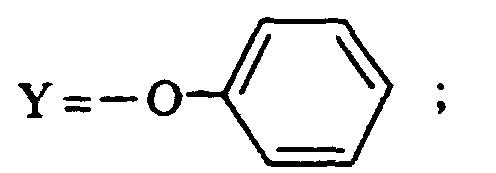

On hydrogène dans un appareil de Parr pendant 4 heures, à 35°C et sous une pression de 1,3 bars, un mélange de 36 g de 2-chloro-5-nitroanisole et du nickel de Raney® dans 150 ml de MeOH et 200 ml de THF. On filtre le catalyseur sur Célite® et concentre sous vide le filtrat. On obtient 28 g du produit attendu que l'on utilise tel quel.It is hydrogenated in a Parr apparatus for 4 hours, at 35 ° C. and under a pressure of 1.3 bar, a mixture of 36 g of 2-chloro-5-nitroanisole and nickel of Raney® in 150 ml MeOH and 200 ml THF. The catalyst is filtered through Celite® and concentrates the filtrate in vacuo. 28 g of the expected product are obtained which is used what.
On chauffe à 230°C pendant 4 heures un mélange de 28 g du composé obtenu à l'étape précédente et 33,13 g d'acide DL-2-chloromandélique dans 128 ml de 1,2-dichlorobenzène en éliminant l'eau formée à l'aide d'un appareil de Dean-Stark. On concentre sous vide en partie le mélange réactionnel et laisse en cristallisation. On essore le produit cristallisé formé et le lave à l'éther iso. On obtient 40 g du produit attendu. A mixture of 28 g of the compound obtained is heated at 230 ° C. for 4 hours. the previous step and 33.13 g of DL-2-chloromandelic acid in 128 ml of 1,2-dichlorobenzene by eliminating the water formed using a Dean-Stark apparatus. We Partly concentrated in vacuo the reaction mixture and left in crystallization. We the crystalline product formed is filtered off and washed with iso ether. 40 g of the product are obtained expected.
On ajoute rapidement 40 g du composé obtenu à l'étape précédente à 550 g d'acide polyphosphorique puis on chauffe à 60°C pendant 8 heures et laisse une nuit sous agitation en laissant revenir la température à TA. On ajoute de l'eau glacée au mélange réactionnel, essore le précipité formé et le lave à l'eau. On reprend le précipité dans l'AcOEt, essore le produit blanc obtenu après trituration et le lave à l'éther iso. On obtient 17,2 g du produit attendu, F = 243-247°C.40 g of the compound obtained in the preceding step are rapidly added to 550 g of acid. polyphosphoric and then heated at 60 ° C for 8 hours and left overnight under stirring by letting the temperature return to RT. Ice water is added to the mixture reaction, wring the precipitate formed and washed with water. We take the precipitate again AcOEt, wring the white product obtained after trituration and washed with iso ether. We 17.2 g of the expected product are obtained, mp = 243-247 ° C.
A une solution de 17,2 g du composé obtenu à l'étape précédente dans 220 ml de THF, on ajoute à TA, sous atmosphère d'argon, 2,56 g d'hydrure de sodium à 60 % dans l'huile. Après cessation du dégagement gazeux, on ajoute 6,85 g de diméthyldisulfure, fait barboter de l'air dans le mélange réactionnel et laisse 72 heures sous agitation à TA. On ajoute de l'eau au mélange réactionnel, évapore sous vide le THF, extrait la phase aqueuse restante à l'AcOEt, lave la phase organique à l'eau, par une solution saturée de NaCl, sèche sur Na2SO4 et évapore sous vide le solvant. On dissout le produit obtenu dans du DCM, concentre en partie le solvant, laisse en cristallisation et essore le produit cristallisé formé. On obtient 6 g du produit attendu, F = 237-240°C.To a solution of 17.2 g of the compound obtained in the preceding step in 220 ml of THF, 2.56 g of sodium hydride at 60% in oil are added under argium under argium. After ceasing the evolution of gas, 6.85 g of dimethyl disulphide are added, air is bubbled into the reaction mixture and the mixture is stirred for 72 hours at RT. Water is added to the reaction mixture, the THF is evaporated off under vacuum, the remaining aqueous phase is extracted with AcOEt, the organic phase is washed with water and with saturated NaCl solution, dried over Na 2 SO 4 and evaporated. under vacuum the solvent. The product obtained is dissolved in DCM, the solvent is partially concentrated, the mixture is crystallized and the crystalline product formed is filtered off. 6 g of the expected product are obtained, mp = 237-240 ° C.
On chauffe à reflux un mélange de 1 g du composé obtenu à l'étape précédente et 0,07 g de chlorure de zinc dans 10 ml d'acétonitrile, ajoute 3 ml d'HMDS et maintient le reflux pendant 1 heure. On concentre sous vide, extrait le résidu à l'AcOEt, lave la phase organique à l'eau, sèche sur Na2SO4 et évapore sous vide le solvant. On obtient 1,25 g du produit attendu après cristallisation dans l'heptane, F = 211-212°C.A mixture of 1 g of the compound obtained in the preceding step and 0.07 g of zinc chloride in 10 ml of acetonitrile is refluxed, 3 ml of HMDS are added and the reflux is maintained for 1 hour. It is concentrated under vacuum, the residue is extracted with AcOEt, the organic phase is washed with water and dried over Na 2 SO 4 and the solvent is evaporated off under vacuum. 1.25 g of the expected product are obtained after crystallization from heptane, mp = 211-212 ° C.
On prépare ce composé selon le mode opératoire décrit à l'étape B de la Préparation 1.8 à partir de 1,2 g du composé obtenu à l'étape précédente, 0,08 g d'hydrure de sodium à 60 % dans l'huile, 15 ml de THF et 0,8 g du chlorure de 2,4-diméthoxybenzènesulfonyle. On obtient 1,6 g du produit attendu après cristallisation dans l'éther iso, F = 217-219°C.This compound is prepared according to the procedure described in step B of the Preparation 1.8 from 1.2 g of the compound obtained in the previous step, 0.08 g of 60% sodium hydride in oil, 15 ml of THF and 0.8 g of 2,4-dimethoxybenzenesulfonyl chloride. 1.6 g of the expected product are obtained after crystallization. in iso ether, mp 217-219 ° C.
On laisse 4 heures sous agitation à 20°C un mélange de 1,55 g du composé obtenu à l'étape précédente et 2 ml d'HCl 12N dans 30 ml d'acétone. On concentre sous vide, reprend le résidu dans l'acétone et concentre à nouveau sous vide. On reprend le résidu dans du DCM et concentre sous vide. On triture le résidu dans l'éther iso et essore le précipité formé. On obtient 1,3 g du produit attendu, F = 233-235°C.A mixture of 1.55 g of the compound obtained is stirred for 4 hours at 20 ° C. in the previous step and 2 ml of 12N HCl in 30 ml of acetone. Concentrate in vacuo, take up the residue in acetone and concentrate again under vacuum. We take the residue in DCM and concentrated under vacuum. The residue is triturated in iso ether and the precipitate formed. 1.3 g of the expected product are obtained, mp = 233-235 ° C.
On refroidit à 10°C un mélange de 1,3 g du composé obtenu à l'étape précédente dans 10 ml de pyridine, ajoute 0,8 g de chloroformiate de phényle et laisse 20 minutes sous agitation à 20°C. On rajoute 0,7 g de chloroformiate de phényle et laisse 20 heures sous agitation à 20°C. On concentre sous vide, extrait le résidu à l'AcOEt, lave la phase organique par une solution d'HCl 1N, sèche sur Na2SO4 et évapore sous vide le solvant. On chromatographie le résidu sur gel de silice en éluant au DCM. On obtient 0,7 g du produit attendu après cristallisation dans le mélange pentane/éther iso, F = 162-163°C.A mixture of 1.3 g of the compound obtained in the preceding step in 10 ml of pyridine is cooled to 10 ° C., 0.8 g of phenyl chloroformate are added and the mixture is stirred for 20 minutes at 20 ° C. 0.7 g of phenyl chloroformate are added and the mixture is stirred for 20 hours at 20 ° C. It is concentrated under vacuum, the residue is extracted with AcOEt, the organic phase is washed with 1N HCl solution and dried over Na 2 SO 4 and the solvent is evaporated off under vacuum. The residue is chromatographed on silica gel, eluting with DCM. 0.7 g of the expected product is obtained after crystallization from pentane / iso ether, mp = 162-163 ° C.
(II) : R1 = Cl ; R2 = H ; R3 = OCH3 ; R4 = 5- OCH3 ; X = -O- ;


On prépare une solution de bromure de 2,5-diméthoxyphénylmagnésium à partir de 2,2 g de magnésium, 18 g de 1-bromo-2,5-diméthoxybenzène et 50 ml d'éther. On ajoute, en goutte à goutte, cette solution à un mélange de 5 g de 5-chloro-1H-indole-2,3-dione dans 50 ml de THF à une température inférieure à 30°C, puis chauffe 3 heures à reflux. Après refroidissement à TA, on verse le mélange réactionnel sur une solution d'HCl 1N, extrait à l'AcOEt, lave la phase organique à l'eau, sèche sur Na2SO4 et évapore sous vide le solvant. On obtient 7,1 g du produit attendu après cristallisation dans l'éther iso à chaud.A solution of 2,5-dimethoxyphenylmagnesium bromide is prepared from 2.2 g of magnesium, 18 g of 1-bromo-2,5-dimethoxybenzene and 50 ml of ether. This solution is added, dropwise, to a mixture of 5 g of 5-chloro- 1H -indole-2,3-dione in 50 ml of THF at a temperature below 30.degree. C. and then heated for 3 hours at room temperature. reflux. After cooling to RT, the reaction mixture is poured into a solution of 1N HCl, extracted with AcOEt, the organic phase is washed with water and dried over Na 2 SO 4 and the solvent is evaporated off under vacuum. 7.1 g of the expected product are obtained after crystallization from hot iso ether.
On chauffe à reflux un mélange de 4 g du composé obtenu à l'étape précédente et 0,085 g de chlorure de zinc dans 45 ml d'acétonitrile, ajoute 2,8 ml d'HMDS et maintient à reflux pendant 1 heure. On concentre sous vide, reprend le résidu à l'eau, extrait à l'éther, lave la phase organique à l'eau, sèche sur Na2SO4 et évapore sous vide le solvant. On obtient 5 g du produit attendu après cristallisation dans l'éther iso.A mixture of 4 g of the compound obtained in the preceding step and 0.085 g of zinc chloride in 45 ml of acetonitrile is refluxed, 2.8 ml of HMDS are added and the mixture is refluxed for 1 hour. It is concentrated under vacuum, the residue is taken up in water and extracted with ether, the organic phase is washed with water and dried over Na 2 SO 4 and the solvent is evaporated off under vacuum. 5 g of the expected product are obtained after crystallization from iso ether.
On prépare ce composé selon le mode opératoire décrit à l'étape B de la Préparation 1.8 à partir de 2 g du composé obtenu à l'étape précédente, 0,135 g d'hydrure de sodium à 60 % dans l'huile, 40 ml de THF et 1,3 g de chlorure de 2,4-diméthoxybenzènesulfonyle. On obtient 2,2 g du produit attendu après cristallisation dans l'éther iso.This compound is prepared according to the procedure described in step B of the Preparation 1.8 from 2 g of the compound obtained in the previous step, 0.135 g of 60% sodium hydride in oil, 40 ml of THF and 1.3 g of 2,4-dimethoxybenzenesulfonyl chloride. 2.2 g of the expected product are obtained after crystallization. in the iso ether.
On laisse 4 heures sous agitation à TA un mélange de 1 g du composé obtenu à l'étape précédente et 0,5 ml d'HCl 12N dans 20 ml d'acétone. On concentre sous vide, reprend le résidu au DCM et concentre à nouveau sous vide. On triture le résidu dans l'éther iso et essore le précipité formé. On obtient 0,84 g du produit attendu.A mixture of 1 g of the compound obtained at RT is stirred for 4 hours at RT. the previous step and 0.5 ml of 12N HCl in 20 ml of acetone. Concentrate in vacuo, take up the residue with DCM and concentrate again under vacuum. Triturate the residue the iso ether and wring the precipitate formed. 0.84 g of the expected product is obtained.
On laisse une nuit sous agitation à TA un mélange de 0,8 g du composé obtenu à l'étape précédente et 0,4 ml de chloroformiate de phényle dans 5 ml de pyridine. On ajoute de l'eau au mélange réactionnel, extrait au DCM, lave la phase organique par une solution d'HCl 2N, sèche sur Na2SO4 et évapore sous vide le solvant. On obtient 0,84 g du produit attendu après cristallisation dans l'éther iso.A mixture of 0.8 g of the compound obtained in the preceding step and 0.4 ml of phenyl chloroformate in 5 ml of pyridine is stirred overnight at RT. Water is added to the reaction mixture, extracted with DCM, the organic phase washed with a 2N HCl solution, dried over Na 2 SO 4 and the solvent evaporated under vacuum. 0.84 g of the expected product is obtained after crystallization from iso ether.
(II) : R1 = Cl ; R2 = H ; R3 = OCH3 ; R4 = H ; X = -NH- ;


On prépare ce composé selon le mode opératoire décrit dans WO 95/18105 à la Préparation 7.This compound is prepared according to the procedure described in WO 95/18105 to Preparation 7.
On refroidit à 4°C une solution de 1,64 g du composé obtenu à l'étape précédente dans 20 ml de DMF, ajoute 0,25 g d'hydrure de sodium à 60 % dans l'huile et laisse 30 minutes sous agitation à 4°C. On ajoute ensuite 1,34 g de chlorure de 2,4-diméthoxybenzènesulfonyle et laisse 4 heures sous agitation à TA. On ajoute 50 ml d'eau au mélange réactionnel, extrait à l'AcOEt, lave la phase organique par une solution saturée de NaCl, sèche sur Na2SO4 et évapore sous vide le solvant. On chromatographie le résidu sur gel de silice en éluant par le mélange DCM/AcOEt (97/3 ; v/v). On obtient 2 g du produit attendu après cristallisation dans le mélange DCM/éther iso.A solution of 1.64 g of the compound obtained in the preceding step in 20 ml of DMF is cooled to 4 ° C., 0.25 g of 60% sodium hydride in the oil is added and the mixture is left stirring for 30 minutes. at 4 ° C. 1.34 g of 2,4-dimethoxybenzenesulfonyl chloride are then added and the mixture is stirred for 4 hours at RT. 50 ml of water are added to the reaction mixture, extracted with AcOEt, the organic phase is washed with saturated NaCl solution, dried over Na 2 SO 4 and the solvent is evaporated off under vacuum. The residue is chromatographed on silica gel, eluting with a DCM / AcOEt mixture (97/3, v / v). 2 g of the expected product are obtained after crystallization from a DCM / iso ether mixture.
On refroidit à 4°C une solution de 2 g du composé obtenu à l'étape précédente et 10 ml de pyridine dans 10 ml de DCM, ajoute 0,77 ml de chloroformiate de phényle et laisse 1 heure sous agitation à TA. On concentre sous vide, extrait le résidu à l'AcOEt, lave la phase organique par une solution saturée de NaCl, sèche sur Na2SO4 et évapore sous vide le solvant. On chromatographie le résidu sur gel de silice en éluant par le mélange DMC/AcOEt (96/4 ; v/v). On obtient 2,6 g du produit attendu après cristallisation dans le mélange DCM/éther iso, F = 191°C.A solution of 2 g of the compound obtained in the preceding step and 10 ml of pyridine in 10 ml of DCM is cooled to 4 ° C., 0.77 ml of phenyl chloroformate is added and the mixture is stirred for 1 hour at RT. It is concentrated under vacuum, the residue is extracted with AcOEt, the organic phase is washed with saturated NaCl solution and dried over Na 2 SO 4 and the solvent is evaporated off under vacuum. The residue is chromatographed on silica gel, eluting with a DMC / AcOEt mixture (96/4, v / v). 2.6 g of the expected product are obtained after crystallization from a DCM / iso ether mixture, mp = 191 ° C.
(II) : R1 = Cl ; R2 = H ; R3 = OCH3 ; R4 = H ; X=-NH-;


On refroidit à 0°C un mélange de 9 g du composé obtenu à l'étape A de la Préparation 1.1 et 3,74 ml de pyridine dans 100 ml de DCM, ajoute, en goutte à goutte et en 3 minutes, une solution de 3,45 ml de chlorure de thionyle dans 3 ml de DCM et laisse 30 minutes sous agitation. On ajoute de l'eau au mélange réactionnel et évapore le DCM sous vide. On essore le précipité formé, le lave quatre fois à l'eau puis à l'éther iso froid et le sèche. On obtient 8,8 g du produit attendu.A mixture of 9 g of the compound obtained in step A of the reaction mixture is cooled to 0 ° C. Preparation 1.1 and 3.74 ml of pyridine in 100 ml of DCM, added dropwise and in 3 minutes, a solution of 3.45 ml of thionyl chloride in 3 ml of DCM and leave 30 minutes stirring. Water is added to the reaction mixture and evaporated DCM under vacuum. The precipitate formed is filtered off, washed four times with water and then the iso cold ether and dry it. 8.8 g of the expected product are obtained.
On laisse 2 heures sous agitation à TA un mélange de 7 g du composé obtenu à l'étape précédente et 7,65 g de (S)-(+)-α-phénylglycinol dans 100 ml de chloroforme. On ajoute ensuite 2,9 g de DIPEA et laisse 48 heures sous agitation à TA. On essore le précipité formé et recueille l'isomère A. On lave les jus d'essorage par une solution à 5 % de K2CO3, sèche la phase organique sur Na2SO4 et évapore sous vide le solvant. On chromatographie le résidu sur gel de silice en éluant par le mélange DCM/AcOEt (70/30 ; v/v). On sépare les deux diastéréoisomères :
- le moins polaire, isomère A : on obtient 4,55 g (précipité et chromatographie) ; α 20 / D = +193° (c = 0,16 ; chloroforme).
- le plus polaire, isomère B.
- the less polar, isomer A: 4.55 g (precipitate and chromatography); α 20 / D = + 193 ° (c = 0.16, chloroform).
- the most polar, isomer B.
On laisse 1 heure 30 minutes sous agitation à TA un mélange de 4,55 g du
composé obtenu à l'étape précédente (isomère A) et 5,5 g de tétraacétate de plomb
dans 75 ml de DCM et 35 ml de MeOH. On concentre sous vide, reprend le résidu par
une solution saturée de NaHCO3, extrait à l'AcOEt, lave la phase organique à l'eau,
par une solution saturée de NaCl, sèche sur Na2SO4 et évapore sous vide le solvant.
On reprend l'huile obtenue dans 100 ml d'une solution d'HCl 3N, ajoute 10 ml de
MeOH et laisse 2 heures sous agitation à TA. On concentre sous vide les solvants
organiques, lave deux fois la phase aqueuse à l'éther, alcalinise la phase aqueuse par
ajout de KOH en pastilles, extrait à l'AcOEt, lave la phase organique à l'eau, par une
solution saturée de NaCl, sèche sur Na2SO4 et évapore sous vide le solvant. On
obtient 1,178 g du produit attendu après cristallisation dans le mélange DCM/éther
iso/THF, F = 202°C.
α 20 / D = + 83,3° (c =0,16 ; chloroforme).A mixture of 4.55 g of the compound obtained in the preceding step (isomer A) and 5.5 g of lead tetraacetate in 75 ml of DCM and 35 ml of MeOH is stirred for 1 hour 30 minutes at RT. It is concentrated under vacuum, the residue is taken up with saturated NaHCO 3 solution and extracted with AcOEt, the organic phase is washed with water and with saturated NaCl solution and dried over Na 2 SO 4 and the solvent is evaporated off under vacuum . The oil obtained is taken up in 100 ml of a 3N HCl solution, 10 ml of MeOH are added and the mixture is left stirring for 2 hours at RT. The organic solvents are concentrated under vacuum, the aqueous phase is washed twice with ether, the aqueous phase is basified by adding KOH in pellets, extracted with AcOEt, the organic phase is washed with water, with a saturated solution of NaCl, dried over Na 2 SO 4 and the solvent evaporated under vacuum. 1.178 g of the expected product are obtained after crystallization from a DCM / iso ether / THF mixture, mp = 202 ° C.
α 20 / D = + 83.3 ° (c = 0.16, chloroform).
On refroidit à 0°C une solution de 1,178 g du composé obtenu à l'étape précédente
dans 10 ml de DMF, ajoute, sous atmosphère d'argon, 0,188 g d'hydrure de sodium à
60 % dans l'huile et laisse sous agitation jusqu'à cessation du dégagement gazeux. On
ajoute ensuite 1,02 g de chlorure de 2,4-diméthoxybenzènesulfonyle et laisse 3 heures
sous agitation à TA. On verse le mélange réactionnel dans une solution à 5 % de
K2CO3, extrait à l'AcOEt, lave la phase organique à l'eau, par une solution à 5 % de
K2CO3, par une solution saturée de NaCl, sèche sur Na2SO4 et évapore sous vide le
solvant. On chromatographie le résidu sur gel de silice en éluant par le mélange
DCM/AcOEt (95/5 ; v/v). On obtient 1,254 g du produit attendu après cristallisation
dans le mélange DCM/éther/éther iso, F = 172-173°C.
α 20 / D = +113° (c = 0,18 ; chloroforme).A solution of 1.178 g of the compound obtained in the preceding step in 10 ml of DMF is cooled to 0 ° C. and 0.188 g of 60% sodium hydride in oil are added under an argon atmosphere and the mixture is left under nitrogen. stirring until cessation of gassing. 1.02 g of 2,4-dimethoxybenzenesulfonyl chloride are then added and the mixture is left stirring for 3 hours at RT. The reaction mixture is poured into a 5% solution of K 2 CO 3 , extracted with EtOAc, the organic phase washed with water, with a 5% solution of K 2 CO 3 , with a saturated solution of NaCl dried over Na 2 SO 4 and the solvent evaporated under vacuum. The residue is chromatographed on silica gel, eluting with a DCM / AcOEt mixture (95/5, v / v). 1.254 g of the expected product are obtained after crystallization from a DCM / ether / iso ether mixture, mp = 172 ° -173 ° C.
α 20 / D = + 113 ° (c = 0.18, chloroform).
On refroidit au bain de glace une solution de 1,1 g du composé obtenu à l'étape précédente dans 10 ml de DCM, ajoute 1,8 ml de pyridine, puis ajoute, goutte à goutte, 0,37 ml de chloroformiate de phényle et abandonne une nuit à froid. On dilue le mélange réactionnel au DCM, lave trois fois la phase organique à l'eau, sèche sur Na2SO4 et évapore sous vide le solvant. On chromatographie le résidu sur gel de silice en éluant par le mélange DCM/AcOEt (98/2 ; v/v). On obtient 1,136 g du produit attendu.A solution of 1.1 g of the compound obtained in the preceding step in 10 ml of DCM is cooled in an ice bath, 1.8 ml of pyridine are added and then 0.37 ml of phenyl chloroformate is added dropwise. and give up a cold night. The reaction mixture is diluted with DCM, the organic phase is washed three times with water and dried over Na 2 SO 4 and the solvent is evaporated off under vacuum. The residue is chromatographed on silica gel, eluting with a DCM / AcOEt (98/2; v / v) mixture. 1.136 g of the expected product is obtained.
(II) : R1 = Cl ; R2 = H ; R3 = OCH(CH3)2 ; R4 = H ; X = -NH- ;


On refroidit à 0°C un mélange de 12 g du composé obtenu à l'étape B de la Préparation 1.3 et 8,35 ml de pyridine dans 165 ml de DCM, ajoute, en goutte à goutte, 7,62 ml de chlorure de thionyle et laisse 15 minutes sous agitation. On concentre sous vide, extrait le résidu à l'AcOEt, lave la phase organique à l'eau, sèche sur Na2SO4 et évapore sous vide le solvant. On chromatographie le résidu sur gel de silice en éluant par le mélange DCM/AcOEt (90/10 ; v/v). On obtient 15,22 g du produit attendu.A mixture of 12 g of the compound obtained in step B of Preparation 1.3 and 8.35 ml of pyridine in 165 ml of DCM is cooled to 0 ° C. and 7.62 ml of sodium chloride are added dropwise. thionyl and left stirring for 15 minutes. It is concentrated under vacuum, the residue is extracted with AcOEt, the organic phase is washed with water and dried over Na 2 SO 4 and the solvent is evaporated off under vacuum. The residue is chromatographed on silica gel, eluting with a DCM / AcOEt mixture (90/10, v / v). 15.22 g of the expected product are obtained.
On laisse 1 heure sous agitation à TA un mélange de 8,17 g du composé obtenu à l'étape précédente et 3,66 g de (S)-(+)-α-phénylglycinol dans 265 ml de chloroforme. On ajoute ensuite 4,66 ml de DIPEA, laisse 3 heures sous agitation à TA puis chauffe à 50°C pendant 18 heures. On concentre sous vide, extrait le résidu à l'AcOEt, lave la phase organique par une solution à 5 % de K2CO3, à l'eau, sèche sur Na2SO4 et évapore sous vide le solvant. On chromatographie le résidu sur gel de sillice en éluant par le mélange DCM/AcOEt (90/10 ; v/v) et sépare :
- l'isomère le moins polaire, isomère A : on obtient 4,98 g après cristallisation
dans l'éther iso, F = 212,7°C.
α 20 / D = + 212,4° (c = 0,2 ; chloroforme).
- the less polar isomer, isomer A: 4.98 g is obtained after crystallization from iso ether, mp = 212.7 ° C.
α 20 / D = + 212.4 ° (c = 0.2, chloroform).
On poursuit la chromatographie en éluant par le mélange DCM/AcOEt (70/30 ; v/v) et sépare :
- l'isomère le plus polaire, isomère B : on obtient 3,49 g après cristallisation dans
l'éther iso, F = 241,3°C.
α 20 / D = - 6,6° (c = 0,2 ; chloroforme).
- the most polar isomer, isomer B: 3.49 g is obtained after crystallization from iso ether, mp = 241.3 ° C.
α 20 / D = -6.6 ° (c = 0.2, chloroform).
On refroidit à 0°C une solution de 3,9 g du composé obtenu à l'étape précédente
(isomère A) dans 75 ml de DCM et 37 ml de MeOH, ajoute 4,35 g de tétraacétate de
plomb et laisse 2 heures sous agitation. On ajoute 3 gouttes d'une solution à 5 % de
NaHCO3, concentre sous vide, extrait le résidu à l'AcOEt, lave la phase organique à
l'eau, par une solution saturée de NaCl, sèche sur Na2SO4 et évapore sous vide le
solvant. On reprend le produit obtenu dans 120 ml d'HCl concentré, lave à l'éther,
alcalinise la phase aqueuse par ajout de K2CO3, extrait à l'AcOEt et laisse en
cristallisation. On essore les cristaux formés et les sèche. On concentre sous vide les
jus d'essorage, chromatographie le résidu sur gel de silice en éluant par le mélange
DCM/AcOEt (65/35 ; v/v) et cristallise le produit obtenu dans l'éther iso. On obtient
au total 2,03 g du produit attendu, F = 193°C.
α 20 / D = + 44° (c = 0,18 ; chloroforme).A solution of 3.9 g of the compound obtained in the preceding step (isomer A) in 75 ml of DCM and 37 ml of MeOH is cooled to 0 ° C., 4.35 g of lead tetraacetate are added and the mixture is left for 2 hours. agitation. 3 drops of a 5% solution of NaHCO 3 are added , the mixture is concentrated under vacuum, the residue is extracted with AcOEt, the organic phase is washed with water and with saturated NaCl solution and dried over Na 2 SO 4. evaporate the solvent in vacuo. The product obtained is taken up in 120 ml of concentrated HCl, washed with ether, the aqueous phase is basified by adding K 2 CO 3 , extracted with AcOEt and left to crystallize. The crystals formed are filtered off and dried. The wiping juices are concentrated under vacuum, the residue is chromatographed on silica gel, eluting with a DCM / AcOEt mixture (65/35, v / v) and crystallizing the product obtained in iso ether. A total of 2.03 g of the expected product is obtained, mp = 193 ° C.
α 20 / D = + 44 ° (c = 0.18, chloroform).
On prépare ce composé selon le mode opératoire décrit à l'étape D de la
Préparation 1.19 à partir de 1,86 g du composé obtenu à l'étape précédente, 0,282 g
d'hydrure de sodium à 60 % dans l'huile, 20 ml de DMF et 1,395 g de chlorure de 2,4-diméthoxybenzènesulfonyle.
On obtient 2,68 g du produit attendu après cristallisation
dans l'hexane.
α 20 / D = + 79,5° (c = 0,2 ; chloroforme).This compound is prepared according to the procedure described in step D of Preparation 1.19 from 1.86 g of the compound obtained in the preceding step, 0.282 g of sodium hydride at 60% in oil, ml of DMF and 1.395 g of 2,4-dimethoxybenzenesulfonyl chloride. 2.68 g of the expected product are obtained after crystallization from hexane.
α 20 / D = + 79.5 ° (c = 0.2, chloroform).
On refroidit à 0°C un mélange de 2,68 g du composé obtenu à l'étape précédente et 4,5 ml de pyridine dans 25 ml de DCM, ajoute en 30 secondes 1,06 g de chloroformiate de phényle et abandonne à froid pendant 18 heures. On chromatographie directement le mélange réactionnel sur gel de silice préparé dans le mélange DCM/hexane (80/20 ; v/v) et élue par le mélange DCM/AcOEt (95/5 ; v/v). On obtient 2,88 g du produit attendu que l'on utilise tel quel.A mixture of 2.68 g of the compound obtained in the preceding step is cooled to 0 ° C. and 4.5 ml of pyridine in 25 ml of DCM, added in 30 seconds 1.06 g of phenyl chloroformate and quit cold for 18 hours. We chromatography directly the reaction mixture on silica gel prepared in the DCM / hexane (80/20, v / v) and eluted with DCM / AcOEt (95/5, v / v). 2.88 g of the expected product are obtained, which is used as such.
(II) : R1 = Cl ; R2 = H ; R3 = OCH(CH3)2 ; R4 = H ; X = -NH- ;


On refroidit à 0°C une solution de 3,4 g du composé obtenu à l'étape B de la
Préparation 1.20 (isomère B) dans 65 ml de DCM et 32,4 ml de MeOH, ajoute 3,8 g
de tétraacétate de plomb et laisse 40 minutes sous agitation. On ajoute 3 gouttes d'une
solution à 5 % de NaHCO3, concentre sous vide, extrait le résidu à l'AcOEt, lave la
phase organique à l'eau, par une solution saturée de NaCl, sèche sur Na2SO4 et
évapore sous vide le solvant. On reprend le produit obtenu dans 120 ml d'HCl 0,5N,
lave à l'éther, alcalinise la phase aqueuse par ajout de K2CO3 et essore le précipité
formé. On obtient 1,9 g du produit attendu après cristallisation dans l'éther iso,
F = 192°C.
α 20 / D = - 42° (c = 0,2 ; chloroforme).A solution of 3.4 g of the compound obtained in step B of Preparation 1.20 (isomer B) in 65 ml of DCM and 32.4 ml of MeOH is cooled to 0 ° C., 3.8 g of tetraacetate of lead and let 40 minutes stirring. 3 drops of a 5% solution of NaHCO 3 are added , the mixture is concentrated under vacuum, the residue is extracted with AcOEt, the organic phase is washed with water and with saturated NaCl solution and dried over Na 2 SO 4. evaporate the solvent in vacuo. The product obtained is taken up in 120 ml of 0.5N HCl, washed with ether, the aqueous phase is basified by addition of K 2 CO 3 and the precipitate formed is filtered off. 1.9 g of the expected product are obtained after crystallization from iso ether, mp = 192 ° C.
α 20 / D = -42 ° (c = 0.2, chloroform).
On prépare ce composé selon le mode opératoire décrit à l'étape D de la
Préparation 1.19 à partir de 1,67 g du composé obtenu à l'étape précédente, 0,253 g
d'hydrure de sodium à 60 % dans l'huile, 20 ml de DMF et 1,249 g de chlorure de 2,4-diméthoxybenzènesulfonyle.
On obtient 2,453 g du produit attendu après
cristallisation dans l'hexane.
α 20 / D = - 79,8° (c = 0,2 ; chloroforme).This compound is prepared according to the procedure described in step D of Preparation 1.19 from 1.67 g of the compound obtained in the preceding step, 0.253 g of sodium hydride at 60% in oil, ml of DMF and 1.249 g of 2,4-dimethoxybenzenesulfonyl chloride. 2.43 g of the expected product are obtained after crystallization from hexane.
α 20 / D = -79.8 ° (c = 0.2, chloroform).
On refroidit à 0°C un mélange de 2,103 g du composé obtenu à l'étape précédente et 3,5 ml de pyridine dans 20 ml de DCM, ajoute 0,665 ml de chloroformiate de phényle et abandonne à froid pendant 36 heures. On concentre sous vide, reprend le résidu par une solution à 5 % de K2CO3, extrait à l'AcOEt, lave la phase organique à l'eau, par une solution saturée de NaCl, sèche sur Na2SO4 et évapore sous vide le solvant. On chromatographie le résidu sur gel de silice en éluant par le mélange DCM/hexane (80/20 ; v/v). On obtient 1,88 g du produit attendu que l'on utilise tel quel.A mixture of 2.103 g of the compound obtained in the preceding step and 3.5 ml of pyridine in 20 ml of DCM is cooled to 0 ° C., 0.665 ml of phenyl chloroformate are added and the mixture is left cold for 36 hours. It is concentrated under vacuum, the residue is taken up in a 5% solution of K 2 CO 3 , extracted with AcOEt, the organic phase is washed with water and with saturated NaCl solution, dried over Na 2 SO 4 and evaporated. under vacuum the solvent. The residue is chromatographed on silica gel, eluting with a DCM / hexane (80/20; v / v) mixture. 1.88 g of the expected product are obtained, which is used as such.
(II) : R1 = Cl ; R2 = H ; R3 = OCH3 ; R4 = 5- OCH3 ; X = -NH- ;


On refroidit à une température inférieure à 20°C un mélange de 3 g du composé obtenu à l'étape A de la Préparation 1.17 et 1,2 ml de pyridine dans 50 ml de DCM, ajoute 0,8 ml de chlorure de thionyle et laisse 1 heure sous agitation. On lave le mélange réactionnel à l'eau, sèche la phase organique sur Na2SO4 et évapore sous vide le solvant. On chromatographie le résidu sur gel de silice en éluant au DCM. On obtient 1,9 g du produit attendu que l'on utilise tel quel.A mixture of 3 g of the compound obtained in step A of Preparation 1.17 and 1.2 ml of pyridine in 50 ml of DCM is cooled to a temperature below 20 ° C., 0.8 ml of thionyl chloride are added and leave 1 hour with stirring. The reaction mixture is washed with water, the organic phase is dried over Na 2 SO 4 and the solvent is evaporated off under vacuum. The residue is chromatographed on silica gel, eluting with DCM. 1.9 g of the expected product are obtained, which is used as such.
On refroidit à 0°C un mélange de 1,25 g du composé obtenu à l'étape précédente dans 7 ml de THF, fait barboter de l'ammoniac gaz 4 fois 10 minutes en 6 heures et laisse 24 heures sous agitation à TA. On concentre sous vide, reprend le résidu au DCM et évapore sous vide le solvant. On chromatographie le résidu sur gel de silice en éluant au DCM puis par le mélange DCM/AcOEt (60/40 ; v/v). On obtient 0,808 g du produit attendu que l'on utilise tel quel.A mixture of 1.25 g of the compound obtained in the preceding step is cooled to 0 ° C. in 7 ml of THF, bubbled ammonia gas 4 times 10 minutes in 6 hours and left stirring for 24 hours at RT. Concentrate in vacuo, take up the residue at DCM and evaporated under vacuum the solvent. The residue is chromatographed on silica gel eluting with DCM and then with DCM / AcOEt (60/40, v / v). We obtain 0.808 g the expected product that is used as is.
On prépare ce composé selon le mode opératoire décrit à l'étape D de la Préparation 1.19 à partir de 0,749 g du composé obtenu à l'étape précédente, 0,113 g d'hydrure de sodium à 60 % dans l'huile, 7 ml de DMF et 0,612 g de chlorure de 2,4-diméthoxybenzènesulfonyle. On obtient 0,9 g du produit attendu après cristallisation dans le mélange DCM/éther iso, F = 191°C.This compound is prepared according to the procedure described in stage D of the Preparation 1.19 from 0.749 g of the compound obtained in the previous step, 0.113 g of 60% sodium hydride in the oil, 7 ml of DMF and 0.612 g of 2,4-dimethoxybenzenesulfonyl chloride. 0.9 g of the expected product are obtained after crystallization. in the DCM / iso ether mixture, mp = 191 ° C.
On refroidit à 0°C un mélange de 0,52 g du composé obtenu à l'étape précédente et 1 ml de pyridine dans 5 ml de DCM, ajoute 0,16 ml de chloroformiate de phényle et laisse 16 heures sous agitation. On ajoute de l'eau au mélange réactionnel, évapore sous vide le DCM, extrait à l'AcOEt, lave la phase organique par une solution à 5 % de K2CO3, à l'eau, par une solution saturée de NaCl, sèche sur Na2SO4 et évapore sous vide le solvant. On chromatographie le résidu sur gel de silice en éluant au DCM. On obtient 0,46 g du produit attendu que l'on utilise tel quel.A mixture of 0.52 g of the compound obtained in the preceding step and 1 ml of pyridine in 5 ml of DCM is cooled to 0 ° C., 0.16 ml of phenyl chloroformate is added and the mixture is left stirring for 16 hours. Water is added to the reaction mixture, the DCM is evaporated off under vacuum and extracted with AcOEt, the organic phase is washed with 5% K 2 CO 3 solution , with water and with saturated NaCl solution. dry over Na 2 SO 4 and evaporate the solvent in vacuo. The residue is chromatographed on silica gel, eluting with DCM. 0.46 g of the expected product is obtained which is used as such.
(II) : R1 = Cl ; R2 = H ; R3 = Cl ; R4 = H ; X = -NH- ;


On prépare ce composé selon le mode opératoire décrit dans WO 95/18105 à l'Exemple 3.This compound is prepared according to the procedure described in WO 95/18105 to Example 3
On refroidit à 0°C une solution de 3 g du composé obtenu à l'étape précédente dans 25 ml de pyridine , ajoute, goutte à goutte, une solution de 1,25 g de chloroformiate de phényle dans 2 ml de DCM et laisse 3 heures sous agitation à 0°C puis une nuit à TA. On refroidit à nouveau à 0°C, ajoute 0,96 g de chloroformiate de phényle et laisse 18 heures au repos à froid. On concentre sous vide, reprend le résidu par une solution à 5 % de K2CO3, extrait à l'AcOEt, sèche la phase organique sur Na2SO4 et évapore sous vide le solvant. On chromatographie le résidu sur gel de silice en éluant par le mélange DCM/AcOEt (95/5 ; v/v). On obtient 2,88 g du produit attendu.A solution of 3 g of the compound obtained in the preceding step in 25 ml of pyridine is cooled to 0 ° C., a solution of 1.25 g of phenyl chloroformate in 2 ml of DCM is added dropwise and the mixture is left behind. hours stirring at 0 ° C then overnight at RT. It is cooled again to 0 ° C., 0.96 g of phenyl chloroformate are added and the mixture is left to stand for 18 hours under cold conditions. It is concentrated under vacuum, the residue is taken up in a 5% solution of K 2 CO 3 , extracted with AcOEt, the organic phase is dried over Na 2 SO 4 and the solvent is evaporated off under vacuum. The residue is chromatographed on silica gel, eluting with a DCM / AcOEt mixture (95/5, v / v). 2.88 g of the expected product are obtained.
(II) : R1 = Cl ; R2 = 6-CH3 ; R3 = OCH3 ; R4 = H ; X = -NH- ;
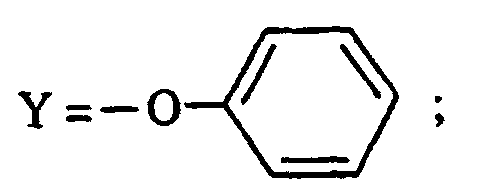

On refroidit à 0°C un mélange de 2,0 g du composé obtenu à l'étape B de la Préparation 1.6 dans 45 ml de DCM, ajoute 0,77 ml de pyridine puis 1,17 g de chlorure de thionyle et laisse 2 heures sous agitation après avoir laissé la température remonter à TA. On ajoute de l'eau et du DCM au mélange réactionnel, après décantation lave quatre fois la phase organique à l'eau, sèche sur Na2SO4 et évapore sous vide le solvant. On obtient le produit attendu que l'on utilise tel quel.A mixture of 2.0 g of the compound obtained in step B of Preparation 1.6 in 45 ml of DCM is cooled to 0 ° C., 0.77 ml of pyridine is added, then 1.17 g of thionyl chloride is added and the mixture is left behind. stirring hours after allowing the temperature to rise to RT. Water and DCM are added to the reaction mixture, after decantation the organic phase is washed four times with water, dried over Na 2 SO 4 and the solvent evaporated under vacuum. The expected product is obtained which is used as it is.
On prépare ce composé selon le mode opératoire décrit à l'étape B de la Préparation 1.18 à partir de 2 g du composé obtenu à l'étape précédente, 0,29 g d'hydrure de sodium à 60 % dans l'huile, 15 ml de DMF et 1,54 g de chlorure de 2,4-diméthoxybenzènesulfonyle. On obtient 3,2 g du produit attendu. This compound is prepared according to the procedure described in step B of the Preparation 1.18 from 2 g of the compound obtained in the previous step, 0.29 g 60% sodium hydride in oil, 15 ml of DMF and 1.54 g of 2,4-dimethoxybenzenesulfonyl chloride. 3.2 g of the expected product are obtained.
On refroidit à 4°C une solution de 3,2 g du composé obtenu à l'étape précédente et 10 ml de pyridine dans 30 ml de DCM, ajoute, goutte à goutte, 1,2 ml de chloroformiate de phényle et laisse sous agitation 2 heures à TA. On concentre sous vide, extrait le résidu à l'AcOEt, lave la phase organique par une solution à 5 % de KHSO4, par une solution à 5 % de Na2CO3, à l'eau, par une solution saturée de NaCl, sèche sur Na2SO4 et évapore sous vide le solvant. On obtient 2,3 g du produit attendu après cristallisation dans le mélange DCM/éther iso.A solution of 3.2 g of the compound obtained in the preceding step and 10 ml of pyridine in 30 ml of DCM is cooled to 4 ° C., 1.2 ml of phenyl chloroformate are added dropwise and the mixture is left stirring. 2 hours at TA. It is concentrated under vacuum, the residue is extracted with AcOEt, the organic phase is washed with a 5% solution of KHSO 4 , with a 5% solution of Na 2 CO 3 , with water and with saturated NaCl solution. dried over Na 2 SO 4 and the solvent evaporated under vacuum. 2.3 g of the expected product are obtained after crystallization from a DCM / iso ether mixture.
(II) : R1 = Cl ; R2 = 6-CF3 ; R3 = OCH3 ; R4 = H ; X = -NH- ;


On refroidit à 0°C une suspension de 1,3 g du composé obtenu à l'étape A dans 8 ml de DCM, ajoute 0,43 ml de pyridine puis 0,4 ml de chlorure de thionyle et laisse 15 minutes sous agitation. On lave trois fois le mélange réactionnel à l'eau, sèche la phase organique sur Na2SO4 et évapore sous vide le solvant. On obtient 1,2 g du produit attendu que l'on utilise tel quel.A suspension of 1.3 g of the compound obtained in step A in 8 ml of DCM is cooled to 0 ° C., 0.43 ml of pyridine and then 0.4 ml of thionyl chloride are added and the mixture is left stirring for 15 minutes. The reaction mixture is washed three times with water, the organic phase is dried over Na 2 SO 4 and the solvent is evaporated off under vacuum. 1.2 g of the expected product are obtained, which is used as such.
On laisse 4 heures sous agitation à TA un mélange de 1,29 g du composé obtenu à l'étape précédente et 0,47 g de (S)-(+)-α-phénylglycinol dans 35 ml de chloroforme. On ajoute ensuite 0,6 ml de DIPEA, concentre de moitié le solvant et laisse 22 heures sous agitation à TA. On concentre sous vide le mélange réactionnel et chromatographie le résidu sur gel de silice en éluant par le mélange DCM/AcOEt (85/15 ; v/v). On sépare un diastéréoisomère :
- le moins polaire, isomère A : on obtient 0,712 g après cristallisation dans le
mélange DCM/éther iso, F = 205°C.
α 20 / D = + 164° (c = 0,16 ; chloroforme).
- the less polar, isomer A: 0.712 g is obtained after crystallization from a DCM / iso ether mixture, mp = 205 ° C.
α 20 / D = + 164 ° (c = 0.16, chloroform).
On poursuit la chromatographie en éluant par le mélange DCM/AcOEt (70/30 ; v/v) et sépare l'autre diastéréoisomère :
- le plus polaire, isomère B : on obtient 0,45 g, F = 242°C.
α 20 / D = - 55° (c = 0,15 ; chloroforme).
- the more polar, isomer B: 0.45 g, mp = 242 ° C.
α 20 / D = -55 ° (c = 0.15, chloroform).
On refroidit à 0°C une solution de 0,7 g du composé obtenu à l'étape précédente (isomère A) dans 15 ml de DCM et 7 ml de MeOH, ajoute 0,907 g de tétraacétate de plomb et laisse 40 minutes sous agitation. On ajoute quelques gouttes d'une solution à 5 % de NaHCO3 et concentre sous vide. On reprend le résidu dans l'eau, extrait 3 fois à l'AcOEt, lave la phase organique à l'eau, par une solution saturée de NaCl, sèche sur Na2SO4 et évapore sous vide le solvant. On reprend le produit obtenu dans 30 ml d'eau, ajoute, en goutte à goutte, 30 ml d'une solution d'HCl 5N, puis du THF jusqu'à solubilisation et laisse 1 heure sous agitation. On dilue le mélange réactionnel par 50 ml d'eau, lave la phase aqueuse par 150 ml d'éther, alcalinise la phase aqueuse à pH = 12 par ajout de K2CO3 puis d'une solution de NaOH concentrée, extrait à l'AcOEt, sèche la phase organique sur Na2SO4 et évapore sous vide le solvant. On chromatographie le résidu sur gel de silice en éluant par le mélange DCM/MeOH (92/8 ; v/v). On obtient 0,19 g du produit attendu.A solution of 0.7 g of the compound obtained in the preceding step (isomer A) in 15 ml of DCM and 7 ml of MeOH is cooled to 0 ° C., 0.907 g of lead tetraacetate is added and the mixture is left stirring for 40 minutes. A few drops of a 5% solution of NaHCO 3 are added and concentrated in vacuo. The residue is taken up in water, extracted 3 times with AcOEt, the organic phase is washed with water and with saturated NaCl solution and dried over Na 2 SO 4 and the solvent is evaporated off under vacuum. The product obtained is taken up in 30 ml of water, 30 ml of a solution of 5N HCl are added dropwise, then THF until solubilization and the mixture is left stirring for 1 hour. The reaction mixture is diluted with 50 ml of water, the aqueous phase is washed with ether (150 ml), the aqueous phase is made alkaline to pH = 12 by adding K 2 CO 3 and then a concentrated solution of NaOH, extracted with water. AcOEt, the organic phase dried over Na 2 SO 4 and the solvent evaporated under vacuum. The residue is chromatographed on silica gel, eluting with a DCM / MeOH (92/8, v / v) mixture. 0.19 g of the expected product is obtained.
On prépare ce composé selon le mode opératoire décrit à l'étape B de la Préparation 1.18 à partir de 0,19 g du composé obtenu à l'étape précédente, 0,023 g d'hydrure de sodium à 60 % dans l'huile, 2 ml de DMF et 0,138 g de chlorure de 2,4-diméthoxybenzènesulfonyle. On obtient 0,22 g du produit attendu.This compound is prepared according to the procedure described in step B of the Preparation 1.18 from 0.19 g of the compound obtained in the previous step, 0.023 g of 60% sodium hydride in oil, 2 ml of DMF and 0.138 g of 2,4-dimethoxybenzenesulfonyl chloride. 0.22 g of the expected product is obtained.
On prépare ce composé selon le mode opératoire décrit à l'étape C de la Préparation 1.18 à partir de 0,215 g du composé obtenu à l'étape précédente, 0,31 ml de pyridine, 5 ml de DCM et 0,079 g de chloroformiate de phényle. On obtient 0,208 g du produit attendu.This compound is prepared according to the procedure described in step C of the Preparation 1.18 from 0.215 g of the compound obtained in the previous step, 0.31 ml pyridine, 5 ml of DCM and 0.079 g of phenyl chloroformate. We obtain 0.208 g the expected product.
(II) ; R1 = CH3 ; R2 = 6-Cl ; R3 = Cl ; R4 = H ; X = -NH- ;


On chauffe à reflux pendant 6 heures un mélange de 52,72 g d'acide DL-2-chloromandélique et 40 g de 3-chloro-4-méthylaniline dans 400 ml de 1,2-dichlorobenzène en éliminant l'eau formée à l'aide d'un appareil de Dean-Stark. Après refroidissement à TA, on laisse en cristallisation et essore le précipité formé. On obtient le produit attendu après recristallisation dans le mélange DCM/éther iso, F = 164°C.A mixture of 52.72 g of DL-2-chloromandelic acid is refluxed for 6 hours. and 40 g of 3-chloro-4-methylaniline in 400 ml of 1,2-dichlorobenzene by eliminating the water formed using a Dean-Stark apparatus. After cooling to RT, it is left in crystallization and wring the precipitate formed. We the expected product is obtained after recrystallization from a DCM / iso ether mixture, F = 164 ° C.
On refroidit à 5°C 102 ml d'H2SO4 concentré (95 %) et ajoute en goutte à goutte 23 ml d'acide sulfurique fumant (oleum à 30 %). On ajoute ensuite, par petites fractions et à une température inférieure à 5°C, 25 g du composé obtenu à l'étape précédente et laisse 48 heures sous agitation à TA. On verse le mélange réactionnel sur un mélange glace/eau, essore le précipité formé et le lave à l'eau jusqu'à pH = 7. On dissout le précipité dans l'AcOEt, lave la phase organique par une solution saturée de NaCl, sèche sur Na2SO4, évapore partiellement sous vide le solvant et essore le précipité formé. On obtient le produit attendu, F = 186°C.102 ml of concentrated H 2 SO 4 (95%) are cooled to 5 ° C. and 23 ml of fuming sulfuric acid (30% oleum) are added dropwise. 25 g of the compound obtained in the preceding step are then added in small portions and at a temperature below 5 ° C., and the mixture is stirred for 48 hours at RT. The reaction mixture is poured into an ice / water mixture, the precipitate formed is filtered off and washed with water to pH = 7. The precipitate is dissolved in AcOEt, the organic phase is washed with saturated NaCl solution, dried over Na 2 SO 4 , the solvent is evaporated partially under vacuum and the precipitate formed is filtered off with suction. The expected product is obtained, mp 186 ° C.
A une suspension de 16,36 g du composé obtenu à l'étape précédente dans 200 ml de DCM on ajoute, à TA et lentement, une solution de 2,6 ml de brome dans 10 ml de DCM. On rajoute une solution de 0,26 ml de brome dans 5 ml de DCM puis concentre sous vide le mélange réactionnel. On reprend deux fois le résidu au DCM et évapore chaque fois sous vide le solvant. On dissout le résidu dans l'AcOEt, lave la phase organique par une solution saturée de NaCl, sèche sur MgSO4 et évapore sous vide le solvant. On obtient le produit attendu.To a suspension of 16.36 g of the compound obtained in the previous step in 200 ml of DCM is added, at RT and slowly, a solution of 2.6 ml of bromine in 10 ml of DCM. A solution of 0.26 ml of bromine in 5 ml of DCM is added and then the reaction mixture is concentrated under vacuum. The residue is taken up twice with DCM and the solvent is evaporated each time under vacuum. The residue is dissolved in AcOEt, the organic phase is washed with saturated NaCl solution and dried over MgSO 4 and the solvent is evaporated off under vacuum. The expected product is obtained.
A une solution de 4,25 g du composé obtenu à l'étape précédente dans 30 ml de THF on ajoute 30 ml d'une solution concentrée d'ammoniaque et laisse 24 heures sous agitation à TA. On rajoute 10 ml d'une solution concentrée d'ammoniaque et laisse une nuit sous agitation à TA. On concentre sous vide, extrait le résidu au DCM, lave la phase organique à l'eau, sèche sur Na2SO4 et évapore sous vide le solvant. On obtient 3,02 g du produit attendu après cristallisation dans le DCM, F = 233°C.To a solution of 4.25 g of the compound obtained in the previous step in 30 ml of THF is added 30 ml of a concentrated solution of ammonia and left stirring for 24 hours at RT. 10 ml of a concentrated ammonia solution are added and the mixture is stirred overnight at RT. It is concentrated under vacuum, the residue is extracted with DCM, the organic phase is washed with water and dried over Na 2 SO 4 and the solvent is evaporated off under vacuum. 3.02 g of the expected product are obtained after crystallization from DCM, mp = 233 ° C.
On prépare ce composé selon le mode opératoire décrit à l'étape B de la Préparation 1.18 à partir de 0,54 g du composé obtenu à l'étape précédente, 0,077 g d'hydrure de sodium à 60 % dans l'huile, 5 ml de DMF et 0,435 g de chlorure de 2,4-diméthoxybenzènesulfonyle. On obtient 0,592 g du produit attendu après cristallisation dans le mélange DCM/éther iso.This compound is prepared according to the procedure described in step B of the Preparation 1.18 from 0.54 g of the compound obtained in the previous step, 0.077 g of 60% sodium hydride in oil, 5 ml of DMF and 0.435 g of 2,4-dimethoxybenzenesulfonyl chloride. 0.592 g of the expected product is obtained after crystallization in the DCM / iso ether mixture.
On prépare ce composé selon le mode opératoire décrit à l'étape C de la Préparation 1.18 à partir de 0,592 g du composé obtenu à l'étape précédente, 1 ml de pyridine, 6 ml de DCM et 0,19 ml de chloroformiate de phényle. On obtient 0,690 g du produit attendu que l'on utilise tel quel. This compound is prepared according to the procedure described in step C of the Preparation 1.18 from 0.592 g of the compound obtained in the preceding step, 1 ml of pyridine, 6 ml of DCM and 0.19 ml of phenyl chloroformate. We obtain 0.690 g the expected product that is used as is.
(II) : R1 = Cl ; R2 = H ; R3 = -OCH(CH3)2 ; R4 = H ; X = -O-CH2- ; Y = OH ; W = H.(II): R 1 = Cl; R 2 = H; R 3 = -OCH (CH 3 ) 2 ; R 4 = H; X = -O-CH 2 -; Y = OH; W = H.
A une solution de 1,05 g de glycolate de méthyle dans 20 ml de THF, on ajoute 0,29 g d'hydrure de sodium à 60 % dans l'huile et laisse 10 minutes sous agitation à TA. On ajoute ensuite, en goutte à goutte, une solution de 1,88 g du composé obtenu à l'étape A de la Préparation 1.20 et laisse 10 minutes sous agitation à TA. On concentre sous vide, extrait le résidu à l'AcOEt, lave la phase organique à l'eau, par une solution d'HCl 1N, sèche sur Na2SO4 et évapore sous vide le solvant. On chromatographie le résidu sur gel de silice en éluant au DCM puis à l'AcOEt. On obtient 0,8 g du produit attendu après cristallisation dans l'éther iso, F = 210-213°C.To a solution of 1.05 g of methyl glycolate in 20 ml of THF, 0.29 g of 60% sodium hydride in oil is added and the mixture is stirred for 10 minutes at RT. A solution of 1.88 g of the compound obtained in stage A of Preparation 1.20 is then added dropwise and the mixture is left stirring for 10 minutes at RT. It is concentrated under vacuum, the residue is extracted with AcOEt, the organic phase is washed with water and with 1N HCl solution, dried over Na 2 SO 4 and the solvent is evaporated off under vacuum. The residue is chromatographed on silica gel, eluting with DCM and then with AcOEt. 0.8 g of the expected product is obtained after crystallization from iso ether, mp = 210-213 ° C.
A une solution de 0,8 g du composé obtenu à l'étape précédente dans 40 ml de MeOH, on ajoute, à 20°C, une solution de 0,24 g de NaOH en pastilles dans 5 ml d'eau et laisse 15 heures sous agitation à TA. On concentre sous vide, dissout le résidu dans 25 ml d'eau, acidifie par ajout, goutte à goutte, de 1 ml d'HCl 12 N et essore le précipité formé. On obtient 0,8 g du produit attendu, F = 225-228°C.To a solution of 0.8 g of the compound obtained in the previous step in 40 ml of MeOH, a solution of 0.24 g of NaOH in pellets in 5 ml is added at 20 ° C. of water and leaves stirring for 15 hours at RT. Concentrate in vacuo, dissolve the residue in 25 ml of water, acidify by addition, dropwise, 1 ml of 12 N HCl and wring the precipitate formed. 0.8 g of the expected product is obtained, mp 225-228 ° C.
(II) : R1 = Cl ; R2 = H ; R3 = -OCH3 ; R4 = H ; X = -NH-CH2- ; Y = OH ;

On refroidit au bain de glace une solution de 2,4 g de chlorhydrate d'ester tert-butylique de la glycine dans 50 ml de chloroforme et 50 ml de THF, ajoute 2,3 g de triéthylamine puis 3,5 g du composé obtenu à l'étape A de la Préparation 1.19 et laisse une nuit sous agitation à TA. On concentre sous vide, reprend le résidu à l'eau, extrait au DCM, sèche la phase organique sur Na2SO4 et évapore sous vide le solvant. On triture le résidu dans de l'éther iso et essore le précipité formé. On obtient 2,2 g du produit attendu.A solution of 2.4 g of tert- butyl glycine ester hydrochloride in 50 ml of chloroform and 50 ml of THF is cooled in an ice bath, 2.3 g of triethylamine and 3.5 g of the compound obtained are added. in step A of Preparation 1.19 and left stirring overnight at RT. It is concentrated under vacuum, the residue is taken up in water and extracted with DCM, the organic phase is dried over Na 2 SO 4 and the solvent is evaporated off under vacuum. The residue is triturated in iso ether and the precipitate formed is filtered off with suction. 2.2 g of the expected product are obtained.
A un mélange de 2,1 g du composé obtenu à l'étape précédente dans 10 ml de DMF, on ajoute 0,225 g d'hydrure de sodium à 60 % dans l'huile et laisse 30 minutes sous agitation à TA. On ajoute ensuite 1,2 g de chlorure de 2,4-diméthoxybenzène sulfonyle et laisse 18 heures sous agitation à TA. On verse le mélange réactionnel dans l'eau, extrait à l'AcOEt, sèche la phase organique sur Na2SO4 et évapore sous vide le solvant. On chromatographie le résidu sur gel de silice en éluant au DCM. On obtient 2,5 g du produit attendu après cristallisation dans l'éther iso.To a mixture of 2.1 g of the compound obtained in the preceding step in 10 ml of DMF is added 0.225 g of 60% sodium hydride in the oil and left stirring for 30 minutes at RT. 1.2 g of 2,4-dimethoxybenzenesulphonyl chloride are then added and the mixture is stirred for 18 hours at RT. The reaction mixture is poured into water and extracted with AcOEt, the organic phase is dried over Na 2 SO 4 and the solvent is evaporated off under vacuum. The residue is chromatographed on silica gel, eluting with DCM. 2.5 g of the expected product are obtained after crystallization from iso ether.
On laisse 3 heures sous agitation un mélange de 2,5 g du composé obtenu à l'étape précédente et 10 ml de TFA. On concentre sous vide, reprend le résidu dans l'hexane et essore le précipité formé. On obtient 2 g du produit attendu.A mixture of 2.5 g of the compound obtained in the stage is left stirring for 3 hours. previous and 10 ml of TFA. It is concentrated under vacuum, the residue is taken up in hexane and wring out the precipitate formed. 2 g of the expected product are obtained.
(II) : R1 = Cl ; R2 = H ; R3 = -OCH3 ; R4 = H ; X = -NH-CH2-CH2- ; Y = OH ;

A un mélange de 3 g du composé obtenu à l'étape A de la Préparation 1.19 et 2,1 g de chlorhydrate de l'ester tert-butylique de la β-alanine dans 50 ml de DCM et 50 ml de THF, on ajoute 2,15 g de triéthylamine et laisse 18 heures sous agitation à TA. On concentre sous vide, extrait le résidu à l'AcOEt, lave la phase organique à l'eau, sèche sur Na2SO4 et évapore sous vide le solvant. On chromatographie le résidu sur gel de silice en éluant par le mélange DCM/AcOEt (80/20 ; v/v). On obtient 3,2 g du produit attendu après cristallisation dans le mélange DCM/éther iso, F = 170°C.To a mixture of 3 g of the compound obtained in step A of Preparation 1.19 and 2.1 g of β-alanine tert- butyl ester hydrochloride in 50 ml of DCM and 50 ml of THF is added. 2.15 g of triethylamine and left stirring for 18 hours at RT. It is concentrated under vacuum, the residue is extracted with AcOEt, the organic phase is washed with water and dried over Na 2 SO 4 and the solvent is evaporated off under vacuum. The residue is chromatographed on silica gel, eluting with a DCM / AcOEt mixture (80/20, v / v). 3.2 g of the expected product are obtained after crystallization from a DCM / iso ether mixture, mp = 170 ° C.
On prépare ce composé selon le mode opératoire décrit à l'étape B de la Préparation 1.28 à partir de 2,16 g du composé obtenu à l'étape précédente, 0,225 g d'hydrure de sodium à 60 % dans l'huile, 15 ml de DMF et 1,21 g de chlorure de 2,4-diméthoxybenzènesulfonyle. On obtient 2,4 g du produit attendu après cristallisation dans le mélange heptane/AcOEt, F = 175°C.This compound is prepared according to the procedure described in step B of the Preparation 1.28 from 2.16 g of the compound obtained in the previous step, 0.225 g 60% sodium hydride in oil, 15 ml of DMF and 1.21 g of 2,4-dimethoxybenzenesulfonyl chloride. 2.4 g of the expected product are obtained after crystallization. in the heptane / AcOEt mixture, mp = 175 ° C.
On laisse 18 heures sous agitation un mélange de 2,4 g du composé obtenu à l'étape précédente et 15 ml de TFA dans 5 ml de DCM. On concentre sous vide, reprend le résidu à l'éther et essore le précipité formé. On obtient 2,2 g du produit attendu, F > 250°C.A mixture of 2.4 g of the compound obtained at room temperature is left stirring for 18 hours. the previous step and 15 ml of TFA in 5 ml of DCM. Concentrate in vacuo, The residue is taken up in ether and the precipitate formed is filtered off with suction. 2.2 g of the product is obtained expected, mp> 250 ° C.
(II) : R1 = Cl ; R2 = H ; R3 = -F; R4 = H ; X = -CH2- ; Y = OH ; W = H.(II): R 1 = Cl; R 2 = H; R 3 = -F; R 4 = H; X = -CH 2 -; Y = OH; W = H.
On chauffe à reflux pendant 20 heures un mélange de 2,6 g du composé obtenu à l'étape C de la Préparation 1.12, 1,84 g de bromoacétate d'éthyle, 1,66 g de KI et 2 g de K2CO3 dans 10 ml d'acétone. On filtre les sels minéraux et concentre sous vide le filtrat. On chromatographie le résidu sur gel de silice en éluant au DCM puis à l'AcOEt. On obtient 2,1 g du produit attendu après précipitation dans l'éther iso.A mixture of 2.6 g of the compound obtained in stage C of Preparation 1.12, 1.84 g of ethyl bromoacetate, 1.66 g of KI and 2 g of K 2 CO is refluxed for 20 hours. 3 in 10 ml of acetone. The inorganic salts are filtered and the filtrate is concentrated under vacuum. The residue is chromatographed on silica gel, eluting with DCM and then with AcOEt. 2.1 g of the expected product are obtained after precipitation in iso ether.
On laisse 20 heures sous agitation à TA un mélange de 2 g du composé obtenu à l'étape précédente et 2 ml d'une solution de NaOH à 30 %, dans 1 ml d'eau et 50 ml d'EtOH. On concentre sous vide, reprend le résidu dans 40 ml d'eau, acidifie à pH = 1 par ajout d'HCl concentré, essore le précipité formé et le lave à l'eau. On obtient 1,9 g du produit attendu.A mixture of 2 g of the compound obtained at RT is stirred for 20 hours at RT. the previous step and 2 ml of a solution of 30% NaOH in 1 ml of water and 50 ml EtOH. It is concentrated under vacuum, the residue is taken up in 40 ml of water, acidified to pH = 1 by adding concentrated HCl, the precipitate formed is filtered off and washed with water. 1.9 g is obtained the expected product.
On chauffe à 40°C un mélange de 0,97 g du composé obtenu à l'étape précédente
et 0,89 g de (+)-cinchonine (α 20 / D = + 225° ; c = 0,5 ; EtOH) dans 31,5 ml de
MeOH, puis chauffe à reflux. On essore à chaud le précipité formé, le lave au MeOH
chaud puis à l'éther et obtient 0,485 g du sel avec la (+)-cinchonine. On reprend 0,485
g du sel ainsi obtenu dans un mélange eau/AcOEt, acidifie à pH = 0 par ajout d'HCl
3N, laisse sous agitation, extrait à l'AcOEt, lave la phase organique à l'eau, sèche sur
Na2SO4 et évapore sous vide le solvant. On obtient 0,22 g du produit attendu sous
forme d'isomère dextrogyre.
α 20 / D = +61,3° (c = 0,15 ; chloroforme).A mixture of 0.97 g of the compound obtained in the preceding step and 0.89 g of (+) - cinchonine (α 20 / D = + 225 ° C., = 0.5, EtOH) is heated to 40 ° C. in 31.5 ml of MeOH and then heated to reflux. The precipitate formed is hot-filtered with suction, washed with hot MeOH and then with ether and 0.485 g of the salt is obtained with (+) - cinchonine. 0.485 g of the salt thus obtained is taken up in a water / AcOEt mixture, acidified to pH = 0 by addition of 3N HCl, stirred, extracted with AcOEt, the organic phase washed with water, dried over Na 2 SO 4 and evaporated under vacuum the solvent. 0.22 g of the expected product is obtained in the form of a dextrorotatory isomer.
α 20 / D = + 61.3 ° (c = 0.15, chloroform).
(II) : R1 = Cl ; R2 = 6-Cl ; R3 = -F; R4 = H ; X = -CH2- ; Y = OH ; W = H.(II): R 1 = Cl; R 2 = 6-Cl; R 3 = -F; R 4 = H; X = -CH 2 -; Y = OH; W = H.
On chauffe à reflux pendant 3 heures un mélange de 7,5 g du composé obtenu à l'étape A de la Préparation 1.12 et 7,5 g de 3,4-dichloroaniline dans 40 ml de 1,2-dichlorobenzène en éliminant l'eau formée à l'aide d'un appareil de Dean-Stark. On concentre sous vide, reprend le résidu dans l'éther iso et essore le précipité formé. On obtient 9 g du produit attendu.A mixture of 7.5 g of the compound obtained is heated at reflux for 3 hours. step A of Preparation 1.12 and 7.5 g of 3,4-dichloroaniline in 40 ml of 1,2-dichlorobenzene by eliminating the water formed using a Dean-Stark apparatus. We It is concentrated under vacuum, the residue is taken up in iso ether and the precipitate formed is filtered off with suction. We 9 g of the expected product are obtained.
A un mélange de 36 ml d'H2SO4 concentré (95 %) et 9 ml d'acide sulfurique fumant (oléum à 30 %), on ajoute, à TA, 8,9 g du composé obtenu à l'étape précédente, puis laisse 8 heures sous agitation. On verse le mélange réactionnel sur un mélange glace/eau, essore le précipité formé et le lave à l'eau. On chromatographie le précipité sur gel de silice en éluant au DCM puis à l'éther iso. On sépare les deux isomères :
- le moins polaire, composé de l'étape B et obtient 3,7 g, F = 204-205°C ;
- le plus polaire, le 4,5-dichloro-3-(2-fluorophényl)-1,3-dihydro-2H-indol-2-one et obtient 1,5 g, F = 244-247°C.
- the less polar compound of Step B and 3.7 g, mp 204-205 ° C;
- the more polar, 4,5-dichloro-3- (2-fluorophenyl) -1,3-dihydro-2H-indol-2-one, and 1.5 g, mp = 244-247 ° C.
On chauffe à reflux pendant 10 heures un mélange de 3 g du composé obtenu à l'étape précédente, 1,7 g de bromoacétate d'éthyle, 1,8 g et 1,4 g de KI de K2CO3 dans 20 ml d'acétone. On concentre sous vide, reprend le résidu à l'eau, extrait à l'AcOEt, sèche la phase organique sur Na2SO4 et évapore le solvant sous vide. On chromatographie le résidu sur gel de silice en éluant à l'éther iso. On obtient 2,1 g du produit attendu après trituration dans le pentane puis dans l'éther iso, F = 152-158°C.A mixture of 3 g of the compound obtained in the preceding step, 1.7 g of ethyl bromoacetate, 1.8 g and 1.4 g of K 2 CO 3 KI in 20 ml is refluxed for 10 hours. of acetone. It is concentrated under vacuum, the residue is taken up in water and extracted with AcOEt, the organic phase is dried over Na 2 SO 4 and the solvent is evaporated under vacuum. The residue is chromatographed on silica gel, eluting with iso ether. 2.1 g of the expected product are obtained after trituration in pentane and then in iso ether, mp 152-158 ° C.
On laisse 20 heures sous agitation à TA un mélange de 2 g du composé obtenu à l'étape précédente et 3 ml d'une solution de NaOH à 30 % dans 5 ml d'eau et 40 ml d'EtOH. On concentre sous vide, reprend le résidu à l'eau, lave la phase aqueuse à l'éther, acidifie la phase aqueuse à pH = 1 par ajout d'HCl concentré, extrait à l'AcOEt, sèche la phase organique sur Na2SO4 et évapore le solvant sous vide. On obtient 1,5 g du produit attendu après trituration dans l'éther iso, F = 245°C.A mixture of 2 g of the compound obtained in the preceding step and 3 ml of a solution of 30% NaOH in 5 ml of water and 40 ml of EtOH is stirred for 20 hours at RT. It is concentrated under vacuum, the residue is taken up in water, the aqueous phase is washed with ether, the aqueous phase is acidified to pH 1 by addition of concentrated HCl, extracted with AcOEt, the organic phase is dried over Na 2 SO 4 and evaporate the solvent in vacuo. 1.5 g of the expected product are obtained after trituration in iso ether, mp = 245 ° C.
(II) : R1 = Cl ; R2 = H ; R3 = OCH3 ; R4 = 3-OCH3 ; X = -CH2- ; Y = OH ; W = H.(II): R 1 = Cl; R 2 = H; R 3 = OCH 3 ; R 4 = 3-OCH 3 ; X = -CH 2 -; Y = OH; W = H.
On refroidit à -40°C un mélange de 27,6 g de 1,2-diméthoxybenzène dans 160 ml d'éther, ajoute, goutte à goutte, 250 ml d'une solution 1,6 M de n-butyllithium dans l'hexane, puis laisse 24 heures sous agitation en laissant remonter la température à TA. On refroidit le mélange réactionnel à -20°C, ajoute rapidement 136 ml d'oxalate de diéthyle et laisse sous agitation en laissant remonter la température à TA. Après 30 minutes d'agitation à TA, on verse le mélange réactionnel sur une solution saturée de NH4Cl, décante, extrait la phase aqueuse à l'éther, lave les phases organiques jointes deux fois à l'eau, sèche sur Na2SO4 et évapore sous vide les solvants. On élimine l'oxalate de diéthyle en excès par distillation sous vide (Eb=90°C sous 2400Pa). On chromatographie le produit brut résultant sur gel de silice en éluant par le mélange heptane/éther iso (90/10 ; v/v). On obtient 25 g du produit attendu que l'on utilise tel quel à l'étape suivante.A mixture of 27.6 g of 1,2-dimethoxybenzene in 160 ml of ether is cooled to -40 ° C., 250 ml of a 1.6 M solution of n-butyllithium in the reaction medium are added dropwise. hexane, then left stirring for 24 hours, allowing the temperature to rise to RT. The reaction mixture is cooled to -20 ° C., 136 ml of diethyl oxalate are rapidly added and the mixture is stirred while allowing the temperature to rise to RT. After stirring for 30 minutes at RT, the reaction mixture is poured into a saturated solution of NH 4 Cl, decanted, the aqueous phase is extracted with ether, the combined organic phases are washed twice with water and dried over Na 2 SO 4 and evaporate the solvents under vacuum. Excess diethyl oxalate was removed by vacuum distillation (bp = 90 ° C at 2400 Pa). The resulting crude product is chromatographed on silica gel, eluting with a heptane / iso ether mixture (90/10, v / v). 25 g of the expected product are obtained which is used as such in the next step.
On chauffe à reflux pendant 5 heures un mélange de 8,5 g du composé obtenu à l'étape précédente, 40 ml de TFA et 11,5 ml de triéthylsilane. On concentre sous vide, reprend le résidu à l'eau, extrait à l'AcOEt, essore le précipité formé, le lave à l'AcOEt puis à l'éther iso et obtient 5,1 g du produit attendu. On décante les jus d'essorage, sèche sur la phase organique sur Na2SO4 et évapore le solvant sous vide. On obtient de plus 1,4 g du produit attendu après cristallisation dans l'AcOEt, F = 193°C.A mixture of 8.5 g of the compound obtained in the preceding step, 40 ml of TFA and 11.5 ml of triethylsilane is refluxed for 5 hours. It is concentrated under vacuum, the residue is taken up in water and extracted with AcOEt, the precipitate formed is filtered off with suction, washed with AcOEt and then with iso ether and 5.1 g of the expected product are obtained. The spin juice is decanted, dried over the organic phase over Na 2 SO 4 and the solvent is evaporated under vacuum. 1.4 g of the expected product are obtained after crystallization in AcOEt, mp = 193 ° C.
On chauffe à 60°c pendant 8 heures un mélange de 6,2 g du composé obtenu à l'étape précédente, 3,6 g de bromoacétate d'éthyle, 3,5 g de KI et 6,2 g de K2CO3 dans 20 ml de DMF. On concentre sous vide, reprend le résidu à l'eau, extrait à l'AcOEt, lave la phase organique à l'eau, sèche sur Na2SO4 et évapore sous vide. On chromatographie le résidu sur gel de silice en éluant par le mélange DCM/MeOH (99/1 ; v/v). On obtient 3 g du produit attendu, F = 155°C.A mixture of 6.2 g of the compound obtained in the preceding stage, 3.6 g of ethyl bromoacetate, 3.5 g of KI and 6.2 g of K 2 CO is heated at 60 ° C. for 8 hours. 3 in 20 ml of DMF. It is concentrated under vacuum, the residue is taken up in water and extracted with AcOEt, the organic phase is washed with water and dried over Na 2 SO 4 and evaporated under vacuum. The residue is chromatographed on silica gel, eluting with a DCM / MeOH (99/1; v / v) mixture. 3 g of the expected product are obtained, mp = 155 ° C.
On laisse 24 heures sous sous agitation à TA un mélange de 3 g du composé obtenu à l'étape précédente et 0,5 g de NaOH en pastilles dans 40 ml d'eau et 10 ml de dioxane. On ajoute 150 ml d'eau, lave la phase aqueuse à l'AcOEt, acidifie la phase aqueuse à pH = 1 par ajout d'HCl concentré, essore le précipité formé, le lave à l'eau et le sèche. On obtient 2,5 g du produit attendu, F = 235°C.A mixture of 3 g of the compound is left stirring for 24 hours at RT. obtained in the preceding step and 0.5 g of NaOH in pellets in 40 ml of water and 10 ml of dioxane. 150 ml of water are added, the aqueous phase is washed with AcOEt, the phase is acidified at pH = 1 by addition of concentrated HCl, the precipitate formed is filtered off, washed with water and dry it. 2.5 g of the expected product are obtained, mp 235 ° C.
(II) : R1 = Cl ; R2 = 6-CH3 ; R3 = OCH2CH3 ; R4 = H ; X = -CH2- ; Y = OH ; W = H.(II): R 1 = Cl; R 2 = 6-CH 3 ; R 3 = OCH 2 CH 3 ; R 4 = H; X = -CH 2 -; Y = OH; W = H.
On prépare ce composé selon le mode opératoire décrit à l'étape C de la Préparation 1.7 à partir du composé obtenu à l'étape A de la Préparation 1.2 et du composé obtenu à l'étape B de la Préparation 1.7. On obtient 1,05 g du produit attendu, F = 253°C.This compound is prepared according to the procedure described in step C of the Preparation 1.7 from the compound obtained in step A of Preparation 1.2 and compound obtained in step B of Preparation 1.7. 1.05 g of the product is obtained expected, mp = 253 ° C.
On chauffe à reflux pendant 5 heures un mélange de 1,05 g du composé obtenu à l'étape précédente, 5,5 ml de TFA et 2,2 ml de triéthylsilane. On concentre sous vide et chromatographie le résidu sur gel de silice en éluant au DCM puis par le mélange DCM/MeOH (99,5/0,5 ; v/v). On obtient 0,5 g du produit attendu, F = 228°C.A mixture of 1.05 g of the compound obtained is heated under reflux for 5 hours. the previous step, 5.5 ml of TFA and 2.2 ml of triethylsilane. Concentrate under vacuum and chromatography the residue on silica gel, eluting with DCM and then with the mixture DCM / MeOH (99.5 / 0.5, v / v). 0.5 g of the expected product is obtained, mp = 228 ° C.
On prépare ce composé selon le mode opératoire décrit à l'étape C de la Préparation 1.1 à partir de 0,5 g du composé obtenu à l'étape précédente, 0,29 g de bromoacétate d'éthyle, 0,29 g de KI et 0,46 g de K2CO3 dans 5 ml d'acétone. On obtient 0,25 g du produit attendu.This compound is prepared according to the procedure described in step C of Preparation 1.1 from 0.5 g of the compound obtained in the preceding step, 0.29 g of ethyl bromoacetate, 0.29 g of KI. and 0.46 g of K 2 CO 3 in 5 ml of acetone. 0.25 g of the expected product is obtained.
On prépare ce composé selon le mode opératoire décrit à l'étape E de la Préparation 1.2 à partir de 0,25 g du composé obtenu à l'étape précédente, 0,3 ml d'une solution de NaOH à 30 % dans 2,8 ml d'eau et 7 ml de THF. On obtient 0,2 g du produit attendu.This compound is prepared according to the procedure described in step E of the Preparation 1.2 from 0.25 g of the compound obtained in the previous step, 0.3 ml of a 30% NaOH solution in 2.8 ml of water and 7 ml of THF. 0.2 g of expected product.
(II) : R1 = Cl ; R2 = H ; R3=OCH2CH3 ; R4 = H ; X = -O- ;


On prépare ce composé selon le mode opératoire décrit à l'étape A) de la Préparation 1.8 à partir de 2 g du composé de l'étape B de la Préparation 1.2, 0,1 g de chlorure de zinc, 6,6 ml d'HMDS et 30 ml d'acétonitrile. On obtient 1,5 g du produit attendu après trituration dans l'heptane.This compound is prepared according to the procedure described in step A) of the Preparation 1.8 from 2 g of the compound of Step B of Preparation 1.2, 0.1 g of zinc chloride, 6.6 ml of HMDS and 30 ml of acetonitrile. 1.5 g of the product is obtained waited after trituration in heptane.
On prépare ce composé selon le mode opératoire décrit à l'étape B de la Préparation 1.8 à partir de 1,45 g du composé obtenu à l'étape précédente, 20 ml de THF, 0,05 g d'hydrure de sodium à 60 % dans l'huile et 1 g de chlorure de 2,4-diméthoxybenzènesulfonyle. On obtient 1,6 g du produit attendu après trituration dans l'éther iso. This compound is prepared according to the procedure described in step B of the Preparation 1.8 from 1.45 g of the compound obtained in the preceding step, 20 ml of THF, 0.05 g of 60% sodium hydride in oil and 1 g of 2,4-dimethoxybenzenesulfonyl chloride. 1.6 g of the expected product are obtained after trituration in the iso ether.
On laisse 3 heures sous agitation à TA un mélange de 1,55 g du composé obtenu à l'étape précédente et 3 ml d'HCl 12N dans 100 ml d'acétone. On concentre sous vide et chromatographie le résidu sur gel de silice en éluant au DCM. On obtient 1,4 g du produit attendu après trituration dans l'éther iso.A mixture of 1.55 g of the compound obtained at RT is stirred for 3 hours at RT. the previous step and 3 ml of 12N HCl in 100 ml of acetone. Concentrate under vacuum and chromatography the residue on silica gel eluting with DCM. 1.4 g of expected product after trituration in iso ether.
On refroidit à 10°C un mélange de 1,35 g du composé obtenu à l'étape précédente dans 20 ml de pyridine, ajoute 2 g de chloroformiate de phényle et laisse 20 heures sous agitation en laissant remonter la température à TA. On concentre sous vide, reprend le résidu par une solution d'HCl 1N, extrait à l'éther iso, essore le précipité formé et le lave à l'éther iso. On obtient 1,8 g du produit attendu, F = 210-211°C (déc).A mixture of 1.35 g of the compound obtained in the preceding step is cooled to 10 ° C. in 20 ml of pyridine, add 2 g of phenyl chloroformate and leave 20 hours with stirring, allowing the temperature to rise to RT. Concentrate in vacuo, take up the residue with a solution of 1N HCl, extracted with iso ether, wring the precipitate formed and washed with iso ether. 1.8 g of the expected product are obtained, mp 210-211 ° C. (dec).
(III) : n = 1 ;

On chauffe 48 heures à reflux un mélange de 3 g de pipérazine, 1,04 ml de 2-chloropyrazine et 1,85 g de K2CO3 dans 100 ml d'EtOH. On concentre le mélange réactionnel sous vide, reprend le résidu à l'eau, alcalinise à pH = 10 par ajout de NaOH à 10 %, extrait au chloroforme, lave la phase organique à l'eau, sèche sur Na2SO4 et évapore sous vide le solvant. On obtient 1,8 g du produit attendu après cristallisation dans l'hexane.A mixture of 3 g of piperazine, 1.04 ml of 2-chloropyrazine and 1.85 g of K 2 CO 3 in 100 ml of EtOH is refluxed for 48 hours. The reaction mixture is concentrated under vacuum, the residue is taken up in water, basified to pH = 10 by addition of 10% NaOH, extracted with chloroform, the organic phase is washed with water, dried over Na 2 SO 4 and evaporated. under vacuum the solvent. 1.8 g of the expected product are obtained after crystallization from hexane.
(III) : n = 1 ;

On prépare ce composé selon le procédé décrit dans Tetrahedron Letters, 1998, 39, 617-620.This compound is prepared according to the method described in Tetrahedron Letters, 1998, 39 , 617-620.
(III) : n = 2 ;

On chauffe à 100°C pendant 6 heures un mélange de 2-bromopyridine et 12 g d'homopipérazine. On ajoute 50 ml d'eau au mélange réactionnel, extrait à l'AcOEt, lave la phase organique par une solution saturée de NaCl, sèche sur Na2SO4 et évapore sous vide le solvant. On obtient 1,28 g du produit attendu.A mixture of 2-bromopyridine and 12 g of homopiperazine is heated at 100 ° C. for 6 hours. 50 ml of water are added to the reaction mixture, extracted with AcOEt, the organic phase is washed with saturated NaCl solution, dried over Na 2 SO 4 and the solvent is evaporated off under vacuum. 1.28 g of the expected product are obtained.
(III) : n = 2 ;

On chauffe à 100°C pendant 4 heures un mélange de 2 g de 4-bromopyridine et 10 g d'homopipérazine. On ajoute 100 ml d'eau au mélange réactionnel, alcalinise à pH = 10 par ajout d'une solution à 10 % de NaOH, extrait trois fois par 100 ml de chloroforme, sèche la phase organique sur Na2SO4 et évapore sous vide le solvant. On obtient 0,9 g du produit attendu.A mixture of 2 g of 4-bromopyridine and 10 g of homopiperazine is heated at 100 ° C. for 4 hours. 100 ml of water are added to the reaction mixture, basified to pH 10 by addition of a 10% solution of NaOH, extracted three times with 100 ml of chloroform, the organic phase is dried over Na 2 SO 4 and evaporated under vacuum the solvent. 0.9 g of the expected product are obtained.
(III), 3HCl : n = 1

On chauffe pendant 5 heures à reflux un mélange de 13,52 g de 1-pipérazine carboxylate de tert-butyle, 10,81 g de 3,6-dichloropyridazine et 20 ml de triéthylamine dans 100 ml de n-butanol. On concentre sous vide et chromatographie le résidu sur gel de silice en éluant par le mélange DCM/AcOEt (90/10 ; v/v). On obtient 14 g du produit attendu que l'on utilise tel quel.A mixture of 13.52 g of tert- butyl 1-piperazine carboxylate, 10.81 g of 3,6-dichloropyridazine and 20 ml of triethylamine in 100 ml of n-butanol is refluxed for 5 hours. It is concentrated under vacuum and the residue is chromatographed on silica gel, eluting with a DCM / AcOEt mixture (90/10, v / v). 14 g of the expected product are obtained which is used as such.
On hydrogène pendant une nuit, à TA et pression atmosphérique, un mélange de 10,5 g du composé obtenu à l'étape précédente et 2,5 g de palladium sur charbon à 10 % dans 30 ml de DMF et 250 ml d'EtOH. On filtre le catalyseur et concentre sous vide le filtrat. On chromatographie le résidu sur gel de silice en éluant par le mélange DCM/MeOH de (97/3 ; v/v) à (90/10 ; v/v). On obtient 9,1 g du produit attendu que l'on utilise tel quel.One night, at RT and at atmospheric pressure, a mixture of 10.5 g of the compound obtained in the preceding step and 2.5 g of palladium on carbon 10% in 30 ml of DMF and 250 ml of EtOH. The catalyst is filtered and concentrated under empty the filtrate. The residue is chromatographed on silica gel, eluting with the mixture DCM / MeOH of (97/3; v / v) to (90/10; v / v). 9.1 g of the expected product are obtained we use it as is.
On laisse une nuit sous agitation à TA un mélange de 3,8 g du composé obtenu à l'étape précédente, 50 ml d'une solution 2N d'HCl dans l'éther et 20 ml de MeOH. On concentre sous vide, reprend le résidu dans l'éther et essore le précipité formé. On obtient 3 g du produit attendu. A mixture of 3.8 g of the compound obtained at RT is stirred overnight at RT. the previous step, 50 ml of a 2N solution of HCl in ether and 20 ml of MeOH. We concentrated in vacuo, the residue in ether and wring the precipitate formed. We obtains 3 g of the expected product.
(III), 2HCl : n = 1 ;

On chauffe pendant 4 jours à reflux un mélange de 5 g de 1-pipérizinecarboxylate de tert-butyle, 4,4 g de 2-bromo-1,3-thiazole et 7,4 g de K2CO3 dans 50 ml d'EtOH. On ajoute de l'eau au mélange réactionnel, évapore sous vide l'EtOH, extrait la phase aqueuse résultante à l'AcOEt, lave la phase organique par une solution saturée de K2CO3, par une solution saturée de NaCl, sèche sur Na2SO4 et évapore le solvant sous vide. On chromatographie le résidu sur gel de silice en éluant par le mélange DCM/MeOH (98/2 ; v/v). On obtient 5 g du produit attendu après précipitation à froid dans le mélange DCM/hexane et essorage, F = 114-116°C.A mixture of 5 g of tert- butyl 1-piperazinecarboxylate, 4.4 g of 2-bromo-1,3-thiazole and 7.4 g of K 2 CO 3 in 50 ml of hexane is heated for 4 days under reflux. EtOH. Water is added to the reaction mixture, the EtOH is evaporated off under vacuum, the resulting aqueous phase is extracted with AcOEt, the organic phase is washed with saturated K 2 CO 3 solution and with saturated NaCl solution, dried over Na 2 SO 4 and the solvent evaporated under vacuum. The residue is chromatographed on silica gel, eluting with a DCM / MeOH (98/2; v / v) mixture. 5 g of the expected product are obtained after cold precipitation in the DCM / hexane mixture and wringing, mp = 114-116 ° C.
On laisse 7 heures sous agitation à TA un mélange de 2,8 g du composé obtenu à l'étape précédente et 50 ml d'une solution d'HCl 2N dans l'éther en ayant ajouté au préalable un minimum de DCM puis de MeOH jusqu'à dissolution du mélange réactionnel. On concentre sous vide et obtient 2,35 g du produit attendu.A mixture of 2.8 g of the compound obtained at RT is stirred for 7 hours at RT. the previous step and 50 ml of a solution of 2N HCl in ether having added to the a minimum of DCM then MeOH until the mixture is dissolved. reaction. It is concentrated under vacuum and obtains 2.35 g of the expected product.
(I) : R1 = Cl; R2 = H ; R3 = OCH3 ; R4 = H ; X = -CH2- ; n = 1 ;

A un mélange de 1,1 g du composé obtenu à la Préparation 1.1 dans 20 ml de DCM, on ajoute, à 20°C, 1,7 g de BOP, 2,5 ml de DIPEA puis 0,6 g de 1-(4-pyridinyl) pipérazine et laisse 2 heures sous agitation à 20°C. On ajoute ensuite 30 ml de NaOH 2N et laisse 15 minutes sous agitation. On extrait le mélange réactionnel à l'AcOEt, lave la phase organique à l'eau, sèche sur Na2SO4 et évapore sous vide les solvants. On triture le résidu dans l'éther iso et essore le précipité formé. On chromatographie le précipité sur gel de silice en éluant au DCM puis à l'acétone. On obtient 1,4 g du produit attendu après cristallisation dans l'éther iso, F = 111°C. To a mixture of 1.1 g of the compound obtained in Preparation 1.1 in 20 ml of DCM is added at 20 ° C., 1.7 g of BOP, 2.5 ml of DIPEA and then 0.6 g of (4-pyridinyl) piperazine and left stirring for 2 hours at 20 ° C. 30 ml of 2N NaOH are then added and the mixture is left stirring for 15 minutes. The reaction mixture is extracted with AcOEt, the organic phase is washed with water and dried over Na 2 SO 4 and the solvents are evaporated off under vacuum. The residue is triturated in iso ether and the precipitate formed is filtered off with suction. The precipitate is chromatographed on silica gel, eluting with DCM and then with acetone. 1.4 g of the expected product are obtained after crystallization from iso ether, mp = 111 ° C.
A un mélange de 0,7 g du composé obtenu à l'étape précédente dans 15 ml de THF, on ajoute, à 20°C, 0,08 g d'hydrure de sodium à 60 % dans l'huile et laisse 20 minutes sous agitation. On ajoute ensuite 0,44 g de chlorure de 2,4-diméthoxybenzène sulfonyle et laisse 1 heure 30 minutes sous agitation. On concentre sous vide le mélange réactionnel, extrait le résidu à l'AcOEt, lave la phase organique à l'eau, sèche sur Na2SO4 et évapore sous vide le solvant. On chromatographie le résidu sur gel de silice en éluant au DCM, puis à l'AcOEt et à l'acétone. On obtient 0,7 g du produit attendu après cristallisation dans l'éther iso, F = 136-141°C (déc).To a mixture of 0.7 g of the compound obtained in the preceding step in 15 ml of THF, is added at 20 ° C, 0.08 g of 60% sodium hydride in the oil and leaves 20 minutes. with stirring. 0.44 g of 2,4-dimethoxybenzenesulphonyl chloride are then added and the mixture is left stirring for 1 hour 30 minutes. The reaction mixture is concentrated under vacuum, the residue is extracted with AcOEt, the organic phase is washed with water and dried over Na 2 SO 4 and the solvent is evaporated off under vacuum. The residue is chromatographed on silica gel, eluting with DCM, then with AcOEt and with acetone. 0.7 g of the expected product is obtained after crystallization from iso ether, mp = 136 ° -141 ° C. (dec).
(I) : R1 = Cl ; R2 = H ; R3 = OCH2CH3 ; R4 = H ; X = -CH2- ; n = 1 ;

On laisse 24 heures sous agitation à TA un mélange de 1,1 g du composé obtenu à la Préparation 1.2, 1,52 g de BOP, 2 ml de DIPEA et 0,6 g de 1-(4-pyridinyl)pipérazine dans 20 ml de DCM. On essore le produit cristallisé formé, le sèche et obtient 0,81 g du produit attendu. On extrait les jus d'essorage par une solution d'HCl concentré, décante, ajoute de la glace à la phase acide, alcalinise la phase acide par ajout de NaOH 10N, extrait à l'AcOEt, lave la phase organique à l'eau, sèche sur Na2SO4 et évapore sous vide le solvant. On obtient 0,09 g du produit attendu supplémentaire, F = 185°C.A mixture of 1.1 g of the compound obtained in Preparation 1.2, 1.52 g of BOP, 2 ml of DIPEA and 0.6 g of 1- (4-pyridinyl) piperazine in stirred at RT was stirred for 24 hours at RT. ml of DCM. The crystallized product formed is filtered off and dried, and 0.81 g of the expected product is obtained. The spin juice is extracted with concentrated HCl solution, decanted, ice is added to the acid phase, the acid phase is made alkaline by addition of 10N NaOH, extracted with AcOEt, the organic phase is washed with water dried over Na 2 SO 4 and the solvent evaporated under vacuum. 0.09 g of the expected additional product is obtained, mp 185 ° C.
A un mélange de 0,9 g du composé obtenu à l'étape précédente dans 20 ml du mélange THF/DMF (90/10 ; v/v) on ajoute 0,085 g d'hydrure de sodium à 60 % dans l'huile et laisse 15 minutes sous agitation à TA. On ajoute ensuite 0,45 g de chlorure de 2,4-diméthoxybenzènesulfonyle et laisse 30 minutes sous agitation à TA. On verse le mélange réactionnel dans l'eau, extrait à l'AcOEt, lave la phase organique à l'eau, sèche sur Na2SO4 et évapore sous vide le solvant. On chromatographie le résidu sur gel de silice en éluant par le mélange DCM/MeOH (96/4 ; v/v). On obtient 0,42 g du produit attendu après cristallisation dans l'éther iso, F = 225°C.To a mixture of 0.9 g of the compound obtained in the preceding step in 20 ml of THF / DMF (90/10; v / v) is added 0.085 g of 60% sodium hydride in the oil and left stirring for 15 minutes at RT. 0.45 g of 2,4-dimethoxybenzenesulfonyl chloride are then added and the mixture is stirred for 30 minutes at RT. The reaction mixture is poured into water and extracted with AcOEt, the organic phase is washed with water and dried over Na 2 SO 4 and the solvent is evaporated off under vacuum. The residue is chromatographed on silica gel, eluting with a DCM / MeOH mixture (96/4, v / v). 0.42 g of the expected product is obtained after crystallization from iso ether, mp = 225 ° C.
(I) : R1 = CI; R2 = H ; R3 = OCH(CH3)2 ; R4 = H ; X = -CH2- ; n = 1 ;
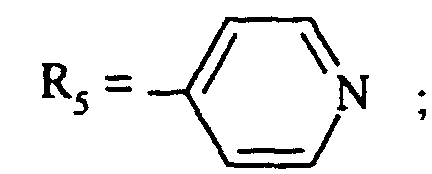
On laisse 2 heures sous agitation à 20°C un mélange de 0,43 g du composé obtenu
à la Préparation 1.3, 0,6 g de BOP, 0,75 g de DIPEA et 0,2 g de 1-(4-pyridinyl)
pipérazine dans 15 ml de DCM. On ajoute ensuite 25 ml de NaOH 2N et laisse 20
minutes sous agitation à 20°C. On extrait le mélange réactionel à l'AcOEt, lave la
phase organique à l'eau, sèche sur Na2SO4 et évapore sous vide le solvant. On
chromatographie le résidu sur gel de silice en éluant au DCM puis à l'acétone. On
obtient 0,33 g du produit attendu.
α 20 / D = + 37° (c = 0,25 ; chloroforme).A mixture of 0.43 g of the compound obtained in Preparation 1.3, 0.6 g of BOP, 0.75 g of DIPEA and 0.2 g of 1- (4-pyridinyl) is stirred for 2 hours at 20 ° C. piperazine in 15 ml of DCM. 25 ml of 2N NaOH are then added and the mixture is stirred for 20 minutes at 20 ° C. The reaction mixture is extracted with AcOEt, the organic phase is washed with water and dried over Na 2 SO 4 and the solvent is evaporated off under vacuum. The residue is chromatographed on silica gel, eluting with DCM and then with acetone. 0.33 g of the expected product is obtained.
α 20 / D = + 37 ° (c = 0.25, chloroform).
A un mélange de 0,3 g du composé obtenu à l'étape précédente dans 10 ml de
THF, on a joute 0,025 g d'hydrure de sodium à 60 % dans l'huile et laisse 15 minutes
sous agitation à 20°C. On ajoute ensuite 0,19 g de chlorure de 2,4-diméthoxybenzène
sulfonyle et laisse 2 heures sous agitation à 20°C. On concentre sous vide le mélange
réactionnel, reprend le résidu à l'eau, extrait à l'AcOEt, sèche la phase organique sur
Na2SO4 et évapore sous vide le solvant. On chromatographie le résidu sur gel de
silice en éluant au DCM puis à l'acétone. On obtient 0,1 g du produit attendu.
α 20 / D = - 21,3° (c = 0,1 ; DCM).
RMN1H : DMSO-d6 : δ (ppm) : 0,6 : d : 3H ; 1,2 : d : 3H ; 3,0 à 4,0 : m+2s : 16H
; 4,6 : mt : 1H ; 6,4 à 7,2 : mt : 9H ; 7,4 : de : 1H ; 7,7 : dd : 2H ; 8,1 : d : 2H.To a mixture of 0.3 g of the compound obtained in the previous step in 10 ml of THF was added 0.025 g of 60% sodium hydride in the oil and left stirring for 15 minutes at 20 ° C. 0.19 g of 2,4-dimethoxybenzenesulphonyl chloride are then added and the mixture is stirred for 2 hours at 20 ° C. The reaction mixture is concentrated under vacuum, the residue is taken up in water and extracted with AcOEt, the organic phase is dried over Na 2 SO 4 and the solvent is evaporated off under vacuum. The residue is chromatographed on silica gel, eluting with DCM and then with acetone. 0.1 g of the expected product is obtained.
α 20 / D = -21.3 ° (c = 0.1, DCM).
1 H NMR: DMSO-d 6 : δ (ppm): 0.6: d: 3H; 1,2: d: 3H; 3.0 to 4.0: m + 2s: 16H; 4.6: mt: 1H; 6.4 to 7.2: mt: 9H; 7.4: from: 1H; 7.7: dd: 2H; 8.1: d: 2H.
(I) : R1 = CH3 ; R2 = H ; R3 = Cl ; R4 = H ; X = -CH2- ; n = 1 ;

On chauffe à reflux pendant 2 heures un mélange de 0,26 g du composé obtenu à la Préparation 1.4 et 0,2 ml de chlorure de thionyle dans 10 ml de toluène puis concentre sous vide le mélange réactionnel. On dissout le chlorure d'acide ainsi obtenu dans 10 ml de DCM, ajoute cette solution à un mélange de 0,3 g de 1-(2-pyridinyl) pipérazine dans 20 ml de DCM et laisse 2 heures sous agitation à TA. On concentre sous vide le mélange réactionnel, extrait le résidu à l'AcOEt, lave la phase organique à l'eau, sèche sur Na2SO4 et évapore sous vide le solvant. On chromatographie le résidu sur gel de silice en éluant par le mélange DCM/MeOH (98/2 ; v/v). On obtient 0,32 g du produit attendu.A mixture of 0.26 g of the compound obtained in Preparation 1.4 and 0.2 ml of thionyl chloride in 10 ml of toluene is refluxed for 2 hours and then the reaction mixture is concentrated under vacuum. The acid chloride thus obtained is dissolved in 10 ml of DCM, this solution is added to a mixture of 0.3 g of 1- (2-pyridinyl) piperazine in 20 ml of DCM and the mixture is left stirring for 2 hours at RT. The reaction mixture is concentrated under vacuum, the residue is extracted with AcOEt, the organic phase is washed with water and dried over Na 2 SO 4 and the solvent is evaporated off under vacuum. The residue is chromatographed on silica gel, eluting with a DCM / MeOH (98/2; v / v) mixture. 0.32 g of the expected product is obtained.
A un mélange de 0,3 g du composé obtenu à l'étape précédente dans 10 ml de THF, on ajoute, à TA, 0,0335 g d'hydrure de sodium à 60 % dans l'huile et laisse 30 minutes sous agitation. On ajoute ensuite 0,2 g de chlorure de 2,4-diméthoxybenzène sulfonyle et laisse 1 heure sous agitation à TA. On ajoute 50 ml d'eau au mélange réactionnel, extrait à l'AcOEt, sèche la phase organique sur Na2SO4 et évapore sous vide le solvant. On chromatographie le résidu sur gel de silice en éluant par le mélange DCM/MeOH (98/2 ; v/v). On obtient 0,32 g du produit attendu après cristallisation dans l'éther iso, F = 239°C.To a mixture of 0.3 g of the compound obtained in the preceding step in 10 ml of THF, 0.0335 g of 60% sodium hydride in oil is added at RT and the mixture is left stirring for 30 minutes. . 0.2 g of 2,4-dimethoxybenzenesulphonyl chloride are then added and the mixture is stirred for 1 hour at RT. 50 ml of water are added to the reaction mixture, extracted with AcOEt, the organic phase is dried over Na 2 SO 4 and the solvent is evaporated off under vacuum. The residue is chromatographed on silica gel, eluting with a DCM / MeOH (98/2; v / v) mixture. 0.32 g of the expected product is obtained after crystallization from iso ether, mp = 239 ° C.
(I) : R1 = Cl ; R2 = H ; R3 = OCH3 ; R4 = H ; X = -O- ; n = 1 ;

On laisse 20 heures sous agitation à 20°C un mélange de 0,5 g du composé obtenu à la Préparation 1.8 et 0,3 g de 1-(2-pyridinyl)pipérazine dans 10 ml de DCM. On chromatographie le mélange réactionnel sur gel de silice en éluant au DCM puis à l'AcOEt. On obtient 0,2 g du produit attendu après cristallisation dans l'éther iso, F = 210-215°C.A mixture of 0.5 g of the compound obtained is stirred for 20 hours at 20 ° C. in Preparation 1.8 and 0.3 g of 1- (2-pyridinyl) piperazine in 10 ml of DCM. We chromatography the reaction mixture on silica gel, eluting with DCM and then with AcOEt. 0.2 g of the expected product is obtained after crystallization from iso ether. M.p. 210-215 ° C.
(I) : R1 = Cl; R2 = H ; R3 = OCH3 ; R4 = H ; X = -O- ; n= 1 ;

On laisse 20 heures sous agitation à 20°C un mélange de 0,32 g du composé obtenu à la Préparation 1.8 et 0,32 g de 1-(4-pyridinyl)pipérazine dans 15 ml de DCM. On concentre sous vide, extrait le résidu à l'AcOEt, lave la phase organique par une solution de NaOH 2N, à l'eau, sèche sur Na2SO4 et évapore sous vide le solvant. On chromatographie le résidu sur gel de silice en éluant au DCM, puis à l'AcOEt et enfin à l'acétone. On obtient 0,25 g du produit attendu après cristallisation dans l'éther iso, F = 194-198°C.A mixture of 0.32 g of the compound obtained in Preparation 1.8 and 0.32 g of 1- (4-pyridinyl) piperazine in 15 ml of DCM is stirred for 20 hours at 20 ° C. It is concentrated under vacuum, the residue is extracted with AcOEt, the organic phase is washed with 2N NaOH solution, with water, dried over Na 2 SO 4 and the solvent is evaporated off under vacuum. The residue is chromatographed on silica gel, eluting with DCM, then with AcOEt and finally with acetone. 0.25 g of the expected product is obtained after crystallization from iso ether, mp 194-198 ° C.
(I) : R1 = Cl ; R2 = H ; R3 = OCH(CH3)2 ; R4 = H ; X = -O- ; n = 1 ;
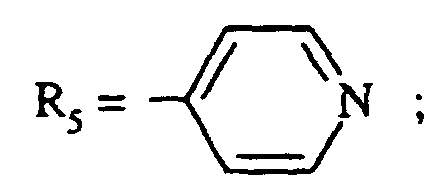
On laisse 24 heures sous agitation à TA un mélange de 0,66 g du composé obtenu à la Préparation 1.9 et 0,45 g de 1-(4-pyridinyl)pipérazine dans 20 ml de DCM. On lave le mélange réactionnel à l'eau, sèche la phase organique sur Na2SO4 et évapore sous vide le solvant. On chromatographie le résidu sur gel de silice en éluant par le mélange DCM/MeOH (99/1 ; v/v). On obtient 0,41 g du produit attendu après cristallisation dans l'AcOEt, F = 253°C.A mixture of 0.66 g of the compound obtained in Preparation 1.9 and 0.45 g of 1- (4-pyridinyl) piperazine in 20 ml of DCM is left stirring for 24 hours at RT. The reaction mixture is washed with water, the organic phase is dried over Na 2 SO 4 and the solvent is evaporated off under vacuum. The residue is chromatographed on silica gel, eluting with a DCM / MeOH (99/1; v / v) mixture. 0.41 g of the expected product is obtained after crystallization from AcOEt, mp = 253 ° C.
(I) : 1,5 C2H2O4 : R1 = Cl; R2 = H ; R3 = OCH(CH3)2 ; R4 = H ; X = -O= ; n = 1 ;

On chauffe à reflux pendant 3 heures un mélange de 0,3 g du composé obtenu à l'Exemple 7 et 0,056 g d'acide fumarique dans 15 ml d'acétonitrile. On essore à chaud le précipité formé, le lave à l'éther et le sèche. On obtient 0,24 g du produit attendu, F = 235°C.A mixture of 0.3 g of the compound obtained is heated at reflux for 3 hours. Example 7 and 0.056 g of fumaric acid in 15 ml of acetonitrile. We wring out hot the precipitate formed, washed with ether and dried. 0.24 g of the expected product is obtained, M.p. 235 ° C.
(I) : R1 = Cl ; R2 = H ; R3 = OCH(CH3)2 ; R4 = H ; X = -O- ; n = 1 ;

On laisse 24 heures sous agitation à TA un mélange de 6 g du composé obtenu à la Préparation 1.10 et 1,8 g de 1-(4-pyridinyl)pipérazine dans 60 ml de DCM. On concentre partiellement sous vide le solvant et chromatographie directement la solution résultante sur gel de silice en éluant par le mélange AcOEt/MeOH (95/5 ; v/v). On obtient 4,0 g du produit attendu.A mixture of 6 g of the compound obtained at RT is stirred for 24 hours at RT. Preparation 1.10 and 1.8 g of 1- (4-pyridinyl) piperazine in 60 ml of DCM. We partially concentrated under vacuum the solvent and chromatography directly the resulting solution on silica gel eluting with AcOEt / MeOH (95/5; v / v). 4.0 g of the expected product are obtained.
On laisse 48 heures sous agitation un mélange de 3,8 g du composé obtenu à l'étape précédente et 2,16 g de L-Leucinol dans 50 ml de chloroforme. On concentre sous vide, reprend le résidu au DCM et chromatographie la suspension ainsi obtenu sur alumine en éluant par le mélange DCM/MeOH (99/1 ; v/v). On rechromatographie sur gel de silice en éluant par le mélange DCM/MeOH (98,5/1,5 ; v/v). On sépare les diastéréoisomères :
- isomère le moins polaire : on obtient 0,53 g.
α 25 / D = - 19,3° (c = 0,34 ; chloroforme). - isomère le plus polaire que l'on cristallise dans le mélange DCM/éther iso et
obtient 0,548 g, F = 199-202°C.
α 25 / D = - 8,8° (c = 0,11 ; chloroforme).
- less polar isomer: 0.53 g is obtained.
α 25 / D = -19.3 ° (c = 0.34, chloroform). - the most polar isomer which is crystallized from DCM / iso ether and gives 0.548 g, mp = 199-202 ° C.
α 25 / D = -8.8 ° (c = 0.11, chloroform).
On laisse 18 heures sous agitation à TA un mélange de 0,5 g du composé obtenu à
l'étape précédente (isomère le plus polaire) et 0,042 g de méthylate de sodium dans 5
ml de MeOH et 5 ml de THF. On ajoute de l'eau au mélange réactionnel, concentre
sous vide les solvants, extrait 4 fois la phase aqueuse résultante au DCM, sèche sur
Na2SO4 et évapore sous vide le solvant. On chromatographie le résidu sur gel de
silice en éluant par le mélange DCM/MeOH (92/8 ; v/v). On obtient 0,225 g du
produit attendu après cristallisation dans le mélange DCM/éther iso, F = 195-245°C.
α 25 / D = - 18,8° (c = 0,266 ; chloroforme).A mixture of 0.5 g of the compound obtained in the preceding step (the most polar isomer) and 0.042 g of sodium methoxide in 5 ml of MeOH and 5 ml of THF is stirred for 18 hours at RT. Water is added to the reaction mixture, the solvents are concentrated under vacuum, the resulting aqueous phase is extracted 4 times with DCM, dried over Na 2 SO 4 and the solvent is evaporated off under vacuum. The residue is chromatographed on silica gel, eluting with a DCM / MeOH (92/8, v / v) mixture. 0.225 g of the expected product is obtained after crystallization from a DCM / iso ether mixture, mp 195 ° -195 ° C.
α 25 / D = -18.8 ° (c = 0.266, chloroform).
A un mélange de 0,213 g du composé obtenu à l'étape précédente dans 3 ml de
DMF on ajoute, sous atmosphère d'argon, 0,02 g d'hydrure de sodium à 60 % dans
l'huile, puis, après cessation du dégagement gazeux, on ajoute 0,119 g de chlorure de
2,4-diméthoxybenzènesulfonyle et laisse 3 heures sous agitation à TA. On verse le
mélange réactionnel dans une solution à 5 % de K2CO3, extrait à l'AcOEt, sèche la
phase organique sur Na2SO4 et évapore sous vide le solvant. On chromatographie le
résidu sur gel de silice en éluant par le mélange DCM/MeOH de (95/5 ; v/v) à (93/7 ;
v/v). On obtient 0,161 g du produit attendu après cristallisation dans le mélange
DCM/hexane/éther iso, F = 160-164°C.
α 20 / D = - 71,8° (c = 0,18 ; chloroforme).To a mixture of 0.213 g of the compound obtained in the preceding step in 3 ml of DMF is added, under an argon atmosphere, 0.02 g of 60% sodium hydride in the oil, then, after gaseous evolution, 0.119 g of 2,4-dimethoxybenzenesulfonyl chloride is added and the mixture is left stirring for 3 hours at RT. The reaction mixture is poured into a 5% solution of K 2 CO 3 , extracted with AcOEt, the organic phase is dried over Na 2 SO 4 and the solvent is evaporated off under vacuum. The residue is chromatographed on silica gel, eluting with a DCM / MeOH mixture (95/5 v / v) (93/7 v / v). 0.161 g of the expected product is obtained after crystallization from a DCM / hexane / iso ether mixture, mp = 160 ° -164 ° C.
α 20 / D = -71.8 ° (c = 0.18, chloroform).
(I) : R1 = Cl ; R2 = H ; R3 = OCH(CH3)2 ; R4 = H ; X = -O- ; n = 1 ;

On prépare ce composé selon le mode opératoire décrit à l'étape C de l'Exemple 9
à partir de 0,529 g du composé obtenu à l'étape B de l'Exemple 9 (isomère le moins
polaire) et de 0,043 g de méthylate de sodium dans 5 ml de MeOH et 5 ml de THF. On
obtient 0,198 g du produit attendu après cristallisation dans le mélange DCM/éther iso,
F = 196-198°C.
α 25 / D = + 20,7° (c = 0,32 ; chloroforme).This compound is prepared according to the procedure described in step C of Example 9 starting from 0.529 g of the compound obtained in step B of Example 9 (less polar isomer) and 0.043 g of methylate. sodium in 5 ml of MeOH and 5 ml of THF. 0.198 g of the expected product are obtained after crystallization from a DCM / iso ether mixture, mp 196-198 ° C.
α 25 / D = + 20.7 ° (c = 0.32, chloroform).
On prépare ce composé selon le mode opératoire décrit à l'étape D de l'Exemple 9
à partir de 0,328 g du composé obtenu à l'étape précédente, 0,03 g d'hydrure de sodium
à 60 % dans l'huile, 4 ml de DMF et 0,18 g du chlorure de 2,4-diinéthoxybenzènesulfonyle,
F = 161-167°C.
α 20 / D = + 72,5° (c = 0,14 ; chloroforme).This compound is prepared according to the procedure described in step D of Example 9 starting from 0.328 g of the compound obtained in the preceding step, 0.03 g of 60% sodium hydride in the oil, 4 ml of DMF and 0.18 g of 2,4-diinethoxybenzenesulfonyl chloride, mp = 161-167 ° C.
α 20 / D = + 72.5 ° (c = 0.14, chloroform).
(I) : R1 = Cl ; R2 = H ; R3 = OCH3 ; R4 = 5-OCH3 ; X = -O- ; n = 1 ;

On laisse 72 heures sous agitation à 20°C un mélange de 0,4 g du composé obtenu à la Préparation 1.17 et 0,4 g de 1-(2-pyridinyl)pipérazine dans 5 ml de DCM. On concentre sous vide, reprend le résidu dans 30 ml d'eau et essore le précipité formé. On obtient 0,4 g du produit attendu après cristallisation dans le MeOH, F = 254°C.A mixture of 0.4 g of the compound obtained is stirred for 72 hours at 20 ° C. in Preparation 1.17 and 0.4 g of 1- (2-pyridinyl) piperazine in 5 ml of DCM. We It is concentrated under vacuum, the residue is taken up in 30 ml of water and the precipitate formed is filtered off with suction. 0.4 g of the expected product is obtained after crystallization from MeOH, mp = 254 ° C.
(I) : R1 = Cl ; R2 = H ; R3 = OCH3 ; R4 = 5-OCH3 ; X = -O- ; n = 1 ;
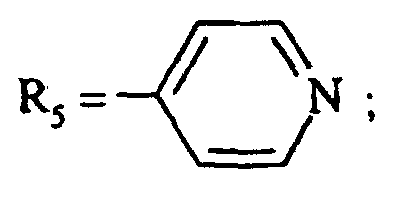
On laisse 72 heures sous agitation à 20°C un mélange de 0,4 g du composé obtenu à la Préparation 1.17 et 0,4 g de 1-(4-pyridinyl)pipérazine dans 5 ml de DCM. On concentre sous vide, reprend le résidu dans 20 ml d'eau et essore le précipité formé. On reprend le précipité dans l'acétone et concentre sous vide le solvant. On chromatographie le résidu sur gel de silice en éluant au DCM, puis à l'AcOEt et enfin à l'acétone. On obtient 0,4 g du produit attendu après cristallisation dans l'éther iso, F = 247-249°C.A mixture of 0.4 g of the compound obtained is stirred for 72 hours at 20 ° C. in Preparation 1.17 and 0.4 g of 1- (4-pyridinyl) piperazine in 5 ml of DCM. We concentrated under vacuum, the residue is taken up in 20 ml of water and the precipitate formed is filtered off. The precipitate is taken up in acetone and the solvent is concentrated under vacuum. We chromatography the residue on silica gel eluting with DCM, then with AcOEt and finally with acetone. 0.4 g of the expected product is obtained after crystallization from iso ether. M.p. 247-249 ° C.
(I) : R1 = Cl ; R2 = H ; R3 = OCH3 ; R4 = H ; X = -NH- ; n = 1 ;

On chauffe à reflux pendant 4 heures un mélange de 0,5 g du composé obtenu à la Préparation 1.18 et 0,268 g de 1-(4-pyridinyl)pipérazine dans 5 ml de chloroforme. On concentre sous vide et chromatographie le résidu sur gel de silice en éluant au DCM puis par le gradient du mélange DCM/AcOEt jusqu'à (85/15 ; v/v). On obtient 0,281 g du produit attendu après cristallisation dans le mélange DCM/éther iso/hexane.A mixture of 0.5 g of the compound obtained at room temperature is refluxed for 4 hours. Preparation 1.18 and 0.268 g of 1- (4-pyridinyl) piperazine in 5 ml of chloroform. We concentrated under vacuum and chromatography the residue on silica gel, eluting with DCM then by the gradient of the mixture DCM / AcOEt up to (85/15; v / v). 0.281 g is obtained the expected product after crystallization from a DCM / iso ether / hexane mixture.
(I) : R1 = Cl ; R2 = H ; R3 = OCH3 ; R4 = H ; X = -NH- ; n = 1 ;

On laisse 48 heures sous agitation à TA un mélange de 1,136 g du composé
obtenu à la Préparation 1.19 et 0,608 g de 1-(4-pyridinyl)pipérazine dans 10 ml de
chloroforme puis chauffe 1 heure à reflux. Après refroidissement à TA, on
chromatographie directement le mélange réactionnel sur gel de silice en éluant par le
mélange DCM/MeOH de (95/5 ; v/v) à (92/8 ; v/v). On cristallise le produit obtenu
dans le mélange DCM/hexane/éther iso puis, dissout le produit obtenu dans le
mininum de MeOH et précipite par ajout d'éther iso. On obtient 0,65 g du produit
attendu.
α 20 / D = - 43° (c = 0,16 ; chloroforme).A mixture of 1.136 g of the compound obtained in Preparation 1.19 and 0.608 g of 1- (4-pyridinyl) piperazine in 10 ml of chloroform is stirred for 48 hours at RT and then heated for 1 hour under reflux. After cooling to RT, the reaction mixture is chromatographed directly on silica gel, eluting with a DCM / MeOH mixture (95/5 v / v) (92/8 v / v). The product obtained is crystallized from a DCM / hexane / iso ether mixture and then the product obtained is dissolved in the MeOH mininum and precipitated by addition of iso ether. 0.65 g of the expected product is obtained.
α 20 / D = -43 ° (c = 0.16, chloroform).
(I) : R1 = Cl ; R2 = H ; R3 = OCH3 ; R4 = H ; X = -NH- ; n = 2 ;

On laisse 18 heures sous agitation à TA un mélange de 0,4 g du composé obtenu à la Préparation 1.18 et 1,3 g du composé obtenu à la Préparation 2.3 dans 20 ml de DCM. On concentre sous vide, extrait le résidu à l'AcOEt, lave la phase organique par une solution saturée de NaCl, sèche sur Na2SO4 et évapore sous vide le solvant. On chromatographie le résidu sur gel de silice en éluant par le mélange DCM/MeOH (94/6 ; v/v). On obtient 0,22 g du produit attendu après cristallisation dans le mélange DCM/éther iso, F = 152°C.A mixture of 0.4 g of the compound obtained in Preparation 1.18 and 1.3 g of the compound obtained in Preparation 2.3 in 20 ml of DCM is stirred for 18 hours at RT. It is concentrated under vacuum, the residue is extracted with AcOEt, the organic phase is washed with saturated NaCl solution and dried over Na 2 SO 4 and the solvent is evaporated off under vacuum. The residue is chromatographed on silica gel, eluting with a DCM / MeOH mixture (94/6, v / v). 0.22 g of the expected product is obtained after crystallization from a DCM / iso ether mixture, mp = 152 ° C.
(I) : R1 = Cl ; R2 = H ; R3 = OCH3 ; R4 = H ; X = -NH- ; n = 2

On chauffe à reflux pendant 18 heures un mélange de 0,5 g du composé obtenu à la Préparation 1.18 et 0,375 g du composé obtenu à la Préparation 2.4 dans 20 ml de DCM. On concentre sous vide, extrait le résidu à l'AcOEt, lave la phase organique par une solution à 5 % de Na2CO3, à l'eau, par une solution saturée de NaCl, sèche sur Na2SO4 et évapore sous vide le solvant. On chromatographie le résidu sur gel de silice en éluant par le mélange DCM/MeOH (94/6 ; v/v). On obtient 0,386 g du produit attendu après cristallisation dans le mélange DCM/éther iso, F = 168°C.A mixture of 0.5 g of the compound obtained in Preparation 1.18 and 0.375 g of the compound obtained in Preparation 2.4 in 20 ml of DCM is refluxed for 18 hours. It is concentrated under vacuum, the residue is extracted with AcOEt, the organic phase is washed with 5% Na 2 CO 3 solution , with water, with saturated NaCl solution, dried over Na 2 SO 4 and evaporated under empty the solvent. The residue is chromatographed on silica gel, eluting with a DCM / MeOH mixture (94/6, v / v). 0.386 g of the expected product is obtained after crystallization from a DCM / iso ether mixture, mp = 168 ° C.
(I) : R1 = Cl ; R2 = H ; R3 = OCH(CH3)2 ; R4 = H ; X = -NH- ; n = 1 ;

On chauffe à reflux pendant 36 heures un mélange de 0,639 g du composé obtenu
à la Préparation 1.20 et 0,325 g du composé obtenu à la Préparation 2.2 dans 10 ml de
chloroforme et 5 ml de THF. On chromatographie directement le mélange réactionnel
sur gel de silice en éluant par le mélange DCM/MeOH (96/4 ; v/v). On obtient 0,215 g
du produit attendu après cristallisation dans le mélange DCM/éther iso, F = 148°C.
α 20 / D = + 25,6° (c = 0,15 ; chloroforme).
RMN1H : DMSO-d6 : δ (ppm) : 1,0 : d : 3H ; 1,2 : d : 3H ; 3,0 : mt : 4H ; 3,4 : mt
: 4H ; 3,5 : s : 3H ; 3,9 : s : 3H ; 4,7 : mt : 1H ; 6,6 : mt : 2H ; 6,9 : t : 1H ; 7,1 : d : 1H
; 7,2 à 7,4 : m : 6H ; 7,6 : s : 1H ; 7,8 : dd : 1H ; 7,9 : d : 1H ; 8,0 : d : 1H ; 8,3 : se :
1H.A mixture of 0.639 g of the compound obtained in Preparation 1.20 and 0.325 g of the compound obtained in Preparation 2.2 in 10 ml of chloroform and 5 ml of THF is refluxed for 36 hours. The reaction mixture is chromatographed directly on silica gel, eluting with a DCM / MeOH (96/4; v / v) mixture. 0.215 g of the expected product is obtained after crystallization from a DCM / iso ether mixture, mp = 148 ° C.
α 20 / D = + 25.6 ° (c = 0.15, chloroform).
1 H NMR: DMSO-d 6 : δ (ppm): 1.0: d: 3H; 1,2: d: 3H; 3.0: mt: 4H; 3.4: mt: 4H; 3.5: s: 3H; 3.9: s: 3H; 4.7: mt: 1H; 6.6: mt: 2H; 6.9: t: 1H; 7.1: d: 1H; 7.2 to 7.4: m: 6H; 7.6: s: 1H; 7.8: dd: 1H; 7.9: d: 1H; 8.0: d: 1H; 8.3: se: 1H.
(I) : R1 = Cl ; R2 = H ; R3 = OCH(CH3)2 ; R4 = H ; X = -NH- ; n = 1 ;

On prépare ce composé selon le mode opératoire décrit à l'Exemple 17 à partir de
0,5 g du composé obtenu à la Préparation 1.21 et 0,26 g du composé obtenu à la
Préparation 2.2 dans 10 ml de chloroforme et 5 ml de THF.
α 20 / D = - 33° (c = 0,15 ; chloroforme).This compound is prepared according to the procedure described in Example 17 starting from 0.5 g of the compound obtained in Preparation 1.21 and 0.26 g of the compound obtained in Preparation 2.2 in 10 ml of chloroform and 5 ml of THF. .
α 20 / D = -33 ° (c = 0.15, chloroform).
(I) : R1 = Cl ; R2 = H ; R3 = OCH(CH3)2 ; R4 = H ; X = -NH- ; n = 1 ;

On chauffe à reflux pendant 18 heures un mélange de 0,5 g du composé obtenu à
la Préparation 1.21 et 0,26 g de 1-(4-pyridinyl)pipérazine dans 5 ml de chloroforme.
On chromatographie directement le mélange réactionnel sur gel de silice en éluant par
le mélange DCM/MeOH de (95/5 ; v/v) à (92/8 ; v/v). On cristallise le produit obtenu
par évaporation à froid d'un mélange DCM/hexane/éther iso. On obtient 0,46 g du
produit attendu.
α 20 / D = + 7,9° (c = 0,175 ; chloroforme). A mixture of 0.5 g of the compound obtained in Preparation 1.21 and 0.26 g of 1- (4-pyridinyl) piperazine in 5 ml of chloroform is refluxed for 18 hours. The reaction mixture is chromatographed directly on silica gel, eluting with a DCM / MeOH mixture (95/5 v / v) (92/8 v / v). The product obtained is crystallized by cold evaporation of a DCM / hexane / iso ether mixture. 0.46 g of the expected product is obtained.
α 20 / D = + 7.9 ° (c = 0.175, chloroform).
(I) : R1 = Cl ; R2 = H ; R3 = OCH(CH3)2 ; R4 = H ; X = -NH- ; n = 1 ;

On laisse 48 heures sous agitation à TA un mélange de 0,9 g du composé obtenu à
la Préparation 1.20 et 0,463 g de 1-(4-pyridinyl)pipérazine dans 10 ml de chloroforme.
On chromatographie directement le mélange réactionnel sur gel de silice en éluant par
le mélange DCM/MeOH (95/5 ; v/v). On cristallise le produit attendu par évaporation
à froid d'un mélange DCM/hexane/éther iso. On obtient 0,789 g du produit attendu.
α 20 / D = - 10,3° (c = 0,17 ; chloroforme).
RMN1H : DMSO-d6 : δ (ppm) : 1,0 : d : 6H ; 3,2 à 3,7 : m+s : 11H ; 3,8 : s : 3H ;
4,6 : mt : 1H ; 6,6 : s+mt : 2H ; 6,8 : t : 1H ; 6,9 : d : 1H ; 7,2 : d : 2H ; 7,3 : mt : 4H ;
7,6 : s : 1H ; 7,7 : d : 1H ; 7,8 : d : 1H ; 8,2 : d : 2H.A mixture of 0.9 g of the compound obtained in Preparation 1.20 and 0.463 g of 1- (4-pyridinyl) piperazine in 10 ml of chloroform is stirred for 48 hours at RT. The reaction mixture is chromatographed directly on silica gel, eluting with a DCM / MeOH mixture (95/5, v / v). The expected product is crystallized by cold evaporation of a DCM / hexane / iso ether mixture. 0.789 g of the expected product is obtained.
α 20 / D = - 10.3 ° (c = 0.17, chloroform).
1 H NMR: DMSO-d 6 : δ (ppm): 1.0: d: 6H; 3.2 to 3.7: m + s: 11H; 3.8: s: 3H; 4.6: mt: 1H; 6.6: s + mt: 2H; 6.8: t: 1H; 6.9: d: 1H; 7.2: d: 2H; 7.3: mt: 4H; 7.6: s: 1H; 7.7: d: 1H; 7.8: d: 1H; 8.2: d: 2H.
(I) : R1 = Cl ; R2 = H ; R3 = OCH3 ; R4 = 5- OCH3 ; X = -NH- ; n = 1 ;

On prépare ce composé selon le mode opératoire décrit à l'Exemple 13 à partir de
0,46 g du composé obtenu à la Préparation 1.22 et 0,21 ml de 1-(2-pyridinyl)pipérazine
dans 5 ml de chloroforme. On obtient 0,382 g du produit attendu
après cristallisation dans le mélange DCM/éther iso/hexane.
RMN1H : DMSO-d6 : δ (ppm) : 3,4 à 3,8 : m+3s : 17H ; 4,0 : s : 3H ; 6,8 : mt :
2H ; 7,0 : mt : 4H ; 7,4 : mt : 3H ; 7,8 : d : 1H ; 7,9 : d : 1H ; 8,2 : mt : 2H.This compound is prepared according to the procedure described in Example 13 from 0.46 g of the compound obtained in Preparation 1.22 and 0.21 ml of 1- (2-pyridinyl) piperazine in 5 ml of chloroform. 0.382 g of the expected product is obtained after crystallization from a DCM / iso ether / hexane mixture.
1 H NMR: DMSO-d 6: δ (ppm): 3.4 to 3.8: m + 3s: 17H; 4.0: s: 3H; 6.8: mt: 2H; 7.0: mt: 4H; 7.4: mt: 3H; 7.8: d: 1H; 7.9: d: 1H; 8.2: mt: 2H.
(I) : R1 = Cl ; R2 = 6-CF3 ; R3 = OCH3 ; R4 =H ; X = -NH- ; n = 1 ;

On prépare ce composé selon le mode opératoire décrit à l'Exemple 15 à partir de 0,203 g du composé obtenu à la Préparation 1.25 et 0,098 g de 1-(4-pyridinyl) pipérazine dans 3 ml de chloroforme et 3 ml de THF. On obtient 0,098 g du produit attendu après cristallisation dans le mélange DCM/éther iso, F= 174°C.This compound is prepared according to the procedure described in Example 15 from 0.203 g of the compound obtained in Preparation 1.25 and 0.098 g of 1- (4-pyridinyl) piperazine in 3 ml of chloroform and 3 ml of THF. 0.098 g of the product is obtained after crystallization from DCM / iso ether, mp = 174 ° C.
(I) : R1 = Cl ; R2 = H ; R3 = OCH(CH3)2 ; R4 = H ; X = -O-CH2- ; n = 1 ;

A un mélange de 1 g du composé obtenu à la Préparation 1.27 dans 20 ml de DCM, on ajoute à 20°C 1,2 g de BOP, 2 ml de DIPEA puis 0,48 g de 1-(4-pyridinyl) pipérazine et laisse 1 heure sous agitation à TA. On ajoute ensuite 20 ml de NaOH 2N, extrait à l'AcOEt, lave la phase organique à l'eau, sèche sur Na2SO4 et évapore sous vide les solvants. On chromatographie le résidu sur gel de silice en éluant au DCM puis à l'AcOEt et à l'acétone. On obtient 0,55 g du produit attendu après cristallisation dans l'éther iso, F = 115-120°C.To a mixture of 1 g of the compound obtained in Preparation 1.27 in 20 ml of DCM, 1.2 g of BOP, 2 ml of DIPEA and 0.48 g of 1- (4-pyridinyl) piperazine are added at 20 ° C. and left stirring for 1 hour at RT. 20 ml of 2N NaOH are then added, the mixture is extracted with AcOEt, the organic phase is washed with water and dried over Na 2 SO 4 and the solvents are evaporated off under vacuum. The residue is chromatographed on silica gel, eluting with DCM and then with AcOEt and acetone. 0.55 g of the expected product is obtained after crystallization from iso ether, mp = 115-120 ° C.
On prépare ce composé selon le mode opératoire décrit à l'étape B de l'Exemple 1 à partir de 0,5 g du composé obtenu à l'étape précédente, 0,04 g d'hydrure de sodium à 60 % dans l'huile, 10 ml de THF et 0,3 g de chlorure de 2,4-diméthoxybenzène sulfonyle. On obtient 0,55 g du produit attendu après cristallisation dans l'éther iso, F = 201-203°C.This compound is prepared according to the procedure described in step B of Example 1 from 0.5 g of the compound obtained in the preceding step, 0.04 g of sodium hydride at 60% in oil, 10 ml of THF and 0.3 g of 2,4-dimethoxybenzene chloride sulfonyl. 0.55 g of the expected product is obtained after crystallization from iso ether, M.p .: 201-203 ° C.
(I) : R1 = Cl ; R2 = H ; R3 = OCH3 ; R4 = H ; X = -NH-CH2- ; n = 1 ;
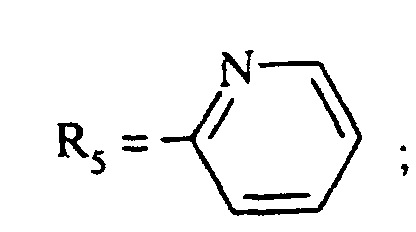
A une solution de 0,33 g du composé obtenu à la Préparation 1.28, 0,11 g de 1-(2-pyridinyl)pipérazine et 0,121 g de triéthylamine dans 5 ml de DCM on ajoute 0,329 g de PyBOP et laisse 3 heures sous agitation à TA. On concentre sous vide, extrait le résidu à l'AcOEt, lave la phase organique à l'eau, sèche sur Na2SO4 et évapore sous vide le solvant. On chromatographie le résidu sur gel de silice en éluant par le mélange DCM/AcOEt (90/10 ; v/v). On obtient 0,29 g du produit attendu après cristallisation dans l'éther iso, F = 155°C.To a solution of 0.33 g of the compound obtained in Preparation 1.28, 0.11 g of 1- (2-pyridinyl) piperazine and 0.121 g of triethylamine in 5 ml of DCM is added 0.329 g of PyBOP and leaves 3 hours under stirring at TA. It is concentrated under vacuum, the residue is extracted with AcOEt, the organic phase is washed with water and dried over Na 2 SO 4 and the solvent is evaporated off under vacuum. The residue is chromatographed on silica gel, eluting with a DCM / AcOEt mixture (90/10, v / v). 0.29 g of the expected product is obtained after crystallization from iso ether, mp = 155 ° C.
(I) : R1 = Cl ; R2 = H ; R3 = OCH3 ; R4 = H ; X = -NH-CH2-CH2- ; n = 1 ;

A une solution de 0,4 g du composé obtenu à la Préparation 1.29, 0,127 g de 1-(2-pyridinyl)pipérazine
et 0,143 g de triéthylamine dans 10 ml de DCM on ajoute 0,37 g
de PyBOP et laisse 2 heures sous agitation à TA. On dilue le mélange réactionnel au
DCM, lave la phase organique à l'eau, sèche sur Na2SO4 et évapore sous vide le
solvant. On chromatographie le résidu sur gel de silice en éluant par le mélange
DCM/AcOEt (90/10 ; v/v). On obtient 0,36 g du produit attendu après cristallisation
dans l'éther iso, F = 214°C.
RMN1H : DMSO-d6 : δ (ppm) : 2,0 à 2,5 : 2mt : 4H ; 3,1 à 3,6 : m+s : 11H ; 3,7 :
s : 3H ; 3,9 : s : 3H ; 6,6 à 7,0 : m : 6H ; 7,1 : t : 1H ; 7,3 : t : 1H ; 7,5 : dd : 1H ; 7,6 :
mt : 1H ; 7,7 à 8,0 : mt : 4H ; 8,2 : dd : 1H.To a solution of 0.4 g of the compound obtained in Preparation 1.29, 0.127 g of 1- (2-pyridinyl) piperazine and 0.143 g of triethylamine in 10 ml of DCM is added 0.37 g of PyBOP and leaves 2 hours under stirring at TA. The reaction mixture is diluted with DCM, the organic phase is washed with water and dried over Na 2 SO 4 and the solvent is evaporated off under vacuum. The residue is chromatographed on silica gel, eluting with a DCM / AcOEt mixture (90/10, v / v). 0.36 g of the expected product is obtained after crystallization from iso ether, mp = 214 ° C.
1 H NMR: DMSO-d 6: δ (ppm): 2.0 to 2.5: 2mt: 4H; 3.1 to 3.6: m + s: 11H; 3.7: s: 3H; 3.9: s: 3H; 6.6 to 7.0: m: 6H; 7.1: t: 1H; 7.3: t: 1H; 7.5: dd: 1H; 7.6: mt: 1H; 7.7 to 8.0: mt: 4H; 8.2: dd: 1H.
(I) : R1 = Cl ; R2 = H ; R3 = OCH(CH3)2 ; R4 = H ; X = -NH- ; n = 1 ;

A une solution de 0,054 g de 1-(3-pyridazinyl)pipérazine dans 2 ml de chloroforme on ajoute une solution de 0,07 g du composé obtenu à la Préparation 1.20 puis chauffe à 60°C pendant 24 heures. On chromatographie directement le mélange réactionnel sur gel de silice en éluant par le mélange DCM/MeOH (95/5 ; v/v). On obtient le produit attendu. Pureté CLHP : 100 %.To a solution of 0.054 g of 1- (3-pyridazinyl) piperazine in 2 ml of chloroform is added a solution of 0.07 g of the compound obtained in Preparation 1.20 then heated at 60 ° C for 24 hours. The mixture is directly chromatographed reaction on silica gel, eluting with a DCM / MeOH mixture (95/5, v / v). We gets the expected product. HPLC purity: 100%.
(I) : R1 = Cl ; R2 = H ; R3 = OCH(CH3)2 ; R4 = H ; X = -NH- ; n = 1 ;

On prépare ce composé selon le mode opératoire décrit à l'Exemple 26 à partir de 0,054 g de 1-(2-pyrimidinyl)pipérazine dans 2 ml de chloroforme et de 0,07 g du composé obtenu à la Préparation 1.20. On obtient le produit attendu. Pureté CLHP : 99 %.This compound is prepared according to the procedure described in Example 26 from 0.054 g of 1- (2-pyrimidinyl) piperazine in 2 ml of chloroform and 0.07 g of compound obtained in Preparation 1.20. The expected product is obtained. HPLC purity: 99%.
En procédant selon les modes opératoires décrits dans les Exemples ci-dessus, à
partir des composés de formule (II) dans laquelle W = H et des composés de formule
(V), on prépare les composés de formule (IV) rassemblés dans le Tableau I ci-après :


En procédant selon les modes opératoires décrits dans les Exemples ci-dessus, à
partir des composés de formule (II) dans laquelle


Les composés selon l'invention ont fait l'objet d'études biochimiques.The compounds according to the invention have been the subject of biochemical studies.
L'affinité des composés de formule (I) selon l'invention pour les récepteurs V1b de l'arginine-vasopressine a été déterminée in vitro en utilisant la méthode décrite par Y. DE KEYSER et al., Febs Letters, 1994, 356, 215-220. Cette méthode consiste à étudier in vitro le déplacement de l'arginine-vasopressine tritiée ([3H]-AVP) aux récepteurs V1b présents sur des préparations membranaires adénohypophysaires ou cellulaires portant les récepteurs V1b de rat ou humains. Les concentrations inhibitrices de 50 % (CI50) de la fixation de l'arginine-vasopressine tritiée des composés selon l'invention sont faibles et varient de 10-6 à 10-9M.The affinity of the compounds of formula (I) according to the invention for the V 1b receptors of arginine vasopressin was determined in vitro using the method described by Y. DE KEYSER et al., Febs Letters, 1994, 356. , 215-220. This method consists of studying in vitro the displacement of tritiated arginine-vasopressin ([ 3 H] -AVP) at the V 1b receptors present on adenohypophyseal or cellular membrane preparations carrying rat V 1b or human receptors. The 50% inhibitory concentrations (IC 50 ) of the binding of tritiated arginine-vasopressin of the compounds according to the invention are low and vary from 10 -6 to 10 -9 M.
L'affinité des composés de formule (I) selon l'invention pour les récepteurs V1a de l'arginine-vasopressine a été déterminée in vitro en utilisant la méthode décrite par M. THIBONNIER et al., J. Biol. Chem., 1994, 269, 3304-3310. Cette méthode consiste à étudier in vitro le déplacement de l'arginine-vasopressine tritiée ([3H]-AVP) aux récepteurs V1a présents sur des préparations membranaires ou cellulaires portant les récepteurs V1a de rat ou humains. Les composés de formule (I) présentent une affinité pour les récepteurs V1a de l'arginine-vasopressine avec des CI50 qui varient de 10-6 à 10-9M.The affinity of the compounds of formula (I) according to the invention for the V 1a receptors of arginine-vasopressin was determined in vitro using the method described by M. THIBONNIER et al., J. Biol. Chem., 1994, 269, 3304-3310. This method consists of studying in vitro the displacement of tritiated arginine-vasopressin ([ 3 H] -AVP) at the V 1a receptors present on membrane or cell preparations carrying the rat or human V 1a receptors. The compounds of formula (I) have an affinity for arginine vasopressin V 1a receptors with IC 50 values which range from 10 -6 to 10 -9 M.
L'affinité des composés de formule (I) selon l'invention pour les récepteurs V2 de la vasopressine a également été étudiée (méthode décrite par M. Bimbaumer et al., Nature (Lond.), 1992, 357, 333-335). Les composés étudiés sont peu ou pas affins pour les récepteurs V2 avec des CI50 généralement supérieures à 10-6M.The affinity of the compounds of formula (I) according to the invention for the V 2 receptors of vasopressin has also been studied (method described by M. Bimbaumer et al., Nature (London), 1992, 357, 333-335 ). The test compounds have little or no affinity for V 2 receptors with IC 50 values generally greater than 10 -6 M.
L'affinité des composés selon l'invention pour les récepteurs de l'ocytocine a été déterminée dans un test de liaison in vitro en utilisant la méthode décrite par J. Elands et al. dans Eur. J. Pharmacol., 1987, 147, 197-207. Cette méthode consiste à étudier in vitro le déplacement d'un analogue radioiodé de l'ocytocine aux récepteurs de l'ocytocine dans une préparation membranaire de cellules transfectée avec le récepteur ocytocique humain utérin. Les IC50 (concentration inhibitrice de 50 % de la liaison de l'analogue radioiodé de l'ocytocine à ses récepteurs) sont faibles et varient de 10-6 à 10-9M dans ce dernier test.The affinity of the compounds according to the invention for oxytocin receptors was determined in an in vitro binding assay using the method described by J. Elands et al. in Eur. J. Pharmacol., 1987, 147 , 197-207. This method consists in studying in vitro the displacement of a radioiodinated oxytocin analogue to oxytocin receptors in a membrane preparation of cells transfected with the human uterine oxytocin receptor. IC 50 (inhibitory concentration of 50% of the binding of the radioiodinated analogue of oxytocin to its receptors) are low and range from 10 -6 to 10 -9 M in this latter test.
Les composés de la présente invention sont notamment des principes actifs de compositions pharmaceutiques, dont la toxicité est compatible avec leur utilisation en tant que médicaments.The compounds of the present invention are in particular active principles of pharmaceutical compositions, the toxicity of which is compatible with their use in as medicines.
Selon un autre de ses aspects, la présente invention concerne l'utilisation des composés de formule (I), ou l'un de leurs sels, solvats et/ou hydrates pharmaceutiquement acceptables, pour la préparation de médicaments destinés à traiter toute pathologie où l'arginine-vasopressine et/ou ses récepteurs V1b et/ou ses récepteurs V1a et/ou l'ocytocine et/ou ses récepteurs sont impliqués.According to another of its aspects, the present invention relates to the use of the compounds of formula (I), or one of their pharmaceutically acceptable salts, solvates and / or hydrates, for the preparation of medicaments intended to treat any pathology in which the arginine-vasopressin and / or its V 1b receptors and / or its V 1a receptors and / or oxytocin and / or its receptors are involved.
Ainsi les composés selon l'invention peuvent être utilisés, chez l'homme ou chez l'animal, dans le traitement ou la prévention de différentes affections vasopressine-dépendantes tels que les affections cardiovasculaires, comme l'hypertension, l'hypertension pulmonaire, l'insuffisance cardiaque, l'infarctus du myocarde, ou le vasospasme coronaire, en particulier chez le fumeur, la maladie de Raynaud, les angines instables et PTCA (de l'anglais percutaneous transluminal coronary angioplasty), l'ischémie cardiaque, les dérèglements de l'hémostase ; les affections du système nerveux central comme la migraine, le vasospasme cérébral, l'hémorragie cérébrale, les oedèmes cérébraux, la dépression, l'anxiété, le stress, les troubles émotionnels, le trouble obsessionnel-compulsif, les attaques de panique, les états psychotiques, les troubles de la mémoire par exemple ; les affections du système rénal comme le vasospasme rénal, la nécrose du cortex rénal ; le diabète insipide néphrogénique ; les affections du système gastrique comme le vasospasme gastrique, l'hépatocirrhose, les ulcères, la pathologie des vomissements, par exemple la nausée y compris la nausée due à une chimiothérapie, le mal des transports ; la néphropathie diabétique. Les composés selon l'invention peuvent également être utilisés dans le traitement des troubles du comportement sexuel ; chez la femme, les composés selon l'invention peuvent être utilisés pour traiter la dysménorrhée ou le travail prématuré. On peut également utiliser les composés selon l'invention dans le traitement des cancers pulmonaires à petites cellules ; des encéphalopathies hyponatrémiques ; du syndrome pulmonaire, de la maladie de Ménière ; du glaucome, de la cataracte ; de l'obésité ; du diabète de type I et II ; de l'athérosclérose ; du syndrome de Cushing ; de la résistance à l'insuline ; de l'hypertriglycéridémie ; dans les traitements postopératoires, notamment après une chirurgie abdominale.Thus the compounds according to the invention can be used, in humans or at home. the animal, in the treatment or prevention of various vasopressin-dependent conditions such as cardiovascular conditions, such as hypertension, pulmonary hypertension, heart failure, myocardial infarction, or coronary vasospasm, particularly in the smoker, Raynaud's disease, unstable angina and PTCA (from the English percutaneous transluminal coronary angioplasty), cardiac ischemia, dysregulation of hemostasis; the affections of the central nervous system such as migraine, cerebral vasospasm, haemorrhage cerebral edema, depression, anxiety, stress, disorders emotional, obsessive-compulsive disorder, panic attacks, states psychotic, memory disorders for example; diseases of the renal system such as renal vasospasm, necrosis of the renal cortex; diabetes insipidus nephrogenic; disorders of the gastric system such as gastric vasospasm, hepatocirrhosis, ulcers, pathology of vomiting, for example nausea including nausea due to chemotherapy, motion sickness; nephropathy diabetic. The compounds according to the invention can also be used in the treatment of disorders of sexual behavior; in women, the compounds according to The invention can be used to treat dysmenorrhea or premature labor. The compounds according to the invention can also be used in the treatment of small cell lung cancer; hyponatremic encephalopathies; of pulmonary syndrome, Meniere's disease; glaucoma, cataracts; of obesity; type I and II diabetes; atherosclerosis; Cushing's syndrome; of insulin resistance; hypertriglyceridemia; in postoperative treatments, especially after abdominal surgery.
Les composés selon l'invention peuvent aussi être utilisés dans le traitement ou la prévention de toutes les pathologies consécutives au stress comme la fatigue et ses syndromes, les désordres ACTH dépendants, les troubles cardiaques, la douleur, les modifications de la vidange gastrique, de l'excrétion fécale (colite, syndrome du colon irritable, maladie de Crohn), de la sécrétion acide, l'hyperglycémie, l'immunosuppression, les processus inflammatoires (arthrite rhumatoïde et ostéoarthrite), les infections multiples, les cancers, l'asthme, le psoriasis, les allergies et les désordres neuropsychiatriques variés tel que l'anorexie nerveuse, la boulimie, les troubles de l'humeur, la dépression, l'anxiété, les troubles du sommeil, les états de panique, les phobies, l'obsession, les troubles de la perception de la douleur (fibromyalgie), les maladies neurodégénératrices (maladie d'Alzheimer, maladie de Parkinson, maladie d'Huntington), la dépendance à une substance, le sevrage, le stress hémorragique, les spasmes musculaires, l'hypoglycémie. Les composés selon l'invention peuvent également être utilisés dans le traitement ou la prévention des états de stress chronique comme l'immunodépression, les troubles de la fertilité, les dysfonctionnements de l'axe hypothalamo-hypophysosurrénalien.The compounds according to the invention can also be used in the treatment or the prevention of all pathologies resulting from stress such as fatigue and its syndromes, ACTH-dependent disorders, cardiac disorders, pain, changes in gastric emptying, faecal excretion (colitis, colon syndrome irritable, Crohn's disease), acid secretion, hyperglycemia, immunosuppression, inflammatory processes (rheumatoid arthritis and osteoarthritis), multiple infections, cancers, asthma, psoriasis, allergies and various neuropsychiatric disorders such as anorexia nervosa, bulimia nervosa, mood disorders, depression, anxiety, sleep disorders, states of panic, phobias, obsession, disorders of pain perception (fibromyalgia), neurodegenerative diseases (Alzheimer's disease, Parkinson's, Huntington's disease), substance dependence, weaning, stress hemorrhagic, muscle spasm, hypoglycemia. The compounds according to the invention may also be used in the treatment or prevention of chronic stress such as immunosuppression, fertility disorders, malfunctions of the hypothalamic-pituitary-adrenal axis.
Les composés selon l'invention peuvent également être utilisés comme psychostimulants, provoquant l'augmentation de l'éveil, la réactivité émotionnelle face à l'environnement et facilitant l'adaptation.The compounds according to the invention can also be used as psychostimulants, causing the increase of the awakening, the emotional reactivity face to the environment and facilitating adaptation.
Les composés selon l'invention ayant une affinité pour les récepteurs de l'ocytocine sont particulièrement intéressants et ce, dans la prévention et/ou le traitement des désordres ocytocine-dépendants. Les composés selon la présente invention sont intéressants dans la cicatrisation, dans l'analgésie, dans l'anxiolyse, dans la prévention de la douleur, dans la prévention de l'anxiété, la dépression, la schizophrénie, l'autisme, les syndromes obsessionnels compulsifs, dans le comportement maternel (facilitation de la reconnaissance et de l'acceptation de la mère par l'enfant) et social, la mémoire ; la régulation de la prise de nourriture et de boisson, la dépendance aux drogues, le sevrage et la motivation sexuelle ; ils peuvent également être utilisés avantageusement dans les désordres de la sphère urogénitale notamment dans les domaines obstétrique et gynécologique, notamment comme agent tocolytique ou relaxant utérin ou pour contrôler les contractions de l'utérus avant que la grossesse soit arrivée à terme, pour contrôler le travail prénatal, ou encore contrôler le travail préparatoire en vue d'un accouchement par césarienne, pour résoudre les problèmes de stérilité, fertilité, contrôler les naissances (usage vétérinaire en particulier), contrôler l'oestrus, l'arrêt de l'allaitement, le sevrage, le transfert et l'implantation d'embryon lors de la fécondation in vitro ; traiter l'endométriose, les dysmenorrhées, ainsi que l'incontinence urinaire à l'effort ou d'urgence, l'hypertrophie bégnine de la prostate et les dysfonctions érectiles, l'hypertension, l'hyponatrémie, l'insuffisance cardiaque, l'arthérosclérose, l'angiogénèse, la prolifération de tumeurs, le sarcome de Kaposi et réguler le stockage des graisses par l'adipocyte.The compounds according to the invention having an affinity for oxytocin are of particular interest in the prevention and / or prevention of treatment of oxytocin-dependent disorders. The compounds according to the present invention are of interest in healing, in analgesia, in anxiolysis, in the prevention of pain, in the prevention of anxiety, depression, schizophrenia, autism, obsessive-compulsive syndromes, in the maternal behavior (facilitating recognition and acceptance of the mother by the child) and social, memory; regulation of food and drink intake, drug dependence, withdrawal and sexual motivation; they can also be used advantageously in the disorders of the urogenital sphere particularly in the obstetric and gynecological fields, particularly as an tocolytic or uterine relaxing or to control the contractions of the uterus before pregnancy has come to an end, to control prenatal work, or to control the preparatory work for cesarean delivery, to resolve problems of infertility, fertility, birth control (veterinary use in particular), control estrus, stop breastfeeding, weaning, transfer and embryo implantation during in vitro fertilization; treat endometriosis, dysmenorrhea, as well as urinary stress incontinence or urgency, benign prostatic hypertrophy and erectile dysfunction, hypertension, hyponatremia, heart failure, atherosclerosis, angiogenesis, proliferation of tumors, Kaposi's sarcoma and regulate the storage of fats by adipocytes.
Par ailleurs, étant donné le rôle de l'ocytocine sur le contrôle de l'hormone lutéïnisante (J.J. Evans, J. Endocrin. 1996, 151, 169-174) les composés de l'invention pourront être utilisés pour induire la contraception.On the other hand, given the role of oxytocin on the control of luteinizing hormone (JJ Evans, J. Endocrin, 1996, 151 , 169-174) the compounds of the invention may be used to induce contraception.
De plus, les composés selon l'invention pourront être utilisés pour leurs effets antitumoraux, dans les tumeurs ocytocine sécrétantes, en particulier les cancers mammaires et prostatiques.In addition, the compounds according to the invention may be used for their effects. anti-tumors, in secretory oxytocin tumors, particularly cancers mammary and prostatic.
L'utilisation des composés selon l'invention pour la prévention et/ou le traitement des maladies ci-dessus mentionnées, ainsi que pour la préparation de médicaments destinés à traiter ces maladies fait partie intégrante de l'invention.The use of the compounds according to the invention for the prevention and / or the treatment diseases mentioned above, as well as for the preparation of medicinal products intended to treat these diseases is an integral part of the invention.
Les composés de formule (I) ci-dessus, ou l'un de leurs sels, solvats et/ou hydrates pharmaceutiquement acceptables peuvent être utilisés à des doses journalières de 0,01 à 100 mg par kilo de poids corporel du mammifère à traiter, de préférence à des doses journalières de 0,1 à 50 mg/kg. Chez l'être humain, la dose peut varier de préférence de 0,1 à 4000 mg par jour, plus particulièrement de 0,5 à 1000 mg selon l'âge du sujet à traiter ou le type de traitement : prophylactique ou curatif.The compounds of formula (I) above, or one of their salts, solvates and / or hydrates pharmaceutically acceptable salts can be used at daily doses of 0.01 at 100 mg per kilogram of body weight of the mammal to be treated, preferably at doses daily doses of 0.1 to 50 mg / kg. In humans, the dose may vary preferably from 0.1 to 4000 mg per day, more particularly from 0.5 to 1000 mg depending on the age of the subject to treat or the type of treatment: prophylactic or curative.
Pour leur utilisation comme médicaments, les composés de formule (I) sont généralement administrés en unités de dosage. Lesdites unités de dosage sont de préférence formulées dans des compositions pharmaceutiques dans lesquelles le principe actif est mélangé avec un ou plusieurs excipients pharmaceutiques.For their use as medicaments, the compounds of formula (I) are usually administered in dosage units. Said dosage units are preferably formulated in pharmaceutical compositions in which the active ingredient is mixed with one or more pharmaceutical excipients.
Ainsi, selon un autre de ses aspects, la présente invention concerne des compositions pharmaceutiques renfermant, en tant que principe actif, un composé de formule (I), ou l'un de ses sels, solvats et/ou hydrates pharmaceutiquement acceptables, ainsi que un ou plusieurs excipients pharmaceutiquement acceptables.Thus, according to another of its aspects, the present invention relates to pharmaceutical compositions containing as active ingredient a compound of formula (I), or one of its pharmaceutically acceptable salts, solvates and / or hydrates acceptable, as well as one or more pharmaceutically acceptable excipients.
Dans les compositions pharmaceutiques de la présente invention pour l'administration par voie orale, sublinguale, inhalée, sous-cutanée, intramusculaire, intraveineuse, transdermique, locale ou rectale, les principes actifs peuvent être administrés sous formes unitaires d'administration, en mélange avec des supports pharmaceutiques classiques, aux animaux et aux êtres humains. Les formes unitaires d'administration appropriées comprennent les formes par voie orale telles que les comprimés, les gélules, les poudres, les granules et les solutions ou suspensions orales, les formes d'administration sublinguale et buccale, les aérosols, les formes d'administration topique, les implants, les formes d'administration sous-cutanée, intramusculaire, intraveineuse, intranasale ou intraoculaire et les formes d'administration rectale.In the pharmaceutical compositions of the present invention for oral, sublingual, inhaled, subcutaneous, intramuscular, intravenous, transdermal, local or rectal, the active ingredients may be administered in unit dosage forms, mixed with carriers pharmaceuticals, animals and humans. The unitary forms appropriate forms of administration include oral forms such as tablets, capsules, powders, granules and oral solutions or suspensions, forms of sublingual and oral administration, aerosols, forms topical administration, implants, forms of subcutaneous administration, intramuscular, intravenous, intranasal or intraocular and forms rectal administration.
Dans chaque unité de dosage le principe actif de formule (I) est présent dans les quantités adaptées aux doses journalières envisagées. En général chaque unité de dosage est convenablement ajustée selon le dosage et le type d'administration prévu, par exemple comprimés, gélules et similaires, sachets, ampoules, sirops et similaires, gouttes de façon à ce qu'une telle unité de dosage contienne de 0,1 à 1000 mg de principe actif, de préférence de 0,5 à 250 mg devant être administrés une à quatre fois par jour.In each dosage unit the active ingredient of formula (I) is present in the quantities adapted to the daily doses envisaged. In general each unit of the dosage is suitably adjusted according to the dosage and the type of administration for example tablets, capsules and the like, sachets, ampoules, syrups and the like, drops so that such a dosage unit contains 0.1 to 1000 mg of active ingredient, preferably from 0.5 to 250 mg to be administered one to four times per day.
Bien que ces dosages soient des exemples de situations moyennes, il peut y avoir des cas particuliers où des dosages plus élevés ou plus faibles sont appropriés, de tels dosages appartiennent également à l'invention. Selon la pratique habituelle, le dosage approprié à chaque patient est déterminé par le médecin selon le mode d'administration, l'âge, le poids et la réponse dudit patient.Although these dosages are examples of average situations, there may be particular cases where higher or lower dosages are appropriate, such assays also belong to the invention. According to the usual practice, the dosage appropriate for each patient is determined by the doctor according to the mode the age, weight and response of said patient.
La présente invention, selon un autre de ses aspects, concerne également une méthode de traitement des pathologies ci-dessus indiquées qui comprend l'administration, à un patient, d'une dose efficace d'un composé selon l'invention ou un de ses sels pharmaceutiquement acceptables.The present invention, according to another of its aspects, also relates to a method of treatment of the pathologies indicated above which includes administering to a patient an effective dose of a compound according to the invention or a of its pharmaceutically acceptable salts.
Claims (8)
- Compound of formula:in which:
 and also the salts thereof with mineral or organic acids, the solvates thereof and/or the hydrates thereof.n is 1 or 2;X represents a group -CH2-; -O-; -NH-; -O-CH2-; -NH-CH2-; -NH-CH2-CH2-;R1 represents a halogen atom; a (C1-C4)alkyl; a (C1-C4)alkoxy;R2 represents a hydrogen atom; a halogen atom; a (C1-C4)alkyl; a (C1-C4)alkoxy; a trifluoromethyl radical;R3 represents a halogen atom; a (C1-C3)alkyl; a (C1-C3)alkoxy; a trifluoromethyl radical; a trifluoromethoxy radical;R4 represents a hydrogen atom; a halogen atom; a (C1-C3)alkyl; a (C1-C3)alkoxy;R5 represents a radical chosen from:
 R6 represents a (C1-C4)alkoxy;R7 represents a (C1-C4)alkoxy;
 - Compound according to Claim 1, in which:n and X are as defined for a compound of formula (I) in Claim 1;R1 represents a chlorine atom or a methyl radical;R2 represents a hydrogen atom or is in position -6 of the indol-2-one and represents a chlorine atom, a methyl radical, a methoxy radical or a trifluoromethyl radical;R3 represents a chlorine atom, a fluorine atom, a methoxy radical, an ethoxy radical, an isopropoxy radical, a trifluoromethyl radical or a trifluoromethoxy radical;R4 represents a hydrogen atom or a methoxy radical;R5 represents a 2-pyridyl, a 3-pyridyl, a 4-pyridyl, a 2-pyrimidinyl, a 2-pyrazinyl, a 3-pyridazinyl or a 1,3-thiazol-2-yl;R6 is in position -2 of the phenyl and represents a methoxy radical;R7 represents a methoxy radical; and also the salts thereof with mineral or organic acids, and the solvates and/or hydrates thereof.
- Compound chosen from:in the form of optically pure isomers or in the form of a mixture, and also the salts thereof with mineral or organic acids, and the solvates and/or hydrates thereof.5-chloro-3-(2-ethoxyphenyl)-1-[(2,4-dimethoxyphenyl)sulphonyl]-3-[2-oxo-2-[4-(4-pyridyl)-1-piperazinyl]ethyl]-1,3-dihydro-2H-indol-2-one;5-chloro-3-(2-isopropoxyphenyl)-1-[(2,4-dimethoxyphenyl)sulphonyl]-3-[2-oxo-2-[4-(4-pyridyl)-1-piperazinyl]ethyl]-1,3-dihydro-2H-indol-2-one;5-chloro-1-[(2,4-dimethoxyphenyl)sulphonyl]-3-(2-methoxyphenyl)-2-oxo-2,3-dihydro-1H-indol-3-yl 4-(2-pyridyl)-1-piperazinecarboxylate;5-chloro-1-[(2,4-dimethoxyphenyl)sulphonyl]-3-(2-isopropoxyphenyl)-2-oxo-2,3-dihydro-1H-indol-3-yl 4-(4-pyridyl)-1-piperazinecarboxylate;N-[5-chloro-1-[(2,4-dimethoxyphenyl)-sulphonyl]-3-(2-methoxyphenyl)-2-oxo-2,3-dihydro-1H-indol-3-yl]-4-(4-pyridyl)homopiperazine-1-carboxamide;N-[5-chloro-1-[(2,4-dimethoxyphenyl)-sulphonyl]-3-(2-isopropoxyphenyl)-2-oxo-2,3-dihydro-1H-indol-3-yl]-4-(3-pyridyl)piperazine-1-carboxamide;N-[5-chloro-1-[(2,4-dimethoxyphenyl)-sulphonyl]-3-(2-isopropoxyphenyl)-2-oxo-2,3-dihydro-1H-indol-3-yl]-4-(4-pyridyl)piperazine-1-carboxamide;5-chloro-1-[(2,4-dimethoxyphenyl)sulphonyl]-3-(2-methoxyphenyl)-3-[[3-oxo-3-[4-(2-pyridyl)-1-piperazinyl]propyl]amino]-1,3-dihydro-2H-indol-2-one;5,6-dichloro-1-[(2,4-dimethoxyphenyl)-sulphonyl]-3-(2-methoxyphenyl)-3-[2-oxo-2-[4-(4-pyridyl)-1-piperazinyl]ethyl]-1,3-dihydro-2H-indol-2-one;5-chloro-1-[(2,4-dimethoxyphenyl)sulphonyl]-3-(2-methoxyphenyl)-6-methyl-3-[2-oxo-2-[4-(4-pyridyl)-1-piperazinyl]ethyl]-1,3-dihydro-2H-indol-2-one;5-chloro-1-[(2,4-dimethoxyphenyl)sulphonyl]-3-(2-methoxyphenyl)-6-methyl-2-oxo-2,3-dihydro-1H-indol-3-yl 4-(4-pyridyl)-1-piperazinecarboxylate;5-chloro-1-[(2,4-dimethoxyphenyl)sulphonyl]-6-methoxy-3-(2-methoxyphenyl)-2-oxo-2,3-dihydro-1H-indol-3-yl 4-(4-pyridyl)-1-piperazinecarboxylate;N-[5-chloro-3-(2-chlorophenyl)-1-[(2,4-dimethoxyphenyl)sulphonyl]-2-oxo-2,3-dihydro-1H-indol-3-yl]-4-(2-pyridyl)piperazine-1-carboxamide;N-[5-chloro-1-[(2,4-dimethoxyphenyl)-sulphonyl]-3-(2-methoxyphenyl)-6-methyl-2-oxo-2,3-dihydro-1H-indol-3-yl]-4-(4-pyridyl)piperazine-1-carboxamide;N-[6-chloro-3-(2-chlorophenyl)-1-[(2,4-dimethoxyphenyl)sulphonyl]-5-methyl-2-oxo-2,3-dihydro-1H-indol-3-yl]-4-(4-pyridyl)piperazine-1-carboxamide;5-chloro-1-[(2,4-dimethoxyphenyl)sulphonyl]-3-(2-fluorophenyl)-3-[2-oxo-2-[4-(4-pyridyl)-1-piperazinyl]ethyl]-1,3-dihydro-2H-indol-2-one;5,6-dichloro-1-[(2,4-dimethoxyphenyl)-sulphonyl]-3-(2-fluorophenyl)-3-[2-oxo-2-[4-(4-pyridyl)-1-piperazinyl]ethyl]-1,3-dihydro-2H-indol-2-one;5-chloro-3-(2,3-dimethoxyphenyl)-1-[(2,4-dimethoxyphenyl)sulphonyl]-3-[2-oxo-2-[4-(4-pyridyl)-1-piperazinyl]ethyl]-1,3-dihydro-2H-indol-2-one;5-chloro-1-[(2,4-dimethoxyphenyl)sulphonyl]-3-(2-ethoxyphenyl)-3-[2-oxo-2-[4-(3-pyridyl)-1-piperazinyl]ethyl]-1,3-dihydro-2H-indol-2-one;5-chloro-1-[(2,4-dimethoxyphenyl)sulphonyl]-3-(2-isopropoxyphenyl)-3-[2-oxo-2-[4-(3-pyridyl)-1-piperazinyl]ethyl]-1,3-dihydro-2H-indol-2-one;5-chloro-1-[(2,4-dimethoxyphenyl)sulphonyl]-3-(2-isopropoxyphenyl)-3-[2-oxo-2-[4-(4-pyridyl)-1-homopiperazine]ethyl]-1,3-dihydro-2H-indol-2-one;5-chloro-1-[(2,4-dimethoxyphenyl)sulphonyl]-3-(2-isopropoxyphenyl)-3-[2-oxo-2-[4-(1,3-thiazol-2-yl)-1-piperazinyl]ethyl]-1,3-dihydro-2H-indol-2-one;5-chloro-1-[(2,4-dimethoxyphenyl)sulphonyl]-3-(2-ethoxyphenyl)-2-oxo-2,3-dihydro-1H-indol-3-yl 4-(3-pyridyl)-1-piperazinecarboxylate;5-chloro-1-[(2,4-dimethoxyphenyl)sulphonyl]-3-(2-ethoxyphenyl)-2-oxo-2,3-dihydro-1H-indol-3-yl 4-(4-pyridyl)-1-piperazinecarboxylate;
- Process for preparing the compounds of formula (I) according to Claim 1, characterized in that:
a compound of formula:in which R1, R2, R3, R4 and X are as defined for a compound of formula (I) in Claim 1, and: is reacted with a compound of formula:Y represents a hydroxyl or a chlorine atom when X represents a group -CH2-; -OCH2-; -NH-CH2-; -NH-CH2-CH2-;or Y represents a phenoxy when X represents a group -O-; -NH-;W represents a hydrogen atom when X represents a group -CH2-; -OCH2-;or W represents a groupin which R6 and R7 are as defined for a compound of formula (I) in Claim 1 when X represents a group -O-; -NH-; -NH-CH2-; -NH-CH2-CH2-;
 in which n and R5 are as defined for a compound of formula (I) in Claim 1;
 in which R6 and R7 are as defined for a compound of formula (I) in Claim 1 and Hal represents a halogen atom.when W represents a groupto give the expected compound of formula (I);
 or, when W represents a hydrogen atom, the compound thus obtained of formula:is reacted, in the presence of a base, with a sulphonyl halide of formula:

- Compound of formula:in which:
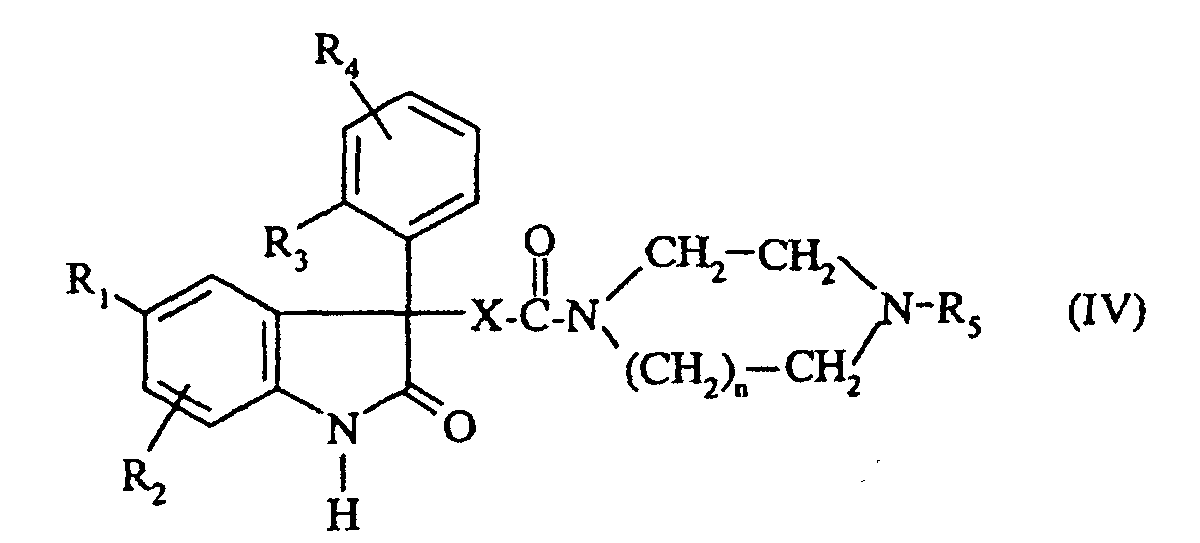 and also the salts thereof with mineral or organic acids, in the form of optically pure isomers or in the form of a mixture.n is 1 or 2;X represents a group -CH2-; -O-CH2-;R1 represents a halogen atom; a (C1-C4)alkyl; a (C1-C4)alkoxy;R2 represents a hydrogen atom; a halogen atom; a (C1-C4)alkyl; a (C1-C4)alkoxy; a trifluoromethyl radical;R3 represents a halogen atom; a (C1-C3)alkyl; a (C1-C3)alkoxy; a trifluoromethyl radical; a trifluoromethoxy radical;R4 represents a hydrogen atom; a halogen atom; a (C1-C3)alkyl; a (C1-C3)alkoxy;R5 represents a radical chosen from:

- Medicinal product, characterized in that it consists of a compound according to any one of Claims 1 to 3, or of a pharmaceutically acceptable salt thereof with mineral or organic acids, and of a pharmaceutically acceptable solvate and/or hydrate thereof.
- Pharmaceutical composition, characterized in that it comprises, as active principle, a compound according to any one of Claims 1 to 3, or a pharmaceutically acceptable salt thereof with mineral or organic acids, and a pharmaceutically acceptable solvate and/or hydrate thereof, and also one or more pharmaceutically acceptable excipients.
- Use of a compound according to any one of Claims 1 to 3, of pharmaceutically acceptable salts thereof with mineral or organic acids, and of pharmaceutically acceptable solvates and/or hydrates thereof, for the preparation of medicinal products for treating cardiovascular conditions, stress, anxiety, depression, obsessive compulsive disorder, panic attacks, complaints of the renal system, complaints of the gastric system, small-cell lung cancers, obesity, type II diabetes, insulin resistance, hypertriglyceridaemia, atherosclerosis, Cushing's syndrome, dysmenorrhoea and premature labour.
Priority Applications (1)
| Application Number | Priority Date | Filing Date | Title |
|---|---|---|---|
| SI200230136T SI1419150T1 (en) | 2001-07-17 | 2002-07-15 |
Applications Claiming Priority (3)
| Application Number | Priority Date | Filing Date | Title |
|---|---|---|---|
| FR0110359A FR2827604B1 (en) | 2001-07-17 | 2001-07-17 | NOVEL 1-PHENYLSULFONYL-1,3-DIHYDRO-2H-INDOL-2- ONE DERIVATIVES, A PROCESS FOR THEIR PREPARATION AND PHARMACEUTICAL COMPOSITIONS CONTAINING THEM |
| FR0110359 | 2001-07-17 | ||
| PCT/FR2002/002500 WO2003008407A2 (en) | 2001-07-17 | 2002-07-15 | Phenylsulfonyl-1,3-dihydro-2h-indole-2-one derivatives, their preparation and their therapeutic use |
Publications (2)
| Publication Number | Publication Date |
|---|---|
| EP1419150A2 EP1419150A2 (en) | 2004-05-19 |
| EP1419150B1 true EP1419150B1 (en) | 2005-04-27 |
Family
ID=8866211
Family Applications (1)
| Application Number | Title | Priority Date | Filing Date |
|---|---|---|---|
| EP02774822A Expired - Lifetime EP1419150B1 (en) | 2001-07-17 | 2002-07-15 | Phenylsulfonyl-1,3-dihydro-2h-indole-2-one derivatives, their preparation and their therapeutic use |
Country Status (31)
| Country | Link |
|---|---|
| US (1) | US7119086B2 (en) |
| EP (1) | EP1419150B1 (en) |
| JP (1) | JP4262088B2 (en) |
| KR (1) | KR20040017325A (en) |
| CN (1) | CN1224623C (en) |
| AR (1) | AR034792A1 (en) |
| AT (1) | ATE294171T1 (en) |
| AU (1) | AU2002340999B2 (en) |
| BR (1) | BR0211284A (en) |
| CA (1) | CA2450437A1 (en) |
| CO (1) | CO5550440A2 (en) |
| DE (1) | DE60203917T2 (en) |
| DK (1) | DK1419150T3 (en) |
| EA (1) | EA006019B1 (en) |
| ES (1) | ES2240814T3 (en) |
| FR (1) | FR2827604B1 (en) |
| HR (1) | HRP20040027A2 (en) |
| HU (1) | HUP0401461A3 (en) |
| IL (1) | IL159275A0 (en) |
| IS (1) | IS2485B (en) |
| MA (1) | MA27049A1 (en) |
| ME (1) | MEP24508A (en) |
| MX (1) | MXPA04000507A (en) |
| NO (1) | NO20040219L (en) |
| NZ (1) | NZ530144A (en) |
| PL (1) | PL366829A1 (en) |
| PT (1) | PT1419150E (en) |
| RS (1) | RS204A (en) |
| UA (1) | UA77181C2 (en) |
| WO (1) | WO2003008407A2 (en) |
| ZA (1) | ZA200309717B (en) |
Families Citing this family (55)
| Publication number | Priority date | Publication date | Assignee | Title |
|---|---|---|---|---|
| US7754711B2 (en) * | 2003-07-30 | 2010-07-13 | Xenon Pharmaceuticals Inc. | Pyridazine derivatives and their use as therapeutic agents |
| RU2259999C2 (en) * | 2003-08-26 | 2005-09-10 | ООО "Исследовательский институт химического разнообразия" | 1-sulfonyl-1,3-dihydroindole-2-ones, pharmaceutical compositions (variants), method for their preparing and applying |
| WO2005018531A2 (en) * | 2003-08-26 | 2005-03-03 | 'chemical Diversity Research Institute', Ltd. | Pharmaceutical compositions, azo-heterocyclic compounds and method for the production and use thereof |
| EP1659121A4 (en) | 2003-08-28 | 2008-11-26 | Taisho Pharmaceutical Co Ltd | D RIV OF 1,3-DIHYDRO-2H-INDOL-2-ONE |
| US20050070718A1 (en) * | 2003-09-30 | 2005-03-31 | Abbott Gmbh & Co. Kg | Heteroaryl-substituted 1,3-dihydroindol-2-one derivatives and medicaments containing them |
| US8580842B2 (en) * | 2003-09-30 | 2013-11-12 | Abbott Gmbh & Co. Kg | Heteroaryl-substituted 1,3-dihydroindol-2-one derivatives and medicaments containing them |
| AU2005237520B2 (en) | 2004-04-27 | 2012-01-19 | Wyeth | Purification of progesterone receptor modulators |
| DE102004033834A1 (en) | 2004-07-13 | 2006-02-02 | Abbott Gmbh & Co. Kg | New 1-sulfonyl-2-oxo-dihydroindole derivatives are selective antagonists of vasopressin receptors useful e.g. for treating hypertension, cardiac insufficiency, unstable angina or affective disorders |
| JPWO2006070742A1 (en) * | 2004-12-27 | 2008-08-07 | 国立大学法人京都大学 | Tolerance inhibitor for narcotic analgesics |
| JP5125501B2 (en) * | 2005-01-28 | 2013-01-23 | 大正製薬株式会社 | 1,3-dihydro-2H-indol-2-one compound and pyrrolidin-2-one compound condensed with aromatic heterocycle |
| DE102005014904A1 (en) * | 2005-03-26 | 2007-02-01 | Abbott Gmbh & Co. Kg | New substituted oxindole derivatives are vasopressin receptor binders useful to treat e.g. diabetes insipidus, enuresis nocturna, incontinence, hypertonia, heart failure, myocardial infarction, coronary spasm and renal disorders |
| EP1861392A2 (en) | 2005-03-24 | 2007-12-05 | Abbott GmbH & Co. KG | Substituted oxindol derivatives, drugs containing said derivatives and the use thereof |
| DE102005014936A1 (en) * | 2005-03-24 | 2006-12-14 | Abbott Gmbh & Co. Kg | New substituted oxindole derivatives are vasopressin receptor binders useful to treat e.g. diabetes insipidus, enuresis nocturna, incontinence, hypertonia, heart failure, myocardial infarction, coronary spasm and renal disorders |
| US7576082B2 (en) | 2005-06-24 | 2009-08-18 | Hoffman-La Roche Inc. | Oxindole derivatives |
| SG132540A1 (en) | 2005-11-25 | 2007-06-28 | Matsushita Electric Industrial Co Ltd | Magnetic trap for ferrous contaminants in lubricant |
| WO2007063123A1 (en) | 2005-12-02 | 2007-06-07 | Abbott Gmbh & Co. Kg | Substituted oxindol-derivatives, medicaments containing said derivatives and use thereof |
| CN101528712B (en) * | 2006-08-26 | 2013-10-30 | Abbvie德国有限责任两合公司 | Substituted benzimidazolone derivatives, medicaments comprising them and uses thereof |
| DE102006040915A1 (en) * | 2006-08-26 | 2008-03-20 | Abbott Gmbh & Co. Kg | New oxindole derivatives useful for treating vasopressin- or oxytocin-dependent diseases |
| US20080167286A1 (en) | 2006-12-12 | 2008-07-10 | Abbott Laboratories | Pharmaceutical compositions and their methods of use |
| US8486979B2 (en) * | 2006-12-12 | 2013-07-16 | Abbvie Inc. | 1,2,4 oxadiazole compounds and methods of use thereof |
| CL2007003878A1 (en) * | 2006-12-30 | 2008-07-04 | Basf Ag | COMPOUNDS DERIVED FROM 2-OXO-INDOL REPLACED, VASOPRESIN RECEPTOR MODULATORS; PREPARATION PROCESS; PHARMACEUTICAL COMPOSITION; AND USE IN THE TREATMENT AND / OR PROFILAXIS OF DISEASES SUCH AS DIABETES, INSULIN RESISTANCE, INCONTIN |
| UY30846A1 (en) | 2006-12-30 | 2008-07-31 | Abbott Gmbh & Amp | OXINDOL DERIVATIVES REPLACED, MEDICINES THAT UNDERSTAND AND USE THEMSELVES |
| WO2008107399A1 (en) * | 2007-03-02 | 2008-09-12 | Abbott Gmbh & Co. Kg | Substituted oxindole compounds |
| FR2920023B1 (en) * | 2007-08-16 | 2013-02-08 | Sanofi Aventis | 3-DISUBSTITUTED INDOL-2-ONE DERIVATIVES, THEIR PREPARATION AND THERAPEUTIC USE THEREOF |
| BRPI0820668A2 (en) * | 2007-12-07 | 2017-08-22 | Abbott Gmbh & Co Kg | 5-HALOGEN SUBSTITUTED OXINDOL DERIVATIVES AND THEIR USE TO TREAT VASOPRESSIN DEPENDENT DISEASES |
| CA2707667C (en) * | 2007-12-07 | 2016-02-23 | Abbott Gmbh & Co. Kg | Amidomethyl-substituted oxindole derivatives and the use thereof for the treatment of vasopressin-dependent illnesses |
| ES2455197T3 (en) | 2007-12-07 | 2014-04-14 | Abbvie Deutschland Gmbh & Co Kg | 5,6-disubstituted oxindole derivatives and their use for the preparation of a medicine for the treatment of vasopressin-dependent diseases |
| WO2009071691A2 (en) * | 2007-12-07 | 2009-06-11 | Abbott Gmbh & Co. Kg | Oxindole derivatives and the use thereof as a medication |
| WO2010009775A1 (en) * | 2007-12-07 | 2010-01-28 | Abbott Gmbh & Co. Kg | Carbamate-substituted oxindole derivatives and use thereof for the treatment of vasopressin-dependent diseases |
| CA2710946C (en) * | 2007-12-27 | 2016-05-31 | Abbott Gmbh & Co. Kg | Substituted oxindole-derivatives and the use thereof for the treatment of vasopressin-dependent illnesses |
| FR2927625B1 (en) | 2008-02-19 | 2010-03-12 | Sanofi Aventis | NOVEL 3-AMINOALKYL-1,3-DIHYDRO-2H-INDOL-2-ONE DERIVATIVES, THEIR PREPARATION AND THEIR THERAPEUTIC USE |
| FR2930249B1 (en) * | 2008-04-21 | 2010-05-14 | Sanofi Aventis | NOVEL 3-AMINOALKYL-1,3-DIHYDRO-2H-INDOL-2-ONE DERIVATIVES, THEIR PREPARATION AND THERAPEUTIC USE THEREOF |
| WO2010017827A1 (en) * | 2008-08-14 | 2010-02-18 | European Molecular Biology Laboratory | 6-substituted 1-sulfonyl-2, 3-dihydro-indole derivatives for the treatment of proliferative diseases |
| PT2349324T (en) | 2008-10-17 | 2017-12-06 | Sanofi Aventis Deutschland | Combination of an insulin and a glp-1 agonist |
| FR2941946B1 (en) * | 2009-02-12 | 2011-03-25 | Sanofi Aventis | SUBSTITUTED 3-BENZOFURANYL-INDOL-2-ONE-3-ACETAMIDOPIPERAZINE DERIVATIVES, THEIR PREPARATION AND THEIR THERAPEUTIC USE |
| FR2941947B1 (en) | 2009-02-12 | 2011-03-25 | Sanofi Aventis | 3-BENZOFURANYL-INDOL-2-ONE 3-DERIVED DERIVATIVES, THEIR PREPARATION AND THEIR THERAPEUTIC APPLICATION |
| US9040568B2 (en) | 2009-05-29 | 2015-05-26 | Abbvie Inc. | Pharmaceutical compositions for the treatment of pain |
| WO2010142739A1 (en) * | 2009-06-10 | 2010-12-16 | Abbott Gmbh & Co. Kg | Use of substituted oxindole derivatives for the treatment and prophylaxis of pain |
| WO2011058083A1 (en) | 2009-11-13 | 2011-05-19 | Sanofi-Aventis Deutschland Gmbh | Pharmaceutical composition comprising a glp-1 agonist, an insulin, and methionine |
| SG10201500871TA (en) | 2009-11-13 | 2015-04-29 | Sanofi Aventis Deutschland | Pharmaceutical composition comprising a glp-1 agonist and methionine |
| US8088815B2 (en) | 2009-12-02 | 2012-01-03 | Hoffman-La Roche Inc. | Spiroindolinone pyrrolidines |
| US8288431B2 (en) | 2010-02-17 | 2012-10-16 | Hoffmann-La Roche Inc. | Substituted spiroindolinones |
| US8217044B2 (en) | 2010-04-28 | 2012-07-10 | Hoffmann-La Roche Inc. | Spiroindolinone pyrrolidines |
| AU2011202239C1 (en) | 2010-05-19 | 2017-03-16 | Sanofi | Long-acting formulations of insulins |
| RS55378B1 (en) | 2010-08-30 | 2017-03-31 | Sanofi Aventis Deutschland | USE OF AVE0010 FOR MANUFACTURE OF TREATMENT OF DIABETES MELLITUS TYPE 2 |
| TWI527807B (en) | 2010-12-21 | 2016-04-01 | 拜耳智慧財產有限公司 | Method for preparing N-sulfonyl substituted anthrone |
| US9821032B2 (en) | 2011-05-13 | 2017-11-21 | Sanofi-Aventis Deutschland Gmbh | Pharmaceutical combination for improving glycemic control as add-on therapy to basal insulin |
| HRP20151068T1 (en) | 2011-08-29 | 2016-01-01 | Sanofi-Aventis Deutschland Gmbh | Pharmaceutical combination for use in glycemic control in diabetes type 2 patients |
| AR087744A1 (en) | 2011-09-01 | 2014-04-16 | Sanofi Aventis Deutschland | PHARMACEUTICAL COMPOSITION FOR USE IN THE TREATMENT OF A NEURODEGENERATIVE DISEASE |
| AU2014247167B2 (en) | 2013-04-03 | 2018-11-22 | Sanofi | Treatment of diabetes mellitus by long–acting formulations of insulins |
| TWI758239B (en) | 2014-12-12 | 2022-03-21 | 德商賽諾菲阿凡提斯德意志有限公司 | Insulin glargine/lixisenatide fixed ratio formulation |
| TWI748945B (en) | 2015-03-13 | 2021-12-11 | 德商賽諾菲阿凡提斯德意志有限公司 | Treatment type 2 diabetes mellitus patients |
| TW201705975A (en) | 2015-03-18 | 2017-02-16 | 賽諾菲阿凡提斯德意志有限公司 | Treatment of type 2 diabetes mellitus patients |
| EP3912625A1 (en) * | 2020-05-20 | 2021-11-24 | Kaerus Bioscience Limited | Novel maxi-k potassium channel openers for the treatment of fragile x associated disorders |
| KR20230090589A (en) * | 2021-12-15 | 2023-06-22 | 국립해양생물자원관 | Peptide derived from sea urchin and uses thereof |
Family Cites Families (3)
| Publication number | Priority date | Publication date | Assignee | Title |
|---|---|---|---|---|
| FR2714378B1 (en) * | 1993-12-24 | 1996-03-15 | Sanofi Sa | Indol-2-one derivatives substituted in 3 with a nitrogen group, their preparation, pharmaceutical compositions containing them. |
| GB2326639A (en) * | 1997-06-18 | 1998-12-30 | Merck & Co Inc | Piperazine Oxytocin Receptor Antagonists |
| US20050070718A1 (en) * | 2003-09-30 | 2005-03-31 | Abbott Gmbh & Co. Kg | Heteroaryl-substituted 1,3-dihydroindol-2-one derivatives and medicaments containing them |
-
2001
- 2001-07-17 FR FR0110359A patent/FR2827604B1/en not_active Expired - Fee Related
-
2002
- 2002-07-15 CA CA002450437A patent/CA2450437A1/en not_active Abandoned
- 2002-07-15 WO PCT/FR2002/002500 patent/WO2003008407A2/en not_active Ceased
- 2002-07-15 IL IL15927502A patent/IL159275A0/en unknown
- 2002-07-15 HU HU0401461A patent/HUP0401461A3/en unknown
- 2002-07-15 US US10/484,370 patent/US7119086B2/en not_active Expired - Fee Related
- 2002-07-15 EP EP02774822A patent/EP1419150B1/en not_active Expired - Lifetime
- 2002-07-15 PT PT02774822T patent/PT1419150E/en unknown
- 2002-07-15 ES ES02774822T patent/ES2240814T3/en not_active Expired - Lifetime
- 2002-07-15 KR KR10-2004-7000787A patent/KR20040017325A/en not_active Abandoned
- 2002-07-15 HR HR20040027A patent/HRP20040027A2/en not_active Application Discontinuation
- 2002-07-15 EA EA200301306A patent/EA006019B1/en not_active IP Right Cessation
- 2002-07-15 PL PL02366829A patent/PL366829A1/en not_active Application Discontinuation
- 2002-07-15 MX MXPA04000507A patent/MXPA04000507A/en active IP Right Grant
- 2002-07-15 CN CNB028142624A patent/CN1224623C/en not_active Expired - Fee Related
- 2002-07-15 JP JP2003513966A patent/JP4262088B2/en not_active Expired - Fee Related
- 2002-07-15 NZ NZ530144A patent/NZ530144A/en not_active IP Right Cessation
- 2002-07-15 AU AU2002340999A patent/AU2002340999B2/en not_active Ceased
- 2002-07-15 AT AT02774822T patent/ATE294171T1/en active
- 2002-07-15 BR BR0211284-1A patent/BR0211284A/en not_active IP Right Cessation
- 2002-07-15 DK DK02774822T patent/DK1419150T3/en active
- 2002-07-15 ME MEP-245/08A patent/MEP24508A/en unknown
- 2002-07-15 UA UA20031212069A patent/UA77181C2/en unknown
- 2002-07-15 RS YU204A patent/RS204A/en unknown
- 2002-07-15 DE DE60203917T patent/DE60203917T2/en not_active Expired - Lifetime
- 2002-07-16 AR ARP020102655A patent/AR034792A1/en unknown
-
2003
- 2003-12-15 IS IS7079A patent/IS2485B/en unknown
- 2003-12-15 ZA ZA200309717A patent/ZA200309717B/en unknown
-
2004
- 2004-01-09 MA MA27476A patent/MA27049A1/en unknown
- 2004-01-14 CO CO04002002A patent/CO5550440A2/en not_active Application Discontinuation
- 2004-01-16 NO NO20040219A patent/NO20040219L/en not_active Application Discontinuation
Also Published As
Similar Documents
| Publication | Publication Date | Title |
|---|---|---|
| EP1419150B1 (en) | Phenylsulfonyl-1,3-dihydro-2h-indole-2-one derivatives, their preparation and their therapeutic use | |
| EP1255751B1 (en) | 1,3-dihydro-2h-indol-2-one derivatives and their use as ligands for v1b or v1b and v1a arginine-vasopressin receptors | |
| EP1296976B1 (en) | Novel 1,3-dihydro-2h-indol-one derivatives, method for preparing same and pharmaceutical compositions containing them | |
| EP1254134B1 (en) | 1,3-dihydro-2h-indol-2-one derivatives,and their use as ligands for v1b or v1b and v1a arginine-vasopressin-receptors | |
| EP1259505B1 (en) | Novel 1,3-dihydro-2h-indol-2-one, preparation method and pharmaceutical compositions containing same | |
| EP2265582B1 (en) | Novel 3-aminoalkyl-1,3-dihydro-2h-indol-2-one derivatives, preparation thereof and therapeutic use thereof. | |
| FR2722190A1 (en) | 1-BENZYL-1,3-DIHYDRO-2H-BENZIMIDAZOL-2-ONE DERIVATIVES, THEIR PREPARATION, PHARMACEUTICAL COMPOSITIONS CONTAINING THEM | |
| FR2930249A1 (en) | NOVEL 3-AMINOALKYL-1,3-DIHYDRO-2H-INDOL-2-ONE DERIVATIVES, THEIR PREPARATION AND THERAPEUTIC USE THEREOF | |
| EP1525198A2 (en) | Acyloxypyrrolidine derivatives, preparation and therapeutic use thereof | |
| HK1061679B (en) | Phenylsulfonyl-1,3-dihydro-2h-indole-2-one derivatives, their preparation and their therapeutic use |
Legal Events
| Date | Code | Title | Description |
|---|---|---|---|
| PUAI | Public reference made under article 153(3) epc to a published international application that has entered the european phase |
Free format text: ORIGINAL CODE: 0009012 |
|
| AK | Designated contracting states |
Kind code of ref document: A2 Designated state(s): AT BE BG CH CY CZ DE DK EE ES FI FR GB GR IE IT LI LU MC NL PT SE SK TR |
|
| AX | Request for extension of the european patent |
Extension state: AL LT LV MK RO SI |
|
| 17P | Request for examination filed |
Effective date: 20040416 |
|
| GRAP | Despatch of communication of intention to grant a patent |
Free format text: ORIGINAL CODE: EPIDOSNIGR1 |
|
| REG | Reference to a national code |
Ref country code: HK Ref legal event code: DE Ref document number: 1061679 Country of ref document: HK |
|
| RAP1 | Party data changed (applicant data changed or rights of an application transferred) |
Owner name: SANOFI-AVENTIS |
|
| GRAS | Grant fee paid |
Free format text: ORIGINAL CODE: EPIDOSNIGR3 |
|
| GRAA | (expected) grant |
Free format text: ORIGINAL CODE: 0009210 |
|
| AK | Designated contracting states |
Kind code of ref document: B1 Designated state(s): AT BE BG CH CY CZ DE DK EE ES FI FR GB GR IE IT LI LU MC NL PT SE SK TR |
|
| AX | Request for extension of the european patent |
Extension state: AL LT LV MK RO SI |
|
| REG | Reference to a national code |
Ref country code: GB Ref legal event code: FG4D Free format text: NOT ENGLISH |
|
| REG | Reference to a national code |
Ref country code: CH Ref legal event code: EP |
|
| REG | Reference to a national code |
Ref country code: IE Ref legal event code: FG4D Free format text: LANGUAGE OF EP DOCUMENT: FRENCH |
|
| REF | Corresponds to: |
Ref document number: 60203917 Country of ref document: DE Date of ref document: 20050602 Kind code of ref document: P |
|
| REG | Reference to a national code |
Ref country code: HK Ref legal event code: GR Ref document number: 1061679 Country of ref document: HK |
|
| REG | Reference to a national code |
Ref country code: EE Ref legal event code: FG4A Ref document number: E000090 Country of ref document: EE Effective date: 20050621 |
|
| REG | Reference to a national code |
Ref country code: SE Ref legal event code: TRGR |
|
| GBT | Gb: translation of ep patent filed (gb section 77(6)(a)/1977) |
Effective date: 20050726 |
|
| REG | Reference to a national code |
Ref country code: DK Ref legal event code: T3 |
|
| REG | Reference to a national code |
Ref country code: PT Ref legal event code: SC4A Effective date: 20050627 Ref country code: GR Ref legal event code: EP Ref document number: 20050402288 Country of ref document: GR |
|
| REG | Reference to a national code |
Ref country code: ES Ref legal event code: FG2A Ref document number: 2240814 Country of ref document: ES Kind code of ref document: T3 |
|
| PLBE | No opposition filed within time limit |
Free format text: ORIGINAL CODE: 0009261 |
|
| STAA | Information on the status of an ep patent application or granted ep patent |
Free format text: STATUS: NO OPPOSITION FILED WITHIN TIME LIMIT |
|
| 26N | No opposition filed |
Effective date: 20060130 |
|
| PGFP | Annual fee paid to national office [announced via postgrant information from national office to epo] |
Ref country code: CY Payment date: 20100625 Year of fee payment: 9 |
|
| PGFP | Annual fee paid to national office [announced via postgrant information from national office to epo] |
Ref country code: CZ Payment date: 20110616 Year of fee payment: 10 Ref country code: MC Payment date: 20110629 Year of fee payment: 10 Ref country code: GR Payment date: 20110610 Year of fee payment: 10 Ref country code: TR Payment date: 20110627 Year of fee payment: 10 |
|
| PGFP | Annual fee paid to national office [announced via postgrant information from national office to epo] |
Ref country code: EE Payment date: 20110615 Year of fee payment: 10 Ref country code: SK Payment date: 20110616 Year of fee payment: 10 Ref country code: LU Payment date: 20110718 Year of fee payment: 10 Ref country code: BG Payment date: 20110616 Year of fee payment: 10 |
|
| PGFP | Annual fee paid to national office [announced via postgrant information from national office to epo] |
Ref country code: FR Payment date: 20110727 Year of fee payment: 10 Ref country code: DK Payment date: 20110712 Year of fee payment: 10 Ref country code: CH Payment date: 20110712 Year of fee payment: 10 Ref country code: IE Payment date: 20110712 Year of fee payment: 10 |
|
| PGFP | Annual fee paid to national office [announced via postgrant information from national office to epo] |
Ref country code: DE Payment date: 20110713 Year of fee payment: 10 Ref country code: GB Payment date: 20110713 Year of fee payment: 10 Ref country code: PT Payment date: 20110713 Year of fee payment: 10 Ref country code: SE Payment date: 20110712 Year of fee payment: 10 Ref country code: AT Payment date: 20110628 Year of fee payment: 10 Ref country code: ES Payment date: 20110817 Year of fee payment: 10 Ref country code: FI Payment date: 20110712 Year of fee payment: 10 |
|
| PGFP | Annual fee paid to national office [announced via postgrant information from national office to epo] |
Ref country code: NL Payment date: 20110715 Year of fee payment: 10 Ref country code: BE Payment date: 20110712 Year of fee payment: 10 |
|
| BERE | Be: lapsed |
Owner name: *SANOFI-AVENTIS Effective date: 20120731 |
|
| REG | Reference to a national code |
Ref country code: DE Ref legal event code: R119 Ref document number: 60203917 Country of ref document: DE |
|
| REG | Reference to a national code |
Ref country code: DE Ref legal event code: R082 Ref document number: 60203917 Country of ref document: DE Representative=s name: MAIWALD PATENTANWALTSGESELLSCHAFT MBH, DE |
|
| REG | Reference to a national code |
Ref country code: NL Ref legal event code: V1 Effective date: 20130201 |
|
| REG | Reference to a national code |
Ref country code: LT Ref legal event code: MM9D Effective date: 20120715 |
|
| PG25 | Lapsed in a contracting state [announced via postgrant information from national office to epo] |
Ref country code: MC Free format text: LAPSE BECAUSE OF NON-PAYMENT OF DUE FEES Effective date: 20120731 |
|
| REG | Reference to a national code |
Ref country code: CH Ref legal event code: PL |
|
| REG | Reference to a national code |
Ref country code: GR Ref legal event code: ML Ref document number: 20050402288 Country of ref document: GR Effective date: 20130104 |
|
| REG | Reference to a national code |
Ref country code: SE Ref legal event code: EUG |
|
| REG | Reference to a national code |
Ref country code: AT Ref legal event code: MM01 Ref document number: 294171 Country of ref document: AT Kind code of ref document: T Effective date: 20120715 |
|
| GBPC | Gb: european patent ceased through non-payment of renewal fee |
Effective date: 20120715 |
|
| REG | Reference to a national code |
Ref country code: DE Ref legal event code: R081 Ref document number: 60203917 Country of ref document: DE Owner name: SANOFI-AVENTIS, FR Free format text: FORMER OWNER: SANOFI-AVENTIS, PARIS, FR Effective date: 20130205 Ref country code: DE Ref legal event code: R081 Ref document number: 60203917 Country of ref document: DE Owner name: SANOFI, FR Free format text: FORMER OWNER: SANOFI-AVENTIS, PARIS, FR Effective date: 20130205 Ref country code: DE Ref legal event code: R082 Ref document number: 60203917 Country of ref document: DE Representative=s name: MAIWALD PATENTANWALTSGESELLSCHAFT MBH, DE Effective date: 20130205 |
|
| REG | Reference to a national code |
Ref country code: SI Ref legal event code: KO00 Effective date: 20130219 |
|
| REG | Reference to a national code |
Ref country code: DK Ref legal event code: EBP |
|
| REG | Reference to a national code |
Ref country code: SK Ref legal event code: MM4A Ref document number: E 180 Country of ref document: SK Effective date: 20120715 |
|
| REG | Reference to a national code |
Ref country code: EE Ref legal event code: MM4A Ref document number: E000090 Country of ref document: EE Effective date: 20120731 |
|
| REG | Reference to a national code |
Ref country code: FR Ref legal event code: ST Effective date: 20130329 |
|
| PG25 | Lapsed in a contracting state [announced via postgrant information from national office to epo] |
Ref country code: CH Free format text: LAPSE BECAUSE OF NON-PAYMENT OF DUE FEES Effective date: 20120731 Ref country code: GB Free format text: LAPSE BECAUSE OF NON-PAYMENT OF DUE FEES Effective date: 20120715 Ref country code: FR Free format text: LAPSE BECAUSE OF NON-PAYMENT OF DUE FEES Effective date: 20120731 Ref country code: NL Free format text: LAPSE BECAUSE OF NON-PAYMENT OF DUE FEES Effective date: 20130201 Ref country code: SE Free format text: LAPSE BECAUSE OF NON-PAYMENT OF DUE FEES Effective date: 20120716 Ref country code: EE Free format text: LAPSE BECAUSE OF NON-PAYMENT OF DUE FEES Effective date: 20120731 Ref country code: LI Free format text: LAPSE BECAUSE OF NON-PAYMENT OF DUE FEES Effective date: 20120731 Ref country code: CZ Free format text: LAPSE BECAUSE OF NON-PAYMENT OF DUE FEES Effective date: 20120715 Ref country code: FI Free format text: LAPSE BECAUSE OF NON-PAYMENT OF DUE FEES Effective date: 20120715 Ref country code: DE Free format text: LAPSE BECAUSE OF NON-PAYMENT OF DUE FEES Effective date: 20130201 |
|
| REG | Reference to a national code |
Ref country code: IE Ref legal event code: MM4A |
|
| REG | Reference to a national code |
Ref country code: DE Ref legal event code: R119 Ref document number: 60203917 Country of ref document: DE Effective date: 20130201 |
|
| PG25 | Lapsed in a contracting state [announced via postgrant information from national office to epo] |
Ref country code: BE Free format text: LAPSE BECAUSE OF NON-PAYMENT OF DUE FEES Effective date: 20120731 Ref country code: GR Free format text: LAPSE BECAUSE OF NON-PAYMENT OF DUE FEES Effective date: 20130204 Ref country code: PT Free format text: LAPSE BECAUSE OF NON-PAYMENT OF DUE FEES Effective date: 20130115 Ref country code: CY Free format text: LAPSE BECAUSE OF NON-PAYMENT OF DUE FEES Effective date: 20120715 Ref country code: IT Free format text: LAPSE BECAUSE OF NON-PAYMENT OF DUE FEES Effective date: 20120715 Ref country code: SK Free format text: LAPSE BECAUSE OF NON-PAYMENT OF DUE FEES Effective date: 20120715 |
|
| PG25 | Lapsed in a contracting state [announced via postgrant information from national office to epo] |
Ref country code: AT Free format text: LAPSE BECAUSE OF NON-PAYMENT OF DUE FEES Effective date: 20120715 |
|
| PG25 | Lapsed in a contracting state [announced via postgrant information from national office to epo] |
Ref country code: IE Free format text: LAPSE BECAUSE OF NON-PAYMENT OF DUE FEES Effective date: 20120715 Ref country code: DK Free format text: LAPSE BECAUSE OF NON-PAYMENT OF DUE FEES Effective date: 20120731 |
|
| REG | Reference to a national code |
Ref country code: PT Ref legal event code: MM4A Free format text: LAPSE DUE TO NON-PAYMENT OF FEES Effective date: 20130115 |
|
| REG | Reference to a national code |
Ref country code: ES Ref legal event code: FD2A Effective date: 20131021 |
|
| PG25 | Lapsed in a contracting state [announced via postgrant information from national office to epo] |
Ref country code: ES Free format text: LAPSE BECAUSE OF NON-PAYMENT OF DUE FEES Effective date: 20120716 |
|
| PGFP | Annual fee paid to national office [announced via postgrant information from national office to epo] |
Ref country code: IT Payment date: 20130726 Year of fee payment: 11 |
|
| PGRI | Patent reinstated in contracting state [announced from national office to epo] |
Ref country code: IT Effective date: 20130901 |
|
| PG25 | Lapsed in a contracting state [announced via postgrant information from national office to epo] |
Ref country code: LU Free format text: LAPSE BECAUSE OF NON-PAYMENT OF DUE FEES Effective date: 20120715 Ref country code: TR Free format text: LAPSE BECAUSE OF NON-PAYMENT OF DUE FEES Effective date: 20120715 |
|
| PGRI | Patent reinstated in contracting state [announced from national office to epo] |
Ref country code: IT Effective date: 20130901 |
|
| PG25 | Lapsed in a contracting state [announced via postgrant information from national office to epo] |
Ref country code: BG Free format text: LAPSE BECAUSE OF NON-PAYMENT OF DUE FEES Effective date: 20120731 |