EP1403778A1 - Adaptive multimedia integration language (AMIL) for adaptive multimedia applications and presentations - Google Patents
Adaptive multimedia integration language (AMIL) for adaptive multimedia applications and presentations Download PDFInfo
- Publication number
- EP1403778A1 EP1403778A1 EP20020021908 EP02021908A EP1403778A1 EP 1403778 A1 EP1403778 A1 EP 1403778A1 EP 20020021908 EP20020021908 EP 20020021908 EP 02021908 A EP02021908 A EP 02021908A EP 1403778 A1 EP1403778 A1 EP 1403778A1
- Authority
- EP
- European Patent Office
- Prior art keywords
- module
- adaptation
- media
- attribute
- describing
- Prior art date
- Legal status (The legal status is an assumption and is not a legal conclusion. Google has not performed a legal analysis and makes no representation as to the accuracy of the status listed.)
- Withdrawn
Links
Images


Classifications
-
- G—PHYSICS
- G06—COMPUTING OR CALCULATING; COUNTING
- G06F—ELECTRIC DIGITAL DATA PROCESSING
- G06F16/00—Information retrieval; Database structures therefor; File system structures therefor
- G06F16/40—Information retrieval; Database structures therefor; File system structures therefor of multimedia data, e.g. slideshows comprising image and additional audio data
- G06F16/43—Querying
- G06F16/438—Presentation of query results
- G06F16/4387—Presentation of query results by the use of playlists
- G06F16/4393—Multimedia presentations, e.g. slide shows, multimedia albums
Definitions
- the underlying invention generally relates to the field of markup languages used to describe adaptive mobile multimedia applications and/or presentations being inherently dependent on the continuously changing environment they are running in, which means that these mobile multimedia applications and/or presentations need to be adapted to the preferences of mobile users, the capabilities of their mobile computing devices, and the users physical impact like current location, time or temperature.
- Adaptive Multimedia Support Environment is a platform, which supports adaptive distributed multimedia retrieval applications.
- the platform consists of three parts, a client-side middleware, a multimedia application built on top of the middleware, and a server-side context-aware mobile portal.
- the focus of the underlying invention is the document-based approach in the way that adaptive mobile applications and/or presentations are described with an XML-based document, generated by a server-side authoring system (represented by the context-aware mobile portal), processed and rendered by client-side middleware, capable of executing the processing of the XML-based document description.
- a multimedia application can be quite specific, implemented for a specifically defined scenario, and the application itself might be adjustable by a configuration file, which is quite good for a specific, narrowed scenario.
- the second way would be to describe a multimedia application in a document-based way and let a browser or player interpret the document, which is done e.g. in "Synchronized Multimedia Integration Language” (SMIL, cf. SMIL 2.0, W3C Recommendation, 7 August, 2001, http://www.w3.org/TR/smil20/), and is a more general approach. In the scope of the underlying invention, the latter has been applied.
- multimedia document models such as Hypertext Markup Language (HTML), Dynamic HTML (DHTML), Multimedia and Hypermedia Information Coding Expert Group (MHEG, cf. International Organization for Standardization, ISO/IEC JTC1/SC29/WG12, http://www.mheg.org/), SMIL and HyTime (cf. Users' Group Home Page www.hytime.org) have been evaluated in order to use or extend their document models for describing adaptive multimedia applications.
- HTML Hypertext Markup Language
- DHTML Dynamic HTML
- MHEG Multimedia and Hypermedia Information Coding Expert Group
- MHEG Multimedia Information Coding Expert Group
- the environmental changes can be categorized into three different dimensions: network QoS, mobile device capabilities, and user context.
- a mobile application has to cope with changes in all three dimensions.
- the term "situation" is used for a given network QoS, mobile device capabilities and user context.
- a situation can be characterized by a set of parameters describing different aspects of the environment.
- the "current situation” is the situation, which exists at present for a mobile application. If the current situation causes a problem for the application or if it allows the application to improve its service, the application may change its behavior to better reflect said current situation. As this is true for all mobile applications, the situation is especially interesting when looking at multimedia applications, as those have very tough requirements, especially concerning Quality-of-Service (QoS) conditions of the applied network.
- QoS Quality-of-Service
- the multimedia applications can e.g. be retrieved from specific content providers via mobile networks to the preferences of mobile users, the capabilities of their mobile devices and different application scenarios.
- the AMUSE document model is invented due the fact that state-of-the-art document models do not, or only to some extend, consider the adaptation aspect in a way required if a document-based application runs in a highly dynamic environment.
- the AMIL document model 100 is the link between a technique regarding the authoring process of a mobile adaptive multimedia application and an AMIL player, which is doing the processing of an AMIL document 2402.
- the AMIL player can be split up into two separate components - a browser and a supporting "client-side middleware".
- client-side middleware In the scope of the underlying invention, these expression are used in the following way:
- the browser which is also named "Multimedia Browser”, executes presentation related functions and user interaction 404; whereas the "client-side middleware" provides the functionality for executing the adaptation process.
- the adaptive document model 100 can be split up into different modules according to their functionality. This enables the reuse of specific modules as an extension to other document models 100.
- the example 1700 depicted in Fig. 17 explains the reuse of complete AMIL documents. Relationships between these modules are realized by linking elements together.
- the AMIL document model 100 supports a "Main Module” 102, which simply serves as a container for all others modules.
- the "Main Module” 102 itself does not provide any further functionality; it serves logically as an overall aggregation/container module.
- Each module is described in the following way: First, a table containing an Unified Modeling Language (UML) diagram and an Extensible Markup Language (XML) Schema description 700 is shown, and second, the meaning/semantic of each element and attribute is explained in detail. In case a clear separation to similar concepts is necessary, the differences are set down after the explanation of each element's or attribute's semantic.
- UML Unified Modeling Language
- XML Extensible Markup Language
- the "Core Module” 104 encompasses all module required in each AMIL document 2402.
- the Extension Module 114 can optionally be used for a more comprehensive description of the adaptation processes.
- Fig. 1 gives a survey of the modules proposed by the AMIL document model 100.
- UML grouping things
- every module is described by a “package” as described in "The Unified Modeling Language” (User Guide, ISBN 0-201-57168-4) by G. Booch, J. Rumbaugh, and I. Jacobson.
- the AMIL "Structure Module” 112 reflects the fundamental structure of an AMIL document 2402. Like XHTML, it splits up the document into two sections - a "head module” section 202 containing the declaration of the layout 3702, used media items 304, interactions 404, and e.g. constraints 802 as well as a "body module” section 204 focusing on the adaptation aspect where the intrinsic adaptation possibilities 1500 are described.
- the "amil” element is the outermost element that contains all others.
- This element can be preceded and followed by comments and processing instructions, but can not be preceded by other elements or text nodes.
- "id” attribute Used according to XML as an identifier, for referencing the whole AMIL document 2402.
- version Used to identify the version of the AMIL document model 100.
- body module 204
- the AMIL "Layout Module” 106 is taken on from the SMIL Layout Module as described in "Synchronized Multimedia Integration Language” (SMIL 2.0, W3C Recommendation, 7 August, 2001, http://www.w3.org/TR/smil20/). Thereby, the elements “smil:layout”, “smil:region”, and “smil:root-layout” are supported. Detailed information can be found in the SMIL documentation "The SMIL 2.0 Layout Modules" (http://www.w3.org/TR/smil20/layout.html).
- the element "smil:region” is taken over from the SMIL document model. Its attribute “smil:fill” is extended in order to consider the aspect of size adaptation. The state-of-the-art usage of this attribute is to specify the behavior if the intrinsic height/width of a media item 304 is not equal to the dimension of a region 502.
- a region 502 can be used by different media items 304 during playing back a multimedia presentation, which means that media items 304 with different formats 600 are displayed in a region 502 with a well-defined dimension. Therefore, new attribute values for the attribute "smil:fill" are specified.
- the problem is that scaling the visual size of a media requires, under certain circumstance, a lot of CPU power. Especially up-scaling is a quite expensive operation. Down-scaling also takes CPU power, but not as much as scaling up.
- a further characteristic in AMIL is that a region 502 can be used by many media items 304, which can support different formats 600 - e.g. the Common Intermediate Format (CIF), or Quarter CIF (QCIF). At a specific scaling factor, a replacement of a media does make more sense than scaling a media "endless" down.
- CIF Common Intermediate Format
- QCIF Quarter CIF
- An adaptive multimedia application has somehow to describe all possible used media.
- a media might be replaced by a different one, with different properties.
- the "MediaItems Module” 108 serves as a description 700 unit for all, in a specific multimedia application, available media items 304.
- the content of a media item 304 can be different, dependent on the characteristics of the media item 304 itself. In general, it can be differentiated between the following two categories:
- every media item 304 can have meta information about itself as a part of its content model.
- Supported languages “Resource Description Framework” (RDF) as described in “RDF Model and Syntax Specification” (W3C Recommendation, 22 February, 1999, http://www.w3.org/TR/REC-rdf-syntax/) or Session Description Protocol Next Generation (SDPng) as described in “Session Description and Capability Negotiation” (IETF Internet Draft, work in progress, Bormann University Bremen, 21 November, 2001, ⁇ draft-ietf-mmusic-sdpng-03.txt>) by D. Kutscher et al.
- the “mediaitems” element 303 is the outermost element of the "MediaItems Module 108". It serves logically as a container for all media items 304 used in an AMIL document 2402. "id" attribute: Used according to XML as an identifier for referencing the whole "MediaItems Module” 108.
- a media item 304 is an abstraction for different kinds of media. It is distinguished between discrete media items 304 and continuous media items 304 (the latter representing time-based media).
- An element "mediaitem” 304 as a child of the element “mediaitems” 303, is used to describe the properties/characteristics of a media item 304, like e.g. the location of the content and meta information.
- "id" attribute It is used according to XML as an identifier for referencing the media item 304 by the element "mediaitem” 304. The identifier "mediaitem” is used
- the content model of the element "mediaitem” 304 is defined in a way that it accepts documents (or document fragments), which are document instances of Extensible Hypertext Markup Language (XHTML), Scalable Vector Graphics (SVG), Session Description Protocol Next Generation (SDPng), or Resource Description Framework (RDF).
- documents or document fragments
- XHTML Extensible Hypertext Markup Language
- SVG Scalable Vector Graphics
- SDPng Session Description Protocol Next Generation
- RDF Resource Description Framework
- the content model of the element "mediaitem” 304 is defined in a way that it accepts documents (or document fragments), which are document instances of Extensible Hypertext Markup Language (XHTML), Scalable Vector Graphics (SVG), Session Description Protocol Next Generation (SDPng), or Resource Description Framework (RDF).
- documents or document fragments
- XHTML Extensible Hypertext Markup Language
- SVG Scalable Vector Graphics
- SDPng Session Description Protocol Next Generation
- RDF Resource Description Framework
- interaction 404 is a quite important mechanism to embrace the user and adapt to its personal preferences and the mobile device characteristics.
- the "Interactions Module" 110 specifies what kind of control elements is used in the application, its location and its start-up parameters.
- the “widgets” element 402 is the outermost element of the Interactions Module 110. It serves logically as a container for all widget element 404s used in the AMIL document 2402.
- "id” attribute Used according to XML as an identifier for referencing the widget 404.
- “type” attribute Based on the value of the type the information is passed to a different handler. Thereby, the attribute "type” takes the value "class”. The specific class is downloaded and instantiated. For any other value, a specific player is searched for and the reference is passed to the player.
- “src” attribute If a specific widget is not defined or of type "noclass”, this attribute has to be specified, referencing the "src" of the widget.
- region attribute 502 If a media item 304 has a visual component - this visual component is displayed in the referenced region 502. Thereby, the region 502 is specified in the Layout Module 106. As depicted in Fig. 26, a media item 304 can have multiple regions 502 - for displaying a visual component in different regions 502.
- the element "param" 406 is used to specify the initial parameter of the widget 404. It is like a property, specified by key/value pairs expressed as attributes of this element.
- a widget 404 is of type "class"
- the loaded class has to support a constructor for passing all the properties.
- key Specifies the key of the property.
- value Specifies the value of the property.
- the "Adaptation Description Module” 109 is by far the most important module in AMIL. It describes the adaptation possibilities 1500. By contrast, the modules mentioned above have more a “descriptive” character. Describing how the layout 3702 looks like, the property of each media item 304, the interactions 404, and so far. This module describes the essential adaptive multimedia application by referencing elements of the other modules - especially the "MediaItems Module” 108 and the “Interactions Module” 110.
- the "adaptation” element 2901 is the outermost element of the "Adaptation Description Module” 109. It serves logically as a container for the adaptation description 2900 used in an AMIL document 2402. "id" attribute: According to XML, it is used as an identifier for referencing the whole Adaptation Possibilities Description Module.
- a "par" element short for parallel, defines a simple time grouping in which multiple elements must be played back at the same time. It serves as a container wherein all direct child elements are started at the same time.
- the "seq" element 2904 defines a sequence of elements in which elements play one after the other.
- the syncbase of the child elements of a “seq” element 2904 is the active end of the previous element. Previous means the element which occurs before this element in the sequence time element. For the first child of a sequence (i.e. where no previous sibling exists), the implicit syncbase is the beginning of the sequence time element.
- the choose element allows specifying various alternatives.
- One is selected during playing back the multimedia presentation based on the "current situation" of the environment. Means that the characteristics of each media is aggregated once, before the media is used, and based on the environmental fluctuation (variation of the resource consumption), which are continuously monitored during playing back the multimedia presentation, one - out of the alternatives - is selected.
- the choose element selects that media item 304 which is the best for the "current situation” - it does not know anything about the content, e.g. which scene is currently displayed. If at a specific point in time the "current situation" changes in the way that a continuous media item 304 is replaced by a different continuous media item 304 the new one is simply started according to a media item's "startmode" attribute.
- each elements in a “choose” element 704 is logically expressed by an “OR” expression.
- DNF Disjunctive Normal Form
- Fig. 9 depicts the adaptation possibilities 1500 resulting from the adaptation description 2900 example shown above. It should be noted that this table does only show one property; in fact, various properties can be associated with one adaptation possibility 1500.
- the adaptation description module 2900 provides the "choose" element with different attributes for modifying its default behavior. These are discussed in the following.
- This attribute specifies at which playtime a specific media, especially continuous media, is started after an adaptation has been done. It is distinguished in general between the media time axis and the time axis of the enclosed choose element. In the following the semantic of the different values are explained by the means of the following example:
- the media items 304 referenced by "A” and “B” are assumed to be continuous media items, and "C” is assumed to be a discrete one like an image.
- restart Indicates that the media item 304 should always start from the beginning (cf. Fig. 31).
- resume (default) Indicates that the media items 304 should always start from the position it stopped (cf. Fig. 32a).
- laststop Indicates that the media item 304 should always start at the media time the last continuous media item 304 contained in the same choose element stopped (cf. Fig. 32b).
- playtime Indicates that the media item 304 should always start at the time, which is the combined playtime of all media items 304 contained in the element "choose” 704 since the element "choose” 704 is started (cf. Fig.
- contplay-time Indicates that the media item 304 should always start at the time, which is the combined playtime of all continuous media items 304 contained in the element "choose” 704 since the element "choose” 704 is started (cf. Fig. 34).
- the attribute's value consists of a number and is interpreted as seconds.
- each media item 304 is started not at the beginning but rather five seconds later.
- This attributes specifies what happens if a continuous media item 304 is played back. Regarding the life-cycle of such a media item, a media item 304 is started, played back, the time for playing back might be different from the length of the movie, and is stopped if the media is over. This results in "stopping” or "destroying” all adaptation possibilities 1500, or simply "removing” the specific media item 304. If a "choose" element 704 does not contain any continuous media item 304, the attribute value is ignored. destroy Indicates that the complete choose should be removed when a child is removed. remove (default) Indicates that the child which reached the end of its playtime is removed. The choose is only removed if this was the last remaining child in the choose.
- start-up Means that the choose element is evaluated once, based on the adaptability parameters at start up time. 10s Indicates that the choose element is evaluated every specified time period, based on the adaptability parameter at that time. con (default) Indicates that the element "choose” 704 is evaluated if a specified threshold of a parameter, describing part of the current situation, is exceeded. This means, that an adaptation will take place if the current situation changes.
- the element "choose” 704 allows specifying different alternatives. One of them is selected during playing back the multimedia presentation. If the attribute empty is set to "true” it might be, dependent on the current situation, that no media is selected out of the choose element. (Results in playing back, at a specific point in time, "m1" or “m2" or none of both.) true Indicates that the alternative, that no media is selected out of the adaptation possibilities 1500, is valid. false (default) Indicates that one media has to be selected out of the described adaptation possibilities 1500.
- the element "mediaitem” element 304 specifies the used media from the MediaItems Module 108, which means that the media item 304 in the adaptation description module 2900 is simply a placeholder. Characteristics of a continuous media and to some extend content of discrete media is described in the MediaItems Module 108. Due to the distinction between MediaItems Module 108 and the Adaptation Description Module 109, the description 700 of the adaptation is quite easier. "priority" attribute: Specifies the priority 1400 of the "mediaitem” element.
- idref attribute The attribute “idref” is of type “IDREF” as described in "Extensible Markup Language (XML) 1.0" (Second Edition, http://www.w3.org/TR/REC-xml) by Tim Bray (Textuality and Netscape), Jean Paoli (Microsoft), C. M. Sperberg-McQueen (University of Illinois, Chicago), and Eve Maler (Sun Microsystems, Inc.), referencing a specific "mediaitem” part of the "MediaItems Module” 108. The link realize the dependency "Linking Mediaitems".
- starttime Specifies the point in time the media is started. By default the media starts from the beginning (see “startmode” attribute above).
- the "switch" element used in SMIL shall be compared with the "choose” element 704 of AMIL according to one embodiment of the underlying invention.
- a choose element in SMIL allows "an author to specify a set of alternative elements from which only one acceptable element should be chosen.
- An element is acceptable if the element is a SMIL element, the media-type can be decoded, and each test-attribute of the element yields "true”.
- An element is selected as follows: The player evaluates the elements in the order in which they occur in the switch element. The first acceptable element is selected at the exclusion of all other elements within the switch.
- SMIL SMIL
- the condition (logical expression described with the attribute "test") is a fix part of each media element in SMIL.
- the SMIL player sequentially evaluates each media element's condition. If the condition can be fulfilled, the media is selected for playing back.
- the properties describe the situation in which one or a set of media items 304 has to be chosen.
- the properties describe attributes of the media items 304 and the "AMIL player" uses this information to find out which set of media items 304 to use for an actual situation. (Example: If the available bandwidth is below 1 MBit/s, two media items 304, A and B, are used. A needs 300 kBit/s and B needs 400 kBit/s.)
- the author has to manually create the mapping from media attributes to situations during authoring time. In the "Adaptation Description Module” 109 this mapping is left to the browser, which simplifies the authoring significantly, especially as the media item properties can often be created automatically, thereby using meta data for the media or by examination of the media files.
- the "AMIL player” aggregates information about the "current situation” and the media, which is a part of the adaptation description 2900. Based on the "current situation", that is monitored continuously, a specific "adaptation possibility” 1500 is selected and used for playing back until the "current situation” changes and a new "adaptation possibility” 1500 is selected. The author can give hints to express the author's preferences, which can influence the decision which adaptation possibility 1500 is used for playing back.
- the decision which media is chosen is determined by the adaptation control unit, but the author of the document can influence the adaptation control process by the usage of attributes supported by elements of the "Adaptation Possibility Module” 109 - e.g. the priority attribute 2810 of the elements "switch” and "mediaitems” 304.
- AMIL supports the author of a document with different attributes, e.g. a "startmode” for specifying the transition from one media to another media, restart and looping functions if the movie is over, and so on.
- the attribute "priority" 2810 is supported with the elements “choose” 704 and "mediaitem” 304 and enables the weighting of adaptation possibilities 1500. To understand the idea of priorities 1400, the concept of adaptation possibilities 1500 should be reminded.
- the first activity diagram depicted in Fig. 23 shows that if the "current situation" has changed; out of all available adaptation possibilities 1500 the set that matches the "current situation” is filtered out. Out of this set, the adaptation possibilities 1500 with the highest priority 1400 are selected. If at the end more than one adaptation possibility 1500 is left, either that with the lower resource consumption is selected or the selection is done randomly.
- Adaptation Possibilities are calculated in such a way that a "choose” element 704 is considered as an "OR” operator, and a "par” element 702 as an “AND” operator. This results in the following "Boolean” expression: (M4 AND M2) OR (M4 AND M1) OR (M3 AND M2) OR (M3 AND M1).
- the evaluation of the associated priority 1400 of an adaptation possibility 1500 is done in the following way:
- the result at the end is a list of possible adaptations attributed with an attribute priority 1400 calculated from the priorities 1400 of the used media of this possible adaptation.
- link describes the connection of different elements in one AMIL document 2402 - in contrast to the general meaning where various Web resources (in different documents) are linked together.
- a link is described by its “source anchor” 2702 and its “destination anchor” 2704 as depicted in Fig. 27.
- An anchor's source 2702 is described by the usage of the XML attribute "id” - an anchor's destination 2704 by the XML attribute "idref'. Both attributes are validated during the parsing of an XML document (without the usage of XML Schema).
- Fig. 5 depicts the association between various modules. Linking is quite important since the information itself is distributed over different modules.
- the "Adaptation Description Module” simply describes the adaptation possibilities 1500 - the media itself is described in the “MediaItems Module” 108, interactions 404 are described in the “Interactions Module” 110, and the whole layout 3702 is described in the “Layout Module” 106. Said modules enable the splitting of information, which allows the modification of e.g. the layout 3702 without touching anything from the "MediaItems Module” 108 or the "Interactions Module” 110 - as long as all linked region are still available.
- Fig. 9 depicts the name of the association and their modules used to describe the linking 1600 between the AMIL modules.
- Fig. 16 shows an exemplary instance document.
- the document is hold quite simple.
- the adaptation description 2900 is reduced to one media item 304, the properties of that media item 304 are described in the "MediaItems Module” 108 and linked with the aid of the attribute "idref'.
- Both elements, the media item 304 of the "MediaItems Module” 108 and the widget 404 of the "Interactions Module” 110, refer to an element region 502 of the "Layout Module” 106 where they are displayed.
- Fig. 6 shows how this multimedia presentation looks like.
- a media item 304 of type "amil-document" is rendered in its specified region.
- Fig. 17 shows how an adaptive multimedia presentation can be used as part of another one.
- the multimedia application "presenstation-B.amil” is referenced as a media item 304 out of another multimedia application described in "presentation-A.amil”.
- Namespaces (see World Wide Web Consortium: "Namespaces in XML", 14 January, 1999, http://www.w3.org/TR/REC-xml-names/) are quite common in the XML world to distinguish between different vocabularies.
- AMIL use the URI "www.sony.de/amil" to reference to the newest version of the vocabulary.
- Fig. 40 shows a complete AMIL document 2402, wherein the namespace is explicitly used throughout the whole document.
- AMIL Document Object Model AMIL DOM
- AMIL Document Object Model (AMIL DOM) has been introduced to describe an AMIL document 2402 in an abstract document model structure. It supports the dynamically access and update of the content and structure of an AMIL document 2402. The document can further be processed, and the results of that processing can be incorporated back in the presented document.
- the AMIL DOM is quite straightforward. In fact, it is an extension to the DOM proposed by W3C. Like “XHTML 306b DOM" and "WML DOM”, “AMIL DOM” simply extents the basic W3C DOM by means of an AMIL-specific vocabulary.
- AMIL DOM supports a simplified transaction model. This allows making a set of logically grouped manipulations to the AMIL DOM, which results in the support of transactional modification for adaptive documents. For example, the replacement of an "adaptation-description-specific" element "choose" 704 has to be done as an atomic change, which results in a recalculation of all adaptation possibilities 1500. If that is not done atomically, a modification might be a quite crucial step, which results in an inconsistent state.
- the AMIL DOM supports, aside from state-of-the-art primitives, primitives for doing simple transaction-oriented processing by enhancing the interface "document" 2806 with a "commit” primitive. It should be noted that modifications are not passed to the middleware until the "commit" primitive is triggered.
- an AMIL document 2402 After having created an internal presentation of an AMIL document 2402, it can be adapted to changes in the "current situation", e.g. a user interaction 404 or the change of the user's location. Modifications do not get visible until they are committed. This fact is depicted in Fig. 36. The illustration on the right shows how the layout 3702 can change after the document has been modified.
- An “event” 3802 is a signal to the AMIL Browser from any sensor, indicating that the "current situation” has changed.
- the "current situation” is categorized into three different dimensions: network QoS, mobile device capabilities and user context.
- an AMIL document 2402 is dynamically generated at request time, based on the "current situation”.
- the supporting middleware as described in the article “Modeling of Adaptable Multimedia Documents” (Interactive Distributed Multimedia Systems and Telecommunication Services; 4th International Workshop, IDMS'97, Darmstadt, Germany, September 1997, pp. 420-429) by S. Wirag, R. Steinmetz, and L.C.
- Fig. 38 shows some types of possible events 3802.
- each parameter, describing part of the "current situation" maybe modeled as an event 3802.
- Fig. 24 shows the influence of an event 3802 to a specific instance of an AMIL Document.
- the internal linking structure of the document is changed, in case b) the essential hierarchical document structure and the internal linking 1600 are changed; this might result in a updated or totally different document.
- Fig. 18 shows a conditional statement, which might be part of an action element.
- the function "diff” is an extension which is used to describe that the content of the test element should be evaluated if the difference between the "currentlocation” and the location at the point ("47,11 “,”9,34") (which denotes longitude and latitude, respectively) is less than 500 meters.
- the Events Module 118 supported by AMIL allows acting on changes of the "current situation".
- the module itself is optional and has not to be supported.
- the "adaptationevent” element is the outermost element of the Adaptation Events Module 118. It logically serves as a container for the adaptation events description 700 used in an AMIL document 2402. "id" attribute: It is used according to XML as an identifier for referencing the whole Adaptation Possibilities Description Module.
- the "listener” element realizes a binding of an event 3802 to a specific action, which is the only child a listener have.
- “type” attribute The attribute "type” specifies which event 3802 the listener 3906 is listening for. It is simply an identifier, reflecting that a property of a specific sensor has changed. There is no additional information available which is associated with the event 3802. Note:
- the sensor specifies the source of the event 3802, and the name specifies the kind of the event 3802.
- the pattern is required, and the validation process checks the rule.
- the “action” element 3910 describes the activity as a result to an event 3802.
- the content of the element consists of "conditional” and “action” statements (e.g. the "link” statement). Due to the fact that a vocabulary for expressing conditional statements is already available in XSLT, it is taken over and integrated into the Events Module 118. This means that statements applied to the document (e.g. the "link” statement) can either be used in an conditional statement, to consider the change of the "current situation” in more detail, or directly.
- Fig. 19 shows an exemplary document fragment of an adaptation event description 1900/2000 using XSLT's conditional statements.
- Fig. 20 depicts a document fragment describing an action without the usage of XSLT's conditional statements.
- the "link” element 3914 changes the linking structure of a document. It replaces the link described in the attribute "element”.
- the "source” element 3916 specifies the source of the link.
- "ref” attribute It specifies the name of the attribute, and which value has to be modified. The attribute itself is the source of the link.
- the "target” element 3918 specifies the new target of the link.
- "ref” attribute It specifies the new link target.
- the Constraints Module 116 allows adding additional constraints 802 to the adaptation description elements to influence (in most cases to reduce) the set of possible adaptation alternatives 2100.
- constraints 802 it is e.g. possible to remove all adaptation alternatives 2100 (each consisting of different media items 304) that need a higher "bit rate" than specified by the respective constraint 802.
- a media item 304 may be able to run in different media configurations.
- a media item 304 may expose different media configurations, which can dynamically be selected when playing the media item 304.
- Each media configuration may result in different media properties like different quality, resource requirements or error robustness.
- Examples for such media items 304 are video streams using a layered codec, a live stream whose coding parameters can be influenced from the receiver side or media items 304 that can dynamically apply Forward Error Correction (FEC) algorithms.
- FEC Forward Error Correction
- a constraint 802 applied to this "par" element 702 could remove one or more of these alternatives. For example, a constraint "bitrate ⁇ 500 kBit/s" would remove all alternatives whose media-items-combined bit rate is higher.
- the author has to take care that the constraints 802 are consistent and do not result in a situation, where all adaptation alternatives 2100 are removed.
- the "constraints” element 801 is the outermost element of the Constraint Module. It logically serves as a container for all "constraint” elements 801 used in the AMIL document 2402. "id" attribute: It is used according to XML as an identifier for referencing the whole "Constraint Module” 800.
- the "constraint” element 802 is a container for several “restriction” elements 804, "adaptationtrigger” elements 806 and/or “adaptationfrequency” elements 808. It can be referenced by other elements that want to apply the defined constraint 802. "id" attribute: Used according to XML as an identifier for referencing the whole "constraint” 802.
- the "restriction” element 804 is used for describing the actual restrictions imposed by a constraint 802.
- Value attribute contains a textual description 700 of the actual restriction.
- Ist value consists of different conditions.
- a condition itself consists of a "restriction identifier” followed by a comparison operator, followed by a value plus optionally a unit (example: "bandwidth ⁇ 500 kBit/s").
- Conditions can be combined using the "AND” operator or the "OR” operator.
- the restriction identifier determines the possible comparison operators, the value range and the unit.
- Fig. 11 depicts the supported restriction identifier.
- the advantage of having this data in an attribute value and not in several XML elements or attributes is that additional restriction identifiers can be added later on without the need to change the AMIL grammar.
- the "adaptationtrigger” element 806 is used for describing conditions where a media item 304 is considered to have a problem and therefore an adaptation should be performed if the condition becomes true. It is important to note the difference between a “restriction” 804 and an “adaptationtrigger” 806. Whereas a “restriction” 804 limits the number of possible adaptation alternatives 2100, an “adaptationtrigger” defines conditions that should not occur during the playtime of a media item 304.
- "value” attribute The value attribute contains a textual description 700 of the actual adaptation trigger. Its value is always a string consisting of different conditions.
- a condition consists of a condition identifier followed by a comparison operator, followed by a value plus optionally a unit (example: "framerate ⁇ 15 frames/s"). Conditions can be combined using the "AND” operator or the “OR” operator. The identifier determines the possible comparison operators, the value range and the unit. Fig. 12 shows the supported "Adaptation Trigger Identifier".
- the AMIL player needs a means to measure the corresponding values during playtime of the media item 304. If the AMIL player does not have a possibility to measure a certain value or the specified condition does not apply to the media item's type, the corresponding adaptation trigger is ignored.
- the advantage of having this data in an attribute value and not in several XML elements or attributes is that additional restriction identifiers can be added later on without the need to change the AMIL grammar.
- the element "adaptationfrequency” 808 is used for describing how often adaptations should occur. Adaptations are always necessary if the situation gets worse. If the situation improves, different strategies can be applied which determine how fast to react. This results in either a more "stable” adaptation behavior or an “agile” adaptation behavior. This behavior can be influenced using this element.
- the element "adaptationfrequency” 808 does not have a meaning if associated to a "mediaitem” element 304 or another element, which does not have any adaptation possibilities 1500.
- the defined adaptation frequency always applies to all adaptation alternatives 2100 of the adaptation description 2900 element it is assigned to. Therefore, one part of the adaptation description 2900 can be set to react “agile” and another part to react “stable”. The adaptation algorithm will then try to select adaptation possibilities 1500 during runtime, in which the "agile” parts are changed more often than the "stable” parts.
- value attribute: This attribute specifies how the adaptation behavior should be. The possible values are “stable", “moderate” and "agile”
Landscapes
- Engineering & Computer Science (AREA)
- Multimedia (AREA)
- Theoretical Computer Science (AREA)
- Data Mining & Analysis (AREA)
- Databases & Information Systems (AREA)
- Physics & Mathematics (AREA)
- General Engineering & Computer Science (AREA)
- General Physics & Mathematics (AREA)
- Two-Way Televisions, Distribution Of Moving Picture Or The Like (AREA)
Abstract
Description
- The underlying invention generally relates to the field of markup languages used to describe adaptive mobile multimedia applications and/or presentations being inherently dependent on the continuously changing environment they are running in, which means that these mobile multimedia applications and/or presentations need to be adapted to the preferences of mobile users, the capabilities of their mobile computing devices, and the users physical impact like current location, time or temperature.
- Applications running on mobile devices are experiencing a highly dynamic environment. They have to cope with inherent fluctuation of the available Quality of Service (QoS) in wireless networks, and they should be usable on a wide range of different devices. Additionally, for providing a good service, they should take the users' preferences and context into account, e.g. his current location. To meet those requirements, the developers of such applications need to be supported by a platform that allows applications to adapt to different networks, device and user situations, and which hides some of the complexity involved. Adaptive Multimedia Support Environment (AMUSE) is a platform, which supports adaptive distributed multimedia retrieval applications. The platform consists of three parts, a client-side middleware, a multimedia application built on top of the middleware, and a server-side context-aware mobile portal.
- By contrast, the focus of the underlying invention is the document-based approach in the way that adaptive mobile applications and/or presentations are described with an XML-based document, generated by a server-side authoring system (represented by the context-aware mobile portal), processed and rendered by client-side middleware, capable of executing the processing of the XML-based document description.
- There are different ways to realize multimedia applications. First, a multimedia application can be quite specific, implemented for a specifically defined scenario, and the application itself might be adjustable by a configuration file, which is quite good for a specific, narrowed scenario. The second way would be to describe a multimedia application in a document-based way and let a browser or player interpret the document, which is done e.g. in "Synchronized Multimedia Integration Language" (SMIL, cf. SMIL 2.0, W3C Recommendation, 7 August, 2001, http://www.w3.org/TR/smil20/), and is a more general approach. In the scope of the underlying invention, the latter has been applied. Thereby, multimedia document models such as Hypertext Markup Language (HTML), Dynamic HTML (DHTML), Multimedia and Hypermedia Information Coding Expert Group (MHEG, cf. International Organization for Standardization, ISO/IEC JTC1/SC29/WG12, http://www.mheg.org/), SMIL and HyTime (cf. Users' Group Home Page www.hytime.org) have been evaluated in order to use or extend their document models for describing adaptive multimedia applications. Unfortunately, these document models do not provide sufficient modeling support for adaptive applications. Adaptation is addressed to some extend once at start-up time of a multimedia application, but mobile adaptive multimedia applications have additional adaptation requirements owing to the inherent dynamic environment they are running in. Selecting appropriate streaming media at start-up time does not consider changes, like fluctuation of QoS in wireless network during the run-time of an application.
- Applications running on mobile devices are experiencing a highly dynamic environment. The environmental changes can be categorized into three different dimensions: network QoS, mobile device capabilities, and user context. A mobile application has to cope with changes in all three dimensions. Thereby, the term "situation" is used for a given network QoS, mobile device capabilities and user context. A situation can be characterized by a set of parameters describing different aspects of the environment. The "current situation" is the situation, which exists at present for a mobile application. If the current situation causes a problem for the application or if it allows the application to improve its service, the application may change its behavior to better reflect said current situation. As this is true for all mobile applications, the situation is especially interesting when looking at multimedia applications, as those have very tough requirements, especially concerning Quality-of-Service (QoS) conditions of the applied network.
- In view of the explanations mentioned above, it is the object of the invention to propose a technology supporting a personalization and context-aware adaptation of document-based mobile multimedia applications.
- The multimedia applications can e.g. be retrieved from specific content providers via mobile networks to the preferences of mobile users, the capabilities of their mobile devices and different application scenarios.
- This object is achieved by means of the features of the independent claims. Advantageous features are defined in the dependent claims. Further objects and advantages of the invention are apparent in the following detailed description.
- Further advantages and possible applications of the underlying invention will become evident from the following description of the preferred embodiment of the invention, which is depicted in the following drawings:
- Fig. 1
- presents a Structure Module according to one embodiment of the underlying invention,
- Fig. 2
- presents a StructureModule according to an embodiment
- Fig. 3
- presents a MediaItems Module according to one embodiment,
- Fig. 4
- presents an Interactions Module according to one embodiment,
- Fig. 5
- illustrates the relations between the Layout Module, the MediaItems Module, an Adaptation Module, and the Interactions Module,
- Fig. 6
- exhibits the format of a typical mobile multimedia presentation,
- Fig. 7
- shows the description of an AMIL document in the AMIL DOM data structure,
- Fig. 8
- exhibits a Constraint Module according to one embodiment of the underlying invention,
- Fig. 9
- shows a first table illustrating different adaptation possibilities,
- Fig. 10
- shows a second table illustrating the applied association for modeling the linking between the Adaptation Module and the MediaItems Module, between the MediaItems Module and the Layout Module, and between the Interactions Module and the Layout Module,
- Fig. 11
- shows a third table presenting the applied restriction identifier,
- Fig. 12
- shows a fourth table presenting the applied adaptation trigger identifier,
- Fig. 13
- shows an example for describing different adaptation possibilities (APs),
- Fig. 14
- shows an example for calculating priorities,
- Fig. 15
- shows an example for adaptation possibilities (APs),
- Fig. 16
- shows an example for the linking between the Adaptation Module and the MediaItems Module, between the MediaItems Module and the Layout Module, and between the Interactions Module and the Layout Module,
- Fig. 17
- shows an example for the reuse of an AMIL document,
- Fig. 18
- shows an example for additional functionality,
- Fig. 19
- shows a first example for a document fragment of an adaptation event description,
- Fig. 20
- shows a second example for a document fragment of an adaptation event description,
- Fig. 21
- shows an example for different adaptation alternatives,
- Fig. 22
- shows an example for the definition and usage of constraints,
- Fig. 23
- presents a first activity diagram showing a process of determining different adaptation possibilities by using the applied AMIL DOM data structure,
- Fig. 24
- presents a second activity diagram illustrating changes of the applied AMIL DOM data structure,
- Fig. 25
- outlines a first UML class diagram showing the relation between media items and regions,
- Fig. 26
- outlines a second UML class diagram showing the relation between widgets and regions,
- Fig. 27
- outlines a third UML class diagram illustrating the applied linking elements,
- Fig. 28
- outlines a fourth UML class diagram showing the application programming interface (API) of the applied AMIL DOM data structure,
- Fig. 29
- gives an overview of the adaptation description module,
- Fig. 30
- exhibits a diagram showing the time-varying quality of the same media item,
- Fig. 31
- exhibits a first diagram showing the time-varying quality of different media items,
- Fig. 32a
- exhibits a second diagram showing the time-varying quality of different media items,
- Fig. 32b
- exhibits a third diagram showing the time-varying quality of different media items,
- Fig. 33
- exhibits a fourth diagram showing the time-varying quality of different media items,
- Fig. 34
- exhibits a fifth diagram showing the time-varying quality of different media items,
- Fig. 35
- outlines a first sequence diagram showing the usage of the AMIL DOM data structure,
- Fig. 36
- outlines a second sequence diagram showing possible modifications on the AMIL document,
- Fig. 37
- illustrates changes of the current situation resulting in modifications of the linking structure of the AMIL document,
- Fig. 38
- presents a class diagram showing possible events in case the current situation has changed,
- Fig. 39
- shows an overview diagram of the Events Module supported by AMIL, which allows acting on changes of the current situation, and
- Fig. 40
- shows an example of an AMIL document supporting the core modules.
- In the following, the preferred embodiment of the underlying invention as depicted in Figs. 1 to 40 shall be explained in detail. The meaning of the symbols designated with reference signs in Figs. 1 to 40 can be taken from the annexed table.
- First, the main concepts and characteristics of the new
AMIL document model 100 shall be introduced. - As mentioned above, the AMUSE document model is invented due the fact that state-of-the-art document models do not, or only to some extend, consider the adaptation aspect in a way required if a document-based application runs in a highly dynamic environment.
- The
AMIL document model 100 is the link between a technique regarding the authoring process of a mobile adaptive multimedia application and an AMIL player, which is doing the processing of anAMIL document 2402. The AMIL player can be split up into two separate components - a browser and a supporting "client-side middleware". In the scope of the underlying invention, these expression are used in the following way: The browser, which is also named "Multimedia Browser", executes presentation related functions anduser interaction 404; whereas the "client-side middleware" provides the functionality for executing the adaptation process. - In the following section, the
AMIL document model 100 according to one embodiment of the underlying invention shall be explained. The document is concluded with several demonstrative examples. - The
adaptive document model 100 can be split up into different modules according to their functionality. This enables the reuse of specific modules as an extension toother document models 100. The example 1700 depicted in Fig. 17 explains the reuse of complete AMIL documents. Relationships between these modules are realized by linking elements together. TheAMIL document model 100 supports a "Main Module" 102, which simply serves as a container for all others modules. The "Main Module" 102 itself does not provide any further functionality; it serves logically as an overall aggregation/container module. - Each module is described in the following way: First, a table containing an Unified Modeling Language (UML) diagram and an Extensible Markup Language (XML)
Schema description 700 is shown, and second, the meaning/semantic of each element and attribute is explained in detail. In case a clear separation to similar concepts is necessary, the differences are set down after the explanation of each element's or attribute's semantic. - It should be noted that, for describing the syntax, UML and XML Schemata are used. For describing XML in UML, UML's extensible mechanism (stereotypes, tagged values and constraints) was applied. Detailed information about this kind of modeling can be found in "Modeling XML Applications with UML. Practical e-Business Applications" (ISBN 0-201-70915-5) by D. Carlson.
- The "Core Module" 104 encompasses all module required in each
AMIL document 2402. TheExtension Module 114 can optionally be used for a more comprehensive description of the adaptation processes. - Fig. 1 gives a survey of the modules proposed by the
AMIL document model 100. For modeling, UML "grouping things" are used. Thereby, every module is described by a "package" as described in "The Unified Modeling Language" (User Guide, ISBN 0-201-57168-4) by G. Booch, J. Rumbaugh, and I. Jacobson. - Each package logically "depends" (UML relationship "dependency") upon the "Structure Module" 112. This relationship is not shown in Fig. 1 but still exits.
The "Core Module" 104 and the "Extension Module" 114 are, like the "Main"Module 102, simply used for grouping. - The AMIL "Structure Module" 112 reflects the fundamental structure of an
AMIL document 2402. Like XHTML, it splits up the document into two sections - a "head module"section 202 containing the declaration of thelayout 3702, usedmedia items 304,interactions 404, ande.g. constraints 802 as well as a "body module"section 204 focusing on the adaptation aspect where theintrinsic adaptation possibilities 1500 are described. - The "amil" element is the outermost element that contains all others.
- This element, according to the XML definition, can be preceded and followed by comments and processing instructions, but can not be preceded by other elements or text nodes.
"id" attribute:
Used according to XML as an identifier, for referencing thewhole AMIL document 2402.
"version" attribute:
Used to identify the version of theAMIL document model 100. - Encompasses all declarations referenced by child elements of the "body module" 204.
- Encompasses elements describing the Adaptation Possibilities.
- The AMIL "Layout Module" 106 is taken on from the SMIL Layout Module as described in "Synchronized Multimedia Integration Language" (SMIL 2.0, W3C Recommendation, 7 August, 2001, http://www.w3.org/TR/smil20/). Thereby, the elements
"smil:layout",
"smil:region", and
"smil:root-layout" are supported. Detailed information can be found in the SMIL documentation "The SMIL 2.0 Layout Modules" (http://www.w3.org/TR/smil20/layout.html). - The element "smil:region" is taken over from the SMIL document model. Its attribute "smil:fill" is extended in order to consider the aspect of size adaptation. The state-of-the-art usage of this attribute is to specify the behavior if the intrinsic height/width of a
media item 304 is not equal to the dimension of aregion 502. - In AMIL, a
region 502 can be used bydifferent media items 304 during playing back a multimedia presentation, which means thatmedia items 304 withdifferent formats 600 are displayed in aregion 502 with a well-defined dimension. Therefore, new attribute values for the attribute "smil:fill" are specified. The problem is that scaling the visual size of a media requires, under certain circumstance, a lot of CPU power. Especially up-scaling is a quite expensive operation. Down-scaling also takes CPU power, but not as much as scaling up. A further characteristic in AMIL is that aregion 502 can be used bymany media items 304, which can support different formats 600 - e.g. the Common Intermediate Format (CIF), or Quarter CIF (QCIF). At a specific scaling factor, a replacement of a media does make more sense than scaling a media "endless" down. - It should be noted that
- a) the media can only be scaled if the media itself is scaleable (that is a requirement),
- b) the default behavior differs from the default behavior specified in SMIL, and
- c) it is stated that the currently selected media is scaled to fit into the region's dimension, but by default the region's dimension does not influence the selection of the media.
- This attribute is extended by the following values:
- a) "amil:noscale" means that a media displayed in a specified region is not scaled at all-it is centered in the
regions area 502. - b) "amil:upscale" means that a media displayed in a specific region is only scaled up, not scaled down. This value can be applied for specific media, whereby the behavior for scaling up is better than for scaling down.
- c) "amil:downscale" means that a media displayed in a specific region is only scaled down, not scaled up.
- d) "amil:replace" means that a media displayed in a specific region is not scaled at all - but the most appropriate media, according to the region's dimension and under consideration of the "current situation", is selected.
- a) "amil:adapt" means that the underlying AMIL player decides what the best solution is. The player has the most knowledge and can determine what the best decision is. Based on meta information about the scaling behavior of the media, it is easier to find the best solution. Media are "scaled" and "replaced" with regards to the "current situation".

- An adaptive multimedia application has somehow to describe all possible used media. As a result of an adaptation decision, made by the client-side middleware, a media might be replaced by a different one, with different properties.

- The "MediaItems Module" 108 serves as a
description 700 unit for all, in a specific multimedia application,available media items 304. The content of amedia item 304 can be different, dependent on the characteristics of themedia item 304 itself. In general, it can be differentiated between the following two categories: -
Media items 304 describing discrete media which have the possibility to either reference the source by using the attribute "src" or provide the content as a part of the media item's content model (which can e.g. be done with XHTML as described in "XHTML™ 1.0: The Extensible HyperText Markup Language. A Reformulation ofHTML 4 in XML 1.0" (W3C Recommendation, 26 January, 2000, http://www.w3.org/TR/xhtm11/) or VoxML as described in "VoxML Markup Language" (The XML Cover Pages, http://www.oasis-open.org/cover/voxML.html). -
Media items 304 describingcontinuous media items 304 must reference the source by using the attribute "src". - Independent from this characteristic, every
media item 304 can have meta information about itself as a part of its content model. Supported languages "Resource Description Framework" (RDF) as described in "RDF Model and Syntax Specification" (W3C Recommendation, 22 February, 1999, http://www.w3.org/TR/REC-rdf-syntax/) or Session Description Protocol Next Generation (SDPng) as described in "Session Description and Capability Negotiation" (IETF Internet Draft, work in progress, Bormann University Bremen, 21 November, 2001, <draft-ietf-mmusic-sdpng-03.txt>) by D. Kutscher et al. - The "mediaitems"
element 303 is the outermost element of the "MediaItems Module 108". It serves logically as a container for allmedia items 304 used in anAMIL document 2402.
"id" attribute:
Used according to XML as an identifier for referencing the whole
"MediaItems Module" 108. - A
media item 304 is an abstraction for different kinds of media. It is distinguished betweendiscrete media items 304 and continuous media items 304 (the latter representing time-based media). An element "mediaitem" 304, as a child of the element "mediaitems" 303, is used to describe the properties/characteristics of amedia item 304, like e.g. the location of the content and meta information.
"id" attribute:
It is used according to XML as an identifier for referencing themedia item 304 by the element "mediaitem" 304. The identifier
"mediaitem" is used - a) in the
MediaItems Module 108, and - b) in the Adaptation
Possibility Description Module 2900. - "audio", for audio stream,
- "movie", for movie stream,
- "video", for one audio and arbitrary video streams,
- "text", for a text document,
- "slideshow", for a slideshow presentation (e.g. take a picture of a movie every sixth second),
- "textticker", (either stream or download), or
- The content model of the element "mediaitem" 304 is defined in a way that it accepts documents (or document fragments), which are document instances of Extensible Hypertext Markup Language (XHTML), Scalable Vector Graphics (SVG), Session Description Protocol Next Generation (SDPng), or Resource Description Framework (RDF).
- The content model of the element "mediaitem" 304 is defined in a way that it accepts documents (or document fragments), which are document instances of Extensible Hypertext Markup Language (XHTML), Scalable Vector Graphics (SVG), Session Description Protocol Next Generation (SDPng), or Resource Description Framework (RDF).

- A multimedia application without any interaction mechanisms appears for the user as one video stream. Therefore,
interaction 404 is a quite important mechanism to embrace the user and adapt to its personal preferences and the mobile device characteristics. The "Interactions Module" 110 specifies what kind of control elements is used in the application, its location and its start-up parameters. - The "widgets"
element 402 is the outermost element of theInteractions Module 110. It serves logically as a container for all widget element 404s used in theAMIL document 2402. - "id" attribute:
- Used according to XML as an identifier for referencing the whole "Widget Module" 110.
- "id" attribute:
Used according to XML as an identifier for referencing thewidget 404.
"type" attribute:
Based on the value of the type the information is passed to a different handler.
Thereby, the attribute "type" takes the value "class". The specific class is downloaded and instantiated. For any other value, a specific player is searched for and the reference is passed to the player.
"class" attribute:
If aspecific widget 404 is of type "class" this attribute has to be specified, referencing the class in charge of doing the interaction task.
"src" attribute: If a specific widget is not defined or of type "noclass", this attribute has to be specified, referencing the "src" of the widget. (For example, this can be an SVG document.)
"region" attribute 502:
If amedia item 304 has a visual component - this visual component is displayed in the referencedregion 502. Thereby, theregion 502 is specified in theLayout Module 106.
As depicted in Fig. 26, amedia item 304 can have multiple regions 502 - for displaying a visual component indifferent regions 502. - The element "param" 406 is used to specify the initial parameter of the
widget 404. It is like a property, specified by key/value pairs expressed as attributes of this element. - If a
widget 404 is of type "class", the loaded class has to support a constructor for passing all the properties.
"key" attribute:
Specifies the key of the property.
"value" attribute:
Specifies the value of the property.
- The "Adaptation Description Module" 109 is by far the most important module in AMIL. It describes the
adaptation possibilities 1500. By contrast, the modules mentioned above have more a "descriptive" character. Describing how thelayout 3702 looks like, the property of eachmedia item 304, theinteractions 404, and so far. This module describes the essential adaptive multimedia application by referencing elements of the other modules - especially the "MediaItems Module" 108 and the "Interactions Module" 110. - The "adaptation"
element 2901 is the outermost element of the "Adaptation Description Module" 109. It serves logically as a container for theadaptation description 2900 used in anAMIL document 2402.
"id" attribute:
According to XML, it is used as an identifier for referencing the whole
Adaptation Possibilities Description Module. - A "par" element, short for parallel, defines a simple time grouping in which multiple elements must be played back at the same time. It serves as a container wherein all direct child elements are started at the same time.
- The "seq"
element 2904 defines a sequence of elements in which elements play one after the other. The syncbase of the child elements of a "seq"element 2904 is the active end of the previous element. Previous means the element which occurs before this element in the sequence time element. For the first child of a sequence (i.e. where no previous sibling exists), the implicit syncbase is the beginning of the sequence time element. - The choose element allows specifying various alternatives. One is selected during playing back the multimedia presentation based on the "current situation" of the environment. Means that the characteristics of each media is aggregated once, before the media is used, and based on the environmental fluctuation (variation of the resource consumption), which are continuously monitored during playing back the multimedia presentation, one - out of the alternatives - is selected.
- Note: The choose element selects that
media item 304 which is the best for the "current situation" - it does not know anything about the content, e.g. which scene is currently displayed. If at a specific point in time the "current situation" changes in the way that acontinuous media item 304 is replaced by a differentcontinuous media item 304 the new one is simply started according to a media item's "startmode" attribute. -
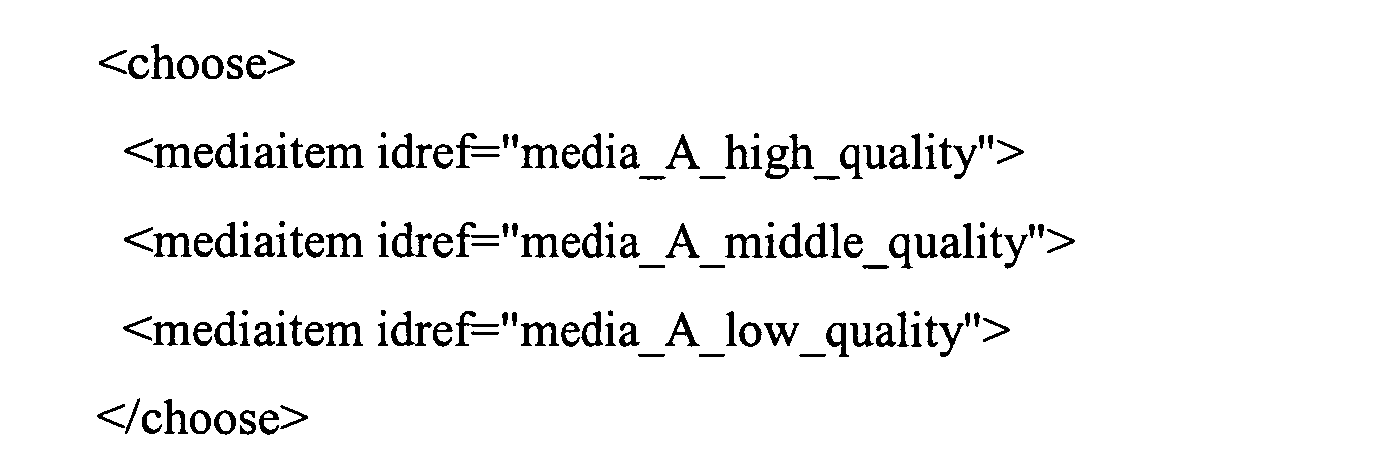
- As depicted in Fig. 30, it is assumed that the resource situation at the beginning is quite good, allowing to start with a the high quality media "A(hq)". While playing back, the resource condition downgrades and the presentation has to be adapted to the media "A(mq)" with middle quality. Due to the fact that the resource situation further severely downgrades, the systems adapts to use the media "A(lq)" with the least resource consumption. After a while, the resource situation improves, which results in presenting "media A(hq)" again. The process stops - by default - as soon as the first media is finished.
- As mentioned above, a choose statement allows specifying different alternatives. That is quite clear if only one "choose"
element 704 is considered. In the more common case, however, anadaptation description 2900 consists of several parallel "choose" elements 704: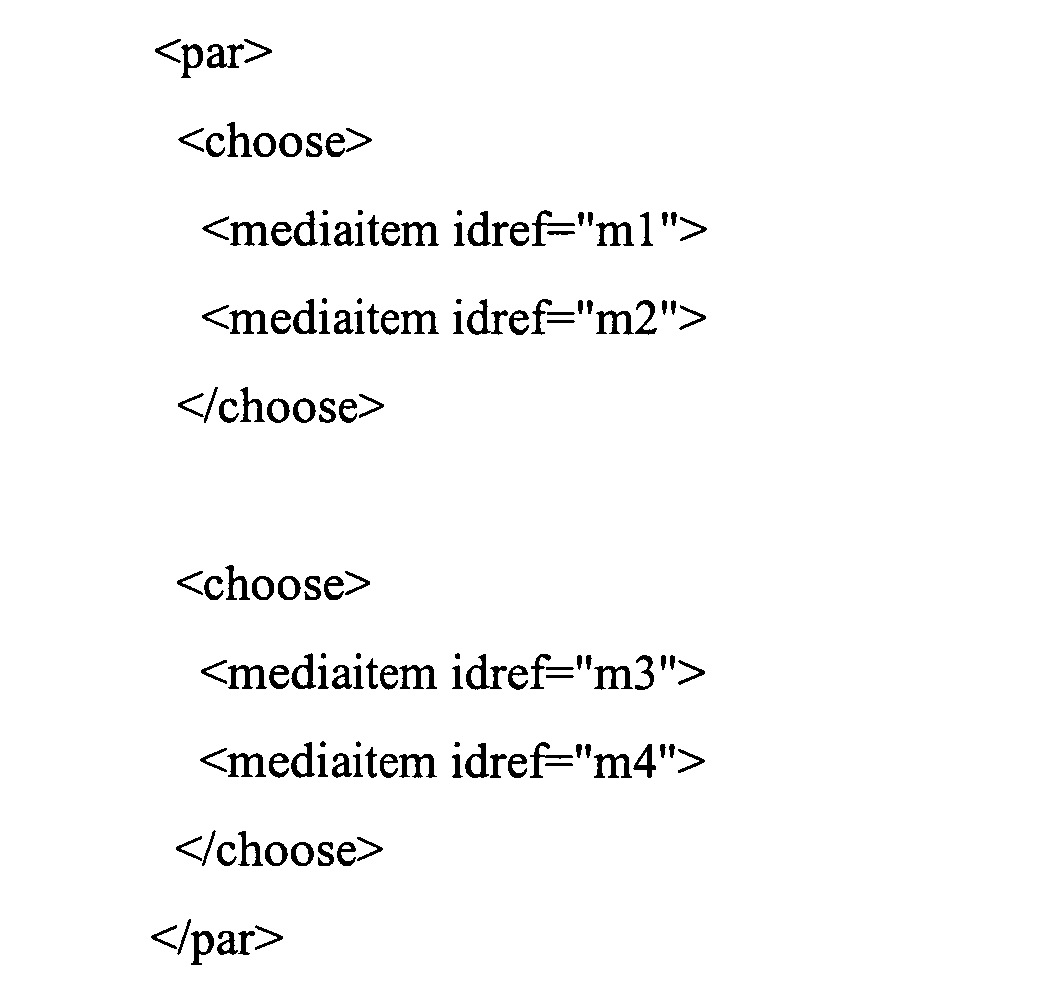
- Thereby, the enclosed element "par" 702 logically acts as a "AND" expression. Furthermore, each elements in a "choose"
element 704 is logically expressed by an "OR" expression. This results in the Boolean expression (m1 OR m2) and (m3 OR m4), which may be expressed by a Disjunctive Normal Form (DNF)
(m1 AND m3) OR (m1 AND m4) OR
(m2 AND m3) OR (m2 AND m4). - Based on the current resource consumption, which is measured continuously, one alternative out of (m1, m3), (m1, m4), (m2, m3), or (m2, m4) is selected and played back.
- Fig. 9 depicts the
adaptation possibilities 1500 resulting from theadaptation description 2900 example shown above. It should be noted that this table does only show one property; in fact, various properties can be associated with oneadaptation possibility 1500. - The
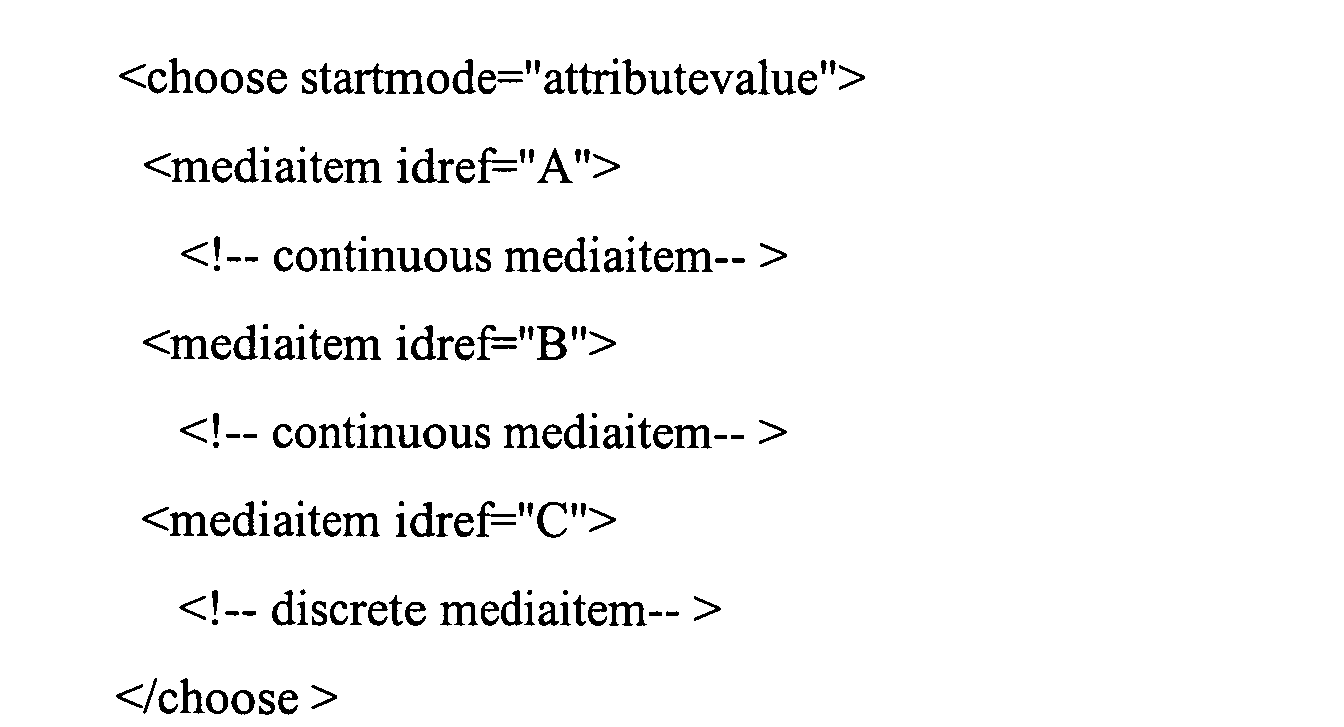
adaptation description module 2900 provides the "choose" element with different attributes for modifying its default behavior. These are discussed in the following. - This attribute specifies at which playtime a specific media, especially continuous media, is started after an adaptation has been done. It is distinguished in general between the media time axis and the time axis of the enclosed choose element. In the following the semantic of the different values are explained by the means of the following example:
- Thereby, the
media items 304 referenced by "A" and "B" are assumed to be continuous media items, and "C" is assumed to be a discrete one like an image. - In Figs. 31 to 34:
- A(tx) means that the time axis of the
specific media item 304 is used. - A(t) means that the time axis of the enclosed choose element is used.
- 'A' means that the
specific media item 304 is a discrete one, which does not have a time axis.restart: Indicates that the media item 304 should always start from the beginning (cf. Fig. 31).resume: (default) Indicates that the media items 304 should always start from the position it stopped (cf. Fig. 32a).laststop Indicates that the media item 304 should always start at the media time the lastcontinuous media item 304 contained in the same choose element stopped (cf. Fig. 32b).playtime Indicates that the media item 304 should always start at the time, which is the combined playtime of allmedia items 304 contained in the element "choose" 704 since the element "choose" 704 is started (cf. Fig. 33).contplay-time Indicates that the media item 304 should always start at the time, which is the combined playtime of allcontinuous media items 304 contained in the element "choose" 704 since the element "choose" 704 is started (cf. Fig. 34). - Specifies the point in time when the media is started. By default, a media starts from the beginning (see "startmode" attribute above). This behavior can be modified with the attribute "starttime". The attribute's value consists of a number and is interpreted as seconds.
- For example, the following code fragment illustrates that each
media item 304 is started not at the beginning but rather five seconds later.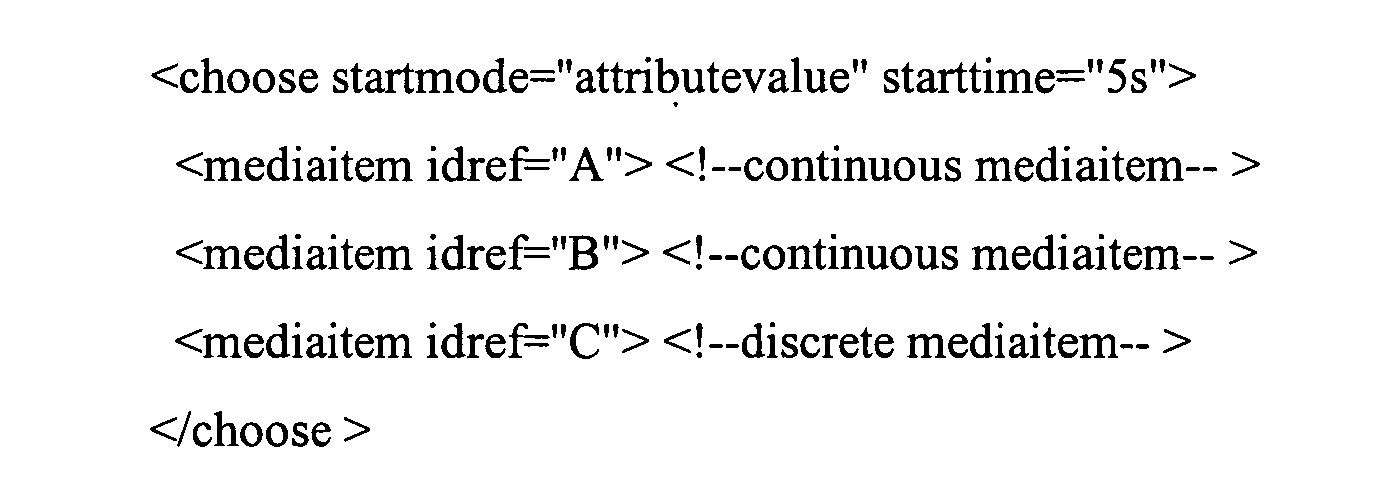
- It should be noted that this attribute is only considered, if the "startmode" attribute exists and its value is "restart". This
constraint 802 can not be expressed in XML Schema. - This attributes specifies what happens if a
continuous media item 304 is played back. Regarding the life-cycle of such a media item, amedia item 304 is started, played back, the time for playing back might be different from the length of the movie, and is stopped if the media is over. This results in "stopping" or "destroying" alladaptation possibilities 1500, or simply "removing" thespecific media item 304. If a "choose"element 704 does not contain anycontinuous media item 304, the attribute value is ignored.destroy Indicates that the complete choose should be removed when a child is removed. remove (default) Indicates that the child which reached the end of its playtime is removed. The choose is only removed if this was the last remaining child in the choose. - Indicates that the media items 304 (if they are continuous) should start from the beginning if the media ends.
true Indicates that the media is played from the beginning if the media ends. false (default) Indicates that the media is not played again. - Specifies if the element "choose" 704 is evaluated once at start-up time, repeatedly in a specific time period or continuously while playing back the multimedia presentation.
start-up Means that the choose element is evaluated once, based on the adaptability parameters at start up time. 10s Indicates that the choose element is evaluated every specified time period, based on the adaptability parameter at that time. con (default) Indicates that the element "choose" 704 is evaluated if a specified threshold of a parameter, describing part of the current situation, is exceeded. This means, that an adaptation will take place if the current situation changes. - Specifies the
priority 1400 of the "choose". - By default the element "choose" 704 allows specifying different alternatives. One of them is selected during playing back the multimedia presentation. If the attribute empty is set to "true" it might be, dependent on the current situation, that no media is selected out of the choose element.(Results in playing back, at a specific point in time, "m1" or "m2" or none of both.)
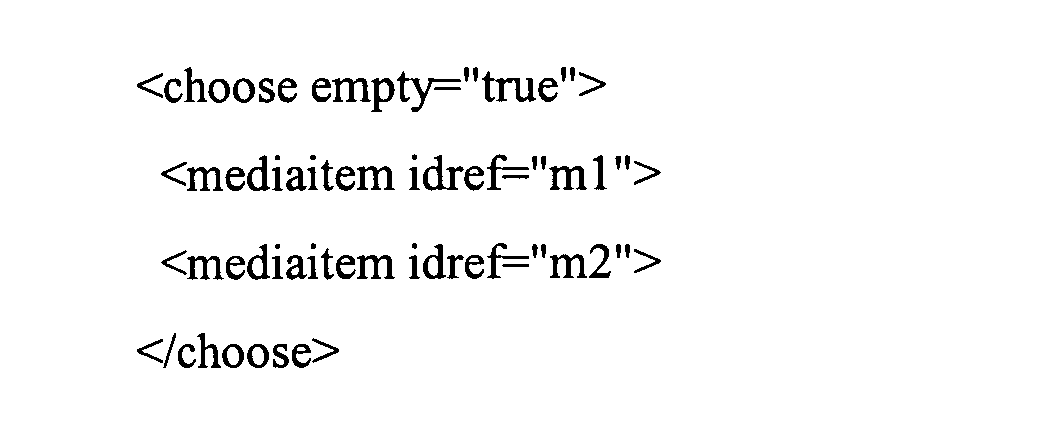
true Indicates that the alternative, that no media is selected out of the adaptation possibilities 1500, is valid.false (default) Indicates that one media has to be selected out of the described adaptation possibilities 1500. - The element "mediaitem"
element 304 specifies the used media from theMediaItems Module 108, which means that themedia item 304 in theadaptation description module 2900 is simply a placeholder. Characteristics of a continuous media and to some extend content of discrete media is described in theMediaItems Module 108. Due to the distinction betweenMediaItems Module 108 and theAdaptation Description Module 109, thedescription 700 of the adaptation is quite easier.
"priority" attribute:
Specifies thepriority 1400 of the "mediaitem" element.
"idref" attribute:
The attribute "idref" is of type "IDREF" as described in "Extensible Markup Language (XML) 1.0" (Second Edition, http://www.w3.org/TR/REC-xml) by Tim Bray (Textuality and Netscape), Jean Paoli (Microsoft), C. M. Sperberg-McQueen (University of Illinois, Chicago), and Eve Maler (Sun Microsystems, Inc.), referencing a specific "mediaitem" part of the "MediaItems Module" 108. The link realize the dependency "Linking Mediaitems".
"starttime" attribute:
Specifies the point in time the media is started. By default the media starts from the beginning (see "startmode" attribute above). This behavior can be modified with the attribute "starttime". The attribute's value consists of a number and is interpreted as seconds. For example, the following code fragment illustrates that themedia item 304 is started not at the beginning but rather five seconds later.
<mediaitem idref="A" starttime="5s"> It should be noted that this attribute overrides the attribute "starttime" from the element "choose" 704. It is only considered in the following two cases: - 1. if the
media item 304 is a part of a "choose"element 704, and the attribute "startmode" is specified there and has the value "restart", - 2. if the
media item 304 is not part of a "choose"element 704.
In the later case, the value specifies the initial start time of themedia item 304. - In the following, the "switch" element used in SMIL shall be compared with the "choose"
element 704 of AMIL according to one embodiment of the underlying invention. - A choose element in SMIL allows "an author to specify a set of alternative elements from which only one acceptable element should be chosen. An element is acceptable if the element is a SMIL element, the media-type can be decoded, and each test-attribute of the element yields "true". An element is selected as follows: The player evaluates the elements in the order in which they occur in the switch element. The first acceptable element is selected at the exclusion of all other elements within the switch.
- This is in contrast to the semantics of the element "choose" 704 used in the "Adaptation Description Module" 109. As described above, all possible media of an element "choose" 704 are evaluated, which means that the media's properties (e.g. bandwidth, duration, etc.) are evaluated and stored in an internal data structure - cf. description of the "Configuration List" in "Modeling of Adaptable Multimedia Documents" (Interactive Distributed Multimedia Systems and Telecommunication Services; 4th International Workshop, IDMS'97, Darmstadt, Germany, September 1997, pp. 420-429) by S. Wirag, R. Steinmetz, and L.C. Wolf (editors). At start-up time and if the "current situation" changes, the
adaptation description 2900 is evaluated and the mostappropriate adaptation possibility 1500, for the "current situation", is selected and played back. - In SMIL, the author describes which media is used in which condition. The condition (logical expression described with the attribute "test") is a fix part of each media element in SMIL. During start-up time, the SMIL player sequentially evaluates each media element's condition. If the condition can be fulfilled, the media is selected for playing back.
- Note:
- a) The author specifies which resource are considered (e.g. bandwidth, screen size, etc.)
- b) The author specifies the order in which the elements" condition is evaluated.
- c) The current situation, as used in SMIL, is described by the properties used in the conditions.
- d) The SMIL standard does not claim, that the element "switch" is re-evaluated if the "current situation changes.
- e) The focus of SMIL is on applications running in a static environment. The application is adapted once, during start-up.
- In SMIL, the properties describe the situation in which one or a set of
media items 304 has to be chosen. In the "Adaptation Description Module" 109 the properties describe attributes of themedia items 304 and the "AMIL player" uses this information to find out which set ofmedia items 304 to use for an actual situation. (Example: If the available bandwidth is below 1 MBit/s, twomedia items 304, A and B, are used. A needs 300 kBit/s and B needs 400 kBit/s.) In SMIL, the author has to manually create the mapping from media attributes to situations during authoring time. In the "Adaptation Description Module" 109 this mapping is left to the browser, which simplifies the authoring significantly, especially as the media item properties can often be created automatically, thereby using meta data for the media or by examination of the media files. - In AMIL, the "AMIL player" aggregates information about the "current situation" and the media, which is a part of the
adaptation description 2900. Based on the "current situation", that is monitored continuously, a specific "adaptation possibility" 1500 is selected and used for playing back until the "current situation" changes and a new "adaptation possibility" 1500 is selected. The author can give hints to express the author's preferences, which can influence the decision whichadaptation possibility 1500 is used for playing back. In AMIL, the decision which media is chosen is determined by the adaptation control unit, but the author of the document can influence the adaptation control process by the usage of attributes supported by elements of the "Adaptation Possibility Module" 109 - e.g. thepriority attribute 2810 of the elements "switch" and "mediaitems" 304. - If the "current situation" changes, an adaptation is accomplished, which means that media are substituted. The exact behavior how this is done is not described in SMIL. AMIL supports the author of a document with different attributes, e.g. a "startmode" for specifying the transition from one media to another media, restart and looping functions if the movie is over, and so on.
- The attribute "priority" 2810 is supported with the elements "choose" 704 and "mediaitem" 304 and enables the weighting of
adaptation possibilities 1500. To understand the idea ofpriorities 1400, the concept ofadaptation possibilities 1500 should be reminded. - Based on the "Adaptation Possibility Description" mentioned above,
different adaptation possibilities 1500 are calculated. While playing back,appropriate adaptation possibilities 1500 matching the "current situation" are selected. Thereafter, theadaptation possibility 1500 with thehighest priority 1400 out of the set ofappropriate adaptation possibilities 1500 is selected. - The first activity diagram depicted in Fig. 23 shows that if the "current situation" has changed; out of all
available adaptation possibilities 1500 the set that matches the "current situation" is filtered out. Out of this set, theadaptation possibilities 1500 with thehighest priority 1400 are selected. If at the end more than oneadaptation possibility 1500 is left, either that with the lower resource consumption is selected or the selection is done randomly. - The evaluation of the
priorities 1400 is done in line with the calculation of alladaptation possibilities 1500. Fig. 15 shows theadaptation possibilities 1500, thereafter sometimes abbreviated with "AP", derived from theadaptation possibility 1500description 700 depicted in Fig. 13. Adaptation Possibilities (APs) are calculated in such a way that a "choose"element 704 is considered as an "OR" operator, and a "par"element 702 as an "AND" operator. This results in the following "Boolean" expression:
(M4 AND M2) OR (M4 AND M1) OR
(M3 AND M2) OR (M3 AND M1). - Thereby, the selection of one "AND" expression (e.g. M4 AND M2) (also named adaptation possibility 1500) is based on the "current situation".
- The evaluation of the associated
priority 1400 of anadaptation possibility 1500 is done in the following way: - 1. All children of a "par"
element 702 are sorted according to theirpriority 1400. - 2. The configurations of the first two child elements are merged (by means of an AND operator). The
priority 1400 of the resulting configurations consist of thepriority 1400 of the higher prioritized child is appended to thepriority 1400 of the lower-prioritized child. (Thereby, the character "-" is used as a separator.) - 3. The result is repeatedly merged with all other children of the "par"
element 702. Thepriorities 1400 are always handled as instep 2. - 4. Element of type "choose" 704 do not perform any priority calculation. The element "choose" 704 represents an "OR" operation, in which the results from the child elements are just combined and not modified - including the
priorities 1400. - The result at the end is a list of possible adaptations attributed with an
attribute priority 1400 calculated from thepriorities 1400 of the used media of this possible adaptation. - The term "link", as used in this document, describes the connection of different elements in one AMIL document 2402 - in contrast to the general meaning where various Web resources (in different documents) are linked together. A link is described by its "source anchor" 2702 and its "destination anchor" 2704 as depicted in Fig. 27. An anchor's
source 2702 is described by the usage of the XML attribute "id" - an anchor'sdestination 2704 by the XML attribute "idref'. Both attributes are validated during the parsing of an XML document (without the usage of XML Schema). - Fig. 5 depicts the association between various modules. Linking is quite important since the information itself is distributed over different modules. The "Adaptation Description Module" simply describes the adaptation possibilities 1500 - the media itself is described in the "MediaItems Module" 108,
interactions 404 are described in the "Interactions Module" 110, and thewhole layout 3702 is described in the "Layout Module" 106. Said modules enable the splitting of information, which allows the modification of e.g. thelayout 3702 without touching anything from the "MediaItems Module" 108 or the "Interactions Module" 110 - as long as all linked region are still available. - Fig. 9 depicts the name of the association and their modules used to describe the linking 1600 between the AMIL modules.
- Fig. 16 shows an exemplary instance document. For the sake of that example, the document is hold quite simple. Thereby, the
adaptation description 2900 is reduced to onemedia item 304, the properties of thatmedia item 304 are described in the "MediaItems Module" 108 and linked with the aid of the attribute "idref'. Both elements, themedia item 304 of the "MediaItems Module" 108 and thewidget 404 of the "Interactions Module" 110, refer to anelement region 502 of the "Layout Module" 106 where they are displayed. Fig. 6 shows how this multimedia presentation looks like.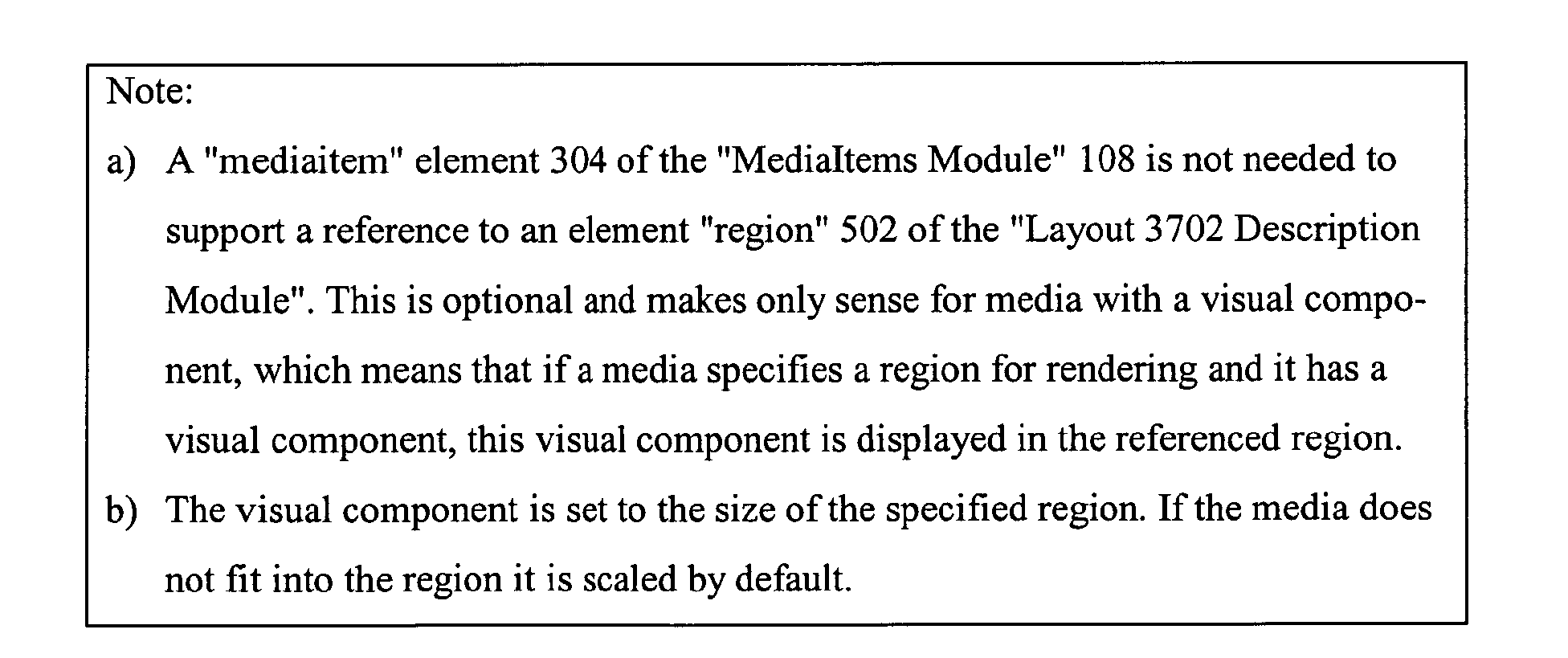
- As authoring of multimedia presentations is a quite time-consuming and costly task, attention has been drawn to reuse adaptive multimedia applications for efficiency and economical reasons. However, this has to be considered quite carefully. First, the documents are generated dynamically for each request. Therefore, it is quite hard to reference a part of document which is not statically available.
- Moreover, there is no restriction in using a
static AMIL document 2402 saved e.g. on the file system. For this reason, a further media type named "amil-document" has been introduced. Amedia item 304 of type "amil-document" is rendered in its specified region. - Fig. 17 shows how an adaptive multimedia presentation can be used as part of another one. Thereby, the multimedia application "presenstation-B.amil" is referenced as a
media item 304 out of another multimedia application described in "presentation-A.amil".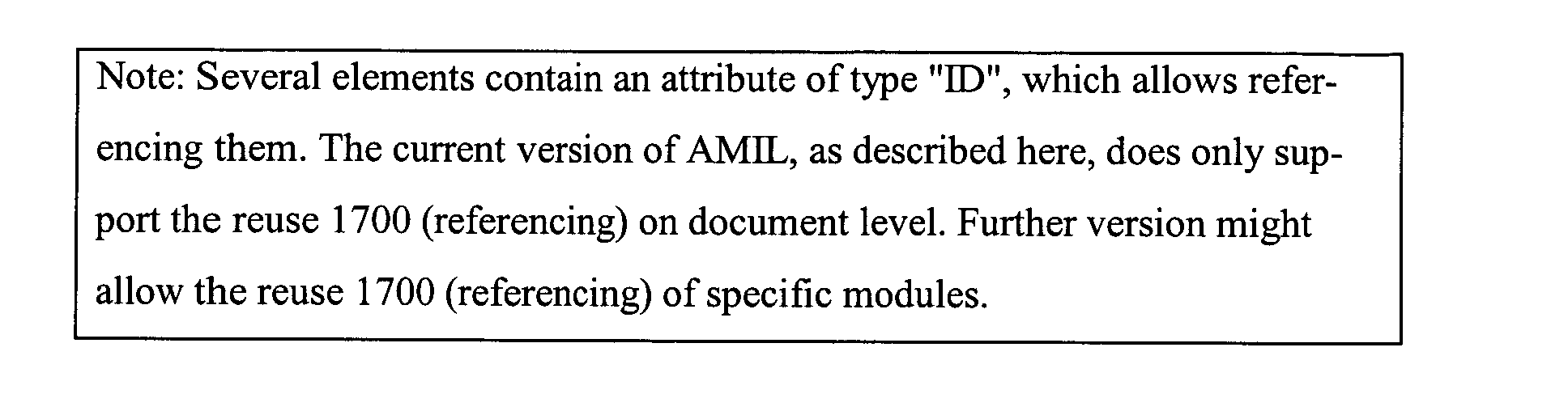
- Namespaces (see World Wide Web Consortium: "Namespaces in XML", 14 January, 1999, http://www.w3.org/TR/REC-xml-names/) are quite common in the XML world to distinguish between different vocabularies. AMIL use the URI "www.sony.de/amil" to reference to the newest version of the vocabulary. Fig. 40 shows a
complete AMIL document 2402, wherein the namespace is explicitly used throughout the whole document. - In the scope of the underlying invention, an AMIL Document Object Model (AMIL DOM) has been introduced to describe an
AMIL document 2402 in an abstract document model structure. It supports the dynamically access and update of the content and structure of anAMIL document 2402. The document can further be processed, and the results of that processing can be incorporated back in the presented document. The AMIL DOM is quite straightforward. In fact, it is an extension to the DOM proposed by W3C. Like "XHTML 306b DOM" and "WML DOM", "AMIL DOM" simply extents the basic W3C DOM by means of an AMIL-specific vocabulary. - In extension to state-of-the-art document object models, AMIL DOM supports a simplified transaction model. This allows making a set of logically grouped manipulations to the AMIL DOM, which results in the support of transactional modification for adaptive documents. For example, the replacement of an "adaptation-description-specific" element "choose" 704 has to be done as an atomic change, which results in a recalculation of all
adaptation possibilities 1500. If that is not done atomically, a modification might be a quite crucial step, which results in an inconsistent state. - As depicted in Figs. 28 and 35, the AMIL DOM supports, aside from state-of-the-art primitives, primitives for doing simple transaction-oriented processing by enhancing the interface "document" 2806 with a "commit" primitive. It should be noted that modifications are not passed to the middleware until the "commit" primitive is triggered.
- After having created an internal presentation of an
AMIL document 2402, it can be adapted to changes in the "current situation", e.g. auser interaction 404 or the change of the user's location. Modifications do not get visible until they are committed. This fact is depicted in Fig. 36. The illustration on the right shows how thelayout 3702 can change after the document has been modified. - The following sections introduce modules that can optionally be used for a more
detailed description 700 of the adaptation process. They are not mandatory, which means that anAMIL document 2402 is semantically valid without these modules. - An "event" 3802 is a signal to the AMIL Browser from any sensor, indicating that the "current situation" has changed. As mentioned in the introduction, the "current situation" is categorized into three different dimensions: network QoS, mobile device capabilities and user context. In this scenario, an
AMIL document 2402 is dynamically generated at request time, based on the "current situation". After that, the supporting middleware, as described in the article "Modeling of Adaptable Multimedia Documents" (Interactive Distributed Multimedia Systems and Telecommunication Services; 4th International Workshop, IDMS'97, Darmstadt, Germany, September 1997, pp. 420-429) by S. Wirag, R. Steinmetz, and L.C. Wolf (editors), controls the adaptation process of the media specified in the AMIL document 2402 - but theAMIL document 2402 remains quite static. With the introduction of the AMIL "Events Model" 118, changes of the "current situation" can influence the document in different ways: - a) Modification of the linking structure: The
AMIL document 2402 consists of a vocabulary, a hierarchical structure (which defines how the elements are nested) and a non-hierarchical structure (which describes how the elements are linked). A change of the "current situation" can result in the modification of the linking structure. Thereby, the associations "Linking Mediaitems and Layout" and "Linking Widgets and Layout" are changed (cf. Fig. 37). - b) Modification of the whole document structure: This results in an updated or totally
different AMIL document 2402. - Fig. 38 shows some types of
possible events 3802. In detail, each parameter, describing part of the "current situation", maybe modeled as anevent 3802. Fig. 24 shows the influence of anevent 3802 to a specific instance of an AMIL Document. In case a) the internal linking structure of the document is changed, in case b) the essential hierarchical document structure and theinternal linking 1600 are changed; this might result in a updated or totally different document.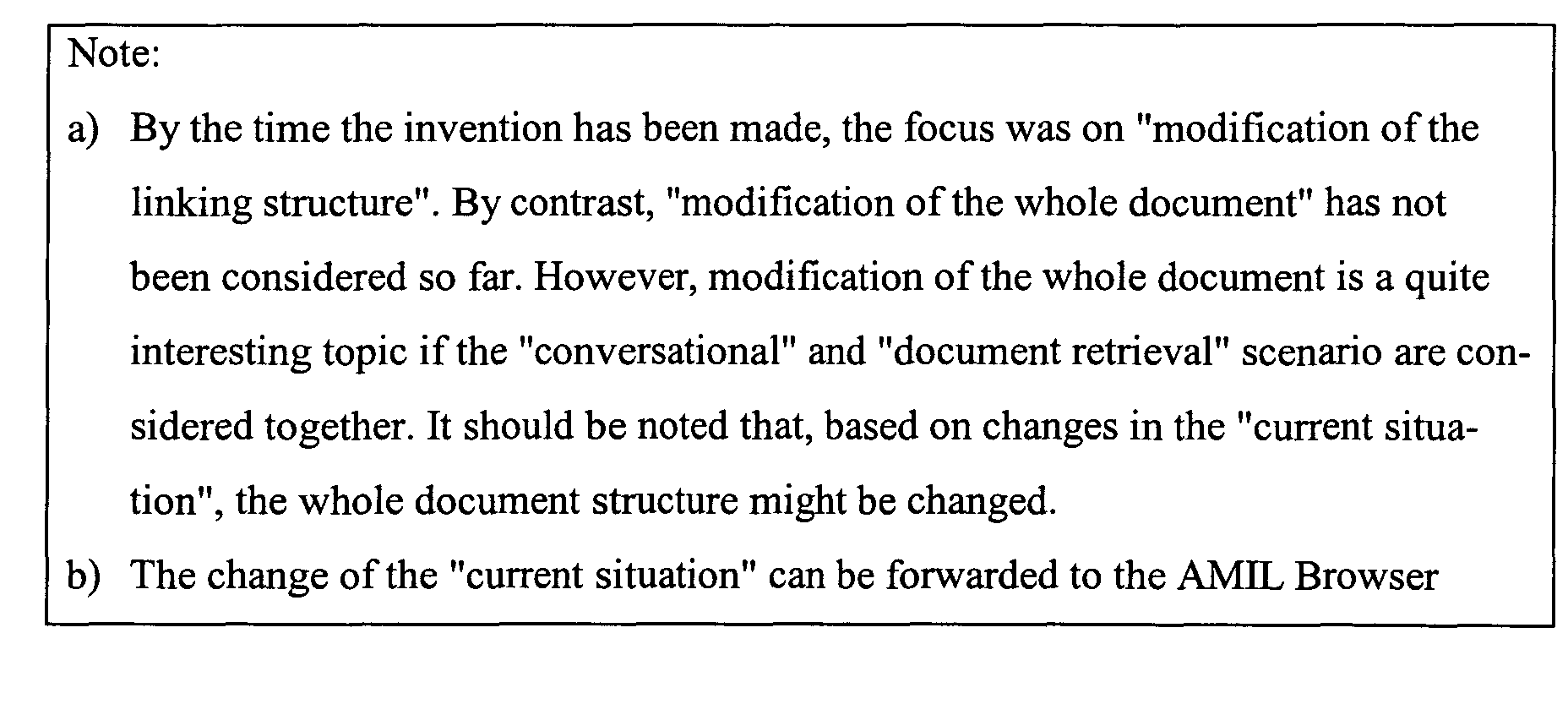
- Fig. 18 shows a conditional statement, which might be part of an action element. The function "diff" is an extension which is used to describe that the content of the test element should be evaluated if the difference between the "currentlocation" and the location at the point ("47,11 ","9,34") (which denotes longitude and latitude, respectively) is less than 500 meters.
- The
Events Module 118 supported by AMIL allows acting on changes of the "current situation". The module itself is optional and has not to be supported. - The "adaptationevent" element is the outermost element of the
Adaptation Events Module 118. It logically serves as a container for theadaptation events description 700 used in anAMIL document 2402.
"id" attribute:
It is used according to XML as an identifier for referencing the whole
Adaptation Possibilities Description Module. - The "listener" element realizes a binding of an
event 3802 to a specific action, which is the only child a listener have.
"type" attribute:
The attribute "type" specifies whichevent 3802 thelistener 3906 is listening for. It is simply an identifier, reflecting that a property of a specific sensor has changed. There is no additional information available which is associated with theevent 3802.
Note: - a) The set of supported
events 3802 is described in the XML Schema "EventType" as an enumeration. This should not scare of definingadditional event 3802 types. The "EventType" is defined in XML Schema and can domain-specifically be extended. - b) The (namespace-specific) attribute value has to be conform to the following pattern:
"sensor" :: "name of the event" - Thereby, the sensor specifies the source of the
event 3802, and the name specifies the kind of theevent 3802. The pattern is required, and the validation process checks the rule. - The "action"
element 3910 describes the activity as a result to anevent 3802. The content of the element consists of "conditional" and "action" statements (e.g. the "link" statement). Due to the fact that a vocabulary for expressing conditional statements is already available in XSLT, it is taken over and integrated into theEvents Module 118. This means that statements applied to the document (e.g. the "link" statement) can either be used in an conditional statement, to consider the change of the "current situation" in more detail, or directly. Fig. 19 shows an exemplary document fragment of anadaptation event description 1900/2000 using XSLT's conditional statements. Fig. 20 depicts a document fragment describing an action without the usage of XSLT's conditional statements. - The "link"
element 3914 changes the linking structure of a document. It replaces the link described in the attribute "element". - Note: This attribute is of type "IDREF", which means that their existence is validated during reading the
AMIL document 2402.
"element" attribute:
Specifies the element, by its unique "id", which has a link to be modified. - The "source"
element 3916 specifies the source of the link.
"ref" attribute:
It specifies the name of the attribute, and which value has to be modified. The attribute itself is the source of the link. - The "target"
element 3918 specifies the new target of the link.
"ref" attribute:
It specifies the new link target. - Example: If in the following code fragment the link between the
media item 304, uniquely addressed by the attribute "id", and theregion 502, uniquely addressed by the attribute "id",should be modified, the "source"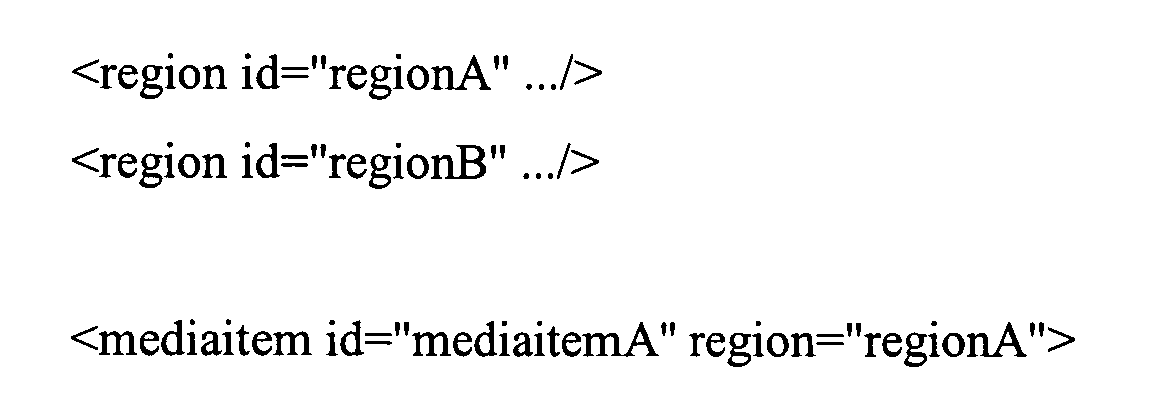
element 3916 and the "target"element 3918 have to be written as follows: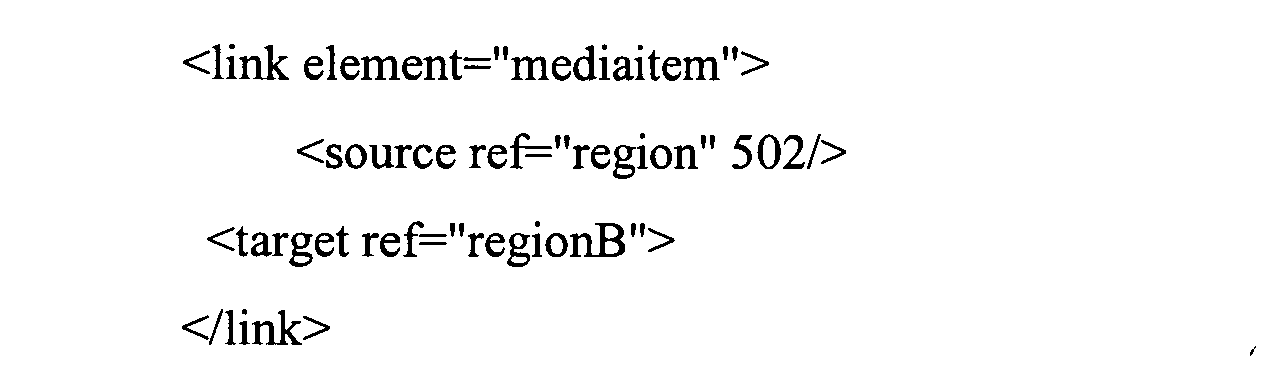
- This results in that the mediaitem's visual component uses the "regionB" instead of the "regionA". The exact behavior of the media's visual components depends on the region's attribute "fit".
- The
Constraints Module 116 allows addingadditional constraints 802 to the adaptation description elements to influence (in most cases to reduce) the set ofpossible adaptation alternatives 2100. Whenconstraints 802 are applied, it is e.g. possible to remove all adaptation alternatives 2100 (each consisting of different media items 304) that need a higher "bit rate" than specified by therespective constraint 802. - Thereby, it is useful to allow such constrains also for the "mediatiem"
element 304 in spite of the fact that there are no alternatives on this level. This is because amedia item 304 may be able to run in different media configurations. Amedia item 304 may expose different media configurations, which can dynamically be selected when playing themedia item 304. Each media configuration may result in different media properties like different quality, resource requirements or error robustness. Examples forsuch media items 304 are video streams using a layered codec, a live stream whose coding parameters can be influenced from the receiver side ormedia items 304 that can dynamically apply Forward Error Correction (FEC) algorithms. Whenconstraints 802 are used, the author has the possibility to exclude unwanted media configurations. - It is important to understand the difference of the semantics between a
constraint 802 applied to amedia item 304 and another adaptation description element. When applied to amedia item 304, it restricts the possible media item configurations. When applied to an adaptation description element (e.g. like "choose" 704), it applies to allpossible adaptation possibilities 1500 of that element (each consisting of a set of media items 304). In the AMIL code depicted in Fig. 21, the outermost "par" has at least four adaptation alternatives 2100 (m1 AND m3, m1 AND m4, m2 AND m3, m2 AND m4). If themedia items 304 allow different media configurations, the list is further extended as two alternatives either differ in onemedia item 304 or one media configuration. - A
constraint 802 applied to this "par"element 702 could remove one or more of these alternatives. For example, a constraint "bitrate < 500 kBit/s" would remove all alternatives whose media-items-combined bit rate is higher. - The author has to take care that the
constraints 802 are consistent and do not result in a situation, where alladaptation alternatives 2100 are removed. - In the following section, the "Constraint Module" 800 supported by AMIL language shall be introduced.
- The "constraints" element 801 is the outermost element of the Constraint Module. It logically serves as a container for all "constraint" elements 801 used in the
AMIL document 2402.
"id" attribute:
It is used according to XML as an identifier for referencing the whole
"Constraint Module" 800. - The "constraint"
element 802 is a container for several "restriction"elements 804, "adaptationtrigger"elements 806 and/or "adaptationfrequency"elements 808. It can be referenced by other elements that want to apply the definedconstraint 802.
"id" attribute:
Used according to XML as an identifier for referencing the whole
"constraint" 802. - The "restriction"
element 804 is used for describing the actual restrictions imposed by aconstraint 802.
"value" attribute:
The "value" attribute contains atextual description 700 of the actual restriction. Ist value consists of different conditions. A condition itself consists of a "restriction identifier" followed by a comparison operator, followed by a value plus optionally a unit (example: "bandwidth < 500 kBit/s"). Conditions can be combined using the "AND" operator or the "OR" operator. The restriction identifier determines the possible comparison operators, the value range and the unit. Fig. 11 depicts the supported restriction identifier.
The advantage of having this data in an attribute value and not in several XML elements or attributes is that additional restriction identifiers can be added later on without the need to change the AMIL grammar. - The "adaptationtrigger"
element 806 is used for describing conditions where amedia item 304 is considered to have a problem and therefore an adaptation should be performed if the condition becomes true. It is important to note the difference between a "restriction" 804 and an "adaptationtrigger" 806. Whereas a "restriction" 804 limits the number ofpossible adaptation alternatives 2100, an "adaptationtrigger" defines conditions that should not occur during the playtime of amedia item 304.
"value" attribute:
The value attribute contains atextual description 700 of the actual adaptation trigger. Its value is always a string consisting of different conditions. A condition consists of a condition identifier followed by a comparison operator, followed by a value plus optionally a unit (example: "framerate < 15 frames/s"). Conditions can be combined using the "AND" operator or the "OR" operator. The identifier determines the possible comparison operators, the value range and the unit.
Fig. 12 shows the supported "Adaptation Trigger Identifier".
To evaluate the adaptation triggers, the AMIL player needs a means to measure the corresponding values during playtime of themedia item 304.
If the AMIL player does not have a possibility to measure a certain value or the specified condition does not apply to the media item's type, the corresponding adaptation trigger is ignored.
The advantage of having this data in an attribute value and not in several XML elements or attributes is that additional restriction identifiers can be added later on without the need to change the AMIL grammar. - The element "adaptationfrequency" 808 is used for describing how often adaptations should occur. Adaptations are always necessary if the situation gets worse. If the situation improves, different strategies can be applied which determine how fast to react. This results in either a more "stable" adaptation behavior or an "agile" adaptation behavior. This behavior can be influenced using this element.
- The element "adaptationfrequency" 808 does not have a meaning if associated to a "mediaitem"
element 304 or another element, which does not have anyadaptation possibilities 1500. An "adaptationfrequency"element 808, which is associated to an adaptation description element, overwrites all other "adaptationfrequency"elements 808 which are associated to elements inside this adaptation description element. - The defined adaptation frequency always applies to all
adaptation alternatives 2100 of theadaptation description 2900 element it is assigned to. Therefore, one part of theadaptation description 2900 can be set to react "agile" and another part to react "stable". The adaptation algorithm will then try to selectadaptation possibilities 1500 during runtime, in which the "agile" parts are changed more often than the "stable" parts.
"value" attribute:
This attribute specifies how the adaptation behavior should be. The possible values are "stable", "moderate" and "agile" - Fig. 11 gives an overview of the restriction identifiers contained in the "value" attribute of the "restriction"
element 804. Possible comparison operators are: <, >, <=, >=. - Fig. 12 gives an overview of the adaptation trigger identifiers included in the "value" attribute of the "adaptationtrigger"
element 806. Possible comparison operators are: <, >, <=, and >=.
"type" attribute:
It specifies the kind of media. The attribute "type" is of type "mediaItemAttribute- TypeType" 308.
Thereby, the attribute "type" takes one out of the following values:
"src" attribute:
It specifies the location of the of the
"region" attribute:
If a
As depicted in Fig. 25, a
Claims (31)
- A method for describing adaptive mobile multimedia applications and/or presentations, whose playback behavior inherently depends on the current situation at runtime, the method being based on an XML-based document model (100) and comprising the step of- describing the intrinsic adaptation possibilities of application and/or presentations, which run in a mobile network environment, in an Adaptation Module (109) comprising the vocabulary and language structure required for describing the adaptation possibilities of said adaptive mobile applications.
- A method according to claim 1,
furthermore comprising the step of- describing the available media for the application and/or presentation in a MediaItems Module (108) comprising the vocabulary and language structure required for describing the media items (304) used within said adaptive mobile applications. - A method according to anyone of the preceding claims,
furthermore comprising the step of- describing the interaction parameters of the application/presentation in an Interactions Module ( 110) comprising the vocabulary and language structure required for describing the interaction possibilities (404) used for said adaptive mobile applications. - A method according anyone of the preceding claims,
furthermore comprising the step of- describing the constraints of the adaptation process in a Constraints Module (116) comprising the vocabulary and language structure required for describing constraints (802) for said adaptive mobile application. - A method according anyone of the preceding claims,
furthermore comprising the step of
changing the language structure and vocabulary of the modules (106, 108, 109, 110, 116) in an Events Module (118) comprising the vocabulary and language structure required for describing the event possibilities used in said mobile applications. - A method according to anyone of the preceding claims,
furthermore comprising the step of- describing the association between the Adaptation Module (109) and the MediaItems Module (108), represented by a link. - A method according to anyone of the preceding claims,
furthermore comprising the step of- describing the association between the Adaptation Module (109) and the Interactions Module (110), represented by a link. - A method for describing a XML-based document serving as a connection layer between a middleware framework supporting mobile adaptive multimedia applications and an authoring system supporting the generation of mobile adaptive multimedia applications (structure and vocabulary) as described in anyone of the claims 1 to 9,
characterized in that the description is carried out by means of a language comprising:- at least one MediaItems Module (108) serving as a description unit for available media items (304) within said multimedia applications,- at least one Layout Module (106) which organizes said media items into regions (502) on the visual rendering surface of a mobile display device, and- at least one Adaptation Module (109) which controls a context-aware adaptation of said distributed multimedia applications by referencing elements of the MediaItems Module (108). - A method according to claim 8,
wherein the language furthermore comprises:- at least one Constraints Module (116) which allows adding additional constraints (802) to the adaptation description elements (2900), and- at least one Events Module (118) which allows to react on changes of various resources encompassing user's physical environment (location, temperature), user's context, quality-of-service (QoS) conditions of the applied networks, and mobile device capabilities. - A method for operating a middleware framework supporting the processing of an XML-based description of an adaptive mobile application/presentation (100) according to anyone of the claims 8 and 9,
characterized in that
said middleware framework allows each running mobile multimedia application to specify the media it wants to use and the relationships between these media, calculates the adaptation possibilities (1500) of mobile multimedia applications and controls the adaptation process in dependent on the current situation. - A method according to claim 10,
characterized by
the step of modifying the linking structure between the Adaptation Module (109) and the MediaItems Module (108) in case the current situation has changed. - A method according to claim 10,
characterized by
the step of modifying the linking structure between the MediaItems Module (108) and the Layout Module (106) in case the current situation has changed. - A method according to claims 10,
characterized by
of modifying the linking structure between the Interactions Module (110) and the Layout Module (106) in case the current situation has changed. - A method according to claims 10,
characterized in that
the document linking structure and/or the document structure and document vocabulary itself are modified by user interactions (404). - A method according to claim 14,
characterized in that
user interactions (404), which are used to modify the document linking structure and the document itself, are described by the Interactions Module (110). - A method according to anyone of the claims 10 to 13,
characterized by
dynamically binding media items (304) to a specific region (502) on the visual rendering surface of the mobile display device with the aid of the Events Module (118), initiated by changes (3700) of the current situation. - A method according to anyone of the claims 11 to 14,
characterized by
dynamically binding widgets (404) to a specific region on the visual rendering surface of the mobile display device with the aid of the Events Module (118), initiated by changes (3700) of the current situation. - A method according to anyone of claims 8 and 9,
characterized by
the step of an extending or newly specifying at least one attribute of at least one element of the Layout Module (106) in order to adapt the visual component (600) of a specific media item (304) to the dimension of those regions (502) on the applied mobile display device which are intended for multimedia presentations by scaling scaling-up /scaling-down the visual size of said media item (304) or replacing the said media item (304) dependent on the current situation. - A method according to anyone of claims 8 and 9,
characterized by
describing (700) alternative media items (304) of the MediaItems Module (108) used in the Adaptation Module (109) by means of- media-specific information encompassing bandwidth and size of the visual portion of a multimedia presentation,- meta information encompassing the name, the genre, and the actor of the media in case of a media item (304) of type video, and/or- inline information or a reference to external resources by the usage of Universal Resource Identifiers (URIs). - A method according to anyone of claims 8, 9, 10 and 19,
comprising the step of
specifying various alternatives both at start-up time and in case of changes of the current situation by means of a choose" element (704) of the Adaptation module (109). - A method according to claim 20,
characterized by the steps of- selecting the most appropriate adaptation possibility (1500) at start-up time,- continuously monitoring the network conditions, the available mobile device capabilities and/or the user context, and- selecting the most appropriate adaptation possibility (1500) in case of changing network conditions, mobile device capabilities and/or user context. - A method according to claim 21,
characterized by the step of
influencing the adaptation control process by the usage of priority attributes supported by the respective elements of the Adaptation Module (109). - A method according to claim 22,
comprising the step of
using a Par Element (702) of the Adaptation Module (109) for defining a simple time grouping in which multiple elements must be played back at the same time. - A method according to claim 23,
characterized in that
the adaptation possibilities (1500) are calculated with the aid of a Boolean term expressed by a Disjunctive Normal Form (DNF) on a set of different media items (304), wherein a "choose" element (704) is considered as an "OR" operator and a "par" element (702) as an "AND" operator, from which one conjunction of the Disjunctive Normal Form (DNF), the adaptation possibility (1500), is selected, depending on the quality-of-service (QoS) of the applied networks, the mobile device capabilities and the user context. - A method according to claim 24,
characterized by the step of
using an "Adaptation Description Module" (2900) which provides the "choose" element (704) with a "startmode" attribute for modifying its default behavior, which specifies at which playtime a specific media, especially continuous media, is started after an adaptation has been executed due the change of the current situation. - A method according to claim 25,
characterized in that
the continuous media item (304) is replaced by a different continuous media item (304) due to the change of the current situation, and the new one is simply started according to a media item's "startmode" attribute. - A method according to claim 26,
characterized in that
the "startmode" attribute can take one of the following values:- a "restart" value, which indicates that the media item (304) should always start from the beginning,- a "resume" default value, which indicates that the media items (304) should always start from the position it stopped,- a "laststop" value, which indicates that the media item (304) should always start at the media time the last continuous media item (304) contained in the same "choose" element (704) stopped,- a "playtime" value, which indicates that the media item (304) should always start at the time, which is the combined playtime of all media items (304) contained in the "choose" element (704) since the "choose" element (704) is started, and- a "contplaytime" value, which indicates that the media item (304) should always start at the time, which is the combined playtime of all continuous media items (304) contained in the "choose" element (704) since the "choose" element (704) is started. - A method according to claim 27,
characterized in that
the "Adaptation Description Module" (2900) supplies the "choose" element (704) with an "onremove" attribute specifying what happens after a continuous media item (304) is played back. - An method according to claim 28,
characterized in that
the "Adaptation Description Module" (2900) provides the "choose" element (704) with an "evaluation" attribute which specifies if the content model of the element "choose" (704) is evaluated once at start-up time, repeatedly in a specific time period or continuously while playing back the multimedia presentation. - A method according to anyone of the claims 28 and 29,
characterized in that
the "Adaptation Description Module" (2900) provides the "choose" element (704) with an "empty" attribute which supports the functionality that the set of media appropriate for specific current situation can be empty. - A method according to claim 30,
characterized in that
the evaluation of the associated priority (1400) of an adaptation possibility (1500) is done by- sorting all children of a par element according to their priority (1400),- merging the configurations of the first two child elements by means of an "AND" operator in such a way that the priority (1400) of the resulting configurations consist of the priority (1400) of the higher prioritized child appended with the priority (1400) of the lower-prioritized child, and
repeatedly merging the result with all other children of the par element.
Priority Applications (5)
| Application Number | Priority Date | Filing Date | Title |
|---|---|---|---|
| EP20020021908 EP1403778A1 (en) | 2002-09-27 | 2002-09-27 | Adaptive multimedia integration language (AMIL) for adaptive multimedia applications and presentations |
| JP2004538912A JP2006500666A (en) | 2002-09-27 | 2003-09-16 | Adaptive Multimedia Integration Language (AMIL) for adaptive multimedia applications and presentations |
| PCT/EP2003/010291 WO2004029829A1 (en) | 2002-09-27 | 2003-09-16 | Adaptive multimedia integration language (amil) for adaptive multimedia applications and presentations |
| US10/529,085 US7966408B2 (en) | 2002-09-27 | 2003-09-16 | Adaptive multimedia integration language (AMIL) for adaptive multimedia applications and presentations |
| CN038229439A CN1685340B (en) | 2002-09-27 | 2003-09-16 | Methods of describing and operating adaptive mobile multimedia applications |
Applications Claiming Priority (1)
| Application Number | Priority Date | Filing Date | Title |
|---|---|---|---|
| EP20020021908 EP1403778A1 (en) | 2002-09-27 | 2002-09-27 | Adaptive multimedia integration language (AMIL) for adaptive multimedia applications and presentations |
Publications (1)
| Publication Number | Publication Date |
|---|---|
| EP1403778A1 true EP1403778A1 (en) | 2004-03-31 |
Family
ID=31970339
Family Applications (1)
| Application Number | Title | Priority Date | Filing Date |
|---|---|---|---|
| EP20020021908 Withdrawn EP1403778A1 (en) | 2002-09-27 | 2002-09-27 | Adaptive multimedia integration language (AMIL) for adaptive multimedia applications and presentations |
Country Status (5)
| Country | Link |
|---|---|
| US (1) | US7966408B2 (en) |
| EP (1) | EP1403778A1 (en) |
| JP (1) | JP2006500666A (en) |
| CN (1) | CN1685340B (en) |
| WO (1) | WO2004029829A1 (en) |
Cited By (2)
| Publication number | Priority date | Publication date | Assignee | Title |
|---|---|---|---|---|
| WO2009104082A3 (en) * | 2008-02-22 | 2010-01-21 | Nokia Corporation | Systems and methods for providing information in a rich media environment |
| EP2608008A3 (en) * | 2011-12-23 | 2015-11-04 | 2236008 Ontario Inc. | Method of presenting digital data on an electronic device operating under different environmental conditions |
Families Citing this family (75)
| Publication number | Priority date | Publication date | Assignee | Title |
|---|---|---|---|---|
| US6656608B1 (en) * | 1998-12-25 | 2003-12-02 | Konica Corporation | Electroluminescent material, electroluminescent element and color conversion filter |
| JP3836083B2 (en) * | 2003-03-13 | 2006-10-18 | 松下電器産業株式会社 | Media distribution device, media reception device, media distribution method, and media reception method |
| US7617447B1 (en) | 2003-12-09 | 2009-11-10 | Microsoft Corporation | Context free document portions |
| US7464330B2 (en) * | 2003-12-09 | 2008-12-09 | Microsoft Corporation | Context-free document portions with alternate formats |
| US8756487B2 (en) * | 2004-01-06 | 2014-06-17 | International Business Machines Corporation | System and method for context sensitive content management |
| US20080002947A1 (en) * | 2004-02-06 | 2008-01-03 | Wataru Ikeda | Recording medium, reproduction device, program and reproduction method |
| US8391672B2 (en) * | 2004-02-06 | 2013-03-05 | Panasonic Corporation | Recording medium, reproduction device, program, and reproduction method |
| CN1684059A (en) * | 2004-04-14 | 2005-10-19 | 皇家飞利浦电子股份有限公司 | Editing method and device for multimedia information files |
| US7418652B2 (en) * | 2004-04-30 | 2008-08-26 | Microsoft Corporation | Method and apparatus for interleaving parts of a document |
| US7487448B2 (en) | 2004-04-30 | 2009-02-03 | Microsoft Corporation | Document mark up methods and systems |
| US8661332B2 (en) * | 2004-04-30 | 2014-02-25 | Microsoft Corporation | Method and apparatus for document processing |
| US7549118B2 (en) | 2004-04-30 | 2009-06-16 | Microsoft Corporation | Methods and systems for defining documents with selectable and/or sequenceable parts |
| US7383500B2 (en) * | 2004-04-30 | 2008-06-03 | Microsoft Corporation | Methods and systems for building packages that contain pre-paginated documents |
| US7359902B2 (en) | 2004-04-30 | 2008-04-15 | Microsoft Corporation | Method and apparatus for maintaining relationships between parts in a package |
| US7512878B2 (en) * | 2004-04-30 | 2009-03-31 | Microsoft Corporation | Modular document format |
| US7440132B2 (en) | 2004-05-03 | 2008-10-21 | Microsoft Corporation | Systems and methods for handling a file with complex elements |
| US7580948B2 (en) | 2004-05-03 | 2009-08-25 | Microsoft Corporation | Spooling strategies using structured job information |
| US20050246384A1 (en) * | 2004-05-03 | 2005-11-03 | Microsoft Corporation | Systems and methods for passing data between filters |
| US7607141B2 (en) | 2004-05-03 | 2009-10-20 | Microsoft Corporation | Systems and methods for support of various processing capabilities |
| US7519899B2 (en) | 2004-05-03 | 2009-04-14 | Microsoft Corporation | Planar mapping of graphical elements |
| US7755786B2 (en) | 2004-05-03 | 2010-07-13 | Microsoft Corporation | Systems and methods for support of various processing capabilities |
| US8363232B2 (en) * | 2004-05-03 | 2013-01-29 | Microsoft Corporation | Strategies for simultaneous peripheral operations on-line using hierarchically structured job information |
| US7634775B2 (en) * | 2004-05-03 | 2009-12-15 | Microsoft Corporation | Sharing of downloaded resources |
| US8243317B2 (en) * | 2004-05-03 | 2012-08-14 | Microsoft Corporation | Hierarchical arrangement for spooling job data |
| CN100596184C (en) * | 2004-06-02 | 2010-03-24 | 松下电器产业株式会社 | Recording method, reproducing device, reproducing method |
| US20060031760A1 (en) * | 2004-08-05 | 2006-02-09 | Microsoft Corporation | Adaptive document layout server/client system and process |
| US7617450B2 (en) | 2004-09-30 | 2009-11-10 | Microsoft Corporation | Method, system, and computer-readable medium for creating, inserting, and reusing document parts in an electronic document |
| US8090844B2 (en) * | 2004-10-08 | 2012-01-03 | Truecontext Corporation | Content management across shared, mobile file systems |
| US7584111B2 (en) | 2004-11-19 | 2009-09-01 | Microsoft Corporation | Time polynomial Arrow-Debreu market equilibrium |
| US7617451B2 (en) * | 2004-12-20 | 2009-11-10 | Microsoft Corporation | Structuring data for word processing documents |
| US7617229B2 (en) * | 2004-12-20 | 2009-11-10 | Microsoft Corporation | Management and use of data in a computer-generated document |
| US7614000B2 (en) | 2004-12-20 | 2009-11-03 | Microsoft Corporation | File formats, methods, and computer program products for representing presentations |
| US7620889B2 (en) | 2004-12-20 | 2009-11-17 | Microsoft Corporation | Method and system for linking data ranges of a computer-generated document with associated extensible markup language elements |
| US7617444B2 (en) | 2004-12-20 | 2009-11-10 | Microsoft Corporation | File formats, methods, and computer program products for representing workbooks |
| US20060136816A1 (en) * | 2004-12-20 | 2006-06-22 | Microsoft Corporation | File formats, methods, and computer program products for representing documents |
| US7770180B2 (en) * | 2004-12-21 | 2010-08-03 | Microsoft Corporation | Exposing embedded data in a computer-generated document |
| US7752632B2 (en) * | 2004-12-21 | 2010-07-06 | Microsoft Corporation | Method and system for exposing nested data in a computer-generated document in a transparent manner |
| FI117656B (en) * | 2005-02-15 | 2006-12-29 | Lumi Interactive Ltd | Content optimization for receiving terminals |
| US7606953B2 (en) * | 2005-02-25 | 2009-10-20 | Microsoft Corporation | Method and system for generating context-aware content from source content associated with a computing device |
| CN1855095A (en) * | 2005-04-27 | 2006-11-01 | 国际商业机器公司 | System, method and engine for playing multimedia content based on SMIL |
| US20060277452A1 (en) * | 2005-06-03 | 2006-12-07 | Microsoft Corporation | Structuring data for presentation documents |
| US20070022128A1 (en) * | 2005-06-03 | 2007-01-25 | Microsoft Corporation | Structuring data for spreadsheet documents |
| US20070006078A1 (en) * | 2005-07-01 | 2007-01-04 | Microsoft Corporation | Declaratively responding to state changes in an interactive multimedia environment |
| JP4768368B2 (en) | 2005-09-09 | 2011-09-07 | 富士通株式会社 | Wireless communication system, transmitter and receiver |
| US8145757B2 (en) | 2005-11-30 | 2012-03-27 | Lg Electronics Inc. | Method for changing service quality of a content adaptively |
| KR100661177B1 (en) * | 2005-12-02 | 2006-12-26 | 삼성전자주식회사 | Mobile Content Management Device |
| US7542846B2 (en) * | 2006-02-07 | 2009-06-02 | Alpine Electronics, Inc. | Navigation system utilizing XML/SVG map data converted from geographic map data and layered structure of XML/SVG map data based on administrative regions |
| WO2008048268A1 (en) * | 2006-10-20 | 2008-04-24 | Thomson Licensing | Method, apparatus and system for generating regions of interest in video content |
| EP2084895A1 (en) * | 2006-10-25 | 2009-08-05 | Telefonaktiebolaget LM Ericsson (PUBL) | Rich media stream management |
| US20080165281A1 (en) * | 2007-01-05 | 2008-07-10 | Microsoft Corporation | Optimizing Execution of HD-DVD Timing Markup |
| US20080250319A1 (en) * | 2007-04-05 | 2008-10-09 | Research In Motion Limited | System and method for determining media playback behaviour in a media application for a portable media device |
| US9680900B2 (en) * | 2007-05-01 | 2017-06-13 | Agora Laboratories Inc. | Universal multimedia engine and method for producing the same |
| KR20080114496A (en) * | 2007-06-26 | 2008-12-31 | 삼성전자주식회사 | Method and apparatus for composing a scene using laser content |
| KR100957453B1 (en) * | 2007-10-11 | 2010-05-11 | 한국전자통신연구원 | Method and apparatus for driving a loadable device component |
| US8295191B2 (en) * | 2008-03-04 | 2012-10-23 | Microsoft Corporation | Endpoint report aggregation in unified communication systems |
| US8549497B2 (en) * | 2008-05-05 | 2013-10-01 | University Of New Brunswick | High-level hypermedia synthesis for adaptive web |
| KR101621092B1 (en) * | 2008-07-15 | 2016-05-16 | 한국전자통신연구원 | Device and method for scene presentation of structured information |
| CN102144401B (en) * | 2008-09-05 | 2014-05-14 | 汤姆逊许可证公司 | Method and system for dynamic play list modification |
| US8645822B2 (en) * | 2008-09-25 | 2014-02-04 | Microsoft Corporation | Multi-platform presentation system |
| US10210216B2 (en) * | 2009-12-18 | 2019-02-19 | Sybase, Inc. | Dynamic attributes for mobile business objects |
| CN101808297B (en) * | 2010-03-24 | 2013-04-24 | 深圳市同洲电子股份有限公司 | Transmit-receive method and control device of mobile terminal multimedia information |
| GB2497677A (en) * | 2010-06-15 | 2013-06-19 | Scholarbox Inc | Method,system and user interface for creating and displaying of presentions |
| US9589253B2 (en) * | 2010-06-15 | 2017-03-07 | Microsoft Technology Licensing, Llc | Workflow authoring environment and runtime |
| CN103190197B (en) * | 2010-08-27 | 2016-08-10 | 诺基亚技术有限公司 | Method and device for convenient service quality control |
| US20120124172A1 (en) * | 2010-11-15 | 2012-05-17 | Google Inc. | Providing Different Versions of a Media File |
| US8732212B2 (en) | 2011-07-12 | 2014-05-20 | International Business Machines Corporation | System for simplifying an XML-based schema |
| US9258344B2 (en) * | 2011-08-01 | 2016-02-09 | Intel Corporation | Multi-hop single sign-on (SSO) for identity provider (IdP) roaming/proxy |
| US9769281B2 (en) | 2011-12-19 | 2017-09-19 | Google Technology Holdings LLC | Method and apparatus for determining a multimedia representation for a multimedia asset delivered to a client device |
| US9223760B2 (en) * | 2012-07-13 | 2015-12-29 | International Business Machines Corporation | Method of encapsulating diverse user interface components while consistently enforcing external constraints |
| CN103631944B (en) * | 2013-12-10 | 2016-07-27 | 华中师范大学 | A kind of content-based similar webpage splitting method |
| US9740792B2 (en) | 2014-06-18 | 2017-08-22 | Vmware, Inc. | Connection paths for application topology |
| US9836284B2 (en) * | 2014-06-18 | 2017-12-05 | Vmware, Inc. | HTML5 graph layout for application topology |
| US9852114B2 (en) | 2014-06-18 | 2017-12-26 | Vmware, Inc. | HTML5 graph overlays for application topology |
| US9448776B1 (en) | 2015-01-08 | 2016-09-20 | AppNotch LLC | Method and apparatus for converting a website into a native mobile application |
| EP4111700A4 (en) | 2020-02-28 | 2024-03-20 | Hulu, LLC | IDENTIFYING ELEMENTS IN A GROUP FOR DYNAMIC ELEMENT REPLACEMENT |
Citations (1)
| Publication number | Priority date | Publication date | Assignee | Title |
|---|---|---|---|---|
| EP1117230A2 (en) * | 2000-01-17 | 2001-07-18 | Nokia Mobile Phones Ltd. | A method and system for presenting information in a multimedia terminal |
Family Cites Families (9)
| Publication number | Priority date | Publication date | Assignee | Title |
|---|---|---|---|---|
| KR100350792B1 (en) * | 1999-09-22 | 2002-09-09 | 엘지전자 주식회사 | Multimedia data browsing system based on user profile |
| KR100350787B1 (en) * | 1999-09-22 | 2002-08-28 | 엘지전자 주식회사 | Multimedia browser based on user profile having ordering preference of searching item of multimedia data |
| US6624826B1 (en) * | 1999-09-28 | 2003-09-23 | Ricoh Co., Ltd. | Method and apparatus for generating visual representations for audio documents |
| KR100350788B1 (en) * | 1999-10-19 | 2002-08-28 | 엘지전자 주식회사 | Multimedia data having weight information and method of display multimedia |
| IL133753A (en) * | 1999-12-27 | 2004-07-25 | Nds Ltd | Communication management system |
| US20020069217A1 (en) * | 2000-12-04 | 2002-06-06 | Hua Chen | Automatic, multi-stage rich-media content creation using a framework based digital workflow - systems, methods and program products |
| EP1317109B1 (en) | 2001-11-29 | 2009-12-23 | Sony Deutschland GmbH | System and method for controlling the adaptation of adaptive distributed multimedia applications |
| EP1327940A1 (en) | 2002-01-09 | 2003-07-16 | Sony International (Europe) GmbH | Server-side framework for personalised mobile services |
| US20040019900A1 (en) * | 2002-07-23 | 2004-01-29 | Philip Knightbridge | Integration platform for interactive communications and management of video on demand services |
-
2002
- 2002-09-27 EP EP20020021908 patent/EP1403778A1/en not_active Withdrawn
-
2003
- 2003-09-16 JP JP2004538912A patent/JP2006500666A/en not_active Withdrawn
- 2003-09-16 US US10/529,085 patent/US7966408B2/en not_active Expired - Fee Related
- 2003-09-16 WO PCT/EP2003/010291 patent/WO2004029829A1/en not_active Ceased
- 2003-09-16 CN CN038229439A patent/CN1685340B/en not_active Expired - Fee Related
Patent Citations (1)
| Publication number | Priority date | Publication date | Assignee | Title |
|---|---|---|---|---|
| EP1117230A2 (en) * | 2000-01-17 | 2001-07-18 | Nokia Mobile Phones Ltd. | A method and system for presenting information in a multimedia terminal |
Non-Patent Citations (3)
| Title |
|---|
| HUANG C-M ET AL: "AN ODA-LIKE MULTIMEDIA DOCUMENT SYSTEM", SOFTWARE PRACTICE & EXPERIENCE, JOHN WILEY & SONS LTD. CHICHESTER, GB, vol. 26, no. 10, 1 October 1996 (1996-10-01), pages 1097 - 1126, XP000655599, ISSN: 0038-0644 * |
| ROUSSEAU F ET AL: "User adaptable multimedia presentations for the World Wide Web", COMPUTER NETWORKS, ELSEVIER SCIENCE PUBLISHERS B.V., AMSTERDAM, NL, vol. 31, no. 11-16, 17 May 1999 (1999-05-17), pages 1273 - 1290, XP004304554, ISSN: 1389-1286 * |
| RUTLEDGE L: "SMIL 2.0: XML for Web multimedia", IEEE INTERNET COMPUTING, IEEE SERVICE CENTER, PISCATAWAY, NJ, US, vol. 5, no. 5, September 2001 (2001-09-01), pages 78 - 84, XP002214117, ISSN: 1089-7801 * |
Cited By (2)
| Publication number | Priority date | Publication date | Assignee | Title |
|---|---|---|---|---|
| WO2009104082A3 (en) * | 2008-02-22 | 2010-01-21 | Nokia Corporation | Systems and methods for providing information in a rich media environment |
| EP2608008A3 (en) * | 2011-12-23 | 2015-11-04 | 2236008 Ontario Inc. | Method of presenting digital data on an electronic device operating under different environmental conditions |
Also Published As
| Publication number | Publication date |
|---|---|
| CN1685340A (en) | 2005-10-19 |
| JP2006500666A (en) | 2006-01-05 |
| US20060031749A1 (en) | 2006-02-09 |
| US7966408B2 (en) | 2011-06-21 |
| CN1685340B (en) | 2011-07-06 |
| WO2004029829A1 (en) | 2004-04-08 |
Similar Documents
| Publication | Publication Date | Title |
|---|---|---|
| US7966408B2 (en) | Adaptive multimedia integration language (AMIL) for adaptive multimedia applications and presentations | |
| Lei et al. | Context-based media adaptation in pervasive computing | |
| US6918090B2 (en) | Dynamic setting of navigation order in aggregated content | |
| US7376932B2 (en) | XML-based textual specification for rich-media content creation—methods | |
| CN102007484B (en) | There is provided/receive the method and device of user interface | |
| US7546375B2 (en) | Scaling and delivering distributed applications | |
| US20060031288A1 (en) | Method of and system for presenting media content to a user or group of users | |
| WO2010002532A2 (en) | Extensions for system and method for an extensible media player | |
| JP5414792B2 (en) | Method and apparatus for providing rich media service | |
| Hinz et al. | Personalization-based optimization of web interfaces for mobile devices | |
| Kappel et al. | Towards a generic customisation model for ubiquitous web applications | |
| EP2342633B1 (en) | Device and method for updating structured information | |
| Hinz et al. | AMACONT: A System Architecture for Adaptive Multimedia Web Applications. | |
| US20050262520A1 (en) | Methods for standard mechanisms for digital item manipulation and handling | |
| US20060161962A1 (en) | Extending data records for dynamic data and selective acceptance based on hardware profile | |
| De Virgilio et al. | Rule-based adaptation of web information systems | |
| KR20040058263A (en) | Scalable browser | |
| Eisinger et al. | Devices descriptions for context-based content adaptation | |
| Laakko | Context-aware web content adaptation for mobile user agents | |
| Van Assche et al. | Multi-channel publishing of interactive multimedia presentations | |
| US20030097420A1 (en) | Multi-channel delivery system | |
| Yu et al. | A Service-Oriented Platform for Ubiquitous Personalized Multimedia Provisioning. | |
| Di Nitto et al. | Adaptation of web contents and services to terminals capabilities: The@ Terminals approach | |
| Pellan et al. | Authoring of scalable multimedia documents | |
| Kosch et al. | Modeling quality adaptation capabilities of audio-visual data |
Legal Events
| Date | Code | Title | Description |
|---|---|---|---|
| PUAI | Public reference made under article 153(3) epc to a published international application that has entered the european phase |
Free format text: ORIGINAL CODE: 0009012 |
|
| AK | Designated contracting states |
Kind code of ref document: A1 Designated state(s): AT BE BG CH CY CZ DE DK EE ES FI FR GB GR IE IT LI LU MC NL PT SE SK TR |
|
| AX | Request for extension of the european patent |
Extension state: AL LT LV MK RO SI |
|
| 17P | Request for examination filed |
Effective date: 20040915 |
|
| AKX | Designation fees paid |
Designated state(s): DE ES FR GB IT |
|
| RAP1 | Party data changed (applicant data changed or rights of an application transferred) |
Owner name: SONY DEUTSCHLAND GMBH |
|
| RAP1 | Party data changed (applicant data changed or rights of an application transferred) |
Owner name: SONY DEUTSCHLAND GMBH |
|
| RAP1 | Party data changed (applicant data changed or rights of an application transferred) |
Owner name: SONY DEUTSCHLAND GMBH |
|
| 17Q | First examination report despatched |
Effective date: 20070214 |
|
| STAA | Information on the status of an ep patent application or granted ep patent |
Free format text: STATUS: THE APPLICATION IS DEEMED TO BE WITHDRAWN |
|
| 18D | Application deemed to be withdrawn |
Effective date: 20091118 |