EP1386621B1 - Method of diminishing urine odor and article functioning to diminish urine odor - Google Patents
Method of diminishing urine odor and article functioning to diminish urine odor Download PDFInfo
- Publication number
- EP1386621B1 EP1386621B1 EP01972484A EP01972484A EP1386621B1 EP 1386621 B1 EP1386621 B1 EP 1386621B1 EP 01972484 A EP01972484 A EP 01972484A EP 01972484 A EP01972484 A EP 01972484A EP 1386621 B1 EP1386621 B1 EP 1386621B1
- Authority
- EP
- European Patent Office
- Prior art keywords
- odor
- urine
- ethanolamine
- article
- aldehydes
- Prior art date
- Legal status (The legal status is an assumption and is not a legal conclusion. Google has not performed a legal analysis and makes no representation as to the accuracy of the status listed.)
- Expired - Lifetime
Links
- 210000002700 urine Anatomy 0.000 title claims abstract description 71
- 238000000034 method Methods 0.000 title abstract description 42
- 230000003467 diminishing effect Effects 0.000 title abstract 2
- 150000001875 compounds Chemical class 0.000 claims abstract description 32
- 238000010521 absorption reaction Methods 0.000 claims abstract description 27
- 210000001124 body fluid Anatomy 0.000 claims abstract description 23
- 239000010839 body fluid Substances 0.000 claims abstract description 23
- -1 amine salts Chemical class 0.000 claims abstract description 14
- 239000006096 absorbing agent Substances 0.000 claims description 23
- HZAXFHJVJLSVMW-UHFFFAOYSA-N 2-Aminoethan-1-ol Chemical compound NCCO HZAXFHJVJLSVMW-UHFFFAOYSA-N 0.000 claims description 20
- 230000001603 reducing effect Effects 0.000 claims description 17
- DLFVBJFMPXGRIB-UHFFFAOYSA-N Acetamide Chemical compound CC(N)=O DLFVBJFMPXGRIB-UHFFFAOYSA-N 0.000 claims description 12
- ZHNUHDYFZUAESO-UHFFFAOYSA-N Formamide Chemical compound NC=O ZHNUHDYFZUAESO-UHFFFAOYSA-N 0.000 claims description 8
- ZBCBWPMODOFKDW-UHFFFAOYSA-N diethanolamine Chemical compound OCCNCCO ZBCBWPMODOFKDW-UHFFFAOYSA-N 0.000 claims description 8
- 229940031098 ethanolamine Drugs 0.000 claims description 7
- LAWOZCWGWDVVSG-UHFFFAOYSA-N dioctylamine Chemical compound CCCCCCCCNCCCCCCCC LAWOZCWGWDVVSG-UHFFFAOYSA-N 0.000 claims description 5
- RGYHQILXAIUZJA-UHFFFAOYSA-N 2-aminoethyl hydrogen carbonate Chemical compound NCCOC(O)=O RGYHQILXAIUZJA-UHFFFAOYSA-N 0.000 claims description 4
- PMUNIMVZCACZBB-UHFFFAOYSA-N 2-hydroxyethylazanium;chloride Chemical compound Cl.NCCO PMUNIMVZCACZBB-UHFFFAOYSA-N 0.000 claims description 4
- GSEJCLTVZPLZKY-UHFFFAOYSA-N Triethanolamine Chemical compound OCCN(CCO)CCO GSEJCLTVZPLZKY-UHFFFAOYSA-N 0.000 claims description 4
- MSZJEPVVQWJCIF-UHFFFAOYSA-N butylazanide Chemical compound CCCC[NH-] MSZJEPVVQWJCIF-UHFFFAOYSA-N 0.000 claims description 4
- HRKQOINLCJTGBK-UHFFFAOYSA-N dihydroxidosulfur Chemical compound OSO HRKQOINLCJTGBK-UHFFFAOYSA-N 0.000 claims description 4
- 229940073579 ethanolamine hydrochloride Drugs 0.000 claims description 4
- QLNJFJADRCOGBJ-UHFFFAOYSA-N propionamide Chemical compound CCC(N)=O QLNJFJADRCOGBJ-UHFFFAOYSA-N 0.000 claims description 4
- 229940080818 propionamide Drugs 0.000 claims description 4
- BDHFUVZGWQCTTF-UHFFFAOYSA-M sulfonate Chemical compound [O-]S(=O)=O BDHFUVZGWQCTTF-UHFFFAOYSA-M 0.000 claims description 4
- 125000002485 formyl group Chemical class [H]C(*)=O 0.000 claims 4
- 150000001299 aldehydes Chemical class 0.000 abstract description 25
- 150000001412 amines Chemical class 0.000 abstract description 10
- 230000006870 function Effects 0.000 abstract description 6
- 239000000126 substance Substances 0.000 abstract description 6
- 125000003396 thiol group Chemical group [H]S* 0.000 abstract description 4
- 230000029142 excretion Effects 0.000 abstract 1
- 235000019645 odor Nutrition 0.000 description 68
- 239000002781 deodorant agent Substances 0.000 description 23
- QGZKDVFQNNGYKY-UHFFFAOYSA-N Ammonia Chemical compound N QGZKDVFQNNGYKY-UHFFFAOYSA-N 0.000 description 20
- KRKNYBCHXYNGOX-UHFFFAOYSA-N citric acid Chemical compound OC(=O)CC(O)(C(O)=O)CC(O)=O KRKNYBCHXYNGOX-UHFFFAOYSA-N 0.000 description 18
- 238000000576 coating method Methods 0.000 description 18
- 239000011248 coating agent Substances 0.000 description 17
- 230000001877 deodorizing effect Effects 0.000 description 12
- 239000000463 material Substances 0.000 description 12
- 229910021529 ammonia Inorganic materials 0.000 description 10
- 238000006243 chemical reaction Methods 0.000 description 10
- VYPSYNLAJGMNEJ-UHFFFAOYSA-N Silicium dioxide Chemical compound O=[Si]=O VYPSYNLAJGMNEJ-UHFFFAOYSA-N 0.000 description 8
- 239000003242 anti bacterial agent Substances 0.000 description 8
- 239000000835 fiber Substances 0.000 description 8
- XLYOFNOQVPJJNP-UHFFFAOYSA-N water Substances O XLYOFNOQVPJJNP-UHFFFAOYSA-N 0.000 description 8
- BYGQBDHUGHBGMD-UHFFFAOYSA-N 2-methylbutanal Chemical compound CCC(C)C=O BYGQBDHUGHBGMD-UHFFFAOYSA-N 0.000 description 6
- YGHRJJRRZDOVPD-UHFFFAOYSA-N 3-methylbutanal Chemical compound CC(C)CC=O YGHRJJRRZDOVPD-UHFFFAOYSA-N 0.000 description 6
- OKTJSMMVPCPJKN-UHFFFAOYSA-N Carbon Chemical compound [C] OKTJSMMVPCPJKN-UHFFFAOYSA-N 0.000 description 6
- 238000001179 sorption measurement Methods 0.000 description 6
- 230000000052 comparative effect Effects 0.000 description 5
- 238000005516 engineering process Methods 0.000 description 5
- 239000007789 gas Substances 0.000 description 5
- 230000027939 micturition Effects 0.000 description 5
- 239000004745 nonwoven fabric Substances 0.000 description 5
- 229910021536 Zeolite Inorganic materials 0.000 description 4
- 238000004458 analytical method Methods 0.000 description 4
- 229960000686 benzalkonium chloride Drugs 0.000 description 4
- CADWTSSKOVRVJC-UHFFFAOYSA-N benzyl(dimethyl)azanium;chloride Chemical compound [Cl-].C[NH+](C)CC1=CC=CC=C1 CADWTSSKOVRVJC-UHFFFAOYSA-N 0.000 description 4
- HNPSIPDUKPIQMN-UHFFFAOYSA-N dioxosilane;oxo(oxoalumanyloxy)alumane Chemical compound O=[Si]=O.O=[Al]O[Al]=O HNPSIPDUKPIQMN-UHFFFAOYSA-N 0.000 description 4
- 239000007788 liquid Substances 0.000 description 4
- 230000003472 neutralizing effect Effects 0.000 description 4
- 239000011347 resin Substances 0.000 description 4
- 229920005989 resin Polymers 0.000 description 4
- 230000035807 sensation Effects 0.000 description 4
- 235000019615 sensations Nutrition 0.000 description 4
- 229920001169 thermoplastic Polymers 0.000 description 4
- 239000004416 thermosoftening plastic Substances 0.000 description 4
- 239000010457 zeolite Substances 0.000 description 4
- 239000001893 (2R)-2-methylbutanal Substances 0.000 description 3
- KDYFGRWQOYBRFD-UHFFFAOYSA-N Succinic acid Natural products OC(=O)CCC(O)=O KDYFGRWQOYBRFD-UHFFFAOYSA-N 0.000 description 3
- 239000002250 absorbent Substances 0.000 description 3
- 230000002745 absorbent Effects 0.000 description 3
- YMKDRGPMQRFJGP-UHFFFAOYSA-M cetylpyridinium chloride Chemical compound [Cl-].CCCCCCCCCCCCCCCC[N+]1=CC=CC=C1 YMKDRGPMQRFJGP-UHFFFAOYSA-M 0.000 description 3
- 239000004744 fabric Substances 0.000 description 3
- 235000013305 food Nutrition 0.000 description 3
- 150000002430 hydrocarbons Chemical class 0.000 description 3
- 238000004519 manufacturing process Methods 0.000 description 3
- 239000006179 pH buffering agent Substances 0.000 description 3
- 239000011148 porous material Substances 0.000 description 3
- 239000000377 silicon dioxide Substances 0.000 description 3
- 238000012360 testing method Methods 0.000 description 3
- IKHGUXGNUITLKF-UHFFFAOYSA-N Acetaldehyde Chemical compound CC=O IKHGUXGNUITLKF-UHFFFAOYSA-N 0.000 description 2
- ZTQSAGDEMFDKMZ-UHFFFAOYSA-N Butyraldehyde Chemical compound CCCC=O ZTQSAGDEMFDKMZ-UHFFFAOYSA-N 0.000 description 2
- 108090000790 Enzymes Proteins 0.000 description 2
- 102000004190 Enzymes Human genes 0.000 description 2
- LFQSCWFLJHTTHZ-UHFFFAOYSA-N Ethanol Chemical compound CCO LFQSCWFLJHTTHZ-UHFFFAOYSA-N 0.000 description 2
- 206010021639 Incontinence Diseases 0.000 description 2
- 239000005909 Kieselgur Substances 0.000 description 2
- 239000004698 Polyethylene Substances 0.000 description 2
- IKHGUXGNUITLKF-XPULMUKRSA-N acetaldehyde Chemical compound [14CH]([14CH3])=O IKHGUXGNUITLKF-XPULMUKRSA-N 0.000 description 2
- 239000003463 adsorbent Substances 0.000 description 2
- 239000011230 binding agent Substances 0.000 description 2
- 239000004202 carbamide Substances 0.000 description 2
- 238000000354 decomposition reaction Methods 0.000 description 2
- 230000001747 exhibiting effect Effects 0.000 description 2
- 238000002474 experimental method Methods 0.000 description 2
- 238000001125 extrusion Methods 0.000 description 2
- 238000010438 heat treatment Methods 0.000 description 2
- JARKCYVAAOWBJS-UHFFFAOYSA-N hexanal Chemical compound CCCCCC=O JARKCYVAAOWBJS-UHFFFAOYSA-N 0.000 description 2
- 238000004949 mass spectrometry Methods 0.000 description 2
- 244000005700 microbiome Species 0.000 description 2
- 230000035699 permeability Effects 0.000 description 2
- 229920000573 polyethylene Polymers 0.000 description 2
- 230000008786 sensory perception of smell Effects 0.000 description 2
- 238000005507 spraying Methods 0.000 description 2
- 238000003860 storage Methods 0.000 description 2
- 229920002994 synthetic fiber Polymers 0.000 description 2
- 239000012209 synthetic fiber Substances 0.000 description 2
- 238000010998 test method Methods 0.000 description 2
- 150000003568 thioethers Chemical class 0.000 description 2
- 238000012546 transfer Methods 0.000 description 2
- 238000013519 translation Methods 0.000 description 2
- XSQUKJJJFZCRTK-UHFFFAOYSA-N urea group Chemical group NC(=O)N XSQUKJJJFZCRTK-UHFFFAOYSA-N 0.000 description 2
- 229920003169 water-soluble polymer Polymers 0.000 description 2
- JIAARYAFYJHUJI-UHFFFAOYSA-L zinc dichloride Chemical compound [Cl-].[Cl-].[Zn+2] JIAARYAFYJHUJI-UHFFFAOYSA-L 0.000 description 2
- HMUNWXXNJPVALC-UHFFFAOYSA-N 1-[4-[2-(2,3-dihydro-1H-inden-2-ylamino)pyrimidin-5-yl]piperazin-1-yl]-2-(2,4,6,7-tetrahydrotriazolo[4,5-c]pyridin-5-yl)ethanone Chemical compound C1C(CC2=CC=CC=C12)NC1=NC=C(C=N1)N1CCN(CC1)C(CN1CC2=C(CC1)NN=N2)=O HMUNWXXNJPVALC-UHFFFAOYSA-N 0.000 description 1
- WZFUQSJFWNHZHM-UHFFFAOYSA-N 2-[4-[2-(2,3-dihydro-1H-inden-2-ylamino)pyrimidin-5-yl]piperazin-1-yl]-1-(2,4,6,7-tetrahydrotriazolo[4,5-c]pyridin-5-yl)ethanone Chemical compound C1C(CC2=CC=CC=C12)NC1=NC=C(C=N1)N1CCN(CC1)CC(=O)N1CC2=C(CC1)NN=N2 WZFUQSJFWNHZHM-UHFFFAOYSA-N 0.000 description 1
- JQMFQLVAJGZSQS-UHFFFAOYSA-N 2-[4-[2-(2,3-dihydro-1H-inden-2-ylamino)pyrimidin-5-yl]piperazin-1-yl]-N-(2-oxo-3H-1,3-benzoxazol-6-yl)acetamide Chemical compound C1C(CC2=CC=CC=C12)NC1=NC=C(C=N1)N1CCN(CC1)CC(=O)NC1=CC2=C(NC(O2)=O)C=C1 JQMFQLVAJGZSQS-UHFFFAOYSA-N 0.000 description 1
- YJLUBHOZZTYQIP-UHFFFAOYSA-N 2-[5-[2-(2,3-dihydro-1H-inden-2-ylamino)pyrimidin-5-yl]-1,3,4-oxadiazol-2-yl]-1-(2,4,6,7-tetrahydrotriazolo[4,5-c]pyridin-5-yl)ethanone Chemical compound C1C(CC2=CC=CC=C12)NC1=NC=C(C=N1)C1=NN=C(O1)CC(=O)N1CC2=C(CC1)NN=N2 YJLUBHOZZTYQIP-UHFFFAOYSA-N 0.000 description 1
- 229940123150 Chelating agent Drugs 0.000 description 1
- 229920002101 Chitin Polymers 0.000 description 1
- GHXZTYHSJHQHIJ-UHFFFAOYSA-N Chlorhexidine Chemical compound C=1C=C(Cl)C=CC=1NC(N)=NC(N)=NCCCCCCN=C(N)N=C(N)NC1=CC=C(Cl)C=C1 GHXZTYHSJHQHIJ-UHFFFAOYSA-N 0.000 description 1
- 229920000742 Cotton Polymers 0.000 description 1
- JPVYNHNXODAKFH-UHFFFAOYSA-N Cu2+ Chemical compound [Cu+2] JPVYNHNXODAKFH-UHFFFAOYSA-N 0.000 description 1
- FEWJPZIEWOKRBE-JCYAYHJZSA-N Dextrotartaric acid Chemical compound OC(=O)[C@H](O)[C@@H](O)C(O)=O FEWJPZIEWOKRBE-JCYAYHJZSA-N 0.000 description 1
- 206010013786 Dry skin Diseases 0.000 description 1
- AMIMRNSIRUDHCM-UHFFFAOYSA-N Isopropylaldehyde Chemical compound CC(C)C=O AMIMRNSIRUDHCM-UHFFFAOYSA-N 0.000 description 1
- MKYBYDHXWVHEJW-UHFFFAOYSA-N N-[1-oxo-1-(2,4,6,7-tetrahydrotriazolo[4,5-c]pyridin-5-yl)propan-2-yl]-2-[[3-(trifluoromethoxy)phenyl]methylamino]pyrimidine-5-carboxamide Chemical compound O=C(C(C)NC(=O)C=1C=NC(=NC=1)NCC1=CC(=CC=C1)OC(F)(F)F)N1CC2=C(CC1)NN=N2 MKYBYDHXWVHEJW-UHFFFAOYSA-N 0.000 description 1
- AFCARXCZXQIEQB-UHFFFAOYSA-N N-[3-oxo-3-(2,4,6,7-tetrahydrotriazolo[4,5-c]pyridin-5-yl)propyl]-2-[[3-(trifluoromethoxy)phenyl]methylamino]pyrimidine-5-carboxamide Chemical compound O=C(CCNC(=O)C=1C=NC(=NC=1)NCC1=CC(=CC=C1)OC(F)(F)F)N1CC2=C(CC1)NN=N2 AFCARXCZXQIEQB-UHFFFAOYSA-N 0.000 description 1
- 239000002202 Polyethylene glycol Substances 0.000 description 1
- 239000004743 Polypropylene Substances 0.000 description 1
- 239000004372 Polyvinyl alcohol Substances 0.000 description 1
- 229920000297 Rayon Polymers 0.000 description 1
- 206010040880 Skin irritation Diseases 0.000 description 1
- FEWJPZIEWOKRBE-UHFFFAOYSA-N Tartaric acid Natural products [H+].[H+].[O-]C(=O)C(O)C(O)C([O-])=O FEWJPZIEWOKRBE-UHFFFAOYSA-N 0.000 description 1
- 108010046334 Urease Proteins 0.000 description 1
- 239000002253 acid Substances 0.000 description 1
- 239000000853 adhesive Substances 0.000 description 1
- 230000001070 adhesive effect Effects 0.000 description 1
- 239000002390 adhesive tape Substances 0.000 description 1
- 239000003513 alkali Substances 0.000 description 1
- 150000001408 amides Chemical class 0.000 description 1
- 150000001413 amino acids Chemical class 0.000 description 1
- 125000003277 amino group Chemical group 0.000 description 1
- 230000000844 anti-bacterial effect Effects 0.000 description 1
- 229940027983 antiseptic and disinfectant quaternary ammonium compound Drugs 0.000 description 1
- 239000007864 aqueous solution Substances 0.000 description 1
- 239000003899 bactericide agent Substances 0.000 description 1
- 238000005452 bending Methods 0.000 description 1
- 239000008280 blood Substances 0.000 description 1
- 210000004369 blood Anatomy 0.000 description 1
- KDYFGRWQOYBRFD-NUQCWPJISA-N butanedioic acid Chemical compound O[14C](=O)CC[14C](O)=O KDYFGRWQOYBRFD-NUQCWPJISA-N 0.000 description 1
- 238000005341 cation exchange Methods 0.000 description 1
- 229960004830 cetylpyridinium Drugs 0.000 description 1
- 229960001927 cetylpyridinium chloride Drugs 0.000 description 1
- 239000002738 chelating agent Substances 0.000 description 1
- 239000003795 chemical substances by application Substances 0.000 description 1
- 229960003260 chlorhexidine Drugs 0.000 description 1
- 150000001879 copper Chemical class 0.000 description 1
- 229910001431 copper ion Inorganic materials 0.000 description 1
- 230000003247 decreasing effect Effects 0.000 description 1
- 238000001035 drying Methods 0.000 description 1
- 230000000694 effects Effects 0.000 description 1
- 238000004049 embossing Methods 0.000 description 1
- 235000019441 ethanol Nutrition 0.000 description 1
- 238000007765 extrusion coating Methods 0.000 description 1
- 239000012530 fluid Substances 0.000 description 1
- 239000003205 fragrance Substances 0.000 description 1
- 238000002290 gas chromatography-mass spectrometry Methods 0.000 description 1
- 229930195733 hydrocarbon Natural products 0.000 description 1
- 230000002209 hydrophobic effect Effects 0.000 description 1
- 230000001771 impaired effect Effects 0.000 description 1
- 239000003112 inhibitor Substances 0.000 description 1
- 230000000873 masking effect Effects 0.000 description 1
- 230000007246 mechanism Effects 0.000 description 1
- 239000000203 mixture Substances 0.000 description 1
- 150000007524 organic acids Chemical class 0.000 description 1
- 235000005985 organic acids Nutrition 0.000 description 1
- 238000000059 patterning Methods 0.000 description 1
- 239000012466 permeate Substances 0.000 description 1
- 239000004033 plastic Substances 0.000 description 1
- 229920003023 plastic Polymers 0.000 description 1
- 229920000728 polyester Polymers 0.000 description 1
- 229920001223 polyethylene glycol Polymers 0.000 description 1
- 229920000139 polyethylene terephthalate Polymers 0.000 description 1
- 239000005020 polyethylene terephthalate Substances 0.000 description 1
- 229920000098 polyolefin Polymers 0.000 description 1
- 229920001155 polypropylene Polymers 0.000 description 1
- 229920002451 polyvinyl alcohol Polymers 0.000 description 1
- 238000002360 preparation method Methods 0.000 description 1
- 238000010926 purge Methods 0.000 description 1
- 150000003856 quaternary ammonium compounds Chemical class 0.000 description 1
- 150000003242 quaternary ammonium salts Chemical class 0.000 description 1
- 239000002964 rayon Substances 0.000 description 1
- 238000005070 sampling Methods 0.000 description 1
- 238000007789 sealing Methods 0.000 description 1
- 230000036556 skin irritation Effects 0.000 description 1
- 231100000475 skin irritation Toxicity 0.000 description 1
- 239000000243 solution Substances 0.000 description 1
- 229910001220 stainless steel Inorganic materials 0.000 description 1
- 239000010935 stainless steel Substances 0.000 description 1
- 239000001384 succinic acid Substances 0.000 description 1
- 235000002906 tartaric acid Nutrition 0.000 description 1
- 239000011975 tartaric acid Substances 0.000 description 1
- 239000004753 textile Substances 0.000 description 1
- 238000012549 training Methods 0.000 description 1
- 238000010023 transfer printing Methods 0.000 description 1
- 239000000052 vinegar Substances 0.000 description 1
- 235000021419 vinegar Nutrition 0.000 description 1
- 239000002023 wood Substances 0.000 description 1
- 235000005074 zinc chloride Nutrition 0.000 description 1
- 239000011592 zinc chloride Substances 0.000 description 1
Classifications
-
- A—HUMAN NECESSITIES
- A61—MEDICAL OR VETERINARY SCIENCE; HYGIENE
- A61F—FILTERS IMPLANTABLE INTO BLOOD VESSELS; PROSTHESES; DEVICES PROVIDING PATENCY TO, OR PREVENTING COLLAPSING OF, TUBULAR STRUCTURES OF THE BODY, e.g. STENTS; ORTHOPAEDIC, NURSING OR CONTRACEPTIVE DEVICES; FOMENTATION; TREATMENT OR PROTECTION OF EYES OR EARS; BANDAGES, DRESSINGS OR ABSORBENT PADS; FIRST-AID KITS
- A61F13/00—Bandages or dressings; Absorbent pads
- A61F13/15—Absorbent pads, e.g. sanitary towels, swabs or tampons for external or internal application to the body; Supporting or fastening means therefor; Tampon applicators
- A61F13/84—Accessories, not otherwise provided for, for absorbent pads
- A61F13/8405—Additives, e.g. for odour, disinfectant or pH control
-
- A—HUMAN NECESSITIES
- A61—MEDICAL OR VETERINARY SCIENCE; HYGIENE
- A61L—METHODS OR APPARATUS FOR STERILISING MATERIALS OR OBJECTS IN GENERAL; DISINFECTION, STERILISATION OR DEODORISATION OF AIR; CHEMICAL ASPECTS OF BANDAGES, DRESSINGS, ABSORBENT PADS OR SURGICAL ARTICLES; MATERIALS FOR BANDAGES, DRESSINGS, ABSORBENT PADS OR SURGICAL ARTICLES
- A61L9/00—Disinfection, sterilisation or deodorisation of air
- A61L9/01—Deodorant compositions
-
- A—HUMAN NECESSITIES
- A61—MEDICAL OR VETERINARY SCIENCE; HYGIENE
- A61L—METHODS OR APPARATUS FOR STERILISING MATERIALS OR OBJECTS IN GENERAL; DISINFECTION, STERILISATION OR DEODORISATION OF AIR; CHEMICAL ASPECTS OF BANDAGES, DRESSINGS, ABSORBENT PADS OR SURGICAL ARTICLES; MATERIALS FOR BANDAGES, DRESSINGS, ABSORBENT PADS OR SURGICAL ARTICLES
- A61L15/00—Chemical aspects of, or use of materials for, bandages, dressings or absorbent pads
- A61L15/16—Bandages, dressings or absorbent pads for physiological fluids such as urine or blood, e.g. sanitary towels, tampons
- A61L15/20—Bandages, dressings or absorbent pads for physiological fluids such as urine or blood, e.g. sanitary towels, tampons containing organic materials
-
- A—HUMAN NECESSITIES
- A61—MEDICAL OR VETERINARY SCIENCE; HYGIENE
- A61L—METHODS OR APPARATUS FOR STERILISING MATERIALS OR OBJECTS IN GENERAL; DISINFECTION, STERILISATION OR DEODORISATION OF AIR; CHEMICAL ASPECTS OF BANDAGES, DRESSINGS, ABSORBENT PADS OR SURGICAL ARTICLES; MATERIALS FOR BANDAGES, DRESSINGS, ABSORBENT PADS OR SURGICAL ARTICLES
- A61L15/00—Chemical aspects of, or use of materials for, bandages, dressings or absorbent pads
- A61L15/16—Bandages, dressings or absorbent pads for physiological fluids such as urine or blood, e.g. sanitary towels, tampons
- A61L15/42—Use of materials characterised by their function or physical properties
- A61L15/46—Deodorants or malodour counteractants, e.g. to inhibit the formation of ammonia or bacteria
-
- A—HUMAN NECESSITIES
- A61—MEDICAL OR VETERINARY SCIENCE; HYGIENE
- A61L—METHODS OR APPARATUS FOR STERILISING MATERIALS OR OBJECTS IN GENERAL; DISINFECTION, STERILISATION OR DEODORISATION OF AIR; CHEMICAL ASPECTS OF BANDAGES, DRESSINGS, ABSORBENT PADS OR SURGICAL ARTICLES; MATERIALS FOR BANDAGES, DRESSINGS, ABSORBENT PADS OR SURGICAL ARTICLES
- A61L9/00—Disinfection, sterilisation or deodorisation of air
- A61L9/015—Disinfection, sterilisation or deodorisation of air using gaseous or vaporous substances, e.g. ozone
- A61L9/04—Disinfection, sterilisation or deodorisation of air using gaseous or vaporous substances, e.g. ozone using substances evaporated in the air without heating
- A61L9/05—Disinfection, sterilisation or deodorisation of air using gaseous or vaporous substances, e.g. ozone using substances evaporated in the air without heating specially adapted to be released by contact with a liquid, e.g. for toilets
-
- A—HUMAN NECESSITIES
- A61—MEDICAL OR VETERINARY SCIENCE; HYGIENE
- A61L—METHODS OR APPARATUS FOR STERILISING MATERIALS OR OBJECTS IN GENERAL; DISINFECTION, STERILISATION OR DEODORISATION OF AIR; CHEMICAL ASPECTS OF BANDAGES, DRESSINGS, ABSORBENT PADS OR SURGICAL ARTICLES; MATERIALS FOR BANDAGES, DRESSINGS, ABSORBENT PADS OR SURGICAL ARTICLES
- A61L2300/00—Biologically active materials used in bandages, wound dressings, absorbent pads or medical devices
- A61L2300/20—Biologically active materials used in bandages, wound dressings, absorbent pads or medical devices containing or releasing organic materials
- A61L2300/204—Biologically active materials used in bandages, wound dressings, absorbent pads or medical devices containing or releasing organic materials with nitrogen-containing functional groups, e.g. aminoxides, nitriles, guanidines
-
- A—HUMAN NECESSITIES
- A61—MEDICAL OR VETERINARY SCIENCE; HYGIENE
- A61L—METHODS OR APPARATUS FOR STERILISING MATERIALS OR OBJECTS IN GENERAL; DISINFECTION, STERILISATION OR DEODORISATION OF AIR; CHEMICAL ASPECTS OF BANDAGES, DRESSINGS, ABSORBENT PADS OR SURGICAL ARTICLES; MATERIALS FOR BANDAGES, DRESSINGS, ABSORBENT PADS OR SURGICAL ARTICLES
- A61L2300/00—Biologically active materials used in bandages, wound dressings, absorbent pads or medical devices
- A61L2300/40—Biologically active materials used in bandages, wound dressings, absorbent pads or medical devices characterised by a specific therapeutic activity or mode of action
- A61L2300/404—Biocides, antimicrobial agents, antiseptic agents
-
- C—CHEMISTRY; METALLURGY
- C02—TREATMENT OF WATER, WASTE WATER, SEWAGE, OR SLUDGE
- C02F—TREATMENT OF WATER, WASTE WATER, SEWAGE, OR SLUDGE
- C02F2303/00—Specific treatment goals
- C02F2303/02—Odour removal or prevention of malodour
Definitions
- the present invention relates to a method of reducing urine odor and an article functioning to reduce urine odor.
- the present invention relates to a method of reducing urine odor in articles for body fluid absorption such as diapers and to an article for body fluid absorption functioning to reduce urine odor.
- Articles for body fluid absorption such as paper diapers absorb discharges such as urine. Measures against an unpleasant odor during use of or at the time of disposing said body fluid absorption articles have been sought.
- Japanese Patent Application Laid-open No. 272050/1986 discloses an invention of incorporating ethyl alcohol into absorptive layers and Japanese Patent Application Laid-open No. 2345/1992 discloses an invention of incorporating a quaternary ammonium salt such as benzalkonium chloride.
- an antibacterial agent or a urea decomposition enzyme (urease) inhibitor is incorporated into an absorbing element to suppress ammonia production.
- the inventors of the present invention have found that no ammonia odor is sensed when replacing a diaper and urine odor does not disappear even if an antibacterial agent is added to urine collected immediately after urination and that the methods of suppressing ammonia production and neutralizing ammonia cannot reduce the unpleasant sensation due to urine odor during wearing or replacing articles for body fluid absorption.
- An object of the present invention is therefore to solve the above problems in the conventional technologies.
- a specific object of the present invention is to provide a method of reducing a urine odor without relying on a method of suppressing ammonia generation or a method of absorbing and neutralizing ammonia.
- Another object of the present invention is to provide an article having a function of reducing urine odor.
- the present inventors have ascertained that ammonia is not a major cause of urine odor and that countermeasures against ammonia cannot provide a fundamental solution to the problem of the unpleasant urine odor.
- the present inventors have found that the compounds causing the urine odor are aldehydes and have searched for compounds exhibiting a deodorizing effect on aldehydes.
- the inventors have found that the urine odor can be reduced by using a compound(s) reactive with aldehydes as defined in the claims.
- the present invention relates to a method of reducing urine odor by using a compound(s) reactive with aldehydes and to an article possessing a function of reducing urine odor comprising a compound(s) reactive with aldehydes
- the present invention also relates to a method of reducing urine odor and to an article possessing a function of reducing urine odor by using amines, organic amine salts, compounds producing organic amines by the reaction with discharges, amide compounds, or compounds having a mercapto group as a compound(s) reactive with aldehydes.
- the present invention further relates to an article for body fluid absorption applied the above method of reducing urine odor.
- the article for body fluid absorption of the present invention comprises a liquid-permeable top sheet, an absorber which absorbs and retains body fluids, and a non-liquid-permeable back sheet.
- a compound(s) reactive with aldehydes is (are) present in the back of the top sheet or in the upper layer of the absorber.
- the present inventors have conducted studies to find if the conventional technologies for suppressing ammonia generation using an antibacterial agent can reduce a urine odor according to the following method.
- the initial odor contribution ratio was 33.8% for amines, 43.1% for aldehydes, 7.5% for sulfides, and 12. 8% for hydrocarbons, whereas after storage for 24 hours at 40°C, the odor contribution ratio of heating odor was confirmed to be changed to 81.5% for aldehydes and 14.3% for sulfides.
- aldehydes must be reduced to reduce urine odor and attained the present invention which the urine odor is reduced using a compound(s) reactive with aldehydes.
- organic amines organic amine salts, compounds which form an organic amine when reacted with discharges (these compounds may be hereinafter referred to collectively as "organic amines"), amide compounds, and mercapto group-containing compounds are effective for reducing urine odor.
- other assistant odor suppressors can be used together with the compounds reactive with aldehydes.
- odor adsorption materials odor adsorption materials, water-soluble antibacterial agents, and neutralizing agents can be given.
- the odor adsorption materials any known odor adsorption materials such as zeolite, silica, activated carbon, and diatomaceous earth can be used. Among them, zeolite, activated carbon, and diatomaceous earth are particularly preferable.
- cetylpyridinium chloride zinc chloride, copper salts, copper ions, chlorohexidine, quaternary ammonium compounds, chelating agents, parabenes, chitins, and the like can be used.
- pH buffering agent may also be added.
- pH buffering agents are organic acids such as citric acid, tartaric acid, succinic acid, and the like. Of these, citric acid is particularly preferable.
- Aldehydes causing urine odor in the present invention are acetaldehyde, butanal (butylaldehyde), isobutanal, 2-methylbutanal, 3-methylbutanal, hexanal, and the like.
- the compounds reactive with these aldehydes are monoethanolamine, diethanolamine, and triethanolamine; dioctyl amine; ethanolamine hydrochloride and ethanolamine carbonate; compounds producing organic amines by reaction with discharges: ethanolamine carboxylate and sulfonate; amides such as formamide, acetamide, propionamide, and butylamide; thioalcohol.
- diethanolamine, monoethanolamine, and acetamide are particularly preferable.
- Aldehydes and compounds reactive with aldehydes are believed to react according to the following reaction mechanisms to deodorize the aldehydes causing the urine odor.
- Articles suitable for providing the urine odor reducing function by the presence of the compound(s) reactive with aldehydes include articles for body fluid absorption, shorts, underwear or clothes for infants or elderly persons, and the like.
- medical and sanitary goods such as sanitary napkins, panty liners, blood absorbers, as well as disposable diapers, incontinence pants, training pants, diaper holders, liners for cloth diapers, incontinence pads, urine-collection sheets, which are used for neonates, infants or elderly persons, and the like can be given.
- the articles for body fluid absorption such as sanitary napkins, disposable diapers, and the like typically comprise a liquid-permeable surface material (top sheet), an absorber containing a water-absorption resin which absorbs and retains body fluids, and a back material with a non-liquid-permeable property (back sheet).
- top sheet liquid-permeable surface material
- absorber containing a water-absorption resin which absorbs and retains body fluids
- back sheet a back material with a non-liquid-permeable property
- the disposable diaper may be either a panty-type diaper or an open-type diaper assembled for wearing using adhesive tape.
- the top sheet for the absorptive article which directly contacts with the skin of the wearer must permit body fluids to permeate and must withstand 300 mm H 2 O or less water pressure according to the JIS L1092 (Test method for water resistance of textiles, water resistance test method A (low water pressure method)).
- a water resistance exceeding 300 mm H 2 O is unsuitable because the liquid permeability is so low that the material may allow fluids to flow onto the surface, resulting in leakage.
- top sheet Currently available materials for such a top sheet include non-woven fabrics and porous films.
- the non-woven fabrics used for the top sheet are not specifically limited, but those made of 1-5 d fiber with a nicking (Metsuke) of 10-50 g/m 2 are preferable. Dry methods and wet methods, such as a thermal bond method, span bond method, air laid method, chemical bond method, span lace method, and the like, are employed for the manufacture of non-woven fabrics. Top sheets for articles for body fluid absorption are mainly manufactured by a dry method in general. Thermal bond fabrics and span bond fabrics exhibiting well-balanced strength and texture are particularly preferable.
- Fibers for non-woven fabric may be synthetic fibers such as polyolefin fibers (polyethylene, polypropyrene, etc.) and polyester fibers (polyethylene terephthalate, etc.), semi-synthetic fibers such as rayon, or natural fibers such as cotton, pulp, and silk.
- synthetic fibers such as polyolefin fibers (polyethylene, polypropyrene, etc.) and polyester fibers (polyethylene terephthalate, etc.), semi-synthetic fibers such as rayon, or natural fibers such as cotton, pulp, and silk.
- porous films permeable porous films made from thermoplastics by extrusion, followed by boring using heated needles, embossing, hot blast, or the like can be used in the present invention.
- Polyethylene (density: 0.86-1.1 g/cm 3 ), polypropylene (density: 0.89-1.2 g/cm 3 ), and the like can be used either individually or in combination as the thermoplastics for porous films.
- Multilayer porous films produced from a single thermoplastic or a combination of two or more kinds of thermoplastics may also be used.
- the absorbers used in absorptive articles of the present invention are materials possessing capabilities of absorbing and retaining liquids, and include, but are not limited to, pulverized pulp, highly absorbent resins, tissue papers, and the like.
- the constitution of the absorber can be appropriately changed corresponding to the required absorption performance and wearing sensation, which are affected by thickness and bending resistance.
- back sheet used in the present invention there are no specific limitations to the back sheet used in the present invention so long as it is a non-liquid-permeable sheet-like material.
- a hydrophobic sheet may be provided at the end of the absorber to prevent leakage of liquids from the sides of the absorptive article.
- an adhesive for fixating with underwear and the like may be provided on the back sheet.
- the amount of addition is preferably from 0.002 g to 5 g per one sheet of the absorptive article.
- the density of the deodorant can be appropriately selected according to the kinds of the absorptive article. In the case of a urine absorption pad, for example, the density may be in the range of 0.01-20 g/m 2 , and preferably 0.1-5 g/m 2 .
- the density of deodorant in this range neither lowers the body fluid absorption performance of the absorptive article, nor impairs the safety of the article such as skin irritation.
- the above range is not limitative since the amount of deodorant to be added varies depending on the shape of the article, the urine absorption amount during use, and the like.
- the deodorant may be arranged in any position in which the deodorant comes into contact with urine, such as the top sheet, absorber, or back sheet. Preferable position is the back of the top sheet or the upper section of the absorber. This arrangement ensures the deodorizing effect is exhibited, since the deodorant is present in the route in which urine is absorbed at the time of urination.
- the deodorant is present in the passage of odor vaporized from the absorber when the absorptive article is replaced, contact between the odorous materials and the deodorant is ensured, resulting in exhibition of an excellent deodorizing effect.
- the deodorant is arranged on the surface of the top sheet, during wearing the deodorant is attached to the skin of the wearer before urination, thereby decreasing the probability of the deodorant coming into contact with urine.
- the deodorant is arranged in the center or lower part of the absorber or in the back sheet, the probability of the deodorant coming into contact with urine is low if the amount of adsorbed urine is small. It is thus difficult for the odorant to exhibit an effect.
- the deodorant may be concentrated in locations near the urination area of the wearers, specifically, on the front side from the center in the absorptive article for men and around the center in the absorptive article for women.
- the deodorant is preferably dissolved or dispersed in water and applied to the absorptive article.
- water-soluble polymers such as polyethylene glycol and polyvinyl alcohol, which are dissolved in urine, may be used as a binder.
- the water-soluble polymers may aggregate at the crossing points of the fibers after drying and increase the rigidity of the fibers, unpreferably resulting in an impaired texture.
- the deodorant is preferably coated in the form of patterned dots, lines, or lattices.
- the method of patterning may be a method of masking the parts where the coating is unnecessary and spraying, a method of coating by extrusion using a slot coater, or a method of coating by transfer printing using a roll coater.
- the deodorant bulk is preferably dissolved or dispersed in water without using a binder and applied to the absorptive article.
- any coating methods can be employed, spray coating, extrusion coating using a slot coater, and a transfer coating using a roll coater are preferable.
- any coating patterns such as entire surface coating, dot coating, line coating, and lattice coating are applicable.
- dot coating, line coating, and lattice coating in which uncoated parts are left after coating, are preferable rather than entire surface coating, which may impair transfer of discharges such as urine to the absorber.
- An absorptive article was prepared as follows. 1) An absorptive article (Lifely urine-removing pad regular for women (manufactured by Uni-Charm Corp.)) comprising a liquid-permeable top sheet, an absorber made from pulp and a highly absorptive resin provided under the surface material and capable of absorbing and retaining body fluids, and a back sheet with non-liquid-permeable property was provided and the top sheet was peeled off. 2) Non-liquid-permeable films for the back sheet with a width of 1 cm were placed on the upper surface of the absorber at intervals of 1 cm.
- Urine collection pads were prepared in the same manner as in Example 1 except that the deodorant compositions shown in Table 3 were sprayed onto the surface of the absorber. Comparative Example 1
- a urine collection pad was prepared in the same manner as in Example 1 except that nothing was applied to the surface of the absorber.
- Table 3 Deodorant pH buffering agent Assistant odor suppressor DEA MEA DO AA CA SA Zeolite Example 1 0.5 0.0 0.0 0.0 3.0 0.0 0.0 Example 2 0.5 0.0 0.0 0.0 3.0 0.0 3.0 Example 3 0.5 0.0 0.0 0.0 0.0 3.0 0.0 Example 4 0.0 0.5 0.0 0.0 3.0 0.0 0.0 Example 5 0.0 0.0 0.5 0.0 3.0 0.0 0.0 Example 6 0.0 0.0 0.0 0.5 3.0 0.0 0.0 Comparative Example 1 0.0 0.0 0.0 0.0 0.0 0.0 0.0 0.0 0.0 0.0 0.0 0.0 0.0 0.0 0.0 0.0 0.0 0.0 0.0 DEA : Diethanolamine; MEA: Monoethanolamine; DO : Dioctylamine; AA : Acetamide; CA : Citric acid; SA 0.0 Succinic acid
- urine odor was reduced in the present invention by using a compound(s) reactive with aldehydes as defined in the claims.
- the present invention is applied to articles such as a body fluid absorption article, the wearers themselves or persons assisting in the replacement of the articles for body fluid absorption feel the urine odor to a lesser extent, whereby it is possible to reduce the unpleasant sensation of urine odor from the absorptive article after urine absorption.
Landscapes
- Health & Medical Sciences (AREA)
- Epidemiology (AREA)
- Life Sciences & Earth Sciences (AREA)
- Animal Behavior & Ethology (AREA)
- General Health & Medical Sciences (AREA)
- Public Health (AREA)
- Veterinary Medicine (AREA)
- Engineering & Computer Science (AREA)
- Chemical & Material Sciences (AREA)
- Hematology (AREA)
- Materials Engineering (AREA)
- Biomedical Technology (AREA)
- Heart & Thoracic Surgery (AREA)
- Vascular Medicine (AREA)
- Absorbent Articles And Supports Therefor (AREA)
- Orthopedics, Nursing, And Contraception (AREA)
- Treating Waste Gases (AREA)
- Disinfection, Sterilisation Or Deodorisation Of Air (AREA)
Abstract
Description
- The present invention relates to a method of reducing urine odor and an article functioning to reduce urine odor. In particular, the present invention relates to a method of reducing urine odor in articles for body fluid absorption such as diapers and to an article for body fluid absorption functioning to reduce urine odor.
- Articles for body fluid absorption such as paper diapers absorb discharges such as urine. Measures against an unpleasant odor during use of or at the time of disposing said body fluid absorption articles have been sought.
- Many studies have conventionally been tried on the subject of reducing urine odor. Methods of using an absorbent such as a porous material, methods of using a bactericide, methods of neutralizing odor components with an acid or alkali, and the like have been proposed.
- As the technology of utilizing physical adsorption, a number of methods such as a method of using zeolite (Japanese Patent Application Laid-open No.
49-23493/1974 75318/1983 PCT Application No. 512944/1999 PCT Application No. 512946/1999 165126/1982 - However, methods of using physical adsorption by porous materials and the like have a certain limitation to the adsorption capacity. Occasionally, some adsorbents may reversibly release odor components and other adsorbents exhibit a slow deodorizing rate. In addition, the absorption capacity by pores cannot be effectively utilized in wet conditions immediately after the absorption materials have absorbed urine and the like. It is almost impossible to confirm the deodorizing effect in actual practice.
- As attempts for adding a deodorizing function to articles for body fluid absorption such as sanitary napkin and paper diapers, Japanese Patent Application Laid-open No.
272050/1986 2345/1992 - In these inventions, based on the presumption that ammonia produced by decomposition of urea and amino acids in urine by microorganisms or enzymes possessed by the microorganisms is cause of urine odors, an antibacterial agent or a urea decomposition enzyme (urease) inhibitor is incorporated into an absorbing element to suppress ammonia production.
- However, the inventors of the present invention have found that no ammonia odor is sensed when replacing a diaper and urine odor does not disappear even if an antibacterial agent is added to urine collected immediately after urination and that the methods of suppressing ammonia production and neutralizing ammonia cannot reduce the unpleasant sensation due to urine odor during wearing or replacing articles for body fluid absorption.
- Other technologies that have been heretofore proposed with an objective of deodorizing articles for body fluid absorption such as diapers include a method of using a cation exchange fiber having a deodorizing effect (Japanese Patent Application Laid-open No.
212094/1993 276330/1997 - An object of the present invention is therefore to solve the above problems in the conventional technologies. A specific object of the present invention is to provide a method of reducing a urine odor without relying on a method of suppressing ammonia generation or a method of absorbing and neutralizing ammonia. Another object of the present invention is to provide an article having a function of reducing urine odor.
- As a result of extensive studies to achieve the above objects, the present inventors have ascertained that ammonia is not a major cause of urine odor and that countermeasures against ammonia cannot provide a fundamental solution to the problem of the unpleasant urine odor. As a result of further studies, the present inventors have found that the compounds causing the urine odor are aldehydes and have searched for compounds exhibiting a deodorizing effect on aldehydes. As a result, the inventors have found that the urine odor can be reduced by using a compound(s) reactive with aldehydes as defined in the claims. These findings have led to the completion of the present invention.
- Specifically, the present invention relates to a method of reducing urine odor by using a compound(s) reactive with aldehydes and to an article possessing a function of reducing urine odor comprising a compound(s) reactive with aldehydes
- Moreover, the present invention also relates to a method of reducing urine odor and to an article possessing a function of reducing urine odor by using amines, organic amine salts, compounds producing organic amines by the reaction with discharges, amide compounds, or compounds having a mercapto group as a compound(s) reactive with aldehydes.
- The present invention further relates to an article for body fluid absorption applied the above method of reducing urine odor. The article for body fluid absorption of the present invention comprises a liquid-permeable top sheet, an absorber which absorbs and retains body fluids, and a non-liquid-permeable back sheet. Preferably, a compound(s) reactive with aldehydes is (are) present in the back of the top sheet or in the upper layer of the absorber.
- First, the present inventors have conducted studies to find if the conventional technologies for suppressing ammonia generation using an antibacterial agent can reduce a urine odor according to the following method.
- 1) 1 g of benzalkonium chloride or hexadecylpyridinium chloride was added to 100 g of urine collected from a healthy adult.
- 2) Urine obtained in 1) above was fed into a urine collection pad, a regular-type for women (manufactured by Uni-Charm Corp.) from the center of the pad.
- 3) The pad was put into a 1 little beaker, sealed with a food plastic wrap and an insulating tape, and allowed to stand for 2 hours at 37°C. The odors occurring were sensitively smelled and evaluated by the six-step odor emission rate indication method in Table 1.
- The results are shown in Table 2.
Table 2 Sample Odor level No addition (blank) 4 Benzalkonium chloride 4 Hexadecylpyridinium chloride 4 - The results of Table 2 show that no odor level difference was identified among the samples with the addition of an antibacterial agent, benzalkonium chloride or hexadecylpyridinium chloride, and the sample to which no antibacterial agent was added, confirming that the antibacterial agents have no urine odor reducing effect.
- Next, the following experiment was carried out to identify the substance causing the unpleasant odor of urine
- 1) Urine was collected from 6 male adults of 20-50 years old. The odorizing components were collected in a canister (stainless steel sampling vessel).
- 2) Peak analysis was carried out using micro-purge and trap-gas chromatograph/mass-spectrometry (MPT-GC/MS) to identify the compounds and calculate the concentrations from the area ratio of the compounds. The sample gases for the analysis of component concentrations using gas chromatograph/mass-spectrometry were collected twice, one immediately after urine collection and the other after storage for 24 hours at 40°C. The former was the sample gas for the analysis of the initial odor and the latter was the sample gas for the analysis of the heating odor.
- 3) A threshold value for human olfaction was examined by methods described in documents (for example, Recent deodorant and deodorizing technology, pp 118-125, published by Industry Technology Co., Ltd.) to numerically indicate the odor contribution ratio from the concentration of the component. Even if the actually detected concentration is low, a component with a low olfaction threshold value has a high contribution ratio to odor.
- As a result, the initial odor contribution ratio was 33.8% for amines, 43.1% for aldehydes, 7.5% for sulfides, and 12. 8% for hydrocarbons, whereas after storage for 24 hours at 40°C, the odor contribution ratio of heating odor was confirmed to be changed to 81.5% for aldehydes and 14.3% for sulfides.
- The experimental results have made it clear that no urine deodorizing effect can be obtained as far as aldehydes gradually increasing after urination are not deodorized.
- Based on the above experiments, the inventors of the present invention have confirmed that aldehydes must be reduced to reduce urine odor and attained the present invention which the urine odor is reduced using a compound(s) reactive with aldehydes.
- The inventors have further searched for a compound(s) reactive with aldehydes and have discovered that organic amines, organic amine salts, compounds which form an organic amine when reacted with discharges (these compounds may be hereinafter referred to collectively as "organic amines"), amide compounds, and mercapto group-containing compounds are effective for reducing urine odor.
- In the present invention, other assistant odor suppressors can be used together with the compounds reactive with aldehydes. As the other assistant odor suppressors, odor adsorption materials, water-soluble antibacterial agents, and neutralizing agents can be given. As the odor adsorption materials, any known odor adsorption materials such as zeolite, silica, activated carbon, and diatomaceous earth can be used. Among them, zeolite, activated carbon, and diatomaceous earth are particularly preferable. As water-soluble antibacterial agents, cetylpyridinium chloride, zinc chloride, copper salts, copper ions, chlorohexidine, quaternary ammonium compounds, chelating agents, parabenes, chitins, and the like can be used.
- An effective amount of pH buffering agent may also be added. Preferable pH buffering agents are organic acids such as citric acid, tartaric acid, succinic acid, and the like. Of these, citric acid is particularly preferable.
- The present invention will be explained in more detail in the following description.
- Aldehydes causing urine odor in the present invention are acetaldehyde, butanal (butylaldehyde), isobutanal, 2-methylbutanal, 3-methylbutanal, hexanal, and the like.
- The compounds reactive with these aldehydes are monoethanolamine, diethanolamine, and triethanolamine; dioctyl amine; ethanolamine hydrochloride and ethanolamine carbonate; compounds producing organic amines by reaction with discharges: ethanolamine carboxylate and sulfonate; amides such as formamide, acetamide, propionamide, and butylamide; thioalcohol. Of these, diethanolamine, monoethanolamine, and acetamide are particularly preferable.
- These compounds can be used either individually or in combination of two or more.
- Aldehydes and compounds reactive with aldehydes are believed to react according to the following reaction mechanisms to deodorize the aldehydes causing the urine odor.
- 1) Reaction with a compound having an amino group

- 2) Reaction with a compound having a mercapto group
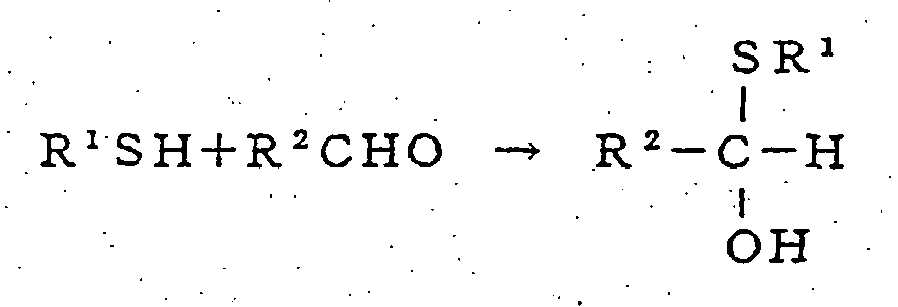
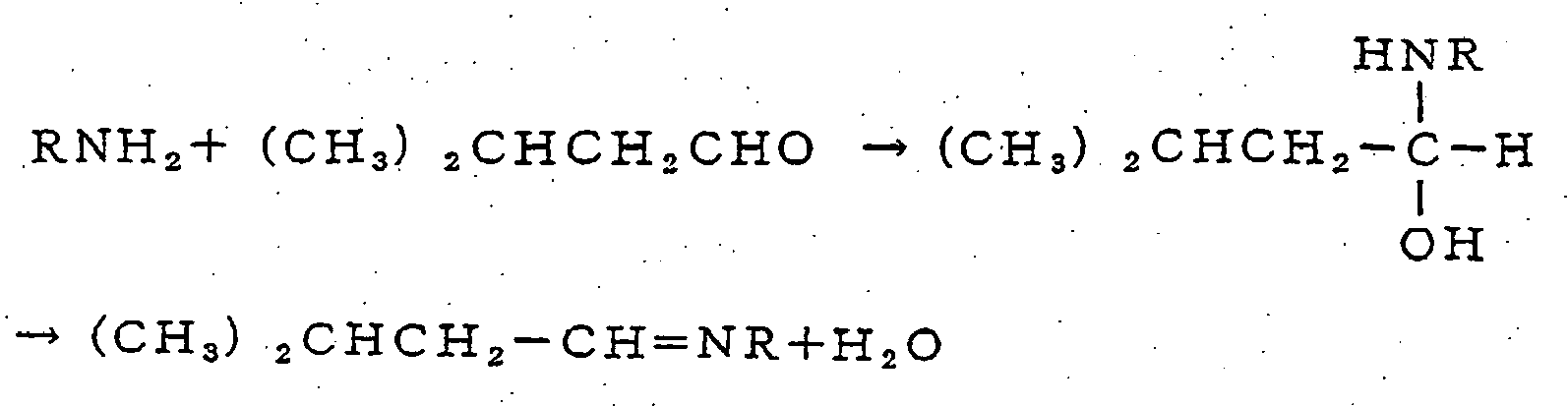
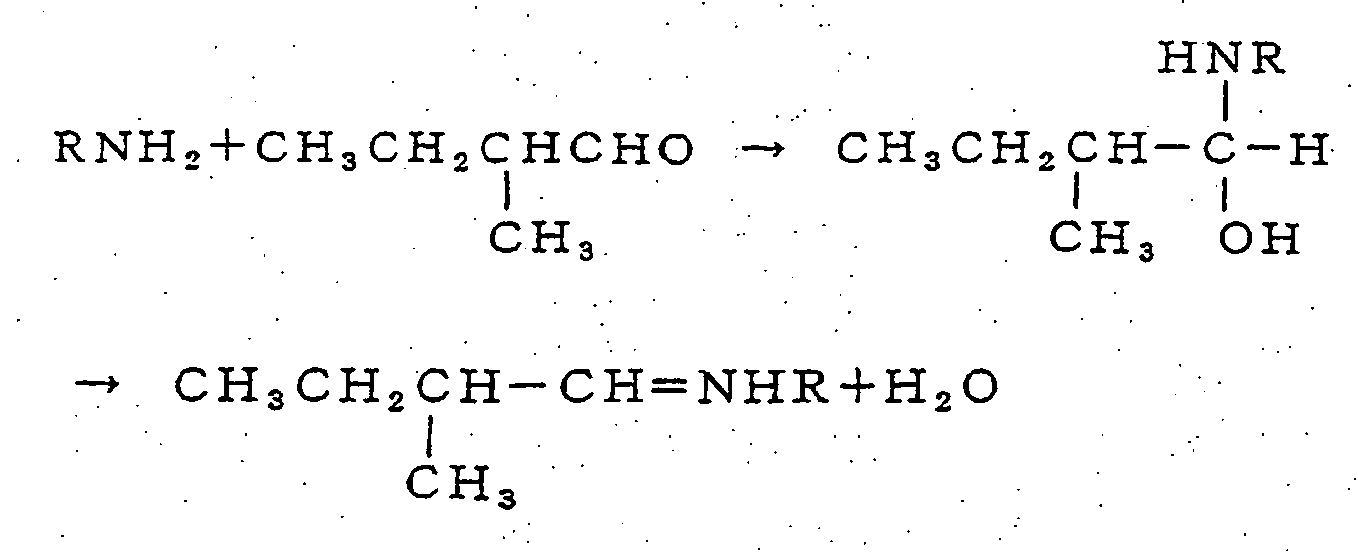
- Based on the above general reaction formulas, the reactions of 3-methylbutanal, acetaldehyde, or 2-methylbutanal with an organic amine, for example, are shown as follows.
- 1) Reaction with 3-methylbutanal
- 2) Reaction with acetaldehyde

- 3) Reaction with 2-methylbutanal
- Articles suitable for providing the urine odor reducing function by the presence of the compound(s) reactive with aldehydes include articles for body fluid absorption, shorts, underwear or clothes for infants or elderly persons, and the like.
- As examples of the articles for body fluid absorption of the present invention, medical and sanitary goods such as sanitary napkins, panty liners, blood absorbers, as well as disposable diapers, incontinence pants, training pants, diaper holders, liners for cloth diapers, incontinence pads, urine-collection sheets, which are used for neonates, infants or elderly persons, and the like can be given.
- The articles for body fluid absorption such as sanitary napkins, disposable diapers, and the like typically comprise a liquid-permeable surface material (top sheet), an absorber containing a water-absorption resin which absorbs and retains body fluids, and a back material with a non-liquid-permeable property (back sheet).
- The disposable diaper may be either a panty-type diaper or an open-type diaper assembled for wearing using adhesive tape.
- The top sheet for the absorptive article which directly contacts with the skin of the wearer must permit body fluids to permeate and must withstand 300 mm H2O or less water pressure according to the JIS L1092 (Test method for water resistance of textiles, water resistance test method A (low water pressure method)). The lower the water resistance, the higher the hydrophilic properties and the better the liquid permeability. A water resistance exceeding 300 mm H2O is unsuitable because the liquid permeability is so low that the material may allow fluids to flow onto the surface, resulting in leakage.
- Currently available materials for such a top sheet include non-woven fabrics and porous films.
- The non-woven fabrics used for the top sheet are not specifically limited, but those made of 1-5 d fiber with a nicking (Metsuke) of 10-50 g/m2 are preferable. Dry methods and wet methods, such as a thermal bond method, span bond method, air laid method, chemical bond method, span lace method, and the like, are employed for the manufacture of non-woven fabrics. Top sheets for articles for body fluid absorption are mainly manufactured by a dry method in general. Thermal bond fabrics and span bond fabrics exhibiting well-balanced strength and texture are particularly preferable.
- Fibers for non-woven fabric may be synthetic fibers such as polyolefin fibers (polyethylene, polypropyrene, etc.) and polyester fibers (polyethylene terephthalate, etc.), semi-synthetic fibers such as rayon, or natural fibers such as cotton, pulp, and silk.
- As porous films, permeable porous films made from thermoplastics by extrusion, followed by boring using heated needles, embossing, hot blast, or the like can be used in the present invention.
- Polyethylene (density: 0.86-1.1 g/cm3), polypropylene (density: 0.89-1.2 g/cm3), and the like can be used either individually or in combination as the thermoplastics for porous films. Multilayer porous films produced from a single thermoplastic or a combination of two or more kinds of thermoplastics may also be used.
- The absorbers used in absorptive articles of the present invention are materials possessing capabilities of absorbing and retaining liquids, and include, but are not limited to, pulverized pulp, highly absorbent resins, tissue papers, and the like.
- The constitution of the absorber can be appropriately changed corresponding to the required absorption performance and wearing sensation, which are affected by thickness and bending resistance.
- There are no specific limitations to the back sheet used in the present invention so long as it is a non-liquid-permeable sheet-like material.
- In addition to these components , a hydrophobic sheet may be provided at the end of the absorber to prevent leakage of liquids from the sides of the absorptive article. In the case of the absorptive article in the form of a pad, an adhesive for fixating with underwear and the like may be provided on the back sheet.
- When a deodorant effective for reducing a urine odor is incorporated into the absorptive article of the present invention, the amount of addition is preferably from 0.002 g to 5 g per one sheet of the absorptive article. The density of the deodorant can be appropriately selected according to the kinds of the absorptive article. In the case of a urine absorption pad, for example, the density may be in the range of 0.01-20 g/m2, and preferably 0.1-5 g/m2. The density of deodorant in this range neither lowers the body fluid absorption performance of the absorptive article, nor impairs the safety of the article such as skin irritation. The above range, however, is not limitative since the amount of deodorant to be added varies depending on the shape of the article, the urine absorption amount during use, and the like.
- The deodorant may be arranged in any position in which the deodorant comes into contact with urine, such as the top sheet, absorber, or back sheet. Preferable position is the back of the top sheet or the upper section of the absorber. This arrangement ensures the deodorizing effect is exhibited, since the deodorant is present in the route in which urine is absorbed at the time of urination.
- In addition, because the deodorant is present in the passage of odor vaporized from the absorber when the absorptive article is replaced, contact between the odorous materials and the deodorant is ensured, resulting in exhibition of an excellent deodorizing effect.
- If the deodorant is arranged on the surface of the top sheet, during wearing the deodorant is attached to the skin of the wearer before urination, thereby decreasing the probability of the deodorant coming into contact with urine. When the deodorant is arranged in the center or lower part of the absorber or in the back sheet, the probability of the deodorant coming into contact with urine is low if the amount of adsorbed urine is small. It is thus difficult for the odorant to exhibit an effect.
- Inventions of high absorbent resins and moisture-permeable leakage-proof sheets (back sheet) have now made diapers wearable for a long time at night or during the time when the wearer is out of the home. In such articles worn for a long time, arranging the deodorant in the middle to lower part of the absorber or on the absorber side of the back sheet is particularly effective, because urine odor passes through micropores of the moisture-permeable leakage-proof sheets and is smelled. This, however, does not exclude arrangement of the deodorant on the surface or backside of the top sheet, in the upper, middle or lower part of the absorber, or on the absorbed side of the back sheet.
- To further improve the deodorizing effect, the deodorant may be concentrated in locations near the urination area of the wearers, specifically, on the front side from the center in the absorptive article for men and around the center in the absorptive article for women.
- The deodorant is preferably dissolved or dispersed in water and applied to the absorptive article.
- In this instance, water-soluble polymers such as polyethylene glycol and polyvinyl alcohol, which are dissolved in urine, may be used as a binder. However, when applied onto the surfaces of non-woven fabrics and absorbers, particularly onto pulp surfaces, the water-soluble polymers may aggregate at the crossing points of the fibers after drying and increase the rigidity of the fibers, unpreferably resulting in an impaired texture.
- Taking into account the absorption performance, the deodorant is preferably coated in the form of patterned dots, lines, or lattices. The method of patterning may be a method of masking the parts where the coating is unnecessary and spraying, a method of coating by extrusion using a slot coater, or a method of coating by transfer printing using a roll coater. In these methods, the deodorant bulk is preferably dissolved or dispersed in water without using a binder and applied to the absorptive article.
- Although any coating methods can be employed, spray coating, extrusion coating using a slot coater, and a transfer coating using a roll coater are preferable.
- Any coating patterns such as entire surface coating, dot coating, line coating, and lattice coating are applicable. When coating onto the top sheet and the upper parts of the absorber, dot coating, line coating, and lattice coating, in which uncoated parts are left after coating, are preferable rather than entire surface coating, which may impair transfer of discharges such as urine to the absorber.
- The present invention will now be described in more detail by way of examples and comparative examples, which should not be construed as limiting the present invention.
- An absorptive article was prepared as follows. 1) An absorptive article (Lifely urine-removing pad regular for women (manufactured by Uni-Charm Corp.)) comprising a liquid-permeable top sheet, an absorber made from pulp and a highly absorptive resin provided under the surface material and capable of absorbing and retaining body fluids, and a back sheet with non-liquid-permeable property was provided and the top sheet was peeled off. 2) Non-liquid-permeable films for the back sheet with a width of 1 cm were placed on the upper surface of the absorber at intervals of 1 cm. 3) An aqueous solution of diethanolamine and citric acid at concentrations to produce coating containing respectively 0.5 g/m2 of diethanolamine and 3.0 g/m2 of citric acid was prepared and sprayed on. 4) The coating was dried at 25°C for 24 hours. 5) The peeled top sheet was returned to the original location on the absorptive article. Citric acid was added to control the pH and reduce problems such as skin roughness of the wearer.
- Urine collection pads were prepared in the same manner as in Example 1 except that the deodorant compositions shown in Table 3 were sprayed onto the surface of the absorber. Comparative Example 1
- A urine collection pad was prepared in the same manner as in Example 1 except that nothing was applied to the surface of the absorber.
Table 3 Deodorant pH buffering agent Assistant odor suppressor DEA MEA DO AA CA SA Zeolite Example 1 0.5 0.0 0.0 0.0 3.0 0.0 0.0 Example 2 0.5 0.0 0.0 0.0 3.0 0.0 3.0 Example 3 0.5 0.0 0.0 0.0 0.0 3.0 0.0 Example 4 0.0 0.5 0.0 0.0 3.0 0.0 0.0 Example 5 0.0 0.0 0.5 0.0 3.0 0.0 0.0 Example 6 0.0 0.0 0.0 0.5 3.0 0.0 0.0 Comparative Example 1 0.0 0.0 0.0 0.0 0.0 0.0 0.0 DEA : Diethanolamine; MEA: Monoethanolamine; DO : Dioctylamine; AA : Acetamide; CA : Citric acid; SA : Succinic acid -
- (1) Urines were collected from four adult panelists immediately after uprising. The urines were mixed.
- (2) 200 ml of the mixed urine obtained in (1) above was fed to the center of a urine collection pad described above.
- (3) The urine collection pad into which the urine was fed in (2) above was put into a 1 L beaker. After sealing with a food wrap and an insulating tape, the beaker was allowed to stand for 24 hours at 37°C.
- (4) After removing the food wrap from the beaker, the odor was organoleptically tested by four adult panelists A-D.
- (5) The odors checked in the organoleptically test were indicated by the six-step odor emission rate indication method in Table 1 above.
- The results of the organoleptic test are shown in Table 4.
Table 4 Panelist Average A B C D Example 1 2 1 1 1 1.25 Example 2 1 0 1 1 0.75 Example 3 1 2 2 1 1.50 Example 4 1 1 2 2 1.50 Example 5 2 2 2 1 1.75 Example 6 1 1 2 1 1.25 Comparative Example 1 4 3 4 4 3.75 - From the comparison of Examples 1-6 and the Comparative Example 1, the unpleasant sensation of urine odor was confirmed to be reducible by having compounds reactive with aldehydes present in absorption articles.
- As described above, urine odor was reduced in the present invention by using a compound(s) reactive with aldehydes as defined in the claims. In addition, if the present invention is applied to articles such as a body fluid absorption article, the wearers themselves or persons assisting in the replacement of the articles for body fluid absorption feel the urine odor to a lesser extent, whereby it is possible to reduce the unpleasant sensation of urine odor from the absorptive article after urine absorption.
| Odor emission rate | Criteria |
| 0 | No odor |
| 1 | Barely sensed odor (Detectable threshold concentration) |
| 2 | Identifiable weak odor (Identifiable threshold concentration) |
| 3 | Easily sensed odor |
| 4 | Strong odor |
| 5 | Extremely strong odor |
Claims (4)
- Shorts, underwear or other clothes for infants or elderly persons possessing a function of reducing urine odour comprising one or more compounds reactive with aldehydes selected from the group consisting of monoethanolamine, diethanolamine, triethanolamine, dioctyl amine, ethanolamine hydrochloride, ethanolamine carbonate, ethanolamine carboxylate, ethanolamine sulfonate, formamide, acetamide, propionamide, butylamide and thioalcohol.
- An article for body fluid absorption possessing a function of reducing urine odour comprising one or more compounds reactive with aldehydes selected from the group consisting of monoethanolamine, diethanolamine, triethanolamine, dioctyl amine, ethanolamine hydrochloride, ethanolamine carbonate, ethanolamine carboxylate, ethanolamine sulfonate, formamide, acetamide, propionamide, butylamide and thioalcohol
- The article according to Claim 2 which comprises a liquid-permeable top sheet, an absorber which absorbs and retains body fluids, and a non-liquid-permeable back sheet, wherein the one or more compounds reactive with aldehydes is (are) present in the back of the top sheet or in the upper layer of the absorber.
- Use of a compound reactive with aldehyde in an article for reducing urine odour wherein said compound is selected from,the group consisting of monoethanolamine, diethanolamine, triethanolamine, dioctyl amine, ethanolamine hydrochloride, ethanolamine carbonate, ethanolamine carboxylate, ethanolamine sulfonate, formamide, acetamide, propionamide, butylamide and thioalcohol
Applications Claiming Priority (5)
| Application Number | Priority Date | Filing Date | Title |
|---|---|---|---|
| JP2000296622 | 2000-09-28 | ||
| JP2000296622A JP2002102280A (en) | 2000-09-28 | 2000-09-28 | Absorbing article using organic amines as deodorizer |
| JP2001137054A JP2002331022A (en) | 2001-05-08 | 2001-05-08 | Method for reducing uraroma and article having uraroma reducing function |
| JP2001137054 | 2001-05-08 | ||
| PCT/JP2001/008339 WO2002026273A1 (en) | 2000-09-28 | 2001-09-26 | Method of diminishing urine odor and article functioning to diminish urine odor |
Publications (3)
| Publication Number | Publication Date |
|---|---|
| EP1386621A1 EP1386621A1 (en) | 2004-02-04 |
| EP1386621A4 EP1386621A4 (en) | 2004-08-04 |
| EP1386621B1 true EP1386621B1 (en) | 2010-03-31 |
Family
ID=26600961
Family Applications (1)
| Application Number | Title | Priority Date | Filing Date |
|---|---|---|---|
| EP01972484A Expired - Lifetime EP1386621B1 (en) | 2000-09-28 | 2001-09-26 | Method of diminishing urine odor and article functioning to diminish urine odor |
Country Status (9)
| Country | Link |
|---|---|
| US (2) | US20040037861A1 (en) |
| EP (1) | EP1386621B1 (en) |
| KR (1) | KR100768735B1 (en) |
| CN (1) | CN1466468B (en) |
| AU (1) | AU2001292237A1 (en) |
| CA (1) | CA2421726A1 (en) |
| DE (1) | DE60141715D1 (en) |
| TW (1) | TWI230059B (en) |
| WO (1) | WO2002026273A1 (en) |
Families Citing this family (7)
| Publication number | Priority date | Publication date | Assignee | Title |
|---|---|---|---|---|
| US20070053787A1 (en) * | 2005-09-08 | 2007-03-08 | Marilyn Roberts | Method of evaluating and measuring the smell of urine in a material |
| JP5726128B2 (en) * | 2012-05-09 | 2015-05-27 | ユニ・チャーム株式会社 | Absorbent articles |
| JP5869510B2 (en) * | 2013-03-25 | 2016-02-24 | 理研香料ホールディングス株式会社 | Deodorants |
| CN104436289B (en) * | 2014-12-11 | 2017-01-18 | 天津市中科健新材料技术有限公司 | Paper diaper containing formaldehyde scavenger |
| CN104383589B (en) * | 2014-12-11 | 2017-01-18 | 天津市中科健新材料技术有限公司 | Formaldehyde trapping agent composition and preparation method thereof |
| JP6130869B2 (en) * | 2015-03-11 | 2017-05-17 | 花王株式会社 | Tissue paper |
| CN108366889A (en) | 2015-12-10 | 2018-08-03 | 宝洁公司 | Include the product of odor control compositions |
Family Cites Families (21)
| Publication number | Priority date | Publication date | Assignee | Title |
|---|---|---|---|---|
| US3753990A (en) * | 1972-01-17 | 1973-08-21 | Procter & Gamble | Phenylbismuth bis(2-pyridinethiol 1-oxide) |
| US3920020A (en) * | 1974-06-12 | 1975-11-18 | Personal Products Co | Inhibiting production of undesirable products on body surfaces and environs |
| JPS5279028A (en) * | 1975-12-24 | 1977-07-02 | Kyowa Sangiyou Kk | Foaming deodorant composition |
| JPS534783A (en) * | 1976-07-02 | 1978-01-17 | Japan Synthetic Rubber Co Ltd | Gel hydrate and gel hydrate deodorant |
| JPS53115821A (en) * | 1977-03-17 | 1978-10-09 | Tsurumi Soda Kk | Oder extinguisher |
| JPS57119997A (en) * | 1981-01-19 | 1982-07-26 | Lion Corp | Hydroxamic acid type amphoteric surfactant |
| JPS61209658A (en) * | 1985-03-14 | 1986-09-17 | 株式会社資生堂 | Dodorizing sanitary article |
| JPH0622673B2 (en) * | 1988-12-28 | 1994-03-30 | 株式会社豊田中央研究所 | Porous deodorant filter |
| CA2011670A1 (en) * | 1989-03-20 | 1990-09-20 | Diane L. Furio | Absorbent structures with odor control |
| CA2054095A1 (en) * | 1991-04-22 | 1992-10-23 | Stephanie R. Majors | Multicomponent odor control device |
| JP2858283B2 (en) * | 1992-06-24 | 1999-02-17 | クラレケミカル株式会社 | Aliphatic aldehyde adsorbent |
| JP2950683B2 (en) * | 1992-07-13 | 1999-09-20 | クラレケミカル株式会社 | Air purifier and air purifier |
| US5603927A (en) * | 1992-12-08 | 1997-02-18 | Kabushiki Kaisha Toyota Chuo Kenkyusho | Material for removing offensive odor |
| US5610208A (en) * | 1994-02-17 | 1997-03-11 | Nippon Shokubai Co., Ltd. | Water-absorbent agent, method for production thereof, and water-absorbent composition |
| US5685872A (en) * | 1995-06-07 | 1997-11-11 | Kimberly-Clark Worldwide, Inc. | Inhibition of exoprotein using amide compositions in absorbent article |
| TW522024B (en) * | 1995-09-01 | 2003-03-01 | Nippon Catalytic Chem Ind | Absorbing agent composite, absorbent material, and absorbent product containing absorbent material |
| JP3654704B2 (en) * | 1996-04-17 | 2005-06-02 | テイカ株式会社 | Deodorizing substrate |
| JP3661378B2 (en) * | 1997-11-27 | 2005-06-15 | 三菱化学株式会社 | Method for producing superabsorbent polymer |
| EP0937467A1 (en) * | 1998-02-17 | 1999-08-25 | The Procter & Gamble Company | Doped odour controlling materials |
| EP1089770A1 (en) | 1998-06-29 | 2001-04-11 | The Procter & Gamble Company | Disposable waste management device |
| JP2001104370A (en) * | 1999-10-08 | 2001-04-17 | Oji Paper Co Ltd | Absorbent articles |
-
2001
- 2001-09-26 EP EP01972484A patent/EP1386621B1/en not_active Expired - Lifetime
- 2001-09-26 AU AU2001292237A patent/AU2001292237A1/en not_active Abandoned
- 2001-09-26 WO PCT/JP2001/008339 patent/WO2002026273A1/en not_active Ceased
- 2001-09-26 US US10/381,695 patent/US20040037861A1/en not_active Abandoned
- 2001-09-26 DE DE60141715T patent/DE60141715D1/en not_active Expired - Lifetime
- 2001-09-26 KR KR1020037004334A patent/KR100768735B1/en not_active Expired - Fee Related
- 2001-09-26 CA CA002421726A patent/CA2421726A1/en not_active Abandoned
- 2001-09-26 CN CN018165400A patent/CN1466468B/en not_active Expired - Fee Related
- 2001-09-28 TW TW090124195A patent/TWI230059B/en not_active IP Right Cessation
-
2010
- 2010-10-12 US US12/902,398 patent/US8536399B2/en not_active Expired - Fee Related
Also Published As
| Publication number | Publication date |
|---|---|
| KR20030036837A (en) | 2003-05-09 |
| EP1386621A4 (en) | 2004-08-04 |
| TWI230059B (en) | 2005-04-01 |
| KR100768735B1 (en) | 2007-10-22 |
| CN1466468B (en) | 2012-05-23 |
| CA2421726A1 (en) | 2003-03-07 |
| DE60141715D1 (en) | 2010-05-12 |
| EP1386621A1 (en) | 2004-02-04 |
| CN1466468A (en) | 2004-01-07 |
| US20110028925A1 (en) | 2011-02-03 |
| AU2001292237A1 (en) | 2002-04-08 |
| US20040037861A1 (en) | 2004-02-26 |
| US8536399B2 (en) | 2013-09-17 |
| WO2002026273A1 (en) | 2002-04-04 |
Similar Documents
| Publication | Publication Date | Title |
|---|---|---|
| US8536399B2 (en) | Method of reducing urine odor and article functioning to reduce urine odor | |
| JP4959798B2 (en) | Absorbent articles including improved odor control systems | |
| EP3082703B1 (en) | Absorbent product comprising odor control material | |
| EP0510619A1 (en) | Article for absorbing bodily fluids and controlling malodor created by same | |
| EP1960005B1 (en) | Absorbent product | |
| CN101641474A (en) | Film material with antimicrobial and/or odor-absorbing coating and sanitary article | |
| KR20000016338A (en) | Breathable absorbent articles having chelating agent based odor control system | |
| AU6244900A (en) | Absorbent article | |
| JP2016168336A (en) | Absorbent article | |
| KR20000016393A (en) | Absorbent articles having an odour control system comprising a chelating agent | |
| EP1331015B1 (en) | Absorbent article for reducing urine odor | |
| KR20080072725A (en) | Absorbent articles comprising acidic superabsorbents and organic zinc salts | |
| JP2014079284A (en) | Absorbent article | |
| CN118217435A (en) | Filter | |
| JP2002331022A (en) | Method for reducing uraroma and article having uraroma reducing function | |
| JP2002102280A (en) | Absorbing article using organic amines as deodorizer | |
| WO2002056819A2 (en) | Absorbent articles with odor control | |
| KR20000067971A (en) | The use of a breathable sanitary napkin for odour control | |
| AU5177201A (en) | Breathable absorbent articles having a chelating agent based odour control system |
Legal Events
| Date | Code | Title | Description |
|---|---|---|---|
| PUAI | Public reference made under article 153(3) epc to a published international application that has entered the european phase |
Free format text: ORIGINAL CODE: 0009012 |
|
| 17P | Request for examination filed |
Effective date: 20030318 |
|
| AK | Designated contracting states |
Kind code of ref document: A1 Designated state(s): DE FR GB NL SE |
|
| RAP1 | Party data changed (applicant data changed or rights of an application transferred) |
Owner name: UNI-CHARM CORPORATION |
|
| RIC1 | Information provided on ipc code assigned before grant |
Ipc: 7A 61L 15/42 B Ipc: 7A 61F 5/441 B Ipc: 7A 61L 9/01 A Ipc: 7A 61F 13/15 B Ipc: 7A 61L 15/46 B Ipc: 7A 61L 15/20 B Ipc: 7B 01J 20/26 B |
|
| A4 | Supplementary search report drawn up and despatched |
Effective date: 20040617 |
|
| GRAP | Despatch of communication of intention to grant a patent |
Free format text: ORIGINAL CODE: EPIDOSNIGR1 |
|
| GRAS | Grant fee paid |
Free format text: ORIGINAL CODE: EPIDOSNIGR3 |
|
| GRAA | (expected) grant |
Free format text: ORIGINAL CODE: 0009210 |
|
| AK | Designated contracting states |
Kind code of ref document: B1 Designated state(s): DE FR GB NL SE |
|
| REG | Reference to a national code |
Ref country code: GB Ref legal event code: FG4D |
|
| REF | Corresponds to: |
Ref document number: 60141715 Country of ref document: DE Date of ref document: 20100512 Kind code of ref document: P |
|
| REG | Reference to a national code |
Ref country code: SE Ref legal event code: TRGR |
|
| REG | Reference to a national code |
Ref country code: NL Ref legal event code: VDEP Effective date: 20100331 |
|
| PG25 | Lapsed in a contracting state [announced via postgrant information from national office to epo] |
Ref country code: NL Free format text: LAPSE BECAUSE OF FAILURE TO SUBMIT A TRANSLATION OF THE DESCRIPTION OR TO PAY THE FEE WITHIN THE PRESCRIBED TIME-LIMIT Effective date: 20100331 |
|
| PLBE | No opposition filed within time limit |
Free format text: ORIGINAL CODE: 0009261 |
|
| STAA | Information on the status of an ep patent application or granted ep patent |
Free format text: STATUS: NO OPPOSITION FILED WITHIN TIME LIMIT |
|
| 26N | No opposition filed |
Effective date: 20110104 |
|
| GBPC | Gb: european patent ceased through non-payment of renewal fee |
Effective date: 20100926 |
|
| PG25 | Lapsed in a contracting state [announced via postgrant information from national office to epo] |
Ref country code: GB Free format text: LAPSE BECAUSE OF NON-PAYMENT OF DUE FEES Effective date: 20100926 |
|
| PGFP | Annual fee paid to national office [announced via postgrant information from national office to epo] |
Ref country code: SE Payment date: 20120911 Year of fee payment: 12 |
|
| PGFP | Annual fee paid to national office [announced via postgrant information from national office to epo] |
Ref country code: FR Payment date: 20120926 Year of fee payment: 12 Ref country code: DE Payment date: 20120919 Year of fee payment: 12 |
|
| REG | Reference to a national code |
Ref country code: SE Ref legal event code: EUG |
|
| PG25 | Lapsed in a contracting state [announced via postgrant information from national office to epo] |
Ref country code: SE Free format text: LAPSE BECAUSE OF NON-PAYMENT OF DUE FEES Effective date: 20130927 |
|
| REG | Reference to a national code |
Ref country code: DE Ref legal event code: R119 Ref document number: 60141715 Country of ref document: DE Effective date: 20140401 |
|
| REG | Reference to a national code |
Ref country code: FR Ref legal event code: ST Effective date: 20140530 |
|
| PG25 | Lapsed in a contracting state [announced via postgrant information from national office to epo] |
Ref country code: DE Free format text: LAPSE BECAUSE OF NON-PAYMENT OF DUE FEES Effective date: 20140401 Ref country code: FR Free format text: LAPSE BECAUSE OF NON-PAYMENT OF DUE FEES Effective date: 20130930 |