EP1316917A2 - Apparatus and method for embedding watermark into original information, transmitting watermarked information, and reconstructing the watermark - Google Patents
Apparatus and method for embedding watermark into original information, transmitting watermarked information, and reconstructing the watermark Download PDFInfo
- Publication number
- EP1316917A2 EP1316917A2 EP02257144A EP02257144A EP1316917A2 EP 1316917 A2 EP1316917 A2 EP 1316917A2 EP 02257144 A EP02257144 A EP 02257144A EP 02257144 A EP02257144 A EP 02257144A EP 1316917 A2 EP1316917 A2 EP 1316917A2
- Authority
- EP
- European Patent Office
- Prior art keywords
- watermark
- components
- image
- bit stream
- embedding
- Prior art date
- Legal status (The legal status is an assumption and is not a legal conclusion. Google has not performed a legal analysis and makes no representation as to the accuracy of the status listed.)
- Granted
Links
Images



Classifications
-
- G—PHYSICS
- G06—COMPUTING OR CALCULATING; COUNTING
- G06T—IMAGE DATA PROCESSING OR GENERATION, IN GENERAL
- G06T1/00—General purpose image data processing
- G06T1/0021—Image watermarking
- G06T1/005—Robust watermarking, e.g. average attack or collusion attack resistant
-
- H—ELECTRICITY
- H04—ELECTRIC COMMUNICATION TECHNIQUE
- H04N—PICTORIAL COMMUNICATION, e.g. TELEVISION
- H04N5/00—Details of television systems
- H04N5/76—Television signal recording
- H04N5/91—Television signal processing therefor
- H04N5/913—Television signal processing therefor for scrambling ; for copy protection
-
- G—PHYSICS
- G06—COMPUTING OR CALCULATING; COUNTING
- G06T—IMAGE DATA PROCESSING OR GENERATION, IN GENERAL
- G06T2201/00—General purpose image data processing
- G06T2201/005—Image watermarking
- G06T2201/0061—Embedding of the watermark in each block of the image, e.g. segmented watermarking
Definitions
- the present invention relates to a watermark, and more particularly, to an apparatus and method for embedding a watermark into original information, transmitting the watermarked information, and reconstructing the watermark.
- identification information (hereinafter referred to as "a watermark") is embedded in the original information.
- Copyright information of the original information, the signature of the copyright holder, or a mark is mainly used as a watermark.
- the size of data embedded into the original information increases, the watermarked information becomes robust against external attacks while the quality of the watermarked information is degraded. If the size of data embedded into the original information decreases, the result is the opposite. That is, there is a trade-off between the size of a watermark and the quality of the watermarked information.
- text data is embedded as a watermark
- the text data usually takes less than 100 bits, and therefore there is no problem.
- image data is embedded as a watermark, for example, even a binary image of 32 x 32 pixels, which is relatively small, needs the embedding of 1024 bits, and therefore the quality of the original information is degraded.
- necessity for embedding a watermark image has increased because image data is more discriminating and user-friendly than text data.
- a method for embedding a watermark into original information includes (a) embedding a predetermined number of components of a plurality of components constituting the watermark into the original information, and (b) using the remaining components as keys for reconstructing the watermark.
- step (a) includes (a1) decomposing the watermark into a plurality of components, and step (a1) includes decomposing the watermarked image into a color component, a location component, and a size component.
- the decomposing includes (a11) obtaining a plurality of sub blocks by dividing the watermarked image into areas having identical color components, (a12) generating a bit stream expressing the color components of the obtained sub blocks, and (a13) embedding the generated bit stream into the original information.
- step (a11) includes dividing the watermarked image into at least one binary image, and obtaining a plurality of sub blocks by dividing the obtained binary image into areas of which color components are expressed by an identical bit value.
- a method for embedding a watermark image into original information includes (a) retrieving the watermark image while changing the size of an area, and if there is an area of which color component is expressed by an identical bit value, extracting the area as a sub block, (b) generating a bit stream expressing the color components of extracted sub blocks, and (c) embedding the generated bit stream into the original information.
- step (a) includes (a1) dividing the watermark image into at least one binary image, (a2) retrieving the watermark image while changing the size of an area, and if there is an area of which color component is expressed by an identical bit value, extracting the area as a sub block, and (a3) repeating step (a2) for the remaining binary images.
- step (b) includes generating a bit stream expressing the color component by arranging bit values corresponding to sub blocks in order of sub block size.
- a method for embedding a watermark into original information and transmitting the original information includes (b) embedding only a predetermined number of components of a plurality of components constituting the watermark into the original information and transmitting the original information, and (c) transmitting the remaining components as keys needed for reconstructing the watermark.
- step (b) the method further includes (a) decomposing the watermark into a plurality of components.
- a method for reconstructing a watermark includes (a) extracting a predetermined number of components of a plurality of components constituting the watermark from original information, and (b) reconstructing the watermark by combining the remaining components received as keys.
- step (a) includes (a1) extracting a bit stream expressing the color components of the watermark from a watermarked original information.
- step (b) includes (b1) receiving the location and size components of the watermark as keys and, by combining the keys and the color components, reconstructing the watermark.
- an apparatus for embedding a watermark into original information includes a watermark decomposing unit which decomposes the watermark into a plurality of components, a watermark embedding unit which embeds a predetermined number of components of the plurality of components obtained through the watermark decomposing unit, and a key generating unit which outputs the remaining components of the plurality of components obtained through the watermark decomposing unit as keys for reconstructing the watermark.
- the watermark decomposing unit obtains a plurality of sub blocks by dividing the watermark image into areas having an identical color component and generates a bit stream expressing the color components of the obtained sub blocks, and the watermark embedding unit embeds the bit stream generated by the watermark decomposing unit into the original information.
- a watermark embedding apparatus 10 receives original information and a watermark, embeds a part of data constituting the watermark into the original information, and outputs watermarked information and a key.
- the watermark embedding apparatus 10 is formed with a watermark decomposing unit 11, a key generating unit 12, and a watermark embedding unit 13.
- the watermark decomposing unit 11 decomposes a watermark into a plurality of components.
- a watermark may be expressed by one of a variety of expression methods. For example, if watermarked data is encrypted according to a predetermined encryption algorithm, the watermark is decomposed into a data component and a key component. If a watermark is video or sound data and is quantized according to the number of quantization bits assigned to each frequency band, the watermark may be decomposed into a quantized data component and the number of quantization bits assigned to each frequency band. If a watermark is a voice signal, the watermark may be decomposed into an excitation source and a spectral shaping filter. In addition, the watermark may be decomposed into a formant and an envelope.
- the watermark may be decomposed into a frequency component and a coefficient component. That is, the watermark decomposing unit 11 decomposes a watermark into two or more components that can be later combined to reconstruct the watermark.
- the watermark image is converted into at least one binary image and then decomposed.
- the watermark image is divided into binary images by color, and each binary image is decomposed.
- a binary watermark image is decomposed into a color component, a location component, and a size component.
- the key generating unit 12 generates a verification key.
- the verification key indicates data needed in extracting a watermark from watermarked information or reconstructing a watermark from extracted data.
- the key generating unit 12 stores the remaining components, that is, the plurality of components obtained through the watermark decomposing unit 11 except for the components embedded into the original information, as a key for reconstructing the watermark, or when the watermark image is transmitted, transmits the remaining components to a destination terminal separately from the watermark information.
- the watermark embedding unit 13 embeds some of the plurality of components generated by the watermark decomposing unit 11 into the original information.
- the original information is usually an image (both a still image and a moving image) or sound (including a voice signal).
- a method for embedding watermark into original information may be selected in a variety of ways. Any of prior art watermark embedding methods may be used. For example, in one method, after the original information is converted into data in a frequency domain through Discrete Cosine Transform (DCT), Faster Fourier Transform (FFT), or Discrete Wavelet Transform (DWT), watermark may be embedded into a part to which human eyesight is less sensitive.
- DCT Discrete Cosine Transform
- FFT Faster Fourier Transform
- DWT Discrete Wavelet Transform
- a scaling factor is a factor adjusting for a trade-off between the robustness of a watermark and the picture quality of a watermarked image when the original information is an image.
- the scaling factors are assigned, the values of the scaling factors may be different from one another.
- an embedding method using lossy compression is not used.
- a compression method such as a run-length method, which can cause error propagation is not used.
- Figure 2 is a diagram of the structure of an apparatus which is added to the watermark embedding apparatus of Figure 1 and stores or transmits watermarked original information.
- the watermark transmitting apparatus includes a storage unit 20 and a server 30.
- the storage unit 20 stores the information watermarked according to the present invention and the key.
- the storage unit 20 may be implemented as a general storage unit for storing watermarked information and a security storage unit for storing keys.
- the server 30 transmits the watermarked information and key to another system 50 through the network.
- the network may be a Local Area Network (LAN) or a Wide Area Network (WAN) such as the Internet or may include both.
- the system 50 can extract and reconstruct the watermark from the watermarked information by using the received key.
- a display apparatus not shown
- a printing apparatus not shown
- the system 50 can display or print the watermarked information and reconstructed watermark.
- Figures 3 and 4 are reference diagrams showing a process for decomposing a watermark according to the present invention.
- the watermark decomposing unit 11 decomposes the watermark into M components (where M is an integer).
- M components A which is m components (m is an integer less than M), is embedded as a watermark into the original information, and B, which is the remaining components (M-m), is used as a key.
- a watermark image is decomposed into a color component, a location component, and a size component. Then the color component is embedded into the original information, and the location component and the size component are used as keys.
- Figures 5A and 5B are reference diagrams showing a process for decomposing a watermark image according to a preferred embodiment of the present invention.
- the watermark decomposing unit 11 divides a watermark image into binary images and then decomposes the binary images.
- binary images are shown as 4 areas represented by reference numbers 1 through 4. Shaded parts indicate bit '0', and unshaded parts indicate bit '1'. Since areas 3 and 4 have the same color components, that is, the color components are expressed by the same bit, areas 3 and 4 are extracted as sub block W(0). Next, area 1 is extracted as sub block W(1). Then, in area 2, areas 2-1 and 2-3, in which color components are expressed by the same bit, are extracted as sub block W(2). In the remaining area, area 2-4, in which the color component is expressed by the same bit, is extracted as sub block W(3).
- areas 2-2-1, 2-2-2, 2-2-3, and 2-2-4 are extracted as sub blocks W(4), W(5), W(6), and W(7), respectively. If bits corresponding to sub blocks in order of extraction are arranged, a bit stream '10010101' is obtained. That is, '10010101' is a bit stream expressing color components.
- FIG. 5B the size and location components which are obtained in the watermark image decomposing process of Figure 5A are shown.
- the size of a rectangle indicates the size component of a corresponding sub block, and the reference numbers marked in the rectangles indicate the location components of corresponding sub blocks.
- the size and location components may be expressed in a variety of ways.
- Figure 6 is a reference diagram showing a process for reconstructing a watermark in another system.
- a system 50 extracts bit stream '10010101' that indicates the color component from the watermarked image and then, by combining the size and location components received as keys, reconstructs the watermark.
- Figure 7 is a flowchart for explaining a watermark embedding method according to the present invention.
- the watermark embedding apparatus embeds some of a plurality of components constituting a watermark into original information in step 701 and uses the remaining components as keys for reconstructing the watermark in step 702.
- using the components as keys means storing the components as keys or transmitting the components as keys when the watermarked information obtained in step 701 is transmitted to a destination.
- Figure 8 is a flowchart for explaining a watermark embedding method according to a preferred embodiment of the present invention.
- the watermark embedding apparatus embeds the obtained bit stream into the original information in step 803.
- a method for embedding the bit stream into the original information an applicable prior art watermark embedding method may be used.
- bits may be embedded. A large scale factor is given to an important component, while a small scale factor is given to a less important component. For example, a large scale factor is assigned to a bit of a sub block having a relatively large size, while a small scale factor is assigned to a bit of a sub block having a relatively small size. Meanwhile, the size and location components of a sub block are used as keys in step 804.
- Figure 9 is a flowchart for explaining a watermark transmitting method according another preferred embodiment of the present invention.
- the watermark transmitting apparatus divides the watermarked image into a plurality of sub blocks having identical color components in step 901 and generates a bit stream expressing color components corresponding to sub blocks in order of size in step 902. These steps are the same as steps 801 and 802 of Figure 8. In addition, a scale factor having a greater value is given to a sub block which is relatively large in step 903.
- the watermark transmitting apparatus embeds a bit stream, to which scale factors are assigned, into the original image and transmits the original image to another system 50 in step 904.
- the original image includes both a still image and a moving image.
- an applicable prior art method may be used as a method for embedding the bit stream into the original image.
- bits may be embedded.
- a large scale factor is given to an important component, while a small scale factor is given to a less important component.
- a large scale factor is assigned to a bit of a sub block having a relatively large size, while a small scale factor is assigned to a bit of a sub block having a relatively small size.
- the size and location components are arranged in order of sub block size, and then transmitted as keys to another system 50 in step 905.
- Figure 10 is a flowchart for explaining a watermark reconstructing method.
- the system 50 receives the watermarked image and key through the network in step 1001 and extracts the bit stream expressing color components of sub blocks from the watermarked image in step 1002. Meanwhile, the system 50 extracts the size and location components of sub blocks from the received keys in step 1003. According to the bit stream extracted in step 1002 and the size components extracted in step 1003, sub blocks having corresponding sizes and bit values are reconstructed. Finally, referring to the location components, by rearranging the reconstructed sub blocks, the watermark image is reconstructed in step 1004.
- embedded components and keys should be accurate. This accuracy guarantees the robustness of the methods and apparatuses for embedding and transmitting watermarks. For example, if the location and size information of other watermark images is received as a key, the number of sub blocks does not match and the watermark image cannot be reconstructed. Even when a bit stream expressing embedded components is extracted with an algorithm for embedding the watermark, if the size and location components of sub blocks are not known, the watermark image cannot be reconstructed correctly. Though keys are hacked, if the embedded color component is not known, the bits of the sub blocks cannot be filled and therefore reconstruction is impossible.
- the results of experiments on the performance of the watermark embedding apparatus according to the present invention are as follows.
- the apparatus used in the experiments employed a method in which an original image is DWT converted to obtain DWT coefficients, and if the bit value of a bit stream to be embedded is '0', the corresponding coefficient is replaced by a threshold value T1, and if the bit value is '1', the corresponding coefficient is replaced by a threshold value T2.
- a factor which determines the distance between T1 and T2 is a scale factor.
- the scale factor may be determined in a variety of ways.
- Figure 11 shows examples of watermark images used for experiment.
- DM LAB needs 128 x 128 bits/pixel
- SAMSUNG needs 150 x 39 bits/pixel
- SAMSUNG needs 150 x 39 bits/pixel
- SAMSUNG needs 150 x 39 bits/pixel
- Signature needs 64 x 64 bits/pixel.
- Figure 12 is a table for comparing bit streams of color components extracted according to the present invention from the test images of Figure 11. Referring to Figure 12, it is shown that (a) “DM LAB” can be expressed by 1167 bits, which is a 90% decrease from the prior art which use 16384 bits. (b) “SAMSUNG” and (c) “Signature” can be expressed by an 85% decrease in bits.
- Figure 13 shows original images used for experiment. Referring to Figure 13, each of (a) “Lenna”, (b) “Baboon”, and (c) "Camman” needs 256 x 256 pixels.
- Figure 14 is a graph comparing the picture quality of watermark images obtained according to the present invention and the picture quality of images obtained according to the prior art.
- the watermark is embedded three times.
- the watermark image is only embedded once.
- PSNR means Pick Signal to Noise Ratio.
- Figure 15 is a graph showing the robustness of an image watermarked according to the present invention.
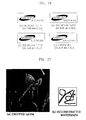
- Figure 16 is a reference diagram showing the filtering robustness of an image watermarked according to the present invention.
- Figure 17 is a reference diagram showing the cropping robustness of an image watermarked according to the present invention.
- Figure 18 is a reference diagram showing the warping robustness of an image watermarked according to the present invention.
- a watermark to be embedded is decomposed into a plurality of components, and just some of the components are embedded such that the picture quality is improved, and the remaining components are transmitted as keys such that the information becomes more robust against attacks. This is because in a destination terminal, only a combination of some components extracted from the original information and the remaining components transmitted as keys can completely reconstruct the watermark.
Landscapes
- Engineering & Computer Science (AREA)
- Physics & Mathematics (AREA)
- General Physics & Mathematics (AREA)
- Theoretical Computer Science (AREA)
- Multimedia (AREA)
- Signal Processing (AREA)
- Editing Of Facsimile Originals (AREA)
- Image Processing (AREA)
- Color Television Systems (AREA)
- Television Systems (AREA)
- Compression, Expansion, Code Conversion, And Decoders (AREA)
Abstract
Description
Claims (34)
- A method for embedding a watermark into original information, the method comprising:(a) embedding a predetermined number of components (m) of a plurality of components (M) constituting the watermark into the original information; and(b) using the remaining components (M-m) as keys for reconstructing the watermark.
- The method of claim 1, wherein step (a) comprises:(a1) decomposing the watermark into a plurality of components.
- The method of claim 2, wherein step (a1) comprises:decomposing the watermarked image into a color component, a location component, and a size component.
- The method of claim 3, wherein the decomposing comprises:(a11) obtaining a plurality of sub blocks by dividing the watermarked image into areas having identical color components;(a12) generating a bit stream expressing the color components of the obtained sub blocks; and(a13) embedding the generated bit stream into the original information.
- The method of claim 4, wherein step (all) comprises:dividing the watermarked image into at least one binary image; andobtaining a plurality of sub blocks by dividing the obtained binary image into areas of which color components are expressed by an identical bit value.
- The method of any preceding claim, wherein step (a) comprises:decomposing the watermark into an encrypted watermark according to a predetermined encryption algorithm and an encryption key.
- The method of any preceding claim, wherein step (a) comprises:decomposing the watermark into data quantized and the number of the quantization bits according to the number of quantization bits assigned to each frequency band.
- A method for embedding a watermark image into original information, the method comprising:(a) retrieving the watermark image while changing the size of an area, and if there is an area of which color component is expressed by an identical bit value, extracting the area as a sub block;(b) generating a bit stream expressing the color components of extracted sub blocks; and(c) embedding the generated bit stream into the original information.
- The method of claim 8, wherein step (a) comprises:(a1) dividing the watermark image into at least one binary image;(a2) retrieving the watermark image while changing the size of an area, and if there is an area of which color component is expressed by an identical bit value, extracting the area as a sub block; and(a3) repeating step (a2) for the remaining binary images.
- The method of claim 8 or 9, wherein step (b) comprises:generating a bit stream expressing the color component by arranging bit values corresponding to sub blocks in order of sub block size.
- The method of claim 8, 9 or 10, wherein in step (c) the bit stream is embedded after a scaling factor is assigned to the bit stream.
- The method of claim 11, wherein in step (c) the bit stream is embedded after a scaling factor is differently assigned to at least a predetermined number of bits in the bit stream.
- The method of claim 12, wherein step (c) comprises:assigning the bigger scaling factor to a bit in the bit stream, the bigger size of the sub block corresponding to the bit.
- A method for transmitting original information with a watermark embedded therein, the method comprising:(b) embedding only a predetermined number of components (m) of a plurality of components (M) constituting the watermark into the original information and transmitting the original information; and(c) transmitting the remaining components (M-m) as keys needed for reconstructing the watermark.
- The method of claim 14, before step (b), further comprising:(a) decomposing the watermark into a plurality of components.
- The method of claim 15, wherein step (a) comprises:(a1) decomposing the watermarked image into a color component, a location component, and a size component.
- The method of claim 16, wherein step (al) comprises:(a11) obtaining a plurality of sub blocks by dividing the watermark into areas having identical color components;(a12) generating a bit stream expressing the color components of obtained sub blocks; and(a13) generating a bit stream expressing the location and size components of the obtained sub blocks.
- The method of claim 17, wherein step (all) comprises:decomposing the watermarked image into at least one binary image; andobtaining a plurality of sub blocks by dividing the obtained binary image into areas of which color components are expressed by an identical bit value.
- The method of claim 17 or 18, wherein step (a12) comprises:generating a bit stream expressing the color components by arranging bit values corresponding to the sub blocks in order of sub block size.
- The method of any of claims 14 to 19, wherein step (b) comprises:transmitting the bit stream expressing the location and size components as keys for reconstructing the watermark.
- A method for reconstructing a watermark comprising:(a) extracting a predetermined number of components of a plurality of components constituting the watermark from original information; and(b) reconstructing the watermark by combining the remaining components received as keys.
- The method of claim 21, wherein step (a) comprises:(a1) extracting a bit stream expressing the color components of the watermark from a watermarked original information.
- The method of claim 22, wherein step (b) comprises:(b1) receiving the location and size components of the watermark as keys and, by combining the keys and the color components, reconstructing the watermark.
- An apparatus for embedding a watermark into original information, the apparatus comprising:a watermark decomposing unit (11) which decomposes the watermark into a plurality of components;a watermark embedding unit (13) which embeds a predetermined number of components of the plurality of components obtained through the watermark decomposing unit; anda key generating unit (12) which outputs the remaining components of the plurality of components obtained through the watermark decomposing unit as keys for reconstructing the watermark.
- The apparatus of claim 24, wherein the watermark decomposing unit (11) divides the watermark image into at least one binary image.
- The apparatus of claim 24 or 25, wherein the watermark decomposing unit (11) decomposes the watermark image into a color component, a location component, and a size component.
- The apparatus of claim 24, 25 or 26, wherein the watermark decomposing unit (11) obtains a plurality of sub blocks by dividing the watermark image into areas having an identical color component and generates a bit stream expressing the color components of the obtained sub blocks, and the watermark embedding unit (13) embeds the bit stream generated by the watermark decomposing unit into the original information.
- The apparatus of any of claims 24 to 27, wherein the watermark decomposing unit (11) retrieves the original image while changing the size of an area, and if there is an area of which color component is expressed by an identical bit value, extracts the area as a sub block.
- The apparatus of claim 28, wherein the watermark decomposing unit (11) generates a bit stream expressing the color components by arranging bit values corresponding to sub blocks in order of sub block size.
- The apparatus of claim 29 wherein the watermark embedding unit (13) embeds the bit stream after assigning a scaling factor to the bit stream.
- The apparatus of claim 30, wherein the watermark embedding unit (13) embeds the bit stream after assigning a different scaling factor to at least a predetermined number of bits in the bit stream.
- The apparatus of claim 31, wherein the watermark embedding unit (13) assigns a large scaling factor to a bit in the bit stream, the bit corresponding to a large sub block.
- The apparatus of any of claims 24 to 32, wherein the watermark decomposing unit (a) decomposes the watermark image into a watermark image encrypted according to a predetermined encryption algorithm and into an encryption key.
- The apparatus of any of claims 24 to 33, wherein the watermark decomposing unit (a) decomposes watermark sound into data which is quantized according to the number of quantization bits assigned to each frequency band and into the number of the assigned quantization bits.
Applications Claiming Priority (2)
| Application Number | Priority Date | Filing Date | Title |
|---|---|---|---|
| KR2001075900 | 2001-12-03 | ||
| KR1020010075900A KR100878518B1 (en) | 2001-12-03 | 2001-12-03 | Watermark embedding method, transmission method, restoration method and apparatus therefor |
Publications (3)
| Publication Number | Publication Date |
|---|---|
| EP1316917A2 true EP1316917A2 (en) | 2003-06-04 |
| EP1316917A3 EP1316917A3 (en) | 2006-05-31 |
| EP1316917B1 EP1316917B1 (en) | 2011-05-11 |
Family
ID=19716568
Family Applications (1)
| Application Number | Title | Priority Date | Filing Date |
|---|---|---|---|
| EP02257144A Expired - Lifetime EP1316917B1 (en) | 2001-12-03 | 2002-10-15 | Apparatus and method for embedding watermark into original information, transmitting watermarked information, and reconstructing the watermark |
Country Status (7)
| Country | Link |
|---|---|
| US (1) | US7451317B2 (en) |
| EP (1) | EP1316917B1 (en) |
| JP (1) | JP3834281B2 (en) |
| KR (1) | KR100878518B1 (en) |
| CN (1) | CN1290054C (en) |
| MY (1) | MY138127A (en) |
| TW (1) | TW559743B (en) |
Cited By (3)
| Publication number | Priority date | Publication date | Assignee | Title |
|---|---|---|---|---|
| CN101894238A (en) * | 2010-08-09 | 2010-11-24 | 中国人民解放军海军工程大学 | Word document electronic seal system and method based on double authentication |
| EP1814084A3 (en) * | 2006-01-31 | 2010-12-29 | Xerox Corporation | System and method to automatically establish preferred area for image-wise watermark |
| CN108564519A (en) * | 2017-12-22 | 2018-09-21 | 重庆邮电大学 | A kind of Watermarking for Color Images method based on different transform domain |
Families Citing this family (15)
| Publication number | Priority date | Publication date | Assignee | Title |
|---|---|---|---|---|
| US7827312B2 (en) * | 2002-12-27 | 2010-11-02 | The Nielsen Company (Us), Llc | Methods and apparatus for transcoding metadata |
| JP4550749B2 (en) * | 2006-03-07 | 2010-09-22 | 株式会社東芝 | Image processing method and image processing apparatus |
| JP5036643B2 (en) * | 2007-07-18 | 2012-09-26 | 株式会社リコー | Information processing apparatus, information processing method, and program |
| US8090146B2 (en) * | 2009-01-15 | 2012-01-03 | Google Inc. | Image watermarking |
| CN102238421A (en) * | 2010-04-29 | 2011-11-09 | 华为终端有限公司 | Multi-path video synchronous transmission method, device and system |
| US9380356B2 (en) | 2011-04-12 | 2016-06-28 | The Nielsen Company (Us), Llc | Methods and apparatus to generate a tag for media content |
| US9210208B2 (en) | 2011-06-21 | 2015-12-08 | The Nielsen Company (Us), Llc | Monitoring streaming media content |
| US9209978B2 (en) | 2012-05-15 | 2015-12-08 | The Nielsen Company (Us), Llc | Methods and apparatus to measure exposure to streaming media |
| TWI481262B (en) * | 2011-07-28 | 2015-04-11 | Ind Tech Res Inst | Image encoding system and image encoding method |
| WO2013112744A2 (en) * | 2012-01-24 | 2013-08-01 | Futurewei Technologies, Inc. | Compressed domain watermarking with reduced error propagation |
| US9313544B2 (en) | 2013-02-14 | 2016-04-12 | The Nielsen Company (Us), Llc | Methods and apparatus to measure exposure to streaming media |
| US9946723B2 (en) * | 2014-06-02 | 2018-04-17 | Intel Corporation | Data embedding in run length encoded streams |
| US9762965B2 (en) | 2015-05-29 | 2017-09-12 | The Nielsen Company (Us), Llc | Methods and apparatus to measure exposure to streaming media |
| JP6733030B2 (en) * | 2017-02-23 | 2020-07-29 | 日本電信電話株式会社 | Digital watermark embedding device, digital watermark detecting device, digital watermark embedding method, digital watermark detecting method, and program |
| EP3766241A4 (en) | 2019-08-20 | 2021-01-27 | Citrix Systems, Inc. | Masked watermarks and related systems and techniques |
Family Cites Families (23)
| Publication number | Priority date | Publication date | Assignee | Title |
|---|---|---|---|---|
| US6614914B1 (en) * | 1995-05-08 | 2003-09-02 | Digimarc Corporation | Watermark embedder and reader |
| US5748763A (en) * | 1993-11-18 | 1998-05-05 | Digimarc Corporation | Image steganography system featuring perceptually adaptive and globally scalable signal embedding |
| US6560349B1 (en) * | 1994-10-21 | 2003-05-06 | Digimarc Corporation | Audio monitoring using steganographic information |
| US7007166B1 (en) * | 1994-12-28 | 2006-02-28 | Wistaria Trading, Inc. | Method and system for digital watermarking |
| US6590996B1 (en) * | 2000-02-14 | 2003-07-08 | Digimarc Corporation | Color adaptive watermarking |
| US5915027A (en) * | 1996-11-05 | 1999-06-22 | Nec Research Institute | Digital watermarking |
| JPH11232779A (en) * | 1997-11-20 | 1999-08-27 | Toshiba Corp | Copy protection device |
| US6504941B2 (en) * | 1998-04-30 | 2003-01-07 | Hewlett-Packard Company | Method and apparatus for digital watermarking of images |
| US6487301B1 (en) * | 1998-04-30 | 2002-11-26 | Mediasec Technologies Llc | Digital authentication with digital and analog documents |
| US6983057B1 (en) * | 1998-06-01 | 2006-01-03 | Datamark Technologies Pte Ltd. | Methods for embedding image, audio and video watermarks in digital data |
| US6587944B2 (en) * | 1998-06-29 | 2003-07-01 | Intel Corporation | Fragile watermarking for objects |
| KR100389857B1 (en) | 1998-07-01 | 2003-07-04 | 삼성전자주식회사 | Digital image coding/decoding apparatus and method for recording and restoring signature image using watermarking |
| JP2000050049A (en) * | 1998-07-30 | 2000-02-18 | Fuji Photo Film Co Ltd | Method and device for processing image and storage medium |
| US6477251B1 (en) * | 1998-11-25 | 2002-11-05 | Gtech Rhode Island Corporation | Apparatus and method for securely determining an outcome from multiple random event generators |
| JP3768705B2 (en) | 1998-11-27 | 2006-04-19 | キヤノン株式会社 | Digital watermark embedding device, output control device, and computer-readable storage medium |
| DE60033521T2 (en) | 1999-05-17 | 2007-10-25 | Samsung Electronics Co., Ltd., Suwon | METHOD FOR A WATERMARK OF A DIGITAL IMAGE |
| JP3654077B2 (en) * | 1999-09-07 | 2005-06-02 | 日本電気株式会社 | Online digital watermark detection system, online digital watermark detection method, and recording medium on which online digital watermark detection program is recorded |
| KR100312431B1 (en) * | 2000-01-21 | 2001-11-03 | 오길록 | Apparatus and method for inserting &extracting images watermark based on image segmentation in spatial domain |
| KR100319451B1 (en) * | 2000-02-10 | 2002-01-05 | 윤덕용 | Digital Watermarking Using Variable Size of Blocks |
| US6385329B1 (en) * | 2000-02-14 | 2002-05-07 | Digimarc Corporation | Wavelet domain watermarks |
| US6449380B1 (en) * | 2000-03-06 | 2002-09-10 | Intel Corporation | Method of integrating a watermark into a compressed image |
| KR100548983B1 (en) * | 2000-11-02 | 2006-02-02 | (주)마크텍 | Method and device for inserting text for issuance and authentication of digital certificates |
| JP4227048B2 (en) * | 2003-04-25 | 2009-02-18 | 株式会社東芝 | Image processing system |
-
2001
- 2001-12-03 KR KR1020010075900A patent/KR100878518B1/en not_active Expired - Fee Related
-
2002
- 2002-09-03 TW TW091120053A patent/TW559743B/en not_active IP Right Cessation
- 2002-09-12 MY MYPI20023405A patent/MY138127A/en unknown
- 2002-10-15 CN CNB021458340A patent/CN1290054C/en not_active Expired - Fee Related
- 2002-10-15 EP EP02257144A patent/EP1316917B1/en not_active Expired - Lifetime
- 2002-11-06 JP JP2002323068A patent/JP3834281B2/en not_active Expired - Fee Related
- 2002-12-02 US US10/307,500 patent/US7451317B2/en not_active Expired - Lifetime
Cited By (5)
| Publication number | Priority date | Publication date | Assignee | Title |
|---|---|---|---|---|
| EP1814084A3 (en) * | 2006-01-31 | 2010-12-29 | Xerox Corporation | System and method to automatically establish preferred area for image-wise watermark |
| US8090141B2 (en) | 2006-01-31 | 2012-01-03 | Xerox Corporation | System and method to automatically establish preferred area for image-wise watermark |
| CN101894238A (en) * | 2010-08-09 | 2010-11-24 | 中国人民解放军海军工程大学 | Word document electronic seal system and method based on double authentication |
| CN108564519A (en) * | 2017-12-22 | 2018-09-21 | 重庆邮电大学 | A kind of Watermarking for Color Images method based on different transform domain |
| CN108564519B (en) * | 2017-12-22 | 2021-11-16 | 重庆邮电大学 | Color image digital watermarking method based on multiple transform domains |
Also Published As
| Publication number | Publication date |
|---|---|
| EP1316917A3 (en) | 2006-05-31 |
| CN1290054C (en) | 2006-12-13 |
| US20030123661A1 (en) | 2003-07-03 |
| JP3834281B2 (en) | 2006-10-18 |
| US7451317B2 (en) | 2008-11-11 |
| TW559743B (en) | 2003-11-01 |
| EP1316917B1 (en) | 2011-05-11 |
| JP2003283803A (en) | 2003-10-03 |
| CN1423235A (en) | 2003-06-11 |
| KR100878518B1 (en) | 2009-01-13 |
| MY138127A (en) | 2009-04-30 |
| KR20030045969A (en) | 2003-06-12 |
Similar Documents
| Publication | Publication Date | Title |
|---|---|---|
| US8032758B2 (en) | Content authentication and recovery using digital watermarks | |
| US6834344B1 (en) | Semi-fragile watermarks | |
| JP3522056B2 (en) | Electronic watermark insertion method | |
| JP4226897B2 (en) | How to embed a digital watermark in digital image data | |
| EP1316917A2 (en) | Apparatus and method for embedding watermark into original information, transmitting watermarked information, and reconstructing the watermark | |
| US6373974B2 (en) | Method for extracting multiresolution watermark images to determine rightful ownership | |
| US8032754B2 (en) | Systems and methods for embedding media forensic identification markings | |
| US7360093B2 (en) | System and method for authentication of JPEG image data | |
| Su et al. | Steganography in JPEG2000 compressed images | |
| US20070196024A1 (en) | Digital Authentication with Digital and Analog Documents | |
| US7313696B2 (en) | Method for authentication of JPEG image data | |
| Qiao et al. | Watermarking methods for MPEG encoded video: Towards resolving rightful ownership | |
| JP2004163855A (en) | Electronic watermark embedding method, and encoder and decoder capable of utilizing such method | |
| Chen et al. | A simple and efficient watermark technique based on JPEG2000 codec | |
| JP4454908B2 (en) | Information processing apparatus, information processing method, program, and recording medium | |
| US7493489B2 (en) | System and method for authentication of JPEG image data | |
| US7627761B2 (en) | System for authentication of JPEG image data | |
| Kong et al. | Object watermarks for digital images and video | |
| Mandal et al. | A genetic algorithm based steganography in frequency domain (GASFD) | |
| Korus et al. | A scheme for censorship of sensitive image content with high-quality reconstruction ability | |
| Hazra et al. | A survey on different techniques for covert communication using steganography | |
| Altun et al. | Multiple watermarking: A vector space projections approach | |
| Celik | Digital watermarking methods for authentication, tamper localization and lossless recovery | |
| Kiang et al. | A finite state transition-based fragile watermarking scheme for JPEG-2000 compressed images | |
| Weng et al. | Reversible Watermarking Techniques |
Legal Events
| Date | Code | Title | Description |
|---|---|---|---|
| PUAI | Public reference made under article 153(3) epc to a published international application that has entered the european phase |
Free format text: ORIGINAL CODE: 0009012 |
|
| 17P | Request for examination filed |
Effective date: 20021028 |
|
| AK | Designated contracting states |
Designated state(s): AT BE BG CH CY CZ DE DK EE ES FI FR GB GR IE IT LI LU MC NL PT SE SK TR |
|
| AX | Request for extension of the european patent |
Extension state: AL LT LV MK RO SI |
|
| PUAL | Search report despatched |
Free format text: ORIGINAL CODE: 0009013 |
|
| AK | Designated contracting states |
Kind code of ref document: A3 Designated state(s): AT BE BG CH CY CZ DE DK EE ES FI FR GB GR IE IT LI LU MC NL PT SE SK TR |
|
| AX | Request for extension of the european patent |
Extension state: AL LT LV MK RO SI |
|
| 17Q | First examination report despatched |
Effective date: 20060822 |
|
| AKX | Designation fees paid |
Designated state(s): DE FR GB NL |
|
| GRAP | Despatch of communication of intention to grant a patent |
Free format text: ORIGINAL CODE: EPIDOSNIGR1 |
|
| GRAS | Grant fee paid |
Free format text: ORIGINAL CODE: EPIDOSNIGR3 |
|
| GRAA | (expected) grant |
Free format text: ORIGINAL CODE: 0009210 |
|
| AK | Designated contracting states |
Kind code of ref document: B1 Designated state(s): DE FR GB NL |
|
| REG | Reference to a national code |
Ref country code: GB Ref legal event code: FG4D |
|
| REG | Reference to a national code |
Ref country code: DE Ref legal event code: R096 Ref document number: 60239985 Country of ref document: DE Effective date: 20110622 |
|
| REG | Reference to a national code |
Ref country code: NL Ref legal event code: VDEP Effective date: 20110511 |
|
| PG25 | Lapsed in a contracting state [announced via postgrant information from national office to epo] |
Ref country code: NL Free format text: LAPSE BECAUSE OF FAILURE TO SUBMIT A TRANSLATION OF THE DESCRIPTION OR TO PAY THE FEE WITHIN THE PRESCRIBED TIME-LIMIT Effective date: 20110511 |
|
| PLBE | No opposition filed within time limit |
Free format text: ORIGINAL CODE: 0009261 |
|
| STAA | Information on the status of an ep patent application or granted ep patent |
Free format text: STATUS: NO OPPOSITION FILED WITHIN TIME LIMIT |
|
| 26N | No opposition filed |
Effective date: 20120214 |
|
| REG | Reference to a national code |
Ref country code: DE Ref legal event code: R097 Ref document number: 60239985 Country of ref document: DE Effective date: 20120214 |
|
| GBPC | Gb: european patent ceased through non-payment of renewal fee |
Effective date: 20111015 |
|
| PG25 | Lapsed in a contracting state [announced via postgrant information from national office to epo] |
Ref country code: GB Free format text: LAPSE BECAUSE OF NON-PAYMENT OF DUE FEES Effective date: 20111015 |
|
| REG | Reference to a national code |
Ref country code: FR Ref legal event code: PLFP Year of fee payment: 14 |
|
| PGFP | Annual fee paid to national office [announced via postgrant information from national office to epo] |
Ref country code: FR Payment date: 20150625 Year of fee payment: 14 |
|
| PGFP | Annual fee paid to national office [announced via postgrant information from national office to epo] |
Ref country code: DE Payment date: 20151019 Year of fee payment: 14 |
|
| REG | Reference to a national code |
Ref country code: DE Ref legal event code: R119 Ref document number: 60239985 Country of ref document: DE |
|
| REG | Reference to a national code |
Ref country code: FR Ref legal event code: ST Effective date: 20170630 |
|
| PG25 | Lapsed in a contracting state [announced via postgrant information from national office to epo] |
Ref country code: DE Free format text: LAPSE BECAUSE OF NON-PAYMENT OF DUE FEES Effective date: 20170503 Ref country code: FR Free format text: LAPSE BECAUSE OF NON-PAYMENT OF DUE FEES Effective date: 20161102 |